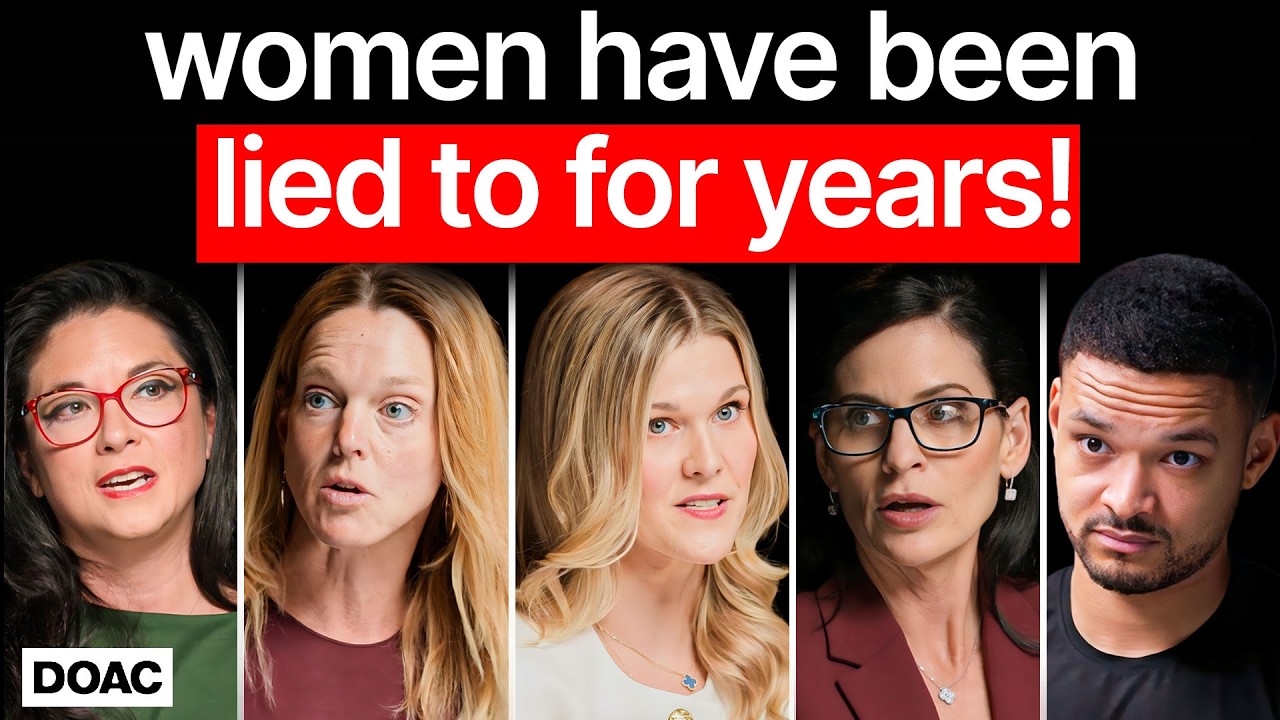
Haver, Wright, Crawford, and Sims Link Women's Health Deficits to Systematic Hormone Mismanagement
The Diary Of A CEO
Systemic medical research bias and the misdiagnosis of female hormonal dynamics directly drive chronic illness, bone loss, and delayed treatments for conditions like endometriosis and perimenopause in women.
## Background
This content was published on YouTube by the channel The Diary Of A CEO on October 16, 2025. The page description outlines a female health roundtable featuring four leading experts—Dr. Mary Claire Haver, Dr. Vonda Wright, Dr. Natalie Crawford, and Dr. Stacy Sims—discussing hormones, fertility, irregular periods, PCOS, endometriosis, and perimenopause.
## TL;DR
A panel of four female health experts breaks down systemic research gaps in women's medicine, explaining how physiological differences impact cardiovascular, metabolic, and hormonal health across a woman's lifespan. The discussion addresses underlying root causes of conditions like PCOS, endometriosis, and perimenopause, while critiquing traditional medical approaches that rely solely on birth control or require a full year of amenorrhea for menopause care. Emphasizing proactive lifestyle habits, the experts highlight the critical role of muscle mass, resistance training, anti-inflammatory nutrition, and evidence-based hormone replacement therapy (MHT) for long-term longevity and cognitive health.
## Atmosphere & style
The conversation is deeply passionate, candid, and validating, blending expert clinical authority with personal anecdotes of medical gaslighting and shared frustration over historical healthcare disparities. Host Steven Bartlett creates a supportive space that allows the four experts to engage in an energetic, collaborative dialogue, seamlessly transitioning from rigorous physiological explanations to personal reflections. The emotional arc ranges from outrage over systemic neglect in female sports science and medicine to an empowering, urgent call for self-advocacy and proactive self-care across every decade of life.
## Key takeaways
- [05:30](https://www.youtube.com/watch?v=kizDk8idpT8&t=330s) Women's health research faces a massive funding and diagnostic gap, receiving less than 1% of research funding for women over 40 despite women living longer and experiencing higher rates of late-life disability.
- [12:12](https://www.youtube.com/watch?v=kizDk8idpT8&t=732s) Female cardiovascular disease presents differently than in men, with diffuse microvascular disease often misclassified as 'atypical chest pain' due to historical male-centered diagnostic baselines.
- [21:42](https://www.youtube.com/watch?v=kizDk8idpT8&t=1302s) Estrogen receptors exist throughout the entire female body, making single static blood draws insufficient for understanding full hormonal health context.
- [33:38](https://www.youtube.com/watch?v=kizDk8idpT8&t=2018s) Insulin resistance is a major underlying driver of conditions like PCOS and gestational diabetes, and can be managed through resistance training, muscle mass retention, and fiber-rich diets.
- [49:35](https://www.youtube.com/watch?v=kizDk8idpT8&t=2975s) Amenorrhea and severe menstrual pain are abnormal warning signs of overtraining, energy deficiency (REDs), or conditions like endometriosis and adenomyosis, rather than markers of fitness or normal pain.
- [01:00:43](https://www.youtube.com/watch?v=kizDk8idpT8&t=3643s) Lab reference ranges for ferritin reflect population averages rather than optimal health, causing mild iron deficiencies to be overlooked until clinical anemia develops.
- [01:02:58](https://www.youtube.com/watch?v=kizDk8idpT8&t=3778s) Endometriosis takes an average of 7 to 10 years to diagnose and accounts for up to 50% of unexplained infertility cases, yet remains underfunded and reliant on surgical diagnosis.
- [01:17:53](https://www.youtube.com/watch?v=kizDk8idpT8&t=4673s) Standard hormonal birth control suppresses endogenous estrogen, LH, and FSH production, which can mask underlying health issues like functional hypothalamic amenorrhea during critical bone-building years.
- [01:57:10](https://www.youtube.com/watch?v=kizDk8idpT8&t=7030s) Popular health wearables often misinterpret natural luteal phase shifts in heart rate variability and body temperature, giving women inaccurate recovery scores.
- [02:04:22](https://www.youtube.com/watch?v=kizDk8idpT8&t=7462s) Female fertility decline is primarily driven by age-related egg quality degradation and mitochondrial dysfunction rather than complete depletion of egg supply.
- [02:05:52](https://www.youtube.com/watch?v=kizDk8idpT8&t=7552s) Male fertility accounts for half of all infertility cases, with sperm health heavily impacted by lifestyle factors, heat exposure, alcohol, and cannabis use over a 90-day lifecycle.
- [02:41:18](https://www.youtube.com/watch?v=kizDk8idpT8&t=9678s) Perimenopause begins 7 to 10 years prior to menopause and is characterized by erratic estrogen fluctuations, brain fog, mood changes, and an increased risk of mental health struggles.
- [02:54:04](https://www.youtube.com/watch?v=kizDk8idpT8&t=10444s) The strict medical requirement to wait 12 continuous months without a period before diagnosing menopause or prescribing HRT delays treatment for women suffering during perimenopause.
- [03:04:50](https://www.youtube.com/watch?v=kizDk8idpT8&t=11090s) Menopause Hormone Therapy (MHT) and transdermal estradiol can mitigate cardiovascular, cognitive, and bone density decline when combined with lifestyle interventions like strength training and anti-inflammatory nutrition.
- [03:24:47](https://www.youtube.com/watch?v=kizDk8idpT8&t=12287s) Genitourinary Syndrome of Menopause (GSM) causes significant vaginal atrophy and urinary complications, but low-dose localized vaginal estrogen safely treats symptoms without systemic risks.
## Detailed walkthrough
### [00:00](https://www.youtube.com/watch?v=kizDk8idpT8&t=0s) Introduction: A Conversation That Changes Everything
The episode opens with host Stephen Bartlett asking a fundamental question to set the tone: if a woman's menstrual cycle is irregular, should she be concerned? The panel answers in unanimous unison: "Yes. Yes. Yes." They emphasize that a woman's body is meant to operate like clockwork. The monthly cycle goes far beyond simply preparing to conceive a baby; missing periods can inflict severe long-term harm on brain health, mental health, energy, mood, and libido.
Stephen welcomes four world-renowned women’s health experts who bring over 80 years of combined experience across distinct medical and scientific fields:
* **Dr. Stacy Sims:** Female physiology researcher and sports medicine expert.
* **Dr. Natalie Crawford:** Double board-certified OB/GYN and reproductive endocrinologist (fertility specialist).
* **Dr. Mary Claire Haver:** OB/GYN and menopause specialist.
* **Dr. Vonda Wright:** Longevity orthopaedic surgeon and sports medicine specialist.
Ahead of the episode, over 1,000 women submitted questions regarding fertility, hormone balance, polycystic ovary syndrome (PCOS), birth control, and miscarriage. The panel stresses that the overwhelming volume of questions exists because society has failed to discuss these topics publicly. Research funding is abysmal—less than 1% of research dollars are dedicated to women over 40. Furthermore, 50% of patients with unexplained infertility actually have endometriosis, yet it takes an average of 7 to 10 years to receive a diagnosis after symptoms begin. Women frequently gaslight themselves into believing severe pain is normal, declaring high pain tolerances as a "badge" of honor.
Stephen frames this two-part roundtable as one of the most critical discussions ever hosted on *The Diary Of A CEO*. He admits that as a man, he initially didn't think he would connect with the topic, but the insights fundamentally altered how he views the health of his partner, sister, and female colleagues. He urges both female and male viewers to share the episode broadly.
---
[02:57](https://www.youtube.com/watch?v=kizDk8idpT8&t=177s) Meet the Panel: Expert Perspectives and Backgrounds
Stephen asks each guest to outline her background, clinical perspective, and specialized focus in women's health:
* **Dr. Stacy Sims:** Approaches women's health through exercise physiology and sports medicine, evaluating how exercise and nutrition impact stress responses, body composition, and overall health span. Her work spans elite endurance athletes to recreational female exercisers.
* **Dr. Natalie Crawford:** Operates an IVF clinic helping patients conceive daily, but her true passion lies in natural fertility and preventative hormone awareness following her own personal experience with pregnancy loss. She focuses on educating women on how lifestyle factors alter hormones and egg quality as they age.
* **Dr. Mary Claire Haver:** A former academic professor and residency program director with 20 years of experience in general OB/GYN. She transitioned into dedicated menopause care after experiencing perimenopause herself and realizing that traditional medical education treats women's health in a rigid, reproductive silo (breast, uterus, ovaries, vagina) while ignoring the rest of the body.
* **Dr. Vonda Wright:** An orthopaedic sports surgeon who has spent her career treating elite athletes while researching musculoskeletal aging and longevity. Her central mission is saving patients' mobility to prevent chronic disease and re-educating the public on full-body female aging.
---
[05:30](https://www.youtube.com/watch?v=kizDk8idpT8&t=330s) The Massive Funding Gap and Research Bias
The discussion shifts to why a dedicated conversation on women's health is necessary rather than lumping it under general health. Dr. Wright highlights a fundamental demographic reality: women represent **51% of the population**, making them the absolute majority, yet medicine continues to treat female health as a niche subcategory.
Dr. Wright points out a stark funding disparity: out of approximately **$450 billion** spent annually on medical research in the United States, **less than 1% is allocated to women over 40**. This occurs despite women making **80% of all healthcare decisions** for their households and living an average of 6 years longer than men. However, women spend those extra years in poorer health—living **20% more of their lives** managing chronic conditions, frailty, dementia, or mental health disorders compared to age-matched men according to data compiled for the Gates Foundation.
The panel explains that medicine was historically designed around male physiology. Historically, women were excluded from scientific research design. In fact, it was not until **1993** (via the NIH Revitalization Act) that women were federally mandated to be included in clinical trial research. Even today, researchers frequently bypass female human and animal models due to the "complexity" of menstrual cycles and fluctuating hormones, rather than integrating those variables directly into study designs.
- Women make up 51% of the total population.
- Less than 1% of $450B in US medical research funding targets women over 40.
- Women make 80% of all family healthcare decisions.
- Women live 6 years longer than men on average, but spend 20% more time in ill health.
- Federal mandates requiring female inclusion in US clinical research were only passed in 1993.
---
[10:51](https://www.youtube.com/watch?v=kizDk8idpT8&t=651s) Physiological Differences Down to the Cellular Level
Stephen asks what makes men and women fundamentally different from a physical and physiological standpoint to justify separate research models. Dr. Sims and Dr. Wright outline several core morphological and biochemical distinctions:
* **Musculoskeletal System:** Men naturally possess more fast-twitch muscle fibers suited for explosive power, whereas women possess more endurance-oriented fibers. This influences baseline glucose metabolism and blood sugar regulation. Men have denser bones capable of sustaining higher mechanical loads.
* **Cardiopulmonary System:** Women naturally have smaller heart volumes, smaller lung capacity, and lower levels of circulating hemoglobin compared to men, primarily due to lower baseline testosterone levels.
* **Cellular Differences:** Dr. Wright shares that her laboratory researched muscle-derived stem cells (satellite cells). Under identical experimental environments, female (XX) satellite cells were significantly more efficient at regenerating cartilage and muscle tissue, whereas male (XY) satellite cells were more effective at forming bone tissue.
---
[12:12](https://www.youtube.com/watch?v=kizDk8idpT8&t=732s) Why Women's Heart Attacks Are Dismissed as 'Atypical'
Dr. Haver highlights cardiovascular disease—specifically coronary artery disease—to illustrate how male-centric medicine harms women. In men, atherosclerotic plaque typically builds up in the primary epicardial arteries right near the aorta, resulting in sudden, localized blockages such as the classic "widowmaker" obstruction in the left anterior descending (LAD) artery.
In contrast, women rarely present with localized single-artery blockages. Instead, female coronary artery disease is typically diffuse and microvascular, occurring deep within the smaller vessels of the heart muscle. Consequently, women present with non-traditional heart attack symptoms (such as nausea, fatigue, or vague chest discomfort) rather than crushing central chest pain. Because medical textbooks define male presentation as the standard, women's heart attack symptoms are officially classified in diagnostic criteria as "atypical chest pain"—a terminology bias the panel finds absurd given that women make up over half the population.
> "51% of the population is female. Why is my heart attack 'atypical' and a man's 'typical'?" — Dr. Mary Claire Haver
---
[14:51](https://www.youtube.com/watch?v=kizDk8idpT8&t=891s) Dismissive Culture and the "Whiny Woman" Stereotype
Stephen brings up an anecdote Dr. Haver previously shared regarding how male-dominated medical training historically taught doctors to view female patients. Dr. Haver recounts a vivid story from her time as a first-year OB/GYN intern managing paper charts in Texas.
Her very first patient in the gynecology clinic was a 40-year-old woman presenting with a complex array of vague symptoms: recent weight gain, low mood, diminished libido, borderline elevated blood pressure, and rising cholesterol. The patient had already seen three or four family medicine physicians without receiving a clear diagnosis or relief.
When Dr. Haver presented the case to her senior resident—a male doctor who came walking down the hallway in cowboy boots—his immediate reaction reflected the widespread dismissive culture present in medical training. He reviewed the list of multi-system complaints and asked if her thyroid had been checked, instantly leaning toward dismissing the patient's multi-system distress as routine complaints rather than investigating the underlying hormonal shifts of midlife.
[015:59] Dismissive Terms and Systemic Bias in Women's Healthcare
Dr. Mary Claire Haver recalls a pivotal moment during her medical training when a senior physician dismissed a female patient's symptoms by secretly noting she had a "WW"—slang for a "whiny woman." He instructed Dr. Haver to simply "pat her on the knee, tell her to have some wine, [and] go on date night," insisting nothing could be done medically. Dr. Haver explains that it took her 20 years to fully unpack this ingrained bias. Across various hospital wards and regional medical cultures, she encountered similar derogatory acronyms used to brush off middle-aged women's complex complaints:
* **"Whiny gyne"**
* **"Status Hispanicus"**
* **"Total TBD" (Total Body Delore)**
The panel emphasizes that this is not an isolated issue in obstetrics and gynecology—it is a pervasive pattern throughout every medical subspecialty. Historically, terms like the "wandering uterus" and "hysteria" were used as actual medical diagnoses to commit women experiencing perimenopause symptoms or hot flashes to insane asylums. Dr. Vonda Wright points out that medicine is supposed to be defined by curiosity, yet when middle-aged women present with vague or multi-system symptoms, that clinical curiosity vanishes.
---
[018:14] Female Representation in Sports Science and Self-Gaslighting
Dr. Stacy Sims highlights how exercise physiology literature historically centered around the "Vitruvian Man," treating male anatomy as the default human baseline. Historically, female athletes were only discussed through the lens of pathophysiology, such as iron deficiency or the "female athlete triad" (now termed REDs, or Relative Energy Deficiency in Sport). For decades, female athletes were only accepted or considered capable of high performance if they became amenorrheic—losing their period was mistakenly viewed as a sign that they were "more like men" and capable of hard training, rather than a symptom of severe overtraining and under-recovery.
Because of this deep historical conditioning, women frequently downplay their own symptoms and gaslight themselves before seeking medical care. Dr. Wright notes that almost every woman in her orthopedic practice begins her consultation with a defensive declaration: *"I have a really high pain tolerance."* Women feel compelled to treat enduring severe pain as a badge of honor, delaying treatment until an injury or condition progresses to a debilitating state.
* **REDs (Relative Energy Deficiency in Sport):** The modern medical term replacing the "female athlete triad," recognizing the systemic health and performance impacts of low energy availability.
* **Conditioning:** Women often downplay pain out of fear of not being taken seriously or being labeled hysterical, creating substantial delays in obtaining an accurate diagnosis.
---
[021:42] Demystifying Hormones: The Dynamic Chemical Communication System
host Stephen Bartlett reflects on how long the broader public has been kept in the dark regarding hormonal health. He notes that seeing an academic paper mapping the widespread location of G-protein coupled estrogen receptors throughout the entire human body—including the brain, bones, muscles, gut, and heart's vascular endothelium—was eye-opening. The doctors clarify that "sex hormones" are misnamed; they function as the body's primary chemical messaging network.
Dr. Natalie Crawford emphasizes that hormones are dynamic by design—fluctuating continuously throughout the day in response to internal and external stimuli rather than staying at a static level. Because hormones form an interconnected "symphony," single blood tests often fail to capture the full picture, leading to frequent mismanagement by clinicians who lack deep training in endocrinology.
```
+-----------------------------------------------------------------------------------+
| THE FEMALE HORMONAL COMMUNICATOR |
+--------------------------+--------------------------------------------------------+
| Estrogen Receptors | Located in brain, bone, muscle, gut, and blood vessel |
| | endothelium—not just reproductive organs. |
+--------------------------+--------------------------------------------------------+
| Hormone Dynamic Nature | Constant real-time adjustments; single static blood |
| | draws rarely capture full context. |
+--------------------------+--------------------------------------------------------+
```
---
[025:10] The Anatomy of a Normal Menstrual Cycle
The panel discusses how textbook diagrams oversimplify cycle dynamics by showing static graphs of the ovaries and uterine lining while ignoring impacts on the brain, muscles, and bones. Furthermore, individual variation means cycle-to-cycle length can naturally shift, and anovulatory cycles occur. However, Dr. Crawford stresses that every woman should experience a predictable cycle interval that can be tracked reliably on a calendar.
Dr. Crawford breaks down the primary mechanical sequence of a healthy cycle:
1. **Follicular Phase:** The brain releases **FSH** (Follicle-Stimulating Hormone), which stimulates egg-containing follicles in the ovary. The growing follicle produces **estradiol** (the primary form of estrogen).
2. **Ovulation Trigger:** When estradiol maintains a threshold of **200 pg/mL for roughly 50 hours**, the brain triggers a surge of **LH** (Luteinizing Hormone), causing the follicle to rupture and release the egg.
3. **Luteal Phase:** The ruptured follicle transforms into the **corpus luteum**, which releases pulses of **progesterone**.
* **Average Healthy Cycle Length:** Typically ranges between **25 to 35 days**, remaining consistent within a few days month-to-month for an individual.
* **Progesterone's Role:** Prepares the body for potential pregnancy, opens the uterine implantation window, and alters metabolic function.
---
[029:39] How the Luteal Phase Alters Metabolism and Whole-Body Health
During the post-ovulatory luteal phase, progesterone shifts the body's baseline physiological operations in anticipation of a potential embryo:
* **Carbohydrate Shuttling:** Progesterone directs circulating glucose away from muscles and builds up glycogen stores in the endometrial lining, altering exercise performance and intensity tolerance.
* **Systemic Shifts:** Core body temperature increases, resting heart rate elevates, heart rate variability (HRV) drops, appetite increases, and immune function adapts.
The experts stress that the menstrual cycle functions as a vital sign for whole-body health. An irregular or missing cycle is a primary signal of underlying systemic imbalance—whether driven by hormonal dysfunction, metabolic stress, or energy deficits—and warrants medical evaluation.
> "Your body's meant to work like clockwork when it comes to your hormones and your menstrual cycle."
[31:28](https://www.youtube.com/watch?v=kizDk8idpT8&t=1888s) Tracking the Cycle as a Vital Sign and the Physiology of PCOS
While occasional cycle variations happen, consistent irregularity serves as a major red flag for underlying hormonal or systemic health issues. Millions of women miss these critical indicators because they are on contraceptive options or were simply never taught how to track their cycles. Without tracking ovulation, early warning signs—such as a shortened luteal phase (the second half of the menstrual cycle)—go completely unnoticed. Shifting the cultural conversation is essential: a woman's monthly cycle is far more than just a tool for pregnancy planning; it is a fundamental marker of overall female physiology and athletic robustness. When stressors or allostatic load disrupt the cycle, it is a clear sign to pull back, increase nutrition, and prioritize recovery.
The discussion shifts to Polycystic Ovarian Syndrome (PCOS), with Dr. Mary Claire Haver reflecting on her own diagnosis in medical school. While initially met with fear over potential infertility, PCOS is ultimately a metabolic issue rather than a structural flaw in the ovaries. The ovaries are simply reacting to elevated insulin levels present from birth. Infertility itself acts as an early warning sign for systemic dysfunction—women experiencing infertility face an 80% higher risk of heart attack and a 75% higher risk of metabolic syndrome later in life. PCOS is genetically linked and often originates in utero, causing the ovaries to retain more eggs than usual. This dilutes the brain's signals, prevents normal ovulation, suppresses progesterone, and makes the ovaries and body resistant to insulin. Consequently, cells require increasingly higher amounts of insulin to absorb glucose, fueling systemic inflammation and metabolic issues.
- Irregular periods serve as an early red flag for systemic and hormonal health issues.
- A shortened luteal phase is often the first indicator of ovulatory dysfunction.
- Infertility is linked to an 80% higher chance of heart attack and a 75% higher chance of metabolic syndrome.
- PCOS originates genetically or in utero, leading to an overabundance of eggs that dilute brain signals and impair normal ovulation.
---
[35:15](https://www.youtube.com/watch?v=kizDk8idpT8&t=2115s) Gestational Diabetes, Obesogenic Environments, and Lifestyle Management
Gestational diabetes—developing high blood sugar during pregnancy—is another major metabolic warning sign. Up to 50% of women who experience gestational diabetes go on to develop type 2 diabetes within 10 to 15 years. Instead of waiting for a official diagnosis during pregnancy, doctors can use early indicators like PCOS to implement metabolic interventions early through nutrition and exercise. It is crucial to dispel the guilt around PCOS; women do not cause their own diagnosis, though daily lifestyle choices directly dictate the severity of their symptoms. Modern society presents a distinct challenge because people live in an "obesogenic" environment that naturally promotes insulin resistance through processed foods, sedentary jobs, and chronic stress.
> "Your scale is already tipped in a way that's going to be really hard for you. You have to make active steps to fight what is happening inside your body."
Managing PCOS and metabolic health effectively requires targeting both insulin resistance and chronic inflammation. A primary focus must be gut health, as the gut microbiome heavily dictates inflammatory load and plays a major role in estrogen metabolism. The panel warns against restrictive trend diets like keto or cutting out fruits entirely. Instead, a plant-forward, fiber-rich diet with whole foods, healthy fats, and quality protein serves as the foundation. Combating the constant stream of modern stressors—which flood the bloodstream with unneeded glucose—and building skeletal muscle through exercise are two of the most effective strategies to reverse insulin resistance.
- Up to 50% of women with gestational diabetes develop type 2 diabetes within 10–15 years post-pregnancy.
- Modern environments actively promote insulin resistance through ultra-processed foods, physical inactivity, and persistent stress.
- Plant-forward diets rich in fiber support the gut microbiome and assist in proper estrogen metabolism.
- Skeletal muscle acts as a primary sink for blood glucose, making resistance training essential for combating insulin resistance.
---
[44:27](https://www.youtube.com/watch?v=kizDk8idpT8&t=2667s) The Trap of Overtraining, Fasting, and Circadian Disruption
A destructive cycle frequently occurs when women try to alter their bodies through extreme restriction and overtraining. The common habit of skipping breakfast, drinking black coffee, and delaying food until midday triggers a cascade of negative physiological responses. Starving the body deprives it of the energy needed for meaningful exercise, while working out too hard without proper fuel severely elevates cortisol and overall stress levels. Over-exercising and under-fueling keep the body stuck in a state of distress, making it impossible to fix underlying metabolic or hormonal issues.
This restriction directly undermines fundamental physiology. Fasted training and skipping breakfast elevate ghrelin—the primary hunger hormone—alongside cortisol. Ignoring these natural hunger cues disrupts the brain's neuropeptides and hormone pulses. Research shows that women who engage in extended fasting often experience intense afternoon cravings for simple carbohydrates, move less throughout the rest of the day, and suffer from disrupted circadian rhythms and poor sleep. Rather than relying on shiny wellness trends or gadgets, long-term hormonal optimization requires mastering fundamental lifestyle habits: eating adequate protein and whole foods, building lean muscle mass, and honoring natural sleep-wake cycles.
- Skipping meals and relying on coffee spikes cortisol and elevates ghrelin, the hunger hormone.
- Prolonged fasting in women often leads to afternoon carbohydrate cravings, lower spontaneous activity, and disrupted circadian rhythms.
- Building muscle mass and getting quality sleep require adequate caloric and nutrient intake.
- Basic, consistent lifestyle habits are far more effective for long-term hormonal health than complex gadgets or extreme diets.
[47:33](https://www.youtube.com/watch?v=kizDk8idpT8&t=2853s) Medical Education Oversights and Lifestyle Interventions for PCOS
The conversation centers on how conventional medical training handles polycystic ovary syndrome (PCOS). In medical school and residency, clinicians are primarily taught to manage symptoms rather than address underlying mechanics or prevention. When a patient presents with PCOS, the standard "knee-jerk reaction" taught to doctors is to write a prescription for oral contraceptives, or to prescribe ovulation-inducing medications like Clomid when the patient is ready to conceive. Little to no curriculum time is devoted to exercise, nutrition, or reducing systemic inflammation, despite PCOS affecting at least 10% of women. One guest notes that she managed her own PCOS with birth control pills for 20 years before taking to online patient chat rooms to discover the massive impact nutrition could have on her condition.
In high-performance female athletics, there is actually a disproportionately high prevalence of PCOS. Rather than turning to oral contraceptives—which can negatively impact physical performance—practitioners focus on short, sharp, high-intensity exercise routines. These quick bursts trigger a post-exercise anti-inflammatory and growth hormone response that helps lower total body inflammation. Combined with carefully timed nutrient intake, these lifestyle modifications allow both elite and recreational athletes to regulate their bodies effectively without reliance on synthetic hormones.
- Traditional medical education focuses on symptom suppression (birth control or Clomid) rather than lifestyle strategies.
- PCOS impacts at least 10% of women, yet nutrition and exercise interventions are frequently omitted from medical school curricula.
- Short, high-intensity exercise aids in mitigating PCOS symptoms by inducing an anti-inflammatory and growth hormone response.
- Online support communities and chat rooms often end up filling the information void left by standard medical care.
---
[49:35](https://www.youtube.com/watch?v=kizDk8idpT8&t=2975s) The Danger of Missing Periods and Low Estrogen
The panel shifts to address a common, dangerous misconception surrounding amenorrhea—the absence of a menstrual period. Women suffering from PCOS or hypothalamic amenorrhea often view missing their periods as a convenience. However, a absent period during reproductive years indicates a hypoestrogenic state (low estrogen levels), which is deeply harmful to the female body. Estrogen plays a critical role during bone-building years, and prolonged low estrogen compromises long-term cardiovascular, cognitive, and skeletal health.
A cultural shift is desperately needed regarding how women view their menstrual cycles. In many athletic environments, a pervasive and toxic idea remains: losing one's period is a badge of honor signaling hard training. One panelist shares an experience from a high-performance athletic meeting where a head coach asserted that he knew his female athletes were ready to compete on the world stage when their periods stopped. The panel forcefully refutes this, emphasizing that a stopped period is actually a sign an athlete is on the verge of breakdown or severe injury.
"I remember sitting in a high performance meeting just maybe three years ago and the leading athletics coach stood up and said, 'I know when my athletes are ready to perform on the world stage when their periods stop.' And all of us went, 'What?'"
- Amenorrhea leads to low estrogen levels, impairing bone density building during critical youth years and damaging long-term brain and heart health.
- The loss of a period in athletes is a warning sign of overtraining and impending injury, not an indicator of peak fitness.
- Re-framing the menstrual cycle as a "report card" for overall hormonal and cellular health helps destigmatize periods and encourages proper physiological self-care.
---
[52:48](https://www.youtube.com/watch?v=kizDk8idpT8&t=3168s) Evaluating Period Volume, Heavy Bleeding, and Anemia
Addressing menstrual volume, the panel notes that while women don't carry measuring cups, modern period products should allow a cycle to pass without disrupting daily life. A cycle shouldn't cause panic, force someone to bleed through clothing, or prevent a full night's sleep. When heavy menstrual bleeding occurs, it frequently leads to depleted iron stores long before full-blown anemia appears on standard blood tests.
The body stores iron in a protein complex called ferritin, which is located in the bone marrow and blood. When a woman bleeds heavily, ferritin levels drop first, serving as an early indicator of depletion long before red blood cell counts collapse or cells become microcytic (abnormally small). Identifying low ferritin early allows for intervention through diet or supplementation before performance and daily energy suffer.
- Ferritin levels serve as the earliest metric of depleted iron reserves, dropping long before a patient presents with clinical anemia.
- Red blood cells utilize hemoglobin—an iron-rich protein—to transport oxygen throughout the body; heavy blood loss depletes these essential stores.
- A normal period should not cause life disruption, force clothing changes mid-day, or interrupt sleep.
---
[54:55](https://www.youtube.com/watch?v=kizDk8idpT8&t=3295s) Causes of Light Periods, Scarring, and Severe Pain
When evaluating abnormally light periods, a sudden change from a person's individual baseline is the key signal. Estrogen builds the uterine lining, while progesterone stabilizes and thins it. Consecutive light cycles can stem from prolonged use of progesterone-based contraception (such as continuous birth control pills, hormonal IUDs, or shots), which thins the endometrial lining over time and can take months to reverse after discontinuation.
Light bleeding can also indicate damage to the stem cells in the endometrium responsible for regenerating the lining each month. Internal trauma—such as a difficult childbirth, retained placenta, dilation and curettage (D&C) procedures, or intrauterine surgeries—can produce scar tissue (Asherman's syndrome) that prevents lining growth. While a single unusual cycle caused by travel or acute stress is generally harmless, persistent light bleeding after a pregnancy loss or procedure warrants immediate medical investigation.
Regarding pain, severe menstrual cramps should never be normalized as a mere inconvenience. While mild discomfort from uterine contractions or corpus luteum cyst resolution is common, excruciating pain that forces a woman to miss work, school, or social commitments is abnormal. Persistent debilitating pain points toward underlying conditions such as endometriosis, adenomyosis, or uterine fibroids.
- Estrogen builds the endometrial lining, whereas progesterone thins it out.
- Physical procedures like D&Cs, traumatic births, or intrauterine devices can occasionally cause endometrial scarring, leading to abnormally light flow.
- Menstrual pain that consistently interferes with daily activities is pathological and warrants evaluation for endometriosis, adenomyosis, or fibroids.
---
[01:00:43](https://www.youtube.com/watch?v=kizDk8idpT8&t=3643s) Iron Deficiency, Misleading Lab Reference Ranges, and Flawed "Norms"
The discussion broadens to iron deficiency on a global and clinical scale. According to the World Health Organization, roughly 30% of women aged 15 to 49 globally are anemic, with iron deficiency being the primary driver. In regions such as South Asia and Sub-Saharan Africa, this statistic climbs to nearly 50%. However, even in developed countries, iron deficiency remains wildly underdiagnosed due to flawed lab reference ranges.
Laboratory reference ranges are built on statistical population averages rather than thresholds for optimal physiological function. As the general population becomes sicker or more iron-deficient, the standard reference ranges shift downward. Standard labs may cite a ferritin level of 20 ng/mL as "normal," yet patients at these levels often experience severe fatigue and systemic symptoms. Optimal ferritin levels for high-functioning health and athletic performance fall between 60 and 100 ng/mL.
"Normal in medicine means common, not non-pathological... If the population is more anemic, this is going to accept lower levels as being normal, even though they're by no means optimal."
- World Health Organization estimates indicate that 30% of women aged 15–49 worldwide are anemic, rising to 50% in certain global regions.
- Laboratory reference ranges reflect population averages rather than healthy or optimal physiological function.
- Standard medical guidelines often consider ferritin levels as low as 20 ng/mL acceptable, whereas functional health targets sit between 60 and 100 ng/mL.
- Ferritin also acts as an acute-phase reactant that can be altered by chronic systemic inflammation, further complicating lab interpretation.
[01:02:58](https://www.youtube.com/watch?v=kizDk8idpT8&t=3778s) People Suffer Silently With Endometriosis for Years
The panel shifts focus to the tragic realities of endometriosis, anchored by the personal story of Liv, a long-standing core team member at *The Diary Of A CEO*. Host Steven Bartlett recounts Liv's decades-long struggle: getting her period at age 13 accompanied by agonizing pain, being put on the contraceptive pill at 14, and spending her late teens and early twenties in and out of A&E with severe abdominal pain. Her symptoms were repeatedly dismissed as gastroenteritis, ultimately leading doctors to mistakenly remove her appendix. By age 25, when she stopped taking the pill, her pain worsened to the point of fainting. Despite an ultrasound at age 26 suggesting endometriosis, no formal NHS diagnosis was made.
It was only after a previous podcast conversation with Dr. Natalie Crawford that Liv spoke directly with the team and Dr. Crawford. Steven offered to pay for private medical care, leading to an MRI that confirmed stage 4 infiltrating endometriosis. By the time of her surgery, a massive 4-centimeter endometrioma cyst had developed, her ovaries were fused together ("kissing ovaries"), and the disease had attached her reproductive organs to her bowels and pelvis. To protect her future fertility prior to surgery, she underwent egg freezing. In total, Liv suffered for 17 years before finally getting an accurate diagnosis.
Dr. Natalie Crawford explains that Liv's story is heartbreakingly typical. Endometriosis is a chronic inflammatory, autoimmune-like condition. While it is normal during menstruation for a small amount of endometrial tissue to travel backward through the fallopian tubes into the pelvic cavity (retrograde menstruation), a healthy immune system simply clears it away. In a woman with endometriosis, however, the body reacts with severe immune dysfunction and inflammation. These endometrial-like cells implant on the organs, creating lesions that respond to estrogen and bleed with every ovulatory cycle, progressively worsening over time.
- **Diagnostic Delay:** The average timeframe to diagnose endometriosis is 7 to 10 years, though many women endure symptoms for over 15 years before confirmation.
- **Anatomical Impact:** In advanced stages (Stage 3 and Stage 4), extensive organ scarring and anatomical distortion occur, effectively gluing organs like the bladder, bowel, and uterus together like "velcro."
- **Common Symptoms:** Severe period pain, pain with deep penetration during intercourse, and chronic gastrointestinal complaints (often misdiagnosed as Irritable Bowel Syndrome).
- **Diagnostic Barrier:** Endometriosis remains a surgical-only diagnosis, requiring a tissue biopsy ("no meat, no treat") via laparoscopy to be formally confirmed.
---
[01:09:17](https://www.youtube.com/watch?v=kizDk8idpT8&t=4157s) The Real Reason There's No Treatment for Endometriosis
Steven questions why there is no definitive cure for a condition so common and destructive. Dr. Crawford points out two main reasons: severe historical underfunding and lack of research into women's health, alongside the fundamental biological challenge of treating it. Because endometriosis is driven and fed by estrogen, conventional medical therapies attempt to suppress estrogen levels or halt ovulation entirely. However, removing estrogen deprives the female body of a hormone essential for bone, brain, and cardiovascular health, swapping one set of severe health issues for another.
Current medical approaches—primarily the birth control pill—serve as symptom management rather than a cure. While oral contraceptives can slow progression and offer relief for some, they do not reverse existing lesions or repair anatomical damage. Furthermore, stage 3 and 4 endometriosis severely impacts natural fertility, dropping a woman's lifetime chance of spontaneous conception to under 20%. When endometriomas form inside the ovaries, surgical removal often damages healthy ovarian tissue, drastically reducing egg reserve—which is why pre-surgical egg freezing is vital. Dr. Crawford recalls treating women in the emergency department for ruptured ectopic pregnancies caused by scarred fallopian tubes, only to diagnose them with severe endometriosis during emergency surgery while they were simultaneously grieving a lost pregnancy.
Dr. Mary Claire Haver draws an insightful parallel to her early career as a cancer nurse, asking why science hasn't identified specific cell surface markers on endometrial tissue to create targeted monoclonal antibody therapies. Dr. Crawford notes that promising cellular-level research is finally underway to identify unique biomarkers in endometrial implants, which could eventually lead to non-invasive endometrial biopsy diagnostics and targeted treatments.
- **Fertility Impact:** Women with stage 3 or 4 endometriosis have less than a 20% chance of natural conception over their lifetime.
- **Unexplained Infertility:** Approximately 50% of women diagnosed with unexplained fertility issues are ultimately found to have underlying endometriosis.
- **Predictive Red Flag in Teens:** Experiencing period pain so severe in adolescence that it forces a young woman to miss school or social events is one of the highest predictive markers for endometriosis.
---
[01:15:22](https://www.youtube.com/watch?v=kizDk8idpT8&t=4522s) How to Ease Pain Symptoms Before Your Period Naturally
Addressing the need for non-pharmacological methods to manage inflammatory flare-ups, Dr. Stacy Sims shares promising pilot data evaluating targeted cold water exposure. Because endometriosis is rooted in chronic, systemic inflammation, lowering the inflammatory threshold during the high-risk window of the menstrual cycle can significantly alleviate painful symptoms.
Dr. Sims details a protocol using cold water submersion (around 10°C / 50°F) for 10 minutes daily during the luteal phase—the 10 to 14 days leading up to the start of a period. Over three to four months, this practice helps retrain the immune system, dampens inflammatory cascades, and stimulates the parasympathetic nervous system to reduce stress. Crucially, Dr. Sims warns against extreme "ice baths" popular in social media, as temperatures near freezing induce severe systemic stress in women, counteracting the desired calming, anti-inflammatory effect.
Beyond cold water therapy, the panel emphasizes the importance of holistic, anti-inflammatory lifestyle habits—such as prioritizing quality sleep, adopting an anti-inflammatory diet, and managing stress—which are rarely discussed or prescribed within traditional healthcare settings like the NHS.
- **Cold Water Protocol:** 10 minutes of cold water submersion at approximately 10°C (50°F) daily during the 10–14 days prior to menstruation.
- **Mechanism:** Retrains the immune response, reduces systemic inflammatory markers, and elevates parasympathetic nervous tone.
- **Caution:** Avoid freezing ice baths; excessive cold triggers an acute adrenal stress response that exacerbates systemic inflammation.
[01:17:53](https://www.youtube.com/watch?v=kizDk8idpT8&t=4673s) How Birth Control Affects Natural Hormones and Ovulation
The discussion shifts directly into birth control's physiological mechanics in response to an audience question about its impact on female hormones. Dr. Natalie Crawford explains that oral contraceptive pills effectively shut down the brain’s signal to the ovaries to produce hormones. By supplying synthetic versions—ethinyl estradiol and synthetic progestins—the pill tricks the brain into assuming natural hormone levels are already high, mimicking a luteal phase. Because ovulation starts in the brain, no Follicle-Stimulating Hormone (FSH) or Luteinizing Hormone (LH) is released, preventing egg maturation and ovulation entirely. Consequently, the ovaries stop making natural estradiol, progesterone, and testosterone.
While this shutdown makes the pill a highly effective contraceptive, the guest panel notes its dual nature. It can offer therapeutic relief for medical issues like hemorrhagic ovarian cysts (by stopping ovulation-induced bleeding and severe pain) or Polycystic Ovary Syndrome (PCOS). In PCOS cases, the pill regulates cycle timing and lowers abnormally high testosterone levels back into a normal range. However, for a woman with a healthy system, synthetic hormones do not interact with tissue receptors in the exact same manner as natural endogenous hormones.
Dr. Mary Claire Haver shares a personal family story illustrating the hidden tradeoffs of using birth control off-label. Her 14-year-old niece, an elite national athlete aiming for the Olympics, suffered from severe adolescent acne. When dermatologists suggested birth control pills as the next step to lower testosterone and clear her skin, Dr. Haver intervened. Recognizing through Dr. Stacy Sims' work how vital natural testosterone is for building muscle and athletic performance during critical adolescent training years leading up to Olympic trials, they avoided the pill and managed the acne through targeted topical treatments instead.
- **Mechanism of Action:** Synthetic ethinyl estradiol and progestin suppress pituitary FSH and LH secretion, preventing follicle maturation and natural hormone production.
- **Off-Label Applications:** Frequently prescribed for PCOS symptoms, severe ovulation pain/hemorrhagic cysts, and androgenic acne.
- **Athletic Tradeoff:** Suppressing testosterone in young female athletes can compromise muscle development, physical power, and training adaptation.
---
[01:22:10](https://www.youtube.com/watch?v=kizDk8idpT8&t=4930s) The Skeletal Crisis: Bone Building, Inflammation, and Lifestyle
Dr. Vonda Wright expresses deep alarm from a musculoskeletal and orthopedic standpoint regarding the long-term bone health of young women. Peak bone mass is constructed primarily between the ages of 15 and 25. When young girls experience chronic inflammation—marked by elevated inflammatory cytokines like interleukin-6 (IL-6), C-reactive protein (CRP), and Tumor Necrosis Factor (TNF)—their bone development is halted. Paired with low natural estrogen, suppressed testosterone from birth control, and sedentary behavior, this creates a situation where women in their 20s and 30s present with dangerously low bone density.
The doctors discuss how generational habits and systemic medical approaches are exacerbating this issue. Dr. Wright notes her fear that despite generation-spanning efforts to improve health education, younger generations are facing unprecedented challenges in building vital muscle and bone. When teens present with amenorrhea (absence of periods), standard medical practice often defaults to handing out birth control pills to induce a synthetic withdrawal bleed rather than investigating the underlying root causes of low estrogen or metabolic distress.
Dr. Wright and Dr. Crawford emphasize that choices made during early reproductive years dictate a woman's lifelong trajectory, especially as she enters perimenopause—a phase where women can lose up to an additional 20% of their bone density. Treating amenorrhea requires evaluating energy availability, lifestyle factors, and underlying conditions like PCOS or endometriosis, ensuring natural hormone production is supported during peak bone-building years.
- **Peak Bone Mass Window:** Critical bone density acquisition occurs between ages 15 and 25.
- **Inflammatory Biomarkers:** Elevated IL-6, CRP, and TNF directly inhibit bone-forming cells (osteoblasts).
- **Perimenopausal Bone Loss:** Women can lose up to 20% of their total bone density during the perimenopausal transition.
---
[01:24:36](https://www.youtube.com/watch?v=kizDk8idpT8&t=5076s) Personal Reflections: What the Experts Wish They Knew Sooner
The panel shares candid personal reflections on their own health journeys during adolescence, medical training, and early adulthood. Dr. Stacy Sims reveals that she suffered from amenorrhea until age 20 due to intense competitive running, crew, and high stress. Influenced by the 1990s culture of "calories in, calories out," she operated under the harmful belief that being thinner yielded better athletic performance. Looking back, she stresses that young women should be taught to "take up space" and pursue gaining power, bone density, and muscle strength rather than constantly striving for weight loss.
Dr. Mary Claire Haver describes her transition from exercising purely for aesthetics in her youth to training for "her old lady body" today. She shares the sobering motivation behind her current routine: her grandmother spent the final decade of her life bedbound with severe frailty, incontinence, and dementia, while her 88-year-old mother recently broke her hip and resides in an assisted living facility for Alzheimer's disease. Dr. Haver admits that in medical school she inadvertently starved herself due to stress, believing that the lowest possible BMI equated to health. She now actively lifts weights and eats adequately to preserve bone, combat inflammation, and reduce her familial risk for cognitive decline.
Adding to the historical context, the panel reflects on how the "heroin chic" and supermodel aesthetics of the 1990s damaged female body image—a trend they worry is resurfacing today with the misuse of GLP-1 medications and the resurgence of extreme lean-body ideals.
- **Dr. Stacy Sims:** Experienced athletic amenorrhea until age 20; now advocates for strength and nourishing the body over restrictive caloric deficits.
- **Dr. Mary Claire Haver:** Shifted from high-volume cardio for thinness to resistance training to prevent severe osteoporosis, frailty, and neurodegenerative disease.
---
[01:28:27](https://www.youtube.com/watch?v=kizDk8idpT8&t=5307s) Sleep Deprivation, Overtraining, and Delayed Diagnoses
Dr. Vonda Wright and Dr. Natalie Crawford share their experiences navigating medical training while ignoring their own physiological health. Dr. Wright reveals that during her four years of medical school followed by seven years of residency and fellowship, she routinely worked grueling schedules, suffered from lack of sleep, and experienced long periods without normal cycles. She recalls staying awake for two years straight after having a baby while managing call every third night, realizing only later how destructive a decade of severe sleep deprivation and inadequate nutrition was to her long-term health.
Dr. Crawford discusses being on the birth control pill continuously for roughly 15 years. While acknowledging its vital role in allowing her to pursue rigorous medical training without an unplanned pregnancy, she reflects on the hidden downsides. Because she took the pill continuously, she never learned to track her natural baseline menstrual cycle. When she later stopped the pill to start a family, she experienced recurrent pregnancy losses. Medical providers repeatedly dismissed her concerns with generic advice to "just keep trying."
It was not until a decade later, after a DEXA scan revealed she had osteopenia (pathologically low bone density) in her 30s, that an attentive physician searched for root causes. Tests revealed she had celiac disease—an autoimmune reaction to gluten that caused chronic intestinal inflammation and malabsorption of vital nutrients required for bone building. Dr. Crawford notes the tragic irony: during her primary bone-building years, her continuous birth control use masked cycle irregularities, while undiagnosed celiac disease and inflammation quietly eroded her bone health.
- **Medical Training Toll:** Residency shifts (e.g., 100-hour workweeks, call every third night) created extreme chronic stress, circadian disruption, and hormonal dysfunction.
- **Masked Baseline:** Extended, continuous birth control use can prevent women from learning their natural cycle patterns or identifying underlying fertility red flags early.
- **Celiac & Osteopenia:** Undiagnosed celiac disease causes systemic inflammation and nutrient malabsorption, leading to premature bone density loss and recurrent pregnancy loss.
[01:33:29](https://www.youtube.com/watch?v=kizDk8idpT8&t=5609s) Yes, You Can Build Bone in Your 40s!
The panel addresses a common misconception surrounding bone density: while standard medical charts depict bone mass peaking in young adulthood and steadily declining thereafter, it is entirely possible to build bone density later in life through targeted lifestyle interventions and hormone therapy. The discussion highlights a stark contrast in the aging process between sexes; while both men and women age, women experience a sharp, dramatic drop in bone and muscle mass post-perimenopause due to the loss of estrogen. Therefore, maximizing bone density and muscle mass during youth acts as a vital buffer against natural age-related decline, preventing future drops into dangerous, osteoporotic territory.
Despite the advantage of building a high peak bone mass early, life circumstances—such as chronic inflammation, restrictive dieting, or intense athletic training—often impede optimal youth development. For those playing catch-up in their 40s, proactive measures can still yield significant gains in bone strength and muscle preservation.
* **Sex-Based Aging Rates:** Women age at a distinct physiological rate compared to men after perimenopause due to the sudden withdrawal of protective estrogen.
* **The "Catch-Up" Capability:** Muscle mass and bone density can still be built in one's 40s through dedicated strength training, nutrition, and hormone management.
* **Early Optimization:** Maximizing bone density during adolescence and early adulthood provides a vital reserve so that normal age-related loss does not reach osteoporotic thresholds.
---
[01:35:14](https://www.youtube.com/watch?v=kizDk8idpT8&t=5714s) Advice to Your Daughters and Rethinking the Pill
Transitioning to personal family choices, the speakers reflect on the guidance they offer their own daughters regarding oral contraceptives—a stark contrast to how their generation was routinely prescribed the pill at a young age without nuance. A primary concern is that putting teenage girls on birth control masks their natural menstrual cycles, stripping away a vital sign that signals underlying physiological health. Sharing a personal anecdote, one expert explains how her teenage daughter, a dancer with low body weight who had lost her period, was advised by doctors to take birth control simply to induce bleeding. Instead of suppressing her system with synthetic hormones, they opted for an intentional 5- to 7-pound weight gain, which successfully restored her natural cycle.
The overarching consensus is that young women deserve complete transparency about how synthetic hormones function, what they mask, and what alternative choices exist. Rather than treating birth control as an automatic rite of passage, the panel advocates for informed decision-making grounded in true cycle awareness.
* **Cycle as a Vital Sign:** Suppressing natural periods at a young age prevents young women from monitoring their baseline health and cycle regularity.
* **Functional Hypothalamic Amenorrhea vs. Pill Fixes:** Inducing withdrawal bleeding via birth control does not resolve underlying missing periods caused by low body weight or high stress; modest weight gain can naturally restore ovulation.
* **Empowered Choice:** Providing comprehensive education on synthetic hormones enables young women to weigh the trade-offs rather than passively accepting routine prescriptions.
---
[01:37:41](https://www.youtube.com/watch?v=kizDk8idpT8&t=5861s) Should You Wear a Coil or IUD?
The conversation shifts to intra-uterine devices (IUDs) and how they function mechanically and hormonally inside the female body. An IUD—whether a copper coil or a progestin-releasing device—works by generating a localized inflammatory response within the uterine environment. This inflammation thickens cervical mucus into a dense plug that blocks sperm entry and alters the endometrial lining. To illustrate the body's physical response, a speaker shares a dramatic incident involving her daughter, whose uterus severely cramped and bodily expelled a newly inserted IUD within a week of placement.
While acknowledging IUDs as highly effective contraceptives, the experts highlight critical downstream impacts that are rarely discussed during standard medical consults. High-dose progestin IUDs can systemically suppress ovulation in certain women, leading to low native estrogen production. This hormonal deficit can manifest as low libido, fatigue, mood changes, and compromised bone density during peak reproductive years.
> "She had expelled the IUD on her own. She had cramped it out... and so we basically delivered the IUD on her bathroom floor."
* **Mechanism of Action:** IUDs rely on localized inflammation to thicken cervical mucus (blocking sperm passage for 85–90% of the cycle) and alter the uterine lining.
* **Types of Devices:** Options range from non-hormonal copper coils to progestin-releasing devices (such as Levonorgestrel IUDs).
* **Systemic Ovulatory Suppression:** Although intended to act locally, progestin from IUDs can enter systemic circulation and halt ovulation, unintentionally lowering total endogenous estrogen levels.
---
[01:41:18](https://www.youtube.com/watch?v=kizDk8idpT8&t=6078s) A New Form of Contraceptive Pill
The panel explores the pharmacological differences between various estrogens used in birth control, critiquing traditional synthetic options while highlighting promising new developments. Traditional oral contraceptives utilize **ethinyl estradiol**, a synthetic compound featuring an ethinyl group that binds to brain estrogen receptors up to 300 times more potently than natural estradiol. Because of this high potency, ethinyl estradiol is dosed in micrograms rather than milligrams, but it carries well-documented side effects and elevated risks for deep vein thrombosis (DVT).
The experts highlight a newer generation of birth control available in Europe and the UK that incorporates **estetrol (E4)**—a naturally occurring fetal estrogen produced by the human fetus during pregnancy. Estetrol acts as a selective estrogen receptor modulator with native tissue selectivity, offering effective pregnancy prevention with significantly less suppression, fewer downstream mood and libido side effects, and a lower risk profile for blood clots compared to ethinyl estradiol.
* **The Four Natural Estrogens:**
1. **Estradiol (E2):** The primary, most potent estrogen produced by the ovaries during reproductive years.
2. **Estriol (E3):** The predominant estrogen produced in large quantities by the placenta during pregnancy.
3. **Estrone (E1):** A weaker estrogen produced primarily by fat cells and peripheral tissues post-menopause.
4. **Estetrol (E4):** A natural estrogen produced exclusively by the fetal liver during pregnancy, now synthesized for novel oral contraceptives.
* **Ethinyl Estradiol Potency:** Synthetic ethinyl estradiol binds to central estrogen receptors 300 times more aggressively than natural estradiol, necessitating microgram dosing.
---
[01:43:32](https://www.youtube.com/watch?v=kizDk8idpT8&t=6212s) The Best Contraceptive Method and the Unintended Consequences of Low Estrogen
Evaluating contraceptive options for young women around age 18, the panel addresses the trade-offs between lifestyle convenience, pregnancy prevention, and long-term physiological health. While natural family planning (timing intercourse around the 6-day fertile window—5 days before ovulation plus the day of) is educational, studies show it has high failure rates in young women due to irregular cycle lengths and extended abstinence requirements. When selecting medical contraceptives, the focus should extend beyond basic pregnancy prevention to evaluate mood, mental health, libido, and bone development.
The doctors express particular concern regarding long-term progestin-only contraceptives—such as certain IUDs, implants, and progestin pills—in 18- to 25-year-olds. When these methods suppress natural ovulation, young women miss out on their peak estrogen-building years. Furthermore, because progestin thins the uterine lining and stops bleeding, doctors and patients often dismiss the absence of a period as a benign side effect of the device, inadvertently masking a prolonged hypoestrogenic state that can impair cardiovascular, bone, and brain health for life.
> "If that same woman was not ovulating, and came to me and said, 'I haven't had a period in 7 years,' and I knew she was low estrogen... We're highly concerned about her health. But because she has an IUD, what happens? Well, that's a side effect of the IUD. No big deal."
* **The Fertile Window:** Conception can occur from intercourse during the 5 days leading up to ovulation (as sperm can survive up to 5 days in the female tract) and the 24 hours after an egg is released.
* **Risk of Masked Amenorrhea:** Absent periods caused by progestin-induced lining thinning look identical on the surface to ovulatory suppression, delaying the diagnosis of low estrogen.
* **Critical Bone Window:** The ages of 18 to 25 represent the final window for maximizing peak bone mineral density, a process heavily reliant on adequate circulating estradiol.
[01:48:08](https://www.youtube.com/watch?v=kizDk8idpT8&t=6488s) The Best Contraceptive Method
Dr. Natalie Crawford suggests that if forced to choose a single ideal contraceptive, the most equitable choice would actually be a vasectomy. Turning to options for women, she still favors the birth control pill or the vaginal ring depending on personal preference. However, she stresses that women on the pill need to give their brain periodic breaks from total hormone suppression. Reflecting on her own medical history, Dr. Crawford notes that she took active birth control pills daily for nearly a decade, which completely suppressed her brain's natural hormone signaling. While continuous pill use or "fit and forget" implants/IUDs prevent unwanted periods, they carry larger downstream physiological consequences than most women realize.
Because the pill has a brief half-life of roughly 28 hours, it clears the system rapidly once stopped, allowing women to track their natural underlying cycle. Dr. Crawford recommends that young women using the pill maintain the standard seven-day pill-free interval each month to allow the brain a brief moment of release from baseline hormone suppression.
Addressing a audience question regarding mood swings during the luteal phase (the second half of the menstrual cycle), the panel breaks down the neurochemical mechanics at play. Mood and physical changes spike during this phase because both estrogen and progesterone rise and then sharply drop. Some women are hyper-sensitive to these fluctuations and experience Premenstrual Dysphoric Disorder (PMDD), characterized by severe depression, anxiety, debilitating fatigue, and insomnia. These low-estrogen mood changes mirror postpartum depression and perimenopause, where mental health shifts increase by 40%. Neurotransmitters—particularly GABA, serotonin, and dopamine—are directly regulated by shifting hormone levels.
Dr. Crawford explains that while conventional medicine trains doctors to prescribe short-term SSRIs (anti-depressants like Sarafem) or full birth control pills to smooth out these fluctuations, clinical experience shows a better alternative. Administering low-dose estrogen exclusively during those 7–10 days post-ovulation alleviates symptoms at the root cause without suppressing ovulation. Dr. Stacy Sims adds that nutritional factors like low ferritin (iron) and low vitamin D levels are major contributors to premenstrual mood dysregulation, making them vital targets to investigate before jumping to pharmaceutical interventions.
[01:53:39](https://www.youtube.com/watch?v=kizDk8idpT8&t=6819s) Brain Changes Throughout the Menstrual Cycle
Stephen Bartlett references a diagram showing brain changes across the cycle to better understand how to support a partner month-to-month. Dr. Crawford outlines the full 28-day timeline:
* **Days 1–7 (Early Follicular Phase):** Day 1 begins with menstruation because pregnancy did not occur in the prior cycle. Follicle-Stimulating Hormone (FSH) signals the ovaries to grow a new egg/follicle, which starts producing estrogen to rebuild the lining and halt bleeding.
* **Days 7–14 (Late Follicular Phase):** As estrogen peaks (reaching around 200 pg/mL), women generally experience peak cognitive focus, better spatial skills, improved sleep quality, higher libido, and optimal athletic performance.
* **Days 14–28 (Luteal Phase):** After ovulation, progesterone becomes dominant. It slows down metabolism, triggers GABA release for a calming effect, and increases deep sleep. However, it can also induce fatigue and increased appetite.
* **Pre-Menstruation (The Drop):** As both estrogen and progesterone plummet, low mood, anxiety, and PMDD symptoms are most likely to surface until the next cycle begins and estrogen rises once more.
- Only about 13% of women naturally have an exact 28-day cycle, though medical literature uses 28 days as a baseline standard based on the lunar calendar.
- Peak libido around day 14 is evolutionary: elevated estrogen heightens sexual drive precisely when a mature egg is released for fertilization.
[01:57:10](https://www.youtube.com/watch?v=kizDk8idpT8&t=7030s) The Wearables Problem: How Fitness Trackers Mislead Women
The conversation turns to health tech when Stephen mentions his partner's Heart Rate Variability (HRV) unexpectedly crashing once a month despite healthy habits. Dr. Stacy Sims points out a major design flaw in modern fitness trackers: their underlying algorithms are built on male baseline data and fail to account for female physiology. In the luteal phase post-ovulation, rising progesterone naturally elevates a woman's resting heart rate and respiratory rate, causing HRV scores to plummet.
> "On wearables, most women about 5 days before their period starts will never be in the clear, so to speak. They will never look recovered... because of the way the algorithms are reading this change that is natural that is produced by progesterone." — **Dr. Stacy Sims**
Because wearables falsely flag women as under-recovered and stressed, Dr. Sims forbids elite female athletes from checking wearable recovery scores prior to major competitions to prevent psychological self-sabotage. She urges tech companies to split their algorithm models, comparing a woman's follicular phase strictly against her follicular phase and luteal against luteal. Stephen discloses his financial investment in Whoop and agrees to share this feedback directly with their development team.
- Standard wearable algorithms incorrectly signal that women are not "stress-resilient" during the 5 days preceding menstruation.
- Wearing VivoBarefoot minimal shoes for 6 months increases foot strength by up to 60%, based on research from Liverpool University.
[02:02:33](https://www.youtube.com/watch?v=kizDk8idpT8&t=7353s) The 5 Fertility Non-Negotiables
Transitioning to the topic of family planning, Stephen asks Dr. Natalie Crawford about her core rules for optimizing reproductive health. Dr. Crawford challenges the pervasive cultural myth that fertility is entirely down to random luck or bad luck. While acknowledging that reproductive biology is inherently unfair, she stresses that actionable lifestyle choices directly impact egg quality, ovulation regularity, and overall reproductive success.
[02:02:42](https://www.youtube.com/watch?v=kizDk8idpT8&t=7362s) The 5 Fertility Non-Negotiables
Dr. Natalie Crawford emphasizes that even when undergoing advanced fertility procedures like IVF, foundational health habits cannot be skipped. Many patients incorrectly assume that technology replaces lifestyle optimization; however, factors like chronic stress, sleep deprivation, and poor diet negatively impact both natural conception and IVF success rates. To maximize hormonal health and fertility outcomes, women must make deliberate, daily commitments to five essential pillars: sleep, active stress reduction, muscle-building exercise, an anti-inflammatory diet, and limiting environmental toxin exposure.
* **Sleep Quality:** Sleep is the baseline non-negotiable for hormone regulation and cellular repair.
* **Active Stress Reduction:** Managing stress isn't just "living a stress-free life," but actively setting boundaries—such as refusing late-night calls, seeking morning light, and taking outdoor walks.
* **Muscular & Metabolic Health:** Engaging in exercise to build lean muscle mass directly supports metabolic function.
* **Anti-Inflammatory & High-Fiber Diet:** Eating to control systemic inflammation is critical for optimal ovarian function.
* **Toxin Minimization:** Actively eliminating environmental endocrine disruptors from daily life protects ovarian and organ health.
---
[02:04:22](https://www.youtube.com/watch?v=kizDk8idpT8&t=7462s) The "Vault" Analogy and Biological Realities of Egg Depletion
To illustrate how female fertility changes over time, Dr. Natalie Crawford introduces her favorite "vault" analogy using a cup filled with beads. While men continually produce sperm (generating roughly 1,500 every second), women are born with their complete lifetime supply of eggs. Every month, starting before birth, eggs are drawn from this internal vault; as the total count declines, fewer eggs exit each cycle. The loss occurs rapidly long before a woman reaches her reproductive years:
As women age, the eggs remaining inside the vault accumulate cellular damage. Chromosomes lose their precise alignment, leading to higher rates of genetic abnormalities and miscarriages. Simultaneously, mitochondrial function within the eggs degrades, impairing their metabolic capacity. Consequently, age-related fertility struggles stem not merely from running out of eggs, but from a steep decline in egg quality. Dr. Crawford cautions that even IVF cannot generate new eggs from an empty vault; it can only stimulate the batch available in that given cycle.
* **Diminished Ovarian Reserve vs. Perimenopause:** These terms describe the same continuum—the period when egg counts drop, causing erratic ovarian responses and brain-signaling adjustments before menstrual changes appear.
* **Ovarian Failure:** The ultimate state where ovaries stop responding to internal brain signals or external IVF medications.
---
[02:07:12](https://www.youtube.com/watch?v=kizDk8idpT8&t=7632s) Should You Freeze Your Eggs?
Given that society increasingly delays childbearing, egg freezing offers a strategy to preserve reproductive options. Dr. Natalie Crawford clarifies that while egg freezing is "not an insurance plan or a guarantee, it is a smart game plan." Modern vitrification (flash-freezing) technology has evolved significantly over the past decade; women freezing eggs today in their late 20s or early 30s achieve far higher survival and success rates than early adopters did ten years ago.
* **Optimal Age Threshold:** Age 32 represents a clear statistical delineation where egg freezing makes the most financial and clinical sense for women not ready to conceive.
* **Unpredictable Threats to Ovarian Reserve:** Endometriosis, ovarian cysts, emergency pelvic surgeries, smoking, cannabis use, chemotherapy, or radiation can abruptly reduce egg supply.
* **Proactive Family Planning:** Just as individuals map out career goals, medical training, or financial targets, fertility goals must be deliberately planned early rather than left to chance.
---
[02:10:04](https://www.youtube.com/watch?v=kizDk8idpT8&t=7804s) Emotional Reality of Infertility and High Achievers
Stephen Bartlett shares a vulnerable moment from his podcasting journey, recounting how interviewing high-achieving women—including UFC fighter Ronda Rousey right after her seventh failed IVF cycle—opened his eyes to the hidden grief of infertility. That realization prompted him to approach his partner about freezing eggs at age 33. However, his initial pragmatic pitch backfired because it overlooked the intense emotional weight surrounding natural conception.
The panel reflects on how high-performing women—accustomed to working hard and controlling their outcomes—are often blindsided when their bodies do not comply with their timing. Dr. Mary Claire Haver opens up about her personal struggle with polycystic ovary syndrome (PCOS), which led to three years of trying to conceive, an agonizing miscarriage during her medical residency, and the emotional toll of watching her co-residents get pregnant effortlessly.
> "You can't remove the emotion from it... As a high performer, you check all the boxes, you make all the good grades, you do everything right—and this is the one thing that suddenly you didn't think much about, and then it becomes everything." — **Dr. Mary Claire Haver**
Dr. Vonda Wright notes that in orthopedics, severe stress and grueling schedules made pregnancy loss tragically common:
> "Every orthopedic surgeon in my generation that I know, if we got pregnant, we miscarried. And maybe that was lifestyle, maybe that was not eating for 40 hours, maybe it's all the radiation that we undertake." — **Dr. Vonda Wright**
* **Male vs. Female Infertility Split:** Infertility factors are split equally—50% stem from male factors and 50% from female factors.
* **Shift in Medical Training Culture:** Senior doctors now actively advise younger residents in their 20s and 30s to consider freezing eggs, recognizing that surgical training frequently extends well into a woman's 30s and 40s.
---
[02:15:22](https://www.youtube.com/watch?v=kizDk8idpT8&t=8122s) IVF Has Helped 13 Million People
Dr. Natalie Crawford refutes the harmful cultural narrative that natural processes are inherently superior to medical interventions. She stresses that IVF is a groundbreaking medical achievement that has brought over 13 million babies into the world. Utilizing technology to build a family or seeking help from a fertility specialist is not a personal failure, nor does it make a pregnancy any less meaningful.
* **Medical Intervention vs. Natural Progression:** Just as medicine intervenes when the natural progression of a disease leads to death, reproductive science intervenes to optimize, protect, and create human life.
* **Complementary Approaches:** Early lifestyle optimization, cycle tracking, and advanced medical fertility treatments should be viewed as collaborative tools rather than opposing philosophies.
[02:17:03](https://www.youtube.com/watch?v=kizDk8idpT8&t=8223s) The Stigma Around Medical Technology in Reproductive Health
Dr. Natalie Crawford emphasizes that framing modern reproductive treatments as "unnatural"—and therefore inherently bad—is deeply harmful to society and places an unfair emotional weight on women. Dr. Vonda Wright notes a stark double standard: in her field of orthopedic surgery, adopting technological breakthroughs (like performing needle-arthroscopy knee surgeries) is celebrated as cutting-edge progress, yet when reproductive technology is used to help families, society often shames women and dismisses the science.
The panel points out that both science and medicine have historically failed women by neglecting root-cause, preventive care, which leaves many patients feeling like half the clinical picture was ignored. The isolation and identity crisis associated with struggling to conceive can leave women questioning their purpose and life meaning, making compassionate medical and social support critical.
* **Corporate Coverage Impact:** In corporate settings where less than 5% of women under age 35 froze their eggs out of pocket, coverage under company health plans caused uptake to jump to up to 50%.
* **Cost Barriers:** Egg freezing in one's 20s or early 30s is often financially prohibitive, costing roughly $10,000 out of pocket.
---
[02:21:10](https://www.youtube.com/watch?v=kizDk8idpT8&t=8470s) Understanding Natural Fertility Rates and Egg Quality
Dr. Crawford explains monthly natural fertility rates—referred to scientifically as "fecundability"—assuming regular menstrual cycles and intercourse within the fertile window. At age 20, the monthly chance of conceiving is roughly 25%, dropping to about 20% at age 30. By age 35, that rate declines to 10–12%, dropping further to 5% at age 38, and just 3% by age 40.
> "Natural fertility rates are not about being out of eggs... Natural fertility is all about egg and sperm quality."
Because women only ovulate a single egg per cycle regardless of how many remain in the ovarian reserve, the drop in monthly pregnancy rates is driven by cellular aging rather than running out of eggs completely. Age brings inevitable chromosomal damage and mitochondrial dysfunction, but factors like chronic inflammation and insulin resistance further impair egg cellular health.
* **PCOS Dynamics:** Women with PCOS are born with a higher egg reserve, which can disrupt normal hormonal signaling. As they age and their egg reserve declines, they may start ovulating naturally, though Dr. Crawford warns this can be a red flag that they are nearing perimenopause.
---
[02:25:52](https://www.youtube.com/watch?v=kizDk8idpT8&t=8752s) Optimization of Male Fertility and Sperm Health
Male fertility can be optimized through targeted lifestyle adjustments. Because sperm lifecycle takes about 90 days—72 days to develop and 18 days to transit the ejaculatory system—men can see measurable improvements in sperm parameters in a relatively short timeframe through a single lifestyle change.
Dr. Crawford advises men attempting to conceive to avoid heat exposure (such as saunas, hot tubs, and prolonged high-intensity cycling over an hour), alcohol, smoking, and cannabis. Marijuana acts on the brain to suppress key follicle-stimulating hormone (FSH) and luteinizing hormone (LH) signaling pathways, resulting in reduced sperm motility, abnormal morphology, and increased DNA fragmentation. Men using cannabis can even drive higher pregnancy loss rates in their partners.
---
[02:27:17](https://www.youtube.com/watch?v=kizDk8idpT8&t=8837s) Pregnancy Loss and Workplace Realities
The panel discusses why they prefer the term "pregnancy loss" over "miscarriage," noting it is more inclusive of various medical outcomes—including ectopic pregnancies—where a positive test does not end in a live birth. Dr. Wright and the other doctors open up about their personal experiences with pregnancy loss and the grueling pressures of working through it during their medical training.
> "I was running labor and delivery... I got discharged, IV pulled out in my hand, and went back on the ward."
The doctors share raw stories of returning to work immediately after suffering a pregnancy loss, being expected back on surgical rotations within 24 hours, or returning to work as early as 3 to 6 weeks after giving birth. They contrast the lack of parental leave in the U.S. medical system with countries like New Zealand, which offers up to a year of leave. The physical toll of returning to high-stress shifts too soon—such as pulling off breast pumps mid-session to respond to emergency C-sections—shattered their milk supplies due to elevated cortisol levels.
* **Prevalence:** Approximately 1 in 4 pregnancies ends in a pregnancy loss.
[02:31:44](https://www.youtube.com/watch?v=kizDk8idpT8&t=9104s) The Physical and Psychological Toll of Pregnancy, Loss, and Postpartum
The panel addresses what happens to a woman physiologically and psychologically in the wake of pregnancy, pregnancy loss, or giving birth, particularly regarding how employers can better support female staff. Pregnancy represents one of the most robust hormonal states a human can experience. Even in the very early stages, as soon as a placenta begins to implant, the body produces unprecedented levels of estrogen and progesterone. When a pregnancy ends—whether through loss or childbirth—the body experiences a sharp, dramatic drop in these hormones. The speakers emphasize that the absolute level of estrogen is not the primary driver of discomfort; rather, it is the steep rate of change—the "delta"—that throws the brain into disarray.
To illustrate this hormonal drop, Dr. Natalie Crawford draws a parallel to the egg retrieval process in IVF. During ovulation stimulation, high numbers of eggs drive estrogen levels well above normal baseline. After inserting a needle to drain the follicles and remove the eggs, those producing cells are destroyed, causing estrogen to plummet instantly. Patients often assume they will feel worst during the injection phase, but Dr. Crawford warns them that the week following retrieval is actually the most difficult due to the sudden drop. This same sharp decline is amplified exponentially during pregnancy loss and the postpartum period, compounding physical symptoms with intense emotional volatility.
Beyond the biological upheaval, becoming a parent triggers a massive, unaddressed identity shift. Dr. Vonda Wright and Dr. Stacy Sims discuss how high-achieving women suddenly have to navigate new social and professional dynamics while grappling with a complete loss of control. First-time mothers face immense anxiety over unpredictable schedules, infant illnesses, and sleep deprivation. When workplaces lack flexible support structures, an everyday event like a child falling ill transforms into a high-stress crisis.
- **Hormone Surge & Crash:** Pregnancy generates peak lifetime levels of estrogen and progesterone; losing a pregnancy or giving birth causes an immediate drop that the brain struggles to adapt to.
- **IVF Analogy:** The post-egg-retrieval crash demonstrates how a rapid decrease in estrogen—rather than low estrogen itself—causes acute physical and mental distress.
- **Identity & Psychological Impact:** Beyond hormone crashes, women navigate an identity shift ("I am a mom"), loss of schedule control, and high anxiety.
- **Workplace Stress:** The lack of organizational flexibility turns minor domestic disruptions (such as a sick child or missing childcare) into overwhelming professional hurdles.
---
[02:35:09](https://www.youtube.com/watch?v=kizDk8idpT8&t=9309s) Redesigning the Workplace: Menstrual Leave and Flexible Hours
In response to how the standard 9-to-5 work model—inherited from the Industrial Revolution—can be adapted for women's physiological cycles, the experts advocate for flexibility, autonomy, and structural childcare solutions. Dr. Stacy Sims points to forward-thinking policies in New Zealand, where companies have introduced four-day workweeks and dedicated "menstrual leave" or "menopause leave" as part of annual time-off allowances. Employees do not have to disclose the explicit reason for using the time, whether it is for severe menstrual cramps, childcare emergencies, perimenopause symptoms, or mental health days. Providing this autonomy boosts overall productivity, inclusivity, and employee retention because women can frontload demanding projects when they feel optimal and take space when they do not.
When discussing high-stress careers and cycle tracking, the panel notes that individual responses to hormonal flux vary, but general physiological patterns exist. During the follicular phase (the first two weeks prior to ovulation), when estrogen is dominant and progesterone is low, most women experience heightened energy, sharper focus, and greater stress resilience. Conversely, during the peak luteal phase (the middle of the second half of the cycle, when progesterone peaks to prepare the uterus for potential embryo implantation), many women report increased fatigue, reduced concentration, and lower stress tolerance. Recognizing these natural shifts allows individuals to strategically schedule high-demand tasks during their follicular phase.
On an organizational level, the panel emphasizes that corporate investments in childcare yield tremendous returns in employee performance and loyalty. Providing emergency or "stop-gap" childcare on-site prevents workforce disruption when primary care plans fall through. They contrast the lack of safety nets in the United States with New Zealand's government-funded system, which provides 20 hours of free early childhood education per week for children until they turn five and enter school.
- **Menstrual & Menopause Leave:** Flexible time-off models allow employees to take days for severe cramping, mental health, or family care without needing to disclose medical specifics.
- **Follicular vs. Luteal Productivity:** High estrogen in the follicular phase typically supports deep focus and cognitive stamina, while peak progesterone in the luteal phase often brings fatigue and lower stress tolerance.
- **Individual Variance:** While the follicular/luteal rule of thumb applies to the majority, some women actually feel better when progesterone is present, making self-awareness and personal tracking essential.
- **Corporate Childcare ROI:** Emergency on-site childcare options eliminate last-minute absenteeism and build strong workforce loyalty.
- **New Zealand Model:** State-funded childcare offers 20 free hours per week for children under age five, easing parental anxiety and sustaining workforce participation.
---
[02:41:18](https://www.youtube.com/watch?v=kizDk8idpT8&t=9678s) Demystifying Perimenopause and Ovarian Reserve
Dr. Mary Claire Haver, Dr. Natalie Crawford, and the panel break down the biological mechanics of perimenopause and menopause. Medically, perimenopause is defined as the transitional phase from normal menstrual cycles to complete cessation, while menopause itself is diagnosed retrospectively after 12 consecutive months without a period. At its core, menopause represents ovarian failure—the total depletion of viable eggs and the end of ovarian hormone production. However, perimenopause begins long before periods actually become irregular.
The process originates in the brain-ovary feedback loop. When estrogen levels drop during a normal cycle, the hypothalamus detects the scarcity and signals the pituitary gland to release Luteinizing Hormone (LH) and Follicle-Stimulating Hormone (FSH) to prompt the ovaries to mature an egg. As a woman ages and her overall egg reserve drops, the remaining eggs become less responsive. Using a visual analogy, Dr. Crawford explains that as the "jar of eggs" empties, the brain must work significantly harder, pumping out higher levels of FSH to force the stubborn, declining pool of follicles to ovulate.
```
The Brain-Ovary Feedback Loop in Perimenopause
┌─────────────────────────┐
│ Hypothalamus │
└────────────┬────────────┘
│ Senses drop in estrogen
▼
┌─────────────────────────┐
│ Pituitary Gland │
└────────────┬────────────┘
│ Releases higher levels of FSH & LH
▼
┌─────────────────────────┐
│ Ovaries │ ◄── Egg reserve depleted ("Jar emptying")
└─────────────────────────┘ Requires stronger signals to ovulate
```
This compensatory effort by the brain creates years of hormonal unpredictability. During early perimenopause, a woman's menstrual cycles often shorten rather than lengthen because high FSH drives rapid follicle maturation and earlier ovulation. Counterintuitively, perimenopausal women often experience spikes of estradiol that are far higher than their normal premenopausal baselines, alongside wild fluctuations. Furthermore, because FSH receptors exist in tissues outside the reproductive tract—including the brain—elevated FSH directly alters central nervous system signaling.
A major diagnostic trap occurs when women present with early perimenopausal symptoms while still having completely regular monthly cycles. Laboratory blood tests often come back "normal," leading doctors to dismiss their complaints. Researchers have documented that the earliest, most consistent symptom of perimenopause is a subtle, pervasive shift that patients describe as "I don’t feel like myself" (sometimes referred to in literature as IDFM). Women find themselves losing emotional resilience and struggling to manage baseline life stressors that they previously handled with ease. This phase brings a 40% increase in mental health challenges, accompanied by sleep disruptions and troubling cognitive changes that frequently alarm high-functioning professionals.
- **Medical Definitions:** Menopause is defined as 12 consecutive months without a menstrual period (ovarian failure); perimenopause is the symptomatic transition period leading up to it.
- **The "Jar of Eggs" Mechanics:** As the ovarian reserve shrinks, the brain (hypothalamus and pituitary) produces elevated FSH to force the remaining, less responsive follicles to ovulate.
- **Cycle Shortening First:** Early perimenopause typically presents as shorter cycle lengths due to accelerated ovulation driven by high FSH, rather than missed or delayed periods.
- **Paradoxical Estrogen Spikes:** Estradiol levels during perimenopause can fluctuate erratically and spike higher than standard premenopausal baseline levels.
- **"I Don't Feel Like Myself" (IDFM):** The primary early indicator of perimenopause is a loss of mood resilience, cognitive changes, and sleep disruption—occurring even when menstrual cycles remain strictly regular.
- **Mental Health Impact:** The transition into perimenopause carries a documented 40% increase in mental health challenges, frequently misdiagnosed due to "normal" blood work.
[02:46:30](https://www.youtube.com/watch?v=kizDk8idpT8&t=9990s) Symptoms of "Maturing" Hormones: Brain Fog and Word Salad
The experts emphasize that even high-functioning women who manage busy careers, household tasks, and family schedules begin to notice jarring cognitive shifts during their mid-to-late 30s and 40s. These changes frequently manifest as severe brain fog, misplacing basic household items, struggling to find words ("word salad"), and even getting into a car only to completely forget where they were driving or why they got in. The panel stresses that these frustrating neurological lapses are directly tied to early hormonal fluctuations.
Dr. Vonda Wright critique’s medicine’s rigid clinical definitions, such as defining the onset of menopause as exactly "366 days after your last period." She observes that when patients come to see her for musculoskeletal issues, she often points out that their brain fog and subtle symptoms mean they are likely in perimenopause—a transformative transition she calls "meolescence"—even if their menstrual cycles remain completely regular. The panel urges women over age 35 who simply "don't feel like themselves" to proactively investigate their health rather than suffering in silence.
- **The "Academic Ivory Tower" Frustration:** The panel expresses deep frustration with medical guideline-makers who tell women to "slow down" and stop blaming every symptom on hormones, arguing this dismisses the reality of a cataclysmic endocrine shift.
- **Cognitive Lapse Examples:** Forgetting familiar names, experiencing transient word-finding difficulty, and losing track of travel destinations mid-route.
---
[02:48:57](https://www.youtube.com/watch?v=kizDk8idpT8&t=10137s) The Ovarian Clock: Inheritance and the 10-Year Runway
Dr. Natalie Crawford explains the biological mechanics of ovarian aging. While the average age of natural menopause (complete ovarian failure, where ovaries no longer produce eggs or respond to brain signals) is between 51 and 52, perimenopause begins 7 to 10 years earlier. During this window, the communication between the brain and the ovaries deteriorates like "best friends who aren't communicating well." The brain secretes higher amounts of Follicle-Stimulating Hormone (FSH) to push the aging, "stubborn" ovaries, triggering chaotic hormonal peaks and troughs.
A critical, underutilized marker for predicting perimenopause is a mother’s menopause age. Genetic factors strongly dictate the rate of egg loss. When asking patients about their family medical history, the doctors find that almost no women know when their mothers underwent menopause due to deep-seated cultural taboos surrounding female reproductive health.
- **Early Menopause Genetics:** Having a first-degree relative (mother or sister) who went through menopause at age 46 or younger increases a woman's likelihood of experiencing early menopause by **6 times**.
- **The Statistical Normal Curve:** While 51 is the average age of menopause, the typical bell curve spans from ages **45 to 55**.
- **Perimenopause Window:** Subtracting the 7-to-10-year perimenopause runway places the onset of erratic hormonal shifts between the **mid-30s and mid-40s**.
---
[02:52:07](https://www.youtube.com/watch?v=kizDk8idpT8&t=10327s) The Research Gap: PubMed Stats and Medical Education Deficits
Addressing an audience question about managing perimenopause "naturally," Dr. Mary Claire Haver points out a glaring structural issue: there is not a single large-scale medical study dedicated specifically to the treatment of perimenopause. To illustrate the severe disparity in funding, time, and academic interest across women's health, she breaks down typical search result counts on PubMed (the premier database for biomedical literature).
This research deficit carries directly into physician training. Dr. Haver reveals that during her entire medical school education, she received only **one single 1-hour lecture** on menopause and zero instruction on perimenopause. Even during her OB/GYN residency, menopause education was restricted to a single 1-hour lecture per week during one 6-week block, leaving doctors wholly unprepared to support women in the final third of their lives.
- **Demographic Reality:** More women will experience perimenopause than will ever get pregnant, yet academic medicine almost exclusively prioritizes reproductive years.
- **Residency Curricula:** Despite serving as a residency program director overseeing over 100 residents over a decade, Dr. Haver notes that national medical education guidelines force menopause into a tiny, neglected box.
---
[02:54:04](https://www.youtube.com/watch?v=kizDk8idpT8&t=10444s) Ovarian Failure and the "12-Month Waiting Period" Trap
When the ovaries run out of eggs (follicles), they lose the surrounding granulosa cells responsible for manufacturing estradiol, the body's primary active estrogen. In response, the brain floods the system with maximum FSH, but the ovaries cannot respond. Despite this clear physiological state of ovarian failure, standard medical guidelines demand that a woman endure **12 continuous months without a period** before official diagnosis or insurance coverage for hormone replacement therapy (HRT).
The panel strongly condemns this arbitrary wait, calling it an "antiquated definition" akin to dating pregnancy weeks prior to actual conception. Forcing women to go an entire year without estrogen starves the brain, heart, blood vessels, bones, and vaginal tissues.
> "We are making women suffer to get that diagnosis... The female body needs estrogen to function normally."
- **Estrogen Receptors:** Estrogen receptors are distributed throughout the entire female body, including the brain, cardiovascular system, skeleton, and urogenital tract.
- **Institutional Void:** The panel points out that no medical subspecialty "owns" post-reproductive women's health once childbearing ends.
---
[02:58:51](https://www.youtube.com/watch?v=kizDk8idpT8&t=10731s) Mental Health Impacts: Suicide Rates and the Perimenopausal Window
The conversation turns to the severe psychiatric consequences of unmanaged hormonal declines during perimenopause. Data reveals a dramatic, tragic spike in mental health crises during midlife: the peak age for female suicide occurs between **45 and 55 years old**, a timeframe that directly overlaps with the chaotic perimenopausal transition.
Across the perimenopause transition, there is a **40% increase** in mental health disorders (both new onset and worsening pre-existing conditions), while antidepressant (SSRI) prescriptions double. Doctors often prescribe SSRIs like Paxil as a band-aid—partially to treat mood changes and partially because certain SSRIs slightly reduce hot flashes—rather than addressing the underlying estrogen deficiency.
Dr. Haver highlights emerging data showing a unique "window of opportunity" early in perimenopause: introducing low-dose hormone therapy (estrogen, or estrogen combined with progesterone) while a woman is still cycling is significantly **more effective than SSRIs** at restoring mood and cognitive function. Once a woman reaches full post-menopause and hormone levels stabilize, SSRIs become more effective for new-onset anxiety, but the perimenopausal transition requires direct hormonal intervention.
- **Peak Suicide Risk:** Women aged **45 to 55** show the highest rates of suicide, driven directly by unmanaged hormonal shifts.
- **SSRI Usage:** Prescriptions for antidepressants double during the menopause transition, frequently used as a non-hormonal workaround.
- **Creatine Synergy:** Dr. Stacy Sims notes that combining perimenopausal hormone therapy with targeted creatine supplementation (dosed at **0.3 g/kg of body weight**) offers promising potential for brain energy and cognitive stabilization.
[03:01:33](https://www.youtube.com/watch?v=kizDk8idpT8&t=10893s) Managing Perimenopausal Hormone Fluctuation and Postmenopause
Dr. Stacy Sims and Dr. Natalie Crawford explain that perimenopausal estrogen is often administered via a transdermal patch to maintain a stable baseline. This low-dose estrogen support acts as micro-dosing compared to what the ovaries produce naturally during peak reproductive years. It calms the brain and smooths out drastic hormonal spikes and dips without suppressing natural ovulation. The panel emphasizes that it is not the high or low levels themselves that disrupt a woman's brain and mood, but the rapid rate of change—the "delta chaos"—similar to what occurs post-pregnancy.
Once a woman exhausts her egg supply, her body enters postmenopause. Medically, menopause is defined as a single point in time—exactly 365 days after a woman's final menstrual period. The experts criticize this definition as antiquated, noting that leap years, IUD usage, or prior surgeries complicate the math. In reality, a woman transitions directly from perimenopause to postmenopause for the rest of her life.
While research is exploring ways to extend ovarian function in the future to preserve heart and bone health without pregnancy, current postmenopausal care focuses on long-term wellness. Transitioning out of perimenopausal hormonal fluctuations often stabilizes mental health and brain function, even though bone density loss and sarcopenia continue to progress unless proactively addressed through targeted lifestyle habits and hormone therapy.
- **Micro-dosing estrogen:** Transdermal patches smooth out severe estrogen spikes and crashes without halting ovulation.
- **Medical definition of menopause:** Officially marked as a single day—12 consecutive months (365 days) after the last period.
- **Postmenopausal status:** The permanent biological state once the perimenopausal transition ends.
- **Future research goals:** Extending low-baseline ovarian function to protect cardiovascular and skeletal health without prolonging fertility.
---
[03:04:50](https://www.youtube.com/watch?v=kizDk8idpT8&t=11090s) Rebuilding Health with the Building Blocks of Longevity
When asked about their personal use of Menopause Hormone Therapy (MHT), the panelists share their individual decisions while emphasizing that hormones are only one piece of the puzzle. Dr. Vonda Wright stresses that 60% to 80% of adults are not intentional about their daily health choices. MHT is not a magic fix on its own; it requires strong foundational lifestyle practices to rebuild vitality.
The panel points out that the core lifestyle strategies for optimizing perimenopause and postmenopause match the non-negotiable steps for optimizing fertility earlier in life:
* High-quality protein and anti-inflammatory nutrition
* Consistent cardiovascular fitness
* Progressive resistance training (lifting heavy)
* Effective stress management and detoxifying environment
* Prioritizing restorative sleep
Dr. Wright shares her personal health journey, reflecting on how, despite 22 years of formal medical education as an orthopedic surgeon and musculoskeletal researcher, she was caught off guard by perimenopause at age 45 after having a baby at 40. By age 47, she experienced extreme night sweats, severe brain fog, frightening heart palpitations, and total-body joint pain (*arthralgia*) caused by systemic inflammation from falling estrogen levels. Realizing she had "hit a wall," she re-educated herself on the global safety data surrounding MHT and chose to implement every tool available: lifting heavy weights, adjusting her cardio and diet, protecting her sleep (in bed by 9:30 PM), and taking custom-tailored doses of transdermal estradiol, micronized progesterone, and low-dose testosterone.
- **Lifestyle baseline:** 60% to 80% of adults lack intentional health habits, making lifestyle modifications critical alongside hormone therapy.
- **Dr. Wright's symptoms:** Joint pain (*arthralgia*), brain fog, night sweats, and severe heart palpitations at age 47.
- **Full-spectrum regimen:** Estradiol, micronized progesterone, low-dose testosterone, heavy weightlifting, and strict sleep schedules.
---
[03:09:37](https://www.youtube.com/watch?v=kizDk8idpT8&t=11377s) Overcoming Social Stigma and Embracing the Postmenopausal Era
The conversation turns to the societal stigma attached to perimenopause, menopause, and hormone replacement. Dr. Wright highlights a double standard in medicine and society: when men seek care for age-related low energy, joint pain, or low testosterone, they are quickly tested and prescribed therapy without judgment under the banner of "longevity." Men are celebrated as distinguished as they age. Conversely, when women discuss aging, society frames it through the narrow lens of superficial "anti-aging," treating women as though they have "aged out of the game" once their reproductive years end.
> "When men talk about living longer, it's called longevity and we celebrate that... When women talk about living longer, it's under the guise of anti-aging—a superficial 'don't let her age.' Part of that is the stigma of menopause, as if we're no longer able to have value."
> — **Dr. Vonda Wright**
Dr. Mary Claire Haver and Dr. Wright draw an analogy to female killer whales, who undergo menopause and step into vital roles as the wise matriarchs and leaders of their pods. Dr. Haver speaks passionately about how much she loves her current stage of life, calling it the most authentic period of her existence. Having shed the fear of judgment and the pressure to be a "good girl," she experiences clearer boundaries, better relationships, deeper purpose, and improved intimacy. The panel agrees that the confidence of midlife stems from decades of lived experience and problem-solving.
Dr. Natalie Crawford shares that even while still cycling regularly in perimenopause (with cycle lengths shortening from 28 days to 25–26 days), she takes low-dose estrogen to optimize her daily cognitive and physical performance. She highlights a major gap in modern medical care: while perimenopause (ages 35 to 45) is the critical window for preventative care to protect bone and heart health, fewer than 4% of eligible U.S. women in menopause are prescribed or fill FDA-approved hormone therapy due to a lack of physician education.
- **Societal double standard:** Male aging is celebrated as "longevity," whereas female aging is reduced to cosmetic "anti-aging."
- **The whale analogy:** Female killer whales go through menopause and lead their pods through accrued wisdom.
- **Underutilization rate:** Only 4% of eligible menopausal women in the U.S. receive FDA-approved MHT prescriptions due to widespread clinical knowledge gaps.
- **Early intervention window:** Ages 35 to 45 represent a primary window for preventative hormone and lifestyle management.
[03:17:23](https://www.youtube.com/watch?v=kizDk8idpT8&t=11843s) Delivery Methods and Side Effects of Menopause Hormone Therapy
The discussion opens with an examination of how menopause hormone therapy (MHT) is administered and its potential side effects. Dr. Mary Claire Haver explains that estrogen can cause headaches and irregular bleeding in about 50% of patients—with bleeding being more common on transdermal patches than on oral forms. Dr. Vonda Wright shares her personal routine: she wears an estrogen patch on her stomach, which she changes twice a week.
Dr. Haver outlines the various delivery modalities available for hormone therapy, categorizing them into oral (pills) and non-oral pathways. Non-oral routes include transdermal patches, mucosal absorption (such as sublingual tablets, vaginal rings, or rectal delivery—though no rectal estrogen exists yet), and injections (intramuscular or subcutaneous). Most commercially available, FDA-approved options consist of vaginal rings, transdermal patches, and oral pills. Dr. Haver reveals her own regimen, noting that because she is a poor transdermal absorber and could not reach target estradiol levels for optimal bone protection on the patch alone, she added a 0.5 mg oral estradiol tablet at night. She also takes oral micronized progesterone—which she considers the gold standard—and a testosterone gel. Because there is currently no FDA-approved testosterone formulation for women in the United States, she has to use a fractionated dose of the men's version, noting that Australia and the UK have recently approved female-specific testosterone products.
- **Estrogen Side Effects:** Headaches and irregular bleeding (occurring in ~50% of users, higher with transdermal patches).
- **Administration Routes:** Oral (pills), Transdermal (patches), Mucosal (vaginal rings, sublingual), and Injectable (subcutaneous or intramuscular).
- **Dr. Haver's Personal Regimen:** Transdermal patch + 0.5 mg oral estradiol at night + oral micronized progesterone + low-dose testosterone gel.
- **Testosterone Approval Gap:** The US lacks an FDA-approved female testosterone product, forcing doctors to adapt low doses of male formulations; Australia and the UK have recently approved female-specific products.
---
[03:19:30](https://www.youtube.com/watch?v=kizDk8idpT8&t=11970s) "Doing It Naturally" vs. Invisible Internal Decline
When host Steven Bartlett asks whether hormone therapy is broadly advisable, Dr. Haver confirms it is the gold standard for women suffering from classic vasomotor symptoms (hot flashes and night sweats). However, Dr. Vonda Wright offers a passionate critique of women who refuse therapy because they "don't feel that bad" or want to power through menopause "naturally." Dr. Wright stresses that while women have full autonomy over their bodies, relying on symptoms alone to gauge health is dangerous.
Dr. Wright warns that while a woman might not feel hot flashes or brain fog, she cannot feel her bones crumbling, her muscle mass wasting away, her brain struggling for energy, or microvascular cardiac disease developing. Choosing to forgo hormone optimization based on fear rather than medical facts leaves silent, destructive physiological processes unchecked under the illusion that one is "getting away with something."
> "You cannot feel your bones crumbling until they're broken... You cannot feel your muscle going away. You cannot feel your brain starving. You can't detect microvascular disease of your heart. So, you may think you're getting away with something... but it doesn't mean you're not having a different physiology."
---
[03:20:46](https://www.youtube.com/watch?v=kizDk8idpT8&t=12046s) Relationships, Sex, and Testosterone in Menopause
The panel turns to how the menopause transition impacts love and intimacy. Dr. Haver discusses how perimenopause often serves as a moment of radical self-empowerment where women re-evaluate their boundaries, leading some to end failing marriages while strengthening others. Addressing female libido, she notes that testosterone can dramatically improve Hypoactive Sexual Desire Disorder (HSDD)—a condition where a lack of libido causes personal or relational distress.
Dr. Haver shares how her own experience with testosterone was transformative. Originally taking it to protect her bone and muscle mass—given her family history of frailty, dementia, and cancer—she was nervous during her baseline DEXA scan. Upon starting testosterone, she noticed a major increase in sexual desire, initiation, and relationship satisfaction with her husband. Combined with empty-nesting and improved communication while co-building their menopause business, testosterone helped restore energy, focus, and intimate connection.
- **Hypoactive Sexual Desire Disorder (HSDD):** Characterized by a lack of sexual desire that causes personal or relationship distress; can be treated effectively with testosterone.
- **Musculoskeletal Protection:** Women with naturally higher testosterone levels show lower rates of age-related frailty.
- **Dr. Haver's Experience:** Taking testosterone improved muscle mass retention, mental focus, libido, and intimate connection with her husband.
---
[03:24:47](https://www.youtube.com/watch?v=kizDk8idpT8&t=12287s) Genitourinary Syndrome of Menopause (GSM) and Local Solutions
Dr. Wright shifts the focus to a widespread, unaddressed medical issue: Genitourinary Syndrome of Menopause (GSM). As estrogen levels plummet during perimenopause and menopause, vaginal and vulvar tissues lose collagen and moisture, causing extreme dryness and atrophy. Dr. Wright notes that sex can begin to feel like "razor blades," causing severe pain and bleeding. Unaware that this is a direct biological result of estrogen loss, many women avoid intimacy, leaving their partners feeling rejected and confused. Low-estrogen states can also occur outside of menopause, including during birth control use, postpartum breastfeeding, or with progesterone IUDs.
Dr. Haver and Dr. Wright emphasize that personal lubricants are merely a temporary bandage, not a root-cause fix. The true solution is localized vaginal estrogen, available as creams, inserts, pills, or rings. Another option is prasterone (dehydroepiandrosterone / DHEA), an insertable pre-hormone that the body converts locally into both estrogen and testosterone, revitalizing tissue and supporting vulvar androgen receptors.
Crucially, localized vaginal estrogen acts locally with negligible systemic absorption, meaning it carries none of the risks associated with systemic HRT—making it completely safe even for women with a history of breast cancer. Beyond restoring painless sexual function, localized estrogen prevents recurrent urinary tract infections (UTIs)—a leading cause of morbidity and mortality in elderly women—and strengthens pelvic floor architecture to prevent uterine prolapse. Dr. Haver shares that she prescribed local vaginal estrogen to her 86-year-old mother to protect her from chronic infections and skin breakdown.
> "Vagina will actually atrophy and all the external soft tissues that are usually used to engorging will become dry like a desert and even sex can feel like razor blades."
> "All of this plus vaginal estrogen will help prevent chronic UTIs which kill old ladies and it will help support the pelvic floor... And it is such low dose, it is not systemic... any risk that you could think of... including breast cancer, is unaffected by vaginal estrogen."
- **Symptoms of GSM:** Vaginal atrophy, extreme dryness, loss of elasticity, painful intercourse ("razor blades"), bleeding, and tissue tearing.
- **Causes of Low Local Estrogen:** Menopause, perimenopause, postpartum breastfeeding, oral contraceptives, and progesterone IUDs.
- **Treatment Options:** Localized vaginal estrogen (creams, tablets, rings) and prasterone (DHEA inserts).
- **Key Health Benefits:** Restores elasticity, eliminates intercourse pain, prevents chronic UTIs, and reduces the risk of pelvic organ prolapse.
- **Safety Profile:** Localized preparations carry virtually zero systemic absorption, making them safe for women of all ages, including cancer survivors. *(Note: Oral estradiol pills inserted vaginally will absorb systemically and should not be confused with low-dose local formulations).*
---
[03:29:14](https://www.youtube.com/watch?v=kizDk8idpT8&t=12554s) Taking Control vs. Historical Gaslighting: The Legacy of "Mother's Little Helper"
As the segment concludes, Steven asks for the most vital takeaway from their discussion on menstrual cycles and menopause. The experts agree that while women cannot control the exact timing of hormonal shifts, they possess immense power through lifestyle choices, reducing systemic inflammation, managing insulin resistance, and practicing self-advocacy.
This sense of agency stands in stark contrast to previous generations of women who were routinely gaslit and dismissed by the medical establishment. Dr. Haver recounts a jarring historical example: during her own childhood, her mother was routinely prescribed a drug called "Butil" (a combination of estrogen and the barbiturate Butabarbital, a phenobarbital derivative) for her perimenopausal symptoms. Marketed as "Mother's Little Helper" in 1950s and 60s magazine advertisements, these sedatives were designed to quiet women's distress so they could return to doing housework and flipping pancakes.
Dr. Haver reflects on the heartbreaking reality of her mother, a high-functioning woman who ran a restaurant and raised eight children while being daily sedated with barbiturates. Today, her mother suffers from advanced Alzheimer's disease and is recovering from a devastating osteoporotic hip fracture—having spent her entire life without ever being offered a DEXA scan. Dr. Haver and the panel close with a powerful commitment: by spreading knowledge, optimizing lifestyle, and utilizing modern evidence-based medicine, the current generation of women and their daughters will not be left to suffer the same fate.
> "If you look at the magazine articles from the 50s and 60s on these medications, mostly sedatives that were given to women... It's like 'now she can do the laundry again'... And they were sedating my mother on the daily through her perimenopause."
- **Core Takeaway:** Women can take control of their hormonal health through self-advocacy, lifestyle modifications, managing insulin resistance, and targeting chronic inflammation.
- **Historical Gaslighting:** In the mid-20th century, perimenopausal distress was routinely treated with daily barbiturate sedatives (such as Butabarbital derivatives) rather than proper hormone optimization and preventative healthcare.
- **Intergenerational Legacy:** The speakers advocate for comprehensive testing (such as bone density DEXA scans) and proactive hormonal care to prevent the frailty, osteoporosis, and cognitive decline suffered by past generations.
[03:32:36](https://www.youtube.com/watch?v=kizDk8idpT8&t=12756s) Demanding Better Care and Taking Control in Midlife
Reflecting on the overarching goal of improving women's healthcare, the panel emphasizes the deep desire to ensure that young girls and future generations have access to a much better future than what was offered to their mothers. This sentiment is met with strong agreement, underscoring the shift required across generations to eliminate systemic gaps in care, research, and advocacy.
Building on this vision for change, Dr. Mary Claire Haver offers a powerful closing message, urging women to take charge of their health during midlife. She calls on every woman entering this new chapter to approach it with "the same vigor and the same curiosity and the same demanding of care" that she would relentlessly exert if her own child were sick. Just as a mother would refuse to take "no" for an answer, refuse to be brushed off, and keep searching to the ends of the earth to find answers for her child, women must apply that same fierce advocacy and proactive control to their own health and well-being.
- **Generational Goal:** Creating a healthier future and superior medical standard for future generations compared to the care past generations received.
- **Empowerment Mindset:** Approaching midlife health and perimenopause/menopause care with relentless maternal advocacy, refusing to tolerate dismissal or inadequate treatment options.
---
[03:33:18](https://www.youtube.com/watch?v=kizDk8idpT8&t=12798s) Looking Ahead to Part Two
Host Steven Bartlett expresses his gratitude to the panelists for the foundational discussion on hormones, fertility, and women's health. Gesturing to the stack of books authored by the expert guests in front of him, he highlights that there are countless actionable lifestyle, nutrition, and exercise-based solutions to optimize hormonal health and menstrual cycle function.
He notes that the dialogue will continue seamlessly into Part 2 of the roundtable discussion. In the second part, the group will pivot toward these practical daily interventions, diving deep into lifestyle habits, targeted nutrition, and training routines needed to truly optimize female physiology across every decade of life.
## Notable quotes
> [12:12](https://www.youtube.com/watch?v=kizDk8idpT8&t=732s) 51% of the population is female. Why is my heart attack 'atypical' and a man's 'typical'? — Dr. Mary Claire Haver
> [29:39](https://www.youtube.com/watch?v=kizDk8idpT8&t=1779s) Your body's meant to work like clockwork when it comes to your hormones and your menstrual cycle.
> [35:15](https://www.youtube.com/watch?v=kizDk8idpT8&t=2115s) Your scale is already tipped in a way that's going to be really hard for you. You have to make active steps to fight what is happening inside your body.
> [49:35](https://www.youtube.com/watch?v=kizDk8idpT8&t=2975s) I remember sitting in a high performance meeting just maybe three years ago and the leading athletics coach stood up and said, 'I know when my athletes are ready to perform on the world stage when their periods stop.' And all of us went, 'What?'
> [01:00:43](https://www.youtube.com/watch?v=kizDk8idpT8&t=3643s) Normal in medicine means common, not non-pathological... If the population is more anemic, this is going to accept lower levels as being normal, even though they're by no means optimal.
> [01:37:41](https://www.youtube.com/watch?v=kizDk8idpT8&t=5861s) She had expelled the IUD on her own. She had cramped it out... and so we basically delivered the IUD on her bathroom floor.
> [01:43:32](https://www.youtube.com/watch?v=kizDk8idpT8&t=6212s) If that same woman was not ovulating, and came to me and said, 'I haven't had a period in 7 years,' and I knew she was low estrogen... We're highly concerned about her health. But because she has an IUD, what happens? Well, that's a side effect of the IUD. No big deal.
> [01:57:10](https://www.youtube.com/watch?v=kizDk8idpT8&t=7030s) On wearables, most women about 5 days before their period starts will never be in the clear, so to speak. They will never look recovered... because of the way the algorithms are reading this change that is natural that is produced by progesterone. — Dr. Stacy Sims
> [02:10:04](https://www.youtube.com/watch?v=kizDk8idpT8&t=7804s) You can't remove the emotion from it... As a high performer, you check all the boxes, you make all the good grades, you do everything right—and this is the one thing that suddenly you didn't think much about, and then it becomes everything. — Dr. Mary Claire Haver
> [02:10:04](https://www.youtube.com/watch?v=kizDk8idpT8&t=7804s) Every orthopedic surgeon in my generation that I know, if we got pregnant, we miscarried. And maybe that was lifestyle, maybe that was not eating for 40 hours, maybe it's all the radiation that we undertake. — Dr. Vonda Wright
> [02:21:10](https://www.youtube.com/watch?v=kizDk8idpT8&t=8470s) Natural fertility rates are not about being out of eggs... Natural fertility is all about egg and sperm quality. — Dr. Natalie Crawford
> [02:27:17](https://www.youtube.com/watch?v=kizDk8idpT8&t=8837s) I was running labor and delivery... I got discharged, IV pulled out in my hand, and went back on the ward.
> [02:54:04](https://www.youtube.com/watch?v=kizDk8idpT8&t=10444s) We are making women suffer to get that diagnosis... The female body needs estrogen to function normally.
> [03:09:37](https://www.youtube.com/watch?v=kizDk8idpT8&t=11377s) When men talk about living longer, it's called longevity and we celebrate that... When women talk about living longer, it's under the guise of anti-aging—a superficial 'don't let her age.' Part of that is the stigma of menopause, as if we're no longer able to have value. — Dr. Vonda Wright
> [03:19:30](https://www.youtube.com/watch?v=kizDk8idpT8&t=11970s) You cannot feel your bones crumbling until they're broken... You cannot feel your muscle going away. You cannot feel your brain starving. You can't detect microvascular disease of your heart. So, you may think you're getting away with something... but it doesn't mean you're not having a different physiology. — Dr. Vonda Wright
> [03:24:47](https://www.youtube.com/watch?v=kizDk8idpT8&t=12287s) Vagina will actually atrophy and all the external soft tissues that are usually used to engorging will become dry like a desert and even sex can feel like razor blades. — Dr. Vonda Wright
> [03:24:47](https://www.youtube.com/watch?v=kizDk8idpT8&t=12287s) All of this plus vaginal estrogen will help prevent chronic UTIs which kill old ladies and it will help support the pelvic floor... And it is such low dose, it is not systemic... any risk that you could think of... including breast cancer, is unaffected by vaginal estrogen. — Dr. Mary Claire Haver
> [03:29:14](https://www.youtube.com/watch?v=kizDk8idpT8&t=12554s) If you look at the magazine articles from the 50s and 60s on these medications, mostly sedatives that were given to women... It's like 'now she can do the laundry again'... And they were sedating my mother on the daily through her perimenopause. — Dr. Mary Claire Haver
## Mentioned
Stephen Bartlett, Dr. Stacy Sims, Dr. Natalie Crawford, Dr. Mary Claire Haver, Dr. Vonda Wright, The Diary Of A CEO, Gates Foundation, NIH Revitalization Act, Clomid, Asherman's syndrome, World Health Organization, Liv, NHS, Sarafem, Whoop, VivoBarefoot, Liverpool University, Ronda Rousey, PubMed, Paxil, Butil, Butabarbital, Creatine, DHEA, prasterone
A panel of women's health specialists argues that modern medicine routinely dismisses female hormonal health, leaving critical life stages under-researched and improperly managed. They contend that treating the menstrual cycle and midlife endocrine shifts as whole-body vital signs is necessary to prevent preventable chronic disease, cognitive decline, and psychiatric distress.
Systemic Medical Bias and the Research Funding Gap (5:30)
Dr. Vonda Wright notes that while women make up 51% of the population and make 80% of household healthcare decisions, less than 1% of the approximately $450 billion spent annually on US medical research is allocated to women over 40. Medicine historically excluded female human and animal models due to cyclical hormonal fluctuations, and clinical trials were not federally mandated to include women until the 1993 NIH Revitalization Act. As a consequence, although women live an average of six years longer than men, data compiled for the Gates Foundation shows they spend 20% more of their lives living with chronic illnesses, frailty, or mental health disorders.
Dr. Mary Claire Haver and Dr. Wright recount that medical training long normalized the dismissal of middle-aged women's symptoms, using derogatory informal acronyms like "WW" (whiny woman) to ignore multi-system distress. This institutional disregard persists despite significant physiological differences at the cellular level; for example, Dr. Wright's laboratory research demonstrated that female (XX) satellite stem cells regenerated cartilage and muscle far more effectively than male (XY) cells under identical conditions, whereas male cells were more adept at bone formation.
The Menstrual Cycle and Contraceptive Complexities (31:28)
The panel emphasizes that the menstrual cycle functions as an indicator of whole-body metabolic and hormonal balance, noting that estrogen receptors are distributed throughout the brain, bones, muscles, gut, and vascular endothelium. Severe dysmenorrhea or heavy blood loss that impairs daily life indicates pathology such as endometriosis, adenomyosis, or fibroids rather than routine discomfort. Heavy menstrual bleeding often exhausts ferritin stores—the primary metric of stored iron—long before clinical anemia registers on standard red blood cell tests. To illustrate diagnostic delays, host Steven Bartlett shares the case of a colleague who endured debilitating pain for 17 years and had her appendix mistakenly removed before being diagnosed with stage 4 infiltrating endometriosis.
Dr. Natalie Crawford explains that conventional medicine routinely uses oral contraceptive pills as a default remedy for irregular cycles or polycystic ovary syndrome (PCOS). Synthetic ethinyl estradiol suppresses the brain's release of FSH and LH, stopping natural ovulation and ovarian production of estradiol and progesterone. While therapeutic for controlling severe bleeding or hemorrhagic cysts, this shutdown can mask underlying functional hypothalamic amenorrhea or low estrogen levels in young women, with potential repercussions for bone density. The specialists highlight emerging alternatives, including estetrol (E4), a native fetal estrogen that offers cycle regulation with reduced downstream suppression and lower blood clot risks compared to synthetic formulations.
Biological Realities of Ovarian Reserve and Fertility (124:22)
Dr. Crawford challenges the notion that reproductive outcomes are simply matters of chance, explaining female reproductive biology through an internal "vault" model. Female egg reserves drop from 6 to 7 million at five months of gestation to 1 to 2 million at birth, roughly 500,000 at puberty, and yield only about 400 lifetime ovulations. Age-related fertility decline is characterized by both dwindling egg counts and declining egg quality, as aging eggs accumulate mitochondrial degradation and chromosomal misalignments that elevate miscarriage rates.
Given this biological trajectory, Dr. Crawford identifies age 32 as a key statistical marker where elective egg freezing provides strong efficacy relative to cost, aided by modern vitrification techniques. The panel also underscores male contributions to fertility: because spermatogenesis spans roughly 90 days (72 days to develop and 18 days to transit), male lifestyle interventions yield rapid changes. Specifically, Dr. Crawford notes that heat exposure and cannabis impair sperm motility, increase DNA fragmentation, and correlate with higher miscarriage rates in female partners.
The Perimenopausal Window and Silent Health Declines (174:04)
Although natural menopause averages at age 51 to 52, perimenopausal hormonal fluctuations commonly start 7 to 10 years earlier. Genetics serve as a major predictor: having a mother or sister reach menopause at or before age 46 increases an individual's risk of early menopause sixfold. Standard guidelines require 12 continuous months without menses before confirming menopause, a requirement the panel criticizes because it delays Menopause Hormone Therapy (MHT) while organs remain depleted of estradiol.
This transition coincides with severe psychiatric and physical risks. Mental health disorders rise by 40% during perimenopause, and female suicide rates peak between ages 45 and 55. Dr. Haver reports that early low-dose hormone therapy is more effective than SSRIs at stabilizing mood during perimenopause. Addressing long-term vitality, Dr. Wright warns against avoiding hormone therapy under the assumption that an absence of severe hot flashes equates to health, pointing out that estrogen loss quietly drives bone demineralization, muscle wasting, and microvascular cardiovascular disease. For Genitourinary Syndrome of Menopause (GSM), the doctors emphasize localized vaginal estrogen or prasterone (DHEA) to rebuild tissue without systemic risks.
The panel concludes that protecting female health requires shifting from reactive symptom suppression to early cycle tracking, progressive resistance training, and properly timed hormone therapies. They maintain that until medical guidelines and research funding catch up with female biology, self-advocacy and physiological literacy remain essential for navigating reproductive health and aging.
精炼阅读摘要
四位女性健康专家指出,现代医学长期以男性生理为基准,系统性忽视了荷尔蒙在全身各组织器官中的主导作用;月经周期应被视为评估整体生理状况的关键生命体征,而围绕避孕药机制、卵巢储备衰退及更年期激素变化的认知缺失,正导致大量女性在神经、代谢与骨骼退化中遭受可预防的健康损害。
科研资金缺口与历史性临床偏见 (5:30)
专家组强调,女性占全球人口的51%并承担了80%的家庭医疗保健决策,平均寿命虽比男性长6年,但根据盖茨基金会汇总的数据,女性在慢性病、虚弱或认知障碍中度过的岁月比同龄男性多出20%。然而,在美国每年约4500亿美元的医学研究经费中,用于40岁以上女性群体的研究资金不足1%。直到1993年美国国会通过《NIH复兴法案》,联邦法律才强制要求将女性纳入临床试验;在此之前,科研人员普遍以月经周期荷尔蒙波动过于复杂为由,将女性排除在人类与动物实验模型之外。
Dr. Mary Claire Haver 与 Dr. Vonda Wright 指出,这种生理层面的忽视衍生出了根深蒂固的医疗文化偏见。临床培训中长期存在将中年女性模糊、多系统的躯体与情绪主诉轻描淡写为“牢骚女人”(WW)、“歇斯底里”或单纯胃肠道不适的现象,缺乏对背后内分泌与细胞特异性(如XX与XY卫星细胞修复能力差异)的探究,使患者在确诊子宫内膜异位症或代谢异常前往往经历数十年的诊断延误。
月经生命体征与避孕药的生理代价 (77:53)
专家们解释,雌激素受体广泛分布于大脑、骨骼、肌肉、肠道及血管内皮等非生殖组织,月经周期实质上是全身健康的重要晴雨表。正常的经期不应导致衣物渗血或严重影响工作与睡眠,经量过大往往在常规贫血指标显现前就已严重耗尽储存铁(铁蛋白);而突发的停经、异常剧痛或黄体期缩短,则是多囊卵巢综合征(PCOS)、能量摄入不足或组织粘连的早期预警信号。
针对临床上普遍将复方口服避孕药作为调节月经万能处方的现象,Dr. Natalie Crawford 指出,传统避孕药所含的合成雌激素炔雌醇(ethinyl estradiol)与脑部受体的结合亲和力高达天然雌二醇的300倍。它通过持续向大脑提供强效合成信号,全面关闭下丘脑-垂体促性腺激素(FSH与LH)的脉冲释放,使卵巢完全停止制造天然雌二醇、孕酮与睾酮。尽管这能暂时压制囊肿出血或多囊雄激素过高,但长期抑制排卵会剥夺年轻女性建立峰值骨量与维持心脑滋养的天然激素环境,并掩盖真实的内分泌病因。
卵巢生物储备与生殖干预的现实 (124:22)
Dr. Crawford 提出了卵巢“储藏库”模型以厘清女性生育力的自然折损:女性在胎儿5个月时体内储备约600万至700万枚卵子,出生时锐减至100万至200万,青春期剩下约50万,一生仅排卵约400枚。年龄增长引发的生育障碍不仅是卵子数量耗竭,更在于剩余卵子在库内积累的染色体错位与线粒体代谢能量衰退,导致流产率与遗传异常率直线上升。因此,即便依赖试管婴儿(IVF),也无法凭空制造新卵子,只能提取当期周期的可用批次。
针对日益推迟的育龄现实,专家组倡导消除辅助生殖技术的社会污名,指出IVF已协助全球诞生超过1300万名婴儿,在32岁左右进行卵子玻璃化冷冻是保存生育选择的高性价比方案。与此同时,男性生育力同样对妊娠结局具有直接决定性:精子生成周期约为90天,长期接触高温、酗酒、吸烟及使用大麻(大麻可直接抑制脑垂体促性腺激素,破坏精子形态并增加DNA碎片率)均会显著推高伴侣的流产风险,但这些因素可通过短期生活方式调整得到改善。
围绝经期精神危机与激素替代治疗 (178:51)
自然绝经平均发生在51至52岁,但围绝经期通常在7至10年前即已开启,其特征是大脑分泌高浓度促卵泡激素(FSH)强行刺激衰老的卵巢,引发剧烈波动的激素峰谷。这一阶段与女性自杀率最高峰(45至55岁)高度重合,伴随40%的精神健康障碍新增率与抗抑郁药物处方激增。专家组严厉批评了要求患者必须“完全停经12个月”才能开具激素替代治疗(MHT)的陈旧指南,认为强迫患者在长达一年的雌激素剥夺状态下忍受神经与组织饥渴极不人道。
Dr. Wright 与 Dr. Haver 反驳了仅仅依靠“能耐受”便拒绝用药的自然主义观点,指出骨质疏松、肌肉流失与心血管微血管病变在体内悄无声息地演进,无法单凭主观感觉评估。采用经皮雌二醇贴片配合微粒化天然孕酮,可在关键窗口期保护认知与血管;对于伴随阴道干燥、灼痛的绝经后泌尿生殖综合征(GSM),外用局部阴道雌激素或普拉睾酮(DHEA)仅在盆腔局部发挥修复作用,系统性吸收极低,即便有乳腺癌病史的女性亦可安全使用。
专家组总结指出,女性应当尽早通过记录月经规律并排查家族绝经史(直系亲属在46岁前绝经会使自身早绝经风险提升6倍)来夺回健康主导权;更年期激素疗法(MHT)应与渐进式抗阻力量训练、高蛋白抗炎饮食、充足睡眠及心肺训练等基石习惯联合应用。然而,由于当前医疗体制在生殖期结束后缺乏统一负责女性健康的专科分类,且美国等地仍缺乏针对女性的官方批准睾酮剂型,弥合内分泌临床指引与基础生理现实之间的断层仍面临制度性挑战。
Detailed notes — zh
## Background
该视频由 YouTube 频道《The Diary Of A CEO》(主持人 Steven Bartlett)于 2025 年 10 月 16 日发布。节目邀请了四位女性健康领域的权威专家——Dr. Mary Claire Haver、Dr. Vonda Wright、Dr. Natalie Crawford 与 Dr. Stacy Sims,展开了一场关于女性荷尔蒙与生育健康的深度圆桌对谈。根据官方简介,本期内容深入剖析了月经不调、多囊卵巢综合征(PCOS)、子宫内膜异位症、围绝经期演变、生育力保护以及荷尔蒙平衡的生活方式干预,旨在打破医学界对女性健康长久以来的忽视与误导。
## TL;DR
四位跨学科医学专家从运动生理、生殖内分泌、骨科长寿与绝经医学维度,系统揭露了现代医疗因长期以男性为模版而造成的女性科研数据断层与诊疗偏见。对话详尽拆解了月经周期作为全身“第五大生命体征”的生化机制,指出慢性炎症与胰岛素抵抗是诱发 PCOS、排卵异常及心血管代谢疾病的深层根源,并警示长期滥用避孕药掩盖病灶及内异症确诊延误带来的健康代价。专家们不仅梳理了从 15 岁峰值骨量建立到 30 岁后卵子质量断崖式下跌的生理规律,还纠正了更年期激素疗法(MHT)的社会污名化,强调在围绝经早期及时介入微量激素、抗阻训练与局部阴道雌激素对预防骨折、认知衰退与心血管硬化的决定性意义。最终,她们呼吁全社会破除生育与更年期羞耻,赋权女性积极争取精准的个性化医疗支持。
## Atmosphere & style
整场对话在严密扎实的临床医学实证与深厚真挚的女性共情之间达到了绝佳平衡,四位顶尖女医生的跨界碰撞展现出从容笃定而又极具穿透力的专业气场。主持人作为男性提问者态度真诚且克制敏锐,为专家们痛陈女性在医疗体系中遭遇“煤气灯效应”与痛苦被轻描淡写的现状留出了极具张力的表达空间。对谈在揭露残酷医疗盲区时的沉痛义愤、剖析自身流产与更年期挣扎时的坦荡脆弱,以及鼓励女性像为孩子战斗一样捍卫自身健康时的激昂号召之间自然流转,带给观众一种兼具科学启蒙与深刻心理疗愈的震撼体验。
## Bulletin
- [06:22](https://www.youtube.com/watch?v=kizDk8idpT8&t=382s) 全美每年高达4500亿美元的医学研发投入中,专门针对40岁以上女性群体的研究经费占比不足1%,现代医学长期将基于男性受试者的诊疗结论机械套用于女性。
- [41:34](https://www.youtube.com/watch?v=kizDk8idpT8&t=2494s) 胰岛素抵抗是多囊卵巢综合征(PCOS)和大量不明原因排卵障碍的核心病理驱动,而构建骨骼肌是逆转该促炎恶性循环最强效的天然干预手段。
- [01:21:57](https://www.youtube.com/watch?v=kizDk8idpT8&t=4917s) 人体90%以上的峰值骨量在15至25岁定型,盲目追求消瘦热量赤字或滥用避孕药压低内源性雄雌激素,将为中年围绝经期骨质疏松埋下不可逆隐患。
- [02:42:31](https://www.youtube.com/watch?v=kizDk8idpT8&t=9751s) 围绝经期通常在正式绝经前7至10年(约35岁后半至40岁初)便已开启,最早征兆往往是月经周期缩短与认知脑雾,而非必须等待连续停经满12个月。
## Key takeaways
- [06:22](https://www.youtube.com/watch?v=kizDk8idpT8&t=382s) 女性占全球人口51%,寿命虽比男性长约6年,但处于慢性病与心理精神障碍中的生命时长高出20%,医疗科研体系长期存在显著的性别数据断层与临床认知偏差。
- [10:51](https://www.youtube.com/watch?v=kizDk8idpT8&t=651s) 男女在肌纤维和心血管生理上存在本质差异:女性耐力肌纤维占比更高,且动脉硬化多表现为深层微血管弥漫性病变,常因症状不符合男性“典型胸痛”而被漏诊延误。
- [21:54](https://www.youtube.com/watch?v=kizDk8idpT8&t=1314s) 雌激素受体遍布大脑、骨骼、血管内皮与肠道,脱离全天动态脉冲节律与月经周期背景孤立解读单次抽血数值,是导致激素相关疾病误诊的重要原因。
- [33:32](https://www.youtube.com/watch?v=kizDk8idpT8&t=2012s) 多囊卵巢综合征(PCOS)并非卵巢器质性病变,而是由于窦卵泡基数过大及高胰岛素状态干扰促性腺激素脉冲,改善胰岛素抵抗是恢复自发排卵的关键所在。
- [44:27](https://www.youtube.com/watch?v=kizDk8idpT8&t=2667s) 清晨空腹只喝黑咖啡并盲目长时间断食会导致皮质醇与饥饿素异常激增,推迟外周生物钟相位并严重削弱女性黄体期的激素稳定与代谢韧性。
- [52:48](https://www.youtube.com/watch?v=kizDk8idpT8&t=3168s) 体内铁储备监测不能仅依赖血红蛋白,血清铁蛋白(Ferritin)是核心早期指标;现行临床参考区间下限受群体亚健康拖累,理想铁蛋白储备应维持在60至100 µg/L。
- [01:05:50](https://www.youtube.com/watch?v=kizDk8idpT8&t=3950s) 子宫内膜异位症并非单纯经血逆流,而是机体对逆流组织产生异常过度的自身免疫与慢性炎症攻击,由于常伪装成肠易激综合征,临床确诊平均延误长达7至10年。
- [01:14:44](https://www.youtube.com/watch?v=kizDk8idpT8&t=4484s) 经前黄体期进行约10℃温和冷水浸泡有助于激活副交感神经、诱导免疫适应并抗炎,但应严格避免会进一步刺激交感神经应激的极度冰水浴(Ice Bath)。
- [01:21:57](https://www.youtube.com/watch?v=kizDk8idpT8&t=4917s) 15至25岁是女性建立终身峰值骨量的黄金窗口期,年轻时因过度节食、闭经或滥用口服避孕药掩盖问题,会导致中年围绝经期骨量二次雪崩的风险剧增。
- [01:45:49](https://www.youtube.com/watch?v=kizDk8idpT8&t=6349s) 激素IUD(如左炔诺孕酮IUD)在部分年轻女性体内可产生隐性全身吸收并抑制下丘脑排卵,若在18至25岁关键期诱发隐匿性低雌激素血症,将削弱一生峰值骨量构建。
- [01:57:10](https://www.youtube.com/watch?v=kizDk8idpT8&t=7030s) 主流可穿戴设备缺乏针对女性周期的心率变异性(HRV)算法常模,常将黄体期因孕酮升高引起的体温微升与HRV生理性下降误判为“压力过载”或“恢复极差”。
- [02:18:44](https://www.youtube.com/watch?v=kizDk8idpT8&t=8324s) 单月自然受孕率随年龄呈现断崖式下跌(30岁约20%、35岁约10%~12%、40岁仅约3%),其核心制约因素是卵母细胞染色体非整倍体率上升及线粒体产能衰退。
- [02:25:41](https://www.youtube.com/watch?v=kizDk8idpT8&t=8741s) 精子生成与成熟周期约为90天,男性改善生活方式仅需3个月即可见效,而睾丸局部升温与大麻(THC)等神经毒素会显著推高精子DNA碎片率并增加早期流产风险。
- [02:42:31](https://www.youtube.com/watch?v=kizDk8idpT8&t=9751s) 围绝经期通常始于绝经前7至10年,垂体加速分泌FSH导致周期缩短,雌激素剧烈起伏引发脑雾与神经递质失调,45至55岁成为女性一生中自杀率最高的年龄区间。
- [02:52:24](https://www.youtube.com/watch?v=kizDk8idpT8&t=10344s) 临床教条要求女性闭经满12个月才确诊绝经并讨论激素治疗,迫使大量女性在断崖式低雌激素状态下白白忍受不可逆的骨量雪崩、心血管内皮硬化与泌尿生殖道萎缩。
- [03:06:37](https://www.youtube.com/watch?v=kizDk8idpT8&t=11197s) 更年期激素疗法(MHT)重点在于通过微量经皮雌二醇贴剂平抑下丘脑风暴,配合大重量力量训练与微粉化孕酮,有效遏制绝经期肌肉骨骼退化与血管损伤。
- [03:26:49](https://www.youtube.com/watch?v=kizDk8idpT8&t=12409s) 绝经期泌尿生殖综合征(GSM)因黏膜萎缩导致严重性交痛并推高老年致死性尿路感染风险,外用微量局部阴道雌激素或普拉睾酮(DHEA)具有极高局部安全性。
## Detailed walkthrough
### [00:00](https://www.youtube.com/watch?v=kizDk8idpT8&t=0s) 破除女性健康的沉默:月经、激素与被忽视的身体信号
访谈一开始,主持人史蒂芬·巴特利特(Steven Bartlett)便抛出了一个核心疑问:如果女性的月经周期不规律,她们是否应该感到担忧?在座的专家们异口同声地给出了极其坚决的肯定回答——“是的,身体本应像精密钟表一样规律运转”。女性的生理周期绝不仅仅关乎“为怀孕生子做准备”,它与运动表现、新陈代谢、大脑认知、心理健康、日常能量水平以及性欲息息相关。如果月经停滞或长期失调,将对长远健康造成不可逆的深远伤害。四位在各自领域享有盛誉的专家汇聚一堂,带来了合计超过80年的临床与科研经验,旨在打破过去几十年关于女性健康的沉默与偏见。
在节目录制前,团队向1000名女性征集了她们最迫切的问题,收到的反馈几乎全被生育困惑、荷尔蒙失衡、多囊卵巢综合征(PCOS)、避孕药副作用以及流产经历所占据。专家们指出,公众之所以充斥着如此多的困惑与无助,正是因为整个社会从未公开、透明地探讨过这些问题。令人震惊的是,在全美数百亿美元的医疗科研经费中,针对40岁以上女性群体的研究投入竟然不足1%。更严峻的是,在患有“不明原因不孕症”的女性中,有高达50%实际上患有子宫内膜异位症,而从症状初现到确诊,平均需要漫长而痛苦的7到10年。许多女性常把“我的耐痛能力极强”当作一种值得骄傲的勋章,陷入了自我合理化、甚至自我精神内耗(gaslighting)的怪圈,而传统医学教育更是把绝经期与更年期草率地塞进教科书不起眼的角落。
- 临床数据显示:不明原因不孕症患者中,约有50%存在未被诊断的子宫内膜异位症。
- 从首次出现子宫内膜异位症相关症状到最终获得明确诊断,女性平均需要耗费7至10年的漫长等待。
- 长期缺经或周期紊乱直接关联长远大脑健康损伤、情绪低落、精力衰竭及性欲减退。
---
### [01:44](https://www.youtube.com/watch?v=kizDk8idpT8&t=104s) 为什么这期圆桌讨论对每个人(包括男性)至关重要
史蒂芬坦言,这期圆桌访谈很可能是《CEO日记》(The Diary Of A CEO)开播以来最重要的对话之一。长久以来,女性健康对大众而言宛如一个巨大的黑匣子,无数女性每天都在与月经紊乱、PCOS、子宫内膜异位症、饮食困惑以及不知如何科学健身的挣扎中度过。促成这四位代表各自领域最高水准的专家齐聚一堂,几乎是不可复制的历史性契机。整个访谈被划分为上下两大部分,话题各自独立却又有着深层的生理逻辑互通。
史蒂芬特别强调,如果不是作为播客主持人,以他过往作为一个男性的视角,他可能根本不会主动点击这样一个标题的内容。然而,在真正坐在这个圆桌前听完四位专家的剖析后,这场对话从根本上改变了他对生命与健康的认知。它彻底重构了他未来与伴侣、妹妹以及日常共事的女性团队成员的相处模式。“如果在这个节目里有哪一期是你必须分享给身边所爱之人的,那就是这一期。”他不仅呼吁女性观看,更郑重建议所有男性认真聆听,因为女性健康绝不仅是女人的私事,而是关乎每一个家庭与全社会的系统性议题。
---
### [02:57](https://www.youtube.com/watch?v=kizDk8idpT8&t=177s) 四位顶级专家的背景与视角:从运动生理、生育、更年期到骨骼长寿
为了让听众理解对话的多元视角,四位专家分别阐述了自己的专业切入点与研究底色:
首先发言的是运动生理学家与运动医学专家斯泰西·西姆斯博士(Dr. Stacy Sims)。她的研究视角建立在体育活动与营养干预之上,专注于探究外部施加的压力如何影响女性的生理应激系统,以及女性身体如何适应特定压力以实现更长的健康寿命(healthspan)、更优质的情绪与身体成分。她长期深耕于顶级耐力项目与高水平职业竞技运动,并将服务精英女性运动员的先锋洞见转化应用到普通健身女性的日常健康管理中。
生育医学专家纳塔莉·克劳福德博士(Dr. Natalie Crawford)经营着自己的试管婴儿(IVF)中心,每天协助大量家庭完成受孕。然而,在经历了自己的多次流产经历后,她对自然受孕力的微观机制萌生了更深的情感与科学执念。她的热情转向了帮助大众理解生活环境如何重塑体内激素,随着年龄增长卵巢中的卵子与激素系统经历了什么,并指导女性真正成为自己身体和生育自主权的主导者。
妇产科专家玛丽·克莱尔·哈弗博士(Dr. Mary Claire Haver)有着20年的大学医学院教授和住院医师培训项目主管资历。直到自己亲身迈入更年期,她才惊觉传统医学培训在更年期关怀领域存在着巨大的知识断层。此前,西姆斯博士提出的一句名言——“女人绝不是微缩版的男人(women are not little men)”深深震撼了她。哈弗博士意识到,主流医学长期把女性健康狭隘地隔离(siloed)在乳房、子宫、卵巢和阴道等生殖器官中,却忽略了女性在绝经后长达30至40年的后半生整体健康。为此,她毅然放下既有职务,全心投入更年期照护体系的重塑,并致力于将这一认知带回学术殿堂,改革未来的临床医生教育。
骨科运动外科医生冯达·赖特博士(Dr. Vonda Wright)则站在骨科手术、运动表现与衰老长寿的交汇点上。作为常年为顶级运动员提供医疗保障的学者,她将毕生研究重心放在肌肉骨骼衰老与女性整体健康上。她职业生涯始终坚持的核心信念是:“如果我能守住你的身体活动能力(mobility),我就能从根本上拯救你免受慢性病的摧残。”她带来的理念将骨骼肌功能作为对抗衰老与代谢退化的终极护城河。
```mermaid
flowchart TD
accTitle: 四位专家多学科视角的融合架构
accDescr: 展示四位顶级专家如何将运动生理、自然生育、更年期全身关怀与骨骼肌长寿结合为完整的女性终身健康模型。
subgraph Experts["女性全生命周期健康专家矩阵"]
direction TB
SS["Dr. Stacy Sims<br/>运动生理与营养医学"]
NC["Dr. Natalie Crawford<br/>生育内分泌与卵巢衰老"]
MH["Dr. Mary Claire Haver<br/>妇产科与更年期全身照护"]
VW["Dr. Vonda Wright<br/>骨科运动外科与长寿活动力"]
end
subgraph CoreFocus["核心研究与临床落脚点"]
direction TB
F1["应激适应、身体成分与运动生理"]
F2["自然受孕机制、卵子质量与激素环境"]
F3["打破生殖器官局限、绝经后30年全身健康"]
F4["肌肉骨骼力量、防跌倒与抵御慢性疾病"]
end
SS --> F1
NC --> F2
MH --> F3
VW --> F4
F1 & F2 & F3 & F4 ==> FinalGoal["重塑女性整体健康跨度 (Healthspan)"]
```
---
### [06:22](https://www.youtube.com/watch?v=kizDk8idpT8&t=382s) 女性占人口多数,为何健康研究与医疗资源却将女性边缘化?
当史蒂芬提出“请把大家当作门外汉一样解释清楚:为什么我们要单独设立女性健康议题,而不是泛泛地谈论整体人类健康”时,专家们揭示了一组令人窒息的社会现实与科研悖论。最基本的客观事实是:女性占全球总人口的51%。女性并非边缘的少数群体,而是绝对的多数群体;但在日常医疗、临床接入与学术研究中,女性健康却长期被当作边缘化的“小众细分产品”来对待。
赖特博士列举了一组残酷的数据对比:仅在美国,全社会投入在医学研究上的资金高达4500亿美元,但投向40岁以上女性健康研究的比例竟然不足1%。然而,这部分群体涵盖了近9000万人口,且在家庭和日常生活中承担着全社会80%的医疗健康决策权。虽然流行病学数据显示女性平均寿命比男性长大约6年,在寿命竞赛中看似处于领先,但女性的痛苦期却被极大地拉长了。麦肯锡为比尔及梅琳达·盖茨基金会进行的数据调研显示,与同龄男性相比,女性一生中有长达20%的时间是在贫弱的健康状况、慢性疾病或精神心理障碍中度过的。女性患心理健康障碍的概率是男性的2倍,进入养老院照料机构的几率是男性的2倍,由于极度虚弱、骨折或认知障碍(失智症)而丧失生活自理能力的风险更远高于男性。针对PCOS和子宫内膜异位症等专门影响女性的全身性慢性病,基础科研资金常年匮乏。
追溯这种巨大落差的根源,西姆斯博士指出,必须直视近代科学与现代医学诞生时的历史局限。在工业革命及近代医学成型的初期,受达尔文时代“女性大脑容量更小”等荒谬学术偏见的主导,女性被彻底剥夺了进入学术决策圈的席位。早期实验与药物研发的所有生理学范式、剂量模型和临床试验完全建立在单一的男性生理系统之上,女性仅仅是事后被敷衍带过的一群人。从生命孕育的受精卵阶段开始,XX染色体与XY染色体就展现出截然不同的生物学机制,然而过去一个多世纪的医学体系却直接将男性实验得出的结论(例如阿司匹林预防心血管事件、ACE抑制剂抗高血压等)生搬硬套给女性,最终酿成了现代女性医疗照料的系统性脱节。
- 美国每年高达4500亿美元的医学研发投入中,用于40岁以上女性专项研究的比例不足1%。
- 女性群体掌握着全社会80%的家庭与个人医疗决策,但在研发支持上严重匮乏。
- 女性平均预期寿命比男性多6岁,但多出来的生命大部分伴随着病痛;其处于慢性病与精神健康障碍中的生命时长高出男性20%。
- 相比同龄男性,女性出现心理健康障碍与入住看护型养老机构的概率均高出2倍。
- 现代药理学长期将针对男性的实验结果直接平移给女性(如心血管阿司匹林应用与ACE抑制剂类药物),无视男女在基因表达与激素微环境上的本质差异。
### [09:38](https://www.youtube.com/watch?v=kizDk8idpT8&t=578s) 医学研究中长期被忽视的女性群体与制度性漏洞
在讨论女性专属的健康医学信息时,专家们指出相关科研数据少得令人震惊。目前针对女性的研究成果在整个现代医学库中只占极小的一部分,尽管科研人员正在努力弥补,但仍有大量历史欠账需要追赶。这种巨大差距的根源之一在于制度性规定:直到 1993 年(美国国立卫生研究院振兴法案通过),法律才强制要求临床研究必须纳入女性受试者。而在 1993 年之前,医学界早已建立了庞大的研究范式,当时的学术界习惯性地通过各种漏洞将女性完全排除在科研之外。
即使在法规颁布数十年后的今天,医学研究中的女性受试比例依然远未达到 50%。科研界长期流传一种借口,称女性“更难研究”,理由是女性体内存在月经周期、激素波动、绝经期等复杂生理变化,甚至连雌性动物模型都被排除在外。对此,专家们犀利地反驳:这并不是因为女性更难研究,而是这种研究设计需要考虑更多变量,增加了复杂性而非难度。如果从一开始医学研究方案制定时就有女性参与("if a woman had a seat at the table"),这种多变量模型早就被纳入标准研究框架了。然而现有的交叉实验设计往往基于男性单一的生理状态,一旦面对女性复杂的激素波动,研究人员就会抱怨“太复杂了”而直接放弃。
- **1993 年**:美国法律才首次强制要求医学临床试验必须纳入女性受试者。
- **研究排斥借口**:长期将月经周期、激素波动和更年期视为干扰科研的“杂质”而非客观生理常态。
---
### [10:51](https://www.youtube.com/watch?v=kizDk8idpT8&t=651s) 男女深层生理差异:从肌肉骨骼到心血管系统
为了阐明为什么医学必须针对两性分别展开研究,专家深入拆解了男女在形态学和细胞层面的本质差异。在肌肉组织方面,男性天生拥有更多擅长爆发力与强能量输出的快肌纤维(Fast-twitch fibers),而女性则天生拥有更多的耐力纤维(Endurance fibers),更适应持久耐力型活动。这种肌纤维构成的不同,直接影响了两性的代谢机制、血糖稳态及能量消耗方式。在骨骼方面,男性骨骼密度更高、骨质更强,能承受更大的负荷且维持能力更佳;而在心肺系统方面,女性的心脏和肺容量较小,血红蛋白含量也低于男性,这在很大程度上受到睾酮水平差异的影响。专家形象地比喻:我们走进商店很容易从外观划分男装区和女装区,但现代医学在很长一段时间里,根本没有人去从内在微观层面识别男女的生理锚点。
```mermaid
flowchart TD
accTitle: 男女心血管疾病病理表现差异对比
accDescr: 对比男性大动脉近端硬化斑块与女性深层微血管弥漫性病变的解剖与临床差异
subgraph Male["男性模式 (XY)"]
M1["大动脉近端病变"] --> M2["左前降支斑块聚集 ('寡妇制造者')"]
M2 --> M3["典型临床表现:急性心绞痛/剧烈胸痛"]
end
subgraph Female["女性模式 (XX)"]
F1["深层微血管弥漫性病变"] --> F2["心肌深层小血管广泛受累"]
F2 --> F3["常被误认为'非典型'表现 (易漏诊延误)"]
end
```
在疾病发病机制上,心血管疾病(尤其是动脉粥样硬化)展现出了极端的性别差异:
- **男性模式**:动脉粥样硬化斑块往往在冠状动脉刚离开主动脉、潜入心肌的近端主干处聚集,容易形成致命的“寡妇制造者”(The Widowmaker,即左前降支动脉严重狭窄/闭塞)。
- **女性模式**:女性通常极少在主干大血管发生局限性严重阻塞,其动脉硬化斑块多呈现弥漫性,主要累及心肌深层的微血管系统。
- **临床偏见**:由于医学教育长期以男性病变作为标准教学模版,导致女性心肌梗死时出现的非传统症状被归类为“非典型胸痛”(Atypical chest pain)。专家严正抗议:“女性占了全人类人口的 51%,凭什么我的心脏病发作就是‘非典型’,而男性的就是‘典型’?”
---
### [13:13](https://www.youtube.com/watch?v=kizDk8idpT8&t=793s) 深入细胞与基因表达:XX 与 XY 的本质分野
男女的差异不仅停留在器官和肉眼可见的宏观结构上,而是深刻烙印在身体的每一个细胞之中。Dr. Vonda Wright 分享了她实验室 20 年前关于肌肉来源干细胞(Muscle-derived stem cells,现统称为卫星细胞 Satellite cells)的研究发现:在完全相同的实验环境下,来自 XX 染色体(女性)供体的细胞表现出更强的分化能力,更擅长生成**软骨组织**和**肌肉组织**;而在相同的环境条件下,来自 XY 染色体(男性)供体的细胞则在生成**骨骼组织**方面展现出显著优势。
这一细胞层面的直接证据证明,从单细胞水平开始,男女两性在组织生成和基因表达模式上就截然不同。医学界长期以来有一种危险的倾向,即将所有人群粗暴地归为一类,甚至在某些学术语境中,指出“女性与男性不同”竟被视为一种具有贬义或禁忌的言论。然而客观事实表明,男女在每一个细胞上都存在遗传学差异,承认并研究这种差异才是科学医学的立足之本。
---
### [15:00](https://www.youtube.com/watch?v=kizDk8idpT8&t=900s) “爱抱怨的女人”与系统性漠视:医学文化的致命偏见
由于医学研究长期的空白与固有的性别偏见,女性患者的病痛在临床中经常被轻视或误读。Dr. Mary Claire Haver 分享了自己作为实习医生时亲身经历的一件震撼往事:当时她接诊了妇科诊所的第一位病人,那是一名 40 岁的女性,拿着厚厚的纸质病历,主诉有一系列模糊症状——体重增加、轻度抑郁、性欲减退、血压和胆固醇开始升高。这位患者此前已看了三四位家庭医生,均未得到有效解决。
当一位资深男医生穿着得克萨斯风格的牛仔靴走来询问病情时,在得知甲状腺等常规基础化验均显示正常后,医生轻蔑地在病历旁低声说:“你接了个 WW。”当 Mary 询问什么是 WW 时,对方回答:“别写在病历上,我们管这种叫‘爱抱怨的女人’(Whiny Woman)。”那位资深医生甚至直白地教导实习生:“这个年纪的女性总会经历这些,我们根本帮不上什么忙。摸摸她的膝盖,告诉她回去喝点红酒,去和丈夫过个约会之夜,她自己会好的。”
这一幕深深烙印在 Mary 的脑海中,她花了整整 20 年的临床反思才彻底意识到,这并非某个医生个人的恶意,而是深深植根于现代医学培训体系中的系统性偏见。在全美各地的不同科室和地域,充斥着用来轻蔑打发中年女性模糊主诉的隐语俚语,例如“Whiny Gyne”(爱抱怨的妇科病患)、“Status Hispanicus”或“TBD”(Total Body Delore / 全身哪都疼)。从历史上将女性疾病轻率归咎为“游走子宫”(Wandering uterus)或“歇斯底里症”(Hysteria),甚至因此将出现更年期潮热等症状的女性关进疯人院,这种文化至今仍有残余。
在骨科运动医学领域,这种缺乏医学好奇心的现象同样普遍存在。运动生理学教科书上永远印着达芬奇的“维特鲁威人”或完美比例的男性躯体,女性运动员唯有在出现缺铁性贫血、“女性运动员三联征”(Female Athlete Triad,现称运动相对能量不足症 RED-S)等病理状态时才会被顺带提及。历史上,体育界甚至荒唐地认为闭经(Amenorrheic)的女运动员才“更像男人”、更容易训练和取得成功,而将女性正常的月经周期视为一种妨碍发挥的生理缺陷,彻底漠视了闭经本身就是严重过度训练和营养不良的危险信号。这种自上而下对女性特有生理现象的无视与压制,构成了整个医疗与体育体系中根深蒂固的盲区。
### [19:15](https://www.youtube.com/watch?v=kizDk8idpT8&t=1155s) 女性对疼痛的自我压抑与就医困境
骨科长寿专家冯达·赖特医生(Dr Vonda Wright)指出,女性在面对身体异常时往往习惯性地轻视自身的痛苦,甚至对自己进行心理暗示和“自我煤气灯”(gaslight themselves)。由于害怕医生的负面评价或不被认真对待,她们往往拖延很久才去就医。当医生询问“你疼吗?”时,病患最常见的回答竟是轻描淡写的一句“和平常差不多”。女性深知社会给她们贴上的刻板标签,害怕被视为矫情,这种顾虑极大增加了早期确诊的难度。很多女性非要硬扛到病情极度恶化、身体完全撑不住时才会走进诊所。
更令人心酸的是,赖特医生提到,几乎所有女性在向她描述骨骼肌肉病变前,都会下意识地先辩解一句:“医生,其实我的耐痛能力特别强。”这种把“能忍耐疼痛”当成荣誉勋章的社会心态,正是长期规训的结果。患者会强调自己已经尽全力忍耐,但现实往往是“你的手臂都已经抬不起来了”。
更年期专家玛丽·克莱尔·哈弗医生(Dr Mary Claire Haver)回顾了自己25年的妇产科生涯。她感慨无论在门诊还是专科规培中,面对男女患者主诉相同的症状,医学界长期以来竟然默认采取截然不同的处置方式。赖特医生坦言,自己当年在接受训练时甚至对此毫无觉察,直到自己亲历了围绝经期(perimenopause),才深刻体会到医学界无处不在的系统性偏见。
---
### [21:54](https://www.youtube.com/watch?v=kizDk8idpT8&t=1314s) 激素的本质:打破“性激素”的狭隘认知
主持人史蒂芬·巴特利特(Steven Bartlett)指出,在征集的上千个女性听众提问中,关于激素(荷尔蒙)的问题占据了压倒性的比例。公众目前对激素的认知依然十分匮乏,通常局限在生育和月经周期。
哈弗医生分享了一个颠覆性的认知转折:大约三年前,她看到一篇关于人体 G 蛋白偶联雌激素受体分布的权威学术论文,彻底震惊了。人体的雌激素受体并非局限在生殖系统,而是遍布全身——大脑、骨骼、肌肉、肠道,甚至心脏周围每一根微小血管的内皮细胞上,都密布着雌激素受体。雌激素、孕激素和睾酮不仅仅是“性激素”,而是全身性的关键生化信使。
生育专家纳塔莉·克劳福德医生(Dr Natalie Crawford)强调,激素是人体神经与内分泌系统的沟通语言。大众总希望能通过一次简单的抽血化验给出一个非黑即白的数值,然后开一剂药迅速搞定,但激素在生理学上是高度动态变化的:
- **动态脉冲式调节**:激素在一天之内会根据多种外部刺激与身体反馈进行持续波动与交互调节。
- **生理交响乐**:单一器官无法代表激素全貌。脱离整体生理情境去孤立解读某项激素数值,正是目前临床上出现大量错误处置(mismanagement)的根源。
```mermaid
flowchart TD
accTitle: 激素在人体内的系统性通讯网络
accDescr: 展示下丘脑与卵巢分泌的激素如何作为全身通讯信使,广泛作用于大脑、血管、骨骼和肌肉等多个组织器官。
subgraph SignalOrigin["中枢与内分泌腺体"]
Brain["下丘脑-垂体系统"]
Ovary["卵巢内分泌"]
end
subgraph Hormones["生化信使体系"]
H1["促卵泡生成素 (FSH)"]
H2["黄体生成素 (LH)"]
H3["雌二醇 (Estradiol)"]
H4["孕激素 (Progesterone)"]
end
subgraph TargetOrgans["全身受体靶器官"]
T1["大脑中枢认知与情绪"]
T2["心血管内皮组织"]
T3["骨骼代谢与骨密度"]
T4["骨骼肌与结缔组织"]
T5["子宫内膜与生殖组织"]
end
Brain --> H1 & H2
H1 & H2 --> Ovary
Ovary --> H3 & H4
H3 & H4 --> T1 & T2 & T3 & T4 & T5
```
---
### [25:07](https://www.youtube.com/watch?v=kizDk8idpT8&t=1507s) 拆解教科书神话:什么是真正的“正常月经周期”?
女性生理学研究员斯泰西·西姆斯博士(Dr Stacy Sims)对医学教科书上扁平化的“标准月经周期曲线图”提出了直接质疑。她指出,科研方法学目前面临的一大挑战就是“正常周期”缺乏普适性标准:
- **个体间差异极大**:每个女性的周期长短、激素峰值都有独特性。
- **个体内变异显著**:同一名女性在不同月份之间,周期也会发生变动,甚至偶发无排卵周期。
- **多器官参与被忽视**:传统图表只画出卵巢和子宫内膜的变化,彻底抹去了骨骼、肌肉和大脑每月随激素脉冲经历的剧烈波动。
关于女性如何判断自己的周期是否正常,克劳福德医生给出了明确的标准:
- **周期范围**:正常月经周期的跨度通常在 25 至 35 天之间。
- **可预测性**:正常的核心在于“规律可预测”。女性应该能够拿着日历,手指精准指出下次月经会在哪两三天之内到来。
---
### [27:18](https://www.youtube.com/watch?v=kizDk8idpT8&t=1638s) 排卵与黄体期的微观生理机制
克劳福德医生用极其通俗且精确的语言拆解了卵泡发育到排卵的生理过程:
1. **卵泡募集与促卵泡生成素(FSH)**:大脑垂体发出 FSH 脉冲,促使卵巢内的一批卵泡启动发育,其中优势卵泡逐渐增大并持续分泌雌二醇(Estradiol)。
2. **严苛的排卵触发阈值**:当雌二醇浓度达到极其精确的临界值——**200 pg/mL 并持续维持 50 小时**后,大脑才会确认卵子已经完全成熟。
3. **促黄体生成素(LH)峰与排卵**:确认卵子成熟后,垂体集中释放一次 LH 激增脉冲,促使卵泡破裂释放卵子。
4. **黄体形成与孕激素波动**:排卵后,残余的卵泡组织塌陷重组为黄体(Corpus Luteum)。垂体继续发出 LH 脉冲,刺激黄体脉冲式地释放孕激素(Progesterone)。这导致孕激素在整个黄体期呈现剧烈的上下脉冲波动,绝非教科书上画出的一条平滑对称曲线。
### [28:26](https://www.youtube.com/watch?v=kizDk8idpT8&t=1706s) 孕酮的生理作用与黄体期机制
绝经前女性最重要的两大性激素是雌激素(Estrogen)与孕酮(Progesterone,亦称黄体酮)。孕酮本质上是一种“促孕激素”(Pro-gestational hormone),它的核心任务是改变子宫内膜形态,为受孕奠定必不可少的基础。它负责开启并关闭子宫内的着床窗口,彻底改变全身的生理运作模式。月经周期以排卵为界分为两个阶段:前半周期以卵泡发育、单纯分泌雌激素为主,称为卵泡期(Follicular phase),此时雌激素占主导地位;当脑垂体释放黄体生成素(LH)促成排卵后,卵巢内形成黄体(Corpus luteum)并大量分泌孕酮,进入同时具有雌激素和孕酮的黄体期(Luteal phase)。
```mermaid
flowchart LR
accTitle: 月经周期的激素分期
accDescr: 展示以排卵为转折点的卵泡期与黄体期生理特征转换
subgraph Phase1["卵泡期(周期的前半段)"]
A["垂体信号刺激"] --> B["卵泡发育"]
B --> C["雌激素占主导"]
end
subgraph Phase2["排卵节点"]
C --> D["LH高峰排卵"]
D --> E["黄体形成"]
end
subgraph Phase3["黄体期(周期的后半段)"]
E --> F["分泌孕酮与雌激素"]
F --> G["子宫内膜积蓄糖原"]
F --> H["未受孕则激素骤降,迎来月经"]
end
```
人体在黄体期的生理设计完全是围绕“可能受孕”展开的:每月排卵后,身体都会默认可能迎来胚胎着床,从而在细胞层面上调整运转逻辑。运动生理学研究发现,孕酮会促使子宫内膜构建出丰厚的组织层,并在这个过程中截留大量碳水化合物,将其以糖原形式储存在子宫内膜中,而非留在肌肉供日常运动消耗。这直接导致女性在排卵后对运动强度和训练负荷的生理反馈发生改变。大约在排卵后3天直至下一次月经来潮前,女性体内会发生一系列系统性转变:
- 核心体温上升,静息心率加快
- 心率变异性(HRV)下降,抗压韧性减弱
- 疲劳感加剧,食欲显著上升
- 免疫系统功能出现定向调节,优先分流能量以备受精卵着床
---
### [30:46](https://www.youtube.com/watch?v=kizDk8idpT8&t=1846s) 周期紊乱是全身健康的警报器
月经周期不仅关乎生育,更是女性全身健康的晴雨表。如果女性的月经出现紊乱、周期完全无法预测,或者行经间隔拉长到4至6周,绝不能等闲视之,应当立即就医。尽管偶有一两个月因突发压力出现周期异常属于正常现象,但长期规律性丧失是早期激素失衡或全身性潜在疾病的“重大红旗信号”。
当下许多年轻女性依赖避孕药等手段,从未被普及过追踪自身周期的知识,甚至完全不清楚排卵时间和黄体期的长短。排卵功能障碍的最早期迹象往往表现为黄体期过短;若不通过基础体温或排卵试纸追踪排卵日,仅凭月经出血看似按时发生,根本无法察觉潜在的排卵缺陷。社会观念长期以来将月经窄化为“生孩子的前提”,以致许多十几岁的年轻女孩认为自己暂时没有生育计划,便对月经失调毫不在意。运动生理专家将规律的月经视作训练容量、长途旅行和身体负荷承受力的关键耐受指标:一旦月经紊乱,就表明身体的异化应激负荷(Allostatic load)已经超标,需要立即检视热量摄入、恢复时间和生活压力,及时进行回撤调整。
---
### [33:32](https://www.youtube.com/watch?v=kizDk8idpT8&t=2012s) 多囊卵巢综合征(PCOS)与胰岛素抵抗的本质
多囊卵巢综合征(PCOS)是导致女性月经不调最常见的元凶之一。Mary Claire Haver 医生分享了自己在医学院时确诊 PCOS 的心路历程:当年由于缺乏足够教育,她一度以为自己患上了极其罕见的严重绝症,对未来能否组建家庭和生育充满了恐惧。直到多年之后医学界才明确,PCOS 绝非卵巢本身的器质性病变,而是一种代谢异常的体征——卵巢功能失调仅仅是其对体内先天高胰岛素水平的下游反应。
```mermaid
flowchart TD
accTitle: PCOS病理生理机制
accDescr: 展示从遗传性胰岛素抵抗到排卵停滞和全身代谢风险的病理传导路径
subgraph Root["先天与代谢根源"]
A["家族遗传 / 胎儿期环境因素"] --> B["基础胰岛素水平偏高"]
B --> C["卵巢局部发生胰岛素抵抗"]
end
subgraph Ovary["卵巢反馈异常"]
C --> D["卵泡自然闭锁减少,窦卵泡堆积"]
D --> E["垂体LH/FSH信号被稀释"]
E --> F["无法形成优势卵泡,排卵受阻"]
end
subgraph Systemic["全身连锁反应"]
F --> G["缺乏孕酮,雌激素处于相对低谷"]
B --> H["血糖调节受损,空腹血糖与胰岛素升高"]
H --> I["妊娠糖尿病风险剧增"]
I --> J["远期2型糖尿病、心脏病与代谢综合征"]
end
```
许多女性在孕前并未确诊糖尿病,但在孕期会发展为妊娠糖尿病(Gestational diabetes)。妊娠期血糖超标不仅会危及母婴安全,而且这类产妇中有高达50%会在分娩后10至15年内转化为真正的2型糖尿病。及早确诊 PCOS 是一项重要的健康预警,临床医生能够赶在患者达到糖尿病诊断标准之前,通过营养配餐、生活方式和抗阻运动等手段进行干预,将其视同代谢障碍人群进行前置管理。
- 长期不孕不育不仅影响生育,它反映出的深层全身性炎症和胰岛素抵抗使女性心脏病发作风险增加80%,代谢综合征风险增加75%,同时伴随更高的患癌率和全因早亡风险。
- PCOS 具有强烈的家族遗传倾向,很可能在母体胎儿期就决定了卵巢卵泡闭锁速率变慢,导致卵巢内卵子基数异常庞大。
- 大脑发出的常规促性腺激素信号被过度分散稀释至众多卵泡,致使没有单个优势卵泡能够发育成熟并排出,周期因此停留在缺乏孕酮、雌激素偏低的停滞状态。
- 卵巢组织对胰岛素产生抵抗,进而波及全身细胞对葡萄糖的摄取与利用,推高血糖与胰岛素水平,形成恶性代谢循环。
### [37:50](https://www.youtube.com/watch?v=kizDk8idpT8&t=2270s) 胰岛素抵抗的生物学恶性循环与致病环境
Dr. Natalie Crawford 深入解析了胰岛素抵抗(Insulin Resistance)的运作机制及其对全身的毁灭性影响。正常情况下,胰岛素扮演着“钥匙”的角色,促使血液中的葡萄糖进入细胞内进行代谢。然而在胰岛素抵抗状态下,由于体内长期处于高糖环境,机体会释放更多胰岛素以求代偿,但细胞受体却像“听惯了噪音”一样产生迟钝与抵抗。这就需要极高浓度的胰岛素信号,细胞才肯打开大门让葡萄糖进入。
```mermaid
flowchart TD
accTitle: 胰岛素抵抗与多囊卵巢综合征的恶性循环机制
accDescr: 展示高胰岛素、全身炎症、大脑激素调节受阻与脂肪囤积之间的循环促进关系。
subgraph MetabolicCycle ["代谢失衡循环"]
A["长期高血糖刺激"] --> B["超生理水平高胰岛素释放"]
B --> C["细胞受体钝化与抵抗"]
C --> A
end
subgraph SystemicEffects ["全身与神经内分泌病理"]
B --> D["引发全身系统性炎症"]
D --> E["异常脂肪堆积 (内脏脂肪增加)"]
B --> F["大脑中枢认知紊乱与压力感知"]
F --> G["脑部神经脉冲与生殖激素分泌失常"]
end
```
这种过剩的胰岛素本身具有极强的促炎性(pro-inflammatory),不仅会导致脂肪在异常部位大量囤积,更会从根本上扭曲个体的代谢健康与荷尔蒙水平。当大脑监测到血液中持续滞留高浓度葡萄糖时,会产生危机错觉,放大交感神经反应,从而改变下丘脑-垂体对激素的调控脉冲,形成自我加剧的闭环。Dr. Natalie Crawford 强调,几乎所有改善荷尔蒙健康的生活方式干预,核心靶点都是“改善胰岛素抵抗”与“对抗炎症”。对于多囊卵巢综合征(PCOS)、子宫内膜异位症(一种慢性炎症性疾病)或自身免疫病患者而言,天平从一开始就处于劣势,必须主动采取干预手段对抗身体内部的失衡。
- **病理性胰岛素级联反应**:高胰岛素不仅是降糖工具,超量时会成为破坏代谢与卵巢激素分泌的促炎分子。
- **致肥胖环境(Obesogenic Environment)**:专家指出,发达国家的加工食品供应、久坐模式和居家办公常态,构建了一个天然促进胰岛素抵抗的系统性环境;普通人并非单纯缺乏自制力,而是在与周围环境的致病趋势作斗争。
- **认知误区**:许多非糖尿病或无家族病史的患者常误以为自己无需在意胰岛素抵抗,忽略了它早在空腹血糖异常前就已在悄无声息地破坏排卵与内分泌。
---
### [39:23](https://www.youtube.com/watch?v=kizDk8idpT8&t=2363s) PCOS 的天生起因与后天可控性:并非女性自身的过错
针对主持人提出关于其女友患有 PCOS 的困惑——这是否由不良饮食、做错了什么事情引起,抑或是天生注定?Dr. Natalie Crawford 给出了坚决且明确的医学澄清:PCOS 患者没有做错任何事,没有任何一位患者需要为自己的患病感到自责。
> “她生来就带有多卵泡的易感体质。人体内绝大部分卵子在胎儿处于母体子宫内时就已经退化凋亡,另一大批则在初潮前自然消失。若因某些机制未能按预期凋亡,女性出生时便拥有过多的储备卵泡,这会从源头上干扰荷尔蒙的正常通信,进而引发代谢异常与胰岛素抵抗。她没有做任何导致这一切的事。”
天生患病并不意味着束手无策。虽然患者无法决定自己是否携带这种基因与生理倾向,但后天的行为与生活方式选择完全能够决定症状的严重程度。正如主持人的伴侣通过调整饮食改善了月经规律一样,患者可以通过主动的日常管理,在疾病的表达与恶化之间建立坚固的防火墙。
---
### [41:34](https://www.youtube.com/watch?v=kizDk8idpT8&t=2494s) 肠道健康、抗炎饮食与打破皮质醇激增的恶性压力循环
在回应听众关于“如何科学管理 PCOS”的提问时,专家团队将焦点归纳为两大杠杆:肠道微生态调节与抗炎饮食。肠道是掌控机体炎症负荷的核心前沿,富含膳食纤维的天然植物性食物能够喂养肠道微生物群,而这些微生物直接参与雌激素的代谢与排出;反之,超加工食品则会破坏肠道菌群,加剧全身炎症。
Dr. Natalie Crawford 批评了当下针对 PCOS 盲目流行的极端饮食建议(如绝对禁食水果或极端生酮饮食)。她主张回归朴素且经科学验证的“植物为主(Plant-forward)全食物饮食”,摄入足量蔬果、优质蛋白质与健康脂肪。此外,管理方案必须建立在充足睡眠与压力管理的基础上:
- **无处可逃的现代压力反应**:Dr. Stacy Sims 指出,机体的进化设定是在遭遇猛兽追击时瞬间飙升血糖以供肌肉逃生;而在现代社会,一封紧急工作邮件就能诱发同等程度的升糖与皮质醇激增。然而由于没有实际奔跑消耗血糖,高糖与高胰岛素便滞留在血液中演变为慢性代谢损伤。
- **骨骼肌的代谢吸收池价值**:构建并使用骨骼肌是目前已知的最强效逆转胰岛素抵抗的天然途径。鉴于约 80% 的 PCOS 患者及大量非 PCOS 不孕女性都合并存在胰岛素抵抗,通过抗阻运动激活肌肉对葡萄糖的非胰岛素依赖性摄取,具有决定性的治疗价值。
---
### [44:27](https://www.youtube.com/watch?v=kizDk8idpT8&t=2667s) 节食断食陷阱:咖啡续命、过度训练与昼夜节律破坏
Dr. Vonda Wright 与 Dr. Stacy Sims 尖锐揭露了现代女性极为普遍却极具破坏性的健康误区:出于对外貌的焦虑,清晨只喝一杯黑咖啡续命、盲目断食至中午,甚至叠加高强度的过度训练(Overtraining)。这种在社会文化审美压力下的自我挨饿,正在彻底摧毁女性的生理完整性(Physiologic Wholeness)。
Dr. Stacy Sims 从神经内分泌机制深度剖析了这一行为链条的致命后果:
1. **食欲激素与皮质醇共振**:清晨处于高皮质醇状态,若仅摄入咖啡而不进食,会刺激活性食欲激素饥饿素(Ghrelin)剧烈上升。持续压制进食信号会导致中枢神经肽紊乱,直接破坏促性腺激素的脉冲式释放。
2. **下午的代偿性暴食与自发活动减少**:强行延迟进食的女性在下午往往会出现对精制碳水化合物(Simple Carbohydrates)的强烈渴望,同时日常自发性身体活动(NEAT)无意识下降。
3. **昼夜节律相位漂移(Phase Shift)**:营养摄入时间被推迟,干扰了外周时钟基因与中枢生物钟的同步,造成夜间睡眠碎片化与修复功能丧失。
专家们一致警示,很多女性沉迷于追求市面上各种“酷炫耀眼的健康小设备(Bright shiny gadgets)”,却在最基础的生理底线上严重失控。想要有效构筑肌肉代谢屏障、维持规律经期与平稳代谢,女性首先必须学会摄入充足的优质营养,停止以挨饿和过度损耗为代价的伪健康生活方式。
### [47:27](https://www.youtube.com/watch?v=kizDk8idpT8&t=2847s) 多囊卵巢综合征(PCOS)的传统医疗偏见与生活方式干预
专家们尖锐地指出了现代医学教育在多囊卵巢综合征(PCOS)诊疗上的巨大缺陷。传统的临床培训极度缺乏关于疾病预防和探寻潜在诱因的教学。玛丽·克莱尔·哈弗(Dr Mary Claire Haver)医生坦言,直到2018年她担任住院医师项目主任期间,医学课程中仍完全没有关于营养、运动或降低全身慢性炎症的内容。在面对这种影响至少 10% 甚至更多女性的常见疾病时,医生的条件反射往往非常机械化:要么开避孕药来“制造”周期,要么在患者准备怀孕时开克罗米芬(Clomid)促排卵。哈弗医生分享了自己的亲身经历——她曾因 PCOS 服用了整整 20 年的口服避孕药,而真正帮到她的营养学干预知识,居然是她后来在网上的病友聊天室里自学摸索出来的。
与这种局限的医疗模式相对,运动生理学研究员斯泰西·西姆斯(Dr Stacy Sims)指出,高水平优秀女性运动员中 PCOS 的患病率其实相当高。在指导运动员时,她们并不依赖避孕药(因为外源性激素会削弱顶尖选手的竞技状态),而是通过精准调整训练架构来治疗。她们引入短时、干脆的高强度间歇训练(HIIT),利用运动后激发的抗炎反应与生长激素激增,有效降低全身炎症水平。同时,严格管理营养摄入的时间窗口与食物构成。这套策略不仅适用于职业选手,对于大众女性同样有效,关键在于要让女性明白除了直接吃药,还有更为根本的生活方式干预工具。
```mermaid
flowchart TD
accTitle: PCOS干预路径对比
accDescr: 对比传统医疗开药模式与功能性生活方式干预路径
subgraph Conventional["传统医疗路径 (对症遮盖)"]
A["PCOS 确诊"] --> B["口服避孕药 (维持撤退性出血)"]
A --> C["促排卵药 Clomid (备孕期)"]
B -. 无法解决.-> D["底层代谢与慢性炎症问题"]
end
subgraph Functional["生活方式综合干预 (靶向诱因)"]
E["PCOS 代谢异常"] --> F["短时高强度运动 (促进生长激素/抗炎)"]
E --> G["营养管理 (控糖、抗炎食物、摄入时间)"]
F --> H["降低全身慢性炎症"]
G --> H
H --> I["恢复自发排卵与内源性激素平衡"]
end
```
---
### [49:35](https://www.youtube.com/watch?v=kizDk8idpT8&t=2975s) 月经是健康的晴雨表:打破“无月经等于高水平”的危险误区
专家们围坐在一起严肃强调:处于育龄期的女性,在没有使用外源性激素避孕的前提下,必须拥有规律的月经周期。现实中,许多患有 PCOS 或下丘脑性闭经(Hypothalamic Amenorrhea)的女性往往会抱着侥幸心理说:“我一年没来月经了,但我觉得省事极了,反正我不喜欢流血。”主持人作为男性提出疑问,为什么有的女性会抗拒来月经?专家们直言,月经确实伴随着流血、弄脏衣物和抽筋疼痛的困扰,许多人在年轻当运动员或舞者时,因体脂过低导致半年甚至九个月不来月经,当时还会暗自庆幸。然而,没有月经意味着机体处于极度低雌激素(Hypoestrogenic)状态,对骨骼构建、大脑认知发育以及全身心血管系统会造成无法挽回的长期损害。
这种误区在竞技体育与健身行业尤为根深蒂固。西姆斯医生回忆,仅仅在三年前的一次高水平竞技体育专家会议上,一位顶尖田径教练居然当众声称:“当我的女运动员月经停止时,我就知道她们准备好在世界舞台上冲击巅峰了。”全场医学专家听后大为震惊。事实上,闭经正是运动员身体即将崩盘和发生严重伤病的危险红警信号。可悲的是,许多运动员甚至极度抗拒月经恢复,将其视为体能下降或训练不够刻苦的“失败标志”。主持人分享道,自己的伴侣梅尔(Mel)在深入了解了生理机制后,彻底扭转了观念,如今在家里月经到来时大家甚至会共同庆祝——因为这代表着内分泌系统运转顺畅、身体足够健康强韧。月经不应再被当作羞耻或包袱,而应被视为健康的最高勋章;至于随之而来的严重痛经或经量异常,现代医学与生活方式完全有手段去针对性缓解。
---
### [52:48](https://www.youtube.com/watch?v=kizDk8idpT8&t=3168s) 经血过多与隐性贫血:铁蛋白指标的重要性
关于月经出血量的大小,正常与否的核心判断标准并非精准的毫升数,而是它是否严重干扰了生活质量。女性虽然不会随身携带量杯,但如果月经导致你无法睡过整夜、渗漏弄脏衣物、妨碍日常运动或工作,那就绝对属于异常。经血过量(Menorrhagia)最直接的恶果就是失血性贫血。红细胞负责向全身器官输送氧气,长期的重度出血会导致红细胞计数骤降,使人陷入持续的慢性疲劳与机能衰竭。
哈弗医生特别指出,临床上很多时候对贫血的干预太迟了。血红蛋白下降或红细胞变小(小细胞性贫血,Microcytic Anemia)是身体铁耗竭的最末期表现。最早出现的危险信号其实是血清铁蛋白(Ferritin)水平的暴跌,它反映了身体的铁储备量。哈弗医生以自己的女儿为例:女儿感到倦怠疲惫,血液检查发现红细胞尚未达到贫血标准,但铁蛋白和铁饱和度已经跌至谷底。深入询问后发现,除了每次月经的失血损耗,饮食中红肉与富铁食物摄入不足也是关键原因。临床医生必须前置防线,定期监测女性的铁蛋白指标,而不是等到严重贫血发生时才介入。
- **正常月经体验标准**:在现代经期卫生用品的辅助下,不应引起生活恐慌;不应频繁渗透外衣,不应因大量失血在夜间惊醒换护垫,不应削弱正常的体能运动表现。
- **贫血检测关键窗口**:不能单看常规血红蛋白(Hemoglobin);必须提前检测血清铁蛋白(Ferritin)和转铁蛋白饱和度(Transferrin Saturation),在红细胞萎缩前阻断隐性铁缺乏。
---
### [54:55](https://www.youtube.com/watch?v=kizDk8idpT8&t=3295s) 经血过少的原因排查:激素波动、外源孕激素与子宫内膜损伤
当女性发现某个月经期经血量突然变得极少时,其背后的生理诱因往往与子宫内膜(Endometrium)的厚度直接挂钩。娜塔莉·克劳福德(Dr Natalie Crawford)医生解释,雌激素是刺激子宫内膜生长的核心驱动素,而孕激素的作用本质上是让内膜结构稳定并随后诱导内膜变薄。偶尔单次出现月经量变少,通常是因为该周期排卵较早,卵泡期缩短导致子宫内膜接受雌激素滋养的时间不足,没有增殖到足够的厚度,这种一过性现象无需过度惊慌。
然而,如果长期持续经量过少或完全闭经,则需要重点排查两大根源:
1. **外源性孕激素的萎缩效应**:长期使用曼月乐环(含孕激素的宫内节育器 IUD)、避孕针(Depo-Provera)或长期服用低剂量复合口服避孕药,每天摄入的人工合成孕激素会强行抑制内膜增生,促使子宫内膜变得薄如纸张。停用此类避孕药物后,女性往往需要数月时间,卵巢才能重新分泌充足的内源性雌激素来修复和增厚内膜。
2. **内膜干细胞受损与宫腔粘连(阿谢曼综合征)**:正常情况下,每次月经剥脱后,位于子宫基底层的干细胞会重新激活,在雌激素驱动下分化出新的功能层内膜。但如果经历过宫腔操作或机械性创伤——例如产后胎盘残留、创伤性分娩、流产或清宫刮宫术(D&C)、节育环引起的严重感染或宫腔镜手术,这些干细胞基质可能会被破坏,导致纤维结缔瘢痕增生(即宫腔粘连),阻碍内膜新生,从而造成永久性或重度的经量锐减。
### [56:38](https://www.youtube.com/watch?v=kizDk8idpT8&t=3398s) 月经周期的微小变化:身体发出的第一道预警信号
经期流量的骤变往往是身体内部失衡的信号,但其背后的临床意义因具体病因而异。Natalie Crawford 医生指出,如果一名女性在经历流产或宫腔操作手术后经量显著减少,医生会高度警惕宫腔内是否存在瘢痕组织(如阿谢曼综合征);相比之下,若停用口服避孕药后经期较轻微,通常属于可自行恢复的正常调整。偶发性的周期改变(如一个月内跨越三个时区长途旅行或偶尔一次周期提前)无需过度焦虑,但任何偏离个人基础月经规律的持续改变,都应引起重视。此外,甲状腺功能异常或垂体分泌过量的催乳素(Prolactin)都会直接改变子宫内膜的状态,因此月经周期往往是发现深层内分泌问题的“第一道预警哨”。
```mermaid
flowchart TD
accTitle: 月经异常背后的潜在病因排查路径
accDescr: 展示了从经量异常与剧烈疼痛出发,医生如何在不同临床背景下评估器质性与内分泌病变。
subgraph Symptoms["经期异常表现"]
A["经量骤减 / 闭经"]
B["突发重度痛经"]
end
subgraph Etiology["潜在病理机制"]
C["宫腔粘连 / 术后瘢痕"]
D["激素失调 (甲状腺 / 高催乳素)"]
E["炎症负荷 / 黄体囊肿愈合"]
F["器质性病变 (内膜异位 / 肌瘤)"]
end
A -->|"有流产/清宫手术史"| C
A -->|"排卵与周期紊乱"| D
B -->|"偶发单次发作"| E
B -->|"周期性反复发作"| F
```
### [57:42](https://www.youtube.com/watch?v=kizDk8idpT8&t=3462s) 辨别病理性痛经与“高耐痛度”的误区
关于痛经的严重程度,子宫在经期规律收缩以排出宫内脱落物本就会带来不适,偶尔一次突发的剧烈疼痛可能与当月的整体炎症负荷升高、或是排卵后黄体囊肿的愈合过程有关。然而,许多女性往往因未公开谈论过自己的痛苦,而误以为自己只是“耐痛能力强”,从而默默隐忍。
正常的生理性经痛绝不应破坏日常生活。如果一位女性每个月都会因为经期而向学校或公司请病假、被迫推迟与朋友的晚餐聚会,甚至无法下床自理,这绝非普通痛经,而是器质性病变的关键预警信号。临床上,这种周期性失能往往隐藏着深层病症:
- **子宫内膜异位症(Endometriosis)**:子宫内膜组织生长在子宫腔以外的部位引发严重黏连与慢性疼痛。
- **子宫腺肌病(Adenomyosis)**:内膜组织侵入并生长在子宫肌层内部。
- **子宫肌瘤(Uterine Fibroids)**:子宫平滑肌组织增生形成的良性肿瘤。
### [58:39](https://www.youtube.com/watch?v=kizDk8idpT8&t=3519s) 铁元素、铁蛋白储备与女性贫血危机
Mary Claire Haver 医生阐释了铁元素对机体的核心作用:铁是红细胞内血红蛋白(Hemoglobin)不可或缺的组装核心,直接决定了红细胞向全身输送氧气的能力。人体将大部分铁储存在骨髓等组织中,其核心储存形式是铁蛋白(Ferritin)。临床抽血检测铁蛋白水平,是反映体内铁储备是否耗尽的最敏感早期指标。
处于育龄期的月经期女性普遍面临缺铁问题,医生首要排查的是失血原因——是经期失血过多,还是伴有直肠、胃肠道出血或胃炎;而在绝经后女性中,排除了经血流失后,缺铁往往源于营养摄入不足或慢性炎症。在慢性炎症状态下,机体对铁的吸收、转运与储存能力均会被压制。
- **世界卫生组织(WHO)数据**:全球 15 至 49 岁的女性中,约有 30% 患有贫血,且缺铁是首要致病因。
- **重灾区域**:在南亚和撒哈拉以南非洲的部分地区,育龄女性的贫血患病率甚至高达 50%。
### [01:00:43](https://www.youtube.com/watch?v=kizDk8idpT8&t=3643s) 化验参考范围的陷阱:医学上的“正常”不等于“健康”
现场专家对当前临床检验中铁蛋白参考值的变迁展开了激烈探讨。Mary Claire Haver 医生指出,传统医学参考区间仅以“避免住院治疗”为下限,而在追求巅峰表现与长期健康的临床实践中,铁蛋白水平处于 60 至 100 µg/L 之间才属于理想状态。然而,近年来的常规参考范围标准却在不断下调——过去低于 50 µg/L 便会启动干预,随后门槛降至 40 µg/L,如今甚至降到 20 µg/L,导致大量处于 20 至 30 µg/L 范围且饱受疲乏折磨的女性被判定为“指标正常”而无法获得保险报销或有效治疗。
专家们严正提醒观众理解医学术语的真正含义:“医学中的‘正常’(Normal)本质上指的是‘普遍存在’(Common),并不等于‘非病理性’(Non-pathological),更不代表‘对身体无害’。”化验单上的参考范围是基于整个人群的平均值制定的;随着现代人群整体健康水平的下滑与贫血率上升,实验室被迫接受更低的数值作为合格线。抛开患者全身症状、仅凭线上化验单冷冰冰的“正常区间”进行孤立解读,是许多女性慢性疲劳与激素紊乱被长期漠视的根本原因。
### [01:03:13](https://www.youtube.com/watch?v=kizDk8idpT8&t=3793s) 延误诊断的长夜:DOAC 团队成员 Liv 的重度子宫内膜异位症真实案例
主持人分享了《The Diary Of A CEO》团队元老级成员 Liv 令人心碎的求医经历。Liv 在 13 岁初潮时便经历了常人难以承受的撕裂般剧痛与严重大出血;14 岁时,医生直接给她开了复方避孕药以压制症状。在此后的 15 至 24 岁整整十年间,她反复因突发剧烈腹痛被紧急送往急诊室(A&E),但每次都被医生草率诊断为“胃炎”,中途甚至接受了完全不必要的阑尾切除大手术。
到了 25 岁,Liv 尝试停服避孕药以观察身体反应,结果经期疼痛瞬间报复性反弹,甚至直接痛到昏厥。26 岁时的一次超声波检查虽然提示可能存在子宫内膜异位症,但英国国家医疗服务体系(NHS)迟迟未给出确诊。直到 Natalie Crawford 医生做客本节目后,Liv 经引荐与医生详谈,并在团队资助下接受了私立医院的高精度核磁共振(MRI)扫描,残酷的真相才被揭开:
- **确诊病情**:深度浸润型 IV 期子宫内膜异位症(Stage 4 Infiltrating Endometriosis)。
- **器官受累**:病灶已大范围侵犯并扩散至骨盆腔与肠道壁。
- **解剖结构扭曲**:手术视野中呈现出如同肿瘤般巨大的 4 厘米子宫内膜异位囊肿(Chocolate Cyst / Endometrioma),双侧卵巢已被内膜病灶严重粘连包裹,并与子宫和肠道牢牢固定在一起。
- **生育力保护**:鉴于手术极可能损伤卵巢储备功能,Liv 在接受破坏性极大的盆腔清灶手术前,紧急实施了冷冻卵子程序。
从 13 岁剧痛初发到最终确诊并走上手术台,Liv 整整经历了长达 7 年的误诊、推诿与无休止的病痛折磨。
### [01:05:50](https://www.youtube.com/watch?v=kizDk8idpT8&t=3950s) 子宫内膜异位症:当身体对正常生理产生异常的“自我攻击”
现场讨论从一位忍受了长达 17 年剧烈疼痛却始终未能确诊的女性经历展开。专家们直言,这样的经历在子宫内膜异位症(Endometriosis)患者中极其普遍,绝非孤例。Dr. Natalie Crawford 解释道,子宫内膜异位症本质上是一种慢性炎症性疾病,同时伴随严重的免疫系统功能障碍,可以将其视为一种自身免疫与慢性炎症并存的疾病状态。它的核心机制在于“机体对正常的生理过程产生了异常反应”。在正常的月经期,子宫内膜细胞随经血排出;几乎所有女性都会经历经血伴随少量内膜细胞通过输卵管逆流进入腹腔的现象——如果在月经期切除某个健康人的阑尾,腹腔内本就能观察到经血。对普通人而言,免疫系统只会将其视为正常的经期现象并平静清除;然而对于内异症患者,身体却会引爆剧烈的过度免疫与炎症风暴,向这些内膜细胞发起攻击。
```mermaid
flowchart TD
accTitle: 子宫内膜异位症的病理发展循环
accDescr: 展示经血逆流在免疫异常患者体内如何演变为慢性炎症、组织浸润与解剖结构扭曲
subgraph Trigger["生理诱因与异常免疫"]
A["月经期经血逆流<br/>(内膜细胞经输卵管入腹腔)"] --> B{"宿主免疫反应差异"}
B -->|"健康人群"| C["免疫细胞正常清除<br/>(无严重炎症)"]
B -->|"内异症患者"| D["免疫失调与剧烈炎症风暴<br/>(自体细胞异常攻击)"]
end
subgraph Progression["病灶形成与进展"]
D --> E["腹膜腔形成异位种植病灶"]
E --> F["内源性雌激素持续滋养病灶"]
F --> G["反复排卵周期加重病变"]
end
subgraph Complication["组织浸润与破坏"]
G --> H["侵袭邻近器官并盗取血供<br/>(肠道、膀胱等)"]
H --> I["纤维化重度黏连与解剖扭曲<br/>(严重影响生育与盆腔功能)"]
end
```
这种异常反应导致类似子宫内膜的组织在腹膜腔(腹腔)内落地生根并形成种植病灶。更为严峻的是,每次身体分泌雌激素,异位病灶就会像宫腔内的子宫内膜一样受到“滋养”而不断增殖变大。这意味着女性经历的排卵周期越多,病情往往越严重。日积月累的高强度炎症不仅带来持续剧痛,还会引发广泛的器官严重瘢痕化与解剖结构严重扭曲,使其成为妇科领域中最艰难、最复杂的盆腔手术案例之一。
- **经血逆流的普遍性**:经血通过输卵管倒流入腹腔是绝大多数女性身上都会发生的正常生理现象,问题不在于逆流本身,而在于异常失调的免疫应答。
- **雌激素的刺激作用**:病灶对雌激素高度敏感,随着每个月排卵周期的反复刺激,种植病灶不断进展恶化。
---
### [01:08:05](https://www.youtube.com/watch?v=kizDk8idpT8&t=4085s) 诊断困境与侵袭性病变:“像魔术贴一样黏连器官”
盆腔内的器官如肠道、膀胱与子宫紧密贴靠,内异症病灶在炎症刺激下展现出惊人的侵袭性——它们会为了寻找新的血液供应而向周围其他器官浸润浸润,直接“偷走”肠道和膀胱的供血。主持人 Stephen Bartlett 听到这里惊呼:“这听起来简直像活物一样,就像癌症之类的一样。”专家比喻道,这些病灶就像一块块“魔术贴”(Velcro),所到之处让本该独立的器官牢牢互相粘连,导致整个盆腔解剖结构的严重毁灭。
然而,患者的就诊之路往往漫长且折磨。由于其首发核心症状是疼痛,而女性的疼痛长期在医疗体系中被轻视,导致子宫内膜异位症从首次出现症状到最终确诊的全球平均耗时高达 7 至 10 年,案例中甚至拖延了整整 17 年。除了极具致残性的经期痛经外,其他关键预警信号经常被忽视:
- **深部性交痛**:特定体位或深部插入时引发的难以忍受的疼痛。
- **胃肠道假象(GI Manifestations)**:病灶侵犯肠道与周围组织引发的慢性炎症,常表现为肠易激综合征(IBS)或模糊的胃肠道紊乱,这是临床上极其重要的“红牌警示”。
- **“不见组织不治疗”(No meat, no treat)的诊断门槛**:常规影像学检查难以精确发现病灶,目前医学上仍依赖腹腔镜手术活检取得病理组织样本才能确诊,极大地推高了确诊壁垒。
---
### [01:09:17](https://www.youtube.com/watch?v=kizDk8idpT8&t=4157s) 为什么没有根治方法?雌激素的两难与生育力的沉重代价
面对为什么医学界至今没有根治方案的质问,Dr. Natalie Crawford 直截了当地指出,最根本的原因在于对女性健康的系统性“研究匮乏与资金不足”。其次,该疾病的治疗机制面临着极其矛盾的内在死结:既然病灶依赖雌激素生长,目前的诸多对症药物便旨在剥夺体内雌激素以抑制病灶,但雌激素对女性的心血管、骨骼及全身系统至关重要,剥夺雌激素必然导致一系列更严重的围绝经期症状和远期健康损害。
常规给患者开具的避孕药虽然能通过抑制排卵、减少未经孕激素拮抗的雌激素暴露来减轻部分症状或减缓病情恶化,但它既不能逆转病程,也绝非真正的治愈手段。更残酷的是疾病对生育力的摧毁:
- **极低的自然受孕率**:处于内异症 III 期或 IV 期的女性,无论年龄多轻,终身自然受孕几率均不足 20%。
- **不可逆的卵巢储备破坏**:严重的局部炎症与卵巢巧克力囊肿不仅损伤卵子质量,手术剥除囊肿时更会不可避免地损毁部分健康卵巢组织。因此,专家团队通常建议在进行囊肿切除手术前,务必先进行冷冻卵子保存。
- **输卵管机械性破坏与宫外孕风险**:正常受孕需要柔软、灵动的输卵管在腹腔内抓取卵子并作为精卵结合的通道;而在内异症造成的严重粘连与水肿下,患者不仅不孕率飙升,宫外孕(异位妊娠)导致输卵管破裂大出血的急救案例也屡见不鲜。
---
### [01:12:00](https://www.youtube.com/watch?v=kizDk8idpT8&t=4320s) 寻找细胞标志物与青少年的早期红色警报
针对癌症治疗中常用的细胞靶向疗法思路,专家们探讨了是否能通过子宫内膜特异性的细胞表面标志物开发单克隆抗体或非侵入性子宫内膜活检诊断工具。令人欣慰的是,目前已有前沿实验室正在深入细胞层面解析子宫内膜异位病灶的分子表型,寻找早期精准诊断的生物标记物,未来这一新兴技术或将彻底颠覆现有的手术诊断困局。
然而在当下,建立正确的公众与医疗认知依然是最紧迫的防线。女性往往具备极强的隐忍度,长年累月的月经疼痛让很多人误以为这种痛楚是“当女人的常态”。专家特别强调了青少年时期的关键预警指标:
> “如果一位女孩在青少年时期因为经痛而不得不旷课请假、无法参加体育赛事或不能和朋友聚餐,这种与正常生活脱节的剧烈疼痛就是一个极其重要的红色警报,具有极高的子宫内膜异位症预测价值。”
在所有因“不明原因不孕”(Unexplained Infertility)就医的患者中,高达 50% 实际上是由未被确诊的子宫内膜异位症引起的。针对英国国家医疗服务体系(NHS)常常给 26 岁甚至更年轻的疼痛患者简单开具避孕药“一打发了之”的现象,专家们呼吁,绝不能仅仅掩盖症状,必须尽早探查疼痛的底层根源,并根据患者个人的生育与家庭规划尽早制定个体化干预策略。
### [01:14:44](https://www.youtube.com/watch?v=kizDk8idpT8&t=4484s) 冷水浸泡与降低炎症:缓解子宫内膜异位症的新探索
在确诊子宫内膜异位症后,许多年轻女性不得不面临极其艰难的抉择——在同龄人甚至还未考虑过生殖计划的年纪,她们就被迫面对关于未来生育能力和受孕机会的重大决策,这种打击往往是毁灭性的。针对这一困境,专家们开始从传统医疗手段之外寻找能够平息体内炎症风暴的方法。
Dr. Stacy Sims 分享了团队目前正在进行的一项试点研究(Pilot Study)。研究发现,针对女性生理周期的精细化冷水暴露(Cold Water Exposure)能够有效抑制炎症反应,从而显著缓解子宫内膜异位症引起的疼痛等症状。
```mermaid
flowchart TD
accTitle: 冷水暴露缓解经前炎症机制
accDescr: 展示10摄氏度冷水浸泡如何激活副交感神经、调控免疫并缓解经前子宫内膜异位症症状的流程
subgraph PhaseTiming["周期性干预 (经前10至14天)"]
A["经前10-14天 (黄体期)"] --> B["10℃ 冷水浸泡 10分钟"]
end
subgraph Physiological["机体应激与神经调节"]
B --> C["激活副交感神经 (镇静抗压)"]
B --> D["触发机体免疫保护级联反应"]
C & D --> E["抑制炎性细胞因子释放"]
end
subgraph LongTerm["长期疗效 (持续3-4个月)"]
E --> F["免疫系统形成条件适应"]
F --> G["显著减轻内异症疼痛并保障训练"]
end
```
- **水温关键**:必须是 10°C 左右的冷水,绝不能直接跳进社交媒体上风靡的“冰水浴(Ice Bath)”。对女性身体而言,极端冰水会诱发严重的急性压力应激(交感神经过度兴奋),产生完全相反的促炎反应;而适度的冷水浸泡则能激发副交感神经系统的镇静抗压反应。
- **居家操作**:普通家庭可以通过冷水浴缸浸泡实现(甚至可在普通自来水中加入少量冰块融化调节到相应水温),单纯冲冷水澡的效果无法与全身浸泡相比。
- **干预时机与频次**:在预测月经来潮前的 10 到 14 天(体内炎症负荷开始飙升的黄体期),进行每次 10 分钟的冷水浸泡。持续 3 到 4 个月后,身体的免疫系统会形成长期适应,有效减轻经期症状,帮助患有内异症的女性运动员维持正常训练。
- **公共卫生盲区**:慢性炎症性疾病是当前危害人群(尤其是女性健康)的头号杀手。无论是多囊卵巢综合征(PCOS)还是子宫内膜异位症,核心机制都绕不开系统性炎症。然而,像英国国家医疗服务体系(NHS)等官方指导中,几乎从不向患者主动提及抗炎饮食、规律睡眠或冷暴露等生活方式干预。
---
### [01:18:54](https://www.youtube.com/watch?v=kizDk8idpT8&t=4734s) 避孕药对女性激素的真正影响与双刃剑效应
当现场话题转向观众最关心的问题——“口服避孕药对女性激素的破坏到底有多大?”时,专家们揭示了其背后常被忽视的生理学逻辑:排卵的源头其实在大脑。
复方口服避孕药由人工合成的雌激素(如炔雌醇,Ethinyl Estradiol)和人工合成孕激素配伍而成。当这些外源性激素进入血液,大脑的下丘脑与垂体便会误以为机体正处于黄体期(体内已有足量激素),进而直接关闭向卵巢发送指令的信号系统。
- **激素被“关机”**:由于大脑不再分泌卵泡刺激素(FSH)和促黄体生成素(LH),卵泡停止生长,卵巢彻底停工,不再自发生长并分泌天然雌二醇(Estradiol)、孕酮(Progesterone)以及睾酮(Testosterone)。
- **避孕药的正面救急场景**:
- 抑制排卵痛与滤泡囊肿出血:对于每次排卵都会发生黄体囊肿破裂大出血(Hemorrhagic Cysts)并伴随剧烈疼痛的女性,避孕药能通过阻止排卵救人于水火。
- 改善 PCOS 症状:在多囊患者中,避孕药经常被“像发糖果一样”随手开出。虽然未能根治病因,但其确实能强制建立规律的撤退性出血,并压低患者体内异常飙升的游离睾酮,使雄激素回到正常水平。
- **被掩盖的隐患**:身体各处组织对人工合成激素的反应,与对天然卵巢分泌的自体激素存在本质差异。在非 PCOS 的健康女性体内,避孕药在抹杀排卵周期的同时,也会剥夺肌肉、骨骼和大脑所必需的天然雄激素与孕酮滋养。
---
### [01:20:34](https://www.youtube.com/watch?v=kizDk8idpT8&t=4834s) 14岁天才少女运动员的抉择:警惕为了治痤疮牺牲睾酮
Dr. Mary Claire Haver 分享了一个触动所有人的家庭亲历故事,生动呈现了常规医疗指南与年轻女性长期身体潜能之间的脱节。
她的侄女年仅 14 岁,是一名国家级青年运动员,梦想代表国家征战奥运会。从 12 岁半开始,进入青春期的侄女爆发了极其严重的毁容性囊肿痤疮。女孩的母亲和继母均已离世,面对女儿严重的皮肤问题,心急如焚的父亲带她看遍了皮肤科医生。在尝试了各种外用药无果后,皮肤科医生按照标准的临床指南阶梯,顺理成章地推荐了下一步方案:超说明书使用(Off-label)口服避孕药,通过强行压低体内的雄激素来清理皮肤。
父亲前来向 Mary Claire 求助。Mary Claire 表示,如果放在过去,她可能也会认为这是合乎逻辑的标准疗法;但这次受运动生理学家 Dr. Stacy Sims 的理念启发,她脑海中警铃大作:
> “她想去参加奥运会,下一届选拔赛就在两年之后(16岁),这是她竞技生涯最关键的训练黄金期!我绝对不能让她的睾酮水平被避孕药彻底打掉。”
女性体内微量的天然睾酮,是青少年期骨骼致密化、肌肉合成与爆发力训练不可或缺的动力来源。如果仅仅为了让脸蛋光滑而盲目压制荷尔蒙,代价将是断送其长期的顶级运动生涯。最终,团队联合全力调整外用药组合方案,成功在不借助避孕药的情况下彻底治好了侄女的重度痤疮,既挽救了少女的自信,又保全了她冲击奥运选拔的核心身体机能。
---
### [01:21:57](https://www.youtube.com/watch?v=kizDk8idpT8&t=4917s) 15到25岁的骨骼储备告急:年轻一代正遭遇更严峻的健康危机
长寿骨科专家 Dr. Vonda Wright 从骨骼肌肉生理学出发,表达了对当代年轻女性健康状况的极大焦虑。很多年轻女孩由于严重的子宫内膜异位症、多囊卵巢综合征以及广泛的周期紊乱,天然激素轴长期处于瘫痪状态。
```mermaid
flowchart LR
accTitle: 青年女性骨质危机演变路径
accDescr: 展示15至25岁期间由于炎症与激素问题导致骨质流失并加速绝经后骨质疏松的恶性闭环
subgraph YouthRisk["15-25岁 骨量黄金储备期受阻"]
I["慢性炎症风暴 (IL-6, CRP, TNF)"]
H["天然雌激素/睾酮分泌不足"]
S["长期久坐、缺乏抗阻运动"]
I & H & S --> Fail["骨峰值储备受阻 (提前流失)"]
end
subgraph AdultCrisis["中老年脆性骨折恶化"]
Fail --> LowDensity["20-30岁即出现显著骨量减少"]
LowDensity --> PeriLoss["围绝经期雪上加霜 (额外再丢20%骨量)"]
PeriLoss --> Osteo["严重骨质疏松与早发骨折"]
end
```
- **不可逆的黄金十年**:人体 90% 以上的骨峰值(Peak Bone Mass)是在 15 岁到 25 岁之间构建定型的。这一时期就像“骨骼银行”的黄金储蓄期,错过了便永远无法挽回。
- **三座大山阻碍骨沉积**:
1. **全身慢性炎症**:体内持续高企的白细胞介素-6(IL-6)、C反应蛋白(CRP)和肿瘤坏死因子(TNF)等炎性细胞因子,会直接下达生化指令叫停骨细胞的发育与矿化;
2. **性激素水平断崖**:因周期紊乱或乱服避孕药导致天然雌激素与睾酮双双低下,骨骼失去关键合成代谢信号;
3. **极端缺乏负重刺激**:长期伏案久坐,缺乏规律的高冲击力运动与抗阻力量训练。
- **提前降临的老年病**:临床上已经频繁遇到年仅二十多岁或三十出头就出现严重骨量低下(甚至骨质疏松)的年轻女性。更致命的是,当这批人步入围绝经期(Perimenopause)时,还将面临再流失 20% 骨量的严酷生理现实。
原本大家乐观地认为,随着信息普及,从婴儿潮一代(Baby Boomers)、X 世代(Gen X)、千禧一代(Millennials)再到 Z 世代,后一代的健康意识总会好于前一代。然而残酷的现状却是:情况在好转之前正在急剧恶化。现代年轻女孩不仅没有享受到医学进步的红利,反而因为更糟糕的生活环境、加工食品、久坐不动和草率的激素压制,在最宝贵的 15 到 25 岁期间面临着比上一代更严峻的骨骼与肌肉生长匮乏。现场专家们一致呼吁,必须彻底重构针对青春期女性的健康教育与治疗叙事,在 11、12 岁甚至初潮之始,就教会她们如何科学呵护自己的激素与骨骼。
### [01:24:01](https://www.youtube.com/watch?v=kizDk8idpT8&t=5041s) 重新审视闭经:超越避孕药的终身健康视角
医生们探讨了在面对年轻女性出现闭经(停经)时,现代医学常见的误区与正确处理方式。传统做法往往非常草率——只要患者不来月经,医生便直接开出一盒避孕药了事。专家指出,这种做法治标不治本;科学的应对方式应当是明确指出身体当前无法自主产生雌激素,而这正处于骨骼与发育的关键窗口期,必须深入探究背后的根源并采取针对性干预。这不仅关乎多囊卵巢综合征(PCOS)或子宫内膜异位症等具体疾病,更关乎女性跨越整个人生周期的健康基石:女性在育龄早期的每一个健康选择,都将直接深远地影响其晚年的寿命与生存质量。
```mermaid
flowchart TD
accTitle: 闭经处理路径对比
accDescr: 对比传统开避孕药掩盖症状与探寻闭经根源维护长期健康的两种路径
A["年轻女性出现闭经"] --> B{"传统临床处理"}
A --> C{"功能与全生命周期视角"}
B --> D["直接开避孕药掩盖症状"]
D --> E["忽视雌激素缺乏根源<br/>错失干预良机"]
C --> F["排查雌激素缺乏的深层原因"]
F --> G["评估营养、压力与运动负荷"]
G --> H["保护骨密度与内分泌基底<br/>守护长期寿命与健康"]
```
### [01:24:36](https://www.youtube.com/watch?v=kizDk8idpT8&t=5076s) 专家自白:90年代的“热量进出”与“海洛因时尚”陷阱
当被问及若能重来会对年轻时的自己做何改变时,Dr. Stacy Sims 分享了自己沉痛的亲身经历。她在20岁之前一直处于闭经状态(amenorrheic),究其原因,是长期承受高强度运动负荷、心理压力巨大以及严重饮食不足。在20世纪90年代“热量摄入决定消耗(calories in, calories out)”以及“越瘦跑得越快、指标越好”的病态思潮影响下,她从高中长跑队一路练到大学赛艇队,身体长期透支。如果能穿越回去,她会对过去的自己大喊:“你需要吃东西,你需要休息恢复!”
如今,她致力于教育年轻一代彻底摒弃一味减重和过度有氧的执念,转而树立“占据空间、追求力量(take up space, be strong)”的全新认知。健康的目标不是去不断消耗失去什么,而是去积累与赢得力量、骨骼、肌肉以及正常的月经周期。Dr. Sims 庆幸自己的骨密度最终未受毁灭性打击,但她指出,当年以凯特·摩丝(Kate Moss)为代表的“海洛因时尚(heroin chic)”审美如今正借由 GLP-1 药物滥用和极端“芭蕾舞演员身材”的风潮死灰复燃,令人深感担忧。
- 90年代主流健身教条错误地将极度消瘦等同于高运动表现,导致大批年轻女性遭遇运动性闭经。
- 运动与营养教育的核心应当转向增肌、增加骨量与保证充分恢复,而非盲目制造热量缺口。
### [01:26:00](https://www.youtube.com/watch?v=kizDk8idpT8&t=5160s) 从追求极致消瘦到为了“老去的身躯”而锻炼
Dr. Mary Claire Haver 回顾了自己数十年来运动与体型观念的剧烈演变。在20多岁时,她的运动完全被外在审美所绑架;到了30多岁,她开始追求体能表现,与女性好友一起跑半程马拉松、参加短程铁人三项,以成绩和速度为目标。然而到了现在,她锻炼的目标只有一个——为了自己“老去的身躯(old lady body)”而储备体能。她坦言自己正努力让自己处在一个更强壮、甚至更丰满的体魄中,因为她的家族史极其沉重:她的外祖母在生命最后的整整十年里瘫痪在床、大小便失禁并患有严重失智症,极度衰弱;而她88岁的母亲在今年1月跌倒导致髋部骨折,目前因阿尔茨海默病住在长者协助照护机构,刚刚勉强借助助行架站立。为了斩断这一家族悲剧在女儿们身上的重演,她彻底改变了认知。
Dr. Haver 痛陈在医学院期间接受的错误观念:“越瘦就代表越健康”,甚至将极低 BMI(在不饿死的边缘游走)奉为圭臬。医学院的巨大压力导致她一度停止正常进食,长期进行大量有氧运动,这些恶习无形中严重侵蚀了骨密度,推高了全身炎症,削弱了抵御失智症的身体储备。Dr. Vonda Wright 同样回忆起长达11年的地狱般经历:经历4年医学院、7年住院医及专科培训,伴随每三天一次的高强度值班,随后又经历了孩子同床入睡导致的连续两年睡眠剥夺,身体长期处于极低体脂、潜在多囊以及无月经状态。面对如今30岁与17岁的女儿们,她们誓言绝不让下一代重蹈覆辙,必须建立抵御衰老的肌肉与代谢堡垒。
### [01:29:34](https://www.youtube.com/watch?v=kizDk8idpT8&t=5374s) 长期避孕药的代价与未被诊断的乳糜泻危机
几位医生坦白了各自使用避孕药的经历。Dr. Haver 因多囊卵巢综合征断断续续服用了20年避孕药,直言在每周工作上百小时的妇产科高压环境下,避孕药成了唯一能维持生活运转的“拐杖”,客观条件根本无法支撑通过生活方式来调理。Dr. Natalie Crawford 则连续服用了近15年口服避孕药。她肯定了避孕药赋予女性自主规划职业与推迟生育的社会价值,但也揭示了其隐藏的代价:由于从未给身体自然来月经并确立基准线的机会,当她停药备孕并经历反复流产时,完全无法辨别月经周期是否异常,甚至在遭遇习惯性流产时被同行轻描淡写地打发,反复告知“无能为力,继续尝试即可”。
直到遭遇流产10年后,Dr. Crawford 进行骨密度 DEXA 扫描时,惊愕地发现自己竟然患有骨量减少(osteopenia)——在没有明确病史的年轻阶段,骨密度却低得反常。进一步深究才确诊,她多年来饱受的疲劳、低能量、头痛以及胃肠不适并非“牢骚多事的女人(whiny woman, WW)”在无病呻吟,而是未被发现的乳糜泻(celiac disease,一种严重的麸质自身免疫反应)。这种长期慢性肠道炎症不仅可能引发习惯性流产,还严重阻碍了营养素的吸收,导致她在本该积累峰值骨量的黄金岁月里错失了构建坚固骨骼的机会。
- 长期无间断使用口服避孕药会掩盖女性月经周期的真实生理基线,导致潜在病变及周期紊乱难以被及早察觉。
- 乳糜泻作为一种自身免疫性疾病,可表现为肠道吸收不良、慢性疲劳与复发性流产,并直接导致青年期出现早发性骨量减少(osteopenia)。
### [01:33:23](https://www.youtube.com/watch?v=kizDk8idpT8&t=5603s) 40岁还能重新建立骨质吗?在年轻时达到骨量峰值的关键性
长期连续服用避孕药且伴随慢性炎症的女性,往往会在步入40岁后猛然意识到身体可能正面临骨质流失的隐患。现场专家明确指出,即便到了40岁或43岁,依然可以通过科学的生活方式干预与必要的激素支持重新增加骨密度。然而,衰老是从出生那一刻起就在发生的最自然生理过程,且男性与女性的衰老轨迹存在显著差异——女性在围绝经期后,由于体内雌激素水平急剧跌落,衰老和骨质流失的速率会陡然加快。
正因如此,在骨骼和肌肉尚处于发育顶峰的青年时期将其推向尽可能高的水平至关重要。年轻人在大学时期往往对此一无所知、肆意挥霍身体,但这恰恰是决定未来骨骼健康储备的黄金窗口期。如果在年轻时没有建立起足够厚实的“骨骼与肌肉本金”,日后随着年龄增长发生的自然衰退就极容易将身体推入骨质疏松等危险境地。
- 衰老进程中男女差异巨大,女性在绝经期雌激素断崖式下跌后,骨质与肌肉流失速度显著快于男性。
- 无论年龄多大,骨骼重塑能力始终存在,40岁后通过抗阻训练与针对性干预仍能增长骨密度,但起点越高越具有抗风险韧性。
---
### [01:35:01](https://www.youtube.com/watch?v=kizDk8idpT8&t=5701s) 我们该对女儿说些什么:避孕药背后的知情权与月经周期觉察
主持人斯蒂芬(Stephen Bartlett)谈到自己的伴侣梅尔(Mel)在连续服用避孕药10年后深感后悔,因为停药后她花费了整整两年时间才慢慢恢复自主月经,期间对药物在体内造成的影响一无所知。专家们反思了上一代女性在极年轻时便被草率开启避孕药治疗的普遍现象,并一致主张打破这种惯性。月经周期是年轻女性身体健康的“第五大生命体征”和早期信号系统,过早或草率地用药物将其强行压制,剥夺了女孩们深入感知和了解自己身体健康状态的权利。
有专家分享了自己小女儿的亲身经历:作为一名体型极度娇小的年轻舞者,女儿曾因为体脂过低而出现闭经。当时常规的医疗建议是直接开具避孕药来“人工调经”,但作为母亲,她深知这不过是掩耳盗铃,并拒绝了这种方案。她鼓励女儿适度增重5至7磅、增加适量体脂,结果女儿迅速恢复了规律的自然月经。专家们强调,自己虽身为医生,早年也往往顺从常规指引盲目服药;如今面对下一代,必须提供完整详尽的信息,包括避孕药的合成成分、作用机制以及它“不能解决什么”,从而让女儿们拥有真正基于充分知情的自主选择权。
```mermaid
flowchart TD
accTitle: 闭经应对方式对比
accDescr: 对比传统避孕药掩盖症状与恢复体脂自然调节周期的两种不同干预路径。
subgraph Conventional["传统机械式干预"]
C1["低体重/高强度训练导致闭经"] --> C2["直接开具口服避孕药"]
C2 --> C3["药物诱导撤退性出血<br/>(掩盖深层内分泌抑制)"]
end
subgraph Physiology["重视周期信号的生理调节"]
P1["探查闭经根本诱因<br/>(能量可用性不足/体脂过低)"] --> P2["科学增加5-7磅体重与体脂"]
P2 --> P3["下丘脑-垂体-卵巢轴自然苏醒<br/>(恢复自主排卵与规律月经)"]
end
```
---
### [01:37:41](https://www.youtube.com/watch?v=kizDk8idpT8&t=5861s) 宫内节育器(IUD)的运作原理与排异突发状况
当年轻女性出于切实避孕需求寻求方案时,选择绝不仅限于口服避孕药。玛丽·克莱尔·哈弗(Dr. Mary Claire Haver)医生讲述了自己大女儿的惊险波折:女儿原本月经非常规律健康,在充分了解各种避孕途径后自主选择了宫内节育器(IUD),然而置入仅一周内便出现极端剧烈的腹部痉挛绞痛。平时极为重视隐私的女儿痛到在浴室地板上痛苦翻滚,她的子宫在剧烈痉挛下竟然硬生生将节育器自行“分娩”并排出了体外,过程极其痛苦。
专家借此详尽拆解了宫内节育器的结构与生理作用机制:IUD通常呈“T”字形,置于子宫腔内。常见的类型包括含孕激素(如左炔诺孕酮)的避孕环以及在英国等地区仍广泛使用的含铜节育器(Copper Coil)。在正常的生理周期中,女性只有在排卵期前后的“受孕窗口期”内宫颈黏液才会变薄变滑,以便精子穿透游动;而在全月剩余的85%到90%时间里,宫颈黏液都构成阻挡精子的致密屏障。IUD的作用机制正是通过在宫腔内部诱发局部无菌性炎症反应,一方面直接对精子产生毒性杀伤作用,另一方面促使宫颈黏液大幅增厚形成致密的“黏液栓”,物理性阻绝精子通行。
- 节育器脱出虽然并非普遍发生,但子宫强烈痉挛可将外来装置完全驱逐出体外。
- 绝大部分时候宫颈黏液呈现天然屏障状态,IUD正是利用持续的炎症环境维持这一阻隔效果。
---
### [01:40:00](https://www.youtube.com/watch?v=kizDk8idpT8&t=6000s) 单纯孕激素避孕的隐性代价与炔雌醇的超强效力
在经历IUD自行排异的极端创伤后,哈弗医生的女儿转而选择了皮下埋植剂(Implant)这一单孕激素避孕方案,但很快身体便出现雌激素极度匮乏的症状,不得不额外补充外源性雌二醇。专家们严肃指出,目前的避孕咨询往往只强调避孕有效率和短期耐受反应,却长期回避其深层的远期生理代价。许多单纯孕激素避孕方案是通过极高浓度的孕激素彻底压制下丘脑和垂体排卵来达成严密避孕的。女性一旦失去排卵,体内雌二醇的天然合成机制便会陷入休眠,导致全身面临长期极低雌激素的隐形状态。
传统复方口服避孕药中虽然含有雌激素成分,但使用的并非人体天然的“雌二醇”(Estradiol),而是人工合成的“炔雌醇”(Ethinylestradiol)。炔雌醇在分子末端添加了一个炔基基团,这使其与大脑中雌激素受体的结合效力比人体天然雌二醇强整整300倍。正因其生物活性超强,临床配方必须采用微克(mcg)级别计量,而天然雌二醇则是以毫克(mg)计量。这种超强的人工合成激素与人体的天然激素在代谢通路和生理反应上存在天壤之别。
---
### [01:41:38](https://www.youtube.com/watch?v=kizDk8idpT8&t=6098s) 人体四大天然雌激素与欧洲新一代胎儿雌激素避孕药
针对避孕药对内源性雌激素的剧烈扰动,玛丽·克莱尔·哈弗医生介绍了人体自然产生的四种天然雌激素,并探讨了避孕药研发的前沿动向:
| 雌激素类型 | 核心产生部位 | 主要生理阶段与特点 |
|:--- |:--- |:--- |
| **雌二醇 (E2, Estradiol)** | 卵巢主导分泌 | 育龄期活性最强、生理效益最高的关键雌激素 |
| **雌三醇 (E3, Estriol)** | 胎盘主要合成 | 妊娠期间高水平分泌 |
| **雌酮 (E1, Estrone)** | 脂肪细胞与外周组织转化 | 绝经后女性体内的主要雌激素形式 |
| **雌四醇 (E4, Estetrol)** | 胎儿肝脏独家合成 | 仅在胎儿期产生的天然雌激素,具有组织选择性 |
专家指出,目前英国及欧洲部分地区已经上市了一种基于**雌四醇(Estetrol / E4)**的新型复方口服避孕药。这种药物成功将这一人体天然存在的胎儿雌激素应用于口服避孕领域,旨在为女性提供既能高效避孕、又能大幅减轻传统合成雌激素副作用的全新替代方案。当主持人接着抛出关键问题:“如果你们现在只有18岁,面对避孕你们会做出怎样的选择?”讨论随即进入了关于个人生活权衡与医疗决策的核心议题。
### [01:42:20](https://www.youtube.com/watch?v=kizDk8idpT8&t=6140s) 自然避孕法(安全期计算)的现实局限与受孕窗口
专家们直截了当地指出,海量科学研究已经确凿无疑地证明:在绝大多数年龄段,单纯依赖“自然生育调节”(即安全期避孕法,通过计算排卵周期来安排同房时间)根本不是一种可靠的避孕手段。人类的易孕期(Fertile Window)在生物学上有着严谨的界定——排卵前的 5 天加上排卵当天。这是因为精子在女性生殖道内可以存活长达 5 天,而卵子排出后通常只能存活 24 小时。如果目标是想要受孕,这 6 天就是精准命中的黄金窗口;但如果目标是严格避孕,那么就必须在此期间完全禁欲。
当主持人斯蒂芬·巴特利特(Steven Bartlett)打趣提到现在的各种排卵追踪 App 时,专家分析了自然避孕法难以在现实中奏效的核心痛点:它要求的禁欲期实在太长了。女性的月经周期受压力、作息等多种因素影响,极少有人能做到绝对分秒不差,排卵提前或推迟屡见不鲜。为了确保不“踩雷”,很多自然避孕方案要求一个月内禁欲长达 18 天甚至更久,这在真实的亲密关系中往往极难长期维持。
不过,专家强调自然避孕法并非毫无用处,它最好的应用场景其实是“从避孕过渡到备孕”的阶段。最理想的节奏是在计划怀孕前至少 6 个月停用避孕药,此时开始使用排卵监测手段熟悉自己的生理周期;若距离正式备孕还有几个月,期间可以结合自然周期法与屏障避孕。此时即使发生失误(“Oopsies”),由于心理上本就做好了迎接新生命的准备,意外怀孕的后果也是完全可承受的,但这绝不能推广为普通人群的常规避孕方案。
- **精子与卵子的存活时限**:精子在女性体内可存活 5 天,卵子排卵后存活约 24 小时。
- **易孕时间窗**:排卵前 5 天及排卵日当天(共 6 天)。
- **停药过渡期建议**:计划怀孕前至少提前 6 个月停用口服复方避孕药,利用自然排卵监测找回身体节律。
```mermaid
flowchart LR
accTitle: 女性月经周期中的易孕窗口
accDescr: 展示排卵日前后精子与卵子寿命重叠所形成的6天易孕窗口
subgraph Window ["易孕窗口 (Fertile Window)"]
A["排卵前 5 天至前 1 天<br/>(精子在体内可存活 5 天)"] --> B["排卵日 (Day 0)<br/>(卵子存活 24 小时)"]
end
C["安全期/卵泡早期"] --> Window
Window --> D["黄体期/非易孕阶段"]
```
---
### [01:44:18](https://www.youtube.com/watch?v=kizDk8idpT8&t=6258s) 避孕药具的选择考量与新型口服药(Estetrol)
长久以来,医学界对避孕药具的考量视角往往极其单一——仅仅聚焦于“能否有效防止怀孕”,附加关注一些诸如突破性出血、头痛等表面反应,或是深静脉血栓(DVT)等少数严重心血管禁忌症。然而,医学界却长期忽视了外源性激素对女性心理健康、情绪平稳度以及长期性欲(Libido)的潜在抑制。尤其面对 18 岁左右的年轻女性时,要求其每天固定时间不漏服药丸往往挑战极大,因此临床上才演变出了每周更换的避孕贴片、或置入体内 3 周取出一周的阴道避孕环等长效依从方案。
当被问及若要在现有手段中“挑一个最好的”会选什么时,专家提到了近年来在英国等地区获批的新型口服避孕成分——天然胎儿雌激素(Estetrol / E4)。这种新型药物机制与传统合成雌激素(如炔雌醇)不同,它具有组织选择性,不仅在代谢上更温和,对肝脏蛋白质合成的影响更小,深静脉血栓(DVT)的风险显著降低,而且不会对机体自身的激素反馈轴造成粗暴的全面压制,从而大幅减少了对情绪和长期性欲的负面级联影响。
- **传统审查盲区**:过去避孕药研发主要评估避孕率和凝血风险,忽视了药物对心理健康、情绪认知和长期性欲的持久压制。
- **年轻患者依从性**:18 岁年轻群体更容易漏服日常药丸,临床常需权衡阴道避孕环(置入 3 周取出 1 周)或避孕贴片等替代载体。
- **新型雌激素 Estetrol**:组织特异性更强、血栓风险较低,对下丘脑-垂体-卵巢轴的抑制更具生理选择性。
---
### [01:45:49](https://www.youtube.com/watch?v=kizDk8idpT8&t=6349s) 为什么年轻女性慎用左炔诺孕酮宫内节育器(IUD)
尽管含有孕激素的宫内节育器(如曼月乐等左炔诺孕酮 IUD)避孕成功率极高,也是临床上备推崇的手段,但生殖内分泌专家明确表示,自己非常不赞成给 18 岁左右的年轻女性过早使用此类激素 IUD。历史上,IUD 主要用于已有生育史的经产妇;虽然现代更小尺寸的器具使得未育年轻女性也能顺利放置,但在这一关键发育期植入高剂量孕激素节育器,潜藏着极大的生理隐患。
许多人误以为激素 IUD 仅仅在子宫局部起效(改变宫颈黏液与引起内膜无菌性炎症),但事实上,相当一部分年轻女性在吸收局部孕激素后,其全身循环浓度足以全面抑制下丘脑排卵。一旦卵巢停止排卵,身体便无法正常分泌内源性雌激素。这意味着一个 18 岁到 25 岁的年轻女孩,可能在人生构建骨密度、心血管韧性与脑神经认知的最黄金时期,被迫陷入长达 5 到 7 年的“低雌激素绝经样状态”,出现性欲骤降、长期疲惫、骨量流失等严重远期后患。
更致命的盲点在于这种损伤往往被“假象”所掩盖。因为 IUD 释放的孕激素会使子宫内膜极度变薄,许多女孩停经后,医生和患者都会轻描淡写地认为“内膜太薄不出血只是 IUD 的正常副作用”。专家反问道:如果一个 18 岁女孩没带 IUD 却 7 年没来月经、长期缺乏雌激素,任何医生都会拉响红色警报;但仅仅因为她体内有一个 IUD,严重的无排卵性低雌激素状态就被彻底忽视,这种长期的生理轨迹偏离令人深感担忧。
- **隐匿性无排卵**:部分年轻女性使用孕激素 IUD 后全身吸收剂量过高,完全抑制了卵巢排卵与内源性雌激素生成。
- **关键骨量积累期受损**:18 至 25 岁是女性达成一生峰值骨量(Peak Bone Mass)和大脑神经成熟的核心窗口,低雌状态可能造成不可逆的骨质与心血管风险。
- **副作用掩盖病理**:闭经被简单归咎为“子宫内膜变薄的良性附带表现”,使长期低雌激素血症漏诊。
---
### [01:48:21](https://www.youtube.com/watch?v=kizDk8idpT8&t=6501s) 避孕药的优势:短半衰期与让大脑“喘口气”
在被逼问“若必须推荐一种避孕方式该选什么”时,专家先是幽默地脱口而出“男性输精管结扎术(Vasectomy)”,引得全场会心大笑。随后她严肃阐述道,权衡利弊后,短效口服避孕药或阴道避孕环依然是更理性的选择,但使用模式亟需反思。
专家分享了自身的惨痛教训:在年轻时,她曾为了完全不来月经,连续十多年每天不停歇地服用活性避孕药,导致大脑的下丘脑-垂体轴被彻底硬性压制了整整十年。人类的大脑和内分泌系统就像一支精密的交响乐团,长期全无喘息的抑制会带来广泛的全身影响。即便服用避孕药,也建议保留每月停药 7 天(或服用安慰剂)的出血间隙,让大脑有短暂从外源抑制中“解脱苏醒”的缓冲时刻。
短效避孕药最核心的保护性优势在于其极短的代谢半衰期(通常仅约 28 小时左右)。药物只要一停,几天内就能彻底代谢出体外,便于女性随时自主停药、观察并监测身体真实的自然排卵与周期表现。相比之下,皮下埋植剂或 IUD 这种“一劳永逸(Fit and Forget)”的植入物虽然依从性高,但却剥夺了机体的自主感知与灵活性,其长效持续释放对年轻女性的隐形生理代价往往被严重低估。
- **给大脑松绑的周期用法**:反对年轻女性无休止地连续常年服用活性避孕药;规律预留 7 天停药间歇,让垂体与下丘脑机制获得释压。
- **短半衰期的可逆优势**:常规复方口服药有效半衰期约为 28 小时,代谢排空迅速,能让女性快速恢复自发生理监控。
- **“一劳永逸”的隐患**:皮下埋植与长效 IUD 剥夺了内分泌系统的自我调适空间。
---
### [01:49:52](https://www.youtube.com/watch?v=kizDk8idpT8&t=6592s) 黄体期情绪波动与经前焦虑障碍(PMDD)
对话转向了播客节目收集的超过一万名女性听众的集体疑问:女性在月经周期的第二阶段——即排卵后的黄体期(Luteal Phase),究竟该如何应对严重的情绪波动与身心失衡?
专家解释称,在进入黄体期后,女性体内的雌激素和孕酮会先经历一轮双双飙升的高峰,随后若未受孕,这两种主导激素便会以极陡峭的斜率断崖式暴跌。对于许多神经系统对激素波动高度敏感的女性而言,这种断崖式下跌会引发极其剧烈的情绪地震,临床上最严重的病理形式即为“经前焦虑障碍”(PMDD,Premenstrual Dysphoric Disorder)。
PMDD 绝非普通的经前紧张,在激素撤退期,患者会遭遇破坏性的严重抑郁、暴躁焦虑、极端疲惫感、严重的失眠以及脑雾,甚至感到彻底丧失处理日常事务的行动能力。这种断崖下跌所引发的中枢神经失常,其生理底层逻辑与围绝经期、产后抑郁等所有“急性低雌激素状态”的神经病理反应高度同源。
- **黄体期内分泌剧变**:雌激素与孕激素在排卵后迅速上升至峰值,并在月经来潮前急速跌落。
- **PMDD 核心症状**:因激素骤降而触发的中枢敏感反应,表现为重度抑郁发作、不可控焦虑、致残性疲乏、严重失眠与执行功能障碍。
- **病理共性**:其神经生物学表现与产后低雌状态或围绝经期情绪风暴具有相同的病理内核。
### [01:50:51](https://www.youtube.com/watch?v=kizDk8idpT8&t=6651s) 经前期心境恶劣与神经递质:雌激素下降的隐形影响
在产后抑郁与围绝经期(Perimenopause)过渡期间,女性面临的情绪波动非常相似;研究显示,围绝经期女性的心理健康问题发生率上升了 40%。医学界之所以明确知道这一点,是因为女性在向医生倾诉,而医生必须相信患者的主观感受。从神经生物学角度看,大脑中的神经递质——尤其是 GABA(γ-氨基丁酸)、五羟色胺(血清素)以及多巴胺的水平,与体内性激素的起伏紧密相连。
```mermaid
flowchart TD
accTitle: 经期前后情绪与激素变化机制
accDescr: 展示经期前后雌激素与神经递质变化对女性情绪的影响
subgraph LutealLate["黄体晚期至经期初期 (经前约7天至出血期)"]
A["雌激素大幅下跌"] --> B["神经递质受牵连<br/>(GABA / 血清素 / 多巴胺紊乱)"]
B --> C["情绪低落与烦躁 (心境恶劣 Dysphoria / PMDD)"]
end
subgraph FollicularEarly["卵泡期 (排卵前)"]
D["新卵泡发育招募"] --> E["雌激素稳步回升"]
E --> F["出血停止,情绪与专注力恢复"]
end
C -. 周期推进.-> D
```
当主持人询问如何用专业词汇形容这种“感觉糟糕”的低落状态时,专家指出该术语为“心境恶劣”(Dysphoria)。这种低落通常发生在月经来潮前的一周左右,并可能持续到经期,因为此时女性体内的雌激素水平处于低谷。直到新的卵泡被招募发育、分泌出的雌激素重新回升时,子宫出血才会停止,女性的身心状态也随之好转。传统临床面对严重的经前烦躁障碍(PMDD)时,往往简单粗暴地给患者开避孕药,试图抹平激素波动;但许多女性并不愿意承受避孕药的副作用,也不希望排卵受到抑制。
常规的医学培训往往指导医生在经前 7 到 10 天开具 SSRI(选择性 5-羟色胺再摄取抑制剂)类抗抑郁药(例如商品名为 Sarafem 的氟西汀),这种方法虽然部分有效,但临床经验表明,直接从根源入手——在黄体期给予极低剂量的雌二醇(Estradiol)进行靶向补充,既不会干扰排卵功能,又能极其显著地缓解情绪症状。与此同时,营养学研究发现低铁与维生素 D 缺乏也是导致经前情绪恶化的关键促成因素;令人遗憾的是,内分泌学会(Endocrine Society)至今仍不建议常规检测维生素 D,专家们一致认为这种现状十分荒谬。
- 围绝经期过渡阶段,女性出现心理健康变化的几率激增 40%。
- 很多女性在月经前 7 至 10 天会出现显著的心境恶劣(Dysphoria),这与雌激素骤降直接牵动 GABA、血清素与多巴胺有关。
- 根源性治疗方案可在黄体期靶向使用低剂量雌激素,无需像传统避孕药那样抑制整个排卵周期,效果非常明显。
- 低铁与低维生素 D 也是经前情绪恶化的重要诱因,但在常规诊疗中常被忽视。
---
### [01:53:39](https://www.youtube.com/watch?v=kizDk8idpT8&t=6819s) 了解月经周期:从卵泡期的高峰到黄体期的放缓
为了让男性伴侣能够更好地理解并支持身边的女性,专家以常规的 28 天周期为坐标(尽管临床上只有约 13% 的女性拥有精确的 28 天月经周期),深入拆解了女性大脑和身体在每个阶段的真实体验。周期的第一天(Day 1)被医学界定义为出血开始的第一天。由于上一个月未受孕,子宫内膜脱落,这一阶段女性体内的雌激素和孕酮均处于低位。
```mermaid
flowchart LR
accTitle: 月经周期各阶段特征对比
accDescr: 对比卵泡晚期与黄体期在激素、大脑表现及身体状态上的差异
subgraph LateFollicular["卵泡晚期 (约第 7 - 14 天)"]
direction TB
L1["雌激素主导 (无孕酮)"]
L2["专注力提升、睡眠好、精力充沛"]
L3["排卵期雌激素达峰 (~200 pg/ml)<br/>性欲达到最高点"]
end
subgraph Luteal["黄体期 (第 14 天之后)"]
direction TB
R1["孕酮水平上升"]
R2["代谢模式改变、易疲劳、食欲增加"]
R3["GABA 递质增加、镇静效应、睡眠加深"]
end
LateFollicular ==> Luteal
```
在出血停止后,垂体分泌的促卵泡生成素(FSH)促使卵巢中的卵泡发育并制造雌激素。在所谓的“卵泡晚期”(大致为第 7 天至第 14 天),女性处于雌激素占优势的主导状态,此时通常是女性精力、专注力和运动表现最佳的时期,空间认知能力提升,睡眠质量良好。当接近第 14 天排卵日前后,雌二醇水平达到约 200 pg/mL 的峰值,伴随卵子的排出,女性的性欲也会达到顶峰,这是大自然为了繁衍而精密设计的生理机制。
而在排卵之后进入黄体期(第 14 天至周期结束),孕酮(Progesterone)开始占据主导。孕酮会减缓机体代谢,为潜在的受孕做准备,许多女性会感到疲惫、容易饥饿。在神经层面,孕酮的升高会促进大脑中 GABA 递质的活性,带来明显的镇静作用,因此女性在黄体期往往睡眠时间更长、睡眠更深,但整体活力有所放缓。
- 只有约 13% 的女性严格符合教科书上的 28 天周期,绝大部分图表使用 28 天仅仅是为了对应阴历并便于按周拆解。
- 卵泡晚期(第 7-14 天)是女性的高效阶段,雌激素升高带来更好的专注力、运动表现与情绪状态。
- 排卵期雌激素水平达到约 200 pg/mL,女性性欲在这段窗口期最为旺盛。
- 黄体期孕酮促使大脑抑制性神经递质 GABA 增加,带来身体放松和深睡眠,但伴随代谢改变、疲劳感与食欲增加。
---
### [01:57:10](https://www.youtube.com/watch?v=kizDk8idpT8&t=7030s) 穿戴设备的算法盲区:为什么 HRV 会在经前断崖式下跌?
在日常健康追踪中,许多女性都会被可穿戴设备(如智能手表、健康手环)的数据误导甚至产生焦虑。主持人提到自己的女友经常困惑:平时心率变异性(HRV)数据都非常优异,但每个月总有几天,在没有做错任何事的情况下,HRV 突然大幅下跌,设备直接判定其“恢复极差”(Poor Recovery)。
Dr. Stacy Sims 指出,这正是目前市面上大多数可穿戴设备的致命缺陷——它们的底层算法从一开始就不是基于女性生理学开发的。排卵之后,由于孕酮的作用,女性的基础体温升高,呼吸频率加快,静息心率上升,进而必然导致 HRV 指标出现断崖式下跌。在月经来潮前的大约 5 天内,女性几乎不可能在穿戴设备上拿到“恢复正常”或“状态良好”的绿色评分。设备会将这种自然的生理机制误判为“压力过载”或“抗压韧性差”。
这种算法上的性别盲区在竞技体育中尤其危险。Dr. Stacy Sims 强调,在重大巅峰赛事前,他们会坚决禁止女性运动员查看可穿戴设备的恢复评分,因为设备给出的负面警告不仅失真,还会给运动员带来巨大的心理压力。穿戴设备厂商过去五六年来一直被呼吁进行算法重构,建立女性专属常模(Norms),并将黄体期数据与黄体期对比、卵泡期与卵泡期对比,而不是将女性在不同激素阶段的生理指标简单与静态常模相挂钩。
- 排卵后受孕酮影响,女性的呼吸率和静息心率自然上升,导致 HRV 显著下跌,这是正常的生理变化而非身体崩溃。
- 月经来潮前约 5 天,算法会将这种生理变化误判为压力耐受度差与恢复不良。
- 专业女性运动员在赛前通常被禁止参考手环的恢复评分,以避免错误的生理算法打击心理状态。
- 可穿戴设备行业急需建立区分卵泡期与黄体期的对照基准,而不是把解释异常数据的负担转嫁给女性自己。
### [01:59:32](https://www.youtube.com/watch?v=kizDk8idpT8&t=7172s) 可穿戴设备的数据焦虑与生活方式赞助
可穿戴设备的普及为健康监测带来了便利,但其算法设计有时也会产生反向心理暗示。斯泰西·西姆斯博士(Dr Stacy Sims)指出,许多女性看到设备显示处于“红色警示区”,便认定自己当天什么都做不了;然而从生理和心理层面来看,她们完全有能力完成既定目标。这种不准确的算法往往会在用户心中埋下自我怀疑的种子。主持人史蒂芬·巴特利特(Steven Bartlett)打趣地披露自己投资了健身手环品牌 Whoop,并开玩笑说会把西姆斯博士的批评反馈给团队;他同时透露自己日常也佩戴连续血糖监测仪(CGM)和 Whoop 手环。
随后的插播中介绍了两款生活方式产品:
- **Plaud Note Pro**:一款便携 AI 录音卡,吸附在手机背面可同时收录多路人声,按键即可标记重点,并通过 AI 自动生成包含摘要、待办事项和思维导图的结构化笔记。
- **Vivo Barefoot 赤足鞋**:基于利物浦大学的研究,通过减少足底支撑来激活脚部肌肉力量,研究显示穿着六个月可使足部力量提升最高达 60%,呼应了现代人在过度舒适与长远健康之间的权衡。
---
### [02:02:33](https://www.youtube.com/watch?v=kizDk8idpT8&t=7353s) 生育力五大不可妥协的基石(The 5 Fertility Non-Negotiables)
回到生育话题,主持人提及自己当前正处于备孕阶段,因而非常关切这一板块。生育专家娜塔莉·克劳福德博士(Dr Natalie Crawford)打破了“生育全凭运气”的传统偏见。虽然生育确实存在不公——有些人做对了一切仍会遭遇不孕,但许多后天行为会直接损害激素健康与卵子质量。即使接受试管婴儿(IVF)辅助生殖,也绝不能忽视以下五大核心基石:
```mermaid
flowchart TD
accTitle: 生育力五大不可妥协的生活基石
accDescr: 展示保障卵子质量与激素健康的五项关键日常习惯
subgraph LIFESTYLE["日常生活管理"]
A["充足睡眠<br/>荷尔蒙修复基石"]
B["主动减压<br/>设定界限/户外晨光/散步"]
C["抗阻训练<br/>增加肌肉量以优化代谢"]
end
subgraph HEALTH["身体与环境干预"]
D["抗炎高纤饮食<br/>降低体内慢性炎症"]
E["清除环境毒素<br/>远离内分泌干扰物"]
end
LIFESTYLE --> F["保障卵子线粒体功能<br/>与激素内稳态"]
HEALTH --> F
```
- **保证充足睡眠**:修复内分泌与细胞健康的头号关键。
- **主动管理压力**:并非追求毫无压力的真空生活,而是设立明确界限,如拒绝夜间待命、避免深夜会议、早晨接触自然光以及到户外散步;慢性压力会直接拉低自然受孕率和试管婴儿成功率。
- **增肌力量训练**:肌肉作为核心代谢器官,对维持代谢平衡与生殖内分泌稳态至关重要。
- **抗炎高纤维饮食**:降低全身慢性炎症反应,为卵泡发育提供健康微环境。
- **排查并远离环境毒素**:减少内分泌干扰物暴露,保护卵巢储备与生殖器官免受隐性损害。
---
### [02:04:22](https://www.youtube.com/watch?v=kizDk8idpT8&t=7462s) 卵子“保险库”理论:断崖式消耗与年龄退化
男性与女性的配子生成机制存在本质鸿沟。男性每天甚至每秒(约 1500 个/秒)都在利用生殖干细胞源源不断地生成数以亿计的精子;而女性一生的卵子数量在出生前就已注定。克劳福德博士用装满珠子的杯子比喻卵巢内部的“保险库”:
- **出生前的断崖下跌**:胎儿 5 个月大时卵子总数达到峰值,约有 600 万至 700 万枚;但到出生时,已经锐减至 100 万到 200 万枚。
- **青春期的二次缩水**:从出生到月经初潮,卵子数量再次跌落至约 50 万枚,大部分卵子在女性获得受孕机会之前就已自然闭锁退化。
- **有效排卵仅数百枚**:女性整个育龄期实际排出的成熟卵子仅约 400 枚左右。
随着年龄增长,卵子不仅数量减少,更面临双重质量危机:
1. **染色体分离异常**:伴随女性一生的卵子承受了数十年的岁月损耗,染色体极易偏离正常配对位置,导致非整倍体率上升,这是高龄难孕与自然流产率攀升的主因。
2. **线粒体代谢功能衰退**:随着卵巢组织与全身代谢机能老化,卵子线粒体的能量生成能力严重受损。
这种极低卵子储备状态在生殖医学中被称为“卵巢储备功能减退”(DOR),在生命阶段上则表现为“围绝经期”(Perimenopause)。最终,每一位女性都会耗尽所有卵泡,卵巢步入衰竭,不再对大脑垂体分泌的促性腺激素或人工促排药物产生反应。
---
### [02:07:12](https://www.youtube.com/watch?v=kizDk8idpT8&t=7632s) 试管婴儿的局限与冷冻卵子的战略意义
克劳福德博士澄清了一个广泛存在的误区:试管婴儿(IVF)并非点石成金的“生殖魔法”。IVF 只能促使当月已经离开“保险库”的一小群卵泡同步发育成熟并取出,医生无法凭空催生保险库内已经不存在的卵子,更无法逆转配子本身的染色体与线粒体损伤。
在当今社会普遍推迟生育年龄的背景下,冷冻卵子是一种理性的战略规划。虽然冻卵绝不是百分之百包成功的保险保单,但在年轻、卵子质量和储备更优时将其冷冻保存,是为未来保留生育机会的最有效手段。即便辅助生殖技术能筛选胚胎并优化生长条件,试管婴儿的最终成功依然取决于患者所能提供的精子和卵子的初始健康状态。
### [02:08:13](https://www.youtube.com/watch?v=kizDk8idpT8&t=7693s) 冻卵的最佳年龄与生育目标规划
冻卵技术在近十年间经历了根本性的技术迭代。十年前冷冻卵子的女性,解冻后的卵子成活率相对较低,且当时普遍是在年龄较大时才选择冷冻;而如今二、三十岁进行冻卵的现代女性,其临床体验与成功率已截然不同。对于将生育列为人生愿望清单的女性而言,若到 32 岁时仍未准备好受孕,此时选择冻卵在经济成本与成功概率双重考量下,都是极具分水岭意义的明智抉择。年轻时储备卵子是核心法则——年龄越轻,卵巢内可用的健康卵子储备量就越充裕。
女性在生活中常常需要面对无数侵蚀卵子储备的突发变量。卵子作为与生俱来的不可再生资源,其数量会受到子宫内膜异位症、卵巢囊肿切除手术、卵巢扭转、腹部手术、吸烟、接触大麻,乃至化疗和放疗等诸多因素的严重削弱。现代女性在职业规划上往往清晰明确——从申请医学院、完成住院医规培到攻读博士学位,每一步都列好了详尽的目标清单并逐一实现;然而关于“家庭规划”与“生育目标”的探讨却长期缺席。许多女性每天按部就班服用避孕药,从未审视过自身的生育时间线,直到现实摆在面前才仓促应对。尽早正视身体机制并考虑冻卵,能够为女性守住被岁月悄然剥夺的选择权。
- **最佳冻卵考量节点**:32 岁仍未准备受孕但有生育意愿的女性,在经济效益与受孕成功率上均处于最佳干预窗口。
- **影响卵子储备的外部与病理因素**:子宫内膜异位症、卵巢扭转或囊肿手术、开腹手术史、吸烟及大麻摄入、放化疗等。
---
### [02:10:04](https://www.youtube.com/watch?v=kizDk8idpT8&t=7804s) 职场女性的生育盲区与“崇尚自然”的认知迷思
在访谈节目录制中,面对镜头的大多是事业有成、在各自领域达到顶峰的高成就女性。然而当话题深入到最后的人生篇章——谈及家庭与子女时,往往伴随着无尽的遗憾与泪水。这一残酷现实的转折点发生在采访终极格斗冠军赛(UFC)名将隆达·罗西(Ronda Rousey)时,当时她刚得知自己第七次试管婴儿(IVF)尝试宣告失败,情绪近乎崩溃。目睹过多位 35 岁以上高成就女性在生育路上的绝望,促使主持人史蒂芬与同样 33 岁的伴侣展开关于冻卵的对话。
```mermaid
flowchart TD
accTitle: 对待辅助生殖技术的观念转变路径
accDescr: 展示从传统的“非自然即低劣”偏见,向“赋予自身更多选择权”的理性转变过程。
subgraph Bias["传统心理障碍"]
A["高成就精英思维<br/>(习惯全权掌控事业)"]
B["将科技排斥于生育之外<br/>(执着于所谓的纯自然受孕)"]
C["对提议冻卵感到受挫<br/>(误解为伴侣拒绝亲密结合)"]
end
subgraph Shift["理性认知跃迁"]
D["正视卵巢自然衰老机制<br/>(健康生活无法逆转卵巢储备枯竭)"]
E["重构工具属性<br/>(从怀疑非自然转向保留未来的选择权)"]
end
A --> D
B --> E
C --> E
```
在日常沟通中,男性往往倾向于纯理性的务实推导,却极易忽略其中蕴含的巨大情绪张力——提议冻卵最初甚至可能被伴侣误解为“你不想自然地跟我生孩子”。社会上弥漫着一种强烈的偏见,认为唯有“自然”的事物才算美好,而冻卵与试管婴儿被扣上了“违背自然”的标签。现代人每天坐着飞机、刷着智能手机享受科技红利,却偏偏在生育一事上执念于原始纯粹,这令无数女性饱受精神折磨。然而,这种思维定势的破局点在于观念的重塑:冻卵绝非放弃自然,而是为未来赋予更从容的备选方案,避免职业女性在 35、36 或 37 岁骤然惊醒时,面对无法逆转的生理现实束手无策。
---
### [02:12:24](https://www.youtube.com/watch?v=kizDk8idpT8&t=7944s) 掌控感崩溃的痛苦:医学界女性的亲身不孕经历
越是习惯掌控人生的优秀女性,面对不孕时遭受的心理创伤往往越深沉。在过往的认知模式中,只要努力、拿全优成绩、把每项要求做到极致,目标总能达成;然而卵巢储备耗竭与更年期绝经,却是无论生活方式多么健康、个人多么成功都必然会降临的生理现实。即使身为专业妇产领域的医生,在医学院确诊多囊卵巢综合征(PCOS)后,真正步入家庭规划时依然经历了长达三年的艰辛备孕,在患者诊室、超声检查和促排注射之间狼狈穿梭,无数次崩溃痛哭。
同侪压力更让这种孤立感加剧。面对身边闺蜜接连顺利怀孕、上一辈长辈轻松受孕数次的反差,即便自己好不容易怀上头胎却在同事的欢呼与祝福中突然流产,那份必须强撑着继续高强度工作的心碎,历经多年依然历历在目。女性总是习惯性地将受孕失败归咎于自身,认为是自己犯了某种错误或者运气太差。而在骨科等高辐射、高强度的外科专业中,曾经几乎整整一代女外科医生都面临过怀孕即流产的厄运——连续 40 小时不进食、昼夜颠倒的工作以及大量 X 射线辐射,让自然受孕变得异常艰难。如今资深医生们正积极打破这种文化禁锢,公开鼓励规培期将持续到 40 岁前后的年轻后辈:只要尚无稳定伴侣但未来想要孩子,就应当机立断考虑冻卵。
---
### [02:16:03](https://www.youtube.com/watch?v=kizDk8idpT8&t=8163s) 消除羞耻感:试管婴儿(IVF)与男性因素
必须打破“不孕全怪女性”的刻板印象。在临床上,不孕不育的原因中男女各占一半——整整 50% 来源于男性因素,另外 50% 来源于女性因素。许多伴侣在初期盲目将压力堆叠在女方身上,直到深入排查才发现问题的根源。此外,社会必须终止将试管婴儿与自然受孕对立起来的道德审判。疾病的“自然发展”往往是死亡与痛苦,人类发展现代医学与科技正是为了优化生命、守护生命并创造生命的可能。
试管婴儿(IVF)作为一项伟大的现代医学成果,迄今已帮助全球超过 1300 万名新生儿来到这个世界,彻底改变了无数家庭的命运。倡导自然受孕手段并不意味着要贬低医学辅助技术,二者绝非零和博弈。年轻女性既需要更早地了解自己的月经周期、做好生活方式管理与早期排查,同时也需要完全卸下心理包袱,坦然拥抱科技为生命繁衍带来的巨大福祉。
- **不孕成因比例**:男性因素占 50%,女性因素占 50%。
- **试管婴儿里程碑**:全球已有超过 1300 万婴儿通过试管婴儿技术(IVF)平安诞生。
### [02:16:58](https://www.youtube.com/watch?v=kizDk8idpT8&t=8218s) 辅助生殖与女性健康的社会污名
Dr. Natalie Crawford 郑重强调,接受生育治疗或寻求生殖专科医生的帮助绝不是个人的失败;如果最终需要走试管婴儿(IVF)这条路,也是完全正当且正常的。外界普遍存在一种极其有害的叙事,认为“IVF 不是自然受孕,所以是不好的”或者“冷冻卵子违背自然规律,所以不应该去做”。这种观念对整个社会以及长期独自背负家庭规划压力的女性群体造成了巨大伤害。
听到这里,骨科专家 Dr. Vonda Wright 表达了强烈的共鸣与愤慨。她指出,在骨科等其他医学领域,技术的进步受到推崇与赞赏——例如她现在甚至可以通过穿刺针进行膝关节镜手术,虽然这“不自然”,但它能显著改善患者的生活质量。然而一旦涉及到女性健康领域,科技应用就会遭遇严格的道德审判和控制欲,人们打着“保护女性”的幌子拒绝采纳先进知识与技术。多达数千万通过辅助生殖圆梦的父母,本该庆祝科技带来的福祉,却不得不面对“使用技术是不对的”这种荒谬指责。
```mermaid
flowchart LR
accTitle: 对比不同医学领域对新技术的社会态度
accDescr: 展示了其他医学领域如骨科与女性生殖健康领域在面对技术进步时的巨大反差。
subgraph OtherMed["常规医学(如骨科微创)"]
Tech1["针孔微创膝关节手术"] --> Applaud["视为医学重大突破与卓越技术"]
end
subgraph WomenMed["女性生殖健康(IVF / 冻卵)"]
Tech2["IVF / 胚胎与卵子冷冻"] --> Stigma["遭遇'不自然'指责与社会道德审判"]
end
```
- **技术双标**:骨科医生采用针孔级微创技术被视为行业顶尖与进步,而生殖医生采用 IVF 帮助超过 1,300 万家庭(涉及约 2,600 万父母)却遭遇社会污名。
- **孤立与自我怀疑**:不孕症往往伴随着严重的社交隔离感;看着同龄人纷纷生育,面临人生核心目标的动摇会让女性对自我价值与生命意义产生深刻怀疑,带来极大的精神压力。
---
### [02:19:38](https://www.youtube.com/watch?v=kizDk8idpT8&t=8378s) 冷冻卵子的黄金年龄与经济现实
当被问及年轻男女如果未来有生育打算,是否应该在 20 多岁就冷冻卵子时,Dr. Natalie Crawford 解释道,绝大多数 20 多岁的年轻人尚未建立起如此清晰的长远家庭规划,且缺乏充足的经济储备。冻卵的最佳平衡窗口其实是 20 多岁后期至 30 岁出头(late 20s to early 30s)。在这个年龄段,女性依然处于卵子储备曲线的高位,卵子数量多且质量高,往往更容易以较低成本和较少周期获得理想的保存效果。
经济门槛是导致大多数人推迟冻卵的核心原因。对于刚步入职场或处于培训阶段的年轻人来说,额外拿出上万美元($10,000)并不现实。然而,当部分企业或商业医保开始将卵子冷冻纳入报销范围后,女性的选择发生了翻天覆地的变化。数据显示,在未纳入医保前,35 岁前冷冻卵子的女性比例不足 5%;而一旦医保覆盖该项目,选择冻卵的女性比例直接飙升至近 50%。这证明阻碍女性提早规划生育的并非意愿本身,而是信息知晓度与昂贵的经济成本。
---
### [02:21:04](https://www.youtube.com/watch?v=kizDk8idpT8&t=8464s) 随年龄断崖式下跌的自然受孕率
针对普遍大众缺乏常识的“各年龄段自然受孕率”(Spontaneous Fertility Rate / Fecundability),Dr. Natalie Crawford 给出了冷酷的统计数据。在月经规律且在排卵期正常进行无保护性生活的前提下,女性每个月成功受孕的最佳概率其实远低于一般人的预期:
| 年龄阶段 | 单月自然受孕概率(首胎尝试) | 关键生理机制与解读 |
|:--- |:--- |:--- |
| **20 多岁** | 约 20% ~ 25% | 卵子非整倍体率极低,线粒体功能充沛 |
| **30 岁整** | 约 20%(封顶) | 尽管在排卵窗同房,单月成功率最佳也仅两成 |
| **35 岁** | 约 10% ~ 12% | 受孕概率相比 30 岁直接减半 |
| **38 岁** | 约 5% | 尝试 6 个月以上未孕的概率极大,需排查不孕因素 |
| **40 岁** | 约 3% | 卵子染色体异常率显著增高 |
很多女性误以为只要规律排卵、卵巢里还有库存,就能轻易自然怀孕。Dr. Crawford 指出,女性每个月只排出一枚卵子,卵巢库存是 20 枚还是 5 枚并不影响排卵本身的机制,**自然受孕率的暴跌核心在于卵子质量而非卵子数量**。从 30 岁的 20% 下跌到 38 岁的 5%,主导因素是随着岁月流逝,卵母细胞内部染色体损伤的累积以及细胞能量代谢的衰退。
---
### [02:23:07](https://www.youtube.com/watch?v=kizDk8idpT8&t=8587s) 卵子质量的代谢驱动机制与 PCOS 的衰老陷阱
除了不可逆转的年龄与时间因素(Tincture of time)造成的染色体自然耗损外,后天直接左右卵子细胞健康的核心驱动力是**慢性炎症**(Chronic Inflammation)与**胰岛素抵抗**(Insulin Resistance)。高水平炎症与胰岛素代谢异常会直接损害卵母细胞内线粒体的结构与功能。研究表明,高龄女性或不孕患者的卵泡液中含有高水平的炎症标记物,其卵子内的线粒体往往形态异常、产能匮乏,从而直接剥夺了受精卵正常分裂发育所需的能量基础。
针对多囊卵巢综合征(PCOS)患者的特殊情况,Dr. Crawford 阐述了一个极易被忽视的临床悖论:
- **储备看似充足,代谢更为脆弱**:PCOS 患者体内从卵巢“保险库”(Vault)中唤醒并在外发育的窦卵泡数量远多于常人,这会持续干扰正常的下丘脑-垂体-卵巢激素信号反馈。同时,PCOS 患者对胰岛素抵抗高度易感,其卵母细胞经受的代谢与炎症打击更为严重。
- **“月经恢复正常”并非痊愈信号**:许多年轻时因 PCOS 长期闭经或月经稀发的女性,到了 30 岁后期突然发现自己能自然规律排卵了,误以为是自己的 PCOS 被“彻底治愈”了。然而在专科医生眼中,这是一个危险的红旗警号(Red flag)。这意味着她卵巢内的卵子储备正在经历快速消耗下降,当跳出保险库的卵子数量终于减少到脑垂体激素能够驱动优势卵泡破裂排卵时,说明她的卵巢储备已经触及底线,正不可逆转地逼近围绝经期(Perimenopause)。
### [02:25:41](https://www.youtube.com/watch?v=kizDk8idpT8&t=8741s) 男性生育能力的提升关键:生活方式、温度与大麻的隐秘杀伤力
在备孕过程中,男性需要戒除大麻、香烟并限制饮酒。睾丸之所以独立悬挂在体外,其核心生理机制在于需要维持低于人体核心体温的温度,以保障精子的正常生成与功能。因此,备孕期的男性应当绝对避免泡热水澡(Hot tubs)和桑拿(Saunas)。
高强度运动如果伴随对睾丸的物理挤压与摩擦,同样具有极高的破坏性,其中最典型的就是长时间骑行:例行公事般骑车一小时以上,会对睾丸造成持续压迫并显著提高局部温度。主持人问及“如果只是在椅子上连坐5小时呢?”,专家澄清道,坐在椅子上、穿平角内裤或处于较热的室内,虽然并不理想,但其升温幅度尚不足以像泡热水澡或长时间骑自行车那样急剧抬高睾丸的核心温度。
男性的生理机制具备一个独特的优势:睾丸每一秒都在源源不断地生成新精子。精子的完整生命周期约为 90 天——其中 72 天用于生成,18 天用于在射精管道系统中运输成熟。这意味着男性只需对自身生活习惯做出单项健康改变,短短三个月内就能在精子质量上看到立竿见影的改善,这种“单一变量即可撬动巨大改变”的生理特性在女性健康领域几乎是不存在的。
大麻对男性生育力的破坏尤为严重。大麻直接作用于大脑的下丘脑-垂体系统,阻断促卵泡激素(FSH)和促黄体生成素(LH)的关键脉冲信号,而这两种激素正是命令睾丸制造精子的指挥官;同时,大麻会诱发全身与局部的炎症反应。其结果是精子活力急剧下降、形态出现畸形,且精子头部的 DNA 碎片率显著增高。研究甚至证实,吸食大麻的男性,即使其伴侣从未接触过大麻,伴侣发生早期妊娠丢失(流产)的概率也会显著飙升。
- 精子生成与成熟总周期为 90 天(72 天睾丸生精 + 18 天输精管道成熟运送)。
- 长时间骑自行车对睾丸的双重损伤机制:机械性压迫与局部高温蓄积。
- 大麻危害路径:阻断大脑垂体分泌 FSH / LH 激素信号,引发炎症环境,导致精子 DNA 碎片化与畸形率上升。
```mermaid
flowchart TD
accTitle: 睾丸生精受损与大麻影响通路
accDescr: 展示环境温度、机械压迫及大麻对男性睾丸生成健康精子的干扰通路
subgraph ExternalFactors["外部抑制因素"]
A["高温环境(桑拿/热水澡)"]
B["长时间骑行压迫"]
C["大麻摄入(THC)"]
end
subgraph Mechanisms["病理生理机制"]
A --> D["睾丸核心温度升高"]
B --> D
C --> E["抑制大脑分泌 FSH / LH"]
C --> F["诱发睾丸局部炎症与氧化应激"]
end
subgraph SpermOutcome["精子与妊娠结局"]
D --> G["生精功能停滞 / 活力降低"]
E --> G
F --> H["精子形态畸形 & DNA 碎片化增加"]
G --> I["伴侣受孕困难"]
H --> J["伴侣早期妊娠丢失(流产)率飙升"]
end
```
---
### [02:27:16](https://www.youtube.com/watch?v=kizDk8idpT8&t=8836s) 从“流产”到“妊娠丢失”:打破隐秘的痛苦与高压职场的代价
主持人注意到专家使用的是“妊娠丢失”(Pregnancy loss)而非英国人更熟悉的“流产”(Miscarriage),并询问这种用词是否经过刻意考量。专家解释,传统意义上的“Miscarriage”在医学沟通中往往狭义地指向胚胎已经着床于子宫内部、随后发生自然排出或需要医疗手段清宫的过程;而“妊娠丢失”是一个包容性更广的科学术语——无论是极早期的生化妊娠、输卵管异位妊娠(宫外孕),还是孕中后期的胎停育,只要曾经检测出验孕阳性却未能最终抱回健康的婴儿,都属于妊娠丢失。
长期承受慢性压力被证实与更高的妊娠丢失率直接相关。骨科外科专家 Vonda Wright 结合自身经历指出,在高压、超负荷且常年严重缺觉(长达十余年甚至二十余年)的职业女性群体中,妊娠丢失的发生率极为频繁。在探讨大众对流产的误解时,圆桌上的所有女医生坦言:流产最大的误区在于它至今仍被视作不可言说的社会禁忌与罕见个例,然而在场的四位女性专家,每个人都曾亲身经历过妊娠丢失,甚至有人经历过两次以上。
- 术语辨析:“妊娠丢失”(Pregnancy loss)涵盖异位妊娠、生化妊娠及宫内胎停等所有未能以健康分娩告终的妊娠状态。
- 流行病学现实:约四分之一(25%)的已知妊娠会以妊娠丢失告终,这绝非孤立少见的意外。
- 警惕信号:偶发一次流产往往与胚胎染色体偶发异常有关,但连续经历两次及以上妊娠丢失的女性必须尽早接受系统医学评估,排查母体器质性或内分泌疾病。
---
### [02:28:44](https://www.youtube.com/watch?v=kizDk8idpT8&t=8924s) 体系的不仁与女性的隐忍:拔掉输液管重返手术台的医生们
圆桌对话流露出极为深沉的共鸣与愤怒。Vonda Wright 医生回忆起自己在住院医师规培期间经历流产时的情景:由于带教主管医生是男性,她甚至不敢打电话请假,更不敢奢望有休假时间。“我第二天就回去上班了,要不是痛到连挪动身体都困难,我本打算当天就回去。”另一位医生也苦涩地补充,自己刚做完医疗处理、手背上的静脉输液管(IV)刚被拔下,就立刻戴着止血贴按压着手背跑回病房接诊病人,甚至在夜间连轴转值守产房。
这种残酷的隐忍根源于医疗培训体系底层的制度偏见。不管是住院医师培训(Residency)还是专科研修(Fellowship),这些项目在设计之初都是以男性为标准模版建立的——制度默认参训者背后都有一个全职妻子在家里操持一切家庭事务与生育照料。规培项目将产假严格计入总假期额度,一旦休假天数超出总假期限制,就意味着无法按期毕业。为了保住学业,女性不得不被逼迫在身体尚未恢复、心理创伤尚未愈合的状态下强行复工。
多位专家分享了极度心酸的复工经历:Vonda 产后不足 5 周就重返骨科手术台,而另一位医生甚至在产后 3 周就回到了岗位。母体身体和婴儿都没有准备好断离,重返工作岗位的第一天,乳汁分泌量就断崖式下跌。在医院遇到突发的紧急剖腹产(Crash C-section)呼叫时,女医生只能一把扯下胸前的吸奶器,一边飞奔过走廊一边仓促扣上哺乳内衣冲进手术室;剧烈飙升的皮质醇(Cortisol)彻底摧毁了催乳素的反射,原本在休产假时充足的母乳供应在复工后迅速枯竭。
Dr. Stacy Sims 也坦言自己生下孩子后的第二天,就不得不靠在医院病床上打开笔记本电脑处理工作,因为她们恰好在生产前一个月成立了新公司;原本以为男合伙人会给予她休整的空间,结果产后仅一周,合伙人们就已经直接来到她的家里召开面对面业务会议。
---
### [02:32:01](https://www.youtube.com/watch?v=kizDk8idpT8&t=9121s) 雇主与社会必修课:激素“断崖式暴跌”与母职身份转变的震荡
针对主持人提出的“作为雇主,应当如何从生理与心理层面理解经历流产或刚分娩后的女性”,专家们深度剖析了女性体内剧烈波动的激素风暴。
妊娠是女性生命中激素水平最高峰、最充沛的时期。哪怕只是刚刚形成胚泡着床,体内产生的雌激素和孕酮水平也会迅速跃升到一生中前所未有的峰值。然而,一旦发生妊娠丢失或进入产后阶段,女性必须瞬间承受激素的断崖式暴跌(Hormone crash)。Natalie Crawford 强调,神经内分泌学研究表明,对女性大脑和情绪中枢最具冲击力的并不是单纯的“长期处于低雌激素”,而是“雌激素从高浓度向低浓度断崖下跌的速率差值(Delta)”。女性大脑的神经递质受体根本无法跟上这种秒级的下坠节奏。
这种激素暴跌的剧烈程度在体外受精(IVF)促排卵中表现得尤为直观:
- 试管促排过程中,在药物刺激下发育出多个卵泡的患者,其体内的雌激素水平会被推向远超生理常态的极致高位。
- 在取卵手术当天,医生用穿刺针抽吸空所有卵泡并取出卵子,卵泡壁颗粒细胞被破坏,体内的雌激素水平在随后几天呈自由落体式断崖暴跌。
- 绝大多数患者误以为打激素针刺激排卵时最难熬,但医生都会提前预警:“我结束手术后的那一周,才是你感觉最崩溃、最糟糕的时刻。”
- 这种在极短时间内从极高坠入极低的巨大激素差值,在妊娠丢失与产后生理中被放大到了极致,直接造成严重的躯体乏力、剧烈头痛、脑雾与情绪崩溃。
除了神经内分泌的断崖式瓦解,女性在面临流产或分娩时还要承受巨大的“社会身份认同转变”(Identity shift)。那些曾经极度进取、专注自我掌控的高绩效职业女性,在成为母亲或意外丧失未出生骨肉的瞬间,其原有的生活节奏、社会形象、与职场同僚的互动模式被全盘打破。对身体失去控制的无力感、母职角色与职业自我的撕裂,连同失控的焦虑,成为诱发严重产后抑郁与心理创伤的深层诱因。
### [02:34:30](https://www.youtube.com/watch?v=kizDk8idpT8&t=9270s) 初为人母的失控感与职场对母亲的包容缺失
初为人母的阶段往往伴随着剧烈的焦虑感。面对新生儿,新手母亲常常完全不知所措,再加上剧烈的荷尔蒙波动和严重的睡眠匮乏,这种无助感会被无限放大。最折磨人的莫过于那种彻底失去掌控的感觉——你无法掌控自己的日程安排,无法决定何时才能睡觉,更无法预料孩子什么时候会突然生病。
专家们指出,站在雇主的角度,最需要给予女性的是“宽容、支持与灵活性”(grace, support, and flexibility)。如果当年能有更健全的职场支持体系,让职场女性明白“孩子生病了没能坐在办公室里并不代表世界末日”,情况就会截然不同。然而在以往的职场环境中,这种支持几乎不存在,导致孩子一旦生病,母亲就必须承受排山倒海般极其沉重的心理压力。
### [02:35:09](https://www.youtube.com/watch?v=kizDk8idpT8&t=9309s) 顺应荷尔蒙周期的工作模式:弹性制度与生理期休假
针对工业革命遗留下来的传统朝九晚五、一周五天的僵化工作制,主持人和专家们探讨了如何围绕女性的月经周期甚至孕期来重构工作月。新西兰的一些企业在疫情后展现了极高的灵活性,不仅推行了居家办公和四天工作制,还在年假之外设立了“经期假”(menstrual leave)或“更年期假”(menopause leave)。员工休假时只需告知今天无法到岗,既无需证明自己正处于周期的哪一天,也不必向领导详细汇报这是为了痛经、育儿还是心理健康,只要最终完成工作成果即可。这种灵活的自主权极大地提升了员工的受赋权感和归属感,进而转化为更高的生产力。
在面对高压工作时,女性在月经周期的特定阶段承受压力的耐受度确实存在差异。了解自身对荷尔蒙波动的反应至关重要:
- **黄体期中后期(Peak Luteal Phase)**:孕酮(Progesterone)水平达到峰值,身体处于可能准备胚胎着床的生理状态。大多数人在此阶段会感到明显的疲劳、精力下降,注意力与专注力较难集中。
- **卵泡期(Follicular Phase)**:在排卵前的两周左右,处于雌激素主导期(高雌激素且几乎无孕酮)。对于绝大多数女性而言,这通常是精力充沛、逻辑与专注力更强的高效时期,更适合集中精力攻关写论文、做研究或推进复杂项目。
- **个体差异(Individualized Response)**:尽管整体规律如此,荷尔蒙的影响因人而异。有些女性在孕酮升高时反而感觉状态极佳,因此倾听自己的身体信号、灵活调配重要任务是掌握节奏的关键。
```mermaid
flowchart LR
accTitle: 月经周期各阶段特点及工作调配建议
accDescr: 展示卵泡期与黄体期由于雌激素和孕酮水平差异所带来的体能、精力和工作效率变化。
subgraph 卵泡期["前半周期:卵泡期(雌激素主导)"]
E_High["雌激素水平上升 / 孕酮极低"]
Focus["专注力、精力和耐压度处于高峰"]
Task_E["建议:集中攻坚高难度任务、大型项目"]
E_High --> Focus --> Task_E
end
subgraph 黄体期["后半周期:黄体期峰值(孕酮主导)"]
P_High["孕酮水平达到峰值"]
Fatigue["容易疲劳、精力下降、注意力分散"]
Task_P["建议:减少高压事务、安排常规或收尾工作"]
P_High --> Fatigue --> Task_P
end
卵泡期 -->|排卵后转换| 黄体期
```
### [02:38:48](https://www.youtube.com/watch?v=kizDk8idpT8&t=9528s) 职场育儿支持系统:应急托儿所与新西兰福利对比
企业如果希望激发女性员工的最大潜能,最核心的策略就是给予她们自主决策的权利。女性渴望在职场中取得优异成绩,当她们身体感觉良好时,自然会积极推进工作进度;当状态欠佳时,也能合理调整负荷。与其死板地要求女性日复一日输出完全恒定的工作量,不如赋予其调控的自由度,反而能换来更高的产出。
职场对母亲的支持不仅体现在时间上,还可以通过解决实际育儿痛点来实现:
- **企业应急托儿服务(Stop-gap Childcare)**:对于大型企业而言,即便无法提供全天候的园区托育机构,设立一个“应急托儿所”也能带来极高的回报。当保姆临时缺席或孩子突发小状况时,员工不必陷入向领导请假的难堪境地。这种应急保障能为企业赢得员工极高的忠诚度,被专家评价为“极其划算的投资”。
- **全美体制短板与新西兰福利政策的鲜明对比**:新西兰政府为 5 岁前(即满 5 岁当天直接入读小学前)的幼儿提供每周 20 小时的免费日托资助(20 hours funded daycare a week),超出部分也仅收取极微薄的名义费用。这种社会福利从根本上消除了职场父母对于“孩子谁来带”的后顾之忧,显著解放了生产力。
### [02:41:31](https://www.youtube.com/watch?v=kizDk8idpT8&t=9691s) 从卵巢储备到围绝经期:衰退的真正生理诱因
讨论从生育和卵子库存自然过渡到了绝经与围绝经期(Perimenopause)。围绝经期本质上就是生育能力急剧下滑的生理阶段,无论女性一生中是否打算生育,都必须面对这一过程。医学上对围绝经期的定义往往极为冰冷且狭隘,仅将其描述为“从规律月经向彻底停经的过渡期”;而“绝经”(Menopause)的临床定义则是最后一次月经后整整满一年无月经来潮。从本质上讲,绝经就是“卵巢功能衰竭”(Ovarian Failure)——虽然这一术语听起来刺耳,但事实就是卵巢内的卵子已经耗尽,且彻底丧失了分泌荷尔蒙的能力。
尽管医学界采用复杂的 STRAW 分期系统(Stages of Reproductive Aging Workshop)以月经不规律为指标来界定围绝经期,但实际上体内的荷尔蒙剧变远在月经紊乱之前就早已发生:
- **排卵始于大脑调控**:下丘脑(Hypothalamus)极其依赖雌激素。在正常的月经周期中,当下丘脑监测到雌激素水平下降时,就会向大脑中的垂体(Pituitary Gland)发出信号。
- **垂体分泌激素促排卵**:垂体接到指令后,负责合成并释放黄体生成素(LH)与卵泡刺激素(FSH),以刺激卵巢内的卵泡成熟并产生新的雌激素。
- **围绝经期的真正根源**:导致围绝经期和最终绝经的根本原因就是“卵子储备的耗尽”(Loss of eggs)。当卵泡存量过少、残存的卵子群体再也无法对来自垂体的大脑信号做出有效响应时,围绝经期的内分泌动荡便正式拉开序幕。
### [02:43:29](https://www.youtube.com/watch?v=kizDk8idpT8&t=9809s) 卵巢库存下降与围绝经期(Perimenopause)的生理机制
Natalie Crawford 医生用一个形象的“弹珠罐”(jar of marbles)比喻来阐释女性卵巢的变化:如果说绝经期(Menopause)是罐子里的弹珠彻底空了,那么围绝经期就是罐子里的弹珠所剩无几、存量极低的阶段。卵巢本能地不想耗尽卵子,因此变得越来越“顽固”(stubborn),拼命想要留住剩余的卵子。为了促使卵泡成熟生长,大脑必须分泌更强烈的激素信号去驱动卵巢。这种生理博弈的结果是,卵子每月的消耗速度变慢了,但也让女性在长达数年的时间里,处于卵巢反应不可预测、功能不稳定的状态。虽然女性此时仍会排卵,但排卵的规律性已大不如前。
```mermaid
flowchart TD
accTitle: 围绝经期早期神经内分泌反馈环机制
accDescr: 解释大脑与衰老顽固卵巢之间的激素相互作用及早期周期变短的机制。
subgraph Brain["下丘脑-垂体系统"]
B1["监测到卵巢反应迟钝"] --> B2["分泌更强烈的促性腺激素 (FSH) 信号"]
end
subgraph Ovary["卵巢储备耗竭"]
O1["卵泡库存极低,卵巢变得顽固"]
O2["卵泡在强信号下过早成熟、加速排卵"]
O3["产生剧烈波动的雌二醇 (峰值可能高于育龄期)"]
end
B2 --> O2
O1 --> B1
O2 --> O3
O3 --> Clin["临床表现:月经周期变短但仍规律 + 情绪/认知波动 (IDFM)"]
```
围绝经期并没有一个固定的卵子临界数值来作为统一诊断标准,每个人卵巢功能开始失调的储备阈值因人而异。关键在于,在月经周期出现紊乱之前,最早出现的征兆往往是**月经周期变短**——因为大脑释放了极强的驱动信号,使得卵泡过快成熟并排卵。这种情况下,月经周期虽然缩短了,但依然显得十分“规律”。很多女性察觉到自己身体出现波动并去求医时,却常被医生一句轻描淡写的“你的月经很规律,激素指标完全正常”打发回家。
- **激素反常升高**:在围绝经期,女性体内的雌二醇(Estradiol)水平不仅不是一路走低,反而常常出现远高于育龄期(Premenopausal)峰值的剧烈暴冲与骤降。
- **脑内受体直接反馈**:卵泡刺激素(FSH)等激素在大脑非生殖区域也有独立的受体,大脑为了催动卵巢而过量分泌的激素会直接反作用于神经系统,导致神经递质失调。
---
### [02:45:34](https://www.youtube.com/watch?v=kizDk8idpT8&t=9934s) “我感觉不像我自己”(IDFM)与隐蔽的认知滑坡
Mary Claire Haver 医生指出,临床研究表明,女性在围绝经期经历的第一个也是最典型的症状,就是一种难以言说的感觉——“我感觉不像我自己了”(I Don't Feel Like Myself,临床简称 IDFM)。女性的生活环境、日常压力源都没有改变,过去完全能够应对自如的日常工作与家庭负荷,现在却突然失去了承受韧性。随着围绝经期的到来,女性睡眠障碍加剧,心理健康挑战骤增 40%,伴随而来的还有认知功能改变(脑雾)。
Vonda Wright 医生和 Mary Claire Haver 医生特别提到,这往往会让高成就、高功能的女性陷入极大的恐惧中。无论是在学术界、手术室工作,还是在家中协调孩子日程与家庭琐事的多面手女性,突然发现自己记不住事情、频繁找钥匙、陷入“找词困难”(word salad)、记不住熟人名字,甚至坐进车里后愣住,完全想不起自己开车是要去哪里。这种认知能力的急剧滑坡,根源都在于激素波动对大脑中枢神经的直接冲击,而非女性个人能力的衰退。
---
### [02:47:12](https://www.youtube.com/watch?v=kizDk8idpT8&t=10032s) 绝经定义的反思与 35 岁后的自我觉察
关于临床上将“末次月经后连续 366 天无月经”定义为绝经这一传统标准,专家们直言这过于死板和随意。骨科医生 Vonda Wright 表示,当 40 多岁的女性因肌肉骨骼疼痛就诊时,她从不把眼光局限在骨骼上,而是常常第一个提醒患者:“你可能已经进入围绝经期了。”患者往往震惊地辩解自己的月经仍然按时来潮,但这种向绝经过渡的身体转变(Vonda 称之为“Meolescence”,即女性成熟期的生理蜕变)早已悄然发生。
Natalie Crawford 医生和 Mary Claire Haver 医生直言,学术象牙塔和指南制定机构常常警惕地警告医生“不要把所有问题都归咎于绝经”,但全面抹杀和漠视女性在这一剧烈激素变动期的真实生理痛苦,实际上是对女性健康的巨大伤害。专家们呼吁,女性只要在 35 岁之后突然出现无法解释的“感觉不像自己”,就应当主动考虑围绝经期的可能性,尽早了解相关知识并寻找干预手段,而不是被动等待。
- **平均绝经年龄**:全人口平均绝经年龄为 51 至 52 岁(正常分布曲线覆盖 45 至 55 岁),此时卵巢彻底衰竭,不再排卵或产生激素。
- **围绝经期时间跨度**:围绝经期通常在绝经前 7 到 10 年开启,这意味着女性在 **35 岁后半段至 40 岁出头** 就会进入这一阶段。46 至 48 岁且依然有月经的女性,从概率上讲几乎 100% 已经处于围绝经期。
---
### [02:49:50](https://www.youtube.com/watch?v=kizDk8idpT8&t=10190s) 母亲绝经年龄的遗传预警与研究资金的匮乏
家庭遗传在绝经时间上扮演着极强的指示作用。临床数据显示,如果女性的一级亲属(母亲或亲姐妹)在 46 岁或更早绝经,那么她本人发生早绝经的风险将高出常人 **6 倍**。然而令人遗憾的是,临床问诊中几乎所有女性都无法回答自己母亲的绝经年龄,因为老一辈女性对生殖健康话题讳莫如深。此外,整整一代现代女性经历了长期口服避孕药、生育哺乳、再服用避孕药的历程,自身天然的激素节律长期被外源激素覆盖,因而根本不清楚自己身体真正的“常态”是什么,这进一步增加了自我识别围绝经期的难度。
当主持人转达听众提问“如何通过‘自然’方式管理围绝经期症状”时,Mary Claire Haver 医生严肃指出,现实是残酷的——**目前医学界甚至没有一项针对围绝经期治疗的大规模临床对照研究**。女性健康科研长期面临极其严重的资金匮乏,只要在医学数据库 PubMed 中检索相关文献,就会发现围绝经期这一影响所有女性生命质量的关键过渡期,在科研界几乎处于被忽视的荒原状态。
### [02:52:24](https://www.youtube.com/watch?v=kizDk8idpT8&t=10344s) 女性医学研究的巨大鸿沟:从怀孕到绝经期的断崖
医学科研领域对女性生命不同阶段的关注度呈现出令人震惊的失衡。Dr. Mary Claire Haver 指出,如果在主流医学期刊数据库中搜索“怀孕”(pregnancy),能检索到约 120 万篇相关文献;然而,一旦将关键词换成“绝经”(menopause),文献数量便骤降至 9.9 万篇左右;若是搜索“围绝经期”(perimenopause),结果更是缩减至可怜的 8,000 篇左右。这些冷冰冰的数字背后,代表的是科研资金、学术精力、顶尖智慧与医疗资源在分配上的彻底倾斜——医学界似乎只将女性具有生育能力的阶段视为科研重点,而漠视了女性生命后三分之一的健康需求。
令人唏嘘的现实是,死于意外、癌症或过早离世的人毕竟是少数,这意味着经历围绝经期的女性数量实际上远多于真正怀孕生育的女性。然而在医学专业培养中,绝经期健康却被边缘化到了极致。Dr. Haver 回忆起自己的医学生涯:她在整个医学院就读期间只上过短短一节一小时的绝经期讲座,对围绝经期更是只字未提;在随后的妇产科住院医师培训中,第二年的生殖内分泌模块共计六周,每周也仅有一节一小时的相关课程,既没有专属门诊,也缺乏系统性的临床实践指导。即便后来她晋升为项目主管,负责培训十余年间上百名住院医师的教学计划,也受限于僵化的教学大纲,只能眼睁睁看着绝经期医学被塞进最狭小的角落。
- **医学文献检索对比**:“怀孕”约 120 万篇;“绝经”约 9.9 万篇;“围绝经期”仅约 8,000 篇。
- **临床培训现状**:医学院课程中绝经期教学仅有 1 小时;妇产科专业培训中生殖内分泌模块仅有少量理论课,缺乏专门的绝经期临床诊疗训练。
```mermaid
flowchart TD
accTitle: 脑垂体与卵巢激素反馈在正常排卵与绝经期的机制对比
accDescr: 展示下丘脑-垂体促卵泡生成素与卵巢颗粒细胞雌激素分泌在育龄期与绝经期的变化过程
subgraph NormalState ["育龄期正常循环"]
A1["垂体分泌 FSH"] --> B1["刺激卵巢卵泡发育"]
B1 --> C1["卵泡颗粒细胞分泌雌激素"]
C1 -- 负反馈调节 --o A1
end
subgraph MenopauseState ["卵巢衰竭与绝经状态"]
A2["垂体大量分泌高浓度 FSH"] --> B2["卵巢内卵子/卵泡耗竭"]
B2 --> C2["缺乏颗粒细胞,无法合成雌激素"]
C2 -. 丧失负反馈.-> A2
end
```
### [02:54:04](https://www.youtube.com/watch?v=kizDk8idpT8&t=10444s) 卵巢衰竭与雌激素崩塌:为何非要熬满一年才算绝经?
当储存卵子的“玻璃罐中的弹珠”彻底耗尽,女性身体便步入了不可逆转的生理转折点。Dr. Natalie Crawford 解释道,医学上称之为“卵巢功能衰竭”(ovarian failure)。女性体内的主要雌激素是由包裹在每个卵子周围的颗粒细胞(granulosa cells)合成的;随着卵泡增大与卵子成熟,颗粒细胞活跃度提升,雌激素随之升高。当卵巢内再无卵泡可供募集时,合成雌激素与孕激素的细胞工厂便不复存在。
此时脑部与卵巢之间的通信陷入了绝望的单向呼喊:大脑检测到极低的雌激素水平,垂体便拼尽全力释放大量的促卵泡生成素(FSH),试图催促卵巢工作;然而卵巢早已“弹尽粮绝”,无法给予任何回应,导致绝经期女性体内呈现出极高的 FSH 和极低的雌激素状态。针对主持人的疑惑,现场专家澄清男性体内同样存在雌激素,只不过主要由睾酮通过芳香化酶在局部组织转化而来。然而医学界的严苛标准却带来了一个荒谬的悖论:尽管女性已处于实质性的卵巢衰竭状态,现行临床教条却死板地规定——患者必须连续 12 个月完全停经,医生才被允许正式诊断其为“绝经期”,在此之前往往拒绝提供任何激素治疗讨论。
- **雌激素分泌源**:主要来自卵巢卵泡周围的颗粒细胞,卵泡耗尽直接导致内源性雌激素分泌归零。
- **内分泌失衡标志**:大脑垂体疯狂分泌高浓度 FSH,但卵巢毫无反应,血清雌激素维持在断崖式低位。
- **严苛诊断门槛**:临床要求必须“连续闭经整整 12 个月”才能确诊绝经并开展治疗,迫使女性在严重低雌激素状态下白白硬撑一年。
### [02:56:40](https://www.youtube.com/watch?v=kizDk8idpT8&t=10600s) 绝经期无主之地与等待一年的健康代价
迫使女性在断崖式低雌激素状态下硬熬一年,其潜在危害是极其深远的。Dr. Mary Claire Haver 与 Dr. Vonda Wright 愤怒地指出,这种陈腐的教条本质上是对女性全身系统的漠视。医学界长期以来存在致命的盲区,狭隘地认为雌激素只在生育期发挥生殖功能,直到近期才逐渐意识到全身组织遍布雌激素受体——大脑、骨骼、心脏、血管乃至阴道黏膜,都需要雌激素来维持生理机能与代谢稳定。女性在离开生育阶段后,整个医疗体系甚至找不出一个专门对她们健康全权负责的学科分支,绝经期女性彻底沦落在了“无专科认领”的医疗荒原上。
Dr. Crawford 指出,这种必须闭经 12 个月才给诊断的标准,与妇产科至今仍用“末次月经首日”来推算孕周的陈旧算法如出一辙——明明受孕前的两周根本没有怀孕,医学界却沿用至今。将绝经诊断死死绑定在 12 个月的闭经时间线上,不过是早期医学无法精准检测卵巢生理机能时遗留下来的产物。强求女性必须“熬满 12 个月以自证绝经”,正在给女性带来不可逆的伤害:绝经初期骨密度会经历断崖式雪崩,心血管风险陡增,神经系统与精神状态遭受重创,严重阴道萎缩伴随终生。“让女性在极低雌激素状态下苦等一年,是对健康赤裸裸的损害。”
- **全身雌激素受体分布**:大脑认知中枢、心血管内皮、骨骼代谢系统、肌肉组织及泌尿生殖系统均依赖雌激素信号。
- **专科医疗空白**:生殖期结束后缺乏统一的医疗责任学科,女性绝经期健康长期处于边缘化境地。
- **等待一年的直接恶果**:骨质急剧流失导致骨质疏松风险飙升,心血管内皮保护机制丧失,生殖泌尿综合征加剧。
### [02:58:51](https://www.youtube.com/watch?v=kizDk8idpT8&t=10731s) 45至55岁自杀高峰:围绝经期的激素治疗窗口
当主持人指着女性自杀率图表时,全场气氛骤然凝重:女性一生中自杀风险最高的年龄区间正是 45 岁至 55 岁。Dr. Haver 直言不讳地指出,这与围绝经期的神经内分泌剧震“100% 存在关联”。流行病学数据显示,在围绝经期过渡阶段,女性新增精神心理障碍或原有心理疾病加重的发生率激增了约 40%,抗抑郁药(SSRI)的处方量在此期间更是直接翻倍。然而,开具 SSRI 往往只是医生在拒绝使用激素替代疗法时的权宜之计——例如帕罗西汀(Paxil)仅能微弱缓解潮热,却无法从根源上扭转因雌激素急剧波动引发的神经内分泌紊乱。
Dr. Haver 在为其著作《新绝经期》(*The New Menopause*)调研时发现了一个至关重要的“治疗黄金窗口”:在围绝经期早期、月经彻底停止之前就尽早介入激素治疗(补充雌激素或联合孕激素),在改善情绪波动、抑郁状态以及脑雾等认知障碍方面的效果显著优于传统的抗抑郁药。如果一位有长期抑郁病史且原本服药控制良好的女性,在步入 40 多岁后突然病情失控,临床医生不应一味加倍抗抑郁药剂量,而应警惕其体内的性激素动荡并及时启动激素治疗。在真正绝经后期,性激素水平虽然处于低谷但趋于稳定,神经系统逐渐产生适应,此时自杀率开始回落,抗抑郁药物的反应性也随之回升。Dr. Stacy Sims 随即补充提出,未来极有必要开展将肌酸补充(按每公斤体重精确计算剂量)与激素疗法相结合的随机对照试验,以深入探索改善围绝经期大脑能量代谢的新途径。
- **高危年龄与心理危机**:45 至 55 岁是女性自杀率最高的年龄段;围绝经期精神障碍发病及恶化率上升 40%,SSRI 处方量翻倍。
- **早期干预黄金窗口**:在月经未彻底停止的围绝经期阶段启动激素疗法,改善抑郁与认知功能的效果优于单纯增加抗抑郁药。
- **激素波动与稳定期的差异**:围绝经期剧烈的激素过山车是诱发精神危机的罪魁祸首;进入绝经后期激素水平虽然低但重归平稳,自杀峰值开始回落。
### [03:01:26](https://www.youtube.com/watch?v=kizDk8idpT8&t=10886s) 围绝经期的大脑风暴与激素微量调节
专家们深入探讨了更年期激素替代疗法(MHT)的药理学机制。当女性处于围绝经期时,体内雌激素水平不再是平稳下降,而是呈现剧烈波动的“过山车”状态。给予更年期剂量的雌二醇(通常通过经皮贴剂形式,以提供平稳的血药浓度)并不是为了抑制排卵,而是提供极其微量的支持。这种剂量相比女性自然育龄期的分泌量堪称“微量给药”(micro-dosing),但它足以对下丘脑和大脑产生负反馈,平息中枢神经系统的应激状态,并将雌激素基线水平拉升到不至于产生剧烈落差的区间。
```mermaid
flowchart TD
accTitle: 围绝经期激素波动与MHT微量调节机制
accDescr: 展示围绝经期激素剧烈波动对大脑的冲击,以及通过低剂量雌二醇贴剂平抑波动的过程。
subgraph Fluctuation["未干预状态:激素混沌区"]
A["卵巢功能衰退"] --> B["雌激素剧烈起伏 (Delta Chaos)"]
B --> C["下丘脑过度兴奋与神经系统失衡"]
C --> D["脑雾 / 情绪波动 / 心理健康危机"]
end
subgraph Intervention["干预状态:更年期激素疗法 (MHT)"]
E["微量经皮雌二醇贴剂"] --> F["提升基线水平 (不抑制排卵)"]
F --> G["负反馈调节大脑中枢"]
G --> H["神经系统平复 / 心理与认知功能稳定"]
end
```
讨论中特别强调,对女性身心最具破坏力的并不是“单纯的高水平”或“单纯的低水平”,而是像产后一样的“落差混沌”(the delta chaos)——即激素急剧变动带来的中枢神经失衡。主持人联想到此前关于女性自杀率峰值的讨论,专家证实:在真正进入绝经后期(postmenopause)后,虽然骨质流失等生理退化仍在继续,但由于激素水平彻底稳定在一个低位,大脑脱离了反复剧烈波动的“混沌地带”,女性的认知和情绪状态往往反而会重新平静下来。
---
### [03:03:07](https://www.youtube.com/watch?v=kizDk8idpT8&t=10987s) 重新定义绝经:从“某一天”到终身生理新常态
对于“绝经”到底何时发生的疑问,专家纠正了一个常见的医学误区:在严格的医学定义中,“绝经”(menopause)实际上只是生命中的“某一天”——即女性最后一次月经来潮整整 12 个月后的那一天。这种刻板的定义引起了在座专家的吐槽:如果碰上闰年有 366 天怎么算?如果安装了影响月经的宫内节育器(IUD)又该怎么界定?大家一致认为这种定义过于陈旧,亟需现代化更新。
在经历“绝经日”之后,女性便进入了长期的“绝经后期”(postmenopause),这将是余生不可逆转的新生理状态。主持人好奇科学界是否正在尝试延长女性的生育能力。专家指出,目前的抗衰老前沿研究方向并不是为了让 60 岁的女性再度怀孕生育,而是探索如何维持极低水平的基础卵巢功能,以此作为内源性保护伞,延缓骨质疏松与心血管疾病的发生进程。
- **绝经的医学定义**:女性最后一次月经结束后的整整 365 天。在此之前为围绝经期(perimenopause),此后则为终身的绝经后期(postmenopause)。
- **自然雌激素回升**:在绝经后期,除极少数肿瘤病理情况外,体内雌激素水平绝不会自然回升。
- **激素疗法的核心价值**:补充外源性激素可以显著减缓肌肉减少症(sarcopenia)和骨质流失的速度,但单靠药物无法逆转衰老,必须配合系统性的生活方式干预。
---
### [03:05:08](https://www.youtube.com/watch?v=kizDk8idpT8&t=11108s) 摆出所有工具:重塑后半生的系统方案
谈到更年期管理,专家们达成共识:激素补充绝非包治百病的灵丹妙药,它仅仅是重建优质晚年生活的基石之一。令人惊叹的是,维护更年期健康的核心生活法则,与早前讨论的“优化生育力的五项非妥协原则”几乎如出一辙:
1. **抗炎营养与优质蛋白质摄入**
2. **终身坚持心血管耐力训练**
3. **力量抗阻训练(举铁)**
4. **全方位的压力排毒(环境与人际关系)**
5. **绝对优先的高质量睡眠**
专家们指出,女性拥有对自己身体的主动权(agency),每个人都可以决定如何组合这些干预手段。如果一个女性拼尽全力想要在后半生保持巅峰状态,最明智的做法就是“把所有工具都摆在桌面上”综合运用,而不是押注于单一手段。
---
### [03:06:37](https://www.youtube.com/watch?v=kizDk8idpT8&t=11197s) Vonda 医生的自述:当骨科专家撞上更年期高墙
骨科长寿专家 Vonda Wright 医生坦诚分享了自己的切身经历。作为一名拥有 22 年正规医学教育背景、专门研究肌肉骨骼衰老的权威医生,她曾因常年保持极佳的身体状态而下意识以为“自己永远不会变老”。然而,她在 40 岁生育、母乳喂养至近 42 岁,并在产后 5 周便迅速重返高强度的临床与科研工作。到了大约 45 岁,她几乎没有任何休整地从“产后激素落差”直接跌入了“围绝经期的激素风暴”。
到了 47 岁,身体危机全面爆发。曾经精力充沛的她开始出现严重的盗汗、脑雾,以及突发的心悸。她一度惊慌地向同在大学工作的心脏病科同事求助,大喊“我快要死了”,尽管心脏负荷试验显示器官本身完好无损。更为折磨的是全身性关节痛(arthralgia)——这是缺乏雌激素后引发的全身炎性反应,属于“绝经期肌肉骨骼综合征”(musculoskeletal syndrome of menopause)的典型表现。疼痛剧烈到让这位长期高强度训练的跑者一度痛到无法起床。
深感震惊的 Vonda 医生开始通读全球关于“激素优化”的所有临床安全性数据,并最终下定决心打出一套组合拳:
- 重拾自高中之后就放弃的大重量力量训练;
- 全面调整有氧训练结构与饮食模式;
- 建立极其严苛的睡眠纪律(立下规矩:“晚上 9:30 以后绝对不要打我电话,因为我必须已经在床上”);
- 实施个性化的激素优化方案:外用雌二醇贴剂、联合微粉化孕酮(保护子宫内膜),并在身体耐受后补充微量睾酮。这套结合了生活方式与精准激素调节的策略,才让她真正“重新找回了自己”。
---
### [03:09:37](https://www.youtube.com/watch?v=kizDk8idpT8&t=11377s) 隐秘的耻感:被污名化的女性激素疗法
对话随后转入更年期治疗背后的社会心理障碍。主持人分享身边一位女性的真实细节:当她拿着医生开具的更年期激素药盒时,和丈夫一起盯着药盒看了很久很久,内心充满了犹豫与痛苦。在很多女性心中,拆开那个药盒仿佛是在盖章承认自己“衰老”与“退化”,这一决定承载着沉重的心理负担。
专家们一针见血地指出了社会观念中的严重双重标准:
- **避孕药 vs. 激素疗法**:社会对年轻女性长期服用口服避孕药(OCP)习以为常,几乎无人质疑,却对中老年女性使用生理剂量更低的更年期激素充满道德审视与病理恐惧。
- **男性雄风 vs. 女性衰老**:当男性因疲倦、肌腱断裂或浑身疼痛走进诊所时,医生会毫不犹豫地检测其睾酮并积极开具处方,社会普遍将其视为“重振雄风、追求活力”的进取之举,毫无污名化色彩;而女性寻求激素支持,却常被归咎为“无法优雅老去”的无理挣扎。专家们强调,打破这种陈旧的社会偏见,是帮助数亿女性重获健康主动权的关键战场。
### [03:10:50](https://www.youtube.com/watch?v=kizDk8idpT8&t=11450s) 重新定义女性衰老:从“抗衰”偏见到鲸鱼社群的智慧长者
专家们探讨了社会在谈论男女衰老时截然不同的双重标准。当男性步入老年时,社会将其包装为“长寿”(Longevity),并在法国南部的明媚阳光下拍摄好莱坞男星两鬓斑白的成熟特写,赞美其高贵优雅、充满魅力;然而当社会谈及女性变老时,话题往往立刻退化为浮于表面的“抗老”(Anti-Aging),充斥着“千万别让她变老”的恐慌与凝视。这种现象的根源在于更年期的社会污名化——仿佛女性一旦失去生育能力,其社会价值就荡然无存,被无情地判定为“出局”。但事实上,女性在寿命长度上一直占据优势,当前真正的挑战在于如何“校正生存质量”,让女性的健康寿命(Healthspan)跟上预期寿命。
Dr. Stacy Sims 提出了引人入胜的“虎鲸隐喻”:在自然界中,鲸鱼同样会经历绝经期,而失去生育能力的雌性虎鲸并不会被淘汰,反而会晋升为整个鲸群的长者与领袖,受到所有年轻鲸鱼的信赖与敬重,成为掌握生存智慧的守护者(Wisdom Keepers)。
Dr. Mary Claire Haver 坦言自己无比热爱当下的生命阶段。她感到自己从未如此契合当下的角色——不仅帮助了更多的人,而且拥有更健康的亲密关系、更高质量的性生活以及全方位的改善。更年期与岁月阅历赋予了她直接“剔除人生杂质”、专注于真正要紧之事的底气,不再为鸡毛蒜皮的琐事消耗心力。她直言,十年前的自己绝不可能做到这一点,那时她总在担心他人的眼光,努力扮演一个听话顺从的“乖女孩”(Good girl),不敢逾越任何既定规章;直到她深刻意识到传统的刻板指南正在辜负并遗弃她所受训照护的更年期女性群体,她才毅然撕掉滤镜,活出了最真实的力量。Dr. Vonda Wright 补充指出,这种从容正是自信的本质:它建立在无数次成功解决问题的记忆之上,而这种智慧与阅历的代价正是时光的流逝与身体的衰老。
```mermaid
flowchart TD
accTitle: 社会视角与生理现实的认知转变
accDescr: 对比传统社会对女性衰老的贬低偏见与现代积极长寿科学视角下的赋权转变。
subgraph Traditional["传统社会偏见"]
A["男性变老:'长寿魅力'"]
B["女性变老:'抗衰焦虑'"]
C["失去生育力 = 丧失社会价值"]
end
subgraph Reality["现代科学与认知觉醒"]
D["虎鲸智慧长者法则"]
E["生命真实感:专注核心、摆脱顺从"]
F["延长健康寿命:早期预防骨骼与血管损伤"]
end
Traditional -.->|"认知范式转变"| Reality
```
---
### [03:14:06](https://www.youtube.com/watch?v=kizDk8idpT8&t=11646s) 围绝经期早期干预:生殖内分泌学视角与雌激素预防
Dr. Natalie Crawford 分享了自己亲身经历的围绝经期(Perimenopause)早期变化。她注意到自己的月经周期虽然依然规律,但天数已经从原先的 28 至 29 天缩短到 25 至 26 天。这在生理学上意味着卵巢每个月动员募集的卵泡储备减少,导致排卵时间提前,体内的激素水平波动也因此变得前所未有的剧烈。
作为一名生殖内分泌与不孕症专家(REI),Dr. Natalie Crawford 指出,尽管当下大多数生殖科医生受商业化环境驱动,日复一日地只专注于试管婴儿(IVF)操作,但他们原本的核心专业训练涵盖了青春期生理、卵巢早衰以及激素内分泌机制。正因每天亲眼目睹低雌激素状态对女性身体功能和日常生活的毁灭性影响,她在开具雌激素处方时表现得比传统妇科医生果断且积极:
- **个性化预防方案**:即便她目前依然保持自发月经并能自主分泌孕酮,她已经在每日使用低剂量雌激素进行补充,且无需额外补充孕酮。
- **生殖内分泌圈的共识格言**:正如同行们开玩笑所说,“你得等我躺进棺材才能拿走我的雌激素”,因为外源性雌激素对维持认知机能与日常活力的影响立竿见影。
- **健康寿命的黄金窗口**:女性不应该被迫忍受身体长期处于雌激素“空杯状态”(Empty glass)的折磨;35 至 45 岁以及围绝经期早期正是构筑骨密度、延缓机能衰退的绝佳预防时机。
---
### [03:16:10](https://www.youtube.com/watch?v=kizDk8idpT8&t=11770s) 激素替代疗法的严峻现状与不同给药途径
尽管激素优化的长期收益明确,现实中的医疗供给体系却存在巨大的断层。在传统诊室中,99% 的医生面对围绝经期症状,要么开具常规避孕药,要么双手一摊表示无能为力。Dr. Mary Claire Haver 援引 2023 年美国的一项权威数据指出,在所有符合条件且没有任何禁忌症的绝经期女性中,**仅有区区 4% 的女性最终获得了 FDA 批准的绝经期激素疗法(MHT)处方**。
针对大众对激素副作用的普遍恐惧,专家们对激素疗法的成分分类与给药途径进行了详尽拆解:
- **主要激素种类**:雌激素(Estrogen)、孕激素(Progestogens)以及睾酮(Testosterone)。
- **常见副作用与风险区分**:雌激素补充可能会诱发头痛以及约 50% 使用者出现的突破性不规则出血(透皮贴剂的不规则出血发生率通常略高于口服途径)。
- **给药途径的划分**:
- **口服给药(Oral)**:药片经胃肠吸收,存在肝脏首过效应。
- **非口服途径(Non-oral)**:包括经皮(Transdermal,如贴剂、凝胶)、黏膜吸收(Mucosal,如阴道环、舌下给药,目前尚无直肠雌激素制剂)以及肌肉或皮下注射。
| 专家 | 个人使用的激素治疗方案 | 具体途径与剂量考量 |
|:--- |:--- |:--- |
| **Dr. Vonda Wright** | 经皮雌二醇贴剂 | 贴于腹部,每周更换两次 |
| **Dr. Mary Claire Haver** | 经皮贴剂 + 低剂量口服雌二醇<br>口服微粉化孕酮<br>透皮睾酮凝胶 | 因皮肤吸收率不足以达到最佳骨保护浓度,夜间额外叠加 0.5 mg 口服雌二醇;微粉化孕酮吸收耐受极佳;由于美国 FDA 尚未批准针对女性的专用睾酮制剂,目前只能超适应证“借用”低剂量男性配方(澳大利亚已批准女性用药,英国近期亦通过审批) |
---
### [03:19:30](https://www.youtube.com/watch?v=kizDk8idpT8&t=11970s) “我想顺其自然”的误区:无法感知的骨量流失
当被问及是否所有女性在经医生评估后都应接受某种形式的激素替代时,Dr. Mary Claire Haver 确认,对于出现经典血管舒缩症状(如潮热、盗汗)的女性,激素治疗是公认的“黄金标准”。然而,针对许多女性常说的“我的症状并不严重,我感觉还好”或者“我想通过纯天然的方式顺其自然度过”,Dr. Vonda Wright 提出了严厉的警示。
Dr. Vonda Wright 指出,潮热、盗汗和脑雾只是绝经期雌激素断崖式下跌最显性的表象,绝非体内正在发生的一切。骨骼与心血管的退化是完全沉默且无痛的:
- **不可逆的无声损害**:在骨头真正发生脆性骨折之前,没有人能感知到自己的骨量正在暗中瓦解剥落;在血管硬化阻塞之前,也感受不到内皮功能的急剧恶化。
- **知情权与决策自主**:女性固然有权选择顺其自然地老去,但前提必须是完全建立在知情同意的基础上,而非因缺乏对深层骨质疏松与代谢风险的认知而盲目放弃保护机会。
### [03:20:12](https://www.youtube.com/watch?v=kizDk8idpT8&t=12012s) 隐性生理退化与激素优化的理性抉择
谈及绝经期前后的身体变化,专家们强调,许多严重的生理衰退往往是无声无息发生的。女性无法直接“感觉”到肌肉正在逐步流失,无法感知大脑神经元正在因缺乏能量而饥饿,也察觉不到心脏微血管病变正在悄然形成。许多女性自认为“侥幸逃过一劫”,仅仅是因为她们没有经历严重的夜间盗汗或脑雾,但这绝不意味着她们体内的生理机能未发生剧烈转变。对此,专家指出,如果一位女性充分了解这些底层的病理生理机制,权衡利弊后仍决定不进行激素优化,那是值得尊重的个人选择;但令人无法接受的是,许多女性因被误导而以为自己安然无恙,或者仅仅出于对未知的“恐惧”而非客观事实来做出健康决策。
---
### [03:20:46](https://www.youtube.com/watch?v=kizDk8idpT8&t=12046s) 绝经期的情感断舍离与睾酮对女性欲望的重塑
主持人 Stephen 随后将话题转向更私密的情感与性生活领域,指出 Mary Claire Haver 医生曾提及自己在绝经期迎来了“人生中最棒的性体验”,但这一阶段同样也是许多中年夫妻婚姻破裂、女性选择“把垃圾清理出门”的高发期。Mary 医生解释道,绝经期对许多女性而言是一个自我赋权的关键觉醒时刻。面对生命中如此剧烈的生理与心理巨震,女性意识到必须收缩防线,建立清晰的边界,切断那些长期消耗自己、早已名存实亡的关系;但与此同时,这种深度的梳理与沟通也能让健康的伴侣关系变得更加坚不可摧。
性是一种典型的“生物-心理-社会”(biopsychosocial)综合体验。从生理机制来看,睾酮(Testosterone)在提升女性性欲望方面发挥了显著作用。医学上将严重困扰患者的性欲低下定义为“低反应性性欲障碍”(HSDD)。Mary 医生坦言,很多伴侣关系本无矛盾的女性向她哭诉,自己深爱丈夫、曾经享受高质量的性生活,如今却彻底丧失了驱动力,这种情况下睾酮补充能够带来实质性改善。结合自身经历,Mary 医生分享道,她天生偏瘦且从未接受过专业力量训练,人到五十岁才意识到骨骼和肌肉储备的不足。面对家族中高达 80% 的癌症病死率以及母亲、祖母晚年遭受的痴呆与虚弱症(Frailty),她在进行 DEXA 骨密度扫描后,决定全面调整生活方式:增加高蛋白摄入、坚持抗阻举重,并适量补充低剂量睾酮以维持骨骼与肌肉力量。
这一激素优化不仅增强了肌肉机能,还意外改善了她的性生活体验。随着孩子们离家独立(进入“空巢期”),不再有深夜两点突然撞门回家的干扰,加之丈夫从雪佛龙公司(Chevron)退休后与她共同经营绝经期健康事业,夫妻两人的日常沟通与共处更加融洽。在睾酮的辅助下,她的专注力、主动发起亲密的意愿以及性欲均明显提升,使中年的性生活重焕生机。
```mermaid
flowchart TD
accTitle: 绝经期性功能与情感健康的影响因素
accDescr: 展示绝经期影响女性性欲望与亲密关系的生理、心理与环境多维度因素。
subgraph Bio ["生理与生物学因素"]
T["适量补充睾酮"] --> Libido["改善性欲望与主动性 (HSDD)"]
Muscle["增肌与抗阻训练"] --> Strength["维持骨密度与抗虚弱能力"]
end
subgraph PsychoSocial ["心理与生活环境因素"]
Boundaries["确立自我边界 / 剔除消耗性关系"] --> Mental["降低心理内耗"]
EmptyNest["子女离家独立 (空巢期)"] --> Privacy["增加私人时间与空间"]
Communication["伴侣深度沟通与事业共创"] --> Intimacy["亲密关系与信任加深"]
end
Bio --> BestSex["实现高质量的中年性生活与自我赋权"]
PsychoSocial --> BestSex
```
---
### [03:24:47](https://www.youtube.com/watch?v=kizDk8idpT8&t=12287s) 绝经期泌尿生殖综合征(GSM):性爱如刀割的残酷真相
骨科专家 Vonda Wright 医生指出,在公共健康教育中,绝大多数男性乃至女性自身,都对绝经期普遍存在的一个残酷病理缺乏基本认知——即绝经期泌尿生殖综合征(Genitourinary Syndrome of Menopause, GSM)。雌激素的锐减会波及全身结缔组织,导致阴道黏膜变薄、组织萎缩,原本在兴奋时充血丰盈的外生殖器软组织变得如同荒漠般干瘪脆弱。在极度缺乏雌激素的状态下,性生活对女性而言“感觉就像刀片在内部刮割”(feel like razor blades),甚至会导致撕裂和出血。
这种剧烈痛苦导致大量女性本能地回避同房,却又羞于或害怕向伴侣启齿;不知情的男性则误以为遭到了妻子的冷落和嫌弃,怀疑感情破裂。Natalie Crawford 医生补充说明,低雌激素状态不仅出现在绝经期,也常见于长期服用复方口服避孕药、产后哺乳期或使用孕激素左炔诺孕酮宫内节育器(IUD)的女性身上。当局部组织缺乏足够的雌激素受体刺激时,胶原蛋白合成骤减,弹性蛋白纤维断裂,阴道组织失去应有的顺应性。此时单纯使用润滑剂只能暂时减轻摩擦摩擦力,属于治标不治本的“创可贴”方案,根本无法修复病态萎缩的黏膜微结构。
- **男性与女性研发资源的巨大落差**:男性勃起功能障碍(ED)在全球范围内有超过 29 种成熟且资金充沛的医药解决方案;而面对直接摧毁女性生理机能与性体验的 GSM,公共认知和研发支持却长期处于边缘化地位。
---
### [03:26:49](https://www.youtube.com/watch?v=kizDk8idpT8&t=12409s) 局部阴道雌激素的神奇疗效与极高安全性
针对绝经期泌尿生殖综合征的根源治疗,专家们一致强推局部阴道雌激素(Local Vaginal Estrogen)。目前临床上具备多种便捷给药形式,包括阴道雌激素乳膏、阴道缓释片剂以及专用的阴道硅胶环。此外,还有一种名为普拉睾酮(Prasterone,即局部 DHEA 栓剂)的预激素制剂。阴道局部组织具有奇妙的酶转化能力,可将 DHEA 自主转化为雌激素和睾酮,同时激活外阴、阴道下段及前庭区域的雌激素与雄激素受体,尤其受到专业女性性医学专家的推崇(尽管其保险覆盖范围相对受限)。
更重要的是,局部阴道雌激素具有极其深远的全身健康增益:
1. **阻断致死性尿路感染(UTI)**:局部雌激素可使阴道黏膜重新增厚、糖原分泌恢复,维持乳酸杆菌主导的酸性微环境,大幅降低老年女性因反复逆行性泌尿系统感染而诱发败血症死亡的风险。
2. **强化盆底与预防脱垂**:有效支撑盆底结缔组织韧性,预防膀胱膨出及子宫脱垂。
3. **极高的全身安全性**:局部制剂剂量极其微小(以微克计),几乎不发生全身系统性吸收。因此,即使是存在乳腺癌病史或有心血管禁忌症、无法接受全身系统性激素替代治疗(HRT)的女性,也可遵医嘱安全使用,且完全没有年龄上限。Vonda 医生甚至透露自己为其 86 岁高龄的母亲开具了局部雌激素,成功预防了反复尿路感染和局部皮肤破损溃烂。
Natalie Crawford 医生特别补充澄清了一项关键的用药细节:这里推崇的必须是**经过专门配方设计、极低剂量的局部阴道雌激素制剂**,绝不能将口服雌二醇片剂直接擅自塞入阴道内;因为阴道黏膜血管网极其丰富、吸收能力极强,高剂量的口服药局部塞入会导致大量激素入血,形成非预期的全身系统性暴露。专用的局部制剂能够将活性牢牢锁定在盆底、尿道口与阴道黏膜周围,以极低风险解决困扰女性数十年的隐秘之痛。
### [03:29:22](https://www.youtube.com/watch?v=kizDk8idpT8&t=12562s) 女性对身体的掌控权:超越被动的受害者心态
在圆桌访谈接近尾声时,主持人向专家们提问:在探讨了月经周期、更年期以及这之间的一切话题之后,是否还有什么至关重要的议题被遗漏了?专家们指出,尽管前面的讨论非常广泛,但最核心的结语是——女性对自己身体的掌控力远比想象的要大得多。会谈中反复提及的核心推手是“炎症”(inflammation)和“胰岛素抵抗”(insulin resistance),而外部环境、日常选择与生活方式对这两者有着决定性的影响。
专家们强调,当荷尔蒙发生剧烈波动时,女性绝非只能被动承受。尽管无法预定或控制某些生理变化的具体发生时间,但女性完全可以通过深入理解自己的身体、明白生理机制的来龙去脉、学会自我倡导(self-advocacy),并主动做出更健康的生活决策来扭转局势。整个讨论的核心宗旨是赋予女性力量,让她们不再感到自己是生理变化的无助受害者,而是拥有掌控权和充分的选择权。
- **核心生理杠杆**:炎症与胰岛素抵抗是驱动激素失衡的关键病理基础,而这两者均受生活方式的强烈调控。
- **掌控与被动的区别**:尽管荷尔蒙变动的生理时间表不可控,但应对策略、生活干预与医疗争取完全掌握在自己手中。
---
### [03:30:29](https://www.youtube.com/watch?v=kizDk8idpT8&t=12629s) “母亲的小帮手”:镇静剂泛滥的历史创伤与代际对比
专家们随后回顾了上一代女性所遭受的系统性医疗忽视与“煤气灯效应”(gaslighting)。在母亲那一代人的时代,女性表达痛苦时往往被告知“这一切都是你自己脑子里的想象”或是“我们无能为力”。玛丽·克莱尔·哈弗(Dr. Mary Claire Haver)医生分享了自己母亲的亲身经历:她的母亲当年被开具了一种名为“Butisol”(布妥巴比妥)的药物,这在当时被称为“母亲的小帮手”(mother's little helper)。在20世纪50年代和60年代的杂志广告中,这类主要针对女性的镇静剂广告随处可见,配图通常是身穿围裙在厨房翻松饼的妇女,宣称“现在她又能洗衣服了”、“把你的好妈妈、好妻子找回来”。
```mermaid
flowchart TD
accTitle: 传统镇静治疗与现代赋权倡导路径对比
accDescr: 对比20世纪50至60年代对女性更年期症状的消极镇静处理方式,与现代提倡的知识武装、主动倡导及精准医疗模式。
subgraph Past["20世纪50-60年代:消极压制与致残"]
A1["更年期/围绝经期症状"] --> B1["医疗煤气灯效应<br/>'全是你的心理作用'"]
B1 --> C1["处方巴比妥类镇静剂<br/>(如 Butisol 雌激素复合剂)"]
C1 --> D1["每日处于镇静麻痹状态<br/>未做骨密度筛查/未予精准支持"]
D1 --> E1["老年重度骨质疏松/髋部骨折/长期卧床"]
end
subgraph Present["现代科学观念:主动赋权与根源管理"]
A2["荷尔蒙周期与代谢波动"] --> B2["科学认知与身体数据监测"]
B2 --> C2["生活方式干预<br/>(抗炎、控糖、抗阻训练)"]
C2 --> D2["以对待病童般的韧性<br/>向医疗系统强力倡导自我照护"]
D2 --> E2["维护骨密度与代谢健康<br/>实现高品质长期寿命"]
end
```
哈弗医生回忆道,那个药瓶一直摆在母亲的柜台上,母亲视其为护身符,动辄就念叨“我的 Butisol 在哪”。直到多年后哈弗医生从事医学研究与写作时,才震惊地发现这种药物是苯巴比妥(phenobarbital)类的衍生物——一种用于手术麻醉和控制癫痫发作的强效巴比妥类镇静剂(barbiturate)。医学界当时用这类药物每天对处于围绝经期的女性进行麻醉镇静。尽管哈弗医生的母亲育有8个子女且独自经营一家餐馆,能力极强,但当时的医疗体系却直接剥夺了她的健康主权。如今,哈弗医生的母亲患有阿尔茨海默病,并因严重的骨质疏松导致髋部骨折,整整8个月无法下地行走,一生甚至从未做过一次骨密度扫描(bone density scan)。哈弗医生情绪激动地表示,后代女性理应拥有更好的未来,绝不能重蹈上一代母亲的悲剧。
- **Butisol的历史角色**:20世纪中叶常将雌激素与巴比妥类镇静剂复合使用,目的仅是让女性保持顺从和维持家务劳动,而非真正治疗更年期根源病灶。
- **长期忽视的代价**:长期缺乏骨密度监测与针对性荷尔蒙管理,直接导致晚年重度骨质疏松性骨折与行动力丧失。
---
### [03:32:45](https://www.youtube.com/watch?v=kizDk8idpT8&t=12765s) 像守护孩子一样捍卫自己的中年健康与第二季预告
面对即将步入中年与人生新阶段的女性,专家发出了强有力的倡导呼吁:每一位女性在面对自己的中年期(midlife)和全新人生阶段时,都应当拿出与生俱来的斗志、好奇心以及对医疗照护的严苛要求——“就像自己的孩子生病时那样去战斗”。如果一个母亲的孩子生病了,她绝不会接受医生的推诿和敷衍,她会追寻到天涯海角直到拿到真正的答案。女性必须把这种绝不妥协的掌控精神用在自己身上,主动捍卫自己的医疗权利。
访谈在此处划下第一部分的句点。主持人总结道,桌前所摆放的专家著作中蕴含着极其丰富的生活方式、营养学和运动处方,能够切实帮助女性优化荷尔蒙平衡、修复月经周期。所有关于饮食结构、运动方案以及具体落地实践的硬核策略,将在对话的第二部分(Part 2)中全面展开。
## Notable quotes
> [02:57](https://www.youtube.com/watch?v=kizDk8idpT8&t=177s) 女人绝不是微缩版的男人(women are not little men) — Dr Stacy Sims
> [10:51](https://www.youtube.com/watch?v=kizDk8idpT8&t=651s) 女性占了全人类人口的 51%,凭什么我的心脏病发作就是‘非典型’,而男性的就是‘典型’? — Dr Vonda Wright
> [39:23](https://www.youtube.com/watch?v=kizDk8idpT8&t=2363s) 她生来就带有多卵泡的易感体质。人体内绝大部分卵子在胎儿处于母体子宫内时就已经退化凋亡,另一大批则在初潮前自然消失。若因某些机制未能按预期凋亡,女性出生时便拥有过多的储备卵泡,这会从源头上干扰荷尔蒙的正常通信,进而引发代谢异常与胰岛素抵抗。她没有做任何导致这一切的事。 — Dr Natalie Crawford
> [01:12:00](https://www.youtube.com/watch?v=kizDk8idpT8&t=4320s) 如果一位女孩在青少年时期因为经痛而不得不旷课请假、无法参加体育赛事或不能和朋友聚餐,这种与正常生活脱节的剧烈疼痛就是一个极其重要的红色警报,具有极高的子宫内膜异位症预测价值。 — Dr Natalie Crawford
> [01:20:34](https://www.youtube.com/watch?v=kizDk8idpT8&t=4834s) 她想去参加奥运会,下一届选拔赛就在两年之后(16岁),这是她竞技生涯最关键的训练黄金期!我绝对不能让她的睾酮水平被避孕药彻底打掉。 — Dr Mary Claire Haver
> [02:28:44](https://www.youtube.com/watch?v=kizDk8idpT8&t=8924s) 我第二天就回去上班了,要不是痛到连挪动身体都困难,我本打算当天就回去。 — Dr Vonda Wright
> [02:32:01](https://www.youtube.com/watch?v=kizDk8idpT8&t=9121s) 我结束手术后的那一周,才是你感觉最崩溃、最糟糕的时刻。 — Dr Natalie Crawford
> [02:56:40](https://www.youtube.com/watch?v=kizDk8idpT8&t=10600s) 让女性在极低雌激素状态下苦等一年,是对健康赤裸裸的损害。 — Dr Natalie Crawford
> [03:10:50](https://www.youtube.com/watch?v=kizDk8idpT8&t=11450s) 你得等我躺进棺材才能拿走我的雌激素 — Dr Natalie Crawford
> [03:24:47](https://www.youtube.com/watch?v=kizDk8idpT8&t=12287s) 感觉就像刀片在内部刮割 — Dr Vonda Wright
> [03:32:45](https://www.youtube.com/watch?v=kizDk8idpT8&t=12765s) 就像自己的孩子生病时那样去战斗
## Mentioned
Steven Bartlett, Dr Mary Claire Haver, Dr Vonda Wright, Dr Natalie Crawford, Dr Stacy Sims, Liv, Mel, Kate Moss, Leonardo da Vinci, Ronda Rousey, The Diary Of A CEO, The New Menopause, Unbreakable, The Fertility Formula, ROAR, Revised Edition, 麦肯锡 (McKinsey), 比尔及梅琳达·盖茨基金会 (Bill & Melinda Gates Foundation), 世界卫生组织 (WHO), 英国国家医疗服务体系 (NHS), 美国国立卫生研究院 (NIH), 美国食品药品监督管理局 (FDA), 内分泌学会 (Endocrine Society), PubMed, Whoop, Plaud Note Pro, Vivo Barefoot, Chevron, Clomid (克罗米芬), Depo-Provera, Mirena (曼月乐), GLP-1, Sarafem, Paxil, Butisol, Prasterone (普拉睾酮 / DHEA)
## Video description
The 4 leading powerhouses in women’s health break down urgent topics facing women today: irregular periods, PCOS, endometriosis, perimenopause, and the best diet for hormonal balance.
Part 1 of this 2-part female health roundtable is focused on hormones and fertility, bringing together: Menopause specialist Dr Mary Claire Haver, longevity orthopaedic surgeon Dr Vonda Wright, fertility doctor Dr Natalie Crawford, and female physiology researcher Dr Stacy Sims.
In this powerful conversation, they explain:
◼️The shocking lack of research on women’s hormones, and how it’s harming health
◼️How insulin resistance fuels hormone imbalance, irregular cycles, and infertility
◼️How coffee, fasting, and overtraining can silently disrupt your hormones
◼️The truth about cycle syncing, and why your luteal phase changes everything
◼️How stress, sleep, and muscle mass directly influence perimenopause
◼️Why birth control is not a cure, and the lifestyle tools that actually help
00:00 Intro
05:30 We Need To Talk About Women's Health
10:51 The Female Body Is Adapted for Endurance Exercise
12:12 Why Women's Heart Attacks Are Considered 'Atypical'
14:51 The Research Gap on Women's Health
19:14 Why Women Downplay and Gaslight Themselves About Pain
21:54 Why Don’t We Understand Hormones?
26:26 What a Normal Period Should Be Like
28:35 What Is Progesterone?
33:45 The Underlying Cause of PCOS
35:15 Developing Diabetes During Pregnancy
39:36 What Causes PCOS and How to Reduce It
47:47 The Pill Is Not the Only Help for PCOS
52:48 How Do We Know If It's a Normal Flow, Too Much, or Too Little?
57:42 How to Know If You're Experiencing Abnormal Period Pain
01:00:43 Anemia in Women and the Issues With Lab Results
01:03:58 People Suffer Silently With Endometriosis for Years
01:09:17 The Real Reason There's No Treatment for Endometriosis
01:12:27 Could We Create a Cellular Marker for Endometriosis?
01:15:22 How to Ease Pain Symptoms Before Your Period Naturally
01:20:49 If You're 15 to 25, You Need to Know This
01:22:10 How to Treat Your Body in Each Decade After You Start Your Period
01:33:53 Yes, You Can Build Bone in Your 40s!
01:35:14 Advice to Your Daughters
01:37:41 Should You Wear a Coil or IUD?
01:41:18 A New Form of Contraceptive Pill
01:43:32 The Best Contraceptive Method
01:57:10 Wearables
02:02:33 The 5 Fertility Non-Negotiables
02:04:22 Should I Freeze My Eggs?
02:15:55 IVF Has Helped 13 Million People
02:21:17 What Is the Spontaneous Fertility Rate by Age?
02:24:44 PCOS and Infertility
02:25:52 How to Increase Fertility for Men
02:28:47 Why Is Pregnancy Loss Still a Taboo?
02:36:59 Should You Take Time Off During Your Period?
02:41:18 People Need to Know When Perimenopause Starts
02:42:24 Menopause
02:49:12 Check Your Mum's Menopause Age to Know Yours
02:57:31 The Dangers of the Year Before Menopause
02:59:04 Suicide Rates in Women
03:04:39 What Is Hormone Replacement Therapy Really For?
03:13:33 Should You Treat Menopause Symptoms?
03:25:00 How to Improve Your Sex Life and Lubrication
You can follow the guests, here:
Dr Mary:
◼️Instagram - https://bit.ly/4ogsgwJ
◼️The Pause Life - https://bit.ly/48rycyv
◼️You can purchase ‘The New Menopause’, here: https://amzn.to/4nUOnt5
Dr Vonda:
◼️Instagram - https://bit.ly/46SMfvR
◼️Website - https://bit.ly/4n41GGg
◼️You can purchase ‘Unbreakable’, here: https://amzn.to/4n6xVEO
Dr Natalie:
◼️Instagram - https://bit.ly/4nbZFI9
◼️YouTube - https://bit.ly/3J5fLFw
◼️Website - https://bit.ly/3W6E0pG
◼️You can pre-order ‘The Fertility Formula’, here: https://amzn.to/3KRpobk
Dr Stacy:
◼️Instagram - https://bit.ly/4hcRuKm
◼️Website - http://bit.ly/46WSmzi
◼️ YouTube - http://bit.ly/48zut1Z
◼️You can purchase ‘ROAR, Revised Edition’, here: https://amzn.to/4nbjDmr
The Diary Of A CEO:
◼️Join DOAC circle here - https://doaccircle.com/
◼️Buy The Diary Of A CEO book here - https://smarturl.it/DOACbook
◼️The 1% Diary is back - limited time only: https://bit.ly/3YFbJbt
◼️The Diary Of A CEO Conversation Cards (Second Edition): https://g2ul0.app.link/f31dsUttKKb
◼️Get email updates - https://bit.ly/diary-of-a-ceo-yt
◼️Follow Steven - https://g2ul0.app.link/gnGqL4IsKKb
Independent Research: https://stevenbartlett.com/wp-content/uploads/2025/10/DOAC-Female-Health-Roundtable-Independent-Research-further-reading.pdf
Sponsors:
Pipedrive - http://pipedrive.com/CEO
Plaud - https://www.plaud.ai/pages/steven use DOAC22 for 22% off Note and NotePin or https://amzn.to/47ahktN
Vivobarefoot - https://vivobarefoot.com/DOAC with code STEVENB20 for 20% off
The 4 leading powerhouses in women’s health break down urgent topics facing women today: irregular periods, PCOS, endometriosis, perimenopause, and the best diet for hormonal balance.
[Source](https://www.youtube.com/watch?v=kizDk8idpT8)
Source quotes
[2:57] Dr Stacy Sims: 女人绝不是微缩版的男人(women are not little men)
[10:51] Dr Vonda Wright: 女性占了全人类人口的 51%,凭什么我的心脏病发作就是‘非典型’,而男性的就是‘典型’?
[39:23] Dr Natalie Crawford: 她生来就带有多卵泡的易感体质。人体内绝大部分卵子在胎儿处于母体子宫内时就已经退化凋亡,另一大批则在初潮前自然消失。若因某些机制未能按预期凋亡,女性出生时便拥有过多的储备卵泡,这会从源头上干扰荷尔蒙的正常通信,进而引发代谢异常与胰岛素抵抗。她没有做任何导致这一切的事。
[72:00] Dr Natalie Crawford: 如果一位女孩在青少年时期因为经痛而不得不旷课请假、无法参加体育赛事或不能和朋友聚餐,这种与正常生活脱节的剧烈疼痛就是一个极其重要的红色警报,具有极高的子宫内膜异位症预测价值。
[80:34] Dr Mary Claire Haver: 她想去参加奥运会,下一届选拔赛就在两年之后(16岁),这是她竞技生涯最关键的训练黄金期!我绝对不能让她的睾酮水平被避孕药彻底打掉。
[148:44] Dr Vonda Wright: 我第二天就回去上班了,要不是痛到连挪动身体都困难,我本打算当天就回去。
[152:01] Dr Natalie Crawford: 我结束手术后的那一周,才是你感觉最崩溃、最糟糕的时刻。
[176:40] Dr Natalie Crawford: 让女性在极低雌激素状态下苦等一年,是对健康赤裸裸的损害。
[190:50] Dr Natalie Crawford: 你得等我躺进棺材才能拿走我的雌激素
[204:47] Dr Vonda Wright: 感觉就像刀片在内部刮割
[212:45] 就像自己的孩子生病时那样去战斗
Source quotes
[12:12] Dr. Mary Claire Haver: 51% of the population is female. Why is my heart attack 'atypical' and a man's 'typical'?
[29:39] Your body's meant to work like clockwork when it comes to your hormones and your menstrual cycle.
[35:15] Your scale is already tipped in a way that's going to be really hard for you. You have to make active steps to fight what is happening inside your body.
[49:35] I remember sitting in a high performance meeting just maybe three years ago and the leading athletics coach stood up and said, 'I know when my athletes are ready to perform on the world stage when their periods stop.' And all of us went, 'What?'
[60:43] Normal in medicine means common, not non-pathological... If the population is more anemic, this is going to accept lower levels as being normal, even though they're by no means optimal.
[97:41] She had expelled the IUD on her own. She had cramped it out... and so we basically delivered the IUD on her bathroom floor.
[103:32] If that same woman was not ovulating, and came to me and said, 'I haven't had a period in 7 years,' and I knew she was low estrogen... We're highly concerned about her health. But because she has an IUD, what happens? Well, that's a side effect of the IUD. No big deal.
[117:10] Dr. Stacy Sims: On wearables, most women about 5 days before their period starts will never be in the clear, so to speak. They will never look recovered... because of the way the algorithms are reading this change that is natural that is produced by progesterone.
[130:04] Dr. Mary Claire Haver: You can't remove the emotion from it... As a high performer, you check all the boxes, you make all the good grades, you do everything right—and this is the one thing that suddenly you didn't think much about, and then it becomes everything.
[130:04] Dr. Vonda Wright: Every orthopedic surgeon in my generation that I know, if we got pregnant, we miscarried. And maybe that was lifestyle, maybe that was not eating for 40 hours, maybe it's all the radiation that we undertake.
[141:10] Dr. Natalie Crawford: Natural fertility rates are not about being out of eggs... Natural fertility is all about egg and sperm quality.
[147:17] I was running labor and delivery... I got discharged, IV pulled out in my hand, and went back on the ward.
[174:04] We are making women suffer to get that diagnosis... The female body needs estrogen to function normally.
[189:37] Dr. Vonda Wright: When men talk about living longer, it's called longevity and we celebrate that... When women talk about living longer, it's under the guise of anti-aging—a superficial 'don't let her age.' Part of that is the stigma of menopause, as if we're no longer able to have value.
[199:30] Dr. Vonda Wright: You cannot feel your bones crumbling until they're broken... You cannot feel your muscle going away. You cannot feel your brain starving. You can't detect microvascular disease of your heart. So, you may think you're getting away with something... but it doesn't mean you're not having a different physiology.
[204:47] Dr. Vonda Wright: Vagina will actually atrophy and all the external soft tissues that are usually used to engorging will become dry like a desert and even sex can feel like razor blades.
[204:47] Dr. Mary Claire Haver: All of this plus vaginal estrogen will help prevent chronic UTIs which kill old ladies and it will help support the pelvic floor... And it is such low dose, it is not systemic... any risk that you could think of... including breast cancer, is unaffected by vaginal estrogen.
[209:14] Dr. Mary Claire Haver: If you look at the magazine articles from the 50s and 60s on these medications, mostly sedatives that were given to women... It's like 'now she can do the laundry again'... And they were sedating my mother on the daily through her perimenopause.
Original transcript
[0:00] If someone's menstrual cycle is
[0:01] irregular, should they be concerned?
[0:03] >> Yes.
[0:03] >> Yes. Yes. Yes. Your body is meant to
[0:05] work like clockwork.
[0:06] >> And our monthly cycle is so much more
[0:09] than getting ready to have a baby,
[0:11] especially when we're looking at
[0:12] exercise. And it's important to say if
[0:14] you don't have a period, it's very
[0:17] harmful to long-term health, brain
[0:18] health, mental health, low energy, mood,
[0:20] and libido. And I don't want the younger
[0:23] generations to have to go through the
[0:24] stuff that we've gone through. So, it's
[0:26] an important discussion that we need to
[0:27] have. We are joined by four leading
[0:29] female health experts from very
[0:31] different fields
[0:32] >> to have a crucial conversation about
[0:33] women's health. With over 80 years
[0:35] combined experience, they're sharing the
[0:36] truth about what every woman and every
[0:38] man needs to hear.
[0:40] >> We asked a thousand women to submit
[0:41] their questions ahead of this
[0:42] conversation. And I got so many
[0:43] questions around fertility,
[0:45] understanding hormones, PCOS, birth
[0:47] control pill, miscarriage.
[0:48] >> And I'll say this, Stephen, it's because
[0:50] we haven't had these discussions
[0:51] publicly. When we look at funding in
[0:53] women's health, it's horrible. like less
[0:54] than 1% is spent on women over 40.
[0:57] >> Women are living 20% more of our lives
[1:00] with chronic disease or mental health
[1:01] disorders. I mean 50% of patients with
[1:03] unexplained infertility have
[1:05] indometriosis. But yet it takes women 7
[1:07] to 10 years to get a diagnosis after
[1:09] symptoms start. But also there are
[1:11] things that we do that will inherently
[1:12] harm our fertility because we're not
[1:14] taught this and it predisposes you to
[1:16] many medical problems later in life.
[1:18] >> And patients will say but I have a
[1:20] really high pain tolerance like it's a
[1:22] badge. And so they gaslight themselves.
[1:25] And that's what we're all trying to
[1:26] fight here. But there are a lot of
[1:27] things we can do to deal with this.
[1:29] >> And then I want to talk about menopause.
[1:31] >> So in medical school, menopause just
[1:33] gets shoved into a tiny box. This is a
[1:35] scary statistic. So Oh my god,
[1:38] >> it's crazy.
[1:38] >> I just think it's insane. This is why we
[1:40] need to create change.
[1:44] This might be one of the most important
[1:45] conversations we ever have on the diio
[1:47] because women's health has long been a
[1:50] total mystery to so many people and so
[1:52] many people are struggling with all of
[1:53] the issues that we're going to talk
[1:54] about today with their menstrual cycles,
[1:56] PCOS, endometriosis, with diet, with
[1:58] understanding how to exercise as a
[2:01] woman. It's probably never going to be
[2:02] the case again that these four
[2:04] individuals that at the very top of
[2:06] women's health in their fields will be
[2:09] in the same place at the same time
[2:11] having this conversation. We structured
[2:13] this conversation into two parts. They
[2:16] cover completely different subjects, but
[2:18] they're fundamentally interlin. For me,
[2:20] the understanding that I got from this
[2:22] conversation at this table with these
[2:23] four women has fundamentally changed my
[2:26] life. It's going to change how I deal
[2:27] with my romantic partner, my sister, my
[2:30] team members that I work with every
[2:32] single day. And funnily enough, because
[2:34] it's a conversation I wouldn't have
[2:36] clicked as a man, it turned out to be
[2:39] the conversation that I needed the most.
[2:40] And I don't think I've ever said this
[2:42] before, but if there was ever an episode
[2:44] to share with a loved one, then this is
[2:46] that episode. Please share this episode
[2:48] with as many women as you can, but also
[2:51] with as many men as you can.
[2:54] [Music]
[2:57] Ladies, we should start with some
[2:58] introductions. Could you give me a brief
[3:00] introduction, Stacy, as it relates to
[3:03] your perspective and your experience and
[3:04] what your sort of bias is as it comes to
[3:06] this debate? When I say bias, I mean
[3:08] your your your experience and your your
[3:11] research that you're lending to this
[3:12] conversation today.
[3:14] >> I come from the exercise fizz and sports
[3:16] med background. Um, so I'm always
[3:18] looking through the lens of activity and
[3:21] nutrition and how that has a impact on
[3:25] our stress and our stress outcomes and
[3:27] how we can adapt to specific applied
[3:30] stressors especially when we're looking
[3:32] at improving health span, improving
[3:34] mood, improving body composition, all of
[3:37] those things. I've worked with and still
[3:40] work with uh the subset of active women.
[3:43] Um, I come from an endurance and a
[3:44] high-profile high performance sport
[3:46] background. So, that's where I've gotten
[3:48] my chops and then brought it over into
[3:50] the general recreational female athlete
[3:53] kind of perspective. Natalie,
[3:56] >> I'm a fertility doctor and every day I
[3:58] help patients with IVF get pregnant
[4:00] because I have an IVF clinic. But my big
[4:02] passion has always been natural
[4:03] fertility after I experienced my own
[4:05] pregnancy losses. trying to understand
[4:08] how we interact with the world and how
[4:10] that changes our hormones and help women
[4:12] understand what their hormones are, what
[4:14] natural fertility is, what happens as we
[4:17] age to our bodies, our eggs and our
[4:19] hormones, and let them be better
[4:21] stewards of their own fertility and
[4:23] their own health decisions.
[4:25] >> Mary,
[4:26] >> I have a background in general OBGYn, so
[4:29] I'm considered to be a women's health
[4:31] specialist. And it wasn't until I kind
[4:33] of went through my own menopause that I
[4:36] realized that there was significant gap
[4:38] in my training. You know, hearing
[4:41] watching Dr. Sims on um I think your
[4:44] podcast talking about how women are not
[4:46] little men really struck such a chord
[4:49] with me and made me realize I was
[4:50] siloing women's health to the
[4:52] reproductive organs, the breast, the
[4:54] uterus, the ovaries, the vagina and that
[4:58] if I really wanted to make a difference
[5:00] in a woman's whole health life, this
[5:01] last 30 years, 30, 40 years of her life,
[5:04] I needed to refocus
[5:06] what we were thinking about women's
[5:08] health for the long term. So I come from
[5:11] a background in academics. I was a
[5:13] professor for 20 years. I was a
[5:15] residency program director. Stepped away
[5:17] from that so I could focus on the lack
[5:19] of my own education and knowledge in
[5:21] menopause care. And now I want to step
[5:23] back into the academic world to bring
[5:24] everything I've learned and change the
[5:26] way we educate our providers. Vonda
[5:30] >> I am a orthopedic sports surgeon by
[5:33] training and I sit at the unique
[5:34] juxtaposition of orthopedics and
[5:36] performance having taken care of elite
[5:39] athletes most of my life aging and
[5:41] longevity most of my academic research I
[5:44] too as an academic is on subjects of
[5:47] muscularkeeletal aging but many years
[5:49] ago added a third circle of the whole
[5:52] health of a woman and so sitting in this
[5:54] place it fits directly into the mantra
[5:57] of my career which has always been I am
[5:59] going to change the way we age in this
[6:01] country and the world because the tool
[6:04] that I bring to the table is the fact
[6:07] that if I save your mobility I'm going
[6:09] to save you from the ravages of chronic
[6:11] disease and so the work that I do is not
[6:15] only educational it's uh research and
[6:18] it's now education of the world about
[6:21] these subjects
[6:22] >> explain this to me like I'm an idiot
[6:24] ladies why do we need to have a
[6:26] conversation about women's health and
[6:27] not just health broadly.
[6:29] >> I think the statistic that people don't
[6:31] realize on a day-to-day basis is that
[6:33] women are 51% of the population. We're
[6:36] actually not a minority. We're the
[6:38] majority and yet often our health, our
[6:41] healthc care access, the research treats
[6:44] us as if we're a niche product,
[6:47] >> but we are the majority product.
[6:51] We have to have this conversation
[6:53] because data show that
[6:56] of the $450 billion dollars spent on
[7:00] research in this country alone, less
[7:01] than 1% is spent on women over 40.
[7:05] >> And yet we are nearly 90 million people.
[7:09] And we make 80% of all the health care
[7:11] decisions in this country for ourselves
[7:14] and everyone we touch. And so even
[7:17] though when you look at the the
[7:19] long-term data, women are winning the
[7:21] longevity race here. We're living an
[7:24] average of 6 years longer than men. But
[7:26] as all of us talk about all the time,
[7:29] women suffer longer.
[7:30] >> Yeah.
[7:31] >> We're living 20% more of our lives
[7:33] versus our male counterparts in poor
[7:35] health with chronic disease or mental
[7:38] health disorders. And so McKenzie looked
[7:40] at the data and it was for the Gates
[7:42] Foundation and what they found was yes,
[7:45] we live longer. We've all known that.
[7:47] However, we have, you know, twice as
[7:50] high of mental health disorders. We're
[7:53] two times as more likely to end up in a
[7:54] nursing home. We are much more likely to
[7:57] lose our long-term independence from
[7:59] frailty or dementia, much more than our
[8:01] age matched male counterparts. And
[8:03] that's I think what we're all trying to
[8:04] fight here. And diseases that impact
[8:07] women specifically and only things like
[8:09] PCOS, endometriosis are extensively
[8:13] underfunded and not researched. It takes
[8:15] women 7 to 10 years to get a diagnosis
[8:17] of endometriosis after symptoms start.
[8:20] And we know this is a disease that
[8:22] impacts your entire body in addition to
[8:25] your fertility. But women are dismissed.
[8:27] They're not taken seriously. and there's
[8:30] not research guiding what we can do in a
[8:33] lot of these situations to try to help
[8:35] them the best.
[8:36] >> Why isn't the research there? Why why
[8:38] don't they research if women are the
[8:41] majority of the population? Why is all
[8:43] the funding going to researching men?
[8:45] >> You have to think about who was in the
[8:46] room when medicine and science first
[8:48] started. So if you think about back when
[8:51] the industrial revolution and the
[8:53] modernization of what we know is
[8:55] medicine, women were pushed out because
[8:57] they were believed to have smaller
[8:59] brains. thanks to Darwin and not thought
[9:02] to have a seat at the table. So when
[9:04] you're thinking about designing studies,
[9:06] it was pretty much designed on the male
[9:08] physiology on the male body and then
[9:10] women were an afterthought. So there
[9:12] wasn't any real in-depth look of well
[9:15] women are different from birth or in
[9:17] utero XX is different from XY. So all
[9:21] the research has just been generalized
[9:23] to women. Even things like aspirin for
[9:25] heart attacks and thinning blood
[9:28] >> inhibitors. Yeah, all of this all of
[9:30] this was done on men and then just
[9:32] generalized to women and now that we're
[9:34] having this global conversation on
[9:36] women's health, people are like, well,
[9:38] where is the information specific for
[9:40] women? And there's just a very small
[9:42] subset. So, we're looking and trying to
[9:44] expand that, but we have a lot of
[9:46] catching up to do. And that's primarily
[9:49] not only because of what you said, but
[9:51] the shocking statistic is that not until
[9:53] 1993
[9:55] were women required to be represented in
[9:58] studies. 1993,
[10:00] I mean, we were all far into our our
[10:03] lives in research by then.
[10:05] >> Isn't that a shocking?
[10:06] >> That's crazy.
[10:07] >> And there were still loopholes where
[10:08] people were finding ways to exclude
[10:10] women and then
[10:11] >> right, we're still not at 50%. No,
[10:14] >> we're harder to study. You have
[10:15] menstrual cycle, hormonal fluctuations,
[10:18] even menopause, pre even the animal
[10:20] models.
[10:21] >> It's not that we're harder to study. It
[10:22] just makes it presumed harder to study.
[10:24] There's more variables at play,
[10:25] >> right? It's more of a complexity to the
[10:29] research, but it's not more difficult.
[10:31] And this is where I bring it in. It's
[10:32] like if a woman had a seat at the table
[10:33] when all the study designs were started,
[10:36] it wouldn't be a question. It would just
[10:38] have been assimilated in. because we've
[10:40] been so drawn into we have a crossover,
[10:43] here's one week crossover, next week
[10:45] because of male physiology. When you add
[10:47] women's hormone fluctuations and people
[10:49] like, "Oh, it's too complex."
[10:50] >> Right? But it's not.
[10:51] >> What is it that makes, and this is a
[10:53] super dumb question, but an important
[10:54] one. What is it that makes men and women
[10:56] different from a physiological
[10:57] standpoint? Because to understand why
[11:00] research would need to be done
[11:01] separately, we need to understand the
[11:03] differences.
[11:04] >> Yeah. Well, I mean, we can look from a
[11:06] morphological standpoint where men have
[11:10] more of our fast twitch fibers. Women
[11:12] are born with more endurance fibers,
[11:14] >> which is muscle, right?
[11:15] >> Uh when we're talking about muscle.
[11:16] Yeah. So, uh men have more of the
[11:19] ability to do power and and really fast
[11:23] energetic type activities or women are
[11:25] more attuned to endurance type
[11:27] activities. And this affects metabolism.
[11:29] It affects blood glucose homeostasis.
[11:32] And when we're looking at bone and bone
[11:34] density, men have stronger bones. Uh
[11:37] they can acquire more load. They hold on
[11:39] to it better than women do. We see
[11:42] smaller lungs, smaller heart, less
[11:44] hemoglobin in women than men. And that's
[11:46] an offshoot of what testosterone does.
[11:49] So there are just basic physiological
[11:51] differences between XX and XY that
[11:55] people don't really assimilate and
[11:57] understand. And the way I like to say it
[11:59] is you go into a shop and you have a
[12:01] men's section and a women's section and
[12:02] there are touch points on the external
[12:05] that really identify gender andor sex.
[12:08] But when you look intrinsically no one
[12:10] is identifying those touch points until
[12:11] now. Also when we look at how we disease
[12:15] so in cardiovascular disease is is
[12:17] aththeroscerotic disease is the best
[12:19] example. Men tend to have their
[12:22] blockages. So aththeroscerotic disease
[12:24] is basically the plaques that build up
[12:25] in the coronary arteries around the
[12:27] heart. Men tend to develop their plaques
[12:30] very early right as those arteries exit
[12:32] the aorta and dive into the heart
[12:33] muscle. So we get what we call the
[12:35] widowmaker. Okay? It's called that for a
[12:37] reason because men die and they make a
[12:39] widow. And so that's the left anterior
[12:41] descending artery. Women by and large
[12:44] tend to not have these larger artery
[12:47] blockages, but their blockages are
[12:48] diffuse and microvascular deeper into
[12:51] the heart muscle, which is why we
[12:53] present with a heart attack much
[12:55] differently than a man does. And those
[12:58] we're not teaching our, you know, we're
[12:59] not educating our clinicians as to these
[13:02] differences. Women are considered to
[13:03] have atypical chest pain. Dr. Wright,
[13:06] 51% of the population is female. Why are
[13:08] why is my heart attack atypical
[13:10] >> and a man's typical? But this happens
[13:13] not only at the organ level. It makes
[13:16] sense that if we have a population with
[13:18] XX chromosomes, a population with XY
[13:21] genetically and the way we express those
[13:24] genes are differently. But I think we
[13:27] miss the fact that down to a cellular
[13:29] level, every cell from an XX is
[13:32] expresses these tissue changes, tissue
[13:36] manifestations differently than an XY.
[13:39] Our lab used to study, we called them
[13:41] muscle derived stem cells so 20 years
[13:43] ago. Now they're called satellite cells.
[13:45] But when we harvested them and asked
[13:47] them to behave and in different
[13:50] environments,
[13:51] satellite cells from XX people and XX
[13:55] animals, women, females were better
[13:59] under the same circumstances
[14:01] experimentally
[14:03] at making cartilage and muscle. XY male
[14:08] were better under the same circumstances
[14:10] in making bone. So down to a cellular
[14:14] level, we express our genes differently.
[14:16] It should be no mystery to us or anybody
[14:19] else that there are differences. And yet
[14:22] there is the propensity just to lump us
[14:24] all in the same basket and almost say I
[14:28] almost sometimes feel as pjorative to
[14:30] say, oh the women are different. Of
[14:32] course they're different. Yeah,
[14:34] >> we're genetically different
[14:35] >> down to every cell in our body.
[14:36] >> Every cell. So, it should be no surprise
[14:39] to anybody, but it it seems to be a
[14:40] surprise.
[14:41] >> Seems to be a surprise all the time.
[14:43] Yeah. I get pushed back all the time.
[14:44] There's no difference. Yes, there is.
[14:46] There is. And it's not just bad. It's
[14:49] just is.
[14:50] >> Yeah. There's Yeah.
[14:51] >> Because at one point that was quite a
[14:52] controversial thing to say, wasn't it?
[14:54] To point at the differences between men
[14:55] and women.
[14:56] >> Mhm. Outside of, you know, our different
[14:58] organs. Yeah. You know.
[15:00] >> Yeah. And because of this research gap
[15:02] and the bias in medicine, um, women have
[15:05] been misunderstood by their male
[15:07] counterparts in a number of ways. I
[15:08] remember I think it was you, Mary, that
[15:09] was telling me about this whiny women
[15:11] thing that you were exposed to.
[15:13] >> When I was in training and and you all
[15:15] may have similar stories and I just
[15:17] heard a new one the other day, my first
[15:20] patient in gynecology clinic, I'm an
[15:21] intern. I'm very excited. You know, we
[15:23] have our stacks of charts. That's how
[15:24] old I am. We had paper charts. I pick up
[15:26] the chart, open it up. It's a
[15:28] 40-year-old woman with multiple vague
[15:30] complaints. She's gained some weight.
[15:32] She's a little bit depressed. Her libido
[15:34] is off. Her blood pressure is a little
[15:36] bit up. Her cholesterol is starting to
[15:38] rise. And she's seen family medicine.
[15:39] Like we're the third or fourth doctor at
[15:41] this point. And so my upper level who
[15:43] happened to be male this, you know, it
[15:45] could have been anyone. Walks down the
[15:47] hall in his cowboy boots cuz Texas. And
[15:49] um and he's like, "What you got?" And I
[15:51] said, "Well, I have Miss Smith,
[15:53] whomever, you know, she's a 40-year-old
[15:54] woman with." And I list the complaints.
[15:56] And he goes, "Did you check her thyroid?
[15:57] Family medicine did. Did you check this,
[15:59] you know, a few simple labs?" And he
[16:01] goes, "Hm,
[16:03] you got a WW."
[16:05] And I said, "What's I don't know this,
[16:08] you know." And he said, "Uh, don't write
[16:10] this in the chart, but we call that a
[16:12] whiny woman around here."
[16:14] >> Oh my gosh.
[16:15] >> And I said, "Okay." He said, "Listen,
[16:18] women just tend to go through this at
[16:20] this age, and we're not really going to
[16:23] be able to help her. pat her on the
[16:25] knee, tell her to have some wine, go on
[16:27] date night, you know, she'll get better,
[16:29] but we're not going to be able to help
[16:30] her. And that stayed with me. Now, I
[16:33] was, you know, a good girl. I did what I
[16:35] was told. You know, it took me 20 years
[16:37] of internalization to realize this, you
[16:40] know, I don't want to blame him. He's
[16:42] not a bad guy. This was taught to him.
[16:44] But this kind of thinking, I mean, I saw
[16:47] this in the ER. I saw this in the O. I
[16:49] saw this in every clinic. And so I've
[16:51] asked other clinicians around the
[16:52] country and I've heard whiny gyne status
[16:55] Hispanicus total TBD total body delore
[16:58] like in different regional areas there
[17:00] was a name for this kind of vague
[17:03] complaints from this middle-aged woman
[17:05] and we couldn't quite put our finger on
[17:07] it and I realized this was systemic bias
[17:10] built into the system where women and
[17:12] there's historical you know precedent
[17:14] for this the wandering uterus the
[17:16] hysteria you know these were real
[17:18] medical terms just until like not even a
[17:21] generation ago.
[17:22] >> Yeah. They used to put women into
[17:24] asylums.
[17:24] >> Yeah.
[17:25] >> Because of hysteria and it was hot
[17:28] flashes, all the things that that are
[17:29] now known with permenopause. They used
[17:31] to think it was some kind of insanity
[17:34] and put women into insane asylums to
[17:36] lock them down.
[17:38] >> But this is pervasive. Not just an OB.
[17:40] You're not the only guilty. It's every
[17:42] medical subsp specialty has some
[17:47] culture
[17:48] of for lack of better words blowing
[17:50] women off it right. We're not having the
[17:54] curiosity that defines medicine. We are
[17:57] supposed to be curious people. But yet
[17:59] when it comes to this, why do we stop at
[18:03] just seems to be something that happens
[18:04] to middle-aged women, right? it that
[18:06] that's written in the orthopedic
[18:08] literature seems to happen to
[18:10] middle-aged. Where's the curiosity?
[18:13] >> Where was it?
[18:14] >> Yeah. Well, in X-fist text, you always
[18:16] had the representative of him or they
[18:18] and the vuvius man and all the angles of
[18:22] the male body, but there was never
[18:23] representation of women. The only time
[18:26] you heard about a female athlete was all
[18:28] the pathophysiology. You know, the iron
[18:30] deficiency, the female athlete triad,
[18:32] which we now call um relative energy
[18:35] deficiency in sport.
[18:36] >> And when you're looking at the
[18:38] historical idea of sport, the only way
[18:40] women were actually included and
[18:43] accepted is when they were amenic
[18:45] because then they were quote more like
[18:46] men and then there wasn't a problem with
[18:49] training them and then they could work
[18:50] as hard. But we know that that's not
[18:53] appropriate. That's a sign of of illness
[18:55] and overtraining under recovery. So, it
[18:58] is pervasive everywhere. It's not just
[19:00] the medical, but it goes into when you
[19:02] think about what it means to be
[19:03] successful in sport. It's the power.
[19:05] It's the aggression. It's the
[19:07] unfallibility of being human. And a
[19:09] woman having a menstrual cycle was
[19:11] deemed a fallibility. So, they're trying
[19:13] to push it aside. This is so systemic
[19:15] though that women downplay their own
[19:18] complaints. They gaslight themselves. It
[19:21] takes them a long time to seek care
[19:23] because they're afraid of the response.
[19:26] They are not always honest with what's
[19:28] going on in their body. I'll say, "Do
[19:29] you have pain?" "Oh, no more than
[19:31] regular." They downplay everything. You
[19:33] have to really ask. And it's almost the
[19:36] society, I don't want to be viewed as
[19:38] this way. I don't want to be not taken
[19:41] seriously. And it causes them an to have
[19:44] an even harder time to get to a
[19:46] diagnosis because they don't feel
[19:47] comfortable sharing some of these
[19:49] symptoms or they've downplayed them in
[19:50] their life so much. This is why they
[19:52] have to get so sick to often present to
[19:55] even try to get care. And they come to
[19:58] me almost to a woman after I'm talking
[20:01] about whatever muscularkeeletal thing
[20:04] they'll say even before they want to
[20:06] describe it to me. They'll say, "But you
[20:09] know, I have a really high pain
[20:11] tolerance." Yes. Mhm.
[20:12] >> Like it's a badge because we've been
[20:14] conditioned to not come for any pain.
[20:17] But I've suffered. I've tried. That's
[20:19] why your arm doesn't move anymore. I've
[20:21] got such a high pain tolerance, but I
[20:23] couldn't take it anymore. I didn't want
[20:25] to come. And I feel like why does it
[20:28] have to be that way?
[20:30] >> So, you train treating both males and
[20:32] females. I I was locked in a room with
[20:34] women for 25 years, you know, and so
[20:37] it's so fascinating to me to hear how
[20:41] men and women come in with the same
[20:43] complaint in your clinic, in your
[20:44] fellowship, all those years you spent
[20:46] training, and yet you were taught to
[20:49] treat them differently, you know, and
[20:50] the urologists say the same thing, you
[20:52] know, who
[20:52] >> I don't think I was aware of it.
[20:54] >> Yeah.
[20:54] >> There was just that's
[20:57] so much bias. Yeah.
[20:59] >> I didn't realize. I didn't either
[21:00] >> because like you, until I went through
[21:02] my own pmenopause,
[21:05] I might not have paid it attention to
[21:07] it.
[21:08] >> Yeah,
[21:08] >> I may have been less sensitive.
[21:11] >> I was a terrible menopause.
[21:13] >> I see messages all the time in the
[21:15] comments section that some of you didn't
[21:17] realize you didn't subscribe. So, if you
[21:18] could do me a favor and double check if
[21:20] you're a subscriber to this channel,
[21:21] that would be tremendously appreciated.
[21:23] It's the simple, it's the free thing
[21:25] that anybody that watches this show
[21:26] frequently can do to help us here to
[21:28] keep everything going in this show in
[21:30] the trajectory it's on. So, please do
[21:31] double check if you've subscribed and uh
[21:33] thank you so much because it's strange
[21:35] where you are you're part of our history
[21:37] and you're on this journey with us and I
[21:39] appreciate you for that. So, yeah, thank
[21:40] you. Is that in part because we know
[21:42] very little about hormones as well. When
[21:44] I was speaking to our audience, we asked
[21:46] a thousand women to submit their
[21:47] questions ahead of this conversation.
[21:48] And one of the most asked questions, all
[21:52] the most asked questions sort of related
[21:54] to understanding hormones. I think the
[21:57] conversation around hormones is quite a
[21:59] new one in society and I actually think
[22:01] it's been driven a lot by a heightened
[22:03] understanding of menopause generally. I
[22:05] think the the conversation of hormones
[22:07] around outside of fertility and the
[22:11] general menstrual cycle. I can right now
[22:12] draw from memory the exactly what's
[22:15] going to happen in a normal menstrual
[22:16] cycle. We were taught that, you know,
[22:19] very very well. But when I saw maybe 3
[22:22] years ago an academic paper that showed
[22:25] all of the locations of the G-coupled
[22:28] estrogen receptors in the human body,
[22:30] >> what's that?
[22:30] >> I lost my mind. So basically, where are
[22:33] the estrogen receptors in the human
[22:34] body? And they're everywhere. The brain,
[22:37] the bones, the muscle, the gut, you
[22:39] know, the the every almost nothing. The
[22:42] the the endothelial, the lining of the
[22:45] individual blood vessels around our
[22:46] heart, you know, it's really radical to
[22:49] me to think about how all these sex
[22:52] hormones are the progesterone, estrogen,
[22:54] testosterone, hormones are everywhere.
[22:57] >> What is a hormone?
[22:58] >> They're not actually sex hormones.
[22:59] hormones are your body's communication
[23:01] system, right? So, it is really how your
[23:03] body is sending out messengers to
[23:05] communicate. So, a hormone is dictating
[23:07] an action and I think there's going to
[23:09] be a lot of great discussion. But one
[23:11] thing that I think is very important to
[23:13] your point, Stephen, is even things that
[23:16] we were readily taught about the
[23:17] menstrual cycle and estrogen,
[23:19] progesterone, testosterone, the public
[23:21] is now becoming aware of because we've
[23:22] not done a good job at public education
[23:24] that this is what's really happening in
[23:26] your body. this is what your menstrual
[23:28] cycle is. This is what happens when you
[23:30] go through menopause. This is what
[23:32] happens when you're trying to train for
[23:34] a sport. We haven't had these
[23:36] discussions publicly that we are seeing.
[23:39] And I think that is highlighting
[23:41] interest in all of this even if some of
[23:43] us were taught some of this. But when it
[23:46] comes to hormones there, everybody wants
[23:49] really easy fast. Draw my level. Tell me
[23:51] what to do. Give me a medicine. Fix it.
[23:54] And I think the most important thing to
[23:55] understand is that by definition, your
[23:58] hormones are dynamic. Your body is
[24:01] responding to the hormonal signal it
[24:03] sees and determining what next signal to
[24:06] send out. So constant fluctuation
[24:09] throughout the day in response to
[24:11] multiple stimuli. And that's how it's
[24:13] supposed to be. If we didn't do that,
[24:15] we'd all be dead.
[24:16] >> It's a symphony. But that makes it
[24:17] really hard for somebody to understand
[24:19] on the other end who's not in medicine
[24:20] who says, "Well, is it my hormones?"
[24:24] Because there's no one test that's going
[24:25] to give you one answer. You have to
[24:27] really interpret it in context of the
[24:29] full body. And it makes it really hard
[24:31] for practitioners who do not understand
[24:33] the hormones as well. And we see a lot
[24:35] of mismanagement of hormonal scenarios
[24:37] and situations right now that are
[24:39] actually detrimental to patients. So,
[24:41] I'm glad you're having this discussion
[24:43] because that's not a stupid question.
[24:45] What is a hormone? Many people don't
[24:47] really understand that.
[24:48] >> What is the I really want to make sure
[24:50] that if someone for both the men that
[24:52] probably have less understanding but
[24:53] also from our conversations I've
[24:54] realized and the feedback I've gotten a
[24:56] lot of women don't understand their own
[24:58] hormones and their own menstrual cycles.
[25:00] What is the most basic level that we
[25:02] have to start at to give people an
[25:03] understanding that we can then build on
[25:06] of what's going on here?
[25:07] >> I was say I want to get rid of this
[25:09] graph.
[25:10] >> Okay. So that leave it out. Leave it
[25:13] out. But it it shows just a textbook of
[25:17] what a menstrual cycle is is, but it
[25:19] doesn't show the daily perturbations of
[25:22] estrogen and the luteinizing hormone
[25:24] pulses and all the things that go as
[25:26] Natalie is saying to make it to make it
[25:29] work.
[25:30] >> You see two organs there, the ovary and
[25:31] the endometrial lining. You're not
[25:33] seeing the muscle, the bone, the brain.
[25:36] All of those organs are affected by
[25:38] these normal monthly fluctuations.
[25:40] >> Yeah. And the conversation that we're
[25:41] having now in research methodology is
[25:45] the fact that there is no real
[25:47] definition of normal cuz every woman's
[25:49] cycle is variable. So when we look at
[25:52] this, everyone thinks that this is
[25:53] normal but we don't actually know if
[25:56] that is for the fact that a woman's
[25:59] variation
[26:00] this can change cycle to cycle. This can
[26:03] change cycle to cycle. Sometimes we have
[26:05] an ovulatory cycles. So until a woman
[26:08] can identify what her own normal is, we
[26:10] can't rely on this graph to actually
[26:12] explain to them.
[26:13] >> How does a woman know what their normal
[26:15] is versus, you know, because a lot of
[26:17] women are on birth control pills since a
[26:19] very young age. So I think my partner
[26:20] Melanie, she's she was on birth control
[26:22] for about a decade. So she like didn't
[26:24] have her cycle and then it came back and
[26:26] it was every I don't know 60 90 days.
[26:28] >> Mhm.
[26:29] >> And then she changed her diet a little
[26:30] bit and it kind of went down to 30 days
[26:32] over time. But I don't think she knew
[26:34] what normal was. Is there such thing as
[26:36] normal?
[26:37] >> I mean there is what should be normal
[26:38] for you. So you should have a regular
[26:41] predictable period which means that you
[26:43] are having a menstrual bleed at a
[26:45] predictable interval. It can range
[26:46] person to person but for you really it
[26:49] should be within a couple days
[26:50] monthtomonth. I always tell patients I
[26:52] should be able to give you a calendar.
[26:53] You should be able to take your finger
[26:54] pick when your next period is coming and
[26:56] within a few days be accurate. Now
[27:00] usually that range is somewhere between
[27:02] 25 and 35 days for the average person.
[27:04] when it starts to get shorter or longer,
[27:06] it can be a warning sign that something
[27:08] is going on. When it comes to the
[27:11] menstrual cycle, because I think we're
[27:12] going to talk about these hormones
[27:14] really well, and I talk about this every
[27:16] day, let's give a one minute
[27:18] explanation. If we think about to
[27:20] Stacy's point from the brain, the brain
[27:22] is sending out pulses of hormones, but
[27:24] FSH drives egg growth. It's called
[27:26] follicle stimulating hormone, and each
[27:28] egg is inside a follicle. So, you have a
[27:30] group of follicles inside the ovary. FSH
[27:32] comes from the brain, grabs one of them
[27:34] and gets it to grow and it makes
[27:36] estrogen and this estrogen from the
[27:38] ovary as the egg is growing is called
[27:40] estradiol and it's the primary type of
[27:42] estrogen in your body. So it is rising
[27:45] and when it gets to a peak level and the
[27:47] body is so fascinating because it's 200
[27:49] pogs for 50 hours is a very exact
[27:52] amount. Then the brain says we must have
[27:54] a mature egg and it kicks out a surge of
[27:57] luteinizing hormone or LH and that is
[28:00] going to allow the follicle to rupture
[28:02] the egg to be released and the follicle
[28:04] to reform and then become a corpus
[28:06] ludium and then the brain's going to
[28:08] send out pulses of LH giving you pulses
[28:11] of progesterone. So Stacy's point
[28:13] >> that's an average and those numbers on
[28:15] the little graph are nowhere near
[28:16] accurate because progesterone goes up
[28:18] and down the entire second half of the
[28:20] cycle known as the ludial phase. What's
[28:22] progesterone?
[28:23] >> Progesterone is also made from the
[28:24] ovary. So, the two main hormones when it
[28:26] comes to a premenopausal female are
[28:29] going to be estrogen and progesterone.
[28:31] Progesterone is the progesterational
[28:33] hormone or progreg. It is going to
[28:36] change the endometrial lining and it is
[28:38] essential to get pregnant. It opens and
[28:40] closes the implantation window within
[28:42] the uterus and it completely changes the
[28:45] physiology of your body. And we're going
[28:47] to talk a lot that is why in the ludal
[28:48] phase your body works differently when
[28:51] you have progesterone
[28:52] >> and the lutial phases
[28:54] >> after ovulation when you have a corpus
[28:55] ludium. So when LH is coming from the
[28:58] brain you have a corpus ludium it makes
[29:00] progesterone. This is the second half of
[29:02] the cycle known as the ludal phase. The
[29:04] first half when you have estrogen only
[29:06] is the follicular phase. So you have an
[29:08] estrogen dominant phase and then you
[29:10] have a phase where you have both
[29:11] estrogen and progesterone. And your body
[29:13] is made Yes. So we have our estrogen
[29:16] dominant phase, the follicular phase,
[29:18] and then we have we have both estrogen
[29:19] and progesterone here in the ludial
[29:21] phase. And your body is made to function
[29:23] differently in these because in the
[29:24] progesterone side, it's preparing you
[29:27] for a pregnancy. It thinks every month
[29:28] you might get pregnant and it starts to
[29:30] change how your body's going to work on
[29:33] a cellular level. But if you don't get
[29:35] pregnant, that progesterone level is
[29:36] going to drop and the cycle starts back
[29:38] over.
[29:39] >> And from um like a exercise and sports
[29:42] >> Yeah. point of view. When we get into
[29:44] this, the progesterone's job is to build
[29:46] this lush endometrial lining and it
[29:50] creates a lot of glycogen storage. So,
[29:52] we often hear about glycogen in the
[29:54] muscle and that's what we're using for
[29:55] fuel. It has a way of shuttling a lot of
[29:59] the carbohydrate away and storing it
[30:01] into the endometrial lining, which is
[30:03] why we see differences in intensity and
[30:06] the way that a woman can respond to
[30:08] exercise if she has ovulated. So is this
[30:11] in preparation of a potential baby?
[30:14] >> Yeah, correct. Yeah. In the second half
[30:15] of the cycle, your core body temperature
[30:18] increases, your resting heart rate is
[30:20] higher, your heart rate variability is
[30:22] lower, you have increase in fatigue, you
[30:25] have an increased appetite, your body is
[30:27] shifting function in case an embryo
[30:29] comes in so that it can start to divert
[30:31] energy and change what it is doing right
[30:34] down to your immune system changes.
[30:35] >> And that's roughly from day 14 roughly.
[30:38] >> Roughly. Yeah. Yeah. At ovulation, it's
[30:40] about 3 days after whatever day. If
[30:41] you'd like to be specific, it's about 3
[30:43] days after ovulation until when you get
[30:45] your next period.
[30:46] >> Yeah.
[30:46] >> You all talk about how our menstrual
[30:49] cycles can be a broader sign of whole
[30:51] body health.
[30:52] >> Mhm.
[30:53] >> And um so should if someone's menstrual
[30:55] cycle is irregular, should they be
[30:57] concerned?
[30:57] >> Yes.
[30:58] >> Yes.
[30:59] >> I thought you were going to say no.
[31:02] >> How irregular? What's like if I'm not
[31:04] getting my menstrual cycle?
[31:05] >> Absolutely not good. You should go see a
[31:07] doctor. Yeah, if your cycle is
[31:09] irregular, if the calendar trick, you're
[31:11] putting your finger and it's nowhere
[31:13] near when your cycle's coming. Or I have
[31:15] women who say, "Oh, there's no way I
[31:16] could predict it." Or, "I know it will
[31:18] come, but it'll come every 4 to 6
[31:20] weeks." Your body's meant to work like
[31:23] clockwork when it comes to your your
[31:25] hormones and your menstrual cycle. And
[31:27] yes, you can always have one abnormal
[31:28] month, always. But when you consistently
[31:31] are having irregularity, that is a sign
[31:34] that something else is going on. It's
[31:35] one of the biggest red flags that we
[31:37] have for early hormonal health or
[31:39] systemic problems. But to your earlier
[31:41] point, Stephen, we have a generation of
[31:43] women on contraceptive options who are
[31:45] not tracking their cycles. We have women
[31:47] who are not taught how to track their
[31:48] cycles. They don't know when ovulation
[31:50] occurs. They don't know how long their
[31:52] ludal phase is. If I say the first sign
[31:55] of ovulatory dysfunction or having a
[31:57] problem with your cycle is a short ludal
[31:59] phase, well, you only know that if
[32:02] you're tracking when ovulation occurs
[32:03] because otherwise you could still have a
[32:05] regular cycle, but you don't know that
[32:08] something's abnormal.
[32:09] >> And that lut your phase again is the
[32:10] last the last half of your your cycle.
[32:13] >> Exactly. But I think that the
[32:15] conversation that's happening now is so
[32:18] not just at this table but in society
[32:20] that our monthly cycle is so much more
[32:24] than getting ready to have a baby
[32:26] because I think that none of us knew
[32:28] this.
[32:29] >> No.
[32:30] >> Because at 17 I wasn't that interested
[32:33] in having a baby. So it didn't occur to
[32:34] me that I should care.
[32:36] >> Right.
[32:36] >> Right. And it's the only time if you're
[32:40] thinking about it in that way that
[32:41] you're worried about your period is if
[32:43] you don't have one and pregnancy, right?
[32:46] And so if we're shifting the
[32:48] conversation to this is physiology, this
[32:52] is has to do with every part of female
[32:54] physiology,
[32:56] maybe it will be easier for people to
[32:59] know,
[33:00] right?
[33:01] >> Yeah. I often put it with u my athletes
[33:04] that it's a marker of health that if you
[33:05] are able to take on the load of
[33:07] training, the load of travel and
[33:09] maintain your normal menstrual cycle,
[33:12] then you are robust enough to be able to
[33:15] progress. But if there becomes a misstep
[33:18] in your menstrual cycle, then we need to
[33:20] look at all the stressors that are and
[33:22] the allosic load and pull you back and
[33:25] see what do we need to address? Do you
[33:27] need to eat more? Do you need to recover
[33:28] more? what are the things that are
[33:30] missing to bring you back to normal?
[33:32] >> I was diagnosed with polycystic ovarian
[33:34] syndrome in medical school and so like
[33:37] every medical student of course it was
[33:38] like gloom and doom and I you know
[33:40] thought I had the most extreme case ever
[33:42] known to mankind. It was really just
[33:44] garden variety PCOS and I had very
[33:47] serious boyfriend quickly engaged you
[33:49] know looking forward to having a family
[33:50] with him starting a family with him and
[33:53] the terror around my infertility and
[33:56] what the impact was. What was never
[33:58] taught to me and what I didn't
[34:00] understand until much later was the
[34:02] metabolic impact. Like PCOS is a
[34:05] symptom. There's nothing wrong with my
[34:06] ovaries. They're just responding to this
[34:08] high insulin level I was born with. And
[34:11] no one really sat me down and talked to
[34:13] me about my first research project was
[34:15] women with irregular periods and the
[34:16] risk of developing gestational diabetes
[34:18] and and you know I didn't even know what
[34:20] insulin resistance was at the time. And
[34:24] now we're coming to understand that, you
[34:26] know, when these young women are coming,
[34:28] you know, I only do menopause now, but
[34:30] before I left that practice, you know,
[34:32] when women were coming with the regular
[34:34] cycles and we were making these
[34:35] diagnosis, immediately I was launching
[34:36] into the discussion about her metabolic
[34:38] health long term and what this, you
[34:41] know, it's a gift to know this. So now
[34:43] we can start making interventions,
[34:44] nutrition, diet, exercise to give you a
[34:49] better system to deal with this thing
[34:50] that you were born with and her
[34:52] fertility. Of course,
[34:53] >> a huge amount of women have PCOS and I
[34:55] think that's one of the leading one of
[34:56] the leading one of the top causes of
[34:58] having irregular menstrual cycles. You
[35:01] you mentioned insulin resistance and
[35:04] metabolic dysfunction there. And you
[35:05] said something like diabet gestational
[35:08] diabetes,
[35:08] >> diabetes in pregnancy. So someone who
[35:10] was non-diabetic before pregnancy and
[35:14] then develops diabetes. So her blood
[35:16] sugars have now reached a threshold
[35:18] where they are higher than normal and
[35:20] can cause you know problems for her
[35:22] pregnancy and herself long term. And up
[35:25] to 50% of those patients de who develop
[35:27] diabetes in pregnancy will develop type
[35:31] 2 diabetes within 10 to 15 years after
[35:33] that gestation after being pregnant. And
[35:36] so what we know now is like we have
[35:38] warning signs of this well before
[35:40] pregnancy where we can set these women
[35:42] up for success. Before it's just we wait
[35:44] till we make the diagnosis, everybody
[35:46] gets their glucose test and off you go.
[35:48] But now with this PCOS diagnosis, we are
[35:52] monitoring earlier. We're starting her
[35:53] on the nutrition. You know, we're
[35:55] treating her like a diabetic with
[35:56] nutrition and exercise recommendations
[35:59] rather than waiting till she she reaches
[36:01] the criteria. Stephen, having
[36:03] infertility, this is a scary statistic.
[36:05] It predisposes you to many medical
[36:09] problems later in life, including an 80%
[36:12] higher chance of having a heart attack,
[36:14] 75% higher chance having metabolic
[36:16] syndrome, higher risk of cancer, and
[36:17] early death. Why infertility? Well, it's
[36:20] not exactly that infertility is causing
[36:22] this, but it's that for many women,
[36:24] we'll use Dr. Haver's example, you're
[36:27] healthy until you get this diagnosis.
[36:29] It's one of the first warning signs your
[36:31] body's giving you that there might be
[36:33] inflammation and insulin resistance or
[36:35] something impacting your hormones, your
[36:38] menstrual cycle, your ability to
[36:39] conceive that if it is not corrected now
[36:43] is setting you up for many problems down
[36:45] the road. PCOS is a example of this
[36:48] because in PCOS you have a lot of eggs
[36:51] inside the ovary. It's actually
[36:53] something that genetically runs in
[36:56] families. likely there's something that
[36:58] happens when you're a baby inside your
[36:59] mom that predisposes your ovary to not
[37:02] lose as many eggs as it should and it
[37:04] changes how they respond to insulin. So
[37:06] what happens is you end up having more
[37:09] eggs on an average. Your brain doesn't
[37:12] know this and sends out the average
[37:13] signals but that gets diluted amongst
[37:16] all the eggs and so you're not getting
[37:18] into these ovulatory stages of Stacy's
[37:20] favorite graph here. Well, what happens
[37:22] from there is that you're actually in a
[37:24] relatively lower in estrogen phase than
[37:26] you should be. You never see the
[37:28] progesterone. And what happens is you
[37:30] start to completely shift. The ovary
[37:32] itself actually becomes insulin
[37:34] resistant. And what this means is that
[37:37] throughout your entire body, you start
[37:40] to develop high glucose, which is the
[37:42] blood, right? That's your blood sugar.
[37:44] Your blood sugar is the fuel for all
[37:46] your cells. All your cells need glucose.
[37:48] Well, insulin is the hormone that helps
[37:50] that glucose go from the bloodstream
[37:51] into your cells. Well, in insulin
[37:53] resistance, when your body sees high
[37:55] glucose all the time, it starts to send
[37:57] out more insulin saying, "Hey, we need
[37:59] to get this into cells, but the cells
[38:01] start to, oh, I'm used to insulin being
[38:03] here, so I'm not going to respond." It's
[38:06] going to take a higher insulin signal to
[38:08] get the cell to open up the door and let
[38:10] glucose comes in. This becomes very
[38:13] problematic especially in we'll say PCOS
[38:16] because that insulin is very
[38:17] inflammatory causes you to get extra fat
[38:20] stored in different places. It also just
[38:23] completely changes how your body your
[38:25] metabolic health in general but also
[38:27] your hormonal health and in your brain
[38:29] because your brain sees this and says
[38:30] why are we keeping glucose in our in our
[38:32] bloodstream is what's going on heightens
[38:35] everything. And so this resistance to
[38:37] insulin actually shifts how your brain's
[38:40] going to respond to hormones, therefore
[38:42] the hormones it's sending out. And it's
[38:43] a self-perpetuating cycle. And a lot of
[38:47] when we talk about lifestyle mechanisms
[38:49] to improve hormonal health, which I know
[38:51] that we all will, a lot of that is
[38:53] targeting improving insulin resistance
[38:56] and combating inflammation because those
[38:59] two players, a lot of it is controlled
[39:01] by the world around us and what we do to
[39:04] some degree. And especially if you have
[39:05] an underlying diagnosis like PCOS,
[39:08] >> endometriosis, which is a chronic
[39:10] inflammatory disease, autoimmune
[39:12] disease, you're at even higher risk. I
[39:14] always say your scale is already tipped
[39:16] in a way that's going to be really hard
[39:18] for you. You have to make active steps
[39:20] to fight what is happening inside your
[39:22] body.
[39:23] >> We'll talk about some of the ways one
[39:25] can reverse their PCOS, if that's even a
[39:27] possibility. Um, but again on the causal
[39:30] factors, is it something So my
[39:32] girlfriend's got PCOS. She's been very
[39:34] public about that. Um, is it something
[39:36] she did? Is it something she ate? Is it
[39:39] >> She was Is this the way she was born?
[39:41] So, she was born with a predisposition
[39:43] of having too many eggs. You lose most
[39:45] of the eggs inside your body when you're
[39:46] a baby inside your mother's womb. You
[39:48] lose the next biggest set before you
[39:50] ever have your first period. Now, if you
[39:53] don't lose them for some reason, you're
[39:55] born with more and it interferes with
[39:57] how your hormones are supposed to
[39:58] communicate leading to this metabolic
[40:01] issue and this insulin resistance. She
[40:04] did nothing to cause this. Nobody with
[40:05] PCOS caused it. However, what you said
[40:07] earlier, oh, she changed how she ate and
[40:09] her cycles got more regular.
[40:12] >> You can influence the severity of the
[40:15] symptoms that you experience with it. So
[40:17] even if you don't cause your disease cuz
[40:19] you did not,
[40:20] >> choices you make can make it absolutely
[40:22] can make it better or worse, just like
[40:24] any disease.
[40:26] >> And when you use the word insulin, I I
[40:27] think of or insulin resistance, I think
[40:29] of sugar.
[40:30] >> Mhm.
[40:30] >> Yeah. Because glucose is sugar
[40:32] essentially. And many people, and I'll
[40:34] have patients tell me this, I don't need
[40:36] to worry about insulin resistance
[40:37] because I don't have diabetes or it's
[40:39] not in my family. And we've so we've
[40:42] ingrained this word insulin resistance
[40:44] or talking about glucose or checking
[40:46] glucose with a diabetic or pre-diabetic
[40:49] state. But the world around us honestly
[40:52] promotes insulin resistance. It's it
[40:55] that's how our bodies we live in this
[40:58] obesogenic environment. I mean there's
[41:00] no doubt at least in the US you know and
[41:03] most industrialized nations our
[41:05] environment is what we call obesogenic
[41:07] insulin you know and insulin resistant
[41:10] so it you have to fight against kind of
[41:13] the systems that are in place now for
[41:15] most of us unless we have some genetic
[41:17] predisposition to just be you know
[41:19] magical um to because the way we process
[41:23] food the way food is delivered to
[41:24] communities the way you know our lack of
[41:27] exercise you know everyone's working
[41:28] from home now just just modern life is
[41:31] is really you have to fight against.
[41:34] >> One of the questions that came in from
[41:35] the audience was I would like to know
[41:37] how best to manage my PCOS.
[41:39] >> When it comes to managing your PCOS,
[41:42] targeting those two factors that we
[41:43] talked about earlier, insulin resistance
[41:44] and inflammation are really the key. And
[41:47] I'll let these two speak to a little bit
[41:49] of some of the exercise changes that we
[41:51] can try to impact. But what I'll say is
[41:54] that the best way to decrease
[41:56] inflammation in your body is going to be
[41:58] to start by focusing on your gut. Your
[42:00] gut health controls a lot of the
[42:02] inflammatory burden that your body sees.
[42:04] The foods you choose to eat, they can be
[42:07] both helpful if they have a lot of fiber
[42:09] in them. They can feed your gut
[42:11] microbiome, which is important in
[42:13] estrogen metabolism, but they can also
[42:16] be very harmful if they are
[42:18] ultrarocessed foods that are even
[42:19] causing more inflammation, not feeding
[42:22] your gut microbiome at all and
[42:24] worsening. So, I always say it's like a
[42:25] scale. If you think every little food I
[42:28] eat, it can make my insulin or it can
[42:30] make my inflammation better, it can make
[42:32] it worse. And so how we structure the
[42:35] food that we put in our body is one of
[42:37] the biggest changes the majority of
[42:39] people can make that is going to make a
[42:41] difference. And that's going to be a
[42:43] very plantforward diet. Doesn't mean
[42:45] it's plant only, but plants have fiber.
[42:48] Fruits and vegetables have fiber. So we
[42:50] have to make sure we're getting fiber as
[42:53] a big change. That's what we see. I see
[42:55] a lot of patients with PCOS specifically
[42:57] being told I shouldn't eat fruit. I
[42:59] shouldn't do this. I I need to avoid
[43:02] >> do the ketogenic. You need to do keto.
[43:03] Yes. So, we see people avoiding certain
[43:06] food groups. And I always say it's not a
[43:07] really sexy diet, but it's a it's a diet
[43:09] we all know.
[43:10] >> Lots of whole foods, fruits and
[43:12] vegetables, healthy fats, healthy
[43:14] sources of protein, avoiding the
[43:16] ultrarocessed foods. That's going to be
[43:18] probably the biggest change most people
[43:19] can make. In addition to foundational
[43:22] changes of your day, which is going to
[43:23] be sleep more, that is when your body
[43:26] fights inflammation, fights insulin
[43:28] resistance. work on decreasing chronic
[43:32] stress. To Stacy's point, you're not
[43:34] running from the bear. So, your body is
[43:36] not using that challenge, but you get a
[43:39] email. You get stressed and your body
[43:42] releases a lot of glucose so it can have
[43:44] sugar and fuel to run from a bear and
[43:46] there's no bear, right? And previous
[43:48] days that would happen and then you'd go
[43:50] run and that glucose would go into all
[43:52] of your muscles and your body would go
[43:54] back to normal. But now, we're
[43:56] chronically stressed. So, actively
[43:58] decreasing stress and then exercise,
[44:01] building and using skeletal muscle is
[44:03] one of the most effective ways to combat
[44:05] insulin resistance that exists. And
[44:08] since 80% of patients with PCOS have
[44:10] insulin resistance, a large portion of
[44:13] women with infertility, even without
[44:15] PCOS, have insulin resistance, that is a
[44:18] huge thing that people are missing,
[44:21] especially when it comes to the exercise
[44:23] discussion. And I know you guys probably
[44:24] have things to add on that one. No, but
[44:27] based on what you just I just took a
[44:28] phone call this morning from a patient
[44:30] when and it's just such a typical
[44:33] conversation. She doesn't like the way
[44:36] her body looks.
[44:38] >> Her solution is not to eat. It's this
[44:41] happens almost every day when I'm
[44:43] talking to people. It's we're having
[44:45] coffee for breakfast. We don't eat till
[44:47] midday when we do eat. So the the gut
[44:51] reaction because of the way many women
[44:54] are raised is that we're going to starve
[44:56] ourselves which is the opposite of good
[44:58] when it comes to physiologic wholeness
[45:01] and then you don't have the energy to do
[45:03] the kind of exercise you need or on the
[45:06] other side the response is I am going to
[45:09] work so hard every single day that you
[45:13] actually increase your stress there is
[45:15] over there is overtraining
[45:18] >> so you're just getting behind the
[45:20] eightball with starving yourself and
[45:21] overtraining. None of which are going to
[45:23] solve either the core problem due to
[45:26] PCOS or the core problem in any stage of
[45:30] a woman's life. Right.
[45:31] >> And this is where we look at the
[45:32] socioultural effect of what a woman is
[45:34] supposed to look like.
[45:36] >> Yeah.
[45:36] >> And that's the thing that I really
[45:38] pushing out. It's like we want to think
[45:41] about how strong we can be and how much
[45:44] muscle we can build because muscle is a
[45:46] massive metabolic help. Mhm.
[45:49] >> And as as well as bone, right? So, we
[45:53] talk about it and then when I get the
[45:54] push back of, oh, I'm going to do fasted
[45:57] training or I'm going to fast till noon.
[45:58] I'm like, wait a second. Not only were
[46:00] we going to interfere with our circadian
[46:02] rhythm and our hormone pulses, we're
[46:04] also acutely interfering with our
[46:07] appetite hormones because if we're
[46:09] looking at gerolin, which is our active
[46:12] form of of our appetite, makes us
[46:14] hungry. It's elevated with cortisol. And
[46:16] so if we're thinking about that
[46:18] elevation and we're not doing anything
[46:19] to drop it and tell our body we have
[46:21] food, then it goes in and directly
[46:23] affects our neuropeptides, which then
[46:26] affects our hormone, our hormone pulses.
[46:28] So when a woman's like, I'm just having
[46:30] coffee for breakfast and I'm going to
[46:31] hold my fast. It's like, okay, well,
[46:33] here we go. Cortisol is going up. As
[46:35] Gary, you're going to get hungrier. Then
[46:36] you're going to learn not to respond to
[46:38] that hunger. You're going to hold your
[46:40] fast. And we see from the research that
[46:42] women who do that end up craving more
[46:44] simple carbohydrates in the afternoon
[46:46] moving incidentally less and
[46:48] contributing to poor sleep because
[46:50] they've now phase shifted. So when we're
[46:52] talking about sleep and how important
[46:54] sleep is, we also have to think about
[46:55] the circadian rhythm and how it is
[46:57] affected by food intake, light,
[47:00] darkness, and all of the things. And we
[47:02] need women to understand we want to
[47:03] build muscle. We want to sleep well and
[47:05] that requires food. Well, and it this
[47:08] goes back this whole thing you just said
[47:10] goes back to very early in this
[47:13] conversation where I was talking about
[47:17] sometimes we like to focus on the bright
[47:19] shiny gadgets
[47:20] >> when we haven't taken our health from
[47:23] fine to optimize because everything you
[47:27] just talked about
[47:29] >> it isn't a gadget it's basic lifestyle
[47:33] >> in the medical model of PCOS when I'm
[47:36] talking about what we're taught and how
[47:39] we train our clinicians.
[47:42] We go into the, you know, we we aren't
[47:44] taught a lot about disease prevention or
[47:46] and I hate to use the term root cause
[47:48] because I think it's been usurped by
[47:49] certain members of, you know, the
[47:51] wellness community.
[47:52] >> Take it back.
[47:52] >> Yeah, we're going to take it back. And
[47:54] so, especially for PCOS, I was taught to
[47:57] give a patient birth control pills or
[47:58] Clomid when she's ready to get pregnant.
[48:00] And so nothing nothing around nutrition,
[48:05] exercise, lowering inflammation and I
[48:07] was a program director until 2018 and
[48:10] there was nothing in the curriculum
[48:12] around this which affects at least 10%
[48:15] of women probably more this condition
[48:18] that how important lifestyle is. You
[48:21] know, she went on for 10 minutes about
[48:23] all the lifestyle change, which is
[48:25] amazing.
[48:25] >> Which is amazing.
[48:26] >> But but patients,
[48:27] >> but I'm sitting there thinking birth
[48:28] control pills, birth control pills. I
[48:30] mean, that was a knee-jerk reaction. I
[48:31] mean, I was treated for my own
[48:33] polycystic ovarian syndrome for 20 years
[48:36] with oral contraceptive agents. And I
[48:39] learned online through chat rooms about
[48:42] the nutrition end of it.
[48:45] >> Yeah. when I have athletes because we
[48:47] see a higher percentage of PCOS in
[48:49] successful female athletes.
[48:51] >> Why
[48:51] >> like what do I do? And it's looking at
[48:54] what kind of training they're doing. So,
[48:56] we're putting this more short, sharp,
[48:58] high intensity to get that post exercise
[49:00] response of anti-inflammatory,
[49:03] growth hormone response, all of these
[49:05] things that then bring down total body
[49:07] inflammation. And then we're very
[49:09] careful about food intake and when we're
[49:11] doing it and what kinds of food so that
[49:14] they don't have to go down the route of
[49:16] oral contraceptive pills because that to
[49:19] them has an effect on their performance.
[49:20] When we're talking about the top end and
[49:22] when we bring it back down into
[49:24] recreational female athletes, we can do
[49:26] the same thing. It's just we have to
[49:27] educate and say these are our lifestyle
[49:29] choices and then these are our medical
[49:32] choices and what's optimal for your life
[49:34] at this point. Mhm.
[49:35] >> It's important to say at this table, and
[49:37] we all talked about it last night, you
[49:40] need to have a period if you're not
[49:41] preventing a period with hormonal
[49:43] contraception and you're in your
[49:44] reproductive years. Because very often
[49:47] women with PCOS or hypothalamic
[49:50] amenorhea will say, I don't have a
[49:52] period, but I didn't really like that
[49:54] anyway, so it doesn't bother me, right?
[49:56] How many women have said, well, I didn't
[49:57] get my period for a year, but that was
[49:59] fine by me. But that's not fine by your
[50:02] body. That is hypoestrogenic time. It is
[50:05] low estrogen.
[50:06] >> Yeah. Very low estrogen. It's bad for
[50:08] your body on so many reasons to be low
[50:11] estrogen during these crucial bone
[50:13] building years. But for we're talking
[50:15] about how your hormones communicate
[50:16] back. It's very harmful to long-term
[50:18] health to have low estrogen
[50:22] at all.
[50:22] >> Brain health.
[50:23] >> But yeah, but especially in young years
[50:26] when you're still developing.
[50:28] >> Why would a woman say that she didn't
[50:30] want to have her period? I mean, this is
[50:31] a super naive question as a guy, but I
[50:32] understand it's painful.
[50:33] >> I mean, do you want to bleed from
[50:34] >> Do you want that?
[50:35] >> I mean, if it was a choice now,
[50:37] >> actually knowing now what I know now
[50:41] >> and for my own young daughters, I'm
[50:42] like, we have got to make sure you have
[50:44] a period. But when I was young, I was a
[50:47] dancer and an athlete. I had very low
[50:50] body fat and I wouldn't have periods for
[50:52] 6 to9 months. And I'm like, yes.
[50:54] >> Do you know what's interesting? I was
[50:55] thinking of Mel.
[50:58] She because of what she's been through
[51:00] and also because she's listened to the
[51:02] conversations I've had with all of you
[51:04] and she understands the value and
[51:06] importance of her period, she now
[51:08] celebrates it. It's like a celebration
[51:10] in our house when it arrives because
[51:12] >> because if you understand the importance
[51:13] that it has in sort of full body health
[51:15] and the role it's playing, then the
[51:18] pain, the downside
[51:20] >> is weighted against your understanding
[51:22] of the upside, which to her means she's
[51:24] healthy, she's fat,
[51:25] >> hormonal health is working, things are
[51:26] great. And that's the conversation shift
[51:29] that I'm hoping is gonna instead of
[51:31] being a detriment and a downer and
[51:32] talked about she must be on whatever
[51:34] derogatory yes derogatory things are
[51:37] said about us that oh my gosh she is so
[51:40] healthy.
[51:41] >> Yeah. I remember sitting in a high
[51:44] performance meeting just maybe three
[51:46] years ago and the leading athletics
[51:48] coach stood up and said I know when my
[51:50] athletes are ready to perform on the
[51:52] world stage when their periods stop. And
[51:54] all of us went what?
[51:57] It's like no, that's the time where like
[52:00] we have to really look at your athlete
[52:02] is getting ready to crack and be
[52:03] injured.
[52:04] >> And it's still this pervasive idea and
[52:07] it's still pervasive even in the fitness
[52:09] industry that losing your period is okay
[52:12] cuz that means you're training harder.
[52:13] >> They actually are very resistant to
[52:15] getting it back.
[52:15] >> Yes. Like it's a sign of failure of
[52:18] their sport or their athletic endeavor
[52:20] because this is is so pervasive. And I
[52:22] think that's why it's important to have
[52:24] these discussions. And I love hearing
[52:26] that Mel now says, "Yay, my period is
[52:28] here." Because that's a sign of hormonal
[52:30] health and things are working well
[52:32] because that is how we should feel. But
[52:34] I think the other part of it is for
[52:36] women who have mayoria or heavy bleeding
[52:39] and heavy cramping. They don't realize
[52:41] that they can get help with that as
[52:43] well. Mhm.
[52:43] >> And that's a conversation that isn't
[52:45] followed through when we're like, "Yes,
[52:46] get your period, but if you're someone
[52:48] who suffers from really bad cramps, we
[52:50] also have to educate that there are
[52:51] things that we can do to help with that.
[52:53] >> Does the size of the bleed matter?"
[52:56] Because she turned around to me the
[52:57] other day and she said with her last
[52:59] cycle, she said that she didn't bleed
[53:00] much and she seemed slightly concerned.
[53:02] Obviously, I had no idea what to say to
[53:04] that.
[53:04] >> It depends.
[53:05] >> Congratulations. Well done. I'm so
[53:06] sorry. minora. So we have definitions
[53:09] and there are you know we don't walk
[53:10] around with measuring cups generally
[53:12] between our legs to measure how much
[53:14] blood's coming out each month. But
[53:15] >> but women know
[53:16] >> but women know your period should not
[53:18] cause you with modern you know period
[53:22] products your cycle shouldn't cause you
[53:25] any stress in your life. You should just
[53:27] roll with it, right? And so that's when
[53:29] I'm like when is it a problem?
[53:30] >> Shouldn't bleed through your clothes.
[53:31] >> You should be able to sleep through the
[53:32] night. You should be able to get through
[53:34] an athletic performance. You should be
[53:35] able to do X, Y, and Z. Now when we do
[53:38] start measuring and you should not be
[53:40] anemic. So I'm not waiting till anemia.
[53:43] I am anemia is low red blood cell count
[53:46] you know to the point where your
[53:48] performance is affected. Your ability to
[53:50] carry oxygen is effective. So the red
[53:51] blood cells are what carries oxygen in
[53:56] our bodies. And women who have heavy
[53:59] periods however that's defined can lead
[54:02] to anemia. But the first thing that we
[54:04] notice is their feritin is dropping.
[54:06] That's the first sign my do my daughter
[54:08] we just had some blood work done. She
[54:09] was feeling a little fatigued and her
[54:11] ferotin and iron saturations were really
[54:13] low and I was like talk to me about your
[54:14] period. Turns out she's not eating a lot
[54:16] of iron rich foods. So we're dealing
[54:17] with that. But you know we can get so
[54:19] far ahead of this and looking at these
[54:22] ferotin levels the transfer you know
[54:24] these iron studies before she's actually
[54:26] anemic which is like the last thing that
[54:28] happens when her red blood cell count
[54:30] drops or they become so small and what
[54:32] we call microitic. you know, we are we
[54:35] need to do a better job at recognizing
[54:37] these things. We're not going to walk
[54:38] around and measure how much blood's
[54:40] coming out because I could maybe squeak
[54:42] out 200 cc's, you know, a period and you
[54:45] could be 300 and we're both doing fine.
[54:47] You know, we both have great. So, I
[54:48] think it's really looking at, you know,
[54:50] how much bleeding is too much. Now, how
[54:52] little is too much? That that's probably
[54:54] better in your
[54:55] >> Yeah. Is any change from what you
[54:57] consider normal? We would all say this
[54:58] is a normal amount. So if it gets
[54:59] heavier than that or less than that and
[55:02] it stays that way, that is concerning.
[55:04] You can always have a one-off. Estrogen
[55:06] is the driver of growing the uterine
[55:08] lining. So if you have a lighter bleed
[55:11] one month, we are concerned that you did
[55:13] not grow as thick of a lining. Your body
[55:15] didn't see as much estrogen. Most the
[55:17] time you ovulated earlier that cycle,
[55:19] your cycle came a little bit sooner than
[55:21] you're used to it coming, and it's not
[55:23] quite a big deal. But this can be
[55:26] concerning if we see consistently light
[55:28] periods, especially if we have history
[55:31] of progesterone contraception, which
[55:33] progesterone thins out the lining and
[55:35] estrogen grows it. So progesterone
[55:38] actually stabilizes it, but for the sake
[55:39] of the discussion, we'll say estrogen
[55:41] grows it, progesterone thins it. When
[55:44] you only see progesterone, like a
[55:45] progesterone IUD, the progesterone shot,
[55:48] even continuous birth control pills,
[55:50] because they give you a type of
[55:52] synthetic estrogen and progesterone
[55:54] every day, your uterine lining gets
[55:57] thinner and thinner and thinner. And so
[56:00] we see it can take months to return to
[56:02] normal after coming off of hormonal
[56:04] contraception. You also can get damage
[56:07] to the endometrial lining. There's stem
[56:09] cells in the endometrium that regenerate
[56:11] every month after you bleed. They
[56:14] regenerate so that the next group can
[56:16] grow in response to estrogen. And this
[56:18] can get damaged from typically anything
[56:21] inside the uterus. So most commonly this
[56:24] is post birth, you know, a traumatic
[56:26] birth, a retained placenta, a DNC
[56:29] procedure, which is sometimes used after
[56:31] birth or in a miscarriage or even IUDs
[56:34] or intrauterine surgery. and it can form
[56:36] scar tissue in the uterus that can cause
[56:38] a light period. So if you said, "Oh, Mel
[56:42] had a miscarriage and had this procedure
[56:44] and now her periods are lighter." I'm
[56:45] highly concerned.
[56:47] >> Versus amen.
[56:48] >> Yeah. So that is concerning for scar
[56:50] tissue in the uterus.
[56:51] >> Okay.
[56:52] >> If you said, "Oh, she was on a birth
[56:55] control pill for a while and now it's a
[56:57] little bit lighter." I'm less concerned
[56:58] that's probably going to get better. or
[57:00] if this period came closer together
[57:02] >> or if you traveled around the world
[57:04] three times this last month or
[57:06] >> so one one off is no big deal but a
[57:09] change from your baseline can be
[57:11] concerning in addition we should say
[57:12] that that graph is beautiful but you
[57:15] know your thyroid your pituitary gland
[57:17] it makes prolactin prolactin also
[57:19] changes the endometrium so there's
[57:21] subtle signs of other hormonal issues
[57:24] that your menstrual cycle is the first
[57:26] warning sign that something is off
[57:28] >> what about pain She 2 months ago she had
[57:31] like excruciating pain that I've never
[57:32] seen before during her menstrual cycle.
[57:35] >> Well, it's not pleasant to have your
[57:37] uterus contract and expel its contents
[57:40] in any form.
[57:41] >> But what if it's like way above the
[57:43] norm?
[57:44] >> One time way above the norm is probably
[57:46] situational based on other things that
[57:48] are contributing to inflammatory burden
[57:51] or response. your body is also healing
[57:53] from a the corpus ludium's a cyst on
[57:55] your ovary that can also feel painful
[57:57] and at the time of your period it is
[57:59] also healing so there's multiple things
[58:01] that can cause pain
[58:04] to Vonda's point so many people say I
[58:06] have a high pain tolerance this is okay
[58:09] because we don't talk about our own pain
[58:11] so I don't know if my pain is normal
[58:13] compared to somebody else's your pain
[58:16] should not keep you out of your
[58:18] activities of daily living you shouldn't
[58:20] call in sick to school call in sick to
[58:22] work, cancel dinner plans with friends
[58:25] consistently. Again, everybody can have
[58:27] a one-off month where something is off.
[58:29] But if this happens every month, oh,
[58:31] it's my period. I'm going to cancel
[58:32] that. That is a warning sign that
[58:35] something else could be going on.
[58:36] Endometriosis, adnomiiosis, and uterine
[58:39] fibroids.
[58:39] >> You mentioned the word iron a second
[58:41] ago, Dr. Mary. What is iron got to do
[58:45] with this? And what is iron? So iron is
[58:47] an element that is in our diets and we
[58:50] do tend to store quite a bit of iron in
[58:52] our bodies and it's an essential when we
[58:54] look at the structure of the red blood
[58:55] cell and of hemoglobin specifically. So
[58:58] hemoglobin is the actual molecule that
[59:00] is inside of the red blood cell that
[59:02] carries the oxygen. So iron is really
[59:04] critical to the formation of healthy you
[59:08] know iron carrying red blood cells and
[59:10] we we store iron in our bodies and so
[59:13] and a lot in the bone marrow and in and
[59:16] it's stored in this particular molecule
[59:18] called feritin. So when we're measuring
[59:20] ferotin levels in the blood that is you
[59:24] know the first sign that your iron
[59:25] stores are getting low is when we see
[59:27] these low feritin levels. Are women more
[59:30] iron deficient than one would think?
[59:33] Like is the general population iron
[59:35] deficient or what do you tend to see
[59:37] when you run lab tests?
[59:39] >> A menstruating woman. Yes.
[59:40] >> A menstruating woman is is often
[59:43] iron deficient.
[59:44] >> Yes. And I we I do see it in our post
[59:46] post-menopausal patients as well. That's
[59:48] usually nutritional and inflammation
[59:51] related. So ferotin is also something
[59:54] that will decrease in in times of
[59:56] chronic inflammation. And so you're not
[59:57] able to utilize the iron that's coming
[59:59] in and store it because this
[60:00] inflammatory state is kind of inhibiting
[60:02] that. So in a menstruating patient, I'm
[60:05] always thinking is she bleeding too much
[60:07] the first time, you know, and is that
[60:08] bleeding menstrual? Is it coming from
[60:09] her rectum? Is it coming from her
[60:11] gastrointestinal tract? You know, does
[60:13] she have gastritis or, you know, we have
[60:14] to go through the, you know, the
[60:16] algorithm of why that might happen. In a
[60:18] post-menopausal patient, we can remove
[60:20] vaginal bleeding from the issue, you
[60:22] know, uterine bleeding, a period, but
[60:24] then now I'm looking at nutrition. And
[60:26] I'm looking at exercise. I'm looking at
[60:27] inflammation as causitive factors.
[60:29] >> And the global pitch here is the World
[60:30] Health Organization estimates that
[60:32] roughly 30% of women aged 15 to 49
[60:34] worldwide are anemic with iron
[60:36] deficiency being the leading cause. And
[60:38] in some reason regions of South Asia and
[60:40] subsaharan Africa prevalence can be up
[60:42] to 50% of women are anemic with iron
[60:46] deficiency being the leading cause. H
[60:49] >> you noticed the norms have changed.
[60:52] >> So it depends on who you read.
[60:54] >> Yeah. again, you know, when you're
[60:55] looking at male male normative curves
[60:57] versus what you know, we're we're tend
[61:00] to accept lower levels for a female. But
[61:02] now that we're looking at performance
[61:04] and, you know, looking at other factors
[61:07] besides just what is this feritin level,
[61:10] >> um there's a lot great new research
[61:12] coming out that we are looking at this
[61:14] differently and that that we're in our
[61:16] clinic, we are looking for 60 to 100 for
[61:18] a feritin level to be considered
[61:20] optimal. very different than, you know,
[61:23] the baseline for, you know, keeping you
[61:27] out of out of a hospital versus you
[61:30] functioning at your absolute best.
[61:32] >> Yeah. Because the norms that often get
[61:34] measured for us
[61:37] >> because they tripled, right? They were
[61:38] 15 and then they went up to to 40.
[61:40] >> So now they're saying 20 and above is
[61:43] normal. And when I look at a lot of
[61:45] women who are sitting 20 to 30, they
[61:48] can't get help.
[61:49] >> They cannot get help. And it's like,
[61:51] whoa, it was maybe four or five years
[61:53] ago. If you were below 50, then we would
[61:56] look to get help. But now with the norms
[61:58] that have shifted with the sicker
[62:00] population,
[62:02] we can't get women help unless they are
[62:04] below 20. So when we say normal, I think
[62:07] this is important for everybody watching
[62:09] or listening. Normal in medicine means
[62:12] common,
[62:14] >> not non-pathological,
[62:16] >> okay?
[62:16] >> Not bad, you know, doesn't mean it's not
[62:18] bad. And so norms shifting meaning we're
[62:21] getting sicker as a population and we're
[62:24] willing to accept lower levels although
[62:26] they're not optimal for health. The lab
[62:29] reference range what they say when you
[62:30] get your blood work drawn and you see
[62:31] the reference range is based on
[62:34] population averages. And so if the
[62:36] population is more anemic this is going
[62:39] to accept a lower levels being normal
[62:43] even though they're by no means optimal.
[62:45] And I think that's one thing we all talk
[62:48] about is well how are you feeling your
[62:50] symptomology? What do we see? And you
[62:52] have to interpret blood work in context
[62:54] of the whole person and what is
[62:56] happening. And that is one issue we do
[62:58] see with getting your own blood work
[63:00] drawn or these online companies when
[63:02] nobody's interpreting it or helping you
[63:04] interpret it on the other end. You see
[63:06] something that is in a normal range but
[63:09] it's not at all optimal for you and it
[63:11] could be the reason why insurance. Yeah,
[63:13] exactly. I want to talk about
[63:14] endometriosis. I we have a team member
[63:16] who's been with the Davosio since the
[63:18] very beginning called Liv.
[63:19] >> Yes.
[63:20] >> Are you familiar with Liv?
[63:21] >> I am.
[63:22] >> So at age 13, she had her first period
[63:24] and she experienced agonizing pain with
[63:25] heavy bleeding.
[63:27] >> At age 14, she was put on the pill to
[63:29] manage the symptoms. Between age 15 and
[63:32] 24, she continued to have severe stomach
[63:34] pain which resulted in multiple A&E
[63:37] visits. She was often dismissed as
[63:40] having gastriisitis.
[63:42] >> Mhm. And it led to having her appendix
[63:44] removed.
[63:45] >> Oh my god.
[63:47] >> Why'd you say oh my god
[63:48] >> can get surgery?
[63:50] >> But she had major surgery and
[63:54] >> um I' I've seen this course before and
[63:57] it's it's devastating cuz she's going
[63:59] years and years and years now of
[64:01] >> Yeah. age 25 she came off the pill to
[64:04] see how she felt without it but her
[64:06] periods worsened and she fainted from
[64:07] the pain. So she went to accident and
[64:09] emergency. At age 26, she got an
[64:11] ultrasound which suggested
[64:13] endometriosis, but no NHS diagnosis was
[64:16] given.
[64:18] We ultimately had a conversation with
[64:20] you on the podcast, Natalie, and she
[64:22] felt very heard and she was actually
[64:24] there. And so afterwards, Jamaima in the
[64:26] team, who you you guys know, um told Liv
[64:29] to come and speak to me. And Liv told me
[64:31] after you left about um the symptoms,
[64:34] did she speak directly to you at that
[64:36] time? She did. Okay. So, she came and
[64:37] she spoke to us about her endometriosis,
[64:39] which is the first time I'd ever heard
[64:40] of it. Um, and then we offered to help
[64:44] support her privately so she could get
[64:45] private support with it. Um, and she got
[64:49] an MRI scan privately, which confirmed
[64:50] stage 4 infiltrating endometriosis.
[64:53] >> Oh gosh.
[64:55] >> Liv then pushed um on with her NHS
[64:58] appointments, the National Health
[64:59] Service in the UK, but the pain was so
[65:01] much that she took me up on my offer to
[65:04] pay for it privately. So, we paid for it
[65:06] privately. Uh, and the endometriosis by
[65:08] that point had spread to her bowels and
[65:09] pelvis. And I've got this picture of
[65:11] this four cm cyst. If you're all
[65:14] faint-hearted, I mean, I don't know
[65:15] where we'll put this on the screen, but
[65:17] this is from her operation.
[65:18] >> Yeah. It's called an endometrioma. It's
[65:20] huge.
[65:21] >> For anyone that can't see, it kind of
[65:23] looks like a tumor.
[65:24] >> Yeah.
[65:25] >> Um, next to her ovaries
[65:28] >> and it had spread at that point to her
[65:30] bow and pis pelvis. It had become about
[65:32] 4 cm big. Her ovaries were stuck
[65:34] together and attached to her womb and
[65:36] her bowels. She then needed to book an
[65:38] appointment for surgery. And before the
[65:40] surgery, because of the scale of her
[65:41] endometriosis, she had her eggs frozen
[65:43] to protect her future fertility, which I
[65:45] guess came from your advice. This
[65:47] process took her 7 years and she was in
[65:50] pain for 17 years because she did not
[65:53] get a diagnosis.
[65:55] >> Her story is unfortunately not uncommon.
[65:58] This is a very typical story for
[66:01] somebody who suffers from endometriosis.
[66:04] Endometriosis is an inflammatory
[66:07] condition. And the way I like to explain
[66:09] it is when your body responds abnormally
[66:11] to a normal process. You have immune
[66:13] dysfunction as well. So let's think of
[66:14] it as an autoimmune disease and a
[66:16] chronic inflammatory disease. When you
[66:19] have your period, you bleed out
[66:20] indometrial cells in your menstrual
[66:22] blood. We're used to that. In everybody,
[66:24] you also have some indometrial cells
[66:26] that will escape out the fallopian
[66:27] tubes. That's not a big deal. If you
[66:28] take out somebody's appendix while
[66:30] they're on their period, you'll actually
[66:31] see menstrual blood in their abdominal
[66:33] cavity. In the regular person without
[66:35] endo, your body says, "Oh, she's just on
[66:39] her period." In the person who has
[66:40] endometriosis, this creates a huge
[66:43] inflammatory response where your body
[66:45] starts to attack indometrial cells and
[66:48] you get these implants throughout the
[66:50] what's called the peritineal cavity or
[66:51] the abdominal cavity of indometriallike
[66:54] tissue that gets worse every time your
[66:56] body sees estrogen which because it's
[66:59] feeding the endometrium just like it
[67:01] would in the uterus and so it gets worse
[67:04] over time. The more ovulatory cycles you
[67:06] have the disease gets worse. It's so
[67:09] inflammatory that it's not uncommon to
[67:11] get extensive
[67:13] organ scarring. You get anatomical
[67:16] distortion. These are some of the
[67:18] toughest surgical cases in addition to
[67:22] managing lifelong health but also
[67:24] fertility as well.
[67:25] >> Just obliterate the anatomy like because
[67:27] the infiltration you'll these implants
[67:29] will start growing into other organs
[67:31] because they'll find new blood supply.
[67:33] They'll steal blood, you know, blood
[67:35] supply from from the bowel from because
[67:37] all of our pelvic organs are just
[67:39] sitting there on top of each other, the
[67:40] bladder, the bowel, the c, you know, and
[67:43] so
[67:44] >> it sounds like it's alive, like it's a
[67:45] cancer or something.
[67:46] >> Think of it like velcro is what I say
[67:47] almost these little patches of velcro
[67:49] and they just start sticking together.
[67:50] And that's what inflammation and
[67:52] scarring does throughout your whole
[67:53] body. And what happens here is that
[67:57] because the primary symptoms of
[67:58] endometriosis is pain. So again, back to
[68:02] women's pain being taken seriously.
[68:05] >> That's one of the issues and why the
[68:07] average time to diagnosis is 7 to 10
[68:10] years. Truly 17 years in this case from
[68:12] when she had pain.
[68:14] >> But the other symptoms do include
[68:15] sometimes also pain with intercourse.
[68:18] Typically though, that is very hard to
[68:21] ascertain from somebody, but it's
[68:23] usually with certain positions. Deep
[68:25] penetration tends to be what really
[68:27] stimulates pain. But you also see a lot
[68:29] of GI manifestations that we don't talk
[68:31] about. So if I have somebody who has
[68:32] painful periods and they say they have
[68:34] irritable bowel syndrome or a lot of
[68:37] vague GI complaints,
[68:39] that is a really big red flag to me
[68:42] because like you said, these little
[68:44] indometrial implants on the bowel, the
[68:45] intestine, this high inflammation that's
[68:48] happening irritates your intestine and
[68:50] you get this GI response as well. One of
[68:53] the hardest things about indometriosis
[68:55] is that it's a surgical diagnosis only.
[68:58] To be honest, we can means
[69:00] >> have to do surgery to fully see and
[69:03] diagnose that you have this.
[69:04] >> It's one of those no meat, no treat, you
[69:06] know, in in in medicine where you can't
[69:08] make the diagnosis until you have a
[69:10] tissue sample. So meat means you go and
[69:12] take a biopsy.
[69:13] >> Okay. See? Okay.
[69:14] >> So you can suspect it based on imaging.
[69:17] We're not great at this. And Dr.
[69:19] Crawford, why don't we have a cure?
[69:21] >> Mhm. Well, because it hasn't been
[69:23] studied is one of is the primary answer.
[69:26] Uh the secondary answer is that often
[69:29] the the goals are tough with endo
[69:31] because if estrogen feeds it, we all are
[69:34] going to sit at this table and talk
[69:35] about how important estrogen is for your
[69:37] body. And a a lot of the treatments that
[69:39] exist for endometriosis take estrogen
[69:42] away to try to not feed these lesions.
[69:44] And that has a slew of other symptoms
[69:47] and long-term health implications as
[69:48] well. Truly, we don't even give women
[69:54] options to try to feel better. They are
[69:57] given birth control pills because, hey,
[69:59] I'm going to stop the ovulatory cycle.
[70:01] I'm going to you're going to have less
[70:03] what we call unopposed estrogen days.
[70:04] >> We do have symptomatic relief.
[70:06] >> Yeah. But we have and that's going to
[70:07] help hopefully with some of your
[70:08] symptoms. And it can for some women. It
[70:11] doesn't reverse disease. It doesn't cure
[70:13] it. It doesn't make anything better, but
[70:15] it can slow down the progression any of
[70:18] these treatments that do halt the
[70:21] ovulatory process, but it severely
[70:23] impacts I mean beyond so many layers of
[70:26] your your mental your emotional health,
[70:28] your relationships, but your fertility.
[70:30] Stage three or four disease, regardless
[70:33] of your age, you're going to have a less
[70:34] than a 20% chance of conceiving
[70:36] naturally over the course of your life
[70:38] if you have stage three or four disease.
[70:40] Every stage is impactful to your
[70:41] fertility because of the inflammation.
[70:43] Once you have anatomical distortion, an
[70:45] indometrium or cyst inside the ovary,
[70:48] removing that cyst is going to decrease
[70:50] your egg count. That that's going to
[70:52] have a major implication on your
[70:54] potential. That's why we froze eggs
[70:57] before we to cyst out so that we could
[70:58] get those eggs, at least some that we
[71:00] could out of the body before we went and
[71:02] did something that was going to destroy
[71:04] part of the ovarian tissue. What you
[71:07] said, Stephen, is it seems like
[71:08] indometriosis is alive. And that's a
[71:10] really great analogy because it does
[71:12] just feed into tissue and it's highly
[71:15] destructive and if it distorts the
[71:18] anatomy, we need a healthy floppy
[71:21] fallopian tube generally that can swing
[71:23] around and pick up this egg that's
[71:25] floating around our abdominal cavity for
[71:27] and then you need a place for the egg
[71:29] and sperm to meet which is generally a
[71:31] healthy non-inflamed fallopian tube. So
[71:33] they're also at increased risk for
[71:35] infertility but ectopic pregnancies.
[71:37] That's where I see them, you know, is
[71:39] when I was a hospitalist is in the O,
[71:42] you know, emerently from a ruptured
[71:44] fallopian tube from this, you know, and
[71:46] I go in and I'm making not only she's
[71:48] lost a wanted pregnancy now I and I'm
[71:51] making the diagnosis of indometriosis at
[71:53] the same time and they are just
[71:54] devastated. I just feel sitting here not
[71:57] being anywhere within this field
[71:59] thinking wait a minute because I was a
[72:00] cancer nurse first right before I did
[72:02] this wait a minute there's got to be a
[72:05] cell surface marker that's unique to the
[72:07] endometrium that we could make a
[72:09] monoconal antibbody against
[72:11] >> there's got to be a cell surface marker
[72:13] and I will say that there are people now
[72:15] doing lovely and wonderful research on a
[72:17] cellular level of indometriosis trying
[72:20] to look at the endometrium itself what
[72:22] cell markers are similar in indometrial
[72:24] implants
[72:25] Can you diagnose this on an endometrial
[72:28] biopsy in somebody?
[72:30] >> We haven't seen it get to the point
[72:32] where it needs to, but at least people
[72:34] are paying attention. So, I do think we
[72:37] might have emergent technology that will
[72:39] change the course of this for people.
[72:41] >> Right now, I think awareness is key. And
[72:44] one thing I always say is that
[72:45] especially as a teenager because women
[72:48] adjust. You accommodate to the world
[72:51] around you. That's one of the things
[72:52] that I think makes women so resilient. I
[72:55] mean, if you have pain every single
[72:56] month of your life, you are going to
[72:58] convince yourself this is normal for a
[73:00] degree of time because what other option
[73:01] do you have? Has to get so bad. But when
[73:05] you're a teenager, you don't know that.
[73:07] And so, if when you are a teen, you
[73:09] would stay home from school, you would
[73:11] not go to the football game or go out to
[73:13] dinner with friends, that to me has is a
[73:17] huge red flag. But it actually is a very
[73:19] high predictive marker that you do have
[73:21] indometriosis.
[73:23] So pain out of proportion to being able
[73:25] to complete your normal life as a
[73:28] teenager is a really big warning flag. I
[73:30] ask every patient about that when we
[73:31] talk about their periods because 50% of
[73:34] patients with unexplained infertility
[73:36] have indometriosis.
[73:37] It is so hard to diagnose and
[73:39] underdiagnosed yet impactful to our
[73:42] body.
[73:43] >> 26 years old. The advice given to her by
[73:45] the NHS was to go back on the pill to
[73:49] solve for the the pains that she was
[73:51] getting. We certainly have a lot of
[73:53] dismissive doctors and people who don't
[73:55] take pain seriously, but also a disease
[73:57] that is underfunded and not researched.
[73:59] We do have limited options for how you
[74:02] can help somebody. And I think we have
[74:04] to acknowledge that both things can be
[74:05] right. Now, getting to the root cause of
[74:08] your pain is always going to be really
[74:10] important versus just saying here's a
[74:12] birth control pill that should take care
[74:14] of it. Some women with endometriosis
[74:16] love being on the birth control pill.
[74:18] does highly improve their symptom
[74:20] profile and it's an important part of
[74:22] their treatment regimen. Other women do
[74:24] not find any benefit from it and it's
[74:26] really important to have the discussion
[74:28] especially with indometriosis in regards
[74:30] to your family planning goals. Do you
[74:32] want kids? When is that going to be?
[74:35] What might this look like? Because we
[74:37] know if you have a higher rate of
[74:38] infertility, a higher rate of needing
[74:40] IVF, do we need to intervene sooner? But
[74:43] that's going to impact some of the
[74:44] treatment options we're able to give you
[74:46] because some of them do delay ovulation
[74:48] from for a prolonged period of time.
[74:50] >> What I find in the patients, you know,
[74:52] when we made the diagnosis was they're
[74:54] forced into making these kind of
[74:56] life-changing decisions about around
[74:58] their fertility and ability to conceive
[75:01] before they were ever before their peers
[75:04] were even thinking about it. It's pretty
[75:06] devastating.
[75:08] >> It is. We have some pilot data looking
[75:10] at taking some of the nuances of
[75:12] recovery and looking at how to dampen
[75:15] inflammation. So we have some pilot data
[75:18] that's showing when women do cold
[75:20] exposure
[75:21] >> that it dampens inflammation and
[75:23] improves their symptomology. So I'm
[75:26] always thinking on the outside like what
[75:27] other things can we do to dampen
[75:30] inflammation in a positive way to
[75:32] improve symptomology.
[75:34] >> How does that work? So, if we're
[75:36] thinking about the responses to cold
[75:39] exposure, and we're not talking about
[75:40] ice, we're talking about cold water
[75:42] exposure. It creates a cascade of immune
[75:46] responses that kind of protects the
[75:49] body. So, we're reducing inflammation,
[75:51] we're improving parasympathetic, which
[75:53] reduces stress. Mhm.
[75:54] >> So, if we're timing it and they know
[75:56] when their period is and they can go,
[75:59] okay, well, for the next or the 10 to 14
[76:02] days before my period starts, I'm going
[76:04] to have 10 minutes of cold water
[76:06] exposure. And over the course of 3 to 4
[76:09] months, that immune response becomes
[76:12] learned. So, it reduces symptomology.
[76:15] So, it becomes one of the treatment
[76:16] options that we have for some of our
[76:19] athletes that have endo and interferes
[76:21] with their training. Mhm.
[76:22] >> So I mean the cold water exposure is
[76:24] available there. So that's how we
[76:26] started the pilot study.
[76:28] >> Um trying someone wanted to do this at
[76:30] home.
[76:30] >> 10° C. So what is that about
[76:34] >> 40? Yeah. It feels really cold but not
[76:37] an ice bath.
[76:37] >> Not an ice bath because ice is
[76:39] >> Ice is not good for
[76:40] >> Can you get that in the shower?
[76:42] >> You you need to
[76:43] >> This is like cold submersion.
[76:45] >> Can you do that at a home tub just with
[76:46] turning on the spigot?
[76:48] >> You could if you get really cold. Yeah.
[76:49] You might want to add a little bit of
[76:51] ice and let it melt. Okay.
[76:52] >> But um not ice baths that we see in all
[76:55] the popular media because that is way
[76:57] too cold for a woman's body. It does the
[76:59] opposite. It's a severe stress and
[77:02] causes a stress response rather than a
[77:04] parasympathetic calming response that we
[77:06] want.
[77:07] >> Okay. Like Stacy said, decreasing
[77:09] inflammation in an inflammatory disease
[77:11] is key to controlling the factors you
[77:13] can. And much like we talked about
[77:15] inflammation and PCOS, we heard the same
[77:17] word right here with endometriosis.
[77:20] Chronic inflammatory diseases are the
[77:22] number one thing that we see across the
[77:23] board impacting the population but
[77:26] especially women.
[77:28] >> And so these same strategies to work on
[77:30] decreasing your own inflammation
[77:33] >> and for endo it's a little different
[77:35] because you can target it for when you
[77:38] expect to have that high inflammatory
[77:40] burden. But that's really an important
[77:42] part that we don't talk about. I don't
[77:43] see that the NHS talked about an
[77:45] anti-inflammatory diet or getting more
[77:48] sleep or cold exposure.
[77:51] >> Working in the sales team at a startup
[77:53] can be a strange experience because one
[77:55] month you're chasing leads like the
[77:57] future of the business depends on it,
[77:59] which often it does, and then the next
[78:00] month you're buried in them. Pressure
[78:02] builds up and eventually it starts
[78:04] clouding your judgment. Then you end up
[78:05] making a reactive decision instead of an
[78:07] informed one. Our sponsor, Pipe Drive,
[78:10] is the number one CRM tool for small to
[78:13] medium businesses, made by salespeople
[78:16] for salespeople. It helps you get
[78:17] brutally clear on exactly where your
[78:19] focus should be. It shows you what
[78:20] opportunities have stalled and what is
[78:22] worth your time and focus. And my team
[78:24] have been using the new Pipe Drive
[78:26] prospector tool, which uses AI to search
[78:29] through over 400 million profiles to
[78:32] find verified decision makers and shares
[78:35] their contact information with you. So,
[78:37] if you're interested in learning more,
[78:38] head to piperive.com/ceeo
[78:42] where you can get a 30-day free trial.
[78:45] And that's just for my audience,
[78:46] pipedive.com/ceo.
[78:47] So, it's time to join the 100,000
[78:49] companies that are already using
[78:51] Piperive by going to piperive.com/ceo.
[78:54] Now, on this point of birth control, one
[78:57] of the questions that came in from the
[78:58] audience was, "How terrible is birth
[79:00] control to female hormones?"
[79:03] The birth control pill shuts off the
[79:06] brain's desire to send the signal to the
[79:08] ovary to make hormones. So, it is
[79:10] ethanol estradiol, a synthetic estrogen,
[79:13] and a type of a synthetic progesterine
[79:15] or progesterone. These work, the brain
[79:18] thinks that you have estrogen and
[79:20] progesterone present. As we said, that's
[79:22] the ludial phase. And so, your brain
[79:25] says we don't need an egg to grow.
[79:26] >> Ovulation starts in the brain. Y, right?
[79:28] >> So, no FSH comes out and you're not
[79:31] going to get ovulation. So they're very
[79:32] effective for prevention of ovulation
[79:35] which is makes it a very effective
[79:37] contraceptive option. But as far as hor
[79:40] hormonal shifts, yeah, your brain's not
[79:42] sending out FSH and LH. Your ovaries are
[79:44] not going to be making estradiol or
[79:46] progesterone
[79:47] >> or testosterone.
[79:48] >> True.
[79:49] >> And so that is how they are sometimes
[79:51] helpful if you have, you know, uh some
[79:55] women get hemorrhagic cysts with
[79:56] ovulation. every every time you ovulate,
[79:58] you when you rupture that cyst, you get
[80:00] a lot of bleeding. The birth control
[80:02] pill can prevent ovulation, therefore
[80:04] prevent some women from being in
[80:05] terrible pain. If you have PCOS, they're
[80:08] often handed out like candy. One reason
[80:10] is because it will regulate your cycle
[80:12] so that you don't have these prolonged
[80:14] irregular periods, but also will
[80:17] decrease testosterone levels, which is
[80:19] sometimes a good side effect of the pill
[80:21] for women who have PCOS,
[80:23] >> back to a normal level.
[80:24] >> Yeah. But if you don't have PCOS or the
[80:27] regular person, a lot of times your
[80:29] body's tissues are not responding to
[80:31] synthetic estrogen and progesterone the
[80:33] same way it does to natural. I think
[80:34] that's a very important point. So my
[80:36] niece who competes uh at a national
[80:40] level and she's 14 started suffering
[80:43] from as she was going through her
[80:44] adolescence her acne got outrageous and
[80:47] she's a 14-year-old girl 13. start at 12
[80:49] and a half. And of course, you know, she
[80:51] goes to the dermatologist and they're
[80:53] trying some topicals. And then finally,
[80:55] as you go down the algorithm for how we
[80:57] treat acne, one of the off label uses is
[81:00] birth control pills will lower the
[81:02] testosterone. Their skin can clear up.
[81:04] So, her father, a little concern, comes
[81:05] to me. Um, her mom passed away. Her
[81:08] stepmom had passed away. So, he didn't
[81:09] have the mom in the house to, you know,
[81:10] the immediate mom to talk to. And for
[81:14] the first time, I immediately thought of
[81:16] her athletic performance. Thank you, Dr.
[81:18] Sims and I thought she wants to go to
[81:20] the Olympics. There's no way I'm going
[81:23] to let her testosterone levels drop.
[81:24] Like, we're going to throw everything
[81:25] topical at this. And we finally found
[81:27] the right combination. Her skin looks
[81:28] great and she's super happy. But like,
[81:30] the next logical thing was to put this
[81:32] 14-year-old, you know, on a birth
[81:34] control pill to get her acne under
[81:36] control, which is the end result. But
[81:38] what no one's thinking of is her
[81:40] athletic performance. How is it going to
[81:42] affect her
[81:44] >> training years leading
[81:45] >> and her training years? Like, this is
[81:46] critical for her. 16 is when the next
[81:48] trials are up for her. So that's 2 years
[81:50] from now. So we were able to get her
[81:52] acne under control, avoid the birth
[81:54] control pill, but that was nothing I'd
[81:56] ever thought of before.
[81:57] >> Well, I'm sitting here from a
[81:59] muscularkeeletal standpoint thinking
[82:02] about the high percentage of women who
[82:05] have endometriosis and PCOS and the
[82:08] complete soundingly
[82:11] imbalance of natural hormones. Plus,
[82:16] for a lot of reasons now, girls are not
[82:20] cycling normally.
[82:21] >> Mhm.
[82:22] >> And I'm sitting here terrified for their
[82:25] bones.
[82:25] >> Yep. 100%.
[82:27] >> Because we build bone from 15 to 25.
[82:32] And if we are so inflamed that we're
[82:35] producing all kinds of inflammatory
[82:36] cytoines IG interlucan 6 and uh C
[82:41] reactive protein and tumor necrosis
[82:43] factor which halt bone development we
[82:46] don't have enough estrogen for whatever
[82:48] reason we're going to shut off our
[82:50] testosterone because it makes us feel
[82:52] better
[82:52] >> and we're not exercising
[82:53] >> and we're sitting around.
[82:56] No wonder I have 20 and 30 year olds
[82:59] with no bone density that are then going
[83:02] to go into pmenopause which we will get
[83:04] to and lose another 20%.
[83:08] >> So I was pretty feeling pretty hopeful
[83:11] that the generation Xers are going to
[83:14] get to the millennials and get to the
[83:16] whatever they're called after that.
[83:18] >> It is
[83:19] >> we're gonna be you're gonna see it get
[83:20] worse before it gets better. Exactly.
[83:22] That's what I'm sitting here terrified
[83:23] like. Okay. I thought, okay, baby
[83:26] boomers, those women missed out. Xers,
[83:30] we're doing the best we can.
[83:32] Millennials, but no, cuz now you're
[83:35] telling me our 15 to 25 year olds are
[83:39] still in the same detriment with muscle
[83:42] and bone building.
[83:44] We are trying to change the narrative.
[83:46] That's the group we're trying to target
[83:48] right now. And I do think by educating
[83:51] across the lifespan, we're going to
[83:53] change how those of us who have 11 and
[83:56] 12 year olds what we recommend. I I
[83:59] treat girls in their teen years when
[84:01] they come to me without their period
[84:03] much differently than a lot of other
[84:06] people do. But this is learned
[84:07] experience. Instead of just you don't
[84:09] have a period, here's a birth control
[84:11] pill. Say you're not making estrogen and
[84:13] this is a crucial time for you. Let's
[84:15] give you estrogen. Let's talk about why
[84:17] you're not. what can we do to change it?
[84:20] And so this discussion is more than just
[84:22] disease state important like PCOS and
[84:24] endometriosis. It's truly important
[84:27] across the lifespan of a woman. The
[84:29] choices that are being made in her early
[84:32] reproductive timeline is going to impact
[84:35] her longevity.
[84:36] >> Can I ask all of you what you would have
[84:38] done differently
[84:39] >> for ourselves?
[84:40] >> Yeah, for yourselves. Obviously, I know
[84:42] several of you have daughters as well,
[84:43] but what would you have done? I wish
[84:46] everybody could see all of your faces.
[84:49] >> Oh yeah, I've talked about this before.
[84:51] I mean, I was amenoric until I was 20.
[84:54] >> What's amenoric?
[84:55] >> Didn't have periods.
[84:56] >> Okay.
[84:57] >> Because of high stress, high sport, you
[84:59] know, didn't care, didn't eat well in
[85:02] the whole um mindset of the, you know, '
[85:04] 90s of calories in, calories out. If
[85:07] you're thinner, then you'll run better.
[85:09] If you're running better, then you're
[85:11] going to hit different metrics. cuz I
[85:13] was a runner in high school and then
[85:15] joined the crew team. Same thing. So, if
[85:18] I could go back and talk to my younger
[85:19] self, I would have been like, "You need
[85:20] to eat, you need to recover, you need to
[85:22] eat, you need to recover." Instead of
[85:24] the mantra of calories in, calories out,
[85:26] more cardio, lose weight, lose weight,
[85:28] lose weight. Because now I educate
[85:30] people is you want to take up space, you
[85:32] want to be strong, you want to look at
[85:34] um not the idea of losing something, but
[85:36] gaining something, gaining that power,
[85:38] gaining that strength, gaining that
[85:40] bone, gaining that muscle, gaining your
[85:42] period. Those are the things that I'm
[85:44] trying to educate the younger generation
[85:46] cuz that was not impressed upon me as a
[85:49] younger athlete, which then had a lot of
[85:51] repercussions later in life. Luckily, my
[85:54] bone density is fine.
[85:56] >> So,
[85:56] >> were you on the contraceptive pill? No,
[85:58] >> you might. Okay.
[86:00] >> I was um not an athlete, so mere mortal.
[86:04] And um
[86:06] uh but it's so you've you've you've been
[86:08] able to take that experience though and
[86:10] apply what you've learned in this this
[86:11] high int, you know, working with these
[86:14] intense athletes to the to the regular,
[86:16] you know, to people who don't exercise
[86:18] at that level. And
[86:21] you know, I completely fell under the
[86:25] the expectation of the aesthetics of it.
[86:29] >> When I did exercise, I exercised to look
[86:31] a certain way. And then in my 30s, I
[86:34] exercised for performance. I started
[86:36] running half marathons. I was doing baby
[86:38] triathlons, really short ones with my
[86:40] girlfriends. It was a social thing and
[86:41] it was super fun. You know, I was
[86:43] running for time. Now I'm exercising for
[86:46] my old lady body. Yep. You know, I'm
[86:48] exercising to be in a bigger body cuz I
[86:50] know my mother and my grandmother. So,
[86:53] my grandmother spent the last 10 years
[86:54] of her life in a bed incontinent with
[86:57] dementia and completely frail.
[87:01] And my mother is on the same course. My
[87:02] mother is 88, fell and broke her hip in
[87:05] January. She just now is walking on a
[87:08] walk or she's in assisted living
[87:09] facility for Alzheimer's.
[87:11] I want to change that legacy for my
[87:13] children. I don't want that to be my
[87:15] path and I don't want my children to
[87:19] have that to be an expectation.
[87:21] So all of the things I would have done
[87:24] differently was
[87:26] I wanted to be thin. Thin was healthy.
[87:28] That is what I learned in medical
[87:30] school. The thinner you were up to
[87:31] starvation, you know, up to you want the
[87:34] lowest body mass index possible without
[87:38] being a little bit too low, you know.
[87:39] And I kind of skirted that line because
[87:41] I stopped eating in medical school due
[87:42] to stress. I would have fed myself. I
[87:44] would have lifted weights. I would have
[87:46] stopped doing so much cardio because
[87:48] knowing I was chipping away at my bone
[87:50] density. I was chipping away. I was
[87:53] raising my inflammation levels. I was
[87:54] chipping away at my ability to resist
[87:56] the Alzheimer's, you know, and dementia
[87:58] that runs in my family. And that's what
[88:01] I'm trying to impress. My girls are 21
[88:03] and 25. What I'm trying trying to
[88:06] impress on them.
[88:07] >> But that's the mentality that we grew up
[88:09] in, right? When you're looking at the
[88:11] supermodels of the '9s and Kate Moss and
[88:14] it was all
[88:15] >> heroin chic.
[88:15] >> Yes, heroin chic, which is the worry now
[88:17] with the GLP1s coming back and the
[88:21] ballerina body and all the things that
[88:23] we're seeing come back again.
[88:25] >> And it's it is worrisome.
[88:27] You know, when I think about I mean,
[88:29] I've already told the world now about
[88:32] having low body fat, maybe being POS and
[88:35] not knowing it, not ever talking about
[88:37] that, having no periods, but then so
[88:40] there was that in my youth that that I
[88:43] would have done better, but that it
[88:45] didn't end in my youth. I mean, I went
[88:48] to college, same. I went to grad school,
[88:52] still same. I went to medical school and
[88:55] in medical school and
[88:57] four years of medical school, seven
[88:59] years of residency and fellowship. Still
[89:02] didn't eat, still wasn't having periods.
[89:05] I didn't sleep for about 11 years,
[89:07] whether between call every third night
[89:09] and then I had a baby and then I was
[89:11] awake for two years cuz she slept with
[89:13] me. That's another discussion. But I
[89:16] think of all these things that I wish I
[89:18] knew then that I know now. I have the
[89:21] same goal. I have four 30-year-old
[89:24] daughters and I have a 17-year-old and
[89:28] they are not going to be allowed to hit
[89:30] a wall like some of us may because we
[89:33] didn't know.
[89:34] >> And were you on the birth control pill?
[89:37] >> You know, intermittently. Uh probably
[89:39] totally in my life about 10 years, but
[89:44] um not continuously.
[89:47] >> And Mary, I forgot to ask, were you on
[89:49] the birth control? Yeah, you were off
[89:50] and on for 20 years.
[89:53] >> So, polycystic ovarian syndrome that was
[89:55] the treatment. I mean, I learned about
[89:57] nutrition kind of on the back end. But
[90:00] the life that I had set up for myself
[90:02] between, you know, medical school,
[90:04] residency, and then going into the field
[90:07] of OBGYn with limited sleep, you know,
[90:10] working 100hour weeks there. I didn't
[90:13] have a environment that would have been
[90:16] conducive to be able to manage that
[90:17] disease
[90:19] with lifestyle
[90:21] and I can look back and say that
[90:23] honestly now
[90:24] >> um
[90:26] with without using the crutch of the
[90:28] birth control pill to manage my
[90:30] symptoms.
[90:32] >> I was on the birth control pill for
[90:33] probably 15 years continuously. And you
[90:36] know, we have to give credit where
[90:38] credit's due because I was able to
[90:40] pursue medical training and not worry
[90:43] about what family building looked like
[90:46] for me, which was really important
[90:48] because I was not ready to have a child.
[90:51] So, anytime we frame a discussion around
[90:53] birth control, I always want to say it's
[90:55] not ever going to fit into one bucket of
[90:56] all good or all bad. It's going to be,
[90:58] you know, different stages of life,
[90:59] different things are important. I didn't
[91:01] stop it soon enough to learn to track my
[91:03] cycle. I didn't recognize cycle
[91:05] abnormalities when I had recurrent
[91:07] miscarriages. I had a really hard time
[91:09] knowing is this how my cycle's supposed
[91:12] to be or not because I never had the
[91:14] opportunity to just have periods and see
[91:16] what is my normal. I stopped it and
[91:18] started trying right away and got into a
[91:22] cycle of having a pregnancy and that
[91:24] would last for a while and then I would
[91:26] lose it. So I really lost the
[91:28] opportunity to say this is my baseline
[91:30] and oh there might be a problem here or
[91:32] to intervene. I wish id advocated more
[91:34] when I had my own pregnancy losses. I
[91:37] was told over and over, there's nothing
[91:38] you can do. This is nothing. Just keep
[91:40] trying. And even as somebody in the
[91:42] field, that felt very dismissive and is
[91:44] a fuel for a lot of what I do now. But
[91:47] on a personal level, you know, 10 years
[91:48] after having those pregnancy losses, I
[91:51] was diagnosed with celiac disease
[91:54] because I had osteopenia on a dexa scam.
[91:57] >> And so I had
[91:58] >> to explain what that is.
[91:59] >> Yeah. So celiac disease is essentially
[92:01] an allergic reaction to gluten. So when
[92:03] I was taking gluten, which is in most of
[92:05] your carbohydrates
[92:07] or the good stuff like breads and
[92:08] pastas, when I was eating those, it was
[92:11] causing an inflammatory reaction inside
[92:14] my body, making my gut unhealthy and
[92:16] kind of creating a baseline level of,
[92:18] let's say, chronic inflammation.
[92:20] >> And recurrent pregnancy loss can be one
[92:22] of the signs and symptoms of it in
[92:24] addition to just some other what feel
[92:26] like very generalized symptoms. fatigue,
[92:30] low energy, headaches, GI distress,
[92:33] >> WW.
[92:34] >> Yeah, I was a whiny woman. And when some
[92:38] of these symptoms finally got to a state
[92:40] where they were getting worse, probably
[92:41] with hormonal change with age, and my
[92:44] doctor ordered a bone scan, and it came
[92:45] back that I had osteopenia, which is
[92:48] very low density of my bones for my age
[92:51] >> and especially at the time, you know, no
[92:54] known medical problems. And so luckily
[92:56] had somebody who was very committed to
[92:57] not labeling me a WW and saying I think
[93:00] you're not absorbing something correctly
[93:02] to get on this pathway to figure out
[93:04] that because of this autoimmune disease
[93:06] celiac disease I wasn't my gut was
[93:09] inflamed. I wasn't be able to absorb the
[93:10] nutrients that I needed.
[93:12] >> But somebody had to be committed on the
[93:14] other end because these symptoms went on
[93:15] for so long. I just accepted them. I let
[93:18] them be. But I also am scared because
[93:21] those critical bone building years I was
[93:23] on the
[93:23] >> PEL
[93:25] >> and I used it continuously which means
[93:27] every single day all the time
[93:29] >> I you know I know I was chronically
[93:31] inflamed and so now I'm at a stage of my
[93:34] life at 43 saying I've got to try to
[93:36] catch up before it's too late and that
[93:38] is scary
[93:39] >> and can you catch up?
[93:41] >> Yes. Yes, you can build bone. Um
[93:44] >> because you know I see all these grass
[93:46] wonder that
[93:47] >> you know you kind of
[93:49] >> yes
[93:49] >> you go
[93:50] >> curve but yeah and then it goes down
[93:52] from your wherever you manage to get it
[93:54] up to. So I'm telling all my friends at
[93:55] the moment thanks to you I'm telling all
[93:56] of them to get their muscle and their
[93:57] bone as high as possible because it's
[93:59] probably going to fall with age
[94:01] naturally.
[94:02] >> Well everyone
[94:03] ages. Yeah. Age is the most natural
[94:06] thing we do from the minute of our
[94:08] birth. But men and women age at
[94:11] different rates, especially
[94:13] after pmenopause with the the lack of
[94:17] estrogen, we rate we age very
[94:19] differently from that point on. But your
[94:22] point being made is can we please
[94:24] maximize our bone density and our muscle
[94:27] mass and everything else frankly
[94:30] in our youth when we're probably not
[94:32] aware, right? When we're in college and
[94:34] doing all the things kids do, it's the
[94:37] last thing on our mind. And yet it's the
[94:38] most critical time because you want to
[94:41] start both your bone and your muscle
[94:42] from the highest possible level. Now,
[94:46] can you through lifestyle and hormones
[94:49] build bone again? Yes, actually you can.
[94:52] But wouldn't it have been better to
[94:54] start out with the maximum so that the
[94:57] natural decline doesn't take you into
[94:59] dangerous levels?
[95:00] >> Right.
[95:01] >> Mhm.
[95:01] >> On that point of birth control, what are
[95:02] you saying to your daughters that wasn't
[95:04] said to you? Are you Because Mel
[95:06] regrets, my girlfriend, she's very open.
[95:08] She regrets being on the birth control
[95:09] pill for 10 years because she had no
[95:10] idea what it what it was doing to her
[95:12] body. And then obviously when she came
[95:14] off her cycle, I think she spent like
[95:15] you, Natalie, 2 years trying to figure
[95:17] out what was going on and she didn't
[95:19] have her period for an extended period
[95:20] of time after she came off. What are you
[95:22] saying to your daughters about the birth
[95:23] control pill that wasn't said to you?
[95:26] Are you recommending them to use it how
[95:27] you guys used it or
[95:28] >> I mean, we were started on it so young.
[95:30] I I do see a trend towards not starting
[95:33] it as young as it was started in our
[95:36] generation and I think that that is
[95:38] important. I see, you know, personally,
[95:41] my daughter is not quite at that stage
[95:42] yet. So, we haven't had to make these
[95:45] decisions as um they have had to, but I
[95:48] do think it's cycle awareness is one of
[95:50] the few early signs you have of your
[95:52] body's health as a young woman. And so,
[95:55] to purposefully never get to know what
[95:57] that is, is a detriment to saying, "I'm
[96:00] aware of what's healthy for me and I
[96:02] know what's happening in my body." But
[96:03] you guys have had these discussions at
[96:05] different time periods. For my youngest
[96:07] daughter,
[96:10] we I was worried about uh she was a
[96:12] dancer also. She was teeny tiny. So tiny
[96:17] even though she had great muscle mass,
[96:18] but she like me wasn't having periods.
[96:20] And so the advice was to put her on
[96:23] birth control to regulate periods. But I
[96:26] was always uncomfortable with that
[96:28] because she didn't to be a dancer. She
[96:30] didn't have to be quite as tiny as she
[96:32] was. And so what we have done now is
[96:36] I've encouraged her to gain a little
[96:37] weight and get a little bit more body
[96:40] fat because I took her off of that. She
[96:43] only had to gain 5 lbs. I think I said
[96:45] to you, maybe seven and it has more
[96:48] regulated her and she's having her own
[96:51] periods now. And so I don't know what
[96:54] she's going to decide. She's going to be
[96:55] 18 soon. And but I think what we should
[96:58] be telling our daughters is all the
[97:01] information so that they can make an
[97:03] educated decision because I just did
[97:07] what I was told
[97:09] >> and I'm a doctor and I and but I'm not
[97:11] an OB so I don't understand the nuances
[97:13] of what the pill is that it's synthetic
[97:17] that this is how it works this is what
[97:19] it doesn't do. So I would want to give
[97:22] my daughters all the information so that
[97:25] they can make an educated decision.
[97:27] >> So my oldest, the first one coming
[97:29] through, uh wanted it for contraception.
[97:33] And so when we talk about contraception,
[97:35] it's not just most people automatically
[97:37] think the oral birth control pill, but I
[97:39] did go through all of the options with
[97:41] her and then sent her to a trusted
[97:43] friend um to let her go and make her own
[97:46] decision. and she decided to have an an
[97:48] IUD inserted, which I thought was a
[97:50] great choice for her cuz she had normal
[97:51] regular periods before we did this.
[97:53] There were no issues. And she had it
[97:56] inserted and then within a week she
[97:59] started having severe cramping, called
[98:01] me into the bathroom. And this is my
[98:02] daughter who has not let me see her
[98:04] unclothed since she was 7 years old.
[98:06] She's just very private and she's like
[98:08] writhing on the floor. Bless her little
[98:10] heart. And she had expelled the IUD on
[98:13] her own. She had cramped it out uterus
[98:16] pushed it out of her body and it was
[98:18] extraordinarily painful and so we
[98:20] basically delivered the IUD on her
[98:22] bathroom.
[98:22] >> So do you know what an IUD is?
[98:24] >> Is not the coil
[98:26] >> is
[98:26] >> that's one form of an IUD. She had a
[98:28] different form but she basically pushed
[98:31] out her own IUD her uterus
[98:32] >> uterine device. So it's birth control
[98:34] that is placed inside the uterus
[98:36] >> and it's shaped like a tea.
[98:37] >> It is shaped like a most is shaped like
[98:39] a tea. the UK they use the coil still
[98:42] quite a bit which is copper and so um
[98:45] there's different there's different
[98:46] options for the IUD some contain
[98:48] progesterine some contain just the
[98:50] copper and so the way an IUD works is
[98:53] that it creates an inflammatory response
[98:55] in the uterus so that um the cervical
[98:58] mucus thickens so that when we are
[99:01] fertile in our for fertility window
[99:03] midcycle and jump in if I mess this up
[99:05] the mucus of the cervix thins to the
[99:07] point where sperm can actually get
[99:08] through most of the month probably 85 to
[99:11] 90% of the month the sperm cannot
[99:12] traverse the cervix you cannot you know
[99:15] so in our fertility window right at
[99:18] ovulation the cervical mucus thins and
[99:20] then the sperm can transmit so the you
[99:22] the the presence of the IUD creates an
[99:25] inflammatory environment that will
[99:26] basically is toxic to sperm and thickens
[99:28] the cervical mucus where it becomes a
[99:30] plug that's how it works works very very
[99:32] well Katherine within a week her uterus
[99:35] ejected it so she cramped so much that
[99:37] it pushed it through and so that wasn't
[99:40] an option for her. She wasn't willing to
[99:43] go through that again. So then at that
[99:45] point she had to go through the hormonal
[99:46] options for for that and she decided to
[99:50] have the implant. So it's progesterone
[99:52] only implanted in her arm. Quickly we
[99:55] realized she needed some estrogen. So we
[99:56] she supplements estrogen on top of that.
[99:59] Stephen, I think the contraceptive
[100:00] discussion we have to say that there are
[100:03] options that are highly effective at
[100:04] preventing pregnancy and at some times
[100:06] in your life that is the number one most
[100:08] important goal and we need to choose a
[100:10] highly effective option. However,
[100:13] certain some of those options included
[100:15] have downstream impacts that have not
[100:17] been discussed about. The typical
[100:18] contraceptive discussion says here are
[100:20] some side effects you may have. If you
[100:23] want to still proceed, let's go for it.
[100:25] We're not talking about long-term
[100:26] implications of these. We're just
[100:28] talking about how you're going to feel,
[100:29] not exactly what is happening in your
[100:31] body. A lot of these contraceptive
[100:33] options are progesterone only. And so,
[100:36] you know, by your new favorite graph
[100:38] that you don't see progesterone every
[100:40] single day. So, when you have
[100:42] progesterone only, it is shifting your
[100:45] hormonal profile. And a lot of women,
[100:47] this progesterone is so high that it
[100:49] works by also preventing ovulation.
[100:51] Makes it highly effective. But if you're
[100:53] not ovulating, you're not going to be
[100:55] making those high estrogen levels. And
[100:57] Dr. Haver and I have even talked about
[100:58] how we wish there was a contraceptive
[101:00] option that had estradiol in it so that
[101:04] your body could still have some estradi.
[101:06] >> Estradiol. So this ethanol estradiol is
[101:09] very different than plain estradiol.
[101:11] They've they've put this estester group
[101:12] on the end which makes it bind to the
[101:15] estrogen receptor in the brain 300 times
[101:19] more
[101:20] >> powerful
[101:21] >> powerful than regular estradile.
[101:23] >> Yeah.
[101:24] >> Which is why it's so effective. you know
[101:25] why we do it in a micro dose versus
[101:27] estradiol is dosed in milligrams and
[101:30] ethanol estradile is dosed in micrograms
[101:32] because it is that much more potent. Um
[101:36] so very very different. Now in the UK
[101:38] and in other places in Europe there is a
[101:40] new form of contraception that has
[101:42] asteratrol which is the fetal estrogen.
[101:45] So we have four natural estrogens in the
[101:46] body. The ovary produces estradile.
[101:49] That's the one we all know. It it it's
[101:51] really the biggest bang for our buck.
[101:52] The placenta produces something called
[101:54] estriol. Our fat cells and in the
[101:57] peripheral tissues, the tissues outside
[101:59] of the ovaries can produce something
[102:00] called estrone. And then we have this
[102:03] fetal estrogen called eststeratrol, if
[102:06] I'm pronouncing it correctly. And so
[102:08] they've they've compounded they've been
[102:09] able to formulate that. Um, so it is one
[102:12] of the natural estrogens and they've put
[102:14] it in a birth control pill that is
[102:15] available in the UK.
[102:16] >> If you were 18, what choice would you
[102:18] make for contraception? No,
[102:20] >> studies have proven within a shadow of a
[102:23] doubt that relying on natural family
[102:25] planning at most ages is not a reliable
[102:28] form of contraception. So I would not
[102:30] recommend that and relying on condoms.
[102:32] >> What do you mean by natur relying on
[102:34] natural family?
[102:34] >> So you timing your intercourse.
[102:36] >> Oh okay.
[102:37] >> So cycle tracking we know that the
[102:38] fertile window is the 5 days before and
[102:40] the day of ovulation
[102:42] >> 5 days before
[102:43] >> 5 days before and then the day of. Sperm
[102:44] can live for 5 days in the female
[102:46] reproductive tract. The egg lives for 24
[102:48] hours. So on this graph, where is
[102:50] >> Yep. So the line right is ovulation and
[102:53] then the 5 days before.
[102:54] >> Yeah.
[102:54] >> Yeah. So in popular culture, you would
[102:56] call that natural family planning.
[102:58] >> Okay. Fine.
[102:59] >> Avoiding intercourse.
[103:00] >> Abstaining any time in that window.
[103:03] >> But but if I if I'm trying to get male
[103:05] pregnant, then I should really be
[103:06] aiming.
[103:06] >> Yeah. Those are your target days.
[103:07] >> Yeah.
[103:08] >> There apps for that you can track.
[103:09] >> Yeah.
[103:10] >> Oh, I've got the app. Yeah.
[103:11] >> Okay.
[103:12] >> Oh, he knows. Remember the variability.
[103:15] >> He's made download it nine times.
[103:17] There's a few different ways you can do
[103:19] natural family planning to hijack the
[103:20] discussion for a minute and they have
[103:22] different degrees of effectiveness, but
[103:24] one of the main issues is that they have
[103:26] very large abstinence windows. So, it's
[103:28] often not very sustainable to say,
[103:30] "Well, we're just not going to have
[103:31] intercourse for 18 days out of the month
[103:33] or some very long time period, depending
[103:35] on which one, because your cycle's never
[103:38] perfect. What if you did ovulate sooner?
[103:41] If this is all you're relying on for
[103:43] your prevention of pregnancy, you have
[103:45] to really assure that you know when that
[103:47] ovulation is happening, it can be an
[103:50] effective way to prevent pregnancy if
[103:52] your cycles are very regular. But in my
[103:54] brain, I wish that's what you stop the
[103:57] birth control pill at least 6 months
[103:58] before you want to get pregnant. And
[104:00] then you start learning how to track
[104:01] your cycles and you're using some
[104:03] natural family planning if you're not
[104:04] quite ready then because the margin of
[104:07] error, oopsies, it didn't work. the
[104:09] acceptance of well we were going to try
[104:11] to get pregnant soon is usually okay.
[104:14] It's not an effective contraception for
[104:16] most of the population. We have to
[104:18] factor in when we're looking at, you
[104:20] know, I was trained and taught to only
[104:22] look at birth control through the lens
[104:24] of contraception, right? We know that
[104:26] they might have some weird bleeding and
[104:27] maybe a few headaches. And for some a
[104:29] DVT, if they have, you know, deep venus
[104:31] thrombosis, you can have blood clots.
[104:32] It'll increase your risk, especially if
[104:34] you have a pre-genetic disposition to
[104:36] that. But what we didn't talk about were
[104:38] mental health, mood, and some of the
[104:39] long downstream libido effects. So,
[104:43] >> of of taking,
[104:44] >> right? And so then I'm looking at it
[104:46] through the lens of, you know, if I'm
[104:48] only looking at on the lens of she
[104:50] doesn't want to be pregnant
[104:52] younger patient. So you're talking about
[104:54] 18 is less likely to remember to do
[104:56] something every day.
[104:58] >> Correct.
[104:58] >> Okay.
[104:59] >> So then to take the impetus of
[105:01] remembering to take a pill every day or
[105:03] change a patch once a week um for the
[105:06] patch option. Then we're looking at
[105:08] maybe a vaginal ring that she inserts
[105:10] for 3 weeks and removes for one for her
[105:12] period.
[105:13] >> Pick one. If I had to pick one right
[105:15] now, if I was if it was available in the
[105:17] US, I think I would go with the
[105:20] Asteratrol.
[105:21] >> What's that
[105:22] >> option? That's the one she's saying is
[105:23] in the UK, a newer option that we don't
[105:25] have. No, it's still a pill. It's still
[105:26] a pill. Yeah. And it's it's because it
[105:29] it more
[105:31] >> it looks like so far it's newer that it
[105:34] has less of the downstream effects. So
[105:36] you're not having that complete
[105:38] suppression, you know, that complete
[105:40] binding and it's it's, you know, may
[105:43] have and also probably has less risk of
[105:46] um DVT of blood.
[105:49] >> I'll jump on this. I do not love
[105:51] intrauterine device for a patient who is
[105:54] 18 for a multitude of reasons. Now, I'm
[105:56] going to preface this to say it is an
[105:59] highly effective contraceptive choice.
[106:01] It's one of the most effective ones that
[106:02] we have. And so there are certainly
[106:04] circumstances where that is the right
[106:06] thing to do. We've had IUDs in practice
[106:09] for a really long time. For the majority
[106:11] of this, we were only placing them in
[106:13] women after they had given birth at
[106:14] least once because of their size and
[106:17] being able to pass them through the
[106:18] cervix. Now we have different options
[106:20] and we are offering them to women
[106:21] younger, which is wonderful. However,
[106:25] when we're putting IUDs in the uterus of
[106:27] women who are really young, sometimes
[106:29] the progesterone dose in them is so high
[106:30] that it is preventing ovulation. And we
[106:33] are seeing young women who are not
[106:35] ovulating and they are not making
[106:36] estrogen therefore and they don't even
[106:39] really realize it because
[106:41] that's not disclosed as one of the main
[106:44] mechanisms of a progesterone IUD because
[106:46] it doesn't happen in enough people to
[106:48] effectively prevent conception that way.
[106:51] It works through the inflammation, the
[106:53] cervical mucus changes.
[106:54] >> And why does that matter? Because if you
[106:56] are not ovulating and you're not making
[106:58] estrogen, you are going to have low
[107:00] libido, low energy, you're not going to
[107:02] build your bones during critical years.
[107:04] Let's say let's say the IUD lasts 5 to
[107:07] seven years. You're 18 to 25. These are
[107:09] some of the most critical years in your
[107:12] mental health, your bone health, your
[107:13] cardiac health. And being low estrogen
[107:16] during that time
[107:17] >> is going to set you up on a different
[107:20] risk trajectory for your entire life.
[107:22] And the worst thing here about the
[107:24] progesterone IUD is that because of the
[107:27] progesterone, which will thin the
[107:29] lining, many women just say, "I don't
[107:31] have my period because my lining is so
[107:34] thin." And that's a side effect of the
[107:36] IUD. If that same woman was not
[107:39] ovulating, and came to me and said, "I
[107:41] haven't had a period in 7 years, and I
[107:44] knew she was low estrogen and not
[107:45] ovulating." We're highly concerned about
[107:48] her health. But because she has an IUD,
[107:50] what happens? Well, that's a side effect
[107:52] of IUD. No big deal.
[107:54] >> So, we're missing the moment to
[107:56] understand where are some of these
[107:58] symptoms just side effect of the IUD or
[108:01] are they having a much bigger role in
[108:05] what's going to happen to that woman's
[108:06] long-term trajectory for being low
[108:08] estrogen during crucial years? And I'll
[108:11] say this, Stephen, I'm very biased,
[108:12] right? I'm a fertility doctor. I see
[108:14] patients who have trouble getting
[108:16] pregnant. That is a narrow subset. That
[108:18] is not the majority of women who have
[108:20] IUDs.
[108:21] >> So, what would you suggest if you had to
[108:22] pick one contraceptive?
[108:24] >> Vasectomy.
[108:27] >> Yeah,
[108:27] >> I would still do I would still do the
[108:29] pill right now. The pill or the vaginal
[108:30] ring? You know, I think they are both
[108:32] depending on somebody's personal
[108:33] preference. I just think that it's
[108:36] really important if you're using the
[108:37] birth control pill. I do think it's
[108:39] important to give your brain a break
[108:41] from the pill at times and even if
[108:43] you're cycling it monthly, you there's
[108:44] options now. I took the pill, an active
[108:47] pill. every single day for for years, a
[108:52] decade probably, meaning suppressed my
[108:55] brain completely for that long. Now,
[108:59] your brain sends out hormone signals
[109:01] that impact your entire body, right? So,
[109:03] we already talked about the hormones and
[109:04] how it's this beautifully conducted
[109:06] symphony. But if you even if you're
[109:09] going to take the pill at that young
[109:10] age, I would say take it so that you
[109:13] have the seven days of not t not taking
[109:15] a pill. let your brain have a moment of
[109:17] release from the suppression and then
[109:19] take it again. That's still a very
[109:20] effective way to use the pill. But
[109:22] because women don't love having periods,
[109:24] we've offered these other options which
[109:26] are not wrong, but they just have a
[109:29] bigger consequence downstream
[109:33] than we're talking about. But the pill
[109:34] is very short acting. It only has a
[109:36] halfife of 28 hours, meaning it is out
[109:38] of your body very quickly. So, you do
[109:40] want to stop the pill and see what is
[109:42] happening and track your cycles. That is
[109:44] something nice about it versus an
[109:46] implant or an IUD. That is
[109:48] >> fit and forget.
[109:49] >> The fit and forgets that people like
[109:51] >> set it and forget.
[109:52] >> Yeah.
[109:52] >> Yeah. The question that came in from the
[109:54] 10,00 women we spoke to in the diarrhea
[109:56] audience was, is there any way to
[109:58] control hormonal mood swings during the
[110:00] luil phase of the menstrual cycle, which
[110:02] I now know is the second phase of the
[110:05] menstrual cycle.
[110:05] >> Stephen, you've learned so much. Yes,
[110:07] >> that's great. I love that. In the ludal
[110:09] phase, we do tend to see more mood
[110:11] changes and physical changes. And a lot
[110:13] of this is because we have an increase
[110:16] in estrogen and progesterone and then a
[110:18] decrease in both of these hormones. And
[110:21] what we find is that some women are
[110:22] simply more sensitive to these changes.
[110:25] They feel them quite profoundly. And
[110:27] there's even something called PMDD,
[110:29] premenstrual dysphoric disorder, which
[110:30] is when those hormones are dropping. You
[110:33] get these terrible mood swings, this
[110:35] terrible depression and anxiety in
[110:36] addition to physical changes with
[110:38] terrible fatigue. You just feel like you
[110:41] can't accomplish any of your tasks,
[110:42] insomnia, quite similar to a lot of the
[110:45] things that we talk about anytime we
[110:46] talk about a low estrogen state,
[110:48] >> right? Like po we see it in um
[110:51] postpartum depression. It's a very
[110:53] similar and in the permenopause
[110:55] transition, we have a 40% increase in
[110:58] mental health changes. And we know this
[111:01] >> because women tell us and we believe
[111:03] them. But what's happening is that our
[111:05] neurotransmitters, especially GABA,
[111:07] serotonin, and dopamine levels are
[111:10] highly tied to what our hormone levels
[111:12] are doing.
[111:13] >> Yeah. So is this
[111:16] >> is the mood swing or is the is the
[111:20] what's the right term to describe a mood
[111:22] when someone doesn't feel great?
[111:24] >> Dysphoria.
[111:24] >> Dysphoria
[111:25] >> is the deoria mood after the period or
[111:28] before it.
[111:29] >> It's often it's before. So the estrogen
[111:31] is dropping before and it stays low
[111:33] through. So what happens is about the
[111:35] week before your period and then the
[111:37] week we'll say of your period you are
[111:39] estrogen low. The rise of estrogen from
[111:42] that next egg being recruited is
[111:43] actually what stops you from bleeding
[111:45] and helps you start to feel better.
[111:47] Because of this, a lot of people will
[111:48] throw a birth control pill at this
[111:50] situation because they will say, "I will
[111:52] give you constant hormone levels every
[111:54] day and now you will not have these PMDD
[111:57] symptoms anymore." However, a lot of
[111:59] women don't want to be on the pill for a
[112:01] variety of the different reasons we've
[112:02] talked about. They just feel bad, let's
[112:04] say, this week or this 7 to 10 day
[112:06] interval. They don't want to suppress
[112:08] ovulation. I find that a lowd dose
[112:10] estrogen in the ludial phase can be very
[112:12] effective in targeting after ovulation.
[112:15] I'm going to take some estrogen helping
[112:17] alleviate these symptoms without
[112:19] interfering with ovulatory function. But
[112:22] I was trained to give them an SSRI for
[112:24] those 7 to 10 days.
[112:25] >> An anti-depressant pill.
[112:26] >> Yes, an anti-depressant only for those
[112:28] two weeks. Saraphim was that the brand
[112:30] name of it. And it does tend to help.
[112:33] But what no one taught me and what
[112:35] clinical experience has taught me and
[112:37] talking to all these other smart people
[112:39] is a lowd dose estrogen like
[112:42] >> treating the root cause
[112:43] >> treating the root cause. Just just give
[112:45] her estrogen back during that time
[112:47] period and she gets remarkably better.
[112:49] >> In some of the nutrition research
[112:51] finding that low iron and low vitamin D
[112:54] are huge contributors to it. So there's
[112:57] that research to investigate too, which
[112:59] is interesting because there are some
[113:01] women also who don't want to go on SSRI
[113:04] or
[113:04] >> estradile.
[113:05] >> So, you know, the endocrine society does
[113:08] not recommend routine testing of vitamin
[113:10] D.
[113:10] >> It's crazy. I I just think it's insane.
[113:12] >> Yeah.
[113:12] >> With my partner, I should anticipate
[113:14] that her mood might drop in the leadup
[113:16] to her having her period.
[113:18] >> Mhm. It's very common.
[113:19] >> And then after her period, it would
[113:21] might recover. And whether or not that
[113:23] becomes clinically significant, whether
[113:25] or not it's life disruptive for her
[113:26] rather than she just has a little bit of
[113:28] a low mood, most women can tolerate
[113:29] that. But for those who can't and that
[113:32] it is disrupting their day-to-day
[113:34] activities and how they feel about the
[113:36] world, we have options.
[113:38] >> Yeah.
[113:39] >> Cuz I'm trying to understand I want to
[113:40] understand her better. So I'm looking at
[113:42] this little graph here which says the
[113:44] brain during the menstrual cycle. So the
[113:47] menstrual cycle starts when her period
[113:49] starts
[113:50] >> by convention. Yes. That's what we say.
[113:51] Day one is the first day you start
[113:52] bleeding.
[113:53] >> Okay. And so what is she going to go
[113:55] through for the next 29 days? And how
[113:57] might I support her better through that
[113:59] journey?
[114:00] >> Like I want to understand what's going
[114:01] on in her brain.
[114:02] >> Her brain starts by s from a
[114:05] reproductive hormone level. The brain
[114:06] starts by sending out FSH, follical
[114:08] stimulating hormone, which is going to
[114:10] get her ovary to start growing an egg
[114:13] which lives inside a follicle and making
[114:15] estrogen. And that rise in estrogen as
[114:17] it's growing will stop her from
[114:18] bleeding. So the beginning that cycle
[114:20] day one, the bleeding that she's
[114:22] experiencing or her period is because
[114:25] she didn't get pregnant in the month
[114:26] before. So it's getting rid of that
[114:28] indometrial lining, cleaning the slate.
[114:30] She's estrogen and progesterone low
[114:32] during that time period. And then once
[114:34] her bleeding stops, it's because an egg
[114:36] has been chosen. Estrogen is then going
[114:38] to rise until it gets to that peak
[114:40] level. During that time, she's going to
[114:42] feel her best for most women.
[114:44] >> So is that the first 14 days? So the
[114:46] week by convention if you had a 28 day
[114:48] cycle which only about 13% of women
[114:51] actually do but all of these graphs if
[114:53] you look at usually use 28 days because
[114:54] it's easy to go week by week
[114:57] >> and that's the lunar calendar.
[114:58] >> Yeah 28 days.
[115:00] >> We see that but we have to acknowledge
[115:01] that most women don't have a 28 day
[115:03] cycle. So but it is roughly the first
[115:06] two weeks for most women to get up to
[115:08] that ovulatory time period. So the time
[115:10] from I have started bleeding until I am
[115:13] now ovulating, that is all considered
[115:15] the follicular phase.
[115:17] >> And on this little image that I have in
[115:19] front of me here, it says in those first
[115:20] 14 days, she's going to have better
[115:22] spatial skills and be more anxious.
[115:24] >> So once you get to your estrogen
[115:26] dominant, so you have a lot of estrogen
[115:29] and you don't have progesterone, most
[115:30] women can are have increased
[115:32] concentration. They have more focus.
[115:34] They actually can sleep better. They
[115:35] have higher libido. you feel like your
[115:38] performance even for athletes
[115:39] performance tends to be improved
[115:40] aggression concentration more yeah
[115:43] >> during what we call the late follicular
[115:44] phase so that means the time period when
[115:46] you're really making that estrogen let's
[115:48] call it days 7 to 14 for ease so I'm now
[115:52] done bleeding a follicle is growing
[115:54] meaning an egg is making enough estrogen
[115:56] to stop that bleeding I've not yet
[115:58] ovulated and seen progesterone this is
[116:00] where we typically have our best
[116:02] performance overall from how our body is
[116:04] functioning
[116:06] >> and then From day 14 onwards,
[116:09] I'm she's going to be calmer.
[116:11] >> Well, progesterone slows your body's
[116:13] metabolism down. It It's preparing you
[116:15] for that pregnancy. Calmer is a nice way
[116:18] to put it, but essentially, your
[116:20] metabolic rate is going to change. Your
[116:22] body's going to shift how it functions.
[116:23] Many women actually have fatigue.
[116:26] They're hungry. Specifically in the
[116:28] brain, progesterone levels as they rise,
[116:31] we see an increase in GABA, which is a
[116:33] neurotransmitter, one of our brain
[116:34] hormone, one of our brain, you know,
[116:36] hormones that talks, you know, jumps
[116:39] between one one neuron to the other. And
[116:41] that is more of a calming hormone. So
[116:43] women tend to we see sleep changes more.
[116:46] You see deeper sleep, longer sleep in
[116:48] that ludial phase.
[116:50] >> She's and on this it says she's going to
[116:52] have she's going to be horny for day 14.
[116:54] I don't know how else to say it.
[116:55] >> Because she has an egg available
[116:57] >> because that's that peak estrogen. That
[116:58] estrogen level of 200 pograms is
[117:01] heightening everything. To have peak
[117:03] libido when an egg is released, the body
[117:05] is made that way on purpose.
[117:06] >> This is a bit off script, but my
[117:09] girlfriend always talks about her HRV
[117:12] >> being very different. And so she she has
[117:15] really great HRV scores and then once
[117:18] every month for a period of time they're
[117:21] terrible and she can't explain it. So
[117:23] this is where wearables come into play.
[117:25] >> Yeah.
[117:25] >> So wearables are not designed to capture
[117:28] women's physiology. So what happens
[117:30] after ovulation is your respiratory rate
[117:32] goes up, your resting heart rate goes
[117:34] up, and your HRV plummets. So on the
[117:37] wearables, most women about 5 days
[117:39] before their periods start will never be
[117:42] in the clear, so to speak. They will
[117:44] never look recovered. They will never
[117:47] look like they can take on a lot of
[117:48] stress. They're not stress resilient
[117:51] because of the way the algorithms are
[117:52] reading this change that is natural that
[117:55] is produced by progesterone to alter our
[117:58] respiratory rate and our heart rate. It
[118:01] doesn't mean that she's not stress
[118:02] resilient is what the wearable is
[118:04] saying.
[118:05] >> Ah cuz she came downstairs and she said,
[118:08] "Oh god, my recovery is so bad." And
[118:11] then I think a couple of days later, a
[118:14] little while later, she had a period.
[118:15] I'm not sure. I can't remember the time
[118:17] frames, but she came downstairs and she
[118:18] was like shocked that she had done
[118:19] everything right,
[118:20] >> but her recovery on on her wearable said
[118:22] that she was in terrible state.
[118:25] >> This is why we do not let athletes use
[118:27] wearables leading up to a peak event
[118:30] because they feed into what the wearable
[118:33] respond or telling them and it's not
[118:36] true data with regards to how their body
[118:39] can actually perform. So wearables data
[118:43] masters then need to segate segregate
[118:46] populations and make new norms for women
[118:50] and maybe new norms for different
[118:52] fitness levels of women.
[118:53] >> Exactly. I've always been pushing for
[118:55] the past five or six years interacting
[118:57] with wearable companies is like if you
[118:59] want to capture it well then you need to
[119:02] be able to compare follicular to
[119:03] follicular and ludial to ludal.
[119:06] >> What does that mean? So comparing
[119:08] >> like we know your HIV is going to be
[119:10] different in your follicular phase.
[119:13] This is not a bad thing.
[119:14] >> People could could theoretically do that
[119:15] on their wearables and look at the
[119:17] previous month and see the the level
[119:19] you're at then theoretically. Obviously
[119:20] the wearable companies could do a lot
[119:22] more here to to
[119:23] >> definitely helpful but no you then it
[119:25] comes back again on the woman trying to
[119:27] understand and interpret the data
[119:29] herself which can be a little bit
[119:32] problematic because there's so many
[119:34] women out there like my wearable told me
[119:36] that I'm in the red I can't do anything
[119:39] today when in fact physically and
[119:42] psychologically they can do what they
[119:44] set out to do. It's just now they have
[119:46] this little seed saying that no, you
[119:49] can't do it because of an improper
[119:52] algorithm on their wearable.
[119:55] >> Probably a good time to disclose that
[119:56] I'm an investor in
[120:00] push.
[120:00] >> Okay.
[120:00] >> Yeah,
[120:01] >> I will send this to them.
[120:02] >> Please. Yeah.
[120:03] >> You wear Do you wear any devices to
[120:05] track your health data?
[120:08] >> I wear I wear a CGM and a Whoop.
[120:12] Just give me a minute of your time and
[120:13] I'll tell you about a device that my
[120:15] team's been using that they won't seem
[120:17] to shut up about. It's called the Note
[120:19] Pro and it's by our sponsor Plaude. This
[120:23] tiny card clips onto the back of your
[120:25] phone and captures everything. But why
[120:28] it's so clever is that it picks up
[120:30] multiple voices at the same time. And
[120:32] when someone says something important,
[120:34] you just push this tiny little button
[120:35] here and that moment gets highlighted in
[120:39] your notes and captured. It records the
[120:41] conversations that it hears, takes those
[120:43] conversations, creates a transcript, and
[120:46] it uses AI to synthesize all of that
[120:48] information into whatever template suits
[120:51] you. You get a summary, action points,
[120:53] highlights, and even a mind map sent
[120:56] straight to the Plaude app. So, I highly
[120:58] recommend you check out Plaude's
[120:59] products using the link in the
[121:01] description below. Don't tell anybody
[121:03] this, but if you use code DOAC22,
[121:07] you'll get 22% off on some of Plaude's
[121:09] products. Do any of you remember a
[121:12] conversation I had on this podcast with
[121:13] anthropologist Daniel Lieberman? It was
[121:16] one of our most viewed conversations of
[121:17] all time and the most replayed moment in
[121:20] that conversation was when I talked
[121:22] about this product. These are what I
[121:24] call barefoot shoes by Vivo Barefoot,
[121:26] which have significantly reduced
[121:28] support, which gives my feet the
[121:30] opportunity that they desperately want
[121:32] to need to strengthen. We're living in a
[121:34] comfort crisis, and that at all times in
[121:36] our lives, we're making this trade of
[121:38] whether to have more comfort now and
[121:40] therefore more discomfort in the future
[121:42] or a little bit less comfort now, but to
[121:45] be stronger and healthier in the future.
[121:46] And research from Liverpool University
[121:48] has backed this up. They've shown that
[121:49] wearing Vivo Barefoot shoes for 6 months
[121:52] can increase foot strength by up to 60%.
[121:55] So if you want to start strengthening
[121:57] your feet and your body, visit vivo
[121:59] barefoot.com/stephven
[122:02] and you'll get 20% off when you use code
[122:04] stephven
[122:05] at checkout. That also comes with a
[122:08] 100day money back guarantee. I want to
[122:11] close off on the subject of fertility
[122:12] because it was um heavily asked by our
[122:15] audience and I I guess I'm well placed
[122:18] to ask some of these questions because
[122:19] I'm in that journey myself of trying to
[122:21] have a child at the moment. Natalie, you
[122:23] have five fertility non-negotiables that
[122:25] you talk about.
[122:26] >> I do and I think it's really important
[122:28] to think about
[122:31] for too long we've been told, you know,
[122:33] your fertility is luck. It's good luck
[122:34] if you get pregnant. It's bad luck if
[122:36] it's not. And that's this narrative that
[122:38] gets propagated. And fertility is
[122:40] certainly not fair. Meaning people will
[122:42] have infertility and do everything
[122:44] right. But there are things that we do
[122:46] that will inherently also harm our
[122:48] fertility and our hormonal health and
[122:50] make it harder to get pregnant. And
[122:52] that's even when we are doing
[122:54] treatments. So a lot of times people
[122:56] say, "I'm doing IVF so I don't need to
[122:58] worry about these non-negotiables." And
[123:00] that's also not true. meaning things
[123:02] that we need to do. We need to, as we've
[123:05] all said, get more sleep. That's going
[123:06] to be number one. We need to actively
[123:09] work to decrease stress. That is not a
[123:12] I'm just going to live a stress-free
[123:13] life. But all these things I'm going to
[123:15] not take call. I'm going to set some
[123:16] boundaries and not have late meetings.
[123:18] I'm going to see morning light. I'm
[123:19] going to take a walk outside. We live in
[123:21] a stressful world and chronic stress
[123:23] itself can impact your fertility, your
[123:26] natural fertility, and IVF success
[123:28] rates. We're going to work on exercise
[123:30] to build muscle and try to improve our
[123:34] muscular health since it's part of our
[123:36] metabolism. We're going to eat an
[123:37] anti-inflammatory diet. That's
[123:39] definitely key, high in fiber. And we're
[123:41] going to look at the world around us and
[123:43] work on pulling toxins out of our world
[123:45] that we know we haven't even entered the
[123:47] discussion about how environmental
[123:49] toxins is harming our body, our hormonal
[123:51] health, our fertility, our ovaries, our
[123:53] organs. And so these are all things that
[123:55] we make active choices on that we have
[123:57] to start paying attention to and kind of
[123:59] changing.
[124:00] >> We'll go into detail in the lifestyle
[124:03] factors and the environmental toxins um
[124:05] in our second episode together. I I've
[124:07] always been quite shocked by this graph
[124:08] because it's quite um
[124:10] >> quite significant. This is just showing
[124:11] the
[124:12] >> um egg count by age. Slide that into
[124:16] that direction. um what do men and women
[124:19] need to understand about egg counts in
[124:21] order to make better family planning and
[124:23] fertility decisions?
[124:24] >> Okay. Well, I've asked you this last
[124:25] time. So, Stephen, how many sperm do you
[124:28] make a second?
[124:30] >> Millions.
[124:31] >> You make 1500 a second. You mean you
[124:33] make millions every day? Is okay. But
[124:36] still, you still you make a ton of
[124:37] sperm. You make sperm every single day.
[124:39] You have germ cells that create sperm.
[124:41] Women are born with all the eggs you're
[124:43] ever going to have. And yes, my favorite
[124:45] vault analogy. So, I like to imagine
[124:47] that this is a vault inside your ovary
[124:49] that is storing all of your eggs. And
[124:51] so, we'll use this cup with all of the
[124:53] beads as that analogy. And every single
[124:56] month, since before you are born, eggs
[124:58] come out of this vault. And what happens
[125:00] is that when the vault is more full,
[125:02] more eggs come out every month. And as
[125:04] the vault starts to get emptier, fewer
[125:06] come out. And this means that we lose
[125:09] the majority of our eggs, you can see
[125:10] the line, well before our reproductive
[125:13] years even start. So you lose the most
[125:15] before you're born. So from being a
[125:17] 5-month baby to birth, your egg count
[125:18] goes from 6 to 7 million to 1 to 2
[125:20] million.
[125:22] >> Millions of eggs lost before you're even
[125:23] born. From birth to puberty, let's say
[125:26] you go from 1 to 2 million to half a
[125:28] million to simplify numbers. So, the
[125:30] second biggest drop before you're ever
[125:32] ovulating, before you ever have a chance
[125:33] to get pregnant, and then you only
[125:35] ovulate around 400 eggs over the course
[125:37] of your reproductive lifespan, as that
[125:40] egg count starts to drop over time, the
[125:43] other really, really big important
[125:44] factor is that our eggs have been in our
[125:46] body our whole life. Two different
[125:48] things are happening at the same time.
[125:50] One is that our chromosomes start to
[125:52] leave their perfect position. They
[125:54] absorb the wear and tear of years. So we
[125:57] see more chromosome abnormalities as we
[125:59] get older. It's why it's harder to get
[126:01] pregnant and why we see an increase in
[126:02] miscarriage as we age. But also
[126:05] concurrently our metabolic health is
[126:07] poor as we are older too. And
[126:09] mitochondrial function in eggs. The
[126:11] metabolic capacity becomes less capable.
[126:14] And so we see that it's harder to get
[126:16] pregnant not because women are running
[126:17] out of eggs but because the quality of
[126:19] the eggs declines. But everybody will
[126:21] run out of eggs. You'll have a period of
[126:24] time where you have a very low egg
[126:25] count. We call it diminished ovarian
[126:27] reserve in the fertility world. We call
[126:28] it perry menopause more globally. And
[126:31] this this is two words to describe the
[126:33] same thing. As your egg count starts to
[126:35] get very low, you start to have an
[126:36] unpredictable response to your ovary and
[126:39] your brain is trying to compensate for
[126:41] that. And so you see various hormone
[126:44] changes, but these start before you
[126:46] might recognize even menstrual cycle
[126:48] changes. But everybody will run out of
[126:50] eggs. Every woman will. your ovaries
[126:52] will go into what we call ovarian
[126:54] failure and no longer respond to
[126:55] hormonal signals from the brain or
[126:57] artificial signals that we give.
[126:59] Meaning, I will see older women come in
[127:01] and think that I have magic medicines
[127:02] with IVF that can still help them get
[127:04] pregnant, but I can only get the eggs
[127:07] outside the vault to grow in IVF. And
[127:10] >> so, shouldn't we then be freezing our
[127:12] eggs?
[127:12] >> You're right. As a society, if we are
[127:14] purposely delaying childbearing, we know
[127:17] that it gets harder to get pregnant with
[127:18] age. And if having kids is a life goal,
[127:21] putting eggs into the freezer earlier is
[127:23] a way to save that opportunity. It's not
[127:26] an insurance plan. It's not a guarantee,
[127:29] but it is a smart game plan, especially
[127:32] as we are waiting longer. Because even
[127:35] with IVF, we can't always overcome age
[127:37] related infertility if we have fewer
[127:39] eggs and more genetic abnormalities. The
[127:42] technology helps us identify healthy
[127:44] eggs, helps us have more eggs, able to
[127:47] grow in a certain month and take them
[127:48] out and test embryos in a lab, but I'm
[127:51] working with the eggs and sperm that
[127:52] you're giving me. Meaning, if there's
[127:53] not many of them, if there's a lot of
[127:54] chromosomeal damage, if there's a lot of
[127:56] mitochondrial dysfunction, if the sperm
[127:59] quality is not great, that doesn't mean
[128:00] we're going to be able to have success.
[128:02] So, what you're doing on a daily basis
[128:04] to impact egg and sperm quality is still
[128:07] crucial. But egg freezing has gotten a
[128:10] lot of bad rap. It's still a new
[128:12] technology. It's only been around about
[128:13] 10 years off experimental purposes.
[128:16] Meaning that women who froze their egg
[128:18] 10 years ago, you know, they have much
[128:20] poorer egg survival rates. They were
[128:22] older at the time. Their experience is
[128:25] very different than the modern woman who
[128:27] is freezing her eggs now, maybe in her
[128:29] upper 20s or early 30s.
[128:30] >> What is the optimal age? If you are want
[128:32] to have a child as a life goal and
[128:34] you're not ready to conceive by age 32,
[128:36] that is when there's a clear delineation
[128:39] that it makes smarter financial sense as
[128:42] well as likelihood sense. The short
[128:45] answer like my daughter will freeze her
[128:47] eggs in her 20s. The younger you are,
[128:49] the more eggs that you have. If she
[128:50] says, "I want to have kids as a life
[128:52] goal," then that will be something that
[128:54] we will do in order to help her keep
[128:57] that because there's so many other
[128:59] variables which impact your ability to
[129:01] get pregnant or your egg count.
[129:03] Endometriosis decreases your egg count,
[129:05] right? People will develop an ovarian
[129:07] cyst and they'll have
[129:08] >> surgery,
[129:08] >> surgery, they'll have a twisting of
[129:10] their ovary and maybe they'll lose an
[129:11] ovary,
[129:12] >> smoking, chemo, radiation,
[129:14] >> smoking, marijuana, any abdominal
[129:15] surgery. So many things can impact your
[129:18] your eggs because you only have this
[129:19] group. You're born with them. So we we
[129:23] plan for life goals differently. And
[129:25] we've never really talked about our
[129:26] fertility life goals until more
[129:28] recently. Meaning when we went
[129:30] professional career, right? We knew what
[129:32] we had to do to get into medical school,
[129:33] to get into residency, to get your PhD,
[129:34] you had this list of things and you set
[129:36] goals and you worked to achieve them.
[129:38] But I always wanted to be a mom. Yet, I
[129:41] already told you I took a birth control
[129:42] pill every single day and I didn't even
[129:44] think about it until that moment was in
[129:46] front of me. And that's the part of the
[129:48] discussion that we do have to start to
[129:49] have earlier is if this is a life goal
[129:51] for you, what do we need to do?
[129:54] Understand our body better, our
[129:55] fertility better, and maybe that does
[129:57] include freezing eggs because it does
[129:59] give many women an opportunity that time
[130:02] would eliminate.
[130:04] I had a conversation with you Natalie on
[130:07] the podcast but then many other women
[130:08] over the course of the last two to three
[130:10] years and one of the things that I
[130:12] learned from that was that we as you say
[130:14] we don't family plan and then we have to
[130:16] deal with the consequences of not family
[130:17] planning. So, as an interviewer, when I
[130:19] do life story episodes, I go through a
[130:20] woman's life story. And obviously, the
[130:22] women that's sitting in front of me are
[130:23] typically high performers, high
[130:24] achievers in some capacity. And then we
[130:26] arrive at the end of the conversation
[130:27] when we talk about family and kids and
[130:31] all those kinds of things. And there's
[130:32] often a lot of tears. And it was in
[130:34] those conversations sitting here with
[130:36] several women that were on the show.
[130:38] What was the straw that broke the
[130:39] camel's back? It was the UFC fighter
[130:42] Ronda Rousey. It just so happened that
[130:45] when I interviewed her, she had just
[130:48] found out that her seventh round of IVF
[130:51] had failed. And so she was very, very
[130:53] emotional. I left that interview and had
[130:55] a conversation with my girlfriend. I was
[130:56] like, "Listen, I've I've seen too many
[130:58] of um too many women over the age of 35,
[131:02] maybe sort of under the age of 50, but
[131:04] really under the age of 45 in tears in
[131:07] front of me. I think we should have a
[131:09] conversation about this. Should we
[131:10] freeze our eggs?" I mean, me and my
[131:12] partner are both 33 now. And um at first
[131:18] I don't know, maybe it was the way I
[131:19] worded it.
[131:22] >> She was offended.
[131:23] >> She was like, "You don't want to have a
[131:24] baby with me?"
[131:25] >> It was like Yeah. It was like, "You
[131:26] don't want to have sex with me?" Like I
[131:29] like didn't word it well. Like I didn't
[131:30] I didn't really think I didn't really
[131:32] think about the emotions surrounding it.
[131:33] I think that was really what it
[131:34] >> You were trying to make a pragmatic
[131:35] decision.
[131:35] >> Yeah. I was as men often do. Like I was
[131:37] just like we should free but I didn't
[131:39] think about what that meant. And there's
[131:40] this this prevailing narrative in
[131:42] society that if something's not quote
[131:43] unquote natural, then it's not good.
[131:48] >> And that IVF or egg freezing is not
[131:50] natural.
[131:51] >> And that like torments people's brains
[131:53] because they want to live a natural life
[131:55] even though they're in like [ __ ]
[131:56] planes and on on iPhones. We want this
[131:58] one area of our life to be
[131:59] >> natural. And after honestly five minutes
[132:03] of that conversation,
[132:05] I think the framing that m flipped her
[132:08] mood was that wouldn't we want to give
[132:10] ourselves the option,
[132:11] >> right?
[132:11] >> And it's actually about having options.
[132:13] But I wanted to throw that out there
[132:14] because, you know, I don't think people
[132:16] family plan. I think as you said, we
[132:18] focus on our careers, then we pop up at
[132:20] 35, 36, 37 and assume that we can.
[132:23] >> Mhm.
[132:23] >> But that is not the case.
[132:24] >> Yeah. Especially if you live a healthy
[132:25] life, you you think, "Oh, this will be
[132:27] easy for me." or if you're a high
[132:29] achiever and you've achieved other
[132:31] things, many women are really taken
[132:35] aback by not being able to achieve this
[132:38] or not having control over infertility
[132:41] and what is a natural process to run out
[132:44] of eggs and to go into menopause. If you
[132:47] are lucky to live long enough, this is
[132:49] going to happen. I got my diagnosis of
[132:52] PCOS in medical school before I was
[132:55] ready to start, you know, family
[132:57] planning. And I knew I was probably
[133:00] going to struggle. And so it took us
[133:03] about 3 years to successfully conceive
[133:06] the first time. And
[133:09] you can't even though I'm working in the
[133:11] business, you know, I'm running between
[133:13] patients to go and have another
[133:14] ultrasound or go get a shot or go do all
[133:17] the things that it took, you know, you
[133:19] you can't remove the emotion from it.
[133:21] And I can't tell you how many times I
[133:23] cried. And of course, all of my
[133:25] co-residents, my four best friends, all
[133:27] got pregnant in succession, our poor
[133:29] chief residents, and with no trouble,
[133:32] you know, and even like crying to my
[133:33] mother about the struggles I was having,
[133:36] she's like, I just I got pregnant eight
[133:38] times with no trouble, you know, and
[133:39] then my first pregnancy resulted in a
[133:41] miscarriage and, you know, in the middle
[133:44] of work and all my friends were there
[133:45] and they were cheering. They were so
[133:46] excited I was finally pregnant and then
[133:48] we lost the baby and you know and having
[133:51] to like push through and work through
[133:52] it's like it was yesterday like you know
[133:55] I have two healthy kids thank God and
[133:56] you know we were never after those two
[133:58] we tried again we were never able to get
[134:00] pregnant again which you know I had two
[134:01] kids and put a bow on it and we're done
[134:03] but it is impossible to remove the
[134:06] emotion because
[134:09] you because in the mindset it's luck or
[134:12] it's something we did
[134:14] >> we caused this and it's I you know as a
[134:19] high performing you know someone who's
[134:21] like you check all the boxes and you
[134:23] make all the good grades and you do
[134:24] everything right and this is the one
[134:25] thing that suddenly you didn't think
[134:27] much about and then it becomes
[134:29] everything
[134:31] when that ch that that becomes hard or
[134:33] it's taken away from you but I think
[134:35] women assume that it's our burden
[134:39] >> because we assume that if we can't
[134:41] conceive it's just us or something But I
[134:45] think I heard you say this, the the it's
[134:48] a two-way street and and the issue is
[134:50] not always the woman. A high percentage
[134:52] of the time it's her partner. And so I
[134:54] don't think we absorb that information
[134:57] upfront either until we start
[134:58] investigating it. But I'm in awe of this
[135:01] story that four of your residents got
[135:04] pregnant immediately because in
[135:05] orthopedics that does not happen. Mhm.
[135:08] >> Every orthopedic surgeon in my
[135:10] generation that I know if we got
[135:13] pregnant we miscarried and maybe that
[135:15] was lifestyle and maybe that was not
[135:17] eating for 40 hours. Maybe it's all the
[135:19] radiation that we undertake. I think
[135:22] it's better now for the younger
[135:23] generation and we as the I'm not that
[135:26] old but I am older than the current
[135:28] residents. Um, we encourage all of them.
[135:31] If you are not partnered and wanting to
[135:33] have a child now, then please consider
[135:35] freezing your eggs if that's a goal
[135:37] because we can't predict our futures and
[135:39] our residencies extend into our 40s.
[135:42] >> Well, I love that you're helping
[135:43] facilitate that discussion because that
[135:45] certainly wasn't the culture back when
[135:47] we were in training. I am one of the
[135:49] ones who sat here and cried in front of
[135:50] Steven myself when talking about my own
[135:53] pregnancy loss journey just because you
[135:55] know I see it every day you know and I
[135:58] tell patients every day news that they
[136:00] do not want to hear
[136:03] >> 50% of infertility is due to male factor
[136:05] 50% is due to female factors one of the
[136:08] most important things I want to convey
[136:10] when we on this topic is that IVF is an
[136:13] amazing technology that has helped 13
[136:16] million babies be born. It has been
[136:19] life-changing and world changing. And
[136:21] things don't have to be natural.
[136:23] Sometimes the natural progression of
[136:25] disease is death. So we have technology
[136:29] and science that exists to optimize and
[136:31] improve life and to help life exist. And
[136:34] that's part of what IVF is. And I think
[136:36] that's important because we do see a
[136:37] narrative right now that IVF is
[136:39] inherently bad and natural fertility
[136:42] approaches are inherently good. And we
[136:44] truly need to say both things are good.
[136:46] Do women need to learn about their
[136:48] bodies earlier? Talk about cycle
[136:49] tracking, take better care of
[136:51] themselves, get an earlier investigation
[136:53] when things aren't going well?
[136:55] Absolutely true. But also, needing to
[136:58] have fertility treatments is not a
[137:00] failure. Needing to see a fertility
[137:02] doctor is not a failure. If you need
[137:03] IVF, that is okay. All the other stuff
[137:06] is still really important to the outcome
[137:08] of your journey. But this narrative of
[137:11] IVF isn't natural, so it's bad, or egg
[137:13] freezing isn't natural, so we shouldn't
[137:15] do it. That's harmful to society and to
[137:19] women who do carry the burden, whether
[137:21] they need to or not, women do carry the
[137:22] burden of family planning for the
[137:25] future.
[137:26] >> Hearing you talk about that is very
[137:28] interesting to me because in other parts
[137:30] of medicine, in my own medicine, right,
[137:34] we were talking outside about how I I
[137:36] now do knee surgery through needles.
[137:38] It's an advancement of technology. We
[137:41] celebrate that. We like better things
[137:43] for people. It's not natural. Live with
[137:46] your thing, right? But I'm capable of
[137:48] helping you live a better life.
[137:50] >> Right.
[137:50] >> So, it's interesting to me.
[137:53] >> It's the stigma of women's health and
[137:55] work.
[137:56] >> That's right. This has because this is
[137:57] women's health. We're going to control
[137:59] it. We're going to protect these gals.
[138:01] We're not going to apply the vast
[138:03] knowledge. I'm a little offended by it
[138:05] actually. If you want to know the truth,
[138:07] why can I be so encouraged and and be
[138:11] considered top of my field when I adopt
[138:13] new technologies?
[138:16] But in your field, 13 million parents or
[138:21] 26 million parents
[138:24] would be told that technology is not
[138:26] okay.
[138:28] >> I agree. It's a terrible narrative that
[138:30] is happening right now in the political
[138:31] landscape. And I think it's important to
[138:33] say scientific advancement is good and
[138:36] it changes the lives for so many people.
[138:39] And I think it's just highlighting this
[138:41] idea about natural doesn't always mean
[138:44] better. I think as you know scientists
[138:48] and people in medicine there's also been
[138:50] a disservice to not trying to get to the
[138:52] root cause and not working on preventive
[138:53] medicine and so going towards treatments
[138:56] and technology which has made the lay
[138:59] person feel like half of the picture
[139:01] wasn't discovered or talked about
[139:04] >> and so we can do better on both ends of
[139:05] it and that comes to women's health more
[139:07] than anything because there is stigma
[139:10] when it comes to isolation there's in I
[139:11] mean when it comes to infertility
[139:12] there's isolation
[139:14] you know being left behind your peer
[139:16] group. Questioning a life goal will make
[139:19] you question who you are, your life
[139:21] meaning, your purpose. And that is an
[139:24] extremely stressful and challenging
[139:26] state for somebody to go through. And we
[139:28] should be giving more support to that.
[139:29] We should be saying freeze your eggs.
[139:32] You're at a stressful lifetime instead
[139:33] of the narrative that we are seeing
[139:35] right now. So would the message be to
[139:38] young men and women that want to have
[139:40] kids at some point in their life to
[139:44] freeze their eggs in their 20s? Is that
[139:46] what you would advise?
[139:47] >> You know, most people in their 20s maybe
[139:50] don't have good awareness of these
[139:51] goals, but certainly your, you know,
[139:53] later 20s, your early 30s are the prime
[139:56] opportunity where you still, for the
[139:58] average person, you're going to have a
[140:00] high number of eggs. You're still high
[140:01] on the graph and your egg quality is
[140:03] still going to be high. meaning it's
[140:05] going to be easier to get the outcome
[140:06] that you want. Certainly in your 20s
[140:09] would be ideal if you but it's
[140:11] expensive. A lot of people don't have
[140:13] the financial resources to freeze their
[140:15] eggs and their 20s they're in training
[140:17] or they're starting their career. So to
[140:19] have an extra $10,000 lying around isn't
[140:22] always realistic.
[140:23] >> And I think that's why people are often
[140:25] waiting because that feels, you know,
[140:28] elective, you know, like, oh, that's
[140:30] extra money. I don't know that I have
[140:31] that right now. when we see insurance
[140:33] that starts to cover egg freezing as an
[140:36] option, we see huge uptake in women
[140:39] going to freeze their eggs. So you will
[140:41] see at companies where almost less than
[140:44] 5% of women would freeze their eggs
[140:46] before age 35. And then they introduced
[140:48] a health plan that would cover egg
[140:50] freezing and up to 50% of them would. So
[140:53] you can see that both financially and
[140:57] access and awareness, they all go hand
[140:58] in hand. But that's a big player in
[141:01] being able to do that because it is an
[141:03] expensive process.
[141:04] >> So Dr. Crawford, I think what most
[141:06] people don't understand, what is the
[141:07] spontaneous fertility rate by age in
[141:10] general?
[141:10] >> Yeah. So if you are 30, your odds of
[141:12] getting pregnant monthly. We we use a
[141:14] monthly rate called fundability. It's
[141:16] going to be at best 20% per month. When
[141:19] you're in your 20s, it's a little bit
[141:21] higher. Can get up to 25% per month
[141:23] >> if you're having sex
[141:25] >> monthly and regular periods. So if
[141:27] you're having unprotected intercourse
[141:29] and you have regular cycles, your best
[141:32] odds in a given month are going to be
[141:33] about 20% at age 30.
[141:35] >> How much sex do you have to be having?
[141:37] >> Well, really just have to have it in
[141:38] that fertile window. The
[141:39] >> what? Just once or
[141:40] >> really just once? Yeah, sex solely on
[141:43] the day of ovulation would be the ideal
[141:45] time, but you just need to have at least
[141:47] intercourse at least once in that
[141:49] fertile window. But that number drops
[141:51] quite significantly to what Dr. Caver is
[141:52] saying. So, at age 35, if you're trying
[141:55] to get pregnant, it's going to be 10 to
[141:57] 12% per month odds of getting pregnant.
[142:00] At age 38, it's going to be 5% per
[142:03] month. At age 40, it's going to be 3%.
[142:06] This if you're trying for the first
[142:07] time, they're a little bit higher if
[142:08] you've had a child already because
[142:09] there's some proven fertility factors.
[142:12] But if we look at that, you say, "I'm
[142:14] chasing these dreams. I'm going to try
[142:15] to have my first baby at age 38." You
[142:18] have a 5% chance per month. That's not
[142:20] zero, but that means the greatest
[142:23] probability is that by 6 months time
[142:26] frame, you won't be pregnant. And then
[142:28] you're going to start a pathway of
[142:29] trying to investigate why that is
[142:31] happening. And if you do need
[142:33] intervention, you're further down this
[142:35] graph, too. You're going to have less
[142:36] eggs to work with, and their quality is
[142:38] going to be less good. That's why those
[142:41] numbers drop rapidly. Natural fertility
[142:43] rates are not about being out of eggs
[142:45] because you ovulate just one egg at a
[142:47] time. It doesn't matter if you have 20
[142:50] eggs outside that vault or five eggs.
[142:52] You're ovulating one egg at a time. So
[142:54] natural fertility is all about egg and
[142:56] sperm quality. So the this huge drop we
[142:59] see from 20% to 5% is because of the
[143:02] change of our egg quality as we get
[143:04] older during our 30s which most of us
[143:06] feel like is really young.
[143:07] >> And what can I do to because I know
[143:09] weight has a role in egg quality right?
[143:11] If you're underweight or overweight, is
[143:12] there anything else that has a a really
[143:14] pertinent impact on the quality of my
[143:17] eggs?
[143:18] >> Yes. So, we have two factors. We'll say
[143:20] age, which you can't control to an
[143:21] extent, right? Chromosome damage is
[143:23] going to happen even if you are
[143:24] exceptionally healthy because tincture
[143:26] of time. They've been sitting inside
[143:28] your body. Chromosome damage builds up.
[143:30] But the variables that you can is
[143:32] everything that impacts cellular health.
[143:34] So chronic inflammation and insulin
[143:35] resistance are the two things that are
[143:37] going to most dramatically harm your
[143:39] eggs metabolic function. It's going to
[143:41] harm your mitochondria. You're going to
[143:42] get mitochondrial damage. We know that
[143:45] when we start looking at older women,
[143:46] they have more dysfunctional
[143:48] mitochondria. They're shaped abnormally.
[143:50] The products inside their follicular
[143:52] fluid show higher levels of inflammation
[143:54] just based on age that happens, but also
[143:57] if they start having infertility versus
[143:59] not having infertility. So we know that
[144:01] inflammation and insulin resistance are
[144:03] key players even in patients without
[144:06] known PCOS or endometriosis but they
[144:09] play a role in aging and specifically
[144:11] your egg health as you age. So if you
[144:13] say getting pregnant is a life goal. I'm
[144:16] tracking my cycles. I don't want to
[144:19] freeze my eggs right now, but what
[144:20] should I do? All these things that we
[144:22] talk about and we're going to talk more
[144:24] about to decrease inflammation inside
[144:25] our body. That's it. and from a young
[144:28] age because these changes build up over
[144:30] time.
[144:31] >> And if I have PCOS, how does that
[144:33] >> even more important because you're at a
[144:35] higher predisposition to have insulin
[144:37] resistance? Your cells are more
[144:39] sensitive to how they're going to
[144:40] respond.
[144:41] >> But do I have less eggs if I have PCOS?
[144:43] >> So, you're going to run out of eggs
[144:43] around the same time. You're born with a
[144:46] little bit more, but because you lose
[144:47] eggs based on how many you have,
[144:49] essentially, you're going to catch up.
[144:51] So during your reproductive years, you
[144:53] tend to have more eggs out of the vault,
[144:55] which interferes with normal hormonal
[144:56] signaling, making all of the hormonal
[144:58] metabolic changes worse. Very
[145:01] interesting thing, as women with PCOS
[145:04] tend to get older, and their egg count
[145:06] starts to drop, and they have fewer eggs
[145:08] coming out of the vault, they'll often
[145:09] start naturally ovulating, even if they
[145:12] didn't earlier. And so I'm always a
[145:14] little concerned when somebody said, "I
[145:16] used to never have periods, but now I
[145:18] do. Did I cure my PCOS?
[145:21] Maybe they did make some good lifestyle
[145:22] changes along the way, but honestly,
[145:24] that's a red flag for me that she's now
[145:26] more rapidly declining in her egg count,
[145:29] approaching what will be penmenopause
[145:31] for her because her egg count is low
[145:34] enough to then respond to the brain
[145:35] signals. Like nodding your head over
[145:38] here.
[145:38] >> And as a man, is there anything I can do
[145:39] to increase the odds that I'm going to
[145:41] impregnate? Mel,
[145:42] >> you can stop using um cannabis and
[145:45] smoking cigarettes, um drinking alcohol.
[145:48] We need to avoid heat. So the testicles
[145:50] are outside the body for a reason. They
[145:51] need to be at a lower body temperature
[145:53] in order to adequately make normally
[145:55] functioning sperm. So hot tubs, saunas,
[145:58] those should be off limits if you're
[145:59] wanting to get pregnant. Same with
[146:02] highintensity exercise and compression
[146:04] of the testicles. So this is notably
[146:06] cycling for long periods of time. So an
[146:09] hour on the bike or more routinely can
[146:11] actually compress the testicles and
[146:13] increase their heat.
[146:14] >> What about sitting in a chair for 5
[146:15] hours? choose. She'll be fine. I want to
[146:17] Same thing. Sitting in a chair, boxers
[146:19] breathe, being in a room that's hot.
[146:21] Those things aren't quite enough to
[146:22] truly raise that core testicular
[146:24] temperature quite like some of these
[146:26] other things. We also see diet playing a
[146:28] big role. The great thing about men,
[146:31] you're making sperm every single second.
[146:32] The sperm lifespan is 90 days, 72 days
[146:36] to make a sperm, 18 days to get out the
[146:38] ejaculatory system. But that means you
[146:40] could make a singular change in your
[146:42] health and see a different outcome in
[146:44] your sperm. that is so rare that doesn't
[146:46] exist in women's health that one
[146:48] variable can move the needle so much.
[146:50] >> Marijuana is a huge one. Marijuana use
[146:52] works at the brain to prevent those FSH
[146:55] and LH signals which are crucial to tell
[146:58] your testicles to make sperm and they
[147:00] also impact inflammatory environment. So
[147:02] sperm are not as modal. They are not
[147:05] shaped as well. The DNA inside their
[147:07] heads is more fragmented. In fact, men
[147:09] who use marijuana, their partners have a
[147:12] higher rate of pregnancy loss, even if
[147:14] their partners are not around it at all.
[147:16] >> You're using the word pregnancy loss
[147:17] versus the word that we're aware of in
[147:19] the UK called miscarriage. Is that is
[147:21] that intentional?
[147:22] >> Miscarriage can mean, you know, a to a
[147:25] lot of different things to people and a
[147:27] pregnancy loss, an unsuccessful
[147:29] pregnancy depending on when you
[147:30] medically lose a pregnancy or if a
[147:33] pregnancy is in the fallopian tube and
[147:34] it's an ectopic pregnancy, that's still
[147:37] a pregnancy loss. meaning you had a
[147:39] positive pregnancy test that did not end
[147:40] up in a baby. So, it's a little more
[147:42] inclusive for a variety of different
[147:45] stages of when and how loss can occur.
[147:47] >> Miscarriage kind of infers when we say
[147:48] it, you know, on my end is that the
[147:50] pregnancy was in the uterus and now it's
[147:52] it's we we either have to evacuate it or
[147:55] it's it's self evacuating.
[147:57] >> And you were saying a second ago, Vonda,
[147:58] that it from your experience, pregnancy
[148:01] loss, miscarriage is much higher with
[148:03] women who have high stress careers and
[148:06] jobs. Well, I don't know the real
[148:08] statistics, but my I'm sure they exist.
[148:11] But in my experience as a high capacity,
[148:14] high stress, not sleeping for 11 or 22
[148:17] years,
[148:20] I have seen it a lot and it happened to
[148:22] me.
[148:23] >> Yeah, chronic stress is associated with
[148:24] a higher rate of pregnancy loss.
[148:26] >> Is there anything else that people
[148:28] misunderstand about pregnancy loss in
[148:31] miscarriage that is worth talking about?
[148:34] >> Well, it's not talked about, I think.
[148:36] >> Yeah. That's one of the things that
[148:37] people still think it's it's taboo and
[148:40] rare, but I think all of us around the
[148:42] table had pregnancy loss.
[148:44] >> Yep. Two, at least two.
[148:45] >> And when I had mine, I was in training
[148:48] and uh a I didn't want to call my
[148:51] attending and tell them cuz he was a
[148:53] man.
[148:54] >> And I didn't want to I didn't think I
[148:56] could take any time off.
[148:58] >> Same.
[148:59] >> I went back the next day. I would have
[149:00] gone back the same day, but I could
[149:01] barely move.
[149:02] >> I was running labor and delivery like at
[149:04] night.
[149:04] >> I got discharged. Ivy pulled out in my
[149:06] hand and went back on the war.
[149:07] >> Yeah. Like so I think hopefully part of
[149:12] this international conversation about
[149:15] women's health not just
[149:18] gynecological health but health in
[149:20] general will give women grace because
[149:24] there's no way that I should have been
[149:26] expected to go back to an orthopedic
[149:29] surgery residency the day after I lost a
[149:31] child
[149:33] or frankly I don't know what your
[149:35] experiences were but in my generation of
[149:38] doctors and I'm sure it happens
[149:40] everywhere. I went back to work less
[149:43] than five weeks after delivering a child
[149:45] and I think other European countries
[149:47] have it right.
[149:48] >> Oh yeah, New Zealand is a year time.
[149:50] >> I I
[149:53] weeks.
[149:53] >> Six weeks.
[149:55] >> I six weeks with one and three weeks
[149:57] with the other because if I wanted to
[149:59] >> leave my fellowship on time,
[150:01] >> that's right.
[150:01] >> I wanted to graduate on time, I couldn't
[150:03] exceed the total vacation. So these
[150:05] internships and fellowships and I'm I'm
[150:08] sure that built into these programs we
[150:10] sign up for, they were all developed for
[150:11] men
[150:12] >> who had had they had a family, had a
[150:15] wife, you had someone at home to like
[150:16] take care of that business.
[150:18] >> Yeah.
[150:19] >> And we're have, you know, we're all in
[150:23] supportive relationships and, you know,
[150:25] that wasn't the issue, but like I went
[150:28] back before my body was ready.
[150:29] >> Yeah. because I would
[150:30] >> before that baby was ready to to unlatch
[150:33] and my milk supply dropped immediately
[150:35] the minute why I went back to work
[150:37] >> and I tried to pump but you get called
[150:39] for a crash C-section or emergency
[150:41] surgery and you're like pulling the pump
[150:43] off the breast and I'm running down the
[150:44] hall hooking my nursing bra back on
[150:46] trying to get to the O and you know all
[150:49] that cortisol just my milk you know so I
[150:51] was able to breastfeed while I was home
[150:52] with the baby and but like once I went
[150:55] back to work my my milk production just
[150:58] shattered a picture of day in the
[151:00] hospital and it was a day after I gave
[151:02] birth. My laptop is open. I'm trying to
[151:05] breastfeed because we launched a company
[151:08] the month before I gave birth and
[151:10] instead of my male co-workers going,
[151:13] "Okay, we'll give you some grace." No, I
[151:16] had a week and then they were at my
[151:17] house having meetings. There's such a
[151:19] different discussion about miscarriage
[151:21] now than when I went through it. I told
[151:23] nobody. I didn't either.
[151:24] >> I mean, it was so secretive. I didn't
[151:26] feel like I could. And we are seeing a
[151:29] different generation where I do think
[151:31] talking about women's health and Stephen
[151:33] you having these discussions on a bigger
[151:35] stage are lessening the stigma for what
[151:39] is something that people go through. One
[151:41] out of four pregnancies will end in a
[151:42] pregnancy loss. That is not a low
[151:44] percentage of people. In the same
[151:46] breath, most people should not have two
[151:48] in a row. And if you do, you should go
[151:50] get an evaluation because there are
[151:53] medical things that can contribute to
[151:55] pregnancy loss that we would love to
[151:57] identify a lot earlier and see if
[151:59] there's something we can do to make that
[152:01] different. What do I need to understand
[152:03] about what a woman goes through either
[152:05] in the wake of pregnancy loss or in the
[152:07] wake of a pregnancy and uh a birth
[152:13] physiologically, psychologically as an
[152:15] employer to be able to create a better
[152:18] environment for the women that are going
[152:19] through either of those two things? Like
[152:22] what's what's going on inside the body?
[152:23] Cuz I I wouldn't know, right? So,
[152:25] >> one of the, you know, simplest things to
[152:27] say that's going on is that pregnancy is
[152:30] one of the most hormone robust times you
[152:32] have, even just momentarily pregnant. If
[152:34] you have a placenta starting to implant,
[152:36] you are now making levels of estrogen
[152:38] and progesterone that you will not ever
[152:40] make at any other time period of your
[152:42] life. When that doesn't when you lose
[152:45] that pregnancy or when you're
[152:47] postpartum, let's say you're having this
[152:49] huge hormone crash. Suddenly you go from
[152:51] this very high level of these hormones
[152:53] dropping off immediately. And in
[152:56] addition to all the physical changes,
[152:57] the emotional changes that has a huge
[153:00] impact, you've heard us talk a lot about
[153:01] low estrogen and how that feels. The
[153:04] very interesting thing most studies
[153:05] about estrogen show is that the hardest
[153:07] time for women is when estrogen is
[153:09] changing. So going from high to low is
[153:13] actually when your body is having
[153:15] >> your brain can't keep up.
[153:16] >> Can't keep up. Doesn't know what's
[153:17] happening. And the higher you were and
[153:19] the faster you come down, we'll use this
[153:22] analogy too. Even in IVF, when we go do
[153:24] an egg retrieval and somebody had many
[153:26] eggs, they have a much higher estrogen
[153:28] they naturally would. I go and put a
[153:29] needle in each one and drain the eggs
[153:31] out and destroy those cells and their
[153:33] estrogen plummets and they expect to go
[153:35] the next day and feel normal or they
[153:38] expect to feel worse during the
[153:39] stimulation process when they're using
[153:41] hormone shots. And I always say, you're
[153:43] actually going to feel worse when I'm
[153:45] done with you. It's going to be that
[153:46] week after the egg retrieval where your
[153:48] hormones go from the highest they've
[153:49] ever been very quickly down low. It's
[153:52] that delta, that change. And that
[153:54] happens anytime you have that. But
[153:56] pregnancy and loss and postpartum are
[153:59] some of the most profound times that you
[154:01] experience this.
[154:02] >> And one of the other things is the
[154:04] identity shift. So if you're working,
[154:07] you know, we are all very highly
[154:08] motivated and became parents. But it's
[154:11] that whole identity shift of now how do
[154:13] I interact in my life and how do I
[154:15] interact with my peers? I'm a mom. How
[154:17] am I being identified? What are the
[154:19] implications? So there's a complete
[154:21] identity shift that also isn't discussed
[154:23] >> and that can also perpetuate some of the
[154:26] postpartum that we see as well.
[154:27] >> Mhm.
[154:28] >> And anxiety and lack of control, right?
[154:30] Because you don't know what you're
[154:31] supposed to do, especially if you're a
[154:33] mother for the first time. that is can
[154:35] be very anxietyprovoking in addition to
[154:38] hormone changes and not getting sleep.
[154:40] But lack of control, you don't control
[154:42] your schedule. You don't control when
[154:43] you sleep. You don't control if your
[154:45] child gets sick.
[154:46] >> And so I would say from an employer
[154:47] standpoint,
[154:49] >> grace, support, and flexibility. You
[154:51] know, if I had had better support
[154:53] structures to say when your child is
[154:56] sick, it's not the end of the world if
[154:58] you are not here physically at the
[155:00] office. That didn't exist. meaning that
[155:02] my child getting sick became this
[155:04] extremely
[155:06] stressful situation.
[155:07] >> God,
[155:09] >> but for the average woman working a 9
[155:10] toive job, whether it's in medicine or
[155:12] other fields, if you could design their
[155:15] working month around their menstrual
[155:19] cycle around, I don't know, potentially
[155:21] a pregnancy, whatever. How would you
[155:23] design redesign their month? Because we
[155:25] we have inherited this sort of I think
[155:26] it's like from the industrial
[155:27] revolution, this like 9 to5 working
[155:30] hours. We don't work Saturday and
[155:31] Sunday. We do that four times across a
[155:34] month. What would you change? What
[155:35] should women change? Because I've heard
[155:37] some countries or systems are are trying
[155:39] to give women time off around certain
[155:41] parts of their cycle, for example. Would
[155:43] any of you change anything? Well, there
[155:45] are a couple of companies in New Zealand
[155:46] who are pretty flexible, especially
[155:48] after the pandemic, where they have
[155:51] allocated certain hours that are free to
[155:54] work at home. You just have to get the
[155:56] work done
[155:57] >> to the point where they have 4 day
[155:58] working weeks. And then they're also
[156:01] putting into the annual leave what they
[156:04] call menstrual leave or menopause leave.
[156:07] And it's you just say, you know, I can't
[156:09] come today. Some people are using it for
[156:11] child care. Some people are using it for
[156:12] really bad cramping days. Other people
[156:14] are using it for mental health days. But
[156:16] it's a it's there to be used for
[156:18] however. And you don't have to identify
[156:20] it as being menstrual cycle day or
[156:22] menopause. It's just extra leave. And
[156:24] people don't care as long as you get the
[156:25] work done. And I think that having that
[156:28] flexibility across, you know, if you
[156:31] have that ability to have more flex
[156:33] hours or shared time space or something
[156:35] like that greatly benefits productivity
[156:39] as well as the feeling of empowerment
[156:42] and inclusivity, which then feeds
[156:44] forward to better productivity.
[156:45] >> If I've got an extremely high stress
[156:47] job, is there any part of the cycle
[156:49] where I should theoretically be avoiding
[156:51] stress?
[156:53] >> Well, that's an individual thing. It's
[156:55] how because you know we hear all the
[156:57] stuff about cycle tracking and it's
[156:59] about understanding your own responses
[157:01] to your own hormone flux
[157:03] >> because Mel partner says to me that she
[157:05] needs to not do work. there's like a
[157:08] couple of days a month where she's like,
[157:09] I'm just gonna nest all those.
[157:11] >> That could be her her responses and
[157:13] she's like, I just don't have the stress
[157:15] tolerance to be able to do XYZ and
[157:18] understanding that in her own cycle is
[157:20] great because then she can allocate
[157:23] tasks that take more stress for other
[157:25] days. For most people, it's peak ludal.
[157:27] Also when your progesterone is the
[157:28] highest tends to be when people have a
[157:31] harder time focusing and concentrating
[157:33] or getting tasks done now
[157:34] >> which is where on
[157:35] >> which is going to be the middle of the
[157:36] ludal phase at the middle of this second
[157:38] half of the cycle when you have that
[157:41] oneish.
[157:42] >> So when you have that progesterone you
[157:44] know really high your body might be
[157:46] ready to implant an embryo if there was
[157:48] one that tends to be when people say
[157:50] they feel more fatigue and less energy
[157:53] and less focus and concentration. So if
[157:56] you are looking at your month and you
[157:57] might notice that it is and you have the
[157:59] flexibility to say okay I'm going to try
[158:02] to write this paper get this study done
[158:05] do these tasks that call these tasks
[158:08] that call for an increased focus in my
[158:10] follicular phase when I'm estrogen
[158:12] dominant have high estrogen and no
[158:13] progesterone for the average person that
[158:16] is typically when they're easier have an
[158:19] easier time achieving those tests
[158:21] >> which is the first 14
[158:23] >> yeah the first couple weeks the time
[158:25] period before ovulation, but there is an
[158:27] individual response and I definitely
[158:28] will see some people who they feel
[158:31] immensely better when progesterone's
[158:33] present and not so great the other time.
[158:35] So, I think we use generalizations just
[158:38] as a rule of thumb because that's what
[158:39] it is for most people, but hormones
[158:42] specifically, there's always an
[158:43] individualized response and learning to
[158:45] listen to your own body is key and
[158:47] knowing what you need to do. I want to
[158:48] close off on this point about just how
[158:50] employers and you know the way that we
[158:52] work can be better suited to a woman's
[158:55] health. Is there anything else we missed
[158:57] there?
[158:57] >> Flexibility. I think we mentioned before
[159:00] the ability to make a decision for
[159:01] yourself. This is a day that I can do
[159:04] these, you know, tasks. I think every
[159:06] woman wants to do a really good job and
[159:10] she is going to frontload those tasks on
[159:12] a time that she feels better and offload
[159:16] in a time where she's not feeling as
[159:18] well, but she's going to get it done
[159:19] >> for sure. And so giving her the
[159:21] flexibility is going to allow her to be
[159:23] her most productive rather than
[159:24] demanding she have x amount every single
[159:27] day. And I think support can come in a
[159:30] lot of ways, but the um financial burden
[159:34] to a large corporation of having a stop
[159:37] gap child care at work. So maybe if
[159:40] you're not going to offer full child
[159:42] care because you're getting a lot of
[159:44] productivity out of women if they know
[159:46] their children are on campus and can go
[159:48] at lunchtime. But if you're not willing
[159:50] to do that, if you have a stop gap where
[159:53] instead of calling your attending or one
[159:55] day my nanny didn't show up and I had to
[159:58] find some way
[160:00] just for those emergencies within the
[160:02] corporation that breeds loyalty that
[160:05] will increase productivity and so I
[160:08] think it's money well spent.
[160:09] >> Talk about having a competitive woman.
[160:12] >> She would probably want to work for you.
[160:15] >> Yeah. you know, and offering those
[160:18] things to make her mothering easier
[160:20] while she's trying to work. I think you
[160:22] would have the most competitive
[160:24] workforce.
[160:24] >> And what does that mean? So that would
[160:25] mean having a n is that having a nanny
[160:27] on site or is that
[160:28] >> take care on site? Take care on site. on
[160:30] site again,
[160:30] >> whether it's full-time, like bring your
[160:32] children full-time there, or
[160:35] >> that's a that's a big corporate, but but
[160:37] a a smaller corporate commitment would
[160:41] be this emergency child care so that
[160:45] your kids's not there all the time, but
[160:47] maybe they're sick or maybe somebody
[160:49] didn't show up and then you have days
[160:53] >> have a licensed childare provider
[160:54] available, you know, who could
[160:56] >> which is a fault of the US system
[160:58] because Yeah. What happens in New
[161:00] Zealand?
[161:00] >> You have 20 hours free daycare
[161:03] >> a week.
[161:03] >> A week?
[161:04] >> Yeah.
[161:05] >> So, it's um Yeah. 20 hours funded. Uh
[161:08] and then it's a very small nominal fee
[161:10] for hours over that for up to year five
[161:13] or when they're 5 years old cuz then
[161:15] they start school
[161:16] >> on the first day that they turn five.
[161:18] It's like you turn five, happy birthday.
[161:20] But it does help significantly
[161:24] um kind of keep productivity and a
[161:26] little bit of the worry off. What am I
[161:28] going to do with my child?
[161:30] >> Amazing.
[161:30] >> Yeah.
[161:31] >> What does this um conversation around
[161:34] eggs and fertility dove tail into
[161:37] menopause and specifically permenopause?
[161:40] I guess that's the next
[161:41] >> you can't have one without the other,
[161:42] right? So per menopause is basically in
[161:46] this fertility decline area. Okay. So
[161:49] you don't fertility is not an issue. You
[161:50] don't want to ever have a baby. You're
[161:51] still going to go through pmenopause.
[161:54] And so per menopause is defined
[161:57] medically in the worst way as the
[161:59] transition from normal menstrual cycles
[162:01] to no menstrual cycle ever again. Okay.
[162:05] So when we look at definitions,
[162:07] menopause is defined as one year after
[162:09] the final menstrual period. What it
[162:11] really means is ovarian failure. And
[162:14] that offends people, but that's actually
[162:16] medically what it is. You have run out
[162:18] of eggs and you run out of the ability
[162:20] of the ovary to produce hormones. And so
[162:23] per menopause begins
[162:26] medically at the straw staging is the
[162:29] very complicated um methodology to
[162:33] define the stages of pmenopause and a
[162:35] lot of it is based on menstrual cycle
[162:38] irregularity but hormonally what's
[162:41] happening starts well before our periods
[162:44] become irregular. So as those egg levels
[162:47] decline and and the ability to respond
[162:49] to the stimulus coming from the brain,
[162:51] remember ovulation starts in the brain.
[162:54] So when estrogen levels normally get low
[162:56] during the cycle, the brain doesn't like
[162:58] it. The hypothalamus, so the gland in
[162:59] our brain starts looking for estrogen.
[163:01] It likes estrogen. And then when the
[163:03] estrogen levels are high, it's happy.
[163:05] And so when estrogen levels decline
[163:07] naturally in a cycle, it says, "Whoop,
[163:08] where's my where's my estrogen?" And it
[163:10] sends a signal to a second gland in the
[163:12] brain called the pituitary. And that
[163:13] makes the LH and the FSH.
[163:15] >> So I'm trying to figure out what causes
[163:17] menop per pmenopause. What causes
[163:20] menopause? Lack of eggs.
[163:22] >> So it's the loss of eggs and the loss of
[163:24] the the group of eggs to respond to
[163:25] these signals. So here we go. We're
[163:28] beginning pmenopause. We've reached a
[163:29] critical threshold level where our
[163:32] ovaries cannot respond. And that might
[163:34] be I don't know millionaire.
[163:36] >> So when you're not out of eggs but just
[163:37] the count is low, right? Let's if you're
[163:39] a jar. Yeah. Yeah. So if menopause is
[163:41] going to be for simplicity, the jar is
[163:44] empty. When the jar gets like this, so
[163:46] we'll say if you had full, the jar is
[163:48] not empty, but it's it's gotten lower.
[163:50] And what is happening is the ovary
[163:52] doesn't want to be out of eggs. So what
[163:54] Dr. Haver is saying is the brain is
[163:56] working harder to get an egg to grow
[163:59] because the ovary becomes more stubborn.
[164:00] It wants to hold on to them. It doesn't
[164:02] want to lose them. The brain has to send
[164:03] out stronger signals to get an egg to
[164:05] grow. Because there's not as many, we
[164:07] don't lose as many per month. So that's
[164:09] great, but that means we have years of
[164:12] being at this low unreliable ovary stage
[164:15] where the brain is working really hard.
[164:17] There's not as many eggs that are here.
[164:20] They will still ovulate, but it starts
[164:22] to happen at a less predictable rate.
[164:24] But
[164:25] >> so is that permenopause when there's
[164:27] >> Yes. And there's not a definition I
[164:28] think that which makes it the hardest of
[164:30] say your point what number of eggs
[164:32] equals per menopause. There is a unique
[164:35] response to each person at what level
[164:36] your ovary gets to where it will start
[164:39] to respond dysfunctionally. But what
[164:41] happens is that the hormone changes
[164:43] start shifting in the brain. The ovarian
[164:45] response starts shifting and before you
[164:47] have irregular cycles, you will first
[164:50] see a shortening of your cycles very
[164:52] predictably. The brain will send out a
[164:54] stronger signal. An egg will ovulate
[164:56] faster. You'll start to get shorter
[164:57] cycles. And then
[164:58] >> there's hormone fluctuations,
[165:00] >> but they're still regular. And so what
[165:02] will happen is a woman will start to
[165:03] feel these hormone shifts. It's less
[165:05] predictable. She is having some change,
[165:08] but it's still a regular cycle. And so
[165:10] she is often told, "Your hormones are
[165:12] fine. You have a regular cycle." So, and
[165:15] in the brain, as we talked about those
[165:17] neurotransmitters, there are not only is
[165:20] estrogen changing and the amount that
[165:22] we're producing, actually in
[165:23] permenopause, quite often we'll have
[165:24] much higher estradile levels than we did
[165:27] in our premenopausal years where we had
[165:29] that kind of predictable eb and flow of
[165:32] our our monthly monthly hormones.
[165:34] There's also independent FSH receptors
[165:37] outside of so these hormones that are
[165:40] pumping out to talk to the ovaries are
[165:41] also back talking to different parts of
[165:44] the brain. So the first symptoms that
[165:47] patients feel and they've done a great
[165:50] study on this is I don't feel like
[165:51] myself.
[165:54] I don't feel like myself. And they even
[165:56] call it IDFM. And so you can't put your
[165:59] finger on it. periods are regular, but
[166:03] your environment hasn't changed. Your
[166:04] normal stressors haven't changed. The
[166:06] life you built that you could manage,
[166:08] you're suddenly losing resilience.
[166:10] >> And that's because of a hormone
[166:11] fluctuation that is hard to
[166:13] >> So, we see sleep disruptions, mental
[166:15] health challenges increase, 40% increase
[166:18] across pmenopause transition and the
[166:20] cognitive changes and that is what
[166:22] really scares my patients the most. And
[166:25] they come in and most of them are, you
[166:27] know, we're all high functioning in some
[166:28] degree. Some of us in academia, some of
[166:30] us in the O, some of us, but you know,
[166:32] most women are high functioning because
[166:33] they're juggling so many jobs. So even
[166:35] if she didn't choose to go the routes
[166:36] that we've chosen, she is managing
[166:39] children, you know, school drop offs,
[166:41] you know, all the things that women tend
[166:43] to put on their plates. And suddenly
[166:46] she can't remember all the things she
[166:48] used to remember. Where are her keys?
[166:50] You know, word salad. you're you're
[166:51] struggling to find I can't tell you how
[166:53] many times I am like I I see people and
[166:56] like I cannot remember their names or I
[166:58] can't remember I get in the car and I
[167:01] can't remember where I'm going or what
[167:03] my purpose of getting in the vehicle
[167:04] was. You have to think for a second. And
[167:06] so all of that is related to the
[167:09] hormonal changes.
[167:10] >> At what age?
[167:12] >> Well, I think that there's a tendency in
[167:14] medicine to want to have definitions.
[167:16] >> Yes. So, I personally, and I know a lot
[167:18] of us who talk all the time, think that
[167:21] this random 366 days after your last
[167:25] period, that's your menopause day. I
[167:27] think that's pretty random. And I don't
[167:29] know who made that up, but when I have
[167:32] because I'm not an OB, but when I have
[167:34] patients come in to me for their
[167:35] muscularkeeletal things and they're of a
[167:38] certain age and I don't just focus on
[167:41] whatever the muscularkeeletal body part
[167:42] is, but we start talking about their
[167:44] whole health and they start talking
[167:46] about these things, I am often the first
[167:48] one to say to them, you know what, you
[167:51] are probably in pmenopause. And they're
[167:54] like, but my cycles are regular. I'm
[167:56] like, but you are beginning this
[167:58] transition which I call meolescence, but
[168:01] it's this right. I would propose that
[168:05] most people don't seek out a lot of help
[168:07] earlier.
[168:08] >> But they should just assume
[168:10] >> that they're permenopausal anytime after
[168:12] 35 they don't feel like themselves and
[168:15] start down a road of learning or
[168:17] investigating or let's feel better and
[168:20] what do I need to do about it?
[168:21] >> You know, it's frustrating to us all of
[168:24] us. We talked a little bit about this
[168:25] last night is the people who kind of
[168:27] make the rules, the institutions that
[168:29] make the guidelines and and the academic
[168:31] kind of
[168:33] ivory tower, you know, they are like,
[168:35] whoa,
[168:37] back off, slow down. We shouldn't be
[168:41] blaming everything on menopause, you
[168:43] know, like. And I don't think that's
[168:45] what we're saying. We're not trying
[168:48] >> but completely dismissing the female
[168:50] experience and not at all like including
[168:54] this cataclysmic hormonal change
[168:57] >> is hurting women. So the average age of
[168:59] menopause is 51 to 52. And so let's say
[169:02] that is when your ovaries are in
[169:03] failure. They will no longer make eggs,
[169:05] make hormones or respond to brain
[169:07] signals.
[169:07] >> So all the eggs, all the little marbles
[169:09] are out
[169:09] >> all the way gone at 51 52. For most
[169:12] women about 7 to 10 years before that
[169:15] they will start to enter into what we
[169:17] will call pmenopause or the
[169:19] unpredictable response of the ovary and
[169:21] the brain. I say their communication
[169:23] system their best friends who aren't
[169:25] communicating well. Their signals are
[169:27] getting interfered. They're not
[169:29] responding appropriately. The ovary is
[169:31] getting more stubborn. The brain is
[169:32] trying to work harder. You get these
[169:34] higher peaks, these lower troughs. And
[169:37] essentially that is the time period. So
[169:39] it is unique to an individual because
[169:41] everybody's born with a different
[169:42] number. They lose them at a different
[169:44] rate. Some factors that we control
[169:47] impact that rate, but some things that
[169:48] we do not. Your mom's age of menopause
[169:51] is a predictive factor. If you're had a
[169:53] first-degree relative go through
[169:54] menopause at 46 or sooner, you have a
[169:58] six times likelihood of going into early
[170:00] menopause.
[170:02] >> So knowing having this conversation,
[170:04] almost every patient I ask, what age did
[170:06] your mom go through menopause? They do
[170:08] not know the answer. because the moms
[170:10] haven't talked about it.
[170:10] >> Moms haven't talked about it. There's so
[170:11] much stigma about reproductive health.
[170:13] So, knowing that information is really
[170:15] important if you have mom or older
[170:17] sisters, what age is normal for your
[170:19] family so that you can be a little more
[170:21] in tune if there's some genetic
[170:23] predisposition for you? The general idea
[170:25] of what Dr. Haver is saying is that in
[170:26] these last 7 to 10 years of ovarian
[170:29] lifespan, it becomes more stubborn and
[170:31] less predictable and it does cause
[170:33] hormonal shifts that most women can't
[170:35] detect with their cycles. We do know
[170:36] that if you are actively tracking
[170:39] actually when ovulation's happening and
[170:41] looking at your follicular and ludial
[170:43] phase and you know what's normal for
[170:45] you, you will most likely be able to
[170:47] detect these hormone shifts in that time
[170:49] period. But that's not what women are
[170:51] taught. Their tracking is just that it's
[170:53] coming regular. And we do have a
[170:56] generation of women that were on
[170:58] contraception and then went through
[171:00] childbearing and then on contraception
[171:02] again until now they're suddenly
[171:04] entering this transitional period and
[171:06] they don't know what their own normal is
[171:08] making it even worse.
[171:09] >> Correct.
[171:11] >> So like she said the average age of
[171:13] menopause if we look at the math uh is
[171:15] is 51 but under that 90th percentile
[171:18] curve you know with 5% on each end it's
[171:21] about 45 to 55. That's menopause, right?
[171:25] >> That's full menopause. Now, now let's
[171:27] just do math and back it up 7 to 10
[171:29] years. So, we're looking at the mid to
[171:31] late 30s to 40. So, when I have a 46,
[171:34] 47, 48y old patient come in who's still
[171:36] cycling, she has almost 100% chance of
[171:39] being in pmenopause just based on her
[171:41] age alone, knowing the statistics around
[171:43] that.
[171:44] >> Yep.
[171:45] >> Okay. So with my partner between the age
[171:47] of sort of 35 to 45 is when I can expect
[171:50] her to go through permenopause where
[171:51] there's very little marbles left in the
[171:53] jar. Um and her hormones might be
[171:57] disabled less predictable
[171:59] >> and one of the questions we had in from
[172:01] the audience was how can I manage the
[172:03] symptoms of permenopause and they use
[172:06] the word naturally
[172:07] >> well we don't have a single largecale
[172:10] study done on the treatment of per
[172:14] menopause. So, so let me break it down
[172:15] for you. When we look at funding in
[172:17] women's health, it's horrible. Okay? But
[172:19] if we, if I go into PubMed, which is
[172:21] the, you know, database that I go to
[172:24] look up metal medical journal articles,
[172:26] and I type in the word pregnancy, I will
[172:28] get today 1.2ish million articles for
[172:31] pregnancy. Amazing. So important. We
[172:34] need healthy pregnancies. If I type in
[172:36] the word menopause right now, I think
[172:38] it's about 99,000.
[172:40] So those numbers represent time, brain
[172:44] power, funding,
[172:47] what what what is important in women's
[172:49] health. Okay. If I type in the word
[172:51] perry menopause, we are about at 8,000.
[172:55] >> Yep. Very very very very small. Your
[172:59] name's on a couple of Thanks.
[173:03] So is the last third of my life from an
[173:08] academic standpoint, from funding, from
[173:10] brain power, from where we focus not as
[173:13] important
[173:15] than when I had the ability to be
[173:17] pregnant. More women will go through
[173:18] pmenopause than menopause because we're
[173:20] going to lose a few to accidents and
[173:21] cancers and, you know, early deaths.
[173:24] More women will go through pmenopause
[173:26] then get pregnant. Yet in my training,
[173:29] so in medical school, I got one hour one
[173:32] one-hour lecture on menopause, nothing
[173:34] on Perry. And in my OB/GYN training, and
[173:37] I'd love to hear what you have to say,
[173:38] as part of our reproductive
[173:40] endocrinology blocks, I had one block of
[173:42] that my second year. In those six weeks,
[173:44] I got one one-hour lecture each week. No
[173:47] clinics, no focus, nothing. And then as
[173:51] a program director where I was in charge
[173:52] of the education of residents of over
[173:55] 100 residents over about 10 years, I
[173:58] knew exactly what the curriculum
[173:59] required and menopause just gets shoved
[174:02] into a tiny box.
[174:04] >> And then what happens when we run out of
[174:05] marbles in the the glass there?
[174:10] >> What's really interesting and one thing
[174:11] we've said a couple times is this
[174:12] happens. This is ovarian failure. you're
[174:15] going to go into a state of low estrogen
[174:17] because the ovaries no longer have the
[174:19] ability to make eggs. Therefore, they
[174:21] are not going to make estrogen or
[174:23] progesterone.
[174:23] >> And just to be clear there, the eggs
[174:25] were sending a signal up to the brain to
[174:27] make estrogen.
[174:27] >> And the eggs well the low the eggs in
[174:30] the brain communicate. Yes. When you
[174:32] didn't have an egg ovulating, your
[174:34] estrogen would be low and that typically
[174:36] is the brain signal to send out more
[174:37] FSH. That's still happening. Meaning
[174:40] estrogen is low, but the brain is
[174:44] sending out all the FSH it has. FSH is
[174:46] very high in menopause and the ovary
[174:49] cannot respond because there's no more
[174:50] eggs. There's nothing left to respond.
[174:52] >> I need to explain that that explained
[174:54] again. So, I'm trying to understand why
[174:56] estrogen drops when the eggs disappear.
[174:58] >> The estrogen is made from the cells that
[174:59] surround each egg. So, when there's no
[175:01] more eggs, there's no more cells that
[175:03] make estrogen. Follicle goes away, too.
[175:05] >> Okay. Okay. So, estrogen is made in
[175:09] >> the ovaries. So the estrogen is made in
[175:10] the ovaries and the primary type of
[175:13] estrogen that we're talking about and
[175:14] it's made from the cells that surround
[175:15] each follicle called the granulosa
[175:17] cells. And as the follicle gets bigger,
[175:19] as the egg matures, more of those cells
[175:22] become more active and you make more
[175:23] estrogen. So even when you have a little
[175:26] bit left
[175:28] when you're on your period, we'll say,
[175:30] but you're some eggs here, you're still
[175:32] making some estrogen. It's not as high
[175:34] as when you're ovulating, but these
[175:36] little eggs will each make a little bit.
[175:37] >> Do I make estrogen at times? You do,
[175:39] >> but I just make it somewhere else.
[175:41] >> Yeah. It gets converted over to
[175:42] testosterone.
[175:44] >> Okay.
[175:44] >> So, we have enzymes in our body that
[175:46] convert estrogen and testosterone back
[175:48] and forth.
[175:48] >> So, there's no more eggs. So, this is
[175:51] menopause.
[175:52] >> So, this is men. Well, in my world, yes,
[175:54] ov this is ovarian failure. And we're
[175:56] calling it ovarian failure on purpose
[175:57] because at this moment, you're not going
[175:59] to make estrogen. The brain is sending
[176:01] out all the signals it can. Very high
[176:03] FSH trying to get estrogen to be made.
[176:05] There's no eggs, so there is no
[176:07] estrogen. What Dr. Haver has said, which
[176:09] is correct, our our friends in the
[176:12] medical world do not define this moment
[176:15] as menopause. They make you sit here and
[176:17] be estrogen low for a year and have no
[176:20] period for a year before they will say
[176:22] you're in menopause. If they even decide
[176:24] to treat
[176:25] >> or offer treatment, you know, or even
[176:27] begin the discussion because of our
[176:29] training, you must thou shalt go without
[176:32] one year. So, we're absolutely sure that
[176:34] the ovaries have have moved on before we
[176:38] would even consider.
[176:40] >> But what is the point of that? We've
[176:41] made estrogen our entire lives.
[176:43] >> It's a fabulous question. That's a great
[176:45] question.
[176:46] >> Starving our brains, our hearts, our
[176:47] bones, our muscles.
[176:48] >> They didn't think they were doing that.
[176:50] I don't think that people, you know, the
[176:52] medical community has recognized
[176:55] estrogen's effects outside of
[176:56] reproduction until very recently. I
[176:58] think there's been isolated pockets, but
[177:01] there's no no one owns menopause. Like
[177:03] no one you think it would be OBGYn, but
[177:06] there's no one in charge of women's
[177:08] health after reproduction ends.
[177:10] >> Like there's there's no zar.
[177:12] >> So what's the harm of waiting a year
[177:14] before people take it seriously? What
[177:16] happens?
[177:16] >> Suicide, mental health changes, rapidly
[177:19] declining bone density. I mean, you can
[177:21] be healthy without estrogen.
[177:23] >> Wants estrogen.
[177:24] >> All vaginas need estrogen. So your
[177:26] brain, your bones, your heart, your
[177:28] blood vessels, your vagina,
[177:30] >> your body has estrogen receptors
[177:32] everywhere that we've already
[177:33] established. And suddenly you've lost
[177:36] the ability to make your primary source
[177:38] of estrogen. And what happens is that,
[177:42] you know, medicine has a lot of
[177:43] definitions that we use that are very
[177:45] antiquated. Even how we date
[177:46] pregnancies, right? When we talk about
[177:48] how far along you are in a pregnancy, we
[177:50] date back to the last period you had,
[177:52] which meant 2 weeks of pregnancy or
[177:55] before you ever ovulated an egg, before
[177:58] you 3 weeks before you ever implanted an
[178:00] embryo. Yet, we still use this pregnancy
[178:03] timeline based on when your last period
[178:06] was, even though we know two weeks of
[178:08] that you weren't in fact pregnant at
[178:09] all.
[178:10] >> Now, menopause, in my opinion, is the
[178:12] exact same way. We're using an
[178:14] antiquated definition saying you have to
[178:16] prove to me you're an ovarian failure by
[178:19] lack of your period for 12 months
[178:20] because it represents a time period
[178:22] where we didn't fully understand what
[178:24] was happening in the ovary or didn't
[178:25] have the ability to test and know what
[178:27] we know now. We are making women suffer
[178:30] to get that diagnosis. If I believe I
[178:32] shouldn't treat you until you have
[178:34] menopause, you have to prove that you're
[178:37] in it. I don't think it's where we're
[178:39] going. I don't think it's what's right
[178:40] for women. And that being this low
[178:42] estrogen is hugely impactful at your
[178:45] life at any age. The female body needs
[178:48] estrogen to function normally.
[178:51] >> I mean, I'm looking at this chart here
[178:52] about suicidation. Yeah. Suicide.
[178:54] >> So, the most likely time for a woman to
[178:55] commit suicide is between the ages of 45
[178:59] and 55.
[179:01] >> And do you is do you think that's linked
[179:02] to
[179:04] >> 100% menopause?
[179:06] >> Right. So we know that mental health
[179:10] we have an increase in mental health
[179:11] disorders either pre-existing getting
[179:14] worse or new onset of about 40% across
[179:17] the transition. And we look at um SSRI
[179:20] prescriptions which are
[179:20] anti-depressants. They double across the
[179:23] menopause transition. Now there's a
[179:24] couple reasons for that. One is we
[179:26] weren't treating menopause with
[179:28] hormones. So they just SSRIs can
[179:30] actually help a hot flash. Uh certain
[179:32] types. So, you know, Paxel is one of the
[179:34] ones that has been proven to decrease
[179:36] hot flashes some. It's not great, but it
[179:38] works a little bit. And with all of the
[179:40] mental health changes, a lot of women
[179:41] are ending up on these anti-depressant
[179:44] medications.
[179:46] >> So, we don't want to go a year without
[179:47] estrogen. So, we know that some of the
[179:50] new data coming out when I was
[179:51] researching for the new pmenopause,
[179:53] there's a really great window of using
[179:56] hormones to treat mental health
[179:58] disorders um and seeing improvement in
[180:01] mood and also some in cognition by
[180:03] giving estrogen or estrogen plus the
[180:05] progesterine early in pmenopause before
[180:08] the periods actually stop ra and that
[180:10] actually works better than an SSRI. So,
[180:13] say she's on an on an SSRI and has done
[180:15] well. She's had a long history of
[180:16] depression. Suddenly, she's not
[180:18] controlled. Suddenly, her symptoms are
[180:20] back and she's on the same medication.
[180:22] Rather than doubling or adding a second
[180:24] agent,
[180:25] >> we really should be giving these women a
[180:29] hormonal therapy.
[180:31] >> Now, that doesn't hold postmenopause.
[180:33] So, this is really a pmenopausal kind of
[180:36] window of opportunity.
[180:37] >> In postmenopause, they aren't responding
[180:40] as well and probably because the
[180:41] estrogen labels have stabilized. So when
[180:43] we give a woman back
[180:44] >> adapts yeah you'll adapt. So
[180:46] postmenopause the menopause um that's
[180:49] why the suicide rates kind of peak in
[180:51] this key per menopause area and we think
[180:54] and so in postmenopause
[180:57] they the hormone levels stabilize so
[180:59] women tend to get better and so they do
[181:02] respond better to the SSRIs for for new
[181:04] onset anxiety and depression in those
[181:05] patients.
[181:07] >> And I want to do a randomized control
[181:08] trial where we add some creatine.
[181:10] >> Oh that would be amazing. 20 g of
[181:14] >> Well, no, it's 38 per kilogram of body
[181:16] gram. Yes.
[181:17] >> So, you're saying if I'm a 45year-old
[181:19] woman and I'm I've still got my
[181:21] menstrual cycle
[181:22] >> Mhm.
[181:23] >> at that time before I've hit menopause,
[181:26] >> I should be considering some type of
[181:27] hormonal therapy. So when we give
[181:29] someone menopausal dosed menopause
[181:31] hormone therapy in the form of estradile
[181:33] usually in a patch because you have that
[181:34] nice steady state it is enough to feed
[181:37] back to the hypo to that brain to calm
[181:40] down but not enough to suppress
[181:41] ovulation. So she's often giving
[181:43] estrogen support in very low doses and
[181:46] menopause hormone therapy is basically
[181:47] micro doing compared to what we do
[181:49] naturally. And so we're giving enough to
[181:52] calm the brain down and stabilize what's
[181:54] happening in the brain without
[181:55] suppressing her natural ovulation.
[181:58] giving enough what?
[181:59] >> To raise you back to maybe what that
[182:01] baseline would be.
[182:02] >> Giving enough estrogen. Correct. Giving
[182:05] enough estrogen to raise the baseline
[182:07] level so it's not as low. It's not so
[182:10] high that it's preventing ovulation, but
[182:12] it's going to alleviate some of these
[182:14] drastic highs and lows that you're
[182:16] having and it's going to create a more
[182:17] stable hormone environment.
[182:19] >> It's the delta that we were talking
[182:20] about post pregnancy. The delta
[182:25] chaos. The space is what bothers us, not
[182:27] the high nor the low eventually.
[182:30] >> So,
[182:31] I have uh I run out of eggs and then I'm
[182:36] by definition menopausal at this stage
[182:39] and
[182:41] my body adapts.
[182:43] So, there's going to be a drop and then
[182:45] there's going to be a
[182:46] >> We're specifically talking about mental
[182:48] health because you brought up the
[182:49] suicide chart. Uh and so postmenopause
[182:53] like once everything calms down and
[182:55] you're fully menopausal you're out of
[182:56] the zone of chaos. The hormones have
[182:58] just your bones continue to deteriorate
[183:01] a lot of other things are happening but
[183:02] our cognit our mental our brain tends to
[183:05] calm down and things get better in the
[183:06] brain.
[183:07] >> When do I become postmenopausal instead
[183:08] of menopausal?
[183:10] >> Oh go menopause is a day right medically
[183:14] menopause is one day in your life. one
[183:16] day exactly after your final menstrual
[183:19] period.
[183:19] >> That's the point of that random agree,
[183:22] right? Because what if what if it's leap
[183:24] year? Do we go 366 days? What if it's
[183:26] what if you've had an IUD? What if
[183:27] you've had all these things? It's like
[183:29] it's really a antiquated definition and
[183:31] we really need to modernize.
[183:32] >> So, it's really you're permenopausal,
[183:34] then you're postmenopausal.
[183:35] >> Correct.
[183:35] >> Right.
[183:36] >> Okay. And when I'm postmenopausal
[183:38] >> forever,
[183:39] >> forever.
[183:40] >> That's your new biological state.
[183:41] >> That's right. for now. I'm sure
[183:43] someone's working on something to change
[183:45] something.
[183:46] >> I do wonder that. I do wonder if they're
[183:48] they're going to figure out a way to
[183:49] >> extend fertility. I mean, they're
[183:51] trying.
[183:52] >> They're trying.
[183:54] >> But then I think about it as if you're a
[183:56] 60-year-old woman, would you still want
[183:58] to be
[183:58] >> worried about
[183:59] >> worried about that?
[184:00] >> So, what they're doing is looking at is
[184:02] there a way to extend
[184:03] >> we'll say ovarian function. ovarian
[184:05] function with lowle baseline
[184:08] >> enough to keep you out of osteop you
[184:09] know enough to slow that down and heart
[184:11] disease protect your heart without
[184:14] pregnancy
[184:14] >> I'm now post menopausal lots of things
[184:17] change in my body I'm guessing because I
[184:18] I no longer have the same levels of
[184:20] estrogen
[184:21] >> did the levels of estrogen ever go up
[184:23] again naturally or do I then need to
[184:25] start considering
[184:26] >> outside of a tumor no I mean
[184:28] >> so do I need to consider hormone
[184:29] replacement therapies and things like
[184:30] that to
[184:31] >> you might
[184:32] >> and that will help me fend off what the
[184:34] sleep issues, the
[184:36] >> it'll slow the rate of change,
[184:38] >> okay?
[184:38] >> But it doesn't stop it. You still have
[184:41] to put in your lifestyle modifications
[184:43] to improve andor stop the circenia and
[184:46] the bone density loss and all the things
[184:48] that people associate with
[184:50] postmenopause.
[184:50] >> And did any of you have menopause
[184:53] hormone therapy?
[184:54] >> Yes.
[184:55] >> Yeah.
[184:55] >> Mhm.
[184:56] >> And what was the decision and what what
[184:58] impact has it had? So, I think what
[184:59] Stacy just said in framing where we're
[185:02] going with this conversation is so now
[185:04] we're permenopausal. It's a new
[185:07] physiology.
[185:08] What used to work for all of our
[185:10] exercising if we even did because we
[185:12] know it at least in this country that 60
[185:15] to 80% of people aren't intentional with
[185:18] their lifestyle. So to frame this next
[185:21] part of the conversation, I'm sure we're
[185:23] going to talk a lot about hormones, and
[185:24] I'll tell you my hormone decision-m, but
[185:28] uh I think it's important to all of us.
[185:30] It's only one of the building blocks to
[185:35] rebuilding a great life, right? It's
[185:37] interesting that the five steps of
[185:39] fertility that you went over are
[185:41] actually
[185:41] >> exactly the same.
[185:43] >> Curious, isn't it?
[185:44] >> It is. It's it's
[185:46] great protein and anti-inflammatory
[185:49] nutrition. It's a cardiovascular fitness
[185:52] life. It's a lifting life. It's a stress
[185:54] detox whether it's environmental or
[185:57] relational. And
[185:58] >> sleep,
[185:59] >> sleep,
[186:00] >> sleep.
[186:00] >> And then yes, hormones are really uh a
[186:03] critical building block. But as we enter
[186:05] the conversation,
[186:07] women are sentient beings and we get to
[186:10] decide
[186:12] and we get to make the changes because
[186:14] we have agency. So what we're going to
[186:16] describe is not a one-sizefits-all.
[186:19] >> It is
[186:20] >> it's all the tools on the tools.
[186:21] >> Put the tools on the table.
[186:23] >> So I choose if I'm going to work my
[186:25] proverbial rear end off to be the best I
[186:28] can be for the rest of my life. I choose
[186:30] to use all the tools. Not everybody does
[186:33] that. But to choose one tool and think
[186:35] that's going to be enough, it never is.
[186:37] >> Right. So when I decided to and I've
[186:41] been pretty public about my journey in
[186:44] this because you think I would have
[186:46] known after 22 years of formal education
[186:49] and all this and being an aging a
[186:52] muscularkeeletal aging researcher, you
[186:54] would have think thought I would have
[186:55] known. But I honestly looking back maybe
[186:57] thought I was never going to age because
[186:59] I was so healthy, right?
[187:01] So I have a baby at 40. I breastfeed
[187:05] till almost 41 and a half, 42. And then
[187:09] I'm back at my very quickly 5 weeks, my
[187:12] high power, high capacity to career.
[187:16] But things were getting really different
[187:18] about 45 for me and I think I went right
[187:21] from postpartum
[187:24] to perry menopause with very little
[187:27] downtime. So chaotic hormones to almost
[187:32] and so
[187:34] I suffered for a while at 47. Uh I I
[187:37] talk about it like I I went from this
[187:39] really high capacity to thinking I was
[187:41] going to die not only because of night
[187:44] sweats, brain fog, the thing that lots
[187:46] of women have. But I started having
[187:49] heart palpitations. And I call my
[187:52] cardiology friend because I worked at a
[187:54] university. I'm like Ricky Ricky I think
[187:55] I'm dying. So he did put me on a stress
[187:57] test and my heart was perfect right at
[188:00] that point. And then I had arthralgia
[188:04] which is total body pain. It's part of
[188:06] the inflammatory response of not having
[188:10] estrogen. It's part of the
[188:11] muscularkeeletal syndrome of menopause
[188:14] uh assembly of symptoms. so much that I
[188:17] go from training
[188:19] to almost not being able to get out of
[188:21] bed and these my experience of not
[188:24] knowing what was coming and hitting a
[188:27] wall is not uncommon,
[188:29] >> right? And so I started educating myself
[188:32] and being an acquired expert. I read
[188:36] what I consider the world's data on
[188:39] safety of hormone optimization as I like
[188:43] to call it and I made the decision that
[188:46] I was going to do all the tools. I was
[188:48] going to learn to lift heavy again which
[188:49] I hadn't done since high school cuz I
[188:51] was a runner and I changed the way I do
[188:54] my cardio and I changed my diet and I am
[188:57] so committed to sleep. do not call me
[188:59] after 9:30 at night because I am going
[189:01] to be in bed and just the
[189:04] >> the quiet times of d-stress. But I also
[189:06] decided to um augment or to optimize my
[189:11] hormones with estradiol,
[189:13] with progesterone because I have a
[189:15] uterus and after I felt comfortable with
[189:18] those with very small doses of
[189:21] testosterone and that makes me feel like
[189:25] myself again, not just one because I
[189:27] think sometimes people think that you
[189:29] can just make a hormone decision and
[189:31] feel like yourself again. It takes
[189:33] lifestyle
[189:35] >> plus or minus this decision.
[189:37] >> Is there a stigma associated with that
[189:39] decision? Um
[189:40] >> taking hormones.
[189:41] >> Taking the hormones, but also I guess
[189:42] just more broadly with entering
[189:45] >> menopause. Yeah.
[189:47] >> Um I think there is there is absolutely
[189:50] I mean you can just look at popular
[189:52] media. You can look at their
[189:53] representation.
[189:54] >> Go right now and give me an image.
[189:56] >> It's decreasing because of you though.
[189:58] Like we have to acknowledge you are
[189:59] decreasing the stigma.
[190:01] >> True. and you're sitting at the table
[190:02] with us.
[190:03] >> I say that I think because there's a
[190:04] woman in my life who was telling me
[190:06] about her decision to start taking
[190:07] menopause hormone therapy and she
[190:10] described the moment with her husband
[190:12] when she was looking at the box.
[190:13] >> Mhm.
[190:14] >> And she was staring at the box and
[190:16] staring at the box and staring at the
[190:18] box and mulling it and there was clearly
[190:20] something emotional going on there that
[190:21] this decision to take this marks
[190:24] something
[190:25] >> which is interesting because no one
[190:27] really questions OC's.
[190:29] >> Exactly. Oral contraceptive birth
[190:31] control birth control
[190:33] >> and I treat both men and women and when
[190:35] a man comes into my clinic with low
[190:37] energy popping all the tendons all over
[190:40] his body everything hurts we very
[190:42] quickly test his testosterone and send
[190:45] him with no judgment because he's trying
[190:47] to be viral and I think it goes with the
[190:50] general composa conversation about aging
[190:52] women when men talk about living longer
[190:57] >> it's called longevity and we celebrate
[190:59] that and we take pictures of movie stars
[191:02] in the south of France very
[191:03] distinguished distinguished with their
[191:05] grain temples when women when we talk
[191:07] about women living longer
[191:10] >> until right now cuz we're all screaming
[191:12] about it it's under the guise of
[191:15] anti-aging
[191:17] >> a superficial like oh my god don't let
[191:19] her age so I think part of that is the
[191:24] stigma of menopause somehow because
[191:26] we're no longer able to have a
[191:29] there's not a value. We've aged out of
[191:31] the game,
[191:32] >> which hopefully we're pivoting this
[191:35] narrative because as I said earlier,
[191:37] women are winning the longevity battle.
[191:39] We already live longer, but it's how
[191:42] we're living that we're trying to course
[191:44] correct.
[191:44] >> Yeah. And it's not just humans that go
[191:46] through this. Like I like using the
[191:48] whale analogy cuz whales go through it
[191:50] and then the whales that are no longer
[191:52] reproductive become like
[191:54] >> the senior everyone all the other little
[191:57] whales listen to them. is like I want to
[191:59] be like a whale where you have this
[192:01] seniority and and respect the wisdom
[192:05] wisdom keepers.
[192:06] >> Yeah,
[192:06] >> exactly.
[192:07] >> I love this part of my life.
[192:09] >> You love this part of your life?
[192:10] >> Yes.
[192:11] >> Why?
[192:12] >> I have never felt like I've
[192:17] been in exactly where I'm supposed to
[192:19] be. In this moment, I feel like I'm
[192:22] helping more people. I have better
[192:24] relationships. I'm having better sex.
[192:26] I'm having better, you know, everything
[192:29] in my life pretty much is better. And I
[192:33] I don't know if like menopause and and
[192:36] life circumstances have just given me
[192:39] permission to like cut out the crap and
[192:43] focus on what's really important
[192:45] >> and, you know, don't sweat the small
[192:48] stuff,
[192:49] you know, it's like like something kind
[192:51] of switches in our brain.
[192:52] >> No filters. It's amazing. And I don't
[192:55] think I could have done this 10 years
[192:57] ago. I was too worried about what people
[192:59] thought. I was too worried about being a
[193:00] good girl and following the rules and
[193:02] checking the boxes and never stepping
[193:04] outside of the guidelines. But until I
[193:06] realized that I wasn't really serving
[193:08] the population that I trained for x
[193:10] amount of years to that, you know, and
[193:13] they were being left behind
[193:15] is really what allowed me to like be
[193:18] where I am today.
[193:19] >> I think most of us describe this as the
[193:21] most authentic. We're actually who we
[193:24] were made to be. And the confidence we
[193:26] feel comes from our memories of success.
[193:30] I think that's where confidence come
[193:31] from. We remember everything that we
[193:33] have learned to fix over time. Probably
[193:36] we could figure anything out. And so
[193:39] that comes with experience and frankly
[193:42] it comes with aging. The price of aging
[193:45] or the pre the price of having wisdom
[193:47] and experience is aging, right? And so
[193:50] the the reps and so you get to this
[193:52] place and you're like, I'm going to
[193:54] figure this out. We're going to figure
[193:56] this out.
[193:57] >> And I don't want the younger generations
[193:58] to have to go through the stuff that
[194:00] we've gone through. So if I can share my
[194:02] experiences to help them navigate, then
[194:05] that is a good thing.
[194:06] >> Yeah, I'm in pmenopause, so I'm a
[194:08] slightly different stage. And I know
[194:11] this because my cycles are shorter, but
[194:14] they're still very regular. Used to be
[194:16] 28 29 days. Now they're 25 26. I know
[194:20] that means I have less eggs coming out
[194:22] of my vault every month and that's why
[194:24] I'm ovulating sooner. But I can feel all
[194:26] the hormonal shifts much more profoundly
[194:29] than before. Now, as a reproductive
[194:31] endocrinologist, what we call a
[194:33] fertility doctor, most fertility doctors
[194:35] now do IVF day in and day out. And
[194:37] there's a lot of corporate reasons why
[194:39] that is. But we're also trained in
[194:42] puberty, premature ovarian failure, and
[194:44] hormones. So, I'm more of a cowboy and
[194:46] quite cavalier at giving estrogen. We
[194:48] even told these ladies last night, oh,
[194:51] >> because I see it. I see people who are
[194:53] low estrogen states and you know, every
[194:56] single day, how it impacts their life.
[194:58] So, I am on lowd dose estrogen right
[195:01] now, even though I'm still cycling. I'm
[195:02] still making my own progesterone, so I
[195:05] don't have to take a progesterone right
[195:07] now. But, it clearly makes a difference
[195:10] in my day-to-day function and how I
[195:12] feel. And most REI like I am will
[195:16] jokingly say like you'll put me in the
[195:18] ground on estrogen because it has such a
[195:20] profound impact on you're able how you
[195:24] can function and specifically if we're
[195:27] not forcing you to go through this empty
[195:30] glass period for years and years and
[195:32] years of your life
[195:34] >> there's more opportunity on how you can
[195:37] slow down part of the process that we
[195:39] all know is going to happen with aging
[195:41] but to live I think pond do is it you
[195:43] know healthier your health span how are
[195:44] you going to live healthy longer not
[195:47] just live longer
[195:48] >> well and I think your approach that I
[195:51] think it's part of the decision making
[195:53] is critical because
[195:56] >> uh
[195:58] 35 to 45 and early pmenopause are prime
[196:01] times for prevention
[196:03] >> right it's to get our standards set
[196:06] >> you don't have to lose your bone like
[196:08] you're going to get
[196:08] >> but it's hard for women to get care and
[196:10] we also have to acknowledge that if you
[196:12] go into
[196:13] >> right if you what you're recommending
[196:14] and I also do the same thing for my
[196:16] patients
[196:17] >> very hard for somebody to get care for
[196:18] >> this is not happening in 99%
[196:21] >> of doctor's offices like there is no
[196:24] birth control pill or nothing which is
[196:25] all they were taught
[196:26] >> given that even in menopause only 4% of
[196:29] women have chosen or have been educated
[196:32] the pros and cons of hormone
[196:34] optimization
[196:35] and then to ex that's without that's an
[196:37] empty jar person
[196:39] >> so 4% Stephen
[196:41] >> is that How many women that have
[196:43] >> said 2023 they did a study in the US.
[196:45] I'm not sure in other countries and on
[196:47] FDA approved. So when we add in
[196:49] compounding it's maybe a little bit
[196:50] higher but when you look at FDA
[196:53] prescriptions only 4% of eligible women
[196:56] meaning no risk factors right age are
[196:59] are utilizing are going to get their
[197:01] prescriptions filled. Evidently this is
[197:04] going to change right with the education
[197:06] that you guys
[197:07] >> we hope at least they're being offered
[197:09] it and having a discussion so that each
[197:11] one
[197:11] >> they may choose not to the right and
[197:13] that's their right but
[197:14] >> side effects are there side effects
[197:16] worth noting I know a lot of people are
[197:17] quite scared of taking sen hormones
[197:20] >> so there's risks and then there's side
[197:21] effects so when we look at the side
[197:23] effect profile anytime we give a woman
[197:25] estrogen progesterone and we'll have to
[197:28] like look at them individually but
[197:30] estrogen you can have headaches you can
[197:32] have irregular bleeding about 50% of
[197:34] patients and more on the patch than on
[197:36] oral.
[197:37] >> There's a patch and there's oral. Vonda,
[197:38] you take the patch, right?
[197:39] >> I do.
[197:40] >> And that's on your stomach.
[197:41] >> Yeah, it's right here actually.
[197:42] >> And how often do you have to replace
[197:43] that?
[197:44] >> Twice a week.
[197:45] >> Okay, fine. And
[197:47] >> yeah. So, so when we look at menopause
[197:48] hormone therapy, we have estrogen, we
[197:51] have progesterrogens, and then we have
[197:53] testosterone basically. And there's
[197:55] different ways to get it into your body.
[197:57] There's oral and non-oral roughly. So,
[197:59] in oral it's pill, you take it. In
[198:01] non-oral, we're looking at through the
[198:03] skin or through the mucosa. So mucosa
[198:06] could be under the tongue. It could be
[198:08] in the vagina. So mucosa is like the
[198:10] gastrointestinal tract is lined with
[198:12] mucosa and it's a nice way to absorb and
[198:14] in the rectum to absorb medication. We
[198:16] don't have a rectal form of estrogen
[198:18] yet. And so um so and then there's also
[198:21] injectables so you can inject it
[198:23] straight into the muscle or subcutaneous
[198:25] tissues. So most commercially available
[198:27] like FDA approved. We're looking at a
[198:29] ring for the mucosa. We're looking at a
[198:31] patch for transdermal or we're looking
[198:33] at pills for oral.
[198:34] >> And what do you take?
[198:35] >> Yes. So, I am on a patch. Um, and I've
[198:38] just been I'm not a great absorber
[198:41] through my skin. Um, and I couldn't get
[198:43] my estradile levels high enough where
[198:45] studies are looking like the best bone
[198:47] protection is. So, I've added about a
[198:49] half milligram of oral estradile at
[198:51] night. I'm on oral micronized
[198:53] progesterone, which is probably the best
[198:55] way to get it into our system. And I
[198:57] tolerate progesterone very well. And
[198:59] testosterone. And I am on a gel that is
[199:02] FDA approved. We I'm borrowing the men's
[199:04] version because we don't have an FDA
[199:06] approved version
[199:06] >> for women
[199:07] >> in this country for women. So
[199:09] >> I don't think anywhere is
[199:10] >> borrow my husband.
[199:11] >> Australia.
[199:12] >> Australia.
[199:13] >> And I think the UK just has approved
[199:16] one. This is new
[199:17] >> some news like in the last month.
[199:19] >> Yeah.
[199:20] >> So okay. So um okay. So, so it's it's
[199:23] broadly advisable
[199:26] after doctor's consultation to take some
[199:28] form of hormone therapy.
[199:30] >> Definitely if you're symptomatic, if you
[199:32] have the classic visual motor symptoms,
[199:33] it's absolutely the gold standard.
[199:36] >> But can I comment on that?
[199:37] >> Women say to me all the time either, I
[199:41] don't have I don't feel that bad
[199:45] or they say I want to do this naturally.
[199:48] And those are the things that say okay
[199:50] fine, do it naturally. But
[199:54] brain fog, night sweats in the V and hot
[199:56] flashes are not the only thing going on.
[199:58] And so if you're making this decision
[200:01] fully informed, well, you're a sentient
[200:04] being. Make the incision. But you cannot
[200:07] feel your bones crumbling until they're
[200:10] broken. You cannot feel that. You cannot
[200:12] feel your muscle going away. You cannot
[200:14] feel your brain starving. You can't
[200:17] detect microvascular disease of your
[200:19] heart. So, you may think you're getting
[200:21] away with something and maybe you don't
[200:23] have night sweats, brain fog,
[200:26] but it doesn't mean you're not having a
[200:28] different physiology. And if you are
[200:30] fully aware of that and make a decision
[200:33] that you don't want to optimize your
[200:35] hormones, that's your decision. And I'm
[200:36] fine with that. But what I'm not fine
[200:38] with is people thinking they're getting
[200:40] away with something when they're not.
[200:43] >> True. I
[200:44] >> You're making the decision based on fear
[200:45] and not facts.
[200:46] >> Correct.
[200:46] >> My last question is about love and sex
[200:48] in and menopause. You said you're having
[200:50] the best ex of your life, Mary. And um
[200:52] I've also heard you talk about how
[200:54] several people in this season of life
[200:56] end up getting divorces. You said they
[200:58] throw the the trash out. So when I
[201:02] So when we talk about, you know,
[201:05] menopause can
[201:07] spur, you know, for some women it's it's
[201:10] this mo moment of empowerment. They
[201:12] realize they have to circle the wagons
[201:13] cuz the only way they're going to
[201:14] survive through this cataclysmic, you
[201:16] know, upheaval for so many women is to
[201:20] get rid of relationships that aren't
[201:21] working. Put up boundaries and sometimes
[201:23] that's going to be the end of a
[201:24] marriage. Other times it's going to
[201:26] strengthen a relationship because you're
[201:28] you're kind of cutting out things that
[201:30] were getting in the way of your so I see
[201:32] many marriages or many relationships
[201:34] really improve through the transition.
[201:36] But it it does take two. You know, sex
[201:39] is biocschosocial. So like when I I look
[201:41] at sex it's not I think of the entire
[201:43] experience you know and one as far as my
[201:47] desire for the frequency testosterone
[201:50] does seem to have given that an uptick.
[201:53] So it is approved you know we have lots
[201:56] of studies done on libido for women
[201:58] which is in medicine we say hypoactive
[202:00] sexual desire disorder and it has to
[202:02] bother you. So a lot of women are like I
[202:04] don't want to have sex ever again I
[202:05] don't care. There's nothing wrong with
[202:07] that, right? Unless it affects your
[202:09] relationship and it it bo it has to
[202:10] bother you. But I have a lot of patients
[202:12] who come in and say, "I love him. I used
[202:16] to want to do it. We used to have a
[202:17] really great frequency and everybody was
[202:19] happy about it. It was something I look
[202:20] forward to, enjoy it, and now there's
[202:22] nothing. I have nothing." And for those
[202:25] patients, testosterone can be helpful.
[202:27] Not for everyone, right? And so there's
[202:30] other emerging data on looking at the
[202:33] muscular skeletal system. I am naturally
[202:35] thin. I was not an athlete growing up.
[202:36] At best, I was a dancer, you know, and I
[202:40] didn't do anything to protect my muscles
[202:41] and bones as as I was coming up through
[202:43] the ranks. And so, here I am in my 50s
[202:46] just getting out of endurance, you know,
[202:48] you know, recreational endurance
[202:50] training and thinking, what have I done
[202:52] to my bones and muscles? I laid on that
[202:53] DEXA scan as nervous as I've ever been
[202:56] in my life, like getting my board
[202:57] scores, nervous, like, what have I done?
[202:59] And and it wasn't bad, okay? But I'm
[203:02] like, but I like to be perfect. So, I'm
[203:05] like, what can I do to, you know, I'm
[203:08] doing the I'm eating the protein, I'm
[203:09] lifting the weights, I'm starting to do
[203:11] all these things. And we know that women
[203:12] who have naturally higher testosterone
[203:14] levels from genetics or whatever, have
[203:17] less frailty as they age cuz that's my
[203:19] focus. If I run the cancer gauntlet,
[203:21] which probably 80% of my aunts and
[203:23] uncles have died of cancer. And so if I
[203:26] run that gauntlet and I'm doing
[203:27] everything lifestyle and preventative
[203:28] screening to do that and then the women
[203:31] end up with dementia frailty like my
[203:32] mother and grandmother. So I'm like,
[203:36] "Okay, I want to have as much bone and
[203:38] muscle strength as I can. So I'm going
[203:39] to add some testosterone and see what
[203:41] happens." I I at the time would not have
[203:44] said I had any sexual dysfunction. I did
[203:46] not qualify medically for HSDD.
[203:51] I go on testosterone and there's
[203:53] definitely an uptick in the area and
[203:55] everyone is happier like my interest has
[203:57] improved my initiation has improved and
[204:00] that had kind of waned time and stress
[204:02] and kids and whatever the other thing we
[204:04] were empty nesting at the same time so
[204:05] that probably no more kids busting in
[204:07] our door at 2 in the morning letting us
[204:09] know they're home from you know whatever
[204:11] experience and you guys will go through
[204:12] this later but also our communication is
[204:15] better you know my husband's retired
[204:17] from Chevron and we are building this
[204:20] this company together, you know, our
[204:22] menopause company. And so our
[204:24] relationship has actually improved
[204:25] through all of that. So all of the
[204:26] things that feed into
[204:29] what we know is female desire and has is
[204:32] just better all the way around and and I
[204:34] think testosterone had a little bit to
[204:35] do with it. My ability to like focus and
[204:39] my ability to prioritize and put up the
[204:42] right boundaries has really helped with
[204:43] that. And we're just having a lot of
[204:45] more fun with it. But I think that we
[204:47] would be remiss in this part of the
[204:50] conversation, and I'll say it. I'm the
[204:51] orthod, but I'm gonna say it anyway.
[204:56] Many men, I just talked to my husband
[204:58] publicly about this because we're trying
[204:59] to educate men, is that most men don't
[205:01] realize that in pmenopause, as estrogen
[205:04] waines, it affects all tissues. And
[205:07] there is an entity called the genital
[205:09] urinary syndrome of menopause where the
[205:11] vagina will actually atrophy and all the
[205:14] external soft uh tissues that are
[205:18] usually used to engorging will become
[205:20] dry like a desert and Stephen sex can
[205:24] feel like razor blades
[205:26] >> and men don't know that and women are
[205:28] afraid to tell their partners. So the
[205:30] men feel rejected like why doesn't she
[205:33] love me or desire me anymore and it may
[205:36] be that but it's probably not that it's
[205:38] it hurts and I bleed
[205:41] >> and women don't know that this is normal
[205:43] when you're estrogen is in not that it's
[205:46] okay to
[205:46] >> it shouldn't be it shouldn't be normal
[205:48] but when you're in a low estrogen state
[205:50] regard menopause birth control pills can
[205:53] do it postpartum breastfeeding even you
[205:57] know progesterone IUD these can all
[205:59] cause time periods where your estrogen
[206:03] levels are low enough that the vaginal
[206:05] tissue is not having the right collagen
[206:07] and elasticity that it should.
[206:08] >> So, what's the solution?
[206:11] >> Not lubricant.
[206:13] >> Lubricant can sometimes aid, but that's
[206:15] not a root cause, right? It'll help with
[206:18] I I help with symptoms, right? But if
[206:21] your part of the problem is that the
[206:22] tissue can't respond as it should, that
[206:25] it's frail, that delay orgasm, then we
[206:27] really want to get to the root cause,
[206:29] which is estrogen is crucial for skin
[206:31] elasticity.
[206:32] >> It's like men going on testosterone,
[206:34] right? If he's not having an erection,
[206:37] there are 29 solutions for that right
[206:39] now,
[206:40] >> but primarily funded solutions as well.
[206:42] >> Solutions. But for women, it's not just
[206:45] desire, it's physiologic. And so
[206:49] >> vaginal estrogen put putting something
[206:51] up
[206:51] >> putting in your vagina
[206:52] >> and what you put in your vagina is
[206:53] >> so there's there's several options. We
[206:55] have creams, we have pills, there's a
[206:57] ring specifically designed just for
[206:59] that. So we have different methods of
[207:01] getting the vag you know estrogen into
[207:03] the vagina. There's also um uh something
[207:06] called prosterone which is DHEA
[207:08] basically which is a pre hormone that
[207:11] the vagina miraculously will convert to
[207:13] estrogen and testosterone. So but it's
[207:16] expensive. It tends to not be covered by
[207:17] insurance. But for our like our sex med
[207:20] friends, sexual medicine friends who
[207:22] specialize in this female sexual
[207:24] function, they love it because you're
[207:26] not only getting a boost of estrogen to
[207:28] the vagina, you're also getting
[207:29] testosterone and there are testosterone,
[207:31] you know, receptors in the vulva, you
[207:33] know, in the lower vagina and around the
[207:36] skin around the vagina as well.
[207:38] >> But here's the bonus.
[207:40] All of this plus vaginal estrogen will
[207:44] help prevent chronic UTI which kill old
[207:48] ladies and it will help support the
[207:50] pelvic floor and the uh uterus from
[207:55] prolapsing and so it has all these added
[207:58] benefits and here's another bonus it is
[208:00] such low dose
[208:02] >> it is not systemic so any risk that you
[208:06] could think of that you might not want
[208:08] to do systemic estrogen including breast
[208:10] cancer
[208:11] >> is unaffected by vaginal estrogen and so
[208:14] it is a huge solution. And there's no
[208:16] age that a woman can't go on it. She'll
[208:19] kill me. She'll never know this. But I
[208:21] put my 86-year-old mother on it so that
[208:23] we could prevent UTI and failure of
[208:26] tissue so she didn't get sores and
[208:29] infections, right? Isn't that a miracle?
[208:33] I know Stephen's like,
[208:34] >> "Yeah, and we should say that vaginal
[208:36] estrogen in preparations made for
[208:38] vaginal estrogen or lowd dose estrogen
[208:40] preparations. You can give oral
[208:42] estradiol vaginally and it will be
[208:45] systemically absorbed because the vagina
[208:47] is highly absorptive. So I don't want
[208:48] somebody to hear this and think that but
[208:51] just saying we often prescribe or
[208:53] recommend
[208:54] >> a local treatment of vaginal estrogen
[208:56] products which are in very low dose and
[208:58] they really impact the local tissues of
[209:01] we'll say the pelvic floor, the urinary
[209:03] system, the vulva, the vagina and they
[209:05] improve your well-being and your health
[209:08] without some of the risk that might come
[209:10] from systemic hormones in somebody who
[209:12] may not want to take them.
[209:14] >> I am all out of questions. So I wanted
[209:16] to conclude this segment just by asking
[209:18] you what the most important thing that I
[209:20] have missed on the subjects we've talked
[209:22] about menstrual cycles, menopause,
[209:24] everything in between. What is the most
[209:27] important subject you think we might
[209:28] have missed?
[209:30] >> I think we covered it but but to stay
[209:33] that you control a large part. We said
[209:37] over and over inflammation and insulin
[209:40] resistance. We we touched on different
[209:43] lifestyle factors that impact this
[209:45] because
[209:46] >> when your body is having hormone change,
[209:48] >> there's a lot of the external world
[209:50] around you or the choices you're making
[209:51] that can make some of that better or
[209:53] worse or influence what is happening.
[209:56] >> And I know we're going to go over more
[209:57] of this, but I think this idea that I
[209:59] have no control over what's happening to
[210:01] me isn't 100% true. I mean, you don't
[210:04] have control over when some of this
[210:05] stuff happens, but you can take control
[210:08] of a situation by understanding your
[210:10] body, knowing what's happening, knowing
[210:13] how to advocate for yourself, and making
[210:15] active decisions to live a healthier,
[210:18] better life.
[210:19] >> Yes, that's the goal is to empower women
[210:21] to understand, to ask the questions so
[210:24] they don't feel like something is
[210:25] happening to them and they don't have
[210:27] control or options,
[210:29] >> which is what our mother's generation
[210:31] had. They were always gas lit, told, you
[210:34] know, it's all in your head.
[210:36] >> There's nothing we can do.
[210:37] >> So, my mother was put on but it was
[210:42] called butol.
[210:44] Um, it's basically a sedative and it was
[210:47] mother's little helper. And I found an
[210:49] old magazine article where they if you
[210:51] look at the magazine articles from the
[210:54] 50s and 60s on these medications, mostly
[210:58] sedatives that were given to women. It's
[210:59] like now she can do the laundry again.
[211:02] Now she she's flipping a pancake in the
[211:04] ad in the apron in the 1950s, you know,
[211:07] like get your mom back, get your wife
[211:09] back.
[211:10] >> And it was a combination of estrogen
[211:12] plus a seditive. And I was just
[211:16] absolutely floored. And I remember mom's
[211:18] little bottle and it was called butol
[211:22] and I it would sit on her counter and
[211:25] she would talk about it like it was her
[211:27] talisman like it was her and I always
[211:29] thought of it as mommy's little helper
[211:31] you know like oh I need my butol oh this
[211:33] happened where's my butol where's my
[211:35] butol and when I was researching and
[211:37] writing and reading about these
[211:40] sedatives that were given in women I was
[211:41] like wait mama I remember the bottle I
[211:44] remember what it was called cuz she
[211:45] talked about it all the time I went and
[211:47] looked it up and it's a derivative of
[211:48] pheninoarbatl.
[211:50] >> Oh my gosh.
[211:50] >> And it was heavily prescribed to women.
[211:52] So
[211:53] >> barbbituate. It's a a drug.
[211:55] >> It's a class of drug that is basically a
[211:57] sedative. We use it in surgery. We use
[211:58] it for seizures.
[212:00] >> And they were sedating my mother on the
[212:03] daily.
[212:03] >> Yep.
[212:04] >> Through her pmenopause.
[212:06] >> Mhm.
[212:06] >> Now she had eight kids. She was running
[212:08] a restaurant. You know, she was very
[212:10] high functioning. And I just refused for
[212:12] that to be that was her reality. Yeah.
[212:14] >> And here she lies in a bed with
[212:17] Alzheimer's and a fractured hip and she
[212:20] hasn't walked in 8 months. You know,
[212:22] she's she's just now getting on a walker
[212:24] 8 months after her hip fracture and from
[212:27] osteoporosis who's never had a bone
[212:28] density scan in her life. And like our
[212:31] our children deserve better. It's not
[212:32] going to be my future cuz I have the,
[212:34] you know, I have the means. I have
[212:36] access. But like I I want every young
[212:38] girl, all of our children to
[212:41] >> have a better future than what was
[212:43] offered to our mothers.
[212:44] >> Exactly.
[212:45] >> I think ending this, I would want every
[212:48] woman to approach her midlife
[212:52] life, her new life with the same vigor
[212:55] and the same curiosity and the same
[212:57] demanding of care that she would do for
[213:00] one of her children if her child is
[213:02] sick. She's not going to take no. She's
[213:04] not going to take being blown off. She's
[213:06] going to keep searching till the end of
[213:08] the earth until she finds an answer. And
[213:10] that's what that is the same kind of
[213:13] taking control that I want women to do
[213:15] about this time in their lives.
[213:18] >> Thank you so much. We're going to record
[213:21] we're going to continue this
[213:22] conversation for the viewers that are
[213:23] listening at home. Um, I've been through
[213:25] all of these wonderful books that I have
[213:26] in front of me and there's so many
[213:29] lifestyle, nutrition, exercise related
[213:32] solutions to many of the things we've
[213:33] talked about today to be an truly
[213:35] optimized um, hormone healthy menstrual
[213:38] cycle healthy woman, which I want to
[213:40] talk about in our part two of this
[213:42] conversation.
[213:46] [Music]
[214:03] [Music]