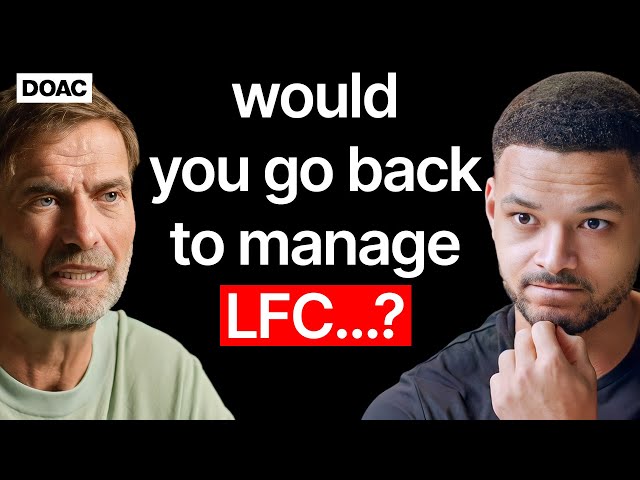
Jürgen Klopp Rules Out Liverpool Return and Coaching Comeback
The Diary Of A CEO
Energy depletion and a desire for personal freedom permanently ended Jürgen Klopp's managerial career, solidifying his transition to Red Bull's global soccer operations.
## Background
Published on YouTube by The Diary Of A CEO channel on October 20, 2025, this video features an extensive interview with football legend Jürgen Klopp. The page description outlines an in-depth conversation covering his leadership legacy, managing pressure, his exit from Liverpool FC, and his honest views on transfer spending, Manchester United, and Arne Slot.
## TL;DR
Jürgen Klopp reflects on his managerial career, detailing how early family influences and a focus on defensive stability and human connection shaped his high-intensity football philosophy. He discusses key moments from his tenure at Liverpool FC, including tactical choices, transfer strategies alongside Michael Edwards, and the physical and mental exhaustion that led to his departure in 2024. Klopp also touches on his personal faith, honoring late family members and former player Diogo Jota, while embracing his executive role as Head of Global Soccer for Red Bull.
## Atmosphere & style
The interview has an intimate, candid, and deeply reflective mood, balancing lighthearted humor with vulnerable personal admissions. Steven Bartlett's appreciative host dynamic creates a warm space where Klopp speaks with his characteristic warmth and unvarnished honesty. The emotional arc transitions naturally from lively football talk and tactical debates to touching reflections on loss, faith, and the peace that comes with stepping away from the touchline.
## Key takeaways
- [01:08:00](https://www.youtube.com/watch?v=UMy6GESNkDc&t=4080s) Priority 1: Defensive stability is essential when taking over a team, as allowing frequent opposition chances destroys overall squad confidence.
- [01:12:31](https://www.youtube.com/watch?v=UMy6GESNkDc&t=4351s) The term 'heavy metal football' originated from Klopp comparing his high-energy tactical style to Arsène Wenger's orchestral approach during a press conference.
- [01:18:57](https://www.youtube.com/watch?v=UMy6GESNkDc&t=4737s) Winning 'The Liverpool Way' requires a deep understanding of the city's history, community resilience, and its unique emotional responsibility.
- [01:20:53](https://www.youtube.com/watch?v=UMy6GESNkDc&t=4853s) Arne Slot successfully transitioned into the managerial role by making targeted, incremental tactical adjustments rather than attempting an immediate overhaul.
- [01:26:00](https://www.youtube.com/watch?v=UMy6GESNkDc&t=5160s) Liverpool's massive £450M transfer expenditure was offset by £200M raised from player sales and directed heavily into long-term infrastructure like the AXA Training Centre and Anfield stands.
- [01:34:39](https://www.youtube.com/watch?v=UMy6GESNkDc&t=5679s) Diogo Jota tragically passed away alongside his brother in a car crash in Spain on July 3, 2025.
- [01:40:10](https://www.youtube.com/watch?v=UMy6GESNkDc&t=6010s) Klopp never signed a player at Liverpool without explicit mutual agreement, collaborating closely with recruitment leaders like Michael Edwards.
- [01:50:58](https://www.youtube.com/watch?v=UMy6GESNkDc&t=6658s) The single reason for leaving Liverpool in 2024 was depleted energy reserves, accelerated by extra workloads during COVID-19 and managerial staffing vacancies.
- [01:55:44](https://www.youtube.com/watch?v=UMy6GESNkDc&t=6944s) Klopp reaffirmed his pledge never to manage another English club, moving into his role as Head of Global Soccer for Red Bull.
- [02:01:43](https://www.youtube.com/watch?v=UMy6GESNkDc&t=7303s) A foundational culture of mutual respect among all club staff—from kit managers to kitchen workers—is the ultimate prerequisite for squad unity and success.
The interview opens with a preview of Jürgen Klopp reflecting on the sheer intensity of managing at the highest level—a relentless pressure where winning matches is only a fraction of the burden. He explains that taking a temporary breather is impossible in modern football, noting, "You cannot say, 'Give me a year. See you later.'" Asked whether he could ever return to manage Liverpool FC, he admits that "it's possible." He reflects on his career trajectory of arriving at dysfunctional clubs, uniting players to "walk through fire together," and managing like a "heavy metal band"—giving 100% effort every single minute with no guarantees.
Klopp also touches on key moments and figures: his decision not to join Manchester United, Arne Slot’s "super smart" transition at Liverpool, and his genuine reaction to Liverpool’s massive £450 million transfer window, humorously noting, "Nobody ever told me that it's possible that we can spend that." Host Steven Bartlett concludes the intro with a quick request for viewers to check their subscription status to support the show's growth.
---
[02:47](https://www.youtube.com/watch?v=UMy6GESNkDc&t=167s) Your Early Context
Bartlett shifts the conversation to Klopp’s upbringing to uncover the roots of his character. Klopp explains that everyone is shaped by their early environment. His father was a salesman, and his mother came from a family that owned a brewery. His mother’s sole purpose in life was her children, loving him "more than her own life," whereas his father held intense expectations.
Although his father loved him, he was never quite satisfied with young Jürgen's achievements. His father was obsessed with sports—tennis, skiing, football—and wanted his son to excel in them. Klopp notes that if he had preferred sitting at home drawing, his father would have dragged him outside every day to play. As Klopp grew older and improved at sports, his father pushed him harder, establishing a relentless drive that defined Klopp's formative years.
- **Mother's background:** Family owned a brewery; entirely devoted to her children.
- **Father's background:** Salesman; passionate about sports (skiing, tennis, football).
- **Early dynamic:** His mother gave unconditional affection, while his father pushed him with high expectations.
---
[04:15](https://www.youtube.com/watch?v=UMy6GESNkDc&t=255s) Was Your Father a Tough Man?
Examining his father's demeanor, Klopp clarifies that while his father was tough, he was never abusive or overly cold: "I never got hit... He was just—he wanted to bring the best out of me." His father was a competitive man who refused to let young Jürgen win sprint races or ski runs, even when they were simply running to the halfway line on a pitch. Though it felt harsh as a child, Klopp reflects that it instilled a deep resilience in him.
Looking back, Klopp realizes he inherited specific traits from each parent. From his father, he inherited a complete comfort with public speaking and an unshakeable confidence: "I don't care if a camera is in my face or whatever. I say what I have to say in that moment." From his mother, he inherited an unconditional love for people. This combination—a confident father and a deeply caring mother—formed the foundation of his personality.
---
[07:24](https://www.youtube.com/watch?v=UMy6GESNkDc&t=444s) The Start of Your Football Career
Before pursuing football full-time, Klopp aspired to become a doctor. He explains that while his family always had enough money to get by, there were frequent arguments about finances. Witnessing those debates made him realize at a young age that he needed to earn enough money to ensure financial stability for his future family: "I want to earn money to not having this kind of discussions with my wife or with the kids." Because he didn't initially view himself as talented enough to make a living as a professional footballer, medicine seemed like the path forward.
However, his physical talent caught the attention of scouts. In his home village, he was the fastest, highest-jumping, and best overall athlete. While studying sports science, he was surprised when professional clubs approached him, asking if he was the "number seven" from a recent match and inviting him for trials. By 1987, at age 20, he made the move to Frankfurt.
- **Initial career goal:** Doctor (driven by a desire for financial security to avoid household money arguments).
- **Key athletic traits:** Fast sprinter, high vertical jump, top player in his local village team.
- **Career pivot:** Joined Frankfurt in 1987 at age 20.
---
[08:59](https://www.youtube.com/watch?v=UMy6GESNkDc&t=539s) Becoming a Father
Moving to Frankfurt triggered a dramatic shift in Klopp's life. Shortly after arriving, he met his partner, and in December 1988, at just 21 years old, his son Marc was born. Hearing the news of the pregnancy initially terrified him: "When I heard she's pregnant, I was... I wanted to run away. 'Oh god, it's not me!'"
The night Marc was born—December 13, 1988—became the exact moment Klopp was forced to grow up overnight. While his peers were attending university parties and going on foreign holidays, Klopp was juggling fatherhood, playing semi-professional football in the German third division for low wages, and working two additional jobs—one in the morning and one at night. This demanding routine taught him a level of discipline and maturity that set him apart from others his age and forged his work ethic.
- **Son's birth date:** December 13, 1988 (Marc).
- **Life situation at 21:** Playing semi-professional football in the German 3rd division.
- **Workload:** Two extra jobs (morning and night shifts) alongside football to support his family.
---
[11:05](https://www.youtube.com/watch?v=UMy6GESNkDc&t=665s) Players Acting Differently With Partners
Bartlett asks if becoming a father at 21 influenced how Klopp managed players later in life, mentioning Sir Alex Ferguson’s preference for married players with families. Klopp responds that marital status alone doesn't guarantee stability—a bad partnership can create problems, just as having no partner or too many partners can. He references legendary German manager Otto Rehhagel, who famously preferred married players expecting them to go straight home after training.
For Klopp, a successful squad requires a diverse mix of personalities, including the "cheeky" and "street-smart" players who can handle chaotic situations on and off the pitch. He explains his fundamental management philosophy: he treats players identically about 50% of the time regarding baseline squad discipline, but tailors the remaining 50% strictly to the individual's specific background and personal needs.
- **Managerial reference:** Mentions Otto Rehhagel's preference for settled, married players.
- **Squad balance:** Emphasizes the need for both stable personalities and street-smart, unpredictable players.
- **50/50 Rule:** 50% equal treatment for group baseline rules; 50% individual treatment tailored to each player's background.
---
[15:13](https://www.youtube.com/watch?v=UMy6GESNkDc&t=913s) Times You Treated Players Differently
Klopp illustrates his tailored approach by highlighting how he handled players from contrasting backgrounds and age groups. When players questioned why he might speak to them more bluntly than to a teammate, he would directly explain that a player raised in privilege in Munich requires a different approach than a player who grew up in extreme hardship in Argentina or Senegal without basic amenities. Expecting everyone from vastly different global backgrounds to think and react identically is unrealistic.
He gives the concrete example of a young Trent Alexander-Arnold stepping into the Liverpool first team alongside a veteran like James Milner, who was around 31 or 33 at the time. Milner already possessed built-in discipline and ensured young players stayed grounded, whereas Alexander-Arnold still required active guidance and education. While tactical duties like defending are non-negotiable for everyone—joking that "if you're not Lionel Messi, you have to defend"—individual communication must be personalized to unlock each player's true potential.
- **Core tactical rule:** Everyone must defend for the team (unless you are Lionel Messi).
- **Player comparison:** Senior leaders (e.g., James Milner) vs. young prospects (e.g., Trent Alexander-Arnold).
- **Key principle:** Meet players where they actually stand, not where you wish they were.
[17:02](https://www.youtube.com/watch?v=UMy6GESNkDc&t=1022s) Tailoring Leadership and Navigating High-Stakes Public Fallout
Jürgen Klopp emphasizes that a leader cannot treat every individual the same way because everyone deals with unique personal circumstances. One player might be struggling with a lack of sleep due to massive family problems at home, while another is riding high on confidence. Without actively asking and listening, a manager will never uncover these underlying issues. The ultimate job of a leader is to make the team's destination and goal as clear as daylight so that everyone naturally moves toward it without needing to be constantly pushed. On that journey, a leader must offer tailored support based on what each individual actually needs to hear rather than what they want to hear or what the manager simply wants to vent in a moment of emotion.
When managing global superstars like Sadio Mané and Mohamed Salah, Klopp notes that nobody originally predicted the heights they would reach. Building a successful team required establishing defensive structure and collective discipline first, which created the platform for creative players to shine. When world-class players occasionally drop their standards, a manager cannot simply handle them the way they would a young academy player without causing a media circus. Klopp references a high-profile sideline argument he had with Mo Salah at West Ham when Salah was brought on as a substitute. While the public framed it as a massive rift, Klopp explains that disagreement is natural, and the key to strong leadership is resolving conflicts behind closed doors so that mutual respect and squad unity remain completely intact.
- A manager's task is to make the team's target "clear like the sun" so players move toward it automatically without daily pushing.
- Effective leadership focuses on telling players what they *need* to hear to navigate their situation, rather than just telling them off in anger.
- Tackling public disputes—such as the sideline disagreement with Mo Salah at West Ham—requires direct handling so that private respect is preserved and team harmony isn't compromised.
---
[22:28](https://www.youtube.com/watch?v=UMy6GESNkDc&t=1348s) On-Pitch Intensity and the Unexpected Route to Captaincy
Reflecting on his playing days, Klopp admits he was frequently appointed team captain across various youth and senior squads, though he never explicitly sought the role. During his time at Mainz, when manager Wolfgang Frank returned to the club and brought in an experienced top-flight player named Lars Schmidt, Frank directly asked Klopp if he could hand the captaincy to Schmidt instead. Klopp agreed without hesitation because wearing the armband meant little to him compared to his actual impact on the pitch.
Despite his modern reputation as an empathetic, calm figure off the pitch, Klopp reveals that as a player, his intensity often boiled over into aggressive outbursts once his heart rate spiked. Because he felt his teammates possessed superior natural footballing talent, he believed he could only compete by squeezing out every drop of aggression. This self-described "explosive part" frequently led to screaming at teammates and referees—actions he thoroughly disliked and often had to apologize for afterward.
- Wolfgang Frank reassigned the Mainz captaincy from Klopp to new signee Lars Schmidt, a decision Klopp accepted immediately without any bruised ego.
- Klopp admits that as a player, whenever his heart rate crossed 140 bpm, he frequently lost his temper and shouted aggressively at teammates because he felt he had to overcompensate for his lack of pure technical talent.
---
[25:05](https://www.youtube.com/watch?v=UMy6GESNkDc&t=1505s) The Hotel Mutiny and Becoming Manager of Mainz Overnight
Klopp's transition into management at Mainz 05 occurred abruptly under wild circumstances at age 33. Following a painful loss, manager Eckhard Krautzun took the squad to a short crisis training camp ahead of a crucial mid-week fixture. During an evening meeting, Krautzun asked the squad directly if they still trusted him, ordering beers for the room and stepping out for 30 minutes so the players could deliberate. Although Klopp was not the official captain, the squad collectively agreed that Krautzun was no longer the right man for the job. When Krautzun returned, Klopp was tasked with delivering the harsh truth: the team no longer backed him.
Krautzun was stunned and immediately stormed out, scheduling a 9:00 AM training session and planning a press conference to announce he was dropping all senior players to play the youth team. However, when Krautzun called the sporting director to set up the press conference, the sporting director informed him that the press conference would actually be held to announce Krautzun's dismissal. With only days before the next match, the club asked Klopp to take over as manager temporarily. Klopp led the team to a 1–0 victory in his first game, followed by a 3–1 win, ultimately winning six and drawing one of his first seven matches to comfortably save Mainz from relegation.
- Following a team meeting where the squad voted that they no longer trusted him, manager Eckhard Krautzun was sacked when he attempted to call a press conference to drop all senior players.
- Mainz appointed Klopp as caretaker manager on short notice; he responded by winning 6 out of his first 7 games (and drawing 1), taking a team of his personal friends and saving them from relegation.
- The sudden transition required subtle boundaries: on his first night as manager, Klopp went from sharing a twin hotel room with his teammate and friend Jürgen Kramny to being given his own manager's room.
---
[29:48](https://www.youtube.com/watch?v=UMy6GESNkDc&t=1788s) The Tactical Blueprint and Injecting Belief
Upon taking charge at Mainz, Klopp drew directly from the tactical foundation laid years earlier by former manager Wolfgang Frank. Frank had previously transformed Mainz by introducing a zonal 4-4-2 defensive system that made them an opponent nobody wanted to face. After Frank left, subsequent managers struggled to maintain that tactical clarity. In his first two training sessions as manager, Klopp focused entirely on reinstating this 4-4-2 ball-oriented movement before facing third-placed MSV Duisburg, instilling an aggressive, high-energy mindset that turned the squad into "wild animals" on the pitch.
Beyond tactics, Klopp recognized that his players desperately needed someone to genuinely believe in them. Prior to becoming manager, Klopp had even stated in an interview that the squad was the best Mainz had ever assembled. He used that authentic belief to reignite the team's confidence, framing their situation around why giving maximum effort makes life and football infinitely more rewarding.
- Klopp implemented Wolfgang Frank's 4-4-2 zonal defensive system in just two training sessions before his debut match against third-placed MSV Duisburg.
- Klopp notes that building belief in people is fundamental not just to football, but to life, referencing how initial endeavors—like a podcast starting with under 100 listeners—grow through small moments of encouragement and self-conviction.
[34:42](https://www.youtube.com/watch?v=UMy6GESNkDc&t=2082s) Building Confidence and Protecting the Dressing Room
Jürgen Klopp describes confidence in football as a delicate "little flower" that is constantly being stepped on, only to grow back before getting crushed again by the next mistake. Because football inherently involves error, a single bad play can shatter a player's mindset. When dealing with players struggling with self-belief, Klopp’s core philosophy was to offer them a temporary anchor: "If you would believe as much in yourself as I do, that will be a start. But as long as you cannot do that, just trust me." He notes that he never wasted time working with players he didn't truly believe in, maintaining a level of patience far greater than the public or media allowed, though the ultimate goal was always teaching them to "fly" on their own.
When asked if managers ever lie to the media to protect their squad, Klopp admits that while he protects players fiercely, he rarely had to lie. Rather than dwelling publicly on missed chances or lost form, he focused on designing training sessions where players could quietly regain their rhythm. Above all, he saw his duty as shielding his squad from a ruthless public and media environment, noting how fortunate he was to cultivate a forgiving bond with the Liverpool supporters.
Regarding social media discipline, Klopp recalls incidents where players posted questionable messages late at night and deleted them shortly after. Instead of pulling the player aside for a private reprimand, Klopp would address the entire dressing room the next day: "I know what's there, but maybe you want to tell everybody." Forcing the player to explain their $3:00\text{ AM}$ post in front of their teammates served as an effective deterrent. After one or two such instances, no player ever made that mistake again.
- "Confidence is like a little flower — constantly somebody steps on it, and then it's growing again."
- "My job is to prepare them... I help you learn flying, but in the end, you have to fly yourself."
- "If you don't get the result you want, try again and try harder."
---
[40:24](https://www.youtube.com/watch?v=UMy6GESNkDc&t=2424s) Learning How to Lose at Mainz and the Philosophy of the "Constant Tryer"
Reflecting on a photo of himself in tears after Mainz 05 earned its historic first promotion to the Bundesliga, Klopp clarifies that those were tears of pure relief rather than simple happiness. The moment came after two devastating years of coming close: first missing promotion by a single point, and the following year by a single goal. The mounting internal pressure was intense, but those heartbreaks taught him a vital lesson about handling failure and extracting crucial feedback from every loss.
This resilience caught the attention of Jamie Carragher, who once asked how Klopp managed to turn near-misses into positive momentum instead of downward spirals. Klopp attributes this to his upbringing, his faith, and his core self-perception. He explains that he never saw himself as a "constant winner," but rather as a "constant tryer." He knew early on that his purpose was not to get everything, but to give everything.
A video message from former Mainz sporting director Christian Heidel reinforces this bond. Heidel praises Klopp for remaining a genuine, authentic person across 35 years of friendship while transforming three different clubs and cities — Mainz, Borussia Dortmund, and Liverpool.
- Mainz 05 missed Bundesliga promotion by **1 point** in one season, and by **1 goal** in the next, before finally succeeding.
- Mainz has remained in the Bundesliga for over **25 years** following the culture shift initiated during Klopp's tenure.
- "I don't see myself as a constant winner in my mind. I see myself as a constant tryer."
---
[46:46](https://www.youtube.com/watch?v=UMy6GESNkDc&t=2806s) Turning Down Manchester United for a True "Football Project" at Liverpool
Klopp recounts the exact moment Liverpool approached him in 2015 while he was on a family holiday in Ibiza with his wife, Ulla, and his two sons. When his agent called, his sons immediately celebrated upon hearing the name "Liverpool." Although Klopp had received multiple offers after leaving Borussia Dortmund earlier that summer, Liverpool felt like destiny, and the family instantly fell in love with the club's tradition and passionate fanbase.
The conversation turns to Manchester United, and Klopp confirms that United had approached him in 2013 when Sir Alex Ferguson retired. At the time, Klopp was under contract at Borussia Dortmund — where players like Jordan Henderson, Adam Lallana, and James Milner had even flown out to Madrid just to watch his team play — and he refused to break his commitment. However, beyond the timing, the pitch from United's executive leadership turned him off. They presented Manchester United as a commercial powerhouse capable of buying any player, focusing on star power over a cohesive footballing vision.
In contrast, Liverpool offered a pure "football project." Klopp highlights his initial talks with Fenway Sports Group's Mike Gordon, noting that Gordon's character and alignment made Klopp want to be his friend immediately. While United focused on brand-driven transfers like bringing back big names, Liverpool offered an environment built on culture, attitude, and collective growth.
- In 2013, future Liverpool players **Jordan Henderson, Adam Lallana, and James Milner** flew to Real Madrid to watch Klopp’s Borussia Dortmund play in the Champions League semi-final.
- Over **30,000 Liverpool fans** tracked Klopp's flight online as he traveled to sign his contract with the club.
- "United was that big: 'We get all the players we want... We get him, we get him, we get him.' And I was sitting there... it was not my project."
<FollowUp label="Want to explore how Klopp responded when asked about Manchester United's struggles and Arne Slot taking over?" query="What did Jürgen Klopp say about Manchester United's 15-year decline and Arne Slot taking over at Liverpool later in the interview?"/>
[52:05](https://www.youtube.com/watch?v=UMy6GESNkDc&t=3125s) Why Manchester United Has Struggled and the Reality of Football Life
When asked why Manchester United has foundered over the last decade and a half while playing the underdog, Jürgen Klopp rejects the idea that he ever fixated on their missteps. Upon joining Liverpool, United simply became an important opponent—one far more satisfying to beat, though he emphasizes his deep respect for the people of the city, much like his local relationships with Everton supporters during his nine years on Merseyside.
Klopp explains that football operates in a constant state of short-term crisis management. Teams get trapped in a rush to win the very next game, solving problems for a day or two rather than sticking to a coherent mid- or long-term plan. He notes how public perception is wildly volatile: "You win, you're the greatest. You lose, you know nothing about the game. You draw, you're boring." Real transformation requires evaluating where a club wants to be over a three- to five-year horizon, because individual player performances cannot cover up structural issues.
Drawing a contrast with how Liverpool navigated player departures, Klopp points to the transfer of Philippe Coutinho. Selling Coutinho was not a celebratory moment where he cheered the influx of cash; he lost an elite player he wanted for the next decade. However, Liverpool smartly reinvested those funds long-term into foundational, world-class pillars like Alisson Becker and Virgil van Dijk.
* **Managing through crisis:** Teams frequently sacrifice long-term strategy just to get through the next 48 hours before another match.
* **Perception vs. reality:** Retrospectively, United finishing second in past seasons was deemed a failure, whereas years later that same placement would be considered a major achievement.
* **Smart reinvestment:** Replacing Coutinho wasn't about finding a direct positional replacement, but securing long-term spine players in Van Dijk and Alisson.
---
[55:34](https://www.youtube.com/watch?v=UMy6GESNkDc&t=3334s) Commercial Interlude: Business and Footwear Insights
Steven Bartlett transitions to a discussion on targeted marketing, emphasizing how B2B campaigns often fail when ads reach the wrong audience. He highlights LinkedIn Ads as a precision tool that filters by job title, company size, and specific skills across a network of over a billion professionals, offering high returns on ad spend for decision-makers.
Bartlett also highlights an earlier podcast conversation with anthropologist Daniel Lieberman about "comfort crises" and foot health. He explains how wearing minimal-support shoes like Vivo Barefoot forces feet to regain natural strength over time, referencing research from the University of Liverpool indicating a 60% increase in foot strength within six months of use.
* **LinkedIn Ads offer:** Spending $250 on a first campaign yields an additional $250 ad credit at `[linkedin.com/diary](https://linkedin.com/diary)`.
* **Vivo Barefoot offer:** Viewers can access a 20% discount using the code `Stevenb20` at `[vivobarefoot.com/steven](https://vivobarefoot.com/steven)`, backed by a 100-day money-back guarantee.
---
[57:36](https://www.youtube.com/watch?v=UMy6GESNkDc&t=3456s) The Pressure of Big Clubs and the Path to Rebuilding
Comparing high-flying mid-table sides like Crystal Palace and Bournemouth to giant institutions, Bartlett ponders how teams with fewer resources perform above expectations. Klopp clarifies that the environment at a smaller club is vastly different from the hyper-scrutiny at Manchester United. If Bournemouth grounds out a scrappy 1–0 win, it passes without fuss; if United wins 1–0 without dominant flair, headlines dissect individual mistakes and put intense pressure back onto the manager.
Furthermore, while a club spends years trying to fix its internal culture, rivals continue to improve. Klopp lists the overwhelming competition at the top: Liverpool, Arsenal, Manchester City, and a Chelsea side whose massive transfer output eventually began to pay off. Expecting an immediate return to title contention amid five superior squads is unrealistic. He argues that struggling giants must first learn to take joy in small victories—like a hard-fought 1–0 or 2–0 win over Southampton—and ignore external noise.
To illustrate this, Klopp recalls an incident early in his Liverpool tenure when the team celebrated a 2–2 draw against West Bromwich Albion in front of the Kop to thank the fans for their late support. Opposing manager Tony Pulis and the media mocked them for celebrating a point, but Klopp insists that creating a shared bond and growing together from minor steps is the only way back. When Bartlett expresses faith in Ruben Amorim's long-term focus at United alongside executives like Jason Wilcox, Klopp dryly jokes, "The only problem is you have no clue about football, but besides that... good on you!"
* **Hyper-focused pressure:** Minor missteps at top-tier clubs become multi-day media controversies, forcing managers to spend energy rebuilding individual player confidence.
* **The West Brom Kop celebration:** Critics ridiculed Liverpool for celebrating a 2–2 draw, but Klopp saw it as a vital psychological step to re-engage the fans and squad.
* **Rival environment:** Top clubs cannot rebuild in a vacuum because competitors like City, Arsenal, Chelsea, and Liverpool constantly elevate their own squad depth.
---
[01:01:36](https://www.youtube.com/watch?v=UMy6GESNkDc&t=3696s) Taking the Liverpool Job and Fixing the "Organized Chaos"
Recalling why he chose Liverpool over other potential opportunities, Klopp explains that he recognized a true "football project." When Sir Alex Ferguson left Manchester United, they were champions, but the aging squad structure made immediate success for successors like David Moyes nearly impossible. Liverpool, by contrast, possessed an underrated group of players that Klopp genuinely admired from afar—including Roberto Firmino, Christian Benteke, James Milner, Jordan Henderson, and Adam Lallana.
Upon arriving, Klopp inherited a squad with five strikers (Benteke, Danny Ings, Divock Origi, Firmino, and Daniel Sturridge) despite wanting to run a one-striker system. He also found the historical infrastructure surprisingly cramped: having visited Anfield with Dortmund a year earlier, he remembered being shocked at how tiny the old English dressing rooms were, built originally for 11 players rather than modern 30-man squads.
Despite these quirks, Klopp saw a squad with an incredible work ethic—a midfield "engine room" of Henderson, Milner, and Lallana who were ready to run through walls. With virtually no time to train due to a relentless schedule of mid-week European fixtures, Klopp introduced what he calls "organized chaos." Before his debut match against Tottenham Hotspur, he gave the players basic pressing triggers, told them to "jump in their face," and used match feedback to refine the tactics on the fly.
* **Inherited squad depth:** Klopp took over a team boasting five top-tier strikers, requiring immediate tactical decisions to balance the roster.
* **First match tactics:** With only three days of preparation before facing Tottenham, Klopp relied on high-intensity tactical chaos and raw effort rather than complex patterns.
* **Facilities vs. potential:** Klopp didn't care about the cramped, outdated Anfield away dressing room; he focused entirely on the squad's immense work ethic and engine room.
Here is a detailed, faithful walkthrough covering this part of the transcript.
[01:08:00](https://www.youtube.com/watch?v=UMy6GESNkDc&t=4080s) Early Tactics at Liverpool: Establishing Stability and Work Ethic
When asked about the small, incremental changes he began implementing upon arriving at Liverpool, Jürgen Klopp explains that a manager cannot simply arrive, wave a magic wand, and instantly transform a team’s football. Telling players to "pass the ball here, pass the ball there" and expect them to end up clear on goal simply does not work in real life. His absolute conviction is that a team must first be defensively stable. Allowing an opponent five or six consecutive chances ruins a team's confidence, because no team plays their best football when every single opposition attack culminates in a shot or a save. Therefore, organizing the defensive structure was items number one, two, and three on his to-do list.
Once organization was established, Klopp demanded that his players "run their socks off." He emphasizes that to convince people you want to achieve something, you cannot just talk about it—you have to physically demonstrate it on the pitch. The players embraced this mindset completely because they were extremely fit and eager to run; they just needed direction. Step by step, Liverpool developed its own distinct identity while bringing in players with top-tier quality and character.
* **Initial Progress & Turning Point:** Liverpool stabilized relatively quickly in that first season, ultimately finishing in lower European positions (6th to 8th), but they reached two cup finals—the League Cup (Carabao Cup) and the UEFA Europa League. Although they lost both finals, the period laid the groundwork for deep squad unity.
* **The Post-Basel Speech:** After losing the Europa League final to Sevilla in Basel, Klopp rallied the team at the hotel party. Recognizing the team was deflated, he called everyone downstairs, stood on the dance floor, and declared: *"This is not the last final we play. This is the first final we played."* He then led them in singing *"We are Liverpool."*
* **Mindset on Defeat:** Klopp explains that losing a final is painful, but he refuses to let a single match erase an entire year of hard work and achievement. In his view, if you do not learn from a defeat, it is a true failure; if you learn from it, it becomes invaluable information. He quips that he has lost more Champions League finals than most people ever get to play in.
---
[01:12:31](https://www.youtube.com/watch?v=UMy6GESNkDc&t=4351s) The Reality Behind "Heavy Metal Football"
Addressing his famous reputation for playing "heavy metal football," Klopp clarifies that the term was never a calculated master plan or a phrase he originally intended to coin. The label originated during a press conference where he was asked to compare his tactical style to Arsène Wenger’s. Wanting to be respectful while distinguishing their approaches, Klopp remarked that Wenger's football was like a refined orchestral symphony, whereas his own teams played more like a heavy metal band.
Host Steven Bartlett—speaking as a Manchester United supporter—confesses how much rival fans dreaded playing Klopp’s teams because of their relentless intensity, emotional overload, and habit of scoring five, six, or seven goals in a match while never letting up until the final whistle. Klopp responds that he never understood holding back during a match. While he had to mature over time and learn to manage games by controlling possession when necessary, his baseline state was pure excitement for the game and total support for his players. He told his players he wanted to be their friend, but noted he could not be their *best* friend because his job required holding them accountable and calling out mistakes.
* **Delivering Value for Fans:** Klopp stresses that professional footballers and managers earn their living because millions of people care, watch, read, and invest emotionally in the game. Because of that, players owe it to the audience to give their absolute all every single minute, regardless of the kickoff time.
* **Winning vs. Entertaining:** While a dirty 1-0 win is sometimes necessary to get over the line when a team is off its game, Klopp believes top clubs like Liverpool have a duty beyond just scraping by. Fans buy tickets and tune in to be entertained, so dominance and great football should always be the goal.
* **The 2019 Champions League Final:** Klopp candidly admits that Liverpool's 2-0 victory over Tottenham Hotspur in the 2019 UEFA Champions League final in Madrid was actually *"the worst final of all the four my teams played"* in terms of performance quality, but winning it made all the difference.
---
[01:18:57](https://www.youtube.com/watch?v=UMy6GESNkDc&t=4737s) Understanding "The Liverpool Way" and Arne Slot’s Succession
When asked what defines "The Liverpool Way," Klopp explains that anyone representing Liverpool—whether as a manager or a player—must deeply understand the broader community, both locally in the city and across the global fan base. Liverpool as a city and a club has weathered immense hardships, and the community's resilient response to adversity is what makes it unique. Representing Liverpool is not just another pitstop in a player's career; it carries an extra weight of responsibility. He taught his players that if they gave everything during their time at Anfield, they could look back 10 or 15 years later knowing they did something truly meaningful for people whose lives revolve around the club.
The conversation turns to the immense challenge of succeeding a manager with Klopp’s massive charisma and aura. Bartlett asks how anyone could step into such huge shoes, prompting a lighthearted moment where Klopp jokes about needing a bathroom break. Reflecting seriously on his departure, Klopp states that once he announced his exit, his sole focus was finishing the season as strongly as possible while making the transition as smooth as possible for his successor.
* **Praise for Arne Slot:** Klopp expresses deep admiration for Arne Slot, noting that Slot had no hesitation or fear about filling "big shoes." Instead, Slot saw the opportunity for what it was: taking over a fantastic football team at an incredible club.
* **Transition & Communication:** Klopp reveals he and Slot were in frequent contact during the transition. Slot expressed immense gratitude for the quality of the squad he inherited, calling it a fantastic setup.
* **Slot's Immediate Success:** Klopp praises Slot for bringing out the best in the group right away and leading them to the Premier League championship in an *"incredible manner,"* reinforcing that success depends entirely on perspective—viewing the job not as living in a predecessor's shadow, but as driving a world-class team forward.
[01:23:44](https://www.youtube.com/watch?v=UMy6GESNkDc&t=5024s) Arne Slot's Transition and the Realities of Premier League Management
Klopp agrees with a comment made by one of Liverpool’s players to a mutual friend, emphasizing that the smartest thing Arne Slot did upon taking over as manager was deciding not to make radical changes right away. Klopp notes that since Liverpool finished third the season prior, the foundational squad was already exceptionally strong. A new manager doesn't need to completely overhaul everything just to put their own stamp on the team or show off to the world. Instead, the task was to adjust a few decisive details to help them cross the finish line—ultimately leading to a dominant league title victory.
Transitioning into a high-profile managerial role is an immense challenge that requires absolute self-confidence. Beyond tactical setup, modern management involves navigating unpredictable off-field events, media scrutinies, and sudden player issues on social media that can turn an isolated problem into an overnight crisis. Klopp praises Slot for having the clarity and confidence to embrace the strong team he inherited and perform his role brilliantly.
- **On Squad Foundations:** Klopp stresses that when a team is already functioning at a high level, small, targeted adjustments are far more effective than sweeping, disruptive overhauls.
- **Modern Managerial Pressures:** Beyond pure tactics, a Premier League manager must constantly manage external noise, social media fallout, and unexpected individual player issues that arise without warning.
---
[01:26:00](https://www.youtube.com/watch?v=UMy6GESNkDc&t=5160s) Liverpool's Massive Transfer Window and the Reality of Rebuilding
When asked about Liverpool's recent £450 million transfer expenditure—which featured major arrivals like Florian Wirtz and Alexander Isak—Klopp contextualizes the spending by pointing out that the club also brought in roughly £200 million through player sales. He addresses the public perception surrounding massive squad rebuilds, explaining that rapid squad additions require time for integration and development. Whether a team retains its existing stars like Darwin Núñez and Luis Díaz or replaces them with high-caliber talent, on-pitch cohesion does not happen overnight.
Success at the elite level relies heavily on navigating decisive moments, and money spent never guarantees titles. Marginal factors—such as a shot hitting the crossbar and bouncing over the line versus staying out—frequently determine championship campaigns. Klopp urges fans to remain patient, keep faith in the club's process, and focus on allowing the team to grow into the best version of itself.
> "To become champion, you need luck in moments here and there. That's how it is. Nobody wants to hear that... crossbar over the line, not over the line... It can go in your direction or in the other direction."
---
[01:28:32](https://www.youtube.com/watch?v=UMy6GESNkDc&t=5312s) Financial Reality, Infrastructure, and Leaving a Legacy
Addressing historical debates around Liverpool's transfer spending and net spend during his tenure, Klopp clarifies that he was never held back out of spite, nor did he demand funds in an ultimatum-driven way. During his time at Anfield, significant financial resources were deliberately directed into long-term infrastructure, including building three new stadium stands and constructing a world-class training ground. Klopp highlights that the club managed to build what is essentially a brand-new stadium on the historic Anfield site without ever having to temporarily relocate.
For Klopp, leaving a club in a far better position than he found it was always a primary goal. While bringing in star players generates immediate excitement, establishing top-tier infrastructure leaves a permanent legacy that benefits the club long after a manager's departure.
- **Infrastructure vs. Player Spending:** Major investments were made to expand Anfield (including the Main Stand and Anfield Road Stand) and construct the AXA Training Centre in Kirkby.
- **Club Legacy:** Klopp takes great pride in knowing that the physical foundation and financial health of Liverpool FC were vastly elevated during his time in charge.
---
[01:30:13](https://www.youtube.com/watch?v=UMy6GESNkDc&t=5413s) Culture, Player Identification, and Net Spend
The discussion turns to Liverpool's traditional recruitment strategy under Klopp, which prioritized character and cultural fit over high-profile "Galactico" names. Klopp points out that during Liverpool's peak run between 2018 and 2020, the team played standard-setting football because every player worked cohesively within the collective system. Rather than collecting famous individuals, the objective was always to build a unit capable of beating anyone on any given day.
Klopp defends Liverpool's current squad construction, noting that despite minor depth concerns at center-back following an injury, the overall group—from the full-backs to the attacking unit—is superbly balanced. Managing star-studded squads comes down to standard managerial duties: rotating players, handling selection debates, and managing injuries over the course of a demanding season.
---
[01:34:39](https://www.youtube.com/watch?v=UMy6GESNkDc&t=5679s) Remembering Diogo Jota
The conversation takes a somber and deeply emotional turn as Klopp reflects on the tragic passing of Diogo Jota, who died alongside his brother in a car crash in Spain on July 3, 2025, shortly after getting married. Visibly moved and struggling to find words, Klopp speaks about Jota not just as an elite, intelligent footballer who delivered from day one, but as an extraordinary person who was beloved by everyone in the building.
Klopp reminisces about how Jota bridged different groups within the squad, forming close bonds with veteran leaders like James Milner as well as distinct personalities like Kostas Tsimikas. Replacing a player of Jota's caliber is an impossible task, both tactically and emotionally, as his presence was omnipresent in the dressing room. Klopp recalls the moment he received the tragic news via a morning message, describing the sheer disbelief and shock that left him sitting in silence, emphasizing that Jota was true family to everyone at the club.
- **Personal Impact:** Jota was known for his warmth and unique ability to form deep friendships across different age groups and backgrounds within the squad.
- **Tactical Versatility:** Beyond his character, Jota was an exceptionally smart, multi-positional attacker who exceeded all expectations from the moment he joined from Wolverhampton Wanderers.
- **Recruitment Story:** Klopp notes that while transfers like Mohamed Salah involved collaborative club decisions, Klopp personally pushed for Jota immediately after watching him play for Wolves.
[01:40:10](https://www.youtube.com/watch?v=UMy6GESNkDc&t=6010s) Transfer Window Dynamics and Collaborating with Michael Edwards
Jürgen Klopp clarifies how player recruitment operates inside a top-flight football club, debunking the misconception that managers either control everything or have players forced upon them. He explains that while he was always accustomed to not getting every single player on his wishlist—an inevitable reality given financial limitations—no player was ever signed without his explicit consent. The process involves constant back-and-forth negotiations between the coaching staff, scouting department, and sporting directors to build the strongest possible squad before the deadline passes. Once the transfer window shuts, a manager simply moves forward with the roster at hand.
Addressing Michael Edwards's return to the club's leadership structure, Klopp emphasizes that successful recruitment was never down to one individual "genius." It was always a collaborative team effort involving a deep network of specialists, including Julian Ward, Ian Graham, and Barry Hunter. While outsiders often idolize figures like Edwards or Klopp himself, the day-to-day reality relies on shared expertise, assessing market timing, and aligning squad needs. Klopp notes that he always maintained a great relationship with Edwards as well as current sporting director Richard Hughes, stressing that transfer strategy at Liverpool was an open book driven by what was best for the club rather than personal egos.
- **Recruitment Philosophy:** A coach submits targets, but financial constraints mean compromise is mandatory; however, no player is signed without the manager's agreement.
- **Collaborative Scouting Team:** Key figures alongside Michael Edwards included Julian Ward, Ian Graham, and Barry Hunter.
- **Sporting Director Roles:** Richard Hughes took over the primary sporting director duties, while Edwards returned in a broader role overseeing football operations within a holding company framework.
- **Cultural Contrast:** Klopp observes that English football culture elevates the drama and excitement surrounding transfer deadline day significantly more than other European countries.
---
[01:44:37](https://www.youtube.com/watch?v=UMy6GESNkDc&t=6277s) Managing Authority, Ego, and the Reality of Fame
Responding to the idea that his stature in Liverpool made him an untouchable figure like Sir Alex Ferguson, Klopp rejects the notion that no one could argue with him or challenge his decisions. He explains that he actively sought external perspectives precisely because he already knew his own opinion upon waking up each morning. While the final tactical or managerial choice ultimately rested on his shoulders, he encouraged open debate among his backroom team to reach the best possible outcomes. He notes with a laugh that he only truly realized how famous or well-regarded he was as a coach *after* he stepped down, having spent his tenure simply focused on solving immediate, daily problems.
"I know my own opinion already... How can you get a better view on things? It's just by discussing with people."
---
[01:45:52](https://www.youtube.com/watch?v=UMy6GESNkDc&t=6352s) Navigating Player Relationships: The Darwin Núñez Situation
When asked about Darwin Núñez appearing unhappy or distant on Klopp's final day at Anfield, Klopp offers an empathetic, pragmatic look into squad management. He explains that it is impossible to have a glowing relationship with every player at all times, particularly a striker who isn't starting as often as he wants or scoring at the rate expected by the fans and himself. Managing 25 players when only 11 can start inherently creates dissatisfaction. Klopp notes that if Núñez had been weeping and hugging him for ten minutes on his last day, it would have felt unnatural given the competitive tension, and it was completely healthy for the player to look forward to a fresh start under a new manager.
Discussing the decision to sign Núñez, Klopp recounts how the recruitment team jointly agreed on bringing in a dynamic, high-speed central striker to complement their attacking options. With Sadio Mané departing and Roberto Firmino serving as the ultimate false nine, the squad needed new profiles alongside Luis Díaz and Cody Gakpo. Although the transfer fee was steep and Núñez faced scrutiny, Klopp defends the Uruguayan's impact, pointing to iconic moments that wouldn't have occurred without him.
- **The Math of Squad Unhappiness:** Out of a 25-man squad, only 11 start, meaning more than half the team is naturally disappointed at any given time.
- **Evolving the Attack:** Núñez was brought in to provide raw pace and direct central threat as the frontline transitioned away from the Mané and Firmino era.
- **Standout Contribution:** Klopp specifically highlights Núñez's dramatic two-goal performance off the bench in Liverpool's ten-man comeback victory against Newcastle United as an unforgettable moment.
---
[01:50:58](https://www.youtube.com/watch?v=UMy6GESNkDc&t=6658s) The True Reason for Leaving Liverpool
Klopp opens up about his decision to step down as Liverpool manager in 2024, dispelling rumors of internal friction or ownership fallouts. He clarifies that his departure came down entirely to energy reserves. As manager, he viewed his primary responsibility as being the ultimate "energy giver" for the entire club. When he realized during forward-planning meetings that he lacked the boundless energy required to drive another multi-year cycle, go on grueling international pre-season tours, and oversee every aspect of the organization, he knew it was time to step aside rather than wait for performance to decline.
The intensity was compounded during the COVID-19 pandemic and periods of structural transition when key administrative roles were vacant. During stretches without an active sporting director—between the departures and arrivals of figures like Michael Edwards and Julian Ward—a heavy operational workload fell directly onto Klopp and his coaching staff. Managing budget calls, transfer details, and daily crisis management alongside top-tier match preparation created an exhausting environment that ultimately accelerated his need for a sabbatical.
- **Self-Expectation as Leader:** Klopp believed he had to be at the absolute top of his game to deserve managing Liverpool; running on empty was unfair to the club.
- **Operational Strain During COVID-19:** Pandemic restrictions limited ownership visits and restructured workflows, placing more administrative responsibility directly on Klopp's shoulders.
- **Interim Transfer Responsibilities:** During gaps in the sporting director position (prior to Jörg Schmadtke's short-term appointment), Klopp and his staff had to handle corporate and recruitment duties internally.
---
[01:54:44](https://www.youtube.com/watch?v=UMy6GESNkDc&t=6884s) Could Jürgen Klopp Ever Return to Liverpool?
Addressing the burning question of whether he would ever manage Liverpool again, Klopp reiterates his firm pledge never to manage any other English club, leaving Liverpool as the only theoretical possibility in Great Britain. However, he emphasizes how much he is enjoying his current life away from the touchline. He explicitly states that he does not miss standing in the pouring rain for three hours of daily training, doing ten to twelve media interviews every week, or facing relentless press conferences. Having managed over 1,000 professional matches throughout his career, he feels no urge to return to the pressure-cooker environment of the dugout anytime soon.
"I don't miss standing in the rain two and a half, three hours... I don't miss going to press conferences four times a week, having 10, 12 interviews a week. I don't miss that."
[01:56:07](https://www.youtube.com/watch?v=UMy6GESNkDc&t=6967s) Moving Forward Without Missing the Past
Reflecting on his transition away from management, Jürgen Klopp notes that at 58 years old, age is purely a matter of perspective—it seems old to some, but not to others. He feels no rush to make permanent decisions today, declaring, "I will not coach again. But thank God I don't have to do that." Instead, he is energized by his current executive role overseeing global football operations, working alongside people he loves, supporting clubs across various countries, and focusing 100% on the task at hand.
When asked what he actually misses about managing, Klopp admits that while he does not miss the stress or the physical dressing room itself, he misses the human connections—sitting in the restaurant with players when they were in a good mood and hearing their laughter. Yet, because he remains deeply embedded in the football world, he genuinely does not miss the matchday pressure or sitting in the manager's chair before kickoff. "I honestly, that's probably the best. I don't miss anything. That's how it is."
- **Age & Perspective**: Klopp is 58 years old and feels zero pressure to return to the touchline.
- **Current Engagement**: Thriving in his global football leadership role, focusing entirely on long-term strategy rather than matchday tension.
- **Human Connection**: Remembers the warmth of post-victory team bonding and retains a "virtual laugh" in his ear from his former players.
---
[01:58:40](https://www.youtube.com/watch?v=UMy6GESNkDc&t=7120s) Creating Unbreakable Bonds and "Walking Through Fire"
Turning to the core principles of his management philosophy, Klopp explains that tactical knowledge alone is never enough to create a championship-winning team, because every top competitor works hard and possesses tactical expertise. The true differentiator is how deeply a group grows together to create a team that genuinely deserves success more than its opponents. To achieve this, leaders cannot allow team members to waste time walking past each other without knowing one another's personal struggles or caring about each other's lives.
Klopp emphasizes that building an environment where people would "go through fire" for one another is not about giving a single inspirational speech; it is about cultivating an authentic culture where everyone senses that the project is truly special. "It was not what I said. It was what they needed to understand why we are a very special team in a very hard and difficult competition."
---
[02:01:43](https://www.youtube.com/watch?v=UMy6GESNkDc&t=7303s) Respect as the Foundation of Organizational Culture
For Klopp, the heartbeat of any successful organization lies in the everyday respect shown across all levels of staff. At Liverpool's training ground, that meant instilling absolute respect and genuine appreciation for everyone—from the kitchen staff and kit men to the gardeners and administrative workers. "You just realize that's the respect you show is the respect you get," Klopp asserts, stressing that authentic leadership cannot be taught through forced lectures, but must be lived continuously.
He further details how his squads created an insular, trusting internal world where his direct feedback mattered far more than external media or social media commentary. Whether the team won 3–0 or performed poorly, the squad relied entirely on their internal standard rather than outside noise. Responding to how disrespecting a gardener can ripple into losing a Champions League match, Klopp notes that if a player cannot appreciate what non-playing staff do for the team, they will inevitably fail to appreciate their own teammates when moments get tough.
- **Foundational Standard**: Showing genuine respect to every individual on the staff—kitchen crew, kit managers, and groundskeepers—sets the precedent for how players treat one another.
- **Shielding the Group**: Built a self-contained environment where internal feedback superseded public media or social media praise/criticism.
- **Cultural Downstream Effect**: Cites an example from Manchester United, where stadium hospitality staff noted a loss of the family feel after Sir Alex Ferguson left simply because new leadership no longer knew their names.
---
[02:04:46](https://www.youtube.com/watch?v=UMy6GESNkDc&t=7486s) Shaping Team Identity Beyond Tactics and Rules
Reflecting on how personal values are formed, Klopp recalls growing up in a 1,200-person village where his mother chided him if he walked the 400 meters home from the bus stop without saying hello to a neighbor on the street. That ingrained social awareness shaped his view that every individual is a product of their upbringing and environment. Leaders must maximize every available hour outside of training to shape positive group dynamics.
When discussing structural changes—such as rearranging cafeteria tables so players cannot sit in isolated cliques—Klopp admits he is skeptical of superficial rules. For him, forced seating arrangements do not fix underlying personal disconnects. True cohesion develops directly through shared competitive intensity on the pitch and genuine everyday interactions. "They can have the best tactics and the guys don't respect, don't like each other, nobody will see them ever... but if they have the worst tactics, but they love each other, boy, they still can win."
- **Upbringing**: Grew up in a small village of 1,200 people, where basic community respect and greetings were strictly enforced by his mother.
- **Time Management**: Out of 24 hours in a day, training takes roughly 2 hours; the remaining waking hours must be dedicated to building the group identity.
- **Tactics vs. Cohesion**: Maintains that mutual respect and affection among teammates can overcome tactical shortcomings, whereas brilliant tactics fail completely without trust.
---
[02:09:28](https://www.youtube.com/watch?v=UMy6GESNkDc&t=7768s) The Passing of His Mother, Elisabeth
The conversation shifts to a photo of Klopp's mother, Elisabeth, taken in 2011 when his hometown of Glatten invited him onto a stage to celebrate Borussia Dortmund winning the Bundesliga championship. His elder sister wrote a poem for the occasion, and his childhood teammates gathered to celebrate. "My mom couldn't have been prouder... Lisbet was a really, really nice woman, I have to say."
Tragically, Elisabeth passed away in 2021 amid the COVID-19 pandemic, and travel restrictions prevented Klopp from attending her funeral in person. He describes watching her online funeral service as "one of the saddest things I experienced in my life," though he took solace in knowing she had lived to see the height of his career, unlike his father, who passed away before Klopp became a manager. In her final years, Elisabeth suffered from dementia, losing the ability to recognize her children's voices or faces over the phone, even while vividly remembering primary school classmates from decades earlier.
- **Glatten Celebration (2011)**: Honored by his home village after winning the German championship with Borussia Dortmund, surrounded by his mother, sister, and childhood teammates.
- **Pandemic Loss (2021)**: Elisabeth passed away during the pandemic; travel restrictions forced Klopp to attend her funeral virtually over the internet.
- **Dementia Struggles**: Prior to her death, Elisabeth suffered from severe long-term memory distortion due to dementia, no longer recognizing her children on the phone, which posed an immense emotional toll on the family.
[02:12:37](https://www.youtube.com/watch?v=UMy6GESNkDc&t=7957s) Dealing with His Mother’s Memory Loss and His Personal Faith
Reflecting on his mother’s battle with dementia, Jürgen Klopp describes the emotional toll of watching a loved one lose their memory. His sisters, who lived close by, found it particularly painful to witness on a daily basis. For Klopp, however, the bond remained unbreakable because he always knew how deeply she loved him. He felt immense sympathy for her experience, particularly those disorienting moments of fleeting clarity when she would suddenly realize where she was before drifting away again. He expresses sincere hope for scientific advancements in treating neurodegenerative diseases, expressing deep gratitude when shown a photograph of his late mother.
When the conversation shifts to faith, Klopp clarifies that while he doesn't necessarily call himself strictly "religious," he holds a deep personal belief in God and Jesus. He humorously recalls growing up with a mother who prayed every night but had no real disciplinary "weapons" other than threatening to tell his father on the weekend—a threat he quickly realized she would never carry out. He also recounts a brief childhood dilemma when he realized Sunday morning church services conflicted with his youth football matches. After attending church for just one week, he reasoned that God couldn't possibly be so strict as to deny him his passion for football, deciding right then that God understood his love for the sport.
For Klopp, true faith is rooted in community, mutual respect, and basic human kindness rather than self-absorbed ambition. He emphasizes that striving for personal success is natural, but living purely for oneself leads nowhere. He believes faith should unite people, foster tolerance, and keep human beings in a healthy, collaborative mindset.
* His mother used the threat of telling his father as her sole disciplinary tool, though she never actually followed through.
* As a boy, he briefly thought he would have to give up playing Sunday football to attend church, but he abandoned that idea after a single week.
* He affirms his core conviction that God and Jesus are real, viewing faith as a framework for living well with others.
---
[02:17:10](https://www.youtube.com/watch?v=UMy6GESNkDc&t=8230s) Future Goals, Life After Management, and the Red Bull Role
Looking ahead to the next phase of his life, Klopp jokes about being halfway through his life span relative to modern life expectancies. He states that his main priorities now are traveling, spending quality time with his wife Ulla, and enjoying his children and grandchildren. However, he lightheartedly notes that he doesn't want to spend *so* much time at home that his wife gets sick of him, which is why keeping busy remains important.
In his position as Head of Global Soccer for Red Bull, Klopp explains that he feels a swift sense of responsibility toward the people he works with. He aims to perform the job to the best of his ability while ensuring everyone involved has a rewarding experience. He contrasts his current stage of life with his younger years, noting the peace that comes with knowing how his career panned out and where his home is. Having spent decades fully consumed by management without time to look after his physical fitness, he is enjoying having the time to train, stay active, and stay healthy.
* His primary personal goals center around traveling, staying healthy, and spending quality time with Ulla, his kids, and his grandkids.
* He feels an immediate sense of responsibility toward the staff and teams within the Red Bull organization.
* He highlights the relief of stepping back from the unrelenting grind of management, allowing him time to exercise regularly and look after his health.
---
[02:19:04](https://www.youtube.com/watch?v=UMy6GESNkDc&t=8344s) Stepping Away from the Touchline and Leaving a Legacy
Addressing the assumption that successful leaders must continuously pursue the exact same career path, Klopp explains that he has nothing left to prove to himself or anyone else as a manager. He felt no urge to immediately take another coaching job, noting that throughout his career at Mainz 05, Borussia Dortmund, and Liverpool, he never looked left or right at other opportunities until he felt his time was genuinely up. At Mainz, despite annual interest from other clubs during his seven years there, he remained committed to learning his craft and building something special. He wanted to leave management while he was still young and healthy enough to enjoy life, rather than working until he could barely move.
Host Steven Bartlett—a dedicated Manchester United supporter—shares his bittersweet feelings about Klopp’s departure from Liverpool. Bartlett notes that while United fans were relieved to see his dominant era end, Klopp personified the spirit, passion, and togetherness of the entire city of Liverpool. Bartlett credits Klopp with inspiring him personally on leadership, demonstrating how genuine passion and prioritizing human connection can supercharge collective performance.
* Klopp turned down offers every year during his first seven years at Mainz 05 because he was committed to his development and the club's project.
* He made a conscious decision not to manage until old age or physical exhaustion took over.
* Steven Bartlett praises Klopp for personifying the ethos of Liverpool and showing that leadership is about people and passion, not just tactics.
---
[02:22:16](https://www.youtube.com/watch?v=UMy6GESNkDc&t=8536s) The Closing Question and Pep Lijnders at Manchester City
In response to the traditional closing question left by the previous guest—asking if there is a day, conversation, or moment in his career he would go back and change—Klopp reveals that he wouldn't change a thing. He explains that crucial, game-defining moments often come down to inches on the pitch rather than words said in the dressing room. Whether it was Sergio Agüero’s famous goal or goal-line decisions decided by millimeters against Manchester City, these outcomes were entirely beyond his control as a manager. He quips that while he might have wished James Maddison blocked Vincent Kompany's famous long-range strike against Leicester, he accepts that he gave his team the right message for the right reasons at every turn.
Klopp also addresses a question passed along from Jamie Carragher regarding his former assistant manager, Pep Lijnders, moving to work with Pep Guardiola at Manchester City. Klopp expresses complete support and zero resentment, describing Lijnders as an daily inspiration and an energetic "well of energy" from whom he learned a great deal. He remarks with a laugh that a coach who has learned under Pep Lijnders, Pep Guardiola, and Jürgen Klopp ought to write a book, noting that Guardiola knew exactly what kind of spark he was bringing into his staff.
* On career regrets: Klopp states he wouldn't change anything, pointing out that famous title-deciding moments (like Kompany's strike or goal-line clearances) were completely outside a manager's control.
* He speaks with deep fondness for Pep Lijnders, praising his energy and stating he fully endorsed Lijnders' move to collaborate with Pep Guardiola.
* He jokes that anyone who has worked alongside Lijnders, Guardiola, and himself has enough material to write a best-selling book.
---
[02:25:16](https://www.youtube.com/watch?v=UMy6GESNkDc&t=8716s) Pre-Match Coincidences and Final Goodbyes
The interview wraps up with a hilarious exchange about an upcoming Premier League clash between Liverpool and Manchester United at Anfield. When Bartlett mentions that Liverpool are entering the match on a rough patch of form while United are building momentum under Rúben Amorim, Klopp realizes he had no idea the match was taking place that coming weekend.
Laughing at the coincidence, Klopp shares that just two mornings prior, he randomly woke up early and watched a 19-minute YouTube video showing behind-the-scenes fan footage of Liverpool's famous 7–0 victory over Manchester United at Anfield. The very next day, the algorithm recommended highlights of Liverpool's 5–0 win at Old Trafford. Klopp jokes that despite having no idea Bartlett was a Manchester United fan, YouTube’s algorithm had unconsciously prepared him perfectly for the conversation.
Bartlett thanks Klopp for his time and contributions to football, sharing that colleagues and former players—including Jordan Henderson and Jamie Carragher—all described Klopp as the exact same warm, passionate, and high-standard person off-camera as he is on it.
* Klopp inadvertently prepared for the interview by watching fan footage of Liverpool's 7–0 and 5–0 victories over Manchester United on YouTube earlier that week.
* Bartlett reveals he spoke to Jordan Henderson and Jamie Carragher prior to the interview, both of whom confirmed Klopp is identical on and off camera.
* Klopp closes the interview with mutual warmth and gratitude, leaving open the playful possibility of what the future might hold.
## Notable quotes
> [01:12:31](https://www.youtube.com/watch?v=UMy6GESNkDc&t=4351s) This is not the last final we play. This is the first final we played. — Jürgen Klopp
> [01:12:31](https://www.youtube.com/watch?v=UMy6GESNkDc&t=4351s) the worst final of all the four my teams played — Jürgen Klopp
> [01:26:00](https://www.youtube.com/watch?v=UMy6GESNkDc&t=5160s) To become champion, you need luck in moments here and there. That's how it is. Nobody wants to hear that... crossbar over the line, not over the line... It can go in your direction or in the other direction. — Jürgen Klopp
> [01:44:37](https://www.youtube.com/watch?v=UMy6GESNkDc&t=6277s) I know my own opinion already... How can you get a better view on things? It's just by discussing with people. — Jürgen Klopp
> [01:54:44](https://www.youtube.com/watch?v=UMy6GESNkDc&t=6884s) I don't miss standing in the rain two and a half, three hours... I don't miss going to press conferences four times a week, having 10, 12 interviews a week. I don't miss that. — Jürgen Klopp
> [01:56:07](https://www.youtube.com/watch?v=UMy6GESNkDc&t=6967s) I will not coach again. But thank God I don't have to do that. — Jürgen Klopp
> [01:56:07](https://www.youtube.com/watch?v=UMy6GESNkDc&t=6967s) I honestly, that's probably the best. I don't miss anything. That's how it is. — Jürgen Klopp
> [01:58:40](https://www.youtube.com/watch?v=UMy6GESNkDc&t=7120s) It was not what I said. It was what they needed to understand why we are a very special team in a very hard and difficult competition. — Jürgen Klopp
> [02:01:43](https://www.youtube.com/watch?v=UMy6GESNkDc&t=7303s) You just realize that's the respect you show is the respect you get — Jürgen Klopp
> [02:04:46](https://www.youtube.com/watch?v=UMy6GESNkDc&t=7486s) They can have the best tactics and the guys don't respect, don't like each other, nobody will see them ever... but if they have the worst tactics, but they love each other, boy, they still can win. — Jürgen Klopp
> [02:09:28](https://www.youtube.com/watch?v=UMy6GESNkDc&t=7768s) My mom couldn't have been prouder... Lisbet was a really, really nice woman, I have to say. — Jürgen Klopp
> [02:09:28](https://www.youtube.com/watch?v=UMy6GESNkDc&t=7768s) one of the saddest things I experienced in my life — Jürgen Klopp
## Mentioned
Jürgen Klopp, Arsène Wenger, Steven Bartlett, Arne Slot, Florian Wirtz, Alexander Isak, Darwin Núñez, Luis Díaz, Diogo Jota, James Milner, Kostas Tsimikas, Mohamed Salah, Michael Edwards, Julian Ward, Ian Graham, Barry Hunter, Richard Hughes, Jörg Schmadtke, Sir Alex Ferguson, Sadio Mané, Roberto Firmino, Cody Gakpo, Elisabeth Klopp, Liverpool FC, Borussia Dortmund, Manchester United, Sevilla, Tottenham Hotspur, Wolverhampton Wanderers, Newcastle United, Red Bull, UEFA Champions League, UEFA Europa League, Carabao Cup, Premier League, AXA Training Centre, Anfield, Ulla, Mainz 05, Pep Lijnders, Pep Guardiola, Manchester City, Sergio Agüero, James Maddison, Vincent Kompany, Leicester City, Jamie Carragher, Rúben Amorim, Jordan Henderson
Former Liverpool manager Jürgen Klopp argues that sustainable success in elite football depends on genuine human connection, structural discipline, and long-term institutional vision rather than commercial brand power or tactical dogma. Reflecting on his career across Mainz, Borussia Dortmund, and Liverpool, he highlights the balance between high emotional demands and the severe operational exhaustion that defines modern management.
Tailored Leadership and Organizational Respect (11:05)
Klopp structures squad management around what he terms a "50/50 rule": holding all players to universal baseline rules while personalizing the remaining 50% to an individual's background, personality, and life circumstances. While tactical duties like defensive tracking remain mandatory for everyone—humorously excepting Lionel Messi—Klopp argues that a player raised in privilege in Munich requires fundamentally different communication than one raised in hardship in South America or Africa. At Liverpool, this meant balancing self-disciplined veteran leaders like James Milner with emerging talents like Trent Alexander-Arnold who required active guidance.
For Klopp, team cohesion is anchored in universal respect that extends beyond the pitch. At Liverpool's training ground, players were expected to show genuine appreciation to kitchen staff, gardeners, and kit handlers. He contends that disrespecting support personnel inevitably fractures trust between teammates under pressure. Rejecting superficial structural fixes like mandatory cafeteria seating, Klopp insists that authentic unity grows through daily shared intensity, arguing that a deeply connected group with flawed tactics can still outperform a disconnected squad with a superior tactical plan.
Choosing Cohesive Projects Over Commercial Superpowers (46:46)
In explaining his career decisions, Klopp contrasts Liverpool’s football-first culture with the commercial focus of Manchester United. When United approached him following Sir Alex Ferguson's retirement in 2013, Klopp declined partly because executives presented the club as a commercial powerhouse capable of buying star names rather than presenting a coherent sporting vision. By contrast, Liverpool offered a pure "football project" built on cultural alignment and long-term planning, exemplified by his close working relationship with Fenway Sports Group's Mike Gordon.
Klopp rejects the notion of the solitary managerial autocrat, emphasizing that Liverpool’s recruitment under figures like Michael Edwards and Julian Ward was an egalitarian collaboration where no player arrived without joint consent. He defends Liverpool's measured financial strategy during his tenure, pointing out that resources were deliberately prioritized for enduring infrastructure—such as the AXA Training Centre and the expanded Anfield stands—rather than solely chase short-term player acquisitions, ultimately leaving the club structurally sound for successor Arne Slot.
Defensive Solidity Preceding Heavy Metal Football (68:00)
While Klopp's teams became globally synonymous with "heavy metal football," he clarifies that the phrase was merely an offhand press conference comparison contrasting his style with Arsène Wenger’s symphonic approach. At both Mainz and Liverpool, Klopp’s foundational priority was not reckless attack, but absolute defensive organization. Drawing on Wolfgang Frank’s zonal 4-4-2 blueprint from Mainz, Klopp maintains that organizing defensive structure is the prerequisite for self-belief, as conceding regular chances demoralizes any squad.
Once defensive stability was secured, Klopp introduced what he called "organized chaos"—demanding players run relentlessly and press aggressively to prove their commitment. Characterizing himself as a "constant tryer" rather than a natural winner, Klopp attributes his teams' resilience to embracing small incremental steps and extracting lessons from heartbreaking setbacks, such as missing Bundesliga promotion by a single point and a single goal at Mainz before finally breaking through.
Energy Depletion and Life Beyond the Touchline (110:58)
Klopp refutes speculation that ownership friction or board disputes caused his 2024 Liverpool exit, attributing his departure solely to depleted personal energy. Viewing the manager’s primary role as that of an unflagging "energy giver," Klopp realized during future-planning meetings that he could not sustain the intense operational commitments required for another multi-year rebuilding cycle. The emotional and administrative burden had intensified during the COVID-19 pandemic and transitional periods between sporting directors, which forced him into administrative firefighting alongside elite match preparation.
Now serving as Head of Global Soccer for Red Bull at 58, Klopp feels no desire to return to the dugout, citing relief at escaping constant press conferences, grueling training sessions in the rain, and matchday stress. While acknowledging that championship margins frequently hinge on uncontrollable inches—such as goal-line clearances or long-range strikes against title rivals—he expresses zero career regrets, focusing his current chapter on strategic advisory, health, and family life.
While Klopp keeps the door theoretically open to Liverpool by ruling out managing any other English club, he frames his touchline coaching career as a concluded chapter driven by limits on personal energy. His reflections underscore the central tension of modern elite football: preserving authentic human connection and long-term club development within an unforgiving industry dominated by hyper-scrutiny and immediate commercial pressures.
精炼阅读摘要
前利物浦主帅 Jürgen Klopp 在访谈中系统阐述了他的足球哲学:顶级团队的长期统治力并非仅源于战术设计,更取决于建立在深度共情与双向尊重上的组织文化;他回顾了拒绝曼联商业企图、带领利物浦完成基础设施与竞技重建的历程,并详述了因能量耗尽在2024年离任并转型 Red Bull 全球足球主管的真实原因。
早期背景与“五五原则”管理哲学 (11:05)
Klopp 指出其性格深度融合了父母的双重影响:父亲严厉且极具竞争意识,塑造了他强大的公开表达自信与韧性;母亲则赋予了他对人无条件的爱与关怀。他在21岁时因长子 Marc 于1988年12月13日出生而被迫一夜长大,在德国第三级别踢半职业足球的同时兼做两份工作维生。这段艰难岁月不仅磨炼了他的自律,也奠定了他日后因材施教的管理基调。
面对来自多元文化与不同成长背景的球员,Klopp 提出了著名的“五五法则”:在基础队规与纪律上,全队50%一视同仁;但在剩余50%的个人沟通上,则严格根据球员背景与心理状态定制支持。例如,成长于慕尼黑优渥家庭的球员与在阿根廷或塞内加尔恶劣环境中长大的球员需求截然不同;经验丰富如 James Milner 自带标杆纪律,而年轻的 Trent Alexander-Arnold 则需要持续引导。在战术要求上,除了 Lionel Messi 享有例外,全员参与防守是无法动摇的硬性底线。
美因茨危机与“重金属足球”内核 (25:05)
Klopp 的执教生涯在33岁时于美因茨05队骤然开启。在更衣室因信任危机导致前任主帅下课后,Klopp 临危受命担任临时主帅。他在两堂训练课内迅速恢复了前任主帅 Wolfgang Frank 留下的4-4-2区域防守体系,并在前七场比赛中取得六胜一平,成功保级。经历随后连续两年分别以一分和一球之差冲甲失败的巨大挫折,他将自己定义为“持续尝试者”(constant tryer)而非“恒常胜者”,学会了将失败作为反馈转化为前进动力。
针对其著名的“重金属足球”标签,Klopp 澄清这并非预先设计的商业口号,而是早年将自己的高压风格与 Arsène Wenger 如交响乐般的优雅足球对比时的随性比喻。他强调,不论是执教多特蒙德还是利物浦,一切华丽压迫的前提都是防守的绝对稳定。由于初到利物浦时缺乏训练时间,他通过引入基本逼抢触发点的“有组织混乱”,要求全员全情奔跑,将搭建严密的防守组织视为球队重建自信的首要根基。
长期工程与基础设施优先的运营哲学 (46:46)
2013年 Sir Alex Ferguson 退休时,曼联曾向 Klopp 抛出橄榄枝,但曼联高层将其描绘为“可以随意购买球星的商业巨舰”,这种脱离纯粹足球愿景的说辞让他果断拒绝。相比之下,利物浦在2015年提供的是一个真正的“足球工程”。Klopp 与芬威体育集团(FSG)的 Mike Gordon 理念高度契合,强调俱乐部的建设必须着眼于三至五年的长期规划,避免陷入追逐单场胜负的短期危机管理怪圈。
在转会与财务运作上,Klopp 澄清自己从未在转会市场上受到刻意限制,俱乐部的核心战略是将资金优先投入具有永久价值的基础设施,包括在不搬离原址的情况下完成 Anfield 多个看台的扩建并新建 AXA 训练中心。尽管出售 Philippe Coutinho 令人遗憾,但换取的资金被有效再投资于 Alisson 与 Virgil van Dijk 等奠基式核心。他同时强调,利物浦的引援是与 Michael Edwards 等专业团队的深度协作,不存在孤胆天才,也绝无未经主教练同意而强行加盟的签约。
植根于尊重的团队文化与情感联结 (121:43)
Klopp 坚信组织文化的基石是双向流动的尊重。在利物浦训练基地,他要求球员必须对厨房员工、装备管理员和球场园丁等基层人员展现发自内心的尊重;他直言,一名如果无法体恤园丁付出的球员,在欧冠高压决战时也必然无法真正支持队友。他致力于为更衣室建立免受媒体与社媒喧嚣侵扰的保护屏障;在面对诸如与 Mohamed Salah 在边线的公开争执或 Darwin Núñez 因出场时间不足产生的失落情绪时,他均以同理心和务实态度化解竞争压力。
这种管理方式让全队凝聚成甘愿“共同赴汤蹈火”的集体。访谈中 Klopp 极为动情地回忆了2025年7月3日在西班牙因车祸与兄弟一同不幸遇难的 Diogo Jota,赞誉 Jota 不仅是战术极度聪慧的多面手,更是深受更衣室各年龄层热爱的家人。他也谈及在2021年疫情限制期间通过网络参加离世母亲 Elisabeth 葬礼的经历,这些深沉的情感印记进一步加深了他对足球超越竞技胜负的人性理解。
卸任利物浦与掌舵红牛全球足球 (110:58)
关于2024年卸任利物浦的决定,Klopp 澄清这纯粹源于能量储备耗尽,与俱乐部高层没有任何内部矛盾。作为球队的核心“能量供给者”(energy giver),在经历疫情压力以及体育总监空缺期兼顾繁杂转会与预算谈判的消耗后,他意识到自己已无力支撑下一个高强度的多年周期。对于未来是否可能重返利物浦,他坦承理论上“一切皆有可能”,但强调目前完全不怀念每周顶着风雨训练三小时或应付十余场新闻发布的执教生活。
现年58岁的 Klopp 明确表示自己“不会再执教”,并在 Red Bull 全球足球主管(Head of Global Soccer)这一全新战略职位中找到了巨大价值。他摆脱了比赛日胜负的即时重压,专注于为多国俱乐部网络提供长期战略赋能。目前,他的生活重点转向陪伴妻子 Ulla、子女与孙辈,在恢复自身健康与享受家庭生活的同时,继续在足球战略层面发挥作用。
Klopp 的执教生涯印证了一种对抗现代足球功利狂躁的管理范式:顶级成就的基石并非神话般的常胜预期,而是深植于对人的尊重、清晰的长期规划与持续付出的韧性。尽管他坚称自己已彻底远离高压的教练席并享受战略与家庭生活,但他对重返利物浦理论可能性的保留表态,仍为这位传奇主帅的未来留下了引人遐想的空间。
Detailed notes — zh
## Background
该视频由 YouTube 知名播客频道 The Diary Of A CEO 于 2025 年 10 月 20 日发布并上线。节目简介显示,传奇足球名帅尤尔根·克洛普在此次深度专访中披露了他拒绝曼联邀约的内幕、对继任者阿尔内·斯洛特与转会总监迈克尔·爱德华兹的看法,并剖析了领导力、成败、为人父如何塑造了他的足球传奇,以及未来重返利物浦的可能性。
## TL;DR
在长达两个半小时的深入对话中,克洛普全面回顾了自己的执教历程与管理哲学。他从早年父亲严苛训练与 20 岁初为人父的蜕变切入,详述了在美因茨从球员紧急转为主帅的戏剧性转折,并阐释了因材施教与“全员参与防守”的底线原则。克洛普直白剖析了当年因抗拒纯商业巨星路线而拒绝曼联、转投利物浦并打造“重金属足球”的初心,公开了他因能量耗竭选择激流勇退的深层原因,同时动情追忆了若塔的悲剧变故与母亲离世的心路历程,勾勒出兼具铁血与温情的人性化领袖画像。
## Atmosphere & style
整场对话在深刻反思与风趣幽默之间自如切换,散发着极为真实纯粹的人格感染力。史蒂文·巴特利特作为曼联死忠球迷,带着敬畏与好奇与克洛普频频展开攻防逗趣,现场笑声不断却又直击痛点。随着话题触及屡败屡战的欧冠遗憾、丧母之痛以及更衣室的人性温度,访谈的情感曲线从战术与商业的理性交锋悄然升华为对生命、信仰与责任的动情沉淀,带给观众一种既热血澎湃又充满治愈力量的沉浸感。
## Bulletin
- [47:03](https://www.youtube.com/watch?v=UMy6GESNkDc&t=2823s) 尤尔根·克洛普透露当年拒绝执教曼联的深层原因:谈判高层大谈可以随意花钱买球星的商业蓝图,缺乏战术与建队愿景,彻底违背了他追求纯粹足球项目的哲学。
- [01:50:58](https://www.youtube.com/watch?v=UMy6GESNkDc&t=6658s) 克洛普坦承自己离开利物浦并非恐惧阵容重建,而是自我期许过高、精力耗尽,加上管理层更迭导致他被迫承担转会与法务等繁琐事务,不愿等到被俱乐部解雇才狼狈离场。
- [01:55:17](https://www.youtube.com/watch?v=UMy6GESNkDc&t=6917s) 谈及未来重返英超的可能性,克洛普重申在英格兰绝不执教利物浦之外的任何球队,理论上若回归只能是红军,但目前自己非常享受红牛全球足球主管的新角色。
- [01:34:44](https://www.youtube.com/watch?v=UMy6GESNkDc&t=5684s) 克洛普回应了利物浦近4.5亿英镑的巨额转会支出,指出卖人同样收回超2亿英镑,并直言若非迪奥戈·若塔不幸车祸遇难打破十年核心规划,俱乐部的转会策略绝不会如此激进。
## Key takeaways
- [11:44](https://www.youtube.com/watch?v=UMy6GESNkDc&t=704s) 因材施教的管理哲学:日常管理中50%的时间一视同仁维持底线纪律,另50%则根据球员出身背景与心理诉求差异化对待,反对死板的绝对平等。
- [14:50](https://www.youtube.com/watch?v=UMy6GESNkDc&t=890s) 铁律与防守契约:全队除梅西外无人拥有不防守的特权;马内与萨拉赫等巨星的腾飞,正始于愿意全情投入高位逼抢与防守的底线共识。
- [25:33](https://www.youtube.com/watch?v=UMy6GESNkDc&t=1533s) 美因茨执教转折:33岁时借由更衣室喝啤酒向原主帅坦白摊牌,临危受命接掌教鞭,凭借沃尔夫冈·弗兰克留下的四后卫与区域防守体系迅速保级。
- [35:02](https://www.youtube.com/watch?v=UMy6GESNkDc&t=2102s) 自信如脆弱的花朵:教练的职责是在球员自我怀疑时充当信任锚点并抵挡外界舆论,但终极目标是教会球员展翅高飞并在场上独立决策。
- [41:59](https://www.youtube.com/watch?v=UMy6GESNkDc&t=2519s) 屡败屡战的心态认知:否定世上存在常胜将军,克洛普视自己为全力以赴的尝试者,坚信不能带来反思教训的才是彻底失败,反思后的挫折则是高含金量资产。
- [51:59](https://www.youtube.com/watch?v=UMy6GESNkDc&t=3119s) 曼联与豪门的短视陷阱:聚光灯与极端舆论导致豪门容易陷入头痛医头的死循环,而利物浦在出售库蒂尼奥后将资金精准投入范戴克与阿利松等基石球员,体现了长期愿景的价值。
- [01:04:24](https://www.youtube.com/watch?v=UMy6GESNkDc&t=3864s) 接手利物浦初期立足防守:不盲目规划硬件或长远蓝图,首先在极度密集赛程下通过有组织的混乱与极致体能奔跑,重塑球队纪律与防守稳定性。
- [01:12:02](https://www.youtube.com/watch?v=UMy6GESNkDc&t=4322s) 重金属足球的真实内涵:源于对比温格交响乐般的优雅足球时的脱口而出,本质是在90分钟有限时间内倾尽所有、毫无保留地全情拼抢。
- [01:15:19](https://www.youtube.com/watch?v=UMy6GESNkDc&t=4519s) 胜负与踢球格局:豪门不仅要追求赢球,更对买票支持的球迷负有踢出精彩比赛的责任,连贯的长久胜利必须建立在赏心悦目的高质量足球之上。
- [01:23:22](https://www.youtube.com/watch?v=UMy6GESNkDc&t=5002s) 继任者斯洛特的智慧:斯洛特上任后没有急于打上个人烙印推倒重来,而是基于前任打下的优质底子做关键微调,以笃定自信带队重夺联赛冠军。
- [01:28:32](https://www.youtube.com/watch?v=UMy6GESNkDc&t=5312s) 基础设施是永恒的遗产:面对引援预算与净支出的争论,克洛普强调其任内扩建了三座看台并新建了现代化训练基地,为俱乐部筑牢了不可替代的长久硬件底座。
- [01:41:12](https://www.youtube.com/watch?v=UMy6GESNkDc&t=6072s) 破除孤胆天才神话:引援是数据主管、球探、体育总监与主教练共同协作的日常动态过程,爱德华兹的背后是庞大团队支撑,主帅拥有一票否决权。
- [01:45:52](https://www.youtube.com/watch?v=UMy6GESNkDc&t=6352s) 更衣室人性的真实理解:25人阵容争夺11个首发席位注定多数人失落,达尔温·努涅斯离别时的冷淡属于职业球员的正常人性反应,无需过度解读。
- [01:58:40](https://www.youtube.com/watch?v=UMy6GESNkDc&t=7120s) 打造赴汤蹈火的凝聚力:尊重厨房员工、花匠与赢得欧冠息息相关,微小的细节投射出球员能否为集体牺牲,冷漠与形同陌路是卓越团队的最大天敌。
- [02:22:16](https://www.youtube.com/watch?v=UMy6GESNkDc&t=8536s) 坦然面对过往与无悔:足球比赛的决定性瞬间往往不受主帅更衣室演说控制,面对命运悬案无怨无悔;退役后回归生活与家庭,无需再向任何人证明执教能力。
## Detailed walkthrough
### [00:00](https://www.youtube.com/watch?v=UMy6GESNkDc&t=0s) 序幕:重返利物浦的可能与足球哲学
对话伊始,尤尔根·克洛普(Jürgen Klopp)回忆起执教生涯后期那段令人窒息的高压岁月。他坦言自己当时不仅要承担赢下每一场比赛的巨大竞技压力,俱乐部方方面面的重担也都压在他的肩头,这让他深感必须停下来休息。然而在顶级足球圈,教练根本无法对外界轻描淡写地说一句“给我放一年假,回头见”。当被问及未来是否有可能重返利物浦执教时,克洛普给出了耐人寻味的回答:“这是可能的(It's possible)。”
随后对话切入他执教的底层逻辑:如何让一支球队在决定性时刻脱颖而出、让所有球员甘愿为彼此“赴汤蹈火”(walk through fire together)。克洛普将自己的足球风格形容为“重金属乐队”(heavy metal band)——比赛只有90分钟,球场上没有任何事情是有绝对保证的,唯有倾尽全力、绝不留力,才能博得胜利的最大几率。片头精彩集锦还披露了诸多重磅话题的锋芒切片:为何当年没有加盟曼联(克洛普直言谈判中有些原因让他无法接受)、如何看待继任者阿尔内·斯洛特(Arne Slot)的“以静制动”,以及利物浦在单窗豪掷约4.5亿英镑引援时他的真实反应(“从来没人跟我说过我们能花这么多钱”)。
```mermaid
flowchart TD
accTitle: 克洛普执教哲学核心机制
accDescr: 展示克洛普如何通过全员投入与重金属风格在高压竞争中取得成功
subgraph Mindset["执教核心理念"]
A["高压与责任环境"] --> B["构建极致团队凝聚力"]
B --> C["让球员甘愿并肩赴汤蹈火"]
end
subgraph Execution["赛场落地风格"]
C --> D["重金属足球 Heavy Metal Style"]
D --> E["90分钟内全情投入、绝不保留"]
E --> F["争取最大胜利概率"]
end
```
- **重返利物浦**:被问及是否可能回到安菲尔德执教时,克洛普肯定地表示“有可能”,并探讨了促成这一可能所需的前提。
- **曼联邀约内幕**:证实曼联曾极力招揽他,但双方在对话中的某些理念与构想让他心生抗拒。
- **斯洛特的执教**:称赞斯洛特上任后“没有做太大变动”是极其聪明的决定,让球队迅速以显著优势领跑积分榜。
- **引援资金对比**:面对利物浦豪掷4.5亿英镑左右的转会投入,克洛普打趣称在自己的时代从没人告知俱乐部有如此巨额的资金空间。
---
### [02:30](https://www.youtube.com/watch?v=UMy6GESNkDc&t=150s) 成长印记:母亲的仁爱与严父的苛求
谈及塑造自身性格的原生家庭背景,克洛普分享了父母截然相反的处事态度如何在他身上达成平衡。他的母亲性格极其慈爱,外公曾经营一家酿酒厂,母亲早年在厂里帮忙,但后来的人生重心完全倾注在孩子身上,“爱孩子胜过爱她自己的生命”。克洛普只要身处那里,母亲就会感到由衷的快乐与满足。
相比之下,身为推销员的父亲则充满了极高的期望,对克洛普的要求近乎严苛。父亲热爱网球、滑雪和足球等各种体育运动,因此极度渴望儿子能在体育领域出类拔萃。年幼的克洛普稍微展露天分,父亲便不断拔高标准,“永远都不够好(never good enough)”。尽管父亲行事严苛,但克洛普强调父亲从未对他动过手,那种严厉源于上一代人独特的教育方式以及对儿子“不够上进”的深层担忧。父亲从未当面夸奖过他,但内心其实充满骄傲。
- **父亲的不服输**:无论是在滑雪道上竞速,还是在球场边线到中圈的折返短跑,父亲从未在任何比赛中故意让年幼的克洛普赢过一次。
- **核心性格的双重继承**:克洛普认为,自己毫不怯场、面对镜头坦然直言的公众演讲能力继承自父亲;而对人发自内心的关怀与爱意("love for people"),则完全来自母亲的言传身教。
---
### [06:17](https://www.youtube.com/watch?v=UMy6GESNkDc&t=377s) 早期足球起点与二十岁为人父的蜕变
克洛普透露自己最初的人生目标是成为一名医生。虽然童年家庭衣食无忧,但他清晰记得父母经常因钱该怎么花而发生激烈争吵。这些争执在年幼的他心中烙下印记,让他早早萌生了“未来一定要挣大钱”的念头,目的是为了让日后的家庭和孩子彻底免于因金钱而产生的内耗。当时的他自认为足球水平普通,根本不可能靠踢球维生。然而在小村庄踢球时,他凭借出众的速度、弹跳等身体素质脱颖而出,并在1987年(约20岁时)意外收到了来自法兰克福的职业梯队试训邀请。
来到法兰克福后不久,克洛普迎来了人生的剧烈转折。他结识了女友,并在不久后得知女友怀孕的消息。1988年12月13日,年仅21岁不到的克洛普迎来了儿子马克的降生。得知怀孕之初,他极度惊恐,甚至一度想逃避现实,但儿子落生的那个夜晚彻底改变了他的一生,促使他瞬间蜕变成为一个真正的成年人。
- **早期半职业生涯的艰辛**:同龄人在大学校园享受派对和假期时,克洛普在德国第三级别联赛踢着低薪的半职业足球。为了养家糊口,他除了训练比赛外还要兼顾两份工——一份在清晨,一份在深夜。
- **自律的淬炼**:童年在家里不需要承担任何家务的克洛普,正是通过20岁初为人父的重压与打工踢球的艰苦岁月,补上了人生中最关键的自律一课,奠定了他日后作为顶级教练的坚韧基石。
- **管理视角的延展**:这段过早成熟的经历也深刻影响了克洛普日后的管理风格。当他站在教练席上面对21岁的年轻球员时,能够敏锐洞察到初为人父的青年与毫无家庭羁绊的年轻人之间在心智上的本质差异。
### [10:22](https://www.youtube.com/watch?v=UMy6GESNkDc&t=622s) 球员的家庭生活与个性光谱:没有一种模板能包办一切
主持人提到,有传闻称曼联传奇教练弗格森爵士(Sir Alex Ferguson)更青睐那些有稳定女友、妻子和孩子的球员,因为这似乎意味着更稳固的场外生活,并询问克洛普对此怎么看。克洛普直言,生活中的情况复杂得多:有一个出色的伴侣,结不结婚都很棒;如果是错误的伴侣,生活就会一团糟;单身对某些人不利,但脚踏多只船同样糟糕。他本人从未将这作为筛选标准。克洛普提到了德国一位非常成功的名帅奥托·雷哈格尔(Otto Rehhagel,克洛普对其充满敬意),雷哈格尔就公开表示过喜欢已婚球员,因为已婚球员下班会乖乖回家。
但克洛普认为,这只是球员个性的一小部分,绝非决定性因素。足球是一项充满变化的运动,球队需要老实可靠的人,但也同样需要那些狡黠、带有街头智慧(street smart)的刺头,因为这些球员懂得如何在球场内外化解困境。一个充满活力的更衣室,恰恰需要各种类型的性格交织在一起。
### [11:44](https://www.youtube.com/watch?v=UMy6GESNkDc&t=704s) 因材施教的管理哲学:为什么不能“一视同仁”
克洛普阐述了自己管理球队的核心原则:在日常相处中,大约50%的时间对大家完全一视同仁,而另外50%的时间,则完全基于每个人的具体需求区别对待,甚至这种差异化对待就发生在全队面前。
面对曾经有球员跑来质问:“教练,你为什么这么对我说话?你绝不会对他用这种语气!”克洛普的回答直截了当:“因为他来自阿根廷,从小生长的环境连扇窗户都没有;而你来自慕尼黑,成长一帆风顺、要什么有什么。你难道真指望我用同样的方式对待你们俩?”
克洛普指出,把来自世界各地的年轻人聚在一间更衣室,指望他们以相同的心理机制运作是天方夜谭。在德国长大和在塞内加尔长大显然有着本质差异。除了准时守约这种全队通用的基础纪律外,给每个人扣上同一顶“纪律头盔”只会抹杀球队的多样性。正是球员技能、天赋与性格的差异,才让球队具备了难以预测的杀伤力。
针对主持人提出的“商业管理普遍推崇一贯性、平等对待所有人,而足球顶级主帅却反其道而行之”,克洛普给出了坚决的反驳。他认为商业管理也是同理:
- **领导自我**:领导者的首要任务是管好自己,每天清晨起床无论状态如何,都得给自己打气提神。
- **立足现实而非预设**:真正优秀的领导必须先了解下属的出身背景、生活经历,倾听他们的声音,从下属“实际所处的立足点”去接纳并引导他们,而不是从领导者“希望他们所处的位置”强加要求。
```mermaid
flowchart TD
accTitle: 克洛普的差异化领导力框架
accDescr: 展现克洛普如何将全队统一规范与个体化关怀相结合的管理逻辑
subgraph Baseline ["统一规则与底线 (约占50%)"]
R1["基础纪律 (如守时)"]
R2["战术底线 (全员参与高位防守)"]
end
subgraph Adaptive ["个性化支持与沟通 (约占50%)"]
C1["背景认知 (成长环境、地域文化)"]
C2["状态评估 (私下沟通、探寻心理波动根源)"]
C3["分层沟通 (告知其需要听的,而非其想听的)"]
end
subgraph Goal ["终极目标"]
Target["目标如太阳般清晰,全员自发朝向一致"]
end
Baseline --> Target
Adaptive --> Target
```
### [14:50](https://www.youtube.com/watch?v=UMy6GESNkDc&t=890s) 资历与成长的差异:特伦特·亚历山大-阿诺德与詹姆斯·米尔纳
为了说明因人而异的管理,克洛普举了利物浦更衣室里的鲜活案例:当年年仅十六七岁刚升入一线队的特伦特·亚历山大-阿诺德(Trent Alexander-Arnold),与当时已经三十出头的老将詹姆斯·米尔纳(James Milner)。
对待米尔纳这样的职业典范,主教练完全不需要反复叮嘱琐碎细节,因为米尔纳早已内化了职业习惯,甚至会在更衣室主动约束阿诺德,确保年轻小将不会飘飘然或失控;而对于阿诺德,教练组则必须承担起悉心教育和引导的责任。年龄、资历和心智的巨大断层,决定了主帅不可能拿同一套言行模具去套所有人。
但在技战术层面上,克洛普设立了一条雷打不动的铁律——全员防守:
- "我常说,只要你不是莱奥·梅西(Lionel Messi),你就必须参与防守。"
- 因为克洛普手下从未拥有过梅西,所以在他麾下,任何人都必须竭尽全力去防守、去逼抢对手。这是团队凝聚力与战术执行的绝对底线。
### [16:44](https://www.youtube.com/watch?v=UMy6GESNkDc&t=1004s) 私下谈话的艺术:倾听他们“需要听到的”
克洛普透露,漫长赛季中最关键的交流往往不是公开的战术例会,而是私下的单独对话。当一名球员在训练场上心不在焉、表现糟糕时,常规推测往往是“他昨晚是不是出去喝酒了?是不是缺觉了?”
克洛普的做法是把球员叫进办公室,当面询问究竟发生了什么。结果往往出人意料:球员状态不佳并不是因为放纵,而是因为家庭突发重大变故、彻夜难眠导致注意力完全涣散。如果主帅不去倾听,就永远无法触及真相。
- 对于身处困境、濒临崩溃的球员,需要给予全力支持与理解;
- 对于得意忘形、飘飘欲仙的球员,则需要适当敲打、让他们脚踏实地。
克洛普指出,领导者的职责就是让终极目标“像太阳一样清晰耀眼”,让团队成员自发朝着目标前进,而不需要教练每天在背后死命推着走。在情绪激动的赛场上,主教练难免会冲球员大吼大叫,但在严肃的沟通中,“主帅想宣泄什么完全不重要,重要的是对方在当下需要听到什么来走出困局”。
### [18:53](https://www.youtube.com/watch?v=UMy6GESNkDc&t=1133s) 激发巨星潜能:马内与萨拉赫的防守契约
当被问及队中是否有“可以严厉对待”与“必须小心呵护”的球员时,克洛普以萨迪奥·马内(Sadio Mané)和穆罕默德·萨拉赫(Mohamed Salah)为例展开剖析。
克洛普回忆,当年引进他们时,外界并未料到两人日后能达到如此恐怖的高度。他们具备巨大的天赋与潜能,但初来乍到时并不是后来的超级巨星,也绝不是一进门就主动跟主帅表态“头儿,防守交给我,你不用操心”。
为了构建一支具备持续赢球能力的冠军之师,防守的稳固性和全队协同是根基,唯有立足于坚固的防守体系,前场球员才具备高飞的资本。克洛普正是通过极为坦诚、清晰的沟通与他们达成共识:
- “你们想不想成为赢球概率最高的球队?想不想赢得最大的成功?想不想有朝一日成为英格兰最强的球队?”
- “如果想,那就必须参与高位逼抢与反抢,立刻行动起来。”
正是在这种清晰的目标锚定与防守契约下,利物浦标志性的高位逼抢体系才得以生根发芽,并最终将马内与萨拉赫推向了世界级巨星的殿堂。
### [20:24](https://www.youtube.com/watch?v=UMy6GESNkDc&t=1224s) 应对大牌球员与更衣室关系的艺术:与萨拉赫的场边分歧
在管理顶级球员时,教练不能像对待初出茅庐的年轻球员那样简单粗暴地大吼“转身、跑动、拼抢、起跳”,甚至直接将其换下。如果对大牌球星采取这种方式,瞬间就会成为各大报纸头条的新闻风暴。克洛普提到了他在利物浦对阵西汉姆联时与穆罕默德·萨拉赫(Mohamed Salah)在场边爆发的那次公开争执:当时萨拉赫未能首发,替补登场时情绪非常不快。克洛普坦言,足球圈的麻烦往往直接暴露在聚光灯与公众视野之下。在那一刻两人确实意见相左,但第二天他们便化解了矛盾,如今依然保持着非常良好的关系。
教练必须学会用正确的方式给予球员尊重,但克洛普也清醒地认识到,无论你怎么做,有时“永远不够”。随着球员的地位和名气越来越大,数年后他们可能会在公开场合抱怨前任教练,比如声称“穆里尼奥或者克洛普当年根本没跟我说过话”。克洛普反驳道:“我知道我们聊过很多次,只是你记不清了,或者我们谈话的内容不是你想听的。”主教练无法让所有人百分之百满意,唯一能做的就是在能力范围内做到最好。克洛普始终追求建立一种即便发生激烈争吵、也能找到解决途径的关系,绝不让冲突在全队蔓延,也绝不因此失去彼此的威信与尊重,确保团队能够共同迈过坎坷继续向前。
- **西汉姆联场边冲突**:萨拉赫因未进首发并在替补登场时表达不满,两人在场边出现言语交锋,但次日即内部沟通化解。
- **管理认知**:顶级教练无法让每个人永远开心,球员记忆中常把“没听到自己想听的意见”扭曲为“教练从不跟我交流”。
---
### [22:28](https://www.youtube.com/watch?v=UMy6GESNkDc&t=1348s) 场上的“侵略型领袖”与内心的自我怀疑
回顾克洛普年轻时的球员生涯,一个奇特的现象是他无论效力哪支球队,总是被各任教练任命为队长。然而克洛普自己却对此感到费解,甚至表示这对他而言毫无特殊意义。在美因茨效力期间,功勋教练沃尔夫冈·弗兰克(Wolfgang Frank)二度执教球队,当时美因茨从德甲引进了经验丰富的老将拉尔斯·施密特(Lars Schmidt)。弗兰克私下询问克洛普能否把队长袖标转交给拉尔斯,克洛普毫无留恋地一口答应:“好啊,没问题。”
克洛普解释称,自己并不是刻意成为更衣室领袖的,反而在场上常常扮演一种“极具攻击性的领袖”,这一点甚至连他自己都很讨厌。一旦比赛中心率超过140,他就容易失控:
> “心率一超过140,我就经常会以一种非常不好的方式失控。极其凶狠的言辞,冲着所有人大吼大叫,以至于我事后必须频繁向队友们道歉。”
主持人斯蒂芬指出克洛普性格中存在鲜明反差:他私下兼具母亲身上温暖、富有同理心且热爱人类的特质,但球场上却有暴躁爆发的另一面。克洛普坦言,他退役时曾非常担心这种暴躁会带入日常生活。这种球场上的狂躁实则源于内心的自知之明——他清楚自己的脚下技术不如队友,如果保持冷静踢所谓的“漂亮足球”,自己早就被淘汰了;唯有通过极致的拼抢与侵略性把所有能量榨干,他才能勉强立足于同等竞技水平。
---
### [25:33](https://www.youtube.com/watch?v=UMy6GESNkDc&t=1533s) 临危受命:美因茨更衣室的“啤酒摊牌”与就任主帅
2001年,年仅33岁的美因茨老队员克洛普迎来了人生的转折点。当时美因茨从未升入过德甲联赛,球队刚在周日输球陷入降级危机,而周三即将迎来一场保级生死战。时任主帅埃克哈德·克劳春(Eckhard Krautzun)带全队前往酒店集训。当晚克劳春召开全队会议,给队员们出了一个极端的考题:
> “先生们,我只问一个问题:你们还信任我吗?你们还站在我身后吗?我不要你们立刻回答。我给你们所有人叫了啤酒,我出去半小时,回来后你们告诉我答案。”
主帅离开房间后,更衣室面面相觑。大家开怀喝着啤酒展开讨论,迅速达成一致:既然主教练主动发问,那答案只能是“不信任”。由于克洛普在队内极具威望,当时的队长直接推脱道:“克洛普,你去告诉他。”当克劳春半小时后满怀期待地推门而入、以为这只是一次凝聚人心的仪式时,克洛普直截了当地告诉他:“实际上,大家不再信任你了。”克劳春当场惊呆,拂袖而去并怒吼次日早晨9点集合训练。
```mermaid
flowchart TD
accTitle: 美因茨换帅决策流转过程
accDescr: 展示埃克哈德·克劳春在危机集训中向球员摊牌,最终被解雇并由克洛普接任主帅的全过程。
subgraph 酒店会议摊牌
A["周日输球,保级危机"] --> B["主帅克劳春召集酒店集训"]
B --> C["克劳春请全队喝啤酒<br/>要求30分钟后表态是否信任"]
C --> D["全员坦白:不再信任<br/>克洛普代表全队摊牌"]
end
subgraph 高层决策与换帅
D --> E["克劳春欲开新闻发布会<br/>清洗老将全用年轻球员"]
E --> F["体育主管海德尔反戈:<br/>发布会主题是解雇克劳春"]
F --> G["美因茨管理层周一求援:<br/>任命33岁克洛普出任救火教练"]
end
```
被全队否决后,克劳春恼羞成怒致电体育主管克里斯蒂安·海德尔(Christian Heidel),声称要召开新闻发布会宣布封杀所有老将、全换年轻球员踢完赛季。海德尔却在电话中回复:“新闻发布会可以开,但主题是我们正式解雇你。”由于时间紧迫根本找不到继任者,俱乐部立刻拨通了克洛普的电话,问他能否带队踢周三的比赛。克洛普当即应允,就此开启传奇执教生涯。
---
### [28:47](https://www.youtube.com/watch?v=UMy6GESNkDc&t=1727s) 身份转换与沃尔夫冈·弗兰克战术体系的复苏
克洛普接手美因茨后展现出惊人的执教魔力:周三首战以1-0拿下,周日次战3-1取胜;在他带队的前7场比赛中,美因茨取得了6胜1平的不可思议战绩,轻松实现保级。
然而从队友瞬间变成顶头上司,身份的转变带来了一连串荒诞又温馨的细节:
- **更衣室与办公室**:克洛普习惯性走向球员更衣室时,老队友们不得不拦住并提醒他:“你来这儿干嘛?教练更衣室在那边,那才是你的办公室!”
- **客场住宿**:执教首场比赛前夜,克洛普依然按照惯例与好友于尔根·克拉姆尼(Jürgen Kramny)住在双人间;直到第二天大家才告诉他:“教练,你从现在起有自己的单人间了。”
在技战术层面,克洛普并没有胡乱施展个人想法,而是果断重启了美因茨昔日功勋主帅沃尔夫冈·弗兰克留下的战术遗产。克洛普指出,过去的美因茨只要遇到个人能力更强的对手就必输无疑,直到弗兰克教练引入了四后卫平行站位以及“以球为导向的区域防守”(ball-oriented defending)。那套超前体系让美因茨全员化身为精密运转的防守机器,甚至出现过多场比赛对方连美因茨门将都碰不到皮球的场面。
在弗兰克离开后,后续多任平庸教练根本无法理解和运转这套打法。作为弗兰克战术的最大受益者,克洛普在接手后的仅有两次训练课中,全部用来强化4-4-2阵型与球导向协同移动。凭借这套深入肌肉记忆的严密体系,他们成功掀翻了当时排名德乙第三的劲旅杜伊斯堡(MSV Duisburg),完成了职业生涯教练首秀的惊艳逆袭。
### [31:00](https://www.youtube.com/watch?v=UMy6GESNkDc&t=1860s) 彻底重塑美因茨:点燃信念与无需讲稿的演说
尤尔根·克洛普回忆起接手美因茨 05(Mainz 05)初期那段绝地反击的时光。在战术上理顺了四后卫阵型和防守结构后,他更在更衣室里为球员们注入了强大的精神内核:“我们为什么要只投入最低限度的努力?为什么不全情投入到极致?如果不拼尽全力,事后该多么后悔;而只要倾其所有,生活会变得多么美好,足球又会有多好玩!”这番鼓舞让球队在球场上彻底蜕变,从那一刻起,再也没有对手愿意面对美因茨,克洛普笑着形容:“我们就像一群野兽一样,那种感觉棒极了,整支球队几乎是在一夜之间脱胎换骨。”
面对主持人史蒂文·巴特利特(Steven Bartlett)关于更衣室动员细节的提问,克洛普透露,他在后来的执教生涯中,开赛前会议从不提前写讲稿或做刻意准备。对他而言,“生活本身就是最好的准备”——那一周球队内部发生了什么、外部世界有什么动向,都自然沉淀在记忆中,到了需要讲话的瞬间便会脱口而出。而在接手美因茨那个看似绝望的节点,球员们最需要的其实是一个坚信他们的人。事实上,克洛普早在赛季初接受采访时就公开说过,那是美因茨历史上最优秀的一套阵容,甚至好到自己都很难跻身主力。因此,当他拿起教鞭时,他是打心底里坚信这支球队拥有不可思议的潜能,“外界虽然还不知道,但只要几周时间,我们就会让他们见识到。”
### [33:05](https://www.youtube.com/watch?v=UMy6GESNkDc&t=1985s) 传递自信的艺术:从播客的起步到“不可思议的自我坚信”
谈到让球员树立自信的重要性时,克洛普直言这绝不仅限于足球,“这就是人生的本质”。他拿巴特利特刚起步做播客时的经历打趣,问他是否还记得第一期节目有多少听众。巴特利特坦言大概不到 100 人(约 40 人左右),克洛普随即回应:“这就是起点,剩下的故事就是历史了。”克洛普认为,在人生道路上,并非每个人生来就擅长自我笃信;如果你能遇到一个能看到你闪光点、并愿意为你指明方向的人,那就应该毫不吝惜地把这种认可表达出来——既然你觉得某个人在某些方面极具天赋与才华,为什么不当面告诉他们呢?
巴特利特追问克洛普是否也曾遇到过这样点拨自己的人,克洛普却给出了一个令人意外的答案:“我从没在自信心上遇到过困扰,说实话,我也不知道为什么。”他回忆起学生时代,自己最要好的两个死党都是公认的天才神童。大家平时读同样的书、花同样的精力复习,结果高考(A-levels)发榜时,两个朋友拿到了全校最高分,而他的成绩相去甚远。换作常人,很可能会陷入“我很愚蠢”的自卑情绪中,但克洛普却从不这样想,而是发自内心地佩服他们能记住那么多复杂的内容。这种天然笃定的心态,也为他日后为那些容易迷失自我、缺乏自信的球员注入力量打下了基石。
```mermaid
flowchart TD
accTitle: 塑造与重建球员自信心的心智模型
accDescr: 展示克洛普如何用自身信念为球员托底并逐步引导球员实现自主表现的流程
subgraph Coaching["教练赋能阶段"]
A["球员陷入自我怀疑 / 失去自信"] --> B["信任借用:教练坚信球员潜能<br/>'先相信我对你的判断'"]
B --> C["训练场针对性打磨<br/>少说多练,避免过度纠结失误"]
end
subgraph Protection["外在防护阶段"]
C --> D["构筑屏障:抵挡严酷舆论<br/>维系球迷与球队的情感纽带"]
end
subgraph Autonomy["独立腾飞阶段"]
D --> E["心理花朵重新盛开"]
E --> F["球员学会独立翱翔<br/>在球场上自主决策并掌控比赛"]
end
```
### [35:02](https://www.youtube.com/watch?v=UMy6GESNkDc&t=2102s) 自信如脆弱的花朵:保护球员与教会他们独自飞翔
克洛普将足球运动员的自信心比作一朵脆弱娇嫩的“小花”——它刚刚冒出嫩芽,就可能在残酷的比赛中被无情踩上一脚;当你费尽心力让它重新生长,下一次挫折又可能随之而来。在足球世界里,失误是不可避免的,如果一次射门失误就会摧毁信心,那是极其危险的考验。克洛普经常对那些信心不足的球员说:“如果你能像我坚信你那样相信你自己,那就是最好的起点;只要你现在还做不到,那就先全心信任我。既然我愿意在你身上投入时间,就证明你足够优秀,因为我从不把精力浪费在平庸之辈身上。”
克洛普强调,自己对球员成长的耐心远超外界与媒体的想象。教练的使命是教球员“学会飞翔”,但最终奔向高空的一定是球员自己,走上球场后他们不可能每一步都转头看教练席寻求答案。当被问及是否会为了维护球员信心而在发布会上撒谎(例如托词受伤)时,克洛普坦承教练必须全力保护球员,但他更倾向于在训练中通过实际演练让球员找回状态,而不是在失误后反复说教。他直言,必须保护球员免受严苛无情的公众舆论侵害,同时有时也需要保护他们免受自身心魔的困扰;而在利物浦,球队与球迷之间建立起的深厚纽带,让球迷在失望时仍不减支持,这成为了保护球员的最强后盾。
- **克洛普关于自信的名言**:“信心就像一朵小花,总有人不断踩在上面;它重新长出来一点,大家又重拾信心,反反复复。”
- **执教哲学核心**:“我能帮你学会飞翔,但到了最后,你必须自己展翅高飞,在球场上独自表现。”
### [38:22](https://www.youtube.com/watch?v=UMy6GESNkDc&t=2302s) 凌晨三点的更衣室对质:克洛普整治社交媒体的独特手段
对于现代球员沉迷社交媒体、甚至在网上发布含沙射影的言论这一现象,克洛普分享了他极具威慑力又巧妙的治理手段。有时球员在凌晨三点情绪上头,在社交媒体上发布动态随后又火速删除,但这些小动作往往逃不过克洛普的耳朵。第二天一早,克洛普不会私下找球员大发雷霆斥责“你怎敢发这种东西”,而是会直接走进全员齐聚的更衣室。
他当着所有队友的面平静地宣布:“昨晚发生了一些事情,有人在半夜发了动态后来又删了。虽然删除了,但我已经知道了内容。不过既然大家都坐在这里,也许你想当面亲自向全队解释一下你到底想表达什么?”克洛普承认,把球员置于那种境地确实非常难堪且令人无地自容,但他认为这是对破坏团队纪律应有的惩戒。这种公开处理带来的效果立竿见影——在更衣室经历过这种尴尬窒息的气氛后,全队上下再也没有人敢在深更半夜乱发社交媒体,彻底根绝了此类隐患。
### [40:24](https://www.youtube.com/watch?v=UMy6GESNkDc&t=2424s) 先学会失败才能拥抱胜利:美因茨冲甲背后的巨大释怀
演播室展示了一张克洛普泪流满面的历史照片,那是他率领美因茨 05 队史首次升入德甲联赛的历史性时刻。克洛普动情地解释道,这些泪水与前一两年流下的痛苦眼泪完全不同。在最终成功升级之前,美因茨经历了极度戏剧化且残酷的冲甲失败经历——第一年仅仅差了 1 个积分,第二年更是由于净胜球劣势仅仅差了 1 个进球。连续两年倒在终点线前的折磨,让他真正学会了如何面对失败。
克洛普指出,在追求极致成功的道路上,人必须学会接受阶段性的失败。如果不能从失败中汲取教训,失败就仅仅是一场灾难;但只要能从中总结经验,失败就会转化成无比珍贵的认知资产。足球这项运动恰好提供了无数次跌倒与学习的契机。回看那张冲甲成功的照片,克洛普直言那一刻内心充斥的并非狂喜,而是“这辈子最大的释怀”(pure relief)。那种巨大的压力并非来自外界或舆论,而是他在内心深处给自我施加的绝对重压,而冲过终点线的那一瞬,积压三年的重负终于彻底卸下。
### [41:59](https://www.youtube.com/watch?v=UMy6GESNkDc&t=2519s) 屡败屡战的哲学:不是“天生赢家”,而是“全力以赴的尝试者”
主持人史蒂芬·巴特利特(Steven Bartlett)提到当天早些时候与利物浦名宿杰米·卡拉格(Jamie Carragher)的交流。卡拉格非常好奇:克洛普的职业生涯经历过无数次令人心碎的“功亏一篑”——无论是在欧冠决赛中屈居亚军,还是在英超以微弱的 1 分之差输给曼城——但这种近在咫尺的失败往往会击垮很多人的自信心,让人陷入恶性循环,为什么克洛普反而能把这些巨大挫折转化为推动球队前进的正向动力?
克洛普坦言,面对 1 分之差丢冠的瞬间,任何大道理都无法抚平当下的痛苦,但真正支撑他的是根植于家庭和信仰的人生态度。父母的教导以及基督教信仰让他很早就明白一个核心理念:“我来到这个世界上不是为了索取一切,而是为了奉献一切(I'm not here to get everything, I am here to give everything)。”克洛普表示,在内心里他从不认为自己是个“常胜将军”,而是一个“永不停歇的尝试者(constant tryer)”。在他看来,世界上根本不存在永远赢球的人,生活的常态就是面对你想要却未能得到的遗憾。这种打不倒的坚韧最早是在美因茨保级和冲甲时被锻造出来的:当命运在最后关头擦肩而过,唯一的解法不是沉溺悲伤,而是下一次“付出加倍的努力”。
- 卡拉格提出的核心困惑:巨大的惜败往往像践踏幼苗一样摧毁球员的信心,克洛普如何做到免疫并借此反弹。
- 面对遗憾的自我定位:否定世上存在“从不输球的人”,接受失败是竞技体育与人生的常态。
- 核心信念:"If you don't get the result you want, try again and try harder."(如果没有得到想要的结果,那就重来一次,并且更加努力。)
---
### [44:32](https://www.youtube.com/watch?v=UMy6GESNkDc&t=2672s) 来自美因茨的惊喜录音:改变三座俱乐部与三座城市的纯粹之人
现场播放了一段美因茨高层克里斯蒂安·海德尔(Christian Heidel)特意录制的德语祝福音频。海德尔在留言中深情回忆了两人长达 35 年的交情——从最初的队友到后来的教练与经理搭档。海德尔指出,克洛普在美因茨执教时不仅带领球队历史性地升入德甲,并且让美因茨在德甲立足超过 25 年;随后克洛普前往多特蒙德、加盟利物浦,每一次都在低谷中接手,不仅重塑了整支球队,更彻底改变了整座城市的生活与精神面貌。海德尔由衷赞叹,在当今足坛几乎没有其他教练能达成这一成就,而克洛普最珍贵的地方在于,即便成为战术大师与顶级名帅,他始终保持着毫无伪装的真诚与纯粹(authentic)。
这份来自老友的致敬勾勒出克洛普执教轨迹的独特意义。巴特利特随之回溯了 2015 年克洛普加盟利物浦时的情景:当时俱乐部处于长期动荡与悲观情绪中,三万名利物浦球迷在航班追踪网站上注视着载有克洛普的飞机飞越英吉利海峡。克洛普在首次新闻发布会上自谦为“普通的一个(The Normal One)”,用平静而坚定的感染力开启了红军的复兴之路。
```mermaid
flowchart TD
accTitle: 克洛普执教足迹与城市重塑示意图
accDescr: 展示克洛普从美因茨、多特蒙德到利物浦三段执教生涯所实现的球队与城市精神重塑。
subgraph Mainz["美因茨 Mainz (2001–2008)"]
M1["升入德甲并奠定25年队基"]
M2["重塑城市足球认同"]
end
subgraph Dortmund["多特蒙德 Dortmund (2008–2015)"]
D1["推翻拜仁垄断夺得德甲双冠"]
D2["重燃鲁尔区激情重返欧冠决赛"]
end
subgraph Liverpool["利物浦 Liverpool (2015–2024)"]
L1["时隔30年首夺英超冠军与第6座欧冠"]
L2["从怀疑者转变为深信不疑者"]
end
Mainz --> Dortmund --> Liverpool
```
---
### [47:03](https://www.youtube.com/watch?v=UMy6GESNkDc&t=2823s) 里斯本假期的一通电话,以及为何拒绝曼联邀请
当被问及当初为何选择利物浦时,克洛普回忆道,从经纪人第一次来电到正式签约,前后只有大约一周时间。当时他正与妻子乌拉(Ulla)和两个儿子在里斯本度假。当电话响起、克洛普看清来电并低声说出“利物浦”三个字时,身旁的两个儿子兴奋地跳了起来大喊“太棒了!”克洛普笑称,只要你不是曼联球迷,任何人都明白利物浦这家俱乐部在足球世界中意味着什么,全家人在那一瞬间便彻底爱上了这个挑战。
随后巴特利特抛出了一个尖锐问题:曼联是否曾向他抛出过橄榄枝?克洛普直言不讳地证实,在 2013 年弗格森爵士(Sir Alex Ferguson)宣布退休的那一年,曼联确实找过他并表达了强烈的意向。当时克洛普率领的多特蒙德青年军正处于巅峰,甚至连亨德森、拉拉纳和米尔纳等英格兰球员都曾特地飞往马德里观看多特对阵皇马的欧冠半决赛。但克洛普当时在多特蒙德有合约在身,更关键的是曼联的谈判方式彻底劝退了他——主导谈判的高层向他大谈特谈商业蓝图和转会实力,吹嘘曼联无所不能,“我们能签下任何想要的球星,我们买这个、签那个”。
克洛普坦言,这种堆砌巨星的商业导向彻底违背了他的足球哲学:“那不是我的项目(It was not my project)。”他坚信,无论引进博格巴还是迎回克里斯蒂亚诺·罗纳尔多,这种只追求轰动效应、试图把一堆最大牌名字硬凑在一起的模式在现代足球中根本行不通。相反,当利物浦找到他时,芬威体育集团(FSG)负责管理俱乐部事务的迈克·戈登(Mike Gordon)与他进行了一场纯粹围绕足球、文化与建队愿景的长谈,克洛普当场就觉得“我想和这个人成为朋友”。正是一个专注足球本身的竞技项目,最终促成了他与安菲尔德的结合。
- 签约利物浦的幕后细节:在里斯本家庭度假期间接到电话,两个儿子全力支持他接手红军。
- 拒绝曼联的真相:2013 年弗格森退役时曼联曾发起攻势,但谈判充满了“可以随意买巨星”的浮夸推销,缺乏真正的战术与竞技规划。
- 足球理念的根本分歧:克洛普强调球队的性格、态度与团队协作,反对纯粹依赖名气、金钱和社交媒体粉丝量堆砌巨星阵容。
### [51:59](https://www.youtube.com/watch?v=UMy6GESNkDc&t=3119s) 曼联为何迷失?足球世界里的短视陷阱与库蒂尼奥转会的真相
作为一名曼联死忠球迷,主持人史蒂文·巴特利特(Steven Bartlett)迫切地向尤尔根·克洛普请教:过去十五年里曼联沦为了“下风者”(underdogs),这家俱乐部究竟忽视了什么?克洛普坦承,自加盟利物浦的第一天起,他就从未花哪怕一秒钟去琢磨曼联是对是错。在竞技层面上,曼联只是利物浦最重要的对手——“不是我的敌人,但绝对是一个赢起来比别人更有乐趣的对手”。然而,跳出死敌立场,曼联的困境其实映照出整个足球世界的通病:人们永远只着眼于眼前两天的麻烦,头痛医头、脚痛医脚,全然缺乏中远期的规划。在巨大战绩压力下,俱乐部被紧迫感裹挟,甚至连当年穆里尼奥带队拿到英超亚军时都无人感到开心,如今却连那个位置都难以企及。
克洛普指出,足球舆论极其极端而善变:“你赢了,你就是最伟大的;你输了,你就对足球一无所知;打平了,你就是无聊透顶。”在外界噪音面前,俱乐部唯一的锚点应该是自己的长期构想。他以利物浦当年出售菲利佩·库蒂尼奥(Philippe Coutinho)为例直言,外界以为俱乐部拿了一大笔转会费很高兴,但事实并非如此:“那绝不是我认为‘太好了我们有钱了’的一天,我失去的是一个本想再合作十年的核心球员。”但利物浦并没有试图在对等位置上进行对位填补,而是将资金精准投入到底层基石上,引进了阿利松(Alisson)和维吉尔·范戴克(Virgil van Dijk),为未来的数年长跑奠定了世界级的框架基础。
```mermaid
flowchart TD
accTitle: 短期应对与长期建队的路径对比
accDescr: 展现了陷入短期胜负死循环与坚持中长期愿景建队的策略差异
subgraph Reactive ["短视恶性循环(急功近利)"]
R1["单场胜负导向"] --> R2["头痛医头只解眼前危"]
R2 --> R3["舆论反噬与心态失衡"]
R3 --> R1
end
subgraph Strategic ["战略建设路径(长线思维)"]
S1["确立中长期理念"] --> S2["理性战略决策(如库蒂尼奥离队)"]
S2 --> S3["奠定核心基石(引进范戴克、阿利松)"]
S3 --> S4["可持续的争冠竞争力"]
end
```
### [58:04](https://www.youtube.com/watch?v=UMy6GESNkDc&t=3484s) 聚光灯下的显微镜:小球队的魔力与传统豪门的人性困境
史蒂文提出,像水晶宫(Crystal Palace)或伯恩茅斯(Bournemouth)这类财力与球星并不出众的球队,为何常常能在英超创造奇迹?克洛普深刻剖析了中小俱乐部与曼联这等豪门在生存环境上的天壤之别。如果伯恩茅斯踢得沉闷却以 1-0 赢球,全队可以直接接受结果继续前进,报纸甚至不会有太多批评;但曼联的每一步都在显微镜下,即便球队赢了球,只要某位球员表现平平,媒体和舆论就会全速开火疯狂围剿,教练不得不花费大量精力去给球员做心理重建,保护更衣室。
更为残酷的现实是,在曼联苦苦摸索重建方向的同时,身边的竞争对手却在全速狂奔——利物浦阵容豪华、阿森纳势头强劲、曼城渴望重回巅峰、切尔西看似混乱的庞大引援也逐渐兑现战力。克洛普直言,曼联球迷现在必须学会放下昔日荣光,直面现实:“现在的你们理论上该为第六名感到开心吗?也许今年就该如此,并以此为基础继续建造。”他建议俱乐部找回享受比赛的纯粹心态,哪怕只是主场 1-0 或 2-0 赢下南安普顿,也要真诚地庆祝,而不是受外界冷嘲热讽的摆布。
- **显微镜效应**:豪门不仅要承担赢球的压力,还要承受个别球员即使赢球也会被媒体口诛笔伐的舆论负荷。
- **竞争环境的挤压**:英超头部竞争极其惨烈,豪门重建的窗口期往往伴随着其他劲敌的升级换代。
- **西布朗平局事件**:克洛普回忆当年利物浦主场战平西布罗姆维奇后,全队手拉手走向死忠看台(The Kop)向球迷致谢,遭到西布朗主帅托尼·普利斯(Tony Pulis)在赛后发布会讽刺“花了那么多钱竟然庆祝平局”。但克洛普强调,这是球队重新凝聚彼此信任、与球迷共同成长的必经之路。
### [01:00:47](https://www.youtube.com/watch?v=UMy6GESNkDc&t=3647s) 信仰还是盲目?关于阿莫林与曼联未来的幽默交锋
面对克洛普的剖析,史蒂文表达了自己对曼联新任主教练鲁本·阿莫林(Rúben Amorim)及其管理层(包括英力士集团 INEOS、杰森·威尔考克斯 Jason Wilcox 等)的坚定信心。史蒂文认为,阿莫林注重球队文化与坦诚沟通,管理层如今开始着眼中长期的体系建设,不再单纯为了商业流量或社交媒体粉丝数去签巨星,俱乐部正处在多年来最好的转折点上。
克洛普听罢随即展现出招牌式的幽默,笑着打趣道:“唯一的硬伤就是你其实完全不懂足球,不过抛开这点不谈……为你高兴,保持信仰是好事!”引得现场一片笑声。玩笑归玩笑,克洛普由衷赞同并重申,摒弃短视追逐虚名、坚定聚焦于长期规划,绝对是任何一家俱乐部重回正轨唯一正确的道路。这一探讨也自然过渡到克洛普当年入主利物浦时的初心——他之所以选择安菲尔德,正是因为利物浦从一开始就带给他一份纯粹而扎实的“足球项目”质感。
### [01:01:43](https://www.youtube.com/watch?v=UMy6GESNkDc&t=3703s) 为何选择利物浦而非曼联:纯粹的足球项目与重建现实
当主持人问及两家俱乐部邀约的区别、为何利物浦更像是一个“纯粹的足球项目”时,尤尔根·克洛普首先纠正了时间线:曼联的接触发生在两年之前。克洛普直言,当亚历克斯·弗格森爵士退休时,曼联虽然在那个赛季夺得了英超冠军,但那套阵容并不是一个可以用来“奠定未来”的班底。在那种情况下接手,某种意义上几乎是“注定要失败”(built to fail)的局。他特别为继任者大卫·莫耶斯鸣不平,认为莫耶斯是一位极其出色的主教练,年复一年证明着自己的实力,但在那样的处境下根本无法顺利开展工作。一支崭新的球队需要充足的时间来打磨,而曼联自那时起便深陷泥潭。
相比之下,克洛普接手利物浦时的心态完全不同。“没人喜欢那支利物浦,甚至连队员自己都不喜欢自己,但我喜欢那支球队。”在正式接手前,克洛普就已经对队内的球员了如指掌:罗伯托·菲尔米诺加盟时他就认为这是一笔绝妙的签约;他也非常了解克里斯蒂安·本特克、年轻的迪沃克·奥里吉、乔丹·亨德森以及亚当·拉拉纳等人。在他眼中,这是一支真正的足球队,拥有顶级的职业态度。他半开玩笑地提到,第一天他甚至就可以排出一个由亨德森、詹姆斯·米尔纳和拉拉纳组成的中场三人组,这是一套极具活力、愿意倾尽全力奔跑拼抢的“真正发动机舱”(proper engine room)。
克洛普对接手利物浦的挑战早有心理准备。一年前他曾带领多特蒙德在季前赛造访安菲尔德,当时的客队更衣室让他大失所望。在他的想象中,安菲尔德应当是一座神圣庄严的殿堂,结果推门走进去两步就直接撞到了墙上。英格兰老式球场的更衣室狭小逼仄,原本是为11名球员设计的,如今却要挤下包括教练组在内的30号人。克洛普深知利物浦不再是过去那个处处光鲜的无敌豪门,知道球迷与外界普遍充斥着不满,但正因他打心底里欣赏这批球员的质朴与拼劲,他确信这是一个绝佳的起点。
- **曼联接班困局**:克洛普指出弗格森退休时的冠军阵容缺乏可持续性,继任者面临“注定失败”的结构性难题;大卫·莫耶斯作为优秀主帅未获足够重建时间便惨遭解雇。
- **初识利物浦班底**:外界当时普遍看衰利物浦,但克洛普看中了菲尔米诺、本特克、奥里吉、亨德森、米尔纳和拉拉纳等人的战术纪律与拼搏特质。
- **更衣室的现实落差**:执教多特蒙德造访安菲尔德时,克洛普被极其逼仄狭小的老式更衣室震惊,但也让他对利物浦的现实底色有了清醒认知。
---
### [01:04:24](https://www.youtube.com/watch?v=UMy6GESNkDc&t=3864s) 拒绝好高骛远:从“有组织的混乱”到立足防守稳定性
在最初的执教谈判中,克洛普与管理层甚至没有讨论球场扩建或硬件升级的长远规划。克洛普明确表示,作为主教练,那一刻唯一的职责就是“提升球队的技战术水准,而不是运营整个俱乐部”。他从不预设自己会在一家俱乐部执教七年、八年甚至九年,尽管他从不担忧被解雇,但他习惯于在解决好眼前的第一阶段问题后,才着手制定中长期蓝图。
接手之初,球队的阵容结构相当畸形。仅仅在两年前,布兰登·罗杰斯执教的利物浦险些夺冠,那是一支进攻端极度惊艳但防守全凭运气的队伍。然而随着路易斯·苏亚雷斯和拉希姆·斯特林相继离队,留给克洛普的是一个彻底重组的班底。当时队内竟有多达五名前锋——本特克、丹尼·英斯、奥里吉、菲尔米诺和丹尼尔·斯图里奇,而克洛普只想打单前锋体系。面对执教首战对阵托特纳姆热刺仅有三天的备战时间,根本无法面面俱到,克洛普选择给球队灌输一种“有组织的混乱”(organized chaos):告诉球员们在哪些特定的防区向对手施压、扑到对方脸上逼抢(jump in their face),赛后再复盘总结。
```mermaid
flowchart TD
accTitle: 克洛普接手初期的执教逻辑
accDescr: 展示克洛普在时间紧迫、赛程密集下确立的三大核心原则与逐步升级过程
subgraph Limitations["客观困境与赛程限制"]
A["备战时间极度匮乏<br/>(热刺首战仅练3天)"]
B["多线作战消耗巨大<br/>(欧联杯/联赛周周双赛)"]
C["阵容失衡<br/>(囤积5名前锋 / 单前锋打法)"]
end
subgraph EarlyTactics["初期战术原则:防守稳定性优先"]
D["1. 严密组织全队防守结构"]
E["2. 杜绝对手连续轻松起脚"]
F["3. 确立'有组织的混乱'高位逼抢"]
end
subgraph Culture["文化与心态重塑"]
G["倾尽全力奔跑<br/>(向球迷证明改变的决心)"]
H["失利后凝聚军心<br/>(巴塞尔欧联决战狂欢)"]
end
Limitations --> EarlyTactics
EarlyTactics --> Culture
```
克洛普指出,现代顶级教练的执教环境极其严酷,若想从零打造一套风格往往被赛程压得喘不过气:夏训期间国脚们四散参加大赛,季前合练往往只有两周;开赛后由于利物浦一路打入多项杯赛决赛,几乎常年保持三天一赛的极高节奏。在没有训练时间的前提下,必须抓住每一个细碎瞬间灌输共识。克洛普强调,足球教练不是随手一指就能点石成金的“天才”,不可能光靠几次倒脚就让前锋单刀破门;一名成功主帅任务清单上的前三项,全部都是**“构建稳定性与组织防守”**。如果对手每波进攻都能轻松完成射门并落入自家门将怀中,任何球队都无法踢出好球。
- **锋线冗员与阵型取舍**:队内同时拥有本特克、英斯、奥里吉、菲尔米诺和斯图里奇5大前锋,克洛普顶住压力坚定推行单前锋打法。
- **首战热刺的战术试金石**:仅用3天训练便带领利物浦逼平波切蒂诺麾下正值巅峰的热刺(当季热刺获英超亚军),西蒙·米尼奥莱做出数次关键扑救。
- **三天一赛的战术妥协**:由于连续杀入杯赛决赛,球队几乎没有完整训练周,所有打法升级均通过实战中微小的战术修正逐步累积。
---
### [01:08:05](https://www.youtube.com/watch?v=UMy6GESNkDc&t=4085s) “跑断腿”的决心与巴塞尔决赛夜的舞池宣言
为了向利物浦球迷展示改朝换代的决心,克洛普给球员们下达了最简单直接的命令:“跑断你们的球袜”(run your socks off)。在战术体系尚未完全成型前,态度必须先行;球员们体能充沛且极度渴望证明自己,高强度的奔跑迅速赢得了安菲尔德球迷的支持。球队在防守组织上迅速稳住阵脚,并在接手首季不可思议地闯入了英格兰联赛杯和欧足联欧洲联赛两项决赛。
虽然两场决赛均以失败告终,联赛最终也仅列中游,但这种共同经历的磨难让全队产生了牢不可破的凝聚力。克洛普深情回忆了在瑞士巴塞尔输掉欧联杯决赛(利物浦1-3不敌塞维利亚)那个苦涩的夜晚。赛后的官方派对往往形同虚设,输球后没有球员愿意下楼面对聚光灯,许多人将自己锁在酒店房间里。作为刚执教七八个月的新帅,克洛普亲自打电话给队员,把他们全部叫下楼集合。
面对情绪低落、陷入绝望的球员们,克洛普发表了一段后来被广泛传颂的演讲。他站在台上大声告诉全队:“听着,这只是一个开始!我们在一起才六七个月,这绝对不是我们的最后一场决赛,而仅仅是我们的第一场决赛!联赛杯输了无关紧要,输掉了第一场欧战决赛也没关系,我们还会杀回来的!”言罢,克洛普率先径直走上了空荡荡的舞池,带领全队齐声高唱“我们是利物浦”(We are Liverpool),用最狂热的姿态击碎失败的阴霾,将一场惨痛的败局硬生生扭转为日后夺冠征程的精神起点。
- **跑动立威**:克洛普通过极致的体能跑动与高位逼抢重塑球队精神面貌,让球迷第一时间感受到红军质的改变。
- **双亚王的沉淀**:首赛季联赛排名虽不理想,但双线杀入杯赛决赛为后续几年的腾飞奠定了更衣室心理基础。
- **巴塞尔酒店的舞池演讲**:欧联决赛惨败塞维利亚后,克洛普在全队沮丧之际强行将球员拉到酒店舞池,发表“这只是起点”的振奋演讲并带头高唱队歌,展现出顶级领导者的逆境气场。
### [01:11:02](https://www.youtube.com/watch?v=UMy6GESNkDc&t=4262s) 失败是最高价值的信息:学会面对失利与心理调控
尤尔根·克洛普深知如何正确消化失败。他坚持认为,绝不能因为在一场决赛中失利,就全盘否定并糟蹋整整一年的付出与成就。能够杀进决赛本身就是了不起的壮举,输球固然令人沮丧,但在那一刻之前,球队所走过的每一步都值得肯定。他从不接受彻底抹杀全部努力的做法,所以在决赛后他们依然会聚在一起举办派对,调整心情后再去追求新的目标。正如主持人史蒂文·巴特利特所指出的,这本质上是对心态和心理层面的主动掌控,防止团队在挫败感中沉沦或陷入抑郁。
克洛普精辟地总结道:“如果你不从失败中吸取教训,那就是真正的失败;但如果你从中汲取了教训,它就是极其重要的信息。”克洛普自嘲地说,自己有的是机会去学习这些教训,毕竟他输掉的欧冠决赛比绝大多数人一生中能参加的还要多——“这说起来算不上什么光彩的事,但这就是事实”。
- **对失败的独到定义**:不能带来认知的挫折才叫彻底失败,一旦反思转化,它就是前行路上最具含金量的战略情报。
- **走出阴霾的仪式感**:决赛失利后不回避认可团队全季的拼搏,通过团聚与派对卸下心理包袱,整装再战。
---
### [01:12:02](https://www.youtube.com/watch?v=UMy6GESNkDc&t=4322s) “重金属足球”的真正出处与全情投入的执教哲学
当主持人提到克洛普最为人所熟知的标签——“重金属足球”(heavy metal football)时,克洛普笑着拆解了这个词的来源。当时记者将他与阿森纳传奇主帅阿尔塞纳·温格(Arsène Wenger)作比较,甚至认为两人执教风格有相似之处。年轻气盛的克洛普心想:“别对阿尔塞纳不尊重,我不过是个初出茅庐的普通人,但我俩真没法放在一起比。”温格的足球风格行云流水、注重技术配合,优雅得宛如“交响乐团”(an orchestra);而克洛普觉得自己的球队踢起来则更像一支喧嚣狂暴的“重金属乐队”(heavy metal band)。这原本只是克洛普第一次脱口而出的随性比喻,没想到自此成为了他战术哲学的全球代名词。
作为一名曼联球迷,巴特利特深有体会地坦言,看克洛普带的球队比赛简直令人提心吊胆:球员们不知疲倦地全场奔跑拼抢,充满激情且永不松懈,哪怕到了读秒阶段也随时可能绝杀;那种狂风骤雨般的高压节奏和情感张力压迫感十足,经常一轮比赛就轰进五球、六球乃至七球。克洛普解释说,自己骨子里就无法理解在场上“留力”或“退缩”的逻辑——既然在90分钟乃至95分钟里球员没有别的任务要做,为什么不把一切都毫无保留地倾泻在球场上?
当然,克洛普也承认随着执教履历的丰富与心智的成熟,他学会了如何沉稳地掌控比赛局势,学会了控球和放缓节奏,但内心深处那种“冲啊,继续拼抢”的火种始终未灭。他感叹自己当年作为球员水平并不顶尖,因此能与那些天赋异禀的顶级球员共事,他由衷地感到幸福与热爱。在每周的训练中,他总是球队的头号支持者。克洛普对麾下球员坦诚相待:“我想做你们的朋友,但我成不了你们最好的朋友,因为我必须经常板着脸纠正你们、指出你们的不足。”即使有些旧将后来因为各种各样的原因不再喜欢他,他也依然深爱着每一位共事过的球员和执教过的俱乐部。
```mermaid
flowchart TD
accTitle: 克洛普战术哲学演进
accDescr: 展示克洛普从早期纯粹的高强度压迫到后期兼顾控制与成熟的演进过程。
subgraph CoreMindset["核心心智设定"]
A["拒绝保留体力<br/>90分钟全情投入"]
B["对足球纯粹的热爱与球员的信任"]
end
subgraph TacticalEvolution["战术与管理演化"]
C["重金属风格<br/>疯狂反抢与压迫"] --> D["成熟期蜕变<br/>掌握控球与比赛节奏管理"]
end
subgraph Connection["人际与更衣室关系"]
E["亦师亦友原则<br/>'能做朋友但不做挚友'"] --> F["极致严格的要求与毫不保留的爱护"]
end
CoreMindset --> TacticalEvolution
TacticalEvolution --> Connection
```
---
### [01:15:19](https://www.youtube.com/watch?v=UMy6GESNkDc&t=4519s) 赢球的方式重要吗?对球迷的责任与顶级豪门的踢球格局
讨论转入一个长久以来的足球命题:仅仅拿到3分重要,还是“如何赢下比赛”更重要?巴特利特追问,为什么不干脆1-0领先后全线退守、传球倒脚,踢沉闷稳妥的足球?克洛普明确表示,在某些特殊的场次里,确实会发生全队状态不佳、只能咬牙死守“把1-0艰难拖过终点线”的情况,但这绝不能成为长久规划和日常踢球的目的。如果是一家以保级为唯一目标的俱乐部,1-0守胜就是极度美妙的赛果;但利物浦这样的豪门承担着截然不同的重任。在利物浦,公众期望球队赢下每一场比赛,任何一场平局或输球都会引来铺天盖地的质问,因此顶级强队必须建立起统治级的踢法——不仅要赢,还要在条件允许时赢得干净利落、打出漂亮的大比分。
克洛普指出,职业球员和教练之所以能拿到丰厚的薪酬,唯一的原因就是全世界有无数球迷渴望观看比赛、关注细节、谈论足球:“我们要明白,这项运动对我们而言之所以这么有趣、能赚这么多钱,正是因为有大家在看。因此,我们唯一必须交付的回报,就是在比赛哨响的那一刻起,毫无保留地倾尽所有。”如果球队踢得晦涩枯燥、令人看不下去,球迷下周就不会再来,这对观众是不公平的。
谈及结果与过程的平衡,克洛普拿出了切身体会:2019年利物浦夺得欧冠冠军的决赛,在他执教踢过的四次欧冠决赛中其实是场面“最差、最难看”的一场,但他们赢下了奖杯;而此前踢得极其精彩的几场决赛却遗憾告负。虽然最终奖杯定格了荣耀,但克洛普强调,长期来看,连贯的胜利必须根植于尽力踢出属于该团队最高水平的好球中。无论目标是保级还是冲击欧战,都应该用赏心悦目的足球去实现,让所有人都能感受到足球这项运动最纯粹的魅力。
---
### [01:18:26](https://www.youtube.com/watch?v=UMy6GESNkDc&t=4706s) 深入骨髓的“利物浦之道”与拒绝短视的长期担当
谈到什么是“利物浦之道”(The Liverpool Way)以及在新加入利物浦时必须理解的核心特质,克洛普把重心放在了“共同体”(community)上。无论是利物浦整座城市,还是遍布全球的红军拥趸,这个群体与这家俱乐部历经了难以磨灭的风雨与苦难,但他们在面对苦难时展现出的坚韧与反应始终非同寻常。因此,利物浦对于球迷来说,分量远远超出了足球这项运动本身。
克洛普将这种认知深植于更衣室管理之中。他让球员们明白:身披利物浦球衣不仅仅是职业生涯中的一站过客,而是一个终生都会引以为傲的烙印。他的目标是让队员们在当下拼尽全力,以至于在10年、15年后再聚首回望岁月时,能问心无愧地说出:“那是我们竭尽所能做到的极致。”
克洛普指出,这也是他对待生活的整体态度——不要只顾着解决眼前的麻烦而短视行事。许多俱乐部在高压之下迷失方向,仅仅为了让第二天的媒体不批评球队“毫无头绪”,就匆忙炮制出一个只应付当下的权宜之计,却从不思考这会对球队未来长远的大局产生何种破坏性影响。真正的责任与担当,永远是在每一次决策中兼顾当下并守望长远。
### [01:20:19](https://www.youtube.com/watch?v=UMy6GESNkDc&t=4819s) 气场与接班人:斯洛特的挑战与克洛普的铺垫
史蒂文·巴特利特(Steven Bartlett)问克洛普,他是否意识到自己拥有极其强大的个人气场(Aura)——那种一出场就充满激情、极具感染力与演说魅力的特质,甚至能直接给对手带来心理震慑。面对如此庞大的身影,外界普遍认为接任者阿尔内·斯洛特(Arne Slot)面临着“几乎无法填补的巨大空缺”。克洛普先是开了句玩笑说自己得去趟洗手间来化解尴尬,随后严肃而真诚地谈起了权力交接的过程。
克洛普指出,当初宣布赛季末离职时,外界有各种各样关于时机好坏的议论,但他深知那是自己必须做的决定。宣布之后,他的首要责任就是尽可能为后继者铺平道路。他强调,如果一名前任主帅不希望继任者成功、甚至巴不得继任者搞砸来衬托自己,那才是极其自私的表现;而他打心底里渴望利物浦能够继续赢球并取得成功。克洛普非常赞赏斯洛特毫不畏惧的决断力——斯洛特没有陷入“接班克洛普鞋子太大”的心理包袱,而是清醒地认识到:“利物浦是一家伟大的俱乐部,这里有一支非常出色的球队。”
两人在接任后保持了密切的沟通。克洛普称赞斯洛特是一个非常棒的人,斯洛特当时也由衷赞叹克洛普留下的阵容之强。克洛普认为,看待事物的心态决定了一切:你可以把这看作是背负前任沉重足迹的苦差事,也可以看作是接过一支顶级足球队的绝佳机遇。
### [01:23:22](https://www.youtube.com/watch?v=UMy6GESNkDc&t=5002s) 聪明的不做大变动:从第三名到重夺英超冠军
史蒂文提到,自己最好的利物浦球迷朋友以及利物浦队内的一位球员都表示,斯洛特第一年做出的最明智举措就是“不大动干戈”,没有一上来就搞激进的推倒重来。克洛普对此深表赞同,称这正是斯洛特无比聪明的体现。
在克洛普看来,主教练的职责不是为了向全世界证明“自己有多大能耐”或急于打上个人烙印,而是如何激发手头这支队伍的最大潜能。在他执教的最后一个赛季,利物浦获得了英超第三名,这说明球队框架本身非常优秀,基础已经打好,根本不需要翻天覆地的大换血;只需要在关键细节上做出精准调整即可。斯洛特正是通过几处决定性的微调,带领球队以令人信服的巨大优势赢下了联赛冠军。克洛普由衷赞叹斯洛特展现出的坚定自信:在当今社交媒体舆论汹涌、不可预测的事件随时可能变成主帅危机的环境下,主教练必须对自己想走的路无比笃定,而斯洛特完美地做到了这一点。
```mermaid
flowchart TD
accTitle: 斯洛特接班与成功路径
accDescr: 展示克洛普留下的基底与斯洛特接手后的成功策略
subgraph Heritage["克洛普留下的基底"]
A["顶级球队阵容"]
B["上一赛季英超第三"]
end
subgraph SlotStrategy["斯洛特的策略"]
C["不盲目推倒重来"]
D["微调关键战术细节"]
E["笃定自信的管理心态"]
end
subgraph Outcome["最终成果"]
F["以巨大优势重夺联赛冠军"]
end
A --> C
B --> D
C --> F
D --> F
E --> F
```
### [01:26:00](https://www.youtube.com/watch?v=UMy6GESNkDc&t=5160s) 4.5亿英镑的引援风暴与转变中的成长阵痛
随后,话题转向了球队新赛季在转会市场上的巨额投入。史蒂文指出,利物浦在多个位置上打破引援纪录(签下维尔茨、伊萨克等人),总支出高达约4.5亿英镑,迎来了大量新面孔,这是否意味着球队如今才真正进入斯洛特面临大考的深水区。克洛普对此表现得极其理性从容,他强调剧烈的人员流动带来磨合期是完全正常的规律:
- **净支出与现实收益**:外界只盯着球队花费了约4.5亿英镑,却忽视了利物浦通过出售球员也收回了超过2亿英镑的资金,财政结构依然保持着健康与理性。
- **变化的双刃剑**:如果留用原班人马(如达尔文·努涅斯、路易斯·迪亚斯)一旦战绩出现起伏,外界会批评“缺乏求变的新意”;而换来顶尖新援后需要时间磨合,外界又会质疑“为何无法立刻见效”。发展必然需要时间,任何人都无法逾越这个自然过程。
- **争冠的不可控因素**:克洛普指出,砸钱绝不自动等于卫冕冠军,“其他对手不是在睡觉”。足球比赛充满偶然性,立柱、皮球是否过线、关键时刻的一点运气都会决定冠军归属,真正的利物浦球迷应当给予管理层和球队充分的信任。
### [01:28:32](https://www.youtube.com/watch?v=UMy6GESNkDc&t=5312s) “我们建了三座看台和一座训练基地”
当史蒂文指出克洛普执教时期利物浦从未经历过如此豪购的转会窗时,克洛普带着标志性的幽默与自豪回应道:“没有,但我们建了三座看台,还建了一座崭新的训练基地!”
克洛普坦言,在自己执教的最后几年,他根本不知道俱乐部未来有能力拿出这么大笔资金去引援。随着阿迪达斯赞助合约的敲定和安菲尔德球场扩建带来的营收增长,俱乐部的赚钱能力大幅提升。但他对自己任期内把资金投入到基础设施上感到无比欣慰与骄傲:
- **无可替代的长远遗产**:转会窗的花费常常被外界拿来大肆炒作,但看台与训练设施是第二无人能比的硬件资产,这些将永远留给利物浦。
- **无需搬迁的安菲尔德新生**:利物浦在没有离开安菲尔德这片传奇圣地的情况下,几乎等于在原地重建了一座现代化球场。克洛普坚信,在既有预算下打赢硬仗、夺得冠军,同时为俱乐部筑牢硬件地基,是利物浦历史上最为辉煌且持久的篇章。
### [01:29:54](https://www.youtube.com/watch?v=UMy6GESNkDc&t=5394s) 留给俱乐部的长远遗产与“银河战舰”引援的对比
尤尔根·克洛普谈到,赢得比赛固然是主教练的首要职责,但他心中一直极度渴望做到的是:当自己离开之后,俱乐部依然能够从双方曾经共事的岁月中长久受益。主持人史蒂文·巴特利特提出一个观察:在克洛普执教利物浦时期,球队并不热衷于去签C罗(Cristiano Ronaldo)或梅西(Lionel Messi)这样举世闻名的“银河战舰”(Galactico)巨星,而是挑选像从曼城加盟的詹姆斯·米尔纳(James Milner)这种极具性格、契合团队文化的球员。在克洛普治下,这些球员总能踢出令人难以置信的水平,整支球队在场上如同有12人在拼抢,能够击败世上任何对手。
然而,看到利物浦最近一个转会窗豪掷重金追逐那些皇马等顶级豪门的第一目标时,主持人半开玩笑地表示自己甚至“认不出”现在的利物浦了,甚至暗自祈祷这千万别变成利物浦的“法尔考(Radamel Falcao)、迪马利亚(Ángel Di María)或C罗式时刻”——即只图巨星名气却破坏了更衣室文化。克洛普笑着调侃对方“想得美(You wish)”,并强调新援展现出了不可思议的天赋,一旦外界用词不当,很快就会被场上表现“打脸”。克洛普详细盘点了如今的阵容:锋线进攻手极其出色,边后卫位置拥有两名超级左后卫和极强的右后卫;除了一位年轻中卫意外受伤带来些许轮换隐患外,整体阵容构建堪称完美。克洛普指出,虽然每个人都渴望首发,但处理这种幸福的烦恼本就是主教练的日常工作——两三周内有人抱怨没首发,第三周就可能有人受伤让另一人顶上,这就是足球的常态。
### [01:32:40](https://www.youtube.com/watch?v=UMy6GESNkDc&t=5560s) 利物浦的净支出争议与克洛普的引援哲学
主持人展示了一张克洛普执教利物浦期间各家英超俱乐部的净支出(Net Spend)图表,指出利物浦的引援花费明显低于主要争冠对手,媒体和球迷常年猜测是芬威体育集团(FSG)不肯给克洛普足够的资金。克洛普对此进行了澄清:外界总以为是他“没有主动开口要钱”,这种理解并不准确。他们内部经常讨论转会预算,但他绝不会以“不给钱我就干不下去”的最后通牒方式去要挟管理层。克洛普认为,自己的职责从来不是算计如何从俱乐部各个角落挤出每一分钱,而是带着现有的这群小伙子,将他们打造成所能达到的最强团队。
克洛普坦言,利物浦在2018年至2020年间确实经历过一段堪称全欧最强球队的高光时期,但他的核心建队理念始终是——**“做一支能够击败世界上最强球队的队伍”**。成为被所有人当作标靶的第一名固然好,但那种“不管你有多强,我们都有能力击败你”的心态更加持久、更有杀伤力。克洛普直言自己从不过度纠结净支出图表:
- 主教练无法单方面拍板能花多少钱,当年的自己不行,现任主帅阿尔内·斯洛特(Arne Slot)同样决定不了,资金预算由俱乐部高层决定。
- 只要账上有钱,为真正顶级的优秀球员砸钱就是正确的选择,利物浦当下的引援操作无可厚非。
- 但克洛普话锋一转,道出了幕后一个令人心碎的事实:利物浦今年整个转会窗口的操作策略彻底改变,是因为去年发生的一场极其沉痛的意外变故。
### [01:34:44](https://www.youtube.com/watch?v=UMy6GESNkDc&t=5684s) 痛失迪奥戈·若塔:无法替代的人性与更衣室灵魂
克洛普深情追忆了不幸离世的迪奥戈·若塔(Diogo Jota)。克洛普神情沉重地表示,如何去替代若塔?这根本无关球技本身,而是关乎他是一个怎样的人。若塔是一个与更衣室内“完完全全每一个人”都能打成一片的存在。克洛普回忆,当年自己看若塔在狼队踢球的第一眼就惊叹“这是何方神圣”,随即要求球探团队提供所有资料。坊间传闻签下穆罕默德·萨拉赫(Mohamed Salah)需要球探说服克洛普,而对于若塔,没有任何人推销,完全是克洛普自己一眼相中并拍板敲定。
若塔加盟后从第一天起就展现出远超预期的实力与智慧,是无与伦比的队友。在更衣室里,他能跨越巨大的代沟与老将詹姆斯·米尔纳成为挚友,同时又能和性格完全迥异的科斯塔斯·齐米卡斯(Kostas Tsimikas)亲密无间。克洛普坦言,若塔在利物浦更衣室中无处不在,现在一想到那间没有他的更衣室就令人心如刀绞,至今自己仍很难平静地谈论这件事。俱乐部没有人会将此作为成绩的借口,但抛开所有情感层面,仅仅从竞技上思考“如何顶替若塔”就是一件不可能完成的任务。利物浦原本希望若塔在接下来的十年里一直是球队的绝对核心,能踢前场所有位置且极富球商,但命运迫使俱乐部在转会市场上不得不去寻找替身,彻底打乱了原本的引援规划。
```mermaid
flowchart TD
accTitle: 若塔在利物浦队内的特殊连接与引援连锁反应
accDescr: 展示迪奥戈·若塔在战术及更衣室中的核心地位,以及其意外离世对利物浦转会窗口造成的重大重组。
subgraph LockerRoom ["更衣室灵魂纽带"]
Jota["迪奥戈·若塔 (Diogo Jota)<br/>战术全能、极高球商"]
Milner["詹姆斯·米尔纳<br/>(更衣室领袖/老将)"]
Tsimikas["科斯塔斯·齐米卡斯<br/>(不同个性/年轻一代)"]
Jota --- Milner
Jota --- Tsimikas
end
subgraph Impact ["突发变故与引援连锁反应"]
Tragedy["突发车祸惨剧<br/>无法弥补的情感与人员空缺"]
OriginalPlan["原定规划:<br/>若塔坐镇核心未来10年"]
WindowShift["转会窗口紧急变轨:<br/>重金砸入顶级攻击手填补空缺"]
OriginalPlan --> Tragedy
Tragedy --> WindowShift
end
Jota -.-> Tragedy
```
### [01:37:26](https://www.youtube.com/watch?v=UMy6GESNkDc&t=5846s) 悲剧时刻与转会委员会的运作真相
主持人提到,2025年7月3日,若塔与他的兄弟在西班牙因车祸不幸遇难,而此前不久他才刚刚与伴侣完婚并育有可爱的孩子;若塔生前曾评价克洛普,称初次相遇时就能被克洛普强大的“气场与存在感(presence)”所彻底折服。对此,克洛普动容地表示,自己对若塔也有完全相同的感觉,若塔的气场同样无比特别。
克洛普清晰地回忆起得知噩耗的清晨:手机上先是跳出一条来自利物浦朋友的简短信息——“老板,我有坏消息”。当确切消息传来时,克洛普整个人陷入了完全无法置信的空白,他久久地枯坐在那里,一句话也说不出来。眼前不断浮现出若塔不久前婚礼的画面,所有队友当时都在场祝福,转瞬间若塔就像一位至亲的家庭成员一样离他们而去。克洛普感叹,人生中总会猝不及防地遭遇这种无法预备的剧痛,而利物浦之所以在转会窗呈现出完全不同的激进运作态势,正是因为必须面对这种此前从未预料过的巨大变故。
对话随后转入主教练在转会窗口中的真实权力与运作机制。克洛普回忆起自己初抵利物浦时,媒体和外界大肆炒作所谓的“转会委员会(Transfer Committee)”,试图探寻主教练与引援部门在拍板决策时到底如何分工与博弈。
### [01:40:04](https://www.youtube.com/watch?v=UMy6GESNkDc&t=6004s) 利物浦引援委员会与执教引援现实
克洛普谈及了利物浦设立转会委员会(Transfer Committee)的初衷。俱乐部设立该机制是为了避免主帅在转会窗口中掌握绝对的独断权,在他加盟之前球队在引援层面显然经历过一些波折。克洛普对此完全没有异议:“只要不签下我不想要的球员,我可以跟所有人探讨。”在足球教练的执教生涯中,无法得到所有心仪的目标是再正常不过的事。主帅提出想要某名球员,管理层表示“太贵了”,教练可以再追问一句“真的没办法促成吗?”,同时心里清楚整个团队都在拼尽全力压低价格把人带回来。绝不可能发生俱乐部强行塞进一名主帅不同意的球员的情况。
克洛普指出,转会窗口开启期间,任务就是竭尽全力打造最强阵容;而窗口关闭的次日,无论最终做了哪些交易,手头的这套班底就是当下最好的阵容,全队必须以此为基石投入后续的赛季。
```mermaid
flowchart TD
accTitle: 利物浦转会决策协作流程
accDescr: 展示主教练与引援团队多方讨论、达成共识直至最终确定赛季阵容的流转路径。
subgraph Evaluation["评估与筛选"]
CoachReq["主教练提出战术需求"]
RecruitTeam["引援与数据团队筛选目标"]
CoachReq --- RecruitTeam
end
subgraph Deliberation["多方评估与商谈"]
VetoCheck{"主教练是否认可该球员?"}
BudgetCheck{"转会费与薪资是否在预算内?"}
VetoCheck -- "是" --> BudgetCheck
VetoCheck -- "否 (有一票否决权)" --> Drop["放弃目标"]
BudgetCheck -- "太贵 / 无法成行" --> Alternatives["寻找替代方案"]
end
subgraph Finalization["窗口定夺与阵容锁定"]
Sign["商务谈判与签约达成"]
SquadLocked["关窗次日:确认当前即最佳阵容全力以赴"]
BudgetCheck -- "谈妥价格" --> Sign
Sign --> SquadLocked
end
RecruitTeam --> VetoCheck
```
### [01:41:12](https://www.youtube.com/watch?v=UMy6GESNkDc&t=6072s) 破除“孤胆天才”神话:迈克尔·爱德华兹与引援团队协作
针对外界对迈克尔·爱德华兹(Michael Edwards)离任与回归的关注,克洛普首先强调两人关系极好,爱德华兹在业务上极其出色,但他澄清外界往往把引援过度神化到了单一个人头上。引援绝不是某个人独自坐在办公室里充当“旷世奇才”,突然灵光一闪发现某个无人知晓的隐世球员。在爱德华兹背后,有朱利安·沃德(Julian Ward)、伊恩·格雷厄姆(Ian Graham)、巴里·亨特(Barry Hunter)等整个团队的深度参与。
作为体育总监,爱德华兹的职责在于商务谈判、寻找最佳买卖时机,如今理查德·休斯(Richard Hughes)接手体育总监同样表现优异。外界往往热衷于造神,既神化爱德华兹,也神化克洛普自己,但实际上双方从未单打独斗,而是紧密合作。克洛普解释道,足球队是一本完全摊开的书,内部每天都能看得清清楚楚。如果球队已经有了四名左后卫,绝不可能有人突然毫无征兆地提议去买第五个左后卫。引援是一个动态演进的日常过程,尽管英格兰足坛对转会截止日的热衷和狂热远胜其他国家,但利物浦内部始终保持着极高的一致性。
- 引援工作由庞大专业团队支撑,包括数据总监伊恩·格雷厄姆、引援主管巴里·亨特以及继任总监朱利安·沃德与理查德·休斯。
- 克洛普与爱德华兹及休斯均保持着良好沟通,离任后仍与休斯有过多次深入交谈。
### [01:43:43](https://www.youtube.com/watch?v=UMy6GESNkDc&t=6223s) 绝对权力还是集体智慧?克洛普回应“城市之王”的标签
主持人史蒂芬·巴特利特提到,克洛普在利物浦的威望早已超越了一名普通主帅,甚至就像当年的弗格森爵士(Sir Alex Ferguson)一样代表了整座俱乐部乃至整个城市,连主持人的私人助理都将克洛普奉为不可动摇的“国王”;在这种地位下,内部是否还有人敢反驳克洛普?克洛普直言那只是外界的滤镜与狂欢:“拜托,我又不是傻子。我从不认为所有人都要来奉承我。”他清晨醒来就已经清楚自己的观点,但要想看得更透彻,就必须借助他人的专业视角与探讨。
克洛普指出,虽然最终由他拍板做决定,但他需要所有人深度参与,内部就算发生争执也无关紧要,只要最终成果对俱乐部有利即可。他风趣地坦言,自己直到离开利物浦、远离主教练岗位后,才真正意识到自己原来这么有名、原来执教水平这么高:“因为在位时,我总觉得我能做到的事大家都能做到,后来我才发现可能并不是这样。”当时在队里,他每天唯一的心思就是解决眼前接踵而至的具体问题。
### [01:45:52](https://www.youtube.com/watch?v=UMy6GESNkDc&t=6352s) 达尔温·努涅斯的挣扎与更衣室竞争现实
当被问及离开利物浦最后一天达尔温·努涅斯(Darwin Núñez)显得情绪低落且不太高兴时,克洛普给出了非常坦诚的解读。两人的关系一直很好,但这种好是建立在现实前提之下的——一名没有达到预期进球数、也没能获得渴望出场时间的前锋,不可能在主帅离别时兴奋地扑上去拥抱十分钟哭成泪人。如果努涅斯那样做,克洛普反而会觉得反常。
在豪门执教,一线队有25名球员却只有11个首发席位,从数学概率上说,不开心的人永远多于开心的人,教练不可能去讨好每一个人。克洛普非常理解球员的心理:当主帅离开时,失意的球员自然会把新教练的到来视作新的契机。很多球员在状态不佳时会觉得是教练给的时间不够,或者努力加练了三周发现还是没能首发,挫败感油然而生。竞技体育不是充满鲜花与温情脉脉的温室,每个人都必须用球场表现去赢得应得的位置。
- 更衣室管理的核心矛盾在于“25人阵容对应11个首发位置”,必然伴随多数人的失落。
- 努涅斯离别时的冷淡完全符合职业球员的真实人性,克洛普对此抱以充分理解。
### [01:47:53](https://www.youtube.com/watch?v=UMy6GESNkDc&t=6473s) 达尔温·努涅斯的引进背景与不可磨灭的高光时刻
克洛普回顾了签下努涅斯的决策过程。这项转会与以往一样,是管理层与教练团队集体讨论敲定的。虽然利物浦当然希望以更低的价格引进,但在当时的市场环境下已不可能。当时罗伯托·菲尔米诺(Roberto Firmino)作为世界顶级的伪九号年龄渐长,萨迪奥·马内(Sadio Mané)也在同年离队,锋线架构面临重组。
虽然阵中引进了路易斯·迪亚斯(Luis Díaz),科迪·加克波(Cody Gakpo)也能在一定程度上胜任前场串联,但加克波更偏好边路,球队急需一名具备绝对速度、纵深冲击力以及纯正中锋属性的爆点。克洛普毫不避讳地承认,这笔引援的后续发展或许没有达到理想的最佳状态,但他斩钉截铁地表示,如果没有达尔温·努涅斯,球队就不可能经历那么多震撼时刻——比如英超客场十人应战纽卡斯尔联队时那场史诗级的大逆转:“我爱死那天了,我爱死那场比赛了!”那是努涅斯替补登场梅开二度力挽狂澜的传世之作。
### [01:50:58](https://www.youtube.com/watch?v=UMy6GESNkDc&t=6658s) 离开利物浦的真正原因:不再是那个“能量给予者”
当史蒂文·巴特利特(Steven Bartlett)问及克洛普为何决定离开利物浦时,他提到自己反复观看了克洛普宣布离任的视频,试图“读懂言外之意”——外界普遍猜测他是否因为面对俱乐部高层关于下赛季的重建规划,感到心力交瘁而选择退缩。克洛普坚决否认了“惧怕重建”的说法。他直言球队的底子非常优秀,根本不存在重建的恐惧,真正的原因在于他对自己的苛刻要求:“在利物浦这样的环境里,我的自我期许是充当所有人的‘能量给予者’(energy giver)。如果有人感到挣扎,我会说:‘拿去吧,用我的能量,往前冲!’”
克洛普深知,只有自己处于绝对的巅峰状态,才配得上执教利物浦。他不愿在状态下滑、激情消磨后赖在位置上,等到外界所有人都看出来、俱乐部不得不解雇他时才狼狈收场:“在共同经历了这么多辉煌岁月之后,我绝不能以那种方式结束。”当他发现自己开始抗拒飞往美国参加季前巡回赛时,他就明白自己必须停下来了。在顶级足球世界里,主教练不可能向董事会请假说:“各位,先给我休假一年,我们回头见。”
此外,疫情后的管理层结构真空也加剧了克洛普的消耗。在迈克尔·爱德华兹(Michael Edwards)和朱利安·沃德(Julian Ward)相继离队、理查德·休斯(Richard Hughes)尚未到任的那段过渡期,利物浦一度缺乏稳定的体育总监体系。尽管俱乐部临时引进了德国人约尔格·施马特克(Jörg Schmadtke)协助转会,但在很多时候,除了带队赢球,转会协调、球探沟通、法律流程等大量繁琐事务全部压在了克洛普和教练组身上。老板甚少飞往英国,预算商讨全靠电话,这让身心俱疲的克洛普下定决心在赛季结束时交出帅印。
```mermaid
flowchart TD
accTitle: 克洛普离开利物浦的深层动因
accDescr: 展示克洛普因为自我期许过高、管理职责超载以及能量耗尽而做出离任决定的逻辑链条。
subgraph Internal ["自身期许与能量消耗"]
A["自我定位:全队的'能量给予者'"] --> B["激情与精力出现枯竭迹象"]
B --> C["不愿等到被解雇才体面退场"]
end
subgraph External ["俱乐部管理结构真空"]
D["迈克尔·爱德华兹与沃德相继离任"] --> E["缺乏长期稳定的体育总监"]
E --> F["转会、球探与法务重压落于主帅一身"]
end
Internal --> G["决定在赛季末彻底告别利物浦"]
External --> G
```
---
### [01:55:17](https://www.youtube.com/watch?v=UMy6GESNkDc&t=6917s) 未来重返利物浦的可能性,以及不怀念的事物
关于未来是否有可能重新执教利物浦,克洛普给出了一个颇具哲思的回答。他重申自己之前立下的誓言:在英格兰,他绝不会执教除利物浦之外的任何球队。“从这个前提来看,如果非要选一支英格兰球队,那理论上确实只能是利物浦,因此理论上存在这种可能性。”但就目前的心境而言,他非常享受担任红牛全球足球主管的新角色,完全不怀念一线队主帅的日常琐事。
谈到执教生涯中那些他“丝毫不想念”的部分,克洛普表现得非常坦率:
- **恶劣天气的训练场**:他完全不想念在凄风苦雨中一站就是两个半到三个小时的日子。
- **高频媒体轰炸**:他一点也不想念每周出席三到四次新闻发布会,以及每周应付十到十二场采访的窒息节奏。
- **更衣室的窒息感**:职业生涯带队征战超过千场比赛(“1080多场”),克洛普直言自己进过太多次更衣室,虽然里面的味道和氛围很经典,但他“绝不想死在更衣室里”。
克洛普指出,自己现在 58 岁,从年轻人的角度看已经不年轻了,但从人生的另一面看也谈不上老去。他今天可以说自己永远不再执教,但不必把话说绝,未来几年会发生什么由时间来决定。最关键的是,他现在全身心投入到红牛旗下横跨多个国家和俱乐部的宏大项目中,只有百分之百专注,才能把事情做到极致。
---
### [01:57:18](https://www.youtube.com/watch?v=UMy6GESNkDc&t=7038s) 真正怀念的人性温度与范戴克的笑声
史蒂文紧接着提问:“既然这些你都不想念,那你真正怀念利物浦的什么?”
克洛普略作沉思后回答,他唯一怀念的其实是**人与人之间的温度**。他并不怀念冰冷的战术板或更衣室四堵墙,但他无比怀念在训练基地餐厅里与球员们围坐在一起、轻松畅聊的温馨时光。利物浦在那些年赢下了大量比赛,基地的空气中总是弥漫着愉悦振奋的气息。
“我脑海里至今依然能清晰回响起维吉尔(范戴克)的爽朗笑声。”克洛普动情地表示,这种与这批特定球员之间建立起的深厚情谊,是他偶尔会感到依恋的东西。但如果抛开具体的某个人,单纯从“与足球运动员打交道”的宏观层面来说,他并没有特别强烈的怀念感。因为他目前依然身处足球这项自己最擅长的行业之中,依然在运筹帷幄,只是换了一种不用在赛前坐立不安、不用站在场边承受风吹雨淋的方式,所以总体而言,“我几乎不怀念任何赛场内的东西,现在的状态再好不过了。”
---
### [01:58:40](https://www.youtube.com/watch?v=UMy6GESNkDc&t=7120s) 打造无坚不摧的团队:拒绝冷漠与真正了解彼此
史蒂文回顾了克洛普在美因茨、多特蒙德和利物浦长达二十余年的执教生涯,指出他几乎在每一站都能取得罕见的巨大成功,并展现出难以置信的感染力与激情。作为面向企业高管、创业者和领导者的对话,史蒂文请克洛普分享除了“因材施教(做那块量身定制的拼图碎片)”和“倾其所有”之外,打造顶级团队最核心的管理哲学。
克洛普给出的答案直指人心——**“去打造一支真正意义上能够互相理解的团队”**。他强调,竞技场上所有优秀的队伍都在拼尽全力,如果你的队伍想要最终胜出,队伍内部必须有一股非赢不可的凝聚力源泉。克洛普最痛恨团队内部的冷漠与疏离:
> “别把时间浪费在彼此擦肩而过却对对方一无所知上;别对队友的困难漠不关心,也别对彼此的生活毫无兴趣。”
打造卓越团队的第一步,是打破个体之间的心理防线,让每个人真正关心彼此的处境、家庭和挫折,只有当队员之间建立了坚不可摧的情感纽带,团队在面对极端逆境时才能爆发出超越战术本身的强大战斗力。
### [01:59:16](https://www.youtube.com/watch?v=UMy6GESNkDc&t=7156s) 凝聚力与“赴汤蹈火”的团队信念
克洛普指出,教练的核心职责不是单纯告诉队员该做什么,而是创造情境让所有人共同成长。当面对极具挑战性且残酷的竞争环境时,球队必须在内心深处找到“为什么我们比别人更配得上胜利”的理由。如今许多人试图单凭战术知识和理论来管理人,逢人便宣称自己洞悉一切;但在克洛普看来,懂知识的人多得是,真正决定胜负的,是大家彼此之间能紧密团结到何种程度,能否拥有一起走上球场“摧毁对手”的凝聚力。他所追求的境界,是全队上下发自内心地愿意为彼此“赴汤蹈火”(walk through fire),而不需要主帅每天耳提面命去催促。
当主持人史蒂芬·巴特利特(Steven Bartlett)问及如何让球员做到愿意为彼此赴汤蹈火、并提及克洛普初到利物浦时要求记住所有员工名字的传闻时,克洛普澄清那主要是针对俱乐部后勤员工,而非仅仅球员之间。克洛普直言这个问题没有捷径式的标准答案,不可能说出一句口号就让所有人卖命奔跑。真正的根基在于营建一种独特的文化与环境,向团队传递一个清晰的底层信号——“这里是无比特别的,值得我们全力以赴”。
```mermaid
flowchart TD
accTitle: 团队凝聚力构建模型
accDescr: 克洛普阐述从日常尊重到战术协同的团队建设逻辑,从基层员工尊重延伸至赛场信任。
subgraph Culture ["底层文化构建"]
A["展现对每个人的尊重<br/>(园丁、厨师、装备管理员)"] --> B["学会欣赏与体察他人付出"]
end
subgraph InternalWorld ["建立独立评价体系"]
B --> C["屏蔽外界噪音与社交媒体"]
C --> D["以团队内部复盘为唯一准绳"]
end
subgraph PitchOutput ["赛场转化"]
D --> E["球场上信任队友、甘愿补位"]
E --> F["具备为彼此赴汤蹈火的凝聚力"]
end
```
### [02:01:43](https://www.youtube.com/watch?v=UMy6GESNkDc&t=7303s) 尊重园丁与赢得欧冠之间的蝴蝶效应
在克洛普的哲学中,这种“特别之处”体现在基地的日常点滴之中。无论是面对厨房后厨、装备管理员还是球场花匠,日常展现的尊重至关重要。“你展现出的尊重,就是你能得到的尊重;若不尊重别人,你也不配获得尊重。”这绝不是开会讲大道理,而是一种身体力行的日常习惯。与此同时,克洛普在利物浦建立了一道心理防线,让球队的评价体系彻底脱离外界舆论与社交媒体的干扰:一场比赛踢得好不好,完全取决于教练组的内部复盘,而不是媒体的吹捧或批评。哪怕外界质疑,只要达到战术要求那就是好;哪怕以 3 比 0 取胜,只要表现不合格,队内也会严肃审视。
针对巴特利特追问的“对花匠不尊重怎么可能导致输掉欧冠”,克洛普给出了深刻的心理学解释:这绝非直接的因果链条,而是一种微小却致命的性格投射。如果你打心底无法欣赏后勤人员的辛劳,你在场上也绝不可能真正欣赏并感激队友为你奔跑掩护。这种细微处暴露的人格缺陷,迟早会在最高水平的较量中反噬团队。
- **尊重的互惠法则**:尊重不是靠发号施令灌输的,而是“不给予尊重的人,同样不配得到尊重”。
- **筑起内部世界**:彻底屏蔽外界媒体和社交网络的声音,让教练与更衣室的专业共识成为衡量表现的唯一标准。
- **细节见人品**:对待基层员工的态度直接反映球员是否具备为集体牺牲、欣赏他人劳动的本质。
### [02:03:17](https://www.youtube.com/watch?v=UMy6GESNkDc&t=7397s) 老特拉福德的餐具与弗格森的遗泽
巴特利特分享了自己在老特拉福德球场的亲身经历:在亚历克斯·弗格森爵士(Sir Alex Ferguson)退休后(埃德·伍德沃德主政时期),贵宾包厢负责配餐的女员工常向他感叹氛围彻底变了。当被问及具体改变了什么时,服务人员给出的唯一细节竟然是:“弗格森爵士叫得出我们每一个人的名字,而新管理层根本不知道我们是谁。”巴特利特认为,这正是俱乐部从紧密大家庭滑向价值观崩塌的下游表象。
克洛普认同这种情感流失对团队氛围的打击,但也理性指出这不能直接作为曼联陷入困境的全部根源。毕竟弗格森执教了整整 26 年,看着许多员工成长,继任者不可能在第一天就凭空复制这种情感深度。克洛普随后将话题引向成长环境与代际差异:他回忆起自己小时候在人口仅有 1200 人的德国乡村长大,有一次从公交车站走 400 米回家,路上遇到一位熟人老太太没有主动问好,到家后立刻被母亲严厉训斥:“你为什么没向某某太太打招呼?”这段深刻的家教深深烙印在他的人格中,以至于成名后走在路上如果不跟迎面而来的人打招呼,他内心都会感到极其不自在。克洛普强调,人都是自身经历与所受对待的总和,当一群人聚在一起时,最重要的就是尽可能相互产生正向影响。
### [02:06:12](https://www.youtube.com/watch?v=UMy6GESNkDc&t=7572s) 超越战术:如何度过训练课之外的 12 小时
许多企业高管或足球教练习惯将战术、数据和战略置于首位,但克洛普坚信战术与人际关系必须齐头并进。他算了一笔时间账:一天 24 小时,球场训练通常只有 2 小时(季前备战最多 4 小时),即便睡上 7 到 8 个小时,一天当中仍有长达 12 小时完全取决于团队成员如何相处。这剩下的十几个小时,正是决定一支球队能否成为“最强整体”的关键所在,其重要性与战术布置完全等量齐观。
当巴特利特提到英力士(INEOS)接手曼联后采取了诸如重构食堂餐桌、取消独立隔间强行让所有人坐在一起吃早餐等微观管理举措,并询问克洛普是否有类似队规时,克洛普对此类刻意为之的表面规则表达了保留态度:
> “我不怎么喜欢这些过于表面化的东西。老实讲,如果大家心里彼此看不顺眼,餐桌的尺寸根本改变不了任何事情。”
克洛普强调,他并不否定食堂氛围,但他更倾向于用根本性的方式解决问题——一切必须始于球场。因为职业足球队不是“聚在一起喝茶吃饼干的联谊会社”,而是一个极端残酷的竞争环境。球队固然需要在球场和更衣室立下铁律,但在规则之外,队员之间必须有大量的真实互动、相互了解与情感连接。倘若平时只是形同陌路地坐在同一屋檐下,就无法在场上彼此激发潜能;打造一支最顶尖的团队,靠的永远是真实的羁绊与共鸣,而不是硬性规定的桌子长短。
### [02:08:36](https://www.youtube.com/watch?v=UMy6GESNkDc&t=7716s) 团队互信的威力与母亲伊丽莎白的骄傲时刻
克洛普首先强调了人际纽带在竞技体育中的核心作用:如果一支球队的成员彼此缺乏尊重与喜爱,外界根本不会看到他们的潜能爆发;相反,即使战术安排不是最顶尖的,只要全队心怀彼此、精诚团结,他们依然能够赢下比赛。最理想的境界当然是拥有优秀的教练加上优秀的团队,这样成功的概率便会大增。
随后,主持人展示了一张此前未公开的照片,照片的主角正是克洛普的母亲伊丽莎白(Elisabeth)。看到照片克洛普立刻认了出来,回忆起2011年带领多特蒙德夺得德甲冠军后的感人场景。当时他的家乡俱乐部格拉滕(Glattens)特意搭建了庆祝舞台,大姐为他写了一首诗,母亲在现场无比骄傲。那天他还见到了人生第一支球队的儿时队友们,大家聚在一起感慨万千——谁能想到当年那个从偏远小镇走出来的普通少年,如今竟然能走上德国足坛的最高领奖台。
### [02:09:40](https://www.youtube.com/watch?v=UMy6GESNkDc&t=7780s) 疫情下的隔空告别与母亲患阿尔茨海默病的悲痛
伊丽莎白于2021年不幸因病离世。由于当时正值新冠疫情蔓延,严苛的跨国旅行限制让身处英国的克洛普无法亲自返回德国参加母亲的葬礼。克洛普坦言,通过屏幕参加的线上葬礼是他人生中经历过“最悲伤的事情之一”,尽管家人想方设法让他得以隔空送别,无法亲临现场依然是巨大的遗憾。不过让他欣慰的是,母亲在有生之年完整见证了他执教生涯取得的辉煌,不像他的父亲在克洛普转型为教练前就已离世。
母亲在生命的最后阶段患上了阿尔茨海默病(认知障碍)。克洛普感慨,这种疾病十分残酷,但也极其奇特:它在关闭许多认知大门的同时,又保留了不可思议的远期记忆。母亲打电话时最初甚至听不出克洛普的声音,后来更是认不出眼前的子女,却能准确认出街上小学时代的女同学。克洛普动情地表示,日常近距离照料母亲的姐姐们承担了最大的心理折磨,因为母亲常常会困惑地问她们“你是谁?走开!”;而他自己深知母亲曾经爱他胜过自己的生命,即便母亲忘记了,他内心也毫无芥蒂,唯独心疼母亲偶尔短暂清醒后发现身处病痛中的困惑与难受。他由衷企盼现代医学能尽早攻克这类疾病,不再让衰老与失忆夺走人们与亲人相认的尊严。
### [02:13:38](https://www.youtube.com/watch?v=UMy6GESNkDc&t=8018s) 信仰的真谛:互助、宽容与不唯个人利益
谈到宗教与上帝信仰,克洛普澄清自己并不拘泥于严格意义上的“教条”,但他坚信上帝与耶稣的存在。小时候,母亲每晚都会在床前带他祷告;但面对调皮的克洛普,温柔的母亲唯一能拿出的“威胁武器”就是“你再这样,周末等爸爸回来我就告诉他”,而克洛普早就看穿母亲其实一次也没向严厉的父亲告过状。年轻时他也曾纠结过周日做礼拜和踢球的冲突,曾一度以为信上帝就必须去教堂做礼拜而不能去踢比赛,但这种想法仅持续了一个周日就被他抛诸脑后,因为他坚信:“上帝不可能那么严苛无情,剥夺我如此热爱的足球。”
对于克洛普而言,信仰的核心在于指导人与人如何在这个世界上和睦相处。他认为:
- **拒绝极度利己**:一个只关心自己福祉、孤立地处于优势地位的人,并没有真正懂得生活的意义。
- **宽容与共存**:这个地球不是为少数几个人打造的,而是属于所有人,大家必须找到携手前行的方式。
- **常识与善意**:如果一种宗教不能让人变得友善包容、处在良好的精神状态中,那就绝不是对的宗教。对他来说,正是这种坚守常识与关爱他人的价值观构成了他最朴素的信仰底色。
### [02:16:42](https://www.youtube.com/watch?v=UMy6GESNkDc&t=8202s) 人生下半场的追求:红牛挑战、陪伴家人与随遇而安
当被问及未来还想实现什么目标时,克洛普幽默地调侃起现代人的人均寿命,开玩笑说如果自己能活到116岁,现在才刚好走到半程。谈及眼下的规划,他明确表示自己的愿望既务实又简单:
- **旅行与陪伴**:他希望与妻子乌拉(Ulla)多出去旅行,享受二人时光,但也笑称“不能黏得太紧以至于相看两厌”。同时,他要多花时间陪伴孩子和孙辈。
- **红牛集团的新职责**:在接任红牛全球足球主管(Head of Global Soccer)之后,他迫切希望把这份工作做到极致。他坦言自己有一种天然的责任感,只要与一个团队共事,就会迅速为身边的所有人担负起责任。
- **珍惜当下与保持健康**:相比年轻时对前途、住所和安全的焦虑与迷茫,如今人生的许多大事已经尘埃落定。他对自己的执教生涯感到出乎意料的圆满与知足,如今最重要的就是保持健康的体魄,多运动、多看看世界,享受余下的人生岁月。
### [02:19:08](https://www.youtube.com/watch?v=UMy6GESNkDc&t=8348s) 执教的意义与激流勇退的抉择
谈话在轻松的打趣中继续,主持人开玩笑地问克洛普是否会考虑接手曼联。克洛普笑着反问:“在我们聊了这么久之后,你居然还问我这个?”克洛普随后深入探讨了许多人对教练职业的固有误解:大家总理所当然地认为,既然你擅长做主帅,就应该一直不停地做下去。克洛普直言自己完全不需要再去证明什么,“我知道我是一个好教练,哪怕对我自己,我也无需再去证明这一点。”只要他愿意举起手,明天就能去执教任何一家对他感兴趣的俱乐部,但他内心根本不想那么做。
克洛普回顾了自己的执教历程:在美因茨执教的最初七年里,球队的蜕变有目共睹,每年都有其他俱乐部向他抛出橄榄枝,但他从未起过跳槽的心思,只是一心留在美因茨把事情做好、学自己该学的东西;在多特蒙德和利物浦也是如此,他从来不三心二意、东张西望,直到他发自内心觉得时机已到、该结束了为止。他坚定地表示,自己绝不想干到连路都走不动、无法长途旅行、生活无法自理需要妻子搀扶的境地才退休。虽然他比主持人年长25岁,但现在两人立刻跑出去绕街角跑一圈,体能也不会有太大差距。现在退下来之后,他终于有充裕的时间保持日常训练,而这种生活节奏正是他想要的。
- **不留退路的专注**:在美因茨、多特蒙德和利物浦执教期间,克洛普从未在工作时“一只脚踏在外面”,始终全情投入,直到精力耗尽或时代自然落幕。
- **健康与生活的平衡**:执教期间因极度繁重的工作根本无法系统训练,身体日渐发福;卸任后终于能把时间留给健身和家庭,保持出色的身体状态。
---
### [02:21:05](https://www.youtube.com/watch?v=UMy6GESNkDc&t=8465s) 对手的敬意与足球领导力的本质
作为一名曼联球迷,主持人坦言克洛普宣布离开利物浦时,自己内心的情绪极为复杂——既感到解脱和高兴,因为由克洛普统领的利物浦时代终于画上了句号;但作为英超观众,又感到一种莫名的失落。克洛普在利物浦不仅是一名主教练,更是整座城市和球迷精神的化身,他完美诠释了那种极度热血、倾尽所有、高度团结的气质。美因茨当年的高层曾评价克洛普“先是凝聚了球队,进而凝聚了整座城市”,这种特质不仅对利物浦和整个英超产生了深远影响,也深深触动了作为商业领导者的主持人:卓越的领导力不仅关乎战术和策略,更关乎对人、团队与凝聚力的同等重视,激情永远是激发卓越表现最强大的催化剂。
---
### [02:22:16](https://www.youtube.com/watch?v=UMy6GESNkDc&t=8536s) 终局问答:回顾生涯,是否想重来或改变什么?
按照节目的收官传统,上一位嘉宾会在不知下一位是谁的情况下留下一个问题。给克洛普留下的问题是:“回顾你的职业生涯,是否有某个特定的时刻、某次对话或某一天,如果可以重来,你会回去改变它,或是说出某些当年没有说出口的话?”
克洛普诚实且坚定地回答:“不会。”他认为即便时光倒流,自己说的话也不会对最终结果产生实质性的改变。足球场上那些最关键、最具决定性的瞬间,教练往往只能站在场边无能为力地看着——比如阿圭罗的绝杀进球进还是没进、对阵曼城时门线技术判定那粒差了11毫米的门线悬案。克洛普幽默地感叹,如果可以的话,他真希望自己能上去把球往门里推一把,或者希望詹姆斯·麦迪逊当年能伸脚挡住孔帕尼对阵莱斯特城时那脚不可思议的远射,但这些戏剧性的命运转折根本不由教练在更衣室说了什么决定。克洛普总结道,他在每一个当下所说的话,都是出于当时最正确的动机;有时它们如愿起到了鼓舞作用,有时则没有,但他完全坦然接受这一切。
---
### [02:24:03](https://www.youtube.com/watch?v=UMy6GESNkDc&t=8643s) 评佩普·林德斯执教与曼城渊源
节目提到了杰米·卡拉格托主持人转达的问题:克洛普如何看待他的前得力助教佩普·林德斯(Pep Lijnders)未来的发展以及与瓜迪奥拉(Pep Guardiola)的交集。克洛普毫不掩饰自己的欣赏:“完全没问题,我喜欢他们两个‘佩普’。”
克洛普高度评价了林德斯,称林德斯在两人共事期间每天都是自己的灵感源泉,自己从林德斯身上学到了非常多;同时,他对瓜迪奥拉的敬重也无以复加。当被征求意见时,克洛普极为支持,并幽默地表示:“去哪找一个能同时跟佩普·林德斯、佩普·瓜迪奥拉和尤尔根·克洛普都共事过的人?如果有人写本这样的书,我一定会去买来读!”他指出,瓜迪奥拉非常清楚自己需要什么,而林德斯身上恰恰具备那种极其罕见的激情火花和喷涌不绝的充沛精力。
---
### [02:25:16](https://www.youtube.com/watch?v=UMy6GESNkDc&t=8716s) 宿敌交锋的幽默插曲与真诚谢幕
话题随后转向即将到来的英超焦点战——本周末利物浦将在安菲尔德迎战曼联(主持人录制时阿莫林刚接手曼联不久)。克洛普起初甚至不知道周末就是这场大战。主持人开玩笑说希望这期播客发布时利物浦刚遭遇四连败、曼联在阿莫林带领下势如破竹,克洛普笑着回应:“在安菲尔德踢?那祝你好运了,球队必然会全力反弹,面对哀兵可从来不是什么好局面。”
克洛普随即分享了一个令人捧腹的巧合:就在录制前两天,他起得很早,无意中在 YouTube 上刷到了当年利物浦 7-0 狂胜曼联的看台视角未公开幕后花絮,19分钟的视频里完整记录了每一个进球和球员进更衣室的画面,他津津有味地看完了;到了第二天,算法又给他推荐了利物浦在老特拉福德 5-0 击败曼联的比赛录像,他也看完了。克洛普大笑着打趣:“结果今天我坐在这里,事先根本不知道你是曼联死忠,不得不说,我在毫不知情的情况下做足了对付你的准备!”
```mermaid
flowchart TD
accTitle: 克洛普赛前巧合与心理战幽默互动
accDescr: 展示克洛普在不知主持人是曼联球迷的情况下,连续两天被算法推送利物浦大胜曼联视频的巧合流程。
subgraph AlgoRecommendations ["算法的奇妙巧合"]
A["录制前两天清晨"] --> B["YouTube 推送利物浦 7-0 曼联幕后花絮"]
B --> C["录制前一天清晨"]
C --> D["YouTube 推送利物浦 5-0 曼联客胜集锦"]
end
subgraph StudioEncounter ["演播室现场碰撞"]
D --> E["做客节目现场"]
F["主持人透露曼联球迷身份并憧憬周末双红会"] --> G["克洛普笑称:<br/>'我在完全不知情下做足了准备,祝你好运!'"]
E --> G
end
```
在节目的最后,主持人动情地向克洛普致谢,并提到在采访前他特意与亨德森、卡拉格等克洛普身边的诸多旧部求证过。所有人给出的评价惊人一致:克洛普在镜头前和镜头后完全是同一个人——真诚、极具亲和力,同时保持着极高的竞技标准和炽热的激情,这也是所有人愿意为他“赴汤蹈火”的原因。两人在欢声笑语与对未来的美好祝愿中结束了这次深度对谈。
## Notable quotes
> [22:28](https://www.youtube.com/watch?v=UMy6GESNkDc&t=1348s) 心率一超过140,我就经常会以一种非常不好的方式失控。极其凶狠的言辞,冲着所有人大吼大叫,以至于我事后必须频繁向队友们道歉。 — 尤尔根·克洛普
> [25:33](https://www.youtube.com/watch?v=UMy6GESNkDc&t=1533s) 先生们,我只问一个问题:你们还信任我吗?你们还站在我身后吗?我不要你们立刻回答。我给你们所有人叫了啤酒,我出去半小时,回来后你们告诉我答案。 — 埃克哈德·克劳春
> [35:02](https://www.youtube.com/watch?v=UMy6GESNkDc&t=2102s) 如果可能,先像我坚信你那样相信你自己;只要你现在还做不到,那就先全心信任我。既然我愿意在你身上投入时间,就证明你足够优秀,因为我从不把精力浪费在平庸之辈身上。 — 尤尔根·克洛普
> [41:59](https://www.youtube.com/watch?v=UMy6GESNkDc&t=2519s) 我来到这个世界上不是为了索取一切,而是为了奉献一切。 — 尤尔根·克洛普
> [51:59](https://www.youtube.com/watch?v=UMy6GESNkDc&t=3119s) 那绝不是我认为‘太好了我们有钱了’的一天,我失去的是一个本想再合作十年的核心球员。 — 尤尔根·克洛普
> [01:01:43](https://www.youtube.com/watch?v=UMy6GESNkDc&t=3703s) 没人喜欢那支利物浦,甚至连队员自己都不喜欢自己,但我喜欢那支球队。 — 尤尔根·克洛普
> [01:08:05](https://www.youtube.com/watch?v=UMy6GESNkDc&t=4085s) 听着,这只是一个开始!我们在一起才六七个月,这绝对不是我们的最后一场决赛,而仅仅是我们的第一场决赛!联赛杯输了无关紧要,输掉了第一场欧战决赛也没关系,我们还会杀回来的! — 尤尔根·克洛普
> [01:11:02](https://www.youtube.com/watch?v=UMy6GESNkDc&t=4262s) 如果你不从失败中吸取教训,那就是真正的失败;但如果你从中汲取了教训,它就是极其重要的信息。 — 尤尔根·克洛普
> [01:15:19](https://www.youtube.com/watch?v=UMy6GESNkDc&t=4519s) 我们要明白,这项运动对我们而言之所以这么有趣、能赚这么多钱,正是因为有大家在看。因此,我们唯一必须交付的回报,就是在比赛哨响的那一刻起,毫无保留地倾尽所有。 — 尤尔根·克洛普
> [01:50:58](https://www.youtube.com/watch?v=UMy6GESNkDc&t=6658s) 在利物浦这样的环境里,我的自我期许是充当所有人的‘能量给予者’。如果有人感到挣扎,我会说:‘拿去吧,用我的能量,往前冲!’ — 尤尔根·克洛普
> [01:58:40](https://www.youtube.com/watch?v=UMy6GESNkDc&t=7120s) 别把时间浪费在彼此擦肩而过却对对方一无所知上;别对队友的困难漠不关心,也别对彼此的生活毫无兴趣。 — 尤尔根·克洛普
> [02:01:43](https://www.youtube.com/watch?v=UMy6GESNkDc&t=7303s) 你展现出的尊重,就是你能得到的尊重;若不尊重别人,你也不配获得尊重。 — 尤尔根·克洛普
> [02:06:12](https://www.youtube.com/watch?v=UMy6GESNkDc&t=7572s) 我不怎么喜欢这些过于表面化的东西。老实讲,如果大家心里彼此看不顺眼,餐桌的尺寸根本改变不了任何事情。 — 尤尔根·克洛普
> [02:24:03](https://www.youtube.com/watch?v=UMy6GESNkDc&t=8643s) 去哪找一个能同时跟佩普·林德斯、佩普·瓜迪奥拉和尤尔根·克洛普都共事过的人?如果有人写本这样的书,我一定会去买来读! — 尤尔根·克洛普
## Mentioned
尤尔根·克洛普 (Jürgen Klopp), 史蒂文·巴特利特 (Steven Bartlett), 利物浦足球俱乐部 (Liverpool FC), 曼彻斯特联足球俱乐部 (Manchester United), 阿尔内·斯洛特 (Arne Slot), 迈克尔·爱德华兹 (Michael Edwards), 美因茨05足球俱乐部 (Mainz 05), 多特蒙德足球俱乐部 (Borussia Dortmund), 红牛集团 (Red Bull), 亚历克斯·弗格森 (Sir Alex Ferguson), 穆罕默德·萨拉赫 (Mohamed Salah), 萨迪奥·马内 (Sadio Mané), 詹姆斯·米尔纳 (James Milner), 特伦特·亚历山大-阿诺德 (Trent Alexander-Arnold), 维吉尔·范戴克 (Virgil van Dijk), 阿利松 (Alisson), 迪奥戈·若塔 (Diogo Jota), 达尔温·努涅斯 (Darwin Núñez), 罗伯托·菲尔米诺 (Roberto Firmino), 佩普·林德斯 (Pep Lijnders), 佩普·瓜迪奥拉 (Pep Guardiola), 克里斯蒂安·海德尔 (Christian Heidel), 埃克哈德·克劳春 (Eckhard Krautzun), 沃尔夫冈·弗兰克 (Wolfgang Frank), 杰米·卡拉格 (Jamie Carragher), 鲁本·阿莫林 (Rúben Amorim)
## Video description
Liverpool FC legend Jürgen Klopp reveals the TRUTH about the Man United offer, Arne Slot, and Michael Edwards, revealing how leadership, success, failure, and fatherhood defined his football legacy, and what it would take for him to return to Liverpool.
Jürgen Klopp is one of the world’s most successful football managers, leading Borussia Dortmund and Liverpool, winning 13 major trophies, and Liverpool's first Premier League title in 30 years. Since retiring as manager in 2024, he has been Head of Global Soccer for Red Bull.
He explains:
◼️His HONEST reaction to Liverpool’s £450M transfer window
◼️Whether he would ever return to manage Liverpool FC…?
◼️How his dad never let him win a single race, and why it shaped him
◼️The REAL story behind his “heavy metal football” high-intensity tactic
◼️The truth about pressure and how he managed it
00:00 Intro
02:47 Your Early Context
04:15 Was Your Father a Tough Man?
07:24 The Start of Your Football Career
08:59 Becoming a Father
11:05 Players Acting Differently With Partners
15:13 Times You Treated Players Differently
19:27 Players You Could Be Tougher With
23:00 Always Being the Captain Starting Out
25:33 Becoming a Manager
30:06 What Was Your First Approach as Manager?
33:34 Believing in Yourself
38:51 Considering Players' Social Media Usage
41:24 Learning How to Lose
47:26 First Impressions Upon Arriving at Liverpool
49:57 Why Didn't You Join Manchester United?
52:24 Why Has Manchester Been Struggling?
56:02 Thoughts on Ads in Football
58:04 How Teams Without Top Players Still Succeed
01:02:28 Why Manchester Felt Like a Football Project
01:05:56 Your Initial Plan at Liverpool
01:08:33 Small Ideas You Implemented Early
01:12:31 Known for Heavy Metal Football
01:15:19 Does It Matter How You Win?
01:18:57 What Is the Liverpool Way?
01:20:53 Succeeding You: Arne Slot’s Challenge
01:26:38 Liverpool’s Spending Habits
01:33:09 Your Spending at Liverpool
01:35:07 Diogo Jota’s Impact
01:40:17 Your Input on the Transfer Window
01:41:46 Michael Edwards' Role
01:44:37 Was Anyone Able to Argue With You at Liverpool?
01:46:21 Darwin Núñez
01:49:41 More on Ads in Football
01:51:28 Why Did You Leave Liverpool?
01:55:17 Could You Return to Manage Liverpool?
01:57:18 What Do You Miss From Liverpool?
01:58:40 Creating Unbreakable Bonds
02:01:43 Showing Respect to Everyone
02:07:25 Changing Team Dynamics
02:09:28 The Passing of Your Mum
02:14:07 Faith
02:17:10 What Do You Still Want to Accomplish?
02:22:59 Would You Change Anything If You Could?
Follow Jürgen:
Instagram - https://bit.ly/48B7eV8
Facebook - https://bit.ly/3IS9lcR
The Diary Of A CEO:
◼️Join DOAC circle here - https://doaccircle.com/
◼️Buy The Diary Of A CEO book here - https://smarturl.it/DOACbook
◼️The 1% Diary is back - limited time only: https://bit.ly/3YFbJbt
◼️The Diary Of A CEO Conversation Cards (Second Edition): https://g2ul0.app.link/f31dsUttKKb
◼️Get email updates - https://bit.ly/diary-of-a-ceo-yt
◼️Follow Steven - https://g2ul0.app.link/gnGqL4IsKKb
Sponsors:
Linkedin Ads - https://www.linkedin.com/DIARY
Vivobarefoot - https://vivobarefoot.com/DOAC with code STEVENB20 for 20% off
Stan Store - https://stevenbartlett.stan.store for your 14-Day free trial
[Source](https://www.youtube.com/watch?v=UMy6GESNkDc)
[72:31] Jürgen Klopp: This is not the last final we play. This is the first final we played.
[72:31] Jürgen Klopp: the worst final of all the four my teams played
[86:00] Jürgen Klopp: To become champion, you need luck in moments here and there. That's how it is. Nobody wants to hear that... crossbar over the line, not over the line... It can go in your direction or in the other direction.
[104:37] Jürgen Klopp: I know my own opinion already... How can you get a better view on things? It's just by discussing with people.
[114:44] Jürgen Klopp: I don't miss standing in the rain two and a half, three hours... I don't miss going to press conferences four times a week, having 10, 12 interviews a week. I don't miss that.
[116:07] Jürgen Klopp: I will not coach again. But thank God I don't have to do that.
[116:07] Jürgen Klopp: I honestly, that's probably the best. I don't miss anything. That's how it is.
[118:40] Jürgen Klopp: It was not what I said. It was what they needed to understand why we are a very special team in a very hard and difficult competition.
[121:43] Jürgen Klopp: You just realize that's the respect you show is the respect you get
[124:46] Jürgen Klopp: They can have the best tactics and the guys don't respect, don't like each other, nobody will see them ever... but if they have the worst tactics, but they love each other, boy, they still can win.
[129:28] Jürgen Klopp: My mom couldn't have been prouder... Lisbet was a really, really nice woman, I have to say.
[129:28] Jürgen Klopp: one of the saddest things I experienced in my life
Original transcript
[0:00] It was an intense time. We had to win
[0:02] football games, but all the rest was on
[0:04] my plate as well. I need a break. And
[0:06] you cannot do that in that business. You
[0:08] cannot say, "Give me a year. See you
[0:10] later." So, it begs the question, do you
[0:12] think you could ever go back and manage
[0:14] Liverpool again?
[0:18] >> It's possible. So, what would it take?
[0:24] Yeah, you change a club, you change the
[0:26] city, and you arrived at a time when
[0:27] clubs were in a period of dysfunction to
[0:29] bring that club back to its glory. And
[0:31] you do that over and over and over
[0:32] again. How to win in a very decisive
[0:36] moment, you have to be the best team.
[0:38] And to be the best team, everybody has
[0:40] to buy into that team and walk through
[0:42] fire together. How do I get people to
[0:44] walk through fire? I better go back to
[0:46] the start. Growing up, my mom was very
[0:49] caring. She loved people and my dad had
[0:51] expectations. The problem was I was
[0:53] absolutely useless in most of the
[0:55] things. Even with football, my teammates
[0:57] were better than me and I thought I only
[0:59] can get on that level from the first
[1:01] until last minute. I was a warrior on
[1:03] the pitch. But it made me the guy I am
[1:05] today. And so my team plays a little bit
[1:08] more like a heavy metal band because you
[1:10] have 90 minutes and there's no guarantee
[1:12] to get anything but the only chance to
[1:14] get something is to give your all. So
[1:17] you want to have the maximum success.
[1:19] Don't waste time with holding back. I
[1:21] want to know why Manchester United
[1:22] didn't.
[1:23] >> No, they tried but there are some
[1:25] reasons in that conversation which I
[1:27] didn't like.
[1:28] >> Arie slot coming in after you and didn't
[1:30] change much.
[1:30] >> That's super smart. Not changing much
[1:32] and all of a sudden you win the league
[1:34] by some distance.
[1:35] >> But this year Liverpool have spent what
[1:37] 450 odd million. You never had a
[1:38] transfer window like that.
[1:39] >> Nobody ever told me that it's possible
[1:41] that we can spend that.
[1:43] >> You seem to always be successful. How
[1:46] does someone succeed you?
[1:47] >> You want to be able to become the best
[1:49] team in England? you need to
[1:53] [Applause]
[1:56] [Music]
[1:59] I see messages all the time in the
[2:01] comment section that some of you didn't
[2:03] realize you didn't subscribe. So, if you
[2:05] could do me a favor and double check if
[2:06] you're a subscriber to this channel,
[2:07] that would be tremendously appreciated.
[2:09] It's the simple, it's the free thing
[2:11] that anybody that watches this show
[2:12] frequently can do to help us here to
[2:14] keep everything going in this show in
[2:16] the trajectory it's on. So, please do
[2:17] double check if you've subscribed and uh
[2:19] thank you so much because a strange way
[2:21] you are you're part of our history and
[2:23] you're on this journey with us and I
[2:25] appreciate you for that. So, yeah, thank
[2:26] you
[2:28] [Music]
[2:30] >> Den to understand you and the man and
[2:34] the anomaly that you went on to be in
[2:35] your career and still are. What do I
[2:38] need to understand about your very
[2:40] earliest context where you came from and
[2:44] how can you point out to me how that
[2:46] very early context created the person
[2:48] you are today and that everybody knows
[2:50] you to be.
[2:52] I think we all are who we are because
[2:55] the environment we we grew up. My dad
[2:58] was a salesman and my mom came from a
[3:01] family and my grandpa had a brewery and
[3:04] she worked there blah blah blah and all
[3:05] this kind of things. So, but her only
[3:07] purpose was her kids. She loved me more
[3:12] than her own life definitely. And my dad
[3:15] had expectations. He loved me as well,
[3:17] but he had expectations where my mom
[3:18] didn't. So, my mom was just happy that I
[3:20] was there and my dad had always
[3:22] something um where he was not really
[3:25] happy with. And all the things my dad
[3:27] wanted me to do, I love doing. So, he
[3:31] wanted me to to to to be a sports guy.
[3:34] each sport, tennis, skiing, football,
[3:37] that was his life. So he wanted that his
[3:39] son is good at that and he loved doing
[3:42] it. If I would have been, I don't know,
[3:44] sitting at home and and drawing or
[3:46] whatever, he would every day take me out
[3:48] and say, "Go outside and and and play
[3:50] something." But then pretty quick when I
[3:53] became better, it was never good enough.
[3:56] And he always So that was the process.
[3:58] So that's how I was brought up. That's
[4:00] him. That's definitely
[4:03] Yeah.
[4:05] Can I keep these pictures? Of course you
[4:06] can keep. That's good. That's good
[4:07] because I have them, but I'm not sure
[4:09] where. Yeah, exactly.
[4:13] Good looking guy. Yeah.
[4:14] >> Was he a tough tough man?
[4:17] >> Yeah.
[4:18] I It's not long ago. I never I never got
[4:22] hit by whatever. Never. Never. Never. He
[4:24] was just He wanted to to bring the best
[4:26] out of me. I think that was what he
[4:28] wanted. Tough in a way. Yeah. how people
[4:31] who are brought up in in that time
[4:32] probably but not tough endless that you
[4:36] thought I do you don't want to have to
[4:37] do anything with him no I loved him to
[4:39] bits and he loved me he was very proud
[4:42] but never never said it and these kind
[4:44] of things so was he was a good guy a
[4:47] real good guy but with his son he wanted
[4:51] him to be ambitious and was a bit afraid
[4:53] that I might be not ambitious enough so
[4:56] >> competitive man I hear
[4:57] >> yeah yeah yeah
[4:58] >> so reading about stories of um him
[5:01] racing you on ski slopes and and sprint
[5:04] races and never letting you win.
[5:06] >> That's true. Who knows if it was right.
[5:08] Probably it was right. I I don't know.
[5:10] It was not nice in a way. When you tell
[5:12] the story, it's like my god, come on,
[5:13] let the poor boy win or whatever. But
[5:15] you had no chance. It's just you stand
[5:16] on the touch line and you run to the
[5:19] halfway line. And when you when you look
[5:21] back over the the course of your career,
[5:24] are there moments where you have
[5:25] flashback to lessons that he taught you
[5:27] or principles or values that he taught
[5:28] you that you think, gosh, I got that
[5:31] from my dad? The one skill
[5:34] I I realized that my dad had without
[5:37] knowing that time. It was a skill he
[5:39] could speak publicly. You don't know
[5:41] that you have that, but I have it. You
[5:44] today I know it. I I don't care if a
[5:46] camera is in my face or whatever. I say
[5:48] what I have to say in that moment um
[5:51] without being too worried what might
[5:54] people think about it if I'm convinced
[5:56] it's right and I I say talking in public
[5:58] is not a problem it's probably from him
[6:00] my law for people
[6:04] unintentionally that's from my mom so
[6:07] this mix of a very confident and a very
[6:10] caring very confident dad and very
[6:12] caring mom
[6:15] is where I was brought up in the middle
[6:17] of And you wanted to be a doctor before
[6:19] before then. So you were aiming to be a
[6:21] doctor. That didn't work out.
[6:23] >> Yeah, that's true.
[6:24] >> Why? Why? Why doctor?
[6:27] >> No, it was always it was something I
[6:29] wanted to do. So in all this wonderful
[6:32] upbringing, it was pretty clear that
[6:35] money is an issue. Not in a sense that
[6:38] we didn't have enough. We always had
[6:39] kind of enough. But I remember
[6:41] discussions, bad discussions about
[6:43] money, arguments if you want, who spent
[6:45] that, who spent that. I was a little
[6:47] one. I just sat around and listened to
[6:49] it. But there was a moment in my life
[6:51] when I when I realized I have to earn a
[6:53] lot of money that I can sort it all. I
[6:55] want to earn money to not having this
[6:59] kind of discussions
[7:01] with my wife or with the kids or
[7:04] whatever. So it grew as a as a as a
[7:07] thought when you are a young man and you
[7:08] think what could you do with life and
[7:10] for me it was clear I cannot earn my
[7:12] money with football because in my mind I
[7:15] wasn't good enough and then I got
[7:17] surprised by some people they thought oh
[7:20] there's something um that could be
[7:23] interesting.
[7:24] >> What did they see in you as a football
[7:26] player? What was it that they they saw
[7:29] in you as a young man? cuz I've got all
[7:30] these wonderful photos of you as a young
[7:33] player and
[7:34] >> oh my god.
[7:37] So in my village I was the best player
[7:40] in my village. So I scored the goals. I
[7:42] was the fastest. All this kind this
[7:44] physical talent. I was really fast.
[7:45] Later on when I studied sport science I
[7:47] could jump far. I could jump high. All
[7:49] these kind of things. So it was a
[7:50] physical talent. I was literally
[7:53] surprised by the approach from from
[7:56] professional football clubs. I didn't
[7:58] think who's coming. So it was like the
[8:01] question was are you number seven from
[8:03] the game before? Yeah. Oh come on let's
[8:06] have a chat. Do you want to come to
[8:07] Frankfurt? That was the question. It was
[8:09] before that was 80
[8:12] >> 87.
[8:13] >> And you were 20 years old at the time
[8:15] when you went to Frankfurt.
[8:16] >> Yeah.
[8:17] >> Well I mean a lot happens in your 20th
[8:18] year of life.
[8:19] >> Yeah.
[8:20] >> A lot happens.
[8:20] >> There was a change. Wow. Yeah. I came to
[8:24] Frankfurt.
[8:26] I it didn't take long that I met Mark's
[8:29] mom.
[8:31] >> Yeah. Your son's mom. Yeah.
[8:33] >> Yeah. Exactly. And then um she got
[8:35] pregnant and um December 88 I became a
[8:41] father.
[8:42] >> Were you scared? 20 years old become a
[8:44] father
[8:45] >> massively. When I heard she's pregnant I
[8:48] was I wanted to run away go oh god it's
[8:51] not me.
[8:53] So the moment when I when I got aware of
[8:56] the fact that I will be a dad, I was
[8:58] really scared. The night 13th December
[9:01] of December 1988 when Mark was born was
[9:05] the night when I became an adult and the
[9:08] night who changed my life
[9:12] in the right direction. From that moment
[9:14] on, I was always more an adult than all
[9:17] the other people in the
[9:19] in my age group. So they were the
[9:22] university, they were on parties, I
[9:23] couldn't go. They went on holiday. I
[9:25] couldn't I played football, low wages,
[9:28] third division Germany. Had two other
[9:30] jobs, one in the morning, one at night.
[9:33] Um and and playing semi-professional
[9:36] football. That taught me the discipline.
[9:39] I didn't have to learn at home because I
[9:43] had no no jobs to do in the house. So I
[9:46] got it a bit later but um it made me the
[9:49] guy I am today.
[9:50] >> Because of that experience when you
[9:52] became a manager yourself did that
[9:56] become a bit of a personal reference
[9:57] point to understand the individuals that
[9:59] you were managing? Because if you were
[10:01] managing a 21-year-old dad versus a
[10:05] 21-year-old that didn't have kids,
[10:09] did you understand them to be different?
[10:11] M
[10:12] >> one is in your, you know, in your own
[10:13] words, one is potentially a man and an
[10:15] adult and one doesn't know what that is
[10:17] yet.
[10:18] >> Yes, of course. I I I don't, but I say I
[10:20] like people and I'm super curious.
[10:22] Everybody has a story to tell, so I want
[10:24] to hear it.
[10:24] >> I think I think I asked that question in
[10:26] part cuz I heard stories that Sir Alex
[10:27] Ferguson would prefer players who had a
[10:30] girlfriend
[10:31] >> or a wife and kids.
[10:33] >> Yeah.
[10:34] >> And I was I was wondering if there's any
[10:35] truth to that, if they have a different
[10:36] stability or
[10:38] >> Oh, it's probably Yeah.
[10:41] There are couple problems you can you
[10:42] can have a great partner married or not
[10:46] and then everything is fine. It's the
[10:47] wrong partner it's not great. You have
[10:49] no partner not great for some and you
[10:52] have too many it's not great. So there
[10:54] are so many things in life. So I haven't
[10:56] never I never thought about that. I
[10:59] heard about it at coaches Germany very
[11:01] successful manager Oreleer I love him to
[11:03] bits fantastic guy. he had as well, I
[11:06] think he said it once as well that he
[11:07] wants um married players because they go
[11:12] home and stuff like this. Yeah,
[11:15] that's not that's one part of of the
[11:18] personality but not the overwhelming or
[11:21] the the most decisive or whatever. So,
[11:23] it's like and you need on the football
[11:25] is a football game. You need the cheeky
[11:27] the cheeky ones as well. So you need
[11:28] them the one who the street smart you
[11:32] need as well they get out of situations
[11:34] in life and on the pitch stuff like
[11:37] this. So it's a mix of everything.
[11:38] That's what I loved about football
[11:40] teams. I I treated them
[11:44] let me say 50% of the time completely
[11:47] the same and 50% what he needs what he
[11:50] needs what he needs but in front of the
[11:52] other teammates.
[11:55] So people, players came to me, why do
[11:57] you um treat me like that? You would
[11:59] have ne would never say that to him. No,
[12:01] because he's from Argentina, grew up
[12:03] without a window and you are from Munich
[12:05] and everything was fine. You want me to
[12:07] treat you like him? Really? To bring all
[12:11] these people from different areas in the
[12:13] world together, you cannot expect that
[12:15] they all tick the same way. It's just
[12:18] not possible. Growing up in Germany is
[12:21] obviously different to growing up in
[12:24] Seneagal. It is different. So, but then
[12:27] we come together in dressing room and
[12:28] then everybody says, "So, this is the
[12:29] rule for all of you." And yeah, be in
[12:32] time of course for all easy. But then
[12:35] all the other stuff, come on, calm down.
[12:38] You want a um a football team
[12:42] full of different
[12:44] skill sets, full of different talent,
[12:46] full of different personality. want that
[12:48] because that's what you need. That what
[12:49] makes you unpredictable. But then you
[12:51] put just one I don't know helmet over it
[12:54] and say so that's for all of you. That's
[12:57] how we go. There are moments in the game
[12:58] where they have to act like that. In all
[13:00] the other in all the other moments they
[13:02] have to be themselves. So treat them
[13:04] like that. This is one of the most
[13:07] shocking, counterintuitive
[13:10] um ideas that I've that that I heard
[13:14] from players with other managers
[13:16] specifically cuz I've just interviewed
[13:18] so many of Sar Alex Ferguson's former
[13:19] players. One of the shocking things they
[13:21] all said was that he treated people
[13:22] differently. And to hear you say the
[13:24] same thing as well, it it it really is
[13:26] the opposite of what you hear in
[13:27] business. In business, you hear that you
[13:29] have to be a consistent leader, that you
[13:31] have to be consistent, treat people the
[13:32] same. Um but in the world of football
[13:36] people like you tell me that's
[13:38] >> I think I think in business in life it's
[13:40] the same. So
[13:42] to lead that's one number one thing you
[13:44] lead yourself so that's the first one in
[13:47] the morning you stand up you have to
[13:48] kick your own but say come on it's not
[13:50] the greatest day but anyhow we go and
[13:54] then then the people you lead you need
[13:56] to understand to do it properly. So now
[13:59] that means you you you talk to them, you
[14:01] listen to them, you ask them where are
[14:03] you from, what's your background, what
[14:05] are we doing here and there blah blah
[14:06] and why did you that and stuff like
[14:08] this. So it means it's already in that
[14:09] conversation it's clear
[14:11] he's different to the other guy. It's
[14:14] not about the rules like punctuality
[14:18] early in late out not about these kind
[14:20] of things but how can we get the best
[14:21] out of people if you treat them all the
[14:23] same? It's it's crazy. It's in business.
[14:24] I I don't think it is like that, but
[14:26] I've never I only worked in this
[14:27] football business. Or maybe it's just
[14:29] working here. I cannot see that. For me,
[14:31] it's super important that you really
[14:34] pick the individual from where it
[14:36] stands, not from where you want it to
[14:38] be. No, actually where it actually is.
[14:41] >> Can you give me an example that I would
[14:42] know of two people that you treated
[14:45] differently and why you made the
[14:46] decision to treat them differently based
[14:48] on their origin?
[14:50] >> So, you have a young player as an
[14:52] example. So you trend Alexan Allen comes
[14:54] up to the first team. So and then you
[14:57] and James Milner is already I don't know
[15:00] 31 or whatever how oldever he was that
[15:02] time. So you James makes clear first and
[15:06] foremost that trend doesn't go crazy. So
[15:09] because he sorts all these kind of
[15:11] things but there are so many things
[15:12] where just as an example but James
[15:15] doesn't have to do this and that because
[15:16] you know he is doing it anyway. So for
[15:18] for trend you still have to educate the
[15:20] boy. this example which you probably
[15:22] didn't think of but it explains how how
[15:25] different they are. There are different
[15:26] age groups. One is 16 or 17 and the
[15:28] other one is 33. So that shows already
[15:30] that's not possible.
[15:32] >> So you are talking about the rules in
[15:34] football. So everybody has to work hard.
[15:37] Everybody has to do in my kid everybody
[15:39] has to defend
[15:42] the out of the opposition team. So
[15:45] that's everybody has to buy into that.
[15:47] There's no no no. I always said if if
[15:51] you're not Leon Messi, you have to
[15:53] defend. You have you have to defend. So
[15:56] because I never had Leo Messi, so they
[15:57] all had to defend for everybody has to
[16:00] do that. But then to get there that that
[16:02] they that they really grow together as a
[16:05] group
[16:08] in a group everybody except that they
[16:09] are different otherwise we are I don't
[16:11] know an army and and they are different
[16:13] but it's not I mean just because we wear
[16:15] the same shirt we have all our own
[16:18] qualities. So and to that to bring them
[16:21] to life or let them shine. Yeah. You
[16:24] have to be to have to get treated in the
[16:26] right way. And that's what what I loved
[16:28] to figure out how is that how is that
[16:30] possible? That was the conversations I
[16:32] had the conversation with players during
[16:34] a season. Of course there were football
[16:38] talks but we had already enough
[16:39] meetings. The the most important
[16:41] conversations were the private
[16:42] conversations.
[16:44] Why are so when when the play is not
[16:46] training well
[16:48] could be could that he just is not ready
[16:50] for training had a drink last night
[16:52] didn't sleep enough or you ask so that's
[16:56] all what you think he looks like he
[16:58] didn't sleep enough blah blah blah bring
[17:00] him in ask him what's going on and he
[17:02] will be surprised most of the time they
[17:06] either slept enough or didn't sleep
[17:08] enough for the right reason because
[17:10] something happened and nobody could
[17:11] sleep they had no drink blah blah blah
[17:14] but they lost focus right now because
[17:16] massive problems at home you without
[17:18] asking you will never find out so here's
[17:20] one guy with problem here's another guy
[17:22] he's flying don't treat them the same
[17:25] >> so one needs more support and the other
[17:27] one you need to bring down a little bit
[17:29] so all these kind that's how you work
[17:31] with people in the end what you want is
[17:33] that the job of a leader is to make the
[17:36] target the aim the final destination
[17:38] whatever that clear like the sun that
[17:42] everybody's automatically
[17:43] going there and you don't have to push
[17:45] them every day and say by the way
[17:46] there's the sign that's around there so
[17:48] that that they know it on the way there
[17:51] you support them in different in
[17:52] different ways it's not so important
[17:55] what I want to say
[17:57] in a moment of anger or whatever it
[18:00] happens emotion do that to us especially
[18:03] around a football game you shout
[18:05] something did I really say that did I
[18:07] did I I did that but it's not so
[18:10] important in a talk conversation with
[18:11] people they which depend on you, you are
[18:14] responsible for it's not so important
[18:15] what you say it's much more important
[18:16] what they need to hear it's not them
[18:19] telling them what they want to hear no
[18:20] what they need to hear to deal with
[18:23] their situation so that's what
[18:25] leadership means not just telling them
[18:28] off for whatever that doesn't work that
[18:30] doesn't work try to understand why and
[18:33] that was I I love that part in my job
[18:37] and I still do that if you want um right
[18:40] now not with world class players all the
[18:43] time or coaches, point directors,
[18:45] whatever. They're all young um younger
[18:47] than me at least. And um that's how I
[18:50] understand my role and understood my
[18:53] role.
[18:53] >> Was there certain players in your team
[18:55] that you felt you could be tougher with
[18:58] and others that you felt you could never
[19:00] really be tough with because that would
[19:01] make that would hurt their performance.
[19:05] I'm reflecting.
[19:06] >> Yeah. Of of course of course you have
[19:08] the Sadio Mani and and and Mosala are
[19:11] two top examples. So
[19:15] >> in the end there are not a lot of people
[19:17] who saw it coming. We knew they are
[19:19] great. We knew they are massive talents.
[19:21] They have fantastic potential but they
[19:23] were not who they became later on in
[19:27] that time. It's not that they came to
[19:29] Liverpool and said boss just want to
[19:32] tell you I defend anyway so we don't
[19:34] have to talk about that. Just explain me
[19:36] how we do it. And we obviously to to be
[19:38] successful as a football team you have
[19:40] to organize a football team to get
[19:42] stability. To get stability you need to
[19:45] find a way to defend properly and
[19:47] together. If you have that based on that
[19:50] they can start flying then we then let's
[19:52] talk about the football part. So and now
[19:54] there are obviously no defenders but we
[19:56] were famous for our pressing and counter
[19:58] pressing. I talked a lot to them and it
[20:00] was and the the way we spoke about it
[20:03] was just 100% clear. You want to win
[20:07] more often than not. You want to have
[20:09] the maximum success. You want to be able
[20:11] to become the best team in England at
[20:14] one point. Yeah. Okay then do that. Come
[20:16] on. So agreement and then from there we
[20:20] went on but then with years and not
[20:22] because they changed or whatever here a
[20:24] little bit less there a little bit less
[20:26] and I have to decide do I go for them
[20:28] like I would go for a young boy playing
[20:30] in that position and say come on
[20:34] turn run fight jump and take them off in
[20:37] a moment over no of course not you don't
[20:40] do that in that moment it's a it's a
[20:42] story in the newspaper we had this one
[20:44] argument I think with Mo at Westam at at
[20:47] the sideline when it didn't start and I
[20:48] brought him on and he was not happy. The
[20:51] problem our problems then are always in
[20:53] public.
[20:54] >> That was not real big thing but in the
[20:56] moment we didn't agree definitely.
[20:59] So um how do you deal with that the next
[21:02] day I I think I can say um we have a
[21:06] very good relationship today um even
[21:08] though on that day it didn't look like
[21:10] and that's all the things. So you learn
[21:13] you try to do it the right way. You try
[21:15] to show the players respect but at one
[21:18] point it's never enough and you have to
[21:20] accept that as well because
[21:23] the players they grow they get bigger
[21:25] and bigger and bigger and at one point
[21:27] you hear years later he never spoke to
[21:30] me whatever another player from wherever
[21:33] says about a former coach about me about
[21:35] Mourinho he never spoke to me
[21:39] I know we spoke a lot we just can't
[21:41] remember and we didn't speak what you
[21:43] wanted or we And I didn't tell you what
[21:45] you wanted to hear. So you can never
[21:47] make it 100% right. But you can only do
[21:51] as good as you as it's possible for you.
[21:53] And that's what I tried all the time to
[21:55] create a relationship where even when we
[21:59] had arguments, we always found a way out
[22:02] as me player and it never um got carried
[22:08] into the team that I lost respect, they
[22:11] lost respect for me because I acted that
[22:13] way. is we always stayed together. We
[22:16] always find a way that they understood,
[22:18] okay, it's really important that we get
[22:20] through this, that they sort it, the
[22:22] boss sort it with him or the boss sorts
[22:24] it with us, that we can go from here
[22:27] again.
[22:28] >> From a very young age, one of the things
[22:30] I found really surprising is in as I was
[22:32] going through all of these football
[22:33] teams you played in as a young man, it
[22:36] appeared that you were always the
[22:37] captain, repeatedly assigned to be the
[22:40] captain. And I wondered why. What was it
[22:42] that you were doing from a very young
[22:44] age that meant all of your coaches back
[22:45] then asked you to be captain of the
[22:47] team?
[22:48] >> I have no clue. The coach I learned the
[22:50] most of Alfkang Frank um when he came
[22:53] back to mines, he was at Mines very
[22:55] successful spell left and then we were
[22:58] in trouble again. He came back and I was
[23:00] the captain and we had a very
[23:02] experienced player from a first division
[23:04] team coming to mind in the second
[23:06] division. Lmid was his name. So and Wolf
[23:08] Gang
[23:10] Y can we talk? Yeah, of course.
[23:13] I want to make last the captain. Oh,
[23:16] yeah. Good. So then you are not captain.
[23:19] Yeah, I know. So it was exactly like
[23:22] that. It meant nothing to me. So my role
[23:25] was not I was a leader in the team. Not
[23:29] on purpose. I was on the pitch an
[23:31] aggressive leader which I didn't like.
[23:33] So heart rate above 140, I lost it very
[23:37] often in a very very not a good way. So
[23:41] really aggressive talk,
[23:44] shouting at everybody and in all that
[23:46] really was I had to very often I had to
[23:49] apologize to my teammates.
[23:52] >> Where did that come from? Because you're
[23:54] I don't I don't know.
[23:55] >> There's a real dichotomy with you
[23:56] because you're such a sweet, kind guy.
[24:00] You have your mother in you in terms of
[24:02] the empathy and the love of people, but
[24:04] then there's this other
[24:06] >> explosive part.
[24:07] >> I didn't like it at all. And I was
[24:09] afraid when I stopped playing that it
[24:12] that I'd take it over. So I was
[24:14] emotional. I was had moments where I
[24:16] lost it with referees and stuff like
[24:17] that. But generally I'm I was really I'm
[24:21] I'm a very calm person. So people think
[24:23] because I'm probably I think I'm a
[24:24] motivator or whatever. I do get up in
[24:27] the morning and come in the dressing
[24:28] room and say come on boys today we go
[24:30] again. Not at all. I mean it happens
[24:34] from time to time but not that often. No
[24:36] I have no explanation for it. If I would
[24:38] have had an explanation, it was a little
[24:40] bit I knew I'm not good enough.
[24:42] Actually, my my teammates were better
[24:44] than me. And I thought I only can get on
[24:50] that level if I squeeze everything out
[24:53] on from an aggressive point of view,
[24:55] stuff like this. So that was a bit my
[24:57] explanation because they are so much
[24:59] better. But if I calm down and want to
[25:02] play cool football, yeah, I'm out.
[25:05] >> You eventually become the manager of
[25:07] mines. Yeah, you're my age when you get
[25:09] that job and the the former manager's
[25:12] been sacked. The club have never gotten
[25:14] to the Bundesliga, the the first
[25:16] division in Germany.
[25:19] You don't have experience managing a
[25:22] club of this size or scale previously.
[25:25] The chairman comes to you, the owner
[25:26] comes to you and says they want you to
[25:28] do the job. Why did they want you to do
[25:30] the job?
[25:31] >> Because I didn't find anybody else in
[25:32] the short in a short period of time. So,
[25:34] we played Sunday and the next game was
[25:35] on Wednesday. The idea was just to do
[25:38] that game. So the the the the whole
[25:41] story is that Ekat Gson um the manager
[25:45] at that time he we we lost the game on
[25:47] Sunday and we had a little camp a crisis
[25:51] camp let me say because on Wednesday was
[25:53] another very important game we had to
[25:55] play. So he took us to a hotel that we
[25:58] stay there have two good sessions and
[25:59] then we go for this very very important
[26:01] and maybe decisive game. And at night we
[26:04] have a meeting. have a meeting with all
[26:07] players and he said no gentlemen I want
[26:09] I want only to ask one question I do you
[26:11] still trust me are you still behind me I
[26:14] don't want to answer now I order beer
[26:17] for all of you I go out half an hour I
[26:19] come back and you tell me
[26:21] so he goes out where he just brings the
[26:23] beer in we sit there look at each other
[26:25] and think h
[26:28] and discuss a little bit and I was not
[26:30] captain that time yeah I was not the
[26:32] captain so but then it's like at that
[26:36] uh the decisions. No.
[26:38] >> What?
[26:38] >> Yeah. He asked. Why you ask? Yeah. No.
[26:41] >> So, and it's like we are now we have a
[26:44] discussion. Yeah. The majority some
[26:46] people some players didn't speak but the
[26:48] it was clear if you ask the answer is
[26:50] no.
[26:51] >> So, it's like that. I'm not captain but
[26:54] the captain says global you tell him.
[26:58] I tell him why. Oh, okay. But he comes
[27:02] in. He comes in and and I said
[27:08] actually no and he was shocked. He was
[27:12] really shocked. I was like he didn't
[27:14] expect it. It's more like a a little
[27:16] thing to do and then we say yes we go
[27:18] through that together something like
[27:20] that. But we said no.
[27:22] >> Why?
[27:22] >> Because he was not the right person. He
[27:24] was
[27:25] >> because he we we played bad and we he
[27:28] was
[27:30] I love echard cson but that time for
[27:32] that team was really he was just not the
[27:34] right coach that can happen doesn't say
[27:36] anything about you but we did we wrong
[27:39] training wrong lineups wrong tactics
[27:42] wrong everything. So that's how things
[27:44] go bad in the wrong direction in that
[27:46] time and we had no that time and we
[27:50] didn't have to make the decision yeah
[27:51] who can take over or whatever we just
[27:53] could say no we we he we could have said
[27:55] okay I will prove you wrong or whatever
[27:57] but he ran out and said tomorrow morning
[28:00] 9:00 training
[28:02] >> okay and then he wanted to do a press
[28:04] conference where he wanted to tell the
[28:08] public that he kicks out all the
[28:10] experienced players and starts now the
[28:13] rest of the season and plays only the
[28:14] young kid. Though I was one of the old
[28:17] players, I was 33. Um, but I didn't know
[28:21] that that should happen. So, he called
[28:23] the sporting director. We need a press
[28:25] conference and I want to talk to them
[28:27] and tell them we change everything. And
[28:29] the sporting director says, "Yeah, we do
[28:31] a press conference, but the subject will
[28:34] be we sack you."
[28:36] Okay. So, done. And now they didn't have
[28:39] a coach. So and then they called me and
[28:42] for that game can you do it and I said
[28:44] yeah yeah I can do it and I did it and
[28:47] we won the game and they didn't find a
[28:49] manager so we had Sunday and other games
[28:51] we the first game we won 1 nil the
[28:53] second game we won 3-1
[28:56] yeah from the first seven games we won
[28:58] six and Drew won so and we stayed in the
[29:00] league pretty comfortably comfortably is
[29:02] incredible we were a bunch of friends I
[29:05] they were all my friends and I was their
[29:06] boss they had to tell me that I changed
[29:09] from now on in the coach's dressing
[29:11] room. But what are you doing here?
[29:13] Here's the coach's That's your office.
[29:16] Okay. The first night we had a twin
[29:19] room.
[29:19] >> Yeah.
[29:20] >> So, and I got one more game to sleep
[29:23] there with my friend you and Kney there
[29:25] in in the same room. And then next day
[29:26] they all told me, "Yeah, you have you
[29:28] got your own room." Oh, okay. So, but
[29:31] all the rest we were a real bunch of of
[29:33] friends and they respected me from day
[29:36] from the first second.
[29:38] >> What was your approach going into that?
[29:39] you you go from being a player to a
[29:41] manager of these boys like what what
[29:43] what's in your mind are you thinking I'm
[29:45] just going to let them do whatever they
[29:46] want to do I'm gonna
[29:47] >> but we had wang very very the best the
[29:49] best manager we all had when we were at
[29:51] mines she was exceptional we at mines we
[29:55] were a football team who lost all the
[29:57] games when the other team had better
[29:59] players
[30:01] I think sounds normal but you know in
[30:03] football is a way to to win games anyway
[30:06] we never had that so comes in implements
[30:09] four in the back, ball orientated
[30:10] defending. We did nothing else than
[30:12] that. And we changed overnight
[30:16] into the one opponent nobody wanted to
[30:19] play against. We were like machines. We
[30:21] were like machine. We are not great
[30:22] football. We were like machines. There
[30:24] were games our goalkeeper didn't touch
[30:26] the ball once. We were just defending.
[30:29] It was new that time. So it was really
[30:31] for all of them. That means we all
[30:32] became believer in that. Then Wolfkang
[30:35] left and none of the other coaches could
[30:38] do that. None. There was no connection
[30:41] to the coaches after Wolffrang.
[30:43] >> Mhm.
[30:44] >> So I was one of the players who
[30:46] benefited massively from Wolffkang Frank
[30:48] and now I arrived and the only thing I
[30:50] did when I the two sessions I had were
[30:52] both exactly about that 44 for two ball
[30:55] orientated movements and we go for MSV
[30:58] Ducebook that time there were third in
[31:00] the table. We go for them like nobody
[31:04] else. But I like these moments. I like
[31:06] to find a reason why it makes sense that
[31:09] why we give our absolute all in a moment
[31:12] like this. Why we don't invest only the
[31:15] the minimum? Why invest the maximum?
[31:19] Why we would regret it if we don't do
[31:21] it? How better life is if we do it? How
[31:24] much more fun it is if we do it. I love
[31:25] I love these moments and probably
[31:27] something like that. I told them and
[31:32] from that moment on nobody wanted to
[31:34] play against us anymore. So like we were
[31:36] like wow animals. It was great. It was a
[31:39] fantastic time. Same team
[31:43] um pretty much
[31:45] uh changed overnight.
[31:48] >> So you fixed the defensive situation,
[31:49] the formation and you also told the
[31:53] players in that dressing room a story of
[31:55] why we had to give this give everything.
[32:00] showed the they they wrote us off show
[32:02] the outside world whatever you can do
[32:04] most of the time it was real life but
[32:05] that time so in my meetings later on I
[32:09] never prepared in a way that I wrote
[32:10] something down or whatever
[32:13] our life was preparation what happened
[32:15] during the week with us in the world but
[32:17] that was preparation for meeting I never
[32:19] thought long about it just remembered
[32:21] that when I when I needed it we spoke I
[32:23] I told the boys but that time they
[32:26] needed one person to believe in them and
[32:30] I did. It was not that I had to convince
[32:32] myself. I have to tell them now before
[32:35] that season I told in an interview this
[32:38] is the best squad Mson ever had. It
[32:41] would be really difficult for me to play
[32:44] but good for us that the team is so good
[32:47] and then we were in an
[32:50] hopeless situation before I took over.
[32:53] So I when I became the manager I was the
[32:56] one who thought this team is incredible.
[32:59] Nobody knows it yet but we will make
[33:01] sure in a few weeks they will have a
[33:04] sense at least.
[33:05] >> How important did that prove to be this
[33:08] idea of making sure that the players you
[33:09] have throughout your career had belief
[33:12] in themselves?
[33:13] >> That's all it's all about that. It's not
[33:16] football. It's life.
[33:18] You had no when you started your podcast
[33:20] you people probably told you well that
[33:23] might be something for you but you were
[33:25] not sure and then with each little thing
[33:28] here and there. Oh how many people
[33:30] listen to your first podcast?
[33:32] >> Do you remember? No no no I think I read
[33:34] it somewhere
[33:35] >> 40
[33:36] >> something around that was under 100.
[33:38] Yeah.
[33:38] >> So it's a start. So it's a start and and
[33:42] all the rest is if you want history and
[33:44] that's always in life like that that
[33:46] it's just give it a chance
[33:49] of course it makes sense you believe in
[33:51] yourself but not everybody can do that.
[33:54] So if but then if you meet somebody who
[33:56] helps you with that who has a
[33:57] perspective who can see something in you
[34:01] yeah then tell tell them why you should
[34:04] keep it for yourself. Oh my god I think
[34:06] he's a talent she's a talent whatever
[34:08] she's good at that he's good at that.
[34:09] Yeah. Why we don't tell each other? So
[34:11] where's the problem?
[34:12] >> Did someone do that for you?
[34:16] Told you that you should believe in
[34:17] yourself. They saw something in you.
[34:19] >> Once I said I never struggled with
[34:21] confidence, but I don't know why. That's
[34:23] the truth. But it's true. I never
[34:26] struggled with confidence. There's no
[34:28] reason for it. My two best friends in
[34:29] school were genius. And we sat together
[34:33] doing exactly the reading the same
[34:35] books. Did invested the same amount of
[34:37] time. They had the best A levels in
[34:39] school and I was far off that. So a
[34:42] normal reaction would be
[34:45] I'm a dump obviously
[34:48] but I never thought that and I don't
[34:50] really know why why why that happened.
[34:52] So um I took it how it was. I thought oh
[34:54] respect you you can remember all these
[34:57] things. Crazy. I can't
[34:59] >> but you had lots of players that
[35:01] struggled with confidence.
[35:02] >> Yeah. Yeah. I try to create a situation
[35:06] to make sure that
[35:10] the player if if they are not confident
[35:12] yet they are confident but you know
[35:15] there are moments when they lose it
[35:17] confidence is like described it once as
[35:19] a little flower and constantly somebody
[35:21] steps on it it's like that oh and then
[35:23] it's growing again and oh now we are
[35:25] confident again stuff like this in
[35:26] football it's really difficult because
[35:28] it's like you cannot play without making
[35:30] mistakes so if a mistake costs you
[35:32] confident And
[35:34] that's a re a real challenge. Um but
[35:37] what I try to
[35:39] if you would believe as much in yourself
[35:42] as I do that will be a start. But as
[35:45] long as you cannot do that just
[35:48] trust me. So you are good because I
[35:52] don't work with not with other I don't
[35:54] waste time. I don't that's what and it's
[35:56] true. I don't. So, I really I really see
[36:01] something and if I see it, I'm patient
[36:02] enough to work on it. Um much more
[36:05] patient than the public wants me to be.
[36:08] But of course, the the idea is that that
[36:11] one day
[36:13] I help you learn flying, but in the end,
[36:14] you have to fly yourself. Obviously, I
[36:17] cannot I cannot do that for you. That's
[36:19] what it is football. You have to perform
[36:21] alone. They cannot look at me. What
[36:23] shall I do? And that's my job is to
[36:25] prepare them as good to make it the
[36:28] education the co the coaching as as wide
[36:32] as they just pick for me. That's the
[36:34] idea but not too much as well. It's yeah
[36:39] it's obviously was a good time in my
[36:41] life doing all these kind of things. I I
[36:43] I worked with some of the best
[36:45] footballers in the world. Um really good
[36:48] time. Do you sometimes have to lie in
[36:52] public to protect a player's confidence?
[36:54] I was wonder I wonder this because you
[36:55] see managers come out and say, "Oh, he
[36:57] can't play because he's injured or
[36:58] whatever." And they they say things, but
[37:00] I wonder sometimes if managers are
[37:02] protecting players
[37:04] because they're struggling or
[37:05] >> Yes, we protect players. I'm not sure I
[37:07] ever had to lie to be 100% honest. I
[37:09] don't know. But we protect players.
[37:11] Super important. So for me, super
[37:13] important. Um
[37:15] he lacks confidence. That's in football
[37:17] obvious you see that you run oneon-one
[37:20] on a goalie and you don't make it you
[37:22] can see it it's because you don't have
[37:24] confidence that's that's how it is
[37:25] there's not a lot of other reasons it
[37:26] can be wind weather ball opponent it's
[37:29] there but you do it once you do it twice
[37:31] three time yes that's like that's not
[37:33] good for the confidence of nobody having
[37:36] that in training you you have the job is
[37:38] not to talk too much about to give him a
[37:41] chance to get confidence back with the
[37:43] things you do in training that it
[37:45] doesn't last forever Well, um the one
[37:48] thing you have to protect players from
[37:50] is public
[37:52] >> try to because they are ruthless in
[37:56] moments. They don't care until something
[37:59] happens or whatever. Supporters
[38:01] sometimes I think we were really lucky
[38:03] with that. We created that bond between
[38:06] the supporters and the team that they
[38:08] were not angry disappointed yes but not
[38:11] angry in a way that I don't want to see
[38:12] them anymore. So that helped. But of
[38:15] course you have to protect them
[38:16] sometimes. You have to protect them
[38:18] sometimes from themselves as well. So
[38:21] that's the job.
[38:22] >> Did you have to involve yourself much
[38:24] with social media usage of your team
[38:26] members? And did you did you ever
[38:28] consider someone's social media usage
[38:30] when you were considering signing them
[38:31] to join the club? Cuz I think this now
[38:34] as a Manchester United fan, I think some
[38:35] of when some of our players are posting
[38:37] on social media little indirect messages
[38:39] and little emojis and commenting things,
[38:41] I just think, "Oh god, troublemaker.
[38:45] We had situation that players
[38:48] text us or or posted something at night
[38:51] and deleted it, but I still got aware of
[38:53] it.
[38:54] >> Mhm.
[38:54] >> So, not that I read it, but people tell
[38:56] me, "Oh, last night this and that
[38:57] happened when 3:00." 3:00.
[39:02] Okay. What do you say? This and that.
[39:05] Oh, what I do in these situations, even
[39:08] deleted, I go in the dressing room and
[39:10] they all last night this and this
[39:12] happened. uh got deleted. I know what's
[39:16] there, but maybe you want to tell
[39:18] everybody.
[39:18] >> You would ask him to say in front of
[39:20] everybody.
[39:21] >> Yeah,
[39:23] >> that's nice. Eh, no. The the thing is I
[39:26] didn't I don't go for him and tell him
[39:28] how can you write that or whatever. So I
[39:30] said, "Come on, I I somebody told me so
[39:32] I know it." Ah,
[39:36] not important really, but come on, tell
[39:38] the whole team what he wanted to say.
[39:41] and they start
[39:43] it's not great in that situation that I
[39:45] don't like to bring people in that but I
[39:47] think that's a deserved punishment for
[39:49] something like that but actually the
[39:52] effect is nobody ever did it again
[39:57] because nobody wants to be in that
[39:58] situation in a dressing room sitting
[40:00] there and be the one who has to explain
[40:02] something he did last night or whatever
[40:05] I discussed individual problems if it
[40:09] was Okay. Quiet in front of the team if
[40:12] it was important for the team. Yeah.
[40:15] Come on. Explain why you did that. Why
[40:17] you went out that long? What happened in
[40:20] the last two hours?
[40:24] >> This photo here is of things going well
[40:26] for you. Yeah. Minds
[40:29] >> before I had
[40:32] that to get here. We we that's these are
[40:35] tears. The tears the year and two years
[40:38] before were not for the same reason. So
[40:40] you probably know we didn't get promoted
[40:42] for a point then a goal. First a goal.
[40:45] First a point then a goal and then this
[40:47] happened. That was the first day when it
[40:49] really went well.
[40:50] >> So this was the day that you were mind
[40:53] promoted for the first time in their
[40:54] history to the Bundesliga.
[40:56] >> Yeah. But before winning that I I
[40:59] learned how to lose. This is very
[41:03] important. I would say I think that's
[41:05] again to learn
[41:08] even though you want to be as successful
[41:10] as somehow possible
[41:15] you have to accept that from time to
[41:16] time you lose and then keep then when
[41:19] you then keep going you have a good
[41:21] chance if you learn from it a defeat is
[41:24] a defeat if you don't learn from it if
[41:26] you learn from it it's a very very
[41:27] important information and obviously in
[41:30] football we have a lot of opportunities
[41:32] to get did and opportunity to learn from
[41:35] it. But this was the biggest relief
[41:39] in my life. Not happiness that I was
[41:43] just that's pure relief. The pressure
[41:45] was mounting. I was crazy. Not only on
[41:50] myself, nobody not from outside. I don't
[41:52] know even know what the outside world
[41:53] thought. But to make it happen that
[41:57] year,
[41:59] that was really special. But it took two
[42:01] years of
[42:03] coming close.
[42:04] >> Yeah.
[42:05] >> And dealing with the disappointment.
[42:06] >> Yeah.
[42:07] >> True.
[42:07] >> When I spoke to Jamie Carrager, I I
[42:09] asked Jamie Carrager actually this
[42:11] earlier this morning. I said I said to
[42:12] him, you know, what what was he curious
[42:15] about with you? And this is actually
[42:16] what he said. He said there were so many
[42:18] near misses in your career, whether it
[42:20] was in the Champions League or I
[42:22] remember when you were headto-head with
[42:24] Man City that in that season and you
[42:25] were one point shy of winning the
[42:27] league. And his question was, he's
[42:31] fascinated with how you you were so good
[42:33] at dealing with the disappointment of
[42:35] near misses because sometimes near
[42:36] misses can people. They can turn
[42:39] them into a downward spiral. It can be
[42:41] like the plant that got stood on. It can
[42:43] crush someone's confidence. But it
[42:44] appears through your career that near
[42:46] misses ended up being positive forces
[42:50] for you.
[42:54] It's not that I knew that always but
[42:57] what may we spoke about very early but
[43:00] what made me the person I am these
[43:01] people of course mom dad
[43:04] my faith as well so and I I knew
[43:10] always that I'm not here to get
[43:13] everything I am here to give everything
[43:16] so
[43:19] that doesn't help in a moment when you
[43:20] when you when you fail for a point
[43:23] But in the general understanding as a
[43:26] person of course it helps. So I'm not
[43:28] surprised that I fail. I don't I don't
[43:31] think I don't see myself as a constant
[43:34] winner in my in my mind. I see myself as
[43:38] a constant tryer. So I don't know
[43:41] constant winners but there might be some
[43:43] out there. But I I just can't imagine a
[43:47] world where it would be like that. all
[43:51] all the people running around there, the
[43:52] all the the happy people, they win all
[43:54] the time. Nobody wins all the time.
[43:57] Nobody does. So, it's all about dealing
[43:59] with the things you want and not get and
[44:01] then you want it more and or or not
[44:02] anymore or whatever. So, the moments
[44:06] were not great, but I learned it here.
[44:08] Doing it that day changed
[44:11] the the destiny of the club of M. That's
[44:14] how it is. My destiny, the players
[44:15] destiny changed everything. So, we
[44:18] wanted it that hard, but we learned
[44:20] before we have to try harder. And that's
[44:23] what I always took. If you don't get the
[44:26] result you want,
[44:28] try again and try harder.
[44:32] >> It was Christian that gave you that job,
[44:34] wasn't it?
[44:34] >> Yeah. Mr. Hyel.
[44:37] >> Christian H Highle. I um I spoke to
[44:39] Christian Hyel.
[44:41] He made a
[44:42] >> His English is very funny, isn't it?
[44:43] >> Yeah. I've had I've had to I'm going to
[44:45] translate it for the viewers, but I'm
[44:47] going to actually play what he said to
[44:48] you in in German.
[44:49] >> Oh, of course.
[44:50] >> So you can hear it.
[44:52] >> Here we go.
[44:53] >> Global.
[44:55] >> Yes, dear Global. We've known each other
[44:56] for exactly 35 years now. First, we were
[45:00] both players. Then you subsequently
[45:02] became my esteemed coach. It all started
[45:04] in Mitz. You changed an entire club. You
[45:07] changed an entire city. Back then, we
[45:09] were promoted to the Bundesliga
[45:11] together. And today, Mines has been in
[45:13] the Bundesliga for over 25 years. Back
[45:15] then, that was actually unimaginable.
[45:17] You go to Dortmund, change your club,
[45:19] change an entire city, and win every
[45:21] title there is to win. You move to
[45:23] Liverpool and the same thing happens for
[45:25] the third time. You change your club,
[45:27] you change your city. I don't think any
[45:29] coach before you has ever achieved that.
[45:31] And I'm always asked, "What makes Jurgen
[45:34] Klopp special?" To this day, he has
[45:36] simply remained a genuine person, always
[45:38] authentic, which is incredibly
[45:39] important. apart from the fact that you
[45:41] are of course an outstanding expert. I
[45:44] hope we'll see each other again soon on
[45:45] our little shared island in Mayorca. Um,
[45:48] and have a great day and lots of fun
[45:50] with your podcast.
[45:52] >> Wow.
[45:53] >> You know,
[45:54] >> yeah,
[45:56] I told you
[45:57] >> you changed a club. You changed the
[45:59] city.
[46:00] >> Yeah.
[46:00] >> You did that over and over and over
[46:02] again. You went on and did that again at
[46:04] Dortmund. um winning a huge range of
[46:07] awards there at a time when they were
[46:10] weren't considered to be hopeful and
[46:13] then you went off to Liverpool and did
[46:16] the same. And as you I was reading about
[46:17] how when you traveled to Liverpool there
[46:18] was 30,000 Liverpool fans watching your
[46:20] plane fly across
[46:22] >> um the channel to Liverpool because
[46:24] they're all very excited. And you
[46:26] arrived at a time when they were in a a
[46:28] period of dysfunction, kind of similar
[46:29] to where Manchester United are now, I
[46:31] guess.
[46:31] >> Yeah.
[46:32] >> And you managed to bring them up from
[46:33] being a team that were dysfunctional,
[46:36] hadn't won. There was a lot of pessimism
[46:37] around the club. I think as a Man United
[46:38] fan, I was hoping and wondering that if
[46:41] Liverpool would ever come back, I was
[46:42] hoping they would never come back again,
[46:44] but you brought them back annoyingly.
[46:46] When you when you arrived at Liverpool
[46:48] that day, you said in that press
[46:50] conference that you're the normal one. I
[46:52] remember that.
[46:53] What what did you observe when you
[46:56] arrived? What was the culture? What was
[46:58] the feeling? And what was your first
[47:00] thought about what you had to do to to
[47:01] bring that club back to its glory?
[47:03] >> The feeling I got I had roughly a week
[47:06] to to think about everything from the
[47:08] from the first call to the signature. I
[47:12] think
[47:12] >> did you have other offers from other
[47:14] clubs?
[47:14] >> Oh, in that moment not. But in the
[47:16] summer I had a lot of offers like before
[47:18] when I when I finished at at Dortmund.
[47:21] Um but in that moment it was just
[47:23] Liverpool but it was kind of destiny
[47:25] because I didn't want to it was not we
[47:27] were on a family holiday in Lisa with
[47:29] the with the two boys and I sitting
[47:32] there phone goes my agent why is he
[47:35] calling boys look at my face I say
[47:39] Liverpool
[47:40] >> and the both yes the boys
[47:43] >> yeah and when I looks what what is and
[47:46] she didn't see my lips when when I spoke
[47:48] what and realized oh god we start again
[47:51] before she knew we will we will um go to
[47:53] Liverpool.
[47:54] >> Why did your boys want
[47:56] >> Come on. If you are not a Man United
[47:58] fan, you know what what Liverpool means
[48:00] for two people. Um and they they they
[48:04] Yeah, they loved it and we we fell
[48:06] instantly in love with that club. So
[48:08] >> did did Manchester United ever call?
[48:10] >> Yeah. Yeah, I spoke to them.
[48:13] So in the year when Alex retired, they
[48:16] they spoke to me. Yeah. Yeah. Yeah. Of
[48:18] course they were interested at one
[48:20] point. So I was that time I would have
[48:23] been interested. I was a young I had a
[48:25] sensational team at Dortmund. My god. So
[48:28] somebody they probably thought my what
[48:31] is he doing there? Um later on I heard
[48:33] that my players Hando, Adam Lana, James
[48:36] Melon. So that they flew to to to Real
[48:40] Madrid when we played the semi-final in
[48:41] the Champions League to watch us. I
[48:43] wanted to see what is Dortmund doing. My
[48:45] god, what a football that is. I I mean,
[48:48] you can get bigger compliments. It's
[48:49] really It's really good.
[48:51] >> I want to know why Manchester United
[48:52] didn't
[48:53] >> No, no, no, no. They they tried. I I It
[48:56] was wrong time, wrong moment for me. I I
[48:58] was in had a contract at Dortmund. I
[49:00] wouldn't have left. Not really for for
[49:02] for nobody in that time. They just
[49:04] needed a manager, but the manager they
[49:06] wanted in that case. Now, it was one of
[49:08] a few options, I think. Um
[49:10] >> So, it was you that turned down
[49:11] Manchester United, not Manchester United
[49:13] turning you down.
[49:15] >> Yeah. That way. So I Yeah. So
[49:19] >> we need someone else on negotiations. We
[49:20] need
[49:21] >> Yeah. No, no, no. He's not there
[49:22] anymore. The guy who negotiated that. So
[49:24] um there are now other people in charge.
[49:25] It's long ago. Long ago. So
[49:28] >> why why would a guy like Manchester
[49:30] United's often known as the biggest club
[49:32] in the world? Why wouldn't you take that
[49:34] job? Why didn't you take that job?
[49:37] >> Manchester United, the great Manchester
[49:38] United.
[49:38] >> This is typical. We are now not in
[49:40] private in a private space. So there are
[49:42] some reasons what the people in that
[49:44] conversation told me which I didn't
[49:46] like.
[49:47] >> Oh really?
[49:48] >> So United was that big. We get all the
[49:52] players we want. We are like we can this
[49:55] we get him. We get him. We get him. We
[49:57] get him. And I was sitting there.
[50:00] So I it was not my project. It didn't
[50:03] feel like my it was a wrong time but on
[50:05] top of that it was not my project. What
[50:07] you
[50:08] >> I didn't I didn't I didn't want to bring
[50:10] back I don't know Pogba Paul is a
[50:14] sensational player my god but these
[50:16] things don't work usually but these kind
[50:18] of things or Cristiano god we all know
[50:21] that he's the best player or together
[50:23] with Messi the best player in the world
[50:24] so but bringing back never helps in that
[50:28] time in 2013 it was obviously not about
[50:30] Cristiano maybe about Paulo I'm not even
[50:33] sure when don't get the numbers together
[50:34] but it was just the idea is we bring the
[50:36] best players together and then let's go.
[50:38] >> It wasn't about the football. It was
[50:40] >> No, not at all. And I sat there and was
[50:42] like, "Nah, I'm not sure. That's not for
[50:45] me." So, and then the pure
[50:49] pure football project
[50:53] comes up with with Liverpool and the
[50:55] sensational talk to to Mike Gordon
[50:57] should that's really important as well
[50:59] like he was the is the owner. I know
[51:01] John and Tom of course as well, but Mike
[51:04] was responsible for us. I wanted after
[51:06] the talk I want to be his friend. He's
[51:08] such a good guy. So that's how it
[51:09] started and in the end yeah was pretty
[51:13] special. Yeah, I find this fascinating
[51:14] because as a Manchester United fan, I I
[51:16] observed from the moment Sir Alex
[51:18] Ferguson left, we adopted a very
[51:20] different approach and we brought in all
[51:22] these massive name players, Di Maria,
[51:24] Falcao, Ibra, you know, Ibrahimovic,
[51:27] Pogba, Ronaldo and we we failed and it
[51:32] it taught me something as an
[51:33] entrepreneur about what matters more and
[51:36] I actually when I read through your
[51:38] philosophy, it's quite clear in your
[51:40] philosophy that you you prefer attitude
[51:42] ude and character versus how many
[51:45] Instagram followers you've got and what
[51:47] you've done in the past.
[51:49] >> Yeah, of course.
[51:50] >> And I wanted to get your take on why you
[51:51] think the last This is very selfish of
[51:54] me. The last sort of 15 years at
[51:55] Manchester United haven't worked out as
[51:57] an objective observer.
[51:59] >> I want to I need to know you you can't
[52:02] no you you're a man that was able to
[52:05] take teams and make them successful and
[52:07] we are currently
[52:09] >> underdogs in many regards because of the
[52:10] last 15 years. What is it that we've
[52:12] missed in that time? What have we
[52:14] overlooked in your view?
[52:15] >> I know you don't want to hear that.
[52:17] >> You have a hypothesis, though.
[52:18] >> I didn't think a second
[52:22] since I joined Liverpool about what Man
[52:25] United did, right or wrong. I just
[52:27] didn't. So, it's like I buy into a
[52:30] situation. So um I went to Liverpool and
[52:33] that moment you became our opponent. Not
[52:36] my enemy but an a very important
[52:38] opponent, one who is much more fun to
[52:40] beat than maybe and and and like others
[52:43] like with Everton. I know so many
[52:44] Everton fans in Liverpool. We lived
[52:46] there for 9 years. So I know so many
[52:48] people have great people. Yeah. So
[52:51] absolutely. But then you go to the game
[52:52] and think, "Oh my god, that's something
[52:54] different." Not I make that up. It's
[52:56] like that. Um but I really didn't think
[52:58] but but always in football is like this.
[53:00] And again like in life you have a
[53:02] problem and you only try to find a
[53:05] solution for now knowing
[53:07] you have two days later another problem
[53:09] you know it but it's just for now just
[53:11] find a solution for that problem there's
[53:13] no mid no long term okay we have to deal
[53:16] with that for another day or two and
[53:18] then we can sort it and that means in in
[53:22] our sense we have to deal with that for
[53:23] a year or two at United and then we can
[53:26] make a big step then this in our case
[53:29] and football case contracts are running
[53:31] out, player goes anyway, we can sell
[53:33] him, we can do this, but because you're
[53:36] in such a rush all the time just because
[53:38] you want to or have to win the next game
[53:42] a little bit like that being now in the
[53:44] situation probably United in the years
[53:45] when they were not happy they would buy
[53:48] the time from that time becoming second
[53:50] and nobody was really happy there and
[53:52] they think oh remember that in that time
[53:55] second was not good enough and now you
[53:57] are not even close to that but that's
[53:59] not a Man United story for it's just a
[54:01] football story. It's always like that in
[54:03] the foot in the world of football. You
[54:06] win, you're the greatest. You lose, you
[54:09] know nothing about the game. You draw,
[54:11] you're boring. So there's not that
[54:13] you're constant. And it's only about
[54:15] your own idea what you really want to do
[54:17] and where you want to go. And everything
[54:20] in life is about development. We today
[54:22] you were not the same 10 years ago. I
[54:24] was not the same 10 years ago. So it
[54:26] means the time between then and now
[54:29] counts. So if it counts for me the next
[54:31] 10 years do the same. So it's important
[54:33] what I do. It's important what I see in
[54:35] a year two three. So I have to plan my
[54:38] own life mid and long term as much as I
[54:40] can do that. And especially the destiny
[54:42] and and the future of a football club
[54:45] a player can score a goal can score five
[54:48] goals will never sort the problems if
[54:50] you have
[54:52] >> real problems. And I don't know the
[54:53] United problems but that Liverpool was
[54:55] the same. It's not about that on the day
[54:58] when we when we lost sold Phil Coutinho.
[55:02] That was not the day when I thought
[55:05] oh good that we have the money. I lost
[55:07] the player I wanted to work with for the
[55:09] next 10 years if you want. It was not
[55:12] that that I thought and we can invest
[55:14] it. Yeah we invested it smartly. That's
[55:17] true. But it's not that we found a
[55:19] player for the position and sorted that.
[55:20] That's we had to sort differently but we
[55:23] found two really solid solid and
[55:25] becoming world class players with
[55:27] Allison and Fandai that was for the
[55:29] future to go from there and now that's
[55:32] the difference I think
[55:34] >> I've had so many founders speak to me
[55:36] and say why didn't this particular ad
[55:38] that I ran on this platform work for me
[55:40] maybe the copy wasn't good the creative
[55:42] wasn't strong but usually the problem is
[55:43] they're not having the right
[55:44] conversation because that ad never
[55:46] reached the right person and if you're
[55:48] in B2B marketing that is much of the
[55:50] name. And this is where LinkedIn ads
[55:52] solves that problem for you. Their
[55:54] targeting is ridiculously specific. You
[55:56] can target by job title, seniority,
[55:59] company size, industry, and even
[56:01] someone's skill set. And their network
[56:03] includes over a billion professionals,
[56:05] about 130 million of them are decision
[56:08] makers. So, when you use LinkedIn ads,
[56:10] you're putting your brand in front of
[56:11] the right people. And LinkedIn ads also
[56:13] drive the highest B2B return on ad spend
[56:15] across all ad networks in my experience.
[56:18] If you want to give them a try, head
[56:20] over to linkedin.com/diary.
[56:23] And when you spend $250 on your first
[56:25] LinkedIn ads campaign, you'll get an
[56:27] extra $250 credit from me for the next
[56:31] one. That's linkedin.com/diary.
[56:34] Terms and conditions apply. Do any of
[56:36] you remember a conversation I had on
[56:37] this podcast with anthropologist Daniel
[56:40] Lieberman? It was one of our most viewed
[56:42] conversations of all time. And the most
[56:44] replayed moment in that conversation was
[56:46] when I talked about this product. These
[56:49] are what I call barefoot shoes by Vivo
[56:51] Barefoot, which have significantly
[56:52] reduced support, which gives my feet the
[56:55] opportunity that they desperately want
[56:57] to need to strengthen. We're living in a
[56:59] comfort crisis and that at all times in
[57:01] our lives, we're making this trade of
[57:03] whether to have more comfort now and
[57:05] therefore more discomfort in the future
[57:07] or a little bit less comfort now, but to
[57:10] be stronger and healthier in the future.
[57:11] And research from Liverpool University
[57:13] has backed this up. They've shown that
[57:14] wearing Vivo Barefoot shoes for 6 months
[57:17] can increase foot strength by up to 60%.
[57:20] So if you want to start strengthening
[57:22] your feet and your body, visit
[57:24] vivarefoot.com/stephven
[57:27] and you'll get 20% off when you use code
[57:29] Stevenb20 at checkout. That also comes
[57:32] with a 100day money back guarantee. What
[57:36] I love about football is the analogies
[57:39] to the world I'm in, which is the world
[57:41] of business, where you can watch a team
[57:43] like we're seeing, I think, Crystal
[57:44] Palace at the moment, who objectively
[57:46] don't have maybe the best players in the
[57:48] world. They don't have the most money.
[57:49] >> Bournemouth as well.
[57:50] >> Bournemouth as well. Yeah. But they're
[57:52] doing something which is creating this
[57:54] magic and it's this wonderful narrative
[57:57] of you don't need to have the most
[57:59] talent or resources to have the best
[58:02] outcome. So what is that gap between
[58:04] like and that's There must be something.
[58:06] Now look, it's it's a situation the
[58:09] moment and the situation with Crystal
[58:10] Palace and Bournemouth is massively
[58:12] different to the situation for United.
[58:13] If if Bournemouth wins a game one nil
[58:15] and doesn't perform particularly well,
[58:18] you take it and you go on. I'm not sure
[58:19] you would really find an article in in
[58:21] in the newspaper about it just winning
[58:23] and go but United is United each step is
[58:27] under the under focus and what oh he
[58:31] didn't they won but he didn't play
[58:33] great. So they they win a game and then
[58:35] somebody doesn't perform well. So pick
[58:37] him out and go for him full throttle.
[58:39] You think, "Wow." Right? So the coach
[58:42] has to pick him up again. No, no, it's
[58:43] all right. Stuff like this. And the next
[58:45] one and the different completely
[58:48] different situations. The only problem
[58:50] you have now
[58:53] in the time you try to sort your
[58:55] problems,
[58:57] all the other clubs improve their
[58:58] situations.
[59:00] >> Mhm.
[59:00] >> So Liverpool has an incredible squad.
[59:03] Yes. Are they 100% happy right now with
[59:05] the three defeats? No, probably not. But
[59:07] incredible squad. Arsenal, incredible
[59:10] squad. City city, I mean, and they want
[59:13] to strike back. There's already three
[59:14] clubs. Chelsea.
[59:16] >> Mhm.
[59:16] >> Huh. They in that time when everybody
[59:18] thought, do they have an overview about
[59:20] their transfer market? Do they know who
[59:21] they own and who they loan and stuff
[59:22] like this? Obviously, somehow it pays
[59:25] off. So, they have already five clubs.
[59:29] They are above you. Are you happy with
[59:31] position six? No. Mhm. Yeah.
[59:33] >> So, and here's the problem. Should you
[59:35] be happy theoretically with position
[59:37] six? Maybe this year and build on that.
[59:41] So, find um find a reason. Find a reason
[59:45] to enjoy the situation again. Find a
[59:48] reason to enjoy a a one nil victory,
[59:51] two-nil victory at home, whoever against
[59:53] whoever. Southampton. Try to enjoy that.
[59:57] Really be happy. go home and not
[60:00] listening to others who tell you then.
[60:03] But Southampton, that's what we had
[60:05] years ago when we decided after a draw
[60:09] against West Brom
[60:13] to say thank you to the supporters. We
[60:15] stand in front of the cop and hold his
[60:18] other hand and and said thank you. And
[60:21] then the press conference and Tony P is
[60:23] uh uh what a what the world we are
[60:25] living in when Liverpool with the money
[60:27] they spend celebrated point against West
[60:29] Brom.
[60:31] Oh
[60:33] thank you. Um so but it's it's it's your
[60:36] choice how you grow together again. And
[60:39] I think after all the years now without
[60:42] a lot of good football they need to find
[60:44] a way to grow together again.
[60:47] >> I fully believe in Reuben Amarim. Um, I
[60:50] think he's he's a man that's focused on
[60:52] culture. And I I like how honest he is
[60:55] as well. And I think with the team that
[60:57] they have around them with people like
[60:58] Jason Wilcox and Inos who I've met um
[61:01] and Colette and all the others that are
[61:02] there, I think we're we've never been in
[61:05] a better place. I personally feel like
[61:06] that because I just think they're aiming
[61:07] for more long-term things. They're
[61:09] aiming at long term.
[61:10] >> The only problem is you have no clue
[61:12] about football, but besides that,
[61:15] >> that's a small problem.
[61:18] >> So, yeah. Yeah.
[61:19] >> Good on you. Good on you.
[61:21] >> I have faith.
[61:22] >> That's great.
[61:25] >> Yeah. I don't know if all my friends do,
[61:26] but but I certainly do. And the only
[61:28] reason I have faith is because I see the
[61:30] club aiming at more long-term things now
[61:32] >> and not buying
[61:33] >> that's what you have to do.
[61:34] >> Players because they have loads of
[61:35] Instagram followers. Yeah.
[61:36] >> When you got that phone call from
[61:38] Liverpool and they asked you to come and
[61:39] join, you said, "Well, the reason you
[61:41] chose Liverpool is cuz they felt like a
[61:43] football project versus Manchester
[61:45] United who seem to be a bit more less
[61:48] football oriented,
[61:49] >> but but it's not the same year. Two
[61:51] years two years before.
[61:53] >> I'm wondering
[61:54] what is it about their proposal that
[61:57] made you think it was a football
[61:58] project?"
[62:00] >> Oh, the situation. I knew the club, I
[62:02] knew the team. So if you look at um on
[62:05] top of that I didn't think it that way
[62:07] but when Alex left it was they became
[62:11] champion in his last year but it was not
[62:13] that the team was the one you build a
[62:15] future on. So that's how it is when you
[62:17] come in as you it's is a bit built to
[62:19] fail if you want it but I didn't see it
[62:21] that way in that time it was had other
[62:22] reasons but if I would have thought
[62:24] longer about it probably
[62:27] >> yeah so David Moyes fantastic fantastic
[62:31] manager um proves every year um couldn't
[62:35] do the job and since then it's a bit of
[62:36] a problem so a new team needs time he
[62:39] was stitched up he was
[62:40] >> so needs time so Liverpool the team as I
[62:44] I said when I him. Um, nobody likes the
[62:47] team. Not even the team likes the team.
[62:49] Um, I like the team. Do I like the team?
[62:51] I knew the players. I thought when Bobby
[62:53] Faminia moved there, I said, "Oh, that's
[62:54] a smart that's a smart transfer." I
[62:56] know. I knew Christian Benteke. I love
[62:58] Debri. I knew John Hennison. I knew Adam
[63:00] L. I know many plenty players and heard
[63:02] only kind of good enough thought, well,
[63:08] let's see. So, I like the team. So,
[63:09] that's a football team, proper football,
[63:11] super attitude. I mean just on day one I
[63:14] could have um um played Hendo Millie and
[63:18] Adam together in midfield. Maybe I did.
[63:20] I don't even know my first lineup. But
[63:22] this it's a proper engine room. It's
[63:24] smart players. It's people who really
[63:26] want to want to um perform, want to work
[63:29] hard and all these kind of things. And
[63:30] what do you need for a start? I knew
[63:32] Liverpool was not the same club than
[63:34] they were before. It's not that I went
[63:36] into the shiny room. I played there a
[63:39] year before with Dortmund in a summer in
[63:41] the preseason and I was
[63:45] massively disappointed about the
[63:46] dressing rooms where I remember you have
[63:48] this pictures in your mind you think oh
[63:50] my god it's envy
[63:53] and you walk in and make two steps into
[63:55] the dressing room and you run against
[63:57] the wall and you think
[63:59] kidding is that all where's the rest so
[64:03] English dressing rooms really really
[64:05] small in the old stadiums they think oh
[64:07] my god how can we bring it. It was built
[64:08] for 11 players and now we come here with
[64:10] 30. So people in that room doesn't help.
[64:14] So I I knew about the history. I knew
[64:17] that nobody's happy. I knew that I like
[64:19] the team.
[64:21] Um that's a good start.
[64:24] >> And did they tell you that they were
[64:25] going to develop the the ground the
[64:26] stadium? Did they make any promises to
[64:28] your assurances? Did they tell you
[64:29] you're going to get
[64:30] >> They didn't we didn't really speak about
[64:31] that in the first conversation. That's
[64:32] that's nothing I need to talk about in
[64:35] in this kind of conversation. I know my
[64:36] the job I had in that moment was just to
[64:39] improve the football team not the club
[64:41] that I was involved in all the other
[64:43] stuff happened with time with time just
[64:46] that be I realize this is my
[64:48] responsibility now as well um you never
[64:51] know I don't plan seven 8 n years spells
[64:54] in a club it just happens it's like I
[64:56] don't I don't think they could sack me
[64:59] but I know could happen so I plan from a
[65:03] specific moment on when I sorted the
[65:06] first few things then I plan mid and
[65:08] long term or always did knowing it might
[65:11] not be for me but um I was I was never
[65:14] worried about that too much.
[65:16] >> What was the first first couple of
[65:18] things you thought you had to change to
[65:19] get them winning and to get the the
[65:21] confidence back and to ultimately bring
[65:23] the city behind you? Was there anything
[65:24] you thought okay the first thing I'm
[65:25] going to have to do is get rid of him,
[65:27] change this?
[65:29] So they a year before like not in that
[65:32] season but the the the two years before
[65:35] they nearly became chairman was a
[65:37] different team and it was a very
[65:39] specific way of football offensively. Oh
[65:42] my god they were ridiculously good
[65:44] defensively. Yeah lucky a good goalie
[65:47] there stuff like this was not the same.
[65:49] So we didn't have the team from that
[65:51] time we didn't have Suarez. We didn't
[65:52] have Sterling. We didn't have Yeah. We
[65:54] had still um Dennis Dur stuff like this
[65:57] but it was different different team
[65:58] completely different I I arrived there I
[66:00] had five strikers
[66:02] >> there was
[66:04] Chris Maker Denny Ings Dorigi Bobby
[66:07] Firmino Daniel Sto five strikers and I
[66:10] want to play one striker system
[66:12] how do we deal with that but it was it
[66:14] was fine and there was so much quality
[66:16] doesn't really solve it so the first
[66:17] thing I had to sort is like to organize
[66:19] them so find a way to make sure that
[66:22] they understand that we have chance to
[66:24] win the next football game. We have to
[66:26] do a couple of things for that. But
[66:27] Tottenham, three days time to train.
[66:30] Yeah. Jump in their face and let's see
[66:33] what what what we get for it. So that's
[66:35] it's not organized. It's like we started
[66:37] with an organized chaos. So I gave them
[66:39] a few ideas about where we have to where
[66:42] we want to put them under pressure and
[66:43] in that moment now do it. And afterwards
[66:45] we work we talk about it how it worked
[66:47] out because there was no time to train.
[66:50] We anyway we had no time. the week after
[66:52] we played European League I think in the
[66:54] midweek and then you play again and no
[66:55] it's like you are in a rush and a
[66:59] coaching career with all the games you
[67:01] have to play if you really want to a top
[67:03] team especially if you really want to
[67:05] develop a style of football you are set
[67:07] up to fail because it's like you have no
[67:10] time in the preseason there's no their
[67:11] players are everywhere playing big
[67:13] tournaments blah blah blah and then you
[67:15] come two weeks before the season starts
[67:16] into your camp okay so let's try let's
[67:21] go from here. Then you play top teams
[67:23] play every 3 days from a specific date
[67:25] on. We obviously we lost a lot of
[67:29] finals. That means we played a lot of
[67:30] finals. That means we played all the
[67:32] games until the end of the season, which
[67:34] is a lot. So there's no really time. So
[67:38] to train and really develop things. So
[67:40] you have to use each little moment to
[67:43] implement a specific idea we all can buy
[67:48] into. And that's what we did. I loved
[67:51] our first game against Tottenham.
[67:53] Simon Mino they had to make a good few
[67:55] good really good saves but they had to
[67:57] do as well and that year Tottenham was
[67:59] really strong there. We came second
[68:00] behind Leicester I think that was that
[68:02] season and that's a start.
[68:05] >> What are those little ideas that you
[68:07] started to implement one by one?
[68:11] >> So many if we don't have time to change
[68:13] football.
[68:15] What do you mean? We are all not genius
[68:17] and we cannot go there and show them a
[68:18] little bit. Pass the ball here, pass the
[68:20] ball there and if you pass the ball back
[68:22] again, you can shoot on your alone in
[68:23] front of the goal. That doesn't work
[68:24] like that. So I I'm 100% convinced that
[68:28] you have to
[68:30] make sure that you are stable and if
[68:31] you're stable that means that the other
[68:33] team whatever they try it's not easy for
[68:35] them to get through and shoot just
[68:38] finish. I don't like that. So if you can
[68:40] avoid that do it because we are people
[68:43] but we are now realized a few times it's
[68:45] not easy that you if they have five six
[68:47] chances after each other opportunities
[68:50] after each other then it's like that you
[68:52] you don't feel great nobody plays his
[68:54] best football if each attack of the
[68:56] opponent ends in the arms of your goalie
[68:58] that just doesn't work so how can we do
[69:00] that in stability is to organize a team
[69:02] that's number one two and three on the
[69:05] to-do list of a successful manager and
[69:07] that's what I did we organize and then
[69:09] be told them to run their socks off. If
[69:12] you people have to sh you have to show
[69:14] the people that you want to change
[69:15] something, you have to show the people
[69:17] that you want to achieve something. How
[69:18] we can tell I can tell them but the end
[69:21] you have to show them. So run and and
[69:24] they went for it and I I loved it so
[69:26] much. They loved it so much. It's easy.
[69:27] They all top fit. They want to run. So
[69:29] just show them which direction and it
[69:30] goes. And then we developed step by step
[69:33] our own way of football. Brought players
[69:36] in step by step. Um but we got we got
[69:39] stable pretty quickly. Not as much as we
[69:41] wanted. I think we became sixth,
[69:42] seventh, eight. I I don't even know.
[69:44] First season, two finals. Great. Lost
[69:47] both. Not great. Um but then we we knew
[69:52] each other and we loved working together
[69:54] with this group. Brought in super
[69:57] players, really super super players,
[69:59] super character super players
[70:01] and stick together. And I mean what can
[70:04] you do? We we lost it. We lost the
[70:06] European League final in Basel.
[70:09] How it always is, there's a party after
[70:11] the game. So you cannot organize a
[70:13] party, but you all know if you lose, who
[70:15] wants to go to the party? So I was a new
[70:19] manager. Yes. Not that new anymore. 7 8
[70:22] months in or so. And I realized some
[70:24] players under there, but was in a team
[70:25] hotel. So I told I called them, told
[70:28] them all here. Come on, come downstairs.
[70:31] Was really
[70:34] I tell you what this was only the start.
[70:36] We only are together in six, seven
[70:37] months. This is not the last final we
[70:38] played. This is the first final we
[70:40] played. Okay, we lost the car boy. It's
[70:43] not important. The first international
[70:44] final we lost. No problem. We go again.
[70:46] And I went on stay on the dance floor.
[70:49] It was a dance floor. And I said all
[70:51] coming when we saying we are Liverpool.
[70:55] I mean, I had um had a few parties after
[70:59] finals we lost and I always thought I
[71:02] don't waste time at all on not being
[71:06] happy about what we achieved over the
[71:08] whole year because qualifying for a
[71:09] final is a real achievement. Losing it
[71:13] is not great, but until then everything
[71:16] was fine and I never accepted that we
[71:18] ignore the rest. So we have a party
[71:22] and then we went on to achieve
[71:26] new things and we need a bit of time
[71:28] obviously but it was okay
[71:31] >> and this goes back to the point earlier
[71:32] about controlling the mindset and the
[71:34] psychology after you lose to make sure
[71:36] that you don't get depressed and
[71:39] >> if you don't learn from a defeat it's a
[71:41] real defeat if you learn from it it's
[71:43] just it's a very very important
[71:45] information and that's how I always
[71:47] understood understood it I had enough
[71:50] opportunities to learn. Really, how I
[71:53] said I lost more Champions League finals
[71:55] than most people play. It's not a great
[71:58] thing to say. It's the truth. Anyway,
[72:02] >> you're known for what they call heavy
[72:04] metal football.
[72:05] >> Yeah, but that's Yeah, I know.
[72:06] >> You like that phrase.
[72:08] And do you know why
[72:09] >> I said a lot of things, but it's like
[72:11] they that I said that it was not in my
[72:14] mind that I thought you want to play
[72:16] heavy metal football. They asked me
[72:18] about Asen Mena on the comparison and
[72:21] they they think we are similar in a way
[72:23] and I thought what
[72:26] and I know so come on don't be
[72:28] disrespectful to our I'm a young baba
[72:30] man from somewhere um but if you want to
[72:33] compare us then I'm not sure that's
[72:35] possible because Azen's football is
[72:37] rather like an orchestra and my team
[72:40] plays a little bit more like a heavy
[72:41] metal band but that was the first day
[72:43] when I thought about my team I got heavy
[72:45] metal band but it.
[72:48] >> But it's true.
[72:49] >> Yes, somehow.
[72:50] >> It is true. And I know that more than
[72:52] anyone as a Manchester United fan
[72:53] watching.
[72:54] >> I'd hate playing your football teams
[72:56] because they they ran so much. They were
[72:58] so passionate. They never let up. They
[73:00] would they could always win in the last
[73:01] minute and the intensity was you were
[73:04] just anxious as a as a football fan
[73:06] watching the games because it was so
[73:09] fullon and it was overwhel. It's almost
[73:11] overwhelming emotionally. And I I
[73:13] remember through your era you would win
[73:14] sometimes you'd win games by seven.
[73:16] You'd score seven goals, five goals.
[73:17] Every week when I pull up my phone to
[73:19] check the scores that week, oh,
[73:20] Liverpool have scored five again. Oh,
[73:21] they've scored seven again. They've
[73:22] scored six again. Sometimes you would
[73:24] concede three,
[73:25] >> but you it was it was it was crazy how
[73:28] high intensity the way you played
[73:30] football was.
[73:31] >> Don't waste time with holding back. I I
[73:35] don't understand it. We have nothing to
[73:36] do 90 minutes, 95 minutes, whatever. I
[73:40] don't. We had to learn. I had to learn
[73:42] to to manage games
[73:45] inside me until the last date was like
[73:47] come on come on try but then I had to I
[73:52] I mean I grow up and I got more mature
[73:54] and stuff like this it was like okay
[73:55] come on hold the ball control the ball
[73:58] all the things you you at one point you
[74:00] do you you learn some at any time on
[74:03] your on your journey and that's that's
[74:06] how it is and I love the game so much
[74:08] and could play it not that good that I
[74:10] was so happy that I could work with
[74:12] these outstanding players. I couldn't so
[74:14] I I loved it. I enjoyed it so much
[74:17] seeing them doing what they're doing. I
[74:19] was I was number one supporter of my
[74:21] team teams wherever I was. I loved what
[74:24] they did. So that's what I I I carried
[74:27] through the week. I didn't tell them. I
[74:29] I told them I want to be your friend,
[74:30] but don't I cannot be your best friend
[74:32] because I'm the one who tells you off
[74:33] very often and doesn't tell you this is
[74:35] not right. This is not right. But then
[74:37] but the feeling the general feeling was
[74:39] I love them in my mind. My ex- players I
[74:42] love them all and some of them don't
[74:45] love back. Let me say like that probably
[74:47] for some reasons or whatever but that
[74:49] doesn't mean anything to me. I love my
[74:50] clubs.
[74:51] >> Do you think it's important
[74:53] how you win? Because you you know this
[74:56] heavy metal high intensity oh you win
[74:58] >> was great for the fans. They they love
[75:00] watching three four five six seven they
[75:03] love watching that stuff. Do you think
[75:04] that matters or do you think it's just
[75:05] about getting the three points?
[75:07] >> Just say we didn't win that often. 5 nil
[75:09] 7.
[75:10] >> It felt like it.
[75:11] >> It felt like it was
[75:12] >> and against United we did.
[75:13] >> Yeah. No. Uh you can cut it out. Um
[75:18] no, it's Yeah, of course it's important.
[75:20] So if you have your backpack going to
[75:24] stadium as a player, if you have your
[75:26] boots and if you have wear shirt, don't
[75:29] waste time with anything than giving you
[75:31] all. There's no guarantee to get
[75:33] anything but the only chance to get
[75:35] something. So give your all from the
[75:38] first until last minute. You have to
[75:39] understand this game is only that fun
[75:42] for us because all the people are
[75:44] watching it. That's why we earn the
[75:45] money. I mean it. I know that's what
[75:46] people want to hear. But we earn the
[75:48] money because everybody's interested in
[75:50] it. Everybody wants to see it, knows
[75:52] about it, reads everything about it, all
[75:54] these kind of things. And for that with
[75:56] all the stories around the only thing we
[75:58] really have to deliver is give your
[76:01] absolute all in a game like that.
[76:03] Whatever whichever game is there 5:30,
[76:07] 2:30, 3:30, whenever the game starts,
[76:09] give your absolute all.
[76:10] >> But why not just 1 nil and defense and
[76:13] boring and pass it around and
[76:14] >> that happens. That happens in games. You
[76:16] are you realize okay we score a goal but
[76:19] today is not our days. Come on let's get
[76:21] it over the line. that happens but it
[76:22] cannot be the target or the purpose for
[76:24] the next game again let's do it like
[76:26] that not for there are clubs if you own
[76:28] the only
[76:31] realistic target is to stay in the
[76:32] league a wonder is a wonderful result
[76:35] but we talk about a club like Liverpool
[76:38] we are we were are bigger than that you
[76:42] have to win each football game when you
[76:44] are manager of Liverpool that's what
[76:46] people that's not that before the season
[76:48] anybody thinks oh 38 eight games. Oh, it
[76:52] makes sense. Oo, more than 100 a nobody
[76:55] had ever. So, it's not like that. But
[76:57] still, each defeat and each draw is
[76:59] like, how could that happen? It's like
[77:02] and that's why you have to to play in a
[77:05] specific way. Not all clubs have the
[77:07] same things to do, but the top clubs,
[77:09] they have to win all the games. And when
[77:11] you have the chance, you win them clear.
[77:13] You win them with a proper result, stuff
[77:15] like this. You have to make the people
[77:17] enjoy the football you play. And I love
[77:20] to do that. I I loved it. I honestly
[77:23] it's like the the games we played the
[77:25] the the the results we we had were just
[77:28] incredible. It's just amazing. Not all
[77:31] of them. And I love the one nils as much
[77:33] as I do all the others. The Champions
[77:34] League final was the worst the worst
[77:36] final of all the four my teams played.
[77:39] But we won it. Would I take would I
[77:42] change say okay let's the other three as
[77:44] well a little bit. The performance in
[77:45] other games was really good but we lost.
[77:48] So here we are. Yeah, it was not
[77:50] fantastic but we won. So all fine. It's
[77:53] about the result but if you have a
[77:55] result and another result it has to lead
[77:59] to really good football at one point as
[78:02] good as possible for your specific team.
[78:04] You want to stay in the league do it
[78:06] with good football. You want to qualify
[78:09] for Europe do it with good football
[78:11] because we are there for the people. We
[78:12] don't it's not there that we just go
[78:14] home and people think oh it's
[78:15] unwatchable I'm not sure I come next
[78:17] week again that's not that's not fair
[78:20] try to play the game is really is is
[78:23] really cool game so let's make sure that
[78:25] everybody sees it
[78:26] >> and what is the Liverpool way what is
[78:28] inherent in when you come to Liverpool
[78:30] and you are the manager or you are a
[78:32] player what is the thing that you have
[78:33] to do that's specific to Liverpool in
[78:35] order to be successful
[78:37] >> you have to understand the community and
[78:38] with the community as a city community
[78:40] as a bigger community around the world
[78:42] and there are so many people and this
[78:43] club went through a lot not as the only
[78:46] club in the world but come on for that
[78:49] moment we just think about ourself went
[78:51] through a lot the reaction of to these
[78:53] situations was always exceptional to be
[78:56] 100% honest and that's what you have to
[78:59] understand what you have to learn that
[79:00] that mean this club means more to the
[79:03] people than just football so that you
[79:06] you have to understand and that's why
[79:07] what we do is more important than it
[79:10] maybe is somewhere where else that
[79:12] that's the responsibility responsibility
[79:14] we always took and understood 100% our
[79:17] boy the players understood to play for
[79:20] Liverpool is not just a club where you
[79:22] play during your career it's the club
[79:26] and it's something you will definitely
[79:27] remember for life so that we try we try
[79:30] to make sure that the boys understood
[79:34] if we give our absolute everything now
[79:37] we meet in 10 15 years look back and we
[79:40] I think it was the best we could have
[79:42] done. The absolute best we could have
[79:44] done. I think that's how you the my view
[79:47] on life is as well. All the other stuff
[79:49] is just sorting the problem in front of
[79:51] you.
[79:52] >> Mhm.
[79:53] >> There's something we have to sort. But
[79:55] when you saw you think about what's the
[79:56] effect for for for the rest and that's
[79:58] what some people some clubs maybe don't
[80:03] want to see because the pressure is too
[80:05] big just to make sure okay tomorrow at
[80:08] least they will not write we have no
[80:11] clue tomorrow at least they will say
[80:12] they found a solution and then we can
[80:15] think about um the next day or whatever.
[80:19] How does how does someone I don't know
[80:21] how someone succeed succeeds you because
[80:23] you have such a big aura. Are you aware
[80:25] that you have a big aura?
[80:27] >> Don't know if anybody has the awareness
[80:29] of that. I heard about it but I doesn't
[80:32] that don't know what it means 100% to be
[80:35] honest but I see it with other people.
[80:36] >> An energy when you you arrive it's the
[80:38] passion. It's the ability to talk. It's
[80:40] the ability to inspire people. it is,
[80:42] you know, has an impact on the rival
[80:44] team you're playing because they go
[80:46] clocks here and big personality, big
[80:48] charisma.
[80:50] So, Anie Slaugh coming in after you,
[80:52] he's he doesn't appear to be as have the
[80:55] same size of an aura. And I I don't
[80:58] know. I just think big big shoes to fill
[81:02] in terms of your aura.
[81:04] >> I have to go to the toilet.
[81:06] >> I bet you do.
[81:08] >> Oh, really?
[81:09] >> Okay. Okay.
[81:12] Okay, that's good.
[81:15] >> Big shoes.
[81:17] Big shoes. I would not want to fill such
[81:20] shoes. A couple of things. First and
[81:22] foremost, I uh I thought I have
[81:27] to say what I had to say when I when I
[81:31] um announced my exit, if you want, my
[81:34] retirement, whatever you want to call
[81:36] it, at the time. And people judge that
[81:39] wrong moment blah blah blah whatever you
[81:40] cannot change that it was fine the
[81:42] feeling was I have to say that then we
[81:44] have to finish the season as good as
[81:46] somehow possible in idle world you win
[81:48] something we couldn't do that for
[81:50] whatever reason and then you have to
[81:52] make sure because that's still something
[81:54] you have to do you have to try
[81:57] to make it as easy as somehow possible
[82:00] for the guy who's coming after you what
[82:03] I tried as well because I wanted
[82:07] them all to do do incredibly well.
[82:10] And also if somebody is not doing it
[82:13] that way, you it's a first
[82:16] the first hint you can get that maybe he
[82:21] wants the next guy not to do it well.
[82:23] Every shouting, oh my god, he did that,
[82:25] he did that, he did that. And I don't
[82:27] need that. I want Liverpool to do well.
[82:29] I want Liverpool to win. But they did.
[82:32] So what I liked a lot about Arnold that
[82:34] Arnold didn't hesitate. But you said,
[82:36] "No, I don't want to go in these shoes."
[82:37] A didn't have that problem. He thought,
[82:38] "Okay, that's a that's a great club.
[82:40] That's a great team." And he's right. It
[82:42] was a fantastic It's a fantastic club
[82:45] and it's a fantastic team. And he
[82:47] stepped into that. We had a lot of
[82:49] contact after that. He was super
[82:52] It's a super super good guy. Um, my god,
[82:57] what a team. Wow. Thanks a lot. Blah
[82:59] blah blah. All these kind of things. And
[83:01] yeah and he made the best he got the
[83:04] best out of this team and they they
[83:06] became champion in incredible manner to
[83:08] be honest. So and I'm really really
[83:10] happy about that. So that's all that's
[83:11] all you you is it it all about it shows
[83:15] again it's all about how you see it. You
[83:17] can see you step into my footsteps how
[83:20] you called it.
[83:21] >> Mhm.
[83:22] >> Or you take over a fantastic football
[83:24] team. It was a brilliant I mean my my
[83:26] best friend's a Liverpool fan and he
[83:27] said before you left actually he said
[83:29] this is the best squad Liverpool have
[83:31] ever had.
[83:32] >> Yeah.
[83:32] >> Um Anie has inherited that squad which
[83:35] is considered to be the best squad by
[83:36] many people that Liverpool have ever
[83:37] had.
[83:39] >> And in that first year didn't really
[83:41] change much. There wasn't really there
[83:43] wasn't any big signings coming. I
[83:44] actually heard from one of the the
[83:45] players in Liverpool that them say to a
[83:49] really good friend of mine that the best
[83:50] thing Arie had done was actually in that
[83:52] first year don't change much don't come
[83:55] in and try and radically change things
[83:57] and
[83:57] >> that's what Anna slot would say himself
[83:59] probably I think he said it that's super
[84:02] smart so it's not about what Anna wants
[84:04] to show the world what he can do it's
[84:05] about how to get the best out of this
[84:07] team and that's exactly what he did not
[84:09] changing much means he changed a little
[84:11] bit we became third a year before So
[84:14] there's not a lot you have to change,
[84:16] but a few decisive things you have to
[84:18] change and all of a sudden you win the
[84:20] league by some distance. So that's what
[84:22] it is. Not that he has to put his new
[84:25] own stamp. This team was was was good in
[84:28] in a lot of ways, but we didn't win the
[84:31] year before. So and that's what he what
[84:33] his what his um job was. And he did that
[84:36] in an incredible impressive manner. So
[84:39] and that's all you want. And you need
[84:42] people who have the confidence to do
[84:46] these kind of things because um doesn't
[84:49] make sense if you have a a manager who
[84:51] is not 100% sure about the things he
[84:54] wants to do and I want us to play like
[84:57] this or if that's not possible I want to
[84:59] play like this or I want to but we maybe
[85:03] completely different that doesn't work.
[85:04] Being a football manager is already a
[85:06] challenge with all the different things
[85:08] you have to do. Being a football manager
[85:11] in in in such a competitive league like
[85:14] a Premier League is a real challenge.
[85:17] Being a football manager in the world we
[85:19] are living in with media,
[85:22] social media and all these kind of
[85:23] things. It's an incredible challenge.
[85:25] Believe me, you you have no clue what's
[85:29] coming up the next day. You think, "Oh
[85:32] my god, where's that coming from?
[85:34] Who was that? Oh, my player. You read a
[85:36] story, whatever, and all of a sudden you
[85:38] think,
[85:40] oh, from a problem, it turns into your
[85:44] problem and a and a wing. So, sort that
[85:47] and all the rest as well. So, you need
[85:49] this kind of I love that about Arnet
[85:51] that he came in and and took over and he
[85:54] knew he got a good team. Yes, it was.
[85:56] Um, and did a perfect job.
[86:00] I mean in terms of making changes this
[86:02] year you Liverpool have spent what 450
[86:05] odd million which is a crazy number. I
[86:07] mean the bro I think he broken the
[86:09] transfer record in various positions
[86:11] several times with warts and um with
[86:14] ESAC now as well. So change has arrived.
[86:17] These are these are new people coming in
[86:20] with their their own ideologies from
[86:21] their previous clubs. They've all
[86:23] arrived at once. A lot of new faces at
[86:25] once. Is this not now where the
[86:27] challenge begins? because this is this
[86:30] is going to become Anie's team now.
[86:32] >> Yeah, but that's not a problem. That's
[86:34] just completely normal. That doesn't
[86:36] mean exactly that there was a lot of
[86:38] change. I mean,
[86:41] no team in the by the way, it's 450 or
[86:43] whatever million. I don't know the exact
[86:44] numbers, but they they earned a lot of
[86:46] money as well. Um, and change always has
[86:50] an impact and change always needs time
[86:52] and don't but people talk then about
[86:54] yeah, but this if no let's start like
[86:56] that. He keeps this exactly same team
[86:58] like us. Yes, Darin Yun is still there.
[87:00] Luis Diaz is still there as an example.
[87:02] So they start playing but they have
[87:04] problems. Say yeah change and we needed
[87:07] change. So now they're not there
[87:08] anymore. The new guys are there and they
[87:10] are good really really good players.
[87:11] It's not working out. Yeah, why why it's
[87:14] not working? Because development needs
[87:17] time then nobody can change that and
[87:19] people need to find uh need to adapt to
[87:22] situation need adapt to things and that
[87:24] all these kind of things. So it's all
[87:25] it's all good. It's all in place. What
[87:27] you have at Liverpool this year has to
[87:29] be in the competition in the decisive
[87:32] moments and then they have to be ready
[87:34] to go for it. There's no guarantee that
[87:36] you then will win it again. That doesn't
[87:39] happen just like this. You cannot be
[87:41] champion, spend money and be champion
[87:44] again. The other teams don't sleep.
[87:46] That's how it is. And to become
[87:48] champion, you need luck in moments here
[87:50] and there. That's how it is. Nobody
[87:51] wants to hear that.
[87:53] crossbar
[87:54] over the line, not over the line, all
[87:56] these kind of things. It can go in your
[87:58] direction or in the other direction. So,
[87:59] it's all fine. And we discuss the
[88:01] situation now like it's a h they
[88:04] struggle. Surprise. Yeah. We we take we
[88:07] take the money and throw it against
[88:09] them. 450 million. Yeah. But they earned
[88:11] 200 odd million as well. So it's all
[88:14] fine if you're with Liverpool and only
[88:17] these people are really that's the only
[88:20] only people who matter if you are with
[88:21] Liverpool. Yeah, you trust them and they
[88:25] do the right they did the right stuff.
[88:27] They do the right things. So work on it
[88:29] and become the best football team this
[88:31] team can be.
[88:32] >> You never had a transfer window like
[88:34] that where you spent that much money and
[88:36] >> No, we built we built three stands and
[88:37] and a training ground.
[88:39] >> Yeah, exactly. And and I remember the
[88:41] press conference I think when you were
[88:42] referring to City's ability to spend
[88:44] money.
[88:44] >> I had no clue that this is possible.
[88:47] >> Nobody nobody ever told me that it's
[88:49] possible that we can that we can spend
[88:52] like that my last year Liverpool. So we
[88:54] obviously
[88:57] so the Adidas deal the new stadium all
[88:59] these kind of things. Yeah they earn
[89:00] more money but it was never no never
[89:02] ever I I could have asked for the amount
[89:04] of money but that's not a problem that
[89:06] time it was not there. No problem at
[89:09] all. really not. And
[89:12] I love the fact that we were as
[89:15] successful as we were and
[89:18] build new stands and build a training
[89:21] ground because we talk now about a
[89:24] transfer window in the way you want to
[89:25] talk about it, spend a lot of money. Um,
[89:28] but there's no discussion about the
[89:30] stance and no discussion about the
[89:32] training ground. They are second to
[89:34] none. The training ground, the stands
[89:36] are wonderful. So, and and at the same
[89:38] place where Enfield is, they could build
[89:41] pretty much a new stadium without
[89:43] leaving the old one. So, that's a
[89:45] fantastic story and that will stay
[89:46] forever. Maybe at one point they decide
[89:50] the cop could be even for more people or
[89:52] whatever. I don't know if that ever will
[89:54] happen, but you could do stuff there.
[89:56] And that's what I love about this. And I
[89:58] think I really want as much as I can.
[90:01] And it's not my first target because I
[90:03] have to win football games with my team,
[90:05] but I want that a club benefits from the
[90:09] time we were together after we left. I
[90:12] want that.
[90:13] >> This might be quite a naive observation,
[90:15] but in the time when you were at
[90:16] Liverpool, my assessment of Liverpool
[90:17] was you never you didn't necessarily
[90:20] have the world's most famous starting 11
[90:23] team, but you could beat anybody. Mhm.
[90:26] >> So, you know, when you brought in
[90:27] Milner, who was at City before, and when
[90:29] you brought in these other players, I
[90:31] would see I'd be like, why why are they
[90:33] signing him? He's not. But then when
[90:35] they'd play for Liverpool, they would be
[90:37] unbelievable players, and you could be
[90:39] anybody. So, there was almost this
[90:40] culture at Liverpool, which which I
[90:42] observed, where you didn't necessarily
[90:43] go for Galactico players. You weren't
[90:45] trying to get Ronaldo or Messi. You were
[90:48] going for sort of these players that had
[90:50] character and and a culture fit. And
[90:53] ultimately that meant that you know you
[90:55] at times it looked like you were playing
[90:56] with 12 men. And so this new this
[90:59] transfer window that I've just observed
[91:01] where you you have gone for the very
[91:03] very best names the you know some of the
[91:05] best players on planet earth that were
[91:07] number one choices for Real Madrid and
[91:08] the biggest clubs on earth. I almost
[91:10] don't recognize Liverpool it moving like
[91:12] that in a window.
[91:14] >> Yeah. There's part of me that I'm like,
[91:15] well, hopefully that this is their Falca
[91:17] Di Maria moment, Ronaldo moment where
[91:20] they where they bought big players but
[91:21] they didn't think of culture. I'm
[91:23] praying.
[91:24] >> Yeah, you wish.
[91:26] I wish
[91:28] >> that's the difference. Your wish
[91:32] is incredible striker. Incredible
[91:35] striker. Floss you all will eat your
[91:37] words if you have the wrong use the
[91:38] wrong words or is an incredible talent.
[91:42] Incredible player. Um yeah, just
[91:45] offensive players. It's a really really
[91:47] really good well you
[91:52] squat.
[91:54] If the young center half is not getting
[91:56] injured, it's a perfect squad. Now he's
[91:58] injured. That doesn't help. Then you
[92:00] might be a majority on the center half
[92:01] position. Besides that, it's a perfect
[92:03] squad. Two super left backs, really
[92:06] super right back. So it's it's just a
[92:08] really good football. That's how you set
[92:09] a team up. And now you have to deal with
[92:11] the situation. They all think they have
[92:12] to start the game but that's the normal
[92:14] job. It's not that difficult or that's
[92:16] the normal job. You have this discussion
[92:19] who will start a week or two in a then
[92:21] third week one is injured and you are
[92:23] happy that the other can start. So
[92:24] that's that's the the world a football
[92:27] manager is living in. So we have we
[92:30] don't have to to worry about
[92:34] what's that the I'm really interested.
[92:37] So you don't have to worry about
[92:38] Liverpool. They will be fine. This was
[92:40] the just the net spend graph of the
[92:42] different clubs
[92:44] um
[92:46] while you were while you were there. And
[92:48] it's quite clear that you um you weren't
[92:51] spending the same as your rivals during
[92:53] your time. And a lot of the fans in the
[92:55] media speculated that the owners, the
[92:57] Fenway Sports Group, just weren't giving
[92:58] you the money, but you were still
[93:00] getting the results, which is pretty
[93:02] >> No, no, no. So, yeah. What's the What's
[93:05] the public perception that I didn't ask
[93:06] for the money? That's probably not
[93:08] right. I we had these conversations but
[93:10] I didn't ask in a way if you don't get
[93:12] it
[93:15] we can do it. It's not my job to think
[93:18] about how much we can squeeze out of
[93:20] whatever area. I was I I felt massively
[93:24] respond my my my idea was always with
[93:26] the the boys we have
[93:31] become the best team you can be and
[93:34] you're right when you said um we were
[93:36] maybe not the best team I think there
[93:38] was a period when
[93:40] we played football you could have
[93:43] thought that's maybe the best played by
[93:44] the best team I don't know exactly
[93:46] between 18 and 20 there was a pretty
[93:48] long spell um but We always and it was
[93:54] the idea. We always were able to beat
[93:56] the best team. And that was the idea
[93:59] because that's a constant thing. The
[94:02] next best, the next best, we can beat
[94:04] you, we can beat you, be the best, you
[94:06] know, you are the one everybody wants to
[94:07] beat. I love that. So that's net spend
[94:10] and stuff like this. I was never too
[94:11] worried about. We had all these
[94:12] conversations. Yeah. I I was I was happy
[94:16] with how it was. I couldn't have
[94:17] discussions with people. No, I cannot
[94:19] decide how much money we spend. It's not
[94:20] just not possible and slot cannot decide
[94:22] how much money Liverpool spend. That's
[94:24] how it is. You do there are other people
[94:26] who decide that and if you have the
[94:28] money then you spend for really good
[94:30] players what Liverpool did this year.
[94:32] And I think it was it was the right
[94:34] thing to do. And
[94:37] I'm pretty sure
[94:39] one specific moment changed the whole
[94:42] transfer window.
[94:44] Yeah. That was the the saddest day of of
[94:48] last year. Um, and how do you how do you
[94:54] replace somebody like Joo?
[94:58] It's not about the player itself. It's
[95:00] about the the the guy he was.
[95:07] It was he was good with absolutely
[95:09] everybody. Absolutely everybody. his he
[95:13] arrived he had no real it was I think he
[95:16] was a bit surprised that we approached
[95:17] him that we asked for him then he came
[95:19] and then we he delivered from day one I
[95:21] remember still when I saw him the first
[95:23] time playing for wolves he saidoo what's
[95:27] that when I went to the you always hear
[95:29] these stories when people tell me and
[95:31] it's it's true that Malah they had to
[95:33] convince me and stuff like this not
[95:34] convinced that I take him but it was
[95:37] like there were other players as well
[95:38] and Mo was one of the others and then we
[95:40] we decided all together for Mo but fine
[95:43] but this nobody came to me and told me
[95:45] come on let's have a look at at yoga I
[95:48] saw him and I said please give me more
[95:51] material I have to see him and that's
[95:52] and he he he he excelled all the
[95:55] expectations as as a guy super smart
[95:58] super super teammate and now he sits in
[96:02] a dressing room and I I cannot imagine
[96:04] right now the dressing room without him
[96:06] being there that's as so hard it's so
[96:09] hard I still cannot speak properly about
[96:12] it it's it's really like that. It was an
[96:14] incredible shock and that's for the boys
[96:16] as well and and I don't we could think
[96:19] we don't speak about it because
[96:20] otherwise some bad journalists make a
[96:23] story of it what I said about him and
[96:25] how it what it means. Nobody at
[96:27] Liverpool will ever use it as an excuse
[96:30] but it is the situation you walk every
[96:34] day in this room where he was
[96:36] omniresent.
[96:37] He was
[96:39] can you imagine he to to to talk about
[96:42] Timmy he he was so close with ch with
[96:45] James Milner they are not the same age
[96:46] group they're nothing the same it's just
[96:47] he was so but on the other side very
[96:49] close with cost simas that's like mount
[96:51] and moon and Mars so that's
[96:56] that was him and dealing with that as a
[96:58] per on a personal level not easy
[97:02] impossible and now as a club take all
[97:05] the the emotional stuff out and think
[97:07] How do we replace him? And you have to
[97:09] think about that. Wow, that's difficult.
[97:13] Impossible, I would say. And now we
[97:15] charge a transfer window where they buy
[97:17] the players. There was not the plan. I'm
[97:19] pretty sure the two that he had to get
[97:22] to um
[97:24] replaced.
[97:26] >> Do you remember where you were when you
[97:27] heard the news?
[97:29] >> Yeah.
[97:31] I got a message in the morning. Boss, I
[97:34] have bad news. And then I got and I got
[97:36] a message from a from a friend from
[97:39] Liverpool and
[97:43] and I I I couldn't believe it. I I just
[97:46] it was not possible. I heard it and I
[97:49] know what it means but I couldn't
[97:50] believe it.
[97:52] the whole story. I saw all the pictures
[97:55] obviously from the wedding and all the
[97:56] boys were there and and stuff like that
[97:58] and it was so was only before that and
[98:02] um
[98:04] I know exactly where I was. I was I was
[98:06] exactly how long I sat there without
[98:08] speaking a word. So
[98:12] it it is it is it is a family member. is
[98:16] exactly like that.
[98:22] So look, it's it's it's really like
[98:23] that. You have it's it's an example
[98:26] for the things you have to deal with
[98:28] without knowing at all. You cannot be
[98:30] prepared to deal with things like that.
[98:33] And today we we talk about the the
[98:36] transfer window in the name if you want
[98:37] of Liverpool that would have looked
[98:39] completely different. Yeah. So you have
[98:41] to sort the things you did never
[98:44] expected that you have to think about.
[98:47] Everybody wanted this boy to play the
[98:49] next
[98:52] 10 years at Liverpool. Allound player,
[98:55] all positions can play football smart.
[99:00] On July the 3rd, 2025, Diego was killed
[99:03] in a car crash alongside his brother in
[99:05] Spain. Um I think re just just before
[99:08] then he had got married to his partner
[99:10] and he had several beautiful children.
[99:13] He he said of you he said the first time
[99:14] you and him met he just felt your
[99:17] presence. He said I think that's one of
[99:19] his main characteristics the way you can
[99:21] you can just feel him only with his
[99:24] presence.
[99:26] And Diego went on to be incredibly
[99:28] successful under your leadership at
[99:30] Liverpool.
[99:31] >> Yeah
[99:33] that's true. Yeah. same. I could say the
[99:36] same. I could say the same about him. I
[99:38] was as impressed
[99:40] with his presence. Very, very special.
[99:43] Very special
[99:45] young man, I have to say.
[99:49] >> How much of a role do does a manager
[99:51] like you play in the transfer window?
[99:54] This is something that's always
[99:54] speculated by the fans.
[99:56] >> Do you remember the first when I came
[99:57] and told me about a transfer committee?
[100:00] I never had they they told me that the
[100:02] journalist asked me yeah because they
[100:04] implemented a transfer committee because
[100:06] they didn't want to have the man that
[100:08] the manager is that decisive in a
[100:10] transfer window. Obviously before me
[100:12] there was some issues.
[100:13] >> Yeah.
[100:14] >> So no problem with that. I can discuss
[100:16] with everyone as long as no player signs
[100:18] for the club I don't want. I'm used to
[100:20] not getting all the players I want.
[100:22] That's completely normal. It's not up to
[100:25] the coaches. We say we need want that
[100:26] player and I say yeah it's too
[100:27] expensive. They can ask again, sorry,
[100:29] can we make it happen? Um, and knowing
[100:33] they all try through everything to get
[100:35] the right price and get the player in.
[100:37] You cannot do anything with that that
[100:40] anybody in a club would bring in a
[100:41] player. You don't you don't agree on
[100:43] that. That's that that's not possible.
[100:45] But it's very very normal in the
[100:48] football code manager life that you
[100:50] don't get all the players you want. So
[100:52] no problem with that. As long as the
[100:55] transfer window is open, you try to
[100:58] create build the best possible squad. On
[101:02] the day after the transfer window, you
[101:05] have the best possible squad, whichever
[101:07] transfers you made, and that's the way
[101:09] you go into the rest of the season.
[101:12] Michael Edwards left during your tenure.
[101:14] He was sort of one of the key people
[101:16] that that was responsible for looking
[101:18] for players and and signing them, and
[101:21] he's back now.
[101:23] So first and foremost before I don't
[101:25] want to say anything else because I
[101:26] really have a really good relationship
[101:28] my is absolutely great in what he's
[101:30] doing. Um but it was not on one day his
[101:33] job alone to bring in players. There
[101:35] were a lot of other Julian board Ian
[101:37] Graham um so many people they were
[101:40] involved in in in Barry Hunter all these
[101:43] kind of things were involved in these
[101:44] kind of things. It was a process. We
[101:45] were really we were really close
[101:46] together. It's not one sitting there and
[101:49] being the genius and having producing
[101:51] ideas and you think oh my god
[101:55] >> he's available I didn't even know him
[101:58] he's so like we know we know football
[102:00] players it's like negotiating finding
[102:03] the right moment to sell finding the
[102:05] right moment to buy that's a sporting
[102:08] director's job what he was before and
[102:11] now is I don't even know exactly the
[102:12] role
[102:13] >> something in a holding company doing
[102:15] across the board So Richard Hughes is
[102:17] now there doing an incredible job. Um so
[102:20] these kind of things it's it's it's
[102:21] really all in idle world. So like people
[102:24] from outside are idolizing sometimes
[102:27] people like that definitely some of them
[102:29] with me and they do with Michael but
[102:31] Michael never did a job alone. I never
[102:33] did a job alone. Um it was always like a
[102:36] a really good Yeah. They worked together
[102:39] just really well. We didn't have a lot
[102:41] of disagreements where you think bof
[102:46] where is that coming from? Why you want
[102:47] him? It's a process and football team is
[102:50] an open book. Everybody can read it
[102:52] every day. So if you want to add
[102:55] something it should not be a surprise to
[102:57] everybody and think huh where's that
[102:59] idea coming from? You think we need a
[103:01] left back. Why? We have already four.
[103:02] That doesn't happen. you are it's a work
[103:05] on progress all the time during a season
[103:07] but the transfer windows
[103:09] it clash obviously and English people in
[103:12] professional football enjoy the day a
[103:15] bit more than probably in other
[103:17] countries um so that's what I didn't get
[103:20] that to a full extent but um I learned
[103:24] um a lot about the excitement of a good
[103:28] transfer window
[103:29] >> did you always get on with them
[103:30] >> yeah I I would say 100% and Michael
[103:33] definitely and Richard, I don't know. We
[103:35] spoke quite a few times after um after I
[103:37] left. Um so I like him. So and I think
[103:40] they did an inc they did an incredible
[103:42] job honestly
[103:43] >> cuz you became bigger than the coach.
[103:46] You you became such a huge I mean you
[103:49] still are such a huge figure in the in
[103:51] the city. I mean my my assistant who's
[103:52] been with me, my PA has been with me for
[103:54] 10 years. She's from Liverpool and she
[103:57] I'm probably going to embarrass her now,
[103:58] but you're like the king to her. Not
[104:01] even in Liverpool. You're the king
[104:03] globally
[104:04] because we did that. So if I was if I
[104:07] was a Michael Edwards or someone else at
[104:09] the club and I was trying to that you
[104:11] have you had ultimate power kind of like
[104:13] Sir Alex Ferguson he became
[104:16] you know he was everything. He is the st
[104:18] he's on the stadium. He is the club. So
[104:21] I I I always wondered how anyone would
[104:24] be able to overturn your opinion or
[104:26] argue with you when you are the city.
[104:27] You're like you're the great Jurgen Klo.
[104:30] But that's the outside world. Come on.
[104:32] I'm not I'm not an idiot. I don't I
[104:33] don't sit there and I always said I need
[104:36] other people to understand things. It's
[104:40] like I my own opin opinion. I know
[104:42] already. I know the morning I get up I
[104:45] know my opinion. So come on. How can you
[104:47] get a better view on it on things?
[104:49] That's how it is. It's just by
[104:50] discussing with people. Yes. The final
[104:52] decision I have to make and I have no
[104:54] problem with that. But for that I need
[104:56] all people being really involved. And if
[104:59] you want to have an argument, have an
[105:00] argument. In the end, I will make the
[105:01] decisions. Absolutely no problem. Did we
[105:03] have argument? Maybe yes. I don't
[105:05] remember them. But it's not important
[105:07] because it's just in the end. It's it's
[105:09] about the outcome. It's about what is
[105:11] best for the club. And I never had a
[105:13] problem with that. I never thought they
[105:15] all have to please me. So I realized
[105:21] how famous I am after I left Liverpool.
[105:25] >> So I have no clue. I was never in
[105:26] Liverpool out there on on the bus. It's
[105:29] normal that the people cheer because we
[105:30] there everybody is they cheer for
[105:32] everybody. So I realized how good I was
[105:35] as a coach since I'm not in the job
[105:36] anymore. So because I thought what I can
[105:38] do everybody can do. I realized maybe
[105:41] not. So it's it's 100% the truth because
[105:44] in the job you just do try to sort every
[105:48] day the things in front of you. That's
[105:51] what you try.
[105:52] >> Can I ask you about Nunes? He he didn't
[105:54] seem very happy on your last your last
[105:55] day.
[105:56] >> Darwin
[105:56] >> Darwin.
[105:57] >> Yeah. We had an absolutely good
[105:59] relationship as good as can be with a
[106:02] striker is not scoring as often as he
[106:05] wants as the people want and as I think
[106:08] he could have and with a striker who
[106:12] didn't play as often as definitely he
[106:14] wants. So how can you have a fantastic
[106:16] relationship is would it be if he would
[106:19] would I don't I didn't see that picture.
[106:21] I heard about it. If he would have stand
[106:23] there and be the number one and jumping
[106:25] after me, crying his eyes out and and
[106:27] and hugging me for 10 minutes, I was
[106:30] okay. What's going on here? It's
[106:32] completely normal situation. I cannot
[106:37] My first concern cannot be to please
[106:39] everybody. It's just not possible. It's
[106:41] not possible in that job. You have easy
[106:44] the first problem starts with 25
[106:46] players, 11 starting positions. So sorry
[106:51] more players are not happy than you make
[106:53] happy. That's that's already where it
[106:55] starts the problem. So now you have to
[106:57] get through this. And I'm pretty sure he
[106:59] had super moments at Liverpool. We had
[107:02] super moments together. And in my last
[107:05] day, if I would have been him, I would
[107:07] have thought as well, okay, come on, the
[107:10] next one is a new chance for me because
[107:12] players do that. If if it's if it goes
[107:14] really well for them, it's not that they
[107:16] think to the coach. If it's not going
[107:19] well, they think it's okay. He doesn't
[107:23] bring me often enough. It's not my
[107:24] fault. Blah blah blah. All this kind of
[107:25] we are humans. We are all the same.
[107:27] Though it's not that they are special in
[107:28] that moment. And some of them think,
[107:30] yeah, I have to do more. I have to do
[107:32] more for the week one, week two, week
[107:34] three. And I think now I did three weeks
[107:36] more. It's still not pick is not picking
[107:38] me. So it's this it's it's a bit you
[107:41] cannot have always harmony and and and
[107:44] flowers and all these kind of things.
[107:45] It's a competitive environment and you
[107:48] need to perform to get what you think
[107:51] you deserve.
[107:53] >> When did you decide did you decide that
[107:55] you wanted to sign Darwin? How was that?
[107:57] How did that decision?
[107:58] >> You decide exactly like before we
[108:00] decided it all to all together involved
[108:02] in that in that process and yes that's
[108:05] how it is nowadays. We would have loved
[108:07] to sign him for lesser money of course
[108:11] but it was in that moment not possible.
[108:13] We need a striker. We only wanted to
[108:14] have an an extra like an extra option
[108:18] for striker like we had Bobby always the
[108:22] best false nine in the world. Yeah. And
[108:24] know we needed somebody with a bit more
[108:26] speed and stuff like this. We need the
[108:28] actions more and and Sio even sure if
[108:31] Sio was still there. Probably not. So
[108:34] >> Sio went that year.
[108:35] >> Yeah, I think so went that year. So we
[108:36] had to we had to change as well. So Luis
[108:38] Diaz is great. Cody Gakpo great. What
[108:41] kind of player we don't have? I thought
[108:43] Cody can play a little bit like Bobby,
[108:46] good football on the side, but feels
[108:48] much better on the on the on the wing.
[108:50] All these kind of things. So, yeah, of
[108:52] course, we all signed him together. No
[108:53] problem to to to admit that it maybe
[108:57] didn't work out as good as it could, but
[109:00] without Darin, so many things wouldn't
[109:02] have happened. The biggest comeback of
[109:06] all times at Newcastle, for example. Oh,
[109:09] I love that day. I love that game. We
[109:13] came on. Yeah.
[109:15] >> Just give me 15 seconds to explain how
[109:17] you can build a viable business online.
[109:19] The people I see winning in life don't
[109:21] have a perfect plan. They just take the
[109:22] first step and then the next and then
[109:24] they keep going. They stay obsessed and
[109:26] they stay consistent. And Standtore, a
[109:28] platform I co-own and one of our
[109:30] sponsors is the best first step to help
[109:32] turn your knowledge into income. It only
[109:34] takes a couple of minutes to launch your
[109:36] business and start selling digital
[109:38] products, coaching, memberships, or
[109:39] communities online without any tech
[109:42] headaches or endless setup. Thousands of
[109:44] entrepreneurs, creators, and risktakers
[109:46] use Stan to take control of their
[109:48] future. Because Stan is for
[109:50] entrepreneurs, for those willing to put
[109:51] in the work and bet on themselves. If
[109:54] you're ready to start building, join us.
[109:56] Launch your business today with a free
[109:58] 14-day trial at
[110:00] stephvenbartlet.stan.store.
[110:04] We launched these conversation cards and
[110:05] they sold out. And we launched them
[110:06] again and they sold out again. We
[110:07] launched them again and they sold out
[110:09] again because people love playing these
[110:10] with colleagues at work, with friends at
[110:12] home, and also with family. And we've
[110:14] also got a big audience that use them as
[110:16] journal prompts. Every single time a
[110:18] guest comes on the diary of a CEO, they
[110:20] leave a question for the next guest in
[110:22] the diary. And I've sat here with some
[110:24] of the most incredible people in the
[110:25] world. And they've left all of these
[110:27] questions in the diary. And I've ranked
[110:29] them from one to three in terms of the
[110:31] depth. one being a starter question. And
[110:34] level three, if you look on the back
[110:36] here, this is a level three, becomes a
[110:38] much deeper question that builds even
[110:40] more connection. If you turn the cards
[110:42] over and you scan that QR code, you can
[110:46] see who answered the card and watch the
[110:48] video of them answering it in real time.
[110:50] So, if you would like to get your hands
[110:52] on some of these conversation cards, go
[110:54] to the diary.com or look at the link in
[110:56] the description below. Why did you
[110:58] leave? Why did you leave Liverpool? I I
[110:59] watched your videos
[111:01] announcing your departure so many times
[111:03] and I was almost trying to read between
[111:05] the lines.
[111:06] >> Oh,
[111:07] >> I was trying to read between the lines.
[111:08] >> Tell me what you read.
[111:09] >> No, I was just, you know, cuz you talk
[111:11] about just the energy, not having the
[111:14] energy for it. That's kind of how I was
[111:15] interpreting you. You know, you you sat
[111:17] down with your board. Your board talked
[111:19] about plans for next year and you
[111:20] realized in that moment that
[111:22] >> you didn't have the energy to rebuild
[111:24] and go again, etc.
[111:26] >> No, no, not to rebuild
[111:28] that. We didn't have to rebuild. I I
[111:30] know that the team is a good team. John,
[111:33] my expectation of myself is I'm I I'm
[111:36] I'm the energy giver to everybody in in
[111:38] this environment. Like that's what I
[111:40] what my if somebody struggle, come on,
[111:42] you can have my don't need it. Let's go.
[111:45] I have to be on top of absolute top of
[111:49] my game to be the guy who deserves to be
[111:51] the Liverpool manager. And that's what I
[111:54] said when I said day when I feel huh I
[111:56] know that anymore then I don't so that I
[111:59] say okay let's wait until everybody sees
[112:02] it and then they can give me the sec and
[112:04] la all these kind of things I cannot do
[112:06] it like that not after the time we had
[112:08] together I realized I don't want to be
[112:10] that after all the time we had together
[112:12] I want I don't want to be the guy I
[112:14] don't want to go on tour to USA but why
[112:17] because was I loved it all every day so
[112:20] it's then you realize I need a break,
[112:24] whatever. I need to have something else.
[112:26] And you cannot do that in that business.
[112:28] You cannot say, "Ladies and gentlemen,
[112:31] give me a year. See you later."
[112:33] >> And it's just not like that. And I
[112:35] really think we we we did what we had to
[112:37] do to to to say what we felt and thought
[112:42] in that moment. And was exactly like
[112:44] that. I didn't have the energy to think
[112:46] about what's what's next. I didn't want
[112:49] to think about what's next. I just
[112:51] wanted to to go. I was happy with
[112:53] finishing the season. But then don't ask
[112:56] me what can we do here, what can we do
[112:59] there, what can it was all my
[113:00] responsibility for all the time because
[113:03] yes I don't decide money but all the
[113:06] rest it was in my hands from a specific
[113:09] moment on. COVID kicked in. No sporting
[113:11] director Michael came after I after I
[113:13] left. It was not there anymore and not
[113:15] it was not because we had a problem or
[113:17] whatever. Not at all. Um it was just
[113:20] they wanted to find a leader for the for
[113:22] the pack and founded with Michael and
[113:24] and and Richard and Anna obviously now
[113:28] working really close together. So that
[113:29] what was the was the decision but there
[113:31] was a time there was no Richard, no
[113:34] Michael, no Julian Ward. So there was
[113:37] just me sitting there um like on top of
[113:42] all the the things and we had to win
[113:45] football games but all the rest was on
[113:46] my plate as well. It was an intense
[113:48] time.
[113:49] >> There wasn't a structure around you in
[113:51] that regard.
[113:54] >> Co changed a lot. I mean, people didn't
[113:56] fly as much anymore. Um, the owners
[113:59] didn't come that often over. It was like
[114:02] budget calls were on the phone. Uh, more
[114:05] or less. We brought in Jük, the Germans
[114:07] for because we didn't have a sporting
[114:09] director at that time. In fact, Julian
[114:12] came back, but then um I don't even know
[114:15] exactly why why he left again. So the
[114:17] these kind of things that just happened
[114:19] and the only guys who were always there
[114:20] were we the coaches and the football
[114:22] team. So they were just the normal stuff
[114:24] over a day. So who was doing the
[114:25] sporting director stuff?
[114:27] >> Yeah us and together with in that one in
[114:30] that one window with I think it was with
[114:34] the German guy we brought over. I don't
[114:36] even know if Julian Ward was still there
[114:39] the lawyers the scouts. So, um,
[114:44] >> do you think you could ever go back and
[114:45] manage Liverpool again? Is that within
[114:47] the realm of possibilities?
[114:50] >> I said I will never coach another team,
[114:52] a different team in in England. So, that
[114:54] means if then it's Liverpool.
[114:58] Yeah. So, yeah, theoretically it's
[115:01] possible.
[115:02] >> What would it take theoretically for you
[115:05] to want to do that psychologically?
[115:08] >> I don't I don't even know exactly. I
[115:10] just there must be
[115:15] I I love what I do right now. I don't
[115:17] miss coaching. I don't I mean I do coach
[115:19] but just different not not players. So
[115:22] and I don't miss it. I don't miss
[115:24] standing in the rain two and a half,
[115:26] three hours. Um, and and I don't miss
[115:29] going to press conference
[115:33] four times, three times a week, having
[115:40] 12, 10, 12 interviews a week. I don't
[115:43] miss that. I don't. So
[115:47] I
[115:49] don't miss being in the dressing room
[115:51] like in a sense of that I didn't have it
[115:52] often other I coach 180 something games
[115:56] so I was in a dress room very very often
[115:58] and I don't want to
[116:00] die in a dressing room just because so
[116:02] nice it smells so it's it's it's these
[116:05] kind of things so but there might be
[116:07] something I'm 58 that's from your
[116:09] perspective old from other perspective
[116:12] from the other side it's not that old
[116:14] that means I could make the decision in
[116:16] a few years. I don't know. Do I have to
[116:19] make the decision today? I will not
[116:21] coach again. But thank God I don't have
[116:23] to do that. I can just see what future
[116:25] brings. But now I'm involved in a
[116:27] project I really love and I love the
[116:29] people I'm working together with and the
[116:32] clubs we are responsible for and the
[116:34] countries the clubs are in. So I like
[116:37] doing what I'm doing right now.
[116:40] And in my mind,
[116:43] only if I'm focused 100% on it, I can do
[116:46] it really good. And that's what I always
[116:48] wanted to do to do.
[116:49] >> Those are the things you don't miss.
[116:51] What do you miss?
[116:54] >> Some sometimes people. So yeah,
[116:58] sometimes I miss people. like
[117:01] I I I I wish I so that's I don't miss a
[117:04] dressing room as a dressing room but
[117:05] sitting there in the restaurant with the
[117:07] players and having a nice chat that it's
[117:10] nice it was always nice when they were
[117:13] just in a good mood. We won a lot of
[117:15] games and so like there was often a very
[117:18] good mood in in the building
[117:21] and standing there hearing them laugh I
[117:23] I still have virtual laugh in my ear for
[117:25] example. Yes. this kind this part of the
[117:29] of the job it is obviously
[117:32] but that's for these players which I had
[117:34] the last time it's now um do I miss it
[117:37] in general with football players not
[117:39] right now it's not like that but I there
[117:42] is there's really not a lot to be honest
[117:44] what I miss because I'm still
[117:47] in the business I I I know most about so
[117:52] the football part I don't miss because I
[117:55] have it and the The thing is like don't
[117:58] have to be outside. I'm not the guy in
[118:01] the chair before a game and stuff like
[118:03] this. No, I I honestly that's that's
[118:06] probably the best. I don't miss
[118:08] anything. That's how it is.
[118:09] >> When I look at your career, minds of
[118:12] Dortmund, Liverpool, you seem to always
[118:16] be successful and it's it's extremely
[118:19] rare. It's extremely rare and you seem
[118:21] to always succeed with a lot of passion
[118:23] and all those things. But my question is
[118:25] I think about the audience we have which
[118:27] are often business people, leaders,
[118:28] CEOs. Is there anything else that we
[118:31] haven't touched upon that is central to
[118:33] your idea of getting the best out of a
[118:35] group of people? We talked about being a
[118:37] sort of bespoke leader, being the jigsaw
[118:39] piece you need to be to get the best out
[118:40] of a person. We talked about giving
[118:42] everything. Is there anything else
[118:43] that's really central to your philosophy
[118:45] of leadership and management that you
[118:49] think is important that we haven't
[118:50] touched upon yet that young coaches
[118:52] might be able to
[118:54] create the best team
[118:56] possible.
[118:58] And I mean in an understandable team
[119:00] like really there's there must be a
[119:02] reason why this team wins and not the
[119:04] other team because there are other teams
[119:05] out there. They try absolutely
[119:06] everything. So don't waste time with
[119:09] walking next to each other, not knowing
[119:11] anything about each other, not being
[119:13] bothered about the problems of each
[119:15] other, not being interested about each
[119:16] other. No, no, no. I want to grow
[119:18] together. And it was my job to help them
[119:20] to grow to create situation where they
[119:21] could do that to make sure and if I had
[119:23] to be harsh to all of them that they
[119:25] found a way to get together. I did that.
[119:27] It was not what I said. It was what they
[119:30] needed to understand why we are a very
[119:32] special team in a very
[119:36] hard and difficult competition. But we
[119:39] have to find a reason why we deserve it
[119:41] more than others. Yes. That's what I
[119:43] what I say what you have to do and
[119:46] that's what I people want to convince
[119:48] today with knowledge they want to say I
[119:50] know everything about that look I can
[119:51] tell you I can explain it to you sir but
[119:53] it's in the end that's one thing and
[119:55] other people can know as well it's about
[119:57] how close can we really grow together to
[120:00] go out there and smash the whatever out
[120:04] of them so that's the that's the the the
[120:07] thing what what what I wanted to what I
[120:09] always did so it was always
[120:13] for us we would walk I don't know we
[120:17] would go through fire I'm not sure if
[120:19] you say that any but we really would do
[120:20] absolutely everything and without me
[120:22] telling every day to find it so to find
[120:24] a way to grow as much together that was
[120:26] obvious
[120:26] >> how do I get people to walk through fire
[120:29] so you're talking about making sure the
[120:31] bonds amongst themselves are strong I
[120:33] heard stories of you making sure
[120:34] everybody knew everybody's name when you
[120:36] first arrived and things like that
[120:37] >> not players it was staff
[120:39] >> the staff names etc
[120:41] What were you doing to get people to
[120:43] walk through fire?
[120:44] >> And that's exactly that's exact that's a
[120:46] good question. There's no answer for the
[120:47] question because it means that would
[120:49] mean you say you say one thing and well
[120:52] everybody runs. That's not like that.
[120:54] You have to create a culture an an
[120:57] environment a situation uh a wbee where
[121:01] everybody realize this is special. The
[121:03] underlining message is this is special
[121:06] and now let's go for it. This is worth
[121:08] it. This it means really more to all of
[121:10] us that we really can fight more for it.
[121:13] >> What is special?
[121:14] >> The togetherness. The way we we had we
[121:16] we the way we and that people can say
[121:20] that's in our club the same but the way
[121:22] we interacted in the training ground
[121:25] with the kitchen stuff with with the
[121:27] respect we we showed every day with the
[121:30] kidmen with the gardeners with all the
[121:32] people there there. That was for me most
[121:35] important because it just you just
[121:38] realize that's the the respect you show
[121:40] is the respect you get. You can show
[121:41] respect you don't deserve any. So that's
[121:43] how it is and you don't have it's not a
[121:45] lesson in the sense of that I tell you
[121:47] wait sit here. You have to respect the
[121:50] gardener and then the other people will
[121:52] respect you as well. It's a you don't do
[121:54] it like that. It's just you learn that
[121:56] show respect you get respect. Don't show
[121:58] respect you don't deserve it. So all
[122:00] these little things over there, there's
[122:02] not a big thing. It's not that every day
[122:04] I go for them and tell them why is this
[122:06] different, why is that different. The
[122:08] way you deal with situations, we found a
[122:10] way for us
[122:12] that the most important information
[122:14] about the game was what I said and not
[122:17] was in the media, not was in social
[122:19] media. When I said it was good, it was
[122:22] good. There was still all the things out
[122:24] there were written but that were not
[122:26] important anymore. When I said it was
[122:28] not good, then could they write? Yeah,
[122:29] but you won 3 and0 and then we found a
[122:32] way to talk about it and and worked on
[122:33] it. We created our own world in that
[122:36] time which was more important than the
[122:40] outside world.
[122:41] >> How is not being respectful to the
[122:44] gardener going to lose you the Champions
[122:46] League? What is the the through line?
[122:49] >> I believe just in if you cannot do that,
[122:51] if you don't appreciate what thing what
[122:53] what other people do, then you cannot
[122:55] appreciate what your teammate is doing.
[122:56] If you don't that's just a little sign.
[122:58] It's not that of course there's not
[123:00] direct impact from here to there, but in
[123:03] the end I'm pretty sure if you would
[123:04] really have a a brief look at it in one
[123:08] or two situations
[123:10] like
[123:10] >> oh he doesn't look like a proper fella
[123:12] and then you go back to to the to the
[123:14] beginning would say yeah because he
[123:15] isn't. I can tell you
[123:17] >> I'm fascinated by this point because
[123:18] when I was um when I was at Old Trafford
[123:21] and the ladies who served the food in
[123:23] the l in the boxes and lounges when I
[123:26] would ask them what was different after
[123:28] Fergie left the thing they kept saying
[123:30] to me was oh it's just so different
[123:32] around here and I'd say explain to me
[123:33] how they go I don't know just he
[123:36] Ferguson just knew our names. Yeah,
[123:38] >> that's what they would say. And it's a
[123:39] strange thing to hear that the only
[123:41] symptom that some of the staff in the
[123:43] stadium could point at was just the new
[123:46] leadership don't know our names.
[123:47] >> Yeah, but this is obviously not the
[123:49] answer to the Man United problems.
[123:51] That's just the situation with the the
[123:53] ladies or whoever working in that in
[123:56] that area. But it shows if that doesn't
[123:58] then you don't know theoretically the
[124:00] names. What it shows is the togetherness
[124:02] is not there anymore. It starts already
[124:04] with a sex was just different and then
[124:07] you y but not on day one
[124:10] >> but after 23 years of course he was
[124:12] different of course he knew your name he
[124:13] saw you growing up so how can you
[124:15] compare that
[124:17] >> this was under Edward just for the
[124:19] context this wasn't under any am this
[124:21] was before then a couple of years ago
[124:24] >> and I just always found that to for me
[124:25] that as a business leader became a
[124:29] really interesting reference point
[124:30] because it as you said it's just a
[124:32] downstream symptom of something where
[124:34] the club has gone from feeling like a
[124:36] family and special and you know close
[124:38] and tight and these values to the decay
[124:41] of the values and it's and all the way
[124:43] down to the the stream at the bottom
[124:46] >> but this is this is a generation
[124:47] discussion isn't it like in the past
[124:51] again I'm not that old that I say in the
[124:53] past everything was better for sure not
[124:55] but we are differently
[124:57] raised that's how it is I came home I
[125:01] walked home in a 1,200 00 people
[125:03] village. I had a 400 meter walk from the
[125:06] bus station to my home. I walked home.
[125:09] Obviously, a lady crossed my way. I
[125:11] didn't can remember it. I arrived at
[125:12] home after 200 m more meters. And then
[125:17] my mom said, "Why you didn't say hello
[125:18] to Mrs. and so uh
[125:23] what?"
[125:24] So that does does that help me in life?
[125:27] I'm not sure. It's just how you get it's
[125:29] just how you get raised. I didn't run
[125:31] back and say sorry hello but next time
[125:34] believe me it leaded so in my life where
[125:37] everybody a lot of people recognize me
[125:39] so difficult not to say hello to people
[125:42] because of that but I start obviously
[125:44] getting attention if I can't get through
[125:46] something and I would say hello that
[125:48] doesn't work properly for me anymore but
[125:50] it's still in me one thing is the things
[125:52] we read the other thing is the things we
[125:54] feel the other thing is is the how we
[125:55] get treated we all are the result of a
[125:58] lot of things what happened to us and as
[126:01] long as we are together let's make sure
[126:03] that we influence each other as positive
[126:06] as somehow possible and let's see where
[126:10] it leads us to that's the idea I have
[126:12] >> a lot of managers or leaders or CEOs
[126:15] would focus on tactics and strategy
[126:17] first and foremost and as you say the
[126:19] information and all those things but it
[126:21] appears that you focus somewhere else
[126:24] >> not first same time it's not first it's
[126:27] not same time it's it's same time I 24
[126:31] hours a day, 2 hours time for training.
[126:34] There's not a lot more you can do. Maybe
[126:36] you have another in the preseason
[126:37] definitely more another session 2 hours
[126:39] 4 hours 20 hours left 7 8 hours sleep 12
[126:43] more hours. Welcome. What can we do with
[126:46] that? That's become the best group we
[126:48] can be. So that's I'm 100% interested
[126:50] in. Definitely
[126:52] >> the best group we can be.
[126:53] >> Yeah.
[126:53] >> That's those relationships, those
[126:55] values.
[126:56] >> Yeah. And were there any particular
[126:58] changes you made to how the team
[127:00] interacted with each other? I know that
[127:02] um the Inos guys told me at Manchester
[127:04] like they've changed the like canteen so
[127:06] that people don't sit on separate tables
[127:08] now and the team are together when they
[127:10] eat. Just small things like this that
[127:12] some people might think are
[127:12] inconsequential. Are there any things
[127:14] that you changed?
[127:17] Any rules or policies?
[127:20] >> I don't like these obvious things too
[127:22] much.
[127:25] If you don't like each other
[127:28] and the size of the table makes no
[127:31] difference to be honest. I don't say
[127:33] that's not important. I don't I don't
[127:36] see them the real effect. I I want to
[127:40] reach it in a different way.
[127:43] I want to to introduce them to each
[127:46] other in a specific way on the pitch. By
[127:49] the way, that's where it starts because
[127:50] we are football team. we are not a
[127:52] community and just sit there and drink
[127:54] tea and and eat biscuits. It's a it's a
[127:56] real competitive environment and it's
[127:59] all to get the best out of the boys on
[128:01] the football pitch. So,
[128:03] rules, pitch, rules, dressing room, but
[128:06] then there's so many things left and
[128:08] right of the rules. There's so many
[128:10] things you can do together. There's so
[128:11] much to talk about, so much to know
[128:14] about. And that's what life is.
[128:16] Otherwise, we just live next to each
[128:17] other and we don't benefit from each
[128:19] other. That makes no sense. I don't want
[128:21] to make it bigger than it is, but my
[128:23] general understanding from football team
[128:25] is to become the best football team you
[128:28] can be. This is the this is as important
[128:32] as tactics. As important as tactics.
[128:34] They can have the best tactics and the
[128:36] guys don't respect, don't like each
[128:38] other, nobody will see them ever. Ever.
[128:41] So, if the worst tactics, but they love
[128:43] each other, boy, they still can win.
[128:47] That's possible.
[128:49] Isle world great team
[128:53] good coach you have a good chance to be
[128:55] successful
[128:57] >> I have I have two pictures that we
[128:59] haven't shown yet but this this
[129:00] particular picture is of Elizabeth
[129:04] >> mama
[129:05] >> your mama
[129:06] >> yeah
[129:08] 2011 we became champion with Dortmund my
[129:12] home club as gladen invited me build a
[129:16] stage
[129:18] my elder sister wrote a poem.
[129:22] My mom couldn't have been prouder.
[129:25] Obviously,
[129:27] uh that day I saw my teammates from my
[129:30] first football team. They were all
[129:31] there. Nobody would have thought that
[129:34] somebody from there would arrive where I
[129:38] was there.
[129:40] Yeah, great day. Lisbet was a really
[129:43] really nice woman, I have to say.
[129:47] She she passed away in 2021 um after
[129:50] falling ill because of everything that
[129:53] was going on at the time with the
[129:54] pandemic. You weren't able to attend her
[129:55] funeral because of the travel
[129:57] restrictions and all those kinds of
[129:58] things.
[130:01] She did get to see your your success.
[130:04] She got to see that's a big difference.
[130:06] So I was not in a funeral and that was
[130:08] the the sounds crazy. The online funeral
[130:11] was one of the saddest things I I
[130:13] experienced in my life. Uh, but they
[130:16] made it happen. At least that was good
[130:18] that we could see it, that we could be
[130:19] part of it. We couldn't be there.
[130:23] My mom had in the end had dementia. So,
[130:25] it's not that she would have known that
[130:27] I was not there when she was lying
[130:30] there. She was that that's a not a nice
[130:33] thing, but she saw the maturity of
[130:39] my working life if you want. My dad
[130:42] didn't see my coaching life. So that's
[130:44] is the there's no nothing is perfect.
[130:48] But mom was was super happy was a very
[130:51] happy lady until she
[130:54] could remember us and see us and um
[130:56] recognize us
[130:59] and the time when he could when she
[131:00] couldn't do that anymore. Yeah. Was not
[131:03] too long. But that's a can't wait for
[131:07] the day when somebody finds a solution
[131:09] for these kind of things uh for these
[131:11] kind of diseases and um
[131:15] because in your age obviously don't
[131:16] think about it but if you come older
[131:18] they think who dies today just of a
[131:22] heart attack and not by having already
[131:25] dementia or or stuff like this and don't
[131:27] recognize the kids anymore and stuff
[131:29] like this. You don't want that.
[131:31] You just can't get through this by
[131:33] ignoring the fact and hoping that
[131:35] science will find a way until we get
[131:38] there.
[131:40] >> Yeah.
[131:45] >> She she started to lose her her memories
[131:46] of her family because of dementia.
[131:50] >> Yeah. So like the normal things on phone
[131:53] she didn't know recognize my voice
[131:56] first.
[131:57] said that this is a this is a strange
[132:01] strange disease or whatever how you will
[132:03] call it. It closed so many doors and
[132:06] opens others. It's a long time memory.
[132:09] Incredible. She recognized ladies in the
[132:12] street. They were together in primary
[132:13] school stuff like this but didn't know
[132:17] who we were. So just these kind of
[132:19] things. It's not it's not a competition
[132:20] of things you you forget or whatever.
[132:23] There are a lot of things you forget and
[132:25] especially for the people and that was
[132:27] my sisters who took care of her
[132:28] obviously that's not nice if she don't
[132:31] recognize you who are you go away these
[132:35] things how is that to deal how is that
[132:37] to deal with as a family member when
[132:39] someone you love a parent can no longer
[132:42] recognize who you are you it's almost
[132:45] like a it sounds like a grief heartbreak
[132:48] >> yeah I think obviously my my sisters
[132:51] were around um so For them was harder of
[132:53] course because they were around. For me
[132:56] it was not a problem at all because I
[132:58] knew she loved me more than our own
[133:00] life. In a moment she can recognize me
[133:02] anymore that it was not a problem for
[133:04] me. I just felt for her that is that is
[133:07] really that it's really so that's so
[133:09] hard. Must be so hard. If you have
[133:11] bright moments where oh I know oh my god
[133:14] you are here but what are you doing
[133:15] here? and then going again. It's it's
[133:17] really it's really not nice and I I I I
[133:20] really sincerely hope that we find um
[133:23] yeah medication for that. I think
[133:25] science is in a yeah in a good way but
[133:29] still a a long way to go but thanks for
[133:32] this picture. I don't I have it on my
[133:34] phone somewhere but I don't have it as a
[133:36] yeah thank you very much.
[133:38] >> Faith is a big part of your life as
[133:40] well.
[133:40] >> Yeah.
[133:41] >> Your belief in God.
[133:42] >> Yeah.
[133:44] And from what I understood, that's not
[133:45] always been the case. When you were a
[133:46] younger man, you weren't
[133:48] religious in the same way that you are
[133:50] now. Is that accurate or
[133:51] >> I won't even say I'm religious. I I
[133:54] believe
[133:55] >> but I don't but I don't know 100% what
[133:57] religious means to be 100% honest. But
[133:58] it's um this lady, my mom um prayed
[134:02] every night before going to bed. But
[134:04] problem
[134:05] one thing we prayed the other thing she
[134:07] said because she couldn't be hard with
[134:08] me. She could she just had no weapons.
[134:10] the only thing she could say, "Don't
[134:12] forget if you do that again, I will have
[134:13] to tell the dad at the weekend when he's
[134:15] coming back." So, it was like the only
[134:17] threat she had, the only weapon she she
[134:20] carried around. Um, and I obviously was
[134:22] smart enough to realize that whatever I
[134:24] did, she never told my dad. Um,
[134:27] um, from time that I went to church, I
[134:29] had a a short spell where I thought
[134:33] because Sunday morning church was when I
[134:36] played games. I have to go to church.
[134:37] I'm not I cannot play football anymore.
[134:39] But that lasted exactly one game. So one
[134:43] Sunday they thought God cannot be that
[134:46] hard. He cannot think that I have to go
[134:50] to church when I love football so much.
[134:53] It cannot that's it cannot be like that.
[134:56] Um and he isn't I'm pretty sure. So um
[134:59] yeah I found my way. For me it's for me
[135:03] it's
[135:06] to live together. We have to make sure
[135:09] that we that we don't think the only
[135:12] thing what is interesting is my own
[135:14] well-being. We have to make sure that we
[135:15] really understand being alone in a good
[135:18] position doesn't help. Yes, it's
[135:20] completely normal that we all try
[135:22] to get as far as we can in our career,
[135:24] in our life and all these kind of
[135:26] things. But it's really important that
[135:27] we make sure that we that we really try
[135:29] to to work properly together, to live
[135:31] properly together and all these kind of
[135:32] things. For me, this is my faith. It's
[135:36] based on my this this
[135:39] understanding is based on my faith. So
[135:42] and and common sense obviously and
[135:45] that's the way I believe and um I think
[135:48] that's the best thing you can say about
[135:50] religion when it's like that that it
[135:53] keeps people
[135:55] in a good place. If religion can't do
[135:58] that then that's not the right religion
[136:01] for me. So it's really about that we
[136:03] have to be tolerant. We have to. It's no
[136:05] problem. It's a wonderful planet. It's a
[136:07] wonderful world we are living in. But
[136:10] it's not for one or two. It's for all of
[136:13] us. And we have to make sure that that
[136:15] works out. And I think the right faith
[136:19] can help you with that. But I don't I
[136:21] don't know what is the right way. I only
[136:23] know what is for me. So yeah, for me
[136:27] it's the right thing to do. And I never
[136:28] doubted it to be honest with all the
[136:31] information you get over in life.
[136:34] God is real for me and um and Jesus of
[136:39] course. Um yeah.
[136:42] >> What goals have you got left to
[136:43] accomplish, Jurgen? What what's what is
[136:46] left on your list, if anything at all?
[136:47] Because you've got You're right. You're
[136:48] probably halfway through your life, the
[136:50] way things are going in terms of people,
[136:52] the life expectancy increasing.
[136:54] >> Halfway through 116. We have the next
[136:56] podcast. Yeah.
[136:57] >> I want to travel. That's what we're
[136:59] doing. Start now. I want to be together
[137:01] with Ola as much as we can. But not not
[137:04] that much that she or I don't want to be
[137:07] around each other anymore because I
[137:08] really think you see people and think
[137:10] what is your husband doing? Oh, he's at
[137:11] home. Oh god. So no no no I'm not that
[137:14] but I'm very busy. So I'm I'm a lot
[137:16] away. So that's fine. But I want to
[137:18] spend with her with the kids with the
[137:20] grandkids. I don't have this kind of
[137:22] ambitions. I want to do really well for
[137:24] Red Bull. Really well. I I I feel
[137:27] already responsible for all the people I
[137:28] work together with. That's a
[137:31] very interesting thing for me. I feel so
[137:34] quick, really responsible, but I do so I
[137:37] want to do it as good as we can have the
[137:39] best time possible. Let's see what
[137:41] happens then. But on a private basis, I
[137:43] can tell you with all the things
[137:44] happening around, stay healthy and enjoy
[137:47] this part of life because you know now
[137:50] most things happened and most things
[137:52] were really good. There was another time
[137:54] um your age when you are not sure where
[137:56] you want to go where where can what's
[137:59] possible how safe you will be um and all
[138:02] these kind of things where will you live
[138:04] in the future so I know where we will
[138:06] live I know how things worked out that's
[138:09] really good I'm not that old that I
[138:11] cannot move so move
[138:13] and try and do sports and travel and all
[138:16] these kind of things so I I'm more than
[138:19] happy with the things how they
[138:23] how they panned out, how they happened.
[138:25] I'm really really happy. I'm surprised
[138:28] how my career was. I I never thought
[138:30] that. And you cannot plan it and and
[138:32] stuff like this. I'm super happy with my
[138:36] private life, how it is. Super happy
[138:38] with the Mrs. Super happy with the kids,
[138:40] super happy with the grandkids. It's all
[138:41] really good. So, what can you want more
[138:44] really without sounding ridiculous that
[138:46] you think, "Oh, you still want that."
[138:49] and the rest is job. And the job I'd
[138:52] always wanted to do as somehow possible
[138:55] and that's still the case.
[139:04] >> Is he a Man United fan?
[139:07] >> Why?
[139:08] >> I don't know. If you ever want a job at
[139:10] a football club, Manchester United would
[139:11] uh
[139:11] >> Yeah. Yeah. Yeah. After all the time we
[139:14] spent together. Yeah. You want to tell
[139:16] me that?
[139:17] >> Yeah. No, but you know it's um it's
[139:19] really it's really interesting to me
[139:21] because I think there's always an
[139:22] assumption that people want to continue
[139:23] to I don't I don't understand that do
[139:27] the same you because that's what you are
[139:29] good at. I know I'm good as a manager. I
[139:31] know so why should I I don't have to
[139:33] prove that not even to me I have to
[139:35] prove that I can raise my hand and
[139:38] tomorrow I can coach club X Y and Zed
[139:42] clubs who are happy now with sector
[139:43] manager and I don't want that. So, so
[139:47] but to be my best friend that might come
[139:49] back that I say okay I'm ready that
[139:51] might I don't know today but in this
[139:53] moment it's not that I cannot do what I
[139:54] do while thinking with one leg being
[139:57] still there I was never like that I
[140:00] never looked right or left when I was at
[140:02] mines I could have changed the club
[140:04] every year for the first seven it was so
[140:08] obvious that something is going on there
[140:10] pretty special that clubs want oh we
[140:12] want to have him and I never thought a
[140:14] second that I want to go there. I wanted
[140:15] to stay at mines to to to do what we do
[140:18] and to learn what I thought I have to
[140:20] learn. Same at Dortmund, same at
[140:21] Liverpool until I thought it's not
[140:25] right. If that comes again, let's see
[140:27] what we can what we will do. That's what
[140:29] the decision I wanted. I want didn't
[140:31] want to make the job until I barely can
[140:33] move. I barely can travel. I barely Mrs.
[140:36] Can you help me? I don't want I didn't
[140:38] want to do that. Yeah, we're sitting and
[140:41] yes, I'm 25 years older than you, but we
[140:44] both could
[140:46] probably run around the corner now and
[140:48] it would not be the biggest difference.
[140:49] >> You're in great shape.
[140:51] >> Yeah, that's because I train. That's how
[140:53] it is. But I never did while I was a
[140:55] manager. That's the next thing. I just
[140:57] grew more and more and more and now uh
[141:00] we have time for that as well. No, it's
[141:03] good how it is.
[141:05] Well, you um even as a United fan, you
[141:07] you brought so much to the Premier
[141:09] League that it was it was weirdly sad
[141:11] also very happy when you decided that
[141:13] you were going to leave. I mean, I I
[141:14] felt two feelings at the same time. I
[141:16] felt very very happy that this was this
[141:18] Liverpool era in my view was over
[141:20] because I thought there's no way
[141:22] >> you leaving. You're more than just a
[141:24] manager. You're the spirit of this city.
[141:26] You're the spirit of the fan base.
[141:27] You're actually sort of personify the
[141:29] Liverpool fan base in my mind. extremely
[141:31] passionate allin togetherness and as you
[141:35] know your former I think he was your
[141:36] chairman or owner of mine said you did
[141:38] you brought you brought the team
[141:39] together you then brought the city
[141:41] together and that had a profound impact
[141:43] both on Liverpool but also on the
[141:44] Premier League and on my enjoyment and
[141:47] my misery as a rival fan and that's a
[141:50] really really remarkable thing. You've
[141:52] also inspired me as a lot on a personal
[141:53] level as a leader just about you know
[141:56] everything you said there about how
[141:58] important it is to focus equally on the
[142:01] people and the team and the togetherness
[142:03] and not just on the tactics and the
[142:04] strategy and how passion can be and a
[142:06] wonderful accelerant for performance and
[142:08] for feeling like this is special and
[142:11] that's something that I think you've
[142:12] personified as a leader. We um we have a
[142:16] closing tradition on this podcast where
[142:18] the last guest leaves a question for the
[142:19] next guest not knowing who they're
[142:21] leaving it for.
[142:22] >> Oh.
[142:23] >> And the question
[142:24] >> Oh, it's for me, not a message.
[142:25] >> Yes.
[142:26] >> Oh,
[142:26] >> question that's been left for you.
[142:31] As you look back on your career,
[142:35] is there a particular moment, a
[142:37] particular conversation, a particular
[142:39] day
[142:41] that if you could you would go back and
[142:43] change or say something you wish you had
[142:47] said? I honestly the problem is
[142:53] I would probably would say no. I don't I
[142:56] wouldn't go back and and and try to
[142:58] change it because it wouldn't have a big
[143:00] impact. the situations we had,
[143:04] the big situations I could influence
[143:07] with the things I said, the specific
[143:09] moments which were then decisive. You
[143:13] just stand there and watch
[143:15] Aguero in or not in we the same problem
[143:19] with United where things the ball goes
[143:22] in or the ball is over the line for 11
[143:24] million or not. That has nothing to do
[143:26] with what I say. Would I wish if I could
[143:29] go there and give it a little push? Yes.
[143:33] Would I wish James Madison would block
[143:36] the shot of Vincent Kane that he cannot
[143:39] score the goal against Leicester? Yes.
[143:41] But it had nothing to do with what I
[143:43] said. And so the things I said I said in
[143:47] the moment for the right reasons. Um,
[143:53] and sometimes they had the impact I
[143:54] wished
[143:56] and wanted and sometimes not.
[144:01] >> Yeah, I had to accept that.
[144:03] >> That was the other thing that um Jamie
[144:05] Carrager asked. He said, "Oh, when you
[144:07] see when you see ask him how he feels
[144:09] about his former assistant manager, Pep
[144:11] Lingers going and working
[144:14] >> going and working at Manchester City."
[144:16] >> Absolutely. No problem. I like it. I I
[144:18] like both Peps. That's how it is. No
[144:20] problem uh with that. Um I worked
[144:23] together with Pep Blinders. He was an
[144:25] inspiration for me every day when we
[144:27] worked together. Absolutely every day. I
[144:29] learned a lot from him. And Pep
[144:32] Guardiola I couldn't respect a manager
[144:34] more. Um and when they asked me like a
[144:38] bit what do you think can we? Of course
[144:41] you can. Pepinos I said come on find a
[144:44] guy who worked together with Pep Liners
[144:46] Pep Gardula and Jurgen club. I would
[144:49] read the book.
[144:53] Uh, and yeah, and Pep knew exactly Pep
[144:56] um Gardula knew exactly what he was
[144:58] looking for. Yeah, he wanted to, you
[144:59] know, want exactly this kind of um
[145:04] spark fire from and Pep has that. Pep is
[145:08] Pep Lions has that. He is an extreme
[145:12] well of of energy and um so I'm happy
[145:15] for them both.
[145:16] >> We're playing you guys. Um this week,
[145:19] this weekend on Sunday.
[145:20] >> What?
[145:21] >> United.
[145:22] >> Manchester United Liverpool this Sunday.
[145:24] You didn't know.
[145:25] >> It's at Anfield. It's a Premier League,
[145:28] Dar.
[145:29] >> That's crazy that you don't know.
[145:30] >> Yeah. Yeah.
[145:31] >> But hopefully after So this will come
[145:32] out just after that. So I'm hoping
[145:34] that's four losses.
[145:35] >> Oh, we come after that.
[145:37] >> When when do we get
[145:39] >> hopefully the day after, but we'll see.
[145:41] Um so hopefully this is your fourth
[145:43] Liverpool's fourth loss in a row. And uh
[145:47] the fan base are growing increasingly
[145:48] impatient and they're annoyed and Amarim
[145:51] has now won another another game in a
[145:53] row. So this is this conversation will
[145:55] come out straight after.
[145:56] >> Wow.
[145:59] >> Now we playing at Anfield.
[146:01] >> Yeah.
[146:01] >> Yeah. Yeah. Good luck.
[146:06] >> They have to strike back. Yeah. You know
[146:09] that's never a good situation.
[146:10] >> Yeah.
[146:11] >> You know that two days ago. So I just in
[146:13] the morning I wake up pretty early in
[146:14] the morning. So I I I throw on YouTube
[146:16] and have a look and then it shows me
[146:18] behind the scenes footage from the 7.
[146:22] >> The 7? Oh gosh.
[146:23] >> Yeah. Yeah. Yeah. And I never saw that.
[146:25] I never saw it but it's like the 7.
[146:27] Obviously I know the goals and stuff but
[146:28] it's the camera different. It's in the
[146:29] stands and it's really good. So okay
[146:32] fine. I watch it 19 minutes really good.
[146:35] So all the goals again and you see
[146:37] players in the dressing room all the way
[146:38] to the dress room. Really good. The next
[146:40] day I I open and because I you know how
[146:44] it is with the algorithm now I see the
[146:45] 5-nil at at Manchester. So and I watch
[146:51] that and today I come here and had no
[146:52] clue that you are Manchester United fan.
[146:54] So I I was really well prepared for that
[146:56] talk I have to say
[147:01] without knowing. Yeah.
[147:02] >> Damn. Yeah. Thank you so much Jagen.
[147:05] Thank you for taking the time. Thank you
[147:06] for being an inspiration to me, but also
[147:07] thank you for all that you brought to
[147:08] the Northwest and to Liverpool.
[147:10] >> Sure. Thanks. Welcome. It was my
[147:13] pleasure.
[147:13] >> Honestly, thank you so much. And I I'
[147:15] I've learned so much from you as a
[147:16] leader and also as a man. And in the
[147:18] leadup to this, I spoke to so many
[147:19] people around you that have worked with
[147:20] you. I contacted Jordan Henderson. I
[147:22] spoke to um Carrager, who knows you
[147:24] through various people. I think he
[147:25] managed him for one game, he said.
[147:27] >> Yeah. Yeah. In Australia.
[147:28] >> In the Australia game. And they all said
[147:30] the same thing. They all said that
[147:31] you're the same man on and off the
[147:32] camera. You're a person that brings
[147:34] people together. you're extremely
[147:35] likable, but you have high standards and
[147:37] are an incredibly passionate person. And
[147:39] that the the narrative was consistently
[147:41] here is the same man on and off camera.
[147:43] Um, which is a credit to yourself and no
[147:45] wonder why people were willing to walk
[147:47] through fire with you.
[147:48] >> Yeah.
[147:49] >> Um, it's it's incredible what you've
[147:50] accomplished and I hope selfishly as a
[147:53] football fan, I hope we we see you back
[147:54] in the game at some point.
[147:56] >> Maybe Real Madrid or Manchester United,
[147:57] you know, whatever.
[147:58] >> You never know. You never know.
[148:00] >> Thank you so much.
[148:02] Heat. Heat.
[148:04] [Music]
[148:12] Heat. Heat.
[148:21] [Music]