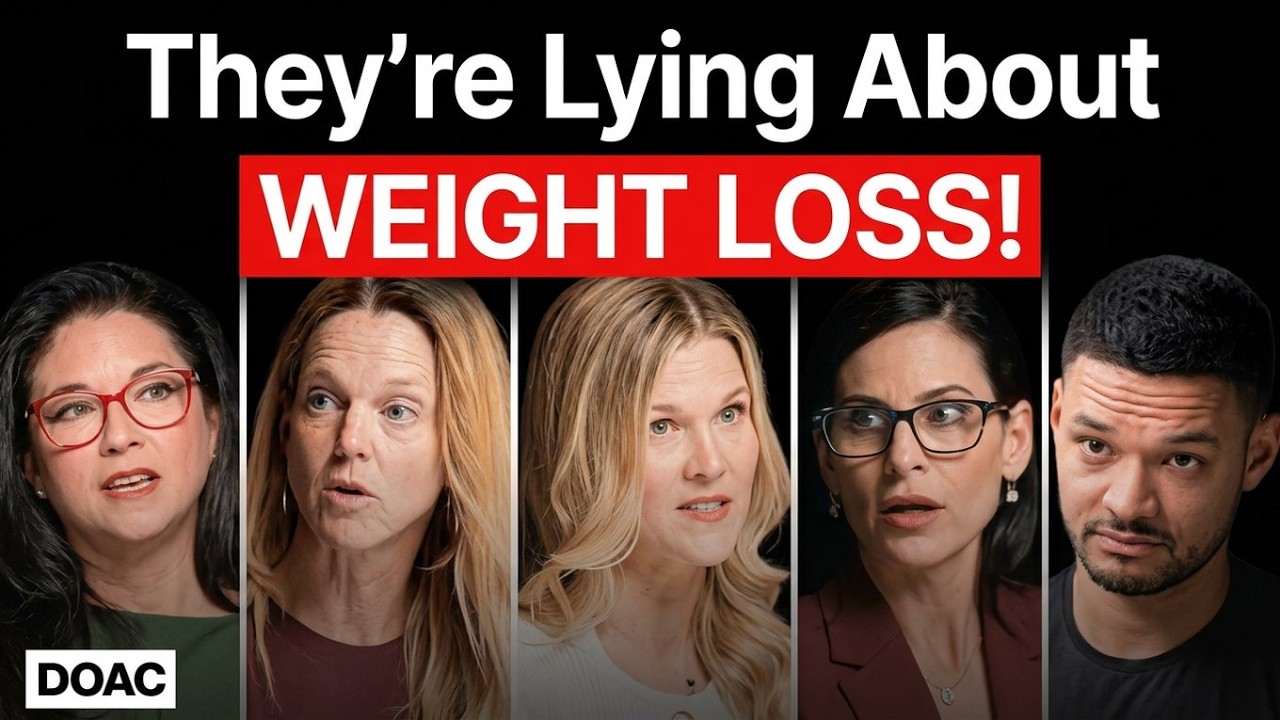
Medical Experts Mandate Heavy Resistance Training to Reverse Female Aging
The Diary Of A CEO
Four leading health specialists conclude that midlife muscle building and polarized training prevent severe metabolic decay, bone loss, and cognitive decline in women.
## Background
This episode was published on YouTube by The Diary Of A CEO on October 27, 2025. According to the page description, the episode features a roundtable discussion with four leading women's health experts—Dr. Mary Claire Haver, Dr. Vonda Wright, Dr. Natalie Crawford, and Dr. Stacy Sims—covering critical topics regarding perimenopause workouts, lifting weights, cycle syncing, VO2 max, and nutrition strategies tailored for female physiology.
## TL;DR
A panel of expert physicians and researchers breaks down how female biology differs fundamentally from male physiology, challenging long-held fitness and diet myths. The discussion covers why women must prioritize heavy resistance training over endless cardio to preserve bone density and muscle mass, the dangers of severe calorie restriction and fasting for women, and key protocols for optimizing sleep, circadian health, and supplements like creatine. Ultimately, the experts advocate for body recomposition and strength over extreme weight loss to prevent frailty, metabolic dysfunction, and cognitive decline as women age.
## Atmosphere & style
The conversation is highly authoritative, passionate, and empowering, striking a balance between clinical expertise and accessible, actionable health advice. The dynamic among the host and guests is collaborative and deeply empathetic, driven by a shared mission to overturn outdated medical paradigms surrounding female health. Listening to the dialogue feels urgent yet uplifting, transforming complex scientific concepts into a clear call to action for women to advocate for their health and fearlessly take up space.
## Key takeaways
- [00:00](https://www.youtube.com/watch?v=P1CeHGJOX5g&t=0s) Medical research and exercise science historically relied on male data, leaving standard health recommendations poorly suited to unique female physiology.
- [05:07](https://www.youtube.com/watch?v=P1CeHGJOX5g&t=307s) Cycle syncing as a rigid training schedule is often impractical due to irregular cycles, and heavy resistance training should remain a consistent baseline regardless of cycle phase.
- [11:40](https://www.youtube.com/watch?v=P1CeHGJOX5g&t=700s) Perimenopausal women facing estrogen loss require polarized training—combining high-intensity bursts with low-intensity recovery—rather than staying stuck in moderate-intensity group fitness.
- [15:54](https://www.youtube.com/watch?v=P1CeHGJOX5g&t=954s) While Pilates supports core strength and mobility, it cannot replace heavy resistance training for stimulating bone density and muscle growth.
- [31:50](https://www.youtube.com/watch?v=P1CeHGJOX5g&t=1910s) Skeletal muscle functions as an endocrine organ that secretes brain-stimulating hormones like irisin and plays a vital role in preventing frailty and metabolic disease.
- [36:17](https://www.youtube.com/watch?v=P1CeHGJOX5g&t=2177s) Dynamic, multidirectional impacts like jumping and heavy loading (e.g., the LIFTMOR trial protocol) are necessary to signal osteoblasts and prevent severe osteoporosis in aging women.
- [49:23](https://www.youtube.com/watch?v=P1CeHGJOX5g&t=2963s) Low energy availability and mid-day caloric deficits suppress thyroid function, disrupt reproductive hormones, and trick the brain into lowering baseline metabolism.
- [01:14:13](https://www.youtube.com/watch?v=P1CeHGJOX5g&t=4453s) Lactate produced by fast-twitch muscle fibers during high-intensity resistance training crosses the blood-brain barrier to fuel brain cells and offset cognitive decline.
- [01:24:45](https://www.youtube.com/watch?v=P1CeHGJOX5g&t=5085s) Cardio alone is inefficient for fat loss; prioritizing heavy weightlifting alongside sufficient protein promotes muscle preservation and effective body recomposition.
- [01:26:59](https://www.youtube.com/watch?v=P1CeHGJOX5g&t=5219s) When taking GLP-1 medications, proper protein intake and heavy resistance training are essential to prevent severe loss of skeletal muscle and bone density.
- [01:40:54](https://www.youtube.com/watch?v=P1CeHGJOX5g&t=6054s) The RDA for protein (0.8 g/kg) is only a baseline to prevent deficiency; active women should aim for 1.6 g/kg up to 1.0 g per pound of ideal body weight for long-term healthspan.
- [01:44:03](https://www.youtube.com/watch?v=P1CeHGJOX5g&t=6243s) Extended fasting elevates cortisol and ghrelin in women, making a simple 12-hour circadian eating window far more effective for metabolic health.
- [01:58:02](https://www.youtube.com/watch?v=P1CeHGJOX5g&t=7082s) Commercial juice detoxins lack medical validity because the liver and kidneys handle internal detoxification, while juicing strips essential fiber and spikes blood sugar.
- [02:01:28](https://www.youtube.com/watch?v=P1CeHGJOX5g&t=7288s) Creatine monohydrate is a critical supplement for female brain health, heart energy, and muscle power, addressing naturally lower endogenous creatine stores in women.
- [02:06:47](https://www.youtube.com/watch?v=P1CeHGJOX5g&t=7607s) Endocrine-disrupting chemicals like microplastics and BPA, combined with severe psychological trauma, directly accelerate ovarian aging and early menopause.
- [02:11:36](https://www.youtube.com/watch?v=P1CeHGJOX5g&t=7896s) Prioritizing sleep hygiene and circadian alignment is the fundamental pillar for glymphatic brain clearance, hormone regulation, and overall metabolic health.
- [02:24:50](https://www.youtube.com/watch?v=P1CeHGJOX5g&t=8690s) High-dose commercial melatonin (5–10 mg) acts as an endocrine overdose; effective physiological supplementation requires 1 mg or less taken shortly before bed.
- [02:29:05](https://www.youtube.com/watch?v=P1CeHGJOX5g&t=8945s) Women must take charge as the 'CEO' of their own healthcare to navigate medical systems that remain inadequately tailored to aging female biology.
## Detailed walkthrough
### [00:00](https://www.youtube.com/watch?v=P1CeHGJOX5g&t=0s) Introduction and the Need for a Female-Specific Lens in Health
The host opens this second part of the panel discussion by laying out the broad array of actionable lifestyle factors to be explored: exercise, nutrition, fasting, sleep, and environmental exposure. He directly asks the experts why women need a dedicated conversation around fitness and nutrition rather than relying on general guidelines.
Dr. Stacy Sims explains that sports science and medical research have historically been conducted primarily on men. Consequently, standard recommendations regarding workout stress, recovery, and nutrition are derived from male data and cannot simply be applied to women. Because a woman’s hormonal environment, metabolism, and physiological stress responses function differently, exercise must be approached through a specifically female lens.
Dr. Natalie Crawford adds that a woman’s hormones interact continuously with non-reproductive systems like the gut, liver, and immune system. It functions as a two-way street: gut health alters hormone balance, and hormonal fluctuations change gut function.
The panel notes that cultural messaging historically urged women to prioritize aesthetics, aiming to "be small at any cost" and focus strictly on the bathroom scale. The panel argues that while social media is beginning to shift the focus toward "strong over skinny," society is now paying the price for decades of under-strength training. This legacy has left women facing an epidemic of osteoporosis, frailty, and dementia.
- **40% to 50%** of women will develop low bone density as they age.
- **70%** of all hip fractures occur in women.
- **30%** of women who suffer a hip fracture die within one year of the injury.
---
[05:07](https://www.youtube.com/watch?v=P1CeHGJOX5g&t=307s) Should Women Exercise Differently Across the Menstrual Cycle?
Addressing the popular concept of "cycle syncing," the host asks whether women should systematically alter their exercise routines to match the phases of their menstrual cycle.
Dr. Stacy Sims acknowledges that at a cellular level, isolated estrogen and progesterone cause distinct metabolic, physiological, and temperature shifts. However, translating this into a rigid, universal training schedule is problematic because many women experience anovulatory cycles (cycles without ovulation) or have irregular cycle lengths. Dr. Natalie Crawford notes that roughly **15%** of patients do not ovulate regularly, leaving them confused about when their follicular or luteal phases actually occur. If training guidelines become overly prescriptively tied to specific phases, women risk doing less overall movement while waiting for instructions.
The panel emphasizes that heavy resistance and strength training should remain the baseline core of a woman's routine regardless of her cycle phase, pregnancy status, or fertility treatments. However, women can use their own subjective energy metrics to strategically time high-intensity sessions or heavy lifts:
- **Days 6 to 14 (Late Follicular Phase):** As estrogen rises in the 5 to 7 days leading up to ovulation, women typically experience a surge in energy, a lower core body temperature, improved access to carbohydrates for quick fuel, and better heart rate variability. This is the optimal window to push for heavy lifts, higher volume, or peak intensities.
- **Ovulation (Mid-Cycle):** Response during ovulation is highly individual. While some women feel strong due to peak estrogen, others experience a sharp drop in energy when the follicle ruptures and disrupts the surrounding granulosa cells, causing a temporary dip in estrogen before the corpus luteum forms.
- **Early to Mid-Luteal Phase (Days 16 to 22):** Energy levels become variable. Some women maintain peak performance, while others find high-intensity efforts feel significantly harder.
- **Late Luteal Phase (Days 24 to 27):** As both estrogen and progesterone plunge, women frequently experience premenstrual syndrome (PMS), cramping, fatigue, and lower training capacity.
Dr. Natalie Crawford points out the phenomenon of *mittelschmerz* (a German word meaning "middle pain"), which is mid-cycle pain caused by the physical rupture of the ovarian follicle during ovulation. For some women, this feels as intense as a cyst bursting, briefly knocking them out of physical activity altogether.
The experts criticize absolute social media rules (such as "never do cardio in the luteal phase"), stressing that women should instead learn to listen to their individual biofeedback rather than rigid online dogma.
---
[11:40](https://www.youtube.com/watch?v=P1CeHGJOX5g&t=700s) Low vs. High-Intensity Training: Finding the Right Balance
The discussion turns to exercise intensity and how women should structure their workouts across different life stages.
Dr. Stacy Sims highlights the critical role of **periodization** and warns against doing high-intensity interval training (HIIT) daily. The body does not get fitter during the workout itself; fitness is the adaptive response to the combination of workout stimulus and adequate recovery. Overusing high-intensity training leads to chronic stress without allowing the body to adapt.
While younger women in their reproductive years have higher baseline hormone levels that assist recovery and allow them to get away with varied training styles, perimenopausal and menopausal women face a drop in estrogen's natural anti-inflammatory protection. Recovery becomes significantly slower, requiring a strategy called **polarized training**: balancing true, short bursts of peak intensity with low-intensity movement for genuine recovery.
Dr. Vonda Wright offers a vivid real-world example from her orthopedic practice, which overlooks a large indoor football field hosting popular group fitness classes (such as "Ignite"):
> "Inside my windows... that field is filled seven days a week with people taking a class... Ignite has a lot of midlife women in it who are never exercising at low enough intensity to recover, and never exercising at peak intensity to change their body. So what happens five or seven days a week: they're out doing moderate mid-range intensity training, but they're not seeing body changes. They're not seeing recomposition. They're hurt every three weeks and in my office wondering why."
This "medium-intensity trap" is fueled by the cultural belief that a workout is only effective if you leave completely drenched in sweat and exhausted. Instead, Dr. Wright and Dr. Sims advocate for:
- **Sprint Interval Training (SIT):** Very brief, maximum-effort cardiovascular bursts that push heart rates to true peaks, driving metabolic recomposition.
- **Low-Zone Cardio:** Exercise at a low enough heart rate where the body efficiently burns fat without accumulating excessive systemic fatigue.
- **Heavy Resistance Training:** Lifting weights heavy enough to create structural adaptive stress rather than relying on endless light-weight, high-rep endurance sets.
[15:54](https://www.youtube.com/watch?v=P1CeHGJOX5g&t=954s) Why Pilates Isn't Enough for Strength and Longevity
While women with regular menstrual cycles have a bit more flexibility in their training, periods of hormonal fluctuation—such as PCOS, hypothalamic amenorrhea, or menopause—require a more intentional approach to exercise. The panel emphasizes that variety is essential; women should tailor their routines to their specific life stage and goals, whether that involves losing weight, gaining mass, managing menopause, or optimizing fertility. There is no "one-size-fits-all" workout to do every day.
Addressing the immense popularity of Pilates and reformer classes, the doctors clarify that while Pilates is excellent for core strength, balance, isometric control, and joint range of motion, it is not a substitute for true strength training. True strength training requires lifting heavy loads across multiple planes of motion to stimulate substantial muscle growth and bone density. Pilates primarily operates in single planes of motion and lacks the heavy multidirectional forces necessary to protect women against frailty and bone loss as they age.
* **Reformer Limitations:** Reformer exercises do not apply the multidirectional load through muscles, tendons, and bones required for meaningful structural adaptation.
* **Flexibility vs. Power:** Pilates helps prevent stiffness and maintains joint range of motion, but it cannot deliver the power needed to prevent fall-related injuries later in life.
* **Badge of Honor Fallacy:** Women often accumulate hundreds or thousands of Pilates classes under the impression that it covers all their fitness needs, unintentionally neglecting heavy resistance training.
---
[20:00](https://www.youtube.com/watch?v=P1CeHGJOX5g&t=1200s) The Ideal Workout Blueprint for Women in Their 30s
When designing an optimal weekly routine for a woman in her 30s with three hours to dedicate to the gym, the experts recommend dedicating every session to proper joint mobilization, primary compound lifts, and progressive overload. Pre-workout movement should focus on joint capsule distraction rather than simple passive stretching. Using heavy resistance bands or specific mobility tools distends joint capsules and frees up restricted tissue, allowing full range of motion under heavy loads and preventing micro-tears and injuries.
```
Sample Weekly Session Framework:
1. Joint Mobilization (10 mins) --> Banded joint distraction (hips, shoulders, ankles)
2. Compound Movement --> Squat variation (back, front, or Bulgarian split squat)
3. Progressive Overload --> Gradual increase in load over time
```
Maintaining joint range of motion is critical because aging increases covalent bonding between collagen strands in ligaments, tendons, and joint capsules, causing structural stiffness. Stiffness alters the body's kinetic chain—for example, tight calves and stiff ankles stop the tibia from internally rotating, which prevents the femur from rotating and ultimately shuts down glute activation. This chain reaction frequently leads to hip, thigh, or back pain. Tissues remain malleable at any age; even women in their 40s and 50s can reclaim lost mobility and strength if they scale up gradually rather than jumping into the intensity levels of their youth.
* **Joint Capsule Distraction:** Pulling through a joint capsule using heavy bands opens up space and increases tissue viability far more effectively than muscle stretching.
* **Kinetic Chain Impact:** Proper ankle and knee rotation are required to activate the glutes correctly during compound movements.
* **Injury Prevention:** Midlife injury spikes often occur when individuals attempt workouts based on past memories of fitness without first restoring compliant tendon and joint function.
---
[27:28](https://www.youtube.com/watch?v=P1CeHGJOX5g&t=1648s) Overcoming Gym Culture and the "Bulky" Myth
A primary barrier preventing women from strength training is the gendered gym environment. When women join traditional fitness facilities, staff routinely steer them toward group cardio, spin, or rhythm classes rather than the lifting platforms and barbell racks. Cultural pressure historically encourages women to focus exclusively on being as small as possible, leading to the phenomenon of being "skinny fat"—having low weight but a body fat percentage as high as 50%, which leaves an individual metabolically vulnerable and structurally fragile.
> "I'm not really interested in somebody's weight. I'm interested in their body fat percentage and their lean muscle mass. Because it's what you're made of that matters, right? Not the size of the shell."
The panel dismantles the common fear that lifting heavy weights will cause women to look excessively bulky or masculine overnight. Building a bodybuilder-like physique requires years of dedicated, specialized training paired with strict hyper-caloric nutrition. For the vast majority of women, heavy resistance training simply increases lean muscle mass, boosts metabolism, reduces systemic inflammation, and lowers long-term risk for metabolic disease.
* **Skinny Fat Risks:** Low body weight does not equal metabolic health or lean composition; high fat-to-muscle ratios persist without active strength training.
* **Gym Bias:** Commercial gym environments frequently direct men toward heavy weights and muscle gain while directing women strictly toward weight loss and cardio.
* **Focus Shift:** Female health goals should prioritize body recomposition and structural strength over the arbitrary number on a balance scale.
Here is the detailed walkthrough of the transcript section:
### [31:50](https://www.youtube.com/watch?v=P1CeHGJOX5g&t=1910s) Muscle as a Metabolic and Endocrine Organ
Muscle is far more than just a mechanical system for locomotion; it functions as a vital metabolic and endocrine organ. It plays a critical role in glucose metabolism and insulin sensitivity, maintaining an active cross-communication axis with both bone and the brain. Skeletal muscle releases hormones like irisin, which stimulates neurogenesis (the creation of new neurons) in the brain. Similarly, bone communicates with the brain to regulate satiety. Viewing these locomotive structures in a box overlooks their profound biological functions.
For women in particular, accumulating and maintaining muscle is crucial to combat the insulin resistance that naturally occurs when estrogen levels decline during menopause. Muscle provides essential glucose clearance, strength, and resilience to prevent frailty—a key factor considering that women account for two-thirds of nursing home residents, often due to an inability to perform basic movements like rising from a chair.
* **Muscle-Brain Axis:** Skeletal muscle produces hormones such as irisin that signal the brain to generate new neurons.
* **Bone-Brain Axis:** Endocrine signaling from bone directly influences appetite and satiety regulation.
* **Nursing Home Demographics:** Women make up approximately two-thirds of nursing home residents, frequently driven by severe strength loss and frailty.
---
### [33:36](https://www.youtube.com/watch?v=P1CeHGJOX5g&t=2016s) The "Critical Decade" (Ages 35–45) and Fighting Inflammation
While it is possible to build muscle at age 70, it becomes significantly harder due to declining hormonal support. This makes the period between ages 35 and 45—termed the "critical decade"—the prime window for women to set physical activity standards and optimize lean muscle mass while circulating estrogen levels remain high. Estrogen exerts a powerful anti-inflammatory effect and aids muscle protein synthesis. Chronic, elevated systemic inflammation (marked by inflammatory cytokines like IL-6 and Tumor Necrosis Factor/TNF) impairs both muscle and bone synthesis.
Inflammation acts like "static on a walkie-talkie," preventing the brain from clearly interpreting hormonal signals. Building muscle actively counteracts this static by consuming glucose and improving cellular insulin sensitivity. For women with inherently pro-inflammatory conditions like Polycystic Ovary Syndrome (PCOS) or endometriosis, a deliberate strategy to build muscle is even more critical to manage their elevated baseline inflammatory load.
* **Geroprotection:** Muscle and ovaries are two of the primary "geroprotective" (aging-protective) systems in women. Because ovarian function declines with age, muscle remains the primary lifelong shield against aging.
* **Inflammatory Cytokines:** Cytokines like IL-6 and TNF directly hinder normal muscle and bone metabolic building pathways.
* **PCOS & Endometriosis:** Women with these conditions carry a higher cellular inflammatory burden and require targeted resistance training to offset inflammation.
---
### [36:17](https://www.youtube.com/watch?v=P1CeHGJOX5g&t=2177s) Intensity, Neuromuscular Health, and High-Impact Training
Relying exclusively on steady-state, moderate-intensity cardio (such as typical aerobics classes) fails to trigger the post-exercise anti-inflammatory response required to lower baseline inflammation or build substantial muscle. High-intensity resistance training and sprint interval sessions stimulate a powerful parasympathetic response that improves sleep, brain health, and neuroplasticity—benefits that moderate cardio cannot replicate.
During perimenopause, declining or fluctuating estrogen causes myosin dysfunction. Myosin and actin are the two primary contractile proteins in muscle fibers that bind together to create force. Estrogen regulates how tightly myosin binds to actin; without it, muscle contraction strength weakens, often causing women to report a sudden loss of power or grip strength even before visible changes in body composition occur. Heavy strength training serves as a direct neuromuscular stimulus, bypassing the need for estrogen to restore strong myosin-actin bonding.
* **Lifting Benefits:** Beyond aesthetics, heavy lifting promotes neuroplasticity, superior sleep, and a strong parasympathetic recovery response.
* **Myosin Dysfunction:** Estrogen fluctuations impair the binding of myosin to actin, reducing contractile force and power output before muscle mass itself vanishes.
* **Impact on Bone (Osteocytes):** Osteocytes are fluid-encased cells embedded within bone matrix. Dynamic impacts (such as plyometrics, pogo jumps, depth jumps, or sprinting) push fluid through microscopic channels, creating a mechanical signal that instructs osteoblasts to build new bone. Running alone provides insufficient, unidirectional stress; multidirectional ground reaction forces are required.
---
### [37:49](https://www.youtube.com/watch?v=P1CeHGJOX5g&t=2269s) Estrogen Loss, Bone Density, and the Lifespan Impact of Fractures
Bone mass peaks around ages 25 to 30 for both sexes, with men achieving higher peak bone density due to testosterone. Men generally experience a gradual loss of about 1% per year, typically delaying severe fractures until their 70s or 80s. Women undergo a similar gradual loss until perimenopause, at which point the loss rate doubles or triples. Women can lose 15% to 20% of their total bone density during the perimenopausal transition purely due to the loss of estrogen.
Estrogen regulates the balance between osteoclasts (cells that resorb bone) and osteoblasts (cells that build bone). Without estrogen's modulating effect, osteoclast activity outpaces bone formation. Bone serves vital multi-systemic roles: it acts as an endocrine organ releasing hormones to the brain, pancreas, and muscles, and stores blood-forming marrow in the pelvis.
* **Osteoporosis Statistics:** 40% to 50% of women experience low bone density, and approximately 50% of those with osteoporosis will suffer a fracture.
* **Hip Fractures:** 70% of all hip fractures occur in women.
* **Mortality and Function:** Following a hip fracture, women face a 30% mortality rate within one year. Among survivors, 50% never regain their pre-fall functional independence, often requiring 24-hour care or institutionalization.
---
### [45:07](https://www.youtube.com/watch?v=P1CeHGJOX5g&t=2707s) Lifting Heavy with Osteoporosis: The LIFTMOR Trial and HRT
The common medical myth that individuals with low bone density should avoid heavy weightlifting has been thoroughly disproved. The landmark *LIFTMOR* trial, led by Dr. Belinda Beck in Australia, evaluated postmenopausal women with low bone mass performing high-intensity, supervised resistance training (5 sets of 5 repetitions at near-failure loads) combined with impact exercises. Despite heavy loading, the participants experienced zero fractures and achieved significant improvements in bone mineral density.
A subsequent study published in May 2025 built upon the LIFTMOR framework by comparing three groups over time: a control group (no intervention), a resistance and jump-training group (3 days/week), and a group combining resistance training, jump training, and Hormone Replacement Therapy (HRT).
```
[ Standard Baseline Bone Density Loss ]
│
┌────────────────────┴────────────────────┐
▼ ▼
[ Resistance & Jump Training ] [ Resistance Training + HRT ]
• Halts bone loss • Synergistic effect
• Rebuilds bone density • Maximum bone density gain
```
While the control group steadily lost bone mass, the exercise group successfully gained bone. Crucially, the group combining resistance training with HRT demonstrated a synergistic response, yielding the highest increase in bone density.
Although standard medical guidelines recommend waiting until age 65 to perform bone density screenings (such as DEXA or REMS ultrasound scans), experts emphasize obtaining a baseline scan early in life—often available for around $99 out-of-pocket—to detect bone loss early and take preventive action.
* **LIFTMOR Protocol:** 5 sets of 5 repetitions at near-failure loads proved safe and effective for building bone in osteoporotic women under supervision.
* **May 2025 Study:** Demonstrated that pairing heavy resistance training with HRT yields superior bone density gains compared to exercise alone.
* **Screening Advice:** Rather than waiting for the standard age-65 screening guideline, early baseline DEXA or REMS ultrasound testing allows women to implement targeted lifestyle and hormonal interventions decades in advance.
[49:23](https://www.youtube.com/watch?v=P1CeHGJOX5g&t=2963s) DEXA Scans and Low Estrogen in Younger Women
Dr. Vonda Wright expresses frustration that traditional medical guidelines often suggest waiting until age 65 to get an osteoporosis check. She urges women not to be deterred if insurance refuses to cover early screening, noting that specialized centers now allow patients to pay out-of-pocket for a DEXA scan. This baseline bone and muscle mass scan gives women crucial data about their bone density early in life. Dr. Natalie Crawford underscores that bone loss is not exclusively a perimenopausal or postmenopausal issue. Many younger women of reproductive age experience severe periods of low estrogen that put their current and long-term bone density at grave risk.
When young women casually dismiss missing their period for years, Dr. Crawford stresses that this is a major medical concern. If a woman is not ovulating due to suppressed estrogen, her bone-building trajectory drops significantly off course compared to her peers. Medical consensus strongly supports using estrogen therapy in younger women facing extended periods of low estrogen, as it can profoundly preserve their lifelong skeletal strength.
- DEXA scans measure both bone mineral density and overall muscle mass.
- Women of reproductive age missing regular periods face accelerated bone density loss.
- Estrogen treatment in young women with amenorrhea is widely recognized as essential medical intervention for bone health.
[50:49](https://www.youtube.com/watch?v=P1CeHGJOX5g&t=3049s) Under-Fueling, Circadian Rhythm, and Hypothalamic Amenorrhea
Dr. Stacy Sims highlights a widespread issue among recreationally active women: low energy availability. Many active women do not consume enough calories to support basic physiological functions alongside their exercise regimes. This subclinical deficit triggers menstrual cycle dysfunction, heightened inflammatory responses, and suppressed bone density. Left unaddressed, it leads directly to hypothalamic amenorrhea—a state where periods stop due to low estrogen levels.
Dr. Sims critiques popular eating patterns like "bookending" calories (eating only early in the morning and late at night). Skimping on fuel throughout the core of the day tricks the brain into perceiving a starvation threat during the mid-day gap. After just four consecutive days of low energy availability, thyroid function drops measurably. To fix body composition, women must trust the process of eating around their workout sessions; proper fueling yields higher lean muscle mass, stronger bones, and reduced overall body fat without unwanted fat gain.
- Just four days of low energy availability directly impairs thyroid function.
- Mid-day caloric gaps signal a starvation threat, depressing the body's baseline metabolic rate.
- Eating adequate calories around training times optimizes body composition and protects reproductive health.
[52:49](https://www.youtube.com/watch?v=P1CeHGJOX5g&t=3169s) Structuring the Ideal Workout Routine and VO₂ Max
Outlining a balanced strength regimen for premenopausal women, Dr. Sims recommends three key gym days per week focused on distinct compound movements. One session should emphasize forward knee movement (squats), another should focus on upper-body push/pull exercises, and a third should target the posterior chain (hip thrusts and deadlifts). Because women tend to be quad-dominant, strengthening the posterior chain—including the glutes and hamstrings—is vital for knee and hip joint integrity, movement economy, and long-term injury prevention.
When Steven Bartlett asks where cardio and VO₂ max fit into this blueprint, the doctors note that high-intensity intervals don't require daily grind. High VO₂ max can be efficiently developed with targeted, high-intensity efforts pushed near maximum heart rate. While the sports science gold standard is the "Norwegian 4x4" protocol (four minutes at high intensity followed by four minutes of rest), executing a sprint protocol just once a week is often enough for longevity and performance gains.
- Weekly compound movement breakdown: 1) Knee-dominant/squats, 2) Upper-body push/pull, 3) Posterior chain (deadlifts, hip thrusts).
- Strengthening glutes and hamstrings balances quad dominance and protects against joint injuries.
- Norwegian 4x4 protocol: Four minutes at max intensity alternated with four minutes of recovery.
[54:44](https://www.youtube.com/watch?v=P1CeHGJOX5g&t=3284s) Practical Sprint Protocols and the "Skinny Runner" Trap
Dr. Vonda Wright shares her personal approach to sprint interval training: after a thorough warm-up, she completes four sets of 30-second all-out efforts on a treadmill set at top speed (reaching a maximum heart rate around 186 BPM), allowing two to three minutes of complete recovery between rounds. She emphasizes that reaching peak effort is about heart rate response rather than specific gym equipment. Dr. Sims mentions that due to a torn meniscus and hamstring, she uses explosive kettlebell swings instead of running to hit those high-intensity intervals.
Addressing the rising popularity of run clubs and marathons as social activities, the panel cautions against trading strength training entirely for cardio. Dr. Crawford points out that roughly 58% of female runners experience a luteal phase defect—where the second half of their menstrual cycle becomes abnormally shortened due to energy deficits suppressing brain signaling. Furthermore, women who appear extremely lean from distance running often harbor high levels of visceral fat around internal organs ("skinny fat") triggered by chronic low energy intake, suppressed estradiol, and systemic inflammation.
> "I punch the treadmill up to 11 and I am just working so hard I don't fly off the back... gets my heart rate up really high, about 186... And that's all you need." — Dr. Vonda Wright
- 58% of female runners suffer from a luteal phase defect caused by energy deficiencies.
- High visceral fat can hide beneath a lean exterior ("skinny fat") due to chronic inflammation and low estrogen.
- Sprint intervals require complete heart-rate recovery (2–3 minutes) between maximum efforts to be effective.
[59:30](https://www.youtube.com/watch?v=P1CeHGJOX5g&t=3570s) Evolutionary Biology, Chronic Stress, and Overtraining
Reflecting on evolutionary biology, Dr. Sims explains how ancestral survival mechanisms shape modern female physiology. In early hunter-gatherer societies, male biology evolved to endure calorie deficits while pursuing game, remaining cognitively sharp during periods of fasting. Conversely, female biology evolved to protect reproductive capabilities and conserve energy; when calories were scarce, the female body quickly shut down reproduction and held onto body fat to survive. In modern times, chronic calorie restriction combined with constant, unmanaged mental stress creates continuous cortisol spikes and systemic inflammation that promote fat storage.
Addressing whether women are overtraining, Dr. Wright notes that while a subset of health-conscious women overexert themselves, the general population is profoundly sedentary. However, in fitness-conscious pockets, many women drift into hypothalamic dysfunction—where chronic stress, over-exercising, and under-fueling disrupt the brain's signaling before full-blown amenorrhea sets in. Dr. Sims frames this non-inflammatory breakdown not as overtraining, but as severe **under-recovering**.
- Male biology evolved to maintain focus during fasting; female biology evolved to store fat and halt reproduction during calorie scarcity.
- Chronic stress elevates cortisol and blood glucose, promoting body fat retention when physical action (running from a threat) doesn't follow.
- Women frequently experience hypothalamic dysfunction from under-recovering and under-fueling long before their periods completely stop.
[01:04:40](https://www.youtube.com/watch?v=P1CeHGJOX5g&t=3880s) Body Composition, Adaptive Stress, and Training Intensity
The conversation opens with a discussion on how society and social media handle body composition, with Dr. Stacy Sims calling out the toxic narrative that fitness and body image are purely matters of personal willpower. Steven Bartlett notes how common it is for women to encounter online creators screaming that their body composition is entirely their own fault. Dr. Sims emphasizes that this is an artificial social construct, particularly prevalent in Western society. Rather than blaming individuals, she advocates educating women that systemic, biological, and environmental factors are at play, and that evidence-based tools exist to help them make meaningful, incremental health improvements.
When Steven asks whether exercise rules shift during perimenopause, Dr. Sims explains the critical concept of **adaptive stress**. When an individual engages in heavy resistance training or high-intensity exercise, they induce deliberate damage and stress upon the body. This triggers a signaling cascade that prompts the muscle to repair itself to be stronger than before. She contrasts this adaptive stress with non-adaptive stress, emphasizing that exercise intensity must be managed strategically—especially during perimenopause, when a woman's hormonal landscape undergoes major shifts.
Dr. Sims unpacks the metabolic mechanics behind **Sprint Interval Training (SIT)** (typically consisting of 30 seconds of maximum effort followed by 2 to 3 minutes of recovery). This extreme cardiovascular stress stimulates epigenetic changes in muscle tissue:
* **GLUT4 Translocation:** It forces GLUT4 storage vesicles to fuse with the cell membrane, allowing glucose entry and directly reducing insulin resistance.
* **Myokine Release:** The severe muscular strain releases myokines, signaling molecules that communicate with the liver to suppress visceral fat storage and instead release non-esterified fatty acids to be burned by skeletal muscle mitochondria.
Conversely, spending excessive time in moderate-intensity exercise fails to generate this robust adaptive signaling cascade. Instead, it exacerbates baseline systemic inflammation and drives up cortisol levels. Because perimenopausal women are already sympathetically driven with elevated baseline cortisol, continuous moderate exercise leaves cortisol chronically elevated without triggering the necessary repair cascade.
- **Adaptive Stress Mechanism:** Heavy lifting damages muscle tissue to activate biochemical feedback loops for repair and hypertrophy.
- **Sprint Interval Training Structure:** 30 seconds all-out effort, followed by 2 to 3 minutes of complete recovery, repeated across 4 sets.
- **Physiological Signaling:** High-intensity efforts trigger myokine release from muscle, redirecting fuel pathways away from visceral fat accumulation toward mitochondrial beta-oxidation.
---
[01:10:09](https://www.youtube.com/watch?v=P1CeHGJOX5g&t=4209s) Polarized Exercise and the Heart Rate Zone Breakdown
To simplify the science, Steven summarizes the main takeaway: spending too much time in the "medium range" of exercise intensity stresses the body in counterproductive ways—driving up inflammation without forcing structural adaptation—whereas brief, high-intensity bursts induce positive structural adaptation without leaving the body in a state of chronic distress.
Dr. Sims confirms this summary and stresses the necessity of **polarizing** exercise—combining top-end high-intensity training with genuine low-intensity active recovery, while avoiding the middle-intensity trap. The panel breaks down how heart rate training zones apply differently to men and women:
| Zone | Description | Impact on Women | Impact on Men |
|:--- |:--- |:--- |:--- |
| **Zone 1** | Baseline resting / minimal movement | General daily activity and baseline rest | General daily activity and baseline rest |
| **Zone 2** | Low-intensity, steady-state aerobic (conversational pace) | Excellent for active recovery, joint blood flow, and stress reduction | Critical for building mitochondrial density and metabolic flexibility |
| **Zones 3–4** | Moderate to moderately high intensity (the "medium range") | **Avoid for routine training;** exacerbates cortisol and inflammation without providing maximal adaptive stimulus | Avoid for routine training unless specifically preparing for endurance events |
| **Zones 5–6** | Maximum high-intensity, short-duration sprint intervals | **Essential:** Triggers growth hormone, testosterone release, and GLUT4 expression, dropping baseline cortisol | Used for top-end cardiovascular conditioning |
Dr. Vonda Wright outlines a practical, weekly workout template designed for female longevity:
* **2 to 4 Days Per Week:** Heavy, progressive resistance training focused on compound movements (warming up properly, executing one primary compound lift per session, followed by accessory exercises, balance, or plyometrics).
* **2 to 3 Days Per Week:** Low-intensity continuous movement (e.g., brisk walking) for mitochondrial maintenance and active blood circulation.
* **1 to 2 Days Per Week:** Sprint Interval Training (Zone 5/6 short bursts) and targeted $VO_2$ max workouts (such as $4 \times 4$-minute interval protocols).
Dr. Sims adds that fitness interventions must be layered progressively upon foundational lifestyle pillars: **sleep** is non-negotiable for metabolic change, followed by **nutrition and physical activity**, and finally **mindfulness and community**—all of which regulate the parasympathetic nervous system. Dr. Wright cites emerging gerontology research, pointing to the book *Joyspan*, which highlights that maintaining active social connection, cognitive stimulation, and community throughout one's 40s, 50s, and 60s is the single greatest predictor of thriving during the final decade of life.
---
[01:14:13](https://www.youtube.com/watch?v=P1CeHGJOX5g&t=4453s) Resistance Training in Postmenopause and Brain Health
Addressing exercise after menopause, Dr. Sims and Dr. Wright confirm that it is never too late to start lifting heavy, pointing to research like the *LIFTMOR* trials. However, the definition of "heavy lifting" is entirely relative to the individual. Dr. Mary Claire Haver shares how she used the 1-repetition maximum (1RM) methodology to establish her own training loads.
By identifying the heaviest weight she could lift safely for a single repetition with proper form (for example, a 20 lb dumbbell bicep curl), she calculated her working weight at 70–80% of that 1RM (roughly 15–16 lbs). Training at this intensity causes muscular failure around 5 repetitions. Dr. Mary Claire notes that women frequently underestimate their own physical capacity, often defaulting to 5 lb or 10 lb weights for 30 repetitions under the misconception of getting "toned," which builds muscle endurance rather than strength or explosive power.
Steven reflects on psychological research by Hal Hershfield showing that when people undergo fMRI brain scans and think about themselves 10 years in the future, the neural regions that illuminate are identical to those activated when thinking about a complete stranger. This explains why long-term health advice is often ignored unless tied to immediate performance or cognitive gains. Dr. Mary Claire agrees, adding that midlife women—who often serve as primary caregivers for aging parents while raising children—gain immediate motivation to stay strong when they realize they want to maintain their own functional independence and avoid burdening their children.
Finally, Dr. Sims details the profound relationship between high-intensity exercise, **lactate production**, and cognitive preservation against Alzheimer’s disease and dementia. Emerging neuroscience shows that neurodegenerative diseases are intimately tied to brain metabolic dysfunction:
> "Part of the development of dementia and Alzheimer's and the plaque is a misstep in brain metabolism... the brain uses a lot of glucose, it also uses lactate."
Women naturally possess fewer glycolytic (lactate-producing, fast-twitch) muscle fibers than men and lose them rapidly with age. High-intensity exercise forces fast-twitch muscle fibers to produce lactate, which enters circulation to cross the blood-brain barrier, providing preferred fuel for neurons and astrocytes. This metabolic pathway directly counteracts the decline in brain glucose metabolism that occurs during the perimenopause-to-menopause transition.
- **1-Repetition Maximum (1RM) Working Range:** Effective heavy strength training relies on working at 70–80% of 1RM, reaching near-failure within 5 to 8 repetitions rather than doing high-rep endurance sets.
- **Hershfield fMRI Study Insight:** Human brains process future self-conceptions in the same neural regions as foreign celebrities, necessitating short-term tangible goals to drive behavioral change.
- **Lactate as Neuro-Fuel:** High-intensity bursts generate systemic lactate, which serves as a vital energy substrate for the brain to mitigate perimenopausal metabolic shifts linked to cognitive decline.
[01:19:46](https://www.youtube.com/watch?v=P1CeHGJOX5g&t=4786s) Brain Health, Neuroplasticity, and the Caregiver Stress Trap
The conversation dives deep into the neurological impacts of aging, focusing on how glucose utilization in the brain changes drastically across perimenopause, menopause, and postmenopause—a key insight from Dr. Lisa Mosconi's research at Weill Cornell. Dr. Stacy Sims emphasizes that high-intensity exercise generates lactate, which serves as a vital alternative fuel source for the brain. The panel notes that women face a significantly higher risk for dementia and Alzheimer's disease compared to men, driven not only by biology and longevity, but also by profound sociocultural shifts.
```
┌─────────────────────────────────────────────────────────────────┐
│ DEMENTIA & NEUROPLASTICITY FACTORS │
├───────────────────────────────┬─────────────────────────────────┤
│ Historical Lack of Brain │ Fewer professional job options │
│ Stimulation (Older Cohorts) │ led to less early "lay down" of │
│ │ neural pathways/resilience. │
├───────────────────────────────┼─────────────────────────────────┤
│ Caregiver Stress Impact │ 60% increased risk of dementia │
│ │ when caring for a parent with │
│ │ dementia (beyond genetics). │
├───────────────────────────────┼─────────────────────────────────┤
│ Modern Cultural Habits │ Passive phone scrolling and │
│ │ dopamine hits replace active │
│ │ reading and storytelling. │
└───────────────────────────────┴─────────────────────────────────┤
```
Dr. Vonda Wright points out a sobering statistic: individuals who choose to become caregivers for a parent with dementia face a **60% increased risk** of developing dementia themselves. Even after controlling for genetics, the sheer physiological toll of caregiving stress acts like "signing your own death warrant" by drastically accelerating overall mortality. Because women historically—and currently—disproportionately shoulder caretaking responsibilities on top of modern career demands, they exist in a chronic pro-inflammatory state. To combat this, women must proactively build brain pathways through complex cognitive tasks and high-intensity exercise before irreversible brain tissue loss occurs.
- Dr. Lisa Mosconi’s brain imaging research shows distinct glucose metabolism patterns in the forebrain across perimenopause, menopause, and postmenopause.
- High-intensity workouts stimulate lactate production, which acts as a crucial energy source for brain metabolism and helps maintain neuroplasticity.
- Caring for a parent with dementia increases an individual's dementia risk by **60%**, driven by chronic caregiver stress independent of genetic factors.
- Cultural habits have shifted from neuro-protective activities like reading stories for pleasure to passive phone scrolling before bed, depriving the brain of complex stimulation.
Steven Bartlett takes a brief moment to share a personal story about setting a challenge for himself at age 24 to post daily on social media. While initially aimed at growing an audience, this daily habit accelerated his learning by forcing him to distill everyday experiences into concise insights. It ultimately built a massive following that served as the launching pad for *The Diary Of A CEO*. He credits Adobe Express as his tool of choice for easily creating visual content across LinkedIn and Instagram without needing technical graphic design skills.
---
[01:24:45](https://www.youtube.com/watch?v=P1CeHGJOX5g&t=5085s) The Myth of Losing Weight: Recomposition vs. Out-Exercising a Bad Diet
When asked by the audience for the best, healthiest way for a woman to lose weight, the experts respond in unison: **"Lift weights and eat."** They strongly reject the concept of chasing weight loss solely through cardio, reframing the entire goal as body recomposition. Running or doing cardio to burn off food is a losing game; as Dr. Vonda Wright illustrates, running a full mile burns roughly 100 calories, whereas just three Thin Mints (a US Girl Scout cookie favorite) equal 180 calories. Because most people eat an entire sleeve rather than stopping at three, it is virtually impossible to out-exercise a bad diet.
```
1 Mile Run (~100 Calories Burned)
VS.
3 Thin Mint Cookies (180 Calories Consumed)
```
Dr. Stacy Sims adds that even elite endurance athletes cannot out-train a poor diet. High-sugar carbohydrate gels and sports nutrition products used during long training sessions impair the gut microbiome. Combined with exercise-induced heat and hypoxic stress, these sugary fuels decrease microbial diversity and promote the overgrowth of *Firmicutes* bacteria—a phylum directly linked to obesity and metabolic dysfunction. Diet quality and macronutrient composition remain paramount regardless of activity level.
- Running burns approximately **100 calories per mile**, making exercise alone an inefficient weight-loss mechanism compared to dietary control.
- Consuming high-sugar athletic gels during endurance training causes gut dysbiosis, reducing microbiome diversity and fostering *Firmicutes* bacteria.
- Body recomposition through resistance training and an adequate calorie/protein intake is vastly superior to chronic calorie restriction and cardio.
- Sustainable weight management relies on an 80/20 lifestyle rule: 80% dedicated to circadian-aligned whole foods, sleep, and lifting, with 20% reserved for social life and flexibility.
---
[01:26:59](https://www.youtube.com/watch?v=P1CeHGJOX5g&t=5219s) The GLP-1 / Ozempic Debate: Preserving Muscle and Bone
The panel addresses the explosion of GLP-1 receptor agonists like Ozempic, acknowledging that while these drugs can be life-changing, they are widely misused when obtained without proper medical supervision. Dr. Natalie Crawford notes that GLP-1s offer significant therapeutic benefits for women with conditions like Polycystic Ovary Syndrome (PCOS). By rapidly reversing insulin resistance and dropping visceral fat, these medications reduce excess estrone production from fat cells, allowing many previously anovulatory women with PCOS to resume regular ovulation and regain fertility.
```
┌─────────────────────────────────────────────────────────────────┐
│ GLP-1 THERAPY RESPONSIBLE PROTOCOL │
├───────────────────────────────┬─────────────────────────────────┤
│ Mandatory Medical Protocol │ 1-hour comprehensive intake on │
│ │ risks, side effects, & goals. │
├───────────────────────────────┼─────────────────────────────────┤
│ Protein & Resistance Training │ Mandatory lifting and high │
│ │ protein to halt muscle loss. │
├───────────────────────────────┼─────────────────────────────────┤
│ Body Composition Tracking │ Regular DEXA/InBody scans to │
│ │ monitor lean muscle mass. │
├───────────────────────────────┼─────────────────────────────────┤
│ Hard Stopping Line │ Prescription canceled if muscle │
│ │ loss exceeds 10% of total loss. │
└───────────────────────────────┴─────────────────────────────────┤
```
However, the experts express deep concern over unmonitored online app access where medications are shipped without lifestyle guidance. Because GLP-1s act as appetite suppressants rather than direct fat burners, patients who do not actively lift weights or consume adequate protein end up losing severe amounts of lean muscle tissue and bone density—a disastrous outcome for long-term metabolic health and longevity. Dr. Mary Claire Haver explains that in her clinic, GLP-1 prescriptions come with strict, non-negotiable requirements:
> "If you are losing weight and not lifting and eating enough protein on Ozempic or any way else and you do a body composition... you may see pounds of muscle loss. But if you do this correctly with enough protein in your diet and lifting weights, the amount of muscle loss will be very small... 10% is acceptable. We're going over that, we're getting into the danger zone. We're going to cut back on your dose."
Steven Bartlett jokes about his own fear of losing muscle on GLP-1s—worrying he'd say "goodbye biceps" and lose his podcast subscribers—highlighting the universal reality that unguided calorie restriction sacrifices hard-earned muscle alongside fat.
- Approximately **73% of American adults** are currently categorized as overweight or obese, making metabolic intervention a widespread necessity.
- GLP-1 medications help women with PCOS lower visceral fat and systemic inflammation, often restoring natural ovulation and improving fertility.
- Without resistance training and high protein intake, weight lost on GLP-1s includes a dangerous proportion of skeletal muscle mass and bone mineral density.
- Clinical best practice requires baseline and follow-up body composition scans, capping acceptable muscle loss at a strict maximum of **10%** of total weight loss.
[01:34:13](https://www.youtube.com/watch?v=P1CeHGJOX5g&t=5653s) Visceral Fat vs. Subcutaneous Fat and Liposuction
The panel turns to the common frustration of wanting to lose belly fat specifically. Dr. Mary Claire Haver explains that visceral fat—the fat packed deep inside the abdominal cavity around organs—behaves like a completely separate, active endocrine organ compared to subcutaneous fat. Subcutaneous fat lives directly under the skin and serves primarily as a passive caloric storage facility. Genetically, premenopausal women tend to deposit subcutaneous fat around their hips and thighs, which is actually protective against cardiovascular disease (a benefit men do not receive from subcutaneous storage).
When fat accumulates in the intraabdominal cavity as visceral fat, it becomes highly metabolically active and secretes pro-inflammatory cytokines. This triggers a destructive feedback loop: liver dysfunction leads to heightened insulin resistance, which in turn drives even more fat into the visceral cavity and elevates systemic inflammation. When host Steven Bartlett asks if someone can simply get liposuction to remove belly fat, the doctors quickly dismiss it. Liposuction only targets subcutaneous fat under the skin—it is purely an aesthetic procedure. It cannot reach or remove internal visceral fat, and without underlying lifestyle adjustments, subcutaneous fat will simply return. Dr. Vonda Wright notes that implementing healthy habits shouldn't feel like a restrictive diet or exercise regimen, but rather a seamless way of living.
- **Subcutaneous Fat:** Lies under the skin (hips/thighs in women); acts as a calorie storage facility and is cardiovascularly protective in premenopausal females.
- **Visceral Fat:** Lies deep within the intraabdominal cavity; acts as a metabolically active organ secreting pro-inflammatory cytokines that drive insulin resistance and liver dysfunction.
- **Liposuction Limit:** Liposuction only removes subcutaneous fat, leaving dangerous visceral fat intact.
---
[01:36:19](https://www.youtube.com/watch?v=P1CeHGJOX5g&t=5779s) Nutrition for Perimenopause and Fertility: Fighting Inflammation
Addressing audience questions regarding optimal diets for perimenopause and fertility, the experts advocate for a plant-forward, anti-inflammatory pattern of eating. Dr. Haver points out that approximately 60% of the typical American diet consists of ultra-processed foods, which are heavily pro-inflammatory. While heavily processed or high-fat meats exacerbate inflammation, lean red meat eaten in moderation is relatively neutral and provides a reliable protein source.
Dr. Natalie Crawford emphasizes that plant foods are rich in fiber, which feeds the gut microbiome and lowers systemic inflammation—making fiber intake the single most important dietary change for most people. Furthermore, healthy fats (such as those from olive oil, nuts, seeds, and avocados) are crucial because cholesterol forms the molecular backbone for steroid hormone production. When discussing protein sources, Dr. Crawford notes that while studies show plant protein correlates with more regular ovulation, this is partly because plant eaters consume more whole foods overall. Carnivore diets completely lack fiber, starving the microbiome and disrupting hormonal health. They frame nutrition using a "scale" metaphor: positive, anti-inflammatory choices build up a buffer so the body can easily handle occasional indulgences like a glass of champagne or birthday cake without devolving into chronic inflammation.
- **Standard American Diet:** ~60% consists of ultra-processed foods that trigger chronic inflammation.
- **Microbiome & Steroid Hormones:** Fiber feeds beneficial gut bacteria; healthy fats supply the cholesterol backbone required to synthesize sex hormones.
- **Diet Flexibility:** Occasional indulgences are easily managed by the body if the baseline diet is predominantly anti-inflammatory and whole-food based.
---
[01:39:45](https://www.youtube.com/watch?v=P1CeHGJOX5g&t=5985s) The Gut Microbiome Shift in Late Perimenopause
The conversation transitions to recent research regarding gut health during reproductive aging. Studies, including notable data from ZOE, reveal that in the four to five years leading up to menopause (late perimenopause), women experience a significant drop in gut microbiome diversity. During natural reproductive years, healthy exposures to sex hormones promote a rich microbiome. As estrogen is metabolized in the liver, excreted into bile, and processed through the gut, the microbiome plays a critical role in handling these metabolic byproducts.
Because natural microbial diversity drops as estrogen declines, women must proactively support their gut through dietary diversity rather than relying on over-the-counter probiotic pills. The doctors stress that getting a wide variety of plant fibers directly from whole foods is far superior to taking synthetic supplements or probiotic capsules.
- **Gut Diversity Drop:** Gut microbiome diversity decreases significantly in late perimenopause (the 4–5 years preceding menopause).
- **Estrogen Metabolism:** Estrogen is broken down into inactive metabolites by the liver, dumped into bile, and processed by gut bacteria before excretion.
- **Food vs. Pills:** Prioritize a diverse array of whole plant fibers over commercial probiotic pills to maintain gut health.
---
[01:40:54](https://www.youtube.com/watch?v=P1CeHGJOX5g&t=6054s) Protein Requirements for Active Women and Preventing Frailty
Dr. Vonda Wright and Dr. Stacy Sims challenge conventional protein guidelines, calling the standard Recommended Daily Allowance (RDA) of 0.8 grams per kilogram of body weight a "survival dose" meant merely to prevent malnutrition in sedentary individuals. To build muscle, increase strength, and maintain an active lifestyle, women require substantially higher intake. Dr. Wright recommends at least 0.86 grams per pound of body weight for active individuals, and up to 1 gram per pound of ideal body weight for those engaging in resistance training.
Dr. Sims cites a compelling study on "normal weight obesity" (or "skinny fat" individuals who have a normal BMI but low muscle mass and high body fat). When a group of women increased their protein intake to 1.6 grams per kilogram (approximately 0.73 grams per pound) over 12 weeks with *no added exercise*, they completely recomposed their bodies—improving muscle quality and reducing body fat compared to the control group. Furthermore, long-term observational data from the Women's Health Initiative (WHI) showed that elderly women consuming over 1.6 grams of protein per kilogram of body weight maintained the lowest frailty scores over decades of follow-up.
- **RDA Critique:** The standard RDA (0.8 g/kg) is designed to prevent deficiency while sitting still, not to optimize muscle health or longevity.
- **Optimal Target:** Active and lifting women should target 1.6 g/kg up to 1.0 gram per pound of ideal body weight (approx. 1.8–2.2 g/kg).
- **Body Recomposition Study:** Increasing protein to 1.6 g/kg without adding exercise reduced body fat and improved muscle quality in 12 weeks.
- **Frailty Prevention:** Data from the WHI links protein intake above 1.6 g/kg directly to significantly lower frailty scores in aging women.
---
[01:44:03](https://www.youtube.com/watch?v=P1CeHGJOX5g&t=6243s) Fasting vs. Time-Restricted Eating for Female Physiology
When Steven inquires about popular water and juice fasts, Dr. Haver shares her personal evolution on the topic. She initially experimented with fasting alongside her active PhD and marathon-running friends, finding short-term weight loss appeal. However, as her understanding of muscle preservation and protein targets grew, she realized that fasting made it virtually impossible for her patients to meet their essential daily protein and nutrient needs.
Dr. Stacy Sims and Dr. Natalie Crawford clarify the vital distinction between prolonged intermittent fasting (multi-day or 5:2 fasts) and circadian time-restricted eating. While men's physiology often tolerates extended fasts well, prolonged starvation states in women trigger elevated cortisol and ghrelin, disrupt the hypothalamic-pituitary axis, and ironically promote visceral fat storage and systemic inflammation. The doctors recommend a 12-hour eating window matched to circadian rhythms: eating a protein- and fiber-focused meal within 30 minutes of waking to blunt morning cortisol, consuming balanced protein/fiber meals throughout the day, and finishing dinner 2 to 3 hours before sleep to allow proper parasympathetic restoration during night-time rest.
- **Intermittent Fasting Risks for Women:** Prolonged fasting acts as a severe stressor on female biology, increasing cortisol, disturbing the hypothalamus, and triggering visceral fat retention.
- **Circadian Time-Restricted Eating:** A balanced 12-hour eating and 12-hour fasting window aligns with natural metabolic and circadian rhythms.
- **Morning Protein Rule:** Eating protein within 30 minutes of waking dampens morning cortisol and ghrelin surges.
- **Night-Time Recovery:** Ending food intake 2–3 hours before sleep allows the body to shift into a parasympathetic state required for cellular repair.
[01:48:54](https://www.youtube.com/watch?v=P1CeHGJOX5g&t=6534s) Time-Restricted Eating vs. Prolonged Fasting for Women
Shutting off the female hormone system induces a low-estrogen state, which triggers a host of metabolic issues. Rather than starving the body through multi-day fasts, women benefit significantly from aligning their nutrition with their natural circadian rhythm. Eating within daylight hours—known as time-restricted eating—works in harmony with female biology. When a woman undergoes an extended 3-day fast, the body interprets this lack of fuel as a major stressor, causing it to store more visceral fat and elevate systemic inflammation.
Furthermore, holding off on food until noon or late in the day creates a "phase shift" in hormonal responses and appetite signals, leading to a form of social jet lag. For women, melatonin levels typically peak around 9:00 PM to prepare the body for rest. Delaying fuel pushes this peak to 11:00 PM or midnight, disrupting the sleep cycle and preventing deep recovery. Feeding the body during the day provides the energy needed to support hormone balance, muscle growth, and brain health while minimizing unnecessary biological stress.
* **Circadian Rhythm Alignment:** Eating strictly during daylight hours supports optimal metabolic function and reduces cellular stress.
* **Melatonin Shift:** Skipping early meals delays the natural 9:00 PM melatonin peak, ruining sleep quality.
* **Visceral Fat Storage:** Prolonged fasting signals a starvation state in women, promoting inflammation and central fat storage.
---
[01:50:53](https://www.youtube.com/watch?v=P1CeHGJOX5g&t=6653s) The Severe Health Consequences of Shift Work
The metabolic disruption caused by altering normal sleep and eating patterns is vividly demonstrated in shift workers. Night-shift workers experience severe circadian shifts that drastically compromise their long-term health and lifespan, with some estimates suggesting a reduction in life expectancy of up to 14 years. Disrupting the body's internal clock leads to significantly higher rates of infertility, early pregnancy loss, and metabolic dysfunction.
Because shift workers frequently "flip-flop" their schedules back and forth to maintain a social life on off-days, their bodies remain in a perpetual state of stress. While occasional shift work is unavoidable for many professions, experts emphasize that those trapped in night-shift schedules must double down on sleep quality and lifestyle interventions to mitigate the inevitable hormonal fallout.
* **Reduced Longevity:** Night-shift work is linked to significantly shorter lifespans and poor metabolic outcomes.
* **Reproductive Impacts:** Circadian disruption directly contributes to elevated rates of infertility and pregnancy loss.
* **Mitigation Strategy:** Priority must be placed on rigid sleep hygiene and stopping food intake at least 3 hours before going to sleep.
---
[01:52:09](https://www.youtube.com/watch?v=P1CeHGJOX5g&t=6729s) Deconstructing Autophagy and the Dangers of Fasted Exercise
Many people endure extreme multi-day fasts under the impression that it is the only way to induce *autophagy*—the cellular cleanup process that recycles broken down or dysfunctional cell components. However, exercise triggers this exact same autophagic and telomere-lengthening response without the metabolic damage caused by severe starvation. Longer telomeres indicate better cellular resilience and slower biological aging, both of which are naturally achieved through the adaptive stress of regular physical training.
For women, combining fasting with exercise ("fasted training") is particularly counterproductive. Muscle is highly active tissue that demands fuel; when blood glucose is absent, the body breaks down precious muscle tissue for amino acids rather than efficiently burning fat.
The hypothalamus acts as a vigilant energy sensor. When it detects low blood glucose during a workout, it triggers a survival response that halts muscle synthesis and shuts down non-essential systems like reproduction to protect the body.
* **Autophagy via Movement:** Exercise activates cellular repair mechanisms and preserves telomere length just as effectively as fasting.
* **Muscle Wasting:** Fasted workouts force the female body to break down muscle tissue to utilize amino acids for energy.
* **Hypothalamus Protective Response:** The brain senses nutrient deficits as a existential threat, shutting down reproductive hormone production (FSH and LH) to conserve energy.
* **Pregnancy Risk:** Extreme physical or metabolic stress during pregnancy can lead to early miscarriage or preterm labor as the body prioritizes mother survival over fetus development.
---
[01:56:51](https://www.youtube.com/watch?v=P1CeHGJOX5g&t=7011s) The Three Frameworks: Longevity, Performance, and Healthspan
When evaluating health advice, fasting protocols, or intense training regimes, individuals must clarify their underlying objective. Health goals generally fall into three distinct buckets, each requiring completely different strategies:
Most non-elite individuals belong in the third bucket: **Healthspan and Wellness**. Attempting extreme three-day fasts or intense contact-athlete protocols while seeking standard everyday wellness creates a mismatch between lifestyle methods and actual health goals.
* **Goal Alignment:** Extreme fasting routines are designed for strict lifespan extension models, not optimal daily energy or muscle maintenance.
* **Performance Trade-offs:** Elite pro athletes achieve top-tier performance at the expense of long-term health and overall longevity.
* **Middle Ground:** The average person should aim for biological balance (homeostasis) rather than extreme dietary restriction.
---
[01:58:22](https://www.youtube.com/watch?v=P1CeHGJOX5g&t=7102s) The Juice Fast and "Detox" Marketing Trap
Juice cleanses and detox retreats remain widely popular in the wellness industry, but they represent a fundamental misunderstanding of physiology. Stripping fruits and vegetables of their natural fiber leaves behind a concentrated dose of liquid sugar—often yielding up to 500 calories of pure glucose per serving that spikes blood sugar without providing gut nourishment.
The idea that external juices "clean house" ignores the human anatomy: the liver and kidneys already perform round-the-clock detoxification. People often turn to extreme 3-day juice routines because quick fixes feel more achievable than committing to a sustained, anti-inflammatory lifestyle built on whole foods and high fiber.
* **Fiber Removal:** Juicing removes essential dietary fiber needed to support the gut microbiome and regulate glucose absorption.
* **Liquid Sugar Spikes:** A single glass of fruit juice can deliver 500 calories of unbuffered glucose directly into the bloodstream.
* **Built-in Detox System:** The human liver constantly filters and cleanses the body; commercial detox drinks offer no medical mechanism for toxin removal.
---
[02:01:28](https://www.youtube.com/watch?v=P1CeHGJOX5g&t=7288s) Creatine Beyond Muscle: Cognitive and Systemic Benefits
While historically perceived as a niche supplement for male bodybuilders aiming to build bulk, creatine monohydrate is actually vital for overall systemic energy. Creatine powers every rapid energy system in the body (the 0-to-30-second energetic window), directly feeding the brain, heart, gut, and skeletal muscle. Women naturally hold only 70% to 80% of the creatine stores that men do, making dietary intake and supplementation far more impactful for female physiology.
To get 5 grams of creatine naturally through food, a person would need to consume roughly 22 chicken breasts a day—an impractical amount for anyone. Taking a daily dose of 3 to 5 grams saturates tissue stores, yielding profound health benefits far beyond fitness. Higher doses (up to 20 grams, or 0.3g per kg of body weight) have been shown to combat mental fatigue and focus failure under high-stress conditions.
> "Creatine isn't just the bodybuilding set. There's so many different health benefits..."
* **Female Deficit:** Women naturally possess 20% to 30% lower endogenous creatine stores than men.
* **Brain and Gut Support:** Creatine aids cognitive focus, speeds up traumatic brain injury (TBI) recovery, and reduces symptoms in women suffering from IBS.
* **Stress and Fatigue Defense:** Higher dosages prevent mental exhaustion during high-stress periods when the brain rapidly consumes blood glucose.
[02:03:52](https://www.youtube.com/watch?v=P1CeHGJOX5g&t=7432s) Menopause and Fertility Supplement Stacks
Dr. Mary Claire Haver clarifies that while supplements cannot "cure" menopause, they play a vital supporting role when targeted correctly. Fiber and vitamin D deficiencies are exceptionally common among women; about 80% of Dr. Haver's patients present as not just low, but severely deficient in vitamin D. Because obtaining adequate amounts through diet alone is nearly impossible—even when eating massive quantities of salmon—supplementing up to 4,000 IUs (international units) daily is generally safe and effective without risking toxicity. Alongside a personalized nutritional assessment, fiber, and vitamin D, creatine serves as a crucial daily staple for midlife women.
Shifting to fertility, Dr. Natalie Crawford outlines the essential supplement protocol for women trying to conceive. At the absolute top of the stack is folic acid in its direct form, which remains the only supplement proven to prevent catastrophic neural tube defects like anencephaly (a baby born without a brain). While food supply fortification exists, the decline in processed food consumption means modern diets often fall short. Dr. Crawford emphasizes that lower vitamin D levels correlate directly with decreased success rates in IVF, even when using young donor eggs. For general reproductive health, she recommends omega-3 fatty acids and magnesium, while adding coenzyme Q10 (CoQ10) specifically for patients experiencing infertility. CoQ10 boosts mitochondrial health within the egg—a critical factor, as the egg's mitochondria power all cellular division and embryo development for the first three days of life before the male genome even activates.
* **Folic Acid:** Essential for embryonic brain and spinal cord development; standard folic acid is the only form clinically proven to prevent neural tube defects.
* **Vitamin D:** Safe to supplement up to 4,000 IUs daily; critical for hormone metabolism, cellular processes, and IVF success rates.
* **Coenzyme Q10 (CoQ10):** Supports mitochondrial function in eggs, driving embryo development during the initial 72 hours before male DNA engages.
* **Core Essentials:** Fiber, creatine, omega-3 fatty acids, and magnesium form the foundational baseline across both menopause and fertility stacks.
---
[02:07:18](https://www.youtube.com/watch?v=P1CeHGJOX5g&t=7638s) Longevity, Senescent Cells, NMN, and Collagen
Addressing the longevity stack, Dr. Vonda Wright outlines her primary recommendations: vitamin D, magnesium, omega-3s for systemic anti-inflammation, and creatine. To manage cellular aging, she targets senescent cells—often referred to as "zombie cells"—which are damaged cells that fail to undergo programmed cell death (apoptosis) and instead circulate, secreting harmful chemicals that drive inflammation and disease. To combat this senescent load, Dr. Wright uses Fisetin, a plant-derived senolytic herb.
To support cellular energy, Dr. Wright monitors intracellular NAD+ levels. Because NAD+ is a coenzyme involved in over 300 metabolic processes, keeping its levels elevated is vital. However, she cautions against direct intravenous (IV) NAD+ infusions, noting that whole-molecule NAD+ cannot directly enter cells effectively. Instead, she advocates taking precursors like NMN (nicotinamide mononucleotide) or NR (nicotinamide riboside)—members of the B vitamin family—which the body efficiently converts into intracellular NAD+ within one or two chemical reactions. When asked if direct longevity evidence exists, Dr. Wright clarifies that while NMN reliably boosts intracellular NAD+ across hundreds of thousands of data points, claiming it directly extends lifespan goes beyond current human clinical trial data.
Turning to collagen, Dr. Stacy Sims dispels a common marketing myth: collagen powders do not count toward daily dietary protein targets for muscle building. However, citing research by Dr. Michael Ormsbee at Florida State University, Dr. Sims notes that supplementing with Type II collagen genuinely helps reduce joint pain and dampen inflammation, even though it does not regenerate cartilage or cure osteoarthritis.
* **Senescent Cells:** Damaged cells that refuse to die, lingering in tissue and secreting pro-inflammatory signals; Fisetin is used to help clear them.
* **NAD+ Precursors:** NMN and NR serve as direct precursors to elevate intracellular NAD+, outperforming IV NAD+ infusions which struggle with cellular uptake.
* **Collagen Reality Check:** Does not contribute to muscle protein synthesis, but Type II collagen effectively mitigates joint pain and localized inflammation.
---
[02:10:47](https://www.youtube.com/watch?v=P1CeHGJOX5g&t=7847s) Environmental Toxins, Plastics, and Endocrine Disruptors
The panel transitions to environmental toxins and their pervasive influence on female health. Dr. Crawford categorizes these hazards into three groups: endocrine-disrupting chemicals (EDCs) found in cosmetics and kitchens, microplastics that deposit into organs and trigger tissue fibrosis (including in the ovaries), and behavioral toxins such as alcohol, tobacco, and cannabis. To regain control, women can check their local tap water profile using tools like the Environmental Working Group (EWG) database to choose appropriate filters, eliminate non-stick Teflon cookware, and eliminate hot food or beverage contact with plastic containers.
Steven Bartlett shares a personal anecdote from his own fertility journey, recalling coming home one day to discover his wife had cleared out all his conventional shampoos and personal care items. Dr. Crawford explains that the kitchen and personal hygiene products are the highest daily exposure points. Simple behavioral shifts—such as immediately transferring hot DoorDash or takeout delivery food out of plastic or styrofoam containers into glass—dramatically reduce chemical leaching. Furthermore, thermal store receipts and airline tickets are coated with high concentrations of Bisphenol A (BPA); retail cashiers handling thermal paper continuously are strongly advised to wear gloves.
* **Endocrine Disruptors & Microplastics:** Infiltrate body tissues, alter hormonal signaling, and cause structural organ fibrosis.
* **High-Risk Habits:** Heating food in plastic, drinking hot liquids from plastic-lined cups, and handling thermal receipts (BPA exposure).
* **Mitigation Strategies:** Consult the EWG tap water database, transition to glass/ceramic storage, and drop heavily fragranced hand soaps and cosmetics.
---
[02:15:59](https://www.youtube.com/watch?v=P1CeHGJOX5g&t=8159s) Toxins, Stress, and Early Menopause Risk
The discussion highlights the direct link between environmental exposures, severe emotional trauma, and accelerated ovarian aging. While women are born with a genetically fixed number of eggs, outside factors can drastically accelerate the rate at which that reserve burns out. Tobacco smoke and vaping accelerate ovarian depletion, leading to significantly earlier menopause. Dr. Haver highlights a striking study revealing that women who suffered childhood sexual abuse and whose children subsequently experienced trauma went through menopause up to nine years earlier than average, illustrating the profound impact of long-term chronic emotional stress on ovarian health.
Similarly, elevated chemical exposure directly diminishes egg reserves. Higher systemic BPA levels correlate with lower ovarian reserve and premature reproductive aging. Interestingly, Dr. Crawford debunks the popular myth that men or women should avoid soy, clarifying that phytoestrogens in soy products like tofu actually protect against BPA toxicity; individuals with higher soy consumption consistently exhibit lower circulating BPA levels and improved reproductive performance.
> "The flip side of fertility is menopause... If you have lower eggs at an earlier time period, that's going to give you an earlier menopause."
* **Accelerated Aging:** Smoking, severe chronic emotional trauma, and high BPA exposure significantly accelerate egg loss and trigger early menopause.
* **Soy Myth Busted:** Soy consumption does not disrupt male or female hormones; rather, it protects against BPA accumulation and improves fertility outcomes.
---
[02:18:16](https://www.youtube.com/watch?v=P1CeHGJOX5g&t=8296s) Sleep: The Ultimate Pillar of Regeneration
To close the session, Dr. Vonda Wright frames sleep as the non-negotiable foundation of all human health, longevity, and metabolic function. Far from being a passive period of unconsciousness, sleep represents the body's most active, restorative phase. During sleep, the brain actively clears metabolic waste and toxins, tissues repair, and cellular damage is remediated. However, sleep disruption remains one of the most pervasive and debilitating symptoms experienced by women entering midlife and perimenopause.
* **Brain Detoxification:** Sleep engages critical glymphatic clearing mechanisms that flush cellular waste and metabolic toxins from the brain.
* **Foundational Pillar:** High-quality sleep acts as the prerequisite baseline for effective exercise recovery, hormonal stability, and healthy aging.
[02:18:50](https://www.youtube.com/watch?v=P1CeHGJOX5g&t=8330s) The Importance of Circadian Rhythms and Sleep for Women
Dr. Vonda Wright stresses that estrogen is absolutely critical for healthy sleep patterns, noting that roughly 80% of perimenopausal and menopausal women experience disrupted sleep. A very common manifestation is waking up in the middle of the night—often around 3:37 AM—due to plummeting blood sugar or hormonal shifts. Being perpetually under-recovered makes following any other lifestyle advice nearly impossible. After nearly 11 years of sleep deprivation caused by intensive athletic training and raising children, Dr. Wright treats her sleep hygiene almost like a religion. She adheres strictly to a rule of not eating within three hours of bedtime, quit drinking alcohol specifically because it ruined her sleep architecture, and diligently aligns her daily habits with her circadian rhythm by rising at the exact same time every single day to start her adenosine accumulation.
In her book *Unbreakable*, Dr. Wright highlights that while women currently "win the longevity race" by outliving men, they suffer longer in poor health. Society often views female aging through the lens of unavoidable frailty, but proactive behaviors around sleep, heavy lifting, and hormone management can rewrite that trajectory. Sleep serves as the non-negotiable foundation: starting the day in a sleep deficit leaves the body chronically stressed, inflamed, and insulin-resistant. Poor sleep directly impairs fertility in women, while in men it lowers testosterone and degrades sperm parameters. Furthermore, true restorative sleep cannot be faked with medications; Ambien- or pill-induced sleep lacks the physiological benefits of natural rest, and far too many patients have become dependent on sleeping drugs.
- About 80% of women experience severe sleep disruptions during the menopausal transition, often waking around 3:37 AM.
- Dr. Vonda Wright stops eating 3 hours before sleep and eliminated alcohol entirely to preserve her sleep quality.
- Going to bed and waking up at consistent times builds up adenosine pressure so the brain naturally rests by 9:30 PM.
- Inadequate sleep impairs female reproductive outcomes and causes higher rates of infertility; in men, it decreases sperm quality and testosterone.
---
[02:22:48](https://www.youtube.com/watch?v=P1CeHGJOX5g&t=8568s) Sleep Deprivation vs. Youthful Resilience
Steven Bartlett shares his utter shock at watching certain women in their late 30s and 40s function on three to four hours of sleep per night while appearing completely fine. He recounts tracking two close colleagues who regularly log 3–4 hours of total sleep with a mere 45 minutes of restorative sleep on their Whoop devices, yet they still bounce into work at 6:00 AM after running a 5K with boundlessly high energy. The panel immediately pushes back: "Their cells are not fine." While young bodies, medical residents, and new mothers breastfeeding can temporarily operate on raw adrenaline and physiological resilience, aging rapidly strips away that margin for error.
Perimenopause causes profound hormonal fluctuations that shatter sleep consistency, but public awareness is finally changing. Rather than suffering in silence as past generations did, women are now entering doctors' offices demanding solutions. Continuous glucose monitors (CGMs) can often reveal hidden middle-of-the-night hypoglycemic spikes in active perimenopausal women who aren't consuming adequate calories to sustain their workouts.
- Operating on 3 to 4 hours of sleep might feel sustainable during one's 20s or early motherhood, but cell-level damage accumulates regardless of apparent energy.
- Wearables like Whoop show that severe sleep restriction often yields less than 45 minutes of essential restorative (deep/REM) sleep.
- CGMs can detect nocturnal hypoglycemia in exercising perimenopausal women who under-eat, causing early-morning awakenings.
---
[02:24:50](https://www.youtube.com/watch?v=P1CeHGJOX5g&t=8690s) The Dangers of Overdosing Melatonin
When asked if melatonin supplements are the key to fixing sleep, the experts issue a firm warning: over-the-counter melatonin is frequently misused. Most adults take massive doses between 5 mg and 10 mg, which actually causes more harm than good. Exogenous melatonin in these quantities suppresses the brain's natural ability to regulate circadian rhythms and creates chemical dependency. Supplemental melatonin is meant to cause a sharp initial peak to initiate sleep, followed by a steady drop off so cortisol can naturally rise in the morning. When taken in excess or taken while still staring at screens and delaying rest, it disrupts natural hormone signaling.
If melatonin is used at all, the panel recommends micro-doses around 1 mg or less—often requiring patients to purchase liquid or chewable children's formulations—taken roughly 30 minutes before intending to sleep in a dark, peaceful environment.
- Standard over-the-counter melatonin supplements (5–10 mg) represent massive overdoses that disrupt natural circadian control.
- An effective physiological dose is roughly 1 mg or less, which frequently necessitates buying children's melatonin.
- Melatonin must be taken 30 minutes before sleep alongside proper wind-down habits; otherwise, it suppresses endogenous production without inducing rest.
---
[02:26:06](https://www.youtube.com/watch?v=P1CeHGJOX5g&t=8766s) Natural Sleep Solutions: L-Theanine, Magnesium, and Sleep Apnea
Addressing a question from a 24-year-old listener who struggles to sleep—especially during her period—the panel breaks down natural sleep hygiene interventions. Rather than jumping to pharmaceuticals, women experiencing cycle-related insomnia should look at their daily habits, calorie intake, and sympathetic nervous system activation. L-Theanine, a non-protein amino acid that works via GABA pathways, can effectively quiet the mind and activate the parasympathetic "rest-and-digest" state. Supplemental magnesium is also immensely beneficial, particularly during menstruation when low estrogen and progesterone trigger painful uterine contractions; magnesium relieves cramping while relaxing the central nervous system.
For women who continue waking up consistently around 3:00 AM despite perfecting their sleep environment, taking bioidentical progesterone, and trying supplements, Dr. Mary Claire Haver insists on screening for obstructive sleep apnea (OSA). Sleep apnea presents differently in women than in men. While men typically exhibit loud, obvious snoring that disrupts their partners, female sleep apnea is far subtler and frequently driven by the loss of airway-toned hormones. When the soft palate collapses during sleep, women become hypoxic throughout the night. Over 50% of women with sleep apnea remain undiagnosed, dramatically raising their risk for early mortality and Alzheimer's disease. Cognitive Behavioral Therapy for Insomnia (CBT-I) is also praised as an evidence-based tool to rewire chronic night-waking loops.
- **L-Theanine:** Modulates GABA to increase parasympathetic tone and calm an overactive nervous system before bed.
- **Magnesium:** Counteracts low estrogen/progesterone uterine cramping during menstruation while easing the brain into deep sleep patterns.
- **Undiagnosed Female Sleep Apnea:** More than 50% of female sleep apnea cases are missed because women rarely present with stereotypical loud snoring, leading to nocturnal hypoxia, cardiovascular strain, and heightened Alzheimer's risk.
- **CBT-I:** Highly effective at breaking learned behavioral patterns of waking up at 3:00 AM.
---
[02:29:05](https://www.youtube.com/watch?v=P1CeHGJOX5g&t=8945s) Closing Words: Taking Up Space and Becoming the CEO of Your Health
To close out the panel, Steven Bartlett asks each expert for their single most important takeaway. Dr. Vonda Wright stresses that women must realize there is real hope to feel like themselves again, urging them never to accept a dismissal from a healthcare provider who brushes off their symptoms. Dr. Mary Claire Haver emphasizes that every woman must become "the CEO of her own healthcare." The modern medical infrastructure was fundamentally built around male physiology, treating women after their reproductive years as "small men with rust and uteruses." Because no single medical specialty truly owns menopause or midlife care, women must educate themselves, carry checklists to appointments, and advocate until they find a provider who truly understands post-reproductive health.
Dr. Natalie Crawford reminds women that proactive, preventative care must start decades before problems manifest, rather than waiting for disease or hormonal decline to force their hands. Time will inevitably make fertility and menopausal decisions for women who delay taking action. Finally, Dr. Stacy Sims calls for a cultural groundswell: women must reject societal pressures to remain "small, demure, and delicate." Women must fearlessly take up space, demand rigorous answers, and push back against systemic medical gaslighting to secure the quality of care they deserve.
> "We have a medical system that was not built to serve the aging woman... after reproduction ends, we become 'small men with rust and uteruses' to quote Dr. Sims."
> "I get so tired of the rhetoric that women should be small and demure and be like a delicate flower... I want the narrative to shift. I want people to say, 'I own the space, I'm taking up the space.'"
- Women must act as the primary "CEO" and quarterback of their personal health, navigating a medical system that historically ignored non-reproductive female biology.
- Early preventative testing and lifestyle preparation protect long-term ovarian, metabolic, and musculoskeletal health before crisis hits.
- A systemic pushback and cultural shift are needed to ensure women's health concerns are taken seriously across all stages of life.
<FollowUp label="Would you like a summary of the next section?" query="Provide the next section of the transcript (Part 11 of 11) in the same detailed walkthrough format."/>
[02:33:54](https://www.youtube.com/watch?v=P1CeHGJOX5g&t=9234s) The "Avengers" of Women's Health and the Ripple Effect of Education
Steven Bartlett reflects on### Closing Thoughts: The Domino Effect of Women's Health Education
Steven Bartlett reflects on the far-reaching impact of discussing these critical topics in long-form media, noting how reaching millions of viewers creates a powerful "domino effect" that spreads knowledge to friends, families, and business leaders. As a man and an employer, he shares how gaining a deeper understanding of women's physiology—particularly the menstrual cycle—has profoundly shaped the way he supports his partner, mother, and sister during challenging times. He commends the male audience members who watched the conversation to the end, reminding them that with women constituting 51% or 52% of the global population, female health directly touches every man's life whether through their partners, mothers, or daughters. Understanding these dynamics not only protects key relationships, but also equips men to show up as better allies.
Describing the panel as "the Avengers of what you do," Steven expresses deep gratitude to Dr. Mary Claire Haver, Dr. Vonda Wright, Dr. Natalie Crawford, and Dr. Stacy Sims for their expertise and dedication. He urges viewers to explore their work further through their social channels, websites, and published books as entryways to deeper understanding. Wrapping up after an intense nine-hour recording session, the group celebrates the monumental discussion before bringing the episode to a close.
- **Featured Books & Resources Mentioned:**
- *Unbreakable* by Dr. Vonda Wright
- *The Fertility Formula* by Dr. Natalie Crawford
- *The New Menopause* and *The New Perimenopause* by Dr. Mary Claire Haver
- *ROAR* by Dr. Stacy Sims
## Notable quotes
> [11:40](https://www.youtube.com/watch?v=P1CeHGJOX5g&t=700s) Ignite has a lot of midlife women in it who are never exercising at low enough intensity to recover, and never exercising at peak intensity to change their body. So what happens five or seven days a week: they're out doing moderate mid-range intensity training, but they're not seeing body changes. They're not seeing recomposition. They're hurt every three weeks and in my office wondering why. — Dr. Vonda Wright
> [27:28](https://www.youtube.com/watch?v=P1CeHGJOX5g&t=1648s) I'm not really interested in somebody's weight. I'm interested in their body fat percentage and their lean muscle mass. Because it's what you're made of that matters, right? Not the size of the shell.
> [54:44](https://www.youtube.com/watch?v=P1CeHGJOX5g&t=3284s) I punch the treadmill up to 11 and I am just working so hard I don't fly off the back... gets my heart rate up really high, about 186... And that's all you need. — Dr. Vonda Wright
> [01:14:13](https://www.youtube.com/watch?v=P1CeHGJOX5g&t=4453s) Part of the development of dementia and Alzheimer's and the plaque is a misstep in brain metabolism... the brain uses a lot of glucose, it also uses lactate. — Dr. Stacy Sims
> [01:26:59](https://www.youtube.com/watch?v=P1CeHGJOX5g&t=5219s) If you are losing weight and not lifting and eating enough protein on Ozempic or any way else and you do a body composition... you may see pounds of muscle loss. But if you do this correctly with enough protein in your diet and lifting weights, the amount of muscle loss will be very small... 10% is acceptable. We're going over that, we're getting into the danger zone. We're going to cut back on your dose. — Dr. Mary Claire Haver
> [02:01:28](https://www.youtube.com/watch?v=P1CeHGJOX5g&t=7288s) Creatine isn't just the bodybuilding set. There's so many different health benefits...
> [02:15:59](https://www.youtube.com/watch?v=P1CeHGJOX5g&t=8159s) The flip side of fertility is menopause... If you have lower eggs at an earlier time period, that's going to give you an earlier menopause.
> [02:29:05](https://www.youtube.com/watch?v=P1CeHGJOX5g&t=8945s) We have a medical system that was not built to serve the aging woman... after reproduction ends, we become 'small men with rust and uteruses' to quote Dr. Sims.
> [02:29:05](https://www.youtube.com/watch?v=P1CeHGJOX5g&t=8945s) I get so tired of the rhetoric that women should be small and demure and be like a delicate flower... I want the narrative to shift. I want people to say, 'I own the space, I'm taking up the space.'
## Mentioned
The Diary Of A CEO, Dr Mary Claire Haver, Dr Vonda Wright, Dr Natalie Crawford, Dr Stacy Sims, Steven Bartlett, LIFTMOR, Dr Belinda Beck, The Pause Life, The New Menopause, Unbreakable, The Fertility Formula, ROAR, Revised Edition, Adobe Express, Apple, KetoneIQ, Hal Hershfield, Dr. Lisa Mosconi, Joyspan, Ozempic, ZOE, Women's Health Initiative, Environmental Working Group (EWG), Whoop, Dr Michael Ormsbee, Florida State University, The New Perimenopause
Medical experts Dr. Stacy Sims, Dr. Natalie Crawford, Dr. Vonda Wright, and Dr. Mary Claire Haver argue that standard fitness and nutrition models systematically fail women because they are derived from male data. They emphasize that preventing midlife metabolic decline, frailty, and hormonal disruption requires shifting from chronic caloric restriction and moderate-intensity cardio toward heavy resistance training, adequate protein fueling, and circadian-aligned recovery.
Heavy Resistance Training and Skeletal Preservation (45:07)
The panel emphasizes that muscle serves as a critical endocrine organ that modulates glucose clearance, produces the neurogenic hormone irisin, and counters the insulin resistance triggered by declining estrogen. Dr. Sims and Dr. Wright note that while popular low-load modalities like Pilates improve core control and range of motion, they lack the heavy, multidirectional loading needed to build cortical bone density and prevent frailty. This distinction is critical given that women represent approximately two-thirds of nursing home residents, frequently due to basic loss of physical strength.
Bone mass peaks between ages 25 and 30, and women risk losing 15% to 20% of their total bone mineral density during the perimenopausal transition as estrogen drops. Estrogen loss accelerates osteoclast bone resorption over osteoblast formation, leaving women vulnerable to fractures—70% of all hip fractures occur in women, carrying a 30% one-year mortality rate. Citing the landmark Australian LIFTMOR trial and follow-up studies, the doctors debunk the notion that women with osteopenia or osteoporosis must avoid heavy weights; participants performing heavy resistance training (such as 5 sets of 5 repetitions at near failure) safely increased bone mineral density, an effect further amplified when paired with hormone replacement therapy (HRT).
The Polarized Training Model Versus Moderate Cardio (70:09)
The experts warn against the common trap of spending excessive workout time in moderate heart rate zones (Zones 3 and 4), such as routine aerobics, spin, or standard group fitness classes. Dr. Sims explains that this middle intensity elevates systemic cortisol and inflammation without providing the peak neuromuscular stress required to prompt structural adaptation. During perimenopause, declining estrogen induces myosin dysfunction, weakening contractile force at the molecular level. Heavy strength work directly stimulates the nervous system to bypass this hormonal deficit.
To optimize adaptation and manage recovery, the panel advocates a polarized training model. Women should pair high-intensity efforts—such as Sprint Interval Training (SIT) consisting of all-out, 30-second bursts to spike heart rates—with genuine Zone 2 or Zone 1 active recovery. This polarized approach provokes an anti-inflammatory response, elevates brain-fueling lactate, and promotes neuroplasticity without leaving the body in a state of unrecovered, chronic distress.
Fueling Demands, Protein Targets, and Fasting Risks (100:54)
Addressing weight loss, the panel firmly rejects chasing caloric deficits via cardio, illustrating that a one-mile run burns roughly 100 calories, which is easily erased by three cookies. Dr. Sims notes that low energy availability quickly damages female biology: as few as four consecutive days of caloric deficits around active periods suppresses thyroid function and downregulates metabolism. Chronic under-fueling and overtraining also disrupt brain signaling, with Dr. Crawford noting that roughly 58% of female runners experience luteal phase defects.
Rather than fasting, the panel recommends body recomposition through targeted nutrition. The standard Recommended Daily Allowance (RDA) of 0.8 g/kg of protein is characterized as a bare-minimum survival baseline; active women need 1.6 g/kg (roughly 0.73 g/lb) to 1.0 g per pound of ideal body weight to maintain muscle and reduce frailty scores. Extended multi-day fasting and fasted cardio trigger an evolutionary starvation reflex in women that prompts muscle breakdown, elevates cortisol, and accelerates visceral fat storage. Instead, the doctors advise circadian-aligned eating, consuming protein and fiber within daylight hours starting shortly after waking.
Environmental Toxins, Sleep Disruption, and Supplementation
Long-term metabolic resilience is heavily undermined by sleep deficits and environmental exposures. Dr. Crawford notes that endocrine-disrupting chemicals (EDCs) and microplastics leach into tissues, accelerating ovarian aging; simple behavioral changes, like avoiding heated plastics and choosing filtered water, reduce toxic load. Concurrently, sleep quality deteriorates during perimenopause, with roughly 80% of midlife women experiencing sleep disturbances. For persistent middle-of-the-night waking, Dr. Haver stresses screening for subtle obstructive sleep apnea, which remains undiagnosed in over 50% of affected women.
When optimizing sleep and biological health, the panel warns against over-the-counter melatonin megadoses of 5 to 10 mg, which desensitize endogenous receptors; physiological doses should remain at 1 mg or less, or be substituted with magnesium and L-theanine. For general supplementation, the panel highlights vitamin D (frequently deficient in up to 80% of midlife patients), folic acid for reproductive-age women, and daily creatine monohydrate (3 to 5 grams) to support gut function, cognition, and cellular energy, compensating for women's naturally 20% to 30% lower endogenous creatine stores.
The panel concludes that women cannot rely on medical systems historically calibrated around male physiology or cultural norms that encourage aesthetic shrinking. They emphasize that preventing midlife frailty, dementia, and metabolic decline requires women to proactively advocate for themselves decades in advance by embracing heavy lifting, adequate fueling, and preventative diagnostic screening.
## Background
本期内容由知名播客频道《The Diary Of A CEO》(主持人 Steven Bartlett)于 2025 年 10 月 27 日发布在 YouTube 平台上。节目汇集了四位顶尖女性健康专家——更年期专家 Mary Claire Haver 博士、长寿骨科专家 Vonda Wright 博士、生育学专家 Natalie Crawford 博士以及女性生理学研究者 Stacy Sims 博士,深入探讨围绕围绝经期训练、大重量力量抗阻、月经周期同步化、VO2 Max 爆发训练及代谢营养等颠覆传统认知的女性健康议题。
## TL;DR
四位专家深入剖析了女性与男性截然不同的生理内环境,彻底打破盲目节食与过度有氧的减重谎言,确立了骨骼肌作为女性关键内分泌与抗炎长寿器官的核心地位。对话指出,光靠普拉提无法抵御衰老带来的脆弱感,女性必须在 30 岁前后尽早开展多平面大重量力量训练与跳跃刺激,以建立骨储备并预防致命的髋部骨折与认知衰退。此外,针对减重药 Ozempic、极端断食及蔬果汁排毒等流行风潮,专家们从能量可用性与下丘脑调控机制展开深度纠偏,呼吁女性推行契合昼夜节律的充足高蛋白饮食,并将深度睡眠与规避环境内分泌干扰物置于首位,真正成为掌控自身健康的 CEO。
## Atmosphere & style
全场对话气氛沉稳有力且极具临床锋芒,既有严密扎实的循证医学论证,又充满对女性长期遭受医疗漠视与身体羞辱的深切共情。四位女性权威专家在桌前配合默契、各展所长,从骨科生物力学、卵巢内分泌、运动生理到更年期临床层层递进,主持人的提问则精准勾勒出普通人的日常认知痛点。整期节目的情绪曲线从对传统男性模板健康指南的尖锐反思,转向赋能女性重掌代谢主动权的坚定号召,传递出一种不容妥协的科学力量与紧迫生命感。
## Bulletin
- [35:40](https://www.youtube.com/watch?v=P1CeHGJOX5g&t=2140s) 肌肉与骨骼是女性长寿的核心内分泌屏障:女性骨密度通常在 25-30 岁达峰,围绝经期雌激素断崖式下跌可在数年内导致 15%-20% 的骨量流失;全球 70% 的髋部骨折发生于女性,骨折后一年内死亡率高达 30%。
- [16:58](https://www.youtube.com/watch?v=P1CeHGJOX5g&t=1018s) 打破普拉提与轻量有氧迷思:普拉提等单平面运动无法提供刺激骨矿化与肌肥大所需的高负荷力学张力,预防晚年脆弱衰老必须依赖 70%-80% 1RM 的大重量抗阻训练与多向应力跳跃训练。
- [01:04:56](https://www.youtube.com/watch?v=P1CeHGJOX5g&t=3896s) 围绝经期应转向极化训练(Polarized Training):中等强度恒速有氧易诱发皮质醇堆积与软组织劳损,女性需采用高强度冲刺(SIT)快速动员 GLUT4 与肌因子,搭配超低强度心率恢复,打破胰岛素抵抗与内脏脂肪堆积的恶性循环。
- [01:40:54](https://www.youtube.com/watch?v=P1CeHGJOX5g&t=6054s) 颠覆断食与蛋白质标准:严苛断食与日间空腹训练会向女性下丘脑发送饥荒信号,加速骨骼肌分解并抑制生殖轴;活跃女性蛋白质摄入应提升至 1.6-1.9 克/公斤,以显著降低老年衰弱评分。
- [02:27:40](https://www.youtube.com/watch?v=P1CeHGJOX5g&t=8860s) 更年期夜醒危机与隐匿性睡眠呼吸暂停:女性睡眠呼吸暂停表现极为隐匿,临床漏诊率超 50%,若激素补充后仍在凌晨惊醒需重点排查低氧血症,避免认知衰退与心血管损伤。
## Key takeaways
- [02:50](https://www.youtube.com/watch?v=P1CeHGJOX5g&t=170s) 女性不可被视作缩小版的男性:女性在代谢应激、内分泌代谢及神经免疫调节上存在本质差异,盲目套用男性间歇性断食和训练模型易干扰激素稳态并诱发下丘脑功能障碍。
- [05:07](https://www.youtube.com/watch?v=P1CeHGJOX5g&t=307s) 力量训练应贯穿全生命周期:月经周期教条化同步训练缺乏普适性,无论是备孕、孕期还是围绝经期,大重量抗阻训练都应作为底色长期维持,仅在卵泡晚期把握冲击高强度的生理红利。
- [16:58](https://www.youtube.com/watch?v=P1CeHGJOX5g&t=1018s) 普拉提无法替代抗阻力量训练:普拉提在核心控制与本体感觉上表现优异,但缺乏多维平面的超负荷力学刺激,单独依赖普拉提无法有效刺激骨密度增长或阻挡绝经后肌肉萎缩。
- [39:02](https://www.youtube.com/watch?v=P1CeHGJOX5g&t=2342s) 骨骼是动态内分泌器官:骨细胞依赖机械转导机制感知高负荷冲击并转化为生化成骨信号,LIFTMOR 等临床研究证实接近力竭的大重量训练结合跳跃能安全逆转老年骨质流失。
- [46:09](https://www.youtube.com/watch?v=P1CeHGJOX5g&t=2769s) 围绝经期肌球蛋白功能障碍需通过神经通路代偿:雌激素骤降会率先损害肌肉收缩力与握力,此时大重量抗阻训练能强行调动神经肌肉通道代偿,且与激素替代疗法(HRT)呈现显著促成骨协同效应。
- [51:04](https://www.youtube.com/watch?v=P1CeHGJOX5g&t=3064s) 警惕相对能量不足(REDs)与外瘦内胖陷阱:过度耐力长跑和日间热量赤字会导致女性下丘脑关闭生殖并囤积内脏脂肪,盲目追求皮包骨体型会摧毁内分泌与骨骼代谢。
- [01:07:40](https://www.youtube.com/watch?v=P1CeHGJOX5g&t=4060s) 以极化训练打破围绝经期皮质醇泥潭:避免长期停留在中等强度无谓消耗,高强度端通过超短冲刺间歇(SIT)激活 GLUT4 摄取血糖与释放抗炎肌因子,低强度端专注于神经系统修复。
- [01:18:32](https://www.youtube.com/watch?v=P1CeHGJOX5g&t=4712s) 脑能量代谢与抗阻训练防范阿尔茨海默病:女性绝经后前脑葡萄糖代谢剧烈下滑,糖酵解肌纤维流失迅速,高强度运动生成的乳酸能作为关键替代底物为大脑供能并刺激神经发生。
- [01:30:03](https://www.youtube.com/watch?v=P1CeHGJOX5g&t=5403s) 规范使用 GLP-1 药物以防止骨肌流失:GLP-1 激动剂通过抑制食欲减重,若未配合大负荷力量训练与高蛋白饮食,会导致极高比例的肌肉萎缩与骨密度崩塌,医学上需将肌肉流失严格控制在总减重 10% 以内。
- [01:40:54](https://www.youtube.com/watch?v=P1CeHGJOX5g&t=6054s) 重新定义蛋白质摄入:官方 0.8 克/公斤仅为生存底线,女性应将每日蛋白质提升至 1.6-1.9 克/公斤,足量蛋白质结合抗阻力量是改善正常体重肥胖(Skinny Fat)与预防老年衰弱的关键。
- [01:44:03](https://www.youtube.com/watch?v=P1CeHGJOX5g&t=6243s) 契合昼夜节律的限时进食优于严苛断食:严禁空腹训练或跳过早餐,女性应在晨起 30 分钟内摄入蛋白与纤维以平抑皮质醇,将进餐窗口控制在日间 12 小时内,睡前留出 2-3 小时空腹以利夜间修复。
- [02:00:47](https://www.youtube.com/watch?v=P1CeHGJOX5g&t=7247s) 针对性微量营养素与肌酸的多重价值:女性肌酸储备天然偏低,日补 3-5 克能显著改善大脑认知耐力与肠黏膜健康;备孕及更年期应重视维生素 D、叶酸与辅酶 Q10 的补充。
- [02:11:06](https://www.youtube.com/watch?v=P1CeHGJOX5g&t=7866s) 降低环境内分泌干扰物(EDCs)的身体负荷:微塑料与热敏纸小票中的双酚 A(BPA)等毒素经皮或经消化道吸收后在生殖器官蓄积,诱发纤维化并加速卵泡耗竭,应尽早规避塑料加热与接触小票。
- [02:18:16](https://www.youtube.com/watch?v=P1CeHGJOX5g&t=8296s) 睡眠是组织重塑不可妥协的基石:女性需捍卫 7-9 小时深度睡眠以维持代谢与生殖轴稳态,滥用外源高剂量褪黑素或安眠药会破坏自主节律,解决夜醒需从平稳夜间血糖与排查低通气综合征入手。
- [02:29:05](https://www.youtube.com/watch?v=P1CeHGJOX5g&t=8945s) 打破社会性别规训并成为自己健康的 CEO:女性在生殖期后常被传统医疗体系边缘化,女性需建立早期骨密度与体成分基线筛查意识,主动规划长达数十年的健康跨度(Healthspan)。
## Detailed walkthrough
### [00:00](https://www.youtube.com/watch?v=P1CeHGJOX5g&t=0s) 女性健康的致命误区:为何“追求力量”关乎生死存亡
长期以来,女性健身的公众舆论几乎完全被“身材审美”与“减重变瘦”所绑架。女性走进健身房往往被灌输一种隐性期待:去把自己练得更小、更瘦,而不是去变得强大、去增加肌肉。然而,这种以牺牲肌肉量为代价的单一审美导向,正让整个女性群体陷入骨质疏松、极度虚弱乃至认知障碍症的隐形流行病中。
肌肉不仅是运动器官,更是女性最重要的代谢与抗衰老屏障。肌肉能够促使大脑产生更多神经元,直接关乎长期的脑部健康与阿尔茨海默病的预防;人随着年龄增长所能获得的抗损伤与长寿保护,与肌肉储备量直接呈现正相关。对于患有多囊卵巢综合征(PCOS)或子宫内膜异位症(endometriosis)的女性而言,增加肌肉储备更是对抗胰岛素抵抗和全身慢性炎症的核心生理手段。
现代医学面临的严峻现实表明,忽视肌肉给女性带来了极具破坏性的代际后果:
- **骨密度危机**:约 40% 至 50% 的女性正面临低骨密度的困扰。
- **髋部骨折的性别差异**:高达 70% 的髋部骨折发生在女性身上。
- **极高的骨折致死率**:发生髋部骨折后,女性在一年内面临高达 30% 的死亡风险。
- **男性中心主义的科研缺陷**:绝大部分现有的运动、力量与恢复数据完全基于对男性的测试,直接套用在女性身上反而会破坏其激素环境。
---
### [02:50](https://www.youtube.com/watch?v=P1CeHGJOX5g&t=170s) 打破“男性模板”:理解独特的女性生理与代谢机制
运动科学本身在宏观医学领域中仅是一个极小的分支,而这个分支绝大部分的历史研究都是以男性为受试者。这意味着,长期以来被视作标准的训练、恢复以及营养建议,在本质上完全忽视了女性的生理特殊性。女性并不是体型较小的男性,两者的代谢应激与激素适应逻辑有着根本的不同。
女性体内的内分泌系统并非孤立运作,而是与肠道、肝脏、免疫系统之间构成了一个精密运作的“双向通路”。激素水平的高低在宏观上调控着肠道菌群与免疫反应的状态,而肠道健康和免疫系统的稳态又反过来决定了激素的合成与灭活代谢。过去社会灌输给女性“无论付出多大代价都要变瘦”、“死死盯住体重秤数字”的有害执念,如今急需彻底转变为“追求力量而非盲目追求消瘦”(strong over skinny)以及“注重营养密度而非单纯限制卡路里”。女性需要被赋权去构建更庞大、更有力量的身体框架,坦然地在社会与物理空间中“占据更多空间”(take up more space)。
---
### [05:07](https://www.youtube.com/watch?v=P1CeHGJOX5g&t=307s) 月经周期同步训练的真相:力量训练是底色,顺应身体节律而非教条
近年来围绕“月经周期同步训练”(Cycle Syncing)的讨论非常热烈。如果从纯粹的分子生物学角度分析,单雌激素主导期与雌激素、孕激素同时作用的时期,身体在体温调节、碳水化合物利用率和代谢通路上确实存在差异。然而在临床实际中,机械式地按固定周期日历给所有女性制定训练计划是行不通的。
现实中有大约 15% 的女性存在无排卵周期,或者完全无法精准获知自己的卵泡期与黄体期交替节点。如果强行把训练拆分成严格与周期绑定的教条任务,往往会让许多女性因无法确定自身处于哪一阶段而产生认知负担,最终甚至全面减少运动量。专家们强调,力量与阻抗训练应该始终作为女性全生命周期所有运动形式的“底色”——无论女性处于周期的哪一天、处于备孕阶段、正在接受生育治疗,还是已经怀孕,维持肌肉刺激与力量训练的一致性都必须是核心基本盘。周期调谐更合理的做法是倾听身体当下的真实体感,在状态充沛的日子去挑战大重量或高强度间歇,而在体感疲惫时给予自我弹性宽容,无论如何动起来都远胜于静坐沙发。
```mermaid
flowchart TD
accTitle: 卵泡期至排卵期的激素波动与运动表现机制
accDescr: 解释女性在卵泡晚期雌激素上升带来的代谢优势,以及排卵时由于卵泡破裂导致的短暂体能波动。
subgraph FollicularPhase["卵泡晚期(约第 6-14 天)"]
E_Rise["雌激素水平持续上升"] --> Meta_Adv["核心体温低 / 碳水化合物易调动 / 免疫系统非促炎状态"]
Meta_Adv --> High_Perf["精力充沛:冲击大重量与高强度训练的黄金窗口"]
end
subgraph OvulationPhase["排卵期生理转换"]
Rupture["成熟卵泡破裂释放卵子"] --> Granulosa["周围颗粒细胞结构暂时破坏"]
Granulosa --> Drop["雌激素出现断崖式短暂下跌"]
Drop --> Sens["激素敏感型女性体感疲惫或不适"]
Drop --> Luteum["黄体形成后重新分泌激素"]
end
High_Perf --> Rupture
```
从生理机制来看,女性在周期不同阶段的表现起伏具有明确的生物学驱动力:
- **卵泡晚期(约第 6 至 14 天)**:这是女性普遍感到体能强悍、神清气爽的巅峰窗口期。随着雌激素水平快速爬升,女性的静息心率与心率变异性(HRV)处于良好区间,核心体温相对较低,更易快速动用碳水化合物来提供爆发性能量,免疫系统亦处于稳定防线状态而不会过度促炎。
- **排卵节点(约第 14 天前后)**:许多女性在雌激素飙升至最高峰时体能爆发,但另一些女性却会在排卵当天感到异常疲惫或身体不适。这是因为当卵泡破裂释放卵子时,原本负责分泌雌激素的颗粒细胞(granulosa cells)遭受了暂时性破坏,导致雌激素在这一瞬间经历断崖式暴跌,直到黄体重新形成并恢复分泌。对激素波动敏感的女性,往往会在这一短暂间隙体验到明显的体能低谷。
### [09:19](https://www.youtube.com/watch?v=P1CeHGJOX5g&t=559s) 排卵痛(Mittelschmerz)与告别经期运动的“绝对化教条”
专家们在探讨月经周期对身体状态的影响时,聊到了一个长期被公众和医学界忽视的隐秘话题——排卵期疼痛。现场专家指出,她们曾对排卵期疼痛进行过专项调查,因为在日常语境中几乎没有人公开讨论这种不适。德语中专门有一个医学词汇来形容它,即“Mittelschmerz”(字面意为“中间的疼痛”),它精准指代排卵发生在月经周期正中间时的撕裂性刺痛。这种感觉源于卵泡在卵巢内破裂释放卵子,其生理体验“就像体内的一个囊肿突然破裂炸开”。这种剧烈痛感让部分女性瞬间倒下、彻底丧失行动力,根本无法在身体或心理上承受任何高负荷的体力活动;而与此同时,另一部分女性在排卵期却感觉自己“刀枪不入”(bulletproof)、精力充沛。
随后的黄体期表现同样呈现出极大的个体差异。在黄体期早期(大约周期的第 16 天至 22 天),荷尔蒙波动幅度因人而异:有人依然感觉神采奕奕、处于巅峰状态,有人则明显感到疲软,再怎么咬牙也达不到高强度运动的心率。直到周期第 24 天至 27 天左右,当雌激素与孕激素水平双双骤降,绝大多数女性便会迎来经典的经前期综合征(PMS)、痛经腹胀与深度疲劳。
专家们对目前社交媒体上大肆流行的“周期同步运动”(cycle syncing)教条提出了尖锐批评。网络短视频充斥着非黑即白的绝对化结论,比如“卵泡期必须做某种训练”、“黄体期绝对不能碰有氧”。嘉宾们直言,人体不是流水线,很多女性长期使用荷尔蒙避孕药抑制排卵,根本对自己真实的身体节律一无所知;学校与健康教育也从未告知这些波动的正常生理机制。面对杂乱甚至矛盾的网络信息,女性最该学会的是“倾听身体的真实信号”,而不是盲从那些宣称放之四海而皆准的绝对法则。
- **排卵痛(Mittelschmerz)**:德语词汇,特指周期中段卵泡破裂引发的急性刺痛,程度因人而异,严重者甚至需完全卧床休息。
- **周期的非均匀反应**:第 16–22 天(黄体早期)部分女性仍可维持高体能,而第 24–27 天随着雌孕激素同时断崖式下跌,疲劳与经前症状达到高峰。
- **反对绝对论**:社交媒体将周期训练教条化、公式化,忽视了个体激素基底与实际感受的巨大差异。
---
### [11:40](https://www.youtube.com/watch?v=P1CeHGJOX5g&t=700s) 高强度与极化训练:跳出“中等强度消耗陷阱”
讨论转向许多女性长期困惑的核心问题:女性到底应该做中等强度运动还是高强度间歇训练(HIIT)?Dr. Stacy Sims 指出,运动的核心逻辑在于“施加压力并促成适应”。人并不是在运动的那一刻变强壮的,而是在运动施加刺激之后的**恢复期**中变得更健康、更强大。如果每周 5 到 7 天都在盲目进行 HIIT,身体永远处于过度损耗状态,根本无法获得完成适应所需的恢复期,自然也无法在真正需要爆发时输出足够的高强度。
在育龄期,由于内源性雌激素对肌肉与抗炎机制的强力保护,女性“在训练上基本可以任性妄为”;但一旦步入围绝经期(Perimenopause)和绝经期,这种荷尔蒙红利荡然无存。此时必须严格采用“极化训练”(Polarized Training)策略:要么是真正直达峰值心率的短时间高强度冲刺(如冲刺间歇训练 SIT),以强力刺激生理机能重建;要么是彻底放慢心率的超低强度训练,以保障身体彻底恢复。
Dr. Vonda Wright 分享了一个极具画面感的临床观察:她的骨科诊所坐落在一处顶级的运动表现中心内,透过巨大的落地窗,窗外正对着一个室内美式橄榄球场。球场一周七天总是被一门名为“Ignite”的高燃团体操课塞满,学员绝大多数是人到中年的女性。这些女性天天大汗淋漓、练得精疲力竭,但她们始终处于“不上不下的中等强度区间”——心率从未高到足以触发身体成分重组(增肌减脂),也从未低到足以让软组织与关节恢复修整。其结果是,她们每隔三周就带着各种肌腱劳损或关节疼痛走进 Dr. Vonda Wright 的诊室求医,满腹委屈地问为什么自己练得这么苦却毫无身材变化还反复受伤。
```mermaid
flowchart TD
accTitle: 中等强度陷阱与极化训练对比
accDescr: 对比长期陷入中等强度训练带来的疲劳与损伤,与采用两极分化训练策略带来的代谢与身体成分改善。
subgraph Trap["中等强度消耗陷阱 (普遍误区)"]
A["每周 5-7 天中等偏高强度操课<br/>(持续大汗、精疲力竭)"] --> B["心率不足以触发生理重构<br/>(无法有效增肌/提升 VO2 max)"]
A --> C["心率过高无法深度恢复<br/>(围绝经期缺乏雌激素抗炎支持)"]
B & C --> D["结果:身材无改变 + 每3周软组织劳损受伤"]
end
subgraph Polarized["科学极化训练策略 (专家推荐)"]
E["真·峰值冲刺 (SIT/大重量抗阻)<br/>短间歇破极、促成骨骼与肌肉重构"]
F["真·超低强度恢复 (Zone 2/轻度运动)<br/>脂肪供能阈值下活动、支持组织修复"]
end
```
这种现象背后是深植人心的社会文化误区:仿佛一场运动如果不是“湿透衣衫、累得瘫倒在地上”,就算不上一次合格的锻炼。然而,机械性地重复中等强度的大容量训练,只会带来疲惫和慢性炎症,根本无法转化为抗衰与代谢所需的深层机能提升。
---
### [15:49](https://www.youtube.com/watch?v=P1CeHGJOX5g&t=949s) 人生不同阶段的个体化运动策略
面对生活方式与生命周期的转换,运动处方必须保持动态与多维度的视角。Dr. Natalie Crawford 提醒,如果女性处于育龄期且拥有规律的自然排卵周期,身体确实具备很高的容错率;但如果伴有多囊卵巢综合征(PCOS)或下丘脑性闭经(Hypothalamic Amenorrhea)等雌激素分泌不足或不稳定的情况,这种容错缓冲就会大打折扣,绝不能盲目照搬高负荷训练。
专家们一致认为,“多样性”(Variety)才是运动规划的精髓。人体是一个高度适应性的系统,每天做一模一样的事情必然会导致收益递减和机能停滞。一周有 7 天,女性并不需要强迫自己每一天都在极限运动。具体练什么,必须与当下的生命诉求相匹配:
- 是超重需要减脂,还是体重过轻需要增加瘦体重与骨量?
- 是正在积极备孕、经历辅助生殖/试管婴儿(IVF)疗程,还是已经进入雌激素波动的绝经过渡期?
生命的目标在变,生理内环境在变,没有任何单一运动能够成为伴随一生的万能解药。
---
### [16:58](https://www.youtube.com/watch?v=P1CeHGJOX5g&t=1018s) 普拉提(Pilates)的真相:核心控制力不等于抗衰力量训练
主持人引出一个当下健身圈最为火爆的现实话题:普拉提(包括在 Lagree 塑身机上的流行课程)已成为目前女性群体中参与度最高、最具社交属性的运动。许多女性将其视作全能的“力量训练”,甚至自豪地把打卡上过“1500 节普拉提”当作荣誉勋章,同时完全排斥其他形式的训练。
对此,Dr. Stacy Sims 与 Dr. Vonda Wright 罕见地泼了冷水,直面这个极易引发争议的痛点。Dr. Stacy Sims 阐明,自己曾因公开表示“普拉提不能等同于真正的力量训练”而遭遇强烈反对,但这在运动生理学上是无可争辩的事实。所谓的真正力量训练(True Strength Training),其金标准是:**在多维平面下承载大负荷重量**,给肌纤维与骨骼施加足够的力学应激,从而刺激骨密度增加和肌纤维增生。
普拉提固然有其无可替代的价值——它在等长收缩控制、深层核心力量、平衡协调能力以及本体感觉(Proprioception)方面表现卓越;同时,它与瑜伽一样能维持关节活动度与柔韧性,防止人随着衰老变得弯腰驼背、步履蹒跚。然而,许多学员常以“可我练的时候真的痛得要命、肌肉都在发抖”来反驳。骨科专家 Dr. Vonda Wright 指出,酸痛吃力并不等于构建抗衰力量:
> “普拉提无法为你建立真正的力量(Strength)与爆发力(Power),而正是这两者在老年时能保护你不致因跌倒而致残致死。光靠普拉提,绝对无法阻挡身体走向脆弱衰老(Frailty)。”
将普拉提作为全面健身方案的补充手段极为优秀,但如果一位女性以牺牲所有大负重抗阻训练为代价,把普拉提当作唯一的“力量基石”,那么在应对绝经期后的骨质疏松与肌肉萎缩风险时,将面临巨大的保护漏洞。
### [19:07](https://www.youtube.com/watch?v=P1CeHGJOX5g&t=1147s) 普拉提的局限性与多平面力量训练
普拉提(尤其是借助核心床 Reformer 的训练)虽然广受女性欢迎,但在构建肌肉和骨密度方面存在明显的机械力学局限。力量训练的关键在于通过肌肉、肌腱和骨骼产生多维度的负荷力量;而普拉提核心床上的绝大多数动作都是单平面的(single plane),无法提供骨骼和肌腱生长所需的全面多平面刺激(multi-directional force)。
专家强调,普拉提在神经肌肉控制、核心肌群力量以及呼吸模式的训练上确实非常有益,但如果女性的目标是“增加肌肉量、提升骨密度、增强绝对力量以及延长健康寿命(healthspan)”,普拉提远远达不到所需的力量刺激阈值。专家建议将普拉提作为辅助训练(每周 1 至 2 次),绝不应把它当成一周 7 天唯一的全能运动方式。
---
### [20:00](https://www.youtube.com/watch?v=P1CeHGJOX5g&t=1200s) 关节活动度与动态牵引:预防微撕裂与伤病的底层逻辑
针对 30 多岁女性的健身方案设计,专家们一致认为每次训练都必须以关节活动度(Mobilization)训练开局。随着年龄增长(30 岁以上),很多人一走进健身房就直接拿起重物深蹲或卧推,结果频频受伤。运动生理学家 Stacy Sims 博士与骨科专家 Vonda Wright 博士指出,普通静态拉伸(stretching)只是把肌肉拉长到末端,并没有真正打开关节囊(joint capsule);而真正的关节活动度训练需要借助粗阻力带(resistance bands)实施“关节腔分离与牵引”(distraction),给关节囊创造活动空间,恢复全关节活动范围(full range of motion)。
此外,专家还提到了巫毒带(Voodoo Flossing)等血流限制(BFR)松解技术,通过暂时阻断局部血流并在受限状态下活动关节,松开后强劲的血流灌注能深入改善软组织滑动性。如果跳过关节充分润滑与动态活动这一环节,直接在大负荷下进行训练,肌肉和结缔组织中就会产生微撕裂(micro tears),最终酿成严重的运动损伤。
```mermaid
flowchart TD
accTitle: 关节活动度与伤病预防机制
accDescr: 对比传统静态拉伸与利用阻力带进行关节牵引对全活动范围及伤病预防的不同效果
subgraph Comparison["热身方式对比"]
A["传统静态拉伸"] -->|仅拉长肌肉末端| B["关节囊仍紧绷受限"]
C["大阻力带关节牵引 / 巫毒带松解"] -->|打开关节囊 / 增加滑液| D["获得全关节活动范围 (ROM)"]
end
subgraph Outcome["负重深蹲 / 卧推"]
B -->|动作受限产生微撕裂| E["肌腱拉伤与运动损伤"]
D -->|消除卡顿点与代偿| F["承载大重量 / 骨骼肌肉正向生长"]
end
```
- **肩部关节牵引范例**:将粗阻力带固定在深蹲架上,手臂伸直不屈肘,借助阻力带的向外拉力将肩关节向外牵引并做旋转、屈伸运动,充分打开肩关节囊。
- **髋部活动度范例**:利用阻力带进行增强版鸽子式拉伸(Banded pigeon stretch),直接释放髋臼与周围结缔组织的紧张。
- **伤病根源**:未做充分活动度热身即上大重量,组织无法承受突发剪切力,产生微撕裂积累成伤。
---
### [23:17](https://www.youtube.com/watch?v=P1CeHGJOX5g&t=1397s) 胶原蛋白共价交联与“多米诺骨牌式”动力链失代偿
人体随着年龄老化会出现身体僵硬和步态衰老,其背后的生物物理学机制在于韧带、肌腱及关节囊(主要由胶原蛋白构成)。年轻时的胶原蛋白像富有弹性的绳索纤维,而随着年龄增长,胶原纤维之间的“共价交联”(covalent bonding)变得异常紧密且坚固,导致组织弹性下降、僵硬度激增。这就是为什么上了年纪的人往往无法大步流星,而是弯腰驼背、步履蹒跚地在路上小碎步挪动(shuffling)。
关节僵硬更会通过人体的“动力链”(Kinetic Chain)引发连锁代偿反应。人体从大脚趾到脊柱是环环相扣的整体,若某一部位出现功能障碍,下级与上级关节就会全面失衡:
* **踝关节背屈受限**(如长期跳跃或小腿后侧肌肉过紧)
* 导致**胫骨(小腿骨)无法正常内旋**
* 进而导致**膝关节屈曲受限**,股骨(大腿骨)无法正常旋转
* 最终导致**臀大肌(Glutes)无法激活**
当强大的臀大肌处于抑制状态时,人体被迫通过下背部或大腿外侧(如髂胫束)进行代偿,导致外侧大腿疼痛、腰痛及各类慢性劳损。因此,保持踝、膝、髋的全关节活动度是维持正常动力链运转的绝对前提。
---
### [25:53](https://www.youtube.com/watch?v=P1CeHGJOX5g&t=1553s) 中年肌肉记忆陷阱与 30 岁女性的三日训练模板
许多人在 30 多岁或 40、50 岁时重新踏入健身房或球场,容易陷入“记忆中的成功”(memories of their success)这一心理陷阱。他们潜意识里以为自己依然拥有 20 岁时的爆发力与身体韧性,直接模仿年轻时的强度打全场篮球或举大重量,然而此时退化的肌腱与僵硬的关节根本无法提供足够的顺应性(compliance),负荷远超组织耐受极限,随即造成跟腱或韧带撕裂。专家宽慰道,除非骨骼因严重关节炎发生不可逆器质性改变,否则结缔组织和肌肉是具有高度延展性与可塑性的(malleable),即使从 40 岁甚至 50 岁开始,通过渐进式负荷依然能把全范围活动度找回来。
针对 30 岁左右女性的理想每周 3 次(每次 1 小时)的周期化力量训练计划:
- **前 10 分钟:活动度准备**:必须使用阻力带针对髋、肩、胸椎等关节做充分的关节囊牵引与动态活动度打开。
- **核心多关节复合动作(Compound Movement)**:热身后第一项必须安排高神经募集的复合负荷动作。以周一为例,安排膝主导的深蹲动作模式(如后蹲、前蹲或保加利亚分腿蹲),按照周期化训练(periodized program)方案稳步增加负荷。
- **无经验者的起步策略**:若受训者没有抗阻力量训练基础,首要任务不是盲目加重,而是由教练评估其基础动作模式与关节轨迹,在确保动作控制力与完整幅度后再逐步加负荷。
### [28:24](https://www.youtube.com/watch?v=P1CeHGJOX5g&t=1704s) 渐进式负荷与女性力量训练的社会心理阻碍
在没有专业教练在场的情况下,女性完全可以通过自我评估动作来开启训练。关键原则是在施加负荷之前,先确保自身动作质量达标。训练者可以先用自重深蹲来排查动作中的“卡点”(sticking points),结合活动度测试了解自身的短板——例如发现髋关节过紧,就针对性改善髋部活动度,随后做无负重的空手深蹲观察发力轨迹。随着信心增加,逐步过渡到手持两只 10 磅哑铃进行深蹲,最终再过渡到杠铃深蹲。这种“小幅度渐进负荷”(small progression under load)的方式,能让女性在踏入杠铃深蹲等复合动作时感到从容且自信。
当被问及“为什么很多人,特别是女性,明明听到了运动的益处却依然不去练”时,专家们指出最直接的回答就是“这很难”。更深层的原因在于健身房环境长期存在着性别固化偏见(gendered environment)。一个对力量训练感兴趣的女性走进像 24 Hour Fitness 这样的商业健身房,会籍顾问往往会下意识递上团课课表,带她参观动感单车房或有氧操房,却极少带她走向力量训练区或举重台。整个社会文化预设了“女性进健身房只是为了减肥缩水”,而男性进门则会被直接引导到深蹲架、杠铃和杠铃片区,并被询问增肌目标。
```mermaid
flowchart TD
accTitle: Progression from Bodyweight to Barbell Squat
accDescr: Step-by-step progression model for women self-assessing and building strength movements safely.
subgraph Phase1 ["基础动作与自重评估"]
A["关节活动度自测<br/>(发现髋关节受限等问题)"] --> B["自重深蹲 (Air Squat)<br/>排查动作卡点与发力轨迹"]
end
subgraph Phase2 ["循序渐进施加负荷"]
B --> C["轻量负重训练<br/>(双手持 10 磅哑铃深蹲)"]
C --> D["杠铃复合动作<br/>(杠铃后深蹲 Barbell Back Squat)"]
end
```
---
### [30:29](https://www.youtube.com/watch?v=P1CeHGJOX5g&t=1829s) 破除“瘦胖子”迷思:肌肉作为核心代谢与内分泌器官
社会对女性外貌的审美长期停留在“越瘦越好、身形越小越好”,导致许多女性惧怕练出肌肉,特别是上半身肌肉。然而“身形娇小绝不等于精瘦健康”。医学上存在着“瘦胖子”(skinny fat)的概念:一个外表极其纤瘦的女性,体脂率可能高达 50%,她既不强壮,代谢指标也极不健康,仅仅是“骨架壳子很小”而已。与此同时,很多女性误以为只要举起大重量,就会在一夜之间变成健美运动员或健美模特体格——事实上,这种极端的肌肉体格需要严苛的营养调配与长达 5 到 10 年的极限苦练才可能达成。对于普通女性而言,核心目标不是秤上的数字,而是身体成分重组(body recomposition),关注骨骼肌质量与体脂百分比,“重要的是你是由什么构成的,而不是皮囊尺寸有多大”。
从生理机制来看,肌肉绝不仅仅是用来走路与移动身体的运动器官(locomotion),它是一个功能强大的“代谢器官与内分泌器官”:
- **血糖调控与胰岛素敏感性**:肌肉是储存与消耗葡萄糖最核心的器官,对抵抗外周胰岛素抵抗至关重要。
- **骨骼与大脑的内分泌对话**:骨骼与肌肉是会相互交流的内分泌器官,均能向大脑发送生化信号。肌肉在收缩时分泌鸢尾素(Irisin),能够刺激大脑神经发生(neurogenesis);骨骼与大脑的对话甚至直接参与调控饱腹感(satiety)。
- **对抗绝经后衰退与老年残障**:当雌激素随绝经离开身体后,女性会面临陡增的胰岛素抵抗风险。如果没有足够的肌肉支撑,日常动作如从椅子上站起都会变得极为艰难;这也是为何养老院中因虚弱(frail)无法自理的常住人口有整整三分之二是女性。
---
### [33:33](https://www.youtube.com/watch?v=P1CeHGJOX5g&t=2013s) 35–45岁黄金十年:抗炎屏障与长寿保护器官(Geroprotection)
针对“为何不能等到 70 岁再增肌”的疑问,专家们强调,尽管高龄增肌依然可能,但难度会几何级上升。33 至 35 岁左右的年轻女性体内拥有充沛的内源性雌激素,而雌激素对肌蛋白合成(muscle protein synthesis)具有强大的驱动作用,同时也是强效的抗炎物质。当体内处于高促炎细胞因子(如白介素-6 IL-6、肿瘤坏死因子 TNF)充斥的慢性炎症状态时,肌肉与骨骼的合成途径都会受到严重抑制。因此,35 岁至 45 岁被称为建立身体储备的“关键黄金十年”(critical decade),必须在雌激素尚存时尽最大可能积累瘦体重。
医学专家将体内慢性炎症比作“对讲机里的杂音”——当促炎因子大量涌入时,大脑接收与解读激素信号的能力就会被严重干扰。多囊卵巢综合征(PCOS)或子宫内膜异位症等病症天然处于全身性高炎状态,这部分女性更需要通过增肌来拉低体内的炎性负荷。在老年医学(gerontology)中,存在“长寿保护”(geroprotective)的概念:在女性体内,原本具有最强长寿保护作用的器官是“卵巢”与“肌肉”;但卵巢是有使用保质期的器官,绝经后卵巢功能退役,能够守护后半生免于衰老重创的屏障就只剩下了骨骼肌。肌肉体量直接正相关于骨骼坚固程度。
此外,运动模式的选择至关重要:
- **恒速中等强度有氧的局限**:长期沉浸在恒定中等强度的有氧运动中,机体无法产生运动后抗炎级联反应(post-exercise anti-inflammatory response),不仅不利于建立肌肉,还容易维持全身炎症基线。
- **大重量阻力与冲刺间歇训练(SIT)的优势**:高强度冲刺或大重量抗阻训练能激发强烈的神经可塑性与脑神经营养因子释放,并在训练后激活显著的副交感神经系统反应,大幅改善睡眠质量与整体神经健康。
---
### [37:19](https://www.youtube.com/watch?v=P1CeHGJOX5g&t=2239s) 围绝经期骨流失断崖与骨细胞平衡失调
男性与女性的骨密度通常在 25 至 30 岁达到顶峰,随后进入相对平台期。男性在峰值后通常以每年约 1% 的速度匀速缓慢丢失骨质,因此男性往往直到 70 岁、80 岁甚至更晚才会遭遇灾难性的髋部骨折。女性在绝经前骨流失速度同样相对平缓,但一旦步入围绝经期,雌激素骤降会导致骨流失速率翻倍甚至暴增三倍。
在整个围绝经期阶段,仅仅由于雌激素的缺失,女性就会在短短几年内流失 15% 到 20% 的骨密度。骨骼对体内的炎性化学物质极其敏感,而雌激素的骤减破坏了骨重塑的核心生理平衡——即负责分解吸收骨矿物质的“破骨细胞”(osteoclasts)与负责生成新骨的“成骨细胞”(osteoblasts)之间的动态平衡。在正常激素水平下,两者协作维持骨骼强度;而失去雌激素的抗炎与调控保护后,骨吸收急剧反超骨形成,从而使绝经后女性面临极高的骨量减少(osteopenia)与骨质疏松症(osteoporosis)风险。
### [39:02](https://www.youtube.com/watch?v=P1CeHGJOX5g&t=2342s) 骨骼重建的失衡与跳跃训练的生物力学刺激
人体天然偏爱动态平衡:骨骼不断被分解吸收,又不断被重新构建。然而,雌激素对破骨细胞(Osteoclast)——也就是负责“吃掉”骨组织的“吃豆人细胞”——具有极其深远的调控作用。当雌激素水平波动或下降时,这种平衡被彻底打破:骨质被吸收的速度远超过身体重建的速度。虽然骨骼仍在合成,但生成速率根本赶不上流失速度。再加上体内慢性炎症的催化,女性如果任其自然、什么都不做,骨密度必然会断崖式下跌。
这正是为什么对于 30 多岁的年轻女性而言,及早行动具有生死攸关的意义。在这一阶段,体内依然有充沛的雌激素循环,应当充分利用这一生理优势,学会大重量抗阻训练(Lift heavy)并建立规律的跳跃训练(Jumping practice)习惯。骨骼内部包裹着一种名为骨细胞(Osteocyte)的感应细胞,它们深陷骨基质中,通过充满液体的微小管道(骨小管)与其他细胞相连。当身体双脚着地发生冲击时,管道内的液体发生剧烈晃动,这种生物力学冲击冲力被直接转化为生物化学信号,向骨骼发出警报:“天哪,她正在到处跳跃,必须立刻构建更坚硬的骨骼!”这种物理冲击力是刺激新生骨质沉积的关键信号。
```mermaid
flowchart TD
accTitle: 机械冲击促进骨骼重塑流程图
accDescr: 展示从跳跃训练到骨细胞机械转导再到骨形成的生物学过程
subgraph ImpactPhase["1. 外部机械负荷"]
A["跳跃 / 大重量冲击训练"] --> B["地面反作用力传导至骨骼"]
end
subgraph CellularPhase["2. 细胞内机械转导"]
B --> C["骨小管内流体产生剪切力与位移"]
C --> D["骨细胞 (Osteocyte) 感知压力"]
D --> E["释放生物化学信号"]
end
subgraph RemodelingPhase["3. 骨质重建平衡"]
E --> F["刺激成骨细胞生成新骨质"]
G["雌激素充足环境"] -.->|协同抑制| H["破骨细胞过度吸收"]
F --> I["净骨密度增加与骨微结构强化"]
end
```
### [40:32](https://www.youtube.com/watch?v=P1CeHGJOX5g&t=2432s) 男性与女性的骨量鸿沟:尽早检测与骨骼的内分泌奇迹
观察男女一生的骨量曲线可以发现,由于睾酮对骨骼构建的作用机制不同,男性年轻时达到的峰值骨量(Peak bone mass)本身就高于女性,这意味着男性拥有更高的起始储备。专家们呼吁年轻女性必须倾尽所能,在青年时期将骨量储备冲到最高点。然而令人担忧的是,临床上已经频频出现二三十岁就骨密度低下的年轻女性。尽管常规临床指南推荐 65 岁才开始进行骨密度筛查,但专家们强烈反对此项滞后的建议,认为等到 65 岁为时已晚,必须通过 DEXA 骨密度扫描或 REMS 射频超声早期筛查骨骼质量。若想通过雌激素等手段逆转或显著改善骨量,往往需要长达 10 年的持续干预,防患于未然至关重要。
大众普遍痴迷于增肌,却极少严肃谈论骨骼。然而,没有骨骼的支撑,肌肉充其量不过是“一堆坐在那里冒着热气的代谢组织”,连最基础的双头肌收缩展示都无法完成。更重要的是,骨骼远不只是力学支架,它本身就是一个活跃的内分泌器官:
- 骨骼分泌多种激素,能上达大脑促进神经元生成;
- 作用于胰腺调节胰岛素释放,深入肌肉调控葡萄糖代谢;
- 在男性体内刺激睾丸合成睾酮;
- 骨骼(特别是骨盆骨髓)还是人体的造血孵化器,制造出维持生命所必需的所有血细胞。
### [42:51](https://www.youtube.com/watch?v=P1CeHGJOX5g&t=2571s) 髋部骨折的致命连锁反应:一人骨折,全家坍塌
女性骨骼健康的统计数据触目惊心:40% 至 50% 的女性在生命周期中会出现低骨密度;而一旦发生骨量低下,发生骨折的概率高达 50%——相当于围坐在一起的女性中,每两人就有一人会经历骨折。而在所有危害最大的髋部骨折(Hip fracture)中,高达 70% 发生在女性身上。
髋部骨折往往是一场毫无缓冲的人生灾难。摔倒骨折的瞬间,命运就被改写:
- 髋部骨折患者在一年内的死亡率高达 30%;
- 即使侥幸生还,也有 50% 的人永远无法恢复到跌倒前的身体功能状态,这意味着他们无法再独立生活;
- 随后是家庭系统的崩溃:家人被迫在 24 小时照护、搬去大女儿家挤住,或是送入昂贵的养老护理院之间艰难抉择;
- 许多老人耗尽毕生积蓄支付护理费,直到一无所有后不得不申请 Medicaid(医疗救助)由政府买单。这种摧毁家庭尊严的晚年悲剧,原本完全可以通过年轻时的提前干预来彻底避免。
### [44:04](https://www.youtube.com/watch?v=P1CeHGJOX5g&t=2644s) 骨骼需要多向受力:Liftmor 研究打破骨松禁区
为了在关键的黄金十年筑牢骨骼,单纯的慢跑是远远不够的。跑步只提供单一维度的重复受力,而骨骼生长需要多维度的应力刺激(Multidirectional stress)。落地时地面无法形变,地面反作用力必须经由骨骼向上冲击传递,这才是激发骨骼适应的关键。完美的训练方案应将关节活动度、大重量深蹲硬拉等重抗阻训练,与跳跃训练(增强式训练 Plyometrics,或针对初学者的弹力带辅助弹跳、低台阶下落跳)融为一体。
长期以来,医学界与公众充斥着一种误区:“患有骨质疏松就绝对不能碰哑铃杠铃,否则骨头会断。”澳大利亚贝克博士(Dr. Belinda Beck)里程碑式的 **LIFTMOR 研究** 彻底打破了这一神话。该研究招募了患有骨质疏松的绝经后老年妇女,在严格监督下进行大负荷训练——采用 5 组、每组仅做 5 次(5RM,即达到接近力竭的大重量)。结果令人震撼:在专业监护下,这些被认为脆弱不堪的老年女性不仅没有发生任何一例骨折,反而显著逆转了骨流失并重新合成了高密度的致密骨骼,证明了大重量抗阻训练对骨骼重塑的强大作用。
### [46:09](https://www.youtube.com/watch?v=P1CeHGJOX5g&t=2769s) 绝经肌球蛋白功能障碍与重抗阻联合 HRT 的骨骼“逆龄”奇迹
在围绝经期,骨骼与肌肉的衰退具有更深层的分子机制。肌肉收缩依赖于肌球蛋白(Myosin)与肌动蛋白(Actin)的紧密结合与滑动滑动机制。雌激素在分子层面直接控制着肌球蛋白与肌动蛋白结合的紧密程度。当围绝经期雌激素水平断崖式下跌或剧烈波动时,女性体内会率先发生**肌球蛋白功能障碍**(Myosin dysfunction),导致肌肉无法产生强大的收缩力。很多女性尚未出现肌肉围度的流失,就先抱怨“力量彻底消失了、握力大不如前”。此时进行大重量训练,能够通过神经肌肉通路的直接外力刺激,绕过缺失的雌激素,强行诱导肌球蛋白的适应性改变,挽救肌肉的收缩力量。
2025 年 5 月最新发表的一项对照临床研究进一步证实了抗阻训练与激素替代疗法(HRT)的协同威力:
- **空白对照组**:不做干预,骨密度如预期持续流失;
- **纯运动组**:每周 3 天进行类似 LIFTMOR 方案的大重量抗阻与跳跃训练,成功增加了骨量;
- **运动 + HRT 联合组**:在同等大重量跳跃训练基础上补充雌激素(有子宫者加用孕激素),结果呈现出惊人的**协同倍增效应**(Synergistic effect),骨骼生长速度与骨密度增幅远超单一运动组。
针对骨质疏松,市面上的双膦酸盐类(Bisphosphonates)药物虽能延缓骨吸收,但服药要求严苛且伴随诸多副作用。专家强调“预防远胜于治疗”,呼吁女性打破“等到 65 岁”的陈旧体检规则,在休斯顿等城市花 99 美元自费做一次早期骨密度基线扫描,是性价比最高、能改变人生下半场命运的长寿投资。
### [49:20](https://www.youtube.com/watch?v=P1CeHGJOX5g&t=2960s) 骨骼健康的隐形危机:骨密度扫描与年轻女性的低雌激素风险
任何专注于骨质疏松防治的运动生理学家或临床医生,都不会认同将骨密度筛查推迟到65岁的常规指南。由于医疗保险往往不愿为年轻群体买单,专家们强调,如今已有越来越多的独立筛查中心支持自费进行 DEXA 扫描(双能X射线骨密度仪)。这项检测不仅能清晰测定当前的骨密度基线,还能同步分析全身的肌肉量。
这种对骨骼健康的关切绝不仅限于围绝经期或绝经期女性。在育龄期女性中,长期处于极度低雌激素状态的现象屡见不鲜,这会给当下及未来的骨质储备带来灾难性打击。临床中常有患者轻描淡写地表示“我已经7年没来月经了,没什么大不了的”,但医生们对此的反应则是警钟大作——这不仅是大问题,而且往往意味着患者长期缺乏排卵和雌激素,彻底脱离了正常建立骨峰值的健康轨迹。对于这部分年轻女性,必须尽早进行骨骼扫描评估,因为维护长期骨骼质量,正是医学上为年轻低雌激素女性采用雌激素替代治疗最无可争议的核心指征之一。
- **DEXA 扫描的双重价值**:既能精确评估骨骼密度基线,也能测量体内肌肉质量分布。
- **年轻女性闭经的隐患**:长达数年不来月经往往意味着下丘脑抑制与长期低雌激素,会直接阻断20至30岁黄金期骨量的正常蓄积。
---
### [51:04](https://www.youtube.com/watch?v=P1CeHGJOX5g&t=3064s) 相对能量不足(REDs)与进食节律:女性为何绝不能“两头吃”挨饿
在热爱运动的女性群体中,低能量可用性(Low Energy Availability, 简称 LEA)的发生率惊人,其本质就是摄入的热量根本无法支撑日常生活与运动训练的双重消耗。这种长期处于亚临床状态的热量亏空会诱发连锁生理危机:骨密度断崖式下跌、月经紊乱、全身炎症反应激增,最终恶化为下丘脑性闭经(Hypothalamic Amenorrhea)。
许多女性习惯将一天的热量集中在清晨和深夜两头摄入,白天则长时间处于饥饿空窗期。这种做法严重违背了女性荷尔蒙分泌的昼夜脉冲节律,会向大脑发送强烈的“饥荒威胁”信号,促使机体主动下调整体代谢率。研究显示,仅仅经历4天低能量可用性,人体的甲状腺功能就会受到直接抑制。在当今推崇骨感审美的社会文化压力下,专家强烈呼吁女性必须学会“围绕训练进行燃料补给”:只要吃足营养,身体不仅不会囤积脂肪,反而会增加瘦体重与骨量,同时实现体脂率的下降。
```mermaid
flowchart TD
accTitle: 女性低能量可用性引发的代谢连锁反应
accDescr: 展示摄入不足如何在4天内抑制甲状腺并破坏骨骼与月经周期
subgraph INTAKE["热量失衡与进食模式"]
A["训练消耗高 + 热量摄入不足"] --> B["日间长时间饥饿<br/>(仅早晚两头进食)"]
end
subgraph HORMONAL["内分泌应激反应"]
B --> C["大脑感知饥荒威胁<br/>荷尔蒙脉冲紊乱"]
C --> D["4天内甲状腺功能显著下调"]
end
subgraph OUTCOME["生理与骨骼损伤"]
D --> E["全身基础代谢率暴跌"]
C --> F["下丘脑性闭经<br/>(雌激素极度匮乏)"]
F --> G["骨密度流失加速<br/>炎症水平飙升"]
end
```
- **甲状腺对饥饿的敏锐度**:低能量可用性仅持续4天,甲状腺轴功能便会显著下行。
- **身体成分的正向重塑**:围绕运动合理补充充足热量,打破节食恐慌,才能实现“增肌、增骨、减脂”的正向循环。
---
### [52:50](https://www.youtube.com/watch?v=P1CeHGJOX5g&t=3170s) 围绝经期前的抗阻与VO2 Max训练:后侧链重塑与高强度间歇方案
针对尚未进入绝经期的女性,理想的每周三次健身房训练应围绕复合动作为核心,且每次聚焦不同的肌群发力模式:一天以膝前推的深蹲动作为主,一天安排上肢的推拉训练,另一天则全力强化后侧链(Posterior Chain)——例如臀推和硬拉。由于女性在解剖与发力习惯上普遍呈现“股四头肌主导”(Quad Dominant),若不刻意强化由臀大肌、腘绳肌构成的后侧链,极易引发膝关节损伤。强化后侧链不仅能稳固膝髋关节、优化动作经济性,更能从根本上降低年老后因步态失稳导致髋部骨折的致命风险。
在心肺耐力与最大摄氧量(VO₂ Max)方面,许多人误以为需要耗费漫长时间去堆积跑量,但提升 VO₂ Max 的真正钥匙在于“让人极度不适的高强度爆发”。运动科学中最经典的范式是源自挪威的“4×4方案”(全力冲刺4分钟,积极间歇4分钟),但这套方案每周最多仅需执行一次。
作为临床医生的个人实践范例,另一种极其高效的心率刺激方式是全力冲刺30秒、随后彻底恢复2至3分钟的循环。例如在跑步机充分热身后,将坡度或速度直接推至极限(如时速11英里),全力奔跑30秒直到心率飙升至接近极限的186次/分,随后彻底平复2到3分钟,整组动作仅需重复4次即可完成。“你必须拼尽全力避免自己从跑步机后方飞出去”,这种极短时间、直击心率峰值的训练,耗时极短却能带来无与伦比的身心振奋。
- **每周3天抗阻训练核心分化**:
1. 膝关节主导日(深蹲等屈膝动作);
2. 上肢推拉综合日;
3. 后侧链强化日(硬拉、臀推、腘绳肌募集)。
- **VO₂ Max 高效训练工具箱**:
- **挪威4×4协议**:4分钟极高强度 + 4分钟间歇,每周至多进行1次。
- **30秒极速冲刺协议**:30秒极限心率爆发 + 2至3分钟完全静止恢复,重复4轮。
---
### [55:51](https://www.youtube.com/watch?v=P1CeHGJOX5g&t=3351s) 跑步狂潮背后的代价:黄体期缺陷、力量失衡与“极瘦马拉松身材”真相
当下社会中跑步俱乐部异军突起,跑步甚至替代夜店成了年轻人社交与约会的主阵地。然而,若女性将跑步作为唯一的运动形式而彻底摒弃力量训练,代价将极其沉重。临床内分泌数据显示,高达 58% 的女性跑步爱好者存在“黄体期缺陷”(Luteal Phase Defect),即排卵后月经周期的后半程无法维持正常的生理长度。这是由于跑步带来的相对能量缺乏反向抑制了下丘脑与垂体,削弱了维持黄体存活的激素信号;即便月经表面上按月来潮,其内在的荷尔蒙环境与生育代谢功能早已出现退化。
单纯长期跑步还会造成肌肉力量的极度失衡:原本强壮的代偿肌群越来越紧张,而弱势肌群持续荒废,拖曳着步伐每日机械拖动,最终只能因半月板撕裂或腘绳肌拉伤走进骨科门诊。
针对当下马拉松跑圈中普遍推崇的“皮包骨”极瘦体型,专家们直言这并非人人适用的健康模板。顶尖马拉松运动员的极瘦身材往往源于天然的基因禀赋与骨骼生物力学优势,正如奥运赛场上不同项目各自筛选出的理想体型一样;而对于许多天生肌肉合成能力较强、骨架偏大的女性而言,强行通过过度减重去迎合长跑审美,只会彻底摧毁自身的内分泌平衡。
- **58% 跑步女性面临黄体期缺陷**:看似正常的周期背后,微观上的孕酮分泌期被严重压缩。
- **跑步的单一性陷阱**:缺少全幅度力量训练配合的长跑,会让“强者愈强、弱者愈弱”,极大增加关节损耗与劳损骨折的门诊就诊率。
- **体型多样性真相**:马拉松精英的极瘦体态依赖于先天跑步经济性与体质预设,盲目模仿极瘦体型是陷入严苛审美裹挟的危险误区。
### [58:44](https://www.youtube.com/watch?v=P1CeHGJOX5g&t=3524s) “外瘦内胖”与进化生物学视角:女性身体对热量亏缺的防御机制
Dr. Stacy Sims 指出,有些人天生就适合从事长跑运动,但面对那些身材极其纤瘦的长跑爱好者,不能单纯从长跑经济性来判断其健康状况,必须深入审视其性别、受伤率以及能量摄入是否充足。对于那些只做长时间耐力训练且外表极度骨感的女性,DEXA 骨密度与体成分扫描往往会揭示一个惊人的事实:尽管她们体表看起来毫无赘肉,但器官周围的内脏脂肪(Visceral Fat)比例却非常高。这就是典型的“外瘦内胖”(Skinny Fat),其背后的生物学根源在于身体长期的慢性炎症、极低的能量摄入以及由此导致的雌二醇(Estradiol)分泌抑制。
面对 Steven 关于人类进化的提问,Dr. Stacy Sims 从演化生物学理论剖析了男女在热量短缺时的根本差异。在原始的狩猎采集部落中,男性的生理构造是为了外出搜寻热量,而女性则负责留守养育后代并维系营地。当遭遇饥荒或热量极度匮乏时,女性的月经周期会自动停止,因为在没有足够卡路里的环境下繁衍后代会危及母婴生命;同时身体会开启防御模式囤积脂肪以备不时之需。在现代社会中,长期节食、过度的热量赤字或“消耗远大于摄入”的极端运动,对身体传递的正是这种古老的饥荒信号。
这种演化差异在神经内分泌层面极为显著:女性的大脑下丘脑对微量与宏量营养素亏缺的敏感度远超男性。当遭遇热量匮乏时,男性的身体会迅速变得精瘦,并在生存压迫下提升认知专注力以便外出打猎——这也是许多断食和节食实验在男性身上看似有效的原因;而女性身体接收到信号后的第一反应,则是关闭生殖功能并顽固地保留脂肪。更雪上加霜的是现代社会的慢性压力:一万年前祖先面对的压力是遭遇狮子这类突发性、偶发性的致命危险,身体会迅速调动肝糖原释放入血,驱动机体全力逃跑,随后激素水平恢复平静;而现代女性面临的则是糟糕的工作会议等长期的精神重压,皮质醇持续飙升,葡萄糖充斥血液却因为久坐无法被肌肉消耗,进而转化为慢性炎症与顽固的体脂。
```mermaid
flowchart TD
accTitle: 女性在能量匮乏与压力下的代谢反应机制
accDescr: 展示女性机体在低能量赤字与慢性压力下,通过下丘脑防御、月经抑制与内脏脂肪囤积的生理级联反应。
subgraph StressInput["外部刺激输入"]
A["长期热量赤字 / 过度节食"]
B["高强度耐力耗竭"]
C["现代慢性压力 (皮质醇飙升)"]
end
subgraph HypothalamusPath["下丘脑感知与神经内分泌"]
D["女性下丘脑高度敏锐响应"]
E["促性腺激素释放受阻 (FSH/LH 骤降)"]
F["雌二醇 (Estradiol) 受到抑制"]
end
subgraph SurvivalAdaptation["演化防御与代谢后果"]
G["排卵停止 / 下丘脑性闭经"]
H["高炎症反应与游离糖沉积"]
I["外表精瘦但器官周围内脏脂肪堆积 (Skinny Fat)"]
end
A --> D
B --> D
C --> H
D --> E
E --> F
F --> G
F --> I
H --> I
```
---
### [01:01:48](https://www.youtube.com/watch?v=P1CeHGJOX5g&t=3708s) 普遍运动不足还是过度训练?下丘脑功能障碍与“恢复不足”
关于女性是否存在“过度训练”(Overtraining)的争论,现场专家们给出了犀利的宏观反差。从全美大众人群的统计数据来看,根本不存在过度运动的问题——绝大多数人是极其严重的“运动不足”(Undertraining)。正如现场医生们调侃所言,如果普通人询问改变健康的第一步该做什么,她们甚至会激动地表示“哪怕只要离开沙发站起来做 10 个徒手深蹲,我都谢天谢地了”。然而,Steven 的听众群体以及特定高净值、自律健身圈子(例如运动风气极浓的得克萨斯州奥斯汀)则呈现出完全相反的极端:大量女性陷入了严重的过度运动与过度消耗。
生殖内分泌专家 Dr. Natalie Crawford 强调,临床上并非非黑即白地只有“完全健康”和“下丘脑性闭经”(Hypothalamic Amenorrhea)这两个极端。现代医学往往将月经彻底停止、FSH 和 LH 完全不分泌、不排卵视作病态临界点,但实际上存在着极其广阔的“灰色地带”。在闭经发生之前,慢性压力、胰岛素抵抗、慢性炎症、过度运动以及能量摄入不足(Under-fueling)早就让下丘脑陷入了功能紊乱。这种神经调节失调在男性身上极为罕见——男性睾酮低下绝大部分源于外源性睾酮补充后的自身抑制或大麻等药物影响,极少是因为大脑下丘脑主动停止给睾丸发送促性腺信号。
针对这一困境,Dr. Stacy Sims 提出了关键的话语重塑策略:不要再用“过度训练”来指责女性,而应将其定义为**“恢复不足”(Under-recovering)**。将焦点从指责运动转移到强调恢复与供能,女性运动员和健身爱好者更容易在心理上接受按时足量摄入碳水化合物与蛋白质。在竞技体育与高水平训练中,没有绝对过量的训练,只有完全失衡的营养供能与身体恢复。
- **人群分化现象**:全美大众处于严重久坐与阻抗训练缺失状态;但注重健康的精英女性圈层中,过量有氧与热量不足极为普遍。
- **下丘脑闭经的渐进性**:下丘脑功能受损并非一蹴而就,而是在长期的热量缺口与压力下,逐步降低促黄体生成素(LH)与促卵泡激素(FSH)脉冲式释放。
- **男女生理韧性差异**:男性的神经内分泌轴对卡路里亏缺更迟钝,女性下丘脑则具有极强的生殖防御开关,能量稍微失衡即可引发排卵紊乱。
---
### [01:04:56](https://www.youtube.com/watch?v=P1CeHGJOX5g&t=3896s) 告别身材羞辱:围绝经期的“适应性压力”与冲刺间歇训练机制
社交媒体上充斥着对女性身材的道德审判,博主们大肆宣扬“身材不好纯粹是因为你缺乏毅力和自律”。对此,专家们表达了强烈的愤慨。Dr. Stacy Sims 直言,对于这种充斥毒害言论的账号应该立刻“向左滑走屏蔽”,但现实中成千上万像俄亥俄州普通全职母亲一样的女性,却在沮丧中默默承受着这些毫无科学依据的身材羞辱。专家们坚定地指出:**你的体成分改变绝对不是你的错**,这是西方现代社会的有毒环境、工业化加工食品、慢性压力以及激素演变共同导致的生理结果。健康管理的核心不是自责,而是获得符合女性生理规律的科学工具,一步一步扭转身体内环境。
```mermaid
flowchart LR
accTitle: 围绝经期适应性压力训练的生理修复链路
accDescr: 说明高强度阻抗与冲刺间歇训练如何通过肌因子和GLUT4转位降低内脏脂肪并改善胰岛素敏感度。
subgraph StressTrigger["适应性应激源 (Adaptive Stress)"]
A["高负荷阻抗训练 (破坏并重建肌纤维)"]
B["冲刺间歇训练 SIT (30秒极量 + 2-3分钟完全恢复)"]
end
subgraph MolecularSignaling["分子与表观遗传信号"]
C["肌因子 (Myokines) 大量释放入血"]
D["GLUT4 转运蛋白向肌细胞膜转位"]
end
subgraph MetabolicBenefit["代谢改善与内脏脂肪削减"]
E["骨骼肌非胰岛素依赖性快速摄取血糖"]
F["肝脏信号重置:停止储存内脏脂肪"]
G["动员非酯化脂肪酸 (NEFA) 供骨骼肌氧化供能"]
end
A --> C
B --> C
B --> D
D --> E
C --> F
F --> G
G --> E
```
当女性步入围绝经期(Perimenopause),卵巢功能衰退,锻炼的规则必须发生根本性转变——必须依靠**“适应性压力”(Adaptive Stress)**与深度的“恢复压力”来重塑机体:
1. **阻抗训练诱导的结构重塑**:大重量力量训练对肌纤维造成可控的微损伤,随后触发细胞内的级联修复反应,使得肌肉在超量恢复中生长得更加强健致密,以此对抗更年期的肌肉流失。
2. **冲刺间歇训练(SIT)与心率极致拉升**:采用全速冲刺 30 秒、随后完全休息 2 至 3 分钟的模式。这种将心率推至极限的超高端应激环境会诱发积极的表观遗传学修饰。
3. **GLUT4 转运蛋白与血糖吸收**:极高强度的机械负荷迫使骨骼肌内的 GLUT4 葡萄糖转运蛋白迅速转位到细胞表面,绕过胰岛素直接大量摄取血液中的葡萄糖,从根源上逆转胰岛素抵抗。
4. **肌因子(Myokines)对话内脏**:肌肉在高负荷收缩时会释放充当激素信号的肌因子,它们精准向肝脏传递代谢指令:“停止继续囤积内脏脂肪”,转而动员释放非酯化脂肪酸(NEFA),输送至骨骼肌作为燃料充分燃烧。
### [01:07:40](https://www.youtube.com/watch?v=P1CeHGJOX5g&t=4060s) 极化训练的生理机制:告别中等强度的“皮质醇陷阱”
Dr. Stacy Sims 深入剖析了线粒体能量代谢的适应机制:身体需要足够强烈的刺激来启动一系列正向反馈级联反应,以全面改善代谢健康。然而,许多女性习惯停留的“中等强度区间”却存在致命缺陷——它的压力强度既不足以触发肌肉修复和线粒体新生的生物信号,又因持续消耗而加剧体内炎症。特别是在围绝经期,女性本就处于交感神经兴奋占优势的状态,基线皮质醇水平相对较高;如果日复一日进行中等强度运动,身体将永远得不到让皮质醇回落的信号。
解决这一困局的生理学方案是“极化训练”(Polarized Training),即彻底拉开两极差距:一边是极限高强度,另一边是低强度恢复。在极限冲刺端,高强度刺激能够激发胰岛素敏感性的提升、促进生长激素与睾酮的释放,这些激素的正向反馈能促使皮质醇水平迅速回落,从而改善身体成分;而在低强度端,身体则获得真正的修复时机。Dr. Stacy Sims 强调,处于育龄期的女性由于体内雌激素水平充足,自带平衡皮质醇、促进组织修复的反馈系统,因此还能耐受中等强度训练;但一旦进入围绝经期,就必须转变观念,关注“训练的质量”而非“训练的容量”。高质量的训练意味着目标极度明确,例如 Dr. Vonda Wright 推荐的经典方案:全力冲刺 30 秒,随后休息恢复 2 到 3 分钟,重复 4 组,这本身就是完整且高效的一节训练课。
主持人 Steven 随后归纳了这一逻辑:如果盲目堆积训练量、沉溺在中等强度,本质上是在用最糟糕的方式给身体施压,不断积聚炎症;若强度不够,肌纤维无法被有效微撕裂,也就根本无法重塑与生长。因此,核心解决方案是缩短时长、提高强度,使身体产生超量补偿的适应,同时避免陷入慢性应激与发炎状态。Dr. Stacy Sims 补充道,高强度训练之间必须点缀极低强度的柔韧性与活动度练习,以此促进血液循环、调动基础线粒体代谢,让身体在不承受中等强度压力的情况下获得运动益处。
- **中等强度陷阱**:无法触发合成代谢与线粒体新生级联,反而导致围绝经期女性本就偏高的基线皮质醇与慢性炎症持续累积。
- **极化训练生理益处**:高强度端刺激生长激素与睾酮分泌,改善胰岛素敏感性并下调皮质醇;低强度端提供充分恢复与副交感神经修复。
- **高效冲刺范例**:全力输出 30 秒,主动间歇恢复 2 至 3 分钟,单次重复 4 组即可达成核心心肺与代谢刺激。
---
### [01:10:10](https://www.youtube.com/watch?v=P1CeHGJOX5g&t=4210s) 心率区间的真相与围绝经期女性的每周黄金训练表
专家们将训练强度对应到了大众熟悉的心率区间(Zones)。Dr. Stacy Sims 拆解道:一区(Zone 1)是静息与极低活动状态,就像大家坐在演播室里聊天;二区(Zone 2)在所谓的“老铁运动科学(bro science)”中备受推崇,在此心率下呼吸略微加快,但依然能自如交谈——Steven 打趣说自己刚才听大家讨论月经周期时心率就升到了二区。Sims 指出,二区对女性的意义主要在于促进主动恢复与释放压力,而对男性则能较好提升代谢灵活性;至于三区和四区(Zone 3-4),正是应该主动避开的中等强度泥潭,除非个人有特殊的半马或耐力耐力赛竞技需求,否则普通女性不应在其中无谓消耗;训练应直接跃升进入五区甚至六区(Zone 5-6),在那里短暂停留数分钟后迅速退出。
```mermaid
flowchart TD
accTitle: Polarized Heart Rate Training Zones for Women
accDescr: Flowchart illustrating which heart rate zones women in perimenopause and beyond should prioritize and which zones they should avoid.
subgraph Recommended["极化训练推荐区间(高效与恢复)"]
Z1_2["一区至二区 (Zone 1-2)<br/>极低强度 / 漫步 / 灵活性恢复<br/>下调皮质醇,促进血液循环"]
Z5_6["五区至六区 (Zone 5-6)<br/>全速冲刺 / HIIT / 4x4 VO2 Max<br/>促合成激素,提升代谢与线粒体"]
end
subgraph Avoid["应尽量规避区间(皮质醇泥潭)"]
Z3_4["三区至四区 (Zone 3-4)<br/>中等强度 / 漫长恒速耐力跑<br/>持续累积炎症与慢性压力"]
end
Z1_2 -.->|"两极化切换<br/>避开中间带"| Z5_6
```
针对日常训练安排,Dr. Vonda Wright 给出了具体、可落地的每周训练架构:
1. **重抗阻力量训练(每周 2-4 天)**:采用渐进式超负荷,追求大重量、低次数。每天聚焦一个复合动作(Compound lift),辅以针对性的辅助力量动作;训练流程包括热身、核心大重量动作,最后收尾以弹跳冲击(Jumping)或平衡稳定性训练(Balance work)。
2. **低强度日常活动(其余日常日子)**:保持身体持续活动,哪怕只是在纽约街头快步行走,都属于极佳的低强度二区运动。
3. **高强度冲刺间歇(每周 1-2 天)**:冲击心率五区至六区的高强度冲刺,快速刺激心肺与神经肌肉募集。
4. **进阶心肺层叠(熟练后追加)**:在适应上述节奏后,可在某一天加入“4×4 最大摄氧量(VO₂ Max)”训练。
Dr. Vonda Wright 强调,面对非职业运动员,必须采用“行为分层递进”(Layering behaviors)的策略。如果一股脑把所有严苛项目砸给大众,“大家最后什么都不会去做”,循序渐进才能让习惯真正扎根。
---
### [01:12:49](https://www.youtube.com/watch?v=P1CeHGJOX5g&t=4369s) 长寿四大支柱:从不可妥协的睡眠到“快乐跨度”(Joyspan)
探讨长寿与机能维持时,专家们一致确立了身体健康的四大底层支柱。排在首位且绝对无法妥协的是睡眠。Dr. Stacy Sims 直言,不论面对何种人群,“睡眠是不可谈判的底线”。缺乏充足睡眠,任何试图重塑代谢、改善身体成分或提升肌肉量的努力都会化为泡影;唯有高质量的睡眠,才能筑牢压力应对的韧性基石。紧随其后的是营养与运动,这两项习惯在行为学上往往因人而异:有些人天生更有动力去健身房流汗,有些人则更擅长管理日常饮食结构,两者具备相对独立的心理驱动机制,需要根据个人特质分阶段建立。
第四大支柱虽然常常被忽视,但对全身机能的深远影响绝不亚于前三者——那就是正念呼吸与社交社群连接(Mindfulness and Community)。置身于大自然中、与挚友面对面交谈、参加集体锻炼团课,抑或只是坐在一起喝杯咖啡,都能有效激活副交感神经系统,带来身心合一的治愈感。Dr. Vonda Wright 特别提到了即将出版的新书《Joy Span》(快乐跨度,由一位深耕高龄群体的老年医学专家撰写)。该研究揭示,决定一个人在人生最后十年(70岁、80岁甚至更晚)是饱受病痛折磨还是生龙活虎的核心决定因素,正是社群连结与持续的认知互动。如果在 40 岁、50 岁和 60 岁放弃了人际交往与用脑习惯,生命后期的生活质量将面临断崖式滑坡。
- **第一支柱:睡眠**:不可动摇的生理根基,缺失充足睡眠则无法实现身体成分改善或压力韧性修复。
- **第二与第三支柱:营养与运动**:驱动性格各异,因人而异逐步建立,不可强求单一体模。
- **第四支柱:正念社群与快乐跨度**:自然漫步与社交互动能迅速调动副交感神经;维持社群连接与大脑运转是决胜 70-80 岁健康晚年的核心关键。
---
### [01:14:13](https://www.youtube.com/watch?v=P1CeHGJOX5g&t=4453s) 绝经后力量训练指南与打破“粉红轻哑铃”的迷思
当话题转向绝经后(Postmenopausal)女性时,Steven 询问这部分人群是否需要彻底改变运动处方。Dr. Stacy Sims 与 Dr. Mary Claire Haver 明确表示:动作底层逻辑保持完全一致,越早养成习惯越好;但即便此前从未踏入健身房,也永远不会太迟。正如澳大利亚著名的 LIFTMOR 临床试验及后续众多针对高龄人群的研究所示,老年女性同样具备惊人的增肌与骨骼重建潜力,关键在于有专业指导和分阶段过渡,确保动作安全。
```
绝经后“大重量”界定法(以二头肌弯举为例)
【极限测试】 单次极限重量 (1RM): ~20 磅(保持标准体态力竭)
│
▼ 取 70% - 80% 强度
【日常训练】 组训练负荷: ~15 - 16 磅
│
▼
【力竭标准】 每组严格完成 ~5 次动作即达力竭(严禁牺牲动作模式借力)
```
Dr. Mary Claire Haver 以自身为例分享道:“我现在处于坚定的绝经后期,我每天都在践行这些高强度训练。”针对大众经常困惑的“什么是大重量力量训练”,Dr. Haver 澄清说重量完全是相对的,“我的大重量绝不可能跟 Stacy Sims 这种专业选手的大重量相提并论”。在 LIFTMOR 方案中,训练负荷是基于“单次最大重量”(1RM)科学折算的:在确保动作标准的前提下完成 1 次即达力竭的重量即为 1RM。以二头肌弯举为例,Dr. Haver 自己的 1RM 约为 20 磅;随后将重量降至 70% 至 80%(约 15 到 16 磅),在该负荷下做大约 5 次便达到力竭——这才是医学和运动科学意义上的“大重量力量训练”。这一量化定义迅速打消了其社群粉丝对“大重量”的恐惧与模糊认知。
与此形成鲜明讽刺的是,现实中大量女性严重低估了自己的身体力量。Dr. Haver 与 Dr. Sims 感慨道,健身房里无数女性本能地拿起轻飘飘的 10 磅甚至 5 磅粉红哑铃,机械地重复着“举 30 次以求塑形紧致”的老旧说教。Dr. Sims 严厉指出,拿着 5 磅哑铃重复 30 次,除了让人感到极度无聊、把精力耗尽在肌肉耐力上之外,根本无法给予骨骼与肌纤维足够的张力刺激来合成肌肉。"女性在生活的太多维度都在低估自己,千万不要在力量训练上继续亏待自己!" 专家们呼吁女性放下轻量哑铃,勇敢换上能让自己在 5 到 8 次内达到力竭的真正铁块,先夯实真正的力量底座,再去进阶探索动作节奏与爆发力。
### [01:16:49](https://www.youtube.com/watch?v=P1CeHGJOX5g&t=4609s) 未来自我与陌生人:为什么我们很难为90岁的自己做长远规划
当讨论到随着年龄增长肌肉纤维逐渐流失、必须主动补充爆发力肌纤维时,主持人 Steven 联想到自己在开普敦写书时读到的一项深刻研究。心理学家哈尔·赫什菲尔德(Hal Hershfield)及其同事通过功能性磁共振成像(fMRI)扫描受试者的大脑:当研究人员要求受试者分别思考一位知名名人、当下的自己,以及十年后的自己时,大脑扫描结果令人震惊——受试者在想象“十年后的自己”时,大脑被激活的区域竟然与思考“陌生名人”时高度重合。这表明在人类大脑的深层认知中,我们几乎将“未来的自己”视为一个无关紧要的陌生人。正因如此,长寿与健康建议往往只有包装在“提升短期表现”或“即时认知收益”时才最具说服力,因为大脑很难真正去共情或在乎“90岁时的自己”,大家都习惯性地抱有一种“以后遇到问题再去解决”的拖延侥幸。
然而,女性在步入围绝经期时的处境却截然不同。女性往往正身处多重重压的“夹心层”:既要应对自身剧烈的激素波动,又要抚育正在成长的子女,同时还要亲眼目睹母亲、祖母和姑姑们日渐老去。在现行社会结构下,照护年迈父母的重担几乎无一例外落在了女性(尤其是长女)身上。专家动情地感谢了自己留在家乡并担任护士的姐姐,正是姐姐承担了照顾年迈母亲的全部重压。这种真实的照护负担不仅带来了巨大的身心压力,也构成了这一代女性最直接的警醒与动机:“我们绝不能把同样的痛苦转移给我们的女儿。”
---
### [01:18:32](https://www.youtube.com/watch?v=P1CeHGJOX5g&t=4712s) 乳酸与大脑代谢:为什么高强度训练是女性预防阿尔茨海默病的关键
谈及大脑健康与阿尔茨海默病,斯泰西·辛姆斯博士(Dr. Stacy Sims)明确指出,高强度训练的核心价值之一在于刺激**乳酸(Lactate)**的生成。最新前沿医学研究表明,认知障碍、阿尔茨海默病及其脑部淀粉样蛋白斑块的形成,其病理源头其实是大脑能量代谢机制发生了失误与脱轨。大脑不仅依赖葡萄糖作为主要能源,同样高度依赖乳酸作为高效燃料。然而,两性在此处表现出生理特征的巨大差异:
```mermaid
flowchart TD
accTitle: 两性肌纤维与代谢差异对大脑健康的影响
accDescr: 对比男女在肌纤维类型、乳酸产生及大脑代谢保护机制上的本质差异。
subgraph Female["女性生理特征与应对"]
F1["糖酵解/产乳酸肌纤维较少<br>随年龄衰退更快"] --> F2["高强度间歇训练 (HIIT)"]
F2 --> F3["主动刺激产生大量乳酸"]
F3 --> F4["为心脏与大脑提供优先燃料<br>纠正绝经期脑代谢滑坡"]
end
subgraph Male["男性生理特征"]
M1["先天拥有更多产乳酸肌纤维<br>随年龄保留率高"] --> M2["乳酸底色相对充足"]
M2 --> M3["更需侧重低强度训练<br>提升脂肪氧化耐力"]
end
```
女性天生拥有的糖酵解型(产乳酸)肌纤维相对少于男性,而且随着年龄增长衰退得更快;相比之下,男性先天产乳酸肌纤维较多且能更好保留,男性通常更需要进行低强度训练来提升燃脂能力。对女性而言,进行高强度训练以迫使身体产生乳酸,能为大脑和心脏提供至关重要的替代燃料,从而主动修复围绝经期至绝经期间急剧滑坡的脑部葡萄糖代谢通路。
神经科学家丽莎·莫斯科尼(Lisa Mosconi)在亚利桑那开展的脑影像研究证实了这一点:女性大脑(尤其是前脑区域)在围绝经期前期、围绝经期以及绝经后各阶段,其葡萄糖利用模式发生了天翻地覆的骤变。这种代谢断崖式的图景非常直观,它为临床判断哪些女性正走向认知障碍提供了至关重要的预警线索。
---
### [01:20:22](https://www.youtube.com/watch?v=P1CeHGJOX5g&t=4822s) 神经可塑性、照护压力与认知障碍的双重困境
女性患阿尔茨海默病和认知障碍的概率显著高于男性,除了寿命更长和特有的生物学易感因素外,社会文化与代际背景也起着不可忽视的作用。现年八九十岁的老一辈女性,在年轻时缺乏充分进入科研、法律或医疗等专业领域的机会,她们的大脑在三四十岁及五十岁期间未能获得与当代职场女性同等强度的智力刺激,导致神经可塑性(Neuroplasticity)通路的储备底子相对薄弱。神经可塑性就如同骨骼储备一样,早期搭建的高密度神经网络能在后期脑萎缩来临时提供强劲的韧性缓冲区。
然而,当代女性虽然拥有更丰富的脑力刺激,却陷入了更严峻的双向高压夹缝中:她们既要在职场打拼,又要承担传统的家庭照料职责。专家引述了一项令人触目惊心的研究:
- **照料失智父母的代价**:研究在剥离遗传风险因素后发现,仅“选择成为患有认知障碍父母的照护者”这一行为本身所带来的极端生理与精神压力,就会使照护者自身罹患认知障碍的风险飙升 **60%**。在巨大的慢性皮质醇应激下,这几乎等同于“签下了透支自我健康的判决书”。
面对当代社会充斥的促炎环境和照护压力,专家大声疾呼:不能再抱着“等到90岁生病了再说”的侥幸心理,必须从当下制定主动防御策略。不仅要通过训练生成乳酸来滋养脑代谢,还要在日常生活中保护神经可塑性。如今许多女性睡前习惯沉迷于手机刷屏以获取廉价的多巴胺刺激,反而抛弃了睡前深度阅读与想象构建的习惯,长此以往正在悄然削弱大脑深层的神经回路与韧性。
---
### [01:23:43](https://www.youtube.com/watch?v=P1CeHGJOX5g&t=5023s) 知识复利与赞助商:Steven Bartlett 的个人创作历程
谈及认知积累与大脑刺激,Steven 分享了自己24岁时做出的一个影响一生的决定:他给自己设定了每天在社交平台发布内容的严苛挑战。这项挑战不仅帮他积累了数百万受众,为日后创办《The Diary Of A CEO》奠定了基础,更重塑了他的大脑学习曲线——通过每天捕捉生活事件、将其提炼为能够对外输出的认知精髓,逼迫自己实现知识的高速内化与复合增长。
随后 Steven 介绍了节目的赞助商 Adobe Express。对于没有专业平面设计背景的创作者来说,该平台只需简单点击即可完成适配 LinkedIn、Instagram 等渠道的专业级视觉输出,极大地降低了个人进行知识沉淀与影响力放大的门槛。
---
### [01:24:45](https://www.youtube.com/watch?v=P1CeHGJOX5g&t=5085s) 女性健康减重的真相:“身体重塑”而非节食与盲目跑步
现场进入观众提问环节,这是从上千名女性征集问题中精选出的首要困惑:**女性最健康、最有效的减重方式是什么?**
三位医学专家异口同声给出了毫无保留的明确答案:“**举铁(力量训练),并且好好吃饭**(Lift weights, and eat)。”专家强调,女性不仅不能盲目节食,相反需要摄入充足的优质营养以支撑肌肉合成,最多只建议在夜间睡前维持非常轻微的能量赤字。
专家们一致主张彻底废弃“减肥(Lose weight)”这一过时概念,全面替换为“**身体重塑(Body Recomposition)**”。许多人误以为仅靠慢跑等有氧运动拼命消耗卡路里就能抵消不良饮食,但事实在热量对比面前极为残酷:
- **运动消耗与热量摄入对比**:女性拼命慢跑一英里(约1.6公里),仅仅能消耗约 **100 大卡**热量;
- 而吃下三块美国家喻户晓的女童军薄荷巧克力饼干(Thin Mints),摄入的热量就高达 **180 大卡**。
单纯依赖有氧跑步来“刷卡路里”不仅无法跑赢糟糕的饮食结构,还会加剧肌肉流失与代谢降低;唯有通过抗阻力量训练刺激肌肉重塑、提升基础代谢率,配合营养丰富的实物饮食,才是女性维持长久代谢活力与理想体态的唯一正道。
### [01:25:34](https://www.youtube.com/watch?v=P1CeHGJOX5g&t=5134s) 无法通过运动弥补不良饮食:耐力运动与肠道微生态
讨论由一个非常生活化的比喻展开:为了吃掉三块饼干,你得去跑步两英里;然而现实是,大多数人打开一包薄荷巧克力饼干(Thin Mints)时,根本停不下来只吃三块,而是会直接吃掉一整包。专家们强调,除非是每天消耗数千卡路里的超高水平职业运动员,否则“靠多运动来抵消乱吃”几乎是不可能的。
更颠覆认知的是,即便是职业耐力运动员,如果饮食构成糟糕,也同样无法幸免。Stacy Sims 博士指出,许多耐力运动员在训练和比赛中大量摄入高糖能量胶(energy gels)和各类运动补剂,这极大地破坏了他们的肠道微生物多样性。尽管高强度运动本身有助于增加菌群多样性,但在高温脱水以及缺氧压力(hypoxic stress)的环境下摄入大量精制糖,反而会导致厚壁菌门(Firmicutes)等与肥胖结果相关的细菌大量繁殖。
因此,认为“精英运动员消耗大就可以随便塞垃圾食品当燃料”是一个严重的误区。无论是备战奥运会的顶级运动员,还是只想跑完 5 公里的普通大众,膳食质量和营养构成都对身体机能与代谢健康起着不可替代的决定性作用。
---
### [01:26:59](https://www.youtube.com/watch?v=P1CeHGJOX5g&t=5219s) Ozempic 与 GLP-1 药物的革命性意义与适用人群
话题转向了目前极具热度的减肥注射药物 Ozempic(GLP-1 受体激动剂)。Mary Claire Haver 博士分享了她在围绝经期与绝经期门诊中的实际用药规范:她们绝不会一上来就开药,而是要求患者首先进行 3 到 6 个月的生活方式干预(配合或不配合激素替代治疗 HRT)。在这期间,通过定期进行体成分扫描(body composition check),大约 50% 的患者仅凭调整生活方式和激素水平就能看到积极的身体成分改善。只有对那些“已经做对了所有事情但身体依旧没有反应”的患者,才会考虑引入 GLP-1。
Natalie Crawford 博士从生殖内分泌的角度肯定了这类药物的颠覆性价值。人体过多的脂肪细胞不仅会产生引起全身慢性炎症的物质,还会合成一种异常的雌激素(雌酮 estrone),并加剧胰岛素抵抗。对于患有多囊卵巢综合征(PCOS)的女性来说,她们天生更容易产生胰岛素抵抗并在腹部堆积内脏脂肪,陷入荷尔蒙失调的死循环。Ozempic 能帮助这部分患者迅速打破僵局:
- 随着体重和脂肪下降,异常的雌酮水平显著降低。
- 卵巢不再受到额外异常雌激素的压制,许多肥胖的 PCOS 患者重新恢复了自主排卵。
- 全身炎症指标和胰岛素抵抗大幅下降,为有生育紧迫期限(timeline)的女性创造了宝贵的机会。
目前全美约有 70% 至 73% 的人口属于超重或肥胖,女性比例甚至更高。专家们强调,GLP-1 应当被视为“工具箱中的一项工具”,既不能将其神化为万灵丹,也不应因偏见或恐惧而拒绝将其开给真正有适应证的人群。
---
### [01:30:03](https://www.youtube.com/watch?v=P1CeHGJOX5g&t=5403s) 缺乏严密监管的滥用隐患:警惕沦为《机器人总动员》里的漂浮人
讨论随后转向了对当前滥用现状的深刻担忧。主持人提到很多人因为觉得去健身房举铁太难、太麻烦,便把注射药物视作“轻松的捷径”。Stacy Sims 博士立刻对此发出严厉警告:如果不加节制地滥用药物却不进行抗阻训练,最终会流失掉宝贵的肌肉和骨量,变成像皮克斯电影《机器人总动员》(Wall-E)里那些失去骨骼支撑、软绵绵瘫在椅子上的漂浮人类。
```mermaid
flowchart TD
accTitle: GLP-1 使用路径对比
accDescr: 对比缺乏监管滥用 GLP-1 与医学严密监管结合力量训练两种完全不同的健康结果。
subgraph BadPath ["❌ 无监管滥用模式"]
A1["线上APP直接开药配送"] --> B1["单纯节食 / 抑制食欲"]
B1 --> C1["无抗阻运动与足量蛋白质"]
C1 --> D1["肌肉与骨量大量流失 (Wall-E 状态)"]
end
subgraph GoodPath ["✅ 专业医疗门诊严密监管"]
A2["1小时全面初诊评估"] --> B2["强制抗阻力量训练 + 高蛋白饮食"]
B2 --> C2["定期扫描追踪肌肉与骨密度"]
C2 --> D2["肌肉流失控制在10%以内,健康减脂"]
end
```
专家们指出,最大的问题在于“缺乏监管的泛滥获取”(access without oversight)——许多人只需在手机软件上发个短信,连医生面都没见过,药品就被直接邮寄到家。
Mary Claire Haver 博士详细阐述了负责任的专业门诊操作流程:
- **详尽的前置评估**:患者首次讨论 GLP-1 选项需要进行长达整整一小时的门诊面谈,彻底交代风险、收益、副作用,并明确强制要求高蛋白摄入与抗阻力量训练。
- **严格的数据监测与硬性红线**:诊所通过精密扫描仪全程追踪骨密度和肌肉量。如果患者在减重过程中肌肉流失超标(通常允许的肌肉流失上限为总减重比例的 10%),医生会坚决降低药量,若患者仍不配合力量训练,将直接停止续方。
- **认清药物机制**:GLP-1 激动剂本身并不会“直接燃烧脂肪”,它只是强力抑制食欲、让你吃得极少。如果在热量亏缺的同时不举铁摄入蛋白质,身体分解的将是大量的肌肉。主持人开玩笑说如果自己瞎打针掉光了二头肌,“那我频道上的订阅者都要掉光了”。
---
### [01:33:34](https://www.youtube.com/watch?v=P1CeHGJOX5g&t=5614s) 最健康的减重原则与“80/20”生活法则
针对观众“最健康、最好的减肥方法到底是什么”的疑问,专家们给出了回归本源的建议:停止狂吃垃圾饼干,开始踏踏实实走进力量区举铁,并在日常生活中贯彻“80/20 法则”。
所谓 80/20 法则,是指把严谨的自律与生活的乐趣有机结合:
- **80% 的日常基石**:专注于高质量的天然完整食物、遵循人体昼夜节律(circadian rhythm)规律进食、坚持抗阻力量训练,并保证深度的优质睡眠。
- **20% 的生活弹性**:给生活留出社交与放松的空间,允许自己偶尔熬夜、小酌一杯葡萄酒或威士忌、与朋友聚餐或享受度假,不必产生任何道德负罪感。健康的生活方式绝不意味着抹杀生活中所有令人愉悦的事物,张弛有度才是能够维持一生的可持续策略。
### [01:34:09](https://www.youtube.com/watch?v=P1CeHGJOX5g&t=5649s) 减重的第一步:戒酒与破除腹部局部减脂的迷思
在探讨如何平衡生活与饮食时,嘉宾们强调不必被教条式的规则绑架。有人或许奉行“80/20 法则”,但如果体重与代谢指标依然毫无起色,或许需要过渡到“90/10 法则”——即 90% 的时间严格保持自律,留下 10% 的空间给生活中的社交与弹性。专家澄清,医学建议并不是硬性教条,而是“优化建议”(Optimization ideas),关键在于找到能够融入个人日常的节奏。然而,对于极度渴望减重的人群,给出的第一条切实可行的首要建议就是“彻底戒酒”。酒精不仅提供空热量,还会严重干扰肝脏的正常代谢通路。
随后,针对大众最关心的“能不能做某种特定运动专门燃烧肚子上的赘肉”,专家们直接打破了“局部减脂”的幻想。腹部脂肪主要分为内脏脂肪(Visceral fat)和皮下脂肪(Subcutaneous fat),内脏脂肪的生物学特性与皮下脂肪截然不同,它几乎相当于一个独立的内分泌器官。皮下脂肪本质上是一个储能仓库,当热量过剩时便储存在皮肤之下,其分布主要由基因决定;绝经前的女性通常更容易在臀部和大腿堆积皮下脂肪,而这种下肢脂肪甚至对绝经前女性的心血管健康具有保护作用。
```mermaid
flowchart TD
accTitle: 内脏脂肪与代谢失调的恶性循环
accDescr: 展示绝经期内脏脂肪蓄积、慢性炎症与胰岛素抵抗之间相互强化的恶性循环过程。
subgraph HormonalShift["激素环境转变"]
E2Drop["绝经期雌激素下降"] --> FatRedistrib["脂肪由皮下向腹腔转移"]
end
subgraph ViciousCycle["代谢恶性循环"]
FatRedistrib --> VisceralFat["内脏脂肪大量蓄积"]
VisceralFat --> Cytokines["分泌促炎细胞因子"]
Cytokines --> LiverDysfunction["肝脏功能失调 & 慢性炎症"]
LiverDysfunction --> InsulinResistance["胰岛素抵抗加剧"]
InsulinResistance --> MoreFat["驱动更多脂肪堆积至腹腔"]
MoreFat --> VisceralFat
end
```
然而,当脂肪蓄积转移至腹腔内脏周围时,这些内脏脂肪具有极高的代谢活跃性,会持续释放大量促炎细胞因子(Pro-inflammatory cytokines)。由此便触发了一套恶性反馈循环:促炎因子导致肝脏代谢功能紊乱,胰岛素抵抗持续加剧,而高胰岛素水平又反过来驱动更多热量转化为内脏脂肪,促使炎症水平进一步升高,陷入无休止的恶性循环。
---
### [01:35:40](https://www.youtube.com/watch?v=P1CeHGJOX5g&t=5740s) 吸脂手术无法触及内脏脂肪,生活方式才是根本解药
当被问及“既然腹部脂肪这么顽固,那能不能直接做吸脂手术抽掉”时,专家们异口同声地给出了否定答案。吸脂手术(Liposuction)仅仅只能抽吸皮肤下方的浅层皮下脂肪,这充其量是一种外在的美容手段;而真正诱发心血管疾病和代谢崩溃的“元凶”是深藏在腹腔深处、包裹在脏器周围的内脏脂肪,手术器械根本无法也不可能探入腹腔内去抽吸。更重要的是,如果根本的生活方式没有改变,即使抽掉皮下脂肪,体内的多余脂肪依然会卷土重来,甚至变本加厉地沉积在内脏器官周围。
面对如此繁复的健康建议,大众常常会感到无所适从、任务繁重。但专家们指出,健康的饮食与运动不应该被看作冷酷的惩罚性方案,或是阶段性的极端节食营,而是通过一个习惯接着一个习惯地层层叠加,最终演变成一种自然而然的生活方式:“这不再是一个减脂食谱,也不是一套临时的锻炼计划,这就是我日常活着的方式(It's just how I live)。”
- **吸脂手术的局限**:仅能消除皮下脂肪(属于外观审美选择),无法触碰包裹在内脏周围的危险脂肪。
- **生活方式的内化**:健康管理不是短期冲刺,而是通过微小习惯的持续叠加,将抗炎饮食与阻力训练转化为底层生活习惯。
---
### [01:36:18](https://www.youtube.com/watch?v=P1CeHGJOX5g&t=5778s) 围绝经期与促排卵的最佳饮食:以植物为主的抗炎生活
针对围绝经期女性的最佳饮食结构,专家一致推崇以“植物为主/植物优先”(Plant-forward / Plant-heavy)的饮食模式。衡量饮食质量的核心标准在于你的进食模式究竟是“促炎”(Pro-inflammatory)还是“抗炎”(Anti-inflammatory)。在美国等现代发达国家,超过 60% 的日常饮食由超加工食品(Ultra-processed foods)构成,这些食物是诱发慢性低度系统性炎症的头号推手。至于红肉,适量摄入新鲜的瘦红肉是一种优质且稳定的蛋白质来源,其在炎症方面表现为中性;但如果过度摄入高脂肪红肉或高度加工的肉制品,身体环境就会迅速倒向促炎状态。
在生育与助孕领域,饮食法则同样遵循这一底层逻辑。水果、蔬菜中所富含的天然膳食纤维是肠道微生物群落(Gut microbiome)不可或缺的食粮,充足的纤维摄入能有效抑制全身炎症反应,这是绝大多数现代人亟需完成的第一项饮食转变。此外,健康脂肪的补充对女性荷尔蒙至关重要——胆固醇与健康脂肪是合成雌激素、孕激素等类固醇激素(Steroid hormones)的基础分子骨架。优质脂肪来源包括:
- 特级初榨橄榄油(Olive oil)
- 各种坚果与种子(Nuts and seeds)
- 鳄梨(Avocados)
在蛋白质的选择上,有扎实的数据表明,在日常膳食中用植物蛋白部分替代动物蛋白的女性,其规律排卵的概率显著更高。这背后的深层原因在于,植物蛋白的摄入往往伴随着更多的天然纤维与抗氧化物,而纯肉食饮食(Carnivore diet)完全缺乏膳食纤维,会饿死肠道益生菌群,极大损害肠道微生态与激素平衡。专家用“天平”做比喻:身体本身具备应对急性炎症的弹性机制,只要日常 80%–90% 的选择都是抗炎食物,偶尔喝一杯香槟或吃一块生日蛋糕完全不会压垮身体;但如果 70% 的饮食都属于促炎物质,身体的修复天平就会彻底失衡崩溃。
---
### [01:39:45](https://www.youtube.com/watch?v=P1CeHGJOX5g&t=5985s) 围绝经晚期的肠道菌群骤降与雌激素代谢机制
前沿研究(包括英国 Zoe 项目的大规模队列研究)发现,在女性正式进入绝经期前大约 4 到 5 年(即围绝经期晚期),其肠道微生物的多样性会出现断崖式的显著下降。女性性激素与肠道健康之间存在着紧密的双向联动:在正常的生理周期中,体内周期性波动的性激素暴露有助于滋养肠道菌群,促进菌群的多样性;而肠道微生物组(特别是雌激素组/Estrobolome)也反向参与了雌激素的代谢分解与解毒。
雌激素在人体内的代谢通路相当严密:血液中的雌激素首先在肝脏中被转化为无活性的代谢物,随后伴随胆汁被排入肠道,最终随粪便排出体外。如果肠道菌群失衡或纤维不足,某些有害肠道菌就会过度表达特定的酶,重新水解这些代谢物并使雌激素被肠道二次重吸收,干扰激素稳态。因此,随着年龄增长与菌群多样性自然下降,女性更应该通过进食种类繁多的植物性天然食物(不同颜色的蔬菜、豆类、全谷物)来补充多样化纤维,而不是盲目依赖市面上未经严格监管的益生菌胶囊制剂。
---
### [01:40:54](https://www.youtube.com/watch?v=P1CeHGJOX5g&t=6054s) 蛋白质需求的科学真相:颠覆微薄的 RDA 推荐标准
谈及增肌与延缓衰老的蛋白质补充,专家们强烈批评了目前官方沿用的推荐膳食摄入量(RDA)。现行的每公斤体重 0.8 克(0.8 g/kg)蛋白质标准,仅仅是防止人体因营养不良而导致器官衰竭的“最低生存剂量”,专家戏称这根本是“让你像蘑菇一样坐在椅子上一动不动维持生命的标准”,绝不是给想要积极运动、强健肌肉、追求长寿活力的人群设定的。
```markdown
| 摄入标准类型 | 摄入量标准 | 适用场景与真实目标 |
|:--- |:--- |:--- |
| **官方 RDA 最低基准** | 0.8 克 / 公斤体重 | 预防绝对营养不良与肌肉饥饿萎缩的最低“维持存活”剂量,不适合运动人群 |
| **力量训练与活跃女性** | 约 0.86 克 / 磅体重 (~1.9 克/公斤) | 支持力量训练、阻力运动后的肌纤维修复与超量恢复 |
| **抗衰老与塑形推荐** | 1.0 克 / 理想体重磅 (~2.2 克/公斤) | 应对绝经期合成代谢抗性,确保肌肉组织有效合成并维持骨量 |
```
专家进一步指出,临床中有大量“外瘦内肥”(Skinny Fat,即正常体重肥胖症 / Normal Weight Obesity)的女性患者,她们的体重指数(BMI)完全处于正常甚至偏轻的健康区间,但体内却有着极高的隐形体脂率和极低的骨骼肌质量。为了验证蛋白质对身体成分的直接影响,近期针对这类女性的临床干预研究展开了对照实验:在完全不改变运动习惯、不增加任何额外锻炼的前提下,仅仅将干预组女性的每日蛋白质摄入量提升至每公斤体重 1.6 克,观察其体成分与代谢水平的显著改善。
### [01:43:11](https://www.youtube.com/watch?v=P1CeHGJOX5g&t=6191s) 蛋白质摄入与绝经后女性的身体重塑及衰弱风险
专家们首先讨论了蛋白质摄入对身体成分重塑的关键作用。在一项为期 12 周的干预实验中,受试者按照每公斤体重约 1.6 克(相当于每磅体重约 0.8 克)的标准摄入蛋白质,结果干预组的身体成分实现了彻底的重塑(body recomposition)——肌肉质量显著提升,体脂明显下降;而对照组的身体构成则毫无改善。这一对照直观地印证了充足的高蛋白摄入对于维持和改善基础肌肉功能的决定性价值。
不仅如此,来自美国妇女健康倡议(Women's Health Initiative, WHI)的大规模长期随访研究也提供了强有力的流行病学证据。WHI 不仅关注了乳腺癌与心血管疾病,还在长达数十年的时间里追踪了这批女性(包括停用激素替代疗法后的状况)在老年阶段的衰弱评分。数据分析明确显示,在老年女性群体中,仅凭蛋白质摄入量超过 1.6 g/kg 这一项指标,就与最低的衰弱评分(frailty scores)直接相关,表明充足的蛋白质供给是抵御衰老衰弱的关键基石。
- **干预研究剂量**:每公斤体重摄入 1.6 克蛋白质(约为 0.8 g/lb),12 周内即可显著提升肌肉质量并降低体脂率。
- **WHI 长期随访发现**:饮食蛋白质摄入量高于 1.6 g/kg 的老年女性,其衰弱综合征发生率与衰弱评分在全人群中处于最低水平。
---
### [01:44:03](https://www.youtube.com/watch?v=P1CeHGJOX5g&t=6243s) 断食观念的演变:从热衷尝试到营养赤字的警醒
当话题转向当下流行的清水断食(water fast)和蔬果汁断食时,玛丽·克莱尔·哈弗医生(Dr. Mary Claire Haver)分享了自己在断食认知上的转变过程。在早年探索围绝经期身体变化时,她和身边的许多朋友(大部分是大学里的女博士、马拉松跑者)都遇到了体脂增加、代谢失调等同样的困扰。起初断食疗法似乎带来了一定改善,大家都感觉身体轻盈并为此兴奋不已。然而,随着哈弗医生对女性激素、身体成分构成以及蛋白质需求理解的不断加深,她在门诊指导患者以及审视自己时敏锐地发现了一个不可调和的矛盾:在严格压缩进食窗口或执行长时间断食的情况下,女性几乎不可能达标每日所需的蛋白质与整体营养目标。
哈弗医生深刻意识到,从追求健康寿命(healthspan)和优化身体成分的长期视角来看,绝经期前后的女性很难有余地去进行严苛的断食。断食固然能在短期内带来体重减轻的表象,但绝不应以牺牲基本营养需求和蛋白质摄入为代价。在极短的时间窗口内强行填鸭式吃下足够维持肌肉质量的高蛋白食物,对绝大多数女性患者而言都是极难做到的负担。
---
### [01:45:28](https://www.youtube.com/watch?v=P1CeHGJOX5g&t=6328s) 间歇性断食与限时进食的区别及昼夜节律配餐法则
史黛西·西姆斯博士(Dr. Stacy Sims)随即深入从生理学机制上厘清了概念混淆:大众常说的“断食”必须严格区分为“间歇性断食”(Intermittent Fasting)与“限时进食”(Time-Restricted Eating, TRE)。像 2 天、5 天的长时间水断食这种极端的间歇性断食,男性机体往往能够承受并获得身体成分的积极改变,但女性的生理机制却完全无法耐受这种做法。女性真正应当采用的是符合人体昼夜节律(circadian rhythm)的限时进食:早晨醒来 30 分钟内必须进食,这一顿早餐能迅速平抑晨起升高的饥饿素(ghrelin)与皮质醇(cortisol),向机体释放“资源充盈、可以平稳运转”的安全信号,让代谢激素平稳归位。
```mermaid
flowchart LR
accTitle: 女性昼夜节律限时进食模式
accDescr: 展示醒后30分钟吃早餐、日间高蛋白高纤摄入、晚饭后禁食的12小时周期
subgraph DayPhase["日间进食窗口(约12小时 / 伴随日光)"]
A["醒后30分钟内早餐<br/>抑制皮质醇与饥饿素"] --> B["规律进餐/加餐<br/>每次锁定蛋白质+膳食纤维"]
B --> C["晚餐结束<br/>睡前留出2-3小时"]
end
subgraph NightPhase["夜间修复窗口(约12小时 / 黑暗中禁食)"]
D["避免消化负荷<br/>副交感神经启动"] --> E["消耗葡萄糖/平稳胰岛素<br/>深度睡眠与机体修复"]
end
C --> D
E --> A
```
西姆斯博士强调,在日间的进餐节奏中,女性应当在每一个进食节点都聚焦于“蛋白质 + 膳食纤维”的组合:
- **早餐与运动补充**:若晨练,可将早餐分段处理,训练前补充适量蛋白质与碳水化合物,运动后再补充高质量蛋白质。
- **午餐与规律加餐**:选择如丹贝(tempeh)、豆腐、三文鱼搭配沙拉或新鲜蔬果,确保每次进餐都有扎实的蛋白质与纤维支持。
- **晚餐与夜间禁食**:晚餐后彻底停止进食,为就寝留出 2 到 3 小时的空腹缓冲期。这样入睡时机体无需分担能量去消化食物,副交感神经系统便能顺利接管身体,引导深度睡眠与细胞修复。这种在日光下进食、黑暗中禁食的 12 小时进食 / 12 小时空腹节奏,既能高效利用糖原并平抑胰岛素水平,又不会给女性细胞带来有害的饥荒应激。
---
### [01:47:17](https://www.youtube.com/watch?v=P1CeHGJOX5g&t=6437s) 为什么严苛断食对女性是一场灾难:内脏脂肪与激素崩溃
面对“为什么女性不能像男性那样做长时间断食”的疑问,专家们指出这涉及适应性压力(adaptive stress)与致病性损伤(harmful stress)的本质区别。男性的生理构造对于长时间断食具有较强的耐受性,甚至可能提高专注度;然而,当女性处于长时间饥饿或严重热量剥夺状态时,其身体会立刻将其感知为生死攸关的“饥荒威胁”。细胞层面的极端压力会迫使身体启动防御机制,反向促进内脏脂肪(visceral fat)的囤积,并诱发全身性促炎反应(pro-inflammatory state)。
更严重的是,严苛断食会对下丘脑-垂体-性腺轴造成直接干扰,导致下丘脑功能抑制,进而切断性激素系统,使女性迅速坠入低雌激素状态(low estrogen state)。正如先前讨论所证明的,雌激素的骤降会对女性的心血管、骨骼、肌肉与脑健康带来连锁性摧毁。简而言之,女性的生理机能是在充足能量信号的哺育下蓬勃运转的,“让女性身体陷入饥荒绝境,只会带来内脏脂肪堆积与不可逆的激素崩溃”。
---
### [01:49:01](https://www.youtube.com/watch?v=P1CeHGJOX5g&t=6541s) 相位推迟的“社交时差”与昼夜节律失调的严重代价
许多断食践行者习惯跳过早餐,将进餐时间推迟到正午甚至下午,西姆斯博士指出这在本质上造成了严重的“相位推迟”(phase shifting),如同人为制造了体内的“社交时差”(social jet lag)。当白天的能量摄入被拖延,女性体内的食欲调节激素与昼夜节律响应全面错位,直接导致夜间睡眠结构的瓦解。通常女性体内的褪黑素(melatonin)分泌峰值出现在晚间 9 点左右,驱动睡意自然产生;而延迟断食会将这一分泌峰值推后至深夜 11 点甚至 12 点以后,使人在床上辗转反侧,根本无法获得恢复性的深层睡眠。
```mermaid
flowchart TD
accTitle: 跳过早餐与节律推迟的连锁反应
accDescr: 展现从空腹到正午引发节律错位、褪黑素推迟及代谢紊乱的恶性循环
F1["盲目断食/推迟进食至正午"] --> F2["细胞与全身昼夜节律错位<br/>(社交时差)"]
F2 --> F3["褪黑素分泌峰值后移<br/>(晚9点推迟至11-12点)"]
F3 --> F4["深度睡眠剥夺与夜间高皮质醇"]
F4 --> F5["代谢失调 / 胰岛素抵抗 / 内脏脂肪激增"]
F5 -.->|"恶性循环"| F1
```
娜塔莉·克劳福德医生(Dr. Natalie Crawford)与西姆斯博士进一步引申指出,这种节律错位造成的危害与夜班工作者(shift workers)如出一辙。人体每一个细胞都拥有内在的分子钟节律,一旦整体昼夜节律被打破,机体就会陷入慢性代谢功能失调。流行病学研究已经证明:
- 长期夜班工作者的预期寿命显著缩短,有研究显示长期倒班甚至可能减少多达 14 年寿命。
- 昼夜节律紊乱群体面临极高的不孕不育发生率(higher rates of infertility)与早期流产风险(pregnancy loss)。
- 倒班人员往往在白天睡眠不足,且在休息日强行切换回白天作息(flipping back and forth),这种身体时钟的反复拉扯对健康极具破坏性。专家们一致呼吁,如果生活环境无法脱离轮班,就必须将补足睡眠、维持规律饮食节奏视作最高优先级来严格防护,绝不能再通过极端断食给机体增加额外的节律应激。
### [01:51:49](https://www.youtube.com/watch?v=P1CeHGJOX5g&t=6709s) 自噬机制与端粒寿命:运动比严苛断食更有效
讨论从长时间断食的误区展开。主持人 Steven 提到身边的朋友(如 Mel)经常进行长达三天的断食,并询问专家们这些人是否接受了错误建议。Stacy Sims 博士指出,许多人追捧长时间断食是因为听到了“自噬”(autophagy)这个热门概念。自噬本质上是细胞清除或回收受损、功能异常部件的代谢清理机制。然而,人体本身就具备这种清理能力,而且通过规律运动就能强烈诱发自噬,根本不需要承受三天连续断食这类极端的生理压力。
针对网络上流传“断食能改变端粒长度、延缓衰老”的说辞,Stacy 解释道,端粒是 DNA 上用于评估生物学衰老程度的标记,较长的端粒通常代表个体具有更强的抗压与适应韧性。实际上,运动作为一种有益的适应性压力(adaptive stress),能通过表观遗传改变显著优化所有这些衰老指标。运动不仅能实现断食宣称的自噬效果与端粒保护,还避免了过度节食带来的激素失衡与代谢损伤。
- 营养摄入原则:专家们一致主张为了最佳健康必须充分进食以支持身体活动,并建议睡前 3 小时停止进食。
- 自噬与端粒:运动所引发的适应性压力,在促进细胞自噬和维持 DNA 端粒长度方面完全能够替代极端断食,且更加安全持久。
---
### [01:53:20](https://www.youtube.com/watch?v=P1CeHGJOX5g&t=6800s) 空腹运动的代谢陷阱:为何女性绝不应空腹训练
对于当下流行的“空腹训练”(fasted exercise),专家们给出了明确的否定。Mary Claire Haver 博士坦言自己也是从 Stacy 博士那里学到“女性绝不应空腹运动”的原则;Stacy 进一步指出,即便是男性,空腹运动也弊大于利。肌肉是人体代谢极为活跃的组织,当机体在没有外部热量摄入的情况下进行运动时,身体为了满足急迫的能量缺口,首先分解的恰恰是肌肉组织,将蛋白质转化为氨基酸以作为运动燃料。
在空腹状态下,由于没有通过进食提升血糖,大脑会将此视为危机信号,优先保护大脑运转所需的宝贵葡萄糖,并竭力储存脂肪,转而大量消耗氨基酸。女性在生理机制上本身就比男性消耗更多的氨基酸作为燃料储备。因此,女性一旦进行空腹训练,只会加速分解自身的瘦体重(瘦肌肉组织),这与绝大多数人增肌减脂的初衷完全背道而驰。
```mermaid
flowchart TD
accTitle: 空腹运动导致肌肉分解的代谢反应链
accDescr: 说明空腹训练如何促使大脑开启保护机制并分解肌肉
subgraph FastedState["空腹与运动压力"]
A["空腹状态运动"] --> B["血糖偏低 / 缺乏营养摄入"]
end
subgraph BrainResponse["下丘脑防御机制"]
B --> C["下丘脑神经肽感应警报"]
C --> D["优先保护大脑糖原 / 竭力锁存脂肪"]
end
subgraph MuscleLoss["代谢与体成分恶果"]
D --> E["分解代谢活跃的肌肉组织"]
E --> F["氨基酸转为运动燃料"]
F --> G["瘦肌肉流失 / 肌肉无法合成生长"]
end
```
---
### [01:54:40](https://www.youtube.com/watch?v=P1CeHGJOX5g&t=6880s) 下丘脑的生存防御与女性生育保护本能
Steven 探讨了下丘脑在能量监测中的关键角色:女性大脑中的下丘脑像是一个精密的能量感应器,时刻监控着血液中的葡萄糖与营养流动。Stacy 证实,当下丘脑检测到血糖偏低且缺乏外来营养补充时,下丘脑神经肽会迅速激活应激生存模式。这种状态会立刻抑制肌肉的合成与生长,因为在没有能量盈余的恶劣环境下,身体无法承受高代谢组织的扩张。
Natalie Crawford 博士从生殖医学角度补充道,女性的生理系统并非“固执”或“缺乏灵活性”,而是极具复杂性和防御性的系统,其核心使命是“保护生存”。妊娠对身体而言承受着巨大的生理负荷,从来都不是一种“中性健康状态”。一旦下丘脑感知到严重的压力、热量短缺或疾病,它会首先牺牲生殖轴的功能,关闭促卵泡激素(FSH)和促黄体生成素(LH)的分泌,停止制造生殖激素,以确保母体基本生理机能维持运转。Natalie 严肃地指出:“如果身体负担不起让你活得健康,它就绝不可能负担得起孕育一个婴儿并保持健康。”在严重能量赤字或应激下,即便已经怀孕,身体为了保全母体甚至会发生流产或早产。
- 下丘脑传感器:调控食欲、激素分泌与能量代谢途径,营养缺乏会直接诱发生存防御反应。
- 生殖系统牺牲优先级:当下丘脑判断资源匮乏时,首先停摆的是非维持生命必须的生殖内分泌(FSH/LH 断崖),导致月经失调或闭经。
---
### [01:56:51](https://www.youtube.com/watch?v=P1CeHGJOX5g&t=7011s) 三大健康目标划分:寿命、巅峰表现与健康寿命
针对网络上琳琅满目的养生断食建议,骨科及长寿专家 Vonda Wright 博士提出了一个清晰的评估框架,强调在选择任何饮食或训练方式前,必须先厘清自己的核心诉求究竟属于哪一个“维度”:
1. **极端长寿(Longevity at all costs)**:如果目标是不惜代价活到最久,科学文献中确实有大量关于严苛卡路里限制(severe calorie restriction)和极简节食生活方式的研究。
2. **巅峰运动表现(Peak Performance)**:职业运动员的训练体系与营养补充完全围绕赛场竞技展开,但这种透支性运动往往以牺牲长远寿命为代价,接触性对抗项目的职业运动员预期寿命通常低于普通人群。
3. **健康寿命与身心福祉(Healthspan and Wellness)**:绝大多数普通人实际追求的既非极限禁欲的长寿,也非高损耗的巅峰竞技,而是处于中间状态的内环境稳态(homeostasis)与高质量生存期。
Vonda 强调,不同维度的生活方式与营养策略互不相容。很多大众被网络宣传误导,盲目采用针对极端长寿研究中的断食方案,结果反而摧毁了日常生活中的肌肉质量和整体健康。
---
### [01:58:22](https://www.youtube.com/watch?v=P1CeHGJOX5g&t=7102s) 果蔬汁排毒真相:剥离膳食纤维与营销伪科学
针对市面上大行其道的“蔬果汁轻断食”和“排毒静修营”(juice detoxing / wellness retreats),专家们展开了直接的批判。针对许多人声称喝果汁断食是在“给身体做大扫除、清理系统”的说法,Mary Claire 医生一针见血地指出:“这根本不是清理身体系统的方式。” 榨汁过程彻底滤掉了果蔬中最宝贵的膳食纤维,剩下的本质上往往是高达 500 大卡的浓缩纯葡萄糖,会对血糖造成剧烈冲击。
面对 Steven 关于纯蔬菜汁的追问,专家反问:“为什么不直接吃下蔬菜,让肠道吸收那些宝贵的纤维?”专家们强调,人体真正负责解毒代谢的器官是肝脏,而不是外来的果汁补充剂。所谓的“排毒营”和“三天果汁排毒”完全是迎合大众心理的商业营销骗局。许多人之所以热衷于此,是因为相比于长年累月践行防炎、预防性的健康生活方式,“承受三天极端自虐”在心理上显得更容易实现、更具仪式感,但这并不能带来任何真实的抗炎与代谢益处。
- 榨汁的弊端:去除了调节肠道菌群与平稳血糖的纤维素,留下快速吸收的糖分炸弹。
- 真实的排毒系统:人体的肝脏与肾脏日夜不息地承担排毒功能,无需外源果汁“冲洗”。
- 心理误区:用短暂三天的极端排毒换取心理安慰,往往掩盖了长期维持抗炎生活方式的真实重要性。
---
### [01:59:22](https://www.youtube.com/watch?v=P1CeHGJOX5g&t=7162s) 赞助商插播:Apple Mac 与 Ketone-IQ
在访谈间歇,主持人 Steven 讲述了播客《The Diary Of A CEO》创立初期的故事。最初这只是一个简单的想法:他带着一支廉价的插头麦克风,在羽绒被下录制了第一期播客,随后在由本期赞助商 Apple 生产的 Mac 上使用 GarageBand 进行了数小时的音频剪辑。如今播客已拥有先进的专业摄影棚,全球听众从最初的几十人增长至数千万人,但整个制作团队至今仍全员使用 Mac 电脑进行创作与制作。
紧接着,Steven 展示并介绍了另一位赞助商产品 Ketone-IQ(来自 ketone.com)。他提到自己出于高强度对话与脑力工作的专注需求,一年中大部分时间都保持在生酮代谢状态,而该产品则为日常维持酮体水平提供了支持。
### [02:00:47](https://www.youtube.com/watch?v=P1CeHGJOX5g&t=7247s) 肌酸(Creatine)绝不仅属于健美运动员
节目开始时,主持人 Steven Bartlett 提到了自己对生酮饮食和外源性酮体产品的体验与投资。随后,话题转向更广泛的补充剂领域。Steven 笑着提起自己的伴侣 Melon,打趣道:“我今天虽然已经第无数次提到她了,但几年前的圣诞节,我听了播客里很多专家的建议,劝她去吃肌酸,结果她直接拒绝说:‘那是给健美运动员吃的东西。’”
Dr. Stacy Sims 随即指出,这纯粹是过去的陈旧观念。最初肌酸在补剂界立足时,确实主要用于提升肌肉运动表现,常见的做法是每天四次、每次补充 5 克并配合碳水化合物。但深入研究人体生理学就会发现,肌酸参与体内所有 0 到 30 秒的“快速能量供应系统”(fast energetics),不仅关乎骨骼肌,更直接影响大脑、心脏和肠道的功能。特别是女性体内的天然肌酸储备量仅为男性的 70% 到 80%,加上现代女性常采取各种排他性饮食(如纯素、控肉饮食),外源摄入量往往明显偏低。
研究表明,即便每天只补充 3 到 5 克这样的小剂量,就能充分饱和机体组织,带来全方位的健康收益。人类肝脏每天大约只能合成 3 克肌酸,而要靠日常饮食达到机体完全饱和的水平极其困难——Steven 惊呼是不是得吃 12 块鸡胸肉,Dr. Sims 直言“需要吃 22 块鸡胸肉”,仅凭饮食根本不切实际。
- **快速供能机制**:肌酸是细胞快速能量(0–30 秒爆发性能量代谢)的关键底物,分布于大脑、心肌、肠道黏膜和骨骼肌中。
- **男女储备差异**:女性内源性肌酸储存水平大约只有男性的 70%–80%。
- **脑损伤恢复与认知**:Dr. Sims 分享了身边朋友女儿的真实案例,小女孩在烘干机门上撞到头部导致轻微脑震荡(TBI),补充肌酸后脑部代谢显著改善,恢复进程大幅加快;它同时能提升日常认知能力和注意力。
- **肠道健康改善**:临床上发现患有肠易激综合征(IBS)或消化道功能问题的女性,使用肌酸能有效减轻相关症状。
- **高压抗疲劳方案**:在高压生活状态下,机体为应对压力会极快消耗血糖;此时采用每公斤体重 0.38 克(约合 60 公斤体重每日摄入 20 克)的剂量方案,对缓解中枢与身体疲劳、找回专注力具有显著效果。
---
### [02:04:01](https://www.youtube.com/watch?v=P1CeHGJOX5g&t=7441s) 围绝经期与备孕期的科学补剂方案
Steven 转向围绝经期专家 Dr. Mary Claire Haver,询问是否存在专门针对更年期的“补剂组合”。Dr. Haver 直截了当地打消了大家的幻想:“我们不可能靠吃补充剂来治愈更年期。”她强调,绝经是人体内分泌的自然阶段,必须建立在扎实的营养基础上。在她的临床门诊中,大约 80% 的女性患者不仅是维生素 D 偏低,而是处于严重的临床缺乏状态。即便每天吃大量富含维生素 D 的三文鱼,日常饮食也极难完全达标。维生素 D 参与机体数以千计的酶促反应,是内分泌与骨骼健康的基石;她通常建议每天安全补充高达 4000 国际单位(IU),同时将肌酸列为日常必选,并依据患者的膳食结构评估是否需要补充膳食纤维。
生殖医学专家 Dr. Natalie Crawford 随后给出了针对女性备孕及生育力的核心补充建议。如果处于备孕阶段,首要必备就是叶酸(Folic Acid)。叶酸对细胞分裂不可或缺,是胎儿脑部发育与脊柱神经管闭合的关键保护因子,能明确预防严重的神经管缺陷(如无脑畸形)。尽管市面充斥着关于叶酸形式的杂音,但只有真正经证实的形式才能确切阻断神经管畸形。当今很多人远离深加工食品,反而导致原本在强化食品中能获得的叶酸摄入量不足,因此规律补充极其关键。
```mermaid
flowchart TD
accTitle: 备孕期胚胎早期发育关键要素
accDescr: 展示卵子线粒体如何主导胚胎前三天发育以及辅酶Q10在其中的支持作用
subgraph Egg_Health["卵子两大核心支柱"]
G["遗传健康 (Genetic Health)<br/>主要由女性年龄决定"]
M["代谢健康 (Metabolic Health)<br/>由卵子线粒体能量决定"]
end
subgraph Early_Development["受精后前三天发育"]
direction TB
E["受精卵形成"] --> D13["第 1-3 天:所有细胞分裂能量<br/>100% 依赖卵子线粒体供给"]
D13 --> D3["第 3 天:父系基因组启动表达"]
end
subgraph Supplement_Support["营养素靶向支持"]
CoQ10["辅酶 Q10 (CoQ10)<br/>非处方强效抗氧化剂"] -.->|保护并优化| M
end
M --> D13
```
- **维生素 D 与试管婴儿成功率**:不仅是普通内分泌代谢所必需,研究甚至发现,在采用年轻健康供卵(排除卵子自身老化缺陷)进行 IVF 的受孕者中,若母体维生素 D 偏低,胚胎着床与活产成功率依然显著下降。
- **Omega-3 脂肪酸与镁**:Omega-3 能在整个育龄期及全身范围抑制炎症、调节激素;镁(Magnesium)则被广泛推荐用于协助酶促代谢。
- **辅酶 Q10(CoQ10)的线粒体保护机制**:Dr. Crawford 阐述,受精后胚胎前三天的所有分裂与细胞生命活动完全依赖卵子线粒体提供能量,父系基因组直到第三天才介入工作。对于难孕及卵巢功能衰退的患者,补充辅酶 Q10 能在无明显毒副作用的前提下,为卵子线粒体提供抗氧化与能量支持,改善卵子质量。
---
### [02:07:18](https://www.youtube.com/watch?v=P1CeHGJOX5g&t=7638s) 长寿专家的抗衰补剂底牌:从清除衰老细胞到 NMN
针对长寿、骨骼、抗衰老与体能维持,骨科运动医学与长寿专家 Dr. Vonda Wright 分享了她的长寿补剂组合。除了公认的维生素 D、镁、Omega-3(抗炎)和肌酸外,她重点引入了延缓衰老的前沿机制——衰老细胞载荷(Senescent Cell Load)管理。衰老细胞是机体正常代谢后残留的受损细胞,它们不仅无法执行正常的程序性细胞死亡(凋亡),反而在体内像“僵尸细胞”一样游荡,持续分泌毒性炎症因子破坏健康组织。除了保持健康生活方式,Dr. Wright 个人会使用黄酮类天然植物化合物——非瑟酮(Fisetin)来辅助清除这类衰老细胞。
随后,Dr. Wright 详细剖析了当下备受瞩目的细胞内 NAD+ 提升策略。NAD+ 是人体内超过 300 种代谢酶促反应所必需的关键辅酶,构成了核心能量代谢通路。针对当前非常流行的静脉滴注(IV)NAD+ 疗法,Dr. Wright 提出了强烈的科学保留态度:NAD+ 必须在细胞内部工作,且本身是大分子,机体需要自行合成;直接静脉注射完整分子在细胞摄入层面的证据并不充分。
- **NAD+ 的前体补充逻辑**:Dr. Wright 选择直接口服 NMN(烟酰胺单核苷酸),它是 NAD+ 的直接前体,进入细胞后可直接合成 NAD+;另一种选择是烟酰胺核糖(NR,属于维生素 B 族范畴),经过两步酶促反应生成 NAD+。
- **临床前沿检测数据**:Dr. Wright 透露,她所合作的生化实验室科学家拥有数十万份细胞内 NAD+ 的真实检测数据,明确证实口服补充前体物质能够切实拉升细胞内的实际 NAD+ 水平。
- **对长寿宣称的理性态度**:当 Steven 追问这是否能直接让人活得更久时,Dr. Wright 严谨地厘清了界限:NAD+ 与人体正常的代谢功能和细胞能量代谢高度内在相关;但若要断言它能直接“延长绝对寿命”,目前人类临床仍缺乏明确的硬性终点证据。Dr. Wright 本人则是以冲服粉末的形式来日常服用 NMN。
### [02:10:04](https://www.youtube.com/watch?v=P1CeHGJOX5g&t=7804s) 胶原蛋白的真相:它不能增肌,但对关节疼痛有效吗?
对话从当下极为火爆的补充剂——胶原蛋白(Collagen)展开。Steven 询问,现在市面上各类蛋白粉都标榜添加了胶原蛋白,它到底算不算真正的蛋白质补充剂?专家们立刻打破了这个营销神话:胶原蛋白根本不是用于肌肉合成与修复的那种膳食蛋白质。如果你指望吃胶原蛋白粉来长肌肉,那是完全选错了方向。
不过,作为专项补充剂,它并非毫无价值,关键在于“你的诉求到底是什么”。Dr. Stacy Sims 指出,佛罗里达州立大学的迈克·奥姆斯比(Dr. Mike Ormsbee)针对胶原蛋白与关节疼痛进行了大量前沿研究。研究表明,补充 II 型胶原蛋白确实在缓解关节疼痛方面具备一定功效。需要认清的是,它并不能使软骨再生,也无法逆转骨关节炎(Osteoarthritis)的器质性病变,但它确实能够有效抑制局部的炎症反应并减轻痛感。
- **非增肌蛋白**:胶原蛋白氨基酸谱不全,无法计入促进肌肉生长的日常优质膳食蛋白质中。
- **关节止痛作用**:II 型胶原蛋白在临床试验中证实可降低关节炎性反应、缓解酸痛,但无法逆转退行性软骨磨损。
---
### [02:11:06](https://www.youtube.com/watch?v=P1CeHGJOX5g&t=7866s) 无处不在的环境毒素:微塑料、内分泌干扰物与行为毒素
在进入睡眠话题前,讨论转向了现代人无法回避的隐形杀手——环境毒素(Environmental Toxins)。Dr. Natalie Crawford 将日常接触的毒素清晰地划分为三大类:
```mermaid
flowchart TD
accTitle: 现代环境毒素的三大分类与身体影响
accDescr: 流程图展示内分泌干扰物、微塑料与行为毒素对卵巢、激素及身体机能的损害机制
subgraph Toxins["日常毒素暴露源"]
A["内分泌干扰物 (EDCs)<br/>塑料/化妆品/农残"]
B["微塑料 (Microplastics)<br/>水体/包装/空气"]
C["行为毒素 (Behavioral Toxins)<br/>酒精/香烟/大麻/电子烟"]
end
subgraph Impacts["生理与生殖损害"]
D["扰乱激素信号网络<br/>甲状腺与性激素失衡"]
E["沉积于器官并引发纤维化<br/>直接损伤卵巢组织"]
F["激发全身性慢性炎症<br/>加速卵子衰老与功能衰退"]
end
A --> D
B --> E
C --> F
D --> G["生殖力下降 / 更年期提前"]
E --> G
F --> G
```
1. **内分泌干扰化学物(EDCs)**:潜伏于日用化妆品、厨房用品及加工食品中,会精准模仿或阻断人体天然激素,全面破坏内分泌调节系统。
2. **微塑料(Microplastics)**:物理微粒会直接蓄积沉积在人体内脏和卵巢等生殖器官中,诱发不可逆的器官纤维化(Fibrosis),即便身体发出正常的激素调控信号,纤维化的器官也无法产生应有的生理反应。
3. **行为毒素(Behavioral Toxins)**:包括饮酒、吸烟、抽大麻等主动摄入的生活方式毒素。
很多人常常陷入一种类似对待健身的消极全无心态(All-or-Nothing Mentality):“环境毒素到处都是,空气和水源我们又无法彻底避免,那索性就什么都不管了吧。”Dr. Crawford 强调,正因为无法消除所有外部污染,才更应该主动掌控自己能决定的部分:利用美国环境工作组(EWG)数据库查询本地自来水水质并安装对应滤水器;果断抛弃特氟龙等特质不粘锅,换用铸铁或不锈钢;坚决淘汰日常塑料器皿,严禁将高温食物或热饮盛放在塑料容器中,因为高温会催化化学毒素成百上千倍地析出渗入食物。
---
### [02:12:58](https://www.youtube.com/watch?v=P1CeHGJOX5g&t=7978s) 厨房与收银小票:隐藏在身边的 BPA 与毒素减负法则
当 Steven 询问专家们在日常生活中具体践行了哪些“排毒”改变,并提到伴侣在备孕期间直接扔掉了家里所有的传统洗发水时,Dr. Crawford 赞许地表示,厨房通常是普通家庭最大的毒素暴露源。
厨房的头号法则是“全面清退塑料”。不仅是保鲜盒,外卖带来的隐患更严重:使用外卖平台(如 DoorDash)点餐时,热气腾腾的饭菜往往被打包在劣质塑料或含涂层的纸盒里,配送路上高温早已让化学物质大量溶出。Dr. Crawford 建议,哪怕不马上吃,外卖送到后第一件事就是立即将其倒出,转移至玻璃器皿中。
另一个被大多数人忽略的危险源是热敏纸收银小票(Thermal Receipts)及纸质机票。这类热敏纸表层通常含有高浓度的双酚 A(BPA):
- **普通顾客**:在超市结账被问到“需要打印小票吗”时,直接微笑着回答“不需要”,少拿一张就是少一次皮肤经皮吸收的机会。
- **高危职业群体**:如果是超市收银员等全天必须频繁接触热敏纸的从业人员,强烈建议全天佩戴手套工作,否则经由指尖皮脂吸收累积的 BPA 水平将非常惊人。
面对 Steven“少拿一张小票真的会有差别吗”的疑问,Dr. Crawford 解释了毒素的累积效应(Body Burden):或许某个特定个体整天摸小票依然能顺利怀孕、精子健康且长寿,但对另一个人而言,无数微小的毒性暴露累加起来,就会跨过临界阈值,将身体推向长期的促炎状态(Pro-inflammatory State)。更换护肤品、洗手液和炊具,属于一次性投入认知成本、长远收益极高的事情;虽然一次充满人造香精的洗手液伤害微不足道,但如果一天洗五次手、经年累月反复涂抹,它就成了一条持续输送内分泌干扰物的隐秘管道。
---
### [02:16:04](https://www.youtube.com/watch?v=P1CeHGJOX5g&t=8164s) 卵巢储备、童年创伤与大豆抗 BPA 的科学反转
环境毒素与更年期之间存在着极其直接的生理映射。Dr. Mary Claire Haver 与 Dr. Crawford 解释,女性一生的卵子储备在出生时就已被写下了基因层面的“有效保质期”。科学界目前无法延长这个先天的保质期,但外界的恶劣刺激却能轻而易举地加速卵子库的枯竭:
- **吸烟与电子烟**:抽烟(乃至新型电子烟)会直接加速卵泡凋亡,导致更年期显著提前到来。
- **极端长期的情绪压力**:Dr. Haver 分享了一项令人震惊的代际创伤临床研究——遭受过性虐待的母亲,其女儿若同样遭遇性虐待,这些女性步入绝经期的时间竟然比对照组平均**提前了整整 9 年**。这种极端的长期心理创伤引发全身长期的慢性炎症,而对促炎环境极其脆弱敏感的卵巢会因此加速衰竭。
- **BPA 与卵巢储备**:流行病学与毒理学数据证实,体内 BPA 暴露量较高的女性,其卵巢储备(Ovarian Reserve)明显低下,窦卵泡数量锐减,必然会更早迈入更年期。
```mermaid
flowchart LR
accTitle: BPA与大豆异黄酮对卵巢受体的作用对比
accDescr: 流程图展示大豆异黄酮如何阻断并对抗BPA对卵巢储备的毒性破坏
subgraph Tox["有害暴露"]
BPA["双酚 A (BPA)<br/>塑料/热敏纸"] --> Path1["结合雌激素受体<br/>诱发慢性卵巢炎症"]
Path1 --> OVD["卵巢储备衰竭<br/>卵子数量锐减"]
end
subgraph Prot["保护机制"]
Soy["大豆制品 (豆腐/豆浆)<br/>富含大豆异黄酮"] --> Path2["竞争性阻断受体位点<br/>抵消 BPA 生殖毒性"]
Path2 --> OVProtect["卵巢储备受损减轻<br/>改善生殖与排卵机能"]
end
```
在这里,专家们顺势彻底打破了关于“大豆”的经典伪科学流言。坊间常传“男人千万别吃豆腐,大豆是雌激素,会让人女性化”。Dr. Crawford 驳斥指出事实恰恰相反:大豆异黄酮是一种植物雌激素,多项临床研究发现,食用大豆制品较多的人群,体内检测到的 BPA 游离毒性水平最低,生殖表现反而更好。大豆能与细胞受体结合,起到抵御并阻断 BPA 毒害的“生殖盾牌”作用。“生育能力的背面就是更年期”,卵子过早耗尽,绝经期自然提前降临。
---
### [02:18:16](https://www.youtube.com/watch?v=P1CeHGJOX5g&t=8296s) 睡眠是万物的基石:被误解的“彻底死机”
在录音尾声,讨论进入了 Dr. Vonda Wright 等所有专家公认的最核心健康支柱——睡眠。
Steven 提到,Dr. Wright 常常在讲座中将睡眠称作“万事万物的基石(The Pillar of Everything)”。Dr. Wright 纠正了大众对睡觉的根本误解:很多人觉得睡觉只是自己两眼一闭、彻底失去了意识,就像机器“断电休克”了一样。然而,从神经系统和细胞生物学的真实视角来看,睡眠绝非消极的停工,而是全天 24 小时中身体生化修复、激素重新校准、免疫清除以及组织再生最为活跃、最为激进的黄金时段。忽视睡眠去谈任何健身、减脂和抗衰老,完全是舍本逐末。
### [02:18:38](https://www.youtube.com/watch?v=P1CeHGJOX5g&t=8318s) 睡眠的生理本质与中年女性的睡眠危机
睡眠时大脑并非处于停滞状态,而是在深度处理信息并清除代谢毒素,整个身体也在此期间彻底放松并排毒。然而,许多步入中年的女性睡眠遭到极其严重的破坏,这一比例高达 80%。雌激素在调控女性的睡眠模式中起着决定性作用。许多女性常常在凌晨 3:37 左右惊醒,这往往与夜间骤降的血糖水平或雌激素波动直接相关。如果睡眠处于长期破碎的状态,前述讨论的所有生活方式干预和训练目标几乎都无从谈起,因为身体长期处于严重欠恢复的状态。
Vonda Wright 医生坦言,在经历了长达 11 年因高强度医学训练和育儿导致的严重睡眠匮乏后,如今她将维护睡眠视作一种“近乎宗教般的执念”:
- **睡前 3 小时禁食**:给消化系统充足的代谢平静期。
- **彻底戒酒**:酒精是彻底破坏深层睡眠结构的罪魁祸首。
- **严格遵循昼夜节律**:无论出差与否,每晚都在固定时间就寝,更关键的是每天必须在同一时刻起床,以此锚定全天的昼夜节律并启动腺苷(adenosine)的积累,确保晚上 9:30 身体能自然进入入睡准备状态。
```mermaid
flowchart TD
accTitle: 雌激素与睡眠恢复正向循环机制
accDescr: 展示良好的睡眠习惯如何促进激素平衡与身体恢复,以及睡眠剥夺造成的恶性循环
subgraph SleepDeprivation ["睡眠赤字(恶性循环)"]
A["雌激素水平波动/断崖式下降"] --> B["夜间 3:30 血糖骤降惊醒"]
B --> C["慢性睡眠赤字与皮质醇升高"]
C --> D["胰岛素抵抗、慢性炎症与生育/代谢机能受损"]
end
subgraph SleepDiscipline ["节律管理(健康基石)"]
E["固定起床时间积累腺苷"] --> F["睡前3小时禁食 + 戒酒"]
F --> G["7-9小时真实睡眠"]
G --> H["大脑清除毒素与激素稳态重建"]
end
```
### [02:20:19](https://www.youtube.com/watch?v=P1CeHGJOX5g&t=8419s) 衰老不等于虚弱:睡眠是代谢与生育健康的底层基石
在谈及她的新书《Unbreakable》(坚不可摧:女性力量衰老指南)时,Vonda Wright 指出,虽然女性在长寿竞赛中赢过了男性(寿命更长),但承受病痛折磨的时间也更长。大众文化往往将女性衰老直接描绘为“衰弱”(frailty)。然而,通过转变心智模式、重塑睡眠行为、坚持力量抗阻训练以及科学考量激素替代,女性完全可以强韧有力地老去,而不是坐等时间将自己变成受害者。
Natalie Crawford 医生补充强调,睡眠是每天清晨睁开双眼时身体机能的基石。如果一天始于睡眠不足,身体本质上就处于应激、系统性炎症与胰岛素抵抗的高压状态,白天的任何补救习惯都无法弥补这种底层的生物学亏空:
- **女性生育力**:睡眠匮乏的女性受孕耗时显著延长,不孕症发生率大幅升高。
- **男性生殖健康**:长期缺乏睡眠的男性其精子质量参数大幅下滑,睾酮水平显著降低。
- **真实睡眠时长**:追求的应是 7 至 9 小时的“纯粹睡眠时间”,绝非仅仅是躺在床上刷手机的时间。
- **身体重塑的前提**:如果不保障充足的高质量自然睡眠,任何旨在改变代谢率或身体成分(减脂增肌)的努力都会化为泡影。
- **警惕药物依赖**:安眠药(如 Ambien)诱导的非自然意识丧失不能算作健康睡眠,长期依赖安眠药具有成瘾性,且无法带来细胞层面的真正恢复。
### [02:22:48](https://www.youtube.com/watch?v=P1CeHGJOX5g&t=8568s) 为什么有人睡三四个小时看似精力充沛?
Steven Bartlett 提出了自己的困惑:他身边有几位 35 至 45 岁的女性同事,甚至带着 Whoop 手环监测显示每晚仅睡 3 到 4 个小时(其中深层修复性睡眠仅有 45 分钟左右),清晨 6 点却能跑完 5 公里,精神饱满地冲进化妆间开工。
专家们一致反驳并揭示了表象下的真实代谢代价:
- **“她们的细胞绝对不正常”**:表面的容光焕发只是暂时的神经亢奋或皮质醇代偿支撑的假象,身体微观环境已陷入严重亏损。
- **年轻红利的消退**:医生们回忆起自己年轻住院医培训时期,哪怕只睡 3 到 5 小时也能立刻上手术台开刀,哺乳期的母亲靠断断续续的三四个小时睡眠也能勉强维持日常。这种适应力是人类进化保留的生存本能,但随着年龄增长,身体抵御这种睡眠损伤的生物弹性会迅速消失。
- **围绝经期的恶性干扰**:围绝经期女性不仅面临夜间低血糖的惊扰,还承受着激素断崖引发的睡眠结构紊乱。过去人们往往误将其视为衰老的自然常态而硬抗,如今越来越多的女性开始主动求医干预。
### [02:24:51](https://www.youtube.com/watch?v=P1CeHGJOX5g&t=8691s) 褪黑素的常见误区与助眠补充策略
针对大众频繁滥用褪黑素(Melatonin)的现状,Natalie Crawford 医生明确表示:褪黑素只能作为辅助工具,绝非解决失眠的根本灵丹妙药。
- **剂量过高的危险**:市面上常见的非处方成人褪黑素剂量高达 5 到 10 毫克,这种超大剂量弊大于利。它会人为压制大脑自主调控昼夜节律的能力,导致使用者产生强烈的生理依赖。
- **正常的激素生理节奏**:天然褪黑素应在傍晚平缓升高引导入睡,并在后半夜逐渐衰退至极低水平,伴随着清晨皮质醇的自然上升唤醒机体。
- **科学补充剂量**:若确有需求,建议剂量通常仅在 1 毫克左右(往往需要购买儿童版褪黑素才能找到这一低剂量),并在服药后 30 分钟内立即关灯上床休息,切忌服药后继续暴露在强光与活动中。
面对一位 24 岁年轻女性关于“经期睡眠极差、昼夜节律紊乱”的观众提问,专家们给出了系统性生活方式与营养干预方案:
- **热量摄入前置**:将全天的热量与碳水摄入合理分配在白天,避免夜间代谢相位漂移(phase shifting)与低血糖惊醒。
- **茶氨酸(L-Theanine)**:这种非蛋白氨基酸能够协同激活 GABA 受体,唤醒副交感神经系统,促使身体进入镇静放松模式。
- **睡眠卫生(Sleep Hygiene)**:严禁手机进卧室、保持卧室低温、佩戴耳塞隔绝伴侣发出的干扰噪音。
- **镁(Magnesium)的关键作用**:许多女性在月经期体内镁水平偏低,伴随雌激素与孕激素的低谷,极易引发子宫平滑肌强烈痉挛(痛经)并破坏深度睡眠。在夜间补充镁制剂不仅能缓解肌肉平滑肌收缩与抽筋,还能显著引导神经系统进入深层修复节律。
### [02:27:40](https://www.youtube.com/watch?v=P1CeHGJOX5g&t=8860s) 女性隐匿的睡眠杀手:更年期持续夜醒与被漏诊的睡眠呼吸暂停
当女性进入更年期时,夜间睡眠往往被潮热和盗汗彻底撕裂。孕酮(黄体酮)水平的骤降,使原本能给中枢神经带来镇静放松的天然保护机制荡然无存。即便是临床上已经尝试了各种干预措施——补充微量褪黑素、启动激素替代疗法(HRT),如果女性依然雷打不动地在凌晨三点惊醒,这就绝不能再当作普通更年期症状来草率对待。专家强调,此时她完全值得进行一次详尽的睡眠呼吸暂停(Sleep Apnea)排查。
男性与女性在睡眠呼吸暂停上的发病机制和外部表现截然不同。男性的发病表现往往非常典型且声势浩大:震耳欲聋的鼾声、频繁将伴侣吵醒;但女性的病症却要“安静得多”(much quieter)。许多女性在入睡后软腭塌陷和气道肌肉过度松弛,这一过程受激素水平波动的深度驱动。这导致女性在深夜反复陷入低氧血症(hypoxia),呼吸在不知不觉中骤停。残酷的现实是,临床上超过 50% 的女性睡眠呼吸暂停患者从未被确诊,她们在浑然不知中承受着大脑与心血管损伤,不仅过早缩短了预期寿命,更大幅增加了罹患阿尔茨海默病(Alzheimer's)的风险。
除了器质性气道病变排查外,失眠认知行为疗法(CBT-I)也展现出巨大价值。人体大脑具备神经适应性,当长期在半夜固定时间惊醒后,大脑和身体会把这种“凌晨惊醒”固化为一种自动运行的生物节律。借鉴针对退伍军人和倒班工人的临床经验,通过 CBT-I 重新训练条件反射、打破固化的夜醒神经模式,是帮助女性重获整夜安眠的重要手段。
```mermaid
flowchart TD
accTitle: 更年期女性夜醒与睡眠呼吸暂停诊断路径
accDescr: 展示激素下降导致气道塌陷缺氧的病理机制以及临床干预流程
subgraph Patho ["病理机制"]
A["雌孕激素骤降<br/>失去气道肌肉张力保护"] --> B["软腭后坠与气道松弛<br/>表现隐匿无明显巨响打鼾"]
B --> C["夜间反复呼吸骤停与缺氧<br/>凌晨 3 点异常惊醒"]
end
subgraph Impact ["健康危害与漏诊"]
C --> D["超 50% 女性患者被长期漏诊"]
D --> E["阿尔茨海默病风险飙升<br/>心血管受损与寿命缩短"]
end
subgraph Action ["排查与干预对策"]
C --> F["激素调理无效后立即转诊<br/>睡眠呼吸监测"]
C --> G["结合失眠认知行为疗法<br/>打破夜醒神经反射"]
end
```
- **症状异质性**:男性睡眠呼吸暂停多表现为剧烈打鼾并吵醒伴侣;女性多表现为无声的气道阻塞与软腭塌陷,伴随隐匿性脑缺氧。
- **漏诊率危害**:临床中超过 50% 的女性睡眠呼吸暂停未被识别,其长期缺氧直接关联更高的认知功能退化与早亡风险。
- **干预标准**:经褪黑素及激素治疗后仍持续在凌晨 3 点惊醒的更年期女性,必须优先进行睡眠呼吸暂停评估,并结合 CBT-I 重构睡眠时钟。
---
### [02:29:05](https://www.youtube.com/watch?v=P1CeHGJOX5g&t=8945s) 做自己健康的“首席执行官”:打破系统偏见,充满力量地老去
在圆桌会议进入尾声时,主持人 Steven 抛出了一个核心问题:“有哪些最重要、我们本该探讨却还没来得及讨论的事情?”Dr. Vonda Wright 首先指出,整场对话最希望传递给广大女性的信念是“找回最初自我的希望”。许多女性在身体机能滑坡时被告知“这只是衰老的自然现象”,但她们必须坚信自己值得穷尽一切去追寻身体真相,绝不能在第一次遭遇医生否定或漠视时便退缩放弃,因为每一位女性“都值得付出一切努力去充满力量地老去(age with power)”。
Dr. Mary Claire Haver 紧接着强调,女性必须成为“自己医疗健康的 CEO(CEO of your own healthcare)”。现代主流医疗系统的构架从来就不是为了服务步入衰老期的女性而设计的。正如 Dr. Stacy Sims 常说的尖锐讽刺,在生育期结束后,女性在传统医疗视角里沦为了“生了锈并长着子宫的小个子男人”("small men with rust and uteruses")。妇科关注生育,内科关注常见病,目前没有任何单一专科能够全权负责“生育期结束后的更年期全周期健康”。女性必须带着自己阅读专业书籍学来的知识、整理好的症状清单走进诊室,像四分卫一样全盘调度自己的医疗资源,直到找到愿意倾听、具备前沿专业认知并能协同作战的医疗伙伴。
Dr. Natalie Crawford 与 Dr. Stacy Sims 进一步从预防医学和女性权利的角度进行了升华。女性长期被规训要在疾病恶化后才去求医,但生殖衰老是不可逆转的客观自然规律——“如果你不主动做出生育决定,时间会替你做决定,卵巢终会停止工作,你终会步入更年期”。因此,防御性筛查与生活方式构建必须提前数十年启动。Dr. Sims 愤怒地反击了要求女性“保持渺小、顺从、温顺得像一朵娇弱花朵”的社会偏见。女性面对医疗体系的阻力,必须主动争夺属于自己的空间,敢于抛出尖锐问题并为自身身体权益积极发声。
- **系统性空白**:现有医学体系缺乏全面统筹女性绝经后健康管理的专门学科,迫使女性必须自主担任个体健康的统筹调度者。
- **预防时间线**:卵巢衰退不以个人意志为转移,早期筛查与生活方式干预必须抢在更年期真正降临之前数年系统铺开。
- **打破娇弱叙事**:拒绝被当成被动承受生理病痛的弱者,女性应当运用经过科学验证的生理学知识武装自己,主动重塑医疗对话语境。
---
### [02:33:31](https://www.youtube.com/watch?v=P1CeHGJOX5g&t=9211s) 知识的涟漪效应与四位“健康复仇者联盟”的深远影响
回顾长达 9 个小时的艰苦录制,主持人 Steven Bartlett 代表全球数千万听众向现场四位学者表达了由衷的敬意与谢意。四位专家在播客平台上的相关对话已在 YouTube 及各大音频平台累计斩获超过 3000 万次收听与下载。这种深度的长音频输出不仅启蒙了个体,还通过家庭、亲友圈以及企业管理者产生了强大的多米诺骨牌效应,推动更多组织开始正视女性健康需求,让此前被遮蔽的生理真相照亮了千家万户。
作为一名男性,Steven 坦言这些硬核知识不仅重塑了他个人的认知格局,更深刻改善了他与身边的伴侣、母亲及姐妹的相处方式。理解月经周期的生理与情绪起伏,让他学会了如何在关键时刻给予真正有效的关怀,甚至直接挽救并加深了重要的亲密关系。鉴于全球超过一半的人口由女性组成,男性绝不能将更年期与女性生理视作局外事。Steven 盛赞四位专家是各自垂直领域内当之无愧的“复仇者联盟”("the avengers of what you do"),代表着女性健康科普与临床医学的行业天花板。
在全场节目的最后,四位专家的代表性学术与科普著作得到了隆重推介,这些书籍为渴望深入理解身体机制的读者打开了认知大门:
| 专家姓名 | 专业领域 | 核心著作 | 核心主张与关注方向 |
|:--- |:--- |:--- |:--- |
| **Dr. Vonda Wright** | 长寿医学骨科外科医生 | 《Unbreakable》 | 骨骼肌肉系统长寿策略、力量训练抗衰、拒绝脆弱化老化 |
| **Dr. Natalie Crawford** | 生殖内分泌与不孕症专家 | 《The Fertility Formula》 | 主动生育力管理、卵巢衰退预防、基于前沿科学的受孕决策 |
| **Dr. Mary Claire Haver** | 妇产科及更年期医学专家 | 《The New Menopause》<br>《The New Perimenopause》 | 围绝经期全身炎症管理、激素治疗规范、女性自主医疗倡导 |
| **Dr. Stacy Sims** | 女性运动生理学权威学者 | 《ROAR》(修订版) | “女性不是小个子男性”、周期化精准营养、女性抗阻与高强度训练 |
## Notable quotes
> [16:58](https://www.youtube.com/watch?v=P1CeHGJOX5g&t=1018s) 普拉提无法为你建立真正的力量(Strength)与爆发力(Power),而正是这两者在老年时能保护你不致因跌倒而致残致死。光靠普拉提,绝对无法阻挡身体走向脆弱衰老(Frailty)。 — Dr. Vonda Wright
> [01:14:13](https://www.youtube.com/watch?v=P1CeHGJOX5g&t=4453s) 大重量力量训练 — Dr. Mary Claire Haver
> [01:24:45](https://www.youtube.com/watch?v=P1CeHGJOX5g&t=5085s) 举铁(力量训练),并且好好吃饭
> [01:35:40](https://www.youtube.com/watch?v=P1CeHGJOX5g&t=5740s) It's just how I live
> [01:54:40](https://www.youtube.com/watch?v=P1CeHGJOX5g&t=6880s) 如果身体负担不起让你活得健康,它就绝不可能负担得起孕育一个婴儿并保持健康。 — Dr. Natalie Crawford
> [02:00:47](https://www.youtube.com/watch?v=P1CeHGJOX5g&t=7247s) 那是给健美运动员吃的东西。 — Melon
> [02:00:47](https://www.youtube.com/watch?v=P1CeHGJOX5g&t=7247s) 需要吃 22 块鸡胸肉 — Dr. Stacy Sims
> [02:04:01](https://www.youtube.com/watch?v=P1CeHGJOX5g&t=7441s) 我们不可能靠吃补充剂来治愈更年期。 — Dr. Mary Claire Haver
> [02:16:04](https://www.youtube.com/watch?v=P1CeHGJOX5g&t=8164s) 提前了整整 9 年 — Dr. Mary Claire Haver
> [02:18:16](https://www.youtube.com/watch?v=P1CeHGJOX5g&t=8296s) 万事万物的基石 — Dr. Vonda Wright
> [02:22:48](https://www.youtube.com/watch?v=P1CeHGJOX5g&t=8568s) 她们的细胞绝对不正常
> [02:29:05](https://www.youtube.com/watch?v=P1CeHGJOX5g&t=8945s) small men with rust and uteruses — Dr. Stacy Sims
> [02:29:05](https://www.youtube.com/watch?v=P1CeHGJOX5g&t=8945s) 如果你不主动做出生育决定,时间会替你做决定,卵巢终会停止工作,你终会步入更年期 — Dr. Natalie Crawford
## Mentioned
Dr. Mary Claire Haver, Dr. Vonda Wright, Dr. Natalie Crawford, Dr. Stacy Sims, Steven Bartlett, Dr. Belinda Beck, Dr. Mike Ormsbee, Lisa Mosconi, Hal Hershfield, Melon, The Diary Of A CEO, LIFTMOR, WHI (Women's Health Initiative), Zoe 项目, EWG (Environmental Working Group), Unbreakable, The Fertility Formula, The New Menopause, The New Perimenopause, ROAR, Ozempic, GLP-1, Ambien, Ketone-IQ, Whoop, Adobe Express, Apple, DoorDash, Wall-E, Thin Mints, 24 Hour Fitness, Lagree
## Video description
The 4 leading women’s health experts reveal what EVERY woman must know about perimenopause workouts, lifting weights, cycle syncing, perimenopause training, and VO2 max!
This 2nd section of the female roundtable covers fitness, nutrition and performance, bringing together: Menopause specialist Dr Mary Claire Haver, longevity orthopaedic surgeon Dr Vonda Wright, fertility doctor Dr Natalie Crawford, and female physiology researcher Dr Stacy Sims.
They explain:
◼️How estrogen and muscle are deeply connected to women’s metabolism
◼️Why osteoporosis prevention starts with building muscle in your 30s
◼️Why “strong not skinny” isn’t a trend, it’s a survival strategy
◼️The best way to train for VO2 max, longevity, and female performance
◼️Why resistance training beats cardio for female metabolism and anti-aging
00:00 Intro
02:50 We've Got Women's Health Wrong
05:07 Should Women Exercise Differently During Menstruation?
11:40 Low vs High-Intensity Training: When?
16:58 Pilates Is Not Good for Strength Training
19:56 Perfect Exercise Routine in Your 30s
27:28 Why Women Should Exercise to Gain Upper Body Muscle
30:29 Building Muscle Helps Reduce Inflammation
35:40 70% of Hip Fractures Happen in Women — 30% May Die
41:53 Hormone Treatment and Bone Growth
47:45 Best Exercises to Avoid Injuries
52:59 When to Work on Your VO₂ Max
54:04 Is It Okay to Be Super Skinny When Running Marathons?
58:00 Your Body Composition Isn't Your Fault
01:04:56 The Must-Do in Your 50s and 60s
01:13:41 Metabolism and Alzheimer’s Link
01:18:30 Ads
01:23:42 Best and Healthiest Way to Lose Weight
01:24:45 Is Ozempic Good?
01:26:59 How to Burn Belly Fat
01:31:29 Should You Do Liposuction?
01:35:39 Best Diet for Perimenopausal Women
01:36:19 Best Diet for Fertility
01:37:24 Is Fasting Recommended for Women?
01:52:04 Juice Detoxing
01:58:24 Ads
01:59:23 What Supplements to Take for Fertility
02:04:54 Environmental Toxins
02:10:47 Focus on Your Sleep Before Anything Else
02:18:16 Sleeping 3 or 4 Hours Is Very Bad for You
02:23:01 Should I Take Melatonin?
You can follow the guests, here:
Dr Mary:
◼️Instagram - https://bit.ly/4ogsgwJ
◼️The Pause Life - https://bit.ly/48rycyv
◼️You can purchase ‘The New Menopause’, here: https://amzn.to/4nUOnt5
Dr Vonda:
◼️Instagram - https://bit.ly/46SMfvR
◼️Website - https://bit.ly/4n41GGg
◼️You can purchase ‘Unbreakable’, here: https://amzn.to/4n6xVEO
Dr Natalie:
◼️Instagram - https://bit.ly/4nbZFI9
◼️YouTube - https://bit.ly/3J5fLFw
◼️Website - https://bit.ly/3W6E0pG
◼️You can pre-order ‘The Fertility Formula’, here: https://amzn.to/3KRpobk
Dr Stacy:
◼️Instagram - https://bit.ly/4hcRuKm
◼️Website - https://bit.ly/47dqkhS
◼️You can purchase ‘ROAR, Revised Edition’, here: https://amzn.to/4nbjDmr
The Diary Of A CEO:
◼️Join DOAC circle here - https://doaccircle.com/
◼️Buy The Diary Of A CEO book here - https://smarturl.it/DOACbook
◼️The 1% Diary is back - limited time only: https://bit.ly/3YFbJbt
◼️The Diary Of A CEO Conversation Cards (Second Edition): https://g2ul0.app.link/f31dsUttKKb
◼️Get email updates - https://bit.ly/diary-of-a-ceo-yt
◼️Follow Steven - https://g2ul0.app.link/gnGqL4IsKKb
Independent Research: https://stevenbartlett.com/wp-content/uploads/2025/10/DOAC-Female-Health-2-Independent-Research-further-reading-1.pdf
Sponsors:
Adobe Express - http://ADOBE.LY/STEVEN
Apple: https://www.apple.com/mac/
KetoneIQ - Visit https://ketone.com/STEVEN for 30% off your subscription order
[Source](https://www.youtube.com/watch?v=P1CeHGJOX5g)
Source quotes
[16:58] Dr. Vonda Wright: 普拉提无法为你建立真正的力量(Strength)与爆发力(Power),而正是这两者在老年时能保护你不致因跌倒而致残致死。光靠普拉提,绝对无法阻挡身体走向脆弱衰老(Frailty)。
[74:13] Dr. Mary Claire Haver: 大重量力量训练
[84:45] 举铁(力量训练),并且好好吃饭
[95:40] It's just how I live
[114:40] Dr. Natalie Crawford: 如果身体负担不起让你活得健康,它就绝不可能负担得起孕育一个婴儿并保持健康。
[120:47] Melon: 那是给健美运动员吃的东西。
[120:47] Dr. Stacy Sims: 需要吃 22 块鸡胸肉
[124:01] Dr. Mary Claire Haver: 我们不可能靠吃补充剂来治愈更年期。
[136:04] Dr. Mary Claire Haver: 提前了整整 9 年
[138:16] Dr. Vonda Wright: 万事万物的基石
[142:48] 她们的细胞绝对不正常
[149:05] Dr. Stacy Sims: small men with rust and uteruses
[149:05] Dr. Natalie Crawford: 如果你不主动做出生育决定,时间会替你做决定,卵巢终会停止工作,你终会步入更年期
Source quotes
[11:40] Dr. Vonda Wright: Ignite has a lot of midlife women in it who are never exercising at low enough intensity to recover, and never exercising at peak intensity to change their body. So what happens five or seven days a week: they're out doing moderate mid-range intensity training, but they're not seeing body changes. They're not seeing recomposition. They're hurt every three weeks and in my office wondering why.
[27:28] I'm not really interested in somebody's weight. I'm interested in their body fat percentage and their lean muscle mass. Because it's what you're made of that matters, right? Not the size of the shell.
[54:44] Dr. Vonda Wright: I punch the treadmill up to 11 and I am just working so hard I don't fly off the back... gets my heart rate up really high, about 186... And that's all you need.
[74:13] Dr. Stacy Sims: Part of the development of dementia and Alzheimer's and the plaque is a misstep in brain metabolism... the brain uses a lot of glucose, it also uses lactate.
[86:59] Dr. Mary Claire Haver: If you are losing weight and not lifting and eating enough protein on Ozempic or any way else and you do a body composition... you may see pounds of muscle loss. But if you do this correctly with enough protein in your diet and lifting weights, the amount of muscle loss will be very small... 10% is acceptable. We're going over that, we're getting into the danger zone. We're going to cut back on your dose.
[121:28] Creatine isn't just the bodybuilding set. There's so many different health benefits...
[135:59] The flip side of fertility is menopause... If you have lower eggs at an earlier time period, that's going to give you an earlier menopause.
[149:05] We have a medical system that was not built to serve the aging woman... after reproduction ends, we become 'small men with rust and uteruses' to quote Dr. Sims.
[149:05] I get so tired of the rhetoric that women should be small and demure and be like a delicate flower... I want the narrative to shift. I want people to say, 'I own the space, I'm taking up the space.'
Original transcript
[0:00] So in this part of the conversation I
[0:01] want to talk about exercise, nutrition,
[0:03] fasting, lifestyle, sleep, environmental
[0:05] factors. And the first question is why
[0:07] does muscle matter as a woman in
[0:08] particular?
[0:09] >> Muscle matters because it helps your
[0:11] brain produce more neurons and that's
[0:14] super important for brain health. As far
[0:16] as protection as we age, it's directly
[0:19] correlative to the amount of muscle that
[0:20] we have. And if you have something like
[0:22] PCOS or endometriosis, it's even more
[0:25] important for you because building
[0:27] muscle is going to fight insulin
[0:28] resistance and inflammation. I've got
[0:30] two questions to ask. Should women
[0:32] exercise differently across the
[0:33] menstrual cycle? And what is the reason
[0:35] why women hear what you guys say and
[0:37] they don't do it?
[0:38] >> I'm so glad we're having this
[0:39] conversation. We're back with the
[0:41] leading voices in women's health to
[0:43] unlock the specific insights, data, and
[0:45] tools needed to combat the growing
[0:47] challenges women face throughout their
[0:49] lives. For women forever, it was all
[0:51] about aesthetics. I'm healthy. I'm thin.
[0:53] Because they are under the assumption
[0:55] through socioultural ideas that a woman
[0:57] is coming to the gym to lose weight, not
[0:59] to get strong, not to gain muscle. But
[1:01] what we've ended up with is an epidemic
[1:02] of osteoporosis and frailty and really
[1:04] dementia where 40 to 50% of women will
[1:07] have low bone density. 70% of all hip
[1:09] fractures happen in women. And when you
[1:11] have that, 30% of the time you have a
[1:13] chance of dying in one year.
[1:15] >> Because most of it is based on male
[1:16] data. And I see a large number of women
[1:19] trying their hardest to be healthy but
[1:21] what they are choosing to do is actually
[1:23] having a negative impact on their
[1:25] hormonal health and it's not your fault
[1:27] and this is where we have to educate and
[1:29] it starts now.
[1:30] >> Which brings me to questions from the
[1:32] audience like what's the best and
[1:33] healthiest way to lose weight? Is there
[1:34] a diet for fertility? Should women ask
[1:37] is there a link between environmental
[1:38] toxins and early menopause?
[1:39] >> We think so. But also, if you were to
[1:42] design perfect workout regimes for
[1:44] menopause and permenopause, what would
[1:46] you Oh, Stacy's clapping. Go ahead.
[1:52] This is part two of my conversation with
[1:54] four of the world's leading experts in
[1:56] women's health. And in this episode, we
[1:58] go even deeper into actionable,
[2:01] practical things you can do to improve
[2:02] your health. And by the way, if you're a
[2:04] man and you've been sent this episode by
[2:05] a girlfriend, a wife, a daughter, uh
[2:08] whoever it might be, I know you might
[2:10] not think this conversation is for you,
[2:12] but more than 50% of this planet are
[2:14] women. You have a tremendous advantage
[2:17] in your relationships, at work, and just
[2:19] being a human being going through life.
[2:21] If you understand the majority of the
[2:24] population and for so long, women's
[2:27] health, women's bodies, women's anatomy,
[2:30] their psychology and physiology has been
[2:32] a mystery because there hasn't been the
[2:34] same amount of scientific research done
[2:36] to understand them. So, in this
[2:37] conversation, we're going to demystify
[2:39] all of that so that you can understand
[2:40] your wife, your partner, your daughter,
[2:43] your colleague, your mother, your
[2:44] grandmother even better.
[2:48] [Music]
[2:50] So in this part of the conversation, I
[2:51] want to talk about exercise, nutrition,
[2:54] fasting, lifestyle, sleep, environmental
[2:56] factors, and all the things that we kind
[2:57] of alluded to when we were referencing
[2:59] hormones and menopause, but in a more
[3:01] actionable sense. And I guess the first
[3:03] question is similar to the first
[3:04] question in part one, which is why does
[3:06] it matter for us to have a conversation
[3:08] about women in this context versus
[3:11] fitness generally or nutrition
[3:13] generally? Sport and exercise science in
[3:16] itself is a small subset of like sports
[3:19] medicine and medical research and most
[3:22] of the research has been done on men. So
[3:24] if we look inherently at most of the
[3:27] recommendations of exercise, recovery,
[3:29] nutrition, it's based on male data and
[3:32] we established earlier that's not
[3:33] generalizable. So when we really want to
[3:36] get into the nuances of how do we create
[3:38] an adaptive stress for women, we have to
[3:41] look at it differently to look through
[3:42] the female lens. understand the female
[3:44] physiology and acutely how hormones can
[3:47] affect adaptations and how women respond
[3:50] to different environmental cues than
[3:52] men. Yeah, our hormones distinctly
[3:55] control a lot of our environment and the
[3:59] b our other cells that are not what we
[4:01] think of as our hormone cells work with
[4:03] our hormones. So, if we think about the
[4:05] gut, we think about the liver, our
[4:07] immune system. A lot of this is so
[4:09] hormonally derived, but it's a two-way
[4:11] street. Meaning, your hormones influence
[4:13] what is happening in your gut, but your
[4:14] gut influences what is happening in your
[4:16] hormones. And because women have
[4:18] different hormones than men as far as
[4:20] what's predominant and when they are, we
[4:22] have to come at this and approach it a
[4:24] different way. There's so much to do
[4:26] with messaging that women receive as far
[4:28] as their health goes. and this, you
[4:30] know, be small at any cost, you know,
[4:34] you know, get to that number on the
[4:35] scale. And I see it on social media that
[4:39] the conversation is changing hopefully.
[4:41] Now, GOP ones is tampering this a little
[4:43] bit, but strong over skinny, nutrition
[4:46] over calories. Like we are trying to
[4:48] build bigger, stronger bodies and take
[4:50] up more space
[4:52] is the message that needs to have. I
[4:54] mean, forever it was all about
[4:55] aesthetics. You have to look young, feel
[4:57] young, be young, anti-age, you know, all
[4:59] those things. And what we've ended up
[5:01] with now is an epidemic of osteoporosis
[5:04] and frailty and and really dementia.
[5:07] >> Should women exercise differently across
[5:10] the menstrual cycle. So this is the
[5:12] nuance and this is something if you'd
[5:14] asked me maybe 5 years ago I would have
[5:16] said sure from a molecular level we see
[5:18] that there are certain things that
[5:20] happen with estrogen
[5:22] being in isolation for the most part and
[5:25] then when you have estrogen progesterone
[5:26] we see their metabolic shifts we see
[5:28] their temperature shifts but the caveat
[5:30] is we don't know if a woman ovulates or
[5:33] not and I'm sure that Natalie can you
[5:36] know give some stats about the an
[5:37] ovulatory incidences in most women if If
[5:41] we were to understand and know when an
[5:44] woman ovulates in addition to how she
[5:46] feels across her cycle, then she can
[5:49] individually tailor her menstrual cycle
[5:51] to her training. But for general plan,
[5:55] we can't do that. I think it's important
[5:58] that you know building muscle, using
[6:00] muscle, consistency is a huge part of
[6:02] effectiveness when it comes to exercise
[6:05] or to building strength. And so one fear
[6:07] we have when we say do this in one phase
[6:09] of your cycle and do that in another
[6:11] phase is that if you know 15% of
[6:14] patients are not ovulating or they have
[6:16] no idea when their follicular and ludial
[6:18] phases are they then doing overall less
[6:21] because they're waiting on this
[6:22] directive to tell them what is not
[6:25] untrue though and how I frame this to
[6:27] patients is that strength and resistance
[6:29] training should be the core of what
[6:31] you're doing regardless of the phase of
[6:32] the cycle you're in regardless if you're
[6:34] pregnant regardless if we're doing
[6:36] fertility treatments, building muscle,
[6:39] using your muscle. Now, what you do on
[6:41] other days is where you should allow
[6:43] yourself to say, "How do I feel this
[6:45] day? What do I need this day?" And be
[6:47] okay with giving yourself the grace that
[6:50] that may look different on your period,
[6:52] in your follicular phase, in your ludial
[6:54] phase, and saying something and moving
[6:57] your body is still ultimately, we're all
[6:59] going to agree, better than sitting on
[7:01] the couch. Okay, many women will say
[7:04] they have more energy in that late
[7:06] follicular phase. And so if you are
[7:08] looking at your workout structure, this
[7:09] is a day I want to try heavier weights
[7:11] or more reps, it can be smart to put
[7:13] that in a time where you have a higher
[7:14] chance of being successful.
[7:16] >> That's how I explain it. I'm like, if
[7:17] you have
[7:19] >> your own data and you know what days you
[7:21] feel really fantastic, that's where you
[7:23] want to put your higher intensity, your
[7:25] heavier lifting because you know that
[7:26] you're going to hit those training
[7:27] metrics. What we don't want is for
[7:30] someone to go in to do a highintensity
[7:31] session on days they feel flat cuz then
[7:33] they won't hit the metrics that they
[7:35] need to get the stimulus we're after.
[7:37] >> Can you explain this to me like I'm a
[7:38] 10-year-old in terms of where in the
[7:40] cycle typically women will have more
[7:44] energy and really be able to push
[7:46] themselves
[7:47] >> right here 5 to 7 days before ovulation.
[7:52] Some women feel really great around
[7:54] ovulation. Some have a transient where
[7:56] they'll feel really awful on and around
[8:00] ovulation and maybe 24 hours later they
[8:02] feel really fantastic. Most women are
[8:05] variable through the early ludial phase.
[8:08] So if we think about day 6 to 14, that's
[8:11] when we see women feel really robust and
[8:15] strong and feel like they can take on
[8:17] the world
[8:17] >> because estrogen is rising.
[8:19] >> Yeah. Exactly. And you see the
[8:20] physiological changes, heart rate
[8:21] variability, resting heart rate,
[8:23] >> your immune system is um more prone to
[8:27] taking on virus and bacteria. It's not
[8:29] pro-inflammatory. So you have that
[8:30] working for you. Your core temperature
[8:31] is lower.
[8:32] >> You can ask access um carbohydrate a lot
[8:35] easier. So you have more availability
[8:37] for fueling to hit high intensities.
[8:39] Then when we see with ovulation, like I
[8:42] said, some women feel really fantastic
[8:45] right around the time of ovulation
[8:47] because of the estrogen surge. Some have
[8:49] trans transient where they don't feel so
[8:51] great. They might
[8:51] >> when that follicle ruptures and the egg
[8:53] is released the granulosa cells that are
[8:55] surrounding it which is what actually
[8:57] makes estrogen get disrupted. And so
[8:59] some women feel that transient breakage
[9:02] and their estrogen's dropping before it
[9:04] reforms to become the corpus ludium and
[9:06] make again. So you have this high peak
[9:08] estrogen and then some women are really
[9:10] sensitive to these hormonal changes and
[9:12] they feel that drop. So that ovulation
[9:15] day may not always be your very best
[9:17] feeling day, which makes women feel like
[9:19] it should be and like something's wrong
[9:20] with them.
[9:21] >> On a side note, we did um survey on
[9:24] women experiencing pain on ovulation
[9:26] because it's something that was never
[9:27] talked about.
[9:28] >> Middle schmirts.
[9:29] >> Yes, exactly. Middles.
[9:30] >> Middles.
[9:31] >> We had So you can feel the follicle
[9:33] rupturing and that's called middle. So
[9:35] it's German for in the middle because it
[9:37] tends to happen in the middle of your
[9:39] cycle when you ovulate.
[9:40] >> And it's a it it's painful.
[9:42] >> It's a pain. It can't be painful.
[9:43] It's like a cyst bursting inside your
[9:45] body.
[9:45] >> And then some women are down for the
[9:47] count because of it. So they can't they
[9:49] don't plan any physical activity around
[9:51] that because they just can't from a
[9:54] physical and mental standpoint put
[9:56] themselves through anything. So that's
[9:57] why I'm saying like ovulation some women
[10:00] feel bulletproof. Other women have this
[10:02] transient feeling of really flatness and
[10:04] pain. And then afterwards in these early
[10:08] ludial phase, so day 16 to about day 22,
[10:14] it's variable. Well, some women will
[10:16] feel like on top of the world still.
[10:18] Other women will feel m I can't quite
[10:20] hit eye intensities. And then in general
[10:23] these few days about day 24 to 27 before
[10:26] those hormones actually drop this is
[10:28] where you have your PMS your
[10:31] premenstrual syndrome and cramping and
[10:33] fatigue and a lot of women are like not
[10:36] so great.
[10:37] >> That's when your progesterone
[10:38] >> when both of them drop. I just love how
[10:40] you guys explain it because what I see
[10:42] on social media is absolutes. You must
[10:44] do this doing ficular. You must do this
[10:46] at ovulation. you must and I'm just like
[10:48] really you know and so I love how you're
[10:51] like well some women it may affect them
[10:52] this way and others this we generally
[10:54] tend to see xyz so rather than like you
[10:58] absolutely have to do this at these
[10:59] different times I think learning to
[11:01] listen to your body and the signals that
[11:03] it's giving you I mean across the stages
[11:05] of your life that's that's really key to
[11:08] so many of the questions that we're
[11:09] talking about because you want to
[11:11] understand your own response and where
[11:13] many women are falling short is that
[11:16] they've been suppressing their cycle, so
[11:18] they don't know about it. And they were
[11:19] not taught all of these different
[11:21] changes that are perfectly normal. And
[11:24] so it's very hard to then hear a social
[11:26] media post that says only do this in the
[11:29] follicular phase and don't ever do
[11:30] cardio in the ludial phase. And you get
[11:32] a lot of mixed messages when in fact
[11:36] there's no absolutes.
[11:37] >> No.
[11:38] >> And in terms of training, some people
[11:40] think moderate training is better for
[11:42] women. Some people think high intensity
[11:44] training is better throughout the cycle.
[11:45] and sort of also considering what goals
[11:49] you might have in fertility. What would
[11:51] you say there is is should I be doing
[11:53] highintensity interval training if I'm a
[11:55] woman or throughout the cycle and
[11:58] throughout my life?
[12:00] >> So this is where we have to think about
[12:02] periodization first lifestyle but also
[12:05] how a woman is feeling. We don't want
[12:06] people to do highintensity interval
[12:08] training every day because that's just
[12:09] not going to create an adaptive
[12:11] response. We have to think about the
[12:13] reason why we're exercising is to create
[12:15] a a stress that the body's going to
[12:17] respond to. We don't get fitter during
[12:19] exercise. We get fitter from the
[12:21] stimulus of exercise and the recovery
[12:23] from it. So, if someone's doing
[12:24] highintensity interval training every
[12:26] day or 5 days a week, they're not ever
[12:28] going to get that subsequent recovery to
[12:31] be able to hit those high intensities
[12:33] and that stress that we want. We talk
[12:35] about high intensity during our
[12:37] reproductive years. you can pretty much
[12:39] get away with whatever you want to do
[12:41] during your rep reproductive years
[12:42] because you have the benefit of our
[12:44] hormones working for us. We start
[12:46] getting into pmenopause and we start
[12:48] getting into menopause. This is where we
[12:49] have to really carefully look at volume
[12:51] versus intensity. So that means if we're
[12:55] doing lots of stuff or are we doing
[12:58] really purposeful high intensity versus
[13:00] low intensity because we're trying to
[13:02] create what we call a polarization of
[13:06] the training so that when we hit high
[13:08] intensities we're actually hitting the
[13:09] intensities we need to create change.
[13:12] But on the other side of it we want to
[13:14] hit really low intensity so that we can
[13:16] have recovery. It gets harder to recover
[13:19] as we get older regardless if you're
[13:20] male or female. But in pmenopause, we
[13:23] don't have the benefit of estrogen
[13:25] supporting anti-inflammatory responses.
[13:28] So we have to be very cognate that we
[13:30] need more recovery. So I'll give you an
[13:32] example. So my office, my orthopedic
[13:35] office is in a fabulous performance
[13:38] center. Outside my windows, I have floor
[13:41] to ceiling windows. There's a football
[13:42] field inside. That field is filled seven
[13:46] days a week with people taking a class I
[13:49] called Ignite.
[13:51] Ignite has a lot of midlife women in it
[13:56] who are never exercising at low enough
[13:58] intensity to recover
[14:01] and never exercising at peak intensity
[14:04] to change their body. So what happens
[14:07] five or seven days a week they're out
[14:09] doing moderate mid-range
[14:13] intensity training but they're not
[14:15] seeing body changes. They're not seeing
[14:17] recomposition. They're hurt every three
[14:20] weeks and in my office wondering why
[14:21] they're hurt because they're doing a lot
[14:23] of reps of medium intensity. So, they're
[14:26] not really recovering and they're not
[14:29] intense enough to really change their
[14:31] physiology. But that's really common.
[14:35] There are whole brands built around
[14:37] mid-intensity
[14:38] and
[14:39] >> and that falls into the whole
[14:41] socioultural thing where we've grown up
[14:43] that if you don't have a good sweat sesh
[14:46] and feel completely smashed when you
[14:48] leave, it wasn't a good workout. But
[14:50] that's a misconception,
[14:51] >> right? So they are smashed. They're
[14:54] dripping as sweat, but
[14:56] >> it's not at peak heart rate ranges for
[14:58] short bursts of time, right? So it's I
[15:01] know. Look, it's very confusing because
[15:04] I don't know 20 years people have as
[15:07] they've switched from only cardio,
[15:10] they're like now we're going to do high
[15:11] intensity, which is fine. I'm not
[15:13] opposed to that word. It's just that how
[15:15] do you define that? What is high
[15:17] intensity? And so like you, because I've
[15:20] read your books, that we're we're
[15:23] exercising people at pretty low heart
[15:25] rate where they're about to flip from
[15:27] burning fat to carbohydrates cuz that's
[15:30] really metabolically healthy, but not so
[15:32] intense that people are going to get
[15:34] hurt. And I also prescribe really peak
[15:38] sprint interval training. And I did that
[15:40] myself in midlife, you know, to
[15:43] recompose my body, sprint interval
[15:45] training because it's intense and
[15:48] lifting, right?
[15:49] >> Is the advice different for different
[15:50] women at different stages of life here?
[15:52] So, if I'm if I'm before pmenopause,
[15:54] >> you get away with most stuff.
[15:56] >> Assuming you have a regular menstrual
[15:59] cycle, right? I think there there's
[16:00] different time periods which we've
[16:02] mentioned before PCOS, hypothalamic
[16:05] amenorhea, time periods where you're not
[16:07] making estrogen or making it reliably,
[16:09] you can get away with less. And so we
[16:11] want to protect a little bit of that.
[16:12] But when it comes to exercise,
[16:15] variety is the name of the game. You
[16:17] want to adapt. So you shouldn't be doing
[16:19] the same thing every day. That doesn't
[16:20] mean you can't have a plan. There's
[16:23] seven days in a week. You don't have to
[16:24] move every single one. But you should
[16:26] pick these different activities based on
[16:28] your life, your schedule, what you want
[16:30] to accomplish. And it it will vary some
[16:32] in different phases of your life because
[16:35] your goals are going to be different.
[16:36] And so when it comes to exercise, we
[16:38] always have to think about what needs to
[16:40] happen. Are you somebody who is
[16:42] overweight and needs to lose weight? Are
[16:43] you somebody who's underweight and is
[16:45] trying to gain weight? Are you trying to
[16:47] get pregnant or going through fertility
[16:48] treatments or in menopause? So there's
[16:50] nuance to it which always makes it hard.
[16:52] But there's not a one do this one
[16:55] exercise every single day. That's pretty
[16:57] much not the answer.
[16:58] >> So the most popular class for females
[17:01] right now, I just saw the statistic
[17:03] somewhere is Pilates. And my daughter
[17:05] loves her lree and gets on that machine.
[17:07] It's like, you know,
[17:10] >> where does that fall in all of this?
[17:12] >> I have a lot of um Pilates.
[17:14] >> There's a social aspect to it. You know,
[17:17] there's people hate.
[17:18] >> Yeah. because um we did this real
[17:20] talking about how Pilates was not
[17:22] appropriate as strength training,
[17:24] especially as a rehab. When we look at
[17:26] Pilates, it's a complement to true
[17:29] strength training. What I mean by true
[17:30] strength training is you're lifting a
[17:32] load that's heavy in multiple planes.
[17:34] With Pilates, it's really good for
[17:36] isometric control, core strength,
[17:38] balance, propriception, but it isn't a
[17:41] stress that's going to create adequate
[17:44] muscle gain and strength of the bone,
[17:47] which is what we want from strength
[17:48] training. So, just like yoga, Pilates
[17:51] has a place. It does definitely fit in
[17:53] the scheme of things, especially from
[17:55] the social and the fact that it does
[17:57] give you control and propriception, but
[18:00] it isn't the beall end all for strength.
[18:03] people that do pilateses frequently will
[18:05] be shouting.
[18:07] >> But I'm see it's so it hurts so much and
[18:11] >> I know I hear
[18:11] >> well I'm sure it's hard the times I've
[18:14] done it it's not easy but the
[18:17] >> but it doesn't uh set you up not to be
[18:20] frail.
[18:21] >> Mhm.
[18:22] >> It is not building strength and power.
[18:26] And I have women who have done so many
[18:28] Pilates 1500. It's like a badge of they
[18:30] count their classes.
[18:32] >> 1,500 at the deficit of anything else.
[18:35] It's all that goes on
[18:37] >> and and I think that is another, you
[18:40] know, you got to mix it up. Number one.
[18:41] Number two, I say the same thing. So,
[18:44] I'm not very popular in those crowds,
[18:46] but it's great for the for the standard
[18:49] that I ask people do of of flexibility
[18:52] and joint range of motion so that you
[18:55] don't become really stiff and hunched
[18:57] over and shuffling old person, but it
[19:00] will never give you strength and power
[19:01] in the way to protect yourself from
[19:04] falling down
[19:05] >> because there's not enough weight
[19:07] >> for the most part. Yes. And we also have
[19:09] to think about when you're doing
[19:10] strength training, you are in uh you're
[19:12] creating a multidirectional force
[19:14] through the muscle and the tendons and
[19:16] the bones. With Pilates, especially if
[19:18] you're looking at the reformer, it's not
[19:20] multi-directional in the movements. It
[19:22] each movement is one plane and you can
[19:25] be
[19:26] >> yeah, you can be in in different planes,
[19:28] but each motion isn't multiplaner.
[19:32] >> So if we think about what are we trying
[19:33] to get out of out of Pilates, we're
[19:36] getting neuromuscular control. We're
[19:37] getting core strength, we're getting
[19:39] some breath work, and all that is
[19:40] beneficial. But again, if we're trying
[19:42] to grow muscle and bone, take up space,
[19:45] be strong, it doesn't quite hit the
[19:48] points that we need to in order to
[19:50] create this new strength to bring us to
[19:54] that health span that women are looking
[19:56] for.
[19:56] >> So do it a couple times a week.
[19:58] >> Yeah.
[19:59] >> Not seven days a week. Correct.
[20:00] >> So if my my partner, she's 33 years old,
[20:03] so she's not quite at per menopause yet.
[20:06] If you were to design a perfect workout
[20:09] regime for her at that phase of her
[20:11] life, what would you Oh, Stacy's
[20:14] clapping,
[20:15] >> you know. Go ahead.
[20:16] >> So, if she has three days that she can
[20:19] go to the gym and has, oh, I should say
[20:22] three 1-hour sessions that she could
[20:24] have at the gym in a week over seven
[20:26] days. Each one would start with
[20:28] mobilization. So using resistance bands
[20:31] or maybe you're doing a Pilates reformer
[20:33] warm-up so you're getting through the
[20:35] range of motion.
[20:36] >> Why?
[20:37] >> Just to open up the joint capsules, make
[20:39] sure you don't have any restriction so
[20:41] that you can get really good range of
[20:43] motion for the movements you're going to
[20:44] do next.
[20:45] >> The next movements would be
[20:47] >> does that stuff actually work? I do
[20:48] wonder this. So many of my friends are
[20:49] getting injured at this age because that
[20:51] they're my age and a bit older because
[20:53] they walk into the gym and they start
[20:54] picking weights up.
[20:54] >> Oh yeah. No, I mean I spend more time
[20:57] mobilizing, I think, than I do actually
[20:59] training now,
[21:00] >> just to keep range of motion going and
[21:02] keep the joint capsules open. And so
[21:04] that's using the heavy resistance bands
[21:06] to distend and distract all the joint
[21:08] capsules to increase range of motion.
[21:11] >> Stretching doesn't do that. Stretching
[21:12] will get to an end point of the muscle
[21:15] to allow you to have more flex in the
[21:17] muscle, but it's not actually stretching
[21:19] in the joint capsule to give you range
[21:20] of motion. So when we talk about
[21:22] mobility work, we want to get into that
[21:24] full range of motion. So if you have a
[21:26] stiffening, so as I was saying earlier
[21:28] about the guy and my voodoo flossing,
[21:30] well voodoo floss is a way where you're
[21:32] creating some blood flow restriction,
[21:34] then you go in a range of motion and
[21:36] that blood flow restriction, you take
[21:37] the voodoo band off and the blood flow
[21:39] comes back and you go in the range of
[21:41] motion get deeper in that range of
[21:42] motion. So, it's all about accessing the
[21:44] tissues and making the tissues more
[21:46] viable for increased range of motion so
[21:49] that when you go do the lifting, when
[21:51] you go put on a heavier load, you have
[21:53] better control, better range of motion
[21:55] and avoid the small little sticky points
[21:57] that cause injury.
[21:58] >> Tears. The micro tears.
[21:59] >> Yeah.
[21:59] >> Yeah.
[22:00] >> Uh so it's the micro tears that are
[22:03] going to lead to in injury and the micro
[22:06] tears come when I haven't warmed up
[22:08] >> warmed up properly. Yeah. So, like
[22:11] shoulder, what would that look like?
[22:13] >> Or your shoulder. Uh I wish I had a rig.
[22:16] So, you can take one of those thick um
[22:19] the big and wrap it around a rig or or
[22:22] something and you can pull and distend.
[22:24] So, you're actually pulling the shoulder
[22:26] out
[22:27] >> in different ranges. So, you can rotate,
[22:29] roll, pull, extend, pull, extend.
[22:32] >> What about this?
[22:33] >> So, this is more trying to work the
[22:35] muscle, right? And you have paleo press
[22:37] as well where you're working rotation,
[22:39] but that's not getting into the joint.
[22:41] >> So you want to be
[22:42] >> So if you're distending, you're pulling
[22:44] back. You're not bending your elbow.
[22:45] You're actually pulling through the
[22:47] shoulder and distracting.
[22:49] And then the band is going to pull you
[22:51] forward to give you resistance to pull
[22:52] your shoulder joint out. And it's not a
[22:55] painful, but you're just really getting
[22:56] into that full joint capsule. You can do
[22:58] that with the hips. You can do a banded
[23:01] pigeon stretch. just so many different
[23:03] ways of getting into the joint capsule,
[23:06] which not only gives you more range of
[23:09] motion and prevents injury, but it also
[23:11] gives you more of the flexibility that
[23:12] people think they get when they're
[23:14] stretching. The reason this is important
[23:17] as we age is because ligaments and
[23:20] tendons and uh the capsule the inside
[23:24] skin of a joint is made of collagen and
[23:28] the covealent bonding collagen is like
[23:30] if you envision strands of rope the
[23:32] covealent bonding meaning the bonding
[23:34] between those strands becomes stronger
[23:36] as you age and you uh become more and
[23:39] more stiff. Well, when we lose joint
[23:42] range of motion, we're injured more. Um,
[23:46] it's why we start shuffling down the
[23:48] street, hunched over, shuffling instead
[23:50] of striding because we have full hip
[23:53] range of motion or full knee range of
[23:55] motion. And so, one reason to do this is
[23:58] to maintain full range of motion through
[24:00] all of our joints. We want full range of
[24:03] motion not only to avoid injury but for
[24:08] instance if your knee is stiff whether
[24:10] it's an injury or because you just
[24:11] haven't maintained your motion it will
[24:13] change something called your kinetic
[24:15] chain meaning we really are from our big
[24:18] toe to through our spine connected the
[24:22] big toes connected to the footbone the
[24:24] footbone because the way each of those
[24:27] body segments works activates the next
[24:29] body segment. So, if you've got a glitch
[24:31] in the system because your knee doesn't
[24:33] move or let's take this one, this is
[24:35] easier. Your ankles get stiff because
[24:38] we've never worked on it. Your calves
[24:39] are tight, right? You're a jumper.
[24:41] You've got tight calves. Your your hip
[24:44] your ankle doesn't flex. Well, then your
[24:47] shin bone or your tibia is not going to
[24:49] internally rotate. Well, without that,
[24:51] your knee is not going to bend as much
[24:53] and your femur, your thigh bone is not
[24:55] going to rotate. You must have the
[24:58] rotation of these bones to activate your
[25:00] glute.
[25:01] >> So if you're not activating your glute,
[25:03] your butt muscle,
[25:05] people are very hurt or they're not
[25:08] getting as strong or they start having
[25:10] lateral thigh pain. So everything works
[25:12] together and it starts with among other
[25:16] things
[25:17] the flexibility and range of motion
[25:19] exercises. We're talking about it right
[25:21] now. So that the body works like a
[25:24] chain.
[25:26] I see messages all the time in the
[25:28] comments section that some of you didn't
[25:29] realize you didn't subscribe. So, if you
[25:31] could do me a favor and double check if
[25:33] you're a subscriber to this channel,
[25:34] that would be tremendously appreciated.
[25:35] It's the simple, it's the free thing
[25:37] that anybody that watches this show
[25:39] frequently can do to help us here to
[25:40] keep everything going in this show in
[25:42] the trajectory it's on. So, please do
[25:44] double check if you've subscribed and uh
[25:46] thank you so much because in a strange
[25:47] way, you are you're part of our history
[25:50] and you're on this journey with us and I
[25:51] appreciate you for that. So, yeah, thank
[25:53] you. If I lose my range of motion
[25:55] because I never did all these things,
[25:57] can I get it back when I'm 50? So, like,
[25:59] you know, I'm 33 now and I'm think,
[26:00] damn, I've not been doing enough of this
[26:02] stuff.
[26:02] >> Yeah. Yeah, you can. Unless you're
[26:04] having bone changes due to arthritis and
[26:06] it's blocked. Yes, you can.
[26:08] >> So, I can start I could theoretically
[26:10] start at 40
[26:11] >> cuz if you think about your muscle and
[26:12] how it responds to picking up a weight
[26:14] and right, you're going to build the
[26:16] muscle. So if you're creating a force
[26:18] within the tendon and the ligament and
[26:20] the collagen and it's a repetitive
[26:22] force, a positive force, you're going to
[26:25] invoke change.
[26:26] >> Tissues are malleable.
[26:27] >> So people that think they're stiff and
[26:29] they say, you know, I can't touch my
[26:31] toes and
[26:31] >> they can work on
[26:32] >> they can get it back.
[26:34] >> Here's another reason. So what happens
[26:36] in midlife men and women actually they
[26:38] remember what they used to do
[26:41] >> and then they're like I'm going to start
[26:42] working out and I'm going to start
[26:45] >> their success.
[26:47] >> This is when I get people who just show
[26:49] up on the basketball court after not
[26:51] having been there for quite some time
[26:53] and they return to their memories of
[26:56] success but because they haven't
[26:58] lengthened their tendons, their joints
[27:00] aren't moving quite so well. They
[27:02] rupture tendons because the load
[27:04] outstrips the ability of the tissue to
[27:08] be compliant.
[27:09] >> That makes sense.
[27:10] >> Friends have been getting injured and I
[27:12] think that's in part why because they're
[27:13] trying to work out like they used to
[27:15] work out.
[27:15] >> Yeah. And listen, they can return to
[27:19] really high level, but you can't stop.
[27:22] You can't start where you left off 20
[27:24] years ago or 10 years ago. It takes a
[27:27] minute.
[27:27] >> Few weeks for me.
[27:28] >> It takes a minute. Yeah. So Mel's 33.
[27:31] You
[27:32] >> mobility work when she gets to the gym
[27:34] first and foremost.
[27:35] >> Y
[27:35] >> on day one
[27:36] >> or every day?
[27:37] >> Every day.
[27:38] >> Every day. So I'm assuming, and I could
[27:40] be wrong, that she already has a
[27:42] strength training history.
[27:43] >> Yeah, she does. Yeah.
[27:44] >> Okay. So we do the mo mobility work for
[27:46] about 10 minutes. Really warm up. Well,
[27:49] then we pick one compound movement we're
[27:53] going to work on. So could be squats on
[27:55] the Monday. So we're going to work on
[27:57] loading in a squat pattern. So that's
[27:59] your knee forward, you know, quad
[28:02] dominant type squat motion.
[28:03] >> Back squat, does it matter?
[28:04] >> Back squat, front squat. You could do
[28:06] Bulgarian split squats. So we're adding
[28:08] load and we have a periodized program.
[28:10] So this is just a snippet of one day in
[28:12] a periodized program.
[28:13] >> What if you didn't have that strength
[28:15] training history?
[28:16] >> Well, then we work on adding load
[28:19] through our I want to see how she moves
[28:22] first and we want to make sure that
[28:24] you're moving well before you add load.
[28:26] So this is where we would work with
[28:27] lighter loads and more reps.
[28:29] >> What if she's doesn't have you there?
[28:32] >> Yeah, that was my question. Like what if
[28:33] you're not there on her own?
[28:35] >> Yeah. So this is still like how do you
[28:37] squat? Where are your sticking points?
[28:40] So you can assess, self assess. If
[28:42] you've done your mobility, then you'll
[28:43] know like, oh, my hips really tight, so
[28:45] I need to work on that. So let me do
[28:47] some air squats to see how I move. Then
[28:50] the next time you go in to do squats,
[28:52] maybe you're picking up um two 10 pound
[28:55] dumbbells and you're holding them and
[28:56] doing air squats with your dumbbells.
[28:58] And eventually you're gonna move to the
[29:00] barbell. So it's all about small
[29:02] progression under load to get to a point
[29:05] where you feel more confident to use a
[29:07] barbell back squat to get into more of
[29:10] those compound movements.
[29:11] >> Why don't people exercise? Specifically,
[29:14] if we just focus here on women, what is
[29:16] the reason why people hear what you guys
[29:18] say when you're talking about exercise
[29:21] and they don't do it? They don't start.
[29:23] >> It's hard.
[29:24] >> For what what set of reasons make it
[29:26] hard?
[29:26] >> Well, for women, it's set up in a
[29:29] gendered environment. Like I always use
[29:31] the example of a woman who has an
[29:33] interest in strength training. if they
[29:35] go to a typical like 24-hour fitness or
[29:38] another brand gym that's out there,
[29:41] they'll walk in and they'll say, "Yep, I
[29:43] want to join." And the membership person
[29:47] most often will say, "Great. Here's the
[29:50] class schedule. This is where we have
[29:52] our spin classes. This is where we do
[29:54] our our
[29:56] classes."
[29:57] >> They never direct them to the lifting
[29:59] platforms. They never look and say,
[30:01] "Hey, here are are the way to get
[30:03] strong." Because they are under the
[30:05] assumption through socioultural ideas
[30:07] that a woman is coming to the gym to
[30:09] lose weight, not to get strong, not to
[30:11] gain muscle,
[30:12] >> not to recomposition. Yeah.
[30:13] >> Right. But if a man walks in, then it's
[30:17] always the great, here's the lifting
[30:19] platforms, we have x amount of barbells,
[30:22] we have x amount of bumper plates. How
[30:24] much weight do you want to gain? Do you
[30:25] do you want to work with someone to, you
[30:27] know, help you build that mass?
[30:29] >> Vonda, why does it matter?
[30:32] You know, cuz there's a big social
[30:34] pressure on women to look a certain way
[30:36] >> and it doesn't typically involve muscles
[30:38] in the especially in the upper body.
[30:40] >> Yeah.
[30:41] >> So, you know, we're still living under
[30:43] the times of be as small as you can,
[30:47] >> but small doesn't mean lean. There's a
[30:50] concept of skinny fat which you know
[30:53] it's you can be as tiny as tiny but you
[30:55] can be 50 you can have a body fat of 50%
[30:58] which means you're neither strong you're
[31:00] not metabolically healthy you're just
[31:02] little right
[31:04] >> so it's there is also a misconception
[31:08] that lifting heavy is going to
[31:11] automatically turn you into a physique
[31:13] model or a bodybuilder shape
[31:16] if that's your goal that's probably
[31:18] going to take you five years or a
[31:20] decade. It's a lot of hard work for a
[31:22] long period of time with proper
[31:23] nutrition. So for a woman who's
[31:28] wants to feel better, the goal is to
[31:31] build muscle to be lean, to recompose,
[31:35] not lose weight, right? I'm not really
[31:37] interested in somebody's weight. I'm
[31:40] interested in their body fat percentage
[31:41] and their lean muscle mass.
[31:44] >> Um
[31:46] because it's what you're made of that
[31:47] matters, right? Not the size of the
[31:49] shell.
[31:50] >> And why does muscle matter as I age? As
[31:53] a woman in particular,
[31:54] >> it matters for everyone, but for uh
[31:57] muscle matters because it's not just
[32:00] part of locomotion. It's not just part
[32:02] of moving you around. It is a metabolic
[32:05] organ. It is critical for glucose
[32:08] metabolism. It's critical for uh insulin
[32:11] sensitivity. It uh talks to the bone.
[32:14] Bone and bone and muscle are endocrine
[32:17] organs which cross communicate all the
[32:20] time. So both bone and muscle have
[32:23] access to the brain. Right? Uh muscle
[32:26] will produce a hormone called irri which
[32:29] has multiple functions in the body.
[32:32] The the axis between muscle and brain
[32:35] helps your brain produce more neurons.
[32:38] Right? bones access to the brain has a
[32:43] role in satiety. Isn't that amazing?
[32:45] Which means not hungry anymore. Why
[32:48] would you think these locomotive
[32:50] structures, if that's what you limit
[32:52] them to, would would even have those
[32:55] functions? It's because we put organs in
[32:58] a box. So to answer your question,
[33:00] muscle in men and women, but women in
[33:03] particular for this conversation, we
[33:05] need as much muscle as possible to fight
[33:08] the insulin resistance that we get when
[33:11] estrogen walks out the door. We need uh
[33:14] muscle for glucose metabolism. We need
[33:17] muscle for the pure strength of it
[33:22] because
[33:24] we do not want to become frail and be
[33:27] one of the twothirds of nursing home
[33:28] residents who are women because we can't
[33:31] do something as simple as get up out of
[33:33] a chair.
[33:33] >> But I could just get muscle when I'm 70.
[33:36] >> You can actually harder.
[33:37] >> So why does it matter for Mel to be
[33:39] thinking about it when she's 33?
[33:41] >> Well, here's the great part for Mel is
[33:42] she still has all her estrogen. Mhm.
[33:44] >> Estrogen has a profound effect on muscle
[33:47] protein synthesis. Um it is a
[33:52] significant anti-inflammatory.
[33:55] So high inflammation, chronic
[33:57] inflammation, we've talked about
[34:01] decreases muscle synthesis. It decreases
[34:03] bone synthesis because inflammation with
[34:06] its high cytoine level I've mentioned
[34:08] them before IL6 tumor crosis factor
[34:12] those are all detrimental to these
[34:14] normal metabolic pathways. So the
[34:18] wonderful thing for Mel who is entering
[34:20] what I call the critical decade which is
[34:22] 35 to 45 estimated. It's the prime time
[34:26] to set your physical activity standards
[34:30] and to build as much as you can while
[34:32] you still got all your estrogen.
[34:34] >> In addition to the fact that for proper
[34:38] hormonal health, you think about
[34:39] inflammation coming in, it's like static
[34:42] on a walkie-talkie. The brain's trying
[34:44] to interpret your hormones and when
[34:46] inflammation's coming in, it's making
[34:47] the signals really hard to hear. So, we
[34:50] need to make sure that we're actively
[34:51] fighting that. And building muscle is
[34:52] one great way because it's going to use
[34:54] up glucose and fight insulin resistance,
[34:56] which means makes your cells more
[34:58] sensitive to when it sees glucose and
[35:00] able to use it better. If you have
[35:03] another thing that is pro-inflammatory
[35:05] such as PCOS or endometriosis,
[35:09] it's even more important for you because
[35:11] your inflammatory burden by default of
[35:13] what's happening at a cellular level is
[35:14] higher. We now need to not just say, I
[35:18] need to not make it worse by being
[35:19] exposed to things. We have to say, I
[35:21] need a plan to fight this because my
[35:23] world is pro-inflammatory on a daily
[35:26] basis. What is my game plan to fight
[35:28] this? And building muscle. It's not just
[35:30] exercise is better than no exercise but
[35:33] specifically building muscle because as
[35:35] everybody's saying it's has a metabolic
[35:37] function in your body is going to help
[35:40] you the most. There's a term called
[35:42] geroprotective geroproction. So gerero
[35:45] is is the term we use for aging. So
[35:47] gerontology is the you know the part of
[35:49] medicine that focuses on the elderly
[35:51] patients. And so when we look on in
[35:53] females and the organs that are, you
[35:55] know, are the most ger protective, it is
[35:59] the muscle and the ovary and the ovaries
[36:01] go away. We have a shelf life in our
[36:03] ovaries. So then we're just really left
[36:05] with our muscle as far as protecting us
[36:08] in those elderly years as we age. And
[36:10] it's directly correlative to the amount
[36:12] of muscle that we have because if you
[36:13] have a lot of muscle, you're going to
[36:15] have stronger bones.
[36:17] And this this is where the intensity
[36:19] part where um Dr. I was talking about
[36:22] seeing the ignite class and everyone's
[36:24] in that moderate intensity all the time.
[36:26] With moderate intensity, you don't have
[36:28] the post exercise anti-inflammatory
[36:31] response. So, if we're trying to build
[36:33] muscle and we're trying to dampen
[36:34] inflammation if we're always doing this
[36:36] moderate intensity cardio, then we're
[36:39] not one going to be building the muscle
[36:41] we want and two we're going to have this
[36:43] baseline elevation of total body
[36:45] inflammation. So we need to mix it up
[36:47] and have that precedence on being muscle
[36:50] centric and building that muscle
[36:52] >> one to help with aesthetics. I mean
[36:54] that's the byproduct of lifting weights.
[36:56] You tend to look better but it's more
[36:59] than that. We see it improves brain
[37:01] health because of the neuro connections
[37:03] and the neuroplasticity of the brain and
[37:05] I told
[37:06] >> sleep all of those things you get an
[37:09] incredible parasympathetic response when
[37:11] you've done a significant heavy lifting
[37:14] session or a sprint interval session
[37:16] which you don't get with that moderate
[37:17] intensity cardiovascular work.
[37:19] >> Two questions to add to what you you're
[37:21] about to say here is um am I right in
[37:23] thinking that
[37:25] >> at the end of that golden decade that
[37:27] you referenced 45 years old
[37:29] Because you have changes in estrogen,
[37:31] one will expect to see a a natural
[37:34] decline in muscle.
[37:35] >> Yes.
[37:35] >> Um and an increased chance of
[37:39] osteoporosis, osteopenia, bone issues
[37:41] later in life? Do women, this is several
[37:42] questions, I apologize, but do women
[37:44] then also tend to have more frail bones
[37:46] in later life and is that linked to the
[37:48] muscle loss?
[37:49] >> So this is how it works. So both men and
[37:51] women build bone and peak about up to 25
[37:56] some sometimes 30 and then bone loss
[38:00] plateaus for a little while. Men
[38:02] continue to lose about 1% a year. So men
[38:05] do not arrive with hip fractures or
[38:08] devastating fractures
[38:10] until their 70s or 80s or older. Women
[38:14] also decline slowly until we lose our
[38:17] estrogen. And then the rate of decline,
[38:19] and I'll tell you why it happens, for
[38:21] bone doubles or triples such that you
[38:23] will lose 15 to 20% of your bone density
[38:26] during your pmenopausal period just from
[38:30] loss of estrogen alone because estrogen
[38:32] plays many roles. I've already talked
[38:35] about estrogen being a huge
[38:36] anti-inflammatory. Bones are very
[38:38] sensitive to inflammatory chemicals in
[38:41] your body.
[38:44] Estrogen also directly affects the
[38:46] balance of the two main cells that
[38:49] subtract minerals from bone, the
[38:52] osteoclast
[38:54] and the cell that builds the bone, the
[38:57] osteoblast. And in well hormoned times,
[39:02] there is a balance. The body loves
[39:04] balance. We take what we need, we build
[39:06] it back. But because estrogen has such a
[39:08] profound effect on the osteoclast, the
[39:11] Pac-Man bone eating cell,
[39:14] there's a dis there's an imbalance and
[39:16] we take more bone than we're capable of
[39:18] building. We're still building bone, but
[39:21] the rate cannot keep up with this. So
[39:23] with the inflammation,
[39:25] with the direct effects on the
[39:27] osteoclass,
[39:29] women will lose bone density if they do
[39:32] nothing. Well, number one, they're going
[39:34] to lose bone density, but they must do
[39:36] something about it. The reason it's so
[39:38] critical
[39:40] for a 33y old is because you still have
[39:43] your estrogen. So, let's learn how to
[39:45] lift heavy. Let's take advantage of the
[39:47] estrogen circulating. Let's learn to
[39:51] have a jumping practice and impact our
[39:53] bones. Right? So the the way our body
[39:56] tells our bones to build more is um
[40:00] there's another little cell called the
[40:02] osteocy. It sits encased in bone but
[40:04] it's connected to these other uh cells
[40:08] by little tunnels that contain fluid.
[40:10] When you jump, the biomechanical impulse
[40:14] of that fluid shifting in the little
[40:16] tunnels is translated into a biochemical
[40:20] stimulation that tells the bone, "Oh my
[40:22] god, she's jumping around. I need to
[40:24] build more bone." So, we need that
[40:26] impact to stimulate the laying down of
[40:30] more bone.
[40:32] >> I was looking at this graph, which is
[40:33] what you were describing.
[40:34] >> Yeah. um men and women aren't that far
[40:37] away in terms of
[40:41] bone mass.
[40:42] >> So this is showing the fact that because
[40:44] of the way testosterone interacts with a
[40:46] man's bones, he will peak at a higher
[40:49] bone mass than a woman will.
[40:51] >> Yeah.
[40:51] >> So he's starting at a higher level.
[40:53] >> Yeah.
[40:54] >> So I would want young women to do
[40:57] everything humanly possible to start at
[41:00] the highest possible level. But I see
[41:03] lots of 20 year olds, 30 year olds,
[41:05] really young women with poor bone
[41:07] density for a lot of reasons. And so I'm
[41:11] a big proponent for having bones
[41:13] measured early. Don't wait until you're
[41:15] old so you know where you're starting,
[41:17] >> but that's not the standard
[41:18] recommendation.
[41:19] >> No, the standard recommendation is 65,
[41:22] which
[41:24] >> long way
[41:25] >> for that. But because I do do either a
[41:28] DEXA scan or a REM's ultrasound to look
[41:30] at bone quality on everybody, um, we can
[41:34] catch it earlier. And that's really
[41:36] important to get in front of it because
[41:38] it's estimated, uh, research says that
[41:41] in order to affect bone density, if
[41:43] you're going to use estrogen for
[41:45] instance, you need to have do it for 10
[41:46] years.
[41:47] >> And why should people care about bone
[41:49] density? Everyone cares about muscles,
[41:50] but very few people talk about bones.
[41:52] >> Fracture. can't carry your muscle around
[41:54] if you have weak bones.
[41:55] >> So without bone, muscle is just a
[41:58] heaping pile of steaming metabolic
[42:00] tissue sitting there, right? There would
[42:02] be no bicep to complement, right?
[42:05] Because it has to be connected to a
[42:07] bone. So they're important for
[42:10] locomotion and giving support to the
[42:12] muscle. But bone is an endocrine organ
[42:15] that secretes hormones that go to your
[42:17] brain to help build neurons to your
[42:19] pancreas to be active in insulin uh
[42:23] release to the muscle for glucose
[42:25] metabolism. In men to the testes to
[42:28] build testosterone and that's only one
[42:31] of the many hormones that the bone
[42:33] produces. The bone is not not only
[42:36] structural, not only hormonal. I've
[42:38] already talked about it being a
[42:40] storehouse, but it's an incubator in our
[42:43] pelvis is where we build all of our
[42:45] blood cells.
[42:46] >> Mhm.
[42:46] >> And so it has these multifunctions.
[42:51] But to Mary Claire's point, for women,
[42:54] 40 to 50% of women will have low bone
[42:57] density. And when you have that, 50% of
[43:00] the time you'll break a bone. So if
[43:02] we're looking around at this table, if
[43:04] we all have osteoporosis, which we
[43:06] don't, uh, one in two of us will
[43:09] fracture. When that fracture is a hip
[43:13] fracture, which is very common, 70% of
[43:16] all hip fractures happen in women.
[43:19] 30% of the time when you hit the floor
[43:21] and something breaks, you have a chance
[43:23] of dying in one year. This quick, your
[43:25] life changes. 50% of the time, even if
[43:30] you survive, you will never return to
[43:32] prefall function, meaning you can't go
[43:34] home. And that puts your family in this
[43:37] situation of having to figure out
[43:41] 24-hour care
[43:43] >> or you move in with your eldest daughter
[43:45] or you go into a facility where you use
[43:49] your life savings until you have no more
[43:53] and then you have to apply for Medicaid
[43:55] and the government will pay for it.
[43:57] These are terrible situations
[43:59] to get at something that we could have
[44:01] prevented had we started early enough.
[44:04] >> So, you want to start early. So, I'll
[44:06] have Mel. So, Mel's going to be doing
[44:08] strength training, not just for the
[44:10] muscle benefits, but also because it's
[44:11] going to help her build strong, healthy
[44:13] bones in that critical decade.
[44:14] >> Yep. And then we finish it with some
[44:16] jump training.
[44:18] >> Jump training.
[44:18] >> Yeah. So plyometric type work or if
[44:22] we're looking at not having the
[44:24] robustness of doing straight pio then
[44:26] you can do banded assisted pogos. You
[44:28] can do low depth jumps so you're getting
[44:30] some impact the bone because as um Dr.
[44:32] Roy is talking about it's a
[44:33] multidirectional stress not people think
[44:36] oh I run I'm going to have strong bones
[44:38] but running doesn't do it. You need
[44:40] multidirectional stress. So if you think
[44:42] about it when you land your body has to
[44:44] move the ground doesn't. So it's called
[44:47] the ground reaction force that comes up
[44:48] through the bone to create that
[44:50] strength.
[44:51] >> So that ideal situation in a workout for
[44:54] her would be some mobility, some heavy
[44:57] lifting. If we're doing plyio, that's
[44:59] also strength or a sprint type training.
[45:01] So you're getting a metabolic stress. So
[45:03] you're hitting all the major factors in
[45:05] one 1-hour workout. I read that um that
[45:08] there was a study done with some
[45:09] Australian elderly ladies on bone growth
[45:15] >> on lifting and bone growth.
[45:17] >> Yes.
[45:17] >> Yeah. Lift more lift more study by Dr.
[45:20] Beck.
[45:20] >> Yes.
[45:21] >> She was trying to dispel the myth which
[45:23] I hear every day that you've got
[45:24] osteoporosis, you can't lift weights.
[45:26] >> Yes.
[45:27] >> And so her study because we're big
[45:30] proponents of teaching people to
[45:32] progressively lift heavier and heavier
[45:35] and that scares people. but especially
[45:37] if you think you're going to break. So
[45:39] she did a study where the load was five
[45:41] reps, five sets under a supervised
[45:44] situation. So five reps means that it
[45:47] was heavy enough that at five reps they
[45:50] were near failure.
[45:52] >> Right? So these women all osteoporotic
[45:56] not only were capable of lifting heavy
[45:58] under supervision, none of them broke
[46:01] and uh they built bone.
[46:03] >> Yep.
[46:05] So that answers the question, right? Can
[46:08] you lift? Yes.
[46:09] >> Yes, you can. And the other thing that
[46:12] isn't really brought up into these
[46:13] conversations is when you hit
[46:14] pmenopause, not only is estrogen sort of
[46:18] the stimulus for sat satellite cell
[46:20] where we're building muscle cell, but it
[46:22] has a distinct um I guess influence on
[46:26] measin. So meosin and actin are are two
[46:28] contractile proteins. So if you think
[46:31] about a sliding filament or coming
[46:33] together, you have meosin and actin that
[46:35] bond together to then pull and move and
[46:39] pull and move and that's how you have a
[46:40] muscle contraction. Estrogen is
[46:43] responsible for how tightly meosin bonds
[46:46] to actin. When we start to lose estrogen
[46:49] or we start to have variability in our
[46:51] estrogen, we get myosin dysfunction. So
[46:54] that means we're not going to get a very
[46:56] strong contraction.
[46:57] >> So we get weaker.
[46:58] >> We get weaker. And this is one of the
[46:59] very first things that people complain
[47:01] about to me. I don't have power. I don't
[47:03] have strength. I can't I my grip
[47:05] strength's gone. I don't know. But their
[47:07] body composition hasn't changed yet. So
[47:09] if we think about lifting heavier loads,
[47:12] it's a neuromuscular response. And that
[47:15] direct stimulus creates the adaptive
[47:17] change in measin that now estrogen isn't
[47:20] responsible for. It's a different
[47:22] external stress that creates that change
[47:24] in measin to go, yep, I have to grab
[47:27] onto actin and have a very strong
[47:28] contraction. So we see that this
[47:30] dysfunction happens first before we
[47:32] start seeing a change in our lean mass
[47:35] development. So if we are already in the
[47:38] habit of lifting heavier loads, then we
[47:40] can offshoot some of that measin
[47:42] dysfunction that occurs with the
[47:44] estrogen change. So when my patients
[47:46] come in and they are looking to prevent
[47:49] osteoporosis or they've gotten a
[47:51] diagnosis of low bone density, you know,
[47:53] what can they do? I've discussed the
[47:54] Lyftmore trial. The new study just came
[47:57] out May of this year of 2025 and they
[48:00] looked at very similar to the protocol
[48:02] used in Lyftmore. So there was a control
[48:04] group where they just did nothing. Then
[48:06] a group that did the they did three days
[48:08] a week and they did resistance training
[48:11] and jump training. And then the third
[48:13] group did all the same exercises and
[48:15] added HRT. And depending if they had a
[48:17] uterus, they got estrogen or estrogen
[48:18] plus a progesterrogen. And so, of
[48:21] course, as expected, the do nothing
[48:22] group lost bone. You gained bone as
[48:25] expected in the resistance group, but it
[48:27] seemed to be synergistic. When we added
[48:29] hormone therapy and the resistance
[48:32] training together, they grew even more
[48:33] bone. They had even better results. So,
[48:36] when my patients are like, I want to
[48:38] hedge my bets. My mother fell and
[48:40] fractured. she's broken her hip in a
[48:41] nursing home, whatever. And I'm trying
[48:43] to avoid this. I'm we're hitting all the
[48:46] points and the only medication of it.
[48:48] Now, we have other medicines that will
[48:50] help slow down resorption of bone, the
[48:51] bisphosphinates and stuff, but they, you
[48:53] know, there they can be hard to take and
[48:55] they have a lot of side effects. So, to
[48:56] me, prevention is always better than
[48:58] cure,
[48:59] >> right? So, I'm trying to get them and
[49:01] get them early. I just ignore the
[49:03] guidelines that say you have to wait
[49:05] till 65 unless you have some chronic
[49:06] medical condition to get a bone density.
[49:08] I'm telling patients you can find it for
[49:10] about $99 around I work in Houston and
[49:14] that is worth the investment for you to
[49:16] go get your baseline bone density. I
[49:18] don't know a single orthopedic surgeon
[49:20] you know a singer exercise physiologist
[49:22] or anybody who deals with with
[49:23] osteoporosis who thinks 65 is a good
[49:26] idea. So if your listeners are like oh
[49:28] well you know my insurance won't pay for
[49:29] it. I'm like, there are centers popping
[49:32] up now where you can go and get a DEXA
[49:34] scan
[49:34] >> and just pay out of pocket and get a
[49:36] great, you know, and figure out where
[49:38] your starting base is.
[49:39] >> A DEXA scan is
[49:41] >> a bone scan to see your bone density is
[49:43] the easiest way to describe it
[49:44] >> and your muscle mass.
[49:45] >> Yeah,
[49:46] >> they can do that as well. This
[49:47] conversation is really important though
[49:49] to extend besides just menopause or
[49:51] permenopause that there are women of
[49:53] reproductive age years who have profound
[49:56] periods of low estrogen who are also at
[49:59] risk for serious problems with their
[50:01] bone density both now and down the road.
[50:03] And so if you come to me and you say,
[50:06] "Oh, I haven't had a period for 7 years.
[50:08] No big deal." Well, that is a big deal.
[50:11] And depending on the reason why, many of
[50:13] the causes will result that you had low
[50:15] estrogen and you were not ovulating and
[50:18] you have hit that graph you showed of
[50:21] while you're building your bone, that
[50:23] person's on a different trajectory. And
[50:24] those women do need bone scans much
[50:27] earlier so that we can see where they
[50:29] are and see what treatment we need. But
[50:31] it's one of the biggest reasons. Bone
[50:34] health is one of the most acceptable
[50:36] medical reasons for why we should put
[50:38] younger women who are have low estrogen
[50:40] time periods onto estrogen treatment
[50:43] because it can so profoundly change
[50:45] their bone health long term. So in my uh
[50:49] niche of active women, we see there's a
[50:52] very very high incidence of recreational
[50:54] active women and low energy
[50:56] availability, meaning they're not eating
[50:58] enough to support daily life as well as
[51:01] their training. So the subclinical
[51:04] aspect of not eating enough creates a
[51:07] myriad of of issues that does create
[51:10] lower bone density, menstrual cycle
[51:13] dysfunction, greater inflammatory
[51:15] responses. So you know the end result
[51:18] would be hypothalamic amenora. So their
[51:21] periods have stopped which is a low
[51:23] estrogen standpoint. So, you know,
[51:26] keeping track of of your period, make
[51:29] sure you're eating enough is one of the
[51:30] first stop gaps that we have in the
[51:32] athletic realm. It's like we want you to
[51:35] eat enough. And if you're looking at
[51:37] bookending our calories on either end of
[51:39] the day, that's not appropriate. We have
[51:41] to look at how your circadian rhythm
[51:43] works because the circadian rhythm, like
[51:44] we talked about in the first um half,
[51:46] was about the pulses of our hormones. So
[51:49] if we're holding our calories on either
[51:51] end of the day, then there's this big
[51:53] space in the middle of the day where
[51:54] your body thinks it's under a starvation
[51:56] threat. So you start to have this down
[51:59] downturn of all of our metabolic
[52:01] functions. We see after 4 days of low
[52:03] energy availability, there's a direct
[52:05] impact on thyroid function. So we have
[52:07] to be very cognate that women who are
[52:09] saying, "I haven't had a period in seven
[52:11] years or my periods are really
[52:13] irregular." We have to bring it back to
[52:15] the energy function as well. So, I know
[52:17] unfortunately we're still in this
[52:19] environment of aesthetics and I'm always
[52:21] like, we need to eat. And if you eat in
[52:23] and around your training and fueling
[52:25] appropriately for what you're doing, it
[52:28] has a positive impact on body
[52:29] composition.
[52:31] >> You're not going to gain body fat,
[52:33] you're going to gain lean mass, you're
[52:35] going to gain bone, and you're going to
[52:37] see a decrease in body fat. But it's a
[52:40] trusting the process that out in general
[52:43] socioultural concepts is just not
[52:46] acceptable for so many women right now.
[52:49] >> And with that exercise regime I asked
[52:51] you to make for a woman that's pre
[52:52] premenopause.
[52:54] >> Was there anything left off there? We
[52:55] had day one which is mobility works
[52:57] strength training.
[52:59] >> So if you were to do three days a week
[53:00] in the gym that would be pretty similar
[53:03] except for the compound movement. What
[53:05] are we doing for each of those compound
[53:06] movements? A different muscle. So it
[53:08] would be the knee forward squat motion
[53:10] one day, push pull upper body next, and
[53:13] then uh posterior, so your hip thrust,
[53:16] your deadlifts, that kind of stuff.
[53:17] Because women are quad dominant to
[53:20] prevent injury, we really need to build
[53:22] the posterior chain. And this is your
[53:24] glutes, your hamstrings,
[53:27] >> your deadlifts,
[53:27] >> your Yeah. So you're getting really uh
[53:30] strong around the knee joints, the hip
[53:31] joints because again that feeds forward
[53:33] to better movement, movement economy and
[53:36] prevention of a misstep for a hip
[53:39] fracture later down.
[53:40] >> What about cardio? And
[53:42] >> so that's where like if we're looking at
[53:44] those three days a week and we're
[53:45] finishing with pio or some sprint work,
[53:47] then the other days just walking, lowle
[53:51] intensity walking or maybe you have soul
[53:53] food, you want to go for a bike ride,
[53:55] you want to go for a run. If you're not
[53:57] training specifically for something,
[53:59] then those three strength training days
[54:01] are your key workouts and then you can
[54:02] pepper in all the other things that you
[54:04] like to do.
[54:04] >> I hear a lot about V2 maxes, so I
[54:06] thought but we should all be driving our
[54:08] cardiovascular performance up to get a
[54:10] high V2 max.
[54:11] >> Well, that's where the intensity is.
[54:12] Yeah,
[54:13] >> I think it's only I mean, and correct me
[54:15] if I'm wrong, but my understanding after
[54:17] reading and watching everything is
[54:18] doesn't take that much to build V2 max.
[54:20] doesn't it's that high intensity that's
[54:22] a little bit uncomfortable where you're
[54:24] pushing at that max for uh you know
[54:27] about four minutes to build that V2
[54:31] in the sports science world it's always
[54:33] been the 4x4 the Norwegian 4x4
[54:36] >> 4 minutes on four minutes off four
[54:38] minutes on four minutes
[54:39] >> but that's not three days a week no
[54:41] >> protocol is once a week
[54:42] >> once a week at the most right
[54:44] >> and the other sprints just to give you I
[54:47] tend to give my examples because it
[54:49] makes it more real but When I'm doing
[54:50] sprint intervals,
[54:52] um, I do it the 30 seconds on and then
[54:57] complete recovery, meaning I'm for 30
[55:00] seconds I'm taking my heart rate as high
[55:01] as I can get it
[55:03] >> and then I'll completely recover, which
[55:05] takes me two to three minutes.
[55:07] I just happen to do it on a treadmill,
[55:09] but the reality is you can do it on
[55:11] anything. It's a heart rate function,
[55:14] not an apparatus function. So, for me,
[55:19] on a treadmill, after I'm done warming
[55:22] up, you can't do it cold or you'll hurt
[55:24] something.
[55:25] >> Exactly.
[55:25] >> After I'm done warming up, cuz I'm a
[55:28] really short person, I punch the
[55:31] treadmill up to 11 and I am just working
[55:34] so hard I don't fly off the back. But
[55:36] that gets my heart rate up really high,
[55:39] about 186. Everybody's top heart rate is
[55:42] different.
[55:42] >> And then I completely recover. And I do
[55:45] that four times.
[55:47] >> And that's all you need.
[55:47] >> It doesn't take that long. And you feel
[55:50] so good when you're done.
[55:51] >> Yeah. So I can't run at the moments.
[55:53] This morning I did explosive kettle bell
[55:55] swings.
[55:55] >> Why can't you run at the moment?
[55:56] >> Uh torn hamstring and miniscus. So I
[55:59] can't run at the moment.
[56:00] >> Running is in.
[56:02] >> Run clubs have come
[56:04] >> in strong. It's back in.
[56:06] >> It's not happening.
[56:08] Are you at all concerned with the fact
[56:10] that people are running all the time and
[56:13] doing resistance training less? Because
[56:16] running is cool like cool now. It's how
[56:17] people date. It's it's they're not going
[56:19] to nightclubs.
[56:20] >> It's a sacrifice of other things. It's
[56:22] like we said about Pilates, you know, if
[56:24] all you do is running, then that is
[56:26] definitely not the best way to be. It's
[56:28] not the healthiest for your whole body.
[56:30] It's not that you're unhealthy, but
[56:32] we're really talking about how are we
[56:33] optimizing your body and your hormonal
[56:35] health for a variety of different goals.
[56:38] But also, if we look very micro at
[56:40] running, 58% of runners have a ludal
[56:43] phase defect. That means that the second
[56:45] half of their menstrual cycle is not
[56:47] going to be able to last as long as we
[56:49] want it to. Likely due to what Stacy was
[56:52] talking about earlier, this relative
[56:54] energy deficiency coming back to the
[56:56] brain. the brain signals not as strong
[56:59] to keep that corpus ludium what happens
[57:01] after the follicle alive and a lot of
[57:04] women say I still have my period so I'm
[57:06] okay but if we're using our cycle as a
[57:08] vital sign we can actually say the ratio
[57:11] of energy balance is not great and it's
[57:14] often because we're doing it at
[57:16] sacrifice of other things. So, if you're
[57:18] doing the strength training three times
[57:20] a week and you're running, however,
[57:22] you're spacing out your other days,
[57:24] that's such a healthy balance. It's hard
[57:26] that you're going to be in a bad
[57:27] position with that and you'll actually
[57:28] improve your running more so than if you
[57:30] were to run every day or every other
[57:32] day. Cuz if you're getting strong
[57:33] through full range of motion, then that
[57:35] feeds forward to better running economy.
[57:37] Then you can vary your pace without
[57:39] getting injured. But for people who are
[57:41] running every day and they're shuffling
[57:43] and they're getting stronger in their
[57:45] strong muscles and weaker in their weak
[57:47] muscles, then it perpetuates this.
[57:49] >> And they're in my clinic.
[57:50] >> Yeah.
[57:50] >> People are very keen on doing marathons
[57:53] and half marathons at the moment and got
[57:55] a couple of friends that are doing a lot
[57:57] of marathons at the moment and they're
[57:58] very very very skinny.
[57:59] >> Oh, welcome to my world of Texas.
[58:02] >> Yeah. Is that healthy? I'm not even sure
[58:05] if that's that's the right question or
[58:06] one can judge from just looking but
[58:09] being extremely skinny in that regard
[58:11] being that sort of marathon runner
[58:12] physique
[58:13] >> there are some that are naturally
[58:14] predisposed to that
[58:16] >> right so naturally predisposed having
[58:18] really good running economy running
[58:20] biomechanics having a leaner body and
[58:23] this is what we were talking about the
[58:24] Olympics earlier where we can see the
[58:26] ideal body type for that particular
[58:28] sport and then there are those like me
[58:30] who build muscle naturally it's pretty
[58:32] easy so I'd never be a skinny little
[58:34] runner and my running economy is a
[58:37] little bit off because of where I build
[58:39] muscle versus not. So, not everyone is
[58:41] meant to be a long-distance runner and
[58:44] there are some that are meant to be
[58:45] long-distance runners. So, if we're
[58:47] talking about your friends who are like
[58:48] super skinny, are they e economically
[58:51] viable for being a long-distance runner?
[58:54] Possibly. But we also have to look are
[58:56] they male or female? What is their
[58:58] injury rate? What is their fueling? And
[59:01] then for me, I'd want to see the dexas
[59:03] of the women that are just training long
[59:05] distance and super skinny because most
[59:08] of the time we see a higher visceral fat
[59:11] in um in and around the organs as we're
[59:14] talking about. Even though on the
[59:16] outside look super lean, but they have a
[59:18] really high percentage of visceral fat
[59:20] because of the inflammation, the low
[59:22] energy intake and most likely estradile
[59:25] suppression.
[59:27] >> And that's the skinny fat thing you you
[59:29] talked earlier. Is is there an
[59:30] evolutionary lens on this? I always
[59:32] think about this when we're having these
[59:33] conversations like what what used to
[59:34] happen thousands of years ago.
[59:35] >> If we talk about the evolutionary
[59:37] biological theories and there are a lot
[59:40] of sociologists that will counter what
[59:42] I'm getting ready to say, so I'll
[59:43] apologize in advance. We look at
[59:46] original huntergatherer type
[59:48] communities. The male body was designed
[59:51] to go out to find the calories. The
[59:53] women body was designed to stay and take
[59:56] care of the offspring and make sure that
[59:58] home was set. If it was low calorie,
[60:00] menstrual cycle would stop because you
[60:02] didn't want to reproduce in a time of
[60:03] low calories. Body fat would come on
[60:06] because there weren't a lot of calories.
[60:07] >> And so the equival now is that I'm not
[60:10] eating enough or I'm burning more than
[60:12] I'm consuming.
[60:13] >> Exactly.
[60:13] >> So I'm in a calorie deficit in some way.
[60:15] >> Exactly. In an energy deficit. So with
[60:18] the male body and we see this their
[60:21] brain and hypothalamus is not as
[60:23] sensitive to those nutrient deficits as
[60:27] much as a woman's body because we have
[60:30] menstrual cycle and menstrual cycle
[60:31] function. A man will lean up and get
[60:34] more cognitively focused in times of low
[60:37] calorie intake. So this is what we see
[60:39] with fasting data and we see with
[60:41] restrictive diets
[60:43] >> and that was we need to bring it back to
[60:45] that biological lens. low calorie, I
[60:47] have to go find the calories. I have to
[60:49] be fit to go find the calories. Low
[60:50] calories, I need to not have to eat as
[60:53] much. So, I need to store fat and I
[60:55] can't have a baby because we don't have
[60:56] enough calories.
[60:57] >> And then stress,
[60:59] >> when we add modern stress onto that,
[61:00] that's a comprehensive addition of
[61:03] cortisol and addition of inflammation
[61:06] and that also perpetuates body fat.
[61:08] >> I mean, like stress 10,000 years ago
[61:11] would have been like a lion.
[61:12] >> Oh, yeah. It's a lionic, right? We had
[61:15] stress and that this is a natural stress
[61:16] response. We have to have them to
[61:18] survive. But these were episodic,
[61:20] >> right,
[61:21] >> stresses. Well, and your hormones would
[61:23] change for a very specific purpose that
[61:25] you would then go do. Your body would
[61:27] free up glucose from your liver. You're
[61:29] getting it ready in your bloodstream so
[61:30] you can go run from the lion and then
[61:33] things would shift back to normal. And
[61:35] what's happening with chronic stress is
[61:37] you're getting all the hormone shifts
[61:38] because your body's really getting ready
[61:39] for the lion except it's just that bad
[61:42] meeting you had and then you're just
[61:43] sitting there longer and you're not
[61:44] using that glucose up. Exactly. Exactly.
[61:48] >> Are women increasingly overtraining?
[61:50] >> I think the problem in this country is
[61:52] not
[61:54] maybe in the women who are really
[61:56] intentional maybe there are some that
[61:58] are overex exercising but if we look at
[62:00] a population
[62:02] nobody is exercising enough. Exactly.
[62:05] >> I mean, I would take People ask me all
[62:07] the time, "Tell me the first thing
[62:08] people need to do." I'm like, "I'll take
[62:10] anything."
[62:11] >> I mean, I'll take getting off the couch
[62:13] with any method, whatever makes you
[62:15] happy.
[62:15] >> I'll say, get off the couch and do 10
[62:17] air squats. Thank you.
[62:18] >> That's enough. Yeah, that's enough.
[62:19] >> Resistance train.
[62:20] >> So, so in the crowd that's like, I'm
[62:23] going to invest in my health every day.
[62:26] >> That is not the majority of people.
[62:28] >> Yeah,
[62:28] >> that's my bubble. Yeah, but who the
[62:30] people who listen to your show might be
[62:33] a different demographic we have to
[62:34] acknowledge, right, than population of
[62:37] America. I mean like a lot of people who
[62:38] listen to your show, Stephen, are
[62:40] interested in health and their body and
[62:43] achieving certain goals. And so
[62:45] certainly, you know, I have practiced
[62:48] fertility in North Carolina and in
[62:50] Austin and I see a completely different
[62:52] patient population, you know, in Austin,
[62:54] Texas, which is a very fit area. PE
[62:57] women are constantly overtraining. But
[63:00] to Stacy's point earlier about this
[63:02] maybe evolutionary what happens
[63:05] women go into this hypothalamic
[63:07] dysfunction even before it's what we
[63:09] call like amenora. Hypothamic amenorhea
[63:11] is essentially where the brain where the
[63:12] hypothalamus is shuts off says can't
[63:15] reproduce right now. XYZ reason no FSH
[63:19] and LH are coming out. You're not
[63:20] ovulating. You're not making estrogen.
[63:22] You're not going to get pregnant.
[63:24] >> So you're more likely to survive.
[63:25] >> Yeah. It's a survival mechanism.
[63:27] >> Pregnancy is dangerous as in hunter
[63:29] gatherers,
[63:30] >> but there's state modern medicine acts
[63:32] like you're perfect or it's turned off.
[63:35] And the reality is there's all these
[63:36] shades of gray in between where these
[63:38] different chronic stressors and your
[63:40] insulin resistance and your inflammation
[63:42] and you're overex exercising and you're
[63:44] under fueling come in and make it so the
[63:46] hypothalamus is not responding
[63:48] correctly. And that's what we're trying
[63:50] to get people to intervene there before
[63:52] it gets too bad. And I see a large
[63:55] number of women who do fall into that
[63:57] zone where they are trying their hardest
[64:00] to be healthy, but what they are
[64:02] choosing to do is actually having a
[64:04] negative impact on their hormonal health
[64:07] and how their brain is interpreting
[64:08] their hormones. And you it's very rare
[64:11] to see that in a man. Meaning the number
[64:13] one reason why I will see low
[64:14] testosterone is purely because many men
[64:17] are taking testosterone or because of
[64:19] other exogenous factors like marijuana
[64:21] use. It is very rarely my brain is not
[64:24] sending out the signals to cause my
[64:26] testicles to make testosterone. I like
[64:28] to frame it where women are under
[64:30] recovering not overtraining.
[64:33] >> So if we're under recovery then it makes
[64:35] it more acceptable to fuel and I always
[64:38] want to bring it back to it doesn't
[64:40] matter like because I come from high
[64:42] performance I'm going to use those words
[64:43] where it's like you're not recovering
[64:45] enough. We want to focus on recovery on
[64:47] these days. We want to make sure that
[64:49] you're eating and fueling around. So,
[64:51] it's never overtraining. It's always
[64:53] under the balance is wrong. They're not.
[64:55] >> So, what do you say to all the voices on
[64:57] social media that are just yelling at
[65:01] mostly women and telling them it's just
[65:02] a matter of willpower
[65:04] >> and you don't have the body composition
[65:06] you deserve.
[65:07] >> Well, you swipe left and don't talk to
[65:09] those people.
[65:10] >> But that's me, right? But I mean, I'm
[65:12] talking to the woman in Ohio who's
[65:13] feeling defeated and stumbles across
[65:16] someone screaming at her on the internet
[65:18] that her body composition that she's not
[65:20] happy with
[65:21] >> is her fault. I hate that because it's a
[65:24] construct of society, right? Especially
[65:27] western society. This is where we have
[65:29] to educate. It's not your fault. These
[65:32] are the things that have come into play
[65:34] and lined up to create this situation.
[65:37] But now we have tools to offer you to
[65:40] take one step out of that situation and
[65:42] let's see how many more steps we can get
[65:44] you away from the situation to improve
[65:46] your health.
[65:46] >> Yeah.
[65:48] >> And are the rules of exercise slightly
[65:50] different once you've entered
[65:51] permenopause?
[65:53] So, this is where we really need to look
[65:55] at how we can use exercise and some
[65:58] environmental stress to create a really
[66:01] strong adaptive stress and a really
[66:03] strong recovery stress.
[66:04] >> Stacey, can you explain adaptive stress?
[66:06] Because I'm thinking of the 10,000
[66:08] people who follow me who will be like,
[66:09] >> "You have no idea what adaptive stress
[66:10] is." So, if I go and I uh do some
[66:15] resistance training, some heavy lifting,
[66:17] I want to create a stress on my body
[66:20] that's going to then have a signaling
[66:23] cascade to repair the muscle in a
[66:26] stronger way than when I first
[66:28] >> lifting the muscle damages the muscle.
[66:30] >> Yes. And it creates a series of feedback
[66:32] mechanisms that make it repair stronger
[66:36] than when you first went in. So, that's
[66:38] an adaptive stress. And we're looking at
[66:41] what levels of stress we can put. So
[66:44] it's a training stress or what levels of
[66:46] stress we can use through exercise to
[66:49] really really create an environment that
[66:53] improves our health. Okay.
[66:54] >> So if we talk about sprint interval
[66:55] training, the 30 seconds on and the two
[66:58] to three minute recovery, the reason why
[67:00] we want that super high-end stress of
[67:03] our heart rate is it then creates a
[67:06] eventual epigenetic change. So, it's
[67:09] that environment that's going to create
[67:10] a change within the muscle that's going
[67:12] to allow that glute 4 protein that I
[67:15] mentioned earlier to open up and have
[67:17] glucose come in, reducing insulin
[67:19] resistance. Also, with that really high
[67:21] high heart rate, we're having a lot of
[67:23] stress on the muscle that's going to
[67:25] release some myioines, which are little
[67:27] hormone signals that then will go to the
[67:29] liver and say, "Wait a second, we don't
[67:32] need to store visceral fat. we need to
[67:34] create non-estrified fatty acids which
[67:37] can then go into our skeletal muscle to
[67:40] be used in the mitochondria as fuel. So
[67:43] we want to have the stress that's strong
[67:45] enough to create these cascades of
[67:47] feedback mechanisms to improve our
[67:49] overall health.
[67:50] >> If we stay in that moderate intensity
[67:52] zone, we aren't creating a strong enough
[67:55] stress
[67:56] >> to create that signaling.
[67:57] >> What are we doing?
[67:58] >> We are exacerbating
[68:01] inflammation. we're exacerbating
[68:03] cortisol. Now, cortisol isn't the demon,
[68:05] but when we have an elevation of it, and
[68:08] especially in pmenopause, when we're
[68:09] sympathetically driven and we already
[68:11] have a higher level of baseline
[68:13] cortisol, if we are continuously in this
[68:16] moderate intensity zone, we never get a
[68:18] signal to allow that to drop. So if
[68:21] we're looking at polarizing which is top
[68:24] top end and low recovery end then with
[68:27] the top end we get the signal cascade
[68:30] of improving body comproving uh insulin
[68:33] sensitivity as well as getting growth
[68:36] hormone and testosterone responses which
[68:39] then feed back to drop cortisol.
[68:40] >> So am I right in thinking the solution
[68:42] if I'm permenopausal is to do
[68:44] highintensity interval training for
[68:46] short periods of time. So, we look at
[68:49] the quality of the training, not the
[68:51] volume of the training. So, if we're in
[68:52] our reproductive years, then yes, you
[68:54] can do the moderate intensity stuff
[68:55] because you have estrogen and some of
[68:58] our other hormone feedback signals that
[69:00] are going to drop cortisol. It's going
[69:03] to allow your body to recover and
[69:05] repair.
[69:06] >> And when you what makes quality
[69:07] training? What is quality training?
[69:09] >> So, this is your polar. So, you have a
[69:10] very specific session that you're going
[69:12] to do.
[69:13] >> So, for Vonda, it's your 30 seconds on
[69:15] as hard as possible, 2 to 3 minutes
[69:17] recovery. You do that four times. That's
[69:18] your session.
[69:20] >> Okay. I'm going to try and summarize
[69:21] this.
[69:22] >> See if this is a test. See if I
[69:24] understood all of this stuff. So, if I
[69:27] do a lot of volume, but I I play in that
[69:29] sort of medium intensity range, I'm
[69:32] basically just like stressing out my
[69:34] body in all the worst ways.
[69:35] >> Exactly.
[69:36] >> Like the inflammation, it's just not
[69:37] good for my body necessarily. If I don't
[69:40] do vigorous enough exercise, then that's
[69:43] also bad because nothing's going to
[69:46] break and therefore build. it's
[69:47] nothing's going to adapt, nothing's
[69:48] going to grow.
[69:50] >> If I do it for long periods of time,
[69:53] really anything for long periods of
[69:54] time, that's also stress. But the key
[69:56] thing to do is to do
[69:59] shorter, higher intensity
[70:02] exercise that will cause my body to
[70:04] adapt, but won't put it into that
[70:06] inflamed stressful state.
[70:09] >> And you also have to pepper in some
[70:10] lower intensity work. So this is your
[70:14] >> flexibility.
[70:15] >> Mhm. so that you have recovery, you're
[70:17] getting u blood flow circulating, you're
[70:19] tapping into some mitochondrial work so
[70:22] that you are still getting benefit of
[70:24] exercise but it's not in that modern
[70:26] intensity. So that's what we mean by
[70:27] polarizing. So if we were to talk in
[70:29] like the zones talk that everyone talks
[70:33] is out there, right? We're looking at
[70:35] >> what is zones?
[70:36] >> So if we're talking about heart rate and
[70:38] the way that your body works, we have
[70:40] zone one, which is just sitting around,
[70:42] you know, like you're Yeah,
[70:43] >> we're in zone one. in zone.
[70:45] >> Zone two is the bro science kind of
[70:48] thing where you're like, let's let's
[70:50] work in this zone two area where we're
[70:53] working.
[70:54] >> I was in zone two when you were talking
[70:55] about menstrual cycle.
[70:56] >> Okay, there you go. That's it. A little
[70:57] elevated.
[70:58] >> Your heart rate's elevating. Still a
[70:59] little bit have a conversation. Um, for
[71:02] women, it's good for recovery, stress
[71:05] release. For men, it's good to improve
[71:07] metabolic flexibility. When we're
[71:09] looking at zone 3, four, that's the area
[71:12] you want to stay out of unless you're
[71:14] specifically training for something that
[71:16] requires you to be there. So that would
[71:18] be your half marathons, your endurance
[71:20] races, that kind of stuff.
[71:22] >> Everyone wants to stay out of zone
[71:25] >> 3, four,
[71:28] during cuz that's the medium range,
[71:30] right?
[71:30] >> Yeah, that's medium range.
[71:31] >> So you want to jump into zone five, hang
[71:33] around for
[71:34] >> five, six. Yeah.
[71:35] >> Okay. A couple of minutes and then get
[71:36] out of there.
[71:37] >> Yeah. But in a week, this is what
[71:39] >> Yeah, let's be clear. So,
[71:41] >> two to four days a week, you should be
[71:44] lifting progressively to lift heavy,
[71:47] meaning um heavier weights, fewer reps,
[71:52] right? One compound lift a day, plus the
[71:55] augmentive lifts that go behind it,
[71:56] right? So, you're warming up first, then
[71:59] you're going to do one lift, and then
[72:01] you're going to do your jumping or your
[72:03] balance work. The other days of the week
[72:07] you will do preferably
[72:10] low intensity doing anything. Walking
[72:12] briskly down the New York street could
[72:14] count as that. It's it's continuous
[72:16] motion. And then a couple days a week
[72:20] add in your sprint intervals, your
[72:22] really high zone five six high
[72:26] intensity.
[72:27] And then when you've got that,
[72:31] you can add in your 4x4 V2 max
[72:36] on one of the other days because it
[72:38] sounds like a lot, but when I work with
[72:40] non-pro alathletes, I layer on
[72:42] behaviors.
[72:43] >> Absolutely.
[72:44] >> Because if I say all of this at once,
[72:46] >> Yeah.
[72:47] >> nobody's going to do anything.
[72:49] >> I always describe it as we have these
[72:50] pillars, right? First, we have to nail
[72:52] sleep. Doesn't matter who you are, you
[72:54] have to because you cannot
[72:55] >> sleep is non-negotiable.
[72:56] >> Yeah. We cannot invoke any kind of
[72:58] metabolic or body composition change
[73:00] without adequate sleep. Also improves
[73:03] stress resilience. Then we look at
[73:04] nutrition and physical activity. The
[73:07] behaviors that go with both of those are
[73:09] somewhat independent. You have some
[73:10] people that are more motivated to do
[73:12] physical activity and some people who
[73:14] are more motivated to change nutritional
[73:15] habits. Most of the time they're two
[73:18] different personalities. So we have to
[73:20] look at what comes next. And then we
[73:22] also have which isn't lesser importance
[73:24] but often neglected is the mindfulness
[73:26] and community. So this is being out in
[73:28] nature. It's connecting with friends.
[73:30] Might be going to a group exercise
[73:31] class. It might be just having coffee
[73:33] but that is really really important for
[73:36] parasympathetic and whole like whole
[73:38] being response. Exactly.
[73:40] >> So there's a new book out um coming out
[73:43] called Joycepan. I don't know if you've
[73:44] spoken with her. So she's a
[73:45] gerontologist and works with the very
[73:48] elderly and she has a very specific,
[73:51] >> you know, what determines who's going to
[73:53] kill it in that last decade of life. And
[73:56] >> that community part using your brain,
[73:59] you know, having interactions with human
[74:02] beings seems to be the key. And if you
[74:04] don't keep that going through this 40s,
[74:07] 50s, 60s, when you get to 70 and 80,
[74:10] you're not going to have a great end of
[74:12] your life.
[74:13] >> What about the last phase then? So
[74:14] someone's post menopausal,
[74:16] >> does their exercise recommendations
[74:19] change at all?
[74:20] >> We like to start the habits early and
[74:22] continue them through. If you haven't
[74:24] started, it's not too late. As we're
[74:26] seeing like with Lyftmore and some other
[74:28] of the older age resources coming out,
[74:31] it's never too late to start. We just
[74:33] have to be very careful of how you start
[74:35] to have support and phase you into these
[74:37] different exercise mo modalities.
[74:39] >> Is it the same exercises though? meaning
[74:43] >> you know the three days a week the
[74:44] mobility the strength
[74:46] >> I am firmly postmenopausal and I am
[74:49] doing all these things
[74:50] >> but it's different different people
[74:52] always ask me what does heavy lifting
[74:53] mean
[74:54] >> right it's relative
[74:55] >> it's relative my heavy is not going to
[74:58] be Stacy's heavy or I should say it the
[75:00] other way Stacy's very heavy is not
[75:02] going to be my heavy
[75:03] >> in lift more they just the authors
[75:05] describe the one the one rep max and so
[75:07] one rep max is like safely what is the
[75:10] heaviest you can do one rep, you know.
[75:13] So, for a bicep curl, what is the
[75:14] heaviest weight I can do one to fail?
[75:17] You know, I'm going to fail after this
[75:18] one. And for me, that was about 20
[75:20] pounds
[75:21] >> with good form.
[75:22] >> Exactly. Safely with good form. And so,
[75:24] I could nail 20. And so, then they took
[75:27] them down to about 70 80% of that. Um,
[75:31] which for me was about 15 16 pounds. So,
[75:35] that you can usually do about five reps
[75:37] before you hit failure. And that is what
[75:39] they consider lifting heavy. That seemed
[75:41] to really resonate with my followers to
[75:43] understand what that meant.
[75:45] >> And there's so many women that
[75:47] underestimate their strength.
[75:49] >> See them and they gravitate towards the
[75:51] 10 lb dumbbells. It's like, put that
[75:53] away. Go to the next one. Do a couple of
[75:57] lifts with that. And then ideally, I
[75:59] want you to put that away and pick up
[76:00] the next one cuz that's going to
[76:01] challenge you. Because women have been
[76:04] so conditioned to do 10 to 15 reps to
[76:07] get quote toned and not really put in
[76:09] the work they need to to build muscle
[76:12] and to get the benefit out of strength
[76:13] training. And I always telling women,
[76:15] you're underestimating yourself in so
[76:17] many facets. Don't cheat yourself with
[76:20] the strength training as well because
[76:22] people have to remember what we're what
[76:23] we're training for now. It's different
[76:25] than I had a woman recently say, "I was
[76:28] taught to do biceps curls five pounds 30
[76:31] times." Well, after 30 times, not only
[76:34] are you bored, but you'll probably be at
[76:36] failure 30 times.
[76:38] >> That will build endurance. I am training
[76:40] to be as strong as possible. And when
[76:43] I'm a when I have strength down, then I
[76:46] start playing with tempo so that I could
[76:49] build replace some of the explosive
[76:51] muscle fibers that I'm going to lose
[76:53] over time. to your point wonder I um
[76:56] just been writing my book in Cape Town
[76:57] as I was I told you before we started
[76:58] recording and one of the studies that I
[77:00] read about while I was writing the book
[77:02] was a study done by some a guy called
[77:05] Hal Hersshfield and his colleagues where
[77:09] they asked they put people in these MRI
[77:10] scanners and they asked them to think
[77:12] about a famous celebrity and then they
[77:14] asked them to think about themselves
[77:15] today and then they asked them to think
[77:16] about themselves in 10 years time and in
[77:19] 10 years time the same brain regions lit
[77:22] up as if they were thinking about the
[77:23] celebrity
[77:24] >> which kind kind of led them to conclude
[77:27] that in our brain we almost see our
[77:29] future selves as a bit of a stranger.
[77:31] >> Yes, that's right.
[77:32] >> And so when we think about long-term
[77:33] planning, this is in part why a lot of
[77:36] this advice is often most effective when
[77:38] it's put in the context of like
[77:39] short-term performance or cognitive
[77:41] benefits because we really do struggle
[77:43] to like care about ourselves at 90.
[77:46] >> Yeah.
[77:46] >> And we I think we all kind of think we
[77:48] can just I figure it out later. I think
[77:50] what's different for women, especially
[77:52] in menopause, is because we're also
[77:54] taking care of our parents in so many
[77:56] ways. You know, we're in this like
[77:58] raising kids, going through our own
[77:59] hormonal upheaval, and then watching our
[78:02] mothers, our grandmothers, our aunts
[78:03] age. And we, the way society is set up,
[78:07] women become the caretakers of their
[78:08] parents, generally the oldest daughter.
[78:10] And I have to give full credit to my
[78:12] sister who lives in the same town as my
[78:13] mom and is a nurse. So, she really is
[78:15] bearing the brunt of taking care of mama
[78:17] because I'm living this life. So, thank
[78:19] you Leah if you're watching. It is such
[78:21] a tremendous stress, you know, and so
[78:24] our motivation, my sister and I, is like
[78:27] >> we don't want to do this to our
[78:28] daughters.
[78:29] >> Exactly. The other thing I want to bring
[78:32] in is the brain health component, right?
[78:34] We talk about Alzheimer's and dementia
[78:36] and one of the reasons I really preface
[78:39] doing highintensity work is the lactate
[78:41] production because we're finding more
[78:43] and more research coming out um showing
[78:45] that part of the development of dementia
[78:48] and Alzheimer and the plaque is a
[78:50] misstep in brain metabolism. So when
[78:52] we're looking at brain metabolism and
[78:54] the brain uses a lot of glucose, it also
[78:56] uses lactate. Now for women, we have
[78:59] less of the glycolytic or lactate
[79:00] producing fibers and we tend to lose
[79:02] those with age. Men are born with more
[79:06] tend to hold on to them more. So it's
[79:07] not necessarily as big an issue for
[79:10] lactate production. Men need to spend
[79:12] more time in the low intensity being
[79:14] able to produce more of our fat burning
[79:17] capacity. But for women, doing that
[79:19] highintensity work and being able to
[79:21] produce lactate to then allow the heart
[79:23] and the brain to use that preferential
[79:25] fuel feeds forward to reducing the
[79:28] misstep in this
[79:31] brain metabolism component that occurs
[79:34] and it's such a sex difference. We're
[79:36] seeing a a change in glucose metabolism
[79:39] in and around perry menopause into
[79:41] menopause. M
[79:42] >> so it's that lactate production that I
[79:45] is kind of the offshoot of the
[79:46] highintensity work that's super
[79:48] important for brain health as well as
[79:51] >> when you look at glucose metabolism in
[79:53] the brain I'm talking specifically
[79:55] coming out of Arizona and and from Lisa
[79:58] Muscone's work and they looked at
[80:00] glucose utilization in the brain
[80:01] especially the forebrain through the
[80:04] transition it's wildly different based
[80:07] on what phase of pmenopause menopause
[80:10] and postmenopause
[80:12] that they're in. And it's it's
[80:13] absolutely astounding. And they're
[80:15] seeing patterns that can give clues that
[80:17] may be the women who are headed towards
[80:19] the dementia route versus those who
[80:21] aren't.
[80:22] >> And women are significantly more likely
[80:23] than men to develop dementia and
[80:24] Alzheimer's largely because they have
[80:27] certain unique biological risk factors
[80:29] and also because they live longer. Um
[80:31] >> and the socioultural component. I keep
[80:33] bringing it up because I work stress.
[80:34] Yeah. But also, if we're looking at
[80:36] women who are 80, 90 years old now,
[80:40] their upbringing to this point is
[80:42] completely different than ours. Meaning
[80:44] that the job availability and the brain
[80:46] stimulation they had when they were in
[80:48] their 40s, 30s, 40s, 50s, completely
[80:51] different than what we have now.
[80:52] >> Better or worse,
[80:54] >> worse. So, they didn't have necessarily
[80:55] opportunity to be scientists, lawyers,
[80:57] medical doctors. So, they didn't have as
[81:00] much stimulation of brain and and
[81:02] implications on that neuroplasticity.
[81:04] So, we're seeing a higher
[81:07] episodic
[81:09] issue of dementia and Alzheimer's in
[81:12] older women now because they didn't have
[81:14] the same lay down effect that we have
[81:17] now as 50 year olds, 40, 50 year olds.
[81:20] And this and the stimulus we have for
[81:22] neuroplasticity.
[81:23] >> Oh, so
[81:24] >> like you're laying down brain pathways
[81:26] and neural fibers.
[81:27] >> So, neuroplastic, think about it like
[81:28] the bone, but you're creating pathways
[81:30] in your brain to make you healthier by
[81:32] resilient more resilient um
[81:34] But but they're also going to have more
[81:36] stronger brain younger
[81:38] >> are they not going to have more stress
[81:39] if they're working
[81:40] >> maybe more hours.
[81:42] >> Fascinating study and this one shot me
[81:44] out of a cannon emotionally was if you
[81:48] choose to become a caretaker of a parent
[81:50] with dementia you have a 60% increased
[81:53] risk. Now there's a genetic component,
[81:54] but when they took the genetics out of
[81:56] it and they feel like it's the stress of
[81:59] caregiving for that parent, you are
[82:02] signing your own death warrant because
[82:03] now you are increasing your risk of
[82:05] death.
[82:05] >> Am I cuz Yeah, cuz I'm right in thinking
[82:07] that women are still both caregiver and
[82:09] now in the corporate world.
[82:12] >> Yes. Yep.
[82:13] >> Yes, that's right.
[82:14] >> So it's both.
[82:15] >> Yep.
[82:17] >> Stress from both ends. Lactate
[82:19] production for the win. Get that
[82:21] glucose. You have to have an active plan
[82:23] to combat this, right? We're not going
[82:24] to live in a world that is stress free.
[82:26] If you're a woman in the world, you are
[82:29] likely to have a caretaking role in some
[82:31] fashion, even if you are chasing other
[82:35] dreams when it comes to professionally.
[82:37] Building good brain pathways is
[82:39] wonderful as far as a way to help start
[82:42] from a higher standpoint before you have
[82:44] brain loss. However, we've just like
[82:47] we've said on these other tangents, the
[82:48] brain is that too. We need to think
[82:50] about active ways we're going to combat
[82:52] what is happening in today's world
[82:55] naturally. And some of the factors are
[82:57] modern society that put us into this
[82:59] pro-in inflammatory state. But we need
[83:02] to think about making lactate. What you
[83:04] know what's important for us? And it
[83:06] really is a plan. This whole I'm going
[83:08] to figure it out when I'm 90 and the
[83:10] problems in front of me is too late for
[83:12] these medical problems.
[83:13] >> So, and back to your point about
[83:14] neuroplasticity, we're not reading as
[83:16] much. We're on our phones and so not in
[83:21] my house.
[83:22] >> Yeah. And so as as a culture there's
[83:25] there's this worry that all this time on
[83:27] the phone and these dopamine hits and
[83:29] but not creating stories in your head
[83:31] and and reading for pleasure at night.
[83:34] You know, a lot of women are on their
[83:35] phones now before bed rather than
[83:38] developing that neuroplasticity that we
[83:41] get from storytelling.
[83:43] >> I did something at 24 years old that has
[83:45] had a profound impact on my life. I set
[83:47] myself the challenge of posting every
[83:49] single day on my social media channels.
[83:50] And at the time, I was doing it to grow
[83:52] my following. But it had this profound
[83:54] impact on my life. And two remarkable
[83:56] things happened when I did that. I
[83:58] managed to learn faster because every
[84:00] single day, I'm capturing what is
[84:01] happening to me and trying to distill it
[84:03] down into something that I can share
[84:05] with the world. But more remarkably, it
[84:07] led me to building a following of many
[84:09] millions of people. And that's the basis
[84:10] that I used to launch the diary of a
[84:12] SEO. And that's why I want to tell you
[84:13] about our sponsor today, Adobe Express.
[84:16] They are the platform that I use to make
[84:18] all the posts across my LinkedIn and
[84:19] across my Instagram. It's a couple of
[84:21] clicks and you don't need to be an
[84:23] expert and that is why I love using it
[84:25] because I'm not an expert in graphic
[84:26] design. It's accessible to use for all
[84:28] of us even if we don't have the
[84:30] technical prowess to design great
[84:31] things. So if you want to start
[84:32] compounding both your reach and your
[84:34] knowledge like I did at 24 years old,
[84:36] then head to adobe.
[84:39] Steven and get started with Adobe
[84:41] Express. That's adobe.
[84:43] slashsteeen.
[84:45] The next question that came in from the
[84:47] audience, we we asked a thousand women
[84:50] to submit their questions. The next one
[84:52] is, what's the best and healthiest way
[84:54] for a woman to lose weight?
[84:57] >> Lift weights.
[84:58] >> Lift weights
[84:58] >> and eat.
[84:59] >> And eat. Yes, absolutely. And you could
[85:02] have a very slight calorie deficit
[85:04] towards the end of the evening.
[85:06] >> Running
[85:09] >> as a way of burning calories. The
[85:11] problem is people think that they can
[85:13] out exercise a bad diet and you can't.
[85:16] >> Composition of your diet matters
[85:17] immensely.
[85:18] >> And I hate calling it lose weight. I now
[85:20] call it recomposition.
[85:21] >> Yeah.
[85:22] >> But let me put it in context. Yeah. Go
[85:24] run. You're going to burn 100 calories a
[85:27] mile. Three Girl Scout cookies, three
[85:29] thin mints, US favorites,
[85:32] >> is 180 calories.
[85:33] >> My fave.
[85:34] >> So you have to run two miles to eat
[85:37] three cookies. Most of us, if you're
[85:40] going to eat cookies, don't eat three
[85:42] Thin Mints. You eat the whole sleeve.
[85:44] Right. To your point, it is impossible
[85:47] to out exercise food unless you're a
[85:50] high level athlete,
[85:52] thousand calories.
[85:53] >> Even then, no. Because we look at diet
[85:55] composition.
[85:56] >> And we see that um endurance athletes
[85:58] who use a lot of high sugary type
[86:01] carbohydrate like the gels and the
[86:03] sports stuff, they've interrupted their
[86:04] gut microbiome so much that they have
[86:06] >> sugar alcohols.
[86:07] >> Yeah. Well, it's not even that. It's the
[86:10] fillet change. We're seeing a decrease
[86:12] in the diversity. Even though they're
[86:14] exercising and we see that exercise
[86:16] increases the diversity of the gut
[86:18] microbiome, is what they're eating
[86:20] during the training with the heat and
[86:22] hypoxic stress that is creating the
[86:24] growth of the fermicis
[86:27] fil that's associated with o obese
[86:29] outcomes.
[86:30] >> So that's it changes the gut the gut
[86:32] bacteria. Yeah. if they are.
[86:36] >> So, we have this mis Yeah, we have this
[86:38] misconception that if you're an elite
[86:40] athlete and you're burning all these
[86:41] calories, then you're just eating to
[86:43] fuel, right? But it's not. It's the
[86:45] quality of the diet. If we want to
[86:47] perform well, whatever performance
[86:49] means, if you're Olympic athlete down to
[86:51] recreational person who just wants to
[86:53] accomplish a 5K, the composition of your
[86:56] diet is immensely important.
[86:59] >> What about Zmp? Everybody seems to be on
[87:01] a Zen GLP1s. I prescribe it and our
[87:03] clinic is all permenopause and menopause
[87:06] and so we always start with let's see
[87:08] how you do with lifestyle changes first.
[87:11] So we give that 3 to 6 months. When they
[87:14] come back, every time they come back,
[87:15] we're doing another body composition
[87:16] chen for probably 50% of the patients
[87:20] lifestyle plus or minus HRT. They're
[87:23] their body composition changes. They're
[87:25] happy. They're health, you know, they're
[87:26] much healthier. Everything's moving in
[87:27] the right direction. So now we're left
[87:29] with the people who are doing all the
[87:31] things.
[87:32] >> This isn't the typical story of people
[87:33] that start a Zen though. They see it on
[87:35] Instagram and then a week after I'll be
[87:37] at their house and I'll be like, "We"
[87:39] and they'll tell me, "Yeah, I'm on a
[87:40] Zen." And it's really it's usually just
[87:42] someone sees it online, they hear it on
[87:44] a podcast, and they're on it within a
[87:46] couple of days.
[87:47] >> That access is getting easier, the price
[87:48] is coming down. And there is for any
[87:51] medication, there are risks, there are
[87:53] benefits, and there's
[87:56] ways that will promote health. And with
[87:58] any medication, you can not promote
[88:00] health if you give
[88:01] >> I mean, GLP1s can be revolutionary for
[88:04] certain people. A lot of people are not
[88:05] training for a 5K, let alone anything
[88:07] else. And we know if we go very simply,
[88:10] fat cells, right, they make a different
[88:12] type of estrogen. They're inflammatory.
[88:14] You have insulin resistance. And all of
[88:16] this sets you up at a deficit to say, "I
[88:19] want to get healthier." It for women,
[88:21] we'll say who have PCOS who already have
[88:23] a predisposition for insulin resistance.
[88:25] Gio, they have a harder time losing
[88:26] weight because now they're also storing
[88:28] visceral fat. We know they get on this
[88:30] cycle with hormonal change. you know,
[88:32] being on ozimic allows them to lose
[88:35] weight and combat insulin resistance in
[88:39] a faster way than they've ever been able
[88:41] to do before. And especially when it
[88:43] comes to fertility and you're on a
[88:44] timeline, that can be really
[88:46] revolutionary when you lose weight
[88:48] because that estone decreases. Many
[88:50] women with PCOS if they were overweight
[88:53] will start ovulating again because that
[88:54] suppression from the additional estrogen
[88:57] is gone and their inflam inflammation
[89:00] markers go down their insulin resistance
[89:02] decreases. So there's a subset of people
[89:04] who have found their life changed by
[89:06] them and we never want to discredit
[89:08] that. Many people have had difficulty
[89:11] losing weight, chronic medical
[89:12] conditions have been able to reverse
[89:15] them and this has been a tool in the
[89:17] tool box
[89:18] >> because about 70% of Americans would fit
[89:20] in that category of chronic health
[89:21] conditions, difficulty losing weight.
[89:23] >> Yeah, 73% right now are overweight or
[89:26] obese.
[89:26] >> So should 73% of Americans be on GLP
[89:28] once
[89:29] >> and was higher in women?
[89:30] >> Yeah. Well, we always one common thing
[89:32] is having tools in the toolbox and being
[89:35] able to know when to use them, when to
[89:36] offer them. Just like when we have the
[89:38] HRT discussion, we don't want to see
[89:41] people, we'll say women for this
[89:42] discussion, not being offered a
[89:44] therapeutic option because or not
[89:47] choosing it out of fear.
[89:48] >> Well, when I hear that it's going to
[89:49] help me lose weight
[89:51] >> and I've got two options. I can go out
[89:53] and lift all these weights, Stacy, and I
[89:55] can which you know, one I don't Yeah,
[89:58] it's hard, isn't it? go to the gym, I
[89:59] have to put my shoes on or all these all
[90:01] these things. Or I can take this
[90:02] injection
[90:03] >> and lose all your muscle and lose your
[90:05] bone and end up like the little floating
[90:08] figure in Wall-E movie that I've talked
[90:10] about before, right? And that's that's
[90:13] my fear of just blanket people using
[90:16] >> you're also whether you mean to or not
[90:18] giving the illusion that, you know,
[90:21] willpower is all you need to lose weight
[90:24] by what you said, right? I can either do
[90:25] these hard things or I can choose this
[90:28] medication which appears to be the
[90:30] easier way out. And two things can be
[90:32] true at once. People can work extremely
[90:34] hard. Maybe they don't understand
[90:35] exactly what they should be doing and
[90:37] that's part of what we're trying to
[90:38] change the discussion on. But reversing
[90:41] some metabolic change even initially can
[90:43] make a big difference in their game
[90:45] plan. But you will lose body weight on
[90:49] these medications. And so you have to
[90:51] have somebody you know guiding the ship.
[90:53] I think what we all don't love is the
[90:56] access without oversight. Meaning,
[90:58] nobody's helping you say, "How are you
[91:00] not losing muscle? How are you doing
[91:02] this in a safe fashion?" You can just
[91:04] text somebody on an app and suddenly
[91:07] have the medication shipped to your
[91:08] house. You know, in our clinic, it is an
[91:10] hourong. Now, they're coming in to
[91:11] discuss the GLP1 option. It is an
[91:14] hourong visit
[91:16] >> of risks, benefits, side effects,
[91:18] protein intake, resistance training,
[91:20] mandatory. We will follow your bone
[91:22] density. We will follow your bone mass.
[91:24] I mean, your muscle mass. You know, we
[91:26] have these scanners.
[91:27] >> These are great
[91:27] >> available. And we're not going to get to
[91:30] a number on the scale and sacrifice your
[91:32] long-term health. And my patients are
[91:34] drinking the Kool-Aid. They're coming
[91:35] in. They they've found, you know,
[91:37] >> they're coming to you for a reason.
[91:38] >> Yeah. And so, I'm a little bit unique in
[91:41] my clinic in that I have a social media
[91:42] following and people kind of watch a few
[91:44] things before they come see me. So, they
[91:46] know my they're not shocked by me giving
[91:48] this advice because I give it all day on
[91:49] social media. So if you give them the
[91:51] ismpeek but they still don't go to the
[91:53] gym, they still don't do anything else,
[91:55] >> then we'll stop giving it to you.
[91:56] >> They won't be healthy and they know
[91:58] that. We've talked to them about that.
[91:59] We've explained it on the front end that
[92:01] this is a tool in your toolkit because
[92:03] we can see their muscle mass. We won't
[92:06] renew the prescription if they've lost
[92:07] the muscle. So if you are losing weight
[92:10] and not lifting and eating enough
[92:13] protein on ompic or any way else and you
[92:16] do a body composition, you may see total
[92:19] weight lost. You will see pounds of
[92:23] muscle loss, you may see body fat
[92:26] percentage loss. But if you do this
[92:28] correctly with enough protein in your
[92:30] diet and lifting weights, the amount of
[92:33] muscle loss will be very small versus
[92:36] amount of fat loss.
[92:38] >> So you we know we are going to lose a
[92:41] little muscle, but you can't lose 8
[92:43] pounds of muscle.
[92:44] >> Right.
[92:45] >> Right. So we can tell and I give them
[92:47] the hard numbers like 10% is acceptable.
[92:50] We're going over that. We're getting
[92:51] into the danger zone. We're going to cut
[92:53] back on your dose. we're going to, you
[92:54] know, but they commit to the the work on
[92:58] the front end.
[92:58] >> I think that's the important point is
[93:00] that these GLP1 antagonists don't burn
[93:03] your fat. They burn they stop you eating
[93:06] as much.
[93:07] >> They stop there,
[93:08] >> which is going to mess up which is going
[93:09] to reduce everything. Cuz I was thinking
[93:11] about myself. I was thinking, well, I I
[93:12] go to the gym every day. I'm going to
[93:13] keep going. So maybe if I had a a little
[93:15] bit of a Zanek or whatever it's called,
[93:17] >> then my it would burn my fat. But
[93:18] actually, that's not it's just gonna
[93:20] stop me eating, which is gonna reduce my
[93:22] muscle, my burden.
[93:23] >> Right. Goodbye biceps.
[93:25] >> Yeah, that's the that's the thing. It's
[93:27] like
[93:27] >> I'll lose my subscribers and
[93:31] >> Exactly. Exactly.
[93:33] >> Yeah.
[93:34] >> Okay, that makes sense. So to this
[93:35] person asking what's the best and
[93:37] healthiest way to lose weight? The
[93:38] response is stop eating the cookies and
[93:41] start lifting some weights. Oh,
[93:42] >> the 8020 rule, right? So 80% of the time
[93:45] you're on it, right? You're paying
[93:47] attention to a high quality diet. You
[93:51] are eating according circadian rhythm.
[93:54] You are doing the strength training.
[93:56] You're getting the good sleep. And then
[93:57] 20% is life where I'm going to stay up
[94:00] late. I'm going to have some wine or
[94:01] whiskey. I'm going to go out. I'm going
[94:02] to be on vacation. So, you're not
[94:05] excluding all the fun things in life. If
[94:07] it comes to a point where you're like,
[94:09] I'm still not budging the needle, then
[94:10] maybe it's a 9010 rule where 90% of the
[94:13] time you're on it and 10% is the life
[94:15] factor. There's these hard and fast
[94:18] rules I've been accused of giving. I
[94:20] don't give rules. I give optimization
[94:22] ideas. So, it's not following strict
[94:24] 8020 or 9010. It's what fits in your
[94:28] life. And if you're really motivated on
[94:31] losing weight, the first thing I tell
[94:32] people to do is ditch alcohol.
[94:34] >> Mhm. Everyone wants to lose the the part
[94:37] on the belly.
[94:38] >> Sure.
[94:38] >> Is there not like an exercise I can do
[94:40] just to burn the part on the belly?
[94:42] >> Exercise burn.
[94:43] >> So visceral fat's a little bit
[94:45] different. It's like a whole different
[94:46] organ. So you know when we talk about
[94:49] visceral fat, it has different drivers.
[94:52] You know, we drive fat to the
[94:53] intraabdominal cavity. It has it creates
[94:55] different cytoines. Subcutaneous fat is
[94:58] a storage facility. It is when we
[95:00] overeat calories, we will drive fat
[95:02] under the skin. And it's kind of
[95:03] genetically determined. Females tend to
[95:05] gain about their hips and thighs. Okay.
[95:07] And actually that hip and thigh fat is
[95:09] protective for cardiovascular disease in
[95:11] a premenopausal women. Not in men but in
[95:14] women.
[95:15] >> And so it is so but when that fat shifts
[95:18] to the intraabdominal cavity, it starts
[95:21] that fat is metabolically active than
[95:23] the fat under our skin and it creates
[95:25] these pro-inflammatory cytoines. And
[95:28] then you end up in this negative
[95:29] feedback cycle of, you know, your liver
[95:32] starts becoming dysfunctional, insulin
[95:34] resistance increases, that drives more
[95:35] fat to the visceral cavity, increases
[95:37] inflammation, and it just goes on and on
[95:39] and on.
[95:40] >> So get liposuction.
[95:41] >> No, no, no. You can't lipo the viscra
[95:44] inside. That fat that's really inside
[95:46] the abdominal cavity is what we're
[95:47] talking about. That visceral fat, which
[95:48] is the worst kind.
[95:50] >> What about liposuction? Can't I just
[95:51] suck it out? People are doing all kinds
[95:52] with their
[95:53] >> under the skin. Under the skin, you can.
[95:55] That's an aesthetic decision. What was
[95:56] the stuff under the skin?
[95:58] >> Oh,
[95:58] >> lipo suction it out. Is that a good idea
[96:01] or a bad idea?
[96:01] >> No, it'll come back.
[96:02] >> All these things we're talking about, it
[96:04] sounds like a lot of instructions, and
[96:06] it is actually, but when you layer them
[96:09] on, it becomes your lifestyle. It's not
[96:12] a diet. It's not an exercise program.
[96:15] It's just how I live.
[96:18] >> Which brings me to my next question from
[96:19] the audience, which is, what is the best
[96:20] diet for a woman who is permenopausal?
[96:25] plant forward,
[96:26] >> plant heavy.
[96:27] >> Yeah.
[96:28] >> Yeah. Because you're getting you're
[96:29] getting So, when I'm talking to
[96:31] patients,
[96:32] >> we talk about the quality of their
[96:34] nutrition. So, is your is your pattern
[96:37] of eating I hate to call it diet because
[96:38] it's four-letter word now, but is the
[96:40] pattern that you're eating pro
[96:42] pro-inflammatory or anti-inflammatory?
[96:44] >> What's pro-inflammatory?
[96:45] >> So, meaning the things that you put in
[96:47] your body, are they likely to cause
[96:48] inflammation? And we know there are
[96:50] certain things that do that like heavily
[96:53] ultrarocessed foods, you know, in large
[96:55] amounts. Everybody can tolerate a little
[96:56] bit of everything. But if the majority
[96:58] of your diet, and for most Americans,
[97:00] the majority of their diet is 60% is
[97:03] ultrarocessed foods. Okay. Those are by
[97:06] and large plurinflammatory.
[97:07] >> What about red meat?
[97:09] >> Red meat in moderation and especially
[97:11] leaner ones seems to be a a very
[97:14] reliable source of protein. As far as
[97:16] inflammation goes, it seems to be
[97:17] neutral in small amounts, not heavily
[97:19] like highfat meats or processed meats.
[97:22] Then you're flipping over into
[97:23] pro-inflammatory.
[97:24] >> Is there a diet for fertility?
[97:26] >> It's very much what we're saying right
[97:27] here that plants have fiber that's going
[97:30] to feed your gut microbiome that's going
[97:31] to decrease inflammation. So fruits and
[97:33] vegetables, getting enough fiber is the
[97:35] number one change that most people need
[97:37] to make. From there, we want to of
[97:39] course decrease all your ultrarocessed
[97:41] foods, healthy fats. Fat is the backbone
[97:44] of chole like cholesterol is the
[97:46] backbone of your steroid hormones. So if
[97:48] you want to make hormones, we've got to
[97:50] have some cholesterol, some healthy fats
[97:52] coming in to provide the backbone for
[97:53] that. That's essential. So things like
[97:56] olive oil, nuts, your avocados, seeds,
[97:59] these are going to provide some of those
[98:01] healthier fats that are easier to use
[98:02] for you. And when it comes to protein,
[98:05] there's a lot of different protein
[98:06] sources. We know that the the data is so
[98:09] hard on nutrition because I can quote a
[98:10] study that says for every serving of
[98:12] plant protein that you take over animal
[98:14] protein, you have a higher chance of
[98:16] ovulating regularly. And that's true. A
[98:18] lot of that though is nuanced by the
[98:20] fact that people who eat plant-based
[98:21] sources of proteins tend to eat other
[98:23] plants in general and less ultrarocessed
[98:26] foods than people have the highest
[98:27] cortile of meat intake. If we go to a
[98:29] micro level though, not all meat, animal
[98:31] meat is created equal. Animal meat does
[98:34] not have fiber in it. So we know it's
[98:36] not feeding our gut microbiome. So if we
[98:39] want to talk about carnivore diet,
[98:41] things like that is definitely not
[98:43] microbiome friendly for you and not
[98:45] hormonally healthy. So we really want to
[98:48] really have those whole foods, the
[98:49] fruits, vegetables, the healthy fats,
[98:52] the proteins that are going to be good
[98:53] sources. And just like we talked about
[98:55] other things, it's not all or nothing.
[98:57] Red meat every day is probably going to
[98:59] be inflammatory. Having it on the
[99:01] weekend is probably okay. And the way I
[99:04] describe this to patients is let's
[99:06] imagine a scale where every decision you
[99:08] make can kind of tick up the
[99:09] inflammatory marker or bring it back
[99:10] down. If you are making active decisions
[99:13] that are more anti-inflammatory,
[99:15] you can tolerate the glass of champagne,
[99:18] the birthday cake, these little things
[99:20] that we know will cause inflammation in
[99:22] your body, but your body is meant to
[99:24] respond to inflammation and get back to
[99:26] normal. The problem is when it's
[99:28] constantly challenged, when 70% of the
[99:30] things that you eat cause this chronic
[99:33] inflammation inside of you, your body
[99:35] can no longer respond appropriately when
[99:37] it's challenged again.
[99:38] >> Things that are pro-inflammatory tend to
[99:40] also disrupt the gut microbiome. Tend to
[99:43] like it all makes sense when you think
[99:45] about it.
[99:45] >> And there's quite a few studies that are
[99:47] coming out in the four to five years
[99:50] before the one point in time called
[99:52] menopause.
[99:54] So in late pmenopause that there's a
[99:57] significant decrease in gut microbiome
[99:59] digest.
[99:59] >> Oh, Zoe did that work?
[100:01] >> Yes.
[100:01] >> Yeah.
[100:02] >> And it's really interesting because of
[100:04] the second pass and the way that
[100:06] hormones are metabolized. When we have
[100:09] uh our natural cycle and we have a an
[100:13] exposure of our sex hormones, yeah, the
[100:16] common cycle, then we have more of
[100:18] diversity because the gut bugs help
[100:22] unwind. I guess is that
[100:24] >> so we metabolize estrogen into inactive
[100:26] metabolites and then they get excreted
[100:27] in the feces. So it goes through the
[100:29] liver and then dumped into the bile. And
[100:31] >> does that mean that if I if my
[100:32] microbiome is likely to be less diverse
[100:34] as I age, I need to be thinking more
[100:36] about
[100:37] >> the divers diversity of your plant
[100:39] foods. And this is why it's really
[100:40] >> probiotics, probiotics, etc.
[100:42] >> Not over the counter. Okay,
[100:44] >> you first start with food, but not a
[100:47] pill that you're trying to take, but
[100:48] actually the food that you're putting
[100:49] into your body is the the best
[100:53] fiber.
[100:54] >> What about protein blunder?
[100:56] >> The way I like to approach nutrition for
[100:58] people is first having people notice
[101:01] what they're eating and then from that
[101:04] break it down into well, how much of it
[101:06] is protein, how much it is fat, how much
[101:08] is carbs. Without that kind of
[101:10] education, it's almost meaningless. So
[101:12] when we've done that and uh I'm making
[101:16] recommen recommendations for protein,
[101:20] we will not build the muscle we need to
[101:22] build. We will not get stronger the way
[101:24] we're capable of getting stronger. A if
[101:27] we're not eating enough and B if we're
[101:29] not taking enough protein. So the RDA
[101:32] recommendations of8 gram per kilogram is
[101:36] survival doses of protein like sitting
[101:39] on a chair like a mushroom
[101:41] >> preventing malnutrition is the goal of
[101:42] itable.
[101:44] It is not for active people. It is not
[101:46] for living your best life people
[101:49] >> eight
[101:49] >> the recommended daily intake
[101:51] >> is8 gram per kilogram of lean body mass.
[101:55] >> So it's low
[101:56] >> it's very low. So the research uh
[102:00] supports easily supports
[102:05] let's use pounds.86
[102:08] grams per pound for lifting people. I
[102:11] recommend over a gram. A gram for ideal
[102:15] pound because
[102:18] I'm presuming
[102:20] that the people I'm taking care of are
[102:22] going to start being active, that we're
[102:24] trying to build muscle, that we're not
[102:26] in starvation mode.
[102:29] So 0.8
[102:32] grams per pound.
[102:34] I recommend one
[102:36] um gram per ideal pound. So there's some
[102:40] other research that's come out looking
[102:42] at skinny fat. So that's normal weight
[102:44] obesity. So not as we're talking
[102:47] >> normal BMI,
[102:48] >> normal BMI, but internal high body fat.
[102:52] >> And then at the And what happens is they
[102:54] have low muscle mass.
[102:55] >> Low muscle mass. So they took
[102:57] >> a group of of women, split them up. So
[103:00] you had a control group and then you had
[103:02] this intervention group. And the only
[103:04] change they made, there's no exercise,
[103:06] and the only change they made was they
[103:08] brought the intervention group up to 1.6
[103:11] grams of protein per kilogram. So
[103:13] >> this is8 per pound
[103:16] >> and over the course of 12 weeks of
[103:18] eating that protein intake, this
[103:21] intervention group completely recmped
[103:23] their body. So their muscle quality came
[103:25] up, body fat went down. Control group,
[103:27] of course, nothing happened. So it just
[103:29] shows the importance of having that
[103:31] higher protein intake just to support
[103:33] basic muscle function and the frailty
[103:37] data out of the WHI. So the women's
[103:38] health initiative looked at multiple
[103:40] things not just breast cancer and heart
[103:42] disease but you know they followed these
[103:43] women even off of HRT for decades.
[103:46] >> Y
[103:46] >> and when they looked at frailty scores
[103:49] in the elderly and protein intake above
[103:53] 1.6 six grams per kilogram
[103:56] >> had the lowest frailty scores just based
[103:59] on protein intake alone.
[104:02] >> Yep.
[104:03] >> What about fasting? I know so many
[104:06] people that are doing water fasts and
[104:07] juice fasts and it's impact.
[104:09] >> Have they told you why?
[104:10] >> I've had an evolution with the way I
[104:12] think about fasting. um when I first
[104:15] kind of you know was stepping out of the
[104:16] box and what's happening in menopause
[104:18] and why was my body composition I didn't
[104:20] know what to call it back then but what
[104:21] was all this going on that was new and
[104:23] all my patients were having it as well
[104:25] and these were my my girlfriends I
[104:26] worked in a small town with a big
[104:28] university and these were PhDs and we're
[104:30] running marathons we're doing all this
[104:31] stuff and everyone's kind of complaining
[104:32] of the same thing and so fasting seemed
[104:35] to be helpful and my girlfriends were
[104:36] trying we all kind of did this fasting
[104:38] thing and I was like super excited about
[104:39] it everybody felt better blah blah blah
[104:42] blah blah okay So, fast forward, I'm
[104:44] learning more about hormones, body
[104:47] composition, protein intake, all of
[104:49] these needs. And suddenly, as I'm
[104:51] counseling my patients, I'm realizing I
[104:53] can't meet my own protein goals if I'm
[104:55] trying to fast at the same time. And I
[104:57] quickly realized if we're looking at
[104:58] health span, if we're looking at body
[105:01] composition, there may not be a lot of
[105:03] room for fasting for these patients, you
[105:05] know, or for my girlfriends, you know,
[105:07] and it is really difficult for my
[105:10] patients to reach their nutrition goals.
[105:13] So, never at the expense of meeting your
[105:15] basic nutrition goals and your calorie
[105:17] needs. And it is really, really hard to
[105:19] do while fasting. So, you may get a
[105:20] short-term benefit with weight loss,
[105:23] >> but there really doesn't. Now Dr. Sims
[105:25] can get into the nitty-gritty of you
[105:27] know
[105:28] >> but the basic idea of fasting if we want
[105:30] to use the term fasting we have to look
[105:34] at it is are we talking about
[105:35] intermittent fasting or timerestricted
[105:37] eating. So intermittent fasting is kind
[105:39] of like you know your water fast your
[105:41] 5day 2day all that kind of crazy stuff
[105:44] which for the most part men can get away
[105:46] with and have a positive impact on body
[105:49] composition but women can't. If we want
[105:52] to talk about timerestricted eating and
[105:53] working with our circadian rhythm, which
[105:55] is optimal, then you have breakfast
[105:57] within or food within a half an hour of
[105:59] waking up that helps dampen that um
[106:02] geroline and cortisol response I talked
[106:04] about before so that everything is
[106:06] coming down. Your hormones are starting
[106:08] to work properly and your body's like
[106:10] great, I'm ready to go. I can I can
[106:13] handle this. And then you're eating at
[106:14] regular intervals. And I try to have
[106:16] people have protein and fiber at every
[106:17] eating interval so that they are
[106:20] maximizing protein and fiber intake.
[106:22] Then you have dinner and then you don't
[106:24] eat after dinner.
[106:25] >> Every eating interval.
[106:26] >> So breakfast, maybe you have a snack. If
[106:29] we're looking at training or exercise,
[106:31] if you're splitting your breakfast, then
[106:33] you're having some protein and carb
[106:35] before having the rest of your protein
[106:36] or more protein afterwards. And then
[106:38] you're having uh uh some protein and
[106:42] some fiber at lunch. So you're having
[106:44] maybe tempeh or tofu or salmon with
[106:47] salad or fruit and veg. So every time
[106:49] you're eating, you have a a protein and
[106:52] fiber focus.
[106:53] >> So timerestricted eating is within a
[106:56] 24-hour period.
[106:57] >> So you're looking at I'm going to eat
[106:59] during the day when my body needs it.
[107:00] Yeah.
[107:01] >> And I'm going to stop eating when I
[107:02] finish dinner. So I have about a two
[107:04] maybe three-hour break before I go to
[107:06] bed. So that when I go to bed, I'm not
[107:08] trying to digest food. my body can get
[107:10] into the parasympathetic responses it
[107:12] needs to to sleep well for reparation
[107:14] >> and then I eat again at what time
[107:15] >> when you wake up in the morning
[107:16] >> it's typically about 12 hours of eating
[107:18] and 12 hours of not so you're trying to
[107:19] follow that circadian rhythm and work
[107:21] with your hormones it can also when you
[107:23] do have that period of time which maybe
[107:25] that sounds very intuitive but a lot of
[107:27] people are eating at 1000 p.m. they're
[107:29] snacking on food, then they're trying to
[107:30] go to bed, and then they're getting up.
[107:33] When you give your body a little bit
[107:34] longer, so at 12 hours time is when your
[107:37] body will really efficiently be using up
[107:41] all your glucose, really dropping some
[107:42] of those insulin levels, but it's not so
[107:45] much that it's stressful. And we're
[107:46] using stress very generically here, but
[107:49] on a cellular level, long periods of
[107:51] fasting for women specifically can be
[107:53] very stressful to the body. And that's
[107:55] why if you think about Stacy's example
[107:58] of what happened in two fasting periods
[108:00] to, you know, a man and a woman,
[108:02] different things are going to happen to
[108:04] your body if it thinks it's being in
[108:06] starvation. So, we don't want to put
[108:08] your body in a starve state. We're just
[108:09] trying to give it a time period without
[108:11] food so that it can start to process the
[108:14] energy that's available differently.
[108:16] >> Why? Why not, though? What's going to
[108:17] happen? And I understand from what we
[108:18] talked about earlier that my fertility
[108:20] my my cycle is going to change.
[108:23] >> But is that
[108:24] >> well there's there's adaptive stress and
[108:26] then there's stress to the point of
[108:28] you're you're hurting yourself.
[108:30] >> Men can you said that men can do longer
[108:32] fasts.
[108:33] >> They can they can do longer fasts and it
[108:34] can show to actually you know be
[108:36] something that might be advantageous for
[108:38] them for how their body is made. Might
[108:41] increase their focus and some other
[108:42] metrics. But for women, these longer
[108:45] periods are actually going to promote
[108:46] more visceral fat storage and become
[108:48] pro-inflammatory.
[108:50] And you said it a little casually, but
[108:52] disrupting your hypothalamus and
[108:54] shutting off your hormone system will
[108:55] cause a low estrogen state. And that's
[108:57] very problematic as we've talked about.
[108:59] So thinking about your body should not
[109:02] be in a starved state. So utilizing
[109:05] timerestricted eating meaning I'm going
[109:07] to eat within my circadian rhythm the
[109:09] hours that there is sun outside back
[109:12] what how your body is made to function
[109:14] is working with your biology. If you're
[109:17] saying I'm going to not eat for 3 days
[109:19] because I'm doing this fasting period
[109:21] for women that's going to induce a
[109:24] stressful state where you're going to
[109:25] start to store more as visceral fat and
[109:28] cause more inflammation. And if we bring
[109:30] it into the, you know, people holding a
[109:32] fast till noon or after you're phase
[109:35] shifting. So it's like you're having
[109:37] social jet lag where if you're phase
[109:40] shifting your hormone responses, your
[109:42] appetite hormones, then you're not going
[109:44] to get into a good sleep because your
[109:46] body is like it's not time to go to
[109:48] sleep. Your melatonin peak in women
[109:49] usually peaks around 9:00. So you start
[109:52] to get sleepy. That gets shifted to 11,
[109:54] 12. So you're not actually going to get
[109:56] good sleep because you now have reset
[109:58] your melatonin responses. So we want
[110:01] women to understand that timerestricted
[110:04] eating when you're not eating when in
[110:06] the dark is really beneficial.
[110:09] >> Easiest way to say it.
[110:10] >> Easiest way to say it. Yeah. You're
[110:12] fueling for your body during the day
[110:14] because that's when it needs the fuel.
[110:16] That's when we want to be able to create
[110:19] uh an environment that's supportive to
[110:22] hormone health, supportive to muscle
[110:24] growth, to brain health, to all the
[110:26] things and reducing stress when we can
[110:30] control that stress. So when you start
[110:31] phase shifting and holding fast and
[110:34] creating this stress on a circadian
[110:36] level knowing that there's a circadian
[110:38] response on every cell as well as a
[110:40] total body circadian rhythm that if you
[110:43] shift that then we start seeing a lot of
[110:44] metabolic dysfunction poor sleep and
[110:48] unfortunately we see this in shift
[110:49] workers because that's what's happening.
[110:51] They're having circadian shift
[110:53] >> and they have significantly lower
[110:55] longevity. They live what? I I think I
[110:58] heard 14 years less if you're working
[111:00] night shifts.
[111:00] >> I don't know.
[111:01] >> You have higher rates of infertility,
[111:03] higher rates of pregnancy loss. You
[111:05] you're more metabolically unhealthy. Of
[111:06] course, we're generalizing a group of
[111:08] people. And sometime I think we've all
[111:10] had moments of time of life where shift
[111:12] work was part of what we had to do. But
[111:14] night shift work, most people are not
[111:17] getting enough sleep during the day and
[111:19] they're what we call flipping back and
[111:21] forth, right? because you want to be on
[111:22] a daytime schedule on your off days and
[111:24] live your life that you're constantly
[111:27] sacrificing what your body needs. And
[111:30] what I tell people is you may if you can
[111:33] get off of that, it it will be a
[111:34] healthier life pattern. But in moments
[111:37] where it's not, you need to really
[111:39] prioritize trying to get enough sleep,
[111:43] making sure that you're taking care of
[111:45] yourself in the other time periods
[111:46] because you're set up for a place that
[111:49] is going to cause hormone dysfunction
[111:50] and impact your metabolic health.
[111:52] >> Mhm.
[111:53] >> You believe the same. I believe
[111:55] >> I uh advocate uh feeding ourselves for
[111:59] optimum health. To be any kind of
[112:02] active, you must feed yourself. and um
[112:06] stop eating three time 3 hours before
[112:08] bed.
[112:09] >> So, what do you think of people that do
[112:11] these longer fasts? Do you think that
[112:12] they've just been given poor advice?
[112:14] Because I know I was talking about Mel
[112:16] and I know she does frequently does
[112:19] three-day fasts
[112:21] >> because I think people think they've
[112:23] heard this term autophagy.
[112:24] >> Autophagy is the term.
[112:25] >> Take it Stacy.
[112:26] >> So, this is the thing with autophagy.
[112:28] >> You get that with exercise. So the idea
[112:31] of autophagy is recycling the some of
[112:33] the parts of cells that have broken down
[112:35] or somehow become dysfunctional. So your
[112:38] body's really good at cleaning that out.
[112:41] We see with exercise, it invokes that
[112:43] autophagy. With fasting, it invokes that
[112:45] too, but not the severe fasting like
[112:48] three-day fast, that kind of stuff. When
[112:50] we're looking at the telomeir changes
[112:53] that people say with fasting, you get
[112:54] that with exercise. So telomeir is um
[112:57] points that we look on the DNA to see
[112:59] how you're aging. So we want longer
[113:03] telomeir length because that means you
[113:04] are more stress resilient. You get that
[113:06] with exercise cuz exercise is a big
[113:08] stress. It creates a a change within
[113:10] like we were talking about before. Yeah.
[113:13] Adaptive stress, epigenetic changes
[113:15] which improves all of those markers that
[113:18] people are so adamant fasting does.
[113:20] >> What about fasting and then doing
[113:23] exercise? So fasted exercise is that
[113:26] >> for women? No. That's what she taught
[113:28] me.
[113:29] >> For men, it I'm going to say no as well
[113:32] because when we're looking at the
[113:34] fueling mechanics of exercise, muscle is
[113:38] a very metabolically active tissue.
[113:41] >> If your body is trying to fuel itself,
[113:44] it's going to break down the very first
[113:46] thing that's creating a energetic need,
[113:49] which is muscle. We see in women, women,
[113:52] >> you're going to lose muscle.
[113:53] >> You're going to break it down and use
[113:55] the amino acids as fuel. You can tap
[113:58] into blood glucose and some fat, but
[114:01] when you aren't bringing blood glucose
[114:03] up through eating first, it's really
[114:06] hard for your body to understand that
[114:09] this is what you want it to do. So, it's
[114:10] like, okay, I need to conserve fat. I'm
[114:13] I don't want to go through all the
[114:14] glucose that I have because I need it
[114:16] for brain health. So, I'm going to start
[114:18] feeding more amino acids in to fuel what
[114:21] I'm doing.
[114:22] >> For women, we already use more amino
[114:24] acid than men. So, if we're looking at
[114:26] fasted training, then we're already
[114:28] increasing the amount of lean mass that
[114:30] our body is going to break down to use
[114:32] as fuel.
[114:33] >> I'm pretty sure it was you that told me
[114:34] there's this part of the brain that's
[114:36] kind of checking if there's energy in
[114:38] our blood, if there's glucose in our
[114:39] blood.
[114:40] >> That's part of our hypothalamus.
[114:42] >> And so, the hypothalamus is this sensor
[114:43] that's kind of checking. And in a woman,
[114:45] again, correct me when I butcher this,
[114:47] but if it understands that there's no
[114:49] glucose in the blood, then it's going to
[114:53] go into that survival state, which is
[114:56] going to start to shut things down,
[114:57] >> which means growth of muscle isn't going
[114:59] to be possible.
[115:00] >> Um, because once upon a time, I guess
[115:02] that stress without the fuel would have
[115:04] been a threat, especially in the context
[115:06] of like my menstrual cycle and my
[115:08] reproductive health.
[115:09] >> That's a good way of of wrapping it up.
[115:12] Yeah. It's not that we don't have blood
[115:14] glucose, it's low blood glucose and no
[115:16] nutrients coming in that the
[115:18] hypothalamus is sensing. So, we're
[115:20] looking at neuropeptide responses within
[115:22] the brain within the hypothalamus that
[115:24] controls appetite hormone uh the way
[115:27] that your body's using fuel. So, if we
[115:29] don't have stuff coming in, the
[115:31] hypothalamus is like, "Oh, wait a
[115:33] second. What's going on here?" Is it
[115:34] fair to say the woman's body is more I
[115:36] was going to say stubborn but that's a
[115:37] slightly negative word less flexible
[115:40] >> than than a man's
[115:41] >> more complex complex it's complex and
[115:43] more stress defend itself
[115:45] >> it's very much stress resilient so it's
[115:48] very defendable
[115:49] >> it's trying to protect you it really is
[115:51] looking at how what is it going to do to
[115:54] keep your functions happening balance in
[115:56] balance but because women can get
[115:58] pregnant and pregnancy is not a health
[116:00] neutral state it's a huge strain on the
[116:02] body
[116:02] >> that is an extra layer of one of the
[116:04] things that sometimes decides I'm going
[116:06] to put this to your side because I'm
[116:08] going to
[116:09] >> to protect
[116:10] >> keep you functioning. I want to work on
[116:13] all of our other body functions. We're
[116:15] going to shut off that side that's not
[116:17] sending out FSH and LH and making
[116:19] reproductive hormones cuz we can't
[116:21] afford to keep you healthy. Then we
[116:23] definitely can't afford to grow a baby
[116:25] and keep you healthy. If you are
[116:26] pregnant and go through times of severe
[116:29] stress, illness, injury,
[116:32] your body will eject
[116:35] what is in the womb through a
[116:37] miscarriage or, you know, early
[116:38] pregnancy loss or mis or preterm labor
[116:42] because it is always going to try to
[116:44] protect you first.
[116:47] >> So, you're at high risk of a failed
[116:49] pregnancy.
[116:51] I wonder if I could frame Mel's your
[116:53] question about Mel and the way I I frame
[116:56] all the advice whether it's research
[116:58] advice or internet advice is you have to
[117:03] know what your goal is. What is Mel's
[117:04] goal or your goal or because listen
[117:07] they're exclusive longevity if longevity
[117:10] is your goal like live longer at any
[117:13] cost well then there's a lot of research
[117:16] about severe calorie restriction and
[117:18] lifestyle and just lots of severe ways
[117:23] to live.
[117:24] Okay, if that's longevity is your goal
[117:26] that's your goal. If your goal is peak
[117:28] performance like a pro alete,
[117:31] that is a different kind of life and
[117:33] training and reps and peak performance
[117:36] at the pro level doesn't necessarily get
[117:38] you longevity. Proathletes live less, at
[117:41] least contact athletes live less than
[117:45] people focus on longevity. But the third
[117:48] bucket that most of us live in is health
[117:50] span and wellness. It's neither high
[117:53] performance live less time. And it's
[117:55] neither austerity live the longest
[117:58] possible. It is the middle ground. It's
[118:01] the homeostasis balance. And so when
[118:05] questions like that come up, the first
[118:07] question in my mind is which bucket are
[118:09] you in? Are you in a peak performance?
[118:11] You're going to do different kind of
[118:12] training, different kind of eating. We
[118:14] know you may have a decreased lifespan
[118:16] because of the stress you put on versus
[118:19] this. So, what are we working for?
[118:22] >> I think a lot of the people that talk
[118:23] about these fasts often say to me,
[118:25] especially when they're referring to
[118:26] juice fasts that it's kind of like
[118:28] cleaning out the system.
[118:30] >> They say it's like it's like cleaning
[118:32] house.
[118:32] >> You don't need to clean out your That's
[118:34] not how you clean out your system.
[118:35] >> Taking the fiber out of those fruits and
[118:38] vegetables,
[118:39] >> taking away all the things that you
[118:40] need.
[118:41] >> Juice is 500 calories of pure glucose.
[118:43] >> Yeah.
[118:44] >> What if it's vegetable juicing?
[118:47] Why not just eat the vegetables and get
[118:49] the fiber for your gut?
[118:50] >> But you have a liver. Your liver.
[118:52] >> I think it's marketing. I think they're
[118:54] falling prey to marketing. And that's a
[118:56] big wellness trend.
[118:57] >> I know. But it's it's massive. Honestly,
[118:58] you would. Yeah. I know so many people,
[119:00] so many of my best friends
[119:01] >> going on detox wellness retreats.
[119:03] >> Well, even when I ask them why they're
[119:04] doing a water fast, they say, "I'm just
[119:05] detoxing." Or when I ask them why
[119:07] they're grinding up this fruit and
[119:09] vegetable and, as you say, pulling out
[119:10] all the fiber from it. It feels more
[119:11] attainable to say, I'm doing this crazy
[119:14] thing for 3 days, then I'm going to make
[119:16] a life switch to just live a more
[119:19] preventive anti-inflammatory lifestyle.
[119:22] >> Before the Diario was what it is today,
[119:24] it was just an idea. And it started with
[119:27] me, a cheap plug-in microphone, and my
[119:30] Mac right here. And I have to say when I
[119:32] first had the idea for the diary of a
[119:33] CEO, my thinking was that the world
[119:35] might want to see into the diaries of
[119:37] some of the most interesting, successful
[119:39] people really in high places that were
[119:41] doing interesting things. So after
[119:43] recording that first episode under my
[119:45] duvet, I sat on my Mac by our sponsor
[119:47] Apple and spent hours editing on Garage
[119:50] Band and eventually uploaded it and
[119:51] honestly I thought that would probably
[119:53] be it. But a couple of my friends said
[119:55] they enjoyed it, so I kept on recording.
[119:57] And over time, the microphone has
[119:59] changed and we now have this incredible
[120:01] setup here. But the thing that has
[120:02] stayed the same is I'm still using the
[120:05] Mac. Even today, my entire team across
[120:08] our studio still uses the Mac. Our first
[120:10] few episodes maybe had tens of people
[120:12] listening, but now tens of millions of
[120:14] people tune in all over the world, which
[120:16] is still absolutely crazy to me. So, if
[120:18] there is an idea that keeps tapping you
[120:20] on the shoulder, this is your sign to
[120:22] start. Your great ideas start on Mac and
[120:25] you can find out more at apple.com/mack.
[120:28] Have you ever heard about this before?
[120:30] This thing I'm holding in my hands now.
[120:32] This is called Ketone IQ. The website is
[120:34] ketone.com. You've heard me on this
[120:36] podcast talking about the fact that I
[120:38] stay much of the year in a ketogenic
[120:40] state, which is a highly restricted
[120:42] diet. And the reason I do that is
[120:44] plenty. One of them is I spend hours and
[120:46] hours talking to people for a living. So
[120:47] I want to make sure my brain is firing
[120:49] in an optimal way. And the other reason
[120:51] that I do the ketogenic diet is because
[120:53] I just feel better. So when I discovered
[120:56] this, which is what they call an
[120:58] exogenous ketone product where you can
[121:00] drink it and it increases your blood's
[121:02] ketone levels, I was blown away. I
[121:05] contacted them, I met them, I invested
[121:08] extremely heavily into their company and
[121:10] I've become a co-owner of the company
[121:11] accordingly and they sponsor this show
[121:13] now. So if you want to try this out for
[121:14] yourself, I recommend you try it. Just
[121:17] visit ketone.com/stephven
[121:19] and you'll get 30% off your first
[121:21] subscription order. You'll also get a
[121:23] free gift with your second shipment.
[121:24] That's ketone.com/stephven.
[121:28] And in terms of supplements generally,
[121:30] do you know, again, not to bring Melon
[121:32] to this for the thousandth time today,
[121:34] but a couple of um couple of Christmases
[121:36] ago, I told her that she should be
[121:38] having creatine because I all these
[121:39] people on my podcast told me it and she
[121:41] said, "No, it's for bodybuilders." Yeah,
[121:43] that's the old school thought. When
[121:45] we're thinking about creatine and how it
[121:47] got its chops in the supplement world,
[121:49] we're looking at muscle performance and
[121:51] taking five grams four times a day with
[121:53] some carbohydrate to enhance muscle
[121:55] performance is how it started. But when
[121:57] you start really disseminating down into
[121:59] the health aspects of creatine, creatine
[122:01] is used in every fast energetic of the
[122:03] body. So that means your brain, your
[122:05] heart, your gut, muscle, everything that
[122:08] requires energy from 0 to 30 seconds,
[122:10] creatine is involved. Women have about
[122:14] 70 80% of the stores of men. And when we
[122:17] start looking at all the different types
[122:18] of diets that are out there, lots of
[122:21] exclusionary food diets, then the intake
[122:23] of creatine is lower. What we're finding
[122:26] in the research from health perspective
[122:27] is that it does so many positive things
[122:30] when you're able to saturate the tissues
[122:32] to bring it up with even a small dose of
[122:35] 3 to five grams a day. Our liver makes
[122:37] about three, but we don't necessarily
[122:39] eat enough to help supplement all of the
[122:42] tissues.
[122:43] >> How much would it take? Like 12 chicken
[122:44] breasts or something?
[122:45] >> 22.
[122:46] >> Okay.
[122:46] >> 22 chicken breast. A lot. So when we
[122:49] look at the supplementation and being
[122:50] able to saturate all of our tissues
[122:53] thoroughly to support those fast
[122:55] energetics, we see things like better
[122:58] cognition focus. We see a faster
[123:01] recovery from small brain traumatic like
[123:05] a friend's daughter hit her head on the
[123:07] um the laundry door of the dryer and got
[123:11] a TBI or a small concussion from that,
[123:13] started using creatine, came out of it a
[123:15] lot faster. I mean, there are things
[123:17] that help with brain metatasm. We see
[123:19] women who have incidences with IBS or
[123:22] gut issues and they're using creatine.
[123:24] It helps decrease the symptomology.
[123:26] We're seeing now studies coming out
[123:29] about fatigue. And this is where the 38
[123:32] g per kilogram of body weight or the
[123:34] equivalent of 20 gram if you're 60 kilos
[123:37] helps with fatigue and focus. Especially
[123:40] if you're under a lot of high stress.
[123:42] Because if you're under a lot of high
[123:43] stress, your body's going through a lot
[123:44] of blood glucose trying to keep up with
[123:46] that stress. So creatine isn't just the
[123:49] bodybuilding set. There's so many
[123:50] different health benefits and it keeps
[123:52] coming out with more and more research
[123:54] to show how beneficial creatine is.
[123:57] >> Could you give me the menopause
[123:59] supplements, if there is such a
[124:01] >> Okay, so in general, um, we're not going
[124:04] to cure menopause with supplements. Let
[124:06] me just take straight up. Okay. Most
[124:08] women are going to be deficient in fiber
[124:11] and most women are going to be deficient
[124:12] in vitamin D. And vitamin D is hugely
[124:16] important in multiple enzyatic processes
[124:18] in our body. And it's really hard to get
[124:20] enough through our nutrition, even
[124:22] eating stacks of salmon a day, which is
[124:23] really high in vitamin D. So about 80%
[124:26] of my patients are not only just low in
[124:28] vitamin D, they're deficient. So, that
[124:30] is one that we can supplement safely up
[124:32] to about 4,000 IUs international units
[124:35] is how vitamin D is measured a day
[124:36] without worries of becoming toxic or
[124:39] having too much vitamin D, which is
[124:41] possible. And so, usually I'm having
[124:45] creatine. Absolutely. It's like a go-to.
[124:48] And we're looking at her nutritional
[124:49] profile. We're looking at her fiber
[124:51] intake. And then we're adding in a fiber
[124:52] supplement if she needs it.
[124:54] >> Natalie, in terms of fertility, what is
[124:56] the fertility supplement stack,
[124:57] >> Percy? And first and foremost, we're
[124:59] going to say that if you are trying to
[125:00] get pregnant, which by asking fertility,
[125:02] we're going to presume, we want to make
[125:04] sure you have folic acid on board. So
[125:05] folic acid is the essential component,
[125:08] one very important part in cell
[125:11] division, but it's essential for a baby
[125:12] when it comes to brain development and
[125:14] spinal cord development. We call these
[125:16] neural tube defects. And the reason why
[125:18] I'm bringing it up is that there's a lot
[125:20] of chatter about folic acid out there,
[125:22] but it is the only supplement folic acid
[125:25] in its folic acid form that is proven to
[125:28] prevent these neural tube defects such
[125:30] as your baby being born without a brain.
[125:33] And interestingly, in today's world, a
[125:35] lot of foods are also fortified with
[125:37] folic acid. But these are some foods
[125:39] that are often processed and people are
[125:41] consuming less. So we are having less
[125:43] consumption of folic acid in our diet.
[125:45] Therefore making it even more important
[125:47] that we are supplementing with folic
[125:49] acid. As Dr. Haver said, vitamin D,
[125:51] vitamin D is essential for your entire
[125:53] body. But when it comes to hormone
[125:55] metabolism and fertility as well, we
[125:57] even see women who are going through IVF
[126:00] with donor eggs and we know they're very
[126:02] good quality, have lower success rates
[126:03] if they have lower vitamin D levels.
[126:05] This is something that almost everybody
[126:07] is deficient in. We do test and then
[126:09] target treatment to try to get you to an
[126:11] optimal level. But also omega-3 fatty
[126:13] acids are really important in your
[126:15] entire body, but especially in your
[126:17] reproductive years if you might get
[126:18] pregnant. And I often recommend
[126:20] magnesium for most patients as well. And
[126:23] then from a fertility standpoint, if you
[126:24] have infertility, there are studies that
[126:27] show that co-enzyme Q10 can be highly
[126:29] beneficial when it comes to egg quality.
[126:31] This is important in our mitochondrial
[126:33] health. And for the sake of the one
[126:36] question you asked, remember when we
[126:38] talked about eggs, we've got our genetic
[126:39] health, which is largely dependent on
[126:41] age. We have our metabolic health. The
[126:43] mitochondria from the egg controls all
[126:46] development for the embryo. And in fact,
[126:48] the cellular functions for an embryo,
[126:50] the first three days of life, solely
[126:52] come from the egg. The male genome
[126:54] doesn't even kick in until day three of
[126:56] embryo life. So the function of the egg
[126:58] to be able to divide and do normal cell
[127:01] functions is very important. And
[127:03] sometimes we see that reduced in
[127:04] infertility patients and co-enzyme Q10
[127:07] is an easy thing we can get over the
[127:08] counter. Doesn't appear to have any
[127:10] harmful side effects and has potential
[127:13] benefits in some subsets. So my
[127:15] infertility patients I add that on.
[127:18] >> Wonder all things
[127:21] >> aging, performance, strength, bone.
[127:23] >> Mhm.
[127:24] >> What is the supplement stack for for
[127:26] longevity? vitamin D, magnesium is
[127:29] critically important for a variety of uh
[127:32] metabolic functions. Omega-3 for
[127:36] anti-inflammation,
[127:37] creatine, I'm a big fan of. If we move
[127:41] looking at uh scinesscent cell load and
[127:43] inflammation, we haven't really talked
[127:45] about longevity, but scinsesscent cells
[127:47] are those B those cells left over from
[127:50] normal function that are so damaged that
[127:52] they can't flip into programmed cell
[127:54] death. So they circulate around and
[127:56] produce noxious um chemicals that can
[127:59] lead to a variety of disease. So we want
[128:01] to minimize those and one way to do it
[128:03] is lifestyle. Another way is to use an
[128:06] herb called fiseten. So I add that on
[128:10] and then also I do myself and check
[128:15] levels on my people of intracellular
[128:19] NAD+. NAD is a co-enzyme in 300
[128:23] metabolic reactions. It's an it's an uh
[128:26] an energetic pathway. Now, it's very
[128:30] popular right now. And the critical
[128:32] differentiator for me is that taking
[128:36] whole molecule NAD such as in IVs, our
[128:40] body needs to make it. So for myself and
[128:43] for my people, I supplement with NMN,
[128:47] which is the immediate precursor of NAD+
[128:50] so that my body can then turn it into
[128:52] NAD+ and it can work intracellularly. It
[128:56] can also be delivered two reactions out
[128:59] uh in the form of NR. These are in the B
[129:02] vitamin categories. So that in two
[129:05] reactions your body makes NAD+. So
[129:09] the data does not show that you can IV
[129:11] NAD+ for ac efficacy cuz it works
[129:14] intracellularly. So you supplement its
[129:17] precursor.
[129:18] >> I've heard so many people talking about
[129:19] NMN recently.
[129:21] >> Yes, that's right. That's what I'm
[129:23] talking about.
[129:23] >> Is there clinical evidence to show that
[129:25] it's effective? So you know those the
[129:28] lab that I work with uh I happen to know
[129:30] the scientist and he has hundreds of
[129:32] thousands of data points checking before
[129:36] NAD+ levels intracellularly
[129:38] supplementing and then after and he can
[129:41] elevate those levels
[129:42] >> and it's associated with longevity like
[129:44] intrinsically associated with longevity
[129:46] a lot of the the bro science I guess
[129:48] longevity
[129:49] >> well it's intrinsic intrinsically
[129:50] related to lots of normal metabolic
[129:53] function and uh energy in the body.
[129:57] Whether or not it makes you live longer,
[129:59] I don't have that data.
[130:00] >> Is it a tablet?
[130:02] >> It is a powder the way I take it.
[130:04] >> Mhm.
[130:04] >> What about collagen? People talk a lot
[130:06] about collagen. It's in all the protein
[130:08] powders now.
[130:09] >> I know, but it's not a protein as we
[130:11] think about it. Like you'll see all
[130:13] these collagen protein. It doesn't count
[130:15] as dietary protein for muscle
[130:17] development.
[130:17] >> Does it work as a supplement?
[130:19] >> There depends on what you're looking
[130:20] for.
[130:21] >> Yeah, exactly. and Mike Orsby out of um
[130:23] University of Southern Florida, he has
[130:26] been doing quite a bit of research on
[130:28] collagen and joint pain um and found
[130:31] that there is some efficacy in taking
[130:33] the type 2 collagen to reduce joint
[130:36] pain. It doesn't help with cartilage
[130:38] regeneration. It doesn't help with
[130:40] osteoarthritis, but it does dampen
[130:42] inflammation and joint pain. So again,
[130:45] it depends on what you want to use it
[130:46] for. In the first episode, we talked a
[130:48] little bit about environmental toxins
[130:49] and I wanted to before we talk about
[130:51] sleep and close off, I wanted to just
[130:52] mention environmental toxins and the
[130:54] role they play. The term microplastics
[130:56] has been very very popular of late. When
[130:59] we talk about environmental toxins, are
[131:01] we talking about microplastics in the
[131:02] air and maybe the water? What do we
[131:05] mean?
[131:06] >> Essentially, it's anything in our world
[131:08] that is impacting your body and how it
[131:10] functions. There's a few different
[131:11] types, right? So, we have endocrine
[131:13] disrupting chemicals. These are actual
[131:15] toxins in the environment, in cosmetics,
[131:18] >> cosmetics, our kitchen, our food that
[131:21] change how our endocrine system works,
[131:23] our hormones. There's also things like
[131:25] microplastics like you mentioned, which
[131:27] are actually going to deposit in our
[131:28] body and can cause fibrosis even in our
[131:30] ovaries, therefore changing how an
[131:32] organ's able to respond even if it is
[131:34] given normal hormone signals. And then I
[131:37] also lump into this category behavioral
[131:39] toxins, right? things like alcohol,
[131:41] marijuana, cigarettes, the the choices
[131:44] that are toxic in our world as well. So
[131:47] that toxins is kind of a large category.
[131:49] There are some toxins you can control.
[131:52] You can try to filter your water. You
[131:53] can learn what is in your water so that
[131:55] you can say at the, you know, EWG, this
[131:58] is my zip code. This is what's in my tap
[132:00] water. What type of filter might I need
[132:02] to try to have healthier drinking water
[132:04] in my home? You can change what you're
[132:06] cooking with, not using non-stick
[132:08] cookware or teflon. you can get rid of
[132:10] plastics and especially what you're
[132:12] putting hot foods and beverages in
[132:14] because the heat is allowing those
[132:16] toxins to leak into those things. And
[132:18] then as Dr. Haber said, our cosmetics,
[132:21] things that you use every single day
[132:22] that you put in and on your body are
[132:25] things that you're having a higher
[132:27] exposure to. And it's really important
[132:29] to decrease those because things like
[132:31] air quality, you might not have as much
[132:33] control over based on where you live.
[132:36] And there's so many toxins in our world
[132:38] in general that it's unrealistic to say,
[132:40] "Let's avoid all of them." And because
[132:42] of this, we have that same mentality
[132:44] that we see with exercise sometimes.
[132:46] Well, it's just there's too many. I
[132:47] can't avoid them all. So, I will ignore
[132:49] this category because it's easier to
[132:51] just do nothing instead of making active
[132:54] decisions to start to live a less toxic
[132:57] life.
[132:58] >> What changes have you made to remove
[133:02] pollutants and environmental toxins from
[133:03] your lives? Because we're in that
[133:05] fertility journey. I remember I came
[133:06] home in one day and like all my shampoo
[133:07] and stuff had gone.
[133:08] >> Yeah. So my nice stuff is
[133:09] >> starting to look through your products
[133:10] and get getting rid of things that have
[133:12] endocrine disruptors in them. You want
[133:14] to look the kitchen is probably the
[133:16] greatest source of exposure for most
[133:18] people. So there's really no need to
[133:20] have any plastics in your kitchen. So
[133:22] getting rid of them. But many people
[133:23] don't think about when you do have
[133:25] processed foods. The wrapping, the
[133:27] container, anything that's coming
[133:29] packaged likely has toxins in it. When
[133:31] you order Door Dash and it comes and you
[133:34] have it in a container, that's often hot
[133:36] food in a container that is leeching
[133:38] chemicals into it. So, a simple thing is
[133:40] take it out of that right away, even if
[133:42] you're not eating it. Put it into
[133:43] something glass or a different type of
[133:45] container. So, you can try to minimize
[133:47] that exposure. Thinking about hot
[133:49] beverages, things that go in the
[133:51] microwave or the dishwasher, especially,
[133:53] but then other things like thermal
[133:54] receipts. So, getting receipts, uh,
[133:57] thermal receipts have BPA in them. So,
[133:58] getting receipts or
[134:00] >> receipts. Yeah. So the airline tickets
[134:02] or that thermal paper. So just the
[134:04] receipt from the grocery store when they
[134:05] say, "Stephen, do you want your
[134:06] receipt?" You can just say, "No." And
[134:09] then if you work with thermal paper,
[134:10] maybe you're a cashier and you touch it
[134:12] over and over. I highly recommend you
[134:14] wear gloves because your exposure to
[134:16] that thermal paper is so much higher
[134:18] that it can become problematic for you.
[134:20] >> Does it really make a difference if I
[134:21] take the receipt or not? You know,
[134:23] there's a lot of things where you can do
[134:25] that say that person touched receipts
[134:27] all day and they still got pregnant or
[134:28] their sperm was great or they lived a
[134:30] long time. We can list a whole lot of
[134:33] negative behaviors or habits or
[134:35] exposures that one person might tolerate
[134:38] just fine. And for somebody else, the
[134:40] sum of all of these behaviors add up to
[134:43] be something that puts them in a place
[134:45] that is very pro-inflammatory,
[134:48] not healthy for the now or for the
[134:50] future. That to me is an easy dec on the
[134:53] scale of decisions that are hard or that
[134:55] are easy. Trying to change the things
[134:57] that you're exposed to in your world.
[134:59] You have to spend some time to learn
[135:00] about it. You might have to buy some new
[135:02] things. But over time, those decisions
[135:05] are ultimately easier than how you eat,
[135:08] your exercise. Those those take longer
[135:10] commitment. And especially if you're
[135:12] partnered, if you live with somebody,
[135:14] then the foods that you eat, your
[135:16] sleeping habits depend on them. You both
[135:19] have to be together on this. So
[135:21] sometimes I always say toxins are to one
[135:24] place a thing you can do. You can look
[135:25] at your products. You can start to when
[135:27] they run out say is this one healthy for
[135:30] me? Should I get something that's going
[135:31] to have less of an impact? That one time
[135:34] of using very scented hand wash is no
[135:37] big deal. But when you wash your hands
[135:39] with that highly scented hand wash five
[135:41] times a day over and over, it is just an
[135:44] avenue of endocrine disruption that can
[135:48] add up to the litany of the other ones
[135:49] that you're experiencing. So we're all
[135:51] saying these little changes on one hand
[135:55] singularly probably do not matter much,
[135:57] but together they do.
[135:59] >> And there's a link between environmental
[136:02] toxins and menopause or early menopause.
[136:04] >> Early menopause, we think so. So, you
[136:07] know, you were born with a shelf life, a
[136:09] genetically predisposition shelf life on
[136:11] the ovary. Okay? And we don't know a lot
[136:13] of things to extend that shelf life cuz
[136:15] we have a certain number of eggs. But
[136:17] there are a lot of things we can do to
[136:19] speed that process up. So, that's going
[136:22] to be smoking. Women who smoke
[136:24] cigarettes or, you know, um even we're
[136:27] looking at vaping now because it's a
[136:28] newer thing, but definitely tobacco
[136:31] consumption, you know, in the form of
[136:32] smoking. We see earlier menopause. um
[136:36] the so there was this incredible study
[136:39] where they looked at women who were
[136:41] sexually abused who then had children
[136:43] who were sexually abused went through
[136:46] menopause I think nine years sooner so
[136:49] and it's the only study that looked at
[136:51] this and it happened to be the stress
[136:52] they looked at was sexual abuse in the
[136:54] mother and the child and so they went
[136:57] through menopause nine years sooner so
[137:00] there is a component of emotional stress
[137:02] and long-term chronic emotional stress
[137:04] >> it does cause chronic inflam-
[137:06] And the ovaries are highly sensitive to
[137:08] chronic inflammation. We know that BPA
[137:10] exposure has shown that if you have a
[137:13] higher level of BPA exposure, you have
[137:15] lower ovarian reserve, meaning less eggs
[137:17] in your ovary will go into menopause
[137:20] earlier. And
[137:20] >> what is BPA?
[137:21] >> BPA is one of those environmental
[137:23] chemicals that we're exposed to largely
[137:25] through plastics, but it's also one
[137:26] that's in the thermal receipt paper that
[137:29] we're trying to avoid our exposure to.
[137:32] And that's where some of the data even
[137:33] when it comes back to food where soy
[137:35] intaking soy products can actually be
[137:37] very protective because it combats BPA.
[137:40] So how it works. So when people say,
[137:42] "Oh, you shouldn't have tofu. You're a
[137:44] man. Soy is so bad for you." That's
[137:46] actually false. And we found that people
[137:49] who had greater exposure to soy products
[137:51] actually had the lowest level of BPA and
[137:55] improved reproductive performance
[137:57] because of that. So there's definitely
[137:59] correlation with these toxins in our
[138:01] world and we might say, "Oh, is it
[138:03] linked to menopause? Maybe nobody's done
[138:05] that exact study, but it absolutely is.
[138:07] If you have lower eggs at an earlier
[138:09] time period,
[138:10] >> that's going to give you an earlier
[138:11] menopause going." You know, the flip
[138:13] side of fertility is menopause. So,
[138:16] >> and lastly, I wanted to talk about
[138:17] sleep.
[138:18] >> Well, it's all of our favorites and
[138:20] we're doing it last.
[138:21] >> So, yeah, Vonda, I've heard you refer to
[138:23] sleep as the pillar of everything. Mhm.
[138:26] >> And I say that because we think sleep is
[138:29] just passing out like we're not
[138:30] conscious. Well, that may be true from a
[138:33] from a uh our viewpoint, but it is the
[138:36] most regenerative period in our day.
[138:38] Actually, the brain is processing
[138:41] information, getting rid of toxins. The
[138:43] body is able to uh settle and again get
[138:47] rid of toxins. But many women in midlife
[138:50] have completely disrupted sleep because
[138:52] estrogen is critical.
[138:55] Yes, 80% very high. Um, estrogen is
[138:59] critical for uh sleep patterns. Um,
[139:05] many women wake up at 3:37
[139:09] or thereabouts either with a plummeting
[139:11] blood sugar or that seems to be around
[139:14] the time in the middle of the night that
[139:16] the sleep disruption has. So this broken
[139:19] up sleep, if you don't do it, then all
[139:21] the lifestyle things Stacy and the rest
[139:23] of us have been talking about are nearly
[139:25] impossible to do if you're
[139:27] underreovered. And so I have made after
[139:31] nearly 11 years of not sleeping because
[139:33] of training and child a religion almost
[139:36] like I am dedicated to this function. I
[139:40] do not eat 3 hours before I go to sleep.
[139:43] Uh, it's one of the primary reasons that
[139:44] I made the decision to stop drinking
[139:46] alcohol because that completely
[139:48] disrupted my sleep. And I am more
[139:51] conscious of circadian rhythm than I've
[139:54] ever been in my life. Meaning I go to
[139:56] bed when I'm except except probably when
[139:59] I'm traveling, but at the exact same
[140:01] time every night, but more importantly
[140:04] get up at the exact same time every day
[140:06] to start my circadian uh day. um and to
[140:12] start my adenazine usage so that by 9:30
[140:15] at night I'm ready to rest. It's that
[140:17] important.
[140:19] >> A woman's guide to a aging with power.
[140:21] Unbreakable.
[140:22] >> Yes. Unbreakable.
[140:23] >> And central to that is circadian rhythms
[140:26] and sleep,
[140:27] >> right?
[140:27] >> Yeah. It is because the premise of this
[140:30] book is that uh women are already
[140:33] winning the longevity race but we suffer
[140:35] longer and we have this vision of women
[140:40] aging which is usually a vision of
[140:42] frailty. But through the mindset changes
[140:47] through the behavior such as sleep and
[140:50] lifting and considering hormones
[140:53] we can age in a different way. So I'm
[140:56] trying to re-educate the world that a
[140:58] woman's destiny is not frailty. A woman
[141:01] can age powerfully but not if we sit
[141:04] around and wait for time to make us its
[141:07] victim. We must be proactive. And sleep
[141:10] is one component of that. This should be
[141:13] the very first thing you do. Sleep sets
[141:15] the stage for your entire day. It's
[141:18] really that foundation of your health.
[141:20] If you are going to start the day in a
[141:22] sleep deficit, you're starting out
[141:24] stressed, inflamed, insulin resistant.
[141:26] There's going to be no behaviors you can
[141:28] do during the day that are going to
[141:30] overcome the deficit. And we know that
[141:33] women who get less sleep, they take
[141:35] longer to get pregnant. They have higher
[141:37] rates of infertility. We know that men
[141:39] who get less sleep have lower sperm
[141:40] parameters and lower testosterone
[141:42] levels. So if we are saying you Stephen,
[141:45] you know, what's one thing you might be
[141:46] able to do? Well, are you sleeping well?
[141:48] That's one of the first things you can
[141:49] start to do to say, am I getting 7 to N
[141:52] hours of good quality sleep? That's not
[141:54] just time in bed because Mary Cla has
[141:56] her phone on her. That is actual
[141:59] sleeping time. And that makes a huge
[142:01] difference in trying to achieve, you
[142:04] know, a hormonal health, which is really
[142:05] what we're all saying here is how do we
[142:07] get our body in the best quote unquote
[142:10] balance that we can, which means working
[142:12] with the different building blocks of
[142:14] our body in the most optimal way for as
[142:16] long as possible to be healthy. And even
[142:19] if we're not looking from a fertility
[142:21] standpoint, you can't invoke any kind of
[142:24] metabolic or body composition change
[142:26] without adequate sleep. So that's what I
[142:29] mean. It's like when we're talking about
[142:30] the pillars and sleep being one of the
[142:32] first things we have to work on, you
[142:34] can't invoke any kind of change with
[142:36] >> we're not talking about ambient induced
[142:37] sleep. No, medication induced sleep
[142:39] doesn't count.
[142:39] >> This is not medication induced sleep.
[142:41] There's a huge percentage of patients
[142:43] out there who are addicted to these
[142:44] medications and it has become the only
[142:47] way that they can sleep.
[142:48] >> I've been really shocked at several of
[142:50] the women in my life that are between
[142:51] the ages of I'm going to say 35. Yeah.
[142:55] 35 and 45 who have like three to four
[142:58] hours sleep and they appear to be
[143:01] perfectly fine.
[143:02] >> They are not. They are not. Their cells
[143:03] are not fine, Stephen.
[143:04] >> No.
[143:04] >> Cuz obviously cuz I do this a lot. I I
[143:06] learned from all these scientists. But
[143:08] there's one partic there mean there's
[143:09] two particular women that I'm very close
[143:10] to that I actually work with in
[143:11] different capacities who showed me their
[143:13] Whoop data and would often tell me they
[143:15] would say I get three hours four hours
[143:17] sleep. And I thought there's no way
[143:19] because she did a 5K this morning at
[143:21] 6:00 a.m. So there's no way she's
[143:23] getting three to four hours sleep. to
[143:24] put a sleep tracker on her and she was
[143:26] getting 3 to 4 hours sleep and her
[143:27] restorative sleep is like 45 minutes
[143:30] >> but she's springing into the makeup
[143:32] chair next to me
[143:33] >> and she's all she's got all the energy
[143:35] I'm thinking what the hell is going on
[143:37] >> youth
[143:38] >> but I'm younger than her
[143:39] >> yeah I mean when I was in training I was
[143:42] getting 3 to 5 hours and getting up and
[143:43] operating but I cannot do that now
[143:46] >> if I got 3 to four hours I was good for
[143:48] the day
[143:49] >> how
[143:49] >> because I was 20 years 25 years younger
[143:53] >> Mhm. M
[143:54] >> I think we all got through like I was
[143:56] telling some of my earlier years
[143:58] >> breastfeeding mother is getting 3 to
[144:00] four hours you know that is part of the
[144:03] wow we're built we can function but age
[144:05] will take that resilience away from us
[144:07] >> because permenopause causes sleep
[144:08] fluctuations as well that because of the
[144:11] change in hormones right
[144:12] >> exactly
[144:13] >> and are women just assuming that's
[144:16] normal and rolling with it or is it okay
[144:20] >> I think we have more at public education
[144:22] about how important sleep is and and the
[144:24] number of hours you need and the quality
[144:26] of the sleep. So, I think years ago it
[144:28] was their normal and I'm just going to
[144:30] keep going, but now they're coming in
[144:32] saying, "This is a problem."
[144:34] >> Yep.
[144:34] >> I need help.
[144:36] >> And I would be interested to see your
[144:38] glucose monitor.
[144:39] >> When you first used it, because that's
[144:41] how we can kind of navigate sleep, too,
[144:44] is showing hypoglycemic effects for
[144:47] women who are exercising in pmenopause
[144:49] and not eating enough. Melatonin is that
[144:51] a solution?
[144:53] >> No,
[144:53] >> it can be a tool in the toolkit. Most of
[144:56] the time, you know, most people are
[144:59] taking too high a dose of melatonin,
[145:01] which is actually doing more harm than
[145:03] good.
[145:03] >> What harm is it doing?
[145:04] >> Well, it's actually shutting off part of
[145:06] the brain to be able to help control
[145:07] their circadian rhythm and then they're
[145:10] completely dependent upon it. And it's
[145:12] such an artificial induction, it's going
[145:14] to w wear out of their system. So your
[145:16] melatonin is supposed to rise, help you
[145:18] go to sleep, and then it falls at a rate
[145:20] for when you're going to wake up so that
[145:22] when it's lower, you're going to wake up
[145:23] and your cortisol will naturally rise.
[145:25] Melatonin can be helpful in very low
[145:28] doses,
[145:28] >> like three. Most people are taking 5 to
[145:30] 10.
[145:31] >> 10. Yeah.
[145:31] >> Yeah. So I often recommend, you know,
[145:33] the patients take maybe like a
[145:34] milligram, but you have to buy a
[145:36] children's melatonin very often for that
[145:38] dose of it because people are taking
[145:40] these huge huge amounts over the
[145:42] counter. You can just get so much. And
[145:44] so what you want to make sure is that if
[145:46] you're using it, you're going to take
[145:47] melatonin at a time where you're going
[145:48] to be able to go to sleep about 30
[145:50] minutes afterward, too. Because people
[145:52] are also using melatonin and then not
[145:55] allowing themselves the restful moment
[145:57] when it's trying to kick in and then
[146:00] they're taking more or they're staying
[146:01] up later and they're suppressing their
[146:03] brain's ability to make their own
[146:05] melatonin.
[146:06] >> One of the questions we had from the
[146:07] audience was from a young girl that
[146:09] said, a young woman that said, "I'm 24
[146:11] years old and I struggle so much to fall
[146:13] asleep. How can I fix my sleeping
[146:15] naturally if I have disturbed set
[146:17] circadian rhythm and especially during
[146:20] my menration my sleeping pattern seems
[146:22] to get worse.
[146:24] This one would be interesting to see
[146:26] like what is her daily like what are her
[146:29] daily habits if we can kind of bring
[146:34] calorie intake and all those things back
[146:36] into the day so she's not phase shifting
[146:38] and then use things like eltheanine
[146:41] which is a a nonproin amino acid that
[146:43] works the GABA right trying to bring
[146:46] parasympathetic activation back and
[146:48] making calm down
[146:49] >> yeah and seeing what is what are your
[146:50] sleep hygiene habits is your phone out
[146:52] of your room do you have um like a cool
[146:55] bedroom. Do you have earplugs to block
[146:58] out some of the extraneous noises that
[147:00] might partner doing?
[147:01] >> Yeah, sleep sleep is really a lifestyle
[147:03] problem for most people, isn't it?
[147:05] >> But magnesium can be advantageous as
[147:06] well, especially if you're on your
[147:08] menstrual cycle and you're having
[147:09] menstrual related sleep. So, I think
[147:11] that's an important thing.
[147:13] Well, it's just many women run low in
[147:15] magnesium, especially when your hormones
[147:18] are very low, especially when your
[147:19] estrogen and progesterone low, you're
[147:21] having, you know, contractility of your
[147:23] uterus, when you're having menstrual
[147:24] cramps. Magnesium can help counter some
[147:27] of that and can also help you, if you're
[147:29] taking it at night, get into a more
[147:31] restful pattern. So, um I've been
[147:34] working with a sleep medicine specialist
[147:36] um and one of the things she points out
[147:39] which I now discuss with my patients is
[147:40] listen if we're women wake up in
[147:43] menopause from hot flashes from night
[147:44] sweats and then the the relaxation we
[147:46] get from progesterone is gone so we can
[147:48] add that back in. So say we we've done
[147:50] all the things we've given her a touch
[147:51] of melatonin we've put her on hormones
[147:53] she is still waking up at 3 in the
[147:55] morning consistently. Mhm.
[147:57] >> She deserves a workup for sleep apnea
[148:00] because women disease differently than
[148:03] men. And men with sleep apnnea, it's a
[148:05] very common presentation of snoring.
[148:07] They're waking up the partner, you know,
[148:09] all these things. Women are much quieter
[148:11] about it. They still have the pallet
[148:13] that falls back and the relaxation. And
[148:14] that's hormonally driven for a lot of
[148:17] women. And so they're becoming hypoxic
[148:20] in the middle of the night from you know
[148:21] that's one of those side effects of of
[148:23] having sleep apnea is you stop breathing
[148:25] and you lo your oxygen levels decline
[148:27] you become hypoxic but we are not
[148:29] recognizing it in women more than 50% of
[148:31] women are going undiagnosed and are
[148:34] living shorter lives having more
[148:35] Alzheimer's because of this. So if I
[148:37] have a patient coming in and we've done
[148:38] everything and she is still consistently
[148:40] getting up I'm sending her for a sleep
[148:42] apnea evaluation. M I've also been
[148:44] reading literature on um CBT, so
[148:48] insomnia CBT that they've done with a
[148:51] lot of veterans and shift workers and
[148:52] that seems really interesting
[148:54] >> to help them fall back.
[148:55] >> Yes. To break the pattern because your
[148:58] body and your brain learn that wake up
[149:00] pattern. So if you can reset it,
[149:02] >> then that's very helpful as well.
[149:04] >> Yeah.
[149:05] >> What is the most important thing we
[149:07] should have talked about that we didn't
[149:08] talk about? Dr. All right.
[149:10] >> I think we covered an amazing array of
[149:13] information, but what I want women to
[149:17] walk away from this is with there's that
[149:20] there's a hope
[149:22] >> for feeling like themselves again.
[149:23] >> Yeah. and that they are worth
[149:27] investigating to the ends of the earth
[149:29] to find the answers they need and not
[149:31] simply giving up the first time somebody
[149:34] says no to them or doesn't hear them
[149:36] when they say that they don't feel like
[149:39] themselves. They must continue to pursue
[149:41] it. And number three, that they are
[149:44] worth the work that it takes to age with
[149:46] power.
[149:49] Beautifully said,
[149:53] Octavia,
[149:54] >> you really kn do need to be the CEO of
[149:56] your own healthcare. Um, we have a
[149:59] medical system that was not built to
[150:01] serve the aging woman. Um, after
[150:04] reproduction ends, it's just we become
[150:07] small men with rust and uteruses to
[150:09] quote Dr. Sims.
[150:10] >> And
[150:12] you, it's okay to educate yourself. It's
[150:15] okay to read the books. It's okay to go
[150:18] in educated with checklists and you're
[150:20] going to probably have to do that and to
[150:22] go find someone who's educated in the
[150:24] health of women after reproduction ends.
[150:26] And that could be your internist. It
[150:28] could be family medicine. But like
[150:29] there's no no one owns
[150:32] menopause life after reproduction ends.
[150:35] You know, no specialty really owns it.
[150:37] And so you are going to have to
[150:38] quarterback this a lot of it yourself
[150:40] until you find the right partner in this
[150:42] care. But it is worth it.
[150:45] >> Beautifully said as well. Yeah, I think
[150:47] when it comes to your health journey,
[150:48] nobody is really responsible for it
[150:51] except you. But there's this idea that
[150:54] we should wait until things are wrong to
[150:56] then go get them fixed. And what we are
[150:59] all trying to do across the spectrum of
[151:01] you know women's health and their
[151:02] lifespan is to say many of these things
[151:05] if we start focusing on them much
[151:07] earlier and take a preventive approach
[151:09] which is often against some of these
[151:11] recommendations about when you should
[151:12] screen or when you should do testing.
[151:14] But if we say, well, what is best for
[151:16] you as an individual? Focus on setting
[151:18] up a life that is going to help prevent
[151:21] some of these diseased outcomes. Start
[151:23] testing things earlier. You're going to
[151:26] be in a position of power to make the
[151:28] decisions that are right for you from a
[151:29] place of education and not be left
[151:32] making them out of fear or
[151:33] misinformation or not knowing because
[151:35] when it women will go through these
[151:37] stages. Time will make your fertility
[151:39] decisions for you if you do not. that
[151:41] that's a fact that your ovaries will
[151:44] stop functioning. You will go into
[151:46] menopause. So, we need to both prepare
[151:48] for our reproductive years, optimize our
[151:50] fertility the best we can if that's a
[151:52] life goal for us, but to realize that it
[151:54] doesn't stop there. That you're have to
[151:57] prepare for the next stage of the
[151:58] journey and what that's going to look
[152:00] like for you. But the steps to take care
[152:02] of yourself start well before if you're
[152:04] able to. I look at the the research and
[152:07] the health outcomes right now for women
[152:09] and it is a very confusing space. So I
[152:12] always preface with the fact that I want
[152:16] women to be empowered and how do you do
[152:18] that? You can't Google things and find
[152:19] out. So it's asking questions. It's
[152:22] sharing information. Most of all taking
[152:24] up the space because you've earned it. I
[152:27] get so tired of the rhetoric that women
[152:29] should be small and demure and be like a
[152:32] delicate flower and things are happening
[152:34] to them that they can't control. I want
[152:36] the narrative to shift. I want people to
[152:38] say I own the space. I'm taking up the
[152:40] space and it's my I don't like to use
[152:43] the word right because it invokes a lot
[152:45] of angst. But it is your ability to
[152:49] understand your own body and advocate
[152:51] for yourself that's going to allow you
[152:53] to take up that space and get the
[152:55] answers that you want. I've been
[152:57] advocating for so many women, myself
[153:00] included, and the push back that you get
[153:03] from the medical society is real. It's
[153:05] not that they necessarily are trying to
[153:07] gaslight you, but it's just a product of
[153:09] the system. So, you do have to push
[153:11] those boundaries. You do have to ask
[153:13] those hard questions. You do have to go
[153:15] in prepared to have that push back, but
[153:18] take that space because everybody
[153:20] deserves a place at the table and
[153:22] women's healthcare is being shunted in a
[153:25] way right now that is really
[153:27] unacceptable and we need to have ground
[153:29] swell movement to push back.
[153:31] >> Thank you all so much.
[153:32] >> Thank you.
[153:33] >> Thank you.
[153:33] >> I really mean that. I I'm thanking you
[153:35] on behalf of the many millions of people
[153:37] that are probably listening to to this
[153:39] conversation um because you know your
[153:41] conversations on this show have
[153:43] delivered more than 30 million downloads
[153:46] between you so across YouTube and across
[153:48] audio. I was looking at the numbers and
[153:50] it's staggering and you think about the
[153:52] impact of reaching potentially 30
[153:54] million people just on this show in long
[153:56] form and then their friends and then
[153:57] their family and then the advice that
[153:59] they give to everybody they know and
[154:00] that domino effect is causing this
[154:02] wonderful ripple across the planet and
[154:05] it's turning the lights on in different
[154:06] households and within families and
[154:09] amongst business owners like myself so
[154:11] that we can all cater to the the plight
[154:13] I guess of women's health in a more
[154:15] effective way cuz you know even as a man
[154:18] I've learned oh god so much from you for
[154:21] >> great
[154:21] >> and the impact it's had on my life
[154:24] through improving how I show up for the
[154:27] women in my life but also the the way
[154:29] that I'm able to
[154:32] respond and support my partner, my
[154:35] sister, my mother in difficult times has
[154:37] been profound and I think some you know
[154:40] and well done to all the men that have
[154:42] listened to this conversation and have
[154:44] gotten to this stage because I know you
[154:46] don't kind of you often don't think it's
[154:47] a problem that you're going to deal with
[154:49] but when 51% or 52% of the planet are
[154:53] women is going to be a huge part of your
[154:55] life whether as a as you having
[154:57] daughters or sisters or or mothers and
[154:59] through all of the work that you've done
[155:00] I've been able to understand the women
[155:01] in my life better and actually that's
[155:03] protected my relationships and if it's
[155:05] protected my relationships it's
[155:06] protecting me and um I've really noticed
[155:08] that I've noticed how I've changed
[155:11] especially through understanding the
[155:12] menstrual cycle um how I treat treat my
[155:15] partner but but it's you four you are
[155:17] like the avengers of what you do. You're
[155:19] the you're the very best in your
[155:21] industries and um
[155:22] >> drink it.
[155:23] >> I highly recommend everybody goes and
[155:25] checks out. I'm going to link all of
[155:26] your books below. Uh Unbreakable, the
[155:28] fertility formula, the new menopause. I
[155:30] believe you've got a new book on the way
[155:32] menopause.
[155:32] >> The new permenopause. I'll link that as
[155:34] well if it's available for pre-order and
[155:36] raw, but also just your you'll make
[155:38] content, have Instagram pages, and have
[155:40] websites. So, all of that will be linked
[155:42] in the description below. And if you
[155:43] want to go deeper on these subjects that
[155:45] we've talked about today, then those are
[155:47] the doorways into a a deeper
[155:48] understanding. I appreciate you all so
[155:50] so much.
[155:51] >> We've been for what 9 hours now and uh
[155:55] >> I'm sure it's a lot of people. So
[155:59] >> thank you.
[156:01] [Music]
[156:10] Heat. Heat. N.
[156:13] [Music]