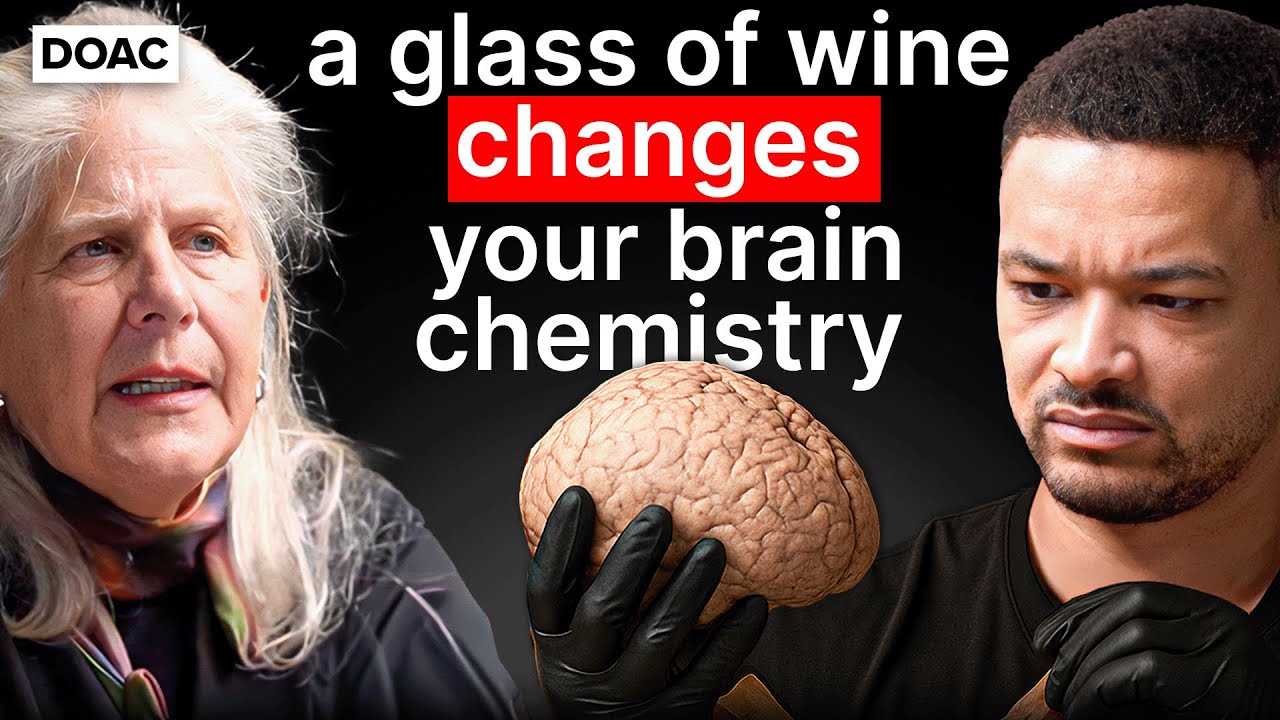
Jill Bolte Taylor Maps Brain Cells to Shift Traumatic Stress Loops
The Diary Of A CEO
Neuroscientists can intentionally reprogram daily mental stress and past emotional trauma by balancing neural networks across four distinct anatomical brain structures.
## Background
This episode was published on YouTube by The Diary Of A CEO (hosted by Steven Bartlett) on November 6, 2025. According to the page description, Harvard neuroscientist Dr. Jill Bolte Taylor discusses how to retrain your brain, heal trauma, control emotions, and understand the 4 Characters running your mind following her eight-year recovery from a severe left-hemisphere stroke.
## TL;DR
Dr. Jill Bolte Taylor presents her 'Whole Brain Living' framework, explaining that human consciousness and personality are divided into four distinct anatomical brain characters across the left and right hemispheres. Drawing from her personal experience of surviving a massive stroke and losing her left brain's ego center, she details how our left hemisphere drives logic, trauma, and societal pressure, while our right hemisphere provides present-moment awareness, playfulness, and unconditional oneness. She shares actionable tools—such as the 90-second rule for emotional processing, eye-gaze hemispheric exercises, and cell-level health practices—to help individuals consciously shift out of anxiety and live a balanced, whole-brain life.
## Atmosphere & style
The conversation carries a profound, awe-inspiring atmosphere that balances high-level medical science with deep human warmth and vulnerability. Dr. Taylor's infectious enthusiasm and dramatic physical demonstrations—such as unboxing a preserved human brain and guiding Steven through eye-filter exercises—create a tangible sense of wonder. The dynamic between Steven's contemplative, analytical questioning and Dr. Taylor's playful yet deeply authoritative cellular perspective makes the episode feel intimate, transformative, and deeply grounding.
## Key takeaways
- [00:00](https://www.youtube.com/watch?v=hQaN5w3YwtM&t=0s) The human brain is structured into four distinct anatomical character structures across two hemispheres, allowing us to consciously choose our mental state rather than living on unconscious reflex.
- [02:00](https://www.youtube.com/watch?v=hQaN5w3YwtM&t=120s) Modern society heavily favors left-brain dominance, driving individualism, ego, overthinking, and trauma responses while underutilizing right-brain connection and present-moment awareness.
- [05:10](https://www.youtube.com/watch?v=hQaN5w3YwtM&t=310s) Because each person carries four internal brain characters, every two-person interaction dynamically involves eight distinct character personalities.
- [09:10](https://www.youtube.com/watch?v=hQaN5w3YwtM&t=550s) Handling an unpreserved living brain reveals its fragile, dense jelly-like consistency, requiring precise fluid pressure regulation across the cranium, chest, and abdomen.
- [15:41](https://www.youtube.com/watch?v=hQaN5w3YwtM&t=941s) Human biology consists of roughly 50 trillion specialized cells that require regular restorative sleep and recovery cycles rather than continuous mechanical pushing.
- [18:51](https://www.youtube.com/watch?v=hQaN5w3YwtM&t=1131s) In 1996, Harvard neuroanatomist Dr. Jill Bolte Taylor experienced a massive left-hemisphere hemorrhagic stroke caused by a ruptured arteriovenous malformation (AVM).
- [23:35](https://www.youtube.com/watch?v=hQaN5w3YwtM&t=1415s) Extracellular blood leaking outside blood vessels acts as a direct toxin to brain cells, shutting down neural pathways and causing sudden motor and language loss.
- [25:15](https://www.youtube.com/watch?v=hQaN5w3YwtM&t=1515s) Losing left-hemisphere function dissolves individual ego boundaries, shifting consciousness into a right-hemisphere state of deep peace, connectivity, and present-moment bliss.
- [38:38](https://www.youtube.com/watch?v=hQaN5w3YwtM&t=2318s) Rebuilding brain pathways after severe neural damage requires years of dedicated neuroplastic adaptation and daily rehabilitation.
- [47:30](https://www.youtube.com/watch?v=hQaN5w3YwtM&t=2850s) The 4 Brain Characters comprise Left Thinker (Character 1 / Helen), Left Emotion (Character 2 / Abby), Right Emotion (Character 3 / Playful), and Right Thinker (Character 4 / Universal Wisdom).
- [51:58](https://www.youtube.com/watch?v=hQaN5w3YwtM&t=3118s) The statistical odds of any individual human being born are astronomically small, stemming from specific cellular development across generations.
- [59:09](https://www.youtube.com/watch?v=hQaN5w3YwtM&t=3549s) Side-specific visual stimulation through opposite retinal pathways can selectively excite specific brain hemispheres to alter mood and focus.
- [01:12:11](https://www.youtube.com/watch?v=hQaN5w3YwtM&t=4331s) Under the 90-Second Rule, physiological emotional reflexes naturally surge and clear out in under 90 seconds unless sustained by repeated linear thinking.
- [01:21:45](https://www.youtube.com/watch?v=hQaN5w3YwtM&t=4905s) Past trauma stored in Character 2 is real biological warning information that can be integrated and self-soothed through Character 4 presence.
- [01:25:44](https://www.youtube.com/watch?v=hQaN5w3YwtM&t=5144s) Prioritizing cellular health requires adequate sleep for microglial waste clearance, balanced hydration, and minimizing pesticides, refined sugar, and alcohol.
## Detailed walkthrough
### [00:00](https://www.youtube.com/watch?v=hQaN5w3YwtM&t=0s) Introduction and the Four Characters of the Brain
The episode opens with an immediate physical display: Dr. Jill Bolte Taylor brings a box containing a preserved human brain complete with its spinal cord to the set. She frames her life's work around a central revelation—that our brains are organized into four distinct anatomical character structures that dictate how we think, feel, and behave. Rather than operating purely on unconscious reflex or being trapped in stress, trauma, and societal conditioning, Dr. Jill argues that we can consciously choose which character to embody at any given moment, effectively taking agency over our own mental health.
```
+-----------------------------------------------------------------------------------+
| THE 4 BRAIN CHARACTERS |
+--------------------------+--------------------------+-----------------------------+
| Character 1: Left Thinker| Character 2: Left Emotion| Character 3: Right Emotion |
| • Analytical & Organized | • Fear & Guardedness | • Playful & Present-Moment |
| • Ego, Identity, System | • Holds Past Trauma | • Experiential & Creative |
+--------------------------+--------------------------+-----------------------------+
| Character 4: Right Thinker |
| • Deep Cosmic Connection |
| • Unconditional Oneness |
+-----------------------------------------------------------------------------------+
```
Dr. Jill explains that modern society overwhelmingly privileges the two left-brain structures—the analytical, ego-driven thinker and the emotionally defensive, past-trauma processor. While these left-hemisphere functions are essential for individual identity and survival, over-relying on them traps us in anxiety, overthinking, and isolation. Healing does not mean erasing our emotional reactions or trying to act like a unfeeling "robot," but rather integrating all four parts to become a fully functional human being. Having lost her left hemisphere to a massive stroke for eight years, she stresses how profoundly precious life is when viewed through the full spectrum of the brain.
* Modern society is heavily skewed toward left-brain dominance, focusing on individualism, control, and societal norms.
* The left emotional system holds past trauma, cravings, and addictive loops designed for survival.
* True mental health comes from learning to shift into self-soothing and right-brain consciousness intentionally.
---
[02:18](https://www.youtube.com/watch?v=hQaN5w3YwtM&t=138s) Understanding Your Brain Will Help Improve Your Life
Dr. Jill shares that her lifelong obsession with neuroscience began in childhood at age five or six, driven by watching her brother develop schizophrenia. Observing how drastically his perception of reality differed from her own transformed her into a young philosopher. She became fascinated by how a biological collection of cells constructs our internal model of reality, wondering how any two human beings can manage to communicate at all when their underlying hardware creates such different personal worlds.
<Image alt="Dr. Jill Bolte Taylor speaking about brain science" caption="Dr. Jill Bolte Taylor on brain consciousness" src="[https://upload.wikimedia.org/wikipedia/commons/thumb/1/18/Jill_Bolte_Taylor_2008.jpg/800px-Jill_Bolte_Taylor_2008.jpg](https://upload.wikimedia.org/wikipedia/commons/thumb/1/18/Jill_Bolte_Taylor_2008.jpg/800px-Jill_Bolte_Taylor_2008.jpg)"/>
Most people navigate life focused entirely on external demands because they lack a biological map for their internal world. Dr. Jill points out that brain cells *are* that roadmap. When we understand how our neural networks function, we stop treating our feelings as random, uncontrollable events and start mastering our mental state.
> "None of us came into this world with a road map about how to get it all right. And the road map is the brain cells. When we understand the brain cells and what they do... then we can manifest our own mental health."
* The diagnosis of her brother's schizophrenia sparked Dr. Jill's early career focus on brain anatomy and perception.
* Understanding brain anatomy bridges the gap between raw biological processes and daily subjective experience.
* Self-directed mental wellness requires recognizing which specific neural networks are firing at any given time.
---
[05:10](https://www.youtube.com/watch?v=hQaN5w3YwtM&t=310s) Can You Choose What Part of Your Brain to Use?
Moving beyond theoretical neuroscience, Dr. Jill explains that every individual shifts between different brain states constantly throughout the day, though usually without realizing it. For instance, when a person is hosting a high-stakes business meeting, they operate out of their left-hemisphere thinking center—focused on metrics, organization, data, and clear boundaries. However, if a puppy suddenly runs into the room, their expression softens instantly, shifting them into a present-moment, right-hemisphere state that feels connected and warm.
The left-thinking brain establishes our sense of individual ego: it knows our name, our phone number, where our skin ends and the outside world begins, and how to follow social rules. By contrast, "flow states"—whether experienced during sports, intimacy, or creative focus—happen when that rigid boundary dissolves, revealing our interconnectedness. Because every human possesses these four distinct internal profiles, any two-person relationship actually involves **eight distinct characters** interacting simultaneously.
> "In every relationship, there's eight of us. Eight very specific personalities in every relationship."
* **Left Hemisphere:** Houses linear logic, language, ego boundaries ("where I begin and end"), and structural planning.
* **Right Hemisphere:** Operates in the present moment ("right here, right now"), embracing vastness, connection, and emotional presence.
* **Relational Dynamic:** Conflict often arises because two individuals bring four internal character archetypes each into every interaction.
---
[09:10](https://www.youtube.com/watch?v=hQaN5w3YwtM&t=550s) A Real Brain with a Spinal Cord
Steven Bartlett puts on protective gloves as Dr. Jill unboxes a rare educational specimen: an intact human brain attached to its full spinal cord, preserved in rubbing alcohol. The donor was a person in their 40s who passed away from brain cancer. Dr. Jill notes that while standard medical dissections separate the brain from the stem, keeping the entire central nervous system intact provides a breathtaking look at how sensory and motor pathways unify the body.
```
+-----------------------------------------------------------------------------------+
| CENTRAL NERVOUS SYSTEM LAYERS |
+--------------------------+--------------------------+-----------------------------+
| Dura Mater | Arachnoid Mater | Pia Mater |
| Tough outer membrane | Web-like middle layer | Delicate inner layer |
| Acts like a "bra" for | Houses fragile, thin | Directly covers the surface |
| holding brain in place | blood vessels | of brain cell tissue |
+--------------------------+--------------------------+-----------------------------+
```
Handling the tissue, Steven describes its density as feeling like "soft, dense tofu," while Dr. Jill compares its texture to a cooked pork roast. She explains that in its living, unpreserved state, fresh brain tissue is far more delicate—resembling a dense jelly that yields easily to touch before springing back into shape.
| Feature / Anatomical Element | Description & Function |
|:--- |:--- |
| **Donor Background** | Individual in their 40s who died of brain cancer; donated specifically for educational dissection. |
| **Preservation Method** | Hydrated in rubbing alcohol / formaldehyde since at least 2008 to fix lipids and lock proteins. |
| **Cauda Equina ("Horse's Tail")** | The bundle of spinal nerves at the base that branch off to control the lower extremities. |
| **Mechanical Fragility** | Living brain tissue relies on precise pressure regulation between the cranium, chest, and abdomen. |
---
[15:41](https://www.youtube.com/watch?v=hQaN5w3YwtM&t=941s) The Central Nervous System and Biological Realities
Holding the brain aloft, Dr. Jill highlights the vast network of nerve roots branching off the spine and the cranial nerves—such as the vagus nerve—that descend from the brainstem to control key organ systems in the abdomen. She cautions against a widespread cultural mistake: viewing the human body as a mechanical computer that can be pushed endlessly without rest.
Unlike an electronic machine that stays on until unplugged, human biology is built out of roughly 50 trillion specialized, living cells that require restorative sleep, healthy pressure regulation, and proper maintenance. Dr. Jill laughs as she recalls her unusual childhood: guided by an aunt who dreamed of being an emergency physician, she was encouraged to collect and dissect roadkill to learn anatomy firsthand—a practice that taught her early on to look past gut reactions of disgust to appreciate biological design.
> "We are this massive conglomeration of 50 trillion molecular geniuses making up our form... We think of ourselves as a machine: push it, push it, push it. You can do that with a computer... We have to go to sleep."
* **Vagus Nerve:** Originates in the brainstem and travels down into the visceral organs to govern autonomic balance.
* **Homeostasis:** Requires balancing intracranial fluid pressure against chest and abdominal pressure systems.
* **Biological Limits:** Unlike machines, cellular health depends on cyclical recovery and sleep to function.
<ElicitationsGroup message="Explore more about Dr. Jill Bolte Taylor's brain model:">
<Elicitation label="Break down the 4 Characters of Whole Brain Living" query="Explain the 4 Characters in Dr. Jill Bolte Taylor's Whole Brain Living model in detail."/>
<Elicitation label="Explain what happens during a left-brain stroke" query="What happens to consciousness when the left hemisphere of the brain experiences a stroke?"/>
</ElicitationsGroup>
[17:03](https://www.youtube.com/watch?v=hQaN5w3YwtM&t=1023s) The Cellular Perspective on Brain Health
Dr. Jill Bolte Taylor describes how people react differently to seeing a real human brain: while some recoil, others—guided by the curiosity of the right hemisphere—are instantly fascinated. Host Steven Bartlett shares that he feels a dual sensation of deep respect for the individual who grew the brain and an overwhelming awe that he carries one inside his own head. Dr. Jill explains that her perspective as a cellular neuroanatomist is fundamentally different. Instead of analyzing brain function through high-level behaviors or neurotransmitter systems alone, she focuses on the raw data of the individual cells.
Dr. Jill outlines her academic lineage, noting that she completed her PhD in neuroanatomy at Indiana State University, conducted her research at the Indiana University School of Medicine, and then moved to Harvard Medical School for two postdocs—one in neurobiology and one in psychiatry. Her primary message centers on cellular stewardship: because our health and abilities depend 100% on the cells making up the nervous system, we must actively care for, feed, and provide for them to live a "whole brain life."
- **Academic Credentials:** PhD in Neuroanatomy from Indiana State University; research at IU School of Medicine; postdocs in Neurobiology and Psychiatry at Harvard Medical School.
- **Core Philosophy:** Human brain health is 100% dependent on the health and maintenance of its underlying individual cells.
---
[18:51](https://www.youtube.com/watch?v=hQaN5w3YwtM&t=1131s) December 10, 1996: The Day the Brain Exploded
Steven transitions to the pivotal moment in Dr. Jill’s life: December 10, 1996—a date roughly four years after Steven was born, when Dr. Jill was 37 years old. The day before, Dr. Jill was actively teaching gross anatomy (cadavers) and histology (tissue) at Harvard Medical School. Upon waking on December 10th, she immediately felt a severe, pulsing, pounding pain behind her left eye. She describes it as a caustic, freezing sensation similar to a severe "brain freeze" from biting into ice cream.
> "My before and after is before and after that morning."
Realizing something was wrong, she tried to shake off the weakness by closing the curtains against the blinding light and stepping onto her "cardio glider" exercise machine. However, as she grabbed the handles, her perception shifted dramatically: she looked at her hands and saw primitive claws, realizing she was detached and witnessing herself having the experience rather than directly living it. Feeling robotic, she walked to the bathroom. Turning on the shower, the sound of water crashing into the tub reverberated inside her head, amplified so intensely that it physically pushed her back against the wall.
---
[21:51](https://www.youtube.com/watch?v=hQaN5w3YwtM&t=1311s) The Neuroanatomist Realizes It Is Life or Death
Because Dr. Jill knew the exact circuitry of the brain, she instantly recognized the danger. Auditory information travels into the ears and descends to the pons and medulla in the brainstem—the critical regions governing respiration, heartbeat, and basic life support. Experiencing severe sound distortion meant her brainstem was directly threatened. At that moment, she realized, "This is a grave problem... this could kill me."
Despite the severity, Dr. Jill dressed mechanically with the intention of going to work. Suddenly, her right arm fell completely paralyzed. Rather than just dropping, she recalls it falling like a heavy, lifeless entity ("bam!"). Instead of panicking, her inner scientist took over: she realized she had a once-in-a-lifetime opportunity as a neuroanatomist to study her own stroke from the inside out. Naively, she thought she would "do this stroke thing for a week or two" and then get back to her job at Harvard.
- **Brainstem Function:** The pons and medulla control essential life-sustaining functions such as respiration.
- **Initial Diagnosis:** Dr. Jill recognized her right-side paralysis as the definitive sign of a left-hemisphere stroke.
---
[23:35](https://www.youtube.com/watch?v=hQaN5w3YwtM&t=1415s) Hemorrhagic Stroke vs. Ischemic Stroke
Dr. Jill clarifies the precise medical mechanics of what was occurring in her head. While most people associate strokes with blood clots (ischemic strokes that block blood flow), she experienced a severe hemorrhagic stroke caused by an arteriovenous malformation (AVM). An AVM is an abnormal connection where a high-pressure artery feeds directly into a low-pressure vein without the protective, single-file buffer of a capillary network.
When the blood vessel exploded, high-pressure arterial blood flooded the extracellular matrix between the brain cells. Dr. Jill stresses that blood outside of blood vessels acts as a direct poison to cellular communication. Over a four-hour period, as the pool of blood expanded, millions of neurons went offline, gradually stripping away her ability to speak, read, write, or recall her past identity.
- **Ischemic Stroke:** Caused by a blood clot blocking blood vessels.
- **Hemorrhagic Stroke:** Caused by a ruptured blood vessel releasing blood directly into brain tissue.
- **Arteriovenous Malformation (AVM):** An abnormal tangle of arterial and venous blood vessels lacking a normal capillary bed.
- **Toxicity of Blood:** Extracellular blood acts as a toxin that halts neural signaling and incapacitates cells.
---
[25:15](https://www.youtube.com/watch?v=hQaN5w3YwtM&t=1515s) Living Without an Ego in the Right Hemisphere
As the hemorrhage incapacitated her left hemisphere, Dr. Jill lost her ego center—the tiny group of cells that preserves personal identity, memories, and language. She compares the sensation to waking up in an unfamiliar hotel room and experiencing a moment of complete blankness before memory kicks in. Over those four hours, she drifted between brief moments of left-hemisphere analytical awareness and long stretches of right-hemisphere consciousness.
In the right hemisphere, she experienced a state of euphoric bliss and peacefulness. Without the left brain's past-and-future chatter, there was no anxiety or self-consciousness—only the present moment. Dr. Jill highlights that core human experiences like joy, unconditional love, and laughter reside entirely in the present moment, which is governed by our right hemisphere.
> "The present moment is a fantastic place. And we are wired to that by literally half our brain."
---
[26:37](https://www.youtube.com/watch?v=hQaN5w3YwtM&t=1597s) Whole Brain Living and Finding the Present Moment
Dr. Jill emphasizes that she isn't advocating for abandoning the left brain, but rather for achieving "Whole Brain Living"—balancing both hemispheres. When Steven shares that he finds meditation difficult because his mind won't stop generating thoughts, Dr. Jill explains that his left-brain language centers and emotional circuits are keeping him trapped in rumination. When she asks Steven what he does for fun, he mentions watching Manchester United play, lifting weights, and getting massages.
Dr. Jill guides Steven through a short visualization exercise: imagining himself on a treadmill at his favorite gym. Steven notes that accessing that mental state instantly brings back feelings of calm, peace, and pure presence. Dr. Jill explains that during a massage or exercise, when we drift into a "fuzzy, middle-ground place" without rigid boundaries, we are actively shifting out of the left brain's ego-driven stress circuits (which trigger cortisol) and tapping into the right brain's experiential presence.
- **Left Hemisphere:** Ego, language, linear time (past/future), analytical thinking, stress responses (cortisol production).
- **Right Hemisphere:** Present-moment awareness, sensory integration, big-picture thinking, bliss, unconditional love.
- **Biological Rhythm:** The human body consists of roughly 50 trillion cells that require alternating periods of action ("push") and rest ("pause") to clear metabolic waste, particularly during sleep.
---
[32:11](https://www.youtube.com/watch?v=hQaN5w3YwtM&t=1931s) The Golden Retriever Phone Call
Returning to the morning of the stroke, Dr. Jill details her grueling 45-minute effort to call for help as her left hemisphere progressively shut down. She could not call 911 because numbers and emergency concepts no longer existed in her mind—just as a complex math problem wouldn't exist until worked out. She compares the loss of language functions to the damage in Broca's area (speech production) and Wernicke's area (language comprehension).
Driven by brief flashes of left-brain clarity, she eventually found her work business card. To dial her office, she had to sit on the floor and manually match the visual "squiggles" on the card to the corresponding shapes on her telephone keypad, failing repeatedly whenever her right brain drifted back into euphoric bliss. When a colleague finally answered, Dr. Jill tried to say, "This is Jill, I need help!" However, due to severe motor and language breakdown, what actually came out was a series of unintelligible grunts: "Woof, woof, woof!"
> "I thought, 'Oh my god, I sound like a golden retriever.' And then he spoke to me and I thought, 'Oh my god, he sounds like a golden retriever.'"
Because Wernicke's area was incapacitated, her colleague's response sounded equally like barking noises. Despite the complete breakdown of language, her colleague recognized her voice tone and realized she was in danger, setting in motion the medical response that ultimately saved her life.
[34:46](https://www.youtube.com/watch?v=hQaN5w3YwtM&t=2086s) The Selfish Left Hemisphere vs. The Universal Right Hemisphere
Dr. Jill Bolte Taylor breaks down how our left brain manages reading, writing, speaking, and speech comprehension—a complex, constantly active area. However, when society values *only* this part of the brain, we end up living by its primary drives: individualism, ego, and a constant craving for "me and mine." Steven Bartlett notes that this aligns with the current spiritual crisis, characterized by rising narcissism, sociopathy, and zero-sum leadership in global politics and economics.
By contrast, the right hemisphere functions strictly in the "right here, right now," operating from a state of deep connection where individual identity dissolves. In this space, humans are equal to all other creatures and natural life on the planet. From the right brain's perspective, humanity is one family bound by love, support, and nurture. When the left brain comes back online, it immediately re-imposes social boundaries, telling us that such open affection is "inappropriate" and enforcing formal social structures, right versus wrong, and individual personal space.
```
+-------------------------------------------------------------------+
| THE TWO HEMISPHERES |
+-------------------------------------------------------------------+
| LEFT HEMISPHERE | RIGHT HEMISPHERE |
| • Me, mine, "I want more" | • Connection & unity |
| • Language, logic, boundaries | • Right here, right now |
| • Formalities & social norms | • Universal human family |
+-------------------------------------------------------------------+
```
- Left-brain language processing involves distinct, highly complex neural circuits for reading, writing, speaking, and listening.
- Left-brain orientation creates spatial separation between bodies and enforces rigid social constructs.
- Right-brain consciousness experiences humanity as an interconnected whole equal to all planetary life.
[36:46](https://www.youtube.com/watch?v=hQaN5w3YwtM&t=2206s) The Hospitalization and the Golf-Ball-Sized Clot
Recalling the onset of her stroke, Dr. Jill describes how a colleague recognized her garbled speech—resembling the sounds of a golden retriever—and came to her home. Because of health insurance restrictions, he had to take her to a specific managed care facility before she was transferred via ambulance to Massachusetts General Hospital. Throughout the journey, she lay curled in a fetal position as her body weakened, wondering how far a person's consciousness could detach from their body before never being able to return. Energetically, she felt expanded to the size of the entire universe.
The brain scan revealed a massive left-hemisphere hemorrhage. Two and a half weeks later, on December 27, surgeons removed a golf-ball-sized blood clot from her brain. When she woke up from surgery with a large scar, her mother rushed to her side, desperately asking her to speak to test if her language cells were still intact. Dr. Jill managed to whisper, "I'm better." By "better," she meant that her inner brightness had returned, and she realized she was still alive.
- Medical transfer route: Home $\rightarrow$ Managed care center $\rightarrow$ Massachusetts General Hospital.
- Surgery date: December 27, two and a half weeks after the stroke.
- Physical damage: Removal of a golf-ball-sized blood clot caused by a major left-hemisphere hemorrhage.
- First words post-surgery: Whispered "I'm better" to her mother.
[38:38](https://www.youtube.com/watch?v=hQaN5w3YwtM&t=2318s) An Infant in a 37-Year-Old Body: Rebuilding Life from Scratch
Dr. Jill explains that surviving the stroke gave her immense joy, completely overshadowing her profound physical and mental deficits. At age 37, she was reduced to an infant in an adult body—unable to walk, talk, read, write, or recall any of her past memories. She had completely fallen off the "Harvard ladder," but none of that mattered compared to the sheer gift of being alive. She emphasizes that mental health is 100% dependent on brain health, which is in turn 100% dependent on the health of individual brain cells.
Reflecting on her recovery with deep awe and wonder, Dr. Jill expresses excitement for the miracle of human existence—having eyes that see, ears that hear, a digestive system, manual dexterity, and mobility. She spent eight years rebuilding her brain's circuits day by day, breath by breath, using her functioning right hemisphere to re-establish her left-brain capabilities. It took her four full years just to comprehend what the number "1" represented. Because her original identity died the day of the stroke, she never forced herself to become the person she was before.
- Age at time of stroke: 37 years old.
- Total recovery duration: 8 years of continuous, daily rehabilitation.
- Timeline for basic math concepts: 4 years to understand the numerical concept of "1."
- Teaching background: Gross anatomist who taught cadaver labs, using three-dimensional spatial learning (a right-brain skill) alongside factual details (a left-brain skill).
[44:43](https://www.youtube.com/watch?v=hQaN5w3YwtM&t=2683s) Evolutionary Brain Structures and Threat Detection
Explaining the physical structure of the brain, Dr. Jill outlines its evolutionary hierarchy. Starting from simple spinal cords found in organisms like worms, evolution added the medulla, the pons, and the cerebellum. The cerebellum contains unique, two-dimensional Purkinje cells that align like a fan with fibers passing through them, controlling timing and fluidity of movement. Higher up, the mammalian brain introduced the hippocampus (responsible for learning and memory) and the amygdala (responsible for threat detection).
Humans possess two amygdalae and two hippocampi—one set in each hemisphere. The right amygdala monitors immediate environmental safety ("Am I safe right here, right now?"), causing us to startle at sudden threats like a snake. The left amygdala handles conceptual threat detection. When the amygdalae feel completely safe, the anterior cingulate gyrus allows the brain to focus, learn, and absorb new information.
- Purkinje cells: Two-dimensional, hand-shaped cells in the cerebellum organized in precise layers to coordinate smooth physical movement.
- Amygdala function: Continuous scanning for safety and environmental threat detection.
- Anterior cingulate gyrus: Enables focused learning and attention once the amygdala determines the environment is safe.
[47:30](https://www.youtube.com/watch?v=hQaN5w3YwtM&t=2850s) The Brain's 4 Characters: Characters 1, 2, and 3 Introduced
Dr. Jill introduces her framework of the "4 Characters" residing within the brain's two emotional and two thinking systems. The left hemisphere contains both an emotional center and a thinking center that operate across linear time, storing trauma and housing addiction—specifically in the insular cortex, where cravings originate. The thinking center houses executive function and the ego center in the prefrontal region, which defines individual identity, language, mathematics, and motor control.
```
+-------------------------------------------------------------------+
| THE 4 BRAIN CHARACTERS |
+-------------------------------------------------------------------+
| CHARACTER 1: Left Thinking | CHARACTER 2: Left Emotion |
| • "Helen" (Organized, A-Type) | • "Abby" (Past pain & trauma) |
| • Facts, logic, right/wrong | • Reactivity, protection |
+---------------------------------+---------------------------------+
| CHARACTER 3: Right Emotion | CHARACTER 4: Right Thinking |
| • Experiential, sensory awareness| • Universal consciousness |
| • Present moment, playfulness | • Deep peace & connection |
+-------------------------------------------------------------------+
```
She assigns names and distinct traits to these functional regions to make them easy to identify:
- **Character 1 (Left Thinking):** Dr. Jill names her own Character 1 "Helen" ("Hell on wheels"). This is the organized, A-type personality that gets things done, manages facts, details, language, and moral judgments, allowing us to function in workplace and social structures. The outer layer, the cerebral cortex, primarily consists of six complex layers of cells (and four layers in sensory regions).
- **Character 2 (Left Emotion):** Dr. Jill names her Character 2 "Abby." This character holds past emotional pain, trauma, and anxiety. It is constantly running in the background, looking for reasons to reactively protect us based on past experiences.
- **Character 3 (Right Emotion):** This character is purely experiential and present-moment focused. It processes physical sensations—such as the temperature of the air, the feel of clothing on skin, or the rhythm of the breath during meditation.
> "I call left thinking Character 1, and I actually give that part of my brain a name—I call her Helen, 'Hell on wheels.' She gets it done... She's giving you facts and details, she is all about what is right and wrong and good and bad."
- Insular cortex: Located in the left hemisphere's limbic system; responsible for generating cravings associated with addiction.
- Prefrontal region & orientation association area: Create the sense of individual ego ("me"), defining physical boundaries and self-identity.
- Cerebral cortex structure: Composed of six cell layers across most regions, reduced to four layers in specialized sensory processing areas.
<FollowUp label="Want to explore how to shift between these 4 Characters?" query="How do you actively shift between the 4 Characters according to Dr. Jill Bolte Taylor?"/>
[51:58](https://www.youtube.com/watch?v=hQaN5w3YwtM&t=3118s) The Four Characters of the Brain and the Cosmic Odds of Existing
Dr. Jill Bolte Taylor breaks down how the brain operates through four distinct "characters" or internal personalities. While Character 1 provides structure and Character 2 houses our past emotional wounds, Character 3 represents the playful, experiential, and curious young emotional energy within us. Because humans are fundamentally feeling creatures who happen to think, Character 3 can sometimes get us into trouble when it acts on impulse without considering consequences—like deciding to jump into a neighbor's pool at 3:00 AM. In contrast, Character 4 represents our right-brain thinking and deep wisdom. This part of the brain utilizes neuroplasticity—the ability of neurons to constantly form new real-time connections—to integrate our experiences and connect with a sense of universal peace and awe.
```
+-----------------------------------------------------------------------+
| THE 4 BRAIN CHARACTERS |
+-----------------------------------+-----------------------------------+
| LEFT HEMISPHERE | RIGHT HEMISPHERE |
| (Structure & Ego) | (Experiential & Connected) |
+-----------------------------------+-----------------------------------+
| Character 1: Rational / Thinking | Character 4: Universal / Wisdom |
| • Logic, organization, schedule | • Deep peace, awe, neuroplasticity|
| • "Me" focus, boundary box | • "We" focus, cosmic connection |
+-----------------------------------+-----------------------------------+
| Character 2: Emotional / Reactive | Character 3: Playful / Experiential|
| • Past pain, grudges, fear | • Present moment, curiosity, fun |
| • Threat detection, defensiveness | • Impulse (e.g., 3 AM pool jump) |
+-----------------------------------+-----------------------------------+
```
Dr. Taylor explains that society is currently heavily skewed toward left-brain individualism ("me, me, me"), driven by fear and division. To counteract this, we can tap into Character 4 by appreciating the miraculous statistical odds of our individual existence. She describes how the tiny egg cell that became you differentiated during the fifth week of your mother’s gestation inside your grandmother’s womb. That egg cell witnessed your mother's entire life—her birth, toddler years, and puberty—before being selected out of roughly 400,000 egg cells (and only ~500 menstrual cycles) to begin its journey down the fallopian tube. Combined with the precise sperm cell among millions, that single fertilized cell multiplied at an astonishing rate of 250,000 new cells per second to build a human body composed of trillions of cells.
Dr. Taylor becomes visibly emotional when reflecting on this miracle, emphasizing that recognizing our shared, fragile existence makes it clear that our ultimate job on Earth is to love, support, and nurture each other and our planet.
* **Neuroplasticity in Action:** It took Dr. Taylor eight full years of intensive neuroplasticity to rebuild her brain’s skill sets after her stroke.
* **Cellular Multiplication:** During fetal development, cells multiply at a rate of 250,000 new cells per second, eventually forming approximately 50 trillion cells.
* **Ovarian Reserve:** A woman is born with around 400,000 egg cells, of which only about 500 mature and ovulate over a lifetime.
---
[59:09](https://www.youtube.com/watch?v=hQaN5w3YwtM&t=3549s) Visual Stimulation Demonstration and Hemisphere Switching
To demonstrate the distinct neurological functions of the left and right hemispheres, Dr. Taylor has Steven put on a pair of specialized glasses with flip-up lateral panels. She explains the underlying optic neuroanatomy: light coming from the lateral (outer) visual field hits the medial (inner) side of the retina at the back of the eyeball. From there, the nerve fibers cross over at the optic chiasm to directly stimulate the opposite hemisphere of the brain.
When Steven flips up the right panel, lateral light stimulates the medial retina of his right eye, which sends signals straight to his left hemisphere. When asked how he feels, Steven immediately notes that he feels focused, analytical, and ready to perform his duties as a podcast host. Dr. Taylor then has him reset in the dark before flipping up the left panel, which selectively sends photons to his right hemisphere. Immediately, Steven feels his entire body calm down, remarking that he feels "way more relaxed," as if lying low on a sun lounger.
When Steven questions whether this stark shift in mood and focus could simply be a placebo effect, Dr. Taylor clarifies that this is grounded in hard neuroanatomy and peer-reviewed research. She points to work conducted at Harvard Medical School by researchers like Dr. Martin Teicher and psychiatrist Dr. Frederick Schiffer. Dr. Schiffer has long utilized side-specific visual stimulation in psychiatric treatment to help patients recognize how different sides of their brain harbor different emotional states, using the healthier, calmer hemisphere to help heal the troubled one.
* **Anatomical Mechanics:** Light entering the lateral visual field strikes the medial retina, crossing over to preferentially excite the contralateral (opposite) cerebral hemisphere.
* **Harvard Research:** Studies using fMRI and targeted light manipulation confirm that selectively stimulating specific retinal pathways alters hemispheric dominance and emotional state.
---
[01:05:07](https://www.youtube.com/watch?v=hQaN5w3YwtM&t=3907s) Practical Exercises for Navigating Your Inner Characters
Steven asks how one can actively train the brain to shift between these four characters without needing specialized optical glasses. Dr. Taylor explains that balancing the brain is a daily conscious practice, beginning with self-observation. The first step is to recognize which character is running the show at any given moment. For instance, Character 1 is the organized, controlling boss making to-do lists at work. Character 2 is the defensive, hurt part that holds grudges and gets angry. Character 3 is the spontaneous, joyful inner child, and Character 4 is the serene, compassionate witness.
> "When you love one another and we support one another and we encourage one another, we all grow and we will benefit as humanity."
To illustrate how easily simple environmental cues can activate Character 3, Dr. Taylor shares a story about working with emergency room physicians—a group facing extraordinarily high rates of severe stress and suicide due to constant pressure to remain in a rigid, analytical Character 1 state. She suggested drawing a simple hopscotch grid in chalk outside the ER entrance. Medical professionals walking in and out naturally began hopscotching, instantly interrupting their stress loop and inviting a moment of pure, playful glee back into their grueling workday. She emphasizes that we must intentionally schedule time for play and defend it when Character 1 tries to lecture us that "we don't have time."
[01:08:42](https://www.youtube.com/watch?v=hQaN5w3YwtM&t=4122s) Balancing the Four Characters and Cultivating Gratitude
Dr. Jill Bolte Taylor explains the dynamics between the brain's internal characters during high-pressure situations. When the deadline-driven Character 1 insists on relentlessly pushing forward, Character 3 steps in as a essential pause to refuel the spirit, release stress, and unleash endorphins. By taking this mental break rather than grinding through linear tasks, a person can return to their work with significantly greater creativity and openness. While humans are naturally wired with all four brain characters, society often conditions people to operate with only one conscious character online at a time.
She emphasizes that tapping into Character 4 allows for an immediate experience of deep gratitude and awe. Simply contemplating our place in the universe—standing on a rock spinning through space—can instantly shift a person's perspective toward cosmic wonder. Recognizing that life could end at any second makes the present moment feel like a gift and a celebration, transforming daily existence into a play-filled experience.
---
[01:10:07](https://www.youtube.com/watch?v=hQaN5w3YwtM&t=4207s) Sponsor Break: 1Password and Function Health
Steven Bartlett takes a brief break to discuss key security and health practices with his podcast team. He recounts a past corporate data breach nightmare to highlight the importance of 1Password's Enterprise Password Manager (EPM). This tool proactively alerts teams if credentials are compromised and helps organizations transition toward passkeys, eliminating traditional passwords altogether.
Bartlett then shares insights from his book *The Diary of a CEO: 33 Laws of Business and Life*, specifically focusing on prioritizing health as a foundational requirement for success. He introduces Function Health, a membership offering over 100 comprehensive lab tests spanning hormones, toxins, inflammation, and heart health. Members receive personalized, doctor-backed insights to track their long-term health trajectory effectively.
* **1Password Offer:** Access via `[onepass.com/doac](https://onepass.com/doac)` for enterprise password security solutions.
* **Function Health Offer:** Code `DOAC100` provides a $100 credit toward membership at `[functionhealth.com/doac](https://functionhealth.com/doac)`.
---
[01:12:11](https://www.youtube.com/watch?v=hQaN5w3YwtM&t=4331s) The 90-Second Rule of Emotional Processing
Dr. Taylor introduces the "90-Second Rule," revealing that physiological emotional responses naturally last less than a minute and a half in the body. At any given instant, the brain performs three core functions: thinking thoughts, feeling emotions, and running physiological loops tied to those thoughts and feelings. When an emotional trigger occurs—such as thinking of someone who caused anger—the brain initiates an emotional reflex that surges through the nervous system and naturally dissipates in under 90 seconds. If an emotion persists longer, it is because the person is actively re-thinking the thought, repeatedly re-triggering the chemical cascade.
Instead of fighting or suppressing negative feelings like anger or grief, Dr. Taylor advocates for fully embracing and celebrating them as proof of human capacity. Experiencing anger establishes essential boundaries, while allowing deep grief honours the love shared with someone who is passing away. Surrendering to intense weeping or anger without judgment allows individuals to live as whole human beings rather than emotional "robots."
> "From the moment you think a thought... we think thoughts, we feel emotions, and we run physiological loops to what we're thinking and feeling... It's an emotional reflex, less than 90 seconds."
---
[01:14:48](https://www.youtube.com/watch?v=hQaN5w3YwtM&t=4488s) Human Connection, Whole Brain Evolution, and AI
Following a moment of silent, genuine connection between Dr. Taylor and Bartlett, Dr. Taylor explains why she expressed gratitude. Deep, unhurried human connection is increasingly rare, as people often pull away out of discomfort after just a few seconds. She argues that humanity's next evolutionary step requires "waking up the whole brain." Operating from a whole-brain perspective renders hatred, division, and war fundamentally unacceptable, replacing systemic violence with mutual safety and unity.
Addressing concerns about artificial intelligence, Dr. Taylor expresses complete optimism derived from her right hemisphere's capacity for hope and possibility. Viewed through a neuroanatomical lens, she perceives the internet as a burgeoning collective consciousness. Although humanity is creating independent digital entities and AI systems that cannot be fully controlled—much like nuclear codes—her whole-brain integration allows her to focus on daily wonder and living in alignment with nature rather than fear.
* **Human Connection:** Real connection goes beyond superficial interactions, helping ground human relationships in empathy rather than judgment.
* **Whole Brain Evolution:** Activating all four characters dissolves ideological division and systemic conflict.
* **Perspective on AI:** Reframing technological disruption through neuroanatomy helps maintain hope and presence instead of anxiety over control.
---
[01:17:44](https://www.youtube.com/watch?v=hQaN5w3YwtM&t=4664s) Life After the Stroke: Freedom from the Box
Reflecting on her journey, Dr. Taylor shares how her 1996 stroke dismantled her former identity. Prior to the stroke, she was a ambitious Indiana native climbing the academic ladder at Harvard Medical School, deeply invested in status, money, and rigid definitions of right and wrong. Losing her left hemisphere's linear control "set her free" from living according to society's expectations. Today, she balances her work with time spent living on a boat in a remote cove, surrounded by wildlife like bears, deer, and bobcats, refusing to hustle or solicit business.
When Bartlett asks what would happen if his own Character 1 (the driven, business-minded persona) went offline, he realizes that his relationships with his partner and his dog would likely deepen due to his newfound presence. Dr. Taylor notes that when the relentless internal drive shuts down, people are forced to discover intrinsic value beyond external achievements and productivity loops.
> "Having the stroke set me free. It set me free from having to live a life based on other people's expectations about what my life should be."
---
[01:21:45](https://www.youtube.com/watch?v=hQaN5w3YwtM&t=4905s) Neurological Healing and Reframing Past Trauma
Dr. Taylor breaks down how to heal past trauma from a brain-based perspective, emphasizing that healing does not mean erasing history. Trauma is real, valid information generated by Character 2 to keep a biological creature safe. However, when a person continually rumiates on past pain, they strengthen those neural circuits, turning a protective alert system into an automatic, anxious lifestyle that views every new situation through a lens of past threat.
To break this pattern, a person must use their right hemisphere to examine present circumstances with curiosity rather than fear. For instance, if someone encounters a person who resembles a past abuser, Character 2 may trigger a self-protective instinct; however, Character 4 can step in to observe the present moment, recognize that the new person is distinct, and self-soothe the nervous system. By acknowledging trauma's original protective intent, thanking it, and offering internal love, trauma shifts from a limiting lifestyle back into simple, useful information.
* **Purpose of Trauma:** Serves as a biological warning system meant to keep a person safe, not an identity to inhabit long-term.
* **Neuroplasticity of Pain:** Repeatedly running traumatic thoughts strengthens those neural pathways, making anxiety an automatic default.
* **Character 4 Intervention:** Uses self-soothing language ("You're loved, you're okay, thank you for this information") to reassure Character 2 and integrate the experience.
[01:24:44](https://www.youtube.com/watch?v=hQaN5w3YwtM&t=5084s) Processing Trauma and Reframing Your Story
Dr. Jill Bolte Taylor emphasizes that emotional trauma must be acknowledged, held, and heard before it can transform into an attitude of acceptance. Reflecting on her own life-altering experience, she notes that even after a massive stroke that almost killed her, she carries no resentment. She views it simply as her unique life story, pointing out that everyone has one, and questions the logic of draining energy into past grievances when endless other possibilities exist.
If someone has faced severe harm or trauma, Dr. Taylor suggests channeling that anger into positive action and advocacy. For instance, a survivor of an assault could help organize self-defense classes for women, effectively "making lemonade out of lemons." She asserts that human beings are neurologically wired to adapt and turn adversity into purpose.
- Pain and trauma require being heard and felt before healing can occur.
- Holding onto resentment diverts precious energy away from new life possibilities.
- Personal anger can be transformed into advocacy and community support.
---
[01:25:44](https://www.youtube.com/watch?v=hQaN5w3YwtM&t=5144s) Cellular Health: Sleep, Nutrition, and Hydration
Shifting the conversation to optimal brain health at the cellular level, Dr. Taylor identifies sleep as the absolute top priority. The brain consists of roughly 80 to 100 billion neurons that continuously consume energy and generate metabolic waste just to maintain basic consciousness and moment-to-moment interactions. During sleep, microglia clean up this cellular garbage, allowing a person to wake up feeling fresh and mentally clear.
Regarding nutrition, Dr. Taylor warns against processed foods containing preservatives, humorously noting that eating preservatives isn't going to preserve your health. She advises prioritizing fresh fruits and vegetables while avoiding pesticides, which act as poisons to the nervous system. While acknowledging her own weakness for dark chocolate—playfully rationalizing that since it comes from a bean, it's practically a vegetable—she firmly states that refined sugar is unhealthy. Additionally, proper hydration is essential because body cells and extracellular spaces are primarily water; however, overhydrating should be avoided as it dilutes key cellular electrolytes.
- **Sleep:** Allows microglia to clear metabolic waste from billions of active brain cells.
- **Nutrition:** Eat fresh fruits and vegetables; avoid pesticides, preservatives, and refined sugar.
- **Dark Chocolate:** Dr. Taylor jokes, "Dark chocolate. It's a bean. It's a vegetable. Somebody said that to me once and I believed him."
- **Hydration:** Cells depend on a delicate fluid balance, making proper hydration crucial without overdoing it.
---
[01:27:30](https://www.youtube.com/watch?v=hQaN5w3YwtM&t=5250s) Movement, Music, and Character 3 Playfulness
Dr. Taylor stresses that human beings are integrated biological organisms, not just brains being carried around by bodies. To illustrate how to break out of left-brain overthinking (Character 1) and engage the playful right-brain energy (Character 3), she asks host Steven Bartlett to name a song that instantly makes him want to move.
After Steven hesitatingly mentions Olivia Dean's song "Man I Need," Dr. Taylor demonstrates her own favorite disco vibe by singing "I want some hot stuff, baby!" and dancing. She explains that letting go, dancing like nobody is watching, and entering Character 3 provides an essential pause from mental strain, bringing fun, present-moment connection, and joy into daily life.
- **Movement:** Physical movement helps shift the brain out of analytical thinking and into body awareness.
- **Character 3 Engagement:** Spontaneous dancing and music provide a mental pause that supports overall cellular and emotional health.
---
[01:29:59](https://www.youtube.com/watch?v=hQaN5w3YwtM&t=5399s) Learning, Alcohol, and Mindful Presence
When asked about learning new skills, Dr. Taylor explains how it engages different neural networks. Taking up a sport like tennis starts in the left-hemisphere Character 1, which plans the mechanics—how to hold the racket and swing. With enough repetition, the movement becomes second nature, allowing the brain to drop back into Character 3 fun and embodied play.
Addressing alcohol, Dr. Taylor warns of its destructive impact on cells. Alcohol dehydrates brain cells, making their delicate cell membranes fragile until they eventually break down and die. Turning to societal pressures, she notes that left-hemisphere Character 2 is where cravings, comparison, and insecurity thrive—often exacerbated by social media. Rather than escaping through poor choices or addictions, she urges people to take responsibility for the energy they bring into a room and show up as a whole person.
- Learning a new skill moves from structured left-brain execution to fluid, right-brain enjoyment.
- Alcohol dehydrates brain cells and damages cell membranes, leading to cell death.
- Social media comparison feeds left-brain Character 2 insecurities, increasing susceptibility to unhealthy cravings.
---
[01:32:08](https://www.youtube.com/watch?v=hQaN5w3YwtM&t=5528s) The 30-Second Rule and Handling Unmet Expectations
For her closing message, Dr. Taylor offers a simple practical rule: "Your life is worth 30 seconds." She explains this literally using the example of driving—rather than frantically squeezing into traffic between two oncoming cars, driver safety and mental peace are worth taking a 30-second pause to take a breath and slow down.
Closing the episode with the traditional podcast question from the previous guest—"What do you do when your life doesn't turn out the way that you had hoped?"—Dr. Taylor responds with immediate right-hemisphere positivity. She lightheartedly replies, "I thank the universe that option wasn't for me. Next!" She notes that when plans fail, it simply means something better is on the way, or it's a great excuse to go paddleboarding.
- **The 30-Second Rule:** Taking a physical 30-second pause in stressful situations can protect your safety and well-being.
- **Handling Disappointment:** Dr. Taylor reframes unexpected life turns as the universe redirecting her toward better outcomes.
- "I thank the universe that option wasn't for me. Next!... Something better is on its way or I'm going to go paddleboard."
## Notable quotes
> [02:18](https://www.youtube.com/watch?v=hQaN5w3YwtM&t=138s) None of us came into this world with a road map about how to get it all right. And the road map is the brain cells. When we understand the brain cells and what they do... then we can manifest our own mental health. — Dr. Jill Bolte Taylor
> [05:10](https://www.youtube.com/watch?v=hQaN5w3YwtM&t=310s) In every relationship, there's eight of us. Eight very specific personalities in every relationship. — Dr. Jill Bolte Taylor
> [15:41](https://www.youtube.com/watch?v=hQaN5w3YwtM&t=941s) We are this massive conglomeration of 50 trillion molecular geniuses making up our form... We think of ourselves as a machine: push it, push it, push it. You can do that with a computer... We have to go to sleep. — Dr. Jill Bolte Taylor
> [18:51](https://www.youtube.com/watch?v=hQaN5w3YwtM&t=1131s) My before and after is before and after that morning. — Dr. Jill Bolte Taylor
> [25:15](https://www.youtube.com/watch?v=hQaN5w3YwtM&t=1515s) The present moment is a fantastic place. And we are wired to that by literally half our brain. — Dr. Jill Bolte Taylor
> [32:11](https://www.youtube.com/watch?v=hQaN5w3YwtM&t=1931s) I thought, 'Oh my god, I sound like a golden retriever.' And then he spoke to me and I thought, 'Oh my god, he sounds like a golden retriever.' — Dr. Jill Bolte Taylor
> [47:30](https://www.youtube.com/watch?v=hQaN5w3YwtM&t=2850s) I call left thinking Character 1, and I actually give that part of my brain a name—I call her Helen, 'Hell on wheels.' She gets it done... She's giving you facts and details, she is all about what is right and wrong and good and bad. — Dr. Jill Bolte Taylor
> [01:05:07](https://www.youtube.com/watch?v=hQaN5w3YwtM&t=3907s) When you love one another and we support one another and we encourage one another, we all grow and we will benefit as humanity. — Dr. Jill Bolte Taylor
> [01:12:11](https://www.youtube.com/watch?v=hQaN5w3YwtM&t=4331s) From the moment you think a thought... we think thoughts, we feel emotions, and we run physiological loops to what we're thinking and feeling... It's an emotional reflex, less than 90 seconds. — Dr. Jill Bolte Taylor
> [01:17:44](https://www.youtube.com/watch?v=hQaN5w3YwtM&t=4664s) Having the stroke set me free. It set me free from having to live a life based on other people's expectations about what my life should be. — Dr. Jill Bolte Taylor
> [01:25:44](https://www.youtube.com/watch?v=hQaN5w3YwtM&t=5144s) Dark chocolate. It's a bean. It's a vegetable. Somebody said that to me once and I believed him. — Dr. Jill Bolte Taylor
> [01:32:08](https://www.youtube.com/watch?v=hQaN5w3YwtM&t=5528s) I thank the universe that option wasn't for me. Next!... Something better is on its way or I'm going to go paddleboard. — Dr. Jill Bolte Taylor
## Mentioned
Dr. Jill Bolte Taylor, Steven Bartlett, The Diary Of A CEO, Harvard University, Harvard Medical School, Indiana State University, Indiana University School of Medicine, Massachusetts General Hospital, My Stroke of Insight, Whole Brain Living, Dr. Martin Teicher, Dr. Frederick Schiffer, Manchester United, Olivia Dean, 1Password, Function Health, The Diary of a CEO: 33 Laws of Business and Life
Neuroanatomist Dr. Jill Bolte Taylor argues that human consciousness is structured across four distinct anatomical character networks within the two cerebral hemispheres. Rather than remaining trapped in automatic left-brain anxiety and social conditioning, individuals can consciously choose which neural circuits to embody, achieving emotional regulation through intentional whole-brain integration.
The Four Characters of Brain Anatomy (0:00)
Dr. Taylor defines brain function through four distinct character structures divided between the left and right hemispheres. Character 1 (left thinking) is analytical, organized, and detail-oriented, establishing ego boundaries, language, and social rules. Character 2 (left emotion) operates across linear time, storing past pain, trauma, and cravings within the insular cortex while generating defensive reactivity. In contrast, Character 3 (right emotion) exists entirely in the immediate present, processing real-time sensory inputs through play, impulse, and experiential curiosity. Character 4 (right thinking) connects to deep wisdom, neuroplasticity, and a sense of cosmic oneness.
According to Dr. Taylor, modern culture over-relies on left-hemisphere functions, leaving individuals isolated in rumination and stress. Because every person possesses these four internal profiles, she notes that any interpersonal relationship actually involves eight distinct characters interacting simultaneously, often leading to conflict when individuals operate from mismatched neural states.
Hemispheric Asymmetry and the Stroke Experience (23:35)
Dr. Taylor's perspective is anchored in her experience surviving a severe hemorrhagic stroke on December 10, 1996, at age 37, caused by a ruptured arteriovenous malformation (AVM). Over four hours, high-pressure arterial blood flooded her left hemisphere, shutting down Broca's and Wernicke's speech areas, mathematics, and personal memories. With her left-brain ego offline, she experienced profound euphoric bliss and interconnectedness driven entirely by her intact right hemisphere, perceiving herself as expanded beyond bodily boundaries.
Two and a half weeks after the stroke, surgeons removed a golf-ball-sized blood clot from her brain. Dr. Taylor spent eight years rebuilding her left-hemisphere capabilities through neuroplasticity, taking four full years simply to comprehend the numerical concept of "1." She maintains that this acute loss proved that inner peace, joy, and unconditional connection are not abstract spiritual states, but biological capacities wired directly into the right hemisphere.
The 90-Second Rule and Trauma Reframing (72:11)
Dr. Taylor introduces the "90-Second Rule," asserting that physiological emotional responses naturally surge and dissipate through the nervous system in less than a minute and a half. When feelings like anger or anxiety persist longer, it is because an individual is actively re-thinking the thought that triggered the physiological cascade, continuously re-stimulating the loop. She argues that emotional reflexes should be embraced rather than suppressed, as anger establishes boundaries and grief honors relational love.
To heal trauma, Dr. Taylor emphasizes that past pain must not be transformed into a permanent identity. Trauma functions as legitimate biological information generated by Character 2 to ensure physical safety. By using the present-moment awareness of Character 4, an individual can acknowledge Character 2's protective warnings with gratitude, soothe the physiological alarm, and reframe the narrative toward purpose and community advocacy rather than remaining trapped in chronic defensiveness.
Cellular Stewardship and Restorative Habits (85:44)
Viewing health through cellular neuroanatomy, Dr. Taylor stresses that human well-being depends entirely on the condition of roughly 50 trillion body cells and 80 to 100 billion neurons. She cautions against treating biology like an unyielding machine, identifying sleep as the paramount health requirement because it allows microglia to clear metabolic waste accumulated during waking hours. Nutritional recommendations include whole foods while avoiding preservatives, pesticides, refined sugars, and excessive alcohol, which dehydrates brain cells and damages cellular membranes.
To balance analytical fatigue, Dr. Taylor recommends intentionally triggering Character 3 through spontaneous movement, dancing, and play to release endorphins and reset focus. Furthermore, she introduces practical behavioral interruptions—such as taking a 30-second physical pause in high-stress situations like heavy traffic—to calm autonomic tension, protect safety, and prevent knee-jerk left-brain reactivity.
Dr. Taylor concludes that humanity's ongoing development requires "Whole Brain Living," balancing analytical productivity with right-brain empathy to reduce division. While she acknowledges that shifting away from conditioned left-brain dominance requires deliberate daily training, she argues that framing life's unmet expectations with curiosity and maintaining basic cellular care allows individuals to actively direct their own mental health.
## Background
本期内容由知名播客频道 The Diary Of A CEO 于 2025 年 11 月 6 日在 YouTube 平台发布。节目特邀哈佛神经解剖学家吉尔·博尔特·泰勒博士(Dr. Jill Bolte Taylor),结合其经历左脑大面积中风并历经 8 年康复的非凡遭遇,深入拆解人类大脑的四大内在人格角色,分享如何走出焦虑牢笼、重塑大脑回路并疗愈过往创伤。
## TL;DR
泰勒博士在现场展示了一具真实的带脊髓人类大脑标本,从解剖学视角剖析了大脑如何构建现实感知,并揭示现代社会过度偏向左脑导致的焦虑与失衡。她将大脑心智拆解为四个解剖学角色:左脑思维(控制与规划)、左脑情绪(创伤与成瘾)、右脑情绪(当下感官与玩心)以及右脑思维(智慧与万物合一)。通过亲身经历的中风濒死体验与“90秒情绪法则”,她阐明情绪在生理上仅持续 90 秒,久陷痛苦源于思维的不断重播反刍。观众能够学会通过自我觉察、物理减速与全脑协同,主动切换脑区状态,在繁忙现代生活中重拾内在平静与生命的敬畏感。
## Atmosphere & style
整场对话在严谨硬核的神经解剖学与充满灵性温情的生命叙事之间完美游走。当真实的带脊髓人脑标本呈现在桌前时,演播室内弥漫着震撼与敬畏的张力;主持人史蒂文在亲手触摸标本与佩戴分侧眼镜时的紧张好奇,与泰勒博士爽朗、通透且充满感染力的笑声形成了极具张力的互动共鸣。从左脑崩溃时濒死失语的惊心动魄,到谈及母亲胚胎中卵细胞奇迹时的动容哽咽,整场访谈如同一场打破思维牢笼的心灵洗礼,带给观众无与伦比的深层触动与释怀感。
## Bulletin
- [00:00](https://www.youtube.com/watch?v=hQaN5w3YwtM&t=0s) 人类大脑由四个截然不同的解剖与人格模块(左脑思维、左脑情绪、右脑情绪、右脑思维)构成,个体可通过有意识的神经觉察摆脱单一脑区的自动化劫持,主动选择心智存在状态。
- [01:12:11](https://www.youtube.com/watch?v=hQaN5w3YwtM&t=4331s) 情绪在纯生理机制上的生化循环仅维持 90 秒,现实中持续数小时乃至整天的负面情绪本质上是由于左脑对叙事的反复反刍与回路重启所致。
- [47:30](https://www.youtube.com/watch?v=hQaN5w3YwtM&t=2850s) 左脑情绪系统封存着线性时间中的创伤与成瘾渴求(岛叶皮层),而右脑专注于此时此刻的整体感知与深度平静,具备超越孤立个体的神经可塑性与宏观智慧。
- [01:25:44](https://www.youtube.com/watch?v=hQaN5w3YwtM&t=5144s) 哈佛神经科学家吉尔·泰勒博士通过历经 8 年的中风康复实证提出,深度睡眠是胶质细胞清洗代谢毒素的生理基石,人脑需在左脑的“推进”与右脑的“暂停”之间维持动态平衡。
## Key takeaways
- [04:03](https://www.youtube.com/watch?v=hQaN5w3YwtM&t=243s) 现代社会过度推崇负责逻辑、规划与个体边界的左脑思维(角色一),忽视了右脑的当下感知与连接,导致普遍的心理失衡与精神内耗。
- [44:43](https://www.youtube.com/watch?v=hQaN5w3YwtM&t=2683s) 左右脑各拥有一套独立的杏仁核与海马体,右脑情绪负责当下环境的即时生存探测,而左脑情绪则沉淀了过去的创伤、恐惧与防御机制(角色二)。
- [47:30](https://www.youtube.com/watch?v=hQaN5w3YwtM&t=2850s) 成瘾的生物学机制(渴求)主要栖息在左脑边缘系统的岛叶皮层,左脑的时间认知将痛苦记忆转化为长期焦虑与戒备。
- [48:30](https://www.youtube.com/watch?v=hQaN5w3YwtM&t=2910s) 大脑四大角色包括:左脑思维型(规划与规则)、左脑情绪型(创伤与防卫)、右脑情绪型(玩乐与感官体验)、右脑思维型(智慧、平静与宏观联结)。
- [54:59](https://www.youtube.com/watch?v=hQaN5w3YwtM&t=3299s) 生命诞生概率极其罕见:孕育个体的卵细胞在母亲处于胚胎第 5 周时便已形成,并在 40 万颗卵泡中脱颖而出,孕期以每秒 25 万个细胞的速率增殖成长。
- [59:09](https://www.youtube.com/watch?v=hQaN5w3YwtM&t=3549s) 偏侧视野刺激实验证实左右脑状态可被物理引导:刺激左脑引发专注与局部聚焦,刺激右脑则带来全身放松与大局视野,具备临床神经学应用基础。
- [01:12:11](https://www.youtube.com/watch?v=hQaN5w3YwtM&t=4331s) 情绪生理回路仅持续 90 秒,只要保持静观与接纳,生理递质会自动消散;打破情绪内耗的关键在于切断左脑对同一叙事的反复咀嚼与刺激。
- [01:13:20](https://www.youtube.com/watch?v=hQaN5w3YwtM&t=4400s) 愤怒与悲伤等负面情绪是鲜活生命的健康组成部分:愤怒有助于划定稳固的个人边界,悲恸则是对深厚爱意的真实见证,无需将其机械压抑。
- [01:21:35](https://www.youtube.com/watch?v=hQaN5w3YwtM&t=4895s) 创伤是大脑提供的生存警示数据而非生活方式,疗愈创伤需要用右脑思维(角色四)的慈悲拥抱受伤的左脑情绪(角色二),将情绪能量转化为建设性行动。
- [01:25:44](https://www.youtube.com/watch?v=hQaN5w3YwtM&t=5144s) 大脑细胞养生的首要法则是保障深度睡眠,依赖小胶质细胞彻底冲刷代谢废物;同时需防范酒精引起的细胞脱水、皱缩凋亡及高糖高防腐剂负担。
- [01:27:28](https://www.youtube.com/watch?v=hQaN5w3YwtM&t=5248s) 通过音乐、舞蹈与律动能够迅速激活右脑情绪(角色三),打断左脑的反刍回路,为神经系统注入多巴胺与当下生机。
- [01:31:12](https://www.youtube.com/watch?v=hQaN5w3YwtM&t=5472s) 社交媒体加剧了左脑角色二的匮乏与焦虑,每个人需对带入环境中的能量负责,学会在物理与心智上停顿 30 秒以化解盲目冲动。
## Detailed walkthrough
### [00:00](https://www.youtube.com/watch?v=hQaN5w3YwtM&t=0s) 开场预告:跳出自动运行的“大脑牢笼”与全脑生存
史蒂芬·巴特利特(Steven Bartlett)坐在录音室里,目光落向吉尔·博尔特·泰勒博士(Dr. Jill Bolte Taylor)带来的一只神秘箱子上,坦言自己此刻既紧张又兴奋。泰勒博士随即揭晓了谜底——箱子里装着一具连带着脊髓的人类真实大脑标本。她赞叹这具器官是生命的极致杰作,并抛出了一个颠覆常人认知的事实:人类大脑由四个截然不同的解剖结构部分组成,它们在潜移默化中自动塑造着每个人的思维、感受与行为。
长久以来,人类普遍认为这种大脑运作是不可控的无意识反应,但泰勒博士提出了一个核心命题:如果我们能够随时随地、有意识地选择激活哪个脑区,主动决定自己的存在状态,甚至自主“显化”心理健康呢?泰勒博士承诺,在这场对话结束时,每个人都能掌握这一心智转换的钥匙。
作为哈佛训练有素的神经解剖学家,泰勒博士不仅具备前沿的神经科学知识,更因经历过左脑大面积中风、丧失语言与记忆长达八年之久,对大脑运作有了刻骨铭心的亲身体验。她指出当今社会存在严重的结构性失衡:整个文明过度偏向左脑功能,执着于“我”这一孤立个体如何融入社会规则,而创伤、执念、渴求与成瘾恰恰潜藏在左脑之中。
很多人误以为心理疗愈的目标是彻底消除情绪反应,但泰勒博士反驳道,人类天生具备情绪神经回路,压抑情绪只会让人沦为机械:“为什么要把自己关在一个小盒子里说‘我不想痛、我不想生气、我想当个机器人’?我不想当机器人,我想成为一个拥有整颗大脑的完整人类。生命何其短暂,转瞬即逝,而我是经历过左脑功能停摆八年的绝境,才彻底领悟到这具大脑到底有多么珍贵。”
---
### [02:18](https://www.youtube.com/watch?v=hQaN5w3YwtM&t=138s) 现实的错觉:从精神分裂症兄长到脑科学家的探索之旅
在简短呼吁听众确认订阅频道后,史蒂芬向泰勒博士抛出了核心问题:究竟是什么驱使她将整个职业生涯奉献给大脑研究?这项研究又为何对每一个普通人至关重要?
泰勒博士坦言,自己毕生痴迷于探索“大脑究竟是如何构建我们对现实的感知的”。从神经生物学的角度来看,人类本质上是一团由无数细胞协同组成的精密聚合体,任何两个个体之间竟然能够交换信息、达成交流,这本身就是生命的奇迹。然而,绝大多数人终日被外部世界的喧嚣所吞噬,浑然不知自己作为生物体的内在美感。人类出生时并未附带人生说明书,而脑细胞的分布与运作机制,正是破译生活困局的终极地图。当人们懂得不同脑细胞的功用、如何与它们和谐共处并保持健康时,就拥有了自主掌控心理健康的力量。
这份探索热情并非始于哈佛的实验室,而是根植于她的童年经历:
- **童年羁绊**:泰勒博士的哥哥在成长过程中被确诊患有严重的脑部疾病——精神分裂症(Schizophrenia)。
- **早慧的哲思**:年仅五六岁时,目睹哥哥与自己在感知和世界观上的巨大鸿沟,幼小的泰勒便陷入了沉思:“我们到底是什么?为什么哥哥眼中的世界与我的完全不同?究竟是什么决定了我们对现实的解读?”
- **志向确立**:正是这种探究“何以为人”的哲学追问,引导她义无反顾地踏上了生物学与神经解剖学的殿堂。
---
### [04:03](https://www.youtube.com/watch?v=hQaN5w3YwtM&t=243s) 社会的左脑偏狭:被误解的“潜意识”与四维大脑构架
史蒂芬进一步询问,深入理解大脑解剖结构到底如何实质性地改变一个人的日常生活。泰勒博士直截了当地指出,现代社会与传统医学在认知大脑时犯下了一个致命的偏见:传统观念倾向于将负责逻辑分析、注重细节、井井有条的“左脑思维脑区”视为唯一的“显意识”(Conscious),而将左脑情绪组织、右脑情绪组织以及右脑思维组织统统归类为不可控的“潜意识”(Unconscious)。
在这种观念的主导下,人们往往沦为过往痛苦的奴隶。但泰勒博士提出,这些所谓的“潜意识脑区”完全能够被我们清晰识别并主动驾驭。一旦人们懂得调动负责安抚自我、联结当下的特定脑细胞群,便能在被过往创伤激惹的瞬间,主动调用自我抚慰的神经回路,将自己从痛苦深渊中拔除,从中汲取经验,进而过上丰盈自洽的人生。自由的关键,在于看清大脑赋予我们的每一个选项。
```mermaid
flowchart TD
accTitle: 大脑四大脑区与传统医学认知偏差
accDescr: 对比传统观念中将左脑思维视为唯一意识,与全脑生活所倡导的四大脑区协同模式。
subgraph Traditional["传统医学与社会的偏见认知"]
T_Left["左脑思维皮层<br/>(被误认为是唯一的显意识)"]
T_Uncon["潜意识黑盒<br/>(左脑情绪、右脑情绪、右脑思维)"]
T_Left -->|主导世界 / 忽视其他脑区| T_Uncon
end
subgraph WholeBrain["泰勒博士的全脑架构(四大角色)"]
direction LR
L_Think["左脑思维<br/>(规划、细节、自我边界)"]
L_Feel["左脑情绪<br/>(过往创伤、戒备、成瘾)"]
R_Feel["右脑情绪<br/>(当下体验、同理心、纯粹喜悦)"]
R_Think["右脑思维<br/>(宏观连接、无界能量、直觉)"]
end
```
---
### [05:10](https://www.youtube.com/watch?v=hQaN5w3YwtM&t=310s) 自主切换脑区:从小狗闯入电话会议谈起
面对史蒂芬关于“普通人是否真能在具体情境中随心切换脑区”的追问,泰勒博士给出了坚定的肯定回答,并指出每个人每天其实都在无意识地完成这种跳跃。
她举了一个极为生动的职场场景:
- **严肃的左脑状态**:你正在打一通关键商务电话,手中拿着详尽的财务统计和数据报表,声音紧绷、专业而刻板:“你好,我是史蒂芬,关于这项数据……”此时你的大脑由负责分析、归纳与条理的左脑思维区域统治。
- **温柔的瞬间切换**:就在此时,一只毛茸茸的小狗突然欢快地冲进了办公室。你的面部表情瞬间瓦解,紧锁的眉头舒展,嘴角扬起微笑,整个语调柔和下来:“哎呀,我的小毛球来了!”
在这个瞬间,个体的神经回路便从注重分析的左脑,闪电般跃迁至扎根当下、感知喜悦与连接的右脑脑区。然而,由于大多数人对这套神经机制一无所知,全天都在任由外在刺激驱动大脑在自动模式(Automatic Pilot)下运转。
泰勒博士深入剖析了左脑思维区域的生物学特质:
- **逻辑与掌控**:它高度理智、偏好分析,热衷于控制人、事、物及外界环境。
- **自我界限的构建(Ego)**:它掌管着个体的自我认知:“我是吉尔·博尔特·泰勒,这是我的电话号码,我住在这里。”大脑中有一群专门的细胞不断向身体发出信号,界定“皮肤与空气接触的地方就是我的边界,我始于此,也止于此”。
- **社会规范的守护者**:它划定对错黑白、善恶好坏,制定社会规范并逼迫自我削足适履地融入其中。
与之形成鲜明对比的是右脑所带来的“心流体验”(Flow state)。当一个人全神贯注于竞技体育、艺术创作或与伴侣深度交融时,左脑关于边界的设定会悄然溶解。个体不再受困于这具皮囊的起止点,而是化为浩瀚、开放且充满流动能量的存在。左脑思维至关重要,但它仅仅占据了大脑整体结构的四分之一,过度压迫自身蜷缩其中,正是现代人普遍焦虑不安的神经学根源。
---
### [07:09](https://www.youtube.com/watch?v=hQaN5w3YwtM&t=429s) 失去左脑的8年顿悟:一段关系里的“八个人”
史蒂芬敏锐地指出,现代人使用大脑的方式是否正是导致普遍痛苦与抑郁的元凶?泰勒博士毫不犹豫地表示赞同。她解释道,人类的心智生态已经陷入彻底的失衡——人们过度崇拜左脑的功利价值,却彻底荒废了右脑的力量。
左脑专注于过去与未来的得失,其神经机制本质上并不是为了制造“快乐”而设计的。当一个人沉浸于分析、结构化梳理和紧绷算计之中时,眉心会不由自主地凝结起愁容与川字纹;唯有切换至关注“此时此地(Right here, right now)”的右脑,生命的光彩与松弛才会重新浮上面庞。
泰勒博士之所以能将这种脑区差异洞察得入木三分,是因为她曾在残酷的命运中经历了长达八年的生理实证:
- **八年重构历程**:中风发生后,大出血破坏了她左脑的神经回路,在漫长的八年中,她完全依靠右脑维持意识与生存。
- **从零重建左脑**:她完全基于右脑所拥有的当下感知与宽广视野,耐心地重新搭建左脑的语言、逻辑、计算等各项工具性技能,一步步重新成为一个功能完整的人。
这种全脑视角为理解人际关系带来了颠覆性的启示。泰勒博士指出,大脑内部由神经解剖结构划分出四个具有高度可预测性的“人格角色”(Four Characters)。这意味着,每当两个人相处时,表面上是两个躯体,实质上是**八种不同的人格力量**在同一个房间里相互试探、碰撞与博弈。史蒂芬笑着表示认同,脑海中立刻浮现出自己与经常提及的伴侣相处的种种切片——一旦看清自己内在的四个角色,就再也无法对他人体内的四个角色视而不见了。
---
### [09:10](https://www.youtube.com/watch?v=hQaN5w3YwtM&t=550s) 揭开神秘手提箱:一具真实的人类大脑与脊髓标本
对话推进到高潮,史蒂芬重新将目光投向了桌上的神秘箱子:“你今天带给我的这件礼物,箱子里装的究竟是什么?”
泰勒博士神情庄重而崇敬地证实,里面是一具完好无损的人类大脑连带脊髓的真实组织标本。
- **标本的来历**:这具标本由泰勒博士亲手完成精密解剖,是由逝者本人在生前为了支持医学与大众教育事业,专门捐赠给她的宝贵科学馈赠。
- **生前背景**:这位捐赠者在四十余岁盛年之际,因罹患恶性脑癌(Brain cancer)不幸离世。
伴随着这具沉睡在箱中的大脑重见天日,一场关于神经科学、意识重构与生命自我救赎的探索正式展开。
### [09:38](https://www.youtube.com/watch?v=hQaN5w3YwtM&t=578s) 真实的完整人脑标本:罕见的中枢神经系统解剖
当史蒂文·巴特利特(Steven Bartlett)询问是否能在眼前的标本上直接看到脑癌时,吉尔·博尔特·泰勒博士(Dr. Jill Bolte Taylor)明确指出,除非将大脑切开,否则肉眼是看不出来的。这个标本她已经悉心保存了十多年,却始终未曾将它切剖。这是一具极为罕见的解剖标本——它不仅包含完整的大脑,还连带保留了向下延伸的完整脊髓。在常规的神经解剖教学中,通常只会单独解剖大脑,但泰勒博士特意保留了连贯的脊髓,因为二者合在一起才是完整的“中枢神经系统”(Central Nervous System),具有极高的科学震撼力。
史蒂文戴上手套时坦言自己既紧张又兴奋。泰勒博士鼓励他说,感到兴奋是再好不过的状态,因为这意味着当下的感知正处于全身心投入的临场状态:“天哪,我正在接触全新的事物!”她解释道,眼前这具真实的人类大脑标本目前正浸泡在医用酒精中保持水分与结构稳定,因此完全不必对此产生恐惧。
- **标本稀缺性**:十余年未切开的完整人类中枢神经系统标本,罕见地连带保留了大脑球体与向下延伸的整条脊髓。
- **保存介质**:使用外用酒精(Rubbing Alcohol)保湿与防腐,确保脑组织结构稳定以便于直观教学与触摸。
---
### [11:00](https://www.youtube.com/watch?v=hQaN5w3YwtM&t=660s) 脑膜的三层结构:硬脑膜、蛛网膜与软脑膜的精密防护
面对标本外层覆盖的一层薄膜,史蒂文好奇地询问那是什么。泰勒博士借由大众熟知的“脑膜炎”(Meningitis)引出了保护大脑的三层脑膜(Meninges)结构。最外层是极为坚韧的硬脑膜(Dura mater),摸起来像一片坚实的生菜叶。它的生理作用如同“给大脑穿的胸罩”(kind of like a bra for the brain),将大脑牢牢锚定在颅骨内壁的特定位置,防止柔软的脑组织在颅腔内剧烈晃动而撞伤或受创。在实际解剖过程中,硬脑膜与骨壁结合得异常紧密,医生往往需要借助类似螺丝刀的器械才能将其从颅骨上剥离下来。
紧随其后的第二层是蛛网膜(Arachnoid mater),其表面清晰可见分布在微血管内的血液。泰勒博士指出,大脑极为脆弱的核心原因之一就在于脑血管壁极其纤薄透明。为了保证这些薄壁血管不被挤爆,颅腔(Cranial vault)、胸腔(Thorax)与腹腔(Abdomen)之间维持着精密协同的压力调节系统,以确保细胞处于稳定的“稳态”(Homeostasis)。掀开剥离的蛛网膜后,露出的第三层则是软脑膜(Pia mater),它直接紧密贴附在脑细胞组织的外表面。
顺着大脑后部向下延伸的脊髓末端,分布着被称为“马尾神经”(Cauda equina)的纤维束,形状宛如一把垂顺的马尾或整齐排列的电线。下肢运动的所有控制信号以及从身体下部传回的中枢感觉信息,全都要通过这束关键神经纤维进出中枢神经系统。
```mermaid
flowchart TD
accTitle: 三层脑膜与中枢神经防护层级
accDescr: 展示从颅骨到脑组织的三层脑膜结构及其保护与减压机制
subgraph Cranial_Layers ["颅腔防护层级与脑膜"]
A["硬脑膜 Dura Mater<br/>(坚韧韧带结构,锚定脑部防晃动)"] --> B["蛛网膜 Arachnoid Mater<br/>(透明薄壁血管网分布区)"]
B --> C["软脑膜 Pia Mater<br/>(紧密包覆脑细胞组织表层)"]
C --> D["脑实质组织 Brain Tissue<br/>(极度柔软的核心神经元群)"]
end
subgraph Systemic_Balance ["全身压力协同系统"]
E["颅腔压力"] <--> F["胸腔压力"]
F <--> G["腹腔压力"]
end
Cranial_Layers -.->|维持稳态 Homeostasis| Systemic_Balance
```
---
### [13:34](https://www.youtube.com/watch?v=hQaN5w3YwtM&t=814s) 大脑质感与有机生命:人类不是可以无休止运转的机器
史蒂文感叹马尾神经看起来就像“一捆电线”,泰勒博士顺势指出,人体在结构上确实是一台设计无比精妙的机械,但其与人造机器的本质区别在于:我们是完全由有机分子构建的生物体。她强调,现代社会最严重的认知误区之一就是“把人类当成机器对待”,不断驱使自己去“硬撑、拼命、再逼自己一把”(Push it, push it, push it)。计算机只要插上电源就可以一直运转直至烧毁,但生物有机体必须依赖充足的睡眠来进行自我修复与代谢维护。人类身体的本质,是由“50万亿个分子天才”(50 trillion molecular geniuses)高度协作组成的生命杰作。
在亲自捧起并触摸大脑标本时,史蒂文深感震撼,形容每一位听众的大脑此刻都在处理他的声音。谈及大脑的手感,史蒂文形容它像一种“非常柔软但致密的豆腐”(sofuy),而泰勒博士则给出了一个接地气的解剖学比喻——触感极其类似于“烤猪肉”(Pork roast)。
泰勒博士解释道,眼前这具标本早在2008年甚至更早就浸泡在福尔马林或酒精中定型,其内部的蛋白质和脂质已经固化交联。如果是刚从人体内取出、未经任何化学固定的新鲜大脑,其质地会更软,接近“坚挺的果冻”(tough jelly)。如果用手指直接戳进新鲜脑组织,手指会陷进去;一旦把手指拔出,柔软的组织又会迅速回弹聚拢在一起。这种极度娇嫩脆弱的物理特性,让人直观感受到脑损伤的发生是多么容易。
- **组织固化原理**:浸泡在化学试剂(福尔马林/酒精)中促使蛋白质与脂类交联固化,以承受教学搬运;新鲜脑组织柔软如啫喱,极易受物理外力损毁。
- **生理认知警示**:人脑绝非人造电路,无法在连续施压下永续运行,必须依靠睡眠维护50万亿细胞的生理稳态。
---
### [15:41](https://www.youtube.com/watch?v=hQaN5w3YwtM&t=941s) 左右脑的不同反应:从公路死兽到细胞神经解剖学
史蒂文询问整套中枢神经系统的运作方式,泰勒博士进一步梳理了整体神经脉络:由大脑和脊髓构成的中枢神经系统,在每一个椎骨(Vertebrae)间隙都会延伸出分支神经环绕身体;同时,迷走神经(Vagus nerve)自脑干区域直接发出,纵贯向下支配整个胸腹腔内脏器官(Viscera)。
当被问及第一次见到真实大脑如何改变自己的人生观时,泰勒博士回忆起一段不同寻常的童年往事。她有一位名媛(Debutant)出身的姑姑,在那个名媛无法工作的年代,姑姑极其渴望成为一名急诊室医生,这一未竟的梦想促使姑姑常常鼓励年幼的泰勒在路边捡拾被车辆撞死的动物(Roadkill),带回家中进行解剖。泰勒笑称,面对解剖通常有两种截然相反的人性反应:
1. **左脑反应**:立刻拉起心理警报,批判并排斥道:“天哪,这太恶心了,这是我见过最糟糕的东西!”这是左脑负责审判、规避危险、保护自我的本能防御机制。
2. **右脑反应**:瞬间被纯粹的“好奇心与敬畏”激活,由衷感叹道:“这简直太酷了!”
史蒂文坦言自己此刻两者兼有:一方面对这个大脑的主人生出崇高的敬意,另一方面又沉浸在强烈的科学迷恋中。泰勒博士借此阐释了自己的学术立场:很多神经科学家习惯于从宏观行为、外部世界互动或神经递质系统来讨论大脑,而她自己则是一位纯粹的“细胞神经解剖学家”(Cellular neuroanatomist)。她从不将大脑视作单一的机械零件,而是专注于微观细胞本身——关注这些构成神经系统的细胞如何相互关联、我们该如何关怀它们、喂养它们、为它们创造健康的环境,从而让整个人生活出健康的全脑状态(Whole Brain Life)。
- **求学轨迹**:泰勒博士在印第安纳州立大学(Indiana State University)攻读神经解剖学博士,并在印第安纳大学医学院(IU School of Medicine)开展神经科学核心研究;随后进入哈佛医学院(Harvard Medical School)完成两个博士后阶段(神经生物学与精神病学)。
---
### [18:51](https://www.youtube.com/watch?v=hQaN5w3YwtM&t=1131s) 1996年12月10日清晨:改变一生的左脑大出血发作
史蒂文将时间线拉回到那个命运转折点——1996年12月10日。那时史蒂文大约才4岁,而37岁的泰勒博士正处于学者生涯的高峰期。就在中风前一天,她还在哈佛医学院从事尸体解剖学(Gross anatomy)、组织学(Histology)和神经解剖学的教学与科研工作,整日与大体标本、组织切片及神经纤维打交道。
然而,12月10日早晨醒来时,泰勒博士的人生轨迹被彻底斩断。她的左脑半球突发了致命性的大出血(Major hemorrhage)。她刚从床上坐起身,左眼后方瞬间传来一阵剧烈跳动的搏动性钝痛("a pulsing pound behind my left eye")。这种突如其来的剧痛完全不同于普通的头痛,其痛感尖锐灼烈,就像是大口咬下冰淇淋时所引发的严重脑冻剧痛("freeze brain")。
剧烈的搏动疼痛彻底夺走了她全部的注意力,泰勒博士的人生自此被清晰地切分为“中风之前”与“中风之后”。伴随着眼后的锐痛,她感到一阵前所未有的虚弱感迅速袭来。早晨的日光照进房间,刺痛着她的双眼,使她产生了严重的畏光反应,不得不立刻拉上窗帘遮蔽光线。出于想要促进血液循环、缓解不适的直觉,她强撑着爬上了家中的“全身体能滑行机”(Cardio glider),试图通过全身运动让自己好受一些。
- **发病背景**:哈佛医学院神经解剖学者,37岁正值学术黄金期,无前期征兆突发左脑血管破裂出血。
- **初始生理征象**:
- 左眼后部产生剧烈搏动性跳痛(刺骨的冰淇淋脑冻感);
- 全身性突发乏力与异常虚弱;
- 严重的视觉畏光反应(Light burning on the eyes)。
### [20:31](https://www.youtube.com/watch?v=hQaN5w3YwtM&t=1231s) 中风发作晨的感知异变:抽离的躯体与脑干警报
吉尔·泰勒博士(Dr. Jill Bolte Taylor)回忆起中风发作那个清晨的可怖经历。当时她正站在健身器材上运动,突然低头看着自己的双手,猛然发现它们看起来竟像原始生物的利爪死死扣住握把;再看向自己的躯干,脑海中冒出一个荒谬的念头:“哇,我看起来真是个怪异的造物。”就在那一刻,她的现实感知彻底偏离了轨道——她不再是那个在器材上进行日常晨练的主体,而是抽离成了一个冷眼旁观的“见证者”,不可思议地注视着正在经历这一切的自己。这种前所未有的解离感让她意识到运动毫无助益,于是她走下器材穿过客厅。每走一步,肢体动作都变得异常僵硬、刻板与机械化,仿佛她需要在大脑中特意给肢体下达指令,像个机器人一样挪进了浴室。
走进浴室拧开水龙头的瞬间,水流撞击在浴缸上,发出的轰鸣声在脑内剧烈回荡并被无限放大,声浪的冲击力甚至逼得她整个人撞贴在墙壁上。作为一名经常给医学生讲授神经解剖学(Neuroanatomy)的学者,她深知所有神经纤维的走向与传入传出路径:声音信号经耳朵传入后,会直接下行至大脑后下方的脑桥(Pons)区域。而脑桥与延髓(Medulla)正是执掌生命呼吸与生死存亡的核心中枢。当感知到连这部分维持基本生命体征的脑细胞都受到干扰时,她心中警铃大作,真切意识到自己面临着致命危机:“这下麻烦大了,这是极严重的重症,我可能会死。”
```mermaid
flowchart TD
accTitle: 感官输入与脑干受损路径
accDescr: 展示听觉传入脑桥并引发致命危险警报的生理过程
subgraph SensoryInput["感官信号传入"]
A["水流轰鸣声撞击浴缸"] --> B["听觉神经信号剧烈放大"]
end
subgraph BrainStem["脑干生命中枢受累"]
B --> C["下行直达脑桥(Pons)"]
C --> D["延髓(Medulla)呼吸与自主功能受扰"]
end
subgraph ClinicalAlert["意识警报"]
D --> E["生命体征中枢紊乱"]
E --> F["意识到面临致命生命危险"]
end
```
### [22:23](https://www.youtube.com/watch?v=hQaN5w3YwtM&t=1343s) 右臂瘫痪、血管畸形爆裂与语言中枢的瓦解
走出淋浴间后,泰勒博士机械地穿好衣服,脑子里居然还顽固地盘算着“我今天还得去上班”。然而下一秒,她的整条右臂毫无征兆地彻底瘫痪在身侧。肢体的突发瘫痪并非绵软下垂,而是像一记沉重的实体轰然砸落。瘫痪的降临彻底坐实了判断:“天哪,瘫痪了……天哪,我正在中风。”但紧接着,属于神经科学家的极度狂热又冒了出来:“天哪,世界上能有多少脑科学家有机会由内而外地亲身观察自己的大脑中风?”她甚至极其天真地想:“行吧,那我就体验这个中风一两周,然后回去继续工作。”
现实很快击碎了幻想,她必须向外界求救,但大出血恰恰发生在负责逻辑思维与语言机制的左半球。在接下来的四个小时里,她在当下的感知中载浮载沉。她解释道,普通中风多为缺血性中风(Ischemic stroke),即血栓堵塞了层层变细、直到红细胞单向排队穿过的毛细血管微循环;而她遭遇的是动静脉畸形(Arteriovenous Malformation, AVM)破裂引起的出血性中风(Hemorrhagic stroke)。高压力的动脉直接冲击脆弱的血管团导致爆裂,血液喷溅至细胞外基质(Extracellular matrix)中。
- **血液对脑细胞的毒性**:血液一旦直接浸润神经细胞外间隙,其生化环境等同于切断神经元通讯的剧毒,导致血液流经之处的脑细胞瞬间全部“离线”(Offline)。
- **左脑功能的渐进性崩塌**:随着颅内血肿在四个小时内不断扩大,越来越多的左脑细胞瘫痪,最终导致掌管语言逻辑与身份认知能力的区域完全浸泡在血泊之中。
### [25:15](https://www.youtube.com/watch?v=hQaN5w3YwtM&t=1515s) “自我”的湮灭与右脑纯粹当下的狂喜
当主持人史蒂文·巴特利特(Steven Bartlett)追问她当时是否无法说话和记忆时,泰勒博士断言:“什么都没了,我连‘我’都没有了。世上不再有吉尔·博尔特·泰勒这个人,因为那个身份完全寄居在左脑。”在四个小时的意识漂移中,只要大脑沉入右半球,她就进入了一种超越自我的极乐状态(Blissful euphoria)。她指出,人类之所以确信自己是谁、确信自己独立存在,全凭左脑内一小群细胞构筑的自我边界与身份认知。
泰勒博士用一个普遍的生活场景做类比:长途旅行的人在异乡酒店醒来的一刹那,常常完全断片,茫然地自问“我在哪?”。在那几秒钟的纯粹空白里,没有昨天遗留的烦恼,没有明天琐事的催逼,只有“床好舒服啊,房间真漂亮”的本真感受。这就是纯粹的“当下”。爱、喜悦、欢笑都栖息在当下,而人类的生理构造恰恰让整整半个大脑——右脑——专门负责感知这种状态。她强调自己绝非盲目为右脑站台,而是倡导“全脑生活”(Whole Brain Living),主张看清大脑不同部位的权能,打破左脑过度控制的失衡,找回内在的和谐。
### [26:37](https://www.youtube.com/watch?v=hQaN5w3YwtM&t=1597s) 关不掉的左脑反刍与重返当下的体感通道
谈及如何摆脱左脑纠缠,泰勒博士询问史蒂文平时的冥想体验。史蒂文坦承冥想非常艰难,因为杂念总是络绎不绝。泰勒博士一针见血地指出,这正是左脑思维中枢在喋喋不休,或是边缘系统(Limbic system)的情感中枢因刚才与伴侣的口角、机场的不顺而陷入过度反刍(Ruminating)。左脑创造了以“我”为宇宙中心的幻觉,画出一幅大自然环绕着“我”展开的自我图景。而解剖学上大脑被划分为四个截然不同的功能模块,衍生出四套独特的技能组合,最终塑造成日常展现的四种人格面具。
为了探寻史蒂文如何与右脑连接,两人展开了探讨:
| 体验场景 | 大脑主导状态 | 具体的生理与心理感知 |
|:--- |:--- |:--- |
| **健身房举铁 / 跑步机** | 躯体感知(右脑主导) | 意识完全回归肉体本体,没有顾虑与焦虑,感受到极度的平静、专注与现场感(Present)。 |
| **接受按摩** | 意识漂移(右脑主导) | 放下逻辑分析与预期,进入一种边界消融、混沌朦胧的“虚空边缘”(Fuzzy limbo)。 |
| **跳入水池游泳** | 感官整合(右脑主导) | 抛开竞技速度的执念,纯粹感受水流包裹身体的压力、水温以及“潮湿”本身的存在奇迹。 |
泰勒博士总结道,右脑没有孤立的“我”,个体只是整体连接的一部分,在这里,听觉、嗅觉、触觉被编织成对无限可能性的狂喜。人们日常生活中常被“做事”(Doing)的左脑目标所裹挟,但唯有切换到“存在”(Being)的右脑,人才能真正感知生命的觉醒、呼吸与当下。
### [31:08](https://www.youtube.com/watch?v=hQaN5w3YwtM&t=1868s) 推进与暂停:人是生物机体而非机器
左脑与右脑感知世界的方式截然不同。当人环视房间时,左脑倾向于把一切拆分成孤立的客体,不断计算和聚焦:“我得注意你、这里有书、有各种物品、还有大脑模型,样样都是具体的东西”;然而在右脑的眼中,世间万物皆浑然一体,万物即是一物。左脑的应激回路充斥着压力信号,不断催促身体分泌更多皮质醇,驱动着“快做、快做”的向前推进(push);右脑则负责提供刹车与暂停(pause)。
人类绝不是插上电源就能无限运转、报废后再换一台的机器人或电脑,而是一个具有自然节律与周期的复杂生物机体。人体由多达 50 万亿个具备高超分子智慧的细胞构成,这些细胞时刻在进食、代谢并产生废物,人体必须停下来清理整顿,而睡眠正是系统进行大扫除的关键时刻。学会从左脑的重压回路中抽身,让节奏在推进与暂停之间取得平衡,是维持生命运作的基本法则。
```mermaid
flowchart TD
accTitle: 左右脑认知与功能对比
accDescr: 展现左脑驱动的推进模式与右脑整体联结的暂停模式之间的对比
subgraph LeftBrain["左脑回路(推进 Push)"]
L1["细节拆解与客体化"]
L2["压力回路 / 释放皮质醇"]
L3["个体界限与社会规范"]
end
subgraph RightBrain["右脑回路(暂停 Pause)"]
R1["万物合一与全景感知"]
R2["当下临在与极乐体验"]
R3["休整清理与深度联结"]
end
LeftBrain -. 节律平衡.-> RightBrain
```
### [32:11](https://www.youtube.com/watch?v=hQaN5w3YwtM&t=1931s) 消失的 911 与匹配电话号码的 45 分钟
当左脑功能因大出血而逐渐离线时,吉尔·泰勒陷入了一种奇妙、极乐且全然临在的恍惚状态,但残存的理性提醒她必须自救。当被主持人问及当时为何不直接拨打 911 紧急求救电话时,她坦言那个概念在当时“完全漂浮在血泊之中,根本不复存在”。出血部位严重压迫了大脑语言中枢:负责言语发声的布罗卡区(Broca's area)与负责赋予声音意义的韦尼克区(Wernicke's area)双双失灵,而数字概念正与语言回路紧密交织在一起。对于当时的她而言,“911”就像要求普通人凭空心算乘法一样,在脑中彻底失去了概念。
在长达 45 分钟的漫长时间里,她的意识在右脑的极乐世界与左脑的现实残片之间剧烈拉扯晃荡。每当她勉强抓住一丝左脑意识时,便挣扎着靠近电话机。最终,她找到了一张印有单位办公电话的名片。由于她已经丧失了对数字的一切认知,她只能把电话按键面板紧紧靠在名片旁边,像对照神秘符号一样,一点一点比对按键与名片上的“弯曲形状”(squiggles),按部就班地把形状一一对应,才终于按下了那一串通往办公室的电话按键。
- **语言中枢受损**:布罗卡区受损阻碍了语音输出,韦尼克区受压则摧毁了词义理解,导致数字与代码感知全面瘫痪。
- **艰难的比对**:耗时 45 分钟,完全依赖视觉形状比对按键符号,而非理解数字含义。
### [34:11](https://www.youtube.com/watch?v=hQaN5w3YwtM&t=2051s) 像金毛寻回犬一样的通话与左脑主导的社会危机
当电话终于接通时,泰勒试图清晰地表达:“我是吉尔,我需要帮助”("This is Jill. I need help.")。然而,从她嘴里发出的实际声音却只是一连串含糊不清的呜咽杂音。她震惊地心想:“天哪,我听起来就像一只金毛寻回犬。”更令她惊愕的是,当对方回话时,传入她耳中的声音同样像是金毛寻回犬的犬吠,根本无法辨析音节——她养过金毛,非常清楚这种狗善于发出各种富有沟通欲的哼鸣。语言是一套精密的神经网络协作体,阅读、书写、说话与听觉理解分属不同的细胞回路。
泰勒由此指出,现代社会正深陷一场严重的精神危机与价值观失衡。当人们过度崇拜和依赖左脑时,整个世界就会被左脑的固有价值观所主导——那是极端的“我与我的”(me and mine)、永不知足的贪婪、自恋与零和博弈。相反,右脑关注的是“此时此地”(right here, right now)的深度联结。在右脑的体验中,人不是孤立的个体,而是全人类乃至整颗星球生命共同体的一部分,彼此都是兄弟手足;而左脑随即跳出来用规则警示:“吉尔,这样说话太不合时宜了”,划清身体界限,确立是非对错与社会规范。左脑将原本无限丰沛的自我强行压缩进规范框架中,以便构建秩序、驱动世界运转,但也因此剥夺了联结与包容的温情。
### [36:46](https://www.youtube.com/watch?v=hQaN5w3YwtM&t=2206s) 救护车飞驰与高尔夫球大小的血肿
幸运的是,电话那头的同事听出了她的声音并迅速赶往她家。在当时的医保管理体系下,患者必须前往指定机构才能获得理赔覆盖,同事便驱车将她送往诊所。医护人员为她进行了脑部扫描,随后紧急呼叫救护车将她转运至麻省总医院(Massachusetts General Hospital)。在转运途中,泰勒像胎儿一样蜷缩成一团,心中不断默念“坚持住、坚持住”。她清晰地感觉到自己的生命机能正在不断变弱变慢,她甚至在思索:一个人的灵魂到底能与肉体脱离到何种程度,才会彻底再也回不到这具渺小的皮囊之中?在那个时刻,她的能量感仿佛浩瀚如整个宇宙。
扫描结果显示,她的大脑左半球发生了严重的脑内大出血。两个半星期后的 12 月 27 日,医生通过开颅手术,从她的左脑中取出了一个足有“高尔夫球大小”的凝血块。
### [38:20](https://www.youtube.com/watch?v=hQaN5w3YwtM&t=2300s) 37岁重生成巨婴:生命奇迹与八年复健之路
手术醒来后,泰勒头顶留下了巨大的伤口疤痕。母亲焦急地冲进病房对她喊道:“跟我说说话!跟我说说话!”因为如果语言神经细胞彻底死亡,她下半生将永远丧失言语能力,在无声中苦苦挣扎。泰勒竭尽全力,对着母亲耳语道:“我好些了,我好些了”("I'm better. I'm better.")。她口中的“好些了”,并不是身体功能恢复了,而是她重新感受到了生命内在的光芒(brightness),她庆幸自己在那场浩劫中活了下来。
37 岁的她跌落了哈佛学者的精英阶梯,彻底退化成了一个困在成年女性躯壳里的“巨婴”——无法行走、无法说话、无法读写,丧失了过往人生的全部记忆。然而,失去一切的她却被对生命的敬畏与狂喜所笼罩:“这一切都不重要了,重要的是我还活着。”只要活着,就意味着拥有愈合、生长和探索无限可能的希望。她强调,当今人类正处于严重的心理健康危机中,而心理健康完全取决于脑细胞的健康与滋养。
- **康复周期的漫长**:整整历经 8 年的漫长复健,每一个清晨、每一次呼吸、每一步动作,都在全力清除障碍、重建大脑网络。
- **对生命的敬畏(Awe)**:人类拥有能看能听的感官、能够摄取营养的消化系统、敏捷的双腿与灵活的双手机能,这本身就是宇宙最不可思议的奇迹。中风摧毁了她的左脑认知,却也让她彻底体悟到了超越世俗自我的浩瀚与奇迹。
### [42:04](https://www.youtube.com/watch?v=hQaN5w3YwtM&t=2524s) 重建大脑回路:解剖学家的全新视角
吉尔·泰勒博士(Dr. Jill Bolte Taylor)回忆起中风后依靠右脑逐步重建神经回路的漫长旅程。中风后,她隐约知道自己深处仍拥有语言、能够说话、存有词汇储备与想法,甚至包含数字概念;但这种复苏极其缓慢且艰辛——她花了整整四年时间,才重新理解数字“1”究竟代表什么概念。
面对如此巨大的打击,她并未沉溺于绝望,而是对“没有在那一天死去”充满震撼与感恩。死亡的擦肩而过为她打开了无限可能的大门。她深知自己无法再变回从前那个左脑主导的神经科学家,“中风前的那个女孩在那一天就已经死了”。不过,大体解剖学家的职业经历塑造了她非凡的认知优势。在医学院的尸体解剖实验室(cadaver lab)授课时,她总是引导医学生把双手伸入腹腔:“我要求他们把手滑入胃的后方,亲自触摸并感受胃、十二指肠、肝脏、脾神经与肾脏之间的空间毗邻关系。”这种教学旨在让学生在大脑中建立起立体、直观的三维图像,而这完全是右脑负责的功能。人类的大脑正是通过这种双轨机制运转:左脑负责抓取事实与孤立的细节,而右脑则负责构建语境、情境感知与宏观全局(big picture)。
---
### [43:41](https://www.youtube.com/watch?v=hQaN5w3YwtM&t=2621s) 赞助商插播:精准触达决策者(LinkedIn Ads)
节目主持人史蒂文·巴特利特(Steven Bartlett)穿插了一则关于 B2B 营销的经验分享。许多创业者常困惑为何广告投放效果不佳,原因往往并非文案或创意不足,而是未能触达正确的目标人群。LinkedIn Ads 凭借覆盖全球超 10 亿专业人士(其中包含约 1.3 亿核心决策者)的庞大网络,支持按职位头衔、资历级别、公司规模、行业乃至技能细分进行高精度定向,从而带来极高的 B2B 广告投资回报率(ROAS)。
---
### [44:43](https://www.youtube.com/watch?v=hQaN5w3YwtM&t=2683s) 脑结构的演化:从脑干到边缘系统
谈话切入大脑结构与四种人格的神经解剖学根源。泰勒博士拿起真实的大脑标本,以生物演化的视角梳理大脑各区域的形成与功能分工:
从脊椎动物的演化脉络来看,最原始的生物(如蠕虫)仅拥有脊髓;随后在脊髓顶端演化出延髓(medulla),承担系统信息流的整合与基础调控;接着演化出脑桥(pons,即脑干中的神经核团聚集区)。与脑桥紧密相依的是小脑(cerebellum),小脑中排列着结构极其精美、呈二维扁平手掌状展开的浦肯野细胞(Purkinje cells)。无数神经纤维穿插穿过排列整齐的浦肯野细胞层,构成精密的时间校准中枢,让人体能够实现平滑且具流体感的运动协调。这揭示了一个神经学基本事实:大脑细胞并非千篇一律,细胞的形态高度特化,以严密适配其特定的生理功能。
随着哺乳动物脑(边缘系统)的出现,大脑演化出了两组关键结构:
- **海马体(Hippocampus)**:负责学习整合与记忆形成。
- **杏仁核(Amygdala)**:充当威胁探测器,片刻不停地扫描内部与外部环境,发出“我是否安全?”的原始生存质问。
泰勒博士特别强调,人类的大脑在左右半球各对称拥有一套杏仁核与海马体,这意味着我们天生具备两套平行的情绪系统。右脑杏仁核聚焦于“此时此刻”(right here, right now)的实时生存探测,例如眼前突然窜出一条蛇,右脑杏仁核会瞬间触发惊跳反射(startle);而左脑杏仁核则迅速调动分类认知与经验:“天哪,那是条蛇,很危险,快躲开!”只有当两侧杏仁核感知安全并恢复平静时,海马体与扣带回(cingulate gyrus)才能集中注意力,大脑才具备接纳新信息、展开深度学习的能力。
```mermaid
flowchart TD
accTitle: 大脑演化层次与功能映射
accDescr: 展示从脊髓、延髓、脑桥、小脑到哺乳动物边缘系统和高级皮层的演化层次。
subgraph 演化底层与运动["脑干与小脑(基础生存与运动调控)"]
SC["脊髓 (Spinal Cord)"] --> MED["延髓 (Medulla)\n信息整合控制"]
MED --> PONS["脑桥 (Pons)"]
PONS <--> CB["小脑 (Cerebellum)\n浦肯野细胞 / 运动流体感与计时"]
end
subgraph 边缘系统["边缘系统(双侧情绪系统)"]
AMY["杏仁核 (Amygdala)\n威胁探测:我安全吗?"]
HIP["海马体 (Hippocampus)\n学习与记忆整合"]
end
subgraph 左右分工["左右半球情绪差异"]
RE["右脑情绪\n立足当下 / 惊跳反射"]
LE["左脑情绪\n线性时间 / 痛苦记忆 / 创伤与成瘾"]
end
演化底层与运动 --> 边缘系统
AMY -.-> RE
AMY -.-> LE
```
---
### [47:30](https://www.youtube.com/watch?v=hQaN5w3YwtM&t=2850s) 创伤与成瘾的神经机制
泰勒博士指出了左右两侧情绪系统的根本差异:
- **右脑情绪系统**:是一台纯粹专注于“当下”的机器,没有过去的概念,也没有未来的投射,甚至缺乏“自我身份”的认知边界。
- **左脑情绪系统**:依附于左脑沿时间轴展开的线性认知模式,完整封存了个体历史上所有经历过的创伤性记忆,时刻警惕相似的痛苦卷土重来。
因此,人类深层的创伤(trauma)以及诸如焦虑症、抑郁症等长周期心智困境,主要植根于左脑。不仅如此,成瘾(addiction)机制同样锚定在左脑边缘系统内的岛叶皮层(insular cortex)——强烈的渴求感(craving)便源于该区域神经回路的冲动。
---
### [48:30](https://www.youtube.com/watch?v=hQaN5w3YwtM&t=2910s) 四种角色登场:角色一与角色二
人类大脑演化出拥有四到六层复杂细胞构筑的大脑皮层(cerebral cortex),孕育了超越普通哺乳动物的高级执行功能。基于左右脑分别具备的“思考系统”与“情绪系统”,泰勒博士划分并命名了掌管心智的“四大脑内角色”(The 4 Characters):
#### 角色一(Character 1):左脑思考型
- **绰号与特质**:泰勒博士将其命名为“海伦”(Helen,“Hell on wheels”,意为雷厉风行、雷霆万钧)。这是典型的 A 型人格(Type A personality),是人们工作打拼时的掌舵者。
- **生理结构与功能**:位于左脑大脑皮层,包含前额叶皮层的自我中心(Ego Center)、负责感知躯体边界与“我”的个体存在的定向联合区(Orientation Association Area),以及语言阅读、数学逻辑与对侧肢体运动控制区。
- **思维模式**:以严苛的规则、细节、对错与好坏来锚定秩序,致力于思考个体如何完美融入社会结构。
#### 角色二(Character 2):左脑情绪型
- **绰号与特质**:泰勒博士将其命名为“艾比”(Abby)。它承载着所有源于过去的伤痛、恐惧与委屈,始终处于高度戒备状态,随时准备做出情绪化的膝跳反射(knee-jerk emotional reactivity)。
- **心智误区与接纳之道**:现代社会中,许多人极力想要消除、修复或压抑自己的情绪反应,但泰勒博士指出,角色二每时每刻都在后台运转,其本质是为了保护我们免遭过去受过的伤害。面对这位内心伤痕累累、常常闷闷不乐的保护者,我们需要的不是对抗或消灭,而是主动与其合作、赋予倾听、温柔关怀并报以感恩。
#### 角色三(Character 3)初探:右脑情绪型
- **核心体验**:与沉溺过去的“艾比”相反,角色三完全沉浸于“此时此刻”的感官体验。它关注身体当下的实感——空气流过皮肤的温度、衣服面料摩擦身体的触感、呼吸的起伏。这正是冥想与正念练习中,导师引导人们感知周围环境并专注于呼吸时所调动的心智区域。
- **核心事实清单**:
- 人类大脑皮层大部分区域由 6 层特化细胞构成,部分感觉系统区域由 4 层构成。
- 岛叶皮层(insular cortex)是左脑边缘系统中负责产生“渴求”(craving)的核心结构,直接关联成瘾行为。
- 左脑定向联合区负责界定物理自我的起点与终点,赋予个体独立的具身自我感。
### [52:01](https://www.youtube.com/watch?v=hQaN5w3YwtM&t=3121s) 角色三与角色四:即兴冲动与大脑的可塑性智慧
吉尔·泰勒博士(Dr. Jill Bolte Taylor)解释了大脑内部人格维度的本质差异。左脑的思维部分喜欢设定对错、好坏与框架,而右脑情绪部分的“角色三”(Character 3)则完全活在当下、极具玩心与冲动。泰勒博士指出,人类本质上是“会思考的情感生物”,而我们内心住着两个情绪化且不成熟的“小孩”。角色三完全不考虑行为后果——比如凌晨三点突发奇想“邻居的泳池不错,反正没人发现,我们跳进去游泳吧”,结果下一秒就被警察逮捕。
相比之下,“角色四”(Character 4)代表着右脑的思维层面,是人类历经生活后沉淀的“智慧”。大脑能够学习和沉淀智慧的底层机制正是**神经可塑性**(neuroplasticity)。神经元在实时状态下不断伸出神经突触、建立新的连接,从而让我们建立不同概念与体验之间的关联。泰勒博士感慨道,如果不是神经可塑性在她中风后全力被激活,她根本不可能坐在现场对话;她整整花了八年时间,利用残留的大脑结构重新重建了受损区域的功能。角色四的核心正是中风那天早晨她所体会到的极致敬畏与内在平静——一种仅仅因为“自己还活着”就感受到的纯粹存在感。
```mermaid
flowchart TD
accTitle: 大脑四种角色与神经功能映射
accDescr: 展示左脑与右脑分别对应的情绪角色与思维角色,以及角色四的平静特质
subgraph LeftBrain ["左脑半球 (分析与自我)"]
C1["角色一: 左脑思维<br/>(结构、对错、规划)"]
C2["角色二: 左脑情绪<br/>(恐惧、创伤、防御)"]
end
subgraph RightBrain ["右脑半球 (当下与整体)"]
C3["角色三: 右脑情绪<br/>(冲动、爱玩、无拘无束)"]
C4["角色四: 右脑思维<br/>(智慧、内在平静、合一敬畏)"]
end
C1 -.->|"冥想与静心抑制"| C4
C4 -->|"神经可塑性与认知连接"| DeepPeace["体验生命的纯粹平静与敬畏"]
```
- **冥想产业的本质**:如今市值数十亿美元的冥想产业,其根本目标就是让过度活跃的左脑半球安静下来,为右脑半球的深层平静与合一感腾出空间。
- **失衡的现代社会**:人类右脑深处本能地渴望和平,但现代世界过度偏向极端的左脑思维,导致人们陷入“我、我、我”的利己主义与群体对立(“你不是我这个部落的,我便与你为敌”),忘却了“我们”的整体性。
---
### [54:59](https://www.youtube.com/watch?v=hQaN5w3YwtM&t=3299s) 击败不可思议的概率:一颗卵子与生命的奇迹之旅
为了唤醒人们对“活着”本身的敬畏,泰勒博士详细剖析了一个普通人诞生所必须击败的超乎想象的生命概率:
在你的外祖母怀孕仅仅第五周时,那个孕育着你母亲的胚胎还在子宫中成形,而最终将演变成为**你**的那颗微小卵细胞(卵母细胞),就已经在外祖母体内的母亲卵巢中分化完成了。这意味着,作为一颗卵细胞的你,亲身见证了母亲在子宫里剩余的八个月孕期、母亲的呱呱坠地、婴儿期的哭喊、蹒跚学步、学唱儿歌、学习地理与数学,一路陪伴她直至青春期。
母亲出生时两侧卵巢共拥有约 40 万颗卵细胞,而在她一生的月经周期中,大约只有 500 颗能够成熟并随着卵泡破裂排出。想象一下,你作为那颗微小的卵细胞在卵泡里静静等待,终于迎来了激素的召唤,仿佛在喊着:“天哪,轮到我出场了!”排卵后,输卵管伞(fimbria)将你拾起,你踏上了通往神圣子宫的“输卵管漫步之旅”(fallopian promenade),并在那里与父亲的精子相遇受精。
在接下来的九个月孕期中,这个受精卵以每秒 250,000 个新细胞的惊人速率疯狂分裂(从一个细胞变成两个、四个、八个,最终达到 50 万亿个细胞)。宇宙的能量与物质共同协作才塑造出了独一无二的你。泰勒博士谈及此处不禁动容哽咽:“我们本身就是如此完美而美丽的存在。人类的首要使命就是彼此相爱、互相支持;同时深刻意识到地球资源的脆弱,以共生共荣的方式守护我们赖以生存的星球。”
- **卵细胞的时间跨度**:孕育你的卵子早在母亲处于胚胎第 5 周时便已存在。
- **卵子竞争概率**:从 40 万颗始基卵泡中脱颖而出,跻身仅有的约 500 次排卵机会之中。
- **胚胎分裂速度**:孕期细胞增殖速率高达每秒 25 万个新细胞。
---
### [59:09](https://www.youtube.com/watch?v=hQaN5w3YwtM&t=3549s) 视野光照实验:左右脑状态的物理切换
为了直观证明左右脑功能的切换与可控性,泰勒博士在现场拿出一副特制的黑色遮光眼镜让斯蒂芬·巴特利特(Steven Bartlett)戴上,并通过翻起单侧镜片的不同光圈进行了一场生动的神经解剖学实验:
```mermaid
flowchart LR
accTitle: 侧向光照与大脑半球交叉投射路径
accDescr: 描述外侧视野光线射入内侧视网膜后交叉投射至对侧大脑半球的生理机制
subgraph VisualInput ["光线输入"]
L_Light["左眼外侧视野光线 (Lateral Field)"]
R_Light["右眼外侧视野光线 (Lateral Field)"]
end
subgraph Retina ["视网膜投射"]
L_Retina["左眼鼻侧/内侧视网膜 (Medial Retina)"]
R_Retina["右眼鼻侧/内侧视网膜 (Medial Retina)"]
end
subgraph Hemispheres ["大脑半球响应"]
RH["右脑半球激活<br/>(放松、如躺在沙滩躺椅上、平静)"]
LH["左脑半球激活<br/>(专注、分析、高度警觉、背部紧张)"]
end
R_Light --> R_Retina --> LH
L_Light --> L_Retina --> RH
```
实验过程与反应记录:
1. **刺激左脑(翻开右眼外侧挡板)**:
光线从右眼的外侧(lateral)视野射入,打在视网膜的内侧/鼻侧(medial retina),视神经纤维交叉将信号传导至**左脑半球**。此时询问斯蒂芬的感受,他表示自己“非常专注、目标明确,全身心投入在主持播客的工作上”,但同时也注意到“背部隐隐有些酸痛”。
2. **刺激右脑(翻开左眼外侧挡板)**:
在黑暗中适应 20 秒后,翻开左眼挡板,光子激活**右脑半球**。斯蒂芬的身体姿态肉眼可见地松弛下来,他惊叹道:“感觉奇妙地放松了许多,就好像整个人正悠闲地瘫在沙滩躺椅上(sun lounger),甚至懒得去继续后面的事情了。”
泰勒博士解释道,这绝非单纯的安慰剂效应,而是基于神经解剖学的硬核生理通路。通过控制光线进入视野特定区域的方式,人们可以自主选择唤醒理性分析的左脑还是彻底放松的右脑。
### [01:02:37](https://www.youtube.com/watch?v=hQaN5w3YwtM&t=3757s) 光线输入与大脑半球刺激:并非安慰剂效应
吉尔·泰勒博士(Dr. Jill Bolte Taylor)指着大脑模型解释,进入眼球的视觉信息沿着神经纤维精准投射,人类的大脑结构生来就具备这种解剖学连接。史蒂文·巴特利特(Steven Bartlett)询问这类现象是否经过临床试验验证。泰勒博士给予了极为坚定的肯定回答,并指出哈佛大学近期刚刚完成了一项利用功能性磁共振成像(fMRI)展示该机制的全新研究。史蒂文追问是否存在双盲对照试验——即让人戴上遮挡不同侧视野的特殊眼镜并评估感受。泰勒博士解释,研究人员正在通过操纵不同类型的光源来进行深入探索。她特别提到了哈佛医学院长期从事精神病学研究的弗雷德里克·希弗博士(Dr. Fredric Schiffer)以及马丁·泰歇尔(Martin Teicher)。希弗博士在整个职业生涯中经常对精神科患者使用这种分侧眼镜,直观地向患者证明其大脑中存在一个“较为不健康/患病”的部分与一个“相对健康”的部分,并通过调节这两种截然不同的人格角色之间的互动,引导患者找到内心的平静与疗愈。
史蒂文当场再次测试了眼镜:当他重新抬起右侧遮挡、放下左侧时,大约过了 20 秒,他敏锐地感受到专注感再度涌现。他有些怀疑地询问这是否纯粹是安慰剂效应,泰勒博士断然否定。她阐明,这种专注感源于被优先激发的脑细胞群;与之相反,另一个脑半球根本不在乎局部聚焦,它关注的是全局视野以及自我与整体环境的关系。大脑绝非一锅混沌的“细胞浓汤”,而是高度精细化组织的系统,人类拥有的每一项能力背后都有特定的神经元在执行功能。选择性激活视野就像“睁开双眼去感受视觉”一样,属于确凿的神经生物学机制,而非心理暗示。
- **哈佛精神病学临床应用**:弗雷德里克·希弗博士利用偏侧视野眼镜帮助精神疾病患者识别患病自我就诊状态与健康自我,促进两侧人格对话以达到心理整合。
- **神经结构针对性**:左脑半球聚焦于局部细节、专注力与线性分析;右脑半球则感知宏观全景(big picture)与全局联结。
```mermaid
flowchart TD
accTitle: 偏侧视觉输入与大脑半球功能激活示意图
accDescr: 展示单侧视觉输入如何特异性激活左脑专注分析或右脑全局感知。
subgraph Input["偏侧光线刺激输入"]
L_Eye["左侧视野遮蔽 / 激发对侧通路"]
R_Eye["右侧视野遮蔽 / 激发对侧通路"]
end
subgraph Hemispheres["大脑半球神经回路"]
Left_Brain["左脑细胞群: 局部聚焦与分析"]
Right_Brain["右脑细胞群: 全局视野与大局观"]
end
subgraph Output["心理与行为状态呈现"]
Focus["聚焦专注、细节处理、秩序执行"]
BigPicture["开阔视野、宏观联结、放松疗愈"]
end
L_Eye --> Left_Brain --> Focus
R_Eye --> Right_Brain --> BigPicture
```
---
### [01:05:07](https://www.youtube.com/watch?v=hQaN5w3YwtM&t=3907s) 四大角色的自主切换:从自我觉察到急诊室跳房子
针对史蒂文提出的“是否存在日常练习能够主动在四种人格之间自如切换以应对不同情境”的问题,泰勒博士强调,这绝非听过一次就能掌握的知识,而是一项贯穿终身的“生活实践”(practice)。练习的第一步是建立观察意识:随时察觉当下自己正在使用哪一部分脑区。例如,在聆听对话时,是左脑思维在评判“这很有道理、我想听更多”,还是在挑剔“这简直是废话,我得关掉”?一旦深入研究并熟悉自己的四大角色在体内的具体生理感受,就能瞬间完成自如切换。
当史蒂文被问及“谁会让你不爽并想对他咆哮”而差点脱口说出具体名字时,泰勒博士笑着打断他,指出他刚才直接滑入了“角色二”(左脑情绪中心)——因为只有角色二才会死守怨恨并翻旧账,右脑根本不在乎过去的事。为了说明如何唤醒负责当下欢乐与探索的“角色三”(右脑情绪中心),泰勒博士分享了她辅导一线医生的经历。医生群体背负着极高的职业期待,社会要求他们永远保持理性掌控(角色一),作为治愈者自身又背负着无法求助的心理枷锁,导致其自杀率居高不下。泰勒博士让他们拿着粉笔在急诊室(ER)门外的地上画上跳房子的方格。结果,精疲力竭的医护人员在进出急诊室时纷纷情不自禁地跳起格子,瞬间找回了久违的纯粹雀跃(glee)。
泰勒博士进一步以自己在家乡印第安纳打篮球为例指出,当忙碌严苛的角色一不停催促“我们有工作要做、有死线要赶,没空去投篮”时,角色三能够作为缓冲与补给站站出来说:“让我来滋养你、为你减压,释放内啡肽。”主动给角色三留出玩耍空间,返回工作时反而会拥有更充沛的创造力。而第四个角色(角色四:右脑思维)则能将意识带入宇宙级的宏观俯瞰:意识到人类不过是依附在浩瀚太空中旋转的岩石上求生,从而对存在本身涌起巨大的敬畏与感恩,让生命成为一场欣喜的庆典。
- **第一步:自我觉察(Self-Observation)**:
- **角色一(Character 1)**:负责工作、制定待办清单、组织控制时间与流程的职场自(泰勒戏称史蒂文身上的这部分就是“那个雷厉风行的 Steven”)。
- **角色二(Character 2)**:负责恐惧、不满、委屈与记仇的历史情绪体验,最容易被伴侣或父母察觉。
- **角色三(Character 3)**:当下身体的玩乐者、内啡肽释放者与减压阀。
- **角色四(Character 4)**:与宇宙相联结的宏大意识,能感知崇高、敬畏与彻底的接纳。
- **急诊室粉笔跳房子案例**:简单的物理玩耍动作能在高压专业环境中打破机械式的左脑重负,使自主神经系统迅速重获生机。
---
### [01:10:08](https://www.youtube.com/watch?v=hQaN5w3YwtM&t=4208s) 赞助商插播:数字资产安全与底层健康基石
播客进入间歇,史蒂文与制作团队谈起过往创业经历中遭遇的数据泄露噩梦,并引出赞助品牌 1Password 旗下的企业密码管理器(Enterprise Password Manager, EPM)。他强调,如果企业内部密码依旧存放在杂乱的 Excel 表格中,一旦发生泄露将面临毁灭性风险。该工具不仅能在团队密码面临泄露风险时发出实时预警,还在推动 Passkeys(通行密钥)的普及,逐步实现无需手动输入密码的安全登录环境。
紧接着,史蒂文结合自己出版的第二本书《CEO日记:商业与人生的33条法则》(*The Diary of a CEO: The 33 Laws of Business and Life*)中关于“永远将健康置于第一基石”的法则,引出健康检测品牌 Function Health。他表示,在与数百位科学家和顶尖医学家深度对谈后,他深信日常行为足以扭转长期健康轨迹。该会员服务包含针对激素水平、毒素残留、体内炎症及心血管健康等维度的 100 多项先进实验室检测,旨在通过透明的数据追踪帮助人们实现主动健康管理。
### [01:12:11](https://www.youtube.com/watch?v=hQaN5w3YwtM&t=4331s) 情绪的“90秒法则”:神经生理回路与情绪反射
情绪在生理机制上究竟应该持续多久?吉尔·泰勒博士给出了一个精准且颠覆认知的答案:“90秒”。她解释道,人类的大脑在任何特定时刻其实只在做三件事:思考想法、感受情绪,以及运行针对这些想法和感受的生理回路。当一个人脑海中冒出一个念头(例如被要求回想某个令自己不快的人),大脑立刻识别出该对象并产生愤怒的感受,身体随即出现肌肉紧绷、心率变化等生理反应。然而,如果我们仅仅保持觉察与旁观,这个情绪与生理回路就会像肌肉反射一样,在不到90秒的时间内穿过身体彻底消散。
现实中之所以很多人坚称“我可以生一整天气,绝不止90秒”,根源在于他们陷入了思维的反复重播。每当愤怒在生理上即将退去时,大脑又重新唤起那些冒犯的念头,再度激活情绪中枢,从而重新触发新一轮的生理反应。正是这种对叙事的不断咀嚼,让情绪回路无休止地循环下去。
```mermaid
flowchart TD
accTitle: 90秒情绪生理循环与思维重置机制
accDescr: 展示情绪产生后90秒自然消散的过程,以及因反复重思导致生理回路不断重启的死循环。
subgraph EmotionProcess["90秒情绪自然循环"]
A["触发念头<br/>(产生想法)"] --> B["情绪感受<br/>(神经递质释放)"]
B --> C["生理反应回路<br/>(身体变化与反射)"]
C --> D["90秒内自然消散<br/>(静观与接纳)"]
end
subgraph ReloopMechanism["思维反刍与回路重启"]
E["反复重思原有念头<br/>(重新刺激叙事)"] --> B
end
C -.->|"若重新唤起想法"| E
```
---
### [01:13:20](https://www.youtube.com/watch?v=hQaN5w3YwtM&t=4400s) 庆祝所有情绪:拒绝成为机器人与整脑生活的丰盈
当被问及在情绪涌现时是否有策略避免冲动行事或陷入死循环时,吉尔给出了一个出人意料的回答:“我很享受它。”面对斯蒂芬的惊讶,她坚定地表示,即便是愤怒也值得享受。她由衷庆幸人类大脑生来就具备愤怒的生理机制——愤怒能让人展现威慑力、建立健康坚固的个人边界,勇敢回绝不公。她庆祝自己拥有愤怒的能力,同样也深爱着自己能够感受深切的悲伤与哀恸。
在谈到悲痛时,吉尔分享了自己一位即将离世的挚友。这位朋友在她生命中曾带来无尽的美好,而每当悲伤的巨浪袭来、将她击倒在地甚至痛哭失声时,她选择拥抱并庆祝这一刻,因为那排山倒海的痛苦正是对彼此深刻爱意的真实印证。她直言,人类生来就配备了感受痛苦与哀恸的神经硬件,这就是鲜活的生命,毫无必要将自己封闭在一个“拒绝痛苦、拒绝愤怒”的狭窄盒子里。“我不想变成一个机器人,”吉尔感叹道,“我想做一个拥有整颗大脑的完整人类,去品尝所有滋味,这一切都是如此美妙,而且它们充其量只持续90秒便会散去。”
- **脑内三元交互**:思考(Thoughts)、情绪感受(Emotions)、生理反馈回路(Physiological Loops)。
- **情绪的本质**:一种短暂的生化反射过程,若不人为注入新的想法,其生理周期不会超过 90 秒。
- **健康的情绪观**:不压抑、不逃避,将愤怒视作划定边界的工具,将悲伤视作深沉爱意的回响。
---
### [01:14:48](https://www.youtube.com/watch?v=hQaN5w3YwtM&t=4488s) 真实连接、人类意识进化与对 AI 的从容审视
一段长达十数秒的深情注视后,吉尔向斯蒂芬由衷道谢。她感慨现代人大多丧失了深度凝视彼此的能力,往往对视三秒就会因尴尬而移开视线,但人类来到世间的使命正是彼此相爱、视彼此为生命中最珍贵的礼物。当人们陷入无休止的负面评判、排斥甚至残害彼此时,人类社会已经严重偏离了“全脑生活”(Whole Brain Living)的轨道。她坚信,人类进化的下一个关键阶段就是全面唤醒整颗大脑;一旦整脑被激活,人类将不再接受战争、仇恨与撕裂,转而寻求共存、安全与完整。
谈及未来与人工智能(AI)的潜在威胁,吉尔表现出百分之百的乐观与从容。这份希望源自她高度活跃的右脑半球,右脑代表着希望与无限可能性。作为一名神经解剖学家,她将互联网视作人类正将自我不断注入其中的更高维集体意识,而独立思考的人工智能就像人类亲手创造出的一个无法完全掌控的“他者”。但这并不会令她恐慌,就像普通人无法掌控核按钮一样,她选择专注于每一个能够醒来的清晨,全心迎接充满无限可能的一天。
---
### [01:17:46](https://www.youtube.com/watch?v=hQaN5w3YwtM&t=4666s) 走出“盒子”:中风带来的自由与自我解构
吉尔坦言,这种通透乐观并非生来就有,而是那场中风彻底打破了她原有的“认知盒子”。在患病之前,她是一个来自印第安纳州、拼尽全力攀登哈佛医学院学术阶梯的年轻学者,受困于非黑即白的评判、金钱名誉的追逐以及外界标准的枷锁。然而中风像一记重锤将这一切彻底击碎,换来的却是真正的心灵连接、对时间的自主权以及对生命可能性的顿悟。如今她不再焦虑地招揽业务或忙于社交打拼,每年有一半的时间生活在静谧海湾的船屋上,与熊、鹿、鱼和山猫为伴,在自然中划板独处,仅在需要时重返社会与人交流。
中风将她从迎合他人期望的束缚中彻底解放。吉尔以大脑内部的四种角色打了个生动的比方:所有角色都在时刻争夺发言的“麦克风”。而她的中风直接让象征理性、规划、工作狂倾向与小我执念的“一号角色”(Character 1)彻底下线。斯蒂芬反思道,如果自己身上那位善于经营多项业务的一号角色突然消失,自己最初可能会恐慌甚至愤怒,但随后他也承认,如果不再像仓鼠般在功利的滚轮上无休止奔跑,自己的伴侣和宠物狗反而会获得更多高质量的陪伴,从而更加珍惜自己。摆脱一号角色的独裁,正是疗愈过往创伤、找回生命完整性的开端。
### [01:21:35](https://www.youtube.com/watch?v=hQaN5w3YwtM&t=4895s) 神经学视角下创伤的本质:是警示信号而非生活方式
当谈及人们容易陷入的不满与受害者心态——比如遭遇不幸或左臂残疾后,便认定自己余生注定痛苦不堪——主持人提出了一个核心疑问:从神经学角度来看,我们究竟该如何治愈过去的创伤?吉尔·泰勒博士明确指出,疗愈创伤绝不意味着彻底消除它。过去的痛苦是真实存在的,属于每个人生命的一部分,任何人都有自己的创伤。问题在于我们如何对待它:是任由创伤在“角色二”(情绪化的左脑边缘系统)中溃烂发酵,进而产生敌意和评判,嫉妒别人过得比自己轻松,并死死捍卫自己的痛苦?还是看清它的神经学实质?创伤是大脑在提醒你:你是一个生存在当下、有血有肉的生物体,痛苦本就是生命体验的组成部分。
如果一个人持续沉溺于创伤之中,甚至在事情过去二三十年后依然反复咀嚼,大脑中的这一神经回路就会被越练越强,最终转为自动运行模式。这样的人会把所有精力倾注在恐惧与焦虑中,时刻提防未来是否会遭遇更多痛苦,甚至将创伤演变成一种“生活方式”,这与只活在“角色一”里的工作狂毫无二致。“全脑生活”(Whole Brain Living)的力量恰恰在于清醒意识到自己拥有四个内在角色,创伤的神经学功能只是提供至关重要的警示信息。举例来说,若某人曾遭遇暴力侵害,未来再次看到外貌相似的人时产生退缩与警觉,这是大脑保护自身安全的本能生理反应;但随后,我们可以调动右脑半球,带着好奇心审视眼前的新个体,意识到“你长得或许像当年伤害我的人,但你并不是他”,从而在当下建立真实的连结。
```mermaid
flowchart TD
accTitle: 创伤神经回路的两种转化路径
accDescr: 对比沉溺于角色二创伤回路与运用全脑力量将创伤转化为生活智慧的流程差异
subgraph Trap["死循环:将创伤变为生活方式"]
A["创伤触发角色二情绪"] --> B["反复强化警报回路"]
B --> C["自动运行焦虑与敌意"]
C --> D["生活被创伤绑架阻滞"]
end
subgraph WholeBrain["疗愈路径:全脑整合与接纳"]
E["创伤警示信息浮现"] --> F["角色四注入慈悲接纳"]
F --> G["右脑好奇心审视当下现实"]
G --> H["将愤怒转化为赋能与建设性行动"]
end
```
- **神经回路的可塑性陷阱**:越是频繁调动痛苦回路,该回路的突触联系就越牢固,最终会让大脑进入全自动化的创伤警戒与恐惧循环。
- **创伤的本质**:创伤是生物体为了生存而记录的“警示数据”,其价值在于保护当下,而非用来构筑防御性的身份认同。
---
### [01:24:16](https://www.youtube.com/watch?v=hQaN5w3YwtM&t=5056s) 用“角色四”抚慰创伤:倾听、抱持与化柠檬为柠檬汁
疗愈创伤的关键步骤在于承认它、尊重它、对它表达感谢,并将其功能物尽其用,随后把心理能量主动转移到大脑的其他区域。当内心受伤的“角色二”哭泣或恐惧时,代表深层意识与慈悲的“角色四”(吉尔博士戏称为“蟾蜍女王”)应当走上前去给予自我抚慰。当主持人问及角色四会对创伤说些什么时,吉尔温柔地回答道:“你是被爱着的,一切都好。谢谢你带给我的这些信息。”创伤真正需要的并不是被压抑或驱逐,而是被倾听、被拥抱。只有在被全然接纳之后,创伤才能完成蜕变与升华。
吉尔博士结合自身险些丧命的中风经历坦言,她从不怨恨这场灾难,因为这就是她生命故事的走向,每个人都有自己的宿命篇章。面对既成事实,关键在于我们究竟要耗费多少精力困在原地,还是将目光投向无限的可能性。倘若一个人曾遭受侵犯或虐待,心头涌动着滔天怒火,完全可以将这股怒气化作行动力,例如去推动防身课程、帮助更多女性保护自己。神经系统本身就具备将痛苦逆转为力量的弹性,正所谓“把生活给你的酸柠檬做成甘甜的柠檬汁”。
- **倾听与接纳的核心台词**:“你是被爱着的,你很安全,谢谢你提供的信息”("You're loved. You're okay. Thank you for this information.")。
- **愤怒的昇华途径**:将角色二受害者的怨怼转化为角色一与角色三协同的现实倡导与行动力,完成创伤向积极生命资源的蜕变。
---
### [01:25:44](https://www.youtube.com/watch?v=hQaN5w3YwtM&t=5144s) 大脑细胞级养生:睡眠排毒、纯净饮食与水分平衡
转向如何在细胞层面保持大脑健康的生活方式时,吉尔博士斩钉截铁地将“睡眠”列为不可动摇的第一要务。人脑中拥有数百亿计的脑细胞,它们每分每秒都在代谢能量并排出废物,支撑着人们的意识与人际互动。在深度睡眠中,小胶质细胞(Microglia)等免疫清道夫会活跃起来,将神经代谢废物彻底清除运走;唯有充分睡眠,第二天醒来时大脑神经元才能恢复清爽敏锐。针对饮食,吉尔博士警示大家注意入口的食物:摄入过多的防腐剂无异于在防腐自己的活体细胞。应多摄取新鲜果蔬,尽量避开农药残留等神经毒素,并严格控制糖分摄入。谈到嗜好时,她幽默地调侃自己深爱黑巧克力,并打趣说“有人曾告诉我黑巧克力源自可可豆,豆类就是蔬菜,我选择完全相信他”。
谈及水分时,吉尔博士指出人体在微观上就是一堆靠水连结的活体细胞团,细胞内部与细胞间隙(细胞外基质)充满着维持原子与分子动态平衡的液体环境,甚至直言“你就是一个大水球”。保持充足的水分补给对细胞生理机能至关重要,但也不可盲目过量饮水,否则会过度稀释细胞内外基质中的电解质浓度,破坏内环境稳态。
- **睡眠与胶质细胞清理**:睡眠状态下大脑代谢废物被胶质细胞高效冲刷,是防止神经毒性堆积、保障次日认知敏锐的物理基础。
- **细胞营养法则**:远离防腐剂与高糖负荷,防范农药毒害,维持神经元细胞膜与生化环境的纯净。
- **水液平衡机制**:细胞内外液体环境是生化电信号传导的基础媒介,需维持水与电解质的适度平衡,不可缺水也不宜水中毒。
---
### [01:27:28](https://www.youtube.com/watch?v=hQaN5w3YwtM&t=5248s) 激活“角色三”的具身体验:律动、多巴胺与学习神经回路
许多习惯生活在“角色一”左脑理性思维中的人,常常把身体当成单纯搬运大脑的物理工具,吉尔博士强调人首先是一个活生生的有机体,必须动起来。为了打破过度理性的僵局,她现场鼓励主持人选一首能让身体不由自主律动的音乐。两人随即展开了一番充满趣味的拉扯:主持人略显羞涩地承认自己刚才满脑子都是录制前走廊里播放的奥利维亚·迪恩(Olivia Dean)新歌《Man I Need》,但在镜头前不好意思当场开唱,只能生硬地随节奏打着响指;吉尔博士毫不客气地拆穿他的勉强,打趣说得把搞怪眼镜重新戴回他脸上,并自信地展示属于自己的迪斯科黄金时代——只要听到唐娜·桑夏(Donna Summer)的《Hot Stuff》,她就会全身心融入节奏,“像空无一人那样尽情起舞”("Dance like nobody's watching")。这种身体律动正是“角色三”(右脑边缘系统)的当下狂欢,它为紧绷的神经系统带来急需的喘息、暂停与纯粹的快乐。
当探讨到终身学习对大脑的影响时,吉尔博士用初学网球的神经过程进行了生动拆解。初学阶段由“角色一”主导,左脑负责细致拆解动作规划:如何握拍、如何站位、击球轨迹如何发力;但经过成百上千次的反复击球训练后,动作逐渐固化为运动记忆,理智的条条框框褪去,击球再次回归身体的本能直觉与纯粹乐趣,神经状态重新回到了“角色三”的自由释放之中。
最后谈到酒精对大脑的危害时,吉尔博士揭示了醉酒的微观细胞本质:你之所以喝醉,是因为你的神经细胞先醉了。酒精会强行夺走细胞内部的水分,造成神经元严重脱水并引发次日剧烈头痛;长期过度饮酒更会持续侵蚀、破坏细胞膜的完整性,最终导致神经细胞发生皱缩(Crenation)乃至不可逆地破裂凋亡。
- **“角色三”的生理价值**:通过音乐与舞蹈等身体运动打断左脑的反刍回路,让神经系统重获当下感、多巴胺愉悦感与生机。
- **技能习得的双相回路**:学习新运动时,由“角色一”负责分析规划细节,熟练后交接给“角色三”形成自动化身体记忆与游戏感。
- **酒精的细胞毒性**:酒精导致神经元极速脱水与细胞膜机械脆化,反复损伤会诱发细胞皱缩凋亡,造成永久性神经功能受损。
### [01:31:12](https://www.youtube.com/watch?v=hQaN5w3YwtM&t=5472s) 社交媒体、成瘾回路与掌控当下能量
吉尔·泰勒博士(Dr. Jill Bolte Taylor)在谈及生活方式时严肃地指出,酒精对脑细胞具有毁灭性的终结效应,而现代社会的运作机制又在不断加剧成瘾问题。现代人普遍生活在一个过度刺激左脑半球、尤其是“人物二”(Character 2,负责焦虑、痛苦与情绪记忆的左脑边缘系统)的环境中。当人们长时间沉迷于 YouTube 或社交媒体,看着他人收获无数点击、过着看似奢华完美的生活,内心深处便会不可避免地滋生自我贬低与匮乏感。在这种失衡与不快乐的心理状态下,大脑的“人物二”往往会驱使人们做出极为糟糕的逃避性抉择。
针对这种普遍的心智困境,泰勒博士提出了一个核心准则:“请对自己带入房间的能量负责”(Take responsibility for the energy you bring into a room)。她强调,每个人都应该清晰觉察当下究竟是哪一部分的自己在主导行为。只有当你不再被单一的焦虑情绪所劫持,而是作为一个身心整合的完整之人踏入空间时,你才拥有真正的自由去全然应对并掌控眼前的每一个当下。
```mermaid
flowchart TD
accTitle: 现代环境诱发成瘾与能量整合对比
accDescr: 展示社交媒体刺激左脑人物二引发匮乏,与唤醒完整心智掌控当下的对比路径。
subgraph Trap["低效心智陷阱"]
A["社交媒体比较 / 酒精依赖"] --> B["激活左脑人物二<br/>(Character 2 情绪边缘脑)"]
B --> C["产生匮乏、焦虑与自我贬低"]
C --> D["做出非理性与破坏性抉择"]
end
subgraph Mastery["全脑能量整合"]
E["觉察带入环境的能量"] --> F["调动四个大脑人物<br/>成为完整的人 (Whole Brain)"]
F --> G["全然临在并掌控当下时刻"]
end
```
---
### [01:32:04](https://www.youtube.com/watch?v=hQaN5w3YwtM&t=5524s) 终极人生建议:你的生命值得这三十秒
当主持人史蒂文·巴特利特(Steven Bartlett)请泰勒博士为观众留下全篇最核心、不可遗漏的一条闭幕寄语时,她没有给出一长串复杂的神经科学术语,而是郑重地说出了一句极具穿透力的话语:“你的生命,值得这三十秒。”(Your life is worth 30 seconds.)
泰勒博士分享了一个彻底改变她行为习惯的场景:在日常驾驶中,许多人常常急躁地试图抢在那两辆呼啸而来的飞驰汽车之间强行并线超车,拿生命进行豪赌。曾经有人对她说:“吉尔,难道你的生命连多等三十秒都不值吗?”这句话如同一记重锤,让她当头棒喝。她解释道,这不仅是一种物理层面的减速慢行,更是心智上的彻底放松。不要试图把自己的身心强行挤进那些本不属于自己的狭隘夹缝中;在物理现实中停顿一下、深呼吸一口,给这三十秒的从容以足够的尊重,这一个微小的意识觉醒,往往就能拯救自己的性命。
- **物理层面的停顿(Physical Pause)**:在冲动、争抢或焦躁发生时,在肉体与动作上真正放慢速度,停顿 30 秒。
- **摆脱狭隘压迫**:拒绝强行将自己塞入充满危险、不适或不属于自己的节奏与盒子里。
- **生命价值的觉察**:时刻保持有意识的清醒,意识到自己的存在远比抢出来的几十秒宝贵得多。
---
### [01:33:11](https://www.youtube.com/watch?v=hQaN5w3YwtM&t=5591s) 传统提问:当生活不如所愿,右脑意识的终极解法
史蒂文由衷地表达了对泰勒博士的敬意。他坦言,现代社会中的人们往往被困在冰冷、理性且忙碌的“工作大脑”中,而泰勒博士身上流淌着一种罕见的纯粹性(pureness),能够迅速引导倾听者跳脱教条,重新连接当下并拥抱对生命的极致感恩。随后,史蒂文开启了节目的保留传统——由上一位匿名嘉宾在日记本中留下、指定由本期嘉宾回答的人生问题:“当你的生活并没有按照你原本期望的方向展开时,你会怎么做?”
听到这个问题,泰勒博士甚至没有丝毫犹豫与挣扎,立即爽朗而洒脱地回答:“我会感谢宇宙,证明那个选项根本就不适合我。翻篇,下一个!”(I thank the universe that option wasn't for me. Next.)全场瞬间被她的洒脱所感染。她笑着解释,这正是右脑宏大意识的美妙之处——意识到自己与整个宇宙的原子、分子以及漂浮在虚空中的古老星体紧密相连。当某条道路走不通时,意味着宇宙为自己准备了更好的安排;如果眼前暂时没有更好的,那也没关系,“大不了我就去湖上划桨板(paddle board),我依然过得极好”。
---
### [01:34:40](https://www.youtube.com/watch?v=hQaN5w3YwtM&t=5680s) 节目尾声与连接的力量:深度对话卡牌
在对谈的最后,史蒂文总结道,当今世界最稀缺、最被人类所渴望的正是“深度的真实连接”(Connection)。这也是《CEO日记》(The Diary Of A CEO)在每期节目录制时最动人的时刻——两位生命彼此袒露心声,建立起强烈而真挚的情感共鸣。
为了将这种深度的倾听与触动传递给大众,节目组将每期嘉宾互相提问的神秘传统转化为了全新改版的“对话卡牌”(Conversation Cards)。史蒂文介绍了卡牌中引入的趣味转折机制(Twist cards),并在首发批次中罕见地限量加入了由他本人亲自撰写独家问题的“金卡”(Gold card)。他鼓励所有渴望修复隔阂、建立深刻人际关系的听众加入等待名单,在日常交往中开启真正有灵魂的对话。
## Notable quotes
> [00:00](https://www.youtube.com/watch?v=hQaN5w3YwtM&t=0s) 为什么要把自己关在一个小盒子里说‘我不想痛、我不想生气、我想当个机器人’?我不想当机器人,我想成为一个拥有整颗大脑的完整人类。生命何其短暂,转瞬即逝,而我是经历过左脑功能停摆八年的绝境,才彻底领悟到这具大脑到底有多么珍贵。 — 吉尔·博尔特·泰勒博士
> [11:00](https://www.youtube.com/watch?v=hQaN5w3YwtM&t=660s) kind of like a bra for the brain — 吉尔·博尔特·泰勒博士
> [18:51](https://www.youtube.com/watch?v=hQaN5w3YwtM&t=1131s) a pulsing pound behind my left eye — 吉尔·博尔特·泰勒博士
> [25:15](https://www.youtube.com/watch?v=hQaN5w3YwtM&t=1515s) 什么都没了,我连‘我’都没有了。世上不再有吉尔·博尔特·泰勒这个人,因为那个身份完全寄居在左脑。 — 吉尔·博尔特·泰勒博士
> [34:11](https://www.youtube.com/watch?v=hQaN5w3YwtM&t=2051s) This is Jill. I need help. — 吉尔·博尔特·泰勒博士
> [42:04](https://www.youtube.com/watch?v=hQaN5w3YwtM&t=2524s) 中风前的那个女孩在那一天就已经死了 — 吉尔·博尔特·泰勒博士
> [52:01](https://www.youtube.com/watch?v=hQaN5w3YwtM&t=3121s) 中风,结果下一秒就被警察逮捕。角色四的核心正是中风那天早晨她所体会到的极致敬畏与内在平静——一种仅仅因为‘自己还活着’就感受到的纯粹存在感。 — 吉尔·博尔特·泰勒博士
> [01:13:20](https://www.youtube.com/watch?v=hQaN5w3YwtM&t=4400s) 我不想变成一个机器人,我想做一个拥有整颗大脑的完整人类,去品尝所有滋味,这一切都是如此美妙,而且它们充其量只持续90秒便会散去。 — 吉尔·博尔特·泰勒博士
> [01:24:16](https://www.youtube.com/watch?v=hQaN5w3YwtM&t=5056s) You're loved. You're okay. Thank you for this information. — 吉尔·博尔特·泰勒博士
> [01:25:44](https://www.youtube.com/watch?v=hQaN5w3YwtM&t=5144s) 有人曾告诉我黑巧克力源自可可豆,豆类就是蔬菜,我选择完全相信他 — 吉尔·博尔特·泰勒博士
> [01:31:12](https://www.youtube.com/watch?v=hQaN5w3YwtM&t=5472s) Take responsibility for the energy you bring into a room — 吉尔·博尔特·泰勒博士
> [01:32:04](https://www.youtube.com/watch?v=hQaN5w3YwtM&t=5524s) Your life is worth 30 seconds. — 吉尔·博尔特·泰勒博士
> [01:33:11](https://www.youtube.com/watch?v=hQaN5w3YwtM&t=5591s) I thank the universe that option wasn't for me. Next. — 吉尔·博尔特·泰勒博士
## Mentioned
吉尔·博尔特·泰勒博士 (Dr. Jill Bolte Taylor), 史蒂芬·巴特利特 (Steven Bartlett), 哈佛医学院 (Harvard Medical School), 印第安纳州立大学 (Indiana State University), 印第安纳大学医学院 (IU School of Medicine), 麻省总医院 (Massachusetts General Hospital), 弗雷德里克·希弗博士 (Dr. Fredric Schiffer), 马丁·泰歇尔 (Martin Teicher), TED Talk《My Stroke of Insight》, 《Whole Brain Living》, 《CEO日记:商业与人生的33条法则》 (The Diary of a CEO: The 33 Laws of Business and Life), LinkedIn Ads, 1Password, Function Health, Conversation Cards (The Diary Of A CEO), 奥利维亚·迪恩 (Olivia Dean), 唐娜·桑夏 (Donna Summer)
## Video description
Harvard Neuroscientist DR. JILL BOLTE TAYLOR reveals How to Retrain Your Brain, Heal Trauma, Control Emotions, and Unlock the 4 Characters Running Your Mind.
Dr. Jill Bolte Taylor is a Harvard-trained brain scientist who experienced a stroke in the left hemisphere of her brain and spent 8 years recovering. She is best known for her viral TED Talk “My Stroke of Insight” and is the bestselling author of books including Whole Brain Living.
She explains:
◼️What her near-death stroke taught her about consciousness, ego, and identity
◼️How to escape the brain loop keeping you stuck in stress and anxiety
◼️How technology and habits are silently shrinking your brain’s potential
◼️Why overthinking physically damages your brain, and how to reverse it fast
◼️What holding a REAL human brain taught her about life and death
00:00 Intro
02:18 Understanding Your Brain Will Help Improve Your Life
05:10 Can You Choose What Part of Your Brain to Use?
09:10 A Real Brain with a Spinal Cord
15:41 The Central Nervous System
18:51 The Event That Changed Your Brain Forever
21:51 When I Realised It Was Life or Death
25:15 Damage to the Left Side of My Brain: I Couldn't Speak or Remember Anything
26:37 The Importance of Having Fun and Being Present
32:11 Reaching for Help During the Stroke
37:35 What Did the Scan Show?
43:40 Ads
44:43 Where Do These 4 Personalities Exist in the Brain?
47:46 Where Addiction Lives
49:25 What Are the 4 Personality Types?
54:59 The Odds of a Single Human Being Born
01:04:58 How to Shift Between the 4 Characters
01:10:07 Ads
01:12:11 Emotions Only Last for 90 Seconds
01:21:45 How to Heal Trauma from the Past
01:25:44 Lifestyle Choices for a Healthy Brain
Follow Dr Jill:
Facebook - https://bit.ly/47VX7t7
X - https://bit.ly/3LKRaGM
Instagram - https://bit.ly/3Lm6R7m
You can purchase Dr Jill’s book ‘Whole Brain Living’, here: https://amzn.to/49j8eMr
Independent Research: https://stevenbartlett.com/wp-content/uploads/2025/11/DOAC-Jill-Taylor-Independent-Research-further-reading.pdf
The Diary Of A CEO:
◼️Join DOAC circle here - https://doaccircle.com/
◼️Be the first to hear about Steven's new book - https://bit.ly/jfdi-doac
◼️Shop the 1% Diary - https://bit.ly/3YFbJbt
◼️The Diary Of A CEO Conversation Cards (Third Edition) - https://g2ul0.app.link/f31dsUttKKb
◼️Get email updates - https://bit.ly/diary-of-a-ceo-yt
◼️Follow Steven - https://g2ul0.app.link/gnGqL4IsKKb
Sponsors:
Linkedin Ads - https://www.linkedin.com/DIARY
1Password - Find out more at https://1password.com/doac
Function Health - https://functionhealth.com/DOAC with code DOAC100 for $100 towards your membership
Join the waitlist for the limited edition Diary Of A CEO Conversation Cards here: https://bit.ly/cardswaitlist
[Source](https://www.youtube.com/watch?v=hQaN5w3YwtM)
Source quotes
[0:00] 吉尔·博尔特·泰勒博士: 为什么要把自己关在一个小盒子里说‘我不想痛、我不想生气、我想当个机器人’?我不想当机器人,我想成为一个拥有整颗大脑的完整人类。生命何其短暂,转瞬即逝,而我是经历过左脑功能停摆八年的绝境,才彻底领悟到这具大脑到底有多么珍贵。
[11:00] 吉尔·博尔特·泰勒博士: kind of like a bra for the brain
[18:51] 吉尔·博尔特·泰勒博士: a pulsing pound behind my left eye
[25:15] 吉尔·博尔特·泰勒博士: 什么都没了,我连‘我’都没有了。世上不再有吉尔·博尔特·泰勒这个人,因为那个身份完全寄居在左脑。
[34:11] 吉尔·博尔特·泰勒博士: This is Jill. I need help.
[42:04] 吉尔·博尔特·泰勒博士: 中风前的那个女孩在那一天就已经死了
[52:01] 吉尔·博尔特·泰勒博士: 中风,结果下一秒就被警察逮捕。角色四的核心正是中风那天早晨她所体会到的极致敬畏与内在平静——一种仅仅因为‘自己还活着’就感受到的纯粹存在感。
[73:20] 吉尔·博尔特·泰勒博士: 我不想变成一个机器人,我想做一个拥有整颗大脑的完整人类,去品尝所有滋味,这一切都是如此美妙,而且它们充其量只持续90秒便会散去。
[84:16] 吉尔·博尔特·泰勒博士: You're loved. You're okay. Thank you for this information.
[85:44] 吉尔·博尔特·泰勒博士: 有人曾告诉我黑巧克力源自可可豆,豆类就是蔬菜,我选择完全相信他
[91:12] 吉尔·博尔特·泰勒博士: Take responsibility for the energy you bring into a room
[92:04] 吉尔·博尔特·泰勒博士: Your life is worth 30 seconds.
[93:11] 吉尔·博尔特·泰勒博士: I thank the universe that option wasn't for me. Next.
Source quotes
[2:18] Dr. Jill Bolte Taylor: None of us came into this world with a road map about how to get it all right. And the road map is the brain cells. When we understand the brain cells and what they do... then we can manifest our own mental health.
[5:10] Dr. Jill Bolte Taylor: In every relationship, there's eight of us. Eight very specific personalities in every relationship.
[15:41] Dr. Jill Bolte Taylor: We are this massive conglomeration of 50 trillion molecular geniuses making up our form... We think of ourselves as a machine: push it, push it, push it. You can do that with a computer... We have to go to sleep.
[18:51] Dr. Jill Bolte Taylor: My before and after is before and after that morning.
[25:15] Dr. Jill Bolte Taylor: The present moment is a fantastic place. And we are wired to that by literally half our brain.
[32:11] Dr. Jill Bolte Taylor: I thought, 'Oh my god, I sound like a golden retriever.' And then he spoke to me and I thought, 'Oh my god, he sounds like a golden retriever.'
[47:30] Dr. Jill Bolte Taylor: I call left thinking Character 1, and I actually give that part of my brain a name—I call her Helen, 'Hell on wheels.' She gets it done... She's giving you facts and details, she is all about what is right and wrong and good and bad.
[65:07] Dr. Jill Bolte Taylor: When you love one another and we support one another and we encourage one another, we all grow and we will benefit as humanity.
[72:11] Dr. Jill Bolte Taylor: From the moment you think a thought... we think thoughts, we feel emotions, and we run physiological loops to what we're thinking and feeling... It's an emotional reflex, less than 90 seconds.
[77:44] Dr. Jill Bolte Taylor: Having the stroke set me free. It set me free from having to live a life based on other people's expectations about what my life should be.
[85:44] Dr. Jill Bolte Taylor: Dark chocolate. It's a bean. It's a vegetable. Somebody said that to me once and I believed him.
[92:08] Dr. Jill Bolte Taylor: I thank the universe that option wasn't for me. Next!... Something better is on its way or I'm going to go paddleboard.
Original transcript
[0:00] You've bought a present for me in this
[0:01] box and I feel nervous and excited.
[0:05] >> So, this is a human [music] brain with a
[0:07] spinal cord. Such a masterpiece. But
[0:09] what people don't know is that we have
[0:11] four different structured parts of our
[0:13] brain that automatically shape how we
[0:15] think, feel, and behave. But what if
[0:17] it's not unconscious? What if we could
[0:19] pick and choose how we want to be in any
[0:22] moment on purpose? Like we can manifest
[0:24] our own mental health. And by the end of
[0:26] this conversation today, you're going to
[0:28] teach me how to do that.
[0:28] >> Absolutely. You're going to so get it.
[0:31] >> Harvard neuroscientist [music] Dr. Jill
[0:33] Bolty Taylor
[0:34] >> has transformed how we understand the
[0:36] brain through her research and own
[0:38] traumatic experience. She's teaching the
[0:40] world how to unlock every part of their
[0:42] brain to regain control of [music] their
[0:44] thoughts, emotions, and behavior.
[0:46] >> We have a problem. We are skewed as a
[0:49] society to the two parts of the left
[0:51] brain which focuses on me, the
[0:53] individual. How do I fit myself into a
[0:55] society? And trauma is living in there
[0:56] as is cravings and addiction. And we
[0:58] need this. It [music] protects us. We
[1:01] get in trouble when this is the only
[1:02] portion of our brain that we value
[1:04] because look at the world we currently
[1:06] live in.
[1:06] >> So is there a strategy for making sure
[1:08] that you don't act upon it?
[1:10] >> Well, so many people are trying to get
[1:12] rid of their emotional reactivity. But
[1:14] the way to heal it is not to get rid of
[1:16] it. I mean, we're wired for this. Why do
[1:19] I want to just put myself in a little
[1:20] box and say, "I don't want to have pain.
[1:22] I don't want to be mad. I want to be a
[1:23] robot. I don't want to be a robot. I
[1:24] want to be a whole human with a whole
[1:26] brain. Like this is life and it lasts
[1:29] this long and then it's gone. And it
[1:31] took me losing the left side of my brain
[1:33] for 8 years to realize just how how
[1:35] precious this thing is.
[1:37] >> So how do I control and protect my brain
[1:39] at all costs?
[1:40] >> Well, there's a lot. So you ready?
[1:43] Want some hot stuff?
[1:48] >> I see messages all the time in the
[1:49] comment section that some of you didn't
[1:51] realize you didn't subscribe. So, if you
[1:53] could do me a favor and double check if
[1:54] you're a subscriber to this channel,
[1:55] that would be tremendously appreciated.
[1:57] It's the simple, it's the free thing
[1:59] that anybody that watches this show
[2:00] frequently can do to help us here to
[2:02] keep everything going in this show in
[2:04] the trajectory it's on. So, please do
[2:06] double check if you've subscribed and uh
[2:07] thank you so much because in a strange
[2:09] way, you are you're part of our history
[2:11] and you're on this journey with us and I
[2:13] appreciate you for that. So, yeah, thank
[2:14] you.
[2:18] Dr. Jill Balty Taylor, what have you
[2:22] spent your professional career
[2:24] endeavoring to understand and why does
[2:28] it matter?
[2:29] >> I am fascinated with how does our brain
[2:31] create our perception of reality and
[2:35] based on that information what a wonder
[2:38] it is any two of us can communicate at
[2:40] all. I think I am fascinated by what we
[2:43] are as biological creatures. And most of
[2:46] us are so consumed with everything
[2:48] outside of ourselves that we have missed
[2:50] the wonder of what we are as this
[2:53] biological conglomeration of cells. I
[2:56] think we're absolutely beautiful. You
[2:58] know, none of us came into this world
[2:59] with a road map about how to get it all
[3:01] right. And the road map is the brain
[3:04] cells. And when we understand the brain
[3:06] cells and what they do and how to work
[3:09] with them and how to keep them well,
[3:12] then we can manifest our own mental
[3:14] health.
[3:15] >> And do you think the average person
[3:16] understands the brain?
[3:18] Did you understand the brain before you
[3:20] started studying it?
[3:21] >> Well, I understood it because I had a
[3:23] brother who was diagnosed would be
[3:25] diagnosed with a brain disorder
[3:27] schizophrenia. So I became fascinated by
[3:30] five or six about what are we and why is
[3:34] he the way he is? We are so different
[3:37] from one another. Our interpretation of
[3:40] our experiences are so different from
[3:42] one another. What's what are we? I just
[3:45] I just became a philosopher very young
[3:48] and fascinated with the biology and the
[3:50] anatomy of what we are. What do you
[3:52] think an understanding of the brain, the
[3:55] understanding that you're going to
[3:56] communicate to myself and my audience
[3:58] today,
[3:59] >> how do you think that can help me
[4:01] improve my life?
[4:03] >> Oh my goodness. If I understand what
[4:06] part of me interacts with the external
[4:09] world and is smart and is good with
[4:11] details and is well organized, then I
[4:14] know how to use that part. And that's
[4:16] this. We are skewed as a society to that
[4:18] leftinking portion of our brain. In
[4:21] fact, as far as traditional medicine is
[4:23] concerned, that thinking portion of our
[4:26] brain is the only portion that is
[4:27] actually conscious. So then we live our
[4:30] lives literally with our left emotional
[4:33] tissue, our left our right emotional
[4:36] tissue and our right thinking tissue all
[4:38] as part of our unconscious brain. But
[4:41] what if it's not unconscious? What if we
[4:43] actually know what those groups of cells
[4:46] also do? So that when I'm experiencing
[4:49] my pain from the past, I can actually
[4:52] call on the portion of my brain that
[4:54] knows how to self soothe me so that I
[4:57] can lift myself out of my pain, learn
[5:00] from those experiences, and then live a
[5:03] more fulfilled life. It's the power to
[5:05] choose who and how we want to be in the
[5:07] world when we understand what our
[5:08] choices are.
[5:10] >> So is it possible to choose which part
[5:11] of your brain to use in a certain
[5:13] moment? Once
[5:13] >> you do it all the time, you're just
[5:15] probably not aware of it. Let's say
[5:18] you're going to have a business call and
[5:20] uh you got your stats and you got your
[5:22] data and you pick up the phone and you
[5:24] say, "Yes, this is Steve and blah blah
[5:26] blah." And you work into your details
[5:28] and then let's say uh someone peaks in
[5:30] to to let's say a little dog comes
[5:33] running in. Okay. Well, you're going to
[5:35] have a couple of responses potentially
[5:37] responses. One, you're going to smile,
[5:39] right? You just smiled. You just moved
[5:40] into, "Oh, I love my little fuzzy." And
[5:42] yeah, okay. Now you know now you're a
[5:44] little gentler because now you shifted
[5:46] into a different portion of your brain
[5:48] that is open to the present moment and
[5:50] now you just got uplifted. So we have
[5:53] these four different anatomically
[5:56] neuroanatomically structured parts of
[5:58] our brain and we can pick and choose who
[6:01] and how we want to be in any moment when
[6:03] we know what our choices are. But we
[6:06] don't know what our choices are as our
[6:08] society because we are functioning
[6:10] skewed to that left thinking portion of
[6:12] our brain and everything else is running
[6:14] on automatic.
[6:15] >> And the left thinking portion of the
[6:16] brain is the what more logical
[6:18] >> logical rational analytical likes to
[6:21] control people's places. There's a me uh
[6:24] definition ego center of I exist. I am
[6:27] Joe Bolty Taylor. This is my phone
[6:29] number. This is where I live. I know
[6:31] that this is where I begin and end,
[6:34] where my skin meets air because a group
[6:36] of cells tells me where I begin and end.
[6:39] But you've probably had flow moments
[6:41] where you were doing your sports or you
[6:43] were making love or you were whatever
[6:45] you were doing and and you didn't begin
[6:48] and end here. You were vast and open and
[6:52] you were this big energy ball that you
[6:55] are. But the left hemisphere focuses on
[6:57] that little group of cells and those
[6:58] skill sets and the right and the wrong
[7:00] and the good and bad and that that
[7:01] portion of the brain defines the social
[7:03] norm. And we all have to fit ourselves
[7:05] in the social norm. But it's only a
[7:07] quarter of our brain.
[7:09] >> Is it making us unhappy the way that we
[7:11] use our brain currently?
[7:13] >> Well, we're out of balance. We're
[7:15] completely out of balance because we're
[7:17] at the balance of the value of that left
[7:20] brain. What's going on in the right
[7:22] brain? The right brain is right here
[7:24] right now. We spend so much of our time.
[7:27] So fundamental differences between the
[7:29] right hemisphere and the left
[7:30] hemisphere. And I know this only because
[7:32] I lost my left hemisphere and that's all
[7:34] I had for eight years. I had to use what
[7:37] I had currently going on in my right
[7:39] hemisphere after I lost those cells of
[7:42] the left hemisphere in order to rebuild
[7:45] the skill sets of the left brain so that
[7:48] I could become completely functional
[7:49] again. Are we unhappy? Well, that's not
[7:52] a happy part of the brain. When you're
[7:53] being analytical and organized and
[7:55] structured, you probably got that that
[7:57] burr that frown right there. You know,
[8:00] you're and and it's a different
[8:02] expression. Then as soon as, as I said,
[8:05] a little puppy comes in and then all of
[8:06] a sudden your face happens. Well, what
[8:08] happens is you're shifting into a
[8:10] different part of your brain. And that's
[8:12] what we do. We're running it on
[8:14] automatic. So, if we are running our
[8:17] brain on automatic, imagine how much
[8:19] better we might do if we were actually
[8:21] picking and choosing who and how we
[8:23] wanted to be on purpose.
[8:24] >> And you're telling me that's possible.
[8:26] >> Absolutely.
[8:26] >> And by the end of this conversation
[8:27] today, you're going to teach me how to
[8:29] do that.
[8:29] >> Absolutely. You're going to so get it.
[8:31] And it will. And once you see you, you
[8:34] will no longer ever not see you. And
[8:37] then you're going to see these four
[8:39] characters inside of yourself. And now
[8:41] you're going to be looking at your
[8:42] partner who you speak about often. And
[8:44] you're going to be going, "Oh yeah, I
[8:45] recognize all four parts of her, too."
[8:47] But what that means is that any
[8:49] relationship that we have, there's eight
[8:52] of us. There's eight of us. Eight very
[8:56] specific personalities
[8:59] in every relationship. So I have four
[9:01] very predictable character profiles, as
[9:04] do you. It's the way the anatomy of the
[9:06] brain is built.
[9:09] >> You've bought a present for me in this
[9:11] box.
[9:11] >> I did.
[9:12] >> What is in that box? This is a very
[9:14] special brain with a spinal cord.
[9:16] >> This is a real brain with
[9:18] >> This is a real brain with a spinal cord.
[9:20] >> A real spinal cord. A
[9:22] >> And do you own this brain?
[9:23] >> This I did this dissection and uh yes,
[9:26] this brain was specifically donated to
[9:28] me for educational purposes.
[9:31] >> How old was the person? What was
[9:33] >> in their 40s?
[9:34] >> Do you know how they passed away?
[9:36] >> Brain cancer.
[9:38] >> And can you see the brain cancer?
[9:39] >> You cannot. Not until I cut this open.
[9:42] And I've had this brain for over a
[9:43] decade and I haven't cut it open. It is
[9:46] very rare to have an dissection which is
[9:49] actually brain and spinal cord. Usually
[9:51] you dissect the brain and we learn about
[9:53] the brain but I wanted to have the brain
[9:58] and spinal cord because that's the
[10:00] central nervous system and it's a
[10:02] spectacular dissection.
[10:05] >> Um I feel nervous and excited.
[10:08] >> Excited is good. I'm excited
[10:09] >> cuz you're right here right now going,
[10:10] "Oh my gosh, something new."
[10:12] >> Yeah,
[10:12] >> it's exciting. Right here, right now is
[10:14] an exciting time. Are you ready?
[10:16] >> I am ready.
[10:17] >> Okay.
[10:18] >> Should I put my gloves on?
[10:18] >> I encourage you to do so. Okay.
[10:22] So, this is a real human brain. And
[10:26] right now, it is um hydrated in rubbing
[10:30] alcohol. So, that's what this is.
[10:35] So, you don't have to be afraid of that.
[10:38] So, this is a real human brain
[10:43] and spinal cord.
[10:47] And I think what I'll do is I'll just
[10:49] move this over here.
[10:51] >> Yeah.
[10:52] >> Out of the way. Okay. So, this is a
[10:55] human brain.
[10:55] >> What's that skin on the top of it
[10:57] >> with a spinal cord?
[10:58] >> This thing here.
[10:59] >> We'll get there.
[11:00] >> Oh.
[11:00] >> So, you've heard about menitis.
[11:02] >> Yeah. It's layers that support between
[11:07] the bone and the brain tissue and it
[11:10] protects it. So this is called these
[11:12] there are three layers called the
[11:14] meninges. So when you've heard of
[11:15] menitis. So this is the dura mater. It's
[11:18] very tough and you'll feel that. It's
[11:20] like a really tough lettuce. And this is
[11:23] is essentially strapping the brain into
[11:28] the cranial vault and holding it into
[11:30] position because you don't want this
[11:32] thing flopping around and having
[11:35] wounding and uh injury.
[11:38] >> So it it straps it into here.
[11:40] >> It well it straps it in certain spots.
[11:43] Yes. And generally often when you do a
[11:46] dissection, you actually have to uh put
[11:48] a like screwdriver in there to peel the
[11:51] dura off the bone. So it straps it into
[11:54] position. It's kind of like a bra for
[11:56] the brain.
[11:57] >> Okay.
[11:57] >> Okay. So this is the dura and then what
[12:00] I'm touching now is called the arachnoid
[12:02] and that's the second layer of the
[12:03] meningis. And what you're looking at in
[12:06] there is blood is blood inside of the
[12:08] blood vessels. So one of the things
[12:10] about why the brain is so fragile is the
[12:13] blood vessels are transparently thin.
[12:17] >> So the pressurized system of what's
[12:20] going on inside of the cranial vault has
[12:22] to be highly regulated. And it's
[12:25] actually the pressure of the cranial
[12:27] vault versus the pressure in the thorax
[12:30] of the chest and the pressure of the
[12:31] abdomen. It's a system and they all work
[12:34] together in order to to keep everything
[12:38] well regulated homeostasis a state where
[12:41] the cells are happy and so the third
[12:43] layer is like right here and it's you
[12:45] can see this layer is peeled away the
[12:47] arachnoid and under here I'm now
[12:49] touching pia and pia is the external
[12:51] layer of the brains brain cells
[12:53] themselves the brain tissue so so this
[12:57] is a beautiful brain and it would be
[13:00] positioned in my head like this.
[13:05] So front of the brain, back of the brain
[13:08] coming down, hanging down as the spinal
[13:11] cord. And then as you look at the spinal
[13:13] cord, this is called the cottoina or
[13:16] cotquina. And these are the nerves that
[13:19] are actually going to go down into your
[13:21] lower extremity. So all the information
[13:24] that's going to go down into your lower
[13:25] extremity to control your body is
[13:27] controlled and the sensory information
[13:30] is coming in through those nerve fibers.
[13:33] >> Looks like a bunch of wise.
[13:34] >> It does. Well, you know, we are quite a
[13:37] welldesigned machine in its own way. It
[13:40] a difference is we are organic. We are
[13:43] biological. And I think one of the
[13:46] biggest mistakes that we make as a
[13:48] society is we think ourselves and we
[13:50] think ourselves as a machine. Push it,
[13:53] push it, push it, push it, push it, push
[13:55] it, push it. Well, you can do that with
[13:57] a computer. You plug it in and it stays
[13:59] on until you turn it off or it blows up.
[14:02] We have to go to sleep. Yeah. Have a
[14:04] good time with that.
[14:06] >> Yes.
[14:08] It's okay. We won't hurt it.
[14:10] >> Wow.
[14:10] >> We hope. Gosh.
[14:12] >> Uhhuh.
[14:13] Beautiful.
[14:18] Our design such a masterpiece. We are
[14:22] this massive conglomeration of 50
[14:24] trillion molecular geniuses making up
[14:27] our form.
[14:29] Beautiful.
[14:31] >> It's so crazy that every single person
[14:33] listening right now has one of these
[14:36] processing my voice as you're hearing my
[14:38] voice. That's right. And it is this, for
[14:40] anyone that has never felt a brain
[14:42] before, which I imagine is most of you,
[14:43] it is like this very, very soft but
[14:47] dense sort of tofuy.
[14:51] How would you describe the feeling?
[14:52] >> Pork roast.
[14:54] >> Pork roast.
[14:55] >> It's very soft though. Do you know what?
[14:57] It makes me It makes me realize
[14:59] >> Yes.
[14:59] >> how easy this would be to damage. Now,
[15:02] this has been in alcohol or from
[15:05] aldahhide for since at least 2008,
[15:08] probably earlier. And when you first
[15:12] pull a brain out, it's even softer. It's
[15:14] like a it's like a tough jelly. So that
[15:17] when you first bring out a fresh brain,
[15:19] if you take your finger and you just
[15:20] poke it into the tissue, it'll squeeze
[15:23] right in and then you pull your finger
[15:24] out and then it goes it'll scrunch right
[15:26] back together again.
[15:27] >> Oh, okay.
[15:28] >> Yeah. So, so this is a prepared specimen
[15:31] and and we have to do that and and lock
[15:35] together the proteins or the lipids in
[15:37] order for us to be able to handle it for
[15:38] educational purposes.
[15:41] >> So, this is the computer and then this
[15:43] is the wires that control the rest of
[15:46] the body. Well, it's part of the system
[15:47] because um this this what you're holding
[15:50] is the central nervous system and then
[15:52] the central all of it and then the
[15:54] central nervous system sends u between
[15:57] each of the vertebrae. Here you have
[16:00] different vertebrae between different
[16:02] vertebrae. You will have different
[16:05] nerves coming out and then going around
[16:08] the body. And then you're also going to
[16:11] have vagus nerves coming off of the
[16:13] brain stem area and going down into the
[16:16] abdomen taking care of the visca.
[16:19] >> The first time you saw a brain like
[16:20] this,
[16:22] >> how did it change your perspective of
[16:25] life?
[16:25] >> I love it. I love it. I was I was very
[16:29] blessed to have an aunt who was a
[16:32] debutant back in the years where
[16:34] debutants did not get jobs and she
[16:36] wanted to be an emergency room uh doctor
[16:40] but there was no way that she was going
[16:41] to do that. So she would actually
[16:43] encourage me to pick up roadkill and we
[16:46] would take it home and dissect it. It's
[16:48] beautiful. See that look? We have two
[16:50] responses. The left brain says, "Oh my
[16:53] gosh, this is disgusting. This is the
[16:55] worst thing I ever had." And that's a
[16:57] part of your brain that's designed to
[16:59] kind of critically judge and say, "No,
[17:01] it's not safe. It's not cool. Push it
[17:03] away." But the right hemisphere comes
[17:05] online with curiosity. So people see
[17:08] these things and they go, "Oh, no, not
[17:11] my thing." Or they go, "Oh my gosh, that
[17:13] is like so cool."
[17:16] >> I feel both at the same time. I feel I
[17:18] feel um
[17:19] >> I have like almost a respect for the
[17:22] person.
[17:22] >> Yes. who grew the brain, whose brain
[17:25] that [clears throat] belongs to
[17:27] >> and then the other part of me is just
[17:28] like totally fascinated and it almost
[17:30] you know when you look at it you go you
[17:32] you still don't realize that you have
[17:33] one of those in your head.
[17:34] >> I still don't.
[17:35] >> Now so you you're still looking at that
[17:38] as that's a one thing. I don't look at
[17:40] it like that at all. This is a brain.
[17:42] But what's important about this brain is
[17:46] our brain health, our brain abilities is
[17:48] 100 dependent on the cells that make up
[17:51] that brain. So most people, many
[17:54] neuroscientists talk about the brain and
[17:57] how the brain does in the external world
[17:59] and the behavior and the
[18:00] neurotransmitter systems and all of
[18:02] that. I go down to the raw data of the
[18:05] cells. So, I am a cellular
[18:08] neuroanatomist and so I care about the
[18:11] cells making up the nervous system and
[18:14] how do we how do we interact with them?
[18:18] How do we relate to them? How do we care
[18:20] for them? How do we feed them? How do we
[18:23] provide for them so that they can be
[18:25] healthy so that I can live a whole brain
[18:27] life in a healthy way?
[18:29] >> For context, where did you do your PhD?
[18:31] You did your PhD in neur neuron anatomy
[18:32] at Indiana State University.
[18:34] >> Indiana State. And my research was at
[18:36] the IU School of Medicine, Indiana
[18:37] University School of Medicine. So that's
[18:39] where I focused on neuro.
[18:40] >> Yeah.
[18:41] >> And uh then from there I went to Harvard
[18:44] Medical School.
[18:45] >> Yeah.
[18:45] >> And uh did two postocs, one in
[18:47] neurobiology and then one in psychiatry.
[18:51] >> And when I say the 10th of December,
[18:53] >> yes,
[18:54] >> 1996.
[18:55] >> Yes.
[18:56] >> Which was [snorts and sighs]
[18:58] 4 years after I was born roughly.
[19:00] >> Mhm.
[19:00] >> You're 37 years old.
[19:02] >> Yes.
[19:04] What happened on that day? Can you give
[19:05] me a playbyplay?
[19:06] >> Yes. Well, the day before that I was
[19:09] teaching and performing research at
[19:11] Harvard Medical School and I am a gross
[19:13] anatomist which means cadaver entire
[19:16] body as well as hisytologology which is
[19:18] tissue as well as neuro. So I am all
[19:21] about anatomy. So I teaching and
[19:24] performing research at Harvard Medical
[19:25] School. And uh I woke up the next day
[19:30] and I was experiencing a major
[19:32] hemorrhage in the left half of my brain.
[19:34] So I woke up, I sat up and I immediately
[19:38] had a pulsing pound behind my left eye
[19:42] and uh generally I didn't have that and
[19:45] it was pretty severe and it got all of
[19:48] my attention and I have my before and
[19:51] after is before and after that morning.
[19:54] >> What happens next? So, you've got a
[19:55] pulsing pain be behind your left eye.
[19:57] What did you do then?
[19:58] >> Well, I thought, "Wow, that's weird."
[20:01] And it was the costic pain that you get
[20:03] when you bite into ice cream. It's like
[20:04] that freeze brain.
[20:06] >> Uh, and I thought, uh, okay. And I felt,
[20:09] uh, I felt suddenly weak. And, um, and I
[20:12] thought, okay. So, I got up and light
[20:16] was, um, kind of burning on my eyes. It
[20:20] was I didn't want light in the morning
[20:21] that day. So, I closed the curtains and
[20:24] I thought, well, let's get my blood
[20:26] flowing. Maybe I'll feel a little
[20:27] better. So, I jumped onto my cardio
[20:29] glider, which was a whole body full
[20:31] exercise machine. But I'm looking at my
[20:34] hands and realizing that my hands look
[20:36] like primitive claws, grasping onto the
[20:39] bar, and I look at my body and I'm
[20:41] thinking, "Whoa, I'm a weird looking
[20:43] thing." and my perception of reality
[20:47] shifted away from my perception of being
[20:50] the one on the machine having my normal
[20:52] morning experience to wow I was
[20:56] witnessing myself having this experience
[21:00] and I'd never had that happen before and
[21:03] I thought okay so this isn't helping so
[21:06] I get off the machine and I uh head
[21:09] across my living room table and I'm
[21:12] realizing Every movement is very rigid
[21:16] and very precise and I'm actually kind
[21:18] of directing. I felt very robotic
[21:21] getting into the bathroom. So I remember
[21:25] pulling on the water and when the water
[21:27] came out, it smashed into the tub and
[21:30] the volume just reverberated in my
[21:34] brain. It was so loud the sound was
[21:36] amplified and it pushed me against the
[21:39] wall. But when the volume hit, I'm a
[21:42] neuroanatomist. So what that means is
[21:44] that I'm teaching students about all of
[21:48] the anatomy here and which fibers are
[21:50] coming in and going where and what is
[21:52] the tracks of everything. And so sound
[21:56] comes into the ears and it goes right
[21:58] down to the pawns region of our brain
[22:01] down here. And this is where life and
[22:04] death is. This is where those cells, if
[22:06] you're going to inspire, you need your
[22:08] pounds and and your your medulla in
[22:11] order to have those [clears throat]
[22:12] cells functioning. So, when mine went
[22:14] were being disturbed, that was the
[22:16] moment I realized I've got a problem.
[22:19] This is a grave problem. Uh, this could
[22:21] kill me. So, I got out of the shower. I
[22:24] dressed mechanically, just dressed. I'm
[22:27] still going to work. And then my right
[22:30] arm went totally paralyzed by my side.
[22:32] And and it's really strange when a limb
[22:34] goes paralyzed. It doesn't just like
[22:36] drop down. It goes bomb. I mean, it's a
[22:38] heavy entity. And I thought, "Oh my
[22:41] gosh, paralysis. Oh my gosh, I'm having
[22:43] a stroke." And then I'm thinking, "Okay,
[22:46] you know, oh my gosh, how many brain
[22:48] scientists have the opportunity to study
[22:51] their own brain from the inside out?"
[22:53] And I literally thought, "Okay, I'll do
[22:55] this stroke thing for a week or two and
[22:57] then I'll get back to my job." Right? So
[23:00] then it was a matter of I have to get
[23:02] help. I have to communicate with the
[23:05] external world. And a problem was that
[23:07] the hemorrhage was happening inside of
[23:10] the left thinking portion of my brain
[23:12] which is where language is. So I was
[23:15] drifting for 4 hours. I was drifting in
[23:18] and out of the consciousness of the
[23:21] present moment. And the present moment
[23:24] the pres in in the present moment I
[23:26] don't know who I am. I don't know what I
[23:28] am. All I can know is what's in the
[23:30] present moment.
[23:31] >> So explain that for me. So yeah,
[23:33] >> the left side of your brain
[23:35] >> was where the stroke was happening.
[23:36] >> Yes, it was.
[23:37] >> So you were in the right side of your
[23:38] brain.
[23:38] >> I was waffling back and forth because it
[23:41] was growing. It started small. So I had
[23:44] what we call an arteriovenus malf for an
[23:48] artery which is a high pressure system.
[23:50] It's bringing blood into the system. And
[23:53] then I have a vein and the vein is a no
[23:56] pressure, low pressure system. And then
[23:58] we have these little capillary networks
[24:00] in between.
[24:05] Yeah, this is an es schemic stroke. I
[24:07] had the the uh the hemorrhagic stroke.
[24:09] So when you think about stroke, most
[24:11] people think, oh, blood clot
[24:13] >> and the blood clot blocks a So the thing
[24:16] about um arteries is they taper taper
[24:18] taper taper taper until they get down to
[24:20] the capillary level, which is where the
[24:23] blood uh the red blood cells kind of
[24:25] line up in single file and pass through
[24:27] that. And it's a very low pressure
[24:28] system, and then it absorbs back up into
[24:32] the vein. Well, what I had was the
[24:35] hemorrhagic stroke and a blood vessel
[24:38] exploded. And when it exploded, then the
[24:42] blood goes out into the extracellular
[24:44] matrix, which is extracellular between
[24:47] the cells and the cells cannot function.
[24:51] Blood is essentially poison to cellular
[24:54] communication. So, it's no good. And
[24:56] whatever blood wherever it goes, those
[24:59] cells start going offline. And then as
[25:01] that uh hemorrhage grows inside of the
[25:04] brain across time, more and more cells
[25:06] are becoming incapacitated.
[25:08] >> So you were in that moment unable to
[25:12] remember how to speak properly, unable
[25:14] to
[25:15] >> nothing. I had nothing. I didn't even
[25:16] have me. I had no Jill Bolty Taylor
[25:19] because she was over in the left
[25:20] hemisphere. And eventually that whole
[25:23] hemisphere ended up swimming in a pool
[25:25] of blood and was nonfunctional. But it
[25:27] took four hours to get there. So, I was
[25:29] waffling into the present moment,
[25:31] blissful euphoria. I didn't exist. I h I
[25:34] know who I am and that I exist at all
[25:36] because I have a tiny little group of
[25:38] cells inside of my left hemisphere that
[25:40] tells me who I am. Have you ever
[25:42] awakened in a hotel somewhere because
[25:44] you've traveled so much and you're
[25:45] going, "Where am I?"
[25:47] >> Yeah.
[25:48] >> There's this blank, right? And it's
[25:50] like, "I don't know, but the bed's
[25:51] comfy." You know, what a nice room. you
[25:54] know, and all of a sudden you're just
[25:55] right here, right now, and you're not
[25:56] about the past, and you're not about the
[25:58] future, and you're just in the present
[25:59] moment. And joy lives in the present
[26:01] moment. Love lives in the present
[26:04] moment. Laughter lives in the present
[26:06] moment. The present moment is a
[26:08] fantastic place. And we are wired to
[26:11] that by literally half our brain.
[26:15] So why wouldn't we spend more time over
[26:17] here
[26:19] or at least balance it out? That's all I
[26:22] ever ask for. I am not here to uh uh you
[26:25] know uh as a waving the flag of the re
[26:28] of the right hemisphere. I want whole
[26:30] brain living. I want people to
[26:31] understand the different parts of their
[26:33] brain what they do so that it says okay
[26:36] so let's say do you meditate
[26:38] >> sometimes.
[26:39] >> Okay sometimes. What's it like for you?
[26:41] >> Difficult.
[26:42] >> Okay. Why?
[26:43] >> Because the you start thinking about
[26:45] stuff.
[26:45] >> Okay. Because this part of your brain
[26:47] won't be quiet.
[26:48] >> The left is that that's
[26:49] >> left thinking brain. We're languages. it
[26:50] won't be quiet. Or uh you just had a
[26:53] little argument with your with your
[26:55] sweetheart and so down here now you're
[26:57] in your emotional system and you're not
[26:59] really feeling peaceful and you got on
[27:01] that airplane and things weren't like
[27:02] perfectly smooth. So now you're kind of,
[27:05] you know, ruminating about, you know, oh
[27:07] my gosh, oh my gosh, oh my gosh, you
[27:09] know, and whatever. And that takes you
[27:11] away from the present moment. But the
[27:14] present moment
[27:16] is it's not about me, the individual. I
[27:19] think about this the the so I look at
[27:21] the brain it's divided into four
[27:23] categories very specific anatomically
[27:26] each one of those result in a
[27:28] constellation of skill sets and then
[27:31] that constellation of skill sets
[27:33] actually manifests in our lives as
[27:36] personalities and we all have all four
[27:39] now do we all practice all four
[27:43] of us do we usually have a dominant you
[27:47] seem to like your left thinking brain a
[27:49] lot. When do you have fun? What does
[27:52] Steve do for fun?
[27:53] >> This.
[27:54] >> This?
[27:55] >> No. Also, I watch I watch Manchester
[27:56] United play and I
[27:58] >> You lift weights.
[28:00] >> Yeah.
[28:00] >> What's that like for you? Is it work or
[28:03] is it refreshing to be in your body?
[28:06] >> Oh, when I'm at the gym, it's Yeah, it's
[28:08] I'm just in my body, which is Yeah.
[28:10] >> Okay. But no, not just But when you're
[28:13] at the gym, you're in your body. Now,
[28:17] can you go back in your own mind and
[28:19] have that feeling?
[28:21] >> Can I?
[28:22] >> Yes.
[28:23] >> How?
[28:24] >> Well, go there in your mind.
[28:28] >> I actually imagined myself on the
[28:29] treadmill at my favorite gym and how
[28:31] that felt. And I had a brief moment of
[28:35] that feeling emerge in my mind.
[28:36] >> And what did it feel like?
[28:40] >> Present.
[28:41] >> Present.
[28:41] >> Yes.
[28:42] >> Okay. And any other emotions that you
[28:45] can attach to it?
[28:46] >> Just like calm, peaceful, without
[28:48] without concern. Very present.
[28:51] >> Yeah.
[28:51] >> Very present.
[28:52] >> Yeah.
[28:52] >> Yeah.
[28:52] >> Yeah. So the present is a nice place for
[28:54] you.
[28:55] >> Yeah.
[28:55] >> Yeah. Okay. What else do you do to get
[28:57] there?
[29:03] >> Massages.
[29:04] >> Massages. You receive massages. Okay.
[29:08] >> Okay. And what happens to your brain? Do
[29:10] you analyze what's coming and just work
[29:12] your butt off? Or do you allow yourself
[29:14] to actually drift and shift into the
[29:17] present moment of, "Oh my gosh, I'm so
[29:19] glad I'm here."
[29:20] >> I allow myself to drift.
[29:22] >> Good. Where do you go?
[29:24] >> I don't know. It's like a fuzzy.
[29:27] >> Yes.
[29:27] >> Middle ground place.
[29:29] >> Yes. No boundaries.
[29:30] >> Some kind of limbo.
[29:31] >> This portion of the brain up here is
[29:33] going to be the part that says who you
[29:35] are as an individual. It's your ego
[29:36] center. This hemisphere, the left
[29:39] hemisphere, has the picture of nature
[29:42] with you in the middle because you exist
[29:45] in your left hemisphere.
[29:46] >> That's where the the world revolves
[29:47] around you.
[29:48] >> The world revolves around you. In the
[29:50] right hemisphere, you don't even exist.
[29:53] You exist as a part of it all. So what
[29:58] you hear gets integrated with what you
[30:00] smell, with what you feel, gets
[30:03] integrated in the excitement of
[30:06] possibility. So, I'm not working from a
[30:08] plan. I'm not in the past. I'm not in
[30:10] the future. I'm not all about me. I'm
[30:11] just here. So, when you're on a table,
[30:13] massage table, and you're allowing
[30:15] yourself to go fuzzy,
[30:18] that's essentially the skill set of
[30:21] what's going on in the right hemisphere.
[30:23] When you dive into water, you swim.
[30:26] >> Uh, not not not well.
[30:27] >> Okay. But do you dive into water? I do.
[30:30] Yeah.
[30:30] >> Okay. Or even just in the shower. When
[30:32] you feel when you dive into water and
[30:34] you feel the water, the pressure against
[30:38] your body, the temperature of the wa of
[30:40] the water, you feel the phenomenon of
[30:43] wetness. This is a present moment
[30:45] experiential opportunity diving into the
[30:48] water. Now, a lot of people might dive
[30:50] in the water because I'm racing and the
[30:52] whole goal is to get to the end because
[30:53] I got that left brain thing going on and
[30:55] it's that's the goal. But if I'm just
[30:58] being, this is, you know, are you being
[31:01] or are you doing, right? When we're
[31:03] being, we're simply being here. We're
[31:05] being alive. We're being aware. We're
[31:08] being in experience. So, as I take in
[31:11] this room, I take in this whole room. My
[31:14] left brain says, "I'm going to focus on
[31:16] you, and I got these books, and I've got
[31:17] these things, and I got the brains, and
[31:19] everything, and everything's a thing."
[31:21] But to the right brain, everything is
[31:23] one thing. And when I live my life
[31:27] knowing that I can shift out of the
[31:29] stress circuitry of that left brain that
[31:32] says more cortisol, more cortisol, do do
[31:37] then when I it's the it's the that's the
[31:39] push. The right brain is the pause. And
[31:42] that's why I was saying before, we're
[31:43] not a robot. We're not a computer. We
[31:46] are a biological organism. And so we
[31:49] don't plug ourselves in and turn it on
[31:51] and it stays on and forever until it
[31:53] dies and then we buy a new one. We have
[31:56] rhythms. We have natural patterns and we
[31:59] have to push and we have to pause and we
[32:02] have to pause because we are 50 trillion
[32:04] molecular geniuses that are eating and
[32:07] creating waste and we need to clean up
[32:08] the mess and that's what happens during
[32:10] sleep.
[32:11] >> And so when you were stood there you'd
[32:13] put your clothes on the left side of
[32:15] your brain was offline. So you were very
[32:18] much in this sort of blissful, euphoric,
[32:20] present moment state. What did you do
[32:22] next?
[32:23] >> I I go through all the details of trying
[32:26] to get myself help. And that meant to me
[32:30] the one plan I could get between
[32:32] shifting black back out into the
[32:34] euphoria of my right hemisphere where
[32:36] I'm just in bliss. I'm just happy. I'm
[32:39] just there and I don't have a plan.
[32:41] >> Why didn't you call 911?
[32:42] >> Because it was just floating in a pool
[32:44] of blood. It wasn't there for me.
[32:46] >> What do you mean? Well, when you look at
[32:48] where my hemorrhage happened, it
[32:50] happened. So, so language, the creation
[32:53] of sound and language, dog, dog is a
[32:56] sound. It's going to come out of uh
[32:58] Broca's area. And then Waricki's area
[33:00] back here is going to place meaning on
[33:03] that sound. And my hemorrhage was
[33:05] impacting this whole area. And in there
[33:08] with language is numbers. 911 didn't
[33:12] exist for me. Was not an option. you can
[33:15] remember 911
[33:16] >> didn't exist for me. It'd be kind of
[33:18] like I say to you, um uh what's 8,322*
[33:24] 4 million?
[33:26] It doesn't exist for you until you
[33:28] figure it out.
[33:29] >> 164,374.
[33:31] I'm checking [laughter]
[33:34] >> exactly. So 911 didn't exist for me. So
[33:38] I had to when I would come back into the
[33:41] left hemisphere consciousness, then I
[33:43] would I got to my phone and I put have a
[33:45] phone pad here and I spent 45 minutes
[33:48] waffling in and out right hemisphere,
[33:51] left hemisphere and finally I found my
[33:53] business card that had my phone number
[33:55] of work and I had to set the pad of the
[33:59] phone pad up against right next to the
[34:01] business card and match the shapes, the
[34:04] squiggles in order to figure out how to
[34:07] call my office because I had no idea
[34:10] what numbers were.
[34:11] >> And what did you say when the person
[34:13] answered on the other end?
[34:14] >> I said, "This is Jill. I need help." And
[34:16] what came out of my mouth was.
[34:19] And then I thought, "Oh my god, I sound
[34:20] like a golden retriever." And then he
[34:24] spoke to me and I thought, "Oh my god,
[34:26] he sounds like a golden retriever." I
[34:28] had had a golden retriever and they're
[34:29] very verbal.
[34:31] So I knew at that point I did not know
[34:34] because I could still hear myself my
[34:38] language inside of my brain language is
[34:40] very complex in this because different
[34:42] cells do different things and in this
[34:46] this left thinking portion we can read
[34:48] we can write those are completely
[34:50] different circuitries we can speak we
[34:52] can comprehend when others speak I mean
[34:55] it's complex so this is a busy busy busy
[34:58] place but as long as this is the only
[35:00] portion of our brain bra that we value.
[35:02] Then we live based on the values of that
[35:06] portion of the brain. And what that
[35:08] brain values is me and mine and I want
[35:12] more. And that's the world we're living
[35:15] in.
[35:16] >> It's selfish. Well, it certainly is
[35:19] >> because people talk about there being a
[35:20] spiritual crisis in society at the
[35:22] moment with many of the things you're
[35:24] describing, the individualism, the
[35:26] narcissism, sociopathism, the leaders of
[35:29] the world being very
[35:31] >> uh zero sum and how they approach
[35:32] >> Yeah.
[35:33] >> economies and how they treat others.
[35:35] >> You're saying that's because we're so
[35:37] >> right there over here
[35:40] >> on the right side.
[35:41] >> On the right side, it's right here right
[35:42] now. And in the right here, right now,
[35:44] what do I care about? I care about
[35:47] connection because I'm not
[35:48] individualized here. I'm a part of the
[35:51] whole. I am. We are all standing around
[35:55] this beautiful planet. And I, man, is
[35:58] equal to all the other creatures and all
[36:00] the other life and to the life of the
[36:02] planet. We are one construct here. And
[36:06] we either figure out how to nurture and
[36:08] support and be one thing. We are one
[36:11] human family in our right hemisphere.
[36:13] You are my brother. I love you. I can
[36:16] support you. I can nurture you. I can
[36:18] encourage you because you're a part of
[36:20] me. And then the left hemisphere comes
[36:24] online and says, "Oh, Jill, that is so
[36:25] inappropriate for you to say."
[36:28] and he has his body space and I have my
[36:30] body space and we need to be formal and
[36:32] we need to right and wrong and good and
[36:34] bad and we need to establish how the
[36:36] construct of the social norm is that we
[36:38] are now going to take the mass of all
[36:40] that we are and fit ourselves in that so
[36:42] that we can communicate with one another
[36:44] and run a world
[36:46] >> you make that phone call
[36:48] >> you you sound like a golden retriever um
[36:51] what happens next does your colleague
[36:53] get
[36:54] >> he recognizes it is me it is I and he
[36:57] comes to my home and back in those days
[37:00] we had a managed care so you have to go
[37:02] to the right place or you don't get
[37:04] coverage. So he took me there and then
[37:06] they took a picture of my brain and then
[37:08] they they put me in an ambulance and
[37:10] sent me to Mass General Hospital and as
[37:13] and I'm still curled up in a little
[37:15] fetal ball going hold on hold on and I
[37:18] was slowing down and I knew that I was
[37:20] becoming weaker and weaker and I
[37:21] wondered how detached from my own
[37:24] ability my own body can a person become
[37:27] before they can never get back inside
[37:29] this tiny little body because I felt
[37:31] that I was literally energetically as
[37:33] big as the universe.
[37:35] And what did that scan show? It showed a
[37:37] a
[37:37] >> major hemorrhage in the left half of the
[37:39] brain. Yeah, about that size. Actually,
[37:42] it was a little bigger than that on that
[37:43] on that day. Uh but by the two and a
[37:46] half weeks later when they removed uh
[37:49] that's why we have a golf ball a golf
[37:50] ballized blood clot from the left half
[37:52] of my brain. Two and a half weeks later,
[37:55] December 27.
[37:58] And then I woke up and I had this huge
[38:01] hemorrhage. I I mean I had this huge
[38:03] scar, but my mother comes rushing in and
[38:07] she says, "Speak to me. Speak to me
[38:09] because this is my language. If my
[38:11] language cells are gone, I will have no
[38:14] language and I will struggle the rest of
[38:16] my life for language." And I I whispered
[38:20] to her, "I'm better. I'm better." And
[38:24] what I meant by I'm better was that I
[38:28] felt bright again. I felt bright. I felt
[38:31] like whatever life was going to give me
[38:33] at that point in time, I had brightness.
[38:35] I was still alive. I did not die that
[38:38] day. And when, you know, so many people
[38:40] have said, "How what motivated you to
[38:42] get better or or how can you could you
[38:44] have been so happy?" And it was like I
[38:47] did not die that day. And that meant no
[38:51] matter how disabled I was, I could not
[38:54] walk, talk, read, write, recall any of
[38:56] my life. I became an infant in a woman's
[38:59] body at the age of 37. I completely fell
[39:02] off the Harvard ladder and none of that
[39:04] mattered. All that mattered was I was
[39:07] alive. And what that meant was I had the
[39:10] potential to grow and heal and become
[39:14] whatever I would become. And it didn't
[39:15] matter. And it still doesn't matter.
[39:17] What matters is I'm alive. It's the gift
[39:21] of life. And that's for me the wonder of
[39:23] what we are as living beings. And we,
[39:26] you know, we are at a time where we are
[39:28] in a mental health crisis. And our
[39:30] mental health is 100% dependent on the
[39:34] health and well-being of the brain and
[39:36] the health and well-being of the brain
[39:38] is 100% dependent on the health and the
[39:41] well-being of the brain cells. So how do
[39:44] we nurture those cells and love those
[39:46] cells so that we can live the life we
[39:48] want to live and we can live in joy. We
[39:50] can live in present. We can live feeling
[39:52] connected to something that is is
[39:54] magnificent as a life force power of the
[39:56] universe and have this magnificent left
[39:59] brain that allows me to have language
[40:02] allows me to be a part of society in an
[40:04] effective way and allows me to have pain
[40:07] from my past so I can learn and grow
[40:10] from experiences that have happened to
[40:13] me that I would rather not repeat.
[40:15] >> What is the complex range of emotions
[40:17] you're experiencing as you recount the
[40:19] story?
[40:20] Oh, I feel such awe for life. Life. This
[40:26] is life. This is life and there is
[40:29] death. And we have life. And life is the
[40:32] miracle construction of the universe.
[40:35] Argue about it all you want. Have a
[40:37] million conversations about it. Analyze
[40:39] it to death. But the fact of the matter
[40:40] is you are alive in this moment. You are
[40:44] alive. You can say you have eyes that
[40:46] can see and ears that can hear. And you
[40:48] have a digestive tract that can bring in
[40:51] nutrition and you have manual dexterity
[40:53] and you have mobility. You have legs
[40:55] that can run around the planet and you
[40:57] have this magnificent mind so that you
[40:59] can do what you want to do. You are a
[41:02] miracle and we have forgotten that. And
[41:06] for me, it took me, this whole stroke
[41:08] experience took me straight back to the
[41:10] part of my brain, that right thinking
[41:12] part that connects me in that
[41:14] transformation or that trans
[41:17] transcendence experience of being so
[41:20] much more than just a little human being
[41:22] running around the planet. Oh my gosh,
[41:25] life is this miracle.
[41:30] And it makes me feel awe and wonder. It
[41:33] excites me so much. If everybody had
[41:35] that and recognize that and could grasp
[41:38] that and hold that, imagine the
[41:40] different world we'd be living in.
[41:44] >> Eight years.
[41:45] >> Eight years
[41:46] >> of recovery.
[41:47] >> Yes.
[41:49] every day, every breath, every
[41:53] everything I thought of nothing else
[41:55] other than what can I do and what's in
[41:59] the way of being able to do what I want
[42:01] to do next and rebuilding using what I
[42:04] had in the right hemisphere to rebuild
[42:07] the circuits. I knew I had language. I
[42:09] knew I could speak. I knew I had
[42:11] vocabulary. I knew I had ideas. I knew
[42:13] somewhere in there I had numbers. It
[42:15] took eight. It took four years for me to
[42:17] uneven understand what's a one.
[42:21] I mean, wow.
[42:24] Wow. I did not die that day. I did not
[42:28] die that day. And so, I have all the
[42:31] possibility of what will be. And it was
[42:33] wide open. I wasn't going to be a
[42:35] neuroscientist again because that left
[42:37] hemisphere. I never held myself to
[42:40] returning to whom I had been before the
[42:43] stroke. That girl died that day as far
[42:45] as I was concerned. But the phenomenon
[42:48] was that as I'm a gross anatomist so I
[42:51] taught K cadaavver lab and when you are
[42:54] teaching you have a whole body there and
[42:56] you're teaching medical students about
[42:58] what's inside of there. You get your
[43:00] hands in there and you say, "I want you
[43:01] to slip in behind the stomach and I want
[43:04] you to slip this hand in here and I want
[43:06] you to know the relationship between the
[43:08] stomach and the deadum and the liver and
[43:12] and the splenic nerve and the kidney. I
[43:15] want you to feel it because I want you
[43:17] to have a three-dimensional image of
[43:19] that inside of your mind so that you can
[43:22] use that information."
[43:25] Very rightrained. So when we learn, we
[43:29] learn facts and details with the left
[43:31] brain, but we learn context and big
[43:34] picture with the right brain. So we have
[43:37] these two very different ways of working
[43:39] it out.
[43:41] I've had so many founders speak to me
[43:43] and say, "Why didn't this particular ad
[43:45] that I ran on this platform work for
[43:47] me?" Maybe the copy wasn't good, the
[43:48] creative wasn't strong, but usually the
[43:50] problem is they're not having the right
[43:51] conversation because that ad never
[43:53] reached the right person. And if you're
[43:54] in B2B marketing, that is much of the
[43:57] game. And this is where LinkedIn ads
[43:59] solves that problem for you. Their
[44:01] targeting is ridiculously specific. You
[44:03] can target by job title, seniority,
[44:06] company size, industry, and even
[44:07] someone's skill set. And their network
[44:10] includes over a billion professionals.
[44:12] About 130 million of them are decision
[44:15] makers. So when you use LinkedIn ads,
[44:17] you're putting your brand in front of
[44:18] the right people. And LinkedIn ads also
[44:20] drive the highest B2B return on ad spend
[44:22] across all ad networks in my experience.
[44:25] If you want to give them a try, head
[44:26] over to linkedin.com/diary.
[44:30] And when you spend $250 on your first
[44:32] LinkedIn ads campaign, you'll get an
[44:34] extra $250 credit from me for the next
[44:38] one. That's linkedin.com/diary.
[44:41] Terms and conditions apply.
[44:43] >> So, you said there's four personalities
[44:45] in everybody's brain.
[44:46] >> What are those four personalities? As
[44:48] we're looking at the brain, just from an
[44:51] anatomical perspective,
[44:55] the way evolution happens for the
[44:58] mamalian brain is that there are
[45:00] creatures who have a spinal cord and
[45:03] they have and then and there are
[45:04] creatures like that like worms and then
[45:07] a little brain, a little medulla will
[45:09] form at the top of that tissue and then
[45:11] now that brain controls and streamlines
[45:14] information processing to the rest of
[45:16] the system and Then we add a pawns.
[45:19] What's that?
[45:20] >> It's just a structure of cells. So this
[45:21] is the medulla.
[45:22] >> Yeah,
[45:23] >> we would have spinal cord there. And
[45:24] this is the pawns. Call that the pawns.
[45:26] It's a group of cells. Yeah. It's a
[45:28] smaller brain. [snorts] And in
[45:30] relationship to that pawns is this
[45:31] cerebellum. And the cerebellum has this
[45:34] gorgeous cell in it called the perkenji
[45:36] cell. And they're they're like a hand.
[45:38] They're like, you know, two-dimensional.
[45:40] And they all line up like this. And then
[45:43] fibers run through those.
[45:46] And it's part of the mechanism of timing
[45:49] so that you have fluidity of movement
[45:51] because of the way those cells are
[45:53] aligned. So not all cells are created
[45:55] equal and not all cells look alike.
[45:57] Cells have the right shape for the right
[46:00] job. So as then we we grow and now we
[46:04] have the mamalian brain. We're going to
[46:07] have the hippocampus. You've heard of
[46:08] that for learning and memory. The
[46:11] amygdala, you've heard that for am I
[46:13] safe?
[46:14] >> Am I safe?
[46:15] >> Are you safe? the amydala. Yeah, the
[46:17] there's a group of cells right there
[46:18] that is scanning constantly. Am I safe?
[46:20] Am I safe? Am I safe? And you're fine
[46:22] until you're not safe.
[46:24] >> Okay. So, like threat detection.
[46:25] >> Yes, that's exactly what it is. You have
[46:28] two emotional systems.
[46:29] >> One in your left hemisphere and one in
[46:31] your right hemisphere. And the right
[46:34] hemisphere is going to be right here
[46:35] right now. Am I safe in the right here
[46:37] right now? So, let's say all of a sudden
[46:39] a snake ro went by and we would jump. we
[46:43] would startle because it's your right
[46:45] amydala saying, "Oh my gosh, am I safe?"
[46:48] And then the left hemisphere is going,
[46:49] "Oh my gosh, it's a snake. No, I'm not
[46:51] safe. Push it away."
[46:54] >> And when we're calm, that's when the
[46:56] hippocampi, because we have two amydala,
[46:58] one in each hemisphere, two hippocampi,
[47:00] one in each hemisphere. And when the
[47:01] amygdala are calm and you feel safe, now
[47:04] you can learn and focus, focus with the
[47:07] anter with the singular gyrus and learn
[47:09] new things. So, so you know these groups
[47:13] of cells. Now, if you wipe out an
[47:15] amydala, you're not going to feel any
[47:16] fear. You wipe out a language center,
[47:18] you're not going to have any language.
[47:20] You wipe out motor skills to your index
[47:22] finger and you can't, you're paralyzed.
[47:24] So, every ability you have is because we
[47:27] have these brain cells that perform that
[47:29] function.
[47:30] So, for the four parts of us, so we have
[47:34] an emotional system in each hemisphere.
[47:36] The emotional system of the right
[47:38] hemisphere. This is a right here, right
[47:39] now machine. Right here, right now.
[47:42] That's all it has. Doesn't have the
[47:43] past. Doesn't have the future. Doesn't
[47:45] know who you are.
[47:46] >> Doesn't have anxiety, depression.
[47:47] >> Well, it has anxiety,
[47:50] but most of that is going to be based in
[47:52] the left hemisphere because this
[47:55] machine, the left hemisphere, has
[47:57] linearity across time. So, this
[47:59] emotional system is remembering every
[48:01] traumatic event that ever happened to
[48:04] you that you don't want to have happen
[48:05] again. Is that where trauma lives in the
[48:07] brain?
[48:07] >> Trauma is living in there as is
[48:09] addiction. Addiction, there's a group of
[48:11] cells in here called the insular cortex
[48:13] and that's where craving is and that's a
[48:15] part of the lyic system of the left
[48:17] hemisphere. And if you wipe out craving,
[48:20] do you still have an addiction? So this
[48:22] is so so let me just keep going. So we
[48:27] have these two emotional systems and
[48:28] then we have these two thinking systems.
[48:30] And the thinking system is what
[48:32] distinguish us as humans from all other
[48:35] mammals. Okay? So our mammals, our dogs
[48:38] love us. There isn't any question about
[48:39] that. Our dogs can punish us when we're
[48:41] not very, you know, we don't show up and
[48:44] we've sent them to doggy care if they're
[48:46] not happy about that. So mammals have
[48:48] other forms, but we have this higher
[48:51] executive functioning. And in the right
[48:53] hemisphere, it's right here right now.
[48:55] And in the left hemisphere, it's all
[48:57] about me. Because in there in that
[48:59] thinking is my ego center in that
[49:01] preffrontal region. I me I exist back
[49:06] here orientation association area. I
[49:09] begin and I end here. This is the
[49:10] package of me the individual. I have a
[49:13] language. I can create language. I can
[49:16] understand language. I can read. I can
[49:18] write. I have mathematics in there. And
[49:20] this motor system controls the opposite
[49:22] side of my body. So that's a
[49:24] personality. So what are the to
[49:27] summarize then what are the four types
[49:28] on
[49:29] >> okay so I when I look at a brain and
[49:31] this is totally randomly named um and I
[49:35] did that because I had to communicate
[49:37] about it somewhere so I call left
[49:38] thinking character one and I actually
[49:41] give that part of my brain a name I call
[49:43] her Helen hell on wheels she gets it
[49:45] done you're talking to Helen right now
[49:47] she's giving you facts and details she
[49:48] is all about what is right and wrong and
[49:50] good and bad how do I fit myself into a
[49:52] society how do I use my words in order
[49:54] to communicate
[49:56] So this is the part of us that goes to
[49:58] work. It's our A type personality.
[50:00] Character one left thinking
[50:03] >> and that's that's on this side here.
[50:04] >> Yeah. Well, it's all it's it's this
[50:06] outer this outer layer of cells is
[50:09] called the cerebral cortex. And the
[50:11] cerebral cortex is actually in human
[50:13] made up of mostly six layers of cells.
[50:16] It's very complex. In some areas,
[50:19] especially where you have uh sensory
[50:21] systems, it's just going to be four
[50:23] layers. But this is a complex portion of
[50:26] the organ that separates us from other
[50:29] animals.
[50:30] >> What about character 2?
[50:31] >> So character 2 is going to be the left
[50:33] emotion. Now the difference between the
[50:35] the the things you can say predictably
[50:38] about the left hemisphere is it has
[50:39] linearity across time and it has me the
[50:42] individual and my emotional system then
[50:45] has my past pain and it wants and and
[50:49] it's kind of always looking for a reason
[50:51] to knee-jerk react and have emotional
[50:54] reactivity. So so many people are trying
[50:57] to fix or heal or get rid of their
[50:59] emotional reactivity when re this is a
[51:02] portion of our brain which is running
[51:04] constantly in the background to protect
[51:07] us from in the present moment when new
[51:09] information comes in. So we want to work
[51:12] with that and we want to appreciate it
[51:14] and we want to love on it and we want to
[51:16] be kind to it because it's generally not
[51:18] very happy because it is storing all of
[51:19] our pain from the past.
[51:21] >> And would you call that
[51:22] >> character two? I call mine Abby. We
[51:24] could spend a whole
[51:26] semester talking about character two
[51:29] because character two is our pain from
[51:30] the past and in our society everything's
[51:33] about our pain from the past and our
[51:36] professional self. Character three is
[51:38] going to be the emotional content of the
[51:40] right hemisphere. Well, this is right
[51:42] here right now. What am I experiencing
[51:44] emotionally? Experiential. This is where
[51:47] what's the temperature of the air? What
[51:49] does it feel like to have clothing on?
[51:51] What does that feel like on your body
[51:53] >> when when you meditate? They ask you to
[51:54] be become aware of your environment,
[51:56] right?
[51:56] >> And focus on your breath. Exactly.
[51:58] Because because they want you to expand
[52:01] yourself one out of the thinking
[52:02] consciousness and right and wrong and
[52:05] good and bad structure, the box that we
[52:07] think in of the left thinking and they
[52:10] want you to stop, you know, thinking
[52:12] about your girlfriend and boy, we didn't
[52:13] really end it very well or boy, I had a
[52:15] great morning this morning. Okay. So, so
[52:17] this is playful. So, character three,
[52:20] it's young. We have two little people
[52:22] inside of ourselves and that's the
[52:24] emotional. They're immature. We are
[52:26] feeling creatures as biological
[52:29] creatures. We are feeling creatures who
[52:30] think. So a lot of character 3es
[52:33] actually we have character 3 moments
[52:35] that land us in jail because it's not
[52:37] thinking about consequences of behavior.
[52:39] It's just thinking, "Oh yeah, the
[52:40] neighbor's pool. It's 3:00 in the
[52:42] morning. They won't notice. Let's go
[52:43] jump in their pool." And then the next
[52:44] thing we know, you know, we've been
[52:46] arrested. So then character four is the
[52:48] thinking portion of our brain. This is
[52:50] our w this is our wisdom. We we go and
[52:54] we have experiences and we learn because
[52:57] neuroplasticity is real and every we
[53:00] have to have neuroplasticity these and
[53:02] this is all about the cells neurons in
[53:05] real time reaching out making new
[53:07] connections constantly but their cell
[53:09] bodies are in position but in order for
[53:12] me to make an association between you
[53:14] and something else then I actually grow
[53:18] to you and I grow to the something else
[53:20] and then I learn about that. So our
[53:22] capacity to learn is what neur is the
[53:25] underlying feature is neuroplasticity. I
[53:27] would not be sitting here talking to you
[53:29] today if neuroplasticity didn't turn on
[53:33] fire when I needed it for eight years
[53:35] and it took eight years for me to use
[53:38] what I had in this brain to rebuild the
[53:40] skill sets of this brain. But the
[53:42] thinking portion, the character 4
[53:44] portion of our brain is the wisdom that
[53:47] we gain from the knowledge that we have
[53:49] had and we have associated it and we can
[53:52] relate to it. And this part all it cares
[53:55] about is that emotion that I felt that
[53:58] morning which was all all that I'm
[54:02] allowed alive at all. And when we can
[54:04] connect to that people, people people,
[54:07] you know, it's billiondoll industry of
[54:10] meditation to quiet what's going on in
[54:12] the left hemisphere so that we can open
[54:14] up the possibility to what's going on in
[54:16] the right hemisphere. And and it's it's
[54:20] our peace. We are wired at the core of
[54:22] our being of our right thinking tissue
[54:25] to feel peace. And we do not exist in a
[54:28] world that is peaceful. So if we are
[54:32] functioning on an extreme left brain
[54:34] left thinking and we are emotionally
[54:37] volatile when people insult us and we're
[54:39] all about the me me and we have
[54:41] forgotten about the we look at the world
[54:44] we currently live in. And right now we
[54:47] are so skewed to me the individual and I
[54:49] want more and I'm against you because
[54:52] you're not a part of my tribe.
[54:54] And we balance that by knowing that I'm
[54:58] alive. It is this incredibly precious
[55:00] gift. The odds that I had to beat just
[55:03] to be here. Have you ever stopped to
[55:04] think about the odds you had to beat
[55:06] just to be here? Think about this now.
[55:08] First of all, think about this. The
[55:10] little egg cell that would evolve into
[55:13] you eventually, it took form. It's about
[55:15] the size of of uh you know, it's an egg
[55:18] cell. It's tiny, but it took form during
[55:21] your mother's fifth week of gestation.
[55:24] So, your mother your your grandmother's
[55:27] pregnant, right? And that little egg
[55:29] cell that would be your mother has now
[55:31] made it into the womb. And during the
[55:33] fifth week of being there, the little
[55:35] egg cell that would grow into you took
[55:38] form. It differentiated into the OAM.
[55:41] And so you, the little egg cell, witness
[55:43] the next eight months of your mother's
[55:46] gestation, your mother's birth, your
[55:49] mother's screaming, your mother's
[55:51] toddler years, your mother's learning to
[55:53] sing and laugh and play and learn
[55:55] geography and mathematics all the way
[55:58] through her puberty. And then so she's
[56:01] born with some 400,000 egg cells in her
[56:06] of two ovaries. And out of those 400,000
[56:09] egg cells, approximately 500 of those
[56:12] egg cells are going to be the next
[56:16] follicular eruption month by month by
[56:19] month with her period. And your little
[56:22] egg cell, imagine you're hanging out in
[56:24] your little ovarian follicle and it's
[56:26] your turn and you're getting all prepped
[56:28] by the hormones of the body and you're
[56:29] going, "Oh my god, it's my ride." Right?
[56:31] and you're this little egg cell and then
[56:32] the hormones swoop by your little egg
[56:34] cell and it beams you out and the
[56:37] fimbria the fallopian tubes gather you
[56:40] up and you begin your prominade your
[56:42] fallopian prominade on the way road to
[56:46] your mother's sacred womb and in that
[56:48] moment
[56:50] your father was there for you and you
[56:52] were one of the lucky ones and you beat
[56:55] the odds of all those egg cells you beat
[56:58] the odds and How can that not be
[57:02] something that we celebrate the wonder
[57:03] of the odds you had to beat just to be
[57:06] here? And then for the next nine months,
[57:09] that little egg cell is going to
[57:11] multiply its DNA, repackage that DNA.
[57:14] One cell becomes two, becomes four,
[57:16] becomes eight, becomes 16, becomes 50
[57:19] trillion cells over the course of nine
[57:22] months. And you're multiplying egg cells
[57:25] as a at a rate of 250,000
[57:27] new cells per second.
[57:30] per second, not per minute, per second.
[57:33] You're this explosion and literally the
[57:35] energy of the universe is what is
[57:37] fueling all of this from happening. You
[57:40] are nothing other than mass and energy
[57:44] working together. And then there's you.
[57:47] And it's like, how on earth can I have
[57:49] mental health problems and not
[57:51] acknowledge and have awe for what we
[57:53] are? Oh my gosh. And that's what that
[57:56] was the gift that stroke gave to my
[57:59] life. And you can see I get a little
[58:01] excited about it
[58:02] >> a little. Yeah.
[58:03] >> We are so beautiful. We are so
[58:05] beautiful. We are perfect and whole and
[58:07] beautiful just the way we are. And it's
[58:08] like if we would become balanced as a
[58:11] society, we would I truly believe truly
[58:14] believe with every essence of my being
[58:16] that our number one job is to love one
[58:19] another. When we love one another and we
[58:22] support one another and we encourage one
[58:24] another, we all grow and we will benefit
[58:27] as humanity. And when that happens, we
[58:30] will really recognize we have fragile
[58:33] resources on this planet and we need to
[58:35] nurture the planet as a part of us
[58:38] because we have a symbiotic relationship
[58:40] with this planet.
[58:43] Chokes me up.
[58:44] >> Why? because it's
[58:47] [sighs and gasps] you know lots of
[58:50] conversations about are we going to make
[58:52] it or are we not going to make it. What
[58:55] is the future of humanity?
[58:57] Where do we go? How do we how what
[59:00] happens? We we live in a threat every
[59:02] day of our exist of our uh you know
[59:06] existence being completely blown apart.
[59:09] Okay.
[59:09] >> What are these?
[59:10] >> I would like for you to put those on.
[59:11] >> Okay.
[59:12] >> Now.
[59:13] Okay. And I just want you to sit in that
[59:16] for like oh just uh you know 30 seconds
[59:18] 20 seconds. Actually it's pretty good
[59:20] look on you there.
[59:21] >> Minute black.
[59:21] >> Yeah. Exactly. Okay. Now I would like
[59:25] for you to pull your right one. The
[59:29] little Do you see how it's got a little
[59:32] little edge? Yeah. Yeah. Flip it up.
[59:35] It'll flip up. Yeah. And flip it all the
[59:37] way up. Now what you're doing right now
[59:39] is you are bringing light in from the
[59:41] lateral portion of your visual field.
[59:43] What does that mean? Of that eye. So
[59:45] close one eye and open. Leave one eye
[59:47] open. Okay. That's a ball. Okay. Down
[59:49] the middle is an artificial line.
[59:52] >> Yeah.
[59:53] >> Outside the outside portion that is
[59:56] called lateral
[59:57] >> and the inside side is called medial.
[59:59] >> Okay. [clears throat]
[60:00] >> And so the lateral light is now coming
[60:02] in and that hits the the medial side of
[60:05] your retina. Okay.
[60:06] >> And the retina is the back of the
[60:07] eyeball.
[60:08] >> Okay. So, the light's coming in from the
[60:10] the outside of my eye and it's hitting
[60:12] the inside of my eye.
[60:13] >> It's hitting the in it's coming out from
[60:15] the outside of your visual field. It's
[60:17] hitting the uh medial internal side of
[60:21] your retina and then those fibers are
[60:23] boom crossing over to the opposite
[60:25] hemisphere.
[60:26] >> Okay. I'll put a diagram on the screen
[60:27] for anyone that's Yeah.
[60:29] >> Yeah. So, right now you are purposely
[60:32] stimulating your left hemisphere. So I
[60:35] just want you to just how do you feel
[60:37] inside of your body? Just describe a few
[60:40] things to me. How do you feel
[60:43] >> feeling analytical about anything? Think
[60:45] about
[60:45] >> my back has got a little bit of a pain
[60:46] in it. Um but otherwise just very
[60:49] focused on doing this job as the host of
[60:50] the D of CEO.
[60:52] >> Beautiful. Just focus which is what that
[60:53] left hemisphere should do. So go ahead
[60:55] and flip that down.
[60:57] >> Okay.
[60:58] >> Yeah. And then just like stay for like
[61:00] 20 seconds and let everything kind of
[61:03] equilibrate to whatever the darkness is
[61:05] that's in there.
[61:06] >> Yeah.
[61:07] >> All right.
[61:09] Okay. Go ahead then and pull up the
[61:12] other side.
[61:16] It's a good look. It's like a little
[61:18] flag right there. Mhm.
[61:19] >> Yeah. Okay.
[61:25] How do you feel?
[61:28] Weirdly I felt more relaxed.
[61:31] >> Now or before?
[61:34] >> No, now I feel more relaxed.
[61:35] >> Your whole body just went calm.
[61:38] >> Yeah.
[61:38] >> What else? Tell me something more. Any
[61:41] aches or pains in your body?
[61:44] >> I just feel way more relaxed. I feel
[61:46] like I'm laying low on a sun lounger.
[61:47] >> Yeah, that's what the right brain feels
[61:50] like. So you're bringing less
[61:52] information in from that the light of
[61:55] the lateral side of your visual field.
[61:58] It's hitting the medial portion of your
[62:01] retina and crossing into your right
[62:03] hemisphere. So what you're doing right
[62:04] now is you're sending light energy
[62:07] photons into the right hemisphere and it
[62:10] is pushing through. And now this is a an
[62:13] easy easy way for people to control and
[62:19] choose how they want to be between their
[62:22] two hemispheres and really get to know
[62:25] oh
[62:26] >> how do I know this isn't just a placebo
[62:27] like how do I because I said I do feel
[62:29] way more relaxed like I can't be
[62:31] bothered to carry on this
[62:32] >> well if you look at the anatomy if you
[62:34] look at the the anatomy this is where
[62:37] light is coming in on the um you can't
[62:40] really see it on here, but that's going
[62:42] to be information from your eyeballs,
[62:45] which would be sitting right here, right
[62:47] there.
[62:48] >> This is fibers. You're wired for this.
[62:49] This is how you are wired. That's why
[62:52] everything about you, this isn't about a
[62:54] placebo having a behavioral impact. This
[62:57] is about the anatomy of the brain.
[62:59] >> Have they tested this in trials to see?
[63:01] >> Oh, absolutely. In fact, they just did a
[63:03] brand new one at Harvard um and and
[63:07] showed it on fMRI.
[63:09] Yeah. And um
[63:11] >> have they done like a double blind
[63:13] control trial where they they put these
[63:14] glasses on and then ask people how they
[63:16] feel?
[63:16] >> Well, even more than that, they're doing
[63:19] they're manipulating the light source in
[63:22] different kinds of ways. I'm not
[63:24] involved with that work, but I know that
[63:25] Marty Tyer at Harvard as well as
[63:28] Frederick Schiffer. Now, Frederick
[63:29] Schiffer is a psychiatrist who has been
[63:33] doing psychiatry at Harvard Medical
[63:35] School for his whole career. and he
[63:39] would use these types of of glasses with
[63:43] his psychiatric patients and would show
[63:46] the patient that there is a part of them
[63:50] that is less well and one side that is
[63:53] more ill. And so he would use the
[63:56] relationship between these two different
[63:58] characters, these two different
[64:00] personalities to find more peace and
[64:03] healing.
[64:04] >> I feel very I it's weird. I felt I just
[64:06] lifted up the right side again and put
[64:08] the left side down and I immediately
[64:10] felt well not immediately but it took a
[64:11] little while to 20 seconds I felt
[64:14] focused again.
[64:15] >> Mhm.
[64:16] >> Is that is that just placebo? Am I
[64:18] >> No, that's what your why that's that's
[64:20] why you can feel focus because of the
[64:23] cells that you are now stimulating. In
[64:25] the other hemisphere it's not about
[64:27] focus. It doesn't care about focus. It
[64:29] cares about the big picture and your
[64:31] relationship to the big picture. So,
[64:33] it's not like the brain is just this
[64:35] soup of cells. These cells are very
[64:39] specifically organized. Every ability
[64:42] you have is because you have brain cells
[64:44] that perform that function. And all
[64:46] you're doing right now is preferentially
[64:49] stimulating certain cells. It's kind of
[64:51] like, okay, I'm going to stim I'm going
[64:53] to open my eyes and I'm going to
[64:55] experience vision. Well, that's not a
[64:57] placebo. If I want to be able to
[65:00] actively switch between these different
[65:02] parts, these four personalities in my
[65:04] brain so I can be most effective in a
[65:06] given situation.
[65:07] >> Yeah.
[65:07] >> Is there a practice where where I can
[65:09] control my brain in that way?
[65:11] >> Absolutely. In your life, this is a
[65:13] practice.
[65:14] >> You don't just learn it and then go do
[65:16] it. This is a practice. You got to say
[65:18] to yourself, first step, step number
[65:20] one, recognize in this moment, am I
[65:22] using my leftinking judgment, listening
[65:25] to this conversation, and what is my
[65:28] judgment? Is my judgment, yes, this
[65:30] makes sense. This is interesting. I want
[65:32] more. Or is this, oh, this is just crap.
[65:35] I just can't go there. I got to turn it
[65:36] off. Or, okay, I'll give you an example.
[65:39] Uh once you know who your four
[65:41] characters are, once you have really
[65:43] thought about them, studied about them,
[65:46] paid attention to what your when they
[65:49] come out in you, what they feel like
[65:52] inside of your body. I can I can jump
[65:54] between all four in an instant because I
[65:56] know them so well.
[65:57] >> But would you is there a practice you
[65:58] have to say?
[65:59] >> So this is what I do. So this is what I
[66:02] do. Well, once you know the four of
[66:04] them, and the only way to know them is
[66:06] to practice with them, get to know them.
[66:09] >> When do you get really unhappy? Who
[66:11] unhappies you?
[66:13] >> When do you want to growl at people?
[66:14] >> I would name my name.
[66:15] >> Don't name a name. But, you know, see,
[66:17] you went straight into that character
[66:18] too part of you. That's the only part of
[66:20] you that holds grudges.
[66:23] Your right thinking doesn't care about
[66:25] that. It doesn't even know about that
[66:28] because that's in the past.
[66:30] So when so so here's the key. Step
[66:33] number one, observe yourself. When am I
[66:36] being a character? One, when am I at
[66:38] work? When am I speaking and organizing
[66:41] and making a to-do list and when do I
[66:43] like to be the boss and when do I like
[66:45] to control people, places, things, and
[66:46] time and all of that? When am I doing
[66:49] that? Well, you know that part of
[66:50] yourself very well. He's probably called
[66:52] Steven.
[66:54] The part of you that is not very happy.
[66:57] You know, your parents probably know
[66:59] this part of you. Your girlfriend
[67:00] definitely knows this part of you,
[67:02] right?
[67:03] >> Yes.
[67:03] >> Okay. When are you playful? What does it
[67:06] feel like? It feels completely different
[67:07] than when you're at work or when you're
[67:09] not happy. When are you at play? And if
[67:12] you're not at play much, then you might
[67:13] want to give yourself a little bit more
[67:15] play. So, I was working with a group of
[67:17] physicians because physicians are very
[67:20] busy people. And right now, the
[67:23] physician is a very high level of
[67:25] suicide. So, I care passionately about
[67:26] this population because they're not
[67:28] finding any peace because society
[67:30] expects them to be left thinking all the
[67:32] time. They're supposed to be the
[67:34] authority and they can't have any mental
[67:36] health issues because they're the ones
[67:37] we go to for mental health issues. So,
[67:40] all they can do, they don't have time.
[67:42] They are busy, busy, busy and they're
[67:44] not very happy about it. And our system
[67:47] is a mess. So, they're having to deal
[67:49] with that. So I was working with a group
[67:52] and I said, "Okay, I want you to take a
[67:54] pair a chalk outside of the ER room and
[67:57] I want you to draw a hopscotch." And
[67:59] what happened was all these doctors in
[68:02] and out and these medical professionals
[68:04] were hopscotching in and hopscotching
[68:07] out. And that just that helped them
[68:09] bring their glee back just for a moment,
[68:12] just for an instant. So, this is the
[68:15] glee and it's exciting and it's fun and
[68:17] it's like figure out what brings you joy
[68:20] and do that and know and and and this is
[68:24] why it really helps to know this because
[68:27] if you're going to say, "Okay, I'm going
[68:28] to go uh I'm going to go play
[68:30] basketball. I come from Indiana.
[68:32] Everybody plays basketball. I'm going to
[68:33] go play basketball and I'm going to go
[68:34] do it for 20 minutes and my character
[68:37] one is over here saying, "We don't have
[68:39] time for you to go shoot some hoops,
[68:40] girl. We got business to take care of.
[68:42] We're on a deadline." And little
[68:44] character three comes in and says, "I
[68:46] will refresh you. I will be your pause.
[68:50] I will refuel your spirit. I take the
[68:53] stress away from that subject. I release
[68:57] I I have all kinds of endorphins and
[69:00] excitement stuff going on. And then I go
[69:02] back and I do such a more creative and
[69:04] open job because I made space instead of
[69:08] just the drive drive do linear linear
[69:11] linear." The beauty of being a human is
[69:13] you have all four parts of this brain.
[69:15] This is our design. But we are
[69:17] functioning with only one online as
[69:20] conscious. Imagine.
[69:22] Imagine if you could say in this instant
[69:25] I want to um I want to I want to feel as
[69:29] though just feel as though whatever your
[69:32] spiritual beliefs or your beliefs about
[69:35] a higher power whatever just call it the
[69:38] universe because we know there's a bunch
[69:39] of rocks spinning around in space and
[69:41] we're on one of them hanging on for life
[69:43] just being human right so that's all
[69:46] happening. So, oh my gosh, I can say
[69:48] thank you to all those rocks for being
[69:51] in the positions they're in so that
[69:53] we're still here and I can feel this
[69:56] deep sense of gratitude and as soon as I
[69:58] feel that gratitude and that awe, oh my
[70:00] god, I existed all and it could be over
[70:02] like that and then it's over, but right
[70:04] now it's a party. Life can be play.
[70:08] >> Did I ever tell you about the uh data
[70:09] breach that we had at my previous
[70:10] company?
[70:11] >> Yeah, I remember hearing about that
[70:13] >> which which um was a total nightmare.
[70:15] So, I'm glad that we now use One
[70:16] Password.
[70:17] >> What actually is it, Steve?
[70:18] >> It's called um One Password, and they're
[70:20] the sponsor of the podcast now. And they
[70:22] have this feature called Enterprise
[70:23] Password Manager, which means that if
[70:24] any of our passwords across the team are
[70:26] compromised or leaked, then it notifies
[70:29] us. And obviously, if that were to be
[70:30] the case, we're at huge risk across the
[70:32] entire team. Through one password EPM,
[70:34] you can also store all of your sensitive
[70:36] information. and it's helping us to move
[70:38] closer towards pass keys, which means
[70:40] eventually everybody will be able to log
[70:42] in to pretty much everything without
[70:43] ever having to put a password in.
[70:45] >> Sounds like a good addition.
[70:46] >> Yeah, I think it's like the single most
[70:47] impactful security addition you can make
[70:49] to your team, especially if your team
[70:50] has tons of passwords that are all like
[70:52] hidden in Excel files and stuff. To my
[70:54] listeners, if you want to secure your
[70:56] business, head to onepass.com/doac.
[70:59] One password is a game changer. It's the
[71:01] future that I always wished would be the
[71:03] case as someone that has, you know, 20
[71:05] 30 different passwords for 2030
[71:07] different applications. In my second
[71:09] book, The Diary of a CEO, 33 Laws of
[71:11] Business and Life, one of the laws I
[71:13] talk about is always prioritizing your
[71:14] first foundation. And by that, I mean
[71:17] your health. After speaking to hundreds
[71:18] of scientists and doctors and thinkers,
[71:20] I'm convinced we can all change the
[71:22] trajectory of our long-term health
[71:23] through the daily actions that we take.
[71:25] So, for me, partnering with our new
[71:27] sponsor, Function Health, made complete
[71:29] sense. Their membership includes over a
[71:31] 100 advanced lab tests covering
[71:33] hormones, toxins, inflammation, heart
[71:35] health, stress, and more. And when you
[71:36] sign up, you schedule your tests,
[71:38] complete them, then you're sent a
[71:40] personalized summary with insights
[71:41] backed by doctors and thousands of hours
[71:43] of research. And if anything critical
[71:45] shows up, you'll get a call from a
[71:47] doctor. These are the insights most
[71:49] people never get, but you can get them
[71:51] now. So, if you want to learn more, head
[71:52] to functionhealth.com/doac
[71:56] where you can sign up right now. And for
[71:58] the first thousand of my listeners, you
[72:00] can get $100 credit towards your
[72:03] membership when you use the code DOAC
[72:05] 100. But do not tell anybody. That's
[72:07] DOAC110.
[72:11] >> How long do you think emotions are
[72:14] supposed to last?
[72:15] >> 90 seconds. From the moment you think a
[72:17] thought, we're only doing three things
[72:18] inside of our brain at any moment in
[72:20] time. We think thoughts, we feel
[72:22] emotions, and we run physiological loops
[72:25] to what we're thinking and feeling. So,
[72:27] let's say I'm going to think a thought
[72:29] like you did. I said, "Uh, think of
[72:31] somebody you're not happy with." And you
[72:33] went and you thought about it and then
[72:35] you felt it and we could see it in your
[72:37] body. So, you thought the thought, "Oh,
[72:39] that's the person. I'm mad at them." And
[72:41] then it's like, "Oh, I'm really mad at
[72:42] them." You could see you feel I'm really
[72:44] mad at them. And then you either act on
[72:47] it or you don't act on it. But if you
[72:48] simply observe it, it will loop right
[72:50] through just like a a muscle reflex.
[72:54] It's an a emotional reflex. less than 90
[72:57] seconds, which means, and everybody's
[72:59] saying, "Oh, I can stay mad for a whole
[73:02] lot longer than 90 seconds." But what
[73:04] you're doing then is you're rethinking
[73:05] the thoughts. That's restimulating the
[73:08] emotional loop, restimulating the
[73:09] physiological response and and it just
[73:12] goes on forever.
[73:13] >> When you feel that emotion, is there a
[73:15] way to is there a strategy for making
[73:17] sure that you don't act upon it or you
[73:19] don't reloop?
[73:20] >> Well, I enjoy it.
[73:21] >> You enjoy the emotion?
[73:22] >> I enjoy it.
[73:23] >> Even if you're angry.
[73:24] >> Even if I'm angry. Thank God I'm
[73:25] capable. I am wired to be mad. I am
[73:28] wired to be angry. I'm wired to push
[73:30] things away and say that is not okay. I
[73:33] get big. I get ugly. I get I make myself
[73:36] heard because that's a healthy boundary
[73:38] I'm going to establish. So I celebrate
[73:40] the fact that I'm capable of anger. I I
[73:43] love that I can be sad. I'm glad that I
[73:45] can grieve. Oh my god. Grief is this
[73:48] powerful emotion that can consume us,
[73:51] totally envelop us, take us to our
[73:53] knees. And it's like it's like I have a
[73:56] friend right now who's about ready to
[73:57] pass away. Beautiful, beautiful person.
[74:00] She's been great. Wonderful friend in my
[74:02] life. I love her. And I will celebrate
[74:04] every time the wave of emotion hits me
[74:07] because that's how much I loved her.
[74:09] That's how much I loved her. I
[74:11] celebrate. I'm capable of being taken to
[74:14] the floor in that kind of pain and just
[74:16] weep my whole soul. I mean, I'm wired
[74:19] for this. This is life. Why do I want to
[74:22] just put myself in a little box and say,
[74:23] "I don't want to have grief. I don't
[74:24] want to have pain. I don't want to be
[74:26] mad. I don't want to do this. I want to
[74:27] be I want to be a robot. I don't want to
[74:29] be a robot. I want to be a whole human
[74:31] with a whole brain. I want all of it.
[74:33] It's delicious. Oh my gosh. And it lasts
[74:35] this long and then it's gone.
[74:48] Thank you.
[74:59] And I'm guessing your headache feels a
[75:01] little better.
[75:04] >> Why did you say thank you?
[75:05] >> Because it's so rare that people will
[75:08] really connect with another human being
[75:12] for anything more than like three
[75:14] seconds and then I'm uncomfortable and I
[75:16] can't do that anymore. But we're here to
[75:19] love one another. You're the gift of my
[75:22] life. People on this planet are the gift
[75:24] of my life. We are the gift of your
[75:27] life. And if we are constantly judging
[75:30] each other negatively and pushing each
[75:32] other away and killing each other, we
[75:34] are violent against each other. And it's
[75:36] like, oh my gosh, we are so off track of
[75:39] what we could be as whole breed living.
[75:42] I truly believe the next step for our
[75:45] evolution
[75:46] is waking up the whole brain. And if we
[75:49] wake up our whole brain, the game is
[75:53] changed. And that becomes no. It's not
[75:58] okay for us to create war. It is not
[76:00] okay for us to create hate. It is not
[76:03] okay for us to make that division
[76:05] anymore. That is not what we we respect
[76:08] and that is not what we want as
[76:10] humanity. We want to be whole. We want
[76:14] to be the next level. We want to feel
[76:16] safe with each other.
[76:18] >> Are you hopeful?
[76:20] >> Completely 100%.
[76:22] That doesn't mean
[76:25] we couldn't be gone in an instant. But
[76:27] absolutely. That's the beauty of the
[76:29] right hemisphere is it is hope. It's
[76:31] possibility. And that's why when you
[76:33] talk to me about AI, yes, I think a lot
[76:36] about AI. AI is uh wow. I listen to your
[76:41] podcast. There's a whole lot of wow and
[76:44] I don't have that. And this is why
[76:46] >> sensory,
[76:48] >> you know, it's hard. It's hard. You've
[76:50] had some really difficult conversations
[76:52] about, you know, the reality of of the
[76:55] potential dangers. But here's why that
[76:58] doesn't bother me. Because I have a
[77:00] whole brain. And my whole brain says,
[77:02] "Yes, that is that and that is going on
[77:05] and that is scary." And I think about it
[77:09] through the the perspective of a
[77:12] neuroanatomist. So I see the internet as
[77:14] like this higher level of consciousness
[77:16] that we're feeding ourselves into and
[77:18] everybody's plugged in. And now we're
[77:20] creating robots and consciousnesses that
[77:24] we'll think independent of us. So we're
[77:26] essentially creating an other that we
[77:28] cannot control. Well, I can't control
[77:31] who's got those nuclear codes.
[77:34] So from my perspective, I'm just glad I
[77:37] wake up every day and it's like, oh, I
[77:40] get another great day and it's like,
[77:41] woo, possibilities. So,
[77:44] >> have you always been like this?
[77:46] [laughter]
[77:47] >> No, this is this is really came with a
[77:49] stroke. This so much came with a stroke
[77:51] because I lost all of the box. I lost
[77:55] the box.
[77:55] >> The box.
[77:56] >> The box of thinking this is right. This
[77:58] is wrong. This is the way we're going to
[78:00] do it. Uh, I value money. I was climbing
[78:03] the Harvard ladder. Uh, you know, I was
[78:05] a little girl from Indiana. I was
[78:07] climbing the Harvard ladder. I mean,
[78:08] that was pretty big deal to a little
[78:10] girl in her family. And so, so I was
[78:12] climbing the Harvard ladder. And then
[78:14] bam, that was all gone. And when that
[78:17] was all gone, what I gained was
[78:20] [sighs]
[78:21] [snorts] connection, heart, time,
[78:25] possibility. I my business perspective
[78:29] has shifted in that I don't reach out to
[78:31] people. I don't solicit. I don't hustle.
[78:34] I don't need to because if I'm working,
[78:39] great. I love to work. I love my work.
[78:42] It's yummy. I mean, it's like, how can I
[78:44] not? But I love to paddle board. I live
[78:46] half of a life, half my time on a boat
[78:49] out in a beautiful cove pretty much in
[78:52] isolation with the bear and the deer and
[78:55] the fish and the bobcat. I live in
[78:59] nature. I live the life I want to live
[79:02] and then I get off the boat and I come
[79:04] and visit people and we talk or I go and
[79:08] I do whatever it is I'm doing.
[79:11] >> Had you not had the stroke, how
[79:12] different do you think your life would
[79:13] look? Oh, I'd be probably a professor of
[79:16] neuroanatomy at Harvard Medical School,
[79:19] teaching and performing research, doing
[79:22] that thing. That was my dream.
[79:23] >> Do you think you'd be happier or less
[79:25] happy?
[79:25] >> Oh, no. I'm so glad I had that stroke. I
[79:29] am so glad I had the stroke. It set me
[79:31] free. It set me free. Having the stroke
[79:34] set me free from having to live a life
[79:37] based on other people's expectations
[79:39] about what my life should be
[79:41] >> because it changed something in your
[79:42] brain.
[79:44] >> Because that went totally offline and it
[79:45] wasn't going to be a choice anymore.
[79:47] >> Is it still offline?
[79:48] >> No.
[79:49] >> So it went offline which allowed you to
[79:51] focus on other things. Think about the
[79:53] brain and think about your consciousness
[79:55] and think about you have four parts of
[79:57] you and all four parts are always
[80:00] running and they're kind of vying for
[80:03] the microphone. Who's going to talk in
[80:04] this moment, right? Who's going to think
[80:06] what? Who's going to perform what? Who's
[80:08] going to do what? So, we have these
[80:10] these whole brains and um and then
[80:13] imagine that you lose your business
[80:16] sense. You lose that guy. Character one.
[80:19] >> Character one falls off the planet
[80:21] >> which is the facts, factual part, the
[80:23] working part. So that would leave me
[80:25] with just the sort of emotional part and
[80:26] the present part and the wisdom.
[80:28] >> Yes.
[80:28] >> Yeah.
[80:29] >> So do you miss it? Well, it's gone. Your
[80:33] ego has pretty much dissolved because
[80:35] that's a part of it.
[80:36] >> So, but you might be angry. You might be
[80:39] angry because I was doing so well and I
[80:40] was living a life and I liked those
[80:42] facts and d I wanted to do more business
[80:45] and I wanted to do more businesses and I
[80:47] I and you are that guy. I mean you are
[80:50] so diverse in your business. You are so
[80:52] good at being character one. But let's
[80:54] say he goes offline. What do you have
[80:55] left? So my character went offline.
[80:58] Would you still value? Would you have
[81:00] value? What value would you have if you
[81:02] weren't him? Tell me.
[81:08] >> [snorts]
[81:09] >> I think my girlfriend would appreciate
[81:11] me still. My dog would probably
[81:14] appreciate me
[81:15] >> maybe more because you probably spend a
[81:17] little more time with it.
[81:18] >> Yeah, probably. Yeah, my girlfriend
[81:20] would definitely appreciate me more.
[81:21] >> Mhm.
[81:23] Mhm. Because you'd have time. You
[81:26] wouldn't be running that wheel.
[81:29] You'd be a different part of you. And
[81:30] then if you can master and help heal
[81:33] your pain from the past or your
[81:35] disgruntled self that well, you know, I
[81:38] had this problem and now I can't use my
[81:40] left arm and so I'm going to be a
[81:42] miserable human being the rest of my
[81:43] life because my left arm doesn't work
[81:45] anymore.
[81:46] >> How do we do that? How do we heal our
[81:47] trauma from the past from a neurological
[81:50] perspective?
[81:51] >> Well, I think what we do is we recognize
[81:54] first of all um the question everybody
[81:58] wants to heal it. So the way to heal it
[82:01] is not to get rid of it. I cannot get
[82:03] rid of my trauma from the past. My pain
[82:07] from the past is real and it is mine and
[82:10] it is expansive and it is mine and
[82:13] everybody has their pain from the past,
[82:15] their trauma. We all have trauma. So
[82:18] what do I do with that trauma? Do I let
[82:21] that trauma just fester in that
[82:23] character two part of my brain and then
[82:25] I just look at everyone else who's not
[82:27] like me now and say, "Well, you didn't
[82:28] have any trauma. You know, you're better
[82:30] off than I am." You know, I start making
[82:33] a negative, hostile judgment about,
[82:35] "Well, this is my trauma and I want to
[82:37] protect it." The purpose of trauma is to
[82:41] say to you, you're a biological
[82:42] creature. You're in the present moment.
[82:44] You're a real human being. You have a
[82:46] life. my life, part of my life is my
[82:49] trauma. And I will bounce from trauma to
[82:52] trauma to trauma to trauma. And if I
[82:54] look at the trauma and say, "This is a
[82:55] horrible thing." Well, maybe it was a
[82:57] horrible thing. And maybe that was 30
[83:00] years ago and that was a horrible thing.
[83:01] And you're keep the more you think about
[83:03] it and you root into it. And the more
[83:05] often we run a circuit, the more of that
[83:07] circus, stronger that gets and begins to
[83:09] run on automatic. And so now I'm always
[83:11] worrying about, oh my god, am I going to
[83:13] have more trauma? and I put all my
[83:14] energy into that trauma. Well, what am I
[83:17] doing? It's just the same as if I'm just
[83:19] a workaholic and doing nothing but
[83:21] character one. And and so the power of
[83:24] whole brain living is to know that I I
[83:27] have four parts of me. And that trauma
[83:29] is important information. And let's say
[83:32] I I I was attacked or I was raped or I
[83:35] was I had a horrible experience with a
[83:38] person. And now in the future whenever I
[83:41] see a person that looks remotely like
[83:42] that I kneejerk away from that because I
[83:45] perceive myself from my drama that
[83:47] that's not safe. So I push it away. That
[83:49] is an appropriate response. But then I
[83:52] say, "Oh, but this is actually a
[83:54] different person." And I can open up my
[83:57] right hemisphere and with curiosity look
[84:00] at this new person and say, "Well, you
[84:02] might look like somebody who hurt me
[84:03] many years ago, but you're not that
[84:05] person. Who are you?" and make a
[84:08] connection in the present. So the trauma
[84:11] is supposed to be information. We get in
[84:13] trouble when we turn it into a
[84:15] lifestyle.
[84:16] So how do I heal that? I acknowledge it.
[84:19] I value it. I say thank you to it. I
[84:23] acknowledge its its purpose and I pull
[84:25] my energy into the other parts of my
[84:28] brain. My character four, Queen Toad,
[84:30] can come in and self soothe me and hold
[84:32] me.
[84:33] >> And what would character 4 say to the
[84:34] trauma?
[84:35] >> You're loved. You're okay. Thank you.
[84:39] Thank you for this information.
[84:42] Thank you. And hold it. Well, trauma
[84:44] needs to be heard. Needs to be held and
[84:47] it needs to be heard. And and then it
[84:49] can like transform itself into into the
[84:54] next level of, oh, okay, I'm okay. Even
[84:56] though I had that trauma, even though I
[84:58] I had this stroke that all but killed
[85:00] me, I'm not resentful. Why would I be
[85:04] resentful? It's my life. This happened
[85:06] to be the life story of me. We all have
[85:08] a life story. So the question is, how
[85:11] much energy am I going to put into that
[85:13] and hold myself back when I have all
[85:16] these other incredible possibilities?
[85:19] And if I was hurt or I was raped, then I
[85:22] can actually if I want to take that
[85:23] anger because I matter than hell about
[85:25] it, then I can I can advocate for other
[85:29] people to help women get self-defense
[85:32] courses so that we can actually protect
[85:35] ourselves. I mean, I can turn it into
[85:37] something else. I can make lemonade out
[85:39] of lemons. We all can. We're wired for
[85:43] that. You've talked a lot about how you
[85:45] think about the brain from a cellular
[85:46] perspective and how we keep it healthy
[85:48] from a cellular perspective. So I wanted
[85:50] to get some of your advice on lifestyle
[85:53] choices that I should be making to have
[85:55] an optimally healthy brain at the
[85:57] cellular level.
[85:58] >> Number one, sleep. Sleep is everything.
[86:01] Sleep, sleep, sleep. These are
[86:06] billions, 800 billion
[86:09] cells that are eating and creating waste
[86:12] for you to have a consciousness in every
[86:14] instant. Imagine the number of cells it
[86:16] takes for you to just look at me and
[86:19] have a relationship in this moment with
[86:21] me. I mean, your brain is working hard.
[86:24] So, it's eating, it's creating waste. Go
[86:27] to sleep. Sleep should be a priority.
[86:29] And if you sleep then the micro ga can
[86:32] come out and then all the garbage and
[86:34] waste can get cleaned up. The waste gets
[86:37] pushed away and you wake up crisp and
[86:39] fresh the next day because your brain
[86:42] cells have been taken care of. What are
[86:44] you feeding them? If you are feeding
[86:46] them preservatives, you are preserving
[86:48] them. Oh my gosh. Pay attention to what
[86:50] you're consuming. Fresh fruits, fresh
[86:53] vegetables.
[86:55] try to do it if you know I know we exist
[86:58] in a world where not everybody can eat
[87:00] organic but boy pesticides are poison.
[87:04] So paying attention to what we are
[87:06] consuming. How much sugar are we eating?
[87:08] Sugar. Sugar is just not a healthy
[87:12] choice
[87:14] no matter what. Now I love chocolate and
[87:16] I'm going to eat chocolate. It's my, you
[87:17] know, vice. I'm going to do it anyway.
[87:19] Dark chocolate. It's a bean. It's a
[87:22] vegetable.
[87:24] Somebody said that to me once and I
[87:26] believed him. Okay, so um what are you
[87:28] eating? Movement. You have to move your
[87:31] body. You are an organism. So many of us
[87:34] think that especially if we're in that
[87:35] character one left thinking brain. My
[87:38] body is designed to like move my left my
[87:40] brain around. No, you are an organism.
[87:44] So finding ways to get yourself into the
[87:47] different characters is great for you.
[87:50] If you can't get into your body, name
[87:53] for me a song if you would that as soon
[87:56] as you start in on it, your body goes.
[87:59] What gets your beat going?
[88:01] >> Give me one.
[88:03] >> Why did I think of gigs walking the
[88:04] hardest? Um Um
[88:07] >> then do it.
[88:09] >> No, I can't I can't do it.
[88:10] >> Yes, you can do it.
[88:12] >> It was No, it was I was thinking of cuz
[88:13] it was playing outside before we started
[88:14] recording. I was thinking of Olivia
[88:15] Dean's new song, Man I Need, but I can't
[88:17] sit here and sing Man I Need. And then
[88:19] the little
[88:19] >> Well, then don't sing it. Just give. So
[88:21] for me, she's like
[88:23] >> Exactly. Yeah.
[88:24] >> Yeah. But that was forced. Now, can you
[88:27] do it like you mean it?
[88:32] >> We ought to put the glasses back on you
[88:34] and see what happens. Okay. For me, I'm
[88:37] disco era.
[88:39] I want some hot stuff, baby. This I
[88:42] cannot not do this. I become my body.
[88:44] All of me. It's like dance like nobody's
[88:47] watching. That's what character 3 is all
[88:49] about.
[88:49] >> So why is that important for a healthy
[88:51] brain at a cellular level?
[88:52] >> Oh my gosh. It's the break. It's the
[88:54] pause. It's the fun. It's the joy. It's
[88:57] the present moment connection. What is
[88:59] my life going to be like if I don't have
[89:01] any of those things I just listed?
[89:03] >> So exercise, quality sleep, nutrition,
[89:05] >> hydration.
[89:06] >> Hydration.
[89:07] >> Hydration.
[89:08] >> Why is that so important?
[89:09] >> Oh my god. Your body is nothing but
[89:12] cells connected to one another. And
[89:15] cells are filled with water and the
[89:18] space between them is filled with water.
[89:20] And it's a delicate balance of what what
[89:23] atoms and molecules are inside the cells
[89:26] versus outside the cells. But you're
[89:27] just a big liquid ball.
[89:29] >> Excuse me.
[89:30] >> Yes, you are. I said it and I meant it.
[89:33] That's what you are. You are a fleshy
[89:36] ball of you. That's it. Water. You need
[89:41] to be hydrated. Now, you can't
[89:43] overhydrate. If we overhydrate then
[89:45] we're we're distilling
[89:48] uh what's going on in those populations
[89:51] of in the cell or extracellular matrix.
[89:53] So don't just you know drink your weight
[89:56] in water every day but you have to stay
[89:58] hydrated.
[89:59] >> What about learning? Is it good for the
[90:02] brain or
[90:03] >> Oh yes. Yeah. It's it's wonderful. When
[90:05] I learn let's say I'm going to learn to
[90:07] do a sport.
[90:08] >> Yeah.
[90:08] >> So uh and let's say that sport's going
[90:11] to be uh tennis.
[90:12] >> Yeah. And so I'm going to go to my
[90:14] character one. And character one is
[90:16] going to say, "Okay, this is how you
[90:17] hold the racket." And um and this is how
[90:20] you hold your body and this is where how
[90:22] you're going to swing that. And try
[90:25] that. And so left hemisphere comes in
[90:27] and gives you the plan and it gives you
[90:28] the details and you you do that. And
[90:32] then uh at some point you've done it
[90:34] enough that now you're just going to
[90:36] start whacking a ball, right? Whacking a
[90:38] ball. And you're going to practice it
[90:39] over and over again. And then it gets
[90:40] like really fun. And then it's back in
[90:42] your body and now we're back to girls
[90:44] just want to have fun, you know? I mean,
[90:45] we're back into character three.
[90:47] >> Well, we know alcohol's bad.
[90:49] >> Well, you're drunk because your cells
[90:51] are drunk. I mean, just think about it.
[90:53] If I'm going to consume alcohol, it's
[90:55] going to suck the water out of those
[90:58] cells. They're going to de they're going
[90:59] to be dehydrated and I'm going to end up
[91:01] with a headache. And when they get
[91:03] fragile because the membrane has been
[91:06] drunk, drunk, drunk, drunk, you know,
[91:08] abused, abused, abused, eventually they
[91:10] tend to cremate and blow up and that's
[91:12] the end of those cells. So alcohol is
[91:14] not good. Addiction is um you know, we
[91:18] exist in a society and and I think that
[91:21] this is important. We exist in a society
[91:23] where the left hemisphere, especially
[91:25] character 2, where our cravings and
[91:26] addictions are. Is if I'm not happy
[91:29] because I'm not living a fulfilled life
[91:30] because I'm on YouTube or I'm watching
[91:33] social media and all these people are
[91:34] getting all these clicks and I'm not
[91:35] getting all these clicks and I'm not
[91:37] living this lavish life that these other
[91:39] people are living and I'm down on me and
[91:41] I'm just like not very happy. I'm going
[91:43] to make poor choices because that is
[91:46] what that part of us is designed to do.
[91:49] So I say take responsibility for the
[91:52] energy you bring into a room. And if you
[91:54] pay attention to who walks in and what
[91:56] part of you walks in and you come in as
[91:58] a whole person, now I am completely
[92:01] available to master the moment, whatever
[92:03] the moment is.
[92:04] >> Dr. Jill Balty Taylor, uh
[92:08] >> oh,
[92:08] >> if you if you had a closing message for
[92:10] my audience, something that maybe maybe
[92:12] we've a subject we've missed.
[92:13] >> Yeah.
[92:13] >> Or something that you think is the most
[92:15] important thing to close upon, what
[92:16] would it be? Your life is worth 30
[92:18] seconds.
[92:20] If you're in your car and you're getting
[92:22] ready to pull out between those two cars
[92:24] that are coming, your life is worth 30
[92:27] seconds. Take a breath. Take a pause and
[92:31] save your own life. It has changed my
[92:34] life. As soon as somebody said to me,
[92:36] Jill, isn't your worth your life worth
[92:38] tw 30 seconds? And I thought to myself,
[92:41] oh my gosh, actually it is.
[92:44] >> And what does that mean? It means just
[92:45] relax. It means I'm not going to try to
[92:48] squeeze myself into boxes where I maybe
[92:50] don't fit or belong.
[92:53] I'm going to pause
[92:55] physically. I'm talking about physical.
[92:58] Physical. So, seriously, if you're
[92:59] driving,
[93:00] >> okay, so you're saying slow down.
[93:02] >> Slow down. 30 seconds. Your life is
[93:05] worth 30 seconds. Be conscious about it.
[93:11] >> Thank you. Very fascinating. Incredibly
[93:14] fascinating. You have a remarkable
[93:15] energy and you have a wonderful way of
[93:17] reminding me of the I guess
[93:20] transitioning me from the uh the working
[93:22] factual part of my brain to being more
[93:24] present in the moment. And I imagine
[93:25] you've done that for everybody that's
[93:26] listened today. There's a real puress to
[93:29] you that I wonder if many of us might
[93:30] have just lost along the way somehow.
[93:32] So, thank you so much for being who you
[93:34] are and your your journeys are
[93:36] unbelievably incredible, unbelievably
[93:37] inspiring. And the fact that you've
[93:40] you've been so centered on gratitude and
[93:42] an appreciation for life despite
[93:45] all that you've been through is a
[93:47] remarkable thing. We have a closing
[93:49] tradition on this podcast with the
[93:50] Alaska leaves a question for the next
[93:52] not knowing who it's for. And the
[93:53] question left for you
[93:57] is what do you do when your life doesn't
[94:00] turn out the way that you had hoped?
[94:03] >> I thank the universe that option wasn't
[94:05] for me.
[94:09] Next.
[94:11] So easy.
[94:14] So easy. Thank you to that right
[94:17] hemisphere consciousness that connected
[94:19] to the universe with all those atoms and
[94:21] molecules and big old rocks floating
[94:24] around that that wasn't meant for me.
[94:26] Something better is on its way or I'm
[94:30] going to go paddle board. I'm perfectly
[94:32] good with that.
[94:34] >> Thank you so much. Thank you.
[94:37] [music]
[94:40] >> If there's anything we need, it is
[94:42] connection. Especially in the world
[94:44] we're living in today. And that is
[94:45] exactly why we created these
[94:47] conversation cards. Because on this
[94:49] show, when I sit here with my guest and
[94:50] have those deep, intimate conversations,
[94:53] this remarkable thing happens time and
[94:55] time again. We feel deeply connected to
[94:58] each other. At the end of every episode,
[95:00] the guest I'm interviewing leaves a
[95:01] question for the next guest, and we've
[95:03] turned them into these conversation
[95:05] cards. And we've added these twist cards
[95:07] to make your conversations even more
[95:09] interesting. And there are so many more
[95:11] twists along the way with the
[95:12] conversation cards. This is the brand
[95:14] new edition. And for the first time
[95:15] ever, I've added to the pack this gold
[95:17] card, which is an exclusive question
[95:20] from me, but I'm only putting the gold
[95:22] cards in the first run of conversation
[95:25] cards. So, if you want them, join the
[95:26] wait list now and you'll get early
[95:28] access when they get released. Head to
[95:29] the link in the description below.
[95:31] [music]
[95:39] [music]
[95:45] [music]
[95:47] [singing]
[95:49] >> [music]