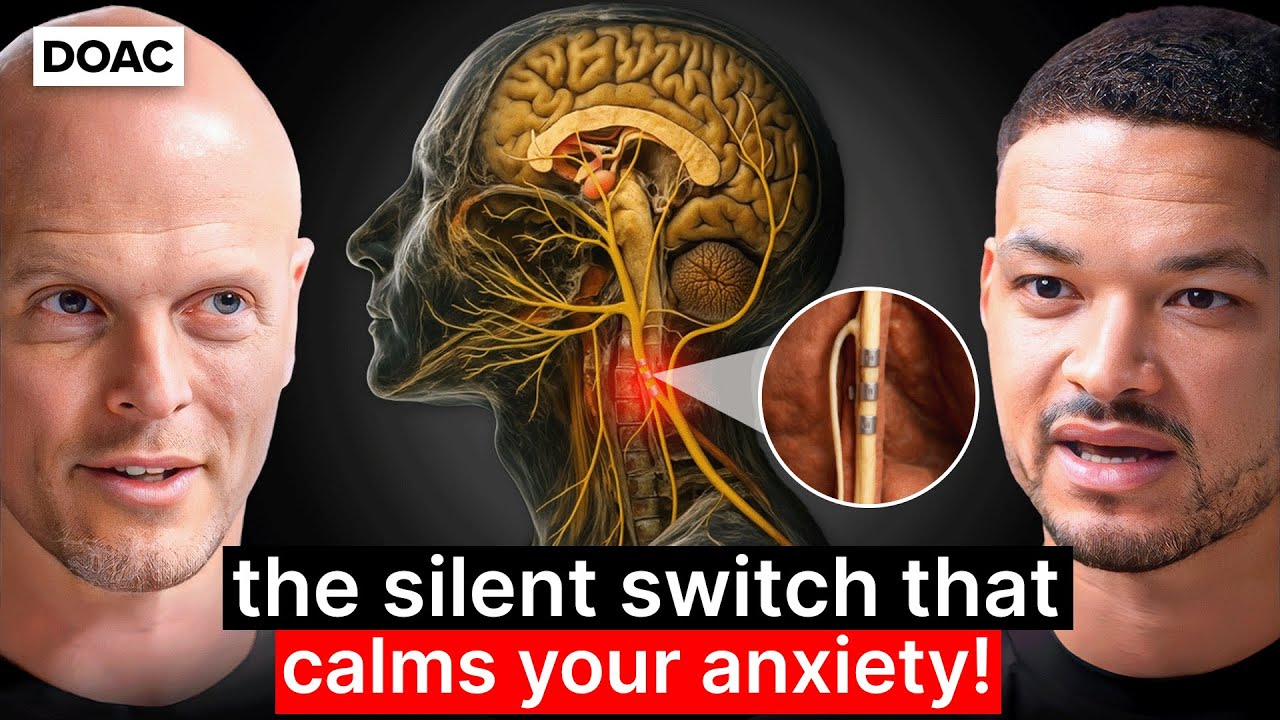
Tim Ferriss Tests Bioelectric Medicine to Cure Mental Trauma
The Diary Of A CEO
Targeted vagus nerve stimulation and bioelectric therapies treat chronic anxiety and trauma by directly rebalancing neural pathways without psychiatric medication.
## Background
This episode was published by The Diary Of A CEO on YouTube on November 13, 2025. According to the page description, health hacker Tim Ferriss discusses natural ways to calm anxiety, lower stress, and balance the nervous system without medication, covering topics like vagus nerve stimulation, HRV tracking, and metabolic psychiatry.
## TL;DR
Tim Ferriss explores non-pharmaceutical interventions for mental health, sharing personal experiences with childhood trauma and clinical depression alongside actionable frameworks for fast learning and life design. The conversation covers emerging medical treatments, including accelerated Transcranial Magnetic Stimulation (TMS), metabolic psychiatry, psychedelic therapies, and vagus nerve stimulation. Ferriss and host Steven Bartlett also discuss modern lifestyle challenges, from digital dating fatigue to the necessity of analog human connection and deliberate relationship maintenance.
## Atmosphere & style
The discussion is deeply intimate, candid, and intellectually rigorous, blending raw vulnerability with analytical problem-solving. Steven Bartlett provides an empathetic, grounded presence, allowing Ferriss to navigate difficult topics like childhood abuse and suicidal ideation with quiet gravity. As the conversation shifts to bioelectric medicine and practical lifestyle design, the mood turns hopeful and pragmatic, creating an atmosphere that feels like an earnest, high-level masterclass in emotional healing and human optimization.
## Key takeaways
- [02:33](https://www.youtube.com/watch?v=GFyijjy1KdU&t=153s) Tim Ferriss identifies his core identity through a three-step sequence: self-experimenter, student, and teacher, focusing on distilling complex ideas into simple, low-risk algorithms.
- [03:23](https://www.youtube.com/watch?v=GFyijjy1KdU&t=203s) The DiSSS framework (Deconstruction, Selection, Sequencing, Stakes) provides a structured methodology for rapid skill acquisition and metalearning.
- [07:47](https://www.youtube.com/watch?v=GFyijjy1KdU&t=467s) Structuring work into 6- to 12-month projects focused on skills and relationships yields long-term value even when individual projects fail.
- [10:09](https://www.youtube.com/watch?v=GFyijjy1KdU&t=609s) Sustainable success relies on building an operating system designed to outlast bad luck through small, compounding steps rather than relying on passion alone.
- [15:32](https://www.youtube.com/watch?v=GFyijjy1KdU&t=932s) Unresolved childhood trauma can serve as the root cause for multiple downstream mental health challenges, making direct trauma work essential for healing.
- [23:37](https://www.youtube.com/watch?v=GFyijjy1KdU&t=1417s) Compartmentalization functions as a survival mechanism in crisis, but long-term emotional suppression often leads to severe psychological friction in daily life.
- [31:14](https://www.youtube.com/watch?v=GFyijjy1KdU&t=1874s) Publicly sharing personal struggles with trauma and mental health helps destigmatize isolation and encourages others to seek support.
- [35:58](https://www.youtube.com/watch?v=GFyijjy1KdU&t=2158s) Modern societal trends in anxiety, depression, and loneliness stem partly from a disconnect with evolutionary human needs like analog, face-to-face community.
- [39:05](https://www.youtube.com/watch?v=GFyijjy1KdU&t=2345s) Accelerated Transcranial Magnetic Stimulation (TMS) offers rapid, non-invasive bioelectric relief for treatment-resistant anxiety and depression.
- [42:32](https://www.youtube.com/watch?v=GFyijjy1KdU&t=2552s) Metabolic psychiatry, including strict ketogenic dietary interventions, improves brain energy stability and shows promise in treating severe psychiatric conditions.
- [43:55](https://www.youtube.com/watch?v=GFyijjy1KdU&t=2635s) Psychedelic-assisted therapies can reopen critical neurodevelopmental windows, enabling significant clinical breakthroughs in treating PTSD.
- [45:26](https://www.youtube.com/watch?v=GFyijjy1KdU&t=2726s) Vagus nerve stimulation (VNS), both invasive and non-invasive, acts as a powerful lever for calming systemic inflammation, improving heart rate variability (HRV), and modulating mood.
- [53:53](https://www.youtube.com/watch?v=GFyijjy1KdU&t=3233s) Bioelectric medicine and metabolic interventions represent a future paradigm shift in mental healthcare by targeting root physiological processes without heavy reliance on traditional pharmaceuticals.
- [59:18](https://www.youtube.com/watch?v=GFyijjy1KdU&t=3558s) Modern dating applications function like digital casinos using variable rewards, leading to choice overload and lower overall relationship satisfaction.
- [01:02:37](https://www.youtube.com/watch?v=GFyijjy1KdU&t=3757s) Conducting a structured 'Past Year Review' ensures intentional investment in top relationships and protects against social drift.
- [01:05:03](https://www.youtube.com/watch?v=GFyijjy1KdU&t=3903s) Taking an annual 4-week complete disconnect from work tests organizational delegation, prevents burnout, and helps cultivate personal life purpose.
## Detailed walkthrough
Here is a detailed, faithful walkthrough of the transcript section provided.
---
[00:00](https://www.youtube.com/watch?v=GFyijjy1KdU&t=0s) Teaser & Introduction: Root Causes, Brain Stimulation, and Life Mission
Tim Ferriss and Steven Bartlett open with a brief overview of Ferriss's recent work into the root causes of mental health complications. Ferriss notes that mental health diagnoses are steadily rising, but through self-experimentation and collaboration with top scientists, he has discovered non-medication interventions that yield dramatic results. These include brain stimulation techniques—which eliminated his anxiety for months—and vagus nerve stimulation, backed by highly cited researchers. Bartlett highlights Ferriss’s status as a top performance-hacking expert built on interviews with over 800 influential thinkers on *The Tim Ferriss Show*.
When Bartlett asks Ferriss what core question people *should* ask him, Ferriss points to how to break down complex subjects to accelerate learning, noting that time is our ultimate non-renewable resource. Conversely, when asked what question most people *want* to ask him, Ferriss shifts to mental health, disclosing that he feels a profound moral obligation to help others overcome deep emotional pain due to his own childhood trauma.
* Key mental health frameworks tested by Ferriss include brain stimulation and vagus nerve stimulation for anxiety relief.
* Ferriss has interviewed over 800 guests across his podcasting career.
* Ferriss views time as humanity's most valuable, non-renewable resource.
---
[02:33](https://www.youtube.com/watch?v=GFyijjy1KdU&t=153s) My Mission: Simplify Complex Ideas
Ferriss defines his personal identity not by a single professional label, but through a specific three-step sequence: a **self-experimenter, student, and teacher, in that order**. He sees his core life purpose as stripping away noise to find simplicity within complexity, ultimately distilling complicated subjects into low-risk, high-upside algorithms or "recipes" that anyone can safely test.
> "I think of myself as a self-experimenter, student, and teacher in that order."
---
[03:23](https://www.youtube.com/watch?v=GFyijjy1KdU&t=203s) Framework for Fast Learning: The DiSSS Model
Addressing metalearning—learning how to learn—Ferriss outlines a universal framework designed to break down any subject rather than treating skills as isolated silos. He introduces the **DiSSS** acronym: **D**econstruction, **S**election, **S**equencing, and **S**takes.
* **Deconstruction:** Taking a vague goal (like "learn to swim" or "learn Spanish") and breaking it down into small constituent parts. Ferriss notes that reaching out to world-class talent for guidance is easier than people think, citing that an Olympic silver medalist from two cycles ago can often be booked for a $50 to $100 per hour Zoom consultation.
* **Selection:** Applying Pareto's Law (the 80/20 rule) to pick the 20% of material that yields 80% of desired results. In language acquisition, for instance, learning the 1,500 most frequently used words allows someone to achieve conversational fluency in almost any language within 8 to 12 weeks.
* **Sequencing:** Determining the logical order of practice, which Ferriss calls the "magic sauce." In swimming, for example, a beginner must master body position—fuselage left, fuselage right, and gliding off the wall in shallow water—before ever attempting breathing techniques.
* **Stakes:** Creating real behavioral incentives. Ferriss argues that information alone is insufficient ("If more information were the answer, we'd all be billionaires with six-pack abs"). To ensure commitment, one can implement loss aversion—such as giving $100 or $500 to a friend with instructions to donate it to a hated political candidate if the goal isn't met.
Ferriss cautions that skill acquisition is never a linear, bottom-left-to-top-right trajectory. Expecting linear progress causes most people to quit right before reaching a major inflection point.
---
[07:47](https://www.youtube.com/watch?v=GFyijjy1KdU&t=467s) Choosing the Right Projects & The Power of Asymmetric Risks
Ferriss reveals that he avoids long-term 5-year or 10-year career plans, believing that rigid long-term plans force people to play so safely within their comfort zones that they sell themselves short. Instead, he structures his life into **6- to 12-month projects** containing short 2- to 4-week experiments.
When selecting a project, Ferriss focuses strictly on two criteria: **relationships** (building new connections or deepening existing ones) and **skills** (expanding his learning curve). Crucially, these relationships and skills must transcend the specific project so that even total project failure yields lasting value.
* **The StumbleUpon Example:** Ferriss joined StumbleUpon as an advisor in its early days. While the company eventually stalled, Ferriss formed a close friendship with founder Garrett Camp and gained deep expertise in web traffic generation.
* **The Uber Payoff:** Years later, Garrett Camp texted Ferriss about a new concept to solve San Francisco's taxi problems—then named UberCab LLC. Because of their prior relationship, Ferriss became an early advisor, turning a previous failure into a historic success.
---
[10:09](https://www.youtube.com/watch?v=GFyijjy1KdU&t=609s) Importance of Small Steps for Big Results
Bartlett asks whether an 18-year-old with no money should use the same selection framework as someone at Ferriss's stage of life. Ferriss answers with a clear "yes." Because luck ("Lady Fortune") plays an enormous role in outcomes, individuals and teams must design a operating system that survives long stretches of bad luck so that compounding and statistical laws can work in their favor.
Reputation, money, and status are merely **second-order effects** that emerge naturally when prioritizing skill accumulation and relationships. Ferriss visualizes this as finding the "lead domino"—knocking down a tiny initial domino that sequentially cascades to knock down progressively larger ones over time. By committing to two 6-month projects a year, anyone can afford to be "long-term greedy instead of short-term greedy."
When Bartlett asks if this drive stems from "passion," Ferriss pushes back against the term, preferring **energy**. Passion is too vague, whereas energy is an intuitive, almost biological state: *Are you awake or sleepy? Do you want to stop in 15 minutes or can you keep going for 5 hours?*
---
[12:34](https://www.youtube.com/watch?v=GFyijjy1KdU&t=754s) Why Humans Need Purpose and Secular "Religions"
Addressing meaning and purpose, Ferriss argues that human beings require certainty and something to believe in—noting that even aggressive non-belief is itself a belief system. While self-transcendence is vital for mental health, Ferriss asserts that structured religion is not required to live a deeply fulfilling life; rather, **awe and wonder** are the essential ingredients, both of which can be deliberately architected and scheduled.
Ferriss points out that modern fitness and lifestyle movements function exactly like secular religions without using the "R-word":
* **CrossFit and Veganism:** Both operate as functional religions by offering strict rule sets, strong community reinforcement, daily lifestyle guidance, and central figures (pointing to CrossFit founder Greg Glassman prior to his fall from grace).
---
[15:32](https://www.youtube.com/watch?v=GFyijjy1KdU&t=932s) Tim’s Sexual Abuse Story and Trauma History
Ferriss opens up about the deep personal origins of his drive to help others, acknowledging that his compulsion to alleviate pain can sometimes degenerate into an unhelpful "savior complex" or self-imposed burden that threatens his own well-being.
Ferriss shares that from ages 2 to 4, he was sexually abused on a weekly basis by a babysitter's son. He retains clear, vivid memories of these events. This early trauma heavily conditioned his adult personality—robbing him of agency, instilling constant hypervigilance, and making him exceptionally slow to trust others.
Compounded by a genetic family predisposition, Ferriss suffered severe Major Depressive Disorder starting in early adolescence.
* **Historical Frequency:** From early adolescence onward, Ferriss endured an average of 3 to 4 depressive episodes per year, each lasting multiple weeks or months—meaning he spent roughly half of his lived life in a deep clinical depression.
* **Current Status:** Through targeted intervention protocols, Ferriss has reduced his depression to just **one episode lasting a few weeks every 2 to 3 years**. He emphasizes that the shift between these two states represents two fundamentally different ways of experiencing human existence.
Here is a detailed, step-by-step walkthrough of this portion of the conversation, capturing the depth, nuance, and key moments from the transcript.
---
[17:26](https://www.youtube.com/watch?v=GFyijjy1KdU&t=1046s) Levers for Healing Trauma and the "Pain as Medicine" Mindset
Tim Ferriss details the various "levers" available to individuals working through deep-seated trauma and mental health struggles, emphasizing tools like metabolic psychiatry, psychedelic-assisted therapy, and bioelectric medicine (including accelerated Transcranial Magnetic Stimulation, or TMS). While these options are not a single "one-and-done" fix, they provide a manageable way to slowly chip away at severe distress so it becomes workable rather than disabling. Steven Bartlett quotes a psychotherapist who once advised him to "take the pain and make it part of your medicine"—using horrible, inexcusable life experiences as part of what one contributes back to the world.
During the COVID-19 pandemic, Tim was sitting over a meal with his then-girlfriend. At the time, only two people in the world—two long-term ex-girlfriends—knew about his childhood trauma; not even his parents were aware. Tim had always assumed he would write a book about his healing journey long after his parents passed away so they wouldn't blame themselves. However, his girlfriend confronted him with a haunting question: *"Have you ever thought about how many people are going to pass away from natural causes or from COVID or anything else before you ever have a chance to write this book?"* Recognizing that waiting 10 or 15 years would prevent him from helping countless people, Tim decided to test the waters by discussing it on a podcast.
- **Key Modalities Mentioned:** Metabolic psychiatry, psychedelic-assisted therapy, bioelectric medicine (accelerated TMS), Internal Family Systems (IFS, created by Dick Schwartz), MDMA-assisted psychotherapy for PTSD, and Family Constellation therapy.
- **Perspective on Trauma:** Tim notes he would gladly "Control-Z" (undo) his past abuse if he could, rejecting the notion that one must be "glad it happened." However, having lived through it gives him genuine credibility when helping others.
---
[19:40](https://www.youtube.com/watch?v=GFyijjy1KdU&t=1180s) Opening Up with Debbie Millman and the Unseen Epidemic
To talk about his past publicly, Tim reached out to his close friend in New York City, Debbie Millman (host of *Design Matters*, one of the world's longest-running podcasts). Debbie had previously disclosed her own extended childhood sexual abuse to him in full fidelity. Because Tim knew he couldn't deliver the story as a solo monologue, he asked Debbie to record a candid conversation with him, making it clear he wasn't sure if it would ever see the light of day. They recorded the session and published it around September 2020.
The public reaction was immediate and staggering. While Tim knew the high statistical prevalence of childhood sexual abuse, seeing it manifest in real life was overwhelming: roughly a quarter to a third of his close male friends reached out to confess, for the very first time in their lives, that they had suffered similar abuse. Tim describes walking up and down his driveway in tears while listening to emotional, graphic voice notes sent by close friends.
- **Impact of the Disclosure:** It provided instant clarity on long-standing, unanswered questions Tim had about several of his friends' behaviors over the years.
- **The Core Cause:** Tim realized that instead of fighting seven separate, independent mental health issues, every single one of his psycho-emotional challenges traced directly back to his early childhood trauma.
- **State of Psychiatry:** Tim observes that modern psychiatry is still in its "dark ages"—comparable to where surgery was 300 years ago—often relying on tools that work without fully understanding the underlying physiological mechanisms.
---
[23:37](https://www.youtube.com/watch?v=GFyijjy1KdU&t=1417s) Memory, Compartmentalization, and the Superpower Trap
Steven asks about the mechanism of harm for a child abused between the ages of two and four, pointing out that an innocent child at that age lacks the cognitive context to process what is happening. Tim explains that he is both blessed and cursed with a near-photographic memory for certain physical details—he can draw the exact floor plan of almost any restaurant or building he has visited even once. As a child grows into an adult with greater capacity to understand the world, they recontextualize those high-fidelity memories, coming to the painful realization that what felt "weird" back then was actually outright exploitation and abuse. Steven shares a parallel story from neuroscientist Dr. Lisa Feldman Barrett about a woman who lived a normal life until watching a television show about abuse; recontextualizing her past instantly triggered severe, physical PTSD symptoms.
Tim explains that abuse survivors who manage to function well often survive through extreme compartmentalization. This mental detachment is a life-saving "superpower" in chaotic environments—such as high-level military special forces operating in active combat zones—but turns into a severe handicap in civilian and family life.
- **The Price of Cauterization:** While compartmentalization allowed Tim to out-endure others in sports and business due to an extremely high pain tolerance, suppressing his emotions eventually caught up with him.
- **Psychedelics as an Unlocker:** Though Tim believes the broader hype around psychedelics is often overstated, he credits psychedelic experiences with "bringing emotions back online." After not crying for nearly 20 years, he suddenly found himself crying while watching emotional documentaries on airplanes.
- **The 6-Month Reset:** Realizing he was patching holes in a leaking boat without fixing the main leak, Tim took a six-month hiatus from work to avoid a total nervous breakdown and focus entirely on achieving resolution.
---
[31:14](https://www.youtube.com/watch?v=GFyijjy1KdU&t=1874s) Preventing Suicide: The Library Postcard and the Elevator Encounter
Tim points readers seeking trauma resources to **tim.blog/trauma**, which hosts his podcast episode with Debbie Millman along with a detailed toolkit. However, the piece of writing he is proudest of—and which took him over a month of agonizing edits to publish—is his essay titled *"Some Practical Thoughts on Suicide,"* a post he knows has directly saved hundreds of lives.
In the essay, Tim details his own near-fatal experience with suicide while an undergraduate at Princeton University. Taking a year off from classes left him isolated in an off-campus apartment working on his senior thesis while his peers graduated. Deeply depressed, he reserved a book on assisted suicide from Firestone Library and set a specific date to end his life. Because the library mailed a physical notification postcard to his official address on file—which was still listed as his parents' house—his mother received the card stating his book on assisted suicide had arrived. Her tearful, shaking phone call asking why he ordered the book shattered his plan to make his death look like an accident, forcing him to realize how profoundly his action would impact his family. At the time, Tim panicked and covered up his intent by lying, telling his mother he was ordering the book on behalf of a friend at Rutgers who needed it for a research project.
Years later, the impetus to write the blog post came following a live *This Week in Startups* event hosted by Jason Calcanis. After the talk, a well-dressed audience member asked Tim to sign two books—one for himself and one for his brother. When Tim asked what to write to the brother, the man froze. Sensing the tension, Tim politely offered to complete the signing after the crowd cleared. Walking Tim to the elevator afterward, the man explained through tears that his brother had committed suicide, but the family kept his bedroom exactly as he left it; because his brother was a massive fan of Tim's work, he wanted to place the signed book inside the room. The man then asked Tim, *"Have you ever thought about talking about mental health because you could really help a lot of people?"* That moment compelled Tim to finally publish his raw personal story, giving his family a cautious heads-up right before the post went live.
[035:58] The Prevalence of Mental Strain and Returning to Evolutionary Roots
Reflecting on his past struggles with suicidal ideation around 1999, Tim Ferriss discusses how reaching that breaking point shifted his focus toward intense physical training and long-term self-care. He notes that sharing his experiences made him realize how disturbingly common these mental health crises are. While it is frightening to see how many people come close to the edge, it is simultaneously reassuring because it proves that no one is uniquely broken or alone in their suffering. Looking across his audience over the past decade, Ferriss has seen virtually every metric of mental distress—such as chronic anxiety, treatment-resistant depression, obesity, and self-imposed loneliness—trending upward like a "hockey stick." Rather than applying temporary Band-Aids to isolated symptoms, he advocates for identifying the shared root causes underneath these interconnected issues.
At a foundational level, Ferriss argues that modern humans are failing to live in alignment with evolutionary biology. Humans were never programmed to operate as isolated, "lone wolf" individuals. To resolve the baseline friction of modern life, he suggests looking at how human communities functioned historically and prioritizing analog, face-to-face social connection. Real-world human interaction acts as a master lever that naturally resolves a multitude of downstream mental health issues that would otherwise require a constant game of "whack-a-mole."
- Ferriss's 1999 crisis led directly to his transition into serious physical training and health optimization.
- Rates of chronic anxiety, treatment-resistant depression, and loneliness have shown exponential "hockey stick" growth over the last decade.
- Modern self-imposed isolation runs counter to human evolutionary design; restoring "analog" human interaction acts as a primary foundational fix.
---
[039:05] Breakthrough Interventions: Accelerated TMS, Metabolic Psychiatry, and Psychedelics
When behavioral adjustments are not enough for severe conditions like chronic anxiety, OCD, or treatment-resistant depression, Ferriss points to several emerging clinical interventions. The first is bioelectric medicine, specifically **accelerated Transcranial Magnetic Stimulation (TMS)**. Unlike traditional TMS protocols that stretch over months with a few sessions a week, the accelerated protocol—popularized by researchers like Dr. Nolan Williams at Stanford—delivers 10 sessions per day for 5 consecutive days. Each session lasts about 8 minutes on the hour. Ferriss recounts a dramatic example of a 14-year-old self-harming patient whose chronic suicidal ideation vanished within 3 days of treatment, requiring only occasional boosters every 3 to 6 months. Having tried it himself, Ferriss experienced 4 to 5 months of complete anxiety relief, feeling as calm as if he had meditated twice daily for an entire year.
A second major pillar is **metabolic psychiatry**, championed by Dr. Chris Palmer at Harvard. This approach utilizes strict ketogenic diets to treat severe psychiatric disorders like schizophrenia by stabilizing brain energy and providing clean-burning ketone bodies. Ferriss notes that patients treated unsuccessfully with dozens of medications for over a decade have achieved complete remission simply through dietary intervention. Given his own genetic predisposition and family history with Alzheimer's disease (having three relatives currently diagnosed), Ferriss personally uses strict monthly ketosis and annual 7-day water-only fasts as preventative measures to enhance mitochondrial health, clear cellular debris, and reduce plaque accumulation.
Finally, Ferriss highlights **psychedelic-assisted therapies**. Quoting psychotherapist Stanislav Grof—who noted that psychedelics will do for the study of the mind what the telescope did for astronomy and the microscope for biology—Ferriss emphasizes their ability to treat severe PTSD. Clinical trials show over 50% complete remission after just two or three guided sessions for patients who suffered for 14 to 17 years. Researchers like Dr. Gul Dolen at UC Berkeley suggest psychedelics achieve this by reopening critical neurodevelopmental periods in the brain, creating possibilities for treating severe trauma and assisting motor recovery in stroke patients.
- **Accelerated TMS:** Involves 10 hourly 8-minute magnetic stimulation sessions per day over 5 days (50 total sessions). It simulates a gentle "flicking" on the side of the head with minimal safety risks.
- **Metabolic Psychiatry:** Ketogenic diets supply ketones as alternative fuel to the brain; patients with decade-long schizophrenia have successfully eliminated medication reliance within 3 to 6 months.
- **Preventative Protocol:** Ferriss undergoes 1 month of strict ketosis per year and an annual 7-day water-only fast to protect against neurodegenerative disease.
- **Psychedelic Therapies:** MDMA and psilocybin trials show >50% PTSD remission rates in chronic patients by reopening critical developmental learning windows.
---
[045:26] Vagus Nerve Stimulation (VNS) and Modern Applications
Ferriss introduces a fourth emerging field he is actively researching: **Vagus Nerve Stimulation (VNS)**. He cautions that while the market is flooded with pseudoscientific junk, the underlying biology is legitimate and profound. The vagus nerve consists of two major nerve bundles running alongside the carotid arteries from the brainstem down through the chest and abdomen. Containing roughly 100,000 individual fibers in each bundle, the vagus nerve acts like a pair of "transatlantic cables" innervating major organs and facilitating crucial two-way communication between the gut microbiome and the brain.
Referencing the work of Dr. Brian Tracy (author of *The Great Nerve*), Ferriss discusses surgical and non-surgical VNS technology. A newly FDA-approved implant—roughly the size of an omega-3 fish oil capsule—is placed in the neck to treat autoimmune conditions like rheumatoid arthritis, Crohn's disease, and irritable bowel syndrome (IBS). Clinical trials have shown near-miraculous results, turning bedridden chronic fatigue patients into highly active individuals within weeks. Beyond implants, non-invasive electrical devices applied to the neck (such as the prescription device gammaCore) or to the ear (*auricular stimulation* targeting the *cymba conchae*) are demonstrating massive downstream benefits, including significant spikes in heart rate variability (HRV).
- The vagus nerve runs along the carotid artery and contains approximately 100,000 nerve fibers per bundle.
- An FDA-approved VNS implant the size of a fish oil capsule is currently used to reverse severe rheumatoid arthritis and systemic inflammation.
- A former tier-one military operator friend of Ferriss tripled his baseline HRV after 2–4 weeks of non-invasive neck stimulation (2–5 minutes twice daily), surpassing gains from meditation or cold exposure.
- Non-invasive VNS targets either the vagus nerve in the neck or the *cymba conchae* region of the outer ear.
---
[049:59] Sponsor Break: Bon Charge, SimpliSafe, and Apple
Steven Bartlett introduces a brief sponsor segment featuring Bon Charge, SimpliSafe, and Apple. He highlights Bon Charge's red light therapy face mask and infrared sauna blanket, offering an exclusive audience discount code. He then discusses SimpliSafe's proactive home security approach, which uses AI-powered cameras and live human agents to intervene with intruders before a break-in occurs. Finally, Bartlett reflects on launching *The Diary Of A CEO* on his Mac under a duvet, emphasizing how Apple hardware continues to power his entire media production team today.
- **Bon Charge:** Offers red light therapy and infrared sauna blankets designed to boost collagen, reduce wrinkles, and aid physical recovery.
- **SimpliSafe:** Features active agent monitoring and AI vision to speak to intruders and dispatch police without long-term contract requirements.
- **Apple:** Highlighted as the foundational technology platform used to edit and produce *The Diary Of A CEO* since its inception.
---
[053:10] Looking Ahead: Emerging Health Trends
Transitioning back to macro trends in health and wellness over the next decade, Bartlett asks Ferriss what everyday health habits or concerns will become ubiquitous 10 years from now. Bartlett notes his own prediction that air quality—specifically monitoring ambient $\text{CO}_2$ levels and outdoor pollutants using wearable or smartphone sensors—will become a major consumer focus. Ferriss agrees that environmental monitoring and precision bio-interventions are rapidly coming down the pipeline.
[053:53] Bioelectric Medicine and the Future of Mental Healthcare
Tim Ferriss predicts that bioelectric medicine represents a massive frontier that will radically transform our understanding of mental illness within the next decade. Rather than relying on traditional pharmaceuticals—where synthetic molecules must cross the blood-brain barrier—emerging treatments utilize external devices or surgical implants to alter neurological and systemic health via targeted electrical stimulation. Examples include accelerated Transcranial Magnetic Stimulation (TMS) and focused ultrasound, where a device roughly the size of a hockey puck can be placed over organs like the liver or spleen to modulate systemic immune responses and neural pathways.
Ferriss highlights a fascinating study demonstrating the deep connection between the gut microbiome and the brain via the vagus nerve. In experiments, transplanting the gut microbiome from obese mice into lean mice caused the lean mice to become obese. However, if researchers severed the vagus nerve before performing the transplant, the lean mice remained lean. This demonstrates that gut bacteria communicate directly with the brain through electric and neural signaling. Interestingly, targeted electrical stimulation can often mimic the therapeutic effects of nerve ablation or severing.
Looking forward, Ferriss believes many foundational assumptions about psychiatric conditions will be proven wrong within ten years. Emerging fields will focus on how fuel utilization in the brain drives psychiatric symptoms. While switching the brain's fuel source from glucose to ketones via a ketogenic diet can resolve many symptoms, adherence to strict diets is notoriously poor. Bioelectric medicine offers an alternative route by using electrical stimulation to induce systemic anti-inflammatory and ketogenic-like effects without requiring dietary overhauls or pill consumption.
- **Bioelectric Interventions:** Includes accelerated TMS, microchip implants, and focused ultrasound targeted at specific organs (e.g., liver, spleen).
- **Vagus Nerve Ablation Study:** Severing the vagus nerve in lean mice prevents them from developing obesity after receiving gut microbiome transplants from obese mice.
- **Metabolic & Bioelectric Synergy:** Electrical stimulation can achieve systemic anti-inflammatory outcomes similar to ketogenic diets, bypassing compliance issues.
---
[057:09] Life Priorities, Personal Goals, and Male Podcaster Demographics
When asked what guides him in his current season of life, Ferriss shares that his focus has shifted away from business milestones toward personal relationships, romantic partnership, and starting a family. At this point in his career, launching another startup, publishing another book, or recording more podcast episodes yields diminishing marginal returns. While he still loves those pursuits, they no longer represent his core life aspirations.
The conversation turns to an intriguing cultural observation: many prominent male podcasters are unmarried and childless. Host Steven Bartlett, who recently turned 33, notes that apart from figures like Joe Rogan, most high-profile hosts lack traditional family structures. Ferriss attributes this to the abundance of temptation and inbound attention that comes with public visibility. For attractive, well-known men, the constant inbound interest makes remaining single exceptionally easy, effectively turning romantic pursuits into "shooting fish in a barrel."
- **Current Life Focus:** Prioritizing long-term relationship building, family, and partnership over professional expansion.
- **Podcaster Demographic Trend:** Discussion on why many male creators remain single, driven by high inbound social attention and dating app dynamics.
---
[059:18] Dating Apps, the Paradox of Choice, and Digital Casinos
Ferriss and Bartlett dissect the negative psychological impacts of modern dating apps, which Ferriss describes as "digital casinos" designed explicitly to keep users hooked rather than deleted. Dating platforms leverage variable reward schedules—much like slot machines or dog training protocols—to deliver continuous dopamine hits. This cycle traps users in a perpetual loop, constantly searching for an incremental upgrade (seeking a "9 or 10" right around the corner from an "8").
The discussion turns to the "paradox of choice," where an abundance of options leads to fatigue and dissatisfaction rather than happiness. Ferriss reflects humorously on how historical concepts like arranged marriages, despite their obvious drawbacks, offered a practical simplicity that contrasts starkly with today's chaotic dating scene. Bartlett notes that his friends who struggle the most with dating are actually the ones going on 50 to 100 dates a year. Ferriss, who spent two to three years on dating apps before leaving them entirely, expresses deep relief at being out of the "digital game," quoting a viral post that joked about older generations catching "the last chopper out of Saigon" before modern dating culture took over.
- **Gamification of Dating:** Apps function like casinos using variable rewards and dopamine loops to prevent user retention off-platform.
- **The Paradox of Choice:** Extreme dating frequency (50–100 dates per year) often correlates with lower relationship satisfaction due to endless options.
- **Personal Stance:** Ferriss spent 2–3 years on dating apps, viewing them as a full-time job, and is happily off them in his current relationship.
---
[01:02:37](https://www.youtube.com/watch?v=GFyijjy1KdU&t=3757s) Final Day on Earth and the Past Year Review System
Answering the traditional closing question left by the previous guest ("How would you spend your final day on Earth?"), Ferriss skips extreme bucket-list activities or grand indulgences. Instead, he would spend simple, quality time expressing love and being present with his closest friends and family, perhaps just sitting on a porch in a rocking chair. Crucially, Ferriss points out that he does not wait for a final day to practice this; he actively schedules uninterrupted time with loved ones every year.
To protect his core relationships from drifting, Ferriss utilizes a structured "Past Year Review." When evaluating his social calendar, he reviews his top 5 to 10 relationships and asks whether he spent adequate time with those individuals over the preceding 12 months. If the answer is no, he reinvests time into those existing relationships first; only surplus time ("overflow") is allocated to cultivating new friendships. Additionally, for over 25 years, Ferriss has organized an annual summer reunion around his birthday, bringing long-time friends together from around the world strictly to maintain deep, multi-decade bonds.
- **Final Day Ideal:** Low-key quality time with core family and friends over grand, hedonistic experiences.
- **Relationship Auditing:** Allocates social bandwidth to top 5–10 proven, long-term relationships before investing in new connections.
- **Annual Tradition:** Holds a 25+ year ongoing summer friend reunion to preserve long-term social trust.
---
[01:05:03](https://www.youtube.com/watch?v=GFyijjy1KdU&t=3903s) Podcast Legacies and the 4-Week Mini-Retirement Challenge
Bartlett expresses deep gratitude to Ferriss, calling him one of the "foundational fathers" of modern long-form podcasting alongside figures like Joe Rogan, Marc Maron, and Chris Hardwick (Nerdist). Bartlett emphasizes that without early pioneers proving the viability and audience appetite for long-form conversations, shows like *The Diary Of A CEO* would not exist today. Ferriss humbly acknowledges the tribute, adding that his own entry into the medium during his 2012 book launch for *The 4-Hour Chef* was directly inspired by those same podcasting trailblazers.
As a final actionable productivity takeaway, Ferriss challenges all professionals and entrepreneurs to schedule a mandatory **4-week mini-retirement** once a year. During this month, you must go entirely off the grid—no work laptop, no work email, and no smartphone access beyond essential utility apps like Uber, Google Maps, or OpenTable. Ferriss outlines three core benefits of this practice:
1. **Long-Term Burnout Prevention:** Acts as a physical and mental "de-loading phase" to sustain high-intensity work over decades.
2. **Operational Optimization:** Forces business leaders to build clear rules, guidelines, and autonomy for employees, creating lasting operational improvements that persist long after returning.
3. **Existential Audit:** Exposes whether an individual has cultivated non-business interests. Experiencing panic over free time serves as a vital wake-up call to broaden one's life beyond work.
- **Podcasting Roots:** Ferriss's 2012 appearances on *The Joe Rogan Experience*, *WTF with Marc Maron*, and *Nerdist* helped establish the blueprint for modern long-form audio.
- **The 4-Week Mini-Retirement:** Mandatory annual 30-day disconnect (no work email/laptop) to test operational delegation and reset personal psychology.
## Notable quotes
> [02:33](https://www.youtube.com/watch?v=GFyijjy1KdU&t=153s) I think of myself as a self-experimenter, student, and teacher in that order. — Tim Ferriss
> [03:23](https://www.youtube.com/watch?v=GFyijjy1KdU&t=203s) If more information were the answer, we'd all be billionaires with six-pack abs. — Tim Ferriss
> [17:26](https://www.youtube.com/watch?v=GFyijjy1KdU&t=1046s) take the pain and make it part of your medicine — Steven Bartlett
> [17:26](https://www.youtube.com/watch?v=GFyijjy1KdU&t=1046s) Have you ever thought about how many people are going to pass away from natural causes or from COVID or anything else before you ever have a chance to write this book? — Tim Ferriss's girlfriend
> [31:14](https://www.youtube.com/watch?v=GFyijjy1KdU&t=1874s) Have you ever thought about talking about mental health because you could really help a lot of people? — Audience member
## Mentioned
Tim Ferriss, Steven Bartlett, Debbie Millman, Dr. Lisa Feldman Barrett, Jason Calcanis, Dr. Nolan Williams, Dr. Chris Palmer, Stanislav Grof, Dr. Gul Dolen, Dr. Brian Tracy, Greg Glassman, Garrett Camp, Joe Rogan, Marc Maron, Chris Hardwick, The Diary Of A CEO, The Tim Ferriss Show, Design Matters, This Week in Startups, The 4-Hour Work Week, The 4-Hour Chef, COYOTE, StumbleUpon, Uber, CrossFit, Bon Charge, SimpliSafe, Apple, Stanford University, Harvard University, UC Berkeley, Princeton University, Firestone Library
Tim Ferriss 测试生物电医学以治愈心理创伤
靶向迷走神经刺激与生物电疗法无需精神类药物,通过直接重新平衡神经通路来治疗慢性焦虑与创伤。
Tim Ferriss 探讨了针对心理健康的非药物干预措施,分享了自己应对童年创伤和临床抑郁症的亲身经历,并提供了用于快速学习与人生设计的实用框架。对话涵盖了多种新兴医疗手段,包括加速经颅磁刺激(TMS)、代谢精神病学、迷幻剂疗法及迷走神经刺激。此外,Ferriss 与主持人 Steven Bartlett 还讨论了现代生活方式带来的挑战,从数字约会倦怠到现实人际联结的必要性,以及用心维系关系的重要性。
Tim Ferriss 提出 DiSSS 快速技能习得框架(解构、筛选、排序、押注),并建议将人生规划拆解为 6 到 12 个月的短期项目,优先积累跨周期的技能与人脉以对抗坏运气。 (3:23)
Ferriss 坦陈幼年遭遇性侵与重度抑郁的经历,指出未消解的童年创伤往往是诸多心理问题的根源,长期的情感解离与压抑最终会演变为日常生活中的巨大心理内耗。 (15:32)
针对慢性焦虑与难治性抑郁,Ferriss 深入探讨了加速经颅磁刺激(TMS)、利用生酮饮食重塑脑能量代谢的精神病学方案,以及通过致幻剂重启神经发育窗口的辅助疗法。 (39:05)
迷走神经刺激(VNS)与生物电医学展现出巨大潜力,微型植入体或非侵入式电刺激能够通过脑肠轴调控免疫反应,在提升心率变异性(HRV)及改善自律神经功能上效果显著。 (45:26)
Reading summary
Tim Ferriss argues that widespread modern mental health struggles often stem from unresolved foundational trauma and evolutionary mismatch, which can be mitigated through emerging bioelectric and metabolic interventions alongside systematic personal frameworks. He asserts that deconstructing personal pain, skill acquisition, and relationship management into low-risk experiments enables individuals to recover agency and achieve sustainable well-being.
Deconstructing Early Trauma and the Compartmentalization Trap (15:32)
Ferriss links his adult psychological challenges—including severe Major Depressive Disorder that previously caused three to four multi-week episodes per year—directly to recurring sexual abuse endured between ages two and four. Survivors often develop extreme compartmentalization to survive high-stress environments, a trait Ferriss describes as a functional superpower in athletics and business that eventually acts as a severe emotional handicap in civilian life. After years of suppressing emotions, he credits psychedelic therapy with re-engaging his emotional responsiveness, and targeted protocols have reduced his depressive episodes to one brief period every two to three years.
Following a 1999 near-suicide experience at Princeton disrupted by a library notification postcard sent to his parents' house, Ferriss published personal accounts to provide actionable recovery pathways. When Ferriss publicly disclosed his history alongside podcast host Debbie Millman in 2020, between 25% and 33% of his close male friends reached out to reveal similar undisclosed childhood trauma, highlighting what Ferriss describes as a silent, widespread epidemic.
Emerging Clinical Levers in Bioelectric and Metabolic Psychiatry
Viewing contemporary psychiatry as remaining in its relative 'dark ages,' Ferriss highlights clinical interventions that address treatment-resistant depression and anxiety without traditional long-term medication regimens. Accelerated Transcranial Magnetic Stimulation (TMS), which delivers ten 8-minute sessions daily over five consecutive days, provided Ferriss with four to five months of complete anxiety relief and has achieved rapid remission of acute suicidal ideation in clinical cases.
Ferriss also points to metabolic psychiatry, championed by Dr. Chris Palmer, where therapeutic ketogenic diets supply ketone bodies to stabilize cerebral energy metabolism and have eliminated medication reliance in chronic schizophrenia cases. In parallel, psychedelic trials utilizing MDMA and psilocybin demonstrate over 50% remission rates in chronic PTSD cohorts. Researchers like Dr. Gul Dolen suggest this occurs because psychedelics reopen critical neurodevelopmental learning windows, allowing patients to reprocess deeply ingrained trauma.
Vagus Nerve Stimulation and Gut-Brain Communication
Ferriss identifies Vagus Nerve Stimulation (VNS) as a major frontier in bioelectric medicine, despite cautioning that the commercial market contains pervasive pseudoscientific devices. The vagus nerve comprises two major bundles containing approximately 100,000 fibers each, coordinating bidirectional communication between the central nervous system, visceral organs, and the gut microbiome. Newly FDA-approved implants the size of a fish oil capsule have demonstrated clinical efficacy in reversing severe systemic inflammation associated with rheumatoid arthritis and Crohn's disease.
Non-invasive stimulation applied to the neck or the outer ear's cymba conchae has shown significant improvements in heart rate variability (HRV), with one colleague tripling baseline metrics within four weeks. Highlighting the neural control of metabolism, Ferriss cites rodent research where severing the vagus nerve prevented lean mice from becoming obese after receiving microbiome transplants from obese donors, pointing toward electrical stimulation as a way to achieve metabolic and anti-inflammatory outcomes without requiring strict dietary compliance.
Metalearning Frameworks and Asymmetric Project Selection (3:23)
To acquire complex capabilities rapidly, Ferriss applies the 'DiSSS' model: Deconstruction (breaking goals into component parts), Selection (applying the 80/20 Pareto principle, such as learning the top 1,500 words for conversational fluency), Sequencing (ordering practice correctly, like mastering swimming body position before breathing), and Stakes (creating behavioral accountability through loss aversion). He stresses that skill acquisition is non-linear, warning that unmet linear expectations cause most people to quit prematurely.
Ferriss advises against rigid 5- or 10-year plans, advocating instead for 6- to 12-month projects composed of 2- to 4-week experiments evaluated purely on whether they build durable relationships and transferable skills. For example, advising early-stage StumbleUpon failed as an investment but built technical knowledge and a relationship with Garrett Camp, which subsequently led to Ferriss becoming an early advisor to Uber. When selecting initiatives, Ferriss favors tracking intuitive, daily physical energy over ambiguous notions of passion.
Evolutionary Realignment, Relationship Audits, and Disconnection
Ferriss contends that modern surges in anxiety, depression, and loneliness stem from departures from evolutionary design, which requires analog, in-person social connection rather than isolated living. He criticizes dating applications as gamified 'digital casinos' that deploy variable rewards to trap users in perpetual dopamine loops, where an overabundance of options induces choice fatigue and diminishes relationship satisfaction.
To preserve core personal networks, Ferriss conducts an annual 'Past Year Review,' allocating social time to his top 5 to 10 relationships before offering surplus time to new acquaintances, supported by an ongoing 25-year summer reunion tradition with close friends. He also recommends an annual four-week 'mini-retirement' completely disconnected from work computers and communication tools. This practice serves to prevent chronic burnout, force businesses to develop autonomous operational systems, and audit whether an entrepreneur has maintained a viable identity outside of work.
While Ferriss anticipates that bioelectric medicine and metabolic interventions will overturn foundational psychiatric assumptions within the next decade, consumer markets remain heavily diluted by unvalidated wellness products. Whether non-invasive stimulation can reliably replicate the systemic anti-inflammatory benefits of strict metabolic diets across broad populations remains an open question subject to ongoing clinical trial verification.
[2:33] Tim Ferriss: I think of myself as a self-experimenter, student, and teacher in that order.
[3:23] Tim Ferriss: If more information were the answer, we'd all be billionaires with six-pack abs.
[17:26] Steven Bartlett: take the pain and make it part of your medicine
[17:26] Tim Ferriss's girlfriend: Have you ever thought about how many people are going to pass away from natural causes or from COVID or anything else before you ever have a chance to write this book?
[31:14] Audience member: Have you ever thought about talking about mental health because you could really help a lot of people?
Original transcript
[0:00] every mental health complication or
[0:02] diagnosis is increasing and I've worked
[0:04] with different scientists [music] and
[0:05] done a lot of experimentation on myself
[0:07] having grown up with multiple depressive
[0:09] episodes every year to see if [music]
[0:11] there are root causes that we can
[0:12] address and so I'll just throw out a few
[0:14] things that have been very very helpful
[0:16] first there's brain stimulation when I
[0:18] did this I had months of no anxiety then
[0:22] there's something called Vegas nerve
[0:23] stimulation and one of the most heavily
[0:25] cited scientists of the last 30 years
[0:27] has seen a wild collection of benefits
[0:29] So, let's talk about that.
[0:31] >> Tim Ferris has become a performance
[0:33] hacking expert after speaking with over
[0:35] 800 influential voices on his podcast.
[0:37] [music]
[0:37] >> Now, he's taking the most valuable
[0:39] frameworks and techniques to help you
[0:41] optimize productivity, health, and
[0:43] [music] performance. Tim, the variety of
[0:46] things that you write about, talk about
[0:48] is so wide. So, what is the question
[0:50] that most people should ask you?
[0:52] >> How do you break down complicated
[0:54] subjects and accelerate your ability to
[0:56] learn? because time is one of our most
[0:59] valuable non-renewable resources. And so
[1:01] I have a framework that you can apply to
[1:03] any subject matter which consists of the
[1:05] 80/20 principle which is picking the 20%
[1:07] to focus on that will give you 80% of
[1:09] what you want. For instance, there's
[1:11] hundreds of thousands of words you could
[1:12] learn in Spanish. But with the most
[1:14] frequently used500, you can get to
[1:17] reasonable conversational fluency in
[1:19] almost any language in 8 to 12 weeks.
[1:21] And if you figure that out, you're ahead
[1:22] of 99.9% of the world. And what do you
[1:24] think is the question most people want
[1:26] to ask you?
[1:27] >> So there's a lot of questions around
[1:29] mental health and I feel like I have a
[1:31] moral obligation to help people because
[1:34] I was uh sexually abused by a
[1:37] babysitter's son on a weekly basis. I
[1:41] was this close to killing myself. And it
[1:45] can have a lot of effects, but these are
[1:48] things that you can slowly chip away at.
[1:50] and instead of feeling like you're held
[1:52] captive by them, feel like you can take
[1:55] the [music] pain and make it part of
[1:56] your medicine.
[1:58] >> So,
[2:02] I see messages all the time in the
[2:04] comments section that some of you didn't
[2:05] realize you didn't subscribe. So,
[2:07] [snorts] if you could do me a favor and
[2:08] double check if you're a subscriber to
[2:09] this channel, that would be tremendously
[2:11] appreciated. It's the simple, it's the
[2:12] free thing that anybody that watches
[2:14] this show frequently can do to help us
[2:16] here to keep everything going in this
[2:17] show in the trajectory it's on. So,
[2:19] please do double check if you've
[2:21] subscribed and uh thank you so much
[2:22] because in a strange way you are you're
[2:24] part of our history and you're on this
[2:26] journey with us and I appreciate you for
[2:28] that. So, yeah, thank you
[2:31] [music]
[2:33] Tim.
[2:34] You're a remarkably interesting
[2:36] individual in part because the variety
[2:39] of things that you write about, talk
[2:41] about clearly have deep curiosity in is
[2:44] so wide that you're you're hard to to
[2:47] put into any particular box. So I my
[2:49] first question to you is how do you
[2:51] think about the work you do and how do
[2:53] you sort of like self-define if you do
[2:55] at all who you are and what your mission
[2:58] is. I think of myself as a
[3:04] self-experimenttor
[3:05] student and teacher in that order. The
[3:08] purpose though ultimately is to try to
[3:10] find simplicity through complexity or
[3:13] topics that can be complicated and then
[3:16] provide some type of recipe or algorithm
[3:19] that people can test with low risk and
[3:22] hopefully a decent amount of upside.
[3:24] >> We're going to talk about a lot of
[3:25] different things today. So it probably a
[3:26] good place to start which is learning
[3:28] how to learn and especially in a world
[3:30] that's changing at such speed. There's a
[3:31] lot of people that are being forced into
[3:33] relearning of some sort whether it's
[3:35] professionally or in other domains. So
[3:37] metalarning, I've never heard this term
[3:39] before.
[3:39] >> Mhm.
[3:40] >> How how do what is metalarning and how
[3:42] do I learn how to learn better? I would
[3:44] love to cuz I spend so long as you do
[3:46] speaking to really interesting people
[3:47] >> and I sometimes worry that some of that
[3:50] information is being wasted.
[3:51] >> Yeah. The basic idea is this that rather
[3:55] than treat different
[3:58] subjects or fields as these silos that
[4:01] need to be figured out independently,
[4:03] how can you develop just a broad
[4:05] framework that you can apply to any
[4:07] subject matter? And the acronym that I
[4:10] generally recommend folks, DSS,
[4:13] deconstruction, selection, sequencing,
[4:16] stakes. There's deconstruction, which is
[4:19] taking a
[4:21] fairly ambiguous goal like learn to swim
[4:25] or learn Japanese.
[4:28] None of those are actually very
[4:29] descriptive, right? So deconstructing
[4:32] any one of those is taking let's just
[4:35] use the learn to swim as an example and
[4:37] breaking it down into constituent parts
[4:40] right and you can you can do that very
[4:42] effectively with the help of an expert
[4:44] you can try to do it yourself but for
[4:45] instance I mean if you want to find a
[4:48] silver medalist from the Olympics two
[4:50] Olympics ago you can probably get on a
[4:53] Zoom call with them for
[4:56] $100 an hour maybe $50 an hour like you
[4:59] do have access to world class talent.
[5:02] >> Then they would help you figure out all
[5:04] right there all these different possible
[5:05] components. When you get to the next
[5:08] part which is selection, you're picking
[5:10] the 20%. This is the 8020 principle,
[5:14] right? Prao's law. So you're picking the
[5:16] 20% that will give you 80% of what you
[5:19] want. Let's just use language learning
[5:20] in that case. Well, you can very easily
[5:23] find word frequency lists. So for any
[5:26] given language like Spanish, sure, or in
[5:29] English, hundreds of thousands of words
[5:30] you could learn. But with the most
[5:33] frequently used 1500,
[5:36] you can get to reasonable conversational
[5:38] fluency in almost any language in 8 to
[5:40] 12 weeks without question if you
[5:42] approach it methodically. But you need
[5:44] the right material first. And then the
[5:47] next S is sequencing. Putting it in the
[5:50] right order. And I feel like this is the
[5:52] magic sauce that gets lost a lot, which
[5:55] is what is a logical sequence for
[5:58] learning any given skill. What do you
[6:00] practice first? So in the case of
[6:02] swimming for instance, forget about
[6:04] breathing. Like you need to figure out
[6:05] like fuselage right, fuselage left, and
[6:08] gliding, kicking off a wall in the
[6:11] shallow end of a pool before you ever
[6:12] think about breathing
[6:14] >> and getting comfortable putting your
[6:15] head under water, etc., etc. So, so
[6:18] there's the deconstruction, selection,
[6:20] sequencing, and then the last S stands
[6:22] for stakes, which means incentives. So,
[6:25] how do you ensure that you will do
[6:28] actually what it is you say you're
[6:29] committing to doing? If more information
[6:31] were the answer, we'd all be
[6:32] billionaires with six pack abs. So,
[6:34] information is clearly not sufficient.
[6:37] It's necessary, but not sufficient.
[6:38] Incentives drive behavior change. So,
[6:41] you need good intentions are not enough.
[6:45] Even a system is not enough. You need
[6:47] strong incentives. So, right, you could
[6:50] give uh 500 bucks to a friend or 100
[6:53] bucks, whatever. Does the amount doesn't
[6:55] really matter. And if you don't do what
[6:57] you say you're going to do, they donate
[6:58] it to like your most hated political
[7:00] candidate in your name, right? That's
[7:02] another one that I've seen work really
[7:04] well. That's it. That DSS,
[7:07] deconstruction, selection, sequencing,
[7:10] stakes. And if you just check those
[7:12] boxes moving that order,
[7:14] uh, your ability to learn will hockey
[7:17] stick in a really meaningful way. And
[7:19] what's also important to realize when
[7:21] you're trying to tackle any new skill,
[7:23] doesn't matter what it is.
[7:26] There will, it will not be just a linear
[7:28] climb from, you know, bottom, left,
[7:31] upper, right. But if you know in advance
[7:33] that those are coming, then you can have
[7:35] a plan for it and weather the storm. So
[7:37] that's also very important. If people
[7:39] expect some kind of like linear
[7:41] incremental progress, it just ain't
[7:43] going to happen. And so most people quit
[7:45] before they hit any real inflection
[7:46] points.
[7:47] >> And how does one know what to pursue?
[7:49] Like how do you decide what's worth
[7:51] pursuing? Is there a framework for
[7:52] knowing what should be on the Sunday
[7:53] shelf and what should be today today's
[7:56] work?
[7:57] >> I do think about this a lot and I've
[8:00] used this for a very very long time and
[8:02] I don't see it changing anytime soon. I
[8:04] refined it here and there. Almost
[8:05] everything I do is a 6 to 12 month
[8:07] project.
[8:09] with lots of 2 to four week experiments
[8:11] within that 6 to 12 months. I do not
[8:14] have and I've never had a long-term
[8:16] career plan 5 years, 10 years. If you
[8:19] have a reliable 5 to 10 year plan,
[8:20] you're going to be playing so safely
[8:22] within the bounds of your capabilities
[8:24] that I feel like you're selling yourself
[8:25] short. So for me, it's projects and just
[8:28] going 100% into those projects. But how
[8:31] do you pick the project? I pick the
[8:33] projects based on relationships and
[8:36] skills. So new relationships or
[8:39] deepening important relationships and my
[8:43] learning curve skills I'm going to learn
[8:46] and there's a condition though those
[8:48] relationships and those skills have to
[8:50] be able to transcend that project. I'll
[8:52] give you an example. If I have a project
[8:54] which is working on a startup as an
[8:56] adviser that startup was stumble upon.
[8:59] Okay so I'm working on Stumble Upon. Way
[9:00] back in the day Stumble Upon was a huge
[9:02] deal. It delivered a lot of web traffic
[9:04] to various websites. It's kind of like a
[9:07] Pandora for websites. A year or two into
[9:09] that didn't go anywhere. But who was it?
[9:12] I spent all my time with it. Stumbled
[9:14] upon. It was the founder named Garrett
[9:15] Camp and I became really close friends.
[9:17] I learned a ton about web traffic. I was
[9:20] also able to use my own website and blog
[9:22] as a experimental destination. Right? So
[9:26] there was upside even if it went to zero
[9:27] for me. And few years later I get a text
[9:32] from Garrett. we meet up to talk about
[9:33] this new idea which is solving the taxi
[9:35] problem in San Francisco. And then
[9:38] shortly thereafter it was called Uber
[9:39] Cab LLC and I became advised to that.
[9:42] And I could give you 12 more examples
[9:44] like that where like the first project
[9:46] failed but I became friends with with
[9:49] person A or B learned C and D and those
[9:52] were applied two projects later to
[9:54] something that was a home run. And
[9:55] should everybody at every stage in their
[9:57] journey have the same brainwork or you
[10:00] know because if you think about the
[10:01] different things one could acquire from
[10:03] like resources, reputation, knowledge,
[10:05] skills,
[10:06] >> um network.
[10:08] >> If I'm 18 and broke, should I be aiming
[10:11] at the same things as if I'm Tim
[10:13] Ferrris?
[10:15] >> My instinct is to say yes.
[10:17] >> And the reason I say that is that Lady
[10:21] Fortune has a lot to say about what
[10:23] happens. There are so many things
[10:24] outside of your control that whatever
[10:27] game you choose to play [sighs]
[10:31] requires a system that allows you to
[10:33] survive a a string of very bad luck.
[10:37] Everything snowballs over time and
[10:39] compounds and it's really hard to lose
[10:42] long term as long as you're not
[10:45] overindexing and betting too much on any
[10:48] one project say financially.
[10:51] It's
[10:51] >> like you need to be able to withstand as
[10:55] a team or as an individual a period of
[10:57] very bad luck
[10:59] >> in order for the law of big numbers and
[11:01] statistics to work in your favor with a
[11:03] system that gives you a slight edge. Um
[11:06] so that's just my lens on the world in
[11:09] general
[11:11] at least professional choices and I
[11:13] would say you mentioned a couple of
[11:14] other things right like reputation and
[11:17] so on. I feel like a lot of those are
[11:21] second order effects. They happen
[11:23] automatically if you are optimizing for
[11:25] the relationships and skills.
[11:27] >> So, uh this comes back to the
[11:29] sequencing, right? So, it's like which
[11:30] which is the lead domino. So, if you
[11:33] have 12 dominoes, you kind of have to
[11:34] decide in which order you're going to
[11:36] stack them so that you knock over the
[11:38] small domino, knock over the bigger
[11:40] domino, then the bigger, then the
[11:41] bigger, then the bigger. And over time,
[11:45] if you're thinking about doing two
[11:46] projects a year, let's just say if
[11:48] they're 6 months each,
[11:50] >> that's going to add up. It's going to
[11:52] add up. So, you can afford to be
[11:55] long-term greedy
[11:57] instead of short-term greedy.
[11:59] >> Is that what people call passion? Is are
[12:01] you using the same
[12:03] >> I uh I like energy over passion for a
[12:07] couple of reasons? Because you could
[12:08] have passion between the bed sheets. You
[12:10] could have the passion of the Christ.
[12:11] You had a different type of passion. I
[12:13] don't like imprecise terms. Energy for
[12:16] me, very simple. It's like, are you more
[12:17] awake or are you sleepy? Right?
[12:19] [laughter]
[12:20] Do you feel like you can do this for
[12:22] another 5 hours? Do you feel like you
[12:23] want to stop in 15 minutes? These are
[12:25] almost biological questions, like
[12:28] biological state questions. So, it's
[12:30] it's pretty intuitive for people to get
[12:32] to a yes or no.
[12:35] One of the subjects I've been thinking a
[12:36] lot about recently, why have I been
[12:38] thinking about this more recently? Don't
[12:40] know, just a series of conversations
[12:42] I've had on the show which make have
[12:43] kind of pushed me closer to trying to
[12:45] answer this question is about
[12:48] about meaning and purpose and I guess
[12:52] religion because actually it's only in
[12:54] recent history that we've had so many
[12:55] answers to some of these bloody
[12:56] questions like the the solar eclipse. We
[12:58] now know what's going on there. It's not
[13:00] God testing us. So the the Vikings are
[13:02] throwing like their spears at it. We
[13:04] know what it is now. So not believing
[13:08] atheism, agnosticism, is that a fairly
[13:10] new construct? And are we not meant to
[13:13] know so much? [laughter]
[13:15] >> Well, I I think that humans need
[13:18] certainty. They need something to
[13:21] believe. And if your belief is that
[13:24] non-belief is the way, well, guess what?
[13:26] I mean, that's a belief,
[13:27] >> right?
[13:28] >> Okay. So I would say that my experience
[13:31] is if you want to experience
[13:34] self transcendence which I think is
[13:36] critical for mental health you don't
[13:39] need religion per se.
[13:42] What you you can have I think a very
[13:48] wonderful life without religion. I don't
[13:50] think it's possible to have a wonderful
[13:52] life without awe and wonder. And those
[13:55] are things you can architect.
[13:58] Those are things you can very much
[13:59] architect and engineer and schedule in
[14:02] your life. Why have veganism and
[14:06] CrossFit done so well? They're
[14:09] religions.
[14:10] I mean, effectively, they may not have a
[14:12] god, per se.
[14:13] >> Yeah.
[14:14] >> But certainly they have thought leaders,
[14:16] they, you know, glassmen before his fall
[14:19] from grace
[14:21] and so on. Uh various athletes and so
[14:23] on. But it's like clear rules,
[14:26] community, self-inforcing
[14:30] and
[14:30] >> describing life sports.
[14:32] >> Yeah. I mean, it's like this is religion
[14:35] just goes by another name. It's a lot of
[14:37] the behaviors, collective behaviors and
[14:40] tenants of religion just lacking the
[14:42] rword.
[14:43] >> What you worship?
[14:44] >> Yeah, I knew that was coming. Yeah, you
[14:46] >> uh I think the risk for me is that I
[14:48] feel like I have a moral obligation to
[14:52] help people which can turn into a bit of
[14:54] a savior complex because of a lot of the
[14:57] pain that I've suffered in the past. Uh
[15:00] I feel like I am not necessarily
[15:04] uniquely suited, but I have the the
[15:07] experience and the perspective that
[15:09] allows me to be credible when talking to
[15:11] people who are experiencing certain
[15:12] types of pain. And that can become a
[15:15] huge unhelpful self-imposed burden where
[15:18] I feel a moral obligation to do things
[15:21] at the expense of my own mental health
[15:23] or physical health. So I would say
[15:27] that's something that I have very
[15:28] clearly on my radar as of a few years
[15:30] ago. Uh
[15:32] >> when did the first domino fall in that
[15:34] regard?
[15:35] >> In terms of uh you mean just general
[15:39] challenges personally? Uh well, I was uh
[15:43] might as well dig into it. So I I was uh
[15:48] sexually abused by a babysitter's son
[15:50] from 2 to four on a weekly basis, I
[15:54] would say. Very clear memories of all of
[15:56] it. And that will shape you. I mean,
[16:00] that will definitely shape you. And it
[16:03] can have a lot of effects. It can rob
[16:06] you of agency. it can certainly make you
[16:08] or contribute to me being hypervigilant.
[16:12] I'm very slow to trust and
[16:16] so on and so forth, right? like that is
[16:18] a formative experience at a formative
[16:19] time and
[16:22] then later
[16:24] had I think number one a genetic
[16:26] predisposition if you just look at my
[16:28] family to major depressive disorder
[16:32] and
[16:34] that showed up as let's call it on
[16:37] average starting in early adolescence
[16:40] like three to four
[16:43] multi-week or multimonth depressive
[16:45] episodes per
[16:47] That is
[16:50] half of your lived time. And
[16:54] for people who may have experienced
[16:56] something like this,
[16:58] I will say that there are tools at work.
[17:00] So now, never thought it would be
[17:02] possible, but I would say now I have one
[17:06] depressive episode of a few weeks at
[17:09] most every 2 to 3 years.
[17:12] Now the juxtaposition between those two
[17:16] people is hard to overstate, right?
[17:19] Those are those are two fundamentally
[17:21] different experiences of being a human.
[17:23] >> And um a lot of it ties back to some of
[17:26] the levers I was talking about, right?
[17:28] Metabolic psychiatry, psychedelic
[17:30] assisted therapy,
[17:32] bioelectric medicine, including
[17:33] accelerated TMS. Like these things for
[17:35] certain people really work and can be
[17:38] durable. They're not one and done. Very
[17:41] few things are, but uh these are things
[17:45] that you can slowly chip away at and
[17:48] become familiar with and
[17:51] instead of feeling like you're held
[17:53] captive by them, feel like
[17:57] you can mold the experience into
[18:01] something that is at least not
[18:04] disabling.
[18:05] >> Sometimes you can make it enabling. I
[18:07] remember a psy very good psychotherapist
[18:10] said to me maybe five years ago, six
[18:12] years ago,
[18:15] take the pain and make it part of your
[18:16] medicine. And it was basically like all
[18:19] that stuff is horrible. Nothing can
[18:21] excuse it. Take that pain and made it
[18:23] make it part of what you offer the
[18:25] world. And there was I would say the
[18:28] combination of that statement and also
[18:31] COVID during which my girlfriend at the
[18:34] time because she knew about my history
[18:36] very few at that time there were maybe
[18:38] two people in the world who knew about
[18:40] it.
[18:40] >> Wow.
[18:41] >> Two long-term ex-girlfriends I'd been
[18:43] with for like five to six years each and
[18:46] >> parents didn't know parents
[18:47] >> didn't know. Really?
[18:49] >> Yeah. And
[18:52] I was sitting with her during COVID just
[18:56] as it was getting fully ramped.
[18:58] [laughter]
[18:59] And
[19:02] I had always planned on writing a book
[19:03] about it or like my healing journey
[19:05] after my parents passed away cuz I
[19:07] didn't want them to blame themselves.
[19:10] And my girlfriend at the time over a
[19:13] meal said something that had a huge
[19:15] impact, which was, "Have you ever
[19:17] thought about how many people are going
[19:18] to pass away from natural causes or from
[19:21] COVID or anything else before you ever
[19:24] have a chance to write this book?" Cuz
[19:26] you're probably not going to write that
[19:27] book for 10, 15 years.
[19:29] >> Think of all the people you could have
[19:30] helped that you didn't help. And I was
[19:33] like, "Okay, maybe I should workshop it
[19:36] on a podcast." But keep in mind, none of
[19:38] my family knew.
[19:40] And so I was very fortunate to have a
[19:43] very close friend who's based here in
[19:44] New York City, Debbie Milman, Design
[19:46] Matters Podcast, one of the longest
[19:47] running podcasts in the world, wonderful
[19:50] human. And she disclosed to me a number
[19:54] of years back for the first time in full
[19:56] fidelity
[19:58] extended childhood sexual abuse. and we
[20:01] talked about it
[20:03] and I came clean with her after that
[20:07] conversation with my girlfriend and I
[20:08] asked her if she would be open to having
[20:10] a conversation with me that we could
[20:12] record but as a conversation because I
[20:14] knew I couldn't do it as a monologue. I
[20:16] just knew I couldn't do it and I told
[20:18] her in advance I said I have no idea if
[20:20] I'm ever going to share this but I feel
[20:24] I feel compelled to at least record it.
[20:27] And so we did and ended up publishing
[20:30] that I want to say in September 2020,
[20:32] something like that. And uh holy [ __ ] I
[20:38] would say the most shocking thing about
[20:40] that to me. I knew the statistics,
[20:42] right? But statistics are very
[20:43] impersonal. Like these these these types
[20:46] of abuse, this type of sexual abuse is
[20:49] incredibly prevalent. not just
[20:53] uh involving young girls but also
[20:56] involving a lot of young boys. I
[20:58] probably had a quarter to a third of my
[21:03] close close friends reach out to me for
[21:06] the first time to talk to anyone and
[21:08] confess that they had had some type of
[21:10] similar experience. I I mean the
[21:12] percentages were staggering.
[21:15] Um that was really hard. Um I was
[21:19] willing to absorb it. I have a lot of
[21:20] capacity for absorbing that type of
[21:22] thing, but it was hard because I would
[21:23] get these tearful voice memos from guys
[21:26] who had never told anyone, giving me
[21:29] graphic details of everything that
[21:30] happened. It's just gut-wrenching. I
[21:32] mean, I remember walking up and down my
[21:35] driveway just like tears running down my
[21:38] face and like I don't cry much. that's
[21:40] not really a thing for me, but just the
[21:42] brutality of it
[21:45] and uh then in retrospect
[21:48] seeing so many things coales where I'm
[21:51] like oh that explains all of these
[21:54] unanswered questions I had about that
[21:55] friend and also for me looking back
[21:58] again hindsight being 2020 for a long
[22:00] time I had let's just call it to pick a
[22:03] number out of thin air it's like okay I
[22:04] have seven mental health psycho
[22:07] emotional challenges I need to address
[22:09] and I was viewing them as independent
[22:10] problems to address. But when I was
[22:14] willing to reopen the door and look at
[22:16] the childhood abuse, everything was tied
[22:17] to that.
[22:20] And
[22:21] sometimes you just have to, you know,
[22:24] put on your gas mask and go into the
[22:26] cellar and contend with that. And
[22:28] there's no one right way to do it.
[22:30] Psychiatry is still in the dark ages.
[22:32] It's where surgery was 300 years ago.
[22:35] But still there are certain things that
[22:37] work often without knowing the mechanism
[22:40] seem to help a lot of people. So there
[22:42] there are tools I think internal family
[22:46] systems created by Dick Schwarz is very
[22:48] interesting. The MDMA assisted
[22:51] psychotherapy certainly for PTSD very
[22:53] interesting and generally well tolerated
[22:56] not right for everybody. And then a
[22:58] number of the other things that I
[23:00] mentioned uh family constellation
[23:01] therapy also quite helpful for a lot of
[23:04] people but
[23:06] uh it's not insurmountable.
[23:09] What I would not say is that some people
[23:13] and I think that I would love to be able
[23:16] to do this but I just can't get there or
[23:18] who would say like I don't regret it.
[23:20] I'm glad it happened because here's the
[23:22] silver lining. No. Like if I could
[23:24] control Z and remove that stuff 100% I
[23:26] would I mean it did a lot of damage but
[23:30] it gives me a credible voice when I am
[23:33] talking to people who have had these
[23:34] experiences and that is valuable.
[23:37] >> Can you explain to me what you've
[23:39] learned about how how you were 2 years
[23:41] old at the time.
[23:42] >> Yeah.
[23:42] >> Between the age of two and four you
[23:44] said.
[23:45] >> What what is I'm I'm kind of asking
[23:47] about the mechanism here. what is
[23:49] happening in a 2 to four year old
[23:51] child's brain
[23:55] that causes the damage cuz presumably at
[23:58] 2 years old you don't understand what's
[24:00] happening. You don't understand what
[24:01] this individual this person who's older
[24:03] than you is doing and the context of it.
[24:05] >> Yeah.
[24:05] >> So I'm I'm I'm trying to understand how
[24:08] what the mechanism of harm is to a to an
[24:10] innocent child who doesn't understand
[24:13] understand the context of what's going
[24:16] on here.
[24:16] >> Yeah. I I don't think anyone can really
[24:20] answer that particularly well with high
[24:22] conviction. But what what I'll say is
[24:24] that
[24:26] uh I am blessed and cursed with a near
[24:30] photographic memory for some things.
[24:31] >> Mhm. [clears throat] So you have the
[24:33] original
[24:35] injury, you have the original insult,
[24:37] >> but if you have, as I do, which is
[24:42] weird, but like I can draw the floor
[24:43] plan of almost any building, any
[24:45] restaurant I've ever been in,
[24:46] >> that's crazy.
[24:47] >> Even once, I don't know why that is, but
[24:49] I can do that. Now, there are upsides to
[24:52] that. There are a lot of downsides, too,
[24:53] in the case of abuse.
[24:56] And
[24:59] as you have greater and greater
[25:03] ability to navigate the world and
[25:06] realize what has happened, what is
[25:08] happening, what might happen, and you
[25:10] can recontextualize
[25:12] highfidelity memories.
[25:14] Well, then you realize
[25:17] that that thing that was very weird at
[25:20] the time was a lot more than just weird,
[25:23] right? It was just straight exploitation
[25:27] and abuse. So
[25:33] that's the best answer I think I can
[25:34] give to that question.
[25:35] >> It's similar to what Lisa, Dr. Lisa
[25:37] Feldman told me. She's a neuroscientist
[25:40] who said she told me this story. It's
[25:41] obviously an anecdote, so it's an N of
[25:43] one. Um, so obviously taken with
[25:46] caution, but she she told me the story
[25:47] of a young woman who was abused by her
[25:51] uncle
[25:53] and um lived a normal life. Everything
[25:55] was fine, slept well,
[25:57] >> then watched Oprah
[25:58] >> and Oprah had on there an array of women
[26:01] that were abused
[26:02] >> when they were younger
[26:03] >> and she recontextualized what happened
[26:05] to her and from that day onwards she had
[26:07] all the symptoms of someone who was
[26:09] abused. She was had sleep disruption,
[26:11] health disruption, all these things.
[26:12] Yeah.
[26:12] >> Because she had suddenly, as you used
[26:14] that term, reconceptualized actually
[26:16] what had happened there.
[26:17] >> Yeah.
[26:17] >> It's made, you know,
[26:19] >> Yeah. I mean, look, I think people who
[26:21] have been abused are
[26:26] those who survive and do well afterwards
[26:29] in some way are become very good by
[26:34] force, by necessity at
[26:36] compartmentalizing.
[26:38] And uh if you look at some of the very
[26:42] very top tier military
[26:47] um
[26:49] special forces units and so on, the
[26:51] percentages of those guys who have been
[26:53] abused very high. Now, why why would
[26:56] that be an asset? Well, if you're in
[26:59] battle,
[27:01] if you're in a chaotic environment where
[27:03] people are dying or at risk of dying
[27:06] and
[27:08] you need to act effectively and calmly
[27:12] in the most
[27:15] disruptive, unpredictable environment
[27:17] imaginable. Compartmentalizing is a
[27:19] superpower, right? where you can
[27:21] basically detach and take this observer
[27:24] status almost as if you're watching
[27:26] yourself
[27:28] doing, you know, kill and capture raids
[27:30] or whatever it might be.
[27:32] >> Uh
[27:34] but when some of those folks come back
[27:37] to civilian life, the
[27:39] compartmentalization is a severe
[27:41] handicap and disruptor in family life,
[27:44] right? So that superpower becomes a
[27:46] super weakness.
[27:48] And I think that that is true outside of
[27:51] the military [clears throat] for people
[27:52] who survive abuse. They may bury it
[27:55] completely, put it under lock and key
[27:57] subconsciously. So they don't even have
[28:00] explicit recall of the event until
[28:03] perhaps there's some trig triggering
[28:05] catalyst that brings it back up. They
[28:07] might just say, "Hey, look, that
[28:08] happened. It's terrible. Like no need to
[28:11] dwell on the past. I want to move
[28:12] forward." which I think frankly is a
[28:14] viable
[28:16] strategy. I don't think everyone needs
[28:19] to go, you know, put on their hazmat
[28:21] suit and unearth everything bad that has
[28:23] ever happened to them. I don't think
[28:25] that is automatically productive or
[28:28] helpful. Uh can make people really
[28:30] despondent
[28:32] because you can't fix the past, right?
[28:35] Mhm.
[28:35] >> Uh so I would say that in in my case
[28:38] that compartmentalization
[28:41] was uh on some levels very enabling,
[28:45] right? Like I could outlast out endure
[28:50] a lot of people in sports, in work. My
[28:54] pain tolerance was incredibly high. Uh
[28:57] but there's a there is a price to be
[28:59] paid when you cauterize
[29:02] certain aspects of yourself and disallow
[29:05] certain types of emotions. Like there
[29:07] are prices to be paid. And um I will say
[29:11] that I think the
[29:14] potential and promises of psychedelics
[29:16] by and large are overstated.
[29:18] But in terms of bringing emotions back
[29:20] online,
[29:22] that was almost entirely due to
[29:25] psychedelic experiences for me.
[29:26] >> Bringing emotions back online.
[29:28] >> Yeah. So, I hadn't cried in like 20
[29:31] years. Couldn't remember the last time I
[29:32] cried. And then I'd be like on a plane
[29:34] watching a really compelling kind of
[29:37] heart-wrenching documentary and just
[29:38] start crying on the plane. What the [ __ ]
[29:40] is going on [laughter] here? The [ __ ]
[29:43] And uh certain emotions just came back
[29:45] online.
[29:47] And I think that once those were online,
[29:51] that is in part what then pulled along
[29:53] with it, this revisiting of these
[29:57] highfidelity memories. And then um
[30:02] I had a very rough period because of
[30:04] that and ultimately decided, you know
[30:06] what, like this is the lead domino that
[30:09] has already been tipped over that has
[30:11] affected so many things. I can continue
[30:13] to do patchwork
[30:16] like remediation with band-aid solutions
[30:19] for various things, but I'm just I'm
[30:21] plugging holes in the side of the boat,
[30:23] not asking why it's filling with water
[30:25] in the first place. And I just decided,
[30:27] you know what? I'm just going to take 6
[30:28] months. And I know psychiatry is pretty
[30:31] messy, but priority number one is to try
[30:35] to find some resolution with this. And
[30:37] that's what I did. I I canceled
[30:39] everything because I was having
[30:41] basically like a nervous breakdown and
[30:44] wasn't sure I would be able to sort of
[30:46] function in a business capacity anyway.
[30:48] [gasps]
[30:49] Um
[30:51] so yeah, quite the adventure, quite the
[30:54] misadventure, but you know, you play
[30:58] your hand the best you can. Uh so having
[31:01] a podcast, having the books, having a
[31:03] blog has actually been incredibly
[31:07] therapeutic for me in finding some way
[31:11] to extract value from those experiences.
[31:14] And let me just mention this because I
[31:17] don't make anything from it. If people
[31:19] are going through any experience like
[31:22] this or if they've had a history of
[31:25] trauma, uh you can just go to
[31:26] tim.blog/trauma blog/trauma and it's got
[31:29] the conversation with Debbie. It's a
[31:31] hard conversation, but it also has a
[31:34] list of resources because what I used as
[31:37] a toolkit and what Debbie used are
[31:40] completely different.
[31:41] >> So, you get two very different
[31:43] perspectives on things.
[31:45] And uh I would say if I had to pick one
[31:47] other blog post in this case that I am
[31:51] was the hardest to put out and also that
[31:54] I think I'm proudest of it would be some
[31:57] practical thoughts on suicide. There's a
[31:58] post called some practical thoughts on
[32:00] suicide [gasps]
[32:02] and um I know that has I know directly
[32:05] that has saved a few hundred lives and
[32:08] it it details my personal experience of
[32:11] almost killing myself in college coming
[32:13] very close like I had a date on the
[32:15] calendar and the only reason it didn't
[32:17] happen is because I lucked out this is
[32:20] luck so at the time
[32:24] I was taking a year off of uh college to
[32:29] work in a few different jobs and ended
[32:31] up being very isolated because my whole
[32:34] class was graduating. My roommates at
[32:37] the time had full-time jobs. So, I was
[32:38] just kind of stuck at home working on my
[32:40] senior thesis. Not a good recipe for
[32:42] mental health. And
[32:45] I reserved a book from the Princeton
[32:49] University Library about assisted
[32:51] suicide. And the book was out, popular
[32:54] book it would seem. And back in the day,
[32:58] the way the system worked is they would
[33:00] mail you a physical postcard to your
[33:02] address that was at the registars's
[33:04] office. I had not updated my address to
[33:08] my off-campus apartment. So, the card
[33:11] that said, "Good news, your book on
[33:14] assist suicide has arrived at Firestone
[33:16] Library got mailed to my parents."
[33:19] And that's what snapped me out of it was
[33:21] realizing, "Oh, this isn't just about
[33:23] me." right now. I don't have the
[33:25] plausible deniability. I was going to
[33:26] make it look like an accident. It's like
[33:27] now I don't have it. That's been taken
[33:29] away. Retrospect, thank God. And so, it
[33:32] didn't happen. But the reason I wrote
[33:34] that post is because I was at an event.
[33:37] It's actually being interviewed by Jason
[33:39] Calcanis on stage at this live this
[33:42] weekend startups event.
[33:44] Few hundred people in the audience and
[33:46] stuck around afterwards and a bunch of
[33:49] people came up and wanted books signed
[33:51] and things like that. And there was one
[33:53] really nice guy, well-dressed, had had
[33:55] himself put together, who asked me to
[33:57] sign two books, one for himself, and
[34:00] then he asked me to sign a book for his
[34:01] brother. And I said, "What would you
[34:03] like me to say to your brother?" And he
[34:04] just kind of froze. And I was like,
[34:07] "Huh? Okay. Well, I don't want this guy
[34:08] to feel stressed out." I was like, "I'll
[34:10] tell you what, we can figure it out or
[34:11] you can just leave it to me. There's no
[34:12] rush. Like, we can do this after the
[34:15] event." All right. Took care of
[34:16] everybody else. And then the guy walked
[34:19] me to the elevator and he explained, he
[34:22] said, "Yeah, sorry about that. I froze
[34:23] because my brother committed suicide
[34:26] and we kept his room exactly how it
[34:29] was." And he was a huge fan of your
[34:32] writing. And so I wanted to get a book
[34:34] signed by you and put it in his room.
[34:37] And
[34:39] he said, "Have you ever thought about
[34:41] talking about mental health because you
[34:44] could really help a lot of people? A lot
[34:45] of people listen to you." And
[34:47] unbeknownst to him, I had all the
[34:49] history with coming this close to
[34:52] killing myself.
[34:54] And uh I sat with that and I was like,
[34:57] "Yeah, he's right. He's really right. I
[35:00] have a responsibility to write about
[35:02] it." And that blog post took me at least
[35:05] a month to write and rewrite and rewrite
[35:09] and have proof read consider deleting.
[35:13] And uh because that was also something
[35:15] that my family didn't know about. I mean
[35:17] they they knew about the book but they
[35:19] didn't they didn't realize how close it
[35:20] was. So
[35:22] >> [snorts]
[35:22] >> um that was also another
[35:25] wonderful call with family to be like so
[35:28] there's this thing about to come out.
[35:30] [laughter]
[35:31] Should probably give you a heads up so
[35:32] you don't hear about it from everybody
[35:33] in the extended family.
[35:35] >> But uh
[35:36] >> when your parents received that that
[35:38] thing in the post y
[35:40] >> that slip the library slip.
[35:41] >> Yep.
[35:42] >> Did they call you? My mom called me with
[35:44] this very shaky voice being like, "What
[35:46] is what is what is this? Why did you
[35:48] reserve this book?" And I lied, you
[35:51] know. I said, "Oh, well, I have a friend
[35:52] at Ruters and he was trying to get this
[35:53] book for a research project and they
[35:55] didn't have it at their library, so he
[35:57] asked me to get one from through
[35:58] Firestone." But I was just lying. But I
[36:01] knew the the jig was up, right? And uh
[36:06] that was that was the turnaround point.
[36:08] And that was also because this was in
[36:10] 1999 where I just decided to go 100%
[36:12] into physical training.
[36:15] U and there's a lot of backstory behind
[36:17] it. People can read about it if they
[36:19] want on that post. Some practical
[36:20] thoughts about suicide. But
[36:24] this is not it is so [ __ ] common.
[36:28] It's very disturbing like when you
[36:30] realize it's disturbing and reassuring.
[36:32] It's disturbing because you realize how
[36:34] prevalent it is and how close so many
[36:36] people have come. [sighs]
[36:38] It's reassuring because you realize also
[36:44] very quickly that you are not alone.
[36:46] You're not uniquely flawed. This doesn't
[36:49] need to be personal and permanent.
[36:52] People have solved for this. Looking at
[36:55] my audience over the last 10 years,
[37:00] every mental health complication or
[37:04] diagnosis that I can think of is up and
[37:06] to the right. Just [snorts] hockey
[37:08] stick. So, chronic anxiety, treatment
[37:10] resistant depression,
[37:12] you name it, right? Obesity, loneliness,
[37:16] which can take many different forms,
[37:17] usually self-imposed.
[37:20] And
[37:22] when I see a constellation of issues
[37:24] like that, I try to identify if I can,
[37:29] not just the symptoms because then you
[37:30] end up putting band-aids on things that
[37:34] are interrelated but treating them as
[37:35] silos, but looking underneath it to see
[37:38] if there are root causes that we can
[37:40] address. So
[37:43] let me speak to that first. So on the
[37:45] mental health side, I'll just throw out
[37:48] a few things that have been very very
[37:50] helpful. [snorts] There are the
[37:52] behavioral questions and I would agree
[37:54] that
[37:56] at its simplest level, you can just look
[37:59] at what we're evolved for, right? Just
[38:01] take a close look at evolutionary
[38:03] biology. Independence lone wolf is not
[38:06] in our programming. It just is not. So I
[38:10] would say when in doubt
[38:12] revert on some level to what people were
[38:15] doing a few hundred years ago at the
[38:17] most recent right
[38:20] and
[38:22] that would be sort of assumption number
[38:24] one. Then I would say to people who are
[38:28] suffering right now,
[38:31] the social interaction, analog human
[38:34] interaction, I would just say is the is
[38:38] the the one target when hit that solves
[38:41] a multitude of other problems that
[38:44] otherwise you'll be playing whack-a-ole
[38:46] with. But if there are then remaining
[38:50] problems with say chronic anxiety, OCD
[38:56] when we get into some slightly trickier
[38:58] terrain, schizophrenia, borderline
[39:00] personality disorder, etc. There are a
[39:02] few things that I have found in the
[39:05] course of doing a lot of work with
[39:08] different scientists and also a lot of
[39:11] experimentation on myself having
[39:13] [clears throat]
[39:14] grown up with multiple long duration
[39:17] depressive episodes every year
[39:21] and those are a short list of different
[39:24] types of brain stimulation specifically
[39:26] something called accelerated TMS. The
[39:28] before and afters that I've seen with
[39:30] that are beyond incredible and equal or
[39:34] surpass in some cases the amplitude of
[39:36] effect and the durability of effect of
[39:39] psychedelic assisted therapies.
[39:41] Accelerated TMS, so transcranial
[39:43] magnetic stimulation. And Nolan
[39:46] Williams, Dr. Nolan Williams at Stanford
[39:48] is is a good person to look up for more
[39:51] on that.
[39:51] >> What exactly is that? Is that putting
[39:53] something on your head? M
[39:54] >> there are different ways to do it
[39:55] depending on the hardware that you're
[39:57] using but in effect accelerated TMS
[40:01] refers to a new protocol with better
[40:03] hardware and software of a technology
[40:06] TMS that has existed probably for 40
[40:09] years if not more on some level and you
[40:14] will instead of doing two or three
[40:17] sessions a week for many months you do
[40:21] 10 sessions a day for 5 days straight.
[40:25] So you are getting stimulated on the
[40:27] hour every hour for about 8 minutes
[40:30] [gasps]
[40:31] and you do that for 10 hours straight
[40:34] and then you compound that over 5 days
[40:39] and you see for instance uh to give one
[40:43] example a friend's child very terrifying
[40:47] story uh but uh he was
[40:51] a cutter this this 14-year-old self
[40:54] harming.
[40:55] >> Yeah. And the parents were just waiting
[40:58] for the call that their child had
[41:01] committed suicide. And this went on for
[41:03] two or three years, I want to say. And
[41:06] then within 3 days of accelerated TMS
[41:09] treatment, it was like reversion back to
[41:11] old self. And then with boosters every
[41:14] say 3 to 6 months, that has been
[41:17] durable. It's the before and after is
[41:22] impossible to overstate. It's pretty
[41:23] wild.
[41:23] >> What are they doing to the brain? Is it
[41:25] electrodes or is it music or it's
[41:27] >> magnet? It's magnets.
[41:29] >> Magnets.
[41:29] >> Yep. And the what it feels like is is
[41:32] someone kind of like flicking the side
[41:34] of your head. It's sort of the
[41:35] sensation. It is from a safety profile
[41:38] perspective really compelling. Like the
[41:41] downside risk is very very minimal. And
[41:45] me with the most recent sessions that
[41:47] I've done myself, I had probably four to
[41:50] five
[41:52] months of no anxiety. Like all of that
[41:55] stuff vanished as if by magic wand and I
[41:58] felt like I'd been meditating twice a
[42:00] day for a year. I mean it was it was
[42:04] incomprehensible. Uh it was it was
[42:06] really really really uh remarkable. And
[42:08] there's there's good clinical evidence
[42:10] for this. It's not just end of one
[42:13] anecdote. So, so that's one is the kind
[42:16] of neurostim piece and there's a lot
[42:18] more that's going to happen in that
[42:19] space. But bioelectric medicine, that
[42:21] would be one big lever that I think is
[42:25] worth investigating if people are
[42:26] suffering with any number of different
[42:28] conditions.
[42:29] Then you have metabolic psychiatry.
[42:33] Primarily that would be dietary
[42:34] intervention. Chris Palmer at Harvard is
[42:36] is someone who's popularized this in the
[42:38] last handful of years. metabolic
[42:40] psychiatry specifically putting people
[42:41] on a ketogenic diet. You have folks who
[42:44] have been treated with 15 different
[42:46] medications for schizophrenia for a
[42:48] decade who get off all of their
[42:50] medications within 3 to 6 months and
[42:53] stay off simply by
[42:57] stabilizing a handful of things in the
[43:00] brain including adding a very beautiful
[43:04] clean energy source which is ketones.
[43:07] There are also a lot of possible
[43:09] applications of the ketogenic diet or
[43:12] modified ketogenic diets, exogenous
[43:14] ketones meaning supplemental ketones for
[43:16] neurodeenerative disease. So I have
[43:19] three relatives right now who have
[43:21] Alzheimer's and genetically I'm very
[43:23] predisposed. So I'm thinking a lot about
[43:26] this also from a preventative
[43:28] perspective. So can I potentially
[43:31] bolster mitochondrial health,
[43:35] cellular cleanup, reduction of plaque
[43:38] buildup, etc. by doing strict ketosis
[43:40] for a month a year, fasting for
[43:45] a week, perhaps once a year, water only.
[43:47] I think there's actually pretty
[43:49] compelling evidence that those are all
[43:52] worthwhile interventions to consider if
[43:54] you're very highly predisposed as I am.
[43:56] And then I would say the last one I'll
[43:58] mention now the psychedelic assisted
[44:00] therapies for various conditions. I do
[44:02] think that psychedelics and this is to
[44:04] quote a very famous psychotherapist
[44:07] named Stannisl Grath Stan Grath what the
[44:10] telescope did for astronomy what the
[44:12] microscope did for biology psychedelics
[44:14] will do for the mind. I don't think
[44:16] that's an overstatement because a lot of
[44:18] the the clinical outcomes that we're
[44:20] seeing with treatment resistant PTSD,
[44:23] people who've had an average diagnosis
[44:25] duration of like 14 to 17 years, nothing
[44:28] succeeded. They do two to three sessions
[44:30] and then you see like a 50 plus%
[44:32] complete remission of PTSD. I mean, what
[44:36] is going on there? I think in a very
[44:37] productive way leading us to question
[44:39] some of the very fundamental assumptions
[44:41] that are made in the world of psychiatry
[44:44] particularly with pharmaceutical
[44:46] interactions or pharmaceutical
[44:47] prescriptions and that's really exciting
[44:50] to me because
[44:52] I think there is an argument to be made
[44:54] that you can address certain root causes
[44:58] and there are different explanations for
[44:59] this ghoul Dolan who's now at UC
[45:01] Berkeley she was at Johns Hopkins talks
[45:04] about the reopening of critical periods
[45:07] for development. So you could
[45:08] potentially use psychedelics for
[45:12] stroke patients who are trying to
[45:13] relearn motor control. So I would say
[45:16] that those are are broadly kind of the
[45:18] the three pillars. There's one other
[45:20] that I'm
[45:22] digging into that I think could end up
[45:24] being very very interesting overall.
[45:26] This is one that is sort of TBD.
[45:29] Personally I am experimenting with it
[45:31] but Vegas nerve stimulation. There is a
[45:33] sea of [ __ ] floating around related
[45:35] to Vegas nerve stimulation. The vast
[45:37] majority of what you'll bump into is
[45:39] pseudoscientific nonsense.
[45:41] >> So, if I'd never heard about Vegas nerve
[45:43] stimulation before, how would you
[45:44] >> Yeah, I can explain it. [clears throat]
[45:45] >> Yeah.
[45:45] >> All right. So, the Vegas nerve is a bit
[45:46] of a misnomer because they're actually
[45:50] two bundles of nerves that travel down
[45:52] from around your brain stem down either
[45:55] side of the neck, kind of where you
[45:56] would feel your pulse. It's right
[45:58] alongside the corateed artery.
[46:00] >> Mh. And you can think of them as almost
[46:02] transatlantic cables. So you don't have
[46:06] you have two primary vag nerves,
[46:09] but there are about a 100,000 fibers in
[46:12] each of them. And we only know what a
[46:14] tiny fraction of those do. They then
[46:16] travel down and they intervate and touch
[46:19] pretty much everything you can imagine,
[46:21] including your gut. And there's some
[46:24] very interesting communication between
[46:27] the gut microbiome and the brain. visa v
[46:30] the Vegas nerve. It's wild. And the most
[46:34] credible voice that I found in
[46:37] the world of Vegas nerve stimulation
[46:41] or VNS for short science is a guy named
[46:44] Dr. Brian Tracy, T R A C Y. He wrote a
[46:48] book called The Great Nerve, which is a
[46:49] very good introductory read on all of
[46:51] this. One of the most heavily cited
[46:53] scientists of the last 30 years. He's
[46:55] incredibly credible. and
[46:59] he co-founded a company I want to say at
[47:01] least 10 years ago or 11 years ago was
[47:03] involved at least as a as a primary
[47:06] scientific adviser for an implant. The
[47:09] implant is about the size of a omega-3
[47:11] fish oil capsule gets implanted right in
[47:13] the neck. So surgical procedure but
[47:16] pretty minor and that has just been
[47:19] approved. It was the cover of the New
[47:20] York Times a few weeks ago for
[47:22] rheumatoid arthritis. And the before and
[47:25] after that you see in some of these
[47:26] conditions again is something straight
[47:29] out of science fiction. You see someone
[47:30] who's been mostly bedridden, chronic
[47:33] fatigue, can't hold a job, struggling to
[47:36] interact with their kids, has this
[47:38] procedure, and then like two weeks later
[47:40] they're running up a flight of stairs to
[47:42] catch a train on a trip to Europe and
[47:45] have the problem of too much energy. It
[47:47] seems to have broad potential
[47:49] application to autoimmune conditions. So
[47:53] you might think of say a Crohn's disease
[47:55] or IBS.
[47:57] It seems to have applications
[48:00] to
[48:02] significantly enhancing HRV
[48:05] heart rate variability. So I have a
[48:07] friend who for the longest time he's
[48:09] former tier one operator military. He's
[48:12] got a lot of sympathetic overdrive. So
[48:13] he had trouble sleeping and he tried
[48:17] all sorts of sophisticated breathing
[48:19] programs which can help. He tried cold
[48:21] exposure which can help but those were
[48:23] all incremental gains on his HRV maybe
[48:26] improved 10 to 15% lots of meditation
[48:29] twice a day 10 to 15%. Used vag nerve
[48:33] stimulation for
[48:35] somewhere between two and four weeks
[48:37] tripled his HRV.
[48:38] >> What?
[48:39] >> Yeah, tripled.
[48:40] >> How did he stimulate his vag nerve? Was
[48:42] it like
[48:43] >> this? This is where we get into some
[48:45] controversial territory.
[48:47] All right. So, the device he used is
[48:52] it is a device. It's called Gamma Core.
[48:54] It's by prescription. It is applied to
[48:57] the neck. It provides
[49:01] electrical stimulation for
[49:04] 2 minutes at a time. I believe it's very
[49:06] very minimal. It's 2 minutes twice a
[49:08] day. I want to say maybe it's 5 minutes
[49:10] twice a day. And that seems to have just
[49:14] a a downstream collection of benefits or
[49:18] potential benefits. Most of the research
[49:21] for gamore is for I believe migraines
[49:24] andor cluster headaches in terms of
[49:27] published literature or option B which
[49:31] has a lot more in terms of published
[49:33] studies would be uh oricuricular so ear
[49:37] stimulation
[49:39] uh and that's stimulating something
[49:40] called the simba conscia right here this
[49:43] very particular location and so you
[49:45] apply stimulation to the ear I'm
[49:48] experimenting with both the ear and also
[49:51] the neck. I would say Vegas nerve
[49:53] stimulation has top of mind
[49:57] access right now for me in terms of
[49:58] interest.
[50:00] >> I bought this Bond Charge face mask,
[50:02] this light panel for my girlfriend for
[50:04] Christmas and this was my first
[50:05] introduction into Bon Charge and since
[50:07] then I've used their products so often.
[50:09] So when they asked if they could sponsor
[50:11] the show, it was my absolute privilege.
[50:13] If you're not familiar with red light
[50:14] therapy, it works by using near infrared
[50:16] light to target your skin and body
[50:18] non-invasively. And it reduces wrinkle,
[50:20] scars, and blemishes and boosts collagen
[50:23] production so your skin looks firmer. It
[50:26] also helps your body to recover faster.
[50:28] My favorite products are the red light
[50:30] therapy mask, which is what I have here
[50:31] in front of me, and also the infrared
[50:34] sauna blanket. And because I like them
[50:35] so much, I've asked Bon Charge to create
[50:37] a bundle for my audience, including the
[50:39] mask, the sauna blanket, and they've
[50:41] agreed to do exactly that. And you can
[50:42] get 30% off this bundle or 25% off
[50:45] everything else sitewide when you go to
[50:47] bondcharge.com/diary
[50:49] and use code diary at checkout. All
[50:52] products ship super fast. They come with
[50:53] a one-year warranty and you can return
[50:55] or exchange them if you need to. And
[50:56] I'll tell you what, it scares the hell
[50:57] out of me when I look over in the office
[50:58] late at night and one of my team members
[51:00] is sat at their desk using this product.
[51:02] I asked my assistant Sophie to find me a
[51:04] reliable security system for my new
[51:05] place in LA. What she discovered is that
[51:07] most available options have the same
[51:09] issue. They're reactive and only take
[51:11] action after someone has broken into
[51:14] your house. Simply Safe, who sponsors
[51:16] this show, has a completely different
[51:17] approach. If someone's lurking near your
[51:19] home or office, their AI powered cameras
[51:22] detect them. Then human agents who act
[51:24] like a remote security guard take
[51:26] action, speaking directly to the
[51:28] intruder, letting them know they're
[51:29] being watched on camera, and if
[51:31] necessary, triggering a siren or
[51:33] spotlight to scare them off. Or they can
[51:35] call 911 for police dispatch. This
[51:37] immediate response is why I went with
[51:39] Simply Safe. No one else approaches
[51:41] Security in the same way that they have
[51:43] no long-term contracts or hidden fees,
[51:45] so you can cancel at any time. They also
[51:48] have a 60-day money back guarantee.
[51:49] Right now, my audience can save 60% on a
[51:52] Simplysafe home security system at
[51:55] simplysafe.com/doac.
[51:57] That's simplysafe.com/doac.
[52:00] To save 60% on a simplysafe home
[52:02] security system, there's no safe like
[52:04] Simplysafe. Before the Diary of SEO was
[52:07] what it is today, it was just an idea.
[52:09] And it started with me, a cheap plug-in
[52:12] microphone, and my Mac right here. And I
[52:15] have to say, when I first had the idea
[52:16] for the Diary of a CEO, my thinking was
[52:18] that the world might want to see into
[52:20] the diaries of some of the most
[52:21] interesting, successful people really in
[52:23] high places that were doing interesting
[52:25] things. So, after recording that first
[52:27] episode under my duvet, I sat on my Mac,
[52:30] which is from our sponsor Apple, and
[52:31] spent hours editing and eventually
[52:33] uploaded it. And honestly, I thought
[52:35] that would probably be it. But a couple
[52:37] of my friends said they enjoyed it. So,
[52:38] I kept on recording. And over time, the
[52:41] microphone has changed and we now have
[52:42] this incredible setup here. But the
[52:44] thing that has stayed the same is I'm
[52:46] still using the Mac. Even today, my
[52:49] entire team across our studio still uses
[52:51] the Mac. Our first few episodes maybe
[52:53] had tens of people listening, but now
[52:56] tens of millions of people tune in all
[52:57] over the world, which is still
[52:58] absolutely crazy to me. So, if there is
[53:01] an idea that keeps tapping you on the
[53:02] shoulder, this is your sign to start.
[53:04] Your great ideas start on Mac. And you
[53:07] can find out more at apple.com/mack.
[53:11] Because of what you do and because of
[53:12] the way that you are in terms of your
[53:14] broad curiosity and the way that you
[53:16] think and the way that you learn, I have
[53:18] to ask you the question, what is it that
[53:19] you see coming down the pipe? Like
[53:21] coming down the line in terms of macro
[53:24] trends in it's probably makes sense for
[53:26] us to just stick with health for a
[53:27] second, but you've talked about Vegas
[53:29] enough. Is there anything else that you
[53:30] think 10 years from now everybody's
[53:32] going to be doing
[53:34] >> but they're not currently doing
[53:36] >> or thinking about? One of them I'll
[53:37] throw out there is something I've been
[53:38] thinking about is air quality. I think I
[53:40] see a rise in people's concern about CO2
[53:43] levels and also outside air quality. So
[53:45] I imagine I'll be wearing some kind of
[53:47] device or my iPhone will be telling me
[53:49] about the air quality in the room or
[53:51] outside.
[53:52] >> Yeah, that wouldn't surprise me. I think
[53:53] bioelectric medicine is a big category.
[53:55] So whether it's accelerated TMS or
[53:58] focused ultrasound
[54:00] uh where you might take something that
[54:02] looks like a hockey puck and put it over
[54:04] your your liver for instance or
[54:08] spleen uh to affect various things. uh
[54:12] using microchips over pills I think is
[54:16] is is a is going to be a huge growth
[54:21] area and that we'll realize more and
[54:24] more how much is dependent on the immune
[54:27] reflex and different types of
[54:29] communication mediated by electricity uh
[54:33] that can be affected by external or
[54:35] internal devices like an implant. So for
[54:38] instance, I'll give you a wild factoid
[54:40] which is people may have heard the story
[54:43] which is based on real science where you
[54:46] transplant the microbiome from say obese
[54:49] mice into lean mice and those lean mice
[54:52] then become obese just by transplanting
[54:56] m the gut microbiome.
[54:59] If you sever the vagus nerve before you
[55:01] do the transplant that doesn't happen.
[55:03] They don't become obese. So what's
[55:06] happening there? It would seem that the
[55:09] microbiome is communicating with the
[55:12] brain viv the vagus nerve. And when you
[55:17] sever something experimentally in that
[55:19] way or bladed or whatever,
[55:21] often times this might seem paradoxical,
[55:25] but you can achieve similar effects with
[55:27] stimulation that you can with severing.
[55:31] And
[55:33] I think many of the assumptions that we
[55:35] have currently which form the bedrock of
[55:37] our quote unquote understanding of
[55:40] mental illness and so on are just going
[55:41] to be completely false. They're going to
[55:43] be completely untenable within 10 years.
[55:46] A lot of that I think is going to be
[55:50] driven by a better understanding of the
[55:52] body electric. It will be driven by
[55:55] better understanding of
[55:58] how
[56:00] fuel utilization in the brain drives
[56:04] many different psychiatric conditions
[56:06] that can be mitigated or completely
[56:09] addressed by say providing an alternate
[56:11] fuel source instead of glucose ketones,
[56:13] right? That would be just kind of a
[56:14] simple example. But there's a huge huge
[56:16] compliance issue with the ketogenic
[56:18] diet, right? People don't want to do it
[56:20] for [snorts] a lot of good reasons. So,
[56:21] how do you get people to stick with it?
[56:23] Well, maybe there are other options
[56:26] for achieving ketogenic like effects
[56:31] such as systemic anti-inflammation with
[56:33] the use of electricity instead of diet.
[56:36] Right?
[56:37] I think that's possible and I've
[56:39] invested in a few companies that are
[56:40] aiming to do that. uh which is very
[56:43] exciting because it means that you might
[56:46] have options for affecting brain
[56:49] function that do not require you to take
[56:51] molecules that get into your brain
[56:53] directly.
[56:54] >> Mhm.
[56:54] >> That's really exciting. So bioelectric
[56:56] medicine I think is going to be a very
[56:59] exciting space to watch and there are a
[57:02] lot of researchers doing some wild stuff
[57:05] with bioelectric medicine. [gasps]
[57:07] So we'll see where it goes. Where are
[57:09] you today in terms of your what's
[57:12] guiding you at the moment in this season
[57:13] of your life? Do you what are your big
[57:15] goals? Are you are you aspiring towards
[57:17] anything in particular?
[57:18] >> It's relationships. It's uh looking
[57:21] forward to the next big chapter for me
[57:23] which would almost certainly it not
[57:26] almost certainly be partner, family, all
[57:30] of that. I mean another startup's not
[57:33] going to make any difference to my life.
[57:35] You know, another podcast. I love all
[57:37] those things. I love startups. I love
[57:40] the podcast. I love the books. But we're
[57:44] at the
[57:46] squeezing out of marginal gains at this
[57:48] point.
[57:48] >> Are you married or
[57:50] >> I'm not married. Don't have any kids
[57:51] that I'm aware of.
[57:52] >> You're aware of
[57:53] >> But uh dating a lovely woman right now.
[57:57] Very excited about it.
[57:58] >> Do you think it's quite strange that a
[58:00] lot of podcasters don't seem to be like
[58:01] I'm not married. Yeah.
[58:02] >> And I don't have any kids yet.
[58:03] >> Yeah.
[58:04] >> Um I've just turned 33. But so many of
[58:06] the big podcasters don't seem to have
[58:08] kids or be married other than really
[58:10] Rogan.
[58:10] >> Yeah. Yeah.
[58:11] >> Someone tweeted about the other day. I
[58:13] was like, [laughter] "Oh, fuck."
[58:16] >> Yeah. Yeah. I mean, look, I think that
[58:18] I'm not I'm not pointing fingers at you,
[58:20] but I but I know quite a few of these
[58:22] guys. If we're talking about guys, u I I
[58:25] mean, I know a bunch of female
[58:26] podcasters as well. Um quite a few of
[58:29] which are married. Uh, but on the male
[58:32] side, I will say, you know, if you're a
[58:34] good-looking guy and you're putting
[58:36] videos on YouTube,
[58:38] your DM inbound and your plethora of
[58:44] temptation that you need to resist is
[58:46] going to make remaining single very
[58:48] attractive. And [laughter]
[58:52] that's true for a lot of these guys. So,
[58:54] I don't think there's a mystery to be
[58:56] solved. In other words, it's like if
[58:58] they go on the dating apps, it's just
[58:59] like shooting fish in a barrel. And
[59:03] I I don't think ultimately that the
[59:05] dating apps, despite what they might
[59:07] say, are designed to be deleted. I do
[59:09] not believe that. They are casinos
[59:11] intended to keep you in the casino.
[59:13] >> Yeah.
[59:14] >> It's just follow the money. Follow the
[59:17] subscription plans.
[59:18] >> Well, you talk about the paradox of
[59:19] choice.
[59:20] >> Yeah. And
[59:23] so there are times and I think this is
[59:24] probably misplaced envy where I'm like,
[59:26] you know, maybe there was something to
[59:28] arranged marriages, you know, and this
[59:31] whole idea of like soulmate romantic
[59:33] love driving everything is a relatively
[59:35] new invention.
[59:36] >> Mhm.
[59:37] >> On the scale of human history. Uh now
[59:41] would I want someone deciding who I
[59:44] marry and have kids with? Not
[59:45] particularly. But there is a certain
[59:48] simplicity to it that I find enviable
[59:52] when you end up in the modern digital
[59:55] casinos of dating apps where
[59:58] yes, that person was an eight out of 10,
[60:00] but man, that nine or 10 is just right
[60:02] around the corner. I know it's just a
[60:04] few thousand swipes away.
[60:06] >> Yeah.
[60:06] >> And and you get the variable reward at
[60:09] least if you're like a a healthy,
[60:12] sexually vigorous male.
[60:16] >> [snorts]
[60:17] >> I'm sure for women as well. I just think
[60:18] that men tend to think with their
[60:20] smaller head a lot more often. Uh you're
[60:23] going to get these incredible dopamine
[60:26] hits of variable reward. It's just like
[60:29] dog training, but you're training
[60:30] yourself with the dating app to continue
[60:32] using the dating app
[60:34] >> by getting these Scooby snacks in terms
[60:36] of, you know, [laughter] fill in the
[60:38] blank with your imagination. Uh,
[60:41] I don't meet all I have not met a single
[60:43] person who is like, I love dating apps.
[60:46] >> No one.
[60:46] >> I have not met a single person. And yet,
[60:49] right, what does the crack addict want?
[60:51] >> More crack. And they might say, I just
[60:53] need one more hit. That's not how it
[60:55] works.
[60:55] >> Yeah. [laughter]
[60:57] >> So, there is, I think, a lot to be said
[60:59] for applying positive constraints,
[61:02] right?
[61:02] >> Scared to be single again. I just the
[61:04] way I look out at the the current
[61:06] mechanism of finding someone these
[61:07] dating apps and I just think and also I
[61:10] do understand it would be a significant
[61:12] distraction from whatever I'm doing
[61:14] here.
[61:14] >> Oh, for sure.
[61:15] >> Can you imagine me being in New York
[61:16] City tonight single and like uh and
[61:20] having the evening off and what what
[61:22] would go through my head and and then
[61:24] you'd have to go on a date with someone.
[61:25] You've got to do all the small talk
[61:27] stuff. I got out the game before the
[61:29] game like began. Yeah.
[61:30] >> Like seven years ago I the game. I saw
[61:32] this this tweet from this I think it was
[61:35] a Vietnamese woman who said, you know, I
[61:37] wonder if it wasn't Gen X, it was like,
[61:40] I wonder if X, Y, and Z people of this
[61:44] generation are looking at dating apps
[61:45] and thinking, wow, we got the last
[61:47] chopper out of N.
[61:48] >> Literally, literally.
[61:50] >> And
[61:52] >> oh my god,
[61:52] >> that's not far from the truth. Uh,
[61:55] paradox of choice is a real problem.
[61:57] People think it's a quality problem of
[61:59] abundance. I'm not convinced that that's
[62:01] true. No way. It's not poss I have so
[62:03] many clo My friends that struggle with
[62:05] dating the most, date the most.
[62:08] >> Yeah, sure.
[62:09] >> I've got two or three friends that I can
[62:11] think of. I won't name them, but two of
[62:12] them are women and one of them is a guy.
[62:14] They do 50 between 50 and 100 dates a
[62:17] year.
[62:17] >> Yeah.
[62:18] >> And they're just convinced that it's
[62:19] through lack of lack of option. And I
[62:21] just it's impossible. But, you know,
[62:24] >> yeah, I'm uh very happy to be off the
[62:27] dating apps. I was on the dating apps
[62:29] for 2 or 3 years and it was just
[62:31] [laughter]
[62:32] >> it is a part-time slash full-time job.
[62:34] >> We have a a closing tradition on this
[62:36] podcast where the last guest leaves a
[62:37] question for the next guest not knowing
[62:38] who they're leaving it for. And your you
[62:40] know the person who wrote your question
[62:42] sat there I kid you not for 30 minutes
[62:46] in total silence thinking about these
[62:49] two three four five six seven eight
[62:51] words.
[62:51] >> Oh wow.
[62:52] >> They sat there for I've never seen
[62:53] anything like it.
[62:54] >> All right. and the eight words that they
[62:56] wrote.
[62:56] >> Oh man, [laughter]
[62:58] >> I know, right?
[63:00] >> That's nine words.
[63:00] >> What is your favorite color today?
[63:02] >> Can you imagine? [laughter]
[63:04] >> Yeah. What's your favorite sandwich? No,
[63:06] I'm joking. Um, how would you spend your
[63:10] final day on Earth?
[63:13] >> With my closest friends and family? No
[63:16] doubt.
[63:18] It wouldn't be pizza. It wouldn't be I
[63:20] mean maybe it involves pizza, but it
[63:22] would be
[63:24] telling the people I love that I love
[63:26] them and spending time with them.
[63:28] Doesn't need to be anything fancy. Could
[63:30] be sitting on a porch on a rocking
[63:31] chair. And that might seem like a trit
[63:35] answer, but I am putting that into
[63:37] practice every year with periods of time
[63:39] that are blocked out for this. So, I'm
[63:41] not waiting until my last day, but last
[63:43] day certainly wouldn't be dating apps.
[63:46] [laughter]
[63:47] wouldn't be an opium bender.
[63:50] Uh it would be it would be time with my
[63:54] my absolute closest friends and family.
[63:56] And I'll add uh elaboration on the past
[63:59] year review when I'm looking at
[64:01] relationships
[64:03] before investing in new relationships. I
[64:06] look at my top say five to 10
[64:08] relationships and ask myself did I spend
[64:10] the amount of time I would want to spend
[64:11] with these people last year? And if the
[64:14] answer is no, I always reinvest in those
[64:17] people and only the overflow
[64:20] gets allocated to new relationships. I
[64:23] really focus on the tried andrue proven
[64:26] relationships with deep levels of trust
[64:28] over long periods of time.
[64:29] >> In terms of systems, you've put have you
[64:31] put a system in place to make sure that
[64:33] life doesn't get in the way of those
[64:35] people coming together? Yeah. I mean,
[64:37] for 25 plus years, I've had a
[64:42] annual reunion around my birthday every
[64:45] year in the summer where all of my or
[64:48] those who can make it, but incredibly
[64:51] old friends show up. They know it's on
[64:53] the calendar. It's roughly the same date
[64:55] every year. And they fly in from all
[64:58] over the country, all over the world.
[65:00] And it has nothing to do with my
[65:01] birthday. It's just a reunion of
[65:03] friends.
[65:03] >> Tim, thank you. Thank you for several
[65:05] reasons. I think the first reason is
[65:07] you're one of the I said to you before
[65:09] one of the founding fathers of what we
[65:11] do here and if it wasn't for people like
[65:12] yourself and Joe there is a 0% chance I
[65:15] think that people like me would be doing
[65:18] what we do now and that's given us so
[65:20] much there's really really like a very
[65:21] extremely low chance that if people like
[65:23] you hadn't taken the risk and created a
[65:25] blueprint and shown that it was like an
[65:27] effective medium and the long form was
[65:29] interesting and everything that you you
[65:31] guys proved there's no chance that
[65:33] people like with me would exist and So I
[65:35] whenever I meet people like you that I I
[65:38] consider to have to be standing on the
[65:40] shoulders of on or have stolen a
[65:42] blueprint on I feel like I am obliged to
[65:44] say thank you because you've created but
[65:46] it's true. It's true.
[65:47] >> Yeah. And I was inspired also by people
[65:49] who preceded me right when I did the
[65:51] launch for the 4-Hour chef in 2012 with
[65:54] going on Joe Rogan and Mark Marin and
[65:57] Nerdist and so on. Like those guys also
[65:59] showed me that something interesting was
[66:00] a foot.
[66:01] >> So uh you're 33 you said
[66:04] >> 33.
[66:04] >> Yeah. You got a lot of runway, man.
[66:06] You're in a good position.
[66:07] >> We'll see. We'll see what happens. I'll
[66:09] add one last thing that I neglected to
[66:12] mention earlier, but in terms of
[66:16] productivity, and we're talking about
[66:17] weekly architecture, I think everyone
[66:19] should put as a challenge for
[66:21] themselves,
[66:23] >> particularly if they're an entrepreneur,
[66:26] a 4-week mini retirement once a year
[66:29] where you are unavailable. you are off
[66:31] the grid. No laptop, no phone outside of
[66:35] maybe Uber and Google Maps and Open
[66:38] Table where [snorts] you are literally
[66:41] completely unavailable. And the reason I
[66:44] recommend that there are a few. Number
[66:45] one, it's going to allow you to play the
[66:48] long game at high intensity having that
[66:51] de loing phase. The second is it will
[66:53] force you to improve all of your
[66:57] policies, rules, guidelines for
[66:59] autonomous decision-m by employees,
[67:03] etc., etc. It'll force you to clarify
[67:05] all of that on a regular basis. So, when
[67:07] you come back, all of those systems
[67:09] improvements will endure beyond the mini
[67:12] retirement, but it's a forcing function.
[67:14] Mhm.
[67:14] >> Uh it [clears throat] also forces you to
[67:16] take a very close look at the non-b
[67:20] businessiness interests that you have
[67:22] either maintained or cultivated or let
[67:25] atrophy in complete disuse. And if you
[67:29] end up having a slight panic attack
[67:31] because you don't know what to do with
[67:32] your time, that's a great wakeup call.
[67:35] You need some other things to offset the
[67:39] type A maniacal focus on chasing that
[67:42] rabbit around the greyhound drag.
[67:44] >> Amen.
[67:47] >> Thank you, Tim. Thanks, man. Thank you
[67:49] so much.
[67:51] >> If there's anything we need, it is
[67:53] connection, especially in the world
[67:54] we're living in today. And that is
[67:56] exactly why we created these
[67:58] conversation cards. Because on this
[67:59] show, when I sit here with my guests and
[68:01] have those deep, intimate conversations,
[68:04] this remarkable thing happens time and
[68:06] time again. We feel deeply connected to
[68:08] each other. At the end of every episode,
[68:10] the guest I'm interviewing leaves a
[68:12] question for the next guest, and we've
[68:14] turned them into these conversation
[68:16] cards, and we've added these twist cards
[68:18] to make your conversations even more
[68:19] interesting. And there are so many more
[68:22] twists along the way with the
[68:23] conversation cards. This is the brand
[68:24] new edition and for the first time ever,
[68:26] I've added to the pack this gold card
[68:28] which is an exclusive question from me.
[68:31] But I'm only putting the gold cards in
[68:34] the first run of conversation cards. So
[68:36] get yours now before the limited edition
[68:38] gold cards are all gone. Head to the
[68:40] link in the description below.
[68:43] [music]
[68:48] [music]