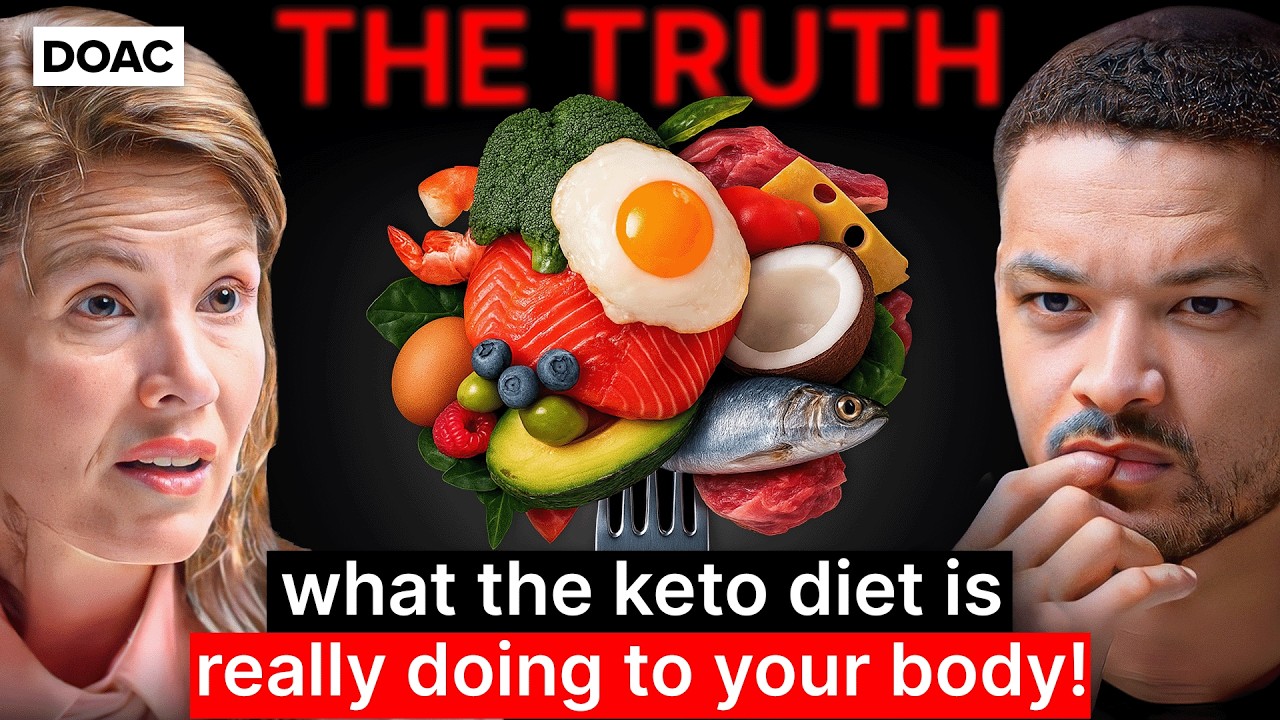
## Background
This episode of 'The Diary Of A CEO' was published by Steven Bartlett on YouTube on November 24, 2025. According to the page description, internal medicine expert Dr. Annette Bosworth (Dr. Boz) discusses how to reverse insulin resistance, cut belly fat, avoid early dementia, why late-night eating spikes glucose, and how to use a sardine-only reset to achieve ketosis.
## TL;DR
Dr. Annette Bosworth explains how chronic hyperinsulinemia drives early brain decline, metabolic disease, and cellular waste accumulation long before symptoms appear. She outlines practical protocols to achieve and maintain ketosis, including total carbohydrate restriction, fasting schedules, and nutrient-dense foods like sardines. Through live blood glucose and ketone testing on set, she demonstrates the 'Dr. Boz Ratio' as a tool to measure cellular repair. Additionally, she shares her mother's journey using keto during cancer treatment and opens up about the personal legal battles that shaped her medical advocacy.
## Atmosphere & style
The interview has an intense, deeply educational, and emotionally resonant tone. Steven Bartlett acts as an engaged and curious host, testing his own metabolic numbers while prompting Dr. Boz to break down complex medical concepts into accessible principles. The atmosphere shifts seamlessly from sharp clinical analysis to raw vulnerability when Dr. Boz reflects on her family's hardships, fighting cancer alongside her mother, and overcoming high-stakes legal persecution.
## Key takeaways
- [08:16](https://www.youtube.com/watch?v=KVXnVe8eOkM&t=496s) Late-night eating drastically spikes insulin levels overnight, locking away cellular debris, worsening systemic inflammation, and driving long-term chronic illness.
- [14:52](https://www.youtube.com/watch?v=KVXnVe8eOkM&t=892s) Early physical indicators of chronic hyperinsulinemia and metabolic dysfunction include abdominal fat accumulation, skin tags, acanthosis nigricans, and loss of hair on the lower legs.
- [15:22](https://www.youtube.com/watch?v=KVXnVe8eOkM&t=922s) Fasting glucose tests often fail to catch early metabolic decline because the body compensates by overproducing insulin for up to a decade before blood sugar elevates.
- [23:01](https://www.youtube.com/watch?v=KVXnVe8eOkM&t=1381s) Ketones provide an alternative fuel source that bypasses brain insulin resistance, clears cellular waste, and aids in managing neurodegenerative conditions like Alzheimer's disease.
- [38:26](https://www.youtube.com/watch?v=KVXnVe8eOkM&t=2306s) The Dr. Boz Ratio (Blood Glucose divided by Blood Ketones) serves as a key tool for measuring metabolic health, fat-burning efficiency, and cellular repair.
- [46:57](https://www.youtube.com/watch?v=KVXnVe8eOkM&t=2817s) The KetoContinuum provides a structured 12-step framework to transition safely and sustainably into long-term ketosis using intermittent fasting and carb restriction.
- [51:19](https://www.youtube.com/watch?v=KVXnVe8eOkM&t=3079s) High insulin traps fat-soluble hormones like Vitamin D and estrogen inside adipose tissue, disrupting hormonal communication and lowering functional vitamin levels.
- [54:36](https://www.youtube.com/watch?v=KVXnVe8eOkM&t=3276s) The 3-day Sardine Challenge acts as an accessible, high-fat, zero-carb reset to rapidly drain glycogen stores and jumpstart natural ketone production.
- [59:02](https://www.youtube.com/watch?v=KVXnVe8eOkM&t=3542s) Individuals with insulin resistance should track total carbohydrates instead of net carbohydrates to avoid hidden sugars that disrupt ketosis.
- [01:14:19](https://www.youtube.com/watch?v=KVXnVe8eOkM&t=4459s) A strict ketogenic diet leverages the Warburg effect by starving glucose-dependent tumor cells while preserving muscle mass during cancer therapies.
- [01:24:34](https://www.youtube.com/watch?v=KVXnVe8eOkM&t=5074s) Creatine supplementation supports cognitive energy and jet lag recovery, though it artificially inflates serum creatinine levels on standard kidney function tests.
- [01:26:48](https://www.youtube.com/watch?v=KVXnVe8eOkM&t=5208s) Natural compounds like beta-hydroxybutyrate and allulose effectively stimulate endogenous GLP-1 release to curb food cravings without pharmaceutical risks.
## Detailed walkthrough
### [00:00](https://www.youtube.com/watch?v=KVXnVe8eOkM&t=0s) The Sardine Challenge and the Power of Ketosis
Dr. Annette Bosworth, an internal medicine and insulin resistance specialist known affectionately as "Dr. Boz," kicks off the discussion by introducing the "sardine challenge." The rules are simple but demanding: for the next three days, the only thing on the menu is sardines. She challenges host Steven Bartlett to consume three cans a day, calling it a powerful tool to push the body into a ketogenic state. While detailing the benefits—such as burning fat, preserving muscle mass, improving brain performance, concentration, energy, and even reversing gray hair—an amusing moment occurs when she accidentally spills sardine juice all over Steven's iPad, prompting a lighthearted laugh about how difficult it will be to clean off.
Turning to the broader medical implications, Dr. Boz frames her advice around an advanced ketogenic diet. She emphasizes that her two decades of clinical experience have taught her that the true key to health lies in achieving a ketogenic state rather than stacking up treatments. She explains that most people generate "buckets of insulin" without realizing it, which serves as a chronic driver for high blood pressure, cancer, and dangerous debris accumulation in the brain linked to depression, brain fog, Alzheimer’s, and Parkinson's disease. To reverse this high-insulin state, she guides her patients through a low-carb, high-fat regimen consisting of whole foods like eggs, beef brisket, ribs, and pork belly, while strictly warning against late-night eating. Responding to criticisms that a ketogenic diet is unsustainable, Dr. Boz shares that she has lived a keto lifestyle for ten years and relies on a structured, 12-step method called the "KetoContinuum" to make it consistently sustainable for life.
[02:03](https://www.youtube.com/watch?v=KVXnVe8eOkM&t=123s) Medicine 2.0 vs. Managing Chronic Illness
Steven asks Dr. Boz to define what she understands about health that the general public completely misses. She explains that the vast majority of reasons patients seek her care could be entirely reversed if they simply knew how to consistently generate ketones. As an internist, she deals with complex medical puzzles and long-term, chronic disease management. She jokes that the term "internist" sounds deceptively like an "intern," but clarifies that in her field, "the buck stops with you" because if the internal medicine team cannot solve the puzzle, the patient faces a dire outcome. She notes that after 25 years of observing chronic deterioration, she has seen how both lifespan and healthspan quickly "go in the toilet."
Dr. Boz references author Dr. Peter Attia’s concept of "Medicine 2.0" to describe the modern medical establishment she operates within. In her view, Medicine 2.0 is a masterclass in symptom management and pharmaceutical matching games, keeping people from dying of acute infections or childbirth while offering a direct drug antidote for every single symptom. However, she argues this system functions like a "mill" that merely props up the structural architecture of the body without fixing the underlying chemistry problems under the hood. By shifting to a preventative mindset and lowering insulin to "take out the trash" out of the body, individuals can avoid the quicksand of chronic joint pain, cognitive decline, and low stamina that plague the average 54-year-old.
- **Internal Medicine Definition:** A specialty focused on solving highly complex, chronic medical puzzles where improper management can result in death.
- **Medicine 2.0 Flaw:** Focuses on refilling prescriptions and managing side effects for 5 to 10 years rather than resolving deep chemical imbalances.
- **The Core Issue:** Aging, brain fog, and high blood pressure are signals that the body is producing more cellular waste ("trash") than it is cleaning up.
[08:16](https://www.youtube.com/watch?v=KVXnVe8eOkM&t=496s) The High Cost of Late-Night Calories and the Role of Insulin
The conversation shifts to personal habits when Dr. Boz asks Steven what he ate for breakfast. When he reveals he hasn't eaten yet, she commends the fasting but emphasizes a critical rule of aging: "the cost of a calorie turns into timing." She states that for an aging body, a single bite of food consumed after 6:00 PM can have the metabolic impact of ten bites consumed before noon, meaning people should ideally shift their food consumption toward the morning. Steven shares his typical routine, noting that the day before, he only ate a large salad around 4:00 PM followed by a late 9:00 PM dinner of cod, salad, and pasta, ultimately going to sleep around 11:00 PM and waking up at 7:30 AM.
Dr. Boz uses Steven’s routine to illustrate how late-night carbohydrate intake keeps insulin levels churning heavily even eight hours later into the morning, locking the body into a state of chronic inflammatory churn. To make this clear, she explains insulin to Steven "like he's a 12-year-old," stating that "insulin insulates" and makes the body "fluffy" by storing fat. Its primary job is to act as a transporter, lifting glucose out of the blood circulation and shoving it into cells. However, when cell and liver storage capacities are entirely maxed out, the body signals for the creation of brand-new fat cells to store the excess energy in preparation for a fictional famine.
[12:52](https://www.youtube.com/watch?v=KVXnVe8eOkM&t=772s) Warning Signs of Insulin Resistance and Cellular Trash
Dr. Boz explains that becoming overweight is far from the only consequence of carrying excess insulin. In a metabolically compromised state, high insulin effectively masks the underlying accumulation of cellular debris. This debris gets packed away silently between the skin cells and brain cells, and the body cannot engage its natural cleanup processes until insulin levels drop. People unknowingly stimulate these massive "buckets of insulin" by consuming processed foods that come from "boxes, barcodes, and bags" rather than focusing on a fat-forward diet that triggers ketone production.
When asked about the immediate warning signs of insulin resistance, Dr. Boz identifies "abdominal girth" as the very first indicator because that is where the excess fat immediately migrates. Steven notes that despite his late meals, he feels incredibly focused during the day and doesn't even notice the lack of food. Dr. Boz identifies this as a positive sign of time-restricted eating but challenges him to clinically prove whether his body is actually producing ketones or if he is simply running on adrenaline. She warns that for individuals trapped in a high-insulin state, their fuel constantly runs out, forcing them to feel an intense urge to eat every two to three hours just to keep going.
- **The Primary Sign of High Insulin:** Increased abdominal girth, representing the body's immediate destination for overflow fat storage.
- **The Cellular Consequence:** High insulin levels completely block the production of ketones, meaning the body cannot clean up the cellular debris linked to brain aging.
- **The Dietary Drivers:** Ultra-processed items found via barcodes and bags rather than nutrient-dense, fat-heavy whole foods.
[15:22](https://www.youtube.com/watch?v=KVXnVe8eOkM&t=922s) Ketones vs. Glucose and the Hidden Drain of Glycogen Stores
When an individual successfully achieves a state of ketosis, their ketone levels will typically read between 0.7 and 1.0 mmol/L, indicating that their cellular system is actively "taking out the trash" all day long. The human body operates on two distinct fuel sources: glucose and ketones. Glucose is derived from carbohydrate-heavy meals like pasta, which trigger a sharp blood sugar spike followed by a massive surge of insulin to clear the bloodstream. Ketones, by contrast, emerge when carbohydrates are restricted or during extended fasting, forcing the body to seek alternative, cleaner energy sources.
```
+-----------------------------------------------------------------------+
| BODY ENERGY SOURCES |
+-----------------------------------------------------------------------+
| 1. GLUCOSE (Carbs / Fast-burning) |
| - Spikes blood sugar and triggers insulin release. |
| - Stored in liver & muscles as GLYCOGEN ("crusty brown sugar"). |
| - Must be completely depleted before fat-burning can begin. |
| |
| 2. KETONES (Fat-derived / Clean-burning) |
| - Produced when carbs are absent or during fasting. |
| - Requires low insulin and depleted glycogen tanks. |
| - Provides sustained energy and crosses blood-brain barrier. |
+-----------------------------------------------------------------------+
```
A common misconception is wondering why the body does not simply run on ketones all the time. The reality is that it *will* run on ketones the moment insulin levels are sufficiently lowered. However, modern medical practices often miss chronic disease early on because routine blood tests only measure fasting glucose, which can appear perfectly normal for years. Doctors rarely check how much insulin the pancreas had to produce behind the scenes to maintain that normal blood sugar level. Excess insulin, maintained over a decade or more, drives conditions such as polycystic ovary syndrome (PCOS), hypertension, and various autoimmune disorders.
When the body needs to store excess glucose, it packages it tightly into a complex branching chain called glycogen.
> "Think of it as brown sugar. So, you package the sugar really tight. Then you put it in the back of the drawer and it turns crusty cuz you never lowered your insulin."
Because chronic high insulin constantly signals the body to store rather than burn, these glycogen reserves become dense and difficult to empty. For severely overweight or insulin-resistant patients placed on a strict regimen of under 20 total grams of carbohydrates per day, it can take up to 15 full days before their bodies exhaust these stored sugar reserves and produce their very first ketone. Fat burning cannot occur until this internal fuel tank is completely empty and insulin levels drop.
---
[18:22](https://www.youtube.com/watch?v=KVXnVe8eOkM&t=1102s) Physical Indicators of High Insulin and Reversing the Signs of Aging
Recognizing insulin resistance does not always require complex lab work; the skin and body offer clear physical warning signs:
* **Skin Tags:** Unlike flush or slightly raised moles, skin tags possess a distinct narrow stalk or "neck," resembling tiny mushrooms or small stalks of cauliflower. They frequently appear in areas of friction, such as the armpits and groin. Trimming or cutting them off is ineffective because they will simply bleed and regrow; they naturally dry up and fall off once systemic insulin levels drop.
* **Acanthosis Nigricans ("Velvety Skin"):** Characterized by hyperpigmentation and skin thickening, this condition commonly affects the back of the neck and the creases of the elbows. It is often mistaken for poor hygiene ("dirty neck syndrome"), particularly in teenagers experiencing simultaneous spikes in growth hormone and insulin, but it is actually a visible dermatological pathology caused by elevated insulin.
* **Loss of Toe and Lower Extremity Hair:** In individuals over age 55 who have endured decades of hyperinsulinemia, the body systematically restricts circulation and resources to peripheral tissues. Hair follicles on the toes are among the first to shut down, with hair loss gradually ascending up the ankles and lower legs.
```
[ HIGH SYSTEMIC INSULIN LEVEL ]
│
┌────────────────┼────────────────┐
▼ ▼ ▼
[Skin Tags] [Velvety Skin] [Loss of Toe Hair]
Armpits/Groin Back of neck Peripheral vascular
(Mushroom-like) Elbow creases resource reduction
```
Beyond outward physical traits, long-term high insulin directly accelerates the cellular aging process. Aging is effectively the accumulation of uncleaned cellular waste—the inability to remove "brain trash" while sleeping at night due to chronic metabolic impairment. Impressively, patients who transition to a well-formulated ketogenic diet can sometimes reverse premature greying hair as their hair-producing follicle cells recover cellular health.
To initiate a therapeutic ketogenic protocol, patients must track their intake and reduce total carbohydrate consumption to under 20 grams per day for the first six weeks. This medical-grade approach requires precise data tracking rather than casual ("lazy") keto. Ketone levels can be measured using cost-effective urine test strips ("pee-tone strips"), which detect surplus ketones that the body excretes before becoming fully keto-adapted, or via direct finger-prick blood tests for higher precision.
- **Skin tag structure:** Characterized by a distinct neck attachment rather than a solid flat base.
- **Acanthosis nigricans location:** Frequently found around the nape of the neck and inside the elbow creases.
- **Micro-vascular degradation:** Loss of leg and toe hair progresses upward from the extremities due to prolonged resource starvation caused by high insulin.
- **Initial keto macro threshold:** Restricting total intake to under 20 grams of total carbohydrates daily.
---
[23:01](https://www.youtube.com/watch?v=KVXnVe8eOkM&t=1381s) Cognitive Enhancements, Fuel Efficiency, and Overcoming Severe Insulin Resistance
Burning ketones offers metabolic and neurological advantages over relying strictly on glucose:
1. **Cleaner Cellular Fuel:** Ketones generate significantly fewer reactive oxidation byproducts when metabolized inside the mitochondria, creating a natural antioxidant state directly where energy is produced.
2. **Direct Blood-Brain Barrier Penetration:** Ketones cross the blood-brain barrier independently without requiring the specific insulin-dependent transport mechanisms that glucose relies upon.
3. **Bypassing Brain Insulin Resistance:** An insulin-resistant brain struggles to absorb glucose, leading to cognitive fatigue, brain fog, and mood instability. Ketones bypass this bottleneck, supplying immediate fuel to brain cells.
4. **Enhanced Cognitive Performance:** Sustained ketone burning improves focus, emotional control, and mental endurance while reducing impulsivity.
Podcasters and public speakers frequently note a stark difference in their ability to articulate thoughts, maintain focus, and converse for hours when in a fasted or ketogenic state versus after consuming a high-carbohydrate diet. Transitioning into ketosis clears brain inflammation, whereas reintroducing excess carbohydrates triggers fluid retention and rapid swelling that can feel like a mild concussion.
Dr. Bosworth shares her personal experience with overcoming severe insulin resistance:
> "I had three of them [babies] and then the weight never came off on that third one. So, here is an insulin resistant person at 40-something years old and I am probably 60 lb heavier than I am now."
Despite being a practicing physician with normal fasting blood sugar and acceptable HbA1c levels, her body was deeply insulin resistant after a decade of pregnancy, high-stress medical shifts, and poor sleep. When she initially attempted a ketogenic diet, she struggled for nine months to produce detectable ketones, failing on 50 grams, 30 grams, and even zero-carb attempts.
Desperate to verify whether ketosis was scientifically real, she took her children on a 22-mile Memorial Day walk in honor of military veterans' mental health while completely fasted. It was only after completing this 22-mile trek that her glycogen stores finally emptied enough for her body to register its first urine ketone. Today, having restored her metabolic flexibility, her body can transition back into ketosis within just 12 hours of eating a higher-carbohydrate meal.
[31:14](https://www.youtube.com/watch?v=KVXnVe8eOkM&t=1874s) Muscle Recovery, Soreness, and Aging
The discussion opens with Dr. Annette Bosworth ("Dr. Boz") evaluating Steven Bartlett's physical recovery routine and muscle soreness following heavy weightlifting sessions. She explains that while younger individuals in their late teens or early twenties can recover rapidly without extra intervention, people entering their thirties and forties face escalating systemic inflammation. When lifting heavy, microscopic muscle tears are inevitable; however, in an aging body, the immune and inflammatory repair response tends to "overshoot," causing delayed muscle repair and lingering chronic pain.
To counteract this, Dr. Boz advocates operating within a ketogenic state. Maintaining low baseline inflammation creates an optimal biochemical environment for rapid tissue repair. When patients ask how to bounce back faster after strenuous training or injuries, she advises utilizing ketosis to minimize recovery time and reduce inflammatory overreactions.
[32:25](https://www.youtube.com/watch?v=KVXnVe8eOkM&t=1945s) Impact of Keto on Athletic Performance and Muscle Power
Steven asks whether transitioning to a ketogenic diet negatively impacts physical performance, strength, endurance, or power. Dr. Boz points to military studies where insulin-resistant soldiers were placed on a ketogenic protocol to evaluate their athletic metrics over time. At the one-month mark, the soldiers experienced weight loss, but their time and power output remained relatively unchanged—a phase where individuals often feel unadapted.
However, the longitudinal results demonstrated significant adaptation:
* **6 Months:** The soldiers lost additional weight, and their power output increased by roughly **20%** compared to their non-keto counterparts.
* **18 Months:** Their power output surged to nearly **50%** higher than the control group.
Dr. Boz details the physiological mechanism behind this transformation: human muscle tissue prioritizes glucose when available on a high-carbohydrate diet. Training the muscular system to efficiently utilize fat takes considerable time, but fat serves as a cleaner, longer-lasting fuel source with lower inflammatory byproducts. She stresses that long-term commitment is essential and warns athletes against switching to keto right before an event:
> "You'll love me in 18 months. You'll think I'm pretty great at 6 months. But if you're trying to run a marathon and we're only 3 to 4 weeks out, you should not start a ketogenic diet. You're going to think it's the worst thing ever."
[34:03](https://www.youtube.com/watch?v=KVXnVe8eOkM&t=2043s) Neurodegenerative Diseases and Clinical Experiences with Keto
The conversation pivots to cognitive decline and neurodegenerative conditions such as Alzheimer's and dementia. Steven notes emerging research regarding causality and ketogenic interventions. Dr. Boz reflects on the tragedy of early warning signs—such as a patient getting lost while driving—noting that by the time these symptoms surface, the brain has endured **15 years** of cellular debris and metabolic dysfunction.
She shares a profound clinical story involving a 40-year-old patient with Down syndrome who had advanced insulin resistance, early-onset Alzheimer's, and severe cognitive impairment. The patient's mother originally sought help after helping her daughter lose **100 lbs**, yet the weight loss alone failed to improve the daughter's worsening mental cognition. Dr. Boz placed both the mother and daughter on a strict finger-prick-verified ketogenic diet.
Within days, both achieved elevated blood ketone levels around **3.0 mmol/L** (far exceeding the average initial response of ~**1.0 mmol/L**). By week three, the mother reported a historic breakthrough:
* The daughter, who had been limited to two-syllable words her entire **41 years** of life, clearly uttered a three-syllable phrase ("I understand") when given a task at church.
* Over time, she shed an additional **15 to 20 lbs**, her cognitive function improved dramatically, and her functional Alzheimer's impairment effectively resolved.
Steven highlights key supporting scientific principles behind these outcomes:
* **Alternative Fuel:** In Alzheimer's (often referred to as "Type 3 diabetes"), the brain loses its ability to metabolize glucose efficiently; ketones act as a clean, alternative energy source.
* **Mitochondrial & Neural Health:** Ketones enhance mitochondrial function, lower systemic inflammation, protect neurons from damage, and support new neural connections.
* **Cognitive Benefits & Caveats:** Early studies demonstrate temporary improvements in memory for mild cognitive impairment, though long-term adherence can be challenging and the diet is not suited for everyone (e.g., underweight individuals).
[38:26](https://www.youtube.com/watch?v=KVXnVe8eOkM&t=2306s) Testing Steven Bartlett's Glucose and Ketones
To demonstrate real-time metabolic tracking, Dr. Boz introduces finger-prick testing meters that measure blood glucose and blood ketones simultaneously. She emphasizes that testing blood at home provides the most reliable metabolic data, freeing patients from constant clinic visits.
Steven pricks his finger to test his levels using two strips (a blue strip for ketones and a brown strip for glucose):
* **Glucose:** **86 mg/dL** (a healthy, double-digit baseline).
* **Ketones:** **0.9 mmol/L** (above the **0.5 mmol/L** threshold for ketosis).
Dr. Boz calculates Steven's **Dr. Boz Ratio** (Blood Glucose divided by Blood Ketones):
$$\frac{86}{0.9} \approx 95$$
A ratio around **95** indicates active fat-burning. While a ratio under 100 is solid for general health, Dr. Boz notes that patients battling severe conditions like cancer, autoimmune diseases, or brain injuries require even lower ratios (higher ketone presence relative to glucose) to trigger intense cellular repair.
[40:53](https://www.youtube.com/watch?v=KVXnVe8eOkM&t=2453s) Testing Dr. Boz's Levels and Late-Night Eating Risks
Next, Dr. Boz tests her own blood on camera, yielding remarkable figures:
* **Glucose:** **83 mg/dL**
* **Ketones:** **1.7 mmol/L**
Steven expresses surprise at her high ketone reading (**1.7 mmol/L**). Dr. Boz explains that metabolic flexibility shifts with age. While a 33-year-old like Steven might eat late at night and still clear glucose effectively, older adults cannot afford late-night meals due to prolonged insulin spikes. She routinely stops eating around **3:00 PM** to allow her body ample time to clear metabolic waste before sleep.
When Steven notes that he often skips food until 2:00 PM the next day, Dr. Boz highlights a crucial physiological factor: the morning **cortisol spike**. Regardless of whether someone is awake or in a dark room, the natural circadian rhythm triggers a rise in cortisol at sunrise. Cortisol signals the liver to release stored glycogen into the bloodstream as glucose to provide morning energy. In insulin-resistant individuals, this automatic release causes high morning blood sugar levels even before any food is consumed.
The pair decides to test the metabolic metrics of podcast producer Jack (who previously underwent fitness testing with Dr. Peter Attia):
* **Glucose:** **88 mg/dL**
* **Ketones:** **0.1 mmol/L**
Calculating Jack's Dr. Boz Ratio yields a high score:
$$\frac{88}{0.1} = 888$$
Dr. Boz uses this result as a textbook example of high metabolic "trash" production with minimal clearance. Running purely on glucose without generating ketones indicates underlying insulin resistance. She notes that when she tested the rest of the production crew, most registered ketone levels between **0.1 and 0.3 mmol/L**.
> "Welcome to my clinic in 10 years. That is trash being made, never being taken out."
Dr. Boz reflects on her personal entry into ketogenic medicine: her mother's severe insulin resistance led to a cancer diagnosis, prompting the entire family to adopt a ketogenic lifestyle. She notes how her sons grew up without sugary treats; today, one of her sons attending Georgetown Law School relies on ketosis to maintain the intense focus required for his legal studies.
Here is a detailed, faithful walkthrough of the transcript section provided:
[46:57](https://www.youtube.com/watch?v=KVXnVe8eOkM&t=2817s) The Keto Continuum: A 12-Step Framework for Sustained Ketosis
Dr. Annette Bosworth introduces the core framework from her 2020 book, *KetoCONTINUUM: Consistently Keto Diet for Life*. She outlines a structured 12-step pathway designed to help patients transition from a standard high-carb diet to long-term, metabolic healing through consistent ketosis. Dr. Boz emphasizes that patients never truly "fall off" the continuum completely; if they slip up, they simply land back at Step 1, where most people start: eating every two to three hours and exceeding 20 grams of carbs daily.
The continuum begins by getting off the carb train and measuring progress:
* **Step 2 (The 20-Gram Limit):** Drop total carbohydrates below 20 grams per day. Patients monitor urine ketone strips to confirm their fat-based hormones are resurrecting.
* **The "Magic Moment":** By day 10, the average person (e.g., a menopausal woman who has gained 25 pounds) naturally skips their first meal without feeling starved. For severely insulin-resistant individuals, it may take two full weeks of strict carb reduction just to see a single positive urine ketone.
* **Stages 5 & 6 (16:8 Fasting):** Transition to a 16-hour daily fast with an 8-hour eating window. Dr. Boz cautions against eating late (e.g., eating from 2:00 PM to 10:00 PM) and advises pushing fat consumption early in the day to unlock stored body fat.
* **Stage 7 (23:1 Fasting):** Fast for 23 hours with a 1-hour eating window (One Meal a Day). Rather than jumping abruptly from 16:8 to 23:1, patients gradually slide their eating window down hour by hour while shifting meals closer to sunrise.
* **Stages 9 through 12 (Extended Fasting):** Incorporate 36- to 72-hour fasts. For individuals who have lived with elevated insulin for 15 to 20 years, a 36-hour "nothing burger" fast is necessary to reset the metabolism and prompt the pancreas to produce less insulin over time.
[51:19](https://www.youtube.com/watch?v=KVXnVe8eOkM&t=3079s) Sex Differences in Metabolism and Hormone Regulation
Steven asks whether women face distinct metabolic barriers during ketogenic fasting, noting that his girlfriend takes much longer than he does to enter ketosis. Dr. Boz nods, referencing the survival reality show *Alone*, where contestants are dropped in the wilderness to survive. On the show, body fat visibly melts off men almost instantly, whereas women's bodies stubbornly protect their fat stores. Female biology is evolutionarily programmed to preserve fat to safeguard reproduction.
Dr. Boz addresses common concerns that ketogenic diets "ruin female hormones," clarifying that these debates only apply once insulin levels are normalized. High insulin acts as a master dictator that locks away fat, disrupting sex hormones like estrogen and testosterone as well as vitamin D—all of which are derivatives of cholesterol stored inside fat tissue. When an obese woman undergoes a fat biopsy, high concentrations of trapped vitamin D and estrogen are found inside those fat cells. Lowering insulin mobilizes these stored fat cells, enabling proper hormonal signaling.
* **Signs of High Insulin in Women:** Low vitamin D, low estrogen, thinning hair on the crown of the head, skin tags, and Polycystic Ovary Syndrome (PCOS).
* **Menstrual Synchronization:** Steven shares that women in his life noticed their menstrual cycles became more synchronized on a low-carb diet. Dr. Boz agrees, explaining that lowering insulin allows hormones to "hear each other again."
* **Long-Term Female Ketosis:** Dr. Boz reflects on her own journey, having maintained a ketogenic lifestyle for 15 years. Now at age 55 and navigating menopause, she finds her brain function and energy tank without ketones. She emphasizes that building mitochondrial flexibility—the ability to burn both glucose and ketones smoothly—is critical for managing menopause safely.
[54:36](https://www.youtube.com/watch?v=KVXnVe8eOkM&t=3276s) The Sardine Challenge and High-Fat Grocery Essentials
To demonstrate the power of high-fat foods, Dr. Boz pulls out 12 cans of sardines, accidentally spilling sardine juice onto Steven’s iPad in the process. While acknowledging that sardines win the award for the worst smell, she insists they taste far less bitter than canned tuna and serve as an incredible, low-cost therapeutic tool. When overwhelmed patients get lost in complex keto meal plans, Dr. Boz simplifies everything down to a single, nutrient-dense whole food rich in essential fats and protein.
```
┌──────────────────────────────────────────────────────────┐
│ DR. BOZ'S KETO SHOPPING ESSENTIALS │
├───────────────────────┬──────────────────────────────────┤
│ Top Staples │ Pork belly, eggs, beef brisket, │
│ │ beef ribs, butter, and sardines │
├───────────────────────┼──────────────────────────────────┤
│ Overrated / Use Care │ Avocados (contain hidden carbs) │
├───────────────────────┼──────────────────────────────────┤
│ Net Carbs vs. Total │ Count TOTAL carbs; ignore net │
│ │ calculations. "Fiber is for │
│ │ farting." │
└───────────────────────┴──────────────────────────────────┤
```
* **The 3-Day Sardine Reset:** During her 21-day advanced keto coaching program, Dr. Boz places participants on an all-sardine diet from Day 6 to Day 8. There are no calorie limits or eating windows—participants eat as many sardines as they want to achieve deep satiety and trigger heavy ketone production within 48 to 72 hours.
* **Why Fat Intake Matters:** Steven shares that he once spent seven days eating almost zero carbs but still failed to register high ketones. Dr. Boz explains that his body fat was trapped behind an "insulin bed." To force ketone production when body fat is locked up, patients must temporarily increase their dietary fat intake.
* **Shopping List for Ketosis:** Dr. Boz recommends pork belly, eggs, beef brisket, ribs, and pure butter. While avocados are healthy, she warns that their hidden carbohydrate content can stall ketosis if overconsumed (such as eating four in one day). For patients who struggle to make ketones and refuse sardines, she has them eat plain butter for a day—a 100% fat intake that quickly demonstrates what true satiety feels like.
* **Total Carbs vs. Net Carbs:** Dr. Boz rejects "net carb" calculations (subtracting fiber from total carbs). While metabolically healthy people can handle net carb math, individuals with insulin resistance must count **total carbs**. As she bluntly puts it: "Fiber is for farting."
[59:22](https://www.youtube.com/watch?v=KVXnVe8eOkM&t=3562s) The 100-Day Sardine Experiment: Jane’s Story
Dr. Boz shares the emotional story of a patient named Jane, who struggled with emotional eating and used food to mask deep psychological wounds. While the chemistry of the ketogenic diet is straightforward, Dr. Boz notes that keto fails when life stress, trauma, and poor sleep disrupt human behavior. Seeking a breakthrough, Jane completed a 30-day sardine-only challenge, writing to Dr. Boz afterward about how incredible she felt after confronting her underlying relationship with food.
When Jane later decided to repeat the challenge, Dr. Boz wanted to address public criticism—specifically pointing to Joe Rogan's claims on his podcast that eating large amounts of sardines causes heavy metal toxicity and arsenic poisoning. Before Jane started, Dr. Boz baseline-tested her blood levels for vitamin D, selenium, and arsenic. Jane then embarked on a remarkable **100-day sardine-only journey**.
* **Blood Marker Results:** After 100 days of eating exclusively sardines without any supplements, Jane’s vitamin D jumped from the 30s–40s ng/mL up to **108 ng/mL**. Her selenium remained stable, and her arsenic levels showed no signs of toxicity.
* **Emotional Breakthrough:** Beyond weight loss, the 100-day challenge forced Jane to confront her emotional reliance on food. During a program exercise where participants reflect on the best day of their life, Jane admitted: *"I don't think I've ever had the best day of my life."* Expressing that vulnerability out loud allowed her to break free from decades of fear and begin looking forward to the future.
[01:02:51](https://www.youtube.com/watch?v=KVXnVe8eOkM&t=3771s) Gut Microbiome and the Myth of Fiber
Dr. Annette Bosworth directly tackles the common belief that a healthy gut microbiome requires eating plants and fiber. When Steven questions whether a restrictive or sardine-focused diet starves beneficial gut bacteria, Dr. Boz quips, "Fibers for farting." She describes the gut biome as a squishy, dense slime layer inside the intestines where microbes live and build their homes. Contrary to popular opinion, placing coarse plant fiber into this delicate environment can tear that structural slime layer down.
While fiber converts into butyrate through specific bacterial fermentation, Dr. Boz emphasizes that humans have not been dedicated fiber eaters throughout all of evolutionary history. In her practice, patients with severe gastrointestinal issues—such as irritable bowel syndrome, chronic diarrhea, and bleeding ulcers—experience complete reversal of their symptoms when switching to a carnivore or fish-heavy diet because their intestinal wall and mucosal barrier become significantly stronger.
- **Gut Mucosa:** The internal slime layer should be thick and squishy, not thin, watery, or moth-eaten.
- **Microbiome Reversal:** Carnivore diets with small fish like sardines frequently resolve chronic GI inflammation and ulcerations.
- **Fiber vs. Health:** Dr. Boz maintains that plant fiber is not strictly necessary to cultivate a healthy, supportive gut ecosystem.
---
[01:04:14](https://www.youtube.com/watch?v=KVXnVe8eOkM&t=3854s) Addressing Concerns: Nutrients, Sodium, Mercury, and Microplastics
Steven raises several practical concerns regarding a highly restricted diet like eating only sardines, including potential deficiencies in vitamin C and magnesium, excessive sodium intake, heavy metal toxicity, and microplastics from canned packaging. Dr. Boz explains that nutrient requirements shift under a carnivore protocol; for example, vitamin C handling operates under different metabolic rules when carbohydrate intake is zero. Regarding sodium, the body dynamically regulates its sodium receptors based on recent intake, smoothly adjusting to higher salt levels.
Addressing heavy metal toxicity, Dr. Boz uses the rule of thumb: "Little fish, little problems." Smaller fish at the bottom of the food chain like sardines contain negligible amounts of mercury, a fact she confirmed by tracking patient lab results over 100 days without any rise in toxic metals. When Steven brings up microplastics and chemical leaching from metal cans, Dr. Boz dismisses it as "majoring in the minor leagues," arguing that the immense metabolic benefits of eating sardines vastly outweigh the negligible risk from canned packaging.
- **Sodium Adaptability:** Cellular sodium receptors scale up or down depending on recent dietary consumption.
- **Mercury Levels:** Testing patients on a 100-day sardine challenge showed zero dangerous accumulation of heavy metals.
- **Contaminant Risks:** Dr. Boz advises patients not to panic over microplastics in canned fish given the overwhelming therapeutic upsides.
---
[01:05:28](https://www.youtube.com/watch?v=KVXnVe8eOkM&t=3928s) Gut-Brain Axis, Butyrate, and Diversity
The discussion turns to the gut-brain axis and how the microbiome influences mood, neurological signaling, and hormone production. Steven points out that key gut-derived hormones like GLP-1, GIP, and serotonin profoundly affect brain function. Dr. Boz agrees, explaining that producing GLP-1 requires a robust, thick gut lining nourished by short-chain fatty acids—specifically butyrate, a two-carbon fat molecule.
When Steven questions how a single-food diet can maintain the microbial diversity touted by health experts, Dr. Boz counters that true microbial support does not depend on eating dozens of different plant species. Rather, the primary goal of the microbiome is to supply two-carbon fats like butyrate. When an individual produces beta-hydroxybutyrate—the primary ketone body circulating in the blood—it delivers the exact same two-carbon fat structure directly to the tissues, achieving the same physiological outcome without needing plant fermentation.
> "All these experts come on my show and they talk about the importance of having a diverse microbiome... Diversity enough to be supportive means diverse enough to have the two-carbon fat that you want to have in there."
- **Butyrate Chemistry:** A two-carbon short-chain fatty acid essential for gut mucosa integrity and hormone signaling.
- **Ketone Connection:** Beta-hydroxybutyrate provides the metabolic equivalent of gut-derived butyrate directly through the bloodstream.
- **Gut-Brain Hormones:** Robust production of GLP-1 and GIP depends on a healthy mucosal barrier rather than plant fiber.
---
[01:07:23](https://www.youtube.com/watch?v=KVXnVe8eOkM&t=4043s) Vitamin D as a Hormone and Insulin Resistance
Dr. Boz highlights vitamin D as one of the single most crucial daily supplements, noting that while it is classified as a vitamin, it actually functions as a master hormone. Vitamin D enters cell nuclei across the entire body—from skin and heart cells to neurons—instructing them to optimize their function. However, because vitamin D is fat-soluble, high circulating insulin levels trap it inside adipose storage cells, preventing it from reaching target tissues where it can exert its therapeutic effects.
To illustrate this, Dr. Boz shares the story of her patient Jane during her 100-day challenge. Jane had struggled with persistently low vitamin D levels in the 30s and 40s (measured in ng/mL) despite taking high-dose supplements. Once she adopted a sardine-focused ketogenic diet, her hyperinsulinemia resolved, releasing the trapped hormone into active circulation and driving her blood levels up to 108 ng/mL.
- **Hormonal Role:** Vitamin D communicates directly with cell nuclei to regulate genetic expression and cellular health.
- **Insulin Trapping:** Elevated insulin parks fat-soluble vitamins inside adipose tissue, rendering supplements ineffective.
- **Target Biomarkers:** Optimal brain health benefits from vitamin D levels around 50 ng/mL or higher; Jane achieved levels over 100 ng/mL once her insulin dropped.
---
[01:10:30](https://www.youtube.com/watch?v=KVXnVe8eOkM&t=4230s) Magnesium Floats, Omega-3s, and Exogenous Ketones
Moving to essential supplementation, Dr. Boz asserts that modern soils and food supplies are depleted of magnesium, a vital mineral acting as the body's "spark plug" for ATP energy recycling and enzymatic reactions. Beyond oral supplements, she encourages patients to do "magnesium floats"—soaking in high-salinity epsom pools similar to the Dead Sea—to absorb magnesium directly through the skin. She also recommends omega-3 fatty acids for anyone not consuming whole fish regularly.
The conversation transitions to exogenous ketones, with Steven disclosing his financial investment in the ketone supplement company Ketone-IQ. Dr. Boz explains the clinical utility of liquid ketones and ketone salts, sharing that she formulated a clean liquid ketone option (pure beta-hydroxybutyric acid) without artificial sweeteners or fillers because her husband is allergic to stevia.
- **Magnesium Depletion:** Widespread agricultural soil depletion makes magnesium supplementation necessary for optimal ATP recycling.
- **Transdermal Absorption:** Soaking in concentrated magnesium baths effectively delivers the mineral through the skin.
- **Clean Formulations:** Liquid beta-hydroxybutyric acid provides pure exogenous ketones without artificial additives.
---
[01:12:11](https://www.youtube.com/watch?v=KVXnVe8eOkM&t=4331s) Jump-Starting Ketosis with Exogenous Ketones
Dr. Boz clarifies the difference between endogenously produced ketones and exogenous ketone supplements. While endogenous ketone production from fasting or a strict ketogenic diet is more abundant and sustainable, exogenous ketones act as a powerful metabolic signal. When an insulin-resistant patient ingests exogenous ketones, raising their blood levels within 15 to 20 minutes, it sends a direct signal to the liver to initiate its own ketone production for the next 12 hours.
This metabolic jump-start is particularly critical for patients who fall off their diet or for cancer patients undergoing chemotherapy who need rapid antioxidant protection without waiting days through a fast. By consuming exogenous ketones for a brief 3-day window, patients can quickly re-establish metabolic momentum, suppress cravings, and transition back into self-sustaining ketosis.
> "When you are making ketones, your body makes more ketones. So if you jump-start it by swallowing some, you get a better tomorrow."
- **Signaling Effect:** Circulating exogenous ketones prompt the liver to resume endogenously manufacturing its own ketones.
- **Rapid Onset:** Blood ketone levels measurable via blood monitors rise within 15 to 20 minutes of ingestion.
- **Protocol:** A 3-day course of exogenous ketones helps restart ketosis after dietary slip-ups or before intensive medical therapies.
---
[01:14:19](https://www.youtube.com/watch?v=KVXnVe8eOkM&t=4459s) Grandma Rose's Cancer Story: A Life-Changing Turning Point
Dr. Boz delivers an emotional account of her mother, Grandma Rose, who was the ultimate catalyst for her work in ketogenic medicine. In 2015, after a decade of receiving standard medical care, Rose's cancer returned. She walked into the clinic gray, looking like a zombie, with swollen lymph nodes in her neck. Her oncologist recommended another round of chemotherapy, but Rose adamantly refused, remembering how previous rounds had caused severe cognitive decline that left her unable to recognize her own sewing machine or her grandchildren.
Facing a 6-month terminal diagnosis, Rose asked Dr. Boz directly, "If it was you, what would you do?" Pushed past conventional treatment guidelines, Dr. Boz recalled emerging research on ketogenic diets for brain injuries and insulin-driven cancers. Standing in the hospital hallway between the scheduling desk and the exit, Dr. Boz asked her mother if she trusted her. Rose replied, "With my whole life." They walked out to the car and drove 100 miles to the family farm, where they threw out every carbohydrate in the house to begin a strict ketogenic regimen.
Six weeks later, Rose returned to the hospital looking vibrant and energized. When the oncologist slid her blood work across the table, he revealed that her cancer markers had dropped by an astonishing 70%—a result unheard of with available pharmaceutical drugs alone.
- **Diagnosis:** Recurrent cancer with swollen cervical lymph nodes and a 6-month terminal prognosis in 2015.
- **Previous Chemotherapy Impact:** Caused severe chemo-brain and cognitive impairment, robbing Rose of memory and functional skills.
- **6-Week Result:** Standard chemotherapy typically aimed for a 30% reduction; strict dietary ketosis alone yielded a 70% drop in cancer markers.
[01:18:03](https://www.youtube.com/watch?v=KVXnVe8eOkM&t=4683s) The Warburg Effect and Keto in Cancer Care
Dr. Annette Bosworth reflects on her mother’s transformation during cancer treatment, noting how her tumor markers plummeted by 70% in just six weeks on keto—compared to a 30% reduction from chemotherapy alone. Her mother, who went from looking 100 years old down to looking 40, returned to her active life as the "Mary Poppins" of her tiny 800-person town, running Sunday school and volunteering at the local thrift store. Unfortunately, during the pandemic, she contracted COVID-19 at the thrift store, and because her cancer was in her T-cells—the body's primary line of defense—her immune system failed.
Steven Bartlett outlines the scientific context surrounding keto and cancer, specifically mentioning the **Warburg effect**, where cancer cells rely heavily on glucose for energy. Because cancer cells often struggle to use ketones effectively, a ketogenic diet can theoretically starve tumors while supplying healthy cells with energy. While research shows promise—particularly in brain cancers like glioblastoma—results across clinical studies remain mixed. Steven notes that keto can lower insulin and IGF-1 levels, reduce inflammation, and help preserve muscle mass, though risks like malnutrition or poor treatment tolerance exist. Dr. Boz agrees, emphasizing that while keto alone does not "reverse" cancer, it drastically improves a patient's physiological environment and resilience during treatment.
* **Chemo vs. Keto Marker Drop:** Chemotherapy dropped her mother's cancer markers by 30%, whereas combining it with a strict ketogenic diet achieved a 70% reduction in 6 weeks.
* **Preserving Muscle Mass:** Ketones act as signaling agents, signaling the body to spare muscle tissue and burn fat instead during heavy metabolic stress like chemotherapy.
* **Internal Environment as Predictor:** Steven shares that the COVID-19 pandemic made him realize a person's underlying metabolic health is the single biggest predictor of health outcomes, prompting him to get into shape at age 30.
> "When you put them in a ketogenic state, I mean, it really helped her cancer. It really did that Warburg effect. She was a new human within 3 weeks."
---
[01:22:42](https://www.youtube.com/watch?v=KVXnVe8eOkM&t=4962s) Methylene Blue for Cognitive Performance
When Steven asks about **methylene blue** for brain health, Dr. Boz expresses enthusiasm for this long-standing compound. Methylene blue is an old dye originally used as an antimalarial treatment for soldiers; compliance was checked by looking for blue urine. Crucially, autopsies revealed that the compound crossed into the brain and heart, dying them blue as well—proving to Dr. Boz that unlike many supplements, it directly reaches the targeted organs.
Chemically, methylene blue acts as an electron donor in the mitochondria, facilitating fuel movement and enhancing electrical stimulus to boost cellular energy. Dr. Boz shares that after researching the extensive literature, she tested it on herself for a few weeks with incredible results. She now puts it directly into her morning coffee—joking that while it turns your urine bright blue, nobody can spot it inside dark coffee.
* **Targeted Brain Delivery:** Historical autopsies showed blue-stained brain and heart tissue, confirming the compound successfully crosses the blood-brain barrier.
* **Mitochondrial Support:** It serves as an electron carrier in the mitochondrial electron transport chain, helping high-energy organs like the brain maintain peak ATP production.
---
[01:24:34](https://www.youtube.com/watch?v=KVXnVe8eOkM&t=5074s) Creatine, Kidney Testing Myths, and Jet Lag
The discussion turns to **creatine**, which Steven routinely takes. Steven mentions that a doctor previously flagged potential kidney issues on a scan or blood test, leading him to wonder if he was taking too much. Dr. Boz immediately dispels this common misunderstanding, explaining that routine kidney blood tests look at serum **creatinine**—a byproduct of creatine breakdown. Supplementing with creatine artificially raises blood creatinine levels, mimicking "trash" in the blood without causing any actual kidney damage.
Beyond muscle performance, Dr. Boz praises creatine for its profound neurological and executive function benefits, particularly for individuals with ADHD. Furthermore, she highlights its efficacy in mitigating severe jet lag. Administering a loading protocol after long-distance travel dramatically aids sleep reset and cognitive recovery, a finding supported by research on sleep-deprived military personnel like Navy SEALs.
* **Standard Daily Dose:** Dr. Boz takes two scoops of creatine daily mixed right alongside her methylene blue.
* **Jet Lag Protocol:** Taking 20 grams of creatine after long flights (10 grams in the morning and 10 grams at night) accelerates brain recovery and sleep normalization.
* **Common Diagnostic Error:** Elevated serum creatinine from creatine supplementation is a harmless false positive for kidney dysfunction; alternative markers like Cystatin C should be used instead.
> "That's a trick. Don't fall for that... Creatine is what you're going to measure kidney function with... It looks like there's more trash around, but that's just the supplement. It's falsely elevated."
---
[01:26:48](https://www.youtube.com/watch?v=KVXnVe8eOkM&t=5208s) GLP-1 Drugs vs. Natural Appetite Suppression
Steven shifts the topic to popular weight loss medications, asking about the downsides of **GLP-1 receptor agonists** like Ozempic and Wegovy, and whether natural alternatives exist. Dr. Boz uses a vivid analogy to caution against using pharmaceutical GLP-1s purely for vanity: using a heavy drug for minor weight loss is like undergoing chemotherapy just to shave your legs—it works, but the biological cost and risks are unnecessarily high.
To naturally elevate GLP-1 levels and eliminate food cravings, Dr. Boz advocates for strategies that stimulate endogenous hormone production. High levels of circulating ketones—specifically **beta-hydroxybutyrate** (butyrate)—and supplements like **allulose** naturally trigger GLP-1 release and suppress appetite. Steven notes that when he is in ketosis, his intense cravings for treats like carrot cake or cinnamon rolls completely disappear, mimicking the exact anti-craving mechanism induced by GLP-1 injections.
* **The Vanity Analogy:** Using potent hormonal medications for minor cosmetic weight loss introduces unnecessary long-term risks compared to lifestyle interventions.
* **Natural GLP-1 Triggers:** Ketones (butyrate) and the rare sugar allulose stimulate endogenous GLP-1 secretion from the gut.
* **Obesity Suppression Loop:** Excess body fat and high baseline insulin suppress natural GLP-1 production; losing weight restores normal hormonal signaling.
---
[01:31:32](https://www.youtube.com/watch?v=KVXnVe8eOkM&t=5492s) Mindset, Motivation, and Finding Your "Why"
Steven asks how Dr. Boz helps patients stay motivated over the long haul once the initial health crisis subsides. Dr. Boz acknowledges that while a sudden medical diagnosis or family tragedy provides short-term activation energy, long-term success requires transitioning out of "crisis mode" and discovering a deep, personal motivation.
She notes that in her medical practice, she occasionally uses low doses of GLP-1 medications as a temporary bridge for struggling patients, but only if they are already committed to a ketogenic lifestyle. Her ultimate goal is patient empowerment rather than reliance on a prescription pad. To sustain lifelong health changes, individuals must tap into their core insecurities and personal identity—drawing on her own upbringing as a "stinky farm kid from the middle of nowhere" to illustrate how deep internal drive helps people persevere when everyone else gives up.
> "The crisis is what brings them in, but to stay the course, you have to get to a very serious moment where you say, 'What motivates me? What at the deepest heart am I most insecure about that I am going to do when all else fails?'"
[01:32:03](https://www.youtube.com/watch?v=KVXnVe8eOkM&t=5523s) Keeping People Motivated on Their Health Journey
Dr. Boz opens up about her personal background to explain how she connects with patients who want to give up. Growing up as a hog farmer's daughter in South Dakota, she felt like she was never the smartest or the best, carrying an insecurity that she admits will stay with her until the day she dies. However, she has reframed that deep-seated insecurity into her ultimate superpower: it drives her to work relentlessly when everyone else quits. In her 21-day health programs, she forces participants—like a patient named Jane, who had to repeat the process four times—to do deep self-reflection until they hit their true core motivation for why they keep falling off the wagon.
> "Your biggest failure, your biggest insecurity can be your power by reframing it."
Steven introduces two podcast sponsors. First, he discusses Wispr Flow, an AI voice-dictation tool that allows him to brain-dump his thoughts by speaking into his devices across Slack, WhatsApp, and email, operating four times faster than typing. After speaking about it on his behind-the-scenes channel, the founder reached out, leading Steven to become both a primary partner and an investor in the company.
Next, Steven holds up a bottle of Ketone-IQ from HVMN, an exogenous ketone product designed to elevate blood ketone levels. He explains that he spends much of the year in a ketogenic state to maintain peak mental performance during long interview recordings and overall well-being. Impressed by its ability to raise ketone levels without strict fasting, he invested heavily in the company to become a co-owner.
- **Wispr Flow:** Voice-to-text AI dictation app that is four times faster than typing.
- **Ketone-IQ:** Exogenous ketone supplement designed to boost cognitive clarity and ketone levels.
[01:34:55](https://www.youtube.com/watch?v=KVXnVe8eOkM&t=5695s) They Tried to Sue Me for Fraud
Steven transitions the conversation to a pivotal, dark turning point in Dr. Boz's career between 2010 and 2011. Frustrated by the limits of corporate medicine and tired of giving the same basic answers over and over, she started putting educational content on YouTube. When she left corporate medicine to open her own clinic, she was bound by a two-year non-compete clause, which permitted her to treat only low-income Medicaid patients and unhoused populations in local shelters, including many Native Americans.
Upon treating impoverished teenagers whose severe iron deficiency was so extreme the clinic's machines couldn't measure it—causing them to suffer from pica and eat toilet paper and kitty litter—Dr. Boz treated them with IV iron infusions. Even though the treatment cost roughly $350 per person, state officials sent her a sticky note inside an envelope demanding she "stop doing Cadillac medicine." The state eventually accused her of Medicaid fraud, claiming she was abusing system codes. Even after proving she paid for the medicine out of her own pocket without billing Medicaid, the state pursued legal action against her.
- **Non-Compete Clause:** Restricted her from practicing general private medicine in her local market for two years.
- **Medicaid Patient Demographics:** Served unhoused youth and Native American populations in South Dakota shelters.
- **IV Iron Cost:** Approximately $350 per patient, paid for directly by Dr. Boz when state budgets refused it.
[01:37:22](https://www.youtube.com/watch?v=KVXnVe8eOkM&t=5842s) The Financial and Personal Toll of Fighting the State
When the state launched its Medicaid fraud investigation, all of Dr. Boz's medical income was immediately frozen. Determined not to back down, she and her husband chose to fight back despite having no paychecks for roughly nine and a half months to cover clinic payroll or their mortgage. To keep their family afloat and cover mounting legal costs, they liquidated their assets—selling their lake cabin, boats, extra cars, and eventually their family home.
The family of five was forced to move into a donated RV during a brutal South Dakota winter with temperatures plunging to $-50^\circ\text{F}$. In a desperate bid to cover the clinic's final payroll installment for her staff, Dr. Boz and her husband pawned their own wedding rings. Though she was eventually cleared of the fraud accusations in court, the financial and emotional trial was only the beginning of a larger conflict with state authorities.
- **Income Freeze Duration:** Over 9.5 months without paychecks during the fraud investigation.
- **Living Conditions:** Resided in a donated RV with three young children during $-50^\circ\text{F}$ weather.
- **Assets Pawned:** Sold their home, cabin, vehicles, and pawned wedding rings to meet staff payroll.
[01:38:38](https://www.youtube.com/watch?v=KVXnVe8eOkM&t=5918s) US Senate Run and Political Retaliation
During the height of national debates over the Affordable Care Act, Dr. Boz was invited to run for the U.S. Senate. Running as a grassroots outsider physician who ran her own business and cared for the poor, she quickly gained massive momentum. When quarterly campaign finance reports were published, her establishment opponent had raised $\$740,000$ from roughly 70 wealthy donors giving around $\$10,000$ each. Dr. Boz out-raised him with $\$780,000$, but because her average donation was just $\$45$, her publicly reported list of large donors appeared empty, alarming her political rivals.
> "And that's when the black cars started showing up in my life. It sounds like I've got a tinfoil hat, but it was real. State cars started to show up outside my house. They started to say, 'Find something on her.'"
Shortly after, while Dr. Boz was away on a medical mission trip in the Philippines, her clinic staff and supporters collected signatures to place her name on the ballot. Candidates needed 2,000 signatures, and her team gathered 6,000. Because she was out of the country when some of the petitions were signed, she vouched for and signed the circulator attestation upon her return, believing her familiarity with the signers was sufficient. State prosecutors, aligned with her political opponent, charged her with 12 felony counts for not personally witnessing each signature on six petition sheets.
- **Campaign Funds Raised:** Dr. Boz raised $\$780,000$ with an average donation of $\$45$, out-raising her opponent's $\$740,000$.
- **Ballot Petitions:** Submitted 6,000 signatures when only 2,000 were legally required.
- **Felony Charges:** Charged with 12 felonies (two felony counts per mistake across six petition sheets) carrying a maximum penalty of 24 years in prison.
[01:42:12](https://www.youtube.com/watch?v=KVXnVe8eOkM&t=6132s) Conviction, Sentencing, and Absolute Vindication
Dr. Boz became the first person in U.S. history to be criminally prosecuted and brought to trial for failing to witness petition signatures. The high-profile trial was moved to the state capital, where her political opponents held deep influence. She was found guilty on all 12 felony counts and faced a 24-year prison sentence with her young children sitting behind her in the courtroom. However, moved by an unprecedented stack of unsolicited letters sent in by her patients testifying to her life-saving care, the judge suspended her prison sentence. Instead, he sentenced her to 500 hours of community service—the highest ever handed down in South Dakota history—ordering her to treat the poorest patients in the state at the Pine Ridge Indian Reservation, work she was already doing voluntarily.
The scandal made her the top news story in South Dakota for three consecutive years, deeply impacting her family and leaving her parents feeling ashamed while her children endured public scrutiny at school. Refusing to let the ordeal crush her, Dr. Boz appealed the verdict to the State Supreme Court. The Supreme Court ruled that the Attorney General had engaged in an abuse of power, leading the judge to expunge all 12 felonies from her record.
- **Sentence:** 24 years suspended, conditioned on 500 community service hours serving impoverished patients at Pine Ridge.
- **Supreme Court Ruling:** State Supreme Court ruled the Attorney General abused his power, leading to the full expungement of all 12 felony convictions.
[01:46:41](https://www.youtube.com/watch?v=KVXnVe8eOkM&t=6401s) Finding Inner Peace During Stressful Times
Closing out the interview, Steven asks Dr. Boz the traditional final question left by the previous guest: *"Do you have a daily practice to find deep inner peace when you are emotionally triggered?"* Dr. Boz shares that her daily anchor is a morning spiritual devotion—specifically reading daily scriptures and prayers from *The Upper Room* devotional—which keeps her grounded in her faith. She emphasizes that building this routine on good days creates the necessary emotional and spiritual foundation to survive catastrophic life storms.
> "It's not that you do it on the bad days. It's that you've got the foundation for doing it on the good days... when you practice it on the good days, it's what lifts you on those really bad ones."
Here is a detailed, faithful walkthrough of the provided transcript segment:
[01:47:43](https://www.youtube.com/watch?v=KVXnVe8eOkM&t=6463s) Drawing Strength from Generations Past
Dr. Annette Bosworth concludes her thoughts on navigating adversity by reflecting on historical resilience. She notes that during tough times, people often forget they are not the first to encounter such hardship. Thousands of generations before have provided a blueprint for how to navigate life's darkest places. Dr. Boz emphasizes her commitment to following these time-tested principles and scriptures to live her best life.
Steven Bartlett thanks Dr. Bosworth for her time and expresses deep gratitude for her engaging personality and dedicated work. He highlights how her YouTube channel breaks down complex, intimidating health topics—ranging from the ketogenic diet, creatine, and cancer to the scientific mechanisms of autophagy and fasting—into accessible, trustworthy advice.
- **Featured Books:** Steven highlights Dr. Boz’s books, including *KetoContinuum*, *Anyway You Can* (which details her mother Rose's health journey and includes photos of her), and *The KetoContinuum Workbook*.
- **Practical Application:** Dr. Boz notes that *The KetoContinuum Workbook* is the exact hands-on tool she assigns to clinic patients to give them a structured, step-by-step framework for accountability and progress.
- **Overcoming Adversity:** Steven commends Dr. Boz for rising "like a phoenix" after facing immense personal and legal challenges, including facing 12 felonies and a potential 24-year prison sentence.
[01:50:03](https://www.youtube.com/watch?v=KVXnVe8eOkM&t=6603s) Closing Remarks and The 1% Diary
Dr. Bosworth thanks Steven for having her on the show, expressing her excitement to be part of the podcast, and the interview officially wraps up. Following the interview, Steven speaks directly to the audience about goal setting and personal growth. He notes that *The Diary Of A CEO* listeners are ambitious "strivers" in both business and health, but points out that looking at massive goals can feel overwhelming, like standing at the foot of Mount Everest.
To solve this, Steven advocates for the "1% philosophy"—breaking large ambitions down into small, actionable daily steps. He introduces the newly re-released *1% Diary*, updated with new colors and refined features after previous editions sold out completely.
- **Philosophy:** Focus on making 1% improvements daily rather than becoming paralyzed by the size of a final goal.
- **Availability:** The diaries are available at `thediary.com`, with early Black Friday bundle promotions offering up to 20% off.
## Notable quotes
> [15:22](https://www.youtube.com/watch?v=KVXnVe8eOkM&t=922s) Think of it as brown sugar. So, you package the sugar really tight. Then you put it in the back of the drawer and it turns crusty cuz you never lowered your insulin. — Dr. Annette Bosworth
> [23:01](https://www.youtube.com/watch?v=KVXnVe8eOkM&t=1381s) I had three of them [babies] and then the weight never came off on that third one. So, here is an insulin resistant person at 40-something years old and I am probably 60 lb heavier than I am now. — Dr. Annette Bosworth
> [32:25](https://www.youtube.com/watch?v=KVXnVe8eOkM&t=1945s) You'll love me in 18 months. You'll think I'm pretty great at 6 months. But if you're trying to run a marathon and we're only 3 to 4 weeks out, you should not start a ketogenic diet. You're going to think it's the worst thing ever. — Dr. Annette Bosworth
> [43:28](https://www.youtube.com/watch?v=KVXnVe8eOkM&t=2608s) Welcome to my clinic in 10 years. That is trash being made, never being taken out. — Dr. Annette Bosworth
> [59:22](https://www.youtube.com/watch?v=KVXnVe8eOkM&t=3562s) I don't think I've ever had the best day of my life. — Jane
> [01:05:28](https://www.youtube.com/watch?v=KVXnVe8eOkM&t=3928s) All these experts come on my show and they talk about the importance of having a diverse microbiome... Diversity enough to be supportive means diverse enough to have the two-carbon fat that you want to have in there. — Dr. Annette Bosworth
> [01:12:11](https://www.youtube.com/watch?v=KVXnVe8eOkM&t=4331s) When you are making ketones, your body makes more ketones. So if you jump-start it by swallowing some, you get a better tomorrow. — Dr. Annette Bosworth
> [01:14:19](https://www.youtube.com/watch?v=KVXnVe8eOkM&t=4459s) If it was you, what would you do? — Grandma Rose
> [01:14:19](https://www.youtube.com/watch?v=KVXnVe8eOkM&t=4459s) With my whole life. — Grandma Rose
> [01:18:03](https://www.youtube.com/watch?v=KVXnVe8eOkM&t=4683s) When you put them in a ketogenic state, I mean, it really helped her cancer. It really did that Warburg effect. She was a new human within 3 weeks. — Dr. Annette Bosworth
> [01:24:34](https://www.youtube.com/watch?v=KVXnVe8eOkM&t=5074s) That's a trick. Don't fall for that... Creatine is what you're going to measure kidney function with... It looks like there's more trash around, but that's just the supplement. It's falsely elevated. — Dr. Annette Bosworth
> [01:31:32](https://www.youtube.com/watch?v=KVXnVe8eOkM&t=5492s) The crisis is what brings them in, but to stay the course, you have to get to a very serious moment where you say, 'What motivates me? What at the deepest heart am I most insecure about that I am going to do when all else fails?' — Dr. Annette Bosworth
> [01:32:03](https://www.youtube.com/watch?v=KVXnVe8eOkM&t=5523s) Your biggest failure, your biggest insecurity can be your power by reframing it. — Dr. Annette Bosworth
> [01:38:38](https://www.youtube.com/watch?v=KVXnVe8eOkM&t=5918s) And that's when the black cars started showing up in my life. It sounds like I've got a tinfoil hat, but it was real. State cars started to show up outside my house. They started to say, 'Find something on her.' — Dr. Annette Bosworth
> [01:47:43](https://www.youtube.com/watch?v=KVXnVe8eOkM&t=6463s) Do you have a daily practice to find deep inner peace when you are emotionally triggered? — Steven Bartlett
> [01:47:43](https://www.youtube.com/watch?v=KVXnVe8eOkM&t=6463s) It's not that you do it on the bad days. It's that you've got the foundation for doing it on the good days... when you practice it on the good days, it's what lifts you on those really bad ones. — Dr. Annette Bosworth
## Mentioned
Dr. Annette Bosworth, Dr Boz, Steven Bartlett, The Diary Of A CEO, KetoCONTINUUM: Consistently Keto Diet for Life, Dr. Peter Attia, Medicine 2.0, Georgetown Law School, Alone, iPad, Jack, Jane, Joe Rogan, Grandma Rose, Ketone-IQ, HVMN, Wispr Flow, Ozempic, Wegovy, Pine Ridge Indian Reservation, State Supreme Court, The Upper Room, Anyway You Can, The KetoContinuum Workbook, The 1% Diary, thediary.com
Annette Bosworth 医生揭示高胰岛素与细胞废物堆积及认知衰退的关联
持续的高胰岛素血症会阻碍细胞废物清理并使脑组织陷入能量匮乏,加速阿尔茨海默病等神经退行性疾病的发展;而治疗性生酮则能绕过葡萄糖抵抗,为大脑修复提供能量。
Annette Bosworth 医生解释了长期高胰岛素血症如何在症状出现很久之前便引发早期大脑衰退、代谢疾病和细胞废物堆积。她提出了实现并维持生酮状态的实用方案,包括严格限制总碳水化合物摄入、设定断食日程以及摄入沙丁鱼等高营养密度食物。通过现场的血糖与血酮测试,她展示了用于衡量细胞修复水平的“Dr. Boz 比值”(Dr. Boz Ratio)。此外,她还分享了母亲在癌症治疗期间运用生酮疗法的历程,并坦诚讲述了塑造其医疗倡导之路的个人法律抗争经历。
深夜进食会导致夜间胰岛素急剧飙升,阻碍细胞清除代谢废物,加剧全身性慢性炎症,并增加长期慢性疾病的风险。 (8:16)
腹部脂肪堆积、皮赘、黑棘皮症以及小腿和脚趾毛发脱落,是慢性高胰岛素血症与代谢功能障碍的早期外在物理表征。 (18:22)
常规空腹血糖检测往往难以早期发现代谢衰退,因为在血糖出现异常升高之前的长达十年内,胰腺通常都在过量分泌胰岛素进行代偿。 (15:22)
生酮状态产生的酮体可穿透血脑屏障并绕过大脑胰岛素抵抗,为神经元提供更清洁的能源并促进细胞自噬,有助于改善阿尔茨海默病等神经退行性疾病。 (23:01)
Dr. Boz 比率(血糖数值除以血酮数值)是评估代谢灵活性、燃脂效率和深度细胞修复的重要临床指标;比率低于 100 代表进入燃脂状态,更低比率则有助于深度修复。 (38:26)
Reading summary
Internal medicine specialist Dr. Annette Bosworth argues that chronic hyperinsulinemia prevents cellular waste clearance and accelerates neurological and metabolic decline. She contends that sustained nutritional ketosis restores cellular repair mechanisms, bypasses brain insulin resistance, and enhances physiological resilience.
Warning Signs of Chronic Insulin Elevation (12:52)
According to Dr. Bosworth, conventional medicine focuses on pharmaceutical symptom suppression rather than addressing chronic metabolic dysfunction driven by elevated insulin. High insulin prevents cells from engaging in routine cleanup processes, causing cellular debris to accumulate between tissues and storing excess energy as abdominal fat. Dr. Bosworth notes that meal timing compounds this burden; consuming carbohydrates after 6:00 PM prolongs insulin secretion into the morning, maintaining an inflammatory state and prompting cortisol-driven glucose releases.
Clinically, insulin resistance manifests through visible dermatological and vascular markers before laboratory abnormalities emerge. These indicators include skin tags—which develop on narrow stalks in friction areas like the groin and armpits—and acanthosis nigricans, a hyperpigmentation and skin thickening on the neck and joints often mischaracterized as poor hygiene. In long-standing cases, hyperinsulinemia restricts peripheral circulation, resulting in progressive hair loss that begins on the toes and ascends the lower legs.
Ketones and Neurodegenerative Disease Reversal (34:03)
Dr. Bosworth claims that early signs of dementia, such as memory lapses or getting lost while driving, represent the culmination of roughly 15 years of unaddressed cellular debris and metabolic dysfunction in the brain. Because an insulin-resistant brain struggles to metabolize glucose, cognitive fatigue and neurodegeneration worsen over time. Ketones serve as an alternative, cleaner fuel source that crosses the blood-brain barrier without insulin-dependent transporters, generating fewer reactive oxygen species in mitochondria.
To illustrate neurological recovery, Dr. Bosworth cites the case of a 41-year-old patient with Down syndrome and early-onset Alzheimer's. After achieving blood ketone levels of approximately 3.0 mmol/L on a strict ketogenic protocol, the patient demonstrated unprecedented language expansion—speaking multi-syllable phrases for the first time—and functional cognitive recovery. For physical performance, Dr. Bosworth references military data showing that while keto adaptation requires months, adapted personnel demonstrated power output increases of roughly 20% at 6 months and 50% at 18 months compared to controls.
Dietary Protocols and Nutritional Dogma (46:57)
To shift patients into ketosis, Dr. Bosworth uses a 12-step framework called the Keto Continuum, which initially caps total daily carbohydrates below 20 grams to trigger endogenous ketone production. As an acute intervention, she uses a 3-day sardine protocol to provide deep satiety, eliminate meal-planning complexity, and stimulate fat-burning without caloric restrictions.
Addressing standard nutritional guidance, Dr. Bosworth disputes the necessity of dietary plant fiber for gut health, asserting that beta-hydroxybutyrate delivers the same two-carbon short-chain fatty acids (butyrate) directly through circulation to support the mucosal lining. Furthermore, she argues that hyperinsulinemia traps fat-soluble compounds like Vitamin D and estrogen within adipose tissue; when insulin levels drop, these hormones are released into circulation, as demonstrated by a patient whose Vitamin D rose from deficient levels to 108 ng/mL during an extended sardine protocol without heavy metal toxicity.
Biomarker Tracking and Targeted Supplementation (38:26)
Dr. Bosworth assesses metabolic health through the Dr. Boz Ratio (blood glucose divided by blood ketones), where lower ratios indicate deeper cellular autophagy and repair. To re-establish metabolic momentum after dietary lapses or during intensive medical care, she recommends short 3-day courses of exogenous ketones to prompt the liver to resume endogenous manufacturing. For cellular support, she endorses methylene blue as a mitochondrial electron carrier and daily creatine for executive brain function, clarifying that post-supplementation spikes in serum creatinine reflect harmless creatine turnover rather than renal damage.
Regarding oncology, Dr. Bosworth recounts how adopting a ketogenic protocol reduced her mother's terminal cancer tumor markers by 70% in six weeks by leveraging the Warburg effect. Host Steven Bartlett notes that while exploiting cancer's dependence on glucose shows clinical promise in stabilizing patient condition and lowering IGF-1, research results remain mixed across broader oncology trials. Additionally, Dr. Bosworth cautions against using pharmaceutical GLP-1 agonists solely for cosmetic weight loss, pointing out that ketones naturally stimulate endogenous GLP-1 release to suppress appetite.
Dr. Bosworth concludes that transitioning from pharmaceutical symptom management to metabolic optimization through ketosis provides substantial preventative protection against cognitive and physical decline. However, the discussion highlights that sustaining these dietary changes requires long-term psychological motivation, and scientific literature indicates that while metabolic interventions significantly aid glycemic control and inflammation, their efficacy across complex conditions like cancer remains variable.
精炼阅读摘要
内科与胰岛素抵抗专家 Annette Bosworth(Dr. Boz)认为,长期高胰岛素水平是导致细胞代谢废物蓄积、慢性炎症及阿尔茨海默病等认知退行的关键根源;通过生酮饮食、断食与摄入天然优质脂肪将供能模式切换至酮体,可绕过大脑葡萄糖吸收障碍并启动细胞自噬,从而改善脑健康与延缓衰老。
高胰岛素血症的病理危害与体征识别 (18:22)
Dr. Boz 指出,现代人因频繁摄入深加工碳水化合物和不当的进食时机(如晚间6点后进食高碳水食物,其代谢负担可达上午进食的数倍),导致体内持续分泌过量胰岛素。高胰岛素环境会阻止机体执行“清理细胞垃圾”的自噬过程,使代谢废弃物悄然堆积在皮肤与脑细胞之间,并将维生素D和雌激素等脂溶性激素牢牢封存在脂肪细胞中无法发挥效用。
在体征识别上,高胰岛素血症往往会显现出明确的外在信号:首先是脂肪优先向腹部迁移导致的腹围增加;其次是在腋下、腹股沟等摩擦区域长出具有狭窄细颈的皮赘(skin tags);再者是在颈后或肘屈侧出现天鹅绒样色素沉积的黑棘皮病;以及55岁以上因末梢微循环受损而出现脚趾和下肢毛发脱落。Dr. Boz 强调,若不从源头降低胰岛素水平,单纯通过外力剪除皮赘或口服补充营养素难以取得实质效果。
酮体作为大脑清洁能源与认知保护 (23:01)
人体主要依赖葡萄糖或脂肪衍生的酮体供能。Dr. Boz 解释称,脑组织在发生胰岛素抵抗时无法顺畅转运葡萄糖,进而引发脑雾、注意力涣散及情绪波动;而酮体(主要是β-羟基丁酸)无需依赖胰岛素受体即可直接穿透血脑屏障,在线粒体代谢中产生更少的活性氧自由基,属于天然抗氧化的清洁能源。她指出,许多神经退行性疾病在出现迷路等显性认知症状前,大脑内部的代谢障碍与微观损伤往往已持续存在长达15年。
临床观测显示,当血液酮体浓度达到0.7至1.0 mmol/L甚至更高水平时,大脑修复机制会显著活跃。在分享的临床案例中,一名伴有早发性阿尔茨海默病的40岁唐氏综合征患者,在严格生酮使血酮升至约3.0 mmol/L后,认知功能与语言能力出现突破性恢复。Dr. Boz 还通过“血糖除以血酮”的比率公式(Dr. Boz Ratio)进行代谢评估:比值低于100通常代表机体处于高效燃脂自噬状态,而高达800以上的比值则反映出体内垃圾持续制造且无法代谢清除的病理停滞。
生酮连续体框架与沙丁鱼饮食干预 (46:57)
为帮助患者摆脱对碳水化合物的依赖,Dr. Boz 在其著作中设计了包含12个阶段的“生酮连续体”(Keto Continuum)。该体系从将每日总碳水化合物摄入压低至20克以下开始,引导身体逐步过渡到16:8间歇性断食、一日一餐(OMAD)乃至多日延长断食。她提倡摄入鸡蛋、五花肉、牛胸肉和黄油等完整全脂食材,并在临床辅导中运用不设热量上限的3天“沙丁鱼挑战”,通过极低碳水、高蛋白和高脂的纯鱼肉摄入,促使患者在48至72小时内迅速进入深度生酮与高度饱腹状态。
针对饮食缺乏膳食纤维可能损害肠道菌群的传统观点,Dr. Boz 提出了非主流假说,认为人类演化历程中植物纤维并非不可或缺,生酮状态下血液循环中的β-羟基丁酸能够直接为机体组织提供与肠道菌群发酵相似的二碳脂肪(丁酸结构)。对于摄入罐装鱼的重金属和微塑料顾虑,她主张处于食物链底端的小型鱼类蓄积毒素极低;其患者在完成100天纯沙丁鱼饮食测试后,血清维生素D显著上升至108 ng/mL,且硒和砷等检测指标未见超标异常。
辅助代谢手段与肿瘤辅助机理评估 (78:03)
在重症康复与能量调控层面,Dr. Boz 结合肿瘤依赖葡萄糖厌氧酵解的“瓦伯格效应”(Warburg effect)指出,恶性肿瘤细胞通常难以有效利用酮体。在其母亲晚期癌症复发并拒绝化疗的临床经历中,严格生酮饮食使肿瘤指标在6周内下降了70%。不过对话亦明确指出,生酮疗法不能被视作癌症的独立逆转手段,现有临床试验结果仍好坏参半,其核心价值在于优化宿主代谢环境、降低胰岛素和类胰岛素样生长因子-1(IGF-1)水平并保护肌肉机能。
关于外源性补充剂,Dr. Boz 探讨了多项辅助手段:口服外源性酮体可作为代谢信号,在15至20分钟内提示肝脏在随后的12小时内加速自产生酮;亚甲蓝(methylene blue)作为线粒体电子传递链的供体,能穿透血脑屏障辅助维持脑能量生成;肌酸则对脑功能支持及长途飞行后的时差恢复具有临床辅助作用,其引起的血清肌酐假性上升不应被误判为肾损伤。对于当下流行的GLP-1药物,她警示不应在缺乏适应证的情况下为美容减重而盲目依赖高风险制剂,倡导通过内源性酮体和阿洛酮糖等途径自然刺激肠道分泌饱腹激素。
Dr. Boz 的核心论点建立在通过控制碳水、提升血酮以减轻高胰岛素危害的生酮医学逻辑上,强调生活方式干预在预防认知障碍中的关键作用。然而,其对植物纤维必要性的全盘否定、长期单一食物试验的外推性,以及生酮饮食在肿瘤综合治疗中的确切边界,依然属于非主流临床观点且缺乏大规模双盲随机对照试验的充分佐证,实际应用中需注意营养均衡与个体健康风险。
Detailed notes — zh
## Background
本期视频由知名播客频道 The Diary Of A CEO(主持人 Steven Bartlett)于 2025 年 11 月 24 日发布在 YouTube 平台。页面简介介绍,拥有超过二十年内科临床经验的安妮特·博斯沃思医生(Dr. Annette Bosworth,常被称为 Dr. Boz)做客节目,深入解析如何通过健康生酮生活逆转胰岛素抵抗、消除腹部内脏脂肪、预防早期认知障碍,并揭秘深夜进食的代谢危害及“沙丁鱼挑战”快速重启生酮的医学原理。
## TL;DR
内科医生 Dr. Boz 揭示了现代慢性病、脑雾与阿尔茨海默病的核心诱因是常年居高不下的胰岛素水平,强调过量胰岛素会阻断细胞垃圾的夜间清理,造成代谢废物在全身与大脑蓄积。她指出通过严格控碳、摄入优质脂肪生成内源性酮体,不仅能绕过受损的糖代谢通道为脑细胞提供清洁能源,还能启动自噬与深度细胞排毒。节目现场进行了指尖血酮血糖对比实测,阐释了评估代谢修复状态的“Dr. Boz 比值”,并提出了涵盖 16:8 断食、长程断食与“连续三天吃沙丁鱼”的渐进式生酮连续谱(KetoContinuum)方案。最后,她分享了带领患癌母亲通过生酮逆转指标的动人经历,以及自己因坚持良心行医而遭遇政治围剿、最终在最高法院洗清 12 项重罪指控的震撼人生故事。
## Atmosphere & style
整场对话在严谨硬核的临床医学分析与极具冲击力的人生叙事之间流畅切换。录制现场既有沙丁鱼油溅到 iPad 上的风趣插曲,也有两人当场扎指尖采血、用刺眼数据拆穿“假性健康”的紧张与真实。后半段谈及母亲抗癌以及 Dr. Boz 变卖婚戒、蜷缩在零下 50 度房车中与滥权体系顽强抗争的遭遇时,气氛瞬间沉静而催人泪下,展现出一股历经淬炼后充满信念感与生命韧性的医者力量。
## Bulletin
- [14:14](https://www.youtube.com/watch?v=KVXnVe8eOkM&t=854s) 高胰岛素是现代慢性退行性疾病与脑部代谢废物堆积的隐形元凶,体检单上空腹血糖正常往往掩盖了体内分泌过量胰岛素代偿的严重代谢危机。
- [08:16](https://www.youtube.com/watch?v=KVXnVe8eOkM&t=496s) 进食时机对代谢负担影响巨大:晚间6点后进食造成的胰岛素刺激与代谢代价可达中午前的十倍,深夜高碳水进食会彻底阻断夜间细胞自噬与脑部排毒。
- [38:26](https://www.youtube.com/watch?v=KVXnVe8eOkM&t=2306s) 通过“Dr. Boz 比值”(空腹血糖除以血酮)可在家精准量化自噬与燃脂状态,数值小于100代表身体正顺畅启动细胞清理与脂肪供能。
- [54:36](https://www.youtube.com/watch?v=KVXnVe8eOkM&t=3276s) 针对顽固性胰岛素抵抗,油浸沙丁鱼挑战等高脂肪极简方案能打破脂肪封锁,在48至72小时内诱导肝脏产生大量内源性酮体,重置饱腹感与肠脑轴。
## Key takeaways
- [02:03](https://www.youtube.com/watch?v=KVXnVe8eOkM&t=123s) 现代“医学2.0”倾向于用药物打补丁压制单一症状,而通过定期生酮启动细胞自噬是逆转底层生化失衡、提前十年预防神经退行性疾病的关键手段。
- [04:04](https://www.youtube.com/watch?v=KVXnVe8eOkM&t=244s) 大脑衰老与认知滑坡本质上是代谢废物的长期堆积,反复旧伤、腰围增粗和生活乐趣丧失均是大脑缺乏自噬清扫的早期信号。
- [42:24](https://www.youtube.com/watch?v=KVXnVe8eOkM&t=2544s) 夜间睡眠期若叠加日出引发的皮质醇上升,会强行促使肝糖原释放入血,深夜进食者醒来相当于凭空“饱餐一顿”,阻断生酮通道。
- [18:25](https://www.youtube.com/watch?v=KVXnVe8eOkM&t=1105s) 皮赘、颈后黑棘皮症(脏脖子综合征)以及脚趾自下而上的毛发脱落,是体内长期高胰岛素与微循环受损的外在典型征兆。
- [14:14](https://www.youtube.com/watch?v=KVXnVe8eOkM&t=854s) 重度胰岛素抵抗患者的肝糖原如同硬化结块的红糖,即便每日总碳水压至20克以下,也可能需要数天乃至15天才能排空储糖并测出血酮。
- [23:01](https://www.youtube.com/watch?v=KVXnVe8eOkM&t=1381s) 酮体作为清洁燃料能直接跨越血脑屏障,绕过因胰岛素抵抗受阻的葡萄糖转运通道,为神经元直接注能并诱导内源性抗氧化状态。
- [31:01](https://www.youtube.com/watch?v=KVXnVe8eOkM&t=1861s) 生酮在肌肉适应期需要时间建立双燃料灵活性,入酮18个月后的运动员爆发力与耐力输出显著超越对照组,同时大幅抑制过度炎症反应。
- [46:53](https://www.youtube.com/watch?v=KVXnVe8eOkM&t=2813s) 《KetoContinuum》12步法则提倡从严控20克碳水、16:8限时进食,循序渐进推进至36-72小时长程断食,以此强行重置基础胰岛素基线。
- [51:20](https://www.youtube.com/watch?v=KVXnVe8eOkM&t=3080s) 两性在减脂生酮中存在演化差异,女性身体倾向于保护脂肪储备,优先降低胰岛素可解除对胆固醇和性激素的死锁,改善PCOS与更年期代谢。
- [57:54](https://www.youtube.com/watch?v=KVXnVe8eOkM&t=3474s) 胰岛素抵抗患者不应采用扣除膳食纤维的“净碳水”算法,而应严格监控“总碳水”,过量粗纤维反而可能物理损伤肠道黏液层。
- [01:07:23](https://www.youtube.com/watch?v=KVXnVe8eOkM&t=4043s) 维生素 D 本质是强大的脂溶性激素,高胰岛素会将其死锁在脂肪细胞中,只有降低胰岛素释放脂肪流动,血清活性维生素 D 水平才能自然恢复。
- [01:11:41](https://www.youtube.com/watch?v=KVXnVe8eOkM&t=4301s) 外源性酮体(如BHB)能充当“代谢启动器”,不仅能在放化疗前提供即时细胞保护,更能在15-20分钟内向肝脏发送信号刺激内源酮生成。
- [01:19:17](https://www.youtube.com/watch?v=KVXnVe8eOkM&t=4757s) 基于瓦氏效应,绝大多数癌细胞依赖葡萄糖而无法代谢酮体,生酮饮食虽不能直接代替综合抗癌方案,但能显著降低促癌因子并保护瘦体重。
- [01:22:42](https://www.youtube.com/watch?v=KVXnVe8eOkM&t=4962s) 亚甲蓝能够穿透血脑屏障直达脑细胞和心肌线粒体,充当电子传递链的能量桥梁,显著激活高强度脑力认知。
- [01:24:34](https://www.youtube.com/watch?v=KVXnVe8eOkM&t=5074s) 补充肌酸会导致血液肌酐指标假性偏高,常被误判为肾损伤,实则是安全的大脑能量与专注力补剂,对缓解时差与ADHD具有显著效用。
- [01:26:48](https://www.youtube.com/watch?v=KVXnVe8eOkM&t=5208s) 生酮饮食产生的天然酮体在分子结构上与丁酸盐类似,能自然刺激GLP-1释放抑制食欲,避免依赖注射类减肥药物带来的强悍激素副作用与反弹。
## Detailed walkthrough
### [00:00](https://www.youtube.com/watch?v=KVXnVe8eOkM&t=0s) 沙丁鱼挑战与高阶生酮:代谢重置的序幕
节目一开始便充斥着极具冲击力的画面与生活化的幽默:安妮特·博斯沃思医生(Dr. Annette Bosworth,常被称为 Dr. Boz)直接提出了一个硬核的“沙丁鱼挑战”——在接下来的整整三天里,菜单上唯一的食物就是沙丁鱼,并且她向听众发起挑战,看看谁能在一天之内吃下整整三罐。录制现场甚至还发生了一个让人忍俊不禁的小插曲,沙丁鱼的油汁不小心溅到了 iPad 屏幕上,引得主持人史蒂文·巴特利特(Steven Bartlett)打趣道:“祝你好运,这玩意儿可不好擦掉!”Dr. Boz 强调,这种看似极端的做法,实际上是强力诱导机体进入深度生酮状态(Ketogenic State)的高效工具。一旦身体切换到以生酮为主的供能轨道,不仅能加速脂肪燃烧,还能更好地保留肌肉量;在她过去的临床案例中,甚至有患者借此逆转了白发,并在大脑认知、专注力以及日常精力上迎来了惊人的飞跃。
作为一名在内科领域深耕超过二十年的资深医生,Dr. Boz 直言不讳地指出,现代人解决健康危机需要的绝不是更多的药物干预,而是要摆脱高胰岛素状态。绝大多数人在不知不觉中分泌了“整桶整桶”的过量胰岛素,而这种激素过剩正是高血压、癌症以及脑部代谢废物堆积的幕后黑手,它与抑郁症、脑雾、阿尔茨海默病及帕金森病有着千丝万缕的联系。Dr. Boz 曾凭借这套生酮代谢干预法,将自己的母亲从绝症边缘拉了回来,并总结出了“生酮连续体”(KetoCONTINUUM)十二步法则,提倡终身可持续的低碳高脂饮食(多吃鸡蛋、牛胸肉、排骨和五花肉),严禁深夜进食。
```mermaid
flowchart TD
accTitle: 代谢恶化与生酮清理路径对比
accDescr: 展示了过量胰岛素引发的慢性病循环与通过生酮清理大脑垃圾的逆转路径。
subgraph ChronicPath["高胰岛素与慢性退化路径"]
A["深夜进食 / 高碳水饮食"] --> B["胰岛素长期超标过量"]
B --> C["内脏脂肪堆积 & 血压升高"]
B --> D["脑部垃圾堆积 / 细胞清扫停滞"]
D --> E["脑雾 / 抑郁 / 神经退行性疾病"]
end
subgraph KetoPath["生酮与代谢重置路径"]
F["严格控碳 / 高脂饮食 / 沙丁鱼挑战"] --> G["刺激酮体生成 (Ketones)"]
G --> H["自噬启动 / 清理脑部垃圾"]
G --> I["逆转胰岛素抵抗 / 改善认知与精力"]
end
```
### [02:03](https://www.youtube.com/watch?v=KVXnVe8eOkM&t=123s) 内科医生的终极困境与“医学2.0”的流水线陷阱
当被问及大众认知中最大的盲区是什么时,Dr. Boz 给出了一个斩钉截铁的答案:绝大多数来到内科门诊求医的患者,其受尽折磨的病症原本完全可以通过“定期生成酮体”来逆转。史蒂文好奇地询问“内科医生”(Internist)究竟意味着什么,甚至开玩笑说听起来像是个实习生(Intern)。Dr. Boz 解释说,内科医生面对的是医学界最错综复杂、最棘手的疑难杂症,“责任在我们这里终止(The buck stops with you),如果内科团队查不出问题,患者基本就凶多吉少了。”在这长达 25 年的慢性病临床生涯中,她目睹了无数人的健康寿命(Healthspan)和生理寿命(Lifespan)一步步跌落谷底。
她借用了彼得·阿提亚(Peter Attia)提出的“医学2.0”(Medicine 2.0)概念,坦言传统内科在这套体系中被训练成了极致的“症状对对碰大师”:
- 只要患者有良好的医疗保险,走进诊室描述症状,医生就会从处方库里挑选相对应的药物,一个药压制一个症状。
- 医学 2.0 确实极大地避免了人类死于分娩并发症或急性感染,但面对现代慢性退行性疾病,它只是在给身体的摇摇欲坠打补丁,维持表面架构,根本无法触及底层的生化失衡。
- 患者不得不每隔几个月就回到诊室排队配药、复查药物副作用,深陷于像工厂流水线一样的慢性病管理泥潭中。
### [04:04](https://www.youtube.com/watch?v=KVXnVe8eOkM&t=244s) 提前十年预见慢性病:为大脑“清理垃圾”
Dr. Boz 强调,她与患者沟通的核心目标不是简单地看病拿药,而是教他们逆转病症,最终让他们重获健康自由——比如在年老时拥有足够的活力,去做自己梦寐以求的祖父母,而不是被病痛绑在轮椅或病床上。在她 25 年的从医生涯中,最核心的关注点始终是“大脑的巅峰性能”。一个 55 岁的中年人走进诊室,表面上可能只是腹部多了一圈赘肉、关节有些陈旧性扭伤反复发作,但 Dr. Boz 往往已经能嗅到帕金森病即将来袭的危险信号。“55 岁得帕金森病是极度年轻化的。在‘Dr. Boz 对决帕金森病’的过往战绩里,帕金森病治了 3500 个病人,我这边逆转成功是零,帕金森病每次都赢。”她严肃地指出,一旦神经退行性疾病完全着陆,逆转的难度将极其惨烈;但如果在发病前 10 年就看清征兆并干预,就像是把人从悬崖边硬生生拉回来。
这种慢性滑坡的根源在于:身体产生的“垃圾”远远超出了它清理“垃圾”的能力。
- **反复复发的旧伤**:每一次关节受损后比上一次更容易受伤,说明局部修复与清理机制已经迟钝。
- **腰围增粗**:腹部出现明显隆起,只要能“掐起超过一英寸的肉”,就标志着内脏脂肪与代谢压力的堆积。
- **专注力滑坡**:曾经能连轴高强度运转的大脑,如今只能保持专注三四个小时就陷入断电般的疲惫。
- **丧失生活乐趣**:很多人自认为没有抑郁症诊断,但他们的大脑实际上已经“拒绝参与生活”,感受不到快乐,这本质上是大脑已经有太多年没有好好“倒过垃圾”了。
只要每年甚至每月规律性地诱导几次生酮自噬,就能启动身体底层的清扫程序,避免人们在人生的后半程跌入齐腰深的慢性病流沙中。
### [08:16](https://www.youtube.com/watch?v=KVXnVe8eOkM&t=496s) 进食时机与代谢代价:晚间一卡路里等于白天的十倍
当史蒂文看着眼前 54 岁却神采奕奕、口齿伶俐、思维极其敏锐的 Dr. Boz,忍不住发问:“当我到了 54 岁时,我也想拥有和你一样的精力和认知清晰度。我现在到底该做什么,才能确保自己不陷入这种衰退与腐败?”Dr. Boz 没有直接给出冗长的药方,而是直接抛出了一个最基础的问题:“你今天早饭吃了什么?”得知史蒂文当天还没顾得上吃早餐后,Dr. Boz 表示不吃早餐本身并没有坏处,但如果一个人到了 50 多岁,就必须重新审视“卡路里的时间成本”。
她揭示了一条极为震撼的人体代谢铁律:“随着年龄增长,一卡路里食物在不同时间被摄入,身体付出的代谢代价完全不同。晚上 6 点之后吃进去的 1 口食物,其造成的代谢负担与胰岛素刺激,相当于中午 12 点之前吃进去的整整 10 口食物!”对于追求健康寿命的人而言,如果既想享受美食的快乐,又想最大限度吸收养分而不扰乱机体内分泌,就必须将主要的营养与热量摄入移到白天较早的时段,坚决斩断深夜进食对胰岛素系统造成的持续轰炸。
### [09:08](https://www.youtube.com/watch?v=KVXnVe8eOkM&t=548s) 进食时间陷阱:深夜高碳水对胰岛素与衰老的刺激
在探讨最佳进食时间时,Dr. Boz 直接询问史蒂文昨天的饮食安排。史蒂文坦白,他昨晚的晚餐吃得相当晚,大约在晚上九点甚至更晚才吃完,内容包括鳕鱼、大份沙拉以及一大盘意大利面。更关键的是,在这顿晚餐之前,他整天只在下午四点左右吃过一份大沙拉。Dr. Boz 随即指出,这正是许多践行间歇性断食或限时进食(Time-Restricted Eating)人群极其典型却危险的模式:白天长时间不吃,却在临睡前将所有热量“气球式”地集中引爆。
史蒂文通常睡七到八个小时,当天早上七点半醒来。Dr. Boz 敏锐地分析道,从史蒂文吃完大量碳水化合物(意面)入睡到早晨醒来,中间仅仅过去了约八个小时。在整整一夜的睡眠中,由于摄入了高升糖的加工碳水,他的胰岛素水平始终在体内剧烈翻涌、全力运转。Dr. Boz 严肃地警告,这种深夜高负荷进食加上高胰岛素状态,正是慢性疾病、系统性炎症循环以及机体加速衰老的起点;许多人误以为自己在健康断食,实则让身体整夜浸泡在过量胰岛素的侵蚀之中。
- 史蒂文当天的进食窗口:下午 4:00 吃首餐沙拉,晚间 9:00 至 10:00 摄入高碳水晚餐(鳕鱼、沙拉、意面),次日 7:30 起床。
- 夜间隐患:仅间隔 8 小时左右的睡眠期,无法使深夜高碳水引发的胰岛素激增回落,导致整夜处于炎症和脂肪堆积状态。
---
### [10:39](https://www.youtube.com/watch?v=KVXnVe8eOkM&t=639s) 胰岛素的本质与“身体垃圾”的隐秘堆积
面对史蒂文提出的“请像对一个12岁孩子解释一样说明胰岛素究竟是什么”的问题,Dr. Boz 给出了形象的比喻:胰岛素(Insulin)本质上是一种负责“绝缘与包装”(insulate)的激素,它的存在就是为了让你变得“松软多肉”(fluffy),把多余的热量打包储存为脂肪。在进化史上,它是为了应对饥荒而存在的生存激素;但在食物极度丰富的现代社会,胰岛素过量则演变成了万病之源。
```mermaid
flowchart TD
accTitle: 胰岛素运作与脂肪堆积流程
accDescr: 展示过剩糖分如何经由胰岛素从供给细胞发展到肝糖原饱和,最终形成脂肪堆积并抑制排毒。
subgraph S1["能量转运与储存"]
A["摄入过量糖分 / 碳水"] --> B["胰岛素激增并转运血糖"]
B --> C["细胞储能饱和"]
C --> D["肝糖原储备填满"]
end
subgraph S2["病理改变与排毒停滞"]
D --> E["发出信号生成新脂肪细胞"]
E --> F["腹部脂肪堆积 & 组织增生"]
B -. 高胰岛素抑制.-> G["细胞自噬停止<br>代谢垃圾滞留脑部与组织"]
end
```
Dr. Boz 详细拆解了胰岛素的基础生理流程:它的第一项首要工作就像一名搬运工,将血液中流动的葡萄糖搬运送进细胞。然而,现代人极少面临能量匮乏,当全身所有细胞的能量仓库都被塞满时,胰岛素便开始将多余的糖打包送入肝脏储存;而一旦肝脏的糖原仓库也告罄饱和,无处可去的胰岛素就会游走至全身,发出指令:“建更多仓库!这个人吃的远比他以为的多,赶紧把过剩的糖转化为脂肪存起来,准备挨过饥荒!”
史蒂文追问,高胰岛素的后果难道仅仅是让人变胖吗?Dr. Boz 斩钉截铁地否定了这一点,指出发胖只是公众最显而易见的表象。高胰岛素更隐蔽的危害在于促使组织异常增生(如皮赘、皮肤增厚)并制造大量“细胞垃圾”(debris/trash)。在健康的生命状态下,细胞需要定期“倒垃圾”以维持自噬与修复,但只要胰岛素常年维持在高位,这种排毒机制就会被强行阻断。代谢废料被悄悄塞进大脑神经元之间、滞留在皮肤组织之中,而这一切在日常体检中往往毫无知觉。
- 胰岛素的核心角色:能量转运载体、促生长因子与脂肪合成开关。
- 现代包装食品陷阱:来自盒子、袋子和带有条形码的精加工食品,促使机体持续制造“成桶的胰岛素”。
- 生酮核心铁律:体内只要存在高水平胰岛素,机体就绝对无法燃烧脂肪生成酮体。
---
### [14:14](https://www.youtube.com/watch?v=KVXnVe8eOkM&t=854s) 慢性病的隐形元凶:从血糖正常表象到糖原“硬结”耗尽
当谈及高胰岛素或胰岛素抵抗的早期迹象时,Dr. Boz 指出最直观的体征就是腹围(abdominal girth)变大,因为内脏与腹部是脂肪最先堆积的地方。另一种常见症状是“每隔两到三小时就不得不进食一次”,否则便会体力不支、能量见底。史蒂文提到自己白天断食期间反而专注力极高、甚至感觉不到饥饿,Dr. Boz 认为这表明他的代谢具备一定弹性,但必须通过检测白天的血液酮体浓度来验证——健康的受试者在此时的血酮水平通常会达到 0.7 至 1.0 mmol/L,代表身体正顺畅地启动细胞清理。
Dr. Boz 揭示了一个令人震惊的医学盲区:绝大多数人去医院体检时,空腹血糖指标看起来完全“正常”,但医生却从来不查患者究竟动用了多少胰岛素来勉强维持这种虚假的平稳。十年间,过量分泌的胰岛素在体内悄然滋生出高血压、多囊卵巢综合征(PCOS)、癌症以及自身免疫性疾病;在大脑中,它堆积神经毒性废料,催生抑郁、脑雾甚至帕金森病等神经退行性病变。
```mermaid
flowchart LR
accTitle: 糖原耗尽与生酮启动阶段
accDescr: 描述身体从消耗简单糖分,到耗尽深层糖原,最终降下胰岛素并产生酮体的过程。
A["停食 / 严格断碳<br>(每日总碳水 < 20g)"] --> B["排空血液与表层糖分"]
B --> C["分解固化糖原储备<br>(需数天至15天不等)"]
C --> D["胰岛素降至低谷"]
D --> E["开启脂肪供能<br>血液测出酮体 (0.7-1.0+)"]
```
关于身体储存葡萄糖的机制,Dr. Boz 将其形容为将糖分子串成长链的“糖原”(glycogen)。针对史蒂文认为“糖原一两天就会耗光”的常见误解,Dr. Boz 打了一个极其生动的比方:“你可以把这想象成抽屉深处结块硬化的红糖(crusty brown sugar)。”对于常年胰岛素偏高、身体严重超重的患者而言,即便采用每日总碳水化合物低于 20 克的极端限制饮食,也往往需要长达 15 天的时间,才能把体内成年累月压紧、结块的顽固糖原彻底清空。只有当这口原本深不见底的“糖原油箱”真正见底、胰岛素水平随之跌入低谷后,身体才能迎来代谢开关的重组,正式进入产生酮体的生酮状态。
- 关键体征与症状:腹部脂肪蓄积、餐后极快出现饥饿感与脑雾。
- 临床体检盲点:单看血糖指标常显正常,实则长期依赖超标的胰岛素代偿,掩盖了癌症、高血压、PCOS 及大脑退化的风险。
- 糖原耗尽周期:严重胰岛素抵抗人群在每日摄入总碳水低于 20 克的情况下,可能需要长达 15 天才能排空储糖并首次生成酮体。
### [18:25](https://www.youtube.com/watch?v=KVXnVe8eOkM&t=1105s) 胰岛素抵抗的体表预警信号:皮赘、黑棘皮症与光秃脚趾
当谈及高胰岛素与胰岛素抵抗的典型外在表征时,Dr. Boz 指出了一些极易被患者误解或忽视的身体信号。首先是皮赘(Skin tags)。许多人分不清皮赘与普通的痣,痣通常只是皮肤表面隆起的小包,而皮赘则长着细长的小“颈部”,外形犹如微型蘑菇,甚至像“一簇簇挂在腋下的小花椰菜”。很多患者常因嫌弃它们碍眼而试图自行剪掉,结果导致血流不止。Dr. Boz 强烈告诫绝不要去剪它们,因为只要把体内的胰岛素降下来,这些皮赘自然就会萎缩脱落。皮赘最常密集爆发在皮肤相互摩擦的潮湿部位,例如腋窝和腹股沟。
第二种标志性改变是天鹅绒般的皮肤暗沉,拉丁语医学名为黑棘皮症(Acanthosis nigricans),表现为皮肤异常变厚、变黑。这种病变最常见于颈部后侧。许多人会产生一种“脖子总也洗不干净”的挫败感,误以为是陈年污垢,但其实这是皮肤长期遭受高胰岛素折磨所致的“脏脖子综合征”(dirty neck syndrome)。如今在体重大幅增加的青少年群体中,这种现象已经屡见不鲜——青春期本身就有生长激素飙升的生理特点,一旦叠加高胰岛素,颈后或手肘弯曲褶皱处的皮肤就会呈现出深黑色的病理改变。
第三个常被忽视的线索是脚趾脱毛。Dr. Boz 在门诊面对55岁左右、有长期高胰岛素史的患者时,常会让他们脱掉鞋袜观察脚趾。健康人的脚趾本应生长毛发,但当机体处于高胰岛素状态长达二三十年后,身体内部会做出资源紧缩的妥协决策,开始切断对非核心外围组织的资源供给,脚趾的毛囊首当其冲停止生长。这种毛发退化往往呈现出逆行向上的趋势:最初从脚趾开始脱落,继而蔓延至脚踝,最后波及小腿直至膝盖,导致整个下肢光秃无毛。
- **皮赘特点**:带有细颈、类似小蘑菇或花椰菜状,常见于腋窝、腹股沟等摩擦区域,胰岛素降低后可自然脱落。
- **黑棘皮症(Acanthosis nigricans)**:表现为颈后、肘部褶皱皮肤发黑、增厚,并非洗不掉的污垢,而是高胰岛素的病理性表现。
- **外周供血与毛囊退化**:体内长期高胰岛素导致末梢资源削减,引发脚趾毛发脱落,并逐渐向上蔓延至脚踝和小腿。
---
### [20:29](https://www.youtube.com/watch?v=KVXnVe8eOkM&t=1229s) 细胞垃圾与衰老:生酮饮食逆转白发的秘密
谈到高胰岛素对衰老的加速作用时,Steven 提到自己头上也开始冒出几根白发,好奇这是否也与胰岛素水平相关。Dr. Boz 坦言,自己在临床上亲眼见证过患者在严格遵循生酮饮食后逆转了白发,发色重新转黑,这在当时令她大为震撼。面对患者对其机制的追问,她当时的直接解释是:“制造毛发的毛囊细胞变得更健康了,仅此而已。”
```mermaid
flowchart TD
accTitle: 高胰岛素阻碍细胞垃圾清理与生酮清洁机制
accDescr: 对比长期高胰岛素导致垃圾堆积与生酮状态下自噬清理的循环差异
subgraph HighInsulin ["长期高胰岛素状态 (加速衰老)"]
A["常年未产生酮体"] --> B["夜间脑部与细胞排毒受阻"]
B --> C["代谢废弃物堆积数十年"]
C --> D["细胞机能早衰 / 白发 / 认知退化"]
end
subgraph KetoState ["生酮代谢状态 (延缓衰老)"]
E["限制碳水化合物并产生酮体"] --> F["进入内源性抗氧化与清洁模式"]
F --> G["恢复夜间细胞清理与自噬"]
G --> H["毛囊与神经元代谢活力改善"]
end
```
在 Dr. Boz 看来,所谓衰老,本质上就是身体在绕着太阳公转的年岁里,不断堆积本应被清除的代谢垃圾。许多人处于慢性高胰岛素状态而不自知,体内甚至已经很多年没有产生过哪怕一点酮体。原本人体应当在每晚睡眠时由大脑和眼部组织高效执行清扫机制,排出“大脑垃圾”;然而在高胰岛素的阻碍下,许多人的细胞垃圾清理工作已经整整滞后了二十年。
---
### [21:28](https://www.youtube.com/watch?v=KVXnVe8eOkM&t=1288s) 如何科学开启生酮:严格的碳水限制与酮体测量
针对初学者如何起步并了解自身的血酮水平,Dr. Boz 强调了严肃医学级生酮与普通“轻生酮(lazy keto)”的根本区别。当新患者向她寻求方案时,她首先会让对方记录饮食,并测试其对碳水化合物含量的认知——比如很多人甚至不知道一个普通的苹果就含有15至20克碳水化合物。
在干预的前6周内,Dr. Boz 设定的硬性门槛是:将全天总碳水化合物摄入量严格压低至20克以内(total grams ≤ 20g)。她明确指出,市面上很多人只是随性“玩票”般尝试生酮,但若要逆转慢性代谢疾病,必须依托严密的数据支持,把生酮当作精准的医疗手段来执行。
在监测手段上,测量血酮(Blood ketones)是最精准的金标准,但初学者也可以借助尿酮试纸(Pee tone strips)。从脂肪代谢的生化路径来看,脂肪链裂解生成酮体后只有两个去向:要么进入线粒体转化为 ATP 能量,要么随尿液排出体外。在人类漫长的进化长河中,机体为了在饥荒中求生,在生酮初期往往会产生过量的酮体以防机体能量不足,这些多余的酮体便会排入尿液。尿酮试纸价格低廉且无创,能够让新手免去初期扎破手指采血的心理门槛;只要患者尚未严重到慢性胰岛素抵抗完全失控的地步,在生酮初期每天都能从尿液中检测出排出的酮体。
---
### [23:01](https://www.youtube.com/watch?v=KVXnVe8eOkM&t=1381s) 酮体作为大脑超级燃料的生理优势
当 Steven 询问除了改善胰岛素水平之外,酮体本身是否具有卓越的供能优势时,Dr. Boz 给出了极高的评价。首先,燃烧酮体产生能量时产生的代谢副产物极少,它是一种更清洁、供能更持久的燃料。相比于市面上口服抗氧化剂难以确保抵达目标器官的局限,燃烧酮体自身就能让细胞内部直接处于一种“内源性抗氧化状态”,在最需要的地方精准减少自由基和细胞残渣。
其次,酮体能够直接攻破脑部供能危机。长期存在胰岛素抵抗的患者,其大脑往往处于“能源危机”中:大脑运转极度渴望葡萄糖,但胰岛素抵抗就像一道屏障,让血液中的葡萄糖难以顺畅转运至神经元,导致大脑长年陷于糖摄取障碍的拉锯战。而酮体的绝妙之处在于它完全不需要依赖那些受阻的葡萄糖转运载体,能够直接穿越血脑屏障,直接为脑细胞注入能量。对于需要极高专注度、决断力、自控力以及减少冲动行为的脑力表现而言,酮体是不可多得的高能纯净燃料。
- **超低残留的洁净燃料**:燃烧产物少,有效降低细胞内的氧化应激与废弃物累积。
- **天然的细胞内抗氧化状态**:直接在细胞内部起效,优于吸收率存疑的口服补充剂。
- **无障碍跨越血脑屏障**:绕过受损的胰岛素转运通路,为胰岛素抵抗患者的脑神经元直接“送粮”。
---
### [25:06](https://www.youtube.com/watch?v=KVXnVe8eOkM&t=1506s) 大脑性能的质变:高碳水昏沉 vs. 生酮清醒
谈及自身与患者的实际感受,自2015年起便践行生酮的 Dr. Boz 描述了那种天差地别的状态。她回忆道,在过去非生酮的高碳水时期,一天看诊25名病人,到了最后5位时,无论灌下多少杯咖啡,大脑都不可避免地陷入迟钝与停滞,整个人变得浮躁易怒。而一旦稳定处于生酮状态,大脑的续航专注力、情绪稳定性以及思维清晰度都会出现惊人的飞跃。
Steven 也深有共鸣地补充道,作为一名经常要连续进行3到4小时深度对话的播客主持人,许多同行都向他反映过同样的现象:在禁食生酮状态下的大脑表达能力、语言组织能力和思考深度,与处于高碳水饮食状态下相比完全是天壤之别,那种通透与流畅“深刻到让人费解为何还有那么多人不用这种方式生活”。
Dr. Boz 进一步分享了她在过去25年行医历程中做过的一次极富野心的实践:她曾组织了一批多达200人的学员班,带领他们进行为期3周的高强度极限生酮集训。在这场严苛的训练营中,没有半点松懈余地,每个人每天必须精确测量血酮血糖数据并在同伴间公开对比。到了第3周末,全班的反馈彻底爆发,学员们直呼这是不可思议的奇迹,甚至激动地开玩笑说“以后生了孩子都要用 Dr. Boz 的名字来命名”。他们原以为随着年岁渐长,自己再也不可能拥有如此清醒充沛的精力和年轻态的大脑,但事实证明,只要方法正确,短短三周就足以彻底唤醒大脑。当 Steven 问及普通人需要多久才能体会到这种大脑升华时,Dr. Boz 指出,严格执行的话通常几周内就能感受到,而她在日常生活中极少退出生酮,即便因出差旅行偶然放纵一餐,也会立刻调整回归,因为大脑不再适应那种昏沉的不适感。最后,她话锋一转引出了胰岛素抵抗的高危起点——“所有怀过孕的母亲,为了维系胎儿9个月的发育,体内其实都曾经历过胰岛素抵抗的状态。”
### [27:53](https://www.youtube.com/watch?v=KVXnVe8eOkM&t=1673s) 安妮特医生艰难迈入生酮状态的亲身经历
作为一名拥有二十多年经验的内科医生,安妮特·博斯沃思(Dr. Annette Bosworth,又称 Dr. Boz)在生了三个孩子后,体重再也没有掉下来。当时四十多岁的她面临严重的胰岛素抵抗,体重比现在重了大约 60 磅(约 27 公斤)。最令人挫败的是,当她尝试为脑部疾病患者推广生酮饮食时,自己却无论如何也进不去生酮状态。她先是尝试将碳水化合物摄入限制在 50 克,随后降到 30 克,甚至降到零碳水,整整折腾了约 9 个月,尿液测试依然测不出任何酮体。作为医生,她羞于向患者推荐一种自己都无法实现的疗法,内心几乎认定“这就是伪科学”(junk science / phooey)。
究其根本,是因为她经历了长达十余年的高胰岛素状态——高强度门诊、值夜班、接连生下三个孩子,身体里储存了大量的糖原。即便她的空腹血糖完全正常、糖化血红蛋白(HbA1c)也挑不出毛病,但体内经年累月的高胰岛素早已形成了根深蒂固的代谢阻碍。
转折发生在阵亡将士纪念日(Memorial Day),为了给老兵心理健康筹款,她带着孩子们在城市周边徒步。她对自己发狠说:“如果我断食整整一天,又徒步了 22 英里(约 35 公里),尿液里还是测不出酮体,那这项饮食法绝对是个骗局!”正是靠着一整天的断食加上长达 22 英里的严苛体力消耗,她才终于排出了人生的第一滴酮体。如今代谢修复后,她如果偶尔吃一顿高碳水大餐,仅需 12 小时就能重新进入生酮状态;而对于普通代谢状况较好的人来说,通常也只需要几天时间。
```mermaid
flowchart TD
accTitle: 长期胰岛素抵抗对进入生酮状态的影响机制
accDescr: 展示长达十年的高胰岛素与生活压力如何导致生酮受阻,以及代谢修复后的对比。
subgraph S1["代谢受损阶段(耗时9个月未入酮)"]
A["10余年高胰岛素、值班与育儿压力"] --> B["体内大量糖原/储存糖堆积"]
B --> C["常规控碳(50g/30g/0g)完全无效"]
C --> D["极端消耗:断食1天 + 徒步22英里"]
D --> E["终测出尿酮(极度艰难)"]
end
subgraph S2["代谢修复健康阶段"]
F["高碳水进食破酮"] --> G["代谢灵活性建立"]
G --> H["仅需12小时即可重新入酮"]
end
```
---
### [30:02](https://www.youtube.com/watch?v=KVXnVe8eOkM&t=1802s) 长期生酮的可持续性与抗炎作用
针对外界普遍质疑生酮饮食“无法长期坚持”的声音,Dr. Boz 反驳指出,自己的诊所有成千上万名患者已经维持生酮生活方式长达数年。这些患者之所以不想退出生酮,是因为一旦恢复高碳水摄入,仅仅一两周内,体内的“代谢垃圾”就会卷土重来:原本不再疼痛的关节重新隐隐作痛,原本清晰的视力再次变得模糊,原本平和的心情重新被烦躁和抑郁取代。
Dr. Boz 用了一个极为形象的比喻:处于生酮状态时,大脑就像被“拧干”了所有多余的水肿与炎症,运转起来极为清爽敏锐;而一旦重新吃糖,胰岛素和水分便会如同洪水般倒灌入体内和大脑组织中,那种大脑胀痛与功能迟钝的感觉,其病理感受“简直就像经历了一次轻度脑震荡”。
---
### [31:01](https://www.youtube.com/watch?v=KVXnVe8eOkM&t=1861s) 力量训练、运动表现与肌肉代谢适应
在谈到运动表现与力量训练(weightlifting)时,Dr. Boz 指出,生酮对肌肉最显著的即时好处在于抑制过度炎症、加快肌肉撕裂后的修复速度。年轻人(如 18 至 22 岁)在过度训练后肌肉修复很快,但人一旦迈入 30 岁乃至 40 岁,身体在修复肌肉微损伤时的炎症反应往往会“反应过激”(overshoot),这就是中老年人慢性疼痛和恢复延迟的根源。生酮能将全身炎症水平压到极低,从而大幅缩短伤痛恢复时间。
谈及爆发力、耐力与肌肉输出,Dr. Boz 引用了一项针对胰岛素抵抗军人的长期跟踪研究,阐明肌肉对燃脂供能的适应需要足够的时间:
- **入酮 1 个月**:军人体重大幅减轻,但爆发力和体能成绩未见显著提升(此时去参加马拉松往往体验最差)。
- **入酮 6 个月**:体重进一步优化,肌肉爆发力相比对照组提升约 20%。
- **入酮 18 个月**:肌肉完成了代谢底物的彻底切换,不仅能高效燃烧脂肪,而且具备双燃料灵活调用的能力,其爆发力比非生酮对照组高出近 50%。
Dr. Boz 强调,对于力量与耐力运动员而言,必须给予肌肉足够的时间来学习使用脂肪作为持久且低炎症的燃料,“6 个月时你会觉得这个方法很棒,而到了 18 个月,你会彻底爱上它”。
---
### [34:03](https://www.youtube.com/watch?v=KVXnVe8eOkM&t=2043s) 神经退行性疾病与唐氏综合征患者的认知奇迹
谈及阿尔茨海默病(Alzheimer's)与痴呆症时,Dr. Boz 痛惜地表示,当患者走进诊所说出“我前几天开车迷路了”时,病理层面的干预实际上已经迟到了整整 15 年,大脑中早已堆积了长达 15 年的淀粉样病变与代谢垃圾。虽然现有研究尚未完全证实生酮能彻底逆转晚期痴呆,但临床数据显示患者的认知功能得到了极其显著的改善。
为了说明生酮对大脑代谢的震撼性影响,Dr. Boz 分享了一个深刻的临床病例:一位母亲带着她 40 岁、患有唐氏综合征(Down syndrome)的女儿前来求诊。唐氏综合征人群往往更早、更严重地发展出胰岛素抵抗以及早发型阿尔茨海默病。此前在其他医生建议下,该患者减重了 100 磅,但其大脑认知衰退却更加恶化。
在 Dr. Boz 指导下,母女二人开始了严格的血酮监测生酮饮食。由于独特的代谢特质,她们在几天内血酮便飙升到 3.0 mmol/L(常规患者初期达到 1.0 mmol/L 已属不易)。仅仅坚持了三周,震撼的一幕发生了:
- **生活自理与社交扩展**:原本闭门不出的女儿主动要求跟随母亲去教堂,并能在教堂里协助完成递送物品的连续指令。
- **语言能力的突破**:当母亲询问她是否听懂指令时,她回答道:“I understand”(我明白了)。
- **生命历史的首次改写**:母亲当场泪崩——在照顾女儿的 41 年生命中,女儿的大脑语言区从来只能吐出最多两个音节的单词,这是她人生中第一次拼出完整的三音节词汇。
随着生酮饮食的持续,该患者不仅又健康减重了 15 至 20 磅,更关键的是,曾经被确诊为阿尔茨海默病的大脑重新焕发了生机,彻底摆脱了痴呆症状的束缚。
### [37:42](https://www.youtube.com/watch?v=KVXnVe8eOkM&t=2262s) 酮体作为大脑清洁燃料与阿尔茨海默病
在阿尔茨海默病(Alzheimer's)的发展过程中,大脑对葡萄糖的利用效率会出现严重障碍。此时,生酮饮食生成的酮体能够充当一种高效、清洁的替代燃料。生酮饮食不仅能增强大脑细胞的线粒体功能并提升能量供应,还能降低与认知衰退密切相关的系统性慢性炎症。此外,酮体有助于保护神经元免受损伤,并促进新生神经连接的生长。
阿尔茨海默病常被称为“3型糖尿病”,而生酮饮食通过改善胰岛素敏感性,有望降低这种神经退行性疾病的发病风险。尽管初步的小型研究显示轻度认知障碍(MCI)或早期阿尔茨海默病患者在记忆和认知能力上出现了暂时性改善,但该领域的研究仍处于早期阶段。此外,生酮饮食的长期依从性具有一定挑战,且并不适合所有人,例如体重过轻或患有特定潜在疾病的群体需要格外谨慎。
### [38:26](https://www.youtube.com/watch?v=KVXnVe8eOkM&t=2306s) 现场测试 Steve 的血糖与血酮水平
对话转向日常监测手段。Dr. Boz 强调,应当把健康监测的主动权交还给患者,能在家完成的事情无需依赖诊所,首要任务就是愿意通过自测数据来了解身体状态。在所有测量手段中,采血检测的准确度远胜过呼吸或尿液测试。随后,两人在演播室桌上拿出了指尖采血仪,决定现场进行一场血酮与血糖的对比测试。
```mermaid
flowchart LR
accTitle: Dr. Boz Ratio Calculation
accDescr: Diagram showing how Blood Glucose divided by Ketones produces the Dr. Boz Ratio to assess metabolic health.
subgraph S1["血液数据采样"]
G["血糖 Glucose (mg/dL)"]
K["血酮 Ketones (mmol/L)"]
end
subgraph S2["Dr. Boz 比值计算"]
R["Dr. Boz Ratio = 血糖 ÷ 血酮"]
end
subgraph S3["代谢状态判定"]
F1["比值 < 100:正在燃烧脂肪 / 启动自噬"]
F2["比值极高:高度胰岛素抵抗 / 代谢废物堆积"]
end
G --> R
K --> R
R --> F1
R --> F2
```
测试设备包括采血针、读数仪以及专用的试纸(蓝色试纸测血酮,棕色试纸测血糖)。Dr. Boz 介绍,这类配备约50张试纸的家用检测套件价格通常在60至70美元左右。她建议采血时最好选择指尖侧面,因为该部位的神经分布较少,疼痛感更轻。
Steve 采血后得出的数据如下:
- **血糖(Glucose)**:86 mg/dL(Dr. Boz 评价该读数很好,保持在三位数以下而非过高)
- **血酮(Ketones)**:0.9 mmol/L(高于0.5 mmol/L 即代表进入生酮状态)
- **Dr. Boz 比值(Dr. Boz Ratio)**:计算方式为血糖除以血酮(86 ÷ 0.9),约为 95.5。
Dr. Boz 指出,比值在95左右表明 Steve 目前正处于良好的脂肪燃烧状态。不过,如果目标是逆转癌症、自体免疫疾病或脑损伤,患者需要达到更优的比例(更低的数值)。
### [40:53](https://www.youtube.com/watch?v=KVXnVe8eOkM&t=2453s) 测试 Dr. Boz 的数据:严格禁食窗口与深夜进食的代谢代价
随后进行 Dr. Boz 本人的数据检测,结果令 Steve 感到惊叹:
- **血糖**:83 mg/dL
- **血酮**:1.7 mmol/L
- **Dr. Boz 比值**:约 48.8
Steve 惊呼她是如何达到1.7 mmol/L 的高血酮状态。Dr. Boz 笑着表示,自己很羡慕 Steve 33岁的新陈代谢,能够承受深夜进食的代价。随着年龄增长,身体在深夜进食后会分泌巨额胰岛素,带来沉重的代谢负担。她自己的生活节奏是早晨摄入优质的高脂肪与健康蛋白质,并且通常在下午3点左右就彻底停止进食。
虽然下午3点断食在社交上非常困难——比如拒绝晚间10点的晚餐派对或意面聚会——但对于记忆力衰退、眼见同龄人面临阿尔茨海默病威胁的患者来说,停止深夜进食是不可妥协的底线。她强调:“如果想要胰岛素降下来、不在体内堆积代谢垃圾,你就绝不能在晚上10点甚至10点半吃东西。”
### [42:24](https://www.youtube.com/watch?v=KVXnVe8eOkM&t=2544s) 睡眠中的代谢曲线与皮质醇的“晨起黎明现象”
针对 Steve 提出的疑问——“即便深夜进食,睡8小时不吃东西,等到第二天下午2点再进食,为什么还不行?”——Dr. Boz 从人体生理时钟角度进行了解释:
1. **代谢复原耗时漫长**:深夜吃进去的碳水化合物和营养素,需要经过吸收、储存并转化为脂肪,整个代谢曲线要完全回落至基线状态,至少需要8个小时以上。
2. **日出与皮质醇觉醒**:即便人被关在暗无天日的密闭空间里看不到太阳,大脑内的生物钟依然能敏锐感知日出。日出时分,体内的皮质醇(Cortisol)会自发上升。
3. **肝糖原强行释放**:皮质醇向肝脏下达指令,促使储存的肝糖原转化为葡萄糖释放入血,为新的一天提供苏醒动力。
4. **隐形的“清晨饱餐”**:对于具有胰岛素抵抗的人群而言,体内储备了过多的糖原,清晨这波皮质醇刺激会导致高血糖,相当于醒来时体内凭空“吃”了一顿大餐。若前夜进食过晚,这股晨间血糖与残留的夜间胰岛素叠加,将彻底阻断血酮的生成通道。
### [43:28](https://www.youtube.com/watch?v=KVXnVe8eOkM&t=2608s) 测试制片人 Jack 的血酮:隐形的高胰岛素抵抗与代谢垃圾
为了进一步验证,两人测试了现场制片人 Jack 的指标。Dr. Boz 提到长期跑步且采用纯素饮食的人群往往脑部损伤严重、最难调理,而测试读数揭示了惊人的代谢反差:
- **血糖**:88 mg/dL(表面看似正常)
- **血酮**:0.1 mmol/L
- **Dr. Boz 比值**:88 ÷ 0.1 = 880(极高)
Dr. Boz 直言,0.1 mmol/L 意味着 Jack 的身体完全纯靠葡萄糖运转,体内在不断产生代谢“垃圾”,却没有任何机制将这些垃圾清理运出。这种高比值正是典型胰岛素抵抗的写照。即便表面健康、体型正常,如果连续5天清晨测出这种数据,就说明细胞长期浸泡在高胰岛素环境中。
Steve 透露,测试团队里的大多数年轻员工血酮读数都在 0.1 到 0.3 mmol/L 之间。Dr. Boz 毫不客气地感叹:“欢迎大家十年后来我的诊所报到。”
### [45:00](https://www.youtube.com/watch?v=KVXnVe8eOkM&t=2700s) 逆转代谢危机的解法与家庭实践契机
面对团队普遍处于代谢亚健康的现状,Dr. Boz 指出唯一的解决途径就是断食与严格削减碳水化合物。
她回顾了自己带领全家践行生酮生活的源起:十年前,她的母亲罹患严重癌症,其根本诱因就是长期高胰岛素问题。为了拯救母亲,她要求全家彻底进入生酮状态,三个年幼的儿子随之告别了所有糖果与精制碳水。
如今三个儿子已步入二十岁初期,终于切身体会到这一饮食模式的威力。其中一个正在乔治城大学法学院(Georgetown Law School)就读的儿子主动对她说,法学院需要长时间高度集中注意力阅读大量繁复案卷,如果自身没有处于生酮状态,大脑根本无法维持这样高强度的超长专注力。
### [46:53](https://www.youtube.com/watch?v=KVXnVe8eOkM&t=2813s) 《KetoContinuum》与生酮终身实践理念
许多二十出头的年轻人在遭遇注意力涣散、脑雾弥漫时,往往急于寻求各类提神补剂,然而真正的转机往往始于饮食结构的彻底转变。只要将碳水化合物摄入量削减至每日 50 克以下,身体便能迅速开始产生酮体;这种纯净且持久的“大脑脑力”(sustained brain power)会带来立竿见影的正向反馈。在年轻时期尽早建立这种代谢习惯,其长远收益在于“未来二十五年内你都不必走进慢性病诊所”。
为了帮助大众建立一套可持续、不反弹的终身生酮方式,Dr. Boz 在其 2020 年出版的著作《KetoCONTINUUM: Consistently Keto for Life》中系统提出了“生酮连续谱”(KetoContinuum)理念。这并不是一个非黑即白的激进节食计划,而是一套包含 12 个渐进步骤的完整框架。它的终极目标是实现“持续稳定的生酮状态”(Consistently Keto),使身体的自噬与修复机制能够像日常清洁工一样,“永不停歇地运走体内的代谢垃圾”。
```mermaid
flowchart TD
accTitle: KetoContinuum 12步进阶路径图
accDescr: 展示从常规饮食逐步过渡到长程断食的四个核心阶段演变。
subgraph Phase1["初阶打底阶段(步骤 1-4)"]
S1["步骤 1:每 2-3 小时进食\n(高碳日常/基准线)"] --> S2["步骤 2:碳水严格限制在 20g 内\n(试纸测尿酮,激素复苏)"]
S2 --> S3["步骤 3-4:饱腹感建立\n(自发跳过第一餐)"]
end
subgraph Phase2["限时进食阶段(步骤 5-8)"]
S4["步骤 5:16:8 间歇性断食\n(保持 16 小时完全无热量)"] --> S5["步骤 6-7:逐步缩进窗口至 23:1\n(窗口前移,戒绝深夜进食)"]
end
subgraph Phase3["深层代谢重置(步骤 9-12)"]
S6["步骤 9-12:36 至 72 小时延长断食\n(强行降低胰岛素基线)"]
end
Phase1 --> Phase2
Phase2 --> Phase3
```
### [47:48](https://www.youtube.com/watch?v=KVXnVe8eOkM&t=2868s) 初学者四部曲:如何跨越最初的碳水依赖
在 Dr. Boz 的体系中,生酮连续谱是一条宽容的渐进轨道,“患者永远不会彻底从轨道上跌落”。处于起点(步骤 1)的大多数普通人,其日常习惯是每隔两到三小时就必须吃一次东西,全天碳水摄入远超标准,这也是人们在生酮失败“翻车”后最容易退回的原点。而破局的真正起点是步骤 2:将每日总碳水严格压低到 20 克以内。在此阶段,患者无需计算复杂的卡路里或宏量营养素,唯一需要紧盯的指标就是这 20 克碳水,并通过尿酮试纸追踪身体变化。
当碳水被强行限制后,体内的脂质代谢通路与基于脂肪酸的激素系统开始重新复苏。在不久之后的某个节点,奇妙的生理转折便会发生:患者会惊奇地发现自己竟然自然而然地忘记或跳过了一顿饭。对于代谢受损严重、存在顽固胰岛素抵抗的患者,可能需要将碳水控制在 20 克长达两周,尿液中才会勉强出现微弱的酮体反应;但对于一般的轻度代谢障碍人群(例如并未严重超重百磅,而是在更年期体重增加约 25 磅的女性),通常在严格执行的第 7 天前就能测出尿酮,并在第 10 天自发跳过人生中的第一顿正餐。
### [49:16](https://www.youtube.com/watch?v=KVXnVe8eOkM&t=2956s) 从 16:8 进食到 36-72 小时长程断食重置
当跨过初学阶段迈向步骤 5 时,连续谱引入了 16:8 限时进食(Time-Restricted Eating)。Dr. Boz 指出,许多人之所以抱怨“生酮无法坚持”,是因为他们以为停留在第 4 步就万事大吉,却忽视了人体的代谢具有极强的适应性。为了迫使身体持续燃烧自体脂肪,必须建立新的生活行为模式,学会在一天中有整整 16 个小时摄入毫无热量的“空无之物”(nothing burger)。考虑到很多现代人习惯下午两点才开始吃第一口、一路断断续续吃到晚上十点,她主张在进食窗口内采取“脂肪优先”(fat forward)策略,摄入大量优质脂肪,以此打破高胰岛素状态对身体脂肪的严密“封锁”。
- **平缓缩短进食窗口**:从 16:8 迈向步骤 7 的 23:1(即全天断食 23 小时、集中进食 1 小时的一日一餐模式),两者之间虽看似只有一步之遥,但中间包含着大量的日常适应过程。医生绝不建议患者骤然拉长断食时长,而是应当每次只延长 1 小时断食时间,循序渐进。
- **窗口前移至日出时分**:比单纯缩短窗口更具挑战却至关重要的是进食节律的调整,必须坚决杜绝深夜进食,把唯一的进食窗口逐步推向清晨与白昼。
- **突破长程断食瓶颈**:连续谱的终极阶段(步骤 9 至 12)涵盖了 36 小时至 72 小时的深度长程断食。对于有着 15 至 20 年高胰岛素血症病史的患者,往往必须经历一次整整 36 小时不摄入任何热量的彻底重置,才能强行迫使疲惫不堪的胰腺降低基础胰岛素的分泌量。尽管外界常有“女性或 50 岁以上人群绝不可进行长程断食”的陈词滥调,但面对体内严重过剩的胰岛素,这是逆转代谢不可回避的医疗手段。
### [51:20](https://www.youtube.com/watch?v=KVXnVe8eOkM&t=3080s) 脂肪的进化防御:男女在生酮中的生理鸿沟
两性在启动生酮时存在着深刻的生物学差异。Steven 坦言自己的伴侣在尝试生酮断食时,进入酮症所需的时间远比自己漫长得多,身体似乎在顽强地抵抗这种转变。对此,Dr. Boz 借用硬核荒野求生真人秀《荒野独居》(*Alone*)的生动案例来解释:当男女选手被丢进冰天雪地的荒野挨饿时,男选手的体脂几乎是迅速“融化”消失;而女选手的身体则会启动极其严密的防御机制,拼命抱住每一克脂肪不放。这是人类漫长进化赋予女性的天然繁衍本能。
针对坊间关于“生酮饮食会摧毁女性激素平衡”的普遍恐慌,Dr. Boz 态度鲜明地指出:“等先把居高不下的胰岛素降下来,我们再来心平气和地讨论激素。”在临床中,大量处于育龄期的女性正遭受着高胰岛素血症的折磨,伴随而来的是维生素 D 匮乏、雌激素低下、头顶脱发、皮肤赘生物(皮赘)丛生,乃至多囊卵巢综合征(PCOS)。胰岛素不仅是血糖的独裁者,更霸道地支配着每一分子脂肪的去向;而雌激素、睾酮和维生素 D 均是胆固醇与脂质的衍生物,在高胰岛素状态下会被死死锁在膨胀的脂肪细胞深处。只有降低胰岛素、动员脂肪流动,女性体内的激素才能重新“听见彼此的声音”,使混乱的月经周期恢复自律。
长期处于生酮状态并不会损害女性健康,Dr. Boz 以自身长达 15 年的生酮经历为例:早年她每月至少有 20 天处于严格生酮状态;如今 55 岁步入更年期,若没有酮体供应,她的大脑思维会立刻罢工,整个人精力溃散。对于更年期女性而言,伴随胰岛素抵抗的衰老是一场灾难。解决之道不是盲目冲向健身房挥汗如雨,而是首先在厨房的餐盘中降低碳水,赋予线粒体自由切换于葡萄糖与酮体之间的“双燃料代谢灵活性”(Metabolic Flexibility)。
### [54:36](https://www.youtube.com/watch?v=KVXnVe8eOkM&t=3276s) 沙丁鱼挑战:终极的极简代谢重启法
在节目录制现场,Dr. Boz 带来了整整 12 罐沙丁鱼作为教具。开罐时不慎溅到 Steven iPad 上的鱼汁引得两人相视苦笑,Steven 打趣道“这股浓烈的鱼腥味恐怕很难擦掉了”。尽管沙丁鱼被公认为气味最刺鼻的食物之一,但它的口感并没有金枪鱼常有的苦涩。面对行为改变极其艰难的慢性病患者,枯燥的医学指标和纷繁复杂的生酮食谱只会制造无法承受的认知噪音(too noisy)。此时,沙丁鱼就是最强效的破局武器:它是一种富含顶级健康脂肪、高蛋白、纯天然未加工、且对任何收入阶层都极为经济实惠的全食物。
- **三日沙丁鱼重置法**:在 Dr. Boz 设立的 21 天高级生酮进阶训练营中,到了第 6 天,所有学员的食谱都会被强制收拢到唯一的食物——连续 3 天只吃沙丁鱼。
- **不限窗口与摄入量**:这项挑战没有任何严苛的进食时间限制,只要饿了就可以随时吃,吃到饱为止。
- **饱腹感与脂肪供能机制**:沙丁鱼挑战的核心在于借助这种高营养密度的超级食物,帮助学员重新找回真正的“饱腹感”(satiety)。
- **破除不入酮的盲区**:针对许多人坚持断绝碳水一周后血酮依然无法上升的困惑,Dr. Boz 明确指出,如果饮食中缺乏足够的外源性优质脂肪作为底物,代谢往往难以顺利迈入深层酮症。沙丁鱼本身自带充沛的天然鱼油脂肪,能以最纯粹的方式为肝脏产生大量内源性酮体提供充沛原料。
### [56:34](https://www.youtube.com/watch?v=KVXnVe8eOkM&t=3394s) 胰岛素如何锁死脂肪,以及生酮饮食的黄金搭配
面对 Steven Bartlett 的困惑——为什么严格断绝碳水化合物长达整整七天、体内明明有充裕脂肪储备,指尖采血检测却依然测不出多少酮体?Dr. Annette Bosworth 一针见血地指出了症结所在:过量胰岛素(Excess insulin)。长期的不良代谢让机体深陷高胰岛素状态,过剩的胰岛素如同一层厚厚的屏障,把机体自带的脂肪牢牢锁死在“胰岛素之床”底下,根本无法转运到线粒体进行氧化供能。在这种阻滞状态下,最快破局的方法反而是直接“吞下油脂”:通过摄入外源性高油脂来激活酮体合成途径。如果仅靠硬扛断碳,可能需要耗费整整两周忍受痛苦的煎熬才能击穿胰岛素阻抗。
谈到破局的最佳食材,Dr. Boz 首推浸泡在优质油脂中的油浸沙丁鱼。这种极佳的高脂肪、高蛋白组合质地软烂、极易咀嚼消化,能在 48 至 72 小时内迅速将身体推入高酮状态。面对 Steven 追问生酮期间蛋白质、脂肪与碳水化合物的具体宏量配比,Dr. Boz 建议大家不要被复杂的百分比计算分散精力。她主张一切以客观生理指标为准:“低头看你的手指采血结果。只要测出的血酮值足够高,就证明你的脂肪和蛋白质吃够了,碳水降得足够低。”绝大多数人在生酮初期遭遇的“苦熬五天不见酮体”的挫败感,化学根源都隐藏在过高的胰岛素水平背后;唯有大胆拉高优质脂肪摄入、将碳水压至极限,酮体才会顺畅涌现。
```mermaid
flowchart TD
accTitle: 高胰岛素阻碍生酮与外源脂肪破局机制
accDescr: 展示高胰岛素如何锁死体内脂肪,以及如何通过摄入高脂肪食物迅速启动酮体生成。
subgraph Blocked["代谢受阻状态"]
A["高胰岛素状态"] --> B["体内脂肪储备被锁死"]
B --> C["无法进入线粒体氧化"]
C --> D["断碳数日仍无酮体"]
end
subgraph Solution["破局生酮机制"]
E["摄入高脂肪食物<br>(油浸沙丁鱼 / 黄油)"] --> F["外源性脂肪直接利用"]
F --> G["线粒体迅速代谢供能"]
G --> H["48-72小时血酮显著升高"]
end
```
---
### [57:54](https://www.youtube.com/watch?v=KVXnVe8eOkM&t=3474s) 生酮采购清单、牛油果误区与“净碳水”迷思
当 Steven 要求给出维持深层生酮的具体采购清单时,Dr. Boz 毫不犹豫地列出了她最青睐的高脂肉类选择:五花肉(pork belly)、充足的鸡蛋、牛腩(beef brisket)以及带骨肋排。当 Steven 提出健康界备受追捧的“牛油果”时,Dr. Boz 幽默地调侃道:“牛油果拥有极其出色的营销公关团队。”虽然牛油果确实富含良性单不饱和脂肪,也能列入候选清单,但它本身含有不可忽视的碳水化合物,许多人经常不小心吃过量——一天猛吃四个牛油果,就完全偏离了生酮轨道。那种“盘子里盛满牛油果、上面零星撒一点点去皮鸡胸肉”的所谓轻食生酮餐,脂肪占比根本不够,无法帮助顽固型患者入酮。
对于那些无论怎么努力都测不到酮体、同时心理上又排斥吃沙丁鱼的棘手患者,Dr. Boz 会祭出一剂极端的“处方”:连续吃一整天的纯黄油。黄油是 100% 的纯脂肪,零碳水,这不仅是一种极度纯粹的代谢重置,更是一场打破常规的社会心理实验,能让患者重新唤醒许久未曾体会过的生理饱腹感。针对健康圈广泛流行的“净碳水”(Net carbs)计算法——例如一个牛油果含有 12 克碳水化合物和 10 克膳食纤维,便宣称其净碳水仅有 2 克——Dr. Boz 给出了极为严厉的批评。
- **净碳水概念的适用边界**:只有从未患过胰岛素抵抗的健康人群,或许可以依赖扣除纤维的“净碳水”算法。
- **胰岛素抵抗患者的铁律**:对于存在代谢障碍的高胰岛素人群,绝不能玩弄扣减公式,必须紧盯“总碳水化合物(Total carbs)”。
- **对纤维的辛辣点评**:针对盲目推崇纤维的现象,Dr. Boz 毫不客气地直言:“纤维只是用来让人放屁的(Fiber is for farting)。”
---
### [59:22](https://www.youtube.com/watch?v=KVXnVe8eOkM&t=3562s) 珍的 100 天沙丁鱼蜕变:食瘾背后的心理救赎与化验真相
随后,现场大屏幕展示了一位女士的照片,Dr. Boz 带着动情的语调讲述了学员珍(Jane)的故事。与众多肥胖与慢性病患者一样,珍对食物的依恋本质上是一种病理性的心理创伤投射。长期以来,珍将暴饮暴食和把餐盘吃得一干二净当作麻痹自己、掩盖内心深处痛苦的避风港。Dr. Boz 强调,如果严格遵从生物化学逻辑,生酮饮食几乎百分之百有效;生酮饮食之所以会失败,往往是因为人类背负着过往的创伤、巨大的生活压力和糟糕的睡眠。珍曾担任 Dr. Boz 21 天生酮营的助教,并在第三期课程结束后下定决心进行一项硬核挑战:连续 30 天只吃沙丁鱼。那次尝试彻底震撼了她,不仅让她身心重焕新生,更迫使她直面自己为何总想依赖进食来逃避现实的心魔。
然而现实生活的风浪再次袭来,珍的体重出现了反弹。面对内心的动摇,珍主动致电 Dr. Boz,表示要再次进行沙丁鱼挑战,彻底来一次“触及灵魂的清算(come to Jesus moments)”。当时知名播客主 Joe Rogan 曾在节目中公开宣称大量食用沙丁鱼会导致砷中毒,为了用硬核医疗数据回应争议,Dr. Boz 在珍开启挑战前为其进行了全面的基线血液检测,监测砷、硒和维生素 D 等指标。珍最终将这次挑战延长到了惊人的连续 100 天——全天三餐仅食用沙丁鱼。检测结果彻底颠覆了外界的担忧:
- **维生素 D 奇迹飙升**:珍在彻底停止服用所有外源性维生素补充剂的情况下,体内的活性维生素 D 水平从原先的 30 至 40 ng/mL 飙升突破 100(达到了约 108 ng/mL)。
- **重金属与微量元素平稳**:血液中的硒指标极其健康,而 Joe Rogan 所谓的“砷超标中毒”完全没有发生。
- **心理创伤的彻底释怀**:在训练营引导学员回想“生命中最美好的一天”与“最糟糕的一天”的心灵练习中,经历了 100 天沙丁鱼饮食的珍写下了令人泪目的话语:“我想我从未有过生命中最美好的一天……但我长久以来的恐惧终于消散了,这是我第一次有勇气大声说出来:我正在追寻生命中最美好的一天,而且我感到我拥有追寻它的完全自由。”
---
### [01:02:45](https://www.youtube.com/watch?v=KVXnVe8eOkM&t=3765s) 肠道微生态之争、纤维神话与微量毒素辩证
Steven 提出了长期只吃单一肉类/海鲜时的普遍疑虑:连续 100 天只吃沙丁鱼、毫无植物纤维摄入,肠道微生态(Gut microbiome)难道不会彻底崩溃吗?Dr. Boz 再次重申了“纤维只是用来放屁的”观点,并重新定义了肠道微生态的本质。微生态的核心在于肠道黏膜深处的黏液层(slime layer),这里是益生菌繁衍生息的家园。一个健康的肠道黏液层应当是充满弹性、极其致密且富有弹性的(squishy and dense),而不是千疮百孔、水样稀薄的。现代营养学认为植物纤维能被特定菌群发酵生成丁酸盐以维持肠道,但这只是途径之一;事实上,粗糙的植物纤维往往会物理性地刮擦破坏脆弱的肠壁黏液层。在远古时代,人类祖先并非始终依靠大量植物纤维生存。临床中许多患有严重肠易激综合征(IBS)、顽固性慢性腹泻乃至肠道出血性溃疡的患者,在转向包含小鱼在内的纯肉饮食(Carnivore diet)后,原本受损的肠道菌群与黏液层反而变得空前强大,病症随之完全逆转。
针对 Steven 依据多年播客采访经验列出的关于单一纯鱼肉饮食的潜在风险清单,Dr. Boz 逐一进行了驳斥与解析:
- **维生素 C 缺乏疑虑**:进入肉食或深度生酮状态后,葡萄糖对维生素 C 摄取受体的竞争被消除,人体对维生素 C 的需求量与代谢运转规则完全不同,不会出现坏血病。
- **镁元素(Magnesium)**:沙丁鱼本身含有丰富的矿物质与镁,但 Dr. Boz 依然认为镁是现代所有人都应普遍额外补充的基础矿物质。
- **钠盐过量(Sodium overload)**:沙丁鱼通常含盐量较高,但肾脏与血管对钠的排出和周转机制取决于过去一周的饮食构成。摄入充足钠盐时,受体会自动调节适应,机体能极为出色地完成水钠平衡。
- **重金属汞蓄积(Mercury)**:沙丁鱼属于食物链底层的超小型鱼类,遵循“小鱼小隐患(Little fish, little problems)”的生物富集规律,珍的 100 天临床检测亦证明其汞蓄积指标毫无异常。
- **罐头内胆涂层与微塑料(Microplastics)**:对于现代人对罐头食品微塑料和化学涂层的极度恐惧,Dr. Boz 直言这种担忧是“在小联盟里过分钻牛角尖(majoring in the minor leagues)”——沙丁鱼所带来的抗炎、修复胰岛素抵抗和重塑神经系统的巨大健康收益,远远压倒了罐头可能带来的微乎其微的潜在风险。
- **脑肠轴与神经递质联结**:肠道微生态与大脑情绪紧密相连,除了广为人知的肠道血清素以外,GLP-1、GIP 等关键代谢与饱腹感激素亦在此产生,健康的肠黏膜环境是维持大脑认知和稳定神经情绪的关键源头。
### [01:05:42](https://www.youtube.com/watch?v=KVXnVe8eOkM&t=3942s) 肠道微生态、丁酸与生酮机制
Dr. Boz 深入解析了肠道微生物菌群对大脑及内分泌系统的关键作用。许多人误以为要刺激肠道分泌调节食欲与代谢的胰高血糖素样肽-1(GLP-1),就必须摄入大量膳食纤维。然而,真正驱动肠道健康的底层核心是丁酸(Butyrate)。虽然肠道中的嗜粘蛋白阿克曼氏菌(Akkermansia muciniphila)可以通过分解膳食纤维来生成这种含有两个碳原子的短链脂肪酸,但血液循环中的 β-羟基丁酸(beta-hydroxybutyrate, BHB,即关键的酮体分子)同样能提供生理支持。
面对 Steven 关于“只吃单一食物是否会破坏肠道菌群多样性”的质疑,Dr. Boz 给出了明确反驳。她指出,许多受访嘉宾过度宣扬单一形式的“菌群多样性”,而人体肠道微生态的本质在于其强大的环境适应能力。无论是人类远古时期以纯肉或纯鱼类为主的肉食饮食(carnivore diet),还是现代严苛的生酮干预,菌群的多样性标准在于其能否充分适应并生成维持机体所需的两碳短链脂肪。
```mermaid
flowchart TD
accTitle: 丁酸生成与代谢支持路径
accDescr: 对比传统膳食纤维途径与生酮状态下产生短链脂肪酸及支持脑健康的路径
subgraph FiberPath["传统膳食路径"]
F1["膳食纤维"] --> F2["肠道菌群 (Akkermansia)"]
F2 --> F3["生成丁酸 (短链脂肪酸)"]
end
subgraph KetoPath["生酮与代谢路径"]
K1["脂肪酸氧化 / 外源性酮体"] --> K2["β-羟基丁酸 (BHB)"]
K2 --> K3["进入体循环"]
end
F3 --> Target["刺激 GLP-1 分泌 & 滋养脑部神经"]
K3 --> Target
```
---
### [01:07:23](https://www.youtube.com/watch?v=KVXnVe8eOkM&t=4043s) 关键补充剂之首:维生素 D 与胰岛素的深层关联
当被问及每天不可或缺的补充剂时,Dr. Boz 首先点名了维生素 D。如果一个人每周能吃四到五罐沙丁鱼,食物中天然摄取的维生素 D 或许足够,但对绝大多数人来说补充它至关重要。她纠正了公众的认知偏差:维生素 D 绝非普通维生素,而是一种强大的荷尔蒙。它能直接进入细胞核,向全身每一个细胞下达指令,促使皮肤细胞、脑细胞和心脏细胞呈现出最佳功能状态。
维生素 D 属于脂溶性分子,这也构成了它与代谢健康之间的紧密联系。当人体长期处于高胰岛素状态时,摄入的维生素 D 往往被死死锁在脂肪细胞中,无法释放进入靶组织起效。Dr. Boz 举了其患者 Jane 进行百天沙丁鱼挑战的真实案例:
- Jane 此前即使大剂量补充维生素 D,血液指标也常年徘徊在 30 至 40 ng/mL,难以达到改善脑健康所需的理想值 50 ng/mL。
- 在执行纯沙丁鱼饮食后,随着体内胰岛素水平断崖式下降,脂肪组织解除了封锁,体内原先停滞的脂肪及脂溶性荷尔蒙得以顺畅流动。
- 最终,Jane 的维生素 D 指标飙升至 105 至 108 ng/mL。尽管传统临床建议通常把上限划在 100 ng/mL,但 Dr. Boz 表示对此完全不担心,因为这是身体代谢机能自我平衡释放的结果。
- 伴随着胰岛素降低与维生素 D 正常化,Jane 整个人看起来“年轻了 20 岁”,彻底摆脱了依靠进食来寻求心理慰藉的恶性循环。
---
### [01:10:30](https://www.youtube.com/watch?v=KVXnVe8eOkM&t=4230s) 镁元素与 Omega-3:细胞能量修复基石
紧接着维生素 D,Dr. Boz 将镁(Magnesium)列为全球人群最普遍缺乏的矿物质。现代土壤肥力流失与过度加工导致天然食物中的镁含量锐减。她将镁比喻为人体细胞内的“火花塞”(spark plug):人体内几乎所有酶反应的运行,以及三磷酸腺苷(ATP)的循环再生,都离不开这一微量金属元素。
除了常规口服补镁,Dr. Boz 还极力推崇“镁盐漂浮疗法”(Magnesium float)。该疗法类似在死海中浸泡:
- 死海极高的含盐量与独特气味本质上源自高浓度镁盐,人体浸泡其中不仅能浮起,更能通过皮肤有效吸收镁元素。
- 许多人误以为透皮吸镁是“伪科学”,但临床与生理体验表明其确实能显著改善疲劳并缓解紧张。
- 此外,对于无法经常食用深海鱼类的人群,Dr. Boz 强调高质量 Omega-3 脂肪酸也是不可替代的基础补剂。
---
### [01:11:41](https://www.youtube.com/watch?v=KVXnVe8eOkM&t=4301s) 外源性酮体的作用:代谢重置与肝脏信号
针对外源性酮体(Exogenous Ketones,如酮盐、酮酯或液态 β-羟基丁酸),Steven 提到自己作为投资人深入了解过的 Ketone-IQ 等产品,并询问外源补充与内源性生酮的本质区别。Dr. Boz 解释道,虽然机体自行制造的内源酮体更持久充沛,但外源性酮体是极其关键的“代谢启动器”(jump-start)。
很多慢性胰岛素抵抗患者或中途破戒(“fall off the wagon”)的人,机体往往无法迅速自主恢复生酮状态。外源性酮体的补充并不只是作为一种外来能量燃料,它更是一种强效的生化信号分子——“酮体能衍生酮体”(ketones beget ketones)。当血液中骤然检测到外源酮体分子,大脑会瞬间利用该能量,并在短短 15 到 20 分钟内起效,同时刺激肝脏在接下来的 12 小时内主动重启合成内源性酮体的生理程序。
在临床实践中,Dr. Boz 会让复发破戒的患者连续补充 3 天外源酮体,第 4 天他们便能顺利依靠自身代谢回到稳态。这种快速升糖机制在重症治疗中更是救命稻草:对于次日即将接受化疗或放疗的癌症患者,他们根本没有时间通过慢慢禁食数十小时来换取酮体保护;迅速通过外源补充将血液酮体拉高,能促使肝脏释放大量抗氧化分子,构筑起抵御放化疗毒副反应的关键防线。
- 外源性酮体(如液态纯 β-羟基丁酸)无添加人工甜味剂与填充物,可作为抗过敏人群的纯净代谢来源。
- 外源性酮体不仅不会阻止身体燃脂,反而通过打破代谢僵局、降低胰岛素并激活肝脏通路,加速机体向脂肪氧化模式切换。
### [01:14:23](https://www.youtube.com/watch?v=KVXnVe8eOkM&t=4463s) 母亲罗斯奶奶的癌症复发与生死抉择
安妮特·博斯沃思医生(Dr. Boz)深情地谈起她的母亲——“罗斯奶奶”(Grandma Rose),并直言母亲就是她今天站在这里分享健康知识的真正原因。2015 年,作为一名有着十余年顶尖诊疗经验的内科医生,博斯沃思医生目睹了母亲再次走入诊室:面色灰败、宛如“行尸走肉”,颈部淋巴结肿大得显而易见。即使不是医生也能看出,她正在走向生命的终点——癌症再次复发了。肿瘤科医生告知如果不采取治疗,她只剩下 6 个月生命,并建议立即开始化疗。然而母亲坚决拒绝:“休想!前两次化疗把我折磨得甚至不知道缝纫机是什么了。”对于一位在博斯沃思十岁前亲手缝制了她所有衣服的母亲来说,这种认知退化是毁灭性的。
面对生死关头,极度焦虑的母亲问了博斯沃思一个令医生难以招架的问题:“如果是你,你会怎么做?”作为医生,博斯沃思深知临床指南与行医规范,但面对自己的至亲,回想起此前化疗让母亲丧失认知、连孙辈都认不出来的惨状,她无法给出一个冷冰冰的官方答案。博斯沃思当时正好在钻研生酮饮食对脑损伤的疗效,并阅读了一些生酮饮食干预胰岛素驱动型癌症的初步研究。她看着母亲问:“妈,你信我吗?”母亲毫不犹豫地回答:“我拿整条命信任你。”
在医院大厅里,一边通往化疗预约处,另一边则是医院大门。博斯沃思做出了一个重大决定:她放弃了预约化疗,带着母亲坐上车,驱车 100 英里开回老家的家庭农场。到达后,她把母亲家里的所有碳水化合物全部清理扔掉,并在母亲脑力尚未完全恢复的状态下,一步步教她什么是酮体,全面开启了严格的生酮饮食方案。
```mermaid
flowchart TD
accTitle: 罗斯奶奶的生酮抗癌决策流程
accDescr: 展示博斯沃思医生在母亲癌症复发后放弃化疗选择生酮干预的经过与结果
subgraph S1["临床困境"]
A["癌症复发 / 仅剩6个月寿命"] --> B["肿瘤医生建议常规化疗"]
B --> C{"母亲拒绝传统化疗<br/>('前两次让我忘记缝纫机')"}
end
subgraph S2["生酮干预转变"]
C --> D["质问博斯沃思: '换作是你怎么做?'"]
D --> E["驱车100英里返回家庭农场"]
E --> F["清空所有碳水化合物 / 启动生酮"]
end
subgraph S3["6周随访对比"]
F --> G["6周后肿瘤科复查"]
G --> H["传统化疗预期下降: 30%"]
G --> I["生酮饮食实际下降: 70%"]
end
```
### [01:17:05](https://www.youtube.com/watch?v=KVXnVe8eOkM&t=4625s) 六周奇迹:癌症指标骤降 70% 与晚年生活
在没有告知肿瘤医生的前提下,母女二人私下坚持了整整 6 周的生酮饮食。6 周后再次步入医院时,母亲的整个人容光焕发,“仿佛整个人散发着圣灵的光芒”。在漫长而紧张的候诊过程中,护士甚至进来重新抽取了一次血样——这在临床上通常意味着结果极其罕见,要么好得惊人,要么糟糕透顶。博斯沃思医生心里忐忑不安,甚至私下叮嘱母亲:“如果待会儿医生问你在做什么,千万别多嘴,因为我都不知道该怎么跟他解释。”
当相识十年的肿瘤科医生推门进来时,他震惊地把检验报告滑到博斯沃思面前问:“你是怎么让她体内的癌症指标下降了 70% 的?市面上根本没有任何药物能达到这种效果!”按原定计划,常规化疗在 6 周内的预期降幅仅为 30%,而单纯依靠严格生酮,癌症指标直接骤降了 70%。母亲的外表更是发生了逆转,从一个看起来像 100 岁的 70 岁衰弱老人,蜕变回看起来只有 40 岁的活力状态。
康复后,罗斯奶奶彻底重拾了生活的热情。在这个仅有 800 人的小镇里,她是如同“欢乐满人间(Mary Poppins)”般的核心人物,全身心投入到教会女宣道会、主日学教学和各项社区活动中。然而令人痛心的是,在后来的新冠疫情期间,母亲在常去帮忙的社区二手义卖店(Thrift store)志愿服务时不幸感染了新冠病毒。由于她患有的恰恰是 T 细胞相关癌症,人体抵抗病毒的第一道免疫防线早已受损,她的 T 细胞最终未能抵御住病毒的侵袭而遗憾离世。
### [01:19:17](https://www.youtube.com/watch?v=KVXnVe8eOkM&t=4757s) 癌症代谢机制(瓦氏效应)与机体内环境
史蒂芬梳理了生酮抗癌背后的生物学机制:多数癌细胞严重依赖葡萄糖作为能量来源,这一现象被称为“瓦氏效应”(Warburg effect)。生酮饮食通过大幅度削减碳水化合物摄入,迫使机体生成酮体供能;正常健康细胞能高效利用酮体,而绝大多数癌细胞却因线粒体功能障碍而无法代谢酮体。从理论上讲,生酮饮食能在滋养正常组织的同时“饿死”肿瘤细胞。动物实验证实其能延缓胶质母细胞瘤(Glioblastoma)等特定脑肿瘤的进展,提高放化疗敏感性,并降低全身炎症和氧化应激水平。此外,生酮还能降低促癌生长的胰岛素和 IGF-1 水平,并在化疗期间帮助维持肌肉量和心理清晰度。
当大量患者向博斯沃思询问“生酮饮食能否逆转我的癌症”时,她非常实事求是地回答:“不能直接逆转,但它能让你更好地应对它。”博斯沃思用“清理体内积压的垃圾”作比喻:母亲在生酮 3 周内就犹如换了一个人,但体内积累的大量代谢废物足足花了一年半时间才彻底清理干净,让她恢复到最佳状态。史蒂芬对此深表赞同,提到自己在 30 岁经历疫情时意识到,机体当前的生理内环境是决定疾病预后最关键的指标,超重和代谢不良是导致重症的核心诱因。
- **肌肉保护作用**:血液中循环的酮体不仅是一种产能分子,更是重要的生理信号分子。它向身体发出信号,要求优先调动脂肪供能,严格禁止分解肌肉组织。
- **耐受治疗与情绪稳定**:常规化疗常导致恶病质和骨瘦如柴的虚弱状态,而高水平酮体能够稳固患者的肌肉量、改善大脑认知,并为直面死亡恐惧的重症患者提供难能可贵的情绪稳定感。
### [01:22:42](https://www.youtube.com/watch?v=KVXnVe8eOkM&t=4962s) 亚甲蓝(Methylene Blue):穿透血脑屏障的古老能量桥梁
当史蒂芬询问改善大脑健康的“亚甲蓝(Methylene Blue)”时,博斯沃思医生生动地解构了这种历史悠久且极为特殊的化合物。亚甲蓝“历史古老得像泥土一样”,由于早已没有专利保护,没有大药厂能从中牟取暴利。它本质上是一种染料,服用后最直观的表现就是尿液会变成鲜艳的蓝色。但在生物化学层面,它是线粒体电子传递链中极其出色的“能量桥梁”,能够协助线粒体更顺畅地转移电子并高效生成能量。
博斯沃思指出,临床上评估补充剂最大的痛点在于很难确证口服成分是否真正穿透屏障到达了目标细胞。而亚甲蓝在历史上曾被广泛用作士兵的抗疟疾药物,当时军医通过检查士兵的尿液是否呈蓝色来确认服药依从性;而在战死士兵的尸检中,病理学家发现他们的大脑和心脏都被染成了蓝色。这一直观事实从生理学上证明了亚甲蓝能够突破血脑屏障,精准靶向它宣称要改善的核心器官——直达脑细胞和心肌细胞线粒体,从而发挥激活大脑活力的强大潜能。
### [01:23:49](https://www.youtube.com/watch?v=KVXnVe8eOkM&t=5029s) 亚甲蓝:被低估的大脑能量激活剂
在谈及亚甲蓝(Methylene Blue)时,Bosworth 医生坦言自己最初对此也持怀疑态度,心想“这套说法我早就听过了”。然而在查阅了大量医学文献后,她震惊地发现该领域竟然有着如此深厚的研究基础。遵循她一贯的求证习惯,她决定亲自试服几周,结果效果令她大为惊艳。Bosworth 医生解释道,亚甲蓝已经存在了极为漫长的时间,正因为它是无利可图的廉价老药,制药公司才不会大力推销它。但从细胞生理学来看,它是一种极其强大的大脑供能剂,能直接刺激大脑细胞中线粒体的电荷传递,使大脑始终维持高能运转状态。对于从事高强度脑力工作的人群而言,它的提升效果尤为显著。
Bosworth 医生还幽默地分享了她个人的日常习惯以及随之而来的恶作剧:她每天早晨都会把亚甲蓝滴入清晨的咖啡中。因为咖啡本身颜色很深,没人能看出来里面加了亚甲蓝,但喝下去的人随后排出的尿液绝对会变成鲜艳的蓝色,这也成了她屡试不爽的“愚人节整蛊妙招”。
### [01:24:34](https://www.youtube.com/watch?v=KVXnVe8eOkM&t=5074s) 肌酸对大脑的神奇功效与“肾损伤”误区澄清
当 Steven Bartlett 询问 Bosworth 医生是否也摄入肌酸(Creatine)时,两人产生了强烈的共鸣。Steven 提到自己前几天做检查时,医生看到指标后怀疑他肌酸吃得太多,可能对身体造成了负担。Bosworth 医生立即追问是肝脏扫描还是肾脏检查,得知是血液肾功能检测后,她立刻指出这是许多医生常常掉入的“指标陷阱”,提醒 Steven 千万别被误导。她解释说,临床上常规通过血液和尿液评估肾脏排出废物的能力,检测的关键“垃圾”指标正是肌酐(Creatinine)。肌酸补充剂进入人体代谢后会自然转化为肌酐,导致血液中的肌酐数值呈现假性升高,但这绝不代表肾脏受到了损伤,只是补充剂引起的读数偏差。Bosworth 医生表示自己每周至少要解答这个问题 30 次,甚至专门为此准备了一套标准邮件模板,建议使用不受肌酸补充剂干扰的其他指标来评估肾功能。
谈到肌酸的实际益处,Bosworth 医生强调大众长期以来陷入了刻板印象,许多女性因为觉得它是健美运动员专用的增肌粉而避之不及,但肌酸本质上更是一款顶级的“大脑能量补剂”。对于注意力缺陷多动障碍(ADHD)人群,肌酸能带来极其显著的专注力提升。此外,肌酸在对抗时差和熬夜疲劳方面有扎实的科研支撑。例如,以高强度剥夺睡眠著称的美国海豹突击队(Navy SEALs)研究显示,在跨时区长途飞行后补充高剂量肌酸,能极大加速睡眠与生理时钟的重置。
```mermaid
flowchart TD
accTitle: 肌酸代谢与肾功能检测假阳性机制
accDescr: 展示肌酸补充剂如何转化为肌酐,导致常规血液肾功能检查出现数值假性偏高,而非真实肾脏损伤。
subgraph Intake["肌酸摄入与代谢"]
A["口服肌酸补充剂\n(每天常规补充 / 飞行后高剂量)"] --> B["大脑与线粒体高能供能\n提升专注力 / 缓解时差疲劳"]
A --> C["肌肉与机体自然代谢分解"]
end
subgraph Kidneys["肾功能指标检测误区"]
C --> D["血液肌酐 (Creatinine) 浓度上升"]
D --> E["常规血液肾功能筛查\n(检测垃圾清除率)"]
E --> F{"常见临床误判:\n误以为肾损伤"}
F -.->|"真相: 仅为假性读数升高"| G["真实肾功能完全健康\n需选用不受肌酸干扰的替代指标"]
end
```
- **日常摄入方案**:Bosworth 医生每天清晨摄入 2 勺肌酸,一周 7 天从不间断,并直接将亚甲蓝滴在肌酸粉中搅拌冲服,形成独特的“蓝色肌酸饮”。
- **跨时区抗时差方案**:长途飞行降落后,全天摄入 20 克肌酸(早晨 10 克,晚上 10 克),能显著加快生物钟与睡眠节奏的重新同步。
### [01:26:48](https://www.youtube.com/watch?v=KVXnVe8eOkM&t=5208s) GLP-1 药物的代价与生酮诱导的天然食欲抑制
针对当前风靡全球的 Ozempic、Wegovy 等 GLP-1 类减肥药物,Steven 询问是否存在健康风险,以及是否有天然的途径可以消除对高糖食物的强烈渴望。Bosworth 医生强调,减重本质上是一个受到强力荷尔蒙支配的过程,GLP-1 药物正是通过劫持并放大这种强效激素信号来迫使机体进入减重状态。但这些属于极具破坏力的全新干预手段,她打了一个生动的比喻:“如果 Steven 你想让双腿变得光洁无毛,你会选择刮毛刀,因为它见效快、操作简单且完全可逆;你绝对不会为了脱腿毛去接受全身化疗,尽管化疗能确保在两周内让你全身毛发掉光。”为了外在体型的短期虚荣而动用如此强悍的激素重锤,身体必然会付出沉重代价。
Bosworth 医生指出,人们完全可以通过天然途径提高体内的 GLP-1 水平:肥胖本身会严重压制天然 GLP-1 的分泌,而通过生酮饮食减掉脂肪,便能解除这种抑制。此外,摄入阿洛酮糖(Allulose)以及丁酸盐(Butyrate,无论是肠道有益菌产生还是补剂摄入)都能强烈刺激体内天然 GLP-1 的释放。血液中游离的酮体结构与丁酸盐如出一辙,因此深度生酮状态本身就能大幅提升这些饱腹感荷尔蒙。Steven 也深有体会地反馈,一旦自己处于生酮状态,大脑多巴胺系统仿佛被重置,过去心心念念的胡萝卜蛋糕或肉桂卷等甜食欲望会奇迹般彻底消失。Bosworth 医生确认这与注射 GLP-1 针剂带来的食欲抑制机制高度吻合,但依靠机体自主产酮既能获得同样的效果,又完全避开了昂贵药物所带来的耐药性与依赖问题。
### [01:30:05](https://www.youtube.com/watch?v=KVXnVe8eOkM&t=5405s) 走出“危机驱动”模式:找寻深层动机与长期掌控感
在探讨为什么许多人明知减重方法却无法坚持时,Steven 提出了关于“执行力与动力缺失”的核心难题。Bosworth 医生对此深有感触,她透露绝大多数患者之所以走进她的诊室,全是因为遭遇了急性危机——亲人离世、突然查出重大疾病、身体机能断崖式崩溃。这种恐慌感所激发的初始动力通常只能支撑非常有限的一段时间,随后便会不可避免地衰退。她回顾了此前一名挑战“连吃 100 天沙丁鱼”的患者个案:该患者在长达两年的健康重塑中数度受挫,总是因为生活中的各种借口半途而废,直到她下定决心完成这 100 天极限重置,体内的荷尔蒙才得以彻底修复。然而,这种极端方案对于绝大多数普通人而言是不现实的。
Bosworth 医生强调,在临床中她绝不想重复传统医学过去 20 年的失败老路——“你带着症状来,我给出诊断,然后给你开张药方”。即便在极度挣扎的初期阶段需要借助极小剂量的药物辅助,她也要求患者必须先进入生酮状态,从而将处方剂量压缩到最低。更关键的是,患者必须建立对自己身体的绝对“所有权”(Ownership)。她指出,维持长期健康的关键在于协助患者平稳脱离最初的“危机应激模式”,引导他们直面最深处的内心:“究竟是什么在深层驱动着你?在所有外界支撑都崩塌、所有人都放弃时,你内心最不甘、最脆弱的情感支点是什么?”唯有找到这个无法动摇的核心理由,人们才能在漫长的健康旅程中真正坚持下去。
### [01:31:59](https://www.youtube.com/watch?v=KVXnVe8eOkM&t=5519s) 将深层自卑重塑为前行动力
安妮特·博斯沃思医生(Dr. Annette Bosworth,Dr. Boz)谈及自己在成长过程中沉淀在心底的自卑感。她出生在一个偏远的小农场,父亲是养猪户,她从小就被嘲笑是“三年级浑身臭烘烘的女孩”。在求学生涯中,她既不是最聪明的孩子,也不是最出挑的学生。她坦言,这种深层次的自卑感可能会伴随她直至离世;然而正是这种不安全感,逼得她在所有人选择放弃时依然拼命苦干。
她将这种心理机制运用到了健康指导中。在她的“21天重置挑战”(21-day reset)中,核心任务之一就是引导学员找到自己心底最深层的创伤与自卑,并将其彻底重塑(reframe)为前进的核心力量。例如一位名叫简(Jane)的学员连续参加了四次重置项目,才终于触及自己内心的核心痛点:“你为什么非要坚持这么做?”安妮特医生指出,直面真实自我的过程就像服下了一剂“真理血清”,唯有找到这种底层的心理动力,人们才能在漫长艰苦的健康改造之路上保持源源不断的自律与动力。
### [01:32:46](https://www.youtube.com/watch?v=KVXnVe8eOkM&t=5566s) 播客赞助:思维转录与外源性酮体
节目主持人史蒂文·巴特利特(Steven Bartlett)插播了赞助内容,首先分享了自己日常高频使用的人工智能语音输入工具 Wispr Flow。他将其形容为全天候陪伴的思维伙伴(thought partner),能够随时记录脑海中的零散念头,经由 AI 优化后生成语法流畅的高质量文本,用于回复邮件、Slack 及 WhatsApp 等,输入速度达到手动打字的四倍,他本人也因深度体验而成为了该公司的投资人。
随后,史蒂文拿出了由 Ketone-IQ 出品的外源性酮体(exogenous ketone)补剂。由于主持播客需要长时间与各行业专家高强度深度对话,史蒂文一年中大部分时间都保持在严格的生酮饮食状态,以维持大脑的最佳运转效率与极度专注的思维敏锐度。在发现这款能够直接饮用并迅速拉升血液酮体水平的外源酮产品后,史蒂文深度投资并成为了该公司的联合所有者。
### [01:34:47](https://www.youtube.com/watch?v=KVXnVe8eOkM&t=5687s) 体制医疗的幻灭与“凯迪拉克式医疗”指控
谈及自己在 2010 年至 2011 年期间与体制医疗(corporate medicine)的决裂,安妮特医生回忆道,在庞大僵化的医疗体制中,医生每天被迫机械地重复回答相同的问题。为了普及正确的代谢健康知识,她开始尝试在 YouTube 上发布科普视频,试图把诊室里无法充分交代的生活方式医学传达给公众。然而,这种跳出传统诊疗框架的做法在体制内部被视为离经叛道,迅速引起了高层的不满与排挤。
```mermaid
flowchart TD
accTitle: 离开体制医疗到面临欺诈诉讼的历程
accDescr: 描述安妮特医生离开体制、服务底层患者并遭州政府指控的流程
subgraph Step1["脱离体制与签署竞业协议"]
A["离开体制医疗公司"] --> B["签署为期2年的严格竞业协议"]
B --> C["仅获准接诊流浪汉与低保患者(Medicaid)"]
end
subgraph Step2["救治极端营养不良患者"]
C --> D["接诊收容所印第安原住民青少年"]
D --> E["发现异食癖与极度严重贫血"]
E --> F["自费提供静脉注射铁剂治疗 (人均约350美元)"]
end
subgraph Step3["体制反弹与司法官司"]
F --> G["州首府纸条警告: 停止推行'凯迪拉克式医疗'"]
G --> H["州检察官指控其涉嫌'医疗救助欺诈'(Medicaid fraud)"]
H --> I["安妮特医生应诉并赢得首场欺诈官司"]
end
```
离开体制后,安妮特医生受到为期两年的严格竞业禁止协议(non-compete clause)限制,无法在当地市场招揽常规自费或商业保险患者,唯一被允许接诊的群体是被体制弃之不顾的流浪汉以及享受联邦医疗救助(Medicaid)的极端低收入人群。她毫无怨言地在收容所服务了大量印第安原住民(Native Americans),却目睹了触目惊心的病态景象:由于身体极度缺乏微量元素,许多体型肥胖的青少年患有严重的异食癖,为了补充矿物质竟然在吃猫砂和卷筒卫生纸,其血液中的铁含量低到了检测仪器无法读数的极限。
面对这种严重的营养不良与慢性贫血,安妮特医生决定按照顶级标准全力救治,自掏腰包为患者注射静脉铁剂(IV iron),每人成本约 350 美元。这项举动很快引来了州政府卫生部门的剧烈反弹。不久后,她收到了一封来自州首府的信函,信封里装着一张手写便签,上面冷冰冰地警告她:“立即停止搞‘凯迪拉克式医疗’(Stop doing Cadillac medicine)。”随后,州当局以她在穷人身上过度消耗资源为由,指控她涉嫌“医疗救助欺诈”(Medicaid fraud)。安妮特医生严正回击,明确表示自己根本没有向州政府或联邦申请报销,所有的药费全部是由她个人全额承担。政府在这场欺诈诉讼中败诉,但这场胜利也彻底激怒了州政府当权者,引来了更为残酷的报复。
### [01:37:25](https://www.youtube.com/watch?v=KVXnVe8eOkM&t=5845s) 资产冻结、变卖婚戒与零下 50 度的房车岁月
在遭遇医疗救助欺诈调查的漫长过程中,按照相关法规,诊所来自政府系统的全部资金流与报销收入被瞬间冻结,安妮特医生的所有收入彻底归零。面对几乎无法抗衡的国家机器,她回到家中征求丈夫的意见:“我绝对不能屈服认罪,我们必须跟他们抗争到底。”丈夫坚定地站在了她身旁。
与政府打官司的诉讼费用极其昂贵,在长达九个半月乃至更久的时间里,诊所没有任何进账,但员工的工资、医保以及高昂的房贷每天都在消耗现金流。为了维持生计并不拖欠诊所员工薪水:
- 夫妻俩先后变卖了湖畔度假木屋(lake cabin)、家里的船只以及备用汽车;
- 随后,他们被迫变卖了全家人居住的房产,搬进了一辆由热心人捐赠的二手野营房车(RV);
- 在南达科他州(South Dakota)极端严寒的冬天,零下 50 度的严寒中,夫妻俩带着三个年幼的孩子蜷缩在房车里艰难熬过寒冬;
- 到了发薪日的最后关头,为了给诊所员工兑付最后一笔工资,夫妻二人甚至取下了各自手上的结婚戒指,拿去典当变现。
尽管陷入倾家荡产的绝境,安妮特医生依然拒绝低头妥协,并最终在法庭上击溃了检方虚构的欺诈罪名。
### [01:38:40](https://www.youtube.com/watch?v=KVXnVe8eOkM&t=5920s) 参选联邦参议员与接踵而至的政治清算
赢下欺诈官司后,恰逢全美围绕《平价医疗法案》(Obamacare)展开激烈政治博弈,安妮特医生受到多方鼓励,决定参选南达科他州的联邦参议员(US Senate)。她以草根医生和独立小微企业主的形象亮相,主张将真正一线服务穷人、懂得临床与医保体制弊端的医生送进华盛顿特区参与制定医疗政策,而不是让职业政客操纵公众健康。
这场竞选展现出了惊人的草根号召力:
- 她的政敌(恰好是当时州总检察长的挚友)获得了建制派核心圈层的全力支持,其竞选资金主要来自约 70 名顶级金主,每人单笔捐赠达 10,000 美元左右,总额约 74 万美元;
- 安妮特医生的竞选筹款总额达到了 78 万美元,在筹款总额上直接反超了对手;
- 按照美国联邦选举委员会(FEC)规定,仅有超过 200 美元的政治捐款才需要公开姓名与申报明细。由于安妮特医生的平均单笔捐赠仅为 45 美元,全是由普通工薪阶层自发汇聚而成,她的公开申报金主名单上几乎全是一片空白的草根微额捐助,这让对手感受到了无法通过常规政治手段遏制的巨大恐慌。
就在安妮特医生的竞选势头势如破竹之际,国家公权力的灰色阴影再次笼罩了她的生活。神秘的州政府黑色特工车辆开始日夜停靠在她家住所周围监视,执法人员接到了明确指令:“务必在她身上挖出罪证”。
当时,竞选参议员需要提交 2,000 份有效的选民联名请愿书(petition signatures),安妮特医生的团队一共征集并提交了 6,000 份签名。在她远赴菲律宾参加人道主义医疗救援期间,州政府针对请愿书展开了地毯式清查。由于请愿表格上印有“本人在此见证”(I bear witness)的声明,而安妮特医生是将部分签名表格留在自己的诊所内由前台员工协助患者签署,州检方竟以此为切入点,使她成为了美国历史上首位因“未亲眼在场见证选民签署联名请愿书”而遭受刑事调查并被起诉的参选人。
### [01:41:08](https://www.youtube.com/watch?v=KVXnVe8eOkM&t=6068s) 政治倾轧下的十二项重罪与二十四年监禁指控
博斯沃思医生(Dr. Boz)回顾了自己人生中最黑暗的一段遭遇。当时她在竞选参议员期间,诊所的传教士以及自己的妹妹等人在联名请愿书上签了名,而这些签名是在她前往菲律宾期间收集的。回国后,她并没有亲自在现场见证签署过程,但出于对亲人和传教士的信任,她作为见证人签字担保了这些人的身份。
然而,检方发现她在请愿书标注的日期期间身在菲律宾,认定她不可能亲眼见证签名。针对区区六份请愿书上的六处程序失误,总检察长决定下死手严厉惩戒,将每个失误拆成两项重罪,对她提起了多达 12 项重罪起诉,刑期高达 24 年。博斯沃思医生指出,她是美国历史上第一个因这种竞选联名签名失误被起诉甚至推向法庭受审的人。并且审判并未在她的家乡城市举行,而是搬到了州首府——那里的政治圈子无人不认识那位总检察长和她的竞选对手。
- **起诉罪名与刑期**:因 6 份请愿书的见证程序瑕疵,被控 12 项重罪,面临最高 24 年监禁。
- **历史罕见**:博斯沃思医生是美国历史上首位因此类签名见证失误而遭到刑事重罪起诉并审判的人。
- **签名充裕度**:实际上他们的竞选团队额外多收集了上千个有效签名,这 6 份请愿书根本无关大局("nothingburger"),却被政敌作为武器施以顶格追诉。
```mermaid
flowchart TD
accTitle: 博斯沃思医生法律危机发展脉络
accDescr: 展示从海外行程导致签名见证瑕疵,到遭受12项重罪起诉,最终最高法院认定检方滥权并撤销罪名的全过程。
subgraph 签名争议与指控
A["前往菲律宾期间<br>亲友/诊所传教士签署请愿书"] --> B["回国后作为见证人核实签字<br>(未在签署当下亲眼见证)"]
B --> C["检方以日期冲突为由追查<br>针对6份请愿书提出12项重罪指控"]
end
subgraph 法庭审判与判决
C --> D["州首府受审被定罪<br>法官判处24年监禁"]
D --> E["法官根据患者请愿信酌情缓刑<br>判处500小时底层社区医疗服务"]
end
subgraph 上诉与翻案
E --> F["上诉至州最高法院<br>裁定总检察长存在滥用职权"]
F --> G["法官全数撤销12项重罪记录<br>洗清罪名"]
end
```
### [01:42:30](https://www.youtube.com/watch?v=KVXnVe8eOkM&t=6150s) 法庭审判、五百小时社区服务与巨大的家庭创伤
在宣判当天,博斯沃思医生的孩子们就坐在她身后的旁听席上,法官当庭宣布她 12 项重罪罪名成立,判处 24 年监禁。那一刻对她来说是整个人生的最低谷:“天哪,那是我一生中最绝望的时刻。”
但随后,当了二十多年法官的审判长指着面前堆成小山般的文件表示,这是他职业生涯见过的最厚一叠请愿求情信——无数受到博斯沃思医生医治的病患自发写信寄给法庭,称赞她是自己见过最好的医生。法官最终决定暂缓执行 24 年监禁,改为南达科他州历史上时间最长的社区服务:500 小时为该州最贫困的患者提供医疗志愿服务。博斯沃思医生听到这项处罚时百感交集,心想:“天哪,你根本不知道我是谁——我本来就一直在松岭印第安保留地(Pine Ridge)为最贫困的人行医。”
这场长达数年的政治与司法绞杀给她的家庭造成了难以想象的重压。博斯沃思医生连续三年成为全州最大的头条新闻人物,走到哪里都会被人指指点点认出,甚至连父母都一度深感耻辱;孩子们在学校里也被老师讨论母亲上头版的新闻。孩子们难以理解:“这位带着我们去海地做义诊、在我们眼里宛如德兰修女的母亲,怎么就成了报纸头版上的 12 项重罪犯?”博斯沃思医生选择把这场磨难视为上帝对她的一场严酷测试,考验她在政治倾轧与流言蜚语中是否能够坚守初心,最终她和丈夫靠着坚定的信念挺过了这场足以让大部分家庭分崩离析的浩劫。
### [01:45:30](https://www.youtube.com/watch?v=KVXnVe8eOkM&t=6330s) 州最高法院平反与从磨难中重生的核心力量
他们随后向南达科他州最高法院提起上诉,耗费了巨额的诉讼费用。最终,最高法院裁定总检察长在至少六项指控中严重滥用了职权;法官随后鉴于她的出色表现与法律裁定,彻底撤销并抹除了全部 12 项重罪指控。这场噩梦终于彻底画上了句号。
走过这场风暴后,博斯沃思医生感悟道,生活中不仅要用酮体等科学方法去修复身体的健康,更要懂得呵护身边的核心人际关系。面对人生狂澜时,绝大多数外部评价都是浮云,唯有圈子内最核心的亲人与挚友才是支撑自己活出意义的基石;认清自己被赋予的天命与使命,携手最亲近的人坚定走下去,才能在毁灭性的打击中逆风翻盘。
### [01:46:41](https://www.youtube.com/watch?v=KVXnVe8eOkM&t=6401s) 每日晨间灵修:在情绪被触动时找回内心平静
斯蒂芬向博斯沃思医生提出了上期嘉宾留下的传承问题:“当你情绪被触动、面对外界压力时,是否有某种日常修习能够帮助你找回内心深处的平静?”
博斯沃思医生回答,她每天早晨都会进行日常灵修(Devotion)。这不仅是遇到困难时的临时抱佛脚,更是在平日里就筑牢精神基石的习惯。她会借助教会的《每日灵修》(如 *Upper Room*)等读本,研读一段经文并配以祷告:
- **经文与祈祷结合**:每天清晨通过经文和祈祷让自己回归信仰,理清内心的锚点。
- **顺境打底,逆境受益**:在顺境和顺畅的日子里坚持练习,才能在最黑暗绝望的关头把自己拉出泥潭。
- **汲取先人智慧**:铭记自己绝非历史上第一个经历苦难的人,数千代先人早已趟过了所有艰难险阻,遵循千百年流传下来的信念准则,便能在动荡中保持笃定,追寻属于自己的最好人生。
### [01:48:07](https://www.youtube.com/watch?v=KVXnVe8eOkM&t=6487s) 主持人致谢、著作推荐与结语
访谈进入尾声,斯蒂芬对博斯沃思医生表达了由衷的敬意与感谢。他赞扬博斯沃思医生的坦诚、生动的人格魅力,以及她在 YouTube 频道上持续输出大量通俗易懂的科普内容,帮助无数被复杂医学概念困扰的普通人重获健康。
斯蒂芬向观众隆重推荐了博斯沃思医生的三部代表著作:
1. **《KetoCONTINUUM》**:系统阐述终身生酮生活方式的畅销指南;
2. **《Anyway You Can: A Beginner's Guide to Ketones for Life》**:记录了她用生酮疗法陪伴母亲罗斯(Rose)对抗癌症的真实感人历程,书内收录了大量母亲战胜病痛的照片;
3. **《Continuum Workbook》**:配套的生酮实操练习手册,博斯沃思医生在诊所中将其分发给患者,提供按部就班的步骤框架以监督落地执行。
斯蒂芬感叹,经历过 12 项重罪指控与 24 年监禁威胁的荒诞审判,她依然像不死鸟(Phoenix)一样浴火重生,并用自己的专业知识激励帮助了数百万人。博斯沃思医生对此表达了由衷的感谢,随后斯蒂芬开始向观众介绍《CEO日记》(The Diary Of A CEO)团队专为进取者打造的年度目标计划工具 "1% Diary"。
### [01:50:17](https://www.youtube.com/watch?v=KVXnVe8eOkM&t=6617s) 拆解远大目标的“1%哲学”与全新日记本
追求宏大的目标在心理层面上常常会让人感到极度不适与焦虑,那种感觉就如同独自站在珠穆朗玛峰脚下仰望顶峰,望而生畏。然而,实现任何伟大目标的真正途径,并不是寄希望于一蹴而就的跃升,而是将庞大的愿景拆解为极其微小、触手可及的日常步骤。团队将这种践行复利思维的方法论称为“1%哲学”(The 1%),这也正是整个团队取得如今诸多成功的核心基石。
为了帮助每位读者在现实生活中攻克自己的远大目标,团队将这套底层思维框架实体化,打磨出了“1% 日记本”(1% Diary)。该日记本在去年首次推出时便被抢购一空。应观众的强烈呼声,团队不仅重新带回了这款产品,还推出了全新的配色并对排版细节进行了优化微调。无论面对多么艰巨的人生或健康目标,只要借助这套经受过实战检验的结构化流程与激励框架,就能一步一步将看似遥不可及的挑战化为现实。
- **核心理念**:将庞大目标拆解为每日进步1%的微小动作,降低心理启动阻力。
- **产品动态**:在去年迅速售罄后,新版日记本增加了全新配色系列并完善了功能细节。
- **获取渠道与优惠**:观众可前往 thediary.com 选购,在“黑色星期五”(Black Friday)优惠组合包中可享受高达20%的折扣,相关购买链接已附于节目简介栏中。
## Notable quotes
> [02:03](https://www.youtube.com/watch?v=KVXnVe8eOkM&t=123s) The buck stops with you — Dr. Annette Bosworth
> [04:04](https://www.youtube.com/watch?v=KVXnVe8eOkM&t=244s) 55 岁得帕金森病是极度年轻化的。在‘Dr. Boz 对决帕金森病’的过往战绩里,帕金森病治了 3500 个病人,我这边逆转成功是零,帕金森病每次都赢。 — Dr. Annette Bosworth
> [08:16](https://www.youtube.com/watch?v=KVXnVe8eOkM&t=496s) 随着年龄增长,一卡路里食物在不同时间被摄入,身体付出的代谢代价完全不同。晚上 6 点之后吃进去的 1 口食物,其造成的代谢负担与胰岛素刺激,相当于中午 12 点之前吃进去的整整 10 口食物! — Dr. Annette Bosworth
> [14:14](https://www.youtube.com/watch?v=KVXnVe8eOkM&t=854s) 你可以把这想象成抽屉深处结块硬化的红糖(crusty brown sugar)。 — Dr. Annette Bosworth
> [27:53](https://www.youtube.com/watch?v=KVXnVe8eOkM&t=1673s) 如果我断食整整一天,又徒步了 22 英里(约 35 公里),尿液里还是测不出酮体,那这项饮食法绝对是个骗局! — Dr. Annette Bosworth
> [40:53](https://www.youtube.com/watch?v=KVXnVe8eOkM&t=2453s) 如果想要胰岛素降下来、不在体内堆积代谢垃圾,你就绝不能在晚上10点甚至10点半吃东西。 — Dr. Annette Bosworth
> [43:28](https://www.youtube.com/watch?v=KVXnVe8eOkM&t=2608s) 欢迎大家十年后来我的诊所报到。 — Dr. Annette Bosworth
> [51:20](https://www.youtube.com/watch?v=KVXnVe8eOkM&t=3080s) 等先把居高不下的胰岛素降下来,我们再来心平气和地讨论激素。 — Dr. Annette Bosworth
> [56:34](https://www.youtube.com/watch?v=KVXnVe8eOkM&t=3394s) 低头看你的手指采血结果。只要测出的血酮值足够高,就证明你的脂肪和蛋白质吃够了,碳水降得足够低。 — Dr. Annette Bosworth
> [57:54](https://www.youtube.com/watch?v=KVXnVe8eOkM&t=3474s) Fiber is for farting — Dr. Annette Bosworth
> [01:17:05](https://www.youtube.com/watch?v=KVXnVe8eOkM&t=4625s) 你是怎么让她体内的癌症指标下降了 70% 的?市面上根本没有任何药物能达到这种效果! — 肿瘤科医生
> [01:34:47](https://www.youtube.com/watch?v=KVXnVe8eOkM&t=5687s) Stop doing Cadillac medicine — 州首府信函
## Mentioned
Dr. Annette Bosworth (Dr. Boz), Steven Bartlett, Peter Attia, Jack, Jane, Joe Rogan, Grandma Rose, KetoCONTINUUM: Consistently Keto Diet for Life, Anyway You Can: A Beginner's Guide to Ketones for Life, Continuum Workbook, The Diary Of A CEO, 1% Diary, Ketone-IQ, Wispr Flow, Shopify, Medicaid, Federal Election Commission (FEC), Alone, Georgetown Law School, Pine Ridge Indian Reservation
## Video description
No.1 Keto Doctor DR. ANNETTE BOSWORTH reveals how to reverse insulin resistance, cut belly fat, avoid early dementia, why eating late spikes glucose, and the sardine-only reset for ketosis.
Dr Annette Bosworth, commonly known as Dr Boz, is an internal medicine doctor with over 2 decades of experience, who helps reverse medical problems through healthy Keto living. She educates the audience on her YouTube platform ‘Dr Boz’ and is the bestselling author of several books, including, ‘KetoCONTINUUM: Consistently Keto Diet for Life’.
She explains:
◼️How keto done wrong can actually damage your brain
◼️The fastest way to generate ketones and reduce inflammation
◼️Why breakfast is the most dangerous meal for insulin resistance
◼️The simple test that tells you if your brain is running on fat or sugar
◼️The science behind the “Dr. Boz Ratio” and how it predicts healing
00:00 Intro
02:03 What Made You Who You Are Today?
03:10 Modern Medicine: Fixing vs Preventing
04:04 Predicting Chronic Illness a Decade in Advance
08:16 Best Time of Day to Eat for Health
12:52 The Biggest Issue With Insulin Resistance
14:14 Warning Signs of Excess Insulin
18:22 Do You Have Skin Tags Or Hairless Toes?
20:29 How Keto Helped My Patients Reverse Grey Hair
21:26 How to Measure Your Ketone Levels Accurately
23:01 Key Benefits of Being in Ketosis
25:06 Brain Differences on a Keto Diet vs Standard Diet
27:25 How Long Did It Take Annette to Reach Ketosis?
31:01 Can You Lift Weights on Keto?
32:25 Improved Strength and Power on Keto
34:03 Can Keto Help With Neurodegenerative Diseases?
38:26 Testing Steve's Ketones and Blood Sugar
40:53 Testing Dr. Boz's Ketones
42:24 How Cortisol Affects Your Metabolism
43:28 Testing Jack’s Ketone Levels
45:00 Do You Need to Fully Cut Carbs?
46:14 My Mum’s Cancer Journey With Keto
47:19 12 Steps to Stay Consistently in Ketosis
51:20 The Difference Between Men and Women on Keto
54:36 Sardines Challenge: A Keto Kickstart
57:18 What Macros You Need to Get Into Ketosis
57:54 Keto Grocery List Essentials
59:02 What About Net Carbs on Keto?
59:22 30 Days of Eating Only Sardines: What Happened
1:02:45 Does High Fat Affect the Gut Microbiome?
1:06:43 Is Your Microbiome Diverse Enough on Keto?
1:07:23 The Role of Vitamin D in Health
1:08:20 Lowering Insulin to Improve Vitamin D Levels
1:09:36 Ads
1:10:30 The Importance of Magnesium on Keto
1:11:30 The Role of Omega-3 Fatty Acids
1:11:41 Should You Take Exogenous Ketones?
1:12:11 Exogenous vs Naturally Produced Ketones
1:14:19 Putting My Mum on Keto During Cancer
1:20:27 Can Keto Reverse Cancer?
1:22:42 What Is Methylene Blue?
1:24:34 Should You Take Creatine?
1:26:48 Natural Alternatives to GLP-1 Drugs
1:28:42 How to Stop Food Cravings Effectively
1:31:32 Keeping People Motivated on Their Health Journey
1:32:44 Ads
1:34:55 They Tried to Sue Me for Fraud
1:46:41 Finding Inner Peace During Stressful Times
Independent research: https://stevenbartlett.com/wp-content/uploads/2025/11/DOAC-Dr-Annette-Bosworth-Independent-Research-further-reading-1.pdf
Follow Dr Boz:
Instagram - https://bit.ly/4pjpvvs
YouTube - https://bit.ly/4p9b5ha
Website - https://bit.ly/3X0aHWo
You can purchase Dr Boz’s book, ‘KetoCONTINUUM’, here: https://amzn.to/4awYzUL
Get up to 20% off the new 1% Diary with early Black Friday bundles https://bit.ly/diarynov25ar
The Diary Of A CEO:
◼️Join DOAC circle here - https://doaccircle.com/
◼️Be the first to hear about Steven's new book - https://bit.ly/jfdi-doac
◼️Shop the 1% Diary - https://bit.ly/3YFbJbt
◼️The Diary Of A CEO Conversation Cards (Third Edition) - https://g2ul0.app.link/f31dsUttKKb
◼️Get email updates - https://bit.ly/diary-of-a-ceo-yt
◼️Follow Steven - https://g2ul0.app.link/gnGqL4IsKKb
Sponsors:
Shopify - https://shopify.com/bartlett
Wispr - https://wisprflow.ai/DOAC
KetoneIQ - Visit https://ketone.com/STEVEN for 30% off your subscription order
[Source](https://www.youtube.com/watch?v=KVXnVe8eOkM)
Source quotes
[2:03] Dr. Annette Bosworth: The buck stops with you
[4:04] Dr. Annette Bosworth: 55 岁得帕金森病是极度年轻化的。在‘Dr. Boz 对决帕金森病’的过往战绩里,帕金森病治了 3500 个病人,我这边逆转成功是零,帕金森病每次都赢。
[8:16] Dr. Annette Bosworth: 随着年龄增长,一卡路里食物在不同时间被摄入,身体付出的代谢代价完全不同。晚上 6 点之后吃进去的 1 口食物,其造成的代谢负担与胰岛素刺激,相当于中午 12 点之前吃进去的整整 10 口食物!
[14:14] Dr. Annette Bosworth: 你可以把这想象成抽屉深处结块硬化的红糖(crusty brown sugar)。
[27:53] Dr. Annette Bosworth: 如果我断食整整一天,又徒步了 22 英里(约 35 公里),尿液里还是测不出酮体,那这项饮食法绝对是个骗局!
[40:53] Dr. Annette Bosworth: 如果想要胰岛素降下来、不在体内堆积代谢垃圾,你就绝不能在晚上10点甚至10点半吃东西。
[43:28] Dr. Annette Bosworth: 欢迎大家十年后来我的诊所报到。
[51:20] Dr. Annette Bosworth: 等先把居高不下的胰岛素降下来,我们再来心平气和地讨论激素。
[56:34] Dr. Annette Bosworth: 低头看你的手指采血结果。只要测出的血酮值足够高,就证明你的脂肪和蛋白质吃够了,碳水降得足够低。
[57:54] Dr. Annette Bosworth: Fiber is for farting
[77:05] 肿瘤科医生: 你是怎么让她体内的癌症指标下降了 70% 的?市面上根本没有任何药物能达到这种效果!
[94:47] 州首府信函: Stop doing Cadillac medicine
Source quotes
[15:22] Dr. Annette Bosworth: Think of it as brown sugar. So, you package the sugar really tight. Then you put it in the back of the drawer and it turns crusty cuz you never lowered your insulin.
[23:01] Dr. Annette Bosworth: I had three of them [babies] and then the weight never came off on that third one. So, here is an insulin resistant person at 40-something years old and I am probably 60 lb heavier than I am now.
[32:25] Dr. Annette Bosworth: You'll love me in 18 months. You'll think I'm pretty great at 6 months. But if you're trying to run a marathon and we're only 3 to 4 weeks out, you should not start a ketogenic diet. You're going to think it's the worst thing ever.
[43:28] Dr. Annette Bosworth: Welcome to my clinic in 10 years. That is trash being made, never being taken out.
[59:22] Jane: I don't think I've ever had the best day of my life.
[65:28] Dr. Annette Bosworth: All these experts come on my show and they talk about the importance of having a diverse microbiome... Diversity enough to be supportive means diverse enough to have the two-carbon fat that you want to have in there.
[72:11] Dr. Annette Bosworth: When you are making ketones, your body makes more ketones. So if you jump-start it by swallowing some, you get a better tomorrow.
[74:19] Grandma Rose: If it was you, what would you do?
[74:19] Grandma Rose: With my whole life.
[78:03] Dr. Annette Bosworth: When you put them in a ketogenic state, I mean, it really helped her cancer. It really did that Warburg effect. She was a new human within 3 weeks.
[84:34] Dr. Annette Bosworth: That's a trick. Don't fall for that... Creatine is what you're going to measure kidney function with... It looks like there's more trash around, but that's just the supplement. It's falsely elevated.
[91:32] Dr. Annette Bosworth: The crisis is what brings them in, but to stay the course, you have to get to a very serious moment where you say, 'What motivates me? What at the deepest heart am I most insecure about that I am going to do when all else fails?'
[92:03] Dr. Annette Bosworth: Your biggest failure, your biggest insecurity can be your power by reframing it.
[98:38] Dr. Annette Bosworth: And that's when the black cars started showing up in my life. It sounds like I've got a tinfoil hat, but it was real. State cars started to show up outside my house. They started to say, 'Find something on her.'
[107:43] Steven Bartlett: Do you have a daily practice to find deep inner peace when you are emotionally triggered?
[107:43] Dr. Annette Bosworth: It's not that you do it on the bad days. It's that you've got the foundation for doing it on the good days... when you practice it on the good days, it's what lifts you on those really bad ones.
Original transcript
[0:00] Welcome to the sardine challenge. So,
[0:01] the only thing on the menu for the next
[0:03] 3 days is sardines. I challenge you to
[0:05] try and eat three of those cans in a day
[0:07] because that's a hell of a tool to help
[0:09] you get into a ketogenic state. And when
[0:11] you're in a ketogenic state, it helps
[0:13] burn fat, muscle mass gets higher
[0:15] preserved. I've seen patients that have
[0:16] reversed their gray hair and their brain
[0:18] performance, concentration, and energy,
[0:20] all of those things improve. And so, I'm
[0:22] going to teach you how to do an advanced
[0:23] ketogenic diet.
[0:25] Sorry, the sardine juice has gone on my
[0:27] iPad.
[0:27] >> Good luck getting that off. Dr. Annette
[0:30] Bosworth is the insulin resistance
[0:31] specialist.
[0:32] >> With over two decades of experience,
[0:34] she's discovered that the key to your
[0:35] health isn't more treatments.
[0:37] >> It's to get into a ketogenic state. Most
[0:40] people have been making buckets of
[0:41] insulin without knowing it. But when you
[0:42] have excess insulin, it's a chronic
[0:44] disease maker. It is what makes high
[0:46] blood pressure. It is what makes cancer.
[0:48] It is what makes debris in the brain,
[0:50] which is linked to depression, brain
[0:52] fog, Alzheimer's, and Parkinson's. And
[0:54] so, to reverse the high insulin state, I
[0:56] really push my patients to do the
[0:58] ketogenic diet. And what I'm told is
[1:00] your best life ahead within a year.
[1:02] Like, I really rescued my mom from the
[1:04] edge of death. So, where do I start?
[1:07] >> First thing is quit eating so late at
[1:08] night because you're stimulating an
[1:10] excessive production of insulin. The
[1:11] next thing, keep the carbs low, put the
[1:13] fat up, more eggs, beef brisket, ribs,
[1:16] pork belly.
[1:16] >> But then people often say when you talk
[1:18] about the ketogenic diet that it's not
[1:19] sustainable. So, you have this idea of
[1:21] this keto continuum, consistently keto
[1:24] for life.
[1:24] >> Yeah. I mean, I've been on a ketogenic
[1:26] diet for 10 years. And those 12 steps
[1:28] are it. And you're not going to have to
[1:29] try very hard. So, the first step is
[1:32] I see messages all the time in the
[1:34] comment section that some of you didn't
[1:35] realize you didn't subscribe. So, if you
[1:37] could do me a favor and double-check if
[1:39] you're a subscriber to this channel,
[1:40] that would be tremendously appreciated.
[1:42] It's a simple, it's a free thing that
[1:44] anybody that watches this show
[1:45] frequently can do to help us here to
[1:47] keep everything going in this show in
[1:48] the trajectory it's on. So, please do
[1:50] double-check if you subscribed. And
[1:52] thank you so much because in a strange
[1:53] way, you are you're part of our history.
[1:56] And you're on this journey with us and I
[1:57] appreciate you for that. So, yeah, thank
[1:59] you.
[2:03] Dr. Annette Bosworth or shall I call you
[2:06] Dr. Boz?
[2:08] What is it that you
[2:09] know and believe and understand that you
[2:11] think the general public doesn't know,
[2:13] believe and understand?
[2:15] Mhm.
[2:16] So, most of the reasons people come to
[2:18] see me
[2:19] could be reversed if they knew how to
[2:21] make ketones on a regular basis.
[2:24] So, I'm an internist.
[2:25] Uh that means uh if you go to an
[2:27] internal medicine doctor and we don't
[2:29] know what's wrong, you're going to die.
[2:32] We take care of tough puzzles and we do
[2:34] this over a long management, chronic
[2:36] disease management. So, I've got 25
[2:39] years of studying chronic problems that
[2:42] deteriorate the quality of life.
[2:45] Lifespan, healthspan both go in the
[2:47] toilet when you're chronically seeing
[2:48] me.
[2:49] And you could abort all of that destiny
[2:53] if routinely you were making ketones.
[2:56] An internist sounds like an intern. I'm
[2:58] trying to understand the the definition.
[3:00] >> on this is terrible. It just means
[3:02] you're supposed to take care of very
[3:03] complex answers. Your job I mean, the
[3:05] buck stops with you. If if the internal
[3:07] medicine team can't figure it out,
[3:09] you're going to die. So, so you're
[3:10] basically a chronic illness doctor.
[3:12] >> Chronic disease management is absolutely
[3:14] it. You know, I love the way uh Peter
[3:16] Attia uses medicine 2.0, which is what
[3:19] we are the masters of, managing it,
[3:21] making sure the prescriptions are there,
[3:23] making sure you are treating all these
[3:24] problems.
[3:26] The internist being one of your best
[3:27] buddies cuz you're having to see them
[3:29] routinely, you got to get the meds
[3:30] refilled, you got to check for the side
[3:32] effects. It's a mill. What is medicine
[3:34] 2.0 in your definition? Yeah, so I can
[3:37] keep you from dying from childbirth and
[3:39] infections and I have an antidote for
[3:41] every one of your symptoms. We are in a
[3:44] world where medicine has answered a lot
[3:45] of problems. Little things like high
[3:47] blood pressure, little things like it's
[3:49] a few extra pounds around the middle,
[3:50] little things like brain fog, oh, my
[3:53] eyes are aging. All of these are signals
[3:56] that your body has made more trash than
[3:59] it cleaned up and there were some rules
[4:01] to humans that you missed.
[4:04] And for for my listeners that have
[4:05] clicked on this conversation,
[4:08] what are they going to get out of giving
[4:09] us their time and staying with us and
[4:12] listening to this? What is the end goal
[4:13] going to be for them in their lives?
[4:15] Listening to the way I talk to my
[4:17] patients and teach them the steps how to
[4:20] reverse the medical problems that you've
[4:22] already got on the roster.
[4:24] And by doing that, the freedom
[4:27] is to be the kind of grandparent that
[4:29] you dreamt of, but you've surrendered
[4:31] can't be there anymore.
[4:33] And what is the list of predicaments or
[4:35] illnesses that Yeah. So
[4:37] >> are relevant here? Most common one is
[4:38] being overweight and a brain that's not
[4:40] working right. What really is behind all
[4:43] of the patients I've seen for 25 years
[4:44] is
[4:45] we're working on peak brain performance.
[4:47] Even if you don't think about that,
[4:48] that's what I think about. So when you
[4:50] come in and you're 55 years old and I
[4:53] can see the worry of Parkinson's headed
[4:55] your way. Super young is 55 years old
[4:57] with Parkinson's. That is a brain that's
[4:59] got too much trash and you don't know it
[5:02] yet.
[5:03] And I mean, in the history of Dr. Boz
[5:06] versus Parkinson's,
[5:08] Parkinson's has like 3,500 patients, I
[5:10] have zero. Parkinson's wins every time.
[5:13] And the the biggest moment of people who
[5:15] have chronic problems under the hood
[5:18] is they have no idea that it's coming.
[5:21] And once that lands, the reversal is
[5:23] much worse. Seeing it 10 years before
[5:25] it's supposed to be there,
[5:27] this is a gift of saying, let me show
[5:28] you how to undo that. Back away from the
[5:30] edge. It's that brain function that
[5:32] you're going to miss the most when it
[5:34] doesn't work.
[5:36] And it's linked to all of these things
[5:37] like the arthritis, the you know, weight
[5:40] around the middle, the high blood
[5:41] pressure, the
[5:43] severe connection to mental
[5:46] uh
[5:46] approach, meaning you can say
[5:48] depression, but people say, "Oh, I don't
[5:49] have that diagnosis." I'm talking about
[5:51] a brain that doesn't want to engage,
[5:53] that doesn't find joy in their life
[5:54] anymore, because it's been too many
[5:57] years since they took out the trash. Let
[5:59] me show you how to take out the trash,
[6:00] and you're going to have to do it a few
[6:01] times,
[6:02] but what unfolds is your best life ahead
[6:05] within a year. So, you're going to teach
[6:07] me how to take out the trash? Yeah. The
[6:09] trash in my own brain. Yep.
[6:11] And if I take out the trash in my own
[6:12] brain, how is my life going to be
[6:13] better?
[6:14] You live in the 21st century, where
[6:16] there's lots of processed foods and lots
[6:17] of ways that your body did things
[6:19] without telling you.
[6:20] So, any injury that you've had, like a
[6:22] joint injury that keeps coming back
[6:23] every time you injure it, it is a little
[6:25] easier to injure the next time.
[6:27] Is there a ring around the middle that's
[6:30] more more than pinch an inch?
[6:33] Is there a uh,
[6:35] distance in time where you say, "I can
[6:38] focus for this many hours, but I can't
[6:39] do it for this many hours anymore"?
[6:41] Those are all places where if you did
[6:44] this, if you were able to say, "Don't
[6:46] stop taking out the trash several times
[6:48] a year, several times a month if you ask
[6:50] me." Then you never have to come into
[6:52] this world that
[6:54] I just see people they're they're in
[6:55] quicksand, they're up to their waist.
[6:58] And getting them out, they need a real
[6:59] lifeline.
[7:01] And what are the current solutions
[7:02] people are typically offered when
[7:03] they're feeling, you know, all the
[7:05] the ways that you described there, where
[7:07] they just don't feel good, they have
[7:08] brain fog, they're they might have
[7:10] chronic pain setting in in various ways.
[7:11] What are the typical solutions that
[7:13] medicine 2.0 would offer them? Yeah,
[7:15] especially if they have good insurance.
[7:17] Yeah. That doctor is going to be with
[7:18] the covered insurance plan, and he's
[7:21] going to say, "Tell me the symptoms.
[7:23] I have a matching game. I will give you
[7:25] the drugs that will take away that one,
[7:27] and take away that one, and take away
[7:28] that one."
[7:29] What is always a downside is, well, play
[7:33] that forward for 10 years. Play it
[7:34] forward 5 years.
[7:36] And are the symptoms gone? No, but it
[7:38] will bridge and hold up the architecture
[7:40] of the body and the human without
[7:42] actually fixing the problem without
[7:44] actually diving in and say you got some
[7:46] chemistry problems under the hood that
[7:48] you don't measure and you don't talk
[7:50] about. But if you did even if you're not
[7:52] perfect, even if you're 70%
[7:55] you're going to find yourself
[7:57] at the age of 54 with vitality and
[8:00] energy and sleeping through the night
[8:02] and not having what every other
[8:03] 54-year-old which is chronic joint pain,
[8:06] a brain that can only focus for 3 to 4
[8:08] hours without a break,
[8:09] a a stamina of endurance and health and
[8:13] and joy that falls apart. So when I'm
[8:17] you're 54 years old, when I'm 54 years
[8:18] old, I want to be as
[8:21] young and energetic and articulate
[8:24] and cognitively astute as you are.
[8:27] So what should I be doing now to make
[8:29] sure that I don't decline, decay in all
[8:32] those areas I described? Oh, what did
[8:34] you have for breakfast? Today? Yeah.
[8:36] Um I have not eaten breakfast yet. Okay,
[8:40] that's not a bad thing, but when you're
[8:42] 54, you should probably put the calories
[8:44] in the morning, not at night. We know
[8:46] that as you age, the cost of a calorie
[8:50] turns into timing.
[8:52] If you eat that food one bite of food
[8:54] after 6:00
[8:56] is worth 10 bites of food before noon.
[8:59] So if you're trying to say how do I get
[9:01] the best out of the nourishment, but
[9:03] also eating's fun, if you only get one
[9:05] bite after 6:00 and 10 before
[9:08] move that food towards morning.
[9:11] When you're your age, what did you have
[9:13] for what's the last meal you ate?
[9:15] Yesterday? Yeah. Uh for dinner I had
[9:18] this cod and I had salad.
[9:21] I also had pasta.
[9:23] Okay.
[9:24] But I ate pretty late, which is about
[9:25] 9:00. What did you have the rest of the
[9:26] day before that? Was that your first
[9:28] meal?
[9:28] >> Just a big salad. Was that more towards
[9:31] lunch or noon or
[9:33] Probably about 4:00. So waited all the
[9:35] way till 4:00 to eat. Very common. This
[9:37] is a really common pattern of people
[9:38] doing what we would say intermittent or
[9:40] time restricted eating. They put that
[9:42] eating window in this, but it's got that
[9:44] balloon at the end of the day. Yeah. And
[9:46] it really does I mean what you're
[9:48] stimulating is an excessive production
[9:50] of insulin.
[9:52] And you're going to wake up the next
[9:53] morning. What time did you wake up this
[9:54] morning?
[9:55] Today? I went to bed fairly relatively
[9:58] early for me. I woke up at about 7:30
[10:00] a.m. Oh. Usually it's later. And do you
[10:02] have Did you have a solid 7 8 hours of
[10:05] sleep or how? Yeah. So during that time
[10:09] uh you finished eating around 10:00 then
[10:10] it sounds like. Yeah. Okay. So then it's
[10:12] 7:30
[10:13] >> Maybe a little later. Okay. So 11:00 and
[10:15] you've got uh
[10:16] 7:30 in the morning is when you woke up.
[10:18] So that's about 8 hours since you've
[10:19] eaten. Your insulin is still churning.
[10:22] Especially if the meal was large and
[10:24] there was carbs in it. So now you've got
[10:25] these processed foods late at night and
[10:28] you're at the beginning of the disease,
[10:29] right? You're at the beginning of the
[10:31] chronic inflammatory churn of how do you
[10:34] age faster and faster? You don't do
[10:36] that. You don't have high insulin
[10:37] throughout the night. So can you explain
[10:39] to me like I'm a 12-year-old what
[10:42] insulin is and the role it's playing cuz
[10:44] you know I guess we're focused here on
[10:46] how to
[10:47] I guess longevity aging for a second,
[10:49] but how does insulin play a role in all
[10:51] of this and what is insulin? So insulin
[10:54] insulates.
[10:55] Okay? So think of it as it makes you
[10:57] fluffy. It makes you It puts the fat on.
[10:59] Uh
[11:00] it's got some other roles, too. But
[11:02] we're going to talk about chronic
[11:03] diseases here where it's not a scarcity
[11:05] problem. You You make plenty of it. And
[11:08] when it's in excess, it will store
[11:12] energy for when you go through a famine.
[11:14] It will also cause you to grow.
[11:17] Now grow means get a little fatter, but
[11:20] it also means things like their skin
[11:22] gets a little thicker, they have skin
[11:24] tags, and what I always think about is
[11:27] what's going on in their brain. And when
[11:29] that insulin is high for years and years
[11:31] and years
[11:32] uh just like yours, because if if you
[11:34] didn't eat the rest of today
[11:36] and then you got up tomorrow morning, it
[11:38] would be about that long after a late
[11:40] meal last night, that's how long it
[11:43] would take you to say,
[11:44] "Okay, we're back down to where we
[11:47] started from or where we should be in
[11:48] the morning." For someone that's never
[11:49] had the insulin before, there's some
[11:51] context to give on in terms of what it's
[11:52] doing. So, it's coming out like a
[11:54] transporter and helping put away the
[11:56] sugar or deal with the excess sugar.
[11:58] Right. So, it is what what Yeah, it
[12:00] lifts glucose or sugar from the
[12:02] circulation into a cell. That's its
[12:04] first primary job.
[12:06] But if all the cells are full, their
[12:08] storage is full, it's going to start to
[12:10] pack it into the liver. And then let's
[12:11] say all those stores are full, too. This
[12:14] job of the of insulin, this hormone
[12:17] oozes into every part of your body to
[12:20] say, "Make sure it's got full fuel. Make
[12:21] sure it's got that sugar."
[12:23] But most people are like what I would
[12:26] guess you are. Most of the time you
[12:28] don't you aren't in a shortage of sugar.
[12:30] And so, it fill it tops things off
[12:32] and then it will turn things into fat.
[12:34] It's too much sugar, they can't store
[12:36] it, all the storage is full. So, you can
[12:37] send the signal out, "Make me some more
[12:39] cells. I need some more storage units.
[12:41] This guy is eating more than he thinks
[12:42] he is. And we're going to be prepared to
[12:45] live through the famine."
[12:48] But in the meantime, turn it into fat.
[12:51] Make him a little fluffier. Is that the
[12:53] only consequence of high insulin is that
[12:55] I'm going to I might be a bit more fat?
[12:57] No, that's just the one people hear
[12:58] about the most. When you look at chronic
[13:00] disease management, it is the growth
[13:03] of of the diseases, of the inflammation.
[13:06] It's the making of the trash.
[13:08] So, I just keep saying, you know, you
[13:09] need to take the trash out routinely,
[13:11] which means that insulin, which has been
[13:13] smoldering higher than you think it is,
[13:16] because you live in today's world,
[13:17] because you eat processed food, because
[13:18] you eat super late at night, uh you
[13:20] don't go two to three days without
[13:21] eating. You've You've got storage filled
[13:23] in your body.
[13:25] The high insulin levels in a healthy
[13:27] person
[13:28] hides
[13:30] that the debris is being made and you
[13:31] don't know it.
[13:32] Yeah, it hides it. Yeah, it's going to
[13:34] put it in between two cells in your
[13:36] brain. It's going to put it in between
[13:38] the skin cells. The trash doesn't get
[13:40] taken out until the insulin gets lower.
[13:43] And unfortunately, most people
[13:47] have been making buckets of insulin
[13:48] without knowing it.
[13:49] Why?
[13:51] What are they doing to create buckets of
[13:52] insulin? All the things you said about
[13:54] >> Carbs.
[13:55] Um
[13:55] foods that comes from boxes and barcodes
[13:58] and
[13:59] bags instead of whole foods, instead of
[14:03] a fat forward diet which would then push
[14:06] that body into
[14:08] making ketones. So, you can't you cannot
[14:11] make a ketone
[14:12] if your insulin's high.
[14:14] Are there any signs that I might have
[14:17] high levels of insulin or insulin
[14:18] resistance? Abdominal girth is the first
[14:20] thing that is the first place that the
[14:22] fat goes. And so, you do this really
[14:24] great part where you don't eat until
[14:25] later in the day. Mhm. How does that
[14:27] feel during the day?
[14:29] During the day I feel really focused. I
[14:31] actually don't even know that I'm not
[14:31] eating. So, that's really good. So, what
[14:33] I would love to know is show me what
[14:35] your blood sugars are doing during the
[14:36] day and show me if you make ketones.
[14:38] That'll be The answer is you when you
[14:41] have excess insulin, which is this
[14:44] chronic disease maker,
[14:46] it is what makes cancer. It is what
[14:48] makes high blood pressure. It is what
[14:50] makes debris in the brain where call it
[14:52] depression or brain fog or Parkinson's.
[14:55] It's the aging of the brain. It's linked
[14:57] to all of those things.
[14:58] >> All of those things. And that excess
[15:00] insulin nobody tells you about. But, the
[15:02] symptoms are dang, I feel like I got to
[15:05] eat every two to three hours. Uh their
[15:07] debris or their fuel keeps running out.
[15:10] When you say, "Boy, I can eat
[15:12] once at the end of the day and I'm
[15:14] pretty good. My focus stays really
[15:16] good." What I want you to prove is what
[15:18] are your ketones during the day? So,
[15:20] when when you've got a patient who has
[15:22] done that,
[15:24] their ketones will be 0.7,
[15:26] 1.0,
[15:28] and they're taking out the trash all day
[15:30] long.
[15:31] So, there's these two energy sources.
[15:32] One of them is the glucose. One of them
[15:34] is which is from like, you know, eating
[15:35] pasta, which I ate last night. Um so,
[15:38] that probably put a lot of glucose in my
[15:39] my blood. I probably had a high glucose
[15:41] spike, and then insulin came out to deal
[15:42] with that. And then there's ketones,
[15:44] which start to appear when I'm fasting
[15:47] or when I haven't been eating carbs for
[15:49] a while and my body's looking for an
[15:50] energy source.
[15:51] >> Yeah, when In terms of these two energy
[15:54] sources,
[15:56] there seems to be a lot of hype around
[15:57] ketones.
[15:58] >> Mhm. So, why doesn't our body just run
[16:01] off ketones? It will, as soon as you're
[16:03] done lowering your insulin. And I mean,
[16:06] insulin grew in these patients. They
[16:08] didn't know that it was growing high.
[16:10] They went to their blood test, and their
[16:11] glucose looked normal. What nobody
[16:14] checked for years is how much of that
[16:15] insulating hormone did it take to keep
[16:18] the glucose controlled. And that's where
[16:20] chronic diseases are are grown in
[16:22] spades. That's where autoimmune disor-
[16:23] >> The insulating hormone being insulin.
[16:25] Yes.
[16:25] >> Okay. So, that excess insulin for the
[16:27] last decade,
[16:29] had you come into my clinic, we'll put a
[16:31] label on it, call it PCOS, call it high
[16:34] blood pressure, call it
[16:36] autoimmune problems. All of them are
[16:39] linked to high insulin. Glucose, when
[16:41] you want to store it, we put it in a
[16:43] fancy string called glycogen. And it's
[16:45] just an efficient way to store glucose,
[16:47] but as soon as your body needs it, it
[16:49] will unlock all that sugar back into
[16:51] your access back for you.
[16:52] >> Mhm. What you don't realize is, well,
[16:55] how much glycogen you got stored over
[16:57] there?
[16:58] How much is there in storage? And that
[17:00] is what high insulin has been doing.
[17:02] Just put it in storage, put it in
[17:03] storage. And then, when you stop eating,
[17:07] you'll know if you emptied out all your
[17:09] stored sugar, which is some of the
[17:11] regular sugar you just ate, but then all
[17:13] this glycogen, this packaged sugar.
[17:15] How empty are you? I don't know. Have
[17:18] you made a ketone yet?
[17:20] You cannot make a ketone. You cannot
[17:21] burn fat until that that tank is empty.
[17:24] Okay, so I have these glycogen stores
[17:26] which last for well, a day or two. Oh,
[17:28] no. Think of it as brown sugar.
[17:31] So, you package the sugar really tight.
[17:33] Then you put it in the back of the
[17:34] drawer and it turns crusty cuz you never
[17:36] lowered your insulin. I have patients
[17:38] that are over overweight and we put them
[17:40] on a ketogenic we put them on a 20 total
[17:43] carbohydrates per day. So, super low
[17:44] carbohydrate.
[17:46] It is 15 days before they make a ketone.
[17:49] Okay, so it's it could be a a while it
[17:51] could be up to 2 weeks for example
[17:53] before my glycogen stores are empty. And
[17:55] it's not until my glycogen stores, my
[17:56] glucose stores are empty that my body
[17:58] can start producing ketones. Correct.
[18:00] So, it's going to exhaust all of those
[18:01] glycogen stores and then once it's run
[18:04] out, it's going to switch into this
[18:05] ketogenic state. Right.
[18:07] Yeah, so think of it as your short-term,
[18:10] easy to access sugar has to decrease.
[18:13] And that means your insulin has
[18:15] decreased.
[18:16] That hormone for insulin, they both run
[18:18] in tangents. You decrease your emptying
[18:20] glycogen, your insulin's going down. So,
[18:22] how do I know if I have insulin
[18:25] resistance? What are what are the key
[18:27] signs? You mentioned skin tags. I've
[18:28] never heard that term before. Yeah, skin
[18:30] tags are not moles. So, moles you can
[18:33] feel this bump on your on your skin,
[18:34] right? But a skin tag has a neck and
[18:37] like a little mushroom.
[18:39] And it's the most annoying thing when
[18:41] patients come and say, "Well, I just
[18:42] tried to cut them all off, but they kept
[18:44] bleeding."
[18:45] I'm like, "Do not cut them off."
[18:47] They'll fall off
[18:49] when your insulin's lower. So, that's
[18:50] the first place. It'll be found in their
[18:52] armpits or places where the skin rubs.
[18:53] So, armpits and their groin. And once
[18:56] insulin starts to grow them, it's like a
[18:57] crop. A crop a little baby cauliflower
[19:00] hanging out in their armpits. You talked
[19:02] about velvety skin
[19:03] >> Yes. as well being an an indicator.
[19:05] Velvety skin is this Latin word
[19:07] acanthosis nigricans, which is fancy
[19:10] word that means the skin is darker and
[19:13] thicker. So, the the places that usually
[19:15] happens is the back of the neck. And
[19:17] you'll hear, you know, stories of I
[19:19] tried to wash my neck. It's It's dirty
[19:21] all the time. It's not dirt. It is the
[19:24] way the skin is under the the curse of
[19:28] high insulin. And you see it in
[19:29] teenagers all the time now. They put on
[19:31] weight and their growth hormones are
[19:33] already doing that teenage thing. Now,
[19:36] you put high insulin in there and they
[19:38] have this dirty neck syndrome. Or on the
[19:40] creases of their elbow. It's just darker
[19:42] here.
[19:43] Uh that is pathology. That's not normal
[19:47] from high insulin. You talked about
[19:49] weight changes as well. What What's this
[19:50] thing about hairy toes that I was
[19:52] reading about?
[19:52] >> Right. So, as my patients age, so most
[19:55] my 55-year-olds that have had high
[19:57] insulin, I will tell them, look at your
[19:59] toes. They're supposed to have hair on
[20:01] them.
[20:02] And when your body has had that high
[20:05] insulin state for a couple decades now,
[20:07] it will start to say, we don't send
[20:10] resources to a couple parts of the body
[20:12] anymore.
[20:13] And the follicles in their toe
[20:15] are one of them. Like, you just stop
[20:16] growing hair on your toes. And there's
[20:18] an ascending problem with this where the
[20:20] toe starts, then it's the ankles, then
[20:22] it's up to the knees, and they don't
[20:23] have hair anywhere on their lower
[20:24] extremities.
[20:25] It is a process
[20:28] that started from high insulin. What
[20:29] about aging? You talked about how if you
[20:32] have high insulin, there'll be an impact
[20:34] on your aging. Now, I'm thinking about,
[20:36] you know, I'm getting a couple gray
[20:37] hairs now. I'm thinking this is because
[20:39] of my insulin levels. I I have seen
[20:41] patients that have reversed their gray
[20:43] hair on a ketogenic diet. It blew my
[20:45] mind. They asked me for the reason why
[20:46] that happened and I thought,
[20:48] well, um the cells are healthier that
[20:51] are making your hair. That's all I got.
[20:53] Um aging is exactly that enemy, which is
[20:58] they are going around the sun with more
[21:00] growing of the trash than they needed.
[21:04] So, that high insulin, they don't know
[21:05] about it. They've not produced a ketone
[21:07] in years, and that chronic disease is
[21:10] now
[21:11] difficult to get their the eye to clean
[21:14] out. It's difficult to get that brain
[21:17] trash removed. And you're supposed to do
[21:19] it every night when you sleep. It's not
[21:20] supposed to be behind this far. You're
[21:22] two decades from taking out the trash in
[21:24] your brain. That's aging. How do I first
[21:28] start even know my ketone blood levels?
[21:31] Well, when when a patient first comes in
[21:33] saying, "How do I begin?"
[21:35] I want them to tell me what they had for
[21:37] their meal and then say, "How many carbs
[21:38] do you think that was?"
[21:40] Because this education like an apple is
[21:42] 20 g of carbs, 15 g of carbs for some of
[21:45] them.
[21:46] And we're going to ask you in the first
[21:49] 6 weeks to take your carb intake down to
[21:51] less than 20. 20 total g of
[21:54] carbohydrates or less is where we begin.
[21:56] And again, I do this in a medical grade.
[21:58] There are people who play with the
[21:59] ketogenic diet, and there are people who
[22:01] try to reverse medical problems with a
[22:02] ketogenic diet. In order to do this, it
[22:05] is not a lazy kind of keto. You have to
[22:07] actually be on the same team as me using
[22:09] data to reverse this medical problem.
[22:12] And how how does one measure the blood
[22:15] ketone levels? Yeah, I I think blood is
[22:17] the best. There is a way you can measure
[22:19] them in a in urine. The burning of fat,
[22:22] if you
[22:24] turn that string of fat into ketones,
[22:26] there are two destinies for that. You
[22:28] either put it into a mitochondria and
[22:30] turn it into energy or you pee it out.
[22:32] So, especially when they're early in a
[22:34] ketogenic journey, they're they
[22:36] overshoot. Evolution said, "Don't let
[22:39] them die.
[22:40] Turn that fat into energy. Help them
[22:42] through the famine." So, the excess
[22:44] ketones they make end up in their urine.
[22:47] We call them pee tone strips, and
[22:49] they're cheap and easy, and we don't
[22:50] have to cross that barrier of somebody
[22:52] pricking their finger at the beginning.
[22:54] So, they're going to pee out ketones
[22:56] every day
[22:58] as long as they're not chronic insulin
[23:01] resistant. So, if I avoid carbs for a
[23:04] sustained period of time, which could be
[23:06] a couple of days, it could be up to 2
[23:07] weeks, eventually my body's going to
[23:09] say, "Listen, we need energy." So,
[23:11] it's going to start burning my fat
[23:12] stores.
[23:13] >> Yes. You know, from some of that fat
[23:15] around the midsection, and it's going to
[23:17] start turning that into ketones, which
[23:19] are a
[23:20] different type of energy. Are there any
[23:23] reasons why ketone as a source of energy
[23:26] is better for me in terms of performance
[23:29] other than the insulin reasons that
[23:31] we've talked about? Like, are there any
[23:33] other parts of my body or my health that
[23:34] benefit from ketones?
[23:36] >> For starters, when you're burning a
[23:37] ketone, there's less trash. Okay? It is
[23:40] a cleaner
[23:41] fuel with less byproduct, especially as
[23:44] you age. So, you get the longer energy,
[23:46] and you have less debris floating
[23:47] around. You hear the word antioxidants
[23:50] all the time. Well, burning ketones is
[23:53] an antioxidant state. It is a and it's
[23:55] in the space where you need it, which is
[23:57] inside that cell. Uh you swallow
[24:00] antioxidants, and you have no guarantee
[24:02] that they end up where they're supposed
[24:03] to.
[24:04] So, number one, the fuel is reducing
[24:07] trash at a cellular level, it lasts
[24:10] longer, and it penetrates through that
[24:13] blood-brain barrier to fuel a brain that
[24:17] even if it's insulin resistant, it can
[24:19] use a ketone.
[24:20] So, the problem with somebody who's
[24:22] chronic insulin resistance, their brain
[24:25] needs a lot of glucose to stay on
[24:28] online.
[24:29] And I can try to get it there, but
[24:31] insulin is constantly fighting that.
[24:33] It's a war to try and keep the glucose
[24:35] in their brain.
[24:36] My hack is ketones will go right around
[24:40] that. It doesn't need the same
[24:41] transporters to get across the
[24:42] blood-brain barrier, and especially to
[24:44] fuel those cells in the brain. So, for
[24:46] performance,
[24:48] um I mean, name a game where you don't
[24:50] use your brain.
[24:51] There isn't one, right? You're You're
[24:53] going to If you're looking at
[24:54] performance to say, "Let's begin with
[24:56] the sharpest brains and the most
[24:57] focused, the most disciplined, the less
[25:00] um impulsivity.
[25:02] All of those things improve when that
[25:04] brain is being fueled with ketones.
[25:06] So, let's focus on the brain part then.
[25:07] So, what have you personally noticed as
[25:10] someone who I assume is in the ketogenic
[25:12] diet right now? Yes. What have you
[25:14] noticed the variances between when
[25:16] you're in a keto diet and when you're
[25:17] not? Right. Well, I've been doing this
[25:19] since 2015. So, um the onset of it was
[25:22] really messy, but uh the seasons where I
[25:25] would do a great job and then I would
[25:28] think, "Ah, I'm fine."
[25:30] Uh
[25:30] I I mean, I can tell you you see 25
[25:32] patients in a day and I feel bad for the
[25:35] last five.
[25:36] Uh they've got a they've got a sluggish
[25:38] brain. I don't care how much coffee
[25:39] you've got in you, you can't keep that
[25:41] focus for that length of time. Um when
[25:44] you're in a ketogenic state and not in a
[25:46] ketogenic state, uh the the the
[25:48] brainpower, the concentration, the
[25:50] ability to keep your mood controlled is
[25:53] is just
[25:55] it is a night and day difference for
[25:56] most people, but uh I think especially
[25:58] for me like
[25:59] uh I'm pretty high energy and when it
[26:01] runs out, I get crabby.
[26:03] Uh and that's not a good place to be if
[26:05] you're the patient.
[26:06] Yeah, I think I've noticed that as a
[26:07] podcaster, but I've also had a lot of
[26:09] very well-known podcasters say the same
[26:11] thing, which is the variance in their
[26:13] ability to speak and articulate
[26:14] themselves and think and sit here for 3
[26:16] to 4 hours having a conversation is
[26:18] night and day when they are in a fasted
[26:20] ketogenic state versus or on a ketogenic
[26:23] diet versus when they are in a higher
[26:26] carb diet. Right. And it's so profound
[26:28] to me that I that I almost wonder why
[26:30] like more people don't Oh, it's it's
[26:32] insane. Like one of the best things that
[26:34] I've done in 25 years was I went out on
[26:36] a limb and said, "I'm going to try and
[26:38] teach 200 people at once how to do this
[26:40] intense ketogenic diet for 3 weeks."
[26:44] Uh it is hardcore. This is not playtime.
[26:46] You're checking your numbers every day
[26:48] and you're comparing them to your
[26:49] classmates.
[26:50] And what you get to see in this class of
[26:52] 200 people going with an extreme
[26:54] ketogenic diet
[26:56] is the testimony you just said. I cannot
[26:59] believe how good I feel. By the end of 3
[27:00] weeks, they're naming babies after me.
[27:03] They They think this is a miracle. And
[27:06] I'm like, exactly.
[27:08] I mean
[27:09] when you do it in a group like that,
[27:11] I don't need to advertise. They tell
[27:12] their friends. They tell their Like if
[27:14] you want to be on a ketogenic diet that
[27:16] really wakes up your brain. I didn't
[27:18] think I could do this. I thought I was
[27:19] too old for this level of energy.
[27:22] And it's there within 3 weeks of doing
[27:24] it right. How long does it typically
[27:26] take on average for someone to feel
[27:28] those brain benefits from doing the
[27:30] ketogenic diet?
[27:32] Typically, how long does it take you?
[27:34] Me? Yeah. I rarely go out of it. Meaning
[27:36] I I might have a couple of days where I
[27:39] fly to LA and have a fancy meal and then
[27:40] I need to be back on it. It just doesn't
[27:42] feel good anymore.
[27:43] So, but let's go let's go to when I was
[27:45] overweight, okay? So, you say who's
[27:47] insulin resistant? Any person who's had
[27:50] a baby. Okay? You have to be insulin
[27:52] resistant to hold that baby for 9
[27:53] months. Okay? So, I had three of them
[27:56] and then the weight never came off on
[27:57] that third one.
[27:58] So, here is an insulin resistant person
[28:00] at 40-something years old
[28:02] and I am probably 60 lb heavier than I
[28:05] am now.
[28:07] And the first time it it
[28:09] I tried to get into a state of ketosis
[28:11] for like 9 months. I was about to give
[28:14] up on Like why can I not be a ketone?
[28:17] Why does every I mean I'm a doctor. I'm
[28:19] trying to use this for my brain
[28:20] patients, but I'm afraid to tell them
[28:22] about it cuz I personally cannot keep be
[28:25] a ketone. I mean I was trying to follow
[28:27] 50 carbs, then I tried to do 30 carbs,
[28:29] and then I tried to do none, but
[28:31] I just couldn't make it long enough into
[28:33] that ketogenic state. And what had
[28:35] happened is at least a decade of high
[28:37] insulin. Three babies, full practice,
[28:39] busy life, you know, on call, those
[28:42] kinds of things that are all dangerous
[28:43] if you're going to try to have a peak
[28:44] brain.
[28:46] I took my kids on a
[28:49] 22-mile hike around the city
[28:52] on Memorial Day in the name of troops'
[28:55] mental health. And I said, "If I am not
[28:57] peeing a ketone after walking 22 miles,
[29:01] having fasted for a day, then I'm for
[29:03] sure that this diet is a phooey."
[29:05] So, that's how much energy it took for
[29:07] me to pee a ketone.
[29:09] Because I was very insulin resistant. I
[29:10] had been making excess insulin for a
[29:12] decade, and I'm a doctor. I I should
[29:14] have known that.
[29:15] My sugars are fine.
[29:17] My hemoglobin A1C wasn't bad.
[29:19] But that excess insulin, that stored
[29:21] sugar, that stored glycogen, it took
[29:24] forever to get that low.
[29:26] And only after I fasted and then walked
[29:29] 22 miles did I pee a ketone.
[29:32] So, I When you ask the question, "How
[29:33] long does it take?"
[29:35] I don't make a I do a much better job
[29:36] now of telling people how to get there
[29:38] cuz I I almost gave up thinking, "This
[29:40] is junk science." If you if you were to
[29:42] eat a high-carb meal now and take a
[29:45] couple of days off, how long would it
[29:46] take you to get back into a ketogenic
[29:48] state where you have those brain
[29:49] benefits now? Uh I could probably flip
[29:51] back in within 12 hours.
[29:53] So, that's how long it roughly takes for
[29:55] someone who's got a bit in better
[29:57] metabolic shape, it will take a couple
[29:59] of days. Mhm. Um
[30:02] is there a downside to living in ketosis
[30:05] the whole time? Because people often say
[30:07] when you talk about the ketogenic diet
[30:08] that it's not sustainable. Yeah. I I
[30:11] hear that a lot, but I have thousands of
[30:13] patients that have been doing it for
[30:14] years.
[30:15] And what happens is uh
[30:18] as soon as they
[30:19] exit from the ketogenic diet
[30:21] and they start to feel the trash build
[30:23] up again, meaning the joints that didn't
[30:25] hurt forever now hurt. The vision that
[30:27] was super clear is now foggy again. The
[30:30] brain that wasn't irritable and
[30:31] depressive is back to doing those things
[30:34] again. I mean, it is within a week or
[30:35] two that
[30:36] I mean, I like to think of
[30:39] when you're in a ketogenic state, you
[30:41] ring out that inflammation and trash in
[30:43] their brain, and the brain is like
[30:45] crisp. It is doing a great job.
[30:48] And when you put the sugar back in, the
[30:50] swelling goes back into their brain.
[30:51] Insulin and water flood the body, and
[30:54] it's almost like a minor concussion.
[30:57] And their brain is not working right,
[30:59] and they now know it. And is there any
[31:02] other benefits to being in a ketogenic
[31:05] state? You mentioned strength briefly.
[31:07] Yeah. So, when you're looking at do you
[31:09] do weightlifting? Yeah. Okay. So, when
[31:11] you weightlift
[31:13] how's
[31:14] grade your soreness on the day after
[31:16] your
[31:17] like lifting day? Um if I've been using
[31:21] that muscle consistently, there's no
[31:22] real soreness. Good. So,
[31:24] let's just take a day where you're
[31:25] pushing it harder. You're deadlifting
[31:27] harder, and you've got a strain in those
[31:29] muscles. One of the key components for
[31:31] repairing that as quickly as possible
[31:33] is
[31:35] is to be in a ketogenic state, to take
[31:36] that inflammation way down.
[31:38] And you probably didn't need the help of
[31:41] repairing that muscle when you were, you
[31:42] know, 18, 22, but as you get into the
[31:45] 30s, and especially into the 40s, the
[31:47] amount of inflammation
[31:49] that tries to help you repair that, it
[31:52] overshoots.
[31:54] And that's where the chronic pain's
[31:55] from. That's where the delay in repair
[31:57] comes from. So, when I look at power and
[31:59] muscle training, I the first place I
[32:01] talk to my patients about it is
[32:04] how many days does it take you to get
[32:05] back to to feeling good after you've had
[32:07] an injury? Uh let's let's be on the side
[32:10] of a ketogenic setting where your
[32:12] inflammation is super low, and when you
[32:15] tear something, which you're going to
[32:17] tear things when you're lifting heavy,
[32:19] the repair part is so quick.
[32:21] The power is a little hard to talk
[32:22] about. If you want me to go there, I
[32:24] can. Uh
[32:25] Yeah, so is there is there going to be
[32:26] any impact on my my ability to train
[32:29] Yeah. if I'm in a ketogenic diet? Am I
[32:31] going to be impacted in terms of
[32:33] endurance or strength or power or
[32:35] anything like that? So, we looked at
[32:37] this in um
[32:39] in military people. Uh it's one of the
[32:40] my favorite ones where they are all
[32:42] insulin resistant. And we put them on a
[32:44] ketogenic diet, and so they're trying to
[32:46] meet the standards. And at a month of
[32:49] being in a ketogenic state, they've lost
[32:51] weight, but their power and time didn't
[32:55] do anything too sexy.
[32:57] Then you look at those same soldiers at
[32:59] a year or I think it was 6 months was
[33:00] the next time they did another big
[33:01] check. Uh and by golly, they've lost
[33:04] even more weight, and their power is
[33:06] about 20% more than their counterparts.
[33:11] When they get to 18 months of a
[33:13] ketogenic diet, their power is almost
[33:15] 50% more than what their counterparts
[33:18] were. So, let me explain that. As you're
[33:20] looking at a muscle, it will choose
[33:23] which fuel it wants to use. And when
[33:25] you've been glucose using when you're on
[33:26] a non-ketogenic diet, it's going to use
[33:28] glucose first to fuel.
[33:30] But if you can train it to to use fat
[33:33] in that training, it's a longer, better
[33:36] fuel with less inflammation, and um
[33:39] especially in a a state where
[33:42] it will use both fuels quickly.
[33:44] That takes time. I mean, it takes And
[33:47] what I tell patients is, you'll love me
[33:48] in 18 months. You'll think I'm pretty
[33:50] great at 6 months. But if you're trying
[33:52] to run a marathon and we're only 3 to 4
[33:54] weeks out, you should not start a
[33:56] ketogenic diet. You're going to think
[33:57] it's the worst thing ever. It's meant to
[33:59] train muscles to use fat, and that takes
[34:02] time.
[34:03] And is there a link between some of
[34:05] these cognitive
[34:07] degeneration diseases like Alzheimer's,
[34:10] dementia, etc. and the ketogenic diet?
[34:13] Cuz I know that there's been some
[34:15] research that's underway and has been
[34:18] done to try and establish causality of
[34:20] Is there a link here? Yeah, you know,
[34:22] it's one of the saddest places where if
[34:24] you look at what patients regret in
[34:25] life,
[34:26] they come into the clinic, and they're
[34:28] already starting to say, "I was driving
[34:30] the other day, and I I got lost.
[34:32] And when I hear that, we are 15 years
[34:34] too late. It is 15 years of building up
[34:37] trash in that brain that we have to
[34:38] clean out that debris.
[34:41] And I had the privilege of an amazing
[34:43] story that taught me I don't have the
[34:46] gift of, you know, seeing into the
[34:47] future. Am I going to reverse these
[34:50] Alzheimer's before they show up? We
[34:52] don't have the research for it. Um but I
[34:54] have a lot of clinical experience
[34:56] saying, "Boy, they are so much better."
[34:59] I don't know if their memory is going to
[35:00] stay this good. We're only 3 years into
[35:02] a ketogenic diet, but it's way better
[35:04] than when it started.
[35:06] And then I had a Down syndrome patient
[35:11] at 40 years old
[35:13] uh in my practice.
[35:14] So, her mother came to see me first. She
[35:17] said, "I I want to try this ketogenic
[35:19] diet. Um I've been helping my daughter
[35:22] who's has Down syndrome. We've lost 100
[35:25] lb uh because the doctor said that she
[35:28] might do better
[35:30] if um if we lost some weight."
[35:32] And it's not an uncom- uncommon thing to
[35:35] see they have advanced insulin
[35:37] resistance and advanced Alzheimer's
[35:40] earlier in life. So, it's a great uh
[35:42] place to study Alzheimer's because they
[35:45] have a a more rapid onset of it. So, the
[35:47] woman comes, she's lost 100 lb, and
[35:50] during that time her mental cognition
[35:52] got worse.
[35:54] So, now she's got 100 lb down, but none
[35:56] of those brain things are better.
[35:59] And I said, "All right, if we're going
[36:00] to do this with your daughter, we're
[36:01] going to make sure we're pricking your
[36:02] finger. It's not going to be fake. We're
[36:04] going to do a real ketogenic diet."
[36:06] So, the mom starts on a ketogenic diet,
[36:08] and I think both her and mom are
[36:10] genetically super powered to make
[36:11] ketones cuz they have ketones of like
[36:13] three within a couple of days. Which is
[36:16] the average would be
[36:17] >> Like one. If I If they hit one in a few
[36:19] days, I'm thinking, "Good job." And the
[36:20] mom calls me at the end of the week
[36:21] saying, "Do you think it could possibly
[36:23] work this fast?" She is She's, you know,
[36:26] doing the little jobs that she used to
[36:28] do around the house. And I said, well,
[36:29] call me again in a week. Let's see how
[36:31] she's doing.
[36:32] And the mom goes, the most profound
[36:34] thing just happened.
[36:35] I've taken care of this girl for 41
[36:38] years.
[36:39] And I asked her the other day if she was
[36:40] doing something. She wanted to go to the
[36:42] church with me, which means she left the
[36:43] house.
[36:44] And she was at the church and she was
[36:46] giving her instructions to do this, go
[36:48] around here and put it over there and
[36:50] give her a little job.
[36:52] And she said, do you understand? And the
[36:54] girl replied, I understand.
[36:58] I said, what's the big deal?
[37:00] And the mother said, she had never said
[37:03] a three-syllable word in her whole life.
[37:06] Two syllables is all her brain could
[37:08] ever put together. For the first time in
[37:10] her whole life, 3 weeks on a ketogenic
[37:12] diet.
[37:13] And this Alzheimer's
[37:15] diagnosed patient who had Down syndrome
[37:19] now had a brain that was not only
[37:20] working great,
[37:21] it was doing the best mom had ever seen
[37:24] it. And on a ketogenic diet, not only
[37:26] did she lose about 15 to 20 more pounds,
[37:28] but her world opened up again because
[37:30] her brain, which had Alzheimer's, no
[37:32] longer had that diagnosis.
[37:34] I was looking at some of the supporting
[37:36] studies around this, around the impact
[37:38] that can have on the brain. And studies
[37:40] show that in dementia, especially in
[37:42] Alzheimer's, the brain struggles to use
[37:43] glucose efficiently. Ketones provide an
[37:45] alternative clean fuel source.
[37:47] Um ketogenic diets can boost
[37:49] mitochondrial function and energy
[37:50] availability in brain cells. Keto lowers
[37:52] systemic inflammation, which is linked
[37:54] to slower cognitive decline.
[37:56] Um
[37:57] ketones may protect neurons from damage
[37:59] and promote the growth of new neural
[38:00] connections. And Alzheimer's is
[38:02] something called type 2 diabetes, which
[38:03] I've had a lot um and keto improves
[38:05] insulin insensitivity, potentially
[38:07] reducing this risk. And lastly, small
[38:09] studies show temporary improvements in
[38:11] memory and cognition in people with mild
[38:13] cognitive impairment or early
[38:14] Alzheimer's, but the evidence is early
[38:17] stage. Long-term adherence can be hard
[38:19] and the diet isn't suitable for
[38:21] everyone.
[38:22] Uh for example, underweight people um
[38:23] and people with certain medical
[38:25] conditions. Right. So, how do I measure
[38:28] my blood ketone levels? Uh, is that what
[38:30] are these devices are here on the table?
[38:31] >> Yeah. I mean, when I look at um uh
[38:34] giving patients the freedom to say don't
[38:36] don't come to me for the things that I
[38:38] that you can do at home.
[38:40] First thing is be willing to check data.
[38:42] Okay.
[38:42] >> Okay? So, blood way better than any
[38:44] other way to measure this. We're going
[38:46] to be able to see Should we have a
[38:47] contest which one's better? Yeah. Okay.
[38:49] Okay? So, you want to go first? Okay.
[38:51] So, what I'm going to do here is I have
[38:52] a
[38:53] finger prick here which is going to take
[38:54] some blood. Just going to prick my
[38:55] finger. Then I have this little reader
[38:57] and I also have this little strip here
[38:59] which I'm going to put my blood on to.
[39:01] And within a couple of seconds, it's
[39:04] going to tell me how many ketones I
[39:05] currently have in my body right now. And
[39:08] so, we're going to look at that at the
[39:09] same time as your blood sugar, which is
[39:11] how you can measure insulin. It's the
[39:14] best proxy for saying how high is his
[39:17] insulin. So, put both of them in there
[39:18] before you go cuz then you don't have to
[39:20] just prick yourself twice. Okay. So, A
[39:21] blue one is going to measure the ketones
[39:23] and a brown one is going to measure your
[39:25] glucose.
[39:27] Okay. And this device, how much does it
[39:28] cost if people want to buy it at home
[39:29] and start pricking their own Yeah, I
[39:30] think there's a kit that comes with
[39:32] about 50 strips so you can have ketones
[39:35] and glucose at the same time. I'm
[39:37] guessing it's around 70 bucks or maybe
[39:38] it's 60 or 70 dollars. I They have quite
[39:41] the Now, put it all in. There you go.
[39:43] And so, they'll still It'll lights on
[39:44] the other one, too, right? Perfect.
[39:46] Okay. So, prick your finger.
[39:47] Best to do it on the side of your finger
[39:49] cuz there's less nerves there.
[39:51] There you go. Good job.
[39:54] Okay. So, I'm going to put my blood onto
[39:55] this one, which is the keto reader.
[39:59] And it'll it'll count down
[40:01] uh see I think it's about
[40:05] My glucose is 86.
[40:08] Takes more blood for the keto one.
[40:10] And my keto levels are 0.9.
[40:13] >> 0.9. Okay. So, that's a Dr. Boz's ratio
[40:16] of 86 / .9, which is probably like 95 or
[40:20] something, like 90
[40:22] five-ish, right? So, my glucose level's
[40:24] at 86. Is that high or low? That's good.
[40:27] Uh so, I would say that's not low, it's
[40:29] just good. Okay, and my ketone level's
[40:31] at .9. Right. So, when you look at them
[40:33] in comparison, like you want to have a
[40:35] blood sugar that's
[40:37] not triple digits, so that's very good.
[40:39] And the closer the higher you are above
[40:42] .5, the better the result. So, that's a
[40:44] pretty good number. So, if I'm in
[40:46] ketosis,
[40:47] >> Mhm.
[40:48] what reading would I have on this ketone
[40:50] meter? .5 or greater, but it would be
[40:52] also that you have that reading without
[40:55] a triple-digit blood sugar. So, when I
[40:57] look at the combination of them, I do a
[40:59] little math and say, "Your Dr. Boz ratio
[41:00] is like 95." So, you are burning fat
[41:03] right now.
[41:04] Okay.
[41:04] >> Okay? So, that's a good sign. When I am
[41:06] trying to help people who are trying to
[41:08] undo cancer or autoimmune or brain
[41:12] injuries, they have to have a better Dr.
[41:14] Boz ratio than that. Let's do your
[41:16] readings to see where you're at.
[41:19] All right.
[41:21] Drum roll.
[41:23] 83
[41:25] and 1.7. How are you at 1.7? What have
[41:28] you done?
[41:29] So, I've learned
[41:32] I would love to be 33 again and be able
[41:35] to eat that late at night.
[41:37] You said that I'm like, "Oh, it's been a
[41:38] while since I've eaten that late at
[41:39] night." It's probably the hardest thing
[41:41] to teach my patients too is like, "You
[41:43] don't appreciate how much insulin you
[41:45] make that late at night." Now, you're
[41:46] still in season where you get to just
[41:49] kick your heels and enjoy youth. But, at
[41:52] my age, you cannot do that. I can eat in
[41:54] the morning. I can have good calories of
[41:57] high fat and good protein in the
[41:58] morning.
[42:00] And I've learned to stop eating
[42:01] somewhere around 3:00 in the afternoon.
[42:03] Um in fact, if I Yeah, I know.
[42:05] >> 3:00 in the afternoon, you stop eating?
[42:07] That's usually the case. You know, what
[42:09] what's really hard though is how much of
[42:11] your life is social. Like you said, "Oh,
[42:13] there was this dinner party last night
[42:14] and I had pasta."
[42:16] And you're like, "Yep, uh that would be
[42:18] something I have to teach my patients.
[42:20] You have to say no to that. You cannot
[42:22] be eating at 10:00 at night if you want
[42:24] your insulin to not
[42:26] to not do that debris thing. And boy,
[42:29] when their memory isn't going well, when
[42:31] their friends are dying of uh memory
[42:33] problems,
[42:35] you know, it's I don't like using fear
[42:36] tactics. I don't think they last very
[42:37] long. But it is such a reality
[42:41] of poor performance that
[42:43] I can't do that. I cannot eat at 10:30
[42:45] at night. What is it about being asleep
[42:47] that causes the sort of dysregulation?
[42:51] Like, what is it about it doing it at
[42:53] night? So now it's going to take that
[42:54] metabolic curve and in order to
[42:57] to store all of the part that gets
[42:59] stored and then turn the part into fat
[43:01] that needs to be tucked away and get
[43:03] back to baseline, it's going to be 8
[43:05] hours, at least 8 hours.
[43:06] >> Which is fine. Right.
[43:07] >> Because I don't eat till I'm probably
[43:09] not going to eat till 2:00 p.m.
[43:10] >> Right. Well, you you missed one part.
[43:12] The sun will rise.
[43:14] When the sun rises,
[43:15] even if you're in solitary confinement,
[43:18] you cannot see the sun. Yeah. Your brain
[43:20] knows that the sun just went up and
[43:21] cortisol rises. Okay. Cortisol leaves
[43:23] your brain, goes to the liver and says,
[43:25] "You know that stored sugar, that
[43:27] glycogen, release."
[43:29] You make glucose first thing in the
[43:31] morning.
[43:32] How much glucose? Depends on how insulin
[43:34] resistant you are.
[43:35] So you're going to you're going to have
[43:37] an uneaten meal
[43:38] when you wake up in the morning. Glucose
[43:41] has been stored for the this purpose.
[43:42] It's going to wake you up. It's going to
[43:43] give you the energy when sun rises to to
[43:45] fuel you.
[43:47] If you got a bunch stored,
[43:49] you're going to have a high blood sugar.
[43:50] Can we do Jack's ketone levels? I'd like
[43:52] to know what what Jack is at.
[43:53] >> Ooh, let's do that.
[43:55] What's Jack do for a
[43:57] for his We're about to find out. I don't
[43:59] think I'm going to No, wait a minute. Is
[44:00] Jack the one that did the VO2 max with
[44:03] Peter Attia? That was me.
[44:05] Well, you know, peak brain performance
[44:06] is my thing and one of the hardest
[44:08] brains to heal are chronic runners.
[44:10] That trauma thing is real. Like, it's so
[44:13] hard to explain to them, too. If you're
[44:14] a vegan who runs, ooh, you're in
[44:16] trouble.
[44:18] 95% of vegans that listen to this
[44:20] podcast frequently don't subscribe.
[44:23] All right, so his glucose is 88, not too
[44:25] bad.
[44:26] Ketones, boo. Absolutely. Yeah. That's
[44:29] an example of he is making trash.
[44:32] There's no trash going out. So, his
[44:34] ketone level is what .1 and his blood
[44:36] sugar is 88. So, if you take 88 divided
[44:39] by .1, it's like what, 1,000 or
[44:41] something? It's really high. 888,
[44:43] probably.
[44:44] That is a lot of trash being made. When
[44:48] that Dr. Boz ratio is high,
[44:50] you can't take it out.
[44:52] >> to say that to his face? I mean, I feel
[44:53] like
[44:54] I just think that when Peter Attia did
[44:57] that and said, "Oh, I had no idea." I'm
[44:59] like, you could have just checked this
[45:01] first thing in the morning for 5 days.
[45:03] If you have that kind of a Dr. Boz
[45:04] ratio, you're insulin resistant. You're
[45:06] insulin resistant. You have to be
[45:08] hitting that in a routine regular
[45:10] interval in life to not have those
[45:12] problems. To have osteoporosis at such a
[45:15] young age,
[45:16] a ketogenic state would not allow that.
[45:18] You would be using the resources much
[45:20] better.
[45:21] He actually did a test, it turns out he
[45:22] doesn't have osteoporosis. Oh, good. But
[45:24] that was
[45:25] >> shocking. Yeah. I was like
[45:27] You shouldn't have osteoporosis at your
[45:28] age. No, I think that was a misreading
[45:30] because of this kind of um Right.
[45:32] >> But on this on this point in particular,
[45:34] his ketone levels are 0.1. So, he's
[45:36] basically running off glucose.
[45:37] >> All glucose. And and so, why is that
[45:39] happening? Okay, whatever he ate, the
[45:41] insulin went up. So, let's say he was
[45:43] your exact same eating pattern. He ate
[45:45] last night, he had the 6-8 hours of
[45:49] sleep, the cortisol said, "Oh, the sun's
[45:51] rising." And it rose his blood sugar a
[45:53] little bit. Okay, when the sugar's high,
[45:55] you can't you can't your insulin's going
[45:57] to be high, too. You're not making
[45:59] ketones. When I did these this keto test
[46:01] with most of the team here. They were
[46:03] all around that region. They were were
[46:05] in the region of 0.1 ketones in their
[46:07] blood to 0.3. Welcome to my clinic in 10
[46:09] years.
[46:10] That is trash being made, never being
[46:13] taken out. And so you'd say to them, you
[46:15] need to do some fasting, you need to You
[46:18] need to cut carbs. Yeah. I mean, if
[46:20] you're looking for a quick Okay, if
[46:22] they're in their 20s, I mean, I have
[46:23] three kids, right? And they have heard
[46:25] this chirp for 10 years.
[46:27] Uh I mean, how I got into this was my
[46:29] mother was very sick and she was sick
[46:31] because of a high insulin problem
[46:34] that caused cancer.
[46:35] So, we put her in a ketogenic state and
[46:37] everybody in the family got on board.
[46:39] So, here is three little boys who no
[46:40] longer have candy around. Now they're in
[46:42] their young 20s and for the first time
[46:43] they're actually listening to say,
[46:45] "Gosh, Mom." One of them's at
[46:46] Georgetown. He has to read for long
[46:48] periods of time for Georgetown Law
[46:49] School.
[46:50] And he's like, "If I'm not in a
[46:52] ketogenic state,
[46:53] I can't keep the focus." And I said
[46:57] Yeah, I said, "Well, how are you doing
[46:57] that?" At first, he tried some of the
[46:59] supplements, okay. But what really
[47:01] happened was he cut the carbs down and
[47:03] said, "I can say no to that because of
[47:06] the sustained brain power." I mean, it's
[47:07] really easy in your early 20s to do
[47:09] this. Cut the carbs even to 50.
[47:11] But prove to yourself that you made
[47:13] ketones and that return on your
[47:16] dividends is you won't be seeing me in
[47:18] 25 years. So, you have this idea of this
[47:20] keto continuum. Mhm. What is the ketone
[47:25] continuum? I read about it. I mean, it's
[47:27] it's a book here I have which you
[47:29] published in 2020
[47:30] called The Ketone Continuum Consistently
[47:32] Keto for Life. Right. So, the keto
[47:35] continuum is this 12-step process Right.
[47:38] to get into a consistent keto
[47:40] >> Consistently keto. Yeah, that you're
[47:41] constantly taking out the trash. The
[47:43] first part is the beginner. Okay, so the
[47:44] first part, the beginner section, has
[47:46] four stages to it. Right. What are What
[47:48] are those four stages? Well, I like to
[47:51] tell patients that you never fall all
[47:52] the way off of the continuum. So, the
[47:54] first part the first step is really not
[47:56] keto, but it is that they're eating
[47:58] every two to three hours and if they
[48:00] fall off the wagon, that's usually where
[48:01] they land. So that's what most people
[48:02] start at. They're eating every two to
[48:03] three hours, they are not keeping their
[48:05] carbs less than 20. Step two is cut your
[48:08] carbs to 20. That's the only thing I
[48:11] need you to measure and you're going to
[48:13] be able to use a ketone strip, you know,
[48:15] measure ketones in your urine
[48:17] uh and that will ride you'll you'll ride
[48:20] a wave
[48:21] and that ketone production is happening,
[48:23] the fat-based hormones in your body are
[48:26] starting to resurrect, they're starting
[48:27] to do the things that they need to do
[48:30] and there'll be this magical moment in
[48:32] the not too near future
[48:35] where you skip a meal.
[48:36] And this that beginning stage
[48:39] how long does that last? I'll put this
[48:41] on the screen so everybody can see Sure.
[48:43] the continuum. Um how long does that
[48:45] initial beginner stage last for people?
[48:47] If they've been severely insulin
[48:48] resistant, this is the ones where I've
[48:50] said they took their carbs to 20 for for
[48:54] two weeks before they pee'd a ketone.
[48:56] So I use some other steps if that's how
[48:58] severe that is. But let's just take the
[49:00] average person. That's like not they're
[49:02] not 100 lbs overweight, they're hitting
[49:04] menopause and they've put on 25 lbs.
[49:06] When they drop their carbs to 20,
[49:08] they're peeing a ketone by the end of
[49:10] the week and they are missing their
[49:12] first meal by day 10. Okay, so day 10.
[49:16] And then it says when we get to stage
[49:18] five in the keto continuum, it says 16
[49:20] 80 16 8. Is that Yeah. So then we start
[49:23] to use time-restricted eating uh where I
[49:26] want we we're going to have your body
[49:28] will adapt. People say you can't stay on
[49:30] the keto diet because they go to step
[49:32] four and then they think that that's all
[49:33] they needed to do. There are several
[49:35] steps to reversing this problem and
[49:37] you'll know you have the right step if
[49:38] the ketones are still present in your in
[49:40] your blood.
[49:41] Your body will adapt though. So we start
[49:43] to say, all right, we're going to learn
[49:45] some new behaviors.
[49:47] We're going to learn what the nothing
[49:48] burger looks like at least for 16 hours
[49:51] out of the day. What does that mean? You
[49:53] do not eat a thing in those 16 hours.
[49:56] Now,
[49:57] I give them a little hedge because most
[49:59] people come in like you. They don't
[50:00] start eating until 2:00 in the afternoon
[50:02] and then they eat until 10:00.
[50:04] And I want them fat forward. I want lots
[50:07] of fat going in because insulin
[50:10] resistance,
[50:11] that high insulin state, means they've
[50:14] locked or they've insulated their fat on
[50:15] their body. And then we get stage seven
[50:17] where it says 23:1. Is that fasting for
[50:21] 23 hours a day and eating for 1 hour a
[50:22] day?
[50:23] >> And the there's a little bitty line
[50:25] between 16:8 and 23:1,
[50:28] but there's a whole bunch of life there.
[50:30] Meaning, we don't actually have patients
[50:32] go from 16 hours of fasting
[50:34] to 23. We have them slide it down by an
[50:37] hour, slide it down by an hour, and then
[50:39] we do that harder thing which is
[50:41] move it towards sunrise. Quit eating so
[50:43] late at night. And then the last stage
[50:45] here,
[50:46] so so step nine, 10, 11, and 12 is
[50:50] prolonged fasting between 36 and 72-hour
[50:53] fasting. Right. So, those folks that
[50:55] have high insulin for 20, you know, 15,
[50:57] 20 years,
[50:59] they're going to have to do a nothing
[51:00] burger for 36 hours in most of them to
[51:03] really give a good reset of their
[51:04] metabolism. And although you you look at
[51:07] other folks saying, "Oh, you should
[51:08] never do that if you're a woman. You
[51:10] should never do that over the age of
[51:11] 50." I'm saying you have too much
[51:13] insulin in your body. You have to do
[51:15] that to get the pancreas to make less
[51:17] insulin over time. On that point,
[51:19] between men and women, aren't there
[51:20] metabolic differences that need to be
[51:22] mentioned here? Because you know, when I
[51:24] sometimes when I do ketogenic fasting,
[51:26] my girlfriend, she takes much longer
[51:28] than me to get into a ketogenic state.
[51:29] And I'm wondering if her body is in some
[51:31] way trying to defend Mhm. the switch.
[51:34] >> Have you ever seen the the reality show
[51:36] Alone? Oh, no. I'm not a reality show
[51:38] guy. I'm not either, but they drop these
[51:40] people off in the middle of nowhere and
[51:41] they starve them to death. And you watch
[51:43] the fat come off of them. And the men,
[51:46] the fat just
[51:47] melts off of them. And the women, they
[51:50] do what your girlfriend does. It just
[51:51] holds on to them. That we are designed
[51:54] to have that fat on them. So, asking
[51:57] them to do a ketogenic state, you'll
[51:59] hear people say, "Oh, it's going to ruin
[52:00] your hormones. Oh, it's going to You
[52:02] can't do that." And um I would say you
[52:05] can have all those conversations once
[52:07] their insulin is normal. Well, I have
[52:09] lots of women in childbearing years that
[52:11] are excessive producers of insulin. And
[52:14] their vitamin D is low, their estrogen
[52:17] is low, they have hair loss on the top
[52:19] of their head, they have skin tags
[52:20] throughout their body, or maybe the
[52:22] first sign was they had PCOS.
[52:24] Okay, all of these are a sign that
[52:26] insulin came in and it's too high in
[52:28] their body. So, lowering it has rules.
[52:31] And if you want to have a baby, carry a
[52:33] baby, uh have uh the weight come off
[52:36] after you've gestated a baby, um have
[52:39] weight not be your enemy during
[52:40] menopause, you have to be making ketones
[52:43] at a routine and regular interval. And
[52:46] start with the food. Start with the
[52:48] menus in the kitchen.
[52:50] Don't run to the gym first.
[52:52] I've noticed uh in women in my life that
[52:54] they've told me that their menstrual
[52:56] cycles become more synced up when they
[52:58] are in a lower carbohydrate diet. Right.
[53:01] Their hormones can hear each other. I
[53:03] mean, when insulin is high, insulin
[53:05] dictates what that sugar does, but it
[53:07] also is the dictator for every morsel of
[53:10] fat.
[53:11] And estrogen, testosterone, vitamin D,
[53:15] they're all a derivative of fat, of
[53:17] cholesterol. And they are They're put
[53:19] into the fat cells. If you biopsy an
[53:22] obese woman and say, "Can I see is there
[53:24] any vitamin D hidden in there? Is there
[53:26] any estrogen? Is there any Yes, they're
[53:28] all in those fat cells.
[53:30] You start to lower their insulin and the
[53:32] fat mobilizes. So, the hormones that are
[53:34] naturally communicated between women,
[53:37] they can actually hear them again. I
[53:38] mean, that that tribal thing. If a woman
[53:40] were to stay in a ketogenic state
[53:42] permanently,
[53:44] would there be any disruption to her
[53:46] metabolic health? You mean like me?
[53:48] Yeah. Like you know, her menstrual
[53:51] cycles, her
[53:52] uh yeah, anything.
[53:54] >> No, I think it's
[53:56] You're going to find people that it
[53:57] shouldn't be extreme, meaning I've been
[54:00] on this for 15 years. The ketogenic
[54:03] phase is at least 20 out of 30 days
[54:07] uh in a month the first few years I was
[54:09] on it. Now at 55 uh menopause in the
[54:12] last year um I'm like without a ketone,
[54:16] my brain doesn't work right now without
[54:17] a ketone. Uh my energy goes to pot. And
[54:20] I've been walking women through
[54:21] menopause for 25 years. It is not a fun
[54:24] story when they're insulin resistant.
[54:27] So, prepare. Uh have the flexibility of
[54:31] that mitochondria to use both ketones
[54:33] and glucose, and that's what a ketogenic
[54:35] state is. Well, we have 12 cans of
[54:37] sardines here, and uh I I I wondered why
[54:41] you you brought sardines. What you
[54:43] >> Well, yes. That's a hell of a tool.
[54:47] Why?
[54:48] So, um when you're trying to help
[54:50] patients change behavior,
[54:55] Sorry, the sardine juice has gone on my
[54:56] iPad.
[54:58] Uh good luck getting that off.
[55:00] Yeah, sardines rank for
[55:02] uh the worst smelling, but they're not
[55:04] the worst tasting.
[55:06] Now when it comes to bitter in fish,
[55:07] they don't have the bitterness that tuna
[55:09] does. So. Tell me about sardines. Why
[55:11] why should I be eating sardines? When
[55:13] you're trying to teach patients, those
[55:14] stats that you read off a minute ago,
[55:16] they don't care. They need a very clear
[55:18] step on how do I begin.
[55:20] And when you're working with somebody
[55:22] who cannot seem to get their ketones to
[55:24] rise, and I give them a whole list of
[55:26] menus, it's too noisy. Let's take it
[55:28] down to one food that is high in fat,
[55:31] high in some of the best fats, high in
[55:33] protein, it's whole foods, and it's
[55:35] affordable for everybody under the sun.
[55:38] Okay, so you do you do you like a
[55:40] sardine fast? Yeah. So in fact that that
[55:43] 21-day we 21-day is that 3-week course
[55:46] where I say I will teach you how to do
[55:47] an advanced ketogenic diet where
[55:49] everybody will be peeing key or making
[55:51] abundant ketones.
[55:53] On day six uh I say all right, the only
[55:56] thing on the menu for the next 3 days
[55:58] is sardines.
[56:00] There's no eating window. You can eat as
[56:01] much as you want. There's no limit to
[56:03] the amount. And what I'm pushing them to
[56:06] do is not only eat a nutrient-dense
[56:08] food, but I want them to feel satiety. I
[56:10] want them to feel full. Do I need to be
[56:13] consuming a lot of fat as well? There's
[56:15] plenty of fat in there. But I mean
[56:16] generally cuz what this is one of the
[56:17] the fat Yeah.
[56:18] >> things that always puzzles me is I'll
[56:20] I'll go
[56:21] say I went a week without eating
[56:23] carbohydrates.
[56:26] Sometimes I'm still not in ketosis. And
[56:27] I think I heard somewhere that it's
[56:29] because my fat Right. So
[56:31] >> enough. So Yeah. So again, at the time
[56:34] you went you went 7 days without eating
[56:36] hardly any carbs, right? And you still
[56:37] didn't make a lot of ketones. Okay. So
[56:39] you had fat on your body?
[56:41] Yeah. Okay. So why didn't the fat get to
[56:43] your mitochondria?
[56:45] Excess insulin. Okay? You had been in a
[56:47] high insulin state. So if you swallow
[56:50] the fat, then you can turn it into
[56:51] ketones. Right now all your fat's locked
[56:54] under this insulin bed. If you kept
[56:55] going, it would eventually hit, but
[56:57] that's painful. I mean I have patients
[56:58] who do it for 2 weeks. So what you're
[57:00] saying? You're saying that I need to
[57:01] have enough fats?
[57:02] >> Yeah. So if you put the sardines in oil,
[57:05] uh that's a great high-fat,
[57:06] high-protein.
[57:08] Uh it's also a little easier to
[57:09] masticate the the meat. And you'll have
[57:12] high-fat, high-protein, and you'll have
[57:15] beautiful ketones by by 48 hours, maybe
[57:17] 72. And what what is the the composition
[57:20] of my diet in terms of protein, fats,
[57:22] and carbohydrates when I'm trying to get
[57:23] into a ketogenic state? Yeah, I don't
[57:26] let people get distracted by this,
[57:27] right? I say look at your finger. If
[57:30] it's got a high ketone, you have got
[57:32] enough fat and enough protein uh
[57:35] and low enough carbs. What most people
[57:37] have is the story you told. I've been
[57:39] doing this for 5 days. Why don't I make
[57:41] any ketones? And the answer is what is
[57:44] hidden behind the chemistry is too much
[57:46] insulin.
[57:47] You've got to have and so that's a great
[57:49] place to say put the fat up, keep the
[57:51] carbs low and the ketones will come.
[57:54] When you say put the fat up, you mean
[57:55] eat more fatty foods. Give me an example
[57:57] of the type of shopping list that if I
[58:00] was trying to get in a ketogenic state
[58:01] and stay there,
[58:03] I would have. Yeah, my one of my
[58:05] favorite things is
[58:06] pork belly,
[58:08] more eggs,
[58:09] beef brisket, ribs. Avocado? Avocado
[58:12] have beautiful marketing team, but they
[58:15] do have carbs in them and I've had
[58:17] people overeat them. Like I have four
[58:19] avocados today. I'm like, that's
[58:21] you're on the wrong bandwagon there.
[58:24] Avocado makes the list, don't get me
[58:25] wrong, but it's not a diet of mostly
[58:28] avocado with a sprinkle of chicken
[58:29] breast. That's not going to get you into
[58:30] ketosis. The fat has to be higher than
[58:32] that. Most of the time when I'm really
[58:34] struggling with a patient who just can't
[58:37] seem to make ketones, can't seem to make
[58:38] ketones and they won't do the sardines,
[58:41] I've said eat butter for a day. That's
[58:43] 100% fat.
[58:45] Okay, so you can just have increase the
[58:46] butter or Yeah, you could have that.
[58:48] Okay, so that Are there carbs in here?
[58:50] No. No. No, it's just fat. Mhm. Mhm.
[58:54] And it's not awful,
[58:56] but it is a great social experiment
[58:58] where they haven't felt what satiety
[59:00] feels like in a while. People talk about
[59:02] net carbs. They say, you know, an
[59:05] avocado has
[59:06] 12 g of carbs in, but it has 10 g of
[59:09] fiber, so the net carbs is two. If
[59:13] you've never had insulin resistant, you
[59:14] can do it that way. My patients have had
[59:16] high insulin and I don't play that game.
[59:18] It's got to be total carbs.
[59:21] Fiber is for farting.
[59:22] Do you recognize this photo
[59:25] of this lady?
[59:27] Oh, yes.
[59:28] Who is she?
[59:29] >> Why, she is just a great story. Jane had
[59:32] uh
[59:34] uh she had pathology with how she
[59:36] thought about food. Like many patients.
[59:38] She
[59:39] uh she had food as the way she coped
[59:41] with a lot of things. And as long as she
[59:44] was clearing her plate and using that
[59:46] food, it covered a lot of wounds.
[59:49] When you start to address some of these
[59:51] things, I mean, the ketogenic diet
[59:52] doesn't fail if you just follow the
[59:54] chemistry. The ketogenic diet fails when
[59:56] you have humans who've had wounds,
[59:59] who've had a history, who have stress,
[60:01] who don't sleep.
[60:03] And Jane was a great story where
[60:05] all the goodness in the world it
[60:07] couldn't undo some of that relationship
[60:09] she had with food.
[60:11] Uh so, the first time she one of the
[60:12] coaches that I used for that 21 day, and
[60:15] she just has the best outcomes cuz she
[60:17] was doing the a strong ketogenic diet,
[60:19] you know, for those 3 weeks twice a
[60:20] year.
[60:21] And she decided that after I think the
[60:23] third class, she was going to do
[60:24] sardines only for 30 days.
[60:27] And she writes me at the end of the 30
[60:29] days, can't believe how great she feels.
[60:31] And really kind of addressed some of
[60:33] those demons associated with why she
[60:36] would eat what she would eat.
[60:37] And then life hit again, and she put on
[60:39] some of the weight again. Um she'd used
[60:41] sardines intermittently. And she called
[60:43] me and said, "All right, I think I'm
[60:44] going to do this again. I'm going to
[60:45] just go on sardines and really have a
[60:48] some come to Jesus moments on why it why
[60:51] it is that I do some of the things I
[60:52] do." I mean, it's a really vulnerable
[60:54] moment where you can hide those moments.
[60:56] You can never tell a soul what's really
[60:58] going on through your mind, and she was
[61:00] going to address them.
[61:02] And I said, "Well,
[61:03] I have a bone to pick with Joe Rogan.
[61:06] He has said some
[61:08] inappropriate things about sardines,
[61:09] like they're arsenic poisoning. So, I'd
[61:12] like to check a few blood levels in you
[61:13] before you start." So, I check her
[61:15] vitamin D, we check her arsenic,
[61:17] selenium, and a few other things. And
[61:19] she starts on her sardine challenge her
[61:20] sardine journey, and she goes 100 days.
[61:24] 100 days of only sardines.
[61:27] And not only does she first of all, her
[61:29] vitamin D, she did not take any vitamin
[61:31] D, she stopped her vitamin. It went from
[61:32] like the 30s and 40s up to
[61:36] just maybe over 100, 108 or something.
[61:38] Uh her selenium didn't do anything
[61:39] naughty. Her arsenic did not do anything
[61:42] naughty like Joe Rogan said it would.
[61:45] And she was able to um
[61:48] not only shed the pounds, but really
[61:52] say some truths about why she was eating
[61:53] so much.
[61:56] And she confronted the pathology about
[61:59] why
[62:00] why is she using food for those other
[62:01] things?
[62:02] You know, I do this thing in the 21-day
[62:04] where I ask them to find their best day
[62:07] in their life.
[62:08] And I'm trying to just get them to think
[62:10] about what does that feel like? What did
[62:11] What did that look like?
[62:13] And then we go to the worst day in their
[62:14] life. And Jane wrote something that
[62:16] really touched me.
[62:17] She said, "I don't think I've ever had
[62:19] the best day of my life."
[62:22] This was probably the third or fourth
[62:23] time we'd done that exercise, so she'd
[62:24] done it in a way where
[62:26] it didn't bring any extra attention, but
[62:28] she was she spoke a truth that just
[62:29] said,
[62:31] "I've had this fear for so long
[62:34] that for the first time I'm going to say
[62:36] out loud that
[62:37] I'm looking for the best day of my life,
[62:39] and I feel like I have the freedom to do
[62:41] it."
[62:43] That's what happened after 100 days of
[62:44] sardines. So, if she eats sardines for
[62:47] 100 days,
[62:49] she's probably not going to get like the
[62:51] gut microbiome.
[62:53] She has the best gut microbiome.
[62:55] Doesn't she need to be eating plants to
[62:58] Oh, no. Fibers for farting.
[63:01] So,
[63:02] you're looking at a gut biome, right?
[63:03] And so, tell me what you think that is.
[63:06] Uh lots of bugs that have been feeding
[63:09] on plants.
[63:11] Okay, yes. Pooterate has uh has part of
[63:13] that equation. So, gut biome is the
[63:16] slime layer inside your gut. It's where
[63:18] the critters live. It's where they set
[63:20] up homes and they If you have a really
[63:22] good slime layer, it's squishy. It's
[63:24] dense. It's not moth-eaten. It's not
[63:27] aqueous or water-like. It's squishy.
[63:30] And when you put plants in there, when
[63:33] you put fiber in there, it tears that
[63:34] down. Uh and you say, "Well, fiber's
[63:37] needed for this because some of those
[63:39] bugs eat up on the fiber and they put
[63:42] out some butyrate and that helps these
[63:44] other bacteria to to grow." You're like,
[63:47] "Yeah, that's one way to get a good
[63:49] microbiome." But we haven't been fiber
[63:52] eaters forever. And when you look at
[63:53] many of my carnivore patients,
[63:55] especially when they've got, you know,
[63:57] some of those little fish scattered into
[63:59] that carnivore diet, um their symptoms
[64:03] of irritable bowel, of chronic diarrhea,
[64:06] of, you know, bloody ulcers
[64:09] reverse.
[64:10] Why? Cuz that gut biome got a lot
[64:12] stronger and a lot healthier. So, the
[64:15] things that I from doing this podcast
[64:16] for a long time, the things that I'd I'd
[64:17] be concerned about if I just ate
[64:19] sardines for a prolonged period of time,
[64:20] or really any diet, I guess, for a
[64:21] prolonged period of time, a narrow diet,
[64:23] would be
[64:25] the fiber issue we talked about. Um and
[64:28] then all the other things that are just
[64:29] not in sardines. I mean, vitamin C.
[64:31] Yeah, you still get a lot good vitamin
[64:32] C. So, vitamin C has different rules
[64:34] when you go carnivore. What about
[64:35] magnesium? Yeah, lots of that. Uh
[64:37] magnesium I still think is one of the
[64:38] supplements we all need. What about the
[64:40] sodium overload? Cuz these are very
[64:42] salty, right?
[64:43] >> Your sodium churn, how well you use
[64:46] sodium, is dependent on how well you've
[64:48] eaten in the last week. So, when you
[64:49] increase the sodium, those receptors get
[64:51] better. When you decrease the sodium,
[64:52] those receptors shut down. That's a That
[64:55] is an adjustment that everybody will
[64:56] make. What about things like mercury and
[64:58] the other sort of metal toxins?
[65:00] >> Little fish, little problems. You got
[65:01] the right one for mercury. Again, we
[65:03] tested that for her, too. 100 days, no
[65:05] problem.
[65:07] Are there especially in the can, as
[65:08] well? I
[65:09] I think I've got a bit of an issue with
[65:10] canned food these days because I've
[65:11] heard so many
[65:12] >> Microplastics. Microplastic toxins, etc.
[65:15] I think you're majoring in the minor
[65:16] leagues there.
[65:18] That the the amount of benefit that
[65:20] people get from sardines versus whatever
[65:23] might be in those in that can. I tell
[65:26] patients not to worry about it.
[65:28] And then the last point I said was about
[65:30] digestive and mood issues because the
[65:32] that microbiome is so So linked to
[65:34] brain, absolutely. Serotonin, isn't it?
[65:35] The the I mean serotonin is in the gut,
[65:37] but it's it's a huge part of like a
[65:39] GLP-1, GIP, they're all produced
[65:42] hormones in the gut that are hugely
[65:44] impacting your brain. And when you want
[65:47] GLP-1 to be made, have a strong thick
[65:50] microbiome. You do not need fiber to do
[65:52] that. You need butyrate.
[65:54] Butyrate is that two-carbon
[65:56] uh fat that comes from Akkermansia, you
[66:01] know, chewing up the fiber, right? Or
[66:05] beta-hydroxybutyrate
[66:06] in your blood.
[66:08] That's that ketone thing you're got over
[66:09] there.
[66:10] Oh. These things. Yeah, all of them.
[66:13] Gosh, I forgot.
[66:14] There you go, yes. Keto It's a
[66:16] beta-hydroxybutyrate is what that is
[66:18] going to turn into your circulation.
[66:19] Butyrate is a fat chain that's two
[66:22] carbons long.
[66:24] That's what the you're asking that
[66:26] microbiome to say, "Here, this long
[66:28] string of fiber is coming along." And
[66:30] that that little bug is going to eat a
[66:31] piece of it and make butyrate, two
[66:33] carbons of fat.
[66:35] That's one of these things that you're
[66:37] talking about. You need to have
[66:37] butyrate. You need to have butyrate.
[66:38] That's what every every Why are you even
[66:41] invited? You got to have butyrate. All
[66:43] these, you know, experts come on my show
[66:44] and they talk about the importance of
[66:45] having a diverse I know. I I've watched
[66:47] a bunch of them. Diverse microbiome,
[66:49] yes. And what I think
[66:51] >> So it's not going to be diverse if I'm
[66:52] just eating one thing. Oh, yes, it will.
[66:55] In the same way. You know, what So
[66:56] that's the whole point of a microbiome
[66:58] is what what, you know,
[67:00] diverse enough to be supportive. I mean,
[67:02] diverse enough to have the the two-chain
[67:05] fat that you want to have in there. I
[67:07] mean, go back uh
[67:10] and and look at when our bodies were
[67:12] just eating um you know, fish or
[67:15] carnivore. Uh
[67:17] they the beauty of a microbiome is how
[67:19] much it does adjust in
[67:22] every patient. What about
[67:24] supplementation? What are the key
[67:25] supplements that you
[67:28] don't live without on a daily basis?
[67:30] Vitamin D turns out to be a a really
[67:32] important one. I If I'm eating sardines
[67:34] uh four or five cans a week, I probably
[67:36] don't need vitamin D, but Why is it so
[67:38] important, vitamin D? Yeah, it's a
[67:40] hormone, right? A hormone that goes and
[67:42] talks to every one of the cells in your
[67:44] body
[67:45] and it tells that cell to be its best
[67:49] version of itself. That hormone uh goes
[67:52] to the nucleus and it makes that skin
[67:54] cell do something different. It makes
[67:56] your brain cell do something different.
[67:57] It makes your heart cell do something
[67:58] different. You read all the benefits
[68:00] about vitamin D and you think
[68:02] it's like
[68:03] it's like it does everything. Like,
[68:05] well, how can it do all of these things?
[68:06] And the reason why is it is not just a
[68:08] vitamin, it's a hormone that changes how
[68:10] the cell functions. Unfortunately,
[68:13] it's made of fat.
[68:15] So, if you have high insulin, it gets
[68:17] stuck parked in your fat cells and it
[68:19] didn't get to the cell. Is there a link
[68:21] between vitamin D and ketosis and weight
[68:24] loss and insulin? Yeah, it's actually
[68:26] why I pointed out that when Jane did
[68:27] that 100 day
[68:29] uh she's been struggling with her
[68:30] vitamin D it in the 30s or 40s. Right.
[68:33] But for the best brain, we want it to be
[68:35] a 50. So, she starts on the sardine
[68:37] challenge, it's in the 30s or 40s, and
[68:38] she's supplementing. She's taking as
[68:40] much as she can.
[68:41] But what's happening? Her insulin was
[68:44] putting it in her fat. She goes on
[68:45] sardines, which have vitamin D in them.
[68:48] By the end, her vitamin D was 105 108,
[68:52] something like that. So, you can see the
[68:54] experts say don't go above 100, but the
[68:57] I don't I don't have any worry over hers
[68:59] being 108.
[69:01] What happened was she lowered her
[69:03] insulin and now fat can move around in
[69:05] her body like it's supposed to. And part
[69:07] of that fat isn't just her estrogen. It
[69:09] was her vitamin D.
[69:10] She looks like 20 years younger. Isn't
[69:12] it amazing? You should see how joyful
[69:14] she is. That's the part that you're
[69:16] like, what unlocked during those 100
[69:18] days of you can say food restriction,
[69:20] but vitamin D went up,
[69:22] insulin went down, and she really said,
[69:26] "How many things am I going to comfort
[69:28] in my life from food?"
[69:30] And let's let's let's tackle that demon.
[69:32] Did it stick? Yeah, that's the cool
[69:34] part.
[69:36] The world of business looks entirely
[69:37] different today than it did 15 years
[69:39] ago. Back then building a brand meant
[69:40] having huge budgets, warehouses, office
[69:42] space, and lots and lots of staff. But
[69:44] now you can start a business with your
[69:46] laptop, an idea, and the right tools.
[69:48] And I would know more so than anybody
[69:49] else because that's exactly what I did.
[69:51] Shopify is one of our long-standing
[69:52] sponsors on this show, and they're a
[69:54] brand I often refer people to when
[69:56] they're starting their businesses
[69:57] because it's a tool that contains many
[69:58] more tools within itself. And when
[70:00] you're starting out, everything is
[70:02] everywhere. It's messy and it's
[70:03] confusing, so having everything in the
[70:05] same place is incredibly useful. Shopify
[70:08] puts store design, payments, inventory,
[70:10] shipping, and even AI tools all in one
[70:12] place. And you can sell directly from
[70:14] your website or on social media,
[70:16] essentially wherever your customers
[70:17] spend their time. It's truly a brilliant
[70:20] business tool. So if you want to give it
[70:21] a go, head to shopify.com/bartlett
[70:25] and sign up for your $1 per month trial
[70:27] period. That's shopify.com/bartlett.
[70:31] What are What about the other
[70:32] supplements that you would not live
[70:34] without? Well, I think the whole world's
[70:36] low in magnesium. I wish I could
[70:38] Magnesium? Yeah.
[70:40] So magnesium is required for every
[70:42] little
[70:43] It's like the spark plug in our bodies.
[70:45] It's a little metal, and it's how ATP
[70:47] gets recycled, and you need it for
[70:49] almost every enzyme. But our food is low
[70:51] in it, our foods our soil is low on it.
[70:53] You just got to replace it. I I use
[70:56] magnesium supplements, but I also have
[70:58] my patients go for a magnesium float.
[71:01] What's that? Uh ever seen pictures of
[71:03] people in the Dead Sea? No. Uh they're
[71:06] floating, right? This the salinity or
[71:07] the salt level is so high and it stinks,
[71:09] right? It's a stinky place. It's
[71:11] magnesium. So, they go in there, they
[71:13] soak in the magnesium and you're like,
[71:15] "Oh my gosh, I feel so much better."
[71:17] Like that's got to be junk science,
[71:18] right? Well, it turns out it's not. So,
[71:21] you can get magnesium absorbed through
[71:22] your skin and just like, I don't know,
[71:25] in the 1990s you'd go rent time in a
[71:26] tanning bed, you can rent time in a
[71:29] magnesium float. Any of this? So,
[71:32] omega-3, if you're not doing fish, uh
[71:34] you can't go wrong with omega-3. And you
[71:36] know,
[71:37] uh I Stephen, I really push my patients
[71:40] to have ketones around. What you When
[71:42] you say ketones, you mean external
[71:43] >> Exogenous ketones, yeah. So, what
[71:45] exogenous means external, externally
[71:47] consumed. There may be some on the table
[71:49] here. I'm an investor in this company,
[71:50] actually, so
[71:51] that's probably worth saying. Keto IQ.
[71:53] Um there you've got some other ones
[71:55] here, which are What's this? It's like a
[71:57] >> That's ketone salts. So, this one is
[71:59] just beta-hydroxybutyric acid. My
[72:01] husband is definitely allergic to
[72:02] stevia, so I said, "I'll make this one
[72:04] for you, honey." It's just liquid
[72:06] ketones. Okay. No No sweeteners, no
[72:09] fillers, nothing.
[72:10] >> And is there a difference between taking
[72:12] external ketones through a drink or
[72:15] through the salts or whatever else
[72:16] versus actually being in
[72:18] the ketogenic state because of your
[72:20] diet? When you make it, it is much more
[72:22] abundant. But when you do what people
[72:25] do, they fall off the wagon or they're
[72:27] very insulin resistant, so their body is
[72:29] trying to catch up to to equilibrate.
[72:32] You want ketones put back in circulation
[72:35] because it will spark their liver to
[72:37] make ketones. So, it really is a
[72:39] jump-start for patients with chronic
[72:41] insulin resistance, chronic problems. We
[72:43] got about, you know, 6 years of getting
[72:45] them to the healthiest version of
[72:46] themselves as long as they don't fall
[72:48] off the wagon. So, when they are
[72:50] doing okay and now they need to get back
[72:52] on the track. Give them a dose of
[72:54] ketones and by putting ketones in their
[72:56] circulation like that, by checking their
[72:59] blood, the liver will make ketones. So,
[73:01] it's not just a fuel, they will feel
[73:03] better.
[73:04] It's a signal for the liver to make more
[73:07] ketones.
[73:07] >> But I'm not going to be burning fat
[73:09] then, am I? You will. I mean, again,
[73:11] ketones beget ketones. When you are
[73:12] making ketones, your body makes more
[73:14] ketones. So, if you jump start it by
[73:16] swallowing some,
[73:18] you get better tomorrow, get a better
[73:19] tomorrow. And usually, if somebody's
[73:21] falling off the wagon, I'll have them do
[73:22] ketones for like 3 days and the fourth
[73:25] day they are on their own again and
[73:26] they'll stay steady for
[73:29] couple of weeks and then they'll have
[73:31] pasta.
[73:33] I I that's why I invested in this
[73:34] company because I'm actually a co-owner
[73:36] of the business now and because I saw
[73:38] the benefits of having exogenous ketones
[73:41] on a regular basis. Right. So, if anyone
[73:43] wants to try them, go to keton.com. And
[73:46] your brain will use it like that. I
[73:47] mean, it's beautiful, right? When I use
[73:50] my ketone reader, it appears in about 15
[73:52] minutes or 20 minutes or so, so And
[73:54] their liver then makes more ketones for
[73:56] the next 12 hours. That's the part that
[73:58] I I especially for my cancer patients or
[74:00] people who are really I mean, we need
[74:03] ketones high for their They got chemo
[74:05] tomorrow, they can't afford to say go
[74:07] fast for $40, they don't have the time.
[74:08] So, let me help you and there's nothing
[74:11] better than going into that
[74:13] chemotherapy, going into that radiation
[74:15] with a bunch of antioxidants in
[74:17] circulation coming right out of your
[74:18] liver. Explain why that matters. I mean,
[74:20] I've got a photo here of a
[74:23] Grandma Rose. Grandma Rose. Yeah, that's
[74:26] my mother.
[74:27] Yes.
[74:29] She is the reason I'm here.
[74:33] Been 5 years.
[74:35] Yeah, 2015. The the most stubborn
[74:37] patient
[74:39] walks through the door after 10 years of
[74:42] the best health care I know how to give.
[74:46] And she's gray, she looks like a zombie.
[74:50] And she's got big lymph nodes in her
[74:51] neck.
[74:52] You don't need to be a doctor to know
[74:54] that
[74:56] she's dying.
[74:58] Cancer was back again.
[75:01] And we go to see the oncologist and he
[75:04] says you need chemotherapy and she says,
[75:07] "Like hell. The last two times you did
[75:09] that to me, I didn't know what a sewing
[75:10] machine was."
[75:12] And she made all of my clothes until I
[75:14] was the age of 10.
[75:18] And she's nervous because she has 6
[75:20] months to live we don't do something.
[75:23] And she asks me a question that
[75:28] lots of patients have asked me this
[75:29] question and I just sometimes lie.
[75:34] She said, "If it was you, what would you
[75:36] do?"
[75:38] That's a really emotional question
[75:39] because there's guidelines, there's the
[75:41] rules, here's what you're supposed to do
[75:43] as the doctor.
[75:46] But when it's your mom.
[75:50] And I have I saw what chemotherapy did
[75:52] to her. It was terrible.
[75:54] She didn't know
[75:56] the grandkids. She didn't It was
[75:57] terrible. And we just got her back to
[75:59] functional again.
[76:03] And so I said I had been reading about
[76:05] the ketogenic diet on brain injuries and
[76:08] I'd come across a couple of studies on
[76:11] what it can do to a cancer patient,
[76:12] especially an insulin-driven cancer
[76:14] patient like she was.
[76:16] I said, "Mom, do you trust me?"
[76:20] I'm like, "A fool."
[76:23] She said, "With my whole life."
[76:28] We were standing there in the in the
[76:29] waiting room of the hospital. One way
[76:31] was to schedule the chemotherapy and the
[76:32] other way was the front door.
[76:36] I said, "Mom, let's get in the car
[76:37] together."
[76:38] I left my car there. I I to my family
[76:40] farm, which was 100 miles away.
[76:43] And I explained to my mother what a
[76:44] ketone was.
[76:46] And her brain wasn't working right, so
[76:47] she didn't quite remember.
[76:49] And we went to the house, we threw out
[76:51] every carbohydrate, and man, at 6 weeks
[76:55] with chemotherapy, her numbers were
[76:57] supposed to drop by 30% of her cancer.
[77:00] We didn't tell the doctor, we just put
[77:01] her on a ketogenic diet and said,
[77:03] "We'll come back in 6 weeks."
[77:05] And so she's walking through the door of
[77:06] the hospital at 6 weeks from there, and
[77:08] it is like God has
[77:13] uh
[77:14] just the Holy Spirit is rising out of
[77:16] her. She looks amazing.
[77:21] So we go to get her blood drawn. We're
[77:23] sitting in the waiting room for the for
[77:24] the cancer doctor.
[77:26] And he's my friend. He knows He's known
[77:28] me for 10 years, so
[77:29] I'm scared to tell him what we're about
[77:31] to do.
[77:33] So we're sitting in there waiting, and
[77:34] they come and draw her blood again,
[77:35] which either means it's really good or
[77:37] it's really bad.
[77:40] And so I get really nervous at the end.
[77:41] We've been in that room for about an
[77:42] hour, and I said, "Mom, if he asks you
[77:44] what you're doing,
[77:46] just shut up, cuz I don't know what to
[77:47] tell him."
[77:50] And he walks in,
[77:52] and he slides the piece of paper over to
[77:53] me and says,
[77:55] "How did you get her numbers to drop by
[77:57] 70%? There's no drug on the market that
[77:59] would do that."
[78:01] When you say numbers? Her cancer
[78:03] numbers. So the chemo would have dropped
[78:05] it by 30%, and the ketogenic diet
[78:07] dropped it by 70% in 6 weeks.
[78:12] And she went from a 70-year-old that
[78:14] looked 100
[78:17] to a 75-year-old who looked 40.
[78:22] How did your your mother get on from
[78:23] that point onwards? Yeah, she she lived
[78:25] her best life. I mean, I talk about her
[78:27] being from this little town of 800
[78:29] people, she was Mary Poppins. I mean,
[78:31] like
[78:32] you don't have a ladies aid unless
[78:35] you're a part of the ladies aid in the
[78:37] in the little small town, you don't have
[78:39] a Sunday school teacher unless you're
[78:41] doing the Sunday school. She was in
[78:43] every aspect of this little town.
[78:46] And she went back to doing all of it.
[78:49] And the pandemic hit and
[78:53] there's a thrift store
[78:55] that she would volunteer at because
[78:57] well, it's just a good place to put your
[78:58] time.
[78:59] And the community needs it.
[79:01] And while she was at the thrift store
[79:04] she got COVID.
[79:07] And her cancer was of the T-cells, which
[79:09] means it's going to be the first line of
[79:11] defense against COVID.
[79:14] And her
[79:15] her T-cells failed.
[79:17] Some of Some of the science behind this
[79:19] talks about how cancer cells often rely
[79:21] heavily on glucose for energy. A
[79:23] phenomenon known as the Warburg effect.
[79:25] The keto diet drastically reduces
[79:27] carbohydrate intake forcing the body to
[79:29] produce ketones for fuel instead of
[79:30] glucose. Healthy cells can use ketones
[79:32] efficiently. Many cancer cells cannot.
[79:33] So, in theory, keto could starve tumors
[79:36] while supporting normal tissue. And
[79:39] they've done some animal studies that
[79:40] show it can slow tumor growth in some
[79:43] cancers, especially brain cancers like
[79:45] glioblastoma
[79:46] >> Glioblastoma, yeah. enhance response to
[79:48] radiation or chemotherapy in certain
[79:50] models and reduce inflammation and
[79:51] oxidative stress creating less a less
[79:54] cancer-friendly environment. However,
[79:56] results are mixed. They may also benefit
[79:59] muscle mass and weight stability in
[80:01] patients losing muscle from treatment,
[80:02] may improve energy levels and mental
[80:04] clarity for some people and could reduce
[80:06] insulin and IGF-1 levels, hormones
[80:08] linked to cancer growth, may improve
[80:09] quality of life when used alongside
[80:11] standard treatments like
[80:13] chemotherapy. And there's also also a
[80:15] list of potential risks which I'll throw
[80:17] up on the screen. And I guess the
[80:18] summary here is keto may help by
[80:19] lowering glucose and insulin, reducing
[80:21] inflammation, and supporting that
[80:22] metabolism. But it can be risky if it
[80:24] leads to malnutrition, fatigue, or worse
[80:26] in treatment tolerance. One patient I
[80:28] got a lot of people calling and saying,
[80:29] "Is it going to help my cancer? Is it
[80:30] going to help my cancer?"
[80:32] And Stephen, I go back to the same
[80:33] thing. The amount of trash that you've
[80:35] not been taking out, we have to start.
[80:38] And when you put them in a ketogenic
[80:39] state, I mean, it really helped her
[80:41] cancer. It really did that Warburg
[80:43] effect. She was a a new human within 3
[80:45] weeks.
[80:47] But she had a lot of trash to take out.
[80:49] This was a year and a half before she
[80:50] got to be the best version of herself.
[80:52] And it really did return and restore her
[80:55] to to health. When I look at patients
[80:57] now who say, you know, can is I am I
[80:59] going to reverse my cancer with a
[81:00] ketogenic diet? I'm like, no, but you
[81:02] are going to deal with it a lot better.
[81:04] I guess that's really what it comes down
[81:05] to. It's like creating a better
[81:06] environment. So that if disease does
[81:08] arrive, obviously there is a, you know,
[81:10] with a lot of diseases there is a causal
[81:13] element where the way we and our
[81:14] lifestyle does create the disease.
[81:16] Right. Um but also when that disease
[81:19] arrives, what like environment is your
[81:21] body in to deal with it?
[81:22] >> Amen.
[81:23] I think a lot about this. I think in
[81:24] part because of the pandemic where for
[81:26] the first time in my fairly young life,
[81:28] I saw that your current
[81:31] physiological environment, so your
[81:32] current the current state of your body,
[81:34] was the single biggest predictor of your
[81:35] outcomes.
[81:36] >> Amen. Oh, it was terrible. So I was like
[81:38] 30 years old and I was like, well, if
[81:39] you're currently overweight, your cha-
[81:41] chance of
[81:42] dying from COVID is really, really high.
[81:45] And so I think that was one of the big
[81:47] sort of protagonists in me getting into
[81:49] shape was realizing that, you know,
[81:50] disease is probably going to happen to
[81:51] me.
[81:52] But how my body responds to it is to be
[81:54] determined. Well, and I look at how much
[81:57] when you're asking an older person to
[81:58] lose weight. And you just read something
[82:01] really important there, which is when
[82:02] those ketones are in circulation, it is
[82:04] a signaling agent to make more ketones,
[82:06] but it also signals the body to say
[82:08] don't use muscle mass as a resource. Go
[82:11] for the fat. So you can see this
[82:13] protective I mean, you take people
[82:15] through chemotherapy and they have, you
[82:17] know, they shed way too many pounds,
[82:19] right?
[82:20] You put them in a ketogenic state and
[82:22] their muscle mass gets higher preserved,
[82:23] their brain function, their ability to
[82:26] handle this, you know, one of life's
[82:28] most enormous fears is death.
[82:31] And that
[82:32] mood stability and muscle mass
[82:34] protection, because they've got ketones
[82:36] in circulation, boy, that's the gift
[82:38] that they need right now in in high
[82:42] numbers. What is um I've heard you talk
[82:44] about methylene blue? Oh.
[82:46] >> For brain health. Ever done that? No. Oh
[82:48] my goodness.
[82:48] >> What is it? Well, it's old as dirt.
[82:52] So, nobody's making money on it. But it
[82:54] is a dye.
[82:56] And so, if you swallow it, you'll pee
[82:58] blue. But it's also a bridge for how to
[83:01] help
[83:03] mitochondria move fuel along. So,
[83:07] one of the worst parts, you asked me
[83:08] this question about supplements. And I
[83:10] really have a tough time saying which
[83:12] supplements actually get to the cells
[83:14] that the patients are looking for.
[83:16] There is a really great fact about
[83:17] methylene blue that when you swallow it,
[83:20] it actually was used for malaria
[83:22] treatment or anti-malaria for soldiers.
[83:25] And they would check compliance by
[83:28] making sure that their pee was blue.
[83:31] But when they died, at autopsy, they had
[83:33] blue brains and blue hearts.
[83:35] It would dye these organs blue. You say,
[83:39] "My gosh, that's so strange." But do you
[83:41] know what that tells me?
[83:42] It got to the cells that it was
[83:44] advertising it was going to get to.
[83:46] So, you look at methylene blue, it's
[83:47] supposed to supercharge your brain. And
[83:49] I'm like, "Yeah, yeah, yeah, I've heard
[83:50] this before." So, I've I read about it,
[83:53] and I'm like, "Wow, there is a lot of
[83:54] literature on this." And then I did what
[83:57] I normally do, which is, "Well, let me
[83:58] take it for a couple weeks." It was
[84:00] amazing. It was amazing. Like
[84:04] I I was floored at how well that little
[84:06] trick you worked. So, there's no money
[84:08] to be made on it. It's a It's been
[84:09] around as long as dirt. But
[84:12] it's a powerful brain energizer. Like it
[84:15] helps the mitoch- the electrical
[84:17] stimulus of the mitochondria in your
[84:19] brain keep energy high.
[84:21] Especially for like high energy brains,
[84:24] I I love it. I'm like I put that in my
[84:27] morning morning coffee.
[84:29] Which is where I the April Fool's joke,
[84:31] because nobody can see it in their
[84:32] coffee, but they definitely pee blue.
[84:34] And do you take creatine as well? I do
[84:36] take creatine, yeah. Yeah, it's great.
[84:37] That brain supplement is awesome. Do you
[84:39] do? I do, but I might talk to the other
[84:40] day, I think he was suggesting that I
[84:42] might have taken too much. Why? Some
[84:44] liver scan I had and he was saying that
[84:46] Liver scan or kidney scan?
[84:48] >> Kidney scan, that was Kidney scan. So,
[84:49] that's a trick. Don't don't fall for
[84:51] that. I mean, I've done a couple of big
[84:53] shows on this where creatine is what
[84:55] you're going to measure kidney function
[84:56] with. You know, when your doctor checked
[84:58] your kidneys, he probably had you pee in
[84:59] a cup and check your blood. Yeah. Yeah,
[85:01] so he's looking at what did you pee out
[85:02] and what how clean is your blood? That's
[85:04] what kidneys do. He just did a blood
[85:05] test. Okay, well, even the blood test,
[85:07] it the trash was looking like it was a
[85:09] little higher
[85:10] because the trash you're measuring is
[85:12] creatine.
[85:13] Uh creatinine, uh and which is made from
[85:16] your supplement. So, you put the
[85:18] supplement in and it looks like there's
[85:19] more trash around, but
[85:21] that's just the supplement. It's falsely
[85:23] elevated. It's not true. You your
[85:25] kidneys did not get hurt by that. This I
[85:27] answer this question probably 30 times a
[85:28] week. I have a standard email saying,
[85:30] "Here's what happened. Don't measure
[85:32] that." There's other ways you could have
[85:33] measured your kidney that would not have
[85:35] been manipulated by that supplement. Uh
[85:38] what it does for brain function,
[85:39] especially if there's any ADHD, man,
[85:41] they love it. They they just focus for a
[85:44] long period of time. I mean, it's got
[85:45] other great findings like if you how how
[85:49] often do you fly over to London?
[85:51] I fly a lot. Yeah, that's the best part
[85:53] about it is that the the the jet lag
[85:55] part of it is really good studies on
[85:57] this. Like, your reset of sleep is going
[86:00] to be augmented if you take like 20 g of
[86:04] it after the flight.
[86:06] 10 in the morning, 10 at night. Uh and
[86:08] those are great studies. Like, you know,
[86:10] Navy SEALs
[86:11] just sleep deprived, watch what happens
[86:14] when you add creatine.
[86:15] A lot of women don't take creatine cuz
[86:16] they've historically thought of it as
[86:18] like a bodybuilder thing.
[86:19] >> Right. It's a brain thing. And you take
[86:21] creatine every day. Mhm. How much do you
[86:22] take? So, two scoops.
[86:24] Yeah.
[86:25] >> Every single day.
[86:25] >> Every single day.
[86:26] >> 7 days a week.
[86:26] >> I put my methylene blue in it, too. Down
[86:29] it first thing in the morning. I got
[86:30] blue-dyed creatine.
[86:33] I mean, those two supplements are just
[86:34] they they blew my mind with the amount
[86:35] of research out there, and then I did
[86:37] them.
[86:38] Uh I mean, I'm not a big bodybuilder. I
[86:39] do some crossfitty kind of stuff three
[86:41] times a week.
[86:43] Um so, there's that, but I do it for the
[86:45] brain The brain stuff is really
[86:47] impressive.
[86:48] At the moment in society, people are
[86:50] talking a lot about
[86:51] GLP-1s and Ozempic and all this kind of
[86:53] stuff. And um I was wondering if there's
[86:56] any
[86:57] harms or downsides in your view of using
[86:59] these Ozempic, Wegovy, GLP-1
[87:03] protagonists. Antagonists, yeah.
[87:05] Antagonists.
[87:05] >> Antagonists, antagonists. Antagonists.
[87:07] And if there's a natural version
[87:09] for those of us that are looking to have
[87:12] less cravings.
[87:14] Um but but we don't want to take GLP-1s.
[87:16] We don't want to be injecting ourselves.
[87:17] Yeah, so those hormones are powerful. I
[87:19] mean, you if you think that weight loss
[87:21] isn't a hormonal problem,
[87:22] uh
[87:23] show up at a medical clinic. That That
[87:26] they are powerful hormones that hijack
[87:29] people into a healthier
[87:32] uh or at least a weight loss stage. But
[87:34] when you're looking at using this
[87:36] powerful hormone, okay, and use it for a
[87:38] short time, use it for a long time, what
[87:40] are the rules? These are brand new.
[87:42] One of the analogies I use for patients
[87:43] is
[87:44] Steven, if you wanted to have legs with
[87:46] no hair on them, how would you
[87:48] accomplish that?
[87:49] >> Shave them. Right, because that would be
[87:51] short-term, easy, and reversible. You
[87:53] would not take
[87:54] chemotherapy, the most powerful,
[87:57] amazing, they'll be every hair on your
[87:59] body will be off in the next 2 weeks.
[88:02] And it's short-term, they'll come back,
[88:04] but there's a price to pay when you're
[88:05] using a really powerful unit to do
[88:07] something for a vanity reason.
[88:10] So, it's where I like to begin when I
[88:12] talk about GLP-1s.
[88:14] It's It's amazing. You will lose fat and
[88:17] So, what do I do instead then?
[88:19] So, there's great ways to lower
[88:22] GLP-1s or great ways to raise GLP-1s,
[88:24] right? Uh for starters,
[88:27] um
[88:28] when you're overweight, it suppresses it
[88:30] a lot. So, getting the weight off is a
[88:31] huge part of it. That's why this
[88:32] ketogenic diet is so powerful. We'll get
[88:34] the weight off. And that will lift
[88:36] naturally the GLP-1s. Is there other
[88:38] ways to suppress um well, suppress to I
[88:42] was going to say suppress my appetite,
[88:43] but more to just get rid of the
[88:44] cravings.
[88:45] >> Well, you'll suppress the appetite by
[88:47] raising those hormones. So, you put in
[88:48] allulose, that's a great little boost to
[88:50] that. You put in
[88:52] butyrate. Whether or not that's the bug
[88:54] that you were talking about or
[88:56] the supplements.
[88:58] Butyrate increases and stimulates GLP-1.
[89:01] And butyrate
[89:03] just for for those that might not know
[89:04] that word again. Right. That's a That is
[89:06] what a ketone looks like floating around
[89:07] your blood. Okay. Yeah.
[89:09] Uh so, a ketogenic state will raise
[89:11] those hormones and suppress appetite.
[89:13] I've seen a bunch of studies on that
[89:14] that show that when people are high in
[89:16] ketones
[89:17] >> ketones, they have a a suppressed
[89:18] appetite.
[89:19] >> Right. And that is linked to the
[89:20] production of some of these hormones,
[89:21] these really great hormones. But, you
[89:23] make them naturally, and so it's not the
[89:25] addiction part. It's the natural way to
[89:27] make it.
[89:27] >> I I do find that anyway. I find that
[89:28] when I'm
[89:30] I guess it could be something to do with
[89:31] my dopamine receptors as well in my
[89:32] brain, but I find that when I'm in a
[89:33] ketogenic diet, my cravings for the
[89:34] things that I once craved, like I don't
[89:37] know, like carrot cake or cinnamon
[89:39] rolls,
[89:40] they just completely seem to vanish.
[89:42] That's the same thing that happens when
[89:43] you give them that shot, too.
[89:45] Oh, really? When you give them GLP-1?
[89:46] Yes. Okay. And I mean, the beautiful
[89:48] part is
[89:49] you're young. You'll make a lot of GLP-
[89:51] You've already made healthy GLP-1.
[89:53] You'll hijack and suppress it by being
[89:55] overweight and high insulin.
[89:57] So, constantly delivering ketones to
[89:59] your blood, that's how you keep it high.
[90:01] Then you don't end up on the shot, which
[90:03] is expensive
[90:04] and very powerful. I always think, you
[90:06] know, when we give people advice on
[90:08] things like weight loss,
[90:09] there's always a part missing, which is
[90:11] this part about like discipline and
[90:12] motivation or whatever one might call
[90:14] it, which is the
[90:16] is gives somebody the sort of activation
[90:18] energy to even stick to it. Do you think
[90:21] about this much in your patients? Do you
[90:23] think about motivation? It's huge. I
[90:24] mean, again, most people show up because
[90:26] there's been a recent crisis. Somebody
[90:28] died, they had a diagnosis, something
[90:30] broke, they didn't repair well. All of
[90:32] that is true, and I can get them
[90:33] motivated for a little while.
[90:36] And then we have the long game. You look
[90:37] at that story with 100 days of sardines,
[90:40] okay? That's 2 years into her journey,
[90:42] where she finally says, "Okay, there's
[90:43] this demon that keeps coming about, and
[90:45] I keep falling off for all the wrong you
[90:47] know, all the reasons everybody else
[90:48] does."
[90:49] And so she commits to this 100 days. And
[90:51] what happens is a whole bunch of things
[90:53] go right, her hormones go up,
[90:55] and she has an amazing story. But most
[90:58] people are not going to do that.
[91:00] So, in my practice, I do say these
[91:03] the smallest dose of these hormones,
[91:05] I'll help you when you're struggling. I
[91:07] want you in a ketogenic state before we
[91:09] we begin. I can use much less of that
[91:11] hormone, and then you have ownership of
[91:13] this. Because if I come in and do all of
[91:16] the work again,
[91:17] it's like every other thing I've been
[91:19] doing for the last 20 years. Here's your
[91:20] symptom, here's my diagnosis, here's the
[91:22] prescription.
[91:24] And I need it to be you that succeeds
[91:26] here.
[91:27] I'll lift you a little bit. So, what do
[91:28] you Is there any tricks to get someone
[91:30] to be motivated? Is there any Do you
[91:32] have to focus them on their why?
[91:33] >> Yeah. Exactly, right. You're right. Uh
[91:35] that that first trick is get out of
[91:37] crisis mode, okay? The crisis is what
[91:40] brings them in, but to stay the course,
[91:43] you have to get to a very serious moment
[91:44] where you say, "What What motivates me?
[91:48] What at the deepest heart am I most
[91:49] insecure about that I am going to do
[91:51] when all else fails? When everybody else
[91:54] gives up?
[91:55] I'm going to find something that I'm
[91:57] this little farm kid from the middle of
[91:59] nowhere, who was you know, third grade
[92:01] stinky girl. You know, like I was a farm
[92:03] kid. I was a hog farmer's daughter. I
[92:05] wasn't the smart one. I wasn't the, you
[92:07] know, the best one. I'm going to carry
[92:09] that insecurity with me until the day I
[92:11] die. What has that done? It makes me
[92:13] work really hard when everybody else
[92:15] gives up.
[92:16] Now, finding that for them
[92:20] and and using that using that harness to
[92:22] say, "Your biggest failure, your biggest
[92:25] insecurity can be your power
[92:27] by reframing it."
[92:30] And that why we work on that every time
[92:32] we do that 21-day.
[92:34] Jane, she did that four times before she
[92:36] really got to the core center. Why do
[92:38] you keep doing this?
[92:41] That's how people stay motivated. It's a
[92:43] true It's a truth serum.
[92:46] All I had to do was brain dump. Imagine
[92:48] if you had someone with you all times
[92:51] that could take the ideas you have in
[92:53] your head, synthesize them with AI to
[92:55] make them sound better and more
[92:56] grammatically correct, and write them
[92:58] down for you. This is exactly what
[93:00] WhisperFlow is in my life. It is this
[93:02] thought partner that helps me explain
[93:04] what I want to say, and it now means
[93:06] that on the go, when I'm alone in my
[93:08] office, when I'm out and about, I can
[93:10] respond to emails and Slack messages and
[93:12] WhatsApps and everything across all of
[93:14] my devices just by speaking. I love this
[93:16] tool. And I started talking about this
[93:17] in my behind-the-scenes channel a couple
[93:19] of months back, and then the founder
[93:20] reached out to me and said, "We're
[93:21] seeing a lot of people come to our tool
[93:23] because of you. So, we'd love to be a
[93:24] sponsor. We'd love you to be an investor
[93:26] in the company." And so, I signed up for
[93:27] both of those offers, and I'm now an
[93:28] investor and a huge partner in a company
[93:31] called WhisperFlow. You have to check it
[93:33] out. WhisperFlow is four times faster
[93:35] than typing. So, if you want to give it
[93:37] a try, head over to whisperflow.ai/doac
[93:40] to get started for free. And you can
[93:42] find that link to WhisperFlow in the
[93:44] description below.
[93:46] Have you ever heard about this before,
[93:48] this thing I'm holding in my hands now?
[93:49] This is called KetoneIQ. The website is
[93:52] ketone.com. You've heard me on this
[93:54] podcast talking about the fact that I
[93:55] stay much of the year in a ketogenic
[93:57] state, which is a highly restricted
[93:59] diet. And the reason I do that is
[94:01] plentiful. One of them is I spend hours
[94:03] and hours talking to people for a
[94:04] living. So, I want to make sure my brain
[94:06] is firing in an optimal way. And the
[94:08] other reason that I do the ketogenic
[94:10] diet is because I just feel better. So,
[94:13] when I discovered this, which is what
[94:15] they call an exogenous ketone product,
[94:17] where you can drink it and it increases
[94:19] your blood's ketone levels, I was blown
[94:22] away. I contacted them, I met them, I
[94:24] invested extremely heavily into their
[94:26] company, and I've become a co-owner of
[94:28] the company accordingly, and they
[94:29] sponsor this show now. So, if you want
[94:31] to try this out for yourself,
[94:33] I recommend you try it. Just visit
[94:35] ketone.com/steven
[94:37] and you'll get 30% off your first
[94:39] subscription order. You'll also get a
[94:40] free gift with your second shipment.
[94:42] That's ketone.com/steven.
[94:47] I was reading about what happened to you
[94:48] in 2011, 2010, 2011, when you reach what
[94:51] you you refer to as your breaking point
[94:53] in corporate medicine.
[94:55] Yeah.
[94:55] >> And you had some issues because you were
[94:58] I think helping some people who
[95:01] were homeless. Yep. What what do what do
[95:04] I need to know about that and how has
[95:06] that shaped you? Corporate medicine has
[95:08] lots of flaws, and you get tired of
[95:11] answering the same question over and
[95:12] over and over again.
[95:13] So, you put some stuff up on YouTube and
[95:15] you start to say, "Here's the education
[95:17] I wish I could give you."
[95:19] Uh and this starts to work.
[95:21] But that's not the that's not the path
[95:23] if you're in a corporate medicine.
[95:24] You're going to ruffle feathers, you're
[95:25] going to tick people off.
[95:27] I left corporate medicine, started my
[95:29] own thing, and I'm living out a 2-year
[95:32] non-compete.
[95:34] Do you know what that means?
[95:35] That you can't do medicine for 2 years?
[95:38] In that same market where they recruited
[95:40] me and they had advertised for me. Okay.
[95:42] Okay? So, you can't compete with what we
[95:44] just put money into for 2 years. And
[95:47] they said, "You can see the homeless and
[95:49] you can see Medicaid." Medicaid being
[95:51] the like government-funded medical
[95:52] medicine program.
[95:53] >> Low income. So, I said they don't know
[95:55] me very well. Those are just as much my
[95:56] people as anybody else.
[95:58] I'm taking care of some Native
[95:59] Americans. They were the ones in the
[96:00] shelters. They're the ones with the low
[96:02] income.
[96:03] And
[96:05] those teenagers were overweight and they
[96:07] were eating kitty litter.
[96:09] They were eating toilet paper.
[96:11] Their iron was
[96:13] so low the machine couldn't measure it.
[96:15] So, they're super malnourished.
[96:17] I started doing what I would do if you
[96:18] had all the money in the world. I took
[96:20] care of these patients.
[96:21] I gave them IV iron. She gave them iron.
[96:24] Which was expensive. It caused a ruckus.
[96:26] I got put on the radar of somebody that
[96:28] did not like that.
[96:30] So, this is the budget. The whole state
[96:31] gets a budget for how much you're going
[96:33] to spend on each patient. Yeah. I mean
[96:35] by expensive it was like 350 bucks per
[96:37] person. That's not that expensive.
[96:38] >> Mhm. But it was and nobody else was
[96:40] doing it.
[96:42] And I got a sticky note inside an
[96:44] envelope from the state capital. Stop
[96:46] doing Cadillac medicine.
[96:49] Yeah. So, you you were sued eventually?
[96:52] Oh, they they called Medicaid fraud.
[96:54] Okay. They thought I was wasting
[96:56] Medicare's numbers because I was giving
[96:58] IV iron. And I said, "No, I didn't bill
[97:00] for it bill for it. I paid for it."
[97:03] And when I paid for the medicine for
[97:05] these
[97:06] impoverished patients, they said, "Well,
[97:08] that's Medicaid fraud."
[97:10] So, the government tried to sue me for
[97:12] that and they lost. But now they're
[97:13] ticked off.
[97:15] They've brought me to court and they
[97:16] lost.
[97:17] And
[97:19] what happened next is a lot worse.
[97:22] I don't know if you want to hear that.
[97:22] Do you want me to go there?
[97:23] >> Of course, yeah.
[97:24] >> Okay.
[97:25] So,
[97:27] when you are being investigated for
[97:29] Medicaid fraud, all income stops.
[97:31] Yeah. Yeah. So,
[97:34] I have to come home to my husband and
[97:35] say,
[97:36] "I just can't I can't give in. I think
[97:39] we need to fight this."
[97:41] He said, "Okay."
[97:43] He he he
[97:44] God bless him. He I "Okay, let's fight
[97:45] it."
[97:46] Have you ever tried to fight the
[97:47] government?
[97:49] It's very expensive. So, they hold off
[97:52] when you're under a Medicaid and
[97:53] fraud investigation, you get no
[97:55] paychecks. So, we have no paychecks to
[97:56] pay payroll, to pay house payments, to
[97:58] do anything for about 9 and 1/2 months.
[98:02] Actually, it lasted longer than that.
[98:03] During that time, we started doing
[98:05] things like
[98:07] we sold the lake cabin, we sold the
[98:08] boats, we sold the extra car.
[98:11] We sold our own house.
[98:12] We moved into a donated RV.
[98:15] You moved into a car?
[98:17] An RV, yep.
[98:19] In South Dakota, where there's 50 below
[98:21] zero weather.
[98:22] With three little kids.
[98:24] We actually
[98:26] used
[98:27] we took our wedding rings in for the
[98:29] last paycheck.
[98:31] I I just can't give in.
[98:34] And then I won. Okay, so Medicaid fraud
[98:36] wasn't there.
[98:38] But in the midst of that, I said
[98:40] I This is when Obamacare was really
[98:42] happening.
[98:43] And I got asked to run for US Senate.
[98:46] There's only 100 of those in the
[98:47] country.
[98:49] I run for US Senate and I did really
[98:51] good.
[98:54] I raised
[98:56] insane amounts of money.
[98:57] Uh saying, "I am a doctor that serves
[99:00] the poor.
[99:01] I am a physician that runs her own
[99:03] company.
[99:04] Uh I think I am a great voice to send to
[99:07] Washington DC to make policy about
[99:09] patients and care
[99:12] as opposed to the other opponents."
[99:15] But that same attorney general
[99:17] his best buddy was running against me.
[99:20] And when I am in a mission trip
[99:22] uh in the Philippines that has nothing
[99:25] to do with it, but I was on a mission
[99:26] trip in the Philippines.
[99:27] And um I left a petition behind. I don't
[99:31] know how you do it in London, but a
[99:32] petition means if you're going to run
[99:33] for office, you got to get some people
[99:35] saying it they believe in you.
[99:37] >> Mhm. So, we needed 2,000 signatures.
[99:39] And we got 6,000 signatures. We
[99:42] submitted them to the state.
[99:44] We think there's no problem.
[99:46] But then the quarterly earnings come
[99:47] back for a campaign raising and my
[99:49] opponent
[99:51] had about 70 donors at about $10,000
[99:55] a pop and we had something like 740,000
[100:00] dollars.
[100:01] I put my earnings in and they were
[100:03] 780,000 dollars. So I out raised him.
[100:07] You have to report to the government
[100:09] whenever somebody gives you more than
[100:10] 200 dollars.
[100:12] So his donors are right there on the
[100:13] list.
[100:15] My list is empty.
[100:18] Because the average size of the donation
[100:19] was 45 dollars.
[100:21] And they know they can't win with that.
[100:24] I have a grassroots behind me.
[100:26] And that's when the black cars started
[100:29] showing up in my life. It sounds like
[100:31] I've got a tin foil hat, but it was
[100:32] real.
[100:34] The black what? The state card started
[100:37] to show up outside my house.
[100:39] They started to say, "Find something on
[100:41] her."
[100:42] And I am the first person in the history
[100:45] of the United States of America
[100:47] to be investigated for not witnessing a
[100:50] signature on those petitions. Okay, so
[100:53] there was these petitions you had to get
[100:54] 2,000 of them signed and you had to
[100:57] witness them. So you had to be there
[100:58] when they were signed by people?
[101:00] >> Well, that's what it says and you're
[101:01] right. It says, "I bear witness." So as
[101:05] I'm I left them in my clinic, my staff
[101:08] signed it. The preachers in my
[101:11] my clinic signed it.
[101:13] And those signatures were collected
[101:14] while I was in the Philippines. And so
[101:17] you signed to witness them when you were
[101:18] back from the Philippines.
[101:19] >> Right. So I didn't witness them. I just
[101:21] vouched that that's my sister, that's
[101:24] the preacher. I know who these people
[101:25] are. And so they
[101:28] charged you for they realized that you
[101:30] were in the Philippines at the time so
[101:31] you couldn't have witnessed them based
[101:32] on the dates or something. Yep. And then
[101:34] they arrested you? I 12 12 felonies.
[101:38] They give you 12 felonies? And 24 years
[101:40] in prison.
[101:43] That's what they charged you for or
[101:45] that's what They charged me the 12
[101:47] felonies. Six counts for each of the six
[101:49] petitions. Six uh so that's 12 felonies.
[101:52] There's six mistakes, but each mistake
[101:54] counts for two felonies. I mean, if
[101:56] you're going to make a mistake, there's
[101:58] one felony. Mhm. When you're trying to
[102:01] make a statement,
[102:03] there's 12 felonies.
[102:05] And you're the first one in the history
[102:06] of the United States of America to ever
[102:08] have this charge, let alone brought to
[102:10] trial.
[102:12] And then found guilty.
[102:14] The trial didn't happen in my state, my
[102:16] town. It happened in
[102:18] the state capital,
[102:20] where everybody knew that attorney
[102:22] general, everybody knew the opponent.
[102:24] So they they tried to get you to serve
[102:26] 24 years in prison? Yeah. They sentenced
[102:28] me to 24 years in prison. They sentenced
[102:30] you to
[102:30] >> Yeah.
[102:31] My kids were sitting behind me. I'm you
[102:33] are guilty of 12 felonies and 24 years
[102:36] in prison.
[102:38] And then he says, "But this stack of
[102:39] papers in front of me
[102:41] might be the biggest he'd been a judge
[102:43] for 20-some years.
[102:45] And I had patients who had written in
[102:46] saying, "This is the best doctor I've
[102:48] ever seen."
[102:49] I didn't ask them to write that. They
[102:50] just sent them in. How did you feel when
[102:52] you hear that you're going to be in
[102:53] prison for 24 months? 24 years?
[102:56] Oh god, it is the lowest moment of my
[102:58] life.
[103:00] Because
[103:01] I mean, I do not like that the that that
[103:04] story cost the state of South Dakota any
[103:06] money.
[103:08] But I also don't like that when you
[103:10] oppose
[103:11] the the political giants,
[103:16] and you stand there with all of the
[103:18] right intentions,
[103:19] that if they need to find something on
[103:21] you, they will.
[103:24] Six petitions.
[103:26] And we had a thousand extra signatures.
[103:30] There was noth- This was a
[103:31] nothingburger. but it was enough and
[103:34] that attorney general said
[103:37] prosecute her to the fullest extent.
[103:40] And I'm not a martyr. I do things that
[103:42] aren't right and if there was a mistake
[103:44] that I made, I I would take full
[103:46] ownership and to that judge I made I
[103:48] took full ownership.
[103:50] That the attorney general was he won.
[103:55] I got sentenced.
[103:57] But you didn't have to serve the 24
[103:58] years. He said I'll probate that. I will
[104:01] suspend that with
[104:03] the highest number of service hours ever
[104:05] in the state of South Dakota. It was 500
[104:08] community service hours serving the
[104:10] poorest patients in the state. And when
[104:11] he said those words I thought, "Oh my
[104:13] god, you don't know who I am."
[104:15] That's what I've been doing. I was
[104:16] already working in Pine Ridge.
[104:18] How did you How did you feel about all
[104:20] of this? I mean I I think of it as a
[104:21] test.
[104:23] It was a test of
[104:25] I mean most marriages aren't going to
[104:26] make it through that.
[104:28] You got kids that'll end up in rehab at
[104:30] that much stress.
[104:31] And I didn't want that life. I didn't
[104:34] want that to be my
[104:37] ending.
[104:38] I framed it different. I said, "All
[104:39] right, God, you're testing me.
[104:42] You're testing to see can I be Can I
[104:44] stay true to who it is that you've
[104:46] called me to be?"
[104:49] That
[104:51] our marriage was incredibly
[104:54] That's a lot of pressure. I mean, I was
[104:55] the number one news story in the whole
[104:57] damn state for 3 years running by a
[104:59] mile.
[105:01] I can't go anywhere without
[105:03] That's her. That's her. My parents were
[105:05] ashamed.
[105:07] My kids would say, "This is the woman
[105:08] that takes me to Haiti. She is Mother
[105:11] freaking Teresa and now she's on the
[105:13] front page of a newspaper as a 12-time
[105:15] felon."
[105:16] And your teachers at school say
[105:20] I read about your mom again in the
[105:21] newspaper.
[105:22] I mean, it's a old
[105:24] It should have crushed me.
[105:29] But it didn't. It did not.
[105:31] When did your life begin to turn upwards
[105:33] from that point onwards? When was the
[105:35] the moment where
[105:37] things were
[105:39] Well, the first thing is we appealed
[105:40] that to the Supreme Court. Yeah.
[105:42] >> That's where the big legal bills come
[105:43] from.
[105:44] Second, you're fighting an attorney
[105:45] general. That's where all
[105:47] And the Supreme Court said that that
[105:49] attorney general abused his power
[105:51] for at least six of them.
[105:52] And then that judge said
[105:54] I'll erase all these because of the work
[105:56] you've done. So, the 12 felonies went
[105:58] away
[105:59] during
[105:59] >> them? All of them.
[106:01] I think on the edge of that story, um
[106:04] I work to resurrect people's health back
[106:06] to a place where they they get their
[106:08] best life.
[106:10] And yes, ketones are really a big part
[106:11] of that.
[106:13] But as you look at the relationships
[106:16] you've got around your life
[106:18] take the core ones and nurture them to a
[106:20] place where
[106:22] uh
[106:22] your best life comes out of those
[106:23] relationships.
[106:25] Find the purpose that you've been
[106:26] designed for.
[106:28] And take those relationship with you as
[106:30] you seek that.
[106:32] I know that's what happened to me.
[106:35] I cared about the ones on the inner
[106:36] circle and I had a one track of this is
[106:38] what I'm designed to do.
[106:41] We have a closing tradition where the
[106:42] last guest leaves a question for the
[106:43] next. And the question left for you is,
[106:45] do you have a daily practice
[106:48] to find deep inner peace when you are
[106:51] emotionally triggered? And if so, please
[106:55] share it with the audience.
[106:58] Yeah, I have a uh devotion that I do
[107:00] every morning.
[107:01] That um
[107:03] that centers me, keeps me
[107:05] in line with my faith.
[107:08] And that's not that you do it on the bad
[107:10] days. It's that you've got the
[107:12] foundation for doing it on the good
[107:13] days. And there are
[107:16] generations
[107:17] >> Uh
[107:17] the a daily devotion. Like Upper Room is
[107:20] a is a spiritual devotion for
[107:23] my church. What what does that look
[107:24] like? Is it a prayer or Yeah, it's a
[107:26] prayer. And
[107:27] >> And how does that sound? What is
[107:29] Yeah, the it's a usually a scripture and
[107:30] then it's a prayer that is been
[107:33] uh paired with that scripture.
[107:36] And again, it's easy to not do it
[107:37] routinely.
[107:38] But when you practice it on the good
[107:40] days,
[107:41] it's what lifts you on those really
[107:43] tough days.
[107:45] And sometimes you forget you're not the
[107:46] first person to run through these
[107:47] problems.
[107:49] But there are
[107:50] thousands of generations that have
[107:53] taught you how to do life and get
[107:55] through those hard places.
[107:57] And I'm going to use their rules.
[108:00] I'm going to follow what that
[108:03] scripture says
[108:05] and live for my best life.
[108:07] Dr. Bosworth, thank you.
[108:09] Very good. We are done. I really think I
[108:11] really appreciate so much about you. I
[108:13] appreciate your personality.
[108:14] Well, I could have been engaging, but
[108:16] also just um I appreciate that you've
[108:18] taken the time to make so much content
[108:20] over on your YouTube channel, which I'm
[108:22] going to link on screen and below now
[108:24] um to sort of demystify and break down
[108:26] some of these really complicated
[108:28] subjects that people struggle with and
[108:30] they're looking for someone who they can
[108:31] trust, who has a bit of personality.
[108:33] Um who can communicate some of these
[108:36] very complicated things to them. And on
[108:37] your channel you talk about everything
[108:38] from the ketogenic diet to many of the
[108:41] things we talked about today to the
[108:42] creatine stuff to cancer more broadly,
[108:45] the scientific theory of autophagy and
[108:47] fasting um and lots of other things and
[108:50] everything we've talked about today and
[108:51] much, much, much more. So I highly
[108:52] recommend people go and check your
[108:53] channel out if they would like to learn
[108:55] more. It will be linked below.
[108:58] And um you've written some wonderful
[108:59] books. Um
[109:00] some of them that we've referenced.
[109:02] We've got the Keto Continuum, which I'm
[109:03] going to link below as well. Um this
[109:05] wonderful book called Anyway You Can, a
[109:07] Beginner's Guide to Ketones for Life,
[109:09] which um talks a lot about Rose and has
[109:11] some wonderful photos of Rose in that
[109:14] book. And we have the the Continuum
[109:15] Workbook, which is a much more practical
[109:18] um Yeah, it goes hand in hand with the
[109:20] other one and it's what I give my
[109:21] patients in the clinic as they got to go
[109:24] through that workbook. I think a lot of
[109:25] people are looking for exactly that.
[109:26] They're looking for something that they
[109:28] can follow step by step, which gives
[109:30] them a framework for progress and I
[109:31] guess in in a way holds them
[109:32] accountable, which is exactly what the
[109:33] workbook does.
[109:35] Thank you so much. You're you're you're
[109:36] helping millions of people. You've had a
[109:37] [ __ ] rough ride and been outside. 12
[109:39] felonies and 24 years in prison is for
[109:42] for something as as little as what you
[109:43] did, I think is is bizarre.
[109:46] Quite frankly, but you know, it's a
[109:48] story of inspiration that it didn't hold
[109:49] you back and you've risen like a phoenix
[109:51] and created so much incredible work
[109:53] therefore that's benefit so many. So
[109:54] please do keep going.
[109:56] God bless you. Thanks for having me
[109:57] here. I'm really excited to be on your
[109:58] show. Thank you so much, Dr. Boz.
[110:03] This is something that I've made for
[110:05] you. I realize that the Diary of a CEO
[110:07] audience are strivers, whether it's in
[110:09] business or health. We all have big
[110:11] goals that we want to accomplish. And
[110:12] one of the things I've learned is that
[110:14] when you aim the big big big goal, it
[110:17] can feel incredibly psychologically
[110:20] uncomfortable because it's kind of like
[110:22] being stood at the foot of Mount Everest
[110:23] and looking upwards. The way to
[110:25] accomplish your goals is by breaking
[110:27] them down into tiny small steps and we
[110:30] call this in our team the 1%. And
[110:31] actually this philosophy is highly
[110:33] responsible for much of our success
[110:35] here. So, what we've done so that you at
[110:38] home can accomplish any big goal that
[110:39] you have is we've made these 1% diaries
[110:43] and we released these last year and they
[110:44] all sold out. So, I asked my team over
[110:47] and over again to bring the diaries back
[110:48] but also to introduce some new colors
[110:50] and to make some minor tweaks to the
[110:51] diary. So now we have a better range for
[110:56] you. So, if you have a big goal in mind
[110:58] and you need a framework and a process
[111:00] and some motivation, then I highly
[111:02] recommend you get one of these diaries
[111:04] before they all sell out once again. And
[111:06] you can get yours now at the diary.com
[111:08] where you can get 20% off our Black
[111:11] Friday bundle. And if you want the link,
[111:12] the link is in the description below.