## Background
This episode of The Diary Of A CEO was published on YouTube by Steven Bartlett on December 11, 2025. Featuring James Clear, the bestselling author of Atomic Habits, the video focuses on the science of building lasting habits, breaking unwanted behaviors, and leveraging small 1% daily improvements to achieve long-term transformation in 2026.
## TL;DR
James Clear explores the psychological mechanics of habit formation, emphasizing that outcomes are lagging indicators of systems rather than individual goals. He outlines practical strategies like the 2-Minute Rule, habit stacking, and the 4 Laws of Behavior Change to lower activation energy and build sustainable routines. The discussion highlights how habits continuously cast votes for an individual's identity and social context. Clear also addresses managing energy levels, navigating failure with a 'next play' mindset, and scaling down complex problems to maintain psychological momentum.
## Atmosphere & style
The conversation carries an insightful, pragmatic, and highly reflective tone, structured around practical wisdom and actionable self-improvement frameworks. Steven Bartlett leads with curiosity, allowing Clear to unpack complex behavioral psychology through relatable analogies, real-world case studies, and personal anecdotes. The dialogue feels grounded and encouraging, striking a balance between rigorous self-discipline and adaptive self-compassion.
## Key takeaways
- [04:47](https://www.youtube.com/watch?v=rtufWBLOXgw&t=287s) Outcomes in life—such as financial status, fitness, or clutter—are lagging indicators of daily habits, meaning fixing input behaviors automatically improves output results.
- [11:30](https://www.youtube.com/watch?v=rtufWBLOXgw&t=690s) The 2-Minute Rule makes establishing a new habit effortless by scaling it down to an action under two minutes, emphasizing that a habit must be established before it can be optimized.
- [18:05](https://www.youtube.com/watch?v=rtufWBLOXgw&t=1085s) Using decision frameworks like 'Hats, Haircuts, and Tattoos' accelerates progress by matching the speed of execution and deliberation to how reversible a decision is.
- [22:16](https://www.youtube.com/watch?v=rtufWBLOXgw&t=1336s) Goals provide direction, but systems drive actual results; when goals and systems conflict, performance falls to the level of the system.
- [26:51](https://www.youtube.com/watch?v=rtufWBLOXgw&t=1611s) Fixating solely on outcomes creates deferred happiness, whereas shifting focus toward daily systems brings ongoing satisfaction throughout the process.
- [38:15](https://www.youtube.com/watch?v=rtufWBLOXgw&t=2295s) Life needs to be managed through strategic sequencing rather than trying to balance every priorities simultaneously, as illustrated by the 4 Burners Theory.
- [46:45](https://www.youtube.com/watch?v=rtufWBLOXgw&t=2805s) Habits act as votes for identity; true behavior change happens when actions continuously reinforce the type of person you want to become rather than just targets you want to reach.
- [51:02](https://www.youtube.com/watch?v=rtufWBLOXgw&t=3062s) Because people naturally seek social belonging, joining groups where your desired habits are the social norm makes behavior change nearly effortless.
- [52:58](https://www.youtube.com/watch?v=rtufWBLOXgw&t=3178s) The physical and social environment acts like gravity, pulling individuals back to default behaviors unless micro-spaces and intentional contexts are created.
- [01:03:18](https://www.youtube.com/watch?v=rtufWBLOXgw&t=3798s) Small 1% daily improvements compound dramatically over time (yielding a 37.78x result in a year), though most returns are backloaded after passing a delayed breakthrough point.
- [01:07:38](https://www.youtube.com/watch?v=rtufWBLOXgw&t=4058s) The most crucial time frames to balance are 10 years for multi-year vision and 1 hour for high-leverage daily actions.
- [01:23:35](https://www.youtube.com/watch?v=rtufWBLOXgw&t=5015s) Behavior change relies on 4 Laws (Make It Obvious, Attractive, Easy, and Satisfying), while breaking bad habits requires inverting these four rules.
- [01:37:39](https://www.youtube.com/watch?v=rtufWBLOXgw&t=5859s) Tracking daily choices with tools like the Habit Scorecard increases self-awareness and helps shape routines objectively without self-criticism.
- [01:40:23](https://www.youtube.com/watch?v=rtufWBLOXgw&t=6023s) Habit stacking leverages established daily routines as visual anchors to seamlessly integrate new target habits into existing daily contexts.
- [01:49:15](https://www.youtube.com/watch?v=rtufWBLOXgw&t=6555s) Flexibility is essential for long-term consistency; scaling down a habit during low-energy days keeps the momentum going without throwing up a zero.
- [01:55:57](https://www.youtube.com/watch?v=rtufWBLOXgw&t=6957s) Developing a 'next play' mentality—exemplified by elite athletes like Roger Federer—allows individuals to quickly move past mistakes and maintain focus on current execution.
The conversation opens with a focus on why habit formation remains a constant human challenge. Even though *Atomic Habits* has become a massive global phenomenon, people continuously seek practical, real-world tools to make behaviors stick. Central to James Clear’s philosophy is mastering the art of simply getting started.
Clear outlines the four core stages of the habit loop—cue, craving, response, and reward—and matches each stage with a corresponding law of behavior change:
* **Make it obvious:** The clearer and more visible a cue is, the easier it is to act on.
* **Make it attractive:** The more engaging or appealing a craving is, the more likely you are to pursue it.
* **Make it easy:** The lower the friction to perform a response, the higher the chance it happens.
* **Make it satisfying:** The more rewarding the outcome, the more likely you will repeat it in the future.
Beyond these fundamental laws, Clear previews actionable frameworks to tackle behavior, including "habit stacking" (anchoring a new habit like a 60-second meditation to an existing routine like brewing morning coffee), the "hats, haircuts, and tattoos" decision framework, and strategies for breaking unwanted habits. Host Steven Bartlett takes a moment to speak directly to the audience, reminding viewers to check their subscription status to support the channel's ongoing growth.
[02:47](https://www.youtube.com/watch?v=rtufWBLOXgw&t=167s) What Atomic Habits Taught Us About Human Behavior
Steven notes that *Atomic Habits* is widely considered one of the bestselling books in history, rumored to sit comfortably among the top 100 books ever sold while being perhaps the youngest title to achieve that milestone. He asks Clear what this massive success has taught him about human nature.
Clear reflects on the dual nature of habits: they are entirely universal because every single person requires them to function, yet deeply personal because everyone's routines feel uniquely their own. A small habit acts as an entry ramp for your time. For example, picking up a smartphone takes just two seconds, but that initial trigger often dictates how the entire next hour unfolds—whether you spend it answering emails, scrolling social media, or playing games.
Ultimately, Clear points out that outcomes in life are lagging measures of prior habits. Knowledge is a lagging measure of study habits, a bank account balance is a lagging measure of financial habits, and living room clutter is a lagging measure of cleaning habits. People desperately want their results to change, but focusing directly on the output is a mistake; fixing the input habits automatically takes care of the results. Writing the book forced Clear to refine his own habits, reinforcing his belief that while many books tell readers *what* to think or believe, very few provide a concrete step-by-step *how-to*.
- *Atomic Habits* has sold over 25 million copies globally and is listed among the top-selling books of all time.
- Results in life serve as lagging indicators of previous daily inputs.
[05:01](https://www.youtube.com/watch?v=rtufWBLOXgw&t=301s) A Great Way to Stick to Your Habits
Reflecting on what he might add to *Atomic Habits* if he were writing it today, Clear highlights a simple guiding question: "What would it look like if this was fun?" Using the classic New Year's resolution of exercising as an example, he notes that many people trek to the gym purely out of obligation or social pressure. However, fitness encompasses an expansive menu of choices, ranging from weightlifting and yoga to rock climbing, kayaking, or Pilates.
Clear suggests spending 10 minutes writing out all possible ways to achieve a goal, then selecting the approach that feels genuinely enjoyable. While a habit will not feel like going to a rock concert every single day, finding the most engaging version gives you a massive advantage. The person who is having fun is dangerous to compete against because they naturally stick with the activity when obstacles arise, whereas someone driven purely by a sense of hassle will quit at the first sign of friction.
Clear references a concept from his friend David Epstein, author of *Range* and *The Sports Gene*: "Grit is fit." Grit and discipline are not magical willpower traits that exist in a vacuum; rather, people display true perseverance in domains that are a natural fit for their interests and inclinations.
- **The "Fun" Audit:** Take 10 minutes to list alternative methods for reaching a target habit and pick the most enjoyable one.
- **David Epstein's Principle:** "Grit is fit"—perseverance naturally flows from choosing activities well-suited to your disposition.
[07:36](https://www.youtube.com/watch?v=rtufWBLOXgw&t=456s) Create the Conditions to Succeed
Steven shares his own insight on building long-term momentum: creating the right conditions to "out-persist" the competition so compound growth can take effect. Clear strongly agrees, framing it as asking oneself, "Am I creating the conditions for success?"
To illustrate, Clear recounts a personal struggle with his fitness routine. After a strong period of training two and a half years ago, he experienced a year marked by inconsistency and missed workouts. The issue was not the workouts themselves, but the lack of an environment that facilitated them. To fix this, he hired a trainer who arrives at his house four days a week at 11:00 a.m. Clear candidly admits that whenever the trainer knocks on the door, it initially feels like a hassle because he is deep in work, but the structure creates the mandatory conditions for success. Once the session finishes, he is always glad he took the time.
This experience highlights that around 70% of habit formation is simply mastering the art of getting started. Clear shares a story about his trainer's morning class, where only two out of eight signed-up participants showed up because of cold, rainy weather. Clear points out how small the margin is to gain a competitive edge: it often just comes down to tolerating 5 to 10 minutes of initial discomfort (getting dressed, stepping out into the rain, driving over). Once inside the gym, the workout environment is identical to a warm summer day.
To maintain momentum on difficult days, Clear relies on the rule: **"Reduce the scope, but stick to the schedule."** If time or energy is short, instead of canceling a 60-minute workout or a 30-minute writing session entirely, scale it down to a 20-minute gym visit or a 5-minute writing block. Avoiding a zero keeps the habit identity intact, making bad days far more critical for long-term success than good days.
- **Core Rule:** "Reduce the scope, but stick to the schedule" to prevent throwing up a zero.
- **The Competitive Advantage:** Mastering just 5 to 10 minutes of friction or inconvenience separates those who stay consistent from those who drop out.
[11:30](https://www.youtube.com/watch?v=rtufWBLOXgw&t=690s) The 2-Minute Rule: The Most Important Habit-Building Tip
Steven shares that after returning from a multi-city tour across Asia, his workout momentum dipped, making his gym trips feel like a "4 out of 10" effort, though forcing himself through the door slowly rebuilt his baseline momentum. He asks Clear for practical frameworks to cross that initial 5-minute barrier.
Clear emphasizes the strategy of **priming the environment** so the very first action requires minimal activation energy. In his own writing practice, the biggest point of friction is deciding what subject to tackle. To eliminate this barrier, he frequently writes the first sentence of the next day's piece and leaves it open on his screen, or writes the topic on a sticky note attached to his computer keyboard. When he sits down the following morning, the decision is already made, allowing him to jump straight into execution.
Many people use similar environmental priming tactics, such as laying out running clothes and shoes right beside the bed the night before so the morning choice requires zero thought.
- **Environmental Priming:** Set up physical or digital cues ahead of time to make the initial step frictionless.
[13:23](https://www.youtube.com/watch?v=rtufWBLOXgw&t=803s) Priming the Environment for Effortless Habits
To build better habits, one of the most effective strategies is to design your surroundings to make positive behaviors the path of least resistance. Clear shares an example of a woman who attended one of his events and explained that she sleeps in her running clothes; in the morning, all she has to do is put on her shoes and head straight out the door. The goal is to prime your physical environment so that taking action feels completely effortless.
A simple exercise is to walk into the spaces where you spend most of your time—your office, living room, or bedroom—and assess what those spaces are actually designed to encourage. Ask yourself: What behaviors are obvious and easy here? Are your desired habits the default option, or are they buried beneath friction and distraction? By making minor adjustments to these environments, you can make good habits obvious and frictionless while making distractions significantly harder to access.
* **Environment Auditing:** Look closely at everyday spaces to ensure good habits represent the absolute path of least resistance.
* **Friction Shift:** Reconfigure rooms so that distracting behaviors require extra effort while productive choices are immediately accessible.
---
[11:30](https://www.youtube.com/watch?v=rtufWBLOXgw&t=690s) The 2-Minute Rule and Mastering the Art of Showing Up
When it comes to the single most important principle for building habits, Clear emphasizes scaling down: **"Make it easy."** This concept is embodied in the **2-Minute Rule**, which dictates taking any habit you want to cultivate and shrinking it down into an action that takes two minutes or less. For instance, "read 30 books a year" scales down to "read one page," and "do yoga four days a week" becomes "take out my yoga mat."
```
[ Big Objective ] ───► Read 30 books a year
[ Scaled-Down ] ───► Read 1 page (Take < 2 minutes)
```
People often push back against this rule, viewing it as a transparent mental trick because taking out a yoga mat isn't the actual workout. However, establishing the habit must always precede optimizing it. Clear illustrates this through the story of a reader named Mitch, who went to the gym every day for the first six weeks under a strict rule that he could not stay longer than five minutes. While driving to the gym for five minutes of exercise sounds absurd on the surface, Mitch was mastering the art of showing up and casting votes for a new identity.
> "A habit must be established before it can be improved... As Ed Latimore says, 'The heaviest weight at the gym is the front door.'"
* **Rule of Scale:** Any major ambition can be condensed into a entry-level behavior lasting under two minutes.
* **Mitch’s 5-Minute Gym Strategy:** Spent six weeks limiting gym visits to just 5 minutes to solidify the ritual of going before ever attempting to train hard.
* **Core Truth:** Consistency precedes optimization; you must normalize showing up before you can scale output.
---
[15:47](https://www.youtube.com/watch?v=rtufWBLOXgw&t=947s) Small Steps, Habit Shaping, and Baseline Expectations
Steven Bartlett relates Clear's philosophy to clinical insights from Jordan Peterson regarding a severe patient unable to leave a room cluttered with junk due to overwhelming psychological distress. Therapy began with tiny, almost "patronizingly embarrassing" actions: bringing a vacuum into the room on day one, plugging it in on day two, and slowly building up until the patient eventually cleaned the room and stepped outside for the first time in years. Bartlett points out that many people hesitate to start because the initial step feels embarrassingly small.
Clear responds that this gradual progression is known as **habit shaping**. Ambitious people frequently falter by optimizing for "peak performance"—planning what they could achieve on their best day—only to abandon the plan when life gets messy. A far more resilient strategy is to establish a floor: asking yourself what you can stick to even on your worst, most exhausted days. Experiencing continuous small wins taps into human psychology, where the feeling of progress serves as one of the ultimate motivators.
* **Habit Shaping Sequence:** Progressing incrementally toward a goal (e.g., placing running shoes by the bed $\rightarrow$ putting them on $\rightarrow$ stepping outside $\rightarrow$ walking around the block $\rightarrow$ running a half marathon).
* **The Baseline Concept:** Defining the minimum acceptable action executable on your absolute worst day, rather than planning for ideal conditions.
* **Psychology of Progress:** Small, guaranteed wins maintain momentum and protect against the cycle of over-promising and quitting.
---
[18:05](https://www.youtube.com/watch?v=rtufWBLOXgw&t=1085s) The "Hats, Haircuts, and Tattoos" Decision Framework
Reflecting on his early career consulting with executives, Bartlett notes that the single greatest business cost often isn't making the wrong call, but the time wasted deliberating. Corporate teams frequently spend 18 months waiting on sign-offs, whereas fast-moving founders execute immediately. He asks Clear how to silence the internal mental debate that delays action. Clear agrees that speed is perpetually undervalued because moving quickly generates real-world data faster. To evaluate choices appropriately, Clear introduces his **Hats, Haircuts, and Tattoos** framework:
* **Hats:** Low-stakes, highly reversible decisions. Try a hat on; if you don't like it, take it off and try another. Speed is paramount.
* **Haircuts:** Moderately reversible decisions with short-lived consequences. A bad haircut looks silly, but it grows back in a month or two.
* **Tattoos:** Permanent, irreversible choices that require careful deliberation and deep consideration before committing.
Clear notes that people routinely treat reversible "hats and haircuts" as if they were permanent "tattoos." Overanalyzing low-consequence choices breeds unnecessary anxiety and paralysis.
* **Speed Over Deliberation:** Fast choices deliver actionable feedback much faster than theoretical planning.
* **Reversibility Test:** If a decision is easy to undo, execute rapidly without overthinking.
---
[20:46](https://www.youtube.com/watch?v=rtufWBLOXgw&t=1246s) Community Success Stories: Systems in Action
When asked about the most impactful stories from the *Atomic Habits* community, Clear highlights Travis Wall, the former head coach of the St. Olaf College men's soccer team in Minnesota (now at Kenyon College). When Wall inherited the program, the team was struggling with a dismal 5–13 record. Inspired by *Atomic Habits*, he implemented detailed systems for every operational detail—from how players tied their cleats to practice prep routines and tactical responsibilities.
```
Year 1 ──► 5–13 Record
Year 2 ──► 8–8 Record
Year 3 ──► Conference Champions
Year 4 ──► NCAA Sweet 16
Year 5 ──► National Champions
```
While dramatic transformations like national titles are gratifying to read about, Clear admits that the messages touching him most deeply come from everyday readers who report internal shifts. These individuals write in to share that they finally feel proud when looking in the mirror, or that their children notice positive changes in their mood and behavior. Ultimately, habit formation is about identity shift—becoming the person you wish to be.
* **St. Olaf College Soccer Program:** Systemized every minor detail to transform a 5–13 team into national champions within five years.
* **True Impact:** Internal identity change holds far greater long-term value than external trophies or achievements.
---
[22:16](https://www.youtube.com/watch?v=rtufWBLOXgw&t=1336s) Systems vs. Goals: Winning Repeatedly
Clear draws a sharp distinction between goals and systems. A **goal** is the specific outcome or target you hope to achieve, whereas a **system** is the collection of daily habits and processes that drive you toward that target. Whenever a conflict arises between your ambitious goals and your daily systems, your habits will win every single time. Your current life results are a direct reflection of the trajectory of your habits over the preceding months and years.
While goals offer valuable clarity and direction, Clear advises setting them on the shelf once established so you can focus almost exclusively on refining your system. Goals are suited for individuals who only care about winning once, whereas systems are required for those who want to win repeatedly and stay at the top.
> "We don't rise to the level of our goals, we fall to the level of our systems."
* **Goal Definition:** The target outcome or objective (useful for establishing directional clarity).
* **System Definition:** The recurring habits and operational processes executed daily.
* **Repeatability:** Systems allow high performers to achieve consistent results over time, rather than experiencing a one-off victory.
---
[24:36](https://www.youtube.com/watch?v=rtufWBLOXgw&t=1476s) First Principles and Designing a Compatible Lifestyle
Discussing how elite entrepreneurs like Elon Musk approach problem-solving through first principles, Clear outlines practical questions anyone can use to evaluate their habits. The first diagnostic question is: *"Can my current habits carry me to my desired future?"* If the answer is no, a fundamental adjustment is required. Too many people crave an elite outcome without wanting the lifestyle necessary to produce it, creating a state of self-inflicted friction.
To avoid this trap when evaluating new ventures or habits, Clear starts by asking a fundamental question: **"How do I want to spend my days?"** He draws a hypothetical boundary around that ideal day and determines how to maximize impact, reach, and income *within* those boundaries. Unhappy professionals often do the exact inverse: they pursue maximum output first, only to realize their daily routines clash directly with the life they actually want to live.
```
Ideal Approach: [ Define Daily Lifestyle ] ───► Build System & Business Within It
Common Mistake: [ Maximize Income / Goal ] ───► Forced into Unwanted Daily Routine
```
* **Habit Trajectory Diagnostic:** Assessing whether current behaviors logically lead to your long-term destination.
* **Lifestyle-First Framework:** Designing daily routines around how you want to spend your time, rather than sacrificing daily happiness for raw output.
[26:51](https://www.youtube.com/watch?v=rtufWBLOXgw&t=1611s) Winners and Losers Have the Same Goals
Building systems that work over the long haul comes down to choosing how you actually want to spend your days. A goal alone is never the magic variable that determines success. If a hundred people apply for a single job opening, or if a field of elite athletes competes for a single gold medal at the Olympic Games, every single participant shares the exact same goal: to win. Because both the winner and the 99 losers hold the same target in mind, the goal itself cannot be the factor that separates them.
Having an objective may be a necessary baseline, but it is entirely insufficient on its own. Outcomes are driven instead by systems—the collection of daily habits that compound over time into meaningful results. Furthermore, fixating purely on goals often forces people into a trap of deferred happiness, constantly bargaining with themselves that they will only feel satisfied once they hit a specific bestseller list, weight loss target, or revenue milestone. The far healthier approach is falling in love with the daily process and lifestyle, allowing for satisfaction along the way while naturally hitting milestones as a byproduct.
* Every applicant for a job or athlete in an Olympic race shares the identical goal, proving that goals alone do not dictate performance outcomes.
* Fixating solely on goals defers happiness to future milestones (e.g., reaching $1,000,000 in revenue or a target weight), whereas loving the process allows for fulfillment during the journey.
[28:41](https://www.youtube.com/watch?v=rtufWBLOXgw&t=1721s) Do You Need Dissatisfaction to Stay Driven?
A common internal struggle for ambitious people is whether one must remain perpetually dissatisfied to stay motivated. The gap between current reality and a future aspiration often feels like friction, creating the impression that discontent is the fuel required to close that distance. However, a helpful framing is the growth of an oak tree. An acorn sprouts into a seedling, becomes a sapling, and eventually matures into a full-grown tree. At no point in that timeline does it criticize itself for not yet being a fully formed oak tree, nor does anyone else fault it for its stage of development; it simply continues growing because growth is what it is naturally encoded to do.
Human beings can adopt the same mindset: feeling whole and content at each current stage while remaining fundamentally encoded to evolve and progress. When aligned with one's natural strengths and drives, satisfaction and ambition can comfortably coexist. A key difference between humans and nature, however, is that an oak tree does not compare itself to others on social media. While comparing broad life metrics like net worth or marriage quality leads to unhappiness due to hidden variables and missing contexts, comparing narrow, granular tactics—such as squat form, marketing strategies, or introductory sentences in writing—serves as an effective teacher for refining specific skills.
> "Comparison is like the teacher of skills when it's applied narrowly, but it's the thief of joy when it's applied broadly."
* The acorn-to-oak-tree analogy illustrates how an organism can be whole at every stage of development while continuously growing simply because it is encoded to do so.
* Narrow tactical comparisons (e.g., squat technique, chapter openers, marketing angles) sharpen skills, whereas broad life comparisons (e.g., net worth, relationships) diminish happiness.
[32:10](https://www.youtube.com/watch?v=rtufWBLOXgw&t=1930s) Upstream Habits and the Power of Reflection
When faced with a long list of desired habits—such as writing, running, public speaking, or keeping in touch with friends—the best starting point is identifying "upstream habits." These are foundational behaviors that naturally ignite a cascade of other positive choices without extra friction. For many, physical exercise serves as a primary upstream habit: completing a workout boosts focus for hours, improves sleep quality, and instinctively encourages healthier dietary choices without having to explicitly build separate habits for focus, sleep, or nutrition. Similarly, reading a few pages of a book acts as a natural fuel source for writing.
Another vital upstream practice is reserving structured time to step back, reflect, and review. High achievers frequently default to using hard work as a crutch, attempting to solve every obstacle simply by pushing harder. While brute-force effort can yields minor incremental gains, taking time to think and review allows one to pivot toward the highest-leverage activities, which can generate exponential returns. Reflection functions as a "meta-habit" above all others, providing the quiet space needed to troubleshoot current routines, course-correct, and evaluate whether existing systems are actually serving long-term goals.
* Upstream habits trigger automatic positive downstream effects; for example, working out improves sleep, sharpens focus for 1 to 2 hours post-exercise, and naturally encourages better nutrition.
* Reading 10 pages daily acts as a direct upstream trigger for generating writing ideas.
* Hard work can yield a 10% to 20% increase in output, but stepping back to reflect and choose the right high-leverage target can yield a 100x or 1,000x return.
[36:14](https://www.youtube.com/watch?v=rtufWBLOXgw&t=2174s) Evolving Systems across Different Seasons of Life
A major misconception about habit formation is the belief that success requires maintaining the exact same routine indefinitely, treating any change or pause as a failure. In reality, habits must evolve alongside shifting life seasons. For instance, launching a writing career might begin with publishing two 2,000-word articles every week—totaling roughly 150 articles over three years. However, taking on a major project like writing a book requires adapting that routine, which may eventually transition into a shorter weekly newsletter. The core identity of being a writer remains intact throughout, even as the specific daily execution shifts to match the current workload.
Major life transitions—such as having children, changing careers, relocating to a new city, or becoming an empty nester after decades of parenting—serve as natural inflection points that demand structural changes to daily habits. Relinquishing an old routine that previously worked well can be challenging, but hanging onto outgrown habits creates unnecessary friction. Life is best understood through the lens of trade-offs and sequencing, a concept illustrated by the "4 Burners Theory."
[38:15](https://www.youtube.com/watch?v=rtufWBLOXgw&t=2295s) The 4 Burners Theory and Sequencing Life
The 4 Burners Theory visualizes life as a stovetop with four distinct burners: work/career, family, friends, and personal health/self-care. To keep the stove operating safely and effectively, it is difficult to keep all four burners operating at full blast simultaneously. Choosing to excel in specific areas requires turning down others, meaning that no one can excel at everything at the same time. Trying to manage too many priorities simultaneously spreads energy thin, making excellence in any single domain nearly impossible.
Rather than expecting to balance every priority at once, life can be organized in sequential 10-year chapters. An adult life typically contains five or six of these major decade-long blocks, each suited for different focus areas—such as building an initial business, traveling, or raising a family. Recognizing that life moves through distinct phases allows individuals to prioritize appropriate goals for their current season without feeling like they are missing out on the rest.
* The 4 Burners Theory categorizes life into four areas: work/career, family, friends, and health/self. Operating all four at high levels simultaneously is unsustainable.
* Adult life generally breaks down into five or six major 10-year sequence buckets, each suited for different core priorities and life stages.
---
<ElicitationsGroup message="What would you like to do next?">
<Elicitation label="Create a list of high-leverage upstream habits" query="Create a list of high-leverage upstream habits" query_intent="CLICKABLE_SUGGESTION" />
<Elicitation label="Formulate a weekly reflection and review routine" query="Formulate a weekly reflection and review routine" query_intent="CLICKABLE_SUGGESTION" />
<Elicitation label="Evaluate current life priorities using the 4 Burners Theory" query="Evaluate current life priorities using the 4 Burners Theory" query_intent="CLICKABLE_SUGGESTION" />
</ElicitationsGroup>
[40:25](https://www.youtube.com/watch?v=rtufWBLOXgw&t=2425s) Life Seasons, Trade-offs, and Strategic Sequencing
James Clear reflects on how life consists of a finite number of distinct seasons, making personal trade-offs an inevitable reality. He shares his own current strategic decision: while his young children are in second grade and turning five and six, he is intentionally choosing to "turn the career burner down." While his professional output might not match the relentless intensity of the past decade, he views this as a necessary and worthy compromise because his kids will only be at this age once.
Steven Bartlett builds on this concept of life sequencing, pointing out that certain windows are bound by hard biological or natural constraints that dictate *when* a particular phase must happen. Clear agrees, reflecting on the distinct advantage of starting a business in his 20s rather than his 50s. Taking huge risks early in life provided the financial control and time freedom necessary to be fully present for his family today.
* **The 4 Burners Framework in Practice:** Clear highlights that dialing down career intensity during early parenthood is an intentional trade-off rather than a sacrifice.
* **Benefits of Early Entrepreneurship:** Building a career or business in your 20s creates leverage, time autonomy, and flexibility in your 30s and 40s.
---
[41:47](https://www.youtube.com/watch?v=rtufWBLOXgw&t=2507s) Myth-Busting the 66-Day Habit Rule
When asked if repetition is the true engine of habit formation and whether the popular "66 days to form a habit" rule is accurate, Clear sets the record straight. He explains that the 66-day statistic comes from a single study that calculated an *average*, but masked a massive range in reality. A simple habit—like drinking a glass of water at lunch—might take only two to three weeks to become automatic. Conversely, a complex routine—such as going for a run after work every day—can take seven, eight, or nine months to establish.
When people ask him how long it takes to form a habit, Clear often replies: *"Forever."* He emphasizes that habits are not a finish line to cross, but a continuous lifestyle to live. People mistakenly approach self-improvement through short-term sprints—like a 30-day cleanse or a 90-day work push—assuming they will reach a permanent state of effortlessness. In reality, the most important aspects of life (fitness, relationships, leadership) are endless practice. Going to the gym or being a good spouse yesterday earns no bonus points for tomorrow; you must show up again.
> "Habits are not a finish line to be crossed. They're a lifestyle to be lived."
---
[43:45](https://www.youtube.com/watch?v=rtufWBLOXgw&t=2625s) Why Habits Get Easier Over Time (Routines vs. Reflexes)
Clear makes a nuanced distinction between how academics define habits versus how everyday people use the word. To a neuroscientist or academic, a habit is an automatic, non-conscious reflex—like brushing your teeth, tying your shoes, or double-tapping a pair of barbecue tongs when you pick them up. However, goals like writing every morning or going to the gym four days a week will never become completely mindless in that same way. They are better understood as consistent routines or rituals.
Despite requiring conscious effort, establishing a routine does feel significantly easier after a month or two. Clear identifies three main forces driving this reduction in cognitive load:
1. **Elimination of Friction and One-Time Costs:** Early on, you must figure out minor logistics (e.g., gym route, packing a bag, bringing water). Once settled, these micro-decisions no longer consume mental energy. Clear notes how a tiny point of friction—like realizing a gym lacks a water fountain—can derail someone entirely.
2. **Familiarity and Territorial Comfort:** Referencing author Steven Pressfield, Clear compares starting a habit to a wolf establishing its domain. Initially, entering a gym or writing a first chapter feels uncomfortable, filled with fears of judgment. Over time, the space becomes your "home court."
3. **Identity Reinforcement:** The repetitive action shifts your self-perception, turning the habit from an external obligation into an internal reflection of who you are.
---
[46:45](https://www.youtube.com/watch?v=rtufWBLOXgw&t=2805s) Habits as Votes for Your Identity
Clear argues that the deepest connection in habit formation is how actions reinforce self-identity. Instead of starting habit changes with the traditional question, *"What do I wish to achieve?"*, people should ask, *"Who do I wish to become?"* Every action taken serves as a vote for the type of person you want to be. Single actions do not yield immediate physical transformations, but they build a body of evidence that shapes self-belief:
* Doing **one push-up** votes for: *"I am the type of person who doesn't miss workouts."*
* Writing **one sentence** votes for: *"I am a writer."*
* Sending **one piece of positive feedback** votes for: *"I am a leader who cares about my team."*
While Clear doesn't completely reject the phrase *"fake it till you make it,"* he argues that behavior and belief operate on a two-way street. Instead of trying to force a mindset first, he advises letting the behavior lead the way. Shooting a basketball for five minutes one day won't make you feel like an athlete, but repeating it daily for six months crosses an invisible threshold where playing basketball becomes a core part of your story. Once a habit integrates into your identity, you actively fight to maintain it.
> "In a sense, every action you take is like a vote for the type of person you wish to become."
---
[48:51](https://www.youtube.com/watch?v=rtufWBLOXgw&t=2931s) Identity-Based Language and Cognitive Dissonance
Bartlett highlights psychological research showing that framing feedback around *identity* rather than *actions* significantly alters behavior. Telling someone *"You are a kind person"* makes them statistically more likely to act kindly in the future than simply saying *"That was a kind action."* Bartlett admits he uses this exact strategy with his own team, deliberately telling members *"You are an innovator"* to encourage them to embody that identity. Clear adds another study on civic engagement: asking people to see themselves as *"a voter"* was far more effective at driving turnout than simply asking *"Are you voting today?"*
Clear reinforces this with a classic story from *Atomic Habits* about two people turning down a cigarette:
* Person A says: *"No thanks, I'm trying to quit."* (They still view themselves as a smoker resisting temptation.)
* Person B says: *"No thanks, I'm not a smoker."* (They have shifted their core identity, making refusal effortless.)
Bartlett links this to Leon Festinger's theory of **cognitive dissonance**—the psychological discomfort of holding two contradictory realities at once. Whether an accountant faces the disruptive reality of AI or a person faces a challenge to their character, humans naturally fight to protect their existing identity and resolve internal conflict.
---
[51:02](https://www.youtube.com/watch?v=rtufWBLOXgw&t=3062s) The Social Environment: Joining Groups Where Your Habit is Normal
Clear explains that a significant portion of our identity is rooted in social bonds and relationships. Every group we belong to—whether macro (being American or British) or micro (a local CrossFit gym or family unit)—has explicit and implicit social norms. When your habits align with the expectations of your group, they feel attractive and are rewarded with praise and belonging. When your habits conflict with the group's culture, you face social criticism and friction.
When forced to choose between personal improvement that leads to social ostracization or staying aligned with the group at the expense of bad habits, most people choose belonging over self-improvement. The desire to fit in almost always trumps the desire to change.
To make habit formation effortless, Clear offers a crucial strategy: **Join groups where your desired behavior is the normal behavior.** When the surrounding culture already practices the habits you want to build, fitting in and improving happen simultaneously.
> "Most of the time, the desire to belong overpowers the desire to improve."
---
[52:58](https://www.youtube.com/watch?v=rtufWBLOXgw&t=3178s) Resisting Equilibrium and the Cost of Environment
Bartlett connects Clear's points on social environment to a passage in Jeff Bezos’s Amazon shareholder letter, which cited Richard Dawkins' concept in *The Blind Watchmaker*. Biological organisms survive only by constantly expending energy to resist equilibrium with their surroundings—maintaining internal body temperature, acidity, and state against the outside environment. In biological terms, matching your environment completely is equivalent to death.
Translating this to personal development, attempting to adopt habits that run counter to your immediate environment or peer group requires an immense amount of continuous energy output—much like the body fighting to regulate its temperature in a extreme desert climate. Changing your environment to match your goals drastically lowers the energy cost needed to sustain positive change.
[54:10](https://www.youtube.com/watch?v=rtufWBLOXgw&t=3250s) The Gravity of Physical and Social Environments
James Clear highlights how deeply environment dictates human behavior. Whether physical or social, an environment acts like gravity, constantly pulling a person toward what is easiest and most natural within that context. Trying to maintain habits that conflict with the surrounding environment requires fighting against this force—a fight that can only last for a day, a week, or a month before becoming completely draining. Physical structures naturally guide actions, just as sitting in a specific chair or walking through a door happens effortlessly.
```
COMPLETELY DIFFERENT ENVIRONMENT
│
▼
HIGH FRICTION & CONSTANT EFFORT
(Draining; unsustainable long-term)
│
▼
ENVIRONMENT ALIGNMENT
(Physical & social spaces designed for the habit)
│
▼
EASY, NATURAL BEHAVIOR
```
Social environments function under the exact same principles. People are continuously nudged toward social norms, culture, and behaviors that earn praise within their group. Rather than exhausting willpower to fight surrounding norms, the key is joining groups where desired behaviors are already the standard so everyone can rise together.
* Fighting an unsupportive environment is exhausting and unsustainable long-term.
* Physical spaces act like gravity by ushering individuals toward default actions (e.g., sitting in an available chair or using doors instead of walking through walls).
* Social environments pull people toward shared norms and culturally rewarded behaviors.
* The ultimate strategy for habit formation is finding or joining groups where the desired behavior is already normal.
---
[55:54](https://www.youtube.com/watch?v=rtufWBLOXgw&t=3354s) Creating New Contexts and Spaces for Habits
Addressing the common advice to "fire your friends" or cut toxic people off, Clear clarifies that extreme measures are rarely necessary outside of severe, toxic situations. Instead of severing relationships, the real solution lies in creating or finding specific contexts where a habit can thrive. Research shows that building new habits is significantly easier in new environments because a habit is inherently a behavior tied to a specific context—such as associating a living room couch at 7:00 p.m. with watching Netflix.
```
+-----------------------------------------------------------------------+
| HABIT CONTEXT EXAMPLES |
+---------------------+-------------------------------------------------+
| OLD CONTEXT | Couch in living room at 7:00 p.m. → Watch TV |
+---------------------+-------------------------------------------------+
| NEW PHYSICAL SPACE | Dedicated corner chair → Journal for 5 minutes |
+---------------------+-------------------------------------------------+
| NEW SOCIAL SPACE | Dedicated studio → Practice yoga unbothered |
+---------------------+-------------------------------------------------+
```
If an existing space carries conflicting cues—like trying to journal on the sofa where TV is usually watched, or practicing yoga in a shared living room where family members make jokes—a separate context must be introduced. Adding a dedicated journaling chair in the corner creates a clean slate. Similarly, joining a yoga studio provides a ready-made environment where the behavior is normalized and supported.
When a supportive environment does not exist, it can be built from scratch. Early in his career as an author and entrepreneur with no industry contacts, Clear sent 300 cold emails to peers who were one or two years ahead of him. After about 30 responded, he conducted video calls, met 10 of them in person at a conference, and began organizing bi-annual weekend retreats in rented Airbnbs. Bringing six to eight authors together to share strategies on email growth, book launches, and audience building became the most productive weekend of his year, fueling six months of execution.
* Habits are tied to specific contexts; changing environments breaks old triggers.
* Building a habit in a dedicated micro-space (like a specific chair for journaling) prevents mixed signals.
* Ready-made environments, like studio classes, offer social validation without requiring changes to personal relationships.
* In his first six months as an entrepreneur, Clear sent 300 cold emails, resulting in 30 responses and 10 in-person connections.
* Clear organized peer retreats with 6–8 authors in rented Airbnbs, which yielded enough strategic insights to drive his execution for six months at a time.
* "You're trying to surround yourself with people where your desired behavior is the normal behavior."
Steven Bartlett shares insights on B2B marketing, emphasizing that underperforming advertisements are often caused by reaching the wrong audience rather than poor copy or design. He highlights LinkedIn Ads as an effective tool for B2B marketers due to its precise targeting capabilities.
* LinkedIn Ads allows targeting by job title, seniority, company size, industry, and skill set.
* The platform reaches over 1 billion professionals, including approximately 130 million decision-makers.
* A promotional offer is available at `[linkedin.com/diary](https://linkedin.com/diary)`, providing a $250 ad credit after spending $250 on a first campaign.
---
[01:01:20](https://www.youtube.com/watch?v=rtufWBLOXgw&t=3680s) Advice for People Who Feel Stuck
For those feeling stuck in unfulfilling jobs, exhausted by daily routines, and weighed down by financial or family obligations, Clear cautions against wallowing or complaining. Complaining about a difficult situation only makes it feel worse. The constructive approach involves leveraging current, small advantages to acquire new ones over time.
```
[ INITIAL STATE ]
Time (No money/contacts)
│
▼
[ ACTION: 2 Articles/Week ]
Sustained for 2 years
│
▼
[ ADVANTAGE 1: Audience ]
Email Subscriber List
│
▼
[ ADVANTAGE 2: Deal ]
Traditional Book Deal
```
When Clear started out, he lacked money, industry connections, and experience, but he had time. He used that time to write two articles every week for two years while doing side freelance work to pay the bills. That consistent output built an audience and an email list, which yielded a book deal, opening up further opportunities. The entire progression took about seven years—moving much slower than desired, but proving that focusing on available advantages creates long-term momentum.
* Complaining about a hard situation actively makes the bad situation worse.
* Progression comes from using current advantages to systematically gain new ones.
* Clear leveraged his initial advantage (time) to write 2 articles per week for 2 years.
* Building an email list led to a major book deal over a 7-year journey.
---
[01:03:18](https://www.youtube.com/watch?v=rtufWBLOXgw&t=3798s) The Math and Mindset of 1% Daily Improvements
Clear breaks down the math behind incremental progress. Improving by 1% every day ($1.01^{365}$) yields a $37\times$ (or 37-fold) improvement by the end of a year. Conversely, getting 1% worse each day ($0.99^{365}$) declines nearly all the way down to zero. While real-life habit formation does not follow a strict mathematical compounding curve, the formula illustrates two essential truths about behavior change:
1. **Delayed Returns:** On any compounding curve, significant gains are heavily backloaded. A person is roughly 80% through the timeline before exponential growth becomes visible, making early efforts feel unimpressive.
2. **Insignificance on Day One:** On any single day, the gap between being 1% better ($1.01$) and 1% worse ($0.99$) is virtually imperceptible.
Because daily choices show no immediate physical results—such as eating one healthy meal or reading for 10 minutes—it is easy to dismiss their importance. However, habits accumulate over time: good habits make time an ally, while bad habits turn time into an enemy. The ultimate takeaway of the 1% principle is to shift focus away from current *position* (e.g., bank account balance, weight, quarterly earnings) and focus entirely on *trajectory*.
The discussion turns to how the 1% compounding graph has acquired an almost "religious belief" among readers and Bartlett's team, with some fans even getting the index-card sketch tattooed on their bodies. Clear notes a subtle, critical nuance: 1% improvements can either accumulate into meaningful growth or evaporate into triviality. Distinguishing between impactful micro-changes and meaningless ones is an ongoing challenge in daily execution.
* $1.01^{365} = 37.78$ (getting 1% better daily makes you roughly 37 times better in a year).
* $0.99^{365} = 0.03$ (getting 1% worse daily degrades performance down close to zero).
* Compounding processes hide returns until roughly 80% of the way through the curve.
* Time acts as a double-edged sword: it magnifies good habits into allies and bad habits into enemies.
* Focusing on trajectory (direction of progress) is far more important than worrying about current position (current status metrics).
* Clear originally drew the 1% compounding chart on a simple index card, and multiple readers have since gotten it tattooed.
[01:07:38](https://www.youtube.com/watch?v=rtufWBLOXgw&t=4058s) The Two Time Frames That Matter Most: 10 Years and 1 Hour
James Clear introduces a powerful mental model for evaluating daily actions: the two time frames that matter most in life are **10 years** and **1 hour**. Ten years serves as shorthand for the big, meaningful, multi-year outcomes that people truly care about—building a proud business, raising a thriving family, maintaining a happy marriage, or getting into the best physical shape of their life. Conversely, one hour represents the immediate space where action takes place today. If you can dedicate just one hour right now toward an initiative that will serve you a decade down the line, you rarely have to wait the full ten years to see dramatic results; often, compounding momentum is striking within just two to four years.
Steven Bartlett connects this directly to his own business strategy, noting that nearly all business challenges are fundamentally people problems. Realizing this, Bartlett explains how he now spends his hours thinking about upstream talent acquisition. For instance, if the 10-year goal is to take a company public, the work of the current hour should be building a world-class hiring system to recruit an elite CFO who will engineer that reality. They emphasize that while relationships and key human connections dictate almost all downstream success and lucky breaks, people consistently undervalue them.
- **The 10-Year Horizon:** Multi-year and multi-decade goals (family, fitness, business, purpose) require patience, but consistent daily work accelerates visible results within 2–4 years.
- **The 1 Hour Input:** Focusing current energy on high-leverage upstream actions—like hiring or relationship building—shapes the trajectory of the next decade.
- **Upstream Thinking:** Selecting the right people and partners is the ultimate single factor controlling outcomes in both business and personal life.
- **The Nature of Opportunities:** "There is no such thing as an opportunity that is not tied to a person." Lucky breaks almost always arrive attached to human relationships.
---
[01:11:23](https://www.youtube.com/watch?v=rtufWBLOXgw&t=4283s) Confidence Is "Displayed Ability"
When addressing how habit formation influences confidence and self-esteem, Clear shares a transformative lesson from his high school basketball coach: **"Confidence is just displayed ability."** To build confidence—whether making a free throw, delivering a high-stakes presentation, or public speaking—one needs a track record of repetitions. Motivation rarely precedes action; rather, action and small wins generate motivation and confidence as downstream side effects. By scaling habits down to make the initial hurdle effortless, individuals secure the repetitions required to prove their own capability to themselves.
Beyond accumulating reps, building confidence requires intentionally controlling the narrative surrounding one's past experiences. Recalling his youth playing baseball, Clear describes how he and his father would sit on their back deck after every season to systematically review his best plays, team wins, and personal improvements. Even though he was never the best player on the field, this deliberate practice of "emphasizing your wins" instilled a deep sense of positive momentum and longevity.
Clear contrasts this with insights gained through his publishing company, Author's Equity, which published a book by former Navy SEAL sniper instructor Brandon Webb. Webb trained elite snipers using two foundational principles: maintaining a positive outlook regardless of scenario and visualizing success. When setting performance targets on shooting courses, Webb told trainees that a good score was 100%, establishing an uncompromising standard for their mental imagery. Clear highlights that while negative circumstances inevitably occur, as long as one is not ignoring reality, the only logical approach is to select and emphasize the most empowering version of events.
- **The Repetition Engine:** "Motivation comes after starting, not before." Lowering the barrier to entry yields quick reps, creating the evidence needed to feel confident.
- **Post-Season Deck Chats:** A childhood routine of reviewing positive highlights after every season built lasting resilience and sustained enjoyment across years of competitive baseball.
- **Navy SEAL Sniper Training:** Former Navy SEAL Brandon Webb trained sniper units on two core habits: maintaining a positive outlook in every scenario and visualizing flawless execution (setting 100% as the target frame).
- **Narrative Selection:** Life presents a blend of successes and failures; actively focusing on empowering wins builds forward momentum without denying reality.
---
[01:16:00](https://www.youtube.com/watch?v=rtufWBLOXgw&t=4560s) Psychological Momentum and Low Activation Energy
The conversation turns to Sir Dave Brailsford and the famous 1% marginal gains framework that opens *Atomic Habits*. Bartlett recalls Brailsford sharing that the most overlooked element of the 1% philosophy is the **psychological momentum** created by celebrating micro-wins. When Brailsford took over British Cycling, the team was demoralized and ridiculed; however, as micro-gains accumulated and were celebrated, the cultural atmosphere transformed so dramatically that staff voluntarily stayed at the bike shop until 2:00 a.m. because they felt they were genuinely going somewhere.
Clear observes that real-world habit formation requires deliberate intentionality because physical reality lacks the instant feedback loops built into modern digital platforms. In video games, progress is continuously reinforced through rising scores, musical jingles, and ambient footstep sounds. By contrast, real-world efforts—such as attending weekly committee meetings or swimming daily—often yield delayed physical results. To bridge this gap, Clear recommends using visual tools like habit trackers (putting a simple 'X' on a calendar) to provide immediate feedback and satisfy the intrinsic human need for progress, echoing a Harvard Business Review study where the feeling of daily progress was cited as the single strongest driver of workplace satisfaction.
To maintain this psychological momentum, Clear applies the chemistry concept of **activation energy** to human behavior. High-threshold habits (such as attempting 100 push-ups a day) demand massive activation energy, leading to abandonment when energy or time is depleted at the end of a long day. By drastically lowering the bar—such as aiming for just 1 or 10 push-ups—the activation energy becomes minimal. This ensures that even on exhausting days at 9:30 p.m., the habit can be completed, preserving the streak and sustaining the vital internal feeling of progress.
- **Sir Dave Brailsford's Cultural Shift:** Stacking and celebrating 1% wins transformed British Cycling from an underperforming team into a powerhouse, generating voluntary late-night dedication driven by momentum.
- **The Video Game Contrast:** Games maintain high engagement through immediate feedback (chimes, scoreboards, level sounds), whereas real-world pursuits (fitness, corporate projects) suffer from delayed outcomes.
- **Harvard Business Review Study:** Research analyzing over 1,000 workplace diary entries revealed that experiencing a sense of progress—even incremental micro-progress—was the top characteristic of a great workday.
- **Activation Energy in Habits:**
- *High Activation Energy:* Goals like 100 push-ups per day fail when willpower or time drops.
- *Low Activation Energy:* Lowering the daily target to 1 to 10 push-ups ensures consistent completion, keeping psychological momentum alive over time.
[01:20:12](https://www.youtube.com/watch?v=rtufWBLOXgw&t=4812s) Scale Down Habits for Psychological Momentum
Clear explains that while starting out perfect is nearly impossible to maintain, scaling down a habit makes it easy to get in the door, build momentum, and taste progress. Holding a streak for a month or two builds self-worth and proves what you are capable of doing. Eventually, even if a day is missed along the way, the underlying identity shift and sense of accomplishment remain intact because the habit was scaled down enough to allow consistent execution early on.
[01:20:45](https://www.youtube.com/watch?v=rtufWBLOXgw&t=4845s) Why Habit Trackers and Streaks Matter
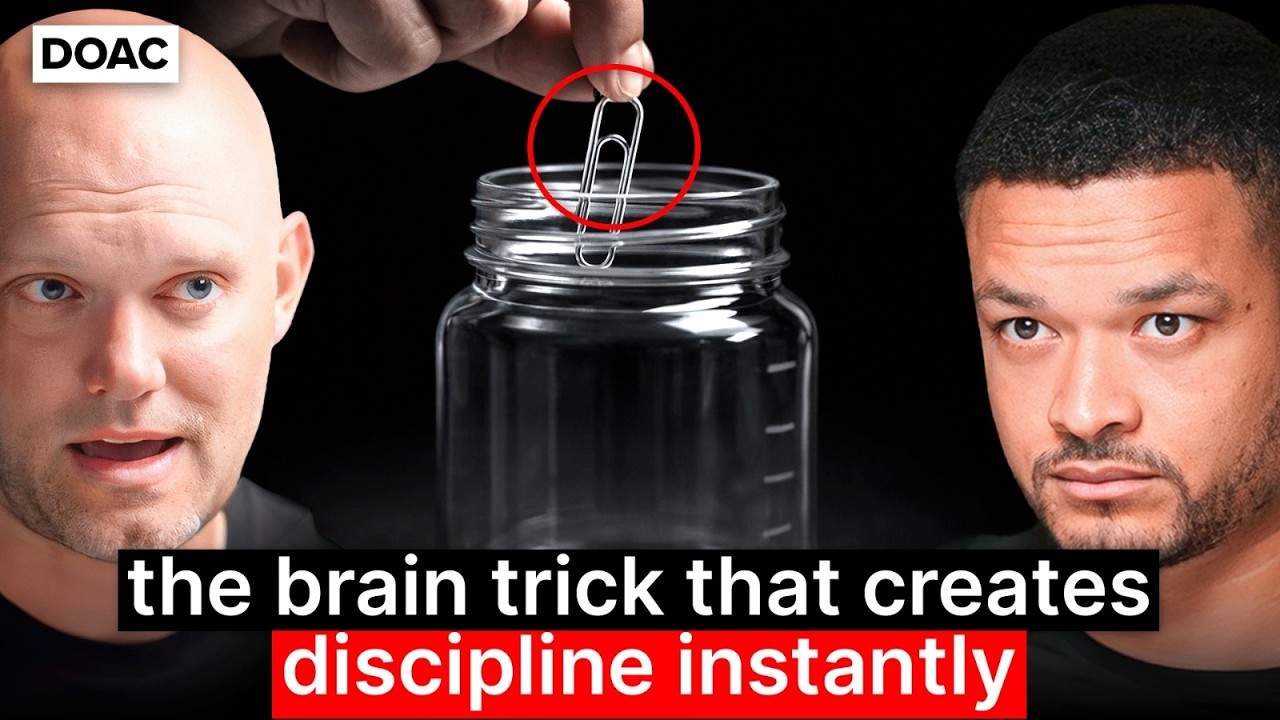
Prompted by a jar of paperclips on the table, Clear shares the story of Trent Dyrsmid, an entrepreneur who started as a stockbroker in Abbotsford, Canada during the 1990s. Lacking the geographic advantages of Wall Street, Dyrsmid outperformed his peers not by analyzing financial reports or over-optimizing strategy, but through a dead-simple paperclip routine: he placed two jars on his desk—one filled with 100 paperclips and one empty. Every time he completed a sales call, he moved one paperclip over, making it his sole goal to move all 100 clips every single day. That one visual strategy helped him build the largest book of business at his firm.
Clear highlights two main reasons this approach works: it provides a clear visual marker of progress that turns work into a game, and it ruthlessly eliminates over-optimization. Too many people get bogged down seeking the perfect strategy instead of doing the foundational work. When people ask how to build an audience or get fit, Clear advises focusing on the core driver first—such as writing an article a week for two years or never missing a workout for two years—before worrying about minor tweaks.
* **Trent Dyrsmid's Paperclip Strategy:** 100 paperclips in one jar, moving one over per completed sales call until the jar is empty.
* **Focus Over Optimization:** Master basic consistency (e.g., two years of weekly writing or regular workouts) before optimizing tactics.
[01:23:35](https://www.youtube.com/watch?v=rtufWBLOXgw&t=5015s) The Habit Formation Cycle
Clear breaks down the four fundamental stages that govern every habit: Cue, Craving, Response, and Reward. The **cue** is a sensory trigger (like seeing a plate of cookies on a counter); the **craving** is the brain's prediction of what that cue means (predicting a sweet, tasty treat); the **response** is the actual action taken (taking a bite); and the **reward** is the satisfying outcome (enjoying the taste). This sequence governs both conscious habits and lightning-fast automatic behaviors, such as flipping a light switch when entering a dark room.
The paperclip strategy leverages this exact cycle. The jar of paperclips acts as a visual cue on the desk, prompting the desire to build the business, driving the response of picking up the phone, and delivering an immediate sensory reward—the audible "clink" of the paperclip landing in the second jar.
[01:25:34](https://www.youtube.com/watch?v=rtufWBLOXgw&t=5134s) The 4 Laws of Behavior Change
To apply the four-stage habit cycle to practical life, Clear introduces the **4 Laws of Behavior Change**, mapping one law to each stage of the habit loop:
* **1st Law (Cue): Make It Obvious.** Make the visual cues of good habits prominent in your environment. Clear illustrates this with a reader who kept his guitar tucked away in a closet and constantly forgot to practice; once he placed it on a stand in the middle of his living room where he passed it 30 times a day, practice became natural. Bartlett shares his own story of placing DJ equipment directly on his kitchen counter for a year so he would practice every time he walked by, as well as keeping creatine in plain sight on the kitchen counter.
* **2nd Law (Craving): Make It Attractive.** Reframe habits so they feel exciting, fun, or compelling. Clear tells the story of a reader who struggled to bring a healthy salad to work instead of dining out. To make it enticing, she invented a "party in a bowl"—initially crumbling Snickers bars or potato chips into her salads to build the habit of bringing lunch, before later transitioning to healthier ingredients once the routine was locked in.
* **3rd Law (Response): Make It Easy.** Reduce friction and make actions as effortless as possible. Citing psychologist Daniel Kahneman, Clear notes that convenience is the single biggest driver of human behavior, as humans are biologically wired to conserve energy. He highlights how the entire trajectory of human history—from hunting and foraging, to farming, to grocery stores, to delivery services like Instacart and DoorDash—is one continuous push toward convenience.
* **4th Law (Reward): Make It Satisfying.** Ensure the outcome delivers an immediate sense of pleasure or completion. While the first three laws increase the odds of performing a behavior *this time*, the fourth law increases the likelihood of repeating it *next time*. The brain uses satisfaction to mark an experience as beneficial, closing the feedback loop of learning.
Bartlett brings up his WhatsApp fitness group, "Fitness Blockchain," where members post daily workout screenshots and the least consistent person is evicted each month. Clear notes that social accountability taps into all four laws—a incoming notification serves as an immediate visual cue, while group camaraderie makes the experience attractive and deeply satisfying.
[01:32:36](https://www.youtube.com/watch?v=rtufWBLOXgw&t=5556s) Inverting the Four Laws to Break Bad Habits
James Clear explains that breaking a bad habit simply requires inverting the Four Laws of Behavior Change. Instead of making a cue obvious, make it **invisible** by reducing exposure—such as unsubscribing from junk emails or keeping unhealthy food out of the house. While making a habit unattractive is the trickiest inversion, increasing friction makes a habit **difficult** by placing extra steps between yourself and the action. Furthermore, to make a habit **unsatisfying**, you must introduce an immediate cost or consequence, tapping into the cardinal rule of behavior change: behaviors that are immediately rewarded get repeated, while those that yield immediate punishment get avoided.
Clear highlights how subtle amounts of friction can naturally curtail undesired behaviors, sharing two personal examples:
* **The Phone in Another Room:** Clear keeps his phone in a hallway room from 9:00 AM to 11:00 AM while working in his office. Although it is only a 30-second walk away, he never goes to get it. When the phone sat directly next to him, he checked it every 3 minutes, showing how minimal friction disrupts mindless checking.
* **The Back-of-the-Fridge Beer:** When Clear places a six-pack of beer front-and-center in the fridge, he drinks one with dinner purely out of visual convenience. However, when he tucks it away on the lowest, back shelf where he has to bend down to see it, he often forgets it exists for weeks.
---
[01:36:11](https://www.youtube.com/watch?v=rtufWBLOXgw&t=5771s) Bringing Future Costs and Rewards into the Present
The fundamental challenge with bad habits is that their gratification is immediate while their cost is delayed, whereas good habits require immediate effort for delayed rewards. Eating a donut or playing video games feels great in the moment, with the physical or practical consequences arriving much later. Similarly, smoking provides immediate social connection or stress relief, masking long-term health risks that only appear decades down the line. Clear notes that the core strategy for long-term success involves pulling the rewards of good habits into the present moment while bringing the consequences of bad habits directly into the immediate present—a concept illustrated by graphic warnings on cigarette packages.
* **Immediate Costs vs. Future Costs:** Bad habits offer present-moment pleasure with a delayed cost; good habits demand present-moment sacrifice with a delayed reward.
* **The Cookie Dilemma:** When host Steven Bartlett points out that eating a cookie off the studio counter only causes mild immediate guilt rather than a physical penalty, Clear stresses that behavior design must explicitly bring those future downsides or present rewards forward to tip the scales.
---
[01:37:39](https://www.youtube.com/watch?v=rtufWBLOXgw&t=5859s) Using the Habit Scorecard to Build Self-Awareness
Before you can redesign your behavior, you need non-judgmental self-awareness. Clear outlines research showing that simply observing a habit can change it on its own. In one study, participants kept a daily food journal without being placed on a strict diet or asked to count calories; merely writing down what they ate naturally altered their food choices and reduced their total calorie intake. The **Habit Scorecard** serves as a baseline exercise to map out your daily routines—from your morning start to your evening shutdown sequence—and evaluate them objectively.
To complete a Habit Scorecard:
1. **List your daily actions:** Write down every routine behavior in chronological order (e.g., wake up, drink water, check phone, take a shower, get dressed).
2. **Assign a score to each behavior:** Mark positive habits that support your life with a plus sign (`+`), habits you want to eliminate with a minus sign (`-`), and neutral routines with an equal sign (`=`).
3. **Observe without judgment:** Treat your routine like a researcher observing animals at the zoo—noting behaviors with curiosity ("Oh, how interesting that I spend 10 minutes scrolling in bed") rather than self-criticism.
---
[01:40:23](https://www.youtube.com/watch?v=rtufWBLOXgw&t=6023s) Stacking New Behaviors onto Established Anchors
Originating from Stanford professor BJ Fogg's "Tiny Habits" recipe, **habit stacking** is the practice of pairing a new target behavior directly onto an established daily routine that already acts as a natural anchor. Because the existing habit is guaranteed to happen, it serves as a reliable cue for the new action. Once a basic two-part stack is mastered, additional positive routines can be chained together sequentially to build effortless daily momentum.
```
[Existing Anchor Habit] ➔ [New Habit 1] ➔ [New Habit 2]
Example: "After I brew morning coffee, I will meditate for 60 seconds, then write my daily to-do list."
```
Clear and Bartlett share several real-world examples illustrating how habit stacking can be customized to fit any schedule or lifestyle:
* **The Protein Shake Budget:** A community member who loved working out but struggled with personal finances tied his daily budgeting directly to his fitness routine: *"When I make a protein shake, I fill out my daily budget."*
* **The Office Arrival Sequence:** A professional anchored her morning productivity by standardizing her entrance: hanging up her purse and jacket, filling her water bottle, sitting down, and answering her first email in the exact same sequence every day.
* **The Shower Meditation:** Bartlett shares his own unconventional adaptation: needing 10–20 minutes of uninterrupted privacy to learn meditation, he started meditating while sitting on the shower floor, prompting his girlfriend to ask, *"What the [expletive] is going on in there?"*
* **The One-Legged Toothbrushing:** An elderly woman in her 60s improved her physical balance by performing 10 half-squats on one leg while brushing her teeth, then switching to the other leg for the second half of the routine, leaving her with better balance, stronger legs, and clean teeth.
* **Time-of-Day Placement:** Clear emphasizes inserting habits into the right environment. While doing habits early in the day is generally best—before time, energy, and control slip away—a morning meditation stack won't work for a parent frantically getting trousers on three toddlers; the stack must fit the reality of the context.
[01:44:56](https://www.youtube.com/watch?v=rtufWBLOXgw&t=6296s) How to Manage Your Energy and Schedule Your Days
Steven Bartlett brings up the concept of the "body budget," a framework popularized by neuroscientist Dr. Lisa Feldman Barrett, which posits that humans possess a finite store of daily energy. Because energy is limited, managing the order of tasks—such as placing the most critical work at the start of the day—becomes essential to avoid depleting the budget. James Clear expands on this idea by introducing an overlooked third dimension: **control**. While everyone shares the same 24 hours, individuals hold vastly different levels of control over specific one-hour blocks throughout the day. For instance, parents getting children ready between 7:00 a.m. and 8:00 a.m. have very little control over that hour, making it an impractical window for meditation or workouts.
Clear advises mapping out the day to evaluate both energy levels and personal control for each time slot. The key is determining which hours are your "best hours" versus which ones receive your "leftovers." If high-priority goals consistently receive only leftover energy and time, adjustments must be made. Ideally, new and challenging habits should be placed into time windows where personal autonomy is highest, rather than late at night when control and willpower are depleted. Balancing these schedules requires navigating competing priorities across family, career, and personal pursuits.
* Dr. Lisa Feldman Barrett introduced the concept of the "body budget" to describe finite daily energy reserves.
* Clear emphasizes evaluating 1-hour chunks based on two metrics: **energy level** and **degree of control**.
* New or difficult habits should be slotted into high-control, high-energy windows rather than late-night leftover hours (e.g., 11:00 p.m.).
---
[01:47:24](https://www.youtube.com/watch?v=rtufWBLOXgw&t=6444s) Sponsor Break: Stan & 1Password
Steven Bartlett takes a moment to highlight two podcast sponsors:
* **Stan:** A platform co-owned by Bartlett designed to help creators and entrepreneurs build side businesses and generate passive income. Stan simplifies selling digital products, online courses, and subscriptions. They announced the **Dare to Dream** initiative, offering a chance to win **$100,000** for sharing a business dream at `daretodream.stan.store`.
* **1Password:** A security platform featuring an Enterprise Password Manager (EPM). Bartlett shares a past experience with a data breach at a previous company, noting how 1Password protects teams by alerting them to compromised passwords, storing sensitive information securely, and enabling passkey adoption so users can log in seamlessly without traditional passwords.
---
[01:49:15](https://www.youtube.com/watch?v=rtufWBLOXgw&t=6555s) Consistency vs. Intensity: Building Mental Adaptability
Bartlett recalls an early WhatsApp fitness group with friends that initially scored members based on total calories burned. That setup failed quickly because it was inherently unfair—heavier individuals naturally burned more calories doing basic movements—leading them to shift the group's focus to **consistency**. Clear explains that people often fall in love with "intensity"—glamour stories like running a marathon, attending a week-long silent meditation retreat, or writing a bestseller. However, intensity creates stories, while **consistency actually makes progress**.
Clear states that "consistency enlarges ability." Showing up regularly, even in tiny increments (like meditating for five minutes or running three days a week), builds the underlying capacity required to execute intense feats later. Crucially, true consistency requires **flexibility and adaptability**, rather than rigid brute force. People often mistake mental toughness for relentless grinding regardless of circumstance. In reality, forcing a rigid standard makes a person brittle. Clear cites the classic adage: when the storm came, the oak tree fought it and broke, but the willow bent and survived. Adaptability allows you to execute a shorter or easier version of a habit when time or energy is low, ensuring you never "throw up a zero."
* **Consistency vs. Intensity:** Intensity builds a good story (e.g., marathons, silent retreats); consistency builds actual skill and capacity over time.
* **The Willow vs. Oak Metaphor:** Rigid toughness ("grinding no matter what") creates brittleness, making individuals hostage to ideal conditions. Flexibility (scaling down habits) fosters long-term resilience.
---
[01:52:22](https://www.youtube.com/watch?v=rtufWBLOXgw&t=6742s) Handling Failure and the Secret to Rebounding Quickly
Bartlett shares a story about a close friend of 15 years who repeatedly feels he has "cracked" fitness after going to the gym for three months, only to completely fall off 30 days later due to complacency. Bartlett notes that in 2017, he set an unrealistic goal to hit the gym every single day without fail; when life interfered five months in and he missed a day, his motivation evaporated. Clear points out that top performers across domains slip up just like everyone else. The distinguishing feature of elite performers is not a flawless streak, but a **fast recovery plan** to get back on track quickly. When habit reclamation is fast, an isolated failure becomes an insignificant blip on the annual radar.
Bartlett describes his personal trigger for bouncing back: whenever he falls off his workout routine, he changes his iPhone wallpaper to solid red. This visual cue serves as a "code red" alert, reminding him every time he looks at his phone to restart small daily actions. Clear adds his personal philosophy: "the secret to winning is actually learning how to lose." Developed through his background in competitive sports, Clear explains that failing publicly—such as striking out to end a game or missing a heavy lift in front of teammates—teaches you that life moves on and that you must perform again the next day. Embracing failure builds the willingness to risk looking foolish, a trait vital for long-term entrepreneurial success.
* Bartlett uses a **solid red iPhone wallpaper** as a visual "code red" trigger to signal when he needs to restart failed habits.
* Top performers focus on minimizing the time it takes to resume a habit after a slip-up rather than maintaining unbroken perfection.
* Learning to lose and handling public missteps builds the emotional resilience required for athletics and business.
---
[01:55:57](https://www.youtube.com/watch?v=rtufWBLOXgw&t=6957s) The Mindset Shift: Roger Federer and Overcoming Downward Spirals
Bartlett references Roger Federer’s commencement speech, where the tennis legend revealed that despite being widely considered one of the greatest tennis players of all time, he won only **53% of the individual points** he played throughout his career. Federer missed 47% of his points, proving that half the time he was taking losses; his genius lay in preventing an isolated loss from compounding into the next shot.
Bartlett illustrates this mindset with a story about playing padel tennis in Los Angeles with his friends for his birthday. His friend Ash had received extensive professional coaching in Spain, yet whenever he lost an easy point during matches, he would enter an emotional downward spiral and begin missing basic shots. Bartlett shared Federer's stat with Ash and gave him a cognitive refrain to speak in his mind after losing a point: *"That point doesn't matter. I'm going to win this game anyway because I am the better player."*
This simple mental pivot shifted Ash out of his emotional center (the amygdala) and back into his rational brain (the prefrontal cortex). Ash immediately transformed from the worst player in the five-man group to beating everyone, including Bartlett on his home court, and was literally dancing through the house later that day.
* **Roger Federer's Career Statistic:** Federer won **53%** of all points played (and lost **47%**), highlighting that elite performance relies on handling constant minor losses.
* **Cognitive Refrain Strategy:** Reciting a pre-planned rational phrase after a mistake stops emotional catastrophizing and re-engages the prefrontal cortex.
[01:57:55](https://www.youtube.com/watch?v=rtufWBLOXgw&t=7075s) Living with a "Next Play" Mentality
The conversation kicks off with a reflection on adopting a "next play" mentality in daily life—moving past past mistakes or missed opportunities without letting emotion ruin training or momentum. James references W. Timothy Gallwey's classic book, *The Inner Game of Tennis*, pointing out how its core lesson of avoiding mental overthinking applies broadly beyond sports to everyday life.
Steven Bartlett reinforces this concept by sharing a story about Sir Dave Brailsford, the former performance director of British Cycling. Brailsford's primary objective with elite cyclists like Sir Chris Hoy was to stop them from overanalyzing while actively racing. When Chris Hoy set his personal bests, he would step off the bike with almost no conscious memory of the ride—as if he had been "asleep on the bike." Thinking about times and pushing too hard would only lead to exhaustion and breaking form.
* *The Inner Game of Tennis*: A classic book illustrating how overthinking and emotional noise sabotage performance.
* Sir Dave Brailsford achieved peak performance with British Cycling by training athletes to stop overthinking mid-race.
* Sir Chris Hoy performed best when in a flow state, describing personal bests as having almost no conscious memory of cycling.
[01:59:10](https://www.youtube.com/watch?v=rtufWBLOXgw&t=7150s) Priming Your Day: Daily Mindset Shifts and the Calendar
James describes a concept he had been contemplating: hiring a mental performance coach just to deliver a brief, five-minute pep talk or mindset shift at 8:00 AM every morning to start the day with momentum. Unable to find someone offering that exact service, he created his own physical product to fill the gap—the *Atomic Habits Daily Calendar*.
The calendar blends core ideas from *Atomic Habits*, general principles of human behavior, and insights from his weekly *3-2-1 Newsletter*. Designed with one page per day, it aims to prime the user's mind with a singular, actionable perspective shift before heading into the day. While initially surprised to be enthusiastic about a calendar, James notes he is genuinely excited for its upcoming release on Amazon and his website.
* **Product concept**: A daily calendar giving one actionable mindset shift per page for each day of the year.
* **Core foundations**: Synthesizes principles from *Atomic Habits* and James Clear's *3-2-1 Newsletter*.
* **Availability**: Accessible via Amazon and jamesclear.com.
[02:00:33](https://www.youtube.com/watch?v=rtufWBLOXgw&t=7233s) *Atomic Habits* vs. *The Atomic Habits Workbook*
Steven brings up *The Atomic Habits Workbook: Simple Exercises for Building the Life You Want*, prompting James to clarify the core difference between the original book and the new companion workbook. James explains that while the original *Atomic Habits* represented ten years of effort aimed at creating the definitive guide on habit formation, seven years of feedback and 25 million copies sold proved that readers constantly seek concrete, hands-on guidance to implement those concepts into their daily lives.
The original book provides the overall philosophy, framework, and science behind habits. The workbook, by contrast, gives readers targeted exercises to evaluate their environments, convert high-level goals into concrete daily systems, and align daily actions with their desired identity. Steven notes that the workbook's focus on journaling, reflection, and tracking raises self-awareness and personal accountability, drawing a parallel to structured accountability frameworks like a "fitness blockchain."
* ***Atomic Habits* (Book)**: The full philosophy, overarching principles, and foundational guide to building good habits and breaking bad ones.
* ***The Atomic Habits Workbook***: A practical, exercise-based guide helping readers optimize environments, map goals into systems, and build self-awareness.
* **Impact & Reach**: *Atomic Habits* has sold over 25 million copies worldwide.
[02:02:57](https://www.youtube.com/watch?v=rtufWBLOXgw&t=7377s) Downstream Impact and Gratitude
Steven takes a moment to express personal gratitude to James, highlighting the vast, invisible downstream impact of his work. Beyond book sales and the millions reading the *3-2-1 Newsletter*—which Steven calls the gold standard blueprint for newsletter creators—James's frameworks have saved lives and transformed businesses. Steven shares a personal example of his own father, who successfully quit a 20-year smoking habit after studying habit cycles. Additionally, Steven mentions that core phrases and frameworks from *Atomic Habits* are regularly used inside his own office to build companies.
James responds humbly, expressing deep gratitude for the reception of his work. He shares that his ultimate goal was simply to produce something genuinely useful to people, making the widespread real-world adoption deeply rewarding.
* Steven credits James's work with directly helping his father quit a 20-year smoking habit.
* The *3-2-1 Newsletter* is cited as an industry standard and inspirational framework for digital content creators.
* Steven regularly uses James Clear's principles in his own corporate strategy and team operations.
[02:04:41](https://www.youtube.com/watch?v=rtufWBLOXgw&t=7481s) The Question from the Diary: Scaling Down Intractable Problems
Continuing the show's podcast tradition, Steven presents a question left by a previous guest (Vice President Kamala Harris): *"What do you believe is the best way to unify people of differing or even conflicting beliefs?"*
James answers by advocating for **scaling down** big problems. Trying to solve massive, abstract issues like national unity directly often feels intractable. However, when scaled down to a manageable level—such as organizing a local block party or starting a neighborhood book club—actionable solutions emerge.
James links this directly to habit formation and life goals. When people ask broad, overwhelming questions like "How do I find my purpose?" or "How do I build a good life?", the scale makes the problem feel impossible. Scaling down to focus on making the next hour or the current day as solid as possible makes progress achievable. Steven adds that localized efforts naturally spill over into adjacent areas, creating a positive domino effect across neighborhoods or time periods.
> "If you scale your habits down to a level that's more solvable, you'll often see that there's a path forward there."
* **Scaling principle**: Intractable, macro-level challenges become solvable when reduced to localized, micro-level actions.
* **Life application**: Rather than trying to fix your entire life at once, focus on mastering the current hour or day.
* **Domino effect**: Local progress naturally ripples out to influence adjacent habits, routines, and communities.
[02:06:45](https://www.youtube.com/watch?v=rtufWBLOXgw&t=7605s) The Three Meanings of "Atomic"
James breaks down the exact reason he chose the title *Atomic Habits*, explaining that the word "atomic" carries three distinct, deliberate meanings that form the narrative arc of his entire methodology:
1. **Tiny or small**: Like an atom, habits should be minimal and easy to perform.
2. **A fundamental unit in a larger system**: Just as atoms build molecules and compounds, individual habits serve as the foundational units of an overall daily routine.
3. **A source of immense power or energy**: Harnessing atomic power yields immense results.
When combined, these three elements explain the process of habit-building: small, manageable changes layered together as units within a larger system yield remarkably powerful, transformative results over time.
* **Meaning 1**: Small, easy, and frictionless actions.
* **Meaning 2**: Fundamental components that build larger behavioral systems.
* **Meaning 3**: Concentrated sources of remarkable long-term power and energy.
[02:07:42](https://www.youtube.com/watch?v=rtufWBLOXgw&t=7662s) Happiness vs. Meaning
Steven asks whether happiness should be the ultimate "North Star" that all habits ladder up toward. James makes a sharp distinction between **happiness** and **meaning/fulfillment**. He shares that writing *Atomic Habits* was one of the most meaningful endeavors of his life, but he was certainly not happy during every single minute of the arduous, challenging process.
James suggests that habits will not lead to a state of permanent, unending happiness. Instead, investing in solid habits builds a life rich in meaning and purpose, where happiness occurs naturally along the journey alongside other multifaceted human experiences.
* **Happiness**: A transient, moment-to-moment emotional state.
* **Meaning/Fulfillment**: Long-term purpose derived from deeply worthwhile, often difficult work.
* **Core Takeaway**: Habits build a foundation for a meaningful life rather than guaranteed perpetual happiness.
[02:10:44](https://www.youtube.com/watch?v=rtufWBLOXgw&t=7844s) Outro: The 1% Diary
Steven wraps up the interview by introducing the *1% Diary*, a tool created specifically for *The Diary Of A CEO* audience. Inspired by the philosophy of breaking daunting, "Mount Everest"-sized goals down into tiny 1% daily increments, the diary provides a structured daily framework to keep users focused, accountable, and consistently progressing without getting overwhelmed.
[02:10:44](https://www.youtube.com/watch?v=rtufWBLOXgw&t=7844s) Closing Announcements and Limited Offers
Host Steven Bartlett closes out the episode by reminding listeners to grab their copies of the official diary before stock runs out completely. He highlights a special limited-time deal where viewers can head over to `thediary.com` to receive a 20% discount on the exclusive Black Friday bundle.
He emphasizes that for convenience, all direct links to the shop and bundle details are readily accessible in the video description right below the episode. The show concludes with its signature closing theme music playing out.
- **Website:** `thediary.com`
- **Promotion:** 20% off Black Friday bundle
- **Link location:** Included in the video description box below
## Notable quotes
> [11:30](https://www.youtube.com/watch?v=rtufWBLOXgw&t=690s) A habit must be established before it can be improved... As Ed Latimore says, 'The heaviest weight at the gym is the front door.' — James Clear
> [22:16](https://www.youtube.com/watch?v=rtufWBLOXgw&t=1336s) We don't rise to the level of our goals, we fall to the level of our systems. — James Clear
> [28:41](https://www.youtube.com/watch?v=rtufWBLOXgw&t=1721s) Comparison is like the teacher of skills when it's applied narrowly, but it's the thief of joy when it's applied broadly. — James Clear
> [41:47](https://www.youtube.com/watch?v=rtufWBLOXgw&t=2507s) Habits are not a finish line to be crossed. They're a lifestyle to be lived. — James Clear
> [46:45](https://www.youtube.com/watch?v=rtufWBLOXgw&t=2805s) In a sense, every action you take is like a vote for the type of person you wish to become. — James Clear
> [51:02](https://www.youtube.com/watch?v=rtufWBLOXgw&t=3062s) Most of the time, the desire to belong overpowers the desire to improve. — James Clear
> [55:54](https://www.youtube.com/watch?v=rtufWBLOXgw&t=3354s) You're trying to surround yourself with people where your desired behavior is the normal behavior. — James Clear
> [01:07:38](https://www.youtube.com/watch?v=rtufWBLOXgw&t=4058s) There is no such thing as an opportunity that is not tied to a person. — James Clear
> [01:11:23](https://www.youtube.com/watch?v=rtufWBLOXgw&t=4283s) Confidence is just displayed ability. — James Clear
> [01:49:15](https://www.youtube.com/watch?v=rtufWBLOXgw&t=6555s) When the storm came, the oak tree fought it and broke, but the willow bent and survived. — James Clear
> [01:52:22](https://www.youtube.com/watch?v=rtufWBLOXgw&t=6742s) The secret to winning is actually learning how to lose. — James Clear
> [02:04:41](https://www.youtube.com/watch?v=rtufWBLOXgw&t=7481s) If you scale your habits down to a level that's more solvable, you'll often see that there's a path forward there. — James Clear
## Mentioned
Atomic Habits, James Clear, Steven Bartlett, The Diary Of A CEO, David Epstein, Range, The Sports Gene, Ed Latimore, Mitch, Jordan Peterson, Travis Wall, St. Olaf College, Kenyon College, NCAA, Elon Musk, 4 Burners Theory, Steven Pressfield, Leon Festinger, Jeff Bezos, Richard Dawkins, Sir Dave Brailsford, Brandon Webb, Trent Dyrsmid, Daniel Kahneman, The Blind Watchmaker, Author's Equity, LinkedIn Ads, Harvard Business Review, British Cycling, Fitness Blockchain, The Atomic Habits Workbook, 3-2-1 Newsletter, BJ Fogg, Dr. Lisa Feldman Barrett, Stan, 1Password, Roger Federer, W. Timothy Gallwey, The Inner Game of Tennis, Sir Chris Hoy, Kamala Harris, 1% Diary
James Clear:决定长期人生结果的是系统而非目标
日常习惯系统决定长期的成功,因为结果指标滞后于行为投入,且微小的渐进改变会随时间产生复利效应。
James Clear探讨了习惯形成的心理机制,强调结果是系统而非单个目标的滞后指标。他概述了诸如“两分钟定律”(2-Minute Rule)、习惯叠加以及行为转变四大定律等实用策略,以降低启动门槛并建立可持续的日常惯例。讨论重点阐述了习惯如何持续为个体的身份认同与社交环境投票。此外,Clear还探讨了如何管理精力水平、以“专注于下一回合”(next play)的心态应对失败,并通过拆解复杂问题来保持心理动能。
生活中的最终结果(如财富积累、身体状态或环境整洁)都是日常习惯的滞后指标,专注于优化输入的日常行为远比直接紧盯产出更有效。 (2:47)
“两分钟定律”主张将目标缩减为两分钟内即可执行的起步动作,先确立“开始行动”的身份认同与规律,再逐步对其进行优化与扩充。 (11:30)
“帽子、理发与纹身”框架根据选择的可逆性分配决策时间与精力,强调对低风险的“帽子与理发”型决策应快速执行,避免陷入过度权衡的内耗。 (18:05)
赢家和输家通常拥有完全相同的目标,目标只能提供前进方向,真正决定结果差距的是每天支撑执行的系统与日常习惯。 (22:16)
“四火炉理论”揭示了工作、家庭、社交和健康无法同时全负荷运转,人应当在人生的不同十年阶段采取策略性排序,而非强求同一时期的绝对平衡。 (38:15)
Reading summary
Author James Clear argues that lasting personal transformation depends not on fixating on ambitious goals, but on constructing frictionless environments and adaptive daily systems that reinforce desired identities over time.
Prioritizing Daily Systems Over Distant Goals (22:16)
Clear asserts that outcomes in health, finance, and career are lagging measures of prior habits, arguing that focusing solely on targets is flawed because winners and losers typically share the exact same goals. Goals provide directional clarity, but high performance requires shelving the objective to focus on the daily system—the recurring processes executed each day. Fixating on distant outcomes frequently traps individuals into deferred happiness, whereas falling in love with daily execution allows sustained satisfaction and repeatable success.
To align daily routines with desired long-term outcomes, Clear recommends evaluating whether current habits can logically carry an individual to their intended future. He evaluates ventures by asking how one actually wants to spend their days, establishing lifestyle boundaries first before maximizing output. In this framework, the two operational timeframes that matter most are ten years and the current hour: applying focused effort in the immediate hour toward multi-year horizons generates compounding momentum within a few years.
Shaping Physical and Social Environmental Friction (13:23)
Clear explains that human behavior responds powerfully to environmental context, which acts like gravity by nudging people toward default options. The habit loop operates across four stages—cue, craving, response, and reward—paired with the Four Laws of Behavior Change: make cues obvious, make cravings attractive, make responses easy, and make rewards satisfying. Priming physical surroundings, such as laying out workout clothing or writing the opening sentence of a draft the day before, reduces initial activation energy and eliminates decision friction.
Social environments exert an equally decisive gravitational pull. Clear notes that because human beings are biologically and culturally wired to seek social belonging, the urge to fit into a group almost always overpowers the desire for self-improvement. Attempting to maintain habits that conflict with a peer group requires constant, exhausting energy expenditure. To achieve effortless consistency, Clear advises joining groups where the target behavior is already the established social norm.
Habit Shaping, Micro-Reps, and Identity Votes (46:45)
Ambitious individuals frequently fail by designing routines around peak performance days, only to abandon them when disrupted. Clear advocates establishing a behavioral floor through 'habit shaping' and scaling actions down to a two-minute baseline that can be maintained even on exhausted days. Rather than treating confidence as a prerequisite, Clear defines confidence as displayed ability; repeated micro-actions provide empirical proof to the self. Every habit acts as a vote for a specific identity—such as writing one sentence to vote for being a writer—gradually altering self-perception.
Because physical reality lacks the instant gratification loops engineered into digital products, Clear emphasizes the utility of visual tracking to provide immediate sensory feedback. Simple systems, such as Trent Dyrsmid’s paperclip routine or marking calendars with an 'X,' leverage the habit loop by offering visual cues and immediate rewards, preventing people from over-optimizing strategy at the expense of consistent repetition.
Adaptive Consistency and Evolving Life Seasons (109:15)
Clear refutes the popular claim that habits form in 66 days, explaining that simpler behaviors take weeks while complex rituals require months, meaning habits represent an ongoing lifestyle rather than a finish line to cross. Real-world rituals never become completely mindless, but establishing routines eliminates initial cognitive costs and builds territorial comfort. Rather than pursuing rigid intensity, Clear emphasizes flexible consistency; resilient performers anticipate lapses and distinguish themselves through rapid rebound plans to prevent isolated failures from compounding.
Furthermore, Clear highlights that sustainable routines must evolve across differing seasons of life. Using the Four Burners Theory—which visualizes life as divided between work, family, friends, and health—he explains that excelling in one domain inevitably requires turning down the intensity of others. Adult life breaks down into roughly five or six decade-long blocks, each requiring its own structural trade-offs rather than the unsustainable expectation of simultaneous perfection across all areas.
Clear concludes that mastering behavior change rests on managing friction and identity rather than relying on brute willpower, though he acknowledges that complex routines never become entirely effortless reflexes. The unresolved challenge for individuals remains managing the inevitable trade-offs across distinct seasons of life, where turning down competing priorities is required to maintain system stability.
## Background
该视频由 YouTube 频道 The Diary Of A CEO 于 2025 年 12 月 11 日发布。视频简介指出,《原子习惯》(Atomic Habits)作者詹姆斯·克利尔(James Clear)深入剖析了构建持久习惯与戒除恶习的科学原理,探讨了“两分钟定律”、1% 复利效应、身份认同塑造,以及为何胜者与败者拥有相同目标等核心议题。
## TL;DR
在这场深度对谈中,詹姆斯·克利尔阐释了习惯养成的底层逻辑与实操框架,强调生活结果本质上是过往习惯的“滞后指标”。他提出系统远比单点目标更重要,主张通过降低门槛的“两分钟定律”、环境预设与习惯叠加来跨越行动初期的阻力,并将微小行动视为对理想身份认同的投票。克利尔还通过“四炉头理论”与“帽子、发型与纹身”决策模型,指导人们在不同人生阶段进行取舍与排序,学会像柳树般柔软变通并具备快速复轨的能力。
## Atmosphere & style
整场对话呈现出深思、务实且极富启发性的基调,两位对谈者在思想碰撞中洋溢着知性与真诚的默契。史蒂芬·巴特利特的提问精准且直击商业与心理痛点,而克利尔则以极具条理、平易近人又发人深省的隐喻娓娓道来。听众在聆听过程中不仅能感受到卸下宏大目标包袱后的释然与平静,更能体会到一种脚踏实地、随时可以从眼下一分钟开启行动的掌控感与内在势能。
## Bulletin
- [02:53](https://www.youtube.com/watch?v=rtufWBLOXgw&t=173s) 《掌控习惯》作者詹姆斯·克利尔(James Clear)指出,人生各项成果本质上是日常行为的“滞后指标”,赢家与输家拥有完全相同的目标,决定最终成败的是日复一日运转的底层系统。
- [00:00](https://www.youtube.com/watch?v=rtufWBLOXgw&t=0s) 行为转变遵循四大核心定律:让习惯显而易见、有吸引力、简便易行、令人愉悦;戒除不良恶习则需将四条定律完全反转,通过人为增加物理阻力来打破无意识自动化。
- [01:04:55](https://www.youtube.com/watch?v=rtufWBLOXgw&t=3895s) “每天进步1%”的复利效应主要体现在长期发展轨迹上,微小行动的价值在于它充当了为你渴望成为的身份认同持续投票的客观证据。
- [38:15](https://www.youtube.com/watch?v=rtufWBLOXgw&t=2295s) 通过“四炉头理论”与人生排序思维(Sequencing),人在特定阶段只能聚焦两到三个维度,接受生命的权衡取舍并像柳树般保持弹性,才是长久自律的底层逻辑。
## Key takeaways
- [00:00](https://www.youtube.com/watch?v=rtufWBLOXgw&t=0s) 习惯形成的四阶段回路为“提示、渴求、反应、奖赏”,对应行为转变四大定律:让它显而易见、让它有吸引力、让它简便易行、让它令人愉悦。
- [02:53](https://www.youtube.com/watch?v=rtufWBLOXgw&t=173s) 生活中的所有现实结果都是前期习惯的滞后指标;改变输出的唯一方式是改变输入,修正日常习惯,理想结果自然水到渠成。
- [05:01](https://www.youtube.com/watch?v=rtufWBLOXgw&t=301s) 坚毅源于契合(Grit is fit),在习惯中寻找乐趣的人是最难击败的对手;与其靠纯粹意志力硬撑,不如设计出自己真正享受的执行形式。
- [09:13](https://www.youtube.com/watch?v=rtufWBLOXgw&t=553s) “缩小规模,守住时间表”是度过低谷的关键,在状态糟糕的日子里只要不出场交白卷,就能守护住习惯的神经回路与心理势头。
- [11:30](https://www.youtube.com/watch?v=rtufWBLOXgw&t=690s) 践行“两分钟定律”,把宏大目标拆解到两分钟内即可完成的微小版本,因为任何习惯都必须在稳固建立后才谈得上被优化升级。
- [18:05](https://www.youtube.com/watch?v=rtufWBLOXgw&t=1085s) 用“帽子、发型与纹身”框架评估决策的可逆性:生活中的绝大多数选择都属于低成本可逆的帽子和发型,不必陷入决策内耗。
- [27:04](https://www.youtube.com/watch?v=rtufWBLOXgw&t=1624s) 赢家和输家拥有完全相同的目标,目标负责提供前进方向,但只有专注于日常运转的底层系统才能带来持续的胜利。
- [28:41](https://www.youtube.com/watch?v=rtufWBLOXgw&t=1721s) 狭窄局部的微观对比是打磨技能的良师,而泛滥全局的宏观对比则是偷走生活快乐的窃贼。
- [36:22](https://www.youtube.com/watch?v=rtufWBLOXgw&t=2182s) 优先投资睡眠、锻炼、阅读等“上游习惯”,它们会像多米诺骨牌一样自发带动饮食、专注力与生活状态的改善。
- [38:15](https://www.youtube.com/watch?v=rtufWBLOXgw&t=2295s) 生活无法同时点燃所有炉头,运用“四炉头理论”对人生各个十年进行阶段性排序,方能专注投入当下核心领域而不被内疚感绑架。
- [41:47](https://www.youtube.com/watch?v=rtufWBLOXgw&t=2507s) 习惯不是可以冲过的终点线,而是一种终身践行的生活方式;所谓“66天养成习惯”存在巨大个体差异,关键在于消除阻力与持续出场。
- [46:45](https://www.youtube.com/watch?v=rtufWBLOXgw&t=2805s) 每一次微小的行动都是在为你期望成为的身份投下一张选票,行为先于信念,客观事实的积累最终会彻底重塑自我认知。
- [50:13](https://www.youtube.com/watch?v=rtufWBLOXgw&t=3013s) 对社会归属感的渴望往往会压倒自我提升的欲望,主动置身于目标行为被视为日常常态的群体环境中,是习惯长期存续的关键。
- [01:33:09](https://www.youtube.com/watch?v=rtufWBLOXgw&t=5589s) 戒除不良恶习的核心在于反转四大定律:让提示隐蔽不可见、增加物理操作阻力,并将未来潜在的代价即刻拉至眼前。
- [01:40:23](https://www.youtube.com/watch?v=rtufWBLOXgw&t=6023s) 利用“习惯记分卡”培养抽离客观的自我觉察,并运用“习惯叠加”将新微习惯顺理成章地嫁接在固有的成熟旧习惯之后。
- [01:49:55](https://www.youtube.com/watch?v=rtufWBLOXgw&t=6595s) 持续性远胜于单次高爆发的强度,真正的自律并非死板硬扛,而是像柳树一样柔软适应外界波折并拥有迅速重回正轨的复原力。
- [01:57:52](https://www.youtube.com/watch?v=rtufWBLOXgw&t=7072s) 保持“专注下一回合的心态”(Next play mentality),接纳失败丢分是高水平竞技与人生的固有组成部分,不让过去的失误绑架下一次行动。
- [02:05:32](https://www.youtube.com/watch?v=rtufWBLOXgw&t=7532s) 面对宏大而棘手的人生与社会议题,终极解法在于“缩小尺度”,将无从下手的宏观命题拆解为清晰可执行的微观原子行动。
## Detailed walkthrough
### [00:00](https://www.youtube.com/watch?v=rtufWBLOXgw&t=0s) 习惯形成的四大法则与微小改变的力量
詹姆斯·克利尔(James Clear)开篇指出,人们之所以普遍渴望关于习惯的实用建议,是因为“开始行动的艺术”(the art of getting started)往往是最难掌握的。任何习惯的养成都会经历四个关键阶段:提示(Cue)、渴求(Craving)、反应(Response)与奖赏(Reward)。针对这四个环节,克利尔提炼出行为转变的四大定律:
1. **让它显而易见(Make it obvious)**:目标越容易被注意到,你越有可能采取行动;
2. **让它有吸引力(Make it attractive)**:行为越能激发兴奋感与参与感,你越容易坚持;
3. **让它简便易行(Make it easy)**:执行门槛越低,发生的概率越高;
4. **让它令人愉悦(Make it satisfying)**:即时的满足感能够显著增加下一次重复该行为的概率。
克利尔在对话中还提到了《原子习惯》(*Atomic Habits*)的核心工具之一——“习惯叠加”(Habit Stacking)。建立新习惯最有效的方式,就是将其锚定在已有成熟习惯的后方。例如,如果你每天早晨都有冲咖啡的习惯,而你想尝试冥想,就可以设定具体的规则:“每天早晨冲好咖啡后,我会静坐冥想60秒。”此外,他还预告了诸如“帽子、发型与纹身”(Hats, Haircuts, and Tattoos)决策模型、习惯塑造(habit shaping)以及“每天进步1%”的复利本质等框架。
```mermaid
flowchart LR
accTitle: 习惯回路与行为转变定律
accDescr: 展示提示、渴求、反应和奖赏四个阶段以及对应的四大行为转变定律
subgraph Phase1 ["认知阶段"]
A["提示 (Cue)"] --> B["渴求 (Craving)"]
end
subgraph Phase2 ["行动与反馈"]
C["反应 (Response)"] --> D["奖赏 (Reward)"]
end
A -.->|"第1定律"| L1["让它显而易见"]
B -.->|"第2定律"| L2["让它有吸引力"]
C -.->|"第3定律"| L3["让它简便易行"]
D -.->|"第4定律"| L4["让它令人愉悦"]
B --> C
D -.->|"闭环强化"| A
```
- **习惯叠加公式**:在 [当前习惯] 之后,我将执行 [新习惯]。
- **核心行为循环**:提示触发渴求,渴求带来反应,反应带来奖赏;奖赏进而反哺大脑对提示的敏感度。
---
### [01:47](https://www.youtube.com/watch?v=rtufWBLOXgw&t=107s) 观众互动与《原子习惯》的历史性成功
主持人史蒂芬·巴特利特(Steven Bartlett)插播了一段对频道观众的真挚呼吁。他提到很多常客评论说并未意识到自己其实还没点击订阅,因此希望经常收看节目的观众能顺手点击订阅。这不仅是一项完全免费的举动,更是支撑这档节目持续发展、让观众成为这趟旅程一部分的重要动力。
随后,史蒂芬将话题转向詹姆斯·克利尔现象级的商业成功。《原子习惯》全球销量已突破数千万册,业界甚至有传闻它已经跻身全球历史畅销书榜单的前100名,并极可能是其中问世时间最短的一本。面对这一罕见成就,史蒂芬向克利尔抛出核心问题:这本书在全球范围内的狂热与普及,究竟让你对“人类本性”有了怎样的认知?
---
### [02:53](https://www.youtube.com/watch?v=rtufWBLOXgw&t=173s) 习惯的本质:通用性与滞后性指标
克利尔回答,习惯具有一种迷人的双重特性:它既是**高度通用(Universal)**的,也是**极其具体和个人化(Specific/Individual)**的。每个人每天都依赖习惯生活,但每个人的具体习惯组合又带有强烈的个人印记,让人觉得“这是我自己的生活方式”。更关键的是,习惯往往扮演着“入口匝道”(Entrance Ramp)的角色——一个微小的动作只需要两秒钟,却能锁死接下来整整一个小时的走向。例如,掏出手机这个微动作只需两秒,但它随即引发的是长达一小时的回邮件、刷社交媒体或打游戏。
克利尔提出了一个颠覆性的认知框架:**生活中的所有结果,本质上都是前期习惯的“滞后指标”(Lagging Measure)**。
- 你的知识储备,是你长期阅读与学习习惯的滞后指标;
- 你的银行账户余额,是你长期财务习惯的滞后指标;
- 就连客厅里的杂乱程度,也是你日常整理与清洁习惯的滞后指标。
大多数人终其一生都在迫切地渴望改变最终的结果(Output),但结果本身根本不是需要直接干预的对象。克利尔总结道:“修正习惯,结果自然会随之改变。改变输入,输出就会自动转换。”
谈及创作对自身的影响,克利尔坦言《原子习惯》也塑造了他自己。为了写出这本书,他必须先建立起雷打不动的写作习惯。他自己经历过失败、挣扎、推倒重来,最终摸索出突破口。正是这些切肤之痛让这本书具备极高的实操性。克利尔批评市面上许多所谓的“方法书”(How-to books)名不副实,本质上其实是“观点书”(What-to books)——它们只会高谈阔论地告诉你“应该自信”、“应该相信自己”,却从未给出具体落实每一步的可行工具。
---
### [05:01](https://www.youtube.com/watch?v=rtufWBLOXgw&t=301s) “如果这很有趣会怎样?”:让习惯持续的核心秘密
当被问及回顾全书是否有何遗憾时,克利尔表示自己并无遗憾,但如果能补充一句话,他一定会加上这个关键问题:**“如果这很有趣,它会是什么样子?”(What would it look like if this was fun?)**
他以最典型的新年愿望“去健身房运动”为例:每年一月,无数人涌入健身房,仅仅是因为社会规范或同侪压力让他们觉得“应该去”。但如果静下心花15分钟列一张保持健康与活力的清单,选项实际上非常丰富:举重、皮划艇、攀岩、瑜伽、普拉提等等。克利尔建议,对于任何关键习惯,不妨花10分钟写下所有可能的落地形式,然后挑选自己觉得最有趣的那一种。这并不意味着习惯每天都会像狂欢派对一样好玩,但任何习惯都绝对能找到比“默认枯燥模式”更有趣的执行方式。
克利尔强调,在长期竞争中,**“那个乐在其中的人,其实是最危险的对手”**。你很难击败一个在过程中享受乐趣的人,因为当遇到挫折与困难时,乐在其中的人自然能抗住压力继续前行;相反,如果一开始就把某项任务视为苦差事,一旦出现困难,人们本能就会选择放弃。
克利尔援引了好友、《成长的边界》(*Range*)及《运动基因》(*The Sports Gene*)作者大卫·爱普斯坦(David Epstein)的一句话:“**坚毅源于契合**”(Grit is fit)。
- 大多数人都希望自己拥有惊人的毅力和自律;
- 但坚毅并不是靠纯粹意志力死撑出来的,它只会在你高度契合、擅长且乐于投入的领域里自然涌现;
- 习惯形成最大的关卡从来不是意志力比拼,而是你是否真的对其感兴趣、有参与感并且享受其中。
---
### [07:36](https://www.youtube.com/watch?v=rtufWBLOXgw&t=456s) 创造持久坚持的条件:让复利为你工作
史蒂芬对克利尔的观点深表赞同,并分享了自己在节目频道达到某一重大订阅里程碑时的反思。当时他在总结频道成功的核心要素时,写下的第一条原则就是:“**创造能够持久坚持的条件**”(Creating the conditions to out-persist)。
史蒂芬指出,无论是做内容、做投资还是做学问,一切巨大成就的底层逻辑都在于:将外部环境与内部机制调配好,使自己能够在牌桌上停留得足够久,久到复利效应(Compounding)开始全面倒向自己。无论是认知的积累、技能的迭代,还是订阅者与财富的增长,只有挺过了前期的潜伏期,复利的指数级爆发才会真正显现。克利尔对此表示高度共鸣,称自己也常常反复自问同样的问题:我是否真正为自己创造了足以长久坚持下去的外部与内部条件?
### [08:07](https://www.youtube.com/watch?v=rtufWBLOXgw&t=487s) 为成功创造条件:启动习惯比完成训练更难
詹姆斯·克利尔(James Clear)分享了他个人的亲身经历。大约两年半前,他的体能状态非常出色,但在随后的整整一年里,他的训练变得极度不稳定,错过了大量的健身房训练。从表面上看,人们往往会认为这是“锻炼本身”出了问题,或者自己的毅力不足;但深入剖析后他意识到,根本问题在于自己没有为成功创造必要的前提条件。在日常生活中,有太多琐事随时插入、打断他的日程,让“翘掉训练”变得轻而易举。
为了扭转这一局面,克利尔在过去一年里聘请了一位私人教练。这位教练每周有四天会在上午 11:00 准时上门。克利尔坦言,每次教练按响门铃时,他其实都很烦躁,因为他总是手头正忙着别的事情,心里甚至会涌起一阵抵触与恼火。然而,教练的出现强行构建了“成功的外部条件”,逼迫他放下手头工作走下楼开始锻炼。而每一次练完之后,他又无一例外地感到庆幸,庆幸自己抽时间完成了训练。这证明训练动作本身从来都不是难点,如何铺设条件来“开启训练”才是真正的症结所在。
```mermaid
flowchart TD
accTitle: 习惯建立的外部条件驱动图
accDescr: 展示环境阻力与外力介入对开始习惯的影响
subgraph FailureState ["缺乏成功条件:阻力大"]
A["工作与日常琐事打扰"] --> B["犹豫是否去健身"]
B --> C["轻易放弃(直接缺席)"]
end
subgraph SuccessState ["创造成功条件:外力强制启动"]
D["私教 11:00 准时上门"] --> E["克服前5分钟烦躁"]
E --> F["完成训练并获得正反馈"]
end
```
### [09:13](https://www.youtube.com/watch?v=rtufWBLOXgw&t=553s) 跨越前五分钟的不适:缩小规模,守住时间表
习惯培养中大约 70% 的策略本质上都是为了解决“如何更轻松地开始”。克利尔提到私教跟他讲过的一件事:某天早晨原本有一堂 8 人的团课,但由于当天天气阴冷潮湿、下着暴雨,最终只有 2 个人露面。克利尔指出,在生活中要脱颖而出、建立优势,门槛其实比想象中低得多——你只需要能够忍受最初 5 到 10 分钟的不便与不适(换衣服、顶着风雨上车、开到健身房)。一旦迈进健身房的大门,器械和动作与阳光明媚的夏日并无二致。
每个人都可以在状态极佳、顺风顺水的好日子里坚持锻炼,但真正的分水岭在于那些压力巨大、疲惫不堪、天气恶劣且极其不便的糟糕日子。克利尔给出了一个核心准则:“缩小规模,但守住时间表(Reduce the scope, but stick to the schedule)”。当计划写 30 分钟却只剩 15 分钟时,或者原定 60 分钟的健身只剩 20 分钟时,大脑极易找借口彻底放弃。然而,哪怕只进去做两组深蹲,只要没有交白卷(throw up a zero),习惯的链条就没有断裂。在糟糕的日子里坚持到场,其心理价值远高于状态良好的顺境。
- **微小优势的威力**:人与人之间的差距往往只取决于能否承受前 5 至 10 分钟的琐碎不适与麻烦。
- **避免彻底归零**:只要不出现“0”,习惯的神经回路就能持续维持,剩下的交给时间去复利。
- **坏日子的权重**:在状态低迷或客观条件不佳时依然设法“出场”,是构筑坚韧习惯的关键。
### [11:30](https://www.youtube.com/watch?v=rtufWBLOXgw&t=690s) 预备环境与“两分钟定律”:先确立,后优化
主持人史蒂文·巴特利特(Steven Bartlett)对此深有共鸣。他谈到自己刚从亚洲巡回活动归来,健身节奏彻底被打乱,动力跌入谷底,最近的训练质量即便只有 4/10 分,但他依然逼自己迈过了前 5 分钟的阻力。克利尔随即分享了突破前 5 分钟阻力的两大核心法则:
第一是**预备环境(Prime the environment)**,让第一步动作变得极度顺畅。克利尔以写作举例,他最大的内耗并非打字,而是纠结“今天到底该写什么”,常常因此对着屏幕空耗两个小时。为了打破阻力,他有时会在前一天故意写好第一句话并留在 Google 文档里,第二天坐下时直接续写;或者将待写的主题写在便签纸上,直接贴在键盘正中央,逼得自己开机前必须先看一眼。类似的方法还包括前一晚将跑鞋和运动服整齐摆在床边,甚至有读者为了毫无阻力地晨跑,选择直接穿着跑步服入睡。克利尔建议每个人走进自己的办公室、卧室和客厅,环视四周并自问:“这个空间到底被设计用来鼓励什么行为?我想培养的好习惯,在这里是不是阻力最小的阻力路径?”
第二是习惯养成中最为至关重要的原则——**彻底简化与“两分钟定律(The 2-Minute Rule)”**。把任何宏大的目标缩减至两分钟内即可完成的版本,比如“一年读 30 本书”缩减为“每天读一页”,“每周练 4 天瑜伽”缩减为“拿出瑜伽垫”。克利尔讲到了《微习惯》(Atomic Habits)中一个叫米奇(Mitch)的案例:米奇在最初的整整六周里对自己设立了一条硬性规定——每次去健身房绝对不能呆超过 5 分钟。他驱车前往健身房,走进去练半个动作,然后立刻上车回家。旁人看来这极其滑稽且毫无效果,但他实际上在彻底掌握“现身(showing up)的艺术”,先把自己塑造成“每周去四天健身房的人”。
克利尔引用了前拳击手埃德·拉蒂莫尔(Ed Latimore)的名言:“健身房里最重的一块杠铃片,其实是前门(The heaviest weight at the gym is the front door)”。一个习惯必须在建立之后,才谈得上被优化和升级。随后巴特利特补充道,心理学家乔丹·彼得森(Jordan Peterson)在治疗一位严重心理障碍、被困在堆满杂物的房间无法出门的患者时,第一天仅仅是把吸尘器放进房间,第二天仅仅是插上电源,也是通过将行动极限拆解,引导患者逐步跨越心理阻力。
### [16:07](https://www.youtube.com/watch?v=rtufWBLOXgw&t=967s) 习惯塑造:从“微不足道”的底线开始,而非幻想巅峰表现
斯蒂芬·巴特利特(Steven Bartlett)继续引用之前提到的例子:一个人最初仅仅把吸尘器推进房间就算完成任务,直到第30天,他不仅打扫干净了整间屋子,还走出房门,在户外散步——这是他数月甚至数年来的第一次。斯蒂芬指出,很多人之所以无法开始行动,是因为迈出的第一步往往“微小到令人尴尬”,大家会觉得这样做毫无价值、甚至像在羞辱自己的智商。但他从詹姆斯·清(James Clear)的著作中领悟到,必须坦然接纳并假设第一步就是应该“小到不可思议”。
詹姆斯·清对此非常认同,并指出这在心理学和行为学中被称为“习惯塑造”(Habit Shaping)。比如目标是跑半程马拉松,第一步可能仅仅是穿上跑鞋;第二天是推开大门走出去;第三步是绕着街区走一圈,就这样循序渐进地塑造出庞大的习惯体系。
然而,野心勃勃的人在培养习惯时往往会陷入一个心理陷阱:他们很容易对未来的所有改变过度兴奋,在大脑中构建出一幅“巅峰表现”的画面——假想自己状态完美时能同时搞定五六件甚至七件事,并以最严苛的标准执行。詹姆斯强调,与其问自己“在状态最好的日子里我能做多棒”,不如倒过来问:“在状态最糟糕的日子里,我依然能坚持做的是什么?”
```mermaid
flowchart TD
accTitle: 习惯塑造基线思维与巅峰幻想对比
accDescr: 对比从糟糕日子设定底线与从完美巅峰设定标准的心理机制和最终结果。
subgraph Trap["传统野心陷阱:巅峰幻想"]
A["设定严苛期望<br/>'状态最好时能做什么'"] --> B["遇到疲惫/忙碌等糟糕日子"]
B --> C["无法达标产生挫败感"]
C --> D["前两三天内全面崩溃放弃"]
end
subgraph System["科学路径:习惯塑造底线"]
E["设定可达底线<br/>'糟糕日子仍能坚持什么'"] --> F["即使疲倦也能轻松做到"]
F --> G["获得即时进展感与胜任感"]
G --> H["依托确定基线逐步拓展习惯"]
end
```
这个在糟糕日子里依然可以达到的底线,就是你的“行为基准线”(Baseline)与第一步。人类大脑最强烈的驱动力之一就是“进展感”(Feeling of Progress)。只要感受到自己在前进,哪怕步子再小,也有继续走下去的理由。相反,如果成为自我高期望的牺牲品,将计划过度优化到容不得一点偏差,一旦前一两天没有达到预期,整个系统就会瞬间瓦解。
---
### [18:05](https://www.youtube.com/watch?v=rtufWBLOXgw&t=1085s) 帽子、发型与纹身:打破犹豫不决的决策框架
斯蒂芬谈及自己在职业生涯早期与各大企业 CEO、高管共事的经历。许多大型企业为了一个营销方案可以空耗18个月,常常只是为了等休年假的乔安娜(Joanna)回来盖章、等采购部门审批。他曾与一对创业父子合作,父亲因为公司庞大而决策拖沓,耗时9个月;而儿子总是在提案讲到一半时就直接打断并下令:“立刻去做!”这让斯蒂芬深刻意识到:在商业和生活中,最大的成本往往不是“做错决定”,而是“耗费在做决定上的时间”。在日常习惯中亦是如此——每天坐在那儿纠结一个小时“今天要不要去跑步”,所消耗的精神能量和隐形成本,远比直接去跑要大得多。
詹姆斯·清指出,行动的速度往往被严重低估,因为更快的决策意味着更快获得真实反馈。为了帮助人们摆脱决策内耗,他提出了一个清晰的“帽子、发型与纹身”(Hats, Haircuts, and Tattoos)分类框架,本质上是区分选择的可逆性(Reversibility):
| 决策类型 | 现实隐喻 | 可逆程度 | 应对策略与核心原则 |
|:--- |:--- |:--- |:--- |
| **帽子 (Hat)** | 戴上一顶帽子,不喜欢随时摘下换一顶 | **完全可逆** | **速度第一**。快速行动、收集信息、快速迭代,犯错成本极低。 |
| **发型 (Haircut)** | 理了一个糟糕的发型,需要忍受一两个月 | **短期可逆** | **不必过度恐惧**。虽然需要承担数周的影响,但头发总会重新长出来,时间自会抹平。 |
| **纹身 (Tattoo)** | 在皮肤上刺上纹身,终身相伴 | **不可逆** | **深思熟虑**。由于后果难以逆转,必须在拍板前极为审慎地评估。 |
现实生活中的绝大多数决策都属于“帽子”和“发型”,真正属于“纹身”的事情少之又少。然而人们往往草木皆兵,把所有小事都当成不可逆的“纹身”来对待。更有甚者,大家往往最害怕的是那些“发型类”决策——其实就算搞砸了,一个月左右也能恢复原状,但人们总会过度放大其负面后果,从而陷入无休止的内耗。
---
### [20:46](https://www.youtube.com/watch?v=rtufWBLOXgw&t=1246s) 圣奥拉夫学院的奇迹:系统如何碾压空洞的目标
当被问及《原子习惯》读者中最触动他的真实案例时,詹姆斯·清提到了明尼苏达州圣奥拉夫学院(St. Olaf College)男子足球队前主教练特拉维斯·沃尔(Travis Wall,现任肯尼恩学院主教练)。特拉维斯刚接手球队时,球队战绩仅为5胜13负,处于积分榜末尾。在上任初期读完《原子习惯》后,他决定为球队的每一个环节建立“系统”:
- 队员如何系球鞋鞋带以进入比赛状态;
- 如何一步步准备日常训练;
- 球员在场上不同角色的具体行为规范与执行流程。
通过微小习惯的持续累积,球队第一年战绩从5胜13负提升到8胜8负,随后一年夺得分区冠军,接着杀入 NCAA 锦标赛“甜蜜16强”(Sweet 16),最终在五年内夺得了全国总冠军。
詹姆斯感叹竞技体育中的这种逆袭固然令人热血沸腾,但真正最触动他内心的,往往是普通人发来的生活反馈:“我终于感觉好多了”、“我照镜子时开始为自己感到骄傲”,或者是“孩子们跑来告诉我,他们为我身上的改变感到惊喜”。习惯的核心意义从来不是单点成就,而是“成为你想成为的那种人”。
---
### [22:16](https://www.youtube.com/watch?v=rtufWBLOXgw&t=1336s) 目标与系统的本质区别:日常习惯永远胜出
针对特拉维斯教练的做法,斯蒂芬追问:大众日常都在列待办清单和设立目标,“系统”(System)与“目标”(Goal)的本质区别究竟在哪里?
詹姆斯直言自己过去也是个极度目标导向的人。他给出了两者的核心分界:
- **目标(Goal):** 是你想要达成的**结果**(Outcome)与靶心;
- **系统(System):** 是引导你通往该结果的**日常习惯与流程总和**(Process)。
```mermaid
flowchart LR
accTitle: 目标与系统的动态关系
accDescr: 展示目标负责提供方向感,系统负责日常驱动,且当二者冲突时习惯必然胜出。
subgraph Blueprint["方向定位"]
G["目标 Goal<br/>期望的成果/终点"]
end
subgraph Engine["现实动力"]
S["系统 System<br/>每日执行的微习惯"]
end
G -.->|"提供清晰度与统一步调<br/>随后置于书架旁"| S
S -->|"持续运转必然输出"| R["现实结果 Outcome<br/>由习惯轨迹决定"]
style Engine stroke:#2b825b,stroke-width:2px
```
詹姆斯道出了行为改变中最核心的铁律:“如果你的目标与系统之间存在鸿沟,如果你的理想结果与日常习惯脱节,赢得胜利的永远是你的日常习惯。”
从定义上讲,你当下的习惯体系就是为了产出你当下的结果而完美设计的。想要预测自己未来的结局,不必猜测,只需观察自己过去半年、一年或两年的习惯轨迹。尽管运气、随机事件以及不幸也会对结果产生干扰,但它们从定义上就是不可控的;唯有你的习惯完全在掌控之中。唯一的理性策略,就是把精力集中在可控的要素上。目标的作用在于确立方向、凝聚集体共识;但一旦设定完毕,就该将其“束之高阁”,把绝大部分精力投入到日常系统的搭建与迭代中。
### [24:10](https://www.youtube.com/watch?v=rtufWBLOXgw&t=1450s) 系统与目标的本质区别:以日常生活方式为导向
自《掌控习惯》(Atomic Habits)出版以来,詹姆斯·克利尔(James Clear)对“目标”与“系统”的理解愈发凝练:目标最适合那些只在乎赢一次的人,而系统则是为了渴望持续赢下去的人量身打造的。如果你想登顶并长久留在顶峰,就必须拥有一套能让整台机器永续运转的习惯与流程。正如他在书中所写:“我们不会跃升至目标的高度,而是会坠落至系统的水准(We don't rise to the level of our goals, we fall to the level of our systems)。”史蒂芬·巴特利特(Steven Bartlett)对此深有共鸣,他提到自己采访过的顶级创业者虽然都有宏大的愿景(例如打造最顶尖的 AI 应用或餐厅),但真正拉开差距的,恰恰是埃隆·马斯克(Elon Musk)等人常常挂在嘴边的“第一性原理”(First Principles)与底层系统构建。
面对如何从“目标导向”转向“系统导向”的疑问,克利尔坦言性格确实会起到一定作用,但任何人都能够通过关键自我审问来找准重心。其中最核心的一个问题便是:“我当下的习惯能否将我带到我所渴望的未来?”如果答案是肯定的,那么你唯一欠缺的就是耐心,只需坚守路径;如果答案是否定的,就必须果断做出改变。克利尔尖锐地指出:“渴望得到某种结果却不愿过与之匹配的生活方式,纯粹是在自我折磨。”毕竟任何人免费得到一个光鲜的结果都会欣然接受,真正的考验在于你是否发自内心地热爱通往结果的日常生活。
为此,克利尔分享了他在构思新商业项目时坚持遵循的逆向思考框架:
```mermaid
flowchart TD
accTitle: 核心生活方式优先的决策系统
accDescr: 对比传统目标导向与生活方式优先两种决策路径的流动图
subgraph WrongWay ["传统陷阱(容易倦怠)"]
W1["确立宏大目标<br/>(赚最多钱 / 获最大影响)"] --> W2["逆向倒推必须做的事"]
W2 --> W3["强行忍受痛苦枯燥的日常"]
end
subgraph RightWay ["系统思维(持续长久)"]
R1["核心问题:我究竟想如何度过每一天?"] --> R2["画定不可逾越的生活方式边界"]
R2 --> R3["在边界内最大化收入与影响力"]
end
```
许多人往往本末倒置:他们先去苦思如何赚取最多的金钱、触达最广泛的人群,然后倒推出一堆违背自己意愿的工作,最终在无尽的痛苦内耗中败下阵来。只有当你先明确自己想如何度过日常的每一天,并在该边界内去寻求商业突破时,系统才能长久运转。
### [27:04](https://www.youtube.com/watch?v=rtufWBLOXgw&t=1624s) 胜者与败者的目标相同:目标的局限与幸福感的推迟
克利尔进一步剖析了仅靠“目标”来指导人生的几大硬伤。首先,最颠覆认知的逻辑在于:**赢家与输家拥有完全相同的目标**。当一个岗位有 100 个人去竞聘时,每一位求职者的目标毫无疑问都是拿下这份工作;在奥运会赛场上,起跑线上的每一名运动员都渴望夺得金牌。如果胜者和败者怀揣着一模一样的目标,那么“目标本身”绝不可能是决定最终成败的分水岭。目标或许是行动的起点与必要条件,但它对于决定你能否胜出绝不充分,真正造就差距的只有日积月累的系统与行为习惯。
目标的第二个致命弊端在于它严重限制了当下的幸福感。设定目标往往伴随着一种内隐的心智契约——“等我实现了这个目标,我才会快乐”:
- “等我写出一本《纽约时报》畅销书,我就会感觉良好。”
- “等体重秤上的数字降到目标值,我才会对自己的身材感到满意。”
- “等公司的年营业额突破 100 万美元,我才会认可这项事业。”
这种机制不断将幸福感向后推迟到下一个里程碑,使人陷入永远得不到满足的虚无等待中。克利尔强调,更为明智的做法是“爱上过程,爱上生活方式”,这样你既能在沿途的每一天都体会到充实与快乐,同时又丝毫不会耽误里程碑目标的自然达成。
### [28:41](https://www.youtube.com/watch?v=rtufWBLOXgw&t=1721s) 必须心怀不满才能保持动力吗?橡树的成长隐喻与对比的智慧
针对“是否只有保持对现状的不满才能维持前进动力”的永恒纠结,克利尔坦言自己曾被深深困扰。过去他总觉得现状与理想之间存在一条沟壑,这种不满促使人想去填平鸿沟,构成了驱动力本身。然而,他最终从自然界中悟出了一个更为健康的成长模型:
> 一颗橡树果实从树上掉落到土壤中,生根发芽,长成幼苗、树苗,最终长成参天大树。在这个漫长的演变过程中,当它还只是一颗橡子时,它绝不会因为自己还没成为树苗而自责内疚;当它是一棵树苗时,也不会因为自己尚未长成参天大树而感到不满,更不会有路人跑过来指责它“你怎么到现在还没长成一棵成熟的橡树”。它在生命的每一个阶段都是完美自足的,但与此同时,它从未停止过向上生长——因为它的基因里本来就编码着生长。
克利尔认为,人若能找准自身定位与优势,也能达到这种状态:既能对当下的每一个阶段感到坦然自洽与满怀感激,同时受内心天性的驱使而持续演进,从而彻底化解满足感与进取心之间的对立。
史蒂芬深表赞同,并指出随着年龄与阅历的增长,他已经深知未来的任何外在成就都不可能从根本上让自己变得更快乐,但他依然在全力以赴地拼搏。史蒂芬补充道,人类与大自然植物的最大差异在于,人类是一台“对比机器”(就像我们在菜单上通过最便宜和最昂贵的牛排来判断中间价位的价值一样),甚至会整天刷 Instagram 拿自己与他人比对。
对此,克利尔提出了“窄对比与宽对比”的破局原则:
- **微观/窄幅对比(Narrow Comparison)——技能的导师**:对比具体的策略与技术细节(例如对比不同的营销策略、深蹲动作姿态、写作风格或书本章节的第一句导语),能极其有效地精进能力与打磨技艺。
- **宏观/宽幅对比(Broad Comparison)——快乐的窃贼**:对比婚姻状态、净资产规模或生活阶层,则是招致痛苦的绝佳温床。这类宏观指标过于模糊且极其复杂,你所看到的往往只是别人展示出的极小切片,根本无法窥见全貌。
正如克利尔所总结的那样:“对比若应用于狭窄局部,是技能的良师;若泛滥于宏观全局,则是快乐的窃贼(Comparison is like the teacher of skills when it's applied narrowly, but it's the thief of joy when it's applied broadly)。”史蒂芬随即感同身受地表示,雄心勃勃的人往往渴望一蹴而就,正如他自己脑海中此刻就列着至少 30 个想要同时养成的习惯(跑步、写作、演讲等),从而引出了下一步该从何切入的探讨。
### [03:22:10](https://www.youtube.com/watch?v=rtufWBLOXgw&t=12130s) 寻找“上游习惯”:面对众多目标时从何处着手
当人们想要改变时,往往列出一长串愿望清单:想做更好的朋友、在朋友生日时主动发短信问候、开始健身、改善作息等。面对如此多的新习惯,究竟该先从哪一个切入?詹姆斯·克利尔(James Clear)指出,虽然有时候最危险的做法就是在做决定上耗费太多时间(哪怕只是随便选一个直接动手,也胜过犹豫不决),但从策略角度来看,最有效的方法是去寻找那些处于**“上游”的习惯(Upstream Habits)**。
所谓上游习惯,是指那些一旦完成,就会自然引发一系列其他积极结果的基础行为。克利尔建议反问自己一个问题:“当你度过状态极佳、诸事顺遂的一天时,那天通常包含了什么?”对他而言,核心就是睡眠、锻炼和阅读。他甚至发现,只要坐下来读上5到10分钟(比如读10页书),就会自动点燃写作的灵感——阅读就是他写作的燃料。
```mermaid
flowchart TD
accTitle: 上游习惯的多米诺骨牌效应
accDescr: 展示以锻炼和阅读为核心的上游习惯如何自然催生专注力、良好饮食、深度睡眠和写作灵感等下游收益。
subgraph Core["上游核心习惯"]
W["完成锻炼"]
R["阅读 5-10 分钟"]
end
subgraph Cascade["下游连带收益"]
F["运动后兴奋感<br/>专注力提升 1-2 小时"]
D["饮食自然变健康<br/>不想白费运动成果"]
S["身体充分疲惫<br/>夜间睡眠质量提升"]
Write["激发创作灵感<br/>顺畅启动写作"]
end
W --> F
W --> D
W --> S
R --> Write
```
锻炼就是一个极其典型的上游习惯。完成锻炼不仅能收获体能本身的好处,还能带来持续一两个小时的“运动后兴奋感”(post-workout high),进而提升专注力;到了晚上,由于身体得到了消耗,睡眠质量也显著提高。斯蒂芬·巴特利特(Steven Bartlett)对此深有共鸣,补充道:“我往往在规律锻炼时吃得特别健康;反而是不锻炼的时候,饮食会一塌糊涂,因为运动后我总觉得不能白白浪费流的汗水。”在这个过程中,当事人并没有刻意去建立关于专注、睡眠或饮食的规则,这些好处全都是完成锻炼这一“上游锚点”后顺理成章的副产物。
---
### [03:34:15](https://www.youtube.com/watch?v=rtufWBLOXgw&t=12855s) 努力的局限与“反思与复盘”这一元习惯
除了健康与输入,克利尔强调的另一个关键基石是**反思与复盘(Reflect and Review)**的时间。许多拥有极强职业道德(work ethic)的人,习惯于将勤奋当成解决一切问题的万能解药。克利尔坦言自己过去也是如此:“以前只要遇到问题,我的想法总是‘那我就更努力地干,直到把问题干穿为止’。”然而,纯粹的拼命是有物理极限的——即便拼尽全力,你或许只能比别人多努力10%或20%;但如果你选对了方向、做对了事情,所带来的结果可能是100倍甚至1000倍的几何级差距。
如果一个人始终埋头苦干,几乎不可能把时间用在杠杆率最高、最具价值的事情上。而能够让人跳出事务泥潭的唯一途径,就是留出专门的思考空间,去审视接下来究竟该聚焦何处。因此,“反思与复盘”实际上是一个凌驾于所有具体行为之上的**元习惯(Meta Habit)**——只有定期复盘,才能精准诊断既有习惯的漏洞并做出动态调整。
巴特利特分享了自己在创业维艰时期的切身体会:身处战壕中疲于奔命时,人很容易“离画卷太近”,看不清全貌。比如遇到繁杂问题时,自己可能会下意识扑上去亲力亲为数十个小时,却抽不出时间退后一步思考:“我是不是该建立一套管用5到10年的长效系统?我是不是应该把这周的10个小时用来面试招募一个专业人才,而不是亲自去灭火?”
---
### [03:36:10](https://www.youtube.com/watch?v=rtufWBLOXgw&t=12970s) 习惯不是终身枷锁:系统的生命周期与形态转变
很多人在建立习惯时潜意识里存在一个认知误区:认为一项习惯必须坚持一辈子才算成功,中途停止就等同于失败或放弃。但现实是**系统具有时效性,万事皆有其时节(seasons)**,环境变了,习惯的形态也必须随之改变。
克利尔以自己的写作生涯为例说明了这种演进:
- **起步积累期(前3年)**:为了打下职业根基,他严格坚持每周一和周四各发布一篇约2000字的长文,3年间累计撰写了150篇文章。这一系统奠定了他最初的影响力。
- **专著攻坚期(接下来的3年)**:在签下《掌控习惯》(*Atomic Habits*)的出版合约后,精力已经无法支撑每周两篇高强度长文,他果断调整节奏,将核心精力转入专书写作。
- **稳定运营期(图书出版至今)**:转为每周撰写一篇短小精炼的“3-2-1”电子通讯简报(Newsletter)。
表面上看具体操作大幅调整,但写作这一底层习惯从未中断,它只是顺应了不同的人生阶段并切换了形态。克利尔提醒,最难割舍的往往是“那些过去对自己确实管用、但在当下的生活季候中却已不再适用的旧习惯”。生活中存在大量这样的转折点(生子育儿、换工作、搬迁城市,或是子女长大离家成为空巢老人),当阶段发生巨变时,死守过去的自我认同或旧习惯只会让人陷入迷茫与内耗。
---
### [03:38:15](https://www.youtube.com/watch?v=rtufWBLOXgw&t=13095s) 四炉头理论与人生不同阶段的次序排列
针对不同人生阶段的取舍,巴特利特提到了许多做母亲的受访者常说的一句话:“你不可能在同一时间拥有一切。”克利尔对此深表赞同,并引出了著名的**“四炉头理论”(The Four Burners Theory)**:
- **炉头一:工作与事业(Work / Career)**
- **炉头二:家庭(Family)**
- **炉头三:朋友(Friends)**
- **炉头四:个人健康/自我(Health / Self)**
```mermaid
flowchart TD
accTitle: 四炉头理论的权衡机制
accDescr: 炉灶上的四个火头代表生活四大维度,全开会导致平庸,唯有聚焦两处才能火力全开追求卓越。
subgraph Stove["燃气灶台(生活四大维度)"]
B1["工作与事业<br/>(Work)"]
B2["家庭<br/>(Family)"]
B3["朋友社交<br/>(Friends)"]
B4["个人健康<br/>(Health)"]
end
subgraph Choices["火候权衡策略"]
C1["平庸模式:同时开 3 个炉头<br/>火候只能维持在中档"]
C2["卓越模式:只保留 2 个炉头全开<br/>必须调低或关闭其余 2 个"]
end
Stove --> Choices
```
四炉头理论的核心逻辑在于生活的本质就是**权衡(Trade-offs)**。如果试图让所有四个炉头都全功率燃烧,最后只会样样平庸;如果想维持一般水平,最多只能同时开三个中火;而如果你渴望在某个领域做到极致卓越,同一时期内往往只能让其中两个炉头火力全开。
克利尔提出,解决这一困境的智慧不在于“同时兼顾一切”,而在于**人生进程的时序排列(Sequencing)**。人的成年生活大致由五到六个“十年周期”构成:
- 某些事情在特定年龄段做更符合自然规律:比如在二三十岁环游世界、去伊维萨岛(Ibiza)通宵狂欢,如果在六十岁去做并非不可能,但在青年时期体验显然更为顺畅。
- 尤其是对女性而言,孕育家庭有着明确的生理年龄窗口,必须放在相应的十年内优先考虑。
- 打造自己的第一家企业、写出一本畅销书,同样是一段为期数年甚至十年的专注投入。
理解了人生的阶段性与排序逻辑,就不会因为在某个阶段调小了朋友或某些爱好的“炉头火候”而感到内疚,而是能在对的时节全身心投入到当下最重要的两三个支点中。
### [40:23](https://www.youtube.com/watch?v=rtufWBLOXgw&t=2423s) 人生排序与不可避免的取舍:为何“炉头”需要按阶段调控
人生的织锦由不同的季节与阶段编织而成,但生命的容量是有限的,这意味着取舍始终是每个人不得不面对的现实。詹姆斯·克利尔(James Clear)谈到,面对这种不可避免的妥协,我们必须主动在生命的不同章节规划“大动作”的次序。他以自己的现状为例坦言:如今孩子们尚且年幼,他主动选择调低了“事业”这个炉头的火力。这必然意味着当下的工作节奏无法与过去十年那种全倾全力的冲刺相提并论,但他对此甘之如饴——因为孩子的人生只有一次五岁、一次六岁,也只会读一次小学二年级,他绝不想错过陪伴他们成长的每一个珍贵瞬间。
```mermaid
flowchart LR
accTitle: 人生阶段与精力权衡流向
accDescr: 展示二十多岁冒风险创业所获得的时间掌控权,如何支撑起三四十岁时对家庭炉头的倾斜投入。
subgraph S1["青年时期(20多岁)"]
A["高强度创业冒险"] --> B["建立事业与经济基础"]
end
subgraph S2["育儿时期(30-40多岁)"]
B --> C["获得时间支配自由"]
C --> D["调低事业炉头火力"]
C --> E["全情陪伴孩子成长"]
end
```
这种“人生排序(Sequencing)”的思维引发了史蒂文·巴特利特(Steven Bartlett)的强烈共鸣。史蒂文指出,人生的许多阶段受制于生理或客观规律的自然约束,某些体验错过了特定的年龄窗口就再也无法重来。克利尔对此表示赞同,并以创业的时间节点补充说明:尽管没有人规定五十岁不能创业,但他非常庆幸自己在二十多岁而非五十多岁时创办了公司。年轻时承担风险、打下事业基石,让他在十年后的今天拥有了完全自主掌控时间的特权,进而能毫无后顾之忧地把精力倾注在孩子身上。虽然人生无法完全精准规划,也不是每次冒险都能成功,但合理的前后次序叠加,能为后续的人生阶段换来巨大的主动权。
---
### [41:47](https://www.youtube.com/watch?v=rtufWBLOXgw&t=2507s) 66天养成习惯的迷思:习惯不是终点线,而是一种生活方式
关于习惯养成,坊间流传着许多广为人知的数字,其中最著名的莫过于“养成一个习惯平均需要66天”。克利尔对此澄清道,这个数字来自一项早期的科学研究,虽然平均值确实接近66天,但该研究的数据跨度极其悬殊。如果是一个极度简单的动作,比如每天午餐时喝一杯水,可能两三周就能固定下来;而如果是像每天下班后去跑步这样复杂的系统性行为,往往需要花上七到九个月的时间才能真正成型。因此,单一的“66天”标签根本无法预示具体某项习惯究竟何时能稳固下来。
每当有人问克利尔“养成一个习惯到底需要多久”时,他的经典回答往往是:“一辈子(Forever)。”因为一旦你停止执行,它就不再是你的习惯了。克利尔一针见血地指出,许多人习惯把行为改变当成一根可以冲过的“终点线”——误以为只要做完30天的轻断食排毒就能永久健康,或者熬过90天的冲刺完成产品上线后就能一劳永逸。然而,生命中真正重要的事情全都是永无止境的持久战:
- 昨天去过健身房,不能为明天的身体素质预支任何“奖励积分”,你明天依然需要准时出现在器械前;
- 昨天当了一个体贴的伴侣,也不能抵消明天的情感投入,你依然需要日复一日地表达爱与关怀;
- 重复确实能让行为变得更加自然、省力并接近自动化,但这并不意味着未来你再也不必付出意志力或不再需要维持它。习惯并非任务终点,而是你所选择践行的一种生活方式。
---
### [43:45](https://www.youtube.com/watch?v=rtufWBLOXgw&t=2625s) 为什么习惯会越做越轻松?消除摩擦、领地感与身份认同
从神经科学与心理学角度来看,连续坚持去健身房60天后,第61天之所以会感觉容易得多,其背后由多重机制共同驱动。克利尔首先厘清了学术定义与大众语言的偏差:在严格的学术语境中,“习惯”特指完全无意识的条件反射,比如刷牙、系鞋带,或者拿起烤肉夹时下意识在空中轻敲两下;而大众日常所追求的“每天去健身、每天晨写或坚持冥想”,在本质上是需要意识参与的“例行公事(Routine)”与“仪式(Ritual)”,写作永远不可能退化成像刷牙那样不假思索的无脑反射。
尽管如此,重复行为确实会产生显著的减负效应,其背后的主要推手包括:
1. **前期隐形成本的清零与阻力的消除**:在初入健身房的前两个月里,你需要解决大量一次性的决策摩擦——选择什么通勤路线、几点出发、健身包该装什么、是否需要自带水杯等。克利尔分享道,曾有人因为忘记带水杯而健身房又没有饮水机,竟然直接放弃了当天的训练;微小的摩擦往往足以让人半途而废,而一旦这些流程被彻底理顺,阻力便不复存在。
2. **“领地感”与环境舒适度的建立**:正如作家史蒂芬·普莱斯菲尔德(Steven Pressfield)关于灰狼领地的隐喻,初涉新领域(如撰写新书第一章或初次走进健身房)时,人往往会觉得浑身不自在,总担心自己出丑、被周围人审视;但随着时间推移,你结识了那里的熟面孔,建立了社交链接,健身房便会像狼巡视领地一般,逐渐变成让你放松自如的“主场”。
3. **自我故事的重塑**:每一次重复都在向你的潜意识提供新的身份证据,推动行为融入自我认知。
---
### [46:45](https://www.youtube.com/watch?v=rtufWBLOXgw&t=2805s) 每一个微小行动,都是为你想要成为的身份投下一票
重复习惯最深层的力量,在于它持续强化了你所渴望的身份认同。克利尔强调,大多数人在制定改变计划时习惯从“我想要实现什么(目标)”切入,但真正核心的问题应当是“我想要成为怎样的人(身份)”。在日常生活中,你做出的每一个细微行动,本质上都像是在为你期望成为的那类人投下一张选票:
| 具体微习惯选票 | 投票支持的身份认知 |
|:--- |:--- |
| **做完一次俯卧撑** | “我是那种无论如何都不会漏掉锻炼的人” |
| **写下一句完整的话** | “我是一个真正的作家” |
| **向团队发送一条积极的反馈** | “我是一个关心队员成长的领导者” |
单次微小的行动固然无法立刻重塑体魄或完成长篇巨著,但日积月累的选票最终会汇聚成压倒性的证据库,让人从骨子里确信自己就是那样的人。
这与市面上流行的“假装直到成真(Fake it till you make it)”逻辑截然不同。克利尔并不排斥积极的心理暗示,但他指出信念与行为之间是一条双向通道:信念固然会影响行为,但行为同样在重构信念。他的建议是“让行为率先走在前面”——今天先打出一个销售电话、先打坐冥想一分钟、或者做上一个俯卧撑,让当下的物理行动成为实打实的证据。正如一个人偶然到球场投篮五分钟绝不会自诩为篮球运动员,但若日复一日坚持数月甚至一年,内心深处的隐形门槛终将被打破,他便不得不自然而然地承认:打篮球已经成为我生命中不可或缺的一部分。
### [48:26](https://www.youtube.com/watch?v=rtufWBLOXgw&t=2906s) 身份认同与习惯形成的深层联系
一旦某种行为被接纳为个人故事和自我认知的一部分,习惯便能真正扎根。詹姆斯·克利尔(James Clear)指出,当一个人不再觉得“我需要去跑步”,而是转变为“我是一个跑步者(I am a runner)”时,维持这一行为就变成了维护自我身份认同的自发战斗。与单纯设立目标相比,将习惯上升到身份认同层面,才是让好习惯长期维持的根本驱动力。
史蒂文·巴特利特(Steven Bartlett)补充了一项关于语言暗示的研究:用身份名词(Identity)而非形容词(Adjective)来赞美或评价一个人,其后续行为表现截然不同。如果某人帮了忙,你说“你是一个善良的人(You are a kind person)”,该受试者在后续测试中会表现得更加善良;但如果只说“那件事做得很善良(That action was kind)”,其利他倾向就明显偏弱。史蒂文透露自己在团队管理中也巧妙利用了这一机制——经常向成员强调“你是一个创新者(innovator)”或“你是一个勇于试验的人(experimental)”,以此显著提升团队成员践行该身份特质的概率。
詹姆斯赞同这一发现,并引用了有关投票行为的经典研究:相比询问“你今天会去投票吗?”,引导选民认同“我是一个选民(I am a voter)”时,投票率有显著提升。他在《掌控习惯》(Atomic Habits)中也举过一个经典案例——面对别人递来的香烟:
- 第一种人说:“不,谢谢,我正在尝试戒烟(I'm trying not to smoke)。”
- 第二种人说:“不,谢谢,我不抽烟(I'm not a smoker)。”
这两者的心理状态有本质差别:前者仍在内心深处认同自己是个吸烟者、只是在对抗欲望;而后者在身份认知上已经彻底与吸烟划清界限。认知一旦完成重塑,坚持该行为就会变得水到渠成。
---
### [50:13](https://www.youtube.com/watch?v=rtufWBLOXgw&t=3013s) 认知失调与社会归属感的心理拉弈
对话随后转向利昂·费斯廷格(Leon Festinger)提出的“认知失调(Cognitive Dissonance)”理论。史蒂文以会计师为例分析:一名投入了十年时间深造、自视为卓越专业人士的会计师,当面对 AI 能够出色完成会计工作的外部现实时,内心无法容忍矛盾同时存在。他要么否认外部信息(认定 AI 并不行),要么被迫打破既有身份认知。人类为了免受认知失调的痛苦,本能上会极力捍卫已有的身份。
詹姆斯进一步拓展指出,人的身份认同很大一部分深深植根于人际关系与社会纽带之中(例如作为父亲、丈夫或团队成员)。无论是国家层面的大群体(美国人、英国人),还是社区、家庭、CrossFit 健身房等小群体,都存在一套约定俗成的社会期望与行为规范(Social Norms):
```mermaid
flowchart TD
accTitle: 习惯与群体期望的关系
accDescr: 展示当个人习惯符合或背离群体规范时所面临的社会反馈与心理抉择
subgraph Align["顺应群体规范"]
A1["习惯顺应群体期望"] --> B1["获得赞赏、认同与归属感"]
B1 --> C1["行为阻力极小,容易持久"]
end
subgraph Conflict["背离群体规范"]
A2["习惯违背群体期望"] --> B2["遭遇批评、排斥与人际摩擦"]
B2 --> C2["产生认知失调与社交孤立风险"]
end
C1 -.-> Outcome["归属欲望往往压倒自我提升欲望"]
C2 -.-> Outcome
```
当个体的习惯与群体规范一致时,会得到即时赞许与奖励;而一旦违背群体预期,就极易遭受批评甚至孤立。詹姆斯强调了一个残酷的现实:**“在大多数时候,对归属感的渴望会彻底压倒自我提升的渴望(the desire to belong overpowers the desire to improve)。”** 大多数人宁愿留在习惯糟糕但能融入的圈子里,也不愿为了变好而承受社交摩擦与孤立。因此,想要让长期习惯得以存续,最高效的策略莫过于:主动加入那些“你渴望的行为正是其常态行为(where your desired behavior is normal)”的群体中,与大家共同成长。
---
### [52:58](https://www.youtube.com/watch?v=rtufWBLOXgw&t=3178s) 贝索斯、达尔文与环境的“重力法则”
史蒂文提到杰夫·贝索斯(Jeff Bezos)在亚马逊股东信中引用理查德·道金斯(Richard Dawkins)著作《盲眼钟表匠》(*The Blind Watchmaker*)的观点:所有生命体终其一生都在竭力“对抗平衡态(resisting the equilibrium)”。一旦生命体与外界环境同质化,物理上就意味着死亡。生命必须消耗巨大的能量,以维持体内不同于外界环境的温度和酸碱度;如果一个人走进极端沙漠,身体就必须输出惊人的能量来抵抗环境。相反,如果置身于与内部状态一致的环境中,这种对抗就会变得轻省许多。
詹姆斯非常欣赏这一推论,并指出习惯亦是如此:你的目标行为与所处环境差异越大,你维持该行为所需付出的意志力和精力就越巨大。用意志力硬抗环境,撑上一天、一周甚至一个月尚可,但长此以往必然心力交瘁:
- **环境的“重力效应”**:物理环境与社交环境就像无形的重力,时时刻刻将人拽向阻力最小的方向。在录音室里,椅子引导着詹姆斯坐下,房门引导着他走出房间,而不是去砸墙或爬天花板。
- **环境预设(Priming the environment)**:既然环境无时无刻不在施加微小的推力(Nudge),关键就在于如何对物理空间与社交场域进行预先设计,使得自己想做的事变成顺理成章的选择。
面对史蒂文提出的“这是否意味着必须在生活中与某些朋友甚至父母‘断绝关系(cutting people off)’”的疑问,詹姆斯给出了理性的审慎建议。他表示自己并不完全认同“炒掉你的朋友(fire your friends)”这类极端网络口号。除了极少数危害极大的有毒关系(toxic relationships)确实需要快刀斩乱麻之外,大多数情况下,并不需要决绝地切断人际关系,而是应该去主动开辟并融入那些能让特定习惯蓬勃发展的专属场景。
---
### [56:35](https://www.youtube.com/watch?v=rtufWBLOXgw&t=3395s) 在新情境中构建新习惯
詹姆斯提出习惯的本质定义:**习惯是在特定情境(Context)下被触发的行为**。例如,打开电视看 Netflix 的习惯,往往深度绑定在下班后坐上客厅特定沙发的这一物理与时间情境中。
科学研究表明,在全新的环境中培养新习惯往往要容易得多。因为旧环境中充满了过去旧行为的线索与触发器(Cue),无时无刻不在拉扯神经突触;而在新场景中,没有既定自动化行为的干扰,个体可以不受旧模式引力的拖累,重新为自身行为编码。与其在布满旧习惯陷阱的旧环境中苦苦挣扎,不如主动切换环境,借由新情境建立正面循环。
### [56:55](https://www.youtube.com/watch?v=rtufWBLOXgw&t=3415s) 物理情境与空间绑定:用微小分区重塑行为触发机制
生活中的许多习惯都与特定情境深度绑定。例如,每晚 7 点当你走进客厅走向沙发时,大脑会自然而然地驱使你拿起遥控器打开电视,因为这个特定的时间与物理位置已经与“看电视”形成了强烈的神经联结。众多行为学研究一致表明,在一个全新的环境中建立新习惯往往要容易得多。然而,很多人会陷入一个误区,以为养成新习惯必须换一栋大楼或重新粉刷一个房间。
实际上,只需进行极低成本的“物理分区”即可改变触发线索。如果你想养成每天写日记的习惯,但一坐在客厅沙发上大脑就会提示“该开电视了”,那么最有效的解决办法是在房间角落摆放一把专属的单人椅,将其定义为“日记专用椅”。在这把椅子上,你的唯一行为就是花 5 分钟写日记。通过赋予物理微空间单一的功能定义,你便为想要培养的习惯建立起纯粹、互不干扰的新情境。
```mermaid
flowchart TD
accTitle: 习惯与情境绑定对比
accDescr: 对比在重叠情境下旧习惯被触发与在独立新情境下新习惯养成的路径差异
subgraph OldContext["旧情境:客厅沙发(多重混杂信号)"]
A["坐上客厅沙发"] --> B{"大脑联想"}
B -->|"强关联旧习惯"| C["顺手拿起遥控器看电视"]
B -.->|"弱意志力对抗"| D["试图写日记(极易失败)"]
end
subgraph NewContext["新情境:角落专属椅(单一纯粹信号)"]
E["坐进角落日记椅"] --> F["大脑单一条件反射"]
F --> G["专注写日记 5 分钟(轻松启动)"]
end
```
### [57:47](https://www.youtube.com/watch?v=rtufWBLOXgw&t=3467s) 寻找现成社群与主动破局:让期望的行为成为常态
在社交维度上,习惯同样需要一个能让其茁壮成长的安全环境。有时这种环境是现成的。例如,你想每周练四次瑜伽,但室友或家人毫无兴趣,甚至在客厅铺垫子还会引来嘲弄或占用公共空间的抱怨;此时最省力的做法是直接去瑜伽馆——在那里,你期望的行为是所有人的常态,你完全不需要“开除”生活中的既有朋友,就能获得群体认同的推力。
但很多时候,这样的环境并不存在,需要你自己去开拓:
- **冷邮件破局**:在刚创业的前 6 个月,詹姆斯·清(James Clear)身边没有一个亲友从事写作或创业。为了打破孤岛状态,他给那些在业内领先自己一两年的同行发了约 300 封冷邮件。
- **转化真实连接**:大约有 30 人回复了他,并通过视频通话展开交流;半年后的一场行业会议上,他与其中约 10 人实现了线下会面。
- **发起作者静修会(Retreat)**:随后他开始每年组织一到两次作者静修会,邀请 6 到 8 位作者合租一间 Airbnb,平摊费用,集中研讨读者群构建、邮件列表增长以及新书发行策略。每次为期两三天的聚会,都能为他提供接下来整整 6 个月的清晰执行任务。
詹姆斯坦言,起初他非常担心自己看起来像个“自讨没趣的书呆子”,生怕发出邀请后被所有人拒绝。然而事实证明,每个人内心深处都有同样的诉求,大家都在等待某个人站出来搭建平台。核心要义永远是:“努力置身于一个将你期望的目标行为视作日常常态的人群之中”。
### [01:00:17](https://www.youtube.com/watch?v=rtufWBLOXgw&t=3617s) 商业触达中的精确匹配(赞助商插播)
在商业运营与 B2B 营销中,许多创业者经常困惑于自己的广告投放为何转化微弱,容易归咎于文案或视觉素材欠佳,但核心症结往往是广告根本没有触达能够做决策的关键人群。LinkedIn 广告平台在此提供了极高颗粒度的定向能力,支持按职位头衔、资历级别、企业规模、所属行业乃至专业技能进行精准筛选。其覆盖全球超过 10 亿名职场人士,其中包含约 1.3 亿名核心决策者,为 B2B 营销提供了极高的广告支出回报率(ROAS)。
### [01:01:20](https://www.youtube.com/watch?v=rtufWBLOXgw&t=3680s) 摆脱人生困境的策略:用现有微小优势置换新优势
针对那些在大城市从事不喜欢的枯燥工作、背负着沉重房贷与父母期望、每晚下班疲惫不堪而无法开启作家或商业梦想的人,詹姆斯提出了直截了当的建议:自怨自艾毫无益处,“抱怨困难只会让境况变得更加艰难”。陷入困境时,唯一可持续的解法是进行长期的“优势置换游戏”(Game of Advantages):利用你手头仅存的微薄优势,去争取下一个阶段的新优势。
詹姆斯的成长轨迹正是这一法则的典型体现:
- **起步阶段**:无行业人脉、无资金、无经验,但他唯一的初始优势是拥有充裕的时间。
- **优势置换第一轮**:利用时间优势,连续 2 年每周固定撰写 2 篇文章,同时靠做自由职业兼职糊口。这两年的积累为他换来了第一批核心读者群。
- **优势置换第二轮**:手握忠实读者群和规模化的电子邮件列表(新优势),他成功拿下了图书出版合约(更高阶的优势)。
- **复合递进**:整个看似几句话讲完的跨越过程,在现实中足足耗费了他 7 年时间。人生转型必然比想象中更为漫长,核心在于耐心依靠复利逐步推进。
### [01:03:18](https://www.youtube.com/watch?v=rtufWBLOXgw&t=3798s) 1% 每日复利曲线的核心法则:滞后的巨大回报
著名的每日 1% 改进曲线用纯粹的数学逻辑揭示了行为转变的本质特征:
$$\text{持续进步一年:} (1.01)^{365} \approx 37.78$$
$$\text{持续退步一年:} (0.99)^{365} \approx 0.03$$
现实生活虽然不像数学模型那样机械,但这个指数曲线完美体现了习惯改变过程中的心理机制,其中最核心的两个特征包括:
- **所有最丰厚的回报都是极度滞后的**:指数增长曲线的特点在于,在整个进程的前 80% 阶段,走势几乎是完全平缓的,早期付出完全看不到令人惊艳的成果,直到漫长的临界点过去后才会产生爆发式上扬。
- **单日选择的微小差异在当下极易被忽视**:在任何单一天内,0.99 与 1.01 之间的差距极其微小。午餐吃一顿健康沙拉还是吃一顿垃圾食品,睡前镜子里的体型和体重秤上的数字都不会发生任何变化;读 10 分钟书的人与刷 10 分钟手机的人在当天也看不出任何智识差距。正是这种即时反馈的缺失,让坏习惯易于滋生,同时让好习惯在早期极难坚持。
### [01:04:55](https://www.youtube.com/watch?v=rtufWBLOXgw&t=3895s) 关注轨迹而非当下位置:时间会放大你喂养给它的一切
每天只读10分钟书并不会立刻让你变成天才,但如果一个人每天睡觉时都比早上醒来时更聪明一点点、每天都花一点时间去汲取新知,那么在两、五甚至十年之后,这种积累就会在智慧与洞察力上拉开惊人的差距。生活中反复上演着同一种规律:那些在日常中微不足道、极易被轻视的小事,会随着时间推移产生复利并成倍放大。习惯的效果始终是滞后的,正如詹姆斯·克利尔(James Clear)所言:“时间会放大你喂养给它的一切(Time will magnify whatever you feed it)。”如果你坚持良好的习惯,时间就是你最强大的盟友,过去的每一天都会让你立于更稳固的境地;若任由恶习蔓延,时间便会成为敌人,每一天的流逝都在把深坑越掘越深。
因此,“每天进步1%”的真正启示并不在于纠结具体的数学数值——不必较真究竟是提升了1%还是1.6%,它本质上是一种心智模式和处世态度:将注意力从当下的“绝对位置”(Position)转移到前行的“发展轨迹”(Trajectory)上。
现实中,人们往往沉溺于各种衡量当前位置的冰冷指标:银行账户里还有多少存款?体重秤上的数字是多少?公司的股价和季度财报表现如何?一旦这些现实指标未能达到预期,沮丧、自责、内疚与自我评判便接踵而至。克利尔建议大家不妨暂时放下对眼前位置的过度焦虑,退一步审视自己当前的轨迹:你是在以1%的速度变好还是变坏?你的发展曲线箭头是持续指向上方和右侧,还是早已归于停滞的死线?只要你的轨迹是正确的,剩下的事情只需要交给时间。
```mermaid
flowchart TD
accTitle: 轨迹与位置的心态差异模型
accDescr: 对比纠结眼前绝对位置与关注长期发展轨迹的两种思维路径
subgraph PositionFocus["过度关注当前位置 (Position)"]
P1["盯着当下静态指标<br/>(存款 / 体重 / 财报)"] --> P2{"指标是否达标?"}
P2 -- 否 --> P3["焦虑、自责、沮丧<br/>甚至彻底放弃"]
end
subgraph TrajectoryFocus["聚焦发展轨迹 (Trajectory)"]
T1["关注每天微小习惯<br/>(每天提升 1%)"] --> T2{"方向是否向上?"}
T2 -- 是 --> T3["时间成为盟友<br/>复利效应在数年后爆发"]
end
```
### [01:06:42](https://www.youtube.com/watch?v=rtufWBLOXgw&t=4002s) 两种1%的本质差异:生命中最重要的两个时间跨度
史蒂文·巴特利特(Steven Bartlett)对此深有共鸣,他坦言这种理念在其团队内部已经升华为一种近乎“宗教般的坚定信仰”——因为在践行的最初阶段,你往往看不到任何直观的进展与成效,若没有坚定的信念支撑极难坚持。克利尔笑着透露,甚至有多位读者将他在一张索引卡上随手画下的“1%复利增长曲线”纹在了自己的皮肤上,这让他既意外又感慨。然而,这里存在一个极易踩坑的陷阱:并非所有微小的努力都有意义,1%的提升可以分为“能够累积的”与“终将蒸发的”。每天忙于琐碎事务固然也是在做细微动作,但它们可能只是毫无意义的内耗;真正的关键在于,你所做的事情能否汇聚并累加成某种更宏大的成果。
在克利尔看来,人的一生中最重要的两个时间跨度其实是“十年”与“一小时”:
- **“十年”是宏大追求的代名词**:人们真正关心的重大人生成就,几乎全是以数年乃至数十年为周期的长跑——打造一家令自己骄傲的企业、培养一个幸福的家庭、维系美满的婚姻、塑造一生中最健康的体魄,或是投身于热爱的事业。
- **“一小时”是当下微小行动的支点**:如果你每天能抽出短短一个小时,去做一件在十年后依然能为你带来长远收益的事情,你甚至根本不需要苦等十年——通常只需坚持两三年,那些复合积累的成效就会以惊人的方式显现。
### [01:08:40](https://www.youtube.com/watch?v=rtufWBLOXgw&t=4120s) 人际关系是最高杠杆:最上游的决定与行走的机遇
巴特利特将这种“一小时对接十年”的逻辑投射到了商业经营与系统构建上。他指出,卓越的创业者总是会思考“如何在接下来的一个小时里做些什么,从而彻底改写公司十年后的格局”。从本质上讲,企业的核心定义就是“一群人”,商业中遇到的绝大多数瓶颈归根结底都是“人的问题”——要么是招错了人,要么是尚未找到对的人。如果一家公司的目标是十年后上市,那么创始人此刻最该投入那一个小时去做的事,就是打磨招聘流程,以吸纳能够扛起大梁的首席财务官(CFO)。
巴特利特提出了“最上游(Furthest Upstream)”的概念:在健康领域,睡眠是最上游的要素;而在商业与个人生活中,对“人”的选择则是决定下游所有因果走向的单一最关键变量。克利尔对此表示高度赞同,并指出人际关系虽然重要性显而易见,却始终处于被严重低估的状态:
- **商业层面**:几乎所有的业务死局,本质上都可以转化为人的问题,或者能通过找到一个关键人物来彻底破局解套。
- **人生层面**:一个人一生中最重大的决策往往是婚姻——你选择与谁结为伴侣,将从根本上重塑你的人生轨迹。
- **机遇与运气层面**:世上根本不存在脱离人而独立存在的所谓“机会”或“好运”。克利尔强调,每一个转机和机会都是由具体的人承载而来的;当你祈求好运降临时,实际上是在期待与那个携带着机遇的关键人物产生连接。
巴特利特感慨道,随着年岁增长人们终会发现,人生中最明智的决定往往源于选对了人,而最糟糕的灾难也同样源于选错了人。很多人误以为只要周末没日没夜地加班、多啃几本书就能灵光乍现获得成功,但真正聪明的努力(Smart work)远胜于盲目的硬拼(Hard work),其核心就在于把精力倾注在最上游的人事与关系构建上。
### [01:11:23](https://www.youtube.com/watch?v=rtufWBLOXgw&t=4283s) 自信是展示出来的能力:用重复打破负面强化螺旋
对话随后转向了习惯如何影响自信与自尊。巴特利特观察到,许多人正深陷于一种恶性下行的心理螺旋:某些挫折经历让他们戴上了一副“负面滤镜”,倾向于将外界反馈全部解读为糟糕的信号;这导致他们更加不敢举手发言、不敢迈出舒适区,进而进一步摧毁仅存的自信心。面对这种不断自我强化的负向循环,克利尔分享了自己高中篮球教练的一句深刻教诲:“自信不过是展示出来的能力(Confidence is just displayed ability)。”
这位教练的意思是:如果你对自己的罚球没有信心,唯一的方法就是走上球场连续练习投篮一个小时;当你亲手连续投进10个球时,内心的信心自然油然而生。这项法则适用于任何领域,无论是一场成功的公开演讲,还是一次出色的工作汇报,自信都不是凭空臆想出来的空中楼阁。你需要切切实实的“训练组数(Reps)”与反复演练,只有通过足够的重复,你的大脑和肌肉才能真正掌握解决问题的方法。正因如此,动力与掌控感往往不是开始行动的前提,而是紧随“开始行动”之后才会诞生的副产品。
### [01:12:41](https://www.youtube.com/watch?v=rtufWBLOXgw&t=4361s) 自信来自展现的能力与刻意强调胜利
人们总以为必须先有动力才能开始行动,但詹姆斯·克利尔(James Clear)指出事实恰恰相反:正确的做法是缩小行为规模,将其简化到即便毫无动力也愿意去执行的程度。通过完成一次次的重复动作,你为自己积累了能够做到的客观证据,信心便会油然而生——“自信就是被展现出来的能力(Confidence is displayed ability)”。让难度降到极低,先展示能力,自信自然会作为副产品随之而来。
除了降低行动门槛,更关键的一点在于如何解释现实。面对生活中陷入负面循环、认定世界与自己作对的人,克利尔分享了他从少年时期一直打到大学的棒球经历。每当赛季结束,父亲都会带他坐在后院甲板上复盘:梳理赢下的焦点战、精彩的个人防守,以及相比上一季取得的进步。尽管克利尔在队里从来不是最拔尖的球员,但这种每年固定强调胜利的习惯,让他带着积极与充沛的势头进入新赛季,也支撑他在棒球路上坚持了许多年。他认为更多人应该在年终时复盘自己的胜绩,用能够赋能自己的叙事走向未来。
克利尔联合创办的出版公司 Authors Equity 近期正在出版前海豹突击队(Navy SEAL)狙击手教官布兰登·韦伯(Brandon Webb)的新书。在与韦伯探讨特种部队的心理表现训练时,对方强调了两项核心法则:
1. **无论面临何种局势,始终保持积极心态(Positive outlook no matter the scenario)**:无论环境多么恶劣,首先训练的就是积极的心理预设。
2. **可视化成功的结果**:当狙击学员询问打靶考核多少分才算优秀时,韦伯回答“100分”。尽管现实中鲜少有人能拿到满分,但他刻意将最高标准植入队员脑海作为瞄准的目标。结果在随后的实测中,两名队员分别打出了 96 分和 100 分的顶尖成绩。
克利尔总结道,生活中总有顺境与逆境,关键在于你选择向自己讲述哪一个版本的故事。在不脱离现实、不回避必须解决的问题的前提下,唯一明智的做法就是主动放大那些能够激励自己的胜仗,借助正向叙事去积攒前进的势头。
```mermaid
flowchart TD
accTitle: 行为降级与正向叙事建立自信的飞轮
accDescr: 展示将行动门槛降至极低、获取小胜利、建立自信并叠加正向叙事的心理循环回路。
subgraph ActionLoop["极简行动回路"]
A["降低行为门槛 (缩小规模)"] --> B["轻松启动并完成重复动作"]
B --> C["展现客观能力 (积累证据)"]
C --> D["催生真正自信 (副产品)"]
end
subgraph NarrativeLoop["认知赋能回路"]
E["主动聚焦阶段性胜利"] --> F["构建赋能自我的叙事框架"]
F --> G["形成心理势头与高标准预期"]
end
D --> E
G --> A
```
---
### [01:16:00](https://www.youtube.com/watch?v=rtufWBLOXgw&t=4560s) 1% 累积带来的心理势能与即时反馈机制
史蒂文·巴特利特(Steven Bartlett)顺着这个话题提到了《原子习惯》开篇重点讲述的英国自行车队前总教练戴夫·布雷斯福德爵士(Sir Dave Brailsford)。布雷斯福德曾对史蒂文坦言,外界总在谈论“1% 边际收益”,却往往忽略了最核心的部分——团队在践行并庆祝这些 1% 微小改进时所爆发出的巨大“心理势能(Psychological momentum)”。当初那支深陷低谷、饱受嘲笑的英国自行车队,正是在不断堆叠 1% 的过程中,全员真切地感受到“我们正在迈向某个伟大的目标”。队员和技师们不再一到下午五点就下班打卡,而是主动留在车间钻研到凌晨两点,这种全情投入完全源自对前进方向的切实体感。
克利尔对此深表赞同,并指出在现实生活中人们必须更加刻意地设计这种进展感。电子游戏之所以让人高度上瘾,是因为其内部嵌入了源源不断的即时反馈系统:
- 屏幕右上角实时跳动上涨的分数;
- 拾取武器、红宝石或宝石时悦耳的提示音与和弦;
- 角色在关卡中奔跑时细碎的脚步声都在无声提醒“你正在向前推进”。
反观真实世界,反馈极其滞后且残酷。在职场中,一个委员会可能连续六个月每周五开会,最终功能还是没有上线;在个人生活中,一个人坚持晨跑一个月,镜子里的体型可能毫无变化。正如克利尔喜欢游泳的父母一样,若单凭体型的改变来维持动力,往往需要长达两年才能看到明显差异,每次游完泳从水里出来,肉眼根本看不到任何变化。因此,他们选择使用习惯追踪打卡板(Habit tracker),每游完一次就在当天画一个“X”。现实世界需要这种清晰可视的信号,来提醒自己每一步都在切实前行。
- **工作满意度调研**:《哈佛商业评论》(HBR)一项针对约千名职场人士的工作日记研究显示,绝大多数人认为自己全周状态最好的一天,恰恰是在工作日记中记录下“感受到了进展”的那一天,即便那点进展微不足道。
---
### [01:19:02](https://www.youtube.com/watch?v=rtufWBLOXgw&t=4742s) 降低“活化能”:守住习惯底线以维持进展感
克利尔借用化学中的“活化能(Activation energy)”原理解释习惯建立的底层机制:化学反应需要注入一定的热量或能量才能被激活,如果所需能量过高,反应就极难发生;习惯同样存在启动它的活化能。
若一个人把目标定为“每天做 100 个俯卧撑”,其活化能就高得惊人:
- 在第一天动力十足时,分散在白天每次做 10 个凑满 100 个并不难,或许还能咬牙坚持一周;
- 但总会遇到身心俱疲、加班严重的崩盘时刻。当拖着疲惫身躯到了晚上 9:30、眼看该上床睡觉时,大脑一想到还要做 100 个俯卧撑,就会彻底放弃,导致习惯链条断裂。
反之,若将门槛大幅降低为每天 1 个或 10 个俯卧撑,其启动活化能便趋近于零。即便遭遇高压疲惫、指针走到晚上 9:30 的极端日子,只要花几十秒做完 10 个俯卧撑便能达标入睡。通过把门槛降得足够低,个体得以在最艰难的时刻守住连续性,时刻品尝到“我仍在前进”的心理反馈。
### [01:20:10](https://www.youtube.com/watch?v=rtufWBLOXgw&t=4810s) 降低门槛与累积势头
在培养习惯初期,如果把标准定得过高或苛求完美,人很难长期坚持下去。相反,若把初始门槛降得足够低,让人能立刻着手行动,就能迅速建立起势头并获得切实的前进感。无论是一两个月还是三个月,只要连续打卡的记录(streak)一直在延续,个人的自我感觉就会非常良好。久而久之,即使某一天不小心断了一次打卡,也不会击垮信心,因为你已经向自己充分证明了自己的行动力。因此,把习惯的规模缩减到极致、让开始变得轻而易举,是让人体验到持续进展的最佳途径。
- 初始标准过高会导致难以长期维持,极低门槛则能迅速启动行动循环。
- 长期连击能建立稳固的心理势头,即使偶尔缺卡也不会摧毁自我认同。
---
### [01:20:45](https://www.youtube.com/watch?v=rtufWBLOXgw&t=4845s) 曲别针策略与习惯追踪的威力
针对主持人提到的“习惯追踪器”(Habit Tracker)和“连胜/打卡记录”(Streak),以及录制桌前放着装满曲别针的玻璃罐,詹姆斯·克利尔(James Clear)分享了他在撰写《原子习惯》(Atomic Habits)时遇到的企业家特伦特·戴斯曼(Trent Dyrsmid)的故事。20世纪90年代初,戴斯曼在加拿大阿伯茨福德(Abbotsford)的一家证券经纪行担任初级股票经纪人。那里只是一个小城镇,戴斯曼毫无背景优势,但他仅凭一个极其朴素的习惯,在短短几年内就成为了公司的业绩冠军,打造了庞大的客户资产池。
当时,身边的其他经纪人都在忙着研究分析师报告、盯紧金融新闻、研读公司财报,戴斯曼却摒弃了所有花哨的操作,只专注一件真正推动业务的核心事项——打陌生电销电话(sales calls)。每天早晨,他的桌上都会摆两个罐子,一个装满 100 枚曲别针,另一个是空的。每打完通电话,他就把一枚曲别针移到空罐子里,目标是每天把这 100 枚曲别针全部转移完毕。这个策略之所以极其有效,原因有二:
1. **具象化的视觉进度反馈**:每次将曲别针移入空罐,伴随着清脆的撞击声,都是工作进展的可视化体现。这种操作将枯燥的拨打电话变成了一场心理游戏(例如在午餐前是否能移完 50 枚)。
2. **直击核心指标,避免“过度优化”陷阱**:很多人在生活中极易沉迷于寻找所谓“最完美的商业计划”、“最理想的饮食法”或最精妙的战术。克利尔经常遇到想做自媒体的人向他讨教策略,而他的回答往往是:“先保证在未来两年里每周写一篇文章,然后再来找我聊;或者先保证连续两年不缺席任何一次健身,我们再讨论训练方案是否奏效。”曲别针法则让人彻底抛开虚浮的优化,死磕最根本的核心行动。
```mermaid
flowchart LR
accTitle: 曲别针习惯反馈循环
accDescr: 展示特伦特·戴斯曼通过曲别针追踪销售电话的极简工作流与正向反馈机制。
subgraph Action["核心行动"]
A["拨打销售电话"]
end
subgraph Feedback["物理可视化追踪"]
B["转移1枚曲别针"]
C["视听反馈与进度积累"]
end
subgraph Outcome["长效成果"]
D["达成日目标100次并创造业务佳绩"]
end
A --> B
B --> C
C --> A
C --> D
```
---
### [01:23:35](https://www.youtube.com/watch?v=rtufWBLOXgw&t=5015s) 习惯回路的四个阶段
几乎所有习惯性行为背后都遵循相同的底层机制。克利尔将其提炼为习惯回路的四个核心阶段:提示(Cue)、渴求(Craving)、反应(Response)与奖励(Reward)。
```mermaid
flowchart LR
accTitle: 习惯回路四阶段
accDescr: 习惯运作的四个环环相扣的步骤:提示、渴求、反应和奖励。
Q["1. 提示 (Cue)"] --> C["2. 渴求 (Craving)"]
C --> R["3. 反应 (Response)"]
R --> Rew["4. 奖励 (Reward)"]
Rew --> Q
```
- **提示(Cue)**:感官所注意到的信息或线索。比如走进厨房看到柜台上有一盘曲奇饼干;或者走进昏暗的房间注意到光线很暗。
- **渴求(Craving)**:大脑根据提示对即将发生的事情做出的预期与解读。看到饼干,大脑预测它会带来甜美可口的享受;房间黑暗,大脑产生看清环境的渴望。
- **反应(Response)**:由有利预期所驱使的具体行为或行动。走上前拿取饼干吃上一口;或者顺手按下墙上的电灯开关。
- **奖励(Reward)**:行为带来的最终满足或收益。曲奇饼干确实香甜可口;房间灯光亮起,视线恢复清晰。
戴斯曼的曲别针法同样完美契合该循环:每天早晨桌上的曲别针就是视觉“提示”;想要推进业务和达成目标的心理产生“渴求”;拿起电话拨打是“反应”;而将曲别针移到另一个罐子、听见那声清脆的金属撞击声并看见罐子渐渐填满,便提供了即时的物理“奖励”。
---
### [01:25:34](https://www.youtube.com/watch?v=rtufWBLOXgw&t=5134s) 行为转变第一法则:让它显而易见(Make It Obvious)
为了把心理学层面的习惯四阶段转化为日常工作与生活中可落地的工具,克利尔提出了“行为转变四大定律”(The 4 Laws of Behavior Change),每一条法则分别对应回路中的一个阶段。对应第一步“提示”的法则就是:**让它显而易见(Make it obvious)**。好习惯的提示越显眼、越容易在日常环境中被捕捉到,付诸行动的概率就越高。
主持人和克利尔通过日常生活中的具体案例探讨了这条法则的应用:
- **日常补剂习惯**:主持人提到自己总想坚持每天摄入肌酸等补剂。克利尔指出关键在于存放位置——如果将肌酸塞在厨房高层柜子深处,平时根本看不见,习惯就很难建立;如果直接摆在最显眼的台面上,一进厨房就能看到,执行起来就会自然得多。
- **学习 DJ 设备**:主持人分享自己的亲身经历,当初刚买来 DJ 设备时,设备被收纳在楼上闲置客房的角落里,根本提不起练习兴趣。后来他特意跟女友商量,征得同意后直接把整套 DJ 机器搬到厨房吧台上摆了一整年,每次路过都能看到它,不知不觉间便大幅增加了练习频率。
- **吉他练习者的案例**:克利尔提到一位读者每周上一次吉他课,老师布置了练习音阶的作业,但他每次练完都把吉他收进琴盒、塞进衣橱,结果整整一周完全想不起来练琴,下周去上课时毫无进展。后来他专门买了一个吉他支架,把吉他直接立在客厅正中央,每天在家里来回经过二三十次,随手拿起来弹上5分钟的几率由此成倍提升。
将环境中的提示设计得无可忽视,是启动好习惯的第一步;紧接着,针对第二阶段“渴求”的法则,便是**让它具有吸引力(Make it attractive)**。
### [01:27:35](https://www.youtube.com/watch?v=rtufWBLOXgw&t=5255s) 让习惯变得诱人:用“碗中派对”激发行动力
打造好习惯的第二定律是“让它富有吸引力”(Make it attractive)。习惯越是有趣、令人心动且充满吸引力,人们坚持下去的意愿就越强烈。在建立新习惯时,不妨问自己一个关键问题:“如果这件事做起来很有趣,它会是什么样子的?”
James Clear 分享了一个生动的实际案例:一位女士希望在工作日停止每天外出吃午餐,改为从家里带便当,因为这样更健康。然而,日复一日地准备单调乏味的蔬菜沙拉对她而言毫无吸引力。为了打破这种抵触情绪,她发明了一个名为“碗中派对”(party in a bowl)的妙招。在最开始的一个月里,为了让带午餐变得好玩,她会在沙拉里加入各种平时喜欢的零食——比如捏碎的薯片,甚至是切碎的士力架(Snickers)巧克力棒。尽管这些添加物并不完全符合“健康饮食”的标准,但它成功打破了阻力,让“自己带午餐”这一行为变得令人期待。一个月后,当每天带便当已经演变成一种自然而然的习惯时,她才开始进入下一阶段,逐步剔除高热量零食,将午餐调整得更加健康营养。这一策略的核心在于:先建立行为本身的吸引力,再逐步优化行为的质量。
### [01:28:23](https://www.youtube.com/watch?v=rtufWBLOXgw&t=5303s) 让习惯变得简单:便利性是人类行为的底层驱动力
行为转变的第三定律是“让它变得简单”(Make it easy)。这一法则的核心在于化繁为简、消除阻力(friction),并充分运用“两分钟定律”(2-minute rule)将习惯缩小到最易执行的程度。行为越省力、越便捷,发生的概率就越高。
James Clear 引用了著名心理学家丹尼尔·卡尼曼(Daniel Kahneman)的观点:如果把推动人类行为的机制提炼为一个核心原则,那就是“便利性”(convenience)。从生物学角度来看,人类是需要消耗能量才能维持生命的有机体,因此我们的大脑天生被设定为尽可能节约能量、寻找阻力最小的路径。全球许多巨头企业的商业模式,本质上就是顺应这种节约能量的天性,将人们本就存在的基本需求变得极致便利。例如,外卖软件 DoorDash 让点餐简化为仅需动动拇指在屏幕上点击几下。回顾人类获取食物的历史,本身就是一部不断追求极致便利的演进史:
- **远古采集狩猎**:人们必须奔波打猎、在丛林灌木中采摘浆果。
- **农耕文明**:人类开始在住所附近种植玉米和大豆,省去了四处迁徙奔波的体力消耗。
- **现代超级市场**:粮食和商品被统一运送到超市,人们无需亲自耕种,驱车前往即可购买。
- **生鲜到家与外卖时代**:通过 Instacart 甚至连超市都不用去,生鲜直接送上门;再到如今的 DoorDash,连厨房做饭的步骤都被彻底省去,熟食外卖直接送到眼前。
```mermaid
flowchart TD
accTitle: 获取食物的历史演进
accDescr: 展示人类获取食物从繁琐到极致便利的五个历史阶段
subgraph Phase1 ["体力消耗阶段"]
A["采集狩猎<br/>(奔波打猎、采摘野果)"] --> B["农耕时代<br/>(就近耕种庄稼)"]
end
subgraph Phase2 ["商业分工阶段"]
B --> C["超级市场<br/>(集中采购无需种植)"]
end
subgraph Phase3 ["现代便利阶段"]
C --> D["生鲜配送<br/>(免去出行采购)"]
D --> E["外卖到家<br/>(动动拇指,熟食送上门)"]
end
```
这种演变清晰地表明:只要为良好习惯扫除阻力,将其设计得极致便捷,长期贯彻的几率就会大幅提升。
### [01:30:15](https://www.youtube.com/watch?v=rtufWBLOXgw&t=5415s) 让习惯令人愉悦:闭环学习回路与“健身区块链”
第四定律也是最后一条定律是“让它令人愉悦”(Make it satisfying)。Clear 明确区分了前三条定律与第四定律的根本差异:前三定律(显而易见、富有吸引力、简单易行)是为了增加“这一次”采取行动的概率;而第四定律则是为了大幅提升你“下一次”还会继续重复该行为的概率。
当行为完成时,该动作在当下已经结束,大脑此时会评估这一体验:它是否有回报?是否对我有益?如果大脑给出了正向反馈,神经系统就会标记这种体验,形成行为学习的闭环回路。习惯形成的本质,正是大脑在人生探索中不断尝试与学习最优解的过程——就像人生中第一次尝到美味的薄饼(pancake),大脑会立刻发出“这很美味,下次还要再来一口”的指令;反之,若体验平淡甚至令人痛苦,大脑就会提示下次改换策略。
对话主持人 Steven Bartlett 随即分享了自己运作的一个名为“健身区块链”(Fitness Blockchain)的 WhatsApp 健身打卡群,探讨社交机制如何融入这一回路:
- **运行规则**:群成员每天去健身房锻炼后,必须将运动数据截图发到群里。一位自由职业数据科学家每天会汇总所有人的截图并生成统计图表。
- **核心逻辑**:该群只看重“一致性”(consistency),不考核运动强度,只要出席即算达标。
- **奖惩与游戏化**:每个月会踢出(evict)一位表现最差的成员;每月优胜者的头像会被设置为群头像;每年年底甚至会颁发一条刻有获胜者名字的实体金属冠军金腰带(类似摔角比赛金腰带)。
James Clear 指出,这种强烈的社交契约(social pact)实际上贯穿了习惯形成的整个四步周期:
- **提示(Cue)**:看到群里别人发出的打卡截图,立刻提醒自己“今天还没练,千万不能落下”。
- **渴求与吸引力(Craving/Attraction)**:身为群体一员,知道发图会获得同侪的认可与关注,从而产生行动动机。
- **反应(Response)**:与伙伴结伴运动或在群体氛围中,能够降低开始运动的心理阻力。
- **奖励(Reward)**:保持连续打卡记录(streak)、留在群内的归属感,以及争夺金腰带的荣誉感,构成了巨大的即时满足。
### [01:33:09](https://www.youtube.com/watch?v=rtufWBLOXgw&t=5589s) 戒除坏习惯的逆向法则:增加微小摩擦力
在剖析完培养好习惯的四大定律后,Steven 询问该如何运用这套框架来戒除恶习。Clear 解释称,戒除不良习惯只需将上述四定律完全反转:
| 建立好习惯(四大定律) | 戒除坏习惯(反向法则) | 具体应对手段示例 |
|:--- |:--- |:--- |
| **让它显而易见**(Make it obvious) | **让它隐蔽不可见**(Make it invisible) | 取消订阅促销邮件、清理家中的垃圾食品、切断接触不良诱因的机会 |
| **让它富有吸引力**(Make it attractive) | **让它毫无吸引力**(Make it unattractive) | 重塑对该行为的心智认知(难度最高) |
| **让它简单易行**(Make it easy) | **让它困难重重**(Make it difficult) | 增加物理与心理阻力,在自己和恶习之间设置繁琐的障碍步骤 |
| **让它令人愉悦**(Make it satisfying) | **让它令人厌烦**(Make it unsatisfying) | 增加即时惩罚机制或问责契约 |
Clear 以自己的亲身体验着重强调了“让它困难重重”(增加阻力)的惊人效果。他为自己设定了一个规则:每天早上 9 点到 11 点左右直到吃午餐前,他都会把手机放在办公室走廊另一头的房间里。
- **阻力与欲望的心理反差**:如果手机直接放在书桌旁,他会像普通人一样每隔 3 分钟就忍不住抓起来看一眼;但只要手机被放置在距离 30 秒路程的走廊房间,他在整个上午就一次也不会走过去拿。
- **行为反思**:从某种意义上讲,手机在手边时他对它的渴望足以驱动他每 3 分钟检查一次;但他对手机的渴望又从未强烈到愿意付出仅仅“30 秒的步行时间”特意去拿它。
这证明许多日常不良习惯其实极其脆弱。只要人为引入一点点微小的摩擦力(friction),大脑节约能量的本能就会促使这些无意识的行为自动退缩至可控的合理水平。Clear 随后提到,这种策略同样可以应用在减少饮酒等生活习惯中。
### [01:34:59](https://www.youtube.com/watch?v=rtufWBLOXgw&t=5699s) 改变坏习惯:让提示隐形、让阻力增加、让代价即刻化
谈及如何戒除坏习惯时,詹姆斯·克利尔(James Clear)分享了一个关于啤酒的亲身经历。如果他买了一提六罐装的啤酒,顺手放在冰箱最显眼的正面隔层,每次打开冰箱一眼就能看见,晚餐时往往就会不由自主地拿一罐喝掉,仅仅因为“它就在眼前”。但如果他把这提啤酒塞到冰箱最底层的最深处,必须弯下腰、探着头才能勉强看到,往往就会彻底忘掉它的存在,放上整整两周都想不起来喝。
这正契合了习惯定律的反向运用:
- **反转第一定律:让它隐形(Make it invisible)**。看不见提示,冲动就无从触发。
- **反转第三定律:让它困难(Make it difficult)**。步骤越多、需要克服的物理摩擦阻力越大,行为发生的概率就越低。
- **反转第四定律:让它令人不满(Make it unsatisfying)**。必须为该行为附加即时的代价或惩罚。
```mermaid
flowchart TD
accTitle: 习惯行为的奖惩反馈循环
accDescr: 展示即时反馈与长远后果如何决定行为的重复或放弃
subgraph GoodHabit ["良好习惯 (Good Habits)"]
G_Action["执行好习惯(如:健身、阅读)"] --> G_Cost["即时代价:感到疲倦或枯燥"]
G_Cost -. 延迟交付.-> G_Reward["长期回报:健康身材、丰厚知识"]
end
subgraph BadHabit ["不良习惯 (Bad Habits)"]
B_Action["沉溺坏习惯(如:吃甜甜圈、吸烟)"] --> B_Reward["即时奖赏:多巴胺激增、缓解压力"]
B_Reward -. 延迟爆发.-> B_Cost["长期代价:体重增加、健康受损"]
end
```
克利尔在《原子习惯》(*Atomic Habits*)中将这视作**行为改变的红利法则(Cardinal Rule of Behavior Change)**:“凡是能够获得即时奖励的行为都会被重复;凡是带来即时惩罚的行为都会被规避。”("Behaviors that get immediately rewarded get repeated. And behaviors that get immediately punished get avoided.")
主持人史蒂芬·巴特利特(Steven Bartlett)随即指出了日常中的典型矛盾:录音室外面的吧台上放着一盘诱人的饼干,克利尔打趣说“我待会儿走的时候肯定顺手拿一块”。史蒂芬感慨道,当自己吃下饼干时,根本感受不到任何肉体上的“即时惩罚”,唯一的代价仅仅是一点点心理上的负罪感——觉得自己离健身目标又远了一步。
克利尔对此深刻剖析道:“好习惯的代价在当下,回报在未来;而坏习惯的回报在当下,代价在未来。”("The cost of your good habits is in the present. The cost of your bad habits is in the future.")吃甜甜圈当下很爽,打电子游戏当下很爽;甚至连吸烟这种典型恶习,在抽烟的那几分钟里,能让你和朋友站在室外社交放松,或者在漫长工作后缓解压力,而其致命代价往往要在5年、10年乃至20年后才会显现。因此,建立更好习惯的核心博弈,就在于**如何把好习惯的未来奖励提前到当下**,让你现在就能感受到愉悦;同时**将坏习惯的未来代价拉至眼前**,让你即刻体会到刺痛(这正如烟盒上印满病变肺部照片的做法,旨在让危害即时显现)。
---
### [01:37:39](https://www.youtube.com/watch?v=rtufWBLOXgw&t=5859s) 习惯记分卡:用不加评判的自我觉察打破自动驾驶
谈及如何审视生活,克利尔强调,有意识的行为改变必须始于“自我觉察”(Self-awareness)。大脑与身体机制决定了人类无论是否刻意关注,时时刻刻都在被动形成习惯。真正的关键在于:你是否能主动设计自己的行为?
科学研究表明,单单是提升觉察本身,就足以自发驱动行为改变:
- 一项针对饮食记录的研究发现,受试者仅被要求在日记中写下每天吃过的食物。
- 他们没有被强制节食,不需要计算卡路里,也没有任何特定的进食指标要求。
- 仅仅是“如实记录”这一项动作,就使受试者自发减少了卡路里摄入并改善了饮食结构。
为了将这种觉察工具化,克利尔推荐使用**习惯记分卡(Habit Scorecard)**。操作方法非常简单:列出自己一天中从早到晚做出的所有惯常行为清单(通常由早晨固定动作、午餐前后流程、睡前关闭仪式等行为链组成):
1. **罗列行为**:例如“醒来”、“喝一杯水”、“冲澡”、“刷手机”、“穿衣服”等。
2. **打上标记**:
- 积极贡献于你长远生活的习惯,标记为加号 `+`;
- 阻碍目标、想要戒除的习惯(如醒来后在床上刷10分钟手机),标记为减号 `-`;
- 无所谓好坏的基础行为(如穿衣服),标记为等号 `=`。
克利尔特别提醒,在打分时千万不要陷入自我指责或过度剖析的情绪陷阱。这就如同去动物园看狮子一样,观察到某种行为时,只需客观地感叹一句:“噢,真有意思,它们居然会这么做。”对待自己也要抱持这种抽离的客观态度:“真有意思,我居然是这样花时间的。”记录不仅能破除无意识的“自动驾驶”模式,更为下一步的习惯叠加大法奠定基石。
---
### [01:40:23](https://www.youtube.com/watch?v=rtufWBLOXgw&t=6023s) 习惯叠加:用既有锚点轻松串联新行为
面对演播室中展示的相关道具,克利尔详细拆解了**习惯叠加(Habit Stacking)**技巧。这一概念由斯坦福大学教授 BJ·福格(BJ Fogg)提出(在其体系中被称为“微习惯配方”,Tiny Habits recipe)。该方法的核心洞见在于:**利用我们每天已经百分之百会执行的旧习惯作为锚点(Anchor)与提示(Cue),把新习惯顺理成章地嫁接在旧习惯之后**。
其经典基础公式为:
$$\text{在[当前习惯]之后,我将执行[新习惯]}$$
- **基础示例**:若每天早晨雷打不动要冲一杯咖啡,而你想培养冥想的习惯,便可设定:“在冲好早间咖啡后,我将冥想60秒。”
- **习惯链式进阶**:掌握单点叠加后,可以进一步串联成强大的惯性流程。例如:“冲好咖啡后,我将冥想60秒;冥想结束后,我将写下当天的待办清单;写完待办清单后,我将排出优先级并立即开始做第一项任务。”这种高度固化的清晨程序能够毫不费力地积累心理动量。
克利尔还分享了一位读者的趣味案例:该读者极度热衷健身,每天必喝蛋白粉奶昔,但个人财务状况却一团糟。于是他建立了一条奇特的习惯叠加规则——“每当我摇完一杯蛋白粉奶昔后,我就必须打开记账软件填写当天的财务预算。”通过把不情愿做的事捆绑在雷打不动的现有习惯上,原本困难的新习惯就能在日常生活中找到最适宜生存的土壤。
### [01:42:26](https://www.youtube.com/watch?v=rtufWBLOXgw&t=6146s) 习惯叠加的场景选择与微习惯落地
詹姆斯·克利尔(James Clear)指出,从普遍经验来看,把新习惯安排在一天的较早时段往往更有效。随着白天的推移,外界的突发状况与干扰会成倍增加,个人的时间与精力也会被逐步消耗,日常生活的可控性随之大幅下降。然而,建立习惯并不能生搬硬套固定的时间表。例如,很多人提倡早晨冲泡完咖啡后立刻冥想,但如果你家里有三个嗷嗷待哺、到处乱跑且需要你帮忙穿裤子的幼儿,早晨就绝不是一个适合静心冥想的场景。通过“习惯记分卡”(Habit Scorecard)盘点好现有的日常流程后,关键在于审视这些习惯列表,寻找最合理的插入锚点,为新行为挑选一个最自然、阻力最小的触发条件。一旦序列固化,大脑便会自动化执行。克利尔提到一位读者的范例:她每天踏入办公室后,依次挂好手提包、挂上外套、接满水杯、坐到工位上,接着回复第一封工作邮件——整套流程严丝合缝、自然流畅。
针对如何寻找合适的场景,史蒂文·巴特利特(Steven Bartlett)分享了自己独特的生活妙招。他曾经极度渴望学会冥想,但在原本的生活日程中,几乎找不出一段长达 10 到 20 分钟完全无人打扰、能够独处静坐的真空时间。于是,他把冥想硬生生嵌入到了每天必做的事情中——在淋浴时冥想。浴室是一个绝对私密且本来就要花费时间清洁身体的环境,他甚至坐在淋浴间地面上冥想,尽管洗澡时间变长引来了女友的疑惑与吐槽,但这套做法确实帮他迈出了第一步;直到这一习惯真正扎根并让他尝到甜头后,他才将冥想迁移出浴室。克利尔对此深表赞同,并补充了另一位 60 多岁读者的真实案例:为了改善日益衰退的平衡能力,这位女士在每天早晚刷牙时,用单脚站立并完成 10 次微型半蹲,随后换另一条腿重复 10 次。最终,她不仅锻炼出了更强健的腿部力量和更好的平衡感,还附带收获了一口极度洁净的牙齿。这种将微小动作与固有行为紧密绑定的巧妙搭配,极大地降低了习惯养成的门槛。
---
### [01:44:49](https://www.youtube.com/watch?v=rtufWBLOXgw&t=6289s) 能量管理与掌控感:不要让重要目标只分到“残余时间”
史蒂文引述了神经科学家丽莎·费德曼·巴瑞特(Dr. Lisa Feldman Barrett)提出的“身体预算”(body budget)理论,探讨了能量有限性对生活排序的深远影响。人体每天可调配的能量存在明确上限,如果过度透支或把高负荷任务安排在精力枯竭的尾声,执行效率与心态就会彻底崩溃。克利尔在此基础上提出了一个极少被人提及的核心维度——“掌控感”(Control)。大众常说“每个人一天都拥有平等的 24 小时”,但若将一天切分为 24 个单小时的方块,你会发现自己对每个小时的实际支配权截然不同。早上 7 点到 8 点为孩子穿衣打理、准备早餐的时间,其控制权并不在自己手中,此时强行插入锻炼或冥想必然屡屡受挫。
克利尔建议,理清日程的关键在于制作一张交织着“精力水平”与“控制权限”的映射图。人们需要客观审视:究竟哪些时间段自己的状态最饱满?哪些时间段外界干扰最少、掌控力最高?由此引出的灵魂拷问是——“我最优质的高能时段到底给了谁,而那些宣称对自己最重要的事,是否仅分到残羹冷炙(leftover hours)?”很多时候,人们嘴上说健康或个人副业至关重要,现实中却只留给它们深夜疲惫不堪时的零碎时间。因此,高难度的新习惯必须战略性地布局在“高精力且高掌控度”的黄金窗口期,而不是寄希望于深夜 11 点仅存的一丝意志力。
```mermaid
flowchart TD
accTitle: 一日时间与精力分配模型
accDescr: 根据精力和掌控力水平分配新习惯和核心任务的时段决策流程
subgraph 评估维度
A["评估每日 24 个 1 小时时段"] --> B{"精力水平与掌控度判定"}
end
subgraph 决策分配
B -->|"高精力 ✖️ 高掌控度"| C["黄金窗口期<br/>(安排高难度新习惯、核心创作、重要事业)"]
B -->|"低精力 或 低掌控度"| D["受限/被动时段<br/>(照料家庭、例行事务、琐碎沟通)"]
B -->|"深夜枯竭期"| E["残余时段(Leftovers)<br/>(切忌安排复杂习惯,避免挫败)"]
end
```
- **身体预算(Body Budget)**:日常能量属于有限储备,必须避免透支,习惯排序需匹配能量峰谷。
- **掌控力分层**:时间不仅看长度,更看控制权;外界责任密集的时段不适合引入高阻力新习惯。
- **警惕“残余时间陷阱”**:口头宣称最重要的目标,往往在实际操作中沦为只有在身心俱疲时才去敷衍的附带品。
---
### [01:47:24](https://www.youtube.com/watch?v=rtufWBLOXgw&t=6444s) 赞助商插播:Stan 创作者基金与 1Password 密码安全
史蒂文在此处插入了两则商业赞助信息。首先是他共同持股的创作者电商平台 Stan。随着越来越多人寻求通过副业与被动收入来分担生活开支,Stan 提供了销售数字产品、在线课程和会员订阅的一站式变现工具,协助创作者将个人创意转化为实际收入。平台近期推出了名为“敢于梦想”(Dare to Dream)的激励计划,旨在鼓励人们告别空想与过度规划、付诸实际行动,并设立了 10 万美元的创业资助奖金,用户只需在 daretodream.stan.store 分享自己的梦想即可参与评选。
随后,史蒂文提到了之前公司曾遭遇过的惨痛数据泄露事故,以此引出企业密码管理工具 1Password 的重要性。该软件的企业密码管理器(EPM)能够在团队成员密码遭受侵害或泄露的第一时间发出预警,彻底终结了过去把敏感凭证记在 Excel 表格中的危险做法;同时,1Password 正在全面推动通行密钥(Passkeys)技术的落地,未来用户无需再输入任何传统密码即可实现安全登录。
- **Stan 创作者平台**:支持数字资产变现,并举办奖金总额为 100,000 美元的“Dare to Dream”扶持计划。
- **1Password EPM**:提供全团队密码泄露即时警报,逐步替代传统密码并转向通行密钥(Passkeys)体系。
---
### [01:49:15](https://www.youtube.com/watch?v=rtufWBLOXgw&t=6555s) 健身打卡启示:追求单次壮举不如追求极致的一致性
回到习惯探讨,史蒂文回顾了他们最初在 WhatsApp 上建立健身打卡群的失败尝试。当时社群的竞争机制完全围绕“卡路里消耗量”展开,消耗热量最高的人获得积分与胜利。这种机制迅速演变成灾难:因为史蒂文的基础体重远重于群内其他伙伴,他仅仅是站起身走动消耗的热量就超过其他人剧烈运动的数值,竞赛因此变得既不公平又充满负面内耗。随后,群规则被彻底推倒重来,全面转向以“坚持的一致性(Consistency)”为核心衡量指标。
克利尔对此深有共鸣。他指出,绝大多数人在设定目标时,极易陷入自我感动的宏大叙事之中——人人都渴望做出惊世骇俗的壮举,比如立刻报名跑一场马拉松、去参加为期一周的全封闭闭关静修(silent meditation retreat),或是毕其功于一役写出一本超级畅销书。然而,真正决定人生成就与行为蜕变的,恰恰不是单次极具戏剧性的高光爆发,而是在漫长而平凡的日常里,持之以恒地维持微小而坚定的连续性。
### [01:49:55](https://www.youtube.com/watch?v=rtufWBLOXgw&t=6595s) 持续性胜过强度:持续才能放大能力
在讨论习惯建立时,人们往往容易混淆“强度”(intensity)与“持续性”(consistency)。强度常常构成一个引人入胜的精彩故事——比如“我跑完了整场马拉松”或“我去参加了闭关静修”;但真正推动生活取得切实行星般进展的,却是朴实无华的持续性——比如每天冥想 5 分钟,或者每周雷打不动跑 3 次步。詹姆斯·克利尔(James Clear)强调,人们对持续性的需求远胜于对强度的执念,因为“持续性放大能力”(Consistency enlarges ability)。只有日复一日地出场亮相,才能夯实个人承载力,培育出深度技能与成长。哪怕只是以最微小的规模践行,你也是在为日后完成更具强度、更令人赞叹的成就积蓄底气与契机。
```mermaid
flowchart LR
accTitle: 持续性与能力扩充的关系
accDescr: 展示从微小习惯的持续出场到能力扩展与高强度成就的进阶路径
subgraph Phase1 ["日常积累"]
A["微小行动出场"] --> B["建立行为惯性"]
end
subgraph Phase2 ["能力扩充"]
B --> C["持续性放大能力"]
C --> D["从容应对高强度挑战"]
end
```
- **强度 vs. 持续性**:高强度行为适合发朋友圈讲故事(如跑完一场全马、参加禅修营),而持续性行为才能推动实质性的复利进步(如每日 5 分钟冥想、每周 3 次慢跑)。
- **能力飞轮**:稳定的出场习惯是技能增长的基石;越是能在低门槛下保持出场,越能在未来承接更艰难的挑战。
---
### [01:50:42](https://www.youtube.com/watch?v=rtufWBLOXgw&t=6642s) 真正的自律是像柳树一样柔软变通
社会上常有一种对“心理强韧”和“自律”的刻板叙事,仿佛硬汉就是无论风吹雨打都咬死硬扛到底、强行碾压一切障碍。然而克利尔指出,在真实生活中,持续性在绝大多数时候其实等同于“灵活性”与“适应性”。遇到精力不足的日子,就换做低配版动作;时间捉襟见肘,就做缩水版训练——最关键的铁律是“绝不要在某一天交出一张白卷(not throw up a zero)”。狂风暴雨来袭时,刚硬的橡树逆风硬抗最终折断,而柔韧的柳树随风弯腰却能挺过暴风雨。
如果一个人把自律定义为必须在严丝合缝的理想状态下完成任务,他本质上是在让自己变得脆弱易碎。一旦事情未能按预期展开,这种僵化的完美主义就会让他沦为情境的“人质”,彻底陷入崩溃。相反,懂得在生活的波折中随风弯折却依旧到场的人,才真正具备极高的心理韧性。这种柔软的弹性,恰恰是滋养长期持续性、最终拓展自身能力的真正源泉。
---
### [01:52:22](https://www.youtube.com/watch?v=rtufWBLOXgw&t=6742s) 告别“破解健身”的幻觉,建立快速复轨机制
斯蒂芬·巴特利特(Steven Bartlett)对此深有共鸣。他分享道,自己相识 15 年的一位挚友每隔一段时间就会在去健身房坚持了 3 个月后,兴奋地宣布自己终于“彻底破解(cracked)了健身的奥秘与动力”。然而,每次宣布破解后的 30 天内,生活中的意外一出现,朋友便会彻底懈怠出轨。斯蒂芬坦言,健身和生活习惯根本不存在一劳永逸的“破解”,每天都有偏离轨道的可能;承认这种脆弱性反而让人更持久。斯蒂芬回忆起自己在 2017 年曾立下一个不切实际的目标——必须每天去健身房决不间断,结果坚持到第 5 个月时因为突发事件断了一天,心态瞬间崩塌放弃。
克利尔对此分析指出,顶尖高手的过人之处绝非“永不犯错”或“拥有永不失效的系统”,人都会失误;顶尖高手的秘密在于“快速重回正轨的能力”。如果重新拾起习惯的速度足够快,偶尔打破一次根本无伤大雅,到了年底看也不过是雷达图上的一记微小噪点。斯蒂芬笑称,自己如今有了一套自省触发机制:一旦发现自己健身断档,他会立刻将 iPhone 壁纸换成纯红色——每次点亮屏幕都在警示自己处于“红色警戒”,必须立刻采取行动,哪怕去做一次极为糊弄的烂训练,也要迈出小步重新启动。
- **完美主义陷阱**:试图维持 100% 毫无瑕疵的打卡记录往往是放弃的催化剂;一旦产生裂痕,心理动机便雪崩式瓦解。
- **复轨速度决定成败**:真正管用的不是防范失败的完美方案,而是遭遇断档后如何闪电般重新接轨的应对预案。
- **红色警戒警示法**:斯蒂芬在掉线时将手机壁纸设为红色,以极具冲击力的视觉提示克服拖延,立即从最基础的烂训练开始破局。
---
### [01:54:18](https://www.youtube.com/watch?v=rtufWBLOXgw&t=6858s) 赢的秘密是学会如何体面地输
克利尔提出了一个核心观点:“赢的秘密实际上是懂得如何去输”(the secret to winning is actually learning how to lose)。输是一门关于如何应对挫折、如何迅速反弹的艺术。竞技体育是掌握这一能力的绝佳课堂,任何具有公开能见度的事项(如乐器演奏、公众演讲或健身社群)也具有同样的效果。在集体运动中,你必然会在所有队友面前出糗失败——比如在终局被三振出局,或者在举重训练时脱力成为队伍中最弱的一环。那一刻确实很难堪,但现实会残酷而清醒地逼你明白:生活还要继续,你必须收拾心情走向下一组动作,下一次继续站上赛场。
每一次公开场合的微小失败,都是一次反弹复原的实战演习。一个人的人生中必须有某种能够教他直面失败、学会接纳输并触底反弹的载体,唯有如此才能最终赢下全局。克利尔回忆起自己大学棒球生涯的最后一年(大四赛季),他的心态已经蜕变成:“听着,我不想输;但如果我们注定要输,我宁愿那个球交到我手上由我来承担。把责任压在我的肩上吧,我抗得住输,我也能承受失败后的反弹。我会竭尽全力去争取胜利,但哪怕输了,我也能迅速爬起来。”正是这种在赛场上被失败磨砺出的钝感与韧性,成了他日后创业生涯中极其宝贵的护城河——因为创业从来不会事事顺遂,你必须敢于反复试错,哪怕偶尔显得愚蠢笨拙,也依然能在第二天掸去尘土、准时到场。
---
### [01:55:57](https://www.youtube.com/watch?v=rtufWBLOXgw&t=6957s) 罗杰·费德勒的 53% 定律与球场心理急救
斯蒂芬联想到了网球传奇罗杰·费德勒(Roger Federer)在达特茅斯学院毕业典礼上的经典演讲。作为公认的历史最佳网球选手之一,费德勒透露在其职业生涯中,他实际输掉了整整 47% 的分数,仅仅赢下了 53% 的关键球。这意味着在接近一半的时间里,他都在直面丢分的失利。超巨与普通人的差距,不在于从不失手,而在于丢分之后绝不让当下的懊恼与负面情绪复合蔓延至下一记挥拍。
为了印证这一点,斯蒂芬讲述了在洛杉矶与好友们共度生日时的故事。他们全员痴迷于板式网球(Padel),同行的好友阿什(Ash)是训练最刻苦的一位,不仅多次前往西班牙接受专业教练特训,动作击球次数也最多。但在实战中,阿什只要丢掉一个球,情绪便会迅速滑坡,紧接着接连在最简单的送分球上出现低级失误,从理论上的最强选手沦为五人垫底。斯蒂芬在局间休息时将费德勒的 53% 哲学讲给阿什听,并植入了一句关键的“思维定心丸”:
> “当丢分时,在脑海中告诉自己:这一分根本无所谓,这场球我横竖都能赢,因为我才是实力更强的那位选手。”
这句心理暗示发挥了立竿见影的奇效:阿什瞬间从边缘系统(负责灾难化思维和负面情绪失控的情绪大脑中枢)抽离,重新切换回前额叶皮层(理性思考中枢)。调整之后,阿什状态直接拉满,从原本垫底连赢全场,甚至在自家球场打败了从未输给过他的斯蒂芬,兴奋得在屋子里跳起了舞。这个活生生的案例深刻揭示了认知重构的力量:当把丢分视作高水平竞技中不可避免的固有组成部分,并隔断情绪恶性循环时,选手的理性技能才能得以百分之百释放。
### [01:57:52](https://www.youtube.com/watch?v=rtufWBLOXgw&t=7072s) “专注下一回合”:如何不被上一场失败绑架
史蒂文与詹姆斯深入探讨了面对挫败时的心智转换。詹姆斯特别推崇一种“专注下一回合的心态”(next play mentality):在比赛或生活中,无论上一回合是失误还是丢分,绝对不能让上一局的糟糕表现支配甚至毁掉接下来的节奏,当下的唯一任务就是迅速翻篇,做出下一个最好的选择。两人感慨,人类的情绪往往是科学训练的最大破坏者,过度沉溺于懊恼只会让人在泥潭里越陷越深。
詹姆斯提到提摩西·加尔韦近五十年前出版的经典心理学著作《网球内功心理学》(*The Inner Game of Tennis*),指出书中的核心正是教人如何“别在脑子里给自己加戏”。网球如此,人生亦然。史蒂文随即分享了英国传奇自行车教练戴夫·布雷斯福德(Dave Brailsford)的真实案例:布雷斯福德带领自行车队时,最重要的训练目标之一,就是让运动员在比赛过程中彻底停止对比赛本身的杂念。比如针对奥运冠军克里斯·霍伊(Chris Hoy),整个心理训练的核心就是让他不要去想比赛进度。当霍伊刷出个人最好成绩时,他走下自行车甚至完全记不得刚才骑行的过程,那种极致的专注状态就如同“在自行车上睡着了一样”。一旦骑手在车上开始琢磨自己的分段时间,就会下意识地发力过猛、耗尽体力,进而彻底偏离既定的训练节奏。
- **核心心态**:“专注下一回合”(Next Play Mentality),不让上一次的失误定义下一次行动。
- **心理学典故**:《网球内功心理学》(*The Inner Game of Tennis*)强调克服内耗、进入身体自发掌控的心流。
- **顶尖运动员案例**:戴夫·布雷斯福德对克里斯·霍伊的训练表明,顶尖表现往往发生在完全忘记成绩指标、纯粹依靠身体记忆与当下专注之时。
---
### [01:59:05](https://www.youtube.com/watch?v=rtufWBLOXgw&t=7145s) 每日心理预设与《原子习惯》日历的诞生
聊到日常心智模式的建立,詹姆斯分享了一个曾经困扰他很久的构想:如果能雇佣一位专门负责心理状态的表现教练该有多好。这位教练不需要全天候陪同,每天早晨八点打来一通五分钟的电话,给一段简短有力的动员演讲,或者抛出一个微小的思维转换点,帮你重置心态、带着充沛的势头开启新的一天,然后挂断电话让你去全力以赴。
由于在现实中很难找到完全符合这一需求的人,詹姆斯决定自己动手实现这个构想,打造了《原子习惯每日日历》(*The Atomic Habits Daily Calendar*)。这本日历融合了《原子习惯》的核心原理与他每周由数百万读者订阅的“3-2-1 简报”(3-2-1 Newsletter)精华。日历的每一页对应一年中的每一天,只呈现一个极具启发性的心智微调点。詹姆斯坦言自己起初也没想到会对一款日历如此兴奋,但通过这种极低门槛的晨间心理预设,能让人们每天起床时以最正确的心态进入工作与生活。
```mermaid
flowchart TD
accTitle: 降维解决问题与习惯落地模型
accDescr: 展示从宏观不可解问题到微观可执行行动的降维逻辑
subgraph Macro["宏观层:往往无从下手 (Intractable)"]
A["宏观复杂议题<br/>(如:促进全国团结 / 彻底改变人生)"]
end
subgraph Shift["尺度转换 (Scale Down)"]
B["缩小空间与行动范围<br/>(降维至微观具体场景)"]
end
subgraph Micro["微观层:清晰且立即可行 (Actionable)"]
C["具体微观行动<br/>(如:社区读书会 / 街区派对 / 2分钟微习惯)"]
D["构建正向反馈与真实连接"]
end
A --> B
B --> C
C --> D
```
---
### [02:00:33](https://www.youtube.com/watch?v=rtufWBLOXgw&t=7233s) 从理论到实操:《原子习惯练习册》的核心价值
史蒂文拿出了詹姆斯刚出版的新书《原子习惯练习册:打造理想生活的简易练习》(*The Atomic Habits Workbook: Simple Exercises for Building the Life You Want*),并提出许多读者关心的疑问:如果已经读过《原子习惯》,为什么还需要这本练习册?
詹姆斯直言,《原子习惯》凝聚了他整整十年的心血与探索,他的初衷是写出有史以来关于习惯养成最全面、最透彻的一本书,把构建好习惯和戒除恶习所需的所有知识与哲学倾囊相授。然而,在书籍畅销 2500 万册后的七年里,詹姆斯发现读者最大的痛点在于“知易行难”——合上书本后,人们依然会困惑该如何将理论落到实处。这本练习册正是为解决实操问题而生:
- 它包含一系列引导式练习,帮助读者审视并优化真实的物理与数字环境;
- 协助读者将宏大的目标拆解翻译为每日运转的系统;
- 引导读者评估自己的习惯是否真正为渴望认同的身份投票。
史蒂文高度评价了詹姆斯写作风格的普适性与低门槛,强调读者完全不需要心理学专业背景就能轻松上手。练习册的作用就像史蒂文此前组建的健身打卡圈一样,通过写下真实行为进行自我审视,借助记录与问责机制大幅提升个体的自我觉察(Self-awareness),从而让习惯的持续发生变得自然而然。
---
### [02:02:57](https://www.youtube.com/watch?v=rtufWBLOXgw&t=7377s) 习惯的连锁反应:从戒烟父亲到企业文化
史蒂文代表广大读者向詹姆斯表达了由衷的敬意与感谢。他动情地提到,作者往往很难亲眼目睹自己作品在下游世界产生的全部涟漪效应,但那些影响是真实且能拯救生命的。史蒂文以自己的父亲为例:他的父亲抽了二十多年的烟,后来正是接触了詹姆斯以及相关领域关于习惯回路的研究,彻底戒掉了烟瘾,实实在在地延长了自己的寿命。
史蒂文指出,除了售出 2500 万册的实体书,詹姆斯的“3-2-1 简报”更是为整个内容创作行业树立了范本,几乎所有撰写 Newsletter 的创作者都在借鉴其结构与表达方式。就史蒂文自身而言,詹姆斯的理念不仅塑造了他的商业思考,更深刻融入了他团队的管理逻辑,他们办公室日常沟通中频繁使用的许多组织术语与准则,追根溯源都来自詹姆斯的作品。
- **家庭戒烟案例**:史蒂文的父亲凭借詹姆斯书中的习惯回路模型戒除了 20 余年的烟瘾。
- **行业蓝图**:3-2-1 Newsletter 成为全球创作者制作邮件简报的黄金标准模板。
- **管理实践**:詹姆斯提出的系统论和习惯微调模型,已成为史蒂文多家企业内部日常运营与团队沟通的核心语言。
---
### [02:04:40](https://www.youtube.com/watch?v=rtufWBLOXgw&t=7480s) 最后一问:化解分歧的秘诀在于“缩小尺度”
节目进入尾声,史蒂文翻开了播客的传统保留环节——由上一位飞行嘉宾留给下一位未知嘉宾的盲盒问题。这一次留下提问的是美国政要卡玛拉·哈里斯(Kamala Harris):
> “亲爱的下一位嘉宾,你认为团结持有不同甚至对立信念的人群,最好的方法是什么?期待你的思考。”
面对这个宏大且棘手的政治与社会议题,詹姆斯给出的解题思路依然贯彻了微习惯哲学的精髓——“缩小尺度”(Scale it down)。他解释道,如果你把问题定义为“如何让一个国家更加团结”,这个问题就会因为过于庞大、模糊而变得无从下手,陷入一种不可解的死局;但只要你把尺度缩小,比如思考“如何让一个社区更加团结”,答案立刻就变得清晰生动——你可以组织一个邻里读书会,或者筹办一场街区派对。人生中的许多难题在宏观层面上往往显得棘手无解,但只要主动转换观察与行动的尺度,新的解决方案就会瞬间豁然开朗。
### [02:05:32](https://www.youtube.com/watch?v=rtufWBLOXgw&t=7532s) 将宏大目标下沉为微观单元:多米诺骨牌与“原子习惯”的三层内涵
当人们陷入“如何过上更好的人生”、“如何找到人生的意义与使命”这类庞大而宏观的哲学命题时,往往会因为问题过于宽泛、无从下手而感到无力和受挫。James Clear 指出,化解这种僵局的有效策略是将问题缩小尺度(scale down)。与其苦恼整个人生,不如问自己:“我怎样过好今天这一天?”、“我怎样过好这一周?”、“接下来的这一个小时我能做点什么?”甚至“如何将当下的这一分钟做到尽可能极致?”一旦将单位切得足够小,事情就从“无法解决的难题”变成了“唾手可得的行动”。
Steven Bartlett 顺着前文提到的社区类比延伸探讨:各个街区并非孤立存在,而是紧密互联的。当一个人把自己的街道打理好,这种良好的状态就会自然辐射到相邻的街区,从而形成连锁的多米诺骨牌效应。James 对此深表赞同,并指出个人的日常习惯系统也是如此。时间单元与微小习惯是环环相扣的,当你掌控了当下的这一小时,接下来的一小时也会随之变得顺畅。
```mermaid
flowchart TD
accTitle: 原子习惯的三层内涵与放大效应
accDescr: 展示从微小习惯构建起系统并最终释放巨大能量的完整过程
subgraph Phase1 ["1. 尺度微小 (Tiny / Small)"]
A["原子级的微习惯<br/>(易启动、低阻力)"]
end
subgraph Phase2 ["2. 基础单元 (Fundamental Unit)"]
B["组合成日常行为系统<br/>(如原子聚成分子)"]
end
subgraph Phase3 ["3. 能量源泉 (Source of Power)"]
C["产生复利连锁反应<br/>(多米诺骨牌效应)"]
D["创造非凡人生结果"]
end
A --> B
B --> C
C --> D
```
在此背景下,James 剖析了自己将书命名为《原子习惯》(Atomic Habits)背后的深层原因。“Atomic”一词在构词上包含三层递进的含义:
- **微小(Tiny / Small)**:如同物理学中的原子一样微细,习惯应该设计得小巧且极易执行。
- **构件(Fundamental Unit in a Larger System)**:原子是构建大系统的基本单位。原子组成分子,分子再化合为复合物;习惯正是日常惯例系统的最小基石,彼此层层嵌套。
- **巨大的能量源泉(Source of Immense Power)**:蕴含核聚变般的爆发力。当你将成百上千个微小的改变串联在一起,这个行为网络将在漫长复利中释放出惊人的能量,最终塑造成极其强大的人生。
### [02:07:42](https://www.youtube.com/watch?v=rtufWBLOXgw&t=7662s) 快乐与意义的界限:习惯的终极指向并非“永久快乐”
Steven Bartlett 提出了一个关于终极目标的追问:我们构建所有习惯的“北极星”是否应当是“快乐”(Happiness),抑或是“成就感”(Fulfillment)与“意义感”(Meaning)?
James 明确指出,必须将“瞬间的快乐”与“长期的意义/使命”区分开来。在现实生活中,最有价值的事情往往伴随着痛苦与艰辛。以撰写《原子习惯》为例,James 坦言这是他人生中完成的最有意义的项目,深刻帮助并改变了许多人,回想起来极具成就感;然而在长达数年的创作与打磨过程中,实际体验极其折磨与艰苦,绝非“每一分钟都感到快乐”。
习惯并不能让人抵达一个“永远持续快乐”的极乐乌托邦,人生本就由波折、挑战和多元体验交织而成。但持续优化并坚持优质习惯,能够带你踏上一段既饱含意义感、同时又穿插着无数真实快乐瞬间的充实旅程。
### [02:08:58](https://www.youtube.com/watch?v=rtufWBLOXgw&t=7738s) 2500万册背后的涟漪效应与终章致谢
在对谈结尾,James 对广大读者的厚爱表达了由衷的谦逊与感激。他坦言自己从未预料到这本书会产生如此广泛的反响,当初写作的纯粹初衷只是希望能够“提供切实的帮助,对他人有用”。
Steven 总结指出,官方统计的“售出超过 2500 万册”其实严重低估了其深远影响。每一个购买并践行习惯法则的个体,都如同投入大洋中的石子,会向外激荡起无尽的涟漪效应——当一个人改善了自身的健康、专注力和工作方式,其身边的伴侣、家庭成员、朋友与团队都会受到连锁影响,波及范围实际上触达了成千上万乃至数以亿计的人群。
### [02:09:41](https://www.youtube.com/watch?v=rtufWBLOXgw&t=7781s) 节目结语与 1% 日记(The 1% Diary)
对谈结束后,Steven Bartlett 面向观众分享了团队在日常运营与个人突破中践行的“1% 哲学”。面对宏大的梦想,直面终点就像站在珠穆朗玛峰脚下仰望峰顶,容易让人在心理上产生极度压迫与焦虑。要打破这种心理瘫痪,唯一可行的方法就是拆解为每天“进步 1%”的微小台阶。
- **产品背景**:去年团队推出的“1% 日记”(1% Diary)一度全面售罄,此次应观众要求不仅重新回归,还推出了全新配色并进行了多项细节微调。
- **核心定位**:专为追求持续精进、面对远大目标需要行动框架与推进流程的人群设计。
- **活动信息**:观众可通过专属网站 thediary.com 选购,并享受黑五组合套装(Black Friday bundle)的八折优惠(20% off),视频简介下方已附上对应购买链接。
## Notable quotes
> [05:01](https://www.youtube.com/watch?v=rtufWBLOXgw&t=301s) What would it look like if this was fun? — James Clear
> [11:30](https://www.youtube.com/watch?v=rtufWBLOXgw&t=690s) The heaviest weight at the gym is the front door. — Ed Latimore
> [24:10](https://www.youtube.com/watch?v=rtufWBLOXgw&t=1450s) We don't rise to the level of our goals, we fall to the level of our systems. — James Clear
> [28:41](https://www.youtube.com/watch?v=rtufWBLOXgw&t=1721s) Comparison is like the teacher of skills when it's applied narrowly, but it's the thief of joy when it's applied broadly. — James Clear
> [01:04:55](https://www.youtube.com/watch?v=rtufWBLOXgw&t=3895s) Time will magnify whatever you feed it. — James Clear
> [01:11:23](https://www.youtube.com/watch?v=rtufWBLOXgw&t=4283s) Confidence is just displayed ability. — James Clear
> [01:34:59](https://www.youtube.com/watch?v=rtufWBLOXgw&t=5699s) Behaviors that get immediately rewarded get repeated. And behaviors that get immediately punished get avoided. — James Clear
> [01:34:59](https://www.youtube.com/watch?v=rtufWBLOXgw&t=5699s) The cost of your good habits is in the present. The cost of your bad habits is in the future. — James Clear
> [01:49:55](https://www.youtube.com/watch?v=rtufWBLOXgw&t=6595s) Consistency enlarges ability. — James Clear
> [01:54:18](https://www.youtube.com/watch?v=rtufWBLOXgw&t=6858s) The secret to winning is actually learning how to lose. — James Clear
## Mentioned
James Clear, Steven Bartlett, Atomic Habits, The Atomic Habits Workbook, The Atomic Habits Daily Calendar, 3-2-1 Newsletter, David Epstein, Range, The Sports Gene, Ed Latimore, Jordan Peterson, Travis Wall, St. Olaf College, Kenyon College, Elon Musk, Steven Pressfield, Leon Festinger, Jeff Bezos, Richard Dawkins, The Blind Watchmaker, Amazon, LinkedIn, Brandon Webb, Sir Dave Brailsford, Trent Dyrsmid, Daniel Kahneman, DoorDash, Instacart, WhatsApp, BJ Fogg, Tiny Habits, Dr. Lisa Feldman Barrett, Stan, 1Password, Roger Federer, Timothy Gallwey, The Inner Game of Tennis, Chris Hoy, Kamala Harris, Authors Equity, 1% Diary
## Video description
Ready to make habits that stick in 2026? Atomic Habits author JAMES CLEAR reveals the science behind building lasting habits, breaking bad ones, and how 1% improvements transform your entire life!
James Clear is a #1 international bestselling author and habit formation expert, best known for his book "Atomic Habits", which sold over 25 million copies worldwide. He writes the '3-2-1 Newsletter' (read by millions weekly) and recently published 'The Atomic Habits Workbook'.
He explains:
◼️The 2-minute trick that makes "impossible" habits feel effortless
◼️The ONE habit that controls the next 10 years of your life
◼️The 1% curve that explains why you quit right before the breakthrough
◼️How every action is a "vote" for your identity, not just progress toward a goal
◼️Why winners and losers share the same goals (and the ONE thing that separates them)
00:00 Intro
02:47 What Atomic Habits Taught Us About Human Behavior
05:01 A Great Way to Stick to Your Habits
07:36 Create the Conditions to Succeed
11:30 The 2-Minute Rule: The Most Important Habit-Building Tip
15:47 Small Steps That Lead to Big Progress
18:05 Don't Waste Time: Hats, Haircuts, and Tattoos Framework
20:46 The Most Impactful Story from the Atomic Habits Community
22:16 The Difference Between a System and a Goal
24:36 How to Create Systems to Achieve What You Want
27:04 Winners and Losers Have the Same Goals
27:59 Can Goals Make You Unhappy?
28:41 Do You Need Dissatisfaction to Stay Driven?
31:13 How Detrimental Is Comparison to Others?
32:10 Which Habit Should You Start With?
35:26 The Most Overlooked Things About Habits
37:31 Big Life Changes
38:15 The 4 Burners Theory: You Can't Do Everything
41:00 Sequencing Your Life: When to Do What
41:47 Does It Really Take 66 Days to Form a Habit?
43:45 Why Habits Get Easier Over Time
46:45 How Habits Reinforce Your Desired Identity
48:51 The Importance of Identity in Habit Formation
50:13 What Is Cognitive Dissonance?
51:02 How Social Bonds Shape Our Self-Perception
52:58 Why Your Environment Matters
55:54 Cutting People Off from Your Life
56:35 Creating a New Context for New Behaviors
01:00:18 Ads
01:01:20 Advice for People Who Feel Stuck in Life
01:03:18 Why Getting 1% Better Every Day Works
01:08:40 The #1 Factor for Opportunities in Business and Life
01:11:23 How to Be Confident
01:13:10 What to Do If You Think the World Is Against You
01:16:00 Scale Down Habits for Psychological Momentum
01:20:45 Why Habit Trackers and Streaks Matter
01:23:35 The Habit Formation Cycle
01:25:34 The 4 Laws of Behavior Change
01:33:09 How to Break a Habit
01:36:11 What If a Bad Habit Feels Good in the Moment?
01:37:39 Use the Habit Scorecard to Shape Your Habits
01:40:23 What Is Habit Stacking?
01:44:49 How to Manage Your Energy Levels
01:47:24 Ads
01:49:15 How To Be Consistent At Aything
01:55:57 You Need This Mentality Shift
02:02:04 Increase Your Self Awareness
Follow James:
Instagram - https://bit.ly/4oH1flW
X - https://bit.ly/3MNmFR3
Atomic Habits - https://bit.ly/4j4NpJf
The Atomic Habits Workbook - https://bit.ly/4iU1Y28
The Atomic Habits Daily Calendar - https://amzn.to/48Ml9WR
3-2-1 Newsletter - https://bit.ly/4iIJMrX
You can purchase James’ book, ‘Atomic Habits’, here: https://amzn.to/4rM2wuU
The Diary Of A CEO:
◼️Get the 2026 Goal Setting Guide - https://bit.ly/ytgoalsettingguide
◼️Join DOAC circle here - https://doaccircle.com/
◼️Buy The Diary Of A CEO book here - https://smarturl.it/DOACbook
◼️The 1% Diary is back - limited time only: https://bit.ly/3YFbJbt
◼️The Diary Of A CEO Conversation Cards (Second Edition): https://g2ul0.app.link/f31dsUttKKb
◼️Get email updates - https://bit.ly/diary-of-a-ceo-yt
◼️Follow Steven - https://g2ul0.app.link/gnGqL4IsKKb
Sponsors:
Wispr - https://wisprflow.ai/DOAC
LinkedIn: https://www.linkedin.com/DIARY
Stan: NO PURCHASE NECESSARY. VOID WHERE PROHIBITED. For Official Rules, visit https://DaretoDream.stan.store
1Password - Find out more at https://1password.com/doac
[Source](https://www.youtube.com/watch?v=rtufWBLOXgw)
Source quotes
[5:01] James Clear: What would it look like if this was fun?
[11:30] Ed Latimore: The heaviest weight at the gym is the front door.
[24:10] James Clear: We don't rise to the level of our goals, we fall to the level of our systems.
[28:41] James Clear: Comparison is like the teacher of skills when it's applied narrowly, but it's the thief of joy when it's applied broadly.
[64:55] James Clear: Time will magnify whatever you feed it.
[71:23] James Clear: Confidence is just displayed ability.
[94:59] James Clear: Behaviors that get immediately rewarded get repeated. And behaviors that get immediately punished get avoided.
[94:59] James Clear: The cost of your good habits is in the present. The cost of your bad habits is in the future.
[109:55] James Clear: Consistency enlarges ability.
[114:18] James Clear: The secret to winning is actually learning how to lose.
Source quotes
[11:30] James Clear: A habit must be established before it can be improved... As Ed Latimore says, 'The heaviest weight at the gym is the front door.'
[22:16] James Clear: We don't rise to the level of our goals, we fall to the level of our systems.
[28:41] James Clear: Comparison is like the teacher of skills when it's applied narrowly, but it's the thief of joy when it's applied broadly.
[41:47] James Clear: Habits are not a finish line to be crossed. They're a lifestyle to be lived.
[46:45] James Clear: In a sense, every action you take is like a vote for the type of person you wish to become.
[51:02] James Clear: Most of the time, the desire to belong overpowers the desire to improve.
[55:54] James Clear: You're trying to surround yourself with people where your desired behavior is the normal behavior.
[67:38] James Clear: There is no such thing as an opportunity that is not tied to a person.
[71:23] James Clear: Confidence is just displayed ability.
[109:15] James Clear: When the storm came, the oak tree fought it and broke, but the willow bent and survived.
[112:22] James Clear: The secret to winning is actually learning how to lose.
[124:41] James Clear: If you scale your habits down to a level that's more solvable, you'll often see that there's a path forward there.
Original transcript
[0:00] You've written one of the best-selling
[0:01] books in history about habits because
[0:04] people always need more practical help
[0:07] with implementing their habits. And I
[0:09] have different strategies and different
[0:11] tools to get habits to stick, including
[0:13] one principle that is probably the
[0:15] single most important for building
[0:16] habits, but so much of it is about
[0:18] mastering the art of getting started.
[0:20] >> Let's get started then. James Clear is
[0:22] one of the world's leading habit
[0:24] experts. is educating millions to build
[0:26] lasting habits, master goal setting, and
[0:29] ultimately redesign their lives.
[0:31] >> There are four different stages that
[0:32] every habit goes through. Q, craving,
[0:34] response, and reward. So, first, we want
[0:36] to make it obvious. Easier it is to see
[0:37] or get your attention, the more likely
[0:39] you are to act on it. The second is
[0:41] about the craving. It's all about making
[0:42] it attractive. And the more engaging or
[0:44] exciting it is, the more likely you are
[0:45] to stick with it. The third is to make
[0:47] it easy. The easier a habit is to
[0:48] perform, the more likely it is to
[0:50] happen. And then the fourth and final
[0:51] one is to make it satisfying. And that's
[0:53] about increasing the odds that you do it
[0:55] next time. [music] And there's some
[0:56] tools that we can go through. But one of
[0:57] the big takeaways from atomic habits is
[0:59] it's easier [music] to build a new habit
[1:01] if you stack it on top of the habit
[1:04] you're already doing. So let's say that
[1:05] your current habit is you make a cup of
[1:06] coffee. And the new habit that you want
[1:08] to build is you want to start
[1:10] meditating. So then you could say, "All
[1:11] right, after I make my morning cup of
[1:13] coffee, I will meditate for 60 seconds."
[1:15] And you can do it for anything. There's
[1:16] also a framework that I call hats,
[1:18] haircuts, and tattoos. the secret to
[1:20] winning, habit shaping, and real lesson
[1:22] of getting 1% better every day. And we
[1:24] can talk about all of them.
[1:25] >> But is there any frameworks, any
[1:26] tactics? If you're trying to break a
[1:28] habit, if you want to break a bad habit,
[1:30] there's some things that you can do.
[1:32] >> James, the book has shaped tens and tens
[1:33] and tens of millions of lives, is there
[1:35] anything you look back on that you
[1:36] regret? If I could add something, I
[1:38] would add this because if you really
[1:40] want to make progress again and again,
[1:41] if you want to get to the top and stay
[1:43] at the top and you need to be able to
[1:47] I see messages all the time in the
[1:49] comment section that some of you didn't
[1:50] realize you didn't subscribe. So, if you
[1:52] could do me a favor and double check if
[1:54] you're a subscriber to this channel,
[1:55] that would be tremendously appreciated.
[1:57] It's the simple, it's the free thing
[1:59] that anybody that watches this show
[2:00] frequently can do to help us here to
[2:02] keep everything going in this show in
[2:03] the trajectory it's on. So, please do
[2:05] double check if you've subscribed and uh
[2:07] thank you so much because in a strange
[2:09] way you are you're part of our history
[2:11] and you're on this journey with us and I
[2:13] appreciate you for that. So, yeah, thank
[2:14] you.
[2:16] [music]
[2:22] >> James, you've written thousands and
[2:25] thousands of things, but one particular
[2:26] thing you wrote called Atomic Habits is
[2:28] one of the bestselling books in history.
[2:31] Um, it is rumored to be potentially
[2:35] in the top 100 books that have sold in
[2:37] history of all time, but also rumored to
[2:39] be potentially the youngest book to make
[2:41] the top 100 books in history. My
[2:44] question is,
[2:46] what has the success of Atomic Habits
[2:48] taught you about the nature of humanity
[2:51] and humans?
[2:53] We all have habits. We all need habits.
[2:55] You know, it's one of those really it's
[2:57] an interesting concept because it is
[2:59] both universal in the sense that we all
[3:01] have them, we all need them, but it's
[3:03] also highly individual. Your habits feel
[3:05] like your habits, not mine, you know,
[3:07] and [clears throat] so it's both
[3:07] universal and specific. Uh, and that's
[3:10] that's an interesting contrast, and I
[3:11] think it leads to one of the reasons why
[3:14] people are so interested in the topic.
[3:16] You know, we all have them. We all need
[3:17] them. We all feel like they're our own,
[3:19] and we want to come up with our little
[3:20] version of them. But the habit also is
[3:23] like an entrance ramp to how you spend
[3:25] your time in other ways. Like the habit
[3:27] of pulling out your phone, that habit
[3:29] might only take two seconds to do, but
[3:31] then it might dictate what you do for
[3:33] the next hour. You know, you're
[3:34] answering emails or browsing social
[3:36] media or playing a video game or
[3:37] whatever. And it was really the initial
[3:39] habit of pulling out the phone that
[3:41] shaped what that hour did. So the
[3:44] influence of our habits is enormous. You
[3:46] know, in a lot of ways, your your
[3:49] results in life are kind of a lagging
[3:50] measure of the habits that precede them.
[3:52] You know, like your knowledge is a
[3:54] lagging measure of your reading and
[3:55] learning habits. Your bank account is a
[3:58] lagging measure of your financial
[3:59] habits. Even silly stuff like the amount
[4:02] of clutter in your living room is the
[4:03] lagging measure of your cleaning habits.
[4:05] And so, we all so badly want our
[4:09] outcomes to change, you know, we also
[4:10] badly want our results to change, but
[4:12] the results are not actually the thing
[4:14] that needs to change. It's like fix the
[4:15] habits and the results will fix
[4:17] themselves. Change the inputs and the
[4:18] outputs will shift automatically.
[4:20] >> And it's funny because the book has
[4:21] shaped tens and tens and tens of
[4:23] millions of lives, but it also must have
[4:24] shaped you in some ways.
[4:25] >> Oh, of course. In a way, I had to learn
[4:28] the concepts to write the book. Like I
[4:30] had to build writing habits to write the
[4:32] book. The fact that I have struggled
[4:33] with habits and failed with them. The
[4:35] fact that I've tried things and it
[4:36] hasn't worked out. The fact that I have
[4:37] eventually broken through and been able
[4:39] to build habits. that all of that made
[4:42] the book better because you realize how
[4:44] hard it is to have something practical
[4:46] to say. I actually think I have this
[4:48] little theory that uh a lot of books are
[4:50] branded as how-to books, but they're
[4:52] actually what to books. They tell you
[4:54] what to think. You should be confident.
[4:55] You should believe in yourself. You
[4:56] should take XYZ action, but they don't
[4:59] actually tell you how to do those
[5:01] things.
[5:01] >> And in and in hindsight, is there
[5:04] anything you look back on that you
[5:05] regret about the book?
[5:06] >> I don't think there's anything that I
[5:08] regret. If I could add something, I
[5:10] would add something. I would add this
[5:11] simple question, which is, what would it
[5:13] look like if this was fun? What would it
[5:16] look like if your habits were fun? Like
[5:18] the most common New Year's resolution is
[5:19] to do some form of exercise. So, you
[5:22] know, I feel like a lot of people are
[5:23] going to the gym in January because they
[5:25] feel like they should go to the gym or
[5:27] society wants them to go to the gym, you
[5:28] know, or there's some kind of social
[5:30] pressure to go to the gym. But if we
[5:33] were to come up with a list of what it
[5:34] means to be active and fit, you know,
[5:36] and healthy, we could come up with a
[5:38] long list of things. Go to the gym and
[5:40] lift weights. You could kayak, rock
[5:42] climb, do yoga, pilates, what, like, you
[5:45] know, we could probably sit here for
[5:46] like 15 minutes and come up with a real
[5:47] long list. And for most of your habits,
[5:50] if it's an important habit to you, I
[5:51] think it's worth it to take 10 minutes
[5:53] and write that list out and then look at
[5:55] it at the end and say, "What would this
[5:57] look like if it was fun? what's which of
[5:59] these options is the most fun to me. And
[6:02] that doesn't mean that your habits will
[6:04] be like the most fun thing that you do
[6:06] each day. You know, it's not like it's
[6:07] always going to feel like going to a
[6:08] concert or something, but it does mean
[6:11] that pretty much any habit can be more
[6:13] fun than the default, you know? So, you
[6:15] might as well take a little bit of time
[6:16] to figure out what is the fun version of
[6:18] this. And ultimately, I think the reason
[6:20] why this matters is that if you're
[6:23] having fun, you're more likely to stick
[6:25] with it. You're more likely to
[6:26] persevere. The person who's having fun
[6:28] is actually the person who's dangerous.
[6:30] Like you don't want to compete with them
[6:32] because they're having a good time. When
[6:33] it gets difficult, they're way more
[6:35] likely to stick with it. The person who
[6:37] it felt like a hassle at the start was
[6:39] kind of, you know, annoying. They sort
[6:40] of have a negative frame around the the
[6:42] behavior to begin with. Well, as soon as
[6:44] it gets difficult, they didn't want to
[6:45] do it in the first place. So, they're
[6:47] much more likely to give up. David
[6:49] Epstein, who's the author of uh Range
[6:51] and Sports Genius, friend of mine, um he
[6:53] told me once, "Grit is fit." Grit is
[6:55] fit. And what he means is that everybody
[6:58] wants to be gritty. They want to
[6:59] persevere. But the way that you display
[7:01] that grit and discipline and
[7:03] perseverance is in areas where you are
[7:05] well suited, where it's a good fit for
[7:07] you. If [clears throat] it's a good fit,
[7:09] if you're well suited for it, if you're
[7:10] having fun, if you're interested and
[7:12] engaged, then you're way more likely to
[7:14] stick with it. And so, in a lot of ways,
[7:16] I feel like the biggest hurdle to clear,
[7:19] and this is true maybe for life in
[7:20] general, but definitely for habits,
[7:21] because everybody wants to be consistent
[7:23] with their habits. Everybody wants to
[7:24] stick to them. The biggest hurdle to
[7:26] clear is are you interested? Are are you
[7:28] engaged? Are you having fun? And so the
[7:31] more that you can get closer to that,
[7:33] the more fun it can be, the more likely
[7:35] you are to persevere and stick with it.
[7:36] >> I was just thinking about this idea
[7:38] actually the other day because I I was
[7:40] writing when we hit a subscriber
[7:42] milestone. I was writing to think about
[7:43] what actually mattered the most. And one
[7:45] of the first thing I wrote was creating
[7:46] the conditions to out persist.
[7:49] >> And what I mean by that is like create
[7:50] the conditions so that you can do this
[7:52] for long enough that things start
[7:54] compounding in your favor. like learning
[7:55] starts compounding in your favor like
[7:57] the the returns like the the subscribers
[8:00] or it could be your finances whatever
[8:01] start compounding in your favor.
[8:02] >> The question that you asked is very
[8:04] similar to one that I ask myself a lot
[8:06] which is am I creating the conditions
[8:07] for success. So I had a really good
[8:10] stretch of training in the gym and then
[8:12] uh about two and a half years ago I was
[8:14] in pretty good shape and then I had a
[8:16] year where it was just like really
[8:17] inconsistent. I missed a lot of workouts
[8:18] things sometimes it would go well
[8:19] sometimes it wouldn't whatever. And
[8:21] after that year I was like okay I got to
[8:23] change something. And on the surface,
[8:25] you look at it and you think, I'm having
[8:27] trouble with the workouts. You think
[8:28] there's some problem with, you know,
[8:30] exercise, but that was actually not the
[8:32] problem. The problem was I wasn't
[8:33] creating the conditions for success.
[8:36] >> And so, there were lots of other things
[8:37] that were intervening and like making
[8:39] interrupting my day and making it easy
[8:41] for me to miss. So, this last year, I
[8:43] hired a trainer and he shows up at 11:00
[8:45] a.m. every, you know, four days a week.
[8:47] And when he gets there, every single
[8:48] time it's a hassle because I'm in the
[8:51] middle of something. Um, right? every
[8:53] time I've got something going on and I
[8:54] kind of am like annoyed by it that he's
[8:56] there, but we're creating the conditions
[8:58] for success and it makes sure that I get
[8:59] down there and I do it and then every
[9:01] time when I get done with the workout,
[9:02] I'm like, I'm glad I took the time to do
[9:04] that. Um, and so nothing really needed
[9:07] to change with the workout. That was not
[9:08] the problem. The problem was I didn't
[9:10] have the right conditions to start the
[9:12] workout. M
[9:13] >> and so I think this actually reveals a
[9:16] really deep and important thing about
[9:18] habits which is
[9:20] so much of it is about mastering the art
[9:23] of getting started. It's making it easy
[9:25] to start in a way like probably 70% of
[9:28] what's in atomic habits are different
[9:30] strategies and different ideas and
[9:32] different tools that help you get
[9:34] started or makes starting easier. This
[9:36] trainer who I've been working with now
[9:38] he he came over the other day and he
[9:39] told me, "Yeah, I had a class in the
[9:41] morning. eight people were supposed to
[9:42] come, but it was like it was a pretty
[9:44] gross day. It was like rainy and wet and
[9:46] kind of cold and only two people showed
[9:48] up. And I was talking to him about it
[9:50] and I said, "What's interesting to me
[9:51] about that is how little of an edge you
[9:54] need to gain an advantage." You know,
[9:56] really what we're talking about there is
[9:58] you just need to be okay with being
[10:00] inconvenienced or uncomfortable for like
[10:02] 5 to 10 minutes getting dressed, getting
[10:04] through the rain, getting into your car,
[10:05] getting to the gym. The workout is the
[10:07] same that it's always been. It's the
[10:09] same. you're in the same gym that you
[10:10] are in the summer or when the weather's
[10:11] beautiful or whatever. So, it's really
[10:13] can you handle that like five minutes of
[10:15] inconvenience.
[10:16] >> And so many things in life are like
[10:18] that. Can you master that little moment?
[10:19] And if you can and you can still get
[10:21] started, that's when you gain an
[10:24] advantage. Everybody works out on the
[10:26] good days. But on the days when you feel
[10:27] stressed and tired, on the days when the
[10:29] weather's bad and it's kind of
[10:30] inconvenient, on the days when you don't
[10:32] really feel like it, can you show up?
[10:34] even if it's in a small way. One of my
[10:37] little mantras that I try to keep in
[10:38] mind is reduce the scope but stick to
[10:40] the schedule. So the normal scope might
[10:44] be I write for 30 minutes and then you
[10:46] look up at the clock and you're like I
[10:47] only have 15. And sometimes what happens
[10:49] in your head is you're like oh I don't
[10:50] have enough time to write today. Or
[10:52] you're like oh I was planning to work
[10:53] out for 60 minutes and you look up and
[10:54] you're like time got away from me. I
[10:55] only have 20 minutes now. I don't have
[10:57] time to go to the gym. It's easy to talk
[10:58] yourself out of it but reduce the scope
[11:02] but stick to the schedule. It's like,
[11:03] well, I only got 20 minutes instead of
[11:05] 60, so I'll just get in there and do a
[11:06] couple sets of squats and that's it. And
[11:08] I've had so many workouts that have been
[11:09] like that where you're like almost, you
[11:11] know, it's easy to be kind of
[11:13] disappointed you weren't able to do the
[11:14] whole thing that you wanted to do. But
[11:16] you didn't throw up a zero. And if you
[11:19] don't throw up a zero, you maintain the
[11:21] habit. And if you maintain the habit,
[11:22] all you need is time. And so the bad
[11:25] days are more important than the good
[11:26] days in that sense. You need to figure
[11:28] out how do you show up even if when it's
[11:29] not optimal.
[11:30] >> And that first five minutes. Yeah, I was
[11:33] thinking about all the the first five
[11:35] minute battles that I've won over the
[11:37] last week because I've, you know, I lost
[11:38] track of my workout. I've been traveling
[11:39] through Asia on this tour I've been
[11:41] doing. Got back, fallen off. The
[11:45] motivation doesn't seem to be quite the
[11:48] same as it was before I left. [laughter]
[11:50] So, it's like I'm dragging myself there.
[11:52] The workouts are like four out of 10.
[11:55] Um, but I went.
[11:56] >> Yeah.
[11:57] >> And now I'm I think the momentum is
[11:58] building. But that first 5 minute point,
[12:01] is there anything that you've learned,
[12:02] any frameworks, any tactics for for
[12:05] making sure you you get past that first
[12:06] 5 minutes so you can get into the the
[12:08] flow of the habit?
[12:09] >> Yeah, there's multiple things. So first
[12:10] thing is try to prime the environment to
[12:13] make the first action easy. Prime the
[12:16] environment to make the first action
[12:17] easy. So let's say writing for example.
[12:19] I find that for myself the biggest point
[12:21] of friction is choosing what to write
[12:23] about. Once I've actually finally
[12:25] settled, this is the thing I'm writing
[12:27] today, then I can get into it and I'm
[12:29] off and running. Um, but I'll sit there
[12:32] for two hours just debating whether it's
[12:33] the right thing to be focused on writing
[12:35] or not. You know, should I work on this
[12:36] chapter? Should I work on something else
[12:37] or whatever. So, what I've started to do
[12:39] is sometimes I will write the first
[12:41] sentence of what I'm going to write and
[12:42] just leave it on the Google doc right
[12:44] there and then leave. And the next day
[12:46] when I come back, I'm already in, right?
[12:48] Like it's already the first sentence is
[12:50] already written. So now I'm just writing
[12:51] the next piece of what's coming rather
[12:53] than trying to choose what to write
[12:55] about.
[12:56] >> Another one that I've done sometimes is
[12:57] I will write sometimes I'll write the
[12:59] topic or I'll write the sentence on a
[13:00] post-it note and I'll put it on top of
[13:02] the keyboard and so when I come into the
[13:04] office it's right there in front of I
[13:05] can't you know I got to pick it off the
[13:07] keys to log onto the computer and so
[13:10] it's like remember this is what you're
[13:11] writing about right now you know so it's
[13:13] just trying to make it easy to get in. I
[13:14] have a bunch of readers who do stuff
[13:16] like set their running out running
[13:17] clothes out the night before, you know,
[13:18] so they're right next to the bed. You
[13:20] got your clothes and your shoes there. I
[13:21] one woman I just talked to uh her at an
[13:23] event. She came up afterward and she
[13:25] said, "I actually sleep in my running
[13:26] clothes and just get out and get put her
[13:28] shoes on and goes right out the door."
[13:30] But you're trying to prime the
[13:31] environment to make the action easy.
[13:32] Okay. So, how can you set up the spaces
[13:34] that you're in uh to prime those habits?
[13:37] I think one really interesting question
[13:38] to ask, walk into the rooms where you
[13:41] spend most of your time each day, your
[13:43] office, your living room, your bedroom,
[13:45] and then look around and ask yourself,
[13:47] what is this space designed to
[13:49] encourage? What behaviors are easy here?
[13:51] What behaviors are obvious here? And the
[13:54] good habits that you say you want to
[13:56] build, are those the path of least
[13:57] resistance? Is that the obvious thing in
[13:59] this environment? And if not, maybe you
[14:01] can make some adjustments to try to make
[14:02] the good habit easier and the
[14:04] distractions maybe a little bit harder.
[14:06] So that's first thing, prime the
[14:07] environment to make the action easy.
[14:09] Second thing is if there's like one
[14:12] principle that is probably the single
[14:14] most important for building habits, it's
[14:15] make it easy. Just scale it down and
[14:18] make it easy. I refer to it sometimes as
[14:20] the two-minute rule. So take whatever
[14:22] habit you're trying to work on, you
[14:23] scale it down to something that takes
[14:24] two minutes or less to do. Read 30 books
[14:27] a year becomes read one page or do yoga
[14:30] four days a week becomes take out my
[14:32] yoga mat.
[14:33] Sometimes I will mention this to people
[14:35] and they resist it a little bit. You
[14:36] know, they're like, "Okay, buddy." Like,
[14:38] I know the real goal isn't just to take
[14:39] my yoga mat out. You know, I know I'm
[14:41] actually trying to do the workout. So,
[14:42] this is some kind of mental trick and I
[14:44] know it's a trick. Then why would I fall
[14:45] for it? Basically, but there's this guy,
[14:48] I mentioned him in Atomic Habits, his
[14:49] name is Mitch. And he went to the gym
[14:52] and for the first six weeks, he had this
[14:54] strange little rule for himself where he
[14:56] wasn't allowed to stay for longer than 5
[14:58] minutes. So, you get in the car, drive
[15:00] to the gym, get out, do half an
[15:01] exercise, get back in the car, drive
[15:03] home. And you're like, "This sounds
[15:05] silly, right? Clearly, this is not going
[15:07] to get the guy the results that he
[15:08] wants." But what you realize is that he
[15:11] was mastering the art of showing up,
[15:13] right? He was becoming the type of
[15:14] person that went to the gym four days a
[15:16] week, even if it was only for five
[15:17] minutes. And so, I think this is kind of
[15:20] a deep truth about habits, which is a
[15:23] habit must be established before it can
[15:25] be improved. you know, has to become the
[15:27] standard in your life before you
[15:28] optimize and scale it up into something
[15:29] more. There's that quote from Ed
[15:32] Latimore where he says, "The heaviest
[15:34] weight at the gym is the front door."
[15:36] There are a lot of things in life that
[15:37] are like that. And so, by trying to make
[15:40] it easy to master, to easy to get
[15:42] started, um then you're in the game now.
[15:45] You're in the arena. There's all kinds
[15:46] of things you can improve from there. I
[15:48] remember um Jordan Peterson saying
[15:50] talking about his some of his clinical
[15:52] um patients and referring to one in
[15:54] particular who was in a room full of
[15:56] junk and couldn't leave the room because
[15:58] of a certain fear and certain
[16:00] psychological problems he had. And
[16:02] Jordan saying that day one they just
[16:03] brought the Hoover into the room and
[16:05] that was it. Day two they plugged the
[16:07] Hoover in and that was it. And then by
[16:09] day like 30 the guy is out of the room,
[16:11] the room is clean and he's walking
[16:13] around outside for the first time in in
[16:14] months or years. And he goes on to say
[16:17] that the reason why people don't get
[16:18] started is because the first step is so
[16:20] embarrassing. People think that it's not
[16:22] worth it or that it's like shameful to
[16:24] do. It's like almost like patronizingly
[16:26] embarrassing. And um I've always kept
[16:28] that in mind uh since then and when from
[16:30] your work as well just that assume the
[16:32] first steps are like embarrassingly
[16:34] small.
[16:35] >> There's this process called habit
[16:36] shaping which is is basically like that.
[16:39] Um, you know, like if you want to run a
[16:40] half marathon, the first day the step
[16:42] might be to put on your running shoes
[16:44] and then the second day the step is to
[16:45] like walk outside the front door and the
[16:47] third day the step is to go around the
[16:48] block. And you know, you're just like
[16:50] gradually shaping into this this larger
[16:51] habit. But there's this thing that
[16:54] happens when people think about building
[16:56] better habits. I think particularly
[16:58] ambitious people, it's very easy to get
[17:01] excited about all the changes you can
[17:02] make. You start thinking, even if you
[17:04] don't say this explicitly, you think
[17:05] like, what would peak performance look
[17:07] like? you know, if I could really get my
[17:08] habits dialed in, what could I do? And
[17:10] you start imagining five, six, seven
[17:12] things that you would do and what all of
[17:13] them would look like in their perfect
[17:14] form and so on. And I think instead of
[17:18] asking ourselves, what could I do on my
[17:20] best day, it's better to start by asking
[17:22] what can I stick to even on the bad
[17:24] days? And that becomes your baseline.
[17:26] That becomes the first step. And now
[17:28] that you have this floor that is
[17:30] achievable even when you're tired, even
[17:32] when you're exhausted, even when you
[17:33] don't have much time, now you can show
[17:36] up and feel like you're succeeding, you
[17:38] know, and then you can progress from
[17:39] there. One of the most motivating
[17:41] feelings to the human mind is a feeling
[17:42] of progress. If you feel like you're
[17:44] making progress, even if it's smaller
[17:46] than what you ultimately hope to do, you
[17:48] have every reason to move forward. But
[17:50] often we become like a victim of our
[17:51] expectations. We ex we spend all this
[17:53] time optimizing the perfect plan and
[17:55] then expect things to go perfectly out
[17:57] of the gate and you had it so built up
[17:59] in your mind that once you don't hit
[18:01] that mark in the f first or second or
[18:02] third day it falls apart.
[18:05] >> And you talked earlier on about sitting
[18:08] there for two hours thinking about what
[18:10] to write. I I think I've learned through
[18:12] through business and in the first
[18:13] iteration of my career where I worked
[18:14] with CEOs and executives that were
[18:16] planning marketing campaigns that
[18:18] actually in hindsight often the biggest
[18:20] cost wasn't being wrong. It was the time
[18:22] you waste making a decision. You see
[18:23] this if you've ever you've interacted
[18:25] with so many big corporations. Yeah.
[18:26] Like they spend 18 months thinking about
[18:29] >> get waiting for Joanna to come back from
[18:30] annual leave to get procurement to sign
[18:32] off the thing. And I worked with this
[18:34] one particular founder during that
[18:36] season of my life who where I was
[18:37] working with his dad and him and his dad
[18:40] would take nine months because the
[18:41] company was so big. His son would
[18:44] interrupt me halfway through the idea
[18:45] and call us all in and say do it now.
[18:48] And he taught me that actually in life
[18:50] that the biggest cost is the time you
[18:51] waste making the decision. And I think
[18:53] about that with my own habits. I think
[18:55] sometimes sitting around thinking about
[18:56] whether I'm going to run today is
[18:58] costing me much more than just [ __ ]
[19:00] And do you think about how you kill that
[19:02] mental debate? Like is that an effective
[19:04] strategy to try and kill the debate and
[19:05] not make a decision per se?
[19:06] >> Yeah. So speed is perpetually
[19:08] undervalued. That's for sure. Life is
[19:10] short and so the sooner that you make
[19:12] decisions, the sooner you get
[19:13] information. Now, I will say I I have a
[19:16] little framework that I call hats,
[19:17] haircuts, and tattoos. And this is how
[19:19] how I kind of think about it. So, a lot
[19:22] of decisions are like hats. Just try you
[19:24] try one hat. If you don't like it, take
[19:25] it off. You can try another. It's just
[19:27] real quick. You you know, you get some
[19:28] information. Speed is most important.
[19:30] Move quickly, get some information,
[19:32] learn something. If it was wrong, it's
[19:33] not that big of a deal. Just take it off
[19:35] and put a new hat on. Haircut is a
[19:37] little bit trickier. It's a It's a
[19:39] decision that you have to live with for
[19:41] a little bit. you know, like you're okay
[19:42] if you get a bad haircut, but you're
[19:44] gonna you're gonna have to live with it
[19:45] for a month or two. You know, it's it's
[19:46] going to take a little bit of time for
[19:47] it to grow out. And so, it's probably
[19:50] not a big deal to be scared of getting a
[19:51] bad haircut. I think a lot of people
[19:53] probably talk themselves out of it. It's
[19:54] like, you'll be fine in a month. It's
[19:55] it's fine. Tattoos are trickier. You
[19:58] know, you get a tattoo, you got to live
[19:59] with that choice. It's permanent. And
[20:01] so, if a really what we're getting at
[20:03] here is, is the choice reversible or is
[20:05] the choice irreversible? If the choice
[20:07] is easy to reverse, speed is most
[20:09] important. You should move fast. If it's
[20:11] hard to reverse and you got to live with
[20:13] it, then you need to think carefully
[20:14] before you make the call. Um, and I
[20:17] think probably what you're seeing uh
[20:18] through some of your experiences is that
[20:20] most decisions in life are hats and
[20:22] haircuts. It's very rare that you end up
[20:24] with a tattoo,
[20:24] >> but we treat them all like tattoos.
[20:26] >> We Yeah, we uh I think in particular we
[20:29] are we are scared, particularly the bad
[20:32] haircuts. I think the ones that like
[20:34] linger for just a little bit, but not
[20:35] that long. It's like it's going to take
[20:37] you a month to fix this if if you get it
[20:38] wrong, but like that's fine. a month's
[20:40] going to pass anyway. Um, and so it's
[20:42] not that big of a deal, but we we act
[20:44] like it's a bigger deal than it is.
[20:46] >> Is there a particular case study or
[20:47] story from a Atomic Habits community
[20:50] member or someone that reads your
[20:51] newsletter
[20:53] that has been the most impactful for
[20:54] you?
[20:56] >> There's not a single one. There are lots
[20:58] that I'm like proud of or really excited
[20:59] by, ones I'm surprised by. Um, I heard
[21:03] from a guy the other day, he was the
[21:04] head coach at St. Olaf's University in
[21:06] Minnesota and men's soccer. And when he
[21:10] came in, their record was something like
[21:11] five and 13 and they were, you know,
[21:13] like near the bottom of the standings.
[21:15] And he was like, I read Atomic Habits
[21:18] right around the time I took this job.
[21:19] And we came up with systems for
[21:21] everything we did. We taught our players
[21:22] systems for how they tie their shoes and
[21:24] cleats to get ready for the game. We
[21:26] taught them systems for how they prepped
[21:28] for practice. We taught them systems for
[21:29] their role on the field. And uh, you
[21:31] know, gradually they improved each year,
[21:33] five and 13. Then they went like eight
[21:34] and eight. And then the next year after
[21:36] that they won the conference. And then
[21:37] the year after that they went to the
[21:38] NCAA Sweet 16 and then five years later
[21:40] they won the national championship. You
[21:42] know, of course stuff like that's
[21:43] awesome to hear about, right? You're
[21:44] like they went from they went from five
[21:46] wins uh in and then in five years later
[21:49] they win the national title. But the
[21:51] ones that matter to me the most are the
[21:53] ones that I hear from somebody and they
[21:56] say um I finally feel better. You know,
[22:00] I feel different. I look in the mirror
[22:01] and I'm like proud of who I am or uh my
[22:03] kids tell me that they're excited to
[22:05] see, you know, the change in me or
[22:06] things like that. And that's what it's
[22:08] always been about, you know, it's always
[22:09] been about becoming the type of person
[22:11] that you want to be. And so I think uh
[22:13] anytime I I hear stories like that, I
[22:15] think it's exciting.
[22:16] >> So when this um was it a coach or was it
[22:18] >> Yeah, Travis Wall is the head coach at
[22:20] St. Olaf's. Um he's the head coach at
[22:22] Kenyon. Uh now,
[22:23] >> so he talked about systems there. Most
[22:25] of us think about to-do lists and goals
[22:27] and those kinds of things. What what is
[22:29] the difference between a system and a
[22:31] goal?
[22:31] >> I was very goal driven for a long time.
[22:33] I I mean, I probably still am. You know,
[22:34] I don't think there's any way to get
[22:36] around the fact that we all have goals
[22:38] and think about the outcomes we want and
[22:39] so on. But a goal is about the outcome
[22:42] that you want to achieve and a system is
[22:44] about the process for getting there. And
[22:46] so your goal is the target, the outcome,
[22:48] the thing you're shooting for. Your
[22:50] system is the collection of daily habits
[22:53] that you follow. And if there is ever a
[22:55] gap between your goal and your system,
[22:58] if there's ever a gap between your
[22:59] desired outcome and your daily habits,
[23:02] your daily habits will always win,
[23:05] >> you know. And so almost by definition,
[23:07] your current habits are perfectly
[23:09] designed to deliver your current
[23:11] results. You know, if you want to see
[23:13] like where you're going to end up, just
[23:14] follow the trajectory of your habits.
[23:16] you know what's the process you've been
[23:17] running for the last 6 months or year or
[23:19] two years and they've carried you almost
[23:21] inevitably to the outcomes that you have
[23:23] right now I'm not saying that habits are
[23:25] the only thing that matter in life right
[23:27] like strategy matters luck randomness uh
[23:30] those misfortune those things can
[23:32] influence the outcome but by definition
[23:35] luck and randomness are not under your
[23:38] control
[23:38] >> and your habits are and the only
[23:40] reasonable rational approach in life is
[23:42] to focus on the pieces that are within
[23:44] your control so I think goals can be
[23:47] good for setting a sense of direction.
[23:48] They're good for clarity. You know,
[23:50] especially if you have a team, get
[23:51] everybody rowing in the same direction.
[23:53] But once you've decided what the goal
[23:55] is, you should basically set it on the
[23:58] shelf, metaphorically speaking, and
[23:59] spend the vast majority of your time
[24:01] focused on building a better system. How
[24:02] are the habits we're executing each day
[24:04] moving us closer to this outcome that we
[24:06] want? And so where I've come after
[24:08] talking about this for five or six years
[24:10] now since book's been out, where I've
[24:12] come down on it is goals are best for
[24:15] people who care about winning once.
[24:16] Systems are best for people who care
[24:18] about winning repeatedly. If you really
[24:20] want to make progress again and again,
[24:21] if you want to get to the top and stay
[24:22] at the top, you need some process for
[24:25] staying up there. Some collection of
[24:27] habits that's going to keep uh this
[24:28] machine running. So this is why, you
[24:31] know, I say in the book, we don't rise
[24:33] to level of our goals, we fall to level
[24:35] of our systems. As you were talking, I
[24:37] was thinking so much about about
[24:38] business and founders and entrepreneurs
[24:40] because they all have big goals. We want
[24:43] to build the best AI app or the best I
[24:46] don't know restaurant and we they stay
[24:48] really focused on those. But the great
[24:50] the greatest founders that I think I've
[24:51] met and interviewed on this show are
[24:53] actually really orientated on like what
[24:54] you call in the book first principles
[24:56] and systems. Mhm.
[24:58] >> Is there a way to to become more
[25:00] orientated towards systems and and
[25:02] thinking about first principles like the
[25:04] the habits that lead to the goal is or
[25:06] is it just just so that some people have
[25:08] it cuz like Elon Musk is always talking
[25:11] about first principles and he thinks in
[25:12] terms of building the system. I do think
[25:14] some of it is personality and like what
[25:16] you what's exciting to you to think
[25:18] about like some people are very future
[25:20] oriented and like thinking about what
[25:21] the systems are and what that would lead
[25:23] them to and and so on um or more
[25:25] processoriented but there are a number
[25:27] of questions that you can ask that can
[25:29] help you figure out like what systems
[25:31] you should be focused on you know so
[25:33] like a couple of the ones I like one
[25:35] question is can my current habits carry
[25:37] me to my desired future so you have a
[25:39] bunch of habits you're following right
[25:40] now what what path are you on you know
[25:43] can your current habits take you there?
[25:44] And they could be either way. Like
[25:46] sometimes the answer is yes. And what
[25:48] you need is patience. You just need to
[25:49] keep, you know, staying on the path. But
[25:51] sometimes the answer is no. And then
[25:53] obviously something needs to change. You
[25:54] know, you're hoping for one outcome, but
[25:56] then you're following a different
[25:57] lifestyle.
[25:58] >> So to want the outcome without the
[25:59] lifestyle is to like torture yourself.
[26:01] And what really matters is not do you
[26:04] want the the result. Anybody would like
[26:06] the result if you just hand it to them.
[26:08] The question is do you want the
[26:09] lifestyle? One of the little things I
[26:11] try to do whenever I have a new business
[26:12] project that I'm thinking about or
[26:13] something I'm I'm excited about
[26:14] potentially doing, the first question I
[26:17] ask is how do I want to spend my days?
[26:19] And so then you like draw a box and
[26:21] inside that box, how can we make the
[26:24] most money, reach the most people, make
[26:26] the biggest impact, you know, make the
[26:28] contribution that you want to make, but
[26:29] not outside of it. And what happens a
[26:31] lot of the time is people do that in
[26:32] reverse. They start by asking how can we
[26:34] make the most money or reach the most
[26:36] people or make the biggest impact and
[26:38] then they decide oh well this is what I
[26:39] want to do but it's actually outside of
[26:42] how they want to spend their days
[26:43] >> and it's not going to work out well
[26:45] because you know it goes back to our
[26:46] point uh previously about is this fun
[26:48] you know if the if they don't want to
[26:50] spend their time that way you're just
[26:51] grinding for a little while and
[26:52] eventually it's not going to work.
[26:53] That's the key for building systems that
[26:56] really work is is this how you want to
[26:57] spend your days. the person who wants to
[26:59] live the lifestyle is much better
[27:01] positioned to get the result.
[27:03] >> You say that um there are multiple
[27:05] problems with with goals as a I guess as
[27:08] a rubric for thinking about what to do
[27:10] or what to aim for. One of them is that
[27:13] winners and losers have the same goals.
[27:16] >> Everybody wants the results. Let's say
[27:17] you have a 100 people apply for a job.
[27:19] You got a new job opening.
[27:20] >> Presumably, [clears throat]
[27:21] every candidate has the goal of getting
[27:23] the job. The goal is not the thing that
[27:25] determines the outcome. So the person
[27:26] who wins and the 99 people who lose,
[27:28] they have the same goals. You look at
[27:29] the Olympic Games, presumably any event,
[27:32] everybody who's competing has the goal
[27:33] of winning the Olympic medal, right? Of
[27:35] winning the gold. So the goal is not the
[27:37] thing that makes the difference. So
[27:39] again, winners and losers have the same
[27:41] goals. So if they have the same goals,
[27:43] they cannot be the thing that make the
[27:44] difference in their performance. It has
[27:45] to be something else. Maybe having a
[27:47] goal is part of it. Maybe it's
[27:49] necessary, but it's not sufficient for
[27:51] the outcome that you want. And for that,
[27:53] what you need is a system. You need a
[27:54] collection of habits that are going to
[27:56] make the difference um and uh and
[27:58] accumulate into a bigger outcome.
[27:59] >> And you say goals restrict your
[28:01] happiness.
[28:02] >> There's some implicit promise internally
[28:04] that once I get to this goal, then I'll
[28:06] be happy. You know, once I write a New
[28:08] York Times bestseller, then I'll feel
[28:09] better about it. You know, once I
[28:12] achieve this certain number on the
[28:13] scale, then I'll be happy with my body.
[28:15] Once I get to a million dollars in
[28:17] revenue, then I'll be happy with the
[28:18] business. And so you're kind of
[28:20] constantly pushing happiness off to the
[28:23] next milestone and thinking that once
[28:25] you get there, then finally you'll be
[28:26] satisfied. But I think in fact the
[28:29] better way to do it is to fall in love
[28:32] with the process, to fall in love with
[28:33] the lifestyle, then you can be happy
[28:35] along the way and still achieve the
[28:37] goals as you go, still achieve the
[28:39] milestones. For a long time, I wrestled
[28:41] I had trouble with this question of do I
[28:42] have to be dissatisfied if I want to be
[28:44] driven?
[28:45] >> Yeah.
[28:45] >> Do you have to be dissatisfied to be
[28:46] driven? Because to me, I felt like
[28:50] there's where I'm at right now and
[28:51] there's where I want to be. And so
[28:53] there's this gap and there that gap is
[28:55] dissatisfaction. That gap is, you know,
[28:57] you're you want it to change. You want
[28:59] it to close. And it's also what is
[29:01] motivating and driving you is to try to
[29:03] close that gap. And so the healthiest
[29:07] answer, maybe the answer is yes, I don't
[29:09] know. But uh the healthiest answer that
[29:11] I've come up with is imagine like an
[29:13] acorn falls from a tree. it manages to
[29:15] take root, becomes a seedling and then a
[29:17] sapling and eventually grows into this
[29:19] mature oak tree. And at no point in that
[29:22] process when it was just an acorn, it
[29:23] wasn't criticizing itself for not being
[29:25] a sapling. You know, it was just a
[29:26] sapling, it wasn't criticizing itself
[29:27] for not being an oak. Um, it wasn't
[29:29] dissatisfied with where it was at. And
[29:31] nobody came over and was criticizing it
[29:33] for, "Oh, I can't believe you're not a
[29:34] full-grown tree yet." But it kept
[29:37] growing the whole time. So
[29:40] simultaneously you have this thing where
[29:41] it was both perfect at each stage that
[29:44] it was at. Nothing was wrong and yet it
[29:46] continued to grow. And the reason is
[29:48] because that's just what an oak tree
[29:50] does. That's what it is encoded to do.
[29:52] It is encoded for growth. And so when I
[29:55] look at myself, I think if I put myself
[29:57] in the right position, that's how I feel
[29:59] about it. You know, I I am perfectly
[30:02] happy with where I'm at at each stage.
[30:04] And yet I'm encoded to grow, right? I'm
[30:07] encoded to keep going. And so I can both
[30:09] be driven and be satisfied. I can both
[30:12] be appreciative of the moment and still
[30:14] moving forward. And I think that works
[30:16] best when you find that thing. Sometimes
[30:18] we call it your strengths. Sometimes we
[30:20] might say it's what you're encoded to
[30:22] do. Uh but when you find that thing that
[30:24] is well aligned for you and if you do
[30:26] find that, then you can have both of
[30:28] those.
[30:28] >> I love that. I love that. And I think
[30:30] with with age and maturity, I've gotten
[30:32] closer to being in that region where I'm
[30:34] well aware nothing is going to make me
[30:36] happier at all. like no accomplishment
[30:37] future nothing's going to change
[30:38] anything
[30:39] >> but at the same time I'm still striving
[30:42] and that does feel like a contradiction
[30:43] to some degree it feels like how can
[30:45] those two things be true at the same
[30:46] time that you're striving for things
[30:47] that you know won't really move the
[30:49] needle in any any way the difference I
[30:52] see between like me and something in
[30:55] nature is that I the thing in nature
[30:58] probably isn't comparing itself on
[30:59] Instagram to like
[31:00] >> everyone else and I understand humans to
[31:03] be like comparison machines kind of how
[31:04] we understand the value of things like I
[31:06] understand the value of the steak on a
[31:08] menu by the the cheap steak and the most
[31:10] expensive one. So I think the middle one
[31:11] is probably right. Do you think much
[31:13] about comparison as a motivating or
[31:16] demotivating force in this picture?
[31:18] >> I think it can be very helpful and also
[31:20] it can also be very harmful. So it's
[31:21] just sort of a a sense of how you use
[31:23] it. I tend to find it better if you
[31:25] compare small things. So if you compare
[31:27] marketing strategies or squat form or
[31:29] you know writing style or you know the
[31:31] first sentence of each chapter like how
[31:32] do I have a good intro? If you compare
[31:34] tactics, then that can be really helpful
[31:36] for building skills and for developing
[31:38] your ability. If you compare big things,
[31:40] marriage, net worth, you know, things
[31:42] like that, it's like that's just kind of
[31:44] a recipe for ending up unhappy. Um
[31:46] because they as the scale gets bigger,
[31:48] things get more vague. There's so many
[31:51] things involved in marriage and so you
[31:53] know, or net worth or whatever. You you
[31:55] just see one little slice and you are
[31:56] trying to compare these two big things,
[31:58] but you don't even know what the full
[31:59] picture is. Uh, and so comparison is
[32:02] like the teacher of skills when it's
[32:03] applied narrowly, but it's the thief of
[32:06] joy when it's applied broadly.
[32:08] >> That makes sense. Yeah.
[32:09] >> Early on, when you said that, you know,
[32:11] ambitious people, they have lots of
[32:12] aspirations, lots of habits they want to
[32:13] start. I was thinking about myself and
[32:15] thinking there's probably 30 habits that
[32:18] I would like to acquire. I'd want to be
[32:19] better at writing. I want to be a
[32:20] runner. I want to be better at speaking.
[32:22] I want to be a better friend and be more
[32:25] um attentive with my friends and make
[32:27] sure I text them on their birthdays and
[32:28] sh you know
[32:29] >> all of these new habits that I want to
[32:31] pursue. How does one know which one to
[32:34] aim for first? Is there a framework for
[32:36] knowing?
[32:36] >> Yeah, there there's some things that you
[32:38] can do. I don't think um to your point
[32:40] earlier about uh sometimes the riskiest
[32:43] things just take a long time making a
[32:44] decision. You know, if you maybe you
[32:46] should just pick one and work on it and
[32:47] then you can get on to the next one. But
[32:48] I do think there's some level of
[32:50] strategy which is a good place to start
[32:52] is by asking yourself which habits are
[32:54] upstream from other good things
[32:56] happening. So for example I know that if
[33:00] you were maybe the maybe the question to
[33:02] start with is when you live a good day
[33:03] when you feel dialed in when things are
[33:05] like rolling along well for you what
[33:07] tends to be part of that day sleep. you
[33:09] know, okay, great. So, that's, you know,
[33:11] I would say for me, sleep, sleep is
[33:12] definitely one. I would say, uh, getting
[33:14] my workout in. And usually reading and
[33:17] writing are a part of it, but I think I
[33:18] could just boil it down to reading. If I
[33:20] just read like 10 pages, that often
[33:23] sparks the writing. So, like to me,
[33:25] reading is like the fuel for writing for
[33:26] me. So, so I could say get a workout in
[33:28] and read for 5 minutes or 10 minutes.
[33:30] Those are the two things that are part
[33:31] of a good day. And what happens is
[33:34] they're upstream from a lot of other
[33:36] good things happening. For example, if I
[33:37] get the workout in, yeah, I feel good. I
[33:39] get the benefits of the workout, but I
[33:41] also have a post-workout high for like
[33:43] an hour or two. So, I my focus and
[33:45] concentration is better. I sleep better
[33:47] at night because I got the workout in.
[33:49] Now, I'm tired.
[33:50] >> I tend to eat better when I work out.
[33:51] It's when I'm not working out that I eat
[33:53] terribly. That's why I don't know. It's
[33:55] kind of like I don't want to waste it or
[33:56] something. So, at no point was I trying
[33:59] to build better focus habits or sleep
[34:01] habits or nutrition habits. those just
[34:02] came kind of a na as a natural
[34:04] consequence of getting the workout in.
[34:06] >> So what are those things that you do
[34:08] that are upstream from other good things
[34:10] happening? I think those are good like
[34:12] anchor habits to start and focus on.
[34:15] >> But if I could add another one for
[34:17] myself, I would say it's a little bit of
[34:19] time. It's really just time to think,
[34:20] but it's it's time to reflect and
[34:22] review. There's this interesting thing
[34:23] that happens if you if you have a really
[34:25] good work ethic, if you have a strong
[34:26] work ethic and working hard has gotten
[34:28] you far in life. It kind of becomes a
[34:32] crutch. You know, you for for a long
[34:34] time I was like, if I ever had a
[34:35] problem, I was like, well, I'll just
[34:36] work my way out of it, you know? I'll
[34:38] just just work harder on it until I
[34:39] figure it out. And that that's great.
[34:42] That's really powerful for a lot of
[34:43] things. But at some point it breaks, you
[34:46] know, like you can maybe if you really
[34:47] try maybe you can work 10% harder or 20%
[34:50] harder, but there's some limit. But if
[34:52] you work on the right thing, well, you
[34:54] could get 100x the result or thousandx
[34:55] the result. And so if you just keep your
[34:58] head down and work hard, it's very
[35:00] unlikely that you'll be spending your
[35:02] time in the highest and best way.
[35:04] >> And the only way to figure that out is
[35:06] to have time to reflect and review. Time
[35:08] to think, you know, so you need enough
[35:10] time to think to figure out what should
[35:12] I be focused on next. And so I think
[35:14] that is it's almost reflection and
[35:17] review is almost like the meta habit
[35:19] that is above all others because if you
[35:21] give yourself time to reflect and review
[35:23] then you can troubleshoot your habits
[35:24] and figure out how to adjust them. I was
[35:26] thinking as you were saying that that
[35:27] that that time to reflect and review is
[35:29] actually also a review of are my current
[35:32] systems moving me closer because when
[35:34] when when you're talking about that I
[35:36] was thinking of times in my life where I
[35:37] was so close to like the picture and I
[35:39] was so in the trenches doing the thing
[35:40] that I hadn't come up to even say
[35:42] actually is there a system I could put
[35:44] in place to solve this problem over the
[35:46] next five or 10 years like for example
[35:48] is there a person I need to hire so
[35:50] actually should I go into the hiring
[35:51] process versus be in there fixing the
[35:53] problem myself should I spend 10 hours
[35:55] this week hire on hiring a candidate to
[35:58] do this or should I be doing it but
[35:59] sometimes you get so caught up in the
[36:01] trenches when especially when things are
[36:02] tough and and difficult and moving very
[36:04] quickly that you don't review your
[36:06] systems and also when you're talking
[36:07] about systems I thought about how
[36:08] systems sometimes expire.
[36:10] >> Sure. Yeah.
[36:11] >> Because things change.
[36:12] >> That's a great point and I think this is
[36:14] probably one of the most overlooked
[36:15] things with habits. A lot of the time
[36:17] when someone sits down and they want to
[36:18] build a new habit, they don't say this,
[36:19] but what they kind of assume is what it
[36:21] would mean to be successful with this
[36:23] habit is that I do it for the rest of my
[36:25] life, you know, and that if at some
[36:27] point I'm not doing it, then that must
[36:28] mean that I failed or I quit on it.
[36:31] >> But that's not how it is at all. Like
[36:33] things have a season, you know, and so
[36:35] habits have to change shape over time.
[36:38] >> Let's take my um my writing habit for
[36:39] example. I the habit that launched my
[36:42] career was I wrote a new article every
[36:44] Monday and Thursday and I did that for
[36:45] three years. So the first three years
[36:47] 150 articles you know write twice a
[36:49] week. That was a great habit. They were
[36:51] like 2,000 word pieces or so. But then I
[36:53] signed the book deal for Atomic Habits.
[36:54] I didn't have the capacity to do that
[36:56] and also write the book. So that had to
[36:58] change. I wrote the book for like three
[36:59] years and then the book came out and now
[37:01] I write a newsletter once a week and
[37:03] that's much shorter. But I kind of feel
[37:06] like my writing habit is maintained that
[37:08] whole time. It just changed shape. But
[37:09] that's fine. It just needed to shift
[37:11] based on the season. But I don't know,
[37:12] people, they get so attached to one form
[37:15] of a habit sometimes that they don't
[37:17] realize that it's no longer serving
[37:19] them.
[37:20] >> And I think that's the one of the
[37:21] trickier things to give up is a habit
[37:23] that used to be good for you, that used
[37:25] to work well, but no longer serves you
[37:27] in your current season. It's I find that
[37:29] I'm kind of a slow learner with that. I
[37:31] guess parents can probably really relate
[37:32] because they're forced to basically
[37:34] change their goals and therefore their
[37:36] systems would have to I mean you're a
[37:38] father of three so you probably know
[37:40] this much better than I do but have has
[37:42] there been systems that you've had to
[37:44] sort of
[37:44] >> I think there's lots of uh inflection
[37:46] points in life so having kids is one of
[37:48] them uh starting a new job moving to a
[37:50] new city you know it can be big stuff
[37:52] like that I just talked to a mother who
[37:54] her kids moved out so she's now an empty
[37:56] neester you know she's like last 25
[37:57] years I've been parenting all these kids
[37:58] and now finally they're all out, but it
[38:01] feels in some sense it almost feels like
[38:03] a loss of identity. You know, you're
[38:04] like, I I thought I was one thing and
[38:06] now, you know, feels like things have
[38:07] shifted. Um, but also it just signals an
[38:10] inflection point in life and a new
[38:11] season that you're in. And when your
[38:12] seasons change, your habits often need
[38:14] to change with it. And you talk about
[38:16] this um four burners theory which I
[38:18] guess dovetailes into what we're talking
[38:19] about here where you you use this to
[38:22] kind of think about what habits to
[38:24] pursue in any season of life but also a
[38:26] phrase that I've heard um so often
[38:28] specifically from mothers on the show
[38:31] comes to mind which is that you can't
[38:33] have it all at the same time
[38:34] >> and I've heard that I think four or five
[38:36] times different mothers in particular
[38:37] which is I mean says something about
[38:38] society yeah have said to me that
[38:40] they've had to realize that they can't
[38:41] have it all at the same time
[38:42] >> for sure. So this is not my concept.
[38:45] This this idea that I came across. It's
[38:47] called the four burners theory. And it
[38:49] breaks life into these four burners on a
[38:51] stove. So you have work and career as
[38:53] one. You have family, friends, and then
[38:55] personal health or you know uh yourself
[38:58] basically as the other. The idea is that
[39:00] for the burners to really be going well,
[39:02] you can't have all four on at the same
[39:04] time.
[39:04] >> And burning stove.
[39:06] >> The stove. Yeah. Yeah. The stove top. So
[39:07] you you have you can choose you could
[39:09] have three going on at kind of like a
[39:11] mid level, but if you really want them
[39:13] to do well, you can only have two on at
[39:14] the same time. And you know, who knows?
[39:17] I I don't know if it's true or not or
[39:19] whatever, but it's an interesting idea.
[39:20] And what it does is it gets you to
[39:22] realize, yeah, a fundamental part of
[39:24] life is trade-offs. And you cannot be
[39:26] good at everything at the same time. So
[39:28] this is true across projects. If you
[39:30] choose try to do seven things at once,
[39:31] spreading yourself thin in seven
[39:33] different ways, very hard to be
[39:34] excellent. For me, what I think about is
[39:37] life has a series of seasons and life
[39:40] has a series of sequences. So, let's say
[39:43] it's not it's not always exactly 10
[39:45] years, but let's say the big movements
[39:47] in life are roughly 10-year buckets,
[39:49] right? So, like for me, building my
[39:50] first business, that was kind of like a
[39:51] 10-year thing and eventually led to the
[39:53] launch of Atomic Habits. You maybe get
[39:55] five or six of those in your adult life.
[39:57] Some of those things make sense to do in
[39:59] a different order than others. Like if
[40:02] you want to travel the world and see a
[40:04] bunch of places and party in a visa,
[40:05] you're probably not going to do that in
[40:06] your 60s, you know? Like I mean, you
[40:08] can. There's no nobody's saying you
[40:09] can't, but some things are probably
[40:11] better sequenced in other, you know, in
[40:13] other spots. Obviously, there's, you
[40:15] know, especially for women, there's a
[40:16] certain limit on if you want to have a
[40:17] family, what decades that happens in.
[40:20] So, yeah, it's just uh it's just a
[40:21] matter of sequencing and prioritization.
[40:23] If you look at the like tapestry of your
[40:25] life, what do you want the big movements
[40:26] to be and where do those seasons need to
[40:28] slot in? Um, yeah, it's a it's a that
[40:32] there is no right answer, but it's
[40:34] interesting. As soon as you realize it's
[40:36] a finite number, and as soon as you
[40:38] realize that trade-offs are always going
[40:39] to be a reality,
[40:41] >> you have to deal with that in some way.
[40:42] Um, I've decided that right now while my
[40:44] kids are young, like I'm I'm going to
[40:46] turn the career burner down. And that's
[40:47] fine. It's not going to be how it was
[40:49] for the last 10 years. But that's okay
[40:51] because they're only five once, you
[40:52] know? They're only turning six once.
[40:54] They only go to second grade once. And I
[40:56] I want to be there for all that. So, um,
[40:59] there are always trade-offs.
[41:00] >> I think that that sequence point is
[41:02] super super interesting. It got me
[41:03] thinking because you're right, there are
[41:04] sort of some constraints whether they're
[41:06] biological constraints where in the case
[41:07] of your kids like just natural
[41:09] constraints that mean this this season
[41:12] can only happen now here, right?
[41:14] >> Yeah. There's also some things like um,
[41:16] you know, both of us are fairly young
[41:17] entrepreneurs. I'm so glad that I
[41:20] started a business in my 20s rather than
[41:22] my 50s. Um, doesn't mean you can't do it
[41:24] in your 50s. There's no nobody's saying
[41:25] you can't. It's just that it makes
[41:27] things a lot easier for the next decade.
[41:29] You know, it's easier for me to be there
[41:30] for my kids now because I have control
[41:32] of my time because I did the business
[41:34] part in the previous decade. And so take
[41:36] the risks.
[41:37] >> Yeah. And and that doesn't mean it's
[41:38] always going to work out or whatever. It
[41:39] doesn't mean that you're going to be
[41:40] able to perfectly plan it all, but you
[41:43] just see how the sequences can um can
[41:45] stack up in that way.
[41:46] >> And how important do you think when
[41:47] we're talking about habits, do you think
[41:48] repetition is? because there's so many
[41:50] of these sort of well-known concepts or
[41:54] frameworks in habit formation. One of
[41:56] them is that habits take roughly 66
[41:58] days. One of them is that it's about
[42:00] repetition. Does repetition really
[42:02] matter?
[42:02] >> It definitely does. I mean, repetition
[42:04] is how habits form. Uh the 66 days
[42:06] number comes from one study that came
[42:08] out that found that on average it took
[42:10] about 66 days to build a habit. If you
[42:12] look at the study, the range is pretty
[42:14] wide. So, if you pick something really
[42:16] simple like drinking a glass of water um
[42:18] at lunch each day, that might only take
[42:21] two or three weeks to form. If you look
[42:23] at something more complicated like um
[42:25] going for a run after work every day,
[42:27] that might take seven or eight or nine
[42:28] months to form. And so, I don't know
[42:30] that 66 days really tells you anything.
[42:33] It doesn't it doesn't tell you that this
[42:35] is how long it's going to take for your
[42:36] habit to stick. I mean, it the range is
[42:37] wide. Sometimes when people ask me how
[42:40] long does it take to form a habit, my
[42:42] answer is forever. Because if you stop
[42:45] doing it, then it's no longer a habit.
[42:47] And what I'm kind of getting at with
[42:49] that is that habits are not a finish
[42:51] line to be crossed. They're a lifestyle
[42:53] to be lived, you know? And so we
[42:55] approach our habits as if it's a finish
[42:57] line. Oh, let me do this 30-day cleanse
[42:58] and then I'll be healthy. Let me do this
[43:00] 90-day sprint and then the product will
[43:01] be shipped. I won't have to worry about
[43:02] it anymore, you know? And it's like most
[43:05] things in life, especially the big
[43:06] important things, they're endless.
[43:08] They're endless battles, you know. So,
[43:10] just because you went to the gym
[43:12] yesterday earns you no bo bonus points
[43:14] for tomorrow. Like, you still have to
[43:15] show up tomorrow. Just because you were
[43:17] a good spouse yesterday earns you no
[43:18] bonus points for tomorrow. You still
[43:20] have to be loving and caring again. Um,
[43:22] and so all the things that really matter
[43:25] are endless battles. And it's not about
[43:27] crossing a finish line. It's about
[43:28] living that kind of lifestyle. And so,
[43:30] yes, it is true that repetition matters.
[43:33] And yes, it is true that the habits will
[43:35] become more seamless and automatic and
[43:38] maybe a little less effortful as you
[43:40] repeat them more, but that doesn't mean
[43:42] that you'll never have to think about
[43:43] them or, you know, worry about them
[43:44] again.
[43:45] >> Do you think much about what's going on
[43:46] in the brain when repetition occurs?
[43:48] Like, what is it that's making it
[43:49] easier? If I', if I've been on a on a
[43:51] roll with the gym, I've been going for
[43:52] 60 days in a row. Why does it feel
[43:54] easier on day 61?
[43:57] That's a tricky question because um if
[44:00] you were to talk to an academic and they
[44:02] would tell you like a habit is this
[44:04] automatic non-concious behavior. Really
[44:06] quick simple things like brushing your
[44:08] teeth, tying your shoes, every time you
[44:10] pick up a pair of barbecue tongs, you
[44:12] got to tap them together twice, you
[44:13] know, like stuff that you don't even
[44:14] really think about. Okay, that's actual
[44:17] habitual behavior. But if I were to ask
[44:20] you, what are some habits you're trying
[44:21] to build? you would say, "I'm trying to
[44:23] go to the gym four days a week or I'm
[44:24] trying to write every morning or I'm
[44:25] trying to meditate, you know, five days
[44:27] a week or whatever." And I know what you
[44:29] mean when you say that. You mean I want
[44:31] it to be this routine, this practice
[44:33] that I do consistently. But like writing
[44:36] every day is never going to be mindless
[44:38] the way that brushing your teeth is. You
[44:39] know, going to the gym is not going to
[44:41] be automatic the way that tying your
[44:42] shoes might be. And so the things that
[44:45] we there's a little bit of sloppiness in
[44:47] the word habits and how we use it in
[44:49] life. It's not they're not automatic
[44:51] mindless routines most of the time. Most
[44:53] of the things that we want to be habits
[44:56] are not like reflexes. They're routines
[44:58] and rituals that we do consistently.
[45:00] >> So having said that, it is true that
[45:03] after you've gone to the gym for a month
[45:04] or two, it does start to get easier. And
[45:06] I think there's a number of forces that
[45:07] kind of work in your favor there. One is
[45:10] you figured a lot out about uh what it
[45:13] takes to get into the gym. What time am
[45:15] I going? What route do I take? How do I
[45:17] pack my bag? Do I need to bring a water
[45:19] bottle or is there a water fountain at
[45:20] the gym? Like all those sorts of things
[45:22] are little one-time costs that you got
[45:24] to figure out early on that once you're
[45:26] into a pattern, you already know them.
[45:28] >> You know, the water bottle thing sounds
[45:30] like a small thing. I heard from someone
[45:31] who said, "I always forget to bring my
[45:32] water bottle and they don't have water
[45:33] fountains at this gym." So like I I
[45:35] sometimes I skip the workout because of
[45:37] that. You know, it's like it's
[45:38] remarkable how little friction it takes
[45:39] to pull us off course. Mhm.
[45:41] >> And so figuring out all of those things
[45:43] is something that once you're a month or
[45:45] two in, you've crossed all you've, you
[45:47] know, you've fought all those battles
[45:48] and now you know how to do it. So that
[45:50] makes it easier. The other thing is you
[45:52] start to build friendships, start to
[45:53] build connections, you start to know the
[45:55] people there, you feel comfortable
[45:56] there. There's this concept Steven
[45:58] Presfield talks about where u you know
[46:00] if you have a wolf and it's roaming
[46:02] around uh eventually it starts to feel
[46:04] like it has its territory and early on
[46:07] in a process a creative process writing
[46:09] a book or whatever you go into the
[46:10] office the first time to write the first
[46:11] chapter of the book and you kind of feel
[46:13] uncomfortable it feels like it's not you
[46:14] yet you go to the gym on the first day
[46:16] you feel like people are judging you do
[46:18] I look stupid I don't know how to do
[46:19] this but after a while it becomes your
[46:22] territory it's just like the wolf it
[46:24] starts to feel like your home court and
[46:26] so That familiarity I think also makes
[46:28] it much easier to stick to the habits,
[46:30] you know, once you start to feel
[46:31] comfortable there and that takes a
[46:32] little bit of time. And then the last
[46:34] piece is identity. The more that you
[46:37] start to follow this habit, the more you
[46:39] repeat a habit, the more you reinforce
[46:41] being that type of person, the more you
[46:43] start to have that element of your
[46:44] story. I think this is one of the most
[46:46] important things for building habits and
[46:48] getting habits to stick, which is how
[46:50] your habits reinforce your desired
[46:52] identity. We often start by asking what
[46:55] do I wish to achieve? But I think what
[46:56] we really should start with is who do I
[46:58] wish to become? What are my actions
[47:00] reinforcing? What are my actions taking
[47:01] me closer toward? In a sense, every
[47:04] action you take is like a vote for the
[47:06] type of person you wish to become. So,
[47:09] no, doing one push-up does not transform
[47:11] your body, but it does cast a vote for
[47:14] I'm the type of person who doesn't miss
[47:15] workouts. And no, writing one sentence
[47:18] does not finish a novel, but it does
[47:19] cast a vote for I'm a writer. And no,
[47:22] sending one bit of positive feedback
[47:23] does not make you like the world's best
[47:25] leader, but it does cast a vote for I'm
[47:26] the type of leader who cares about their
[47:28] teammates. And individually, those are
[47:31] small things, but collectively you build
[47:33] up this body of evidence for being that
[47:35] kind of person.
[47:36] >> It's a little bit [clears throat]
[47:37] different than what you often hear. Like
[47:38] you often hear people say something like
[47:40] um fake it till you make it.
[47:42] >> And I don't necessarily have anything
[47:44] wrong with fake it till you make it.
[47:45] Like it's um asking you to believe
[47:46] something positive about yourself. But
[47:49] behavior and beliefs are a two-way
[47:51] street. And so what you believe
[47:53] influences the actions you will take.
[47:55] And the actions you take also influences
[47:57] what you will believe. And my
[47:59] encouragement, my suggestion is to start
[48:02] with the action. To let the behavior
[48:03] lead the way. To make one sales call or
[48:06] meditate for one minute or do one
[48:07] push-up and let that in that moment be
[48:09] evidence that you were that type of
[48:11] person. You know, if you go outside
[48:12] today and you shoot a basketball for
[48:14] five minutes, you don't instantly think,
[48:15] "Oh, I'm a basketball player." But if
[48:18] you do it every day for next three
[48:19] months or six months or a year, at some
[48:21] point you cross this invisible threshold
[48:23] where you have to admit, I guess playing
[48:25] basketball is like kind of an important
[48:26] part of who I am. You know, I guess it's
[48:28] part of my identity. And once you adopt
[48:30] a habit as part of your story, once it
[48:32] becomes part of how you see yourself,
[48:34] it's not just like I need to go for a
[48:36] run. It's like I am a runner, you know,
[48:37] I go I do this because this is part of
[48:39] who I am. Then you'll fight to maintain
[48:41] the habit, right? Like then then it
[48:43] becomes easier for it to stick. And so
[48:45] the connection between habits and
[48:46] identity I think is ultimately how you
[48:48] really get habits to stick for the long
[48:50] run.
[48:51] >> It reminds me of a study I was reading
[48:52] recently that said if you speak to
[48:54] someone in terms of giving them an
[48:56] identity versus
[48:59] using a word as an adjective the
[49:00] behavior occurs. So an example would be
[49:02] if I you do something for me and I say
[49:04] do you know what James you are a kind
[49:06] person
[49:07] >> in the studies people become more kind.
[49:09] But if I say that was kind
[49:11] >> or that action was kind people are less
[49:13] kind. So if I if I can give you feedback
[49:16] that embodies your identity, then you're
[49:18] more like likely for that behavior to
[49:19] occur. So with my team, and this is
[49:21] maybe giving a bit of the game away,
[49:23] >> I will often refer to them as an
[49:25] identity. I will say you are an
[49:27] innovator.
[49:28] >> You are an experimental because from the
[49:30] studies I've read that increases the
[49:31] probability that they embody that
[49:33] identity.
[49:34] >> There's another study that um did it for
[49:36] voting. So people were more likely to go
[49:38] and vote if you said like I am a voter.
[49:39] You got them to identify as I'm a voter
[49:42] rather than are you voting today? Um,
[49:43] and so same same thing. There's an
[49:45] example in Atomic Habits I talk about.
[49:47] Imagine two people who are trying to
[49:48] quit smoking, you know, and so the first
[49:50] person gets offered a cigarette and they
[49:52] say, "Oh, no thanks. I'm trying not to
[49:53] smoke." Um, and the second person gets
[49:55] offered and they say, "Oh, no thanks.
[49:56] I'm not a smoker." And so the first
[49:58] person is trying to resist something
[50:00] that they still see themselves as, but
[50:02] the second person no longer sees
[50:04] themselves as the type of person who
[50:06] smokes. And um yeah, some of the
[50:08] evidence and research suggests that once
[50:10] you adopt those identities, it's it's
[50:12] easier for you to stick to the behavior.
[50:13] >> Reminds me of the research from Leon
[50:15] Festinger, the guy that came up with the
[50:16] term cognitive dissonance.
[50:18] >> The way that I understand the concept of
[50:20] cognitive dissonance is that if I have a
[50:21] perceived identity of myself and
[50:23] something external threatens that or
[50:24] challenges it, we're not good at living
[50:27] in contradiction. I'm not good at So,
[50:28] for example, I'm a an accountant right
[50:31] now and I hear that AI is doing
[50:34] accountancy work amazingly well. Now,
[50:35] I've invested 10 years in that
[50:37] accountancy degree. I see myself as a
[50:39] great accountant.
[50:40] My my my sort of initial reaction will
[50:43] probably be to either dismiss my current
[50:45] identity as a great accountant that
[50:47] that's going to have a great career in
[50:48] the future or to dismiss the AI. And he
[50:52] talks, well, people that have studied
[50:53] his work talk about how we're very poor
[50:56] at being able to hold two contradictory
[50:58] things to be true at the same time. So,
[51:00] um we tend to protect our identity.
[51:02] >> Yes. Um, there's something incredibly
[51:04] powerful about this that also ties into
[51:06] habits, which is that a lot of our
[51:09] identity, not not the whole thing, but
[51:10] large portions of our identity are tied
[51:12] to our relationships. You know, I'm a
[51:14] father, I'm a, you know, husband, I'm a,
[51:16] you know, and so like it's the
[51:17] connection that we have with others. Our
[51:18] social bonds influence the picture that
[51:21] we have of ourselves.
[51:23] >> This is something that widely influences
[51:25] our habits, you know. So, we are all
[51:27] part of multiple groups. Sometimes that
[51:29] group is large, like what it means to be
[51:31] American or what it means to be British.
[51:32] Sometimes that group is small, like what
[51:34] it means to be a neighbor on your street
[51:36] or a member of this family or a member
[51:38] at the local CrossFit gym. But all of
[51:40] the groups that you belong to, large and
[51:42] small, have a set of shared expectations
[51:45] for how you act. Have a set of social
[51:47] norms for what you do in that group. And
[51:50] when your habits go with the grain of
[51:52] the expectations of the group, they're
[51:54] pretty attractive. You know, like you
[51:55] want to stick to them. You get praised
[51:56] and rewarded for it. You fit in. And
[51:58] when they go against the grain of the
[52:00] expectations of the group, they're kind
[52:02] of unattractive. You get criticized and
[52:04] it doesn't feel good. And so if people
[52:06] have to choose between, I have habits
[52:09] that um I want, but I'm cast out, I'm
[52:13] ostracized, I'm criticized, or I have
[52:16] habits that I don't really love, but I
[52:18] fit in, I belong, I'm part of something.
[52:20] Most of the time, the desire to belong
[52:23] overpowers the desire to improve. And so
[52:26] you want to do something different, but
[52:28] you also know you're going to be heavily
[52:29] criticized for it or you're going to at
[52:30] least add friction to your
[52:32] relationships. And we don't want to live
[52:34] with that dissonance. That dissonance of
[52:36] I could have this, but I also create
[52:39] friction here. One of the lessons I
[52:41] think one of the big takeaways if you
[52:43] want to build better habits and get
[52:44] habits to stick particularly for the
[52:46] long run is you want to join groups
[52:49] where your desired behavior is the
[52:51] normal behavior. join groups where you
[52:53] can rise together, where the people that
[52:55] you're surrounded by have the type of
[52:57] habits that you want to have.
[52:59] >> It reminds me of this um this thing that
[53:02] appeared in Jeff Bezos's shareholder
[53:04] letter about resisting the equilibrium.
[53:06] >> H I I didn't know about this. Go ahead.
[53:08] >> So, in Jeff Bezos's shareholder letter,
[53:09] he writes to shareholders that when
[53:11] referring to Amazon's ability and desire
[53:14] and need to innovate through the future,
[53:15] he says he makes a comparison to Richard
[53:17] Dawkins book called the I think it's a
[53:20] blind clock maker. Uh yeah the yeah
[53:22] blind watchman
[53:23] >> blind watchman. Yeah yeah yeah yeah and
[53:25] says that essentially all living
[53:26] organisms live in this constant battle
[53:28] to resist their equilibrium and actually
[53:29] death itself is when we become our
[53:32] environment because right now me and you
[53:34] have huge amount of energy expenditure
[53:36] to be different from our environment in
[53:38] terms of temperature in terms of acidity
[53:40] etc. And he he's making the comparison
[53:42] which sounded a lot what like what you
[53:44] just said that if you want to that all
[53:47] living organisms are in this constant
[53:49] battle to be different from our
[53:51] environment. Um and that the more
[53:54] different our environment is the harder
[53:56] the fight. So if I go to the desert my
[53:58] body has to put put out even more energy
[54:01] to be a different temperature to be a
[54:03] different sort of acidity than the
[54:04] environment. But if I want to make my
[54:06] life easier and make that fight easier,
[54:08] then go into an environment where my
[54:10] environment is the same as my internal
[54:12] my internal state.
[54:13] >> That's great. The I think that punchline
[54:14] of the more different your environment
[54:16] is from the habits that you want to
[54:18] build or from whatever equilibrium
[54:20] you're trying to achieve, the harder you
[54:21] will have to fight to maintain.
[54:23] >> And that is a fight that you can do for
[54:27] I don't know a day, a week, a month, but
[54:29] it's some limited amount of time. At
[54:31] some point it just is draining to try to
[54:34] grind against the environment all the
[54:35] time. Sometimes I view environment both
[54:38] physical and social almost like a form
[54:41] of gravity. You know, like the the
[54:44] physical environment that we're in right
[54:45] now, okay, that's always nudging you in
[54:48] certain directions. Like I'm I'm sitting
[54:50] in this chair right now talking to you.
[54:51] I could be sitting anywhere else, but I
[54:53] would have to sit on the floor, right?
[54:54] The the environment of the chair is
[54:56] ushering me to this spot. It's almost
[54:58] like a form of gravity pulling me here
[55:00] rather than getting me to go somewhere
[55:01] else. When we leave this room, if I
[55:04] wanted, I could try to do something
[55:05] crazy and break through a wall or climb
[55:07] through the ceiling or whatever, but I'm
[55:08] going to go through the door because
[55:09] that's where the environment is
[55:11] naturally nudging me toward. It's the
[55:13] where that behavior happens easily. And
[55:15] all of our spaces are like that. You're
[55:17] always being kind of pulled toward what
[55:19] is natural and easy and consistent in
[55:21] that environment. So, how can you prime
[55:23] your environment to make those the
[55:24] things you want to do? That's for
[55:25] physical environment. Social environment
[55:27] is the same. You know, it's all you're
[55:29] always kind of being pulled toward what
[55:31] the behaviors are that are natural
[55:33] there. What are the social norms? What
[55:34] are the things that people get praised
[55:36] and rewarded for? What are what is the
[55:37] culture typically calling you to do? And
[55:41] that's where I think the answer is you
[55:43] want to surround yourself with groups
[55:46] who have the behaviors you want to have.
[55:48] Join groups where your desired behavior
[55:50] is normal. If it's normal in that group,
[55:52] then you can rise together. So, I mean
[55:54] that that must mean getting rid of
[55:55] certain people in one's life. And
[55:57] sometimes those people are hard to get
[55:58] rid of because their families, their
[55:59] moms, their dads.
[56:00] >> Sure. And I, you know, I'm a little uh
[56:03] sometimes you hear people say things
[56:04] like, "Fire your friends," you know, or
[56:06] whatever. Like, and I I I'm not I'm not
[56:08] all the way there. Uh I I think that
[56:10] yes, it is true. Sometimes you have um
[56:13] an extreme circumstance where it's a
[56:15] particularly toxic person or something
[56:16] like that. And yeah, like you know, you
[56:18] probably maybe should not be around them
[56:19] and that those can lead to very hard
[56:21] decisions. But I would say for the
[56:22] majority of life and the majority of
[56:24] your relationships, what we're really
[56:26] talking about here is not getting rid of
[56:28] relationships. We're talking about
[56:30] finding specific places where that habit
[56:32] can thrive. So here are some examples.
[56:35] There's a number of studies that have
[56:36] shown that it tends to be easier to
[56:38] build a new habit in a new environment.
[56:40] So for example, if you Well, first let
[56:43] me back up. There's an interesting way
[56:45] to define what a habit is, which is that
[56:47] it is a behavior that is tied to a
[56:50] particular context. So, for example,
[56:52] your habit of watching Netflix might be
[56:55] tied to the context of your couch at 7
[56:57] p.m. And whenever you walk into your
[56:59] living room and you're by your couch and
[57:01] it's in the evening, you're kind of
[57:02] naturally being pulled toward picking up
[57:04] the remote and doing that because that's
[57:05] the context the habit happens in. So, if
[57:08] you want to build a new habit, and
[57:09] again, these studies have found that it
[57:11] tends to be easier to build a new habit
[57:13] in a new environment. Well, let's say
[57:15] you want to start a habit of journaling.
[57:16] Well, you walk into your living room in
[57:18] the evening and you sit down on the
[57:19] couch and you're like, I'm going to
[57:20] start journaling. But you're naturally,
[57:22] you know, your brain is kind of like,
[57:23] well, it's time to pick up the remote
[57:24] and turn on the TV. That doesn't always
[57:27] mean that you need a brand new space,
[57:29] like a new building or a new room to do
[57:30] every habit in. But you could do
[57:32] something like you could get a chair and
[57:34] put it in the corner of the room and
[57:35] that becomes the journaling chair and
[57:37] the only thing that you do when you sit
[57:38] in that chair is you journal for five
[57:40] minutes. So now you have a new context
[57:43] that is tied to the behavior that you
[57:45] want to perform. And in the social
[57:47] sense, so this is what we were talking
[57:49] about previously. You want to be able to
[57:50] create a space that is a safe place for
[57:52] that envir for that habit to live or for
[57:54] that habit to thrive. say um sometimes
[57:58] there those spaces are ready made like
[58:00] uh let's say you want to do yoga four
[58:02] days a week but you look around your
[58:04] family or your friends in your apartment
[58:05] that you're living nobody else is
[58:06] interested they don't want to do it too
[58:08] you do it in the living room you kind of
[58:09] get made fun of or you're stepping on
[58:10] other people's space they're like I'm
[58:12] trying to do stuff in here too you know
[58:13] it's just kind of inconvenient well you
[58:15] can go to a yoga studio and that's a
[58:17] place where for that hour you can be
[58:18] surrounded by a group where your desired
[58:20] behavior is normal you don't have to
[58:22] fire any of your friends um and you can
[58:24] just go to the place where that happens
[58:25] that can thrive. And I think each habit
[58:28] likes to have that. It likes to have
[58:29] somewhere where it can exist in a way
[58:31] that it's going to be supported or in a
[58:32] way where the environment makes it easy.
[58:35] Sometimes the environment is readyade
[58:37] like that. Other times it's not. So for
[58:39] me, one of the most useful things that I
[58:41] did in my entrepreneurial career, I had
[58:44] I had no entrepreneurs in my family, no
[58:45] authors. So I had this thing that I kind
[58:48] of wanted to do, but I I didn't have
[58:49] anybody close to me that I could like
[58:51] look to. first six months that I was an
[58:53] entrepreneur, I sent like 300 cold
[58:54] emails just to other people that were
[58:56] like a year or two ahead of me. Someone
[58:58] who seemed like you're actually doing
[58:59] this thing where, you know, you've got
[59:01] this online audience and you're you're
[59:02] writing about stuff you like. Um maybe
[59:06] 30 people got back to me. I did like a
[59:08] little, you know, Zoom call or whatever
[59:09] and, you know, we chatted and connected
[59:11] and then I met some of them at a
[59:13] conference like six months later. So I
[59:14] was six months in. I knew like maybe 10
[59:16] people that I had met in person and I
[59:18] had like 30 that I had reached out to.
[59:20] So now it feels like okay at least I
[59:23] know a couple people who have done this
[59:24] thing and I started hosting these
[59:25] retreats every once or twice a year I'd
[59:28] get six or eight authors together and
[59:30] I'd say let's just rent an Airbnb. We'll
[59:32] split the cost and we can talk about how
[59:33] to build an audience and how to grow
[59:35] your you know email list and how to
[59:37] write a book and launch it and you know
[59:38] all the stuff that we were kind of
[59:40] focused on. It was almost always like
[59:42] the best six month uh best weekend of my
[59:44] year. Um because I would have six months
[59:46] worth of stuff that I need to execute on
[59:48] after that was done.
[59:50] >> That's kind of like going to a yoga
[59:52] studio for yoga, but you had to create
[59:54] the space. I was always worried that I
[59:56] was going to look like some dork, you
[59:57] know, and like invite everybody and they
[59:58] would all say no or whatever. But
[60:00] everybody wants the same thing. You
[60:02] know, they're all waiting for somebody
[60:03] to create the space for like-minded
[60:04] people to get together. So sometimes you
[60:06] need enough courage to create the space
[60:08] yourself. But the punch line is the
[60:10] same, which is you're trying to surround
[60:12] yourself with people where your desired
[60:14] behavior is the normal behavior.
[60:17] I've had so many founders speak to me
[60:19] and say, "Why didn't this particular ad
[60:21] that I ran on this platform work for
[60:23] me?" Maybe the copy wasn't good. The
[60:25] creative wasn't strong. But usually the
[60:26] problem is they're not having the right
[60:27] conversation because that ad never
[60:29] reached the right person. And if you're
[60:31] in B2B marketing, that is much of the
[60:33] game. And this is where LinkedIn ads
[60:35] solves that problem for you. Their
[60:37] targeting is ridiculously specific. You
[60:39] can target by job title, seniority,
[60:42] company size, industry, and even
[60:44] someone's skill set. And their network
[60:46] includes over a billion professionals.
[60:48] About 130 million of them are decision
[60:51] makers. So when you use LinkedIn ads,
[60:53] you're putting your brand in front of
[60:54] the right people. And LinkedIn ads also
[60:56] drive the highest B2B return on ad spend
[60:59] across all ad networks in my experience.
[61:01] If you want to give them a try, head
[61:03] over to linkedin.com/diary.
[61:06] And when you spend $250 on your first
[61:08] LinkedIn ads campaign, you'll get an
[61:10] extra $250 credit from me for the next
[61:14] one. That's linkedin.com/diary.
[61:17] Terms and conditions apply.
[61:20] I'm thinking about all the people that
[61:21] um are currently sat in a in a job that
[61:23] they don't like. They're sat in the a
[61:25] job in the middle of a big city. They're
[61:27] miserable. They want to go do something
[61:28] else. They want to go be an author. They
[61:30] want to go follow in your footsteps.
[61:32] They want to build a business in a media
[61:35] business for example, but they're so far
[61:37] away from that. They're held in place by
[61:38] their parents' expectations. They're
[61:40] held in place by a mortgage and all the
[61:42] things that you know, life when they get
[61:44] home every day. They're tired. Really,
[61:46] really tired. So, it's remained a dream.
[61:49] You must have so many of those people
[61:50] that write to you that message you
[61:52] >> [snorts]
[61:52] >> um because of what you've you've
[61:54] produced and because of the the content
[61:55] that you make. What do you say to those
[61:58] people?
[62:00] Where where does one one such person
[62:02] start?
[62:02] >> One is I don't think it serves you in
[62:05] any way to just like kind of wallow in
[62:06] how hard it is or to talk about how
[62:08] tough talking complaining about how hard
[62:10] it is just makes it harder,
[62:12] >> you know?
[62:12] >> So the the act of complaining makes a
[62:15] bad situation worse. The act of
[62:17] emphasizing the things that are going
[62:18] well or trying to take it's kind of this
[62:21] endless game of trying to take your
[62:23] current advantages and gain new
[62:25] advantages. So like early on most people
[62:29] don't have many advantages. Like I
[62:30] didn't know anybody in the industry. I
[62:32] didn't have any money. I didn't have any
[62:33] experience. But the one advantage that I
[62:35] did have was I had time. And so I could
[62:38] use that time to try to gain new
[62:40] advantages. So in my case, I used the
[62:42] time to write two articles a week. And I
[62:44] did that for two years. I did like kind
[62:46] of freelance gigs on the side to pay the
[62:48] bills and stuff. And eventually that's
[62:50] how I built the audience. And then once
[62:52] I had the audience two years later, then
[62:54] I I had a new advantage, right? I not
[62:55] only had time, I also had an email list.
[62:58] Now I can go from there and I could get
[62:59] a book deal and then I have a new
[63:00] advantage. I have a book deal and then
[63:01] you know you just kind of like
[63:03] continually use your current advantages
[63:04] to gain new advantages.
[63:06] >> And um I just talked about this for
[63:08] about 20 seconds. That was about seven
[63:10] years of my life that the span of all
[63:12] that, right? It goes it goes slower than
[63:14] what you want. But um it's kind of just
[63:16] that that endless game.
[63:18] >> It goes slower than you would want.
[63:20] Makes me think about this whole uh idea
[63:22] of being 1% better every day.
[63:24] >> Yeah. Yeah.
[63:25] >> What are the most sort of pertinent
[63:26] parts of of understanding that graph?
[63:29] >> Two things stand out. All right. So,
[63:30] first is this is this charts showing
[63:33] what this is showing is if you get 1%
[63:35] better each day for a year. Okay? So,
[63:37] 1.01 to the 365th power, you get 37
[63:41] times better by the end of the year.
[63:42] Right? So, that's this curve. If you get
[63:44] 1% worse, 0.99 to the 3665th power, you
[63:49] drive yourself almost all the way down
[63:50] zero. Now a chart like this is just
[63:53] compound interest, right? This is just a
[63:55] compounding curve. And real life is not
[63:57] exactly like compound interest. You
[63:59] know, your habits are not exactly like
[64:00] this mathematical formula. But I think
[64:02] this chart does a good job of
[64:04] encapsulating what the process of
[64:06] behavior change feels like. You know
[64:08] what it's like to try to get a little
[64:09] bit better each day because two things
[64:11] are true. These are the two things that
[64:12] stand out. First, any compounding curve,
[64:16] the hallmark of any compounding process
[64:17] is all the greatest returns are delayed.
[64:20] Right? you are 80% of the way through
[64:22] this curve before it really starts to
[64:23] take off. So all the greatest returns
[64:25] are delayed. The early stuff doesn't
[64:26] feel that impressive. The second is the
[64:29] on day one the separation between 0.99
[64:32] and 1.01 is very small, right? 1% better
[64:36] or 1% worse is very minor.
[64:39] >> So on any given day, it's very easy to
[64:42] dismiss, you know, what is the
[64:43] difference between eating something
[64:44] healthy for lunch or eating something
[64:46] unhealthy. Today, basically nothing.
[64:48] Your body looks the same in the mirror
[64:49] at the end of the night. The scale
[64:50] hasn't changed. You know, there's no
[64:51] evidence. What is the difference between
[64:54] the person who reads for 10 minutes
[64:55] today and the person who doesn't
[64:57] basically nothing to reading for 10
[64:59] minutes does not make you a genius. But
[65:02] the person who always goes to bed a
[65:04] little bit smarter than they were when
[65:05] they woke up. The person who always
[65:07] takes a little bit of time each day to
[65:08] learn something new. Yeah. Two or five
[65:10] or 10 years later, like that's a
[65:11] meaningful difference in wisdom and
[65:13] insight. And so you see this same
[65:15] pattern again and again throughout life,
[65:17] which is what starts out small and it's
[65:19] pretty insignificant, easy to dismiss on
[65:21] a daily basis, it compounds, it
[65:24] multiplies, it improves over time. And
[65:26] so the effects of your habits are
[65:28] delayed. Time will magnify whatever you
[65:31] feed it. So if you have good habits,
[65:33] time becomes your ally. And every day
[65:35] that goes by, you put yourself in a
[65:36] stronger position. If you have bad
[65:38] habits, time becomes your enemy. And
[65:40] every day that goes by, you dig the hole
[65:41] a little bit deeper. And so the real
[65:43] lesson of a chart like this, the real
[65:45] lesson of getting 1% better every day is
[65:48] not to get wrapped up in the number.
[65:50] It's not like, oh, is it a 1%
[65:52] improvement or 1.6% or whatever. It's
[65:54] not about that. It's an attitude. It's
[65:56] an approach. It's a focus, an emphasis
[65:59] on trajectory rather than position.
[66:03] >> You know, there's a lot of discussion
[66:04] about position in life. How much money's
[66:06] in my bank account? What's the number on
[66:08] the scale? What's the stock price? What
[66:09] are the quarterly earnings? We have all
[66:11] these measurements and metrics for
[66:13] assessing our current position. And then
[66:15] if the position isn't what we want it to
[66:17] be, we get frustrated or we feel guilty
[66:20] or we judge ourselves or we get annoyed
[66:22] or whatever. And what I'm encouraging is
[66:24] to say, listen, just for a minute, let's
[66:26] stop worrying so much about our current
[66:28] position and instead focus a little bit
[66:31] more on our current trajectory. Am I
[66:33] getting 1% better or 1% worse? Is the
[66:36] arrow pointed up and to the right or
[66:37] have we flatlined? So if you're on a
[66:39] good trajectory, all you need is time.
[66:42] [clears throat]
[66:42] >> This is this has almost become a
[66:44] religious belief. I because I think for
[66:46] everything you've said, it has to become
[66:47] a religious belief because the results
[66:49] are hard to see in the near term. But um
[66:51] it is most certainly a religious belief
[66:53] in our team.
[66:54] >> I have multiple readers who got tattoos
[66:55] of it, which I was not expecting. I drew
[66:57] this on an index card and now it's on
[66:59] somebody's body. [laughter]
[67:01] >> Yeah, that was that was definitely
[67:03] surprising. And it needs that religion
[67:05] because that first part where you you're
[67:08] doing something and there's no progress,
[67:10] there's no evidence of progress.
[67:11] >> There is something tricky about this
[67:12] that I think is important. So we all we
[67:15] all have made this mistake before which
[67:17] is you can make 1% improvements that
[67:19] accumulate and you can make 1%
[67:21] improvements that evaporate. Right? You
[67:23] can spend your time time on trivial
[67:24] stuff meaningful. You know see it can be
[67:26] meaningful small changes or it can be
[67:28] meaningless small changes. And so how do
[67:30] you decide the difference between the
[67:32] two? That's kind of tricky and I I don't
[67:34] know that you can always get it
[67:35] perfectly right, but to me the dividing
[67:38] line is does this action accumulate into
[67:40] something larger or not? You know, you
[67:42] can you can spend your time doing all
[67:44] small stuff, whatever day in and day
[67:45] out, but are you building towards
[67:46] something bigger?
[67:47] >> And so, in a lot of ways, I think the
[67:50] two time frames that matter most in life
[67:52] are 10 years and one hour.
[67:55] >> You know, 10 years is just shorthand for
[67:57] like what's the big meaningful stuff
[67:58] you're working toward. You think about
[68:00] most of the stuff that people really
[68:01] care, the meaningful movements in life,
[68:04] most of them are multi-year things, you
[68:06] know, build a business that you're proud
[68:07] of, raising a successful family, you
[68:10] know, having a a happy marriage, getting
[68:12] in the best shape of your life, what
[68:13] whatever it is, contributing to some
[68:15] cause that you care about, like they're
[68:16] usually big multi-year, sometimes
[68:18] multi-deade things. So 10 years is
[68:21] shorthand for that. But if you can do
[68:23] one thing each day that's going to serve
[68:26] you well in 10 years, if you can find
[68:28] one hour sometime today to do something
[68:30] that's going to pay off in a decade, you
[68:32] usually don't even need to wait 10 years
[68:34] for it to really start to show up. You
[68:35] know, usually you get two or three or
[68:36] four years into that and you're like,
[68:37] "Wow, I can't believe how this stuff's
[68:39] accumulating already." And it makes me
[68:41] think again about your idea of systems
[68:42] versus goals because the most
[68:44] exceptional founders I know they'll
[68:46] think about what can I do in the next
[68:47] hour so that in 10 years time we're in a
[68:49] different place which again it sounds
[68:52] I've said this a few times but one of
[68:53] the most important things in business I
[68:55] mean the definition of the word company
[68:56] is hiring. So most I think all nearly
[68:58] all problems I face in business are a
[69:00] people problem.
[69:02] >> It's like a people mistake that I have
[69:03] or haven't you know made yet. So the
[69:06] further I've got in my career, I've
[69:07] started to think that actually most of
[69:09] my the next hour of my life should be
[69:12] working on people because that corrects
[69:14] what happens in 10 years time. Like if
[69:16] we want to go want my company to go
[69:18] public in 10 years time, in the next
[69:19] hour I should really be thinking about a
[69:21] hiring process which will find the CFO
[69:23] which will build the business.
[69:24] >> And here you are talking to me,
[69:25] >> right? No, but I'm learning. But and I'm
[69:28] going to go take it out and I'm going to
[69:29] go. No, but it's really it's really
[69:30] useful speaking to you about this
[69:31] because it's given me the wording to
[69:36] which will create memorability which
[69:37] will create the repetitions and the
[69:38] habits if you know what I'm saying. Is
[69:39] it on straight? And I I wasn't thinking
[69:42] in terms of systems and goals. I was I I
[69:44] always refer to it with people. I say
[69:46] what's furthest upstream.
[69:47] >> Yeah.
[69:48] >> And this can also be what we're saying
[69:49] about sleep. And I I see hiring for
[69:51] example in business or actually
[69:52] generally in your personal life
[69:54] selecting people as the single most
[69:56] important factor to everything that
[69:58] happens downstream.
[69:59] >> Relationships in general are probably
[70:01] there it's obvious to everybody that
[70:03] they matter and yet they still are
[70:04] probably perpetually undervalued. Yeah.
[70:06] >> So uh it's true in a business sense
[70:09] which is what you're talking about here.
[70:10] Like almost every business problem at
[70:11] some level could be a people problem or
[70:13] there's a person who could unlock it and
[70:15] solve that problem. It's true in a
[70:16] personal sense. the most important
[70:18] decision you probably will make is like
[70:20] whether or who you get married to. Uh
[70:22] that you know that will dramatically
[70:23] shape your life.
[70:24] >> It's also true in like a just a luck
[70:27] business life sense which is that
[70:31] there is no such thing as an opportunity
[70:33] that is not tied to a person, right?
[70:34] Like opportunities come through people.
[70:36] And so when you say, "Oh, I wish I could
[70:38] just like have some good luck or I wish
[70:40] I could like catch my lucky break." what
[70:42] you're probably talking about is there's
[70:43] a person who carries that opportunity
[70:45] with them that you need to interface
[70:47] with or get to know and so in all of
[70:49] these ways relationships dramatically
[70:51] shape our lives and uh yeah people
[70:54] people are probably the most important
[70:55] thing in that sense
[70:56] >> I think with with with age that becomes
[70:59] more apparent for most people it becomes
[71:01] more most apparent that the best
[71:03] decisions I've made in my life were
[71:04] people and the worst decisions I made in
[71:06] my life were also [laughter] people
[71:08] >> but we don't think about that we think
[71:09] I'll work Saturday and Sunday in the I
[71:11] I'll have some great idea. If I read a
[71:13] book, I'll have some great idea which
[71:14] will make me lucky and successful.
[71:16] Whereas um with time, I realize that the
[71:19] smart work versus the hard work is
[71:21] focusing much more on on people. How how
[71:23] do you how does your work dovetail into
[71:25] things like um self-esteem and
[71:27] confidence and because everybody wants
[71:29] to build confidence and for some people
[71:32] they're in a bit of a downward
[71:33] reinforcing confidence spiral which I
[71:35] guess would look something like this.
[71:36] you know, something happened in their
[71:38] life, so they're less likely to raise
[71:40] their hand or to step outside of their
[71:42] zone zone of comfort. And even when and
[71:44] if they do, they interpret it
[71:45] negatively, and that knocks their
[71:47] confidence. They see it, they're wearing
[71:49] sunglasses that interpret the things
[71:51] that are happening as negative, and
[71:52] they're in this sort of downward
[71:54] compounding spiral.
[71:55] >> Mhm.
[71:55] >> And there's other people that seem to be
[71:57] going the other way. First is um I had a
[72:01] high school basketball coach that told
[72:02] me, "Confidence is just displayed
[72:04] ability." And what he meant was if you
[72:07] want to feel more confident about like
[72:09] your ability to make a free throw, go
[72:10] out there and shoot for an hour and once
[72:12] you knock down 10 in a row, you're going
[72:13] to feel a lot better about it. And so
[72:15] what you realize, this is true for
[72:16] everything, which is once you have
[72:18] started to display your ability in any
[72:21] given area, you know, give a successful
[72:23] speech or, you know, make a nice
[72:24] presentation for work or whatever it is,
[72:27] you feel better about it. And so what
[72:29] you realize is you need reps. You know,
[72:31] you need practice. Whatever the thing
[72:33] is, you need you need enough repetition
[72:35] to start to learn how to do the thing.
[72:37] And so this is why sometimes I'll say
[72:39] like motivation comes after starting,
[72:41] not before. We think we need motivation
[72:43] to get started, but in fact, you should
[72:44] try to scale it down and make it so easy
[72:46] that you'll do it even if you don't feel
[72:48] that motivated about it and start get
[72:50] some reps in and then once you've get
[72:52] got and then once you have performed the
[72:54] repetitions, you start to build up some
[72:56] confidence because you know that you
[72:57] have some evidence that you can do it.
[72:58] So confidence is displayed ability.
[73:00] Let's try to scale it down, make it
[73:02] easy, start to display our ability, and
[73:04] then the confidence comes as a side
[73:05] effect. The second thing though, and
[73:07] this this might even be the more
[73:09] important piece. You mentioned this idea
[73:10] of someone who interprets things in a
[73:12] negative frame. You know, they they get
[73:14] in the caught in this like downward
[73:16] spiral. They see like evidence of things
[73:17] working against them or the world is
[73:19] tilted against them or like they're
[73:20] emphasizing the pieces of the story that
[73:22] aren't serving them that well. I had so
[73:24] I played baseball for a long time. I
[73:25] played through college. Um, and when I
[73:27] was younger, uh, I was 10, 12, 14, after
[73:30] each season, we would do this thing. My
[73:32] dad and I would go out and sit on the
[73:33] back deck and we would talk about like
[73:36] the wins, the good parts of the of the,
[73:38] you know, the biggest games that our
[73:39] team won or like my best plays from the
[73:41] year or just like things that I got
[73:43] better at from the season before. And I
[73:46] was never the best player on any team
[73:47] that I was on. But you finish each
[73:50] season with a sense of positivity, a
[73:52] sense of confidence, this feeling of
[73:54] like momentum going into the next year.
[73:56] And I think I played for a long time
[73:58] partially because of that, you know,
[74:00] like we were it was a practice of
[74:02] emphasizing your wins. And so I think
[74:06] that's an interesting thing that like
[74:07] more people should try is when you look
[74:10] back on your last year, what are some of
[74:11] the wins that you've had? And try to use
[74:13] that, you know, tell yourself that
[74:14] story, emphasize that story and use that
[74:16] to move into the next moment. I was
[74:18] talking recently. So, I have this I have
[74:21] this publishing company that I
[74:22] co-founded, Author's Equity, and we're
[74:25] publishing this book from this guy named
[74:26] Brandon Webb, who is a former Navy Seal.
[74:29] He uh trained the Navy Seal sniper unit
[74:31] in mental performance. And so, he he
[74:35] would teach them all kinds of things. I
[74:36] was talking to him about the book and
[74:37] some of the strategies and I was trying
[74:38] to learn like what they would do. And
[74:40] two things stood out to me. The first
[74:41] thing he said is a positive outlook no
[74:43] matter the scenario. So the first thing
[74:45] we train them on is positive outlook no
[74:46] matter what situation or scenario
[74:48] they're in. The second thing is
[74:50] visualizing things going well. Okay. So
[74:54] so one time a sniper came up to him and
[74:56] said what's a good score on this uh
[74:58] course like they would give them these
[74:59] little courses to test like you know
[75:00] they have to make eight or 10 or 12
[75:02] different shots or whatever. And he said
[75:04] a good score is 100%. [laughter] And he
[75:06] was like now in reality almost nobody
[75:08] gets 100%. Um, but I wanted to set that
[75:12] standard, right? To set that outcome in
[75:13] their mind as the thing that they were
[75:15] shooting for. And he had two guys he was
[75:16] training. One of them got a 96, one of
[75:18] them got 100. Um, anyway, the point is
[75:20] that
[75:22] in life, there are always things that go
[75:24] well and things that go poorly. There
[75:26] will always be days that things are
[75:28] stacked against you and days when things
[75:29] seem to go your way. And the question
[75:31] is, which story are you telling
[75:33] yourself? You know, which version of the
[75:35] events are you emphasizing? Now, I'm not
[75:37] suggesting that you should like ignore
[75:38] reality. You know, if there's a problem
[75:40] that needs to be addressed, then you
[75:41] still need to address it. But as long as
[75:43] you're not re ignoring reality, I feel
[75:46] like the only thing that makes sense is
[75:48] to emphasize the empowering version. You
[75:50] know, to emphasize the wins, to sit down
[75:52] and reflect on what you've done and
[75:53] think about what the wins were and how
[75:54] that feeds into your momentum going
[75:56] forward and to visualize the next step
[75:58] and how it's going to go well. It
[76:00] reminds me of um something Sir David
[76:02] Brford said to me who I know is the
[76:04] prominent in the first chapter of your
[76:05] book.
[76:06] >> Um he was talking a lot about 1% gains
[76:08] etc. And he says the thing that he
[76:10] doesn't get to talk about enough is the
[76:12] psychological momentum that's created
[76:14] from
[76:16] accomplishing these 1% gains and
[76:18] celebrating them amongst the team. He
[76:19] said to me that when he was in the
[76:20] British cycling team and he went into
[76:22] there and they were down and out and
[76:23] depressed and kind of being ridiculed
[76:24] for being this terrible team. He goes,
[76:26] "We started, you know, stacking up the
[76:27] 1%s, etc." And the crazy thing that
[76:30] happened is we started to quote feel
[76:32] like we were going somewhere and people
[76:34] stopped leaving the bike shop at 5:00
[76:36] p.m. and started staying till 2:00 a.m.
[76:39] because they felt like they were going
[76:40] somewhere. It dovetails into your point
[76:42] about progress, but also just the power
[76:44] of being intentional about um
[76:47] celebrating those wins and the
[76:49] psychological momentum it creates in a
[76:50] group of people and yourself.
[76:51] >> That's great. I think you do need to be
[76:53] a little bit more intentional about it
[76:55] in the real world. So if you look if you
[76:56] look at some of the most habit forming
[76:58] technologies or some of the most habit
[77:00] forming things like let's take video
[77:01] games for example in a video game there
[77:04] are continual constant forms of
[77:07] progress. So your score is increasing in
[77:09] like the top corner of the screen
[77:11] whenever you pick up a weapon or a ruby
[77:13] or a gem or whatever it's like a little
[77:14] jingle or chime or some musical note.
[77:16] Even the pitterpatter of footsteps as
[77:18] you like run through the level is a
[77:20] signal that you're making progress that
[77:21] you're moving forward that you're going
[77:23] somewhere. And so if you compare all of
[77:25] that immediate feedback that you're
[77:27] getting like all in the same moment when
[77:28] you're playing this level
[77:30] >> and then you walk outside and you think
[77:32] about most of the things you're working
[77:33] on in real life, you're like this
[77:35] committee's been meeting every Friday
[77:36] for six months. We still haven't shipped
[77:38] this feature, you know, like I've been
[77:39] running every day for the last month and
[77:41] I still don't see a change in my body.
[77:42] And so it's very hard to compare the
[77:46] digital world and all the progress that
[77:47] we get there through our screens to the
[77:49] physical world and the habits that we're
[77:51] trying to build and foster in our lives
[77:52] and businesses.
[77:54] >> And I think that's one reason why it is
[77:56] nice to be more intentional about it to
[77:58] try to think about what are the 1%
[78:00] improvements or the small gains that we
[78:02] can make today and then celebrating
[78:03] those wins so that you have some feeling
[78:05] of progress there because in the real
[78:07] world progress is often delayed. You
[78:10] know, my parents like to swim. Well, if
[78:13] they were swimming for the change that
[78:14] they're going to see in their body, it
[78:16] takes two years, you know, like they the
[78:18] problem is they jump into the water and
[78:19] their body looks exactly the same when
[78:21] they get out, right? And so, you need
[78:23] something in the moment that gives you
[78:24] some signal of progress. They use a
[78:26] habit tracker. So, they have like a
[78:28] little template where they just put a
[78:29] little X on that day. But, you need
[78:31] something that visualizes your progress,
[78:34] that gives you some signal that you're
[78:35] moving forward. I was reminded then of
[78:37] the Harvard Business Review did the
[78:38] study where they asked people what their
[78:39] best day in work was and they asked them
[78:40] to keep work diaries. I think it was
[78:41] about a thousand people and the majority
[78:43] of people pointed at a day in their work
[78:45] diary in that week where they had a
[78:46] feeling of progress even if it was tiny
[78:48] >> as and this goes to your point about
[78:50] making it fun as well. So highlighting
[78:52] one's progress and celebrating it makes
[78:54] it fun but also that psychological
[78:55] momentum. And then also you can do this
[78:57] stuff you can do the 1% better every
[78:59] day. you put yourself in a position to
[79:02] experience the feeling of progress if
[79:04] you scale your habits down. So let's say
[79:06] sometimes there in chemistry there's
[79:08] this com um there's this concept of
[79:09] activation energy how much energy it
[79:11] takes to activate a reaction.
[79:13] >> So you know if the activation energy is
[79:15] high you have to put a lot of heat or a
[79:17] lot of energy into the reaction to make
[79:19] it occur.
[79:20] >> I think habits kind of have an
[79:21] activation energy too. So like let's say
[79:24] that your habit is to do a 100 push-ups
[79:26] a day. the activation energy for that's
[79:28] kind of high on the first day when
[79:30] you're really pumped about it. Maybe
[79:31] you're doing sets of 10 all throughout
[79:32] the day and you get to 100 and you feel
[79:34] really good. Maybe you can do that for a
[79:35] couple days or a week or whatever, you
[79:37] know. Um but at some point you get to a
[79:40] day where you're tired or you had a lot
[79:42] to do at work or whatever and then you
[79:43] turn around it's 9:30 and you're like, I
[79:44] need to go to bed soon. Do I feel like
[79:46] doing 100 push-ups? Um and then you skip
[79:48] it. But if you're something much
[79:50] smaller, like your goal is to do one
[79:52] push-up or 10 push-ups, well, that is a
[79:54] lot easier and the activation energy is
[79:56] much lower. And so then you get to that
[79:58] day eight or nine or 10 days in when
[80:00] it's 9:30, you can still do 10 push-ups
[80:02] before you go to bed, right? And so you
[80:05] still get the feeling of progress. You
[80:07] still get the feeling that you're moving
[80:08] forward simply because you set the bar
[80:10] lower to start. You know, if the bar is
[80:12] perfect at the beginning, it's really
[80:15] hard to maintain that for very long. But
[80:17] if the bar is getting you in now, you
[80:19] build momentum and you get the feeling
[80:21] of progress and you get a month or two
[80:22] months or three months in and you still
[80:24] have a streak going and you feel pretty
[80:26] good about yourself. And at some point
[80:28] you start doing it enough that you
[80:30] realize, okay, there will probably be a
[80:32] day in here where I miss, but I still
[80:34] feel good about who I am and how much
[80:36] I've shown up here and like you've
[80:37] proven a lot to yourself. And so I I
[80:39] think sometimes scaling it down and
[80:41] making it easy gives yourself a better
[80:43] opportunity to feel progress. two words
[80:46] you said in in the last couple of
[80:47] minutes. One of them was your parents
[80:48] use a habit tracker and the other one
[80:49] was use the word streak.
[80:51] >> Yeah.
[80:52] >> Do you understand the context of this
[80:53] jar that was in front of me with with
[80:54] paper clips? Could you explain to me
[80:56] habit tracking and streaks and why why
[80:58] they matter?
[80:59] >> So when I was working on atomic habits,
[81:01] I came across this guy named Trent
[81:02] Durstman and he was uh he had an
[81:05] interesting story. He's an entrepreneur
[81:07] now, but early in his career um he had
[81:10] this job where he was a stock broker in
[81:12] Abbottzford, Canada. and Abbottzford,
[81:14] this is like in the '90s time was like
[81:15] pretty small town, like it it wasn't,
[81:17] you know, some big uh city. And he was
[81:21] supposed to just drive more business,
[81:23] but like, you know, they didn't have a
[81:24] lot of advantages. It wasn't like he was
[81:25] in New York or whatever. He had this one
[81:27] simple habit that he used to end up
[81:30] becoming the top performer in the firm
[81:32] and building the biggest book of
[81:34] business there over like the next couple
[81:35] years. And it was this simple strategy
[81:37] of paper clips. So all he did, a lot of
[81:40] his stockbroker friends who were like
[81:42] also working in this job, they would
[81:44] read analyst reports, they would look at
[81:46] the news, they would try to analyze
[81:48] company's financial statements. They
[81:49] were doing all this other stuff. And he
[81:50] said, "I'm not going to do that. All I'm
[81:52] going to do
[81:53] >> is I'm going to make a sales call and
[81:55] whenever I make a call, see how tight
[81:57] anybody put these on. Um, whenever
[81:59] whenever I make a call, I'm going to
[82:01] make a sales call and then I'm going to
[82:02] take one paperclip and I'm going to move
[82:04] it over. And then I'm going to make
[82:06] another sales call. I'm going to take
[82:08] another paper clip and move it over. And
[82:10] he had a hundred paper clips in the jar.
[82:12] And his goal every day was to move a
[82:14] hundred from one jar to the next. And
[82:16] that was all he did. And with that one
[82:18] simple habit, he ended up building this
[82:20] huge book of business. Two things about
[82:22] this. One, obviously, he has a visual
[82:25] marker of the progress that he's making,
[82:27] right? So moving paper clips to the
[82:29] other jar is a way to see that he's
[82:31] progressing throughout the day. It also
[82:32] makes it a little bit into like a little
[82:34] game, you know? It's like, okay, how how
[82:36] quickly can I move the paper clips over?
[82:37] How much, you know, progress am I
[82:39] making? Do I have 50 over by the time
[82:40] lunch rolls around? You know, you can
[82:42] start to see how you you have a little
[82:44] bit of a uh this these progressive
[82:46] markers throughout the day.
[82:47] >> But the other thing that I think is
[82:49] interesting about it is he boiled it
[82:50] down to just what was the one thing that
[82:52] really moved the needle, you know, and
[82:54] he just focused on that. And there are
[82:56] so many things in life that it's really
[82:58] easy to get focused on the optimization.
[83:00] It's so if you are so focused on finding
[83:03] the perfect sales strategy, the best
[83:05] business plan, the ideal diet to follow,
[83:08] you're so focused on optimizing, you're
[83:09] like, "Okay, how about sometimes people
[83:11] will come to me and they'll say they
[83:12] want to build an audience and they like
[83:13] ask about all the tactics and the
[83:15] strategies and I say just write an
[83:18] article every week for the next two
[83:19] years and then get back to me like that.
[83:21] Let's not skip that part. Can we start
[83:22] let's start there or like let's not miss
[83:24] a workout for two years and then like we
[83:26] can talk about whether the program is
[83:27] working or not, you know?" And it's like
[83:29] that. So I think this helps you focus on
[83:32] what is the big thing that's really
[83:33] moving the the needle.
[83:35] >> I was thinking it about it through the
[83:36] frame of the habit cycle as well because
[83:39] as I look at this habit cycle I'm seeing
[83:41] reward being hit. I'm seeing uh a desire
[83:44] for an outcome as well.
[83:46] >> Yeah. Yeah. This is interesting. So
[83:47] there um we haven't talked about this
[83:48] yet so let me just break it down real
[83:50] quick. So if you're building a habit
[83:52] there are roughly four different stages
[83:54] that every habit goes through. So I call
[83:56] them in the book in atomic habits I call
[83:57] them Q, craving, response and reward.
[83:59] Right? So the Q is just something that
[84:01] you notice. So let's say for example you
[84:03] see a plate of cookies on the counter in
[84:04] the kitchen. That's a visual cue. The
[84:07] craving is the prediction that your
[84:09] brain makes about what that Q means. So
[84:11] you see the plate of cookies, your brain
[84:12] predicts, oh that'll be sweet, sugary,
[84:14] tasty, enjoyable. So that favorable
[84:16] prediction motivates you to take the
[84:18] response. That's the third step. You
[84:20] walk over, pick it up, and take a bite.
[84:22] And then finally, the fourth step is the
[84:24] reward. Oh, it is in fact sweet, sugary,
[84:26] tasty, enjoyable. So, Q, craving,
[84:28] response, reward.
[84:31] These steps are basically what every
[84:33] habitual behavior is going through. Even
[84:35] even really automatic stuff like let's
[84:37] say you walk into a room and the lights
[84:39] are off. So, Q, it's dark. Craving, I
[84:42] want to be able to see. Response, I flip
[84:44] on the light switch. Reward, the lights
[84:46] come on. Now, it's it's visible out
[84:48] there. So even really fast stuff like
[84:51] turning on a light switch is going
[84:52] through those four steps. So pretty much
[84:54] every habit follows that cycle. And you
[84:56] can see that you know this uh paperclip
[84:58] strategy does kind of play into this a
[85:00] little bit. Q you have the paper clips
[85:02] on the desk, right? So like not only do
[85:04] you want to make the sales calls for a
[85:05] business standpoint, but you also have
[85:07] these staring at you every morning when
[85:08] you come into your desk. And so it's a
[85:09] little bit of a visual reminder, reminds
[85:11] you, prompts you to think, okay, all
[85:13] right, I do want to make these calls and
[85:14] try to drive more business or, you know,
[85:16] build build up the um make another
[85:18] successful sales call. That craving gets
[85:19] you to pick up the phone, the actual
[85:21] response. And then the reward is I get
[85:23] to move the paperclip over and now I
[85:25] feel like yeah, you get the little
[85:27] >> ting jingle in your ear of the paperclip
[85:29] hitting and you know, it just get it
[85:32] adds to the reward effect. What I think
[85:34] is most interesting is how do we take
[85:36] this how do we take these four steps
[85:38] that basically all behaviors go through
[85:40] and then translate it into something
[85:42] that we can use and apply in daily life
[85:45] and work. So I call this the four laws
[85:47] of behavior change. So there's one for
[85:49] there's one for each step. Yeah, you got
[85:51] them right here.
[85:52] >> I'll give them to you.
[85:54] >> So I call these the four laws of
[85:55] behavior change, right? So for the Q,
[85:58] the first law is you want to make it
[85:59] obvious. All right? You want the cues.
[86:01] You want the cues of your good habits to
[86:03] be obvious, available, visible, easy to
[86:06] see. Easier it is to see or get your
[86:08] attention, the more likely you are to
[86:09] act on it. So, a lot of that's about
[86:11] environment. It's about making things
[86:12] obvious, but it's the Q gets your
[86:14] attention, something you notice.
[86:16] >> So, let's put this in the context of me
[86:18] wanting to make sure I have my
[86:19] supplement routine every day.
[86:20] >> Sure.
[86:21] >> Because that's something I think about.
[86:22] Yeah.
[86:22] >> I want to have my creatine every day.
[86:23] >> So, it's like, where's the creatine in
[86:25] the kitchen? you know, is it is it
[86:26] tucked up in a high shelf and it's
[86:28] behind like a cabinet door and you don't
[86:29] really see it or is it like out on the
[86:31] counter? It's one of the first things
[86:32] that you see. So there, you know, there
[86:33] are varying degrees of what you want to
[86:35] do here and like what you want to place
[86:36] out, but you're just trying to make the
[86:38] good habit obvious. You want to make it
[86:39] easy to notice. Reminds me of when I
[86:41] started DJing and the DJing equipment
[86:43] was upstairs in the spare room out the
[86:45] way and I had a conversation with my
[86:46] girlfriend who's through there and I was
[86:47] like, I really want to learn DJing. So,
[86:49] can I put it on the kitchen counter for
[86:50] the next year?
[86:52] >> Because then I'll be walking past one
[86:53] day and go, "Oh, DJ." you know, and then
[86:54] I put it on the kitchen counter and I
[86:55] started DJing.
[86:56] >> I have a a reader who he would go to his
[86:58] guitar lessons and he would practice
[87:00] with his teacher and then he'd give him
[87:01] some homework to practice certain scales
[87:03] or whatever and then he would come back
[87:05] and he would take his guitar, put it in
[87:07] the case at the end of each um at the
[87:09] end of each session and put it in the
[87:11] closet. Well, he'd forget it was there
[87:12] for a week and then, you know, the next
[87:13] week would roll around. He'd pick it out
[87:15] and go to practice and he'd be like,
[87:16] "You weren't, you know, you didn't do
[87:17] this throughout the week." So, he bought
[87:19] a guitar stand and put it in the center
[87:20] of the living room. Now he passes it 30
[87:23] times a day. Much more likely to pick it
[87:25] up and play for 5 minutes. So it's just
[87:27] making making your habits obvious. The
[87:29] second law is about the craving and it's
[87:31] all about making it attractive. And this
[87:33] is where um I mentioned earlier like
[87:35] that question of what would this look
[87:36] like if it was fun. You want your habits
[87:38] to be fun, compelling, attractive,
[87:40] interesting to you. And the more
[87:42] engaging or exciting it is, the more
[87:44] likely you are to stick with it. So,
[87:45] like I had one woman who she wanted to
[87:48] stop going out to eat for lunch at work
[87:50] every day and start bringing her lunch
[87:52] in because she felt like it would be
[87:53] healthier, but the idea of making like a
[87:55] salad for lunch wasn't that exciting to
[87:56] her. So, she came up with this phrase of
[87:58] a party in a bowl. And so, she in the
[88:01] beginning she would do all kinds of
[88:02] stuff. She would like take potato chips
[88:04] and crumble them up and put them in
[88:05] there or she would like chop up Snickers
[88:07] bars and put them in with the salad or
[88:08] whatever. She was just trying to find a
[88:10] way to make it fun. And then once she
[88:12] was already bringing lunch in every day,
[88:14] you know, after she did this for a month
[88:16] or so, then she was like, "All right,
[88:17] I'm in the habit of bringing lunch in.
[88:18] How can I start to make lunch
[88:20] healthier?" So, find a way to make your
[88:21] habit attractive.
[88:23] >> The third law is to make it easy. This
[88:26] is all about making it simple,
[88:28] frictionless, easy to do. The more
[88:30] convenient or frictionless your habits
[88:32] are, the more likely they are to occur.
[88:34] We've talked about this a lot already,
[88:36] but it's, you know, scaling your habits
[88:37] down. It's using the two-minute rule to
[88:39] make it, you know, as easy as you can.
[88:40] But the easier a habit is to perform,
[88:42] the more likely it is to happen. Daniel
[88:45] Conorman, the famous psychologist, I
[88:47] think he once said that if you were to
[88:49] boil behavior down to like a single
[88:51] principle, a single thing that drives
[88:53] human behavior, it's convenience. It's
[88:55] ease. You know, what is the what is the
[88:56] easy thing to do? We are biological
[88:58] organisms and we expend energy to live.
[89:02] And it is in your best interest to try
[89:04] to conserve energy whenever you can. And
[89:06] so the more your brain is wired for it,
[89:08] you're always looking for it. In fact,
[89:10] many of the largest businesses in the
[89:12] world basically just take a human desire
[89:15] that we already want to do and try to
[89:17] make it even more convenient. Like Door
[89:19] Dash is just like, you need food, just
[89:21] tap a couple times with your thumb and
[89:22] we'll give it to you. I mean, in fact,
[89:24] the whole arc of human history and how
[89:26] we get food is just been one long path
[89:28] of making it more and more convenient.
[89:30] It used to be that we were hunter
[89:32] gathers and had to kill our food or
[89:34] forage for berries in the bush. And then
[89:36] we started growing it so it was right
[89:37] next to our house and we didn't have to
[89:39] move. We could just harvest the corn or
[89:40] the beans or whatever and eat it. And
[89:42] then we started just shipping it to
[89:44] grocery stores. Now you don't even have
[89:45] to grow it yourself. You'll just come
[89:47] over here and you can buy it and take it
[89:48] home. And then we said, "Forget it. You
[89:50] don't even need to drive to the grocery
[89:52] store anymore. We'll just deliver it
[89:53] through Instacart or grocery delivery or
[89:55] whatever." And now we say, "You don't
[89:57] even have to cook it in your own house
[89:58] anymore. We'll just you can just order
[89:59] it on Door Dash. You just tap with your
[90:01] thumb and we'll bring it readymade to
[90:02] you right here and you can just eat it.
[90:04] It's all just one continual long arc of
[90:06] making it easier and easier. And the
[90:09] more that you can make your habits more
[90:10] convenient, the more likely it is that
[90:12] you're going to stick to it and and
[90:14] follow through.
[90:15] >> And then the fourth and final law is to
[90:17] make it satisfying. The more satisfying
[90:20] your habits are, the more likely you are
[90:21] to stick to them in the future and
[90:23] return to them again. The first three
[90:25] laws, make it obvious, make it
[90:27] attractive, and make it easy, are all
[90:31] about making your habit more likely to
[90:34] occur this time.
[90:35] >> Mhm.
[90:36] >> Make it satisfying is about increasing
[90:38] the odds that you do it next time.
[90:41] Because by the time you get to this
[90:42] step, the habit's already occurred,
[90:43] right? It's already over now. But was it
[90:45] rewarding or not? Was it beneficial or
[90:47] not? Did it serve you in some way? If it
[90:49] serves you, if you feel like it benefits
[90:51] you somehow, that marks the experience
[90:54] in your brain and says, "Hey, this was
[90:56] useful. Let's come back to this next
[90:58] time." Next time you're in a similar
[91:00] situation, let's repeat this again. And
[91:02] so, make it satisfying. The reward is
[91:05] kind of it closes the feedback loop of
[91:07] learning. You know, it increases the
[91:09] odds that you're going to follow through
[91:10] on it. And I use that word learning
[91:12] intentionally. We're talking about
[91:14] building habits, but in a way, what
[91:17] we're really talking about is the
[91:18] process of learning. It's the process of
[91:20] how your brain and body learn what to do
[91:22] as you go through life. You know, you go
[91:25] throughout life and you experience
[91:26] different things and you come across
[91:28] different strategies and you try them
[91:30] out. You know that at some point there's
[91:31] the first time that you take a bite of a
[91:33] pancake and then you're like, "Oh,
[91:34] that's kind of tasty. Maybe I should
[91:36] take another bite." And other times you
[91:38] try things and you're like, "I don't
[91:39] really like that that much." Or it
[91:40] didn't really do anything. It was kind
[91:41] of neutral. and your brain's like,
[91:42] "Well, maybe try something different
[91:43] next time." So, the behaviors that are
[91:45] rewarded, the behaviors that are
[91:47] satisfying, the behaviors that are enjoy
[91:49] enjoyable are likely to stick. And I
[91:51] guess there's lots of different ways one
[91:53] can make it rewarding. I was thinking
[91:54] about our fitness group, which we have
[91:56] on WhatsApp, where it's called Fitness
[91:58] Blockchain, and every month, one person
[91:59] is evicted. Every day that you go to the
[92:01] gym, you take a screenshot of your
[92:02] workout and drop it in there. And then
[92:04] someone who's like a a freelance data
[92:07] science person just kind of compiles it
[92:09] all into a document and send screenshots
[92:11] every day with our combined workouts.
[92:12] The whole game is consistency. So it
[92:13] doesn't matter how hard you worked. It's
[92:14] just like did you go and that has kind
[92:17] of made I don't know where that appears
[92:18] on this cycle, but I think of it as like
[92:20] accountability. It also makes it fun. Um
[92:22] but where is that sort of social pact
[92:24] element on this cycle? Is that the part
[92:26] of the reward of it?
[92:27] >> I think it influences all of the
[92:29] behaviors, you know. So the fact that
[92:30] you see other people working out is a
[92:32] cue, right? So like you might get a text
[92:34] of somebody else's screenshot phone.
[92:36] You're like, "Oh,
[92:36] >> yeah,
[92:37] >> I need to get my workout in today. I
[92:38] don't want to forget." So that's a cue
[92:39] that triggers the behavior.
[92:41] >> There's something attractive about being
[92:43] part of it as a group. You know that
[92:44] once you post your screenshot that other
[92:47] people are going to see it and like you
[92:48] might get kind of rewarded for it or
[92:50] like you did your thing. So that's kind
[92:52] of exciting and feels motivating that
[92:53] like motivates you to show up and do it.
[92:56] Um sometimes you may work out with
[92:57] somebody,
[92:58] >> right? And so that like that there's
[93:00] something there that's improving the
[93:01] response. It's more it's more fun to do
[93:03] it together, but it also gets you
[93:04] moving. And then finally, there's the
[93:06] reward of, you know, sticking to the
[93:08] streak or being part of it or not
[93:09] getting
[93:10] >> we get the rewards. We actually there's
[93:11] actually a big metal belt, a physical
[93:13] belt every that's handed out every year,
[93:14] but every week there's, you know, every
[93:15] month there's a winner that get gets the
[93:17] display picture as their face. And
[93:19] >> I want the belt. That sounds cool.
[93:21] >> It's got my name engraved in it. It's
[93:22] like a wrestling belt.
[93:24] >> That's awesome.
[93:25] >> How does this work if you're trying to
[93:26] break a habit? So for each of these
[93:29] there are there are many ways to do each
[93:32] of these things. You know there's many
[93:33] ways to make habits obvious. There are
[93:35] many ways to make them attractive and so
[93:36] on. And what I'm giving you is just kind
[93:39] of the overview of how to build a good
[93:41] habit or how to install a new behavior.
[93:44] If you want to break a bad habit then
[93:46] you just invert these four. So rather
[93:49] than making it obvious make it
[93:50] invisible.
[93:51] >> Okay?
[93:51] >> Unsubscribe from emails. Don't keep junk
[93:53] food in the house. Reduce exposure to
[93:54] the queue. Rather than making it
[93:56] attractive, make it unattractive. That's
[93:58] the hardest one. We can talk about that
[93:59] in a second. Rather than making it easy,
[94:02] make it difficult. So, increase
[94:03] friction, add steps between you and the
[94:06] behavior. I find like here's two
[94:08] examples for me. I've tried this new
[94:09] thing where I keep my phone in another
[94:11] room until lunch each day. So, usually
[94:14] it's like 9 to 11 or so in the morning.
[94:17] My phone is down the hall. It's in a
[94:18] different room and I'm in my office. And
[94:21] it's just a chance for me to work on my
[94:23] own priorities rather than whatever's,
[94:24] you know, coming in through the phone.
[94:26] I'm like everybody else. If my phone is
[94:28] right next to me, I will check it every
[94:29] 3 minutes just because it's there. But
[94:31] if it's down the hall, it's only 30
[94:32] seconds away, but I never go get it. And
[94:35] I always think that's interesting. You
[94:36] know, it's like, did I want it or not?
[94:38] In the one sense, I wanted it badly
[94:40] enough that I would check it every 3
[94:42] minutes when it was right by me, but I
[94:43] never wanted it so bad that I'd go work
[94:45] 30 seconds to go get it.
[94:47] >> And I found that a lot of habits are
[94:48] like that. if you just introduce a
[94:50] little bit of friction, they kind of
[94:51] curtail themselves to the desired
[94:53] degree. So, beer is another one. I I
[94:56] don't think this would work if you like,
[94:58] you know, actually have an addiction or
[94:59] something. But, I've noticed that if I
[95:00] get like a six-ack of beer and I put it
[95:02] in the front of the fridge and I open it
[95:03] up and it's like right there and I can
[95:05] see it. I'll have one at dinner just cuz
[95:06] it's there. But, if I put it like on the
[95:08] lowest shelf in the fridge, like all the
[95:09] way in the back, I kind of got to bend
[95:11] down to even see it. Sometimes I'll
[95:13] forget. I'll have it. It'll be there for
[95:14] two weeks. I won't even remember that
[95:16] it's in there. Um, and so I think that's
[95:19] all about like, you know, inversion of
[95:20] the first law, make it invisible, and
[95:22] inversion of the third law, make it
[95:23] difficult. The the less likely you are
[95:25] to see it, the harder it is to do, the
[95:27] more steps that are involved, the less
[95:28] likely it is to occur. And then the
[95:30] final piece is the inversion of the last
[95:32] law, which is rather than making it
[95:33] satisfying, make it unsatisfying. So
[95:36] layer on some kind of cost or a
[95:37] consequence. And I in atomic habits, I
[95:39] call this the cardinal rule of behavior
[95:41] change. It's like so pervasive of a
[95:43] teacher, which is behaviors that get
[95:46] immediately rewarded get repeated. And
[95:49] behaviors that get immediately punished
[95:50] get avoided. And so obvious, but you
[95:54] have to ask yourself, do you have a good
[95:56] feeling when you do the thing that
[95:57] you're you want to do, the habit that
[95:59] you want to build? Are you getting
[96:00] immediately rewarded for that? And if
[96:02] you have a habit you're trying to avoid,
[96:03] what is the cost? What is the
[96:05] consequence? Is there something that you
[96:06] know feels like a punishment there? If
[96:08] so, then you're more likely to avoid it.
[96:10] If not, it gets tricky.
[96:12] >> It's hard, isn't it, with like there's
[96:13] cookies on the counter out there. You
[96:14] might have noticed them as you walked in
[96:15] that you've got them on a little plate.
[96:16] Loads of
[96:17] >> No, but I'm going to grab one on the way
[96:18] out. [laughter]
[96:19] >> But but I was just thinking about that
[96:20] like if I have the cookie now, I'm not
[96:22] going to get an immediate punishment.
[96:25] The only sort of immediate punishment is
[96:26] a bit of guilt that I might start to
[96:28] feel that I'm now one step further away
[96:30] from the goals that I've set myself in
[96:31] terms of fitness. Is there any way to
[96:34] bring forward the the punishment in
[96:36] areas not the punishment but the the
[96:38] lack the downside
[96:40] >> yeah the cost of your good habits is in
[96:43] the present the cost of your bad habits
[96:45] is in the future and so for a lot of
[96:48] your quote unquote bad habits it feels
[96:50] good in the moment you know like eating
[96:52] a donut feels great now playing the
[96:53] video game feels great now doing you
[96:55] know whatever like it's only later that
[96:57] you realize oh there was a cost
[96:58] associated with this even something like
[97:00] the classic bad habit of smoking Maybe
[97:02] you get to stand with friends outside
[97:03] and socialize or maybe you reduce stress
[97:05] in the moment after a long day of work.
[97:07] It's only, you know, five or 10 or 20
[97:09] years later that you have this
[97:10] consequence. So, um, a lot of the game
[97:15] of building better habits is finding
[97:17] ways to pull the rewards of your good
[97:20] habits into the present moment so you
[97:21] feel good now. You don't have to wait
[97:23] three years for it to happen. M
[97:25] >> and pulling the consequences of your bad
[97:27] habits into the present moment so that
[97:29] you feel a little bit of the pain right
[97:30] now and you realize this isn't actually
[97:31] serving me.
[97:33] >> Which I guess is why they put the uh the
[97:34] photos of people's lungs on the
[97:35] cigarette packets.
[97:36] >> That's yeah like one of the things it's
[97:38] trying to do right.
[97:39] >> What about this um habit scorecard over
[97:41] there? Is that what your parents use
[97:42] with for swimming?
[97:44] >> So the habit scorecard just a this is
[97:46] just a simple like assessment. The
[97:47] insight behind this practice is that
[97:50] intentional behavior change starts with
[97:52] self-awareness, right? So you will you
[97:56] will change your habits all the time
[97:57] whether you think about them or not.
[97:59] You're you're building habits whether
[98:00] you focus on it or whatever. Like your
[98:02] your brain and body is built for it. Now
[98:05] the more interesting question is can you
[98:06] design your behavior? Can you shape your
[98:09] habits in the way that you want? And
[98:11] that's where self-awareness comes in.
[98:12] It's very hard to shape your habits
[98:14] without being aware of them. And so
[98:16] there have actually been some studies
[98:17] that have found that just the act of
[98:19] becoming more aware of a behavior will
[98:21] change it on its own. For example, there
[98:23] was one study that looked at people who
[98:24] journaled about their they created food
[98:26] journals for what they were eating. No
[98:28] tracking of anything. There's no they
[98:30] were not on a diet. They're not trying
[98:31] to eat certain way. They don't care
[98:33] about how many calories you have.
[98:34] There's no tracking or anything. All
[98:36] they did was simply write down what they
[98:38] ate each day. And just the act of
[98:39] journaling about it changed what people
[98:42] ate and reduced the the number of
[98:44] calories that they had and so on just
[98:46] because they were aware of what was
[98:47] happening. Um and so
[98:50] this is true for most habits which is
[98:52] once you start to notice them then you
[98:54] start to notice ways that you could
[98:55] improve them or ways that you could
[98:56] refine them or ways that maybe you want
[98:58] to do things differently. You're not
[98:59] operating as on autopilot in quite the
[99:01] same way. So the habit scorecard is just
[99:03] a simple way to do this. It's very it's
[99:05] very simple. You just write down all the
[99:06] habits that you're doing each day. So
[99:08] you can start usually there's like a
[99:10] package of behaviors in the beginning
[99:11] and maybe around lunch and then like a
[99:12] power down routine at the end of the
[99:14] day. But you know it could be something
[99:15] like wake up, drink a glass of water,
[99:17] take a shower, you know, check my phone,
[99:20] get dressed, whatever. Like you just,
[99:21] you know, go through the list of what
[99:22] your normal day looks like. And then
[99:24] once you have the behaviors written
[99:25] down, you give them a score. And the
[99:27] score is just uh if it's a good habit or
[99:30] a habit that you like that's
[99:30] contributing to your life, you put a
[99:32] plus sign. If you it's a habit that you
[99:33] feel like you want to get rid of. Um
[99:35] like maybe say I wake up and then I
[99:37] scroll on my phone for 10 minutes before
[99:38] I get out of bed. You're like, well, do
[99:40] I really want to be doing that? Maybe
[99:41] not. I'll give a minus sign. And then
[99:43] some stuff's just neutral, you know,
[99:44] like get dressed, you know, sure,
[99:46] whatever. Just put a put an equal sign.
[99:48] And the idea is not to judge yourself
[99:51] for it. It's more like sometimes I tell
[99:52] people it's almost like imagine when you
[99:54] like go to the zoo and you like, you
[99:55] know, look at the lions and you're like,
[99:56] "Oh, wow. How interesting that they
[99:57] would do that." You kind of like do that
[99:59] with yourself and you're like, "Oh, how
[100:00] interesting that I spend my time that
[100:01] you know, you're not like trying to
[100:02] judge yourself or analyze it. It's just
[100:04] let me see what I'm actually spending my
[100:06] time on. And then once you have that
[100:08] list, I think the and this is like later
[100:11] in the book, but there's um it becomes
[100:13] very useful for building habit stacks
[100:15] for for layering your new habits on top
[100:17] of the things that you're already doing.
[100:19] And so some of it self-awareness, some
[100:21] of it is priming for habit stacking.
[100:23] >> Habit stacking.
[100:25] >> Yeah.
[100:25] >> What is a habit stacking?
[100:27] >> Look at this. I like these props. This
[100:30] is great. All right. So, first let me
[100:32] let me uh just unpack the idea. Habit
[100:34] stacking is this concept that came from
[100:36] Stanford professors named BJ Fog. And
[100:38] his insight, which I think is great, is
[100:41] that it's easier to build a new habit if
[100:44] you layer it or stack it on top of an an
[100:47] old habit, a habit you're already doing.
[100:49] Um he calls it the tiny habits recipe, I
[100:51] think. But it's the insight is just that
[100:54] we all have habits that we're performing
[100:57] each day and those can become anchors.
[100:59] they can become cues that prompt the new
[101:02] behaviors that we're going to perform.
[101:04] So let's say that your current habit is
[101:05] you make a cup of coffee, right? So
[101:07] you're already doing this. You're going
[101:08] to start each day. You're going to make
[101:09] a cup of coffee. And the new habit that
[101:11] you want to build is you want to start
[101:13] meditating. So then you could say, "All
[101:15] right, after I make my morning cup of
[101:17] coffee, I will meditate for 60 seconds."
[101:19] So that this is just like a basic habit
[101:21] stack, right? So you start you start
[101:23] with coffee and then you meditate after.
[101:25] Now, once you get good at this, you can
[101:26] start to chain them together. So, for
[101:28] example, you could say after I make my
[101:30] morning cup of coffee, I will write my
[101:32] to-do uh I will meditate for 60 seconds
[101:34] and then I will write my to-do list for
[101:35] the day. After I write my to-do list for
[101:38] the day, I will prioritize them and
[101:39] start working on, you know, my first
[101:41] task or whatever. And now you have this
[101:42] little stack that you do the same way
[101:44] each morning each time. And it just is a
[101:46] way to like build simple momentum and
[101:48] get you in. I have I've got readers who
[101:50] have made like all kinds of habit
[101:52] stacks. The one of the funny ones that I
[101:53] remember is one guy um he was really
[101:56] into working out and he was always
[101:57] drinking protein shakes, but he his
[102:00] finances were kind of a mess. And so
[102:02] anytime that he would make a protein
[102:03] shake, he would like check his finances
[102:05] and check his budget for the day. He
[102:06] would like when I make a protein shake,
[102:08] I fill out my daily budget. That was
[102:10] like his habit stack. Um but you can do
[102:12] it for anything, right? And the idea is
[102:14] that you want to find a good place for
[102:18] this new habit to live. You know,
[102:20] sometimes like let's say let's take the
[102:22] meditation example.
[102:24] As a general rule, as a as a very
[102:26] broadstroke rule, it tends to be better
[102:28] to do habits earlier in the day rather
[102:30] than later because the later it gets in
[102:32] the day, the the less your day is under
[102:35] your control, right? Like more things
[102:37] interrupt. There's just, you know, you
[102:38] run lower on time, lower on energy, and
[102:40] so on.
[102:41] >> So I Yeah, I like in general, I like the
[102:43] idea of maybe doing meditation in the
[102:45] morning. So you make your cup of coffee
[102:46] and then you meditate. But if you have
[102:48] like three little toddlers that you're
[102:50] chasing around, you're trying to get
[102:51] pants on your kids, then maybe that's
[102:52] not a good time to meditate, right? It's
[102:54] not it's not a good space for that habit
[102:56] to live. So, I think once you've done
[102:58] that habit scorecard and you have like
[103:00] all of your normal habits laid out
[103:02] there, you can start to think about the
[103:04] new habit that you want to build and
[103:05] look at that list and then say, "Okay,
[103:06] what's the appropriate place to insert
[103:08] this this new habit? Where should that
[103:10] new habit stack live? What's a good
[103:12] trigger for that new behavior to occur?"
[103:15] And so you create these little stacks
[103:16] and then it just eventually it doesn't
[103:18] take that long but eventually you get
[103:19] used to just doing in the same order
[103:20] each time. You know like I have one
[103:22] woman who she's like every day I walk
[103:24] into my office, I hang up my purse, I
[103:25] hang up my jacket, I go fill up my water
[103:27] bottle, I sit down the desk and I answer
[103:29] the first email and that's like she just
[103:30] does that sequence every time she comes
[103:32] in.
[103:32] >> I have one I think that's kind of
[103:33] related which is um and this sounds very
[103:35] strange to people think I'm weird but
[103:36] whatever. um is I wanted to learn how to
[103:39] meditate, but in my day, the way that my
[103:41] day was currently constructed, there was
[103:44] no great opportunity where I'm alone for
[103:46] like 10 to 20 minutes and I'm
[103:49] uninterrupted and I'm and I'm in that
[103:51] position. And so what I started doing is
[103:53] I started meditating in the shower.
[103:55] >> I'm there anyway getting clean. So it's
[103:58] great. It's private, [snorts] not long
[103:59] showers.
[104:00] >> Yeah, [laughter] long showers. My
[104:01] girlfriend's like, "What the [ __ ] is
[104:02] going on in
[104:04] there sat on the floor?" Um, but no, I
[104:06] started just meditating in the shower
[104:07] and it was it was really it was in the
[104:09] morning alone. I'm going to do it
[104:11] anyway.
[104:12] >> Mh.
[104:13] >> So, that really helped for me. And then
[104:15] when that started to stick and I started
[104:16] to get a bit of progress and see the
[104:17] benefits, I can move out of the shower,
[104:19] per se.
[104:19] >> That's great. I had uh you're reminding
[104:21] me I had a woman who came up to me after
[104:23] a talk one time and told me that uh she
[104:25] when she brushes she wanted to work on
[104:27] her balance. She's getting older. is
[104:28] getting into her 60s and she said um any
[104:32] each day when I brush my teeth I brush
[104:34] on one leg and I do like 10 like little
[104:36] kind of half squats on that leg and then
[104:38] I switch to the other leg and I do 10
[104:40] more on that and she was like I'm my
[104:41] balance is better my legs are stronger
[104:43] and my teeth are very clean [laughter]
[104:46] takes a while but yeah you can pair it
[104:47] up in all kinds of ways. On that point
[104:49] of um doing things in the morning and
[104:51] generally having less energy later in
[104:53] the day, do you do you think much about
[104:56] h how to manage your own energy? It's I
[104:58] spoke to Dr. Lisa Feldman who's a
[105:00] neuroscientist who came up with this
[105:02] concept of like the the body budget that
[105:04] we have this finite amount of energy.
[105:06] And since then it's really had a big
[105:07] impact on me because I start in so many
[105:09] ways that we've talked about. One of
[105:10] which is I try I try to not try and take
[105:13] on too much because if in a world where
[105:14] my energy on a daily basis is finite I
[105:17] don't want to get to the end of my body
[105:18] budget but also the order of things like
[105:21] do I put my most important tasks today
[105:23] >> at the beginning of the day etc etc
[105:26] >> I would layer so yes I do think about
[105:27] this a little bit uh and I've heard this
[105:29] like you want energy management not time
[105:31] management you know construct
[105:32] >> the other thing that I would add to it
[105:34] that I don't know that I've ever heard
[105:35] anybody talk about is control so the Um,
[105:40] the standard thing that everybody says
[105:41] is, "Oh, we all only have 24 hours in a
[105:43] day." Which obviously is true, but if
[105:45] you were to break that into like 24
[105:47] 1-hour chunks and just look at your day
[105:49] laid out that way, you have different
[105:51] levels of control over certain 1 hour
[105:54] chunks than others. Um, so for example,
[105:56] the, you know, what I said a minute ago,
[105:57] like if you have a bunch of kids and
[105:58] you're getting them dressed from like
[106:00] 7:00 to 8 a.m., that hour isn't that
[106:02] much under your control. It's not a good
[106:03] time to meditate. It's not a good time
[106:05] to work out. There's other
[106:06] responsibilities that tend to happen in
[106:07] that hour. And so I think that's an
[106:09] interesting thing too is to map your day
[106:11] out and look at this and say, "All
[106:12] right, which hours are is my energy the
[106:15] best and which hours are most under my
[106:18] control?" And then you can start to see
[106:20] like where you're ultimately what I
[106:22] think you're getting to is what are the
[106:24] good hours for me? You know, like where
[106:26] do those live throughout the day? And
[106:28] then the next step is to ask what is
[106:30] getting my best hours and what's getting
[106:32] my leftovers. And I I have had a couple
[106:35] different times where I've looked at
[106:36] things and said, "I say this is
[106:39] important to me, but really it's only
[106:40] getting my leftover hours." And so then
[106:42] you're like, "Okay, something might need
[106:43] to change." So I I think about all of
[106:45] that. I think about where's uh how much
[106:47] time do I have in general? Where are the
[106:49] pockets where I have the most energy or
[106:51] the best energy? Um and then also where
[106:53] are the pockets where I have the most
[106:54] control? And then you try to figure out
[106:56] how to slot stuff in. And theoretically,
[106:57] you'd want to put the new hard habits
[107:00] you're trying to form in areas where you
[107:01] have the highest degree of control
[107:02] versus like 11 p.m. at night.
[107:04] >> Uh, right. I Yeah, I think I think in
[107:06] general, that's right. It's it's so
[107:07] tricky when you have multiple things
[107:09] that really matter to you. You know,
[107:11] it's it's like, all right, you're
[107:12] choosing between family, you're choosing
[107:14] between work, you're choosing between
[107:15] personal pursuits and these new habits
[107:16] you're trying to build. Like,
[107:17] everything's got to kind of work
[107:19] together. And so, it's a balance of of
[107:21] shaping all of that.
[107:24] So many of us are pursuing passive forms
[107:26] of income and to build side businesses
[107:28] in order to help us cover our bills. And
[107:30] that opportunity is here with our
[107:32] sponsor Stan, a business that I co-own.
[107:35] It is the platform that can help you
[107:36] take full advantage of your own
[107:38] financial situation. Stan enables you to
[107:41] work for yourself. It makes selling
[107:42] digital products, courses, memberships,
[107:45] and more simple products more scalable
[107:47] and easier to do. You can turn your
[107:49] ideas into income and get the support to
[107:51] grow whatever you're building. And we've
[107:53] just launched Dare to Dream. It's for
[107:55] those who are ready to make the shift
[107:57] from thinking to building, from planning
[107:59] to actually doing the thing. It's about
[108:01] seeing that dream in your head and
[108:03] knowing exactly what it takes to bring
[108:04] it to life. Enter to win $100,000 for
[108:07] your dream. All you have to do is share
[108:08] what it is. Learn more at
[108:10] daretodream.stan.store.
[108:13] >> Did I ever tell you about the uh data
[108:14] breach that we had at my previous
[108:16] company? Yeah, I remember hearing about
[108:18] that
[108:18] >> which which um was a total nightmare.
[108:20] So, I'm glad that we now use one
[108:21] password.
[108:22] >> What actually is it, Steve?
[108:23] >> It's called um one password and they're
[108:26] the sponsor of the podcast now. And they
[108:27] have this feature called enterprise
[108:28] password manager which means that if any
[108:30] of our passwords across the team are
[108:32] compromised or leaked then it notifies
[108:34] us and obviously if that were to be the
[108:36] case we're at huge risk across the
[108:37] entire team. through one password EPM,
[108:39] you can also store all of your sensitive
[108:41] information and it's helping us to move
[108:43] closer towards pass keys, which means
[108:45] eventually everybody will be able to log
[108:47] in to pretty much everything without
[108:49] ever having to put a password in.
[108:50] >> Sounds like a good addition.
[108:51] >> Yeah, I think it's like the single most
[108:53] impactful security addition you can make
[108:55] to your team, especially if your team
[108:56] has tons of passwords that are all like
[108:58] hidden in Excel files and stuff. To my
[109:00] listeners, if you want to secure your
[109:01] business, head to onepass.com/doac.
[109:05] One password is a game changer. It's the
[109:07] future that I always wished would be the
[109:08] case as someone that has, you know, 20,
[109:10] 30 different passwords for 20, 30
[109:12] different applications.
[109:14] The first time we made our little
[109:16] fitness group on WhatsApp, it was about
[109:17] how many calories you could burn.
[109:19] >> And that was what awarded you the points
[109:21] and won the competition. Didn't last
[109:22] long.
[109:24] >> Didn't last long for a number of
[109:26] reasons. Kind of toxic, unfair, because
[109:28] I have I weigh more than anyone in the
[109:29] group, so I burn more calories just by
[109:31] standing up. Um, and then it moved to
[109:32] this this idea of consistency. How do
[109:34] you think about what is better? Is it
[109:36] better to be consistent or is it better
[109:37] to be something else?
[109:40] >> I feel like there there's this story
[109:41] that people tell themselves a lot which
[109:43] is they want to do the big impressive
[109:44] thing, you know, like you want to do um
[109:46] you want to run a marathon, you want to
[109:48] do a week-l long silent meditation
[109:50] retreat, you want to, you know, write
[109:51] the bestselling book, whatever. And I I
[109:53] think about it as this balance between
[109:55] consistency and intensity. So intensity
[109:59] is a good story. It's I I ran the
[110:02] marathon. I did the silent meditation
[110:03] retreat. consistency actually makes
[110:06] progress. You know, it's I meditate for
[110:07] five minutes each day. I run, you know,
[110:09] three days a week or whatever. And so,
[110:11] people need consistency more than they
[110:13] need intensity. And in fact, what I
[110:16] would say is
[110:18] consistency enlarges ability.
[110:20] Consistency enlarges ability. It's the
[110:23] act of showing up consistently that
[110:25] builds your capacity to do something,
[110:28] that fosters the skill development and
[110:30] growth that you want. And so showing up,
[110:33] even if it's just in a small way, is the
[110:35] way that you actually create the
[110:37] opportunity to do something more intense
[110:39] or more impressive down the line.
[110:42] I also think that there's this
[110:45] deep important lesson that comes from
[110:48] appreciating consistency and what's
[110:50] required there. Consistency
[110:54] is often adaptability. It's flexibility.
[110:57] There's this there's this story about
[110:58] like mental toughness and being discip
[111:00] like being a disciplined person that um
[111:03] that we tell ourselves that's something
[111:04] like you know I grind to make sure this
[111:06] happens. I will I will you know make it
[111:08] happen no matter what the circumstances
[111:10] like that the mentally tough person
[111:12] pushes through regardless of what they
[111:14] face. But I think that in real life a
[111:16] lot of the time consistency is actually
[111:18] being flexible. It's being adaptable.
[111:19] You know if you don't have enough energy
[111:21] you do the easier version. If you don't
[111:22] have enough time you do the short
[111:23] version. You find a way to not throw up
[111:25] a zero that day. you find a way to show
[111:27] up even if it's not ideal. And that is
[111:30] actually being very mentally tough. And
[111:32] so the the adaptable person is the one
[111:36] that um what's that line? It's uh when
[111:39] the storm came, the oak tree fought it
[111:40] and broke, but the willow bent and
[111:42] survived. And so it's like you need a
[111:44] way to manage the storms of life and
[111:46] bend with them while still showing up.
[111:49] If you purely fight against it, you
[111:51] think that you'd think that being tough,
[111:53] that being mentally tough is like, I'm
[111:55] gonna make sure this happens. But it
[111:57] actually makes you somewhat brittle. You
[111:59] know, you need it to be a certain way.
[112:01] And when you need life to be a certain
[112:03] way to succeed, you become held hostage
[112:06] by the situation.
[112:08] >> You know, you need it to be just like
[112:09] that. But if in fact you can be
[112:11] adaptable and you can be flexible, now
[112:13] you are actually more resilient. Um, and
[112:15] so I think there's a a balance to strike
[112:17] there. and it it feeds into the
[112:19] consistency that will ultimately uh
[112:21] enlarge your ability.
[112:22] >> I think this is such an important point
[112:24] that I don't often hear people talk
[112:25] about. It reminds me of my friend. My
[112:27] friend, one of my best friends, he has a
[112:29] tendency to feel like he's cracked
[112:31] fitness. And what tends to happen is
[112:33] he'll work out and go to the gym for
[112:35] like 3 months and he'll then announce
[112:36] that he's finally cracked it like the
[112:39] consistency, the motivation. And the
[112:40] minute he does that is like 30 days
[112:43] before he falls off again because I
[112:44] think I think he gets complacent. Life
[112:46] is going to happen. And I remember
[112:47] saying to him one one year, I mean, I've
[112:48] known him for 15 years now. I was like,
[112:50] um, the thing I've come to learn about
[112:52] the gym and fitness is that you never
[112:54] crack it. And actually, the mindset that
[112:55] every single day I could fall off and
[112:58] that life happens has helped me be
[113:01] consistent. Whereas a version of me in
[113:03] 2017 set this ridiculous goal, which was
[113:06] I was going to go to the gym every
[113:07] single day without fail. And then five
[113:09] months in where life happened and I
[113:11] missed a day, my motivations was gone
[113:13] and I fell off. You see this a lot with
[113:16] top performers in in many different
[113:17] domains, which is it's not that they
[113:19] don't make mistakes or they don't slip
[113:21] up. Everybody slips up, but they tend to
[113:23] get back on track quickly. And so really
[113:26] what you need is not a perfect plan or
[113:29] like a system that never fails. What you
[113:31] need is a good plan for getting back on
[113:32] track. You need if the reclaiming of a
[113:35] habit is fast, the breaking of it
[113:37] doesn't matter that much. You get to the
[113:38] end of the year and it's just like a
[113:39] little blip on the radar, but you need a
[113:41] good plan for getting back on track
[113:43] quickly. So, I I think that uh some of
[113:45] the balance, some of the some of the
[113:47] strategy is actually knowing what to do
[113:49] when you fail.
[113:50] >> Yeah.
[113:51] >> Um and if you if you figure that out,
[113:53] then uh you're in a good position to
[113:54] bounce back quickly.
[113:55] >> Funnily enough, when I fail, when I fall
[113:57] off my gym workout or whatever, what I
[113:59] do is I I set the display picture on my
[114:01] iPhone to red. And I guess this is a
[114:03] point of self-awareness. It just reminds
[114:05] me that we've currently fallen off. That
[114:06] means every time I look at my phone,
[114:07] it's a reminder that this is code red.
[114:10] >> Wow, that's great. What a strong visual
[114:12] sign. Yeah. And that I need to start
[114:14] doing the small steps, doing the [ __ ]
[114:15] workouts again,
[114:17] >> you know. So, I have this um I have this
[114:18] little theory that the secret to winning
[114:21] is actually learning how to lose. It's
[114:22] that the secret to winning is knowing
[114:24] how to lose. Um and what I mean is that
[114:26] it's knowing how to handle a loss. It's
[114:29] knowing how to rebound and bounce back
[114:31] from that. I think that I learned it
[114:34] through sports. I don't think sports is
[114:35] the only way you can learn it. I think
[114:36] probably anything that you do with some
[114:38] level of public visibility could teach
[114:40] you. you know, musical performance or
[114:41] being in a fitness group with your
[114:42] friends or there's lots of ways you do
[114:44] it, speaking publicly.
[114:45] >> But one thing about sports is that
[114:48] you're going to fail in front of the
[114:49] rest of the team, you know, like the
[114:51] ball will come to you'll start make the
[114:52] strikeout to end the game or like you
[114:54] know, you go uh into the gym and work
[114:56] out with the team and like you miss a
[114:57] lift or you're the weak one or whatever.
[114:59] Like that doesn't feel good, but then
[115:00] you realize life moves on and you got to
[115:02] go on to the next set and you have to
[115:03] show up again the next time. And each
[115:05] little instance where there's like a
[115:07] little failure like that is practice for
[115:10] you to bounce back again. And I think
[115:12] it's important to have something in life
[115:14] that's like that that's teaching you how
[115:16] to respond to failure. That you're
[115:18] learning how to lose and how to bounce
[115:20] back from a loss so that you can
[115:21] ultimately win. I got to the point at
[115:23] the end of my career um my senior year
[115:26] where I was basically like listen I
[115:28] don't want to lose but if we're going to
[115:30] lose I'd rather it be me. I'd rather be
[115:32] out there. Give it put it on my
[115:33] shoulders. I can take the loss, you
[115:34] know, I can I can handle it. I I'll give
[115:36] you everything I have to try to get us
[115:37] to win, but if we lose, like, I'll be
[115:39] able to bounce back from it. And I think
[115:41] that that ended up serving me really
[115:42] well in my entrepreneurial career
[115:44] because stuff is never going to go your
[115:46] way all the time. Um, and you need to be
[115:48] able to try, be willing to try things
[115:51] and be willing to sometimes look foolish
[115:53] because of them and still find a way to
[115:56] show back up the next time.
[115:57] >> Reminds me of watching Roger Fedra's
[116:00] commencement speech. He's arguably the
[116:02] best tennis player of all time. And
[116:03] shockingly, in his commencement speech,
[116:04] I don't know if you saw it, he talks
[116:06] about how in his career he's missed
[116:09] something like 47% of the points. So,
[116:11] he's the best to ever do it. And he's he
[116:14] only in his career has won 53% of the
[116:18] points, which means that half the time
[116:20] he's taking L's. But the difference is
[116:22] what he does when he takes the L and not
[116:25] allowing that L that that missed point
[116:27] to compound into what his next shot. M
[116:29] and I was in LA with my friends for my
[116:31] birthday. My friend Ash, who's had the
[116:33] most paddle training. We were playing
[116:35] paddle. We do, that's what we do
[116:36] basically all the time when we see each
[116:37] other, our group of friends. He'd had
[116:39] the most paddle training. He's been in
[116:41] Spain with a coach. But when he lost a
[116:45] point, he would then start losing easy
[116:47] points. And there's this photo of me
[116:48] watching him play and I'm like, "What
[116:49] the hell's going on with him?" Like,
[116:50] he's the best. He's meant to be the best
[116:51] player. He's got the most practice, most
[116:53] repetitions. But when he loses a point,
[116:55] this downward spiral takes place where
[116:57] he just starts missing easy shots. So
[116:58] when he sat down, I told him about Rod
[117:00] Roer Fedra's thing. And I gave him this
[117:02] little idea in his head to to handle the
[117:04] loss. And I said to him, when you lose
[117:06] the point, say in your head, that point
[117:08] doesn't matter. I'm going to win this
[117:10] game anyway because I am the better
[117:12] player. And I still get goosebumps when
[117:14] I say it because he went from being the
[117:16] fifth best in our group of five to
[117:18] beating all of us
[117:19] >> immediately.
[117:21] >> And there's there's it's so funny cuz my
[117:23] girlfriend and everyone here knows like
[117:24] he was like dancing through the house
[117:25] the same day. He beat all of us. I had
[117:27] never been beaten by him. I have a pal
[117:28] in my garden. Like he beat me
[117:30] immediately. And all it was was was
[117:33] making sure that when he took an L, he
[117:35] didn't spiral into his emot the
[117:37] emotional center of his brain and start
[117:38] catastrophizing which he's susceptible
[117:40] to if you know him. He went straight
[117:42] back into the prefrontal cortex, the
[117:43] rational center of his brain. And he and
[117:44] he said he and you know he's posted
[117:46] about it online and I actually part of
[117:47] my Asia tour recently was I showed all
[117:49] the videos and all the WhatsApp messages
[117:50] of this whole thing happening. But it
[117:52] just goes to show that actually it's how
[117:53] you take the L.
[117:55] >> I love those mindset shifts. It's just a
[117:57] it's living life with a next play
[117:59] mentality,
[118:00] >> you know? It's like you don't let the
[118:01] last play dictate you or like ruin you.
[118:03] It's we have to move on and make the
[118:05] next best choice now. We have to we have
[118:06] to live for the next play. Um
[118:08] >> and how much emotion just like ruins our
[118:10] training.
[118:11] >> Sure.
[118:11] >> You know.
[118:12] >> Yeah. I feel like a lot of this is
[118:13] there's a great book Inner Game of
[118:15] Tennis um that came out many many years
[118:17] ago. Might even be 50 at this point. Um
[118:19] but it's basically all about this. It's
[118:21] about not getting in your head. And it's
[118:23] it's specifically for tennis, but it
[118:25] applies to life, you know. It's it's
[118:27] just about um yeah, it's moving on and
[118:29] having this next play mentality.
[118:30] >> So David Braford said that to me as well
[118:32] about one of his main objectives when he
[118:34] had the cycling team was to get them not
[118:35] to think about the race while they were
[118:38] on the race. And he said, I think it was
[118:39] Chris Chris Hoy or someone. He said my
[118:41] entire training with Chris Hoy was
[118:43] getting him to stop thinking about the
[118:45] current race he was in. and that when
[118:47] Chris was hit his personal bests, he
[118:49] would get off the the bike and have no
[118:51] recollection of cycling.
[118:53] >> He goes to the point that it was like he
[118:55] was asleep on the bike because when the
[118:57] alternative meant that Chris would start
[118:58] thinking about his time and then cycling
[119:00] too hard and exhausting himself and fall
[119:02] out of his his training. So, fascinating
[119:04] fascinating um you talk about daily
[119:06] mental mindsets as well. Is it important
[119:09] to adopt a particular daily mental
[119:10] mindset? Well, I um I had this thought
[119:13] that uh
[119:15] one time I had this thought that it
[119:16] would be cool to be able to hire a
[119:17] mental performance coach who just did
[119:19] one thing. So you you hire this coach
[119:21] and then they call you up each morning
[119:22] like 8 a.m. or something and they give
[119:24] you like a five minute pep talk, you
[119:26] know, or just they give you like a five
[119:28] minute mindset shift, just something
[119:29] little kind of like what you said to
[119:30] your friend, you know, and just like you
[119:32] get this little mindset shift to reset
[119:34] your day and go into it with momentum
[119:36] and they hang up and you just go do your
[119:38] thing. Um, and you know, I I couldn't
[119:40] find anybody who, you know, could do
[119:42] that, but I've been working on this
[119:43] little project where I've been trying to
[119:44] figure out how to do it. And so, I came
[119:46] up with, it sounds almost kind of silly,
[119:48] but I'm really excited about it. I came
[119:49] up with this Atomic Habits daily
[119:51] calendar. And the idea is just, it's
[119:54] actually like a blend of Atomic Habits,
[119:55] Principles, and 321, which is my weekly
[119:57] newsletter. And I just have like one
[119:59] little mindset shift that's on each
[120:01] page. And it's just one page for each
[120:02] day of the year. You just look at it,
[120:04] read that page, boom, go into your day.
[120:06] And like it's just intended to be a
[120:07] little mindset shift. Anyway, it's a
[120:08] it's just a small thing, but I like I
[120:10] like the idea of priming yourself to
[120:12] start the day in the right way. And um I
[120:15] don't know. I didn't think that I would
[120:16] be excited about a calendar, but I'm I'm
[120:18] kind of excited about it. I kind of feel
[120:20] like it it could be good. So,
[120:21] >> is it coming out?
[120:22] >> Yes, it'll be out in uh it'll be out
[120:24] soon. Yeah.
[120:24] >> Okay. And where where would we find
[120:26] that? Do we sign up to the
[120:27] >> uh It's on Amazon. You can you can go
[120:28] there or you know, you can go to
[120:29] jamesclair.com and you'll you'll find it
[120:31] there. But um yeah,
[120:33] >> so this book, the Atomic Habits
[120:35] Workbook, Simple Exercises for Building
[120:37] the Life You Want is now out. It came
[120:39] out this week. What is this the
[120:42] distinction between these two books? If
[120:43] I read Atomic Habits already,
[120:45] >> let me have a book. All right. So, um
[120:48] Atomic Habits is
[120:52] the culmination of basically 10 years of
[120:54] work and effort for me. Um, it's like I
[120:58] my objective was to write the best book
[121:01] that's ever been written on habits. Now,
[121:03] I don't know that I achieved that or
[121:04] not. That's for the readers to decide,
[121:06] but I don't think you're ever going to
[121:08] just stumble into that result. You know,
[121:09] like you have to at least strive for it.
[121:11] Um, and so that was the hope is that
[121:13] everything that you would could possibly
[121:16] need to know about building good habits
[121:17] and breaking bad ones should be in
[121:19] Atomic Habits. So then you're like,
[121:21] okay, why would I need a workbook? Um,
[121:23] but uh what I've learned over the last
[121:26] seven years of this being out and
[121:27] selling 25 million copies is that people
[121:30] always need more tangible practical help
[121:32] with implementing their habits. So,
[121:35] Atomic Habits is the full guide and the
[121:38] philosophy and the approach on how to do
[121:40] it. Then you finish this book and you
[121:42] sit there and you say, "All right,
[121:43] great. I have some habits I want to
[121:45] build. How do I do that?" And the
[121:47] exercises in the workbook are intended
[121:49] to help you do that. They help you look
[121:50] at your environment and figure out how
[121:52] do I optimize it? They help you look at
[121:54] your goals and how do I translate it
[121:55] into a system. They help you look at
[121:57] your desired identity and how are my
[121:59] habits reinforcing it. So it's just a
[122:01] series of exercises that help you apply
[122:03] and implement the ideas from atomic
[122:05] habits.
[122:05] >> The great thing about the way that you
[122:06] write is it's so unbelievably
[122:08] accessible. So unbelievably accessible
[122:10] in the context which means that you
[122:12] don't need to be a scientist or an
[122:14] expert to understand the concepts. And I
[122:16] think that's why the book has been
[122:17] atomic habits has been so unbelievably
[122:18] successful. This book, the workbook,
[122:20] follows in the same vein. It allows
[122:22] people at all levels of their knowledge
[122:24] of habits and intellect to get going and
[122:27] to start sort of holding themselves
[122:28] accountable. I'd say accountability is a
[122:30] huge part of this. I kind of see
[122:31] elements of that fitness group I
[122:33] described, fitness blockchain, just
[122:34] because you're reflecting and you're
[122:36] writing down what happened. And um like
[122:38] you said earlier about how just
[122:40] journaling increases the likelihood of a
[122:43] behavior. Um this book will raise your
[122:45] self-awareness. Yes, that's a good
[122:47] that's actually a great summary of it. I
[122:49] think it uh it makes you more aware of
[122:51] your habits and your environment and
[122:53] what you're trying to do specifically
[122:54] rather than just understanding the
[122:55] concepts.
[122:57] >> James, thank you. Thank you for um
[122:58] changing so many people's lives. You
[123:00] must hear this all the time, but what a
[123:02] remarkable remarkable um impact you must
[123:05] have had on so many people you'll never
[123:08] get to meet. Getting them to quit habits
[123:10] that would have otherwise been fatal for
[123:12] them. You know, my dad is a prime
[123:13] example of someone who was smoking for
[123:16] 20 odd years of his life. He starts
[123:17] reading about these habit cycles in your
[123:19] work, but in other people's work as
[123:20] well, and he's quit smoking and that's
[123:22] probably extended his life to some
[123:24] degree. And that's one such example of
[123:26] I'd say 25 million because I know the
[123:28] Atomic Habits has sold 25 million, but
[123:30] you've reached many many many millions
[123:32] of people through your newsletter as
[123:34] well, 321. um which is the I mean the
[123:37] newsletter has kind of created a
[123:39] blueprint for anyone that writes a
[123:41] newsletter. Frankly, I think everybody
[123:43] looks up to your work and what you've
[123:44] built as the the framework for starting
[123:46] their own newsletters. And you know, you
[123:49] never get you'll never get to see the
[123:50] downstream impact of the work you've
[123:52] done. But on behalf of everybody who's
[123:54] had their life ch changed because of the
[123:56] hard work you've put in and your
[123:57] obsession and your focus and your
[123:59] passion and these incredible works of
[124:01] art that you've written and that you
[124:02] didn't rush. Um, thank you and thank you
[124:05] on behalf of myself because your h your
[124:06] work has been super formative in how I
[124:08] think about business, how I think about
[124:10] my team. Um, and many of the phrases
[124:12] that we use in our office every single
[124:13] day to build the companies we've built
[124:14] have come from your work as well.
[124:16] Everybody needs to go out. I mean, if
[124:18] you don't have Atomic Habits, then I
[124:19] don't know what you've been doing with
[124:20] your life. But, um, now that the Atomic
[124:22] [clears throat] Habits workbook is here,
[124:24] you now have a much more um,
[124:26] self-awareness inducing, practical,
[124:29] hands-on framework for implementing some
[124:31] of the stuff you've read in Atomic
[124:32] Habits. Now, I'm going to link both of
[124:34] them below so everybody can go grab
[124:35] them. But also, your James' newsletter
[124:37] is phenomenal. So, I'll link that below
[124:39] as well. We do have a closing tradition
[124:41] on this podcast where the last guest
[124:42] leaves a question for the next guest not
[124:43] knowing who they're leaving it for.
[124:45] >> Question that has been left for you.
[124:47] Dear next person in the chat,
[124:50] what do you believe is the best way to
[124:53] unify people of differing or even
[124:56] conflicting beliefs?
[124:59] Let me know your thoughts. Best Kamal
[125:01] Harris. I think the best way is to scale
[125:03] it down. You know, if you say, "How can
[125:05] we have a more unified nation, it's big,
[125:07] it's vague, it's it's almost impossible,
[125:09] it's like an intractable level." But if
[125:11] you scale it down now, you can come up
[125:13] with things. You know, how can you have
[125:14] a more unified neighborhood? You could
[125:16] start a book club or do a block party or
[125:18] you can come up with all kinds of things
[125:19] that you could do. And what you find is
[125:21] that in many cases in life, problems are
[125:24] intractable at a certain level, at a
[125:25] certain scale. And if you shift what
[125:28] level you're at, suddenly it reveals
[125:30] itself and there's a new solution. And
[125:32] so I think that is obviously true uh
[125:34] with big picture things like like the
[125:36] question I was asked but it's also true
[125:38] for your habits. You know if you think
[125:40] about your life in general and you say
[125:41] how can I have a better life or how can
[125:43] I figure out my purpose? How can I
[125:44] figure out you know how to have a life
[125:46] of meaning? These are big hard
[125:48] questions. They're sometimes they're
[125:49] almost intractable. They're too vague.
[125:51] They're too broad. But if you can scale
[125:53] it down and say how can I live a good
[125:55] day today or how can I have a good week?
[125:58] How can I have um you know a good next
[126:00] hour? how can I make this minute as
[126:02] perfect as possible? Well, those those
[126:04] levels are much more achievable. And so,
[126:06] I think if you scale your habits down to
[126:08] a level that's more solvable, you'll
[126:10] often see that there's a path forward
[126:12] there.
[126:12] >> What's interesting with your
[126:13] neighborhood analogy as well is that
[126:15] neighborhoods are interconnected.
[126:17] >> So, if I if I focus on making my
[126:18] neighborhood good, then that kind of
[126:21] just crosses over with the next
[126:22] neighborhood. Like thinking about my
[126:23] street where I used to live
[126:24] >> and so if that neighborhood becomes
[126:26] good, it's going to then hit the next
[126:27] domino, which is the neighborhood next
[126:28] door. and then eventually called
[126:30] >> which is also true for your personal
[126:32] life. You know your each unit of time
[126:34] each little habit is connected. You know
[126:36] you put your habits together and you
[126:37] kind of end up with this system of
[126:38] behaviors that influence your day and
[126:40] your week. So mastering this hour makes
[126:43] the next hour a little bit better as
[126:44] well.
[126:45] >> There's I ultimately chose the phrase
[126:47] atomic habits for three reasons. There's
[126:49] there's three meanings to the word
[126:50] atomic. The first is tiny or small like
[126:52] an atom which obviously I think your
[126:53] habit should be small and easy to do.
[126:55] The second meaning is the one we're
[126:57] talking about now and the one people
[126:58] often forget which is an atom is a
[127:00] fundamentally unit in a larger system.
[127:02] So atoms build in molecules, molecules
[127:04] build in compounds and so on. And your
[127:06] habits are kind of like the little units
[127:08] of your day. You know, collectively you
[127:09] put them together and you have your
[127:10] daily routine. And then the third
[127:12] meaning is the source of immense energy
[127:14] or power. And so if you put all three of
[127:16] these together, you kind of understand
[127:18] the narrative arc of the book, which is
[127:20] you make changes that are small and easy
[127:22] to do. You layer them together like
[127:24] units in a larger system and
[127:26] collectively you get this powerful
[127:28] remarkable result as a process and so or
[127:30] as a consequence and that is the idea
[127:32] behind atomic habits. You make these
[127:34] small changes and it's not just one it's
[127:36] like a hundred or a thousand of them and
[127:38] collectively they come together to
[127:39] create this powerful impressive life.
[127:42] >> Powerful impressive life. Do you think
[127:45] that we should all be aiming at this is
[127:47] a bit of an interesting word but
[127:50] happiness is that should that is that
[127:52] the north star that our habits should
[127:54] ladder up towards or fulfillment or
[127:55] whatever one might say or meaning
[127:58] for first of all I think we should
[128:00] distinguish between happiness and
[128:01] meaning you know or happiness and
[128:03] purpose or something fulfillment I don't
[128:05] think they're necessarily the same you
[128:06] know like there are many moments in my
[128:08] life when I am happy uh and that can be
[128:10] in the moment and a lot of the most
[128:12] meaningful things that I worked on you
[128:13] know atomic habits was one of the most
[128:15] meaningful projects that I've worked on.
[128:16] It seems to have made a big difference
[128:17] for a lot of people or helped a lot of
[128:19] people. I feel great about that. But I
[128:21] wasn't necessarily happy every minute
[128:22] that I was working on it. You know, like
[128:24] it was it was quite difficult in lots of
[128:25] different times and it took a long time
[128:27] and it was arduous and so on, but it
[128:28] provides a lot of meaning. So, I
[128:30] definitely think it was worth it even if
[128:31] I wasn't always happy in the moment. So,
[128:33] I don't know that you should necessarily
[128:35] optimize for any of that all the time.
[128:37] Um, you know, I don't think your habits
[128:38] will lead you to some place where you
[128:40] are just permanently happy. Um, but
[128:45] they will definitely take you on a
[128:46] journey where happiness is part of it
[128:48] and where meaning can be part of it. Um,
[128:51] and there are lots of other things that
[128:52] are parts of life too. But, uh, yeah, I
[128:55] I think that you will be well served to
[128:57] invest in them for sure.
[128:58] >> James, thank you so much. It's been
[128:59] >> Thank you. And thank you so much for
[129:00] saying those kind things. That's uh
[129:01] that's very nice of you. Um, I have been
[129:06] incredibly
[129:07] lucky and blown away by the reception to
[129:09] the book and um, it just feels it feels
[129:13] great to know that people are finding it
[129:14] useful. You know, all I wanted to do was
[129:16] try to be useful and helpful and um, I
[129:18] appreciate you saying that and I'm I'm
[129:20] grateful that many other people have
[129:21] found it helpful as well.
[129:22] >> Yeah, I don't think you'll ever realize,
[129:25] you know, you see 25 million people have
[129:26] bought the book, but it's much bigger
[129:28] than that. It's it's billions of people
[129:29] have been impacted by that because
[129:30] everybody is like a like a pebble thrown
[129:33] into the ocean, right? There's these
[129:34] ripple effects that go on and it changes
[129:35] their professional life, their personal
[129:36] life, their health, their friendships,
[129:37] relationships. So, it's unbelievable.
[129:39] Thank you, James. Thank you. Thank you.
[129:41] [music]
[129:44] This is something that I've made for
[129:46] you. I realize that the Dio audience are
[129:48] strivals
[129:52] that we want to accomplish. And one of
[129:53] the things I've learned is that when you
[129:56] aim at the big big big goal, it can feel
[129:58] incredibly psychologically uncomfortable
[130:01] because it's kind of like being stood at
[130:03] the foot of Mount Everest and looking
[130:04] upwards. The way to accomplish your
[130:06] goals is by breaking them down into tiny
[130:09] small steps. And we call this in our
[130:11] team the 1%. And actually this
[130:13] philosophy is highly responsible for
[130:15] much of our success here. So, what we've
[130:17] done so that you at home can accomplish
[130:19] any big goal that you have is we've made
[130:22] these 1% diaries and we released these
[130:24] last year and they all sold out. So, I
[130:27] asked my team over and over again to
[130:28] bring the diaries back, but also to
[130:30] introduce some new colors and to make
[130:31] some minor tweaks to the diary. So, now
[130:33] we have a better range for you. So, if
[130:38] you have a big goal in mind and you need
[130:39] a framework and a process and some
[130:41] motivation, then I highly recommend you
[130:44] get one of these diaries before they all
[130:46] sell out once again. And you can get
[130:47] yours now at the diary.com where you can
[130:49] get 20% off our Black Friday bundle. And
[130:52] if you want the link, the link is in the
[130:54] description below. [music]
[131:05] [music] Heat. Heat.