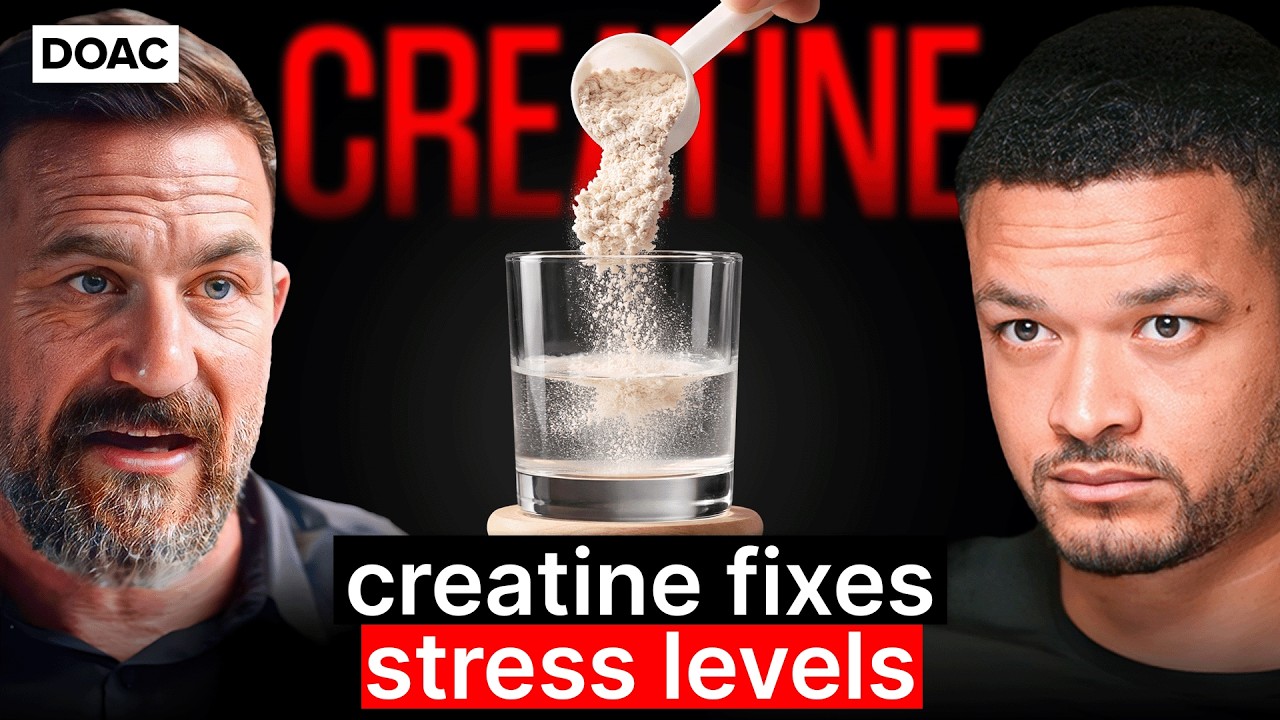
Suzuki, Patrick, Bryan Say Daily Exercise and Creatine Protect Brain
The Diary Of A CEO
Neuroscientists and researchers conclude that regular aerobic exercise, high-dose creatine, and plant polyphenols maintain cognitive function and mitigate Alzheimer's risk by improving cerebral blood flow and cellular energy metabolism.
## Background
This episode was published by The Diary Of A CEO on YouTube on December 26, 2025. The page description frames it as an exclusive Christmas compilation featuring top brain health experts to help viewers protect cognition, optimize daily lifestyle habits, and lower dementia risk for 2026.
## TL;DR
Host Steven Bartlett synthesizes insights from leading neuroscientists and health experts to present actionable strategies for lifelong brain health. The discussions emphasize that optimal cognitive function relies heavily on robust vascular circulation, adequate sleep, regular aerobic exercise, and purposeful social connection. Key interventions such as high-dose creatine, nitric oxide optimization, coordination sports, and polyphenol-rich foods like green tea and dark chocolate are highlighted for their ability to promote neuroplasticity, combat neuroinflammation, and protect against cognitive decline.
## Atmosphere & style
The compilation balances urgent scientific candor with an encouraging, goal-oriented energy suited for reflection and self-improvement. Bartlett acts as an inquisitive and reflective anchor, sharing personal anecdotes about his own routines and vulnerabilities, which grounds the high-level medical science into practical human experience. The dialogue feels intellectually stimulating yet accessible, transitioning naturally from intense physiological explanations to warm, intimate reflections on human connection.
## Key takeaways
- [01:03](https://www.youtube.com/watch?v=Oipkl53n938&t=63s) Aerobic exercise that raises the heart rate is the single most effective way to stimulate neurogenesis in the hippocampus and improve mood and attention.
- [06:08](https://www.youtube.com/watch?v=Oipkl53n938&t=368s) A quick pre-performance workout boosts focus and speech by flooding the prefrontal cortex with dopamine, elevating serotonin, and shortening reaction times.
- [09:20](https://www.youtube.com/watch?v=Oipkl53n938&t=560s) Chronic sleep deprivation and sedentary behavior directly destroy brain tissue, as sleep is required for memory consolidation and clearing brain fog through glympathic waste clearance.
- [11:51](https://www.youtube.com/watch?v=Oipkl53n938&t=711s) Social isolation and loneliness trigger sustained stress responses that accelerate brain shrinkage and significantly increase dementia risk.
- [13:24](https://www.youtube.com/watch?v=Oipkl53n938&t=804s) Creatine acts as a crucial cellular energy buffer; supplementing at higher doses (10–30g daily) can counteract cognitive deficits from acute sleep deprivation and mental fatigue.
- [25:20](https://www.youtube.com/watch?v=Oipkl53n938&t=1520s) Combining creatine supplementation with Cognitive Behavioral Therapy or medical treatments shows promising results for reducing depression and supporting brain energy in neurodegenerative diseases.
- [27:07](https://www.youtube.com/watch?v=Oipkl53n938&t=1627s) Adult neuroplasticity requires active focus and alertness to trigger catecholamines (dopamine, epinephrine, and norepinephrine), while physical synaptic rewiring occurs during deep sleep.
- [36:03](https://www.youtube.com/watch?v=Oipkl53n938&t=2163s) Nitric oxide (NO) is a vital vascular signaling molecule that declines drastically with age; restoring it relaxes blood vessels, improves cerebral blood flow, and targets root causes of dementia and Alzheimer's.
- [42:10](https://www.youtube.com/watch?v=Oipkl53n938&t=2530s) Excessive consumption of refined sugar and high-glycemic carbohydrates damages the vascular endothelium and impairs nitric oxide pathways, exponentially raising cardiovascular and cognitive risks.
- [44:32](https://www.youtube.com/watch?v=Oipkl53n938&t=2672s) Physical activities demanding complex motor coordination (like padel or table tennis) stimulate the cerebellum and frontal lobes to build cognitive reserve far better than passive activities.
- [47:18](https://www.youtube.com/watch?v=Oipkl53n938&t=2838s) 12 minutes of daily structured meditation, such as Kirtan Kriya, calms the limbic system, strengthens frontal lobe activity, and improves focus.
- [49:10](https://www.youtube.com/watch?v=Oipkl53n938&t=2950s) Elevated cortisol from chronic stress and unfulfilling work shrinks the memory-critical hippocampus, but deliberate long-exhale breathing techniques can rapidly restore vagal tone.
- [51:48](https://www.youtube.com/watch?v=Oipkl53n938&t=3108s) Hearing loss is a major risk factor for Alzheimer's because sensory deprivation causes under-stimulated neural pathways to structurally atrophy.
- [53:02](https://www.youtube.com/watch?v=Oipkl53n938&t=3182s) While AI streamlines tasks, relying on it heavily reduces cognitive load and manual problem-solving, which could negatively impact brain development if not actively balanced.
- [54:13](https://www.youtube.com/watch?v=Oipkl53n938&t=3253s) Natural plant-based polyphenols found in green tea, rosemary, and high-cocoa dark chocolate enhance blood flow and protect the neurovascular unit, reducing long-term dementia risk.
## Detailed walkthrough
Here is a detailed, faithful walkthrough of the transcript section.
---
### [00:00](https://www.youtube.com/watch?v=Oipkl53n938&t=0s) Introduction: Building a Healthy Brain for 2026
Host Steven Bartlett kicks off this special Christmas compilation episode of *The Diary Of A CEO* by emphasizing that caring for brain health is the foundational step for anyone wanting to start 2026 properly and achieve their goals. Reflecting on his conversations with leading neuroscientists over the past year, he highlights that the brain is our most powerful asset, driving all thoughts, feelings, relationships, memories, and future potential. Rather than letting listeners flatten their goals into dry tasks, Bartlett notes that he curated the most replayed, shared, and impactful moments from the show to give audience members a practical blueprint for building a fundamentally healthy brain and living a meaningful life.
---
### [01:03](https://www.youtube.com/watch?v=Oipkl53n938&t=63s) The Impact of Aerobic Exercise on Brain Health
Dr. Wendy Suzuki recalls the life-changing moment she first saw a human brain in person, which inspired her lifelong dedication to studying neuroscience. Bartlett compares the brain to a "ball of tofu" that needs to be kept healthy, fat, and fluffy, prompting Suzuki to explain the specific types and amounts of exercise required to achieve optimal brain health. Suzuki stresses that the most effective form of exercise is any aerobic activity that gets the heart rate up—whether that is power walking, soccer, or spin classes. Raising the heart rate stimulates the release of key growth factors that travel to the hippocampus to generate new brain cells (neurogenesis).
To determine precise guidelines, Dr. Suzuki's lab conducted two separate studies. The first examined low-fit individuals who engaged in under 30 minutes of physical activity over a three-week period. When assigned to attend high-intensity spin classes two to three times a week for 45 minutes per session, these participants experienced significant mood improvements, boosted hippocampal memory function, and enhanced ability to shift and focus attention. In a follow-up study on already-fit individuals offered unlimited spin classes up to seven times a week, Suzuki found that "every drop of sweat counted." The more frequently participants exercised, the greater the structural and functional changes observed in both the prefrontal cortex and hippocampus. Suzuki encourages listeners to view physical activity not as an obligation, but as a gift to their brain that delivers an immediate daily mood boost via the release of neurotransmitters like serotonin, dopamine, and norepinephrine.
* **Target Dose for Beginners:** 2–3 sessions per week of 45-minute aerobic exercise to yield cognitive and mood benefits.
* **Fit Individuals:** Benefit continuously from increased frequency; cognitive improvements scale directly with training volume.
* **Neurochemical Benefits:** Exercise triggers an immediate surge of serotonin, dopamine, and norepinephrine.
---
### [06:08](https://www.youtube.com/watch?v=Oipkl53n938&t=368s) How Pre-Performance Exercise Boosts Focus and Speech
Bartlett shares his personal experience as a podcaster and public speaker, noting how he sometimes struggles to articulate his thoughts smoothly. He asks whether performing a quick workout in the green room before going on stage—similar to motivational speaker Tony Robbins jumping on a trampoline before speaking—is supported by neuroscience. Dr. Suzuki enthusiastically confirms that a single acute workout prior to a public presentation significantly enhances performance through three immediate physiological mechanisms:
1. **Mood Elevation:** Rapidly elevates dopamine and serotonin levels.
2. **Prefrontal Cortex Function:** Although a single session cannot build new synapses, it floods the prefrontal cortex with dopamine, acutely sharpening focus, sustained attention, and verbal execution.
3. **Shortened Reaction Time:** Stimulating the motor cortex reduces reaction times and sharpens cognitive processing speed compared to sitting idle before an event.
---
### [07:46](https://www.youtube.com/watch?v=Oipkl53n938&t=466s) Caffeine, Cold Showers, and Self-Experimentation
When asked about caffeine's impact on cognitive performance, Dr. Suzuki points out that caffeine is a potent stimulant that affects individuals differently. While it can enhance alertness, over-stimulation often impairs a speaker's ability to smoothly articulate complex sentences. She advocates for "self-experimentation" to titrate one's personal coffee dosage. As an alternative or complement to caffeine, Suzuki shares her daily habit of taking hot-to-cold contrast showers. The sudden douse of cold water triggers a natural adrenaline surge that sharpens focus without the jittery downside of excess caffeine. Though uncomfortable initially, she describes the habit as addictive due to the immediate mental clarity it imparts every morning.
---
### [09:20](https://www.youtube.com/watch?v=Oipkl53n938&t=560s) Brain-Destroying Habits: Sedentary Behavior and Sleep Deprivation
Shifting the conversation to habits that actively destroy brain tissue, Dr. Suzuki identifies sedentary behavior and chronic sleep deprivation as the primary culprits. She warns her university students that extreme sleep deprivation in torture scenarios can be fatal, illustrating how vital sleep is for basic biological survival. Despite this, many people willingly sacrifice sleep to stay up late watching Netflix, settling for 5 hours of sleep instead of the optimal 8 hours.
Suzuki explains two critical neurobiological processes that occur during sleep:
* **Memory Consolidation:** During healthy sleep cycles, hippocampal activity replays and solidifies the memories formed during the previous day. Shortening sleep directly impairs long-term memory formation.
* **Glympathic Waste Clearance:** Sleep allows cerebrospinal fluid to flush through the brain, clearing out toxic metabolic waste products produced by cellular activity throughout the day. Skimping on sleep leads to an accumulation of cellular "gunk," directly causing the sensation of brain fog.
Addressing nutrition, Suzuki notes that the Mediterranean diet offers the most robust scientific evidence for long-term brain health and cognitive longevity. She advises prioritizing colorful, non-processed whole foods while strictly minimizing heavily processed foods.
---
### [11:51](https://www.youtube.com/watch?v=Oipkl53n938&t=711s) Social Isolation and Dementia Risk
Bartlett asks if having fewer friends and feeling lonely can cause the brain to shrink and increase the risk of neurodegenerative diseases like Alzheimer's and dementia. Dr. Suzuki confirms this, emphasizing that humans are evolutionary social creatures. She highlights research showing that even brief, casual micro-interactions—such as greeting a barista at a coffee shop—correlate with increased overall longevity and cognitive health.
Suzuki cites the famous Harvard Study of Adult Development, led by her colleague Dr. Robert Waldinger. Running continuously since the 1920s, the multi-decade study concluded that the single strongest predictor of human happiness and healthy aging is the strength of one's social connections. Conversely, chronic loneliness triggers sustained elevated stress responses that damage brain architecture, ultimately accelerating brain shrinkage and cognitive decline.
---
### [13:24](https://www.youtube.com/watch?v=Oipkl53n938&t=804s) Dr. Rhonda Patrick on Creatine and Brain Energy
The segment transitions to Dr. Rhonda Patrick discussing creatine, a supplement traditionally associated with bodybuilders seeking muscle hypertrophy. Dr. Patrick notes that over the past five years, emerging clinical research on creatine's profound effects on the brain completely shifted her perspective, leading her to integrate it into her daily routine alongside resistance training.
Dr. Patrick explains that while the liver synthesizes approximately 1 to 3 grams of creatine per day—and the brain synthesizes a small portion locally—tissues with high energy demands rely heavily on supplementary intake. Creatine is stored in tissues as phosphocreatine, where it serves as a rapid energy buffer to replenish ATP (adenosine triphosphate). When combined with resistance training (e.g., squats, deadlifts, barbell work), creatine supplementation increases training volume by allowing individuals to perform 1–2 additional repetitions per set and decreasing rest times between sets.
* **Endogenous Production:** The human liver produces roughly 1–3 grams of creatine daily, with additional small amounts synthesized in the brain.
* **Standard Dosing:** A standard daily dose of 5 grams has been thoroughly validated to enhance lean body mass and muscular strength when paired with exercise.
* **Mechanism of Action:** Creatine does not passively build muscle; it accelerates energy regeneration, enabling harder, higher-volume physical workouts.
[16:42](https://www.youtube.com/watch?v=Oipkl53n938&t=1002s) The Brain-Boosting Power of Creatine Beyond Muscle
Creatine is widely known for driving muscular strength and athletic performance, but its primary function as an energy-replenishing buffer makes it equally vital for the brain. The brain is an extraordinarily energy-hungry organ that consumes a massive portion of the body's resources. While it synthesizes its own internal supply of creatine, supplemental creatine becomes immensely impactful during periods of physiological or psychological stress—such as acute sleep deprivation, high emotional strain, neurodegenerative processes, or intense cognitive workloads that require constant learning, memory retention, and hypothesis testing.
While 5 grams per day is typically sufficient to fully saturate skeletal muscle tissue over time, higher daily doses are required to significantly elevate creatine levels across various brain regions. Research out of Germany revealed that supplementing with 10 grams per day provides the necessary overflow beyond muscle uptake to cross into and saturate the brain. Supplemental doses of 10 to 20 grams show profound benefits for cognitive performance under stress:
* **Reversing Sleep Deprivation:** Studies led by Dr. Darren Candow at the University of Regina demonstrate that administering 25 to 30 grams of creatine to individuals sleep-deprived for 21 hours completely negates their cognitive deficits, enabling them to perform even better than fully rested controls.
* **Preventing Energy Crashes:** Daily doses of 10 to 20 grams help eliminate mid-afternoon energy slumps without requiring a ketogenic diet, providing rapid ATP regeneration during demanding travel schedules or long speaking engagements.
* **Essential for Plant-Based Diets:** Because natural dietary creatine is found almost exclusively in animal foods (meat, poultry, fish, and dairy), vegans and vegetarians often experience life-changing shifts in physical energy and cognitive stamina when supplementing with 5 to 10 grams per day.
---
[22:31](https://www.youtube.com/watch?v=Oipkl53n938&t=1351s) Debunking Loading Phase Myths and Daily Cognitive Benefits
A common misconception surrounding creatine is that it requires weeks or months of continuous accumulation before any noticeable cognitive or physical benefits take effect. In exercise physiology, traditional "loading phases" (such as taking 20 grams daily for a week followed by a 5-gram maintenance dose) are designed solely to accelerate muscle store saturation within days rather than waiting a full month on a baseline dose. However, high-dose creatine supplementation can yield immediate, same-day cognitive enhancements when the brain faces elevated demand or acute fatigue.
Unlike muscle tissue—which stores creatine as phosphocreatine until full saturation is achieved—the brain continuously takes up excess circulatory creatine when daily doses exceed 5 grams. Under stressful conditions, such as jet lag or early-morning presentations, taking acute doses of 20 to 25 grams rapidly supplies the brain with the immediate energy substrates needed to maintain sharp focus and clear thinking.
---
[25:20](https://www.youtube.com/watch?v=Oipkl53n938&t=1520s) Creatine's Emerging Role in Depression and Alzheimer's
The frontier of creatine research has pivoted dramatically from sports science to clinical neuroscience. In a 2025 study examining individuals with depressive symptoms, combining creatine supplementation with Cognitive Behavioral Therapy (CBT) yielded significantly greater reductions in depression scores compared to CBT alone. Because depression involves neuroinflammation and oxidative stress alongside cellular energy deficits, researchers suspect creatine may exert distinct anti-inflammatory effects within the central nervous system in addition to its known energy-buffering properties.
> "I think where creatine really shines in the brain and it's been shown study after study is under some kind of stressful condition, depression, or sleep deprivation."
Emerging clinical data also points toward neuroprotective applications for age-related cognitive decline:
* A pilot trial in patients with Alzheimer's disease demonstrated that supplementing with 20 grams of creatine daily produced measurable improvements in cognitive function.
* Researchers across multiple disciplines are increasingly shifting focus toward creatine as a long-term therapeutic tool for brain aging, clinical depression, and neurodegenerative conditions.
---
[27:07](https://www.youtube.com/watch?v=Oipkl53n938&t=1627s) Neuroplasticity, Fear, and the Mechanisms of Adult Brain Rewiring
Neuroplasticity proves that the human brain retains the capacity to structurally and functionally reorganize itself at any age. While individuals under approximately 25 years old undergo passive neuroplasticity—where ambient experiences automatically shape neural architecture—adults over 25 require specific neurochemical triggers to alter brain connections. Unlearning negative behavioral patterns, overcoming trauma, or mastering new skill sets requires a dramatic shift in the internal neurochemical environment.
The brain is inherently efficient and refrains from changing unless forced by necessity. Traumatic events instigate rapid "one-trial learning" because fear triggers a massive surge of epinephrine and adrenaline, signaling the nervous system to rewire connections to prevent future harm. However, adults can deliberately leverage positive stimuli like intense interest, love, and curiosity to drive neuroplasticity:
* **The Catecholamine Trigger:** Learning in adulthood demands active alertness and focused attention, which releases the catecholamines (dopamine, epinephrine, and norepinephrine) to narrow visual and auditory focus.
* **Memory Consolidation:** The physical reordering of synaptic connections does not occur during the learning task itself, but during subsequent deep sleep.
* **Lifelong Adaptability:** Whether an individual is 50, 70, or 90 years old, the adult nervous system remains fully capable of forming new synaptic connections, pruning obsolete pathways, and in specific brain regions, generating new neurons.
[032:48] Rest, Daily Focus, and Podcasting Partners
Rest and sleep serve as the critical period where real neural rewiring takes place following active learning or brain dumps. Mid-episode sponsor breaks highlight practical daily tools for energy, productivity, and travel connectivity. Host Steven Bartlett shares his team's experience with ketone.com, describing how exogenous ketones significantly boosted focus, energy levels, and overall output across 35% of his staff, leading to a long-term partnership with the brand.
Bartlett also highlights Wispr Flow, an AI-powered voice-dictation tool that processes spoken thoughts into structured, grammatically polished text. By replacing slow manual typing across Slack, WhatsApp, and email, the software operates up to four times faster than typing. Additionally, ExpressVPN is presented as an essential tool for maintaining privacy and bypassing geo-restrictions on sports and media content while traveling internationally.
- Ketone supplementation options include online purchasing through [ketone.com/steven](https://ketone.com/steven) (with a 30% discount) or retail access at Target stores, where customers can obtain a free initial shot.
- Wispr Flow functions as an on-the-go thought partner available across all personal devices, accessible via whisperflow.ai/doac.
- ExpressVPN enables secure digital routing back to home countries (such as the UK) from anywhere abroad, offering an extra four months of service via [expressvpn.com/doac](https://expressvpn.com/doac).
---
[036:03] The Role of Nitric Oxide in Vascular and Brain Health
Dr. Nathan Bryan clarifies a fundamental chemical distinction: nitric oxide ($\text{NO}$) is a vital, naturally produced human signaling molecule, whereas nitrous oxide ($\text{N}_2\text{O}$) is "laughing gas," commonly used as a dental anesthetic. Synthesized directly within the endothelium—the single layer of cells lining every blood vessel—nitric oxide regulates vascular tone, solute exchange, and tissue perfusion. It mobilizes endogenous stem cells for cellular repair, aids energy production inside cells, and causes the smooth muscle surrounding blood vessels to relax and dilate, allowing optimal blood flow.
When endothelial cells lose the ability to manufacture nitric oxide, blood vessels remain constricted. This restriction leads to systemic inflammation, arterial stiffness, plaque buildup, and downstream chronic conditions. Normal nitric oxide production peaks in early youth, but between the ages of 30 and 70, levels drop by an alarming 80% to 90%. This drop correlates directly with age-related conditions like erectile dysfunction, hypertension, metabolic syndrome, and Alzheimer's disease.
> "This simple molecule, nitric oxide gas, I'm absolutely convinced will eradicate and cure Alzheimer's... because it addresses every physiological root cause of Alzheimer's."
- Erectile dysfunction serves as the "canary in the coal mine" for vascular breakdown—a warning sign of accelerated cardiovascular disease rather than a mere lifestyle issue.
- Alzheimer's operates as a vascular and metabolic condition; restoring nitric oxide improves cerebral blood flow and glucose uptake, suppresses oxidative stress, prevents immune dysfunction, and eliminates the waste clearance failures that trigger amyloid plaques and tau tangles.
- Early therapeutic intervention during stages like vascular dementia or mild cognitive impairment aims to halt disease progression and ideally induce clinical regression before irreversible structural damage sets in.
---
[042:10] Dietary Impacts and the Sugar Toxicity Threat
Maintaining healthy nitric oxide levels depends less on adding specific foods and more on aggressively eliminating systemic toxins—primarily refined sugar and high-glycemic carbohydrates. Elevated blood glucose leads to non-enzymatic glycation; the excess sugar acts like a sticky glue that binds to functional proteins and enzymes, destroying endothelial efficiency and altering the oral microbiome required for nitric oxide pathways.
Because of this mechanism, diabetic patients suffer a tenfold higher incidence of heart attacks, strokes, all-cause mortality, non-healing wounds, peripheral neuropathy, macular degeneration, and pancreatitis. Dietary management should prioritize high-quality protein, healthy fats, and minimal carbohydrates to avoid blood sugar spikes and keep the endothelium healthy.
- High-fructose corn syrup, sucrose, and refined carbs spike blood glucose, damaging the delicate endothelial enzyme systems.
- Continuous glucose monitors (CGMs) provide immediate real-time feedback to help identify and eliminate personal glycemic triggers.
- A balanced, calorie-controlled diet centered on unprocessed whole foods is essential to combat the widespread obesity epidemic and protect systemic vascular function.
---
[044:32] Exercise, Neuroplasticity, and Brain Health Habits
Dr. Daniel Amen reviews popular lifestyle trends to evaluate their actual cognitive benefits. Physical activities that demand real-time physical coordination—such as the rapidly growing sport of padel (similar to pickleball)—provide extraordinary benefits for the brain. Complex tracking, quick movement, and racket control stimulate the cerebellum, which in turn activates the frontal lobes. Uncoordinated individuals often suffer from an under-stimulated cerebellum, but targeted coordination drills at any age can build stronger neural pathways.
Combining physical movement with active mental engagement creates powerful cognitive synergy. Doing neuroplasticity exercises or listening to educational content on a stationary bike or while taking a walk increases blood flow directly to the hippocampus. This elevation in hippocampal perfusion accelerates memory encoding, accelerates skill retention, and builds structural brain reserve far more effectively than sedentary brain-training apps.
- Parents should encourage children to participate in coordination-intensive sports early in life while avoiding contact sports that carry high risks of head injury and concussion.
- Dr. Amen's 93-year-old mother was a neighborhood table tennis champion who used ping-pong to foster motor precision and mental sharpness without ever sustaining traumatic head impacts.
- Language learning apps or memorization games yield significantly higher cognitive retention when practiced while walking or cycling rather than sitting still.
---
[047:18] Meditation, Kirtan Kriya, and Work Engagement
Mindfulness and structured meditation deliver measurable changes in brain architecture and resting state function. Dr. Amen highlights his published research on *Kirtan Kriya*, a 12-minute Kundalini yoga meditation ideal for individuals with short attention spans or ADHD. The practice involves sequentially chanting the sounds *Sa Ta Na Ma* (representing birth, life, death, and rebirth) while performing repetitive finger-tapping motions (touching the thumb sequentially to the index, middle, ring, and pinky fingers).
Practicing Kirtan Kriya for 12 minutes daily over an 8-week period significantly calms the limbic (emotional) brain, stimulates the cerebellum, and strengthens baseline resting activity within the frontal lobes. Beyond formal meditation, day-to-day work habits also heavily influence long-term cognitive vitality. Loving your job and staying actively engaged in your career protects against age-related cognitive decline—provided the work continually presents novel challenges and demands fresh learning.
- Performing tasks on auto-pilot (such as passively reading brain scans without learning new techniques) fails to stimulate neuroplasticity.
- Individuals stuck in repetitive, non-stimulating jobs face a statistically higher incidence of Alzheimer's disease due to a lack of cognitive reserve development.
- Continuous intellectual engagement, novelty, and active problem-solving at work act as a natural defense against age-related mental decline.
<ElicitationsGroup message="Explore related topics from this transcript:">
<Elicitation label="Summarize the next part of this video transcript" query="Summarize part 4 of the transcript from 'The 6 Science Backed Brain Fixes Most People Are Ignoring!' episode."/>
<Elicitation label="Deep dive into nitric oxide and vascular dementia" query="Explain the detailed biological mechanisms of how nitric oxide affects cerebral blood flow, vascular dementia, and Alzheimer's disease based on Dr. Nathan Bryan's research."/>
</ElicitationsGroup>
[49:10](https://www.youtube.com/watch?v=Oipkl53n938&t=2950s) Job Satisfaction, Stress, and Cortisol
The conversation dives into the nuances of professional life and its impact on the brain, particularly focusing on the toxic intersection of chronic stress and unfulfilling work. While loving one's job and constantly learning new things can be cognitively stimulating, working in a toxic environment or doing a job purely for money without a sense of purpose is deeply damaging. Chronic stress elevates the body's cortisol levels, a state that the speaker urges everyone to monitor closely by knowing their baseline.
Elevated cortisol triggers severe physiological and neurological consequences, directly shrinking the hippocampus—the brain's primary center for memory—and promoting the accumulation of visceral fat on the belly. To counteract acute stress spikes and halt panic attacks in their tracks, the speaker recommends a specific, scientifically backed 15-second breathing technique that deliberately shifts the state of the nervous system.
- **The 15-Second Breath Technique:** Inhale for 4 seconds, hold the breath for 1.5 seconds, exhale for 8 seconds, and hold again for 1.5 seconds.
- **Nervous System Shift:** Repeating this cycle four or five times rapidly increases vagal tone, triggering a full-body calming effect. The underlying rule of research dictates that the exhalation phase should take twice as long as the inhalation phase (e.g., 4 seconds in, 8 seconds out).
[50:27](https://www.youtube.com/watch?v=Oipkl53n938&t=3027s) Brain Destroyers: Social Media, Microplastics, and Environmental Toxins
The discussion shifts toward modern lifestyle habits and environmental elements that actively degrade brain health. Chronic social media usage is identified as highly detrimental due to the psychological toll of "constantly comparing yourself to people who aren't real." The dialogue also addresses workaholism, clarifying that loving your work intensely isn't inherently an addiction or harmful, provided it is anchored by a genuine sense of purpose rather than mechanical financial pursuit.
Turning to environmental dangers, the host expresses immense relief that they are not using plastic water bottles during the interview, prompting an analysis of modern toxins. Microplastics are labeled as "awful for the brain" and cited as a major driver of modern hormone disruption and cancer. Furthermore, the public is becoming increasingly aware of the cumulative damage caused by these and other pervasive environmental toxins, which represents a positive shift in health consciousness.
[51:38](https://www.youtube.com/watch?v=Oipkl53n938&t=3098s) Noise Pollution, Hearing Loss, and Alzheimer's Risk
The speakers explore the underappreciated relationship between auditory health and cognitive decline, highlighting noise pollution as a major neurological hazard. The guest drops a striking fact: hearing loss is a significant, direct risk factor for developing Alzheimer's disease. When the brain is deprived of appropriate sensory input due to damaged hearing, the under-stimulated neural pathways begin to atrophy.
This sensory deprivation can have profound psychological consequences. If an individual cannot clearly hear what others are saying—especially if they already possess a high negativity bias or a high volume of "automatic negative thoughts" (ANTs)—they often grow paranoid, naturally filling in the silent, empty spaces with negative assumptions. The host shares a personal realization after buying a pair of Apple AirPods and running a built-in hearing test alongside his girlfriend. Though his results showed no active clinical hearing loss, discovering that his hearing baseline was significantly poorer than hers shocked him into turning down his headphone volume for the first time in his life.
- **Brain Reserve Concept:** Cognitive preservation in aging relies heavily on establishing and protecting a superior functional baseline early in life.
- **Sensory Deprivation:** Without proper auditory inputs, the brain structurally atrophies, accelerating long-term cognitive decline.
[53:02](https://www.youtube.com/watch?v=Oipkl53n938&t=3182s) Artificial Intelligence and Brain Development
The conversation pivots to a forward-looking debate regarding the rapid rise of artificial intelligence and its impending impact on human cognition. The host observes that while AI tools are highly optimized to streamline life and will certainly make technical medical jobs easier—such as analyzing brain scans—the societal implications are complex. Many people online are gripped by the immediate anxiety of losing their livelihoods to automation.
The guest predicts that in the short run, AI will be net-negative for human brain health because it minimizes cognitive load, meaning "your brain is going to do less." Invoking a favorite quote from author Byron Katie—"Argue with reality, welcome to hell"—the guest emphasizes that AI is an unchangeable reality. The ultimate human challenge moving forward will be figuring out how to actively use these tools to enhance life rather than allowing them to stall or steal critical brain development.
[54:13](https://www.youtube.com/watch?v=Oipkl53n938&t=3253s) The Vascular Effects of Curcumin and the Neurovascular Unit
The dialogue transitions into natural remedies for brain preservation, highlighting curcumin, the active compound derived from turmeric. The host cites prominent medical literature, including a 2007 study showing that curcumin successfully upregulates antioxidant defenses and downregulates oxidative stress, alongside a 2016 meta-analysis demonstrating its efficacy as a pain reliever comparable to ibuprofen. The guest corrects a widespread misconception about its bioavailability, explaining that curcumin does not need to be heavily absorbed directly into the bloodstream to work; instead, it interacts synergistically with the gut microbiome to become biologically useful.
Medical science is rapidly shifting its focus toward the vascular effects on the brain, specifically targeting the blood supply. The traditional concept of the blood-brain barrier—once viewed merely as a static wall blocking harmful substances—has been redefined by neuroscientists as a highly dynamic, active interface between brain tissue and the rest of the body, now known as the **neurovascular unit (NVU)**.
- **Promising Research:** Preclinical trials are exploring curcumin’s impacts on cancer pathways and direct long-term brain health.
- **The Plant Connection:** Ongoing research shows that the most effective agents for supporting and protecting the integrity of the neurovascular unit are plant-based compounds.
[55:58](https://www.youtube.com/watch?v=Oipkl53n938&t=3358s) The Cognitive Benefits of Green Tea and Rosemary
While brewing a fresh pot of Japanese green tea flavored with mint, ginger, and cinnamon, the guest details why regular consumption of the beverage is highly defensive against cognitive decline and dementia. Green tea—which is simply the smoked, unprocessed leaf of the *Camellia sinensis* plant—is packed with distinct green polyphenols. These plant compounds are highly effective at modulating the neurovascular unit, and population studies show a correlation between heavy green tea consumption and lower rates of dementia, though the guest notes that causation requires further scientific parameters to fully prove.
The guest introduces rosemary as another powerful plant to watch for long-term brain health, handing a fresh piece to the host to press and sniff. Inhaling the volatile oils of rosemary delivers its active compounds straight into the brain's limbic system via the olfactory lobe, which serves as a direct gateway where the brain meets the outside world. This historical connection is even mirrored in literature, notably when Ophelia in Shakespeare's *Hamlet* states, "Rosemary, that's for remembrance."
- **Clinical Evidence:** The guest shares that during his time working on a university campus in Maryland, he co-led a clinical trial demonstrating that rosemary improved cognitive performance in aging individuals struggling with mentally demanding tasks like crosswords.
- **Ginkgo Biloba:** Mentioned as another well-known botanical remedy utilized as a prescription medicine in Europe for cardiovascular issues, working via similar protective vascular mechanisms.
- **Green Tea Literature:** The host cites a 2008 study validating green tea's capacity to boost memory, attention, accuracy, and overall cognitive function, as well as a 2011 study from the *Journal of Nutritional Biochemistry* linking long-term consumption to reduced Alzheimer's risk.
[01:00:25](https://www.youtube.com/watch?v=Oipkl53n938&t=3625s) Dark Chocolate as a Critical Brain Medicine
The host jokingly laments that his girlfriend, who runs a business called Bali Breathwork, is always "two or three years ahead" of the scientific data he learns on his podcast, leaving him in denial before experts validate her lifestyle. She regularly consumes a high-polyphenol diet consisting of ginger, cinnamon, green tea, and dark chocolate. The guest enthusiastically validates her habits, declaring that "dark chocolate is a medicine. End of."
To extract true cardiovascular and neurological benefits, individuals should consume 50 to 100 grams of dark chocolate containing 75% or higher cocoa solids daily. Clinical trials tracking volunteers (often young students) show that consuming pure cocoa induces positive, measurable improvements in blood flow within minutes, and certainly within an hour of ingestion. While commercial hot chocolate packets loaded with sugar and fat do not qualify, pure, bitter dark chocolate acts as a potent circulatory and cardiac support tool. The host reflects on his girlfriend's breathwork retreats, noting that serving hot cacao to participants at the start of a session visibly shifts their energy and emotional openness, a phenomenon the guest attributes to both enhanced circulation and the presence of natural, uplifting stimulants similar to those found in coffee.
- **Vascular Support:** Cocoa acts directly on the heart, circulation, and brain tissues to optimize blood flow dynamics.
- **Clinical Recommendation:** The guest notes that he explicitly prescribes 50 grams of high-percentage dark chocolate a day to many of his clinical patients as a formal medical intervention.
- **Broad Systemic Benefits:** The host wraps up by listing the multi-system perks of a polyphenol-rich lifestyle, which spans heart health, enhanced brain function, accelerated fat burning, boosted metabolism, early-stage cancer prevention, improved insulin sensitivity, and optimal gut and oral health.
[01:04:12](https://www.youtube.com/watch?v=Oipkl53n938&t=3852s) Episode Outro: Deep Human Connection
The episode concludes with the host reflecting on the primal human need for deep, intimate connection, particularly in a fragmented modern world. He explains that the profound vulnerability shared between himself and his world-class guests inspired the creation of *The Diary Of A CEO* conversation cards. Designed to replicate the authentic, bonding dynamics experienced on the set of the podcast, the newly released second edition includes special "twist cards" to alter the direction of conversations, alongside a highly limited run of exclusive gold cards featuring custom questions written by the host himself.
## Notable quotes
> [25:20](https://www.youtube.com/watch?v=Oipkl53n938&t=1520s) I think where creatine really shines in the brain and it's been shown study after study is under some kind of stressful condition, depression, or sleep deprivation. — Dr. Rhonda Patrick
> [36:03](https://www.youtube.com/watch?v=Oipkl53n938&t=2163s) This simple molecule, nitric oxide gas, I'm absolutely convinced will eradicate and cure Alzheimer's... because it addresses every physiological root cause of Alzheimer's. — Dr. Nathan Bryan
> [53:02](https://www.youtube.com/watch?v=Oipkl53n938&t=3182s) Argue with reality, welcome to hell — Byron Katie
> [57:56](https://www.youtube.com/watch?v=Oipkl53n938&t=3476s) Rosemary, that's for remembrance. — Ophelia (Shakespeare)
> [01:00:29](https://www.youtube.com/watch?v=Oipkl53n938&t=3629s) dark chocolate is a medicine. End of. — Simon Mills
## Mentioned
Steven Bartlett, Dr. Rhonda Patrick, Dr. Wendy Suzuki, Andrew Huberman, Dr. Nathan Bryan, Dr. Daniel Amen, Simon Mills, Dr. Darren Candow, Dr. Robert Waldinger, Byron Katie, Shakespeare, The Diary Of A CEO, Harvard Study of Adult Development, University of Regina, Wispr Flow, ExpressVPN, ketone.com, Bali Breathwork, Apple AirPods, The Secret of Nitric Oxide, 1% Diary, Wispr, Ketone, ExpressVPN
Host Steven Bartlett curates findings from neuroscientists and clinicians showing that lifelong brain health, neurogenesis, and cognitive stamina depend on targeted physiological habits, vascular support, and metabolic interventions. Across several interviews, experts outline how aerobic movement, high-dose bioenergetic supplementation, vascular maintenance, and stress mitigation protect neural architecture against cognitive decline.
Aerobic Activity and Coordination Drive Neurogenesis (1:03)
Dr. Wendy Suzuki explains that aerobic exercise elevates heart rate to stimulate growth factors that generate new hippocampal neurons. Her laboratory found that low-fit individuals engaging in 45-minute spin classes two to three times per week experienced marked improvements in mood, memory, and attentional focus, with cognitive gains scaling continuously with frequency in fit individuals. Additionally, Suzuki notes that a single acute pre-performance workout floods the prefrontal cortex with dopamine, shortens reaction time, and sharpens verbal execution.
Dr. Daniel Amen adds that physical activities requiring motor coordination, such as table tennis or padel, engage the cerebellum to stimulate executive frontal lobe activity. Combining physical movement with cognitive tasks—such as listening to educational material while walking or cycling—enhances hippocampal perfusion and accelerates memory retention compared to sedentary cognitive training.
Creatine Supplementation for Acute Brain Energy (13:24)
Dr. Rhonda Patrick highlights creatine's role as a phosphocreatine energy buffer that rapidly replenishes cellular ATP. While the liver produces 1 to 3 grams daily and a baseline 5-gram dose saturates skeletal muscle, Patrick cites German research indicating that daily intakes of 10 to 20 grams are required to cross the blood-brain barrier and saturate brain tissue. These higher doses serve as a functional buffer during acute biological stress.
To illustrate, Patrick points to research by Dr. Darren Candow at the University of Regina demonstrating that 25 to 30 grams of creatine given to individuals sleep-deprived for 21 hours eliminated their cognitive deficits relative to rested controls. Emerging clinical research also points to therapeutic potential: combining creatine with cognitive behavioral therapy significantly reduced clinical depression scores, while a pilot study found measurable cognitive improvements in Alzheimer's patients supplementing with 20 grams daily.
Endothelial Nitric Oxide and Dietary Polyphenols
Dr. Nathan Bryan identifies nitric oxide as a crucial endothelial signaling molecule that regulates smooth muscle relaxation, arterial dilation, and tissue perfusion. Endothelial production declines by 80% to 90% between ages 30 and 70, leading to arterial stiffness and reduced cerebral blood flow. Bryan contends that endothelial dysfunction contributes heavily to Alzheimer's pathology by obstructing waste clearance and glucose delivery, while warning that excess refined sugars induce non-enzymatic glycation that damages endothelial enzyme efficiency.
Subsequent discussions emphasize plant-based compounds to protect the neurovascular unit. Green tea polyphenols correlate with reduced dementia rates in observational studies, while inhaled rosemary volatile oils stimulate limbic pathways directly. Furthermore, consuming 50 to 100 grams of dark chocolate with at least 75% cocoa solids daily provides polyphenols that clinical trials show measurably enhance cardiovascular and cerebral blood flow within an hour of ingestion.
Glymphatic Clearance, Stress, and Sensory Inputs (9:20)
Dr. Suzuki identifies chronic sleep restriction and social isolation as primary drivers of structural brain decline. Sleep facilitates hippocampal memory consolidation and enables cerebrospinal fluid to flush metabolic waste via the glymphatic system. Suzuki also cites the Harvard Study of Adult Development, led by Dr. Robert Waldinger, which established that strong social connections represent the primary predictor of healthy aging, whereas loneliness accelerates neurodegenerative decline.
Elevated cortisol from chronic, unfulfilling work stress directly atrophies the hippocampus. To counteract acute sympathetic spikes, clinicians recommend a 15-second breathing cycle—inhaling for 4 seconds, holding for 1.5 seconds, exhaling for 8 seconds, and holding for 1.5 seconds—to stimulate vagal tone. Auditory preservation is also critical; untreated hearing loss deprives neural pathways of sensory input, leading to structural atrophy and significantly elevating Alzheimer's risk.
The experts conclude that the adult brain retains lifelong neuroplasticity, capable of rewiring synaptic pathways when prompted by focused attention, proper sleep, and elevated metabolic support. However, while mechanistic and pilot data for interventions like high-dose creatine or nitric oxide restoration appear promising, clinical validation across larger patient cohorts remains ongoing.
精炼阅读摘要
本期节目汇总了多位神经科学与医学专家的研究成果,指出通过有氧与协调性运动、针对性营养补充、保护血管与神经微环境以及维护社交连接,能够有效促进神经发生并延缓认知衰退。
有氧运动与身体协调对大脑的重塑 (1:03)
Dr. Wendy Suzuki 的研究表明,能够提升心率的有氧运动会刺激生长因子释放,并促使海马体产生新生神经元。针对低运动量人群的实验显示,每周进行2至3次、每次45分钟的高强度动感单车训练,即可显著改善情绪、增强海马体记忆功能并提升注意力;而对于有运动基础的人,认知改善程度随训练频度增加而持续提升。此外,在公众演讲或重要表现前进行单次急性运动,可通过多巴胺和血清素的即时激增,快速提升前额叶皮层功能与言语表达流畅度,并缩短反应时间。
Dr. Daniel Amen 进一步指出,复杂的肢体协调运动(如板式网球 padel 或乒乓球)能强力刺激小脑,进而激活额叶的执行功能。他建议将身体活动与认知训练相结合,例如在骑室内单车或散步时进行记忆练习或学习语言,这种组合能增加海马体的血流灌注,使记忆编码和技能掌握的效果显著优于久坐式的脑力训练应用。
肌酸补充对大脑能量代谢与神经保护的作用 (13:24)
Dr. Rhonda Patrick 指出,尽管人体肝脏每天内源性合成约1至3克肌酸,且大脑自身也会合成少量,但在生理或心理压力下,外源性肌酸能够作为磷酸肌酸缓冲池,快速补充三磷酸腺苷(ATP)。虽然每日5克剂量足以使骨骼肌达到饱和,但德国的研究表明,若要穿透并充分浸润脑区,通常需要每日10至20克的剂量。Dr. Darren Candow 的实验证实,在剥夺睡眠21小时的受试者中,补充25至30克肌酸能完全抵消睡眠不足带来的认知缺陷。
肌酸的研究前沿已从运动科学延伸至临床神经学。2025年的一项研究显示,将肌酸补充与认知行为疗法(CBT)相结合,在缓解抑郁症状方面的效果显著优于单纯的心理治疗,研究人员推测这与其在中枢神经系统内的抗炎作用相关。同时,一项针对阿尔茨海默病患者的小型试验显示,每日补充20克肌酸带来了可测量的认知改善,显示出其在应对大脑衰老与神经退行性病变方面的潜在价值。
血管健康与一氧化氮对认知衰退的阻断机制
Dr. Nathan Bryan 强调了一氧化氮(NO)作为血管信号分子的核心价值。该分子由血管内皮细胞合成,负责调控血管张力、促进平滑肌舒张并维持脑部灌注。然而,人体内的一氧化氮水平在30岁至70岁之间会下降80%至90%,血管内皮功能的丧失会导致动脉硬化和慢性炎症,与勃起功能障碍、高血压及阿尔茨海默病直接相关。Dr. Bryan 认为阿尔茨海默病本质上属于血管和代谢性疾病,恢复一氧化氮水平有助于改善脑血流与葡萄糖摄取,并清除淀粉样蛋白和 tau 蛋白缠结。
维持内皮功能的关键在于消除代谢毒素,特别是精制糖与高升糖碳水化合物。过高的血糖会引发非酶促糖基化反应,破坏内皮酶系统及产生一氧化氮所需的口腔微生物群,导致糖尿病患者的心脑血管并发症风险激增。Dr. Bryan 建议通过限制碳水化合物、摄入优质蛋白质与健康脂肪来维持血管内皮的稳定性。
生活压力、感官退化与神经血管植物营养干预 (49:10)
长期处于缺乏意义感或高压的工作环境中会导致皮质醇持续偏高,直接引起海马体萎缩并增加内脏脂肪。对此,专家建议采用吸气4秒、屏气1.5秒、呼气8秒、再屏气1.5秒的15秒呼吸法来提升迷走神经张力。在环境与生理因素中,听力受损被明确为阿尔茨海默病的重要独立风险因素,感官输入的剥夺会导致相关神经通路结构性萎缩。而在人工智能普及的背景下,专家预测短期内认知负荷的骤减可能会因“用进废退”而对大脑健康带来负面影响。
在饮食干预方面,现代神经科学将血脑屏障重新定义为动态交互的“神经血管单元”(NVU)。姜黄素虽然血液生物利用度有限,但能通过肠道微生物组协同发挥抗氧化与神经血管保护作用。富含多酚的绿茶被群体研究证实与较低的痴呆发生率相关,迷迭香精油则能通过嗅叶直接作用于边缘系统以辅助认知。此外,临床研究显示,摄入可可含量75%以上的高纯度黑巧克力(每日50至100克)能在1小时内显著改善心血管及脑部血流,展现出明确的循环支持效能。
睡眠、社交连接与成年期神经可塑性规律 (9:20)
成年后(25岁以上)的大脑重塑高度依赖特定的神经化学触发机制,必须借助多巴胺、肾上腺素和去甲肾上腺素等儿茶酚胺的释放来聚焦注意力,而突触结构的真正重组则发生在随后的深度睡眠中。Dr. Wendy Suzuki 警告,慢性睡眠匮乏会阻断海马体对新记忆的巩固,并妨碍脑脊液的类淋巴系统冲洗代谢废物,直接导致脑雾及神经毒性物质累积。
哈佛大学成人发展研究(由 Dr. Robert Waldinger 主导)的长期数据显示,牢固的社交连接是预测健康老龄化和幸福感的最关键指标。长期的社交孤立与孤独感会引发慢性应激反应,损害大脑微结构并加速大脑萎缩;相反,即使是日常微小的社交互动,也与延长寿命及保护认知功能正向相关。
综上所述,大脑健康依赖于动力学运动、深度睡眠、代谢管理及社交维度的多系统协同。尽管高剂量肌酸和植物多酚等干预手段在早期试验中展现出保护作用,但其针对阿尔茨海默病等严重神经退行性疾病的长期因果关系与治疗潜力,仍有待更大规模的临床试验进一步验证。
Detailed notes — zh
## Background
本期视频由播客频道《CEO日记》(The Diary Of A CEO)于2025年12月26日发布在YouTube平台。作为跨年大脑健康特别节目,本集汇集了温迪·铃木(Dr. Wendy Suzuki)、朗达·帕特里克(Dr. Rhonda Patrick)、安德鲁·胡伯曼(Andrew Huberman)、内森·布赖恩(Dr. Nathan Bryan)、丹尼尔·阿门(Dr. Daniel Amen)及西蒙·米尔斯(Simon Mills)等全球顶尖神经科学家与医学专家的核心洞见,深入剖析了脑血流循环、失智症风险、营养代谢及神经可塑性等关键议题。
## TL;DR
节目围绕大脑结构养护展开了多维度的前沿科学探讨,指出有氧运动能有效刺激海马体神经新生,而深层睡眠则是脑脊液清除代谢毒素的关键窗口。专家们彻底打破了肌酸仅是健身增肌补剂的传统认知,证实每日10至20克的高剂量能产生血脑屏障溢出效应,显著逆转极端睡眠剥夺造成的认知赤字并缓解抑郁应激。此外,节目揭示了由儿茶酚胺与睡眠共同驱动的成年期神经可塑性机制,阐明了一氧化氮维持脑血管微循环对预防阿尔茨海默病的根源性意义,并推荐了结合协调性球类运动、地中海饮食、嗅闻迷迭香以及摄入高纯度黑巧克力与绿茶等多酚物质的综合护脑方案。
## Atmosphere & style
全片节奏明快且充满探索求真的智性张力,将高密度的神经生物学硬核机制与极为接地气的生活日常紧密交织。主持人史蒂芬·巴特利特秉持着极度坦诚的好奇心,在探讨中穿插自己面对高负荷工作的精力管理困境,甚至风趣调侃自己多年来对女友健康习惯的偏见最终被临床数据一一验证,极大地消解了科学前沿的距离感。整期对话在严谨的循证思辨中流动着关照身心健康的温情,让听众在认清现代生活对大脑潜在损耗的同时,获得了清晰、笃定且能够即刻落地的认知赋能感。
## Bulletin
- [16:39](https://www.youtube.com/watch?v=Oipkl53n938&t=999s) 外源性补充肌酸突破了传统的力量增肌标签:日常将剂量由 5 克提升至 10 克可突破骨骼肌饱和并向大脑组织“溢出”,在 21 小时睡眠剥夺等极端急性疲劳实验中,20 至 30 克的高剂量干预甚至能完全抹平注意力涣散等认知赤字。
- [38:36](https://www.youtube.com/watch?v=Oipkl53n938&t=2316s) 一氧化氮(NO)在 30 岁至 70 岁期间会出现 80% 至 90% 的断崖式下降;医学专家指出阿尔茨海默病本质上是血管微循环障碍,恢复一氧化氮系统能从生理源头阻断淀粉样蛋白和 Tau 蛋白的异常聚集。
- [29:38](https://www.youtube.com/watch?v=Oipkl53n938&t=1778s) 成人神经可塑性并非被动发生,必须在清醒期借助高警觉与深度专注诱发儿茶酚胺释放以标记目标突触,并在当晚及随后的深度睡眠中完成物理硬件层面的连接重塑。
- [01:00:08](https://www.youtube.com/watch?v=Oipkl53n938&t=3608s) 高纯度黑巧克力(可可固形物≥75%)与绿茶多酚具有明确临床活性,能在摄入后一小时内快速扩张微循环并增强脑部血液灌注,同时通过肠道菌群代谢协同维护神经血管单元(NVU)的屏障完整性。
## Key takeaways
- [01:03](https://www.youtube.com/watch?v=Oipkl53n938&t=63s) 有氧运动通过显著提高心率促进生长因子大量释放并长驱直入海马体,促进新脑细胞生成,并同步改善情绪与前额叶认知灵活性。
- [06:08](https://www.youtube.com/watch?v=Oipkl53n938&t=368s) 单次高强度运动能在登台演讲或关键表达前即刻激发多巴胺与血清素脉冲,激活前额叶皮层注意力并显著缩短神经反应时间。
- [09:20](https://www.youtube.com/watch?v=Oipkl53n938&t=560s) 久坐与睡眠剥夺是加速脑萎缩的两大元凶;充足的深层睡眠既是海马体巩固记忆的必要周期,也是脑脊液冲刷排出神经代谢废弃物的关键窗口。
- [12:03](https://www.youtube.com/watch?v=Oipkl53n938&t=723s) 高质量人际互动与寿命正相关,而长期孤独会触发持续的慢性神经压力并分泌压力激素破坏突触,大幅增加阿尔茨海默病风险。
- [16:39](https://www.youtube.com/watch?v=Oipkl53n938&t=999s) 人体唯有肝脏与大脑能自产肌酸,每日补充 10 克可在骨骼肌达到吸收阈值后溢出至循环系统,穿透血脑屏障为高认知负荷状态下的神经元极速再生 ATP。
- [19:11](https://www.youtube.com/watch?v=Oipkl53n938&t=1151s) 21小时极端缺觉实验证实,单次补充 25 至 30 克超大剂量肌酸可完全逆转睡眠剥夺引发的认知赤字;由于饮食缺乏动物蛋白,素食者补充肌酸后精力与认知改善尤为显著。
- [25:20](https://www.youtube.com/watch?v=Oipkl53n938&t=1520s) 肌酸通过缓解脑部应激与潜在抗炎机制展现出精神科应用潜力,不仅联合认知行为疗法(CBT)显著改善抑郁,在阿尔茨海默病先导研究中也显示出改善认知评分的积极线索。
- [29:38](https://www.youtube.com/watch?v=Oipkl53n938&t=1778s) 成年后大脑重塑需满足双阶段闭环:白天依靠儿茶酚胺(多巴胺、去甲肾上腺素、肾上腺素)形成高聚焦注意圈以打上突触标记,夜间必须依赖深度睡眠将新神经通路硬件化固化。
- [35:58](https://www.youtube.com/watch?v=Oipkl53n938&t=2158s) 一氧化氮由血管内皮细胞合成并直接作用于平滑肌促使其松弛,是调控全身灌注的气态信号介质;高糖饮食会如胶水般黏附酶类,瘫痪一氧化氮合成酶并破坏微循环。
- [38:36](https://www.youtube.com/watch?v=Oipkl53n938&t=2316s) 勃起功能障碍是一氧化氮缺乏和早期心血管病变的警讯;阿尔茨海默病本质属于血管性疾病,恢复一氧化氮生成可通过改善脑部血流、供糖与抑制神经炎症来遏制蛋白异常折叠。
- [44:27](https://www.youtube.com/watch?v=Oipkl53n938&t=2667s) 匹克球、板式网球等手眼协调击球运动通过强力刺激小脑,可连锁激活与之相连的前额叶皮层;运动状态能成倍增加流向海马体的血流,散步时记忆信息可显著提升学习效率。
- [47:15](https://www.youtube.com/watch?v=Oipkl53n938&t=2835s) 12分钟的 Kirtan Kriya 冥想法通过特定节奏的唱诵与指尖触碰,临床证实坚持8周能显著增强静息前额叶功能、激活小脑并安抚过度活跃的情绪中枢。
- [49:05](https://www.youtube.com/watch?v=Oipkl53n938&t=2945s) 恶劣工作环境中的慢性压力会导致皮质醇持续飙升,直接引发海马体萎缩并损害记忆;采用“4秒吸、8秒呼”的15秒呼吸法可刺激迷走神经张力,迅速平息急性惊恐。
- [51:40](https://www.youtube.com/watch?v=Oipkl53n938&t=3100s) 噪音损伤导致的听力下降会急剧切断大脑皮层的感官输入,促使废用神经回路萎缩退化,是诱发阿尔茨海默病的重要独立危险因素。
- [54:13](https://www.youtube.com/watch?v=Oipkl53n938&t=3253s) 姜黄素与绿茶多酚通过调节肠道微生物群间接维护“神经血管单元”(NVU),改善微循环动力学并长期降低老年期认知障碍综合征的发生风险。
- [57:45](https://www.youtube.com/watch?v=Oipkl53n938&t=3465s) 揉捏迷迭香叶闻嗅可使其挥发油直接顺着鼻腔触达作为大脑直接延伸的嗅叶,快速穿透至边缘系统,临床证实可改善年长者的认知与记忆表现。
- [01:00:08](https://www.youtube.com/watch?v=Oipkl53n938&t=3608s) 可可固形物达 75% 以上的优质黑巧克力具备明确药用价值,能在摄入后一小时内快速扩张微血管并增加脑血流灌注,兼具保护心血管与提振情绪的效能。
## Detailed walkthrough
### [00:00](https://www.youtube.com/watch?v=Oipkl53n938&t=0s) 序幕:守护最强大的资产与大脑健康特辑
史蒂芬·巴特利特(Steven Bartlett)在开篇直言,如果大家希望以正确的姿态迎接新的一年,这一期特辑是所有人都必须倾听的必修课。回顾过去一年与全球顶尖神经科学家的对话,他最深刻的心得在于:大脑或许是我们每个人拥有的最强大的资产。听众收听播客往往是为了获取信息、灵感或娱乐,以此追逐各自的人生目标;然而科学家们让他意识到,这一切的基石都始于一个健康的大脑——人类的思想、情绪、人际关系、记忆乃至未来的可能性,无一不是在大脑中生根发芽。为此,本期精选集结了过往节目中最受观众喜爱、传播最广且极具实践价值的科学家智慧,旨在帮助大家全方位构建健康的大脑基底,迈向更有意义的人生。
### [01:03](https://www.youtube.com/watch?v=Oipkl53n938&t=63s) 运动与大脑重塑:让脑中的“豆腐块”更饱满健康
著名神经科学家温迪·铃木博士(Dr. Wendy Suzuki)回忆起自己第一次亲眼目睹人类大脑的瞬间,感叹那是彻底改变她人生轨迹的时刻:“那改变了我的生活,当时我想‘我一定要研究这个,这是我一生中见过最酷的东西’。”史蒂芬深有同感地表示,许多人平日根本意识不到大脑的存在,直到某天他亲自做了脑部扫描,看到自己颅内真实图像的那一刻,才幡然醒悟并开始严肃审视自己的日常行为与决策对大脑造成的损耗。他诙谐地把大脑比喻为颅内那块软嫩的“豆腐”,并向铃木博士请教究竟何种运动才能让这块“豆腐”变得饱满、强健且处于最佳状态。
```mermaid
flowchart TD
accTitle: 有氧运动对大脑结构的重塑机制
accDescr: 展示有氧运动提升心率、促进生长因子分泌并进入海马体促进神经新生的过程
subgraph Exercise["身体活动"]
A["有氧运动<br/>快走 / 足球 / 动感单车"] --> B["心率显著上升"]
end
subgraph Biochemical["生化反应"]
B --> C["大量释放神经生长因子"]
end
subgraph BrainImpact["脑区重塑"]
C --> D["涌入海马体"]
D --> E["促进新生脑细胞生成<br/>增强记忆与认知功能"]
end
```
铃木博士明确指出,能够给大脑带来最大益处的运动类型是有氧活动,其核心判断标准只有一个:“你在运动时心率是否明显加快了?”无论是快步走、踢足球还是动感单车,只要心率升高,就会促使体内最大化地释放生长因子,这些因子长驱直入海马体,促进全新脑细胞的生长。针对“究竟需要多少运动量”这一关键问题,铃木博士分享了其实验室开展的两组对照研究:
* **极少运动人群的干预实验**:针对过去三周内运动时间不足30分钟的低体能受试者,研究人员安排他们每周参与2至3次、每次45分钟的动感单车课程。实验结果显示,短短几周后,受试者的情绪状态得到显著改善,海马体介导的记忆功能大幅提升,转移与集中注意力的认知灵活性也表现出明显的飞跃。
* **规律运动人群的进阶实验**:为了解答已有运动习惯者的疑惑,团队在另一家动感单车工作室提供免费课程,鼓励原本每周骑行两次的会员将频次增加至每周最多7次,并以维持原频次者作为对照组。结果表明“每一滴汗水都算数(every drop of sweat counted)”——运动量越大,在海马体功能、前额叶皮层认知表现以及情绪调节上观察到的大脑良性重构就越显著。
铃木博士强调,运动不应被视为某种被迫履行的苦差事,而是一种送给自己的礼物。哪怕只是清晨早起30分钟散步,或是答应邻居一起遛狗,每一次身体活动都会直接滋养颅内的大脑,并通过即时释放多巴胺、血清素和去甲肾上腺素,为当天注入纯天然的情绪催化剂。
### [06:08](https://www.youtube.com/watch?v=Oipkl53n938&t=368s) 登台前的秘密武器:单次运动对专注与表达的即时激活
作为播客主持人与演说家,史蒂芬坦言自己极度依赖“大脑与嘴巴的顺畅连接”。有时他会感到思维受阻、言语晦涩,这让他一直在反思当日行为与表达状态之间的相关性。他提到励志演说家托尼·罗宾斯(Tony Robbins)每次登台演讲前都会在后台蹦床上剧烈跳跃,因此向铃木博士求证:在登台发表重大演讲或演示前,是否有必要在休息室里来一场爆发式的快速锻炼?
铃木博士给出了极其坚定的肯定回答,并从神经生物学角度揭示了单次运动对大脑的三重即时神经调控机制:
```mermaid
flowchart LR
accTitle: 单次运动对大脑的三重即时激活
accDescr: 展示运动即时带来的情绪改善、前额叶皮层注意力激活以及运动皮层反应时间缩短
Workout["单次高强度运动"] --> Neurochem["多巴胺与血清素激增"]
Workout --> PFC["前额叶皮层激活"]
Workout --> Motor["运动皮层高频调动"]
Neurochem --> R1["情绪瞬间高涨提振"]
PFC --> R2["注意力与表达专注力聚焦"]
Motor --> R3["神经反应时间显著缩短"]
```
* **情绪状态提振**:剧烈活动能瞬间促使多巴胺和血清素激增,迅速驱散紧张焦虑,带来饱满积极的情绪底色。
* **注意力与专注力聚焦**:尽管单次锻炼无法立即在前额叶皮层催生新的神经突触,但前额叶极其依赖多巴胺进行神经信号传导。运动带来的多巴胺脉冲能立竿见影地优化前额叶皮层的运转效率,显著提升公众表达时的专注力与控场力。
* **反应速度大幅缩短**:肢体运动深度调动运动皮层,使神经中枢的神经反应与言语应对速度显著加快,使人思维更加敏捷、对提问的应对从容不迫。
### [07:46](https://www.youtube.com/watch?v=Oipkl53n938&t=466s) 咖啡因的辩证与冷热交替浴:晨间唤醒的神经刺激法
谈及日常专注与提神,史蒂芬提出了关于咖啡的困惑:关于咖啡究竟有益还是有害大脑,外界的观点充满了矛盾信号。铃木博士解释称,咖啡因本质上是一种中枢神经兴奋剂,而个体对其代谢与耐受程度差异极大。一旦摄入过量导致神经系统“过度兴奋(overstimulation)”,反而会损害逻辑语言组织能力,让人在关键表达时磕绊卡壳。
铃木博士引用了她在《健康大脑,快乐生活》(*Healthy Brain, Happy Life*)一书中推崇的核心法则——**自我实验(self-experimentation)**。每个人都应当主动测试并校准自己的咖啡因剂量,摸索出最适合录制播客或公开演讲的最佳摄入阈值。
此外,铃木博士分享了她每天清晨必做的提神替代方案:**冷热交替淋浴(hot-cold contrast showers)**。在温水洗浴之后突施冷水冲击,冷刺激会强烈激发体内内源性肾上腺素的天然释放。她坦言最初几次尝试确实痛苦难熬,但适应后会令人彻底上瘾;甚至在偶尔忘记冷水冲淋走出浴室后,她还会特意折返回去冲上一阵冷水,只为获得一整天神清气爽、思维清醒的开局。
### [09:20](https://www.youtube.com/watch?v=Oipkl53n938&t=560s) 摧毁大脑的两大日常行为:久坐与睡眠剥夺
转入问题的反面,史蒂芬探究起现代人日常中最具杀伤力、悄无声息破坏大脑的行为。铃木博士毫不犹豫地点名了两大元凶:
* **久坐行为(Sedentary behavior)**:缺乏运动直接截断了神经生长因子的释放通路,加速脑萎缩与认知衰退。
* **睡眠剥夺(Sleep deprivation)**:铃木博士常用极端案例警示学生——在酷刑实验与极端剥夺研究中,长时间被剥夺睡眠的个体最终会走向死亡。大脑的正常代谢与神经修复完全依赖深层睡眠,如果剥夺时间过长,神经元系统的稳定运作将彻底崩溃。
然而荒谬的现实是,许多人明明深知睡眠的重要性,却依然肆无忌惮地通宵刷剧、透支夜晚,满足于每晚仅有5小时的残缺睡眠,亲手将自己的大脑推入不可逆的退化深渊。
### [09:59](https://www.youtube.com/watch?v=Oipkl53n938&t=599s) 睡眠的两大护脑机制:记忆巩固与脑内代谢废物清理
充足的睡眠对大脑运作至关重要,其核心机制主要分为两个维度。第一是记忆的巩固过程:在健康的规律睡眠中,海马体(Hippocampus)会保持活跃,将前一天所形成的新记忆进行整合强化,这被称为“记忆巩固(Consolidation)”。一旦压缩睡眠时间或睡眠不足,日常记忆就无法顺利完成这一固化程序。第二是大脑的深层自我清洁机制:所有生物细胞在运转时都会产生代谢废弃物,而睡眠正是脑脊液(Cerebrospinal Fluid)在脑内充分循环流动的黄金时期。
脑脊液会冲洗并带走大脑白天累积的所有代谢杂质。如果缺乏足够的深度睡眠,这些毒素与代谢垃圾就会在神经组织间淤积,导致大脑陷入一种充满黏稠废弃物的“糊状脑(Gunky Brain)”状态。很多人在睡眠不足的次日感到头脑昏沉、思维混沌,生理层面上正是这种细胞垃圾大量堆积的真实反映。
- **海马体记忆巩固**:睡眠期间负责将短时日常记忆转化为长期稳定记忆。
- **脑脊液排毒清洗**:睡眠时代谢废物被脑脊液集中冲刷排出,缺觉会导致神经毒素滞留。
---
### [11:14](https://www.youtube.com/watch?v=Oipkl53n938&t=674s) 滋养大脑的最佳膳食:天然抗炎的地中海饮食
在谈及摄入物对大脑健康的影响时,加工食品、酒精等物质普遍带来负面负担,而最具坚实科学证据支持的大脑友善选择是地中海饮食(Mediterranean Diet)。地中海饮食的核心理念并不局限于“纯有机”,而是专注于摄入完全未经过度加工的天然食物,尤其是色彩斑斓的蔬菜与水果。
五彩缤纷的天然植物含有极其丰富的抗氧化物和微量营养素,能为脑细胞提供最基础的神经保护。日常饮食中判断食物是否有利于大脑的最简明准则就是:“它是否属于地中海饮食范畴?”只要遵循天然、高纤维、富含色彩且极少加工的原则即可;对于深度加工食品,则应严格控制在极低频次。
---
### [12:03](https://www.youtube.com/watch?v=Oipkl53n938&t=723s) 社交连接、长寿与孤独对大脑的长期损伤
人类本质上是高度社会化的生物,社交联系的丰富度直接决定了神经系统的健康状态与整体寿命。科学研究表明,即便只是微小短暂的社交互动——例如在星巴克买咖啡时主动与咖啡师打个招呼、日常与邻里致意,而不仅限于维系三十年的亲密老友——互动的人际节点越多,个体的预期寿命就越长。
哈佛大学自 1920 年代启动、横跨数十年的成人发展研究(由罗伯特·瓦丁格 Dr. Robert Waldinger 主导)得出了一个明确结论:决定人一生幸福与健康的最关键要素,正是社交连接的深度与质量。良好的社交不仅带来幸福感并延长寿命,还能抵御神经退行性病变;反之,长期孤独会引发持续的慢性压力反应,分泌大量压力激素破坏神经元突触,最终导致大脑结构萎缩,大幅推高认知障碍症(阿尔茨海默病)的发病风险。
```mermaid
flowchart TD
accTitle: 社交状态对大脑神经与寿命的影响路径
accDescr: 对比积极社交连接与长期孤独对神经系统及整体健康的不同作用机制
subgraph Positive["积极社交互动"]
A["高频日常交往<br/>(如向咖啡师问候/朋友交流)"] --> B["提升主观幸福感<br/>激活神经奖赏机制"]
B --> C["延缓认知衰退<br/>延长整体生理寿命"]
end
subgraph Negative["长期孤独与社交孤立"]
D["缺乏社会支持与连接"] --> E["诱发慢性神经压力<br/>释放应激激素"]
E --> F["突触损伤与大脑萎缩<br/>增加阿尔茨海默病风险"]
end
```
---
### [13:20](https://www.youtube.com/watch?v=Oipkl53n938&t=800s) 走出“健身房神药”误区:肌酸在力量与能量生成中的本色
长期以来,肌酸(Creatine)一直被贴上“健身房肌肉猛男(Gym Bro)专用补剂”的刻板标签,许多普通人甚至视其为单纯为了“练大块头(Get Swoll)”的虚荣补剂而敬而远之。然而近五年来,关于肌酸对神经系统与脑功能的革命性研究彻底刷新了认知。人体本身也会合成肌酸,肝脏每日合成约 1 到 3 克,大脑自身也会合成一部分,它们是体内唯二能够自主合成肌酸的器官。
肌肉组织是体内最“贪婪”消耗肌酸的组织。肌酸以磷酸肌酸(Phosphocreatine)的形式储存,其根本作用是为细胞快速再生腺苷三磷酸(ATP)提供高能磷酸键。配合抗阻训练(如深蹲、硬拉、杠铃训练),外源性补充肌酸可以让训练者在每组动作中多冲刺 1 到 2 次重复,并大幅缩短组间间歇恢复时间。正是这种“提升总训练容量”的能力,间接驱动了瘦体重与肌肉力量的适应性增长。但单靠吃肌酸而不进行阻抗刺激并不会让人自动长肉,它扮演的是“为能量生成超级加倍”的角色,而非替代汗水。
- **人体自主合成**:肝脏每天约合成 1-3 克肌酸,大脑也能自行产生一部分。
- **能量储备形式**:转化为磷酸肌酸,用于细胞极速再生能量。
- **训练增效机制**:缩短组间间歇,提高抗阻训练总负荷(每组多做 1-2 次),加速力量与肌肉适应。
---
### [16:39](https://www.youtube.com/watch?v=Oipkl53n938&t=999s) 应对高认知负荷与慢性压力:从 5 克到 10 克的脑部溢出
大脑作为全身代谢最旺盛的高能耗器官,在面临特定压力时对能量的需求会呈爆发式增长。如果一个人过着无忧无虑的生活,睡眠完美且毫无压力,大脑自产的肌酸或许足够维持运转;但在现代快节奏生活中,高认知负荷(如科研人员每天高强度消化复杂概念、记忆与推导假说)、心理压力、睡眠剥夺乃至抑郁症和神经退行性疾病,都会让大脑陷入严重的能量赤字与代谢应激。在这些高压状态下,肌酸的护脑效应尤为突出。
来自德国等地的临床剂量研究揭示了肌酸在体内的优先级分配:如果每日仅补充 5 克肌酸,处于抗阻训练状态下的骨骼肌会毫不客气地将其全部吸纳,在持续补充数月达到肌肉饱和前,极少有剩余成分能穿透血脑屏障;而当补剂剂量提升至每日 10 克时,多余的肌酸就会产生“溢出效应(Spillover)”,显著提升大脑多个关键脑区的肌酸浓度水平。正是基于这种神经保护与能量充能的需要,日常高脑力负荷人群的补充剂量往往从传统的 5 克跃升至 10 克。
```mermaid
flowchart LR
accTitle: 肌酸在骨骼肌与大脑之间的剂量分配逻辑
accDescr: 展示每日5克与10克肌酸在体内优先满足肌肉后向大脑组织溢出的吸收路径
subgraph Intake["摄入剂量"]
D5["每日 5g 剂量"]
D10["每日 10g 剂量"]
end
subgraph Organs["体内吸收与分布"]
M["骨骼肌系统<br/>(优先贪婪摄取/达到饱和)"]
B["大脑神经元<br/>(穿透血脑屏障/高能耗脑区)"]
end
D5 -->|"大部分优先消耗"| M
D10 -->|"填满肌肉储备"| M
D10 -.->|"突破饱和阈值/溢出"| B
```
---
### [19:11](https://www.youtube.com/watch?v=Oipkl53n938&t=1151s) 21小时极端缺觉实验:高剂量肌酸对认知赤字的完全逆转
加拿大里贾纳大学(University of Regina)的达伦·坎道博士(Dr. Darren Candow)等人开展的一系列前沿研究,进一步探索了大剂量肌酸(10 克至 20-30 克)在急性极端认知受损场景下的干预潜力。其中最震撼的一项睡眠剥夺实验,将受试者置于连续 21 小时不眠不休的高压状态下,随后给予他们约 25 到 30 克的单次大剂量肌酸。
实验结果令人瞠目结舌:补充高剂量肌酸不仅完全抵消了长达 21 小时睡眠剥夺导致的注意力涣散、反应迟钝和认知功能下滑,甚至让这些处于极度疲劳状态的受试者在认知测试中的表现超越了睡眠充足的基线水平。"这简直让人难以置信,"当看到这组数据时,原本持怀疑态度的神经科学研究人员也不得不重新审视肌酸在大脑能量急性耗竭时所迸发出的超常逆转能力。
- **极端实验设计**:受试者经历 21 小时完全睡眠剥夺,模拟严重的生理与认知衰竭。
- **干预用量**:单次补充 25 至 30 克超大剂量肌酸。
- **实验表现**:彻底抹平缺觉引发的认知赤字,综合脑力甚至优于睡眠充沛的常规状态。
### [20:06](https://www.youtube.com/watch?v=Oipkl53n938&t=1206s) 肌酸在认知高负荷与睡眠剥夺下的应用及素食者获益
Rhonda Patrick 博士分享了自己在不同日常状态下调整肌酸(Creatine)摄入剂量的切身体验。通常在差旅、倒时差或严重缺觉的情况下,如果面临录制播客或进行演讲等高负荷任务,她会将每日剂量从常规的 10 克直接提高到约 20 克。甚至在当天录制这期长播客前,虽然没有极度睡眠不足,但面对漫长且高强度的脑力输出挑战,她同样补充了 20 克肌酸。Patrick 强调,即使是基础的 10 克剂量,也能有效避免生酮饮食之外常见的“午后疲劳崩盘”(Mid-afternoon crash);如果某些日子只摄入 5 克,她就会敏锐地察觉到困倦。尽管她幽默地承认其中可能夹杂着安慰剂效应(Placebo),但肌酸在加速大脑能量再生方面的机制是毋庸置疑的。
目前,肌酸研究领域正经历一场重大转变——研究重心正从单纯的肌肉表现与力量训练,全面扩展到脑科学与认知健康领域。Patrick 提到,由于肌酸天然存在于肉类、禽类、鱼类及乳制品等动物性食品中,纯素食者(Vegans)的日常饮食几乎完全不含肌酸。当她推荐身边的素食朋友开始每天补充 5 至 10 克肌酸后,他们的生活发生了翻天覆地的转变:原本低迷的精力显著提升,许多人甚至反馈大脑不再需要那么多的睡眠时间便能维持充沛活力。肌酸不仅是健身房爱好者的增肌补剂,更已成为抵御认知疲劳与脑力压力的关键神经营养素。
- **高负荷与差旅剂量**:日常基础剂量通常为 10 克;在面临跨时区倒时差、睡眠剥夺或高强度脑力任务时,剂量可上调至 20~25 克。
- **素食群体收益最为显著**:由于饮食结构缺乏动物蛋白来源,纯素食者通过每日补充 5~10 克肌酸,在精力恢复与认知耐力方面能获得肉眼可见的改善。
---
### [22:31](https://www.youtube.com/watch?v=Oipkl53n938&t=1351s) 冲击期迷思:肌肉饱和与大脑直接吸收的机制差异
主持人提出疑问:传统观念普遍认为肌酸需要经历数周甚至数月的“冲击期”(Loading phase)才能逐渐起效,那么为何在清晨摄入大剂量肌酸后,当天就能迅速感受到大脑认知能力的提升?Patrick 解释道,所谓的“冲击期”(如连续多天每天摄入 20 克,随后降至每天 5 克的维持剂量)完全是源于运动科学与肌肉生理学研究的产物。肌肉是以磷酸肌酸(Phosphocreatine)的形式储存能量,若每天仅服用 5 克,肌肉库通常需要约一个月的时间才能达到完全饱和;而科研人员为了在一两周内快速观察力量或运动表现的变化,才设计了通过高剂量加速饱和的冲击期。对于不急于参加短期高强度竞赛(如 CrossFit 运动会)的普通人而言,持续服用 5 克一个月同样能够使肌肉达到饱和。
大脑对肌酸的代谢逻辑与肌肉截然不同。当摄入量超过肌肉当下的吸收阈值(如超过 5 克)时,富余的游离肌酸会留在循环血液中,直接穿透并被大脑摄取利用。在面临睡眠不足、生物钟紊乱或极端认知压力的临界状态下,大脑的代谢需求急剧飙升,循环系统中的外源性肌酸能够立即参与 ATP 能量池的快速再生。Patrick 回忆自己在严重倒时差、生物钟相当于凌晨五点时登台演讲的经历,服用 25 克肌酸带来的大脑清晰感令人震撼。
```mermaid
flowchart TD
accTitle: 肌酸在人体内的代谢分配路径
accDescr: 展示摄入不同剂量肌酸后,肌肉与大脑在常规状态与急性压力下的吸收和利用差异。
subgraph INTAKE["肌酸补充剂量"]
A["常规剂量: 5克/天"]
B["大剂量: 10~25克/天"]
end
subgraph MUSCLE["肌肉组织代谢"]
C["肌肉优先摄取"]
D["磷酸肌酸库饱和<br/>(常规需约1个月,冲击期可加速)"]
end
subgraph BRAIN["大脑认知代谢"]
E["溢出循环血液的富余肌酸"]
F["穿透血脑屏障并被神经元摄取"]
G["急性压力状态:<br/>睡眠剥夺 / 脑力过载 / 情绪抑郁"]
H["快速再生 ATP 能量池<br/>即刻缓解认知疲劳"]
end
A --> C
C --> D
B --> C
B --> E
E --> F
F --> G
G --> H
```
---
### [25:20](https://www.youtube.com/watch?v=Oipkl53n938&t=1520s) 肌酸在抑郁症治疗、抗炎机制与阿尔茨海默病中的新前沿
对话转向肌酸在精神健康领域的重磅科研发现。主持人援引了一项 2025 年的前沿研究:在接受认知行为疗法(CBT)的抑郁症患者中,额外补充肌酸的试验组在抑郁症状的改善幅度上,显著优于仅接受单纯认知行为疗法的对照组。Patrick 认同并指出,抑郁症本质上就是一种典型的“脑部应激”(Brain stress),其病理过程与神经炎症(Neuroinflammation)及氧化应激紧密交织。
越来越多的动物实验和初步临床证据表明,肌酸的作用机制可能超越了纯粹的能量代谢补给,展现出尚未被完全阐明的抗炎特性。此外,一项最新发表的初步先导性研究(Pilot study,虽样本较小且缺少安慰剂对照)显示,每日向阿尔茨海默病(Alzheimer's disease)患者提供 20 克肌酸,观察到了认知功能的直接改善。从对抗抑郁、减轻睡眠剥夺的神经损伤,到延缓大脑衰老,肌酸已彻底打破了“健身房专属补剂”的传统标签,成为神经精神科学领域极具潜力的神经保护分子。
- **抑郁症与脑应激**:抑郁伴随神经炎症与氧化损伤,肌酸联合 CBT 展现出超越单一心理治疗的抗抑郁协同效果。
- **阿尔茨海默病临床线索**:每日 20 克高剂量肌酸干预显示出改善认知评分的积极信号,标志着针对脑代谢障碍干预的新方向。
---
### [27:07](https://www.youtube.com/watch?v=Oipkl53n938&t=1627s) 神经可塑性与恐惧驱动:神经调质如何重塑大脑回路
视频引入了另一位神经科学权威的访谈片段。主持人感触极深地表示,神经可塑性(Neuroplasticity)的概念无比令人振奋且极具解脱感——它证明了大脑在生理层面能够随着行为而重塑,一个人过去的困顿、失败或混乱身份(例如 19 岁时裹在睡袋里浑噩度日的状态)绝非无法摆脱的终身判决。在探讨改变的动力时,嘉宾坦言,在自己的成长经历中,正是“对彻底沦为失败者的极度恐惧”,逼迫自己开启了脱胎换骨的巨变;尽管最高境界的创造力和卓越成就往往诞生于对事业本身的纯粹热爱,但人们往往需要先被恐惧“吓上一跳”,才会下定决心踏上寻找真爱的求变之路。
关于神经可塑性的年龄界限,嘉宾给出了极其明确且坚定的答案:在任何年龄阶段,学习新技能、戒除旧行为模式、跨越心理创伤都是绝对可能的。但在生理机制上,大脑的发育存在分水岭:
- **25 岁之前**:大脑处于被动塑造期,生活中的环境与被动经历本身就能轻易改变神经连接结构。
- **25 岁之后**:大脑可塑性需要特定的“神经化学环境显著转变”(A marked shift in the neurochemical environment)作为触发扳机。
当人体遭遇剧烈、充满恐惧或极度严肃的冲击事件时,体内会瞬间大量释放肾上腺素(Epinephrine / Adrenaline)等关键神经调质(Neuromodulators)。这种剧烈的神经化学风暴向神经系统发出强烈的“非同寻常”警报信号。在随后数天的睡眠与休息中,大脑便会针对该事件重新排列突触连接,以确保未来再次面对类似危机时具备生存应对机制。这正是进化上“单次学习”(One-trial learning,经历一次可怕事故便终生难忘)的生理基础,也揭示了成年大脑在面临高警觉状态时重组神经通路的深层原理。
### [29:38](https://www.youtube.com/watch?v=Oipkl53n938&t=1778s) 神经可塑性与深度专注:大脑如何通过儿茶酚胺与睡眠重塑连接
安德鲁·胡伯曼(Andrew Huberman)深入阐释了人类大脑的学习机制与神经可塑性(Neuroplasticity)的底层神经化学条件。他首先以创伤记忆为例指出,如果个体在某个地点遭遇可怕事件,往往会本能地将该物理空间与恐惧永久绑定;然而,通过专业心理治疗与神经调控工具,大脑可以剥离这种沉重的情绪负荷,使人即便故地重游也能保持内心的平静。更振奋人心的事实是,无论年龄多大,成年人都可以学习掌握任何想学的内容,但前提是必须诱发特定的神经化学环境转变。成年人绝不可能像机器通过“渗透作用”那样被动吸纳知识——在房间背景音里播放关于人工智能、大语言模型或神经科学的播客或讲座,知识并不会凭空沉淀进脑海中。
成人重塑神经连接的绝对前提是“保持高度警觉”(Alert)与“保持专注”(Focused)。当注意力被高度调动时,体内会激增一组关键的神经化学物质——儿茶酚胺(Catecholamines),主要包含多巴胺(Dopamine)、肾上腺素(Epinephrine)和去甲肾上腺素(Norepinephrine)。这三类分子共同拉升大脑的警觉状态,大幅收窄个体的视觉与听觉感知范围,形成如同探照灯般的“注意力圆锥”(Cones of attention)。这种高度聚焦的神经张力为神经突触打上了可变的生理标记;然而,真正的突触重排与连接固化并不会在学习当下发生,而是必须仰赖学习当晚、甚至随后的充足深度睡眠、冥想状态或深度休息。正是通过这些静态修复过程,新经历与新知识才真正被编码进神经网络,使大脑结构发生持久转变。
胡伯曼破除了一种流传甚广的误区——“大脑时刻都在发生改变,遭遇的每件事都会改变大脑”。事实上,神经系统的底层逻辑是高度追求效能与节约能量的,它“绝不会在没有必要的情况下做出改变”。在童年与青少年时期,大脑犹如一块等待塑造的模板,在激增的激素与神经调质驱动下快速构建对外界的预测系统,哪怕是一首平凡的流行音乐或微不足道的小事,在青少年眼中都会带来翻江倒海的非凡意义。到了成年期,神经系统变得极为保守,唯有足够强烈的外部刺激才能撬动改变。出于生存防御本能,恐惧对大脑重塑具有不对称的压倒性影响力,但爱、极度的兴奋感与由衷的赞赏同样是重塑突触连接的强大催化剂。不管是50岁、70岁还是90岁高龄,只要能确保高专注的信号触发与充足的睡眠重合,终身神经重塑就完全可行。
```mermaid
flowchart TD
accTitle: 神经可塑性实现流程
accDescr: 展示从注意力调动释放儿茶酚胺,到限制视野,再到睡眠中突触结构重组的完整机制。
subgraph Trigger["阶段一:信号诱发(白天/清醒期)"]
A["高警觉与深度专注"] --> B["释放儿茶酚胺<br/>(多巴胺/肾上腺素/去甲肾上腺素)"]
B --> C["注意力圆锥收紧<br/>(视听感知范围高度聚焦)"]
C --> D["为目标神经突触标记改变信号"]
end
subgraph Consolidation["阶段二:硬件固化(睡眠/休息期)"]
D --> E["深度睡眠与静息冥想"]
E --> F["突触强化、削弱与重新布线"]
F --> G["神经可塑性完成<br/>知识与经验永久沉淀"]
end
```
- **儿茶酚胺三剑客**:多巴胺、肾上腺素和去甲肾上腺素协同工作,共同拉紧视听通道,为突触重塑标记空间靶点。
- **睡眠的固化作用**:白天的刻苦专注只是向神经系统发送修改请求,真正的线路重连全部发生在当晚及次日的深度睡眠与深度休息中。
- **年龄无关论**:尽管童年期神经突触更具可塑性,但只要满足“警觉专注+睡眠固化”的双重闭环,即便90岁老人依然具备完整的神经重塑潜力。
---
### [32:59](https://www.youtube.com/watch?v=Oipkl53n938&t=1979s) 中场分享:日常精力与生产力工具推荐
主持人史蒂芬·巴特利特(Steven Bartlett)插播分享了支撑其日常高强度工作与跨国差旅的三款实用工具。首先是外源酮补剂品牌 ketone.com,史蒂芬透露团队中约有35%的员工将其视为“彻底改变工作状态的神器”。起因是有天他在工位上发现了一盒样片,在团队成员莉莉(Lily)提醒该品牌接洽后,他亲自尝试便一发不可收拾,其日常专注力、体能水平与整体产出效率均获得实质性飞跃。
随后,史蒂芬谈到了AI语音生产力应用 Wispr Flow。作为思维记录助手,该工具能将随口说出的零碎想法通过AI实时提炼整合为语法准确、逻辑通顺的专业书面文本,录入速度比传统键盘打字快4倍。无论是在办公室独处、外出路途中,他都能直接用嘴“倾倒思维”,轻松跨设备回复长邮件、Slack与WhatsApp消息。由于他在幕后花絮频道的大力推荐为该产品带去了海量新用户,创始人随后向其发出邀约,史蒂芬现已正式以投资人和核心合伙人的身份深度参与该项目。最后,史蒂芬提到了常年奔波于亚洲、欧洲与美国之间的数字生活,为了在吉隆坡、香港、印度尼西亚等多地自如收看家乡英国的英超足球赛事和综合格斗(MMA)转播,克服不同国家版权服务商的地区限制,他长期依赖 ExpressVPN 提供的安全网络连接保障。
- **外源酮补剂(ketone.com)**:显著拉升脑力专注度与工作耐力,全美 Target 门店现已支持首杯免费试饮。
- **Wispr Flow 语音转写引擎**:生成式AI思维伴侣,打字效率提升4倍,打通移动端与桌面端的无缝文本输出。
- **跨地域数字连接(ExpressVPN)**:解决在亚洲与欧洲频繁差旅期间各流媒体平台的内容区域壁垒问题。
---
### [35:58](https://www.youtube.com/watch?v=Oipkl53n938&t=2158s) 一氧化氮的生理革命:并非“笑气”的人体关键信号分子
节目进入第三个高重播率核心片段,内森·布赖恩博士(Dr. Nathan Bryan)作为一氧化氮领域的权威学者受邀登场。史蒂芬请他阐述其毕生研究的使命,布赖恩博士直言,像史蒂芬这样阅历广博的人此前竟对一氧化氮一无所知,这本身就生动折射了当今大众健康认知的巨大断层。为了避免误解,史蒂芬与布赖恩博士首先厘清了一组极易混淆的概念:赛车游戏中用于涡轮增压、或牙科诊所作为吸入性麻醉剂的“笑气”是**一氧化二氮**(Nitrous Oxide,化学式 $N_2O$);而维持人体健康和长寿的核心基石是**一氧化氮**(Nitric Oxide,化学式 $NO$),它由一个氮原子和一个氧原子结合而成。
一氧化氮是人体内自然合成的一种气态信号分子,在维持组织灌注与细胞代谢中扮演着发号施令的角色。布赖恩博士解释,一氧化氮主要由遍布全身所有血管内壁的单层细胞——血管内皮(Endothelium)负责生成。它的核心生理功能包括:精准调节血管平滑肌张力、确保组织获得充沛的血液流速与氧气输送、动员自体干细胞修复及替换受损功能细胞,以及直接优化细胞线粒体的能量生成效率。
当内皮细胞因老化、不良生活习惯或代谢损伤而丧失合成一氧化氮气体的能力时,血管平滑肌便无法有效舒张,导致血管长期处于病理性痉挛收缩状态。这种血流动力学恶化会迅即引发血管壁慢性炎症、动脉管壁失去弹性硬化变脆,促使脂质与斑块快速沉积,从而拉开动脉粥样硬化与各类心血管疾病的序幕。面对史蒂芬将该机制通俗理解为“血细胞自身膨胀”的推论,布赖恩博士特意予以纠正并强调:一氧化氮并不是直接作用于血液中的红细胞,而是作用于包绕在血管外周的**平滑肌组织**,通过促使其松弛来扩大管腔口径,从而在根本上实现降压与全身供血改善。
```mermaid
flowchart LR
accTitle: 一氧化氮心血管保护机制与缺失后果
accDescr: 展现血管内皮产生一氧化氮诱导平滑肌舒张,以及产生不足导致动脉粥样硬化的病理过程。
subgraph Healthy["内皮功能正常:稳态维持"]
E1["血管内皮细胞"] -->|合成并释放| NO["气态一氧化氮 (NO)"]
NO --> SM1["舒张血管外周平滑肌"]
SM1 --> D1["血管管腔扩张 / 血压平稳"]
D1 --> H1["血流与氧供充足<br/>激活干细胞修复损伤"]
end
subgraph Diseased["内皮功能障碍:病变恶性循环"]
E2["内皮无法生成 NO"] --> SM2["血管平滑肌持续紧缩"]
SM2 --> D2["血管变窄 / 局部缺血缺氧"]
D2 --> H2["慢性炎症 / 动脉硬化 / 斑块沉积<br/>最终诱发动脉粥样硬化"]
end
```
- **分子本质辨析**:一氧化氮($NO$)是维持生命的微米级气态信号介质,绝不能与麻醉娱乐用途的笑气一氧化二氮($N_2O$)混为一谈。
- **内皮细胞的核心地位**:衬附在整个人体脉管系统内侧的单层内皮细胞是人体一氧化氮的“合成工厂”,负责统筹血管张力与溶质交换跨膜转运。
- **平滑肌靶向舒张**:$NO$ 的生物学靶标是血管壁的平滑肌细胞,通过松弛平滑肌降低外周阻力;内皮素与 $NO$ 生成失衡是导致高血压及动脉粥样硬化的源头病机。
### [38:36](https://www.youtube.com/watch?v=Oipkl53n938&t=2316s) 一氧化氮缺乏与慢性病:从勃起功能障碍到阿尔茨海默病
在讨论一氧化氮水平随年龄变化的图表时,数据显示年轻人(约20岁前)体内的水平处于最佳状态,但在30岁至70岁期间,人体一氧化氮的产生会出现80%至90%的断崖式暴跌。针对一氧化氮缺乏所引发的慢性疾病图景,Nathan Bryan 博士将勃起功能障碍(ED)称为“煤矿里的金丝雀”。无论男性还是女性,勃起机制都依赖血管扩张以充血和提升血流。过去人们常将其轻描淡写为一种“生活方式障碍”,但现代医学已明确认识到它是机体丧失一氧化氮的典型先兆,实质上是加速型心血管疾病的早期信号。
紧随其后的下游疾病包括高血压、代谢性疾病、糖尿病以及阿尔茨海默病(Alzheimer's disease)。Bryan 博士明确指出:“阿尔茨海默病本质上是一种血管性疾病。”而一氧化氮在各个病理层面都具有修复作用:
- 恢复大脑血流供氧,提供营养支持并排出代谢废物;
- 提高大脑的葡萄糖摄取能力,逆转其代谢障碍;
- 抑制氧化应激,减轻神经炎症(Bryan 博士在这类抗炎方法上拥有多项专利);
- 阻断免疫功能异常;
- 当细胞营养和微循环重建后,蛋白质错误折叠被从根本上遏制,从而阻止淀粉样蛋白斑块(Amyloid plaques)和 Tau 蛋白缠结的形成。
因此,Bryan 博士极为笃定地断言,一氧化氮气体能够从生理根源上攻克并治愈阿尔茨海默病。
```mermaid
flowchart TD
accTitle: 一氧化氮对抗阿尔茨海默病的病理逆转机制
accDescr: 流程图展示一氧化氮如何通过改善微循环与代谢,阻断蛋白质错误折叠,从而防治阿尔茨海默病。
subgraph NO_Path["一氧化氮充足 (Nitric Oxide)"]
A["恢复脑部血流与微循环"]
B["改善大脑葡萄糖摄取"]
C["抑制氧化应激与神经炎症"]
end
subgraph Outcome["生理改善"]
D["代谢废物顺利排出"]
E["细胞能量代谢正常化"]
F["神经免疫功能稳定"]
end
subgraph Clearance["病理阻止"]
G["阻止蛋白质错误折叠"]
H["遏制淀粉样蛋白斑块与 Tau 蛋白缠结"]
end
A --> D
B --> E
C --> F
D & E & F --> G --> H
```
---
### [40:43](https://www.youtube.com/watch?v=Oipkl53n938&t=2443s) 临床试验设计与不可逆窗口
面对主持人关于何时介入治疗的提问,Bryan 博士强调临床试验成败的关键在于入组方案的设计,尤其是纳入标准(inclusion criteria)与排除标准(exclusion criteria)的精确界定。人体器官在病变过程中存在一个“不可逆转点”(point of no return)——无论是严重的心脏病、肾病还是晚期阿尔茨海默病,一旦滑向该阶段,任何现有的药物治疗都无力回天。
因此,临床干预的目标群体必须锁定在病程早期:血管性痴呆、轻度认知障碍(MCI)及早期阿尔茨海默病患者。针对这一特定群体,临床研究需达成两个阶梯目标:
1. **底线目标**:彻底阻止病情的继续恶化;
2. **最高目标**:将病情指标向后逆转(regress),促成功能恢复。这体现了现代治疗的核心逻辑——在完全理解疾病机制的前提下,实现预防、治疗、逆转乃至彻底治愈。
---
### [42:09](https://www.youtube.com/watch?v=Oipkl53n938&t=2529s) 饮食杀手:糖与葡萄糖如何摧毁一氧化氮系统
谈及日常饮食如何维持一氧化氮水平,Bryan 博士给出了一个反直觉的洞见:“重点不在于我们应该吃什么,而在于我们绝对不应该吃什么。”
首要禁忌是糖分及高升糖指数(high glycemic index)食物。无论是蔗糖、果糖还是高果糖玉米糖浆,摄入后体内血糖均会飙升。Bryan 博士借用词源做了一个生动的比喻:葡萄糖(Glucose)就像“胶水”(glue),带有极强的黏性。犹如泼洒在台面上变干后的含糖苏打水一样,多余的糖分在人体内会牢牢黏附在各类蛋白质和关键酶上。这种糖化破坏会直接瘫痪一氧化氮合成酶,并彻底瓦解口腔微生物组的生态平衡,切断一氧化氮生成的关键源头。
这也解释了为何糖尿病患者面临多重全身性病变:
- 心脏病发作、中风以及全因死亡率高出普通人整整 10 倍;
- 普遍伴随末梢神经病变(peripheral neuropathy)及久不愈合的创口;
- 易发糖尿病视网膜病变、黄斑变性及胰腺炎。
至于“应该吃什么”,Bryan 博士提倡适度而均衡的饮食结构:鉴于普遍存在的营养过剩与肥胖危机,饮食应以优质蛋白质和优质脂肪为主,同时将碳水化合物的摄入降至极低。
---
### [44:27](https://www.youtube.com/watch?v=Oipkl53n938&t=2667s) 协调性运动:匹克球、乒乓球对小脑与前额叶的激活
话题转向近年流行的健康生活习惯。主持人提到在英国迅速走红的板式网球(Padel,类似美国的匹克球 Pickleball),询问这类击球运动对大脑到底是好是坏。
Daniel Amen 博士对此给予了极高评价。击球类运动需要高度的身体协调性,能够强力刺激小脑(Cerebellum)。小脑在神经通路上与前额叶皮层紧密相连,一旦通过手眼协调训练激活相对“沉睡”的小脑,便会连锁激活掌管执行力、专注力与决策的前额叶皮层。缺乏协调性、动作笨拙的人,本质上往往存在小脑功能不足,而持续的协调训练能有效改善这一状况。
Amen 博士强调,儿童应尽早参与协调性体育运动,但前提是必须规避可能导致脑震荡或头部创伤的项目。博士分享了温情的私人记忆:他现年93岁的母亲年轻时是社区里的乒乓球冠军,球技出众,在孩子们真正具备战胜她的实力之前从不放水,但始终在运动中给予孩子们充分的鼓励。
---
### [46:05](https://www.youtube.com/watch?v=Oipkl53n938&t=2765s) 学习与运动结合:让海马体血流加倍
针对市面上五花八门的“神经可塑性训练 App”与脑力记忆游戏,Amen 博士认为部分工具有效,但最高效的使用方式是将其与身体运动相结合。例如在骑室内动感单车(切勿在真实街道上分心)或步行时进行记忆游戏或背诵单词。
研究证实,运动状态能够显著增加流向大脑海马体(Hippocampus)的血流量。这意味着在身体处于动态时吸收新信息,不仅能强化记忆巩固效率,还能在学习过程中深度强化大脑神经连接。他建议日常用软件学习外语等新技能时,最好养成边散步边听读的习惯。
---
### [47:15](https://www.youtube.com/watch?v=Oipkl53n938&t=2835s) 12分钟 Kirtan Kriya 冥想与抗痴呆工作习惯
关于正念与冥想对大脑的影响,Amen 博士表达了极度推崇的态度。他曾就昆达里尼瑜伽(Kundalini yoga)中的传统冥想分支 **Kirtan Kriya** 发表过三项专业研究。由于全过程仅需12分钟,他戏称这是专为注意力缺陷障碍(ADD)患者量身打造的完美冥想法。
该冥想通过循环重复梵音唱诵“Sa Ta Na Ma”(象征“诞生、生命、死亡、重生”)并配合手指触碰:
- **前2分钟**:大声念诵;
- **接下来的2分钟**:耳语低吟;
- **中间4分钟**:在心中默念;
- **随后的2分钟**:耳语低吟;
- **最后2分钟**:恢复大声念诵。
```mermaid
flowchart LR
accTitle: 12分钟 Kirtan Kriya 冥想步骤结构
accDescr: 流程图展示从大声念诵到静默默念再回到大声念诵的12分钟阶段划分。
A["大声念诵<br>(2分钟)"] --> B["耳语低吟<br>(2分钟)"]
B --> C["静默默念<br>(4分钟)"]
C --> D["耳语低吟<br>(2分钟)"]
D --> E["大声念诵<br>(2分钟)"]
```
临床数据表明,受试者每天练习12分钟,坚持8周后,其静息状态下的前额叶皮层功能显著增强,小脑得到激活,同时大脑过度活跃的情绪中枢得到了安抚。这种高度专注与手指节律动作的协同,起到了极佳的神经重塑作用。
在节目的后半段,主持人抛出了一个发人深省的问题:“热爱自己的工作到底对大脑是有利还是有弊?”Amen 博士坚定地表示,热爱工作对大脑极其有益,但核心前提在于“工作中必须持续学习新事物”。流行病学数据显示,长期从事缺乏认知挑战、不要求学习新技能的机械性工作的人群,罹患阿尔茨海默病的风险显著升高;相反,持续跳出舒适区的神经输入是维持大脑活力的关键护城河。
### [49:05](https://www.youtube.com/watch?v=Oipkl53n938&t=2945s) 工作热爱与慢性压力的分界线
关于“热爱工作究竟利于还是不利于大脑”这一问题,探讨落在了日常学习与压力的心理生理机制上。虽然做熟悉的工作驾轻就熟,但大脑并没有因此学到新东西;保持大脑活力的核心在于持续涉足未知领域,比如研究完全不懂的课题或学习新技能。然而,即便内心热爱工作,如果身处充满毒性、人际关系恶劣或极度紧张的环境,对大脑而言依然是一场灾难。
这种伤害的核心驱动力是慢性压力(chronic stress)。长期处于高压之下会导致皮质醇(cortisol)持续升高。皮质醇升高会直接引发两大严重的负面生理变化:一是海马体萎缩(shrinking the hippocampus),损害记忆中枢;二是导致腹部脂肪堆积。这两者对大脑整体功能构成了双重打击。每个人都应当了解自己的皮质醇基线水平,以防止压力悄无声息地损伤大脑。
```mermaid
flowchart TD
accTitle: 慢性压力对大脑与身体的损伤通路
accDescr: 展示了长期毒性工作环境如何通过皮质醇上升导致海马体萎缩和腹部脂肪堆积的过程。
A["毒性环境 / 慢性压力"] --> B["皮质醇持续飙升"]
B --> C["海马体萎缩 (损害记忆)"]
B --> D["腹部脂肪堆积 (代谢恶化)"]
C & D --> E["大脑结构退化与认知受损"]
```
### [49:48](https://www.youtube.com/watch?v=Oipkl53n938&t=2988s) 15秒呼吸法与迷走神经张力
面对急性焦虑与惊恐发作,呼吸训练(breath work)展现出了强大的神经调节效果。想要迅速打破惊恐发作(panic attack),最有效的方法之一就是“15秒呼吸法”:
- 吸气 4 秒
- 屏息 1.5 秒
- 呼气 8 秒
- 屏息 1.5 秒
只要连续重复此循环四到五次,整个自主神经系统就会迅速平静下来。神经科学研究表明,呼气时间应当是吸气时间的两倍(4 秒吸、8 秒呼)。这种长呼气能够直接刺激并提高迷走神经张力(vagal tone),将机体从交感神经过度激活的战斗或逃跑状态,切换为副交感神经主导的放松平复状态。
### [50:27](https://www.youtube.com/watch?v=Oipkl53n938&t=3027s) 损害大脑健康的现代隐患:社交媒体、工作狂与环境毒素
在现代生活方式中,多种习惯正默默削弱大脑的神经健康:
- **长期使用社交媒体**:用户往往陷入无休止的“社会比较”中,而比对的对象不过是网络上被过度美化、虚假不实的人设,从而严重损害心理韧性。
- **工作狂与奋斗文化(Hustle Culture)**:沉浸在热爱的事业中本身并非坏事,但若工作纯粹为了金钱、毫无使命感与内在意义,或者长期被迫与不喜欢的人共事,就会沦为有害的病态工作狂状态。
- **微塑料与环境毒素**:微塑料进入人体后,已成为扰乱内分泌激素与诱发癌症的重大环境元凶,其对神经系统的毒害极为深远。
### [51:40](https://www.youtube.com/watch?v=Oipkl53n938&t=3100s) 噪音污染、听力下降与阿尔茨海默病风险
噪音污染如果伤害了听觉,听力丧失(hearing loss)会直接成为阿尔茨海默病(Alzheimer's)的重要诱发风险因素之一。这一现象背后有两个关键机制:
1. **输入减少导致脑萎缩**:当听力减退时,大脑皮层接收到的感官输入断崖式下跌,得不到刺激的神经回路便会开始萎缩退化。
2. **负面偏差与多疑心理**:在听不清周围人交谈内容的情况下,如果个体本身具有较多的“自动负面思维”(ANTs - Automatic Negative Thoughts)或高度负面偏差,就会在大脑空白处自行脑补敌意与负面信息,从而逐渐演变成偏执或妄想状态。
Steven 分享了自己的亲身经历:他在连接新款 Apple AirPods 时进行了耳机的内置听力测试,并让女友也测了一次进行对比。虽然测试显示他尚未出现器质性听力损失,但其听力水平明显弱于女友。在得知听力下降与阿尔茨海默病的紧密联系后,他破天荒地主动调低了耳机音量,强调随着年龄自然老化,通过防护维持更高的大脑与听力储备基线(brain reserves)至关重要。
### [53:12](https://www.youtube.com/watch?v=Oipkl53n938&t=3192s) 人工智能(AI)对人脑是福是祸?
针对日益火爆的人工智能浪潮,尽管 AI 工具可以极大优化生活并协助脑部影像扫描等专业医疗工作,但在短期内,AI 对人脑的发育与维持极可能是负面的。核心原因在于:当 AI 替代了复杂的思考与劳动,人类的大脑实际处理的工作量就会减少,而神经系统遵循“用进废退”的铁律,大脑偷懒必然导致脑力退化。
面对这场不可逆的技术转型,引用拜伦·凯蒂(Byron Katie)的名言:“与现实对抗,欢迎来到地狱(Argue with reality, welcome to hell)。”人类唯一的出路是学会如何驾驭 AI 来拓展认知潜能,而不是任由其剥夺我们的大脑发展机会。
### [54:13](https://www.youtube.com/watch?v=Oipkl53n938&t=3253s) 姜黄素、肠道菌群与神经血管单元(NVU)
在探讨改善大脑健康的天然植物成分时,姜黄素(curcumin,源自姜黄 turmeric)因其多项科学实证而备受瞩目:
- **抗氧化与抗炎机制**:2007 年的研究显示,姜黄素能够上调机体抗氧化防御系统,同时下调氧化应激水平。
- **天然镇痛作用**:2016 年一项针对随机对照试验的荟萃分析发现,姜黄素在缓解疼痛方面的表现堪比非甾体抗炎药布洛芬(ibuprofen)。
- **菌群协同机制**:很多人误以为姜黄素必须被直接吸收入血液才能起效,实际上它在很大程度上是通过调节肠道微生物群(microbiome)的相互作用,转化生成活性物质来发挥全身效应。
现代脑科学对大脑供血及血管效应的认知正在发生重大范式转移。过去被视作简单物理隔离层的“血脑屏障”(blood-brain barrier),如今已被重新定义为一个高度动态的交互界面——**神经血管单元(Neurovascular Unit, NVU)**。植物化学成分在维护 NVU 健康方面具有非凡的潜力。
```mermaid
flowchart LR
accTitle: 神经血管单元与植物多酚交互图
accDescr: 姜黄素和绿茶多酚通过调节肠道微生物群和神经血管单元保护大脑健康。
subgraph INGESTION["天然摄入"]
T["姜黄素 / 绿茶"]
end
subgraph SYSTEMIC["系统调节"]
MB["肠道微生物群调控"]
P["多酚生物活性物"]
end
subgraph BRAIN["大脑靶点"]
NVU["神经血管单元 (NVU)"]
PROT["延缓认知衰退 / 防御病变"]
end
T --> MB --> P --> NVU --> PROT
```
### [55:59](https://www.youtube.com/watch?v=Oipkl53n938&t=3359s) 绿茶多酚对神经屏障的保护
日常饮用新鲜冲泡的绿茶(采用茶树 *Camellia sinensis* 未经深度发酵的原叶),对长期脑健康非常有益,且直接饮茶的效果被认为优于单纯的提取物补充剂:
- **富含天然多酚(Polyphenols)**:植物中呈现深沉色泽的抗氧化分子能够高效调节神经血管单元(NVU),增强屏障完整性。
- **降低老年认知衰退风险**:流行病学观察显示,长期规律饮用绿茶的群体,老年期认知障碍及痴呆综合征的发生率显著更低。
- **风味调配与日常实践**:传统冲泡呈现淡淡的黄绿色而非死绿,搭配生姜、肉桂或少许薄荷(mint),能有效中和绿茶的苦涩涩感,让日常护脑饮用变得更易坚持。
### [57:45](https://www.youtube.com/watch?v=Oipkl53n938&t=3465s) 迷迭香与银杏:穿透血脑屏障的古老智慧
在诸多护脑草本植物中,迷迭香(Rosemary)具有非常独特的作用途径:
- **挥发油与嗅叶通路**:只需用手指揉捏迷迭香叶并用力嗅闻,其中的挥发性芳香精油(volatile oils)就能顺着鼻腔直接触达嗅叶(olfactory lobe)。作为大脑唯一直接与外界空气接触的延伸结构,这些分子能瞬间穿透并直抵边缘系统(limbic system)。
- **历史印证与临床研究**:莎士比亚名剧《哈姆雷特》中奥菲莉娅曾留下名句:“迷迭香,那是为了唤起回忆(Rosemary, that's for remembrance)。”研究人员在马里兰大学校园进行的临床试验中发现,闻嗅或使用迷迭香可帮助那些年长且玩填字游戏吃力的老人改善认知与记忆表现。
除迷迭香外,**银杏(Ginkgo)**在欧洲已长期作为心脑血管适应症的处方药物使用,其护脑原理同样是通过调节脑部血流动力学与微循环机制,协同绿茶多酚为大脑构建起长期的抗衰防线。
### [01:00:08](https://www.youtube.com/watch?v=Oipkl53n938&t=3608s) 黑巧克力是顶级良药:可可对血液循环与大脑的即时改善
对话由 Steven Bartlett 感叹自己的女友总是比专家早两三年预测健康趋势展开。他笑称每次女友向他推销某种健康概念时,自己总会经历两三年的否认期,直到顶尖专家坐在播客演播室里证实这一点,才不得不承认“她又说对了”。面对 Steven 提及的女友对可可(Cacao)的执念,植药专家 Simon Mills 斩钉截铁地证实:“黑巧克力就是一味药,毋庸置疑(End of),而且是现存最好的药物之一。”
Simon Mills 指出,这里所指的具有药效的巧克力是可可固形物含量达到 75% 或更高的高纯度黑巧克力,推荐每日摄入量为 50 克至 100 克。针对年轻学生志愿者的研究证实,摄入高纯度可可后,数分钟之内、最迟一小时内,人体就能观察到显著且有益的血流变化。这种血流改善不仅滋养心脏,更直接为大脑提供充沛的血液灌注,兼具保护心血管系统与促进认知功能的多重效益。
```mermaid
flowchart TD
accTitle: 高纯度可可对人体循环与脑部的生理机制
accDescr: 展示摄入75%以上可可固形物黑巧克力后在数分钟至一小时内改善血流并作用于心脏与大脑的生理过程。
subgraph INTAKE["有效摄入"]
A["高纯度黑巧克力 / 可可\n(可可固形物 ≥ 75%)"]
B["每日推荐药用剂量:\n50g - 100g"]
end
subgraph MECHANISM["生理转化"]
C["几分钟至 1 小时内\n触发血流有益改变"]
D["天然活性成分与兴奋物质\n(类似优质咖啡的提振效果)"]
end
subgraph BENEFITS["系统性获益"]
E["心血管与微循环改善\n(被誉为'心脏良药')"]
F["大脑血液灌注增强\n提升脑功能与抗衰防衰"]
G["情绪提振与共情联结\n(Uplifting 心理效果)"]
end
A --> C
B --> C
A --> D
C --> E
C --> F
D --> G
```
- **心脑血管良药**:可可中的活性多酚成分能快速扩张血管并改善微循环,医学研究证实摄入后 1 小时内即可监测到脑部和全身血流的改善。
- **天然提振效应**:高纯度可可含有温和的天然兴奋物质,能产生类似咖啡的神经兴奋与心情提振作用(Uplifting effect),这也是人类自古以来喜爱它的根本生理原因。
- **纯度与剂量的硬指标**:绝非市面上含大量精制糖和乳脂的甜点冲饮或热巧克力粉。必须选择低糖、低脂肪、可可固形物达 75%(甚至 80%~90%)的黑巧克力,口感略带药味苦涩,但药用价值极高。
---
### [01:01:49](https://www.youtube.com/watch?v=Oipkl53n938&t=3709s) 仪式感与科研印证:可可与绿茶的系统性健康益处
Steven 分享了女友在巴厘岛运营呼吸法身心疗愈机构(Bali Breathwork)的实例:在每次面向全球学员的身心工作坊开课前,她都会为学员准备一杯温热纯正的可可热饮。学员喝下后,整个人状态会发生立竿见影的变化,仿佛“敞开了心扉”。Simon Mills 解释道,这种神奇的转变绝非单纯的心理暗示,而是因为可可所促进的血液循环与独特的神经活性物质协同作用,切实激活了心脑与情绪系统。Steven 此时哭笑不得地意识到,女友在冰箱冷藏抽屉里塞满 90% 黑巧克力、整日饮用绿茶以及生姜肉桂茶、吃彩虹饮食的习惯,完全吻合现代长寿科学的顶级实践。
接着,Steven 查阅了绿茶相关的权威科研数据。发表于 2008 年的临床研究表明,饮用绿茶能有效提升认知功能、记忆力、注意力与思维准确度;而 2011 年发表于《营养生物化学杂志》(*Journal of Nutritional Biochemistry*)的长期队列研究更揭示,长期规律饮用绿茶与降低认知能力下降及阿尔茨海默病(Alzheimer's disease)风险具有显著相关性。在面对屏幕上梳理出的广泛健康效益时,Steven 不禁感叹自己之前屡次拒绝女友递来的绿茶与黑巧克力是何等愚蠢。
| 评估维度 | 核心科学证据 / 临床观测 |
|:--- |:--- |
| **认知与神经功能** | 2008 年研究证实其可即时改善记忆力、专注力与执行准确度;2011 年《营养生物化学杂志》表明长期饮用大幅降低阿尔茨海默病与认知退化风险 |
| **心血管健康** | 改善血管内皮功能,增强全身微循环与脑部供氧供血 |
| **代谢与抗癌潜力** | 促进脂肪氧化分解,提升机体基础代谢水平,早期临床前数据提示其具有肿瘤预防潜力 |
| **血糖与内稳态** | 提高机体胰岛素敏感性,平稳餐后血糖波动 |
| **肠道与口腔微生态** | 改善肠道有益菌群结构,天然多酚杀菌消炎,维护口腔卫生 |
---
### [01:04:12](https://www.youtube.com/watch?v=Oipkl53n938&t=3852s) 对话卡牌与真诚联结的价值
在全期关于大脑健康、神经保护与前沿饮食营养的深度对谈临近尾声时,Steven 切入了一段温情的个人感悟。他强调,在当代纷扰快节奏的世界里,人类最匮乏、也最迫切需要的其实是人与人之间深沉的情感联结(Connection)。这正是他在《CEO日记》(The Diary Of A CEO)演播室中一次次与嘉宾深入对话时所获得的珍贵体验。
为了将演播室中这种高共鸣、促思考的深度交流传递给每一位听众与家庭,团队基于每期嘉宾在离开前提出的“留给下一位嘉宾的私密问题”,研发并推出了全新版本的“对话卡牌”(Conversation Cards)。
- **对话机制创新**:卡牌中汇集了历期播客顶级嘉宾留下的真实问题,并设计了打乱常规思绪的“扭转卡”(Twist cards),让朋友、伴侣与家庭之间的日常聊天迅速深入到心灵与价值观层面。
- **限定黄金卡牌**:在最新首发版对话卡牌中,Steven 首次限量封入由他本人亲自撰写独家问题的“黄金卡”(Gold card),仅在首批印量中随机投放。
## Notable quotes
> [01:03](https://www.youtube.com/watch?v=Oipkl53n938&t=63s) 那改变了我的生活,当时我想‘我一定要研究这个,这是我一生中见过最酷的东西’。 — 温迪·铃木博士
> [01:03](https://www.youtube.com/watch?v=Oipkl53n938&t=63s) 你在运动时心率是否明显加快了? — 温迪·铃木博士
> [01:03](https://www.youtube.com/watch?v=Oipkl53n938&t=63s) 每一滴汗水都算数(every drop of sweat counted) — 温迪·铃木博士
> [19:11](https://www.youtube.com/watch?v=Oipkl53n938&t=1151s) 这简直让人难以置信 — 神经科学研究人员
> [38:36](https://www.youtube.com/watch?v=Oipkl53n938&t=2316s) 阿尔茨海默病本质上是一种血管性疾病。 — 内森·布赖恩博士
> [42:09](https://www.youtube.com/watch?v=Oipkl53n938&t=2529s) 重点不在于我们应该吃什么,而在于我们绝对不应该吃什么。 — 内森·布赖恩博士
> [53:12](https://www.youtube.com/watch?v=Oipkl53n938&t=3192s) 与现实对抗,欢迎来到地狱(Argue with reality, welcome to hell) — 拜伦·凯蒂
> [57:45](https://www.youtube.com/watch?v=Oipkl53n938&t=3465s) 迷迭香,那是为了唤起回忆(Rosemary, that's for remembrance) — 莎士比亚《哈姆雷特》
> [01:00:08](https://www.youtube.com/watch?v=Oipkl53n938&t=3608s) 黑巧克力就是一味药,毋庸置疑(End of),而且是现存最好的药物之一。 — 西蒙·米尔斯
## Mentioned
史蒂芬·巴特利特, 温迪·铃木博士, 托尼·罗宾斯, 罗伯特·瓦丁格博士, 朗达·帕特里克博士, 达伦·坎道博士, 安德鲁·胡伯曼, 内森·布赖恩博士, 丹尼尔·亚蒙博士, 拜伦·凯蒂, 西蒙·米尔斯, 莎士比亚, The Diary Of A CEO, 《健康大脑,快乐生活》, 《The Secret of Nitric Oxide》, 《哈姆雷特》, 《营养生物化学杂志》, 里贾纳大学, 马里兰大学, 哈佛大学, Wispr Flow, ExpressVPN, ketone.com, Apple AirPods, CrossFit, Padel, Pickleball, Kirtan Kriya, 肌酸, 一氧化氮, 姜黄素, 迷迭香, 银杏, 黑巧克力, 绿茶
## Video description
New year, healthier brain? Start 2026 RIGHT by protecting your brain, with EXPERT advice from The Diary Of A CEO’s top guests on brain health, dementia risk, brain fog, nutrition, addiction, and more!
This EXCLUSIVE CHRISTMAS EPISODE brings together BRAIN HEALTH advice from world-leading experts, including:
◼️Dr Rhonda Patrick
◼️Dr Wendy Suzuki
◼️Andrew Huberman
◼️Dr Nathan Bryan
◼️Dr Daniel Amen
◼️Simon Mills
They explain:
◼️Why dementia and Alzheimer’s often begin with damaged blood flow, not memory loss
◼️How food, nitric oxide, and circulation directly affect brain aging
◼️The daily habits that grow or shrink your brain over time
◼️Which modern trends help neuroplasticity and which silently destroy it
◼️The simple lifestyle shifts that protect cognition for decades
00:00 Intro
01:03 Effects of Exercise on the Brain
06:08 How to Improve Speaking Skills and Memory
07:46 Effects of Coffee on the Brain
09:20 What Destroys Your Brain?
11:51 Impact of Social Relationships on the Brain
13:24 Effects of Creatine on the Brain
19:33 Creatine for Sleep
22:31 Creatine Loading Myths
25:20 Creatine for Depression
27:07 Neuroplasticity Explained
36:03 The Role of Nitric Oxide in the Brain
44:32 Habits That Are Good for the Brain
48:42 Is Loving Your Job Good or Bad for Your Brain?
50:30 Bad Things for Brain Health
51:49 Does Hearing Loss Lead to Alzheimer’s?
53:12 Effects of AI on the Brain
54:18 Natural Remedies for Brain Health
57:56 Rosemary Effects on Brain Health
01:00:29 Benefits of Dark Chocolate
The Diary Of A CEO:
◼️Get the 2026 Goal Setting Guide - https://bit.ly/ytgoalsettingguide
◼️Join DOAC circle here - https://doaccircle.com/
◼️Buy The Diary Of A CEO book here - https://smarturl.it/DOACbook
◼️The 1% Diary is back - limited time only: https://bit.ly/3YFbJbt
◼️The Diary Of A CEO Conversation Cards (Second Edition): https://g2ul0.app.link/f31dsUttKKb
◼️Get email updates - https://bit.ly/diary-of-a-ceo-yt
◼️Follow Steven - https://g2ul0.app.link/gnGqL4IsKKb
You can purchase Dr Nathan’s book, The Secret of Nitric Oxide, here: https://bit.ly/4pq3ZVu
You can find out more about Dr Nathan’s N1o1 website, here: https://bit.ly/4jgcJfl
◼️ Independent research: https://braincompilation.tiiny.co
Sponsors:
ExpressVPN - visit https://ExpressVPN.com/DOAC to find out how you can get up to four extra months.
Wispr - Get 14 days of Wispr Flow for free at https://wisprflow.ai/DOAC
Ketone - https://ketone.com/STEVEN for 30% off your subscription order
[Source](https://www.youtube.com/watch?v=Oipkl53n938)
Source quotes
[1:03] 温迪·铃木博士: 那改变了我的生活,当时我想‘我一定要研究这个,这是我一生中见过最酷的东西’。
[1:03] 温迪·铃木博士: 你在运动时心率是否明显加快了?
[1:03] 温迪·铃木博士: 每一滴汗水都算数(every drop of sweat counted)
[19:11] 神经科学研究人员: 这简直让人难以置信
[38:36] 内森·布赖恩博士: 阿尔茨海默病本质上是一种血管性疾病。
[42:09] 内森·布赖恩博士: 重点不在于我们应该吃什么,而在于我们绝对不应该吃什么。
[53:12] 拜伦·凯蒂: 与现实对抗,欢迎来到地狱(Argue with reality, welcome to hell)
[57:45] 莎士比亚《哈姆雷特》: 迷迭香,那是为了唤起回忆(Rosemary, that's for remembrance)
[60:08] 西蒙·米尔斯: 黑巧克力就是一味药,毋庸置疑(End of),而且是现存最好的药物之一。
Source quotes
[25:20] Dr. Rhonda Patrick: I think where creatine really shines in the brain and it's been shown study after study is under some kind of stressful condition, depression, or sleep deprivation.
[36:03] Dr. Nathan Bryan: This simple molecule, nitric oxide gas, I'm absolutely convinced will eradicate and cure Alzheimer's... because it addresses every physiological root cause of Alzheimer's.
[53:02] Byron Katie: Argue with reality, welcome to hell
[57:56] Ophelia (Shakespeare): Rosemary, that's for remembrance.
[60:29] Simon Mills: dark chocolate is a medicine. End of.
Original transcript
[0:00] I think everybody needs to listen to
[0:01] this episode if they want to start 2026
[0:04] properly. If there's one thing I've
[0:05] learned that's really stayed with me
[0:07] this year, it's from speaking to some of
[0:08] the world's leading minds about our
[0:11] brain, which might just be the most
[0:13] powerful asset that we all have. You
[0:15] know, if you listen to the Diary of a
[0:16] CEO, you're probably listening because
[0:17] you're trying to get something, whether
[0:18] it's information, inspiration, maybe
[0:20] entertainment, [music]
[0:21] all of which because you're striving
[0:22] towards some kind of goal. And it's
[0:24] dawned on me this year because I've
[0:25] interviewed so many incredible [music]
[0:26] neuroscientists that this all starts
[0:28] with having a healthy brain because our
[0:30] thoughts, our feelings, our
[0:31] relationships, our memories, [music]
[0:32] our chance of having a future start in
[0:35] the brain. So, in this special Christmas
[0:37] [music] episode, we're going to focus on
[0:40] the brain, how you can have the most
[0:41] [music] fundamentally healthy brain so
[0:44] you can live the most fundamentally
[0:45] meaningful life. I've been through all
[0:47] the episodes where we've talked [music]
[0:48] about the brain, and I've looked at the
[0:50] moments that you shared and replayed the
[0:52] most, and the moments that added the
[0:54] most value to your life, [music] and
[0:55] I've put all of them into this episode
[0:57] today.
[1:00] >> [music]
[1:03] >> Do you remember the first time you saw a
[1:04] human brain?
[1:06] >> I do.
[1:07] >> Did it change how you think about your
[1:08] own brain?
[1:09] >> It changed my life because I was like, I
[1:14] want to study that. That is the coolest
[1:17] thing that I've ever seen in my whole
[1:20] life. It was life-changing.
[1:23] >> I say that because we, you know, at the
[1:24] start of this conversation, we said that
[1:25] most of us don't appreciate our brain. A
[1:27] lot of people don't even realize it's
[1:28] there, but
[1:29] >> Yeah.
[1:29] >> the minute I had a brain scan one day,
[1:31] and that brain scan
[1:33] really changed my life because seeing my
[1:35] own brain for the first time,
[1:37] >> Yeah.
[1:37] >> it was the push that I needed to start
[1:40] caring more about how my decisions and
[1:41] behaviors are impacting it. So, let's
[1:43] talk about how I can make that ball of
[1:44] tofu in my head super healthy, big, fat,
[1:47] and fluffy. You talked about exercise
[1:49] early on, but we didn't really dig dig
[1:50] into exactly what you mean by exercise
[1:53] cuz exercise, I think, is multifaceted
[1:55] in its definition. What kind of exercise
[1:58] should I be doing to make my ball of
[2:00] tofu in my head
[2:02] great?
[2:03] >> Yeah.
[2:04] >> Optimal.
[2:04] >> Mhm.
[2:05] Well, all the research shows that the
[2:08] best kind of exercise that you can do is
[2:10] anything that gives you aerobic
[2:13] activity. That is getting your heart
[2:15] rate up. So, that that goes for, you
[2:18] know, power walking will get your heart
[2:20] rate up. Soccer, so many different
[2:22] things. Name your activity. So, many
[2:25] people want to say, "Oh, well, my
[2:26] favorite activity, will that work?" And
[2:28] I always just say, "Is it Is your heart
[2:30] rate up when you're doing it?" If the
[2:31] answer is yes, then yeah, that that
[2:33] works great. We know that that level of
[2:35] aerobic activity is critical cuz that's
[2:38] going to release that growth factor
[2:40] maximally to get into your hippocampus
[2:43] uh that will grow those new brain cells.
[2:45] >> How much?
[2:47] >> So, um I have an answer to that. So, um
[2:50] we did two different experiments in my
[2:52] lab. One in um low-fit people, people
[2:55] that are really not exercising very much
[2:57] at all, less than 30 minutes um um in
[3:00] the last three three weeks you you've uh
[3:03] moved your body. And um we asked what
[3:07] could we see any behavioral improvement
[3:10] in your memory function from your
[3:11] hippocampus or your uh ability to shift
[3:14] and focus attention if we ask you to
[3:17] move your body in aerobic way for two to
[3:20] three times a week. And we collaborated
[3:22] with a spin class, so clearly very
[3:25] aerobic. And what we found was in those
[3:28] people that did successfully do two to
[3:31] three times a week of 45-minute aerobic
[3:33] activity,
[3:34] their mood got significantly better,
[3:37] their memory function got better, and
[3:40] their ability to shift and focus
[3:42] attention got significantly better. So,
[3:44] that gives a little bit of a guideline
[3:46] for low-fit people, two to three times a
[3:48] week can start to give you some of those
[3:52] some of those cognitive changes. But,
[3:54] you don't look low fit. So, let me let
[3:56] me answer the question you're about to
[3:58] ask me with like, "What about me? I I
[3:59] exercise pretty regularly, and um
[4:02] how much how much do I need?" So, to
[4:05] answer that question, we went to another
[4:07] spin studio, and we said, "Look, we're
[4:09] going to give you free classes. You
[4:11] could exercise as much as you want in
[4:13] this in this um
[4:15] at this studio, and uh um go up to seven
[4:18] times a week." And the control was just
[4:21] stay the same. You know, you they were
[4:23] they were working out twice a week at at
[4:25] the studio.
[4:25] >> Control was the other group that were
[4:26] you were testing them against?
[4:27] >> Yes, exactly.
[4:29] And so, what we found was
[4:32] basically every drop of sweat counted.
[4:35] The more you exercise, the more change
[4:38] in your brain we noted. Both your
[4:40] hippocampal function, prefrontal
[4:42] function, and mood.
[4:44] If you you you were already getting
[4:46] benefit, you know, you're already going
[4:47] twice a week. But, the more you did, the
[4:50] more brain changes you got. So, that
[4:54] that doesn't give the formula that I
[4:56] would like, but we were heading in that
[4:58] direction, which is part of one of the
[4:59] questions that I want to answer. But, I
[5:02] love to leave people with the idea that
[5:04] every drop of sweat counts for building
[5:07] your brain into the big fat fluffy brain
[5:10] that you really want.
[5:12] >> And then in the real world,
[5:14] again making it super um
[5:17] real for people.
[5:18] >> Yeah.
[5:18] >> How how does that change how I show up?
[5:21] >> Yeah.
[5:22] If you allow it to, should have a
[5:24] beautiful effect on your mindset.
[5:26] Um that your mindset around um
[5:31] how often should I take wake up
[5:35] 30 minutes early and do that walk before
[5:37] I start my day or accept the the
[5:40] invitation to go walk the dog with with
[5:43] a neighbor. Um it's not an obligation.
[5:46] It is something that you're doing for
[5:48] yourself. It is going to have direct
[5:50] benefits on that ball of tofu, as you
[5:53] call it, in your head. It's going to
[5:55] make it work better. And And I mean, I
[5:58] think the most immediate thing that I
[6:00] benefit from every single day is the
[6:02] mood boost that you get from that
[6:05] serotonin, dopamine, norepinephrine that
[6:07] gets released every time you move your
[6:08] body.
[6:08] >> I always think that cuz I also do a
[6:09] little podcasting and it's I'm super
[6:12] reliant on my brain being attached to my
[6:14] mouth and sometimes I notice that it's
[6:15] not. You know what I mean? Like
[6:16] sometimes I'm not articulate. I can't
[6:18] get my thoughts together, whatever. And
[6:19] I always try I try and figure out the
[6:20] correlation between what I did that day
[6:23] when I have a good day versus a bad day.
[6:25] And I from from your And also I speak on
[6:27] stage sometimes, so I've often asked
[6:29] myself cuz I saw Tony Robbins, the
[6:31] speaker, one day on a trampoline before
[6:34] he goes up on stage. I asked myself,
[6:36] okay, should I be doing a workout in my
[6:38] green room before I go up on stage for a
[6:40] big talk or presentation?
[6:42] You think I should?
[6:43] >> Oh, yeah. Absolutely.
[6:44] >> What's the basis of that in science and
[6:46] neuroscience?
[6:46] >> Uh it's the basis is that immediate fact
[6:49] So there's three key effects that we
[6:51] know happen every time you move your
[6:53] body. First one is mood. You're going to
[6:55] get your dopamine, your serotonin up. Um
[6:58] Second is focus and attention. So So a
[7:01] single workout isn't going to make more
[7:03] synapses in your prefrontal cortex, but
[7:06] the prefrontal cortex uses dopamine. And
[7:08] so um it's clear that even a single
[7:11] workout can make your prefrontal cortex
[7:13] work better in terms of focus,
[7:15] attention. Also very important anytime
[7:16] you're speaking. And the third is
[7:18] reaction time. Your reaction time it you
[7:20] know, motor your your your working your
[7:23] motor cortex when you move your body and
[7:26] your response and reaction time is
[7:29] significantly shorter after a even a
[7:31] single workout compared to if you just
[7:33] don't work out and sit sit um alone. So
[7:37] great great things to do. A great thing
[7:39] to do before you you stand up and speak.
[7:41] >> What about
[7:43] coffee?
[7:46] I I I'm trying to figure out if coffee
[7:48] is good for my brain, bad for my brain.
[7:51] I've
[7:51] a couple of mixed messages around
[7:54] the impact it might be having.
[7:55] >> Yeah.
[7:56] You know, caffeine is a stimulant and uh
[8:00] people respond to that kind of stimulant
[8:02] uh in different ways. Overstimulation
[8:04] with caffeine is is not good for your
[8:07] your ability to put words together. You
[8:10] know, this is where I turn to uh
[8:12] a main theme in in my book Healthy Brain
[8:15] Happy Life with this which is
[8:16] self-experimentation.
[8:18] For you, how what can you titrate your
[8:22] coffee to see what level of coffee is
[8:26] best for whatever your podcast or you're
[8:28] giving a talk. The other thing that
[8:30] could work similarly to coffee that that
[8:34] I've started uh and that I do every
[8:36] morning is um hot cold contrast showers
[8:39] because that cold that you
[8:42] shower on yourself after the heat um
[8:45] stimulates adrenaline in you, a natural
[8:48] adrenaline. Ooh,
[8:50] it wakes you up and okay, it was painful
[8:53] the first kind of few times I tried it,
[8:55] but then you get addicted to it and I
[8:57] have forgotten to do it and gotten back
[9:00] in the shower just to douse myself with
[9:03] cold water because I feel better when I
[9:06] do that for for you know, first thing in
[9:08] the morning. So, lots of different
[9:10] things that one can explore with.
[9:13] >> Okay, on the other side of the coin
[9:14] then, what are some of the central
[9:16] behaviors that people do that destroy
[9:19] their brain?
[9:20] >> [laughter]
[9:22] >> Well, sedentary behavior is one of them.
[9:25] Um not getting enough sleep
[9:28] is critical. We haven't talked about
[9:29] sleep yet. Sleep is so important for
[9:32] normal functioning of the brain. I like
[9:35] to scare my students by saying that um
[9:39] you know, in torture situations, if you
[9:41] deprive a person of sleep for too long,
[9:43] they literally die. They They They die.
[9:46] You cannot function if you are deprived
[9:48] of sleep for too many hours in a row.
[9:51] It's that critical. Yet, we don't We We
[9:53] happily, you know, watch too much
[9:55] Netflix at night and and and and get
[9:57] only 5 hours of sleep when we could have
[9:59] had eight. So, um what's happening
[10:02] exactly? Why is it so important? Well,
[10:04] there's um There's so many different
[10:06] things. I'm going to I'm going to say
[10:07] two. One is that we know that in regular
[10:11] um um healthy sleep, there is activity
[10:15] in the hippocampus that helps you
[10:17] strengthen the memories that you have
[10:19] formed in that previous day. It's called
[10:21] consolidation, and it's so important. If
[10:24] you shorten that, if you don't get
[10:26] enough, you are not consolidating your
[10:28] normal everyday memories. And second, it
[10:32] is uh the time during sleep when all the
[10:35] metabolites, all that garbage that your
[10:37] brain is producing because all
[10:39] biological cells produce garbage, it
[10:42] gets kind of um cleaned up um through
[10:45] the cerebral spinal fluid that that is
[10:47] flowing through your brain. And if you
[10:49] do not get enough sleep, you build up
[10:51] garbage metabolites in your brain. It's
[10:54] like you have a gunky brain. And do you
[10:56] feel like I feel like I have gunk in my
[10:58] brain when I don't sleep enough. That is
[11:00] exactly what is what is happening.
[11:02] >> Well, when you think about um things
[11:03] that we consume, you know, like food and
[11:06] drink and alcohol and all these kinds of
[11:09] things. Is there Is there anything that
[11:10] if I'm trying to have an optimal brain,
[11:11] I should be
[11:12] >> Yeah.
[11:13] >> having or not having?
[11:14] >> Yeah. Well, so um
[11:17] I think the most evidence is around the
[11:20] benefit of the Mediterranean diet, which
[11:24] is basically all healthy uh um kind of
[11:27] organ- not organic, but non-processed is
[11:31] the word I was trying to think of,
[11:32] things to eat that are very, very
[11:34] colorful.
[11:36] There is so much evidence about how good
[11:38] that is generally for the brain. That
[11:41] That is my go-to. Like, what what should
[11:44] I eat? Well, is it on the Mediterranean
[11:46] diet? If it is, then go ahead. If it's
[11:48] too processed,
[11:50] only do it just a little bit.
[11:52] >> Is it true that if we have less friends,
[11:54] if we have less strong relationships, if
[11:56] we're lonely,
[11:57] >> Yeah.
[11:57] >> then our brain
[11:59] will shrink and is more prone to
[12:01] dementia and Alzheimer's and things like
[12:03] that?
[12:03] >> Yes, we are social creatures and um
[12:08] there are uh really powerful studies
[12:10] that have shown the correlation between
[12:12] the number of social connections that we
[12:14] have, including just saying hello to the
[12:17] barista at Starbucks. It's not a close
[12:20] friendship that you develop over 30
[12:22] years. It's It's just how many people
[12:24] you interact with and greet, and
[12:27] longevity.
[12:28] The more people you are regularly
[12:30] interacting with, the longer you are
[12:33] living. Overall longevity. But, if you
[12:36] go into brain health, absolutely, it's
[12:38] also very, very healthy for you. It also
[12:42] brings happiness. So, uh friend and
[12:44] colleague of mine, um Robert Waldinger,
[12:47] uh studied um what makes people happy.
[12:50] The study started in the '20s, the
[12:51] 1920s, at in Harvard. And after all of
[12:55] those many, many, many decades, the
[12:57] answer is
[12:59] what brings happiness is the strength of
[13:01] your social connections. So, it makes
[13:03] you happier, it makes you live longer,
[13:05] and and uh yes, loneliness on the on the
[13:08] um flip side,
[13:10] causes stress, uh long-term stress that
[13:13] that damages the brain, and uh yeah, in
[13:15] the long term, can can make it smaller
[13:18] and uh less healthy.
[13:19] >> Here's the fifth most replayed moment.
[13:21] When I asked you before this
[13:22] conversation started rolling,
[13:24] what you're really excited about at the
[13:26] moment, your response to me was There
[13:27] was a few things, but one of them, which
[13:29] lit up your face, was creatine.
[13:32] >> Yes.
[13:33] And it's funny because
[13:34] >> up your face again.
[13:36] >> Yeah, it's it's funny because creatine
[13:38] has been around for, I mean,
[13:40] ever, for decades. And it's always been
[13:42] In my mind, it was like one of those gym
[13:44] bro things. I'm like, I don't need to be
[13:46] swoll.
[13:47] >> Yeah, yeah.
[13:48] >> I don't need creatine to get get swoll.
[13:50] And, you know, this is this was the
[13:51] thought for for many, many years. And
[13:54] then, over the last 5 years or so,
[13:59] the effects of creatine on the brain
[14:01] started to really get my interest.
[14:03] Anything that affects the brain, I
[14:04] really become interested in. And so,
[14:06] that's kind of what did get me the most
[14:09] excited about about creatine. But also,
[14:12] I started doing a lot of resistance
[14:14] training. And so, I was like, okay, here
[14:16] I am now. I'm like one of those gym
[14:18] guys. I'm doing I'm doing the barbells.
[14:21] I'm doing the, you know, the squats and
[14:22] the deadlifts and all that. And so, so
[14:25] why not give myself some of the
[14:26] creatine? Well, what is creatine, right?
[14:29] Why is it important?
[14:30] You talked about earlier, you know, why
[14:34] doesn't our body just make more of these
[14:35] things that are so beneficial?
[14:38] We do make creatine. We make about, I
[14:40] don't know, our liver makes about 1 to 3
[14:42] g a day of creatine. And our brain also
[14:46] makes creatine. And those are the two
[14:47] organs that make it.
[14:49] Creatine
[14:50] gets consumed by other tissues, like the
[14:53] muscle's probably the one that's the
[14:54] greediest, because creatine is stored as
[14:58] phosphocreatine, but it's used to make
[14:59] energy, essentially.
[15:01] So, it can increase muscle mass. It can
[15:04] increase muscle strength in combination
[15:06] with resistance training, because you're
[15:09] able to regenerate and make energy
[15:11] faster.
[15:12] So, for example,
[15:14] I became interested in it after reading
[15:16] studies where people that supplemented
[15:18] with creatine that were engaged in
[15:20] resistance training
[15:22] were able to gain more lean body mass,
[15:25] they were able to gain more strength. It
[15:26] was increasing their training volume.
[15:28] So, you can do one to two more reps,
[15:31] right?
[15:32] Of whatever exercise you're doing. And
[15:34] it seems to decrease the recovery time
[15:36] between those those sets, as well. So,
[15:39] you're able to increase your training
[15:40] volume. Well, anything that's going to
[15:42] increase your training volume is going
[15:44] to then have the downstream effect of a
[15:46] you know, increasing the adaptations,
[15:48] like increased muscle mass or increased
[15:50] muscle strength.
[15:52] I started supplementing with creatine
[15:53] about a year ago.
[15:55] And I started supplementing with it for
[15:57] that reason, for the my training. And I
[15:59] was doing about 5 g a day, because that
[16:02] was really
[16:03] what was shown to to be beneficial for
[16:05] muscle health in combination with
[16:07] resistance training. And it's important
[16:09] for people to realize that
[16:11] supplementing with creatine by itself,
[16:13] without any type of resistance training,
[16:15] isn't going to grow your muscle. It's
[16:17] not going to make you stronger. You have
[16:19] to put in the effort. Because what
[16:21] creatine is doing, it's helping you make
[16:24] the energy quicker, right? And that and
[16:26] then being able to make that energy
[16:28] quicker means that you're able to then
[16:29] do that exercise better,
[16:32] um harder, more of it, right? So,
[16:34] [clears throat]
[16:35] um it's sort of supercharging your
[16:36] exercise routine.
[16:38] I had already been aware of the effects
[16:40] on the brain. I thought maybe the 5 g a
[16:42] day would do that. So, what are the
[16:44] effects on the brain? Well, your brain
[16:46] also consumes a lot of energy, you know,
[16:48] needs a lot of energy.
[16:49] So, it does make its own creatine.
[16:51] But, it turns out if you can if you can
[16:54] give your brain more of that creatine,
[16:58] particularly under a period of anything
[17:01] that's causing stress. So,
[17:03] let's say lack of sleep, or let's say
[17:07] emotional, psychological stress,
[17:10] or in my case,
[17:13] high cognitive load, where you're just
[17:16] every day learning concepts, complex
[17:19] things, you're trying to remember them,
[17:21] you're putting ideas together and coming
[17:23] up with new hypotheses and you know,
[17:26] you're just you're just you're studying
[17:27] a lot and it's very cognitively
[17:30] demanding and it's it's a type of stress
[17:32] on your brain. That's like my life,
[17:33] right?
[17:34] Um under this condition of stress,
[17:37] depression's another one that's a stress
[17:39] on your brain or
[17:41] neurodegenerative disease, that's a
[17:42] stress on your brain. So, any kind of
[17:44] stressful condition,
[17:46] that's where creatine shines in the
[17:48] brain.
[17:50] I would argue that um all of us, who who
[17:52] has the perfect amount of sleep, never
[17:54] has stress? Nobody, right? There's
[17:56] always some sort of stress in the
[17:57] background.
[17:59] So, um that's when I was like, okay. So,
[18:02] if you're the perfect person, you have
[18:04] no stress, you get the perfect amount of
[18:06] sleep every night, your brain makes
[18:07] enough creatine to kind of
[18:09] do what it needs to do.
[18:11] I know that I'm constantly under stress.
[18:14] So, um I'm like, okay, well, I think I
[18:15] need a boost. And this is where a lot of
[18:18] very interesting studies have come out
[18:19] of many different labs. Um some out of
[18:22] Germany that looked at the dose of
[18:24] creatine
[18:25] and how it increases creatine levels in
[18:27] the brain.
[18:28] And this is why I now supplement with 10
[18:30] g a day. So, the study out of Germany
[18:34] found that 5 g a day of creatine, if
[18:36] you're supplementing with 5 g a day,
[18:38] your muscles are greedily consuming it,
[18:40] particularly if you're working out. They
[18:42] want it. They want it.
[18:43] After about 5 g a day, especially over a
[18:46] few months, like you're you're
[18:47] saturating your muscle and that's
[18:48] enough, right?
[18:50] Anything above that kind of spills over
[18:52] to the brain.
[18:54] And so, they what this German study
[18:56] found was that 10 g of creatine
[18:58] increased creatine levels in several
[19:00] different regions of the brain and that
[19:01] was probably the most exciting, you
[19:03] know, I would say evidence that
[19:05] supplementing higher than 5 g a day was
[19:07] actually doing something in terms of
[19:08] getting creatine in the brain.
[19:11] There have now been a variety of studies
[19:13] that have looked at different outcomes,
[19:15] right? So, if you supplement with 10 g
[19:18] of creatine or even go higher than that,
[19:20] like 20 g of creatine, how does that
[19:22] affect cognitive function, right?
[19:24] And so, um some of these studies have
[19:26] been been done by a Dr. Darren Candow.
[19:28] He's um at the University of Regina in
[19:31] Canada.
[19:32] And it's looked they've looked at things
[19:34] like sleep deprivation.
[19:36] And it's been found that if you take
[19:38] someone
[19:39] and you sleep deprive them for 21 hours
[19:42] and give them about 25 to 30 g of
[19:45] creatine
[19:47] it completely negates the cognitive
[19:50] deficits of sleep deprivation. Actually,
[19:52] not only does it negate the cognitive
[19:55] deficits of sleep deprivation
[19:57] it makes people function better than if
[20:01] they were well rested.
[20:02] That's where I was like
[20:05] wait a minute.
[20:06] There's many times when I'm traveling,
[20:07] I'm jet-lagged, uh lots of times when
[20:10] I'm sleep deprived and I have to be
[20:11] doing a podcast or a presentation,
[20:13] whatever.
[20:14] And
[20:15] in those situations, I go up for my 10 g
[20:18] to more like 20 g, like today for
[20:21] example.
[20:22] I wasn't really
[20:24] sleep deprived, but you know, there's a
[20:26] lot of high cognitive demand. This is a
[20:28] long podcast. There's all that stuff.
[20:30] And so, I went up to 20 g today on my
[20:33] creatine. And I will I will say, even at
[20:35] the 10 g for me
[20:38] we were talking about this with respect
[20:39] to being in ketosis
[20:42] I don't feel that mid-afternoon crash
[20:45] when I have the creatine. Not being on a
[20:47] ketogenic diet, not being in ketosis
[20:49] it's very clear for me. And I have done
[20:51] this where sometimes I only do 5 g and
[20:54] then if I do that, I'll notice. I'm
[20:56] like, why am I tired right now? So,
[20:58] there's something interesting and maybe
[20:59] it's placebo. I'm going to throw that
[21:01] out there, very possible.
[21:03] But, I don't know. Maybe the creatine is
[21:06] again, it's able to regenerate that
[21:07] energy quicker and so that's also
[21:10] beneficial for the brain. And now I I
[21:12] would say all these creatine
[21:13] researchers, a lot of them are shifting
[21:15] to the brain. It used to be all muscle
[21:16] focused. And now people are super
[21:19] interested in what creatine is doing to
[21:22] the brain, especially if you're
[21:23] supplementing with more of it. And you
[21:25] know, this is important for people that
[21:27] are under a stressful situation,
[21:29] but also for vegans because creatine is
[21:32] found in food, mostly in animal products
[21:35] like meat and poultry and fish, dairy. A
[21:37] lot of vegans don't eat that and I've
[21:38] had so many of my vegan friends
[21:42] I've got them on the creatine and it's
[21:44] changed their lives. I mean, they're
[21:45] like this is like incredible, you know,
[21:48] can you imagine someone who's not
[21:49] getting any creatine from their diet cuz
[21:51] they eat no meat.
[21:53] And all of a sudden they start
[21:54] supplementing with 5-10 grams of
[21:55] creatine
[21:56] and it's like they have energy. Some
[21:58] people say they they require less sleep,
[22:00] which is kind of interesting. That's
[22:01] kind of a comment I've heard many, many
[22:03] times from people is that it's like
[22:05] their brain doesn't need as much sleep.
[22:07] They have more energy. So um
[22:10] I've been a big fan of the creatine uh
[22:12] not only for the muscle, especially
[22:14] because, you know, working out is
[22:15] something that's very important, but for
[22:17] the brain as well.
[22:19] >> I always thought of creatine as
[22:21] something that you you took and you kind
[22:22] of had to load up on and then over a
[22:24] couple of weeks or months, the effects
[22:25] would kick in. But you're telling me
[22:27] that if I had creatine in the morning,
[22:29] that same day I would experience
[22:31] potentially improved cognition if I have
[22:33] a big enough dose.
[22:35] >> Yes, so um great question. A lot of
[22:38] studies that have been done that you're
[22:39] referring to have been done in the
[22:42] context of exercise and muscular
[22:45] performance. And the reason why people
[22:49] have to load up on like they do a
[22:51] loading phase, let's say 20 grams and
[22:53] then they go down to this sort of
[22:54] maintenance phase of 5 grams
[22:56] is because it takes
[22:59] I don't know, I think it's about a month
[23:00] or so before you can saturate your
[23:03] muscular stores of creatine.
[23:05] And then
[23:06] >> What does what does that mean?
[23:07] >> It means that the creatine which is
[23:09] actually stored in your muscle as
[23:10] phosphocreatine is there and ready to be
[23:13] used to make energy. Uh so it so it
[23:16] takes
[23:17] again, it takes
[23:19] about a month or so to do that. Unless
[23:22] you are really giving your muscles a
[23:23] high dose, right? So the 5 g a day, it
[23:26] only it it can only do it for so many
[23:28] days and then finally you get saturated.
[23:30] When you do this loading phase, you kind
[23:32] of just accelerate that whole process.
[23:34] And so that's why when people are doing
[23:36] these experiments where they want to
[23:37] test the effects of creatine, they want
[23:39] they want the participants to have
[23:40] really high levels of creatine in their
[23:42] muscles quick because they don't want to
[23:44] do a month-long experiment, right? They
[23:45] want the experiment to be like a couple
[23:46] of weeks or a week. So that [snorts] was
[23:49] kind of the whole concept behind this
[23:50] loading phase. If you're not someone
[23:52] who's
[23:53] going to some kind of competition, you
[23:55] know, like your CrossFit Games or
[23:57] something,
[23:58] you don't really need to do that loading
[23:59] phase if you've already been
[24:00] supplementing with 5 g a day for like a
[24:02] month.
[24:03] When it comes to the brain,
[24:05] what's happening if you get above that 5
[24:07] g, that's pretty much all consumed by
[24:10] the muscle.
[24:11] You're having some left over in
[24:13] circulation and the brain takes it up
[24:15] and it takes it up, right?
[24:17] When it When it really shines is under
[24:20] that stressful condition, which again,
[24:21] for me I feel like every day is is is
[24:24] like cognitively demanding for me cuz
[24:26] I'm constantly, you know, learning new
[24:28] material or learning new information or
[24:30] working on things, right? And so there's
[24:32] a lot of cognitive stress on my brain.
[24:34] And so I feel like I'm constantly under
[24:36] that stress and that's where
[24:38] getting the creatine in your brain helps
[24:39] you make that energy quicker. And so
[24:41] that's why like I've done I've had, you
[24:43] know, been jet lagged and have have to
[24:45] give a talk at you know, you know, like
[24:46] 5 a.m. in the morning my my biological
[24:49] time after not getting sleep and I've
[24:51] done like 25 g of creatine and it it's
[24:54] insane how much it helps me. Again, it
[24:56] could be placebo, cuz I'm anticipating
[24:58] that effect, which is fine. Placebo is a
[25:00] real thing. It's great. I'm all about
[25:02] it. But, there's some evidence also that
[25:05] this works, right? That the creatine is
[25:07] helping with under that sleep
[25:09] deprivation and that stressful
[25:10] condition.
[25:11] >> I was reading about a study in 2025
[25:13] where they
[25:15] gave creatine to people that had
[25:17] depressive symptoms alongside CBT
[25:19] training.
[25:20] And the people that had creatine and the
[25:22] cognitive behavioral therapy training
[25:24] experienced a greater improvement in
[25:26] their depression symptoms than those who
[25:28] just received the cognitive behavioral
[25:30] therapy.
[25:31] Which is which is
[25:33] incredible.
[25:34] >> It's fascinating. I mean, depression is
[25:36] a type of brain stress, right? I mean,
[25:38] we know inflammation plays a role in in
[25:41] depression. We know oxidative stress is
[25:43] plays a role in depression.
[25:45] And there've now been some animal
[25:47] studies that have shown creatine is
[25:49] somehow having an anti-inflammatory
[25:51] effect. I That hasn't all been worked
[25:53] out.
[25:54] So, I don't know if it's all just the
[25:55] energy component of it. It could also be
[25:58] this other sort of newly identified role
[26:01] that creatine's playing in sort of
[26:03] having an anti-inflammatory effect, and
[26:05] I don't know how much enough about that.
[26:07] I don't know that there's enough even
[26:08] known about that, but I do know that it
[26:09] exists. And it's fascinating, but it
[26:12] because again,
[26:13] I think where creatine really shines in
[26:15] the brain and it's been shown study
[26:17] after study is under some kind of
[26:19] stressful condition, depression, or
[26:21] sleep deprivation. Or there's a new
[26:23] study that came out. It was published
[26:26] I don't know, a month ago or so, showing
[26:28] that it was a very small pilot study,
[26:30] and I want to caveat this. There was no
[26:32] placebo control.
[26:33] But, it did show that giving people with
[26:37] Alzheimer's disease creatine,
[26:39] I believe it was 20 g a day, did improve
[26:42] their cognition. And so, again, it's
[26:44] this a whole new field. We're now we're
[26:47] looking at creatine in the brain, not
[26:49] just the gym bro bros, and not just the
[26:51] muscular effects, but in the brain and
[26:53] how it's
[26:54] affecting the brain and being beneficial
[26:56] for cognition, for brain aging, for
[27:00] depression.
[27:01] >> Here's the fourth most replayed moment.
[27:04] One of the most inspiring and I think
[27:06] liberating things that I've heard in
[27:07] your work is this idea of
[27:09] neuroplasticity because
[27:10] if you're if the brain can
[27:12] physiologically change based on what I'm
[27:14] doing, then it means that who I am now,
[27:16] my identity, that 60 that 19-year-old
[27:18] who's sleeping in the mummy sleeping
[27:20] with the ferret isn't who I always have
[27:22] to be. I can literally change.
[27:25] Um we've spoken a little bit around like
[27:27] what causes the motivation to actually
[27:28] change, but knowing that there's a my
[27:30] brain will actually change, those two
[27:32] things are really inspiring for me
[27:34] because it means that whatever rut I'm
[27:35] stuck in isn't necessarily a permanent
[27:38] one. Now, you said that the motivation
[27:39] to change comes from fear.
[27:41] >> Well, in my case, it took a a fear
[27:44] circumstance, fear of becoming a
[27:47] permanent failure
[27:48] >> Yeah.
[27:48] >> to motivate immense change and um
[27:51] uh that was that circumstance. I I do
[27:54] believe, however, that the
[27:56] best work, our most creative and best
[27:59] work comes from a a love of craft.
[28:02] But sometimes in order to find what you
[28:03] truly love, you have to be scared into
[28:06] setting off on a path to find it. So,
[28:09] neuroplasticity
[28:11] is absolutely real, but if the question
[28:14] is can
[28:15] a person change? Can you learn new
[28:17] thing? Can you unlearn certain patterns?
[28:20] Can you overcome traumas?
[28:22] At any age, the answer is absolutely
[28:25] categorically yes.
[28:28] How? Well, it's very clear that as a
[28:30] child until about age 25, more or less,
[28:34] just passive experience will shape the
[28:36] brain for better or worse.
[28:38] After about age 25, and again, these are
[28:41] not strict cutoffs,
[28:43] we can change our brain, but what's
[28:45] required is a marked shift in the
[28:47] neurochemical environment under which
[28:49] something happens. So, one of the
[28:51] reasons why any traumatic event will
[28:54] forever be remembered, although by the
[28:56] way, you can remove some of the
[28:57] emotional load of that. Trauma does not
[28:59] have to be traumatic forever.
[29:02] Is because when we see or experience
[29:05] something very intense of a fearful
[29:07] nature,
[29:08] there's the release of certain what we
[29:10] call neuromodulators, things like
[29:13] epinephrine, adrenaline, and other
[29:15] neuromodulators that cause a state shift
[29:18] in our broad body and brain.
[29:20] And the nervous system recognizes this
[29:23] as unusual, and as a consequence in the
[29:25] subsequent days, there's reordering of
[29:27] the connections.
[29:29] So, that the brain can prepare for that
[29:30] event should it happen again.
[29:33] This is why we have what's called
[29:34] one-trial learning. You go to a certain
[29:36] location, something terrible happens
[29:38] there, you will forever associate that
[29:40] location with something terrible. But,
[29:42] there are tools, therapy, and other
[29:44] tools
[29:45] that can allow the emotional load to be
[29:47] removed from that so that you could go
[29:49] to that location and feel calm, no fear
[29:52] whatsoever.
[29:53] The good news is you can also learn
[29:54] anything you want to learn,
[29:56] provided there's a shift in this
[29:58] neurochemical environment. This is why
[30:00] when we are very interested in focused
[30:02] on something, two of the main
[30:04] requirements for neuroplasticity, we
[30:05] have to be alert and we have to be
[30:07] focused. We can't learn passively as
[30:09] adults. We can't just play,
[30:11] um, you know,
[30:13] a lecture about AI and large language
[30:16] models or neuroscience in the room, and
[30:18] then it just the knowledge doesn't just
[30:20] sink in by osmosis.
[30:22] But, if we pay attention and we're alert
[30:24] when we pay attention,
[30:26] there's a shift in the neurochemicals
[30:27] associated with that attention.
[30:29] What we call the catecholamines. It's
[30:31] three molecules, dopamine, epinephrine,
[30:34] and norepinephrine, all which cause an
[30:36] increase in alertness,
[30:37] all which cause an increase in focus, a
[30:39] tightening of our visual field and our
[30:41] auditory field, so like cones of
[30:42] attention is one way to think about it.
[30:45] And then it sets in motion a bunch of
[30:47] biological processes such that if we get
[30:49] adequate sleep that night,
[30:51] maybe the next night as well, there's
[30:53] reordering of neural connections so that
[30:55] that knowledge, that new experience
[30:57] is consolidated in your brain. You are
[31:00] forever changed as a consequence of that
[31:02] experience.
[31:03] So when we hear that the brain is
[31:05] constantly changing, everything that we
[31:07] encounter changes our brain, that's not
[31:09] true.
[31:10] Why would the brain change unless it
[31:12] needed to? Right? As a child, the brain
[31:14] is basically a template for change. It's
[31:16] It's trying to understand the
[31:17] environment and make predictions. And so
[31:19] that's true. Neuroplasticity is is
[31:23] a cardinal feature of of childhood and
[31:25] adolescence and the teen years. Just
[31:27] think about the music you listened to
[31:28] when you were a teen. No other music
[31:30] will ever have as much significance. And
[31:32] that's because as a teen, your body is
[31:33] flooded with hormones and
[31:35] neuromodulators that the amount of
[31:36] meaning that comes from
[31:38] now seemingly trivial events when you're
[31:40] a teenager or adolescent is immense.
[31:43] That song meant so much and it's because
[31:45] of the neurochemical milieu it creates
[31:47] in you. But as an adult, it takes a
[31:49] stronger stimulus as we say. The nervous
[31:51] system is very
[31:53] um efficient in that way. It doesn't
[31:55] change unless it has to.
[31:57] And it
[31:58] always changes if it needs to in order
[32:00] to keep you safe. This is why there's an
[32:02] asymmetric influence of fear as opposed
[32:05] to um just interest in terms of what
[32:07] will shift our brain.
[32:09] But
[32:10] it's nice to know that love and
[32:13] excitement and appreciation are very
[32:16] strong stimuli for changing the brain.
[32:19] From everything we know about
[32:20] neuroscience, it's clear that doesn't
[32:23] matter if you're 90 years old, 70 years
[32:26] old, 50 years old, if you want to learn,
[32:28] you can learn. And that learning occurs
[32:30] through neuroplasticity, which is the
[32:31] reordering of neural connections,
[32:33] strengthening of certain connections,
[32:35] weakening of others, and in some rare
[32:37] cases the addition of new neurons. But,
[32:39] you absolutely can change your brain,
[32:41] but you have to pay attention to the
[32:44] thing you want to incorporate into your
[32:46] brain. You have to be alert while you do
[32:48] that, and then you absolutely have to go
[32:50] get some rest because it's during sleep
[32:52] and during meditative states and during
[32:55] rest that the actual rewiring of the
[32:57] brain occurs.
[32:59] >> You know, every once in a while you come
[33:00] across a product that has such a huge
[33:02] impact on your life that you'd probably
[33:04] describe it as a game-changer. And I
[33:07] would say
[33:09] for about 35%
[33:11] of my team, they would currently
[33:13] describe this product that I have in
[33:15] front of me called ketone.com
[33:19] as a game-changer. But, the reason I
[33:21] became a current of this company and the
[33:22] reason why they they now are a sponsor
[33:23] of this podcast is because one day when
[33:26] I came to work there was a box of this
[33:27] stuff sat on my desk. I had no idea what
[33:29] it was. Lily in my team says that this
[33:31] company have been in touch. So, I went
[33:33] upstairs, tried it, and quite frankly,
[33:35] the rest is history. In terms of my
[33:37] focus, my energy levels, how I feel, how
[33:40] I work, how productive I am,
[33:42] game-changer. So, if you want to give it
[33:44] a try, visit ketone.com/steven for 30%
[33:46] off. You'll also get a free gift with
[33:49] your second shipment, and now you can
[33:51] find ketone.com at Target stores across
[33:53] the United States, where your first shot
[33:56] is completely free of charge. All I had
[33:58] to do was brain dump. Imagine if you had
[34:01] someone with you all times that can take
[34:03] the ideas you have in your head,
[34:05] synthesize them with AI to make them
[34:07] sound better and more grammatically
[34:09] correct, and write them down for you.
[34:11] This is exactly what WhisperFlow is in
[34:13] my life. It is this thought partner that
[34:15] helps me explain what I want to say, and
[34:17] it now means that on the go, when I'm
[34:19] alone in my office, when I'm out and
[34:21] about, I can respond to emails and Slack
[34:23] messages and WhatsApps and everything
[34:25] across all of my devices just by
[34:26] speaking. I love this tool, and I
[34:28] started talking about this in my
[34:29] behind-the-scenes channel a couple of
[34:30] months back, and then the founder
[34:31] reached out to me and said, "We're
[34:33] seeing a lot of people come to our tool
[34:34] because of you, so we'd love to be a
[34:36] sponsor. We'd love you to be an investor
[34:37] in the company." And so, I signed up for
[34:39] both of those offers, and I'm now an
[34:40] investor and a huge partner in a company
[34:42] called Whisper Flow. You have to check
[34:44] it out. Whisper Flow is four times
[34:46] faster than typing. So, if you want to
[34:48] give it a try, head over to
[34:49] whisperflow.ai/doac
[34:52] to get started for free. And you can
[34:54] find that link to Whisper Flow in the
[34:56] description below.
[34:57] There are few sports that I make time no
[35:00] matter where I am in the world, and one
[35:01] of them is, of course, football. The
[35:03] other is MMA, but watching that abroad
[35:05] usually requires a VPN. I spend
[35:07] so much time traveling. I've just spent
[35:09] the last 2 and 1/2 months traveling
[35:11] through Asia and Europe, and I'm back
[35:12] here in the United States. And as I'm
[35:14] traveling, there are so many different
[35:15] shows that I want to watch on TV or on
[35:17] some streaming websites. So, when I was
[35:19] traveling through Asia, and I was in
[35:20] Kuala Lumpur one day, then the next day
[35:22] I was in Hong Kong, and the next day I
[35:23] was in Indonesia, all of those countries
[35:25] had a different streaming provider, a
[35:26] different broadcaster. And so, in most
[35:29] of those countries, I had to rely on
[35:30] ExpressVPN, who are sponsors of this
[35:32] podcast. Their tool is private and
[35:34] secure, and it's very, very simple how
[35:36] it works. When you're in that country
[35:38] and you want to watch a show that you
[35:39] love in the UK, all you do is you go on
[35:41] there, and you click the button UK, and
[35:43] it means that you can gain access to
[35:44] content in the UK. If you're after a
[35:46] similar solution in your life, and
[35:47] you've experienced that problem, too,
[35:48] visit expressvpn.com/doac
[35:51] to find out how you can access
[35:52] ExpressVPN for an extra 4 months at no
[35:55] cost.
[35:58] Here is the third most replayed moment.
[36:00] For those people who have just clicked
[36:02] to listen to this conversation, can you
[36:04] tell them
[36:05] the mission you're on
[36:07] and why it's so important?
[36:09] >> Yeah. Well, thanks so much for having
[36:10] this conversation with me. I think that
[36:11] illustrates the problem.
[36:13] Right? Someone as informed as you don't
[36:15] know anything, have never heard of
[36:16] nitric oxide. So,
[36:17] >> it's important for us to just make a
[36:18] distinction between um
[36:21] like nitrous gas that people, you know,
[36:23] inhale, and that used to you if you
[36:26] played like some of those racing car
[36:27] games, you press a button and the car
[36:28] goes really fast if you
[36:29] >> nitrous nitrous.
[36:32] >> These are two separate things.
[36:33] >> No, very Yeah, very good point. So, this
[36:34] is the not nitrous oxide. Nitrous oxide
[36:38] is
[36:39] I mean, a medicine it's a dental
[36:40] anesthetic. Right? It's a gas. It's
[36:42] called laughing gas. That's N2O. That's
[36:44] the chemical formula. What we're talking
[36:46] about is nitric oxide or NO, one
[36:49] nitrogen one oxygen. This molecule is is
[36:53] foundational for human health and
[36:54] longevity.
[36:55] So, nitric oxide is a gas. It's a
[36:57] naturally produced molecule. It's a
[36:58] signaling molecule in the human body.
[37:01] And so, it's it regulates things like
[37:03] blood flow and oxygen delivery and it
[37:04] mobilizes our own stem cells to help us
[37:06] recover and repair and replace
[37:08] dysfunctional
[37:09] cells. It improves energy production
[37:12] inside the cell. And it regulates blood
[37:14] flow. So, nitric oxide is a gas. It's
[37:16] produced in the endothelium. So, the
[37:18] endothelium is the single layer of cells
[37:20] that line every blood vessel throughout
[37:21] the body.
[37:23] So, the function of these endothelial
[37:24] cells is to regulate vascular tone
[37:28] and to regulate, you know, solute
[37:30] exchange and extravasation or transport
[37:33] of molecules across that endothelial
[37:35] layer.
[37:36] And so, when your endothelial cells can
[37:37] no longer make nitric oxide gas,
[37:40] they no longer dilate. So, the blood
[37:42] vessels become constricted. You start to
[37:45] get inflammation. You get stiff
[37:47] arteries, plaque deposition. And that's
[37:49] what starts cardiovascular disease or
[37:51] atherosclerosis.
[37:52] >> So, let me get this straight. I'll
[37:53] repeat back to you what I think I
[37:54] understand about nitric oxide and you
[37:56] tell me if it's accurate. So, this
[37:58] nitric oxide is a chemical that is in
[38:02] all the blood cells of my body and it
[38:04] allows my blood cells to basically
[38:07] expand, open up so blood can flow
[38:09] through there. So, if I
[38:12] >> It dilates the smooth muscle. It's not
[38:14] affecting
[38:15] the cells per se, but it's dilating the
[38:17] smooth muscle that surrounds the blood
[38:19] vessels. And that leads to regular
[38:21] and dilation.
[38:22] >> Fine. So, my blood cells would then
[38:23] expand.
[38:24] >> Your blood vessels
[38:24] >> And more blood would go through there.
[38:26] But, if I'm deficient, that mechanism
[38:28] doesn't work and my blood cells wouldn't
[38:30] expand ultimately expand through the
[38:33] relaxation of the muscles.
[38:34] >> That's right.
[38:35] >> And therefore, I would have higher blood
[38:36] pressure, which can lead to a a series
[38:39] of downstream diseases and consequences.
[38:42] And so, when we look at the graph that I
[38:44] showed a second ago, where we're seeing
[38:46] for anyone that can't see this graph
[38:47] because you're listening on audio,
[38:49] we're seeing a
[38:52] nitric oxide levels in young people up
[38:54] to the age of roughly around 20 are
[38:57] optimal. And then from about 30 to 70,
[39:00] there's this tremendous sort of 80 90%
[39:02] drop. In terms of chronic disease that
[39:05] is downstream from me losing nitric
[39:07] oxide level, can you give me a bit of a
[39:09] menu of chronic disease that is
[39:11] associated with this nitric oxide
[39:13] deficiency?
[39:15] >> Yep.
[39:17] And we've touched on them. So, erectile
[39:18] dysfunction. So, erections in both men
[39:21] and women are dependent upon dilation of
[39:23] the blood vessels to get engorgement, to
[39:25] get increase in blood flow, and that's
[39:27] what an erection is.
[39:28] And we call that the canary in the coal
[39:30] mine.
[39:31] Because for years, people thought it was
[39:32] a lifestyle disorder.
[39:34] Right?
[39:34] >> Well, erectile dysfunction.
[39:35] >> Yeah. But, now it's recognized that it's
[39:37] a symptom of loss of nitric oxide
[39:40] and really an accelerated form of
[39:42] cardiovascular disease.
[39:44] High blood pressure, metabolic disease,
[39:46] and diabetes. And then the other one is
[39:48] obviously Alzheimer's.
[39:50] Cuz Alzheimer's is a vascular disease.
[39:52] And nitric oxide corrects every single
[39:54] thing we know about Alzheimer's.
[39:56] It improves blood flow to the brain.
[39:58] It improves glucose uptake. So, it
[40:00] overcomes the metabolic aspect of
[40:02] Alzheimer's.
[40:03] It reduces inflammation. In fact, a
[40:05] number of my patents are on a method of
[40:06] reducing inflammation.
[40:08] It inhibits the oxidative stress we see
[40:10] in in Alzheimer's neurological disease,
[40:12] and it prevents the immune dysfunction.
[40:15] And when you do that, when you restore
[40:16] blood flow and you get nutrients and
[40:18] oxygen in, and you take out the
[40:19] metabolic waste products, there's no
[40:21] misfolding of protein. So, you don't get
[40:23] the amyloid plaque, you don't get the
[40:24] tau tangles.
[40:25] So, this simple molecule, nitric oxide
[40:28] gas,
[40:29] I'm absolutely convinced will eradicate
[40:31] and cure Alzheimer's.
[40:32] >> Really?
[40:33] >> Cuz it it it addresses every
[40:35] physiological root cause of Alzheimer's.
[40:37] >> If you can get it administered
[40:39] therapeutically to patients early
[40:42] enough, or
[40:43] >> No, I think that's a very key because
[40:46] the success or failure of any clinical
[40:48] trial, any drug in any clinical trial,
[40:50] is dependent upon the design of the
[40:52] clinical trial.
[40:53] In what patients, at which stage of
[40:55] disease that you enroll these patients?
[40:57] So, what are the inclusion criteria, and
[40:59] what are the exclusion criteria?
[41:01] And there's a stage in every disease,
[41:04] whether it's heart disease, kidney
[41:06] disease, Alzheimer's,
[41:07] where you've reached a point of no
[41:09] return. There's really no medical
[41:10] therapy that's going to reverse that
[41:12] disease because it's progressed to a
[41:14] state that's irreversible.
[41:16] So, I think what we try to do is take
[41:19] take patients early in the process, what
[41:21] we call vascular dementia, mild
[41:22] cognitive impairment, early Alzheimer's.
[41:25] Because what I want to be able to
[41:26] demonstrate is two things.
[41:28] Number one, can we stop the progression
[41:31] of disease? Once it's started, can we
[41:33] stop the progression? And then number
[41:35] two is we want to enroll patients far
[41:38] enough along to where
[41:40] we can show regression.
[41:42] So, can you move Can you move the needle
[41:44] back?
[41:45] And so, that's a very kind of a specific
[41:47] and finite patient population
[41:49] when you design a clinical study. Number
[41:51] one,
[41:52] at the at the absolute worst, we want to
[41:54] stop progression. At the absolute best,
[41:56] we want to show that we can regress
[41:57] disease.
[41:59] And that's the goal of therapy is that
[42:01] you understand the mechanism of disease
[42:03] to the extent that you can treat it, you
[42:05] can prevent it, you can reverse it, and
[42:07] you can cure it.
[42:09] >> What I want to think about the role that
[42:10] food plays in my nitric oxide
[42:13] production.
[42:14] What should I be eating
[42:16] to increase um my nitric oxide levels or
[42:19] to keep them at a healthy level?
[42:22] >> I think it the same answer
[42:24] is for that, too. It's It's not so much
[42:26] what we should be eating, it's what we
[42:28] should not be eating.
[42:29] >> Okay.
[42:30] >> So, we'll we'll We'll cover those step
[42:31] by step. Number one, you have to avoid
[42:33] sugar
[42:34] and high glycemic index foods.
[42:38] Because sugar is a toxin, it's a poison.
[42:40] And let's think about what sugar is. So,
[42:43] when we eat sugar or drink sugar
[42:46] beverages,
[42:47] right? Whether it's sucrose, whether
[42:48] it's fructose, whether it's high
[42:50] fructose corn syrup,
[42:52] the end result inside the human is we
[42:54] see an increase in glucose.
[42:55] So,
[42:56] elevation in blood sugar or blood
[42:58] glucose
[42:59] is
[43:00] diabetes, right?
[43:02] And now there's continuous glucose
[43:03] monitors that you can get anywhere.
[43:06] And everybody does this. So, if you eat
[43:07] something and it causes an increase in
[43:09] your blood sugar blood glucose, then you
[43:11] should avoid that.
[43:13] Cuz glucose, as the name applies, is
[43:15] glue,
[43:16] right? It's sticky.
[43:17] And if we If you have a soda and you
[43:19] spill it on your countertop, you come
[43:20] back the next day, it's sticky, right?
[43:22] Well, that's what happens inside the
[43:23] body.
[43:25] That sugar sticks to everything. It
[43:26] sticks to proteins, it sticks to
[43:28] enzymes.
[43:29] >> And it lowers nitric oxide production?
[43:31] >> Absolutely. That's why diabetics
[43:33] have a 10-time higher incidence of heart
[43:35] attack, stroke, all-cause mortality
[43:37] mortality.
[43:39] That's why they develop neuro-
[43:40] neurological or peripheral neuropathy.
[43:42] That's why they have non-healing wounds.
[43:44] There's no nitric oxide. That's why
[43:46] they're developing diabetic retinopathy,
[43:48] macular degeneration,
[43:50] pancreatitis. I mean, all of that can be
[43:53] traced back to a lack of nitric oxide
[43:54] production
[43:55] because the sugar is stuck to the
[43:57] enzyme. The sugar destroys the oral
[43:59] microbiome and completely changes the
[44:02] the ecology of the bacteria and
[44:04] completely shuts down nitric oxide
[44:05] production, right? But I think
[44:08] to answer your question, what should we
[44:09] be eating?
[44:10] I think you've got to eat a balanced
[44:12] diet in moderation. You know, Americans
[44:13] are overfed. All you got to do is walk
[44:15] around and see the the epidemic of
[44:18] obesity.
[44:19] Good high-quality protein,
[44:21] good-quality fats, and little or no
[44:23] carbs.
[44:24] And it's really that simple.
[44:27] >> Here's the second most replayed moment.
[44:29] When you think about behaviors and
[44:31] habits that are popular and trendy at
[44:33] the moment, are there any that stand out
[44:36] to you as being particularly good for
[44:37] the brain or particularly bad for the
[44:39] brain? Cuz I had a couple come to mind
[44:42] that I wanted to throw at you. I mean,
[44:43] one of them that's exploding in the UK
[44:45] at the moment is
[44:47] paddle,
[44:48] which is kind of I think you call it
[44:50] pickleball here.
[44:52] >> [snorts]
[44:52] >> Good for my brain, bad for my brain?
[44:54] >> It's so good for your brain because
[44:58] it's working your cerebellum, and I told
[45:02] you that because yours was sleepy.
[45:05] And as you activate this, and you do
[45:07] that with coordination exercises, it
[45:10] then activates your frontal lobes.
[45:12] >> Does that mean that people that are
[45:13] uncoordinated have a cerebellum issue?
[45:16] >> Yes.
[45:16] >> Oh, really? Huh.
[45:19] >> And the more you do it,
[45:21] the better coordination
[45:23] you develop.
[45:25] And that's why coordination exercises
[45:28] for kids, so we talked about kids,
[45:30] is
[45:31] you want to do that with them early.
[45:35] Play sports, but not sports where
[45:37] they're going to get a head injury,
[45:39] right? I mean, we have to be smarter
[45:41] than we are. Um
[45:44] but
[45:45] when I was young, my mother,
[45:48] who's now 93, was the
[45:52] ping-pong champion
[45:54] in the neighborhood, and she was really
[45:56] good, and she never let us beat her
[45:58] until we could.
[46:00] And but she was always encouraging.
[46:05] >> I've got um I was looking then as you
[46:07] were speaking about different trends at
[46:09] the moment that are either good or bad
[46:11] for the brain.
[46:12] And one big trend at the moment is
[46:13] neuroplasticity training. Lots of people
[46:16] are doing games and using other things
[46:18] to like there's apps you can get that
[46:20] are neuroplasticity training apps. Does
[46:23] any of that stuff work?
[46:24] >> Some of them
[46:25] >> Some of them works because
[46:26] >> And if you're so for example, if you're
[46:29] doing memorization games, do them while
[46:32] you're on the bike.
[46:35] Now, not in the street, but if you're on
[46:38] a stationary bike
[46:40] and
[46:41] you're doing those games, it's been
[46:45] found that exercise
[46:48] increases blood flow to the hippocampus,
[46:52] meaning you're more likely to remember
[46:55] it and you're strengthening your brain
[46:57] in the process. So, exercise with new
[47:01] learning.
[47:02] Stunning.
[47:04] >> So, if I want to learn something, I
[47:06] should do it while walking or moving in
[47:08] motion.
[47:10] >> Right. So, if you're listening to a
[47:12] language app, for example, do it while
[47:14] you're walking.
[47:15] >> Mindfulness and meditation, good or bad
[47:17] for the brain?
[47:18] >> Great.
[47:19] I published three studies on a Kundalini
[47:21] yoga form of meditation called Kirtan
[47:24] Kriya. It's a 12-minute meditation. I
[47:27] always say it's the perfect ADD
[47:29] meditation because it's only 12 minutes.
[47:31] And for 12 minutes, you do this. Sa Ta
[47:34] Na Ma. Sa Ta Na Ma. Sa Ta
[47:39] It's 2 minutes out loud, 2 minutes
[47:41] whispering, 4 minutes silently to
[47:44] yourself.
[47:45] 2 minutes whispering, 2 minutes out
[47:47] loud, you're done. Sa Ta Na Ma. Birth,
[47:51] life, death, reborn. Birth, life, death,
[47:54] reborn. But
[47:55] the one we studied is Sa Ta Na Ma.
[48:00] And so, if they look it up, Kirtan
[48:03] Kriya,
[48:04] um
[48:05] activates your cerebellum,
[48:08] activates your frontal lobes, calms down
[48:11] your emotional brain.
[48:14] People who did that for 12 minutes for 8
[48:18] weeks,
[48:19] their resting frontal lobe function was
[48:22] stronger.
[48:25] So simple.
[48:27] >> What the hell is going on there?
[48:29] >> I think it's the focused attention, plus
[48:33] you're doing a coordination meditation,
[48:35] Sa Ta Na Ra Sa Ta.
[48:40] >> Loving your job,
[48:42] good or bad for your brain?
[48:43] >> Absolutely great for your brain.
[48:46] If
[48:48] you're learning new things.
[48:50] People who are in a job that does not
[48:53] require new learning have a higher
[48:55] incidence of Alzheimer's disease.
[48:58] >> So, if you're stagnant in your work, you
[49:00] have a higher risk of Alzheimer's.
[49:01] >> And like,
[49:02] if I just read brain scans all day,
[49:05] well, I know how to do it. I'm not
[49:07] learning anything new.
[49:10] So, I do that,
[49:13] but I also am writing about something I
[49:16] don't know about.
[49:18] Um or I'm learning something new.
[49:22] >> What if you're working with
[49:24] >> I'm sorry.
[49:24] >> I love my job, but I'm working with
[49:26] >> Bad for your brain.
[49:28] Chronic stress
[49:29] >> [snorts]
[49:30] >> increases cortisol,
[49:32] and I think everybody should sort of
[49:33] know their baseline cortisol level.
[49:38] And cortisol shrinks the hippocampus
[49:42] and puts fat on your belly. So, that's
[49:45] two very bad things for your brain.
[49:48] >> Breath work, that's a big trend.
[49:49] >> Excellent.
[49:50] Excellent. You want to break a panic
[49:51] attack?
[49:53] The 15-second breath.
[49:56] 4 seconds in, hold it for a second and a
[49:59] half, 8 seconds out, hold it for a
[50:03] second and a half. You just do that
[50:07] four or five times,
[50:09] your whole nervous system will calm
[50:11] down. And the research shows take twice
[50:14] as long to breathe out
[50:17] as you breathe in. That's why 4 seconds
[50:20] in, 8 seconds out.
[50:22] >> It shifts your nervous system, doesn't
[50:23] it?
[50:24] >> Yes. It increases something called vagal
[50:26] tone.
[50:27] >> Okay, some bad things then. Social media
[50:29] usage, chronic social media usage, good
[50:31] for the brain, bad for the brain?
[50:33] >> Because you're constantly comparing
[50:35] yourself to people who aren't real.
[50:38] >> What about workaholism and hustle
[50:40] culture?
[50:40] >> So,
[50:43] I love my work.
[50:47] Am I addicted to it? I don't know.
[50:50] But I love it.
[50:55] When they say people are workaholics and
[50:57] it's bad for the brain, it's they're
[51:00] working
[51:02] with
[51:05] or doing something they don't like
[51:08] or doing it for the money but without
[51:11] other purpose.
[51:13] >> Microplastics, that's a big topic.
[51:15] >> Awful
[51:16] for the brain. One of the major causes
[51:19] of hormone disruption and cancer.
[51:24] >> And other environmental
[51:25] >> Thank you for not giving me a plastic
[51:26] water bottle.
[51:27] >> Yeah, it's okay.
[51:28] Imagine if Imagine if we did that. We
[51:30] spend a lot a lot of time these days
[51:31] talking about the microplastics and
[51:33] other environmental toxins that I think
[51:35] people are becoming more aware of now,
[51:37] which is
[51:38] good. Noise pollution.
[51:40] >> Bad for the brain.
[51:42] And if if it hurts your hearing, hearing
[51:45] loss
[51:46] is actually one of the risk factors for
[51:49] Alzheimer's.
[51:50] >> Why is that? I did a I did a huge
[51:52] >> Because you're not getting input. Right.
[51:54] And if you're not getting appropriate
[51:56] input,
[51:58] your brain starts to atrophy.
[52:02] And if you don't hear what other people
[52:06] are saying and you have a lot of ants,
[52:09] you have a high negativity bias, is you
[52:12] can actually begin to get a bit paranoid
[52:15] and fill in the empty spaces with
[52:18] negativity.
[52:19] >> I just bought some new Apple AirPods and
[52:22] when I connected them to my phone, it
[52:24] said, "You want to do a hearing test?"
[52:25] So, I did the hearing test and then I
[52:27] asked my girlfriend, I said, "You you
[52:28] should do this hearing test as well cuz
[52:29] I needed something to compare it to."
[52:31] And I was a little bit shocked.
[52:33] Um it said I hadn't lost any hearing
[52:35] yet, but my hearing was significantly
[52:37] not as good as hers.
[52:39] And I remember thinking, "Gosh,
[52:41] you know, this is but I didn't have any
[52:43] idea that it was linked to Alzheimer's
[52:45] at all."
[52:46] So, now I've turned down the volume for
[52:48] the first time in my life because I
[52:50] think your hearing declines regardless
[52:52] really of what you do with age anyway.
[52:54] Um but as you said earlier, like
[52:55] starting from a better baseline when
[52:56] you're talking about the brain reserves
[52:59] is really the game, I think with aging.
[53:02] My last point is a
[53:05] My last question is a bit of a
[53:07] seems to be uncorrelated, but the world
[53:09] is heading towards a world that's driven
[53:11] by artificial intelligence. It's like
[53:14] all the all the rage at the moment if
[53:15] you log on the internet. People talking
[53:17] about they're going to lose their jobs,
[53:19] all of these new tools that allow us to
[53:20] optimize our lives in a variety of
[53:22] different ways. When you think about the
[53:24] world of AI that we're heading into,
[53:26] there's so many ways that I I imagine
[53:28] it's going to make your job easier as
[53:30] someone who's doing scans of brains and
[53:31] so on.
[53:34] But do you think artificial intelligence
[53:35] is going to be good or bad for our
[53:36] brains?
[53:40] I think in the short run it's going to
[53:41] be bad because
[53:44] your brain is going to do less. And
[53:48] that's bad for the brain. I I think it's
[53:52] fascinating to watch what's going to
[53:54] happen. And ultimately, in the words of
[53:58] my friend Byron Katie, "Argue with
[54:01] reality, welcome to hell."
[54:04] We need to figure out how to use it to
[54:07] enhance our lives rather than to steal
[54:11] brain development.
[54:13] >> Here's the first most replayed moment.
[54:15] There was a study done in 2007 that
[54:17] showed curc- I can't even say it.
[54:20] Curcumin.
[54:21] That shows curcumin upregulates anti-
[54:25] oxidant defenses and downregulates
[54:28] oxidative stress.
[54:30] >> Yeah.
[54:30] >> There was a study done in 2016, which is
[54:32] a meta-analysis of random controlled
[54:35] trials, found curcumin comparable to
[54:37] ibuprofen in terms of pain relief.
[54:41] >> Yeah, there's a lot of work on
[54:44] curcumin and turmeric. As I say, a lot
[54:46] of people get confused because they
[54:47] think they it only works if you absorb
[54:49] it into the blood. And I'm saying that
[54:51] actually you don't. What you do is you
[54:54] work with the microbiome to make it
[54:56] useful.
[54:57] >> And there's early preclinical studies
[54:59] taking place around the impact it can
[55:01] have with cancers. And there's promising
[55:03] but early studies showing the impact
[55:05] that curcumin, that comes from turmeric,
[55:07] can have on brain health.
[55:08] >> Yes, well, that's the
[55:10] focus is switching on to the blood
[55:12] supply to the brain. What we call the
[55:15] vascular effects
[55:18] on the brain. And there's something that
[55:20] we used to call the blood-brain barrier,
[55:22] which you've probably heard of, which is
[55:24] seen to be the place where
[55:26] the barrier that stops a lot of stuff
[55:29] entering the brain and potentially
[55:30] upsetting it. We now know this
[55:32] blood-brain barrier is a very dynamic,
[55:35] interesting interface between the
[55:39] brain's tissue and the rest of us is now
[55:42] called the neurovascular unit, NVU,
[55:46] and it is so exciting.
[55:48] And the more we look at it
[55:51] so far, the more we find that the things
[55:53] that help the neurovascular unit, the
[55:56] blood-brain barrier,
[55:58] are plants.
[55:59] And we have green tea and you know, we
[56:02] can
[56:03] if you really want to
[56:05] help
[56:06] um
[56:07] uh brain health, regular drinking of
[56:09] green tea, you know,
[56:12] it it's been shown to be really useful.
[56:14] Not that rather than the supplement, by
[56:15] the way. It's the drink that you have.
[56:18] Um
[56:18] >> [clears throat]
[56:18] >> let's I'll probably put it in here.
[56:21] Right, so we can make it.
[56:24] >> So, as you make that, can you explain to
[56:26] me why green tea is a good idea?
[56:31] >> Because it contains a number of, again,
[56:34] polyphenols.
[56:35] >> And polyphenols are those
[56:36] >> are these colors.
[56:37] >> These colors, yeah.
[56:38] >> And this case it's green, obviously. And
[56:40] remember, green tea is just the smoked,
[56:42] unprocessed part of the tea leaf. It's a
[56:45] it's a plant called camellia
[56:47] sinensis. Um
[56:53] So, this is a nice Japanese teapot.
[56:56] That's the sort of thing you'd have
[56:57] green tea in. And these are the mugs,
[56:59] but we've filled these up already with
[57:01] uh ginger and cinnamon. So, let's leave
[57:04] it even for a moment, but what we can
[57:07] while it's sitting there for a while,
[57:08] there are a number of these polyphenols
[57:10] in green tea that seem to be
[57:12] particularly
[57:14] effective in modulating that barrier
[57:17] that we talked about, the neurovascular
[57:19] unit between the brain and the rest of
[57:21] us.
[57:22] And um
[57:23] uh there's all sorts of reasons why
[57:25] regular consumption of green tea seems
[57:27] to be linked to less of this sort of
[57:29] trouble.
[57:30] >> What what sort of trouble?
[57:32] >> The the mentioned type problems,
[57:33] cognitive decline as you get older.
[57:36] >> Do they find that in cultures where they
[57:37] drink a lot of green tea, they have less
[57:39] dementia?
[57:39] >> Yeah, but that doesn't mean there's a
[57:41] cause and effect. So, you need a few
[57:42] other things to establish that.
[57:45] What we're finding is that other plants
[57:47] have very likely powerful effects in
[57:50] this area, and I mentioned the rosemary.
[57:52] Now, all you need to do to
[57:54] appreciate rosemary is to press it and
[57:56] sniff.
[57:59] >> Oh, smells so good.
[58:01] Hm, really nice.
[58:02] >> That's not just nice, because what
[58:04] you're doing there is you're inhaling
[58:06] volatile oils,
[58:07] >> Hm.
[58:07] >> the things that give the smell.
[58:09] And when you're inhaling,
[58:11] they're literally going into your brain,
[58:13] because
[58:15] part of the brain actually reaches the
[58:17] outside world. It's called the olfactory
[58:19] lobe. And when you inhale something, it
[58:21] literally moves into the brain.
[58:24] And from there into the limbic system.
[58:27] Remember, there's a line in Shakespeare,
[58:30] they call Hamlet, Ophelia,
[58:32] the young lady says,
[58:35] "Rosemary, that's for remembrance."
[58:37] >> Hm.
[58:38] >> Because everyone knew that this improved
[58:40] cognitive functions. And when I was in
[58:43] working on our campus in Maryland, we
[58:45] actually did a clinical trial with
[58:47] rosemary in people with struggling with
[58:50] their crosswords, you know, as they get
[58:51] older, and found that although it wasn't
[58:54] a conclusive study, there were pointers
[58:56] to it improving cognitive performance in
[58:59] those people. And there's been other
[59:01] studies since that
[59:03] that reinforce that. I would say that
[59:05] rosemary is one of the ones to watch in
[59:07] terms of long-term brain health.
[59:10] There's another remedy called ginkgo
[59:12] that a lot of people know about, which
[59:14] they used as a prescription medicine in
[59:16] Europe uh for cardiovascular problems,
[59:19] and that's been shown to be likely
[59:22] useful and using the same sort of
[59:24] mechanisms as as we've seen here
[59:27] and with the green tea.
[59:29] I'll just check it here. Yeah, that
[59:31] looks all right.
[59:36] You see it's more yellow than green. But
[59:38] uh
[59:40] And uh this is flavored with a little
[59:41] bit of mint to make it a little more
[59:44] agreeable. Sometimes people find green
[59:46] tea is not their favorite taste.
[59:49] >> Green tea is rich in polyphenols um
[59:52] which are linked to benefits ranging
[59:53] from heart and brain health to fat loss
[59:55] and cancer prevention.
[60:00] >> It's got a nice minty flavor.
[60:03] >> Yeah.
[60:04] >> You could live with that, couldn't you?
[60:05] >> Yeah. Yeah. My girlfriend now again she
[60:06] she's all over this stuff. She's always
[60:08] bloody right.
[60:09] >> Well, you know that or learn that lesson
[60:11] a long time ago.
[60:11] >> I know, right? Like I say it all the
[60:13] time on this podcast, but she's always
[60:14] like 2 3 years ahead of what then
[60:17] someone really really smart comes and
[60:19] tells me. And I spend those 2 or 3 years
[60:21] in denial. I'm like, "What the is
[60:22] she like
[60:23] over there?" Don't get me started on
[60:25] cacao. If you start talking to me about
[60:26] cacao
[60:27] >> No, no, no, no, no.
[60:28] >> She's been telling me this
[60:29] >> I'm going to nail this because there's a
[60:31] lot of people listening who will want to
[60:32] hear this. Cocoa
[60:34] >> Yeah.
[60:35] >> chocolate, dark chocolate is a medicine.
[60:39] End of.
[60:40] It's one of the best medicines
[60:43] around. It's 50 g 100 g of 75% or more
[60:48] dark chocolate.
[60:49] >> Do you know what? I've just realized my
[60:51] girlfriend she's going to live till
[60:52] she's 150 because she she eats
[60:56] 90% or something 80%
[60:58] dark chocolate.
[61:00] She drinks green tea all day. She has
[61:04] the ginger and cinnamon drinks all day.
[61:08] She eats the the full rainbow.
[61:10] >> She should be sipping it for you.
[61:12] >> I know. I I know. Exactly.
[61:14] >> No, uh cocoa
[61:16] s- seriously
[61:18] brain health as well, cardiovascular
[61:20] [clears throat] health.
[61:22] I mean, they just they do studies where
[61:23] they've put cocoa into
[61:26] volunteers, that means students usually,
[61:29] you know, so young kids, and they were
[61:31] able to show changes in the blood flow
[61:34] within minutes.
[61:37] Certainly within an hour of eating
[61:39] cocoa.
[61:41] Beneficial changes in your blood flow.
[61:43] >> They call it the heart medicine.
[61:45] >> Yeah. No, it's heart, circulation,
[61:47] brain.
[61:49] >> Every So, she's um my girlfriend's very
[61:51] spiritual. She runs a business called
[61:52] Bali Breathwork. Um
[61:54] hashtag I have to I have to say that.
[61:55] But in her business, one of the things
[61:57] she does at the very start of the
[61:58] session with women all over the world
[61:59] that come to her retreats, is she makes
[62:02] cacao for them. And
[62:05] you notice instantly how people change
[62:08] when they've had a hot cup of cacao.
[62:10] It's And And she says it like almost
[62:12] brings out their heart.
[62:13] And I guess that's because of the
[62:15] circulation reasons. It's
[62:16] >> It is, but it's also, of course, we know
[62:18] it contains a few other
[62:20] beneficial stimulate stimulating things
[62:22] that sort of similar
[62:24] to the effects of a coffee, which in
[62:26] certainly as I've already said is a
[62:27] medicine as well.
[62:28] But cocoa and chocolate does have a
[62:32] uplifting effect, which is why we love
[62:34] it so.
[62:34] >> And we have to be clear here. We're not
[62:36] talking about hot chocolate that comes
[62:38] from a packet or something necessarily.
[62:40] >> We would like it to be as dark as
[62:41] possible.
[62:42] >> Okay. So
[62:43] >> The less sugar, the less fat.
[62:46] So, we talk about 75% cocoa solids. You
[62:50] know, so it's dark chocolate.
[62:52] And it tastes a bit more medicinal,
[62:53] doesn't it? It's not as sweet.
[62:56] But I'm saying to many of my patients,
[62:58] take 50 g a day as a medicine.
[63:01] >> Hm. Damn.
[63:03] She's right. My fridge is full of dark
[63:05] chocolate. I tend to avoid it, but the
[63:07] drawer of my fridge has all of her dark
[63:10] chocolate in it, and it's She She likes
[63:11] 90%. If she can get a 90%, she'll take
[63:13] it.
[63:14] >> Yeah, 90% is There's quite a bit in
[63:16] there. Yeah. Yeah.
[63:18] >> I'm having a look at the
[63:20] green tea.
[63:23] There was a study done in 2008 which
[63:25] supports
[63:26] how it improved cognitive function,
[63:28] memory, attention, accuracy, and
[63:30] >> [clears throat]
[63:30] >> long-term consumption is is associated
[63:32] with lower risk of cognitive decline and
[63:34] Alzheimer's disease according to the
[63:36] Journal of Nutritional Biochemistry in
[63:37] 2011.
[63:39] >> I just have somebody else just say what
[63:41] you said.
[63:42] >> Yeah, but it's it's exactly.
[63:44] I didn't realize I didn't I had no idea.
[63:48] I had no idea.
[63:50] All those times I turned it down when
[63:51] she offered it to me.
[63:53] >> Mhm.
[63:54] Can't say sorry.
[63:55] >> I've literally literally I've got to
[63:57] Wow, heart health, brain function,
[64:00] fat burning and metabolism, cancer
[64:03] prevention early evidence, blood sugar
[64:05] and insulin sensitivity, gut and oral
[64:07] health.
[64:10] >> [music]
[64:12] >> If there's anything we need, it is
[64:14] connection, especially in the world
[64:15] we're living in today. And that is
[64:17] exactly why we created these
[64:18] conversation cards because on this show
[64:21] when I sit here with my guest and have
[64:22] those deep intimate conversations, this
[64:25] remarkable thing happens time and time
[64:27] again. We feel deeply connected to each
[64:29] other. At the end of every episode, the
[64:31] guest I'm interviewing leaves a question
[64:33] for the next guest and we've turned them
[64:35] into these conversation cards. And we've
[64:38] added these twist cards to make your
[64:39] conversations even more interesting. And
[64:41] there are so many more twists along the
[64:43] way with the conversation cards. This is
[64:45] the brand new edition and for the first
[64:47] time ever I've added to the pack this
[64:48] gold card which is an exclusive question
[64:51] from me. But I'm only putting the gold
[64:54] cards in the first run of conversation
[64:57] cards. So get yours now before the
[64:58] limited edition gold cards are all gone.
[65:01] Head to the link in the description
[65:02] below.
[65:03] >> [music]
[65:10] >> Ooh.
[65:11] Ooh.