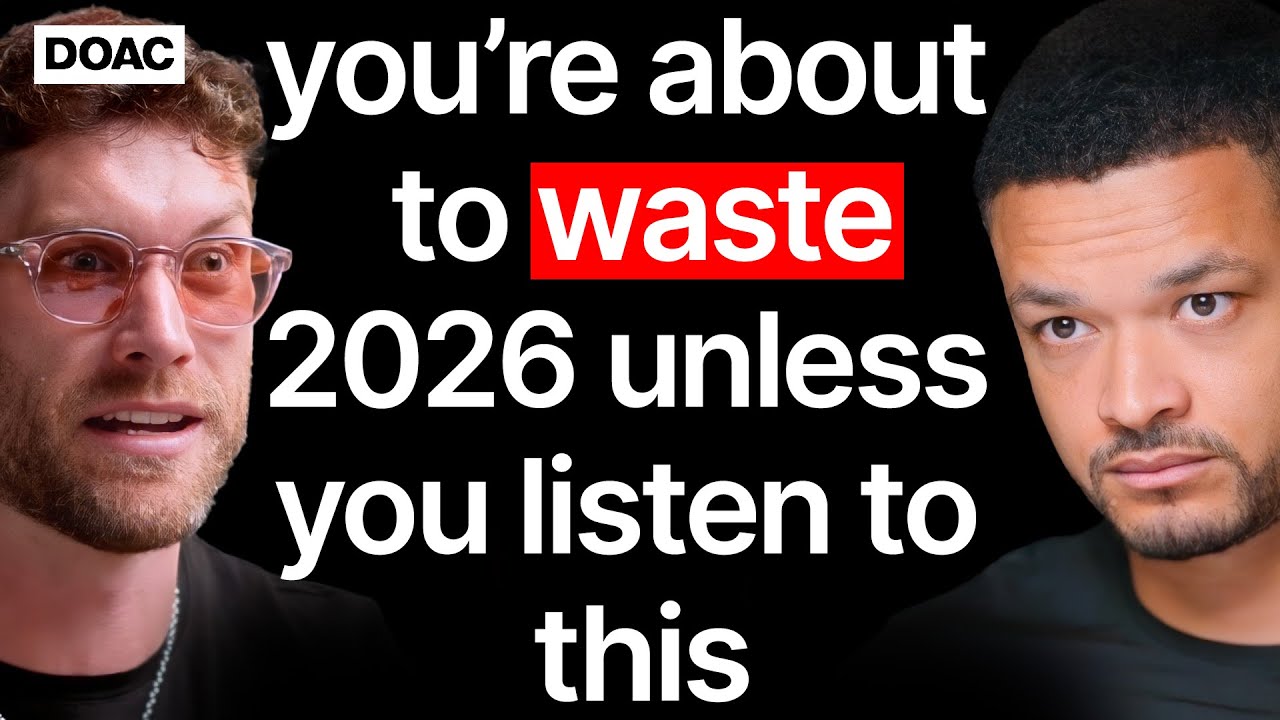
Williamson Unveils Behavioral Framework to Fix Goal Failure Rates
The Diary Of A CEO
Chris Williamson argues that sustainable goal achievement requires abandoning deferred happiness, reducing daily decision loads, and building action-based evidence rather than relying on motivation.
## Background
This episode of The Diary Of A CEO, hosted by Steven Bartlett, was published on YouTube on December 29, 2025. It features Modern Wisdom host Chris Williamson breaking down goal-setting errors, procrastination psychology, stress overload, dating dynamics, and actionable strategies for making 2026 a successful year.
## TL;DR
Chris Williamson and Steven Bartlett unpack the psychological traps of goal setting, productivity, and modern lifestyle habits as they prepare for the new year. They explore high-ROI low-effort habits like sleep optimization, postprandial walks, and delayed caffeine intake, while dissecting deeper issues like 'productivity dysmorphia' and the deferred life hypothesis. Williamson offers concrete tactics to overcome procrastination, manage personal identity shifts, and navigate modern dating dynamics. The discussion concludes with reflections on agency, emotional stability, and moving away from self-hatred to achieve sustainable self-improvement.
## Atmosphere & style
The conversation carries an introspective, candid, and intellectually grounded tone, blending high-performance advice with vulnerable personal anecdotes. Steven Bartlett and Chris Williamson share a natural, peer-to-peer rapport as leading podcasters, balancing sharp analytical frameworks with emotional transparency. The episode moves from tactical productivity advice to deeply reflective territory—addressing burnout, loneliness, and health struggles—leaving the viewer with a sense of quiet clarity and actionable motivation.
## Key takeaways
- [05:05](https://www.youtube.com/watch?v=q_vZ4H3uW28&t=305s) The week between Christmas and New Year's is an ideal window to pause and intentionally reflect, but when setting goals, you must recognize that to pick something up, you must put something down.
- [14:46](https://www.youtube.com/watch?v=q_vZ4H3uW28&t=886s) Excessive striving and goal-seeking often stem from an internal void and 'provisional living'—the false belief that happiness and self-worth lie on the other side of the next accomplishment.
- [20:00](https://www.youtube.com/watch?v=q_vZ4H3uW28&t=1200s) Focusing solely on observable metrics like salary or titles often hides unseen costs such as stress and lost family time, as illustrated by the Parable of the Mexican Fisherman.
- [33:18](https://www.youtube.com/watch?v=q_vZ4H3uW28&t=1998s) High-return, low-effort daily habits include keeping your phone out of the bedroom, delaying caffeine intake by 90 minutes, and going for brief morning and post-meal walks.
- [37:59](https://www.youtube.com/watch?v=q_vZ4H3uW28&t=2279s) Alcohol carries a heavy 'hidden domino effect' that silently damages sleep quality, daily performance, and habits over time.
- [43:52](https://www.youtube.com/watch?v=q_vZ4H3uW28&t=2632s) Adopting the 'Never Miss Two Days in a Row' rule prevents minor slip-ups from spiraling into bad habits, treating failure as a predictable feature of self-improvement.
- [53:11](https://www.youtube.com/watch?v=q_vZ4H3uW28&t=3191s) Procrastination is typically an action issue (not knowing the absolute smallest next physical step) or a skill issue, rather than a fundamental flaw in willpower.
- [01:08:29](https://www.youtube.com/watch?v=q_vZ4H3uW28&t=4109s) Self-belief is overrated; real transformation comes from generating evidence of your capabilities through consistent, tangible action.
- [01:10:52](https://www.youtube.com/watch?v=q_vZ4H3uW28&t=4252s) The Region Beta Paradox explains how people get stuck in 'productivity purgatory' by enduring mildly uncomfortable situations because they aren't painful enough to force immediate change.
- [01:40:57](https://www.youtube.com/watch?v=q_vZ4H3uW28&t=6057s) The 'Lonely Chapter' is an inevitable transitional phase where growing and changing your habits temporarily isolates you from your old social circle before you find an aligned network.
- [01:55:35](https://www.youtube.com/watch?v=q_vZ4H3uW28&t=6935s) Psychological stability—the ability to quickly return to a baseline after stress—is one of the most vital yet underrated traits in a romantic partner.
- [01:57:35](https://www.youtube.com/watch?v=q_vZ4H3uW28&t=7055s) Single men looking for success in dating should ask themselves if they are the type of person the partner they want would actually desire to date, focusing first on self-improvement.
- [02:11:56](https://www.youtube.com/watch?v=q_vZ4H3uW28&t=7916s) Chronic physical setbacks, such as toxic mold exposure, reinforce that relying on productivity or spite for self-worth is unsustainable compared to internal resilience and agency.
## Detailed walkthrough
### [00:00](https://www.youtube.com/watch?v=q_vZ4H3uW28&t=0s) Intro & The Psychological Value of New Year’s
Chris Williamson sets a perspective-shifting tone right out of the gate: life shouldn't be taken so seriously because "no one is getting out of this game alive," and in three generations, nobody will remember your name. Far from being depressing, he frames this cosmic reality as ultimate liberation to drop heavy burdens and find joy, especially since life will never be completely free of problems.
Steven Bartlett opens by introducing Chris Williamson—a leading podcaster and creator of Modern Wisdom—to explore key themes for 2026: building discipline, setting realistic goals, overcoming procrastination, navigating modern dating, and defining what makes a good man. Steven raises a sobering statistic about New Year’s resolutions: **23% of people quit by the end of the first week of January**, roughly **50% quit by the end of January**, and **only about 9% keep their resolutions for the full year**.
Chris explains that people tend to split into two camps regarding the New Year: those who argue dates are arbitrary and that you shouldn’t wait until January 1st, and those who appreciate a culturally and schedule-appropriate moment to reset. In reality, people spend immense amounts of unstructured time ruminating over the past (regret, wistfulness, grief) or worrying about the future. The week between Christmas and Boxing Day—when work and life naturally slow down—offers a structured, low-friction window to pause, reflect, and intentionally plan.
* **Resolution Drop-off Stats:**
* 1st Week of January: 23% quit
* End of January: ~50% quit
* Full Year: Only ~9% succeed
---
[05:05](https://www.youtube.com/watch?v=q_vZ4H3uW28&t=305s) Choosing a Productive New Year's Resolution
When tackling goal setting, Chris notes that the total freedom to change *anything* can feel terrifying. The critical distinction to make is that while you can change *anything* behaviorally, you cannot change *everything* at once. To narrow down your focus, Chris suggests asking the single best question for annual planning:
> "What would have to happen by the end of 2026 for me to look back and consider it a success?"
He cautions against setting unrealistically high bars, using a buffet plate analogy: piling more onto your plate doesn't magically expand your stomach, and adding more tasks doesn't expand your capacity or "body budget." The fundamental law of goal setting is that **in order to pick something up, you have to put something down**. Goals powered purely by temporary motivation fail because motivation is an unreliable fuel source you don't control.
Chris and Steven discuss three uncomfortable self-reflection questions to audit your life:
1. **The 85-Year-Old Test:** How would you spend your days if your goal was to make 85-year-old you as miserable as possible? (e.g., isolating yourself, phone addiction, unhelpful habits, avoiding boundaries).
2. **The Movie Audience Question:** If your life were a movie, what would the audience be screaming at the screen for you to do? (e.g., "Leave the relationship!", "Quit the job!", "The killer is hiding in the cupboard!").
3. **The Success Question:** What few key outcomes would make the year feel like a true success?
---
[11:58](https://www.youtube.com/watch?v=q_vZ4H3uW28&t=718s) The Real Thing You Should Be Doing
When Steven flips these three reflection questions back onto Chris, Chris reveals his personal goals for the upcoming year:
* **In Corporate / Creative Life:** Move from "manager mode" into "maker mode"—spending far less time on administrative drag and email operations, and more time thinking and creating.
* **In Personal Life:** Transition out of the isolated "solopreneur grind set" to spend significantly more time connecting with friends.
To subtract items and balance his "plate," Chris acknowledges he must sacrifice time spent staring at screens doing boring admin work, cut down on mindless social media scrolling, and potentially accept slight trade-offs in his rigid training schedule to accommodate social evenings.
When answering what the "movie audience" would be screaming at him, Chris shares a deeply personal realization:
> "You're already doing enough. Stop whipping yourself into submission, thinking that your happiness sits on the other side of the next set of goals that you're going to achieve."
Chris references the **deferred life hypothesis**—the pervasive trap where people treat present life as merely a prelude or intro to their "real" life that will begin once specific milestones or problems are cleared. Because life's tasks and challenges never end, holding your happiness hostage in a perpetual holding pattern guarantees you never truly arrive. Problems are a fundamental feature of human existence, not a bug.
Steven counters with a evolutionary perspective, questioning if this drive is an inherent human curse: our ancestors' relentless urge to strive and conquer is precisely why modern society exists, whereas traditions focused on complete contentment can feel almost alien to high achievers.
[14:46](https://www.youtube.com/watch?v=q_vZ4H3uW28&t=886s) Striving, Internal Voids, and the Unteachable Lessons of Success
Chris Williamson and Steven Bartlett delve into the psychological engine that drives high achievers: an unrelenting sense of striving rooted in evolutionary biology and personal insufficiency. Chris notes that human beings naturally habituate to their circumstances in both directions. In evolutionary terms, if our ancestors had been satisfied with the first cave or berry bush they found, the species wouldn't have survived or secured its future. However, in the modern world filled with infinite choices, this instinct backfires, causing us to constantly sacrifice the important for the urgent—drowning in emails and meetings rather than stepping back to reflect. This makes an annual review crucial: it is a rare window where the urgent recedes and you can ask yourself who you have been and what you want the next chapter of your life to be about.
When Steven asks if there is a single hardware rewrite Chris could make to maximize his happiness, Chris admits he would choose to strive less. He explains that excessive striving often stems from an internal void and a belief that external accolades will validate one's self-worth. Yet, discovering that external success cannot cure internal insecurity is what Chris terms an "unteachable lesson." You can tell people that money won't fix happiness, fame won't solve self-doubt, or that time spent in a hammock is never wasted, but people rarely believe it until they achieve those things themselves. Quoting Naval Ravikant, Chris highlights that *"it's far easier to achieve our material desires than to renounce them."* Getting a Ferrari to realize it won't make you happy is practically easier than eliminating the desire for the car altogether.
```
THE TRAP OF EXTERNAL VALIDATION
Internal Void External Drive Unteachable Lesson
┌─────────────────┐ ┌─────────────────┐ ┌─────────────────────────┐
│ Sense of │───>│ Infinite │───>│ Material success fails │
│ Insufficiency │ │ Striving │ │ to fix internal issues │
└─────────────────┘ └─────────────────┘ └─────────────────────────┘
```
When Steven gently presses whether Chris still carries that internal void despite being one of the world's biggest podcasters with total financial freedom, Chris openly agrees. He reflects on how he never expected to amount to much when he started, yet achieving fame and wealth hit him right in the face with that unteachable truth. The core downside of constant striving is living a "provisional life"—always putting happiness off until the next milestone is hit. To spot where attention is truly needed, Chris shares a mental exercise: imagine your life as a movie and ask what the audience is screaming at the screen for you to do.
- **Human Habituation:** Built-in evolutionary trait that leads modern humans to constantly sacrifice important long-term goals for immediate, urgent tasks.
- **The "Unteachable Lesson":** The reality that money, fame, and success do not cure internal voids—a truth people usually only comprehend after achieving them.
- **Provisional Living:** The trap of believing "I will be enough when..." which defers present peace and happiness for future accomplishments.
---
[20:00](https://www.youtube.com/watch?v=q_vZ4H3uW28&t=1200s) Defining Real Success: Hidden Metrics and the Mexican Fisherman
Navigating how to define success for oneself requires deep self-reflection rather than adopting someone else's playbook. Chris warns that wearing another person's definition of success is a recipe for pain, citing the phrase *"let go or be dragged."* Blindly pursuing generic goals risks climbing a massive ladder only to realize it was leaning against the wrong wall. Because endless busyness drowns out subtle self-knowledge, Chris stresses the importance of quiet reflection between Christmas and New Year, quoting: *"The answers you seek are in the silence you're avoiding."* While Steven finds his meditative state during long 30-minute showers or on the gym stepper, the key requirement is granting oneself the quiet space needed to listen to fleeting inner thoughts.
A critical framework for evaluating decisions is comparing **observable metrics** with **hidden metrics**. Outwardly visible signs of success—such as job titles, high salaries, car models, and house sizes—are often traded for invisible costs. For example, taking a higher-paying job might require a longer commute or round-the-clock stress, sacrificing quality time with family, mental peace, and physical health. Chris illustrates this dynamic through the *Parable of the Mexican Fisherman*, where a wealthy American businessman advises a simple fisherman to scale his business into an international enterprise over decades just so he can eventually retire, fish a little, and spend afternoons with his family—the exact lifestyle the fisherman already enjoys.
```
┌────────────────────────────────────────────────────────────────────────┐
│ OBSERVABLE vs. HIDDEN METRICS │
├──────────────────────────────────┬─────────────────────────────────────┤
│ Observable Metrics (Outward) │ Hidden Metrics (Internal Cost) │
├──────────────────────────────────┼─────────────────────────────────────┤
│ • Higher Salary & Job Title │ • Time lost to long commutes │
│ • Larger House & Luxury Cars │ • Increased stress & sleep anxiety │
│ • Social Fame & Recognition │ • Strain on family & relationships │
└──────────────────────────────────┴─────────────────────────────────────┘
```
Chris emphasizes that going on a grand journey to end up back where you started (as in Paulo Coelho's *The Alchemist*) is not the same as never having left; you must reach the top of the mountain to realize it doesn't hold the answer. This perspective is frequently unpopular online, where those without material wealth often view successful people making these points as ungrateful. Turning to self-reflection, Steven shares that looking back at his own 18-year-old diary goals reveals purely material desires he no longer holds. When asking what advice they would give their past selves from 12 months ago, Steven identifies the power of saying no to unleash the "compounding force of focus," while Chris admits his advice remains unchanged: *"Stop working so hard. Take a day off... go outside, touch some grass."*
- **Observable vs. Hidden Metrics:** Trading unquantifiable wellbeing (peace of mind, family time) for visible status symbols (salary, job titles).
- **Parable of the Mexican Fisherman:** A story demonstrating how people often construct complex, stress-inducing paths to achieve the simplicity and connection they already possess.
- **The 12-Month Mirror:** The principle that advice you would give your self from 12 months ago usually highlights the exact behavioral pattern you need to address today.
[29:36](https://www.youtube.com/watch?v=q_vZ4H3uW28&t=1776s) Reflecting on High-ROI Habits and the Annual Review
Chris Williamson and Steven Bartlett open with a discussion on behavioral design and how deliberate planning pays off over time. Bartlett notes that while habits picked up randomly in the middle of July rarely stick, the habits he consciously designed during end-of-year reviews a decade ago are still part of his life today. Even back when he was running nightclubs, taking a day off to do an annual review was a vital practice.
To help listeners structure their own reflection, Williamson shares his free template, accessible at `[chriswillx.com/review](https://chriswillx.com/review)`. Without a structured format, people wander aimlessly when trying to evaluate their year. The template guides users through specific prompts covering reflections, memories, forward planning, and core self-realizations:
* **Reflections & Lessons:** What went well and badly (and why)? What habit or system accounted for most of your success? What are the most valuable ways you spent time, and how can you make more time for them?
* **Memories & Highlights:** Best surprise, best meal, coolest new experience, favorite new city or friend, favorite/most intense day, best sex, favorite quote, song, and artist.
* **Planning & Systems:** What would you do if you wanted to make 85-year-old you miserable? What makes a day go great? What do you think is productive that actually isn't, and what is truly productive that you don't realize?
* **Final Thoughts:** What must happen by the end of next year to consider it a success? Who do you need to become for the next chapter? What advice would you give your self from 12 months ago?
Williamson and Bartlett invite the audience to leave a comment with their single highest return-on-investment (ROI) resolution ever made, creating a crowdsourced repository of life-changing habits.
[33:18](https://www.youtube.com/watch?v=q_vZ4H3uW28&t=1998s) High-Return, Low-Effort Habits: Sleep, Walking, and Caffeine
Williamson breaks down his personal top high-ROI resolutions, analyzing them through the lens of effort versus return. The easiest and most impactful habit is keeping the mobile phone completely out of the bedroom at night and charging it in another room.
> "Who you truly are are the videos that you watch on YouTube between 10 p.m. and 12:00 p.m. at night when you can't sleep. That's who you really are."
Replacing the phone with a traditional radio alarm clock yields an immediate 15% boost to quality of life. Waking up to a phone puts you in a reactive state where "the world is happening to you" rather than you happening to the world. At night, late-screen use triggers adrenal and intermittent-reward dopamine responses, ruining sleep hygiene.
Williamson then outlines a sequence of foundational morning habits:
* **Morning Walk:** Getting outside for a 5- to 10-minute walk—even in cold or overcast weather—engages optic flow (forward movement while eyes scan left and right), which calms the amygdala and down-regulates the fear response.
* **Delaying Caffeine by 90 Minutes:** The adenosine system (which controls sleepiness) is not dominant during the first 90 minutes after waking; the adrenal system is. Drinking coffee immediately wastes its benefits and causes the classic 1:00 PM energy crash. Hydrating with electrolytes/salt first thing supports the adrenal system instead.
[37:59](https://www.youtube.com/watch?v=q_vZ4H3uW28&t=2279s) The Hidden Domino Effect of Alcohol
The conversation turns to a higher-effort, massive-return intervention: taking a 6-month break from alcohol. Williamson points out that many people use alcohol to cope with environments or social circles they don't actually enjoy. Taking a six-month break reveals whether you genuinely like those events—or if your friends are merely "drinking partners" rather than real friends.
Bartlett shares his personal experience of quitting alcohol at age 30. When he tried having a couple of glasses of wine a year later as an experiment, it ruined three consecutive days of his life through a destructive domino effect:
> "Those three glasses of wine had this hidden domino effect that I must have been living with for my whole life."
Poor sleep from the wine led to poor eating choices due to a disrupted dopamine/cortisol system, which ruined his podcasting performance and caused him to skip the gym for two days. Williamson notes that people often try to fix "domino number nine" (like gym consistency or diet) without realizing the first domino falling is the glass of wine four nights a week.
- **Mindset for Sobriety:** A 90-day minimum or 6-month commitment gives a clear "finish line" to run toward; 30 days is too short because you endure all the initial friction without experiencing the compound benefits of a new lifestyle.
- **Root Cause vs. Symptom:** Sleep is the "pebble at the top of the avalanche." Alcohol sedates rather than provides real sleep. Sorting out phone use, caffeine timing, and alcohol unlocks massive amounts of latent willpower.
- **Core State Rule:** Intelligence, knowledge, and expert advice are virtually useless if your core physical state is compromised by poor sleep, ego, or insecurity.
[43:52](https://www.youtube.com/watch?v=q_vZ4H3uW28&t=2632s) The "Never Miss Two Days in a Row" Rule
Chris Williamson and Steven Bartlett delve into what actually makes New Year's resolutions stick, contrasting rigid goals with adaptable frameworks. Reflecting on his own habit-building history, Chris shares his worst resolution from 2017: promising to go to the gym *every single day*. Four or five months into the year, he missed a day, causing his all-or-nothing mindset to write off the entire resolution. In 2018, he reframed his goal around "consistency," giving himself a fresh attempt every single morning regardless of what happened yesterday.
To make consistency actionable, Chris references habit expert James Clear, author of *Atomic Habits*. The single most effective principle for sustaining progress is to **never miss two days in a row**. Missing one day is simply an unexpected error or life getting in the way—like catching food poisoning from bad sushi. Missing a second consecutive day, however, marks the start of a brand-new habit of skipping. Humans naturally lean into binary, all-or-nothing extremes: people either lock down their diet completely or go "full degenerate mode" in Ibiza, making it easy for a small error to snowball into complete ruin.
```
┌──────────────────────────────┐
│ Miss 1 Day: "Error" │
│ (Unexpected life/sushi) │
└──────────────┬───────────────┘
│
┌─────────────┴─────────────┐
▼ ▼
┌─────────────────────────┐ ┌─────────────────────────┐
│ Return Next Day │ │ Miss Second Day │
│ (Preserves Consistency) │ │ (Start of New Bad Habit)│
└─────────────────────────┘ └─────────────────────────┘
```
Steven builds on this trap, pointing out that people often celebrate "cracking" a habit after a few good months, only to spiral into guilt when they inevitably fall off the wagon. True long-term consistency requires accepting from the outset that you will eventually fail or get derailed. Planning for that reality treats falling off as a expected feature of self-improvement rather than a fatal flaw.
* "Never miss two days in a row... One missed day is an error. Two missed days is the start of a new habit."
* "If you put a packet of biscuits in front of me and say, 'You can have none of them or you can have all of them'—easy. Tell me to have two of them? [F***] you, dude. No one has two biscuits."
* "The best thought I've ever had that's made my habits be consistent is the realization that you never crack it."
---
[47:26](https://www.youtube.com/watch?v=q_vZ4H3uW28&t=2846s) The Postprandial Walk
Transitioning to high-ROI daily habits, Chris strongly advocates for taking a **10-minute walk after every meal**, technically known as a postprandial walk. Beyond simple calorie movement, this habit leverages contralateral physical motion—where opposing arms and legs swing—which causes core muscles to cross over the abdomen and physically assist in digesting food.
Beyond digestion, postprandial walking actively regulates blood sugar and prevents post-meal lethargy. Chris points out that after eating a heavy meal, people often feel sluggish despite enjoying the company they are with. Inviting a friend, romantic partner, or colleague for a quick ten-minute stroll right after eating transforms physical recovery and enhances social interaction, even if it means bundling up against cold weather.
- **Postprandial Walk:** A brief 10-minute walk immediately following a meal.
- **Biomechanical Mechanism:** Contralateral movement (arm/leg coordination) engages abdominal muscles to optimize digestion and stabilize blood glucose levels.
- **Practical Application:** Works seamlessly during work lunch breaks or as an active transition after social dinners.
---
[48:29](https://www.youtube.com/watch?v=q_vZ4H3uW28&t=2909s) Productivity Dysmorphia and Self-Criticism
Addressing the psychology behind work and burnout, Chris highlights **productivity dysmorphia**—a psychological state sitting at the intersection of burnout, imposter syndrome, and anxiety. It describes a persistent inability to recognize the scale of your own output or enjoy accomplishments. Rather than serving as a healthy driver, the relentless pursuit of productivity robs high achievers of the capacity to savor their hard-earned milestones.
Many driven individuals wake up each morning carrying a subconscious "productivity debt," feeling as though they are already behind schedule. In this state, working relentlessly all day merely brings them back up to a baseline of "acceptable output," making a draw the absolute best possible outcome and a win mathematically impossible. Steven admits that despite working from the moment he wakes up until 2:00 AM, he almost never goes to bed feeling that he was genuinely productive. Chris notes that high performers often use harsh internal drill sergeants because negative reinforcement worked early in their careers, but over time, it leads to perpetual self-punishment and emotional exhaustion.
* "Productivity dysmorphia... sits at the intersection of burnout, imposter syndrome, and anxiety. Think of it like ambition's alter ego."
* "You wake up every day feeling as if you're already behind... your set point is loss, and the best thing that you can do if you crush the day is get to a draw. You never win."
* "People are destroying themselves in this perpetual sense of not-enoughness."
---
[52:15](https://www.youtube.com/watch?v=q_vZ4H3uW28&t=3135s) Tackling Procrastination and the Power of Next Actions
To counteract overwhelm and optimize focus, Chris recommends opening every morning with a single question: *"If I could only achieve one thing today, what would that be?"* Naturally, people instinctively clean kitchen cabinets, organize plates, or clear low-value tasks just to avoid the scary, high-stakes project sitting on their desk. Humans will endure months or years of subtle, drag-along discomfort just to avoid a few acute days of scary work. Recalling a conversation with Naval Ravikant, Steven highlights that almost all human motivation—including procrastination—is rooted in the fundamental urge to avoid psychological discomfort.
Chris breaks down the root causes of procrastination into two distinct mechanisms:
1. **Not knowing what to do next:** Big goals (like writing a book) feel insurmountable because nobody actually "writes a book" in a single sitting; they write one sentence that accumulates over time into paragraphs, pages, and chapters.
2. **Failing to define a physical action:** Drawing from David Allen’s *Getting Things Done* (GTD) methodology, overcoming procrastination requires identifying the absolute smallest "next physical action."
```
┌─────────────────────────────┐
│ Overwhelming Big Goal │
│ ("Write a Book") │
└──────────────┬──────────────┘
│
┌─────────────┴─────────────┐
▼ ▼
┌─────────────────────────┐ ┌─────────────────────────┐
│ Abstract Stalling │ │ Next Physical Action │
│ (Kitchen Cleaning) │ │ (Open Email Client / │
│ │ │ Sit at Desk) │
└─────────────────────────┘ └─────────────────────────┘
```
Steven echoes this with a story shared by Jordan Peterson about a client who was terrified to leave his filthy bedroom. Instead of demanding a massive overhaul, Peterson started with embarrassingly tiny steps: bringing a vacuum into the room on day one, plugging it in on day two, and turning it on on day three. By day 30, the room was clean and the client had stepped back out into the world. Chris adds that taking tiny steps requires humbling oneself and letting go of the ego's demand for immediate grandiosity. Shared online history serves as a reminder of humble beginnings; Chris recalls starting *Modern Wisdom* with an old iPhone and a secondhand $50 Blue Yeti USB microphone bought off eBay in Gateshead, recording in a shared office space before eventually hosting world-renowned guests in high-tech studios.
- **Naval Ravikant's Insight:** Procrastination and behavior are fundamentally driven by the avoidance of present discomfort.
- **David Allen's GTD Principle:** Break abstract tasks down into the immediate, physical next step (e.g., put on pants $\rightarrow$ sit at desk $\rightarrow$ open email app).
- **Humble Beginnings:** Progress requires accepting tiny, almost imperceptible steps without feeling embarrassed by how small the initial entry point is.
[58:29](https://www.youtube.com/watch?v=q_vZ4H3uW28&t=3509s) Action vs. Skill Issues in Procrastination and the Cynicism Trap
When staring down a task like an Excel spreadsheet requiring a VLOOKUP, procrastination often sets in not out of pure laziness, but because of a specific roadblock. Chris Williamson diagnoses his own procrastination as stemming from one of two primary causes: a **poorly defined next physical action** (not knowing the exact, smallest step needed to move forward) or a **skill issue** (simply not knowing *how* to execute the step, like unzipping a file or writing a complex formula). Fortunately, both of these are straightforward to solve by consulting Google, asking ChatGPT, or phoning an expert friend.
However, deeper procrastination often arises from a fear of self-discovery—a topic Chris explored in his newsletter. People frequently procrastinate to avoid finding out what happens if they try and fail. The upside of never trying is never having to experience the pain of rejection or failure. To insulate themselves, people adopt fatalistic attitudes: telling themselves that all potential partners are terrible or that things will never improve. This framing masks hope as pathetic and optimism as delusion, collapsing directly into cynicism. Chris contrasts this with the energy he encountered after moving to America, where people possess an uninhibited, "permanent first-line cocaine energy" enthusiasm that embraces big efforts.
- **Action Issue**: Not knowing the smallest, immediate physical action required to move a project forward.
- **Skill Issue**: Lacking the technical knowledge (e.g., how to unzip a file or write an Excel VLOOKUP) to execute a known step.
- **Cynicism as a Defense Mechanism**: Reframing fatalism as pragmatism so that avoiding effort feels justified, protecting the ego from potential failure.
---
[01:00:43](https://www.youtube.com/watch?v=q_vZ4H3uW28&t=3643s) UK vs. US Attitudes toward Success and "Tall Poppy Syndrome"
Steven Bartlett brings up a recent article published in a prominent British newspaper during the same week Spotify Wrapped revealed that three Brits—Steven Bartlett, Chris Williamson, and Jay Shetty—ranked in the top 10 podcasts globally. Rather than celebrating this accomplishment as a victory for British media on a global stage dominated by American capital and talent, the journalist criticized their push for personal development. The article framed self-improvement culture as a rejection of the "British patriotic inheritance" and the traditional "stiff upper lip," suggesting people should instead remain stoically satisfied in their own misery and loneliness.
```
┌────────────────────────────────────────────────────────────────────────┐
│ Top 10 Global Podcasts (Spotify) │
├────────────────────────────────────────────────────────────────────────┤
│ • Steven Bartlett (The Diary Of A CEO) │
│ • Chris Williamson (Modern Wisdom) │
│ • Jay Shetty (On Purpose) │
└────────────────────────────────────────────────────────────────────────┘
```
This response deeply saddened both hosts. Chris highlights the stark cultural divide between the UK and the US regarding failure and ambition. While in San Francisco, Chris met a founder who proudly wore her failed startup and move back in with her mother as a badge of honor—a credential showing she took a big swing. In the UK press, that same scenario would be weaponized as a hit piece to embarrass the entrepreneur. Steven notes the absurdity of the criticism, pointing out that three working-class British entrepreneurs managed to build world-class media businesses while competing directly against the massive resource advantage of the United States.
- **Global Impact**: Three of the top 10 podcasts worldwide were created by British hosts (Steven Bartlett, Chris Williamson, Jay Shetty).
- **Tall Poppy Syndrome**: The cultural tendency in the UK to pull down individuals who stand out or achieve high levels of success.
- **Cultural Comparison**: "Americans want you to succeed in case you take them with you on the journey. And the worst parts of British culture don't want you to succeed in case you leave them behind."
---
[01:05:57](https://www.youtube.com/watch?v=q_vZ4H3uW28&t=3957s) The Structural Deficit of UK Entrepreneurship
Continuing their discussion on the UK's cultural script, Chris hesitates to criticize the country he left several years ago, noting it can feel like "pulling the ladder up" after taking the last lifeboat off the Titanic. Yet the structural contrast in risk-taking between the UK and the US remains stark. The UK shares an equal number of top-10 global universities with the United States, yet it produces roughly 80% fewer entrepreneurs. Entrepreneurship requires vision, risk tolerance, and a willingness to step into uncharted territory—traits that are actively suppressed when a culture fails to celebrate those who take big swings.
Chris reflects on the immense cultural headwinds facing British builders and doers. Beyond overcoming internal hurdles like procrastination, early mornings, and lifestyle discipline, UK creators must fight a cultural gravity that discourages standing out. He analogizes their entry into the podcasting world to Indiana Jones: "where he's running and the big door is coming down... He slides underneath and he grabs his hat as he comes in." They managed to squeeze through right before the industry exploded and rode the platform growth, but future entrepreneurs need a culture that actively claps for strangers who try, even when they fall flat on their face.
- **Entrepreneurship Gap**: Despite having an equal number of world-top-10 universities as the US, the UK produces 80% fewer entrepreneurs.
- **Cultural Headwinds**: UK entrepreneurs face a double burden—the standard execution challenges plus an underlying cultural resistance to ambition.
---
[01:08:29](https://www.youtube.com/watch?v=q_vZ4H3uW28&t=4109s) Generating Evidence Over Waiting for Self-Belief
Steven segues into productivity, referencing a concept from Chris's newsletter: "a lack of confidence kills more dreams than a lack of skill." When asked if self-belief is a mandatory prerequisite for action, Chris pushes back directly. People mistakenly assume they need confidence before starting, but in reality, "You can just do things. You can do it tired. You can do it with no self-belief. You can do it when you don't want to." Quoting Ryan Holiday's principle—"Self-belief is overrated. Generate evidence"—Chris explains that accumulating an undeniable stack of proof that you are who you say you are matters far more than feeling confident.
Chris identifies himself as "the poster boy for imposter syndrome," having never expected to amount to much. However, stubbornness and consistency allowed him to keep showing up regardless of how he felt. Consistency is accessible to anyone: committing to write 500 words a week on Substack takes only half an hour. After a year, you have earned the right to call yourself a writer; four years later, traditional publishers like Penguin might come knocking for a book deal. Small, persistent actions build the evidence base that eventually transforms identity.
- **Ryan Holiday Quote**: "Self-belief is overrated. Generate evidence."
- **Small Steps to Big Results**: Writing just 500 words a week for a year creates an undeniable record of being a writer.
- **Stubbornness over Confidence**: Persistent execution in the presence of self-doubt produces real-world outcomes that self-belief alone cannot replicate.
---
[01:10:52](https://www.youtube.com/watch?v=q_vZ4H3uW28&t=4252s) The Region Beta Paradox and Productivity Purgatory
Steven notes that when he started his journey, he possessed zero evidence and no self-belief, but felt he had no choice due to an internal drive. Chris connects this to the **Region Beta Paradox**. The paradox illustrates that if a person walks for distances under a mile but drives for distances over a mile, they will paradoxically cover two miles faster than one mile because crossing a threshold of inconvenience triggers a faster mode of transport. Applied to life, if people only take action when a situation crosses a specific threshold of misery, slightly worse situations are actually better for them than moderately uncomfortable ones.
```
THE REGION BETA PARADOX
Distance < 1 Mile (Walk) ──────► Slow Travel Time
Distance > 1 Mile (Drive) ──────► Fast Travel Time (Paradoxically faster!)
┌────────────────────────────────────────────────────────────────────────┐
│ Application: Comfortable Complacency ("Productivity Purgatory") │
│ A situation that is "bad, but not bad enough" prevents action. │
│ A worse situation forces immediate, transformative change. │
└────────────────────────────────────────────────────────────────────────┘
```
This dynamic traps people in a zone of "comfortable complacency" or "productivity purgatory." Examples include staying in an apartment with a slight mold problem and an odd roommate because the rent is cheap, remaining in a lukewarm relationship lacking a future, or staying in a dead-end job with a difficult boss because the workload is light. Because these situations aren't bad enough to force a breakdown, people stay stuck in them for years. As Steven describes it, people often choose "certain misery over the uncertainty that you'll encounter as you go and search for more," standing at the illuminated edge of a cliff rather than jumping into the dark unknown.
- **Definition of Region Beta Paradox**: A phenomenon where worse circumstances trigger an active intervention (driving, leaving, changing), leading to a faster recovery or resolution than mildly bad circumstances that endure indefinitely.
- **Productivity Purgatory**: A state where life is "not bad enough to be bad, but nowhere near good enough to be good," trapping individuals in comfortable mediocrity.
- **The Certainty Trap**: The psychological tendency to prefer familiar, uncomfortable situations over the uncertain risk of seeking something better.
<ElicitationsGroup message="Explore related discussions from this episode:">
<Elicitation label="Explore Chris's views on dating and modern relationships" query="Summarize Chris Williamson's insights on modern dating mistakes and psychological stability in partners from this episode."/>
<Elicitation label="Review the goal-setting and procrastination strategies" query="What are Chris Williamson's core principles for setting goals and overcoming procrastination for 2026?"/>
</ElicitationsGroup>
[01:13:10](https://www.youtube.com/watch?v=q_vZ4H3uW28&t=4390s) The Capacity to Quit: Knowing When to Jump Into Nothingness
Steven Bartlett reflects on what he considers his single defining skill: his ability to quit when a situation becomes lukewarm or unsatisfying, rather than overstaying his welcome. While he admits to accumulating "gradual clutter" in his daily life—such as launching newsletters when he has no spare time—his record on major life choices is marked by abrupt, decisive departures. He walked out of university on his very first day because it felt too much like the school environment where he had previously failed. Years later, after building Social Chain into a massive success, he stepped away at age 27—just 10 days before an official IPO roadshow, walking away from a company that would eventually reach a evaluation of €400–500 million on the Frankfurt Stock Exchange.
```
[STEVEN'S DECISION LOGIC]
│
┌───────────────────────┴───────────────────────┐
▼ ▼
Gradual Clutter (Daily) Major Pivot (Life)
• Saying "yes" too much • University: Left on Day 1
• Starting side-projects • Social Chain: Left 10 days before IPO
• Overcommitment • Decision threshold: Certain misery
is worse than no Plan B
```
Chris Williamson commends Steven's willingness to jump into nothingness without a Plan B, calling it deeply brave. Steven explains that his major career leaps never required absolute certainty of success; they simply required the realization that remaining in a state of "certain misery" was intolerable. This prompts a broader reflection on how much conviction a person needs to make a life-altering choice. Steven references a talk by former U.S. President Barack Obama, who explained that when facing monumentally tough decisions—such as ordering the raid on Osama bin Laden's compound in Abbottabad, Pakistan, which risked two Apache helicopters and soldiers' lives—he aimed for just 51% certainty before pulling the trigger, knowing he had acted on the best available evidence.
- **Social Chain IPO valuation:** €400 million to €500 million on the Frankfurt Stock Exchange when Steven resigned at 27.
- **Barack Obama's decision rule:** Making high-stakes calls at 51% certainty rather than waiting for unreachable perfection.
- **Maximizing vs. Satisficing:** The core behavioral economics distinction regarding an individual's internal threshold for conviction.
---
[01:15:34](https://www.youtube.com/watch?v=q_vZ4H3uW28&t=4534s) Choice Overload and Decisive Action
Chris introduces Barry Schwartz’s famous psychological concept from *The Paradox of Choice*. Fifty years ago, a consumer entering a store to buy jeans faced a simple selection with almost no decision regret; if the fit was imperfect, the environment was to blame. Today, an overwhelming spectrum of options—skinny, stretch, bootcut, ripped, bleached, gray, blue, black—causes individuals to project potential future regret back into the present moment. Instead of maximizing freedom, the abundance of choice creates analysis paralysis and leaves consumers less satisfied with whatever selection they make.
To combat this paralysis, Steven brings up Jeff Bezos's framework of "Type 1" (irreversible) versus "Type 2" (reversible) decisions. When young listeners seek advice during his tours about whether to quit a secure job at Citibank or Santander to pursue an unpredictable passion, Steven routinely responds with a simple rebuttal: *"If you're wrong, could you go back?"* For high performers who have proven themselves over several years, the former employer would gladly rehire them or a competitor would offer a pay raise. Recognizing that most career pivots are two-way doors frees individuals to take calculated risks.
> "If you're succeeding at a job that you hate, imagine how great you'd be at one that you loved."
---
[01:18:08](https://www.youtube.com/watch?v=q_vZ4H3uW28&t=4688s) Auditing Plaguing Thoughts and Uncomfortable Emotions
As a practical self-reflection exercise for the year, Chris encourages listeners to identify the thoughts they repeated too often—the background noise and lingering worries that generated needless friction. Steven shares vivid examples of how minor grievances can fester over months: an offhand comment made by a partner 18 months ago over dinner, an unsettling glance toward a waiter, an ambiguous sentence in a manager's email, or an endless internal tug-of-war over fixing one's diet. These recurring thoughts usually point directly to an uncomfortable conversation that needs to happen or an emotion a person is actively trying to avoid.
```
[RECURRING THOUGHT PATTERNS] [ROOT CAUSE IDENTIFIED]
┌───────────────────────────────────────┐ ┌─────────────────────────┐
│ • Partner's comment 18 months ago │ ─► │ Unspoken conversation │
│ • Unclear email from a boss │ └─────────────────────────┘
│ • Infinite diet guilt ("I should...") │ ┌─────────────────────────┐
│ • Distracting with alcohol / lifting │ ─► │ Avoided underlying │
└───────────────────────────────────────┘ │ emotional pain │
└─────────────────────────┘
```
When difficult feelings like fear arise, people often numb or escape them through drinking, intense weightlifting, or endless busyness. Chris highlights the importance of recognizing that individuals are safe to sit with these uncomfortable emotions without running away. Steven pairs this with his framing of "85-year-old self," noting that in old age, a person will not care about their bank balance if they are hunched over, out of breath, and unable to walk up a flight of stairs because they neglected their body.
- **Actionable self-reflection prompt:** Identify the top 3 thoughts repeated endlessly throughout the year to discover unaddressed conversations.
- **Physical health realization:** The ultimate regret of an 85-year-old self is lost physical capability and mobility rather than missing financial wealth.
---
[01:20:40](https://www.youtube.com/watch?v=q_vZ4H3uW28&t=4840s) Six Rules for Problems and Handling Stress
Chris walks through a framework for recontextualizing daily stress and unexpected obstacles:
1. **Problems are a feature of life, not a bug:** There will never be a time when all problems vanish. Resolving one set of difficulties simply elevates a person to a higher tier of problems.
2. **The 3-Month Rule:** The overwhelming negativity consuming your mind today will rarely matter in three months. Sacrificing present joy for a issue you will not even remember is a poor trade.
3. **Learning comes from the edges:** Growth occurs in the "zone of proximal development"—pushing just beyond current comfort levels into controlled discomfort without causing physical or emotional breakdown.
radical personal transformations in life almost always germinate from lowest points and severe challenges. Reframing adversity as an invited guest changes how stress is experienced.
---
[01:23:41](https://www.youtube.com/watch?v=q_vZ4H3uW28&t=5021s) Fatherhood, Freedom, and the Male Podcaster Paradox
When Chris asks Steven what thought he repeated too often over the past year, Steven admits it was the feeling that he was working too much, paired with a desire to create empty space for family, a dog, or a child. Chris mentions a viral social media observation that haunted him: *Why do almost none of the top male podcasters have children?* They note figures across the space—such as Chris Williamson, Andrew Huberman, Lex Fridman, and Steven Bartlett—all discuss demographics and self-improvement, yet remain without kids (with older figures like Joe Rogan and Tucker Carlson being notable generational exceptions).
Steven openly analyzes his own path, acknowledging that he spent his twenties with his "head up his own ass" in a state of prolonged psychological development. While his immediate, everyday brain loves total personal freedom—the ability to finish a podcast recording, work out, or board a flight to Hawaii on a whim—his long-term "regret brain" recognizes that true meaning comes from taking on greater responsibility and dependence.
> "There was no room in my life for a podcast when I started this podcast, right? But I adjusted. And so it goes against every inclination that I have to have children right now... but I will adjust to the responsibility as I always have."
- **The Male Podcaster Demographic Observation:** A generational trend where prominent host figures in their 30s and 40s prioritize independence and career building over starting families.
- **Freedom vs. Meaning:** The inherent friction between immediate daily autonomy and the profound long-term fulfillment brought on by family responsibilities.
Here is a detailed, faithful walkthrough of Part 7 of the transcript:
[01:27:16](https://www.youtube.com/watch?v=q_vZ4H3uW28&t=5236s) The Demographics of Family and the "Vitality Curve"
Steven Bartlett opens by noting that modern society is bred with a subtle narcissism, where individuals prioritize personal freedom over settled family life. Despite acknowledging the obvious financial and lifestyle costs, Steven reveals that he is actively doing everything in his power to become a father within the next 12 months—even if he has to take other parents' word for it that the hidden benefits outweigh the sacrifices.
Chris Williamson expands on the global birth rate decline, referencing insights from leading demographers such as Lyman Stone (Institute for Family Studies) and Steven J. Shaw (director of *Birth Gap*). He explains that the declining fertility rate is driven by several cultural and economic shifts:
* **Excess Options and Contraception:** People simply have an endless array of alternative paths to pursue, and reliable birth control allows them to postpone parenthood indefinitely.
* **Socioeconomic Emancipation:** Women entering higher education and the workforce move past getting married at age 18, choosing instead to build careers and push their family timeline into their 30s.
* **The "Vitality Curve" Desynchronization:** Historically, the desire to have children was condensed into a sharp, narrow age range (e.g., 18 to 24). Anyone you met in that bracket was on the exact same page. Today, that "vitality curve" has been flattened and stretched out over decades (e.g., ages 18 to 35+). Because there is so much "area under the curve," the probability of a 35-year-old who is ready to have children meeting another 35-year-old who is equally ready at that exact moment is remarkably low—everyone is "dancing to different tunes."
- **Viral Anti-Family Culture:** Chris cites a viral TikTok trend ("Girl with the List") where a creator listed 350 explicit reasons not to have children across nine pages—ranging from severe childbirth complications to missing out on brunch and not being able to wear cute heels—compared to a brief half-page list of reasons to have kids.
- **Alternative Distractions:** Immediate, tangible lifestyle perks like traveling in Bali, running a Substack, launching a podcast, or watching Netflix easily replace the vague, long-term promise of parental fulfillment.
---
[01:31:15](https://www.youtube.com/watch?v=q_vZ4H3uW28&t=5475s) Cultural Interventions: Mimetic Behavior in South Korea vs. Georgia
Chris introduces the concept of *mimetic desire*—the idea that humans imitate the reproductive and social behaviors modeled by those around them. To highlight how culture directly controls demographic outcomes, he compares two drastic real-world examples:
1. **South Korea's K-Pop Effect:** South Korea faces a devastating 96% generational birth rate reduction over the next century (where every 100 Koreans will leave only 4 great-grandchildren), leaving entire schools empty. Alongside socio-cultural movements like 4B, a massive contributing factor is K-pop. As South Korea's main cultural export, K-pop stars are contractually forced into celibacy and forbidden from entering romantic relationships. The nation's biggest role models actively project a anti-relationship, anti-family lifestyle to millions of youth.
2. **The Georgian Patriarch's Intervention:** Conversely, in the deeply religious country of Georgia, a beloved, rockstar-like religious leader (whom Chris jokes is the "Avicii of pastors") offered to personally baptize the third child of any family in the country. This single cultural incentive caused parents to "speedrun" having third children just to receive the honor.
> "The only way that you can become a K-pop star is to already have had a kid. Like, we're only going to create boy bands and girl bands out of people who have already had families."
---
[01:33:41](https://www.youtube.com/watch?v=q_vZ4H3uW28&t=5621s) Modeling Masculinity and Overcoming the Fear of Commitment
Steven shifts the conversation to their responsibility as two top-10 global podcasters on Spotify, asking Chris what message they are modeling to the young men who view them as older brothers or mentors. Chris rejects the hyper-aggressive "hustle and grind until your eyes bleed" brand of masculinity, advocating instead for emotional transparency, balance, and self-acceptance. He shares that he used to use his intellect as armor to stay "above the neck" and avoid feeling his emotions, whereas now he openly gets teary-eyed on stage during his live tour when sharing vulnerable stories.
When Steven asks if having a family scares him, Chris admits that the fear of sacrifice and commitment vanished about two to three years ago. He emphasizes that a packed calendar and non-stop work schedule are often just a "hedge against existential loneliness"—a way to avoid sitting quietly with uncomfortable thoughts or facing the question, "What emotions are you unprepared to feel?"
- **Maturity as an Unconscious Evolution:** Chris describes watching his business partner have children every two years starting at age 25. Initially, Chris resented it because his friend couldn't go out drinking anymore. Over time, as he became a godfather to his best friend's four-month-old daughter, his perspective organically softened.
- **The Pain of Resistance:** Growth isn't a dramatic "skies opening" revelation; rather, a new belief quietly moves in. Most suffering comes from resisting these natural shifts into new life stages.
---
[01:38:55](https://www.youtube.com/watch?v=q_vZ4H3uW28&t=5935s) Sponsor Break: Adobe Express and Ketone-IQ
Steven takes a moment to share updates on his own creative projects and habits:
* **Adobe Express:** Steven reveals he has completed writing his third book and is mocking up cover designs using Adobe Express. He highlights how the tool allows him to obsess over typography, color, and layout details to create something "one better than the rest." He invites listeners to download the "One Better Guide" on Adobe's platform to learn workflow principles from top creative teams.
* **Ketone-IQ:** Steven credits Ketone-IQ with transforming focus, productivity, and energy levels for 35–40% of his office team. After trying a sample left on his desk, he became a co-owner of the company. He shares a promotion offering 30% off subscriptions at `[ketone.com/steven](https://ketone.com/steven)`, noting that shots are now available in U.S. Target stores with the first shot free.
---
[01:40:57](https://www.youtube.com/watch?v=q_vZ4H3uW28&t=6057s) Understanding "The Lonely Chapter"
Steven circles back to a term Chris mentioned earlier: *the lonely chapter*. Chris defines this as an inescapable, transitional stage of personal growth where an individual has outgrown their old peer group but has not yet developed a new network that aligns with their updated values.
To illustrate, Chris uses the example of deciding to quit drinking for six months as a New Year's resolution. When you go out to the pub with old friends, you feel ostracized because the shared foundation of the friendship was the activity you are now stepping away from.
- **The Isolation Bridge:** "The Lonely Chapter" is the painful vacuum between who you were and who you are becoming.
- **The Price of Upgrading Your Life:** Pursuing major goals—whether quitting alcohol, launching a company, or leaving a safe job—inevitably requires enduring a temporary period of isolation while your environment catches up to your new standards.
Here is a detailed walkthrough of this transcript section, following the timeline of their discussion:
[01:41:38](https://www.youtube.com/watch?v=q_vZ4H3uW28&t=6098s) The Friction of Personal Growth and "Changing Your Dialect"
Chris Williamson and Steven Bartlett delve into the uncomfortable reality of what happens to social dynamics when an individual decides to level up. As you change your habits, friction with your existing friend group is almost inevitable. If your friends spend their evenings playing Xbox while you want to start going to the gym, your interests diverge; when you hang out, you talk about fitness while they are still focused on gaming. A friend of Chris described this process as "changing your dialect"—over time, the shift in your habits and mindset becomes so pronounced that you and your long-time friends are no longer even speaking the same language.
This gap creates an intense temptation to regress. Going back to your old patterns, routines, and peer groups is comfortable because those habits provide immediate, predictable validation. Stepping away requires sacrificing short-term social approval for unproven long-term experiments—like skipping a night out with friends just to maintain a meditation streak, even when you aren't completely sure if meditation works. To break away from standard patterns, you inevitably have to do things that make you stand out, leave you vulnerable to mockery, and temporarily make you feel isolated.
* **The Reality of Leaving People Behind:** Personal growth often requires leaving behind friend groups who are not evolving at the same pace. This is not a moral judgment about who is better or worse, but a stark structural reality of self-improvement.
* **The Conversion Funnel:** Reflecting on his past as a nightclub promoter, Chris quips that despite meeting "a million people on the front door of nightclubs," he ended up with only a handful of real friends. In internet marketing terms, his "friendship conversion funnel ratio was not very good."
* **Solitary Experiments:** To figure out who he was, Chris committed to intense personal development protocols: 1,000 days sober, 500 days without caffeine (which he admits was "miserable"), and filling nine gratitude/meditation journals without any upfront guarantee that any of it would pay off.
---
[01:44:12](https://www.youtube.com/watch?v=q_vZ4H3uW28&t=6252s) The Myth of the Hero's Journey and "The Lonely Chapter"
Chris calls out a major flaw in typical origin stories and popular media. Standard hero's journey narratives portray the protagonist's self-belief as unwavering once they make a decision to change. They commit to becoming a fighter, starting a business, or getting off drugs, and the clouds magically part. In reality, real-life personal growth is steeped in relentless self-doubt, self-pity, and uncertainty. It feels far from heroic; instead of a high-energy "three-and-a-half-minute Rocky montage," the process stretches on for four arduous years without any promise of glory on the other side.
This period of self-doubt and social isolation is what Chris calls "The Lonely Chapter." Many people mistakenly view this friction and internal uncertainty as a signal that something is wrong (a "bug"), believing they ought to be single-mindedly confident. In truth, this discomfort is a mandatory feature of meaningful transformation. Everyone who transitions from a life they dislike to one they want must pass through this phase. It is especially relevant for people in places like the UK who want to build a business or follow an unconventional path without a clear role model. The ultimate takeaway is to simply take action anyway: "Do it tired, do it sad, do it lonely, do it without a role model."
---
[01:47:02](https://www.youtube.com/watch?v=q_vZ4H3uW28&t=6422s) Resisting the Equilibrium: Biological and Business Inertia
Steven connects Chris's concept of the lonely chapter to Jeff Bezos’s final annual shareholder letter as CEO of Amazon in 2020. In that letter, Bezos emphasized that "differentiation is survival and the universe wants you to be typical." Drawing on a passage from evolutionary biologist Richard Dawkins’s book *The Blind Watchmaker*, Bezos highlighted a fundamental rule of biology: living organisms must continuously expend energy to stave off equilibrium with their surroundings.
A living body maintains a distinct temperature, acidity, and moisture level compared to its environment. The moment an organism stops expending energy to maintain that differential, it reverts to the surrounding environment's state—which is the definition of death. In the same way, any person or company attempting to remain unique or atypical must expend tremendous energy to resist regression to the mean.
```
+-----------------------------------------------------------------------------------+
| THE RESISTANCE SPECTRUM |
+-----------------------------------------------------------------------------------+
| [ Living Organism / Individual ] ---> Expends Energy ---> Maintains Life/Identity|
| [ Inaction / No Energy Input ] ---> Equilibrium ---> Regression to the Mean |
+-----------------------------------------------------------------------------------+
```
* **Biological Energy Budget:** Citing a neuroscientist guest from his podcast, Chris notes that humans have a literal biological budget of energy. Most New Year's resolutions fail because people try to adopt a new lifestyle that demands massive energy to resist their environment, without budgeting for it by cutting energy drains elsewhere.
* **Corporate Entropy:** Steven notes that as a company, *The Diary Of A CEO* would immediately decay into the average podcast the moment they stop experimenting, pushing boundaries, or investing in high-production elements like massive digital screens.
* **Accepting Problems:** Problems and friction are an inescapable feature of life. Railing against minor inconveniences—like a delayed flight—is pointless because friction is constant.
* **The Rocket Launch Analogy:** Chris visualizes personal transformation as an old-school rocket launch. The launch pad requires the highest amount of raw, messy energy (inertia is highest). At the start, people can channel whatever fuel they have available—chips on their shoulder, spite toward childhood bullies, a desire for validation, or deep discontent. Once altitude is gained, those primary engines drop off and cleaner booster fuels take over to reach "escape velocity."
---
[01:51:32](https://www.youtube.com/watch?v=q_vZ4H3uW28&t=6692s) Trimming the Fat: Essential Goal-Setting for 2026
When planning for a new year, overcooking goals is a primary trap. Chris and Steven argue that an individual can realistically accomplish only **two major transformations** in a single 12-month period. For example, a person might successfully lose 20 pounds and find a deeply fulfilling relationship. However, trying to stack those goals alongside moving to a new city, starting a company, and learning the piano guarantees overload and failure.
To avoid this, Chris recommends treating goal selection like a strict rank-ordered list rather than an open buffet:
1. Write down all desired achievements for the year.
2. Force yourself to cross off options until only **one or two core priorities** remain.
3. If the remaining priority is weight loss, break it down into immediate, concrete action steps (e.g., getting a gym membership, buying workout clothes that build confidence).
---
[01:53:06](https://www.youtube.com/watch?v=q_vZ4H3uW28&t=6786s) What to Look for in a Partner: Psychological Stability
Shifting to relationships, Steven asks Chris about his criteria for choosing a partner, specifically highlighting the concept of "psychological stability." Chris defines psychological stability as how quickly an individual returns to their baseline emotional state following a disruption or stressor.
For instance, if a flight gets canceled on the way to a family vacation, a psychologically stable partner might process the frustration and return to baseline within a few hours, whereas an unstable partner might allow the incident to ruin the entire trip.
Beyond psychological stability, Chris points to key personality traits (drawing on psychological research) that predict long-term relationship success:
* **Conscientiousness:** The person is thoughtful, considerate, and actively cares about you in specific ways.
* **Moderate Agreeableness:** They act as a "yes, and" partner who responds constructively when you propose plans.
* **Moderate Openness:** They possess enough openness to experience to try new things with you, without having such high openness that it leads to "wandering eyes" or perpetual dissatisfaction.
* **The "Safe Harbor" Concept:** A ideal relationship should feel like home—a secure fortress against the outside world. Even if your business fails, your health dips, or friends drift away, a stable partner provides unconditional support for who you are rather than what you produce.
---
[01:55:35](https://www.youtube.com/watch?v=q_vZ4H3uW28&t=6935s) Navigating the Modern Dating Landscape
Steven expresses relief that he is not currently single, describing today's dating app culture as a stressful "war zone." He asks Chris how a 30-year-old single man who isn't famous or hosting a major podcast should approach solving "the love problem."
Chris answers directly: the very first question any single person must ask themselves is:
> *"Am I the sort of person who the sort of person I want to date wants to date?"*
If the honest answer is no, the priority becomes self-development—building the qualities, stability, and lifestyle that naturally attract the kind of partner you are seeking.
[01:56:17](https://www.youtube.com/watch?v=q_vZ4H3uW28&t=6977s) Strategies for Enhancing Attractiveness
Modern dating demands deep self-honesty and a willingness to step away from the daily grind to reflect on personal shortcomings. For men, Chris Williamson points out that neglecting basic areas like fashion and physique under the guise of "not being interested" is a losing strategy, because women fundamentally care about appearance. Stepping up your wardrobe—whether by asking a female friend for advice or watching style guides online—and hitting the gym are highly reliable ways to boost attractiveness. Unless a man possesses rare, elite physical genetics, engaging in consistent physical self-improvement is necessary to attract the partner he genuinely desires.
Once a person raises their baseline attractiveness, the next tactical step is identifying where their ideal partner actually spends time. Williamson advises alignment over random searching: if you love electronic dance music, skip the breathwork classes and attend events with dance DJs. If you enjoy intellectual discussions, attend live philosophy events, like an Alex O'Connor lecture. For fitness enthusiasts, picking up a sport like pickleball offers an excellent social avenue. For men especially, choosing an activity where they possess a slight competitive advantage—such as a former high school tennis player leveraging their hand-eye coordination on a recreational pickleball court—naturally draws people in without requiring manipulation.
- **The Power of the Gym:** Williamson shares that his single most impactful life choice was starting to train at age 18 at the Center for Sporting Excellence at Newcastle University.
- **Early Fitness Realities:** In his early training days, he describes taking blueberry extract and unflavored hydrolyzed whey in a desperate attempt to gain size, celebrating intensely when he finally broke 70 kilograms at age 20.
- **The Core Advice:** Do not condemn yourself to permanently pining after partners who will not want you back; instead, build yourself into the person they would choose.
---
[01:59:16](https://www.youtube.com/watch?v=q_vZ4H3uW28&t=7156s) Receptiveness and Navigating Post-MeToo Dating Dynamics
When considering what makes women more attractive, Williamson extends the gym principle, highlighting that physical fitness offers independent, internal value. Self-improvement should never feel like a performance staged solely for a future partner; it must be something an individual is glad they did even if that partner never arrives. "No, you made yourself. You won independently of whether or not that person came along." Beyond physical health, an incredibly powerful yet underutilized strategy for women in the modern dating landscape is cultivating **receptiveness**.
In a post-MeToo world, modern courtship has grown highly complex. Many men are profoundly hesitant to approach women because they have been conditioned to believe that anything short of an explicit invitation is an uncomfortable intrusion. Because of this anxiety, women need to project clear, unmistakable signals of interest. Williamson jokingly notes that while aristocratic women in the Middle Ages dropped handkerchiefs, modern women in places like New York have resorted to playful tactics like accidentally taking a corporate worker's salad just to find their name and message them on Instagram. Furthermore, if a woman is not interested in a man who approaches her, she should decline gracefully rather than mocking him. Ruthless rejections crush a man's confidence, making him feel broken and discouraging him from ever approaching the next woman who might actually want to meet him.
- **Post-MeToo Approaching:** Men have been taught that anything less than a "hell yeah" means they should stay away to avoid causing discomfort.
- **The Golden Retriever Analogy:** Women should treat a man's romantic interest like a slightly inexperienced golden retriever, requiring loud and highly obvious signals to understand they are welcome to approach.
- **The Bravery of the Approach:** Stepping up to say hello and give a polite compliment is often the most terrifying thing a man will do all day; treating that effort with basic respect preserves a healthy dating culture.
---
[01:52:17](https://www.youtube.com/watch?v=q_vZ4H3uW28&t=6737s) Defeating Deferred Happiness and the Type A Paradox
For individuals striving for radical change at the turn of the year, Williamson’s core message is to stop taking life so seriously. In the grand expanse of time, human existence is fundamentally fleeting; within three generations, virtually no one will remember your name. Recognizing this temporal insignificance should bring absolute liberation rather than despair, allowing people to drop their perceived emergencies and find daily joy. This trap is known as "deferred happiness syndrome" or the **provisional life**—a psychological state where people treat their current existence as a temporary holding frame, fantasizing that their "real life" will finally begin once their immediate duties are cleared away.
```
[Type A Overachievers] ──► Suffer from "Type B Problems" (Inability to relax)
└──► Receive little sympathy (Outwardly successful)
```
This existential tension is particularly acute for "type A" individuals—the insecure overachievers who use a walking anxiety disorder as fuel for massive productivity. While lazy individuals need to learn motivation, the dedicated audience listening deep into a multi-hour podcast usually suffers from a type B problem: they do not know how to shut off and relax. These driven individuals rarely receive public sympathy because a miserable, wealthy high-performer looks far better from the outside than someone who is happy but facing bankruptcy. Society views learning to work hard as a noble, uphill battle, whereas learning to rest is often dismissed as a bourgeois luxury. Pop culture is packed with underdog montages of characters pulling themselves up by their bootstraps, but no movie features a dramatic scene of an executive learning to log out of Slack at 6:00 PM or sit peacefully on a beach holiday.
- **The Great-Grandfather Test:** To illustrate how quickly names fade, both speakers admit they do not know the names of their own great-grandfathers.
- **The Parasympathetic Goggins:** While the masses might need David Goggins screaming at them to work harder, type A overachievers need a "parasympathetic Goggins" to tell them to rest, grab the TV remote, and give themselves a break.
- **Productivity Myths:** Worthwhile existence is not tied to an arbitrary baseline of daily productivity; hitting a goal day means you achieved a "plus 10," not that you merely dragged yourself back to zero.
---
[02:07:06](https://www.youtube.com/watch?v=q_vZ4H3uW28&t=7626s) The Luxury of Existential Crises and the Shame of Small Fears
The conversation shifts to a deeper discussion of freedom, dependency, and human evolution. While the modern narrative of the past two decades has heavily championed total independence, remote work, and being one's own boss, a life entirely detached from community and mutual reliance can make a person sick. Humans are evolutionarily wired to belong to something larger than themselves. Today's widespread existential dread is directly tied to this isolation, yet having the space to question your life's meaning is a profound historical luxury. For the vast majority of human history, ancestors struggled purely for physical survival, entirely consumed by whether a sudden cold snap would wipe out their tribe.
This structural shift in human safety creates what Williamson terms the **shame of small fears**. If a modern person tried to explain their anxiety over sending a stressful text message to a caveman, the caveman would simply laugh, noting that the message involves no physical danger, no predators, and no permanent stakes. Modern anxieties are mathematically smaller yet psychologically far more complex than ancient ones. The human nervous system has been rapidly repurposed from dodging bears to managing social boundaries, and it cannot tell the difference. Expressing an uncomfortable truth or experiencing a minor social disagreement triggers the exact same ancient panic of being completely cast out by the tribe—even if that tribe is now just a neighborhood WhatsApp group chat.
- **The Survival vs. Actualization Shift:** Williamson references a poignant tweet highlighting the generational gap: "My parents had the problem of survival and I have the problem of self-actualization."
- **The Infinite Regress of Negative Emotions:** Shaming oneself for being afraid creates a brutal cycle—becoming anxious about your shame, and then bitter about your anxiety.
- **Balancing Agency and Self-Love:** While possessing high personal agency and striving for big dreams is vital, it must be balanced with genuine self-love to avoid unnecessary, self-inflicted mental suffering.
---
<ElicitationsGroup message="To explore more of Chris Williamson's strategies on personal development and lifestyle design:">
{/* Reason: Offers clear, actionable paths to explore the psychological and practical frameworks discussed in this section of the interview. */}
<Elicitation label="Analyze the psychology of 'deferred happiness syndrome'" query="Explain Chris Williamson's concepts around deferred happiness syndrome and the provisional life, including strategies to overcome them."/>
<Elicitation label="Explore dating dynamics and the concept of receptiveness" query="Break down Chris Williamson's advice on modern dating dynamics, specifically how post-MeToo anxieties impact men and how women can practice receptiveness."/>
<ElicitationsGroup/>
[02:11:56](https://www.youtube.com/watch?v=q_vZ4H3uW28&t=7916s) The Complexity of Happiness and Health Struggles
Chris Williamson discusses how anger or spite can serve as a initial spark to overcome inertia, but using self-hatred or validation-seeking as long-term motivation is ultimately a "toxic fuel." When asked directly whether he is happy, Chris pauses and admits that it is a complex question. He explains that he has to work hard to be in a good mood, feeling as though he must stack the deck in his own favor to achieve it. Reflecting on his past struggles with depression in his 20s and heavy anxiety, he expresses pride in how much he has overcome, even if maintaining happiness still requires conscious effort.
Opening up about a painful chapter, Chris shares that the past year was particularly grueling due to severe health issues after living in a house with toxic mold in America. For two years, he effectively ran two full-time jobs: hosting *Modern Wisdom* and attempting to heal his body. At the start of the year, his only two objectives were simply not letting the show drop and fixing his health. The mold toxicity caused inverted cortisol levels—spiking at night rather than in the morning—leaving him exhausted yet unable to sleep, going to bed at 7:00 p.m. for six months straight without ever feeling rested.
- Toxic mold poisoning primarily attacked three areas of his life: energy, mood, and cognition.
- He experienced extreme brain fog, including forgetting common words, the names of friends' pets, and even how to tie his shoelaces.
- He kept his health battle largely private to avoid the overwhelming administrative burden and guilt of managing unsolicited medical advice from well-meaning listeners.
---
[02:17:07](https://www.youtube.com/watch?v=q_vZ4H3uW28&t=8227s) Finding Worth and Resiliency in Small Victories
Chris explains that optimizing for happiness is a luxury that requires spare capacity, something he lacked while managing a chronic environmental illness. He notes that humans rarely chase happiness directly; instead, they seek certainty first. Being trapped in chronic health uncertainty left him facing an endless stretch of solitude, fatigue, and discomfort. Host Steven Bartlett points out the painful irony that mold targeted the exact three faculties—energy, mood, and mind—that form the foundation of Chris's public identity and self-worth, making it feel like a personal curse.
When forced to ask himself what remained after his primary sources of self-worth were stripped away, Chris discovered a quiet, underlying identity: someone who is genuinely kind, sensitive, and resilient in a very grounded way. He had to learn to take pleasure in "boring victories" and overcome the shame of finding joy in small, seemingly insignificant moments—like going for a walk, being friendly at the supermarket, or seeing a golden retriever—without feeling that enjoying small things meant his life had become small.
* "Happiness really only exists when uncertainty isn't there. It's very difficult to be uncertain and happy at the same time."
* "Alain de Botton says, 'The best men are those who have been broken.' And this year has definitely broken me."
* Rating his overall well-being, Chris notes that while he was at a 3 out of 10 twelve months prior, he has now recovered to around a 7 or 8.
---
[02:21:41](https://www.youtube.com/watch?v=q_vZ4H3uW28&t=8501s) Closing Thoughts: Agency and Biting Into Life
Reflecting on the journey of self-improvement, Chris emphasizes that personal growth requires confronting uncomfortable truths about oneself. He references a striking quote by Jean-Paul Sartre: *"I've led a toothless life. I have never bitten into anything. I was waiting. I was reserving myself for later on. And I've just noticed that my teeth have gone."* He warns against living a deferred life as a non-playable character (NPC) in one's own story and encourages asking critical questions, such as what 85-year-old self would regret, or what an audience watching the "movie" of your life would scream at the screen for you to do.
Answering the traditional closing question left by the previous guest—regarding the most important component of human joy and endeavor—Chris answers without hesitation: **agency**. He defines agency as the fundamental belief that you can impact your surroundings and act upon the world rather than passively letting life happen to you.
- **Upcoming Tour:** Chris is touring Australia, New Zealand, and Bali in March.
- **Recommended Content:** He highlights his conversation with Naval Ravikant as one of his most special podcast episodes, alongside his free annual review template and *3 Minute Monday* newsletter.
---
[02:24:57](https://www.youtube.com/watch?v=q_vZ4H3uW28&t=8697s) Mutual Gratitude and the 1% Philosophy
Before wrapping up, Chris shares a personal story of gratitude toward Steven. He recalls a Saturday afternoon when he messaged Steven on WhatsApp needing urgent advice. Within 30 seconds, Steven called him, connected him directly with an expert, and personally guided him through the situation over the following weeks. Chris describes Steven as a "hidden weapon" in his phone book, expressing deep appreciation for having someone who genuinely has his back. Steven responds that Chris earned that support through his own selflessness toward others, emphasizing that they are on the same team.
Steven concludes the episode by introducing the *1% Diary*, a tool created by his team to help people achieve daunting goals by breaking them down into tiny, manageable daily steps rather than feeling overwhelmed by looking up at the whole mountain.
[02:27:05](https://www.youtube.com/watch?v=q_vZ4H3uW28&t=8825s) The 1% Diary and Special Offers
The host wraps up the episode by highlighting recent updates to "The 1% Diary," noting that they have introduced new color variations and made thoughtful minor tweaks to refine the overall layout. For viewers harboring ambitious goals for the year ahead who need a structured framework, a clear process, and an added boost of motivation, he strongly encourages securing a copy before the inventory sells out once again.
He directs listeners to head over to their website to purchase the diary and take advantage of an exclusive promotional deal. "If you have a big goal in mind and you need a framework and a process and some motivation, then I highly recommend you get one of these diaries before they all sell out once again," he emphasizes as the episode closes out with music.
- Updated versions of the diary include new colors and design tweaks to provide a broader range for users.
- Accessible at thediary.com, featuring a 20% discount on the Black Friday bundle via the link in the description.
## Notable quotes
> [05:05](https://www.youtube.com/watch?v=q_vZ4H3uW28&t=305s) What would have to happen by the end of 2026 for me to look back and consider it a success? — Chris Williamson
> [11:58](https://www.youtube.com/watch?v=q_vZ4H3uW28&t=718s) You're already doing enough. Stop whipping yourself into submission, thinking that your happiness sits on the other side of the next set of goals that you're going to achieve. — Chris Williamson
> [14:46](https://www.youtube.com/watch?v=q_vZ4H3uW28&t=886s) it's far easier to achieve our material desires than to renounce them. — Naval Ravikant
> [20:00](https://www.youtube.com/watch?v=q_vZ4H3uW28&t=1200s) The answers you seek are in the silence you're avoiding. — Chris Williamson
> [33:18](https://www.youtube.com/watch?v=q_vZ4H3uW28&t=1998s) Who you truly are are the videos that you watch on YouTube between 10 p.m. and 12:00 p.m. at night when you can't sleep. That's who you really are. — Chris Williamson
> [37:59](https://www.youtube.com/watch?v=q_vZ4H3uW28&t=2279s) Those three glasses of wine had this hidden domino effect that I must have been living with for my whole life. — Steven Bartlett
> [01:00:43](https://www.youtube.com/watch?v=q_vZ4H3uW28&t=3643s) Americans want you to succeed in case you take them with you on the journey. And the worst parts of British culture don't want you to succeed in case you leave them behind. — Chris Williamson
> [01:08:29](https://www.youtube.com/watch?v=q_vZ4H3uW28&t=4109s) Self-belief is overrated. Generate evidence. — Chris Williamson
> [01:15:34](https://www.youtube.com/watch?v=q_vZ4H3uW28&t=4534s) If you're succeeding at a job that you hate, imagine how great you'd be at one that you loved.
> [01:23:41](https://www.youtube.com/watch?v=q_vZ4H3uW28&t=5021s) There was no room in my life for a podcast when I started this podcast, right? But I adjusted. And so it goes against every inclination that I have to have children right now... but I will adjust to the responsibility as I always have. — Steven Bartlett
> [01:31:15](https://www.youtube.com/watch?v=q_vZ4H3uW28&t=5475s) The only way that you can become a K-pop star is to already have had a kid. Like, we're only going to create boy bands and girl bands out of people who have already had families. — Chris Williamson
> [01:57:35](https://www.youtube.com/watch?v=q_vZ4H3uW28&t=7055s) Am I the sort of person who the sort of person I want to date wants to date? — Chris Williamson
> [01:59:16](https://www.youtube.com/watch?v=q_vZ4H3uW28&t=7156s) No, you made yourself. You won independently of whether or not that person came along. — Chris Williamson
> [02:07:06](https://www.youtube.com/watch?v=q_vZ4H3uW28&t=7626s) My parents had the problem of survival and I have the problem of self-actualization. — Chris Williamson
> [02:11:47](https://www.youtube.com/watch?v=q_vZ4H3uW28&t=7907s) Alain de Botton says, 'The best men are those who have been broken.' And this year has definitely broken me. — Chris Williamson
> [02:21:41](https://www.youtube.com/watch?v=q_vZ4H3uW28&t=8501s) I've led a toothless life. I have never bitten into anything. I was waiting. I was reserving myself for later on. And I've just noticed that my teeth have gone. — Jean-Paul Sartre
## Mentioned
Chris Williamson, Steven Bartlett, Jay Shetty, Naval Ravikant, David Allen, James Clear, Jordan Peterson, The Diary Of A CEO, Modern Wisdom, YouTube, Spotify, Ryan Holiday, Substack, Penguin, Social Chain, Frankfurt Stock Exchange, Barack Obama, Barry Schwartz, Jeff Bezos, Citibank, Santander, Andrew Huberman, Lex Fridman, Joe Rogan, Tucker Carlson, Lyman Stone, Institute for Family Studies, Steven J. Shaw, Birth Gap, TikTok, 4B Movement, Adobe Express, Ketone-IQ, Target, Richard Dawkins, Amazon, Alex O'Connor, David Goggins, Alain de Botton, Jean-Paul Sartre, Center for Sporting Excellence at Newcastle University, The 1% Diary, 3 Minute Monday, Slack, WhatsApp, Instagram
Chris Williamson and Steven Bartlett argue that lasting personal growth requires shedding excess goals, abandoning the illusion that happiness arrives after future milestones, and anchoring daily routines in disciplined, low-friction habits.
Goal Subtraction and the Deferred Life Trap (5:05)
Bartlett notes that roughly 23% of people abandon New Year’s resolutions within the first week, and only about 9% sustain them across a full year. To improve these odds, Williamson cautions against overloading one's internal capacity, asserting that an individual can realistically execute only one or two major transformations in a twelve-month period. Adding new habits inherently requires putting existing commitments down, rather than attempting to expand an already crowded daily schedule.
Both hosts warn against the "deferred life hypothesis"—the mindset of treating current existence as a provisional waiting room that will end once specific goals or obstacles are cleared. Williamson contends that endless striving often masks internal insecurity and that discovering that external accolades fail to cure self-doubt is an unteachable lesson. Because challenges are an ongoing feature of life rather than temporary bugs, holding happiness hostage until problems disappear guarantees it is never experienced.
High-ROI Daily Habits and Action Over Confidence (33:18)
Williamson advocates for high-return, low-effort behavioral adjustments rather than relying on unreliable emotional motivation. Foundational daily protocols include removing mobile phones from the bedroom to prevent reactive mornings, taking an early outdoor walk to engage optic flow and down-regulate the amygdala, and delaying caffeine consumption by 90 minutes to avoid afternoon energy crashes. Additionally, he highlights postprandial ten-minute walks after meals, which engage contralateral core movement to aid digestion and stabilize blood sugar.
To maintain behavioral momentum, Williamson references James Clear’s rule to never miss two consecutive days, framing a single missed day as an accidental error rather than the start of a destructive pattern. When tackling procrastination, Williamson identifies the primary causes as unclear next physical actions or genuine skill deficits. Rather than waiting for self-belief, he and Bartlett advise taking immediate micro-actions, citing Ryan Holiday's adage that accumulating an undeniable stack of evidence matters far more than waiting to feel confident.
Complacency, Decisive Exits, and The Lonely Chapter (70:52)
People frequently find themselves trapped in "productivity purgatory" due to the Region Beta Paradox, where moderately uncomfortable circumstances fail to trigger the decisive action that severe distress mandates. Bartlett highlights his own habit of walking away from unfulfilling situations abruptly—such as leaving university on day one or resigning as CEO of Social Chain right before an IPO roadshow. He notes that most career pivots are reversible "Type 2" decisions rather than permanent traps, meaning capable individuals can safely take risks without complete certainty.
However, making major personal pivots inevitably triggers what Williamson terms "the lonely chapter." This uncomfortable transitional vacuum occurs when an individual outgrows an old peer group—such as friends whose social life revolves around alcohol—before developing a new community aligned with their updated values. Bartlett connects this friction to Jeff Bezos’s citation of Richard Dawkins: living entities must continuously expend energy to stave off equilibrium with their environment, meaning that resisting social regression and cultural pressure against ambition requires constant, deliberate effort.
Relational Shifts, Demographics, and Individual Agency (83:41)
Bartlett and Williamson examine broader personal trajectories, questioning why prominent male podcasters frequently delay family life in favor of extreme autonomy. Bartlett shares his intention to pursue fatherhood within twelve months despite lifestyle trade-offs, while Williamson outlines macro-demographic shifts, noting how flattened vitality curves, career delays, and mimetic cultural pressures have depressed birth rates globally.
In modern dating, Williamson advises single individuals to focus on self-improvement first by asking whether they embody the traits their ideal partner desires, while also actively signaling receptiveness in ambiguous social climates. Ultimately, Williamson defines agency—the conviction that one can actively impact one's surroundings rather than passively receiving life—as the foundational prerequisite for personal meaning, a lesson reinforced during his multi-year recovery from toxic mold illness, which forced him to find purpose in small, grounded daily victories.
While Williamson and Bartlett emphasize deliberate behavioral design and decisive quitting, their strategies presuppose significant baseline autonomy and physical energy. Williamson’s account of his battle with toxic mold illness illustrates that structured goal-setting and psychological optimization become secondary when severe physiological stressors strip away cognitive and physical capacity.
## Background
该视频由著名访谈频道 The Diary Of A CEO(由 Steven Bartlett 主持)于 2025 年 12 月 29 日发布在 YouTube 平台上。节目邀请了 Modern Wisdom 播客主持人 Chris Williamson,深入探讨了新年目标设定的心理误区、拖延症的根源、压力与倦怠管理、现代亲密关系挑战,以及如何通过减法思维打造真正充实且高效的生活。
## TL;DR
Chris Williamson 强调了目标设定的“能量守恒定律”,指出想要开启新目标必须先做减法,并用“85岁视角”与“电影观众视角”破除拖延和对不适感的逃避。他深入剖析了现代人将外在成就与内在价值混淆的“延期生活假说”,揭示了问题本就是生命的固有属性而非系统故障。此外,他还分享了把手机移出卧室、戒酒、延后咖啡因等高杠杆习惯,坦诚揭露了自己在霉菌中毒重创健康时的脆弱心路,最终呼吁人们夺回人生自主能动性(Agency),主动拥抱生活的微小乐趣与当下生活。
## Atmosphere & style
整场对话在深刻的哲学思辨与实操性极强的生活指南之间达成了绝佳平衡,既有两位顶尖播客主之间推心置腹、毫无戒备的兄弟情谊,也洋溢着直击痛点的智识交锋。对话的情感弧线从宏大理性的目标解构,自然过渡到中年成长孤独、亲密关系与育儿焦虑的探讨,并在 Chris 袒露遭遇霉菌中毒导致认知衰退与严重失眠的至暗时刻时达到情感高潮。聆听体验如同深夜与一位既充满冷峻智慧又饱经创伤的挚友围炉长谈,卸下了外界的浮华包装,传递出一种发人深省、卸下精神负累的澄澈感与坚定力量。
## Bulletin
- [02:06](https://www.youtube.com/watch?v=q_vZ4H3uW28&t=126s) 统计显示全年仅约 9% 的人能坚持完成新年决心;克里斯指出目标设定受生理能量预算制约,想建立新习惯必须严格执行减法清单,一年内最多聚焦一到两件大事。
- [52:41](https://www.youtube.com/watch?v=q_vZ4H3uW28&t=3161s) 拖延的本质是逃避不适感,主要根源为“行动步骤模糊”或“具体技能缺失”;将其拆解为微小到令人尴尬的“下一个物理行动”即可破除启动阻力。
- [32:28](https://www.youtube.com/watch?v=q_vZ4H3uW28&t=1948s) 投资回报率最高的日常习惯是将手机移出卧室充电、醒后推迟 90 分钟摄入咖啡因以防午后能量骤降,以及警惕酒精破坏深度睡眠所引发的长达数天的连锁疲劳反应。
- [11:58](https://www.youtube.com/watch?v=q_vZ4H3uW28&t=718s) 人生的问题是系统内生特性而非系统缺陷;过度推迟生活与盲目追求外部赞誉无法填补内在空洞,人生最核心的竞争力在于保有主动作用于生活的“自主能动性”(Agency)。
## Key takeaways
- [00:00](https://www.youtube.com/watch?v=q_vZ4H3uW28&t=0s) 目标设定的守恒定律:人类的精力容量不会自动膨胀,要想在新年开启新追求,就必须主动放下手头的事项,一年内真正能做成的大事至多一到两件。
- [11:58](https://www.youtube.com/watch?v=q_vZ4H3uW28&t=718s) 破除“延期生活假说”(Deferred Life Hypothesis):问题是生命的内在属性(Feature)而非缺陷(Bug),幸福不存在于下一个目标达成之后,停止等待并在当下生活。
- [20:04](https://www.youtube.com/watch?v=q_vZ4H3uW28&t=1204s) 谨防显性指标与隐性指标的置换陷阱:社会倾向于以头衔和财富等显性指标衡量成功,但牺牲内心平静、健康或增加通勤时间往往得不偿失。
- [32:28](https://www.youtube.com/watch?v=q_vZ4H3uW28&t=1948s) 手机移出卧室是回报率最高的习惯:彻底杜绝手机进卧室能夺回晨间主动权、阻断睡前多巴胺间歇刺激,并避免深夜失眠时的算法沉沦。
- [36:12](https://www.youtube.com/watch?v=q_vZ4H3uW28&t=2172s) 生理节律的微调杠杆:晨间户外散步的双眼左右扫视有助于平复杏仁核焦虑,推迟 90 分钟饮用咖啡可借由天然皮质醇峰值避免下午能量崩塌。
- [43:47](https://www.youtube.com/watch?v=q_vZ4H3uW28&t=2627s) 打破非黑即白的完美主义心态:践行“绝不连续错过两天”的弹性底线,警惕职业倦怠与焦虑交织的“生产力失调症”,每日聚焦最关键的一件事。
- [52:41](https://www.youtube.com/watch?v=q_vZ4H3uW28&t=3161s) 拖延本质是逃避不适:面对行动阻碍应降级到微小到令人尴尬的第一步物理动作,面对技能阻碍应借助搜索或 AI 工具快速突破,接纳起点的粗糙。
- [01:08:29](https://www.youtube.com/watch?v=q_vZ4H3uW28&t=4109s) 自我信念被严重高估:不必等待自信降临才开始做事,通过日复一日的行动与死磕积累无可辩驳的证据金字塔,才是战胜冒充者综合征的正道。
- [01:08:29](https://www.youtube.com/watch?v=q_vZ4H3uW28&t=4109s) 警惕“贝塔区悖论”(Region Beta Paradox):处境如果只是平庸而不算太差,人反而容易长期停滞;重大决策遵循 51% 原则并大胆尝试可逆的双向门选择。
- [01:40:57](https://www.youtube.com/watch?v=q_vZ4H3uW28&t=6057s) 直面个人蜕变的“孤独篇章”(The Lonely Chapter):飞速成长时脱离旧圈子却未融入新圈子的真空期是成长必经过程,脱节感是蜕变的固有特征。
- [01:53:06](https://www.youtube.com/watch?v=q_vZ4H3uW28&t=6786s) 亲密关系的最优指标是心理稳定性:长期伴侣的核心价值在于受挫后快速回归基线的情绪恢复力,以及作为提供无条件安全感的避风港。
- [02:04:26](https://www.youtube.com/watch?v=q_vZ4H3uW28&t=7466s) A 型过度成就者的精神松绑:许多高成就者将焦虑驯化为生产力工具,他们真正需要的不是继续鞭策,而是学会关照副交感神经、享受微小的日常乐趣。
- [02:23:56](https://www.youtube.com/watch?v=q_vZ4H3uW28&t=8636s) 核心精神在于自主能动性(Agency):不要做自己人生的 NPC 旁观者,人应当主动作用于生活,而非任由生活发生在自己身上,通过 1% 的微小增量拆解愿景。
## Detailed walkthrough
### [00:00](https://www.youtube.com/watch?v=q_vZ4H3uW28&t=0s) 别把生活看得太严肃:视角与核心顿悟
对话在 Chris Williamson 极具穿透力的人生视角中拉开帷幕:“别把生活看得太严肃了,这场游戏没有人能活着离开。再过三代人,甚至根本不会有人记得你的名字。”他直言,这种终极的无常感反而是一种巨大的解脱——既然生活中永远都会有解决不完的问题,那么何不在此时此刻放下沉重的心理包袱,去追寻属于当下的快乐。正是基于这一点,每年圣诞节到跨年之间的这段静止期,成为了停下来审视人生、构想宏伟蓝图的绝佳契机。
在开场集锦中,Chris 抛出了他在新年复盘时最推崇的核心问题:“要想让我在回顾 2026 年底时觉得这一年是成功的,究竟必须发生些什么?”他指出,真正的答案通常只聚焦于极少数的关键事项。紧接着,他点明了人们在设定目标时最常犯的认知错误:为了抓起新的东西,你必须先放下手里的东西。如果把标准定得脱离现实的高,并不会提升你的表现——你不可能在减重 20 磅、谈一场恋爱的同时,还要搬家去新城市并开启一家新公司。人的负荷必须遵循守恒定律,最明智的预设应当是:“我能做的事情并不比现在更多。”
Chris 还分享了一个生动直观的思维模型:如果将你的人生拍成一部电影,荧幕前的观众在看着你时,会急得对着屏幕大声尖叫着让你去做什么?局外人的视角往往无比清晰:“赶快离开那段有毒的关系!”“那份工作根本不适合你!”“杀手正藏在衣柜里!”若不谨慎审视自己追逐的目标,很多人终其一生爬到顶峰,才恍然发现自己把梯子搭错了墙。此外,他也坦诚剖析了过去的挣扎,打破了传统的硬汉叙事。他强调“压抑情绪并不等同于坚强”,允许自己感受并表达情绪是男性的重要课题。在过去的 12 个月里,Chris 曾陷入人生的低谷,甚至觉得更好的自己正在指缝间溜走,但他最终明白,正视自己的情感才是走出困境的唯一出路。
```mermaid
flowchart TD
accTitle: 目标设定与能量守恒模型
accDescr: 展示从设定过多目标到承认容量上限,再到取舍减法的逻辑流向
subgraph Trap["常见误区:无上限累加"]
A["设定过多宏大目标<br/>(减重 / 创业 / 搬家 / 恋爱)"] --> B["假定精力池会无限膨胀<br/>(自助餐盘与胃容量错觉)"]
B --> C["动力耗尽,全面崩盘<br/>(第1周末 23% 放弃)"]
end
subgraph Reality["现实法则:能量守恒与减法"]
D["核心提问:2026年发生什么才算成功?"] --> E["基准假定:可用精力不再增加"]
E --> F["想拿起什么,就必须先放下什么<br/>(加法必须伴随减法)"]
end
```
---
### [02:06](https://www.youtube.com/watch?v=q_vZ4H3uW28&t=126s) 新年立志的残酷现实与“两派”之争
主持人 Steven Bartlett 在插播对频道订阅者的诚挚感谢后,将话题引向了大众普遍关心的问题:新年的改变为何总是如此短命?Steven 列出了一组令人震惊的行业统计数据:
- **第一周周末**:约有 23% 的人在 1 月第一周结束前就彻底放弃了自己的新年决心;
- **1 月底**:大约一半(50%)的人宣告放弃;
- **全年中**:最终只有仅仅约 9% 的人能够将新年立志坚持完整的一整年。
面对如此惨淡的成功率,Steven 尖锐地发问:在跨年这个节点谈论改变,究竟还有没有实际意义?这是否只是人们每年一度的形式主义自欺?
Chris 回应称,关于这个问题,世界实际上分裂成了截然不同的两大阵营:
1. **纯粹实用主义派**:认为 1 月 1 日和 12 月 31 日没有任何物理上的差别。“既然你想改变,为什么非要等到元旦?如果今天是 12 月 10 日,现在就立刻开始干。”
2. **仪式感与文化契机派**:认可社会文化所赋予的象征意义。他们需要一个在社会共识中被普遍认可的停顿点,以此为契机停下旧的行为模式,开启新的生活方式。
Chris 认为第二种阵营完全有其心理学依据。现实中,绝大多数人平时的精力都在不受控地游离:要么在无序地为过去感到反思、遗憾甚至悲伤,不断反刍那些未竟之事;要么在为未知的前途感到焦虑,试图在脑海中应对各种设想。既然人们平时本就在漫无目的地耗费脑力进行回顾与规划,那么借助一个具有普遍共识的时间节点,将其转化为结构化、有意识的复盘,本身就是极其合理且高效的选择。
---
### [04:12](https://www.youtube.com/watch?v=q_vZ4H3uW28&t=252s) 为什么“圣诞到新年”是难得的反思窗口
Chris 进一步分析了“圣诞节到新年之间”这段特殊时光的心理价值。对于大多数人而言(零售等特殊行业的打工者除外),这段时间社会运转的齿轮明显放缓。无论是在节礼日(Boxing Day)蜷缩在沙发上,还是与父母、姻亲围坐在一起,人们心中自然而然会升起一种复古与回顾的情绪:“去年的这个时候我在做什么?那时我的处境如何?”
尽管 1 月 1 日并没有什么“神奇的魔法特质”,但它提供了一个低工作干扰、生活节奏平缓的客观间隙。既然人的大脑本来就倾向于在这时反思过去、展望未来,何不顺水推舟,将这种被动的思绪反刍转变为主动的生命审视?
此时最关键的提问在于:**我们究竟该把准星瞄准哪里?一个人是否可能会设定过多的目标?**
---
### [05:25](https://www.youtube.com/watch?v=q_vZ4H3uW28&t=325s) 目标的守恒定律:想拿起什么,就必须先放下什么
当意识到自己拥有重塑生活的自由时,许多人反而会被庞大的可能性吓退——“我可以在行为上改变任何事情,这种感觉既自由又令人恐惧。”对此,Chris 给出了一个至关重要的边界划分:**“在行为层面上,你可以改变你想改变的任何一件事,但你不可能改变你想改变的所有事情(You can change anything you want, not everything you want)。”**
为了帮助人们从繁杂的欲望中理清头绪,他再次强调了那个黄金问题:“要想在回顾 2026 年时认为它是成功的,必须发生什么?”当你被迫只挑选最重要的两三件事时,大脑的视野就会迅速清晰。
接着,Chris 剖析了导致绝大多数新年目标破产的生理学与心理学根源:**自助餐盘谬误**。
- 很多人在设定新年计划时,就像饿着肚子走进豪华自助餐厅,恨不得把所有的山珍海味堆满整个盘子,心里还想着:“没关系,我的胃会自己变大来装下这些东西的。”
- 但人的消化道不会突然膨胀,工作能力和精力负荷也是如此。增加工作清单,并不代表你的精力容量会自动扩张。
因此,制定目标的首要铁律是:**“为了抓起某样东西,你必须放下另一样东西(In order to pick something up, you have to put something down)。”**
Chris 警示大家,不要迷信年末时那一时的热血。在 12 月 29 日这一天,每个人都“意气风发、斗志昂扬”,觉得新的一年自己无所不能。然而,靠激情和动力来驱动的目标注定脆弱,因为“动力是一种你无法长期自主掌控的燃料来源,它来去无常”。真正稳健的系统,必须建立在保守的精力预算之上:假定自己的总容量保持不变,如果你计划在日程表里塞进跑步、去健身房或学习新技能,你就必须在生活里进行等量的“断舍离”,砍掉刷手机、无效社交或追剧的时间。
Steven 对此深表赞同,指出人们在岁末年初永远只在做“加法”,几乎从不做“减法”。当 Steven 提问是否应该制定一张“加法清单”与一张严格等量的“减法清单”以确保净负荷为零时,Chris 表示这正是最理想的策略,并顺势抛出了下一套反直觉的深度审视问题,开篇第一问便是极具冲击力的反向思考:“如果你的目标是让 85 岁时的自己尽可能感到悲惨痛苦,你今天应该如何度过?”
### [08:45](https://www.youtube.com/watch?v=q_vZ4H3uW28&t=525s) 反思自省与“让85岁的自己悲惨”的逆向思维
克里斯·威廉森(Chris Williamson)深入探讨了年终复盘时自我审视的必要性。当他回顾过去一年时,内心常会浮现出一种局促与紧绷感(constriction)。他坦诚地列举了自己身上那些令人不适的惯性:对手机严重依赖、早晨状态低效拖延、与朋友相处时心不在焉、遇到困难时习惯性地将自己孤立起来、在别人提问时习惯性掩饰真相而不说真话,以及未能坚定表达自身需求、边界感设立得不够清晰。正因如此,自我反思才显得至关重要。
为了打破这种麻木,克里斯提出了一种极具冲击力的逆向思考方式:“我该怎么度过每一天,才能让85岁时的自己感到尽可能地痛苦与凄惨?而我又在哪些方面已经在这样做了?”令人警醒的是,现实生活与这种极端悲惨状态的重合度(文氏图的交集)往往比人们预想的要高得多。随后,史蒂芬·巴特利特(Steven Bartlett)补充了一个广受共鸣的比喻:如果将你的人生拍成一部电影,电影院里的观众看到此刻,他们会冲着大银幕声嘶力竭地喊些什么?是“赶紧离开那段消耗你的感情”,还是“那份工作根本不适合你”,亦或是“杀手就藏在衣柜里,快跑”?对于局外人而言,生活中的致命死结往往显而易见。
---
### [10:10](https://www.youtube.com/watch?v=q_vZ4H3uW28&t=610s) 减法框架:从管理模式回归创造模式
面对史蒂芬提出的反问,克里斯将这套审视标准应用到了自己身上。谈及怎样才算在下一年取得成功时,克里斯并没有列出宏大抽象的数字指标,而是聚焦于精力分配的质变:他渴望把更多时间花在构思与深度思考上,减少繁琐行政杂务(admin)的消耗。他直言邮件和运营琐事是对精力的巨大榨取,他更希望自己处于“创造者模式(Maker mode)”而非“管理者模式(Manager mode)”。此外,在经历了长期高强度的“单打独斗者(solopreneur)”苦行僧式生活后,他极度渴望重新连接人际关系,留出更多时间陪伴朋友。
当被问及如何运用“减法框架”来实现这些目标时,克里斯指出,这不需要盲目做加法,而是必须主动割舍:
```mermaid
flowchart TD
accTitle: 减法框架与精力释放流程
accDescr: 展示如何通过剔除琐事与被动消耗,将时间释放给核心创造与人际连接。
subgraph Subtraction ["主动割舍的负荷"]
A["冗长的电脑行政与杂务"]
B["无意识刷手机与社媒"]
C["严苛绝对的训练作息"]
end
subgraph Recovery ["释放出的精力与时间"]
D["创造者模式:深度思考与创作"]
E["线下社交:陪伴朋友与深层连接"]
end
Subtraction -->|"减法优化"| Recovery
```
克里斯强调,许多人在新年目标中盲目堆砌诸如“减重20磅”、“卧推达到200公斤”等严苛目标,却从未审视自己是否真的渴望。相比之下,他更推崇宽容、温和且贴近生活本质的目标。为了给朋友和创作腾出空间,他必须主动砍掉对着电脑处理无聊事务的时间、戒掉无意识刷社交媒体的恶习,甚至在健身作息上做出妥协——如果前一天晚上与朋友聚会,第二天就得允许自己晚起,相应调整训练计划。
---
### [11:58](https://www.youtube.com/watch?v=q_vZ4H3uW28&t=718s) 银幕前观众的呐喊:“延期生活假说”与永恒的问题
当克里斯回答“如果人生是一部电影,银幕前的观众会朝自己吼什么”时,他的答案发人深省:“观众会大喊:‘你已经做得足够多了!别再鞭打自己屈服了!’你总以为幸福就在下一个达成的目标之后,可你过去早已实现了许多曾向自己许诺‘只要达到就会快乐’的目标。如果现在都不算成功,如果此时此刻生活还不算正式开始,那你究竟要等到什么时候?”
克里斯由此引出了“延期生活假说(Deferred Life Hypothesis)”。这是一种普遍存在的心理错觉:人们总觉得当前的生活只是序幕或前戏,真正的精彩人生还在未来等待开启。然而,大多数人穷其一生追逐后才顿悟,所谓的“序幕”不过是一场随着脚步推进而不断后退的海市蜃楼,他们只是在全速冲向生命的终点。许多人把幸福当成了“人质”,陷入一种如同飞机无法降落般的盘旋状态(holding pattern),不断对自己说“等今天的事情做完了、等手头的困难解决了,生活才会开始”。
克里斯直击核心认知:人生中的麻烦永远不会彻底消失。
- **问题是生命的内在属性,而不是偶发的系统故障(Problems are a feature, not a bug)。**
- 如果生活永远伴随着问题,那么唯一的选择就是立刻停止等待,从当下开始真正地生活。
---
### [13:58](https://www.youtube.com/watch?v=q_vZ4H3uW28&t=838s) 进化的诅咒:为何人类永不停歇地追逐
史蒂芬探讨了这种永不知足倾向的进化心理学根源。从生存和繁衍的角度来看,“不断奋斗、不断征服、不断扩张”早已深深刻入人类的基因编码中。如果远古祖先在找到一个山洞或一片浆果灌木时就心满意足,随着家族繁衍,他们就会因为资源匮乏而灭绝;唯有那些不断寻找更大洞穴、占领更多灌木丛的祖先,才能获得更高的安全边际并繁衍后代。人类能坐在拥有先进灯光和摄像机的现代演播室里,正是这种物种进化冲动的结果。这仿佛是人类的宿命与诅咒:我们只能无休止地奋力争取,直到死亡,东亚哲学中所谓的“内心平静”与“知足常乐”在西方这种奋斗本能面前显得极为陌生。
克里斯对此深表赞同,并坦言自己正生活在这种二元对立之中:理性上完全清楚外在成就不会改变内在的幸福度,感性上却依旧像能带来幸福一样不知疲倦地追求。在现代世界中,无限的追逐目标导致人们不断牺牲“重要的事情”去应付“紧急的事情”——下一封邮件、下一个会议永远横亘在眼前。这正是年终复盘的真正意义所在:它强制让日常生活的紧急琐事暂时退居二线,让真正重要的人生议题浮出水面。克里斯感叹,即将到来的一年是他人生篇章的第38章,他必须停下来审视:这一章究竟该写些什么?
---
### [15:56](https://www.youtube.com/watch?v=q_vZ4H3uW28&t=956s) 无法传授的教训:外部赞誉治愈不了内在空虚
如果能改写自己大脑底层的固有代码,克里斯表示他最想做的调整是“减少盲目奋斗”。在他看来,大部分过度的进取心和对成功的饥渴,本质上都源自深层的匮乏感——即潜意识里认为“唯有当全世界都认可我的卓越时,我的价值才算被证实”。然而,耗费多年才能领悟的残酷真相是:**你永远无法用外部的赞誉来填补内在的空洞(You don't fix internal voids with external accolades)。**
痛点在于,这是一堂“无法传授的人生教训(unteachable lesson)”。无论你如何向未曾拥有的人解释:
- 金钱无法解决你的幸福危机,名声也无法修复你的自尊溃败;
- 多陪陪父母至关重要,躺在吊床上虚度光阴绝不是浪费;
- 你并不是真的深爱那个漂亮的女孩,她只是外貌出众且难以追求而已。
没有亲身体验过的人只会觉得这是“站着说话不腰疼(easy for you to say)”;而一旦他们亲历并取得成功后,往往又会像顿悟的信徒一样向世人布道同样的道理。克里斯引用了纳瓦尔·拉威康特(Naval Ravikant)的名言:比起克制欲望,实现物质欲望往往反而更容易。就像你想要一辆法拉利,拼命工作去买下一辆,从而亲身体会到“原来豪车并不能带来心灵寄托”,这虽然艰难,但比起直接彻底根除对法拉利的执念,后者几乎是不可能的。因为消灭内心的欲望,是一项违背本能且极度艰难的心灵工程。
### [17:49](https://www.youtube.com/watch?v=q_vZ4H3uW28&t=1069s) 内心的空洞与“无法被传授的教训”
史蒂文·巴特利特(Steven Bartlett)直截了当地向克里斯·威廉森(Chris Williamson)抛出一个尖锐的心理问题:他们两人是否都在灵魂深处背负着某种“内心的空洞”?克里斯打趣反问这是否该用过去时,两人相视一笑,承认这种空洞如今依然存在。史蒂文指出,克里斯如今已经取得了令人瞩目的成就——成为全球最具影响力的播客主之一、名声在外、财务自由、拥有随心所欲的生活以及餐厅随时预订座位的特权,克里斯则幽默地回应这是“全球最大播客主与第二大播客主之间的对话”。然而,当被问及这一切是否填补了内心的空洞时,克里斯坦言,自己从未预想过能走到今天的高度,最初只是单纯专注并好奇于眼前的每一小步,但现实狠狠地给了他一记响亮的耳光。
克里斯总结道,生活中充斥着许多“无法通过言传学会的教训(unteachable lessons)”,你必须亲自撞得头破血流才能真正领悟:“名声无法修复你的自我价值,金钱无法带给你幸福,你应该多去看看父母,你其实完全可以给自己放一天假。”这种不懈奋斗的底层阴暗面,是一种深刻的“匮乏感”与不配得感——人们总陷入“只要……我就满足了(I will be enough when...)”的心理怪圈。不管是出于逃避恐惧还是追逐欲望,其代价就是把生活过成了一场“暂存期”,将快乐、宁静与满足不断延后。克里斯建议大家换一个视角审视当下:如果你的生活是一部电影,坐在台下的观众看到此时此刻,他们会冲着荧幕大喊让你去做什么?这往往就是你当下最该投注注意力的方向。
- 追求成就的驱动力常常源于两种动机:逃避内心的恐惧,或是奔向渴望的目标。
- 习惯性推迟满足感会导致“暂定式人生(provisional life)”,让人永远无法生活在当下。
### [20:04](https://www.youtube.com/watch?v=q_vZ4H3uW28&t=1204s) 探寻属于自己的成功与沉默中的答案
谈及新年目标的制定与对“成功”本质的探讨,克里斯指出,成功的定义因人而异,绝不可能千篇一律。有人极度渴望组建家庭,有人则无动于衷;有人渴望卸下工作重担专注陪伴孩子,有人则热爱事业打拼。他强调,你绝不能把别人的目标或成功当成现成的西装套在自己身上,因为那不仅极不合身,而且正如一句名言所说:“要么放手,要么被拖着走(Let go or be dragged)。”如果你盲目追逐不属于自己的东西,穷尽一生爬上一架极其漫长的高耸梯子,到头来只会绝望地发现它靠在了一堵错误的墙上。
克里斯建议,在岁末年初的反思时刻,不要去定那些过于宏大、遥不可及的人生终极目标,只需专注于未来12个月的具象规划(例如建立一段真诚相爱的亲密关系),并在这个过程中为自己留出安静独处的空间。现代人无休止的忙碌,恰恰剥夺了倾听内心微弱声音的契机,而“你苦苦追寻的答案,就藏在你一直逃避的沉默之中(The answers you seek are in the silence you're avoiding)”。谈到冥想时,史蒂文坦承自己并不做传统意义上的冥想,但他会在长达30分钟的淋浴中思考——前5分钟冲洗干净,后25分钟在水流与独处中神游,跑步机与爬楼机也是他的冥想空间;克里斯则打趣说“淋浴时的思考被高估了,马桶上的思考才被低估了”。
```mermaid
flowchart TD
accTitle: 成功目标的审视与反思路径
accDescr: 展示从逃避沉默到通过独处倾听内心、明确真正目标的过程。
subgraph Trap ["常见陷阱"]
A["盲目套用他人的成功定义"] --> B["拼命爬上错误的梯子"]
C["持续忙碌阻隔内心声音"] --> B
end
subgraph Reflection ["自我反思"]
D["留出安静独处的空间"] --> E["倾听微弱但关键的心声"]
E --> F["专注未来12个月具体目标"]
end
Trap -.->|"打破循环"| Reflection
```
### [23:09](https://www.youtube.com/watch?v=q_vZ4H3uW28&t=1389s) 显性指标与隐性指标的危险交换
当讨论到衡量的尺度时,克里斯深入剖析了“显性指标(observable metrics)”与“隐性指标(hidden metrics)”之间的残酷权衡。社会往往习惯以外在可见的标准来评判一个人的成功——职位头衔、年薪数字、知名度、银行存款、住房面积或座驾级别。因为这些是外界唯一一眼就能看到的东西,人们便会本能地用无法被量化看见的宝贵体验,去置换那些显性的外在标签。
最典型的例子便是通勤时间与薪资的关系:许多人为了更高的薪水或光鲜的职位,宁愿忍受更长时间的通勤。然而统计数据明确表明,通勤时长是与个人幸福感呈极强负相关的指标之一,更长的通勤几乎必然让人更加痛苦。在这场交易中,人们失去的隐性指标包括陪伴成长中孩子的时光、与伴侣深层沟通的机会,以及发展个人爱好的空间。类似地,跳槽到一份高薪却高压的行业,看似换来了耀眼的显性指标,却牺牲了夜晚安稳入睡的内心宁静、个人身心健康、周末免受工作侵扰的专注力。克里斯强调,追求资源改善家庭生活固然崇高,但如果一个人已经拥有了体面的生活水准,却依然选择用内心的平和去交换更多金钱,那就是一笔彻头彻尾的亏本买卖——你为了获取本该用来买来快乐的工具(金钱、头衔),而直接杀死了快乐本身。
- **显性指标(外在可见)**:职位头衔、薪水数字、社交名气、房产面积、豪车座驾、银行账户余额。
- **隐性指标(内在感知)**:夜晚入睡时的内心平静、身心健康状况、与家人相处的闲暇、周末全身心陪伴的临在感。
### [25:17](https://www.youtube.com/watch?v=q_vZ4H3uW28&t=1517s) 墨西哥渔夫的寓言与《牧羊少年奇幻之旅》
为了生动诠释这种指标错置的荒谬,克里斯讲述了著名的“墨西哥渔夫寓言”。一位在墨西哥度假的美国商人遇到了一名当地渔夫,商人询问渔夫每天都做些什么。渔夫答道,自己每天早晨出海捕一会儿鱼,捕够全家吃的食物就回家,下午和妻子家人坐在一起享用美餐,享受生活。美国商人听后大摇大摆地指出这简直太愚蠢了,并建议渔夫换一艘更大的船捕更多的鱼拿去集市卖。当渔夫追问“我为什么要这么做?”时,商人滔滔不绝地画起大饼:卖鱼攒钱买更多渔船,雇佣朋友出海批发,接着建立自己的罐头加工厂,把水产出口到英国,打造庞大的跨国商业帝国。当渔夫再次平静地问“那我为什么要这么做呢?”,商人笑着回答:“那样你就能退休了,每天早晨出海捕一会儿鱼,下午在家里陪陪家人。”
克里斯指出,这则寓言与保罗·柯艾略(Paulo Coelho)的代表作《牧羊少年奇幻之旅》(*The Alchemist*)传达的内核如出一辙:年轻的男孩历经千难万险走遍世界去寻找宝藏,最终却顿悟自己苦苦追寻的一切,自始至终就在自家的后花园里。然而,这恰恰是人生中最残酷、最难以被他人教会的教训——多数人非要绕上一大圈、付出巨大代价之后,才可能真正读懂它。
### [26:34](https://www.youtube.com/watch?v=q_vZ4H3uW28&t=1594s) 无法传授的教训:为什么“登上山顶”才能放下执念
克里斯·威廉姆森(Chris Williamson)提出了一个深刻的人生观察:“经历了一场浩瀚的旅程最终回到原点,与从未出发过完全是两码事。”这就是他所谓的“无法传授的教训”(unteachable lesson)。许多人只有亲自爬到名利或物质的山顶,站在峰顶环顾四周才会恍然大悟:“该死,我原本以为这就是终极答案。”然而唯有经历过这种幻灭,你才能真正从执念中解脱,彻底将它从待办清单上划掉。
这种观点在网络上极不受欢迎,甚至会招致强烈的敌意。没有拥有某样事物的人,总会坚信拥有它就能解决生活中的所有痛苦;因此,当那些真正登顶、功成名就的人现身说法表示“这并不能解决问题”时,大众便会愤怒地指责他们“不知感恩”——“凭什么你轻易抛弃了我梦寐以求的东西?你怎么敢说我认定能拯救我人生的答案毫无用处?”然而现实中,几乎每一个真正爬上顶峰的人,都会得出完全相同的结论。斯蒂芬·巴特利特(Steven Bartlett)对此深表赞同,他回忆起自己 18 岁时写在日记本里的目标,如今看来毫无意外全是物质追求和外在结果,而现在的他早已不再渴望那些东西。
---
### [27:35](https://www.youtube.com/watch?v=q_vZ4H3uW28&t=1655s) 给一年前自己的建议,正是你当下最需要听的话
斯蒂芬分享了一个极佳的反思问题:“基于你现在的认知,你会给 12 个月前的自己什么建议?”他坦言自己的答案绝对是关于“明确优先级”和“学会说不”。这再次印证了生活是关于“减法”而非“加法”的道理。斯蒂芬指出,如果在拒绝他人这件事上哪怕能提高 10% 的水平,人生的收益绝不仅是 10%,而是 50% 甚至 100%,因为深度专注会带来惊人的复利效应。克里斯随即点破了核心玄机:你给 12 个月前(甚至 10 年前)的自己的忠告,“几乎百分之百就是你当下此刻最需要听到的真理”。
```mermaid
flowchart TD
accTitle: 核心心理动因在人生不同阶段的投射
accDescr: 展示取悦他人这一底层心理模式如何在童年、职场、恋爱与育儿中重复出现
A["底层核心问题:将他人感受置于自身之上"] --> B["童年时期:受委屈不敢反驳母亲,害怕惹她不快"]
A --> C["职场初阶:面对上司的苛待不敢维权,害怕冲突"]
A --> D["亲密关系:不敢向伴侣表达需求,恐惧被拒绝或贬低"]
A --> E["为人父母:害怕管教孩子失去其喜爱,纵容妥协"]
```
克里斯解释道,人生的根本大问题往往贯穿一生,底层的心理驱动机制极具延续性。例如,“总是把别人的快乐置于自己之前”这一问题,在童年可能表现为受了委屈不敢跟母亲讲;进入第一份工作时表现为上级欺凌时不敢发声;谈恋爱时表现为害怕被拒绝而不敢向伴侣提出真实需求;为人父母后则表现为渴望孩子的爱而不敢进行任何管教。这就是为什么“你想对 10 年前的自己说什么”绝非陈词滥调,因为你被困住的往往一直是同一套心理行为模式。当斯蒂芬反问克里斯会给一年前的自己什么忠告时,克里斯叹气道:“不要这么拼命工作,每周休息一天,放下手机,走到户外去‘接接地气’(touch grass)。”然而克里斯也自嘲,无论是 10 年前在纽卡斯尔经营夜店,还是如今做播客,他面对的都是这同一个老毛病,哪怕直到今天他也依然在艰难地摸索与对抗。
---
### [30:45](https://www.youtube.com/watch?v=q_vZ4H3uW28&t=1845s) 年度复盘框架:用结构化问题摆脱迷茫
克里斯强调了年末复盘中“行为设计”的威力。他发现,每年七月中旬心血来潮养成的习惯几乎很少能保留下来,那些随意滋生的大多是坏习惯;反而是十年前在年终复盘时深思熟虑、主动设计的习惯,至今仍有许多在稳定运行。年末本身并没有魔法,但它提供了一个难得的停顿空间,让人能够有意识地设计未来。
为了让大家不再在年终漫无目的地空想,克里斯公开了他个人的年度复盘模板(可在 `chriswillx.com/review` 免费获取)。该模板通过结构化的提问,将复盘与规划细分为四大板块:
* **过往审视(Review)**:过去这一年整体如何?哪些做得好、哪些做得糟,原因是什么?学到了什么教训?哪项习惯或系统为你带来了最大的成功?时间最有价值的花费方式是什么,未来如何为之腾出更多时间?
* **高光回忆(Memories)**:最棒的惊喜是什么?最美味的一餐、最酷的新体验、最喜爱的全新城市与新结交的朋友分别是谁?哪一天最难忘或最为紧绷?最棒的性爱体验是哪一次?年度最爱的名言、歌曲与艺术家是谁?
* **反向规划(Planning)**:如果我想让 85 岁时的自己过得无比凄惨,今年我该做什么?哪些事情能让日常状态变好?**“我认为高效但实际上无用的是什么?”**以及**“哪些极具生产力但以往我未曾察觉?”**
* **终极思考(Final Thoughts)**:到明年年底,必须发生什么事我才会认为这一年是成功的?为了下一阶段的人生如愿展开,我必须蜕变成为怎样的人?站在当下,我会给 12 个月前的自己什么建议?
---
### [32:28](https://www.youtube.com/watch?v=q_vZ4H3uW28&t=1948s) 人生最高回报率的习惯:夜间绝不把手机带入卧室
斯蒂芬追问克里斯,在他十年前设定的所有习惯和目标中,哪一个至今依然让他最受益、最珍惜。克里斯借此向观众发起征集,建议听众在评论区写下自己人生中“投资回报率(ROI)最高的新年决心”,通过高赞置顶的方式构建一个人类高价值习惯的宝库。随后,克里斯毫无保留地给出了他心中回报率断层第一的习惯:**“晚上睡觉时绝不把手机带进卧室,一律放在卧室外充电。”**
克里斯直言,这一项微小的物理隔离能瞬间提升 15% 的生活质量,其背后的逻辑十分清晰:
* **夺回晨间的主动权**:如果把手机当闹钟,醒来翻身按停闹钟的瞬间,人就被牢牢困在了屏幕前。此时你还没起床、没补充水分、没让眼睛接触早晨的阳光,世界的信息洪流就已经劈头盖脸砸了过来。你从清醒的第一秒起就沦为了“被动应对外部世界”,而不是自己主动走向世界;哪怕是有小孩的家庭,没有手机也能让你真正全身心陪伴孩子,而不是在混乱中又叠加一层无意义的指尖滑动。
* **保护睡眠与多巴胺机制**:睡前把手机带上床必然会挤占睡眠时间。克里斯指出,近期的研究表明,睡前玩手机的危害不仅是蓝光,更在于滑动屏幕时那种不可预测的间歇性多巴胺刺激,让肾上腺素和大脑神经持续亢奋。
* **杜绝失眠时的恶性沉沦**:一旦半夜睡不着,床头触手可及的手机会让人瞬间陷进两小时的 YouTube 算法黑洞。克里斯犀利地讽刺道:“许多人以为日记里写下的才是真正的自己。别骗自己了,你真正是谁,取决于你半夜失眠在十点到十二点之间偷偷看的那些 YouTube 视频。”
将手机移出卧室没有任何经济成本,除了极少数需要半夜等待紧急电话的特殊情况外,没有任何借口不去执行。这一简单的环境设计,能直接切断夜晚的内耗与清晨的被动状态。
### [35:14](https://www.youtube.com/watch?v=q_vZ4H3uW28&t=2114s) 手机移出卧室:极低投入与极高回报的微习惯
针对大多数人习惯把手机放在床头充当闹钟的现象,克里斯·威廉森(Chris Williamson)直言,除了极少数需要随时应对突发紧急状况的特殊人群外,几乎没有任何借口把手机留在卧室。收音机闹钟早已普及几十年,最简单有效的做法就是买一台实体闹钟,把手机充电线直接丢到厨房、客厅,或者至少放到卧室另一端,彻底杜绝一睁眼就伸手摸手机的连锁反应。这个微小的物理区隔能够立竿见影地提升睡眠质量,让夜晚更安宁、早晨更清醒,不仅大幅减少分心,还会倒逼人在睡前转向看书、看剧或与伴侣沟通等更有意义的互动。
史蒂芬·巴特利特(Steven Bartlett)随即以一个“投入—回报”的四象限坐标图来剖析这种行为模式:横轴是努力程度,纵轴是收益回报。绝大多数人总是试图通过“高投入、低回报”的苦差事来改变自己,而将手机移出卧室恰恰位于最理想的右上角象限——只需极低的努力,就能换取超额的综合回报。
```mermaid
flowchart TD
accTitle: 习惯建立的因果多米诺效应
accDescr: 展示基础生理习惯如何引发连锁反应,最终决定下游的意志力与目标达成。
subgraph Base ["第一块多米诺骨牌:上游基础输入"]
A["手机移出卧室\n优质睡眠保障"]
B["晨间散步与光照\n镇定杏仁核"]
C["延后90分钟摄入咖啡因\n避开午后能量崩塌"]
D["暂停饮酒 90-180 天\n摆脱神经麻醉与依赖"]
end
subgraph State ["中游状态:生理与心理基底"]
E["激素平衡与深层睡眠"]
F["充沛的天然皮质醇与能量"]
G["内心平和与情绪自控力"]
end
subgraph Downstream ["下游结果:第九块多米诺骨牌"]
H["健康饮食选择"]
I["规律健身与冥想"]
J["高效工作与认知决策"]
end
Base --> State
State --> Downstream
```
### [36:12](https://www.youtube.com/watch?v=q_vZ4H3uW28&t=2172s) 晨间散步与视线扫视:天然的情绪镇定剂
克里斯接着提出了另一个回报极高的晨间习惯:每天清晨出门散步。即便天气阴冷潮湿、天空没有露脸的太阳,走出室内依然至关重要。神经科学研究表明,在自然环境中走动时的身体位移(ambulation),伴随着双眼自发地向左、向右扫视,能有效降低大脑杏仁核的恐惧与焦虑激活水平。如果在清晨能沐浴到直射阳光当然更佳,但哪怕只是五到十分钟的户外走动,也能重置一整天的心理防线。
许多人常以早晨时间紧迫为借口,但克里斯指出,只要早上不再躺在床上刷手机,省下来的二十分钟就足够用来完成散步。这不需要任何复杂的心理准备,甚至起床后不用先刷牙,穿上鞋子直接出门,让身体在自然的空气中动起来即可。
- 视线左右扫视环境具有生物学上的神经镇定机制,能显著平息内心的应激反应。
- 摆脱早晨刷手机的坏习惯,省下的二十分钟恰好能无缝置换为晨间散步。
### [37:04](https://www.youtube.com/watch?v=q_vZ4H3uW28&t=2224s) 醒后推迟90分钟摄入咖啡因
克里斯给出的第三个关键策略是醒来后不要立即喝咖啡,而是推迟九十分钟。在刚醒来的前一个半小时里,主导人体机能的是肾上腺系统与天然皮质醇的峰值,负责传递疲劳信号的腺苷系统(adenosine system)此时并未占据主导。咖啡因的作用机制是与腺苷受体结合来阻断疲劳感,如果过早摄入,一旦药效在午间退去,未被清除的腺苷便会疯狂回补。
早晨起床后,人体需要的是通过补充电解质或盐水来激活肾上腺循环。绝大多数人在下午一点经历剧烈的能量崩塌(1:00 PM slump),其罪魁祸首正是起床后二十分钟内灌下去的那杯咖啡。只需试着将咖啡因的摄入时间往后推迟一个半小时,借助晨间散步和身体天然分泌的皮质醇清醒过来,就能平稳度过午后的精力低谷。
### [37:59](https://www.youtube.com/watch?v=q_vZ4H3uW28&t=2279s) 禁酒六个月与社交面具的剥离
谈及习惯改善的高难度动作,克里斯极力主张进行为期六个月的彻底禁酒。对于很多人(哪怕平时酒量不大的人)来说,戒酒都是一项艰巨挑战,因为酒精常常被当作掩盖无聊与不适的“社交润滑剂”。在枯燥乏味的家庭聚会、婚礼或生日派对上,人们习惯用酒精来麻醉自己以维持社交体面。
一旦将酒精彻底剔除六个月,人就会被迫直面残酷的真相:自己是否真的想参加那些聚会?克里斯一针见血地指出:“如果你只能在喝了酒的情况下才忍受得了身边的朋友,这绝非好现象;如果你的朋友只有在你喝酒时才愿意与你相处,那他们不是真正的朋友,只是酒肉玩伴(drinking partners)罢了。”酒精本质上是很多人支撑自我的拐杖,其真正的破坏成本只有在长期彻底戒除后才会完全显露。
- 酒精常被用来作为忍受低质量社交环境的麻醉剂。
- 远离酒精能迅速筛选出真实的人际关系,打破对酒伴关系的幻想。
### [39:12](https://www.youtube.com/watch?v=q_vZ4H3uW28&t=2352s) 三杯红酒引发的“三天多米诺骨牌效应”
史蒂芬分享了自己切身的戒酒体验。他在三十岁时彻底戒酒,在此之前饮酒只是由于惯性,从没做过对照实验。三十一岁时,出于好奇他想搞一次“A/B测试”,便重新喝了三杯红酒。尽管当时完全没有醉意,但这三杯酒却引发了毁灭性的连锁反应,直接毁掉了他接下来的整整三天生活。
当晚的睡眠质量急剧下降,次日由于多巴胺和皮质醇系统的紊乱,他开始不可遏制地渴求垃圾食品;紧接着,原本安排的播客录制状态极差,健身计划也在随后两天彻底搁置;身体机能全面下滑反过来又让后续的睡眠变得更糟。智能穿戴设备完整记录了各项生理指标的崩溃过程。史蒂芬感慨,无数人一辈子都在默默承受这种微醺带来的巨大隐藏代价,却根本没有意识到它对精力与决心的蚕食。
```
饮用三杯红酒 ──> 破坏深层睡眠 ──> 神经递质与皮质醇失衡 ──> 渴望垃圾食品 ──> 播客录制状态崩盘 ──> 连续两天放弃健身 ──> 睡眠进一步恶化
```
### [40:19](https://www.youtube.com/watch?v=q_vZ4H3uW28&t=2419s) 设立戒酒截止日与寻找同行者
克里斯强调,无数人渴望养成冥想、规律健身或健康饮食的习惯,却意识不到阻碍这一切的真正障碍,就沉淀在他们每周喝四晚的那杯红酒底部。要开展戒酒实验,就必须为自己设立一个明确的终点线,正如一场马拉松必须有终点才能调动意志力。三十天的戒酒期太短,因为最难熬的阶段恰好在最开始,三十天往往让人承受了全部的戒断痛苦,却还没来得及享受新习惯带来的生理红利;九十天是绝对的底线,而六个月则是黄金周期。
史蒂芬建议可以寻找伴侣或朋友作为“问责伙伴”(accountability buddy),不妨坦率地告诉对方:“听完那两个英国家伙聊戒酒的好处后,不如我们也试试在七月之前滴酒不沾。”由于刚好避开盛夏的啤酒花园季,心理阻力相对较小。事实上,绝大多数坚持度过六个月的人最终都不会再想回头,因为他们发现,早起、健身、冥想和充沛精力所带来的多巴胺正向奖赏,远远超越了酒精曾提供的短暂快感。
- 戒酒周期至少需要90天,推荐六个月;三十天往往只见阵痛、未见收益。
- 借助伴侣或同伴的共同承诺,能极大化解社交场合的劝酒压力。
### [41:54](https://www.youtube.com/watch?v=q_vZ4H3uW28&t=2514s) 擒贼先擒王:不要只盯着“第九块多米诺骨牌”
对话深入到了习惯建立的本质逻辑。史蒂芬指出,市面上的习惯养成书籍往往教人去推倒“第九块多米诺骨牌”——比如强迫自己选择沙拉或强行去健身房,但行为决策在生理学上高度取决于当天的荷尔蒙平衡,而荷尔蒙又完全受制于前一晚的睡眠与情绪调节能力。如果核心生理状态处于紊乱状态,仅凭意志力去做出正确选择的概率微乎其微。正所谓“在内心失去平和之前,聪明才智毫无意义”,自负、焦虑、睡眠剥夺或不良机制可以瞬间摧毁任何高智商人群的自控力。
克里斯总结道,睡眠正是“雪崩源头的那颗小石子”,是一切糟糕生活状态的源头诱因。很多人以为喝酒是为了助眠,但那根本不是自然睡眠,而是神经镇静。与其苦苦挣扎于第九块骨牌,不如从最上游着手:管住下午和晚间的咖啡因、杜绝睡前刷手机、砍掉晚间的酒精。只要稳住了睡眠这一核心根基,原本令人头疼的晨间疲惫、午间食欲失控和精力涣散便会迎刃而解,庞大的自控意志力也将自然释放。
### [043:47] 从“每天打卡”到“绝不连漏两天”:回报率最高的新年计划
当谈到回报率最高的新年计划时,克里斯·威廉姆森(Chris Williamson)指出,自己最有价值的决心并不是设立一个全新的宏大目标,而是彻底重构了过去的旧习惯。他在 2017 年设立的誓言是“每天都去健身房”,结果这成了一个彻头彻尾的灾难——大约坚持了四五个月后,一旦因为突发情况漏掉了一天,整个计划就瞬间崩塌。克里斯意识到,在健身这种需要长期持续的领域,设立一个“可彻底完成/不可打破”(completable)的苛刻目标是错误的,真正需要的是一种“不可完成、持续进行”(incompletable)的常态机制。于是 2018 年,他将目标修正为“保持健身的一致性(consistency)”。一致性是一项每一天都可以重新争取的目标,无论昨天发生了什么,今天都有机会重新出发。
谈及习惯养成的核心法则,克里斯引用了《原子习惯》(*Atomic Habits*)作者詹姆斯·克利尔(James Clear)的经典建议:“绝不连续错过两天”(Never miss two days in a row)。克里斯指出,没有人能做到 365 天风雨无阻,生活总会突发意外——比如前一晚吃了变质的可疑寿司(dodgy sushi)导致肠胃翻江倒海,那一天你确实无法训练。但关键在于心态的定性:**漏掉一天只是一次意外失误,而连续漏掉两天则是新恶习的开始**。这种思维打破了人类本能中非黑即白的“全或无(all-or-nothing)”极端心态。克里斯拿吃饼干打趣道:如果把一整包饼干放在桌上,要么一口不碰,要么整包炫光,这很容易做到;但如果让人“只吃两块就停下”,几乎没有人能做到。现代人要么极端自律(疯狂控饮食、早起冥想),要么直接进入彻底放纵的“堕落模式”(去伊维萨岛疯狂派对)。而“绝不连漏两天”的底线原则,恰恰防止了单次小失误滚雪球演变成整个习惯的彻底毁灭。
```mermaid
flowchart TD
accTitle: 习惯养成的两种心态对比
accDescr: 对比全或无的极权心态与绝不连漏两天的弹性机制
subgraph AllOrNothing ["全或无心态(脆弱模型)"]
A["设立绝对标准<br/>(例:每天必须去健身房)"] --> B["突发意外中断一天<br/>(如食物中毒、航班延误)"]
B --> C["产生挫败感与内疚<br/>(认为计划彻底失败)"]
C --> D["彻底放弃习惯"]
end
subgraph TwoDayRule ["绝不连漏两天(反脆弱模型)"]
E["设立弹性底线<br/>(保持总体一致性)"] --> F["突发意外中断一天<br/>(定性为单次失误)"]
F --> G{"次日严格执行<br/>(遏制坏习惯成形)"}
G --> H["重新回到正轨"]
end
```
- **全或无心理(All-or-Nothing)**:人类天然倾向于走向极端,要么追求完美掌控,要么彻底放弃放任自流。
- **失误与恶习的界限**:错失一天是不可避免的摩擦成本,但连续错失两天便是在为坏习惯建立新的行为回路。
---
### [046:25] 习惯没有“一劳永逸”:餐后散步与坠马后的重登策略
克里斯分享了一位朋友的故事:那位朋友在坚持去健身房三四个月后,兴奋地在群聊里宣布“我终于搞定、攻克这个习惯了(cracked it)”。克里斯当时立即提醒对方:在习惯养成中,最有价值的认知恰恰是“你永远不可能一劳永逸”。必须提前预判自己总有一天会从马上跌落(fall off the horse),并为此设计好重新上马的具体策略。无论是吃了坏寿司拉肚子,还是坐长途航班从澳大利亚落地已是午夜,这些意外不是系统的漏洞(bug),而是真实生活的固有特性(feature),是行为改变必须支付的准入门槛。当你提前预期到低谷的到来,面对偶尔的懈怠就不会产生毁灭性的负罪感,而是淡定地执行备用预案。
接着,克里斯推荐了另一个投资回报率极高、极其简单的微习惯:每餐后散步 10 分钟(postprandial walk,餐后散步)。从生理机制来看,餐后散步能有效平抑餐后血糖飙升;同时,行走时四肢的对侧交替运动(contralateral movement)带动腹部核心肌肉交叉收缩,能极大地促进肠胃机械蠕动与消化。很多时候人们在丰盛大餐后,即便谈笑风生,身体却沉重昏沉、极其难受;如果在晚餐后或工作午餐后,拉上朋友、伴侣或客户出门散步 10 分钟,整个人的消化系统和精力状态都会得到立竿见影的改善。
- **行为改变的入场券**:状态波动和意外中断是生活的常态,提前建立应对预案远比幻想永不间断更有效。
- **餐后散步的生理益处**:平抑血糖波动、促进对侧核心肌肉收缩以加速消化、迅速消除饱腹后的倦怠感。
---
### [048:29] 生产力失调症与每天醒来背负的“效率债务”
谈到年末大家对自律、效率以及刷手机内疚感的焦虑,克里斯提出了一个深刻的心理学概念——“生产力失调症”(Productivity Dysmorphia,生产力躯体变形障碍)。它指的是一个人完全丧失了客观评估自身工作成果与产出规模的能力,处于**职业倦怠(burnout)、冒充者综合征(imposter syndrome)与普遍焦虑(anxiety)**的三岔路口。它就像野心的阴暗面(ambition's alter ego):一味驱使你做得更多,同时残酷地剥夺你品味任何阶段性胜利的能力。许多人在早年习惯了用自我苛责作为前进动力,久而久之便陷入一种病态机制——即便客观上已经产出极高,内心依然觉得自己像个懦夫。
这种心理往往伴随着克里斯所谓的“生产力负债”(Productivity Debt):
> “许多人每天清晨一睁眼,就觉得自己已经处于落后状态(already behind)。只有当他们一整天毫无瑕疵地疯狂产出,勉强把自己拉回到某个‘最低可接受标准’时,当晚入睡前才不会觉得自己是个彻头彻尾的卢瑟。”
在这种病态的心理账户中,人的基准起跑线是“输”(loss);就算拼尽全力超常发挥,最好的结果也仅仅是“打平”(draw),你永远无法体会到“赢”的感觉。脑海深处始终盘踞着一个冷酷的教官,就算允许你稍作喘息,也会立刻冷笑着警告你:“明天一早醒来,一切负债重新清零计算。”克里斯直言,网络上或许确实有一群需要大卫·戈金斯(David Goggins)在耳边咆哮痛骂才会行动的人,但《CEO日记》和《Modern Wisdom》的听众往往完全相反——他们不是不努力,而是被过度的自我要求逼到了崩溃边缘。
```mermaid
flowchart LR
accTitle: 生产力负债的心理闭环
accDescr: 展示以负债为起点的生产力恶性循环机制
A["清晨醒来<br/>自我预设:落后与负债"] --> B["高强度透支工作<br/>疯狂追赶产出"]
B --> C{"当日成果结算"}
C -->|"未达严苛预期"| D["深陷负罪感与自我否定(判定为输)"]
C -->|"拼尽全力拉满"| E["勉强达到及格线(仅仅判定为平局)"]
D --> F["深夜入睡前<br/>焦虑蔓延"]
E --> F
F --> A
```
- **生产力失调症的构成**:倦怠感 + 冒充者综合征 + 弥散性焦虑。
- **预设基准失衡**:起跑线设定为“负分”,顶峰状态仅为“零分”,彻底抹杀了成就感与幸福感的来源。
---
### [050:41] 史蒂文的坦白与破局之问:“今天唯一要攻克的大事是什么?”
面对克里斯的剖析,史蒂文·巴特利特深有共鸣地坦白自己就是“生产力失调症”的重度患者。他透露自己通常从清晨一醒来工作到凌晨两点,但几乎没有哪一天在躺上床时能真正觉得自己“今天很高效、彻底完成了标准”;相反,由于前一天、前一周乃至上个月积压的待办清单,他每天醒来都觉得自己已经严重落后。克里斯指出,有远大抱负的人往往承受着这种诅咒:他们的目标规模永远远大于当下的交付能力。虽然“瞄准群星,即便坠落也能落在月亮上”在前期的确能催人奋进,但长此以往,人们终究需要给自己喘口气的空间,从无休止的“自己还不够好”的自虐怪圈中解脱出来。
为了在减轻自我消耗的同时保持高效,克里斯提供了一个极简的战略聚焦问题:
> “如果今天我只能达成一件事,那会是什么?”
克里斯强调,每天清晨只允许自己挑出一件最核心的任务。而这件事通常具有两个特征:它往往是令人感到恐惧的(scary),且是内心最想拖延回避的。许多人在逃避真正重要的事情时,会表现出极其荒谬的伪勤奋——比如突然跑去把六个月没碰过的厨房橱柜彻底擦一遍,或者把碗碟重新整整齐齐码一遍,其本质不过是在潜意识里逃避与老板展开一场艰难的对话。把火力集中在唯一一件真正能撬动全局的硬骨头上,才能打破盲目内耗的假性忙碌。
- **高远目标的副产物**:目标永远超前于交付带宽,前排视角审视自身不足会导致永无止境的匮乏感。
- **核心破局法**:每天只定一个最重要的核心攻坚点,警惕用擦橱柜、整理桌子等琐碎家务来逃避真正具有心理阻力的核心挑战。
### [52:41](https://www.youtube.com/watch?v=q_vZ4H3uW28&t=3161s) 拖延的本质与逃避不适
Chris Williamson 指出,当面对一项庞大且令人恐惧、不知道从何下手的任务时,人们会本能地去做所有“不需要做的事”,来逃避那件“真正需要做的事”。人们宁愿忍受几个月、几年甚至几十年的精神折磨,仅仅是为了逃避几天直面困难的痛苦。表面上看,这是一种逃避短期痛苦的交易,但随着时间的推移,内心会积压极其沉重的不适感。
Steven Bartlett 对此深有共鸣,并提到了他采访 Naval Ravikant 时的观点:拖延的根源在于逃避不适(avoidance of discomfort)。Naval 甚至认为,人类的大多数动机本质上都只是为了缓解不适。当时 Steven 曾试图反驳,问道:“那性行为呢?那难道不是追求快乐吗?” Naval 回答说:“不,当你产生性冲动时,那是一种身体的不适感,为了消除这种不适,你才会去寻求性。” Steven 以自己为例,谈到要写一本新书的稿子时,自己会突然跑去把整个屋子打扫得一干二净,因为坐在电脑前面对一本新书,就像站在珠穆朗玛峰脚下仰望一样,那种无从下手的压迫感令人窒息。
### [53:56](https://www.youtube.com/watch?v=q_vZ4H3uW28&t=3236s) 拖延的两大核心根源与“微小到令人尴尬”的第一步
关于为什么人们总是逃避该做的事情,Chris Williamson 分析指出,拖延主要有两个根本原因:
```mermaid
flowchart TD
accTitle: 拖延的两大核心根源与应对方案
accDescr: 展示因不知道做什么或不知道怎么做而引发拖延,并分别给出下一步物理行动与寻求技能帮助的解决方案。
A["拖延行为产生"] --> B{"核心根源判定"}
subgraph ActionIssue["原因一:行动不明确 (Action Issue)"]
B -->|"不知道该做什么"| C["任务过于庞大模糊"]
C --> D["拆解为'下一个物理行动'<br/>(Next Physical Action)"]
D --> E["从小到令人尴尬的微步开始<br/>(穿裤子 / 走到桌前 / 打开软件)"]
end
subgraph SkillIssue["原因二:技能缺失 (Skill Issue)"]
B -->|"知道要做但不会做"| F["遇到技术阻碍<br/>(如不会写 Excel 公式 / 不会解压)"]
F --> G["寻求外部工具或帮助<br/>(问 ChatGPT / 搜 Google / 请教朋友)"]
end
```
第一个原因是**不知道该做什么(Action issue)**。许多人面对“写一本书”这样的宏大目标时不知所措,但世界上从来没有人一次性“写出一本书”,人们只是写好了一个句子,然后句子累积成段落、变成页面,最后才汇聚成一本书。Chris 推荐了 David Allen 在《搞定》(Getting Things Done, GTD)中提出的生产力法则——明确“下一个物理行动”(next physical action):
- 如果需要发一封邮件,下一步物理行动不是“构思邮件”,而是先在电脑上打开邮箱客户端;
- 在打开客户端之前,是走过去坐在书桌前;
- 在坐到书桌前之前,可能仅仅是把裤子穿好。
完成马拉松不过是一步接一步地向前跑,任何宏大的目标都必须拆解为肉眼可见、微小而具体的物理动作。
Steven 借此分享了 Jordan Peterson 曾告诉他的一个心理学案例:很多人之所以无法改变人生,是因为改变的第一步“小到了令人尴尬的地步”(embarrassingly small)。Jordan 曾帮助过一个深陷绝望、整天不愿离开卧室的年轻人,那个房间里碗碟堆到天花板、满地狼藉。
- 第 1 天:Jordan 只把一台吸尘器放进房间,其他什么都不做;
- 第 2 天:走进去把吸尘器插上电源,立刻离开;
- 第 3 天:把吸尘器开关打开几秒钟,依然不做别的;
- 到第 30 天:这位年轻人已经彻底清理干净了房间,走出卧室,重新融入了他曾经恐惧的外部世界。
真实改变的第一步绝非产生剧烈认知失调的巨大飞跃,而往往微小到让人羞于启齿。Chris 补充道,聚焦于如此微小的行动,确实会残忍地暴露我们当下的渺小与无力——人们渴望立刻拥有宏伟的成就殿堂,却常常自怨自艾“难道我今天唯一的成就只是在桌前坐下了吗?”但唯一的途径就是谦逊地铺好第一块砖。
### [56:53](https://www.youtube.com/watch?v=q_vZ4H3uW28&t=3413s) 从破旧二手设备到世界级播客:接纳起点的粗糙
面对大众容易被最终成就吓退的心态,Steven 调侃道,如果一个新手想做播客并追赶 Chris 的脚步,看到 Chris 演播室里逼真的数字巨幕和 Matthew McConaughey 坐在一起的高端布景,往往会被吓得望而却步。
Chris 笑着回应,互联网最美好的地方在于它永远记录着过去。任何人都可以翻出他做过的第一期节目:
- 当时是在做夜店推广业务的旧办公室里录制,因为录播客把所有同事赶了出去,事后还被合伙人大骂:“这是我们的办公室,不是你的个人摄影棚!”;
- 设备只有一台 iPhone 和一个架在桌子上方、外形酷似白色性玩具的 Blue Yeti USB 麦克风;
- 对话嘉宾只是健身房的一个朋友,两人聊着“某天也许可以划船横渡大西洋”这种天马行空的话题。
- 就连那个 Blue Yeti 麦克风,都是他自己特地开车去盖茨黑德(Gateshead),从 eBay 卖家手里淘来的二手货。
那个二手麦克风陪伴 Chris 录制了整整 500 期节目,之后才慢慢升级设备。所有人的人生旅程都是从极其难堪、微不足道的起点开始的,必须对自己怀抱同理心与谦逊。
接着 Chris 谈到了拖延的第二个根本原因:**知道要做什么,但不知道怎么做(Skill issue)**。例如要在 Excel 表格里执行 VLOOKUP 函数,或者甚至不知道怎么解压一个 zip 文件。面对技能缺失,许多人会卡在原地发呆,其实解决方式非常直接:询问 ChatGPT、搜索 Google,或者给懂行的朋友打个电话。拖延几乎都可以归结为“行动不明确”或“技能未掌握”,而这两者都有简单的破解之法。
### [59:28](https://www.youtube.com/watch?v=q_vZ4H3uW28&t=3568s) 宿命论与冷嘲热讽:害怕尝试背后的心理防卫
Steven 提到 Chris 曾在其撰写的《3 Minute Monday》通讯中写过一个深刻的观点:有些人之所以拖延,是因为害怕在尝试后看清自己的无能。
Chris 深入剖析了这种心理防御机制:**“从不尝试的好处,就是永远不需要品尝失败的痛苦。”**
- 如果一个人告诉自己“所有女人都很差劲”,他就为自己找到了借口,永远不必去搭讪女性,从而彻底避免了被拒绝的痛苦;
- 如果一个人认定“一切都糟透了,事情永远不会好转”,他就自动获得了放弃一切努力的豁免权。
这种把宿命论(fatalism)伪装成“务实主义”(pragmatism)的做法,本质上是一种心理代偿(cope)。在这些人眼里,希望被视作可悲与尴尬,乐观被嘲弄为痴心妄想,这正是冷嘲热讽(cynicism)的内核。
Chris 认为这种犬儒主义的反面是热情(enthusiasm)。自从移居美国后,他深刻感受到了美国人那种永远充沛的高昂能量(“permanent first-line cocaine energy”)。然而英国本土的舆论氛围却截然不同。Chris 提到近期在《Spotify Wrapped》全球前十榜单中,来自英国的创作者占据三席——Chris Williamson 自己、Steven Bartlett 以及 Jay Shetty。英国一家主流报纸却发表专栏文章,严词抨击他们大规模推行自我提升(self-improvement),甚至指责这种追求背叛了英国传统的“坚忍克制”(stiff upper lip),质问英国人为何不能像过去那样“在孤独与痛苦中保持坚忍的满足”。这让 Chris 感到既荒谬又难过,暴露出英国文化中对成功与热情的消极抵触。
- **拖延的两大诱因总结**:
- 行动问题(Action issue):缺乏明确、微小的“下一步物理行动”。
- 技能问题(Skill issue):遇到了具体操作盲区,未及时借助搜索、AI 或他人求助解决。
- **播客成就对比**:Chris 的《Modern Wisdom》第一期播客仅靠一台 iPhone 和从 eBay 买来的二手 Blue Yeti 麦克风录制,该麦克风连续服役了 500 期节目;如今该播客跻身 Spotify 全球顶尖播客之列。
### [01:01:23](https://www.youtube.com/watch?v=q_vZ4H3uW28&t=3683s) 英国的“高罂粟花综合征”与播客全球榜单的现实
Chris Williamson 直言,当前的英国在国际舞台上的处境并不光彩,网络上充斥着美国主播对英国各种困境新闻的翻牌反应和嘲讽,无论外界观点是否全然属实,来自英国的舆论面确实堪忧。然而,在这样的背景下,全球播客榜单(如 Spotify 全球 Top 10)上出现了三位英国面孔——Chris Williamson、Steven Bartlett 以及 Jay Shetty。Chris 感慨道,他们三人无一不是草根或工薪阶层出身,甚至开玩笑说 Steven 的起点比自己还要更低,而三人都在真真切切地努力让世界变得更好。令人心寒的是,英国本土媒体的报道焦点却不是为能在全球舞台上立足的同胞庆祝,反而充满酸涩与苛责,并未将他们当成为年轻创业者和渴望自我提升的人树立的榜样。
这种现象让 Chris 感到格外悲哀。他指出,这暴露了英国文化中一种深层的“斯德哥尔摩综合征”——沉溺于自身的消极情绪,以及一种根深蒂固的零和博弈思维与“高罂粟花综合征”(Tall Poppy Syndrome,即凡是长得高的罂粟花都要被剪掉,打压冒尖者)。Chris 表达了对同胞唯一的期许:学会由衷地赞美别人、为陌生人鼓掌。即便有人在追逐宏大目标的过程中摔得鼻青脸肿,也应该上前为他喝彩,因为敢于尝试的勇气本身就值得尊敬,他人的成功探索正是在为所有人开辟道路。
- **三位跻身全球前列的英国播客主**:Chris Williamson(Modern Wisdom)、Steven Bartlett(The Diary Of A CEO)、Jay Shetty(On Purpose)。
- **英国本土心态症结**:沉迷消极与自我唱衰,对冒尖者习惯性冷嘲热讽,缺乏为他人喝彩的正向回馈机制。
---
### [01:03:13](https://www.youtube.com/watch?v=q_vZ4H3uW28&t=3793s) 硅谷的失败勋章与印第安纳·琼斯式的入局
谈及英美两国在对待冒险与失败上的巨大鸿沟,Chris 分享了自己上周在旧金山的见闻。一位女性创业者主动走上前跟他交谈,坦然且自豪地讲述自己已经历过三次创业失败,如今搬回母亲家里住;在硅谷的那间屋子里,每一次失败都被她当成极具含金量的资历与荣誉勋章。然而,Steven Bartlett 与 Chris 苦笑着指出,如果同样的事情发生在英国,媒体和舆论立刻会将其写成一篇充满讽刺的抹黑通稿(Hit Piece):“看这个愚蠢妄想的女人,项目彻底完蛋,员工被遣散,欠了一屁股债,多么丢人现眼。”
对于三位英国创业者能在美国主导的传媒界突围,Steven 感到无比自豪。美国拥有全世界最庞大的资本、最多的品牌合作伙伴以及最顶级的嘉宾人才库,属于绝对的媒体主场;而他们起步往往比别人更晚,完全是一场逆风翻盘的下克上。Chris 用电影打了个生动的比方:他们就像《夺宝奇兵》(Indiana Jones)里的琼斯博士,眼看着巨大的石门正缓缓降下,拼尽全力在最后关头滑铲过去,顺手捞起自己的帽子——他们恰好在播客红利爆发前一秒挤进了大门,借着行业浪潮一路乘风破浪。
```mermaid
flowchart TD
accTitle: 文化差异对照
accDescr: 对比美英两国在对待风险、失败与他人成功时的核心文化心理
subgraph US["美国文化(旧金山模式)"]
A1["将创业失败视为荣誉勋章"]
A2["追求正和博弈:支持你成功"]
A3["核心心理:万一你能带我一起飞呢"]
A1 --> A2 --> A3
end
subgraph UK["英国部分文化(高罂粟花模式)"]
B1["将失败视作愚蠢妄想与丑闻"]
B2["陷入零和博弈:嫉妒打压冒尖者"]
B3["核心心理:万一你成功后抛下我呢"]
B1 --> B2 --> B3
end
```
---
### [01:04:46](https://www.youtube.com/watch?v=q_vZ4H3uW28&t=3886s) 两种文化的本质:“带我一起走”与“别把我抛下”
Chris 对英美两国的社会心态差异做出了精辟的总结:“美国人希望你成功,是因为万一你起飞了,还能顺便带上他们一起走;而英国文化中最糟糕的那一部分不希望你成功,是唯恐你成功之后将他们抛在身后。”这种恐惧被落下的零和心态,给英国本土的行动者与实干家带来了极沉重的阻力。
在英国想要干成一番事业堪称地狱难度。创业者不仅要熬过暗无天日的“孤独章节”、面对拖延症、早起、戒酒、醒来90分钟后再摄入咖啡因等严苛的自律要求,还要顶住周围文化环境对冒险者的冷眼与不理解。Chris 对所有身处这种文化阻力中仍坚持做事、创造价值的人致以敬意,并鼓励大家:即便现实环境让你感到形单影只,在远方依然存在着一群与你志同道合、彼此支持的共同体。
- **心态对照金句**:
> “美国人希望你成功,是怕你没带他们一起飞;而英国文化中最坏的部分不希望你成功,是怕你成功后把他们甩在身后。”
- **实干家的双重压力**:既要战胜自我提升过程中的身体与心理疲惫,又要对抗不鼓励冒险的社会文化重力。
---
### [01:05:57](https://www.youtube.com/watch?v=q_vZ4H3uW28&t=3957s) 顶尖名校与创业荒漠:英国体制的深层束缚
当 Steven 问及英国是否真如社交平台 X 上渲染的那样彻底走向衰落时,Chris 显得相当克制。他坦言自己离开英国移居美国已有三四年,并不想以一种“坐上泰坦尼克号最后一艘救生艇逃生,然后回头抽掉梯子”的姿态去肆意批评故土,况且这些问题在他生活在英国时就已深有体会。他渴望看到人们能多一些积极与正向,少一些剪除异己的嫉妒心理。
Chris 抛出了一个令人深思的残酷事实:英国在世界排名前十的大学数量上与美国平分秋色,拥有世界顶级的科研与智力资源,但英国培养出的企业家却比美国整整少了 80%。所谓企业家精神,本质上是关于远见、承担风险以及开辟前所未有之路的勇气。究竟是潮湿阴冷的天气、四面环海的岛国地理,还是比美国高出十倍的人口密度束缚了人们的野心?Chris 无法确定,但他坚信有一种自下而上的社会惯性正在抑制人们的创造力,而英国媒体面对同胞突破时的冷嘲热讽,不过是这一文化剧本的又一次如期上演。
---
### [01:07:27](https://www.youtube.com/watch?v=q_vZ4H3uW28&t=4047s) 商业团队的行政负担与 Pipedrive 工具推荐
在此间歇,Steven Bartlett 切入赞助商内容。他分享了自己的观察:绝大多数商业销售团队并非被业绩目标所拖垮,而是被伴随每个客户而来的繁重行政琐事耗尽精力——没完没了的跟进、开会、会议记录以及永无休止的时间线跟踪。在引入 Pipedrive 之前,这些琐事一直是其商业团队内部巨大的摩擦阻力。
作为一款兼具简洁与强大功能的销售 CRM 软件,Pipedrive 能够通过可视化管道清晰展现交易进展,并自动处理流程中单调重复的任务。Steven 透露,从他早年创立 Social Chain 到如今管理投资组合,他已经使用了这款工具将近十年。由于它支持高度定制以适应不同团队的工作流,并能与超过 500 款常用软件无缝连接,因此成为他心目中最推荐的 CRM 工具,并为听众提供了 30 天无门槛免费试用渠道。
---
### [01:08:29](https://www.youtube.com/watch?v=q_vZ4H3uW28&t=4109s) 战胜冒名顶替综合征:用行动积累无可辩驳的证据
话题重新回到效率与个人成长上。Steven 引用了 Chris 通讯中的一句话提出讨论:“缺乏自信杀死的梦想,远比缺乏技能杀死的梦想多得多。”自信往往被视为做成任何事情最底层的多米诺骨牌——如果从一开始就不相信自己能行,一切行动都无从谈起。
Chris 却提出了一个颠覆性的反直觉观点:大众往往过度神化了“自信”或“自我信念”的作用,甚至误以为它是采取行动的先决条件。实际上,你完全可以在毫无自信的状态下把事情做成:
- 你可以在疲惫不堪时把事做完;
- 你可以在毫无自信、自我怀疑甚至觉得“这根本不可能成”的情况下强行推进;
- 你甚至可以顶着低自尊准时出场,而最终事情依然能取得好结果。
Chris 借用了作家 Ryan Holiday 的名言:“自我信念被严重高估了,去积累证据吧(Self-belief is overrated. Generate evidence)。”他坦言自己就是“冒名顶替综合征”(Imposter Syndrome)的最佳代言人,从不觉得自己未来能成什么大器,但他身上有一股极其宝贵的品质——**固执**。正是这种固执让他一次又一次地出现在牌桌上。在 Chris 看来,“固执”比“保持自律”更容易做到:比如不要连续缺席两天,或者每周在 Substack 上写 500 个字——这只需要半小时的时间。只要坚持一年,你就写了数万字,你便在事实层面成为了一名真正的作家,拥有了由无可辩驳的现实证据支撑的身份底气。
- **行动核心原则**:不依赖虚无飘渺的心理建设与自我信念,只要肉身到场执行即可。
- **证据堆叠法**:用实实在在的产出(如每周 500 字坚持一年)构筑起无可辩驳的证据金字塔,彻底击碎内心的冒名顶替综合征。
### [01:10:23](https://www.youtube.com/watch?v=q_vZ4H3uW28&t=4223s) 贝塔区悖论:为何“不够糟”反而毁了你的人生
对未来的憧憬往往始于微小的尝试——或许几年后企鹅兰登书屋(Penguin)会主动找上门来提供一份丰厚的出书合约,让你成为一名出版作家,但这一切最初都源于“先迈出一小步看会发生什么”的心态。Steven Bartlett 回忆起自己最初创业的经历:当年他既没有任何成功依据,也缺乏对自己能走到今天的信心,但他之所以孤注一掷,是因为内心那股强烈的空虚感让他“别无选择”。Chris Williamson 借此引出了行为经济学中著名的“贝塔区悖论”(Region Beta Paradox)。
所谓的贝塔区悖论,可以用日常通勤作比喻:如果你要去的地方不到一英里,你通常会选择步行;而如果路程达到或超过一英里,你就会选择开车。由于汽车速度远快于步行,结果导致走两英里所花的时间反而比走一英里还要短。将这一心理学现象映射到人生选择中,意味着人们往往只会在糟糕程度突破某个临界值时才会采取行动,这导致“更糟的处境反而比稍微糟糕的处境更好”。
Chris 举了几个生活中极其普遍的典型例子:
- **糟糕的住所**:有人住在一间略显破旧的公寓里,地段有些危险,天花板甚至长了霉斑,合租室友性格古怪;但因为房租非常便宜、床垫挺舒服且离公司不远,他们便一直忍耐着住下去。
- **平淡的关系**:有些人的伴侣既不恶毒也没有施虐倾向,但彼此毫无激情,也看不到未来;正因为没有明显的重大过错,这段食之无味的感情就一直拖延着。
- **舒适的鸡肋工作**:员工的老板有些苛刻讨厌,薪资待遇也一般,但这份工作胜在轻松安逸、不用拼命干活,于是他们便日复一日地消磨青春。
在这些情境中,当事人的处境如果直接恶化到底,反而会是一件好事,因为那会彻底击碎幻想、唤醒他们去改变。最危险的莫过于掉入“舒适平庸区”(Zone of comfortable complacency)与“生产力炼狱”(Productivity purgatory)——事情坏得不够彻底,却又离真正的好相距甚远。在这片灰色过渡地带中,人们只是在原地踏步,既没有朝目标前行,也没有承受足够的痛苦去做出决断。甚至有现场观众曾问 Chris:“我是否应该故意把生活搞得更糟,好让自己被踢出贝塔区?”Chris 坦言,这是一种风险极高的方法,但确实道出了很多人身处温水煮青蛙困境时的无奈。
```mermaid
flowchart TD
accTitle: 贝塔区悖论决策机制
accDescr: 展示环境恶劣程度如何影响人们的行动决策与最终结果
subgraph 贝塔区内["平庸舒适区(贝塔区内)"]
A["现状平庸、微小痛苦<br/>(工作乏味 / 伴侣平淡 / 廉价破屋)"] --> B["未触及痛苦阈值<br/>缺乏行动催化剂"]
B --> C["长期陷入停滞与拖延<br/>(时间成本极高)"]
end
subgraph 突破临界["极端逆境(被动突破)"]
D["现状极度恶化<br/>(突然被裁 / 剧烈冲突 / 彻底破裂)"] --> E["突破心理忍受阈值<br/>产生强烈危机感"]
E --> F["被迫果断行动与全面自救<br/>(快速迎来转变)"]
end
```
---
### [01:12:41](https://www.youtube.com/watch?v=q_vZ4H3uW28&t=4361s) 确定的痛苦与不确定性:Steven 的决绝断舍离
Steven 对此深有感触,他认为一个人对待“不确定性”的态度直接决定了其一生的走向。许多人在潜意识中宁愿选择“确定的痛苦”(Certain misery),也不敢涉足迈向更好未来时必须面对的未知深渊。他将此具象化为一个画面:自己站在灯光照亮的悬崖边,尽管脚下的这一小块悬崖很不舒服,但至少一切已知且可控;而迈向前方就是漆黑一片的未知深渊,无人知晓脚下是否有坚实的陆地。在现实中,极少有人能够做到在事情仅仅是“索然无味、差强人意”(meh)时就主动抽身离开。
Chris 提出疑问:Steven 之前曾抱怨过自己总是“不懂得拒绝、过度承诺”,但他在人生重要转折点上似乎极具果断放弃的能力。Steven 解释道,这两者所处的分支完全不同——日常的无法拒绝导致的是“渐进式的琐事堆积”(Gradual clutter),比如明明没有写作时间却开办了时事通讯;但在面对决定人生命运的大事时,他从不过度留恋:
- **大学生活**:大一入学仅上了第一天课,走进教室意识到这和自己之前失败的高中体系毫无二致,当天离开后就再也没有踏回校门一步。
- **早期创业**:建立的第一家公司发展良好且正在顺利融资,但他察觉方向不对,立刻毫无征兆地毅然抽身,转头创办了 Social Chain。
- **百亿上市临门一脚**:27 岁时,Social Chain 即将展开首次公开募股(IPO)的路演,公司后续在法兰克福证券交易所估值达到 4 亿至 5 亿欧元,而他当时的个人标签就是“Social Chain 之人”;然而在路演前仅仅 10 天,他决定彻底放弃一切、辞职离开,甚至连任何 Plan B(备用计划)都没有准备。
Steven 总结道,在人生重大抉择中,他从来不需要百分之百的确定性作为行动前提,他所需要的仅仅是看清一点:“眼下这份确定的痛苦绝不是我想要的”。
---
### [01:14:40](https://www.youtube.com/watch?v=q_vZ4H3uW28&t=4480s) 奥巴马的 51% 法则与选择悖论
判断自己身处错误环境究竟需要多大比例的笃定?Steven 提到了他多年前在一次演讲活动中同台聆听贝拉克·奥巴马(Barack Obama)的经历。奥巴马当时分享道,在面对关乎国家命运的重大决断时,他只要达到“51% 的确定性”,就会依据现有最佳证据做出决断,并全心接受这一选择带来的所有结果。正如当年批准突袭巴基斯坦境内奥萨马·本·拉登(Osama bin Laden)藏匿地点的任务,他甚至从未亲眼核实过本·拉登是否就在那座建筑内,但他必须拿两架阿帕奇和黑鹰直升机上的士兵性命去押注。一个人做决策所需的确定性阈值,直接决定了他长期的成就上限:如果非要等到 95% 的把握才敢行动,在变幻莫测的现实世界中将永远寸步难行。
Chris 指出,这在行为经济学中正是“最大化者”(Maximizers,追求最优解)与“满足者”(Satisficers,达到满意阈值即做决断)的核心差异。Barry Schwartz 在《选择悖论》(The Paradox of Choice)中用买牛仔裤的经典案例阐述了这种心理机制:
- **50 年前**:走进商店只有一种版型和几个基本尺码,买下一条不那么完美的裤子走人,因为毫无多余选项,消费者产生的决策遗憾几乎为零。
- **现今商场**:紧身版、弹力款、微喇款、破洞款、水洗磨白、灰色、纯黑、浅蓝……无数分类摆在眼前。一旦买回家的牛仔裤有一丝不合身,人们就会将其归咎于自己无能的决策失误。
过量的选择不仅未能带来幸福,反而将对未来的潜在后悔提前折射回当下,诱发极为严重的“过度分析瘫痪”(Overanalysis paralysis / Analysis paralysis)。过剩的选项让人既无法在做出决定后感到满足,更在一开始就失去了做决定的勇气。
---
### [01:17:04](https://www.youtube.com/watch?v=q_vZ4H3uW28&t=4624s) 亚马逊双向门与“热忱潜能”的拷问
在打破决策瘫痪的实战策略上,Steven 提到了杰夫·贝佐斯(Jeff Bezos)著名的“单向门与双向门决策理论”(Type 1 and Type 2 doors)。在巡回巡讲时,经常有年轻人满怀焦虑地向他请教关于职业跳槽或追逐梦想的困惑,而 Steven 几乎每次都会反抛给对方一个关键反问:“如果你试错失败了,你还能回得去吗?”
如果一个人在花旗银行(Citi Bank)或桑坦德银行(Santander)拼搏了三四年,是一名闭着眼睛都能搞定业务的业务骨干,那么一旦创业失败想回归职场,原雇主大门大概率依然敞开,甚至跳槽去竞品公司还能拿更高的薪酬。既然这扇门是进退自如的“双向门”,那么完全可以大胆去秘鲁当一名小提琴手,或者放手去开一家纸杯蛋糕店。只要失败后退路尚存,未知带来的风险其实远比想象的低。
```mermaid
flowchart LR
accTitle: 亚马逊单向门与双向门决策模型
accDescr: 区分不可逆决策与可逆决策,降低决策焦虑
Decision{"重大人生选择"}
Decision -->|"Type 1 单向门<br/>(不可逆/高成本)"| T1["深思熟虑<br/>需要较高把握度"]
Decision -->|"Type 2 双向门<br/>(可逆/有退路)"| T2["果断尝试<br/>如金融离职创业/做自媒体"]
T2 --> Return["即使失败:<br/>经验值提升,且随时可重返原职"]
```
Chris 随即抛出了一个更具震撼力的思想实验:“如果你在自己厌恶的工作上都能取得如此出色的成绩,试想一下,若从事一份真心热爱的工作,你将会变得多么不可思议?”很多人因为每天清晨从无激情的麻木中醒来,甚至从未体验过对所做之事充满渴望的状态,因而根本不知道那种充盈的人生状态是真实存在的。尽管 Chris 和 Steven 也承认现实中许多人背负着残酷的实际生存限制,但只要愿意反思过去,每个人永远都有机会从极其微小的改变开始撬动破局。
- **核心概念沉淀**:
- **贝塔区悖论(Region Beta Paradox)**:处于轻度不良状态的人往往比身处极度恶劣环境的人更难脱困,因为轻微的不适不足以激发改变现状的临界行动力。
- **确定性痛苦与未知焦虑**:人们常常宁肯忍受确凿的平庸与折磨,也不愿踏入充满希望但模糊不清的未知空间。
- **51% 决断法则**:顶级领导者在掌握过半确定性时便敢于果断拍板,规避因过度索求确定性而引发的机会流失。
- **双向门思维(Type 2 Doors)**:绝大多数人生尝试都是可逆的,明确原路可退的本质能消除大部分对未知的无谓恐惧。
### [01:18:21](https://www.youtube.com/watch?v=q_vZ4H3uW28&t=4701s) 反思重复的念头与未准备好面对的情绪
Chris Williamson 提出了一个直击灵魂的反思问题:在过去的一年里,有哪些念头在你脑海中反复回荡,甚至达到了造成心理内耗或分散注意力的地步?很多时候,人们心里总压着一两件挥之不去的事情——比如伴侣在18个月前的晚餐上说的一句无心之言,至今仍耿耿于怀,却因为觉得对方可能早就忘了而难为情去求证;又或者是老板在某封邮件里的只言片语,让人觉得自己未被重视;或者是无休止的自我拉扯:“我该调整饮食了,我搞不好,我必须调整,我还是做不到……”。Chris 指出,这些周而复始的执念背后,通常对应着一场你必须去面对的对话,或者是一种你尚未准备好去体验的情绪。
面对恐惧、焦虑或脆弱等未准备好面对的情绪时,多数人本能的反应是逃避——用工作分散注意力、借酒浇愁,或者把自己泡在健身房里疯狂撸铁。然而事实是,停留在这些情绪中是安全的,人完全可以静坐下来感受它们。Steven Bartlett 对此深有共鸣,并借用了之前关于“85岁的自己”的视角:那个年老的自己不会在乎赚了多少钱,反而会愤怒于年轻时没有好好善待身体。85岁的 Steven 可能会抱怨:“你这辈子连个陡坡都爬不上去,臀大肌萎缩,毫无柔韧度,整个人弯腰驼背,爬个楼梯就气喘吁吁”。即便像他们这样看似经常健身的人,也常常在用身体的长期健康做交换。
```mermaid
flowchart TD
accTitle: 执念与情绪逃避的心理循环
accDescr: 展现从反复内耗的念头到逃避情绪再到正面面对的闭环过程
subgraph Trap["心理内耗与逃避行为"]
A["脑中反复出现的念头 / 执念"] --> B{"底层核心根源"}
B -->|"逃避对话"| C["未坦白沟通的人际隔阂"]
B -->|"逃避感受"| D["未准备好面对的脆弱情绪"]
D --> E["逃避手段:酗酒、过度训练、疯狂工作"]
end
subgraph Solution["突破与正面视角"]
F["允许情绪落地:停在当下安全感受"]
G["85岁视角反思:真正重要的是身体与心性"]
end
D -.->|"正视并接纳"| F
A -.->|"跳出局限"| G
```
### [01:20:40](https://www.youtube.com/watch?v=q_vZ4H3uW28&t=4840s) 关于问题与压力的三个底层法则
人们在年初时往往怀抱宏大的理想蓝图,但每当现实中的绊脚石出现时,大家总会感到愤愤不平,觉得事情“不该是这个样子”。Chris 针对生活中的问题和压力梳理了核心法则:
* **问题是人生的原生特性(Feature),而不是缺陷(Bug)**:世界上根本不存在“所有问题都被彻底解决”的那一天。人生不是通关单机游戏后进入一张空无一物的地图;旧的问题退场,新的挑战必然接踵而至。问题的形态会变,但“拥有问题”这一事实永远不会消失。
* **消耗你当下的负面情绪,3个月后往往微不足道**:回顾3个月前让自己焦虑到夜不能寐的那些琐事,现在大概率早已抛之脑后,甚至连当时内心那股抓狂的感受都记不清了。然而,为了一个在未来根本记不住的问题,却牺牲了眼下的快乐与专注。除非人类拥有无限永恒的寿命,否则这样肆意挥霍当下的时间与心力绝不可取。
* **认知与蜕变来自边缘(Learning comes from the edges)**:重大改变极少伴随着舒适,它必然裹挟着压力。类似于心理学中的“最近发展区”,人只有被推到舒适区边缘之外才能真正生长。只要没有被彻底压垮受重伤,被适度挑战就能撑大一个人的潜能与认知上限。回看人生中几乎所有至关重要的飞跃期,它们无一不是从生命中最艰难的低谷中孕育而生的。正因如此,磨难本身就是一份礼物,面对不适,应当像迎接敲门的客人一样主动迎上前去说:“你好,很高兴见到你。”
### [01:23:41](https://www.youtube.com/watch?v=q_vZ4H3uW28&t=5021s) 顶流播客主的育儿困惑与自由的代价
当 Steven 问 Chris 今年脑中反复出现的念头是什么时,Chris 坦言是“你工作得太多了”,而这也引出了对生活留白以及组建家庭的深层渴望。Chris 谈到自己无数次闪过“该养条金毛犬”或“渴望成为父亲”的念头。Steven 随即提到一条困扰了他一整年的推文,内容尖锐地质问:“为什么那些顶级男播客主天天大谈特谈人口危机,自己却都不生孩子?”推文点名了 Chris Williamson、Andrew Huberman、Lex Fridman 和 Steven Bartlett。尽管像 Joe Rogan(育有三个女儿)和 Tucker Carlson 这类更老一辈的媒体人子女成群,但新一代的头部男创作者却普遍没有孩子。
谈及原因,Chris 承认自己在20多岁时心智成熟极慢,满脑子都是自我探索,很晚才理清人生真正重要的是什么。而33岁的 Steven 也分享了自己的内心博弈:从理智和现阶段的感受来看,他完全没有做好生孩子的准备,行程排满、全球飞来飞去、精力分散。但他拥有一个“后设大脑(Meta-brain)”——一个活在50年后、被无数深度访谈滋养过的“遗憾大脑”。这个更高阶的认知清醒地告诉他:人生的重大意义跃升往往就来自于承担责任与增加依附者(Dependents)。
- **自由与意义的矛盾**:当下的自我享受随时买张机票去夏威夷、无拘无束的绝对自由;但长远的自我却明白,彻底的自由往往伴随着虚无,承担深层责任才是终极意义的来源。
- **无法被传授的人生经验**:Steven 与 Chris 一致认为,“你永远不会觉得完全准备好了去生孩子”本身就是一条无法被提前口头教会的经验;面对未知的责任,唯一的方式就是“闭上眼睛跳下去”,人的适应能力远比想象中强大。
### [01:27:06](https://www.youtube.com/watch?v=q_vZ4H3uW28&t=5226s) 育儿决策的未知回报与现代社会的“生命力曲线”延宕
两人的对话切入了一个当下普遍蔓延的社会困境:随着现代人拥有更多的自由、控制权以及某种虚无主义倾向,一种不易察觉的自我中心与自恋情绪在社会中滋长。Steven Bartlett 坦言自己目前虽还没有孩子,但他正倾尽所能,希望尽快成为一名父亲,甚至开玩笑说“这听起来就像是在没完没了地做爱”。他预计自己可能在未来 12 个月内当上爸爸。然而,Steven 提出了一个极度真切的心理门槛:眼下他并没有一种发自内心的“我无比渴望当爸爸”的冲动,因为生育的沉重成本显而易见,但为人父母的回报和益处完全是未知且抽象的,他只能依赖别人的口口相传。
Chris Williamson 对此深表认同,并引述了自己节目曾采访过的全球顶尖人口学家——家庭研究所(Institute for Family Studies)的莱曼·斯通(Lyman Stone)以及纪录片《出生落差》(*Birthgap*)的导演斯蒂芬·J·肖(Stephen J. Shaw)。Chris 指出,生育率崩塌是多种因素共同作用的结果:可靠的避孕措施让人能无限期推迟生育;女性在经济上的独立、接受高等教育并在职场立足,使得人们不再像过去那样在 18 岁便直接踏入婚姻,而是读大学、谋职、在公司里攀升晋升通道。这彻底重构了斯蒂芬·肖所称的“生命力曲线”(Vitality Curve)。在过去,这条曲线陡峭而尖锐,大家集中在 18 至 24 岁成家立业,彼此的人生节奏高度一致;而在现代,曲线被严重拉长、展平并向后推延,即使你到了 35 岁终于准备好要孩子,由于每个人的人生轨迹各奔东西,你很难刚好遇见另一个同样在 35 岁做好准备的伴侣。
- **自由与选择的膨胀**:现代人有太多事情可以替代生育,无论是环游巴厘岛、刷 Netflix,还是创业、开 Substack 专栏、做 YouTube 频道或录播客。
- **生命力曲线的扁平化**:过去人们“踏着同一首旋律起舞”,适婚育阶段集中;现在曲线下方所覆盖的平缓区间过大,每个人都在按照不同的节奏生活,匹配难度成倍攀升。
```mermaid
flowchart LR
accTitle: 生命力曲线演变图
accDescr: 过去尖锐集中的育儿曲线与现代平缓延宕的生命力曲线对比
subgraph Past ["传统模式:尖锐集中"]
A1["18-24 岁年龄段"] --> A2["社会节奏高度同频"]
A2 --> A3["快速匹配并建立家庭"]
end
subgraph Modern ["现代模式:扁平延宕"]
B1["高等教育与职场晋升"] --> B2["推迟至 30-35+ 岁"]
B2 --> B3["生命力曲线被拉平且多元分流"]
B3 --> B4["极难遇到节奏一致的伴侣"]
end
```
### [01:29:45](https://www.youtube.com/watch?v=q_vZ4H3uW28&t=5385s) 反生育叙事与“模仿欲望”:从 TikTok 清单到韩国 K-pop 与格鲁吉亚的对比
谈及文化氛围,Chris 指出当下的网络文化正弥漫着强烈的“反家庭”(anti-family)叙事。例如在 TikTok 上曾有一位女孩整理了一份长达八九页、列举了“不生孩子的 350 个理由”的爆款清单,内容涵盖从“身体里长了一个寄生虫”、各种分娩并发症,一直到琐碎的“再也不能和姐妹们穿可爱的细高跟鞋”以及“不得不错过早午餐(Brunch)”。相比之下,她列出的生孩子好处却只有半页纸。Chris 直言,从字里行间看,这位女孩选择不做母亲绝对是件明智的好事,但这股思潮真实地反映了当下年轻人的普遍顾虑:眼前的痛苦、不适与失去自由是立即可见的,而未来的幸福与满足感却虚无缥缈。
更深层的原因在于,生育行为具有极强的“拟态模仿性”(mimetic)——人们会模仿身边的同伴和眼见之人的行为模式:
- **韩国的极端案例**:韩国面临着全球最严峻的生育率危机,按当下的出生率推算,每 100 名韩国人未来仅会拥有 4 名曾孙,意味着一个世纪内人口将缩减 96%。整座学校与教室空无一人。除了 4B 运动(不恋爱、不性行为、不结婚、不生育)以及女性在受教育后步入职场依然遭受不公歧视之外,流行文化“K-pop”推波助澜的作用不可忽视。作为国家级文化输出,K-pop 偶像被严格要求在团期间保持禁欲(celibate)且不得公开恋爱,导致国家最具影响力的文化领袖们不仅无法展现健康的恋爱叙事,更绝无可能成为父母。Chris 甚至半开玩笑地建议,韩国若想力挽狂澜,就该规定只有生过孩子的父母才能当 K-pop 明星。
- **格鲁吉亚的正面干预**:东欧国家格鲁吉亚则展现了相反的文化干预典范。该国深受东正教信仰熏陶,深受敬仰的宗教领袖(犹如摇滚巨星或“牧师界的 Avicii”)公开宣布,他将亲自为全国任何家庭出生的第三个孩子施洗。这一举措瞬间引爆了全民“快速通关生孩子”的热潮,只为能让孩子获得偶像级的祝福。
### [01:33:41](https://www.youtube.com/watch?v=q_vZ4H3uW28&t=5621s) 作为播客榜首的榜样责任:重新定义男子气概与情感表达
鉴于两人的播客均位列 Spotify 全球排名前十,且听众中有大量男性群体,Steven 提到,许多年轻男性在巡演或线下见面时会将他们视作榜样、知己甚至“大哥哥”。他向 Chris 提问:作为坐拥数百万听众的内容创作者,你是否会深入思考自己正在给观众示范一种怎样的“好男人”(good man)形象,以及男人的责任究竟该如何承担?
Chris 回应称,自己绝未以任何道德楷模或人生导师自居,但他一直在全力以赴,努力成为那个“连自己都愿意与之做朋友的男人”。他承认过去曾一度讨厌自己,花费了漫长时间去重塑内在与心智:
- **直面深层情绪**:Chris 坦言自己是个情感极其充沛的人,但曾经在很长一段时间里,他对这种脆弱感深以为耻,习惯用冷冰冰的“智性化思考”构筑护城河,让感受止步于脖子以上。而如今在巡演舞台上,他每晚重述那些故事时都会情不自禁地落泪。
- **压抑不等于强大**:“压抑并不是强大(Suppression isn't the same thing as strength)”,他早已不再克制自己的真实感受,而这种流露对许多羞于表达情绪的男性而言正是一种积极的解脱。
- **追求征服与平衡**:Chris 并不否定追求卓越、掌握技能以及拼尽全力去开拓人生的价值,但他同样反感那种“去他的感受,只管埋头拼命死磕直到双眼流血”的盲目狂热。他倡导在自我征服与正念(mindfulness)、身体锻炼之间寻求平衡,并提醒大家:人们往往逃避直面内心最重要的议题,但那件最难启齿的“大事”,恰恰才是每个人最该全力以赴去解决的命题。
### [01:35:54](https://www.youtube.com/watch?v=q_vZ4H3uW28&t=5754s) 组建家庭的恐惧与“用忙碌抵御存在主义孤独”
谈到组建家庭与生儿育女的话题时,Steven Bartlett 询问 Chris Williamson 是否会对此感到恐惧,尤其是面对随之而来的巨大牺牲与长期承诺。Chris 坦言,自己过去确实非常害怕,但这种心态在两三年前发生了彻底的转变。他解释道,现代人生活在一个充满诱惑与无限选择的环境中,很容易患上“亮闪闪物体综合征”(shiny object syndrome),四处追逐新鲜刺激的事物。然而,当你历经千辛万苦终于到达自己曾经梦寐以求的目的地时,往往会猛然意识到:“这或许根本不是人生的终极答案。”
```mermaid
flowchart LR
accTitle: 忙碌逃避机制与安静独处反思对比
accDescr: 展示了用无缝日程逃避深层情绪,以及通过独处面对未知感受的心理机制。
subgraph 逃避循环["忙碌防御机制"]
A["填满日程表"] --> B["无缝赶场会议与饭局"]
B --> C["逃避深层存在主义孤独"]
end
subgraph 觉醒突破["独处与面对"]
D["留出安静反思间隙"] --> E["浮现核心深层叩问"]
E --> F["直面未准备好承受的情绪"]
end
```
Chris 深刻剖析了现代人为何极度抗拒安静。他指出,排得满满当当的日程表实际上是“对抗存在主义孤独的对冲工具”(a busy calendar is a hedge against existential loneliness)。只要你时刻被他人需要,从一杯接一杯的咖啡会议奔向晚间饭局,你就永远不必坐下来面对脑海深处那些挥之不去的宏大问题。很多人之所以害怕与自己的思绪独处,正是因为一旦静下来,那些被压抑的情感就会翻涌而出。正因如此,他非常推崇一个直击灵魂的问题:“你究竟还没准备好去承受哪种情绪?”(What emotions are you unprepared to feel?)
### [01:37:19](https://www.youtube.com/watch?v=q_vZ4H3uW28&t=5839s) 成熟的心理沉淀:从厌恶孩子到欣然接纳
当被问及两年前究竟发生了什么转变时,Chris 表示并没有所谓的“天门大开、醍醐灌顶”的顿悟时刻,而是一种自然而然的心理成熟。在他二十五六岁时,商业合伙人迎来了第一个儿子,当时 Chris 的第一反应是极其沮丧和嫌烦,抱怨合伙人再也没法随叫随到陪自己出去浪了。然而,随着合伙人每隔大约两年迎来一个新孩子,Chris 察觉到自己与这些孩子的相处模式正在发生微妙的演变。从一开始的嫌弃,到觉得孩子“其实挺可爱的”,再到深深喜欢上这种陪伴。
他将这种心态的蜕变比作地质学中的“沉积岩”(sedimentary rock)或考古发掘,是一层一层在不知不觉中累积而成的。如今,Chris 成了最好朋友四五个月大女儿的教父,并且非常享受探望并陪伴她的时光。他感慨道,长大成熟最奇妙的地方在于,某种信念悄然潜入你的体内并将你同化,而这甚至不是你主动用理性去“选择”的结果。许多人出于恐惧去拼命抵抗这种天然的心理生长,但抗拒往往正是痛苦的根源;唯有停止对抗,才能拥抱人生赠予的全新而美好的篇章。
### [01:38:56](https://www.youtube.com/watch?v=q_vZ4H3uW28&t=5936s) 赞助商插播:极简设计工具与认知能量补给
在节目插播间隙,Steven 分享了自己撰写第三本书的进展,并介绍了两个赞助产品:
- **Adobe Express**:Steven 用其设计新书的封面视觉方案,强调打磨排版、字体、色彩与构图等微小细节的重要性。这些细微之处的复利效应能够让作品脱颖而出(one better than the rest)。他还以此为基础整理了汇聚各行业顶尖创作者经验的指南。
- **Ketone-IQ**:Steven 讲述了自己成为该品牌联合创始人的渊源。团队成员向他推荐这款外源酮产品后,他在专注力、精力水平与日常工作效率上体会到了颠覆性的改变(game changer)。目前该产品在美国各大 Target 门店及线上均有销售。
### [01:40:57](https://www.youtube.com/watch?v=q_vZ4H3uW28&t=6057s) 个人成长的必经代价:步入“孤独篇章”
节目回到正题,Steven 引导 Chris 深入剖析他此前随口提及的一个核心概念——“孤独篇章”(The Lonely Chapter)。Chris 将其定义为个人飞速进化阶段中不可避免的一段精神真空期:你已经成长到无法再与过去的老朋友产生共鸣,但与此同时,你又尚未充分进化到能够建立起一套全新的志同道合的朋友圈。此时,你被卡在了新旧两个世界的夹缝之中。
```mermaid
flowchart TD
accTitle: 个人成长中的孤独篇章演进路径
accDescr: 说明个人在成长过程中与旧圈子脱节并经历孤独篇章的心理与社交演变。
subgraph 阶段一["旧社交模式"]
A["原有朋友圈习惯"] --> B["通宵玩游戏 / 频繁饮酒社交"]
end
subgraph 阶段二["蜕变阵痛期(孤独篇章)"]
B --> C["立志改变:戒酒 / 健身 / 冥想"]
C --> D["遭遇旧圈子冷嘲热讽与疏离"]
D --> E["极度不适:丧失即时认同与确定性"]
end
subgraph 阶段三["新常态"]
E --> F["坚持自我迭代"]
F --> G["建立同频的新社交圈"]
end
```
Chris 举了两个极为生动的日常例子来阐释这种脱节:
- **戒酒的社交摩擦**:比如你立下新年决心要戒酒六个月,当你晚上和老朋友一起去酒吧时,你会感到明显的孤立。朋友们会冷嘲热讽:“得了吧兄弟,就喝一杯啤酒,你以为你是谁啊?”你的改变在无形中给彼此带来了摩擦。
- **生活重心的分化**:过去大家晚上一起打 Xbox 联机游戏,如今你想开始去健身房。当再次聚在一起时,你满脑子都是健身的新收获,而他们谈论的依然是游戏。正如一位朋友所形容的,这就像是你把自己的方言改得太彻底,以至于最终你们连彼此的语言都听不懂了。
脱离旧环境是极其令人不适的,因为人本能地想要退缩回熟悉的怀抱、旧日的例行公事和唾手可得的社交即时认同感中。选择独自冥想打卡或早起健身,不仅充满未知与孤独,甚至会让你沦为旧圈子嘲讽的靶子。Chris 强调了一个残酷的现实:在个人成长的旅程中,你注定要抛下那些跟不上你步伐的朋友;而更悲伤的是,如果你一生都在持续快速成长,这种被迫挥别圈子的经历可能会发生多次。这绝非道德或价值层面的优劣评判,而是事物发展的必然规律。
回顾自己在夜店行业打拼的岁月,Chris 感慨自己曾在夜店门口接待过上百万人,但在现实中却只有寥寥几个知心朋友,其中一半还是共事的同事。用互联网营销的话术来说,他的“友谊转化漏斗比例低得可怜”。为了找寻真正的自我,他曾独自摸索并践行了大量硬核的个人成长习惯:连续 1000 天滴酒不沾、度过痛苦万分的 500 天无咖啡因生活,以及写满了 9 本感恩与冥想日记——在做这一切的漫长岁月中,他完全不知道这些努力未来是否真的有用。他特别指出,所有经典的“英雄之旅”和名人发家故事都遗漏了一个最关键的真相:故事往往将主角描绘成一旦立下誓言便拥有不可动摇的坚定信念,但现实中的孤独篇章,却充满了无尽的迷茫与自我怀疑。
### [01:44:27](https://www.youtube.com/watch?v=q_vZ4H3uW28&t=6267s) 个人成长的“孤独章节”与不适感真相
大众文化对自我蜕变总有一种浪漫化的误解,仿佛在某一个神启般的瞬间,云开雾散,一个人顿悟般地坚信自己注定会成为综合格斗(UFC)拳手、商业大亨,或者彻底戒掉恶习、扭转心智。但现实的个人成长旅程完全不是这副光景,真实的过程通篇浸透了怀疑、自怜与不确定性。这根本不酷,也没有电影里那么性感迷人。人们常幻想自己正经历类似电影《洛奇》(Rocky)里的经典奋斗混剪片段,然而电影里那段配乐蒙太奇只有短短三分半钟,现实中的你却在这个泥潭里摸爬滚打了整整四年,前方甚至连一丝必将获得荣耀的确定承诺都没有。
正因如此,退缩回原有的旧习惯与旧模式要轻松得多。绝大多数人所谓的改变只是微调——减掉 5 磅体重、跳槽换一家公司;但真正能彻底转变思维模式、减掉 50 到 100 磅、彻底跨行业转型,或是毅然离开自幼生长的故乡的人,少之又少。克里斯·威廉森(Chris Williamson)强调,他之所以提出“孤独章节”(The Lonely Chapter)这个概念,正是为了给一种普遍存在的痛苦正名:许多人误以为在成长中与旧日圈子产生脱节、内心充满动摇是一种“缺陷”(bug),但它恰恰是蜕变必不可少的“内在属性”(feature)。那种与环境的格格不入、内心的惶恐不安,并不是走入歧途的信号,而是蜕变发生的必然副产物。
- **破除盲目自信的神话**:别指望自己时刻保持“看见它、相信它、实现它”的纯粹笃定,自我怀疑本就该存在。
- **行动无需等待完美状态**:无论感到疲惫、悲伤还是孤立无援,都必须硬着头皮去做;不要等待那个不存在的领路人递来援手,否则只会空耗一生。
```mermaid
flowchart TD
accTitle: 个人成长的心态转变模型
accDescr: 对比大众对成长的电影化幻想与现实中充满孤独章节的实际路径
subgraph Illusion["影视化的幻象"]
A["顿悟时刻"] --> B["三分半钟的奋斗蒙太奇"]
B --> C["毫无悬念的辉煌胜利"]
end
subgraph Reality["真实的个人成长(孤独章节)"]
D["漫长的数年摸索"] --> E["疑虑、自怜与旧圈子脱节"]
E --> F["缺乏荣耀保证的持续前行"]
end
```
---
### [01:47:02](https://www.youtube.com/watch?v=q_vZ4H3uW28&t=6422s) 抵抗平庸平衡:达尔文生物学与能量预算
史蒂芬·巴特利特(Steven Bartlett)顺着这个逻辑,联想到杰夫·贝索斯(Jeff Bezos)在 2020 年以亚马逊首席执行官身份撰写的最后一封致股东信。贝索斯在信中警示全员:“差异化就是生存,而宇宙总是渴望你变得平庸。”他引用了理查德·道金斯(Richard Dawkins)在《盲眼钟表匠》(*The Blind Watchmaker*)中的经典生物学论述:避免死亡是生命体必须持续耗能抗争的过程。一旦停止做工,肉体就会与周遭环境融为一体、达成热力学平衡——体温消失、水分蒸发、电位归零,而这正是死亡的物理本质。生命之所以活着,就在于耗费能量将自身与外界环境隔绝开来。
若将这一规律投射到新年目标与人生转型上,想要脱离旧环境、成为异类(例如辞去稳定工作、跑到秘鲁当小提琴手,或是开一家杯子蛋糕店),必然需要消耗巨额能量来对抗环境的“向均值回归”(regression to the mean)。人类的大脑存在类似于银行账户的生理能量预算(biological budget of energy)。新年计划之所以大面积溃败,关键就在于人们试图强行跃迁到耗能巨大的新生活状态,却没有在生活其他维度进行“减法”预算,最终因能量赤字而崩盘。同样,如果商业组织(如《CEO 日记》团队)停止折腾、放弃试验与推陈出新,也会在瞬间滑向同质化的平庸深渊。
---
### [01:50:07](https://www.youtube.com/watch?v=q_vZ4H3uW28&t=6607s) 问题是常态,以及火箭的“逃逸速度”法则
克里斯指出,“问题从来不是生活的阻碍,而是生活的固有属性”。世界上不存在某个让你再也不会遭遇任何麻烦的终极彼岸。面对航班延误时怨天尤人毫无意义,“航班之所以会延误,是因为延误本身就是航空运行的常态”,不要幻想着能达到某种完全脱离现实阻力的无菌真空。为了阐述跨越阶段的动力,克里斯提出了“火箭逃逸速度”的精妙比喻:
在发射架点火升空的那一刹那,火箭面临的惯性最大、阻力最高,因而需要最猛烈、最庞大的燃料消耗。在人生起步阶段,不必苛求自己拥有多么高尚纯粹的爱与热爱,不妨抓起手边任何能点燃的燃料——童年被霸凌的屈辱印记、渴望被心仪女孩注意的虚荣心、乃至渴望获得父母认可的匮乏感。随着高度攀升、冲破初级阻力层,一子级火箭脱落,更加持久平稳的二级助推火箭随之点燃,动力源自然会从负向的“不满与怨恨”过渡为更健康的使命感与平静。
```mermaid
flowchart LR
accTitle: 动力跃迁的火箭多级助推模型
accDescr: 展示从起步阶段的负面情绪燃料到后期逃逸速度的动力演变过程
subgraph Stage1["起飞阶段(克服最大惯性)"]
A["负面匮乏动力<br/>自卑/复仇心/渴求认可"]
end
subgraph Stage2["高空升空阶段"]
B["助推器分离切换<br/>由技能积累与正向反馈驱动"]
end
subgraph Stage3["轨道运行阶段"]
C["达到逃逸速度<br/>长期热爱与自主使命感"]
end
Stage1 --> Stage2 --> Stage3
```
---
### [01:51:56](https://www.youtube.com/watch?v=q_vZ4H3uW28&t=6716s) 戒除“新年目标自助餐”:聚焦一至两件大事
人们在制定年度计划时最致命的错误就是“贪多嚼不烂”,仿佛走进了一场不限量的自助餐厅,误以为盘子里堆砌多少食物,自己的胃就能无限撑大多少。克里斯告诫道,在接下来的 2026 年里,一个人真正能做成的大事最多只有两件:
你可以把“减掉 20 磅体重”和“找到一个真心相爱的高质量伴侣”作为核心目标;但如果你还妄想在同一年内举家搬迁、创办一家全新的公司、顺便学会弹钢琴,那么最终结果必定是一事无成。高远的目标固然美好,但现实要求我们进行残酷的优先级排序:
1. **写下愿望清单**:列出新一年所有渴望完成的目标。
2. **强制删减与定序**:逼迫自己划掉非核心项,直到只剩下最根本的一到两件事。
3. **极简化拆解落地**:如果最终留下的核心就是“彻底减重”,那么所有的认知带宽与精力都应倾斜于此,迅速细化为去办健身房会员、备齐装备等最直接的物理行动,杜绝一切精力的跑冒滴漏。
### [01:53:06](https://www.youtube.com/watch?v=q_vZ4H3uW28&t=6786s) 挑选伴侣的核心指标:心理稳定性与三大性格特质
谈及新年愿望中常见的“寻找伴侣”,克里斯深入剖析了在亲密关系中最应看重的心理特质——“心理稳定性”(Psychological Stability)。他将心理稳定性定义为:当一个人经历某种情绪干扰或负面突发事件后,需要多久才能回归心理基线与情绪平衡。例如,两人准备度假时航班突然被取消,且对方全家人都在目的地等待,面对这种重大意外,伴侣是会在数小时内平复心情并重新回归常态,还是任由负面情绪彻底摧毁整场旅行?心理稳定性是预测一段长期关系成败最强有力的指标之一。
除了情绪平复速度,克里斯结合泰·田代(Ty Tashiro,亲密关系心理学家)的研究,列举了另外三种对长久关系至关重要的性格特质:
- **尽责性(Conscientiousness)**:体贴周到,全心全意地关注并真正在乎伴侣。
- **适度的宜人性(Moderate Agreeableness)**:在日常相处与提议计划时表现出“Yes, and...”的配合与建设性态度,不轻易唱反调,但也不会彻底丧失主见。
- **适度的开放性(Moderate Openness to Experience)**:愿意陪伴侣尝试新鲜事物,但开放性不宜过高,因为过高的经验开放性往往更容易滋生对外界诱惑的“心猿意马”(wandering eyes)。
克里斯动情地强调,理想的伴侣应该让人感觉“像家一样”,关系应当成为抵抗外界风雨的“避风港”。即便商业崩盘、健康恶化、朋友离去,当你回到家中,深知有一个人爱的是最纯粹的你,而不是因为你所拥有的成就,且永远无条件站在你身后。
```mermaid
flowchart TD
accTitle: 理想伴侣的心理画像
accDescr: 展示预测良好亲密关系的核心性格要素架构
subgraph Core ["核心基石"]
A["心理稳定性<br/>(受挫后快速回归情绪平衡)"]
end
subgraph Traits ["大五人格黄金区间"]
B["高尽责性<br/>(体贴深思、真心在乎)"]
C["适度宜人性<br/>(建设性配合 'Yes and')"]
D["适度开放性<br/>(乐于探索但杜绝心猿意马)"]
end
subgraph Outcome ["关系终极体验"]
E["安全港湾 / 家的归属感<br/>(无条件的爱与恒久支持)"]
end
A --> E
B --> E
C --> E
D --> E
```
---
### [01:55:35](https://www.youtube.com/watch?v=q_vZ4H3uW28&t=6935s) 破局约会困境的两大底层自问
面对当下约会软件充斥、如同“交火雷区”般的单身困局,克里斯设想了如果自己现在是30岁、未做播客、毫无名气的单身男性,该如何解决“爱情难题”。他指出,第一步必须做极度诚实的自我审视:“我自身是否已经成为了我所心仪的那类人会想要交往的对象?”如果答案是否定的,就必须直面现实去提升自己,否则就会永远陷入渴望不可企及之人的内耗中。很多男性借口“讨厌时尚”而忽视衣品,但现实是女性确实非常在乎男人的穿着与仪态;同样,若身材处于“泡芙人”(skinny fat)或超重状态,去健身房增肌减脂是男性提升吸引力最靠谱的硬手段。
第二步则是精准定位社交场域:“你想交往的那类人平时都在哪里出没?”追求共同爱好的伴侣需要去对对偶场所——喜欢电子舞曲就去DJ派对,而不是硬塞进呼吸冥想班;热衷思辨哲学就去阿历克斯·奥康纳(Alex O'Connor)的线下巡回讲座并与身旁听众交流;热爱运动就去打匹克球(Pickleball)或泡在健身房。克里斯还建议男性尽量选择自己具备“微弱竞争优势”的领域,比如高中打过网球的人去业余匹克球场往往能快速展现出协调性与统治力,这种基于自身特长的展示不是操纵,而是聪明地打好自己的长处牌。
---
### [01:58:27](https://www.youtube.com/watch?v=q_vZ4H3uW28&t=7107s) 健身是最高杠杆投资:男女通用的吸引力法则
回顾自己的人生,克里斯毫不犹豫地表示,让自己吸引力发生质变的单一决策就是“走进健身房”。他从18岁在纽卡斯尔大学卓越体育中心(Centre for Sporting Excellence)开始锻炼,起初完全是摸着石头过河,甚至尝试喝蓝莓提取物和未调味的无糖水解乳清蛋白粉来苦求增肌。作为一个典型的难增肌体质者(hard gainer),他直到20岁才破天荒突破70公斤大关并兴奋不已。长期的撸铁不仅重塑了他的体格骨架,带来了力量与健康,更极其稳定地增强了他对异性的吸引力。
对于女性,克里斯同样极力推崇健身,其根本原因在于健身是一项“多赢且独立自足”的投资。它绝不会变成一场单纯讨好未来伴侣的屈辱表演——即使最终理想的伴侣没有出现,你依然收获了健康体魄、修长身材和强大的自尊。你并没有在迎合他人中迷失自我,反而在塑造自我的过程中赢得了独立的生命底气。
---
### [02:00:13](https://www.youtube.com/watch?v=q_vZ4H3uW28&t=7213s) 给现代女性的破局策略:主动展现“接纳度”
针对现代约会中女性的策略,克里斯提出了一项看似罕见却至关重要的建议:主动培养并释放“接纳度”(Receptiveness)。在后“Me Too”时代,男性对主动搭讪和搭讪后果充满了前所未有的忌惮与焦虑,很多人被灌输了“只要没有得到极其明确的狂热答应,就等于性骚扰和冒犯”的观念,这让本来就紧张的男性更不敢迈出第一步。克里斯形象地比喻,女性面对男性的好感,必须像对待“一只缺乏经验的金毛寻回犬”一样,给出极其清晰、直白无误的兴趣信号。
历史上的贵族女子会优雅地在男士面前掉落手帕,而在当下的纽约,甚至有年轻女性在沙拉店“顺手拿错”金融精英的沙拉,再通过包装上的姓名在 Instagram 上发私信道歉,借此打破僵局。克里斯提醒女性:如果你对某个男生有好感而对方迟迟不行动,大概率是他根本不敢确认你的心意,此时请主动释放更多接纳信号。同时,克里斯郑重呼吁:当一个普通男性鼓起极大的勇气上前打招呼时,哪怕你对他毫无兴趣,也请务必礼貌委婉,切勿当面嘲讽或刻意令其难堪——因为这种冷酷的打击会瞬间击碎其男性自尊,彻底毁掉他去接近下一个真正需要他的女孩的勇气。
### [02:01:58](https://www.youtube.com/watch?v=q_vZ4H3uW28&t=7318s) 别把人生看得太重:三代之后无人记得你
在简要谈及现代男性在社交与约会中展现脆弱或上前搭话所面临的恐惧后,Steven Bartlett 向 Chris Williamson 提出了一个针对年末反思的核心问题:在这个辞旧迎新的节点,有哪些对于想要改变、渴望蜕变的人来说至关重要却尚未讨论的事?Chris 的回答斩钉截铁:“别把人生看得太严肃了(Stop taking life so seriously)。”没有任何人能活着离开这场游戏,从生物与历史的尺度来看,仅仅三代之后,根本不会有人记得你的名字。Steven 随即追问 Chris 是否知道自己曾祖父的名字,两人相视一笑,双双承认完全不知道。
Chris 指出,虽然人们通常抗拒去接受“自己终将被遗忘”这一事实,总幻想自己能流芳百世,但假定自己终归会被遗忘反而是一种巨大的解脱。这种清醒能击碎人们普遍存在的“推迟快乐综合征”(deferred happiness syndrome)。很多人陷入了一种被称为“暂定生活”(provisional life)的怪圈,总觉得真正的生活尚未开始——当下承担的所有事务只是某种铺垫,一旦摆脱了责任和琐事,未来某个节点真正的生活才会降临。Chris 强调,生命恰恰正在当下分秒流逝,必须抱有一种紧迫感:去尝试自己想做的事,现实中极少有人会因为曾经奋力一搏而真正感到后悔。
---
### [02:04:26](https://www.youtube.com/watch?v=q_vZ4H3uW28&t=7466s) A 型人格的 B 型问题:我们需要“副交感神经版 Goggins”
针对能耐下心听完两小时播客的核心受众,Chris 分析道,这群人绝大多数是所谓的 A 型人格(Type A),即那些被 Andrew Wilkinson 形容为“把焦虑症驯化为生产力工具”的极度不安的过度成就者(insecure overachievers)。社会的普遍叙事总是要求懒惰的人学会自律、努力工作,这类逆袭故事往往被包装得崇高而励志;相反,一个外表光鲜成功却内心痛苦的 A 型人格者,如果抱怨自己不知道如何停下来放松,往往得不到任何社会同情,反而会被视为一种无病呻吟的“资产阶级式的奢侈”。电影里永远只有底层小人物发愤图强的镜头,绝不会有主角学会如何在傍晚六点准时登出 Slack、学会心安理得享受海滩假期的桥段。
```mermaid
flowchart TD
accTitle: A型人格与B型人群的需求错位
accDescr: 对比展现A型过度成就者与B型松弛者在社会认知与真实需求上的反差
subgraph SocietalNarrative ["社会叙事与偏见"]
direction TB
S1["追求努力/自律: 崇高、励志"]
S2["追求放松/停下: 奢侈、无病呻吟"]
end
subgraph PersonalityTypes ["人群与真实困境"]
direction TB
PA["A型人格 (过度成就者)<br/>表面成功、内心焦虑脆弱"]
PB["B型人格 (动力不足者)<br/>生活闲散、面临现实危机"]
end
subgraph Prescriptions ["真正需要的解药"]
direction TB
RA["副交感神经版 Goggins<br/>学会放过自己、休息不算怠惰"]
RB["传统硬核激励<br/>David Goggins 式的咆哮与鞭策"]
end
PA -->|"需要被允许"| RA
PB -->|"需要被驱动"| RB
SocietalNarrative -.->|"阻碍A型者接纳自我"| PA
```
Chris 认为,虽然大众层面或许确实需要 David Goggins 式的严苛鞭策,但在过度自律的少数群体中,人们真正需要的是一个“副交感神经版 Goggins”——手里拿着电视遥控器和奇多脆条,对你大喊“来跟我比比谁休息得更彻底(rest harder than me)”。追求卓越并不意味着要陷在受害者心态里,但现代人必须在拥有极强行动力的同时,学会“放过自己”。一天的任务完成了,并不是勉强及格回到原点(回本到 0),而是扎扎实实地做到了“+10”,并不存在一个武断的最低生产力底线来决定一个人是否配活在这个世界上。
---
### [02:07:06](https://www.youtube.com/watch?v=q_vZ4H3uW28&t=7626s) 存在的奢侈:从小恐惧的羞耻到情绪的层层内耗
当 Steven 问及 Chris 是否有宗教信仰时,话题转向了人类进化的心理困境。Steven 观察到,过去二十年间受社交媒体影响,社会思潮从传统的社群依附急剧转向彻底的独立、远程办公和单打独斗,但这种极端的自由与孤立反倒让人痛苦生病。Chris 顺势引用马斯洛需求层次理论指出,绝大多数人类在历史的长河中每天都在为生存挣扎,时刻面临严寒与捕食者的威胁;如今人们能坐在桌前因为“不知道自己这辈子该干什么”而陷入存在主义危机,从历史视角看本身就是一种极度罕见的“特权与奢侈”,但其带来的精神折磨却是极其真实的。正如网络流行语所说:“上一代人面对的是生存难题,而我们这一代人面对的是自我实现难题。”
Chris 提出了“微小恐惧之羞耻”(the shame of small fears)的概念:如果把现代人的担忧讲给原始穴居人听——“我在纠结要不要点发送这条短信,怕对方不高兴”——穴居人只会放声大笑,因为既没有剑齿虎闻味追踪,也不会危及部落存亡。然而,人类古老的大脑神经系统被生硬地从“抵御恶熊”转嫁到了“处理人际边界”,神经系统根本分不清二者的区别,一条冷冰冰的 WhatsApp 消息同样会触发被部落抛弃的原始恐慌。
更糟糕的是紧随其后的“情绪无限倒退”恶性循环:
- **原始刺激**:登台演讲或面对冲突时感到恐惧(此阶段属于情境生理反应,并非自身过错);
- **羞耻内耗**:随即对自己感到羞耻——“又不会死人,放眼历史这算什么,我凭什么感到害怕?”;
- **焦虑叠加**:进而因为自己的“羞耻与脆弱”感到焦虑;
- **怨恨自责**:最终因为自己的“焦虑与内耗”变得苦涩和愤怒。
Chris 坦言,自己这一年学到的最大一课就是“承认情绪的合法性(my emotions are legitimate)”。恐惧由情境所致,但后续层层叠加的羞耻与怨恨完全是自我制造的苦难。面对生活,咖啡因、拼搏精神与远大抱负固然重要,但学会不为自己的恐惧感到羞耻、接纳当下的感受,才是摆脱现代心理困境的关键。
### [02:11:45](https://www.youtube.com/watch?v=q_vZ4H3uW28&t=7905s) 点火起飞的动力与“你快乐吗”的即兴实验
在谈到动力的转变时,克里斯·威廉森(Chris Williamson)指出,自我驱动最终必须与某种“自爱”相结合。但在一开始,当你想让火箭从发射台升空、面对最大惯性的时候,你必须动用手头所有能用的一切资源——哪怕那是你的自我厌恶、对他人认可的极度渴望,或是学生时代被同龄人排挤时心里憋着的那股劲。然而从长远来看,如果过度消耗这些负面情绪,它们就会变成具有毒性的燃料。
紧接着,主持人史蒂芬·巴特利特(Steven Bartlett)打断并提出了一个现场实验,要求克里斯不做过多预设,听到问题后立刻大声思考:“你现在快乐吗?”克里斯直言这是一个极其复杂的问题。他坦言自己有时必须付出巨大的努力才能保持好心情,而他打心底不喜欢这种“必须全力以赴才能有好心情”的状态。对他来说,维持快乐就像是必须竭尽全力将所有砝码都摆向自己有利的一边才能勉强做到,这让他感到无奈。虽然他一直有个心理基准点——20多岁时曾饱受抑郁困扰,随后又经历过严重的焦虑,他也对自己为提升幸福感所付出的努力深感自豪,但要保持良好情绪依然是一场硬仗。
```mermaid
flowchart TD
accTitle: 驱动力与情绪的演变路径
accDescr: 展示从起步阶段的负面动力到遭遇健康挫折后的自我重构过程。
subgraph Phase1["阶段一:火箭点火"]
A["初始惯性阶段"] --> B["负面动力:自我怀疑、证明渴望"]
B --> C["必须转向自我关怀与自爱"]
end
subgraph Phase2["阶段二:面临重击"]
D["极端健康考验:霉菌中毒"] --> E["三大核心机能受损:能量、情绪、认知"]
E --> F["唯一目标:保住节目运转 + 修复身体"]
end
subgraph Phase3["阶段三:重塑基石"]
G["剥离外在成就认同"] --> H["拥抱微小乐趣与枯燥胜利"]
end
Phase1 --> Phase2 --> Phase3
```
---
### [02:13:03](https://www.youtube.com/watch?v=q_vZ4H3uW28&t=7983s) 被生活“踢中要害”的一年:霉菌中毒与健康崩溃
当史蒂芬追问为什么维持好心情需要如此费力时,克里斯揭开了自己过去一年极其艰难的隐秘生活。他调侃美国是一个极好的国家,但那里的环境仿佛无时无刻不在试图置人于死地——饮食系统、市政供水、建筑材料以及空气质量全存在隐患。而他在美国租住的房子里潜藏着严重的毒性霉菌,导致他患上了严重的霉菌中毒(toxic mold poisoning)。在将近两年的时间里,他实际上是在打两份全职工作:一份是录制播客节目《Modern Wisdom》,另一份则是拼命自救、修复支离破碎的身体。
在制定那一年的年度回顾与规划时,他删掉了所有宏大构想,整整一年只有两个朴素的目标:“不要让节目垮掉”以及“治好我的身体”。他形容自己被健康问题反复痛击,那种挫败感犹如一场荒诞的宇宙级玩笑。整整六个月时间,他每天晚上7点就不得不上床睡觉,但由于皮质醇分泌曲线彻底颠倒(夜晚飙高、清晨探底),他整夜处于一种“极度疲惫却神经过度亢奋”(wired but tired)的煎熬状态中,无论睡多久,清晨醒来都感觉不到丝毫恢复。
更为残酷的是霉菌对大脑认知功能的摧残。霉菌中毒通常会精准打击人体的三大维度:能量、情绪与认知能力。克里斯回忆起令他心惊胆战的时刻:
- 有一天他低头看着自己的脚,竟然彻底忘记了鞋带该怎么系,脑子里完全拼凑不出打结的动作。
- 他开始大面积遗忘日常词汇、熟人的姓名,甚至连相处频繁的朋友家狗狗的名字都想不起来。
- 他的情绪长期浸泡在忧郁(melancholy)之中,感觉自己原本优秀的一面正在指缝间溜走,仿佛被人凭空夺走了一样。
---
### [02:15:40](https://www.youtube.com/watch?v=q_vZ4H3uW28&t=8140s) 隐忍面对疾病:为何选择沉默与拒绝虚假建议
克里斯在生病的大部分时间里选择了彻底沉默,直到大约10月份才在频道里发布了一期纪录片公开此事。他解释说,生病的人如果公开宣扬自己的病情,体验往往就像过生日一样——你会被海量善意的关怀和慰问信息淹没,随之而来的却是巨大的回复行政负担,如果不一一回复还会产生沉重的负罪感。
不仅如此,公众的过度关注还会带来各种荒谬偏方的轰炸。身边的人总会热心推荐:“我有个朋友知道怎么用山羊奶做寄生虫排毒”、“你可以对着满月祈祷”。克里斯表示虽然感激大家的善意,但当一个人正深陷病痛、拼命寻医问药时,筛选这些纷乱的信息只会成为额外的精神枷锁。克里斯深刻体会到,“如何优化自身幸福感”实际上是一种巨大的特权与奢侈;当一个人甚至没有足够的备用精力去维持机能运转时,他所能做的就仅仅是生存。
---
### [02:17:07](https://www.youtube.com/watch?v=q_vZ4H3uW28&t=8227s) 确定性是快乐的前提:在慢性未知中艰难前行
克里斯深入剖析了人类在面对巨大不确定性时的心理机制。他提出,快乐往往只有在确定性存在时才能成立;在充满严重不确定性的生活面前,人几乎不可能感到快乐。人类从不直接追求快乐,而是优先追求“确定性”。如果一个人对未来完全失去掌控感,尤其是面临严重的慢性不确定性时,快乐便无从谈起。
在这场健康危机中,克里斯完全不知道自己是否能够达到摆脱病痛的“第二宇宙速度”(escape velocity)。展现在他眼前的只有漫长无止境的治疗、不适、疲劳与孤独。一次又一次的医学检测和治疗方案最终都走向了死胡同。他心疼那个在这一年里苦苦挣扎的自己,但他极为骄傲的是自己从未放弃,依然日复一日地坐在麦克风前履行职责。
---
### [02:18:41](https://www.youtube.com/watch?v=q_vZ4H3uW28&t=8321s) 剥离一切光环之后:枯燥的胜利与微小乐趣的救赎
史蒂芬提出了一个直击灵魂的问题:霉菌所摧毁的能量、情绪和认知,恰恰是外界认识克里斯、也是克里斯构建自我价值的核心支柱。“这就像是有人专门为你定制了一种病毒,精确打击你所有自我价值的来源。那么,如果把你赖以获得自我价值的一切全部剥离,你身上还剩下什么?”
克里斯沉思后坦言,这是他在这一年中被迫直面的终极问题。当抛开播客的成功和智力光环后,剩下的核心是:
- 一个骨子里真正善良、敏感的人。他曾长期认为“敏感”是一种性格软肋,但现在意识到这并非弱点,而是真实的自我。
- 一种以非常平凡的方式展现出的坚韧——学会在“枯燥的胜利”(boring victories)中找寻快乐。
克里斯反思了自己曾经历过的心理误区:对“微小乐趣”感到羞耻。过去他潜意识里认为,如果自己因为生活中的微小事物而感到自豪(比如只是散了步、对超市收银员态度温和、或是挫败时对自己宽容一点),那就说明自己的生活太渺小、太无能了,仿佛生活微弱到“早晨看到一只金毛寻回犬就能成为半天里最棒的事”。
然而他现在深刻顿悟,剥夺自己为小事快乐的权利,本质上就是把自己的幸福绑架为人质——如同规定“银行账户进账不够大就不准记账”、“拒绝捡地上的分币,只肯捡百元大钞”。在两年前播客事业呈垂直指数级爆发式增长后,这场健康重创如同一记当头棒喝,彻底将他拉回到了地面。尽管经历了大磨难,他感觉现在的自己比以往任何时候都更加脚踏实地,真正连接到了更纯粹的内心本质。
### [02:21:04](https://www.youtube.com/watch?v=q_vZ4H3uW28&t=8464s) 走出低谷与打破“推迟生活”的魔咒
克里斯·威廉森(Chris Williamson)引用阿兰·德波顿(Alain de Botton)的名言指出:“最优秀的人往往是那些曾被生活击碎过的人。”过去的一年确实让他体验到了彻底的破碎感。当史蒂芬·巴特利特(Steven Bartlett)关切地询问他目前的状况时,克里斯表示状态已经大为好转:如果说十二个月前自己的生命状态只有 3 分(满分 10 分),现在则已经回升到了 7 到 8 分。他在这一年里全力以赴,既没让播客节目停滞,又尽全力修复了身心健康,两项艰巨的目标都已基本达成。
面对即将步入新年、渴望重塑自我并站在蜕变起点的听众,史蒂芬邀请克里斯留下最后的寄语。克里斯首先祝贺每一位耐心听完整场长篇对话的观众,因为这类深刻的对话往往需要人们直面内心深处最不愿触碰的角落和自我怀疑。克里斯分享了让-保罗·萨特(Jean-Paul Sartre)的一句震撼警句:“我度过了毫无锋芒的一生,从未真正咬住过任何东西。我总是在等待,总是在把最好的自己留给未来,直到蓦然回首,才发现自己的牙齿早已脱落殆尽。”
克里斯提醒大家,绝不能沦为自己生命中的旁观者或“非玩家角色”(NPC),而必须做自己人生的主角。许多人深陷“推迟生活综合征”,总在等待生活真正开始的那一天。新年交替之际正是打破这种虚妄假设的绝佳节点。克里斯建议听众带着以下几项极具穿透力的问题来审视自己的人生规划:
- **年度成功基准**:到明年年底,必须发生什么样的事情,你在回顾时才会真正觉得这一年是成功的?
- **逆向反思**:做什么事情会让 85 岁时的自己感到凄凉绝望?85 岁的自己又会由衷希望现在的我多做些什么?
- **情感与认知盲区**:有哪些情绪是你一直恐惧、不愿去面对和承受的?过去一年中,又有哪些消极念头被你反复咀嚼了太多次?
- **上帝视角**:如果你的生命是一部电影,影院里的观众在银幕前会焦急地冲着你大喊,催促你去做什么?
```mermaid
flowchart TD
accTitle: 从推迟生活到掌握自主权的心智模型
accDescr: 展示萨特的警示如何引导人们走出NPC状态,并通过核心自我提问重获人生能动性。
subgraph Trap["被动与推迟的陷阱"]
A["萨特之叹:推迟生活<br/>(以为保留到未来,结果牙齿脱落)"] --> B["沦为人生NPC<br/>(被动承受环境摆布)"]
end
subgraph Reflection["关键自我审视"]
B --> C["站在85岁视角审视当下"]
C --> D["觉察未敢面对的情绪与反思习惯"]
D --> E["以观众视角审视人生剧情"]
end
subgraph AgencyAction["终极内核:能动性 (Agency)"]
E --> F["恢复主体能动意识"]
F --> G["主动作用于世界<br/>(You happen to life)"]
end
```
### [02:23:14](https://www.youtube.com/watch?v=q_vZ4H3uW28&t=8594s) 节目的终极提问:人类一切喜悦与追求的核心是“能动性”
按照《CEO日记》(The Diary Of A CEO)的传统惯例,上一位接受采访的神秘嘉宾为克里斯留下了一个未知的盲盒问题:“在你看来,人类喜悦与奋斗追求中,最重要、必须优先誓死捍卫的要素是什么?”
克里斯沉思片刻后长叹了一口气,给出了一个坚定而有力的答案——“自主能动性”(Agency)。他解释道,能动性的核心在于坚信自己有能力改变和塑造周围的现实世界。能动性的对立面是彻底的无助与弃权,即举起双手任由生活宰割,感叹自己完全受外界摆布。人活着应当主动去塑造生活,而不是被动地让生活发生在自己身上(“You happen to life. Life doesn't happen to you”)。
### [02:23:56](https://www.youtube.com/watch?v=q_vZ4H3uW28&t=8636s) 友情与幕后支持:纳瓦尔对话、年度复盘与深厚情谊
随着节目的尾声,史蒂芬向大家预告了克里斯即将于次年三月开启的巡回演讲行程,涵盖澳大利亚、新西兰及巴厘岛等众多听众聚集地,并推荐大家下载使用克里斯免费提供的《Modern Wisdom》年度复盘模板工具。谈到节目的推荐内容,克里斯重点提到了他与硅谷知名投资人、思想家纳瓦尔·拉维肯特(Naval Ravikant)的长篇对谈。克里斯感慨,每次被人问起哪一期播客是他的心头挚爱时,感觉就像要在成千上万个孩子中挑选一个一样困难,但纳瓦尔的那期对谈毫无疑问是其中极其非凡的一期,无论新老听众都值得反复细品。
在正式告别之前,克里斯特意打断了主持节奏,向史蒂芬表达了深切的私人谢意。克里斯动情地回忆了一桩幕后往事:不久前的一个周六下午,他在 WhatsApp 上向史蒂芬发消息请教一件棘手事务的建议。没想到短短 30 秒内,史蒂芬的电话就直接打了过来,不仅当场拉群引荐了能解决该问题的关键专家,还在接下来的数周时间里全程跟进协助、频繁确认进展。克里斯由衷地赞叹道,史蒂芬在他的通讯录里就像一把“秘密核武器”,时刻能干净利落地解决硬核问题,这份真挚且毫无保留的幕后支持让他深感踏实与温暖。史蒂芬则谦逊地回应,这是克里斯平时对他人无私付出的福报,他们彼此本就是一个并肩作战的团队。
- **巡演预告**:克里斯将于次年 3 月展开涵盖澳大利亚、新西兰和巴厘岛的巡演。
- **精品内容推介**:克里斯在《Modern Wisdom》与纳瓦尔·拉维肯特(Naval Ravikant)的对谈被列为必看精选;其每周一发布的《3 Minute Monday》通讯与免费年度复盘模板涵盖了节目讨论的核心方法论。
### [02:26:21](https://www.youtube.com/watch?v=q_vZ4H3uW28&t=8781s) 拆解宏大目标:1% 日记哲学
在节目最终的尾声独白中,史蒂芬向听众分享了关于目标达成的底层认知。他观察到追求卓越的听众往往容易陷入一个心理误区:当直面一个极其宏大遥远的目标时,人往往会产生巨大的心理压迫感,仿佛伫立在珠穆朗玛峰脚下仰望峰顶般令人望而却步。
史蒂芬团队的核心成功法则在于“微小增量拆解”,即闻名遐迩的“1% 哲学”——将看似不可逾越的庞大愿景拆解为每天可执行的极小微步。为了让普通人能够真正落地执行这一套心智框架,史蒂芬推出了《1% Diary》工具手册。该手册此前上线即售罄,经过团队根据用户反馈更新配色与细节后重新上架,旨在通过结构化的流程与动机机制,帮助每个人一步一个脚印地征服心中的珠峰。
## Notable quotes
> [00:00](https://www.youtube.com/watch?v=q_vZ4H3uW28&t=0s) 别把生活看得太严肃了,这场游戏没有人能活着离开。再过三代人,甚至根本不会有人记得你的名字。 — Chris Williamson
> [00:00](https://www.youtube.com/watch?v=q_vZ4H3uW28&t=0s) 要想让我在回顾 2026 年底时觉得这一年是成功的,究竟必须发生些什么? — Chris Williamson
> [05:25](https://www.youtube.com/watch?v=q_vZ4H3uW28&t=325s) 在行为层面上,你可以改变你想改变的任何一件事,但你不可能改变你想改变的所有事情 — Chris Williamson
> [05:25](https://www.youtube.com/watch?v=q_vZ4H3uW28&t=325s) 为了抓起某样东西,你必须放下另一样东西 — Chris Williamson
> [15:56](https://www.youtube.com/watch?v=q_vZ4H3uW28&t=956s) 你永远无法用外部的赞誉来填补内在的空洞 — Chris Williamson
> [20:04](https://www.youtube.com/watch?v=q_vZ4H3uW28&t=1204s) 你苦苦追寻的答案,就藏在你一直逃避的沉默之中 — Chris Williamson
> [32:28](https://www.youtube.com/watch?v=q_vZ4H3uW28&t=1948s) 晚上睡觉时绝不把手机带进卧室,一律放在卧室外充电。 — Chris Williamson
> [43:47](https://www.youtube.com/watch?v=q_vZ4H3uW28&t=2627s) 绝不连续错过两天 — James Clear
> [50:41](https://www.youtube.com/watch?v=q_vZ4H3uW28&t=3041s) 如果今天我只能达成一件事,那会是什么? — Chris Williamson
> [01:04:46](https://www.youtube.com/watch?v=q_vZ4H3uW28&t=3886s) 美国人希望你成功,是因为万一你起飞了,还能顺便带上他们一起走;而英国文化中最糟糕的那一部分不希望你成功,是唯恐你成功之后将他们抛在身后。 — Chris Williamson
> [01:08:29](https://www.youtube.com/watch?v=q_vZ4H3uW28&t=4109s) 自我信念被严重高估了,去积累证据吧 — Ryan Holiday
> [01:33:41](https://www.youtube.com/watch?v=q_vZ4H3uW28&t=5621s) 压抑并不是强大(Suppression isn't the same thing as strength) — Chris Williamson
> [01:35:54](https://www.youtube.com/watch?v=q_vZ4H3uW28&t=5754s) 你究竟还没准备好去承受哪种情绪?(What emotions are you unprepared to feel?) — Chris Williamson
> [02:21:04](https://www.youtube.com/watch?v=q_vZ4H3uW28&t=8464s) 我度过了毫无锋芒的一生,从未真正咬住过任何东西。我总是在等待,总是在把最好的自己留给未来,直到蓦然回首,才发现自己的牙齿早已脱落殆尽。 — Chris Williamson
> [02:23:56](https://www.youtube.com/watch?v=q_vZ4H3uW28&t=8636s) You happen to life. Life doesn't happen to you — Chris Williamson
## Mentioned
Chris Williamson, Steven Bartlett, Modern Wisdom, The Diary Of A CEO, Naval Ravikant, Paulo Coelho, The Alchemist, James Clear, Atomic Habits, David Goggins, David Allen, Getting Things Done, Jordan Peterson, Matthew McConaughey, Jay Shetty, Spotify, Pipedrive, Social Chain, Ryan Holiday, Substack, Penguin, Barack Obama, Barry Schwartz, The Paradox of Choice, Jeff Bezos, Andrew Huberman, Lex Fridman, Joe Rogan, Tucker Carlson, Lyman Stone, Institute for Family Studies, Stephen J. Shaw, Birthgap, Adobe Express, Ketone-IQ, Richard Dawkins, The Blind Watchmaker, Ty Tashiro, Alex O'Connor, Andrew Wilkinson, Alain de Botton, Jean-Paul Sartre, 1% Diary, 3 Minute Monday
## Video description
Are you planning 2026 completely wrong? CHRIS WILLIAMSON, Modern Wisdom host, breaks down goal setting errors, procrastination psychology, stress overload, dating mistakes and the ONE strategy that works!
Chris Williamson is the host of the Modern Wisdom podcast and a leading voice on men’s development, productivity and the challenges of modern life. He is also the creator of the 3 Minute Monday newsletter, where he shares weekly insights on discipline, focus and meaning.
He explains:
◼️Why your goals keep failing you no matter how motivated you feel
◼️The SINGLE question that decides if 2026 is a breakout year
◼️The real reason PROCRASTINATION protects you from success
◼️Why doing less beats trying harder every time
◼️How stress and dating confusion hold men back
00:00 Intro
05:05 Choosing a Productive New Year's Resolution
11:58 The Real Thing You Should Be Doing
19:05 The Idea That "I Will Be Enough When..."
20:00 How to Find Success
23:09 The Hidden and Hurtful Metrics of Success
39:11 The Cost of Alcohol on Your Habits
41:54 If You're Not Okay, You Won't Choose Healthy Habits
46:25 The Biggest Learnings to Stay Consistent
48:29 Burnout, Imposter Syndrome, and Anxiety
53:11 The Two Main Reasons for Procrastination
01:00:43 America and UK: The Differences in Success Approaches
01:05:57 I Wish Britain Celebrated the Success of Its People
01:07:27 Ads
01:08:29 I Never Thought I'd Amounted to Much
01:18:06 How to Know What You Really Want in Life
01:33:41 Modeling What It Means to Be a Good Man
01:38:55 Ads
01:40:57 The Lonely Chapter in Everyone's Lives
01:47:02 Problems Are a Feature of Life, Not a Bug
01:53:06 Psychological Stability in a Partner
01:55:35 The Dating World and Finding a Partner
01:58:27 The One Thing That Will Make You More Attractive
02:02:17 Why You Shouldn't Wait for Anything
02:12:09 The Hardest 12 Months of My Life
02:18:59 The Pleasure in Small Things
Follow Chris:
YouTube - https://bit.ly/4j1xhIh
Instagram - https://bit.ly/3XZ9QFS
X - https://bit.ly/3YDcCAJ
Follow Chris:
YouTube - https://bit.ly/4j1xhIh
Instagram - https://bit.ly/3XZ9QFS
X - https://bit.ly/3YDcCAJ
You can find out more about Chris’ 2026 template, here: https://chriswillx.com/review
You can find out more about Chris’ episode with Naval Ravikant, here: https://bit.ly/3MNNyoj
The Diary Of A CEO:
◼️Get the 2026 Goal Setting Guide - https://bit.ly/ytgoalsettingguide
◼️Join DOAC circle here - https://doaccircle.com/
◼️Buy The Diary Of A CEO book here - https://smarturl.it/DOACbook
◼️The 1% Diary is back - limited time only: https://bit.ly/3YFbJbt
◼️The Diary Of A CEO Conversation Cards (Second Edition): https://g2ul0.app.link/f31dsUttKKb
◼️Get email updates - https://bit.ly/diary-of-a-ceo-yt
◼️Follow Steven - https://g2ul0.app.link/gnGqL4IsKKb
Sponsors:
Pipedrive - https://pipedrive.com/CEO
Adobe Express - https://Adobe.Ly/OneBetter
Ketone - https://ketone.com/STEVEN for 30% off your subscription order
[Source](https://www.youtube.com/watch?v=q_vZ4H3uW28)
Source quotes
[0:00] Chris Williamson: 别把生活看得太严肃了,这场游戏没有人能活着离开。再过三代人,甚至根本不会有人记得你的名字。
[0:00] Chris Williamson: 要想让我在回顾 2026 年底时觉得这一年是成功的,究竟必须发生些什么?
[5:25] Chris Williamson: 在行为层面上,你可以改变你想改变的任何一件事,但你不可能改变你想改变的所有事情
[5:25] Chris Williamson: 为了抓起某样东西,你必须放下另一样东西
[15:56] Chris Williamson: 你永远无法用外部的赞誉来填补内在的空洞
[20:04] Chris Williamson: 你苦苦追寻的答案,就藏在你一直逃避的沉默之中
[32:28] Chris Williamson: 晚上睡觉时绝不把手机带进卧室,一律放在卧室外充电。
[43:47] James Clear: 绝不连续错过两天
[50:41] Chris Williamson: 如果今天我只能达成一件事,那会是什么?
[64:46] Chris Williamson: 美国人希望你成功,是因为万一你起飞了,还能顺便带上他们一起走;而英国文化中最糟糕的那一部分不希望你成功,是唯恐你成功之后将他们抛在身后。
[68:29] Ryan Holiday: 自我信念被严重高估了,去积累证据吧
[93:41] Chris Williamson: 压抑并不是强大(Suppression isn't the same thing as strength)
[95:54] Chris Williamson: 你究竟还没准备好去承受哪种情绪?(What emotions are you unprepared to feel?)
[141:04] Chris Williamson: 我度过了毫无锋芒的一生,从未真正咬住过任何东西。我总是在等待,总是在把最好的自己留给未来,直到蓦然回首,才发现自己的牙齿早已脱落殆尽。
[143:56] Chris Williamson: You happen to life. Life doesn't happen to you
Source quotes
[5:05] Chris Williamson: What would have to happen by the end of 2026 for me to look back and consider it a success?
[11:58] Chris Williamson: You're already doing enough. Stop whipping yourself into submission, thinking that your happiness sits on the other side of the next set of goals that you're going to achieve.
[14:46] Naval Ravikant: it's far easier to achieve our material desires than to renounce them.
[20:00] Chris Williamson: The answers you seek are in the silence you're avoiding.
[33:18] Chris Williamson: Who you truly are are the videos that you watch on YouTube between 10 p.m. and 12:00 p.m. at night when you can't sleep. That's who you really are.
[37:59] Steven Bartlett: Those three glasses of wine had this hidden domino effect that I must have been living with for my whole life.
[60:43] Chris Williamson: Americans want you to succeed in case you take them with you on the journey. And the worst parts of British culture don't want you to succeed in case you leave them behind.
[68:29] Chris Williamson: Self-belief is overrated. Generate evidence.
[75:34] If you're succeeding at a job that you hate, imagine how great you'd be at one that you loved.
[83:41] Steven Bartlett: There was no room in my life for a podcast when I started this podcast, right? But I adjusted. And so it goes against every inclination that I have to have children right now... but I will adjust to the responsibility as I always have.
[91:15] Chris Williamson: The only way that you can become a K-pop star is to already have had a kid. Like, we're only going to create boy bands and girl bands out of people who have already had families.
[117:35] Chris Williamson: Am I the sort of person who the sort of person I want to date wants to date?
[119:16] Chris Williamson: No, you made yourself. You won independently of whether or not that person came along.
[127:06] Chris Williamson: My parents had the problem of survival and I have the problem of self-actualization.
[131:47] Chris Williamson: Alain de Botton says, 'The best men are those who have been broken.' And this year has definitely broken me.
[141:41] Jean-Paul Sartre: I've led a toothless life. I have never bitten into anything. I was waiting. I was reserving myself for later on. And I've just noticed that my teeth have gone.
Original transcript
[0:00] Stop taking life so seriously. No one is
[0:02] getting out of this game alive. And in
[0:03] three generations, no one will even
[0:05] remember your name. And if that doesn't
[0:07] give you liberation to just drop your
[0:10] problems for a moment and find some joy,
[0:13] I don't know what will because there'll
[0:14] never be a time when there's no problems
[0:15] in life. And that's why this time in
[0:16] between Christmas and New Year is a
[0:18] really wonderful time to plan big dreams
[0:19] and goals for the year.
[0:21] >> So, let's talk about that.
[0:22] >> Chris Williamson is one of the world's
[0:24] leading podcast hosts and thinkers. And
[0:26] now he's back
[0:27] >> educating us on how to build discipline,
[0:29] turning goals into results, what's
[0:30] stopping us finding love,
[0:31] >> and what makes a good man in today's
[0:33] society?
[0:34] >> The single [music] best question to work
[0:36] out what you should be doing next year,
[0:37] what would have to happen by the end of
[0:39] 2026. For me to look back and consider
[0:41] it a success and it usually comes down
[0:42] to only a few things. The first one is
[0:44] in order to pick something up, you have
[0:46] to put something down. So setting the
[0:47] bar unrealistically high does not
[0:49] increase your performance. Like you
[0:50] probably lose 20 lb and get a boyfriend.
[0:53] You can't do that and move cities and
[0:55] start a new business. So, make the
[0:56] assumption, I can do no more than I'm
[0:59] doing now. Second thing, if your life
[1:00] was a movie and the audience were
[1:02] watching, what would they be screaming
[1:04] at the screen telling you to do with
[1:05] your life? It is obvious. Leave the
[1:08] relationship. The job is not working for
[1:10] you. The killer's hiding in the
[1:11] cupboard. Because if you're not careful
[1:13] with how you design what it is that you
[1:14] chase after, you can spend your entire
[1:16] life realizing that you climbed a huge
[1:19] ladder that was leaning up against the
[1:20] wrong wall.
[1:20] >> And is there anything else? So there is
[1:23] a wonderful upside in trying to conquer
[1:25] and trying to achieve mastery, trying to
[1:27] really drive yourself to go and do
[1:28] stuff. But I'm not like your feelings,
[1:30] just hustle and grind until your eyes
[1:31] bleed either because one of the biggest
[1:33] lessons I've taken away from this year
[1:34] is [music] suppression isn't the same
[1:36] thing as strength. And it's a good thing
[1:38] for guys who feel their emotions to show
[1:40] that they feel their emotions, right?
[1:42] Like I've been at some of my lowest
[1:44] points over the last 12 months. It felt
[1:46] like my better self was slipping through
[1:48] my fingers. I realized my emotions are
[1:51] legitimate and denying myself that is
[1:55] not helping anything at all. What
[1:57] happened?
[2:06] >> I see messages all the time in the
[2:08] comment section that some of you didn't
[2:09] realize you didn't subscribe. So, if you
[2:11] could do me a favor and double check if
[2:13] you're a subscriber to this channel,
[2:14] that would be tremendously appreciated.
[2:15] It's the simple, it's the free thing
[2:17] that anybody that watches this show
[2:19] frequently can do to help us here to
[2:20] keep everything going in this show in
[2:22] the trajectory it's on. So, please do
[2:24] double check if you've subscribed and uh
[2:26] thank you so much because in a strange
[2:27] way you are you're part of our history
[2:30] and you're on this journey with us and I
[2:31] appreciate you for that. So, yeah, thank
[2:33] you [music]
[2:35] [singing]
[2:37] Chris.
[2:38] My audience care a lot about changing
[2:41] their life for the better. And I think
[2:42] at this time of year, change is front of
[2:45] mind for everybody. Everybody's thinking
[2:46] about New Year's resolutions, who I want
[2:48] to become in 2026. But when you look at
[2:50] the stats, 23% of people quit by the end
[2:54] of the first week of January, their New
[2:56] Year's resolution, the thing they aimed
[2:57] at.
[2:58] >> Roughly half of people will quit their
[3:01] New Year's resolution, the change they
[3:02] sought by the end of January. and only
[3:05] about 9% of people will keep their New
[3:07] Year's resolution for the full year. So
[3:09] I guess my opening question to you is
[3:11] does this time of year matter at all? Is
[3:13] it a useful productive time to be
[3:15] thinking about change in your point of
[3:17] view? I think the world is split into
[3:19] two camps. Uh one camp says there is no
[3:22] difference between January 1st and
[3:24] December 31st. Like why wait? It's
[3:26] December 10th, just do it now. and the
[3:28] other camp likes the idea of there being
[3:31] a culturally appropriate moment to stop
[3:33] doing something and start doing
[3:34] something else. Most people need to
[3:36] realize that they're already spending
[3:39] tons of time worrying about the future
[3:40] in the past. They're going back to this
[3:42] thing that they regret. I wish I'd done
[3:44] this differently. Oh, I I have uh uh
[3:48] rumination about something that
[3:50] occurred. I have a sense of uh
[3:52] wistfulness for something that I've
[3:54] maybe missed. I'm grief for something
[3:55] that I've lost. Then they're concerned
[3:57] about the future. They're thinking, "I'm
[3:59] uncertain about this thing that's going
[4:00] to happen. I could plan. I could try and
[4:02] come up with a solution for this." So,
[4:03] you're already worrying about the past.
[4:06] You're already doing reflection and
[4:07] planning just in a very unstructured way
[4:09] where you don't get to choose when it
[4:10] hits you in the face.
[4:12] This is a culturally appropriate moment,
[4:16] like a scheduling appropriate moment for
[4:19] you to just step in and think, okay, in
[4:21] between Christmas and New Year, people
[4:24] that work in retail, God bless you,
[4:26] people that got to go back to work and
[4:27] do that thing, but usually there's a bit
[4:29] of downtime.
[4:30] >> It's a little bit slower. It's Boxing
[4:32] Day, chilling out on the couch, and
[4:34] you're kind of thinking, "Wow, I was
[4:36] here again at mom and dad's house or
[4:38] with the in-laws or whatever. What was I
[4:41] doing last year? What was it like last
[4:42] year? You're already in a little bit of
[4:43] a reflective mode. There is no special
[4:46] magic super secret squirrel source in
[4:49] January 1st. But it is a good moment to
[4:52] check in because life tends to slow down
[4:54] a little bit. Work tends work uh time is
[4:57] a little bit more slow and you're
[4:59] already doing this. You're already
[5:01] thinking about the past and the future
[5:02] and this is just a good structured
[5:04] opportunity to check in and do it. I
[5:06] guess the the question that everybody
[5:08] should be asking themselves is what
[5:09] should I aim at? And and is there such a
[5:12] thing as aiming at too many things? What
[5:14] what what is a good goal for change? And
[5:17] when you think about all the people
[5:18] you've interviewed and the change you've
[5:19] seen in your own life, what what does a
[5:21] productive New Year's resolution or
[5:22] productive goal sound like? And how do I
[5:24] how do I get there?
[5:25] >> Yeah. It's very overwhelming. Uh if you
[5:28] realize, wow, I can do anything I want.
[5:30] I could look at my entire life.
[5:33] That's terrifying. That's absolutely
[5:35] terrifying.
[5:37] One thing I would say, this is your
[5:39] opportunity to change anything
[5:43] behaviorally. You can change anything
[5:45] you want. Not everything you want.
[5:47] Right? That's the problem. You can
[5:49] become anything you want behaviorally,
[5:51] but you can't be everything you want.
[5:52] So, you need to pick a small number. The
[5:55] single best question to work out what
[5:56] you should be doing next year. what
[5:58] would have to happen by the end of 2026
[6:01] for me to look back on 2026 and consider
[6:05] it a success. I think that really helps
[6:08] to just give you a bit more perspective
[6:10] and it usually comes down to only a few
[6:12] things. You don't usually have so much
[6:14] in your mind when you do that. Setting
[6:17] the bar unrealistically high does not
[6:20] increase your performance. Imagine this.
[6:22] Imagine that you went into a buffet and
[6:25] you made your plate as big as possible.
[6:27] He said, "I want all of these things.
[6:28] I'm going to put all of this stuff on my
[6:29] plate and my stomach is going to expand
[6:32] to be able to fit it."
[6:33] >> That's not the way that our stomachs
[6:35] work and that is not the way that our
[6:36] workloads work. So, first rule, in order
[6:39] to pick something up, you have to put
[6:41] something down.
[6:43] Don't assume that just because you've
[6:45] loaded more onto your workload plate,
[6:48] your work capacity will expand to be
[6:50] able to fit it into your stomach. That's
[6:52] not the way that it works.
[6:54] assume. Make the assumption I can do no
[6:57] more than I'm doing now. I can switch
[6:59] stuff, but I can't add more in. Maybe
[7:03] you can. Maybe you're going to be able
[7:04] to squeeze your phone time. Maybe you're
[7:05] going to be able to become more
[7:06] efficient, more productive, whatever.
[7:08] But it's safer to just assume this is
[7:10] the pie that I'm playing with. And in
[7:12] order to pick something up, I have to
[7:14] put something down. That's a really
[7:15] important thing because at the moment
[7:17] it's December 29th. I'm with I'm full of
[7:21] gusto and motivation and I can't wait.
[7:23] I'm going to crush it. And yeah, for the
[7:25] first week, maybe you've got that. But
[7:27] if you're using motivation and
[7:29] enthusiasm to work yourself through your
[7:31] goals, your goals are predicated largely
[7:35] on a fuel source that you don't have
[7:36] control over. Don't have a massive
[7:38] amount of control over your motivation
[7:40] over a long amount of time. Like it
[7:41] comes and then it goes. You want
[7:43] something that's a little bit more
[7:44] rigid. So in order to pick something up,
[7:46] you have to put something down. I think
[7:47] that's a really important point because
[7:49] when we think about the goals we'll
[7:51] start setting at this time of the year,
[7:52] all of them are asking for more time or
[7:55] more energy. Like pretty much all of
[7:57] them ask for I want to start running. I
[7:58] want to start going to the gym. Whereas,
[8:01] as you say, that means I'm going to have
[8:02] to take something off the plate.
[8:04] >> Yeah.
[8:04] >> And we don't think about subtraction at
[8:06] this time of the year. Typically, we
[8:07] don't think I'm going to spend less time
[8:10] with my friends. I'm going to cut out
[8:13] Netflix. We think of addition. Mhm.
[8:15] >> But logically there's still just just
[8:17] the 24 hours in a day and that the
[8:18] finite amount of body budget that we
[8:20] have in terms of energy. So are you
[8:22] saying that I have to create both an
[8:25] addition and subtraction list and make
[8:27] sure that they equal out they net out to
[8:29] zero?
[8:29] >> That would be optimal. I think one
[8:32] question that you really should be
[8:33] asking yourself. Let's go through a
[8:35] bunch of uncomfortable questions people
[8:36] can ask themselves. That could be cool.
[8:38] >> Okay.
[8:40] How would I spend my day if I wanted to
[8:42] make 85year-old me as miserable as
[8:44] possible?
[8:45] >> What is it that I did over the last year
[8:46] that made me right now
[8:49] feel
[8:51] it's this constriction.
[8:53] >> Okay.
[8:53] >> I I I don't like I don't like my
[8:55] relationship with my phone. I spend a
[8:56] lot of time on my phone. I don't like
[8:59] how uh my mornings aren't very
[9:01] productive. Uh I've noticed that when
[9:03] I'm with my friends, I'm not very
[9:05] present. I've noticed that I spend a lot
[9:06] of time on my own. I tend to isolate
[9:07] when things get difficult. I've noticed
[9:10] that I've got into the habit of not
[9:12] telling the truth when people ask me a
[9:13] question. I've noticed that I've got
[9:14] into the habit of not advocating for my
[9:16] needs when I should do. I don't hold my
[9:18] boundaries sufficiently well. Like, this
[9:19] is why the reflection part's really
[9:21] important. So,
[9:24] what would I do to make 85-year-old me
[9:25] as miserable as possible? How would I
[9:27] spend my day? And in what ways am I
[9:30] already doing that? Well,
[9:33] a lot of those are going to cross over.
[9:34] That ven diagram is not going to be as
[9:36] far apart as you might think it is. I've
[9:38] heard you ask the question before about
[9:40] if someone was watching this and it was
[9:41] a movie. What was that?
[9:42] >> Yes. I mean I mean it's the this
[9:44] question is so fantastic.
[9:48] If your life was a movie and the
[9:50] audience were watching up to this point,
[9:53] what would they be screaming at the
[9:55] screen telling you to do with your life?
[9:57] They would be it is obvious. Leave the
[10:00] relationship. The job is not working for
[10:02] you. The killer's hiding in the
[10:04] cupboard.
[10:05] >> [snorts]
[10:06] >> What would the audience be screaming at
[10:08] the screen telling you to do with your
[10:09] life?
[10:10] >> So, you've asked three questions and I'm
[10:13] going to ask you those three questions.
[10:14] >> Okay.
[10:15] >> So, the first question you asked was
[10:16] about what would have to happen at
[10:18] [clears throat] the end of next year to
[10:20] look back and consider this year a
[10:22] success. So, for you personally, I want
[10:25] to spend more time thinking about ideas
[10:27] and less time caught up of doing admin.
[10:29] >> Uh admin is a drain on me. I don't enjoy
[10:32] I don't enjoy emails. I don't enjoy the
[10:34] operations of that sort of stuff.
[10:36] >> Spend time making or
[10:37] >> Yeah, I want to be in maker mode, not
[10:38] manager mode,
[10:39] >> would be a way to put it. Uh, I want to
[10:42] spend more time with my friends. I've
[10:44] been soloreneur grind set, you know,
[10:47] pick it up and lift it type thing a lot
[10:49] for the last forever. More time with my
[10:52] friends, more time connecting with
[10:53] people. So,
[10:56] that's two things. Like, if I can do
[10:57] that, spend more time with my friends
[10:58] and less time doing admin. Now, one of
[11:00] the problems that you have is and I want
[11:02] to lose 20 pounds and I want to get my
[11:04] bench press up to 200 kilos and I want
[11:05] to do this and it's like really like do
[11:07] you really really really want that?
[11:08] Because when I think about it, I have
[11:10] like much more gentle goals have much
[11:13] broader goals and that's the stuff that
[11:16] I think is important to me.
[11:17] >> And if we think about your subtraction
[11:19] framework, what what are you going to
[11:20] have to subtract?
[11:21] >> Well, what's interesting about those is
[11:23] that actually those aren't necessarily
[11:25] additions. The friends thing is an
[11:26] addition, but the executive functioning
[11:29] thing, the admin burden is not. So,
[11:31] actually, that's nice because I want to
[11:32] do less of that thing, which should
[11:33] hopefully open up a little bit of time.
[11:35] What would I need to get rid of? I'd
[11:37] realistically need to get rid of some
[11:39] time sat in front of my computer doing
[11:42] boring admin stuff. [gasps] I'd probably
[11:45] need to spend less time scrolling on my
[11:46] phone, less time on social media. I
[11:48] would maybe need to make some sacrifices
[11:51] in training as well. If I'm going to go
[11:53] out with my friends a little bit more in
[11:54] an evening, I'm gonna have to get up a
[11:55] bit later. So, there's some of the
[11:57] trades that we're gonna have to make.
[11:58] >> The other question was around if this
[12:01] was a movie and the audience was
[12:02] screaming at you.
[12:03] >> Mhm.
[12:03] >> What would they be screaming?
[12:05] >> You're already doing enough.
[12:08] You're already doing enough. Stop
[12:11] whipping yourself into submission,
[12:13] thinking that your happiness sits on the
[12:16] other side of the next set of goals that
[12:17] you're going to achieve. You've already
[12:19] achieved goals that you said would make
[12:21] you happy.
[12:22] So if you haven't made it now, if this
[12:25] isn't when life is going to begin, then
[12:28] when when when are you going to start?
[12:30] There's this uh wonderful idea of the
[12:33] the deferred life hypothesis. Deferred
[12:36] life hypothesis is basically the sort of
[12:37] common belief that our life hasn't yet
[12:40] begun. That what's happening now is a
[12:43] sort of prelude. It's an intro to our
[12:47] life truly beginning. And upon
[12:50] reflection, what a lot of people realize
[12:52] is that this prelude that they run
[12:54] through was a mirage that sort of faded
[12:58] as they approached and they were
[12:59] actually just running toward the end of
[13:00] their life. Like they're permanently
[13:02] putting things off. I get it. People
[13:04] have got realistic structural monetary
[13:08] requirements. They've got to get up.
[13:10] They've got to go to work. They've got
[13:11] to [ __ ] change their nappy. They've
[13:13] got to walk their dog. They've got
[13:14] things that they need to do. That's not
[13:15] what I'm talking about. My point is
[13:18] everybody thinks a lot of people think
[13:21] in one form or another that my life will
[13:24] begin when they're holding their
[13:26] happiness hostage. They're in a holding
[13:27] pattern like a plane that can't land for
[13:29] some reason. It's like what if that what
[13:32] if that never changes? What if your
[13:35] problems in life are never ever going to
[13:36] go away? What if problems are always
[13:38] going to be there? What then? Oh wow.
[13:41] Well, I'm never going to arrive. That
[13:44] means I need to start living now. And I
[13:46] think for me there's definitely a lot of
[13:47] um I will get there when once the tasks
[13:51] of today are completed once the problems
[13:53] are gotten through. There'll never be a
[13:55] time when there's no problems in life.
[13:56] Problems are a feature, not a bug.
[13:58] >> I sometimes wonder if this is a trait of
[14:01] just human evolution. Like it makes
[14:03] survival sense for it to be hardwired
[14:06] into my genetic code to strive to
[14:09] basically continue to strive like to
[14:10] continue to conquer to continue to
[14:12] build. And in fact, maybe if my
[14:13] ancestors didn't have that, we wouldn't
[14:14] be sat in a room now with all these
[14:16] lights and fancy cameras and such
[14:18] because this is the consequence of a
[14:20] species that strive. And so I wonder if
[14:23] this is like the curse of being human,
[14:24] which is we just endlessly strive and
[14:25] then we die. And because we did our our
[14:27] offspring have a higher rate of
[14:29] survival. And like when I speak to
[14:31] people from, you know, like East Asian
[14:33] traditions and stuff, they talk about
[14:35] being at peace and being at one and
[14:36] being satisfied and all these things,
[14:38] but it seems so alien to me to be
[14:41] satisfied.
[14:42] >> I I I I think I live in a dichotomy
[14:45] where I'm like well aware nothing will
[14:46] change my happiness and then at the same
[14:48] time I'm completely striving as if it
[14:50] would. Of course, that's a human
[14:52] condition. We habituate in both
[14:54] directions. So if your ancestors had
[14:58] been satisfied when they got to a cave,
[15:01] when their family grew and they needed a
[15:03] bigger cave, when you don't just go and
[15:06] find one bush, you find a ton of bushes
[15:07] and then you expand and that gives you
[15:09] additional security.
[15:11] >> But unfortunately in the modern world,
[15:13] that causes us with an infinite amount
[15:15] of things that we can do and can chase
[15:17] after. We sacrifice the important for
[15:19] the urgent. The urgent's always in front
[15:22] of us. the email, the next meeting.
[15:25] >> Yeah.
[15:26] >> And this is again, why should anybody
[15:29] care about doing an annual review?
[15:31] Should anybody care about the new year?
[15:33] Well, you're busy living your life for
[15:35] almost the entirety of the year. And
[15:37] this is one moment where the urgent can
[15:40] just take a tiny bit of a backseat and
[15:42] the important can come through. Who have
[15:45] I been over the last year? What do I
[15:46] want from next [clears throat] year?
[15:48] Every single year is a chapter of your
[15:49] life.
[15:51] for next year. It's chapter 38 for me.
[15:53] What do I want that chapter to be about?
[15:56] >> Do you think there's a single a single
[15:58] change you could make to your life that
[16:00] would yield the greatest return on
[16:02] happiness? Like if you could go into
[16:03] your own hardware
[16:04] >> and rewrite the code a little bit.
[16:07] >> I think less striving would actually
[16:08] make me happier. I think that a lot of
[16:10] striving and a desire for success comes
[16:12] from a sense of insufficiency. Like if
[16:15] only the world recognized my brilliance,
[16:18] then I will be validated. And it takes a
[16:21] long time to realize that you don't fix
[16:23] internal voids with external accolades.
[16:25] The problem with that is it's an
[16:26] unteachable lesson. You try and tell
[16:28] people that money won't fix your
[16:30] happiness problem or fame won't fix your
[16:32] self-worth problem. You should see your
[16:34] parents more. Time in a hammock is never
[16:36] wasted. You don't love that pretty girl.
[16:38] She's just hot and difficult to get.
[16:40] Like all of these things are only
[16:42] lessons that you can learn once you've
[16:43] got there. And people who haven't yet
[16:45] gotten there think, "Well, that's easy
[16:47] for you to say." And then when they
[16:49] arrive, for some reason they seem to
[16:51] evangelize the same insights like
[16:54] somebody that's just gone through
[16:55] religious revelation. So either one of
[16:56] two things is true. People who achieve a
[16:58] thing are lying about the fact that that
[17:01] thing didn't fix their problems, their
[17:03] internal void with external accolades
[17:06] because of they're part of some cartel
[17:08] that's trying to pull the ladder up
[17:09] after they've just gotten in.
[17:11] >> Or it's the truth, but it's it's an
[17:16] unteachable lesson. You will not
[17:18] understand that that thing outside won't
[17:22] fix your internal void until you get
[17:23] there. And I I actually think to Naval
[17:26] quote, it's far easy to achieve our
[17:28] material desires than to renounce them.
[17:30] Like if you want a Ferrari, it's much
[17:32] easier to actually work real hard and
[17:35] try and like or get some nice car,
[17:37] whatever it is, so that you learn that
[17:39] the car isn't the thing that you want
[17:40] than it is to rid yourself of the desire
[17:42] for the car overall. And that's not to
[17:44] say that getting a Ferrari is easy. is
[17:46] to say that getting rid of the desire is
[17:47] essentially impossible.
[17:49] >> I think me and you are probably two guys
[17:51] that at some deep level had some kind of
[17:53] internal void. Is that accurate
[17:56] statement?
[17:56] >> Of course. Are you speaking in the past
[17:57] tense?
[17:58] >> Have. [laughter]
[17:59] >> Have. Yeah.
[18:00] >> Yeah.
[18:00] >> You've now accomplished so much. You're
[18:02] like one of the biggest podcasters on
[18:04] planet earth. You're you're famous.
[18:05] People know who you are.
[18:06] >> Biggest in the world talking to second
[18:07] biggest in the [laughter] world.
[18:08] Congratulations.
[18:10] >> But people know who you are. You've got,
[18:12] you know, money. You've got freedom now.
[18:14] You can go wherever you want. do
[18:15] whatever you want. People know who you
[18:16] are. You get restaurant t reservation
[18:18] tables.
[18:19] >> You did it.
[18:21] >> Is it what you expected? And has has it
[18:24] actually changed that internal void?
[18:27] >> The interesting thing is I never
[18:29] actually thought I was going to amount
[18:30] to much. I was just I was just really
[18:34] interested in what was doing what what I
[18:36] was doing what was in front of me. I
[18:38] didn't think
[18:40] this is going to lead to me being some
[18:43] achieving something or living in America
[18:45] or whatever. Each different step got me
[18:47] there. But no, of course not. Of course.
[18:50] The the the unteachable lesson has
[18:51] smashed me in the face, which is
[18:55] fame won't fix your self worth, money
[18:57] won't make you happy, you should see
[18:58] your parents more, you can take a day
[19:00] off. Like all of these lessons, you have
[19:03] to live them to learn them,
[19:04] unfortunately. And my last question on
[19:06] this is when I asked about the change to
[19:08] your code that you'd make, you talked
[19:09] about fixing the striving. What's been
[19:12] the downside of the striving?
[19:14] >> There's a a common sense of not
[19:16] enoughness like I will be enough when
[19:19] right because you can either run away
[19:20] from something you want or run towards
[19:21] something uh run yeah run away from
[19:23] something you fear or run towards
[19:24] something you want.
[19:25] >> And what's the consequence of that not
[19:26] enoughness?
[19:27] >> It's a sense of lack. It's also a
[19:30] provisional life. It's putting life off.
[19:32] I will be
[19:34] happy, satisfied, peaceful when
[19:37] >> And is that a thought you have?
[19:39] >> It's more like an embodied sense. Feel
[19:41] it. Yeah, I very much feel it. It's this
[19:43] thriving. It's this pull. It's this sort
[19:45] of magnetism moving forward.
[19:47] >> But yeah, dude. Uh if your life was a
[19:49] movie and the audience were watching up
[19:50] to this point, what would they be
[19:51] screaming at the screen telling you to
[19:53] do? It's usually a very reliable
[19:57] indicator of where you should be putting
[19:59] your attention. So, as we think about
[20:01] next year that the things one should aim
[20:04] at.
[20:04] >> Um, what I've heard you I think you said
[20:06] on the high performance podcast, you
[20:07] said you're really obsessed with
[20:08] understanding what success actually is.
[20:11] >> So, I I also just before we go into the
[20:13] more practical things,
[20:14] >> if someone sat at home and I know people
[20:16] come up to you on your tours and ask you
[20:17] questions like this a lot, if they're
[20:18] sat at home trying to figure out what
[20:20] success actually is for them, is there a
[20:23] framework or a principle or a method to
[20:25] figure out what it might mean for them?
[20:27] I've heard you talk about two ideas
[20:29] which I love which is the region beta
[20:30] paradox but also the parable of the
[20:31] Mexican fisherman which I think both
[20:33] stayed with me in a profound way. Yeah.
[20:36] So
[20:38] three things success region beta uh
[20:42] Mexican fisherman what success looks
[20:44] like for any individual person is going
[20:46] to be different for you knowing that you
[20:47] really want a family. There's people out
[20:48] there that like I'm not that fussed. I
[20:50] don't think that that's on the cards for
[20:52] me and that's fine. Other people might
[20:55] really really want to put the workload
[20:57] down and step off and and go and do the
[20:59] dad or the mom thing. Unfortunately, you
[21:02] can't take somebody else's purpose or
[21:04] success. Like that's that's you can't
[21:06] wear it as a suit. It's a bad idea,
[21:09] right? Cuz it's going to not fit. And um
[21:12] wonderful line, let go or be dragged. If
[21:16] something doesn't fit, eventually it's
[21:17] going to hurt wearing it. And that means
[21:20] if you're not careful with how you
[21:22] design what it is that you chase after,
[21:24] you can spend your entire life realizing
[21:26] that you climbed a huge [ __ ] ladder,
[21:29] a very, very long ladder that was
[21:31] leaning up against the wrong wall.
[21:33] >> And uh you need to ensure that you don't
[21:34] do that. And this is why we need to just
[21:35] sit with ourselves, sit with a little
[21:37] bit of reflection. And that's why this
[21:38] time in between Christmas and New Year,
[21:40] I think, is a really wonderful time to
[21:41] do this. So, how do you work out what it
[21:44] is that you want to do? the big picture
[21:46] goals are going to be hard for you to to
[21:49] get to. But if you just think one year
[21:51] ahead, what do I want over the next 12
[21:53] months? I think that usually helps you.
[21:54] And maybe you want to be in a
[21:55] relationship. I want to be in a
[21:56] committed relationship with someone who
[21:57] really loves me. Okay, now we can start
[22:00] to talk about a plan to do that. But you
[22:03] need to have a little bit of silence.
[22:04] It's like a problem with permanently
[22:07] being busy stops you from being able to
[22:09] listen to fleeting thoughts that are in
[22:11] the back of your mind. Mhm.
[22:12] >> And that quiet voice is usually the
[22:14] really powerful one. But
[22:17] the there's a wonderful line, the
[22:19] answers you seek are in the silence
[22:21] you're avoiding.
[22:24] The answers that you seek are in the
[22:25] silence you're avoiding.
[22:26] >> Do you meditate?
[22:27] >> Of course you do.
[22:28] >> Yes.
[22:29] >> No.
[22:29] >> Yeah. Do you?
[22:31] >> No.
[22:31] >> Do you wish you did?
[22:33] >> I think the the definition of meditation
[22:36] is quite blurry because for me when I'm
[22:38] I I will have a shower for like 30
[22:39] minutes and all I'm doing in there is
[22:41] thinking. I'm not cleaning. [laughter]
[22:44] Like I'm clean after five minutes.
[22:45] >> I was gonna say it suggests that you
[22:47] come out of the shower not clean but
[22:49] with great ideas.
[22:50] >> Exactly. [laughter]
[22:50] >> No, but I I I mean you get clean in like
[22:52] 5 minutes, but then I spend the other 25
[22:54] minutes because there's something about
[22:55] the waterfalling and the alone time that
[22:58] drops me into a a spiral of thinking
[23:00] which I think is my version of
[23:01] meditation. Then treadmills and the
[23:03] stepper at the gym.
[23:04] >> Treadmills are great.
[23:05] >> Yeah.
[23:05] >> My version of meditation.
[23:06] >> Shower thoughts are overrated. Toilet
[23:08] thoughts are underrated. The other thing
[23:10] that I I love that you talk about is
[23:11] what it when we talk about metrics of
[23:13] success, you talk about observable
[23:14] metrics and hidden metrics
[23:16] >> of success.
[23:17] >> Yeah. So, a lot of the time we'll trade
[23:20] a hidden metric for an observable
[23:22] metric. Something that's observable
[23:23] would be your job title, what your
[23:26] salary is per year, how many people know
[23:27] you, your bank balance, the size of your
[23:29] house, the car that you drive,
[23:31] >> things people can see.
[23:32] >> Yeah, of course. The only way that your
[23:34] success can be judged is outwardly. So
[23:37] naturally we trade something which
[23:39] people can't see for something that they
[23:41] can see. For instance, lots of people
[23:43] would trade a longer commute for a
[23:46] higher salary or um
[23:50] a better job title. One of the problems
[23:52] that you encounter with that is that the
[23:54] length of your commute is one of the
[23:56] most correlated uh stats with your
[23:58] happiness. Longer commutes reliably make
[24:00] people more miserable. And what's the
[24:02] hidden metric that you've lost by doing
[24:04] that? Well, that's less time with your
[24:08] family, with maybe your kids that are
[24:09] growing up, with your wife to connect,
[24:11] that's less time to pursue your own
[24:13] passions, even if your job is your
[24:15] passion. So, what about uh a more
[24:18] stressful career? Going to move into a
[24:20] different industry that's way more
[24:21] stressful, but it pays more observable
[24:24] metric. What's the hidden metric? What
[24:25] about the peace of mind that you have as
[24:27] you go to sleep at night? What about
[24:29] what that does to your health and the
[24:31] quality of your relationships and your
[24:32] ability to be present on a weekend?
[24:34] because you're not able to turn your
[24:35] phone off because your last job was 9
[24:37] to5, but this one is 247.
[24:40] Well, it's difficult to say because
[24:42] you're like, people want and need real
[24:46] resources. I want to improve the quality
[24:47] of my family. That's a noble thing to
[24:48] do. But after a while, you have to admit
[24:52] if you already live a comfortable
[24:54] quality of life and you trade it,
[24:57] you you trade your happiness or your
[24:59] your peace in order to get more,
[25:02] you're making a bad choice because
[25:04] you're going to sacrifice something that
[25:06] you want, which is happiness, peace,
[25:07] connection for something that's supposed
[25:09] to get the thing that you want, which is
[25:11] money, job title, bigger car,
[25:14] >> which I think links to the story of the
[25:16] Mexican fisher.
[25:17] >> Yeah. Parable of the Mexican fisherman.
[25:19] Uh,
[25:21] an American businessman was away on a
[25:23] holiday in Mexico and he got taken out
[25:25] by a fisherman and he asked the
[25:27] fisherman, "So, what do you do each
[25:28] day?" The fisherman said, "I spend each
[25:31] morning out on the water. I fish a
[25:33] little. I catch some food. I take it
[25:35] home and I sit in my house with my wife
[25:38] and my family and we eat what I've
[25:39] caught for the day." The American says,
[25:41] "That's stupid. This a stupid idea. what
[25:43] you should do is you should get a bigger
[25:45] boat and then you could catch more fish
[25:46] and then you could go sell it at the
[25:47] market. The fisherman said, "Why would I
[25:50] do that?" So, well, once you've sold it
[25:51] at the market, you could buy some more
[25:53] boats and you could get your friends to
[25:54] come and work for you and then they
[25:55] could catch more fish and you could
[25:57] start to sell it wholesale. Fisherman
[25:59] said, "Why would I do that?" So, well
[26:01] then you could create a canning factory
[26:03] and you could export it back to the UK
[26:05] and you could have a huge business.
[26:07] Fisherman said, "Why would I do that?"
[26:10] So well then you would be able to retire
[26:12] and fish a little on a morning, catch
[26:13] some fish, and then spend the afternoon
[26:14] with your family. [laughter]
[26:17] And it's the same lesson as Paulo Qua's
[26:19] The Alchemist, which is this young boy
[26:22] goes on a huge big journey and he finds
[26:25] out the thing that he was looking for
[26:26] was in the back garden all along. But
[26:29] that's an unteachable lesson. And the
[26:31] big lesson behind The Alchemist is
[26:34] going on a massive journey to end up
[26:36] back where you started is not the same
[26:38] as having never left.
[26:40] And this is what an unteachable lesson
[26:42] is. You have to go to the top of the
[26:44] mountain to get up there and go, "Damn
[26:46] it.
[26:47] Damn it." Like, I thought that was going
[26:49] to be the answer. But now that it's not,
[26:51] I can rid myself of that. I've crossed
[26:53] it off. And it's so unpopular. It's so
[26:55] unpopular to talk about this online
[26:57] because everybody that doesn't have a
[26:58] thing assumes that the thing will fix
[27:00] their problems and that the people who
[27:01] have got there, achieved it, and say
[27:03] that it didn't are ungrateful.
[27:06] like, "Oh my god, the thing that I want
[27:08] and they're just casting it away." Like,
[27:10] how dare you? How dare you say that the
[27:12] thing that I know I want isn't the
[27:14] answer to my problems.
[27:17] And yet, reliably,
[27:19] everybody that gets there says it's not
[27:22] the answer.
[27:24] It's very true. I was thinking back to
[27:26] all the goals that I wrote in my diary
[27:28] at 18 years old, and then it's no
[27:30] surprise that that I have none of those
[27:32] things now. They're all like material
[27:33] things and outcomes I was looking for.
[27:35] Let me give you another one. A great
[27:36] question to reflect on. Knowing what I
[27:39] know now,
[27:41] what advice would I give myself 12
[27:43] months ago?
[27:45] Do you know what mine would be? Mine
[27:46] would be around it would be about around
[27:48] prioritization.
[27:50] It would really be around the saying no.
[27:52] Like [clears throat] we we don't really
[27:53] teach it goes back to what you're saying
[27:54] about adding and subtracting, but my
[27:57] life would be much better if I was
[28:00] even 10% better at saying no to things.
[28:02] >> Mhm.
[28:03] >> It would be so much better. I'd be so
[28:04] much more s upside isn't like 10%
[28:06] upside. It's like 50 100% upside because
[28:09] the compounding force of focus.
[28:10] >> Okay. So that's what advice you would
[28:13] have given yourself 12 months ago
[28:14] knowing what you know now.
[28:15] >> Yeah.
[28:16] >> Guess what?
[28:16] >> Well, it's almost certainly what you
[28:18] need to hear right now.
[28:20] [snorts]
[28:20] >> The big problems are the big problems.
[28:22] In the same way that you've got the feat
[28:24] that you had a decade ago, the big
[28:26] drivers psychologically for you tend to
[28:29] be the same throughout your life. Uh, I
[28:32] put other people's happiness ahead of
[28:34] mine. Maybe that showed up when I was a
[28:36] child and I didn't speak up to mom when
[28:37] I felt upset because I was worried that
[28:39] it would upset her. Maybe that happened
[28:41] when I got into my first job and I
[28:42] didn't advocate for myself when my boss
[28:44] was treating me poorly. Maybe that
[28:46] happens when I get into a relationship
[28:48] and I'm scared of making my needs known
[28:50] to my partner because I'm worried that
[28:52] they're going to reject me or think
[28:54] lesser of me. When it comes to my child,
[28:56] I'm terrified to discipline them because
[28:57] I need their love and I don't want them
[28:59] to make them upset. This is a single
[29:01] trend that's occurring throughout your
[29:03] life and all of the time. One of the
[29:05] most common questions that people ask is
[29:07] what would you tell yourself 10 years
[29:08] ago? Great question to ask. Not because
[29:10] it's trit, but because it is almost
[29:12] always the very same thing that you need
[29:14] to hear right now.
[29:16] >> What would you have said it 12 months
[29:18] ago? [sighs]
[29:22] >> Stop working so hard.
[29:24] >> Stop working. Take a day off. Take a day
[29:27] off. Take a day off per week. Put your
[29:28] phone down. Put your phone down. go
[29:30] outside, touch some grass, and it's the
[29:33] same thing now. It's the exact same
[29:34] thing now.
[29:35] >> Do you think you're going to accomplish
[29:36] it? [laughter]
[29:38] >> I don't know. I don't know, man. I mean,
[29:40] you know, I'm trying. I'm trying. But
[29:44] behavioral design, I I've got better.
[29:45] The one thing that I can say and the
[29:47] beautiful thing about the end of your um
[29:50] review, there are some resolutions
[29:54] which I decided on a decade ago that I
[29:58] still do now. And I think that's really
[30:00] cool. So when I'm faced with the
[30:02] opportunity to plan because I gave
[30:04] myself a little bit of space, right? And
[30:06] it never happened. Very few of the
[30:07] habits that randomly appeared in the
[30:09] middle of July are ones that I've stuck
[30:12] with and I really care about. Bad ones
[30:13] maybe. I maybe accumulated bad habits in
[30:15] the middle of July, but most of the ones
[30:17] that I really love that are very
[30:19] conscious that are aligned with where I
[30:21] want to go, they're ones that I
[30:22] consciously designed, right? They're
[30:24] ones that were done purposefully and
[30:25] that's always been around a review
[30:26] period. So, yeah, end of the year is not
[30:28] special. When else you going to do it,
[30:31] right? When else are you going to do it?
[30:33] But yeah, 12 months ago and and 10 years
[30:35] ago, I was doing the same thing.
[30:36] Different industry, running nightclubs,
[30:38] chill out, take a day off. So, what is
[30:41] this annual review template that I have
[30:44] in front of me?
[30:45] >> At the end of each year, you need to
[30:46] have some sort of a format. Uh, if
[30:48] anyone wants to go and download it, they
[30:49] can go to chriswilx.com/re.
[30:52] It's totally free. They can just copy
[30:53] and paste it into their notes app of
[30:54] choice and then fill it in. I realized
[30:57] that this big question of it's the end
[31:00] of the year and I need to look back on
[31:01] it. I want to uh reflect on what went
[31:03] well and badly and I want to plan my
[31:05] goals. without a a structure, you're
[31:10] just like cast out a drift, freewheeling
[31:12] everywhere, and you have no idea what to
[31:13] do. So, there's a bunch of questions.
[31:16] Stuff like, "How has this year gone?
[31:18] What went well? What went badly? And
[31:20] why? What lessons did I learn? What
[31:23] habit or system accounted for most of my
[31:25] success? What are the most valuable ways
[31:27] that I spend my time? How can I find
[31:29] more time for this?" There's a section
[31:31] for memories. What was the best
[31:32] surprise, best meal, coolest new
[31:34] experience, my favorite new city, my
[31:36] favorite new friend? What was my
[31:38] favorite day or my most intense day? Was
[31:40] the best sex I had? What's my favorite
[31:42] quote and song and artist? And then
[31:45] there's a plan. What would I do this
[31:47] year if I wanted to make 85-year-old me
[31:48] miserable? What are the things I do to
[31:51] make my day go great?
[31:53] What do I think is productive that
[31:55] isn't?
[31:57] What is productive that I don't realize?
[31:59] Those are two big ones.
[32:00] >> Mhm.
[32:01] And then there's some final thoughts.
[32:03] What would have to have happened by the
[32:04] end of next year to look back and
[32:05] consider it a success? Who do I need to
[32:07] become for the next chapter of my life
[32:09] to go the way that I want? Knowing what
[32:10] I know now, what advice would I give
[32:12] myself 12 months ago? So for the people
[32:13] that are frantically taking notes, they
[32:14] can just go to chriswallex.com/re. And
[32:16] this is this is available for free.
[32:18] >> You mentioned there that goals you set
[32:19] 10 years ago are still some of your most
[32:21] important today.
[32:22] >> Mhm.
[32:23] >> What are those goals that you cherish
[32:25] the most? Habits, goals that you cherish
[32:27] the most that you you set out to
[32:28] accomplish 10 years ago. So, I reflected
[32:30] last year on the highest ROI resolutions
[32:33] that I've ever done. And what I think
[32:35] would be cool would be if people put the
[32:37] single best return on investment res re
[32:41] resolution that they've ever done in the
[32:43] comments cuz that will create maybe the
[32:46] biggest repository of the highest value
[32:49] New Year's resolutions that anybody's
[32:51] ever had and the best ones will get
[32:52] updated and the bad ones will be heavily
[32:54] criticized in the replies. So, that
[32:55] could be kind of cool. Okay, so that was
[32:57] an instruction which means if you're
[32:59] listening right now, leave a comment
[33:00] below with the resolution you set
[33:02] yourself at any point in the past that
[33:04] returned the most for you in any in any
[33:06] area of your life.
[33:07] >> You love it the most.
[33:08] >> And if you agree with someone's, please
[33:10] hit the like button on their comment,
[33:12] too. And this should create, as Chris
[33:14] says, a repository of the most
[33:15] impactful, highest ROI resolutions.
[33:18] >> I think that's cool, dude. I want to do
[33:19] it. I want to know what everyone else's
[33:20] big resolutions are. So, I'll I'll give
[33:22] you mine. Okay. No phone in the bedroom
[33:24] at night. charge it outside.
[33:26] >> Interesting.
[33:27] >> It's an instant 15% quality of life
[33:31] increase.
[33:32] >> Why?
[33:32] >> Because when you start your day, if you
[33:34] use your phone as your alarm, you roll
[33:36] over, you turn the alarm off, and
[33:39] immediately you're looking at your
[33:40] phone. You haven't got up, you haven't
[33:42] got moving, you're not hydrated, you're
[33:43] not seeing sunlight in your eyes, you
[33:45] are
[33:47] hit in the face by the world telling you
[33:49] what's happening as opposed to you
[33:50] having a tiny little microcosm of peace,
[33:53] this little oasis for you. Now, I get
[33:54] it. People that have got young kids are
[33:56] hit in the face by the children, not by
[33:57] the phone. But even if you do, adding
[34:00] the phone and the scroll and everything
[34:02] else on top, that means you're not
[34:03] present with the kids. So, even if the
[34:04] kids are a problem, you don't need to
[34:05] have the phone in there. You wake up, it
[34:08] means that you're always on the other
[34:10] side. The world is happening to you.
[34:12] You're not happening to the world. When
[34:14] you go to bed on a nighttime, you're
[34:16] going to be using your phone before you
[34:17] go to sleep, which means that you're
[34:19] going to cut into your sleep time.
[34:21] you're going to be uh in an environment
[34:24] digitally that's going to make yourself
[34:26] feel horrendous. It's not good. It's not
[34:28] good for sleep. Whether it's the blue
[34:30] light, there's a little bit of research
[34:31] that seems to say that it's not the blue
[34:32] light so much as it is the scroll sort
[34:36] of dopamine trigger adrenal intermittent
[34:39] schedule reward thing that that's the
[34:40] the main issue of what's going on. But
[34:43] it also means if you can't sleep, you
[34:45] know, you can just roll over and pick
[34:46] your phone up and now you're two hours
[34:47] into a YouTube scroll hole. That's who
[34:49] you truly are. By the way, people think
[34:51] that who you are is, you know, your
[34:52] journal entries, your diary entries. No,
[34:54] no. Who you truly are are the videos
[34:56] that you watch on YouTube between 10
[34:58] p.m. and 12:00 p.m. at night when you
[34:59] can't sleep. That's who you really are.
[35:01] So, getting your phone and putting it
[35:03] outside of the bedroom is no cost.
[35:06] There's no reason to not do it. The only
[35:08] reason to not do it is somebody needs to
[35:09] ring you or something like that. I get
[35:12] it. Maybe you've got kids that are out
[35:14] late and you need to make sure that
[35:16] they're okay in case some sort of
[35:17] catastrophe occurs. Really, there are
[35:18] very few excuses to not have it outside.
[35:20] Radio alarm clocks have existed for
[35:21] forever. Buy a radio alarm clock. Take
[35:24] your phone cable now and put it in the
[35:26] kitchen or put it in the living room or
[35:28] something or put it on the other side of
[35:29] the room, right? Cuz you don't want to
[35:31] wake up and charge on your phone. The
[35:33] it's the single biggest improves quality
[35:36] of sleep. It means that your mornings
[35:37] are better. It means that your nights
[35:38] are better. It means you're less
[35:39] distracted. It means you spend less time
[35:40] on your phone. you're forced to do
[35:41] something even tiny bit more productive
[35:44] like watch Netflix or read a book or
[35:46] talk to your partner. It's interesting
[35:48] because I was thinking about this
[35:50] through a four quadrant graph
[35:51] >> drawing a diagram
[35:52] >> where [laughter] I'll throw it up on the
[35:54] screen please and make it look better
[35:55] editing team because this nobody's going
[35:56] to be able this is not coherent but on
[35:58] one axis you've got things that are low
[35:59] effort and on the other axis you've got
[36:01] things that are high return and this is
[36:03] right up in the top right which is like
[36:04] very low effort high return habit yeah
[36:08] which is probably where one should aim
[36:09] most but I imagine a lot of us are
[36:11] aiming at like high effort low return
[36:12] >> uh morning walk every day
[36:14] >> okay morning walk slightly higher effort
[36:16] >> uh The research around this is is
[36:18] fantastic. Humans obviously pushed this
[36:20] a lot. Morning sunlight in your eyes,
[36:21] even if you don't have the sun. Even if
[36:23] you're somewhere dark and cold and wet,
[36:25] doesn't matter. Getting up and doing uh
[36:27] ambulation, so walking through an
[36:29] environment while your eyes scan left
[36:30] and right seems to tune down your fear
[36:33] response. It makes uh your amygdala just
[36:36] a little bit more calm. So regardless of
[36:38] whether if there's sunlight, fantastic,
[36:39] that'll be even better. 5 minutes, 10
[36:41] minutes. And I know people have got
[36:42] structural limitations. This is me
[36:44] assuming that you've got like 20 minutes
[36:46] on a morning that you could slot this
[36:48] into. And if you're not waking up with
[36:50] your phone in your hand, that probably
[36:51] is the 20 minutes, right? Little walk,
[36:54] bit of fresh air, just get up, put your
[36:56] shoes on, get going, just get moving.
[36:58] You don't need to think. You don't need
[36:58] to do anything at all. Don't need to
[37:00] brush your teeth. Get up and go.
[37:01] Probably need to get to the bathroom,
[37:02] actually. Get up and go. Uh, no caffeine
[37:04] within 90 minutes of waking. Just push
[37:07] your caffeine a little bit later. It
[37:09] seems like the adenosine system isn't
[37:12] dominant during the first 90 minutes of
[37:14] the day. Your adrenal system is.
[37:15] >> So adenosine is the the receptors that
[37:17] deal with caffeine and tightness.
[37:19] >> And tightness. Exactly. And caffeine
[37:20] binds to it and it stops you from
[37:22] feeling tired. Salt act on your adrenal
[37:24] system. So if you use some sort of
[37:25] electrolyte drink first thing in the
[37:27] morning, that will help to get that
[37:28] moving. But the main reason for this,
[37:30] regardless of the research, most people
[37:32] have a 100 pm slump, feel a little bit
[37:34] tired. And I think if you just push that
[37:37] caffeine a little bit later, just see if
[37:39] you can hold on. When you wake up, you
[37:40] should be okayish, just the natural
[37:43] cortisol, you've gone for a little walk,
[37:45] you know, you're here we are, the day
[37:47] has begun. Do you really need a c a
[37:49] coffee within 20 minutes of waking?
[37:51] That's what most people's first thing
[37:52] is. Just see what happens. Test it. See
[37:54] what happens if you push it back by 90
[37:55] minutes and see how you feel. At least
[37:56] for me, I know that that works well.
[37:59] No alcohol for 6 months. This is a big
[38:02] one. This is much more high effort for a
[38:04] lot of people, even people that don't
[38:06] drink that much. Uh because a lot of the
[38:09] parties and things that you attend, are
[38:12] not superbly fun. And some people use
[38:16] alcohol in order to make their family or
[38:20] the wedding or the birthday a little bit
[38:23] more comfortable.
[38:24] >> A social lubricant.
[38:25] >> Correct. Yeah, of course. But if you
[38:28] take alcohol out for about six months,
[38:30] what it forces you to do is think, do I
[38:33] really want to go to that party? I'm
[38:35] actually having to anesthetize myself of
[38:38] the people that I'm around. Like, if you
[38:41] can only bear to be around your friends
[38:42] when you're drinking, that's probably
[38:44] not a good indication. And if your
[38:47] friends only want you to be around them
[38:49] when you're drinking, they're not
[38:51] friends, they're drinking partners.
[38:54] So, I think alcohol is a a big qu I just
[38:57] like it. It just makes me have more fun.
[38:59] All Hey, I get it. But I think if people
[39:02] look at it closely, they realize that
[39:03] they're using alcohol as a bit of a
[39:06] crutch. They're using it to bolster
[39:09] themselves in a way. What's interesting
[39:12] is it's one of those areas where you
[39:14] don't understand the hidden cost until
[39:16] you really give it up for a while. And
[39:19] and I think about my own relationship
[39:20] with drinking and I stopped drinking at
[39:22] 30 years old. I'm now 33. And I had just
[39:26] drank because I just drank. I'd never
[39:28] ran the experiment of just giving it up
[39:29] for a while. And I and then at like I
[39:31] don't know maybe I was at 31. I thought,
[39:33] you know, I'll have a drink again
[39:35] >> because now I could really AB test it.
[39:36] I'd had a year of not drinking. Decided
[39:38] to have a drink again.
[39:40] >> It ruined three days of my life. I had a
[39:43] couple of glasses of wine, didn't get
[39:45] drunk. It ruined three days of my life
[39:47] because of the the domino effect it
[39:48] caused. So it meant that I got worse
[39:50] sleep that night and then because I got
[39:52] worse sleep that night. I ate more
[39:53] poorly the the next day because my my
[39:55] dopamine system or whatever the cortisol
[39:57] system was all messed up
[39:58] >> and then I I podcasted worse. I didn't
[40:01] go to the gym the the day after that
[40:03] that day or the day after because of
[40:04] that because I felt really bad. I then
[40:07] slept worse and I could track all of
[40:08] this on my weight. Hashtag ad
[40:09] hashtagsponsor hashtag investor
[40:10] whatever.
[40:10] >> Bye.
[40:11] >> Yeah. And I was like, "Oh my god, those
[40:13] three glasses of wine had this hidden
[40:15] domino effect that I must have been
[40:17] living with for my whole life."
[40:19] >> Dude, so many people want to build
[40:22] habits. They want to build meditation
[40:23] routine. They want to go to the gym more
[40:26] consistently. They want to improve their
[40:27] eating habits. They don't realize that
[40:29] the thing that's stopping them from
[40:31] doing that is sat at the bottom of the
[40:32] glass of wine that they have four nights
[40:34] a week. It's tough. Some people are able
[40:37] to do it and they don't mind. The
[40:38] costbenefit ratio for some people is
[40:41] great. I'm just saying try just try try
[40:45] six months. The reason that you need to
[40:46] put an end date on it is that you have
[40:49] it's like running a race where you know
[40:50] that there's a finish line. If there's
[40:52] no finish line, it's really hard to run
[40:53] the race. How are you motivating
[40:54] yourself to get there? I think that 90
[40:56] days would be the absolute minimum. 30
[40:58] days isn't long enough. You need longer,
[41:00] right? And especially given that the
[41:01] hardest bit is the start, which means
[41:04] that you've paid all of the pain at the
[41:05] very beginning to not actually get any
[41:07] of the benefits of this being my new
[41:08] habit.
[41:09] >> Do it [clears throat] with an
[41:09] accountability buddy. Do it with your
[41:11] partner. Say, "Hey, I listened to those
[41:13] two British idiots talk about how not
[41:15] drinking might be a good idea." Why
[41:17] don't we do that? Why don't we try going
[41:18] sober until July? You haven't missed the
[41:20] summer, right? The summer's just about
[41:22] to kick in. So, if you think, "Oh, I
[41:23] can't wait to get back to drinking." You
[41:24] can have a a beer in a beer garden.
[41:28] a huge proportion of people will not
[41:30] want to go back to drinking. They'll do
[41:32] it, take time off, get into it, and
[41:35] realize
[41:36] I actually don't like this. I love the
[41:38] fact I got more
[41:42] reward from building good habits, from
[41:45] now having a meditation practice, from
[41:47] now getting up on time, from being able
[41:49] to go to the gym more. I've become more
[41:51] dependent on that than I ever was on the
[41:53] alcohol. This is an idea you when we
[41:56] talk about habits and when we read these
[41:57] habit books, we we're often aiming at
[41:59] like the ninth domino in a set of
[42:02] dominoes.
[42:02] >> And I was just thinking then like the
[42:04] conversation probably needs to start
[42:06] with what are like the foundational
[42:07] things. What is the first domino?
[42:10] Because we know from science that what I
[42:12] choose to eat is heavily impacted by my
[42:14] hormone balance today and my hormone
[42:16] balance is impacted by my sleep, my
[42:17] emotional regulation, all these things.
[42:19] A lot of people aim at domino number
[42:21] nine and think, "Oh, we'll change that
[42:22] one." Having no idea that actually this
[42:24] is downstream from a set of other
[42:26] foundational decisions. And you know,
[42:29] even as someone that sits here with
[42:30] scientists and experts all the time, if
[42:32] my like core state isn't good,
[42:37] the chance that I'm going to pick the
[42:38] right thing or go to the gym is
[42:40] extremely low. Being smart is basically
[42:43] pointless unless you're at peace.
[42:46] Like [clears throat] any amount of
[42:47] intelligence can be overridden by ego or
[42:50] insecurity or immorality or bad
[42:52] incentives or impatience or poor sleep.
[42:56] >> Yeah, sleep is, as far as I can see,
[42:58] just it's the the pebble at the top of
[43:02] the avalanche. It's the gateway drug to
[43:04] everything else being horrendous. Your
[43:06] caffeine use is impacting your sleep.
[43:07] Your phone use is impacting your sleep.
[43:09] Your alcohol in an evening time is
[43:10] impacting your sleep. If you think that
[43:11] you drink in order to go to sleep,
[43:13] you're not sleeping. You're sedating
[43:15] yourself. Okay. So, if we can sort the
[43:18] sleep out, how many other things open
[43:19] up? But you don't sort the sleep out.
[43:21] You sort the caffeine intake out and you
[43:23] sort the nighttime phone use out and you
[43:25] sort the drinking out and then oh my
[43:28] god, I've got all of this extra
[43:29] willpower. The thing that I thought was
[43:31] the issue, which was I kind of always
[43:32] feel a bit tired and sluggish on the
[43:34] morning or I always want to eat salty
[43:35] foods around midday or I always, you
[43:38] know, always just can't think too
[43:40] straight for the first couple of hours.
[43:42] It's like the problem might be hiding at
[43:44] the bottom of the glass.
[43:46] >> We think the cause is actually a
[43:47] symptom. I just noticed this because you
[43:49] know when I I changed a couple of core
[43:51] foundational things like exercise and
[43:52] sleep, everything became everything was
[43:55] lubricated.
[43:56] >> What's your highest ROI New Year's
[43:58] resolutions?
[44:00] >> Oh, my highest ROI New Year's resolution
[44:03] was actually a change in a previous
[44:06] resolution. So my previous resolution in
[44:08] 2017 was I'm going to go to the gym
[44:10] every day.
[44:12] Ended up being a terrible resolution,
[44:13] >> a horrendous resolution. [laughter]
[44:14] >> Yeah. So 2017 it was go to the gym every
[44:16] day and I got about four or five months
[44:18] in, I missed a day, the resolution's
[44:21] done because it was a it was a
[44:23] completable resolution in an area of my
[44:25] life where I didn't I need an
[44:26] incompletable resolution. So 2018, my
[44:29] resolution became consistency in the
[44:31] gym.
[44:31] >> And this is when everything changed
[44:33] because consistency is a a goal I get a
[44:37] shot at every day irrespective of what
[44:39] happened yesterday.
[44:40] >> And I've got the rule. I've got the
[44:41] rule. Let me give you the rule.
[44:42] >> Okay.
[44:43] >> This is from all of the habit stuff.
[44:45] James Cle has been on my show. I think
[44:46] he's been on your show too.
[44:47] >> Yeah, he has.
[44:48] >> Yeah. Uh best habit book of all time,
[44:51] Atomic Habits. Of all of the things,
[44:54] there's only two that have really,
[44:55] really, really stuck. This is the best
[44:57] rule when it comes to habits. Never miss
[45:00] two days in a row. Like you are not
[45:03] going to be able to go to the gym every
[45:05] day. There will be one day when an
[45:07] absolute catastrophe occurs. You ate
[45:08] some dodgy sushi last night.
[45:12] You can't go. But what you have is
[45:15] one missed day is an error. Two missed
[45:18] days is the start of a new habit.
[45:21] And it alleviates this all or nothing
[45:24] mentality that we all have. If you put a
[45:26] packet of biscuits in front of me and
[45:27] you, we say, "You can have none of them
[45:30] or you can have all of them." Easy. Tell
[45:33] me to have two of them. [ __ ] you, dude.
[45:35] I'm not going to have two. No one has
[45:36] two biscuits, right? You have all of the
[45:38] biscuits or you have none of the
[45:39] biscuits. And that's kind of humans are
[45:41] absolutist creatures. Like think in
[45:44] extremes.
[45:44] >> Yeah. Going to be super super dialed in
[45:47] on my diet and it's going to be great
[45:48] and I'm going to get up and do my
[45:49] meditation and do the rest or I'm going
[45:51] to go full DGEN mode and I'm partying
[45:53] and it's a beaather and so on and so
[45:54] forth. Like there is no middle ground
[45:56] really with this and that means that
[45:58] small errors can snowball into complete
[46:02] uh demolitions of the habit. But if you
[46:06] just think okay at some point this year
[46:09] I'm going to miss it. And the rule is if
[46:11] I missed it yesterday I have to do it
[46:14] today. And that alleviates your issue
[46:17] which was I cranked it for the first
[46:19] couple of months and then one day came
[46:21] in and I thought h and then the second
[46:23] day and then I thought well this is just
[46:24] me now.
[46:25] >> The other trap that I've noticed in that
[46:27] is one of my friends had great success
[46:30] with a new habit with going to the gym
[46:31] for like three or four months. He he
[46:33] messages us in the group chat. He says I
[46:34] finally cracked it. I finally figured
[46:35] out how to do this. And I said to him at
[46:37] the time, I said, "Listen, mate. Like
[46:39] the best the best thought I've ever had
[46:41] that's made my habits be consistent is
[46:44] the realization that you never crack
[46:45] it." And actually thinking about the day
[46:47] when I fall off the horse and what my
[46:48] strategy is for getting back on the
[46:49] horse. Like being really really
[46:51] cognizant of the fact that at some point
[46:53] I'm going to eat the sushi and it's
[46:55] going to [ __ ] up my belly or [laughter]
[46:56] or I'm going to be on a flight from
[46:58] Australia and I'm going to land and it's
[46:59] going to be midnight. And like having a
[47:01] strategy to get back on the horse and
[47:03] this just deep belief that you never
[47:05] crack any habit
[47:07] >> has been the single most important thing
[47:08] for me being consistent because when it
[47:10] happens and I feel unmotivated and that
[47:12] guilt can creep in and say you [ __ ]
[47:13] it. I have a I was expecting this.
[47:16] >> Yes. Of course it's not a a bug it's a
[47:19] feature.
[47:19] >> Yeah.
[47:20] >> This was the price of entry. It's the
[47:21] cost of doing business of trying to do
[47:22] behavior change that it's not always
[47:24] going to work. Mhm.
[47:26] >> Um, another one, another great uh
[47:29] resolution, 10-minute walk after every
[47:31] meal.
[47:32] >> Interesting.
[47:33] >> Huge, huge ROI, dude. Crazy. So, it's
[47:37] called a postprandial walk. Um, and what
[47:40] it does is it helps to regulate glucose.
[47:42] It gets your blood sugar moving. Your uh
[47:45] stomach because of the contrlateral
[47:47] movement of how your arms and your legs
[47:48] work, the muscles actually cross across
[47:50] your stomach, which helps you to digest
[47:51] food. You know, you have a huge big
[47:53] meal, you're having a great
[47:54] conversation, and you sit there and
[47:55] you're like, "Uh, I mean, this
[47:57] conversation's so great, but I feel
[47:59] awful. This this sucks." You just after
[48:03] you go out for dinner, uh, if you got a
[48:05] lunch break from work, eat your food,
[48:07] 10-minute little walk. Again, I
[48:10] challenge people to do it and not say
[48:12] that it makes them feel really good. You
[48:14] go for dinner, you're with a friend,
[48:16] you're out with a partner, you're
[48:18] meeting somebody for the first time.
[48:19] Say, "Hey, do you want to why don't we
[48:20] have a little stroll?" Sometimes it's
[48:21] gonna be freezing outside, whatever. You
[48:23] know, do what you can. Let's go for a
[48:25] little stroll. Makes a huge difference.
[48:27] Huge difference.
[48:29] >> What about matters of productivity?
[48:31] >> Do you think much about this? Because
[48:32] again, this time of year, people are
[48:33] thinking about procrastination,
[48:34] productivity. They're trying to get more
[48:36] done. They're trying not to doom scroll
[48:37] so much, be on Netflix, waste time. And
[48:39] I think a lot of the guilt does come
[48:40] from feeling like we're unproductive.
[48:43] >> Absolutely. Yeah. There's a wonderful
[48:45] idea called productivity dysmorphia. So,
[48:48] it's the inability to see your own
[48:49] success.
[48:50] It's like uh to acknowledge the volume
[48:52] of your own output. So it sits at the
[48:54] intersection of burnout, imposttor
[48:58] syndrome, and anxiety.
[49:01] It's you think of it like ambitions
[49:03] alter ego. Basically like the pursuit of
[49:05] productivity spurs us to do more while
[49:08] robbing us of the ability to savor any
[49:10] of the successes that we achieve along
[49:12] the way. So first off, people are not
[49:13] particularly good judges of how
[49:15] productive they are. I think so many
[49:17] people are whipping themselves into
[49:18] submission saying you're not doing
[49:20] enough because in the past that
[49:21] motivated them to do more.
[49:23] >> Yeah. And after a while you have to
[49:26] accept I'm I'm doing quite a lot. And if
[49:30] you were an athlete on a sports team and
[49:33] your coach only ever pointed at you when
[49:36] you made a bad play, you wouldn't feel
[49:38] particularly motivated by that. But a
[49:41] lot of people have this sense of
[49:43] productivity debt. They wake up every
[49:46] day feeling as if they're already
[49:48] behind. And only if they dominate their
[49:50] entire day perfectly can they drag
[49:52] themselves back up to some minimum level
[49:54] of acceptable output. And only then can
[49:57] they go to sleep that night without
[49:58] feeling like a loser. This means that
[50:01] you your set point is loss and the best
[50:04] thing that you can do if you crush the
[50:06] day is get to a draw. You never win. And
[50:11] then there's this sort of weird drill
[50:12] sergeant in the back of your mind that's
[50:14] saying, "All right, you can have a
[50:16] little bit of a break now, but just so
[50:19] you know, soon as you wake up in the
[50:20] morning, it's all going to happen
[50:21] again." And you know, I'm speaking to a
[50:24] very particular type of of mindset here
[50:26] that there is a huge cohort of people on
[50:28] the internet who do need David Gogggins
[50:30] screaming in their face, telling them to
[50:31] go harder and sort their life out.
[50:34] The sort of people that listen to your
[50:35] show and listen to Modern Wisdom are
[50:39] probably not in that camp.
[50:41] >> Do you know what's surprising? I am in
[50:43] that camp. I'm in the camp of
[50:45] productivity dysmorphia.
[50:46] >> Mhm. Of course you are. Why is that
[50:47] surprising? [laughter] Look at what
[50:49] you've built. How could you not do that
[50:50] with if you were seeing how much you
[50:52] did?
[50:53] >> I can't really think of many days. And
[50:55] just for context, when I wake up in the
[50:57] morning till, you know, 2 2 a.m. at
[50:59] night, I'm working. But I can't think of
[51:01] many days or really none none come to
[51:04] mind where I've I've got in bed and
[51:06] thought you were productive today.
[51:07] [ __ ]
[51:07] >> crushed it.
[51:08] >> You met the standard
[51:09] >> productivity debt.
[51:10] >> Yeah.
[51:10] >> You woke up feeling like you're already
[51:11] behind
[51:12] >> 100%. Because of yesterday and the week
[51:14] before and the month before and the
[51:15] to-do list.
[51:15] >> You see you see your own shortfalls from
[51:18] a front row seat, right? And this is one
[51:21] of the curses of people who have big
[51:23] dreams, goals for themselves. the the
[51:27] size of their goals is always greater
[51:28] than their ability to deliver them. And
[51:31] we assume that by having very very very
[51:33] high standards for ourselves that that's
[51:36] what what is it? Um shoot for the stars
[51:37] and even if you don't get it, you'll end
[51:38] up on the moon. Something like that.
[51:40] >> Yeah. Whatever. Um that's great for a
[51:43] while and it's very good at the
[51:45] beginning of your journey,
[51:46] >> but after a while I think you just need
[51:48] to give yourself a [ __ ] break, dude.
[51:49] Like people are
[51:52] destroying themselves in this perpetual
[51:54] sense of not enoughness. They're always
[51:57] chasing the next thing. So that's all of
[51:59] that is for me to say that people uh
[52:01] want productivity, desire productivity.
[52:03] I'm just trying to say you're probably
[52:06] working real hard as it is. That being
[52:07] said, how much do I think about
[52:08] productivity and how can we like twist
[52:11] the the knife a little bit more to give
[52:12] people some some tools?
[52:15] Best question to ask yourself. Uh, if I
[52:17] could only achieve one thing today,
[52:20] start of every day, if I could only
[52:21] achieve one thing today, what would that
[52:23] be? You're only allowed to do one thing.
[52:26] And it's the big thing. It's usually the
[52:27] scary thing. It's usually the thing that
[52:28] you probably don't want to do. How many
[52:30] times does someone go and clean the
[52:32] cupboard in the kitchen that hasn't been
[52:34] touched for 6 months? Rearrange. I'll
[52:36] rearrange all of the plates because they
[52:38] don't want to have that conversation
[52:39] with their boss because they don't want
[52:41] to face that particular piece of work
[52:43] which is like big and scary and I don't
[52:44] really know how to tackle it, how to
[52:45] begin. you will do everything that
[52:48] doesn't need to be done in order to
[52:50] avoid the one thing that does. It's
[52:51] because it's a big scary task that
[52:53] people will endure months, years,
[52:56] decades of misery to avoid a couple of
[52:59] days of pain. And that makes sense. It's
[53:02] a good trade in some ways, but over time
[53:04] you're going to accumulate an awful lot
[53:06] of discomfort.
[53:08] >> Reminds me of what Nael said when I
[53:09] interviewed him about procrastination is
[53:12] the avoidance of discomfort. Um, and he
[53:14] really said that most of human
[53:16] motivation is just the avoidance of
[53:17] discomfort because I I tried to test his
[53:19] idea. I was like, "What about having
[53:20] sex? That's surely the pursuit of
[53:22] pleasure." He was like, "No, you get
[53:23] horny, which is a form of discomfort and
[53:25] in order to alleviate it, you go and
[53:26] have sex where you pursue." But he said,
[53:28] "All all of our behavior is driven by
[53:29] discomfort." So, in your example of I've
[53:31] got a big I've got to start the
[53:32] manuscript for my new book, but I end up
[53:34] cleaning the house. It's cuz
[53:35] >> sounds like a personal example.
[53:36] >> No, but it is. It's like, you know, I
[53:38] remember how long I procrastinated on
[53:39] starting my new book because it's like
[53:40] being stood at the foot of Mount Everest
[53:42] starting a book. It's huge.
[53:44] >> When you think about procrastination,
[53:46] which is part of pro becoming more
[53:47] productive,
[53:48] >> what what in your mind are the causes of
[53:52] me me avoiding the thing that I should
[53:54] be doing? As far as I can see, there's
[53:56] two main reasons for procrastination.
[53:59] The first one is you don't know what to
[54:01] do. So, you have this big book in front
[54:03] of you, but nobody's ever written a
[54:05] book. they've written a sentence and
[54:08] then that sentence has accumulated over
[54:09] time into pages and paragraphs and then
[54:13] a book appears or you've reviewed a
[54:15] book, you've looked at the edit, you've
[54:16] made a decision about the color for the
[54:18] front cover, but you do what's called a
[54:22] next action from uh getting things done,
[54:24] David Allen's productivity strategy.
[54:26] People want a really really great
[54:27] productivity strategy. Getting things
[54:28] done by David Allen is is about as good
[54:30] as you can get.
[54:32] You do a next action. So, I'm
[54:34] procrastinating over a task. What is the
[54:36] next physical action that I can do that
[54:40] pushes me toward that goal? I need to
[54:43] write an email. Well, you better go and
[54:44] open your email client. Right? If you
[54:46] don't have your email client open, it is
[54:48] impossible for you to send the email.
[54:50] Well, actually, before that, I need to
[54:51] sit down at my desk. Actually, before
[54:52] that, I might need to put my pants on.
[54:55] Okay, pants are on. Hooray. I'm moving.
[54:58] I'm down at the desk. All right, there
[54:59] we go. I opened Instagram. [ __ ] Okay,
[55:02] close Instagram. Email client. That's
[55:04] the next action. So any bit, what is it
[55:07] like? Uh completing a marathon is just a
[55:09] ton of steps one in front of the other.
[55:11] Like it's just one foot in front of the
[55:12] other. Do this really really big thing
[55:13] by breaking it down into small chunks.
[55:14] That's the first reason in my opinion
[55:16] for procrastination.
[55:17] >> Before we move on to the second thing,
[55:18] it reminds me of something Jordan
[55:19] Peterson said to me about um why people
[55:21] don't change their life. He said people
[55:23] don't change their life because the
[55:24] first steps to doing so are so embar so
[55:27] small that it's like embarrassing.
[55:28] Correct. And he told me the story of a
[55:30] guy who he was trying to get to change
[55:32] his life. This person wouldn't leave
[55:33] their bedroom. Plates stacked to the
[55:35] ceiling, messy bedroom. And on day one,
[55:37] he walks in, they put a vacuum cleaner
[55:38] in there, they do nothing else. Day two,
[55:40] they come back, they plug it in, nothing
[55:41] else. Day three, they come back, they
[55:43] turn it on, nothing else. And by the end
[55:44] of the 30 days, this guy is out of his
[55:46] bedroom, his room is clean, and he's out
[55:47] in out in the world, which he was scared
[55:49] of. And it always made me think like the
[55:50] the first step to real change isn't some
[55:53] great leap which is going to cause huge
[55:54] cognitive dissonance and discomfort. It
[55:56] is often so embarrassingly small that we
[55:58] don't think it's consequential.
[56:00] >> Yeah.
[56:00] >> And I think about that with my life all
[56:01] the time. I'm like actually maybe the
[56:02] first step here is just like
[56:06] buying buying a notepad,
[56:08] >> you know, to start writing my book.
[56:10] There is definitely a sense that
[56:14] focusing our attention on a small step
[56:17] kind of reveals the smallalness of our
[56:19] lives that like, oh my god, I said that
[56:23] I I sat down at my desk. like how
[56:25] pitiful is this really how small I've
[56:27] become. I should have this big cathedral
[56:29] of achievements and monumental stuff.
[56:32] You go, well, yeah, but how do you get
[56:33] there? We got to lay the first break.
[56:36] Um, so humility, being humble and uh
[56:40] compassionate to yourself. Okay, I I I
[56:43] did a thing today. I went for a walk,
[56:45] felt like crap. I ate this bad sushi
[56:47] last night and I, you know, I did one
[56:49] thing did one thing, one small thing
[56:51] that moved me toward my goal. So anyway,
[56:53] >> maybe that's because we never get to see
[56:55] that first small step. We get to see the
[56:57] outcome. So if I'm thinking about
[56:58] becoming a podcaster and following in
[56:59] your footsteps,
[57:00] >> I see you've got this [ __ ] digital
[57:02] screen with where you've got Matthew
[57:03] McConnA sat in the set of
[57:05] >> I do
[57:05] >> his movie and I'm thinking, "Fuck, God,
[57:08] that's a long [laughter] way to go."
[57:10] >> Well, the beautiful thing about a lot of
[57:11] stuff on the internet is that uh it is
[57:14] archived for the rest of time. So you
[57:16] can go back and watch my first ever
[57:17] episode, which is me in my old office
[57:19] for the nightclub stuff that I did. And
[57:21] my business partner yelled at me
[57:22] afterward because I kicked everybody out
[57:23] so that I could record. And he's like,
[57:24] "You can't keep doing this. It's not
[57:25] your studio. It's our office." And it's
[57:27] a single iPhone and a Blue Yeti USB mic
[57:31] that looks like a big white dildo. And
[57:32] it's up and over the top of the desk.
[57:35] And it's me and a friend from the gym
[57:36] talking about how we might row the
[57:38] Atlantic one day.
[57:39] >> Embarrassing to start there for someone
[57:40] that's watching you do Matthew McConnA
[57:42] in a digital screen. It's embarrassing,
[57:43] >> but also not because that was the first
[57:46] step. But that wasn't the first step.
[57:47] The first step was deciding what name it
[57:49] was going to be and then driving to
[57:52] Gates Head to buy the Yeti secondhand
[57:56] from some dude on eBay and that Yeti
[57:59] went on to do 500 episodes of my podcast
[58:02] and then we changed to nicer microphones
[58:04] or something. So everybody's journey
[58:07] begins embarrassingly small. And I think
[58:09] just having a little bit of compassion
[58:11] for yourself, having the humility to go
[58:14] the first step that I do is going to be
[58:17] so small that it it almost wouldn't
[58:19] register on the ledger of
[58:21] accomplishments. It would be minute
[58:23] going, okay, that's still a win. First
[58:26] thing, you don't know what to do. Second
[58:29] thing, you know what to do, but you
[58:31] don't know how to do it. So you can sit
[58:33] down in front of the spreadsheet and you
[58:36] know that you've got to do a VLOOKUP on
[58:38] this spreadsheet. We have no idea how to
[58:39] do a VLOOKUP. What's VLOOKUP? It's some
[58:42] like some Excel thing that Excel nerds
[58:44] will know. Um Chat GPT, Google, ring a
[58:49] boss, ring a friend that is an expert in
[58:52] Excel. So for me, when I look at my
[58:54] procrastination, it occurs due to
[58:56] usually one of two things. Poorly
[58:58] defined next physical action. I don't
[59:00] know exactly what the next smallest step
[59:02] is that moves me toward my goal. I do
[59:04] know that and I sit down. I don't know
[59:05] how to do it. Like how do I like if you
[59:08] don't know how to open a file, you don't
[59:09] know how to unzip a file. Doesn't matter
[59:12] how many files you've got in front of
[59:13] you. If you can't unzip them, you can't
[59:14] see them. So, okay, I need to learn. Hey
[59:16] dude, I got this zip file. Where do I go
[59:19] to get it? Oh. Oh, okay. Thank you. And
[59:20] then we've got moving. So, it's either a
[59:24] uh action issue or a skill issue. And
[59:26] both of those are usually pretty simply
[59:27] fixed. I was reading your newsletter,
[59:29] you talk about how some people
[59:31] procrastinate because they're scared of
[59:33] what they'll find out about themselves.
[59:34] >> Mhm.
[59:35] >> If they try the thing, and I thought
[59:37] that's so true.
[59:38] >> Yeah. I mean, if you The upside of never
[59:41] trying is never having to feel the pain
[59:42] of failure,
[59:44] >> right? If you never face that
[59:48] discomfort, like if I tell myself that
[59:51] all women are terrible, then I'm excused
[59:53] of ever having to talk to a woman and as
[59:55] a result I never have to feel the pain
[59:57] of rejection. If I tell myself that
[59:59] everything is [ __ ] or that things will
[60:01] never get better, I'm excused of ever
[60:03] having to try anything. It's more
[60:05] comfortable to get fatalistic and call
[60:07] it pragmatism. like the cope is framing
[60:10] hope as pathetic and embarrassing and
[60:13] optimism as delusion. This is cynicism,
[60:16] right? Cynicism. And uh the opposite of
[60:20] that is enthusiasm. Since moving to
[60:22] America, I've been surrounded by very
[60:23] enthusiastic people. Americans kind of
[60:25] have permanent firstline cocaine energy.
[60:28] [laughter]
[60:29] [snorts]
[60:30] And uh I like enthusiasm. I wish I
[60:33] could, you know, export some of it back
[60:34] to the UK. You know what I was really
[60:36] disappointed by? I mean, you featured in
[60:38] an article recently in a very well-known
[60:40] British paper. Maybe this came across
[60:42] your desk or maybe not.
[60:43] >> No, [laughter] I have no idea.
[60:45] >> Okay. So, it was uh it was the same week
[60:47] that the Spotify rap came out. Yeah.
[60:49] >> And in the top 10 in the world, there's
[60:50] me, you and J Shetty. There's three
[60:52] Brits. I think we're punching above our
[60:54] weight.
[60:54] >> Yeah. %
[60:56] >> with regards to this lady who wrote this
[60:58] article basically said it was a
[61:01] rejection of our patriotic inheritance
[61:05] that we were trying to do
[61:07] self-improvement at scale like whatever
[61:10] happened to the British stiff upper
[61:12] lipness where we sort of feel stoically
[61:14] satisfied in our own loneliness and
[61:16] misery that's like an almost an exact
[61:19] quote
[61:19] >> really
[61:19] >> yeah it was really it really made me sad
[61:22] and it made me sad for a few reasons
[61:23] first stuff. The UK is not exactly
[61:26] showering itself in glory at the moment.
[61:28] There is an entire content bucket of
[61:31] American streamers reacting to news from
[61:33] the UK and going, "Oh, the downfall of
[61:36] the UK with the whatever." Whether
[61:37] that's true or not, the optics aren't
[61:39] great coming out of the UK at the
[61:41] moment. And you've got three people who
[61:44] have done it. I don't know whether Jay
[61:46] is from workingass, but I'm from as
[61:48] workingass as workingass can be. I know
[61:50] that you're like even lower than me
[61:51] somehow. Congratulations. and wherever
[61:55] Jay's from, and you've managed to get
[61:56] these three guys who are genuinely
[61:59] trying to make the world a better place,
[62:00] really working hard at it, and your main
[62:03] takeaway was not during a time where the
[62:05] UK is kind of eating [ __ ] on the global
[62:07] stage. Congratulations to three people
[62:09] who can show young entrepreneurs, people
[62:13] that want to do personal development,
[62:14] improve their own lives, that maybe you
[62:16] can do it, too. And maybe we all got
[62:18] lucky. I don't know. But it made me real
[62:20] sad to read that. And this isn't just
[62:22] that. I was like, it would have been
[62:23] nice if the the UK like UK press had
[62:25] backed us and said, "Good on you guys."
[62:27] But on top of that, it just reminded me
[62:28] of a a mindset in the UK that
[62:33] kind of has like Stockholm syndrome for
[62:36] their own sad moments, for their own
[62:39] like zero sum like tall poppy thing. And
[62:43] I really don't like the tall poppy
[62:44] syndrome in the UK. And uh it made me
[62:46] sad to to to read that. If I had one
[62:49] wish for people in the UK and if you're
[62:51] listening now there's a high possibility
[62:53] you're in the UK is
[62:56] lift people up and be positive like clap
[62:59] for strangers. If someone does something
[63:01] if someone falls flat on their face in
[63:03] the pursuit of a big goal clap for them.
[63:04] Go that was amazing. At least you tried
[63:06] because their success paves the way for
[63:08] us all to fail and fall flat on our
[63:10] face. But right now there's a bit of an
[63:11] inversion of that. I was in San
[63:13] Francisco last week and I swear to you
[63:16] one woman came up to me. She told me
[63:17] three times she had failed at her
[63:19] startup. She's now back living with her
[63:20] mom. And she wore it like a credential
[63:22] in a badge of honor because in that room
[63:23] it is.
[63:24] >> But back home that's a hit piece. That's
[63:26] [laughter] a hit.
[63:27] >> Look at this stupid delusional woman who
[63:29] tried to do this thing. It's evidently
[63:31] not going to work. How embarrassing.
[63:33] >> Oh yeah. She she's her employees have
[63:35] been let go. She owes this money. All
[63:38] these things. It would be framed as a
[63:39] negative. And actually when I read the
[63:41] thing the the Spotify top 10 thing. Yes,
[63:43] we're all doing self-improvement stuff.
[63:45] But for me, that's kind of beside the
[63:46] point. We we built media businesses and
[63:49] there's not a lot of in terms of
[63:51] competing with America and competing
[63:52] with the rest of the world. It's crazy
[63:54] that three British entrepreneurs managed
[63:58] to contend with the United States, the
[64:01] home of media, more capital, more brand
[64:04] partners, more access to talent,
[64:06] everything is here it seems. And for for
[64:09] three Brits to do that, I was so proud.
[64:11] I I actually don't need anyone to tell
[64:12] me like to be like I was so proud of
[64:14] you. I was so proud of Jay because that
[64:16] is um it's a real underdog thing and
[64:18] many of us started a lot later than the
[64:22] people that
[64:24] >> you know the Indiana Jones movie where
[64:26] he's like running and the big door is
[64:28] coming down the big stone door and it's
[64:29] coming down real slow and he's running
[64:31] running running. He slides underneath
[64:32] and he grabs his hat as he comes in. I
[64:34] kind of feel like that was us in the
[64:35] podcasting WORLD. WE JUST SNUCK IN
[64:37] before the sort of explosion and and you
[64:40] know we rode uh rode the the the
[64:42] increase in platform size. But yeah,
[64:44] look dude,
[64:46] having people around you that genuinely
[64:48] are prepared to watch you take big
[64:49] swings is something I wish I could gift
[64:51] to the UK. Like the way that I would put
[64:53] it is
[64:55] Americans want you to succeed in case
[64:58] you take them with you on the journey.
[65:01] Mhm.
[65:02] >> And [clears throat]
[65:03] the worst parts of British culture don't
[65:06] want you to succeed in case you leave
[65:07] them behind.
[65:10] >> And I I know that there are so many
[65:13] people that this is just a mimemetic
[65:16] issue that if you had one key mover
[65:19] within a group that that would start to
[65:22] spread and spread and spread. But to the
[65:25] people in the UK that are doers and are
[65:26] builders and are actually making stuff
[65:28] happen, like you have one of the hardest
[65:31] jobs in the world, cuz not only have you
[65:32] got to get over the lonely chapter, the
[65:34] challenge, the difficulty, the
[65:35] procrastination, the getting up early,
[65:36] I've got to stop drinking, caffeine 90
[65:37] minutes after waking, holy [ __ ] there's
[65:39] so much on my plate, you have this
[65:41] additional gravity of a culture that
[65:44] doesn't tend to celebrate success and
[65:46] risk-taking in quite the same way. So,
[65:48] if that's you, I think like power to
[65:51] you. I I really do. and there is a
[65:55] community of people out there even if it
[65:56] feels lonely. Now,
[65:57] >> what do you think of the UK versus US
[65:59] conversations generally? Do you think
[66:01] it's really as bad as you hear on X or
[66:04] on social media? Do you think the UK is
[66:06] really as doomed?
[66:07] >> I don't know, man. I mean, I hesitate. I
[66:10] don't like to throw a ton of shade at
[66:13] the country that I left three, four
[66:15] years ago now. Uh because it does feel a
[66:17] bit like pulling the ladder up after I
[66:18] got you the last lifeboat off the
[66:20] Titanic and me going like sorry I
[66:22] [snorts] had my problems while I was
[66:23] there. I had I had my my criticisms of
[66:26] the UK while I was still in the UK. I
[66:28] wish that people were more positive
[66:30] some. I wish that there was less tall
[66:31] poppy syndrome. I wish that risk was um
[66:36] more celebrated. You know, we have the
[66:39] same number of universities in the top
[66:43] 10 in the world as America,
[66:45] >> but we produce 80% fewer entrepreneurs.
[66:48] >> And what is entrepreneurialism? It's
[66:50] like vision. It's risk-taking. It's
[66:52] being prepared to do something that
[66:53] hasn't been done before. and uh that
[66:57] maybe there's some something else I'm
[67:00] not seeing that's a part of the maybe
[67:01] it's the weather you know maybe it's the
[67:03] fact that we're a waterlocked island or
[67:05] that the population density is 10 times
[67:07] that of the US but there's something I
[67:10] feel like bottom up that's putting a bit
[67:11] of a restriction on people and and and
[67:13] yeah it was a shame it was a shame to
[67:15] see that the UK press was
[67:19] just living out the exact cultural
[67:22] script that I assumed that they would
[67:24] Um, shame. Shame.
[67:27] >> Do you know something I've noticed? Most
[67:29] commercial teams aren't tested by their
[67:31] targets. They're tested by the weight of
[67:33] the admin that comes with every client.
[67:35] All the follow-ups, all the meetings,
[67:37] all the notes, the timelines that never
[67:38] ever stop. These were a constant source
[67:41] of friction in my commercial team until
[67:43] I introduced our sponsor, Pipe Drive. If
[67:45] you're not familiar, Pipe Drive is a
[67:47] simple but powerful sales CRM that gives
[67:49] you visibility on any deals through a
[67:51] sales pipeline. It also automates a lot
[67:53] of the tedious, repetitive, and
[67:55] timeconsuming tasks that come with the
[67:57] sales process. I've used it across my
[67:58] investments for almost a decade now,
[68:00] even when I was at Social Chain. And
[68:02] it's so effective in part because it's
[68:03] customizable. We've been able to tailor
[68:06] it for different teams depending on how
[68:07] they work. Pipe Drive also scales with
[68:09] your business. And you can also link it
[68:11] to over 500 different apps. It is hands
[68:14] down my favorite CRM tool. Try it right
[68:17] now for free for 30 days. No credit card
[68:19] or payment required, just using my link
[68:21] below. Or you can go to piperive.com/ceo
[68:24] to get started. That's
[68:25] pipederive.comceo.
[68:30] Productivity. Have we closed off the
[68:31] book of uh things that really one of the
[68:33] things I've read in your newsletter as
[68:34] well as relates to productivity is just
[68:36] this idea that a lack of confidence
[68:37] kills more dreams than a lack of skill.
[68:39] >> Mhm. [clears throat]
[68:40] >> And confidence I think is maybe one of
[68:42] those big foundational things that sits
[68:44] at the very top of the stack of dominoes
[68:47] to be able to do anything which is like
[68:49] do I actually believe I'll be able to?
[68:50] Mhm. Well, let me give you this. Uh,
[68:54] I think a lot of people assume that
[68:56] self-belief is kind of the answer to
[69:00] what it is that they're looking to do.
[69:03] You can just do things.
[69:06] You can just do it anyway.
[69:08] You can do it tired.
[69:10] You can do it with no self-belief.
[69:13] You can do it when you don't want to.
[69:16] You can do it when you think it's not
[69:17] going to work. You can just do things.
[69:21] And I've learned that you can have no
[69:24] self-esteem and show up anyway.
[69:27] You can have no self-belief and things
[69:29] still go well. Ryan Holidayiday says,
[69:32] "Self-belief is overrated. Generate
[69:34] evidence."
[69:38] [ __ ] yeah. I want evidence.
[69:41] Want an undeniable stack of proof that I
[69:43] am who I say I am. And I I am I am the
[69:45] poster boy for imposter syndrome, dude.
[69:47] Like I I never assumed that I would
[69:49] amount to really anything,
[69:53] but I'm pretty stubborn. And being
[69:55] stubborn has meant that I've just kept
[69:56] showing up. And uh that stubbornness
[69:59] feels even more in reach than
[70:01] consistency. Consistency is pretty in
[70:02] reach, right? Don't miss two days in a
[70:04] row. All right. Well, [ __ ] write
[70:07] write 500 words a week. Start a Substack
[70:09] and write 500 words a week. You can
[70:11] probably do that. You can probably find
[70:12] 500 words a week. It'll take you half an
[70:13] hour. Write 500 words a week. After a
[70:15] year, you're a writer. Congratulations.
[70:16] You're a writer. You have the license to
[70:18] be able to call yourself a writer. How
[70:19] fantastic. And then who knows in four
[70:23] years time you've got Penguin came
[70:25] knocking. Maybe there's a book deal for
[70:26] you. How fantastic with that? I'm a
[70:28] published author with Penguin. How
[70:30] fantastic is that?
[70:32] But it starts by just going
[70:35] I'm going to see what happens if I do
[70:37] this little thing.
[70:37] >> So interesting as you said that I
[70:39] thought you know what when I started I
[70:41] had no evidence. Definitely didn't have
[70:43] belief that I could do what I've done
[70:44] over the last sort of 1015 years of my
[70:46] life. But I also had no choice because
[70:48] of that internal void. [laughter] So
[70:50] >> yeah,
[70:51] >> I had no evidence but no choice.
[70:52] >> That's the that's the region beta thing
[70:53] that you mentioned earlier on. So um the
[70:56] region beta paradox. Imagine that if you
[70:59] were going to travel less than a mile,
[71:01] you'd walk it. If you're going to travel
[71:04] a mile or more, you would drive it.
[71:06] Paradoxically, you would travel 2 miles
[71:08] quicker than you would travel one mile.
[71:10] You jump in the car. And what this
[71:12] suggests is that if we only act when
[71:15] things cross a certain threshold of
[71:16] badness,
[71:18] worse things can be better than better
[71:20] things. So for instance, the person who
[71:23] lives in an apartment and it's in a kind
[71:26] of a sketchy area of town and there's a
[71:27] little bit of mold on the ceiling and
[71:29] the housemates's kind of a bit weird,
[71:30] but it's really cheap and they quite
[71:33] like the bed and it's not too far from
[71:35] their work. Uh, someone's in a
[71:37] relationship and their partner's not
[71:38] abusive or mean to them, but they're not
[71:40] really that fired up and don't really
[71:42] see that much of a future with them. Or
[71:44] the person who's got a job and their
[71:45] boss is a bit of a dick and it doesn't
[71:47] pay that well, but it's really cushy and
[71:49] they don't actually have to work that
[71:50] hard. All of these people would be
[71:52] better off if their situations were
[71:54] worse because it would galvanize them to
[71:57] go and do something. And this zone of
[72:00] comfortable complacency that people get
[72:02] into is where they can sit for a very
[72:04] long time. And this is a really
[72:06] dangerous one. Things aren't bad enough
[72:07] to be bad, but they're nowhere near good
[72:09] enough to be good. And this
[72:13] sort of gray zone, this liinal space,
[72:15] this sort of like productivity purgatory
[72:18] that you sit in just sort of allows you
[72:21] to keep moving forward. You're not
[72:22] moving toward what you want, but there's
[72:24] not enough discomfort to get you to do
[72:25] it. One of the most uh spicy questions
[72:28] that's been asked at one of my live
[72:29] talks about this was um should I
[72:31] purposefully make my life worse so that
[72:34] it kicks me out the bottom of region
[72:35] beta? I'm like it's a high-risisk
[72:37] strategy. I wouldn't I wouldn't
[72:39] recommend it but it is a difficulty.
[72:41] >> As you were saying that I was thinking
[72:42] about how our relationship with that
[72:44] uncertainty is going to define our lives
[72:45] and that a lot of people are choosing
[72:47] certain misery over the uncertainty that
[72:49] you'll encounter as you go and search
[72:50] for more. And I always almost almost
[72:52] imagine it as being stood on the edge of
[72:53] a cliff and the part of the cliff I'm on
[72:56] is illuminated. I know it. It's not
[72:58] great, but I know it.
[73:00] >> And then I look off into the the abyss
[73:01] and I've got to jump into this
[73:03] uncertainty. I don't know if there's
[73:04] land there. I don't know what what's in
[73:06] there. And I think people's relationship
[73:08] with with uncertainty defines their
[73:10] entire life. Like can you quit when it's
[73:12] meh?
[73:14] And I look back on my life and go, if
[73:16] there is one defining skill, maybe
[73:18] because of of this sort of internal
[73:20] void, it's been not overstaying my
[73:22] welcome by many days in a situation
[73:25] >> that pushes back against your I say yes
[73:27] too much. It seems like you do have the
[73:28] capacity to be able to quit when
[73:32] >> Oh, yeah. But it's it's I mean, so these
[73:34] are like big life decisions. And what
[73:35] I'm talking about when I say I don't say
[73:37] no enough is like
[73:39] gradual clutter. Right.
[73:42] >> Gradual clutter being uh you start
[73:46] starting a newsletter when I have no
[73:47] time to write. Whereas when I'm thinking
[73:49] about this uncertainty, it's like went
[73:52] to university, lasted a day, never went
[73:54] back.
[73:55] >> Walked in, thought this is like school
[73:57] where where I failed, never went back.
[73:59] Built a company, was going well, raising
[74:01] investment, very successful, quit out of
[74:03] the blue, started this other company
[74:05] called Social Chain. Did that up until
[74:06] the age of 27. 10 days before we're
[74:09] about to go on this IPO road show for
[74:10] the company to up this to a new stock
[74:11] market reached this point where I'm like
[74:15] even though my entire identity is this
[74:17] social chain guy and even though we're
[74:18] about to raise this money and the
[74:19] company would eventually rally up to
[74:21] what being worth 4 500 million on the
[74:23] Frankfurt stock exchange
[74:25] I'm going to jump off into nothingness
[74:27] I'm going to leave it all with no plan B
[74:30] and that's when I reflect on my life and
[74:31] go oh like in the big moments I've not
[74:34] required I've not needed certainty what
[74:36] I've needed is uh realization that this
[74:39] certain misery is not what I want.
[74:40] >> That's brave. Do you know what I'm
[74:42] saying? Like I I look at people's
[74:43] decisioning and their life story through
[74:44] this lens, which is like how much
[74:47] conviction do you need that you're in
[74:49] the wrong place? Obama said on stage
[74:52] when I spoke at this event um that he
[74:53] spoke at many years ago that on his big
[74:55] decisions in life, he gets to 51%
[74:57] certainty and then makes the decision
[74:58] with the peace of mind that he made the
[75:00] decision with the best available
[75:01] evidence. He talked about getting Osama
[75:02] bin Laden in that compound in Pakistan.
[75:04] He had never seen that he was there, but
[75:06] he he risked two Apache helicopters of
[75:09] lives and
[75:10] >> like what percentage of certainty do you
[75:13] need to make a big decision I think is a
[75:15] determinant [clears throat] for the
[75:16] long-term success you'll have in your
[75:18] life. Some people need to get to like
[75:20] 95%. And you never get there in most
[75:22] things.
[75:23] >> Yeah. It's the difference in uh
[75:25] behavioral economics between maximizing
[75:28] and satisficing. It's like the two the
[75:30] two terms like basically what's your
[75:32] threshold for conviction? Yeah.
[75:34] >> You know the paradox of choice by Barry
[75:36] Schwarz. Do you know this? Okay. So
[75:38] Barry Schwarz uses this wonderful
[75:40] example of people buying jeans 50 years
[75:42] ago going into the jeans store. You go
[75:45] in and there is one type of jeans.
[75:48] There's maybe different sizes maybe. And
[75:50] you go in, you buy the pair of jeans,
[75:52] you leave. Maybe they're not the perfect
[75:53] jeans that you wanted, but you had no
[75:56] other choice, right? So you got them. So
[75:57] you're okay with your decision. Would
[75:59] have been happier if there was others,
[76:00] but there wasn't. So, your decision
[76:02] regret is basically zero. Roll the clock
[76:05] forward. It's 2025. You go into the
[76:07] jeans store. Do you want skinny or
[76:09] stretch? Do you want boot cut? Do you
[76:10] want ripped? Do you want bleach? Do you
[76:12] want gray, blue, black? If you walk out
[76:15] of the jean store with a suboptimal pair
[76:18] of jeans. This is no longer because of
[76:20] restriction from the environment. This
[76:22] is because of your inability to make the
[76:23] right choice.
[76:24] >> And this causes people to fear making
[76:27] choices. They project the potential
[76:29] regret they're fearful of in the future
[76:31] down into the present and it causes
[76:33] decision paralysis. So they don't do
[76:34] anything. They think there's so many
[76:36] different options here. And this is one
[76:37] of the paradoxes where you think, well,
[76:39] lots of choice allows you to maximize
[76:41] what you want. You get the perfect pair
[76:42] of jeans. So why is it that firstly
[76:45] people tend to be less satisfied with
[76:48] their decisions when they're given more
[76:49] options and secondly why so many people
[76:51] struggle to make decisions in the first
[76:53] place? all because they're paralyzed by
[76:55] the overanalysis they have of all of the
[76:57] different optionality that's in front of
[76:58] them.
[76:59] >> Overanalysis paralysis.
[77:04] Jeff Bezos's Amazon thing about type
[77:06] one, type two doors is really useful
[77:07] here because when kids come up to me at
[77:08] the tours and stuff that I've done,
[77:10] >> most of the time the question they're
[77:12] asking me can be answered with with a
[77:13] rebuttal, which is, "If you're wrong,
[77:15] could you go back?"
[77:16] >> Like, "If you're wrong about quitting
[77:18] that job at City Bank, would City Bank
[77:20] have you back?" or Santandere,
[77:23] >> whoever, but you've been there for three
[77:24] or four years. You're like a high
[77:25] performer. You're killing it. You could
[77:26] do it with your eyes closed. Of course,
[77:27] they're going to have you back. In fact,
[77:28] you probably get a pay rise if you go to
[77:30] their competitor. So, in such a
[77:31] scenario, go be the violinist in Peru
[77:33] and do the cupcake thing.
[77:34] >> Like the start the cupcake store because
[77:36] if you're wrong,
[77:37] >> you can always go back. And that
[77:39] honestly, when I say that to kids, it's
[77:41] almost like the most common rebuttal I
[77:42] give them, which is like, if you're
[77:43] wrong about this dream you have, would
[77:45] you be welcomed back to your current
[77:46] life?
[77:47] >> Well, think about this. If you're
[77:48] succeeding at a job that you hate,
[77:50] imagine how great you'd be at one that
[77:51] you loved.
[77:52] >> If [clears throat] you're not fired up
[77:53] about the thing that you're doing today
[77:55] and you're still winning,
[78:00] what could happen if you actually
[78:02] enjoyed you were fired up when you woke
[78:03] up in the morning? Imagine that.
[78:06] >> Some people have never experienced to
[78:07] know that it's possible.
[78:08] >> It's tough, man. And lots of people have
[78:10] got real world restrictions, which
[78:11] [ __ ] blows. But there's always
[78:14] something that you can do that's little.
[78:15] Another question people can ask
[78:17] themselves when reflecting on last year.
[78:19] What are some of the thoughts that you
[78:21] repeated too many times this year? What
[78:24] are the things that came up over and
[78:25] over? That little voice in the back of
[78:26] your head, that conversation that you
[78:28] need to have?
[78:31] >> What are the thoughts you repeated too
[78:33] many times this year to the point that
[78:35] it caused harm or distraction? It it
[78:39] plagued you. There's this thing that's
[78:40] there. [ __ ] Like that thing that my
[78:43] partner said to me 18 months ago over
[78:46] dinner is still in the back of my mind
[78:48] and I'm I'm ashamed of bringing it up to
[78:50] them. I'm even more ashamed to bring it
[78:51] up to them now because they're probably
[78:52] not even going to remember it. But they
[78:53] said they said this thing or they looked
[78:55] at the waiter that way or or my boss
[79:00] mentioned something in an email that
[79:02] made me feel like they they really don't
[79:03] value me and I really and it's just over
[79:05] and over or [ __ ] I need to I need to
[79:08] sort my diet out. I need to sort my diet
[79:10] out. I should sort my diet. I can't sort
[79:11] my diet out. I'm going to sort my diet
[79:12] out. I should sort I can't over and over
[79:14] and over again. What are the thoughts
[79:17] that plagued you this year? What are the
[79:18] ones that kept on happening over and
[79:20] over and over and over again? And
[79:21] typically from that there is a
[79:24] conversation that you need to have
[79:27] or there is an emotion that you're
[79:28] unprepared to feel. So another great
[79:31] question, what are the emotions that
[79:32] you're unprepared to feel? If fear comes
[79:34] up, do you run away from it? You
[79:36] distract yourself away from it. You
[79:37] drink yourself away from it. You lift
[79:38] yourself away from it. What are the
[79:39] emotions you're unprepared to feel?
[79:41] >> And you're safe to feel these emotions.
[79:44] You can just sit there. It
[79:45] >> It's interesting because as you said
[79:46] that, I thought about how the framing of
[79:49] 85-year-old me was actually such a
[79:50] wonderful way to understand this because
[79:53] I know the question we asked earlier was
[79:55] what would 85-year-old you like really
[79:56] be annoyed that you did today. But the
[79:58] inverse of that is like 85year-old
[80:00] Steven is just going to wish I took care
[80:02] of my body more.
[80:04] >> It's like just it's not going to care
[80:05] about the money. It's going to go, "You
[80:07] [snorts] can't walk up a [ __ ] hill,
[80:08] my guy. your you your glutes have blown
[80:10] out and you don't have flexibility and
[80:11] you're hunched over and you you lose uh
[80:14] respiratory
[80:16] um you can't walk upstairs without being
[80:18] out of breath.
[80:19] >> Mhm.
[80:20] >> And it's so interesting that if like
[80:21] 85year-old me is going to be so pissed
[80:23] off that I didn't take care of my body
[80:26] more.
[80:28] >> It's even as someone that seems to take
[80:30] care of their body quite a bit.
[80:32] >> But still, yeah, you're making trades. I
[80:35] I'd love, you know, what would I do to
[80:36] make 85-year-old me miserable and what
[80:38] would 85-year-old me want me to do more
[80:40] of?
[80:40] >> They're great great frames. Let me give
[80:42] you a couple on uh problems and stress.
[80:44] So, one of the issues that people come
[80:47] up against is you've got the start of
[80:50] the year, this wideeyed blue sky vision
[80:54] for what's going to happen. And even
[80:57] though you know that stuff's going to
[80:59] come and sort of get in the way, it
[81:01] always feels unfair when it does.
[81:03] shouldn't be this way. We sort of rail
[81:05] against the the road bumps that we have
[81:08] along the way. So, uh, six lessons about
[81:12] problems and stress. Number one,
[81:14] problems are a feature of life, not a
[81:16] bug. There will never come a time when
[81:19] you have no problems. What did you you
[81:21] think you were going to wake up one day
[81:24] and there be no more problems? Like
[81:26] completing a video game level and going
[81:28] to a map where there's nothing there,
[81:30] right? things
[81:33] are always going to incur problems. Your
[81:36] problems will change, but having
[81:37] problems is going nowhere. Uh number
[81:40] two, whatever negativity is consuming
[81:42] your thoughts probably won't matter in 3
[81:45] months time. Like in 3 months, you won't
[81:48] remember the corrosive texture of your
[81:50] own mind or the boring repetitive things
[81:52] that you thought or or maybe even what
[81:55] you worried about. I think what were you
[81:57] worrying about 3 months ago right now?
[81:59] Probably can't remember. don't remember,
[82:01] >> but all of the time that you spent
[82:03] worrying will have passed. So, you're
[82:06] sacrificing your joy and your presence
[82:08] in the moment for a problem that you
[82:10] won't even be able to recall in the
[82:12] future. So, immortality would kind of be
[82:15] the only life where so much flippency
[82:18] with the the time that we have would be
[82:20] acceptable. Learning comes from the
[82:22] edges. Number three, change is
[82:24] uncomfortable and it rarely occurs
[82:27] without a lot of stress. Learning comes
[82:29] from the edges.
[82:30] >> From the edges.
[82:31] >> Pro approximate zone of development.
[82:33] >> What does that mean?
[82:34] >> You pushing yourself just beyond what
[82:36] you're comfortable with. And sometimes
[82:38] this can be emotional pain too. Leaving
[82:40] the job happens when you get pushed out
[82:42] of region beta on the bottom end or
[82:44] growth happens when you overextend
[82:46] yourself the right amount. Not so much
[82:48] that you get injured, but so much that
[82:50] you're challenged. That this is a new
[82:51] zone for you to get into. I'm clawing
[82:53] up. Wow. And it expands your potential,
[82:55] your idea of what you're able to do. And
[82:58] it's like it pushes you so that your
[83:01] system becomes more resilient on the
[83:02] other side.
[83:04] Many of the periods of radical important
[83:06] change that you have had in your life
[83:09] have only occurred because of severe
[83:10] challenges you faced. Like look back
[83:14] almost all of the big periods of growth
[83:16] in your life have germinated from your
[83:18] lowest points.
[83:21] In retrospect would you have avoided
[83:24] them if you could? Probably not.
[83:28] So yeah, this challenge is a gift. You
[83:31] can uh lean into discomfort as if you
[83:34] invited it through the door. It's like,
[83:36] oh, there we are. Hello.
[83:39] It's good to see you.
[83:41] >> What thoughts did you repeat too many
[83:42] times this year?
[83:43] >> You're working too much.
[83:45] >> Okay, so this is a recurring theme here.
[83:46] >> Of course. Yeah. Yeah. Again, the big
[83:48] questions, the big problems are the big
[83:50] problems.
[83:50] >> And you want to orientate your life
[83:52] towards just having bigger gaps of
[83:54] emptiness. Uh, but probably filling it
[83:56] with other stuff. Family, same as you. I
[83:59] can't wait to be a dad or dog. I should
[84:01] have a dog. I should have a dog. How
[84:02] many times have I thought the thought I
[84:03] should have a dog? Get a golden
[84:04] retriever.
[84:05] >> I saw a tweet which has kind of haunted
[84:07] me for 12 months. The tweet said, "Why
[84:10] do all the big male podcasters not have
[84:12] kids?"
[84:14] >> All the big male podcasters not have
[84:15] kids. They all talk about the population
[84:17] crisis and this that and the other. And
[84:19] then it was like Chris Williamson,
[84:21] Huberman, Lex, Steven. None of them.
[84:25] >> Jay got kids.
[84:26] >> Jay Shetty.
[84:27] >> Yeah. No. Okay. Yeah. But then also
[84:29] Tucker Carlson's breeding a lot. Uh he's
[84:32] he was number 10. Rogan's got like three
[84:35] daughters, I think. Three or four
[84:36] daughters. So
[84:37] >> Rogan's the only one that But think
[84:39] about it as well. There's a generational
[84:41] difference here. Like Tucker and Rogan
[84:43] are of the same generation. And this
[84:45] younger generation of like
[84:46] >> It's very flattering for Andrew Huberman
[84:48] in his 50s, but
[84:48] >> Oh, yeah. [ __ ] [laughter] Yeah. But why
[84:50] why is that? Why don't we have kids?
[84:54] I I mean it's a it's a great question.
[84:56] Um for me, I spent a lot of time in my
[84:59] 20ies really trying to work out who I
[85:01] was. I had my head up my own ass. Like
[85:03] I'm happy to say that I had a uh slow
[85:06] development psychologically in terms of
[85:09] becoming the person I wanted to in terms
[85:10] of realizing how important different
[85:13] things were to me. Like how long have
[85:15] you known
[85:17] felt it I should have kids?
[85:20] I've always wanted kids, but I've not
[85:22] put steps in place to make that happen.
[85:25] Um, up until the last two years. And you
[85:29] know what's crazy? I'm completely
[85:30] unprepared. I am my life as it is now is
[85:34] not ready for kids.
[85:35] >> I fly too much. I'm too busy. I have too
[85:37] many prior other priorities
[85:39] >> in order to pick something up.
[85:40] >> Yeah. But something down.
[85:41] >> But I have this sort of meta view which
[85:43] is the big step up in meaning in my life
[85:45] will probably come from that. So even
[85:46] though there's no emotion in my body
[85:48] that's telling me that this is a good
[85:50] idea,
[85:50] >> close my eyes and do it and I will
[85:54] adjust.
[85:54] >> I will adjust to the responsibility as I
[85:56] always have. There was no room in my
[85:57] life for a podcast when I started this
[85:59] podcast,
[85:59] >> right?
[86:00] >> But I adjusted. And so it goes against
[86:03] every inclination that I have to have
[86:05] children right now as a as a as a man
[86:07] that has freedom, who is 33 years old,
[86:11] who can go wherever he wants, whenever
[86:12] he wants, and doesn't really have to
[86:13] answer to any major responsibilities
[86:15] outside of my
[86:16] >> Do you like that? Do you like the fact
[86:18] that you don't have dependence in that
[86:21] way?
[86:22] >> If you ask this brain,
[86:24] >> yes, I like freedom. I like the fact
[86:27] that I after this conversation I can
[86:30] work on my business, go to the gym, go
[86:31] wherever I want, fly somewhere, go to
[86:33] Hawaii. I like the freedom. However,
[86:36] there's this like meta brain
[86:40] >> that is my regret brain and it lives 50
[86:42] years from now and it's been inspired by
[86:44] all the conversations I've had on the
[86:46] podcast and it says to me that actually
[86:48] the most meaningful thing you can do is
[86:50] increase the amount of dependence and
[86:51] responsibility that you have.
[86:53] >> This is an unteachable lesson, dude.
[86:54] that uh you should probably have kids
[86:58] now, right? That could be a could be a
[87:00] lesson perhaps.
[87:01] >> Yeah.
[87:01] >> That you will never feel ready. That
[87:03] could be an unteable lesson.
[87:04] >> We have this population decline
[87:06] situation going on.
[87:07] >> Mhm. [snorts]
[87:08] >> And
[87:10] is it it's is it not a function of or a
[87:14] consequence of the fact that we have
[87:16] more freedom, more control, we're like
[87:17] more nihilistic. We we
[87:20] >> it's more like me me. M
[87:22] >> now there's like a subtle narcissism
[87:24] which is bred in society and look I I
[87:26] ain't got kids but just so you know lads
[87:28] [laughter]
[87:29] that are watching I'm doing everything
[87:31] in my power some things that I can't
[87:33] actually tell you about but I'm doing
[87:34] everything in my power to to have kids
[87:36] as soon as possible.
[87:38] >> Okay.
[87:38] >> So I I imagine that I'll be a father
[87:39] >> that just sounds like shagging all the
[87:41] time.
[87:42] >> Well, [laughter] yeah.
[87:42] >> Okay.
[87:43] >> But I think I'll be a dad within the
[87:45] next 12 months.
[87:46] >> Amazing.
[87:46] >> And I I and I I have to say this again
[87:49] because it's so important. Like there's
[87:51] no part of me in this moment of time
[87:52] that's like, "Oh, I really really want
[87:54] to be a dad." I can see the cost, but
[87:57] the benefit is unknown. I have to take
[87:59] other people's words for it.
[88:00] >> It's crazy, dude. It's it's a a painful
[88:03] realization. And um I've had some of the
[88:06] best demographers in the world on uh
[88:08] Lyman Stone uh from the Institute for
[88:10] Family Studies, Steven J. Shaw who did
[88:12] the birth gap documentary. Uh these
[88:14] people know what's going on and it's a
[88:17] it's a function of a lot of things. It's
[88:19] a a function of people having other
[88:21] stuff to do. There are so many other
[88:23] things to do than have kids. Uh reliable
[88:26] contraception. That means that you can
[88:28] choose to put it off. You can continue
[88:30] to push it off for as long as you want.
[88:32] Specifically, uh women's socioeconomic
[88:35] emancipation into the workforce and in
[88:38] higher education. That means that at 18,
[88:43] the first thing you do isn't get
[88:44] married. Oh, I'm going to go to
[88:45] university. Well, I've just put three or
[88:46] four years into university. I'm going to
[88:48] now go and get a job and now I've
[88:49] committed to the job. I'm going to maybe
[88:50] climb the corporate ladder. That's
[88:52] pushed the vitality curve back. It's
[88:54] made it later rather than being earlier.
[88:56] And another problem is because there is
[88:57] such a multiplicity of different life
[88:59] directions that people can go down. The
[89:01] likelihood of you being ready at 22 and
[89:04] you meeting someone else who's also
[89:05] ready at 22 is actually quite low. So if
[89:08] you think that you could have a graph
[89:09] like this uh vitality curve it's called
[89:11] by Steven Shaw and previously it would
[89:13] have been very short and and sharp and
[89:15] spiky and that would be like when people
[89:17] want to have kids it's like you know
[89:19] from 18 to 24 let's say if you meet
[89:22] anybody within that age range it's
[89:23] likely that they're at the same life
[89:24] situation as you as you flatten that
[89:27] curve make it longer and you also push
[89:30] it a little bit later you're now 35 to
[89:34] meet somebody that's also 35 and ready
[89:35] to have kids but you meet some that not
[89:37] because there's too much area under the
[89:39] curve that's flat as opposed to
[89:41] everybody kind of dancing to the same
[89:43] tune. They're all dancing to different
[89:44] tunes.
[89:45] >> Uh so that contributes to it. I
[89:48] certainly think that there is a anti-f
[89:51] family message that comes about that
[89:54] there's a girl with the list on Tik Tok
[89:56] which I think is this girl who wrote 350
[90:00] reasons to not have kids. It's like
[90:01] eight pages, nine pages long and it went
[90:04] super viral and it's everything from
[90:06] literally a parasite growing inside of
[90:08] your body to can't wear cute heels with
[90:11] the girls, will have to miss brunch, all
[90:13] of the different issues that can occur
[90:14] during childirth and then I think there
[90:16] was a a list of things for kids and it
[90:20] was like maybe a page a half a page long
[90:21] that she'd written and um we she is open
[90:25] to seeing the world as she wishes. I
[90:27] think by the sounds of things, it is a
[90:29] really good idea that she's not a
[90:30] mother. And I'm glad that she's choosing
[90:32] to not have kids. But that tone, that
[90:37] sentiment is like prevalent because
[90:39] people see this is what I have to
[90:41] sacrifice now.
[90:44] Pain, discomfort, lack of freedom
[90:48] for something that I have no idea about
[90:50] whether or not it's going to make me
[90:52] satisfied in future. And yeah, maybe
[90:56] people say it's the most important thing
[90:58] or whatever, but it's easy to excuse
[90:59] away when there are so many other things
[91:01] I can do with my life. I can travel
[91:02] around Bali and I can watch Netflix and
[91:04] I could build a business and I could
[91:05] start a substack or I could build a
[91:07] YouTube channel and do a podcast. All of
[91:08] these things you could do. Pushing off,
[91:11] pushing off, pushing off. It's no
[91:12] surprise. And the final point is I think
[91:15] um having kids is mimemetic. So
[91:17] >> what does that mean?
[91:18] >> Uh you model the behavior of the people
[91:20] that are around you and the people that
[91:21] you see. So good example of this Uh,
[91:24] South Korea's got one of the worst birth
[91:26] rates in the world. It's uh for every
[91:29] hundred South Koreans, there will be
[91:31] four great grandchildren. A 96%
[91:34] reduction over the next century. It's
[91:35] insane. There are entire classrooms,
[91:37] whole schools in South Korea that are
[91:39] unoccupied now. And um there are many
[91:42] many reasons. the 4Bs movement, uh the
[91:45] the um increasing of women's acceptance
[91:48] into education, and then when they got
[91:50] into the workforce, they were still
[91:52] being prejudiced against, which meant
[91:54] that they swore off a lot of the things
[91:55] that they were promised. Like lots and
[91:57] lots and lots of different reasons, but
[91:59] one of the big ones culturally, which is
[92:01] really fascinating, is K-pop. K-pop was
[92:04] this export that Korea was going to put
[92:06] to the world. We have this ability to
[92:09] construct like the perfect boy band or
[92:11] girl band. we're going to export it to
[92:13] the world and this is going to be a
[92:14] representation for us. One of the things
[92:15] that K-pop stars have to say is that
[92:17] they will be celibate while they're in
[92:19] the band. So, not only does this mean
[92:20] that they can't be in a relationship, so
[92:22] the most popular cultural influences in
[92:25] South Korea aren't showing a pro-
[92:28] relationship narrative.
[92:30] >> They also [clears throat] obviously
[92:32] can't be mothers or fathers because they
[92:34] can't be in a relationship. the converse
[92:36] of this cultural intervention in the
[92:38] country of Georgia, very religious and
[92:41] there's this superstar pastor guy, very
[92:44] religious country, this this this pastor
[92:45] that's kind of like a really rock star
[92:48] sort of dude.
[92:51] He said, "I will personally baptize the
[92:54] third child of any family in the
[92:57] country." So now these parents are
[92:59] speedrunning having kids so that their
[93:01] child can be baptized by the equivalent
[93:03] like you know the goat. He's like the
[93:04] the the the like [ __ ] Avichi of uh of
[93:08] of of pastas.
[93:13] K-pop did the exact opposite. They had a
[93:16] cultural intervention which showed a
[93:18] nonp pro- family influence whereas
[93:22] Georgia had this one that was a pro-
[93:23] family influence. So, a cultural
[93:25] intervention that South Korea could
[93:27] easily implement would be to say the
[93:29] only way that you can become a K-pop
[93:31] star is to already have had a kid. Like,
[93:35] we're only going to create boy bands and
[93:37] girl bands out of people who have
[93:39] already had families.
[93:41] >> This kind of brings the conversation to
[93:42] me and you because there's a lot of men
[93:44] that listen to your show. There's a lot
[93:45] of men that listen to my show. And I do
[93:47] think in many respects we're modeling to
[93:49] some respects to some people what it is
[93:51] to be a good man.
[93:54] by what we choose to do. You know, you
[93:55] have a lot of influence. I've watched
[93:56] the videos of people coming to you after
[93:57] after your tours and they say to you
[93:59] that you're their friend. They're like
[94:00] they thank you for the fact that you
[94:01] have been their their big brother or
[94:02] their friend to look up to. And so I I
[94:04] think about this a lot which is like
[94:06] what am I modeling
[94:07] >> as a as a podcaster? We're both in the
[94:09] top 10 list of the global podcasts uh
[94:12] according to Spotify. So do you think
[94:14] about what you you model and do you
[94:16] think about what a good man is? Do you
[94:17] think about what you want your audience
[94:19] to think of a man's responsibility is?
[94:22] >> Yeah, very much so. That being said,
[94:24] I've never claimed to be some shining
[94:26] example of what people should do.
[94:28] >> Uh I certainly know that I try my best
[94:33] to
[94:35] be the sort of guy that I would want to
[94:39] be friends with. I I quite like me. I
[94:42] quite like me. And I've worked really
[94:44] hard. I didn't like me. And I worked
[94:46] really, really hard to form myself into
[94:48] a shape, a construction.
[94:50] I feel big emotions, for instance. And
[94:53] for a long time I was very ashamed of
[94:54] them and I wouldn't get below the neck
[94:55] and I would use intellect to like
[94:58] protect myself from feeling my feelings.
[95:00] And on stage anybody that's come to see
[95:02] my live show I get tearary every night.
[95:04] I get tearary telling the same story.
[95:07] Okay. Well, I think that's like a a good
[95:11] thing. I think it's a good thing for
[95:13] guys who feel their emotions to show
[95:15] that they feel their emotions. Right.
[95:17] Suppression isn't the same thing as
[95:19] strength.
[95:20] and I've stopped suppressing. Wonderful.
[95:24] I think that there is uh wonderful
[95:28] upside in trying to conquer and trying
[95:31] to achieve mastery, trying to really
[95:32] drive yourself to go and do stuff. But
[95:34] I'm not like [ __ ] your feelings, just
[95:36] hustle and grind until your eyes bleed
[95:38] either. So, I'm trying to show balance.
[95:40] I think mindfulness is really important.
[95:41] I think that a physical practice is
[95:43] really important. All of this stuff kind
[95:44] of appears in the exterior. Remember
[95:47] what I said before? What's the
[95:48] conversation we're prepared to have?
[95:49] What's the one thing that you should be
[95:51] doing? It's usually the big thing. The
[95:52] big thing is probably going to be
[95:54] something to do with have a [ __ ]
[95:55] family, dude. Like, it's time for you to
[95:57] have a family, but it's a uh
[96:00] >> Is that scary for you? Be honest.
[96:03] >> To have a family? No.
[96:04] >> But the the sacrifice and commitment
[96:06] >> It used to be.
[96:07] >> It used to be.
[96:08] >> Used to be. Yeah. Of course.
[96:09] >> When did that change?
[96:11] >> Two years ago.
[96:12] >> Really?
[96:12] >> Two or three years ago? Yeah. Yeah.
[96:13] Yeah. And again, we are products of our
[96:16] environment. like all of the the
[96:20] cornucopia of different things that we
[96:22] can do. Look at this paniply of options
[96:24] that I could spend my life doing. And
[96:26] you sort of get shiny object syndrome
[96:28] and you chase after things and isn't it
[96:30] going to be exciting and then you get to
[96:35] where you thought you wanted to be and
[96:37] you go
[96:38] that might not be the answer.
[96:41] That's why
[96:43] having a bit of time to reflect, having
[96:44] a little bit of time for quiet, fleeting
[96:47] thoughts to come up. Like a busy
[96:49] calendar is a hedge against existential
[96:51] loneliness. Right? If you are always
[96:53] needed by somebody, you don't have to
[96:55] sit with your quiet thoughts. You don't
[96:57] have to think, "Oh, [ __ ] that deep
[97:00] question that's been in the back of my
[97:02] mind. I'm it's easy to push off if
[97:03] people want me or I move from
[97:05] caffeinefueled meeting to evening
[97:07] dinner. I actually have to listen to
[97:09] that." But if you sit with your thoughts
[97:11] for a little bit, and this is why a lot
[97:12] of people don't like sitting with their
[97:13] thoughts, this stuff comes up. And
[97:16] that's why the question, "What emotions
[97:17] are you unprepared to feel?" is so good.
[97:19] >> What changed two years ago that made you
[97:21] change your perspective?
[97:22] >> I don't know. I grew up. I just I guess
[97:25] that's what growing up is called. Like
[97:27] it wasn't some moment where the skies
[97:30] opened and and things changed. I noticed
[97:32] I used to think I used to think that
[97:34] kids were super annoying. My business
[97:36] partner uh had his first son when he was
[97:39] 25. So I would have been 252, 25, 26
[97:41] maybe. And I remember thinking, [ __ ]
[97:44] like he just can't come out with me
[97:45] anymore. Like he's busy. He's got all
[97:47] this stuff to do. And then each kid that
[97:50] he had, it was about two years apart,
[97:52] each one. I noticed my relationship to
[97:55] the child was different. I was like,
[97:57] "Oh, okay. Well, you know, they're kind
[97:59] of kind of cute or whatever." And then
[98:01] another one came along and I'm like,
[98:02] "Okay, like that's really." So, I saw
[98:04] this sort of um sedimentary rock, this
[98:06] like archaeological dig of myself
[98:08] change, and now I'm godfather to uh my
[98:12] best friend's daughter, beautiful
[98:13] daughter who's like four months old, 5
[98:15] months old. And I love going around and
[98:16] seeing her. And yeah, I I don't know.
[98:18] It's just growing up, dude. Growing up's
[98:20] weird because something changes and you
[98:23] kind of didn't choose it. Do you know
[98:25] what I mean? Like, did you choose?
[98:26] >> No. [ __ ] me. No, it's weird, man. It's
[98:29] weird.
[98:29] >> This belief climbs inside of you and
[98:31] sort of wears you a little bit.
[98:33] >> Yeah. And a lot of the time we're scared
[98:35] of that and I understand why. But like
[98:37] resisting the fact that that's there
[98:40] like
[98:42] I don't know it's kind of a denial of
[98:43] this beautiful thing that's just been
[98:45] given to you. There you go. There's like
[98:46] something new and exciting that you can
[98:48] move into. And I think a lot of friction
[98:51] is in the resistance, right? Suffering
[98:53] is in the resistance of the thing.
[98:56] >> I've just finished writing my third
[98:57] book. I haven't firmed up the title yet,
[98:59] but I have started mocking up some
[99:01] different designs. And I've been doing
[99:03] this with Adobe Express, which is one of
[99:05] our sponsors. What I love about Adobe
[99:06] Express is that it makes it so easy for
[99:08] me to obsess over the tiniest details.
[99:10] The typography, the font, the color, the
[99:12] text placement, the stuff that might
[99:14] sound petty to most people, but actually
[99:16] compounds to create something that
[99:18] stands out, something that's one better
[99:21] than the rest. And designing my cover
[99:22] art has reminded me of how many creative
[99:24] things I've learned over the year. But
[99:26] it's also reminded me that there are so
[99:27] many creative minds around me that are
[99:29] also sitting on their own secrets. So
[99:31] I've created the one better guide in
[99:34] Adobe Express to bring those tips to
[99:36] you. And in it, you'll find principles
[99:37] from the very, very best in their
[99:39] industry turned into quick and easy
[99:41] practices for you to apply so you can
[99:43] train yourself to create exactly like
[99:45] the best performing teams in the world
[99:46] do. Just head over to adobe.wet
[99:50] to download Adobe Express now. And make
[99:52] sure you visit the learn tab to discover
[99:55] how you can become one better than the
[99:57] rest. You know, every once in a while
[99:59] you come across a product that has such
[100:01] a huge impact on your life that you'd
[100:03] probably describe as a gamecher. And I
[100:07] would say for about 35 to 40% of my
[100:11] team, they would currently describe this
[100:13] product that I have in front of me
[100:15] called Ketone IQ, which you can get at
[100:17] ketone.com
[100:19] as a game changer. But the reason I
[100:21] became a coowner of this company and the
[100:22] reason why they they now are a sponsor
[100:23] of this podcast is because one day when
[100:26] I came to work there was a box of this
[100:27] stuff sat on my desk. I had no idea what
[100:29] it was. Lily in my team says that this
[100:31] company have been in touch. So I went
[100:33] upstairs tried it and quite frankly the
[100:35] rest is history in terms of my focus, my
[100:38] energy levels, how I feel, how I work,
[100:40] how productive I am. Game changer. So if
[100:43] you want to give it a try, visit
[100:44] ketone.com/stephven
[100:45] for 30% off. You'll also get a free gift
[100:48] with your second shipment and now you
[100:50] can find Keton IQ at Target stores
[100:52] across the United States where your
[100:54] first shot is completely free of charge.
[100:57] You mentioned a word earlier on. You
[100:59] talked about the lonely chapter.
[101:01] >> Uhhuh.
[101:02] >> You [snorts] you said the word briefly.
[101:04] I guess this lonely chapter idea is a
[101:06] consequence of what will happen when you
[101:08] go in pursuit of a big goal. You want to
[101:10] start the business. You want to quit the
[101:11] job. Whatever. Explain to me what the
[101:13] lonely chapter is. The lonely chapter
[101:15] describes a time in your life where
[101:17] you're so developed that you can't
[101:20] really resonate with your old set of
[101:21] friends, but you're not yet sufficiently
[101:23] developed that you've built a new set of
[101:24] friends.
[101:25] >> Give me an example.
[101:26] >> You have decided to stop drinking. Your
[101:28] New Year's resolution is 6 months. I'm
[101:30] going to stop drinking. You can go out
[101:34] with your friends that want to go to the
[101:35] pub on an evening time, but you feel a
[101:37] little bit ostracized. They're having
[101:38] digs at you and jibes at you. Oh, come
[101:40] on, mate. Only one beer. Who do you
[101:42] think you are?
[101:43] Um, so your change is creating some
[101:47] friction between you and them. Your
[101:49] friends like to play Xbox on an evening
[101:52] time and that's how they hang out, but
[101:54] you want to start going to the gym, but
[101:56] your friends don't go to the gym and
[101:58] then when you do hang out with them,
[101:59] you're talking about the gym because
[102:00] that's your new thing and they're still
[102:02] talking about Xbox. So there is a a
[102:05] friction that happens as you try to grow
[102:09] because if your friends don't grow at
[102:10] the same pace as you, you don't speak
[102:12] the same language. A friend referred to
[102:14] it as changing your dialect so much so
[102:16] that over time you and your friends
[102:18] don't even speak the same language
[102:19] anymore.
[102:21] >> And it's very uncomfortable because it's
[102:22] tempting to go back to the old life that
[102:24] you're used to. The old patterns, the
[102:27] old routines, the old friend groups, the
[102:29] old everything. And you have to stop
[102:31] doing the things that you know bring you
[102:33] validation in the moment to start doing
[102:36] the things that you have no idea about
[102:39] whether it'll actually work. Like you're
[102:41] going to tell me that I'm not going to
[102:43] go out with my friends this weekend cuz
[102:45] I'm going to keep my meditation streak
[102:47] going. Who even knows if meditation
[102:48] works, right? It's so much easier to
[102:50] just stay in the routine that you were
[102:52] previously doing the same sort of
[102:53] things. for you to pull away from that,
[102:55] you're going to have to do stuff usually
[102:57] that makes you more different, more easy
[102:59] to be mocked, and more alone.
[103:02] And the initial sad reality is that on
[103:07] your journey of personal growth, at some
[103:09] point you may need to leave a group of
[103:11] friends behind who aren't growing at the
[103:13] same pace as you.
[103:15] But the really sad reality is that if
[103:17] you do it a lot, you may have to do this
[103:20] multiple times throughout your life. And
[103:23] it's not a value judgment about who's
[103:24] better or who's worse. It's just a stark
[103:26] reality of what happens when you start
[103:28] to make changes in your life. And I for
[103:31] instance, I met a million people on the
[103:32] front door of nightclubs. Million people
[103:34] in person had a handful of friends. I
[103:36] worked with half of them. Million
[103:38] people, handful of friends in internet
[103:40] marketing speak. My friendship
[103:41] conversion funnel ratio was not very
[103:43] good. Million people, handful of
[103:44] friends. And the only way that I could
[103:47] work out who I was was to kind of follow
[103:49] my own instincts and do some of the
[103:51] personal development stuff. Like a
[103:53] thousand days sober, 500 days without
[103:55] caffeine, which is [ __ ] miserable.
[103:57] Nine gratitude meditation journals with
[104:00] no idea if any of it was going to work.
[104:02] And this is the really important thing,
[104:04] and it's a bit that all origin stories
[104:08] miss. And I I wish that they paid more
[104:10] attention to it.
[104:12] Seems to me that on every hero's
[104:15] journey, as soon as they make the
[104:17] commitment to go from where they are to
[104:19] where they want to be, their self-belief
[104:21] never waver. Like, sure, there's ups and
[104:24] downs in the journey and the progress,
[104:27] but their conviction doesn't slip. It's
[104:30] like at that moment, the clouds parted
[104:32] and I was sure I was going to become a
[104:33] UFC fighter. I was going to become a
[104:34] businessman. I was going to get off
[104:35] drugs, change my mindset, whatever. In
[104:38] my experience, that's not the way it is
[104:42] at all. Like your entire journey of
[104:47] personal growth is just steeped in doubt
[104:50] and self-pity and uncertainty and it
[104:52] tarnishes the whole experience. It's not
[104:54] sexy. It's not cool. You're like, "This
[104:57] is supposed to be my rocky cut scene.
[104:59] It's three and a half minutes in the
[105:00] movies, but it's been four years for me.
[105:02] What's going on?" There's not even the
[105:04] promise that there's any glory on the
[105:06] other side of it. And this
[105:09] is exactly why it's so much easier to
[105:11] just go back to your old patterns. Why
[105:14] it's easier to just go back to doing the
[105:15] old things that you used to do. People
[105:17] make small changes. They do little
[105:18] things. Lose 5 pounds or they change
[105:22] companies. But how many people do you
[105:23] know that have really changed their
[105:25] mindset? Lost 50 or 100 pounds or change
[105:27] careers or moved from the city that they
[105:29] grew up in? It's rarer. And I think the
[105:33] reason that I love this lonely chapter
[105:35] idea is that it it names something that
[105:40] a lot of people feel is a bug, not a
[105:43] feature of personal growth, which is
[105:45] this discordance with their old patterns
[105:47] and their old friend groups and the fact
[105:48] that they don't know whether the
[105:51] uncomfortability is supposed to be
[105:52] there. Is this discomfort right? Is my
[105:54] self-doubt? Surely I should just believe
[105:56] and see it, believe it, achieve it. Am I
[105:57] not supposed to just be, you know,
[106:00] single-mindedly going toward my goal?
[106:03] This doubt is supposed to be there. I I
[106:05] can promise you that every single person
[106:08] who has gone from a place where they
[106:09] didn't want to be to one where they did
[106:12] has had to go through this lonely
[106:14] chapter and deal with all of this. And
[106:18] uh I think it resonates with people
[106:21] because the sort of people who listen to
[106:23] Modern Wisdom and your show are the sort
[106:26] of people that this is about. It's the
[106:29] kind of people who live in the UK and
[106:31] want to do something themselves
[106:34] who want to build a business, do
[106:36] something that there isn't a
[106:37] particularly good role model for. That's
[106:39] presumably because they want to do
[106:41] something. They want to become better.
[106:42] They feel like they're built for more.
[106:44] Uh, and this is what I meant when I said
[106:46] before that you can just do things. Just
[106:49] do it anyway. Do it tired,
[106:52] do it sad, do it lonely, do it without a
[106:54] role model because if you're waiting for
[106:57] somebody to come along and give you that
[106:58] helping hand, sometimes you're going to
[107:00] be waiting too long.
[107:02] >> It reminds me so much of um Jeff Bezos's
[107:06] shareholder letter where he talks about
[107:07] resisting the equilibrium. in his final
[107:11] 2020 sharehold shareholder letter said,
[107:13] "Differentiation is survival and the
[107:15] universe wants you to be typical." And
[107:17] the way that this dubtails into what
[107:18] you've said is your environment is very
[107:20] very much holding you in place. And
[107:23] actually in every facet of life, every
[107:26] organism is currently expending a huge
[107:29] amount of energy just to resist the pull
[107:32] to be typical
[107:32] >> regression to the mean.
[107:33] >> Exactly. So if you were to like leave
[107:35] your friendship group now, the the
[107:37] amount of energy it's going to take to
[107:39] stay untypical is tremendous. And he
[107:41] says, "This is my last annual
[107:42] shareholder letter as the CEO of Amazon,
[107:45] >> and I have one last thing of utmost
[107:47] importance I feel compelled to teach. I
[107:50] hope all Amazonians take it to heart.
[107:52] Here is a passage from Richard Dawkins
[107:54] book, The Blind Watchmaker. It's about a
[107:56] basic fact of biology. Saving off death
[107:59] is a thing that you have to work at.
[108:00] Left to itself and that is what it is
[108:03] when it dies. The body tends to revert
[108:06] to a state of equilibrium with its
[108:07] environment. If you measure some
[108:09] quantity such as the temperature, the
[108:11] acidity, the water content or the
[108:12] electrical potential of a living body,
[108:14] you will typically find that it is
[108:16] markedly different from the
[108:18] corresponding measure in its
[108:19] surroundings. Our bodies, for instance,
[108:22] are usually hotter than our
[108:23] surroundings. And in cold climates, they
[108:25] have to work hard to maintain that
[108:27] differential. When we die, the work
[108:29] stops. The temp temperature differential
[108:31] starts to disappear and we end up the
[108:33] same temperature as our surroundings.
[108:35] Not all animals have to work so hard to
[108:38] avoid coming into equilibrium with their
[108:40] surrounding temperature. But all animals
[108:42] do some comparable work. For instance,
[108:44] in a dry country, animals and plants
[108:46] work to maintain the fluid content in
[108:48] their cells. They work against a natural
[108:50] tendency for water to flow from them
[108:52] into the dry outside world. If they
[108:54] fail, they die. More generally, if
[108:56] living things didn't work actively to
[108:58] prevent it, they would eventually merge
[109:00] into their surroundings and cease to
[109:02] exist as autonomous beings. This is what
[109:04] happens when they die. And what he's
[109:06] talking about here is that to be
[109:07] different in any context or environment,
[109:10] work is being done. Like to stay
[109:12] atypical, and I think about this as we
[109:14] come into the new year, which is if
[109:15] you're planning to be different, quit
[109:17] the job, go and be the violinist in
[109:18] Peru, start the cupcake business. It's
[109:21] going to cost you so much energy to
[109:23] resist the equilibrium that you better
[109:25] going back to what you said about
[109:27] subtracting things. You better save
[109:28] energy somewhere else
[109:30] >> because
[109:31] you know I had a neuroscientist on the
[109:33] podcast that was the neuroscientist that
[109:35] discovered we have a biological budget
[109:37] of energy and literally like a bank
[109:39] account. And what tends to happen, I
[109:41] think, and why the the New Year stats
[109:42] are so horrific in terms of the amount
[109:44] of people that stick to their goals is
[109:46] we go in search of
[109:48] a new state, a new life that's going to
[109:51] cost us even more energy to resist the
[109:54] our current environment without
[109:56] budgeting for it by saving elsewhere.
[109:59] And I think about this through the lens
[110:01] of as a business owner because as a
[110:03] company the dire of a co will become
[110:05] like the mean the minute we stop the
[110:07] fight. [snorts]
[110:07] >> The minute we stop experimenting the
[110:09] minute we stop pushing the boundaries.
[110:10] The minute you stop doing the big
[110:11] digital screens the minute you give up
[110:13] the fight you will become every other
[110:16] show. That's what I meant when I said
[110:17] problems are a feature of life not a
[110:19] bug. Like there will be no day when you
[110:22] don't have any problems. And uh railing
[110:26] against it. Why is the flight delayed?
[110:28] Because flights get delayed. Because
[110:30] flights get delayed. That's why. And did
[110:32] you think that there was going to be a
[110:34] day when no flights were delayed? That
[110:36] you're going to reach some escape
[110:37] velocity where this was no longer an
[110:39] issue? I love this analogy using escape
[110:41] velocity. Imagine that we've got a uh
[110:43] rocket ship here. So when this is taking
[110:47] off on the launch pad is when it needs
[110:48] the most energy. The inertia is the
[110:50] highest, the resistance is the most. So
[110:52] that's when you need to use whatever
[110:53] fuel you've got. Use the chip on your
[110:55] shoulder from the kids that bullied you
[110:56] in school. Use your desperate desire to
[110:58] be seen by that girl out there. Use your
[111:02] need for validation from your parents,
[111:04] whatever it is. And then what happens is
[111:06] the old school style rockets, not the
[111:07] new Falcon 9 ones. What happens when
[111:09] this takes off?
[111:11] This fuel source switches off and then
[111:13] the booster rockets come on. That's as
[111:15] you get to a different level of altitude
[111:17] and now you're using a different sort of
[111:18] fuel source and then this falls away,
[111:21] the bottom falls off and it keeps on
[111:23] going and then it gets into escape
[111:25] velocity. Use what you have at the
[111:27] start. And at the start, most people
[111:28] have way more discontent than they do
[111:30] love.
[111:30] >> There's a I mean, even this ties right
[111:32] back to New Year's resolutions because
[111:34] if I am going to make a change and reach
[111:36] escape velocity, then I'm going to need
[111:38] to focus all my energy and therefore
[111:40] save leakage, like save wasted energy in
[111:43] this moment of time. And I've heard you
[111:44] talk about this when you do your annual
[111:46] review that again it goes back to what
[111:48] we're saying like you do need to cut
[111:50] some [ __ ] and you can't have it all at
[111:52] the same time if you are going to change
[111:54] your life.
[111:56] This is one of the problems of
[111:57] overcooking your goals for the next 12
[111:59] months. I think you can probably do two
[112:02] big things in 2026. Two big things. You
[112:06] can probably lose 20 pounds and get a
[112:10] boyfriend that you really, really love.
[112:14] You can't do that and move cities and
[112:16] start a new business and and learn to
[112:18] play the piano. No. And that again is
[112:21] why don't go into a buffet and assume
[112:24] that however much food you put on the
[112:26] plate, your stomach will just expand to
[112:28] fit it in. Because what you're going to
[112:30] guarantee is that you fail next year.
[112:33] You can almost guarantee that you fail
[112:34] at doing this thing. Is it great to set
[112:36] your sights high? Yeah, that's real
[112:37] cool. And maybe you've got lots of
[112:38] things that you want to do, but just
[112:40] what would have to happen by the end of
[112:41] next year for you to look back on it and
[112:43] consider it a success. And what if you
[112:45] created a rankordered list and okay, I
[112:47] need to kill one of these and you left
[112:49] yourself with one or two. What's left?
[112:50] You could only do one thing next year.
[112:53] Cross that off. Cross that off. Cross
[112:54] that. What am I left with?
[112:57] I really want to lose the weight. There
[112:59] we go. Now we can break that down into
[113:00] individual steps. I need to get a gym
[113:02] membership. I need to get some cool gym
[113:03] wear that makes me feel good as I go to
[113:04] the gym.
[113:06] I've heard you talk, you know, you
[113:07] mentioned that get getting a boyfriend
[113:08] next year. One of the resolutions a lot
[113:10] of people will have, even if it's not
[113:12] directly, is to find a partner.
[113:15] >> And I I heard you referencing
[113:17] psychological stability as the thing we
[113:20] should be looking for in a partner.
[113:22] >> Yeah. Yeah. Yeah. Yeah.
[113:23] >> What do you mean by psychological
[113:25] stability?
[113:26] >> After some sort of emotional
[113:27] perturbment, after something happens,
[113:30] how long does it take for them to get
[113:31] back to baseline?
[113:32] >> Oh, okay. So, I'm looking for someone
[113:34] who is just what? emotionally stable or
[113:36] they they returned
[113:38] >> the return to their emotional
[113:39] equilibrium. Right? So, let's say that
[113:41] we're going on holiday and uh the flight
[113:45] is cancelled and it's a big deal because
[113:48] their family is going out there. Is that
[113:50] the sort of thing that happens and then
[113:52] there is a reversion to baseline within
[113:55] a few hours or is that the sort of thing
[113:57] that blows up the entire trip of the
[113:59] holiday with their family? M
[114:02] >> something occurs that causes emotions to
[114:04] be uh impacted. How long does it take to
[114:07] get back to baseline? That's emotional
[114:09] stability and it's very predictive of
[114:12] relationship outcomes. Some other stuff
[114:14] um conscientiousness.
[114:16] Person's thoughtful. They think a lot
[114:19] about you specifically and they care.
[114:23] Agreeableness. Someone who's moderately
[114:24] agreeable. You want somebody who when
[114:27] you propose plans is a a yes and person
[114:31] like huh yeah
[114:34] and finally you want someone who's
[114:36] moderately open in openness personality
[114:40] trait. So there's three
[114:42] conscientiousness agreeableness openness
[114:44] to experience. You want someone who's
[114:46] moderately open so that they're prepared
[114:48] to go and do new things. As soon as you
[114:49] get into high openness that's when
[114:51] wandering eyes come in. This isn't to
[114:53] say that personality traits are destiny,
[114:56] rah,
[114:57] but based on titro's work, this is
[115:01] pretty reliable. I also like the
[115:02] psychological stability thing. I think
[115:04] that's really, really lovely. You want
[115:06] somebody who feels like home. You want a
[115:08] relationship that feels like a safe
[115:10] harbor that you can wall yourself off
[115:12] against all of the ills of the world.
[115:14] Your business can fall apart. Your
[115:16] health can decay. Your friends can
[115:18] abandon you.
[115:20] But you know that at home there's
[115:22] someone who loves you for who you are,
[115:24] not for what you do, and they've always
[115:26] got your back. And I think
[115:29] aiming for a relationship that feels
[115:31] like a safe harbor is a really good
[115:34] idea.
[115:35] >> It's rough at the moment, isn't it? For
[115:36] I just I just I'm so glad that I'm not
[115:38] single because when I look out at the
[115:40] dating landscape of like dating apps and
[115:42] all this stuff, I'm so glad that I I'm
[115:45] not out there in in that war zone. Mhm.
[115:48] >> And when you, you know, there's a lot of
[115:50] single people that follow you, men and
[115:52] women. When you think about if you were
[115:56] 30-year-old Chris, and you're a single
[115:58] guy, you're not doing the podcast,
[115:59] people don't know who you are.
[116:01] >> If you were trying to solve the love
[116:02] problem in your life, where would you
[116:03] aim at first?
[116:04] >> Like the love problem, that's cool. Um,
[116:07] the first thing you need to do is say,
[116:08] am I the sort of person who the sort of
[116:11] person I want to date wants to date?
[116:14] [laughter]
[116:15] >> Yeah. If not, it's obvious where you
[116:17] need to work. Work on yourself.
[116:19] >> That's such an important question that
[116:21] requires such honesty.
[116:22] >> Yeah. And this again is why some time
[116:24] away from the urgent in the importance,
[116:26] some time to reflect, some time to
[116:27] listen to your fleeting thoughts. You
[116:29] know, you know that your wardrobe sucks.
[116:32] You know that your wardrobe sucks and
[116:33] you hate fashion and you've excused it.
[116:35] It's like, I don't need to do that or
[116:37] I'm not interested or whatever.
[116:39] Hey, dude. I'm sorry.
[116:41] Chicks care about how you look. Shock
[116:43] horror. They care about what you wear.
[116:45] probably need to go and update the
[116:46] wardrobe. You got a female friend. You
[116:48] watch a few YouTube videos online. Maybe
[116:50] that's where you need to start. I'm a
[116:52] bit overweight. I'm a bit skinny fat.
[116:55] The gym is one of the most reliable ways
[116:57] to increase your attractiveness. One of
[116:58] the most reliable ways as a man to
[117:00] increase your attractiveness. You need
[117:02] to be a real super Chad to not need to
[117:04] have any physical practice at all and
[117:06] still be able to get the sort of woman
[117:08] that you want. So, okay, maybe you're
[117:10] going to start to go to the gym, but
[117:12] let's assume that you have reached the
[117:14] level that you need to be at in order to
[117:18] be attractive to the sort of person that
[117:19] you are. So, that's the first one,
[117:20] right? Because if you're not, you're
[117:21] permanently uh condemning yourself to
[117:24] always pine after partners that aren't
[117:26] going to want you back. Next step, where
[117:29] do partners like the sort of person that
[117:32] you want to date hang out? Where do they
[117:35] go? Like if you love dance music, it's
[117:39] probably a bad idea to go to a breath
[117:40] work class. Like why not just go to
[117:42] parties that have got dance DJs on? Or
[117:44] if you're really into lectures and
[117:46] philosophy, go to an Alex Okconor live
[117:48] event or something and hang around
[117:50] outside or like talk to the girl that's
[117:51] next to you. If you really love sport,
[117:54] like obviously go to the gym, pick up
[117:56] pickle ball, like start doing that.
[117:58] Where are the sorts of places inhabited
[118:00] by the sort of person that you want to
[118:02] be like? There's bonus points if you can
[118:05] go and do a thing that you have a little
[118:07] bit of a competitive advantage at,
[118:08] especially as a guy. If you used to play
[118:11] tennis in high school and you've got a
[118:14] bit of hand eye coordination, you can
[118:15] probably be one of the best pickle ball
[118:17] players at a recreational court pretty
[118:18] quickly and you're going to be that new
[118:20] guy who's like a like you seem like I
[118:21] want to play with him like he always
[118:22] wins or whatever it might be. Like not
[118:24] being manipulative, you're just playing
[118:26] to your strengths.
[118:27] >> What decision did you make in your life
[118:28] that made you more attractive than any
[118:30] other decision? going to [clears throat]
[118:31] the gym. Going to the gym. Uh I started
[118:35] training when I was 18 at the Center for
[118:37] Sporting Excellence at Newcastle
[118:38] University. I had no idea what I was
[118:40] doing and was taking blueberry extract
[118:43] and unflavored hydraized whey in a
[118:46] desperate attempt to see if I could gain
[118:47] some size and I just didn't stop. And um
[118:51] I like it. It makes me healthier. It
[118:53] makes me feel powerful. It it it added
[118:56] to my frame. I had real hard gain. It
[118:58] took [ __ ] ages to put weight. I
[119:00] remember when I was 20 and I broke 70
[119:04] kilos for the first time and I was like,
[119:05] I'm [ __ ] huge. Um, and I just didn't
[119:08] stop. And I think not only is it
[119:11] something that's great for me, it's
[119:12] something that really very reliably
[119:15] makes you more attractive to women.
[119:16] >> What about for women? [snorts]
[119:18] >> What do you think in your POV would
[119:20] make?
[119:22] >> Look, I would be tempted to go for the
[119:23] gym thing too. And the reason that I
[119:25] like it is that it is it's
[119:28] uh you benefit on multiple levels. Like
[119:31] even what you don't want to do is do
[119:33] something that makes your life feel like
[119:34] a performance for your future partner.
[119:37] >> You want something that even if that
[119:38] doesn't come along, you're still glad
[119:39] you did it. And how many people say, "I
[119:42] went to the gym in an attempt to get
[119:43] better legs because the guy that I want
[119:45] to attract is kind of like into girls
[119:46] that have got good legs and I want to
[119:47] wear like nice dresses and look cute in
[119:49] them and all the rest of it." But I
[119:51] really hated the way that I my boyfriend
[119:54] didn't come along and what I was I broke
[119:56] myself trying to do I lost myself trying
[119:58] to do that. No, you made yourself. You
[120:01] won independently of whether or not that
[120:04] person came along. And how wonderful is
[120:05] that for you? So I I I mean this is just
[120:08] me shamelessly shilling for everybody to
[120:09] go to the gym and get jagged. Uh
[120:11] [laughter]
[120:12] but I think that would be good. One
[120:13] other thing I think that is maybe a
[120:17] slightly unusual strategy that women can
[120:20] cultivate is receptiveness.
[120:23] So I think especially in a postmeto
[120:25] world, a lot of guys are very scared of
[120:28] approaching. Guys have always been
[120:29] scared of approaching women. But in a
[120:31] postmeto world, they've been taught that
[120:34] anything short of a hell yeah is a no
[120:37] get away from me so that you don't make
[120:39] the girl feel uncomfortable.
[120:42] guys already were quite nervous going up
[120:44] and talking to you. So, you have to
[120:46] treat a man and his interest kind of
[120:50] like slightly inexperienced golden
[120:52] retriever. It needs to be very loud,
[120:55] very obvious signals of interest from
[120:57] you. So, in the middle ages or
[121:00] aristocratic middle ages, ladies would
[121:01] drop a handkerchief in front of a
[121:03] gentleman. Oh, mom. Mom. Oh. In 2025 in
[121:07] New York, there are women uh stealing
[121:10] finance bros salads, finding their names
[121:12] from the salad on Instagram, and then
[121:14] messaging them and saying, "Sorry, I
[121:15] accidentally took your salad." Like,
[121:17] that's the 2025 equivalent of dropping
[121:18] the handkerchief. But receptiveness, I
[121:20] think, is important. Like, hey ladies,
[121:23] if you like that guy and he's not
[121:24] approaching you, maybe assume that he
[121:28] doesn't know that you like him and apply
[121:31] a little bit more receptiveness. And
[121:33] another the other side of this is if a
[121:35] guy does come up to you and you're not
[121:38] into him, don't mock him or make it like
[121:41] uncomfortable to his face because you
[121:44] are ruining the next girl's chances who
[121:46] really does want him by making him feel
[121:50] not enough for doing it. It's taken
[121:53] a superhuman amount of strength to come
[121:55] up and say, "Hello, I just wanted to say
[121:58] I thought you look really lovely today.
[122:00] What's your name?" That was the most
[122:04] terrifying thing that that guy has done
[122:05] that day. And if you don't, if you're
[122:08] not receptive, even if you don't want
[122:09] it, it kind of creates this culture of
[122:12] men feeling broken and and like they
[122:14] shouldn't do that more.
[122:15] >> So,
[122:16] >> yeah, there's some
[122:17] >> What is um what is the most important
[122:19] things we haven't talked about that we
[122:20] should have talked about, Chris, as it
[122:21] relates to this time of year?
[122:23] >> The strivvers who want to make make
[122:24] change, become someone else.
[122:26] >> Stop taking life so seriously.
[122:29] Like no one is getting out of this game
[122:32] alive. Literally
[122:35] in three generations, no one will even
[122:38] remember your name.
[122:40] And if that doesn't give you liberation
[122:43] to just drop your [ __ ] problems for a
[122:47] moment and find some joy, I don't know
[122:50] what will. Like life is inherently
[122:53] ridiculous and guaranteed to end sooner
[122:56] or later.
[122:59] So, you might as well enjoy the ride.
[123:00] >> Do you know your great granddad's name?
[123:02] >> Nope. Do
[123:03] >> you?
[123:03] >> No. [laughter]
[123:05] >> People don't like that idea. And I I I
[123:07] get it. Maybe you will be remembered for
[123:09] generations to come.
[123:12] But just assume that you don't. This is
[123:13] this deferred happiness syndrome thing,
[123:15] dude. Like, don't wait. Life really is
[123:19] happening right now.
[123:22] There there is this belief that once
[123:24] life's duties are out of the way, then
[123:27] you can finally start doing the thing
[123:29] you want to and fully living your life.
[123:32] It's uh called the provisional life.
[123:34] This sort of strange feeling that you're
[123:36] not yet in your real life. For now,
[123:38] you're doing this thing or that, but
[123:40] there's always the fantasy that at some
[123:41] point in future
[123:43] the real thing will come about.
[123:49] There is a kind of urgency that I think
[123:51] we could all do with and uh that's not
[123:54] to put pressure on people so that they
[123:56] feel um like a failure if they fall
[124:00] short.
[124:01] It's not to deny the fact that people
[124:03] have got real legitimate resource and
[124:05] time constraints that mean that they
[124:07] can't do a thing.
[124:10] But don't wait.
[124:11] This life really is happening right now.
[124:13] And
[124:16] I can't think of many times when you're
[124:18] going to regret
[124:22] trying
[124:24] to make something happen. Now, I guess
[124:26] one other thing, the sort of people that
[124:29] have made it this deep into the episode
[124:31] are the ones that this is about.
[124:34] I think type A people have a type B
[124:36] problem. So, insecure overachievers. Is
[124:39] that type A?
[124:40] >> Yep. Need to learn how to chill out and
[124:42] relax. And lazy people need to learn how
[124:44] to be motivated and work harder. But
[124:47] given that someone is two hours into a
[124:48] podcast between me and you, I'm going to
[124:51] guess that they're probably type A. Some
[124:53] version of a walking anxiety disorder
[124:55] harnessed for productivity, as Andrew
[124:57] Wilkinson says. And here's the thing
[124:59] that you may have already realized,
[125:01] which is type A people with type B
[125:04] problems often get very little sympathy
[125:07] because a miserable but outwardly
[125:10] successful person always appears to be
[125:12] in a much more preferential position
[125:14] than a content being lazy but on the
[125:17] verge of bankruptcy. One like one feels
[125:22] like uh a a limitation and the other
[125:25] feels like a choice. One is a systemic
[125:28] imposition and the other is like a
[125:30] bourgeoa luxury, right? I need someone
[125:33] to teach me how to work harder and be
[125:34] disciplined feels upward aiming, noble,
[125:37] charitable. I need someone to teach me
[125:38] how to switch off and relax feels
[125:41] dopamineergic, transactional, like
[125:43] opulent.
[125:45] Every underdog movie ever has a scene of
[125:49] some person down on their luck learning
[125:51] how to work harder and pull themselves
[125:52] up by their bootstraps.
[125:55] None include a scene of a guy learning
[125:57] how to log out of Slack at 6 PM or
[126:00] finally enjoy a beach holiday.
[126:02] [clears throat]
[126:02] >> And like I said before, maybe more
[126:03] people do need David Gogggin screaming
[126:05] in their face to go harder than need
[126:07] Echart Tole whispering in their ear that
[126:09] they're enough already.
[126:11] But for a perhaps minority of people,
[126:16] they actually need to hear the opposite
[126:18] message. We need a a parasympathetic
[126:20] Gogggins who's going to carry the TV
[126:23] remote and the Cheetos. # rest harder
[126:26] than me. We need to teach people to give
[126:30] themselves a [ __ ] break. And this is
[126:34] a an odd thing to hold in both our hands
[126:37] at the same time. You do not want to
[126:39] have a victim mindset. You want to have
[126:40] agency on the world. You want to enact
[126:42] stuff that's going on. You want to make
[126:43] it and you're going to have to try
[126:45] really hard.
[126:46] And also,
[126:48] you need to give yourself a break. You
[126:51] have to know that if you nailed your
[126:54] day, you don't just make it back to
[126:56] zero. You got to plus 10.
[126:59] There's no arbitrary minimum level of
[127:00] productivity you have to achieve every
[127:02] day in order to be worthwhile.
[127:06] Are you religious? And I asked this
[127:08] because you talked about the idea of
[127:10] death and pursuit and you don't know how
[127:12] long you've got left. M
[127:13] >> and I think it probably has to be framed
[127:14] in the context of what you think happens
[127:17] thereafter.
[127:19] >> Uh no, I wouldn't call myself religious.
[127:21] Are you?
[127:22] >> The way that I look at it is if you look
[127:25] at our evolutionary history, we we're
[127:26] meant to be part of something. But if
[127:28] you look at the narrative of the last 20
[127:30] years, that's given rise because of
[127:31] social media. It's all about be your own
[127:34] boss, remote work. I mean, we talked
[127:36] about the whole kids thing, people
[127:37] having less kids. So we're actually
[127:38] swinging away from dependency to
[127:41] independence and freedom. And it appears
[127:44] to me that freedom and total
[127:46] independence
[127:47] >> will make you sick.
[127:49] >> So naturally our masov needs going this
[127:51] doesn't feel right. I need to I need
[127:53] some I need to belong somewhere.
[127:54] >> Think about this Maslo's hierarchy of
[127:56] needs uh an existential crisis. You
[127:59] asking yourself the question or anybody
[128:00] that goes through this review process
[128:02] chriswex.com/review.
[128:03] Anyone that goes through that and
[128:05] thinks, "I don't know what to do with my
[128:07] life." Think about how few people
[128:10] throughout human history have ever had
[128:11] to ask themselves that question.
[128:13] >> Dayto-day, desperately just trying to
[128:15] cling on to existence, unsure whether or
[128:17] not the cold snap tomorrow is going to
[128:20] come into the cave and kill them all.
[128:24] An existential crisis is a luxurious
[128:26] position to be in. And it feels
[128:27] horrendous. How do you hold those two
[128:29] things in your mind at one time? Yeah.
[128:31] >> Like you're telling me I'm blessed
[128:32] because I'm asking myself questions that
[128:34] make me doubt the meaning of my life.
[128:37] >> Yeah. And uh maybe that's where religion
[128:40] is is stepping in now to try and give
[128:42] people some guidance on that sort of
[128:43] stuff. I saw a tweet that said um my
[128:46] parents had the problem of survival and
[128:48] I have the problem of
[128:49] self-actualization.
[128:50] And I think um sometimes [laughter]
[128:54] sometimes
[128:56] some I got to be careful what I say
[128:57] here, but I'm say you know they are both
[129:00] they both come with their own challenges
[129:02] I should say.
[129:02] >> Absolutely. I mean and there's this idea
[129:06] I had the other day of the the shame of
[129:08] small fears which is what this is about.
[129:10] So imagine explaining small fears to a
[129:13] caveman. say, "Uh, Grook, I worry about
[129:19] sending this message." And Grrook would
[129:21] respond,
[129:23] "Will the enemy try and see the
[129:25] message?" "No." "Will a saber-tooth
[129:27] tiger smell the message?" "No." "Will it
[129:30] be etched on the wall for the rest of
[129:32] time?" "No, it's a little small
[129:34] rectangle."
[129:36] "Why are you worried?"
[129:38] uh in case somebody doesn't like me or
[129:40] like what I say or I hurt their
[129:41] feelings, he just laughs in your face.
[129:43] And
[129:45] we have to accept the fact that the sort
[129:48] of fears we have in the modern world are
[129:51] both uh smaller and more complex at the
[129:55] same time. Yes, they're not about life
[129:57] and death, but our nervous system has
[129:59] been repurposed from bears to boundaries
[130:03] and it does not know the difference. It
[130:06] feels like you saying your truth,
[130:08] saying, "I don't think that this job's
[130:10] working for me," or you said something
[130:11] that doesn't land with me, and you you
[130:13] crossed a line. That feels like you're
[130:15] about to be rejected from the tribe,
[130:17] even if the tribe is now just a WhatsApp
[130:19] chat.
[130:20] >> And this
[130:22] repurposing of our nervous system
[130:26] gives us the additional complexity of
[130:28] the shame because now we feel shame.
[130:32] Who am I to have this problem? Do I not
[130:34] know that across the grand expanse of
[130:36] history, this is nothing? My ancestors
[130:38] would have dreamed to have had the
[130:40] opportunity to have dealt with this
[130:41] problem instead of the one that they do.
[130:44] And yet, you can't deny the way that you
[130:46] feel. It's like one of the biggest
[130:47] lessons I've taken away from this year
[130:48] is my emotions are legitimate. Like the
[130:52] way that I feel is the way that I feel.
[130:55] And denying myself that is not helping
[130:59] anything at all. It's like you feel
[131:01] scared before you go out on stage to go
[131:03] and give this talk in front of a few
[131:05] thousand people. You shouldn't be
[131:06] scared. No one's going to come and kill
[131:08] you. And you start shaming yourself for
[131:10] your fear. And then you become anxious
[131:12] about your shame about your fear and
[131:14] then bitter about your anxiousness about
[131:15] your shame about your fear. You've got
[131:16] this infinite regress of mean emotions.
[131:19] Like, huh?
[131:22] The first one wasn't me. The first one
[131:25] was the situation.
[131:27] The second one was me. the third one,
[131:29] the fourth one, and now I'm complicit in
[131:31] my own suffering. I've made myself I've
[131:34] made myself suffer unnecessarily. So,
[131:36] and this is why the spit and sawdust and
[131:40] caffeine and big dreams
[131:43] really really important, but it has to
[131:45] be married with some self- loveve. And
[131:47] um maybe not in the beginning. Maybe if
[131:49] you're trying to get the rocket ship off
[131:50] the launch pad, use what you have,
[131:52] including
[131:54] your
[131:56] self-hatred and your need for validation
[131:58] from people and that chip on your
[132:00] shoulder from the kids in school. But
[132:01] after a while, you need to accept that
[132:03] that is a toxic fuel if you use it for
[132:04] too long. But when inertia is at its
[132:07] greatest, I think you have to use what
[132:08] you have.
[132:09] >> I'm going to I'm going to ask you a
[132:10] question, and this is a I just want to
[132:12] try an experiment here. Can you think
[132:14] out loud when you hear this question?
[132:16] Okay.
[132:18] So, I'm going to ask you immediately.
[132:19] Think out loud. Okay.
[132:22] Are you happy?
[132:24] It's
[132:24] >> complex question.
[132:27] I have to work hard to be in a good mood
[132:29] sometimes. And I don't like the fact
[132:31] that I have to work hard to be in a good
[132:32] mood. Uh it feels to me like I need to
[132:35] stack the deck in my favor in order to
[132:38] be able to do that. And I wish that I
[132:40] didn't. And yet I'm really proud of all
[132:44] of the things that I've done in order to
[132:46] be able to make my my happiness
[132:48] increase. I have a I have a set point. I
[132:51] I had depression in my 20ies. I've had a
[132:53] lot of anxiety as well and I'm really
[132:55] proud of what I've done to overcome
[132:57] that.
[132:58] >> You have to work hard to be in a good
[133:00] mood.
[133:00] >> Yes.
[133:00] >> Can you talk me through that? I've never
[133:01] had this before from you.
[133:03] >> Okay. Well, this year has been a
[133:05] particularly difficult one for me
[133:06] because I got kicked in the nuts by
[133:08] health. America's a wonderful country,
[133:10] but everything's trying to kill you. The
[133:11] food system, the municipal water, the
[133:13] building materials, the air quality, and
[133:15] uh I lived in a house that had toxic
[133:18] mold. I got mold poisoning, which a lot
[133:20] of people in America have, and it's so
[133:22] brutal. A ton of other stuff. And I
[133:24] spent a long time, the best part of two
[133:26] years, with two jobs. One was the show,
[133:29] the other was trying to fix my health.
[133:31] So after all of this, all this big
[133:33] Modern Wisdom review thing, all I did,
[133:36] my only two goals for this year at the
[133:37] start of this year were don't let the
[133:39] show drop and fix my health. That was
[133:41] it. That was all I wanted. Nothing else.
[133:43] Don't let the show drop and fix my
[133:44] health. So I really was humbled, like
[133:47] kicked in the nuts so many times that
[133:48] they were two-dimensional. They turn
[133:50] they disappeared if you looked at them
[133:51] from the side. It felt like a cosmic
[133:54] joke. It felt so
[133:56] unfair. like working so hard to just
[133:59] operate, going to bed at 7 o'clock at
[134:02] night for six months, unable to sleep
[134:04] because I was wired but tired because my
[134:05] cortisol was inverted. Cortisol was
[134:07] higher at night than it was in the
[134:08] morning. So no matter how long I slept,
[134:10] I was never able to feel rested in the
[134:12] morning. and then dealing with it alone,
[134:15] dealing with it on my own and trying to
[134:17] go through complex environmental illness
[134:20] doctors and treatments and all of this
[134:22] stuff that really made me
[134:25] face a lot of the fears of insufficiency
[134:29] that I've had. I think every man knows
[134:31] reflection when he's at his lowest and
[134:33] I've been at some of my lowest points
[134:35] over the last 12 months. So for me, the
[134:38] happiness thing has been like I just
[134:40] need to get through today. I just want
[134:42] to perform well on the show. I can't
[134:44] really think about the mood that I'm in
[134:45] when I do it because the mood that I'm
[134:47] in is just swimming in melancholy. I
[134:50] don't feel very good. It felt like it
[134:53] felt like my better self was slipping
[134:55] through my fingers like it was being
[134:57] ripped away from me due to
[135:02] some thing that I hadn't done. It felt
[135:05] so unfair, so comically unfair, like a
[135:08] literally like a personal curse that had
[135:10] been hit at me. And it was specifically
[135:12] on the thing that I care about the most.
[135:14] So mold does typically lots of things,
[135:17] but three things. Uh energy, mood, and
[135:19] cognition. So it makes you tired all the
[135:21] time. It makes you low mood. And it
[135:24] makes you forgetful. Like there was a
[135:26] day when I looked down and I forgot how
[135:28] to tie my shoes. Couldn't remember how
[135:30] to put my shoelaces together in order to
[135:32] tie my shoes. I was forgetting words.
[135:34] forgetting the names of people that I'd
[135:35] known, forgetting the names of like
[135:36] friends, dogs and stuff that I'd spent
[135:38] time with.
[135:40] And um yeah, this year has not been a
[135:42] year where I've been trying to maximize
[135:43] my happiness. It's one where I've been
[135:44] trying to sort of survive. And I did it
[135:48] pretty much silently. I did a video
[135:49] about it in maybe October time,
[135:51] something like that. But again, my I
[135:54] want to keep my private life private
[135:55] thing was
[135:59] important to me because I didn't want to
[136:01] have other people
[136:04] Being ill. Anybody that is dealing with
[136:07] a an illness will know this.
[136:11] Talking about your illness is kind of
[136:12] like having a birthday that what you get
[136:15] is inundated with lots of messages from
[136:17] people who are all really well-wishing,
[136:20] but what it results in is just a ton of
[136:21] admin and a load of guilt if you don't
[136:23] reply. So, I didn't I knew that if I
[136:25] started talking about all of the stuff
[136:27] that I was going through, it would be
[136:28] great because it would make other people
[136:29] that were dealing with it feel less
[136:30] alone. But it would also be an
[136:31] additional burden on me while I'm trying
[136:33] to fix myself of trying to sift through
[136:36] all of my friend knows how to do a
[136:38] parasite cleanse using goat milk and you
[136:40] can, you know, pray to the full moon.
[136:42] Like, dude, I really appreciate you
[136:43] caring about me so much that you've
[136:44] tried to link me in with this person.
[136:46] And sure enough, this documentary that I
[136:48] put on the channel that people can go
[136:50] and watch came out and that happened. It
[136:53] mercifully I was a little bit further
[136:54] through the journey. But yeah, man.
[136:56] Like, how do I optimize my happiness is
[137:00] a luxury that a lot of people aren't in
[137:01] a position to do. And and that that was
[137:03] me this year. I didn't have the spare
[137:05] capacity to optimize my happiness.
[137:07] >> And you still try hard to be you still
[137:09] have to put significant effort in to be
[137:11] content, happy.
[137:13] >> Um yeah, at the moment, yeah. Uh I've
[137:17] been working hard on it. You know,
[137:20] happiness
[137:21] really only exists when uncertainty
[137:24] isn't there. It's very difficult to be
[137:26] uncertain and happy at the same time.
[137:28] You'd even make the argument that humans
[137:30] never chase happiness directly. They
[137:33] always chase certainty first because if
[137:36] you don't know how the future is going
[137:37] to pan out, how are you able to be h
[137:40] especially if it's like chronic
[137:41] uncertainty like you know severe
[137:42] uncertainty, not just I don't know who's
[137:44] going to win the sports game tomorrow.
[137:46] And for me, I didn't know if I was going
[137:50] to get escape velocity to get out of
[137:52] this health stuff. And if that's the
[137:55] case, where am I deriving my happiness
[137:58] from? All I see is this endless stretch
[138:00] of work and discomfort and fatigue and
[138:03] tiredness and solitude. And I I I feel
[138:07] bad for the guy that had to go through
[138:09] that this year. Like I feel for him cuz
[138:11] it wasn't it wasn't easy and it was
[138:13] lonely. And I'm really proud. I'm really
[138:17] really proud that
[138:19] I kept showing up. I didn't give up on
[138:22] myself. I hit dead ends with regards to
[138:24] treatment, with regards to testing. It
[138:27] was like months where
[138:31] I was going to bed at 7:00 p.m., waking
[138:33] up at
[138:36] 8:00 a.m., still tired, sleeping
[138:39] straight through.
[138:39] >> There's something interesting here
[138:41] because the three areas that you said
[138:42] mold impacts are also the three areas
[138:44] that everybody kind of knows you for,
[138:46] right?
[138:47] >> And that's kind of
[138:47] >> why I said personal curse. It felt like
[138:50] it felt like somebody had designed
[138:53] a pathology just for me and it would hit
[138:56] at all of the places that I took my self
[138:58] worth from.
[138:59] >> Does it leave a question then which is
[139:01] if you take everything I value now that
[139:03] gives me selfworth,
[139:05] what remains?
[139:06] >> Well, that was a question I had to ask
[139:08] myself this year
[139:09] >> and what did remain?
[139:11] >> Somebody who's kind, somebody who's
[139:14] genuinely kind and uh
[139:18] sensitive. And I always thought that
[139:20] sensitivity was a weakness, but it's
[139:22] not. At least not for me. Somebody who
[139:24] is resilient
[139:26] in a very normal way. So boring
[139:29] victories
[139:31] is something that I've had to learn to
[139:32] take pleasure from this year. You know,
[139:35] is today
[139:39] the grandest accomplishment of your
[139:40] entire life?
[139:42] No. but you went for a walk or you were
[139:46] kind to that person at the supermarket
[139:48] or you were gentle with yourself when
[139:49] you became frustrated.
[139:51] And I had to get over the shame of small
[139:55] pleasures that somehow me feeling proud
[139:58] about the way that I showed up in a tiny
[140:00] minute way that nobody else saw was sort
[140:03] of a comment of the smallness of my
[140:05] life. Oh, you must not have a lot going
[140:06] on. Like how feeble, how weak, how
[140:10] minuscule must your life be? that that
[140:14] seeing that golden retriever was the
[140:15] best part of your morning.
[140:18] And yet I realized that that was worth
[140:23] being happy about and that denying
[140:25] myself the opportunity to be happy about
[140:27] something small is basically me holding
[140:29] my happiness hostage. Like until the
[140:31] bank deposit is sufficiently large, the
[140:34] ledger doesn't kick in. Like I can't
[140:36] pick up pennies. I can only pick up $100
[140:38] bills. And um it really [ __ ] humbled
[140:42] me, dude. Especially if you're flying
[140:43] high, you know, two years ago, the show
[140:46] is just vertical. And it, you know,
[140:49] numerically it still is now, but it
[140:51] really really felt like something had
[140:53] just come in to bring my feet back down
[140:55] to earth. And I feel different to the
[140:59] person I was last year, but I'm much
[141:01] more connected, I think, to a sort of
[141:04] truth. Alander Boton says, "The best men
[141:06] are those who have been broken." And
[141:08] this year has definitely broken me.
[141:10] >> Are you doing better now?
[141:11] >> I am. Yeah, I am. Um, it's if I was at a
[141:14] three 12 months ago, I'm probably at a
[141:17] seven to an eight now. So, don't let the
[141:20] show drop and fix my health. Like, I got
[141:22] close to doing both of those. We've got
[141:24] to wrap up now, but I wanted to give you
[141:26] the chance to end this with any closing
[141:28] thoughts that you might have for the
[141:30] listener that's gotten this far in this
[141:31] conversation
[141:32] >> and who is really at, you know, the
[141:33] foothills of potentially a new version
[141:35] of themselves.
[141:36] Is there anything else,
[141:38] >> Chris, that you wanted to say?
[141:41] >> Well, first off, congratulations for
[141:42] making it through all of this. There's a
[141:44] lot of uncomfortable things to face with
[141:46] conversations like this. It really
[141:49] forces you to reckon with parts of your
[141:52] direction. You're like, [ __ ] Like, I I
[141:54] really don't want to have to have that
[141:56] conversation. I really don't want to
[141:57] face that thing. There's a great quote
[141:58] from John Paul Sartra. He said, I've led
[142:02] a toothless life. I have never bitten
[142:04] into anything.
[142:06] I was waiting. I was reserving myself
[142:08] for later on. And I've just noticed that
[142:11] my teeth have gone.
[142:15] This idea of being shunted to the side
[142:17] of your own life, of being a
[142:21] an NPC, a non-playable character when
[142:23] you should have been the main character.
[142:27] uh
[142:28] you can be in service of other people,
[142:30] but you can still have some sort of
[142:32] action that you take into the world.
[142:33] This deferred life thing, waiting for
[142:36] life to begin.
[142:40] It's a great time of year to question
[142:41] that assumption. What would have to
[142:43] happen by the end of next year for you
[142:44] to look back on it and consider it a
[142:45] success? What would I do to make
[142:46] 85-year-old me miserable? What would I
[142:48] what would 85-year-old me wish that I
[142:50] did more of? What are the emotions I'm
[142:52] unprepared to feel? What are the
[142:55] thoughts that I thought too many times
[142:56] last year? If this was a movie and the
[142:58] audience was watching, what would they
[143:00] be screaming at the screen telling me to
[143:03] do with my life?
[143:05] They're cool questions and uh they
[143:08] certainly helped me. They helped me find
[143:10] direction. So, I hope they've helped
[143:11] everyone else as well.
[143:14] We have a closing tradition where the
[143:15] last guest leaves a question for the
[143:16] next, not knowing who they're leaving it
[143:17] for. And the question left for you is
[143:18] quite relevant. What is the most
[143:21] important component of human joy and
[143:24] endeavor that you believe must be
[143:27] preserved in priority?
[143:30] Oh, wonderful.
[143:34] [sighs and gasps]
[143:36] I think agency
[143:38] I think the belief that you have
[143:42] the ability to impact your surroundings.
[143:45] Uh because the opposite of agency is you
[143:47] basically holding your hands up and
[143:48] saying, "I'm at the mercy of the world.
[143:51] You happen to life. Life doesn't happen
[143:53] to you."
[143:56] Chris, thank you. You are going on tour
[143:58] and uh you're going on tour next year in
[144:00] March, I believe. And you're going in on
[144:02] tour in an area where I know we have
[144:03] lots of listeners,
[144:04] >> Australia, New Zealand, Bali.
[144:05] >> So, I'm going to link below a link to
[144:07] anyone that wants to come see you on
[144:08] tour,
[144:09] >> but [snorts] also highly recommend
[144:10] people go download the the modern wisdom
[144:12] annual review template. So, I'm going to
[144:14] link that below as well. Look in the
[144:15] description. It's all there.
[144:17] >> Is there anything else that if people,
[144:19] you know, your channel, people should go
[144:20] subscribe to your channel if they've
[144:21] liked what they've heard today. Is there
[144:22] anything else?
[144:24] >> I had a conversation with Naval
[144:25] Ravocant.
[144:26] >> Oh my god, I love that.
[144:27] >> It's the people always ask like, "What's
[144:29] the best conversation you've ever had?"
[144:30] And I say, "It's like trying to choose
[144:31] between a thousand children." Um, that
[144:34] was really special. And for people who
[144:36] know him, you should watch it again.
[144:38] >> For people who don't know him, you
[144:40] should go and check it out. So, we can
[144:41] link that below. I highly recommend
[144:42] that. Yeah. Honestly, the modern wisdom
[144:45] manual review template, it's free. Copy
[144:47] it, use it, and um that'll put you on my
[144:50] mailing list for a once a week
[144:52] newsletter, which is a lot of the
[144:53] thoughts, a lot of the ideas that we've
[144:54] gone through today. I wanted to uh say
[144:57] something to you before we finished up
[144:58] as well.
[144:59] >> Um, no, it's a it's a thank you. So, uh
[145:03] I think people often wonder about what's
[145:04] going on behind the scenes or what
[145:06] somebody's like behind the scenes. And,
[145:08] uh I had a I needed some advice from
[145:12] you. So, I messaged you on a Saturday
[145:15] afternoon on WhatsApp and within 30
[145:18] seconds, you rang me and then put me in
[145:20] a group with like the guy that was able
[145:24] to help with this thing and then
[145:26] basically sort of carried us through
[145:28] this process for the next couple of
[145:30] weeks and kept checking in with me.
[145:32] That was that was very very meaningful
[145:34] and you didn't need to do it. And uh I
[145:35] very much appreciate having you. I mean
[145:37] you you in my phone book is like a
[145:39] [ __ ] hidden weapon. you're kind of
[145:41] like the jocker willing to be able to
[145:42] get, you know, stuff sorted. But uh I
[145:44] just wanted to say thank you for that
[145:45] cuz it was it was really really kind and
[145:47] um yeah, it's it's awesome to feel like
[145:50] people have got your back and that made
[145:52] me feel like that.
[145:53] >> I appreciate that. Um yeah, you've
[145:55] earned that because you you've done so
[145:57] much for so many other people and you've
[145:58] been so selfless in a way that I aspire
[146:00] to be. Like I'm not very good at like
[146:03] staying in touch and connecting and
[146:05] replying and stuff like that, but in
[146:06] those particular moments, you know, I
[146:09] think we are a team. [laughter]
[146:11] >> Yeah. Yeah. Yeah.
[146:13] >> So, uh, so I appreciate that. Thank you
[146:16] so much.
[146:16] >> Thank you, mate. [music]
[146:21] >> This is something that I've made for
[146:22] you. I realized that the direio audience
[146:25] are striv
[146:28] goals that we want to accomplish. And
[146:30] one of the things I've learned is that
[146:32] when you aim at the big big big goal, it
[146:34] can feel incredibly psychologically
[146:37] uncomfortable because it's kind of like
[146:39] being stood at the foot of Mount Everest
[146:40] and looking upwards. The way to
[146:42] accomplish your goals is by breaking
[146:44] them down into tiny small steps. And we
[146:47] call this in our team the 1%. And
[146:48] actually this philosophy is highly
[146:51] responsible for much of our success
[146:52] here. So what we've done so that you at
[146:55] home can accomplish any big goal that
[146:57] you have is we've made these 1% diaries
[147:00] and we released these last year and they
[147:02] all sold out. So I asked my team over
[147:04] and over again to bring the diaries back
[147:05] but also to introduce some new colors
[147:07] and to make some minor tweaks to the
[147:09] diary. So now we have a better range for
[147:13] you. So, if you have a big goal in mind
[147:15] and you need a framework and a process
[147:17] and some motivation, then I highly
[147:19] recommend you get one of these diaries
[147:21] before they all sell out once again. And
[147:23] you can get yours now at the diary.com
[147:25] where you can get 20% off our Black
[147:28] Friday bundle. And if you want the link,
[147:29] the link is in the description below.
[147:32] [music]
[147:38] [music]
[147:43] >> [music]
[147:51] [singing]