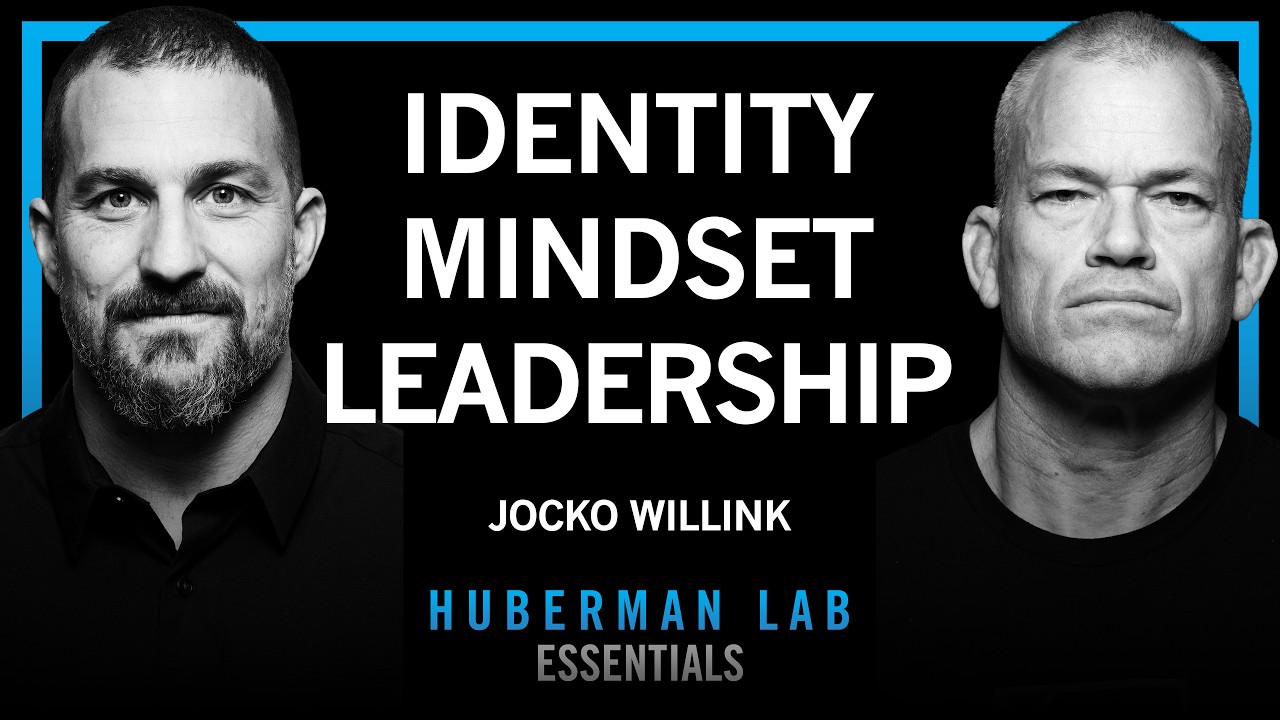
WILLINK SEES AUTONOMY AND DETACHMENT DRIVING INDIVIDUAL PERFORMANCE
Andrew Huberman
Action and tactical detachment reverse adversity and emotional volatility, while discipline provides a far more reliable foundation for long-term execution than fleeting motivation.
## Background
This episode of Huberman Lab Essentials, published by Andrew Huberman on YouTube on July 30, 2026, features retired U.S. Navy SEAL officer and author Jocko Willink. According to the page description, the discussion focuses on why discipline outweighs motivation for driving daily action, how taking action helps navigate adversity, the energy generated by exercise, and how leaders can act as counterweights to team morale while using detachment to improve decision-making under stress.
## TL;DR
Jocko Willink explains how discipline, daily routine, and immediate action form the backbone of resilience and personal autonomy. He discusses practical tools for mental clarity, such as early-morning workouts, fasting, and short high-intensity exercise bursts to prime focus. Central to his philosophy is the skill of detachment—physically stepping back, slowing down breathing, and maintaining a wide perspective—to make better decisions in leadership, high-stress situations, and personal relationships. Ultimately, he stresses that moving directly toward problems and embracing deliberate discomfort build the mental toughness necessary to overcome adversity.
## Atmosphere & style
The conversation carries a grounded, intense, yet deeply respectful tone between host and guest. Huberman brings an inquisitive, analytical energy that seeks to unpack the mechanics of Jocko's mindset, while Jocko responds with direct, stoic, and highly pragmatic wisdom. The dynamic feels authoritative yet accessible, shifting naturally between rugged military anecdotes and real-world tactical tools, leaving the listener with a sense of clarity, discipline, and calm resolve.
## Key takeaways
- [00:23](https://www.youtube.com/watch?v=lxDf8uEypJU&t=23s) Autonomy is the ultimate reward of human effort and discipline, providing far greater long-term value and control over life outcomes than money or external credentials.
- [02:40](https://www.youtube.com/watch?v=lxDf8uEypJU&t=160s) High daily energy is generated through physical exercise and immediate execution rather than waiting for innate morning motivation or internal negotiation.
- [04:12](https://www.youtube.com/watch?v=lxDf8uEypJU&t=252s) Strategic fasting creates high mental clarity necessary for peak cognitive performance and execution during critical, high-stakes tasks.
- [05:45](https://www.youtube.com/watch?v=lxDf8uEypJU&t=345s) High-intensity anaerobic exercise serves as a powerful trigger to rapidly sharpen mental focus and establish peak daily readiness.
- [06:31](https://www.youtube.com/watch?v=lxDf8uEypJU&t=391s) True resilience requires the ability to quickly recover from defeat; taking immediate, constructive action is the ultimate antidote to loss, grief, and adversity.
- [08:34](https://www.youtube.com/watch?v=lxDf8uEypJU&t=514s) A leader must mentally detach from mob mentality to act as a stabilizing counterweight—instilling humility during victories and providing encouragement during setbacks.
- [12:17](https://www.youtube.com/watch?v=lxDf8uEypJU&t=737s) In parenting and personal relationships, serving as a steady emotional counterbalance helps modulate extremes to prevent both complacency and burnout.
- [15:23](https://www.youtube.com/watch?v=lxDf8uEypJU&t=923s) A strong sense of personal identity and counter-cultural independence gives individuals the confidence to dissent constructively and challenge flawed leadership.
- [17:42](https://www.youtube.com/watch?v=lxDf8uEypJU&t=1062s) Motivation is merely a fleeting emotion, making discipline the only reliable driver of consistent daily action.
- [18:31](https://www.youtube.com/watch?v=lxDf8uEypJU&t=1111s) Addressing interpersonal conflict through an indirect approach—building rapport on adjacent topics first—avoids defensive combat and leads to collaborative solutions.
- [20:00](https://www.youtube.com/watch?v=lxDf8uEypJU&t=1200s) Detachment functions as a daily mental practice to step back, calm immediate emotional reactions, and gain a broader strategic perspective on problems.
- [21:33](https://www.youtube.com/watch?v=lxDf8uEypJU&t=1293s) Depression and major setbacks cause a loss of perspective; escaping internal mental fog requires taking immediate physical action and stepping back from the immediate issue.
- [23:54](https://www.youtube.com/watch?v=lxDf8uEypJU&t=1434s) Physically taking a step back widens your field of view, revealing strategic solutions that are invisible when hyper-focused on immediate chaos.
- [28:19](https://www.youtube.com/watch?v=lxDf8uEypJU&t=1699s) Controlling physical cues—such as slowing your breathing, pushing back your chair, lifting your chin, and dropping your hands—reduces panic and maintains emotional control.
- [29:19](https://www.youtube.com/watch?v=lxDf8uEypJU&t=1759s) Remaining silent and actively listening allows you to absorb critical information, spot vulnerabilities in plans, and validate others without escalating conflict.
- [31:32](https://www.youtube.com/watch?v=lxDf8uEypJU&t=1892s) Mental toughness and resiliency are trainable skills built through deliberate, repeated exposure to uncomfortable tasks.
## Detailed walkthrough
Here is a detailed, faithful walkthrough of the transcript.
[00:00](https://www.youtube.com/watch?v=lxDf8uEypJU&t=0s) Discipline, Impact, and Autonomy in the Military
Andrew Huberman opens the episode by introducing Jocko Willink as the personification of discipline, setting up a conversation to explore not just his routines and mindsets, but also counterintuitive approaches to life. Huberman introduces a framework categorizing people into "generators" and "projectors"—generators being those who realize early in life that they can actively impact the world around them and create things, while projectors naturally reflect on what they observe. He notes that both traits work symbiotically, but highlights Jocko's life as a prime example of a generator.
Jocko reflects on how his mindset truly took shape when he joined the military. Entering the military presents a complete "blank slate" where past credentials—such as SAT scores—no longer matter. He realized early on that performing well led to recognition and, crucially, greater control over his own destiny. For Jocko, autonomy is the ultimate compensation for human effort; even immense wealth is meaningless if an individual lacks control over their daily life. This realization—that present actions dictate life outcomes over two, three, or five years—fundamentally shaped his trajectory.
* "You can have all the money in the world, but if you don't control what you're doing every day, or at least you don't control most of what you're doing, then it's not worth it. The reason people try and make money is so they can have more autonomy in their life."
* "The more I focused on doing things that are going to positively impact my future, the better my life became."
[02:40](https://www.youtube.com/watch?v=lxDf8uEypJU&t=160s) Energy, Morning Routines, and Exercise
Huberman asks Jocko whether his high energy levels are innate—waking up filled with energy that needs burning off—or whether physical activity itself generates that energy. Jocko answers that it is a mix of both. He busts the myth that he jumps out of bed brimming with excitement every single day, clarifying that he feels just like anyone else when the alarm goes off. However, he avoids internal debate or negotiation in the morning, choosing instead to react robotically to the alarm.
Jocko emphasizes that working out reliably yields energy and elevates mood. While an extreme, "psycho" workout can temporarily leave someone exhausted, standard training creates physical and cognitive vitality. Outlining his own intense daily schedule, Jocko shares that a typical day can involve lifting, running, surfing, and afternoon jiu-jitsu, which leaves him naturally tired by nightfall.
- **Morning mindset:** No internal debate or negotiating when the alarm sounds; execution is immediate and robotic.
- **Typical physical schedule:** Lifting, running, surfing, and afternoon jiu-jitsu.
[04:12](https://www.youtube.com/watch?v=lxDf8uEypJU&t=252s) Fasting, Mental Clarity, and Performance
The discussion shifts to nutrition and timing meals relative to training and work. Jocko reveals that he avoids eating big meals early in the day because food slows him down. Instead, he consumes his primary meal in the evening around 6:00 PM or 7:00 PM. Huberman notes that as long as a meal schedule supports restorative sleep and daytime focus, it aligns with circadian science.
Jocko explains that fasting provides a sharp level of mental clarity essential for high-stakes tasks. Through his leadership consulting firm, Echelon Front, he refrains from eating before working with corporate clients, recording podcasts, or going on military missions. During his time in the SEAL teams, he would return from 3:00 AM or 4:00 AM operations, conduct a 15-minute debrief, clean weapons, and only then eat a large meal before sleeping.
* "You get a certain level of mental clarity when you haven't eaten a bunch of food."
* "I don't want to have food in my stomach when I've got to perform or execute anything."
[05:45](https://www.youtube.com/watch?v=lxDf8uEypJU&t=345s) High-Intensity Exercise and Peak Mentality
When asked if specific training modalities yield different energetic or cognitive benefits, Jocko singles out short, anaerobic, high-intensity blasts. Finishing a session with 10 to 15 minutes of hard effort on an Airdyne bike, a rowing machine, or heavy kettlebell swings acts as a powerful trigger to peak his mental focus and readiness for the day.
[06:31](https://www.youtube.com/watch?v=lxDf8uEypJU&t=391s) SEAL Selection, Resiliency, and Navigating Loss
Huberman asks how winning and losing impact individuals, and how losses can be transmuted into energy rather than depletion. Jocko explains that BUD/S (Basic Underwater Demolition/SEAL) selection naturally filters out those who cannot recover quickly from failure. Star high school or Division I college athletes—swimmers, football players, wrestlers, and runners—frequently fail or quit BUD/S because they have won their entire lives and do not know how to process loss. BUD/S instructors intentionally find every candidate's weakness to ensure they experience defeat.
Once inside the SEAL teams, resilience is baseline, but the nature of loss changes drastically—from losing a athletic race to losing a teammate. Jocko stresses that the ultimate antidote to grief, adversity, and setback is immediate action. Sitting and dwelling allows negative thoughts to take hold, whereas taking concrete steps forward provides direction and recovery.
- **BUD/S Selection Dynamics:** High attrition rates among top Division I athletes often stem from an inability to recover from deliberate, inevitable failure during training.
- **The Cure for Adversity:** Taking immediate action—whether adjusting tactics in military operations or identifying missing qualifications after being passed over for a promotion—prevents rumination and drives progress.
* "So often the best way to contend with problems, with issues, with adversity is action. Is by taking action. The more you sit and the more you wait... the worse it's going to get."
[08:34](https://www.youtube.com/watch?v=lxDf8uEypJU&t=514s) Leadership, Mob Mentality, and Being the Counterweight
Jocko breaks down the mechanics of team morale, comparing an organization's collective mindset to a street mob. Teams easily fall victim to mob mentality: after a successful operation, arrogance can creep in, causing team members to skip debriefs or maintenance. Conversely, after a bad operation or taking casualties, team morale can plummet into despair.
A leader's core responsibility is to mentally detach from the mob's emotional state in order to act as a stabilizing counterweight:
- **When the team wins:** The leader introduces humility, pointing out areas for improvement to prevent arrogance.
- **When the team loses:** The leader provides encouragement, focuses on lessons learned, and redirects focus toward the next mission.
* "You as a leader can't get caught up with the mob. You have to detach yourself from the mob mentally so that you don't get caught up in their emotions and their morale... you can't correct it."
[12:17](https://www.youtube.com/watch?v=lxDf8uEypJU&t=737s) Parenting, Modulating Emotion, and Seeking Balance
Jocko applies these same leadership principles to parenting, relationships, and personal life. If a child wins a wrestling tournament and wants to celebrate excessively by eating a triple-cheese pizza, a parent shouldn't crush their joy, but should help modulate it by reminding them to focus on next week and settle for a few slices. Conversely, if a child loses, a parent shouldn't kick them while they are down, but should offer support and perspective.
Jocko warns that individuals who never pause to celebrate small wins eventually burn out, while those surrounded by "yes-men" or friends who enable bad behavior end up in the gutter. Effective leaders, parents, and spouses function as a steady counterbalance to keep people centered.
- **The Counterweight Role:** Providing balance to emotional extremes ensures long-term stability and prevents downfall.
- **Avoiding Burnout:** Acknowledging and celebrating victories—without letting success breed complacency—is essential for sustaining performance.
<FollowUp label="Want to continue with Part 2 of this transcript walkthrough?" query="Please provide the detailed walkthrough for Part 2 of the Jocko Willink Huberman Lab Essentials transcript."/>
[15:23](https://www.youtube.com/watch?v=lxDf8uEypJU&t=923s) Sense of Self, Hardcore Music, DIY Attitude & Dissent
Jocko Willink credits the hardcore music scene he grew up with for shaping his fundamental identity and giving him the strength to dissent. He describes the soundtrack of his life as rooted in the do-it-yourself (DIY) nature of the scene, where the prevailing attitude was that they did not need anyone else and could make things happen on their own. Hearing bands like the Cro-Mags, Agnostic Front, and Bad Brains for the first time felt like discovering a piece of himself that was already there. As a kid living in the woods in Connecticut, the fierce lyrics of minor threat deeply resonated with him. This subculture set a baseline in his mind that made it entirely acceptable to be an outsider, say no, and refuse to blindly follow the crowd.
This counter-cultural background proved essential during his military career, giving him the wherewithal to challenge leadership constructively. Instead of being a jerk, he would ask questions or propose alternative solutions when an order did not seem like a good idea. Jocko emphasizes the lasting impact of this period, noting that having Black Flag's *My War* (specifically side two) on his record player for a year and a half straight was bound to leave a permanent mark.
[17:42](https://www.youtube.com/watch?v=lxDf8uEypJU&t=1062s) Motivation as an Emotion, Discipline
When asked about his sources of motivation, Jocko explains that he never counts on motivation because it is merely a fleeting emotion. He compares it to temporary states like happiness or sadness, noting that feeling motivated right now provides no guarantee you will still feel that way in 15 minutes. Because it is unreliable, he refuses to invest any stock in it. Instead, his daily actions are driven purely by discipline. He avoids entering a mental debate about whether he "feels" like doing something; he simply goes out and executes the task regardless of his emotional state.
Andrew Huberman highlights Jocko's philosophy of using positive action as an internal source of energy and inspiration rather than seeking it from external relationships or jobs. Jocko agrees, stating that positive action means directly contending with fears and moving toward problems rather than running away from them. However, he introduces a crucial caveat through the "indirect approach"—a combat theory he firmly believes applies to human relationships.
Jocko illustrates this with a hypothetical conflict between himself and Huberman. While a head-on confrontation might seem direct, it usually leads to defensive combat where both sides protect their own version of the truth, resulting in unnecessary casualties. Instead, Jocko advocates for the indirect approach: initiating conversations about adjacent topics to build a relationship first. Over time, the other person naturally recognizes the underlying perspective, allowing both parties to collaborate on a positive solution without a metaphorical punch to the face.
[20:00](https://www.youtube.com/watch?v=lxDf8uEypJU&t=1200s) Meditation, Detachment & Teaching Young Leaders
Jocko explicitly states that he does not practice standard meditation, claiming he has never meditated for a single second in his life. However, he explains that if the core goal of meditation is to step back and detach from a situation, he practices that mental maneuver all day, every day. As a military leader, he constantly trained young SEAL leaders to avoid getting hyper-focused on the immediate chaos right in front of them. By detaching from their immediate emotions on the battlefield, leaders gain a wider perspective to see more angles, maneuvers, opportunities, and enemy behaviors. Jocko defines the ultimate superpower in life as the ability to be a member of a team or "mob" while retaining the independent capacity to step back, detach, and assess the absolute best way to move forward.
Jocko describes the terrifying nature of depression and emotional struggles as a complete loss of perspective, visualizing it as a dense storm cloud wrapped around a person's head. When someone is trapped in this state, they see nothing but darkness in every direction. From an outside perspective, it might be obvious that the individual has a great education, good health, and a supportive team, meaning they only need to move four feet forward to clear the fog. Yet, the person inside the storm literally cannot compute this reality.
This helpless feeling frequently manifests when people experience major setbacks, such as getting dumped in a relationship, missing out on a job, or facing rejection from a school. Jocko notes how friends can clearly see that a toxic ex-partner was a disaster anyway, but the heartbroken individual remains entirely stuck. To break out of this darkness, Jocko emphasizes that the solution to a problem is never found *within* the problem itself. A person must actively get outside of their own head, step back, and detach to properly assess whether the issue even needs to be solved. He echoes a concept from Tim Ferriss: "Get out of your head, get into your body," which is achieved by taking immediate physical action.
[23:54](https://www.youtube.com/watch?v=lxDf8uEypJU&t=1434s) Tool: Detachment, Oil Rig Story, Field of View
Jocko shares a foundational anecdote from the 1990s where he first recognized the tactical power of detachment during a training mission on an oil rig. At the time, he was the youngest and most junior member of his SEAL platoon, standing in a skirmish line as they prepared to clear a large area. The entire platoon stood in absolute silence waiting for a senior leader to make a tactical call. As 5, 10, and then 20 seconds ticked by in agonizing silence, Jocko reached his limit. He took a literal step off the skirmish line and looked to his left and right.
By stepping away, he realized that every single man—including the platoon commander, the platoon chief, the leading petty officer, and the assistant platoon commander—was staring intensely down the sights of their weapons. This hyper-focus restricted their field of vision to a tiny, 20-degree window. Because Jocko had physically stepped back, he possessed a massive, panoramic field of view that revealed the entire scene and the obvious path forward.
Mustering the courage to overcome the unwritten rule that new guys should keep their mouths shut, Jocko spoke up and called out a basic tactical maneuver: "Hold left, clear right." Instead of getting reprimanded, the entire platoon repeated the command, executed the maneuver, and successfully cleared the rig. During the subsequent debrief on the helopad, the platoon chief surprised Jocko by praising his call on the cellar deck. This experience taught Jocko that broadening his range of vision and taking a conscious breath allowed him to see infinitely more than even the most experienced operators. He immediately integrated this practice into land warfare, urban combat, and eventually, his everyday conversations.
[28:19](https://www.youtube.com/watch?v=lxDf8uEypJU&t=1699s) Tools: Take a Step Back, Slow Breathing & Widen Field of View
When teaching the mechanical tools of detachment to civilian groups, Jocko emphasizes physical adjustments to alter psychological states. If an argument heats up during a business meeting, he will literally push his chair away from the conference table to physically change his perspective and widen his field of view. He connects this to a survival mechanism from the SEAL teams: operators are heavily discouraged from sounding panicked on the radio because it spreads panic to others and invites intense mockery from teammates.
To combat panic, Jocko manually slows his breathing down by taking a deep breath before keying up a radio or responding to a stressful situation, whether in a high-stakes meeting or a confrontation in a supermarket parking lot. Creating physical space and controlling respiration directly detaches the individual from rising emotional volatility.
Jocko outlines specific micro-physical cues that signal defensive or aggressive behavior, noting that human instinct during an argument is to drop the chin and raise the hands into a fighting posture. To deliberately counteract this combat response during a heated discussion, Jocko consciously lifts his chin up and drops his hands completely down. Altering the physical angle of the head fundamentally shifts one's visual perspective, while lowering the hands signals a non-defensive willingness to actually listen.
A final, crucial component of detachment is remaining completely silent. Jocko points out that it is virtually impossible to remain detached while your mouth is moving. In his own companies, Jocko spends the vast majority of meetings listening rather than speaking. By keeping his mouth shut, he stays detached, absorbs what others are saying, and is far more capable of spotting the structural holes in their plans.
Jocko Willink explains how the principles of detachment and active listening apply directly to everyday life and personal relationships. When having a conversation with a significant other who is becoming frustrated, getting fully caught up in the emotional moment—100% engaged on a reactive level—will inevitably cause you to feel frustrated too. That mutual escalation turns what could be a constructive interaction into a heated emotional argument.
However, by taking a mental step back, you can analyze the situation objectively. Detaching allows you to realize, "Wait, why are they frustrated right now?" Often, you realize they are not asking for a solution; they simply want to vent. Instead of jumping in to fix things with statements like "Well, if that's the problem, here's what you should do," the better response is to step back, listen, validate their experience, and ask open-ended questions like "Oh, that sounds horrible... what do you think you're going to do?" Jocko emphasizes that the ability to detach is not just an innate gift—while some may be naturally better at it, it is a skill that can absolutely be trained. He notes having watched people develop this capacity both during his time in the SEAL teams and now in the business world.
[31:32](https://www.youtube.com/watch?v=lxDf8uEypJU&t=1892s) Tool: Deliberate Discomfort & Training Resiliency
When asked whether there is value in doing things every day that suck a little bit or putting oneself in states of deliberate discomfort, Jocko agrees 100%. He draws a direct parallel between physical fitness and mental toughness: just as you build your legs by doing squats or strengthen your back through pull-ups, you build mental resiliency by putting yourself through repetitions of tasks that require you to be tougher. Imposing discipline on yourself is essential for self-improvement.
- **Analogy:** Building resiliency requires repetitions of uncomfortable tasks, just like building legs with squats or the back with pull-ups.
Andrew Huberman closes the conversation by expressing deep gratitude to Jocko, thanking him as a civilian not only for his service in the military but also for educating the public on military life and experiences, as well as for humoring Huberman's scientific tangents. Jocko responds with humility, reminding listeners that many others have done far more and sacrificed infinitely more than he ever did. He expresses mutual respect, thanking Huberman for the valuable educational information he puts out to help people improve their lives, before concluding with a mutual desire to collaborate again in the future.
## Notable quotes
> [00:00](https://www.youtube.com/watch?v=lxDf8uEypJU&t=0s) You can have all the money in the world, but if you don't control what you're doing every day, or at least you don't control most of what you're doing, then it's not worth it. The reason people try and make money is so they can have more autonomy in their life. — Jocko Willink
> [00:00](https://www.youtube.com/watch?v=lxDf8uEypJU&t=0s) The more I focused on doing things that are going to positively impact my future, the better my life became. — Jocko Willink
> [04:12](https://www.youtube.com/watch?v=lxDf8uEypJU&t=252s) You get a certain level of mental clarity when you haven't eaten a bunch of food. — Jocko Willink
> [04:12](https://www.youtube.com/watch?v=lxDf8uEypJU&t=252s) I don't want to have food in my stomach when I've got to perform or execute anything. — Jocko Willink
> [06:31](https://www.youtube.com/watch?v=lxDf8uEypJU&t=391s) So often the best way to contend with problems, with issues, with adversity is action. Is by taking action. The more you sit and the more you wait... the worse it's going to get. — Jocko Willink
> [08:34](https://www.youtube.com/watch?v=lxDf8uEypJU&t=514s) You as a leader can't get caught up with the mob. You have to detach yourself from the mob mentally so that you don't get caught up in their emotions and their morale... you can't correct it. — Jocko Willink
> [23:54](https://www.youtube.com/watch?v=lxDf8uEypJU&t=1434s) Hold left, clear right. — Jocko Willink
> [30:20](https://www.youtube.com/watch?v=lxDf8uEypJU&t=1820s) Oh, that sounds horrible... what do you think you're going to do? — Jocko Willink
## Mentioned
Jocko Willink, Andrew Huberman, U.S. Navy SEALs, BUD/S, Echelon Front, Jocko Podcast, Cro-Mags, Agnostic Front, Bad Brains, Minor Threat, Black Flag, Tim Ferriss, Airdyne
Retired Navy SEAL officer Jocko Willink argues that sustainable resilience, leadership, and emotional regulation rely on immediate physical action and deliberate psychological detachment rather than fleeting motivation.
Autonomy, Discipline, and Morning Execution (0:00)
Willink views autonomy as the ultimate reward of human effort, noting that wealth offers little value without control over daily life. He traces this realization to joining the military, where past credentials vanished and present performance directly dictated future freedom. Because he considers motivation an unreliable and transient emotion comparable to happiness or sadness, Willink relies exclusively on discipline to govern his daily routine.
To eliminate friction, he avoids morning mental negotiations by treating the alarm robotically. Rather than waiting for energy to appear, he uses rigorous physical training—such as lifting, running, surfing, and jiu-jitsu, often capped with short, high-intensity anaerobic bursts—to generate mental clarity and elevate mood. Willink couples this physical routine with daytime fasting, reserving his primary meal for the evening to maintain high-stakes cognitive alertness during client consultations, podcasts, or tactical debriefs.
Action as the Counter to Adversity and Defeat (6:31)
In assessing BUD/S training, Willink notes that elite Division I athletes frequently fail because instructors engineer situations that force candidates to face failure—an outcome high performers who have always won often cannot process. Once inside the SEAL teams, resilience becomes an essential baseline when handling setbacks ranging from professional stagnation to the death of teammates.
According to Willink, the most effective antidote to grief, setbacks, and depression is immediate action. He visualizes depression as an insular storm cloud that distorts perspective and prevents individuals from recognizing external solutions. To counteract paralysis, he advises individuals to adopt physical momentum—echoing Tim Ferriss's maxim to get out of one's head and into one's body—arguing that solutions to problems are never discovered by passively dwelling within them.
Detachment and the Leader as a Counterweight (8:34)
Willink equates an organization's collective psychology to a mob that fluctuates between arrogance following a victory and despair following a disaster. Effective leadership requires emotionally detaching from the group to serve as a stabilizing counterweight: introducing humility and critiques when a team wins, and offering constructive focus and encouragement when it loses. He applies this same counterbalancing mechanism to parenting, arguing that steady guidance tempers excessive celebrations while protecting children from burnout or despondency after a loss.
This leadership perspective stems partly from Willink's youth in the DIY hardcore music scene, which normalized being an outsider and gave him the confidence to challenge orders constructively. In interpersonal conflicts, he advocates for an indirect approach—building collaborative rapport on adjacent topics rather than engaging in direct confrontations that prompt defensive posturing.
Physical Mechanics of Detachment in High Stakes (23:54)
Willink conceptualizes detachment not as formal seated meditation, but as an active habit practiced throughout the day. He first recognized its value during an oil rig training mission as a junior SEAL: by taking a step backward off the firing line while senior leaders were hyper-focused down their weapon sights, his field of vision widened from 20 degrees to a panoramic view, enabling him to call the decisive tactical maneuver.
To replicate this state under civilian stress, Willink relies on conscious physical micro-adjustments. These include physically pushing his chair back from meeting tables, taking slow breaths to avoid projecting panic, lifting his chin, and dropping his hands out of an instinctual combat posture to signal an openness to listen. Willink emphasizes that remaining silent is essential, as talking prevents detachment and obscures structural weaknesses in opposing arguments or personal disputes.
Willink asserts that mental toughness is built through progressive exposure to deliberate discomfort, akin to physical training. However, the discussion centers primarily on military and high-performance business applications, leaving open how these aggressive action frameworks translate to clinical mental health contexts or non-hierarchical environments.
[0:00] Jocko Willink: You can have all the money in the world, but if you don't control what you're doing every day, or at least you don't control most of what you're doing, then it's not worth it. The reason people try and make money is so they can have more autonomy in their life.
[0:00] Jocko Willink: The more I focused on doing things that are going to positively impact my future, the better my life became.
[4:12] Jocko Willink: You get a certain level of mental clarity when you haven't eaten a bunch of food.
[4:12] Jocko Willink: I don't want to have food in my stomach when I've got to perform or execute anything.
[6:31] Jocko Willink: So often the best way to contend with problems, with issues, with adversity is action. Is by taking action. The more you sit and the more you wait... the worse it's going to get.
[8:34] Jocko Willink: You as a leader can't get caught up with the mob. You have to detach yourself from the mob mentally so that you don't get caught up in their emotions and their morale... you can't correct it.
[23:54] Jocko Willink: Hold left, clear right.
[30:20] Jocko Willink: Oh, that sounds horrible... what do you think you're going to do?
Original transcript
[0:00] Welcome to Huberman Lab Essentials,
[0:02] where we revisit past episodes for the
[0:04] most potent and actionable science-based
[0:06] tools for mental health, physical
[0:08] health, and performance.
[0:11] I'm Andrew Huberman and I'm a professor
[0:13] of neurobiology and opthalmology at
[0:16] Stanford School of Medicine. And now for
[0:18] my discussion with Jaco Willink. Jaco
[0:20] Willink, welcome.
[0:22] >> Thanks for having me, man.
[0:23] >> In my view, and I think in the view of a
[0:25] lot of people, you embody discipline. So
[0:26] today I definitely want to talk about
[0:29] routines but also mindsets but also
[0:32] things that you do and ways that you
[0:34] approach things that might not
[0:36] contradict but not be so obvious to
[0:37] people might um be a little bit
[0:39] counterintuitive. There are generators
[0:42] and projectors and generators are people
[0:45] that are just from a very young age they
[0:48] realize they can impact other people.
[0:50] They want to create things in the world.
[0:52] And then there are these projectors that
[0:54] like to just kind of reflect on what
[0:57] they see. And it's not that generators
[0:59] are good and projectors are bad. The
[1:01] world needs both. That they really work
[1:03] in a kind of symbiotic way. But your
[1:05] story captures the essence of what it is
[1:07] to be a generator, which is that by
[1:09] doing certain things, you can have an
[1:10] impact and it feeds back to you and it's
[1:12] likely that they receive something from
[1:14] it as well.
[1:14] >> Yeah. And where this all came to
[1:16] fruition as I as I now piece together as
[1:19] you're talking through this stuff. Look,
[1:20] when I joined the military,
[1:23] you join the military and you get a
[1:25] blank slate. No one cares what you got
[1:27] on the SATs or the no one cares about
[1:29] anything. You're a blank slate. And then
[1:31] with that blank slate, it is, hey, if
[1:35] you do this thing, if you perform this
[1:38] task and you perform it well, you will
[1:40] get recognition. you will hopefully get
[1:44] more control over your own destiny,
[1:47] which is the ultimate in compensation
[1:49] for for human beings to have more
[1:52] control over your own destiny. You can
[1:54] have all the money in the world, but if
[1:55] you don't control what you're doing
[1:58] every day, or at least you don't control
[2:00] most of what you're doing, then then
[2:01] it's not worth it. The reason people try
[2:03] and make money is so they can have more
[2:06] autonomy in their life. And so in the
[2:08] military, it became very clear to me
[2:10] very quickly that if I performed well, I
[2:13] actually got a lot more freedom with
[2:15] what I did. That's when I started to
[2:18] realize, oh, what I'm doing right now is
[2:21] going to impact not only what's going to
[2:23] happen to me in the next hour, but in
[2:24] the next 2 years, 3 years, 5 years, the
[2:27] more I focused on doing things that are
[2:29] going to positively impact my future,
[2:30] the better my life became. And I think
[2:33] that's a very huge lesson to learn that
[2:37] I know I didn't figure out for quite
[2:38] some time.
[2:40] >> I get the impression and I think
[2:41] everyone gets the impression that you're
[2:42] somebody with a lot of energy. And I
[2:45] wonder whether or not you wake up with a
[2:47] lot of energy and you feel like you have
[2:49] to burn it off with this physical
[2:51] activity and and work and other demands
[2:54] in your life or do you find that you
[2:56] wake up and your energy is kind of
[2:58] neutral and exercise and physical
[3:00] activity gives you energy?
[3:02] >> I would say it's both, right? There's no
[3:04] way I could sit here and say, "Oh yeah,
[3:06] every day that alarm clock goes off and
[3:08] I'm like, oh yeah, let's rock and roll."
[3:10] Not certainly that's not the case. It's
[3:12] also certainly not the case that every
[3:13] day I'm like, "Oh god, not again." No.
[3:16] Uh, I'd say most of the time the alarm
[3:18] clock goes off and I I I don't think a
[3:20] bunch like when my alarm clock goes off,
[3:22] I I don't debate with myself. I'm not
[3:24] negotiating. I I just The thing goes off
[3:26] and I'm doing what I'm supposed to do.
[3:27] It's sort of robotic. Now, I this this
[3:30] much I can say when you go and work out,
[3:32] you're going to feel better. You will
[3:34] get energy from working out. If you go
[3:35] break a sweat, you're going to feel
[3:36] better. This you're going to get more
[3:37] energy from it. And look, you got to go
[3:40] really, really hard to where now you
[3:44] feel more tired when you're done. And
[3:47] even that, I mean, you got to go psycho.
[3:49] I'll do that occasionally, but I don't
[3:51] do that on a daily basis. You know, at
[3:53] the end of a day, if I wake up, lift,
[3:57] run, surf, and then I do jiu-jitsu in
[4:00] the afternoon. Like, at the end of that
[4:02] day, I'm tired and I feel tired. Uh but
[4:07] normal day working out just makes you
[4:09] feel better. G definitely gives you
[4:11] definitely gives me energy.
[4:12] >> The idea that movement and exercise
[4:14] gives us energy I think is an important
[4:17] idea and it's something that I was
[4:18] frankly I was hoping your answer would
[4:20] be that as opposed to that you know you
[4:23] wake up every day and you just want to
[4:25] just attack the world because you have
[4:27] so much energy getting out of bed
[4:28] because frankly I never feel that way
[4:30] but I always feel better after I train.
[4:32] Do you nourish after you train or do you
[4:35] find that eating slows you down?
[4:37] >> I find that eating slows me down. So,
[4:39] no. I don't eat a big meal until I'm
[4:41] kind of done with the physical stuff for
[4:43] the day, which is usually at night, 6 7
[4:45] o'clock at night, which I guess there's
[4:47] some bad things about that. I eat too
[4:48] late. Well, the data say, you know, if
[4:51] you're having a regular meal schedule
[4:53] that allows you to sleep well at night,
[4:55] whatever that means for you and that
[4:57] allows you to be active and focused when
[4:59] you need to be active and focused,
[5:00] that's the ideal schedule.
[5:02] >> When I'm working with clients, like, so
[5:03] I have a leadership consulting company,
[5:04] Echelon Front, when I'm going to work
[5:05] with a client, I'm not eating because
[5:07] because they're going to be asking me
[5:08] questions. We're going to be diving into
[5:10] what's happening inside their business.
[5:11] Like, there's a lot of stuff going on.
[5:12] It's a lot of cognitive work. Podcast,
[5:14] I'm not eating before a podcast. before
[5:16] I'm recording a podcast, I'm not eating
[5:17] because I don't want to have a bunch of
[5:18] food in my stomach. I want to you you
[5:20] get a certain level of mental clarity
[5:22] when you haven't eaten a bunch of food.
[5:24] So, going out on missions, I never would
[5:26] eat before I go out out on a mission. I
[5:28] would eat when I come home. You know,
[5:30] get home 4:00 in the morning, 3:00 in
[5:31] the morning from doing operation. Cool.
[5:32] Then I'll eat cuz then I'm going to do a
[5:34] debrief for 15 minutes, clean weapons,
[5:37] and then eat a big meal, go to sleep.
[5:40] Cool. Yeah. I don't want to have food in
[5:42] my stomach when I've got to perform or
[5:44] execute anything.
[5:45] >> So much of what you embody and what you
[5:48] do, I think, centers around this idea of
[5:50] discipline, of course, but also energy.
[5:52] It's the intuitive sense I get about why
[5:54] people are so drawn to your messaging
[5:56] and what you do and how you do it. Are
[5:59] there certain forms of exercise like
[6:02] weightlifting versus cardio that you
[6:04] find give you an especially big boost in
[6:07] what we're calling energy? And here this
[6:09] could be cognitive energy, it could be
[6:10] physical energy, but a a readiness for
[6:12] the next thing.
[6:13] >> I would have to say like the the
[6:15] highintensity sort of anorobic blast,
[6:18] you know, whether it's on the bike or on
[6:20] the rower or, you know, swinging a
[6:22] kettle bell hard, something like that.
[6:24] That last 10, 15 minutes, that's a
[6:26] really good way to, you know, peak my
[6:29] mentality for the day. When you were in
[6:31] the teams,
[6:33] what was your observation about how
[6:35] winning and losing would impact people
[6:37] in the short and long term from the
[6:39] perspective of leadership and maybe more
[6:40] importantly from the perspective of
[6:42] yourself?
[6:43] How do you work with that? How do you
[6:45] calibrate wins and losses? How do you
[6:47] transmute losses into energy? Because
[6:50] wins we know convert to energy, but
[6:52] losses oftentimes can sap our energy
[6:54] way, way down. To start with, I think
[6:57] that the selection process to get into
[6:59] the SEAL teams is going to weed out a
[7:03] bunch of people that can't recover very
[7:05] quickly from something bad. The kid that
[7:08] was the star of the football team, the
[7:10] star of the basketball team, the captain
[7:12] of this, the captain of that, he's been
[7:14] winning his whole life. He goes to Buds
[7:16] and he quits. Because in Buds, you're
[7:18] not gonna win. You're certainly not
[7:20] going to win everything. They're going
[7:22] to find what you're not good at and
[7:24] they're gonna exploit that and you're
[7:26] going to lose. A lot of guys that may
[7:30] lose and it disrupts their their
[7:32] motivation, they're probably just going
[7:34] to quit. And so that's why you get this
[7:37] massive attrition rate with guys that
[7:40] are studs. Division one athlete,
[7:42] division one wrestlers, division one
[7:43] football players, division one runners
[7:45] and swimmers, they all come to Buds.
[7:46] They all quit. Not all of them quit, but
[7:48] there's plenty of examples of the
[7:51] highest level of collegiate athlete in
[7:53] sports that translate very well to what
[7:57] you're doing in in basic SEAL training
[8:00] and they quit. And sometimes it's
[8:02] because they don't know how to lose.
[8:03] They don't know how to recover from a
[8:05] loss. So I think already in once you get
[8:07] to a SEAL team, you've got people that
[8:11] are generally speaking going to be
[8:13] pretty resilient when it comes to
[8:16] dealing with a loss. Now once you're in
[8:18] the teams and what you're talking about
[8:20] is now you start taking much more
[8:22] significant loss. You're not losing a
[8:24] race, you're losing one of your friends.
[8:25] And this is what from a leadership
[8:26] perspective you have to you have to pay
[8:29] attention to. So when you're a leader in
[8:31] any organization,
[8:34] you're basically in charge of a mob when
[8:36] it comes to what their morale is. And
[8:38] they feed off of each other just like a
[8:40] mob riding in the streets going, "Oh, we
[8:42] can break this window. Let's break all
[8:43] the windows." And they they they move
[8:44] this mob mentality. And that happens
[8:46] with morale inside of a team. And you as
[8:50] a leader can't get caught up with the
[8:52] mob. You have to detach yourself from
[8:54] the mob mentally so that you don't get
[8:57] caught up in their emotions and their
[8:59] morale because if you get caught up in
[9:01] their emotions and you get caught up in
[9:03] morir their morale, you can't correct
[9:05] it. So, we go out on a mission. The
[9:08] mission goes great. We get into a
[9:11] gunfight, kill a couple bad guys,
[9:13] everyone's okay, high fives, everyone's
[9:15] feeling great. You come back to base.
[9:17] Hey, we don't need to debrief. That was
[9:19] perfect. Hey, we don't need to get our
[9:20] gear, you know, uh, maintained. We can
[9:23] just go to bed. We We're awesome. That's
[9:25] when the leader has to say, "Oh, we've
[9:27] got the mob, and the mob is becoming
[9:29] slightly arrogant." Hey guys, real
[9:32] quick, that was a good op, but there's
[9:34] some things we could improve on. You got
[9:36] to bring that mob back and bring them
[9:38] back to center line. Same thing in the
[9:40] other direction. You go out on an
[9:42] operation, it doesn't go well. You go
[9:43] out on operation, you take casualties.
[9:45] Now you come back to base, you see guys
[9:47] moping around, you see the the spirit
[9:49] starting to break. And same thing if you
[9:52] get if you're part of that mob, you'll
[9:54] be you'll be with them. Your morale will
[9:57] be breaking. Your spirit will be
[9:58] breaking. You got to look and say, "Oh,
[9:59] I see what's happening. Hey guys, listen
[10:02] up. That was tough. Didn't go the way we
[10:04] wanted it to go. We need to learn some
[10:07] lessons. Here's some things I can do
[10:08] better. What can we do better to make
[10:10] sure that that never happens again?" So,
[10:12] as a leader, when it comes to winning
[10:14] and losing, you're generally going to be
[10:16] the person countering what the mob
[10:18] mentality is. Because when the mob
[10:20] starts winning, they want to keep
[10:22] winning and they might get arrogant.
[10:24] When the mob is losing, they might start
[10:27] to lose more because their attitude goes
[10:29] down the drain. So, that's what you have
[10:31] to pay attention to from a leadership
[10:33] perspective. For me personally,
[10:36] I think I know what I did when when I
[10:41] lost guys was focus on all right,
[10:47] we need to we need to celebrate the
[10:49] life. We need to move the lo mourn the
[10:52] loss
[10:54] and then we need to go to work. We need
[10:56] to get our gear back on. We need to lock
[10:57] and load our weapons. We need to get
[10:59] back out there. I I know that that's
[11:02] what we needed to do, you know. So often
[11:04] the best way to contend with with
[11:07] problems, with issues, with adversity
[11:11] is action. Is by taking action.
[11:15] The more you sit and the more you wait
[11:18] and the more time you spend with that
[11:20] adversity with the upper hand inside
[11:22] your head, the the worse it's going to
[11:25] get. So for me, always taking action,
[11:29] making something happen. It doesn't have
[11:30] to be huge. It doesn't have to be some
[11:33] mammoth triumph that you're going to go
[11:35] and pursue. But if you say, "Hey,
[11:37] listen.
[11:39] This is what happened didn't go the way
[11:41] we wanted it to. We're going to get our
[11:42] gear back on. We're going to go back
[11:44] out. We're going to do this other
[11:45] mission." And it's in a in your personal
[11:47] life, too. You know, something doesn't
[11:48] go the way you wanted it to go. You
[11:50] didn't get the job you wanted, you
[11:51] didn't get the hire, you didn't get the
[11:52] promotion, you can go home and sit there
[11:54] and and and dwell on it. That's not
[11:56] getting you any progress. Or you say,
[11:58] "Okay, you know what? Let me do a quick
[12:00] analysis. Why didn't I get that
[12:01] promotion? Oh, it's cuz I didn't get
[12:03] this qualification or I hadn't jumped
[12:06] through this gate. Okay, cool. What do I
[12:08] need to let me let me look into how do I
[12:09] how do I get to jump through that gate
[12:10] so next time I will get the promotion
[12:12] and you start taking action. Action for
[12:14] me is a cure for a lot of problems that
[12:16] we have in life. I think that in the
[12:18] context of moderating these systems,
[12:21] it's so key. I mean, it's key to have a
[12:23] long arc in a career path, military,
[12:25] science or otherwise. As a father in
[12:28] particular,
[12:30] how do you apply these same sorts of
[12:31] ideas when you know your kid is kind of
[12:33] down because it's hard to be a
[12:35] 14-year-old or because it was a bad day
[12:38] or when they're up.
[12:40] >> Well, clearly it's a very similar thing
[12:43] to what I just talked about. You know,
[12:44] if your kid is doing well and and wins
[12:47] the wrestling tournament and is like,
[12:49] "Yeah, I won the wrestling tournament."
[12:50] And what do they want to do? They want
[12:51] to eat a triple cheese pizza, right? I
[12:54] mean, they want to go crazy. And you as
[12:56] a leader and as a and as a parent and as
[12:59] a friend need to say, "Hey, man. I mean,
[13:02] you did good. That was awesome. You had
[13:03] a great day,
[13:05] >> but let's start thinking a little bit
[13:07] about next week, too. How about we just
[13:08] have a few slices of pizza, right? As a
[13:10] reward." And this goes with yourself as
[13:12] well. You know, you you do something,
[13:14] you have a success, and you say, "Oh,
[13:15] that that that's great. Uh, but
[13:19] all glory is fleeting, and I need to get
[13:20] back to work." And look, and do people
[13:22] go too far with that sometimes? Yes,
[13:24] absolutely. Sometimes people they they
[13:26] don't stop and celebrate at all. And
[13:28] those are the kind of people I think
[13:29] that get burned out eventually because
[13:30] they never say, "Hey, that was awesome.
[13:32] We had a big win. Cool. High five." So I
[13:34] think, you know, as a leader, as a
[13:36] friend, as a parent, as a spouse, you
[13:39] want to be able to modulate that, help
[13:42] modulate that. Don't shut it down. You
[13:45] know, your kid walks off the wrestling
[13:47] mat with for a high five and you say,
[13:50] "You could have won by more." No, I'm
[13:52] not talking about that. or your kid
[13:54] walks off the mat after losing, you say,
[13:55] "You got what you deserve." No, you've
[13:57] got to be the counter, the counterweight
[14:00] to the emotions that other people have.
[14:02] When you're doing a good job as a
[14:04] leader, as a friend, as a spouse, as
[14:05] whatever, you're doing a good job as a
[14:06] counterwe. I think that's a a good way
[14:09] to look at it. You want to you want to
[14:10] provide some balance for people to make
[14:12] sure that they don't get out of control.
[14:13] And you you notice when people
[14:17] have a downfall, it's normally because
[14:19] they've surrounded themselves with
[14:20] people that there's no counter to.
[14:22] There's no counterbalance. You know, if
[14:24] you were my best friend and I, you know,
[14:26] I went out drinking last night and had a
[14:27] great time and partied all night and met
[14:30] a girl and you're like, "Heck yeah,
[14:31] let's do it again tonight." Eventually,
[14:33] where are we going to be? We're going to
[14:34] be in the gutter somewhere. But if you
[14:36] say, "Hey, dude, that was awesome, but
[14:37] hey, remember we got school on Monday,
[14:39] right?" And you kind of pull me back.
[14:41] That's we we got to find balance in life
[14:43] and ourselves. And then and then we gota
[14:46] as much as we can provide balance for
[14:47] other people because people are
[14:49] emotional and they get caught up in what
[14:51] they're doing and you want to you want
[14:53] to keep people balanced. You seem to
[14:55] have a very strong sense of context and
[14:58] self. Was there something in your
[15:01] upbringing your parents or or was it
[15:04] just kind of how you always imagined
[15:06] yourself as like yeah this is who I am?
[15:08] Because I actually think that many
[15:09] people do not have a very firm sense of
[15:12] self or their sense of self is so rigid
[15:16] that they can only operate in this like
[15:18] narrow trench of one domain of life and
[15:20] they end up very very isolated. As far
[15:23] as kind of where I became me, I I just
[15:28] actually have to kind of give a lot of
[15:29] credit to the music that I grew up
[15:31] listening to and the attitude that we
[15:34] had back then listening to hardcore
[15:37] music, being able to stand up against
[15:41] what other people were saying, which is
[15:43] what you're doing when you're in that
[15:45] scene. And the whole DIY nature of it.
[15:49] Hey, we we can just do this ourselves.
[15:51] we can just make this happen for
[15:52] ourselves. We don't need anybody else.
[15:54] We can do this. And that hardcore
[15:56] attitude and sticking by your friends
[15:58] and standing up and getting in fights
[16:00] and like that's what you're going to do.
[16:02] That's kind of my attitude. That music
[16:04] is the soundtrack to my life. And so I
[16:07] always would have that music running in
[16:08] my head. But to your question, I had
[16:12] something in me that when I heard that
[16:14] music for the first time, I was like,
[16:17] "Okay, here it is." You know, here it
[16:20] is. this is, you know, I hear the
[16:22] Beatles, I hear the Grateful Dead, I
[16:24] hear the Rolling Stones, I hear the
[16:25] whoever, and you go, okay, that's fine.
[16:28] But when I heard hardcore music for the
[16:31] first time, when I heard the Cromax,
[16:33] when I heard Agnostic Front, when I
[16:34] heard the Bad Brains, I thought it was
[16:36] that was just like it was part of me
[16:39] already. I'm like a kid living in the
[16:41] woods in Connecticut. I I'm just kind of
[16:44] hearing what I'm hearing. Listen to the
[16:46] lyrics. Listen to the lyrics of Minor
[16:48] Threat. Listen to the lyrics. and you
[16:49] go, "Okay, this stuff, I agree with this
[16:51] stuff." And I I just think that that
[16:54] kind of set a datam in my head of being
[16:58] okay with being outside, being okay with
[17:00] saying no, being okay with being a
[17:02] rebel, being okay with not going along
[17:06] with what everyone else is doing. That
[17:08] became very important when I was in the
[17:10] military and I looked at what leadership
[17:14] might be telling me to do and might
[17:16] think to myself, "Hey, that doesn't seem
[17:17] like a good idea." and having the the
[17:19] wherewithal to say, "Hey boss, I'm not
[17:21] sure this is a good idea." Not to be a
[17:22] jerk about it, but just to say, "There
[17:24] might be a better way to get this done.
[17:25] What do you think of this?" Or, "Hey,
[17:26] boss, can I ask you a question about
[17:27] that?" So, I I think if I had to trace
[17:30] it back, you know, having Black Flag My
[17:33] War side 2 on my record player for like
[17:35] a year and a half straight, that's going
[17:38] to leave a mark, man. And I think it
[17:40] left a mark on me.
[17:42] >> What are your sources of motivation?
[17:44] >> Well, you pro you probably heard me say
[17:46] that. Mo motivation isn't something that
[17:49] I am going to count on because it's just
[17:53] an emotion that's going to come and go.
[17:55] Just like feeling happy, you feel happy
[17:57] right now, maybe you won't feel happy in
[17:58] 15 minutes. You feel sad now, maybe you
[18:00] won't feel sad in 15 minutes. Feel
[18:02] motivated right now, you might not feel
[18:03] motivated in 15 minutes. Therefore, I
[18:05] can't rely on it. So, I'm not going to
[18:07] put any money on just being motivated
[18:11] because it doesn't really matter to me.
[18:13] So the daily
[18:16] actions that I take aren't from
[18:18] motivation. They're they're just from
[18:20] discipline. Like like I said earlier,
[18:21] I'm not going to get up and go through
[18:23] some big debate about well really do I
[18:26] really feel like doing this? No, I don't
[18:28] feel like doing but it doesn't matter so
[18:29] I'm just going to go do it. You
[18:32] particular have said several times
[18:33] today, rather than looking for sources
[18:35] of things outside you like a job or a
[18:37] relationship, which are all great um but
[18:39] as sources of energy or motivation or
[18:41] inspiration to use action as a positive
[18:43] action as a source of energy.
[18:45] >> Yeah. And and positive action is when
[18:48] you have to contend with something when
[18:49] there's something that you're afraid of,
[18:50] right? Step into it, move towards it.
[18:53] You don't solve problems by running away
[18:55] from them. You solve them by moving
[18:57] towards them and figuring out what's
[18:59] going on. Then we could go down the
[19:01] whole path of talking about the indirect
[19:03] approach which is a theory of combat
[19:07] which I completely believe in but it
[19:09] also applies to you know interacting
[19:12] with other people. If you have a problem
[19:13] with some other person to think to
[19:15] myself, well I got I got a problem with
[19:16] Andrew. I'm going to go confront him on
[19:18] it. And that might not be the best
[19:20] solution. In fact, it's probably not the
[19:22] best solution for me to go confront you
[19:23] with the problem because now we're going
[19:24] to have a confrontation. it might be
[19:26] better for me to take an indirect
[19:28] approach and not confront you, but
[19:30] instead engage in a conversation with
[19:31] you about something that's maybe
[19:33] adjacent to the problem that I have. And
[19:36] then eventually that builds our
[19:37] relationship to a point where you start
[19:39] to recognize, oh, I bet Joo feels
[19:41] something about this thing. And we can
[19:43] move towards a solution instead of me
[19:45] trying to punch you in the face with
[19:48] some truth that I believe versus the
[19:50] truth that you believe. And now we're
[19:51] engaged in combat and that's bad.
[19:54] There's going to be casualties. I'd
[19:55] rather take an indirect approach and
[19:57] build a relationship where we can solve
[19:59] problems in a more positive way.
[20:00] >> I also heard you say something earlier
[20:02] that's still flagging in my mind, which
[20:04] is, you know, not thinking too much. And
[20:07] you've talked about third personing of
[20:09] the self. I'd love to talk a little bit
[20:10] more about this even though it's a topic
[20:11] you've delved into before. And in
[20:13] particular, the topic of meditation. Do
[20:16] you meditate? And if you don't do a kind
[20:18] of standard meditation, are there times
[20:20] throughout your day and your routine and
[20:21] your week where as I'm describing this,
[20:24] it maps to something that kind of feels
[20:26] like open monitoring or focused
[20:28] meditation?
[20:29] >> Yeah. So, no, I don't meditate. I
[20:32] haven't ever I don't think I've ever
[20:33] actually meditated for one second in my
[20:35] life. And I I I've never tried to do it.
[20:38] That being said, if the goal is to take
[20:42] a step back and detach from what's going
[20:44] on, I do that all day every day. And so,
[20:47] you know, that's that is something that
[20:49] I've talked about and it's something I
[20:51] tried to teach, you know, I tried to
[20:52] teach the young SEAL leaders not to get
[20:55] caught up in what's happening right in
[20:57] front of them, but to take a step back,
[20:59] detach from the situation, detach from
[21:01] their emotions on the battlefield. I
[21:03] want people to be able to see more
[21:04] angles, more maneuvers, more
[21:07] opportunities, more of what the enemy
[21:09] might do, more perspective. And it goes
[21:11] to what I was saying earlier about the
[21:12] mob. Being able to be part of a team,
[21:14] part of the mob, part of the gang, but
[21:16] still have the ability to take a step
[21:17] back, detach from that, and assess what
[21:20] is the best way for this team to move
[21:23] forward to me is the true superpower of
[21:27] life. And you know, this goes back to
[21:29] when you start talking about people that
[21:31] are having
[21:33] going through struggles in life, right?
[21:35] And I've described this before as, you
[21:38] know, if I'm looking at you and you're
[21:40] you're in a bad state, right? You're
[21:43] depressed, you're sad, you're moping
[21:45] around, you're not getting anything
[21:46] done,
[21:48] and I'm looking at you from the outside
[21:50] and and I'm thinking, for me, I see this
[21:53] storm cloud around your head. All you
[21:55] see, no matter what direction you look,
[21:57] is storm. All you see is darkness. I'm
[22:00] outside and I'm looking. I'm like, "Hey
[22:01] man, this guy's got a great education.
[22:03] He's healthy. He's got a good team
[22:05] around him. Like, he's got all these
[22:06] things going for him." But you in that
[22:09] state, you literally cannot see anything
[22:13] but the darkness of the storm. And
[22:15] that's what's so scary about when people
[22:19] enter that mode is you can look I can
[22:21] look at it from the outside and be like
[22:23] Andrew you just got to move like four
[22:25] feet forward and you're going to be
[22:26] through this thing and yet you're you
[22:29] might hear me say that and you go no
[22:30] Jaco I'm looking ahead there's nothing
[22:32] but darkness. So helping people move
[22:35] forward, take action, and be able to get
[22:38] that perspective, detach and get outside
[22:40] themselves, get outside their own heads.
[22:43] You know, Tim Ferrris said, "Get out of
[22:44] your head, get into your body." That's
[22:45] one way to do it. Take action, go do
[22:48] things. It's very scary. And I'm sure
[22:49] you've had this experience where you're
[22:50] talking to someone that you know, and
[22:52] you're looking at them going, "Hey, man.
[22:54] No, it's going to be okay." Like, you
[22:56] can clearly see that whatever they're
[22:58] whatever is bothering them and dragging
[23:00] them. You can clearly see, you know, a
[23:02] lot of times it's a relationship, right?
[23:04] The the girl or the guy, they got they
[23:06] got dumped and you go, "Hey, man, that
[23:08] person was a disaster anyways. You're
[23:10] better off without them and they cannot
[23:12] compute that. They are stuck there." Or
[23:14] maybe it's the school that they didn't
[23:16] get into or the job that they didn't get
[23:18] and they get so wrapped up in that they
[23:20] can't they can't get out of that storm.
[23:22] It's such a helpless feeling. And that's
[23:25] why trying to engage with people and
[23:26] trying to give people that superpower of
[23:28] detachment where they can take a step
[23:29] back and say, "You know what? You're
[23:31] right, man. That that girl,
[23:33] she wasn't who I really thought she was.
[23:35] I should move on." Yes. The solution to
[23:37] your problem is not going to be found in
[23:40] the problem. It's not going to be found
[23:41] in there. You have to get out of the
[23:43] problem so that you can look at it, make
[23:45] an assessment, and you can assess how to
[23:47] solve the problem or whether you need to
[23:49] solve the problem or not. So detachment
[23:52] is a superpower.
[23:54] What is your process for engaging
[23:56] detachment or for disengaging?
[23:58] >> I recognized like in a moment what
[24:01] detachment was and how helpful it was on
[24:04] an oil rig doing a training mission. My
[24:07] whole platoon is in a skirmish line
[24:10] looking at a a large area of the oil rig
[24:13] that we're supposed to be clearing.
[24:15] Again, this is not combat. This is in
[24:16] the '9s. There's nothing going on. We're
[24:17] just doing training. And I'm standing in
[24:20] this skirmish line. And by the way, I'm
[24:22] the youngest and most junior guy in my
[24:23] platoon. And I'm standing there looking
[24:25] down the sight of my weapon. And I'm
[24:28] waiting for someone to make a call and
[24:29] tell us what to do. And I wait for 5
[24:31] seconds. And I wait for 10 seconds. And
[24:33] I wait for 20 seconds. And no one's
[24:34] saying anything. And we're waiting for a
[24:36] leader in my platoon to to make a call,
[24:39] to tell us what to do, to tell me what
[24:40] to do. And finally, after like 30
[24:43] seconds, which seems like an eternity, I
[24:46] can't take it anymore. I take a step off
[24:48] the skirmish line. I look to my left. I
[24:50] look to my right. And what I see is
[24:52] every other guy in my platoon is staring
[24:54] down their weapon, which means their
[24:56] field of view is tiny. It's like a 20
[24:59] degree field of view. You're looking
[25:00] down the the the scope of your weapon or
[25:02] the sight of your weapon. And that's how
[25:04] big their field of view is. And I'm
[25:05] looking and I'm thinking, "Oh, there's
[25:07] my platoon commander. He's looking down
[25:08] the scope the sight of his weapon.
[25:10] There's my platoon chief. He's looking
[25:11] down the side of his weapon. There's my
[25:12] leading petty officer. He's looking down
[25:13] the side of his weapon. There's my
[25:14] assistant platoon commander. He's
[25:15] looking down the So, everyone in the
[25:17] platoon is looking down the side of
[25:18] their weapon, which means they all have
[25:20] a very narrow field of vision. Well,
[25:25] when I take a step back and look to my
[25:26] left and look to my right, guess what
[25:28] kind of field of vision I got? I got a
[25:29] massive one. I can see the whole scene
[25:31] and I can see exactly what it is we need
[25:34] to do. Look, as a new guy, you need to
[25:36] keep your mouth shut. You don't say
[25:37] anything. And I'm thinking, well, but no
[25:40] one else is saying anything. So, I
[25:43] muster up all the courage I can and I
[25:46] open my mouth and I say, "Hold left,
[25:48] clear right." Which is a basic tactical
[25:50] call. This is not a patent level genius
[25:52] maneuver. It's just a normal call to
[25:54] make in a situation that we were in. I
[25:56] say, "Hold left, clear right." And I'm
[25:58] expecting to get kind of slapped, told,
[26:00] "Shut up, new guy." But instead,
[26:02] everyone just repeats the call. Hold
[26:03] left, clear right. Hold left, clear
[26:04] right. We get to the the top of the oil
[26:06] rig, which means we cleared the whole
[26:07] thing. We're on the Hilo deck at the
[26:09] top, and we go into a debrief. And now
[26:11] I'm expecting, okay, now I'm going to
[26:12] get told, "Hey, what were you doing? You
[26:14] need to keep your mouth shut." And
[26:16] instead, the platoon chief goes, "Hey,
[26:17] Jono, good call on the seller deck down
[26:21] there." And I was kind of like, "Yeah,
[26:23] that's right." But then I thought to
[26:25] myself, hold on a second. If I'm the
[26:27] youngest, most junior guy in this
[26:28] platoon, why was I able to see what we
[26:30] needed to do and make that call? Why did
[26:32] that why did that just happen? And then
[26:34] I realized it was cuz I took took a step
[26:36] back. I broadened my field of view which
[26:39] allowed me to think more clearly because
[26:42] instead of being hyperfocused and
[26:43] narrowly focused, I broadened my range
[26:45] of vision. I took a breath before I made
[26:48] my call, right? I had to take my take a
[26:50] a nice breath to speak clearly and I
[26:53] realized that taking a step back and
[26:55] detaching,
[26:57] I got to see infinitely more than even
[26:59] the most experienced guys in my platoon.
[27:02] And I started doing it all the time. I
[27:04] mean, I started doing it in land
[27:06] warfare. I started doing it in urban
[27:07] combat. I started doing it in all these
[27:09] tactical training scenarios. These are
[27:11] just training. This is the '90s. I
[27:12] started doing these training scenarios
[27:13] and it always allowed me to see what we
[27:17] needed to do. Then I started doing it
[27:19] like when I was having conversations
[27:20] with people. I'm having a conversation
[27:21] with my platoon chief and I can see that
[27:23] he's starting to turn a little red in
[27:24] the face and, you know, we're we're
[27:26] about to argue about something. I said,
[27:27] "Oh, wait a second. I'm taking a step
[27:28] back looking. He's getting mad right
[27:30] now." And he's the platoon chief. And I
[27:31] say, "Hey, you know what, Chief? That
[27:32] sounds good. let me go take a re let me
[27:34] go reook at the plan or whatever. And so
[27:36] I started to do this kind of with my
[27:40] normal life was to not get wrapped up in
[27:42] my own emotions, not get wrapped up in
[27:44] the the the gunfight that was happening
[27:46] right in front of my face, not to get
[27:48] wrapped up in the details of what was
[27:50] going on, but instead take a step back,
[27:54] detach, look around, and then you can
[27:57] make a much much better decision. Now
[27:59] listen, if you are the only person in a
[28:01] gunfight, it's going to be harder for
[28:03] you to do that because you got to be
[28:04] focused on whatever you're shooting at.
[28:05] But when you have 16 guys or 20 guys,
[28:08] they're all looking in the same
[28:09] direction. It's very easy to be the guy
[28:10] that goes, "I want to take a step back.
[28:12] Look around, make a call." When I teach
[28:15] this to people now, the mechanics of it,
[28:19] take a step back. Literally, you're, you
[28:21] know, you and I are at a meeting,
[28:22] there's a bunch of people, this starts
[28:24] to get heated argument. I will literally
[28:26] push my chair back away from the table.
[28:28] change my perspective. Perspective open
[28:32] widen my field of view. The other thing
[28:34] like in the SEAL teams, you don't want
[28:35] to sound panicked on the radio for a
[28:38] couple reasons. Number one, because when
[28:40] you panic on the radio, it's going to
[28:41] cause other people to panic. Number two,
[28:42] if you panic on the radio and you sound
[28:44] panicked, everyone's going to make fun
[28:44] of you. So, what would I do before I
[28:47] would key up my radio?
[28:49] Take a breath. And so, here I'm manually
[28:53] slowing down my breath. I'm broadening
[28:55] my field of view. So, if you're in a
[28:58] meeting or you're in a, you know, you're
[29:00] at the at the supermarket parking lot
[29:02] and someone starts to yell at you, take
[29:05] a step back, take a breath, broaden your
[29:08] field of view, detach from those
[29:10] emotions that you're having, and make
[29:12] some space. And I'll tell you, here's
[29:14] another like weird little nuance thing.
[29:19] Lift your chin up and put your hands
[29:21] down. When I get defensive, what am I
[29:23] going to do? I'm going to raise my hands
[29:24] up and put my chin down. That's like a
[29:26] fighting mode. So, if you and I are
[29:27] having a discussion and I'm starting to
[29:29] get heated and I'm starting to like,
[29:30] "Oh, he's not listening to me." Instead
[29:32] of me putting my chin down and and
[29:35] putting my hands like up up to where I
[29:37] can put them in your face a little bit.
[29:39] No, I'm actually going to take a step
[29:40] back. I'm going say, "Put my chin up."
[29:42] It changes my perspective a little bit
[29:44] more. Changes my visual perspective just
[29:46] by changing the angle of my head. Take a
[29:48] step back. Put my hands down. I'm not
[29:50] being in a defensive mood. I actually
[29:51] want to hear what you have to say. And
[29:54] if I start listening to what you have to
[29:56] say and not talking, it's very hard to
[29:58] be detached when you're talking. It's
[30:00] another key component. You want to
[30:02] detach, shut your mouth. I'm in a
[30:04] meeting in my companies. I'm not the one
[30:06] that's doing all the talking. In fact,
[30:07] I'm doing mostly listening. And that
[30:09] way, I'm detached. I'm listening to what
[30:11] they have to say. I'm more capable of
[30:14] seeing what holes there are in their
[30:17] plans by not moving my mouth, not
[30:20] talking. I'm listening. So those are
[30:23] some of the methodologies that I use and
[30:25] that I advise people to use in order to
[30:28] effectively start down the pathway of
[30:31] being able to detach in various
[30:33] scenarios. It applies to everything that
[30:35] we do. If you're having a conversation
[30:37] with your significant other and you
[30:39] start to see that they're getting
[30:42] frustrated about something, now look, if
[30:44] you're in the conversation 100%, you're
[30:47] going to get frustrated too. You're
[30:49] going to get frustrated that they're
[30:50] frustrated. Next thing you know, you've
[30:51] got a you've got an emotional argument
[30:53] going on. Whereas, if you take take a
[30:56] mental step back and say, "Wait a why
[30:57] are they frustrated right now?" Oh,
[31:00] because I'm trying to solve their
[31:02] problem when really what they're looking
[31:03] to do is vent. Okay, got it. Let them
[31:05] vent. Okay, cool. Oh, that sounds
[31:07] horrible. H, you know, what do you think
[31:09] you're going to do? Instead of saying,
[31:10] "Well, if that's the problem, here's
[31:11] what you should do." Because people are
[31:13] always looking for that. So, yeah, this
[31:14] this thing, this ability is and it's
[31:16] something that can absolutely be trained
[31:18] and that's what's cool about it. can
[31:20] absolutely be trained. It's not a
[31:22] natural gift. It's it's some people will
[31:25] be better at it than others, but it's
[31:27] something that you can train. And I used
[31:29] to see guys develop it and I see people
[31:30] develop it now in the business world.
[31:32] >> Do you think there's value to doing
[31:34] things each day that suck a little bit
[31:37] or from time to time doing something
[31:39] that's, you know, puts one into a state
[31:41] of deliberate uh discomfort.
[31:43] >> 100%. I mean even you in order to
[31:45] improve yourself, you gota you got to
[31:47] impose some discipline on yourself,
[31:49] right? Just like you would develop your
[31:52] legs by doing squats and you would
[31:54] develop your back by doing pull-ups, I
[31:56] think you would develop your resiliency
[31:58] by doing repetitions of things that
[32:01] require you to be tougher. I just want
[32:04] to extend an enormous thank you. Um, you
[32:07] know, as a civilian, thank you for the
[32:09] work you did in the military, but also
[32:10] teaching people about the military. I
[32:12] think a lot of people don't realize what
[32:14] it's about at any level and learning
[32:16] about your experience there and what
[32:17] you've observed, bringing other people's
[32:20] experiences from the military more
[32:21] broadly is super important and sharing
[32:24] this and being able to entertain some of
[32:25] my um scientific riffs. So, thank you.
[32:28] Thank you. Thank you.
[32:30] >> There's plenty of people that have done
[32:32] way more than I've ever done and and
[32:34] sacrificed infinitely more than I ever
[32:37] sacrificed. So, I'm um thankful for
[32:41] being here. I know that you uh put all
[32:44] kinds of information and I the same back
[32:46] at you. You know, I I have greatly
[32:48] benefited from the information that you
[32:50] put out and so I thank you as well and
[32:53] uh appreciate coming on here and
[32:55] appreciate you spreading the word about
[32:57] how people can be better yourself. So,
[32:59] thanks for having me. I appreciate it,
[33:01] man. Let's do it again.