Dr. Will Bulsiewicz Links Fecal Transplants to Immune, Cancer, and Brain Health
The Diary Of A CEO
Gut microbiome degradation from antibiotics, poor diet, and stress drives chronic systemic inflammation and disease, requiring fiber, fermented foods, and targeted therapies to restore intestinal barrier function.
## Background
Published on YouTube by The Diary Of A CEO on January 1, 2026, this episode features gastroenterologist Dr. Will Bulsiewicz discussing gut health. The video description highlights how leaky gut drives chronic inflammation, bloating, and disease, while offering daily habits, dietary strategies, and lifestyle routines to heal the gut microbiome.
## TL;DR
Gastroenterologist Dr. Will Bulsiewicz explains the profound connection between the gut microbiome, chronic inflammation, and overall physical and mental health. He addresses common digestive issues like bloating and constipation while debunking popular diet fads and gluten misconceptions. The discussion outlines practical routines for optimizing gut health—focusing on fiber, polyphenols, fermented foods, circadian alignment, and stress management—while highlighting treatments like fecal microbiota transplants (FMT). Dr. Bulsiewicz also shares his personal story, illustrating how resolving psychological trauma and emotional conflict is essential to physical healing.
## Atmosphere & style
The conversation carries an intimate, conversational, and deeply candid tone, blending expert medical knowledge with grounded vulnerability. Host Steven Bartlett creates an empathetic space that allows Dr. Bulsiewicz to transition smoothly from detailed biological explanations to deeply personal anecdotes about his family, past health struggles, and the loss of his father. The emotional arc moves from informative scientific breakdown to a heartfelt reflection on human connection, leaving the listener with a sense of warm encouragement and practical clarity.
## Key takeaways
- [00:00](https://www.youtube.com/watch?v=5Tr7AhkOEj4&t=0s) Roughly 60% of Steven Bartlett's audience and over 60% of surveyed listeners actively suffer from gut-related issues like bloating and abdominal discomfort.
- [02:20](https://www.youtube.com/watch?v=5Tr7AhkOEj4&t=140s) Chronic low-grade inflammation keeps the immune system constantly activated, causing internal collateral damage and tissue destruction even in fit or athletic individuals.
- [06:59](https://www.youtube.com/watch?v=5Tr7AhkOEj4&t=419s) Leaky gut occurs when intestinal permeability increases, allowing unwanted particles to cross into the bloodstream and trigger systemic immune responses and distant inflammation.
- [12:04](https://www.youtube.com/watch?v=5Tr7AhkOEj4&t=724s) Fecal Microbiota Transplants (FMT) can restore hundreds of healthy bacterial species at once to treat severe conditions like recurrent C. diff or boost cancer immunotherapy response.
- [18:11](https://www.youtube.com/watch?v=5Tr7AhkOEj4&t=1091s) Parkinson's disease pathology often originates in the digestive tract and travels via the gut-brain axis, with chronic constipation frequently preceding motor symptoms.
- [23:24](https://www.youtube.com/watch?v=5Tr7AhkOEj4&t=1404s) Constipation is defined by incomplete bowel evacuation rather than just stool frequency, creating gut gridlock where microbes produce excessive gas.
- [28:48](https://www.youtube.com/watch?v=5Tr7AhkOEj4&t=1728s) Sensitivities often attributed to gluten are frequently caused by fructans in wheat or agricultural pre-harvest spraying of non-organic wheat with glyphosate.
- [38:04](https://www.youtube.com/watch?v=5Tr7AhkOEj4&t=2284s) A single course of broad-spectrum antibiotics can double the one-year risk of developing Inflammatory Bowel Disease and significantly degrade the gut barrier.
- [47:41](https://www.youtube.com/watch?v=5Tr7AhkOEj4&t=2861s) Restricted diet trends like carnivore or fruit-only diets lack structural balance, whereas microbial diversity requires consuming a wide variety of dietary fibers.
- [54:36](https://www.youtube.com/watch?v=5Tr7AhkOEj4&t=3276s) Short-chain fatty acids (SCFAs)—acetate, propionate, and butyrate—are crucial fermentation byproducts that nourish colon cells and calm immune responses.
- [59:48](https://www.youtube.com/watch?v=5Tr7AhkOEj4&t=3588s) Alcohol strips the oral microbiome and directly increases blood lipopolysaccharide (LPS) levels, serving as a primary trigger for leaky gut.
- [01:09:10](https://www.youtube.com/watch?v=5Tr7AhkOEj4&t=4150s) Aligning daily hydration, sunlight exposure, meal timing, and quiet parasympathetic time with 24-hour circadian rhythms optimizes digestion and hormone release.
- [01:24:40](https://www.youtube.com/watch?v=5Tr7AhkOEj4&t=5080s) The first three years of life are critical for establishing the gut microbiome and immune system, where factors like C-sections, formula, or early antibiotics exert lasting effects.
- [01:33:06](https://www.youtube.com/watch?v=5Tr7AhkOEj4&t=5586s) Allowing a four-hour gap between meals enables the migrating motor complex (MMC) to clear undigested debris and bacteria from the digestive tract.
- [01:44:05](https://www.youtube.com/watch?v=5Tr7AhkOEj4&t=6245s) Psychological trauma and emotional stress directly alter gut function via the brain-gut axis, requiring nervous system regulation alongside dietary intervention.
- [01:50:52](https://www.youtube.com/watch?v=5Tr7AhkOEj4&t=6652s) The Bristol Stool Chart acts as a standard clinical metric, where Type 4 represents ideal stool, Types 1–2 signal constipation, and Types 6–7 indicate diarrhea.
- [01:53:21](https://www.youtube.com/watch?v=5Tr7AhkOEj4&t=6801s) Magnesium acts as an osmotic agent to resolve constipation, though forms like magnesium glycinate help sleep rather than bowel motility.
- [01:54:51](https://www.youtube.com/watch?v=5Tr7AhkOEj4&t=6891s) The four missing pillars of optimal gut health are Fiber, Polyphenols, Healthy Fats, and Fermented Foods.
## Detailed walkthrough
### [00:00](https://www.youtube.com/watch?v=5Tr7AhkOEj4&t=0s) Fecal Transplants and the Power of the Gut Microbiome
Dr. Will Bulsiewicz opens the conversation with a striking example of how powerful the gut microbiome truly is. He recounts the story of a patient who took an antibiotic that decimated her gut, causing a life-threatening infection. Medical professionals faced two drastic options: remove her entire colon or attempt a fecal microbiota transplant (FMT). Dr. Bulsiewicz performed the fecal transplant by introducing stool from a healthy donor into her intestinal tract. By the very next day, the severe infection was completely shut down. This dramatic recovery underscores a surprising biological fact: roughly 60% of the weight of human stool is made up of the gut microbiome itself.
Despite its vast importance to overall human health, the microbiome remains heavily overlooked in conventional conversations. Host Steven Bartlett notes that approximately 60% of his audience struggles with some form of gut-related issue. These problems often fly under the radar because they manifest as subtle, generalized complaints—such as persistent bloating, chronic fatigue, brain fog, poor sleep, and stubborn skin issues. Left unaddressed, these early warning signs lay the groundwork for long-term health complications.
- **Microbiome Mass**: Microbes account for roughly 60% of the dry weight of human stool.
- **Common Symptoms**: Subtle signs of gut dysfunction include fatigue, difficulty concentrating, sleep disturbances, skin issues, and abdominal bloating.
- **Microbiome Maturity**: A child’s gut microbiome reaches near adult-sized complexity by 3 years of age.
- **Early-Life Disruptors**: Cesarean deliveries, bottle-feeding, and early antibiotic exposure are linked to an increased risk of autoimmune, allergic, and metabolic conditions later in life.
- **Barrier Regeneration**: The lining of the human intestinal tract completely regenerates every 3 to 5 days, offering continuous opportunities to heal the gut barrier.
---
[02:20](https://www.youtube.com/watch?v=5Tr7AhkOEj4&t=140s) Understanding Chronic Inflammation: The Fire Within
Transitioning into the core topic of his book, Dr. Bulsiewicz shares his intense passion for chronic inflammation research, describing it as "the health story of our time." While many people associate inflammation only with visible, acute reactions—such as a swollen, red, tender knee after an injury or the localized response to a stomach bug—chronic low-grade inflammation works invisibly behind the scenes. In an acute response, the immune system turns on to fight an infection or heal a wound and then properly shuts off. The danger in modern society is that the immune system is staying turned on 24 hours a day, 7 days a week.
Dr. Bulsiewicz illustrates this dynamic using a military analogy: if your immune system is a small army deployed to defend you, keeping that army in a state of active, continuous warfare inevitably leads to collateral damage in the surrounding environment. In the human body, that collateral damage is the destruction of your own tissues and organs. Chronic inflammation often flies below the radar of both patients and doctors, driving vague symptoms like joint stiffness, muscle aches, and low energy. Crucially, Dr. Bulsiewicz emphasizes that chronic inflammation is not merely an issue of excess weight; even elite competitive bodybuilders who look impeccably fit on the outside frequently reach out to him suffering from severe internal digestive degradation and systemic inflammation.
> "If there's a war occurring, of course there's decimation and damage that occurs and it's brutal. And the problem is that if we're activating the immune system... the decimation and destruction that's occurring is within your own tissues, within your own organs."
---
[06:59](https://www.youtube.com/watch?v=5Tr7AhkOEj4&t=419s) The Gut-Immune Connection and Leaky Gut
To explain why the immune system stays chronically activated, Dr. Bulsiewicz outlines the tight structural connection between the gut and the immune system, built over three years of intensive research. Inside the large intestine lives a vast ecosystem of 38 trillion microorganisms, including bacteria, yeasts, archaea (ancient single-celled organisms that have existed for 4 billion years), and parasites. This microbial community lives on top of a delicate wall: a single layer of epithelial cells stretching across 20 to 25 feet (6 to 8 meters) of the digestive tract. This paper-thin layer serves as a castle wall, engineered to let vital nutrients in while keeping harmful pathogens and toxins out.
When the microbiome is healthy, its microbes actively nourish and maintain this epithelial barrier. However, when dietary and environmental stressors damage the microbiome, the barrier begins to breakdown—a state known medically as increased intestinal permeability, or colloquially as "leaky gut." As unwanted particles, bacterial fragments, and undigested compounds sneak across this compromised barrier, the immune system detects these invaders and launches a defensive attack. This non-stop immune response triggers a signaling cascade, releasing chemical messengers called cytokines. These cytokines summon more immune cells, creating a runaway chain reaction that damages tissues throughout the entire body.
- **Microbial Scale**: The large intestine hosts approximately 38 trillion microbes spanning bacteria, yeasts, archaea, and parasites.
- **Barrier Dimensions**: The single-layer epithelial barrier covers an intestinal length of 20–25 feet (6–8 meters).
- **Inflammatory Cascade**: Immune cells use signaling proteins called *cytokines* to recruit additional immune defenses, creating widespread inflammatory waves when continuously stimulated.
- **Organ Impacts**: Intestinal inflammation cascades outward, driving conditions ranging from liver inflammation (hepatitis) to neuroinflammation in the brain, which is strongly linked to major depression, Alzheimer's disease, and Parkinson's disease.
---
[12:04](https://www.youtube.com/watch?v=5Tr7AhkOEj4&t=724s) Fecal Transplants and the Mechanics of Gut Restoration
Dr. Bulsiewicz explains how medical intervention can rapidly reset a decimated gut ecosystem through a fecal microbiota transplant (FMT). Having performed numerous FMT procedures during colonoscopies, he details the mechanics of the procedure. While the patient is sedated, a flexible scope roughly the thickness of an index finger is navigated through the entire 5 to 6 feet of the large intestine, reaching all the way to the terminal ileum (the end of the small intestine in the lower right abdomen).
When a patient suffers from recurrent, life-threatening *Clostridioides difficile* (*C. diff*) infections that resist traditional antibiotics, an FMT acts as an instant ecosystem restoration. Rather than wiping out all microbes with drugs, the procedure reinstalls hundreds of healthy bacterial species in balanced proportions all at once. Dr. Bulsiewicz compares this to taking a pristine, flourishing ecosystem like the Amazon rainforest and instantly transplanting it into a degraded, dying forest floor to revive its vibrant flora and fauna. By restoring the microbial community, the gut barrier repairs itself, allowing the hyperactive immune system to cool off and return to a targeted, tactical state.
- **Colonoscopy Scope**: A flexible tube approximately the diameter of an index finger, used to inspect and access the 5–6 feet of the large intestine.
- **Terminal Ileum**: The final section of the small intestine, located in the lower right quadrant of the abdomen, where FMT infusions are frequently delivered.
- **C. diff Infection**: *Clostridioides difficile*, a severe intestinal infection often brought on by antibiotic use that wipes out competing healthy flora.
---
[15:14](https://www.youtube.com/watch?v=5Tr7AhkOEj4&t=914s) The Immune System, Cancer Surveillance, and Modern Lifestyle
The conversation turns to how gut health directly influences the development of severe chronic diseases, particularly cancer. Dr. Bulsiewicz shares a startling baseline biological statistic: the human body produces approximately 3.8 million new cells every single second. With such an astronomical rate of cellular replication, genetic mistakes and abnormal cells are an absolute mathematical certainty. Under normal conditions, a well-regulated immune system acts as a hyper-vigilant security force, patrolling the body 24 hours a day to identify and destroy these mutated cells before they can establish tumors.
However, when the gut barrier is breached and the immune system is forced into a state of continuous, systemic low-grade warfare against leaking gut toxins, its surveillance capacity becomes compromised and exhausted. Modern lifestyle factors—including highly processed diets, chronic stress, and environmental toxins—keep the body trapped in a perpetual cycle of gut damage and immune distraction. Rebuilding the gut microbiome and restoring the integrity of the epithelial lining relieves this burden, allowing the immune system to redirect its resources back toward critical internal surveillance and long-term health maintenance.
- **Cellular Turnover**: The human body generates roughly 3.8 million new cells every second, creating continuous potential for DNA replication errors.
- **Immune Surveillance**: A healthy, non-distracted immune system constantly identifies and eliminates pre-cancerous, genetically abnormal cells before they develop into tumors.
- **Modern Disruption**: The combination of processed foods, environmental chemicals, and stress creates a "forever war" of low-grade inflammation that diverts immune assets away from disease prevention.
[16:05](https://www.youtube.com/watch?v=5Tr7AhkOEj4&t=965s) Immunotherapy and the Gut-Cancer Link
Dr. Will Bulsiewicz highlights how the story of the gut microbiome has evolved into revolutionary cancer treatments, particularly in melanoma. Historically, medicine has manipulated the immune system to fight melanoma, but the breakthrough came with the advent of immunotherapies known as **immune checkpoint inhibitors**. Immune cells possess a natural "kill switch"—specifically the **PD-1 receptor**—to turn off immune activity when needed. Tumor cells exploit this safety mechanism by producing proteins that flip the kill switch, effectively blinding the immune system to the cancer. Immune checkpoint inhibitors work by flipping that switch back on, re-engaging the body's immune cells to seek out and destroy cancer cells.
The connection to the gut became undeniably clear when researchers noticed that patients who took antibiotics before receiving immune checkpoint inhibitors performed significantly worse. This prompted scientists to investigate whether restoring a damaged microbiome via a **fecal microbiota transplant (FMT)** could reverse this effect. Taking stool from patients who responded exceptionally well to treatment and transplanting it into new patients yielded extraordinary results: literally twice as many people beat cancer compared to standard expectations.
- **PD-1 Receptor**: The specific immune cell "kill switch" targeted by both tumor proteins and checkpoint inhibitor drugs.
- **Antibiotic Impact**: Antibiotic use prior to immunotherapy severely degrades treatment efficacy by damaging gut microbes.
- **FMT Success Rate**: Fecal transplants from treatment "responders" doubled the success rate of cancer removal in melanoma trials.
---
[18:11](https://www.youtube.com/watch?v=5Tr7AhkOEj4&t=1091s) Parkinson's Disease Begins in the Gut
Moving beyond cancer, Dr. Bulsiewicz explains that neurocognitive conditions long assumed to be strictly brain disorders—such as Parkinson's disease—actually originate in the digestive tract. Demonstrating on a realistic brain model, he breaks down the **gut-brain connection**. While Parkinson's ultimately manifests as severe neurocognitive and motor dysfunction in the brain, the underlying pathology starts in the gut. In clinical practice, every single Parkinson's patient presents with chronic constipation, and modern research proves that this constipation routinely occurs years before the onset of motor symptoms.
This early digestive warning sign does not mean every person with constipation will develop Parkinson's, but it highlights how the condition travels up the gut-brain axis. In pioneering studies, researchers administered fecal transplants to Parkinson's patients. A year later, those patients experienced durable, sustained improvements in their movement issues, alongside relief from chronic constipation.
- **Gut-Brain Axis**: The bidirectional pathway through which early Parkinson's pathology migrates from the gut to the central nervous system.
- **Universal Symptom**: Constipation precedes motor decline in Parkinson's cases and affects virtually 100% of patients.
- **Long-term FMT Benefits**: A single fecal transplant demonstrated measurable improvements in both motor control and gut motility one year post-procedure.
---
[20:28](https://www.youtube.com/watch?v=5Tr7AhkOEj4&t=1228s) The Reality of Fecal Transplants and At-Home DIY Hazards
When host Steven Bartlett asks if the average person can simply go out and get a fecal transplant to resolve their issues, Dr. Bulsiewicz offers a stern warning against "do-it-yourself" approaches popularized by media like Netflix specials. "Please do not do that," he urges, emphasizing that FMT carries real medical risks that require rigorous clinical screening and scientific supervision.
Fecal transplants are often mistakenly viewed as a quick-fix shortcut to solve all health problems overnight. Dr. Bulsiewicz clarifies that FMT is not a replacement for rebuilding a healthy microbiome through sustained diet and lifestyle changes. True, long-term health impact comes from consistent daily choices rather than chasing an easy procedure.
- **At-Home Risk**: Unscreened DIY fecal transplants carry serious risks of infection and pathogen transmission.
- **Quick-Fix Fallacy**: FMT provides a targeted microbial jumpstart but cannot replace fundamental diet and lifestyle habits.
---
[21:10](https://www.youtube.com/watch?v=5Tr7AhkOEj4&t=1270s) The Widespread Crisis of Gut Issues
Addressing a survey conducted with *The Diary Of A CEO* audience, Steven notes that over **60% of listeners** report currently struggling with gut issues like bloating, discomfort, or irregular digestion. Furthermore, approximately 14% to 15% of respondents self-identify as having Irritable Bowel Syndrome (IBS). Dr. Bulsiewicz acknowledges that while there is no single "one-size-fits-all" cure for these millions of people, empowering individuals with actionable knowledge allows them to find their personal "aha moment."
The root causes of gut distress vary dramatically across the population. While the vast majority of people stand to gain huge benefits by fixing the standard American diet, other drivers—such as disrupted circadian rhythms, poor sleep, or unresolved emotional trauma—can be the primary trigger for specific individuals.
- **61%** of surveyed listeners actively suffer from regular bloating, abdominal discomfort, or digestive issues.
- **14%–15%** of listeners self-report having Irritable Bowel Syndrome (IBS).
- **Varied Triggers**: Gut issues stem from a spectrum of causes including diet, circadian disruption, and trauma.
---
[23:24](https://www.youtube.com/watch?v=5Tr7AhkOEj4&t=1404s) Unmasking Hidden Constipation and "Partial Poops"
Addressing occasional versus chronic symptoms, Dr. Bulsiewicz notes that while everyone experiences temporary bloating, waking up every day dreading digestive distress indicates an underlying issue. When Steven asks about excessive gas and flatulence, Dr. Bulsiewicz identifies **constipation as the single biggest root cause**, revealing that millions of people are severely constipated without realizing it because they misinterpret what constipation actually means.
Constipation is not defined solely by how many days you go without pooping; it is defined by incomplete bowel evacuation. Many people pass stool every single day, or even three to four times a day, but are only passing small, hard "nuggets" or 20% to 25% of what is stored. These **partial poops** leave behind trapped stool in a state of "gridlock," giving resident microbes endless time to ferment remaining material and produce massive amounts of gas and bloating throughout the day.
- **Definition of Constipation**: Inadequate emptying of the bowels, which includes partial evacuations, not just low frequency.
- **Microbial Weight**: Roughly **60% of the dry weight** of human stool is made up of pure bacterial mass rather than food waste.
- **The Soluble Fiber Effect**: Adding clear, non-gritty soluble fiber to a drink feeds microbes, causing them to multiply and produce a bulkier, healthier stool the following day.
- **Stool Gridlock**: Stagnant stool allows microbes unlimited time to ferment proteins and carbohydrates, causing persistent gas.
---
[28:48](https://www.youtube.com/watch?v=5Tr7AhkOEj4&t=1728s) The 3 Root Causes of Gas and Bloating
Dr. Bulsiewicz breaks down the three main physiological causes of gas and bloating: **motility issues**, **microbiome dysbiosis**, and **dietary fermentability**. Motility refers to the rhythmic movement of the intestines. Just like the heart needs a steady rhythm, the gut relies on a predictable, daily cadence; if it moves too fast, it causes diarrhea, and if it moves too slow, it leads to sluggishness and constipation. Maintaining this rhythm is tightly tied to the body's natural circadian cycle.
The second cause is a weak or damaged microbiome. Microbes possess roughly **60,000 unique enzymes** that humans lack, allowing them to collaborate in teams to break down complex dietary fibers into beneficial short-chain fatty acids. When the microbiome is depleted, microbes struggle to handle incoming food, leading to "sloppy digestion" that yields excess gas. The third cause is diet—specifically highly fermentable compounds like lactose in dairy, or **fructans** in wheat, barley, and rye.
- **Gut Motility**: The rhythmic wave-like contractions of the intestines; optimal health relies on predictable morning bowel movements.
- **Enzyme Disparity**: Microbes bring over 60,000 enzymes to digest complex fibers that human digestive enzymes cannot break down.
- **Fructans vs. Gluten**: Foods containing gluten (wheat, barley, rye) are rich in pre-biotic carbohydrate chains called fructans, which are often the true cause of bloating attributed to gluten.
- **Personal Sensitivities**: Steven notes that eating pasta leaves him feeling bloated for two days, despite non-gluten alternatives feeling noticeably lighter.
---
<ElicitationsGroup message="Explore related topics from this transcript segment:">
<Elicitation label="Learn how short-chain fatty acids heal leaky gut" query="How do short-chain fatty acids produced by gut microbes heal a damaged or leaky gut?"/>
<Elicitation label="Examine how stress and trauma impact gut motility" query="How does trauma and nervous system stress impact gut motility and cause digestion issues?"/>
</ElicitationsGroup>
[32:04](https://www.youtube.com/watch?v=5Tr7AhkOEj4&t=1924s) Why Gluten Isn't Always the Real Problem: Glyphosate & Wheat Processing
Many people, particularly in places like Los Angeles, believe they are gluten intolerant and choose to eliminate it from their diets. However, Dr. Will Bulsiewicz points out that going gluten-free without knowing what proper nutritional adaptations to make can actually lead to health issues. The true culprit behind the digestion problems many Americans experience with wheat is often not the gluten itself, but the aggressive industrial processing methods used in the United States. Specifically, non-organic wheat is frequently sprayed with glyphosate (commonly known as Roundup) right before harvest to dry out the crops rapidly so they can be shipped faster, rather than allowing them to dry naturally over a couple of weeks.
While regulators approved glyphosate assuming human safety because it targets the **shikimate pathway** (a metabolic path plants need to synthesize essential amino acids, which human cells can bypass), our gut microbes do not have this workaround. When consumed, even microscopic amounts of glyphosate reach the large intestine and decimate beneficial bacterial populations while favoring hardy, inflammatory bad bacteria. This explains the common phenomenon where Americans who experience severe bloating and discomfort from eating wheat in the U.S. can travel to countries like Italy—where pre-harvest glyphosate desiccation is banned—and eat pasta or bread without experiencing any adverse symptoms.
- **Glyphosate Usage**: Applied to wheat as a drying agent to speed up harvesting and shipping schedules.
- **Labeling Gap**: Non-organic foods do not state whether glyphosate was used; buying certified organic guarantees it was not sprayed.
- **Microbiome Impact**: Disrupts gut flora balance by killing off beneficial microbes lacking a workaround for the shikimate pathway while letting bad bacteria thrive.
---
[34:51](https://www.youtube.com/watch?v=5Tr7AhkOEj4&t=2091s) Sourdough, Fructans, and the Misconception of Gluten Intolerance
When host Steven Bartlett shares that he avoids most breads but handles sourdough well, Dr. Bulsiewicz explains the science behind this common experience. Wheat, barley, and rye contain both gluten proteins and **fructans**—long-chain carbohydrate polymers that serve as prebiotic fibers. In a healthy gut, fructans are beneficial, but in a damaged or sensitive gut, they are difficult to digest and ferment rapidly, causing pain and bloating. The traditional fermentation process used to make sourdough bread breaks down and drastically reduces the fructan content, making the bread much easier to tolerate.
Dr. Bulsiewicz cites a landmark study published in the journal *Gastroenterology* that challenged the popular narrative around gluten sensitivity. Researchers gave non-celiac participants who believed they were gluten-sensitive three different types of breakfast bars in a blinded setup: a placebo bar, a bar high in gluten, and a bar high in fructans. Surprisingly, participants experienced fewer symptoms when eating the gluten-containing bar than they did with the placebo. However, eating the fructan-containing bar triggered severe gastrointestinal symptoms. This demonstrates that many people who assume they have a gluten intolerance actually suffer from a fructan intolerance.
- **Fructan Sources**: Found in wheat, barley, rye, garlic, onions, and various other plant foods.
- **Fructan-Free/Gluten-Free Grain Alternatives**: Teff, amaranth, sorghum, and quinoa.
- **Study Outcome**: Highlighting that for many non-celiac individuals, symptoms attributed to gluten are actually reactions to fructans.
---
[38:06](https://www.youtube.com/watch?v=5Tr7AhkOEj4&t=2286s) Gut Repair and the Mechanics of Inflammatory Bowel Disease
Repairing a damaged gut depends heavily on the initial baseline damage. The most severe form of gut dysbiosis (microbial imbalance) occurs in patients with Inflammatory Bowel Disease (IBD), such as ulcerative colitis and Crohn's disease. Demonstrating with a physical model of the large intestine, Dr. Bulsiewicz shows an ulcerated, raw, bleeding segment of the intestinal wall during a flare. He clarifies a major medical misconception: IBD is not strictly a classic autoimmune disease where the body attacks its own cells. Instead, the immune system mistakenly views the gut's microbiome as an enemy and attacks the microbes living inside the intestinal tube, causing the intestinal lining to suffer severe collateral damage in the process.
The foundation for this gut-immune relationship is laid in early childhood. Humans are born with almost no microbiome, but build a complex ecosystem through environmental exposure over their first three years of life, during which the immune system learns to recognize these microbes as friends. When this early training is disrupted or corrupted later in life, the immune system turns against the microbiome. While IBD was historically rare and remains uncommon in non-industrialized regions like rural Africa, cases skyrocketed by up to 55% in the U.S. between 1970 and 2010 as the nation industrialized. Furthermore, taking a course of broad-spectrum antibiotics doubles an individual's risk of developing an inflammatory bowel disease over the following year by wiping out microbial diversity and degrading the protective gut barrier by 50%.
- **Dysbiosis**: The medical term for a damaged or imbalanced gut microbiome.
- **Microbiome Development**: Critical window occurs during the first 3 years of life, training the immune system to tolerate beneficial microbes.
- **Antibiotic Risk**: A single course can disrupt the gut barrier by 50% and double the 1-year risk of developing IBD.
---
[43:04](https://www.youtube.com/watch?v=5Tr7AhkOEj4&t=2584s) Case Study: Saving a Patient's Colon with a Fecal Transplant
To illustrate the raw power of the gut microbiome, Dr. Bulsiewicz recounts the story of his patient, Michelle, who suffered a life-threatening reaction after taking clindamycin—a common antibiotic prescribed for skin infections. The antibiotic wiped out her healthy gut flora, allowing the opportunistic pathogen *Clostridioides difficile* (*C. diff*) to overgrow and cause severe, full-colon inflammation. When Dr. Bulsiewicz was called to her hospital room, Michelle was in a state of hyper-inflammatory shock: sweaty, pale, delirious, and experiencing severe peritonitis (an acute abdomen). The condition was so severe that merely tapping or gently bumping her hospital bed caused her to scream in agonizing pain.
Faced with two choices—emergency surgery to completely remove her inflamed colon or an emergency fecal microbiota transplant (FMT)—Dr. Bulsiewicz took her to the operating room. To avoid puncturing her fragile, raw tissue, he bypassed the standard index-finger-sized colonoscope (about 1 cm wide) and instead carefully navigated a much smaller 5–6 mm pediatric scope through her rectum all the way to the right side of her large intestine, where he delivered the FMT material. The transformation was dramatic:
> "By the next day she was a normal human being. She was laying in bed. She was able to have a conversation. And after 2 days she was so normal that we were able to send her home."
- **Pathogen**: *Clostridioides difficile* (*C. diff*), a dangerous toxin-producing bacteria that opportunistically multiplies when native flora is destroyed by antibiotics.
- **FMT Mechanism**: Reintroduces a diverse community of healthy microbes that outcompete and suppress *C. diff*, calming the hyperactive immune response and resolving inflammation rapidly.
- **Future Developments**: Hospitals source FMT samples from specialized banks (such as facilities in Massachusetts), while pharmaceutical companies are currently developing targeted microbial therapies derived from FMT concepts to rebuild the gut without needing whole-stool transfers.
---
[47:34](https://www.youtube.com/watch?v=5Tr7AhkOEj4&t=2854s) Diet Fads vs. Factual Science
When Steven asks about popular diet trends, juice cleanses, and influencer fads that Dr. Bulsiewicz despises, the doctor notes how wildly social media nutrition trends swing back and forth over short spans. He highlights how public sentiment swung rapidly from promoting a strict vegan diet in 2020 to advocating an all-meat carnivore diet by 2023—two completely polar opposites. This leaves everyday people confused and vulnerable to whatever trend dominates their social media feeds. In contrast, Dr. Bulsiewicz emphasizes that foundational gut science does not flip-flop overnight; true health comes from consistent, science-backed dietary choices rather than chasing volatile internet health crazes.
[48:41](https://www.youtube.com/watch?v=5Tr7AhkOEj4&t=2921s) Highly Restrictive Diet Trends and Quick Gut Adaptation
Dr. Will Bulsiewicz explains that human biology and core scientific understanding do not undergo radical, day-to-day shifts. While he commends anyone who takes proactive steps to change their diet for better health, he cautions against extreme dietary trends coming from both sides of the spectrum. He stresses that an all-meat or organ-only carnivore diet lacks balance and is not optimal for longevity, just as an all-fruit diet is completely unsustainable. The further people drift into highly restrictive choices, the further they stray from the simple, effective baseline of balanced whole foods. Additionally, temporary crash measures like a 7-day juice cleanse or water fast may make someone feel briefly better simply because irritating foods were removed, but they do not truly heal or repair the underlying gut ecosystem.
The encouraging reality of human biology is that the gut microbiome is remarkably resilient and forgiving. Because gut microbes can create a new generation as quickly as every 20 minutes, dietary changes made today begin reflecting in the microbiome by tomorrow. Furthermore, the body builds a brand-new gut barrier every 3 to 5 days. Supporting these microbes with the right inputs offers a rapid opportunity to experience noticeable health improvements.
* **Bacterial Reproduction:** Gut microbes can procreate and produce new generations in as little as 20 minutes.
* **Gut Lining Regeneration:** The human body completely replaces and rebuilds its gut barrier every 3 to 5 days.
* **Dietary Extremes:** Both 100% carnivore/organ diets and fruit-only diets are overly restrictive and lack foundational balance.
---
[51:41](https://www.youtube.com/watch?v=5Tr7AhkOEj4&t=3101s) The "Fibremaxxing" Trend and Short-Chain Fatty Acids
Although Dr. Bulsiewicz avoids social media trends generally, he highlights the "fibremaxxing" movement on TikTok as a rare example of public enthusiasm aligning with sound science. After decades of being overlooked, fiber is gaining attention as people attempt to dramatically boost their daily intake. However, he warns that individuals must ease into higher fiber consumption gradually. Rushing the process can cause temporary discomfort, leading people to give up and falsely assume fiber does not agree with them.
The widespread push to eat more fiber addresses a severe public health gap: roughly 95% of people in the United States and 90% in the United Kingdom are chronically fiber-deficient. Fiber serves as the essential food source for beneficial gut bacteria. When microbes ferment dietary fiber, they generate short-chain fatty acids (SCFAs)—the most powerful anti-inflammatory compounds Dr. Bulsiewicz has encountered in his research.
The three primary short-chain fatty acids produced by the microbiome are:
* **Acetate:** Works locally and systemically to support microbial balance and metabolic signaling.
* **Propionate:** Contributes to immune regulation and energy pathways across the body.
* **Butyrate:** Dr. Bulsiewicz's top pick among the three; it fuels colonocytes, directly stimulates the production of proteins that hold the gut lining tight, and calms down immune cells.
Without an established microbiome, a person cannot produce these beneficial compounds regardless of dietary intake. To illustrate this, Dr. Bulsiewicz references the famous "Bubble Boy" case from the 1970s—a child born with severe combined immunodeficiency (SCID) who lived in a completely sterile environment to avoid pathogens. In a hypothetical state devoid of bacteria, fiber cannot be converted into short-chain fatty acids. In modern industrial society, however, the problem is reversed: people possess the gut bacteria, but fail to supply the fiber required to produce anti-inflammatory SCFAs.
---
[54:36](https://www.youtube.com/watch?v=5Tr7AhkOEj4&t=3276s) Plant Diversity and Lessons from Indigenous Microbiomes
To harness short-chain fatty acids, fiber must enter the digestive tract through real food. Pointing to an array of ingredients, Dr. Bulsiewicz notes that every plant-derived food contains fiber, including fruits, vegetables, whole grains, seeds, nuts, legumes, and culinary mushrooms (fungi). Pure oils—such as olive or sunflower oil—contain 100% fat and zero fiber, though extra virgin olive oil provides valuable anti-inflammatory polyphenols. Meat and animal products contain no fiber whatsoever.
When fiber travels down to the large intestine (specifically the right colon), microbes break it down and release SCFAs, which immediately fortify the gut barrier and soothe the immune system. This forms the body's primary line of defense. When this system fails due to low fiber intake, chronic low-grade inflammation takes root.
```
+-------------------------------------------------------------------------+
| THE 3 LAYERS OF GUT DEFENSE |
| |
| 1. MICROBIOME BARRIER --> Gut microbes digest fiber & produce SCFAs |
| 2. PHYSICAL GUT LINING --> Epithelial barrier fueled by Butyrate |
| 3. IMMUNE SYSTEM --> Deep tissue defense (Activated if 1 & 2 fail)|
+-------------------------------------------------------------------------+
```
A recent comparative study analyzed the gut microbiomes of urban populations in Italy and Singapore alongside native hunter-gatherer tribal communities in the Malaysian rainforest and the Bolivian Amazon. The findings revealed stark differences:
* **Microbial Diversity:** Indigenous populations possessed vastly more diverse gut microbiomes and far higher SCFA-producing capacity.
* **Aging & Inflammation:** In Western nations, systemic inflammation typically escalates with age ("inflammaging"). In the Amazonian and Malaysian tribal groups, elders remained protected against age-related inflammation.
* **Lifestyle Factors:** Their protective edge stems not only from high-fiber diets, but also from natural circadian sleep cycles, strong community bonds, and an absence of digital stressors like social media.
---
[59:48](https://www.youtube.com/watch?v=5Tr7AhkOEj4&t=3588s) How Alcohol Triggers Leaky Gut and Systemic Inflammation
Turning to common habits in the Western world, Steven Bartlett and Dr. Bulsiewicz discuss alcohol and vaping. Dr. Bulsiewicz points out that pouring high-proof alcohol down the throat strips the oral microbiome much like an alcohol-based mouthwash (which is no longer recommended by modern dental standards). More critically, alcohol inflicts direct, measurable damage on the intestinal barrier.
Dr. Bulsiewicz highlights a key clinical study that fundamentally changed his personal habits, prompting him to virtually stop drinking alcohol. In the experiment, researchers administered significant amounts of alcohol to human subjects and measured two markers in their bloodstream every 30 minutes:
1. **Blood Alcohol Concentration (BAC)**
2. **Lipopolysaccharide (LPS):** A toxic structural molecule found on the outer membrane of inflammatory gut bacteria.
LPS belongs exclusively inside the lumen of the gut. Its presence in the bloodstream is a direct biomarker of "leaky gut" (intestinal hyperpermeability). When LPS leaks into circulation, the immune system recognizes it as an invading foreign pathogen and triggers an immediate, aggressive inflammatory cascade.
The study revealed a strict parallel relationship:
* **Direct Correlation:** As blood alcohol levels rose, blood LPS levels surged simultaneously.
* **Biphasic Spike:** When BAC hit its peak, LPS hit its peak. When blood alcohol experienced a secondary bump, LPS tracked the second spike exactly.
* **Duration:** LPS levels did not return to baseline until blood alcohol reached **zero**.
This evidence demonstrates that any detectable amount of alcohol in the bloodstream can weaken the gut barrier and drive systemic inflammation. In heavy drinkers, this persistent gut degradation is a mandatory precursor step toward end-stage liver damage, such as cirrhosis. Anatomically, all blood draining from the digestive tract flows directly through the portal vein into the liver first—a design that protects the heart and brain from incoming toxins. When cirrhosis develops, the liver transforms from a soft, porous, sponge-like organ into rigid, scar-dense tissue (like hard plastic), blocking healthy blood filtration.
* **LPS (Lipopolysaccharide):** A bacterial endotoxin that triggers systemic immune responses when it passes through a compromised gut lining into the blood.
* **Anatomical Safety Net:** Blood leaving the gut travels straight to the liver via the portal circulation to detoxify substances before they reach the rest of the body.
* **Cirrhosis Mechanism:** Chronic inflammation forces the liver to replace soft, functional tissue with dense, irreversible scar tissue that severely impairs filtration.
[01:04:56](https://www.youtube.com/watch?v=5Tr7AhkOEj4&t=3896s) The Gut-Liver Connection and Alcohol-Induced Inflammation
The discussion begins with Dr. Will Bulsiewicz explaining how liver cirrhosis is fundamentally an inflammatory condition, fitting directly into the broader category of over 130 health conditions associated with systemic inflammation. However, in the context of alcohol consumption, available scientific data reveals a critical link: to produce that level of destructive inflammation in the liver, alcohol must first disrupt the gut microbiome. The gut barrier becomes compromised, allowing harmful inflammatory signals to reach the liver and trigger tissue damage.
[01:05:22](https://www.youtube.com/watch?v=5Tr7AhkOEj4&t=3922s) Sponsor Messages: Stan and Adobe Express
Steven Bartlett takes a brief interlude to highlight sponsor programs that support creators and personal growth. He introduces Stan, an all-in-one platform he co-owns that enables individuals to build passive income and scale digital products, courses, and memberships. He highlights their "Dare to Dream" challenge, where creators can post a video sharing their business vision for a chance to win a $100,000 grand prize.
Next, Steven shares an update on finishing his third book and using Adobe Express to design cover mockups. He notes how obsessing over small creative details—like typography, colors, and layout—compounds into standing out. To help others elevate their content, he created the "One Better Guide" hosted on Adobe Express, which translates high-level creative principles into practical daily workflows.
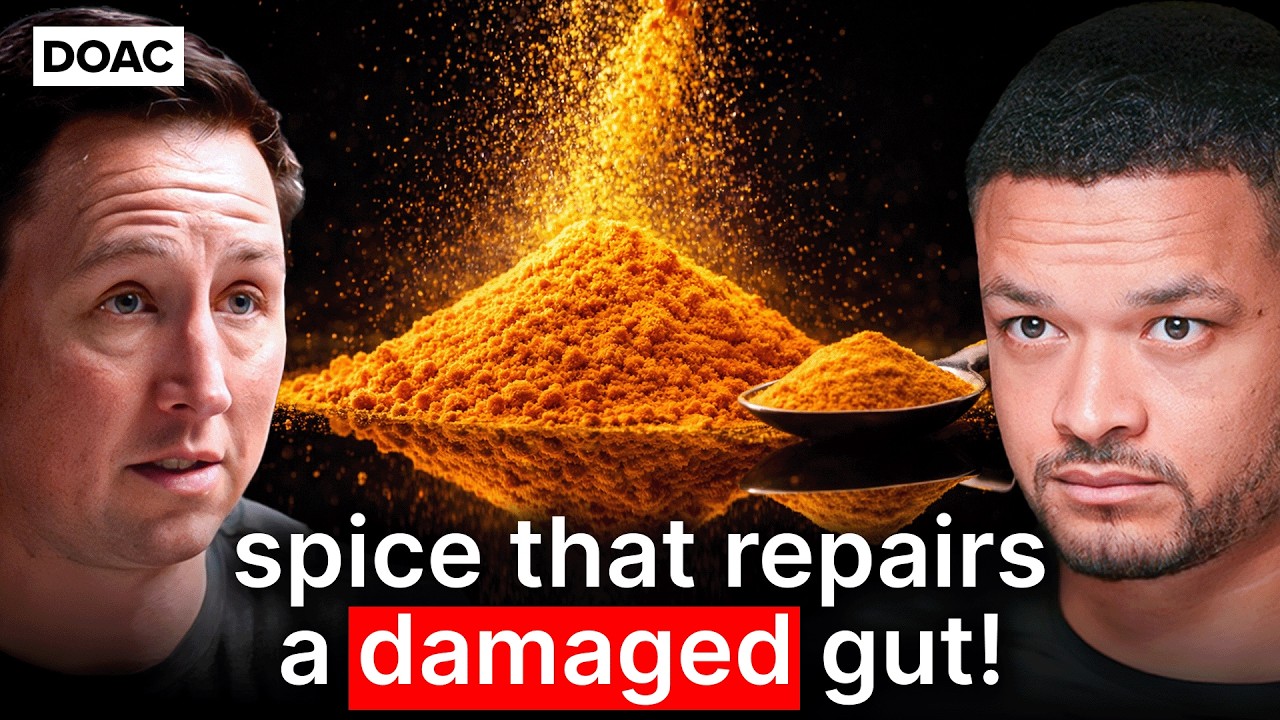
[01:07:11](https://www.youtube.com/watch?v=5Tr7AhkOEj4&t=4031s) The Truth About Turmeric, Curcumin, and Polyphenols
Returning to the table display, Steven points out a bright orange spice: turmeric. Addressing the massive hype around its anti-inflammatory claims, Dr. Bulsiewicz confirms that turmeric genuinely helps lower inflammation, but cautions that people must be strategic rather than overdoing high-dose supplements. Turmeric works mechanically by blocking specific inflammatory cytokines—essentially "pulling the batteries out" of the immune system's alarm network.
The active chemical compound within the turmeric root is curcumin, which belongs to a broader class of plant compounds called polyphenols. Polyphenols give plant foods their vivid colors—such as quercetin found in onions and garlic, which is widely praised for longevity. Crucially, Dr. Bulsiewicz notes that approximately 95% of polyphenols cannot be utilized by the human body on their own; they strictly require processing by gut microbes to become biologically active.
- **Curcumin vs. Turmeric:** Turmeric is the whole root, while curcumin is the active phytochemical compound.
- **Microbiome Activation:** Roughly 95% of polyphenols depend on gut bacteria to be converted into active, health-promoting forms.
- **Supplement Caution:** Daily dietary use or moderate targeted supplementation helps chronic inflammation, but excessive intake from megadose supplements can backfire.
[01:09:10](https://www.youtube.com/watch?v=5Tr7AhkOEj4&t=4150s) The Ultimate 24-Hour Circadian Gut Routine: Waking Up & Hydration
Dr. Bulsiewicz outlines a complete, step-by-step master plan for a "perfect gut day" based on the body's natural 24-hour circadian rhythm. Because humans evolved alongside the sun, roughly 50% of our genes and over 50% of our gut microbes turn on or off at specific times of day, rising and falling in anticipation of routine events. Because the microbiome thrives on predictable consistency, establishing a fixed wake-up time lays the foundation for optimal metabolic and digestive health.
Assuming a consistent 7:00 AM wake-up time, the very first action at 7:05 AM should be waker-upper hydration—not immediate caffeine. Drinking water immediately signals to the gut, brain, and kidneys that the day has begun. Dr. Bulsiewicz recommends stirring a prebiotic fiber supplement (such as his company's blend, 38 Terra) directly into the morning water to feed hungry gut microbes right as they wake up, while holding off on coffee until slightly later.
[01:12:01](https://www.youtube.com/watch?v=5Tr7AhkOEj4&t=4321s) Morning Light, Exercise, and the Cortisol Peak
At 7:15 AM, it is time to throw the master biological switch to signal to the body that a new day has officially started. Dr. Bulsiewicz highlights morning light exposure as the single most powerful circadian lever available. When natural sunlight enters the eye, it hits the retina and travels along the optic nerve directly to the suprachiasmatic nucleus (SCN)—the brain's master clock situated right above the optic chiasm.
Using a school bell analogy, Dr. Bulsiewicz explains that while individual organs and gut microbes keep their own local "watches," the SCN acts as the central school bell that synchronizes every system in the body. Light hitting the SCN triggers a natural surge in cortisol—the primary morning hormone responsible for alertness, mental focus, suppressing excess background inflammation, and mobilizing cellular energy.
To maximize this effect, pairing morning light with 20 minutes of light physical movement creates a powerful compounding boost:
- **Morning Sunlight:** Getting outside into bright light increases the natural morning cortisol peak by **50%**.
- **Light Exercise:** Adding light activity—such as a brisk walk (optionally with a weighted rucking vest in summer) or indoor bodyweight exercises like squats, lunges, push-ups, or yoga—boosts the cortisol peak by an additional **25% to 50%**.
- **Winter Alternatives:** On dark or cold January mornings, a 10,000 lux light therapy box serves as a full substitute for natural sunlight.
- **Practical Tip:** Remove eyeglasses or sunglasses during outdoor light exposure (without staring directly at the sun) so light reaches the retina unhindered.
[01:15:59](https://www.youtube.com/watch?v=5Tr7AhkOEj4&t=4559s) Parasympathetic Quiet Time and Morning Coffee
By 7:35 AM, after finishing 20 minutes of light movement and light exposure, it is time to transition indoors for morning coffee and intentional quiet time. Modern life keeps people trapped in a constant state of sympathetic nervous system activation—the "accelerator" that drives fight-or-flight stress. To balance this, Dr. Bulsiewicz emphasizes scheduling 10 minutes of deliberate parasympathetic activation—the body's "brake" responsible for rest, digestion, and recovery. Pairing coffee with low-stress activities like meditation, breathwork, journaling, or reading calms the nervous system before diving into work.
[01:17:15](https://www.youtube.com/watch?v=5Tr7AhkOEj4&t=4635s) Building the Optimal Gut Breakfast
By 7:45 AM, the body reaches its metabolic peak and is ready for breakfast, which also serves as the ideal window for taking daily supplements. Human metabolism is naturally strongest in the morning due to circadian rhythm alignment. Eating the exact same meal at 7:45 AM versus 3:00 PM yields vastly superior blood sugar and blood fat control in the morning, making an early meal strategy far healthier for long-term metabolic health.
When designing the meal, Dr. Bulsiewicz advocates for a high-fiber, moderate-protein, low-to-no-sugar approach, completely avoiding refined carbohydrates like white flour and added sugars:
- **Foods to Avoid:** Baked pastries, croissants, sugary cereals, and refined flour products.
- **Ideal Breakfast Options:** Avocado toast on authentic sourdough bread, minimally processed organic whole-grain oats (avoiding instant oats due to glyphosate and processing concerns), overnight oats, or chia seed pudding.
- **Satiety & Gut Support:** The combination of fiber and protein delivers maximum satiation while feeding the microbiome and protecting blood sugar stability.
[01:19:27](https://www.youtube.com/watch?v=5Tr7AhkOEj4&t=4767s) Modeling Healthy Habits for Children
When Steven asks how parents should navigate breakfast choices for kids—recalling how he grew up drinking orange juice without realizing it was essentially "sugar water"—Dr. Bulsiewicz emphasizes that parental modeling is the ultimate deciding factor. Parents cannot expect children to adopt healthy eating habits if they do not visibly consume whole, nutrient-dense foods themselves.
For his own four children, Dr. Bulsiewicz focuses on delicious, gut-friendly options like sourdough avocado toast, whole-milk yogurt topped with fresh berries, nuts, overnight oats, or chia pudding. This naturally segues into a broader conversation regarding how early childhood dietary decisions exert a lifelong, permanent influence on a child's gut microbiome and immune development.
[01:20:40](https://www.youtube.com/watch?v=5Tr7AhkOEj4&t=4840s) Early Microbiome Development and the Roots of Immunity
Dr. Will Bulsiewicz explains that the foundation of our gut and immune health is established long before adulthood—it begins in utero and critical development occurs within the first three years of life. Research shows a clear connection between a mother's gut microbiome during pregnancy and her child's health trajectory. For instance, analyzing maternal stool patterns during pregnancy reveals markers associated with whether a child will later develop allergic conditions. Furthermore, when pregnant mothers increase their dietary fiber intake, their children have a reduced likelihood of developing allergic diseases down the line.
The trajectory of a child's microbiome is heavily influenced by birth method, early nutrition, and medication. Interventions like cesarean section delivery, formula feeding, and early antibiotic use significantly impact gut flora development. Dr. Bulsiewicz notes that all of his own children were born via C-section, acknowledging that while it is often medically necessary, bypassing the birth canal deprives the newborn of exposure to the mother's vaginal and gut microbes. Similarly, breastfeeding transfers beneficial skin microbes and crucial prebiotics known as human milk oligosaccharides (HMOs). Over 200 varieties of HMOs exist in human breast milk; while they offer zero direct nutritional value to the infant, they evolved specifically as prebiotics to nourish the baby's developing gut microbiome. Formula contains, at best, a single synthesized "mono-fiber," which cannot mimic this diversity.
When these early microbial exposures are disrupted, the downstream consequences manifest over the first five years of life as an increased risk for allergic, autoimmune, and metabolic diseases. Dr. Bulsiewicz highlights a key Finnish study tracking roughly 1,100 children over five years. Researchers collected stool specimens at 3 and 12 months of age, monitoring for allergic conditions such as eczema, food allergies, asthma, and allergic rhinitis. By analyzing the 12-month gut samples—well before symptoms actually appeared—scientists could predict which children would develop allergic diseases by age five. The defining signature of a vulnerable gut was a lack of short-chain fatty acid (SCFA)-producing bacteria and lower levels of butyrate, proving that early microbial imbalance directly sets the stage for an overreactive, confused immune system.
* **Critical Window:** The first 3 years of life are pivotal for establishing the gut microbiome and training the immune system.
* **Prenatal Fiber Impact:** Higher maternal fiber intake during pregnancy lowers allergic disease risk in children.
* **Key Early Interventions:** C-sections, formula feeding (lack of HMOs), and early antibiotic exposure double or raise risks for allergic, autoimmune, and metabolic disorders.
* **Finnish Study Findings:** Low levels of SCFA-producing bacteria and low butyrate at 12 months accurately predicted allergic disease onset by age 5.
---
[01:25:09](https://www.youtube.com/watch?v=5Tr7AhkOEj4&t=5109s) The Perfect Gut Day: Morning Supplements and Movement Routine
Returning to his step-by-step blueprint for an optimal "gut day," Dr. Bulsiewicz picks up at 7:45 AM. After eating a high-fiber, moderate-protein, low-sugar breakfast, this is the ideal time to take targeted morning supplements. He recommends evidence-based supplements aimed at taming inflammation: vitamin D, omega-3 fatty acids, and turmeric. However, he stresses that testing blood levels for vitamin D and omega-3s is essential so individuals only supplement what they actually lack. Supplements should be taken consistently at the exact same time every morning to align with circadian rhythms, as both human physiology and gut microbes thrive on predictability.
By 8:00 AM—roughly an hour after waking—the combination of morning light exposure, physical activity, hydration, coffee, and breakfast triggers a natural, healthy bowel movement. Dr. Bulsiewicz describes this daily event as the ultimate physical manifestation of a well-regulated gut. Having a predictable, high-quality bowel movement confirms that the digestive tract is in a synchronized rhythm before heading off to start the workday.
* **Morning Supplement Stack (7:45 AM):** Vitamin D, omega-3s, and turmeric to target systemic inflammation.
* **Circadian Consistency:** Taking supplements at the exact same time daily supports microbial and bodily rhythms.
* **Optimal Bowel Movement (8:00 AM):** Driven by morning light, exercise, coffee, and a high-fiber breakfast, signaling proper gut function.
---
[01:27:11](https://www.youtube.com/watch?v=5Tr7AhkOEj4&t=5231s) Lunchtime Socializing and the Epidemic of Loneliness
Moving to 12:00 PM, Dr. Bulsiewicz strongly advocates taking at least 45 minutes for lunch and sharing the meal in person with another human being. He warns against the modern habit of sitting alone, flipping through social media, and eating mindlessly. Pre-pandemic data showed that over 50% of Americans identified as lonely, a figure that has only worsened since. From an evolutionary perspective, humans spent millions of years in hunter-gatherer tribes where personal relationships were the true currency of survival and wealth. Lacking social connection triggers a physiological state of vulnerability and chronic stress.
Steven Bartlett asks how social isolation directly impacts gut health and inflammation. Dr. Bulsiewicz clarifies that loneliness triggers a continuous cortisol and stress response through the brain-gut connection. Feeling disconnected keeps the body on high alert—similar to an isolated tribe member who cannot sleep deeply due to environmental danger—which directly degrades sleep quality, elevates systemic inflammation, and alters the microbiome. He points out that chronic loneliness has been shown to impair longevity as severely as smoking cigarettes daily. As a striking example of our deep-seated evolutionary need to bond, he references Stockholm Syndrome, where hostages compulsively bond with their captors as a primitive psychological defense mechanism against solitary helplessness.
* **Lunch Protocol (12:00 PM):** Spend 45 minutes having lunch in person with a companion rather than scrolling on a phone.
* **Health Risk of Loneliness:** Chronic social disconnection raises cortisol and inflammation, impacting longevity as severely as daily cigarette smoking.
* **Evolutionary Context:** Human psychology and gut-brain signaling are wired for small, close-knit tribal bonding; isolation puts the nervous system in a state of hyper-vigilant stress.
---
[01:31:08](https://www.youtube.com/watch?v=5Tr7AhkOEj4&t=5468s) Post-Lunch Movement and Afternoon Polyphenols
Immediately following lunch, around 12:45 PM or 1:00 PM, Dr. Bulsiewicz advises taking a 10- to 15-minute outdoor walk. Midday sunlight exposes the body to different wavelengths than early morning light, which helps boost serotonin production later in the day. This serotonin elevation enhances mood, focus, and overall mental performance for the remainder of the afternoon while reinforcing circadian signaling.
In addition to mental benefits, a short post-meal walk produces immediate metabolic and digestive gains. Activating the major leg muscles during a brief 10-minute walk improves blood sugar control by 30% to 40% by pulling glucose directly out of the bloodstream. Physical movement also stimulates gut motility, aiding digestion and reducing post-meal bloating. Upon returning to work at 1:00 PM, Dr. Bulsiewicz drinks matcha green tea. Among all tea varieties, matcha boasts the highest concentration of polyphenols, providing a powerful antioxidant boost for the microbiome and sustained afternoon energy.
* **Post-Lunch Walk (12:45 PM):** A 10- to 15-minute walk outside boosts afternoon serotonin and reinforces circadian rhythms.
* **Blood Sugar Control:** Simple leg muscle engagement during a short walk reduces post-meal glucose spikes by 30%–40%.
* **Matcha Green Tea (1:00 PM):** Offers the highest polyphenol content of any tea, nourishing gut microbes while sustaining focus.
---
[01:33:06](https://www.youtube.com/watch?v=5Tr7AhkOEj4&t=5586s) Exercise Timing, Meal Spacing, and the Migrating Motor Complex
Shifting to 4:00 PM, Dr. Bulsiewicz addresses the biological sweet spot for exercise performance. Human core body temperature naturally peaks between 3:00 PM and 6:00 PM, making this three-hour window optimal for peak physical exertion and heavy lifting. Steven confesses to feeling "attacked" by a passage in Dr. Bulsiewicz's book cautioning against late-night workouts, revealing that he often trains late at night between 11:00 PM and midnight. Dr. Bulsiewicz warns that high-intensity exercise late in the evening overstimulates the sympathetic nervous system, spiking core temperature and ruining sleep quality. Vigorous workouts should be completed at least two hours before bedtime.
Following a 4:00 PM workout, 5:00 PM marks the ideal time for dinner. Dr. Bulsiewicz highlights the deliberate 4-hour spacing between his primary meals (breakfast at 8:00 AM, lunch at 12:00 PM, and dinner at 5:00 PM). This structured gap allows the gut to engage the migrating motor complex (MMC)—a specialized internal cleansing wave where the digestive tract sweeps away debris, bacteria, and undigested food between meals. Constantly snacking or eating without adequate gaps interrupts the MMC, disrupting digestive rhythm and contributing to gut discomfort.
As the day transitions into evening around 7:00 PM, the focus shifts toward wind-down habits. Once the sun goes down, dimming indoor lighting and reducing exposure to bright artificial screens allows natural melatonin production to initiate, signaling to both the brain and the gut microbiome that it is time to prepare for restorative sleep.
* **Peak Exercise Window:** Core body temperature peaks between 3:00 PM and 6:00 PM, making it the ideal time for heavy strength or performance workouts.
* **Evening Exercise Warning:** Vigorous training within 2 hours of sleep over-activates the sympathetic nervous system and disrupts sleep architecture.
* **Meal Spacing & MMC:** Leaving a 4-hour gap between meals enables the migrating motor complex (MMC) to perform its essential sweeping and reorganization duties in the digestive tract.
* **Evening Lighting (7:00 PM):** Dimming house lights at sunset supports melatonin release and maintains circadian alignment.
[01:36:05](https://www.youtube.com/watch?v=5Tr7AhkOEj4&t=5765s) Light Exposure, Evening Routines, and Optimizing Sleep
Dr. Will Bulsiewicz explains that light exposure—even casual indoor lighting within your home—can cut your melatonin production down by 30%. Melatonin is the body's primary "sleepy time hormone," balancing out morning cortisol. Interestingly, the morning habits designed to enhance cortisol and energy (like morning sunlight and exercise) also boost serotonin, the neurotransmitter responsible for mood and focus. Because serotonin is the direct biological precursor to melatonin, investing in morning light and physical movement essentially sets you up for optimal sleep 14 hours later.
To protect evening melatonin production, Dr. Bulsiewicz advises dimming lights at home as night falls. If your target bedtime is 10:00 PM, you should start dialing back screen time or wearing blue light-blocking glasses by 8:00 PM. Around 8:30 PM to 9:00 PM, take evening supplements such as zinc and magnesium (or melatonin/sleep aids if needed), allowing the 60 to 90 minutes required for them to take effect. By 9:00 PM, activate a relaxing evening ritual that mirrors your morning quiet time to intentionally stimulate the parasympathetic nervous system. Taking a hot shower or sitting in a sauna around 9:30 PM actively lowers your inner core body temperature, which signals to the brain that it is time to sleep in a cool, dark room.
While 10:00 PM is a solid baseline bedtime, Dr. Bulsiewicz emphasizes that the exact hour matters far less than absolute consistency. Whether your chosen schedule is 10:00 PM, 10:30 PM, or 11:00 PM, adhering strictly to the same time every single night locks in your circadian rhythm.
- Indoor evening ambient lighting can suppress melatonin levels by up to 30%.
- Serotonin acts as the direct biochemical precursor to melatonin.
- Recommended evening supplement timing: 8:30 PM–9:00 PM (zinc, magnesium, optional melatonin).
- Hot showers or saunas before bed drop core body temperature to facilitate sleep onset.
---
[01:39:10](https://www.youtube.com/watch?v=5Tr7AhkOEj4&t=5950s) The Truth About Time-Restricted Eating and Fasting
Addressing the mechanics of intermittent fasting and time-restricted eating, Dr. Bulsiewicz outlines how a schedule finishing dinner at 6:00 PM and eating breakfast at 8:00 AM naturally creates a healthy 14-hour fasting window. While specific window lengths are often debated, late-night eating is an absolute "non-negotiable" health hazard. Eating late impacts the body differently metabolically, disrupts sleep architecture, and leaves a sluggish metabolic hangover that lingers well into the next day. When people complain of late-night hunger, it is often because they skipped breakfast earlier in the day, throwing off their appetite regulation.
Time-restricted eating offers two distinct advantages for human health. First, any fast lasting longer than 12 hours gives the gut a crucial period of rest to repair its lining and maintain microbiome balance. Second, time-restricted eating enforces structure and mealtime consistency—the single most important factor in circadian health. Dr. Bulsiewicz candidly admits that he is imperfect and does not always follow his own ideal morning meal advice on busy workdays, often jumping straight from coffee into work. However, when he does eat a balanced breakfast (especially on weekends), he notices stabilized energy and significantly lower hunger later in the day.
- Any fasting window over 12 hours provides essential gut rest and gut lining recovery.
- Late-night eating causes metabolic disruption that degrades sleep quality and lingers into the following day.
- Skipping breakfast frequently triggers late-night overeating and night hunger.
- The overarching key to circadian and digestive health is consistency in daily meal timing.
---
[01:44:05](https://www.youtube.com/watch?v=5Tr7AhkOEj4&t=6245s) How Trauma Restructures the Brain and Destroys the Gut
The conversation shifts to the profound physiological link between emotional trauma and gut dysfunction. Modern life frequently keeps people in continuous "sympathetic overdrive"—a chronic fight-or-flight state where heart rate and blood pressure remain elevated, and focus is artificially sharp because the body feels constantly threatened. When the sympathetic nervous system stays dominant, the body intentionally sacrifices gut function, blood flow to the digestive tract, and mucosal repair. Counteracting this requires deliberate parasympathetic activation through activities like slow conversations, holding hands, hugs, prayer, journaling, meditation, and saunas.
Dr. Bulsiewicz highlights the concept that "the body keeps the score," noting that early childhood trauma—even before age two, long before conscious memory forms—physically restructures brain function and manifests as chronic illness later in adult life. Trauma hyperactivates the amygdala, keeping the brain's alarm system permanently turned on. In response, the brain releases corticotropin-releasing hormone (CRH), triggering a continuous trickle of cortisol long past its natural morning peak. When cortisol remains elevated late into the evening and night, it directly dismantles the gut barrier, triggers intestinal permeability ("leaky gut"), and sparks systemic inflammation.
- Chronic sympathetic state sacrifices gastrointestinal blood flow, motility, and mucosal repair.
- Trauma occurring before age two can physically alter brain wiring and lead to adult autoimmune or gut disorders.
- Hyperactivation of the amygdala causes persistent release of corticotropin-releasing hormone (CRH).
- Evening elevation of cortisol damages the gut barrier lining and drives systemic body-wide inflammation.
---
[01:49:22](https://www.youtube.com/watch?v=5Tr7AhkOEj4&t=6562s) Healing Trauma-Related Gut Issues & The Bristol Stool Chart
For patients whose chronic gut issues stem from unresolved psychological trauma, healing cannot begin by treating the digestive tract in isolation. Dr. Bulsiewicz explains that step one is explicit acknowledgment: recognizing that the buried trauma is the true root cause of the physical symptoms. Because natural human impulse leads people to shove past trauma into a corner and pretend it does not exist, genuine recovery requires turning toward it with professional help, using modalities like cognitive behavioral therapy (CBT).
Transitioning to practical tools for auditing daily digestive health, Steven Bartlett brings out physical props of the Bristol Stool Chart—a clinical classification scale used to evaluate stool shape, consistency, and overall gut transit time.
- True recovery from trauma-induced gut disease requires mental acknowledgment and professional therapy (e.g., CBT).
- Physical symptoms cannot be fully resolved until the underlying nervous system threat state is addressed.
- The Bristol Stool Chart serves as the clinical standard for assessing transit time, hydration, and overall gut function.
Here is a detailed, faithful walkthrough of the transcript segment.
---
[01:50:52](https://www.youtube.com/watch?v=5Tr7AhkOEj4&t=6652s) Decoding Stool Types with the Bristol Stool Chart
The conversation opens with a visual comparison of stool models, leading Steven Bartlett and Dr. Will Bulsiewicz to examine what defines a healthy bowel movement. Dr. Bulsiewicz points to a chocolate bar prop on the desk as an example of a "glorious Bristol 4." He explains that the Bristol Stool Scale categorizes human feces into seven distinct types, easily identifiable by taking a look into the toilet bowl before flushing. While society has conditioned people not to look, Dr. Bulsiewicz emphasizes that around 60% of stool weight is composed of the gut microbiome itself—meaning that looking in the toilet bowl provides a direct, visual report on one's internal ecosystem.
Dr. Bulsiewicz traces the history of the scale back to the early 1990s in Bristol, UK, where researchers conducted a 2,000-person study to categorize bowel habits. Under this scale:
* **Type 4** is the ideal, normal stool: soft and formed like a sausage.
* **Type 3** is slightly lumpy but considered normal by many.
* **Types 1 and 2** represent varying degrees of constipation.
* **Types 6 and 7** represent diarrhea.
To build upon this historical research, ZOE conducted the world's largest bowel habit survey, collecting data from 140,000 participants across the UK. Dr. Bulsiewicz notes that approximately 40% of the population actively struggles with bowel-related issues.
- **Microbiome Weight:** About 60% of the dry weight of human stool consists of gut microbes.
- **Bristol 1 & 2 (Severe Constipation):** Appears as hard, separate lumps or rabbit pellets; often caused by a lack of dietary fiber or insufficient hydration/softening mechanisms.
- **Bristol 7 (Severe Diarrhea):** Liquid stool with no solid pieces, signaling significant gut distress or potential "overflow" diarrhea behind a severe constipation blockage.
---
[01:53:21](https://www.youtube.com/watch?v=5Tr7AhkOEj4&t=6801s) Magnesium Strategies for Constipation and Sleep
When Steven asks how to address severe pellet-like stool, Dr. Bulsiewicz explains that simply dumping more fiber into a compromised system isn't always the answer. Fiber nutrition is far more nuanced than social media suggests, and increasing fiber without adequate stool-softening mechanics can exacerbate discomfort. To achieve a soft, well-formed bowel movement, pairing fiber with the correct form of magnesium supplement is highly effective because magnesium acts as an osmotic agent, drawing water directly into the bowel.
Dr. Bulsiewicz outlines how different forms of magnesium target specific physiological needs:
* **Magnesium Glycinate:** Ideal for relaxation, stress reduction, and nighttime sleep support, but entirely ineffective for treating constipation.
* **Magnesium Oxide, Sulfate, & Citrate:** The target formulations for resolving constipation, as they draw water into the intestinal tract to soften hard stool.
---
[01:54:51](https://www.youtube.com/watch?v=5Tr7AhkOEj4&t=6891s) The Four Pillars of Gut Health: Fiber, Polyphenols, Healthy Fats, and Fermented Foods
Addressing his book, *Plant Powered Plus*, Dr. Bulsiewicz stresses that readers should not feel intimidated by the title. Healing does not require a rigid, 100% plant-based diet or a dogmatic "one-size-fits-all" framework. Rather, long-term health depends on finding a sustainable dietary pattern—whether Mediterranean, pescatarian, or flexitarian—that consistently delivers four core nutritional elements currently missing from modern diets:
1. **Fiber:** Over 95% of Americans are chronically deficient in dietary fiber.
2. **Polyphenols:** Micronutrients found in colorful fruits, vegetables, and spices; most people fail to consume the recommended daily servings.
3. **Healthy Fats:** Whole-food monounsaturated fats and omega-3s found in avocados, nuts, seeds, and fatty fish like salmon. While extra virgin olive oil is beneficial, Dr. Bulsiewicz warns that all pure oils are the most calorie-dense foods on Earth; individuals struggling with obesity should limit added oils and favor whole-food fat sources.
4. **Fermented Foods:** Live-culture foods such as pickles, sauerkraut, and yogurt. The average consumption of fermented foods in the U.S. is practically zero.
Dr. Bulsiewicz cites a landmark Stanford University study conducted by Dr. Christopher Gardner and Drs. Justin and Erica Sonnenburg. The trial demonstrated that adding targeted servings of fermented foods to participant diets over just eight weeks significantly increased gut microbiome diversity and reduced systemic inflammatory markers.
"If you think about your diet, this shouldn't be an exercise in more of the thing that you already have. This should be an exercise of what is the thing that's missing that we could add that could transform our health?"
---
[01:58:45](https://www.youtube.com/watch?v=5Tr7AhkOEj4&t=7125s) Dr. Will's Personal Transformation and Emotional Healing
Steven displays a side-by-side photo comparison of Dr. Bulsiewicz: one from his early 30s during his medical training, and another from age 40 where he appears visibly younger, leaner, and fit. Asked what drove this dramatic ten-year transformation, Dr. Bulsiewicz notes that while shifting away from the junk food of his youth and establishing a consistent workout routine were vital, the most critical element was internal emotional healing.
During his residency years—despite graduating from Georgetown, serving as chief medical resident at Northwestern, and winning top academic awards—he was in a deeply dark and sad place internally. A core driver of this emotional pain was a decade-long estrangement from his father following his parents' difficult divorce when he was seven years old.
The trajectory of his life shifted through two pivotal events:
* **Meeting his wife in 2012:** Her supportive presence encouraged him to transform his lifestyle and inspired him to pick up the phone to call his father after 10 years of silence.
* **The birth of his daughter:** Holding his firstborn child provided an immediate sense of unconditional love and purpose, allowing him to understand the deep love his father had held for him all along—including childhood memories of his dad taking three young boys camping alone.
---
[02:04:49](https://www.youtube.com/watch?v=5Tr7AhkOEj4&t=7489s) A Loving Tribute to His Late Father
Steven asks Dr. Bulsiewicz to read the dedication printed in the front of his 2020 bestseller, *Fiber Fueled*. In an emotional moment, Dr. Bulsiewicz reads aloud the tribute he wrote following his father's sudden and unexpected death during the book's preparation:
> "I lost my dad during the preparation of this book. It was sudden and completely unexpected. I couldn't wait to share this book with him... Over the past few months, my dad repeatedly told me how proud he was of me... I am who I am because of him. But I will forever be grateful for the special times that we shared. Love you, Dad. We'll always be thinking of you. This book is for you."
Reflecting on the reading, Steven commends Dr. Bulsiewicz's wife for facilitating their reconciliation before his father passed. Dr. Bulsiewicz concludes by emphasizing that true human healing comes in many forms—not only through dietary adjustments and gut restoration, but through repairing fractured relationships and letting go of long-standing grudges before time runs out.
[02:07:05](https://www.youtube.com/watch?v=5Tr7AhkOEj4&t=7625s) The Mind-Gut Connection and Unlocking Health
The conversation touches on the profound, bidirectional linkage between self-acceptance, emotional resolution, and overall physical health. When an individual achieves emotional clarity and resolves inner conflict with themselves and others, they often find it drastically easier to gain control over their diet and lifestyle habits, causing every piece of their health puzzle to finally click into place.
Steven Bartlett strongly recommends Dr. Will Bulsiewicz's upcoming book, *Plant Powered Plus*, emphasizing its accessibility, depth, and up-to-date scientific insights. Reflecting on his own personal health journey, Steven notes that learning about the gut microbiome, bowel health, and immune connections acts like "turning on the lights." Conversing with top experts provides essential missing pieces to his personal health jigsaw puzzle, leading to radical lifestyle shifts that have yielded immediate, tangible improvements in his day-to-day well-being.
- **Book Release Dates:** *Plant Powered Plus* releases on Tuesday, January 13th in the US and Thursday, January 15th in the UK.
- **Audience Polling:** Prior to the interview, 61% to 70% of Steven's audience reported actively struggling with gut-related issues.
- **Dr. Will's Platforms:** Viewers can connect with Dr. Will Bulsiewicz via his website (`theguthealthmd.com`), his social handle `@theguthealthmd`, his YouTube channel (*The Gut Health MD*), and his free Substack-style newsletter featuring direct updates on emerging studies.
---
[02:09:22](https://www.youtube.com/watch?v=5Tr7AhkOEj4&t=7762s) Confronting Life's Greatest Regret and Finding Peace
In keeping with *The Diary Of A CEO* tradition, Steven poses a question left by the previous guest: "What is one thing you could do today to help rectify your life's biggest regret?" Dr. Will reflects on this emotional question with a sense of hope and optimism, sharing how reconnecting with his father before his sudden passing was a critical step in healing past wounds.
Though his father died abruptly without a final goodbye, Dr. Will explains how his faith offers grounded comfort rather than mere wishful thinking. He firmly believes that he will one day have the opportunity to convey the unspoken words he holds in his heart. Steven gently asks what Dr. Will would say to his father if given the chance. In a poignant, emotional close, Dr. Will shares that he would apologize for taking so long to recognize what a great father he was, noting how becoming a parent himself allowed him to look past his parents' divorce and appreciate his father's profound love and devotion.
- **On Family and Perspective:** Dr. Will acknowledges that adult conflict during a divorce often clouds a child's perception, but having his own children illuminated just how phenomenal his father truly was.
- **Final Farewell:** "I hate the fact that it took me so long to figure out that he was a great dad."
## Notable quotes
> [02:20](https://www.youtube.com/watch?v=5Tr7AhkOEj4&t=140s) If there's a war occurring, of course there's decimation and damage that occurs and it's brutal. And the problem is that if we're activating the immune system... the decimation and destruction that's occurring is within your own tissues, within your own organs. — Dr. Will Bulsiewicz
> [43:04](https://www.youtube.com/watch?v=5Tr7AhkOEj4&t=2584s) By the next day she was a normal human being. She was laying in bed. She was able to have a conversation. And after 2 days she was so normal that we were able to send her home. — Dr. Will Bulsiewicz
> [01:54:51](https://www.youtube.com/watch?v=5Tr7AhkOEj4&t=6891s) If you think about your diet, this shouldn't be an exercise in more of the thing that you already have. This should be an exercise of what is the thing that's missing that we could add that could transform our health? — Dr. Will Bulsiewicz
> [02:04:49](https://www.youtube.com/watch?v=5Tr7AhkOEj4&t=7489s) I lost my dad during the preparation of this book. It was sudden and completely unexpected. I couldn't wait to share this book with him... Over the past few months, my dad repeatedly told me how proud he was of me... I am who I am because of him. But I will forever be grateful for the special times that we shared. Love you, Dad. We'll always be thinking of you. This book is for you. — Dr. Will Bulsiewicz
> [02:09:22](https://www.youtube.com/watch?v=5Tr7AhkOEj4&t=7762s) I hate the fact that it took me so long to figure out that he was a great dad. — Dr. Will Bulsiewicz
## Mentioned
Dr. Will Bulsiewicz, Steven Bartlett, The Diary Of A CEO, ZOE, The Gut & Microbiome Center for Excellence, Fibre Fuelled, Plant Powered Plus, Clostridioides difficile, PD-1 receptor, Gastroenterology, 38 Terra, Stan, Adobe Express, TikTok, Bristol Stool Chart, Stanford University, Dr. Christopher Gardner, Dr. Justin Sonnenburg, Dr. Erica Sonnenburg, Georgetown, Northwestern
Will Bulsiewicz 博士探讨粪菌移植与免疫、癌症及大脑健康的关联
抗生素、不良饮食和压力导致的肠道菌群退化会引发慢性全身性炎症与疾病,需要通过膳食纤维、发酵食品和针对性疗法来恢复肠道屏障功能。
胃肠病学家 Will Bulsiewicz 博士深入阐释了肠道菌群、慢性炎症与身心整体健康之间的深层联系。他探讨了腹胀和便秘等常见消化问题,同时澄清了流行的盲目饮食风潮与对麸质的误解。讨论概述了改善肠道健康的实用日常方案——重点关注膳食纤维、多酚、发酵食品、昼夜节律调节以及压力管理——同时重点介绍了粪菌移植(FMT)等治疗手段。Bulsiewicz 博士还分享了个人经历,阐明化解心理创伤与情绪冲突对身体康复至关重要。
超过60%的人长期受胀气与消化不适困扰,肠漏症会导致肠壁通透性增加,使细菌碎片和毒素渗入血液,诱发全身性低度慢性炎症并损害自体组织与器官。 (6:59)
许多人误以为的“麸质不耐受”往往并非源于麸质蛋白,而是对小麦中的果聚糖(fructans)不耐受,或是非有机小麦在收割前喷洒草甘膦破坏肠道微生态所致。 (32:04)
便秘的临床定义是不完全排便(残余粪便)而非单纯的排便天数,长期残留的粪便会导致“肠道拥堵”,使肠道细菌有充裕时间过度发酵并产生持续性胀气。 (23:24)
粪菌移植(FMT)能一次性重建健康的微生物多样性,不仅可快速治愈致命的艰难梭菌感染,还能使黑色素瘤患者对免疫检查点抑制剂的治疗成功率提高一倍。 (16:05)
Reading summary
Gastroenterologist Dr. Will Bulsiewicz contends that systemic chronic inflammation, metabolic disorders, and neurodegenerative decline largely stem from gut barrier disruption and microbial imbalance, which require circadian, nutritional, and emotional interventions rather than quick-fix procedures.
The Gut Barrier and Systemic Disease (6:59)
The human digestive tract houses approximately 38 trillion microorganisms situated above a fragile, single-cell epithelial layer spanning 20 to 25 feet. When dietary and environmental stressors compromise this barrier—a condition medically termed increased intestinal permeability, or "leaky gut"—bacterial components like lipopolysaccharides (LPS) enter circulation. This triggers a continuous immune cascade that diverts resources away from critical baseline maintenance, such as patrolling the estimated 3.8 million new cells produced every second for cancerous mutations.
Dr. Bulsiewicz notes that systemic pathologies often originate in the digestive tract before manifesting elsewhere. In Parkinson's disease, chronic constipation consistently precedes motor symptoms by years, while clinical trials show fecal transplants can yield sustained motor and digestive improvements. Similarly, Inflammatory Bowel Disease (IBD) occurs when the immune system mistakenly attacks commensal gut microbes rather than host tissues, causing severe collateral inflammation and mucosal ulceration.
Root Causes of Digestive Distress and Intolerances (23:24)
Millions of individuals suffer from hidden constipation defined by incomplete bowel evacuation ("partial poops") rather than low frequency, leaving residual stool to ferment and generate continuous gas and bloating. Dr. Bulsiewicz outlines three primary mechanisms behind digestive distress: sluggish intestinal motility, depleted microbial enzyme capacity (microbes carry roughly 60,000 digestive enzymes humans lack), and the intake of highly fermentable substrates like lactose and fructans.
Many patients who believe they are gluten-intolerant are often reacting to fructans or industrial agricultural practices. In a blinded study published in Gastroenterology, self-identified gluten-sensitive participants experienced worse gastrointestinal symptoms from fructan-rich bars than from gluten-containing bars. Additionally, Dr. Bulsiewicz explains that non-organic wheat in the United States is routinely sprayed with glyphosate for desiccation before harvest. While human cells bypass the shikimate pathway targeted by glyphosate, resident gut bacteria cannot, leading to microbial damage that traditional fermentation, such as authentic sourdough preparation, helps circumvent.
Nutritional Pillars and Circadian Digestive Rhythms (51:41)
With an estimated 90% to 95% of individuals in the UK and US chronically deficient in dietary fiber, gut bacteria lack the substrates required to synthesize short-chain fatty acids (SCFAs). These compounds—acetate, propionate, and particularly butyrate—act as primary fuel for colonocytes, fortifying tight junctions and calming immune responses. Dr. Bulsiewicz's dietary model prioritizes four core elements: plant fiber diversity, fermented foods, healthy whole-food fats, and polyphenols. Notably, roughly 95% of dietary polyphenols require microbial metabolism to become biologically active compounds.
Digestive function also relies heavily on the body's 24-hour circadian clock, which governs over 50% of human genes and gut bacteria. Morning sunlight exposure directly stimulates the brain's suprachiasmatic nucleus, elevating the natural cortisol peak by 50%, while light exercise boosts it further. Furthermore, maintaining structured four-hour gaps between daytime meals allows the migrating motor complex (MMC) to clear debris and residual bacteria, while an overnight fasting window exceeding 12 hours facilitates epithelial rest and lining repair.
The Gut-Brain Axis, Trauma, and Clinical Interventions (104:05)
Digestive pathology is frequently mediated by chronic neurological stress. Prolonged sympathetic overdrive restricts blood flow to the digestive tract and suppresses mucosal regeneration. Dr. Bulsiewicz emphasizes that early psychological trauma keeps the amygdala hyperactive, prompting a sustained release of corticotropin-releasing hormone (CRH) and nocturnal cortisol that actively dismantles the gut lining. In such patients, physical gut restoration remains ineffective without psychological modalities such as cognitive behavioral therapy.
While advanced medical procedures like Fecal Microbiota Transplants (FMT) can rapidly restore a decimated microbiome in life-threatening Clostridioides difficile infections by reintroducing diverse microbial communities, Dr. Bulsiewicz warns that FMT is not a universal panacea. He strongly cautions against unscreened DIY at-home transplants, reiterating that long-term microbiome stability cannot be bypassed through shortcuts and requires sustained dietary and behavioral adherence.
While Dr. Bulsiewicz presents mechanistic and clinical evidence linking gut dysbiosis to systemic diseases, individual triggers vary across diet, circadian disruptions, and psychological trauma. He emphasizes that clinical procedures such as fecal transplants cannot replace consistent daily lifestyle modifications, leaving long-term recovery reliant on individualized, multi-system management.
[2:20] Dr. Will Bulsiewicz: If there's a war occurring, of course there's decimation and damage that occurs and it's brutal. And the problem is that if we're activating the immune system... the decimation and destruction that's occurring is within your own tissues, within your own organs.
[43:04] Dr. Will Bulsiewicz: By the next day she was a normal human being. She was laying in bed. She was able to have a conversation. And after 2 days she was so normal that we were able to send her home.
[114:51] Dr. Will Bulsiewicz: If you think about your diet, this shouldn't be an exercise in more of the thing that you already have. This should be an exercise of what is the thing that's missing that we could add that could transform our health?
[124:49] Dr. Will Bulsiewicz: I lost my dad during the preparation of this book. It was sudden and completely unexpected. I couldn't wait to share this book with him... Over the past few months, my dad repeatedly told me how proud he was of me... I am who I am because of him. But I will forever be grateful for the special times that we shared. Love you, Dad. We'll always be thinking of you. This book is for you.
[129:22] Dr. Will Bulsiewicz: I hate the fact that it took me so long to figure out that he was a great dad.
Original transcript
[0:00] What's a fecal transplant? You take a
[0:02] healthy person's poop and you transfer
[0:03] it into the person who's sick.
[0:06] For example, a patient of mine took an
[0:07] antibiotic which wipes out your gut,
[0:09] which became life-threatening. Our
[0:11] choices were to remove the colon or to
[0:13] give her a fecal transplant. And so, I
[0:14] delivered the fecal transplant to her.
[0:16] By the next day, the entire infectious
[0:19] issue got shut down. So, this is a great
[0:21] example to show how important our gut
[0:23] microbiome is because 60% of the weight
[0:26] of your stool is your microbiome.
[0:27] >> Really?
[0:28] >> Yes, but it's not getting enough
[0:29] attention and we need to talk about
[0:31] that.
[0:31] >> World-renowned gastroenterologist Dr.
[0:33] Will Bulsiewicz is back. This time he's
[0:36] sharing brand new information regarding
[0:38] the gut microbiome
[0:39] >> and how poo might actually be the key to
[0:42] your health.
[0:42] >> 60% of people that listen are currently
[0:44] struggling with some kind of gut
[0:46] problem.
[0:46] >> And it manifests in these subtle ways,
[0:48] like bloating, [music] increased
[0:49] fatigue, difficulty concentrating. You
[0:51] don't sleep well at night, skin issues.
[0:53] So, it flies under the radar, but
[0:55] ultimately leads to other health-related
[0:57] problems afterwards.
[0:58] >> So, I've got so many questions.
[0:59] >> Totally.
[1:00] >> What is the cause of bloating?
[1:01] >> So, constipation is the number one
[1:03] cause, but people who are bloated,
[1:05] please don't sip through straws, drink
[1:06] carbonated drinks, chew on gum because
[1:09] you just make it worse.
[1:10] >> Next, are there decisions that you make
[1:12] as a parent that will have a lasting
[1:14] impact on their kids' gut function?
[1:15] >> Yeah, by 3 years of age, you are
[1:17] basically fully adult-sized in terms of
[1:19] your microbiome. But, antibiotics,
[1:21] bottle-feeding, and birth by cesarean
[1:22] section are associated with an impact on
[1:24] the microbiome such as an increased risk
[1:26] of allergic, autoimmune, and metabolic
[1:28] diseases. And I'll explain why.
[1:30] >> And then, can I repair the gut?
[1:32] >> Yeah, 100%. In every 3 to 5 days, you
[1:34] build a new gut barrier. And so, I've
[1:36] identified four things missing in our
[1:38] diet as well as a daily routine that can
[1:40] optimize our microbiome. And when you do
[1:42] [music] these, you will thrive, and you
[1:43] will live longer, and you will have less
[1:44] disease. And I'm going to take you
[1:46] through all of these steps right now.
[1:49] >> I see messages all the time in the
[1:51] comment section that some of you didn't
[1:52] realize you didn't subscribe. So, if you
[1:54] could do me a favor and double-check if
[1:56] you're a subscriber to this channel.
[1:57] That would be tremendously appreciated.
[1:59] It's the simple, it's the free thing
[2:01] that anybody that watches this show
[2:02] frequently can do to help us here to
[2:04] keep everything going in this show in
[2:05] the trajectory it's on. So, please do
[2:07] double check if you subscribed and thank
[2:09] you so much because in a strange way you
[2:11] are you're part of our history and
[2:13] you're on this journey with us and I
[2:14] appreciate you for that. So, yeah, thank
[2:16] you.
[2:17] >> [music]
[2:20] >> Dr. Will,
[2:21] before we started recording I asked you
[2:23] about this new book that you've written
[2:26] and the way that you spoke about it was
[2:29] incredibly passionate.
[2:31] Why?
[2:32] >> I I sincerely believe that
[2:35] if people take the advice that's in this
[2:37] book and they actually follow it, which
[2:39] is the hardest part, I'm completely
[2:41] convinced that it will transform your
[2:42] life.
[2:43] And that's because we all are struggling
[2:46] with the same problem. We manifest it in
[2:48] different ways,
[2:49] but there's this common issue
[2:51] which is inflammation.
[2:54] And it's the health story of our time.
[2:57] It's not getting enough attention and
[2:59] this book is not only about shining the
[3:02] light on that, it's about providing
[3:03] people with the evidence-based tools
[3:06] that they need in order to be successful
[3:09] and to live an anti-inflammatory life
[3:11] and when you do that, you will thrive
[3:13] and you will live longer and you will
[3:14] have less disease.
[3:15] >> Can you explain inflammation to me like
[3:16] I'm a 10-year-old?
[3:18] >> Steve, you have an immune system that
[3:20] protects your body.
[3:22] >> Mhm.
[3:22] >> And inflammation is when we turn that
[3:26] immune system on. We make it active.
[3:28] And sometimes that's a good thing.
[3:30] Right? If you had a if you had a tummy
[3:32] bug,
[3:33] you want to clear that infection. Right?
[3:35] If you hurt yourself,
[3:37] you want to heal that wound.
[3:39] That's when your immune system is really
[3:40] good. It's working for you.
[3:42] But the problem that we have these days
[3:44] is that we're turning on the immune
[3:46] system when we don't need to and it's
[3:48] staying on 24 hours a day, 7 days a week
[3:52] and that ultimately creates problems
[3:54] because it leads to
[3:56] new issues, new health conditions.
[3:59] >> But what inflammation sounds like
[4:00] something has inflated or become
[4:01] swollen.
[4:03] >> Yeah. Well, that is a part of the
[4:04] process. For example,
[4:06] if you hurt your knee, right? There
[4:08] there will be inflammation in your knee
[4:09] and it will get red, it will get
[4:11] swollen, it will become tender, and it
[4:13] like those are the typical
[4:14] characteristics of inflammation when it
[4:17] arrives. But what we're talking about is
[4:20] chronic low-grade inflammation and this
[4:22] is a tricky thing because it can fly
[4:24] below the radar. It can fly below the
[4:26] radar where you don't realize that it's
[4:27] there. Your doctor may not realize that
[4:30] it's there.
[4:31] And it's and it manifests in these
[4:32] subtle ways where it's like you have
[4:34] increased fatigue, you have difficulty
[4:36] concentrating,
[4:38] you don't sleep well at night, you wake
[4:40] up with aches and pains, or you have
[4:43] joints that hurt a little bit, or you've
[4:45] had skin issues, right? And it's like,
[4:47] well, we all have those problems.
[4:50] But that's inflammation. Inflammation is
[4:52] driving many of those issues.
[4:54] And so it's important for people to be
[4:57] aware that, you know, you may like these
[5:00] there's so many patients that go to
[5:01] their doctor complaining of these
[5:02] symptoms.
[5:04] And the doctor is kind of not really
[5:06] sure what to do about that.
[5:07] And I think it's time for us to like
[5:09] open our mind and bring awareness to the
[5:12] possibility that there is this issue,
[5:14] inflammation, that's driving that
[5:16] problem, the symptoms, the health
[5:18] conditions of which there are many.
[5:21] And ultimately we need a plan to address
[5:22] that.
[5:23] >> And is can you be like skinny and in
[5:25] shape and still have inflammation?
[5:27] >> 100%.
[5:28] >> So it's not just a weight thing.
[5:30] >> No, it's not just a weight thing because
[5:31] if you if you think about, you know,
[5:33] people who are competitive bodybuilders,
[5:38] they look amazing on the outside
[5:40] and they're falling apart on the inside.
[5:43] And these people often suffer with
[5:46] digestive health problems. I know
[5:47] because they reach out to me. Including
[5:49] many people that are well-known who look
[5:51] incredible.
[5:52] And they're suffering with gut issues.
[5:54] And then ultimately they're at risk for
[5:56] other health-related problems
[5:57] afterwards.
[5:58] >> So when this point of inflammation is
[6:00] when your immune system kind of stays
[6:01] on, why does it stay on?
[6:03] >> [clears throat]
[6:04] >> And uh I mean, how do I turn it off?
[6:06] >> Well, we have we have to start with uh
[6:07] acknowledging that the reason why this
[6:09] causes problems is that it let's like
[6:12] sort of use an analogy of the immune
[6:15] system is your small army.
[6:19] And they're there to defend you.
[6:21] And when we activate the army and
[6:22] they're actually going to war,
[6:24] you have to expect that there's going to
[6:26] be damage to the surrounding areas. Mhm.
[6:29] Right? Like [clears throat] if peop- if
[6:30] if there's a war occurring, of course
[6:32] there's decimation and damage that
[6:34] occurs and it's brutal.
[6:36] And the problem is that if we're
[6:38] activating the immune system, the the
[6:40] areas that are surrounding it, that's
[6:41] your body.
[6:43] Right? And the decimation and
[6:44] destruction that's occurring is within
[6:46] your own tissues, within your organs. As
[6:48] I was researching this book, I I I
[6:51] actually took 3 years to understand this
[6:53] topic. And what I discovered is a
[6:56] connection between your immune system
[6:58] and your gut that is undeniable.
[7:01] And that connection becomes the powerful
[7:03] fact- factor
[7:05] that allows you to understand why it
[7:07] happens and how we can fix it.
[7:10] We have
[7:12] uh
[7:12] our gut microbiome. And there are 38
[7:15] trillion microbes that live inside of
[7:17] our large intestine.
[7:19] And they include bacteria and yeasts and
[7:22] and archaea, which are these things that
[7:25] have been on the planet for 4 billion
[7:26] years.
[7:27] And possibly parasites.
[7:29] And so in this entire community of
[7:31] microorganisms,
[7:33] they're there with a purpose.
[7:35] And that is to support you and your
[7:36] physiology.
[7:38] One of their key jobs is actually to uh
[7:42] basically feed the gut barrier that
[7:45] lines your entire intestines.
[7:46] >> So, let me show me on using this.
[7:48] >> Sure.
[7:48] >> Is this a
[7:49] the right part of the body?
[7:51] >> So, now the large intestine
[7:53] is the home to your microbiome. So,
[7:57] these 38 trillion microbes, this is
[7:58] their this is their residence, this is
[8:00] their domain where they live.
[8:02] Now, this entire system
[8:04] which is like on the order of 20 or 25
[8:08] ft, so like something on the range of 6
[8:10] to 8 m,
[8:12] it's
[8:13] coated with a single layer of cells,
[8:16] which we call the epithelial layer.
[8:19] And that is your gut barrier.
[8:21] And it's a quite fascinating part of
[8:23] your body because this is like the
[8:24] castle wall and keeps the bad stuff out,
[8:28] but simultaneously needs to allow the
[8:29] good stuff in.
[8:31] And these cells, they turn over every 3
[8:34] to 5 days.
[8:35] So,
[8:37] it's a beautiful thing actually because
[8:39] every 3 to 5 days, you have an
[8:41] opportunity to create a brand new gut
[8:43] barrier.
[8:44] So, within the system, the microbes that
[8:46] live inside your colon, their job is to
[8:49] basically repair and restore
[8:51] the gut barrier.
[8:53] And when the gut barrier is intact,
[8:56] it's going to do its job of protecting
[8:57] the immune system.
[9:00] And when the gut barrier starts to break
[9:01] down,
[9:03] then things can sneak across,
[9:05] which we would refer to as increased
[9:08] intestinal permeability, but the common
[9:10] language is leaky gut.
[9:12] The immune system will see
[9:15] and recognize things that aren't
[9:16] supposed to be there.
[9:18] And so, the immune system then steps up
[9:22] and wants to take it out. And that
[9:24] basically means it needs to get
[9:25] activated and attack.
[9:28] And that is inflammation.
[9:29] So, the breakdown of these three systems
[9:32] that start with the microbes, microbes
[9:34] are actually your first layer of
[9:36] defense.
[9:38] And then leading to the breakdown of the
[9:39] gut barrier
[9:41] is what ultimately activates the immune
[9:43] system when we have things that are
[9:45] sneaking across that are not supposed to
[9:46] be there.
[9:47] The reverse
[9:49] can also be true.
[9:50] And that to me is where the exciting
[9:52] opportunity exists is that
[9:54] if you can heal the gut microbes, then
[9:56] the gut microbes can get back to work
[9:58] and do their job of repairing and
[10:00] restoring the gut barrier. And when you
[10:02] create a strong gut barrier, then
[10:05] basically you're protecting the immune
[10:06] system. And then what you see actually
[10:08] is the immune system cools off and it
[10:10] becomes more tactical and capable of
[10:12] doing its job.
[10:14] >> Okay. And when we're
[10:16] eating lots of bad stuff and you know,
[10:18] many of the things we're going to talk
[10:19] about today are causing a breakdown in
[10:22] those microbes, which is causing the gut
[10:24] barrier to worsen, which is causing
[10:26] the immune system to kick in, which is
[10:28] causing the inflammation, and the
[10:29] inflammation is therefore causing our
[10:31] cells to be
[10:33] damaged.
[10:34] What's the immune system over
[10:37] functioning causing?
[10:39] Like you're you're you're talking about
[10:41] the army analogy where there's an army
[10:42] and they're at war and some of them are
[10:44] damaging the surroundings.
[10:46] >> Mhm.
[10:47] >> How is it damaging my surroundings, my
[10:49] immune system being
[10:50] on all the time?
[10:52] >> Well, so what ends up happening is it
[10:54] sets off this sort of chain reaction
[10:57] which can have an effect throughout your
[10:59] entire body where the immune cells, it's
[11:02] not just a couple of immune cells, they
[11:03] start to basically send out signals.
[11:06] And these signals, we call them
[11:07] cytokines. So you can measure those
[11:09] cytokines and those are basically
[11:11] communication tools that the immune
[11:13] cells are using with each other to
[11:14] basically call for help.
[11:16] So and as they get revved up, these
[11:19] cytokines start to go out and then this
[11:22] leads to a cascade of even more immune
[11:24] cells releasing even more
[11:26] cytokines. And so and then kick off this
[11:29] wave.
[11:30] And it this is what ultimately you can
[11:32] feel throughout your entire body.
[11:34] Um and it and it has these consequences
[11:36] of basically causing damage to these
[11:38] individual tissues. So, it depends on
[11:39] which tissue we're referring to.
[11:42] Inflammation in the liver we would call
[11:43] hepatitis.
[11:44] Right? But at the same time we have
[11:46] overwhelming evidence at this point that
[11:49] inflammation in the brain
[11:51] which we call neuroinflammation
[11:53] has been associated with mood disorders.
[11:55] So, like major depression.
[11:57] Inflammation in the brain has been
[11:58] associated with cognitive disorders like
[12:00] Alzheimer's disease, Parkinson's
[12:01] disease.
[12:02] So, and it's not to claim it's not to
[12:04] claim that all disease
[12:07] literally is related or caused by the
[12:09] gut microbiome. That's not the call.
[12:12] It's more so to say that we need to
[12:14] understand that our immune system is so
[12:17] powerfully connected to our microbiome
[12:19] that you can't separate the two.
[12:22] And there's evidence to suggest that we
[12:24] can we can manipulate. So, whether it be
[12:27] antibiotics which decimate the gut
[12:30] or the alternative, the the opposite
[12:32] would be a fecal transplant.
[12:34] Which rapidly reinvigorates the gut and
[12:36] restores that gut architecture and
[12:38] ecosystem.
[12:38] >> What's a fecal transplant?
[12:40] >> So, fecal transplant is where you take a
[12:42] healthy person's poop and you transfer
[12:44] it into the person who's sick.
[12:47] >> And where are they administering it?
[12:49] >> The way that I've always done the fecal
[12:51] transplant cuz I've done many throughout
[12:52] my career is during a colonoscopy.
[12:55] So, if in theory I were to
[12:58] >> what's a colonoscopy?
[12:59] >> Yeah. So, a colonoscopy is is a medical
[13:02] procedure
[13:03] where typically you would be asleep and
[13:07] while you're asleep I take a long
[13:09] flexible tube that is about the size of
[13:11] my index finger
[13:13] and I can pass that with control
[13:17] all the way through
[13:18] the entirety of your large intestine
[13:21] which is about 5 or 6 ft long
[13:24] and I can actually dip into the last
[13:26] part of the small intestine, which we
[13:28] call the terminal ileum, which is down
[13:30] here in the right the right lower part
[13:32] of the abdomen.
[13:33] You're administering the fecal
[13:34] transplant because they they have this
[13:36] vicious infection called C. diff.
[13:38] And and again, those infections this
[13:41] infection can be life-threatening. And
[13:43] you're administering the fecal
[13:44] transplant because the antibiotics are
[13:46] not working.
[13:47] So, you need an alternative
[13:49] where the idea and goal is to restore
[13:53] balance within the gut ecosystem.
[13:56] >> Yeah, you're putting good bacteria in,
[13:57] not taking bad bacteria.
[13:59] >> Yeah.
[13:59] >> Not taking all bacteria out, I guess.
[14:01] >> So, you put then you put the good
[14:02] bacteria in
[14:04] and when this happens, you're actually
[14:06] all at once
[14:08] reinstalling
[14:10] potentially hundreds of species
[14:12] in balance in the right amounts.
[14:15] So, it's like an entire ecosystem
[14:16] transplant. It would be like us being
[14:18] like, "Okay,
[14:20] uh here's this forest that's not doing
[14:22] well.
[14:23] We're going to take the Amazon and we're
[14:25] going to transplant it into the space
[14:27] and now that we have all these animals
[14:29] that like do well in this space, the
[14:31] forest is washing and it's vibrant
[14:33] again."
[14:34] >> So, going back to our point about the
[14:35] immune system, the reason why the immune
[14:36] system is staying on is because I have
[14:40] damaged my gut and it's essentially
[14:42] trying to repair my gut. And so, if I
[14:44] live in a permanent state of a damaged
[14:45] gut because of what I'm consuming, then
[14:48] I'm going to live in a permanent state
[14:49] theoretically of inflammation.
[14:51] >> The thesis from my perspective is that
[14:54] the modern world
[14:56] and the way in which we live
[14:58] is damaging our gut, damaging our
[15:00] microbiome, and then we're suffering the
[15:03] consequence of that, which is disruption
[15:05] of our gut barrier and ultimately the
[15:07] activation of our immune system in this
[15:09] forever war, which is chronic low-grade
[15:11] inflammation.
[15:13] >> How is cancer associated with this? We
[15:15] you talked about 130 different diseases
[15:17] and then your book I think it's around
[15:19] page 22, you mention I think it's
[15:21] chemotherapy
[15:23] where you're making an analogy between
[15:25] how chemotherapy kind of wipes
[15:26] everything out and how
[15:28] a poorly kept gut is associated with an
[15:31] increase in cancer likelihoods.
[15:34] >> Let's start with this.
[15:36] Your body produces 3.8 million cells
[15:40] every second. Your immune system has the
[15:43] responsibility of identifying where
[15:45] there's a problem and taking it out.
[15:48] You can't possibly create 3.8 million
[15:51] new cells and not have some genetic
[15:53] abnormality
[15:54] that could turn into the cancer.
[15:56] Right? So, the responsibility of the
[15:58] immune system is to basically be perfect
[16:01] every day of your life and remove those
[16:03] problematic cells before they turn into
[16:05] something bigger and better.
[16:08] It's an impossible task. There's an
[16:10] entire story that's unfolding now in
[16:12] this conversation about how the gut
[16:14] microbiome is connected to our immune
[16:17] system and the way in which we treat
[16:18] cancer.
[16:20] And it's it's started really in
[16:22] melanoma. We have been using sort of
[16:25] immune manipulations for a very long
[16:27] time
[16:28] to treat melanoma.
[16:30] But, what changed is they were using
[16:32] these things called immunotherapy.
[16:35] To be more specific,
[16:37] immune checkpoint inhibitors.
[16:39] So, it turns out that your immune cells
[16:42] have like basically a kill switch. If
[16:45] there was a problem, you could like flip
[16:46] it off immediately.
[16:48] And that specific receptor is called
[16:50] PD-1.
[16:52] And the tumors,
[16:54] they're so nasty because they produce
[16:57] this protein that basically activates
[16:59] the kill switch.
[17:00] >> Turns off your immune system.
[17:01] >> And it turns off your immune system.
[17:04] So, the immune checkpoint inhibitor, the
[17:06] idea
[17:07] is to basically flip that switch back
[17:09] on.
[17:11] And by flipping it on, activate your
[17:13] immune system, which will then wake up,
[17:16] see this cancer, be like, "Okay, that
[17:18] needs to be taken out."
[17:20] and go after it. If someone received
[17:22] antibiotics before the immune checkpoint
[17:24] inhibitor, they didn't do well. So, then
[17:26] it raised the question, maybe this is a
[17:28] microbiome thing.
[17:29] So, they said, "Okay, well, if
[17:30] antibiotics do this, what happens if we
[17:32] move in the opposite direction and
[17:34] basically act like restore the
[17:36] microbiome with a fecal transplant?"
[17:39] And what they discovered was incredible
[17:40] results. There's now multiple studies in
[17:43] melanoma where they take people and they
[17:45] give them a fecal transplant from
[17:47] someone who was a responder
[17:50] and give it to the person who's about to
[17:51] go get treated.
[17:53] And that's what they did and and with
[17:56] incredible results, like literally twice
[17:59] as many people
[18:01] were beating cancer
[18:03] relative to the expectation. The
[18:05] fascinating thing about that
[18:07] is that
[18:08] it's not just the cancer story.
[18:11] There's research now in Parkinson's
[18:13] disease. So, Parkinson's disease is a
[18:16] neurocognitive disorder. So, that means
[18:19] basically it's a it's a brain condition.
[18:22] Mhm. Well, it turns out
[18:24] that
[18:26] Parkinson's probably starts in the gut.
[18:29] And this is actually a disorder of the
[18:32] gut-brain connection because both parts
[18:35] are involved. It's not just the brain
[18:37] condition.
[18:39] The brain condition is actually
[18:42] the more severe part.
[18:44] So,
[18:47] for the people who are listening at
[18:48] home, we have a model out and I have
[18:51] just lifted their skull like uh Hannibal
[18:54] Lecter and exposed their brain tissue.
[18:57] And what we want to talk about is the
[18:58] brain-gut connection, the connections
[19:00] between the brain and their intestines.
[19:02] And so, we have classically thought of
[19:05] Parkinson's disease as being a brain a
[19:07] brain health problem, but I'm here to
[19:09] tell you that this problem begins down
[19:11] here in the gut and involves the
[19:13] connections between the two.
[19:15] Because every single person that I've
[19:16] ever seen with Parkinson's disease,
[19:18] they're constipated.
[19:21] All of them.
[19:23] And what's interesting is that they've
[19:26] now shown that the constipation
[19:29] comes before the Parkinson's disease.
[19:33] So now this doesn't mean for people who
[19:35] are constipated, there's a lot of you
[19:36] out there, this doesn't mean that if
[19:38] you're constipated, you're going to
[19:39] develop Parkinson's disease. There's a
[19:41] very small percentage of people.
[19:43] But it's important to understand that
[19:44] the the manifestations of this health
[19:46] condition actually start in the
[19:47] digestive system before they actually
[19:49] transfer up to the brain.
[19:52] And so now in this study, Steve, what
[19:54] they did is they took these people who
[19:56] have Parkinson's disease, they gave them
[19:57] a fecal transplant. They gave them a poo
[19:59] transplant. They gave them a poo
[20:00] transplant.
[20:02] And
[20:04] what they found was a year later
[20:09] they had a durable, continued benefit in
[20:12] terms of their movement issues.
[20:16] There are now other studies with
[20:18] Parkinson's disease that are showing
[20:19] benefit both for the brain
[20:22] and the symptoms of Parkinson's disease,
[20:24] but also for the gut in terms of that
[20:26] constipation that I was talking about.
[20:28] >> I mean, it begs the question. These poo
[20:29] transplants sound great.
[20:31] Can the average person go and get one?
[20:33] >> Well, I think we need to talk about
[20:34] that.
[20:35] >> Mhm.
[20:35] >> Yeah, we need to talk about that cuz
[20:36] there was a Netflix special where they
[20:38] made it sound like uh
[20:40] you should just do it at home. Do not do
[20:42] that. Please do not do that. So, number
[20:45] one, we need to study
[20:48] and adequately understand what the risks
[20:49] are. The fecal transplant makes it sound
[20:52] like this is like the quick easy thing
[20:54] that you do and you fix your entire
[20:55] life.
[20:56] But that's not the same as rebuilding
[20:59] your microbiome using the lifestyle and
[21:02] diet tools that actually are going to
[21:05] give you the meaningful health impact
[21:06] that you're searching for.
[21:07] >> Over the long term.
[21:08] >> Over the long term.
[21:09] A huge percentage of the population
[21:11] struggle with gut problems. We asked the
[21:14] Diary of a CEO audience and roughly it
[21:17] was over 60% of people that listen said
[21:20] that they're currently struggling with
[21:21] some kind of gut problem, whether it's
[21:22] bloating or some kind of discomfort or
[21:25] just
[21:26] digestion issues generally.
[21:29] Now that's 61% of people responding to
[21:30] those three words, bloating, discomfort,
[21:32] irregular digestion. Then about 15% of
[21:34] people said that IBS, like 14 15% of
[21:38] people said self-diagnosed that they
[21:40] think they have irritable bowel
[21:41] syndrome.
[21:42] >> [clears throat]
[21:44] >> Am I right in thinking
[21:46] the causes of what they're saying they
[21:49] have are wildly different potentially or
[21:52] is it like one or two things?
[21:55] Cuz I'm trying to figure out how I help
[21:56] those 61% of people that like me have
[21:59] eat something sometimes and then feel
[22:01] and then not really sure what it
[22:03] is,
[22:04] feel a little bit bloated, might feel a
[22:05] bit gassy, um might have strange
[22:07] digestion but not necessarily sure
[22:10] what's causing it and when.
[22:11] >> Yeah. I mean this is the same issue that
[22:13] I struggle with, right? So I I I wrote a
[22:15] book with the goal of trying to help as
[22:17] many people as possible knowing that you
[22:19] can't there's no one-size-fits-all.
[22:22] Right? So ultimately it's about
[22:23] empowering people with the right
[22:24] information and helping them to identify
[22:27] I literally wrote about this in my
[22:28] author's note right in the front of the
[22:29] book which is basically to say you're
[22:31] all going to read the same book but the
[22:33] way in which this book touches you is
[22:35] going to be unique to you. There's going
[22:37] to be something in there that you're
[22:38] going to find that you're like that's my
[22:40] moment. That's my aha moment. Right? And
[22:43] for many people like just looking
[22:44] statistically, looking at the average
[22:46] American diet, there's a huge
[22:48] opportunity when it comes to diet.
[22:50] And that is where I put a lot of energy
[22:52] and attention because I just I know what
[22:54] the stats say. So I know America needs
[22:56] this.
[22:57] But at the same time there's a
[22:59] conversation that gets into other topics
[23:01] that look, the way that we live is
[23:04] different than the way that our
[23:06] grandparents grew up when they were
[23:07] kids.
[23:08] To me, it's more about like helping
[23:10] people to see like what is that one
[23:11] thing for them. There's some people who
[23:13] are going to be listening to this that
[23:15] it's not their diet. It's not sleep.
[23:17] It's not circadian rhythm. It's trauma.
[23:20] And I think that these are things that
[23:21] need to like we need to shine a light on
[23:22] that.
[23:23] >> We'll do all of that. On this point
[23:25] about bloating, discomfort, irregular
[23:26] digestion, if I have one of those
[23:28] things, does that theoretically mean
[23:30] that something is not right?
[23:33] >> Everyone gets bloated once in a while.
[23:34] So, I think I think it would be unfair
[23:37] to make it sound like you should never
[23:38] have any adverse symptoms at all.
[23:41] >> But if it's prolonged?
[23:42] >> But if it's prolonged, if it's a chronic
[23:43] health issue, if you're the type of
[23:44] person who you wake up in the morning
[23:46] and you say, "I hope today's going to be
[23:47] a good day. I hope I don't have to deal
[23:49] with that specific issue." You are you
[23:51] have a problem.
[23:53] Like we already know and then we have to
[23:55] work on that to address that issue.
[23:57] And how we go about that, I think needs
[23:59] to be on some level personalized.
[24:02] But the tools that are at our disposal
[24:06] remain the same. So, it's just a matter
[24:07] of like let's put it on the table.
[24:10] Here are your choices.
[24:11] You pick which ones are most applicable
[24:13] to you. Where are the opportunities for
[24:15] you? And I I can't tell you that without
[24:16] knowing more about you.
[24:17] >> What about this issue of people getting
[24:18] gassy, like farting a lot?
[24:20] >> Yeah.
[24:20] >> Is that typically associated with one
[24:22] particular gut issue? Or is that again,
[24:25] could that be a plethora of issues?
[24:26] >> So, it could be a it could be a plethora
[24:27] of issues. This is
[24:29] This is a common
[24:31] If I have to like start with what is my
[24:33] number one thing, it's constipation.
[24:35] For sure.
[24:36] 100%. There are so many people who are
[24:39] listening right now that are constipated
[24:41] and they don't even know it.
[24:43] Because they poop every day and they
[24:45] think that how often they poop is the
[24:48] definition.
[24:49] And that's not true.
[24:51] So, constipation is what happens when
[24:53] you're not adequately emptying your
[24:55] bowels.
[24:58] And that could be a frequency problem,
[25:00] but it could also be that it's a partial
[25:03] poop.
[25:04] >> Oh, okay. Cuz I thought constipation was
[25:06] if you just haven't been to You can't go
[25:08] You go to the toilet and nothing comes
[25:08] out.
[25:09] >> Look, don't get me wrong. If you If you
[25:10] don't poop for a week, I know you're
[25:11] constipated. I don't need to ask any
[25:13] more questions. If you go a week But if
[25:15] it's
[25:16] There are people who they poop every
[25:17] other day.
[25:18] That's their normal. They feel fine.
[25:21] They don't have any gut symptoms. They
[25:22] don't have a constipation problem. We're
[25:23] okay.
[25:25] >> Right. So, frequency is not the be-all
[25:27] and end-all.
[25:27] >> It's part of the It's part of the
[25:28] equation, right? [clears throat] But
[25:30] there's also people who they poop
[25:34] and I I want to sort of paint the
[25:35] picture and
[25:36] forgive me. Like, I feel very
[25:37] comfortable talking about poop. This is
[25:39] what I've done for a living.
[25:41] But
[25:42] they they go to the bathroom in the
[25:44] morning. They struggle.
[25:46] It's not satisfying.
[25:48] They had to work really hard to get a
[25:49] little nugget to come out.
[25:52] And then they feel like they still have
[25:53] to go.
[25:55] And maybe 45 minutes 45 minutes later,
[25:57] they poop again.
[25:59] Okay, that's not a new poop.
[26:01] You're doing partial poops. You're
[26:02] probably doing a 20 or 25% poop.
[26:05] So, you could poop three, four times
[26:07] during the day. You might not still be
[26:09] fully emptying your bowels.
[26:11] Right? And so that So, that's an example
[26:14] of a person who can actually be
[26:15] struggling with bloating and
[26:16] constipation and not think because
[26:18] they're like, "Doc, I'm pooping three
[26:20] times a day."
[26:21] >> Where is the gas coming from in that Why
[26:24] Why do people
[26:25] You eat something and then you fart a
[26:26] lot. What's going on?
[26:27] >> So, gas So, gas travels with poop. Um
[26:30] uh
[26:31] you may I don't mean you specifically,
[26:33] Steve. People listening may notice this
[26:36] that you wake up in the morning and
[26:39] you're farting like crazy.
[26:41] And that farting continues until you
[26:44] actually have your morning bowel
[26:45] movement. And then once you have your
[26:47] good, healthy morning bowel movement,
[26:49] you feel solid and you're not farting
[26:51] anymore. Right? The gas travels with the
[26:53] poop.
[26:54] So, and the reason why this happens is
[26:55] because first of all, your poop is not
[26:58] just the leftover remains of your food.
[27:01] Actually, your poop is predominantly
[27:03] your microbiome.
[27:05] 60% of the weight of your stool is
[27:08] microbial.
[27:09] >> Really?
[27:10] >> Yes.
[27:12] >> When you say microbial, you mean like
[27:13] the bacteria?
[27:14] >> The bacteria.
[27:14] >> 60% of it
[27:15] >> Let me give you an example. If I took
[27:17] your drink and I added
[27:19] some soluble fiber, which is prebiotic,
[27:22] into your drink.
[27:23] >> Yeah.
[27:23] >> There's no grit.
[27:25] There's no roughage. You don't even know
[27:27] it's there.
[27:29] And you're going to have a bigger,
[27:30] healthier bowel movement tomorrow as a
[27:32] result of what I just did. Why? Because
[27:34] I fed your microbes and they grow
[27:36] stronger and then they multiply and
[27:38] because they multiplied, you have a
[27:40] bigger bowel movement.
[27:42] Right? That's the way that that works.
[27:44] Now, don't get me wrong. You eat, you
[27:46] know, a salad,
[27:47] you're going to end up with a bigger
[27:48] bowel movement as well, but a big part
[27:51] of that is the fiber within that salad
[27:53] that's feeding these microbes. They
[27:54] multiply, they grow and you have a big
[27:56] bowel movement.
[27:56] >> So, if that was my if that was my my
[27:58] stool, my poop, I'm holding a chocolate
[28:00] bar here.
[28:01] 60% of that would be
[28:04] the microbes.
[28:04] >> 60% of that would be the microbes. Yes.
[28:07] So, for that person, when the poop is in
[28:11] gridlock and it's not moving through,
[28:14] then those microbes are basically
[28:16] sitting there with unlimited time
[28:19] to ferment
[28:21] and produce gas.
[28:22] >> Okay.
[28:23] >> So, anything they come into contact
[28:24] with, they're just going to start
[28:25] working on it. So, it and it's not just
[28:27] like a fiber thing.
[28:29] Anything they come into contact with, it
[28:30] could be protein, they will ferment it,
[28:32] they will produce gas. So, this is a big
[28:35] part of the reason why constipation is
[28:36] so strongly associated with gas and
[28:38] bloating.
[28:39] >> When people eat dairy and things like
[28:40] that, I think some people that have
[28:42] gluten, they they often tend to get a
[28:44] little bit gassy.
[28:44] >> Yeah.
[28:46] >> Is that constipation?
[28:48] >> Gas and bloating is not just a
[28:49] constipation issue. I would argue that
[28:51] constipation is the number one cause of
[28:54] that particular issue, but there's many
[28:55] potential causes. Number one could be
[28:57] motility, that's constipation.
[28:59] >> What's motility?
[29:00] >> Motility is the way in which your
[29:01] intestines move.
[29:03] So, if the intestines move too fast and
[29:05] out of rhythm, you get diarrhea.
[29:07] If the intestines slow down too much,
[29:10] sluggish,
[29:11] you get constipation. We want the
[29:14] intestines in a rhythm because when
[29:16] they're in a rhythm, just like your
[29:17] heart,
[29:18] that's when they perform their best.
[29:20] So, in a rhythm basically means
[29:22] predictable, consistent, daily bowel
[29:25] movements.
[29:26] That's ultimately where we would love to
[29:27] be.
[29:28] Right? And that in a way taps into like
[29:30] an entire circadian conversation that we
[29:32] can have later.
[29:33] This is a part of your circadian rhythm
[29:36] is a fantastic morning bowel movement.
[29:38] Motility is just one of the causes of
[29:40] gas and bloating.
[29:41] The second is the microbiome.
[29:43] If you have a microbiome that's damaged
[29:45] and struggling,
[29:47] it's not going to be able to do its job
[29:48] the way it's supposed to.
[29:51] And part of its job is processing and
[29:53] breaking down fiber
[29:56] because the fiber in our diet, we don't
[29:58] have the enzymes to digest it.
[30:00] So, it works its way through the
[30:01] intestines, comes into contact with the
[30:02] microbes, and the microbes, they have
[30:05] literally 60,000 enzymes
[30:07] that we don't have as humans.
[30:10] They go to work
[30:11] as [snorts] teams.
[30:13] Fiber stops being fiber,
[30:15] produces short-chain fatty acids. This
[30:17] is the way that it's supposed to work.
[30:20] When your gut is not happy, they're
[30:22] weak, the microbes are weak,
[30:24] and you're asking them to do work,
[30:27] and they can't handle that.
[30:29] And you end up with sloppy digestion,
[30:31] and that's gas and bloating.
[30:33] The third thing can be your diet.
[30:35] So, you just mentioned dairy,
[30:38] which contains lactose.
[30:39] Lactose can be easily fermented to
[30:42] produce gas.
[30:44] You mentioned gluten.
[30:46] Gluten itself is a protein. So, can
[30:49] gluten technically be fermented? Yes, it
[30:51] could be technically fermented, but
[30:52] that's not really the that's not really
[30:53] what's going on.
[30:55] What's happening
[30:56] is that gluten-containing foods,
[30:59] which are wheat, barley, and rye,
[31:02] also contain these carbohydrates called
[31:05] fructans.
[31:07] And fructans are actually really good
[31:09] for our microbes. They're prebiotic.
[31:12] But, if you consume a very large amount
[31:14] of them and you're not used to eating
[31:15] these foods,
[31:18] it can cause gas and bloating.
[31:19] >> These days, when I was younger, if I had
[31:22] uh if I had pasta,
[31:23] I was fine. If I have pasta these days,
[31:25] I'm going to feel it for the next like
[31:26] two two days.
[31:28] >> Really?
[31:28] >> Yeah, I don't know. And I didn't even
[31:29] know what's going on. But, then other
[31:30] people can eat pasta
[31:32] as much as they want, it seems.
[31:34] >> Out of curiosity, can you go to Italy
[31:35] and eat pasta and be okay or no? Same
[31:37] thing?
[31:38] >> I've not really not really tried. Um I
[31:41] >> Okay.
[31:41] >> anecdotally, I think when I remove
[31:44] when I have like non-gluten
[31:47] bread or non-gluten pasta, I I think I'm
[31:50] I feel much better. But, I but I'm well
[31:52] aware from speaking to people like
[31:54] yourself that such a small percentage of
[31:56] the population is actually gluten
[31:57] intolerant. But, we all kind of think we
[31:59] are to some degree. I think it's what's
[32:01] what's the the numbers? Is it like 20%
[32:03] of people think they are or something?
[32:04] >> So, like here in Los Angeles, it's um
[32:07] like probably 80% of people think they
[32:10] are gluten-free. Well, like almost
[32:11] everyone's gluten-free, yeah. Right?
[32:12] >> Which
[32:13] >> they don't need to be.
[32:15] And and actually it can cause problems.
[32:17] It can it can cause problems to be
[32:18] gluten-free
[32:19] unless you know what adaptations to
[32:22] make.
[32:23] >> So, what do you when you ask that
[32:24] question about Italy, what are you
[32:25] getting at?
[32:25] >> There's a processing issue
[32:28] in the United States
[32:30] involving wheat,
[32:32] which is that they allow the wheat to be
[32:35] sprayed with glyphosate,
[32:37] which is Roundup. It's a weed killer.
[32:39] And you they do that to basically dry it
[32:42] out as quickly as possible. So, imagine
[32:43] for a moment that you're a farmer
[32:46] and you have this this field of wheat,
[32:48] you harvest it. Okay? Here are your
[32:50] choices, Steve. You can wait a couple
[32:52] weeks and let it dry out naturally in
[32:54] the air and store it somewhere or you
[32:57] can spray it with this chemical and it
[32:59] will be dry by tomorrow and then you can
[33:00] ship it out.
[33:01] >> Yeah.
[33:02] >> Right. And the problem is that
[33:03] glyphosate is not on the label.
[33:06] You would never know whether it's
[33:07] sprayed or not sprayed unless you're
[33:08] buying organic. If you buy organic, then
[33:10] by definition they're not allowed to
[33:12] spray it.
[33:14] You would never know if it's there.
[33:16] The The The thing about glyphosate is
[33:18] that
[33:20] it's been approved
[33:22] to exist in our food system under the
[33:25] assumption of safety
[33:28] because
[33:29] what it does is it shuts down this thing
[33:31] called the shikimate pathway.
[33:34] And that kills weeds or it kills plants.
[33:37] And we have a workaround.
[33:40] And it has to do with basically amino
[33:42] acids. We have a workaround where we can
[33:44] basically create those amino acids as
[33:46] humans.
[33:48] But the plants can't. So, the plants
[33:49] die, we live.
[33:51] But there's a problem.
[33:53] Which is that the microbes
[33:55] that live inside of our large intestine,
[33:59] they don't have the workaround.
[34:02] So, that microscopic amount of
[34:05] glyphosate, you would say, "Well, us big
[34:08] humans, that's so small."
[34:09] Yeah, but what do you think happens when
[34:11] it comes into contact with them?
[34:14] We know that glyphosate disrupts the
[34:16] microbiome.
[34:18] That it depletes the beneficial
[34:20] bacteria.
[34:21] And the ones that tolerated it the best
[34:23] are the inflammatory ones. The bad
[34:25] bacteria. The bad bacteria. So, you're
[34:26] shifting the balance.
[34:28] And this is this is a small thing, but I
[34:30] hear from people, Steve, that go to
[34:32] Italy, they say, "I can't eat wheat in
[34:34] the United States."
[34:37] And then they go to Italy and they're
[34:38] fine.
[34:38] >> And you think it's that glyphosate?
[34:40] >> Yeah, they don't do that there.
[34:41] >> So, if I tried I'll try organic pasta
[34:44] tonight.
[34:46] And maybe that will be better.
[34:47] >> Yes, and then like the alternative
[34:48] choice is how do you do it bread? Are
[34:51] you okay?
[34:53] >> Uh not
[34:55] all bread.
[34:57] My my generally I stay away from bread.
[34:59] >> Okay. Do you ever eat sourdough?
[35:00] >> Yeah.
[35:01] >> Do you do okay with sourdough?
[35:02] >> Yeah.
[35:02] >> There we go. So, here's the here's the
[35:04] second part of this equation. Put the
[35:06] glyphosate put that to the side for a
[35:07] moment. Let's talk about the fructans
[35:09] that we were talking about a moment ago.
[35:11] When you ferment
[35:13] your uh your wheat, when you ferment
[35:15] your dough
[35:17] you actually reduce the fructan content.
[35:20] >> What's fructan?
[35:21] >> So, these are the the long-chain
[35:23] carbohydrates
[35:24] that exist in wheat, barley, and rye.
[35:26] So, if it contains gluten
[35:27] it also contains these fructans. So,
[35:29] gluten is not the the only thing in
[35:30] wheat.
[35:31] >> Right.
[35:32] >> And these fructans, again they're good
[35:34] for you.
[35:35] They're good for your microbiome, but
[35:37] people who have a slightly damaged gut,
[35:40] they struggle to process and digest
[35:42] them.
[35:43] So, this would explain why some people
[35:45] they eat they eat, you know,
[35:47] wheat-containing gluten-containing foods
[35:50] and they struggle, but they do okay with
[35:52] sourdough. Because if you ferment the
[35:54] the bread, it takes it reduces the
[35:56] fructan content and actually then you
[35:57] can tolerate it.
[35:58] >> Oh, okay. So, you think it might be the
[36:00] fructan in the bread that I have an
[36:01] issue with and sourdough doesn't have
[36:03] fructan in it.
[36:04] >> Yeah, there was there was a study that
[36:05] was in gastroenterology a few years ago.
[36:06] Gastroenterology is the top journal in
[36:08] my field.
[36:09] Where basically they they sent people
[36:11] home with a bunch of breakfast bars.
[36:14] All right, not chocolate, but
[36:15] nonetheless. They sent people home with
[36:17] a bunch of breakfast bars, three of
[36:18] them.
[36:19] One of them was a placebo bar. So, they
[36:22] didn't add anything special.
[36:23] One of them contains a very large
[36:26] concentration of
[36:28] And then the third one contains the
[36:30] fructans.
[36:31] And the placebo is our standard. We're
[36:34] going to compare it to that.
[36:36] When people ate the gluten-containing
[36:37] bar, and these were, by the way, people
[36:38] that um they did not have celiac
[36:40] disease, they did have gluten problems,
[36:44] according to them, right? So, like this
[36:46] is like the 20% of people that you
[36:48] mentioned a moment ago who think they
[36:49] might have a gluten problem.
[36:51] When they eat the gluten-containing bar,
[36:54] they actually had less symptoms
[36:57] than the placebo.
[37:00] So, in other words, the gluten is not
[37:02] the problem.
[37:05] But when they ate the fructan-containing
[37:06] bar,
[37:08] they were triggered.
[37:10] So,
[37:12] basically what this said is that we have
[37:14] been taking this concept of gluten
[37:16] intolerance,
[37:18] and we've we've misnamed it. It's not a
[37:19] gluten intolerance, it's a fructan
[37:21] intolerance. These are people who are
[37:22] tend tending to struggle with these
[37:23] particular parts of that food.
[37:25] >> What foods contain fructan?
[37:27] >> So, uh wheat, barley, and rye.
[37:30] >> Okay.
[37:30] >> And different there's there's many
[37:33] different types of fructans, by the way.
[37:35] So, you may not react to all of them.
[37:39] You may react to just some of them.
[37:42] But like garlic and onions are also
[37:43] classic. So, you hear people who are
[37:46] like, "I can't eat garlic. I feel it's
[37:47] horrible." Right? That's a That can be a
[37:49] fructan issue. Teff, amaranth, sorghum,
[37:52] um quinoa,
[37:54] these are These are whole grains that
[37:57] don't contain gluten,
[38:00] and they also don't contain fructans.
[38:03] >> Mhm.
[38:04] How long does it take to repair the gut
[38:08] when you have
[38:09] done damage to it? That's a very broad
[38:12] question intentionally, but generally
[38:13] for the average person who's done his
[38:15] sort of irritated that gut, how long
[38:17] does it take to restore it for those
[38:18] microbes to go back?
[38:20] >> It really depends. You have to start
[38:23] with Okay, what's your starting point?
[38:25] Right? Like how deep is the damage? How
[38:27] bad is it?
[38:28] Because for the people who have
[38:29] ulcerative colitis or Crohn's disease,
[38:31] those are forms of inflammatory bowel
[38:33] disease.
[38:35] Those people have the deepest dysbiosis.
[38:37] Dysbiosis is the word that we use for a
[38:39] damaged gut.
[38:40] >> Is it possible to reverse that?
[38:42] >> Um it's possible to put them
[38:45] into remission
[38:47] so deeply
[38:48] that they don't have a flare.
[38:50] >> Is that what the flare looks like on
[38:52] this little model that I have in front
[38:53] of me?
[38:53] >> Yes. So So going back, for the people
[38:56] who are listening and not on YouTube,
[38:58] you can flip over to YouTube if you're
[38:59] interested, but what I'm showing here is
[39:02] the model of the large intestine and the
[39:04] model includes a little area that it
[39:06] looks raw.
[39:07] >> Mhm.
[39:08] >> Ulcerated, it's bleeding. It It if you
[39:11] if you were to bump up against it, it's
[39:13] going to start to you'll start to see
[39:14] blood coming out. So it's like a It's a
[39:16] very vulnerable, sensitive
[39:19] uh area.
[39:20] >> Now these inflammatory bowel diseases,
[39:21] Steve, I have an interesting study on
[39:23] this topic.
[39:24] >> They are to me the classic gut
[39:27] inflammatory health condition.
[39:30] And what's happening is the immune
[39:32] system
[39:34] is attacking the microbiome.
[39:36] So technically, it's not actually
[39:38] autoimmune.
[39:40] Because autoimmune would be you're
[39:42] attacking your own body.
[39:44] The immune system's not attacking your
[39:45] intestines. The immune system is
[39:46] attacking your microbiome and rejecting
[39:48] it.
[39:50] And because that's happening, your
[39:52] intestines are stuck in the middle.
[39:54] >> So this here is the immune system
[39:57] attacking the microbiome.
[39:58] >> It's attacking the microbiome, which is
[40:00] in the tube of the large intestine.
[40:03] And the immune system is trying to get
[40:05] at it and kill it.
[40:06] >> Why?
[40:06] >> And because it's decided that it's the
[40:08] enemy.
[40:09] So the immune system is confused because
[40:11] when we're born
[40:13] we don't have much of a microbiome at
[40:15] birth. It's the closest that we will get
[40:17] to not really having anything.
[40:20] And then during the first 3 years of
[40:21] life,
[40:22] you build your microbiome through your
[40:25] life experience. And by 3 years of age,
[40:27] you are basically fully adult-sized in
[40:29] terms of your microbiome. During this
[40:31] time, your immune system is learning
[40:35] from
[40:36] and with those microbes.
[40:38] So, there's this interplay between the
[40:40] two that is undeniable.
[40:43] Where when the microbiome is healthy
[40:45] during childhood, during those first 3
[40:46] years,
[40:47] it results in a healthier immune system.
[40:50] >> So, what's going on here?
[40:51] >> So, the immune system is supposed to
[40:53] acknowledge your microbiome as being
[40:56] friendly, and it does not. It decides
[40:59] that your microbiome is the enemy, and
[41:01] so it's taking it out.
[41:03] >> So, what what what do you think is For
[41:05] someone that has like irritable bowel
[41:06] syndrome or Crohn's disease, and they or
[41:09] they you know, they have one of these
[41:10] big sort of ulcers in their small or
[41:12] large intestine,
[41:14] is it because of their lifestyle?
[41:16] Typically.
[41:17] >> So,
[41:17] >> lifestyle change or
[41:20] or is it lots of things? What's the
[41:21] number one perpetrator?
[41:22] >> Okay. There's clearly a genetic
[41:24] component.
[41:25] >> Okay.
[41:25] >> Okay. So, we have to we have to be up
[41:26] front about that. They're like, these
[41:28] are these are things that are not
[41:29] necessary within a person's control
[41:31] entirely.
[41:32] >> Because I mean, there's no evolutionary
[41:34] reason why this would happen.
[41:35] Like, there's no evolu- evolutionary
[41:37] reason why you'd have severe gut
[41:39] digestion problems.
[41:40] >> No, it's not doing it. There's no
[41:41] advantage to it at all. And and these
[41:43] things that
[41:45] uh that occur, they were quite rare
[41:49] years ago. In fact, in third-world
[41:51] countries
[41:52] today, there's not much inflammatory
[41:54] bowel disease. There's not a lot of
[41:56] Crohn's disease and ulcerative colitis
[41:57] in third-world countries. If you go to
[41:58] Africa, there's very little.
[42:01] And what then what you see though is as
[42:02] countries industrialize, there's a
[42:04] takeoff. And they start ramping up. So,
[42:07] within the United States, over the
[42:09] course of 40 years from 1970 to 2010,
[42:12] ulcerative colitis and Crohn's disease
[42:13] cases were increasing by up to 55%.
[42:17] >> And you can get that at any age.
[42:20] >> You can get that at any age, yeah.
[42:21] >> if I'm healthy right now,
[42:23] I could do a set of things that would
[42:24] give me this.
[42:25] >> Yes, in fact, if you take So, back to
[42:28] our conversation about antibiotics, if
[42:29] you take antibiotics,
[42:31] your risk of developing an inflammatory
[42:34] bowel disease in the next year just
[42:36] doubled.
[42:36] >> Oh, gosh.
[42:37] >> If you disrupt the gut with antibiotics,
[42:39] which the antibiotics do,
[42:40] there's nothing that will basically like
[42:43] decimate the gut faster, reducing gut
[42:45] diversity,
[42:47] disrupting the gut barrier by 50% during
[42:49] the course of antibiotics,
[42:51] and activating the immune system. It
[42:53] really speaks to that like if you take
[42:54] antibiotics, these risks of inflammatory
[42:57] health conditions really start to go up.
[42:59] We see this in both adults and kids.
[43:02] >> You had a patient of yours called
[43:03] Michelle who took
[43:05] antibiotics and had a life-threatening
[43:08] swelling of her colon.
[43:10] This is This is the colon, right?
[43:12] >> The
[43:13] >> Show me where the colon is.
[43:14] >> So, the colon is the large intestine.
[43:15] >> Okay, fine, yeah. Okay. And so, she took
[43:17] an antibiotic and had a life-threatening
[43:18] swelling of the of her large intestine.
[43:21] >> So, she took an antibiotic, she took
[43:23] clindamycin,
[43:24] which is a classic skin antibiotic.
[43:28] >> Okay.
[43:29] >> And the problem is that clindamycin
[43:31] wipes out your gut, like hard.
[43:34] And when that happens, there's a risk
[43:36] that this
[43:38] pathogenic like bad bacteria called C.
[43:41] diff,
[43:42] if it's in there, it can multiply,
[43:45] and then you get it this infection, the
[43:46] C. diff infection,
[43:48] that causes inflammation of the entire
[43:50] colon.
[43:51] So, this patient, Michelle, what
[43:53] happened I was on call
[43:55] and I get this text, and they say, "You
[43:57] got to come to this room right now, this
[43:58] patient is sick." And she had just been
[44:00] transferred in from an outside hospital.
[44:02] So, I was in the middle of typing up a
[44:03] consultation, drop that, run through the
[44:07] hospital, walk into the room, she's
[44:09] clutch clutching her belly and she's
[44:11] moaning and groaning and she has no clue
[44:15] where she is. She's sweaty, she's pale,
[44:18] her vital signs are completely out of
[44:20] whack, her heart is racing, she's
[44:22] breathing really fast.
[44:24] And um and I
[44:27] did a a little test, which is that I
[44:30] gently bumped her bed just like that.
[44:34] And if a person has severe inflammation
[44:37] of their intestines,
[44:40] they will jump if you do that
[44:43] because they have peritonitis.
[44:45] Right? Or you could call it an acute
[44:47] abdomen.
[44:49] So, just by bumping the bed like that
[44:51] was enough FOR HER TO
[44:53] AND SHE'S SCREAMING, RIGHT? And
[44:54] clutching her belly and she has no clue
[44:56] where she is
[44:57] or what is going on. She's completely
[44:59] delirious.
[45:01] Uh she was maxed out on antibiotics.
[45:04] Our choices
[45:06] were to rush her to surgery, remove the
[45:08] colon,
[45:09] or alternatively to give her a fecal
[45:11] transplant and give her a shot at
[45:13] keeping her colon.
[45:15] So, I take her down to the operating
[45:17] room and I actually um used a I mean I I
[45:21] won't bore you with the details, but I
[45:22] used a special technique that's atypical
[45:24] for what I would normally do
[45:26] because the inflammation was so severe
[45:28] to pass a scope.
[45:31] So, the scope that I used was a smaller
[45:33] scope to be more gentle.
[45:34] >> A scope being a tube.
[45:36] >> is a tube and I mentioned that if you
[45:38] get a colonoscopy, it's the size of my
[45:40] index finger. So, that's like probably
[45:43] about a centimeter across, but I I
[45:45] instead went with a smaller scope that's
[45:47] more like 5 mm, 6 mm across. It's more
[45:50] gentle.
[45:51] And it just makes it harder to do, but I
[45:53] I basically passed the scope through her
[45:56] rectum and all the way through her
[45:58] intestines to get it over here on the
[46:01] right side. So, that's basically like I
[46:03] have now passed all the way through her
[46:04] large intestine.
[46:06] And in that location
[46:08] I delivered the fecal transplant to her.
[46:11] And so the amazing thing
[46:14] is that number one that procedure went
[46:16] really well.
[46:18] By the next day
[46:20] she was a normal human being.
[46:23] She was laying in bed. She was able to
[46:24] have a conversation.
[46:26] And after 2 days she was so normal that
[46:29] we were able to send her home.
[46:32] So the entire
[46:34] severe infectious issue that she was
[46:37] facing
[46:39] got shut down
[46:41] and corrected
[46:42] by restoring her microbiome. And then
[46:44] when you restore the microbiome the C.
[46:47] diff basically gets suppressed
[46:49] and the immune system falls back into
[46:51] balance. The inflammation washed away.
[46:54] >> So do you have like a
[46:55] like a fridge full of these fecal
[46:57] matters that you can like just tap into
[46:59] and when you need it?
[47:00] >> No, but there's a company in in
[47:01] Massachusetts that does.
[47:03] >> Okay.
[47:03] >> Um and so and that's what most hospitals
[47:05] use is they'll basically have this sent
[47:07] in. But it's actually kind of
[47:08] interesting cuz there's there's new
[47:10] development in this space where
[47:13] for the first time drug companies are
[47:16] actually identifying how to manipulate
[47:18] the microbiome using things that are not
[47:21] actually a fecal transplant but sort of
[47:23] derived from the idea.
[47:25] >> Mhm.
[47:25] >> Now what [clears throat] they're
[47:26] developing is a way to rebuild the gut
[47:29] and protect it during this period of
[47:31] vulnerability. So that's the new thing
[47:33] that's coming.
[47:34] >> You must hear about so many different
[47:36] types of diets and juice cleanses and
[47:40] whatever else that influences and
[47:43] podcasters uh promote
[47:46] that you absolutely hate because you
[47:48] have a deeper understanding of the
[47:49] consequences on the gut.
[47:51] What are some of the biggest diets or
[47:53] I don't know these sort of trends
[47:55] that you absolutely despise because they
[47:58] are misinforming people about how to
[47:59] create healthy gut.
[48:00] >> Well, I think the thing from my
[48:01] perspective is that
[48:05] trends fluctuate hard.
[48:07] >> Yeah.
[48:08] >> Right? In 2020
[48:09] it was like the vegan diet was in.
[48:13] In [clears throat] 2023, it was the
[48:15] carnivore diet. You couldn't have more
[48:17] diametrically opposed diets.
[48:18] >> Yeah.
[48:19] >> Right? And And so the problem is that to
[48:22] the person who's at home and they're
[48:23] trying to get this figured out, it's
[48:25] very easy to get sucked into whatever
[48:27] the trend is because that's what you're
[48:28] hearing about when you open up your
[48:29] social media.
[48:31] Right? Whereas as I sit here
[48:34] the science has not changed that
[48:36] dramatically in the last 5 years. We are
[48:39] working on this, but these are small
[48:41] fluctuations in terms of our
[48:42] understanding of things. It's not a
[48:43] radical We don't whiplash like that.
[48:45] >> Mhm.
[48:46] >> Right? So nor has your biology. You have
[48:48] the same biology 5 years ago. So this
[48:50] entire concept of like whipping people
[48:52] over the place is total from my
[48:54] perspective.
[48:56] I want to start by saying that
[48:59] any person who has the audacity to
[49:01] change their diet in the interest of
[49:03] their health
[49:05] like I actually I actually think that's
[49:07] incredible.
[49:08] And it doesn't matter what your choice
[49:10] is because you're just trying to figure
[49:11] it out.
[49:12] And ultimately I just want people to be
[49:14] better.
[49:15] But the problem is that there's a lot of
[49:17] dietary advice that's insane and it
[49:19] comes on both sides, Steve.
[49:21] So absolutely I don't believe that a
[49:23] 100% meat or organ only diet is in
[49:28] balance
[49:29] or the optimal solution for longevity.
[49:33] But on the flip side, like a fruit only
[49:35] diet, I would never support or recommend
[49:36] either. That's completely insane. What
[49:38] are we doing?
[49:40] So I think that like these highly The
[49:41] more restrictive that you get the more
[49:44] that I think you're drifting away from
[49:45] what is quite simple
[49:47] which is whole food
[49:49] in balance.
[49:50] >> What about these like juice diets and
[49:52] stuff like that people do? People do
[49:53] like a 7-day juice diet or a water diet
[49:57] or whatever.
[49:58] >> So, you will you will often feel better
[50:03] if you have gut issues and you take away
[50:05] the stuff that's irritating your gut.
[50:09] And so simplifying your diet and doing
[50:11] something like that, you can make
[50:12] yourself feel better on a temporary
[50:13] basis and think that you did something.
[50:16] Generally speaking, that's not really
[50:17] doing much of anything at all.
[50:20] >> How long does it take to both kill and
[50:22] then create new new gut microbes?
[50:24] >> Well, so the beauty of it is that your
[50:26] gut is very forgiving. So, the choices
[50:28] that you make today will be reflected in
[50:30] your microbiome by tomorrow. The beauty
[50:33] of it is that these microbes like their
[50:34] superpower
[50:36] is that they are able to procreate so
[50:39] fast.
[50:40] >> Procreate meaning
[50:41] >> making babies.
[50:43] So, they can make they can create new
[50:44] generations like estimates are
[50:47] potentially as quick as 20 minutes.
[50:49] And so we can use that to our advantage
[50:51] because if we actually support them with
[50:53] what they need, change can come real
[50:55] quick. And you know, I get back to every
[50:58] 3 to 5 days,
[51:01] you build a new gut barrier.
[51:03] So, there's an amazing opportunity that
[51:06] we have to actually see some quick
[51:09] health effects.
[51:10] >> Are there any big sort of health myths
[51:12] or diet myths that you're concerned
[51:14] about that people are currently
[51:15] following or believe in particular? Is
[51:18] there anything you look out into the
[51:18] world and think, "Oh god, that's going
[51:20] to be awful for the gut."
[51:21] >> Oh, gosh. It's not something that I pay
[51:24] a ton of attention to cuz I'm not on
[51:25] TikTok to be honest with you.
[51:27] So, um it's I find it interesting that
[51:30] actually like TikTok, some of the trends
[51:32] that have come more recently are
[51:33] actually on point.
[51:35] So, which feels great because I love it
[51:37] when like people are getting excited
[51:38] about stuff that's good like the fiber
[51:40] maxing trend.
[51:41] >> I've not heard about that one.
[51:43] >> So, fiber maxing
[51:45] it feels like
[51:48] after not really talking about fiber for
[51:51] a really long time, people are starting
[51:53] to come around to the benefits that come
[51:54] from fiber.
[51:57] And this was really exemplified on
[51:59] TikTok with this fiber maxing trend
[52:01] where people are basically trying to
[52:03] increase their fiber
[52:04] profoundly.
[52:07] So, the issue though is that you have to
[52:08] ease your body into it. So, I think the
[52:10] idea is the right idea of where people
[52:12] are trying to go, but the execution
[52:15] I just want people to do it in a way
[52:17] where they feel okay. Cuz if they don't
[52:18] feel well, they're going to bail,
[52:20] and then they're going to think, "Well,
[52:21] fiber's not for me."
[52:23] >> And what was this trend? It was people
[52:24] trying to just get above that up and
[52:26] above that
[52:27] daily recommended dose of fiber by
[52:29] eating high-fiber foods.
[52:31] >> Yes, and acknowledging that 95% of
[52:33] people in the United States and 90% of
[52:35] people in the UK
[52:37] are deficient in fiber as we sit here
[52:38] right now.
[52:39] >> And what complications or implications
[52:40] does that have for the one's gut
[52:41] microbiome?
[52:43] >> Massive.
[52:44] >> Because fiber is feeding the good
[52:45] bacteria.
[52:46] >> Fiber is the principal food for the good
[52:49] bacteria.
[52:50] And it is the precursor to short-chain
[52:52] fatty acids.
[52:54] So, the short-chain fatty acids are what
[52:56] we create when fiber comes in the
[52:58] contact with microbes.
[53:00] >> Short-chain fatty acids are the thing we
[53:01] create when fiber comes in contact with
[53:04] the gut microbiome.
[53:05] >> Yes.
[53:06] >> Bacteria. Okay.
[53:08] And the short-chain fat fatty acids are
[53:09] really good.
[53:10] >> They're so good. In fact, of all the
[53:13] things that I've studied and learned
[53:15] about, these are the most
[53:16] anti-inflammatory thing that I've ever
[53:18] come across.
[53:20] So, there's three of them. Three main
[53:22] ones.
[53:23] Acetate,
[53:24] propionate, and butyrate.
[53:27] They all have their own distinct effects
[53:29] within the body.
[53:31] They have effects right there in the
[53:32] gut,
[53:33] on the microbes, on the gut barrier, on
[53:36] the immune system.
[53:37] >> And these are produced these three
[53:38] things you just named are produced when
[53:40] fiber comes in contact with the gut
[53:41] microbiome.
[53:42] >> Yeah, so like if you were sterile, if
[53:43] you didn't have if you were born without
[53:44] a microbiome
[53:45] >> Mhm. [clears throat]
[53:46] >> Um like you ever hear about bubble boy?
[53:48] >> Oh yeah, there there was a film or TV
[53:50] show, wasn't there?
[53:50] >> Yeah, it was like a documentary in the
[53:51] 70s of this kid who was he was born with
[53:55] this rare genetic immune disorder.
[53:58] And so his family in order to try to
[54:00] protect him, they isolated him thinking
[54:01] if if no bad stuff can get in
[54:04] then he would be fine. Right? So like
[54:07] he lived in a sterile bubble.
[54:10] So in theory if you were sterile, you
[54:12] would never get the benefits of these
[54:13] short-chain fatty acids.
[54:15] >> Because you don't have bacteria.
[54:16] >> Because you don't have bacteria.
[54:18] >> Okay.
[54:18] >> So but we have the the opposite of that
[54:21] problem, which is that we have bacteria,
[54:23] but we don't feed them. We don't give
[54:24] them fiber.
[54:25] You can't create something from nothing.
[54:28] So you have to give them the fiber in
[54:30] order to allow them to create the
[54:31] short-chain fatty acids from it.
[54:33] >> And these short-chain fatty acids so
[54:34] I've got my gut microbiome in my gut
[54:37] here. I put fiber in there
[54:40] in the form of what foods are the best
[54:42] foods for fiber?
[54:43] >> Okay, so what we have here is an entire
[54:46] array of choices and [clears throat] the
[54:48] beauty of it is that there's only
[54:51] one thing that I can spot on these two
[54:54] plates that does not contain fiber. Do
[54:56] you want to guess?
[54:57] >> I guess that it is
[55:01] Okay.
[55:01] >> Do you want to give it to you?
[55:02] >> it does.
[55:04] Is it the It's not the turmeric, is it?
[55:06] >> No, but the turmeric probably probably
[55:07] doesn't have very much.
[55:08] >> Okay.
[55:09] >> No, it's the oil.
[55:11] Because the issue is that this is 100%
[55:13] fat.
[55:14] So you by definition cannot have any
[55:18] fiber
[55:19] inside of an oil.
[55:20] >> Okay. So it's like sunflower oil or
[55:22] olive oil.
[55:23] >> So yeah, whatever whatever type. Now you
[55:25] could have polyphenols like extra virgin
[55:27] olive oil has polyphenols that are
[55:29] really good for the microbiome.
[55:30] >> Mhm.
[55:31] >> Extra virgin olive oil is actually
[55:32] incredibly good for the microbiome, but
[55:33] it doesn't have fiber.
[55:35] Everything else
[55:36] has fiber. So we have all these
[55:37] different plant-based foods. And the
[55:40] beauty of it is that it doesn't have to
[55:41] be complicated.
[55:43] Fruits, vegetables, whole grains, seeds,
[55:45] nuts, and legumes, they all have fiber.
[55:48] Meat, anything that's not a plant, does
[55:50] not have fiber.
[55:51] >> Okay. So, if it grows in the ground, it
[55:53] has fiber.
[55:54] >> So, if it comes if it comes from a
[55:55] plant, it has fiber. And that includes,
[55:57] by the way, the mushrooms. So, the
[55:59] mushrooms are technically fungi.
[56:02] Um but they share a lot of the same
[56:05] characteristics that the plant-based
[56:06] foods do. So, there's fiber, there's
[56:08] polyphenols. All of these things we want
[56:10] to include in a healthful diet.
[56:12] >> So, if I eat these high-fiber foods,
[56:14] they go into my gut, the microbiomes
[56:16] produce this thing called short-chain
[56:17] fatty acids. And the short-chain fatty
[56:19] acids, they produce more good bacteria,
[56:22] but also they help my immune system calm
[56:25] down?
[56:26] >> Yes. So, if you think about let's go
[56:28] back to the model that we led off with,
[56:31] which is that there's these three parts
[56:32] to your immune system. Or actually your
[56:35] I should call it your defense system.
[56:37] Because your gut microbes are the first
[56:39] layer of defense, right? That was what
[56:40] was broken down by the antibiotics in
[56:42] Michelle.
[56:42] >> Mhm.
[56:43] >> [clears throat]
[56:43] >> The second layer of defense is your gut
[56:45] barrier, which is the lining of your gut
[56:47] that protects the immune system.
[56:48] >> Mhm.
[56:49] >> And then the third part is the actual
[56:50] immune system itself. We don't even want
[56:52] to have to activate that. We'd rather
[56:54] the first two parts take care of it for
[56:56] us.
[56:57] Right? So, the beauty of this is that
[56:59] you eat you consume these high-fiber
[57:00] foods, they come in the contact with
[57:03] your microbes right here in the large
[57:05] intestine, specifically the right colon
[57:07] is the classic spot.
[57:09] And they they unpack them and they
[57:12] release the acetate, propionate, and
[57:15] butyrate.
[57:17] And those three things impact your
[57:19] microbes,
[57:20] impact your gut barrier,
[57:23] impact your immune system. Now, of the
[57:25] three,
[57:26] my favorite is butyrate.
[57:29] Because it's the butyrate that has the
[57:30] biggest effect on the microbes, on the
[57:32] gut barrier. Like you literally need
[57:34] butyrate in order to produce the
[57:36] proteins
[57:37] that holds your
[57:39] uh your gut lining together.
[57:41] Um and the butyrate has a direct effect
[57:44] on our immune cells.
[57:46] So, these are again the most
[57:48] anti-inflammatory thing that I've come
[57:49] across. And part of why we're suffering
[57:51] with these, going back to the original
[57:53] conversation about these chronic
[57:54] inflammatory health conditions, and you
[57:56] asked me, "Where do they come from?"
[57:58] We live in an industrial world
[58:01] where 95% of us, at a minimum 90% of us,
[58:04] are not getting even close to the amount
[58:06] of fiber that we need.
[58:08] And when we compare this to other
[58:10] places,
[58:11] so there was an interesting study
[58:14] that came out recently
[58:16] where they looked at the microbiome
[58:19] of people in Italy,
[58:21] Singapore,
[58:23] and then they had native tribal people
[58:25] in the Bolivian Amazon,
[58:29] and native tribal people in Malaysia.
[58:32] So, two indigenous tribes living a, you
[58:35] know, hunter-gatherer lifestyle
[58:38] against Italy and Singapore.
[58:41] And what they discovered is that there's
[58:43] these radical difference in terms of the
[58:45] diversity of the microbiome. There's a
[58:47] difference in terms of um
[58:49] their their ability to produce
[58:51] short-chain fatty acids.
[58:54] And there's this question that comes up
[58:57] about aging.
[58:58] Because as we age,
[59:00] inflammation increases.
[59:03] Is that inevitable?
[59:06] Are we stuck in a position where, like
[59:08] based upon our age, we should just
[59:10] expect that we're going to have more
[59:12] inflammatory issues? What they found in
[59:14] the tribal populations is that
[59:18] actually, that's not true at all.
[59:20] So, they were protected against
[59:22] inflammation regardless of their age
[59:25] because of their lifestyle.
[59:28] But they were living and it's not just
[59:29] what they eat, it's they they wake up
[59:31] when the sun comes up, they sleep when
[59:33] the sun goes down, they're connected to
[59:35] their tribe.
[59:37] They're not looking at Instagram.
[59:39] Like
[59:40] there's so much to that story. The point
[59:42] being though that
[59:44] in the industrial world like we're not
[59:45] consuming a sufficient amount of these
[59:47] types of foods.
[59:48] >> I guess then also
[59:50] drinking alcohol and vaping.
[59:52] >> No.
[59:53] >> Which we, you know, do a lot more in the
[59:55] western world.
[59:55] >> Yeah, we do.
[59:57] >> What impact does that have on the gut
[59:58] microbiome? Cuz I don't typically hear
[60:00] people talking about alcohol and the gut
[60:01] microbiome.
[60:02] >> What we know
[60:04] is that it definitely affects the gut
[60:06] barrier.
[60:07] >> I guess it's
[60:08] wiping up my my oral microbiome as well
[60:10] to some degree if I'm pouring vodka into
[60:12] my
[60:12] >> be the same as it would be the same as
[60:13] using an alcohol-based mouthwash.
[60:16] >> Mhm.
[60:16] >> Right, which which now we don't
[60:18] recommend anymore.
[60:20] And so yeah, so alcohol
[60:23] there was a study actually that changed
[60:24] my mind when it comes to alcohol.
[60:26] So I actually don't drink hardly at all
[60:28] anymore. Like very rarely I'll have a
[60:30] glass or two with my wife if we're on a
[60:32] special dinner.
[60:34] And in this study
[60:35] they
[60:37] they basically gave people a significant
[60:39] amount of alcohol and then they tracked
[60:42] every 30 minutes
[60:44] the measure of their blood alcohol level
[60:46] and simultaneously the measure of
[60:49] what's called lipopolysaccharide.
[60:52] So it's it comes from the inflammatory
[60:54] bacteria that live inside of our
[60:56] microbiome.
[60:57] It's not supposed to be in your
[60:58] bloodstream.
[61:00] If it's in your bloodstream
[61:02] that generally indicates that your gut
[61:05] barrier
[61:06] is insufficient and weak.
[61:09] Because it's able to get across. And the
[61:10] problem is that
[61:12] the immune system
[61:15] has been trained
[61:17] to identify that lipopolysaccharide
[61:21] as the enemy.
[61:23] And so it gets activated.
[61:25] So and this is where inflammation comes
[61:27] from. So in this study
[61:29] they had people have a number of drinks
[61:32] and they start tracking every 30
[61:33] minutes.
[61:34] And what you saw
[61:36] was that as the blood alcohol level goes
[61:39] up
[61:41] in parallel
[61:43] the lipopolysaccharide
[61:45] goes up.
[61:46] When the alcohol peaks
[61:48] so did the lipopolysaccharide.
[61:51] There was this weird thing that
[61:52] happened. I don't I can't explain why
[61:54] but
[61:55] the alcohol level peaked, it started to
[61:56] come down and then actually bumped back
[61:58] up.
[61:59] And when that happened the
[62:00] lipopolysaccharide followed the exact
[62:02] same pattern.
[62:04] And
[62:06] the lipopolysaccharide [clears throat]
[62:08] did not return to normal
[62:11] until the alcohol level was zero.
[62:13] So when I saw this from my perspective
[62:17] to be clear, it wasn't a study of one
[62:20] drink.
[62:21] Although we do know that one drink is
[62:22] sufficient to disrupt your sleep and
[62:25] cause other health issues. But
[62:28] when I saw this, I saw enough to say I
[62:31] don't think there's any amount of
[62:32] alcohol that's safe.
[62:33] >> To summarize what's going on there, the
[62:35] alcohol's coming into the body. It is
[62:37] impacting the gut in some way which is
[62:39] making the gut
[62:41] go into dysfunction and that dysfunction
[62:46] lasts for a little while.
[62:50] Cuz I'm trying to understand why you you
[62:51] looked at that and thought you know
[62:52] what, absolutely not. I'm not going to
[62:54] drink as much as I was.
[62:56] >> Yeah. So basically alcohol was causing
[62:58] leaky gut.
[62:59] >> Oh, leaky gut. Okay.
[63:00] >> Yeah. So alcohol was causing leaky gut.
[63:02] That's what That's what we saw in that
[63:03] study. And the fact that
[63:06] the
[63:07] amount of leaky gut was proportional to
[63:10] the amount of alcohol in the blood and
[63:12] that the leaky gut did not return to
[63:13] normal until the alcohol level was zero
[63:16] says to me
[63:18] that
[63:20] any amount of alcohol that's detectable
[63:21] in the bloodstream can create this
[63:23] problem.
[63:24] >> Which is going to cause inflammation.
[63:25] >> Which is going to cause inflammation. We
[63:27] know with total clarity that people who
[63:29] are heavy drinkers
[63:31] their gut is totally destroyed.
[63:34] And that that's actually a requisite
[63:36] step on the pathway towards developing
[63:38] cirrhosis and alcoholic liver disease.
[63:41] So there are some people who seem to get
[63:43] away with it.
[63:45] Where they can be a heavy drinker and
[63:46] they never actually get cirrhosis.
[63:49] And it
[63:49] >> Cirrhosis is
[63:51] >> Cirrhosis is the
[63:53] So the liver
[63:55] sits in your right upper abdomen.
[63:57] And its job is to detoxify
[64:01] your bloodstream.
[64:03] And all of the blood that goes to your
[64:05] gut
[64:07] the first place that it goes after your
[64:09] gut as it returns to the heart is your
[64:12] liver.
[64:13] And it's actually a smart setup
[64:15] anatomically cuz we don't want toxic
[64:18] blood to get access to the heart and
[64:21] then circulate and ultimately get back
[64:23] to the brain.
[64:24] So we allow the liver to protect and
[64:27] defend it.
[64:28] But the cirrhosis, what's happening is
[64:30] that basically the liver, which is soft
[64:33] and spongy, like imagine a sponge that
[64:36] you can put it under a faucet, the water
[64:39] goes in one end, well this is way
[64:40] through, comes out the other end.
[64:42] Okay? Instead of that
[64:44] it's just a piece of plastic.
[64:47] Right? It's hard.
[64:48] It's not letting anything through.
[64:51] That's what That's what happens when a
[64:52] person develops cirrhosis.
[64:54] >> Mhm.
[64:54] >> So and there's many causes of cirrhosis.
[64:56] Cirrhosis comes from inflammation. So
[64:58] all
[64:59] all cirrhosis health conditions
[65:01] ultimately are inflammatory health
[65:02] conditions. They're all part of the 130
[65:05] health conditions associated with
[65:07] inflammation.
[65:08] But in this particular setting, but
[65:10] talking about is alcohol.
[65:12] And what I'm saying
[65:13] is that to create that inflammation in
[65:15] the liver,
[65:16] based on the available data, it seems
[65:18] you have to disrupt the gut microbiome
[65:20] in order to get there.
[65:22] >> So many of us are pursuing passive forms
[65:24] of income and to build side businesses
[65:26] in order to help us cover our bills. And
[65:28] that opportunity is here with our
[65:30] sponsor Stan, a business that I co-own.
[65:33] It is the platform that can help you
[65:34] take full advantage of your own
[65:36] financial situation. Stan enables you to
[65:39] work for yourself. It makes selling
[65:40] digital products, courses, memberships,
[65:43] and more simple products more scalable
[65:45] and easier to do. You can turn your
[65:47] ideas into income and get the support to
[65:49] grow whatever you're building. And we're
[65:51] about to launch Dare to Dream. It's for
[65:53] those who are ready to make the shift
[65:55] from thinking to building, from planning
[65:58] to actually doing the thing. It's about
[65:59] seeing that dream in your head and
[66:01] knowing exactly what it takes to bring
[66:02] it to life. Join the challenge. Post a
[66:04] video sharing your dream and enter to
[66:07] win $100,000.
[66:09] I've just finished writing my third
[66:10] book. I haven't firmed up the title yet,
[66:12] but I have started mocking up some
[66:13] different designs. And I've been doing
[66:16] this with Adobe Express, which is one of
[66:17] our sponsors. What I love about Adobe
[66:19] Express is that it makes it so easy for
[66:21] me to obsess over the tiniest details,
[66:23] the typography, the font, the color, the
[66:25] text placement. The stuff that might
[66:27] sound petty to most people, but actually
[66:29] compounds to create something that
[66:31] stands out, something that's one better
[66:34] than the rest. And designing my cover
[66:35] art has reminded me of how many creative
[66:37] things I've learned over the years. But
[66:39] it's also reminded me that there are so
[66:40] many minds around me that are also
[66:42] sitting on their own secrets. So I've
[66:44] created the one better guide in Adobe
[66:47] Express to bring those tips to you. And
[66:49] in it, you'll find principles from the
[66:51] very, very best in our industry turned
[66:52] into quick and easy practices for you to
[66:55] apply. So you can train yourself to
[66:57] create exactly like the best performing
[66:58] teams in the world do. Just head over to
[67:00] adobe.ly/onebetter
[67:03] to download Adobe Express now. And make
[67:05] sure you visit the learn tab to discover
[67:08] how you can become one better than the
[67:10] rest. There's a
[67:12] orangey looking chemical on the uh
[67:15] plate over there, turmeric.
[67:17] People talk about turmeric a lot when
[67:19] they're speaking about inflammation.
[67:21] >> Yeah.
[67:21] >> I'm not really sure what the truth is on
[67:24] turmeric and inflammation.
[67:25] >> Yeah. You have to be a little bit
[67:27] careful
[67:28] because you could easily overdo it.
[67:30] >> Oh, really?
[67:31] >> So, well, so we just have to be smart
[67:34] with the way that we approach cuz the
[67:36] [snorts] turmeric that we're really
[67:37] talking about is if you were to take it
[67:39] on a consistent daily basis,
[67:41] which actually from my perspective makes
[67:44] a ton of sense for people that have
[67:45] chronic inflammatory health issues.
[67:47] >> So, tu- turmeric is helping inflammation
[67:49] go down somehow?
[67:50] >> It turmeric is helping inflammation to
[67:52] go down because it blocks another one of
[67:55] the cytokines. So, in the same way we're
[67:57] talking about those walkie-talkies and
[67:58] like basically pulling the batteries
[68:00] out,
[68:00] >> Mhm.
[68:01] >> turmeric helps to accomplish that.
[68:03] So, there's a specific cytokine that
[68:04] that turmeric has that effect. And so,
[68:07] is the you mentioned curcumin. So,
[68:08] curcumin
[68:10] is the phytochemical
[68:13] found in turmeric. Turmeric is the root.
[68:15] >> Okay.
[68:16] >> Curcumin is the chemical
[68:17] >> Okay.
[68:17] >> that actually does the thing.
[68:20] And it turns out that curcumin is what
[68:22] we call a polyphenol.
[68:24] So, polyphenols as we sit here and we
[68:26] look at this beautiful array
[68:29] of all these colors,
[68:31] every single one of these foods contains
[68:34] polyphenols
[68:35] that define the color
[68:38] and that impact the gut.
[68:40] Like the onion here would have
[68:42] quercetin, and many people have heard of
[68:43] quercetin as being beneficial for
[68:45] longevity. Same would be true for the
[68:46] garlic.
[68:47] So, there's different polyphenols for
[68:49] different colored foods,
[68:51] and 95% of them
[68:53] require our gut microbes
[68:56] in order to be activated.
[69:00] So, with turmeric, you just need to be
[69:01] careful with supplements because if you
[69:03] overdo it, if you take too much, that
[69:05] could create an issue though.
[69:07] >> Here in front of me, I have a I guess a
[69:10] I guess this is a perfect gut day.
[69:13] Have you seen this?
[69:13] >> Yeah.
[69:15] >> I wanted you to explain to me
[69:18] step by step how to have a perfect gut
[69:20] day.
[69:22] And this?
[69:23] >> All right.
[69:25] So, I'm going to I'm going to define for
[69:28] people the way that I would approach the
[69:30] perfect 24-hour rhythm.
[69:32] We have an innate circadian rhythm.
[69:34] Circadian rhythm basically means that
[69:36] our body functions on a 24-hour clock.
[69:39] Why? Because we evolved with the sun.
[69:42] The sun goes up and it comes down, and
[69:44] that is one of the most powerful things
[69:46] that defines everything that exists both
[69:49] for us as humans
[69:50] and in our entire environment, right?
[69:52] So, everything around us also evolved
[69:54] with the sun
[69:55] and is connected to it.
[69:57] Around 50% of our genes are turned off
[70:02] or on at specific times of day based
[70:05] upon our circadian rhythm.
[70:08] More than 50% of our microbes
[70:10] rise and fall
[70:12] during the course of our day to meet the
[70:14] moment.
[70:16] Our body thrives on consistency. So,
[70:18] what I want to talk about is how do we
[70:21] create a consistent daily routine
[70:24] that can optimize our microbiome. And
[70:26] I'm going to take you through all the
[70:27] different all the different steps. Let's
[70:29] imagine that the sun comes up and it's
[70:32] 7:00 in the morning.
[70:33] >> Yeah.
[70:33] >> All right? And you naturally wake up and
[70:35] you are consistent about it. You're off
[70:37] to a great start. Consistency with the
[70:39] time that you wake up is a fantastic way
[70:42] to start your day.
[70:43] And what I want you to do in the first 5
[70:46] minutes of your day
[70:47] is I want you to
[70:50] initially just focus on
[70:52] um waking up and thinking about your day
[70:56] and how you're going to approach it.
[70:58] Because starting at 7:05,
[71:01] you're going to wake up your microbes.
[71:03] You're going to wake up your body
[71:05] with hydration.
[71:07] So, we're going to opt
[71:09] for water.
[71:11] And in a perfect world, I would love to
[71:14] add a prebiotic fiber supplement to that
[71:17] water.
[71:18] So, like our company is called 38 Terra,
[71:20] you can add that there or you can add an
[71:21] alternative.
[71:24] This is the hydration, the water,
[71:26] turns on your gut,
[71:28] turns on your brain, turns on your
[71:31] kidneys.
[71:32] So, no coffee straight away. No. So,
[71:34] pause the coffee.
[71:36] Start with hydration,
[71:38] and we're waking up your gut with the
[71:40] water and also with the prebiotic fiber.
[71:42] That's going to feed those microbes in
[71:44] your gut. Okay? So, that's at 7:05.
[71:47] And let's pretend that takes you 10
[71:48] minutes. And so, now
[71:51] it's 7:15,
[71:52] and we're going to basically flip the
[71:55] switch to tell your body it's time to
[71:58] go.
[71:59] That we're starting a new day.
[72:01] And this is actually the most powerful
[72:03] moment. So, if there's only one thing
[72:05] that everyone takes away, I want it to
[72:07] be this. Cuz I'm giving you the two most
[72:09] powerful levers
[72:11] in terms of activating your circadian
[72:12] rhythm.
[72:14] Number one, sunlight.
[72:17] Or at a minimum, bright light exposure.
[72:21] So, what happens is that light
[72:24] passes through our our eye
[72:27] and hits the retina in the back of the
[72:29] eye,
[72:30] enters into the body detects this, and
[72:32] it enters into the optic nerve,
[72:35] and right at the very first spot where
[72:38] you could collect information from both
[72:39] your left eye and your right eye,
[72:42] sits this part of your brain called the
[72:43] suprachiasmatic
[72:45] nucleus, the SCN.
[72:48] And the SCN
[72:50] is the orchestrator that is the master
[72:52] clock
[72:54] of your circadian rhythm.
[72:55] So, like I would think about it like
[72:57] school.
[72:58] So, when we were kids and we went to
[72:59] school, we might have all been wearing a
[73:01] watch
[73:02] and that watch gives us a general idea
[73:04] of where we are in our day.
[73:06] All your organs, all your tissues, more
[73:08] than half your microbes, they have their
[73:10] watch. They have a feel for where they
[73:12] are in the day.
[73:14] But, it's the alarm that goes off
[73:15] between classes that ultimately is what
[73:18] matters the most. That's the central
[73:20] clock.
[73:21] That's your SCN. Your SCN is basically
[73:22] managing all of that. And there's an
[73:24] entire cascade of things that follows
[73:28] from when you tell the SCN
[73:30] today started.
[73:32] So, that light exposure is what
[73:35] basically activates the SCN
[73:37] to release cortisol through a through a
[73:40] series of events that releases cortisol.
[73:42] All right? Cortisol
[73:45] is the morning hormone.
[73:47] It is it it allows us to get activated.
[73:50] It makes protein and and energy
[73:54] available to our cells.
[73:55] It makes us focused. It actually
[73:57] suppresses our immune system.
[74:00] In that moment, you want more cortisol
[74:02] and by getting morning light exposure,
[74:04] you can bump it by 50%.
[74:07] Mhm.
[74:08] >> [clears throat]
[74:08] >> So, we're off to a good start. The
[74:10] second lever that we can pull with
[74:13] our outdoor time
[74:15] is exercise.
[74:17] You don't need to do like a full-scale
[74:19] workout. I'm not talking about the most
[74:20] vigorous exercise your day. I'm talking
[74:22] about light exercise.
[74:24] But, if you just move your body,
[74:26] right? Which
[74:28] during the summertime,
[74:30] what you would do is like you might go
[74:31] outside and you might have a ruck vest
[74:34] and you take a walk, right? When the
[74:35] weather is good.
[74:37] And when it's January and the weather
[74:39] isn't so hot,
[74:41] you might actually have a light box.
[74:43] The light box allows you to stay inside.
[74:47] You just got to make sure it's 10,000
[74:48] lux
[74:49] is what you're looking for.
[74:51] So, the light box is the substitute for
[74:53] the sun.
[74:55] And then you could do any form of
[74:57] exercise. You could do squats, you could
[74:58] do lunges, push-ups, whatever it may be.
[75:00] You could do jumping jacks. You could do
[75:02] yoga.
[75:03] Right? So, during this period of time,
[75:05] if you get light exposure
[75:08] and you exercise, the exercise can add
[75:10] another 25 to 50%.
[75:14] This is a compounding effect that's
[75:16] going to give you the ultimate morning
[75:18] cortisol peak.
[75:19] And then this is essential
[75:22] to propel your day.
[75:24] Because by getting this, you will be
[75:25] more focused.
[75:27] You will be able to do more from a
[75:28] cognitive perspective, like your
[75:29] endurance will be enhanced.
[75:32] Um you also will uh sleep better
[75:35] tonight.
[75:37] And you will you will notice this on day
[75:39] one.
[75:40] I promise you.
[75:41] So, all right. So, and you're going to
[75:42] do that for about 20 minutes. So, from
[75:43] 7:15 until 7:35,
[75:46] you're going to be
[75:48] doing your light and exercise, okay?
[75:51] Ideally outdoor light whenever possible.
[75:53] If you wear glasses, by the way, take
[75:54] off your glasses.
[75:55] You don't have to look directly at the
[75:57] sun. At 7:35,
[75:59] we're going to basically come back in.
[76:02] And this is a time for us to now have
[76:04] our coffee.
[76:06] And also quiet time.
[76:09] So, like to me, we don't have enough
[76:12] time in our day the day is so
[76:13] fast-paced.
[76:15] Right? We need to be intentional
[76:18] about creating opportunities to like
[76:21] activate our parasympathetic nervous
[76:22] system.
[76:23] >> Which is
[76:24] >> So, there's two sides to our autonomic
[76:26] nervous system. Autonomic is just like
[76:28] you have like you you can't totally
[76:30] control it. It's just going.
[76:33] One side is sympathetic. Sympathetic is
[76:36] the part that gets you going fast. Like
[76:37] this is your accelerator.
[76:39] All right? And the other side
[76:41] is your parasympathetic, which is your
[76:43] break.
[76:44] It's your rest and recovery.
[76:47] So, now that you've done your outdoor
[76:49] time and your exercise, you come in
[76:51] and we want to give you 10 minutes of
[76:53] just like quiet, low-key sympathetic
[76:55] time.
[76:56] So, that could be meditation,
[76:59] breath work,
[77:01] could be reading your Bible,
[77:03] could be journaling.
[77:05] Right? Whatever it is that works for
[77:07] you.
[77:07] So, you do that with your coffee for 10
[77:10] minutes
[77:11] and that brings us to 7:45.
[77:15] And then you have breakfast.
[77:17] All right? So, and breakfast
[77:19] um is the perfect opportunity to take
[77:21] your supplements.
[77:22] >> Okay, so what breakfast, what
[77:23] supplements?
[77:24] >> Okay, so your breakfast
[77:25] >> And what is my breakfast strategy? Am I
[77:27] going for a lot of food? Do I need to
[77:28] have breakfast? Why do I need to have
[77:29] breakfast?
[77:30] >> have breakfast. You should definitely
[77:32] have breakfast. Yeah.
[77:33] So,
[77:34] um
[77:35] your metabolism
[77:38] changes during the course of the day.
[77:41] Your strongest metabolism is first thing
[77:43] in the morning.
[77:45] And so, what that means is that you
[77:47] could literally eat the exact same food
[77:50] at 7:45
[77:53] or at 3:00 in the afternoon
[77:56] and when you eat it at 7:45, you will
[77:58] get better blood sugar control.
[78:00] You will get better blood fat control.
[78:03] So, those are those are manifestations
[78:05] of our metabolism and when they're under
[78:07] control, that's actually really good for
[78:08] our body.
[78:11] So, whenever possible, we want to shift
[78:14] our food towards earlier in the day.
[78:16] >> And what kind of foods?
[78:17] >> I would argue that we go high fiber
[78:20] and moderate protein.
[78:22] >> Low sugar.
[78:23] >> No sugar. Yeah, or low low sugar. Right?
[78:26] >> Low and no sugar.
[78:27] >> Refined carbohydrates should get left
[78:29] out as much as possible.
[78:31] >> What's a refined carbohydrate? Give me a
[78:33] >> Flour or sugar.
[78:34] >> Okay, so no
[78:36] >> No baked goods.
[78:37] >> No eggs benedict.
[78:38] >> Uh so the exception from my perspective
[78:40] would be if you're going if you want to
[78:41] have avocado toast,
[78:44] then a sourdough.
[78:45] >> Croissant?
[78:47] >> Prefer not.
[78:49] They're delicious,
[78:50] but no, I prefer not because
[78:53] ultimately what we want is we want we
[78:54] want high fiber and moderate protein.
[78:57] And by doing that combination,
[79:00] it's maximum satiation, so you're going
[79:02] to feel full.
[79:03] You're giving your body what it needs
[79:05] from a protein perspective,
[79:07] and you're simultaneously giving your
[79:08] gut what it needs from a fiber
[79:09] perspective.
[79:10] >> Oats?
[79:11] >> So, I mean you could do oats to
[79:13] for the reasons that we were discussing
[79:15] glyphosate earlier,
[79:17] the oats should be organic.
[79:19] And if you were to do them, do them as
[79:21] minimally processed. So, like I don't
[79:23] really love instant oats.
[79:25] >> What about for kids? If I'm, you know,
[79:27] giving my kids a breakfast, should I be
[79:30] thinking about anything in particular?
[79:31] Cuz you know, a lot of a lot of parents
[79:33] I've talked about this quite a few times
[79:34] before, but when I was younger, I'd I'd
[79:36] get a lot of orange juice.
[79:38] And I didn't realize that orange juice
[79:39] was just like sugar water.
[79:40] >> Yeah.
[79:41] >> Is there anything that parents should be
[79:43] thinking about when they're giving kids
[79:44] their breakfast?
[79:45] >> Of course.
[79:46] Um and I think that the most important
[79:48] thing is that you need to model for your
[79:50] kids
[79:51] what a healthy breakfast looks like.
[79:52] >> By having it yourself?
[79:53] >> By eating yourself.
[79:54] Because if you don't do that, then there
[79:57] you can't expect them to.
[79:59] So, um healthy breakfasts my kids, I
[80:02] have four kids.
[80:03] So, my kids love avocado toast. They
[80:05] love avocado toast.
[80:07] Um you could absolutely do yogurt with
[80:10] berries,
[80:11] right? You could do berries and nuts.
[80:13] There's a lot of different choices in
[80:14] that regard. So, overnight oats, chia
[80:16] pudding,
[80:17] these are different choices that you
[80:18] could do, for sure.
[80:19] >> On this point of kids, before we carry
[80:20] on with our perfect morning and day
[80:22] routine,
[80:23] are there decisions that you make as a
[80:25] parent to give your kids certain things
[80:28] that will have a lasting impact on their
[80:31] immune and gut function.
[80:33] >> 100%
[80:35] Yes, and the I think it opens up a
[80:37] discussion about where the connection
[80:40] between our gut and immune system
[80:42] starts. It starts before birth.
[80:46] The first 3 years are critical.
[80:49] So, let me unpack that just a little
[80:52] bit.
[80:54] Steve, they have studies
[80:56] where they look at mom's microbiome
[80:58] during pregnancy.
[81:00] All right, so like mom poops,
[81:03] they analyze her poop,
[81:06] and they're able to basically identify
[81:08] patterns that are associated with the
[81:10] kid
[81:12] developing allergic diseases later on.
[81:15] >> Oh, okay.
[81:15] >> They also have studies where moms who
[81:18] increase their fiber intake
[81:20] during pregnancy
[81:22] reduce the likelihood of their kids
[81:24] developing allergic diseases later on as
[81:26] well.
[81:27] >> What about kids taking antibiotics? Does
[81:29] that have a when you're forming your gut
[81:31] microbiome at a young age, does that
[81:33] have a consequential impact?
[81:34] >> 100% Antibiotics,
[81:37] uh bottle-feeding,
[81:39] and birth by cesarean section, and by
[81:41] the way, all of my kids were born by
[81:43] C-section. It's not what we wanted, but
[81:44] it's what happened.
[81:46] But those three things
[81:48] are associated with an impact on the
[81:50] microbiome and the immune system, and if
[81:53] you look downstream over the course of
[81:54] the first 5 years, increased risk of
[81:57] allergic diseases,
[81:59] increased risk of autoimmune diseases,
[82:02] increased risk of metabolic diseases.
[82:04] >> Because in a C-section, the baby didn't
[82:06] pass through the birth canal.
[82:08] >> The birth canal, and the birth canal
[82:09] would have given the baby some of the
[82:11] mother's microbiome.
[82:12] >> Yes, so
[82:13] >> And then breastfeeding does the same. It
[82:14] gives the baby microbiome.
[82:16] >> Breastfeeding gives them access to mom's
[82:18] skin microbiome,
[82:19] >> Oh, okay.
[82:20] >> but also breast milk contains these
[82:22] things called HMOs, human milk
[82:24] oligosaccharides. It's quite fascinating
[82:26] to consider this.
[82:29] We evolved where mom's breast milk
[82:31] contains these things, human milk
[82:33] oligosaccharides. There's over 200
[82:35] varieties. They have no nutritional
[82:37] value to the child directly.
[82:40] So why do we why do we have them?
[82:42] Because they're prebiotic.
[82:44] So these human milk oligosaccharides in
[82:46] breast milk were basically designed to
[82:49] feed the developing baby microbiome.
[82:52] So and this is part of why we get into
[82:54] some challenges where when you replace
[82:56] it with with a bottle,
[82:58] the formula, you might put fiber in
[83:00] there, but it's like a mono fiber.
[83:03] It's not the same as the 200 plus
[83:05] varieties of human milk
[83:06] oligosaccharides.
[83:08] So there was a study that was done out
[83:10] of Finland
[83:11] where they looked at roughly 1,100 kids.
[83:15] And they tracked them for 5 years.
[83:18] And during this time, 5 years,
[83:20] they got a microbiome specimen, poop
[83:22] specimen from the kid,
[83:24] at 3 months
[83:26] and 12 months of age.
[83:29] And they looked at okay, so some of
[83:31] these kids develop allergic diseases.
[83:34] So eczema,
[83:35] food allergies,
[83:38] asthma,
[83:39] um
[83:40] rhinitis, allergic rhinitis.
[83:43] All right, those are the classic
[83:44] allergic diseases.
[83:47] And what they found is okay, there were
[83:50] certain factors that predicted
[83:52] who was going to develop allergic
[83:54] diseases by the age of five.
[83:57] Number one,
[83:58] exposure to antibiotics in the first
[84:00] year of life.
[84:01] Number two,
[84:03] being bottle-fed.
[84:06] All right, then they looked at the
[84:07] microbiome
[84:08] at 12 months.
[84:10] So and just to be clear,
[84:12] these kids,
[84:13] they they had not developed
[84:16] the allergic disease yet.
[84:18] That comes later.
[84:20] But they looked at the microbiome at 12
[84:22] months.
[84:23] And they could tell who was going to
[84:24] develop the allergic diseases later on.
[84:28] Because there was a specific pattern.
[84:31] What was missing were the bacteria that
[84:33] produce short-chain fatty acids.
[84:35] >> And the short-chain fatty acids are that
[84:36] chemical we talked about earlier on that
[84:38] that you get from fiber. Which produces
[84:40] those three things?
[84:41] >> Yes.
[84:42] >> Butyrate.
[84:43] >> Butyrate, acetate, and propionate.
[84:45] And and in in fact, when they checked
[84:48] the poop for butyrate levels, the
[84:50] butyrate levels were low.
[84:52] So, in essence, what they discovered in
[84:54] the study that was quite fascinating is
[84:56] that you can look at the microbiome and
[84:59] predict who will later on go on to
[85:01] develop these the confused immune system
[85:06] with these allergic diseases.
[85:07] >> So, going back to our daily routine.
[85:10] >> Yep.
[85:11] >> Where are we going to?
[85:12] >> Yes, we're at 7:45. And you So, you want
[85:14] your high-fiber, moderate-protein
[85:18] as little shark sugar as possible
[85:20] breakfast.
[85:21] And this is the perfect time to take
[85:22] your morning supplements.
[85:24] Because the morning supplements, the
[85:25] ones that I recommend that are
[85:26] evidence-based, are vitamin D,
[85:29] omega-3s,
[85:31] and turmeric.
[85:32] >> That's for inflammation.
[85:34] >> So, these are for inflammation.
[85:35] >> Okay.
[85:35] >> Yeah.
[85:36] So, now
[85:38] I also believe that we should test
[85:40] whenever possible. There's a test for
[85:42] vitamin D. There's a test for omega-3s.
[85:45] If you have enough, you don't need to
[85:46] take the supplement.
[85:48] But if you're deficient, that's where
[85:49] supplements play an important role.
[85:51] So, I believe that the supplements
[85:53] should be taken consistently in a
[85:56] circadian fashion.
[85:58] So, that means that we take our morning
[86:00] supplements at the same time every day.
[86:02] >> Why?
[86:03] >> Because basically everything about our
[86:06] microbes and our body and the way that
[86:08] it works
[86:09] thrives on consistency. So, supplements
[86:11] would be the same.
[86:13] And when we do this,
[86:14] so it's It's 7:45. We've had our
[86:16] breakfast. We've taken our morning
[86:17] supplement stack.
[86:19] And now it's been an hour since we woke
[86:22] up.
[86:23] And it's time for a fantastic bowel
[86:25] movement.
[86:27] And that is the manifestation
[86:29] of all of the work that you've done.
[86:31] Because when you get your morning light
[86:33] exposure, that helps to contribute to
[86:34] that bowel movement. When you exercise,
[86:36] that contributes to that bowel movement.
[86:39] When you drink your coffee, that
[86:40] contributes to that bowel movement. All
[86:41] these different things ultimately lead
[86:43] to this to this place where you're
[86:45] having that good healthy bowel movement.
[86:46] And that's indicative
[86:49] of a gut that's in rhythm
[86:51] and doing well. So, that's your morning.
[86:54] Now you're going to go to work.
[86:56] And I want to circle back to roughly the
[86:58] lunchtime hour.
[86:59] So, you it gets to be lunchtime.
[87:02] And it's 12:00 noon. And basically
[87:06] I would advocate for people to have
[87:08] lunch with another person, like the way
[87:10] that you and I are sitting here at this
[87:11] table right now.
[87:13] So, because we don't do that enough.
[87:15] Like way too much. We're on our phone
[87:17] like this and eating at the same time
[87:19] that we're flipping and scrolling.
[87:21] >> How is that good for my gut inflammation
[87:22] though?
[87:23] >> So, feeling socially bonded to another
[87:25] person,
[87:27] 50% This is by the way statistics that
[87:30] come from before the pandemic.
[87:33] Right? So, the pandemic made this worse.
[87:35] 50% of people in America were lonely
[87:39] before the pandemic even started.
[87:42] Loneliness is the Loneliness will
[87:45] destroy your longevity faster than just
[87:48] about anything.
[87:50] Loneliness is has been shown to be on
[87:52] par with smoking cigarettes on a routine
[87:54] basis in terms of the impact that it has
[87:57] on your health and your longevity.
[87:58] >> And you're quite clear there that you
[87:59] define loneliness as the
[88:01] feeling of disconnection versus being
[88:03] alone.
[88:04] >> Right.
[88:05] Yes.
[88:05] >> Okay.
[88:06] >> So, but being alone, there
[88:09] you have to think about where we we
[88:10] from.
[88:11] So,
[88:13] um
[88:14] are tribal by our nature. Like, you have
[88:16] to understand that for
[88:19] millions of years,
[88:21] humans lived the specific lifestyle of
[88:24] being hunters-gatherers in our tribe.
[88:27] There was no money.
[88:30] The currency of wealth was your bonds to
[88:33] other people.
[88:35] That's what allowed you to survive and
[88:37] thrive.
[88:39] Your family was like basically the the
[88:42] measure of wealth. The bigger the
[88:43] family, the more wealthy you were
[88:45] because you would work together to
[88:47] support one another and take care of
[88:48] each other.
[88:49] But then the broader tribe, which is not
[88:51] 300 people, let alone hundreds of
[88:53] thousands on social media,
[88:55] the broader tribe, which was this like
[88:57] family of families,
[88:58] we were in it together. If you and I
[89:00] were in the same tribe, if someone
[89:01] attacked us, I know that you would step
[89:03] up to defend me, and I would do the same
[89:05] for you. So, this is causing some kind
[89:07] of cortisol
[89:09] >> issue? Stress issue? That's then
[89:10] impacting the gut microbiome and causing
[89:12] inflammation?
[89:13] >> If we want to torture a person,
[89:15] like literally,
[89:17] the easiest way to do it is to put them
[89:19] in solitary isolation.
[89:22] That's literally torture. We're so
[89:24] social that we need that.
[89:25] >> And is it the cortisol response that
[89:27] that's going to cause that that's that
[89:28] then causes inflammation?
[89:29] >> That is correct. So, ultimately, that is
[89:31] a manifestation of the brain-gut
[89:33] connection.
[89:33] >> Okay.
[89:34] >> We have a we have an innate need of
[89:37] human bonding, and when that innate need
[89:39] is not met, then it's actually quite
[89:41] stressful for us because we feel
[89:43] vulnerable and unsafe.
[89:45] >> Mhm.
[89:46] We sleep worse as well. I I was reading
[89:47] about some stuff around um when people
[89:49] feel lonely, they go into
[89:50] self-preservation, which is kind of like
[89:52] I guess the the analogy would be if you
[89:53] drifted off from your tribe,
[89:55] >> Yeah.
[89:55] >> you would have to be a bit more alert.
[89:57] You have to be on edge. You'd have to be
[89:58] wait you know, you couldn't sleep for 8
[90:00] hours in peace because you you're in
[90:02] danger now. Yeah. You don't have that
[90:04] sort of insulating factor of a group of
[90:06] people.
[90:06] >> It's it's so interesting to think about
[90:07] like there's a condition called
[90:08] Stockholm Syndrome.
[90:10] And Stockholm Syndrome is what happens
[90:12] if you take a person hostage.
[90:15] And in that scenario, you're the person
[90:17] who's taken hostage, you have a choice.
[90:20] You can reject the person who's taken
[90:22] you, or you can actually find the good
[90:24] in them and bond with them.
[90:26] >> Mhm.
[90:26] >> And it's actually a survival mechanism
[90:28] that within that context of being taken
[90:30] hostage, people have a tendency to bond
[90:33] with their captor.
[90:35] And have sympathy for them.
[90:36] >> Mhm.
[90:37] >> And that's And we think that's a defense
[90:39] mechanism because we're so social, we
[90:40] need that. As opposed to like being
[90:42] alone and being held captive.
[90:45] >> Okay, so there So we socialize at lunch,
[90:46] we have dinner with other people.
[90:48] >> Yes, so I want people to socialize at
[90:50] lunch to address this epidemic of
[90:51] loneliness that I think is highly
[90:52] problematic and not and not to be
[90:54] underrated because again, that's like
[90:56] smoking a pack of cigarettes.
[90:58] So let's imagine that we have a nice
[91:00] lunch time. We're not talking about 10
[91:01] minutes, we're talking about 45 minutes
[91:04] that includes conversation, right?
[91:07] And we get to the end.
[91:08] And now what I would encourage people to
[91:10] do before you go back to work is to get
[91:12] outside and take a walk.
[91:14] So there's two advantages to this. We
[91:16] talked earlier about the benefits of
[91:18] sunlight
[91:19] in the morning and also the benefits of
[91:21] exercise in the morning.
[91:23] We're circling back to that.
[91:25] But things are a little bit different
[91:26] this time.
[91:27] By getting outside, you're getting
[91:28] different rays of sun. So the actually
[91:31] the types of rays that we get from the
[91:33] sun are slightly different and they're
[91:34] more likely to boost our serotonin
[91:38] later in the day.
[91:40] And that serotonin is what lifts our
[91:42] mood,
[91:43] gives us focus, helps us to get to to
[91:46] get things done.
[91:47] So this reinforces our circadian rhythm
[91:50] when we take a walk and we get outside a
[91:52] second time.
[91:54] Also, the exercise, a 10-minute walk,
[91:58] just 10 minutes of simple walking is
[92:00] enough to get 30 to 40% improvement in
[92:03] your blood sugar control.
[92:06] Because when you activate the big
[92:07] muscles in your leg,
[92:09] it helps to draw the blood sugar out of
[92:11] your bloodstream.
[92:13] So, like it's uh
[92:16] the messaging there is if you just ate
[92:18] too much and you don't feel well, force
[92:20] yourself to take a walk.
[92:22] >> [clears throat]
[92:22] >> As opposed to laying on the couch.
[92:25] All right, so um an outdoor walk also
[92:28] activates our gut
[92:30] and helps our gut to get into rhythm and
[92:31] that reduces bloating after a meal.
[92:34] Okay.
[92:35] So, and then
[92:38] you do that for 15 minutes, it's 1:00,
[92:40] you're back to work. I encourage people
[92:42] to have a matcha green tea. Um I'm a big
[92:45] matcha believer.
[92:46] This is of all the teas that exist, it
[92:49] has the highest polyphenol content
[92:52] and it's phenomenal for the microbiome.
[92:55] So, and it gives you a nice boost to
[92:58] your afternoon.
[93:00] Okay, let's accelerate to 4:00.
[93:04] >> I saw you um I think it was in your book
[93:06] that I read this. Yeah, in your book it
[93:08] talks about how the gap between sort of
[93:09] 3:00 and 6:00 is the optimal time to
[93:12] exercise.
[93:13] >> That's right.
[93:14] Yeah, so
[93:15] >> 3:00 and 6:00 p.m.
[93:16] >> The reason for that has to do with our
[93:19] core body temperature.
[93:21] So, our temperature cools off at night,
[93:23] our body temperature lowers at night,
[93:25] and then during the day it starts to
[93:27] rise in the morning.
[93:28] Exercise, by the way, in the morning
[93:30] helps to accelerate that. But, our peak
[93:33] is 3:00 to 6:00 p.m.
[93:35] >> I felt attacked on page 159 of your book
[93:37] where you said, "My one request is that
[93:39] you do not have a heavy exercise late in
[93:41] the evening as this activates the para-
[93:43] sorry, the sympathetic nervous system
[93:45] and can negatively affect your ability
[93:47] to quickly fall asleep."
[93:48] >> Yeah, what what time are you working
[93:49] out?
[93:49] >> I mean, last night it was like bloody
[93:51] God, 11:00 till midnight.
[93:52] >> Oh, no.
[93:53] >> That's like quite typical though because
[93:54] I I know, I just it's when I get my
[93:56] time.
[93:57] >> How's your sleep?
[93:58] >> Last night not great, but I mean
[94:00] a series of issues took place.
[94:01] >> 2 hours, so okay, fair enough.
[94:03] >> No, like a series of like my
[94:05] >> Other issues.
[94:05] >> The time I ate was bad and
[94:08] the time I went to the gym was bad and
[94:09] so
[94:10] >> It was a mess.
[94:11] >> It was it was it was a mess.
[94:12] >> Yeah. Well, ideally 2 hours before
[94:15] bedtime.
[94:15] >> Okay.
[94:16] >> At least 2 hours [clears throat] before
[94:17] bedtime. So, and like especially when
[94:19] it's vigorous exercise. If it's light
[94:21] exercise, it's not a big deal.
[94:22] >> Mhm.
[94:22] >> But vigorous [clears throat] exercise is
[94:23] a different story.
[94:25] >> Okay.
[94:25] >> So, yeah, so three three to six This is
[94:26] more from like an exercise performance
[94:28] perspective. Like that's the best time
[94:30] if you want to lift heavy weight.
[94:31] >> Okay.
[94:32] >> 3:00 to 6:00 p.m. So, let's imagine that
[94:34] we go and we get we smash a workout at
[94:35] 4:00.
[94:37] Right? And so, I'm going to give us an
[94:39] hour to smash that wonderful workout.
[94:41] And then now it's 5:00 and it's the
[94:42] perfect time for dinner. I want to point
[94:44] something out real quick. I We had
[94:46] breakfast around 8:00.
[94:48] And we had lunch around noon.
[94:50] And we had dinner around 5:00. We've
[94:52] spaced things out by about 4 hours.
[94:55] And that's actually the perfect time
[94:57] from from the perspective of your
[94:59] digestive rhythm.
[95:01] So, there's this thing this this concept
[95:04] within the the gut that many people
[95:06] haven't heard of called the migrating
[95:08] motor complex.
[95:10] Where between meals
[95:12] your gut has this entire thing that it
[95:14] does.
[95:15] And it basically is like sweeping
[95:17] through and reorganizing itself.
[95:21] But it gets disrupted if you eat.
[95:24] >> Okay.
[95:25] >> So, it's ideal to give a 4-hour space
[95:28] between these meals.
[95:30] And that if you do that, you will
[95:32] actually notice a difference in terms of
[95:33] how you feel with your digestion.
[95:36] So, because you've allowed your gut to
[95:37] fall into a rhythm.
[95:40] All right.
[95:41] So, we have our dinner. It's 5:00. We're
[95:43] moving into the evening.
[95:45] And now it's going to be 7:00 at night.
[95:48] And let's imagine I know this time of
[95:50] year the sun is going down much earlier
[95:52] than this in most places.
[95:55] Um but imagine that it's 7:00. Look,
[95:57] when the sun goes down,
[96:00] you want to start to dim the lights in
[96:01] your house.
[96:03] You want to start to reduce your
[96:05] personal light exposure.
[96:07] Because light exposure, just casual
[96:10] lights within your home, can cut your
[96:12] melatonin down by 30%.
[96:17] Melatonin is the sleepy time hormone.
[96:21] So, in the morning it's cortisol,
[96:24] and in the evening it's melatonin.
[96:27] And it's interesting
[96:29] because
[96:30] what we did in the morning with both
[96:32] exercise and with light exposure, it was
[96:35] designed not only to enhance that that
[96:37] cortisol peak,
[96:39] but it also increases our serotonin.
[96:42] Serotonin, the happy hormone,
[96:45] that keeps us focused. Well, serotonin
[96:47] is actually the precursor to melatonin.
[96:50] So, when you make the investment of
[96:51] morning light, morning exercise,
[96:54] you're setting yourself up for excellent
[96:56] sleep in 14 hours.
[96:59] So,
[97:01] and we want to protect that. Melatonin
[97:03] is going to start to rise when it gets
[97:04] dark outside.
[97:05] And so, we want to dim the lights within
[97:07] our home,
[97:09] and we want to really be cautious
[97:13] as we move towards 8:00. If our
[97:14] bedtime's going to be 10:00,
[97:17] forgive me if that's too early for some
[97:18] people, but I think it's like nice to
[97:20] have a consistent bedtime.
[97:22] If our bedtime is 10:00,
[97:24] then by 8:00, like we want to be sort of
[97:26] dialing back on our devices
[97:29] or wearing blue light blocking glasses.
[97:32] The blue light blocking glasses can help
[97:33] to protect us.
[97:35] And then,
[97:37] roughly 8:30,
[97:38] take your evening supplements. So, we
[97:40] had our morning supplements, which were
[97:41] vitamin D, omega-3s, and turmeric.
[97:44] Now, Now want to take our evening
[97:45] supplements, which are zinc and
[97:47] magnesium.
[97:49] And if you take melatonin, that would be
[97:50] the time to do it. Or if you take a
[97:51] different sleepy time supplement, that
[97:53] would be the time to do it.
[97:54] Roughly 8:30 to 9:00.
[97:56] Somewhere in that range.
[97:58] So, cuz it's going to take about 60 to
[98:00] 90 minutes to really kick in.
[98:04] Around 9:00,
[98:06] we want to activate our evening ritual.
[98:09] And so, in the morning we had our quiet
[98:11] time.
[98:13] We should have a quiet time in the
[98:14] evening, too, to intentionally activate
[98:15] our parasympathetic nervous system.
[98:18] And get like relaxed before bedtime.
[98:23] So that at 9:30,
[98:25] we
[98:26] uh basically are preparing for bedtime.
[98:29] And that might mean a hot shower. Like
[98:30] actually like heat at night, hot shower,
[98:34] sauna is perfect.
[98:36] Because actually
[98:38] it cools off your inner core
[98:39] temperature, believe it or not.
[98:42] So, and that's exactly what we want. We
[98:44] want a cool room. We want a dark room.
[98:47] And that will help us to sleep better.
[98:48] Because then at 10:00, we want to go to
[98:50] bed. And 10:00, like it could be
[98:52] whatever time, but I would argue that we
[98:54] should be consistent. It could be 10:30,
[98:55] it could be 11:00. Whatever time you
[98:56] choose, adopt to it.
[98:58] But the point from my perspective is not
[98:59] so much 10:00 is the magic number. It's
[99:01] more so that
[99:02] 10:00 is the magic number if you always
[99:03] do 10:00. 10:30 is the magic number if
[99:05] you always do 10:30. Consistency is key.
[99:08] >> And you would recommend three three
[99:09] meals a day.
[99:10] >> I think that you could do three meals. I
[99:11] think that you like the way that we
[99:12] structured this
[99:14] is that if you were done eating at 6:00
[99:17] at night and then you're having
[99:18] breakfast around 8:00, you have a
[99:20] 14-hour fast.
[99:22] >> Do you think that fasting window
[99:23] matters?
[99:25] >> That specific number, 14, or in general?
[99:26] >> like generally, generally having sort of
[99:28] a big intermittent fasting window where
[99:31] you're you haven't eaten for 16 hours or
[99:32] whatever it might be.
[99:33] >> I think that there's So, I think that
[99:34] there's two parts to the value that we
[99:36] get from time-restricted eating.
[99:38] So, the first is we we our gut a time to
[99:41] rest.
[99:42] >> Mhm.
[99:42] >> So, when you when you particularly
[99:44] eating late at night like I honestly the
[99:46] timing of it all could be debated. The
[99:48] one spot where it's a total
[99:50] non-negotiable from my perspective is
[99:52] late-night eating.
[99:53] So, I mean, no offense like sometimes
[99:55] we're busy, right? But,
[99:58] when you eat late at night, it hits you
[100:00] different metabolically.
[100:03] And then it carries and it lingers into
[100:05] the next day.
[100:05] >> Mhm.
[100:06] >> And it will affect your sleep.
[100:07] >> Yeah.
[100:09] >> So, we really as much as possible want
[100:11] to opt for early dinner time and then
[100:13] shut it down for the evening.
[100:16] As much as possible.
[100:17] >> People will be saying, "Yes, but I'm
[100:18] hungry."
[100:19] And I think part of the reason that
[100:20] they're hungry from what you've
[100:21] explained is probably because they
[100:22] didn't have breakfast.
[100:24] Yeah, they like started eating later.
[100:25] That's what typically what I find is if
[100:27] I have breakfast, I I'm typically not
[100:28] hungry late at night.
[100:29] >> Yeah. Yeah, I think that I think that
[100:31] breakfast helps to sort of set the tone
[100:33] for the rest of the day in a in a
[100:34] specific way. So, the two the two
[100:36] advantages of time-restricted eating are
[100:38] that you get that you get that gut rest,
[100:40] which anything over 12 hours is good for
[100:42] the gut.
[100:43] And then the second part is I think it
[100:45] just
[100:46] the underrated thing that no one talks
[100:48] about is it helps us to get more
[100:52] consistent with our meal times.
[100:54] So, this entire conversation about
[100:55] circadian rhythm
[100:57] can be summarized in one word,
[100:59] consistency.
[101:01] If you ate at the same time every single
[101:03] day, you would feel the difference in
[101:04] terms of your digestion. I promise you.
[101:07] And so, the advantage of time-restricted
[101:08] eating is it brings attention to what
[101:11] time am I eating dinner? What time am I
[101:12] eating breakfast? And then you end up
[101:14] being a lot more consistent about it as
[101:15] opposed to just flying by the seat of
[101:17] your pants.
[101:17] >> Do you fast ever?
[101:19] Do you try and
[101:19] >> Like long fast?
[101:20] >> Long fast or just sort of most
[101:23] time-restricted eating so I suppose
[101:24] >> I do I do time-restricted eating all the
[101:26] time. In fact, I most days like
[101:28] I uh first of all
[101:30] um I'm imperfect.
[101:32] >> Mhm.
[101:32] >> And so, what that means is
[101:34] I don't perfectly follow all of advice I
[101:35] give. So, like I don't eat breakfast
[101:37] most days.
[101:37] >> Yeah.
[101:38] >> Cuz I'm going hard. So, like, I wake up,
[101:40] I do my morning routine, I get I get to
[101:42] the coffee stage, and then I jump into
[101:43] the work.
[101:44] >> Same.
[101:45] >> So, but
[101:46] >> But not today. Not today.
[101:47] >> Today I did. Yeah, yeah. Today I had my
[101:49] breakfast because I wanted to be
[101:50] >> Okay.
[101:51] >> on my game. But, on the weekend I I have
[101:53] my breakfast. I notice the difference.
[101:55] Actually, like, I'm I'm less hungry
[101:57] during the day
[101:58] when I have that breakfast. That sort of
[102:00] just keeps it balanced.
[102:03] Um
[102:04] So, yeah, I Sometimes I do one meal a
[102:07] day.
[102:08] >> Last month I told you about a challenge
[102:10] that I'd set our internal Flight X team.
[102:12] Flight X team is our innovation team
[102:13] internally here. I tasked them with
[102:15] seeing how much time they could unlock
[102:16] for the company by creating something
[102:19] that would help us filter new AI tools
[102:21] to see which ones were worth pursuing.
[102:23] And I thought that our sponsor Fiverr
[102:25] Pro might have the talent on their
[102:26] platform to help us build this quickly.
[102:29] So, I talked to my director of
[102:30] innovation, Isaac, and for the last
[102:31] month my team Flight X and a vetted AI
[102:34] specialist from Fiverr Pro have been
[102:36] working together on this project. And
[102:39] with the help of my team, we've been
[102:40] able to create a brand new tool which
[102:42] automatically scans, scores, and
[102:44] prioritizes different emerging AI tools
[102:46] for us. Its impact has been huge. And
[102:49] within a couple of weeks, this tool has
[102:50] already been saving us hours trialing
[102:52] and testing new AI systems. Instead of
[102:54] shifting through lots of noise, my team
[102:56] Flight X has been able to focus on
[102:58] developing even more AI tools, ones that
[103:00] really move the needle in our business,
[103:02] thanks to the talent on Fiverr Pro. So,
[103:04] if you've got a complex problem and you
[103:07] need help solving it, make sure you
[103:08] check out Fiverr Pro at
[103:10] fiverr.com/diary.
[103:13] >> If there's anything we need, it is
[103:15] connection, especially in the world
[103:16] we're living in today. And that is
[103:18] exactly why we created these
[103:19] conversation cards, because on this
[103:21] show, when I sit here with my guest and
[103:23] have those deep, intimate conversations,
[103:26] this remarkable thing happens time and
[103:27] time again. We feel deeply connected to
[103:30] each other. At the end of every episode,
[103:32] the guest I'm interviewing leaves a
[103:34] question for the next guest, and we've
[103:35] turned them into these conversation
[103:38] cards. And we've added these twist cards
[103:40] to make your conversations even more
[103:41] interesting. And there are so many more
[103:43] twists along the way with the
[103:45] conversation cards. This is the brand
[103:46] new edition, and for the first time
[103:48] ever, I've added to the pack this gold
[103:50] card, which is an exclusive question
[103:52] from me. But, I'm only putting the gold
[103:55] cards in the first run of conversation
[103:57] cards. So, get yours now before the
[103:59] limited edition gold cards are all gone.
[104:01] Head to the link in the description
[104:02] below.
[104:04] One of the things you we touched on
[104:05] briefly at the beginning was this
[104:07] concept that trauma is linked to gut
[104:11] function.
[104:12] Powerful. In what way?
[104:14] We were We were talking a moment ago
[104:15] about the autonomic nervous system,
[104:17] which is sympathetic versus
[104:18] parasympathetic.
[104:20] We live our lives on sympathetic
[104:22] overdrive,
[104:23] which basically is the equivalent of
[104:25] constantly feeling threatened.
[104:27] Right? Heart rate Heart rate pumping,
[104:30] blood pressure up,
[104:32] more focused,
[104:35] but then you suffer the consequences
[104:36] within your gut. The gut gets sacrificed
[104:38] when we are activating our sympathetic
[104:40] nervous system.
[104:43] We don't do enough to do the opposite,
[104:45] which is the parasympathetic nervous
[104:46] system, which is what happens when we
[104:48] when we slow down.
[104:51] Conversations, holding hands, hugs, uh
[104:55] prayer, journaling, meditation, sauna,
[104:59] that's parasympathetic.
[105:01] Okay.
[105:03] So, to the trauma question.
[105:06] It's been shown that And this is
[105:07] something that I had to learn, not only
[105:09] myself, but I had to see that
[105:15] I always thought that kids,
[105:18] if they were young enough, they wouldn't
[105:20] remember.
[105:21] And what I've realized is actually this
[105:23] idea of like the body keeps the score is
[105:25] so well said. It's so true.
[105:28] The body does keep the score. You can
[105:29] have trauma that occurs before the age
[105:31] of two. There's no way you remember
[105:32] that.
[105:34] And yet, it will manifest later on in
[105:37] adults. And this has been shown actually
[105:39] in kids that are um adopted.
[105:44] And like have an unstable first 2 years
[105:46] of life,
[105:47] they are more likely to suffer with
[105:49] health-related issues later on. This
[105:51] this issue of trauma,
[105:53] what happens is that it restructures the
[105:56] brain and how your brain functions.
[105:59] >> And it keeps you sort of trapped in that
[106:01] fight or flight state.
[106:02] >> Keeps you trapped. Yeah. So, there's a
[106:04] part of our brain called the amygdala.
[106:06] >> Mhm.
[106:07] >> And the amygdala is what gets activated
[106:09] if you like
[106:11] go to a haunted house.
[106:12] You know, like if you get scared of
[106:13] something, right? Or like
[106:15] it's the middle of the night and
[106:18] you hear something creepy in the bushes
[106:20] and you're not sure what's going on.
[106:21] Okay. So, that's the activation of your
[106:23] amygdala. Well, the the issue for people
[106:25] that suffer from trauma
[106:27] is that they live with the amygdala
[106:30] perpetually turned on.
[106:31] >> So, if something's happened to me in my
[106:32] life that's caused some form of trauma,
[106:35] there's an increased probability that
[106:36] I'm going to be in a more sympathetic
[106:38] state in terms of my nervous system,
[106:40] which is going to activate a hormone,
[106:42] which is then going to disrupt my gut
[106:45] motility and all the other things we
[106:47] talked about.
[106:48] Um
[106:50] like the
[106:51] gut barrier
[106:53] and other dysfunction across the gut.
[106:57] What is the link there? Is it Is it the
[106:58] hormone that's produced when I'm in that
[107:00] stress state that is impacting my immune
[107:02] system, which is then having the impact
[107:04] on my gut?
[107:04] >> Yeah, so this is all a manifestation of
[107:06] the brain of the brain-gut connection.
[107:08] So, the
[107:12] what's happening is that your brain
[107:16] has the ability to release a hormone,
[107:18] corticotropin-releasing hormone, CRH.
[107:21] And CRH is this that's
[107:24] effectively your sympathetic nervous
[107:26] system getting activated, turned on.
[107:29] In a person who's had trauma and to be
[107:32] clear like not everything that's bad is
[107:33] trauma, right? It's possible to have
[107:35] things that are bad that are not actual
[107:37] trauma. Trauma is the thing that sticks
[107:39] with you.
[107:40] It's it's when you have something occur
[107:42] that overwhelms your ability to cope
[107:44] with it.
[107:46] >> [clears throat]
[107:46] >> And so and then it has this lasting
[107:48] effect.
[107:49] >> I was thinking as you're speaking about
[107:50] some of my friends that have had some
[107:51] bad diagnoses recently. Got a friend
[107:54] that got diagnosed with something very
[107:56] very serious.
[107:57] And what I then noticed is after that
[107:59] diagnosis
[108:01] they had lots of other health related
[108:02] issues that seemed to be unconnected.
[108:04] But the doctors associated with stress.
[108:07] >> Yeah.
[108:08] >> And maybe the traumatic news of that one
[108:09] thing has caused this cascade of other
[108:11] issues downstream.
[108:13] >> Yeah, 100% and and that's all a
[108:14] manifestation of the of the brain gut
[108:16] axis. So the brain gut axis
[108:18] is how we think about the brain being
[108:20] connected to our gut and how they're in
[108:22] communication with one another.
[108:23] And within that context the brain
[108:25] releases this hormone the CRH
[108:27] corticotropin releasing hormone that has
[108:29] an effect throughout the entire body. It
[108:31] puts them on edge.
[108:34] And the consequence is that that CRH
[108:37] that's like um
[108:38] so
[108:40] this is a bit nuanced but let me clarify
[108:42] something about cortisol.
[108:44] Cortisol is the morning hormone.
[108:47] When you get that spike in the morning
[108:48] it's perfect. It's exactly what your
[108:50] body needs.
[108:52] What you don't need
[108:53] is you don't need cortisol to still be
[108:55] elevated at 10:00, 11:00, midnight, 1:00
[108:59] in the morning.
[109:00] Cortisol is the get up and go hormone.
[109:03] Right? Now it's disrupting your sleep.
[109:05] Now it's actually the adversary of your
[109:07] of your circadian rhythm.
[109:09] And that's what's happening in these
[109:10] people is that through that the brain
[109:12] gut axis they're activating the cortisol
[109:15] and the cortisol then disrupts their gut
[109:17] barrier
[109:18] and leads to inflammation.
[109:20] >> Where does healing from that trauma
[109:22] start in your view? If a patient were to
[109:24] come to you
[109:25] >> Yeah.
[109:25] >> and they were they had loads of
[109:27] complications with their gut
[109:29] >> Yeah.
[109:29] >> but you were able to identify that
[109:30] trauma was playing a role. Where would
[109:32] you start with with their healing
[109:34] journey?
[109:34] >> The most important thing is to is to and
[109:36] I think this is the
[109:38] the moment that will be most impactful
[109:40] for some of the listeners, not all but
[109:42] some.
[109:43] The most important thing is to
[109:44] understand that the trauma is the root
[109:46] of the issue.
[109:47] Because most people, the way that we
[109:50] react to trauma is the part that we
[109:52] don't want to talk about.
[109:54] Right? So, we push it into the corner
[109:57] and we pretend that it's not there.
[109:58] We're not like we know it's there, but
[110:00] we're not going to even look at it.
[110:02] And so, the solution is to accept and
[110:06] acknowledge that the trauma is the root
[110:08] of the problem.
[110:09] Because then you need to actually turn
[110:10] towards it and that's under professional
[110:12] that's with professional help.
[110:14] >> Mhm.
[110:14] >> So, there's different things that you
[110:15] can do, different approaches including
[110:17] cognitive behavioral therapy. They're
[110:19] all administered by trained health
[110:21] professionals. That's not what I do, but
[110:24] step one is the acknowledgement and
[110:25] understanding that's the problem.
[110:27] >> Remember last time we made lots of uh
[110:30] different shapes of poop.
[110:32] I think we were using what's the the
[110:33] Bristol stool.
[110:35] There we go.
[110:35] >> Yeah.
[110:36] >> We have this Bristol stool
[110:37] [clears throat] thing here, which is the
[110:38] different types of poop that people
[110:40] produce.
[110:41] Um [snorts] and on this table I think we
[110:43] have a variety of different styles.
[110:45] Just to remind me once again,
[110:47] if I was guessing, I would assume
[110:51] that
[110:52] maybe this one is healthy or this one.
[110:55] >> Yeah.
[110:56] >> Which one is healthy?
[110:58] >> The chocolate bar is your is your So,
[111:00] this
[111:01] sweet chocolate bar right here is your
[111:04] glorious Bristol 4.
[111:07] >> What's a Bristol?
[111:07] >> Right. A Bristol 4 So, the Bristol stool
[111:09] scale
[111:10] is seven unique types of poop.
[111:14] And you can tell by looking in the
[111:16] toilet bowl. We have been told, don't
[111:18] look, there's nothing to see there. But
[111:20] what I'm saying is, we discussed this,
[111:22] that
[111:23] 60% of the weight of your stool is your
[111:25] microbiome. That's the microbiome story
[111:27] right there in the toilet bowl.
[111:29] And so the Bristol 4 is the normal bowel
[111:32] movement. And it should be it it
[111:35] shouldn't be a rectangle,
[111:37] but um it's soft,
[111:40] but formed like a sausage.
[111:42] >> And the word Bristol is coming from this
[111:45] thing called the Bristol stool chart.
[111:47] >> Yeah, so the Bristol stool chart
[111:48] actually comes from Bristol in the UK,
[111:52] right, the city of Bristol,
[111:53] um where they did a study in the early
[111:55] '90s.
[111:56] And what came of that study was the
[111:59] discovery of these seven unique stool
[112:01] types.
[112:02] So and four is normal, and three many
[112:05] people would consider normal. Three is
[112:07] just sort of lumpy bumpy like this.
[112:09] Um but and many people would consider
[112:11] that to be normal.
[112:13] But type one and two are constipation.
[112:17] And
[112:18] uh types
[112:19] six and six and seven
[112:22] are diarrhea.
[112:23] Now, what's interesting is that the
[112:25] Bristol study was
[112:27] one location in the UK, 2,000 people.
[112:30] Actually at Zoe, we did a a nationwide
[112:33] survey in the UK and we had 140,000
[112:36] people tell us about their poop. So we
[112:40] actually have we're working on
[112:41] publishing the papers that came from
[112:42] this,
[112:43] but we have the largest survey on bowel
[112:47] habits that's ever been done in the
[112:48] world.
[112:49] >> And how many people's poop was healthy?
[112:52] >> Well, based upon the actually it was
[112:54] interesting cuz the results were about
[112:56] what you expect.
[112:57] There's a disproportionate number of
[112:59] people that are struggling with
[113:00] bowel-related issues. So it's probably
[113:02] about 40% of people that are struggling
[113:04] with bowel-related issues.
[113:06] >> Of all the different types of poop one
[113:08] could have, is there any that I should
[113:10] be most concerned about?
[113:11] >> If you have these like
[113:14] >> little pellets
[113:14] >> Rabbit pellets?
[113:16] That's severe constipation.
[113:18] >> And is that a lack of something, a lack
[113:20] of fiber or
[113:20] >> Well, it can be a lack of fiber for
[113:21] sure.
[113:22] >> Okay.
[113:22] >> But sometimes it's a stool softening
[113:24] issue, too. So, like for people that
[113:26] have severe constipation,
[113:28] fiber is more nuanced than than people
[113:32] are willing to discuss on social media.
[113:34] Everyone makes it sound like the simple
[113:36] solution is just increase your fiber.
[113:37] It's not necessarily that simple. So,
[113:39] sometimes you have to add magnesium.
[113:42] Magnesium supplements are great with
[113:44] fiber.
[113:45] >> What do they do?
[113:46] >> So, they help to draw water into the
[113:48] intestine, and that water softens up the
[113:51] stool. So, if you have the fiber for the
[113:53] form,
[113:54] and you have the magnesium to make it
[113:55] soft, this is how you get a soft formed
[113:58] bowel movement. We talked a moment ago
[114:00] about taking a nighttime magnesium
[114:01] supplement.
[114:03] Okay.
[114:04] If your goal is to sleep
[114:06] or to relax,
[114:07] magnesium glycinate is a phenomenal
[114:09] choice.
[114:10] But if you're constipated, that's not
[114:12] going to do anything.
[114:13] So, don't don't do that.
[114:16] Uh for constipation, magnesium oxide is
[114:19] the one that I would typically go with,
[114:21] but there's also magnesium sulfate and
[114:23] magnesium citrate. Those are the
[114:24] choices.
[114:25] >> Okay.
[114:26] >> Yeah, and if you get to a Bristol 7,
[114:27] which is just
[114:30] >> Like diarrhea, I would say.
[114:31] >> That's just Yeah, it's just liquid.
[114:33] Um you're not in a good place. And
[114:37] so, obviously, that needs to be
[114:38] addressed as well. And be aware of what
[114:40] we talked about earlier, which is that
[114:42] there are some people who suffer from
[114:43] chronic constipation,
[114:45] and then they start having diarrhea, and
[114:47] actually that's overflow.
[114:48] >> Dr. Will, what's the most important
[114:50] thing we haven't talked about as it
[114:51] relates to all that is in your new book
[114:54] um
[114:55] that you think we should have talked
[114:56] about. I mean, we've probably covered a
[114:57] tiny tiny tiny fraction of all the
[114:58] things in there, but
[115:00] it gives people a flavor. Is there one
[115:02] other thing that you think is the most
[115:04] important thing that we haven't talked
[115:05] about?
[115:05] >> Here's what I really feel compelled to
[115:06] say to be totally honest with you.
[115:09] You're holding the book. The book is
[115:10] called Plant Powered Plus.
[115:12] I don't want people to be intimidated by
[115:15] the title of my book. Let me explain
[115:17] this.
[115:18] I believe that there are many paths to
[115:20] healing.
[115:21] There are many different dietary
[115:22] patterns.
[115:24] The one that's going to work the best
[115:25] for you is the one that you're actually
[115:27] willing to do.
[115:29] Right? So, this book is not about a
[115:31] one-size-fits-all approach, nor is it
[115:33] 100% plants. That's not what the book is
[115:35] about.
[115:37] So, instead, the conversation and what
[115:39] we haven't discussed
[115:41] is what's missing in our diet that we
[115:44] really need.
[115:45] And we've kind of started to touch on
[115:47] this. I've identified four things.
[115:49] And these four things you find in all of
[115:52] the healthy dietary patterns.
[115:54] So, whether it's Mediterranean,
[115:55] pescatarian, flexitarian,
[115:58] if you do it right, you're going to have
[115:59] these four things. Number one, fiber.
[116:03] Number two, polyphenols.
[116:06] Number three, healthy fat.
[116:08] So, healthy fat is the extra virgin
[116:11] olive oil. Healthy fat is this avocado
[116:14] right here. Healthy fat are these
[116:17] seeds and nuts right here. Okay? They
[116:20] all have healthy fat. And And in whole
[116:23] form, you should consume these whole
[116:26] form foods without restriction. If you
[116:28] are obese and you're trying to lose
[116:30] weight, the problem with any oil,
[116:33] not just not just seed oils,
[116:36] also including extra virgin olive oil,
[116:38] is that this is the highest calorie
[116:39] thing that exists on the entire planet.
[116:42] You cannot create something with a
[116:43] higher calorie content than oil.
[116:46] So,
[116:48] it's not to your advantage to really
[116:50] focus on oil. If anything, you should be
[116:52] limiting your oil intake.
[116:55] But, these healthy fats, the
[116:57] monounsaturated fats that you get from
[116:58] nuts, from avocado, if we had fish, like
[117:01] a salmon or shellfish, the omega-3s that
[117:04] you get from those things,
[117:06] there's tremendous benefit to those
[117:07] healthy fats.
[117:08] >> That was the third one?
[117:09] >> And then the fourth is fermented food.
[117:11] >> Okay, which is
[117:12] >> So, which we don't actually see, we kind
[117:14] of see here. We got the pickles.
[117:15] All right, we got some pickles here. Um
[117:18] but, the thing about fermented food
[117:21] is most of us are not eating fermented
[117:22] food. So,
[117:24] the average intake of fermented food in
[117:26] the United States is zero. And if any,
[117:29] maybe once in a while yogurt, that's it.
[117:32] We have tons of choices that are
[117:34] available to us. And the key that people
[117:36] need to know
[117:37] is a Stanford study done by some of my
[117:39] friends,
[117:40] Christopher Gardner and um Justin and
[117:43] Erica Sonnenburg.
[117:46] And what they showed is that in just 8
[117:49] weeks,
[117:50] by adding fermented food to their diet,
[117:52] people could increase the diversity of
[117:54] their gut microbiome.
[117:55] That means a healthier gut. And they
[117:57] lowered inflammation. So, as the gut
[118:00] gets healthier,
[118:01] inflammation goes down. And they did
[118:03] that just by adding fermented food.
[118:06] So, Steve, the these four things, fiber,
[118:08] 95% of Americans are deficient.
[118:11] Polyphenols, almost no one is getting
[118:13] the recommended amount of fruits and
[118:14] vegetables.
[118:16] Healthy fats, we're not opting for the
[118:18] types of fats that we're talking about
[118:20] right now. I want people to get more
[118:21] omega-3s and more monounsaturated fat.
[118:24] And finally, fermented food, no one's
[118:25] really consuming. If you think about
[118:27] your diet, this shouldn't be an exercise
[118:29] in more of the thing that you already
[118:31] have. This should be an exercise of what
[118:33] is the thing that's missing
[118:35] that we could add that could transform
[118:36] our health?
[118:38] Because that's the real opportunity.
[118:40] So, that's what the nutrition program is
[118:41] about.
[118:42] >> When I look at these uh this photo of
[118:44] you before and after, I think this one's
[118:47] probably sort of during medical medical
[118:48] school, was it? Or was it just after
[118:49] medical school?
[118:50] >> No, so I was actually that's in my early
[118:51] 30s on the left. Yeah.
[118:54] >> And then
[118:55] this photo here which I'll put up on the
[118:56] screen is you at what age?
[118:58] >> Yeah, about 40.
[118:59] >> Okay, well you 10 years has passed and
[119:01] you look 10 years younger.
[119:02] >> Yeah.
[119:03] >> And you look pretty ripped.
[119:04] >> Yeah.
[119:05] >> What changed in your life
[119:08] between these two photos? What what was
[119:10] different in one's mind, knowledge,
[119:12] mentality, psychology? What was
[119:13] different?
[119:16] >> So, the
[119:18] the easy answer is I changed my diet, I
[119:21] changed my lifestyle.
[119:22] I grew up eating junk food. I grew up
[119:24] eating fast food. We celebrated that
[119:25] sort of diet.
[119:27] And I shifted towards eating the way
[119:29] that I'm describing to you today.
[119:31] Right? I obviously started going to the
[119:33] gym and working out. I think everyone
[119:34] should be going to the gym and working
[119:35] out. I don't think that's to be
[119:36] underestimated. That's an important part
[119:38] of the program that I'm proposing for
[119:39] people.
[119:41] Right? So, there's those things, but the
[119:42] part that you don't get on the surface
[119:45] that I don't really talk about that much
[119:47] is I also need to heal on the inside.
[119:50] So, I was in a dark place.
[119:53] And I wasn't in a dark place just
[119:55] because of my diet.
[119:56] There were issues that existed within
[119:58] our family.
[120:00] I had issues with my dad.
[120:03] And I needed to resolve those.
[120:05] And what happens? A few things.
[120:08] One,
[120:10] literally an angel came into my life.
[120:12] That's my wife.
[120:13] Right? She came into my life in 20 in
[120:15] 2012.
[120:17] And she never pushed anything on me.
[120:21] But just seeing her and having her as a
[120:23] presence in my life was what I really
[120:24] needed to change myself in terms of my
[120:27] diet,
[120:28] in terms of my lifestyle, but also to
[120:30] pick up the phone and call my dad who I
[120:31] hadn't talked to in 10 years.
[120:34] >> You'd fallen out?
[120:35] >> Totally fallen out.
[120:37] And there's an entire story that goes
[120:39] into that.
[120:40] And I have to own my own mistakes
[120:43] because I'm as guilty
[120:45] as anyone for the issues that existed
[120:47] between us.
[120:49] But I picked up the phone and I called
[120:51] him.
[120:52] And
[120:54] you know, the other thing that happened
[120:55] in my life that really changed
[120:56] everything was the birth of my daughter.
[120:58] So, my oldest I have four kids. My
[121:00] oldest is now 11.
[121:04] And when you hold that child in your
[121:05] hands,
[121:08] you're a different person instantly. And
[121:10] I can't describe this to a person to to
[121:12] someone who's never experienced this,
[121:14] but you have a purpose that you didn't
[121:15] have prior to that day.
[121:17] You've experienced love that you never
[121:20] understood. And the love that I had for
[121:22] my daughter
[121:23] helped me to understand the love that my
[121:25] own dad had for me.
[121:28] But I could never accept that.
[121:31] And so, the complexity of it all is yes,
[121:33] I changed my diet.
[121:35] My lifestyle. Yes, I started working
[121:36] out.
[121:37] But I also needed to forgive my dad
[121:41] for the things that happened
[121:43] when I was a kid.
[121:46] And reconnecting with my dad was
[121:48] actually one of the most important and
[121:49] powerful things that happened for me.
[121:51] >> He was vacant? He was absent? Or was it
[121:54] something
[121:55] >> No. My
[121:57] When I So, this is something that um
[121:59] chapter eight of my new book
[122:02] to me is my masterpiece.
[122:04] Um of all the chapters This is my third
[122:07] book. Of all the chapters I've written,
[122:08] it's the one that I'm most proud of by
[122:10] far.
[122:11] And if you if people get the audio book,
[122:14] they're going to hear it in my voice.
[122:16] So, there were some things that I needed
[122:18] to talk about. And you'll find them in
[122:20] that chapter. And basically,
[122:22] the story is that our family
[122:26] we went through a
[122:27] really hard time. And
[122:29] um my parents got divorced.
[122:33] And I was seven. And I was the oldest of
[122:35] three boys.
[122:36] It was not a nice divorce.
[122:39] And when that happens,
[122:42] you feel like you have to choose a side.
[122:45] And
[122:47] from my perspective, again, like
[122:50] you know, I was a kid.
[122:51] But
[122:53] there was a part of me that
[122:55] said
[122:58] Dad
[123:01] you're a man.
[123:05] Why did you allow this to happen?
[123:08] Why did you allow this to happen to our
[123:10] family?
[123:11] Why didn't you fix this?
[123:13] And
[123:15] eventually I stopped talking to him.
[123:18] And that was around the time that I
[123:19] graduated from college.
[123:22] And so
[123:24] for 10 years I
[123:27] was
[123:28] uh
[123:29] like I went to medical school at
[123:30] Georgetown. I went to Northwestern. I
[123:32] was the chief medical resident there.
[123:34] I won the highest award in my residency
[123:36] class. I was fully accomplished. I was
[123:38] like
[123:39] accomplishing everything.
[123:41] Um I was very, very sad inside.
[123:44] And what was missing was my dad.
[123:47] And I needed him there. And so having
[123:51] my daughter
[123:53] and feeling
[123:55] uh the love that I felt instantly from
[123:57] my daughter
[123:58] helped me to understand the love that my
[124:01] dad had for me.
[124:03] And ultimately what I realized, Steve,
[124:05] is that cuz
[124:07] the thing you have to
[124:08] know that's hard to explain
[124:11] in short order is that
[124:14] with I had two brothers my dad used to
[124:16] take us camping
[124:18] three boys, no one else, just him.
[124:22] He took us camping all the time.
[124:24] He took us to on vacation all the time.
[124:27] If there was a sporting event, he was
[124:28] always there.
[124:29] Right? But I wasn't able to see that all
[124:31] of that was really an act of love.
[124:34] And now having kids myself and
[124:37] understanding how hard it is
[124:40] to be a parent and raise these kids, the
[124:42] idea of taking three boys camping by
[124:44] yourself is insane to me. I now
[124:46] understand how hard my dad was trying.
[124:49] >> And in your book published in
[124:51] 2020, I believe 2020, you you wrote this
[124:55] for him.
[124:56] Could you read that in your own voice
[124:58] cuz I was going to read it but it's
[124:59] very personal.
[125:01] You wrote this in the front of the book.
[125:02] >> Yeah, I lost my dad during the
[125:04] preparation of this book.
[125:06] It was sudden and completely unexpected.
[125:10] I couldn't wait to share this book with
[125:11] him.
[125:13] It would have been easy to just send an
[125:14] electric electronic copy but I really
[125:17] wanted his first read to be a physical
[125:19] book with the hard cover, all the pages,
[125:21] and his son's name on the front.
[125:25] Over the past few months
[125:27] my dad repeatedly told me how proud he
[125:29] was of me.
[125:30] He told me that my grandparents, John
[125:32] and Helen Bolsover, would have been so
[125:34] proud of the work I was doing in the
[125:35] name of our family.
[125:37] I can't tell you how much it means to me
[125:39] that he said all that.
[125:41] It breaks my heart that he's not here
[125:43] anymore.
[125:45] I am who I am because of him.
[125:48] But I will forever be grateful for the
[125:50] special times that we shared.
[125:53] Love you, Dad.
[125:55] We'll always be thinking of you.
[125:58] This book is for you.
[126:08] >> You know, we're all susceptible for
[126:10] letting a relationship sour and then
[126:12] losing a lot of time and I think that's
[126:14] why your story is so inspiring because
[126:15] it reminds us that
[126:17] I guess what matters most in the end and
[126:19] sometimes we can lose, I don't know,
[126:20] decades, years because of grudges or
[126:22] because of misunderstandings that have
[126:24] never been addressed. So
[126:25] I mean, it's a huge compliment to your
[126:26] wife that she
[126:28] had the wherewithal to to try and get
[126:29] you guys to reconnect so that you could
[126:32] reform that relationship before he did
[126:33] pass away.
[126:35] And I'm I've no doubt that he was would
[126:37] be incredibly proud if it's if he was uh
[126:39] watching over us now and had seen what's
[126:41] happened in the
[126:42] in the last 5 years in your life because
[126:44] it's been incredible. Absolutely
[126:46] incredible.
[126:48] >> Healing comes in many forms.
[126:50] And sometimes it's the changes that we
[126:53] make to our diet.
[126:55] And sometimes it's the changes we make
[126:57] in our relationships with other people.
[127:01] There's different opportunities you and
[127:03] I talked about like what is the thing
[127:05] for every person is something different.
[127:07] >> And it's funny how they're both
[127:08] inextricably linked.
[127:10] Because when one gets right with
[127:12] themselves and others they often find it
[127:14] much easier to
[127:16] get control of their diet and their
[127:17] lifestyle.
[127:18] >> And then it all clicks.
[127:20] >> I highly recommend everybody goes and
[127:21] gets this book. It's um it's going to be
[127:23] published in the US here on the 13th of
[127:25] January and in the UK on the 15th.
[127:27] >> That's right. Yeah, Tuesday in the US,
[127:29] Thursday in the UK.
[127:30] >> So I'm going to link it below.
[127:32] Um we've just touched on a fraction of
[127:34] it and we haven't gone into much of the
[127:35] details, but if you are someone that is
[127:36] struggling with your gut,
[127:39] you know, one of the 61% or 70% of
[127:41] people that told me ahead of this
[127:42] conversation that you were,
[127:44] I highly recommend this book because
[127:45] it's incredibly accessible in the way
[127:47] that it's written, but also it's in
[127:49] incredibly comprehensive and up-to-date.
[127:50] And then as you said, the science on the
[127:52] gut and all of the related gut-related
[127:55] sort of issues and symptoms that we have
[127:57] is always evolving. So I I love having
[127:59] these conversations is almost refreshes
[128:01] and updates to me because
[128:03] every single time I learn something new
[128:05] and I get more of the sort of jigsaw
[128:07] puzzle of my gut health and as it
[128:09] relates to like my brain and my immune
[128:11] system filled in. And it's having it's
[128:13] really remarkable how much of a
[128:14] real-world impact these conversations
[128:16] have had on me. They don't think people
[128:17] know this enough, but they often ask me
[128:19] like which conversations had an impact
[128:21] on you. The way that I view it is it's
[128:22] almost it is like a jigsaw puzzle. And
[128:24] each conversation is adding a piece and
[128:26] I can see since we had that last
[128:28] conversation about poop and the gut and
[128:30] the microbiome and all those things,
[128:32] there's been radical changes I've made
[128:33] to my life that have had a radical
[128:34] impact. It's like the lights have been
[128:35] turned on, and that's a really good
[128:37] example of what this book does when you
[128:38] read it. It turns on the lights. So,
[128:40] highly recommend people go check it out.
[128:41] You are launching a YouTube channel, you
[128:43] said?
[128:43] >> Yeah, I'm launching a I'm launching a
[128:44] YouTube channel. It's um
[128:46] The Gut Health MD, and that's also my
[128:48] social hashtag on my social social
[128:50] handle, so you can find me
[128:52] on those locations. But, my home base is
[128:55] my website, the guthealthmd.com, and if
[128:57] you come there, I highly encourage
[128:59] people to register for my email
[129:01] newsletter, because it's a completely
[129:03] free resource, basically a Substack for
[129:05] free, that's designed This is where I
[129:07] love to like really have these
[129:09] conversations with people about, "Hey,
[129:11] there's this new study, let's talk about
[129:12] it. Hey, there's this thing that I'm
[129:14] seeing, let's talk about it, right? Hey,
[129:16] this is what I'm doing right now."
[129:18] Right? So, it's a it's an opportunity
[129:19] for sharing that goes beyond like the
[129:20] limitations of social.
[129:22] >> I'll link all of that below, everything
[129:23] we've mentioned in the last 30 seconds,
[129:25] so everyone can check you out. We do
[129:26] have a closing tradition where the last
[129:27] guest leaves a question for the next,
[129:30] and the question that has been left for
[129:32] you is, "What is one thing you could do
[129:35] today to help rectify your life's
[129:38] biggest regret?"
[129:40] >> [laughter]
[129:42] >> Isn't that funny?
[129:45] Um
[129:48] well,
[129:50] I think that the good news, this is to
[129:51] me uh if anything, a story of of hope
[129:55] and optimism,
[129:57] because
[129:59] on many levels I did. Um so,
[130:02] reconnecting with my dad was key.
[130:05] But, I think that the other piece is
[130:06] when you when you lose a person
[130:09] the way that we lost my dad, he's gone,
[130:11] right? And it happens real fast, and I
[130:12] didn't get to say goodbye.
[130:15] I will say it's my faith that allows me
[130:19] to know,
[130:21] like not to pretend to know.
[130:24] To actually know
[130:26] that
[130:27] these things that I need to say to him
[130:29] that I never actually got a chance to
[130:30] say that I wish I did.
[130:34] I'll have a chance to do that.
[130:36] >> Mhm.
[130:36] >> And I look forward to the day when I see
[130:38] him again.
[130:40] >> What would you say?
[130:43] >> I would tell him that
[130:46] I hate the fact that it took me so long
[130:48] to figure out
[130:50] that he was a great dad.
[130:53] And
[130:55] you know, adults
[130:56] may have conflicts. That's what the
[130:58] divorce was.
[131:00] But he was a phenomenal dad and I
[131:04] didn't see that or get that until I had
[131:06] my own kids.
[131:09] >> Dr. Phil,
[131:10] thank you.
[131:13] >> [music]
[131:19] [music]
[131:30] [music]