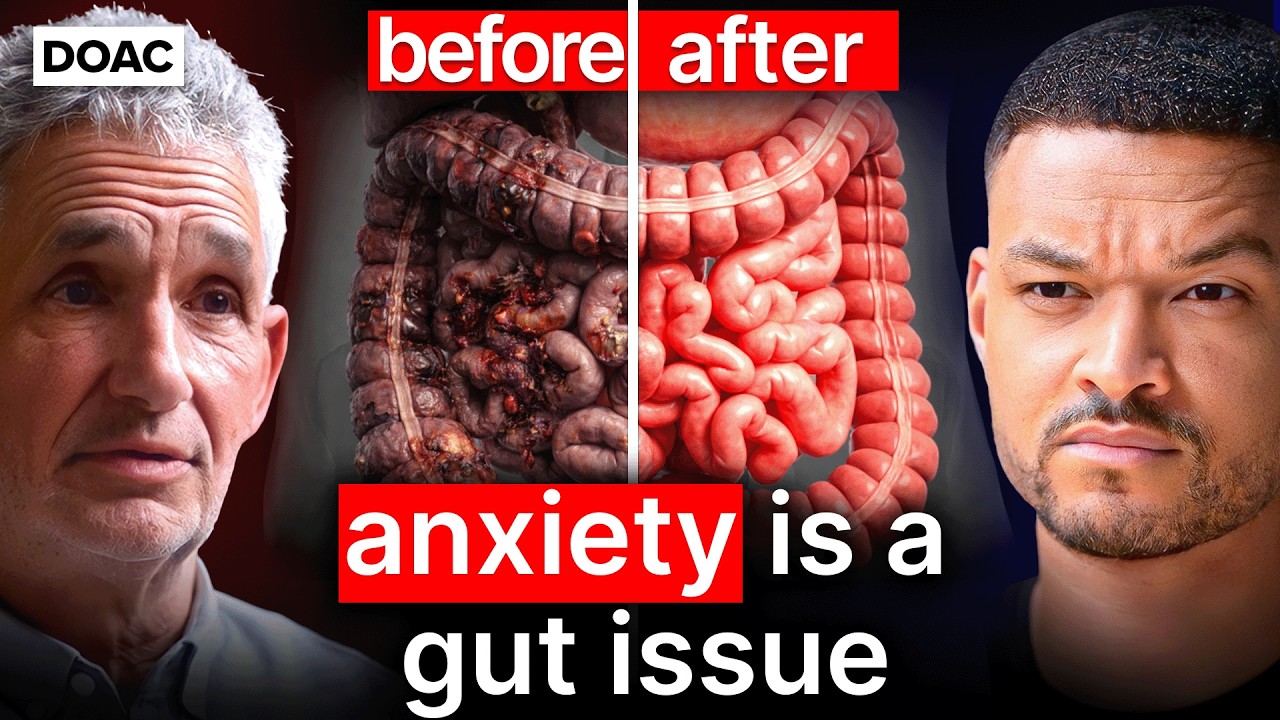
TIM SPECTOR LINKS GUT INFLAMMATION TO DEMENTIA AND PARKINSONS
The Diary Of A CEO
Ultra-processed diets and poor oral health drive systemic inflammation that travels up the vagus nerve to trigger neurodegenerative disease, making plant diversity and fermented foods primary tools for brain health.
## Background
This video was published on YouTube by The Diary Of A CEO on January 26, 2026. According to the page description, world-leading gut health expert Professor Tim Spector discusses brand-new research on how brain diseases like dementia, depression, and anxiety may stem from the gut, the role of oral hygiene in Alzheimer's risk, and key nutritional strategies to lower inflammation.
## TL;DR
Professor Tim Spector dismantles the traditional view of the brain as an isolated organ, demonstrating how gut bacteria, systemic inflammation, and the vagus nerve directly shape cognitive health, mood, and long-term risk for neurodegenerative diseases. He highlights practical lifestyle interventions—such as consuming 30 distinct plants per week, integrating fermented foods, maintaining daily flossing habits, and prioritizing food quality over calorie counting—to foster gut-brain resilience. Spector also examines the physiological impacts of ultra-processed foods, short-term fasting, ketosis, and GLP-1 medications on long-term wellness. Ultimately, the discussion frame food and daily environment control as the most potent form of preventive medicine available.
## Atmosphere & style
The conversation carries a grounded, deeply personal, and highly engaging tone that balances rigorous scientific explanation with genuine human empathy. Steven Bartlett's candid curiosity creates an accessible, reflective atmosphere where broad medical concepts—like the microbiome and systemic inflammation—feel practical and directly applicable to daily life. Anchored by Spector's thoughtful reflections on his mother's dementia, the narrative moves seamlessly between vulnerable storytelling and empowering actionable advice, offering a hopeful and eye-opening listening experience.
## Key takeaways
- [00:10](https://www.youtube.com/watch?v=w3dTmyZq4Qk&t=10s) Consistent flossing lowers dementia risk by reducing oral inflammation and preventing harmful oral bacteria from migrating to the brain.
- [04:48](https://www.youtube.com/watch?v=w3dTmyZq4Qk&t=288s) Modern medicine historically treated the brain as an isolated organ, ignoring the profound connection between systemic health, the gut, and cognitive well-being.
- [05:17](https://www.youtube.com/watch?v=w3dTmyZq4Qk&t=317s) Vascular dementia stems from the gradual clogging and stiffening of cerebral blood vessels, impairing blood flow and damaging brain tissue.
- [07:53](https://www.youtube.com/watch?v=w3dTmyZq4Qk&t=473s) The vagus nerve serves as the primary communication highway between the gut and brain, with roughly 80% of signals traveling upward from the gut.
- [14:19](https://www.youtube.com/watch?v=w3dTmyZq4Qk&t=859s) Poor sleep prompts the brain to seek quick glucose fixes, driving immediate cravings for refined carbohydrates and ultra-processed foods.
- [17:41](https://www.youtube.com/watch?v=w3dTmyZq4Qk&t=1061s) Common brain disorders share underlying genetic and metabolic risk factors—such as Factor P and systemic inflammation—rather than isolated gene causes.
- [21:13](https://www.youtube.com/watch?v=w3dTmyZq4Qk&t=1273s) Pathological misfolded alpha-synuclein proteins originate in an inflamed gut up to a decade before moving up the vagus nerve to cause Parkinson's disease.
- [24:27](https://www.youtube.com/watch?v=w3dTmyZq4Qk&t=1467s) Consuming a wide variety of plant foods (aiming for 30 per week) feeds diverse gut microbes, which act as internal pharmacies producing health-promoting compounds.
- [25:55](https://www.youtube.com/watch?v=w3dTmyZq4Qk&t=1555s) Drinking 2 to 5 cups of coffee daily is associated with a ~25% reduction in heart disease risk and supports specific gut microbial populations.
- [30:34](https://www.youtube.com/watch?v=w3dTmyZq4Qk&t=1834s) Prebiotic whole-food blends feed existing beneficial gut bacteria far more broadly and effectively than isolated, single-strain probiotic capsules.
- [39:31](https://www.youtube.com/watch?v=w3dTmyZq4Qk&t=2371s) The oral cavity represents the second largest microbiome hub in the human body, and chronic gum inflammation can double the risk of developing dementia.
- [48:07](https://www.youtube.com/watch?v=w3dTmyZq4Qk&t=2887s) Consuming three daily portions of fermented foods significantly reduces systemic blood inflammation markers and improves mood and energy.
- [56:12](https://www.youtube.com/watch?v=w3dTmyZq4Qk&t=3372s) High-protein marketing has created an overemphasis on meat, whereas pivoting to plant-based proteins helps solve widespread fiber deficiencies.
- [57:04](https://www.youtube.com/watch?v=w3dTmyZq4Qk&t=3424s) Calorie restriction triggers hunger signals that lead to long-term weight regain, making food quality far more important than calorie counting.
- [58:24](https://www.youtube.com/watch?v=w3dTmyZq4Qk&t=3504s) Ultra-processed foods contain additives that disrupt microbial communities, and their soft texture leads to overeating by bypassing chewing and satiety cues.
- [01:06:34](https://www.youtube.com/watch?v=w3dTmyZq4Qk&t=3994s) Time-restricted eating (a 12-to-14-hour overnight fast) aligns with the gut's circadian rhythm, allowing microbes to repair the gut lining and reduce inflammation.
- [01:11:51](https://www.youtube.com/watch?v=w3dTmyZq4Qk&t=4311s) Ketogenic diets force the brain to switch from glucose to ketone bodies, serving as an effective treatment for drug-resistant epilepsy and potential psychiatric conditions.
- [01:27:17](https://www.youtube.com/watch?v=w3dTmyZq4Qk&t=5237s) Early childhood trauma causes long-term disruption to the immune system, leaving individuals in a chronically elevated inflammatory state that increases brain disease risk later in life.
- [01:32:17](https://www.youtube.com/watch?v=w3dTmyZq4Qk&t=5537s) Improving long-term dietary habits requires modifying immediate environments and changing foundational routines, such as optimizing breakfast.
## Detailed walkthrough
### [00:00](https://www.youtube.com/watch?v=w3dTmyZq4Qk&t=0s) Flossing, the Gut-Brain Connection, and Rethinking Brain Health
Professor Tim Spector highlights research demonstrating that consistent flossing can lower the risk of dementia by nearly half. This insight spurred his deeper investigation into the connection between the brain and the gut, revealing how profoundly the gut influences mental well-being, mood, energy, and conditions like depression. For four decades, modern medicine treated the brain as an isolated entity separate from the rest of the body. To achieve optimal brain health, however, we must move past this outdated paradigm and focus on overall systemic health.
As one of the world's most cited scientists, Professor Spector advocates for simple, practical lifestyle adjustments that yield dramatic health benefits. He introduces his core guidelines for gut health—such as prioritizing plant diversity ("pivoting your protein") and placing food quality above calorie counting. Calorie-restricted diets routinely fail because they trigger hunger signals, which drive overeating and obesity. Beyond diet, everyday habits significantly impact long-term health: consuming two to five cups of coffee daily reduces heart disease risk by roughly 25%, while incorporating almonds into a diet supports mood and cognitive function. Furthermore, GLP-1 medications are set to transform public health, though they warrant careful management alongside lifestyle habits.
---
[02:48](https://www.youtube.com/watch?v=w3dTmyZq4Qk&t=168s) A Personal Motivation: June's Story and the Dementia Epidemic
Steven Bartlett asks Professor Spector about a photograph of his 93-year-old mother, June. For the past seven years, June has resided in a London care home following a stroke and a subsequent diagnosis of dementia. Before her illness, June was a staunch advocate for voluntary euthanasia and had signed all relevant documentation to ensure she could end her life if she ever lost her independence. However, under UK law, her early loss of capacity and mobility made this impossible. She no longer recognizes her son, serving as a heartbreaking daily reminder of the widespread impact of neurodegenerative conditions.
```
"She was really pro-euthanasia and signed every paper possible... but unfortunately, under UK law, it's not possible to help her in that because she lost capability and mobility very early. She no longer recognizes me."
```
Fifty years ago, dementia was far less prevalent. Today, the rise in cases is driven by extended lifespans without a corresponding increase in healthspan; while medical advances keep people alive longer, they do not necessarily preserve cognitive capability. Even when controlling for age demographics, raw incidence rates continue to climb. Watching his mother's decline motivated Professor Spector to shift his research focus toward brain health and actionable prevention strategies.
---
[05:17](https://www.youtube.com/watch?v=w3dTmyZq4Qk&t=317s) Brain Scans, Risk Genes, and Understanding Vascular Dementia
Prompted by his mother’s diagnosis and a mini-stroke (TIA) he experienced in 2011—which left residual white spots on his brain—Professor Spector visited a specialized London clinic for a comprehensive dementia screening. He wanted to evaluate his personal risk profile and determine if he carried genetic predispositions for Alzheimer’s disease or vascular dementia.
* **Alzheimer's Disease:** Characterized by abnormal protein folding, amyloid plaques, neurofibrillary tangles, and localized brain inflammation targeting specific areas of the brain.
* **Vascular Dementia:** Accounts for roughly one-third of all dementia cases. It stems from the gradual clogging and stiffening of cerebral blood vessels, impairing blood flow and damaging brain tissue in a more randomized pattern.
The screening revealed that Professor Spector does not carry the high-risk genetic variants for Alzheimer’s. However, he inherited genes predisposing him to type 2 diabetes and cardiovascular issues. Combined with elevated blood pressure following his 2011 mini-stroke, these factors increase his risk for vascular dementia. Identifying these genetic markers empowered him to proactively adopt targeted dietary and lifestyle interventions to protect his cerebral circulation.
---
[07:53](https://www.youtube.com/watch?v=w3dTmyZq4Qk&t=473s) Dismantling the Blood-Brain Barrier Myth: The Vagus Nerve and Gut Signals
Historically, mainstream medicine viewed the brain through a Cartesian lens—treating the mind and body as strictly divided, with the blood-brain barrier acting as an impenetrable "iron curtain." Early in his career as a rheumatologist specializing in joint inflammation, Professor Spector did not connect systemic inflammation with neurological functioning. His perspective shifted through data gathered from ZOE nutrition studies.
Participants using the ZOE app to track their habits reported rapid improvements in mood, mental clarity, and energy levels within days of switching to a gut-friendly diet—long before measurable changes appeared in their bloodwork or gut microbiome profiles. Similar improvements in mood and vitality were recorded during ZOE's studies on menopause. These findings reinforced that the brain operates like any other organ, relying heavily on real-time feedback from the gut.
* **The Vagus Nerve:** The longest cranial nerve in the body, serving as the primary communication highway between the gut and the brain.
* **Asymmetric Signal Flow:** Approximately **80%** of nerve signals travel upward from the gut to the brain, while only **20%** travel downward from the brain to the gut.
---
[11:28](https://www.youtube.com/watch?v=w3dTmyZq4Qk&t=688s) Diet, Inflammation, and Mental Fatigue
Steven notes how his own mood and energy fluctuate based on his diet over the preceding 24 to 48 hours. Professor Spector confirms this common experience: society often attributes bad moods or fatigue solely to psychological factors or external stressors, ignoring the underlying physiological drivers.
In a Channel 4 television series titled *What Not to Eat*, Professor Spector worked with four families who consumed diets heavy in ultra-processed foods, late-night snacks, sugary chocolates, sodas, and instant meals. These families experienced constant daytime fatigue, low mood, and frequent napping. Within six weeks of adopting a gut-friendly diet, all participants reported major boosts in mental alertness, energy, and overall mood, breaking the cycle of diet-induced brain fog.
---
[14:19](https://www.youtube.com/watch?v=w3dTmyZq4Qk&t=859s) Sleep Deprivation, Cravings, and the Immune-Driven Stress Response
When sleep quality suffers, the brain enters a physiological stress state, driving immediate cravings for refined carbohydrates and sugary foods. ZOE study data demonstrates that poor sleep prompts the brain to seek quick glucose fixes to cope with perceived stress, overriding long-term nutritional needs.
```
"It's like there's some little evil thing in your brain saying, 'Okay, I need a quick fix. I don't care about the rest of the day. Just get me through the next hour.'"
```
Rather than being a purely psychological state, stress manifests as a physical reaction that activates the immune system and triggers systemic inflammation. This inflammatory state sends signals back to the brain, directly altering behavior, focus, and emotional resilience.
* **Immune Response to Vaccination:** During ZOE's tracking of over one million individuals receiving COVID-19 vaccines (such as Pfizer and AstraZeneca), researchers observed that the temporary immune response induced mild depressive symptoms and lethargy lasting roughly 24 hours.
* **Chronic Low-Grade Inflammation:** This temporary post-vaccine response mirrors what occurs in chronic depression, where a persistently activated immune system continuously sends inflammatory signals to the brain.
Here is a detailed, faithful walkthrough based on the transcript part provided.
---
[17:41](https://www.youtube.com/watch?v=w3dTmyZq4Qk&t=1061s) The Immune System and Inflammation in Brain Disease
Professor Tim Spector challenges the traditional view that depression is merely a chemical imbalance of neurotransmitters like serotonin or dopamine. Instead, emerging science indicates that depression and other brain conditions stem from an abnormal body response to perceived stress or attack—a reaction where the brain tries to shut down to protect itself. Over the last 40 years, medicine has focused heavily on targeted psychiatric drugs like Prozac, missing a more holistic perspective: brain health is fundamentally rooted in the immune system, inflammation, and energy metabolism. Poorly controlled blood sugar and impaired energy delivery to the brain play massive roles in cognitive decline and dementia, pointing to inflammation as the central driving force of aging and disease across all aspects of brain function.
Historically, genetic studies on twins showed surprisingly low heritability for most brain diseases, indicating that genetics alone cannot explain their onset. Spector highlights a massive Swedish study of several million sibling pairs that investigated mental health and brain disorders. The study failed to find specific individual genes dictating distinct diagnoses. Instead, it revealed a overarching genetic factor—termed **Factor P**—which represents a general susceptibility to brain diseases as a whole. Depending on environmental triggers, this underlying vulnerability can manifest as mania, depression, bipolar disorder, ADHD, schizophrenia, or Alzheimer’s disease. Spector argues we should treat the brain like any other organ, such as the liver; rather than treating every condition in isolation, we must recognize their shared risk factors, metabolic roots, and inflammatory causes.
- **Factor P**: A general genetic susceptibility factor identified in Swedish population studies of millions of siblings, explaining why common brain disorders share underlying risks rather than isolated gene causes.
- **Metabolic Risk**: Type 2 diabetes increases the risk of developing a brain disease—including depression, bipolar disorder, schizophrenia, and epilepsy—by approximately **fourfold**.
---
[21:13](https://www.youtube.com/watch?v=w3dTmyZq4Qk&t=1273s) Does Parkinson’s Disease Begin in the Gut?
Epidemiological research on large populations reveals strong links between gastrointestinal health and neurological disorders. Spector notes that approximately **90% of people** who develop Parkinson’s disease experienced noticeable gut issues—such as chronic constipation, bloating, and a sluggish intestine—up to **10 years** before any motor or brain symptoms appeared.
```
[Gut Inflammation & Misfolded Alpha-Synuclein]
│
▼
[10-Year Path Up the Vagus Nerve]
│
▼
[Brain Accumulation & Lewy Body Formation]
```
This connection is more than coincidental: the same pathological misfolded protein seen in the brains of deceased Parkinson's patients (termed *alpha-synuclein*, which accumulates into characteristic structures called **Lewy bodies**) is present in their gut tissue a decade prior. Researchers hypothesize that misfolded alpha-synuclein originates in an inflamed, unhappy gut and travels slowly up the vagus nerve into the brain over a ten-year span. This insight suggests that Parkinson's disease and potentially other neurological conditions like multiple sclerosis could be prevented or delayed through gut-friendly dietary strategies aimed at curbing intestinal inflammation.
---
[24:27](https://www.youtube.com/watch?v=w3dTmyZq4Qk&t=1467s) The 8 Gut Health Rules: Mindfulness and Plant Diversity
To build cognitive resilience and prevent brain diseases, Spector outlines key rules for gut health. The first rule is simply being mindful: stopping to look at ingredients, reading food labels, and avoiding mindless eating while distracted in front of the TV. The second and most critical rule is eating a wide diversity of plants—targeting **30 different plants per week**.
Spector explains that the large intestine houses **40 to 100 trillion microbes**, operating essentially as thousands of individual internal pharmacies. Different species of gut bacteria thrive on specific dietary compounds. For instance, the microbe *Lawsonibacter* specifically feeds on coffee components. When coffee is ingested, *Lawsonibacter* thrives and multiplies, creating beneficial chemical byproducts that interact positively with the immune system and heart health. Even non-coffee drinkers harbor tiny trace populations of this microbe due to everyday social exposure and saliva droplets from coffee drinkers in their environment. Spector compares maintaining the microbiome to feeding a diverse zoo: offering a wide variety of plant foods feeds rare, beneficial microbes that outcompete and "squash out" bad bacteria that thrive on ultra-processed foods, poor fats, and artificial additives.
- **Microbiome Population**: 40 to 100 trillion microbial cells residing primarily in the human large intestine.
- **Weekly Diversity Target**: 30 distinct plant foods per week to maximize bacterial variety.
- **Microbe Example**: *Lawsonibacter*, a specialized gut bacterium that feeds specifically on coffee substrates.
---
[25:55](https://www.youtube.com/watch?v=w3dTmyZq4Qk&t=1555s) Is Coffee Actually Good for Your Gut and Heart?
Addressing common concerns about coffee, Spector dispels the notion that it dangerously restricts blood flow to the brain or causes cardiovascular harm for the general public. Epidemiological studies following populations over 20 to 30 years show that consuming **2 to 5 cups of coffee daily** reduces the risk of heart disease by roughly **25%** and actually decreases heart arrhythmias. While individual reactions vary based on caffeine metabolism—where slow metabolizers might experience heightened anxiety or sleep disruption—coffee overall offers notable protective health benefits. For those sensitive to caffeine jitteriness, Spector recommends options like matcha, which contains natural calming compounds (such as L-theanine) to balance out the caffeine.
- **Cardiovascular Benefit**: Drinking 2 to 5 cups of coffee daily is associated with a ~25% reduction in heart disease risk.
- **Personalized Sensitivity**: Fast vs. slow caffeine metabolizers experience different levels of anxiety or sleep impairment.
---
[30:34](https://www.youtube.com/watch?v=w3dTmyZq4Qk&t=1834s) Prebiotics vs. Probiotics: The Science Behind 'ZOE Daily 30+'
Discussing practical ways to achieve plant diversity, Steven Bartlett notes his role as an investor in ZOE, bringing up ZOE's whole-food supplement mix (Daily 30+). Spector details that the blend contains over 30 whole, freeze-dried plants—recently expanded to include ingredients like seaweed, algae, kombucha, and seven distinct species of mushrooms. Unlike typical single-strain probiotic capsules or isolated green powders, this prebiotic supplement provides thousands of complex plant chemicals to feed existing gut microbes broadly.
Spector highlights a 6-week clinical trial involving approximately 340 participants comparing this prebiotic blend to a traditional probiotic strain (*Lactobacillus rhamnosus*) and a control group. Stool test evaluations using a newly published *Nature* microbiome scoring method—which measures 100 core functional gut microbes (50 beneficial, 50 harmful)—revealed that the prebiotic blend altered roughly **40 microbe species** for the better, whereas the probiotic altered only **4 to 5 species**. Furthermore, participants taking the prebiotic reported rapid improvements in mood and energy within days.
- **ZOE Clinical Trial Sample Size**: ~340 participants over a 6-week intervention period.
- **Microbiome Impact**: Prebiotic whole-food blend improved ~40 core gut species; traditional probiotic altered ~4-5 species.
- **Digestive System Symptoms**: 70% of participants reported overall improvement in digestive symptoms.
- **Satiety and Fullness**: Increased fullness by 41.5% and satisfaction by 21.6% compared to meals alone.
- **Energy and Mood**: Increased overall energy by 43.3% (with ~50% reporting higher energy) and 45% reporting improved happiness.
Spector clarifies the fundamental scientific distinction between prebiotics and probiotics: prebiotics act as widespread fertilizer for existing gut microbes, whereas live probiotics do not typically colonize or permanently "seed" the gut as once believed. Instead, probiotics act transiently, primarily stimulating or "tickling" the immune system as they travel through the digestive tract.
[36:06](https://www.youtube.com/watch?v=w3dTmyZq4Qk&t=2166s) The Architecture of the Gut and the Second Brain
The human digestive tract is far more extensive and complex than most people realize. While many point to their belly when asked where their gut is, they are actually pointing to their intestines. The stomach sits much higher up, just below the liver, serving as an acidic vessel that breaks down food into smaller portions before passing it through the duodenum into the small intestine. Despite its deceiving name, the small intestine is the largest part of the digestive tract. Filled with endless coils, crypts, nooks, and crannies, its total surface area—if flattened out—would cover several tennis courts. This massive surface area acts like a sophisticated recycling factory designed to extract and absorb every available nutrient and trace element.
The journey continues into the large intestine, or colon, which spans a couple of meters and varies significantly in length between individuals. This final stretch holds approximately 99% of the body's gut microbes, which thrive on the non-digestible fiber passed along from the upper gut. As these microbes feed on fiber, they convert it into beneficial compounds such as short-chain fatty acids that actively nourish the immune system. Surrounding both the small and large intestines is the enteric nervous system, often referred to as the body's "second brain." Early in embryonic development, this neural tube surrounding the gut was actually the very first brain to form, making the brain in our head almost an evolutionary afterthought. Furthermore, roughly 70% of the body's entire immune system is housed directly within the gut.
[39:31](https://www.youtube.com/watch?v=w3dTmyZq4Qk&t=2371s) Oral Microbes and the Surprising Link Between Flossing and Dementia
Microscopic life is not confined solely to the digestive tract; microbes coat every surface of the human body. The second largest microbial population resides in the mouth, living in saliva, on teeth, and along the gumline. Failing to practice proper oral hygiene—such as neglecting to floss—allows plaque to build up and gums to become chronically inflamed. This local inflammation creates a thriving breeding ground for harmful, inflammation-loving bacteria.
Recent scientific research reveals a direct link between these oral pathogens and brain health. These bacteria can migrate from the mouth into the brain, triggering neuroinflammation that can double a person's risk of developing dementia. These findings underscore how crucial it is to keep beneficial microbes in their proper locations while keeping pathogenic populations from taking hold.
- **Dementia Risk:** Inadequate flossing and chronic gum inflammation can double the risk of developing dementia due to oral bacteria migrating to the brain.
- **Microbial Distribution:** While 99% of gut microbes live in the large intestine, the oral cavity represents the second largest microbiome hub in the human body.
[40:43](https://www.youtube.com/watch?v=w3dTmyZq4Qk&t=2443s) Co-Evolution, Mitochondria, and the Microscopic Origins of Life
When considering why the human body relies on trillions of external organisms rather than operating as a single self-contained system, it helps to abandon a human-centric perspective. Humans evolved from single-celled microbes. Early in evolutionary history, some single-celled organisms fused together to form multicellular life, while others remained independent. As complex organisms evolved, these single-celled microbes co-evolved alongside them, serving fundamental duties like training the immune system to recognize threats and guiding early brain development.
This cellular interdependence is clearly demonstrated by mitochondria, the powerhouses of human cells. Beyond generating energy, mitochondria regulate gene expression, fight systemic inflammation, and manage metabolism. Millions of years ago, ancestral multicellular organisms engulfed energy-producing microbes, forming a symbiotic relationship that eventually integrated these organisms into every cell of the human body. Realizing that the foundational machinery inside our cells originates from ancient microbes offers a humbling perspective on human biology.
> "I think it's fascinating that we've spent so long as humans looking up at the stars, whereas looking inside us at things like microbes and their origin is to me far more exciting."
[48:07](https://www.youtube.com/watch?v=w3dTmyZq4Qk&t=2887s) Why Fermented Foods are Crucial for Gut and Brain Health
Among the core rules for transforming health, eating fermented foods stands out as a top priority. Emerging scientific research supports aiming for three portions of fermented foods daily. A landmark study conducted at Stanford University evaluated 28 participants given five portions of fermented foods per day over a one-month period. The results demonstrated a 25% reduction in 20 different blood inflammation markers compared to a high-fiber control diet. Because systemic blood inflammation directly impacts brain function and long-term disease risk, incorporating fermented foods provides a immediate metabolic advantage.
Fermentation is an ancient preservation process where live microbes chemically transform raw ingredients, enhancing their flavor, complexity, nutritional value, and shelf-life without requiring refrigeration. While many consumers purchase zero-fat dairy products under the impression that they are healthier, highly processed zero-fat options strip away natural, beneficial fats and often replace them with starchy, sugary fillers. Natural fats are essential for health, a fact recently acknowledged by updated USDA guidelines shifting away from low-fat recommendations.
The landscape of fermented foods includes both live and dead microbial preparations, each offering unique nutritional profiles:
- **Milk Kefir & Yogurt:** Milk kefir acts as a "super yogurt," frequently containing 10 to 20 distinct strains of beneficial microbes per serving.
- **The "4 Ks":** Kefir, Kraut (sauerkraut), Kimchi (spicy fermented cabbage), and Kombucha (fermented tea containing up to 30–40 microbial strains).
- **Water Kefir (Tibikos):** A fruit-infused alternative to dairy kefir utilizing microbial grains.
- **Global Staples:** Miso pastes, tempeh, and traditional African fermented porridges and beers.
- **Dead Ferments:** Heat-treated or cooked fermented items—such as sourdough bread, wine, beer, and lightly pasteurized commercial drinks—retain inanimate microbial cells (postbiotics) that clinical placebo-controlled trials show still stimulate beneficial immune responses.
Here is a detailed, faithful walkthrough based on the provided transcript part:
[54:11](https://www.youtube.com/watch?v=w3dTmyZq4Qk&t=3251s) Postbiotics, "Zombie Biotics," and the ZOE Fermented Food Study
Professor Tim Spector explains the surprising phenomenon behind non-living microbes benefiting human health. Even when microbes are dead, their cell walls retain proteins and structural debris. As these "zombie biotics" or postbiotics pass through the small intestine, they "tickle" immune cells, signaling the immune system to calm down and reduce overall body inflammation. While live microbes remain the gold standard, Spector admits he would have dismissed non-live, heat-treated ferments three years ago, but current evidence suggests almost all fermented foods offer significant anti-inflammatory benefits.
To test this in a real-world setting, ZOE conducted a massive citizen science study involving 9,000 members who were not previously consuming fermented foods. They were asked to consume three portions of fermented foods daily. While approximately 3,000 participants dropped out because they "didn't fancy it," nearly 6,000 completed a one-week run-in period followed by two weeks of daily consumption. Around half of those who completed the challenge reported noticeable improvements in mood and energy, alongside reduced hunger levels. Spector highlights this as a simple, accessible diet change for anyone looking to boost their overall health.
- Postbiotics consist of the structural cellular debris and proteins of dead microbes that still interact with intestinal immune cells.
- The ZOE fermented food study tracked ~6,000 active participants over a two-week period (following a 1-week run-in).
- Roughly 50% of participants who completed the trial experienced better energy, improved mood, and decreased hunger.
---
[56:12](https://www.youtube.com/watch?v=w3dTmyZq4Qk&t=3372s) Rule #4 & #5: Pivot Your Protein and Prioritize Quality Over Calories
Moving to his fourth gut health rule, "pivot your protein," Spector addresses the current culture-wide obsession with high protein intake. While protein dominates health headlines, studies indicate that 90% of people already consume sufficient amounts. The problem is that most people rely almost exclusively on meat and eggs while neglecting plant-based proteins. By shifting focus to protein-rich plant sources—such as beans, legumes, mushrooms, whole grains, quinoa, and pearl barley—people can simultaneously hit their protein targets and solve their fiber deficiencies. Spector emphasizes that 90% of the population is deficient in fiber, warning that drinking isolated protein shakes essentially starves gut microbes.
Rule number five is to "think quality, not calories." Spector strongly rejects assessing food purely by caloric values, calling calorie-restricted diets fundamentally flawed and ineffective for the vast majority of people over the long term. Drawing a link to GLP-1 weight-loss medications, he explains that restricting calories triggers elevated hunger signals—and hunger is the primary driver of obesity. Short-term weight loss from calorie counting inevitably bounces back. Instead of reading calorie labels, people should focus on eating intact whole foods packed with original nutrients that nourish the gut microbiome.
- 90% of people consume enough protein, but 90% are deficient in dietary fiber.
- Recommended plant-based protein alternatives include beans, legumes, mushrooms, whole grains, quinoa, and pearl barley.
- Calorie restriction triggers elevated hunger signals, causing long-term weight rebound.
---
[58:24](https://www.youtube.com/watch?v=w3dTmyZq4Qk&t=3504s) Rule #6: Avoid High-Risk Ultra-Processed Foods and the Truth About Bread
Spector transitions to rule six: avoiding high-risk processed foods due to the physical and microbial damage they cause. Food manufacturers load ultra-processed items with additives—emulsifiers, preservatives, gums, colorants, flavorings, and artificial sweeteners—designed to trick the palate. Because gut microbes have evolved over billions of years without encountering these synthetic chemicals, these additives disrupt microbial communities. Inspecting host Steven Bartlett’s sample snack bar and a slice of standard mass-produced white bread, Spector categorizes ultra-processed items using ZOE’s new risk scale: zero, mild, moderate, and high risk. Standard commercial white bread falls under "high risk" because its preservatives, emulsifiers, hidden sugars, high salt, and added fats make it hyper-palatable and strip away the need for chewing.
When food requires no chewing—acting almost like "baby food"—it bypasses natural satiety cues and leads to overeating. Spector points out that ultra-processed potato snacks and soft white bread dissolve instantly in the mouth, causing people to consume roughly 25% more calories daily without feeling full. Recalling his time as a junior doctor, Spector notes that NHS ward breakrooms were always stocked with cheap white bread and toasters; he would eat four slices for a quick energy spike, only to feel ravenously hungry an hour later. For healthy alternatives, he recommends whole-grain intact breads such as rye, spelt, Scandinavian-style breads, and authentic sourdoughs.
- ZOE's ultra-processed food scale categorizes items into four tiers: zero, mild, moderate, and high risk.
- Ultra-processed foods cause people to overeat by an estimated average of 25%.
- Recommended gut-friendly breads include sourdough, spelt, rye, and dense whole-grain Scandinavian or German-style loaves.
---
[01:02:50](https://www.youtube.com/watch?v=w3dTmyZq4Qk&t=3770s) The Gluten Misconception and the Benefits of Diverse Nuts
Addressing a common health trend, Steven admits he spent years believing he was gluten intolerant because eating commercial bread left him with stomach pain, bloating, and digestive distress. Spector clarifies that true gluten sensitivity is wildly overdiagnosed by individuals. While up to 30% of people believe they have a gluten issue, only about 1% actually need to strictly avoid gluten for medical reasons (such as celiac disease). The actual culprits behind digestive distress in commercial sandwiches are usually the "crap bread," low-quality fillings, emulsifiers in mayonnaise, synthetic colorants, and chemical preservatives added by manufacturers. When people drop sandwiches, they feel better and incorrectly attribute their recovery to cutting out gluten.
Turning his attention to a bowl of nuts on the table, Spector praises almonds and walnuts as exceptional snacks for brain and gut health. Nuts are packed with healthy fats, including omega-3 fatty acids, that nourish gut microbes and support cognitive function and mood. Spector points out a dramatic shift in nutritional science: twenty years ago, health guidelines demonized nuts due to their fat content and warned they were bad for the heart, whereas modern research strongly encourages their consumption. Rather than searching for a single "supernut," he advises eating a diverse mix of nuts to maximize health benefits.
- Up to 30% of the population believes they are sensitive to gluten, but only 1% medically require a strict gluten-free diet.
- Non-gluten additives—such as bread emulsifiers, sandwich filling chemicals, and mayonnaise additives—are typically responsible for sandwich-induced digestive pain.
- Nuts were historically demonized for their high fat content, but modern research highlights their cognitive, cardiovascular, and gut benefits.
---
[01:06:34](https://www.youtube.com/watch?v=w3dTmyZq4Qk&t=3994s) Rule #7 & #8: Eat the Rainbow and Give Your Gut a Rest
Rule seven centers on eating a diverse array of colorful, natural plant foods. Vibrant natural pigments in foods—such as bright raspberries, blackberries, strawberries, radicchio, and purple cabbage—indicate the presence of polyphenols. These natural plant compounds act as direct fuel for gut microbes, allowing them to produce beneficial short-chain fatty acids. In addition to visual colors, bitterness is a key indicator of polyphenol richness. Foods with bitter profiles, such as broccoli, extra virgin olive oil, coffee, dark chocolate, and red wine, provide powerful microbial health boosts.
Rule eight emphasizes rest through time-restricted eating (fasting). Giving the digestive system a 12-to-14-hour overnight fast (limiting the daily eating window to roughly 10 hours) aligns with the gut’s circadian rhythm. Just as the brain requires sleep, the gut needs uninterrupted downtime for its internal "cleaning crew" of microbes to repair the gut lining and reduce systemic inflammation. Spector sharply warns against late-night snacks like post-pub kebabs, which completely disrupt this restorative cycle.
In a ZOE citizen science trial on fasting involving over 100,000 participants tasked with a 14-hour overnight fast, the outcomes split into three distinct groups:
- **One-third** dropped out, finding the schedule too difficult and feeling overly hungry.
- **One-third** loved the routine and sustained it two years later.
- **One-third** practiced it flexibly, noticing improvements whenever they stuck to it.
Spector notes that while time-restricted eating has clear metabolic advantages, it requires a personalized approach—though everyone benefits from eliminating late-night ultra-processed snacks.
Steven Bartlett pauses the discussion for mid-show sponsor and product announcements:
- **Ketone IQ**: Bartlett shares that 35% to 40% of his team uses Ketone IQ (available at ketone.com) for heightened daily focus, mental clarity, and productivity. Bartlett became a co-owner of the company after testing a sample left on his desk. Listeners receive 30% off at `[ketone.com/steven](https://ketone.com/steven)`, along with a free gift on their second shipment, or can pick up a free trial shot at Target stores across the U.S.
- **The Diary Of A CEO Conversation Cards**: Bartlett introduces the second edition of his show's conversation cards. Inspired by the tradition where every podcast guest leaves a question for the next guest, the card deck includes original questions and added "twist cards" designed to spark deep, intimate connections between friends and family.
[01:11:51](https://www.youtube.com/watch?v=w3dTmyZq4Qk&t=4311s) The Ketogenic Diet and Brain Energy
Steven Bartlett shares that he has grown "keto curious" in recent years, prompting Professor Tim Spector to reflect on his own changing perspective. Spector admits that he used to be quite anti-keto, but delving into brain energy and metabolic research shifted his view. A major turning point was recognizing the diet's proven efficacy as a primary medical treatment for drug-resistant childhood epilepsy. In simple terms, a ketogenic diet forces the brain to switch its primary energy source from glucose to ketone bodies—an evolutionary survival mechanism that kicks in after roughly two days of fasting once glucose reserves in the muscles are depleted. In epilepsy, this energetic switch seems to act like "rebooting your computer." Given that epilepsy shares severe psychiatric symptoms (such as hallucinations, delusions, and depression) with other brain conditions, Spector believes keto deserves rigorous clinical study for broader mental health applications.
Steven explains how cycling in and out of keto helps him navigate modern life's constant "food noise." Taking back control of the steering wheel through brief periods on keto helps eliminate cravings for junk food, preventing the downward spiral of sugar spikes, fatigue, missed workouts, and sluggishness. Spector acknowledges these anecdotal benefits, noting that while long-term strict keto is brutal and incompatible with maintaining a healthy gut, periodic short bursts might offer a practical "intermittent middle way" for brain health.
* **Epilepsy and Mental Illness:** Historically viewed as a mental illness due to overlapping symptoms like hallucinations and depression, childhood drug-resistant epilepsy remains the gold-standard use case for medical ketosis.
* **Mental Clarity and HD Vision:** Steven and public figures like Joe Rogan report heightened cognitive performance, rapid word recall, and high-definition mental clarity during ketosis. Spector notes this may be an exaggerated version of the focus gained from a long overnight fast (e.g., 14 hours).
* **Research Gaps and Placebo:** Current evidence for keto in general mental health rests mostly on small, open-label studies (some with as few as seven patients). Spector emphasizes that double-blind studies are exceptionally difficult because transitioning into ketosis often causes physical symptoms like "keto headaches."
---
[01:20:37](https://www.youtube.com/watch?v=w3dTmyZq4Qk&t=4837s) Microplastics, Environment, and GLP-1 Medications
Spector candidly shares his personal experience with getting a advanced blood panel, which revealed that he fell in the highest 20% for environmental microplastic levels in his blood. The testing differentiated between plastic particle sizes, showing that his elevated levels consisted mostly of smaller particles absorbed through the lungs. He attributes this primarily to living six decades and cycling extensively through London's polluted streets. While he continues to cycle without a face mask, he has taken practical steps like installing home water filters and avoiding plastic bottles and food containers. He notes that expensive interventions like plasmapheresis—where blood plasma is extracted, filtered, and returned at a cost around $10,000 per session—lack the clinical trial data to justify the expense, and environmental factors like pesticides or industrial dust may pose even greater risks.
Turning to GLP-1 receptor agonists (such as Ozempic and Wegovy), Spector predicts these medications will radically transform public health, especially as oral pill formulations emerge and patents expire to make them cheaper worldwide. While acknowledging their life-changing impact for severe obesity, he expresses concern over the lack of accompanying lifestyle and nutritional education. Without habit changes, patients risk chronic yo-yoing. Furthermore, GLP-1s appear to have anti-inflammatory and neuroprotective properties that reduce dementia risk beyond mere diabetes control, while also dampening addictive drives like gambling, smoking, and drug use.
> "If it takes away some of your basic drives—saying 'I like to take risks, I like to gamble'... is it changing you as a person long-term? You might be less good as an entrepreneur, for example."
---
[01:25:45](https://www.youtube.com/watch?v=w3dTmyZq4Qk&t=5145s) Holistic Brain Care: Saunas, Socializing, and Early Trauma
To round out a comprehensive approach to brain health, Spector highlights several non-dietary lifestyle factors. He maintains a personal sauna routine twice a week (ideally followed by a cold plunge), treating the heat exposure as a cardiovascular and vascular "workout" for blood vessels in the brain. Equally critical is regular socializing. Studying the happiest and longest-lived populations globally reveals that maintaining a core group of close friends and dining together regularly is essential for cognitive resilience, whereas chronic loneliness remains one of the single most destructive factors for brain function.
Finally, Spector addresses the profound long-term impact of early childhood adversity. Across virtually all neurological and psychiatric conditions, individuals who experienced emotional, physical, or sexual trauma in early life show a significantly elevated risk of developing brain diseases decades later. Modern psychoneuroimmunology reconciles this link through the immune system: severe early stress disrupts the body's baseline inflammatory thermostat, leaving the immune system in a permanently heightened, low-grade inflammatory state that damages both body and brain over a lifetime.
* **Sauna Protocol:** Spector aims for sauna sessions twice weekly to promote vascular health and brain blood flow.
* **Social Connection:** Strong social networks and shared meals correlate directly with longevity and reduced dementia risk.
* **The Immune Thermostat:** Early life trauma acts as a permanent stressor, failing to return immune markers to baseline and driving chronic inflammation into adulthood.
[01:28:56](https://www.youtube.com/watch?v=w3dTmyZq4Qk&t=5336s) How Early Childhood Trauma and Stress Drive Physical Inflammation
Professor Tim Spector highlights how raised blood inflammation levels are measurably higher in individuals who suffered early life trauma compared to those who experienced a "nice gentle quiet childhood." This inflammatory connection bridges a wide spectrum of physical and psychological conditions. Identical inflammatory patterns appear across chronic back pain, fibromyalgia, irritable bowel syndrome (IBS), epilepsy, and schizophrenia. Regardless of where the initial psychological or emotional stress originated, it translates into real, measurable physiological impairment. Better diagnostic tests for stress and inflammation could allow clinicians to intervene early before brain function degrades, alongside broader public efforts to reduce childhood trauma at its source.
This holistic view is supported by clinical research on talk therapy. Psychiatry has traditionally been compartmentalized into talk therapists and drug therapists, but emerging evidence demonstrates that talk therapy physically reduces systemic inflammation markers and boosts immune function. Long-term therapeutic conversations operate along pathways similar to social connection with friends. The scientific consensus is converging to demonstrate that seemingly distinct treatments share identical physiological mechanisms. Historically, medicine became distracted by René Descartes and Sigmund Freud, mistakenly treating the brain as an isolated entity detached from the rest of the body.
* **Conditions Linked to Stress-Induced Inflammation:** Chronic back pain, fibromyalgia, irritable bowel syndrome (IBS), epilepsy, and schizophrenia.
* **Biomarker Evidence:** Talk therapy and meaningful social interaction produce quantifiable reductions in inflammatory blood markers.
---
[01:30:53](https://www.youtube.com/watch?v=w3dTmyZq4Qk&t=5453s) The Power of Treating Food as Medicine
Following the show's closing tradition, Steven asks the question left behind by the previous guest: *"What are you uncontainably excited about?"* Spector replies that he is "uncontainably excited about the idea that we can dramatically improve our lives and our health just by making the right food choices." This fundamental truth drives his scientific research, public advocacy, and media work.
He points to his television work with struggling families as proof of the transformative power of treating food with the same seriousness as prescription medicine. Receiving constant feedback from readers and viewers whose lives have been transformed by changing their diets provides an unprecedented level of fulfillment that he has never experienced before in his academic career.
> "We can dramatically improve our lives and our health just by making the right food choices... start treating food like you would treat medicine, taking it really seriously and experimenting with it."
---
[01:32:17](https://www.youtube.com/watch?v=w3dTmyZq4Qk&t=5537s) Overcoming the Food Environment and Building Healthy Habits
Steven raises the psychological difficulty of maintaining discipline in a modern environment designed to undermine good health. People are forced to navigate gas stations stocked entirely with ultra-processed food, constant dopamine overstimulation from short-form video content, isolation, and stress. Even someone like Steven, who interviews world-leading health experts daily, admits to struggling with human emotions, hormones, and late-night cravings, making proactive environment design necessary.
Spector emphasizes that while knowledge is power, navigating a hostile food landscape requires tactical tricks and structural rule changes. Multi-billion dollar ultra-processed food manufacturers pay supermarkets and gas stations premiums for prominent product placement. To counter this, individuals must modify their immediate environments:
* **Avoid Bad Environments:** Refrain from visiting supermarkets unnecessarily or keeping junk food at home, as human friction makes it hard to discard bad food once purchased.
* **Office Environment Reform:** Ban communal bowls of candies, biscuits, and M&Ms in corporate workplaces, treating them with the same boundaries as alcohol or tobacco.
* **Structural Analogy:** Just as society successfully curbed smoking by restricting cigarette availability, removing ultra-processed foods from immediate reach reduces reliance on willpower.
* **Breakfast Habit Stacking:** Focus on changing the very first meal of the day. Because breakfast is the meal individuals have the most personal control over, establishing a healthy morning habit creates momentum that mitigates risk throughout the day.
Steven concludes the conversation by highlighting Spector’s collection of bestselling books, including *Ferment*, *The Diet Myth*, *Spoon-Fed*, and *The Food for Life Cookbook* (developed in collaboration with ZOE). He thanks Spector for fundamentally transforming the eating decisions and overall health of millions of listeners across the globe.
## Notable quotes
> [02:48](https://www.youtube.com/watch?v=w3dTmyZq4Qk&t=168s) She was really pro-euthanasia and signed every paper possible... but unfortunately, under UK law, it's not possible to help her in that because she lost capability and mobility very early. She no longer recognizes me. — Tim Spector
> [14:19](https://www.youtube.com/watch?v=w3dTmyZq4Qk&t=859s) It's like there's some little evil thing in your brain saying, 'Okay, I need a quick fix. I don't care about the rest of the day. Just get me through the next hour.' — Tim Spector
> [40:43](https://www.youtube.com/watch?v=w3dTmyZq4Qk&t=2443s) I think it's fascinating that we've spent so long as humans looking up at the stars, whereas looking inside us at things like microbes and their origin is to me far more exciting. — Tim Spector
> [01:23:23](https://www.youtube.com/watch?v=w3dTmyZq4Qk&t=5003s) If it takes away some of your basic drives—saying 'I like to take risks, I like to gamble'... is it changing you as a person long-term? You might be less good as an entrepreneur, for example. — Tim Spector
> [01:30:53](https://www.youtube.com/watch?v=w3dTmyZq4Qk&t=5453s) We can dramatically improve our lives and our health just by making the right food choices... start treating food like you would treat medicine, taking it really seriously and experimenting with it. — Tim Spector
## Mentioned
Tim Spector, Steven Bartlett, June Spector, ZOE, The Diary Of A CEO, King's College London, Factor P, Lawsonibacter, Lactobacillus rhamnosus, Nature, ZOE Daily 30+, Ketone IQ, Target, Joe Rogan, Ozempic, Wegovy, GLP-1, René Descartes, Sigmund Freud, Ferment, The Diet Myth, Spoon-Fed, The Food for Life Cookbook, What Not to Eat
Professor Tim Spector argues that cognitive resilience and overall brain health depend on systemic immune regulation and gut microbiome health, rather than isolated neurological treatments or simplistic calorie-restricted diets.
The Gut-Brain Axis and Neurodegenerative Risk (7:53)
Spector challenges modern medicine's historical treatment of the brain as an isolated organ protected by an impenetrable blood-brain barrier. The primary channel of communication is the vagus nerve, where roughly 80% of signals travel upward from the gut to the brain, with only 20% traveling downward. This bidirectional link extends to the mouth, where chronic gum inflammation from inadequate flossing allows oral bacteria to enter the bloodstream and brain, which Spector notes can double dementia risk. Conversely, maintaining oral hygiene can cut that risk nearly in half.
Systemic and intestinal distress often precedes overt neurological disease. In Parkinson's disease, approximately 90% of patients experience gastrointestinal complications like chronic constipation up to ten years prior to motor impairment; misfolded alpha-synuclein proteins first accumulate in inflamed gut tissue before migrating via the vagus nerve into the brain. Spector also cites Swedish sibling studies demonstrating that many brain disorders share a broad genetic susceptibility factor ("Factor P") influenced by metabolic health. For instance, metabolic dysfunction like type 2 diabetes increases the risk of developing brain disorders approximately fourfold.
Fueling Microbial Diversity and Immune Regulation (24:27)
The large intestine harbors 40 to 100 trillion microbes that convert dietary fiber into short-chain fatty acids, supporting the 70% of the body's immune system residing in the gut. Spector advises consuming at least 30 diverse plant foods per week to feed a wide spectrum of bacteria. Specialized microbes require specific substrates; for example, the gut bacterium Lawsonibacter feeds on coffee compounds, aligning with epidemiological evidence showing that drinking two to five cups of coffee daily correlates with a 25% reduction in heart disease risk.
Spector also stresses the distinct therapeutic roles of prebiotics and fermented foods. In a clinical trial of roughly 340 participants, a 30-plant prebiotic blend improved approximately 40 beneficial gut species, compared to only four to five species altered by a standard probiotic strain. Furthermore, Spector recommends three daily servings of fermented foods like kefir, kimchi, and kombucha. He highlights a Stanford University trial where fermented foods reduced 20 inflammatory blood markers by 25%. Even cooked or pasteurized ferments provide non-living "postbiotics"—cellular debris that binds to intestinal immune receptors to tamp down systemic inflammation.
Replacing Calorie Counting with Food Quality (56:12)
Spector rejects standard calorie-restricted dieting, arguing that it triggers heightened hunger signals that ultimately lead to weight regain and obesity. He also critiques the cultural focus on protein supplements, pointing out that 90% of the population already consumes adequate protein, while 90% remains deficient in dietary fiber. Instead of drinking protein shakes that leave gut bacteria undernourished, Spector urges a pivot to fiber-rich plant proteins like beans, lentils, whole grains, and mushrooms.
Dietary quality requires minimizing high-risk ultra-processed foods (UPFs) loaded with emulsifiers, chemical preservatives, and artificial flavorings that disrupt microbial ecosystems. Because many UPFs dissolve quickly and require minimal chewing, they bypass standard satiety cues, causing people to consume an estimated 25% more calories daily. Spector notes that commercial breads often fall into this category due to added fats, sugars, and additives. He clarifies that while up to 30% of people believe they suffer from gluten sensitivity, only roughly 1% have medical indications like celiac disease; the digestive discomfort commonly linked to sandwiches stems mostly from industrial dough conditioners and UPF fillings rather than gluten.
Metabolic Interventions, Lifestyle Factors, and Inflammation (71:51)
Beyond daily diet, Spector points to metabolic switches that modulate brain function. While long-term strict ketogenic diets are difficult to maintain and limit gut microbiome diversity, short periods of ketosis shift the brain from glucose to ketone bodies—a metabolic reset proven to control drug-resistant childhood epilepsy that may also reduce psychiatric "food noise." Similarly, implementing time-restricted eating with a 12-to-14-hour overnight fast gives the gut lining restorative downtime, allowing specialized cleaning microbes to clear mucosal inflammation.
Broader environmental and psychological factors also alter systemic inflammation. Spector highlights GLP-1 medications as powerful anti-inflammatory tools for obesity, though he warns that relying on medication without lifestyle education causes cyclic weight yo-yoing. Furthermore, early childhood trauma can permanently recalibrate the body's inflammatory baseline, leaving an individual with elevated blood inflammation markers that raise long-term risks for conditions like fibromyalgia, irritable bowel syndrome, and schizophrenia. Spector notes that therapies fostering social connection, sauna use, and talk therapy measurably reduce these circulating inflammatory markers.
Spector concludes that improving neurological and systemic health requires treating food as medicine and redesigning personal and workplace environments to limit ultra-processed food exposure. However, practical questions remain regarding the sustainability of extreme dietary models, and broader psychiatric applications for ketogenic diets currently rely primarily on small, open-label trials that require validation through large-scale, double-blind clinical studies.
## Background
本期内容由 YouTube 播客频道《The Diary Of A CEO》(主持人史蒂芬·巴特利特 Steven Bartlett)于 2026 年 1 月 26 日发布。节目邀请了全球顶级肠道健康专家、伦敦国王学院遗传流行病学教授蒂姆·斯佩克特(Professor Tim Spector),系统揭示痴呆症、抑郁症和焦虑症如何起源于肠道微生态失调,并探讨了口腔清洁对降低阿尔茨海默病风险的作用、超加工食品对大脑的劫持机制以及平息全身慢性炎症的核心饮食策略。
## TL;DR
斯佩克特教授在对话中彻底打破了笛卡尔身心二元论,阐明迷走神经中 80% 的信号是从肠道自下而上传至大脑,揭示了帕金森病、抑郁症及多种认知退行性疾病共同的底层免疫与代谢病理根源。他提出了重塑肠道与大脑韧性的核心健康法则:每周吃够 30 种不同植物、每天摄入发酵食品以吸收抗炎后生元、转向兼顾纤维与品质的植物蛋白,并坚决摒弃算卡路里的节食思维与高风险超加工食品。对话还深入剖析了生酮饮食的间歇重置价值、GLP-1 药物的深层利弊、童年创伤导致终身微炎症的神经免疫学机制,强调战胜现代不健康环境的唯一出路在于建立前置的物理阻隔系统而非空耗意志力。
## Atmosphere & style
整场对话在浓厚的人文关怀与严谨的科学理性之间达成了深刻共振。开篇教授动情讲述母亲失智的家庭创伤与其自身的微中风隐患,迅速为严肃的流行病学证据赋予了直击人心的现实重量与探索紧迫感;史蒂芬坦率反思自身饮食挣扎的敏锐提问,与斯佩克特破除传统医学教条的循证拆解层层递进,既有对万亿微观生命共生演化的哲学敬畏,又带给受众清晰、笃定且充满希望的健康掌控力。
## Bulletin
- [10:46](https://www.youtube.com/watch?v=w3dTmyZq4Qk&t=646s) 肠脑轴调控机制取得重要突破:迷走神经中约80%的信号是由肠道自下而上向大脑发送,临床干预显示仅需6周的肠道健康饮食即可显著改善白天的情绪与精神萎靡状态。
- [21:29](https://www.youtube.com/watch?v=w3dTmyZq4Qk&t=1289s) 流行病学追踪揭示神经退行性疾病的肠道起源:约90%的帕金森病患者在确诊前10年就已出现肠道问题,致病性α-突触核蛋白被推测在肠道慢性炎症中错误折叠后沿迷走神经迁移至脑部。
- [48:10](https://www.youtube.com/watch?v=w3dTmyZq4Qk&t=2890s) 斯坦福大学临床研究证实发酵饮食具有强大抗炎功效:每天摄入发酵食品可使血液系统性炎症标志物平均下降约25%,且灭活死菌(后生元)其细胞壁蛋白同样具备显著的免疫调节作用。
- [01:27:17](https://www.youtube.com/watch?v=w3dTmyZq4Qk&t=5237s) 童年期创伤会导致成年后系统性炎症调定点永久抬高,使抑郁症、精神分裂症及阿尔茨海默病等脑部疾病易感性剧增,而长期的谈话疗法能切实降低外周血炎症指标。
## Key takeaways
- [04:17](https://www.youtube.com/watch?v=w3dTmyZq4Qk&t=257s) 现代社会痴呆症高发不仅因人均预期寿命延长,更因代谢失衡与肠道微生态紊乱导致健康寿命严重滞后,使独立于老龄化之外的真实患病率持续攀升。
- [07:59](https://www.youtube.com/watch?v=w3dTmyZq4Qk&t=479s) 传统笛卡尔身心二元论限制了脑病医学研究,抑郁、脑雾与慢性疲劳本质上是大脑对肠道微生态异常和全身外周炎症的神经免疫失调反应。
- [15:18](https://www.youtube.com/watch?v=w3dTmyZq4Qk&t=918s) 抑郁症可能并非单纯由脑内单胺类递质失衡引起,而是免疫系统因慢性压力或类似疫苗反应被异常锁定在常态化激活模式,促使大脑启动保护性的退缩生病行为。
- [18:02](https://www.youtube.com/watch?v=w3dTmyZq4Qk&t=1082s) 大规模双胞胎研究表明多数精神疾病不具特异性遗传基因,而是共享通用的“因子P”(广泛脑部疾病易感倾向),且与2型糖尿病等代谢紊乱紧密交织。
- [24:27](https://www.youtube.com/watch?v=w3dTmyZq4Qk&t=1467s) 建议践行正念饮食并确保每周摄入30种不同植物,以植物化学成分和纤维多样性滋养大肠内数以万亿计的特异性微生物菌群(如专嗜咖啡的Lawsonibacter)。
- [33:32](https://www.youtube.com/watch?v=w3dTmyZq4Qk&t=2012s) 益生元配方(如复合冻干植物)对重塑核心菌群的效果远胜于单一外源性益生菌胶囊,因益生元能充当全方位肥料,而外源活菌极难长期定植结肠。
- [39:27](https://www.youtube.com/watch?v=w3dTmyZq4Qk&t=2367s) 口腔微生态失衡与牙龈慢性炎症会使牙周致病厌氧菌突破黏膜并向中枢神经系统迁移,日常不用牙线清洁可能会使罹患阿尔茨海默病的风险翻倍。
- [40:43](https://www.youtube.com/watch?v=w3dTmyZq4Qk&t=2443s) 人类细胞能量工厂“线粒体”源自数十亿年前内共生的古细菌,人体本质上是由无数微小生命融合、共生协同演化而成的复合生态系统。
- [50:02](https://www.youtube.com/watch?v=w3dTmyZq4Qk&t=3002s) 日常发酵食品建议落实“4K原则”(开菲尔、德式酸菜、韩式泡菜、康普茶),应避开使用大量淀粉与添加剂弥补口感的工业“零脂肪”酸奶陷阱。
- [54:08](https://www.youtube.com/watch?v=w3dTmyZq4Qk&t=3248s) 发酵灭活后的“死菌”(后生元/僵尸益生菌)其细胞壁蛋白在穿过小肠黏膜时,仍能轻触并调节免疫细胞,释放下调全身慢性炎症的生理信号。
- [56:12](https://www.youtube.com/watch?v=w3dTmyZq4Qk&t=3372s) 超过90%的现代人蛋白质摄入充足却严重缺乏膳食纤维,应将蛋白质策略转向豆类、食用菌菇与全谷物等兼顾氨基酸与益生元的高纤维天然全食物。
- [57:11](https://www.youtube.com/watch?v=w3dTmyZq4Qk&t=3431s) 单纯依赖卡路里限制的节食注定会因大脑饥饿素暴增而报复性反弹,应远离破坏肠道屏障的高风险超加工食品,重视保留谷物物理结构的全谷酸面包。
- [01:01:51](https://www.youtube.com/watch?v=w3dTmyZq4Qk&t=3711s) 公众普遍自诊的“麸质不耐受”多属误区,诱发肠胃不适的往往是廉价工业面包中为了防腐、增稠与免咀嚼而掺杂的大量工业乳化剂与化学添加剂。
- [01:06:38](https://www.youtube.com/watch?v=w3dTmyZq4Qk&t=3998s) 餐盘中鲜艳的天然色素与苦味(如浆果、EVOO、黑咖啡、西兰花)是高浓度多酚的天然信号,能被结肠菌群利用并合成具备抗炎修复功效的短链脂肪酸(SCFAs)。
- [01:08:24](https://www.youtube.com/watch?v=w3dTmyZq4Qk&t=4104s) 实行12至14小时的夜间限时进食(TRE)有助于恢复肠道屏障并促进内部自洁,坚决戒除深夜加餐对肠道和代谢健康至关重要。
- [01:16:30](https://www.youtube.com/watch?v=w3dTmyZq4Qk&t=4590s) 长期严格生酮饮食会因膳食纤维极度匮乏而严重损害肠道菌群的多样性与活性,更理性的探索是每隔数月配合植物纤维进行为期数天的温和脑代谢重置。
- [01:22:53](https://www.youtube.com/watch?v=w3dTmyZq4Qk&t=4973s) GLP-1类受体激动剂虽能平息病态食欲与多巴胺成瘾冲动,但若缺乏系统性的营养生活方式重建,停药后势必陷入恶性体重反弹并长期依赖。
- [01:30:53](https://www.youtube.com/watch?v=w3dTmyZq4Qk&t=5453s) 单靠个人意志力无法对抗现代超加工食品巨头的货架设计与成瘾本能,必须通过居家物理隔离环境以及牢牢掌控每天第一餐(早餐)来建立坚固的健康惯性。
## Detailed walkthrough
### [00:00](https://www.youtube.com/watch?v=w3dTmyZq4Qk&t=0s) 肠道与大脑的深层联结及健康新准则
节目开篇抛出了一系列颠覆传统认知的医学洞见:最新研究表明,仅仅是坚持使用牙线清洁口腔,就能将患痴呆症的风险降低近一半。在过去的四十年里,现代医学在脑部疾病的研究上可能走入了一条死胡同——人们过度将大脑视为一个完全独立于身体其他部分的孤立器官,忽视了肠道与大脑之间至关重要的相互作用。这种连接不仅深刻主导着抑郁、情绪波动,还直接调节着人体的疲劳感与日常精力水平。作为全球论文引用率前1%的顶尖科学家,蒂姆·斯佩克特教授(Professor Tim Spector)指出,人类完全可以通过科学的饮食选择,全方位重塑身心健康与认知韧性。
斯佩克特教授提出了改善肠道与整体健康的八大核心法则,首要任务就是“转变蛋白质来源”("pivot your protein"),并坚决秉持“重质量而非卡路里”("quality, not calories")的原则。他直言,依靠计算卡路里来评估食物和控制体重的做法对绝大多数人来说已被证实无效;极端的节食限制只会大幅拉高身体的饥饿信号,而未被满足的剧烈饥饿感正是诱发肥胖的罪魁祸首。此外,对话中还涉及了多项颠覆大众常识的研究成果:
- 每天饮用2至5杯咖啡,可将罹患心脏病的风险降低约25%。
- 适量食用杏仁等坚果被多项临床研究证实能显著改善认知功能与情绪状态。
- 谈及近年来大热的 GLP-1 受体激动剂(如司美格鲁肽 Ozempic)时,斯佩克特教授肯定了其在公共卫生领域颠覆现代医学的巨大潜力,但也对其可能带来的深层健康隐患表达了严重担忧。
### [01:45](https://www.youtube.com/watch?v=w3dTmyZq4Qk&t=105s) 主持人的真诚呼吁:关注与订阅背后的使命
主持人史蒂芬·巴特利特(Steven Bartlett)放下团队准备的现成讲稿,向长期支持节目的观众倾诉心声。他坦言过去的一年是自己人生中最不可思议的一年,这些对话能引发全球数百万听众的共鸣,让他深感荣幸,同时也肩负着沉甸甸的责任感。
面对后台数据,史蒂芬诚恳地向观众请求一个小小的举手之劳:在长期收听节目的活跃听众中,约有47%的人尚未点击订阅。他呼吁这些听众点击免费的订阅按钮,这不仅是对创作团队最直接的支持,更是支撑节目能够持续邀请顶尖学者、拓展对话深度与制作规模的关键基石。
### [02:48](https://www.youtube.com/watch?v=w3dTmyZq4Qk&t=168s) 母亲的失智之痛:促使顶尖科学家转向脑部研究的转折点
对话切入私人情感领域,史蒂芬展示了一张老照片,询问画面中温婉的长者是谁。斯佩克特教授深情地介绍,那是他现年93岁的高龄母亲琼(June)。七年前,母亲遭遇了一次严重中风,随后迅速恶化为严重的认知障碍(痴呆症),自此住进了伦敦的一家全日制护理机构。
这一变故对斯佩克特教授的人生观与学术研究产生了巨大冲击。他回忆道,母亲生前一直坚定支持安乐死,曾签署过所有法律允许的预立医疗文件,希望在失去尊严时能平静离世。然而在英国现有法律框架下,由于母亲很早就丧失了认知决策能力与行动能力,这份心愿终究无法兑现。“她依然活着,但她已经完全认不出我了,”教授动容地说道。面对如今痴呆症发病率较半个世纪前呈爆炸式增长的惨淡现状,他立志要在衰老与大脑认知领域深耕,探寻逆转这场痴呆症大流行的干预手段。
### [04:17](https://www.youtube.com/watch?v=w3dTmyZq4Qk&t=257s) 痴呆症激增之谜:是寿命延长还是真实患病率上升?
针对史蒂芬提出的大众疑问——“痴呆症是真实变得更普遍了,还是仅仅因为诊断手段进步了?”——斯佩克特教授给出了明确解答。他指出,平均预期寿命(Lifespan)的增加固然是一大因素,现代医学极为擅长挽救垂危生命并维持生命体征,但这并不等同于健康寿命(Healthspan)的同步延长。
关键在于流行病学统计数据表明:即便在数学模型中完全剔除人口老龄化与诊断率提升的加权影响,现代人罹患痴呆症的绝对比例依然高于以往任何时代。如今,痴呆症与癌症并列成为全人类晚年最恐惧的两大恶疾,几乎每个普通人的社交圈或家族中都有认知退化患者的身影。
```mermaid
flowchart TD
accTitle: 现代痴呆症高发驱动因素解析
accDescr: 解释预期寿命增加、健康寿命滞后以及独立于人口结构之外的真实患病率增长
subgraph Aging["老龄化与医学现状"]
A["平均预期寿命提升<br/>(Lifespan)"] --> B["健康寿命未同步增长<br/>(Healthspan)"]
B --> C["高龄带病生存期延长"]
end
subgraph Underlying["真实致病趋势"]
D["环境、代谢与肠道微生态失衡"] --> E["独立于老龄化之外的<br/>痴呆真实发病率上升"]
end
C --> F["全社会痴呆症发病总数剧增"]
E --> F
```
### [05:22](https://www.youtube.com/watch?v=w3dTmyZq4Qk&t=322s) 亲历脑部扫描:2011年微中风与家族遗传风险筛查
这段家庭创伤促使斯佩克特教授重新审视自身的脑血管状况。早在2011年,他就曾遭遇过一次微中风(小中风),随后的影像学检查显示其大脑内部存在若干白质病变区域(白点)。多年来,这背后的病理机制一直没有彻底定论。
出于科学家的敏锐直觉与自救本能,他前往伦敦一家顶尖的认知障碍筛查专科诊所进行了全面评估。他渴望查明:自己脑内的白质病变是否在恶化?自己是否携带阿尔茨海默病的典型致病基因?抑或如他母亲那样,滑向以血管病变为主导的认知衰退路径?基因检测结果带来了好坏参半的消息:他并未携带阿尔茨海默病的高危基因,却检测出了强烈的糖尿病与心血管疾病易感基因。
### [06:36](https://www.youtube.com/watch?v=w3dTmyZq4Qk&t=396s) 阿尔茨海默病与血管性痴呆:机制差异与个人易感性
斯佩克特教授系统阐释了临床上最常见的两大痴呆症类型之间的机制分野:
- **阿尔茨海默病(Alzheimer's Disease)**:属于高度特异性的神经退行性病变。其典型特征是大脑内部出现异常的蛋白质错误折叠与纤维缠结(如淀粉样蛋白斑块和 Tau 蛋白缠结),进而诱发局部神经炎症并逐步破坏特定的脑区功能。
- **血管性痴呆(Vascular Dementia)**:更具泛发性,约占所有痴呆病例的三分之一。其病理机制与冠状动脉狭窄导致心脏病如出一辙——向大脑供血的动脉血管发生硬化、斑块沉积或堵塞,导致不同脑组织区域因缺血缺氧而随机受损脱落,病程发展相较阿尔茨海默病更具不可预测性。
教授坦言,由于遗传了祖母的糖尿病易感基因,加上2011年微中风后持续伴随的高血压,他自身的脑血管弹性相较常人更为僵硬,这使他处于血管性痴呆的高风险暴露之中。正是这种清晰的自我认知,驱使他竭尽全力去探索如何通过早期生活方式与饮食干预来延缓或彻底阻断认知衰退的进程。
### [07:59](https://www.youtube.com/watch?v=w3dTmyZq4Qk&t=479s) 打破笛卡尔身心二元论:从风湿病学到肠脑轴的科学觉醒
回望过去五年,斯佩克特教授经历了学术认知上的颠覆性转变。在此之前,他深受传统笛卡尔身心二元论(Cartesian Dualism)的影响,固执地将“精神/大脑”与“肉体/机能”视作两个平行的独立王国,甚至把血脑屏障(Blood-Brain Barrier)描绘成不可逾越的“铁幕”("an iron curtain")。精神健康被牢牢框定在精神病学和老年病学的狭窄领域内,与内科系统疾病缺乏交叉。
转变的契机始于创立健康科学公司 ZOE 期间的临床意外发现。研究团队为受试者配发了实时反馈健康状态的手机应用。在几乎每一项饮食干预试验中,参与者报告的最早变化都不是血液生物标志物或肠道菌群多样性的客观指标,而是主观层面上情绪的大幅改善、精力水平的跃升以及饥饿感的主动减退。在针对女性更年期综合征的研究中,通过饮食改善肠道健康后,受试者改善最显著的同样是情绪与活力。
作为一名早期专注研究关节炎症与免疫机制的风湿病学专科医生(Rheumatologist),斯佩克特教授顿悟到:
- 身体末梢及关节中的系统性炎症,绝非与大脑相隔绝;
- 抑郁、情绪障碍、脑雾和长期慢性疲劳,本质上可能是大脑对来自外周身体(尤其是肠道微生态与免疫系统)异常炎症信号的神经免疫应激失调;
- 大脑并非高高在上的孤立器官,它与全身生理代谢浑然一体,而肠道微生态正是调节这一切的中枢枢纽。
### [10:46](https://www.youtube.com/watch?v=w3dTmyZq4Qk&t=646s) 肠脑轴与迷走神经:大脑并非高高在上的主宰
Tim Spector 教授指出,传统医学界长期将大脑置于神坛之上,视其为独立掌控身体一切运作的核心中枢,但事实并非如此——大脑实际上同其他器官一样,无时无刻不在接收并响应来自身体各处的信号。连接肠道与大脑的关键纽带是迷走神经(vagus nerve),它是人体内最长的一根神经。令人震惊的解剖学生理数据表明,迷走神经中约有 80% 的信号是从肠道自下而上发送至大脑,只有 20% 的信号是大脑自上而下传向肠道。这意味着肠道内发生的一切,直接决定了大脑获取的大部分信息输入。
Steven Bartlett 对此深有共鸣。他分享了自己的个人体会:回顾自己情绪好与坏的那些日子,往往与前几天甚至过去 24 小时内的饮食密切相关。虽然睡眠不足是恶化情绪的重要催化剂,但即使睡眠充足,若依然感到心烦意乱或萎靡不振,罪魁祸首几乎总能追溯到最近吃进肚子里的食物。人们通常习惯将情绪问题归咎于外在偶发事件,比如在路上被人超车别车,却很少意识到这其实是大脑在接收来自肠道等部位的不良信号后出现的生理功能紊乱。
```mermaid
flowchart LR
accTitle: 迷走神经信号流向示意图
accDescr: 展示迷走神经在肠道与大脑之间的双向通信比例,突显80%为由下至上的信号传递。
subgraph Gut["肠道系统"]
G["肠道微生态与消化道"]
end
subgraph Brain["中枢神经系统"]
B["大脑认知与情绪调控"]
end
G -- "80% 上行信号" --> B
B -- "20% 下行信号" --> G
```
### [12:26](https://www.youtube.com/watch?v=w3dTmyZq4Qk&t=746s) 饮食改变情绪与精力:垃圾食品引发的恶性循环
Tim Spector 谈到他们开展的四项饮食干预研究,当把长期习惯不良饮食的受试者转变为健康饮食模式后,受试者最先察觉到的明显改善就是情绪状态以及白天的精力水平。在此之前,几乎所有人都认为疲倦和抑郁只是生活压力大带来的必然结果。在参与英国第四台(Channel 4)的电视节目《What Not to Eat》期间,Spector 走访了四个饮食习惯极差的家庭:他们的日常食谱充斥着超加工垃圾食品(ultra-processed food),包括大量的巧克力棒、碳酸汽水、炸鸡块以及速食泡面(pot noodles),并且习惯在深夜疯狂吃零食。这些人整天处于嗜睡状态,需要不停地打盹补觉。
研究团队为这些家庭量身定制了为期 6 周的“肠道友好型饮食改造”(gut-friendly makeover diet)。仅仅六周过去,所有家庭成员最先感受到的变化就是头脑瞬间清醒、情绪显著好转、精力大幅提升。Spector 强调,许多人常年处于“因为超重所以疲劳”或“因为不爱运动所以没精神”的错误归因中,甚至陷入了“身体难受 ➔ 渴望高糖垃圾食品 ➔ 精力暴跌、昏睡 ➔ 身体更差”的死循环。ZOE 的研究数据进一步证实了这一现象:前一晚睡眠糟糕的人,第二天清晨醒来时大脑中仿佛有个“小恶魔”在叫嚣,极度渴望摄入高糖垃圾食品来寻求即时的能量代偿,根本无心顾及这种快餐式慰藉对全天健康的长期损害。
- **干预周期与显效时间**:仅需 6 周的肠道健康饮食干预,受试者严重的白天嗜睡与精神萎靡便能得到扭转。
- **典型不良饮食构成**:超加工食品、炸鸡块、速食泡面、碳酸含糖饮料、巧克力棒,配合深夜进食习惯。
- **睡眠剥夺的代偿反应**:差劲的睡眠会直接诱发对高精制糖食物的急迫渴求,形成短期多巴胺刺激的负面循环。
### [15:18](https://www.youtube.com/watch?v=w3dTmyZq4Qk&t=918s) 压力、疫苗反应与抑郁症的免疫系统假说
谈及为何睡眠不良会导致糖分渴求,Steven 提到有人曾在节目中提出进化生物学视角:睡眠频繁中断在远古时期意味着身处生存威胁,大脑因此需要大量即时能量备战。Spector 赞同并深入分析道,传统上被视为心理问题的“压力”(stress),本质上是一种驱动全身炎症的生理反应,它直接干预免疫系统并向大脑发出改变行为的信号。现代人的日常压力虽然不再是遭遇猛兽追赶或村庄被焚毁,但免疫系统依然会将其识别为危机,迅速切换到“应激防御模式”。
Spector 团队在 ZOE 研究中追踪了 100 万人接种辉瑞(Pfizer)和阿斯利康(AstraZeneca)疫苗后的身体反应。数据揭示了一个极具启发性的现象:许多人在接种后的 24 小时内会出现明显的抑郁情绪与萎靡状态。疫苗激活了人体免疫系统,导致血液中的炎症蛋白急剧上升,大脑据此判定“身体即将生病”,从而主动开启保护性的“生病行为”(illness behavior)令个体减少活动、低落退缩。医学界正在兴起一个颠覆性假说:长期的抑郁症患者很可能并非患有简单的脑内“化学物质失衡”(如血清素或多巴胺不足),而是其免疫系统被异常锁定在了常态化激活模式,如同身体长期承受着类似疫苗接种带来的持续免疫刺激,大脑误以为自身始终受到攻击而选择关闭活力以自保。
### [18:02](https://www.youtube.com/watch?v=w3dTmyZq4Qk&t=1082s) 炎症、代谢与脑部疾病的通用根源:超越“因子 P”与单一病症
Spector 严正指出,过去 40 年里医学界过于痴迷于百忧解(Prozac)等针对血清素或多巴胺的抗抑郁药物,陷入了极其狭隘的误区,彻底错失了全局观。现代科学证明,免疫系统紊乱引起的慢性炎症(inflammageing)以及代谢失衡(尤其是血糖失控和大脑能量供应障碍)才是导致包括阿尔茨海默病在内的认知衰退与脑部疾患的核心推手。当免疫系统失控、慢性炎症高企时,人体组织无法自我修复,大脑衰老随之急剧加速。
```mermaid
flowchart TD
accTitle: 脑部疾病的通用底层病理网络
accDescr: 展示环境与饮食驱动免疫失控与代谢紊乱,进而诱发各类不同临床表现的脑部疾病。
subgraph Triggers["诱发因素"]
D["不良饮食与高糖"]
S["慢性压力与睡眠差"]
end
subgraph Pathology["核心生理机制"]
I["免疫激活与慢性炎症"]
M["血糖波动与能量代谢障碍"]
end
subgraph BrainManifestations["Factor P / 脑部疾病谱系"]
B1["抑郁症 / 躁郁症"]
B2["ADHD / 精神分裂症"]
B3["认知障碍 / 阿尔茨海默病"]
end
Triggers --> Pathology
Pathology --> BrainManifestations
```
作为曾经的遗传流行病学专家,Spector 回顾了以往的双胞胎研究。令人惊讶的是,双胞胎在大多数生理特征上高度吻合,但在脑部疾病上的相似度却极低,这表明绝大多数脑部疾病的遗传力(heritability)其实非常微弱。瑞典一项涵盖数百万对同胞兄弟姐妹的大规模研究表明,医学界无法找到任何能够单独解释某种具体精神疾病的特异性基因;相反,唯一显现出来的是一种罹患广泛脑部疾病的通用倾向性,即所谓的“因子 P”(Factor P)。拥有这种通用易感性的人,既可能表现为狂躁症、抑郁症、双相情感障碍,也可能表现为 ADHD、精神分裂症或阿尔茨海默病。Spector 呼吁医学界应像看待肝病一样看待脑部疾病:面对肝脏损伤,人们会探索通用的预防和养护机制,但在脑部疾病上,人们却人为地将躁郁症、ADHD、癫痫及人格障碍割裂开来。实际上,它们不仅共享着相似的遗传背景,更共享着极为一致的底层环境与生理风险因素——而正如随后讨论所展开的,诸如帕金森病等神经退行性疾病,其最初的病理火花恰恰是在肠道炎症中被点燃的。
### [21:29](https://www.youtube.com/watch?v=w3dTmyZq4Qk&t=1289s) 帕金森病是否始于肠道?
流行病学作为研究庞大人群中疾病成因的科学,正在彻底颠覆医学界对神经系统退行性疾病的认知。Tim Spector 教授指出,大规模人群追踪研究揭示了一个令人震惊的规律:在最终确诊帕金森病(Parkinson's disease)的人群中,约有 90% 的患者在确诊的整整 10 年前就已出现肠道问题。很多人可能会觉得这只是巧合或无关的独立病症,但病理学证据打消了这种怀疑。研究人员在帕金森病患者的大脑中发现了标志性的异常错误折叠蛋白质——α-突触核蛋白(alpha-synuclein),这些蛋白聚合后便形成了尸检中可见的特征性“路易小体”(Lewy body)。极为相似的是,这些在 10 年前饱受严重便秘、腹胀以及肠道蠕动迟缓困扰的人群,其肠道组织中竟然也检测到了完全相同的错误折叠蛋白质。
目前的最新病理假说认为,帕金森病实际上起源于肠道。当肠道处于不健康和慢性炎症状态时,蛋白质开始发生异常折叠,随后这些错误折叠的蛋白沿着迷走神经(vagus nerve)历经约 10 年的时间缓慢上行迁移至大脑,最终引发毁灭性的神经病变。如果这一假说被彻底证实,意味着人们完全有可能通过对肠道友好的饮食来预防帕金森病。这进一步引发了深层思考:多发性硬化症(multiple sclerosis)等其他机制不明的脑部疾病,其根源是否同样潜伏在肠道之中?这也将传统上看似神秘孤立的脑部病变重新拉回了全身系统代谢的范畴。例如,2 型糖尿病是多种脑部疾病的首要危险因素,患有 2 型糖尿病的人出现脑部疾病的概率高出约 4 倍,涵盖抑郁症、双相情感障碍、精神分裂症及癫痫等。人体的饮食输入与免疫系统反应,对大脑存在着巨大的连锁效应。
```mermaid
flowchart TD
accTitle: 帕金森病的肠脑轴病理推测机制
accDescr: 描述肠道慢性炎症如何导致蛋白错误折叠并通过迷走神经扩散至大脑的过程
subgraph Gut ["肠道源头 (约10年前)"]
A["肠道慢性炎症与菌群失衡"] --> B["肠道蠕动迟缓、便秘与腹胀"]
A --> C["α-突触核蛋白在肠道发生错误折叠"]
end
subgraph Pathway ["迁移途径 (历时约10年)"]
C --> D["错误折叠蛋白沿迷走神经上行"]
end
subgraph Brain ["脑部病理病变"]
D --> E["进入大脑中枢神经系统"]
E --> F["聚集形成路易小体 (Lewy bodies)"]
F --> G["发展为帕金森病症状"]
end
```
- 流行病学数据显示,约 90% 的帕金森病患者在确诊前 10 年即表现出肠道功能异常(如顽固性便秘与腹胀)。
- 关键致病蛋白为 α-突触核蛋白,其在不健康的肠道环境中错误折叠,并被认为经由迷走神经缓慢迁移至脑部。
- 代谢紊乱与神经系统高度关联:2 型糖尿病患者患各类脑部疾病(包括抑郁症、双相情感障碍、精神分裂症与癫痫)的风险激增至常人的 4 倍左右。
---
### [24:27](https://www.youtube.com/watch?v=w3dTmyZq4Qk&t=1467s) 保护大脑的肠道法则:正念饮食与 30 种植物
面对西方世界普遍糟糕的饮食现状,普通人若想保护大脑、远离痴呆与帕金森病,究竟应当从何做起?Tim Spector 总结出了一套正在持续扩充的“肠道健康八大守则”。他强调,滋养大脑与照料身体其他部位并无本质差异,只要善待肠道,全身系统都会受益。第一条原则是“正念饮食”(mindful eating)。不要不假思索地抓起任何食物就往嘴里塞,进食前应停顿片刻,审视食物成分并自问:“这里面到底有什么?它对我真的有好处吗?吃下后我的身体感觉会如何?”更要彻底改掉盲目坐在电视机前机械吞咽的习惯。
第二条、也是最为核心的一条法则,是每周摄入 30 种不同的植物。这 30 种植物能够提供极具多样性的植物化学成分,它们就像天然“肥料”一样,能够滋养并扩充体内尽可能多的有益共生微生物。人体的大肠内栖息着多达 40 万亿至 100 万亿个肠道微生物,它们构成了数以千计不同物种的“微型药房”。这些微生物经过高度进化分化,很多菌种展现出了极其狭窄的偏好食谱。
- 肠道健康第一法则:正念饮食,留意配料表,避免在无意识状态(如边看电视边吃)下过度进食。
- 肠道健康第二法则:每周吃够 30 种不同植物,以丰富的植物化学多样性滋养肠道菌群生态。
- 人体大肠内栖居着 40 万亿至 100 万亿个细菌,由数千个高度特化的物种组成,承担着微型生物药房的功能。
---
### [26:21](https://www.youtube.com/watch?v=w3dTmyZq4Qk&t=1581s) 咖啡专属细菌与咖啡对心脑健康的真实影响
为了形象地说明肠道菌群的高度特化,Tim Spector 举了一个生动的例子:肠道中存在一种名为 *Lawsonibacter* 的细菌,它几乎只对咖啡情有独钟。当人喝下咖啡时,这种微生物就像迎来了狂欢节,“疯狂开派对、繁衍后代并爆发式增殖”。在分解咖啡的过程中,它们会代谢出特定化合物,进而支持人体免疫系统,这在一定程度上解释了为何喝咖啡对心血管健康大有裨益。人体内还潜藏着许多类似的特异性菌株,它们在默默等待着宿主摄入海藻、猴面包树果(baobab)或日常极少吃到的稀奇食材。如果长期不摄入某种特定食物(如咖啡),对应菌群的数量会急剧萎缩至极低水平;但由于周围环境中充满了喝咖啡的人,其说话飞沫、接吻或空气中的咖啡香气微粒,使人即使自己不饮用,体内往往仍保留有微量的这类菌群;而在完全没有饮用咖啡文化的某些非洲特定地区,该菌群则彻底缺失。
这种机制就如同在体内经营一座容纳各种珍稀动物的“野生动物园”,绝不能每天只投喂单调的同一种饲料,唯有提供丰富的多样性,才能让各种稀有益生菌茁壮成长。当益生菌群足够庞大时,就能有效压制并挤出那些以汉堡、劣质脂肪和人造添加剂为食的有害致病菌,通过“断粮”将坏菌饿死。针对 Steven 提出的“咖啡是否会限制大脑血流或引发焦虑”的疑问,Tim Spector 从流行病学角度做出了明确澄清:多项跨越二三十年的长期追踪研究一致表明,每天饮用 2 至 5 杯咖啡的人群,罹患心脏病的风险降低了约 25%。过去咖啡曾被污名化为导致心脏病发作或心律失常的元凶,但宏观数据证明事实恰恰相反,喝咖啡反而与较少的心律异常相关。当然,咖啡因的代谢存在显著的个体差异,代谢较慢的人可能会因咖啡因在体内蓄积过久而遭遇睡眠障碍或焦虑加剧,这类人群选择富含舒缓神经成分的抹茶(matcha)往往是更优的替代方案。
- 肠道中存在专门分解咖啡的特定菌种(如 *Lawsonibacter*),进食特定食物会直接刺激特定有益菌群爆发增殖。
- 流行病学长期随访研究显示,每天喝 2 到 5 杯咖啡可使心脏病风险降低约 25%,并能减少心律异常的发生率。
- 个体反应差异显著:咖啡因代谢缓慢者可能面临睡眠紊乱或焦虑情绪,含有镇静舒缓成分的抹茶是理想的温和替代品。
---
### [30:40](https://www.youtube.com/watch?v=w3dTmyZq4Qk&t=1840s) 多样化植物试验:Daily 30 与情绪的超预期改善
Steven Bartlett 提示自己作为 ZOE 的投资者需要声明利益关联,随后二人深入探讨了基于“每周 30 种植物”理念所转化的实际产品与临床研究。ZOE 研发的“Daily 30”是一款包含 34 种以冻干全植物为主的补充食品,近期配方中还进一步补充了海藻、微藻类、康普茶原料以及普通饮食中极难凑齐的 7 种药食用真菌。与市场上常见的绿色代餐粉截然不同,该产品保留了真实食物的质感,定位不是代替正餐,而是作为日常餐食表面的营养撒粉伴侣。
为了验证这种“植物肥料策略”的真实效力,研究团队针对约 340 名受试者进行了一项为期 6 周的严格对比试验,对照组分别采用传统益生菌与安慰剂。试验结果显示,受试者在连续食用该植物复合配方后,肠道微生物群落结构发生了极其显著的积极重塑:有益菌被大规模激活壮大,对有害菌的抑制排挤效果达到传统单一益生菌制剂的数倍之多。更为出人意料的是,研究甚至在干预开始的短短数天内,就记录到了受试者情绪状态的显著提振。Tim Spector 直言,这一改善速度完全超出了他在最初设计这项临床研究时的预料,进一步实证了肠道微生态对人类情绪和神经系统立竿见影的调控力量。
- ZOE Daily 30 采用 34 种冻干全植物食材,包含普通人鲜少摄入的微藻、康普茶成分以及 7 种不同菌菇。
- 在一项纳入约 340 人的为期 6 周随机临床对照试验中,该植物配方提升有益菌、压制有害菌的效果达到传统益生菌补充剂的数倍。
- 试验过程中受试者在短短数天内便出现了可测量的心理情绪改善,凸显了肠脑轴反应的敏捷性。
### [32:28](https://www.youtube.com/watch?v=w3dTmyZq4Qk&t=1948s) 肠道干预研究的意外收获:从饱腹感到大脑情绪的改善
在这项为期约六周的临床干预研究中,受试者的肠道与全身生理指标出现了显著改变。数据显示,受试者的 ZOE 肠道微生态评分平均上升了 5 分,整整 70% 的人反馈其消化道不适症状得到了实质性改善。与此同时,饮食满意度大幅提升:饱腹感增加了 41.5%,进食满足感提升了 21.6%,机体精力水平猛增 43.3%,而饥饿感和对不良食物的进食渴望则较对照餐大幅下降。在核心研究中,大约一半的受试者报告精力充沛,45% 的人明确感到幸福感和情绪状态变好了。
Tim Spector 坦言,这种全身乃至神经层面的反馈完全超出了研究团队最初的预期。他们原本以为这只是一次纯粹的消化道实验——充其量观察一下受试者是否上厕所更规律、排便更顺畅、或是肠道内的某些菌株数量有所增长。结果却令人喜出望外,干预竟然直接反馈到了受试者的大脑状态与情绪体验上,带来了意料之外的神经健康“红利”。
- **ZOE 肠道微生态评分**:平均提高 5 分。
- **消化系统表现**:70% 的受试者报告整体消化症状得到缓解。
- **饱腹与饮食渴望**:饱腹感增加 41.5%,满足感增加 21.6%,精力充沛度增加 43.3%,明显压制饥饿与进食冲动。
- **心理与情绪收益**:约 50% 感到精力提升,45% 报告主观幸福感改善。
---
### [33:32](https://www.youtube.com/watch?v=w3dTmyZq4Qk&t=2012s) 100 种关键菌群与益生元 vs 益生菌的较量
当 Steven 问及受试者肠道菌群的具体变化时,Tim 介绍了团队发表在《自然》(*Nature*)杂志上的全新微生态评分体系。以往学术界普遍聚焦于“生物多样性”(Diversity)这一笼统的物种数量指标,但由于人类个体间的微生物群落差异极大——任意两个人之间通常仅共享大约 20% 的相同菌种,跨个体对比往往困难重重。新方法提炼出了人人体内共有且对饮食极为敏感的 100 种核心微生物,将其严格划分为 50 种与健康饮食、良好代谢指标呈正相关的“好菌”,以及 50 种与体内炎症、不良健康结局挂钩的“坏菌”。
干预结果呈现出极大的反差:包含 34 种植物成分的益生元配方(Daily 30+)促成了约 40 种核心微生物的良性重塑,让好菌显著上升、坏菌明显退缩;而在使用经过上百次试验验证的传统益生菌——鼠李糖乳杆菌(*Lactobacillus rhamnosus*)胶囊时,却仅仅引起了 4 到 5 种菌群的轻微波动。这一对照彻底颠覆了 Tim 过去关于“谁更强大”的认知。益生元就像是给庞大菌群施加的全方位复合肥料,34 种植物中蕴含的上千种天然化学分子为微生物提供了浩瀚的食粮;而益生菌以往常被误认为是给肠道播撒的“种子”,但现代前沿科学表明,外源性活菌几乎很难真正定植扎根,它们在穿过上消化道与小肠时,更像是在一路“挠了挠免疫系统的痒处”(tickling your immune system)。
```mermaid
flowchart TD
accTitle: 益生元与益生菌对肠道微生态的作用机制对比
accDescr: 对比益生元作为肥料全面滋养菌群,与益生菌作为免疫刺激物仅局部起效的差异。
subgraph Prebiotics["益生元机制(如 Daily 30+ 复合植物)"]
P1["摄入34种植物复合物"] --> P2["提供数千种化学分子与纤维"]
P2 --> P3["全面滋养结肠有益菌群"]
P3 --> P4["重塑多达40种核心菌群(好菌升/坏菌降)"]
end
subgraph Probiotics["益生菌机制(如鼠李糖乳杆菌胶囊)"]
B1["摄入单一高浓度活菌"] --> B2["途经小肠与上消化道"]
B2 --> B3["刺激/调动局部免疫系统"]
B3 --> B4["无法长期定植扎根(仅改变4-5种菌群)"]
end
```
---
### [36:13](https://www.youtube.com/watch?v=w3dTmyZq4Qk&t=2173s) 重新认识你的肠道:展开有一整个网球场大小的超级系统
大多数人被问到“肠道在哪里”时,下意识都会指向下腹部,并误以为那就是自己的胃。Tim 现场纠正了这个生理学常识误区:胃其实位于上腹部肋骨后方,内部呈强酸性。食物经由食管进入胃初步消化后,通过幽门瓣膜进入十二指肠(Duodenum),在这里被研磨打散,随后步入庞大而曲折的小肠(Small intestine)。Tim 指出,“小肠”这个名字其实极具误导性,因为它是整个消化道最庞大的组成部分;其内壁布满了微小的隐窝与绒毛褶皱,如果将其全部平铺展开,总表面积足足有“数个网球场”那么大。这里如同人体的物质回收超级工厂,大部分微量元素与核心营养都在此完成萃取并吸收进入血液。
营养被吸收殆尽后,残渣进入长约两米的大肠(结肠)。这里驻扎着人体 99% 的微生物群落。小肠无法消化的膳食纤维最终全部抵达结肠,成为这些细菌的丰盛盛宴;细菌将纤维发酵分解,产生强效抗炎分子——短链脂肪酸(SCFAs),直接滋养全身免疫系统。更令人惊叹的是,小肠与大肠表面密布着庞大的神经纤维网,即肠神经系统(Enteric nervous system)。在胚胎发育的最早阶段,人类最初只是一个圆柱形的胚层导管,最早形成的神经系统正是包裹在肠道外围的这套网络。从进化与发育的逻辑来看,肠道神经系统才是人体的“第一大脑”,而长在颅骨里的脑子反倒像是一个后来添置的“补充组件”。人体超过 70% 的免疫细胞和大量的神经节点,自始至终都重兵驻扎在这段消化管道之中。
- **小肠真实形态**:表面积巨大(相当于数个网球场),内部褶皱隐窝密布,承担绝大多数营养萃取与吸收。
- **结肠核心任务**:容纳了体内 99% 的肠道微生物,专职分解纤维并生成短链脂肪酸(SCFAs)。
- **第二大脑的起源**:肠神经系统(ENS)在胚胎发育期早于大脑形成,在结构与功能上掌控着深层的身心感知。
- **免疫前线重镇**:全身超过 70% 的免疫细胞分布在肠壁黏膜,与微生物群落进行着实时动态交互。
---
### [39:27](https://www.youtube.com/watch?v=w3dTmyZq4Qk&t=2367s) 口腔微生态与阿尔茨海默病:为什么不刷牙和不用牙线会伤害大脑
人体的微生物绝非仅局限于肠道,事实上我们全身都被微生物包围,而第二大微生物聚集地正是口腔——唾液、牙齿表面及牙龈沟内栖息着繁复的口腔微生物群。Tim 指出了一项极具震撼力的最新临床发现:如果日常不注重口腔卫生、不用牙线清洁齿缝,个体罹患阿尔茨海默病(认知障碍症)的风险可能会直接翻倍。
背后的生物学机制正在被逐步揭开:当食物残渣与牙菌斑长期滞留在牙缝及牙龈边缘,牙龈便会产生持续性的慢性炎症。这种炎性微环境为那些嗜好炎症的恶性厌氧菌提供了绝佳的繁殖温床。出于某些目前尚未完全明了的途径,这些寄生在发炎牙龈中的有害细菌能够突破黏膜屏障,循着血液或神经通道向中枢神经系统迁移,进而潜入大脑内部引爆局部神经炎症反应。这种慢性脑部炎症日积月累,最终大幅推高了退行性脑病的病变几率。这表明,维持健康的微生态不仅关乎“补菌”,更关乎“防错位”——必须杜绝特定致病微生物在错误的部位滋生泛滥。
---
### [40:43](https://www.youtube.com/watch?v=w3dTmyZq4Qk&t=2443s) 人类其实是行走的微生物联合体:线粒体与内共生演化
当 Steven 困惑地发问,为什么大自然进化没有把人类打造成一个纯粹自治的单一有机体、非要依赖万亿微小劳工协同运作时,Tim 指出这是一种典型的“以人类为中心”的狭隘视角。从生命演化史来看,不是人类演化出了菌群,而是人类本就脱胎自微生物:“我们曾经就是微生物”。多细胞生命的起源,正是远古单细胞微生物彼此融合、抱团协作的结果;在漫长的演化岁月中,多细胞生命与单细胞祖先从未真正分家,而是结成了命运共同体。
从微观的胚胎发育来看,身体最先成型的管道即是为接纳微生物而量身打造的。这些肠道菌群肩负着不可替代的生理天职:从早期训练免疫系统学会识别敌我有害物质,到刺激中枢神经和大脑系统的健全发育。人类在历史上总习惯以“宇宙之主”自居,将肉身视为神圣独立的孤立造物,但前沿生物学揭示的现实却无比令人敬畏而谦卑——人体内部无处不在的细胞能量工厂“线粒体”(Mitochondria),其本质就是数十亿年前被多细胞祖先吞入胞内并永久定居的远古细菌。这些昔日擅长制造能量的微生物与多细胞宿主融合后,不仅演变成了细胞能量的“电池”,如今更在抑制体内炎症反应、调控基因表达以及维系全身代谢稳态中扮演着中枢角色。人类从根本上而言,就是一个由无数微小生命融合、共生而成的宏大复合生态系统。
### [43:42](https://www.youtube.com/watch?v=w3dTmyZq4Qk&t=2622s) 从线粒体到生命意义:为何探索体内微生物比仰望星空更震撼
史蒂芬·巴特利特(Steven Bartlett)与蒂姆·斯佩克特(Tim Spector)教授探讨了人体细胞中的能量工厂——线粒体。斯佩克特解释道,线粒体的远古祖先其实就是微生物,在漫长的进化史中,它们逐渐与宿主细胞共生并融入我们的身体,如今遍布全身的每一个细胞,并且已被证实对大脑健康起着至关重要的作用。听到这里,史蒂芬抛出了一个带有哲学色彩的困惑:他常思考生命存在的意义究竟是什么,毕竟宇宙中的星球完全可以只由岩石和水分构成,似乎并不需要活体生命,更不清楚人类究竟给自然环境带来了什么必须存在的价值。
斯佩克特对此表现出了科学家的朴素与谦逊。他认为,生命无论始于植物还是动物,最早的形态可能就像附着在岩石上的地衣。地衣存在的唯一目的就是从冰冷的岩石中汲取能量与养分,然后为了某种本能顽强地生存下去。生命的本质就在于获取充足的营养,以维持生命并将基因传递给后代;一旦这种机制开启,或许纯粹因为一次偶然事件,后来的万物便由此演化而来。想到人类可能起源于岩石和水分中的微小生物,这令人感到无比敬畏。斯佩克特笑着坦承哲学并非自己的强项,但他从探索身边的科学事实中获得了极大的快乐。他指出,人类千百年来总习惯于抬头仰望星空,痴迷于大爆炸和宇宙起源,但其实反观我们自身内部——去研究细胞中微小而古老的微生物世界,能让我们对自己有更深刻、更具解释力的认知。
---
### [46:10](https://www.youtube.com/watch?v=w3dTmyZq4Qk&t=2770s) 商业赞助环节:LinkedIn 招聘与 Wispr Flow 语音输入
史蒂芬在节目中插播了赞助商信息。首先是专业招聘平台 LinkedIn Talent Solutions。史蒂芬提到,关注他频道的人都知道他几乎沉迷于招聘优秀人才。LinkedIn 最新推出的 AI 辅助工具能够根据雇主设定的具体职位标准自动筛选简历,剔除不合适的申请,每天精准推荐 25 位符合要求的候选人,让招聘团队免于被海量简历淹没。数据显示,通过 LinkedIn 雇佣的员工在公司工作满一年的概率比其他招聘渠道高出 30%。
随后史蒂芬推荐了语音输入工具 Wispr Flow。他将其形容为一个随身的“思维合伙人”,能够将大脑中凌乱的想法直接转化为语法正确、表述流畅的文字。作为一名经常需要回复邮件、Slack 和 WhatsApp 的创业者,史蒂芬只需对着设备说话,输入速度比手动打字快整整四倍。因为在幕后花絮频道公开称赞该工具,创始人主动联系了他,史蒂芬如今已成为 Wispr Flow 的投资人与商业合作伙伴。
---
### [48:10](https://www.youtube.com/watch?v=w3dTmyZq4Qk&t=2890s) 肠道健康的第三法则:每天三份发酵食品与斯坦福的消炎突破
节目重新回到斯佩克特总结的改善肠道健康的八项核心法则。在回顾了第二条法则——每周摄入 30 种不同植物(如 Daily 30 这类便捷补充方式)后,史蒂芬询问第三项法则是什么。斯佩克特的回答非常明确:“吃发酵食品,并且尽量在日常饮食中做到每天摄入三份发酵食物。”
斯佩克特坦白,如果是三年前,他绝不会给出这样的建议,因为当时的科研证据还不够充分。改变他认知的转折点是斯坦福大学研究团队三年前开展的一项里程碑式研究:
- 研究纳入了 28 名受试者,让他们每天摄入 5 份发酵食品,持续干预约一个月。
- 随后科研人员每天追踪受试者的血液指标,系统分析了血液中 20 多种关键炎症蛋白。
- 结果令人震惊:发酵饮食组受试者的血液炎症水平平均下降了约 25%,这一降炎效果显著优于纯高纤维饮食组。
这项研究直接证实了特定食物能够立竿见影地下调全身血液炎症,进而对大脑功能、认知状态和全身器官产生极其深远的积极连锁反应。对于发酵食品的定义,斯佩克特指出,发酵食品是指任何经过微生物转化而“升华”的食物——味道更复杂可口、保质期大幅延长(甚至无需冰箱,这也是远古祖先发明发酵的原因),并且在化学结构被重塑后,其营养价值也通常远胜于原材料本身。
---
### [50:02](https://www.youtube.com/watch?v=w3dTmyZq4Qk&t=3002s) “零脂肪”神话破灭:为什么你绝不该买脱脂希腊酸奶
当史蒂芬举例询问“零脂肪希腊酸奶算不算发酵食品”时,斯佩克特立刻打断并明确表示反对:“我从来不碰零脂肪希腊酸奶,你为什么要喝那种东西?”他强调,牛奶本身对于成年人来说并没有特别突出的健康必要,但将其通过益生菌发酵转化为酸奶,确实会使其变成一种对肠道极为有益的健康食物。
针对史蒂芬“零脂肪听起来是不是更健康”的直觉疑问,斯佩克特彻底击碎了大众对低脂食品的迷思:
- **人体必需脂肪**:健康生存离不开脂肪,优质脂肪本身是有益的。就连美国农业部(USDA)也在不久前全面更新了膳食指南,推翻了过去数十年来“限制脂肪、倡导低脂产品”的陈旧建议,正式承认脂肪的健康价值。
- **添加剂陷阱**:食品公司之所以依然热衷于给产品贴上“零脂肪”标签,一方面是因为公众仍被过去的过时观念蒙蔽,另一方面是因为去除脂肪后,厂商能大幅降低成本。
- **淀粉与糖分替代**:为了弥补脱脂后丧失的口感与质地,厂商往往会在脱脂酸奶中加入人工合成的淀粉类增稠填充剂,甚至添加额外的糖分。
斯佩克特直截了当地警告消费者:“包装上只要印着‘零脂肪’(Zero Fat),往往就是高度加工和不健康的代名词,你应当尽量避开它。”
---
### [51:32](https://www.youtube.com/watch?v=w3dTmyZq4Qk&t=3092s) 发酵食物清单与“4K”原则:从活菌到死菌的惊人益处
为了让大众更直观地践行发酵饮食,斯佩克特详细梳理了日常生活中最优质的发酵食物品类,并提出了便于记忆的“4K”原则:
```mermaid
flowchart TD
accTitle: 核心发酵食品分类与健康效益
accDescr: 展示斯佩克特推荐的活菌与灭活发酵食品类别及其对肠道与全身健康的机制
subgraph 乳制品与日常发酵
Yogurt["传统全脂酸奶"]
ArtisanCheese["手工干酪<br/>(含大量活性菌群)"]
MilkKefir["牛奶开菲尔<br/>(富含10-20种微生物株)"]
end
subgraph 四大K字头核心发酵物 ["4K 核心发酵矩阵"]
K1["Kefir 开菲尔"]
K2["Kraut 德式酸菜<br/>(发酵卷心菜)"]
K3["Kimchi 韩式辣白菜<br/>(降低血压/抗炎)"]
K4["Kombucha 康普茶<br/>(发酵茶/含30-40种菌株)"]
end
subgraph 全球发酵与后生元
GlobalFerments["日式味噌 Miso<br/>印尼天贝 Tempeh<br/>水开菲尔 Tibicos"]
DeadFerments["酸种面包 / 灭菌茶饮<br/>(经证实即使死菌亦具免疫调节效益)"]
end
MilkKefir -.-> K1
K1 & K2 & K3 & K4 --> GutImmune["促进微生物多样性<br/>显著降低系统性炎症"]
GlobalFerments --> GutImmune
DeadFerments --> GutImmune
```
斯佩克特按类别具体拆解了这些食物的独特性:
- **奶酪(Cheese)**:除高度工业化的美式再制奶酪(American Cheese)外,绝大多数天然奶酪都富含活性微生物;制作工艺越趋于传统手工(Artisan),所蕴含的菌群多样性就越丰富。
- **牛奶开菲尔(Milk Kefir)**:堪称“超级酸奶”,通常含有 10 至 20 种不同的益生菌株。
- **德式酸菜(Sauerkraut)**:平淡无奇的卷心菜经盐渍发酵后,不仅风味惊艳,更具有强大的健康效益。
- **韩式泡菜(Kimchi)**:韩国饮食的代表性主食。斯佩克特提到,很多人顾虑泡菜的含盐量,但流行病学数据表明,经常食用泡菜的人群整体血压反而比不吃的人更低。他笑称自己起初也很讨厌泡菜的气味,如今却成了一个彻底的“泡菜狂热爱好者”。
- **康普茶(Kombucha)**:优质的康普茶由茶汤与菌母发酵而成,往往含有 30 到 40 种微生物。
- **其他全球发酵物**:包括由水果和菌粒发酵制成的水开菲尔(Water Kefir / Tibicos)、日本的味噌汤与味噌酱、印尼的传统天贝(Tempeh),以及非洲各地的传统发酵啤酒和发酵谷物粥。
在谈话的最后,斯佩克特分享了一个颠覆性的前沿科学发现:**哪怕是“死掉”的发酵产物,同样具有显著的健康益处**。
过去他曾对超市货架上标注“轻微巴氏杀菌”(Lightly Pasteurized)的康普茶不屑一顾,认为失去活菌的发酵饮品毫无价值。然而,最新的安慰剂对照双盲随机试验证实,即便微生物在加热或加工中死亡(如天然发酵酸种面包 Sourdough、红酒或灭菌发酵饮品),微生物细胞壁碎屑及其发酵产生的后生元(Postbiotics)代谢副产物,依然能被宿主的肠道免疫系统识别,并发挥强大的抗炎与生理调节功能。面对史蒂芬将信将疑的表情,斯佩克特坚定地强调,严谨的临床对照试验已经彻底证实了死菌发酵产物的真实生物活性。
### [54:08](https://www.youtube.com/watch?v=w3dTmyZq4Qk&t=3248s) 死菌与后生元的奇迹:发酵食品如何平息免疫炎症
即使发酵食品中的微生物已经失去活性,它们对人体免疫系统依然能产生惊人的积极作用。Tim Spector 解释道,这背后的机制类似于此前讨论过的疫苗原理:即便微生物已经死亡,其细胞壁及其表面所携带的蛋白质结构依然保持完整。当人体摄入这些死菌的“残骸残渣”时,它们穿过小肠,犹如在“轻触并挠痒”肠道内的免疫细胞,从而向整个免疫系统释放平静信号,促使机体下调炎症水平。
这些死去的微生物残留物在科学界被称为“后生元”(postbiotics),或者通俗形象地称为“僵尸益生菌”(zombie biotics)。基于这些最新研究证据,Tim 坦言自己彻底改变了三年前对巴氏杀菌或非活性发酵食品的轻视态度,认为几乎所有发酵食品都对健康有益,是平息体内慢性炎症最行之有效的方法之一。为了验证这一点,ZOE 团队曾开展过一项大规模实验:他们招募了 9000 名平日不吃发酵食品的会员,要求其尝试每天摄入 3 种不同的发酵食品。尽管约有 3000 人中途退出,但坚持完成两周测试的近 6000 名受试者中,有大约一半的人明确反馈自己的情绪明显改善、精力水平提升,且白天的饥饿感显著降低。
```mermaid
flowchart LR
accTitle: 后生元抗炎机制
accDescr: 展示死菌细胞壁蛋白质如何刺激小肠免疫细胞并降低全身炎症
subgraph S1["摄入发酵物"]
A["死菌残骸 / 后生元"] --> B["细胞壁蛋白保留"]
end
subgraph S2["肠道相互作用"]
B --> C["刺激小肠免疫细胞"]
end
subgraph S3["生理反馈"]
C --> D["平息免疫激活"]
D --> E["全身慢性炎症下降"]
end
```
### [56:12](https://www.youtube.com/watch?v=w3dTmyZq4Qk&t=3372s) 改变蛋白质策略:兼顾纤维,摆脱蛋白粉迷思
健康饮食规则的第四条是“重构你的蛋白质摄入方式”(pivot your protein)。在当下的健康舆论场中,蛋白质无处不在,各方都在争相推崇高蛋白饮食,甚至引发了关于“普通人是否真的严重缺蛋白”的激烈论战。然而大量流行病学研究证实,超过 90% 的现代人日常摄入的蛋白质已经完全达标。疯狂追求高蛋白虽然短期内无大害,但极度偏执于鸡蛋和红肉往往会让饮食结构走向失衡。
更严峻的现实是,有 90% 的人群长期处于“膳食纤维严重匮乏”的状态。Tim 强调,单纯依赖乳清蛋白粉冲剂或大块肉类,实际上是在饿死体内的肠道微生物群。聪明的做法是将注意力转移到兼具高品质蛋白质与丰富膳食纤维的复合天然食物上,例如豆类、豆科作物、蘑菇,以及全谷物(用藜麦、去壳大麦替代精制白米)。这样既能满足机体的氨基酸需求,又能给肠道菌群提供赖以生存的益生元燃料。
- **蛋白质误区**:90% 的人蛋白质充足,但大众认知常将其狭隘地等同于肉和蛋。
- **真正的健康赤字**:90% 的现代人缺乏膳食纤维;肠道菌群无法靠纯蛋白粉生存。
- **推荐复合来源**:黑豆、扁豆等各类豆科植物、食用菌菇、藜麦以及整粒珍珠大麦。
### [57:11](https://www.youtube.com/watch?v=w3dTmyZq4Qk&t=3431s) 关注食物质量而非卡路里:节食为何注定反弹
健康法则第五条主张“看重质量,而非卡路里”(think quality, not calories)。Tim 直言,仅仅依靠卡路里数字来评估食物健康度从根本上就是误入歧途,消费者应当彻底远离所谓的人工“低卡食品”,转而选择保留了天然物理结构、未经人为破坏原始营养素的天然全食物(whole foods)。
从长远来看,基于热量限制的节食方案绝大多数都会宣告失败。现代医学在研发 GLP-1 类减重药物的过程中彻底证实了一个底层生理规律:当你强行压低饮食热量时,大脑与胃肠道释放的饥饿信号就会疯狂飙升。而无法遏制的生理性饥饿,恰恰是肥胖反弹的终极驱动力。低卡节食换来的往往只是转瞬即逝的体重下降,随后身体就会通过强大的代偿机制迫使体重强势反弹。因此,购物时应当彻底无视食品包装上的卡路里标签,将全部重心转移到食物品质以及是否能滋养肠道菌群上。
### [58:31](https://www.youtube.com/watch?v=w3dTmyZq4Qk&t=3511s) 超加工食品的陷阱:工业白面包与“超适口性”
规避高风险加工食品是维系机体代谢健康的防线。食品工业为了将廉价原料重组为便于流通且风味浓郁的商品,大量掺入了乳化剂、化学防腐剂、增稠胶质、人工色素、香精以及代糖。肠道内的数万亿微生物在长达数十亿年的进化史中,从未接触过这些近代工业合成化合物,这类物质会严重扰乱肠道微生物群的微生态平衡。
现场 Steven 拿起一包带有夹心的早餐能量棒和一包普通的超市切片白面包进行对比评估。针对工业白面包,Tim 指出这属于绝对的高风险超加工食品:
- **永远不坏的工业结构**:由于添加了防腐剂,面包放在桌上一两个星期都不会变质发霉。
- **人工质地与免咀嚼性**:通过工业乳化剂与工艺处理,白面包失去了全麦的原始纤维骨架,柔软得犹如婴儿辅食,放入口中几乎无需咀嚼便能轻易下咽。
- **高脂高糖高盐的“超适口性”**(Hyper-palatability):精密调配的糖、盐、脂肪比例能够绕过人体天然的饱腹感中枢,使人在察觉饱意前就已经摄入过量。科学实验显示,这类食品通常会促使人多吃约 25% 的热量。
为了更清晰地指导公众,ZOE 改变了过去将所有加工品混为一谈的做法,建立了一套全新的四级风险评估标准:
| 风险等级 | 典型特征与代表食品 | 对肠道微生物的影响 |
|:--- |:--- |:--- |
| **零风险(Zero Risk)** | 未经精加工的天然全食物、自制纯酸面包 | 提供原生纤维与多酚,促进菌群多样性 |
| **轻度风险(Mild Risk)** | 成分较简单干净的粗粮谷物棒、纯燕麦 | 影响轻微,保留大部分天然谷物结构 |
| **中度风险(Moderate Risk)** | 普通玉米片(Corn Flakes)等深加工早餐谷物 | 物理纤维结构被破坏,伴随糖分添加 |
| **高风险(High Risk)** | 超市量产工业白面包、融化型膨化薯脆零食 | 富含乳化剂与防腐剂,诱发暴食并破坏肠黏膜 |
### [01:01:51](https://www.youtube.com/watch?v=w3dTmyZq4Qk&t=3711s) 优质全谷面包与被冤枉的麸质:你真的面筋不耐受吗?
并非所有面包都对健康有害。黑麦面包(rye bread)、斯佩尔特小麦面包(spelt bread)、天然酵种酸面包(sourdough)以及德国和北欧风格的全谷物黑面包不仅富含营养,更完整保留了谷粒的物理结构。这种面包密度高、耐咀嚼,能提供持久的饱腹感,而绝不会像超市白面包那样迅速引发血糖骤升骤降。Tim 回忆起自己在英国国民医疗服务体系(NHS)担任初级住院医生时的经历:当时医院各个病房都备有烤面包机和 NHS 提供的廉价白面包,他经常连吃四片烤面包垫饥,虽然能迅速获得一阵能量快感,但短短一小时后饥饿感便卷土重来。
谈到面食引发的腹痛、胀气与排便异常,Steven 提及许多人(包括他自己)常常认定自己属于“面筋/麸质不耐受”(gluten intolerant),只要吃了普通面包腹部就会难受两三天。Tim 指出这是一种极其普遍的误区:医学检测显示,真正患有乳糜泻或需要严格无麸质饮食的人群仅占总人口的 1% 左右;然而,却有多达 30% 的人主观坚信自己对麸质过敏。
这一巨大认知偏差源于现代人渴望简单的归因逻辑——“只要把麸质剔除,所有肠胃问题就迎刃而解”。实际上,英美流水线生产的廉价外卖三明治中,充斥着劣质面包、高度加工的夹心肉类、工业沙拉酱,以及大量的乳化剂、防腐剂和人工色素(例如漂白面包的面粉处理剂或染黄酱料的着色剂)。当人们停止吃这类三明治而感到身体好转时,真正被戒掉的并非麦类本身的面筋蛋白,而是这套复杂的工业化学添加剂组合。正是这些添加物在持续刺激并激怒着人体的消化系统。
### [01:05:08](https://www.youtube.com/watch?v=w3dTmyZq4Qk&t=3908s) 坚果与认知健康:打破脂肪迷思与拥抱多样性
针对坚果的营养价值,史蒂文·巴特利特指着桌上的杏仁和核桃询问蒂姆·斯佩克特教授的看法。斯佩克特坦言自己非常喜欢杏仁,大量研究表明杏仁对认知能力有益,甚至对大脑健康的其他维度和情绪也有温和的积极影响。杏仁对肠道菌群十分友好,富含各种优质脂肪与 Omega-3 脂肪酸等营养成分,饱腹感强,是非常出色的健康零食。不过斯佩克特指出,从现有的科学文献来看,核桃在改善大脑健康方面的研究数据比杏仁更为丰富;不少针对大量摄入核桃人群的研究都显示出明确的益处。
斯佩克特强调,核心认知在于不应迷信“某一种特定的神级坚果能够拯救大脑”,而是必须再次回归到“多样性(Diversity)”的原则。摄入混合坚果是支持大脑和肠道健康的最佳途径。回顾营养学历史,大约 20 年前,由于坚果富含脂肪,花生等坚果曾遭到主流营养学界的妖魔化,人们普遍警告“坚果对心脏有害”。如今这一观念被彻底推翻,展现了营养科学在相对较短的时间内发生的翻天覆地变化。
- 杏仁富含有益脂肪与 Omega-3,能提供充沛的饱腹感,有助稳定情绪与提升认知表现。
- 核桃在脑健康领域具备更多的临床研究数据支持,但综合摄入混合坚果能带来更高的菌群多样性效益。
---
### [01:06:38](https://www.youtube.com/watch?v=w3dTmyZq4Qk&t=3998s) 原则七:在餐盘中汇聚彩虹与苦味——多酚的天然信号
在梳理完避免高风险超加工食品(第六条原则)后,斯佩克特阐述了第七条饮食原则:在选择食物时,应尽可能让餐盘中充满丰富多彩的颜色。天然的鲜艳色彩是植物富含多酚(Polyphenols)的天然信号。斯佩克特特别澄清,这里指的是天然色素,而非人工添加剂中需要坚决避开的蓝色素等人工成分。明亮的水果与蔬菜——如覆盆子(树莓)、黑莓、草莓等浆果,以及罗莎生菜(Rosolo lettuce)和紫甘蓝——都蕴含着大量的多酚化合物。
多酚类化合物是肠道微生物不可或缺的“优质燃料”。当肠道菌群分解并利用多酚时,会产生短链脂肪酸(SCFAs)等对人体极为关键的活性代谢物,维持肠壁健康并抑制全身炎症。斯佩克特指出,视觉色彩是大自然赋予祖先辨别营养密度的信号;而另一个肉眼无法直接看到、却能通过味觉感知的健康信号则是“苦味(Bitterness)”。带有苦味的植物通常比寡淡无味的品种更具营养价值,这正是西兰花、特级初榨橄榄油(EVOO)、黑咖啡、优质红酒以及高纯度黑巧克力对人体和肠道微生物大有裨益的核心原因。
```mermaid
flowchart TD
accTitle: 多酚摄入与肠道代谢机制
accDescr: 展示富含天然色素与苦味的植物多酚如何被肠道菌群利用并生成短链脂肪酸
subgraph Source["膳食信号来源"]
A["天然明亮色素<br>(浆果/紫甘蓝/罗莎生菜)"]
B["天然苦味植物<br>(黑咖啡/特级初榨橄榄油/黑巧克力/西兰花)"]
end
subgraph Gut["肠道微生态作用"]
C["摄入多酚化合物<br>(Polyphenols)"]
D["肠道微生物群分解利用<br>(微生态燃料)"]
E["合成短链脂肪酸<br>(SCFAs 等有益代谢产物)"]
end
subgraph Benefit["生理效益"]
F["修复并保护肠道内壁"]
G["降低全身系统性炎症"]
end
A --> C
B --> C
C --> D
D --> E
E --> F
E --> G
```
---
### [01:08:24](https://www.youtube.com/watch?v=w3dTmyZq4Qk&t=4104s) 原则八:给肠道放假——限时进食与个性化考量
斯佩克特提出的第八条也是最后一条饮食黄金法则是“给肠道充分的休息时间”,即实行限时进食(Time-Restricted Eating, TRE)。肠道微生物和肠壁组织同样遵循昼夜节律(Circadian rhythm),肠道休息之于消化系统就像深度睡眠之于大脑。许多人习惯在深夜加餐,或者在从酒吧回家的路上买一份烤肉卷(Kebab),这种深夜进食对肠道微生态是极具破坏性的。
科学的进食窗口通常建议进行 12 至 14 小时的隔夜断食,并将白天的进食时间控制在 10 小时以内。这种间歇性断食不仅带来明确的代谢改善,还能强化肠道内壁的致密性,防止“肠漏”及其引发的内源性炎症反应,同时让肠道微生态的“清洁工小队”在空腹期间游移并清理肠道残留。不过,斯佩克特对这一原则的推广态度比以往更为务实。ZOE 曾开展了一项超过 10 万人参与的公民科学实验,要求参与者执行 14 小时限时进食:
- 约三分之一的人难以坚持并选择放弃,抱怨始终饥饿难耐,迫切需要吃杏仁等零食垫饥;
- 约三分之一的人极度喜爱该模式,在两年后依然严格践行;
- 另外三分之一的人则采取弹性折中策略,仅在状态合适时偶尔执行。
基于此,斯佩克特强调断食具有极强的个体化差异(Personalized element),虽然不必强行苛求每一个人都达到极端的断食时长,但守住最基本的底线——“戒掉不健康的深夜加餐”,便能对肠道与大脑健康带来立竿见影的积极转变。
---
### [01:10:13](https://www.youtube.com/watch?v=w3dTmyZq4Qk&t=4213s) 赞助商插播:Ketone-IQ 与 DOAC 深度对话卡牌
在对谈间歇,史蒂文·巴特利特分享了外源性酮体补充剂 Ketone-IQ 对其工作状态的改变。他提到团队中约有 35% 至 40% 的成员将其视为颠覆认知的产品(Game changer)。起初团队成员莉莉(Lily)在办公室放了一盒该产品,他在试饮后发现其专注力、能量水平和工作产出显著提升,最终促使他成为该公司的联合所有者并引入赞助。目前听众可通过专属链接获取优惠,全美 Target 门店亦提供首瓶免费体验。
随后,巴特利特介绍了《CEO日记》官方推出的全新版深度对话卡牌(Conversation Cards)。该卡牌灵感源于节目每期嘉宾在片尾为下一位未曾谋面的嘉宾留下的私密提问,内含多种增加趣味性的转折规则(Twist cards)。新版卡牌的首次印刷中还特别限量附带了巴特利特本人的独家金色提问卡。
---
### [01:12:09](https://www.youtube.com/watch?v=w3dTmyZq4Qk&t=4329s) 生酮饮食的重构:从儿童难治性癫痫到脑代谢重塑
对话重新切入严肃的医学探讨,巴特利特敏锐地观察到斯佩克特对生酮饮食(Keto Diet)的态度从过去的坚决排斥逐渐转向更为开放。斯佩克特承认自己现在处于“生酮好奇(Keto curious)”的状态。过去他之所以强烈反对生酮,主要是因为其对植物纤维和多样性的严苛限制;但随着对大脑能量代谢机制的深入研究,他的认知发生了调整。生酮饮食在临床上长期被用作药物难治性儿童癫痫(Drug-resistant childhood epilepsy)的核心疗法,其疗效极其确凿。
人体在进化过程中保留了关键的代谢灵活性:在大约 2 天没有进食、体内耗尽了肝糖原与肌糖原的葡萄糖储备后,大脑能量供应机制会自动从葡萄糖切换至酮体(Ketone bodies)。这种应对饥荒的古老生存机制对大脑产生类似“重启电脑(Rebooting your computer)”的生理效应。癫痫发作时常伴随幻觉、妄想及抑郁症状,在历史上曾被误归为精神疾病,而生酮饮食能切实治愈部分难治性癫痫,这引发了医学界关于其是否能改善其他严重心理健康问题的猜想。
斯佩克特审慎地指出,目前除了儿童癫痫外,关于生酮治疗其他精神类疾病的大多数证据仅停留在小样本(如 7 例患者)、开放标签(Open-label)的轶事报道阶段,尚不足以支撑广泛的临床推荐,亟需高质量的对照研究。然而,这一机理至少证明,即便普通人不采取极端的生酮饮食,通过调整饮食结构去改善大脑获取能量的代谢路径本身,就具有巨大的健康价值。巴特利特展示了自己手臂上佩戴的连续血酮监测仪,并探讨在充斥着高糖高脂诱惑与“食物杂音(Food noise)”的现代社会中,生酮机制对抵御垃圾食品冲动的独特意义。
### [01:15:14](https://www.youtube.com/watch?v=w3dTmyZq4Qk&t=4514s) 周期性生酮饮食与消除“食物噪音”
Steven Bartlett 分享了自己应对饮食失控的独特策略:周期性进行生酮饮食(Ketogenic Diet)。他坦言,现代快节奏的生活充斥着高压工作、频繁出差和睡眠剥夺,人极易陷入恶性循环——对糖分产生强烈渴望,进食甜食后身体越发疲惫困倦,随后便瘫坐不起甚至放弃健身,进而坠入更深的身心低谷。而生酮饮食就像一道应急刹车,能迅速平息大脑中的“食物噪音”(food noise),消除对垃圾食品的渴求。即便仅仅坚持一到两周,或者最长六到八周,都能帮他“重新夺回对方向盘的控制权”,并在恢复正常饮食后的四到八周里持续保持极为健康的生活节奏。
这种状态不仅重置了饮食习惯,更带来了惊人的认知提升。Steven 兴奋地形容,进入酮症状态后,整个世界宛如变成了“超高清画面”(high definition),大脑与嘴巴的表达瞬间精准咬合、毫无延迟。他特别提到播客主持人 Joe Rogan 也有完全相同的体会——在长达四个小时的高强度播客对话中,酮症赋予的思维与表达清晰度令人惊叹,甚至让人产生“为了这种极致专注力而永远留在生酮状态”的冲动。
### [01:16:30](https://www.youtube.com/watch?v=w3dTmyZq4Qk&t=4590s) 生酮对肠道菌群的伤害与“间歇式折中方案”
Tim Spector 教授从肠道微生物学家的视角提出了深刻警示:长期严格的生酮饮食绝不可行,因为它对机体过于严苛,且因极度缺乏碳水化合物和膳食纤维而“根本无法维持健康的肠道菌群”。如果人们盲目追求认知清晰而牺牲了微生物群落,免疫系统和其他器官可能迅速出现严重恶化,得不偿失。Tim 透露自己除了在结肠镜检查前经历过 24 小时断食外,从未真正践行过严格生酮。他坦言清晨经过 14 小时的整夜禁食后,大脑确实比饱餐一顿油腻的英式早餐后更加敏锐,但生酮所宣称的奇效目前缺乏严格的对照试验支持,其中夹杂着狂热支持者的主观经验与巨大的安慰剂效应,毕竟经历剧烈的“生酮流感”(keto flu)和头痛后,人们极难在试验中保持双盲。
不过,Tim 对代谢重置大脑的机制持开放态度,并将其类比于逆转 2 型糖尿病改善心理健康、或是精神科沿用至今的电休克疗法(ECT)——通过改变能量底物给大脑实施一次“系统重启”。为此,他提出了一种全新的假设构想:设计一种每隔三到六个月仅执行数天的短期温和方案,在促使身体产生微量酮体以重置大脑的同时,搭配植物补剂(如包含 30 种植物原料的 Daily30)以全力护航肠道菌群。Tim 计划在今年晚些时候亲自进行测试,探索能否在保证肠道菌群欢愉的前提下实现为期一周的生酮重置。
```mermaid
flowchart TD
accTitle: 生酮重置与肠道保护的平衡模型
accDescr: 对比传统长期生酮的弊端与间歇性生酮结合肠道保护的理想模式
subgraph Traditional["传统长期生酮饮食"]
A["极度限制碳水/纤维"] --> B["产生酮体 / 思维清晰"]
A --> C["肠道益生菌缺乏养分"]
C --> D["微生物多样性骤降"]
D --> E["免疫失调与整体健康损伤"]
end
subgraph Optimal["间歇折中方案(Tim Spector 提议)"]
F["每 3-6 个月执行数天生酮"] --> G["大脑代谢短暂重置 / 消除食物噪音"]
H["摄入植物补充剂(如 Daily30)"] --> I["维持肠道屏障与菌群活性"]
G & I --> J["保护长期肠道健康与认知韧性"]
end
```
### [01:20:37](https://www.youtube.com/watch?v=w3dTmyZq4Qk&t=4837s) 血液中的微塑料危机与排毒迷思
话题转向环境毒素时,Tim 透露了一项令自己颇为震惊的检测结果:在接受脑部扫描及血液筛查后,他发现自己血液中的环境微塑料浓度竟然位列人群中最高的 20%。深入分析发现,其体内高浓度的微塑料并非主要源自饮食摄入的大颗粒,而是通过呼吸系统进入肺部和血液的超微细颗粒。Tim 苦笑着解释,自己在伦敦生活了整整六个十年,过去三十年间几乎天天骑自行车穿行在伦敦街头,吸入了海量车流扬尘和微塑料粉尘。
面对这一现实,Tim 并未停止骑行,也因不适感而未佩戴口罩,但他已在住宅中安装了新型净水滤芯,并在日常生活中严格避免使用塑料容器和一次性塑料瓶。针对市面上高昂的排毒手段,如洛杉矶高端水疗中心宣传的“血浆置换术”(plasmapheresis)——将血液引出体外过滤微塑料后再回输,单次费用高达约 10,000 美元——Tim 明确表示这缺乏可信的临床试验验证,普通人无需为此缴智商税。在环境医学层面,他认为空气尘埃、农药残留等传统污染可能比微塑料更具危害,与其盲目焦虑,不如将注意力放在选择有机食物和远离塑料包装等基础防御上。
- **微塑料暴露途径**:超细微塑料颗粒主要经由呼吸道吸入肺泡并渗透至毛细血管,长期在繁华都市骑行或户外运动是高危暴露因素。
- **排毒疗法真相**:单次花费近万美元的血浆置换缺乏充足的双盲临床试验证明其临床获益。
### [01:22:53](https://www.youtube.com/watch?v=w3dTmyZq4Qk&t=4973s) GLP-1 药物的革命、隐忧与对大脑的重塑
讨论不可避免地涉及以司美格鲁肽(Ozempic、Wegovy)为代表的 GLP-1 受体激动剂。Tim 认为这类药物正在彻底颠覆现代医学与肥胖治疗范式,伴随口服药片的上市及部分国家专利到期带来的降价潮,其普及程度将超乎想象。对于罹患重度肥胖与代谢综合征的患者而言,GLP-1 堪称救命神药,但其核心痛点在于患者“一旦开始便几乎无法停药,需要终生依赖”。
Tim 表达了两个层面的深层担忧:
1. **生活方式指导的严重缺位**:大量患者在缺乏医疗监管的情况下盲目用药,却从未被告知必须改变饮食结构。Tim 呼吁,当药物关闭了病态的饥饿信号时,医学界本应抓住这一极其宝贵的“机会窗口”,借助类似 ZOE 的数字化营养方案指导患者建立健康的饮食习惯;现实中由于缺乏营养教育,许多人停药后体重立即报复性反弹,陷入恶性悠悠球节食(yo-yo dieting)。
2. **对神经行为与基础本能的双刃剑效应**:初步临床数据表明,GLP-1 展现出令人惊喜的神经保护特性,能够显著降低罹患认知障碍症(痴呆症)的风险,这可能与其强大的抗炎机制有关;同时它还能意外压制病态赌博、酗酒等成瘾冲动。然而 Tim 警惕地指出,如果在抑制冲动的同时,这种药物也抹平了人类基因中探索风险、追求挑战等最原始的生命驱动力,其对人格与精神层面的深远影响仍需长期审慎观察。
### [01:25:10](https://www.youtube.com/watch?v=w3dTmyZq4Qk&t=5110s) 桑拿与社交对大脑健康的双重保护
Tim Spector 继续探讨了 GLP-1 受体激动剂等药物对多巴胺驱动行为(如吸毒、吸烟、赌马等强迫冲动)的抑制效应,并提出一个引人深思的问题:从长远来看,这种改变是否会钝化一个人的冒险精神,甚至削弱其作为创业者的敏锐度?尽管如此,从公共卫生的宏观角度来看,这类干预措施未来有望为医疗系统省下数千亿美元的开支,理应得到更严肃的对待并纳入整体健康与教育建议之中。
随后,对话转向了大脑日常维护的其他支柱性习惯。Steven 提到 Tim 日常生活中的桑拿习惯。Tim 解释说,自己之所以保持桑拿,一方面是被新兴的科学研究所打动,另一方面也纯粹是出于享乐主义的愉悦感("hedonistic point of view")。他尽量争取每周蒸两次桑拿,并在可能的情况下配合冷水浸泡(cold plunge),尽管目前的科学尚未证实冷热交替是否会带来巨大的额外增益。对血管与大脑而言,桑拿就像是一场高强度的血液循环锻炼,而且能够带来纯粹的舒畅感。他强调,任何可持续的健康方案中,都必须包含让人真正享受的事物。
紧接着讨论的是社交对大脑的保护机制。回顾全球最长寿、最幸福的群体(如长寿蓝区),无一例外都拥有极其活跃紧密的社交圈:朋友聚餐、经常出门交流。在这些文化中,适度的饮酒虽然常见,但并未掩盖强社交带来的巨大益处。拥有一个可以定期见面的核心好友圈子,是维持认知韧性的关键防御手段,而孤独则是对大脑健康最具破坏性的杀手之一。
### [01:27:17](https://www.youtube.com/watch?v=w3dTmyZq4Qk&t=5237s) 童年创伤、慢性炎症与谈话疗法的神经免疫学联系
当 Steven 询问在整体健康与大脑领域中“最重要但尚未被充分探讨的议题”时,Tim Spector 毫不犹豫地指出了早年生活经历、压力以及深层创伤(trauma)。回溯抑郁症、精神分裂症、癫痫乃至阿尔茨海默病等几乎所有脑部疾病,童年期经历过情感虐待、身体虐待或性创伤的人,在成年后患各类脑部疾病的概率都会急剧飙升。这再次印证了这些看似截然不同的神经精神疾病背后,存在着共通的底层病理逻辑。
```mermaid
flowchart TD
accTitle: 童年创伤引发成年脑部疾病的神经免疫机制
accDescr: 流程展示了从童年期创伤到免疫系统调定点永久上调,导致长期系统性炎症,最终引发多系统与脑部疾病的路径,以及谈话疗法在此过程中的干预效果。
subgraph EarlyLife ["早年生活经历"]
T["童年期创伤与急性应激<br/>(情感 / 身体 / 性创伤)"]
end
subgraph ImmuneDysregulation ["免疫系统失调"]
SetPoint["免疫调定点永久抬高<br/>(炎症稳态无法复位)"]
Inflam["成年期持续高水平血清炎症标志物"]
end
subgraph DiseaseManifestation ["后期疾病表现"]
BrainDisorders["脑部与神经精神疾病<br/>(痴呆、抑郁、精神分裂、癫痫)"]
SomaticDisorders["全身慢性病与功能障碍<br/>(纤维肌痛、慢性背痛、肠易激综合征)"]
end
subgraph Intervention ["心理干预与恢复"]
Talk["谈话疗法 (Talk Therapy)<br/>与深度人际支持"]
end
T --> SetPoint
SetPoint --> Inflam
Inflam --> BrainDisorders
Inflam --> SomaticDisorders
Talk -.->|"降低炎症水平 / 重塑免疫调节"| SetPoint
```
从现代代谢与炎症理论的角度来看,这一机制已不再神秘。科学研究表明,创伤或严重压力会使人体的免疫系统处于永久亢奋的激活状态,就像“体内的恒温器失灵,再也无法回落到基线”。即便童年时期仅仅经历了短短一年的极度痛苦,数十年后的血液检测仍会显示出远高于正常人的慢性炎症水平。类似的生化标志物紊乱不仅出现在大脑疾病中,也广泛见于纤维肌痛(fibromyalgia)、慢性腰背痛、肠易激综合征(IBS)等身心疾病。
同时,这从生物学层面重新诠释了心理治疗的价值。长期以来,精神医学常被割裂为“药物派”与“谈话疗法派”,但大量证据显示,长期的谈话疗法(talk therapy)与良好的朋友倾诉能够切实降低血液中的系统性炎症标志物,帮助免疫系统重新校准。这打破了自笛卡尔(Descartes)到弗洛伊德(Freud)以来将“心智(mind)”与“大脑/肉体(body)”割裂对立的二元论框架,证明精神治疗与生理治疗实际上行进在同一条分子通路上。
- 童年遭遇创伤的人群在成年后展现出全谱系的健康脆弱性,包括更高的癫痫、精神分裂症、慢性疼痛及肠易激综合征风险。
- 早期压力会导致免疫系统调控机制永久性失衡,使机体长期处于微炎症环境,若能通过早期生化筛查识别此类人群,可在脑组织受损前进行干预。
- 谈话疗法的作用机制并非空中楼阁,它能直接通过降低压力轴负荷下调外周血炎症指标,与抗炎饮食和社交支持发挥协同作用。
### [01:30:53](https://www.youtube.com/watch?v=w3dTmyZq4Qk&t=5453s) “让食物成为药物”:战胜由超加工食品构筑的毒性环境
在节目的经典压轴环节中,上一位嘉宾留下了一个未知对象的盲盒提问:“当下究竟有什么事情让你感到难以抑制的极度兴奋(uncontainably excited)?”Tim Spector 动情地回答,让他全身心投入的,正是“人类仅凭做出正确的食物选择,就能如此戏剧性地逆转健康与生命”这一颠覆性事实。从他主导的各项科研,到他在电视节目中指导那些深陷健康泥潭的家庭,当人们开始像对待处方药一样严肃、审慎地对待日常饮食时,身体机能与精神状态的蜕变是立竿见影的。读者和受众源源不断发来的感谢与生活重生的反馈,是他职业生涯中前所未有的精神驱动力。
然而,Steven 提出了一个残酷而现实的反思:现代人生活在一个充满超加工食品、手机通知轰炸、短视频刷爆多巴胺的环境里,孤独与心理压力无处不在,单靠个人的“自律”去抵抗生理神经与激素的本能饥渴,无异于以卵击石。那么,建立良好饮食习惯到底该如何克服心理与意志力的瓶颈?仅凭“知识就是力量”足够吗?
Tim 直言不讳地指出,光有认知远远不够,必须依靠策略和环境技巧,因为我们是在与一个价值数千亿美元的商业巨兽对抗:
- **资本操控的消费陷阱**:食品巨头花费巨资向加油站、便利店和大型超市支付高昂的货架陈列费,越是不健康的垃圾食品,越被摆放在最显眼、最容易顺手拿取的“黄金视线位”。
- **不可依赖意志力对抗本能**:Tim 坦承,如果自己家里堆满了垃圾零食,他同样无法抵御诱惑,因为人很难强迫自己扔掉手边的食物;同理,现代办公室前台或茶水间堆满饼干和 M&M's 豆的现象极度反健康,“这就像在办公室里摆满伏特加让员工随时小酌一样荒谬”,理应从制度上加以取缔。
- **环境隔离法是唯一胜算**:就像历史上限制香烟公开陈列和免费分发从而大幅降低吸烟率一样,抵御劣质食物的核心在于“物理阻隔”——不进诱惑严重的超市通道、不在家中囤积任何超加工零食。
Steven 深有共鸣地补充道,人们往往因为无法抵抗诱惑而陷入内疚,责怪自己“软弱无能、缺乏自律”。但即便像他这样每天与全球顶级健康专家对话、知识储备远超 99.99% 普通人群的人,在面对疲惫、激素波动与深夜空腹时,同样受制于生物学本能。要想在现代社会生存并保持健康,唯一的出路是提前设计好物理系统:严格管理家里的储藏室、随身车厢以及办公室环境,在夜间极度饥饿来临之前,彻底掐断接触超加工食品的物理路径。
### [01:35:41](https://www.youtube.com/watch?v=w3dTmyZq4Qk&t=5741s) 养成新习惯的关键:从掌控每天的第一餐开始
蒂姆·斯佩克特(Tim Spector)指出,想要真正摆脱超加工食品并建立健康的饮食关系,单凭理论认知是远远不够的,核心在于“习惯的重塑”。人们首先需要获取正确的营养科学认知,接着掌握识破并规避劣质加工陷阱的实用技巧,但最终极的步骤,是用积极的新习惯彻底取代旧有的行为惯性。比如清晨不再下意识地伸手去拿装满精制糖的传统早餐麦片,而是在前一晚就准备好健康天然的替代品。
在日常生活的各类进餐场景中,早餐往往扮演着最具决定性的战略支点角色。斯佩克特强调,团队在研究与实践中发现,改变一天中的第一餐通常能产生四两拨千斤的效果。原因在于,早餐往往是人们一天之中“唯一拥有最高自主掌控权”的一餐。随着白天的推进,外部社交、职场压力以及快节奏环境会带来大量不可控的高风险诱惑;若能在早晨稳住防线、建立正向反馈,后续的饮食决策与自控力便会变得顺畅得多。
```mermaid
flowchart LR
accTitle: 饮食习惯重塑的三阶段进阶路径
accDescr: 展示从知识认知到规避陷阱,再到以第一餐为支点锁定健康新习惯的循环流程。
subgraph S1["认知与规避"]
A["获取前沿科学认知"] --> B["识破高风险加工食品"]
end
subgraph S2["习惯重塑"]
B --> C["以第一餐(早餐)为突破口"]
C --> D["建立并巩固终身健康惯性"]
end
```
### [01:36:15](https://www.youtube.com/watch?v=w3dTmyZq4Qk&t=5775s) 饮食科学的全球影响力与蒂姆·斯佩克特的著作沉淀
史蒂文·巴特利特(Steven Bartlett)代表广大受众向斯佩克特表达了由衷的敬意与感谢。巴特利特特意整理了斯佩克特多年来沉淀的一系列重磅著作:从再次登上畅销榜榜首的新作《Ferment》(发酵),到正在撰写中、备受期待的关于肠道与大脑联系的前沿新作;从揭示食物背后真实生物学真相的《The Diet Myth》(饮食神话),直击传统饮食伪科学误区的《Spoon-Fed》(被喂食的谎言),再到由 ZOE 团队研发设计的百道健康指南《The Food For Life Cookbook》(生命之食食谱)。
巴特利特动情地回忆道,无论自己走到世界哪个角落,总会有听众专门走上前向他倾诉,正是巴特利特与斯佩克特在播客中的深度对话,彻底颠覆了他们对食物的理解,并真正挽救或重塑了他们与家人的生活轨迹。斯佩克特通过严肃的学术科研、畅销著作以及创立 ZOE,切实改变了数百万人的饮食选择。面对这份赞誉,斯佩克特真挚地回应道:“希望我们未来能帮助到更多成千上万的人。”
- **蒂姆·斯佩克特代表著作矩阵**:包括最新畅销书《Ferment》、开创性代表作《The Diet Myth》、直面伪营养学的《Spoon-Fed》,以及包含 100 道 ZOE 专属健康食谱的《The Food For Life Cookbook》。
- **公众健康意义**:将前沿的微生物组学转化成易于落地的餐盘实践,在全球范围内推动了摆脱卡路里迷信、拥抱多样性植物与发酵饮食的风潮。
### [01:37:28](https://www.youtube.com/watch?v=w3dTmyZq4Qk&t=5848s) 人际联结的力量与下期预告:肠道菌群与健康长寿的密码
在节目的尾声,巴特利特分享了关于人与人深度联结的思考。面对现代社会的疏离感,他在节目中与每位嘉宾深入交心,并延续了由每期嘉宾为下一位访客留下私密提问的传统,由此衍生出 DOAC 对话卡牌(Conversation Cards)。在全新版本中,除了增加充满反转与趣味的机制卡外,还首次在首发批次中加入了限量金卡,包含巴特利特亲自设计的专属深度提问,旨在帮助人们在快节奏时代重建温暖、真诚的沟通。
在节目的最后,斯佩克特以一段震撼的微观生态学视角为整场对话画上句点:临床医学中备受瞩目的“粪便微生物群移植”(FMT),直观揭示了肠道微生物对宿主健康的决定性力量——事实上,人体排泄物干重的近 60% 都由肠道微生物组构成。现代饮食模式中普遍缺失了维持菌群繁衍的四大关键要素;只要补齐这几块关键拼图,人们不仅能远离慢病与退行性病变,更能在精神与身体层面实现长久而充沛的生命活力。
- **粪菌移植(FMT)的微生态启示**:直接将健康供体的粪便微生物群输送给患者,能逆转严重感染或代谢异常,实证了菌群对人体生命机能的操控能力。
- **粪便生物构成**:健康个体的大便重量中约有 60% 实际上是庞大的微生物组活体及其代谢残留。
- **健康长寿的核心命题**:精准识别并填补现代饮食中匮乏的四大肠道要素(膳食纤维多样性、益生元、多酚、发酵益生菌),是激活身体自愈力、延年益寿的根本通路。
## Notable quotes
> [00:00](https://www.youtube.com/watch?v=w3dTmyZq4Qk&t=0s) 转变蛋白质来源 — Tim Spector
> [00:00](https://www.youtube.com/watch?v=w3dTmyZq4Qk&t=0s) 重质量而非卡路里 — Tim Spector
> [02:48](https://www.youtube.com/watch?v=w3dTmyZq4Qk&t=168s) 她依然活着,但她已经完全认不出我了 — Tim Spector
> [24:27](https://www.youtube.com/watch?v=w3dTmyZq4Qk&t=1467s) 正念饮食 — Tim Spector
> [33:32](https://www.youtube.com/watch?v=w3dTmyZq4Qk&t=2012s) 挠了挠免疫系统的痒处 — Tim Spector
> [40:43](https://www.youtube.com/watch?v=w3dTmyZq4Qk&t=2443s) 我们曾经就是微生物 — Tim Spector
> [48:10](https://www.youtube.com/watch?v=w3dTmyZq4Qk&t=2890s) 吃发酵食品,并且尽量在日常饮食中做到每天摄入三份发酵食物。 — Tim Spector
> [50:02](https://www.youtube.com/watch?v=w3dTmyZq4Qk&t=3002s) 我从来不碰零脂肪希腊酸奶,你为什么要喝那种东西? — Tim Spector
> [50:02](https://www.youtube.com/watch?v=w3dTmyZq4Qk&t=3002s) 包装上只要印着‘零脂肪’(Zero Fat),往往就是高度加工和不健康的代名词,你应当尽量避开它。 — Tim Spector
> [56:12](https://www.youtube.com/watch?v=w3dTmyZq4Qk&t=3372s) 重构你的蛋白质摄入方式 — Tim Spector
> [57:11](https://www.youtube.com/watch?v=w3dTmyZq4Qk&t=3431s) 看重质量,而非卡路里 — Tim Spector
> [01:30:53](https://www.youtube.com/watch?v=w3dTmyZq4Qk&t=5453s) 这就像在办公室里摆满伏特加让员工随时小酌一样荒谬 — Tim Spector
> [01:36:15](https://www.youtube.com/watch?v=w3dTmyZq4Qk&t=5775s) 希望我们未来能帮助到更多成千上万的人。 — Tim Spector
## Mentioned
Tim Spector, Steven Bartlett, The Diary Of A CEO, ZOE, Daily 30, Daily 30+, Channel 4, What Not to Eat, Ferment, The Diet Myth, Spoon-Fed, The Food For Life Cookbook, Wispr Flow, LinkedIn Talent Solutions, Ketone-IQ, Ozempic, Wegovy, Pfizer, AstraZeneca, Joe Rogan, Nature
## Video description
World-leading gut health expert PROFESSOR TIM SPECTOR reveals brand new research around why dementia, depression, and anxiety may start in the gut, how flossing lowers Alzheimer’s risk, and the TOP foods that stop inflammation!
Professor Tim Spector is a medical doctor, Professor of Genetic Epidemiology at King’s College London, and co-founder of ZOE, a science-led nutrition company. He has been recognised as one of the top 1% of most-cited scientists worldwide, and is the author of bestselling books, including 'Ferment’.
He explains:
◼️Why ultra-processed foods hijack your brain, mood, and behaviour
◼️The role of oral health and gum bacteria in brain inflammation
◼️Why most brain diseases share the same underlying risk factors
◼️The daily gut habits that improve focus, and cognitive resilience
◼️How poor sleep, stress, and late-night eating trigger brain fog and fatigue
(00:10) Intro
(02:48) Why My Mum No Longer Recognises Me
(04:17) Is Dementia Becoming More Common—or Just Better Diagnosed?
(05:17) The Hidden Dementia Types You Might Be at Risk For
(07:53) How Your Gut Health Could Be Shaping Your Brain
(11:28) What Your Diet Is Really Doing to Your Mood
(14:19) Why You’re Craving Unhealthy Food—and How to Break the Cycle
(14:55) Can Chronic Stress Increase Your Dementia Risk?
(16:07) Could Vaccines Be Linked to Depression?
(17:57) The Immune System’s Shocking Role in Brain Disorders
(21:13) Does Parkinson’s Disease Begin in the Gut?
(24:27) 8 Gut Health Rules That Can Transform Your Wellbeing
(25:55) Is Coffee Actually Good for Your Gut? Here’s What We Know
(30:34) Why You Should Eat 30 Different Plants Each Week
(34:51) Prebiotics vs Probiotics: Which One Does Your Body Really Need?
(39:27) How Flossing (or Not) Could Affect Your Risk of Dementia
(40:40) What Our Belief in Science vs Religion Reveals About Us
(46:06) Ads
(48:07) Why Fermented Foods Are Crucial for Gut and Brain Health
(56:08) Are You Eating the Wrong Kind of Protein?
(57:04) This Matters More Than Counting Calories
(58:24) The Hidden Dangers of Ultra-Processed Foods
(01:01:44) What’s the Healthiest Bread You Can Actually Eat?
(01:02:50) Are You Really Gluten-Free—Or Just Guessing?
(01:05:11) What Most People Get Wrong About Nuts
(01:06:34) Why These Foods Deserve the 'Superfood' Title
(01:08:22) What Fasting Does to Your Gut—and Why It Matters
(01:10:13) Ads
(01:12:05) The Keto Diet: What Condition It Could Actually Heal
(01:16:25) Can a Keto Diet Still Support a Healthy Gut?
(01:20:37) You Have Microplastics in Your Blood—Now What?
(01:22:53) How GLP-1s Could Radically Change Your Health
(01:25:45) Surprising Brain Benefits of Sauna Use
(01:26:36) How Socialising Might Be Protecting Your Brain
(01:27:17) How Childhood Trauma Could Shape Disease Later in Life
(01:30:53) Why Food Might Be the Most Powerful Medicine
(01:32:17) How to Build a Better Relationship With Food
Follow Tim:
Instagram - https://bit.ly/4jXTsPZ
X - https://bit.ly/4qCNW88
ZOE YouTube - https://bit.ly/45tuXEt
You can download Tim’s “How to eat in 2026” guide, full of practical tips, recipes and the science behind ZOE’s 8 nutrition principles, here: https://zoe.com/2026
You can purchase Tim’s book, ‘The Food For Life Cookbook: As seen on Channel 4's What Not To Eat’, here: https://amzn.to/3Zr1xDg
Steven is an investor in ZOE.
Independent Fact Check: https://stevenbartlett.com/wp-content/uploads/2026/02/DOAC-Tim-Spector-Independent-Research-further-reading-.pdf
The Diary Of A CEO:
◼️Join DOAC circle here - https://doaccircle.com/
◼️Buy The Diary Of A CEO book here - https://smarturl.it/DOACbook
◼️The 1% Diary is back - limited time only: https://bit.ly/3YFbJbt
◼️The Diary Of A CEO Conversation Cards (Second Edition): https://g2ul0.app.link/f31dsUttKKb
◼️Get email updates - https://bit.ly/diary-of-a-ceo-yt
◼️Follow Steven - https://g2ul0.app.link/gnGqL4IsKKb
Sponsors:
LinkedIn Talent Solutions - https://linkedin.com/doac
Wispr - Get 14 days of Wispr Flow for free at https://wisprflow.ai/DOAC
Ketone - https://ketone.com/STEVEN for 30% off your subscription order
[Source](https://www.youtube.com/watch?v=w3dTmyZq4Qk)
Source quotes
[0:00] Tim Spector: 转变蛋白质来源
[0:00] Tim Spector: 重质量而非卡路里
[2:48] Tim Spector: 她依然活着,但她已经完全认不出我了
[24:27] Tim Spector: 正念饮食
[33:32] Tim Spector: 挠了挠免疫系统的痒处
[40:43] Tim Spector: 我们曾经就是微生物
[48:10] Tim Spector: 吃发酵食品,并且尽量在日常饮食中做到每天摄入三份发酵食物。
[50:02] Tim Spector: 我从来不碰零脂肪希腊酸奶,你为什么要喝那种东西?
[50:02] Tim Spector: 包装上只要印着‘零脂肪’(Zero Fat),往往就是高度加工和不健康的代名词,你应当尽量避开它。
[56:12] Tim Spector: 重构你的蛋白质摄入方式
[57:11] Tim Spector: 看重质量,而非卡路里
[90:53] Tim Spector: 这就像在办公室里摆满伏特加让员工随时小酌一样荒谬
[96:15] Tim Spector: 希望我们未来能帮助到更多成千上万的人。
Source quotes
[2:48] Tim Spector: She was really pro-euthanasia and signed every paper possible... but unfortunately, under UK law, it's not possible to help her in that because she lost capability and mobility very early. She no longer recognizes me.
[14:19] Tim Spector: It's like there's some little evil thing in your brain saying, 'Okay, I need a quick fix. I don't care about the rest of the day. Just get me through the next hour.'
[40:43] Tim Spector: I think it's fascinating that we've spent so long as humans looking up at the stars, whereas looking inside us at things like microbes and their origin is to me far more exciting.
[83:23] Tim Spector: If it takes away some of your basic drives—saying 'I like to take risks, I like to gamble'... is it changing you as a person long-term? You might be less good as an entrepreneur, for example.
[90:53] Tim Spector: We can dramatically improve our lives and our health just by making the right food choices... start treating food like you would treat medicine, taking it really seriously and experimenting with it.
Original transcript
[0:00] Studies showed that if you are flossing,
[0:02] you can reduce your risk of dementia by
[0:04] nearly half, which is quite impressive.
[0:06] So I started to research the [music]
[0:08] brain much more and it made me realize
[0:10] this link with the brain and the gut is
[0:12] absolutely crucial and how that
[0:14] influences [music] many things in our
[0:16] brain. For example, things like
[0:17] depression, mood changes, fatigue and
[0:19] energy. But for 40 years, we've been
[0:22] going down the wrong path. We've [music]
[0:23] got so distracted by treating the brain
[0:25] as something so different to the rest of
[0:27] the body. So, what do we do about it if
[0:29] we want to have optimally healthy
[0:31] brains? So, Professor Tim Spectre is
[0:34] [music] one of the top 100 most cited
[0:36] scientists worldwide, and he's back to
[0:38] reveal the [music] critical role our gut
[0:40] plays with our physical and mental
[0:41] health,
[0:42] >> our cognition, and the prevention of
[0:44] chronic disease.
[0:45] >> We can dramatically improve our lives
[0:48] and our health just by making the right
[0:50] [music] food choices. And I've got eight
[0:52] rules for gut health which work for all
[0:54] health. So, first thing, pivot your
[0:56] protein. Then there's quality, not
[0:58] [music] calories. The whole idea of
[1:00] assessing food by calories is wrong.
[1:02] Calorie restricted diets have been shown
[1:04] for the vast [music] majority of people
[1:05] not to work. Your hunger signals go up.
[1:07] And hunger is the main driver of
[1:10] obesity. And we'll get into the other
[1:11] rules.
[1:12] >> And what about coffee?
[1:13] >> So drinking between two and five cups of
[1:15] coffee reduces your risk of heart
[1:17] disease by about 25%.
[1:19] >> And then what do you think of almonds?
[1:20] >> So there's lots of studies showing that
[1:22] they're good for your cognition and
[1:23] mood. And what about your views [music]
[1:25] on GLP1s like Zen?
[1:27] >> I think from a public health
[1:29] perspective, they're going to transform
[1:31] medicine [music] and we ought to be
[1:32] taking it much more seriously. But I've
[1:34] got two real worries about them. [music]
[1:36] My first worry is that
[1:45] Listen, my my team gave me a script that
[1:46] they asked me to read, but I'm just
[1:48] going to ask you um in the nicest way I
[1:50] possibly can. Thank you first and
[1:52] foremost for choosing to subscribe to
[1:53] this channel. It is um it's been one of
[1:55] the most incredible crazy years of my
[1:56] life. I never could have imagined. I had
[1:58] so many dreams in my life, but this was
[2:00] not one of them. And the very fact that
[2:02] these conversations have resonated with
[2:03] you and you've given me so much feedback
[2:04] is something I will always be
[2:06] appreciative of. And I almost carry away
[2:07] a sort of burden of uh responsibility to
[2:10] pay you back. And the favor I would like
[2:12] to ask from you today is to subscribe to
[2:14] the channel if you um would be so
[2:16] obliged. It's completely free to do
[2:17] that. Roughly about 47% of you that
[2:20] listen to this channel frequently
[2:21] currently don't subscribe to this
[2:22] channel. So if you're one of those
[2:23] people, please come and join us. Hit the
[2:25] subscribe button. It's the single free
[2:27] thing you can do to make this channel
[2:28] better. And every subscriber sort of
[2:30] pays into this show and allows us to do
[2:32] things bigger and better and to push
[2:33] ourselves even more. And I will not let
[2:35] you down if you hit the subscribe
[2:36] button. I promise you. And if I do,
[2:37] please do unsubscribe, but I promise I
[2:39] won't. Thank you. [music]
[2:47] >> [music]
[2:48] >> Professor Tim Spectre.
[2:51] Who is um who's this lovely lady and how
[2:54] does she tie into the work you're
[2:55] focused on right now?
[2:58] >> That's my lovely mom, June, who is still
[3:03] with us, age 93. Wow. but for the last
[3:07] seven years has been in a in a home in
[3:10] London after suffering a stroke and uh
[3:13] then developing dementia
[3:15] and so um yeah that's um changed
[3:21] some of my views on life and uh she was
[3:25] really pro- uh euthanasia and signed
[3:29] every paper possible that if this ever
[3:31] happened to her you know she would be
[3:33] able to end her life but Unfortunately,
[3:36] that didn't come true and under UK law,
[3:38] it's not possible to to help her in that
[3:42] because she lost capability and mobility
[3:45] very early. So, she's still there, but
[3:48] she doesn't no longer recognizes me. And
[3:50] um it's it's a reminder of you know our
[3:55] potential
[3:57] future life and uh how so many so many
[4:01] people in the are going to end up with
[4:03] dementia that wasn't the case 50 years
[4:06] ago.
[4:06] >> [snorts]
[4:06] >> If I can do something to reverse this
[4:09] epidemic of dementia, then that's really
[4:13] motivating for me and in a way one
[4:15] reason why I've started to research the
[4:19] brain much more than I I've done in the
[4:21] past.
[4:22] >> So, is dementia
[4:25] increasing or is it that we know of it
[4:28] more now? So, we're better at diagnosing
[4:30] it.
[4:31] >> It's increasing for a number of reasons.
[4:33] So some of it is the age demographic. So
[4:36] we're living longer,
[4:38] >> but we're not living healthier. So our
[4:42] health span hasn't really increased, but
[4:44] our lifespan has. We're good at keeping
[4:47] elderly people alive longer. That's
[4:50] definitely true, but there's also stats
[4:52] to show that it is increasing even when
[4:54] you take that into account. So that more
[4:57] people are developing uh dementia than
[5:00] ever before, even when you account for
[5:02] the demographics. and those other
[5:03] changes. So, it is a major worry and I
[5:07] think it's one of the the major fears
[5:09] that all of us have. You know, obviously
[5:12] you've got cancer is one fear, but I
[5:15] think the other really bad one is ending
[5:17] up with dementia because nearly everyone
[5:19] knows somebody with dementia.
[5:22] >> Did this inspire you to go get your own
[5:24] brain scanned?
[5:25] >> Yes, I'd had, as you know, problems with
[5:28] my brain before. I'd had a mini stroke
[5:31] back in 2011
[5:33] and
[5:35] never really worked out the causes of
[5:37] that. I knew I had some white spots in
[5:40] my brain. I wanted to see if they were
[5:44] still there, if there were any signs of
[5:45] that. And at the same time, I wanted to
[5:49] get a checkup to see was I likely to end
[5:52] up like my mother or not. And did I have
[5:55] the genetic form of the disease? Was it
[5:58] a straightforward Alzheimer's or was it
[6:00] more the vascular type that my mother
[6:02] had or probably has?
[6:05] And so yeah, partly it was motivated out
[6:09] of my cur my medical curiosity and
[6:13] partly for self-interest.
[6:15] >> And what did you find? I went to this
[6:17] specialized clinic in London that does
[6:20] these dementia screens, so I know if I
[6:24] had the risk genes for Alzheimer's,
[6:26] which luckily I don't. Um, but I do have
[6:29] bad genes for diabetes and heart
[6:32] disease, which predispose you to the
[6:35] vascular side of things.
[6:36] >> What's vascular dementia?
[6:38] >> There's several types of dementia, but
[6:39] the two main ones are Alzheimer's, where
[6:42] you get these protein folds in the
[6:45] brain. you get local inflammation, these
[6:47] protein tangles, and that then causes
[6:51] these damage to the bits of the brain.
[6:53] That's a very specific type of dementia.
[6:56] Then you get more generalized dementia,
[6:58] which is usually called vascular
[7:00] dementia, where you're just getting
[7:02] clogging up of the arteries supplying
[7:04] the brain just like you do in the heart.
[7:08] And that knocks off other bits of the
[7:11] brain
[7:13] uh in a slightly more random way than
[7:15] happens uh with Alzheimer's. Slightly
[7:17] less predictable, but [gasps] that
[7:18] accounts for about a third of all
[7:21] dementia is this vascular time. I'm
[7:23] predisposed to it because after my this
[7:25] weird episode in 2011, my blood pressure
[7:27] went up. So anyone with high blood
[7:30] pressure generally has slightly stiffer
[7:32] arteries than most people and that
[7:36] impacts the arteries in your brain. So,
[7:37] you are slightly more at risk. And with
[7:39] these diabetes genes that I've got,
[7:42] thanks to my grandmother, I am more at
[7:46] risk of vascular dementia. And so, what
[7:48] I wanted to do was learn about that in
[7:50] order to
[7:52] optimize all the things I could do to
[7:54] postpone it or prevent it as much as
[7:57] possible.
[7:59] >> Over the last 5 years or so, your
[8:02] interest in the brain has increased.
[8:04] What what is the the the variance in
[8:06] your views of the brain now versus five
[8:08] years ago before you started doing
[8:09] research and getting interested in it?
[8:11] >> I think I saw the brain as a rather
[8:13] distinct organ
[8:15] that
[8:17] uh was the domain of psychiatry and you
[8:21] know perhaps gerontologists who look at
[8:22] dementia that wasn't really part of the
[8:25] major picture and certainly wasn't
[8:28] within my domain of expertise. I think I
[8:31] still believe in this the cartesian view
[8:34] of the difference between the mind and
[8:37] the brain the mind and the body
[8:40] that these two separate entities and
[8:42] you've got this barrier between them
[8:44] this blood brain barrier that was really
[8:47] like an iron curtain. So I I was
[8:50] interested in it but I didn't realize
[8:52] this huge connection I've now discovered
[8:56] really that um has really excited me and
[8:59] I think the thing that triggered it was
[9:02] some of our own experiments which
[9:04] happened a bit by chance. So when we
[9:07] started Zoey, we did a number of trials
[9:10] and we gave our participants apps so
[9:14] they could report how they felt. In
[9:18] every study we did, we started getting
[9:21] back these incredible results of people
[9:23] saying when they were when they started
[9:25] the Zoey diet, for example, the first
[9:27] thing they noticed was their mood and
[9:29] energy improved and their hunger uh got
[9:31] less. And that was before any blood
[9:34] changes, before any gut changes. And so
[9:37] initially we slightly discounted it, but
[9:38] it happened in every study we did. We'd
[9:40] looked at the menopause. And again, the
[9:44] most dramatic change when people were
[9:47] improving their gut health through food
[9:49] with menopausal symptoms was was on mood
[9:51] and energy. Because originally I'm a
[9:54] rheatologist uh and was really
[9:56] interested in inflammation. I'd never
[9:58] put that connection between what was
[10:01] inflammation in the body and in your
[10:03] joints with what was going on in your
[10:05] brain. And suddenly the latest science
[10:07] when I'm going away you doing my reading
[10:10] is making it all so so much clearer.
[10:13] It's it's really become,
[10:16] you know, this this new idea of things
[10:19] like depression, things like mood
[10:21] changes, things like fatigue and energy,
[10:24] which I hadn't really thought about as
[10:27] in a way a malfunction of the brain,
[10:30] responding the wrong way to signals from
[10:32] the rest of the body. But it it suddenly
[10:35] all comes into focus about how holistic
[10:38] the whole system is and how really the
[10:40] brain is just another organ. And this
[10:43] link with the gut is absolutely crucial
[10:46] because that's where it gets most of its
[10:48] information from. You know, we have this
[10:51] vagus nerve that goes from our gut to
[10:54] our brain, the longest nerve in the
[10:55] body. And 80% of the signals go gut to
[10:58] brain. Only 20% go brain to gut.
[11:02] So all these things together have just
[11:06] made me realize how important what going
[11:08] into our gut is, our diet is, and how
[11:11] that influences many things in our brain
[11:13] that I didn't put together before. And I
[11:16] don't think most most of the medical
[11:18] world have put together before. And it
[11:20] we've all got the brain on a pedestal, I
[11:22] should say. You know, we we think it's
[11:24] this some this unique thing that's
[11:25] driving our bodies, but actually it's
[11:27] not. It's just responding to them just
[11:30] like any other organ.
[11:32] It made me reflect on the days that I've
[11:35] had like good and bad moods and how
[11:41] how much it's linked to my diet in the
[11:44] preceding couple of days like how I
[11:46] feel. If I sleep is such a big
[11:48] exacerbating factor in how I feel, but
[11:50] if I'm slept and I still don't feel
[11:52] good, it's typically linked I think to
[11:54] something I've been eating or something
[11:56] I've eaten very recently maybe in the
[11:58] last 24 hours. So when you talk about
[11:59] how there's this holistic picture and
[12:01] how my brain might be I think I can't
[12:03] remember the words you used but but it
[12:04] sounded like you said my brain is
[12:06] receiving signals from other parts of my
[12:08] body and it's kind of malfunctioning
[12:09] based on those signals which is causing
[12:10] depression, anxiety, bad moods,
[12:12] whatever. That I think is really
[12:14] interesting because people think of mood
[12:16] as a separate thing. We don't think of
[12:17] mood connected to my gut.
[12:18] >> No, it's it's your own fault. You're in
[12:20] a bad mood. Why are you in a bad mood?
[12:22] >> Something happened.
[12:23] >> Yeah.
[12:23] >> Externally. So someone cut you off in
[12:25] traffic or whatever it might be. all
[12:26] these studies, you know, we've got four
[12:28] studies now where we're changing
[12:30] people's diets and they're going,
[12:32] they've been on generally bad diets,
[12:34] we've moved them to good diets that mood
[12:37] and particularly energy levels,
[12:40] the first thing they noticed, they're
[12:41] improving. And they never linked, just
[12:44] like you, their mood and energy levels
[12:46] with things like diet. It was just
[12:49] inherent. They thought, "Oh, it's just
[12:51] cuz I'm, you know, my life's or
[12:53] whatever it is." An extreme example is
[12:56] some families we've been working with
[12:58] doing a channel 4 series at the moment
[13:00] called What Not to Eat and we visit four
[13:03] families and they're terrible diets and
[13:07] we transform them, give them a gut
[13:10] friendly
[13:11] makeover diet. Look at them after 6
[13:14] weeks. The first thing they all notice
[13:16] is their mood and energy is dramatically
[13:19] increased. They were napping all the
[13:21] time. They were asleep all the time
[13:23] during the day.
[13:24] >> What were they eating?
[13:25] >> Crap food. Highly processed crap food
[13:29] and snacking late at night. Bars of
[13:32] chocolate, you know, sodas, chicken
[13:35] nuggets, pot noodles, rubbish food,
[13:37] right? So, these were more worse than
[13:40] your average, but still there's millions
[13:42] of people like that doing this. And they
[13:45] had no clue that it was linked to them
[13:48] feeling terrible and tired all the time.
[13:50] And again the first thing that improved
[13:54] was what was going on in their brains
[13:56] and they suddenly felt alert again. And
[13:58] once people realize there's connection
[14:01] then in a way you'd have this feedback
[14:04] loop to say okay I'm not going to eat
[14:06] this food you know because I know
[14:08] it's making me feel so sick. But until
[14:12] you make that connection you're not
[14:13] going to know. you'll just be in this
[14:16] constant state saying, well, you know,
[14:18] I'm just overweight, that's why I'm
[14:20] tired. Uh, or I'm not exercising, that's
[14:23] why I'm tired. There's a bit of a
[14:25] vicious cycle here with eating something
[14:27] bad, then being low energy and sleeping
[14:30] all day, not feeling good. So, you eat
[14:33] something bad and the cycle continues.
[14:36] Cuz if I don't feel good, I probably
[14:37] want to eat a chocolate bar. In our Zoe
[14:39] studies, we found that people who had a
[14:41] bad night's sleep desperately craved
[14:44] some sugary crap in the morning. Right?
[14:46] It's the first you don't go for a
[14:48] healthy breakfast. It's like there's
[14:51] some little evil thing in your brain
[14:52] saying, "Um, okay, I need a quick fix. I
[14:56] don't care about the rest of the day.
[14:57] Just get me through the next hour."
[15:00] >> Do you know Do you know what that I had
[15:01] someone posit on my podcast that um that
[15:04] was because your body's basically under
[15:06] a form of stress. So from an
[15:08] evolutionary perspective, if if you're
[15:09] waking up in the middle of the night for
[15:10] some reason or you weren't sleeping
[15:12] properly, it might be because you were
[15:14] under threat. So your brain wants
[15:16] energy. So there a lot of studies now
[15:18] that stress, which we thought of as a
[15:21] sort of external
[15:23] psychological event, is actually a
[15:25] physiological one and is actually
[15:26] driving inflammation. It's directly
[15:28] affecting your immune system, which is
[15:30] then sending these signals to your brain
[15:32] to change your behavior. And this I
[15:34] think is very much the heart of what
[15:37] seems to be happening, you know, in
[15:40] depression.
[15:42] What I've been finding out is that it's
[15:45] detecting a change in the immune system.
[15:47] It's switching on to the stress mode.
[15:50] And the stress mode then triggers these
[15:52] different behaviors in your brain. And
[15:54] very often it's not, you know, real
[15:58] stress. I mean most of the stresses we
[16:00] get it every day are not like our
[16:02] ancestors had. Uh we're not being chased
[16:05] by wild animals or um being burnt out of
[16:08] our village, you know. So the and what
[16:12] really interested me was this whole link
[16:14] between what happens when uh you have a
[16:17] vaccination. During Zoe, we looked at a
[16:20] million people's responses to the if you
[16:22] remember the the FISA and uh vaccine and
[16:25] the SK vaccine. And what was really
[16:29] interesting was that uh people were
[16:32] actually depressed during that time. So
[16:35] you had about 24 hours of depression
[16:38] which was mimicking
[16:40] um a more constant threat. And this
[16:43] suddenly brought home this idea that you
[16:45] can trigger depression through a little
[16:48] shift in your immune system. There's a
[16:50] really growing theory about people who
[16:53] have long-term depression is that these
[16:56] their immune changes are switched on so
[16:58] that they're getting the equivalent of
[17:00] this constant tickling of the immune
[17:02] system by a vaccine. So that to me is
[17:06] was was a really important thing because
[17:09] I I have vaccines. I have regular
[17:12] vaccines. I'm big believer in vaccines,
[17:14] but they do make you feel a little bit
[17:16] down. That makes sense cuz your blood
[17:19] tests will show a spike in your proteins
[17:22] for inflammation. Your immune system's
[17:24] kicking in. That sends signals to your
[17:26] brain. Your brain says, "Okay, I looks
[17:28] like I've got an illness coming here."
[17:30] That illness behavior in some people
[17:32] then gets carried on
[17:35] for months or years. And this is now
[17:38] developing this whole new theory of of
[17:41] why uh people are depressed which isn't
[17:44] the old theory of it's just due to a
[17:47] chemical imbalance. It's actually
[17:49] your body responding abnormally to a you
[17:54] know a normal response. It's it thinks
[17:56] it's under attack. Your brain thinks
[17:58] it's under attack. It should then shut
[18:00] down and protect you. This I find
[18:02] fascinating that we're now linking so
[18:04] much to the immune system and it's the
[18:08] immune basis of things of mental and
[18:11] brain diseases is becoming incredibly
[18:14] important. I'm sure you've talked on the
[18:16] podcast a lot about inflamming and the
[18:19] role of controlling the immune system
[18:23] because if your immune system is out of
[18:25] control you inflammation levels are high
[18:28] your body can't repair itself. So aging
[18:30] happens faster in the brain. All of
[18:32] these things are pointing to
[18:33] inflammation being crucial to
[18:35] everything, but particularly in all
[18:37] aspects of brain health. And when I went
[18:40] and looked, you can really find that the
[18:44] immune system has a role in every brain
[18:46] disease they've ever looked at. And yet
[18:49] we've missed it because we've been so
[18:51] obsessed with new, you know, the way
[18:54] that Prozac works by it just being about
[18:58] serotonin
[18:59] uh or dopamine. And for 40 years, we've
[19:04] been going down the wrong path and
[19:06] missing this holistic view that actually
[19:09] it's it's about inflammation
[19:12] paired with metabolism. Because the
[19:14] other big player here is and the reason
[19:16] a lot of people get dementia is blood
[19:18] sugar is not well controlled and the the
[19:21] energy supply to the brain is not well
[19:23] controlled. So those two things for me
[19:25] have
[19:27] transformed my view of of brain health.
[19:30] And I used to study genetics as you know
[19:33] and it was always interesting that in um
[19:36] when we looked at twins which were
[19:38] usually very similar for most things
[19:40] when we looked at um brain diseases
[19:42] there was very little similarity in the
[19:44] twins. So the genetic component was
[19:46] always quite small apart from a few
[19:48] diseases. Most of them were really
[19:50] low-level uh what we call heritability.
[19:54] And there was a massive study in um
[19:57] Sweden. They looked at several million
[19:59] sibling pairs and s looked at all their
[20:04] mental health or brain diseases I prefer
[20:06] to call them. And there was no gene that
[20:10] really came out even in several million
[20:13] people that explained these disease
[20:16] other than a general tendency
[20:19] to get any type of brain disease.
[20:23] So they called you know this like factor
[20:26] P. Um, if you had this general
[20:29] susceptibility, you could get any
[20:31] disease, but that could be mania,
[20:33] depression, bipolar, ADHD, it could be
[20:36] Alzheimer's, it could be schizophrenia,
[20:39] which which suddenly changes your whole
[20:41] view of these these diseases. We've said
[20:44] these are individual um diseases that
[20:46] should always be looked at separately.
[20:48] And if you start thinking of this as the
[20:50] brain as a an organ just like anything
[20:52] else like it was the liver, you'd say,
[20:54] okay, we talk about liver disease, you
[20:56] know, how do you prevent liver disease?
[20:59] We never talk about that in brain
[21:00] disease. We just say, okay,
[21:02] [clears throat] you got to talk about
[21:03] manic depression differently to uh ADHD
[21:06] or personality disorder or epilepsy or
[21:09] whatever it is. But it turns out that
[21:11] not only have the similar genes, but
[21:15] really similar risk factors as well.
[21:17] I've heard you say that you think
[21:20] Parkinson's disease starts in the gut as
[21:23] inflammation in the gut.
[21:24] >> Yeah, that's a great um example of how
[21:29] my view of these diseases changing.
[21:31] There's really good epidemiology data
[21:33] now. Um
[21:35] >> epidemiology data.
[21:36] >> Epidemiology data is data in large
[21:40] populations.
[21:41] Um so you study the cause of disease by
[21:45] studying populations. That's essentially
[21:47] what epidemiology is. And what these
[21:50] studies have shown is that if you follow
[21:53] susceptible people
[21:56] uh and find out who at the end ended up
[21:59] with Parkinson's disease, you will see
[22:02] that
[22:03] about 90% of people who end up with
[22:05] Parkinson disease had some gut problems
[22:07] 10 years before.
[22:10] And you might say, okay, well, might not
[22:13] be related, might be two separate
[22:15] things, but [snorts] they've actually
[22:18] found the same protein changes in the
[22:21] brains in people with Parkinson's
[22:22] disease, this particular protein that
[22:26] gets misfolded.
[22:28] It's a bit equivalent to Alzheimer's but
[22:29] it's it's separate a separate type of
[22:31] protein alpha sinuclean and it gets
[22:34] folded and you get this characteristic
[22:36] thing you can see
[22:39] postmortem called a a louisi body but
[22:42] it's the protein folding that's
[22:43] important and if you look in the gut not
[22:45] only do these people have constipation
[22:47] and bloating and problems 10 years
[22:49] before a really sluggish uh intestine
[22:52] but they have the same proteins that are
[22:55] misfolded that you can find in their gut
[22:58] And they think that it takes 10 years
[23:01] for these proteins to go slowly up the
[23:03] vagus nerve into the brain and then it
[23:06] causes the problem there. So this is the
[23:08] the latest theory behind Parkinson's
[23:11] disease that it actually starts in the
[23:13] gut and it's related to inflammation in
[23:16] the gut. So these proteins start folding
[23:19] when the gut is not happy which means
[23:23] that you could potentially prevent
[23:25] Parkinson's disease by a gut friendly
[23:29] diet. It looks like it's the evidence is
[23:32] building that you know that's going to
[23:33] be pretty concrete soon. If that's true
[23:35] then you may think what other diseases
[23:39] might have that origin there that we um
[23:42] really don't understand. What about
[23:44] multiple scerosis that might happen
[23:46] there first? And it really starts to
[23:49] bring,
[23:50] you know, this obscure of these brain
[23:53] disease back into the domain of the rest
[23:55] of the body and what's going on there
[23:57] and these metabolic problems. You know,
[24:00] diabetes is the number one risk factor
[24:03] for so many of these conditions as well.
[24:05] So like if you got type two diabetes,
[24:08] you're like four times as more likely to
[24:10] have a brain disease. not only
[24:12] depression but also you know bipolar,
[24:15] schizophrenia,
[24:17] epilepsy, all of these ones. So clearly
[24:20] they're linked. They're this what goes
[24:22] on in your body,
[24:24] what you're eating,
[24:27] what what your immune system is doing
[24:30] has this amazing knock-on effect.
[24:32] >> So what do we do about it? What does the
[24:34] average person do about it? You know,
[24:35] because the average you know what the
[24:36] average diet looks like in the western
[24:38] world. Um, if we want to have
[24:42] optimally healthy brains and avoid
[24:44] dementia, Parkinson's, and some of these
[24:46] other disorders that are linked to the
[24:48] gut, what is what is the most important
[24:50] thing the listener right now should be
[24:52] thinking about and doing? Well, I like
[24:55] to think we got I've got a list that's
[24:58] getting longer, but it I've got now
[25:00] eight rules for gut health, which pretty
[25:02] much work
[25:04] for all health because we you to treat
[25:07] the brain. It's no really different to
[25:09] treating the rest of your body. If you
[25:12] treat that well, you're going to be
[25:13] fine. So, the first thing is to be
[25:17] mindful of what you're eating. Don't
[25:18] just put any old in your mouth, you
[25:21] know? I mean, stop for a bit and saying,
[25:23] "Is this what's in it? Is it any good
[25:26] for me? How's it going to make me feel?"
[25:28] >> You mean checking labels and stuff?
[25:30] >> Checking labels or even just taking a
[25:32] second to think, you know, gosh,
[25:35] don't just blindly eat in front of the
[25:37] TV without thinking what you're eating
[25:39] as we most of us do. Second, and
[25:41] probably the key thing is, I think, is
[25:43] to eat a diversity of plants. 30 plants
[25:46] a week. These 30 plants give you the
[25:50] diversity of chemicals to act as
[25:53] fertilizers for getting as many good
[25:55] bugs as you can into your system.
[25:57] >> How can you explain that to someone that
[25:59] doesn't know much about the gut?
[26:00] >> When I'm talking about your gut, I'm
[26:01] talking about gut microbes. And there
[26:04] are 40 to 100 trillion of these guys in
[26:07] your mainly in your large intestine that
[26:11] are
[26:13] many pharmacies. And
[26:16] there we have thousands of different
[26:18] species, all of which highly selected to
[26:21] eat only certain foods. There's one that
[26:23] only likes coffee, for example, called
[26:26] Lorenabacta.
[26:27] >> A bug that only likes coffee in my
[26:28] belly. It's
[26:29] >> just waiting for you to drink coffee.
[26:30] >> And when I drink coffee, what happens?
[26:32] It uh has a party, has sex, has babies,
[26:36] multiplies, and then produces certain
[26:39] chemicals in response by breaking down
[26:41] that coffee into other ingredients which
[26:43] might then help your immune system and
[26:46] um in some way explain why coffee is
[26:48] good for your heart. So, you got to
[26:51] imagine that you've got lots of bugs
[26:53] like that that are highly specific
[26:55] waiting for you to have uh not only
[26:58] coffee, but you know, maybe it's seaweed
[27:00] or maybe uh it's baobob or maybe it's
[27:03] things you don't often have uh so that
[27:06] we can expand our list of good bugs.
[27:09] >> So, if I stop eating a particular food
[27:12] like coffee, if I stop having coffee,
[27:14] will that bug die? It probably goes down
[27:17] to very low levels because actually
[27:21] what's interesting is even if you stop
[27:22] drinking coffee, you're surrounded by
[27:24] coffee drinkers
[27:26] and they they're droplets of saliva and
[27:30] kisses and uh greetings mean that you'll
[27:33] be getting uh some of that either those
[27:36] bugs themselves or you'll be getting um
[27:40] some bits of coffee in the air, a coffee
[27:42] aroma. Okay. So, the bugs go up and down
[27:45] in population.
[27:46] >> Yes. So, even in non- coffee drinkers,
[27:48] we do see tiny amounts of this uh this
[27:51] Lorsonacta.
[27:53] Um but in countries that don't drink
[27:55] coffee at all, there are a few African
[27:57] countries for example where it doesn't
[27:58] ex
[28:01] um so it that's but I think it's
[28:04] important to imagine your it's a bit
[28:06] like having a rare animal. You know,
[28:09] you've got to feed in your zoo. You
[28:12] don't want to give them all the same
[28:13] food. You've got to give them this
[28:14] diversity so that all the rare animals
[28:17] can get out there. And we know that the
[28:20] more good bugs you've got,
[28:23] the better your immune system, the more
[28:25] you dampen inflammation, the more you
[28:27] can prevent all these problems that
[28:29] we're seeing. So our our aim is to build
[28:32] up the good bugs. And the more you build
[28:34] them up, they squash out the bad bugs,
[28:36] the ones that like eating the burgers
[28:38] and the the the bad food and the and the
[28:41] terrible quality fats and the artificial
[28:45] substances. So you're squashing them out
[28:48] by starving them and you do that by
[28:50] feeding them properly. That's the that's
[28:52] the concept if that makes sense.
[28:54] >> And on that point of coffee, doesn't it
[28:56] restrict blood flow to your brain?
[28:59] >> No, not as far as I know.
[29:00] >> Oh, really? Um I'm talking I know about
[29:04] coffee at the epidemiological level. So
[29:06] there have been multiple studies like I
[29:08] was saying between coffee drinkers, non-
[29:10] coffee drinkers, seeing what happens to
[29:12] them 20 30 years later and drinking
[29:16] between two and five cups of coffee
[29:18] reduces your risk of heart disease by
[29:20] about 25%.
[29:22] So there may be other studies showing it
[29:25] does something to your brain, but
[29:28] generally everything I've seen is
[29:30] beneficial. I've not seen anything
[29:32] negative. Although there are some people
[29:34] who react to caffeine badly, so there's
[29:36] always a a personalized element to it.
[29:39] >> Sleep disruption and stuff.
[29:41] >> Yes. So you you might be a a
[29:43] metabolizer. It doesn't metabolize
[29:45] quickly in you. So that caffeine is
[29:47] hanging around longer. So they're the
[29:50] only
[29:51] downsides to it for some people.
[29:53] >> Can it make you more anxious?
[29:55] >> Um I think it can make some people more
[29:57] anxious. Yes. Um, and that's that's why
[30:01] things like matcha are better than
[30:03] coffee because they have a an extra
[30:05] chemical in there that can calm you
[30:07] down. So, like anything, it any food,
[30:10] it's all personalized. And so, when we
[30:12] talk about epidemiology, we're talking
[30:14] about the average person. Um, doesn't
[30:17] mean there aren't aren't exceptions. So,
[30:19] I'm not saying that everybody in the
[30:20] world needs to have coffee, but coffee
[30:22] used to be demonized as something that
[30:25] would give you heart attacks and
[30:26] arrhythmias. And in fact the opposite is
[30:29] true epidemologically speak you can
[30:32] actually you get less heart
[30:34] abnormalities arrhythmias when you drink
[30:36] coffee for reasons we still don't
[30:39] understand.
[30:40] >> So the first point of the eight was mind
[30:41] being mindful about what you eat. Second
[30:44] was uh eat uh 30 different plants. And
[30:47] that's that was the basis of our our
[30:50] Zoey product, the daily 30, which has 34
[30:55] uh mainly freeze-dried whole plants in
[30:58] it. And we've recently added some more.
[31:01] So, we added some seaweed, some algae,
[31:04] and uh some kombucha in there. So,
[31:06] they're rare ingredients. We got seven
[31:08] different types of mushroom that you
[31:09] wouldn't normally have.
[31:10] >> It's worth me saying that I'm an
[31:11] investor in Zoe. Um, and let me take
[31:15] that back.
[31:16] >> So, you just you take this out and you
[31:18] sprinkle it on top of your food
[31:20] typically.
[31:21] >> Yes. You add it to food. Um, and it's so
[31:24] it's it's different to most of the other
[31:27] sort of supplements you might see. Uh,
[31:30] it's not instead of food. It looks more
[31:32] like food than most uh of the of the
[31:36] common supplements out there that look
[31:37] like green powders. We we did a big
[31:40] trial of this with about 340 people
[31:44] comparing it to a probiotic and a um a
[31:47] dummy one and over 6 weeks you get
[31:51] really quite dramatic improvements in
[31:53] your gut uh microbes with with eating
[31:56] this. So the you really push up the good
[31:58] bugs and squash out the bad bugs about
[32:02] several times more than you would get
[32:04] just by having a traditional probiotic.
[32:07] So this fertilizer approach
[32:10] [snorts] uh does seem to work and this
[32:11] is this is the study where we also
[32:14] showed the improvements in mood after a
[32:16] few days which um you know surprised me
[32:21] because I wasn't even thinking about
[32:23] that when we we we planned the study. So
[32:26] the key reported findings in that study
[32:28] were a gut microbiome improvement,
[32:30] an average increase of five points in
[32:32] their Zo gut microbiome score, digestive
[32:35] system, 70% of people reported
[32:36] improvements in overall digestive
[32:38] systems
[32:40] symptoms. Um,
[32:42] and it increased fullness by 41.5%.
[32:46] Satisfaction by 21.6% 6% and energy by
[32:50] 43.3% and reduced hunger and desire to
[32:53] eat versus
[32:55] the meal alone.
[32:57] About half reported increased energy and
[32:59] 45% reported improved happiness in the
[33:02] main study.
[33:04] >> So we weren't expecting that. That that
[33:06] was my my point really on these because
[33:09] we thought it would just be gut it like
[33:11] okay do I get do I go to the toilet more
[33:13] often? Is it improving my gut microbes?
[33:16] And so it was a real bonus to see these
[33:19] these brain effects.
[33:20] >> And did you do stool tests on those
[33:22] people to see yes the change in the bugs
[33:24] in their stomach over that period? Was
[33:26] it six weeks?
[33:26] >> It was around six weeks. Yes.
[33:28] >> Yeah. And what did you see change in
[33:30] their their gut bugs?
[33:32] >> So we've got a new scoring method for
[33:34] gut bugs which we published last month
[33:36] in in in nature. And so we used to talk
[33:40] about diversity and on previous podcasts
[33:43] I think we've talked about diversity
[33:45] which is the number of different species
[33:48] but we've got a better way of looking at
[33:49] that now which is to take um 100 most
[33:53] important bugs that change with diet
[33:55] that everybody's got because we're all
[33:57] different. It's very hard to compare
[33:59] your your bugs with my bugs because we
[34:01] only share 20%. So this looks at 100
[34:05] common bugs that we've both got, 50 good
[34:07] and 50 bad. And what we want in an
[34:11] intervention is to see the the good bugs
[34:13] are associated with good diet and good
[34:15] health outcomes, good blood tests
[34:18] are going up and the bad bugs associated
[34:21] with inflammation,
[34:23] uh, poor diets and bad health outcomes
[34:27] going down. And that's exactly what we
[34:29] saw. We saw an a change in roughly 40 of
[34:32] these microbes with the prebiotic the
[34:35] daily 30 whereas with the probiotic
[34:38] which we know works from other studies
[34:40] we saw only a change in about four or
[34:42] five of the bugs.
[34:44] >> Okay.
[34:44] >> So was it so they both worked but the
[34:47] the prebiotic was working better than
[34:49] the probiotic which has sort of changed
[34:52] my mind about what's more powerful.
[34:54] >> So prebiotic being what and probiotic
[34:56] being what? Prebiotic is like a
[34:58] fertilizer for gut microbes. It's there.
[35:00] It's giving them food.
[35:02] >> Yeah.
[35:03] >> So that and in an indiscriminate way
[35:05] because we're giving a a wide variety of
[35:07] foods. In these 34 plants, each of them
[35:10] has hundreds of chemicals. So there's
[35:12] thousands of different things for them
[35:14] to feed on. Whereas a probiotic, we used
[35:17] Lactobacillus ramnosis, which is a
[35:19] well-known one that's been studied,
[35:22] you know, hundred of time in hundreds of
[35:24] trials. It's a live microbe that lives
[35:27] generally in in foods like yogurt and
[35:29] things like this in a concentrated form
[35:31] in a capsule. You give that and it
[35:35] improved uh the gut microb but much less
[35:38] than the
[35:39] >> so prebiotic gives them food. Probiotic
[35:41] actually just puts bugs in there.
[35:42] >> It puts bugs in there and we used to
[35:44] think it was like a seed.
[35:46] Uh so the it was the you know so
[35:48] fertilizers and maybe seeds but we now
[35:51] know that that bug will never really
[35:53] seed in your in your gut microbiome.
[35:56] And so the science is and our thinking
[35:58] has changed. We think the probiotic is
[36:00] is really tickling your immune system as
[36:03] it's going down.
[36:04] >> Okay.
[36:05] >> So it's [snorts]
[36:06] probably working higher up in the the
[36:08] small intestine which is um further up
[36:11] in the gut.
[36:13] Where where is where is the gut?
[36:16] >> Yes. So most people if you ask people to
[36:19] point to the gut they always think of
[36:20] their stomach.
[36:22] >> Yeah.
[36:23] >> Uh that's not your stomach. You see
[36:25] that's that's your there the intestines.
[36:28] So your your stomach is up here. U take
[36:31] away your your liver.
[36:33] If you imagine we've got a body here,
[36:36] you got a mouth. Food goes in there
[36:39] through the esophagus, which is a tube
[36:41] that leads to the stomach. And this is
[36:45] the stomach here, which is highly
[36:46] acidic. And that leads into the geodenum
[36:50] through a a little valve. And that is
[36:53] where food starts getting mushed around
[36:56] into little balls. It goes into the
[36:58] small intestine here, which is badly
[37:01] named because the small intestine is
[37:04] really the largest bit of the gut. And
[37:07] it's endless coils as of u guts there.
[37:12] Lots of crypts. There's little nooks and
[37:15] crannies everywhere. And so the surface
[37:17] area is really huge. It's it's several
[37:19] tennis courts if you laid it out just
[37:22] one um in one human. And that's because
[37:26] that's where most of the nutrients get
[37:28] absorbed. They get extracted from the
[37:31] food and absorbed that way. So that all
[37:33] the trace elements and things we're
[37:35] recycling. We're like a recycling
[37:37] factory. And then from the small
[37:39] intestine, it then goes into the large
[37:42] intestine, which is also called the
[37:44] colon. And that's where most of the gut
[37:48] microbes are. So, so 99% of the gut
[37:52] microbes are in that final part, the
[37:56] large intestine, which uh is a a couple
[38:00] of meters long and varies widely between
[38:02] people. And this is the spot where fiber
[38:07] uh goes, things that hasn't been
[38:09] digested in the early part of the the
[38:11] gut uh is and that's because the
[38:14] microbes mainly feed off fiber.
[38:18] And so that's where they do the good.
[38:20] They convert that fiber into products
[38:23] such as short- chain fatty acids, which
[38:25] are the really beneficial chemicals that
[38:28] are good for our immune system. And it's
[38:30] important to realize that across both
[38:32] the small and the large intestine,
[38:34] you've got ner huge amounts of nerves.
[38:37] You've got what's called the interic
[38:39] nervous system, which is our second
[38:42] brain and is it was actually the first
[38:46] brain to be formed. So when we were
[38:48] little embryos
[38:50] uh we started as a little tube and the
[38:54] nervous system that formed around our
[38:55] intestine was actually the first bit
[38:57] first brain of our body and in a way we
[39:00] developed the second one on our head as
[39:01] a oh bit of an afterthought. Uh which is
[39:04] quite fun way of thinking about it but
[39:05] just shows how important the nerves are
[39:09] in our in our gut to our the way we
[39:11] function. And as we were talking earlier
[39:13] about this this connection between the
[39:15] two and there's also immune cells. So
[39:18] 70% of our immune cells are uh in the
[39:21] gut. Most of them in in the large
[39:23] intestine but also in the small
[39:24] intestine. So our immune system is here
[39:28] and a huge amount of our nervous system
[39:29] is here.
[39:31] >> Why? Presumably the the bugs are all
[39:33] through the body.
[39:34] >> They're everywhere. So they're also in
[39:35] your Yes. So I should point out we're
[39:38] covered in bugs. So every bit of the
[39:40] human body uh has uh some bugs in it.
[39:44] The second biggest place where we have
[39:46] them is in our mouth. So the oral
[39:48] microbiome in our in our saliva and in
[39:52] our teeth and uh our gums. And that's
[39:56] why poor [snorts]
[39:58] uh hygiene if you're not flossing
[40:00] properly, you double the risk of getting
[40:03] dementia as well. Interestingly, because
[40:04] there's a a real link between microbes
[40:07] here that if they're eating plaque and
[40:09] other stuff that you're leaving around
[40:11] in your gums gets inflamed,
[40:14] that creates an environment where nasty
[40:17] microbes that love inflammation live.
[40:19] And for reasons we don't know, they seem
[40:22] to pass into from from your mouth into
[40:25] your brain and trigger inflammation in
[40:28] the brain, which then uh increase your
[40:30] risk of dementia. if you're not
[40:32] flossing.
[40:33] >> Yes, this is really new science showing
[40:35] that just how important these getting
[40:38] the right bugs in the right place and
[40:40] avoiding the ones who are in the wrong
[40:42] place really is.
[40:43] >> Why do we need these bugs? Why didn't
[40:46] evolution design us so that we could
[40:47] just do all this stuff without the need
[40:49] of these little workers, these little
[40:52] bugs in our bodies? It it seems super
[40:54] weird to me that you know you think of
[40:56] the human body as being this one
[40:58] organism but actually it's appears to be
[41:00] many millions and millions and millions
[41:02] of organisms.
[41:02] >> Well, you've got a sort of humanentric
[41:04] view of the world. So um we we evolve
[41:07] from microbes.
[41:08] >> We are one. We we used to be one.
[41:10] >> We used to be one and um it it turns out
[41:14] that most of our body is [snorts] are
[41:18] remnants of microbes. microbes obviously
[41:21] fused to cause to cause uh human cells.
[41:26] So that was the whole origin of of how
[41:29] multisellular creatures came together.
[41:31] These single-sellled microbes,
[41:34] some of them fused to to do that, others
[41:36] stayed as single cells. There was always
[41:39] this link between the single-sellled
[41:41] guys and their multisellular
[41:44] ancestors, if you like. And so as we
[41:49] co-evolved into more complicated beings,
[41:51] the the two were always together. And it
[41:54] turned out that again as like as we're
[41:57] formed as embryos, the gut is the first
[42:01] thing that you know this this cylind
[42:03] this tube is the first thing that comes
[42:05] out um of the design system. And it's
[42:10] designed to have microbes in it that
[42:13] serve a crucial purpose in training our
[42:16] immune system to recognize what's out
[42:19] what's harmful and what's beneficial.
[42:21] And it's also shown to be crucial for
[42:24] our brain development. But it it is
[42:26] fascinating when we start think about
[42:28] our origins and think of it that you
[42:30] know we essentially start as microbes
[42:32] because also we don't think of our body
[42:35] you know we've always historically
[42:37] thought of you know God's creation this
[42:39] body had nothing to do with anything
[42:40] else we were the masters of the universe
[42:42] and I think it's quite humbling to
[42:44] realize that so much of us comes from
[42:47] microbes and I learned something
[42:49] recently that was that also blew me away
[42:51] is that all ourselves have these
[42:55] powerhouses in them called mitochondria.
[42:57] And it turns out they do much more than
[43:00] just supply batteries for the cell. They
[43:03] they fighting inflammation. They're
[43:05] important for gene expression. They're
[43:06] good for metabolism. And it turns out
[43:10] the origin of these things is little
[43:12] microbes that got trapped in our bodies.
[43:16] They are essentially uh microbes that
[43:20] were good at making creating energy.
[43:23] And um at some point in our distant
[43:27] past, we fused um our multisellular
[43:32] um microbes that were were going around
[43:34] doing stuff. They said, "Oh, we could do
[43:36] with some more energy." And so by chance
[43:38] they fused with these energy microbes
[43:42] and slowly and slowly became
[43:44] incorporated into our bodies so that we
[43:46] now have these mitochondria all of our
[43:48] bodies which whose ancestors are also uh
[43:51] microbes
[43:52] >> and we have them in every cell of our
[43:53] body.
[43:54] >> Yes, we do. And they're turning out to
[43:56] be quite crucial as well in in brain
[43:58] health. Do you do you do you spend much
[44:00] time wondering or have there been
[44:02] periods in your life where you've
[44:03] wondered about the meaning of all of
[44:04] this and why there's living organisms?
[44:07] Because it doesn't appear to be a great
[44:09] need for living organisms.
[44:11] You know, you could just have rocks and
[44:13] water on these planets. I don't know why
[44:16] you need humans necessarily in as it
[44:20] relates to the contribution we make to
[44:23] the um the environment. Well, I think as
[44:27] soon as you had life, whether it was
[44:30] plant life, I mean, you're you're
[44:31] thinking perhaps of animal life, but you
[44:34] know, things like lyken on rocks were
[44:38] one of the first forms of life
[44:42] and something that was needed to
[44:46] get, you know, energy, nutrients from
[44:49] the rock and then they for some reason
[44:52] just wanted to survive, you know, and I
[44:54] think that's the the point that life is
[44:58] about
[44:59] getting enough nutrients so you can uh
[45:02] keep living or pass you know your genes
[45:05] on to someone else. It's this uh that
[45:07] concept once that was started maybe it
[45:10] was lyken everything else came from that
[45:12] and that could have just been a chance
[45:13] event.
[45:15] So I but I you know it is always
[45:17] humbling humbling to think that you know
[45:20] we've probably come back from some lowly
[45:22] point like this uh as we emerge from
[45:25] emerge from rocks and and water but um
[45:30] uh yeah I philosophy is not my strong
[45:32] suit but I I just get so much pleasure
[45:34] from finding new facts uh that are all
[45:37] around us and I think it's fascinating
[45:39] that we've spent so long as humans
[45:41] looking up at the stars
[45:43] whereas looking inside us at things like
[45:47] microbes and their origin is to me far
[45:50] more exciting
[45:52] >> and maybe explanatory
[45:55] >> as to like you know we're looking at the
[45:57] stars in France.
[45:58] >> Yeah, we look at the stars oh where do
[45:59] we come from? You know where what about
[46:00] the big bang all this kind of stuff
[46:02] whereas actually studying what's in
[46:05] ourselves and where do they come from we
[46:08] could learn a hell of a lot more about
[46:10] ourselves. If you follow me, you've
[46:12] probably heard me talk about hiring more
[46:14] so than anything else. You've probably
[46:16] seen me on Behind the Diary, which is
[46:17] our other YouTube channel, talking about
[46:18] how obsessed I am with the hiring
[46:20] process. And this really brings me to a
[46:21] recommendation I'd love to give you,
[46:22] which is to check out our sponsor,
[46:25] LinkedIn, if you're having hiring
[46:27] difficulties. Their new AI assistant
[46:29] filters out applications for you based
[46:31] on the criteria you've set for that
[46:33] specific job, surfacing only the best
[46:35] matches. That way, you're not left
[46:37] having to hunt through a mountain of
[46:38] different rums. It'll recommend 25
[46:41] candidates daily who fit what you're
[46:42] looking for that you can then invite to
[46:44] apply for the role. LinkedIn is where we
[46:46] go to find the long-term A players that
[46:47] I have in my team. In fact, employees
[46:49] hired through LinkedIn are 30% more
[46:51] likely to stick around for at least a
[46:53] year compared to those hired through
[46:55] other job networks. Hire right the first
[46:57] time by posting your job for free at
[47:00] linkedin.com/doac.
[47:03] Then use the promotion feature to access
[47:05] LinkedIn jobs new AI assistant. That's
[47:07] linkedin.com/doac.
[47:10] Terms and conditions apply. All I had to
[47:12] do was brain dump. Imagine if you had
[47:15] someone with you at all times that could
[47:17] take the ideas you have in your head,
[47:19] synthesize them with AI to make them
[47:22] sound better and more grammatically
[47:23] correct and write them down for you.
[47:26] This is exactly what Whisper Flow is in
[47:27] my life. It is this thought partner that
[47:29] helps me explain what I want to say. And
[47:32] it now means that on the go, when I'm
[47:34] alone in my office, when I'm out and
[47:35] about, I can respond to emails and Slack
[47:38] messages and WhatsApps and everything
[47:39] across all of my devices just by
[47:41] speaking. I love this tool. And I
[47:43] started talking about this on my
[47:44] behindthescenes channel a couple of
[47:45] months back. And then the founder
[47:46] reached out to me and said, "We're
[47:47] seeing a lot of people come to our tool
[47:49] because of you." So, we'd love to be a
[47:50] sponsor. We'd love you to be an investor
[47:52] in the company. And so, I signed up for
[47:53] both of those offers. And I'm now an
[47:54] investor and a huge partner in a company
[47:56] called Whisper Flow. You have to check
[47:59] it out. Whisper Flow is four times
[48:01] faster than typing. So if you want to
[48:02] give it a try, head over to
[48:04] whisperflow.ai/doac
[48:06] to get started for free. And you can
[48:08] find that link to whisper flow in the
[48:10] description below. So that was the
[48:13] second point of the eight, which is eat
[48:14] 30 plants.
[48:16] And uh so daily 30 is a is a easy way to
[48:20] do that and a tasty way to do that.
[48:22] What's the third one? I'd go for eat eat
[48:25] fermented foods and try and get three
[48:28] portions of fermentss in your diet
[48:32] >> every day.
[48:32] >> Every day.
[48:34] >> And I wouldn't have said this three
[48:36] years ago because the science wasn't
[48:38] really strong enough to support
[48:42] this, but a study three years ago by a
[48:45] group in Stanford of 28 people showed
[48:48] the giving. They gave them five portions
[48:50] a day for about a month and showed that
[48:55] you can get a reduction in blood
[48:57] inflammation levels about 25%
[49:00] in that time compared to a fiber diet.
[49:03] And that,
[49:06] you know, blew me away because this this
[49:08] was the first really good study in this
[49:10] because there have been lots of studies
[49:11] but they're not good quality. Suddenly
[49:14] someone doing daily bloods, you know,
[49:16] they would looked at 20 odd proteins in
[49:19] the blood and suddenly you've got this
[49:23] link between a a food
[49:26] and directly affecting inflammation in
[49:28] the blood, which as we've been talking
[49:30] about has big knock-on effects on the
[49:32] brain and the rest of the body.
[49:33] >> That's like kimchi and stuff like that.
[49:35] Fermented food is any food that's been
[49:37] transformed by microbes into something
[49:40] better, which means it it tastes better.
[49:43] It's more complex. It lasts longer, so
[49:47] you don't need a fridge. That's why our
[49:48] ancestors did it. And it it's been
[49:51] chemically transformed and is generally
[49:53] more nutritious.
[49:54] >> Give me some examples.
[49:56] >> So, um, yogurt from milk. All you're
[50:00] doing is adding
[50:02] >> uh
[50:02] >> zero fat. Zero fat Greek yogurt.
[50:06] >> Oh, I'd never have zero fat Greek
[50:07] yogurt. Why do you want to drink that?
[50:09] >> I don't know. I just I was just
[50:10] >> No. Uh no,
[50:11] >> that that means it be Yeah. heavily
[50:13] processed. You don't want that. But
[50:15] there's still good microbes in it. And
[50:18] um you know, all you're doing is
[50:20] transforming something rather average
[50:21] like milk, which adults don't really
[50:24] need. It's not particularly beneficial
[50:26] milk. And just by adding the microbes to
[50:29] it, you make it something healthy for
[50:31] the for the body. And that's now been
[50:33] shown by uh by these these kind of
[50:36] studies.
[50:37] >> Which what do you mean by what's what's
[50:38] wrong with this zero fat Greek yogurt?
[50:40] It says zero fat. So that's sounds like
[50:42] it's
[50:43] >> there's nothing. Well, we we need fats
[50:45] to live. So fat is good. And in fact,
[50:49] the just a few days ago, the USDA have
[50:53] changed their all their guidelines,
[50:56] which used to be about saying don't have
[50:58] fat and and have lowfat products to
[51:00] saying actually fat is good. All that
[51:02] advice we said in the past is wrong.
[51:05] >> So why do they label things zero zero
[51:07] fat still?
[51:08] >> Because public still believe they're
[51:10] healthy and the companies that make them
[51:14] save money by calling it by having zero
[51:16] fat. they replace the fat with starchy
[51:19] artificially made um fillers basically.
[51:23] So it's usually more sugary uh by having
[51:25] zero fat in it. But if it says zero fat,
[51:29] it's a sign it's unhealthy. You should
[51:30] avoid it.
[51:31] >> So what are those fermented foods then?
[51:33] You were going to say you said
[51:34] >> well I should I just give you a quick
[51:35] list of all them so people know what I'm
[51:37] talking about. So we've got yogurt,
[51:39] >> we've got cheese, and virtually every
[51:41] cheese has live microbes except American
[51:44] cheeses. The more artisan the bigger the
[51:47] number. Uh milk keir which is like a
[51:51] super yogurt often has 10 to 20 types of
[51:54] micro in it. The krauts. So I think of
[51:58] the 4ks. So we got we've done keier. The
[52:01] kraut is like a sauerkraut. So we got
[52:03] fermented cabbage. Cabbage is pretty
[52:06] boring on its own. You ferment it. The
[52:08] tastes are amazing and it has these
[52:10] health benefits. Then [snorts] you've
[52:12] got kimchi, which is a a spicy uh kraut
[52:17] and the staple diet of Korea. And
[52:19] they're pretty healthy. And even though
[52:21] it's got salt in it, people who have
[52:23] kimchi have lower blood pressure than
[52:25] people that don't have kimchi, and I
[52:27] love kimchi. Now, I hated it at first,
[52:29] but I'm now a real addict. Then you've
[52:33] got kombuchas. Um you see those in in
[52:36] most supermarkets and stores. Uh that's
[52:39] fermented tea and the good ones can have
[52:44] 30 or 40 of these. There's other another
[52:47] type water kefir which isn't as popular
[52:49] but I think we're going to see more of
[52:50] it. Tibikos is the other name for it.
[52:53] It's grains with lots of microbes in it.
[52:55] A bit like milk keir but with fruit
[52:58] added. And then you got miso all the
[53:00] misos you get in Japan. miso soup, uh,
[53:04] miso paste, tempes, all the all these,
[53:08] uh, fermentss around the world. There's
[53:11] hundreds of different fermentss in
[53:12] nearly every continent has their own
[53:14] type of ferment. In Africa, there's all
[53:16] kinds of fermented beers and porrides.
[53:19] And of course, we got the these are the
[53:20] live ones, but they've also got lots of
[53:22] dead ferments. Obviously, bread is a
[53:24] dead ferment. Everybody makes sourdough.
[53:27] Then you've got wines and beers.
[53:31] And interestingly,
[53:34] um, again, very new science, dead
[53:38] fermentss actually have some health
[53:40] benefits. So, I used to be very
[53:43] dismissive of
[53:45] uh products like kombuchas that you
[53:47] would see in in stores in America that
[53:50] say lightly pasteurized. And I'd say,
[53:52] well, that's a load of rubbish. Be
[53:54] nothing good about that. But it turns
[53:56] out that even dead microbes when you do
[53:59] a randomized trial have some benefit for
[54:02] the host.
[54:03] >> You're looking a bit skeptical. But I
[54:05] these against placebo uh studies and
[54:08] enough of them now that you uh
[54:11] definitely believe I know some of the
[54:12] researchers that they they were
[54:14] surprised but it's it's genuine.
[54:16] >> Why is that? What's going on? We think
[54:18] again if you go back to the vaccine um
[54:22] discussion we we were having it looks
[54:25] like although it's not alive the micro
[54:29] still has a cell wall and it has
[54:32] proteins in the cell wall. So it's like
[54:34] the debris of these dead bodies that
[54:37] you're ingesting. We think they're
[54:39] tickling your immune cells as they go
[54:42] through the uh small intestine.
[54:45] >> Okay. And it it's it's giving a signal
[54:48] to your immune system to calm down,
[54:50] reduce inflammation.
[54:53] That's our best understanding of what
[54:56] this phenomenon is about. So
[54:59] live microbes are best, but it looks
[55:01] like dead microbes, which are called
[55:03] postbiotics or zombie biotics, are
[55:09] probably also good for you. So, I think
[55:11] all fermented foods, even those that,
[55:13] you know, I I would have dismissed 3
[55:16] years ago, are probably good for us. And
[55:19] that's really the best way to reduce
[55:21] your inflammation levels. We did a big
[55:24] study in Zoey of we asked 9,000 people
[55:27] who are Zoey members who weren't taking
[55:31] fermentss to try and see how they get on
[55:34] taking three fermentss a day. How do
[55:35] they feel?
[55:38] I think about 3,000 dropped out. Didn't
[55:41] didn't fancy it, but nearly 6,000
[55:44] continued and did the the two weeks
[55:47] taking it after a oneweek run-in period.
[55:50] And around half of them noticed
[55:52] improvements in mood, energy, and had
[55:56] less hunger.
[55:58] So, anyone out there who hasn't tried
[56:00] this, I think it's a great simple way to
[56:04] u see what you can improve just by
[56:07] changing what you're eating and and
[56:08] going for some of these fermentss that
[56:10] you might not have thought about.
[56:11] >> What's number four?
[56:12] >> Number four is pivot your protein. At
[56:15] the moment, proteins
[56:18] all in the news. Everyone wants to have
[56:20] more protein. Big controversy about
[56:21] whether you need more. Uh most studies
[56:25] showed 90% of us are getting enough
[56:26] protein. Probably doesn't do too much
[56:28] harm other than it's really hard to get
[56:30] lots of protein in your diet. And most
[56:32] people are focusing on eggs and meat
[56:35] when they think about protein. So what I
[56:39] think people should focus on is there
[56:41] many other sources of good quality
[56:42] protein like beans, like legumes, like
[56:45] mushrooms,
[56:47] uh like whole grains, like quinoa and
[56:49] pole barley instead of rice. That if
[56:52] you're thinking about it, you can get
[56:54] your protein and get your fiber because
[56:57] 90% of us are deficient in fiber. And if
[57:00] you want to look after your gut
[57:01] microbes, you really need to uh be
[57:04] giving them the fiber. Otherwise, you're
[57:06] starving them just by having a a protein
[57:07] drink. Next one. Which one are we on?
[57:10] >> Number five.
[57:11] >> Number five is think quality, not
[57:15] calories.
[57:16] The whole idea of assessing food by
[57:19] calories is wrong. We've discussed this
[57:22] in the past. You should never really go
[57:25] for low calorie products. you should go
[57:28] for ones that are whole foods that are
[57:30] have their initial structure in them
[57:32] that uh have all those original
[57:35] nutrients. So, it's all focusing really
[57:37] on high quality foods that haven't been
[57:39] tampered with. And
[57:41] >> why why not calories?
[57:42] >> Because it's not a good way to assess
[57:44] food. Uh calorie restricted diets have
[57:48] been shown for the vast majority of
[57:50] people not to work. And we know
[57:54] particularly through GLP-1 drugs that as
[57:58] you restrict your your diet and
[58:01] calories, your hunger signals go up. And
[58:04] hunger is the main driver of obesity.
[58:08] So all you're doing is losing some
[58:11] weight shortterm. Longterm it will
[58:13] bounce back as your as your body does
[58:15] that. So um calories should be ignored
[58:18] on any labels really. You should be
[58:20] looking to get high quality food that
[58:23] supports your gut. And that's an
[58:24] important change in mindset for many
[58:27] people. But the next point is is is the
[58:31] crucial one which links to that which is
[58:33] avoiding high-risisk processed foods
[58:37] because they
[58:39] damage your your gut and your body in in
[58:43] a number of ways. The first obvious one
[58:45] is that they have lots of additives and
[58:47] chemicals to transform them into
[58:49] something edible.
[58:50] And those ones
[58:52] um things like emulsifiers,
[58:55] preservatives,
[58:57] uh gums, uh colorants, flavorings,
[59:01] artificial sweeteners are all things
[59:05] made by the food companies to trick your
[59:08] body into thinking these are tasty. and
[59:10] they often are, but they will damage
[59:13] your gut microbes who in their billions
[59:16] of years of evolution have never come
[59:18] across these products because they don't
[59:21] exist in nature in that form.
[59:23] >> So like the cereal bar I have here.
[59:28] >> Yes. So, this has got um flavored
[59:30] fillings, whatever that means, glucose
[59:33] syrup, glycerin, uh wheat, fruit juice
[59:37] concentrate,
[59:39] vegetable fiber, natural flavorings,
[59:42] oatmeal, and soya. Well, this one
[59:46] doesn't look too bad. Whatever. I'm not
[59:48] quite sure how flavored filling is,
[59:50] though. Flavored filling anything.
[59:54] >> Was that corn flakes or something?
[59:55] >> Corn flakes. Yes. So they would be uh
[59:58] something I would regard as uh highly
[60:01] processed and uh probably a moderate
[60:05] risk. At Zoey we've created a new scale
[60:08] because in the past we'd have grouped
[60:10] all of these together as the same but I
[60:12] think we now need to think of these as
[60:15] zero mild moderate high risk depending
[60:18] on whether they have them.
[60:20] >> What about this?
[60:20] >> That that would be high risk. Okay.
[60:22] because this is designed by uh the
[60:27] people that make them. It's got
[60:28] preservatives in it that so this will be
[60:30] the same in a week's time, right? We can
[60:32] still be playing with it. It's not going
[60:34] to change or get moldy. Um it's got uh
[60:38] emulsifiers to keep it together. It's
[60:41] got extra sugar in it. It'll have a
[60:44] really amount of salt in there probably
[60:46] and and sugar and got some fat in here.
[60:50] Um, so it'll be hyper palatable. And
[60:54] >> what does that mean?
[60:55] >> That means that you can eat a lot of it
[60:57] before you get full. So it makes you
[61:00] overeat.
[61:01] >> For anyone that can't see, we're talking
[61:02] about white bread. Just normal white
[61:04] bread that you'd probably get in the
[61:05] supermarket.
[61:06] >> Yeah. And it's it's got a special
[61:08] structure that's different. That also
[61:09] means that it it it takes very little
[61:12] chewing. All right. So you put this in
[61:14] your mouth, you don't really have to
[61:16] chew it. It's like baby food. Whereas,
[61:18] you know, a real bread made with high
[61:20] fiber, you you know, it takes several
[61:23] chews to get it down you. So, there's
[61:25] lots of features of these foods that um
[61:28] alert you to them being uh unhealthy.
[61:30] So, not only ingredients which are bad
[61:32] for your gut microbes and disrupt them,
[61:35] the additives. U you've got the fact
[61:37] that it makes you overeat. So, a lot of
[61:42] those potato snacks and things you get,
[61:44] they just dissolve in your mouth.
[61:46] They're designed so you can eat them so
[61:48] fast.
[61:49] >> Is there a good bread or a preferable
[61:51] bread?
[61:52] >> Yeah, there are. There's not many things
[61:56] like rye breads and spelt breads,
[61:58] ideally sourdoughs,
[62:00] um the German style breads that, you
[62:02] know, the Scandinavian breads, they're
[62:05] [snorts] pretty good for you because
[62:06] they still have the whole grain intact
[62:09] and that means it's got the nutrients.
[62:11] also means it's harder to eat them
[62:13] quickly and they fill you up. These if
[62:17] you eat this bread, it just doesn't
[62:18] makes you hungrier. I used to have this
[62:21] all the time when I was a a junior
[62:23] doctor. [snorts] Every ward had toasters
[62:26] and uh cheap bread courtesy of the NHS
[62:30] and you you eat them, they give you a
[62:32] little kick, but you just feel just as
[62:34] hungry an hour later having eaten, you
[62:36] know, four of them. And I think this is
[62:39] the problem. Many people don't realize
[62:40] that this food is is not only making
[62:43] them sick, making their gut microbes
[62:45] sick, but it it's actually making them
[62:46] overeat. And studies show it makes you
[62:48] overeat by about 25%, which you know
[62:52] really adds up every day of your life. A
[62:54] lot of people, including me, have gone
[62:57] through their life thinking that because
[62:59] when they eat this stuff, they get
[63:02] stomach pains and sometimes they have
[63:05] gas or they'll have like, I don't know,
[63:06] toilet related issues. um that they are
[63:09] gluten free, like they are gluten
[63:12] intolerant or whatever.
[63:13] >> I was one of those people. I thought
[63:15] because if I eat this, if I was to eat
[63:16] this piece of bread, I'd feel it for the
[63:18] next two days.
[63:19] >> So, I assumed I was gluten-free. But
[63:21] when I think we spoke last time, you
[63:22] told me that almost nobody is is gluten
[63:25] intolerant to has a gluten what's the
[63:28] term?
[63:28] >> Well, there's Yes.
[63:30] >> Gluten intolerance.
[63:30] >> Gluten intolerant.
[63:32] >> Yeah. But that that's not
[63:33] >> when you test them. Yes. Directly. I
[63:35] mean there are some u but most people
[63:39] who think they are are not [snorts] and
[63:42] that's because generally when you eat a
[63:45] sandwich in the US or the UK uh you're
[63:49] getting crap bread terrible filling uh
[63:54] all kinds of other additives and
[63:55] chemicals which are probably disagreeing
[63:57] with you. So when you give up eating
[64:00] sandwiches you might feel better. So
[64:03] roughly up to 30% of people believe
[64:06] gluten is a problem for them but only 1%
[64:08] actually need to strictly avoid it.
[64:11] >> I think it's a great example of
[64:15] we love to have a simple solution. So
[64:17] gluten came in said right everyone can
[64:20] think about gluten. Let's just get rid
[64:22] of that and all our problems are solved.
[64:25] rather than thinking what are all the
[64:27] other things in a in a cheap bread
[64:30] sandwich that you might be reacting to.
[64:32] It also could be the emulsifier that is
[64:36] uh gluing that bread together or is in
[64:38] the mayonnaise that you're having. Uh it
[64:42] could be some of these colorants that
[64:45] are, you know, making the bread white or
[64:47] ch making that sauce bright yellow that
[64:50] you might be intolerant of. The more
[64:53] things that they these manufacturers add
[64:55] to these foods, the more likely there is
[64:57] one that is disagreeing you with you and
[65:00] your favorite sandwich suddenly, you
[65:02] know, becomes your worst enemy because,
[65:05] you know, they're just created by
[65:08] brilliant scientists to all they care
[65:11] about is you find it irresistible and
[65:13] keep eating it. If you eat the healthy
[65:15] stuff, you don't have these problems.
[65:17] >> What about these these almonds?
[65:19] >> Um, some walnuts in there as well. What
[65:20] do you think of almonds? I love almonds.
[65:22] Um they're they're good for you and lots
[65:25] of studies showing they're good for your
[65:27] cognition, even some mild effects on
[65:31] other aspects of brain health and uh and
[65:34] and mood. These are uh good for gut
[65:37] health. They've got all kinds of really
[65:40] good fats in them. These omega-3s and
[65:44] etc. are are in nuts. So, they're a
[65:47] fantastic snack that um do fill you up
[65:50] and generally recommend them. Probably
[65:53] more data about walnuts than almonds for
[65:55] brain health that that I've read about.
[65:58] So, there are, you know, studies of
[65:59] people take a lot of walnuts, they help,
[66:01] but I I think the idea shouldn't be
[66:03] there's only one type of nut that you
[66:05] should eat that's going to help your
[66:06] brain. We should again go back to this
[66:09] concept of diversity. And so mix nuts
[66:12] really are your best way of um helping
[66:15] your your brain health by eating these
[66:17] things. And we used to demonize nuts
[66:19] because they had fat in it. Certainly
[66:21] when I was uh you know 20 years ago, oh
[66:25] you can't have peanuts and nuts. They're
[66:26] really bad for your heart. Now we've
[66:28] totally reversed this. And I just think
[66:30] it it just shows
[66:33] how much has changed in this field in in
[66:36] a in a relatively short time.
[66:38] >> What's number seven? So that number six
[66:39] was avoid high-risk processed foods.
[66:42] >> Important when you're picking food to
[66:43] try and get as many colors on your plate
[66:47] as possible because that's a sign that
[66:49] they contain these chemicals called
[66:51] polyphenols.
[66:52] >> Natural colors.
[66:54] >> Yes. Yeah. Exactly. Not the uh the blue
[66:58] colors you get that we really want to
[66:59] avoid which are bad for you. So natural
[67:02] colors are a sign that they these foods
[67:06] are good for you. So, we're talking
[67:08] bright berries, we're talking
[67:09] raspberries, blackberries, uh,
[67:12] strawberries, we're talking um, rosolo
[67:15] lettuce, we're talking about uh,
[67:17] cabbages that are purple. Uh, we're
[67:20] talking really all those bright colors
[67:22] because they contain chemicals that are
[67:25] from this family broadly called the
[67:28] polyphenols which act as
[67:31] fuel for your gut microbes. and that
[67:35] allows them to then in turn uh produce
[67:38] things like short- chain fatty acids and
[67:40] and keeps them healthy. So, it's a sign
[67:43] from nature that we're eating these
[67:46] these foods and it's a signal probably
[67:49] your ancestors knew. And the other sign
[67:51] which we can't tell from looking at it,
[67:53] but you we get to know is bitterness.
[67:56] So, bitter uh plants tend to be much
[67:59] healthier than uh bland ones. That's the
[68:03] broccoli story. That's um why extra
[68:07] virgin olive oil is so good for us. Why
[68:10] uh coffee is also good. Why uh red wine
[68:14] and and uh dark chocolate. It's those
[68:18] polyphenols in there that are really
[68:22] giving us our microbes a boost.
[68:24] >> And the eighth one, last but not least,
[68:27] >> last but not least, give your gut a
[68:28] rest.
[68:29] >> Fast.
[68:30] >> Yes. So timerestricted eating,
[68:33] this has been shown to help your uh gut
[68:38] recover in a proper circadian rhythm.
[68:41] It's a bit like getting a good night's
[68:42] sleep for your gut. So we can we all
[68:45] know the benefits of sleep for us, but
[68:47] we often disregard our gut. Many people
[68:50] have a late night snack, uh a kebab
[68:53] going home from the pub or whatever it
[68:55] is. It's completely the wrong thing to
[68:58] do for your gut health. 12 to 14 hour uh
[69:02] overnight fast trying to restrict your
[69:04] eating time to 10 hours really has been
[69:08] shown to have metabolic advantages for
[69:11] you uh and improves your gut lining. So
[69:15] it it's less likely to to leak and cause
[69:18] inflammation and allows the cleaning
[69:21] team and your microbes to come out and
[69:22] and clean up your gut. the number of
[69:25] studies now um showing that it it does
[69:29] have these metabolic advantages, but I'm
[69:32] not pushing it so hard these days
[69:34] because we did do a mass another massive
[69:37] uh citizen science study with Zoe with
[69:39] over 100,000 people doing this. Um we
[69:42] asked them to do 14-hour timerestricted
[69:45] eating. A third
[69:47] gave up. They said, "I can't do this. I
[69:50] feel hung too hungry all the time. I
[69:52] need to be snacking something like
[69:53] almonds.
[69:55] A third loved it and they're still doing
[69:57] it two years later. And a third was sort
[69:59] of, yeah, I'll do this sometimes. I feel
[70:01] better on it. So, I think there's a
[70:03] personalized element to it. But, uh, if
[70:06] you can do it, it is really important.
[70:08] And I would urge even the people that
[70:09] find it tough, if you can avoid that
[70:12] unhealthy late night snack, that can
[70:14] have a really big impact on your gut and
[70:16] your brain. You know, every once in a
[70:18] while you come across a product that has
[70:21] such a huge impact on your life that
[70:23] you'd probably describe it as a
[70:25] gamecher. And I would say for about 35
[70:29] to 40% of my team, they would currently
[70:32] describe this product that I have in
[70:34] front of me called Ketone IQ, which you
[70:36] can get at ketone.com,
[70:38] as a game changer. But the reason I
[70:40] became a coowner of this company and the
[70:41] reason why they they now are a sponsor
[70:43] of this podcast is because one day when
[70:45] I came to work there was a box of this
[70:47] stuff sat on my desk. I had no idea what
[70:48] it was. Lily in my team says that this
[70:51] company have been in touch. So I went
[70:52] upstairs, tried it and quite frankly the
[70:55] rest is history in terms of my focus, my
[70:57] energy levels, how I feel, how I work,
[71:00] how productive I am. Game changer. So if
[71:02] you want to give it a try, visit
[71:03] ketone.com/stephven
[71:05] for 30% off. You'll also get a free gift
[71:08] with your second shipment. And now you
[71:10] can find Keton IQ at Target stores
[71:12] across the United States where your
[71:14] first shot is completely free of charge.
[71:17] If there's anything we need, it is
[71:19] connection. Especially in the world
[71:21] we're living in today. And that is
[71:22] exactly why we created these
[71:24] conversation cards because on this show
[71:26] when I sit here with my guests and have
[71:28] those deep intimate conversations, this
[71:31] remarkable thing happens time and time
[71:32] again. We feel deeply connected to each
[71:35] other. At the end of every episode, the
[71:37] guest I'm interviewing leaves a question
[71:38] for the next guest, and we've turned
[71:40] them into these conversation cards. And
[71:43] we've added these twist cards to make
[71:44] your conversations even more
[71:46] interesting. And there are so many more
[71:48] twists along the way with the
[71:49] conversation cards. This is the brand
[71:51] new edition. And for the first time
[71:52] ever, I've added to the pack this gold
[71:54] card, which is an exclusive question
[71:57] from me. But I'm only putting the gold
[71:59] cards in the first run of conversation
[72:02] cards. So, get yours now before the
[72:04] limited edition gold cards are all gone.
[72:06] Head to the link in the description
[72:07] below.
[72:09] >> You've become more open to keto in
[72:11] recent years.
[72:12] >> Yes. [sighs]
[72:14] Um, and
[72:15] >> I'm ke I would say I'm keto curious.
[72:17] >> You're keto curious. What's made you
[72:19] keto curious? cuz I don't think you I
[72:21] don't think you were very um keen on
[72:23] keto before for
[72:25] >> No, I think when we discussed it, I was
[72:27] I was pretty anti it, you know, but
[72:31] reading about the brain, how important
[72:34] metabolism of the brain, brain energy is
[72:38] and doing more research has slightly
[72:40] changed my mind because what we
[72:42] discovered is how amazing it is for
[72:44] childhood epilepsy.
[72:46] >> Mhm. It it is still used as the main
[72:51] treatment for uh drugresistant childhood
[72:54] epilepsy.
[72:55] >> The keto diet.
[72:56] >> The keto diet. So what for people who
[72:59] don't know what what we're talking about
[73:01] here is you're changing the the energy
[73:04] supply of the brain from glucose to
[73:07] ketone bodies, which is a switch that
[73:10] we've always had ever in evolutionary
[73:11] terms when we couldn't get food. So
[73:14] after about 2 days of not having food,
[73:17] we've used up our glucose reserves. We
[73:19] used it up from our our muscles and you
[73:23] switch to this other form uh of energy.
[73:26] And it's a survival mechanism, but what
[73:29] it tends to do is reset the brain. And
[73:32] so in epilepsy, that's what they think.
[73:34] It's a bit of a like rebooting your
[73:37] computer. Epilepsy is rather strange
[73:40] because and it used to be thought of as
[73:43] a mental illness as as I said because
[73:46] you can get hallucinations, delusions
[73:50] um it's associated with depression all
[73:53] all the same you can have all the same
[73:56] symptoms you get in all mental illnesses
[73:57] interestingly
[73:59] and it can be cured by the by keto. So
[74:01] that made me curious as to what else is
[74:04] going on. So in theory, some of the
[74:06] other mental health issues could be
[74:09] improved by keto. At the moment, there
[74:11] isn't sufficient good evidence. There's
[74:13] lots of anecdotal stories,
[74:16] studies of seven patients, open label,
[74:20] not convincing enough for me to say
[74:23] let's do it. But I think definitely
[74:25] worth doing some real studies. but also
[74:28] suggesting that even if you don't go as
[74:30] far as keto, just by improving the
[74:33] metabolism
[74:34] and what how the brain is getting its
[74:37] energy could be really important.
[74:39] >> I think um the interesting thing about
[74:41] the ketogenic diet um as someone that
[74:43] kind of cycles in and out of it, I
[74:45] actually I showed you earlier I have
[74:46] this ketone
[74:47] >> monitor on my arm which is monitoring my
[74:49] uh ketone levels at all times and
[74:52] connected to my phone. Um, I think the
[74:55] interesting thing is in in the world we
[74:57] live in where [clears throat] there's a
[74:58] lot of food noise as they call it.
[75:00] Everywhere you go, there's temptation to
[75:02] eat something bad. You're going down the
[75:04] high street, there's takeaways and junk
[75:07] food stores and stuff like that. What I
[75:10] think keto does, which you're probably
[75:12] never going to see in a study, I don't
[75:14] know if you would, is
[75:16] it helps the craving. It like dampens
[75:20] the food noise. So, this is part of why
[75:22] I think cycling in and out of it is
[75:23] quite useful for me because it means I
[75:26] have several moments in the year where
[75:29] my cravings for like this junk food,
[75:31] some of which we have on this table,
[75:33] just appear to vanish for a while, even
[75:35] if it's just for a week or two weeks or
[75:36] 3 weeks or four weeks. And that allows
[75:38] me to kind of reset and kind of take
[75:40] back control of the steering wheel.
[75:42] Whereas it's very easy, especially in
[75:44] modern life when you're working really
[75:45] hard or you're traveling, you've got
[75:46] sleep disruption to get into that exact
[75:48] spiral we talked about where you get
[75:50] like cravings for sugar and then you eat
[75:52] sugar so you feel a bit more tired and
[75:54] you lay down a bit more and then you're
[75:57] not you miss the gym and then you kind
[75:59] of you have the same like downward
[76:01] spiral. Um keto continually snaps me out
[76:04] of the probabil the chance of that.
[76:06] >> How long for though? H probably the
[76:10] longest I've done it is maybe six weeks
[76:12] or eight weeks. But even get even doing
[76:15] it for
[76:17] let's say one week for me will then mean
[76:20] the preceding
[76:22] four 8 weeks are much healthier in every
[76:25] regard. So even when I come off it, I'm
[76:28] much healthier when I you know what I'm
[76:30] saying?
[76:30] >> That's why what's interested me because
[76:32] I think being on a long-term keto diet
[76:35] is never going to work, right? is just
[76:37] too brutal and it's incompatible with
[76:42] keeping your gut happy.
[76:44] >> Mhm.
[76:44] >> So to me that's I mean very few people
[76:48] can tolerate it anyway as you know it's
[76:50] tough.
[76:51] >> Yeah. If we can come up with a regime
[76:54] that every three or every six months,
[76:56] you had a few days of going into keto,
[76:58] just enough to reset your body and your
[77:01] brain, and at the same time, you
[77:03] protected your gut, say by, you know,
[77:05] taking daily 30 or other things that
[77:07] weren't going to get you out of keto,
[77:09] but could keep your your gut in a in a
[77:12] in the right place, then I think we
[77:14] could potentially be have a uh something
[77:17] of practical use for brain health
[77:20] issues.
[77:21] And I' I'd love to, you know, do more of
[77:24] that. I'm I'm planning at some point
[77:26] later in this year to do to test myself
[77:29] to see if I can uh do a week of keto
[77:32] whilst keeping my gut microbes happy.
[77:34] >> Have you ever done keto?
[77:36] >> Uh not properly. No. You know, if you've
[77:38] done a 24-hour fast, you for a
[77:40] colonoscopy, you are just about getting
[77:42] into keto at the time you're doing it,
[77:44] but you're not you've got other things
[77:45] to worry about going to the toilet to
[77:48] distract you. I think this is really it
[77:50] because we talked about how holistic
[77:52] that the whole picture of the body is
[77:53] and how it's so interconnected and how
[77:55] the brain is so connected to the gut and
[77:57] all these things and
[77:59] there's something about doing the
[78:01] ketogenic diet which just it feels like
[78:03] I get control back
[78:06] >> in a in a way that then has this bigger
[78:08] holistic effect on my life my ability
[78:12] everything in my life like my ability to
[78:14] articulate myself as a podcaster I heard
[78:17] actually Joe Rogan say the same thing he
[78:18] had him say that words to the effect of
[78:21] the fact that when he's in ketosis, it's
[78:23] so profound his ability to articulate
[78:24] himself and think as someone that does
[78:26] 4hour podcasts that he would almost stay
[78:29] in it forever just for that particular
[78:31] cognitive benefit of like mental
[78:33] clarity. And I always say to my team
[78:34] that when I'm in the keto diet, I feel
[78:36] like I'm looking at the world like this,
[78:38] like everything's high definition and my
[78:40] mouth and brain are like I always say my
[78:41] mouth and brain are connected suddenly.
[78:43] >> Yeah. I've had other people say this
[78:44] that they do get this sort of clarity
[78:47] which which could be you know more
[78:48] exaggerated way of feeling that benefit
[78:51] of a long overnight fast um when you
[78:55] come in after 14 hours without eating
[78:58] and you're doing a podcast like this.
[78:59] Yeah, I definitely do feel better than
[79:01] if I'd had a big English breakfast
[79:04] >> just before. But I think the danger is
[79:06] that, you know, if people disregard
[79:10] their gut microbiome and do this, the
[79:13] the any advantage be wiped out so
[79:16] quickly by the the problems of what's
[79:19] happening to your immune cells and
[79:20] everything else in your body. So if we
[79:22] can find this intermittent middle way
[79:26] while you can still look after your gut,
[79:28] then I agree that would be cool. But I
[79:31] couldn't find any good data on on this
[79:34] apart from anecdotes of you know
[79:37] fanatics who will obviously um say
[79:40] [snorts] it's great for their patients
[79:42] but without any control group because
[79:44] must be a big placebo effect as well. Um
[79:47] it's very you very hard to not have a
[79:49] placebo effect when you're doing that
[79:51] when you're when you're struggling so
[79:52] hard to do things that as they say you
[79:55] know people get keto headaches and they
[79:57] get all you know as you go into it
[79:59] people say it's can be quite rough so
[80:01] you can't double blind yourself but I
[80:04] think it is fascinating that in the same
[80:06] way that reversing type 2 diabetes you
[80:09] know improves your mental health it
[80:12] makes sense that if you're switching
[80:14] energy levels in the brain you could
[80:16] also do things. And let's not forget
[80:18] things like ECT still an effective
[80:21] treatment. That's that's a brain reset.
[80:24] Sometimes, you know, we may end up going
[80:26] back to the the old era of um psychiatry
[80:31] where, you know, before we got into this
[80:33] obsession with neurochemicals
[80:35] to have this holistic view, which I
[80:37] think is is really fascinating. And when
[80:39] you did that brain scan, you found that
[80:44] you're in the highest 20% for levels of
[80:47] environmental microplastics
[80:50] >> in your blood.
[80:51] >> Yeah, that was a bit scary. They divide
[80:53] the microplastics into into two groups.
[80:55] The sort of depending the dimensions of
[80:57] them. I was concerned, am I eat was I
[81:00] eating a lot of microplastics? So it
[81:01] turned out that the higher levels I had
[81:03] were actually the the smaller ones that
[81:05] you get through your lungs
[81:08] which probably means a life having lived
[81:11] a life in London
[81:14] um you know six decades in London
[81:16] probably wasn't very good for getting
[81:19] all this dust and and and uh things in
[81:22] there. That was a bit of a worry. That's
[81:24] probably because I cycle around London a
[81:25] lot in the last 30 years.
[81:27] >> Have you changed anything in that
[81:29] regard?
[81:29] >> I still cycle. I don't like wearing a
[81:32] mask. I know I sort of probably should.
[81:34] And I've put a new water filter in my
[81:36] home uh to
[81:39] take out some of these chemicals and and
[81:42] at least some of those plastics. I'm
[81:44] still not totally convinced
[81:47] on how bad they are. And the science, I
[81:49] don't think really we've resolved that
[81:51] issue yet. But it's it's something I'm
[81:53] I'm looking at closely. And I think if
[81:55] there's something easy you can do, I try
[81:57] and avoid plastic containers. I try and
[81:59] avoid plastic bottles and I think that's
[82:02] good for the planet as well.
[82:03] >> Is there a way to take these
[82:04] microplastics out of our body once
[82:06] they're in there?
[82:08] >> They anecdotally they say things like
[82:10] plasma feresis um you know you can go
[82:13] into a spa in LA and and get your uh
[82:16] plasma taken out and filtered and put
[82:19] back into your body. This is from your
[82:20] blood. But uh I don't think there's any
[82:23] real clinical trials that satisfy me
[82:26] that would be worth and they cost I
[82:29] think they're sort of $10,000 ago. So
[82:31] it's not not a cheap process to have
[82:33] that done. So wait and see but at the
[82:37] moment yeah it's it's it's a worry but I
[82:39] I think there are other things in the
[82:42] environment probably worse. you know,
[82:45] dust, pesticides.
[82:48] Is it better to have organic food rather
[82:50] than worry about plastics? Um, we don't
[82:53] know the answer to these these problems.
[82:55] How is your views on GLP1s like a Zmpeek
[82:58] and WGO or whatever it's called, these
[83:00] these um
[83:02] injections and I think now tablets
[83:04] people are taking for weight loss. How
[83:05] is your views on those evolved? Are they
[83:07] good, bad, and different?
[83:09] >> They're going to be a part of our life
[83:10] anyway. So they're going to transform
[83:12] medicine and uh obesity in a way we
[83:17] can't imagine at the moment especially
[83:20] now this year that the pills are
[83:21] available and it's coming off patent in
[83:24] many countries so it'd be much cheaper.
[83:27] I
[83:28] think for people who really need them
[83:30] they're an incredible drug. The only
[83:33] problem is you can't really come off
[83:34] them. So they're pretty much for life.
[83:38] My first worry is that a lot of people
[83:40] take them without supervision
[83:43] and
[83:44] they are not told to change their diet.
[83:48] I'd love people to go take the drugs,
[83:52] their hunger signal gets switched off.
[83:54] They can then be mindful about their
[83:55] food. They could do something like, you
[83:57] know, have the Zoey app or some other
[84:00] educational program to change their food
[84:03] habits forever
[84:05] in that in that window of opportunity.
[84:08] And that I think is where we should be
[84:11] doing. And that's been completely
[84:13] ignored at the moment. Virtually
[84:15] nobody's getting that lifestyle advice
[84:18] as well as the drug. And so they're
[84:21] failing. They're going back in it. you
[84:23] know, yo-yoing and they're getting the
[84:25] worst of the worlds. The other the other
[84:27] slight worry we need to keep an eye on
[84:28] is the
[84:32] long-term effects on the brain. So far,
[84:34] the data suggests that it does reduce
[84:36] your chances of getting dementia even
[84:39] beyond,
[84:41] you know, reversing diabetes.
[84:44] So, it looks like it's brain protective
[84:48] probably because it might have
[84:49] anti-inflammatory effects.
[84:51] It reduces things like gambling and uh
[84:56] addictions.
[84:58] So we don't really know how it does
[85:00] that. But if it takes away some of your
[85:04] drives, those basic drives to say I like
[85:07] to take risks, you know, I I like to
[85:10] take drugs. I like to smoke. I like to
[85:12] gamble on horses.
[85:14] Is it in some way changing you as a a
[85:18] person long term in that you might be
[85:22] less good as an entrepreneur for
[85:24] example?
[85:25] >> Mhm.
[85:25] >> So that is something I think that's
[85:27] really interesting to follow. But in
[85:29] general, I think from a public health
[85:31] perspective,
[85:33] this could save uh you know, health
[85:37] systems hundreds of billions long term
[85:40] and we ought to be taking it much more
[85:42] seriously and integrating it into
[85:45] holistic and educational advice.
[85:48] >> And as it relates to brain health, you
[85:51] also have a sauna routine as part of
[85:54] your brain health regime. Yeah, I've
[85:56] been impressed by some of the science uh
[85:59] coming out of this and the fact that I
[86:02] quite enjoy just actually enjoy it from
[86:03] a hedonistic uh point of view. So I try
[86:07] and have a sauna twice a week if I can
[86:10] if I can do that ideally with a cold
[86:13] plunge afterwards, but the science isn't
[86:15] sure whether that makes a big
[86:17] difference. It's like just a workout for
[86:20] your your blood vessels in your body and
[86:22] your brain. So um I think that the
[86:26] science is quite compelling and yeah it
[86:29] makes me feel good which um is always
[86:31] should be part of anyone's health
[86:33] routine. Something you enjoy doing is
[86:34] always easy
[86:35] >> and regular socializing is part of your
[86:38] brain routine.
[86:39] >> Yeah. If you look at the happiest
[86:42] longived populations on the planet,
[86:45] they've all got really good social
[86:47] lives. They are always dining with
[86:50] friends, going out. often that does
[86:54] involve a little bit of alcohol in most
[86:55] of these societies, but that doesn't
[86:58] seem to adversely affect them. The idea
[87:00] of having a a a key group of core
[87:02] friends you see regularly, I think, is
[87:04] really good for your mental and brain
[87:06] health, and loneliness has got to be one
[87:08] of the the worst things uh for your
[87:11] brain health. So, really important to
[87:13] maintain your uh your good friends. What
[87:17] is uh what is the most important thing
[87:18] as it relates to brain health or overall
[87:21] health that we haven't talked about that
[87:22] we should have talked about?
[87:24] >> I think we haven't talked about early
[87:25] life experiences and stress but trauma.
[87:29] >> Yeah. So one thing um and we haven't
[87:32] talked about talk therapies and um you
[87:35] know conventional treatments. So if you
[87:37] look at all all these brain diseases,
[87:39] virtually all of them, if you go back in
[87:43] time,
[87:45] if you've had uh emotional, physical,
[87:49] sexual trauma in in early life, you're
[87:53] much more likely to have brain diseases
[87:56] later in life.
[87:58] And this is across all of them. Again,
[88:03] coming up with the idea that they're all
[88:05] related in some way. And so, you know,
[88:07] we've moved on from the Freudian idea
[88:09] that, you know, the mind is different
[88:12] and from the brain. If you take this
[88:13] holistic idea, how does this fit into
[88:16] this inflammatory
[88:18] metabolic
[88:19] um theory of brain health? I think it it
[88:24] now does because they've done studies
[88:25] showing that uh following trauma or
[88:28] stress,
[88:30] you can trigger your immune system to be
[88:32] permanently raised.
[88:35] So again, you get this uh consistent uh
[88:41] stress that the thermostat doesn't go
[88:44] down to baseline.
[88:47] So you have a period of a year, a
[88:50] terrible period as a kid. They do tests
[88:53] later in life. You'll they'll find your
[88:56] inflammation levels in your blood are
[88:58] raised from people who had a nice gentle
[89:01] quiet childhood.
[89:03] And I think this is
[89:05] starts to link all these different
[89:08] components together. And these cross all
[89:10] these early life traumas. You see the
[89:13] same thing in people with chronic pain,
[89:15] um chronic back pain, fibromyalgia,
[89:19] um irritable bowel syndrome,
[89:22] epilepsy, schizophrenia, it it
[89:25] everything. But it doesn't really matter
[89:27] where the source of the stress was. It's
[89:29] caused some physiological problem. So I
[89:31] think that that is really interesting so
[89:35] that we could pick up people who if we
[89:37] had better tests of that stress and
[89:40] inflammation we could start to help
[89:44] those people earlier on before the brain
[89:47] started to uh struggle and I think that
[89:49] that's really interesting and of course
[89:52] we want to do most to reduce the problem
[89:55] in the first place. They've also done
[89:57] studies on talk therapies. So obviously
[90:00] psychiatry is compartmentalized into the
[90:02] talk therapists and the and the drug
[90:04] therapists
[90:05] and
[90:07] there's quite a lot of evidence that
[90:08] talk therapy does reduce inflammation
[90:12] levels and help your immune system. So
[90:14] just in the same way possibly that
[90:16] talking to friends has that effect. So
[90:20] uh talking to your therapist long term
[90:22] uh will reduce your stress and you can
[90:25] see that in blood markers as well. the
[90:28] whole thing is starting to come together
[90:29] that uh all these different ways of
[90:32] treating it can be working through
[90:33] similar pathways that looked so
[90:35] different through our you know the fact
[90:38] that we've got so distracted by
[90:42] Dickart um Freud
[90:46] um treating the brain as something so
[90:49] different to the rest of the body.
[90:52] We have a closing tradition on this
[90:53] podcast with the last guest leaves a
[90:54] question for the next not knowing who
[90:55] they're leaving it for. And the question
[90:57] for you is, what are you uncontainably
[91:02] excited about?
[91:04] >> I'm
[91:06] uncontainably
[91:08] excited
[91:10] about the idea that we can dramatically
[91:15] improve our lives and our health just by
[91:18] making the right food choices.
[91:22] This is really driving me to talk about
[91:24] it so much to do the studies to do the
[91:27] science to spread the word because
[91:30] you know we're seeing all the time the
[91:33] dramatic effects and I was talking about
[91:35] the TV program was doing with these you
[91:38] know these these families that are
[91:40] really suffering. It just shows you what
[91:43] you can do if you start treating food
[91:47] like you would treat medicine. you know,
[91:49] taking it really seriously and
[91:52] experimenting with it and noticing those
[91:56] those differences and um you know, I get
[91:59] the feedback all the time because I
[92:01] because the books and the media, people
[92:04] telling me how their lives have been
[92:06] transformed and so [snorts] that
[92:08] feedback keeps me excited on this topic.
[92:11] And so, um I've never had that in my
[92:13] career before and it's super exciting.
[92:16] It's um it's really hard though, isn't
[92:18] it? And this is I guess the part we
[92:20] don't talk about much, which is the
[92:21] psychological part of you know what some
[92:23] might call discipline in a world we live
[92:26] in where you go into like I don't know a
[92:27] gas station or a petrol station or
[92:29] whatever you call it in different parts
[92:30] of the world and the options are very
[92:34] ultrarocessed.
[92:36] Um and you you live a stressful life.
[92:38] You're on your phone all day. You're
[92:39] getting your dopamine fried by watching
[92:42] short form videos back to back to back
[92:44] to back to back. you may be, you know,
[92:46] people are lonier than ever before. So,
[92:50] making the right choices when we're
[92:52] controlled by our neurology and our
[92:54] hormones and how we feel is is often
[92:58] easier said than done. So, even in the
[93:00] case of that family that you met, do you
[93:03] think much about the psychology part of
[93:05] like discipline when it comes to making
[93:08] the right choice? And is there any
[93:10] advice there on how to be more
[93:12] disciplined with our food choices? Or do
[93:14] you just think that knowledge is power
[93:16] in this regard?
[93:18] >> Well, knowledge is power, but it's not
[93:19] the only thing. You you need tricks. Um,
[93:25] we're fighting a food environment.
[93:28] You know, multi-billion dollar industry
[93:31] wants us to eat this crap food. your gas
[93:34] station, they're being bribed to fill
[93:36] their everything around you with the
[93:39] worst foods. The worse the food, the
[93:41] more they pay the supermarkets to have
[93:44] it in a point where you're going to buy
[93:45] it. So, you need to have tricks to
[93:49] counteract that. And not going to a
[93:51] supermarket is is often one way to avoid
[93:54] doing [snorts] that. If my house was
[93:56] filled with crap food, I would probably
[93:58] be snacking in it. I find it really hard
[94:02] to throw stuff away. You know, you you
[94:04] go to workplaces and you see people with
[94:06] piles of biscuits and uh M&M's uh there.
[94:11] You know, they should be banned. Um so
[94:14] there are certain things you say we need
[94:16] to fight back by changing the rules a
[94:18] bit. Um just like you wouldn't have, you
[94:20] know, glasses of vodka in an office uh
[94:23] for people just have a swig if they
[94:25] fancy, you shouldn't have candies and
[94:27] sweets and these things. um in the
[94:30] current environment where you know we're
[94:32] fighting a battle like you know they
[94:34] used to have cigarettes that were free
[94:35] everywhere we forget um and they change
[94:38] that environment and the cigarettes are
[94:40] now really hard to get at that makes it
[94:43] easier for people to fight the habit
[94:46] >> and we we often beat ourselves up
[94:47] because we think of ourselves as being
[94:49] weak because of this we think ourselves
[94:50] being like illd disciplined because we
[94:52] end up reaching for the wrong things but
[94:54] it is really really hard and it's really
[94:55] really hard even you know I sit here all
[94:57] day every day speaking to people that
[94:58] are experts on these subjects. And you'd
[95:00] think that would mean that I made
[95:02] perfect decisions because I've probably
[95:04] interviewed, you know, more people than
[95:05] the average 99.99% of the population on
[95:08] this subject. But I'm a human with
[95:11] emotions and hormones and life to deal
[95:13] with. And and so even I have to um
[95:16] regardless of how much I know about this
[95:18] stuff now, I still have to like give
[95:20] myself the best possible chance by
[95:22] thinking proactively about my
[95:23] environment at home and even like in the
[95:27] cart and even at the office. like I have
[95:28] to think really proactively, put systems
[95:30] in place to avoid the possibility that I
[95:32] get really really hungry really really
[95:34] late at night and my only options are
[95:36] for example, you know, um which has
[95:40] been a bit the big change
[95:41] >> and it's forming habits and that's the
[95:42] other thing. So it's yeah you got
[95:44] knowledge then you got these tricks
[95:47] tricks to avoid often the the worst
[95:50] offenders and then you've got to come up
[95:52] with these these new habits that you you
[95:55] make that are going to break the old
[95:56] ones. So, you know, rather than reaching
[95:58] for your breakfast cereal in the
[95:59] morning, you've got a different one
[96:01] ready to go. And
[96:03] often we've found that if you can change
[96:05] that first meal of the day, it it
[96:08] becomes a lot easier because that's the
[96:10] one you're mainly in control of and
[96:12] realize when the other risky events are.
[96:15] >> Tim, you've written many, many books.
[96:16] I'm going to link them all below. This
[96:18] is the the newest one. I know you're
[96:19] working on one specifically about the
[96:21] brain, but I'm very excited for that
[96:22] one. But this is the newest one called
[96:23] Ferment.
[96:25] um unsurprisingly a number one
[96:27] bestseller yet again. Um but there's a
[96:29] whole stack of books here. The diet
[96:30] myth, the real science behind what we
[96:32] eat. Um Spoonfed, why almost everything
[96:35] we've been told about food is wrong. And
[96:37] this book, which has been extremely
[96:39] successful, um the Food for Life
[96:41] cookbook with 100 recipes created by
[96:43] Zoe. I'm going to link all of them below
[96:45] for anyone that wants to check them out.
[96:48] And uh thank you so much once again.
[96:51] >> Been a pleasure as always. you've kept
[96:52] my audience very very healthy and
[96:54] they're very appreciative of that. I I I
[96:56] remember um just the amount of people
[96:58] that come up to all over the world and
[97:00] site the conversations we've had in the
[97:01] past and how that's had been the thing
[97:03] for them that has helped them to change
[97:05] their life. And it's pretty remarkable.
[97:07] It's really remarkable how many people
[97:09] you must have fundamentally caused to
[97:12] create different food and dietary
[97:13] decisions through the work you've done
[97:15] yourself, through the books, through
[97:16] Zoe. Um and that's a really special
[97:19] thing. So, thank you on behalf of all of
[97:20] them. Well, hopefully we can do millions
[97:22] more. I hope so. [music]
[97:28] If there's anything we need, it is
[97:30] connection. Especially in the world
[97:32] we're living in today. And that is
[97:33] exactly why we created these
[97:35] conversation cards. Because on this
[97:36] show, when I sit here with my guests and
[97:38] have those deep, intimate conversations,
[97:41] this remarkable thing happens time and
[97:43] time again. We feel deeply connected to
[97:46] each other. At the end of every episode,
[97:47] the guest I'm interviewing leaves a
[97:49] question for the next guest, and we've
[97:51] turned them into these conversation
[97:53] cards. And we've added these twist cards
[97:55] to make your conversations even more
[97:56] interesting. And there are so many more
[97:59] twists along the way with the
[98:00] conversation cards. This is the brand
[98:01] new edition. And for the first time
[98:03] ever, I've added to the pack this gold
[98:05] card, which is an exclusive question
[98:07] from me. But I'm only putting the gold
[98:10] cards in the first run of conversation
[98:13] cards. So get yours now before the
[98:15] limited edition gold cards are all gone.
[98:17] Head to the link in the description
[98:18] below.
[98:18] >> You take a healthy person's poop and you
[98:20] transfer it into the person who's sick.
[98:23] So this is a great example to show how
[98:25] important our gut microbiome is because
[98:27] 60% of the weight of your stool is your
[98:29] microbiome. And so I've identified four
[98:31] things missing in our diet. And when you
[98:33] do these, [music] you will thrive and
[98:34] you will live longer and you will have
[98:35] less disease. And I'm going to take you
[98:37] through all of these steps right