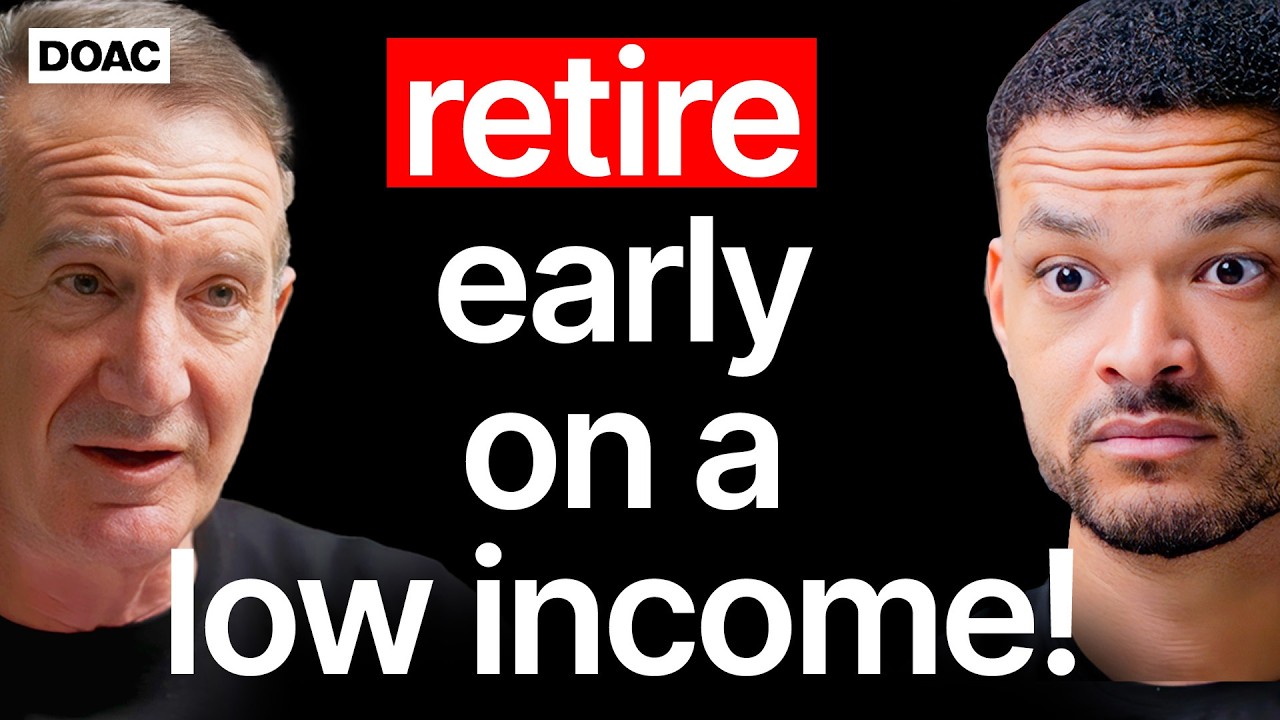
David Bach Outlines Automated Savings Strategy to Accelerate Wealth Building
The Diary Of A CEO
Automating 14% of gross income into primary home equity and low-cost index funds yields higher long-term net worth than relying on income growth or active stock trading.
## Background
Published by The Diary Of A CEO channel on YouTube on January 29, 2026, this episode features host Steven Bartlett in conversation with bestselling author and financial expert David Bach. According to the page description, the episode explores Bach's 'first-hour rule,' retirement investing strategies, passive income ideas, and automated financial systems designed to help viewers build wealth fast.
## TL;DR
Financial expert David Bach outlines a straightforward blueprint for achieving long-term wealth by automating savings, paying yourself first, and utilizing low-cost index funds or home equity. He argues that earning more money rarely cures bad habits, advocating instead for systematic daily savings—such as investing income from your first hour of work—and eliminating high-interest debt through structured payoff systems. Throughout the discussion, Bach and host Steven Bartlett dismantle common investment myths, emphasize the critical need for couples to align financially, and stress that automated discipline outperforms market speculation every time.
## Atmosphere & style
The interview has an urgent, empowering, and pragmatic tone that combines personal storytelling with actionable financial advice. David Bach delivers his advice with enthusiastic conviction and seasoned authority, while Steven Bartlett serves as an engaged, curious sounding board, occasionally sharing his own personal financial journey. The conversation moves seamlessly from candid reflections on economic harshness to hopeful, step-by-step strategies, creating an inspiring and deeply practical listening experience.
## Key takeaways
- [00:00](https://www.youtube.com/watch?v=99xyy1nUpug&t=0s) Automating your savings and investment systems eliminates reliance on willpower and rigid budgeting, laying a stress-free foundation for building long-term wealth.
- [01:10:55](https://www.youtube.com/watch?v=99xyy1nUpug&t=4255s) Small daily expenses can add up significantly over time; saving and investing $27.40 a day ($10,000 annually) can grow into over $4.4 million across 40 years.
- [16:17](https://www.youtube.com/watch?v=99xyy1nUpug&t=977s) Living paycheck to paycheck is not solely a low-income problem, as one out of three U.S. households making $150,000 a year still stays broke due to lifestyle creep.
- [16:17](https://www.youtube.com/watch?v=99xyy1nUpug&t=977s) The First Hour Rule recommends automatically setting aside and investing the earnings from your first hour of daily work to pay yourself first.
- [22:36](https://www.youtube.com/watch?v=99xyy1nUpug&t=1356s) Homeowners in America build significantly higher net worth than renters, driven by compulsory savings, housing leverage, and substantial tax benefits.
- [12:36](https://www.youtube.com/watch?v=99xyy1nUpug&t=756s) Boring, low-cost index funds and target-date funds consistently outperform high-risk speculative trading, crypto, and individual stock picking over the long run.
- [55:18](https://www.youtube.com/watch?v=99xyy1nUpug&t=3318s) The DOLP (Done On Last Payment) System provides a structured approach to eliminate debt by prioritizing smallest balances first while keeping paid-off accounts open.
- [01:04:32](https://www.youtube.com/watch?v=99xyy1nUpug&t=3872s) A comprehensive savings setup allocates gross income automatically across three primary buckets: a Future Account, an Emergency Account, and a Dream Account.
- [01:09:26](https://www.youtube.com/watch?v=99xyy1nUpug&t=4166s) Regularly auditing mobile phone and app subscriptions can quickly identify unused recurring costs and recover hundreds of dollars each month.
- [01:22:33](https://www.youtube.com/watch?v=99xyy1nUpug&t=4953s) Money disagreements remain a primary driver of marital breakdown; couples must align on core financial values, disclose all accounts, and conduct regular emergency reviews.
- [01:36:25](https://www.youtube.com/watch?v=99xyy1nUpug&t=5785s) Making bi-weekly mortgage payments or adding one extra full payment per year can shorten a 30-year home loan by 5 to 7 years and save tens of thousands in interest.
## Detailed walkthrough
Here is a detailed, faithful walkthrough of Part 1 of the transcript.
---
[00:00](https://www.youtube.com/watch?v=99xyy1nUpug&t=0s) The Core Debates: Homeownership, Automatic Systems, and $27 a Day
David Bach challenges the belief that renting and investing solely in the stock market is always the superior path to wealth. He points out that if people rent through their 20s and 30s, they often reach their 40s without building any meaningful net worth, highlighting that homeowners in America are worth roughly 40 times more than renters on average. While host Steven Bartlett questions whether homeownership itself actually creates that wealth or if it is merely a correlation, Bach insists that the math and mechanics of homeownership do directly build wealth.
Drawing from 33 years of experience in the financial services industry—including nine years as a senior financial advisor at Morgan Stanley—Bach emphasizes that he has seen ordinary earners build substantial wealth through a simple, repeatable formula. The key to financial success is putting one's financial life on complete autopilot in less than 10 minutes. This automated approach bypasses the need for extreme willpower, rigid budgeting, or an exceptionally high income. Bach warns that unless a financial plan is automated, it is almost guaranteed to fail over the long term.
Despite his prediction that the next decade will present the greatest wealth-building opportunity of our lifetime, the reality for most people remains grim. Seven out of ten people are currently living paycheck to paycheck, over 50% of Americans lack basic savings, and most individuals have no clear tracking of where their money goes. When asked how much money would completely transform their lives, most people cite $10,000. Bach breaks down just how achievable that figure is: blowing $10,000 a year comes down to wasting just $27.40 a day. If a person instead invested that exact $27.40 daily over a 40-year period, compound growth would turn it into over $4,424,000.
* **Homeowner vs. Renter Net Worth:** American homeowners have a net worth approximately 40 times higher than that of regular renters.
* **Paycheck-to-Paycheck Reality:** Roughly 70% of people live paycheck to paycheck, and over half of Americans cannot cover an unexpected expense.
* **The $10,000 Life-Changer Math:** Wasting $27.40 a day equates to $10,000 a year. Investing $27.40 per day over 40 years yields over $4,424,000.
---
[02:45](https://www.youtube.com/watch?v=99xyy1nUpug&t=165s) Helping Millions and the Story of Grandma Rose
Bach outlines his overarching mission over the past three decades: teaching everyday people on ordinary incomes—even those making minimum wage or buried in debt—how to achieve total financial freedom. He highlights that his work focuses on enabling anyone, at any age or income level, to set up an automatic financial system.
Bach’s passion for financial literacy was sparked at the age of seven by his grandmother, Grandma Rose. On her cold 30th birthday, living paycheck to paycheck in a middle-class household without a college degree (her husband worked in a factory while she worked in retail), Grandma Rose declared that she was tired of being poor and wanted to build a life where they could eventually move to sunny California. Realizing that nothing would change unless their actions changed, she began saving just 50 cents a week out of her paycheck. Through disciplined, continuous saving and investing, she ultimately transformed herself into a self-made millionaire.
Grandma Rose took seven-year-old David to a McDonald's to teach him a fundamental lesson on money using a Monopoly analogy. Pointing around the restaurant, she explained that there are three types of people in the world:
1. **Consumers:** The customers sitting at the tables eating cheeseburgers, fries, and milkshakes, spending their money.
2. **Employees:** The staff working behind the counter for minimum wage (which was about 85 cents an hour at the time), working hard just to earn a living.
3. **Investors/Owners:** The people who own the underlying business and profit from everyone else's activity.
She then took young David straight to a brokerage firm and helped him buy his very first single share of McDonald's stock so he could become an owner. That experience reframed his worldview, causing him to evaluate every business he visited as an investment opportunity—even asking at nine years old whether Mickey Mouse at Disney was a publicly traded stock.
---
[07:24](https://www.youtube.com/watch?v=99xyy1nUpug&t=444s) High-Income Trap and the Realization with the McIntyres
Despite his early start in investing, Bach fell into classic financial traps during his early 20s. After going to college and accumulating credit card debt, he fell for the common misconception that one cannot invest meaningfully until earning a high income. As his earnings scaled from nothing to $50,000, then $75,000, and eventually $100,000 a year, he found himself continuing to live paycheck to paycheck, spending more than he earned despite working as a financial advisor at Morgan Stanley.
The turning point occurred when an ordinary couple, Jim and Sue McIntyre, walked into his office for a retirement consultation. At age 52, Jim and Sue earned a combined income of a little over $53,000 that year, and their average lifetime income was only $40,000. Yet, when Jim laid out all their financial statements on the desk, Bach calculated their total net worth to be $1.8 million.
When Bach asked how they had accomplished this on moderate salaries, the couple explained that traditional budgets never worked for them. Instead, they had automated their entire financial life—automatically paying themselves first and routing savings straight into investments before they ever had the chance to spend it. Realizing that a couple earning half his income was ready to retire at 52 while he was high-earning yet broke, Bach went home that day and radically overhauled his personal financial habits.
* **Jim and Sue McIntyre's Profile:** Lifetime average income of $40,000 (earning ~$53,000 at age 52) with an accumulated net worth of $1.8 million.
* **The Core Habit:** Total elimination of manual budgeting in favor of automated savings and investments.
---
[09:40](https://www.youtube.com/watch?v=99xyy1nUpug&t=580s) Why Smart Women Finish Rich
Transitioning to his early career working alongside his father, Bach recalls sitting in on high-stress meetings with newly widowed women. During his very first month as a financial advisor, he sat in on three separate meetings where husbands had died suddenly, leaving their widows completely unprepared to read brokerage statements, write checks, or evaluate their financial standing. When Bach confronted his father about this pattern, his father noted that Grandma Rose was a rare exception and that most women were left out of financial management.
This inspired Bach to write *Smart Women Finish Rich* and launch dedicated financial education programs for women. He outlines the distinct statistical realities that women face:
* **Longevity:** Women generally live longer than men, requiring a larger retirement nest egg to cover extra years of life. The average age of widowhood in the United States is currently 59 years old.
* **Divorce & Career Gaps:** Women are statistically impacted more severely by divorce and often work fewer years (averaging 7 to 11 fewer years in the workforce due to caregiving and raising children), leading to reduced earnings and smaller contributions to retirement accounts and Social Security.
Because of these factors, Bach insists that every woman—regardless of whether she is an entrepreneur, stay-at-home mother, single, married, widowed, or married to a bank president—must personally control her own money and never delegate her financial well-being. Furthermore, he notes that data shows women consistently make better long-term investors than men because they trade less frequently, conduct thorough research, and avoid impulsive speculation.
---
[12:36](https://www.youtube.com/watch?v=99xyy1nUpug&t=756s) Why Boring Investments Build the Most Wealth
Addressing the differences in financial behavior between genders, Bach points out that men make up the vast majority of gambling and trading addicts. With the rise of modern trading platforms, men frequently jump into short-term stock trading, crypto speculation, and options trading—activities where the vast majority of retail participants consistently lose money over time.
Bach argues for a foundational rule of wealth accumulation: "Your life should be interesting, your investments should be boring." If an investment pitch at a cocktail party sounds exciting or "sexy," it is almost always a path to going broke. True wealth building is quiet and unglamorous. He shares how even his own son asked why he doesn't actively day-trade volatile stocks like Tesla. Bach told him that trying to time when to buy and sell is a losing game; instead, the smartest move for the vast majority of people is to consistently buy simple index funds over long horizons.
* **Investment Philosophy:** "Sexy" investments lead to being broke; "boring" investments build lasting wealth.
* **Core Recommendation:** Low-cost index funds over active day-trading, individual stock picking, options, or crypto speculation.
---
[14:18](https://www.youtube.com/watch?v=99xyy1nUpug&t=858s) Controlling Your Personal Economy
When looking at macro issues such as wealth inequality, interest rate fluctuations, geopolitical instability, or the rise of AI, Bach stresses that individuals must focus on the only economy they can actually control: their personal economy.
He puts the lifetime potential of an individual into perspective through working hours. The average individual works roughly 90,000 hours over their career. In a dual-income household, two partners will collectively work anywhere from 90,000 to 200,000 hours over their working lives. Over that span of time, even ordinary earners will have millions of dollars pass through their hands. The ultimate factor determining financial freedom is not global economic conditions, but how much of those earned millions an individual chooses to keep and automatically invest in their own personal economy.
[15:08](https://www.youtube.com/watch?v=99xyy1nUpug&t=908s) The "No Plan Plan" vs. Paying Yourself First
David Bach explains that most people operate on what he calls a **"no plan plan"**: money comes in, money goes out, and at the end of the month, they wonder where it all went. An automatic millionaire, by contrast, has a specific blueprint for every dollar the moment it arrives, beginning with paying themselves first. Steven Bartlett reflects on his own life a decade earlier, when he was working in a call center with £7,000 in credit card debt. Back then, becoming a millionaire felt like a distant fantasy, especially when so many people struggle just to put food on the table. David emphasizes that wealth isn't far away because of your income; it's far away if you lack the strategy and the system.
- **No Plan Plan:** Money enters and leaves without direction, leaving people wondering where it vanished.
- **Automatic Millionaire Strategy:** Automates savings and investments immediately upon receiving income.
- **Steven's Baseline:** A decade prior, Steven was £7,000 in debt while working at a call center.
---
[16:17](https://www.youtube.com/watch?v=99xyy1nUpug&t=977s) Earning More Won't Save You: The 1-Hour-a-Day Rule
Steven asks how much of wealth building comes down to simply earning more money by acquiring higher-value skills. David responds directly: earning more money does not make you rich. In the U.S., **one out of three households making $150,000 a year is still broke**. As income rises from $50,000 to $100,000, $200,000, or $300,000, **lifestyle creep** and higher living costs consume the surplus. Furthermore, modern smartphones and algorithms are engineered to extract consumer spending for lifetime customer value.
David illustrates how income is carved up: when you work from 9:00 AM to 5:00 PM, you effectively work from 9:00 AM to 12:00 PM just to pay the government, 12:00 PM to 3:00 PM for housing and food, and 3:00 PM to 5:00 PM for everything else. The government doesn't ask you to budget for taxes—they take taxes and Social Security automatically from your paycheck because they know you won't save it yourself. Wealth builders flip this script by keeping the **first hour a day of their income** and investing it pre-tax before anyone else gets paid.
- **High-Income Broke:** 33% of U.S. households earning $150,000/year live paycheck to paycheck due to lifestyle inflation.
- **The Workday Breakdown:** 9:00–12:00 (Taxes), 12:00–3:00 (Housing & Food), 3:00–5:00 (Discretionary/Rest).
- **The First Hour Rule:** Save and invest the income generated from the very first hour of your daily work schedule.
---
[19:43](https://www.youtube.com/watch?v=99xyy1nUpug&t=1183s) The 401(k) Millionaire Formula and the 70/30 Rule
To invest that first hour tax-free, employees use pre-tax retirement accounts like a **401(k)** in the U.S. (or equivalent tax-deductible accounts globally, such as in the UK, Canada, Australia, or Italy). David reveals that recent Fidelity data shows there are now **654,000 401(k) millionaires** in their system alone. Over 40 years of data reveals the exact formula these millionaires used: they saved roughly **14% of their gross income** (around 12.5% or 1/8th of income plus a small employer match) and invested for growth.
Their asset allocation averaged **70% stocks and 30% bonds**. In contrast, the average American only saves 3% to 5% if they have a plan at all. David notes that the total number of U.S. millionaires has expanded from 16 million to **24 million millionaires in just 20 years**, driven by the two primary wealth escalators: **stocks and real estate**.
- **Fidelity 401(k) Millionaires:** 654,000 account holders have reached $1,000,000+ using this method.
- **The Exact Formula:** Save ~14% of gross income (including employer match) and invest for growth.
- **Asset Allocation:** 70% stocks / 30% bonds.
- **Total U.S. Millionaires:** Grown to 24 million, up by 8 million over 20 years.
---
[22:36](https://www.youtube.com/watch?v=99xyy1nUpug&t=1356s) Are Homeowners Actually Wealthier? The $34 Trillion Truth
Addressing a hot topic on the podcast, Steven notes that many financial advisers claim buying a house is a bad investment. David passionately disagrees, stating, "I couldn't feel more differently." Wealth in America and abroad is built in two primary assets: home equity and the stock market. In the U.S., **homeowners are worth 40 times more than renters**—the average homeowner has a net worth exceeding **$400,000**, whereas the average renter's net worth is **$10,000**.
When Steven questions whether this is merely correlation rather than causation, David points to the raw balance sheet data. U.S. home equity reached a staggering **$34 trillion** (up 90% since pre-COVID times), while retirement accounts hold **$45 trillion** (mostly invested in stocks). Together, these two assets account for **$80 trillion in wealth**. While real estate prices have skyrocketed out of reach for many young people in cities like London, Chicago, or New York, David stresses that renters ultimately pay for the landlord's property taxes, insurance, and maintenance costs anyway, because landlords do not subsidize housing.
- **Net Worth Gap:** Average U.S. homeowner net worth is $400,000+ vs. average renter net worth of $10,000 (a 40x difference).
- **Total U.S. Home Equity:** $34 trillion total equity, up 90% since pre-COVID.
- **Total Retirement Account Wealth:** $45 trillion (60%–70% in equities).
---
[27:38](https://www.youtube.com/watch?v=99xyy1nUpug&t=1658s) Stocks vs. Real Estate: Busting the Leverage & Tax Myths
David shares his personal story of getting on the property ladder after finishing college with **$12,000 in credit card debt**. He bought his first home—a $250,000 fixer-upper—jointly with his best friend Andrew by splitting a 10% down payment ($12,500 each) and renting out spare bedrooms to friends to cover the mortgage. Over the past 20 years, while the stock market has returned 600% and housing prices have appreciated 400%, homeownership offers an advantage that stock market returns don't show on paper: **leverage and tax advantages**.
Busting the myth that stock returns (averaging ~10% annually) render housing inferior, David explains that buyers don't pay cash; they put down 20% and borrow 80%. On a $200,000 home with a $40,000 down payment, if the home doubles to $400,000, the owner makes a **$200,000 gain on a $40,000 investment**—a 5x return on capital. Furthermore, U.S. tax laws allow single owners up to **$250,000 in tax-free capital gains** (over **$500,000 for married couples**) after living in the home for two years. David dismisses the claim that renters simply invest the extra savings into mutual funds as an "absolute freaking myth," noting that people usually rent nicer places and spend the rest. Institutional buying of single-family homes further proves the value of real estate, prompting political pushback against corporate landlords.
- **David's First Home Purchase:** $250,000 home purchased with a 10% down payment ($12,500 each split between two friends).
- **20-Year Market Growth Comparison:** Stocks up 600%; Real Estate up 400%.
- **Leveraged Return Example:** $40,000 down on a $200,000 home yielding a $200,000 profit when value doubles = 500% return on invested capital.
- **U.S. Capital Gains Tax Exemption:** Up to $250,000 tax-free gain for single filers; $500,000+ for married couples.
---
[31:24](https://www.youtube.com/watch?v=99xyy1nUpug&t=1884s) The Inflation Debate and What Home Buyers Really Face
Steven brings up counterarguments raised by previous guests, noting critics often cite economists like Robert Shiller to point out that real, inflation-adjusted U.S. home price appreciation historically sits at around **1% annually** before maintenance costs are factored in. Steven prepares to go through the counter-arguments bullet by bullet so David can offer a direct rebuttal on the true cost of buying versus renting.
[32:00](https://www.youtube.com/watch?v=99xyy1nUpug&t=1920s) Gross Appreciation vs. Net Returns in Real Estate
Addressing the harsh mathematical realities of homeownership, Steven pushes back on the idea that property is a slam-dunk investment. When you factor in annual maintenance (typically 1–2%), property taxes (around 1%), insurance, and steep transaction costs, the net real return on housing can approach roughly zero on average. Steven asks whether praising homeownership relies on looking purely at "gross appreciation" rather than real, net returns after expenses.
David counters that while those spreadsheet models look tidy on paper, they do not reflect how real-world wealth is built. In practice, over 50% of the average long-term homeowner's net worth is tied up in their home equity. He shares an example from Steven’s own YouTube comment section, where a viewer wrote that their house had grown 3.5 times in value while their alternative—renting that same property—would have surged from $1,200 to $4,000 a month. Rents relentlessly compound over time. Drawing from his own 18 years living in New York City, David recalls seeing prime apartments rent for $6,000 a month in 2001, only to skyrocket to $25,000 a month two decades later. The market value of that same apartment jumped from $2 million to $5 million. Renters who stayed for 20 years accumulated zero equity, while owners gained millions.
To illustrate how everyday people use property to secure their future, David brings up Jim and Sue McIntyre, the real-life middle-class couple featured in *The Automatic Millionaire*. By age 52, despite never earning more than an average salary of $40,000 a year, they had accumulated a net worth of $1.8 million. Their secret was not hitting it big in the stock market; they bought a modest home in a middle-class neighborhood in San Leandro, California, paid off the mortgage, bought a second house on the very same street, paid that off too, and lived in one while receiving rental income from the other.
- **Net Housing Returns vs. Gross:** Maintenance (1–2%), taxes (~1%), insurance, and transaction costs significantly eat into nominal appreciation.
- **The NYC Rent Reality:** A luxury apartment renting for $6,000/month in 2001 surged to $25,000/month 18 years later, with its purchase value rising from $2M to $5M.
- **Case Study (The McIntyres):** Earned an average of $40,000/year, retired at 52 worth $1.8M by owning two homes free and clear in San Leandro, CA alongside 401(k) savings.
---
[34:54](https://www.youtube.com/watch?v=99xyy1nUpug&t=2094s) Should You Invest in the S&P 500 or Buy a Home?
Steven poses a classic financial dilemma: what if a buyer takes a $20,000 down payment and invests it in the S&P 500 instead of buying a house? Over the long run, wouldn't index funds outgrow total home equity?
David dismisses the theoretical index fund argument with a simple physical truth: "You can't live inside an index fund." Because housing is an unavoidable life expense, renting requires burning capital continuously. He breaks down the compounding drain of rent payments: paying $5,000 a month equals $60,000 a year. Over 10 years, that is $600,000; over 20 years, $1.2 million; and over 30 years, $2 million—assuming rents *never* go up, which they inevitably do. Renting is a helpful short-term bridge, but a terrible long-term wealth strategy because you are funding someone else's equity. If you insist that renting is superior, David suggests you should at least buy property to rent out to others, because "somebody's getting rich in the transaction."
- **The Rent Accumulation Math (at $5,000/month):**
- **10 Years:** $600,000 spent
- **20 Years:** $1.2 Million spent
- **30 Years:** $2.0 Million spent (assuming zero rent increases)
---
[36:41](https://www.youtube.com/watch?v=99xyy1nUpug&t=2201s) Mobility, Flexibility, and Homeownership
The conversation shifts to career flexibility. Steven brings up his 16-year-old son, pointing out that in a rapidly shifting economy powered by AI, younger generations might need to move frequently—from San Francisco to Florence—to chase emerging career opportunities. Doesn't locked-in real estate destroy geographic and professional mobility?
David acknowledges the possibility but challenges the belief that renting is frictionless while owning is a trap. Residential leases tie tenants down for 1–2 years at a time. In contrast, property in strong US markets can be remarkably liquid. Prompted by David, Steven looks up real-time market data on his phone, discovering that the average time from listing to closing a home in the US is roughly 47 to 62 days (including about 16 days active on the market and 30 to 45 days to close). David emphasizes that turning around property in under 90 days provides substantial flexibility. Furthermore, homeowners have options: they can lease the home out, run an Airbnb, or convert it into an income-generating asset rather than selling.
Ultimately, housing acts as a crucial engine of "forced savings." Because most people struggle to discipline themselves to invest voluntarily, a monthly mortgage forces them to build equity by paying down principal. David notes that implementing a bi-weekly mortgage payment plan allows homeowners to pay off a 30-year mortgage 5 years early, saving $50,000 to $100,000 in interest payments alone.
- **US Home Sale Timeline (2025 Data):** 47 to 62 days total from listing to close (16 days on market, 30–45 days to close).
- **Bi-Weekly Payment Hack:** Paying half your monthly mortgage every two weeks results in 13 full payments a year, shaving 5 years off a 30-year mortgage and saving $50,000–$100,000 in interest.
---
[41:06](https://www.youtube.com/watch?v=99xyy1nUpug&t=2466s) Finding Your Money: The 7-Day Financial Challenge
Shifting to the psychological side of money, Steven asks how someone who feels trapped and falling deeper into debt can possibly adopt a savings mindset.
David insists that the journey begins by tracking down where your money is actually going. Most people have complete amnesia regarding their daily expenditures due to contactless payments and mobile wallets. "We've lost touch with spending money," David notes, observing that clicking a smartphone screen eliminates the physical friction of paying. To break this unconscious spending habit, he recommends a simple 7-Day Financial Challenge: carry a small pocket notebook for seven consecutive days and manually write down every single expense, no matter how small. Seeing the cumulative numbers written on paper serves as an immediate wake-up call.
- **The 7-Day Financial Challenge:** Carry a physical notepad for one week and record every transaction to expose hidden spending leaks.
---
[42:55](https://www.youtube.com/watch?v=99xyy1nUpug&t=2575s) How $27.40 a Day Builds a $4.4 Million Fortune
To make spending visual, David produces a physical stack of cash on set—a wrapped bundle known as a "brick." He asks Steven to guess its value; Steven guesses $5,000, but David reveals it is $10,000 in cash, calling it a "life-changing amount of money."
David breaks down the exact daily cost required to waste $10,000 over the course of a year: **$27.40 a day**. If a person redirects that $27.40 a day into an S&P 500 index fund earning an average annual return of 10% with reinvested dividends, that daily habit compounds into **$4,424,000** over 40 years.
Anticipating the usual excuses people make when faced with this math, David counters them one by one:
- *"Yeah, but inflation will erode its value!"* — It is worth infinitely more than zero.
- *"Yeah, but taxes will eat it up!"* — Invest inside a tax-advantaged retirement account (like a 401(k) or IRA).
- *"Yeah, but you can't earn 10%!"* — The US stock market has averaged over 10% annually with dividends reinvested for over a century.
- *"Yeah, but investing is too complicated!"* — You can open an account with platforms like Vanguard, Fidelity, Schwab, Robinhood, or Acorns in under 10 minutes.
Beyond long-term wealth, David stresses that $10,000 represents immediate life-altering freedom. In surveys, $10,000 is the exact figure people cite as the amount needed to transform their lives because it matches the average American's credit card debt. Having $10,000 in cash allows someone to walk away from a toxic job, start a business, or escape an abusive relationship.
He links this back to his famous concept, "The Latte Factor." While critics mock the idea of skipping coffee, modern spending has inflated the cost: an iced coffee in New York City now costs $9.50, easily topping $11 after a tip. Small daily drains add up to life-altering sums over time.
- **The $10,000/Year Formula:** $27.40 per day = $10,000 per year.
- **40-Year Wealth Projection:** $27.40/day invested at 10% annual return = **$4,424,000**.
- **Financial Vulnerability Statistic:** 1 in 2 Americans has less than $1,000 in savings; $10,000 covers the average person's credit card debt.
Here is a detailed, faithful walkthrough of part 4 of the transcript.
---
[48:23](https://www.youtube.com/watch?v=99xyy1nUpug&t=2903s) Everyday Spending Realities and the Feasibility of Saving $27 a Day
David Bach opens by highlighting how quickly small daily choices erode wealth, referencing the skyrocketing costs of eating and drinking out. During a recent trip to New York City, a hotel cocktail cost him $31.50, a glass of wine ran $50, and a standard lunch easily tops $25. While people argue that eating out is necessary, Bach points out that bringing a "brown bag" lunch—a habit his grandmother practiced religiously—can fund retirement. Though her friends teased her at the time, her frugal choices enabled her to retire comfortably in California, while her peers remained stuck in cold Milwaukee, Wisconsin, lacking the funds to leave.
```
┌─────────────────────────────────────────┐
│ DAILY SAVINGS MATH │
├─────────────────────────────────────────┤
│ $27.40 / day = $10,000 / year │
│ At 10% average market return: │
│ • 10 Years ➜ ~$160,000 │
│ • 30 Years ➜ ~$1,800,000 │
└─────────────────────────────────────────┘
```
Steven Bartlett pushes back, questioning how realistic it is for the average person to save $27 a day, noting that between ages 18 and 19, that target would have been a mathematical impossibility for him. Bach counters by asking whether Bartlett knows people earning over $50,000 a year who still fail to save even $10 or $27 a day due to lifestyle creep. Bartlett cites recent 2025–2026 economic data showing that roughly 40 to 50 million American families—representing the top 30% to 35% of households—can realistically save $27 a day. For the bottom 65% to 70% of households, however, saving that amount is either mathematically impossible or would force them into poverty-level living.
- **NYC Expense Examples:** $31.50 for a hotel cocktail, $50 for wine, $25 for a basic lunch.
- **Economic Demographics:** 40–50 million U.S. families (top 30–35%) have the discretionary income to save $27 daily ($10,000 annually).
- **Grandmother's Legacy:** Brown-bagged meals allowed her to move from Milwaukee to California in retirement.
---
[50:23](https://www.youtube.com/watch?v=99xyy1nUpug&t=3023s) Economic Disparities, Emergency Funds, and the $10-a-Day Challenge
The discussion turns to the stark divide between middle-to-high earners and Americans living on the financial edge. Bach shares an anecdote from a keynote address he delivered in Arizona during a government shutdown. He asked the audience if they knew how many citizens relied on SNAP (Supplemental Nutrition Assistance Program) food benefits—a figure of roughly 41.5 million Americans receiving just over $6 a day. When he revealed that the six-week government shutdown disrupted three pay cycles for workers, the room gasped. Most Americans lack even two weeks of reserve expenses. Federal Reserve data confirms that 37% of Americans cannot cover an unexpected $400 expense, while 40% cannot raise $1,000 in an emergency.
Bartlett points out the "discretionary income cliff": while top 20% earners (averaging $96,000+ per household) enjoy healthy surpluses, the bottom 40% typically hold a narrow $2,000 annual surplus, making a $10,000 annual savings goal impossible. For those struggling at the bottom, Bach advises starting small rather than giving up:
> "Fitness is built through daily action. Saving's the same thing."
He challenges people to undertake the **$10-for-100-Days Challenge**—saving $10 daily for 100 days to cross their first $1,000 threshold and break out of the majority of Americans with zero safety net. He also recommends automated micro-investing tools like Acorns (where he invested in 2015), which automatically rounds up everyday purchases—like turning a $9.50 coffee into a $10.00 charge—and sweeps the 50-cent difference into an investment account.
- **SNAP Statistics:** ~41.5 million Americans receive SNAP benefits averaging ~$6 per day.
- **Emergency Preparedness:** 37% of Americans cannot pull together $400 for an emergency; 40% cannot cover $1,000.
- **Income Tiers:** Top 20% average $96,000+ household income; middle 20% have ~$15,000 discretionary income; bottom 40% hover around a $2,000 surplus.
- **Micro-Investing:** Acorns spare-change roundups have helped users passively accumulate tens of thousands of dollars over a decade.
---
[55:18](https://www.youtube.com/watch?v=99xyy1nUpug&t=3318s) Escaping the Debt Quicksand: The DOLP System
Addressing a listener question regarding a friend drowning in debt on a $50,000 income, Bach describes debt as "quicksand" and recalls carrying $12,000 in credit card debt after college, which felt like walking around with a 50-pound backpack. To break free, Bach outlines his proprietary **DOLP System** ("Done On Last Payment"), a step-by-step framework similar to the debt snowball method:
```
STEP-BY-STEP DOLP SYSTEM
┌─────────────────────────────────────────────────────────────┐
│ 1. LIST CARDS │ List all balances from SMALLEST to │
│ │ LARGEST dollar amount. │
├───────────────────┼─────────────────────────────────────────┤
│ 2. AUTOMATE │ Set up AUTOMATIC minimum payments on │
│ │ every single card online. │
├───────────────────┼─────────────────────────────────────────┤
│ 3. ATTACK SMALL │ Throw ALL extra cash at the smallest │
│ │ balance until it reaches $0. │
├───────────────────┼─────────────────────────────────────────┤
│ 4. ROLL OVER │ Move to the next smallest card. Do NOT │
│ │ close accounts (protects credit score). │
├───────────────────┼─────────────────────────────────────────┤
│ 5. NEGOTIATE │ Call issuers or use non-profit credit │
│ │ counseling to freeze/lower APRs. │
└───────────────────┘
```
Bach warns borrowers against celebrating debt payoff by spending on credit again—a trap he fell into during his junior year of college, forcing him to pay off his balance twice. Following that lesson, he avoided credit cards entirely for 30 years, relying solely on a debit card.
- **DOLP Definition:** "Done On Last Payment"—focusing intensely on paying off smallest balances first to gain psychological momentum.
- **Account Maintenance:** Keep paid-off accounts open to preserve credit history and avoid dropping your credit score.
- **Issuer Negotiations:** Contact credit card companies directly to inquire about hardship programs that freeze interest rates in exchange for closing the card to new purchases.
---
[59:50](https://www.youtube.com/watch?v=99xyy1nUpug&t=3590s) Increasing Income, Trade Careers, and the Power of Optimism
When asked how lower-income workers can expand their earnings, Bach emphasizes that the single most effective strategy is mastering one's current job. Whether working a minimum-wage role at McDonald's or an entry-level corporate job, managers and franchise owners are desperate for reliable employees who show up early, execute a daily plan, stay late, and act without needing constant supervision.
Beyond traditional corporate paths, Bach urges younger generations to focus on specialized skills and technical trades:
- **AI Proficiency:** Developing practical AI skills to stay competitive in a changing labor market.
- **Skilled Trades:** Pursuing lucrative non-degree professions such as plumbing, electrical work, or garage door installation.
Bach mentions a recent podcast guest who built a billion-dollar business installing garage doors, as well as an acquaintance who built a thriving enterprise selling custom garage gym setups.
Overcoming financial stagnation requires eliminating what speaker Zig Ziglar called "stinking thinking." Believing that the future can be better than the present is a prerequisite for financial growth. As Bach notes:
> "I would rather be an optimist and be wrong than a pessimist and be right."
---
[01:03:09](https://www.youtube.com/watch?v=99xyy1nUpug&t=3789s) Mindset as the Catalyst: The Generational Ripple Effect
Closing the discussion on whether success is purely mindset or structural economics, Bach acknowledges real-world obstacles like oppressive governments or low-opportunity environments (such as Bartlett's birthplace in Botswana). However, where opportunity exists, financial transformation begins with a firm personal decision.
Bach returns to his grandmother's story: at age 30, tired of living paycheck to paycheck, she decided to learn about money and set aside 50 cents from her paycheck and 50 cents from her husband's paycheck each week. That single choice created a multigenerational ripple effect:
Bach addresses mothers and parents directly, reminding them that choosing financial discipline is rarely just about individual comfort—it alters the trajectory of their children and future generations.
[01:04:32](https://www.youtube.com/watch?v=99xyy1nUpug&t=3872s) The Three-Account Framework: Future, Emergency, and Dreams
David Bach addresses the common internal resistance people feel when trying to improve their financial lives. Listeners generally fall into three distinct camps: those who are hurting financially and need to fix things from where they stand, those who are doing okay but want to optimize their retirement accounts like a 401(k) or Roth IRA, and renters aiming to buy a home someday. To streamline money management, Bach presents his foundational framework of automating income into three specific "buckets" or accounts: a Future Account (retirement), an Emergency Account, and a Dream Account.
When asked how much money should go into each account, Bach translates his "one hour a day" rule into explicit percentages. For a standard 40-hour work week, saving your first hour of pay equivalent equals 12.5% of your gross income, which should be automatically swept off the top into retirement investments. For "ya-butters"—those who claim they cannot jump straight from 0% to 12.5%—Bach advises starting at just 1% this month. Bumping that up by 1% each month over a year brings someone to 12% without them ever noticing the lifestyle shift, effectively putting them in "rockstar shape" compared to the average American. The second hour of daily work pay (another 10% of gross income) is split equally: 5% (roughly 30 minutes of pay) goes toward safety in an Emergency Account, and 5% goes to a Dream Account to fund real-life goals like a home down payment, college tuition, a wedding, an engagement ring, or a year-end vacation.
* **First Hour Pay (12.5% of gross income):** Automated into a Future (retirement) Account.
* **1% Rule for Beginners:** Starting at 1% and increasing by 1% each month reaches a 12% savings rate in one year.
* **Second Hour Pay (10% of gross income):** Split evenly into an Emergency Account (5%) and a Dream Account (5%).
---
[01:07:30](https://www.youtube.com/watch?v=99xyy1nUpug&t=4050s) Why Automation Is Mandatory: Overcoming Human Willpower
Reflecting on the title of his multi-million-copy bestseller, *The Automatic Millionaire*, Bach asserts that a financial plan will inevitably fail unless it is fully automated. Drawing from his nine years as a financial advisor at Morgan Stanley, he observed that every client who built wealth on an ordinary salary did so through automatic savings. Conversely, clients who promised to hand-deliver a check every month consistently gave up within six months.
Bach highlights the irony that corporations and institutions already exploit automatic systems against consumers every single day. Gyms, phone providers, landlords, mortgage lenders, tax authorities, and streaming services like Netflix rely on subscription billing or direct debt pulls because they know consumers won't keep manually paying if left to their own willpower. Because people take three to six months on average to manually cancel a free subscription they do not use, Bach argues individuals must flip this exact mechanics to work in their own favor by automating their personal savings first.
> "Unless your financial plan is automatic, it will fail."
---
[01:09:26](https://www.youtube.com/watch?v=99xyy1nUpug&t=4166s) The Phone Subscription Audit: Uncovering Hidden Cash
To instantly free up cash flow, Bach shares a straightforward phone management tactic. On Apple devices, users can navigate into their device settings, tap their account name, and open "Subscriptions" to display a complete list of recurring app charges. Unsubscribing from unnecessary services allows users to reclaim lost income immediately. Furthermore, Bach advises immediately cancelling any new trial subscription the moment you sign up; when the trial period expires, companies frequently offer steep discounts to entice users back.
Demonstrating the trick live during the interview, Steven opens his iPhone settings and checks his active subscriptions. Out of 11 recurring app subscriptions running silently in the background, Steven realizes he only actually uses and wants to keep three. Bach notes that exercises like this frequently recover $50, $100, or even $200 per month for individuals and families, which can then be redirected into compound-interest investments. While paid budgeting apps like Monarch Money or YNAB (You Need A Budget) can track recurring charges, checking native device subscription hubs or credit card statements provides a free alternative.
```
11 Total Active Phone Subscriptions
┌───────────────────────────────────┐
│ [3 Kept] │ [8 Canceled] │
└───────────────────────────────────┘
│
▼
Reclaims $50–$200 / month
│
▼
Redirected into Index Funds
```
* **Live Audit Example:** Steven discovered 11 running subscriptions on his phone and determined he only needed 3.
* **Potential Monthly Savings:** $50 to $200 per month can be reclaimed by auditing mobile and card subscriptions.
* **Recommended Budgeting Apps:** Monarch Money and YNAB (You Need A Budget).
---
[01:12:31](https://www.youtube.com/watch?v=99xyy1nUpug&t=4351s) Index Fund Benchmarks: S&P 500, Global Stocks, and Tech
To illustrate the long-term impact of redirecting recurring waste, Steven calculates that investing $100 a month over 40 years at a 10% annual return yields approximately $632,000. Bach expands on this by outlining specific, low-cost index funds that grant broad market exposure through platforms like Vanguard, Charles Schwab, or Fidelity:
```
┌────────┬────────────────────────────────┬──────────────────────────────────────────────┐
│ Symbol │ Fund Name │ Asset Coverage & Historical Performance │
├────────┼────────────────────────────────┼──────────────────────────────────────────────┤
│ VTI │ Vanguard Total Stock Market │ 3,500+ US stocks; ~14% annualized over 10 yrs│
│ VEA │ Vanguard FTSE Developed Markets│ Global stocks ex-US; up 35% in recent year │
│ QQQ │ Invesco QQQ Trust (Nasdaq-100) │ Top 100 non-financial Nasdaq companies │
└────────┴────────────────────────────────┴──────────────────────────────────────────────┘
```
* **Vanguard Total Stock Market ETF (VTI):** The largest index fund in the world, holding over 3,500 U.S. equities. It has generated an average annual return of 14% over the prior 10-year period.
* **Vanguard FTSE Developed Markets ETF (VEA):** Provides exposure to global equities excluding the U.S. While international equities underperformed the U.S. for an extended period, VEA posted a 35% gain in the previous year, outperforming the U.S. market average return of roughly 17%. Bach notes his personal equity portfolio is split $1/3$ global and $2/3$ U.S.
* **Invesco QQQ Trust (QQQ):** Tracks the Nasdaq-100 index. Checking the historical data live, Steven reports that from 2016 to 2026, QQQ delivered an annualized return of roughly 19% (a total return of ~480%), turning a $10,000 investment into approximately $60,000. Over a 20-year span, QQQ annualized at 15% with a 1,500% cumulative gain, turning $10,000 into roughly $170,000.
Bach strongly cautions against the widespread advice that young investors should maximize risk. In practice, younger generations in their 20s and 30s are shifting from basic index funds into speculative assets like meme coins, meme stocks, NFTs, day trading, and options options via TikTok trends. When speculative investments inevitably collapse, investors who lose their hard-saved money often abandon investing altogether.
> "People who try to get rich quick stay broke forever."
---
[01:18:30](https://www.youtube.com/watch?v=99xyy1nUpug&t=4710s) Conservative Allocation and Target-Date Funds
For individuals who prefer a lower-risk strategy rather than 100% equity concentration, Bach points to classic balanced portfolios. A primary example is the **Vanguard Balanced Index Fund**, which maintains a traditional $60/40$ asset allocation split (60% equities and 40% bonds). Historically, this balanced approach has averaged over 8% in annual returns since its inception, offering moderate growth while cushioning against stock market pullbacks.
Bach emphasizes that these core foundational options, alongside **Target-Date Mutual Funds** (which automatically adjust asset allocation from aggressive stocks to conservative bonds as one approaches retirement), are routinely available inside 401(k) plans and workplace pension schemes.
* **Vanguard Balanced Index Fund:** Holds a classic 60% stock / 40% bond ratio and has delivered over 8% annualized returns since inception.
* **Target-Date Funds:** Automatically rebalance from high-growth equities to conservative fixed-income bonds as the investor nears their target retirement year.
[01:19:52](https://www.youtube.com/watch?v=99xyy1nUpug&t=4792s) Target-Date Mutual Funds and the Power of Automation
David Bach explains that when opening a 401(k) plan, investors typically encounter **target-date mutual funds**. These function as a single, one-stop investment solution designed to take a worker all the way to retirement. The fund automatically distributes capital across stocks and bonds, rebalancing over time by maintaining a higher concentration of stocks during an investor's younger years and gradually shifting toward less volatile bonds as retirement approaches.
While target-date funds were just emerging when David published *The Automatic Millionaire* two decades ago, they now manage trillions of dollars. This automatic mechanism has fundamentally transformed investing for millions of Americans, helping drive the number of US millionaires to 24 million and building total retirement account assets to $45 trillion.
---
* **Target-date mutual funds:** Automatically rebalance asset allocation from growth-oriented stocks to conservative bonds as the target retirement year approaches.
* **Impact of automated investing:** Total US retirement accounts hold $45 trillion, contributing to 24 million American millionaires.
[01:22:33](https://www.youtube.com/watch?v=99xyy1nUpug&t=4953s) Relationships, Financial Opposites, and "Smart Couples Finish Rich"
Turning to his bestselling book *Smart Couples Finish Rich*, David discusses how a partner choice and relationship configuration directly dictate long-term wealth building. In the real world, people almost inevitably marry their financial opposites: one partner enters the relationship with a figurative "calculator" and loves budgeting and investing, while the other loves to shop and spend. When two spenders marry, the outcome is often financial ruin; when opposites marry without alignment, constant money arguments ensue, serving as the leading cause of divorce.
To align a couple financially, David emphasizes stepping back from numbers initially to focus on core shared values. Couples must discuss what matters most to them deeply and build a financial roadmap around those mutual values rather than fighting over individual line items.
---
* **The financial opposite dynamic:** Marrying an opposite financial personality requires active alignment; unaligned money conflicts remain the primary driver of divorce.
* **Values-first planning:** Establishing shared core values provides the foundation for joint financial decisions.
[01:24:34](https://www.youtube.com/watch?v=99xyy1nUpug&t=5074s) Running the Family Financial "Fire Drill"
Addressing the primary mistakes couples make, David highlights the failure to designate specific responsibilities and the risk of leaving one partner entirely in the dark. With the average age of widowhood standing at 59—a milestone David has reached, having already lost three close male friends under 57—partners must prepare for unforeseen tragedies. Both partners need complete visibility into accounts, passwords, wills, and insurance policies.
Recalling a severe health crisis four years prior in Florence, Italy, David describes waking up from a four-day coma caused by meningitis. Beyond temporary memory loss—which included forgetting his bank passwords—the experience reinforced how crucial it is for both spouses to be engaged in financial management. Following his recovery, David and his wife hired a financial advisor and instituted mandatory annual account reviews to ensure continuous joint oversight.
```
"If your partner died today, what would you need to know about the finances? And the answer is EVERYTHING."
```
* **Average age of widowhood:** 59 years old.
* **Estate planning essentials:** Couples must maintain accessible lists of bank accounts, passwords, updated wills, and basic term life insurance ($1M–$2M coverage for families with dependents).
* **Six out of ten adults:** Currently do not have a written will.
* **Annual account review:** Couples should conduct a comprehensive yearly review of all assets, debts, and estate documents together or with an advisor.
[01:30:39](https://www.youtube.com/watch?v=99xyy1nUpug&t=5439s) The Reality of Financial Infidelity and CFO Dynamics
Steven shares compelling industry data highlighting widespread financial ignorance and secrecy within relationships:
* **Income ignorance:** A 2021 Fidelity Investments study revealed that nearly 40% of couples cannot accurately state their partner's annual income.
* **Financial infidelity:** Surveys from Bankrate and CreditCards.com show up to 40% of adults conceal financial details—such as secret cash, hidden bank statements, or undisclosed debt—from their romantic partners.
* **The "CFO" dynamic:** Roughly 50% of households rely on one spouse acting as the sole Chief Financial Officer, leaving the non-managing partner with zero knowledge of total household assets or account access details.
David notes that facing these realities can feel intimidating, but taking immediate small steps—such as setting up automatic savings or canceling unused subscriptions—builds momentum like a financial muscle. Action transforms advice from mere entertainment into genuine life-changing progress.
[01:33:56](https://www.youtube.com/watch?v=99xyy1nUpug&t=5636s) Accepting Uncomfortable Truths in a Changing Economy
Reflecting on a quote from Steven’s book *The Diary of a CEO*, David underscores the danger of ignoring hard financial realities. Refusing to accept uncomfortable truths today guarantees an uncomfortable future. With an average career spanning 90,000 working hours, failing to pay oneself first leaves an individual with nothing to show for decades of labor.
Looking ahead, David notes that while the next decade presents the single greatest wealth-creation opportunity of our lifetime—driven primarily by artificial intelligence expanding corporate productivity and market returns—it simultaneously threatens widespread job disruption. Navigating this economic divergence requires individuals to take immediate, proactive control of their personal finances.
```
"When you refuse to accept an uncomfortable truth, you are choosing to accept an uncomfortable future."
```
Here is a detailed walkthrough of the transcript segment:
[01:34:34](https://www.youtube.com/watch?v=99xyy1nUpug&t=5674s) The Government Safety Net Trap and Social Security Cuts
David Bach shifts the discussion to a looming macroeconomic issue: government safety nets. Programs like Social Security, Medicare, Medicaid, and unemployment in the U.S. (and similar entitlement programs globally) represent promises made by governments to their citizens that are fundamentally underfunded. The numbers tell a concerning story: the average Social Security check in the U.S. is currently **$1,900** per month, and roughly **60 million Americans** rely on that money to survive.
According to official government projections, Social Security will face severe underfunding by **2033**, forcing a potential **20% cut** in benefits unless drastic policy changes occur. With populations living longer and national debts reaching historic highs, Bach issues a stark wake-up call: "No one's coming to save you." Individuals must take personal responsibility for their financial well-being rather than relying on a collapsing system.
- **U.S. Entitlement Programs:** Social Security, Medicare, Medicaid, and unemployment insurance.
- **Social Security Statistics:** Average monthly check is **$1,900**, supporting **60 million Americans**.
- **2033 Projected Cut:** Social Security reserves face a projected **20% benefit reduction** by 2033.
---
[01:36:25](https://www.youtube.com/watch?v=99xyy1nUpug&t=5785s) Smart Strategies to Pay Off Your Mortgage Early
Steven Bartlett transitions to mortgage strategies, sharing a question from a friend who received an inheritance and wondered whether to pay off their home loan or invest in the S&P 500. Bach explains that the choice depends entirely on interest rates: if someone secured a mortgage at an extraordinarily low rate (like **2.5%**), putting excess cash into a high-yielding money market account yields better returns. However, with higher rates around **6%, 7%, or 8%**, paying down the principal quickly becomes a clear financial win.
Bach outlines practical steps to pay off a mortgage years ahead of schedule:
1. **The One-Extra-Payment Method:** Making just one extra full payment per year can shorten a standard 30-year mortgage term by **5 to 7 years**.
2. **The 10% Increase Rule:** Boosting your monthly mortgage payment by 10% (e.g., paying **$1,100** instead of **$1,000**) and directing the extra **$100** strictly to principal rapidly accelerates debt payoff.
3. **Bi-Weekly Payment Plans:** Paying half of the monthly mortgage bill every two weeks results in 26 half-payments (the equivalent of 13 full monthly payments per year).
> "When people see the number in black and white, they go, 'I've got to do that.' Now, here's the key: make that payment automatic."
---
[01:38:31](https://www.youtube.com/watch?v=99xyy1nUpug&t=5911s) Why You Need a Prenuptial Agreement
Prompted by Steven's recent engagement, the conversation moves to prenuptial agreements. Bach firmly advocates for prenups, viewing marriage not just through a romantic lens, but as the ultimate legal contract. He recommends prenups if partners have unequal incomes, if both earn high incomes, or if people marry in their 30s after accumulating individual wealth.
Crucially, Bach warns against rushed, last-minute prenuptial agreements before a wedding. Courts frequently invalidate late-stage prenups because signers can successfully claim they were under undue influence. Both parties must hire separate legal representation well ahead of time. Once a fair agreement is established, it goes into a file and remains untouched unless a divorce occurs. For second or third marriages—especially those involving children, child support, or complex assets—he considers a prenup non-negotiable.
---
[01:40:27](https://www.youtube.com/watch?v=99xyy1nUpug&t=6027s) The Five Pillars of a Meaningful Life
Taking a step back from tactical advice, Bach points out that money is merely a tool meant to buy freedom. Achieving financial success is meaningless if it doesn't lead to a well-balanced, fulfilling life. He highlights five core elements that matter far more than net worth:
* **Health:** The essential foundation for enjoying life and wealth.
* **Love:** Nurturing genuine romantic and family bonds.
* **Gratitude:** Consistently appreciating what you already have.
* **Friendship:** Cherishing deep, meaningful connections.
* **Fun:** Intentionally designing life for enjoyment before running out of time.
Recalling his grandmother’s favorite mantra—"Dream it, design it, and do it"—Bach reminds listeners that life is brief, urging everyone to ask themselves what they truly want and start working toward it immediately.
---
[01:41:51](https://www.youtube.com/watch?v=99xyy1nUpug&t=6111s) How Tony Robbins Sparked David Bach's Career
Bach reflects deeply on Tony Robbins, calling him the greatest mentor of his life outside his father and grandmother. He recounts attending a Robbins seminar in the early 1990s at the Waikoloa hotel in Hawaii. During a powerful room exercise, Robbins asked 1,000 attendees to contemplate whether they would be alive in 10 years having achieved their dream—or whether they would simply be 10 years older having let their dream die.
In a small breakout group of 10 strangers, a young, nervous David Bach voiced his hidden dream: to write a book titled *Smart Women Finish Rich* and teach one million women how to take control of their financial futures. Minutes later, a woman named Vicki—who had worked on Robbins's own books—approached Bach and offered to help him write his first book proposal. That proposal eventually led Bach to top literary agent Jan Miller and launched his entire career. Decades later, Bach brought his 22-year-old son Jack to see Robbins live at a *Unleash the Power Within* (UPW) event in Germany to pass on the transformative experience.
> "If I only had 10 years left to live, I would really hate to die with that dream inside me. That's the dream you go work on."
- **The Hawaii Seminar:** Waikoloa hotel, Hawaii (early 1990s).
- **The Book Origin:** Bach pitched *Smart Women Finish Rich* to a breakout group of 10 people.
- **Key Connections:** Vicki (Robbins's book collaborator) helped write the proposal; Jan Miller became Bach's agent.
- **Passing the Torch:** Bach took his son Jack (age 22) to Robbins's UPW seminar in Germany.
---
[01:46:19](https://www.youtube.com/watch?v=99xyy1nUpug&t=6379s) The Final Question: An Endless Ski Season
Steven expresses gratitude to Bach for his immense contribution to global financial literacy, noting that Bach has sold nearly **10 million book copies** worldwide. He then asks the channel's signature final question, left behind by the previous podcast guest: *"If you had all the money you needed with zero financial worries, what job or profession would you do—or how would you spend your time?"*
Bach laughs at the uncanny relevance of the question, calling it a "God moment." Having already achieved financial independence, he explains that updating the 20th Anniversary Edition of *The Automatic Millionaire* was his final project to help the next generation before stepping back. His true passion now is spending quality time with family and friends: he has set a personal goal to ski somewhere in the world every single month of the year, heading straight to Verbier, Switzerland after leaving the studio.
- **Global Book Sales:** Nearing **10 million copies** worldwide.
- **Current Life Goal:** Achieving an "endless ski season" by skiing every month of the year across global destinations (including Verbier, Switzerland).
- **Featured Book:** *The Automatic Millionaire (20th Anniversary Edition)*, updated to address modern financial realities for parents and young adults alike.
## Notable quotes
> [22:36](https://www.youtube.com/watch?v=99xyy1nUpug&t=1356s) I couldn't feel more differently. — David Bach
> [27:38](https://www.youtube.com/watch?v=99xyy1nUpug&t=1658s) absolute freaking myth — David Bach
> [34:54](https://www.youtube.com/watch?v=99xyy1nUpug&t=2094s) You can't live inside an index fund. — David Bach
> [34:54](https://www.youtube.com/watch?v=99xyy1nUpug&t=2094s) somebody's getting rich in the transaction. — David Bach
> [41:06](https://www.youtube.com/watch?v=99xyy1nUpug&t=2466s) We've lost touch with spending money — David Bach
> [50:23](https://www.youtube.com/watch?v=99xyy1nUpug&t=3023s) Fitness is built through daily action. Saving's the same thing. — David Bach
> [59:50](https://www.youtube.com/watch?v=99xyy1nUpug&t=3590s) I would rather be an optimist and be wrong than a pessimist and be right. — David Bach
> [01:07:30](https://www.youtube.com/watch?v=99xyy1nUpug&t=4050s) Unless your financial plan is automatic, it will fail. — David Bach
> [01:12:31](https://www.youtube.com/watch?v=99xyy1nUpug&t=4351s) People who try to get rich quick stay broke forever. — David Bach
> [01:24:34](https://www.youtube.com/watch?v=99xyy1nUpug&t=5074s) If your partner died today, what would you need to know about the finances? And the answer is EVERYTHING. — David Bach
> [01:33:56](https://www.youtube.com/watch?v=99xyy1nUpug&t=5636s) When you refuse to accept an uncomfortable truth, you are choosing to accept an uncomfortable future. — Steven Bartlett
> [01:36:25](https://www.youtube.com/watch?v=99xyy1nUpug&t=5785s) When people see the number in black and white, they go, 'I've got to do that.' Now, here's the key: make that payment automatic. — David Bach
## Mentioned
David Bach, Steven Bartlett, Grandma Rose, Jim McIntyre, Sue McIntyre, Andrew, Robert Shiller, The Diary Of A CEO, Morgan Stanley, AE Wealth Management, McDonald's, Disney, Tesla, Vanguard, Fidelity, Schwab, Robinhood, Acorns, Smart Women Finish Rich, The Automatic Millionaire, S&P 500, SNAP, DOLP System, Zig Ziglar, Monarch Money, YNAB (You Need A Budget), Vanguard Total Stock Market ETF (VTI), Vanguard FTSE Developed Markets ETF (VEA), Invesco QQQ Trust (QQQ), Vanguard Balanced Index Fund, Fidelity Investments, Bankrate, CreditCards.com, Social Security, Tony Robbins, Jan Miller, The Automatic Millionaire, 20th Anniversary Edition
Financial author and former Morgan Stanley advisor David Bach argues that long-term wealth depends on automated financial systems and dual asset accumulation in homeownership and broad-market index funds, rather than high incomes or active trading.
The Automatic Pay-Yourself-First System (64:32)
Bach argues that reliance on manual budgeting and willpower inevitably fails, noting that one in three U.S. households earning $150,000 annually remains broke due to lifestyle creep. To counteract unconscious consumption, he advocates automating the first hour of daily gross wages—roughly 12.5% of income—directly into pre-tax retirement accounts, citing Fidelity figures of 654,000 401(k) account holders reaching millionaire status by saving about 14% of their pay.
For broader income allocation, Bach outlines a three-account framework dividing gross pay: 12.5% toward retirement investments, 5% into an emergency reserve, and 5% into a dream account for major milestones. For individuals unable to commit immediately to these rates, he recommends starting at 1% and increasing monthly contributions by 1% each month, alongside recovering small leaks by auditing recurring phone app subscriptions, which can free up $50 to $200 per month.
Homeownership Versus Renting (22:36)
Bach disputes the assertion that renting while investing exclusively in stocks is superior to property ownership. He points to Federal balance sheets showing $34 trillion in U.S. home equity and highlights that the average American homeowner's net worth exceeds $400,000, compared to $10,000 for renters. While host Steven Bartlett notes that after maintenance (1–2%), property taxes, and transaction friction, real appreciation can near zero, Bach argues that housing functions as a mandatory forced-savings mechanism that also captures leveraged returns and U.S. capital gains tax exemptions ($250,000 for singles, $500,000 for married couples).
Because rent payments compound continuously without returning equity—such as $5,000 monthly rent totaling $1.2 million over 20 years before rate hikes—Bach views renting as an inefficient long-term arrangement. To accelerate home equity, he suggests bi-weekly mortgage payments, which produce 13 full payments annually and shorten a 30-year amortization schedule by roughly five years while eliminating $50,000 to $100,000 in interest.
Daily Accumulation and Debt Elimination (42:55)
Bach illustrates the cumulative value of everyday expenditures by breaking down a $10,000 annual sum into $27.40 per day, calculating that redirecting that amount into an S&P 500 index fund at an average 10% annual return yields over $4,424,000 over 40 years. Bartlett counters that saving $27.40 daily is mathematically unreachable for roughly 65% to 70% of American households, citing narrow discretionary surpluses of about $2,000 annually for the bottom 40%. Bach acknowledges this gap, suggesting a smaller $10-a-day challenge for 100 days or spare-change roundup apps to build an initial $1,000 buffer for the 40% of Americans unable to cover unexpected emergencies.
To address consumer obligations, Bach presents the DOLP (Done On Last Payment) framework, a debt snowball variation where borrowers automate minimum payments across all cards, throw all surplus capital at the smallest balance until cleared, and roll subsequent balances over without closing older accounts so credit profiles remain intact.
Market Asset Allocation and Relationship Governance (82:33)
Regarding public markets, Bach cautions against high-risk speculation like day trading, options, and meme assets, counseling that personal life should be interesting while investments remain boring. He favors broad index options such as the Vanguard Total Stock Market ETF (VTI), international exposure via the Vanguard FTSE Developed Markets ETF (VEA), or balanced vehicles and target-date mutual funds that gradually transition from stocks to bonds as retirement nears.
Turning to household finances, Bach points out that unaligned financial habits remain a primary driver of divorce. Citing data where nearly 40% of couples misstate their partner's income and 40% conceal financial details, he urges spouses to avoid running single-CFO households. Because the average age of U.S. widowhood is 59 and 60% of adults lack a written will, he advises couples to conduct annual reviews of passwords, insurance, and estate documents, while adopting timely prenuptial agreements before marriage.
Bach emphasizes that individuals must take independent control of their personal economies, citing official projections that Social Security reserves could face a 20% benefit reduction by 2033. While he forecasts that corporate productivity gains from artificial intelligence will create major investment opportunities over the next decade, the conversation leaves unresolved how lower-income households can overcome baseline living costs to participate in that growth.
## Background
该内容由主持人 Steven Bartlett 于 2026 年 1 月 29 日在 YouTube 频道 The Diary Of A CEO 发布。视频围绕 10 次登榜《纽约时报》畅销书作家的大卫·巴赫(David Bach)展开,基于其畅销经典《自动成百万富翁》20周年版,深入拆解“首小时法则”、房产与股市的致富真相、手机自动化理财技巧、摆脱债务框架以及普通人如何通过极简系统实现提前退休与财务自由。
## TL;DR
大卫·巴赫直击当下普通人的财务痛点,坚决打破“只租不买、拿钱炒股更赚”的神话,指出房产杠杆与强制还贷是有房者净资产达到租客 40 倍的核心根源。他提出致富无需痛苦预算或过人意志力,关键在于落实“每天第一小时工资先支付给自己”,将 12.5% 至 14% 的收入全自动划入退休与指数基金(如 VTI、QQQ 或目标日期基金),并构建“未来、应急、梦想”三个自动化水桶账户。针对深陷卡债的人群,巴赫推崇从小额欠款开始逐一清零的 DOLP 滚雪球法,并用“每天省下 27.40 美元 40 年复利滚存超 440 万美元”的算术展现微储蓄的巨大威力。此外,他严正告诫伴侣必须破除财务隐瞒与分工模糊,尽早确立遗嘱与定期寿险以抵御突发意外,强调在 AI 带来剧烈财富分化与社保危机逼近的时代,每个人都必须自救,并将金钱作为践行人生梦想与热爱的工具。
## Atmosphere & style
整场对话节奏明快、交锋热烈且兼具极高的情绪浓度与实操锐度,史蒂文带着年轻一代的现实疑虑与硬核数据层层求证,巴赫则以历经数十载周期的沉稳自信与极具穿透力的叙事见招拆招。现场既有当众展示万元现金砖、主持人当场翻出手机查出 11 项被遗忘扣费订阅的幽默戏剧感,也有巴赫亲述脑膜炎昏迷数天失忆、好友相继早逝以及女性丧偶严酷现实的沉重与动容。它不仅是一堂毫无枯燥说教的财富实战课,更像是一记振聋发聩的人生警钟,在直面“无人能来拯救你”的不适真相之余,赋予听众即刻掌控自我命运的强大行动信念。
## Bulletin
- [22:36](https://www.youtube.com/watch?v=99xyy1nUpug&t=1356s) 大卫·巴赫指出美国家庭中房主的平均净资产(超40万美元)是租房者(约1万美元)的整整40倍,强调房产自带的财务杠杆与强制储蓄效应是普通人积累财富的核心基石。
- [42:55](https://www.youtube.com/watch?v=99xyy1nUpug&t=2575s) 每天节省并投资27.40美元(即每年1万美元),按美股标普500指数历史平均10%年化回报率复利计算,40年后本息累积可突破442万美元。
- [01:05:35](https://www.youtube.com/watch?v=99xyy1nUpug&t=3935s) 依赖人为自律和记账预算极易失败,真正的财富系统应遵循“自动化三水桶法则”:发薪日全自动分流至未来退休账户、应急储备账户与梦想基金账户。
- [01:34:34](https://www.youtube.com/watch?v=99xyy1nUpug&t=5674s) 美国官方预测社会保障基金或在2033年面临资金缺口并可能削减20%福利发放,巴赫警告“绝不会有人来拯救你”,必须尽早建立独立的个人微观经济闭环。
## Key takeaways
- [02:45](https://www.youtube.com/watch?v=99xyy1nUpug&t=165s) 财富积累不依赖意志力与痛苦预算,只要建立10分钟自动分流的“自动化财富系统”,普通薪资也能实现复利成富。
- [04:48](https://www.youtube.com/watch?v=99xyy1nUpug&t=288s) 世界上有消费者、雇员和资产所有者三类人,白手起家的核心是从出卖时间转变为购买优质资产的所有权。
- [09:40](https://www.youtube.com/watch?v=99xyy1nUpug&t=580s) 女性因平均预期寿命更长(丧偶平均年龄达59岁)、育儿导致的工龄中断以及收入差距,绝不能将财务主权外包给任何人。
- [12:17](https://www.youtube.com/watch?v=99xyy1nUpug&t=737s) 投资应该极其枯燥无聊,生活才精彩纷呈;追求“性感”的短线交易和投机往往是破产的捷径。
- [15:37](https://www.youtube.com/watch?v=99xyy1nUpug&t=937s) 单凭增加收入无法解决财务危机,生活方式通胀与商业算法的终身价值掠夺是导致高收入家庭依然“月光”的元凶。
- [18:18](https://www.youtube.com/watch?v=99xyy1nUpug&t=1098s) 践行“第一小时收入法则”:将每天工作第1个小时的薪资(约占总收入12.5%~14%)优先自动存入享受税收优惠的退休投资计划中。
- [27:38](https://www.youtube.com/watch?v=99xyy1nUpug&t=1658s) 租房省钱炒股在现实中多为伪命题,房产提供20%首付撬动80%贷款的杠杆效应、自住房免税额度以及不可替代的强制储蓄机制。
- [38:39](https://www.youtube.com/watch?v=99xyy1nUpug&t=2319s) 采用双周房贷还款法(每年还款26个半期,相当于多还1个月),可提前5至7年还清30年期房贷,节省数万至十万美元利息。
- [42:55](https://www.youtube.com/watch?v=99xyy1nUpug&t=2575s) 每天随手挥霍的27.40美元(每年1万美元)正是普通家庭摆脱高息信用卡债或启动复利滚存的关键临界点。
- [52:41](https://www.youtube.com/watch?v=99xyy1nUpug&t=3161s) 无力日存27美元的底层群体可从“百日千元挑战”或零钱凑整投资起步,优先建立首笔1,000美元的应急财务防线。
- [55:18](https://www.youtube.com/watch?v=99xyy1nUpug&t=3318s) 摆脱信用卡负债应采用DOLP滚雪球策略:设置自动最低还款以保全信用,优先集中全部闲钱歼灭本金最小的卡片以获得心理正反馈。
- [59:50](https://www.youtube.com/watch?v=99xyy1nUpug&t=3590s) 职场增收的最快路径是做同岗位最靠谱的人,同时拥抱AI生产力工具或需求刚性的实用技术工种。
- [01:09:26](https://www.youtube.com/watch?v=99xyy1nUpug&t=4166s) 定期利用手机系统设置排查并退订无用扣费项目,把每月节省下来的百元资金持续定投核心指数基金。
- [01:12:04](https://www.youtube.com/watch?v=99xyy1nUpug&t=4324s) 宽基指数基金(如全市场ETF VTI、纳斯达克100 ETF QQQ、全球成熟市场VEA)及目标日期基金是跑赢通胀与财富增值的稳健载体。
- [01:22:33](https://www.youtube.com/watch?v=99xyy1nUpug&t=4953s) 伴侣金钱观冲突是离婚的主要诱因之一,夫妻应围绕核心价值观对齐目标,定期举行年度账户复核,避免财务盲区与隐瞒。
- [01:25:55](https://www.youtube.com/watch?v=99xyy1nUpug&t=5155s) 重大意外随时可能发生,家庭必须建立包含遗嘱、定期人寿保险、账户密码归集在内的应急财务交接机制。
- [01:32:00](https://www.youtube.com/watch?v=99xyy1nUpug&t=5520s) 未来十年AI技术红利将带来有生之年最大的造富机遇,但也伴随着激烈的岗位重构与财富分化,直面财务真相是唯一护城河。
- [01:40:27](https://www.youtube.com/watch?v=99xyy1nUpug&t=6027s) 金钱只是释放人生自由的工具,真正的人生价值建立在健康、爱、感恩、友谊与乐趣五大支柱之上。
## Detailed walkthrough
### [00:00](https://www.youtube.com/watch?v=99xyy1nUpug&t=0s) 破除买房还是租房投资的迷思
开篇直切当下年轻人最常纠结的核心财务痛点:到底该买房还是租房去炒股?David Bach 坚定地指出,如果年轻人在二十多岁、三十多岁时始终选择租房而不进入房地产市场,到了四十岁往往会发现自己根本没有积累下任何实质性的净资产。在美国,房主的平均净资产甚至相当于租房者的整整 40 倍,而且这针对的正是最普通的普通人。面对主持人 Steven Bartlett 的质疑——“这是否能证明买房本身让他们变富,而不是租房将资金投入股市更划算?”,David 明确回应买房确实是普通人致富的关键,他将逐一拆解背后的逻辑,破除“只租不买、拿钱炒股更赚”的神话。
他在过去 33 年里,包括在摩根士丹利(Morgan Stanley)担任财务顾问的 9 年间,亲眼目睹了成千上万拿普通薪资的普通人如何跨越阶层实现财务自由。致富确实存在一套既定公式,更重要的是存在一套能在 10 分钟内将个人财务彻底“自动化(autopilot)”的系统。这套系统无需非凡的自律,不用痛苦地做预算,也不要求起步时就挣大钱;但相反地,如果一个人的财务计划没有实现自动化,它最终注定失败。未来 10 年将是人类历史上最大的财富积累机遇期,然而现实中却有 70% 的人过着月光族(paycheck to paycheck)的生活,超过半数的美国人甚至拿不出应急储蓄。当被问及“多少钱能彻底改变你的生活”时,大多数人往往回答“1万美元”。事实上,每天只要随手挥霍 27.40 美元,一年就会不知不觉浪费掉 10,000 美元;但如果把这笔钱坚持投资 40 年,最终将滚成惊人的 4,424,000 美元。
- **美国家庭财富鸿沟**:有房者的净资产规模普遍达到租房者的 40 倍之多。
- **微小支出的复利奇迹**:每天浪掷 27.40 美元等于一年烧掉 10,000 美元;若将其持续投资 40 年,复利积累可突破 442.4 万美元。
- **走出债务陷阱的框架**:针对当前深陷债务困境的人,David 提倡使用简单高效的“债务雪崩法”(Debt Avalanche)。
### [01:42](https://www.youtube.com/watch?v=99xyy1nUpug&t=102s) 主持人 Steven 的真诚恳请与频道的成长
在进入深入策略探讨前,主持人 Steven 面对镜头放下提词脚本,向观众表达了最真挚的感谢。他坦言,频道所经历的一切是他一生中最不可思议、最疯狂的旅程,远远超出了最初的所有梦想。面对观众的共鸣与反馈,他始终心怀敬畏与回馈的责任感。
Steven 指出,目前频道有大约 47% 的常客其实尚未点击订阅。他真诚呼吁大家顺手点一下完全免费的订阅按钮,这不仅是对内容团队最大的支持,更能让节目有底气把制作规模和访谈深度推向全新高度。他向观众郑重保证绝不辜负大家的信任,如果未来做得不好,观众随时可以取消订阅。
### [02:45](https://www.youtube.com/watch?v=99xyy1nUpug&t=165s) 自动化财务自由:适合任何收入与年龄的财富系统
回到对话,David 回顾了自己过去 30 年的使命:帮助拿普通薪资的平凡人实现财务自由,尤其是近 20 年来通过《自动成富》(The Automatic Millionaire)体系帮助大众自动成为百万富翁。这套方法绝非仅为二三十岁的年轻人量身定制,而是适用于任何年龄、任何收入阶层——哪怕当前拿的是最低工资、背负债务或深陷财务挣扎。
当前社会的财务分化极其剧烈,70% 的人沦为月光族,约一半的美国人面对 1,000 美元的突发紧急开销都拿不出现金。在 AI 等技术飞速发展的未来 10 年,虽然财富机遇前所未有,但也有可能将更多人无情抛在身后。这正是他更新畅销书并再次发起财商普及运动的原因。只要能在 10 分钟内把财务系统设定为自动化,习惯就会在后台悄然运转;没有了对个人意志力的严苛依赖,人们即便不做预算、薪水有限,也能稳健迈向财务自由。
```mermaid
flowchart TD
accTitle: 传统理财 vs 自动化财务系统对比
accDescr: 对比依靠意志力和预算的传统理财模式与仅需10分钟设定的自动化财富积累系统
subgraph Traditional["传统理财模式(极易失败)"]
T1["依赖人为意志力与自律"] --> T2["繁琐且痛苦的手动记账预算"]
T2 --> T3["月光、超支与负债循环"]
end
subgraph Automatic["自动化成富系统(10分钟设定)"]
A1["10分钟建立后台自动化流向"] --> A2["无需意志力,系统自动扣划储蓄与投资"]
A2 --> A3["日常消费不超支,被动积累复利财富"]
end
```
### [04:48](https://www.youtube.com/watch?v=99xyy1nUpug&t=288s) 罗斯奶奶与麦当劳的第一课:三种人与买入所有权
当被问及为何大众应该听信他的建议时,David 讲述了影响他一生的家族故事。他从 7 岁起就涉足投资,领路人正是他的祖母罗斯(Grandma Rose)。在 30 岁生日那天,天寒地冻,出身蓝领阶层、没有大学学历的罗斯奶奶(丈夫在工厂上班,自己在零售店打工)做出了改变整个家族命运的决定:她向丈夫宣布,绝不再过这种两手空空、月光族的日子,她希望未来能搬去温暖的加州养老。“如果我们不改变现在的做法,一切都不会改变。”从那时起,夫妻俩每周从微薄的薪水中各自硬省下 50 美分进行长期投资,最终白手起家成为百万富翁。David 的第一本书《聪明的女人最富有》(Smart Women Finish Rich)正是基于祖母传授的智慧写成的。
7 岁那年,祖母带他去麦当劳吃芝士汉堡、薯条和奶昔。她以大富翁游戏(Monopoly)为引子,给年幼的 David 上了人生中最深刻的一课。她指着店里的人说,这世界上有三种人:
1. **消费者(Consumer)**:就像正坐着大快朵颐的 David,纯粹花钱消费;
2. **雇员(Employee)**:在柜台和后厨辛苦打工的人,当时只能赚取每小时 85 美分的最低工资,靠出卖时间过着艰难的日子;
3. **投资者与所有者(Investor / Owner)**:真正拥有这家餐厅的人。
祖母随后带着 7 岁的 David 去了证券公司,帮他买下了人生中第一股麦当劳的股票。祖母告诉他:“从今天起,你再来麦当劳,所有人都在为你打工;你的朋友来买汉堡,你也在从他们身上赚钱,因为你是这家企业的所有者。”这一观念彻底颠覆了他的认知,以至于他 9 岁去迪士尼乐园玩时,看到米老鼠第一反应竟然是问:“米奇,你们公司上市了吗?”
### [07:24](https://www.youtube.com/watch?v=99xyy1nUpug&t=444s) 财务顾问的自我打脸,与麦克金泰尔夫妇的震撼启示
然而,知晓投资理念并不代表人生就会一帆风顺。大学毕业步入社会后,年轻的 David 同样踩遍了普通人的所有雷区。他办了信用卡并债台高筑,深陷“必须等赚大钱了才能开始投资”的典型思维误区。20 多岁时,他的年收入从零爬升到 5 万美元,但依然身无分文;他以为是赚得不够,收入涨到 7.5 万美元,依然是个月光族;甚至年收入突破 10 万美元大关——在当时年轻人眼里这已经是天文数字般的“巨款”——他却依然入不敷出,花销涨得比收入还快。
更具讽刺意味的是,当时的他已经是摩根士丹利的专业财务顾问,每天都在穿西装打领带给客户讲退休规划课程。真正打醒他的是一对 52 岁的普通客户——吉姆和苏·麦克金泰尔夫妇(Jim and Sue McIntyre)。这对夫妇一生只从事最不起眼的普通工作,当年两人的合计年薪仅刚过 5.3 万美元,终生平均年收入不过 4 万美元左右。然而,当吉姆把厚厚一叠对账单摊在办公桌上时,David 逐一清算,赫然发现这对普通夫妻的净资产高达 180 万美元。
震惊之余,David 难以置信地靠在椅子上向他们讨教秘诀。这对刚听了他四周退休课的夫妻笑着说,他们虽然落实了许多理念,但唯独不做预算——因为“预算根本行不通”。他们之所以能积攒近两百万美元,核心仅仅在于把一切流程都设成了全自动:不仅储蓄完全自动化,所有支出与资产增值也全都依托自动系统在底层安静运转。
- **麦克金泰尔夫妇的财务画像**:
- 退休规划咨询时年龄:52 岁
- 当年家庭年收入:约 53,000 美元
- 终生平均年收入:约 40,000 美元
- 累积净资产:180 万美元(无高薪背景,全靠自动扣款与复利累积)
### [09:05](https://www.youtube.com/watch?v=99xyy1nUpug&t=545s) 顿悟时刻:从高收入“月光族”到彻底改变
那对平凡夫妻在五十二岁安然退休的经历,成为了彻底逆转 David Bach 人生轨迹的转折点。当时的他正处于二十多岁的中段,作为金融从业人员,虽然拿着非常优厚的高薪,私底下却过着典型的“月光族”生活。当他猛然发现那对收入只有自己一半的普通夫妇,竟然凭借极具纪律性的储蓄和投资早早实现了财务自由时,他被深深震撼了。
David 意识到,如果自己现在不开始储蓄、投资,彻底颠覆过去的消费模式,那么未来将永远无法获得真正的财务自由。当天回到家后,他下定决心改变生活中的一切。由于过去积累了大量的恶习与挥霍倾向,这注定是一场大刀阔斧的全面重塑。
---
### [09:40](https://www.youtube.com/watch?v=99xyy1nUpug&t=580s) 为什么聪明的女人变富有:女性不可回避的财务现实
在辞去摩根士丹利(Morgan Stanley)高级副总裁的职务后不久,David 写下了畅销书《聪明的女人变富有》(Smart Women Finish Rich)。谈及写这本书的初衷,他回忆起早年与父亲合伙做财务顾问时的震撼经历。刚入行的第一个月,他就连续参加了三场接待丧偶女性的客户会议——这三位女士的丈夫都是突然暴毙。在会议室里,父亲不得不手把手教那些悲痛欲绝的未亡人如何看懂券商对账单、如何开支票,以及如何计算剩下的钱够不够活下去。
这种极度被动的场面让年轻的 David 大为震惊。他质问父亲为何总是在丈夫去世后才教女性管钱,父亲无奈地表示并非所有女人都像他那位精明能干的祖母一样。深受触动的 David 决定开设专门面向女性的财务讲座,并在研究中发现了女性在金钱上面临的几大残酷统计现实:
* **寿命更长与丧偶危机**:女性的寿命普遍长于男性,这意味着她们养老需要的资金储备更庞大。更惊人的是,在书刚出版时,美国女性平均丧偶年龄是 57 岁,如今这一数字更是上升到了 59 岁。很多女性在失去伴侣的同时,财务状况也瞬间被摧毁。
* **离婚打击更重**:在婚姻破裂时,女性在经济层面往往承受比男性更沉重的打击。
* **职业生涯中断与收入差距**:由于承担育儿等家庭责任,女性在整个职业生涯中平均比男性少工作 7 至 11 年,这不仅直接拉低了总收入,还导致存入社保账户与退休金账户的资金大幅减少。
基于这些严酷的现实,David 近三十年来始终向所有女性传递同一个原则:"作为女人,我不在乎你的处境如何——无论你是创业者、全职妈妈、嫁给了当地银行行长,还是未婚、已婚、丧偶或离异——你都必须亲自掌控自己的财务。没得商量(Period. Drop the mic)。你绝不能把自己的财务健康委托给任何人,你必须自己说了算。"
```mermaid
flowchart TD
accTitle: 女性面临的四大财务现实
accDescr: 图表展示了女性相比男性在财务上面临的寿命、工龄、家庭变故和收入四大结构性挑战。
subgraph Challenges ["女性面临的结构性挑战"]
A["寿命更长<br/>平均 59 岁面临丧偶危机"]
B["育儿中断<br/>平均工龄少 7-11 年"]
C["离婚受创更大<br/>经济恢复周期更长"]
D["职业薪资差距<br/>退休金与社保基数偏低"]
end
subgraph Solution ["核心行动法则"]
E["绝不外包财务主权<br/>必须亲自掌控金钱"]
end
A --> E
B --> E
C --> E
D --> E
```
---
### [12:17](https://www.youtube.com/watch?v=99xyy1nUpug&t=737s) “枯燥即美丽”:为什么投资越无聊越容易致富
有趣的是,尽管女性在客观上面临更多财务劣势,但在投资表现上,女性往往比男性表现得更为出色。David 指出,女性在投资时通常会做更细致的前期调研,并且不会像男性那样频繁频繁买卖,展现出极强的长线耐心。
相比之下,男性占据了赌博成瘾人群的大多数,这种赌徒心理也蔓延到了交易领域。从炒股票、炒期权到炒加密货币,狂热参与短线进出的绝大多数都是男性,而绝大多数短线交易者日复一日、年复一年地在亏损。针对这种浮躁的投资心理,David 提出了自己的财富核心哲学:"你的金钱和投资应该是枯燥的。你的生活应该精彩纷呈,但你的投资必须极其无聊。如果有人在鸡尾酒会上兴奋地高谈阔论自己的投资,那这笔投资大概率有问题。"
面对 Steven 追问为何投资不能刺激,David 直言:"因为在金钱世界里,追求性感就是你破产的捷径。枯燥才是积累财富的至美之境(Sexy is how you go broke. Boring is beautiful)。" 他分享了一个刚刚发生的日常插曲:就在开车来录制节目的路上,他的儿子还在问他为什么不炒特斯拉(Tesla)的股票。David 告诉儿子,短线交易根本赚不到大钱,因为谁也无法持续精准预测买入和卖出的时机。无论对自己的一双儿女,还是对咨询客户,他的核心建议始终如一:老老实实投资指数基金,拥抱枯燥的长期复利。
---
### [13:52](https://www.youtube.com/watch?v=99xyy1nUpug&t=832s) 掌控“你自己的经济”:告别毫无规划的收支循环
面对宏观经济形势、地缘政治冲突、通货膨胀和人工智能等宏大叙事,许多人往往感到无能为力。然而 David 强调,真正决定一个人一生命运的不是外部的大环境,而是“你自己的经济”(Your Economy)。你无法决定利率走向或世界局势,但你完全能掌控属于你自己的微观闭环。
从一生的时间尺度来看,普通人一辈子平均要工作 9 万个小时;如果是双职工家庭,夫妻两人的累计工时更是高达 9 万到 20 万个小时。在这漫长的几十年里,任何普通人手上经受过的薪水累积起来都有数百甚至上千万美元。真正的问题在于:在你自己的微观经济系统中,你到底能不能把这笔巨款留下一部分?
现实中,绝大多数人奉行的都是一种“无计划计划”(The No Plan Plan):钱一到账,随即如流水般花销出去;到了月底两手空空,面对账单只剩下一句茫然的“我也不知道钱都花哪儿去了”。而真正的“自动化百万富翁”截然不同——在资金进账的第一秒,每一分钱的去向就已经被设定好了既定轨道,而这套系统的绝对基石,就是在花任何钱之前,自动化地“优先支付自己”(Pay yourself first)。
---
### [15:37](https://www.youtube.com/watch?v=99xyy1nUpug&t=937s) 收入多不等于富足:对抗生活方式通胀与注意力掠夺
Steven 回忆起自己十多年前在呼叫中心上班、背负着 7000 英镑债务的窘境。当时的他总觉得“成为百万富翁”遥不可及,甚至普通人单是填饱肚子、养活孩子就已经竭尽全力。他不禁提出疑问:普通人之所以存不下钱,难道核心原因不就是收入太低、缺乏市场高溢价技能吗?
David 果断反驳了“单纯多挣钱就能变富”的迷思。根据残酷的客观数据,很多人从年薪 5 万美元涨到 10 万依然月光;涨到 20 万、30 万同样深陷透支。在美国,年收入达到 15 万美元的家庭中,竟然有整整三分之一依然过着发薪日到发薪日的生活。
收入水涨船高却存不下钱,背后的深层元凶有两个:
1. **生活方式通胀(Lifestyle Creep)**:人一旦结识了收入更高的圈子,消费欲望就会被无限放大,从而买下更多并不需要的奢饰品与服务。
2. **商业资本与算法的终身掠夺**:现代智能手机和推荐算法是人类有史以来创造的最精密的“让你花光每一分钱”的机器。商业巨头们不仅盯上了你的一时冲动,更通过订阅制和算法追踪榨取你的“客户终身价值”(LTV)。
David 打了一个生动的时间比喻:上班族从早上 9 点打卡上班,其实从 9:00 到 12:00 的劳动全部是在给政府交税。这里蕴含着一个极为深刻的道理——政府从不指望你做完预算再乖乖去缴税,而是直接通过系统“自动扣除”。税局和社保之所以强制自动化扣款,是因为他们深知人性的弱点:如果不提前切走,到了月底大家根本剩不下任何钱。随后,上班族从 12:00 忙到下午 3:00 只是为了偿还房租与伙食开销,最后从 3:00 到 5:00 的辛苦劳作,才勉强付得起其余各类生活杂费。如果不采取同样的自动化手段保护自己,你的劳动成果注定会被周围的所有力量分食殆尽。
### [18:18](https://www.youtube.com/watch?v=99xyy1nUpug&t=1098s) 每天的第一小时收入法则与 401(k) 财富密码
在全美乃至全世界,真正积累起财富的人都在践行一套截然不同的逻辑:他们会把每天工作第一个小时所赚到的收入彻底留给自己。无论当下的收入水平是最低时薪,还是每小时 20、30 或 40 美元,首要原则都是让自己成为发薪日第一个拿到报酬的人,并且必须把这笔钱拿去投资。想要在不被层层扣税的前提下直接投资这“第一小时收入”,最直接有效的工具就是利用类似 401(k) 这样的退休金计划。这类公司设立的退休账户允许员工在税前(Pre-tax)以税收抵扣的方式直接扣款。尽管各国制度名称不同(如加拿大的 RRSP、澳大利亚的 Superannuation 以及英国和意大利的相关养老金体系),但核心逻辑一致:利用税收优惠与自动化工具将财富截留。
过去 40 年的数据已经彻底验证了通往百万身家的确切公式。如果年轻人从 20 多岁开始践行这套策略,到 50 多岁时便能彻底实现财务自由。具体做法是拿出总收入的八分之一(即 12.5% 左右),而在富达投资(Fidelity)最新公布的数据中,其 401(k) 账户中的百万富翁人数已经达到了惊人的 65.4 万人。这些成功的 401(k) 百万富翁有着近乎统一的行为特征:他们平均将税前毛收入的 14% 存入账户,再加上雇主提供的资金配比(Company Match)。更关键的是,他们绝非把钱闲置在账上,而是追求成长性配置,整体资产配置比例通常在 70% 的股票与 30% 的债券之间。
与此形成鲜明对比的是,普通美国人如果有 401(k) 计划,通常只存入 3% 到 5% 左右;至于没有企业年金的人,虽然可以自行开立个人退休账户(IRA),但在缺乏强制约束的情况下往往什么都没做。
```mermaid
flowchart TD
accTitle: 自动化财富累积流程
accDescr: 展示从工资入账到自动扣款转入退休计划及成长型资产的分配逻辑
subgraph Income ["薪资入账"]
A["税前薪资 (Gross Paycheck)"]
end
subgraph PayYourselfFirst ["付钱给自己 (第一小时法则)"]
B["扣除 12.5% ~ 14% 毛收入"]
C["雇主配套资金 (Match)"]
end
subgraph Allocation ["成长型资产配置"]
D["70% 股票类资产 (追求增值)"]
E["30% 债券类资产 (平衡波动)"]
end
subgraph TraditionalBudgeting ["常见错误路径 (普通人)"]
F["全部流入普通银行卡"]
G["消费、还账后仅剩 3%~5% 或为零"]
end
A --> B
B --> C
C --> D
C --> E
A -.-> F
F -.-> G
```
### [21:28](https://www.youtube.com/watch?v=99xyy1nUpug&t=1288s) 告别自律与预算:双轮驱动的财富阶梯
致富的核心秘密从来不是严苛的预算编制,也不是依靠虚无缥缈的意志力与自律,而是通过系统将整个流程自动化。当薪水发放进入银行账户的那一瞬间,资金必须立即、全自动地分流到退休账户中,随后才是应急安全账户和梦想账户。过去 20 年间,美国的百万富翁人数从 800 万暴增至 2400 万人。驱动这一庞大财富增长的正是两座核心的“财富扶梯”:股票和房地产。凡是游离于股市与房产之外的人,都在不可逆转地被时代抛在身后。
针对除自住房外的其他选择,投资者也可以通过房地产投资信托基金(REITs)在不实际持有实物房产的情况下涉足房产,但其综合回报率与掌控力通常难以媲美直接拥有实体房产。
- **财富阶梯两大利器**:股票市场与房地产 equity。
- **百万富翁暴增**:20 年内美国百万富翁规模翻了三倍(由 800 万增长至 2400 万)。
- **自动化转账机制**:从薪资端斩断人性弱点,避开“预算”与“节制”等高消耗意志力的管理模式。
### [22:36](https://www.youtube.com/watch?v=99xyy1nUpug&t=1356s) 房产与租房的财富鸿沟:房东从不补贴房客
面对当下许多财务顾问提出“买房是一门糟糕投资”的论调,现实数据给出了截然相反的结论。在美国,房屋拥有者与租房者之间的财富差距达到了令人震惊的 40 倍:如今美国家庭中房主的平均净资产超过 40 万美元,而租房者的平均净资产仅有约 1 万美元。面对主持人提出的“这是否只是相关性而非因果关系”的质疑,宏观资产体量证明了买房本身带来的强大财富累积效应。
根据《华尔街日报》最新统计,美国目前的房产净值(Home Equity)总量已高达 34 万亿美元,仅自疫情前以来就飙升了 90%;而各类退休账户中的资产规模约为 45 万亿美元(其中 60% 至 70% 投向股票市场)。这两项相加构成了全美高达 80 万亿美元的民间财富基石。很多所谓专家在节目中奉劝大众“千万别买房,否则会被房产税、房屋保险和维修费套牢”,营造出一种租房更划算的假象。但残酷的现实在于:房东绝不可能自掏腰包倒贴租客,所有的维护成本、持有税费和保险最终都通过租金转嫁给了租客,因为房东买房是为了投资获利,绝非做慈善。
- **净资产悬殊**:房主平均净资产超 400,000 美元,租客平均仅 10,000 美元。
- **美国家庭资产两大支柱**:34 万亿美元房产净值 + 45 万亿美元退休账户资产。
- **持有成本转嫁**:租客自以为省去的修缮与税费,实际上全额体现在租金成本中。
### [25:36](https://www.youtube.com/watch?v=99xyy1nUpug&t=1536s) 白手起家买下首套房:合伙、分租与 20 年的回报印证
在当下的高房价环境下,无论是在伦敦、纽约还是芝加哥,年轻人走出校门确实很难立刻买得起房,甚至不得不经历两三年的租房过渡期。当年从大学毕业时,同样背负着 1.2 万美元的信用卡债务,在拆开账单时甚至感到天旋地转、绝望到认为自己永远也走不出债务泥潭。然而,破局的关键在于放下非要“一个人单打独斗全款买好房”的执念。
首套房是与挚友安德鲁(Andrew)合力买下的一处售价 25 万美元的老破小翻修房(Fixer-upper)。两人凑齐了 10% 的首付,每人各出资 12,500 美元。由于买房初期两人收入微薄、甚至无法独立承担每月的房贷月供,他们便将空余的卧室分租给朋友,靠着室友的租金拼凑并渡过了还贷难关。如果在 20 多岁和 30 多岁始终选择租房,到了 40 岁时往往会发现自己依然两手空空,没有任何实质性的资产净值积累。
回看《自动成长的百万富翁》(*The Automatic Millionaire*)出版至今的 20 年历史:
- **股市表现**:20 年来美股整体涨幅达 600%(10 万美元本金可增长至 60 万美元)。
- **房产表现**:房产价格整体上涨达 400%。
- **草根造富路径**:无数普通人正是凭借每天坚持省下 5 至 20 美元,买下一套不起眼的“上车房”(Starter house),最终跻身百万富翁之列。
### [27:38](https://www.youtube.com/watch?v=99xyy1nUpug&t=1658s) 租房炒股还是买房自住?揭开杠杆回报的真相
针对“租房并将资金全部投入股市是否比买房更合算”的流行观点,盲目对比两者的年化收益率属于误导。表面上看,过去 20 年股市的年均化收益率超过 10%,账面表现看似优于房地产市场的升值幅度,但这根本不是对等的比较(Apples-to-apples comparison)。
两者的核心差异在于“财务杠杆”(Leverage)。现实中几乎没有人会用 100% 的现金去购买第一套房产,人们通常只需要支付 20% 的首付款,剩下的 80% 则来自银行贷款。举例来说,若购入一套 20 万美元的房屋,购房者实际只需投入 4 万美元现金;在未来 10 年里(在疫情以来的许多美国市场甚至仅耗时 5 年),当这套房产从 20 万美元升值到 40 万美元时,资产本身的增值全部归业主所有,初始 4 万美元的本金便撬动了整整 20 万美元的净资产增值。这种杠杆赋能的财富滚雪球效应,是单纯用小额现金在股市中逐期定投所无法在初期直接复制的。
### [28:39](https://www.youtube.com/watch?v=99xyy1nUpug&t=1719s) 房产杠杆与“租房省钱去炒股”的社会迷思
大卫·巴赫(David Bach)以极其直观的算术剖析了房地产投资的底层逻辑与杠杆力量。假设某人购买了一套价值 20 万美元的房产,向银行贷款 80%,自掏腰包的首付仅为 4 万美元(20%)。当房价翻倍上涨到 40 万美元时,屋主不仅赚取了 20 万美元的账面利润,而且相当于在其 4 万美元的本金上斩获了 5 倍的投资回报率。更重要的是,在现行税制下(以美国为例),只要房屋作为自住房居住满两年,单身人士享有最高 25 万美元的免税资本利得,夫妻双方更享有高达 50 万美元的免税额度,此外房贷利息还能用于税收抵扣。
针对当下社交媒体与财经博主广泛兜售的“年轻时不该被房产套牢、应该保持自由、省下首付去定投互惠基金”的论调,巴赫直斥这是“绝对该死的弥天大谎”(an absolute freaking myth)。在冷酷的现实世界中,那些不买房的人从来不会把所谓的“差价”老老实实投进股市;相反,他们租下了超出自身支付能力的高档公寓,把每一分钱挥霍一空。步入 30 岁中叶后,他们蓦然回首,既没有拥有任何房产净值,银行账户里也没有攒下一分钱。巴赫指出,正因深谙人性的这一弱点,美国华尔街等大型金融机构过去这些年才大举席卷全美房市,疯狂抢购独立屋并建设大量出租型公寓,目的就是把整整一代年轻人打造成“永久租客”(renters for life),从中持续吸血。甚至连政界人物也公开表态要求把机构资本赶出全美住宅市场,正是因为决策层已经深刻意识到“一代美国人沦为租客”将构成多么严峻的社会危机。
巴赫斩钉截铁地总结道,普通大众的核心财富从来只沉淀在两处:**房屋净值**与**股票市场**。不仅如此,代际财富的转移也是通过房产净值来实现的。如果一个家庭从不买房,下一代能够买得起房的概率将微乎其微;而一旦上一代人离世,房产净值的继承往往成为支撑下一代支付首付、完成阶层跃升的关键资金桥梁。
```mermaid
flowchart TD
accTitle: 租房与买房在财富积累上的长期分化路径
accDescr: 对比传统买房与租房投资理论在现实世界中的不同走向,揭示租房者无法积累净值的困境。
subgraph HomeOwnership["买房路径(资产积累)"]
A["支付20%首付<br/>(如4万美元)"] --> B["房产升值与强制还贷<br/>(享受5倍杠杆与税务减免)"]
B --> C["积累巨大房屋净值<br/>(50万美元免税额度/代际传承)"]
end
subgraph RentingReality["租房路径(现实陷阱)"]
D["理论假定:<br/>租房并把差价定投股市"] --> E["现实表现:<br/>租更贵的公寓,消费膨胀"]
E --> F["中年困境:<br/>零房产、零净值、全额给房东打工"]
end
```
- **杠杆效应数据**:以 20 万美元房屋为例,首付 4 万美元(20%),房价翻倍至 40 万美元,净赚 20 万美元,首付回报率达 500%(5倍)。
- **美国自住房免税额度**:持有并居住满 2 年,个人享有 25 万美元免税额度,已婚夫妇享有 50 万美元免税额度。
- **机构资本运作**:机构大举收购独栋住宅并建造出租公寓,剥夺年轻一代积累资产的机会,促使政界介入呼吁禁止机构囤积居民住房。
---
### [31:24](https://www.youtube.com/watch?v=99xyy1nUpug&t=1884s) 学院派数据 vs 真实世界:租金通胀如何吃掉净收益
斯蒂芬·巴特利特(Steven Bartlett)随后抛出了学术界与部分播客嘉宾的尖锐质疑。斯蒂芬援引诺贝尔经济学奖得主罗伯特·席勒(Robert Shiller)等人的研究数据指出:从长期来看,美国扣除通胀后的实际房价年化涨幅仅约 1%;若再扣除每年 1% 至 2% 的房屋维护成本、约 1% 的房产税、房屋保险以及高昂的交易佣金,买房的“实际净年化回报率”在均值上几乎趋近于零。斯蒂芬据此发问:大卫力挺房产投资,究竟看的是未经扣除的账面毛增值,还是扣除一切杂费后的真实净回报?
大卫·巴赫反驳称,这些学院派模型充满了脱离现实的象牙塔数字("They're numbers, but they're not real world")。如果去采访现实中持有房屋 20 年的屋主,就会发现他们超过 50% 的个人净资产都锁定在房产净值里。大卫列举了斯蒂芬播客评论区里一条真实的观众留言:那位买家表示自己当年买下房子后总价值涨了 3.5 倍,当年购房时同地段租金仅为 1,200 美元/月,而如今同类型房子的租金已飙升至 4,000 美元/月。
巴赫以自身在纽约生活 18 年的亲身经历佐证租金的暴走与通胀的恐怖。2001 年他搬到纽约市时,一间顶尖的高档公寓月租约为 6,000 美元;而当他离开纽约时,同一套公寓的月租金已经暴涨至 25,000 美元。在资产价值上,那套公寓从 200 万美元一路蹿升到 500 万美元——如果大卫当年选择租房,这 300 万美元的增值便彻底与他无缘。反观他那些在纽约租房长达 20 年的精英朋友,至今几乎没有积累起任何实质性的个人净资产。大卫强调自己既非房产中介,也不靠卖房牟利,他的观点源自其经典著作《自动成百万人》(*The Automatic Millionaire*)中的麦金太尔夫妇(The McIntyres)等真实案例:这对普通的蓝领夫妇一生平均年收入仅 4 万美元,却在 52 岁成功退休并拥有 180 万美元净资产。他们的财富并非全部来自股市,而是在加州圣莱安德罗(San Leandro)的中产社区先全款还清了一套价值 30 万美元的自住房,随后在同一条街上又全款买下第二套房用作出租,最终坐拥两套无抵押房产,一套自住无债一身轻,一套提供源源不断的现金流租金,再叠加 401(k) 养老账户的长期积累,稳稳实现了财务自由。
---
### [34:54](https://www.youtube.com/watch?v=99xyy1nUpug&t=2094s) 你住不进指数基金:租金黑洞与被动消费
面对斯蒂芬进一步的假设——“如果一个年轻人把本该用于买房首付的 2 万美元全额投入标普 500 指数基金(S&P 500),长期复利下来难道不会超过房屋净值吗?”大卫·巴赫给出了极具画面感且一针见血的回击:
> “你住不进指数基金里(You can't live inside an index fund)。你也住不进互惠基金里。只要你活在这个世界上,你总得找个地方住。”
大卫要求每个人必须亲自算一笔关于租金支出的账目:
- 假设一个人每个月支付 5,000 美元租金(在大城市极为普遍),每年就是 6 万美元现金流出。
- 10 年下来,在租金完全不涨的前提下,房租总支出为 **60 万美元**。
- 20 年下来,在租金完全不涨的前提下,房租总支出为 **120 万美元**。
- 30 年下来,在租金完全不涨的前提下,房租总支出累计达到 **200 万美元**(实际为 180 万至 200 万美元量级)。
- 最残酷的现实是:**租金绝对不可能三十年不涨**。
巴赫发问道,人们怎么能够眼睁睁看着数百万美元白白流进房东的腰包,而自己到头来什么资产都没留下?他直言:“每一次租赁交易中,都注定有人正在发家致富。但只要你是那个租客,你就绝不可能是这场财富游戏中变富的那个人。”租房充其量只是一个极佳的“短期过渡方案”,但在构建长周期终身财富的宏观战略上,它是一条死胡同。即便一个人坚定认为自己不想自住拥有一套房,他也应该去买下一套房产出租给别人,让自己站到资本盈利的一方。
---
### [36:41](https://www.youtube.com/watch?v=99xyy1nUpug&t=2201s) 房产对职场流动性与职业发展的束缚是伪命题吗?
针对房屋是否会限制年轻人灵活换工作这一核心争议,斯蒂芬提出:以大卫现场 16 岁的儿子为例,当年轻人步入社会、人工智能技术(AI)带来时代巨变时,他们可能先需要前往旧金山追逐科技风口,随后又可能想搬到意大利佛罗伦萨旅居生活。如果买了房子,无论是沉重房贷带来的心理压力,还是变现资产的财务门槛,都可能阻碍人们“追随人生机遇而迁徙”,削弱年轻人把握多份职业通道的能力。
大卫承认理论上有一定可能,但他随即拆穿了租房所谓的“绝对流动性”假象。大卫指出,租房同样是一项极其严格的法律合同约束,绝大多数公寓租赁都会直接绑定 1 年甚至 2 年的租约,中途违约退出同样需要付出沉重违约金。反观买房,只要购房者具备相应资金实力,房产的流动性往往被大众严重低估。
大卫现场让斯蒂芬直接用搜索引擎检索美国全国房产挂牌到出售的最新数据。斯蒂芬当场查证显示:2025 年全美房屋从正式挂牌上架到完成交易过户(Closing),平均仅需 **47 至 62 天**;其中房屋在市场上挂牌展示的时间平均仅有 **16 天**,剩余的 **30 至 45 天**为常规的银行贷款与产权过户交割期。大卫强调,在全美许多活跃市场,卖掉一套房子的全流程耗时不到两个月,在某些大热区域甚至不到 30 天即可脱手。因此,从实际操作层面来看,拥有房产所赋予业主的资产处置与出租灵活性,并不逊色于被长期租约捆绑的租客模式。
- **全美平均售房周期数据(2025年最新)**:
- 挂牌到成交总周期:约 47 至 62 天(不足 2 个月)。
- 市场上展示至达成购买协议:平均仅 16 天。
- 过户与贷款交割期(Closing):约 30 至 45 天。
- 热门市场周期:部分区域挂牌至售出用时不足 30 天。
### [38:39](https://www.youtube.com/watch?v=99xyy1nUpug&t=2319s) 房产的流动性与“强制储蓄”机制
很多人常抱怨将房产挂牌到合法完成交易需要 1.5 到 3 个月,认为房屋资产缺乏即时变现能力。但 David Bach 反驳称,90 天完成变现实际上已经相当迅速,甚至和租客提前解约所花费的时间差不多。在美国的优质市场中,房产具备相当不错的流动性(尽管在意大利等欧洲国家可能会慢得多)。更关键的是,购房者并不会被房产彻底困死在原地:随着贷款本金逐渐被偿还、房屋净值不断增加,业主完全可以将其出租甚至改做 Airbnb,随后自由搬离。当然,在人生的不同阶段,对于是否持有房产也有不同选择——当人们到了五六十岁或七十岁,已经建立了坚实的财务安全屏障,只想四处旅行而不愿背负资产维护的琐事时,不买房是合理的。
然而,对于大多数正处于创造财富阶段的人来说,必须直面一辈子工作 90,000 小时的现实:你打算如何留下这些汗水换来的金钱?核心原则始终是“先投资自己”(Pay Yourself First)。如果有人决定终生租房而不买房,那他就必须在其他方面加倍严格地执行“先投资自己”。买房在本质上是一种带有强制性质的储蓄(Forced Savings),因为每一笔还贷都在切实减少本金负债。David 还特别传授了双周房贷还款法(Bi-weekly Mortgage Payment Plan),即通过将月供拆分为隔周还款,不知不觉在一年中多还整整一个月,从而将原本 30 年期的房贷提前约 5 年还清,仅在利息支出上就能节省 50,000 至 100,000 美元。
```mermaid
flowchart TD
accTitle: 双周房贷还款加速策略
accDescr: 对比传统月供模式与双周还款模式如何提前偿还贷款并节省大笔利息
subgraph Traditional["传统 30 年期还款模式"]
A["每月固定还款一次<br/>每年共 12 次还款"] --> B["全额承担 30 年复利利息"]
end
subgraph BiWeekly["双周房贷还款模式"]
C["每两周还款半个月供<br/>每年共 26 次还款(相当于 13 个月供)"] --> D["加速本金偿还"]
D --> E["提前约 5 年还清贷款"]
E --> F["节省 50,000 ~ 100,000 美元利息"]
end
```
### [41:06](https://www.youtube.com/watch?v=99xyy1nUpug&t=2466s) 7天财务挑战:找回无意识花掉的钱
当 Steven Bartlett 追问,许多深陷债务、入不敷出的人该如何建立储蓄心态时,David 指出首要任务是“找到属于你的钱”。在现实中,绝大多数人根本不知道自己的钱流向了何处,对于每个月、每年具体消费了多少几乎一无所知。现如今智能手机的无感支付(只需轻轻点击、甚至连实体钱包都不用带)让人们彻底对金钱的支出失去了触感与知觉,导致花销完全沦为一种无意识的习惯。
为了打破这种麻木状态,David 提出了“7天财务挑战”:不必在一开始就搞得过于复杂,无论使用记账软件,还是随身携带一本小笔记本,连续 7 天把每一分钱的花销都一笔笔记录下来。当人们把那些被忽略的琐碎开支直观地摆在眼前时,这种视觉震撼会成为强有力的敲门砖,迫使人们从被动失血转为主动掌控个人现金流。
### [42:55](https://www.youtube.com/watch?v=99xyy1nUpug&t=2575s) 每天 27.40 美元与 1 万美元的“人生转折点”
为了给观众最直观的震撼,David 在现场拿出了由一捆捆真钞组成的厚重“现金砖”(Cash Brick)。这捆大约 10,000 美元的现金对普通人来说完全是一笔能改变命运的巨款,但大多数人却在毫不知情中将同等规模的资金白白挥霍掉。
将 10,000 美元分摊到一年 365 天中,答案是一个看似微不足道的数字:每天 27.40 美元。如果一个人不把这笔钱浪费在无意义的琐事上,而是将其投入到标普 500 指数基金中,按历史平均每年 10%(股息再投资)的复利回报率计算:
- **每天节省并投资 27.40 美元(每年 10,000 美元)**
- **持续投入 40 年**
- **最终本息滚存金额将超过 4,424,000 美元(440多万美元)**
哪怕每天只储蓄并投资这个金额的一半,在时间的复利魔术下同样能积累出数百万美元的财富巨浪。
### [44:33](https://www.youtube.com/watch?v=99xyy1nUpug&t=2673s) 破解对复利增长的5大质疑与“拿铁因子”的真正力量
面对这笔看似不可思议的 440 万美元,许多人往往会本能地寻找借口提出质疑,David 逐一进行了犀利的回击:
1. **“40年后的440万美元由于通胀根本不值钱了”**:再怎么通胀,440 万美元的实际购买力也绝对远远好过手头空空如也的“0 美元”。
2. **“税收会吃掉大部分收益”**:将资金放在退休账户(如 401k 或 IRA 等)中便能实现免税或延迟缴税增长。
3. **“根本不可能拿到 10% 的年化回报”**:美股大盘过去 100 多年的真实历史数据证明,标普 500 包含分红再投资的复合年均收益率确实超过 10%。
4. **“股市太复杂太危险”**:买入并长期持有低费率的宽基指数基金,既不复杂也不盲目冒险。
5. **“我根本不知道从何开始”**:如今通过 Charles Schwab、Fidelity、Vanguard、Robinhood、Coinbase 或 Acorns 等平台,只需不到 10 分钟就能开设投资账户,设定每日自动转账 5 美元、10 美元或 27 美元。
为什么 10,000 美元这个门槛如此关键?调研显示,每当被问及“多少钱能彻底改变你的生活”时,大众给出的中位数既不是 100 万也不是 10 万,而正是 10,000 美元。这恰好是美国家庭平均背负的信用卡债务规模,同时全美有近半数人甚至连 1,000 美元的应急存款都拿不出来。拥有 10,000 美元储蓄,意味着能彻底清空窒息般的卡债,或者有底气辞掉讨厌的工作、开创自己的事业,甚至逃离一段充满虐待的有毒关系。
这也是 David 长期提倡“拿铁因子”(The Latte Factor)的原因。许多批评者曾讥讽“难道少喝一杯咖啡就能成富翁吗”,但精髓从不在于剥夺喝咖啡的乐趣,而在于唤醒对细小浪费的觉察。如今在纽约,一杯冰咖啡加上小费轻松突破 11 美元。只要一个人能通过自己做咖啡或精简非必要开销,每天挤出 5 到 27 美元进行自动化储蓄与投资,这种看似简单的微小改变,便足以重塑整个人生的财富轨迹。
- **半数美国人的财务脆断点**:约 50% 的美国人拿不出 1,000 美元的银行活期应急储蓄,10,000 美元相当于他们现有现金流的十倍以上。
- **信用卡负债痛点**:普通人平均背负的信用卡卡债规模约为 10,000 美元,高额循环利息是造成长期财务窒息的主因。
- **现调咖啡的隐形成本**:在伦敦或纽约等大都市,外带冰咖啡售价通常在 9.50 美元左右,加小费后超 11 美元,一杯即可消耗掉每日 27.40 美元目标额度的近 40%。
### [48:23](https://www.youtube.com/watch?v=99xyy1nUpug&t=2903s) 从自带午餐到每天存 27 美元的现实审视
消费主义正在不知不觉中掏空普通人的钱包。David Bach 举例提到,自己最近在纽约市的一家酒店喝了一杯鸡尾酒,价格竟然高达 31.50 美元,一瓶葡萄酒要 50 美元,如今随便在外面吃一顿午饭也要 25 美元。当人们抱怨“可我总得吃饭啊”时,David 的回应直击要害:“我知道你必须吃饭,但你也可以像我祖母当年那样,自己带便当(brown bag your lunch)。”当年祖母自备午餐虽然常被朋友打趣嘲笑,但最终她攒下了足够的财富,得以在温暖宜人的加州安度晚年;而她当年的那些朋友,因为没有足够的养老积蓄,只能一直留在寒冷的威斯康星州密尔沃基。
Steven Bartlett 对此提出了尖锐的现实疑问:究竟有多少人真正有能力每天省下 27 美元?回顾自己 18、19 岁刚成年的人生阶段,Steven 直言自己当时绝无可能每天省出 27 美元,“这在当时根本毫无可能”。David 则将视角拉向职场人群:身边是否有年薪超过 5 万美元的朋友或同事?现实是,这些人往往连每天存 10 美元、甚至 27 美元都做不到。
Steven 引用了一组基于 2025 至 2026 年收入与支出的调研数据指出,在全美约 3.3 亿人口中,大约只有 4,000 万至 5,000 万个家庭在现实中能够做到每天存下 27 美元,这仅占全美家庭收入顶层的 30% 到 35%。对于其余 65% 到 70% 的人来说,强行每天存 27 美元要么需要跌破贫困线级别的极限制约,要么在数学上根本无法成立。
### [50:16](https://www.youtube.com/watch?v=99xyy1nUpug&t=3016s) “可自由支配收入断崖”与美国底层的生存困境
对于那能够日积月累存下 27.50 美元的四五千万美国人而言,这一习惯足以彻底改变其整个人生轨迹。然而,底层社会的真实财务状况却极其残酷。David 分享了自己此前在亚利桑那州面对联邦政府停摆期间所做的一场主旨演讲。当时他问现场观众:“你们认为全美有多少人在领取 SNAP(补充营养援助计划)食品补助券?”台下多数精英人士甚至不知道 SNAP 是什么。David 解释道,那是政府发放的食品救济,平均每天补贴金额仅略高于 6 美元。而全美有大约 4,150 万人依靠 SNAP 生活。当现场听众听到这一数字时,全场倒吸了一口凉气。
在政府停摆 6 周(相当于三个发薪周期)期间,许多人立即陷入绝境。美联储的数据揭示了令人窒息的现状:
- 全美有近四成(约 40%)的人口在遭遇突发紧急状况时,拿不出 1,000 美元的应急现金。
- 深入细分美联储的调研后更发现,有 37% 的美国人甚至连 400 美元的应急款项都无法立即凑齐。
Steven 进一步列举了所谓的“可自由支配收入断崖(Discretionary Income Cliff)”:
- **前 20% 高收入家庭**(家庭年收入约 9.6 万美元以上):拥有充裕的财务盈余。
- **中间 20% 家庭**:年均盈余约 15,000 美元,若每天存 27 美元(全年近 10,000 美元),将直接抽走其盈余资金的 66%。
- **后 40% 底层家庭**:账单扣除后往往仅剩约 2,000 美元的微薄结余,要求他们每年存出近 10,000 美元是绝对不可能的。
### [52:41](https://www.youtube.com/watch?v=99xyy1nUpug&t=3161s) 极简起步:100 天挑战与零钱投资的力量
面对底层这 40% 根本无力日存 27 美元的人群,David 给出的核心建议是:“从力所能及的微小行动开始(Start with something)。”如果每天 25 美元难以企及,那么每天存 1 美元是否可行?
为此,David 提出了著名的“百日千元挑战”:
> “你能不能做到连续 100 天,每天坚持存下 10 美元?”
这个目标的目标感极其明确——100 天后,你将拥有人生中极为关键的第一个 1,000 美元应急蓄水池。全美有超过半数的人没有存款,David 收到过无数读者的反馈,他们在 100 天后激动地表示:“我做到了,虽然过程绝不容易。”
David 指出,储蓄与体能训练如出一辙。正如打造健美身材依赖于每天的饮食控制、规律去健身房一样,财务肌肉也是由每日微小的习惯塑造而成的。David 曾在 2015 年投资了一家名为 Acorns 的金融科技公司。该平台通过零钱凑整(Round-up)功能,让用户在不知不觉中积累财富。例如在星巴克买一杯 9.50 美元的咖啡,系统会自动向上凑整至 10 美元,将多出的 0.50 美元自动转入投资账户。在过去十年中,无数人仅凭这种不知不觉的零钱凑整,便积攒下了数以万计的资产。
```mermaid
flowchart TD
accTitle: 财务积累与微储蓄递进路径
accDescr: 展示从每天存微小零钱到建立千元应急金再到复利投资的递进过程
subgraph Phase1 ["第一阶段:微小起步"]
A["日常零钱凑整 (如 Acorns 凑整 50 美分)"]
B["每天极低门槛储蓄 ($1 - $10/天)"]
end
subgraph Phase2 ["第二阶段:建立防线"]
C["100 天存 10 美元挑战"]
D["积累首笔 $1,000 紧急备用金"]
end
subgraph Phase3 ["第三阶段:长期复利"]
E["自动定投指数/理财账户"]
F["摆脱月光,积累数万美元财富"]
end
A --> B
B --> C
C --> D
D --> E
E --> F
```
### [54:15](https://www.youtube.com/watch?v=99xyy1nUpug&t=3255s) 赞助商插播:Function Health
Steven 强调,个人生活、事业或健康的重大转变往往源于认知的提升。绝大多数人对自身体内发生的生物学变化知之甚少。节目合作品牌 Function Health 提供了 360 度的全方位健康监测体系:仅需一次抽血化验,即可获取涵盖激素、心脏健康、炎症指标、压力水平及体内毒素等超过 160 项专业实验室检测结果。检测报告清晰列出指标合格与超标项目,并配有经医生与数千小时医学研究支持的 AI 咨询辅助工具。全包年费为 365 美元,使用优惠码 `doac25` 可立减 25 美元。
### [55:18](https://www.youtube.com/watch?v=99xyy1nUpug&t=3318s) 破解负债泥潭:DOLP“终结还款法”与滚雪球策略
Steven 分享了自己一位年收入约 5 万但身陷高额债务的朋友的遭遇,并向 David 讨教深陷信用卡债与各类贷款泥潭者的破局之法。David 直言,负债就像流沙:“当我大学毕业时,背负着 12,000 美元的信用卡债务,感觉就像双肩压着一个 50 磅重的背包,令人窒息。”
为了帮助人们彻底摆脱债务枷锁,David 详细传授了他的经典方案——**DOLP 策略**(Done On Last Payment,意即付清最后一笔债务):
1. **白纸清算与排序**:拿出一张白纸,自上而下编号(1、2、3、4、5...),列出所有的信用卡及欠款账户(如 Visa、MasterCard 等)。在旁边填入具体欠款金额,并**严格按照欠款金额从最小到最大进行排列**。
2. **打破“高利率优先”的常规教条**:传统理财常主张先还利率最高的那张卡,但 David 坚决反对这种做法。他主张必须首先集中火力消灭**欠款本金最小**的信用卡(例如一张欠 500 美元,另一张欠 3,000 美元,则坚决主攻 500 美元的那张),无须在意其利率差异。
3. **全面自动化最低还款**:对于清单上的所有卡片,必须立即在网银上设置自动扣除“最低还款额(minimum payment)”,确保没有任何一张卡发生逾期罚款并损害信用。
4. **集中闲余全力歼灭**:盘点手头每一笔多余的资金,全部加码倾倒在欠款金额最小的那张卡上,以最快速度将其彻底清零。
5. **滚雪球推进并保全信用分**:当第一张小额卡还清后,将其搁置不再使用(切记**不要注销账户**,以免缩短信用历史进而拉低信用评分)。接着,把之前还这张卡的全部月供资金叠加到第二小的欠款卡上。
6. **心理正反馈至关重要**:这种方法即是广为人知的“债务滚雪球法(Snowball approach)”。它的核心心理学优势在于能够以最快速度减少手中债务账户的数量。在财务逆袭的征途上,亲眼见证战果与进度是维持坚持动力的关键。完成账户缩减后,借款人方可进一步去与银行协商调低利率,或谨慎运用低息余额代偿工具。
### [58:29](https://www.youtube.com/watch?v=99xyy1nUpug&t=3509s) 摆脱信用卡债务的陷阱与“庆祝复发”的教训
如果不幸深陷卡债泥潭,除了寻求非营利性信用咨询机构的帮助外,最直接有效的手段其实是主动给信用卡发卡行打电话。大卫·巴赫指出,你可以坦诚地告诉对方:“我目前遇到了经济困难,想了解你们是否有纾困计划,能让我停掉利息,以一种更可持续的方式把欠款还清。”银行通常确实设有这类专项援助方案。作为交换条件,他们会冻结你的账户,勒令你不得再刷这笔卡,但利息会就此打住。这种直接干预的方法已经帮助成千上万的人走出了负债绝境。
然而,摆脱信用卡债务只是成功的一半,更严峻的考验在还清之后。大卫神情严肃地告诫:“当你历尽艰辛终于还清卡债时,那是一场巨大的胜利,但千千万万不要刷信用卡去庆祝!”他分享了自己年轻时的惨痛教训:大三那年,他好不容易把信用卡全部还清,转头就出去狂欢消费庆祝,结果瞬间重新坠入债务深渊。现实中大多数人往往会在同一个坑里跌倒两三次。为了彻底戒断这种恶性循环,大卫在此后的整整30年里不带任何信用卡,只随身携带一张借记卡,并且每月都将账单结清,绝不允许自己再次重蹈覆辙。
- **银行纾困计划核心机制**:持卡人主动申报财务困难,银行暂停或减免高额循环利息,但同时会直接注销或冻结该卡的刷卡权限。
- **避免复发法则**:还清债务是重大突破,切忌通过消费狂欢进行“奖励性透支”;若自控力不足,彻底改用借记卡(Debit Card)是防范复发的物理隔离手段。
---
### [59:50](https://www.youtube.com/watch?v=99xyy1nUpug&t=3590s) 提高收入的最快路径:把手头的事做到极致与拥抱新技能
针对斯蒂芬·巴特利特提出的问题——处于社会底层60%的人群是否应该把精力放在提高收入上、又该如何起步,大卫给出了极为接地气却常被忽视的答案:无论你身处什么岗位,拉开收入差距最快的方式就是成为同岗位中表现最出色的人。即便是看似最基层的麦当劳时薪工作,加盟店老板也极度渴求靠谱的员工。谁能从普通店员脱颖而出被提拔为高薪经理?永远是那些做事靠谱、早到迟退、自带工作规划、说到做到,并且不需要别人推一下才动一下的人。大卫坦言,自己做了一辈子创业者,最难的事情就是管理,员工极度渴望有目标感和意义感的工作,同时也在本能地寻找真正的领导力,只要你在工作中展现出这种主动性,收入的提升便水到渠成。
```mermaid
flowchart TD
accTitle: 职场增收与机遇拓展模型
accDescr: 展示职场从基层执行到收入跃迁的成长闭环与现代技能机会。
subgraph CoreHabits["立足当下:岗位核心素养"]
A["拒绝'等指令操作'"] --> B["早到迟退,自带规划"]
B --> C["言出必行,兑现结果"]
end
subgraph ValueCreation["价值跃升与职位进阶"]
C --> D["成为不可替代的优秀骨干"]
D --> E["晋升管理层 / 薪酬大幅增长"]
end
subgraph MarketOpportunities["拥抱时代机遇"]
F["前沿生产力:必须掌握 AI"]
G["高壁垒实用蓝领技能<br>(水管工 / 电工 / 车库门)"]
end
E -.-> H["走出思维局限,获取无上限财富"]
MarketOpportunities -.-> H
```
当今世界创造财富的速度前所未有,机会绝不匮乏,关键在于掌握高价值技能并打破僵化的心态。一方面,年轻人必须学会使用 AI,不掌握 AI 工具的人未来的职业路径和竞争力将被极度压缩;另一方面,蓝领专业技能正蕴藏着巨大的财富机会。大卫举例提到,他刚录制完一期播客,嘉宾就是一位靠安装车库门赚了十亿美元的富豪;而他恰好还有另一位朋友创办了专门生产车库室内健身器材的庞大企业,他顺势将两人撮合促成合作。只要跳出已故励志演说家齐格·金克拉(Zig Ziglar)所说的“恶臭思维”(stinking thinking),保持对未来的乐观信念,机会便无处不在。大卫引用了自己前一天发布的动态总结道:“我宁愿当一个犯错的乐观主义者,也不愿当一个正确的悲观主义者。”
- **职场突围基石**:主动担责、提前规划、交付靠谱成果,用超出预期的执行力赢得管理层的信任与晋升通道。
- **高潜能致富赛道**:一端是以 AI 为代表的高效科技工具应用,另一端是水管工、电工、车库门安装等市场需求刚性且竞争门槛高的实体技术工种。
---
### [01:03:09](https://www.youtube.com/watch?v=99xyy1nUpug&t=3789s) 穷与富的底层转变:祖母的一个决定带来的家族连锁反应
在探讨财富累积到底在多大程度上取决于“心智模型”时,斯蒂芬指出社会经济背景客观存在限制,例如在某些欠发达国家或制度受限的环境中人们很难翻身。大卫赞同外部因素的存在,但强调在同等条件下,一切终究始于一个清晰坚决的“决定”。他再次提起自己的祖母:如果祖母在30岁那年没有痛下决心告别穷困、不再忍受过着“月光”还账的生活,没有毅然自学理财知识,并从自己和丈夫微薄的薪水中各挤出50美分开始投资,整个家族的历史都将被改写。正是那个在常人看来微不足道的决定,构筑了祖母一生的财务安全,随后产生了强大的家族涟漪效应——她教会了大卫的父亲投资,促成父亲担任了45年以上的专业财务顾问;大卫的姐姐成为了财务顾问;大卫自己也走上了理财顾问之路,并用30年时间向全世界传播财务自由的理念。
一个人的决定不仅属于自己,更是为了整个家族的命运,特别是对承担家庭支柱责任的母亲们而言更是如此。大卫指出,收听这期节目的观众通常分为三类:第一类正处于财务阵痛期,急需止血并扭转现状;第二类财务状况尚可,已经开通了 Roth IRA 或 401(k) 养老金账户,但并不清楚储蓄投资的比例是否足够,急需优化配置;第三类则是还在租房但渴望拥有首套房产的人。无论是哪一类人,摆脱借口、树立清晰的目标,正是打破财务阶层固化的首要契机。
---
### [01:05:35](https://www.youtube.com/watch?v=99xyy1nUpug&t=3935s) 三个账户财富架构:每天两小时工资的自动化分配法
大卫将个人财富分配体系提炼为高度落地的“三水桶法则”(Three Buckets),即同时设立三个完全自动化的独立账户:未来退休账户(Future Account)、应急安全账户(Emergency Account)和梦想基金账户(Dream Account)。面对斯蒂芬关于“每月究竟该存入多少比例”的提问,大卫提出了极具实操性的“每天一至两小时工作薪资”标准:
```mermaid
flowchart LR
accTitle: 每天两小时薪资的自动化三水桶分配模型
accDescr: 结构化展示总收入在退休、应急与梦想账户之间的分配逻辑。
Income["总工作收入<br>(以40小时工作周为基准)"] --> H1["第 1 小时工资<br>(约占总收入 12.5%)"]
Income --> H2["第 2 小时工资<br>(约占总收入 10%)"]
H1 --> B1["未来退休账户<br>(401k / Roth IRA)<br>优先支付自己,绝不动用"]
H2 --> B2["应急储备账户<br>(工作30分钟薪资 / 约 5%)<br>应对突发风险与生活防波堤"]
H2 --> B3["梦想基金账户<br>(工作30分钟薪资 / 约 5%)<br>购房首付 / 教育 / 婚礼 / 度假"]
```
对于以每周40小时工时计算的工薪族而言,每天拿出工作第1个小时的薪资,相当于将税前总收入的12.5%直接划入未来的退休投资账户。为了照顾那些习惯找借口的“但是党”(the ya-butters)——那些抱怨“我不可能一下子从零存到12%”的人,大卫给出了无痛进阶方案:从本月开始只存收入的1%。1%的扣除在日常生活中几乎微不可察,但只要每过一个月上调1%,一年后就能无缝过渡到12%的储蓄率,不仅远超美国普通家庭的平均储蓄水平,更会在无形中重塑个人的财务体质。
在第一小时搞定退休后,进阶的第二小时薪资则用来构筑安全与生活追求:
- **应急安全账户(占总收入约5%,相当于每天工作30分钟的报酬)**:提供防范意外波动的现金防波堤,确保在失业或突发变故时不至于被迫变卖资产或借债。
- **梦想基金账户(占总收入约5%,相当于每天工作另外30分钟的报酬)**:用于存放针对特定人生目标的定向储备,例如购置房产首付款、子女大学学费、年底全家度假计划或是结婚筹备资金。这三个账户必须全部设定为发薪日自动转账,彻底剥离人性的自制力消耗。
### [01:07:20](https://www.youtube.com/watch?v=99xyy1nUpug&t=4040s) 为什么理财必须“自动化”:《自动成亿万富翁》的核心秘密
戴维·巴赫(David Bach)指出,无论是为梦想中的订婚戒指存钱,还是为长远目标做储备,只有把钱实实在在地存下来,梦想才会变成现实。史蒂文·巴特利特(Steven Bartlett)顺势问起巴赫的畅销书《自动成亿万富翁》(*The Automatic Millionaire*,单本销量已突破 200 万册),询问他为何如此执着于“自动”(Automatic)这个词。巴赫斩钉截铁地回答:“除非你的财务计划是自动运行的,否则它注定会失败(Unless your financial plan is automatic, it will fail)。”
巴赫回忆起自己在摩根士丹利(Morgan Stanley)担任财务顾问的 9 年经历。在这期间,他亲眼见证了普通工薪阶层致富的唯一共同点:他们无一例外全是通过自动化储蓄积累起财富的。相反,每当有客户信誓旦旦地走进办公室说“我每个月都会亲自给你送支票来”,从来没有任何一个人能坚持超过 6 个月,他们总会中途放弃。巴赫解释道,一旦你决定让财务生活自动化,系统就会在后台默默为你工作。
巴赫进一步揭示了一个残酷的商业现实:整个商业社会早已把这套自动化机制用在了我们身上。你去健身房办卡,他们绝不会要求你每月带现金去缴费,而是直接自动扣款;手机话费、房租、银行房贷乃至政府税收,全部都是自动扣缴。当今手机上充斥的各种流媒体与应用服务(例如 Netflix)都是订阅制,企业之所以能维持运转,全靠自动扣款,因为它们深知一旦需要用户手动交钱,大部分人早就流失了;多数人办了免费试用后,往往要拖上 3 到 6 个月才会去退订那些自己根本不用的服务。巴赫直言:“我所做的事情,就是让人们为了自己的人生,去自动化管理自己的财富。”
```mermaid
flowchart TD
accTitle: 自动化扣款与个人储蓄对比
accDescr: 对比商业社会从个人账户自动扣款与个人设置自动化投资储蓄的流程
subgraph 商业现实["外部世界:早已完全自动化"]
A["银行 / 房东 / 房贷"] -->|"每月无情自动划扣"| MainAcc["个人银行账户"]
B["健身房 / 话费 / 税收"] -->|"每月无情自动划扣"| MainAcc
C["App 订阅 / Netflix / 免费试用"] -->|"后台静默自动扣费"| MainAcc
end
subgraph 个人破局["自动致富系统:为自己截留财富"]
MainAcc -->|"设置工资日自动转账"| InvestAcc["自动化储蓄与投资账户"]
InvestAcc -->|"免去意志力消耗,坚持数十年"| Wealth["积累数十万至数百万美元财富"]
end
```
---
### [01:09:26](https://www.youtube.com/watch?v=99xyy1nUpug&t=4166s) 手机退订实操秘诀:史蒂文当场翻车的 11 项订阅
史蒂文询问是否有好用的应用、工具或网站,能帮大家快速梳理并关闭所有无用订阅。巴赫笑着表示,这简直是给苹果公司(Apple)做免费宣传,因为苹果手机提供了最简单的解决途径。他建议大家在理想状态下尽量只在 Apple 生态内订阅服务,不要把信用卡信息直接留给第三方服务商。操作方式非常简单:打开 iPhone 的“设置”,点击顶部的个人头像/姓名,进入“订阅”(Subscriptions)选项,所有绑定扣款的服务就会一览无余,直接逐一点击“取消”即可。
巴赫还分享了一个让订阅公司“恨之入骨”的省钱绝招:每当你为了获取 1 个月或 1 年的免费试用而注册某项服务时,**在注册成功后的第一分钟内,立刻手动关闭自动续费**。服务在试用期内依然可以使用,而到了到期日,系统为了挽留你,往往会主动弹出折扣极高的续订优惠。
现场出现了极具戏剧性的一幕:史蒂文一边听一边拿起自己的 iPhone 现场操作,进入设置里的订阅列表逐个清点:“1、2、3、4、5、6、7、8、9、10、11……天哪,我有 11 个订阅正在扣款!”巴赫在旁边笑出声来。史蒂文坦承,这 11 个订阅中自己真正用得上的只有 3 个,其余 8 个都是因为曾经用过一次、开了免费试用后忘得一干二净,一直在后台悄悄吞噬资金,其中几笔扣款金额甚至相当惊人。巴赫强调,无论是已婚有娃的家庭还是单身一族,光是做完这一项清理,每个月往往就能轻松省下 50 美元、100 美元甚至 200 美元,把这笔省下来的钱重新导向投资,就足以改变一个人的一生。
- **替代工具与渠道**:除了 Apple 设置外,市场上专门的记账理财工具有 Monarch 和 YNAB(但这些应用本身通常也要付费);许多信用卡账单现在也具备更清晰的定期订阅标识。
---
### [01:12:04](https://www.youtube.com/watch?v=99xyy1nUpug&t=4324s) 百元复利的奇迹与核心指数基金(VTI、VEA 与 QQQ)
史蒂文用复利计算器算了一笔账:如果一个人通过退订省下 100 美元,并坚持每个月把这 100 美元投资到大型科技指数基金中,按历史平均年化收益率约 10% 计算,40 年后这笔钱将膨胀至 **632,000 美元**(约合 63.2 万美元)。巴赫连连赞叹这笔惊人的财富改变命运的力量,并给出了具体且经过实战检验的指数基金建议,帮助那些被“到底该买什么”困扰的普通人破局。
巴赫首先推荐了全球规模最大的指数基金——先锋全市场股票 ETF(**Vanguard Total Stock Market ETF,代码:VTI**)。这只基金管理着数万亿美元资产,覆盖约 3,500 只美国各行业的优质大中小型股票。巴赫指出,过去 10 年间 VTI 的年化复合回报率高达 14%;投资者不需要绞尽脑汁去挑哪只个股会涨,买入这一只 ETF 就能将全美优秀的商业公司一网打尽,在各大券商平台(如 Vanguard、Schwab、Fidelity 等)均可直接交易。史蒂文也建议听众,如果不清楚所在国家如何购买,可以直接向 ChatGPT 或 Gemini 等 AI 工具提问,查询本土券商与对应代码。
针对非美国投资者或希望分散风险的人群,巴赫分享了自己的个人资产配置逻辑:
- **个人股票仓位结构**:巴赫在股市中的自有资金遵循“三分之一全球市场(非美)、三分之二美国本土市场”的比例。
- **全球市场基金(非美)**:他持有先锋富时成熟市场 ETF(**Vanguard FTSE Developed Markets ETF,代码:VEA**),剔除了美国股票。巴赫透露,虽然全球市场过去长期跑输美股,但在前一年 VEA 实现了 35% 的惊人涨幅,大幅跑赢美股整体约 17% 的平均涨幅。不过他也理性提醒:“未来市场上毫无疑问会出现回调,当那一天到来时,你必须坚持到底,继续保持每月自动定投。”
- **科技板块与 AI 狂热**:当所有人都在急切询问是否该买“AI 概念科技基金”时,巴赫泼了一盆冷水:你不需要专门的 AI 基金,你只需要购买他有生以来见证过的最强科技基金——纳斯达克 100 指数 ETF(**Invesco QQQ Trust,代码:QQQ**)。QQQ 囊括了纳斯达克排名前 100 的非金融巨头,过去 10 年回报率超过 20%,巴赫自买入 QQQ 以来资产已经翻了整整十倍。
在节目的尾声,巴赫话锋一转,严正反驳了市场上流传甚广的一种激进投资观念。他明确指出,自己绝不会建议大家把全部身家一股脑扔进股市,更不认同“年轻人因为年轻就应该倾其所有去承担极高风险”的说法,认为这是投资领域最大的误区之一。
### [01:16:34](https://www.youtube.com/watch?v=99xyy1nUpug&t=4594s) 年轻人盲目“赚快钱”的高风险陷阱
许多理财观念都会告诫大家:“年轻时应该多承担风险。”然而 David Bach 极其严肃地指出,这句建议在当下被严重曲解并滥用了。如今二三十岁的年轻人并不是在指数基金里承担合理的市场波动风险,而是在玩命赌博:买模因币(meme coins)、炒模因股(meme stocks)、投资 NFT,或者整天在社交平台和 TikTok 上看博主做日内超短线交易,一头扎进高杠杆期权里。他们骨子里根本不是在长期投资,而是在做“一夜暴富”(get rich quick)的白日梦。作为阅历丰富的长辈,David 直言不讳地警告:“那些妄图迅速暴富的人,往往一辈子都摆脱不了贫困。”
盲目承担过高风险最致命的危害,在于它会摧毁一个人的投资信心与习惯。假设一个年轻人一切都做对了:严格自律、取消所有多余的流媒体订阅,每个月辛辛苦苦挤出 200 美元;但如果这笔钱全被投进了垃圾资产,十年之后账户归零、一无所获,这名投资者大概率会心灰意冷,从此彻底放弃投资。
- **年轻人典型的投机行为**:盲目跟风模因币(meme coins)、模因股票、NFT,沉迷于社交平台上的日内交易(day trading)以及复杂的高风险期权交易。
- **核心风险后果**:辛苦省下的资金一旦在投机中损失殆尽,会彻底打碎新人的投资信心,导致其未来几十年脱离资本市场。
---
### [01:17:41](https://www.youtube.com/watch?v=99xyy1nUpug&t=4661s) QQQ 真实回报与先锋平衡基金、目标日期基金的威力
针对投资回报,Steven Bartlett 现场调取了纳斯达克 100 指数 ETF(QQQ)的历史真实数据进行验证。数据显示,从 2016 年到 2026 年的十年间,纳斯达克 100 的年化复合回报率约为 19%,十年累计总回报率高达约 480%。这意味着,如果十年前投入 10,000 美元且什么都不做,如今账户价值将逼近 60,000 美元;若拉长到 20 年的周期,年化回报率约为 15%,总回报率高达 1,500%,最初的 10,000 美元在“撒手不管”的情况下会成长为约 170,000 美元。
```mermaid
flowchart TD
accTitle: 长期被动投资与复利增长示意图
accDescr: 对比QQQ十年与二十年持有且不操作的资产增长情况
subgraph QQQ20Y ["20 年持有期 (年化约 15%)"]
A2["初始投入: $10,000"] --> B2["总回报: 1,500%"]
B2 --> C2["最终价值: 约 $170,000"]
end
subgraph QQQ10Y ["10 年持有期 (年化约 19%)"]
A1["初始投入: $10,000"] --> B1["总回报: 480%"]
B1 --> C1["最终价值: 约 $60,000"]
end
```
David Bach 赞赏了 Steven 用硬核数据验证观点的严谨态度,并随即抛出了一款“极致无聊却极其有效”的经典产品——先锋平衡基金(Vanguard Balanced Fund)。该基金由 60% 股票和 40% 债券构成,这是全球资产配置中最经典的股债平衡组合,也是大多数退休人员的标准配置。自成立以来,这只看似平淡无奇的基金年均复合回报率超过 8%,非常适合那些不愿承担 100% 股票波动、希望更加稳健但又不想放弃股市红利的普通人。
此外,David 重点介绍了在 401(k) 养老金计划中普及的“目标日期共同基金”(Target-Date Mutual Funds)。这是一种真正的一站式终身投资方案:基金会根据距离投资者退休年份的远近自动调整资产组合,年轻时重仓股票追求增值,临近退休时自动调高债券比例以防范风险。20 年前 David 撰写《自动成百万富翁》(*The Automatic Millionaire*)时这一机制才刚刚萌芽,而如今这些基金已沉淀了数万亿美元资金。正是这种无需人为干预的自动化投资方案,支撑起了全美 45 万亿美元的退休账户体系,并造就了 2,400 万名百万富翁。
- **纳斯达克 100 指数(QQQ)历史战绩**:
- 过去 10 年(2016-2026):年化回报约 19%,总回报率约 480%,1 万美元增值至约 6 万美元。
- 过去 20 年:年化回报约 15%,总回报率约 1,500%,1 万美元增值至约 17 万美元。
- **先锋平衡基金(Vanguard Balanced Fund)**:60/40 经典股债配比,成立以来年均复合回报率稳定在 8% 以上。
- **目标日期基金(Target-Date Funds)**:自动化再平衡、贯穿整个职业生涯直到退休,全美退休账户规模已达 45 万亿美元。
---
### [01:20:38](https://www.youtube.com/watch?v=99xyy1nUpug&t=4838s) 中场赞助:简化精力与赋能创业(Factor 与 Vodafone)
Steven 借用“大脑预算”(brain budget)与身体精力的概念指出,人每天能支配的认知能量是有限的,必须学会简化繁琐生活。他介绍了节目赞助商新鲜冷藏餐配送服务 Factor,由注册营养师设计、专业厨师制作,提供高蛋白、生酮、纯素、低碳水等多种饮食方案,无需冷冻即开即食,帮助忙碌的现代人节省备餐精力。
随后,Steven 针对向其寻求商业指导的中小微企业创始人,推荐了长期合作伙伴沃达丰(Vodafone)打造的 YouTube 商业内容系列《Vodafone business.connected》。该系列致力于拆解数字化时代企业扩张的底层逻辑,覆盖个人品牌塑造、网络安全防护、电商业务规模化等实战技能,并邀请了包括 Flight Story 联合创始人 Christiana Brenton、Perfect Ted 联合创始人 Marissa Poster、Chapter Two 创始人 Leo Harrison 以及 steven.com 合作者 Georgia Gibson 等诸多 Steven 亲自投资扶持的新生代商业操盘手现身说法。
---
### [01:22:33](https://www.youtube.com/watch?v=99xyy1nUpug&t=4953s) 选对伴侣决定财富:财务性格相反与金钱价值观
话题转向 David Bach 的另一部超级畅销书《聪明的夫妇富足常伴》(*Smart Couples Finish Rich: Nine Steps to Creating a Rich Future for You and Your Partner*)。当 Steven 问及“选择谁做伴侣以及如何构建伴侣关系,对个人最终能否走向富足有多大影响”时,David 斩钉截铁地回答:“这关乎一切(It's everything)。”
现实生活中普遍存在一个规律:人们在找对象时,往往会被在财务上与自己“完全相反”的人所吸引。David 幽默地形容,世界上大致存在两类人:一类人生来脑子里就装着计算器,对记账、做预算乐此不疲,一谈到投资就两眼放光;另一类人则热爱购物、享受消费花钱的快感。这两种截然不同的人几乎不可避免地会坠入爱河并走到一起;而更可怕的灾难是两个极度挥霍的人结为夫妻,结局必然是双双破产。
两名金钱观完全对立的人生活在同一屋檐下,如果不建立有效的沟通系统,就会陷入无休止的金钱争吵,而财务矛盾正是导致夫妻离婚的第一大诱因。David 强调,他在过去二十多年辅导伴侣理财的核心秘诀,在于“从价值观(Values)出发”。在坐下来谈具体数字之前,夫妻双方必须先放下账本与金钱,诚恳探讨彼此共同最看重的核心事物是什么,厘清两人的生活愿景,然后再围绕这些真正重要的价值观,倒推并量身定制家庭财务方案。
---
### [01:24:34](https://www.youtube.com/watch?v=99xyy1nUpug&t=5074s) 伴侣金钱大忌:责任不清与生死考量(“59岁丧偶”现实)
在谈到伴侣最常犯的六大金钱错误时,排在首位的就是“未明确分工责任”(not deciding who's responsible for what)。在很多家庭中,日常处理方式往往是一方负责支付每月账单,但究竟谁在统筹家庭财富?谁在负责资产配置与长期投资?很多夫妻根本没有清晰界定,也缺乏定期的共同复盘机制。
随着年龄增长,David 对这一问题的紧迫性有了愈发深刻甚至沉痛的认识。统计数据显示,现代社会女性平均丧偶的年龄仅为 59 岁。现年 59 岁的 David 动情地提到,自己身边已有三位男性挚友在 57 岁之前英年早逝,那些曾经写在书里的冰冷统计数据正在他眼前残酷地成为现实。
为此,David 尤其向女性群体(同时也包括男性)发出了振聋发聩的警示:每个人都必须直面一个艰难而沉重的问题——“如果你的伴侣今天突然撒手人寰,你对家里的财务状况需要了解多少?”答案唯有两个字:“全部(Everything)”。而了解一切的第一步,就是必须清清楚楚地掌握:家庭里的每一笔钱,究竟都存放在哪里。
- **夫妻六大财务误区之首**:分工模糊,无人统揽全局,将“付日常账单”等同于“管理家庭资产”。
- **残酷的现实数据**:平均丧偶年龄仅为 59 岁,突发疾病与意外可能随时剥夺家庭支柱的生命。
- **核心生存法则**:任何一方都绝不能当财务上的“甩手掌柜”,必须时刻掌握家庭资产的底账与存放位置。
### [01:25:55](https://www.youtube.com/watch?v=99xyy1nUpug&t=5155s) 家庭财务的“应急演练”:遗嘱、定期人寿保险与资产交接
伴侣之间最危险的财务隐患往往发生在突发危机降临的时刻。许多人根本不清楚对方是否有遗留的旧 401(k) 养老计划、IRA 个人退休账户或分散在各处的银行账户,更不用说登录这些账户的密码以及遗嘱存放的位置。大卫·巴赫指出,收听本期节目的受众中,有六成人至今没有立下遗嘱。无论处于什么年龄段,只要身处一段稳定的亲密关系中,尤其是有了孩子之后,立遗嘱就必须成为不可推卸的责任。
对于抚养孩子却尚未积累起足够资产的家庭,巴赫强烈建议配置一份保额在 100 万至 200 万美元之间的定期人寿保险(Term Life Insurance)。这类保险成本极其低廉,却能为家庭筑起至关重要的安全屏障。他形象地打了个比方:就像乘坐飞机起飞前空乘人员演示氧气面罩的使用方法、登上邮轮后乘客必须参加紧急救生艇演习一样,每个家庭都必须针对财务意外提前进行严密的“消防演练”。
- **遗嘱普及现状**:约 60% 的成年人没有准备合法遗嘱;巴赫强调,只要处于伴侣关系或育有子女,无论年龄多小都必须设立遗嘱。
- **定期人寿保险建议**:对于资产积累尚浅的年轻家庭,应优先配置 100 万至 200 万美元的定期寿险,以极低成本覆盖家庭支柱倒下时的风险敞口。
- **家庭财务演习核心清单**:旧 401(k) 与 IRA 账户归集、银行密码知情权、保单生效状态及遗嘱物理/电子存放路径。
---
### [01:26:56](https://www.youtube.com/watch?v=99xyy1nUpug&t=5216s) 濒死经历与警醒:从脑膜炎昏迷到家庭年度财务审计
大卫·巴赫分享了一段发生在四年前的惊险经历:他的妻子发现他面朝下昏厥倒地,随后他被紧急送往意大利佛罗伦萨的圣玛丽亚诺韦拉医院(Santa Maria Novella)。巴赫因脑膜炎陷入昏迷长达 4 天,整整住院 17 天。当他苏醒时,场景如同电影切片——医生俯身询问他的名字与姓氏,巴赫答出“大卫·巴赫”,但当被问到身在何处时,由于两周前刚做过脚踝手术,他误以为自己仍在米兰。医生安抚他已脱离危险,并带他的妻子进病房核对记忆。巴赫故意开了个玩笑,对着妻子喊出“丽贝卡”(Rebecca),吓得妻子惊呼,他随即笑道:“亲爱的,就算躺在重症监护室,我也依然改不了嘴贫的毛病,你是艾丽西亚(Alicia)。”
```mermaid
flowchart TD
accTitle: 突发医疗危机与家庭财务交接流程
accDescr: 展现大卫·巴赫从脑膜炎昏迷导致记忆受损,到建立顾问制度与年度财务审计的应对路径。
subgraph Crisis["危机突发与认知盲区"]
A["脑膜炎发病昏迷 4 天<br/>脑水肿导致暂时性记忆丧失"] --> B["遗忘手机解锁密码<br/>与所有银行账户密码"]
B --> C["配偶长期未参与资产管理<br/>面临瞬间失去财务控制权风险"]
end
subgraph Solution["制度化修复与防患未然"]
C --> D["聘请独立第三方财务顾问<br/>强制配偶全面参与财务运作"]
D --> E["雷打不动的年度账户复核<br/>Annual Account Review"]
E --> F["参照《聪明的夫妇变富裕》<br/>整理档案夹、对齐价值观与梦想"]
end
```
玩笑背后是残酷的现实。脑膜炎引起的脑水肿导致巴赫出现严重记忆障碍,他甚至记不起手机的解锁密码和银行账户密码。此前家里所有的钱都由他一人打理,这起意外让他彻底警醒。出院后,他立刻与妻子商定聘请专业的财务顾问,并强制要求妻子全面参与家庭资产配置,双方每年必须雷打不动地进行一次“年度账户复核”(Annual Account Review)。即便在赶往录制本期节目的前一天,巴赫也坚持先完成夫妻年度复核,再乘机飞往录制地。
巴赫提及自己刚离世不久的父亲。父亲一生从事财富管理工作,在世时全权掌管财务,导致母亲从未介入任何金钱事务。父亲过世后,若非家中两个孩子都在金融行业能迅速接手,毫无防备的母亲极易沦为金融骗局的猎物。巴赫转向斯蒂芬·巴特利特提醒道,随着商业版图急剧扩张,生活与资金结构愈发复杂,如果明天发生意外,未婚妻甚至不知道该给谁打电话求助,斯蒂芬也坦言那将是“一场彻底的噩梦”。
---
### [01:30:39](https://www.youtube.com/watch?v=99xyy1nUpug&t=5439s) 夫妻财务的盲区与背叛:统计数据背后的危机
斯蒂芬·巴特利特现场援引了数项震撼的行业调查数据,揭示亲密关系中普遍存在的金钱隔阂:
* **收入盲区(Income Ignorance)**:根据富达投资(Fidelity Investments)2021 年的研究报告,接近 40% 的伴侣无法准确说出对方的具体年收入。
* **财务不忠(Financial Infidelity)**:来自 Bankrate 和 CreditCards.com 的长期民调显示,高达 40% 的成年人承认曾对伴侣隐瞒财务秘密,形式包括藏匿私房现金、隐瞒银行对账单以及暗中背负隐形债务。
* **家庭“首席财务官”失衡(The CFO Dynamic)**:在约 50% 的家庭中,金钱决策完全由一人包办,另一方对家庭总资产规模、资金分布位置和关键密码一无所知。
面对这些令人不安的现实,巴赫指出,许多人因恐惧复杂而选择逃避,但摆脱焦虑的唯一解法就是采取最基础的行动。人并不需要等到银行账户里存满 100 万美元才能获得安全感——从开启“先支付自己”的自动储蓄功能那一刻起,或是退订几个无用的手机订阅服务,心理压力就会瞬间减轻。
---
### [01:32:00](https://www.youtube.com/watch?v=99xyy1nUpug&t=5520s) 锻炼“财务肌肉”与直面不适真相:AI 时代的最大财富分化
巴赫强调,财务掌控力就像肌肉一样,需要通过每一次实际行动来锻炼。“行动才能改变命运”,如果听完一期播客或读完一本书却没有任何实质改变,那些内容充其量只是一种消遣娱乐。巴赫随手拿起斯蒂芬的畅销书《CEO日记》(*The Diary of a CEO*),翻至第 233 页朗读斯蒂芬写下的核心法则:
> “如果你想在商业、人际关系和生活中获得长期的成功,你必须尽快学会接受那些令人不适的真相。当你拒绝接受一个令人不适的真相时,你实际上选择接受了一个令人不适的未来。”
巴赫补充道,这条定律同样适用于财富。一个人一生大约要工作 90,000 个小时,如果拒绝“先支付自己”,一辈子辛劳后必将两手空空,这就是最残酷的真相。放眼宏观局势,未来十年的技术剧变使得掌控个人财务变得比以往任何时候都更加紧迫。巴赫直言,未来十年将是人类有生之年见证的“最大财富创造机遇期”,人工智能(AI)正在驱动企业生产力与利润率达到前所未有的峰值,股市的强劲涨势正是这一红利的体现。
然而,硬币的另一面是剧烈的社会撕裂。AI 带来的效率跃升必然伴随着不可逆的岗位裁减潮。巴赫警示,未来的财富天平将发生极端分化:极少数抓住资产与技术风口的人将迅速积累巨额财富,而缺乏财务准备与竞争护城河的庞大人群,则将直接坠入生存困境。面对即将被彻底重构的世界,唯有及早直面财务真相并付诸行动,才能避免在时代的巨浪中被动淘汰。
### [01:34:34](https://www.youtube.com/watch?v=99xyy1nUpug&t=5674s) 崩溃中的政府安全网:为什么“没有人会来拯救你”
很多人在讨论个人财务时往往忽视了一个更为宏观的系统性危机——政府设立的社会保障安全网。从美国的社会保障金(Social Security)、联邦医疗保险(Medicare)、联邦医疗补助(Medicaid)到失业救济,这些在官方语境中被称为“法定福利计划”(entitlement programs)的项目,本质上是政府对公民许下的承诺。然而现实情况是,千百万人彻底依赖着这份承诺,而政府的财政储备根本无力兑现。目前美国平均每人领取的社会保障金每月仅有 1,900 美元左右,虽然数额微薄,却维系着约 6,000 万美国人的基本生计。
更严峻的数据来自官方预测:美国政府自身的数据已明确显示,到 2033 年(距离现在不过数年时间),社会保障基金将面临严重的资金缺口,届时很可能被迫将福利发放额度直接削减 20%。随着人均寿命延长与全球各国政府负债规模达到历史极值,世界各国都面临着同样的福利挤兑隐患。面对这一不可逆的趋势,必须打破所有不切实际的幻想——“虽然这是一句老生常谈,但绝不会有人来拯救你,你必须自救”。如果当下不开始严肃对待个人的财务状况,未来只能将命运捆绑在摇摇欲坠的社会系统上。
- **依赖人数与待遇**:全美约有 6,000 万人依赖社会保障金生存,平均每份支票约为每月 1,900 美元。
- **2033 年危机节点**:官方数据显示社保基金在 2033 年将严重不足,面临直接削减 20% 待遇的现实风险。
- **核心警告**:人均寿命延长与创纪录的政府债务重叠,唯有建立独立的财务资产才能免受制度性缺口冲击。
---
### [01:36:25](https://www.youtube.com/watch?v=99xyy1nUpug&t=5785s) 提前还清房贷还是投资股市?加速还贷的三种自动化路径
在伴侣最容易陷入的六大财务误区中,第六条往往是“拖得太久才去还清房贷”。面对继承或意外获得的一笔现金,究竟该优先用来提前还房贷,还是投入标普 500 等股票市场?决策的核心在于房贷利率的高低:如果在低息周期锁定了仅 2.5% 左右的极低利率,将这笔资金存入收益率更高的货币市场账户(money market account)往往在数学上更划算,不必急于提前偿还;但如果当前房贷利率处于 6%、7% 甚至 8% 的高位,提前还贷便是不假思索的最佳选择。
即便不一次性结清,普通人也可以通过简单的自动化策略大幅加速还贷进程。只要每年额外多还一期月供,就能将一份原本 30 年期的房贷提前 5 至 7 年彻底还清。如今甚至不需要专业的金融计算器,只需在 Gemini 等人工智能工具中输入贷款总额与月供,询问每年增加一期还款能提前多少年还清并省下多少利息,得出的具体数字往往会让人立刻下定决心执行。
```mermaid
flowchart TD
accTitle: 房贷决策与提前还款路径
accDescr: 根据房贷利率评估提前还款策略,并展示三种自动化加速还款的具体执行路径
Start["手头拥有一笔额外现金"] --> CheckRate{"当前房贷利率高低?"}
CheckRate -->|"低利率 (如 2.5%)"| Invest["优先理财 / 货币市场账户获取利差"]
CheckRate -->|"高利率 (6% - 8%)"| PayOff["果断选择提前偿还房贷本金"]
PayOff --> Action["自动化加速还贷策略"]
subgraph AutoMethods ["三种实操还款方案"]
M1["方案 1:每年年底额外多还 1 期月供"]
M2["方案 2:每月月供自动上浮 10% 并指定冲抵本金"]
M3["方案 3:开启双周还款计划 (每两周支付半期月供)"]
end
Action --> M1
Action --> M2
Action --> M3
M1 --> Result["缩短 5 至 7 年还贷周期,省下巨额利息"]
M2 --> Result
M3 --> Result
```
- **增额 10% 策略**:将每月还款额自动上调 10%(例如将 1,000 美元月供提高至 1,100 美元),并向银行明确指示将多出的款项全额用于冲减贷款本金(principal)。
- **双周还款计划(Bi-weekly payment)**:将每月月供拆成两半、每两周支付一次。由于一年有 52 周,相当于全年实际还款 26 个半期(即 13 个整月),在不知不觉中完成额外还款。
---
### [01:38:31](https://www.youtube.com/watch?v=99xyy1nUpug&t=5911s) 婚前协议:婚姻是终极商业合同
针对即将步入婚姻殿堂的伴侣是否应该签署婚前协议(Prenuptial agreement),答案是明确肯定的。存在三种情况时婚前协议尤为必要:第一,双方收入存在明显差距;第二,双方收入皆处于高水平;第三,当事人步入 30 岁以上结婚。商业世界中没有人会在没有合同的情况下开展合伙业务,而“婚姻就是世上最重大的商业合同”。
虽然签署婚前协议在情感上毫不浪漫,甚至往往伴随着一方的心理抗拒——如今不少高收入女性比男性更有意愿推动协议签署,但其法律实操存在严格的边界红线:
1. **独立律师代表**:双方必须各自聘请独立的执业律师全程把关。
2. **拒绝临近婚礼仓促签约**:切忌在婚礼前夕才匆忙签署。临阵签署的协议日后极易在法庭上被推翻,因为当事人可以举证自己在婚礼前承受了“极度不当的影响与逼迫”(undue influence)。
签署婚前协议的过程本质上是一场深度谈判,往往会让当事人看清伴侣身上某些平日不易察觉、甚至不那么体面的一面。然而,一份合理合规的协议一旦签署完成,通常只需妥善归档存档,此后便无需再次翻看,直到意外破裂时充当安全网。对于已有子女、涉及前段抚养权或需要向前任配偶支付赡养费的重组家庭(二婚或三婚),婚前协议更是一道不可逾越的刚需防线。
---
### [01:40:27](https://www.youtube.com/watch?v=99xyy1nUpug&t=6027s) 金钱只是工具:人生设计的五大支柱
在长篇探讨投资与财富积累之后,必须认清一个本质事实:“金钱仅仅是一种工具(Money is just a tool)”。金钱的真正意义在于释放束缚,让个体有资格去过上最丰盈的人生,而过上充实的生活本身并不以财富的多寡为前置条件。人生的真正重心应当锚定在五大要素之上:
1. **健康(Health)**:这是所有体验的基石,也是让生活保有质量的绝对前提。
2. **爱(Love)**:现实中人们常常在情感上过于克制和保留,未能全然敞开心扉。
3. **感恩(Gratitude)**:无论身处顺境还是逆境,始终对当下拥有的一切心怀感激。
4. **友谊(Friendship)**:以全心全意的热忱去滋养与朋友之间的深厚连接。
5. **乐趣(Fun)**:许多人在成长过程中悄然停止了对生活的积极设计,沦为被动应对日常琐碎。
正如祖母生前的名言所警示的:“敢于梦想,精心设计,立即付诸行动(Dream it, design it, and do it)——因为你的时间很快就会耗尽”。人生是一场短暂而美丽的瞬间体验,关键在于弄清内心真正渴望的是什么,并从今天开始动手建造它。
---
### [01:41:51](https://www.youtube.com/watch?v=99xyy1nUpug&t=6111s) 托尼·罗宾斯夏威夷研讨会与《聪明的女人最富有》的诞生契机
谈及生命中除了祖母与父亲之外最具影响力的导师,托尼·罗宾斯(Tony Robbins)占据着无可替代的地位。在 90 年代初期托尼还在推销录音磁带的时代,年轻的 David 曾远赴夏威夷怀科洛亚(Waikoloa)大酒店参加他的线下集训研讨会。
在千人会场中,托尼·罗宾斯将全场的情绪与能量推至“巅峰状态(peak state)”,并向台下抛出了一连串直击灵魂的追问:
- “在座有多少人心中怀揣着一个从未开始付诸行动的梦想?”
- “你们觉得自己 10 年后还会活在这个世界上吗?”
全场听众纷纷举手示意自己能活到 10 年后。此时,托尼抛出了致命的对比发问:“那么 10 年之后,你是通过汲取大师智慧、掌握模式识别并调动全副身心,最终为梦想全力以赴并成功摘取了它?还是你仅仅在时光流逝中老了 10 岁,却任凭你的梦想悄无声息地死掉(let your dream die)?”
这番叩击让全场鸦雀无声。随后所有人被要求分成 10 人小组,将写在纸上的梦想当众分享出来。作为一个初出茅庐的年轻男性理财顾问,David 强压着狂跳的心脏,第一次向 10 位素昧平生的陌生人全盘托出了内心深处的宏图:他要写出一本名为《聪明的女人最富有》(*Smart Women Finish Rich*)的畅销书,教会全美 100 万名女性掌控自己的金钱命运,借此保护自身权益、启发子女并拯救她们的家庭。这段经历不仅重塑了他的职业轨道,也成为了他往后财富教育事业的真正发端。
### [01:44:02](https://www.youtube.com/watch?v=99xyy1nUpug&t=6242s) 从托尼·罗宾斯研讨会到出书:梦想的催化剂
在大卫·巴赫分享完自己的梦想仅仅十分钟后,一位名叫维姬(Vicki)的女士拍了拍他的肩膀。维姬直截了当地告诉他,自己刚刚参与制作了托尼·罗宾斯(Tony Robbins)最近的两本书,并提醒他:“如果你想出书,就必须写出一份严谨的图书企划案(Book Proposal)。”深知出版行规的大卫当场聘请了维姬协助撰写企划案。随后,大卫锁定了托尼·罗宾斯的文学经纪人简·米勒(Jan Miller),托尼亲自为他写了推荐信,促成大卫签下出版合约,正式开启了他帮助数千万人实现财务自由的作家生涯。这一切转变的起点,正是托尼·罗宾斯的研讨会。大卫再次提到了祖母对他一生的教导——“构想、设计、践行”(Dream it, design it, and do it),而托尼则赋予了他将其实践的核心人生技能。
谈及外界对托尼·罗宾斯的质疑,大卫斩钉截铁地表示托尼是“百分之百货真价实的传奇”(The real deal)。为了让自己的下一代也接受这份精神洗礼,大卫在前一年九月带上自己 22 岁的大儿子杰克(Jack)远赴德国参加托尼的王牌课程“释放内在潜力”(UPW, Unleash the Power Within)。大卫特意让儿子独自坐在第一排体验前两天的冲击,直到第三天学员进入“巅峰状态”(Peak State)时,大卫才步入现场。看着年轻的杰克,大卫回想起自己当年在这个年纪所经历的顿悟,热泪盈眶地上前拥抱儿子,并告诉他这些理念将彻底改写他的人生轨迹。
在大卫看来,无论是托尼·罗宾斯的现场活动、斯蒂芬·巴特利特的播客节目,还是他自己撰写的畅销书,本质上都只是外部的“催化剂”。上天在每个人心中都播下了一颗梦想的种子;若人生只剩下最后十年,最可悲的莫过于带着未曾践行的梦想走向坟墓。外部的指引只是唤醒人们倾听内心深处的声音,下定决心全力去追逐那个梦想。
- **图书企划案启航**:大卫聘请曾协助托尼·罗宾斯的编辑维姬撰写企划案,并成功签约传奇版权经纪人简·米勒。
- **传承跨越三十年**:大卫在自己 20 多岁时受到托尼启蒙,如今又将 22 岁的长子杰克送往德国参加 UPW 研讨会。
- **导师与工具的本质**:书籍、演讲和播客只是点燃火种的催化剂,真正的动力源于每个人对人生梦想的践行与自我拯救。
### [01:47:05](https://www.youtube.com/watch?v=99xyy1nUpug&t=6425s) 终极问题:财务自由之后,你会把时间花在哪里?
斯蒂芬·巴特利特对大卫数十年来的深远影响表达了由衷的敬意:大卫不仅通过书籍、播客、讲座和数千次媒体出镜改变了数以亿计受众的财务命运,全球图书销量更是逼近 1000 万册大关。这种深远的代际影响,恰如大卫的祖母改变他的家族命运一样,正在无数普通家庭中生根发芽。随后,斯蒂芬抛出了《CEO 日记》的传统收尾问题——由上一位到访嘉宾留给大卫的盲盒提问:“如果你拥有支持自己和家人所需的所有财富,没有任何财务之忧,你会选择从事什么工作?或者说,你会把时间花在哪里?”
听到这个提问,大卫忍不住笑出了声,直呼这一幕不可思议、简直是“神明眷顾的奇妙巧合”(A God moment)。因为这个假设正是他眼下切切实实的生活状态:他早已实现了财富完全自由,拥有健康的身体,并且完全掌控着自己的时间。
大卫毫不犹豫地揭晓了自己当下的心愿:打造一个“无尽的滑雪季”(Endless ski season),目标是在新的一年里每个月都去滑雪。录制结束后,他将先回佛罗伦萨停留 24 小时,随即启程前往瑞士著名滑雪胜地韦尔比耶(Verbier)与好友汇合。他计划与家人朋友踏遍全球的滑雪场,纯粹为了快乐与热爱而生活。
### [01:48:27](https://www.youtube.com/watch?v=99xyy1nUpug&t=6507s) 终章之作《自动成百万富翁》20周年纪念版
大卫坦言,自己重返公众视野、录制本期节目,是他人生清单上的“最后一个梦想”——再帮助新一代的年轻人群体学会聪明理财。他全面修订了 20 年前轰动全球的畅销经典《自动成百万富翁》(*The Automatic Millionaire*),推出了 20 周年纪念版,以契合当今的数字金融环境与经济现实。
很多当年阅读大卫书籍的读者如今已步入五六十岁,他们的子女正处于步入社会的关键时期。大卫修订这部经典的初衷,就是为老读者们提供一份能够直接交到年轻一代手中的实用财富蓝图。他透露,这很可能是自己的最后一本书,也是他最后一次参与播客巡讲,至此他已将能传授的一切倾囊相授。斯蒂芬在结尾高度评价了本书的价值,并在节目简介中附上大卫系列作品的链接,向大卫的倾情分享致谢。
## Notable quotes
> [09:40](https://www.youtube.com/watch?v=99xyy1nUpug&t=580s) 作为女人,我不在乎你的处境如何——无论你是创业者、全职妈妈、嫁给了当地银行行长,还是未婚、已婚、丧偶或离异——你都必须亲自掌控自己的财务。没得商量。你绝不能把自己的财务健康委托给任何人,你必须自己说了算。 — David Bach
> [12:17](https://www.youtube.com/watch?v=99xyy1nUpug&t=737s) 你的金钱和投资应该是枯燥的。你的生活应该精彩纷呈,但你的投资必须极其无聊。如果有人在鸡尾酒会上兴奋地高谈阔论自己的投资,那这笔投资大概率有问题。 — David Bach
> [12:17](https://www.youtube.com/watch?v=99xyy1nUpug&t=737s) 因为在金钱世界里,追求性感就是你破产的捷径。枯燥才是积累财富的至美之境。 — David Bach
> [34:54](https://www.youtube.com/watch?v=99xyy1nUpug&t=2094s) 你住不进指数基金里。你也住不进互惠基金里。只要你活在这个世界上,你总得找个地方住。 — David Bach
> [34:54](https://www.youtube.com/watch?v=99xyy1nUpug&t=2094s) 每一次租赁交易中,都注定有人正在发家致富。但只要你是那个租客,你就绝不可能是这场财富游戏中变富的那个人。 — David Bach
> [52:41](https://www.youtube.com/watch?v=99xyy1nUpug&t=3161s) 你能不能做到连续 100 天,每天坚持存下 10 美元? — David Bach
> [59:50](https://www.youtube.com/watch?v=99xyy1nUpug&t=3590s) 我宁愿当一个犯错的乐观主义者,也不愿当一个正确的悲观主义者。 — David Bach
> [01:07:20](https://www.youtube.com/watch?v=99xyy1nUpug&t=4040s) 除非你的财务计划是自动运行的,否则它注定会失败。 — David Bach
> [01:16:34](https://www.youtube.com/watch?v=99xyy1nUpug&t=4594s) 那些妄图迅速暴富的人,往往一辈子都摆脱不了贫困。 — David Bach
> [01:32:00](https://www.youtube.com/watch?v=99xyy1nUpug&t=5520s) 如果你想在商业、人际关系和生活中获得长期的成功,你必须尽快学会接受那些令人不适的真相。当你拒绝接受一个令人不适的真相时,你实际上选择接受了一个令人不适的未来。 — Steven Bartlett
> [01:34:34](https://www.youtube.com/watch?v=99xyy1nUpug&t=5674s) 虽然这是一句老生常谈,但绝不会有人来拯救你,你必须自救。 — David Bach
> [01:40:27](https://www.youtube.com/watch?v=99xyy1nUpug&t=6027s) 敢于梦想,精心设计,立即付诸行动——因为你的时间很快就会耗尽。 — Grandma Rose
## Mentioned
David Bach, Steven Bartlett, Morgan Stanley, Grandma Rose, McDonald's, Jim and Sue McIntyre, Smart Women Finish Rich, The Automatic Millionaire, Smart Couples Finish Rich, The Diary Of A CEO, Fidelity Investments, Robert Shiller, Charles Schwab, Vanguard, Robinhood, Coinbase, Acorns, Function Health, Vodafone, Factor, Apple, Netflix, Monarch, YNAB, Vanguard Total Stock Market ETF (VTI), Vanguard FTSE Developed Markets ETF (VEA), Invesco QQQ Trust (QQQ), Vanguard Balanced Fund, Tony Robbins, Jan Miller, SNAP
## Video description
Can 1 hour a day make you a millionaire? Bestselling author DAVID BACH reveals how the first-hour rule, retirement investing, passive income ideas, and 401k matching build financial freedom…FAST!
David Bach is a 10x New York Times bestselling author and one of America’s most trusted financial experts. He has helped millions become financially secure for life, and also serves as Director of Advisor and Investor Education at AE Wealth Management. He is the consecutive New York Times bestseller with over 7 million books, including books such as: ‘The Automatic Millionaire, 20th Anniversary Edition’.
He explains:
◼️Why saving $27 a day can outperform earning more money
◼️The phone automation trick that doubles your savings without willpower
◼️The hidden system that keeps most people in debt
◼️The real reason 70% of people stay broke despite earning more
◼️The wealth code for your 20s, 30s, 40s, and 50s
00:00 Intro
02:45 How I Helped Millions Become Millionaires
04:48 How My Grandma Became a Millionaire With an Average Job
09:40 Why Smart Women Finish Rich And What They Know That Others Don’t
12:36 Why Boring Investments Build the Most Wealth
16:17 Why 50% Stay Broke And How One Hour a Day Can Change Everything
19:43 The 70/30 Rule That Separates Millionaires From Everyone Else
22:36 Are Homeowners Actually Wealthier? Here's the Surprising Truth
27:38 Stocks vs. Real Estate: Which Grows Wealth Faster?
31:24 What Buying a House Really Costs (And If It’s Still Worth It)
34:54 Should You Invest in the S&P 500 or Buy a Home?
36:41 Will Buying a House Limit Your Career Opportunities?
41:06 A Simple Framework to Break Free From Debt
42:55 How the Average Person Wastes $10,000 a Year Without Noticing
43:59 How Much You Should Save Daily to Become a Millionaire
52:02 How to Save Tens of Thousands Without Changing Your Lifestyle
54:14 Ad Break
55:18 The Hidden Dangers of Debt—And How to Escape Them
59:50 The Easiest Way to Boost Your Income Starting Today
1:03:09 Is Making Money Just a Mindset Game? Here's What the Data Says
1:05:35 How to Grow Your Savings Without Even Noticing
1:10:32 This Phone Hack Could Save You Hundreds Every Month
1:13:40 Should You Be Investing in Tech Funds Right Now?
1:20:37 Ad Break
1:22:33 6 Costly Money Mistakes Most Couples Make
1:30:39 Why Knowing Your Partner’s Finances Could Save Your Relationship
1:33:56 Why the Next Decade Is the Biggest Wealth Opportunity of Our Lifetime
1:36:25 Should You Pay Off Your Mortgage Early or Invest the Difference?
Enjoyed the episode? Share this link and earn points for every referral - redeem them for exclusive prizes: https://doac-perks.com
Follow David:
Website - https://bit.ly/3ZBpmbB
Instagram - https://bit.ly/3LTngkk
X - https://bit.ly/4t29SLg
YouTube - https://bit.ly/4t5y936
You can purchase ‘The Automatic Millionaire, 20th Anniversary Edition’, here: https://amzn.to/4pZYBbH
The Diary Of A CEO:
◼️Join DOAC circle here - https://doaccircle.com/
◼️Buy The Diary Of A CEO book here - https://smarturl.it/DOACbook
◼️The 1% Diary is back - limited time only: https://bit.ly/3YFbJbt
◼️The Diary Of A CEO Conversation Cards (Second Edition): https://g2ul0.app.link/f31dsUttKKb
◼️Get email updates - https://bit.ly/diary-of-a-ceo-yt
◼️Follow Steven - https://g2ul0.app.link/gnGqL4IsKKb
Sponsors:
Function Health: https://Functionhealth.com/DOAC to sign up for $365 a year. One dollar a day for your health
Vodafone: Check out the business.connected series here: https://www.youtube.com/playlist?list=PLn7S5nhm3VOzlPRcOV3ZU30hiiSJ26ozS
Factor: https://factormeals.com/diary50off with code DIARY50OFF
[Source](https://www.youtube.com/watch?v=99xyy1nUpug)
Source quotes
[9:40] David Bach: 作为女人,我不在乎你的处境如何——无论你是创业者、全职妈妈、嫁给了当地银行行长,还是未婚、已婚、丧偶或离异——你都必须亲自掌控自己的财务。没得商量。你绝不能把自己的财务健康委托给任何人,你必须自己说了算。
[12:17] David Bach: 你的金钱和投资应该是枯燥的。你的生活应该精彩纷呈,但你的投资必须极其无聊。如果有人在鸡尾酒会上兴奋地高谈阔论自己的投资,那这笔投资大概率有问题。
[12:17] David Bach: 因为在金钱世界里,追求性感就是你破产的捷径。枯燥才是积累财富的至美之境。
[34:54] David Bach: 你住不进指数基金里。你也住不进互惠基金里。只要你活在这个世界上,你总得找个地方住。
[34:54] David Bach: 每一次租赁交易中,都注定有人正在发家致富。但只要你是那个租客,你就绝不可能是这场财富游戏中变富的那个人。
[52:41] David Bach: 你能不能做到连续 100 天,每天坚持存下 10 美元?
[59:50] David Bach: 我宁愿当一个犯错的乐观主义者,也不愿当一个正确的悲观主义者。
[67:20] David Bach: 除非你的财务计划是自动运行的,否则它注定会失败。
[76:34] David Bach: 那些妄图迅速暴富的人,往往一辈子都摆脱不了贫困。
[92:00] Steven Bartlett: 如果你想在商业、人际关系和生活中获得长期的成功,你必须尽快学会接受那些令人不适的真相。当你拒绝接受一个令人不适的真相时,你实际上选择接受了一个令人不适的未来。
[94:34] David Bach: 虽然这是一句老生常谈,但绝不会有人来拯救你,你必须自救。
[100:27] Grandma Rose: 敢于梦想,精心设计,立即付诸行动——因为你的时间很快就会耗尽。
Source quotes
[22:36] David Bach: I couldn't feel more differently.
[27:38] David Bach: absolute freaking myth
[34:54] David Bach: You can't live inside an index fund.
[34:54] David Bach: somebody's getting rich in the transaction.
[41:06] David Bach: We've lost touch with spending money
[50:23] David Bach: Fitness is built through daily action. Saving's the same thing.
[59:50] David Bach: I would rather be an optimist and be wrong than a pessimist and be right.
[67:30] David Bach: Unless your financial plan is automatic, it will fail.
[72:31] David Bach: People who try to get rich quick stay broke forever.
[84:34] David Bach: If your partner died today, what would you need to know about the finances? And the answer is EVERYTHING.
[93:56] Steven Bartlett: When you refuse to accept an uncomfortable truth, you are choosing to accept an uncomfortable future.
[96:25] David Bach: When people see the number in black and white, they go, 'I've got to do that.' Now, here's the key: make that payment automatic.
Original transcript
[0:00] If you don't get in the game of home
[0:02] ownership, and you rent in your 20s, and
[0:04] you rent in your 30s, you're going to
[0:05] turn around in your 40s and having not
[0:07] built any net worth. And in fact,
[0:10] homeowners in America are worth 40 times
[0:13] more than renters. And I'm talking about
[0:16] ordinary Americans.
[0:17] >> But that doesn't mean that buying a home
[0:18] made them rich, right?
[0:19] >> It actually does, and I'm going to go
[0:21] through that.
[0:22] >> But am I not better off renting and
[0:24] investing [music] in the stock market?
[0:25] >> I want to bust this myth cuz I have
[0:27] spent the last 33 years of my life
[0:30] helping millions of people with ordinary
[0:32] incomes become financially free. [music]
[0:34] Including 9 years as a financial advisor
[0:36] at Morgan Stanley, and I got to see
[0:38] firsthand how everyone who came into my
[0:39] office with an ordinary income built
[0:41] wealth. And there's a formula to getting
[0:43] rich, but there's also a system to how
[0:45] you put your financial life on autopilot
[0:48] in less than 10 minutes. And it doesn't
[0:50] require discipline, budget, and you
[0:53] don't have to make a lot of money to get
[0:55] started. But unless your financial plan
[0:56] is automatic, it will fail. But more
[0:59] importantly, I believe the next 10 years
[1:00] will be the greatest opportunity to
[1:01] build wealth in our lifetime. And yet,
[1:03] seven out of 10 people right now are
[1:04] living paycheck to paycheck. More than
[1:06] 50% of Americans don't have savings, and
[1:08] most people don't know where their money
[1:09] goes. And in fact, when we ask people
[1:11] how much money would it take to totally
[1:12] change your life, they say $10,000. Now,
[1:15] how much money do you need to spend a
[1:17] day to blow $10,000 a year? $27.40
[1:21] a day. If you invested that a day for 40
[1:23] years, you'd have over 4,424,000
[1:27] dollars. That would be life-changing.
[1:29] >> But just before we get into all of the
[1:30] specifics and the strategies, do you
[1:31] have any specific advice to people that
[1:33] are currently struggling with debt?
[1:35] >> Absolutely. There's a very simple
[1:36] formula to getting out of debt called
[1:38] Debt Avalanche. I'd tell you to
[1:42] >> Listen, my my team gave me a script that
[1:43] they asked me to read, but I'm just
[1:45] going to ask you, um, in the nicest way
[1:47] I possibly can.
[1:48] Thank you first and foremost for
[1:49] choosing to subscribe to this channel.
[1:51] It is, um, it's been one of the most
[1:52] incredible, crazy years of my life. I
[1:54] never could have imagined. I had so many
[1:56] dreams in my life, but this was not one
[1:57] of them. And the very fact that these
[1:59] conversations have resonated with you
[2:00] and you've given me so much feedback is
[2:02] something I will always be appreciative
[2:03] of. And I will always carry away a sort
[2:05] of burden of
[2:06] responsibility to pay you back. And the
[2:08] favor I would like to ask from you today
[2:10] is to subscribe to the channel. If you
[2:12] would be so obliged, it's completely
[2:13] free to do that. Roughly about 47% of
[2:16] you that listen to this channel
[2:17] frequently currently don't subscribe to
[2:19] the channel. So, if you're one of those
[2:20] people, please come and join us. Hit the
[2:22] subscribe button. It's the single free
[2:24] thing you can do to make this channel
[2:25] better. And every subscriber sort of
[2:27] pays into this show and allows us to do
[2:28] things bigger and better and to push
[2:30] ourselves even more. And I will not let
[2:32] you down if you hit the subscribe
[2:33] button, I promise you. And if I do,
[2:34] please do unsubscribe, but I promise I
[2:36] won't.
[2:37] Thank you.
[2:38] >> [music]
[2:43] [music]
[2:45] >> David,
[2:46] what has your mission been for the last
[2:48] three decades?
[2:50] >> I have spent the last 30 years of my
[2:53] life helping ordinary people,
[2:56] people with ordinary incomes,
[2:58] become financially free.
[3:00] And the last 20 years I've spent helping
[3:02] people become automatic millionaires.
[3:04] So, I love to teach anyone at any income
[3:07] level, minimum wage, living paycheck to
[3:09] paycheck, you might be in debt, you
[3:10] might be struggling.
[3:12] I've taught millions of people how they
[3:16] can improve their life financially.
[3:17] That's what I've been dedicated to. And
[3:19] I've spent 33 years total in the
[3:20] financial service industry.
[3:22] >> And is this conversation just for people
[3:24] that are in their 20s or is it
[3:25] applicable to everybody at every age?
[3:28] >> It's applicable to everybody at every
[3:30] age because whatever your age is, you
[3:32] know, it's look, Stephen, so many people
[3:33] are living paycheck to paycheck right
[3:34] now.
[3:35] In this country, what's happening right
[3:37] now is that
[3:38] seven out of 10 people are being left
[3:40] behind financially. Seven out of 10
[3:41] people right now are living paycheck to
[3:43] paycheck.
[3:44] When you go into looking at finances in
[3:46] America today,
[3:48] half of Americans can't get their hands
[3:50] on a thousand dollars in case of
[3:53] emergency purposes.
[3:54] And my biggest fear, why I updated this
[3:56] book, and why I decided to come back out
[3:58] one more time and do another financial
[4:00] literacy campaign, is I'm afraid people
[4:02] are being left behind.
[4:04] I think with AR right now, the next 10
[4:06] years are going to be the greatest
[4:07] opportunity to build wealth in our
[4:10] lifetime.
[4:12] That's the good news. The bad news is a
[4:14] lot of people are being left behind. My
[4:16] goal today next hour is very simple. I
[4:18] want to give you the system on how to
[4:20] become an automatic millionaire at any
[4:22] age level, at any income level. But what
[4:24] I'm going to teach you is how to put
[4:26] your financial life on autopilot in less
[4:29] than 10 minutes.
[4:30] Because when your financial life is
[4:32] automatic, your habits work
[4:35] automatically.
[4:37] And an automatic financial life
[4:40] doesn't require discipline, doesn't
[4:42] require a budget, and you don't have to
[4:45] make a lot of money to get started.
[4:47] >> Why should people be taking advice from
[4:49] you on this subject matter? What's what
[4:51] have you done in those 33 years?
[4:53] >> I've been doing this my entire life,
[4:54] right? So if you go all the way back, I
[4:57] started investing at the age of seven.
[4:59] And how that happened is I had a
[5:01] grandmother, amazing grandmother, her
[5:02] name is Grandma Rose.
[5:04] At 30, she made a decision that changed
[5:06] the whole destiny of our family. And the
[5:08] decision she made was she won't be poor
[5:10] anymore. And at 30 on a very cold day,
[5:13] on her birthday, she turned to my
[5:14] grandfather and she said, "We don't have
[5:17] any money. We're living paycheck to
[5:18] paycheck, and I don't want to retire
[5:20] here. I want to go to California. I want
[5:23] to be where it's warm."
[5:24] And my grandfather said, "Well, what do
[5:26] you want to do about it?" And she's
[5:27] like, "We need to change what we're
[5:29] doing or nothing will change."
[5:31] And so my grandmother started to saving
[5:32] 50 cents a week out of her paycheck. So
[5:36] 50 cents each, cuz they were like middle
[5:38] class people, right? Didn't have a
[5:40] college education. My grandfather worked
[5:42] in a plant. My grandmother worked in
[5:44] retail.
[5:46] But she started to saving small amounts
[5:48] of money. And over her lifetime, she
[5:50] became an investor and she became a
[5:52] self-made millionaire.
[5:53] My first book, which you have sitting
[5:54] over here, was a book called Smart Women
[5:56] Finish Rich. It was the lessons that my
[5:58] grandmother taught me.
[6:00] So, at 7, my grandmother took me to
[6:02] McDonald's and she taught me a lesson
[6:04] that would change my life.
[6:06] She said, "David, you're sitting here
[6:08] eating McDonald's and cheeseburgers and
[6:10] your french fries and your milkshake."
[6:12] She said, "I'm going to teach you today
[6:13] how to be rich for real. You like to
[6:15] play Monopoly?
[6:16] Here's my lesson today." She said,
[6:18] "There's three types of people.
[6:20] Those like you who are here eating right
[6:22] now, you're what's called a consumer.
[6:25] She said, "The people over there who
[6:26] have been working, they're called
[6:28] employees.
[6:29] And they've been working for minimum
[6:31] wage.
[6:32] And that's a very hard way to live." She
[6:34] said, "They make eight At the time, they
[6:35] made 85 cents an hour.
[6:37] And she said, "The third type of person
[6:38] is the person who owns this place.
[6:41] They're called an investor."
[6:43] And she said, "Today, I'm going to teach
[6:44] you how to buy stock in McDonald's. So,
[6:47] that when you come to McDonald's, you'll
[6:48] make money from everybody who's here.
[6:50] When your friends come to McDonald's,
[6:51] you'll make money from them.
[6:53] And you'll be an owner of McDonald's."
[6:56] And she took me down to a brokerage
[6:58] firm, helped me buy my first share of
[7:00] stock in McDonald's.
[7:02] That moment changed my life because what
[7:04] she made me realize is like everything
[7:07] that we do, I'm 7 years old, everything
[7:09] that we do,
[7:11] there's an opportunity to be an investor
[7:13] and own that. So, like at 9 years old,
[7:15] I'm at Disney. I'm like, "Hey, Mickey
[7:16] Mouse, are you public?"
[7:18] So, I was like a not a normal kid in
[7:21] that way because I started investing at
[7:22] a young age.
[7:24] But, then I made a lot of mistakes. Then
[7:27] I went to college. Then I got myself in
[7:29] credit card debt.
[7:30] Then I believed all the myths that young
[7:33] people often believe. I believed
[7:35] I couldn't really invest a lot until I
[7:37] made a lot of money. So, my early 20s,
[7:41] I was making money, but spending
[7:43] everything. So, I was went from making
[7:45] nothing to making $50,000 a year,
[7:48] and I'm still broke.
[7:50] I'm like, "Well, it's not enough money."
[7:51] So, I went to $75,000 a year.
[7:53] Still broke. Spending more. Then I got
[7:55] to $100,000 a year income. A lot of
[7:58] money, right? In my 20s, oh my god, I'm
[8:00] rich. No, I was still spending more than
[8:02] I was making. At that point, I was a
[8:05] financial advisor.
[8:07] And all
[8:08] >> your job?
[8:08] >> That was my job. I was working at Morgan
[8:10] Stanley, helping people plan for
[8:12] retirement, teaching retirement
[8:14] seminars. And I met this ordinary couple
[8:17] that came into my office at the age of
[8:19] 52, Jim and Sue McIntyre.
[8:22] They had an ordinary job. That year they
[8:24] had made a little over $53,000.
[8:28] Their average income over their lifetime
[8:30] was $40,000.
[8:32] And at 52, Jim
[8:34] put out all the statements on the table
[8:36] in front of me.
[8:37] I sat there and added them up, and they
[8:39] had a net worth of $1.8 million.
[8:42] And I sat back at a table just like this
[8:44] and said,
[8:46] "How did you do this?"
[8:49] And they had just been in my class for 4
[8:50] weeks. Like, "David, we did a lot of
[8:51] what you talked about, but we didn't
[8:53] have a budget, cuz budgets don't work."
[8:56] And they talked about why budgeting
[8:57] didn't work for them. They said, "We put
[8:59] everything on autopilot. We saved money
[9:02] automatically for everything."
[9:05] And that was the moment that changed my
[9:07] life. I realized [snorts]
[9:08] that day,
[9:10] as somebody who was living paycheck to
[9:12] paycheck with a high income,
[9:14] these people had half the income that I
[9:16] did, and they were able to retire at 52.
[9:19] I was in my mid-20s, and I realized that
[9:22] if I didn't start saving and investing,
[9:25] I didn't change, nothing was going to
[9:27] change. And I would never have the
[9:29] financial freedom that they had. And so,
[9:32] I went home that day,
[9:34] and I changed everything in my life.
[9:36] Now, I had a lot of bad habits, so I had
[9:38] a lot of things that needed to be
[9:39] changed.
[9:40] >> You were the senior vice president at
[9:42] Morgan Stanley when you stepped down,
[9:44] and you
[9:45] soon after wrote this book called Smart
[9:47] Women Finish Rich. It begs the question,
[9:50] what are the differences that you saw
[9:52] through your process of financial
[9:53] education that women face versus men?
[9:57] >> I started I was in business with my
[9:59] father. And we had a lot of older
[10:01] clients. And I would sit in on meetings
[10:03] one after another with widows. So, in
[10:05] the first month of my career,
[10:08] I sat in three meetings with three
[10:09] widows where the husband had dropped
[10:11] dead suddenly. And my dad at the time
[10:14] was teaching these women how to read the
[10:16] brokerage statements, how to write
[10:18] checks, and how to know if they would
[10:20] have enough money.
[10:21] And I thought,
[10:23] this is crazy. I said to my dad after
[10:25] the third appointment, "Dad, what do you
[10:26] What's going on here?" And he's like,
[10:28] "What do you mean?" I go, "Well, you're
[10:29] teaching these women when their husband
[10:31] has just died how to handle their
[10:33] finances." And he said, "David,
[10:36] not all women are like your grandmother.
[10:37] Your grandmother was a rarity."
[10:40] And I said, "Dad, that's crazy. I'm
[10:41] going to go out and teach a class for
[10:43] women and money."
[10:44] And when I started teaching a class for
[10:46] women and money, here's what I learned.
[10:48] Here are the things that make women
[10:49] different than men when it comes to
[10:50] money.
[10:51] Women, first of all, live longer than
[10:53] men. Which [clears throat] means they
[10:54] need more money than men do. The average
[10:57] age of widowhood in America when I wrote
[10:59] that book originally was 57, Stephen.
[11:02] Now, it's 59.
[11:05] Okay, you do all these shows on
[11:06] longevity. It seems like everybody's
[11:07] living forever. They're not. Okay, the
[11:10] average age of widowhood in America is
[11:11] 59 years old.
[11:12] >> When you say widowhood, you mean the age
[11:14] in which a woman becomes a widow?
[11:16] >> Exactly. They're married and they lose
[11:17] their husband.
[11:18] >> Okay.
[11:18] >> Okay, so so women are often wiped out
[11:20] when that happens financially. The
[11:22] second thing is that women are hurt more
[11:24] than men when it comes to divorce.
[11:27] The third thing that affects women is
[11:29] that they work fewer years. I'm like,
[11:32] these are just the this the the
[11:33] statistical realities. Women work fewer
[11:36] years than men because they have
[11:37] children. So, that's an average of
[11:39] somewhere between 7 to 11 years less,
[11:41] and that's less money going into Social
[11:43] Security, retirement accounts, and it
[11:45] affects their earnings. And often they
[11:47] earn less.
[11:48] So, what I have taught for third nearly
[11:50] 30 years now is as a woman, I don't care
[11:53] what your situation is. I don't care if
[11:55] you're an entrepreneur, I don't care if
[11:56] you're a stay-at-home mother, I don't
[11:58] care if you're married to local bank
[11:59] president, I don't care if you're
[12:01] married, single, widowed, divorced. As a
[12:03] woman, you have to be in charge of your
[12:06] finances. Period. Drop the mic.
[12:10] End of discussion. You can't delegate
[12:12] your financial well-being to anyone
[12:14] else. You have to be in charge.
[12:17] Now, I will also tell you, Stephen, that
[12:19] women make better investors than men.
[12:22] They they make better investors than men
[12:23] because often women don't trade like men
[12:25] do.
[12:27] And they are they do more research
[12:29] before they invest, and their
[12:31] performance is better. They're way
[12:33] better at long-term investing than men
[12:35] are.
[12:35] >> I had some stats [clears throat] once
[12:36] upon a time that men are
[12:39] the majority of the gambling addicts.
[12:41] >> Well, I'm sure they're the majority of
[12:42] the gambling addicts. And also, when you
[12:44] look at trading, cuz trading's become a
[12:45] very big thing, but trading's always
[12:47] been a thing.
[12:48] >> Trading meaning
[12:48] >> Trading like trading stocks, buying and
[12:50] selling stocks. Now it's buying and
[12:51] selling cryptocurrency, buying and doing
[12:53] selling options. All these things are
[12:56] primarily men doing it, and they don't
[12:58] make money cuz the bulk of people who
[13:00] trade lose money day in, day out, and
[13:04] year out. I teach a philosophy, which is
[13:07] this: Your money and your investments
[13:09] should be boring.
[13:11] Your life should be interesting, your
[13:13] investments should be boring. If
[13:14] someone's coming to a cocktail party
[13:16] talking about their investments,
[13:18] and it's exciting, something's wrong
[13:20] with it.
[13:22] >> Why?
[13:23] >> Because sexy is how you go broke when it
[13:26] comes to money.
[13:28] Boring is beautiful when it becomes when
[13:30] it's about your wealth. So,
[13:32] >> [snorts]
[13:32] >> even driving over here, my son was just
[13:34] like, "Dad, why aren't you trading Tesla
[13:36] stock?" I'm like, "You know why I'm not
[13:37] trading Tesla stock? Because you can't
[13:39] make money trading. You got to figure
[13:40] out when to buy, when to sell."
[13:42] I want my kids investing in index funds.
[13:45] I have my clients investing in index
[13:47] funds.
[13:48] Boring is beautiful when it comes to
[13:50] money.
[13:52] >> Before we get into the real specifics
[13:54] and the top practical strategies and um
[13:57] we think about a bunch of the sort of
[13:58] things you said about debt and credit
[13:59] cards and saving and getting out of debt
[14:02] and how to become wealthy and an
[14:03] automatic millionaire. Is there anything
[14:05] we should discuss as it relates to the
[14:07] broader context of what's going on in
[14:08] the world, whether it's wealth
[14:10] inequality, whether it's the amount of
[14:12] people that are living paycheck to
[14:13] paycheck? What it What I'm trying to get
[14:14] a picture on what the the state of
[14:16] financial wealth looks like in the
[14:17] Western world?
[14:18] >> Yeah, well, so let's talk, you know,
[14:19] when people talk about economies, here's
[14:21] here's the economy that matters, in my
[14:23] opinion,
[14:24] your economy.
[14:25] Meaning the person that's listening, the
[14:27] economy that you're in control of is
[14:28] yours. You're not in control over what's
[14:31] going to happen with interest rates,
[14:33] what's going to happen with geopolitical
[14:35] things, what's going to happen with AI.
[14:36] The only economy that you can control is
[14:39] yours. Now, here's the question.
[14:43] Are you working?
[14:45] Most cases, the answer's yes.
[14:47] The average person will work 90,000
[14:50] hours over their lifetime. So, if you
[14:52] are a dual income household, you're
[14:54] going to work somewhere between 90 to
[14:56] 200,000 hours, the two of you,
[15:00] over your lifetime.
[15:01] You're going to actually make millions
[15:04] of dollars over your lifetime.
[15:06] The question is, with your own economy,
[15:08] are you going to keep any of the money?
[15:12] >> [snorts]
[15:12] >> And the sad thing for many people is
[15:14] that they're not.
[15:16] I I say most people have what I call a
[15:17] no plan plan. Money comes in,
[15:20] money goes out. And they say, "Well, I
[15:22] don't know where the money all went."
[15:24] And I go, "That's called the no plan
[15:26] plan." A person who's an automatic
[15:28] millionaire, the moment money comes in,
[15:30] they have a plan for exactly where it's
[15:32] going to go. And that starts with paying
[15:34] themselves first. Automatically.
[15:37] >> A lot of people listen to this and if I
[15:39] go back if I go back just over 10 years
[15:41] in my life, I would have been sat
[15:43] listening to this conversation in 7,000
[15:46] pounds of debt.
[15:47] And I would have thought God like
[15:48] becoming a millionaire that's a that's a
[15:50] million miles away. No pun intended. I I
[15:53] to be a millionaire I'm going to have to
[15:55] earn so much more money. And at the time
[15:57] I was working in call centers.
[15:59] It would it would have just felt so far
[16:00] away. And I say you know people are
[16:03] struggling to feed their children let
[16:04] alone become a millionaire.
[16:07] Is it far away for the average person?
[16:10] >> It's far away if you don't know the
[16:11] strategy. There's a strategy to getting
[16:13] out of debt. There's a strategy building
[16:15] wealth. There's a system.
[16:17] >> How much of it is just earning more
[16:19] money? Because when I have these
[16:20] conversations on my show, I think the
[16:22] surprisingly untouched territory is we
[16:26] don't teach people how to become more
[16:28] valuable so that they can earn more
[16:30] money. A lot of it's about like index
[16:32] funds or savings whatever. But how much
[16:34] of it is just like
[16:36] I need to get
[16:38] higher valued skills in the market.
[16:41] >> We know for a fact that making more
[16:42] money doesn't make you rich. So so
[16:44] people can go as I told you earlier like
[16:46] from $100,000 they can go from 50,000 to
[16:49] 100,000 and still be broke. They can go
[16:51] from 100,000 to 200,000 a year and still
[16:53] be broke. They can go from 200,000 to
[16:55] 300,000 and still be broke.
[16:57] In the US, when you take households that
[16:59] make $150,000
[17:01] a year, one out of three of them are
[17:03] still broke.
[17:04] When you peel back the curtain and you
[17:06] ask, "Why is that?" Well, we know things
[17:08] cost more. But we also know there's
[17:10] massive lifestyle creep, right? You get
[17:13] you get around other people who are
[17:14] making more money and then you spend
[17:16] money.
[17:17] And the reality is these phones are
[17:20] designed to get you to spend everything.
[17:22] Right? Today with the algorithms,
[17:24] there's better technology today than
[17:25] there's ever been to get you to spend
[17:27] more money.
[17:28] And nobody wants you to spend money
[17:29] once, they want you to spend money for a
[17:31] lifetime. Right? So, lifetime value of a
[17:33] customer. So, there's a battle for our
[17:36] income.
[17:38] And everyone wants a piece of it. It
[17:40] starts with the government. Like, you go
[17:42] to work, and you go to work at 9:00, and
[17:44] you have to work from 9:00 to 12:00 for
[17:47] taxes.
[17:48] Now, this is an important lesson,
[17:49] actually. The government doesn't ask you
[17:52] to budget to pay taxes.
[17:55] They take your taxes from you
[17:57] automatically. They take social security
[18:00] from you automatically. They're They
[18:01] take the money from you automatically
[18:03] because they know you won't have
[18:05] anything to give if they don't take it
[18:07] from you.
[18:08] Then people work from 12:00 to about
[18:09] 3:00 for housing and food. And then from
[18:13] 3:00 to 5:00 for all the rest of all the
[18:15] rest of things.
[18:18] The people who build wealth in America,
[18:20] and really all over the world, they do
[18:22] something different. They keep the first
[18:24] hour a day of their income.
[18:26] >> What do you mean by that?
[18:27] >> So, what that means is whatever you
[18:28] earn,
[18:30] you could be making minimum wage. You
[18:32] could be making $20 an hour, $30 an
[18:34] hour, $40 an hour. Whatever you earn,
[18:37] the first hour a day of your income has
[18:39] to go to you.
[18:40] You're the first person who gets paid.
[18:42] >> And you mean you have to save it, invest
[18:44] it?
[18:44] >> You have to invest it. So, how do you
[18:47] invest the first hour of your day
[18:50] without paying taxes?
[18:52] The answer is you pay yourself first
[18:54] using a 401k plan. So, if you have a job
[18:57] with a retirement account, 401k plan,
[19:00] you sign up and you use that plan. Now,
[19:02] I can't just stop right there, right?
[19:04] Because cuz it sounds so simple. Like,
[19:06] okay, I'll use my plan. No, you have to
[19:09] know the formula to using your plan to
[19:11] be rich. We know after 40 years now
[19:14] exactly what you need to do if you want
[19:17] to be a millionaire. I can tell you how
[19:18] to become a millionaire starting in your
[19:20] 20s so that you're done by the time
[19:22] you're in your mid-50s.
[19:23] You save a little 1/8 of your income is
[19:26] 12 and 1/2% of your gross revenue.
[19:29] I went on online today to look at what's
[19:31] the latest statistics with 401k
[19:33] millionaires.
[19:34] The new stats that just came out from
[19:36] Fidelity. There are 654,000 [snorts]
[19:40] people in Fidelity 401k plans that are
[19:42] now millionaires.
[19:43] >> What is a 401k?
[19:45] >> Okay.
[19:45] >> Because you know, we've got a lot of
[19:46] global listeners. Yeah, yeah. There's
[19:47] different types of 401k in every
[19:50] country.
[19:50] >> So, in the US a 401k plan is a
[19:53] retirement account. It is a retirement
[19:55] account that the company has set up,
[19:57] right? And it allows you to put money
[19:59] away tax-deductible. We call it pre-tax.
[20:03] In most countries you have a deductible
[20:06] retirement account. But it depends on
[20:08] the country, too, right? Like in Canada,
[20:10] it's a different type of plan than it is
[20:11] in Australia, than it is in Italy, than
[20:13] it is here in the UK.
[20:15] Almost every country though has some
[20:18] form of retirement account and has the
[20:20] ability to put money away automatically.
[20:23] Here's the problem.
[20:25] And I'm I'll use the US specifically cuz
[20:27] it's where I do most of my work. In the
[20:30] US, those who have a 401k plan,
[20:35] the ones that are millionaires, what
[20:36] they did, here's the formula, the exact
[20:38] formula, they saved 14% of their gross
[20:41] income.
[20:42] And their employer had a small match on
[20:44] top of that.
[20:46] And then how they invested the money is
[20:48] key because it's not enough to just put
[20:50] money in these 401k plans, you have to
[20:52] be invested for growth. And growth means
[20:55] stocks, right? So, you have to have and
[20:58] and the actual specific allocation in
[21:01] these 401k millionaires I just talked
[21:03] about was about 70% stock and 30% bonds.
[21:08] Okay, now what are people doing that
[21:11] aren't achieving this? Well, the average
[21:12] American saving maybe three or four
[21:14] percent, maybe five percent
[21:17] if they have a 401k plan. People who
[21:19] don't have 401k plans, in many cases,
[21:21] aren't even doing this. They can, they
[21:23] can open up an IRA account, but in most
[21:25] cases they're not doing that. So, the
[21:27] whole secret is
[21:29] not budgeting,
[21:31] not using discipline, having the money
[21:33] move right from your paycheck.
[21:36] Paycheck gets deposited automatically,
[21:39] and then it moves, the day it hits your
[21:40] bank account, automatically first for
[21:43] retirement. Then later we'll talk about
[21:46] building a security account, building a
[21:48] dream account.
[21:49] The key is that the money moves
[21:52] automatically.
[21:54] So, in the United States now, there's,
[21:55] by the way, 24 million millionaires now.
[21:58] So, we've seen an increase of 8 million
[22:00] millionaires to 24 million millionaires
[22:02] in the US in just 20 years.
[22:05] How did they do that?
[22:07] There's two primary escalators to
[22:09] wealth.
[22:10] That is stocks
[22:12] and real estate. And if you're not in
[22:14] stocks and you're not in real estate,
[22:16] you are being left behind.
[22:19] >> When you say real estate, does that mean
[22:21] having a mortgage and have owning a
[22:22] home?
[22:23] >> It's owning a home or owning REITs.
[22:27] >> REITs?
[22:27] >> REITs, real estate equity investment
[22:29] trust. So, that's another way to buy
[22:31] real estate without actually having to
[22:33] own the home, but you don't get the same
[22:34] level of returns.
[22:36] >> I mean, this is this is one of the hot
[22:38] topics of conversation we've had on this
[22:39] show several times is many of my guests
[22:41] that are sort of financial advisers say
[22:44] that owning a home is a bad investment.
[22:47] I think from what I understood from the
[22:48] research and from reading your books
[22:49] that you feel differently
[22:52] about that.
[22:52] >> Yeah, I mean, I couldn't feel more
[22:54] differently. When we look at where is
[22:57] wealth created in the United States and
[22:59] also abroad, it's in two places. It's in
[23:03] home equity and it's in the stock
[23:05] market. So when you look at housing
[23:08] and you take someone who owns a at home
[23:10] and we'll talk about it. I know it's
[23:11] hard to buy homes right now.
[23:13] Uh but when you look at people who own a
[23:14] home versus people who rent,
[23:17] homeowners of America follow this for 1
[23:19] second. Homeowners of America are worth
[23:22] 40 times more than renters.
[23:26] So the average homeowner of America
[23:28] today
[23:29] is worth over $400,000.
[23:32] >> But this doesn't establish causation. I
[23:34] that doesn't mean that buying a home
[23:35] make made them rich, right?
[23:37] >> It actually does and I'm going to go
[23:39] through that here. So the average
[23:40] renter's worth $10,000.
[23:43] Right? So why why does buying a home
[23:46] build wealth? And how much wealth in the
[23:48] United States is now in home equity?
[23:50] Wall Street Journal just ran an article
[23:52] on this, came out 2 days ago. There's
[23:54] $34 trillion now in home equity in
[23:58] America.
[23:59] This number has gone up 90% since before
[24:03] COVID.
[24:05] The other money
[24:07] is in retirement accounts, which is 60
[24:09] 70% in stocks. There's $45 trillion now
[24:14] in retirement accounts. So those two
[24:16] things alone equal $80 trillion.
[24:20] Right? Like when you want to go like
[24:22] where are the breadcrumbs? Where is
[24:24] wealth being created?
[24:26] It's right in front of us. Now the
[24:27] problem that we have in the United
[24:30] States, but also look, we're here in
[24:31] London right now. The problem we have in
[24:33] so many cities is that real estate keeps
[24:35] going higher and higher and higher. And
[24:38] people's incomes are not keeping pace
[24:41] with the cost of buying a home.
[24:43] So when someone comes on a show like
[24:45] this and says, "Look, you don't have to
[24:47] buy a home.
[24:48] It's cost more to have a house than
[24:50] rent. You you know, I I watched one of
[24:52] the shows. I won't say who it was. It
[24:53] doesn't matter. They all said the the
[24:55] thing. Don't buy a house, you'll be
[24:57] trapped, you'll have to pay you'll have
[25:00] to pay real estate taxes and you'll have
[25:02] to pay insurance and things break. They
[25:05] go through all these expenses.
[25:08] And it makes it sound like oh yeah, if I
[25:10] rent it'll be cheaper.
[25:12] So who who do you think pays these
[25:14] expenses when you rent?
[25:18] You do. The landlord passes the cost of
[25:21] these expenses on to the renter
[25:24] ultimately. Why do they do this? Because
[25:27] people who buy real estate buy it for an
[25:30] investment. They buy it for an
[25:32] investment. They're not They're not
[25:33] subsidizing these costs.
[25:36] So it's a hard thing to hear and
[25:38] especially when you're young. Like I
[25:40] have a a son who's 22, he's in Chicago.
[25:43] He's going to move to New York City.
[25:45] It'll be extremely hard for him to buy a
[25:47] place in New York when he starts working
[25:49] right away. Just will be. Probably won't
[25:52] for two or three years. A lot of young
[25:54] people when they move to a major city
[25:55] they can't afford to buy right away.
[25:57] When I came out of college like you I
[25:59] was in credit card debt.
[26:01] I had $12,000 in credit card debt. I
[26:03] remember opening up my bills and having
[26:05] the room spin
[26:07] and thinking I'm never getting out of
[26:08] credit card debt. How am I going to buy
[26:10] a house?
[26:11] But I did and in fact I didn't buy a
[26:14] home when I was young by myself.
[26:17] I bought a home with a best friend. So
[26:19] how did I get my first house? First
[26:20] house we bought was a quarter of a
[26:21] million dollars. We put 10% down
[26:25] and my best friend and I, Andrew, we
[26:27] split that down payment. So we each put
[26:29] $12,500 down. This is how we scraped it
[26:31] together. House was a complete
[26:33] fixer-upper
[26:35] and we didn't have enough money to make
[26:36] the mortgage payments so we rented out
[26:37] bedrooms and we had friends rent
[26:39] bedrooms and that helped us cover our
[26:42] mortgage. We scraped it together and
[26:44] that's what a lot of people do when
[26:47] you're young.
[26:48] But if you don't get in the game of home
[26:51] ownership and you rent in your 20s, and
[26:53] you rent in your 30s, you're going to
[26:55] turn around in your 40s and having not
[26:57] built any net worth.
[26:59] When I wrote The Automatic Millionaire
[27:01] 20 years ago,
[27:03] two things have happened since then.
[27:06] The stock market has gone up in 20 years
[27:10] 600%.
[27:12] >> Mhm.
[27:12] >> Okay. So, if you had a
[27:14] $100,000, just that is gone to $600,000.
[27:19] If you bought a house, the house has
[27:21] gone up 400%.
[27:24] So, when you read this book with all
[27:25] these There's a a whole chapter of
[27:27] updated success stories.
[27:29] There are a lot of ordinary people that
[27:31] started saving 5, 10, 15, $20 a day,
[27:35] bought a starter house, and today
[27:36] they're millionaires.
[27:37] >> So,
[27:39] am I not better off renting
[27:41] >> [clears throat]
[27:41] >> and
[27:42] investing in the stock market
[27:45] versus buying a house?
[27:48] Because obviously when I when I when I
[27:49] buy a house I'm paying a premium on the
[27:51] house so that I can get a mortgage.
[27:53] >> I want to bust this myth because what
[27:55] happens is people come on and they go,
[27:57] "The stock Look, I can tell you right
[27:58] now the stock market over the last 20
[28:00] years has averaged over 10% annually."
[28:02] People go, "The returns are better in
[28:04] the stock market than in real estate."
[28:06] Yeah, but that's not apples to apple
[28:08] comparison. Why?
[28:10] When you buy a piece of real estate When
[28:13] you buy a home,
[28:14] people don't typically pay cash for
[28:16] their first house.
[28:17] They put down 20% and they borrow the
[28:20] other 80%. So, you take like an example
[28:24] of a Take a $200,000 home.
[28:26] $200,000 home, you put 40 grand in.
[28:29] Home goes from 200,000 to 400,000
[28:32] in 10 years. This has happened to so
[28:34] many people in the last 5 years. Since
[28:37] COVID, there are markets all over the US
[28:39] where housing prices have gone up 100 to
[28:41] 200%. So, a person buys a $200,000 home,
[28:45] they borrowed 80%, it's doubled, so
[28:48] they've made $200,000 in profit.
[28:51] They didn't put in $200,000. They put in
[28:53] 40.
[28:54] So, they got a five times return on
[28:56] their down payment. They go to sell
[28:58] their house.
[29:00] They don't pay taxes on the gain.
[29:03] Because when you own a home, at least in
[29:04] the United States, you own a home for
[29:05] over two years if you're single, you get
[29:08] $250,000 in tax-free gains. If you're
[29:10] married, you get over half a million
[29:12] dollars in tax-free gains. You get tax
[29:14] deductions on the mortgages. So,
[29:17] what happens is people come here and
[29:19] they go, "You know what? You shouldn't
[29:20] be You shouldn't be tied down. You need
[29:23] to be flexible when you're young. You
[29:25] don't want to have the responsibility.
[29:28] And you should take the extra money and
[29:30] you should put it in a mutual fund." And
[29:32] you know what happens in the real world,
[29:33] Stephen? People don't do that.
[29:35] They rent an apartment that's nicer than
[29:37] what they can afford, and they spend all
[29:39] their money. And then they turn around
[29:41] in their mid-30s, and they have no
[29:44] equity cuz they haven't bought anything,
[29:46] and they also haven't saved money.
[29:49] It is an absolute freaking myth
[29:53] that people take this extra money that
[29:55] they could have used to buy a house, and
[29:57] they're going to put it in the stock
[29:58] market. They don't do that. And that's
[30:01] why also, by the way,
[30:04] corporate America got into the game of
[30:06] buying up real estate all over America,
[30:10] houses, and building apartments to rent
[30:13] to an entire generation hoping
[30:17] these people never buy.
[30:21] This like 10 days ago, Trump came out
[30:23] and basically said he wants the
[30:25] institutions out of buying up all the
[30:27] homes in America.
[30:28] Why does he want to do that? Because he
[30:30] cuz he recognizes
[30:33] how serious of a problem it is to have a
[30:35] generation of Americans who are renters.
[30:39] I'm telling you, when you look at
[30:41] average Americans, average I'm talking
[30:43] about ordinary Americans, when you look
[30:44] at where their wealth is, it's in home
[30:46] equity and it's in the stock market. And
[30:48] this is the last thing I'll say.
[30:51] Generational wealth is created
[30:55] for better or worse through home equity.
[30:58] So, when you look at what you know, you
[31:00] asked the question about causation.
[31:03] If a family doesn't buy a home,
[31:06] the likelihood the next generation can
[31:08] buy a home is very low.
[31:11] Because it's the when the someone dies,
[31:14] the money that is in the house, that
[31:17] home equity,
[31:18] is often what transfer transfers to the
[31:21] next generation helps the next
[31:22] generation buy a house.
[31:24] >> I was looking at some stats here cuz I
[31:25] want to what I want I wish I could sit
[31:28] sit down all of the guests that have
[31:29] been on my show that have had a
[31:30] difference of opinion and have said that
[31:32] buying a house is a bad investment.
[31:33] >> It could be a [clears throat] really
[31:33] interesting conversation, right?
[31:35] >> It would be a really interesting
[31:35] conversation. Uh what I've done as an
[31:38] alternative to that approach is I've
[31:39] pulled up what they've said. And I'm
[31:41] going to give you some of the things
[31:41] they've said just so so you can rebuttal
[31:43] them um and have your say on them. One
[31:45] of the things that they often say is
[31:48] that long-term real inflation-adjusted
[31:50] home price appreciation in the US is
[31:52] about 1% annually. And one of my guests
[31:55] cited Robert Shiller as the evidence of
[31:57] that.
[31:58] After maintenance, um which usually
[32:00] equals 1 to 2% um property taxes, which
[32:03] equals about 1%, insurance, and
[32:04] transaction costs, the net real returns
[32:06] approach roughly zero on average.
[32:09] So, when you say housing is a great
[32:11] investment, are you referencing the
[32:12] gross appreciation, which is the
[32:14] the total appreciation, or the net
[32:16] returns after taxes, maintenance,
[32:17] insurance, and selling costs?
[32:19] >> So, when you dig into these kind of
[32:21] numbers like this,
[32:23] what they are is they're numbers, but
[32:25] they're not real world. Right? So, like
[32:27] when you when you talk to someone who
[32:28] owns a home today and they've owned it
[32:30] for 20 years,
[32:31] and you ask them,
[32:33] "How much of your net worth is now in
[32:35] the equity in your house.
[32:38] Over 50% of their net worth is in their
[32:40] house. You will see people on your
[32:43] YouTube channel that literally, if you
[32:45] read the comments, and I'm sure you do,
[32:47] where people say, "It's not true. There
[32:49] was I read comment yesterday on your
[32:51] YouTube page. All I know is
[32:54] I bought a house and it's gone up in
[32:56] value three and a half times and the
[32:59] rent when I bought the house was $1,200
[33:01] and the rent today to buy that if I had
[33:03] that house if I was renting it would be
[33:06] $4,000.
[33:07] So, the thing is you have to understand
[33:10] is that rents always go up, Steven. Like
[33:14] I live in New York City for 18 years.
[33:18] When I moved in New York City in 2001
[33:22] a really nice apartment
[33:25] a nice apartment was like $6,000 a
[33:27] month.
[33:28] When I left New York, that same
[33:30] apartment was $25,000 a month.
[33:34] Follow the Follow the insanity of that
[33:36] math. Now, that apartment went from
[33:38] being
[33:40] a $2 million apartment to a $5 million
[33:42] apartment. So, I could have been renting
[33:45] it, but in my case I owned it and it
[33:48] went up in value $3 million.
[33:50] So, I have friends who have been renting
[33:52] in New York for 20 years. They have
[33:54] built no net worth. I have no vested
[33:56] interest in this conversation meaning I
[33:58] don't sell real estate. I'm not a real
[34:01] estate agent. I'm not selling real
[34:03] estate.
[34:04] I've just seen in the real world how
[34:06] people have built wealth. The The The
[34:08] The McIntyres in this book, The
[34:10] Automatic Millionaire, when they came
[34:12] into my office and they were worth $1.8
[34:14] million
[34:15] and he was 52 and able to retire having
[34:19] earned an average of $40,000 a year
[34:22] all their money wasn't in the stock
[34:24] market. They had bought a home in San
[34:26] Leandro, California. What he What they
[34:28] called a middle class neighborhood.
[34:31] Their home at the time was worth about
[34:32] $300,000.
[34:34] They had paid their mortgage off and
[34:36] they had bought one more house on their
[34:38] street. They rented the first house.
[34:41] They bought a second house on their
[34:42] street. They paid that mortgage off.
[34:44] And so they owned two homes free and
[34:46] clear. One house they got income from.
[34:49] One house they lived in with no debt.
[34:51] And then they had saved money in their
[34:52] 401k plan.
[34:54] >> So if I was uh a young person or not
[34:57] even a young person, a middle-aged and
[34:58] older person who took my down payment
[35:01] that I was going to pay into the house.
[35:02] If let's say it was Say my down payment
[35:04] was $20,000 and I put that into the S&P
[35:06] 500 instead.
[35:08] Over the long run, won't that grow
[35:10] larger than the total home equity
[35:13] potentially?
[35:14] >> Here's why the index fund theory doesn't
[35:17] work.
[35:19] You can't live inside an index fund.
[35:23] You can't live inside a mutual fund. You
[35:25] have to live somewhere as long as you're
[35:26] alive. Here's what people should do.
[35:30] Take a look at what you're paying in
[35:32] rent.
[35:34] Now ask yourself a question.
[35:37] If I am paying 5,000 a month in rent.
[35:40] Which lots of people are, right? Do you
[35:42] know people paying 5,000 a month in
[35:43] rent?
[35:44] >> Yes.
[35:44] >> Okay. So they're paying 60,000 a year.
[35:46] Let's take that number.
[35:47] >> Yeah.
[35:48] >> So over 10 years they're going to spend
[35:49] $600,000
[35:51] in rent.
[35:52] >> Yeah.
[35:53] >> If the rent doesn't go up.
[35:54] >> Yeah.
[35:55] >> In 20 years they're going to spend 1.2
[35:57] million in rent.
[35:59] If the rent doesn't go up.
[36:01] In 30 years they will have spent
[36:03] $2 million in rent if the rent doesn't
[36:06] go up. But the rent does go up.
[36:08] So the question you just have to ask
[36:10] yourself is am I going to take all this
[36:11] money that I'm spending on rent and
[36:13] never build anything?
[36:16] And if you really believe that renting
[36:19] is better than owning,
[36:20] then you should still consider the idea
[36:22] of buying something that somebody else
[36:24] rents.
[36:25] Cuz I promise you somebody's getting
[36:27] rich in the transaction.
[36:29] If you're the renter, you're not the one
[36:31] who's getting rich in the transaction of
[36:33] renting.
[36:34] It is a great short-term solution
[36:36] renting.
[36:37] It is not a great term long-term
[36:39] wealth-building solution.
[36:41] >> The other thing that people often talk
[36:42] about and you you cited earlier is the
[36:44] mobility that renting gives you.
[36:46] >> Yeah.
[36:47] >> Your son was here a second ago. He's 16
[36:50] years old.
[36:50] >> Yeah.
[36:51] >> Uh soon he'll be at the age where he's
[36:53] got his own place and he's thinking
[36:55] about different career opportunities and
[36:56] I've got AI as this big thing so he
[36:57] might want to go to San Francisco, then
[36:59] he might want to go live in Florence and
[37:01] wherever else. If he's bought a place,
[37:04] there is a interesting sort of
[37:05] psychological but also financial
[37:07] component to the fact that it makes it
[37:09] harder for you to move with the
[37:10] opportunity of life. And if we are if if
[37:12] what people say about the future of work
[37:14] is true, that we're going to have many
[37:15] more careers in our lives than we did in
[37:17] the past,
[37:18] one might assume that we're also going
[37:20] to be more mobile. And so
[37:22] is there an argument to say that buying
[37:24] a house might hurt my professional
[37:27] opportunities, my ability to pursue
[37:29] professional opportunities?
[37:30] >> The answer is possibly, right? But
[37:32] here's the thing about rent. Rent's
[37:35] interestingly enough,
[37:37] a major obligation, right? Usually when
[37:40] you go and you do a lease,
[37:42] you lock yourself into a 1-year lease.
[37:45] Sometimes you lock yourself into a
[37:46] 2-year lease.
[37:48] When you buy something,
[37:51] and this is assuming that you have the
[37:52] money to buy something, Stephen.
[37:55] Look up cuz you've got all the data at
[37:57] your fingertips here. Look at what the
[37:58] average length of time it takes to sell
[38:00] a home in the United States.
[38:02] Just just Google that right now.
[38:04] Cuz what I will tell you is in certain
[38:06] markets, you can put your home on the
[38:07] market and you can sell it in less than
[38:09] 90 days.
[38:10] Now, some markets you can sell your home
[38:12] in less than 30 days. In many cases,
[38:15] you actually have more flexibility when
[38:17] you own something than when you rent.
[38:19] And that's if you want to sell it.
[38:21] >> It says the average time from listing to
[38:24] sale
[38:26] is about 47 to 62 days from listing to
[38:29] closing in 2025 including 16 days on the
[38:32] market and 30 to 45 days to close.
[38:35] >> That's called less than two months.
[38:37] >> Even in hot markets the process from
[38:39] putting a house on the market to legally
[38:40] selling it can take 1.5 to 3 months
[38:43] meaning home equity isn't a quickly
[38:45] accessible investment.
[38:46] >> Yeah, but do you think that's pretty
[38:48] quick? 90 days?
[38:49] >> No, it is it is. I mean it takes takes
[38:50] you that much time to get out of a
[38:51] lease.
[38:52] >> Exactly. So so here you got a piece of
[38:54] property that you can turn around and
[38:55] sell in less than 90 days. Now this is
[38:56] the US. You can't do that like for
[38:58] instance I live in Italy. That could be
[38:59] very hard to do that in Italy. But in
[39:01] the US you've got something that's in a
[39:02] good market it's liquid. The other thing
[39:04] is you can rent it. Right? You're you're
[39:08] actually not trapped. If if you start to
[39:10] build equity in your home and you pay
[39:11] your mortgage down slightly next thing
[39:14] you know you're able to rent that
[39:15] property and you can still move. Today
[39:17] people are taking their homes and
[39:18] they're Airbnb-ing them. What I really
[39:20] want for people is a chance to be
[39:23] financially free.
[39:25] There's also an age at which it doesn't
[39:26] matter if you own. You know, once you
[39:28] start to get older and you've built
[39:29] financial security you get in your 50s
[39:31] or your 60s or 70s and you just want to
[39:32] travel and you don't want to own
[39:33] anything, that's a different stage of
[39:35] life.
[39:37] So the question just becomes
[39:39] the money that you make. I go back to
[39:41] the 90,000 hour comment. When you make
[39:44] when you work 90,000 hours over your
[39:46] lifetime
[39:48] what's your plan to keep some of this
[39:49] money?
[39:51] You have to have a pay yourself first
[39:54] plan. That has to be your number one
[39:56] priority is that when you earn money the
[39:58] first person who you're going to pay is
[40:00] you. If you say, you know what? I
[40:02] watched even and I saw David and I've
[40:04] seen a bunch of other people on this
[40:05] show and I'm not going to buy a house.
[40:08] Okay.
[40:09] Then
[40:11] you have to pay yourself first more. Now
[40:14] I go around the world for the last
[40:17] 30 years starting with Oprah with the
[40:19] automatic millionaire. I launched this
[40:20] book on Oprah and I talked about you
[40:22] have to save 1 hour a day of your
[40:23] income.
[40:24] And people will get on these social
[40:26] media boards and be like, "I can't save
[40:28] 10% of my income."
[40:31] They'll tell I I can't live off 90% of
[40:33] my income. Like it's not possible. I
[40:34] have to spend all of it.
[40:36] Right? Well, then that person who's
[40:39] renting
[40:40] and not buying a house, which is forced
[40:42] savings,
[40:43] is clearly never going to save. So, the
[40:46] other thing about buying a house is it
[40:48] does require
[40:49] forced savings cuz when you use a have a
[40:51] mortgage payment, part of that mortgage
[40:52] payment is paying down your debt. And I
[40:54] teach you how to use a bi-weekly
[40:55] mortgage payment plan. So, you take a
[40:57] 30-year mortgage and you pay it off 5
[40:59] years earlier.
[41:00] And doing that can save you, depends on
[41:02] the size of the home, can save you 50 to
[41:04] $100,000 just in interest payments.
[41:06] >> You talk about having a savings mindset.
[41:10] What is a savings mindset and how does
[41:12] one go about saving if they are one of
[41:14] those people that says, "Listen, I'm
[41:15] barely getting by as it is, David."
[41:17] >> Yeah.
[41:17] >> How how the hell am I going to save
[41:19] money when I'm actually increasingly
[41:21] getting into more debt right now?
[41:23] >> So, the first thing is you have to find
[41:25] your money.
[41:26] Right? So, what I what I find, Steve, is
[41:28] when I talk to people, most people don't
[41:29] know where their money goes.
[41:31] Literally, they don't know. They're like
[41:32] I I'm like, "How much money do you spend
[41:33] a month?" "Well, I'm not really sure."
[41:35] "How much money do you spend a year?"
[41:35] "Well, not really sure."
[41:37] You need to be sure. So, you should be
[41:39] doing something to track where your
[41:41] money goes. Now, you can be
[41:42] sophisticated. You can use an app that
[41:44] will track where your money goes.
[41:46] You can also take out a pad of paper.
[41:49] And I give people a 7-day financial
[41:50] challenge. For 7 days, you just bring a
[41:53] little pad of paper with you and write
[41:55] down every single day where your money
[41:56] goes.
[41:58] Now, why do I want people to do that?
[42:00] Because most people today are spending
[42:02] money unconsciously. I go back to these
[42:05] phones.
[42:06] The fact that I don't even I don't even
[42:07] have to carry a wallet anymore, right?
[42:08] It's just click click click and pay for
[42:10] things. We've lost touch with spending
[42:12] money. So, when people start to see what
[42:15] they're really spending, it's a wake-up
[42:17] call.
[42:18] The biggest thing I've been sharing
[42:19] lately is what does it take to blow
[42:21] $10,000 a year
[42:23] per day in terms of spending?
[42:26] How much money do you need to spend a
[42:27] day to blow $10,000? Now, show us the
[42:30] Here
[42:31] Now, we happen to have these are We have
[42:32] pounds today, right? So, um
[42:36] So, I I'm holding Stephen right now, I'm
[42:38] holding what is known as a brick.
[42:41] So, I don't know if your staff told you
[42:42] how much I'm holding here. You know
[42:43] what? What do you guess I'm holding?
[42:46] >> It looks like maybe $5,000.
[42:48] >> Okay, so this is a life-changing amount
[42:50] of money. Stephen, this this is $10,000
[42:52] right here.
[42:53] And what does it take to blow $10,000
[42:57] in a year per day? How much money you
[42:59] have to spend per day to go through
[43:01] $10,000? I'll make it easy for you.
[43:05] The The answer is $27.40
[43:08] a day.
[43:10] $27.40 a day adds up equaling $10,000
[43:15] over the year. Now, before we go through
[43:17] where do you where do you spend this
[43:18] money, and how do you waste $27.40 a
[43:21] day, the question becomes if you didn't
[43:24] waste $27.40 a day,
[43:26] and you were able to get yourself to
[43:28] invest $10,000 a year,
[43:31] what could this be worth
[43:34] over time?
[43:36] And the answer is in 40 years,
[43:39] if this was in the S&P 500 fund, which
[43:41] you quoted earlier, and you earned 10%
[43:44] annually with reinvested dividends,
[43:46] that stack there would grow to 4 million
[43:50] 4 over $4,400,000.
[43:53] If you invested $27.40
[43:56] a day.
[43:57] >> Pass me this big brick.
[43:58] >> Yeah.
[43:58] >> So, if I only save
[44:00] half of this a day,
[44:02] then in Did you say 40 years?
[44:04] >> In 40 years. So, let me give you the
[44:05] math on a couple different ways of doing
[44:07] this. Okay, so what would happen if you
[44:09] invested roughly half of this a day? The
[44:12] number I use is $27.40
[44:14] a day. It's the magic number.
[44:16] That equals $10,000 a year.
[44:19] If you invested that a day for 40 years,
[44:22] you'd have over 4,424,000 dollars.
[44:27] >> If I invest $27 a day, in 40 years I'll
[44:29] have 4 million dollars.
[44:31] >> Over 4 million dollars.
[44:33] Let's go through the yeah, but now.
[44:35] Because people are going to hear this.
[44:36] Some people are going to go, wait, what?
[44:38] And then we'll talk about where you find
[44:39] $27.40 a day.
[44:43] Yeah, but
[44:44] 4 million 400,000
[44:47] dollars won't be worth a lot of money in
[44:48] 40 years.
[44:50] With inflation, it won't be worth that
[44:52] much. It won't have the same purchasing
[44:53] power.
[44:54] My answer would be, it's worth a whole
[44:56] lot more than zero.
[44:58] Right? If you're not saving any money,
[44:59] if you can't save $27.40 a day,
[45:02] you won't have 4 million 400,000
[45:04] dollars.
[45:05] Yeah, but with taxes, you know, it won't
[45:08] grow that much. Well, it could if it was
[45:10] in a retirement account. You wouldn't be
[45:12] paying taxes on the money.
[45:14] Yeah, but it's not possible to earn 10%
[45:16] on my money. Well, the stock market for
[45:19] over 100 years has averaged over 10%
[45:22] annually with reinvested dividends.
[45:25] Yeah, but the stock market's risky and
[45:27] complicated. Well, no, it's not. If you
[45:28] bought an index fund, it's actually not
[45:30] that risky and complicated.
[45:33] Yeah, but I don't know. I don't know how
[45:34] to get started. Well, you could start
[45:36] really easily. You could
[45:37] open up a brokerage account. You could
[45:39] go to a Charles Schwab, Fidelity.
[45:43] I mean, I'm literally going to go
[45:44] through them all. Vanguard, Robinhood,
[45:47] Coinbase,
[45:48] Acorns.
[45:50] And in less than 10 minutes, you could
[45:52] open up an account and be saving. Pick a
[45:55] dollar amount. $5 a day, $10 a day, $27
[45:58] a day. And that could change your life.
[46:01] Now, why is
[46:03] Stephen such an important dollar amount?
[46:05] Here's what I can tell you having done
[46:06] this for 30 years.
[46:09] This dollar amount right here,
[46:11] first of all, this is
[46:14] one in two Americans don't have a
[46:16] thousand dollars in a bank account right
[46:18] now.
[46:19] So, this is 10 times what one out of two
[46:21] Americans have.
[46:22] But more importantly, $10,000 when we do
[46:25] surveys,
[46:26] and we ask people how much money would
[46:28] it take to totally change your life,
[46:30] the answer's not a million dollars.
[46:32] The answer's not a hundred thousand
[46:33] dollars.
[46:35] The answer's actually 10,000.
[46:37] And the question is why is it 10,000?
[46:40] And the reason is is that's about what
[46:42] the average person has in credit card
[46:44] debt.
[46:45] And they feel like they're drowning like
[46:47] you talked about earlier.
[46:49] And they know that that could pay off
[46:50] their credit card debt.
[46:51] Or
[46:53] they have a job they don't like.
[46:55] And they, if you
[46:56] knew that if they had $10,000
[46:59] in a savings account,
[47:01] they'd quit that job and they'd be free.
[47:03] They'd have to go find another job.
[47:04] >> Or start a business or something.
[47:05] >> Or start a business.
[47:07] Or God forbid they're in an abusive
[47:09] relationship and they can't leave. But
[47:10] if they had $10,000, they'd leave.
[47:13] So,
[47:15] you know, a lot of people go, "David,
[47:16] you just make this all too simple." And
[47:18] it's true. I do. Because when it's
[47:21] simple, people take action on it. So,
[47:23] for years, I have taught this concept
[47:26] called the latte factor.
[47:27] >> [snorts]
[47:28] >> A lot of people love me for it. Now, I
[47:30] have a lot of people hate me for it. And
[47:32] I have taught that, you know, we waste
[47:34] small amounts of money on little thing.
[47:36] I had your staff bring me a nice coffee.
[47:38] Um
[47:39] when I started teaching the latte
[47:41] factor, I would talk about the idea that
[47:42] we waste
[47:44] five bucks a day on coffee.
[47:46] And that if you don't believe you can
[47:47] start saving and investing,
[47:50] at least save five dollars a day. Make
[47:52] your coffee at home.
[47:53] And people would say, "But I don't want
[47:54] to give up my coffee." Okay, well, then
[47:56] figure out another way to save $5 a day.
[47:59] This iced coffee, I don't know what
[48:00] costs here in London. In New York City,
[48:02] that coffee right there is $9.50.
[48:06] Plus a tip,
[48:08] it's over 11 bucks.
[48:10] I know cuz I was just in New York.
[48:12] So,
[48:14] today we we had a bunch of props here
[48:15] and I said, "Well, let's try to show
[48:17] like what what is $27.40?" Like when I
[48:20] go to my hotel later when I leave here,
[48:23] a cocktail's going to be 30 bucks.
[48:25] Right? I was just in New York City.
[48:26] Cocktail I had a cocktail in my hotel
[48:28] was $31.50.
[48:30] Wine, $50. Eating out you you going to
[48:33] have lunch today, it's going to be $25.
[48:35] And people say, "Well, I have to eat."
[48:38] And I go, "I know you do, but you could
[48:40] also brown bag your lunch. It's what my
[48:41] grandmother did."
[48:43] Now, her friends teased her,
[48:45] but my grandmother was able to retire to
[48:47] California
[48:48] and her friends all got stuck in
[48:50] Milwaukee, Wisconsin where it was cold
[48:51] cuz they couldn't afford to retire the
[48:52] way she did.
[48:54] >> How many people could
[48:57] actually save $27 a day? Cuz I if I go
[49:00] back again, just over 10 years in my
[49:01] life, I mean, there's no chance I could
[49:02] have saved $27 in a day.
[49:04] There's just no There's just no
[49:06] There's no way.
[49:07] >> If you go back to what age?
[49:08] >> If I go back to between
[49:11] like 18, 19 years old, roughly that
[49:14] period of my life.
[49:15] >> Yeah.
[49:16] >> There was no way I could have saved $27
[49:18] a day.
[49:18] >> Here is really the question. Do you have
[49:21] friends and do you think you have people
[49:23] who work with you
[49:25] who are making more than $50,000 a year
[49:28] and they're not saving $27 a day?
[49:31] They're not even saving $10 a day.
[49:33] >> This is true. I actually did a bit of
[49:34] research um on this and it says
[49:37] approximately 40 to 50 million families,
[49:40] if we just take the United States where
[49:41] I think there's what, 330 million people
[49:42] roughly?
[49:43] Um approximately 40 to 50 million
[49:45] families in the US can realistically
[49:47] save $27 a day. This represents roughly
[49:50] the top 30 to 35% of households. For
[49:53] everyone else, the bottom 65 to 70%
[49:56] saving that amount would require either
[49:57] extreme poverty level budgeting or is a
[50:00] mathematical impossibility.
[50:02] >> Over 40 million people they think can
[50:03] afford to save $27.50 a day?
[50:05] >> Yes, it's based based on income and
[50:07] expenditure data from 2025 to 2026.
[50:10] Approximately 40 to 50 million families
[50:12] in the US can realistically save $27 a
[50:15] day.
[50:16] >> So, for those 40 to 50 million people in
[50:20] the United States,
[50:21] that would be life-changing.
[50:23] Now, are there people who can afford to
[50:25] save that? Absolutely. In the United
[50:26] States, I just I was just in Arizona. I
[50:28] just did a keynote speech. I asked the
[50:30] audience,
[50:32] this is when the government was shut
[50:33] down.
[50:34] I said, "How many people do you think in
[50:36] America are taking and receiving
[50:39] SNAP checks?"
[50:41] >> What's that?
[50:43] >> Thank you. Because, by the way, most
[50:44] Americans don't even know what a SNAP
[50:46] check is. That's a check that the
[50:47] government gives to people for food.
[50:50] And the dollar amount's a little over $6
[50:52] a day.
[50:53] So, smart people in the room,
[50:56] by the way, I didn't know the answer to
[50:57] this a week prior, either. The answer is
[51:00] about 41 and 1/2 million Americans
[51:04] get a SNAP check.
[51:06] When I told the room that, the room
[51:08] gasped.
[51:10] I said, "So, when you under when you
[51:11] hear that the government was shut down
[51:15] for 6 weeks,
[51:17] that was three pay cycles.
[51:21] Well, the average American doesn't have
[51:23] 2 weeks of expenses set aside.
[51:27] I mean, I don't think everybody fully
[51:29] grasps the problem right now. Four out
[51:31] of 10 Americans can't get their hands on
[51:32] a thousand dollars in case of emergency
[51:34] purposes. If you actually dig into the
[51:36] Federal Reserve data, it's 37% of
[51:39] Americans can't get their hands on $400
[51:42] in case of emergency purposes. So,
[51:44] there's a whole section of America
[51:46] that's truly struggling. Like
[51:48] but there's a whole lot of America
[51:51] that is still struggling. They're living
[51:54] paycheck to paycheck, but their money's
[51:56] being taken from them all the time
[52:00] because they don't have a plan for it.
[52:02] >> For that bottom 60% of Americans that my
[52:06] research says wouldn't be able to save
[52:08] $27 a day, um the data reveals a
[52:10] discretionary income cliff. Once you
[52:12] drop below the top 40% of earners, the
[52:14] money available after the bills vanishes
[52:15] rapidly. The top 20%, which earn I think
[52:18] $96,000
[52:20] per household, are in a surplus. The
[52:21] middle 20% um have a $15,000
[52:25] uh which the $27 a day takes 66% from,
[52:29] but the bottom 40% often have a roughly
[52:32] $2,000 surplus, so it's impossible for
[52:34] them to get to the $10,000. For that
[52:36] bottom 40%,
[52:39] what's what's the advice for them?
[52:41] >> Start with something.
[52:43] Okay, so like we took this 50 and we
[52:45] said cut it in half, 25.
[52:47] I would say, can you save a dollar a
[52:49] day?
[52:51] I have actually talked about this idea.
[52:55] Really simple, could you save $10 a day
[52:57] for 100 days?
[52:58] So like if you're listening to me and
[52:59] you happen to really be struggling right
[53:01] now, my question would be could you save
[53:03] $10 a day for 100 days? Why? Because it
[53:05] would get you to your first $1,000.
[53:08] And you now have more than 50% of
[53:10] Americans who don't have savings.
[53:12] And I can't tell you how many people
[53:14] have come back after 100 days and said,
[53:16] "Okay, I did it. It wasn't easy."
[53:18] For some people saving $10 a day could
[53:20] be really, really hard.
[53:22] But
[53:24] you're you're in a fitness. You saw my
[53:26] son who just came in here.
[53:28] Fitness is built through daily action.
[53:32] Right? It's built through daily action,
[53:34] daily eating well, going to the gym,
[53:37] doing certain things on a regular basis.
[53:41] Saving's the same thing.
[53:44] There's a company called Acorns. I
[53:46] invested in Acorns back in 2015. Acorns
[53:48] came up with an app
[53:50] that helps you roll your change up. So,
[53:53] if I go to Starbucks and I spend $9.50
[53:56] on a coffee,
[53:58] you can round it up where the 50 cents
[54:01] to 10 bucks is put into investments.
[54:04] Just rounding up your change.
[54:07] And people have saved tens of thousands
[54:10] of dollars over the last 10 years by
[54:12] just rounding up their change.
[54:15] >> Every time I've tried to improve
[54:16] something in my life, like my
[54:17] businesses, my health, my relationships,
[54:19] I've noticed that the biggest shifts
[54:20] have come from being better informed.
[54:23] And when it comes to our health, most of
[54:24] us know very, very little. So, when our
[54:26] team was approached about partnering
[54:28] with Function Health, it felt very much
[54:30] aligned. Their team has developed a way
[54:31] of giving you a full 360° view of your
[54:34] health, many of the things that are
[54:35] going on in your body in the form of
[54:36] different tests. You do one blood draw,
[54:39] and it gives you access to over 160 lab
[54:42] results, hormones, heart health,
[54:44] inflammation, stress, toxins, the whole
[54:47] picture. I use it, and so have many of
[54:48] my team members.
[54:49] >> You sign up, and you schedule your
[54:50] tests, and once you're done, you get a
[54:52] little report like the one I have here.
[54:54] I can see my in-range results, my
[54:55] out-of-range results, and there's a
[54:57] little AI function, too. So, if I have
[54:59] any questions about my out-of-range
[55:01] results, I can just go in there and ask
[55:03] it any question I want. And these tests
[55:04] are backed by doctors and thousands of
[55:06] hours of research.
[55:07] >> It's $365 for a yearly membership. Go to
[55:10] functionhealth.com/doac
[55:13] and use the code doac25
[55:15] for $25 off your membership.
[55:18] >> I had a friend of mine contact me, and I
[55:20] I spoke to one of the previous financial
[55:21] advisers and educators that I'd spoken
[55:23] to on the show about him. He told me he
[55:25] was in deep financial debt. Probably
[55:28] earns about 50,000 pounds or dollars a
[55:30] year, but has got himself into real
[55:32] debt. And I imagine a lot of my
[55:33] listeners are are
[55:35] somewhat in debt, whether it's credit
[55:36] card debts or loans or others. Do you
[55:38] have any specific advice to people that
[55:39] are currently straddled with debt?
[55:41] >> Absolutely, because it's one of the most
[55:43] important things you need to know how to
[55:44] get out of. Debt is like quicksand.
[55:47] Like, you know, you talked earlier about
[55:48] how you were in debt and what that felt
[55:50] like. When I came out of college and I
[55:52] had $12,000 in credit card debt, it felt
[55:54] like the greatest weight on my
[55:56] shoulders. Like I was carrying like a
[55:58] 50-lb backpack. And how did I get out of
[56:01] debt and how do you get out of debt? I
[56:03] will give you the very simple formula to
[56:05] getting out of debt.
[56:06] DOLP. DOLP stands for done
[56:09] on last payment. If you said to me,
[56:13] "David, I've got five credit cards." I'd
[56:15] say, "Okay, Steven,
[56:18] take out a piece of paper just like this
[56:20] and I'd start listing your credit cards.
[56:22] I'd go 1 2 3 4
[56:26] 5." And I'd list them all. Visa
[56:29] MasterCard
[56:31] I'd list them and then I want to know
[56:33] how much do you owe? So, I'd put the
[56:35] dollar amount down.
[56:37] And what I would do is I'd put the
[56:39] dollar amount down on paper and I'd list
[56:41] it small
[56:44] to large.
[56:46] Then I want to know the interest rate.
[56:50] Now, what people say is, "Oh, you should
[56:52] take the highest interest rate and pay
[56:54] it off first." But I wouldn't tell you
[56:56] that, Steven.
[56:57] I'd tell you you take the smallest
[56:59] credit card. I don't care what the
[57:00] interest rate is.
[57:02] >> The smallest amount.
[57:03] >> Smallest amount. So, maybe this card
[57:05] right here is $500 and this card down
[57:07] here is 3,000.
[57:10] I'd have you make minimum payments on
[57:13] every card
[57:14] automatically. This is really important,
[57:17] the automatic part. Have you go on I'd
[57:18] literally go in your house and open up
[57:20] the I'd open up your iPad and I'd have
[57:22] you make minimum payments online
[57:25] automatically so that every card's paid
[57:27] on time.
[57:28] Then I'd say, "Steven, how much extra
[57:30] money do you have?" cuz I want you to
[57:31] put it all towards the smallest card.
[57:34] We're going to get that small card paid
[57:35] off as fast as possible. We're going to
[57:36] add all the extra money to that small
[57:38] card.
[57:39] Minimum payments on everything.
[57:41] Once that card's paid off,
[57:43] we're going to go like this. You don't
[57:44] have to close the account cuz we don't
[57:46] want to lower your credit score, but
[57:47] we're going to put that card over here
[57:48] and never use it. Now we're going to go
[57:50] to the next next smallest card.
[57:53] Some people call this the snowball
[57:54] approach.
[57:56] The reason I teach this system
[57:58] is it reduces the amount of credit cards
[58:01] you have as fast as possible.
[58:04] And you see yourself make progress.
[58:07] It's really important to see yourself
[58:09] make progress when you're doing anything
[58:11] financially.
[58:13] Then I would attack the interest rates.
[58:15] Because the interest rates aren't always
[58:18] permanent.
[58:20] You can negotiate your rates lower.
[58:23] You can move credit cards to another
[58:25] card with a low interest rate.
[58:27] Have to be very careful though when you
[58:28] do that because they're waiting for you
[58:29] to make a slip up and make a late
[58:31] payment. And when they do, they'll jack
[58:33] the credit card interest rates back up
[58:34] again.
[58:36] You can also call up your credit card
[58:38] companies if you're really struggling
[58:41] and tell them, "I'm struggling and I'd
[58:43] like to know if you have a program in
[58:44] place where I can stop the interest rate
[58:48] and pay these cards off
[58:50] in more accessible ways." This is
[58:51] basically what the nonprofit credit card
[58:53] counseling organizations do. But the
[58:55] credit card companies often have
[58:56] programs too for this.
[58:58] They'll tell you to stop using the card.
[59:00] They'll actually make it so you can't
[59:01] use this card anymore, but they'll stop
[59:03] the interest rate.
[59:04] So, that approach has helped so many
[59:07] people get out of credit card debt.
[59:10] Now I just want to say something super
[59:11] important cuz I've gone through this.
[59:15] When you go through the work of getting
[59:17] out of credit card debt,
[59:19] it's a huge victory.
[59:22] Don't go out and celebrate
[59:25] on the credit cards.
[59:27] Because I got myself out of credit card
[59:29] debt in college junior year and then I
[59:31] went out celebrating and got myself back
[59:33] into credit card debt.
[59:35] And people do this all the time. Usually
[59:37] people get themselves in a hole at least
[59:38] twice, sometimes three times.
[59:42] Don't go back in a hole again.
[59:44] Uh I didn't carry credit cards for 30
[59:46] years, only carried a debit card.
[59:48] And I had to pay it off every month.
[59:50] >> Should these people um who are in the
[59:53] bottom sort of 60% be thinking at all
[59:55] about how to make more money? How to
[59:58] increase their income?
[60:00] >> Absolutely.
[60:01] >> And what are the like the easiest ways
[60:02] to do that? Would that you'd recommend?
[60:04] Just from your own experience of, you
[60:06] know, being in the professional world
[60:07] and
[60:08] >> So my experience and I know that you
[60:10] like you wrote this great book about
[60:12] Diary of a CEO, right? Anybody who
[60:14] hasn't read your book, you wrote this
[60:15] great book. What's the best way to grow
[60:17] your income if you have a job?
[60:19] It's to be good at what you do.
[60:21] Right? You can have a job at minimum
[60:24] wage.
[60:26] Let's pretend you work at McDonald's.
[60:28] And you have a job working minimum wage
[60:30] at wage at McDonald's. The owner of
[60:32] McDonald's, the guy who owns that
[60:34] franchise or the gal that owns that
[60:35] franchise, desperately needs good
[60:37] employees.
[60:39] Who becomes a manager that makes more
[60:41] money? The person who works really well.
[60:44] Now a lot of people go, "Well, I don't I
[60:45] don't know if I want to work at
[60:46] McDonald's." I'm just giving you as an
[60:47] example.
[60:48] Anywhere you work, how you grow your
[60:51] income is you are the best at what you
[60:54] do. You show up early. You have a game
[60:58] plan at work. You work late. You do what
[61:01] you say you're going to do.
[61:03] You don't wait to be told what to do.
[61:05] Right? Like I've been an entrepreneur
[61:07] all my lifetime. The hardest thing about
[61:09] being an entrepreneur is what?
[61:11] Yeah.
[61:12] >> Everything.
[61:13] >> [laughter]
[61:14] >> It's everything. And most people are
[61:15] entrepreneurs who else, you know, a lot
[61:16] of times it's hard to have good people
[61:18] unless you're a good leader. People are
[61:20] so thirsty to have jobs with purpose and
[61:23] meaning
[61:25] and most people are actually looking for
[61:26] leadership.
[61:28] So, if you can be
[61:30] really good at what you do,
[61:32] you will make more money. There's no
[61:34] limit to wealth in the world, right?
[61:35] Like we've never seen so much wealth
[61:37] being created in our entire lives as
[61:39] right now. If I were young people, I'd
[61:41] go, "Well, you should learn AI."
[61:44] Yeah, you know what? Probably you
[61:45] definitely should learn how to use AI
[61:46] because if you don't know how to use AI,
[61:48] you're going to have really limited
[61:49] skills and go on the
[61:50] and do certain jobs.
[61:52] You know what else people are going to
[61:53] go out and do?
[61:54] Learn how to be a plumber.
[61:56] Learn how to be an electrician.
[61:58] Learn how to put up garage doors. I've
[62:00] got friends I kind of I was just
[62:02] recently on a podcast with a guy who's
[62:03] made a billion dollars putting in garage
[62:05] doors.
[62:07] And he took me through his warehouse and
[62:11] showed me their garage door models and I
[62:13] was like, you know, I've got a friend
[62:14] who makes gyms that go in garages. I
[62:17] just connected them. He's got a huge
[62:18] business making gyms for garages.
[62:23] There's just no limit to the amount of
[62:24] opportunities out there. You have to
[62:26] though get out of a stuck mind-frame. I
[62:28] mean, you had Tony Robbins here. If
[62:29] there's anybody who can help you get out
[62:30] of a stuck mind-frame, it's that guy.
[62:34] Right? But you can't
[62:35] you can't have they Zig Ziglar used to
[62:37] call it stinking thinking.
[62:39] You have to have
[62:42] the ability to look into the future and
[62:44] believe that your future can be as
[62:46] exciting today or better.
[62:49] I put up a post yesterday. I said, um
[62:52] I would rather be an optimist
[62:55] and be wrong
[62:56] than a pessimist and be right.
[63:00] And you show me somebody who wants to
[63:02] make more money,
[63:04] go in the world an optimist
[63:06] and figure out how to go make more
[63:07] money.
[63:09] >> Do you think a lot of this is a mindset?
[63:11] At at the core of it. Obviously, there
[63:13] are real socioeconomic factors and as
[63:15] people live in certain situations and if
[63:17] I think back to you know where I was
[63:18] born in Botswana, there's just less
[63:20] opportunity and sometimes you have
[63:22] oppressive governments and other factors
[63:24] that will objectively keep you stuck.
[63:26] But all other things being equal,
[63:29] how much of the game is mindset?
[63:32] >> It always comes down to a decision.
[63:34] And we started by talking about my
[63:36] grandmother. If my grandmother hadn't
[63:38] made a decision at 30
[63:40] that she didn't want to be poor, that
[63:41] she was tired of living paycheck to
[63:43] paycheck,
[63:44] she hadn't decided that she would go out
[63:46] and teach herself about money and take
[63:48] 50 cents of her paycheck and 50 cents
[63:50] from my grandfather's paycheck and start
[63:52] investing,
[63:54] I wouldn't be here today.
[63:56] She made a decision that had a ripple
[63:58] effect through our family. She built
[64:00] financial security for herself with that
[64:02] one decision.
[64:04] She taught my father how to invest and
[64:06] he was a financial advisor for over 45
[64:08] years. My sister's a financial advisor.
[64:11] I was a financial advisor. I spent the
[64:13] last 30 years teaching people about
[64:14] money.
[64:15] One woman's decision had this ripple
[64:18] effect. So one thing I say to people who
[64:20] are listening, especially the moms,
[64:23] sometimes you got to make a decision
[64:24] [clears throat] that's not just for you.
[64:27] You're actually making a decision for
[64:29] your family.
[64:30] And you can come up with a list of
[64:32] reasons why this stuff won't work.
[64:34] Somebody who's watching this show or
[64:35] listening to this right now,
[64:37] they're already interested in this.
[64:40] That's why they're here.
[64:41] Now they're here for a couple reasons.
[64:43] Either A, they're hurting financially
[64:46] and they know they need to fix
[64:47] something. Great. Start where you are.
[64:51] Fix what needs to be fixed.
[64:53] Some people are like, you know, I think
[64:54] I'm doing pretty well, but I'm not sure
[64:55] if I'm doing everything well.
[64:57] You know, I I've I've opened up my Roth
[64:59] IRA or I've opened up my 401k plan.
[65:02] Putting some money away, but I don't
[65:03] know if I'm putting enough money away.
[65:06] Then you can improve what you're doing.
[65:09] Some people are like, I'm renting. I
[65:11] think I would like to buy a house
[65:12] someday. All right, make that a goal. I
[65:14] teach three buckets when it comes to
[65:15] money, three baskets.
[65:17] Pay yourself first for retirement.
[65:19] We haven't even talked about emergencies
[65:21] yet. Putting aside Putting aside money
[65:22] for emergency purposes. Have to talk
[65:24] about that. You got to You got to get
[65:26] more money put aside for emergency
[65:27] purposes.
[65:28] And then building a dream account. You
[65:30] need to put money away for your dreams.
[65:32] Those three accounts should be
[65:34] automated.
[65:35] >> And on that point of having three
[65:36] accounts, you call it a future account,
[65:38] an emergency account, and a dream
[65:39] account.
[65:41] How much of your earnings should you be
[65:42] putting into each of those accounts on a
[65:44] monthly basis?
[65:45] >> All right. So, keep super simple.
[65:47] I recommend 1 hour a day. Again, I said
[65:50] this earlier. It's 12 and 1/2% of your
[65:52] gross income.
[65:52] >> When you say 1 hour a day, you mean 1
[65:53] hour of the time you work per day?
[65:56] >> Yeah. So, whatever you make an hour
[65:58] >> Yeah.
[65:58] >> It If you're say If If you're working a
[66:00] 40-hour work week 12 and 1/2% of your
[66:03] gross income
[66:05] goes off the top into a retirement
[66:06] account.
[66:07] Now, let me just say something up for
[66:09] the ya-butters. They're like, "I can't
[66:10] go from zero to 12%. There's no way."
[66:13] Then start at 1%.
[66:15] If you're not saving right now and
[66:17] you're listening to us and all you do
[66:18] when you leave this podcast is make one
[66:22] decision.
[66:23] That decision is I'm going to save 1% of
[66:25] my income.
[66:27] And you start that this month
[66:29] your life will change.
[66:30] Your life will change because you start
[66:33] process of making a difference. It's
[66:34] just like the first day you go to the
[66:35] gym.
[66:37] Now, I will tell you if you save 1% of
[66:38] your income, you won't notice it.
[66:40] And if you did that every month for a
[66:42] year, at the end of the year you would
[66:44] have saved 12% and you will be saving
[66:46] four times what the average American
[66:47] saves, and you will be in a rockstar
[66:50] shape.
[66:51] Then the second hour, this is where
[66:52] people's minds blow up. But the second
[66:55] hour
[66:56] So, the first hour goes for the future,
[66:57] the second hour goes for safety and for
[66:59] dreams.
[67:00] So
[67:01] 30 minutes of your income, roughly 5%
[67:05] should go into an emergency account.
[67:07] And another 5% goes into a dream
[67:09] account. Now, that dream account could
[67:11] be for buying a house,
[67:13] could be saving money for college, could
[67:16] be the vacation you want to take at the
[67:17] end of the year, could be getting
[67:18] married,
[67:20] could be the engagement ring.
[67:22] But you're putting money away for your
[67:24] dreams because when you put money away
[67:26] for your dreams,
[67:28] that's how they become real.
[67:30] >> And you know, the book is called The
[67:32] Automatic Millionaire. This is a book
[67:34] that sold over 2 million copies
[67:36] um on its own.
[67:38] Why did you use the word automatic?
[67:41] >> Unless your financial plan is automatic,
[67:44] it will fail.
[67:46] How do I know this?
[67:48] Because I spent 9 years as a financial
[67:50] advisor at Morgan Stanley and I got to
[67:51] see firsthand.
[67:53] Everyone who came into my office with an
[67:55] ordinary income who built wealth, they
[67:57] did it by saving automatically.
[67:59] Every single time a client came into my
[68:01] office and they said, "I'm going to
[68:03] bring you a check
[68:04] every month myself."
[68:06] I never had a client save for more than
[68:08] 6 months.
[68:09] They stopped.
[68:11] When Once you make the decision to
[68:14] automate your financial life,
[68:16] it works in the background.
[68:19] Now, here's the thing.
[68:20] Everybody else is already doing this to
[68:22] you.
[68:24] You go sign You go to Go to a gym to go
[68:26] work out. They don't ask you to bring
[68:28] the money every month. They
[68:29] automatically bill you.
[68:31] You get a phone bill, they automatically
[68:33] bill you. Today in many cases when you
[68:35] rent, they automatically pull the money
[68:37] out of your account. The banks
[68:38] automatically take money from you for
[68:40] your mortgage. When you pay taxes,
[68:42] they're all automated.
[68:44] Everyone takes money from you
[68:45] automatically.
[68:47] Everything that you sign up for on your
[68:48] phone is a subscription service.
[68:50] Netflix, go through your credit card
[68:54] today. Open up your phone, look at all
[68:56] your subscriptions. All those businesses
[68:58] are taking money from you automatically.
[69:00] Why? That's the only way they can be in
[69:03] business. They know if they don't get
[69:05] money from you automatically,
[69:07] you won't keep using them.
[69:09] Most people who start off with a free
[69:11] subscription, it'll take them 3 to 6
[69:14] months to turn off something that they
[69:18] don't use.
[69:21] I'm here getting people to automate
[69:22] their financial life for themselves.
[69:26] >> Is there simple ways, apps, tools,
[69:28] websites we can use to go through all of
[69:31] our subscriptions and turn them all off?
[69:33] >> Yes, there are. So, let me tell you the
[69:36] easiest way. This is really actually
[69:39] free publicity for Apple, okay?
[69:42] Cuz so many people have Apple phones.
[69:45] Number one, only do your subscriptions
[69:47] inside of Apple.
[69:49] In an ideal world, don't pay anybody
[69:51] directly. Do it all through Apple.
[69:53] >> Mhm.
[69:53] >> Why?
[69:54] Because if you go to the bottom of your
[69:56] phone, you don't know how to do this,
[69:57] and you put subscriptions,
[69:59] up will pop everything that you've
[70:01] signed up for, and you can go click,
[70:03] click, click, and turn them all off.
[70:04] >> I got to do that.
[70:05] >> Another thing I will tell you is that
[70:07] when you sign up for anything, let's say
[70:09] it's a one-year cuz everything now has a
[70:11] one-year trial subscription
[70:13] or a one-month trial subscription,
[70:16] the moment you sign up for it, shut it
[70:18] off.
[70:19] Because what happens is if you sign up
[70:21] for anything, and think of any
[70:22] subscription you can imagine, companies
[70:24] hate me for this.
[70:25] The moment you shut it off, when the
[70:27] time comes for it to renew,
[70:30] they will offer you a better deal to
[70:31] renew.
[70:32] >> Okay, so I've opened up my phone. I've
[70:34] gone to the settings. I've clicked on my
[70:36] name in the settings, and then I've
[70:37] clicked on the button subscriptions.
[70:40] I have
[70:41] 1 2 3 4 5 6 7 8 9 10 11
[70:47] of which
[70:49] >> [laughter]
[70:50] >> three of them
[70:52] I would keep.
[70:54] So, all all other ones have just been
[70:56] running in the background, and and
[70:57] that's because I used an app one time,
[71:00] and it signed me up to some kind of free
[71:01] trial, and I just totally forgot to
[71:03] cancel it. So, I've got Oh my god, some
[71:05] of them are massive.
[71:06] >> Okay, so so so as you do this, what
[71:08] you're doing right now is a real-life
[71:11] example.
[71:13] So, if someone's listening to us,
[71:15] watching this, they're married, they've
[71:17] got kids, or they're single by
[71:19] themselves,
[71:20] this one exercise, my guess is there are
[71:24] many, many people listening that could
[71:25] find 50, 100, 200 dollars a month that
[71:28] they could shut off
[71:29] and redirect that money to saving and
[71:31] investing. And that could change your
[71:33] life.
[71:34] >> Are there other apps you can use and go
[71:36] to to figure out how to cancel all of
[71:38] your subscriptions?
[71:39] >> So, there are there are, and most of
[71:41] these apps you have to pay for, right?
[71:42] So, like you can go to
[71:44] So, then then then you're right back
[71:45] into paying for now. Probably the two
[71:46] popular most popular apps are Monarch
[71:50] and YNAB.
[71:52] You can also use your credit cards. Um
[71:54] the credit cards are doing a better job
[71:56] of showing it on your statements.
[71:58] And again, I go back to the Apple
[72:00] example because Apple makes it the
[72:02] easiest to shut these off.
[72:04] >> Maybe some of you will be spending 100
[72:06] dollars a month. So, I did 100 dollars a
[72:08] month, and it says, "If you invest, if
[72:10] you sort of cancel those subscriptions,
[72:11] and invest 100 dollars per month for 40
[72:14] years an annual rate of return of about
[72:16] 10%, which is roughly what you get if
[72:18] you just put it into some of the big
[72:19] tech index funds at the moment, the
[72:21] total money you'll have in 40 years
[72:24] is 632,000
[72:27] dollars." Which is a staggeringly
[72:30] life-changing amount of money.
[72:31] >> It's staggering. And let me just give
[72:33] some very specific investments for
[72:35] people to consider, right? And they
[72:37] still need to do their own due diligence
[72:39] and read prospectuses, and yes, there's
[72:40] risk involved in the stock market.
[72:42] But the first one I would talk about and
[72:44] look at, these are all listed in my
[72:45] book, cuz I just want to give you cuz
[72:46] people are like, "What's an index fund?
[72:48] What do I buy?"
[72:50] Look at the Vanguard Total Stock Fund.
[72:52] The symbol is VTI.
[72:55] Okay, this is this is actually the
[72:56] largest index fund in the world. There's
[72:59] trillions of dollars now in this fund. I
[73:01] talk about it in the book. I looked at
[73:03] the annual The annual returns of VTI the
[73:05] last 10 years have been 14%.
[73:08] 14% annually. This fund has 3,500
[73:12] stocks.
[73:13] You know, all the biggest US stocks. So,
[73:16] you don't have to figure out what stock
[73:17] to buy. You buy this fund.
[73:19] You buy an exchange-traded mutual fund,
[73:21] you have access to 3,500 great American
[73:25] companies.
[73:26] I'll give you another stock index fund I
[73:29] love.
[73:29] >> And everybody can buy this on their
[73:31] phone right now. Probably
[73:33] >> Literally, you can go to Vanguard,
[73:34] Schwab, Fidelity. This fund This is an
[73:37] ETF, so it's available everywhere. It's
[73:39] a stock.
[73:40] >> And if you want to figure out how to do
[73:41] this, and you're listening right now,
[73:42] what I'd do is use ChatGPT or Gemini and
[73:45] put in the stock the the funds that um
[73:48] has been said, and ask it how do I
[73:51] invest in this in the country that I'm
[73:52] in. What app do I need to use? What
[73:53] website do I need to use? Again, this is
[73:55] not investment advice. Well, I guess it
[73:56] kind of sounds like it is, but
[73:58] >> Well, no, but but it's also like So,
[74:00] like if someone says, "Okay, but I'm not
[74:02] I'm in wherever I am. I'm in the UK.
[74:04] What's an index fund in the UK that
[74:06] covers the UK?" I'll give you the global
[74:09] version of VTI. So, cuz I own these
[74:12] funds. So, I So, the global version of
[74:15] VTI is a symbol, which is all I'm going
[74:16] to give you another Vanguard fund.
[74:17] >> When you say you own these funds, for
[74:19] clarity, you mean you've invested in
[74:20] them.
[74:20] >> Yeah, I've got money in these mutual
[74:22] funds. So, this other fund, cuz I have I
[74:24] want money My My personal money that's
[74:26] in the stock market, I am 1/3 global
[74:29] investments, and I'm 2/3 US investments.
[74:33] So, I have a lot of global index funds.
[74:35] This global index fund, the symbol is
[74:38] E A. Okay, so this is the Vanguard
[74:41] global index fund without US stocks.
[74:44] Symbol again is V E A.
[74:47] That fund last year, and it won't always
[74:49] be like this because global investments
[74:51] have underperformed the US for a long
[74:53] period of time.
[74:54] That fund last year was up 35%.
[74:57] Last year global investments
[74:59] significantly outperformed the US
[75:01] investments.
[75:02] And the US investment market was up on
[75:04] average of 17%. So, the US markets were
[75:07] up 17% or higher, and global investments
[75:10] were up 30% or higher. Now, there will
[75:11] be a point in time, Steve, without a
[75:13] shadow of a doubt, that we will see a
[75:15] market pullback.
[75:17] And when that day comes, you have to
[75:19] stay the course and keep investing
[75:20] automatically monthly.
[75:23] And then I'm going to give you a tech
[75:24] fund cuz everybody wants to know what
[75:26] should I invest in that is, you know,
[75:29] should I invest in AI tech fund?
[75:32] And my answer would be is you don't need
[75:34] an AI tech fund. You need the best tech
[75:37] fund that's existed since my lifetime,
[75:40] and that's the Nasdaq 100 ETF. And the
[75:44] symbol for that is QQQ.
[75:48] So, go and look at you know, go into
[75:50] whatever you're using and go look up
[75:52] QQQ, read about the top 100 stocks in
[75:55] the Nasdaq,
[75:56] and the returns for QQQ. I mean,
[75:58] actually, in the top of my mind right
[75:59] now, I can't I I think it's over
[76:01] 20%. Um
[76:04] but look up what is the QQQ total return
[76:06] been for the last 10 years.
[76:09] I can tell you since I put money in QQQ,
[76:11] it's gone up tenfold. Now, the market
[76:15] has been unbelievable, and there will be
[76:17] pullbacks.
[76:18] And that is also why I should say this
[76:20] even cuz we haven't even addressed this.
[76:22] I don't run around telling people to put
[76:23] all their money in stock market. I also
[76:25] don't think that young people
[76:27] should be putting all their money in
[76:28] stock market. I think one of the
[76:30] greatest myths out there is that when
[76:33] you're young, you should take a lot of
[76:34] risk.
[76:36] Let me say that one more time cuz it's
[76:37] super important, so make sure it sits.
[76:41] Everyone says when you're young,
[76:44] you should take risk.
[76:47] The problem with that advice is that
[76:49] today people in their 20s and their 30s
[76:51] are taking a lot of risk. They're not
[76:54] just putting money in index funds.
[76:56] They're putting money in meme coins.
[76:58] They're putting money in meme stocks.
[77:01] They're putting money in NFTs.
[77:04] They're on social media and TikTok
[77:06] watching people day trade. They're
[77:08] trying to get into options. What they're
[77:10] really trying to do is get rich quick.
[77:12] All I can tell you is the older guy in
[77:14] the room here,
[77:16] people who try to get rich quick stay
[77:18] broke forever.
[77:20] And the problem with taking too much
[77:21] risk with your money when you're young
[77:23] is if you keep if you do everything
[77:25] right. Like let's just say you're the
[77:26] you shut off all your subscriptions. And
[77:29] you're saving $200 a month, but you put
[77:31] that $200 a month into a junk
[77:33] investment,
[77:34] and you turn around in 10 years and you
[77:36] have nothing to show for it,
[77:38] you'll stop investing.
[77:41] >> Looking at the QQQ data, so this is the
[77:43] Nasdaq 100. So this invests in the top
[77:46] 100 companies in America.
[77:48] >> In the Nasdaq stock exchange.
[77:50] >> The returns over the last 10 years from
[77:53] 2016 to 2026, the annualized returns
[77:55] have been roughly 19%.
[77:58] The total return over that period has
[78:00] been roughly 480%.
[78:03] So a $10,000 investment 10 years ago
[78:06] would now be worth approximately $60,000
[78:09] today if you'd done nothing.
[78:10] >> Done nothing.
[78:11] >> to it. Over the last 20 years,
[78:14] the annualized returns, the return every
[78:16] year has been 15% with a total return
[78:19] over that period of 1,500%. And again,
[78:22] so if you've added $10,000 to it 20
[78:24] years ago and done nothing, you would
[78:26] have roughly $170,000
[78:28] today.
[78:30] >> So here's the beauty of what you just
[78:32] did.
[78:33] You checked my my my you checked my
[78:36] advice.
[78:37] You looked at the data. And now you know
[78:40] what has been done in the past, right?
[78:42] Let me give you a super boring fund. I'm
[78:45] not sponsored by Vanguard. I'm just
[78:46] giving generic vanilla stuff here.
[78:48] Look up the Vanguard balanced fund.
[78:52] So write Vanguard balanced fund. And the
[78:55] Vanguard balanced fund is 60% stocks and
[78:58] 40% bonds. That by the way is the most
[79:02] typical asset allocation, the difference
[79:04] between stocks and bonds
[79:06] in the world. The average retiree has a
[79:09] portfolio that's about 60% stock and 40%
[79:12] bonds.
[79:13] You look up the Vanguard balanced fund
[79:15] and what you're going to find is that
[79:16] fund has averaged over 8% annually since
[79:19] inception.
[79:21] It is as boring an investment as they
[79:24] come. So if someone says, "Well, I don't
[79:25] want to be 100% stocks. I just want to
[79:28] be I want to be more conservative, but I
[79:30] want some stock exposure." The Vanguard
[79:32] balanced fund is a great example.
[79:35] I list all these funds in The Automatic
[79:37] Millionaire. One of the kind of funds I
[79:39] talk about the most is what's called a
[79:41] target dated mutual fund.
[79:45] I don't know if you guys have Do you
[79:45] guys have a 401k plan?
[79:47] >> We have something similar.
[79:48] >> Okay.
[79:49] So in the US if you if you have a 401k
[79:51] plan, what you're going to find when you
[79:52] open up your 401k plan is you have what
[79:54] are called target dated mutual funds.
[79:57] This is a one-stop
[79:59] mutual fund solution
[80:02] to your investing
[80:04] all the way until you retire.
[80:06] And it will be divided among stocks and
[80:08] bonds and it will be what's called
[80:10] rebalanced automatically as you get
[80:13] closer to retirement. So I'll go from
[80:14] being more stocks when you're young,
[80:16] less stocks as you get older.
[80:19] There are trillions of dollars now in
[80:21] these target dated mutual funds. When I
[80:22] wrote The Automatic Millionaire 20 years
[80:24] ago, it was just getting started. This
[80:26] automatic solution to investing has
[80:28] changed the game of investing for
[80:31] millions of Americans. That's why
[80:32] there's 24 million millionaires and
[80:33] that's why there's now $45 trillion in
[80:36] retirement accounts.
[80:38] >> We have a brain budget. The way to think
[80:41] about it is we have a limited amount of
[80:44] energy that we can spend every single
[80:46] day. I'm saying find ways to simplify
[80:48] your life. And one way I've conserved my
[80:50] body budget is via our sponsor Factor
[80:52] who are a meal delivery service. They
[80:55] are especially great because they make
[80:56] fresh meals and they cater to so many
[80:58] different diets. High protein, keto,
[81:01] vegan, vegetarian, low carb, gluten
[81:02] free, paleo diets, you name it. Every
[81:04] meal is designed by a dietitian, made by
[81:07] chefs, and delivered right to me. Fresh
[81:10] and never frozen. So, if you're ready to
[81:12] streamline your food intake, visit
[81:14] factormeals.com/diary50off
[81:18] and use my code diary50off
[81:21] to get 50% off your first Factor box
[81:23] plus free breakfast for 1 year. And this
[81:26] offer is only valid for new Factor
[81:28] customers with code and qualifying auto
[81:29] review subscription purchases.
[81:32] Over the years, people have reached out
[81:34] asking me for mentorship, but the
[81:35] challenge I've always faced is that my
[81:37] calendar doesn't permit me to help every
[81:39] single person that reaches out. So, when
[81:41] I know I can't personally help, I try to
[81:43] push people towards tools that I think
[81:44] can. And that's why I wanted to tell you
[81:46] a little bit about resource that I think
[81:48] will be great for those of you who are
[81:49] founders of small and medium-sized
[81:51] businesses. It's a content series that
[81:53] our long-time show sponsor Vodafone has
[81:55] created. It's called Vodafone
[81:57] business.connected.
[81:59] You'll find it on YouTube. This series
[82:01] delivers the knowledge that founders
[82:02] today need to grow their company in the
[82:04] digital age. There you'll learn about
[82:06] personal branding, cybersecurity,
[82:07] scaling e-commerce companies, and
[82:09] through conversations with many founders
[82:11] who I've invested in and worked closely
[82:13] with, the opaque picture of building a
[82:15] business will become clear. Some of
[82:16] those founders I've invested in in the
[82:18] series include Christiana Brenton from
[82:20] Flight Story, Marissa Poster from
[82:22] Perfect Ted, Leo Harrison from Chapter
[82:24] Two, and Georgia Gibson who I've
[82:25] partnered with to build steven.com. And
[82:27] these are just a few of the great names
[82:29] involved, such Vodafone Business, dot
[82:31] connected to Land Rover.
[82:33] The other book that you wrote, which
[82:35] sold incredibly incredibly well, is this
[82:37] book about Smart Couples Finish Rich.
[82:40] That's the title. Smart Couples Finish
[82:41] Rich, Nine Steps to Creating a Rich
[82:43] Future for You and Your Partner.
[82:45] As it relates to how rich or wealthy you
[82:47] become, the person you choose and the
[82:49] way that you can figure that
[82:50] relationship, how consequential is that?
[82:54] >> It's everything.
[82:55] >> Really?
[82:56] >> It can be everything. Why?
[82:58] >> You're married?
[82:59] >> I'm married.
[82:59] >> Yeah.
[83:00] >> So, why can it be everything?
[83:03] Because here's what here's what happens
[83:05] in the real world, Steven.
[83:07] Often, we marry our financial opposite.
[83:11] So, I always joke, like I used to a lot
[83:13] of seminars for couples, and I'd say,
[83:15] "There's two types of people that are
[83:16] born in the world. One person comes out
[83:19] literally with a calculator, and they're
[83:20] born to track where all the money goes,
[83:22] and they love to budget,
[83:24] and they're super excited about
[83:25] investing.
[83:26] That's one kind of person.
[83:28] The other kind of person
[83:29] loves to shop, loves to spend money.
[83:33] Almost inevitably, those two people hook
[83:35] up.
[83:36] Now, sometimes two people who like to
[83:38] spend money marry.
[83:40] That's a disaster,
[83:42] cuz they end up broke.
[83:44] So, now, what do you do about the couple
[83:45] that's got the financial opposites?
[83:48] That's what led to Smart Couples Finish
[83:50] Rich, because
[83:53] if you are married to your financial
[83:55] opposite, you will fight about money
[83:58] all the time.
[84:00] And fights about money
[84:02] are what lead to divorce.
[84:04] They're the number one cause of divorce.
[84:07] The real key in what I've been teaching
[84:09] now for over two decades is the way you
[84:11] get couples on the same page when it
[84:13] comes to money,
[84:14] is you start with your values.
[84:16] So, you look at what do you really value
[84:18] most together as a couple?
[84:20] You put the money aside for a second.
[84:23] You go through your values. What's most
[84:25] important to you? What do you really
[84:27] care about? You talk about your values.
[84:30] And then you build a financial plan
[84:32] around what's really most important to
[84:34] you.
[84:34] >> You say that there's six worst money
[84:37] mistakes that couples make. And the
[84:39] first of those is not deciding who's
[84:40] responsible for what.
[84:42] >> Yeah.
[84:44] So often in a relationship one person
[84:47] pays the bills.
[84:50] Okay.
[84:51] Who's managing the money?
[84:53] Now I used to say in every household
[84:56] there should be at least one person
[84:57] that's paying the bills and the other
[84:58] person's managing the money, meaning
[85:00] that they're in charge of the
[85:01] investments.
[85:02] That you still get together and go
[85:04] through it.
[85:06] As I've gotten older, I've really
[85:07] realized how important this is because I
[85:09] go back to the fact that the average age
[85:11] is 59. Average age of widowhood is 59.
[85:14] I'm 59 now.
[85:16] I've had three best friends already pass
[85:18] away.
[85:19] All men.
[85:21] And they passed away before they were
[85:23] 57. So all these statistics that I talk
[85:25] about, I'm seeing them come true.
[85:28] And I will tell, especially the women,
[85:30] hear me louder hear me on this loud and
[85:32] clear.
[85:33] But this is important for the men, too.
[85:36] The question you need This is hard to
[85:38] hear. The question you have to ask
[85:40] yourself
[85:42] is if your partner died today
[85:45] what would you need to know about the
[85:47] finances?
[85:49] And the answer is everything. Now, what
[85:51] does that mean everything? That means
[85:52] you would need to know where is the
[85:53] money?
[85:55] Does he have money in an old 401k plan?
[85:57] Does he have money in an IRA account?
[85:58] Does he have money in a bank account?
[86:01] What are the passwords to get into the
[86:03] accounts?
[86:04] Where's the will?
[86:06] You know, six out of 10 people listening
[86:08] to us today don't have a will.
[86:10] You have to have a will.
[86:12] >> At any age?
[86:13] >> At any age. If you're especially if
[86:14] you're in a relationship, you have to
[86:15] have a will. If you have kids, you have
[86:17] to have a will.
[86:19] Is there life insurance? You know, so
[86:22] many people today who have children
[86:23] don't have life insurance and they don't
[86:24] have assets. You should at least get a
[86:26] million to two million dollar term
[86:28] policy. Super inexpensive.
[86:30] Protect your family. You have to run
[86:34] the drill, right? Like we got on a
[86:36] plane, we flew here today. The first
[86:38] thing they do on a plane before you take
[86:39] off is they talk to you about what to do
[86:40] in case of emergency purposes.
[86:42] The mask is going to come down, you're
[86:43] going to put it on your face. Okay. You
[86:45] get on a cruise boat. The first thing
[86:46] they do is talk about what you're going
[86:48] to do if the cruise boat's got a
[86:49] problem. You're going to go get in these
[86:50] emergency boats.
[86:51] You need to run the fire drill for your
[86:54] family on finances.
[86:56] I almost [snorts] died like it's now
[86:58] been four years ago. I my wife found me
[87:00] face down
[87:02] passed out.
[87:03] I was brought to the hospital in
[87:05] Florence.
[87:06] Um I was in a coma for four days. I was
[87:09] in the hospital for 17.
[87:12] I had meningitis.
[87:13] When I came out of
[87:16] just like a movie. I'm laying down, I'm
[87:18] laying down in the hospital. Doctor's
[87:20] looking over me. Doctor says,
[87:23] "Do you know what your name is?"
[87:25] I said, "It's David."
[87:26] He says, "Very good. Do you know what
[87:27] your last name is?" I said, "It's Bach."
[87:30] He says, "Do you know where you are?"
[87:32] I go, "Yeah, I'm in Milan. I just had an
[87:34] ankle surgery." Cuz I had had an ankle
[87:35] surgery two weeks prior. Two Two weeks
[87:38] before that.
[87:39] And he says, "No, no, you're you're in
[87:41] Santa Maria Novella. You're in the ICU.
[87:44] Uh we're treating you right now for
[87:46] meningitis. But now that you've opened
[87:47] up your eyes, you're going to be a
[87:49] you're going to be okay. You're safe
[87:50] now."
[87:51] And then they brought my wife in.
[87:53] They said, "Do you know what her name
[87:54] is?"
[87:55] I And I made a joke. I said, "It's
[87:58] Rebecca." She was like, "Who?" And I go,
[88:00] "Honey, I can still be a smart ass in
[88:01] the hospital. It's Alicia." And she
[88:04] starts screaming and yelling and she's
[88:05] like, "Oh my god, oh my god, he's okay."
[88:07] But Stephen, the truth was I wasn't okay
[88:09] cuz when you get meningitis, you get
[88:11] brain swelling.
[88:12] So I couldn't remember things. I
[88:14] couldn't remember my passwords to
[88:16] to the bank account. I didn't know the
[88:18] passwords to my phone number anymore to
[88:20] my phone.
[88:22] One of the things I did when I came out
[88:23] of the hospital, cuz I always managed
[88:25] the money,
[88:27] is I said to my wife,
[88:29] "We're going to hire a financial
[88:29] advisor,
[88:31] and you have to be involved in what's
[88:32] going on."
[88:34] We actually had yesterday our annual
[88:36] account review.
[88:37] Cuz I tell couples, you got to have an
[88:39] annual account review either together,
[88:41] and if you have a financial advisor at a
[88:42] minimum with your financial advisor.
[88:44] And I didn't want to cancel the
[88:46] appointment, cuz I was even though you
[88:48] guys invited me to come here, I'm like,
[88:49] "I'm keeping the appointment. We'll fly
[88:51] you to Philly this morning."
[88:53] And so,
[88:55] again, having worked at, you know,
[88:56] Morgan Stanley for 9 years and been a
[88:57] financial advisor, I've seen too many
[88:59] couples
[89:00] not do this.
[89:02] And including, sadly, Stephen, my dad
[89:05] just recently passed away. And my dad
[89:08] was in the money management business his
[89:09] whole life.
[89:10] So, he managed the money.
[89:12] And my mom
[89:14] was not involved.
[89:15] And when my dad passed away, we had to
[89:18] just like my book, step in and help my
[89:21] mom with everything. Now, she's lucky.
[89:23] She's got two kids in the business.
[89:26] But if she didn't, my mom was just a
[89:27] ripe, waiting
[89:30] example of somebody who could be taken
[89:31] advantage of. So, the time to learn
[89:33] about money is before there's a problem.
[89:36] If you took Smart Couples Finish Rich,
[89:37] honestly, Stephen,
[89:39] it's it's designed to be a a roadmap for
[89:43] two people together,
[89:44] where you can sit down and go through
[89:46] this book chapter by chapter together,
[89:48] starting with
[89:49] just organizing your financial
[89:51] information, putting everything into
[89:52] file folders. It starts the
[89:53] conversation.
[89:55] And then talking about your values, then
[89:57] talking about your dreams.
[89:59] Then going into, well, what what do you
[90:02] want to share? You know, you have a very
[90:04] cop- I don't know all your stuff, but I
[90:06] I've followed you for years. As I told
[90:08] you, I'm a fan of yours. I've got your
[90:10] book. I've watched your podcast. I've
[90:11] listened to you now for years.
[90:13] As your business is expanding, your life
[90:15] is getting more complicated.
[90:18] God forbid something happens to you
[90:20] tomorrow,
[90:21] >> Yeah, it'd be a [ __ ] nightmare.
[90:22] >> and she's your fiance,
[90:24] >> Yeah.
[90:24] >> she wouldn't even know where to start.
[90:26] >> Mhm.
[90:27] >> And I don't know I don't know if she
[90:29] would know who to call.
[90:31] So,
[90:33] it's a worthwhile conversation. Like, I
[90:34] just had this kind of show and I don't
[90:35] know, maybe maybe we really need to like
[90:38] you know, involve you a little bit.
[90:39] >> I was just looking at some of the data
[90:40] here and it says that in terms of income
[90:43] ignorance, according to a 2021 study by
[90:45] Fidelity Investments, nearly 40% of
[90:47] couples could not even identify how much
[90:50] their partner earned. It says in terms
[90:53] of financial infidelity, surveys from
[90:55] Bankrate and creditcards.com
[90:57] consistently find that up to 40% of
[91:00] adults share that they have kept
[91:02] financial secrets, which is hiding cash,
[91:04] hiding bank statements, and hiding debts
[91:07] that they have from their romantic
[91:08] partner. So, that's almost half.
[91:10] And you pointed at this earlier on,
[91:12] which is the CFO dynamic. In many
[91:14] households, one spouse acts as the chief
[91:16] financial officer, and research
[91:18] indicates that roughly 50% of couples um
[91:20] have a non-managing spouse who has
[91:22] little to no idea how much money the
[91:25] family have total. They don't know where
[91:27] it is and they don't know the passwords.
[91:30] >> It can sound scary. It can sound
[91:32] intimidating, and yet I can tell you
[91:33] every day people who actually kind of do
[91:36] this basic stuff that we've talked
[91:37] about, once you start to do it, you feel
[91:39] a lot better.
[91:40] You feel better instantly. You don't
[91:41] have You don't have to go from having no
[91:44] savings to having a million dollars to
[91:45] feel better. If you just start
[91:48] automatically saving some money, paying
[91:50] yourself first,
[91:52] the moment you make that decision,
[91:53] you'll feel better.
[91:55] You go and you turn off some
[91:56] subscription fees like you just looked
[91:57] at.
[91:58] The moment you do that, you'll feel
[91:59] better.
[92:00] It's literally like a financial muscle.
[92:02] You start to build this financial muscle
[92:05] when you start to take action. It is
[92:08] action that changes your life. I always
[92:09] say, I wrote all these books. If a
[92:11] person buys a book, reads it, and
[92:13] doesn't do anything,
[92:15] then I was a form of entertainment.
[92:18] If you listen to a podcast on money and
[92:20] you don't do something, then we were
[92:23] again a form of entertainment.
[92:25] My purpose for doing this podcast today,
[92:27] why I got on a plane and flew out here
[92:28] merely to do this with you,
[92:30] was I want to try to change somebody's
[92:32] life today.
[92:34] I've always taken the approach of like,
[92:35] I want to change a person's life, one
[92:36] person at a time.
[92:38] And sometimes the things I share are
[92:41] hard to hear, but I also know they wake
[92:42] people up. You had this great great
[92:45] quote in this book. I was showing this
[92:46] today to my son.
[92:49] I'm holding For those of you who can't
[92:51] see me, I'm holding Steven's book, A
[92:52] Diary of a CEO, which has also sold
[92:54] millions of copies.
[92:55] And this is your quote on page 2 33. I
[92:58] don't know if you remember your quote,
[93:00] cuz sometimes you forget them, right?
[93:02] If you want long-term success in
[93:05] business, relationships, and life, you
[93:08] have to get better at accepting
[93:10] uncomfortable truths as fast as
[93:13] possible.
[93:15] When you refuse to accept an
[93:17] uncomfortable truth, you are choosing to
[93:19] accept an uncomfortable future.
[93:23] The one thing that wasn't in this quote
[93:25] was money.
[93:27] And everything we're talking about is
[93:28] I'm like, you're going to work 90,000
[93:30] hours over your lifetime. If you don't
[93:32] pay yourself first and you have nothing
[93:33] to show for it, the uncomfortable truth
[93:35] is you will be broke. We haven't talked
[93:37] about um global issues and government
[93:40] issues and debt.
[93:43] Why do you have to take care of yourself
[93:45] financially right now more than ever
[93:46] before?
[93:48] Because the future is about to radically
[93:51] change. And I will talk out of both
[93:53] sides of my mouth for a second. Number
[93:55] one, I believe the next 10 years,
[93:57] hands down will be the greatest
[93:59] opportunity to build wealth in our
[94:00] lifetime. AI is create going to create
[94:03] so much wealth that
[94:07] we've never seen anything like it. Like
[94:08] when you look at the returns in the
[94:09] stock market from last year, they're a
[94:11] result of AI. What's happening is AI is
[94:13] making companies more profitable and
[94:16] more productive than they've ever been.
[94:18] The downside is people are losing their
[94:21] jobs. Right? You've had people on the
[94:23] show including Tony Robbins talking
[94:24] about this. And there are going to be a
[94:26] lot more of those job losses. So some
[94:29] people are going to get much wealthier.
[94:31] And then a whole lot of other people are
[94:32] going to have a challenge.
[94:34] But there's another problem that we have
[94:36] we're not talking enough about. And that
[94:39] is the safety nets of governments.
[94:44] All these safety nets that were created
[94:46] in the US, social security,
[94:49] Medicare,
[94:50] Medicaid,
[94:52] unemployment. You can go to through
[94:54] every single country.
[94:56] All of these things are called
[94:57] entitlement programs.
[95:00] Which is a fancy word for saying
[95:02] the government made a promise to you.
[95:06] And a whole lot of people are dependent
[95:09] on that promise.
[95:10] And there's not enough money to pay for
[95:14] those promises.
[95:15] So like in the US, you take social
[95:17] security.
[95:18] The average social security check right
[95:19] now is $1,900.
[95:21] Not a lot of money, but about 60 million
[95:24] Americans
[95:26] depend on that amount of money.
[95:29] In the US, social security, this is
[95:32] government data, not me. You can do all
[95:35] this stuff online.
[95:37] The government is telling us that in
[95:38] 2033,
[95:40] that's around the corner,
[95:42] the social security is going to be
[95:43] underfunded and they're going to have to
[95:45] cut the benefits. Now what they're
[95:46] talking about is cutting the benefits by
[95:48] 20%.
[95:49] You have a a of Americans that that's
[95:51] going to be a real problem for them.
[95:53] Every country's got this issue because
[95:55] people are living longer,
[95:57] governments have more debt than they've
[95:59] ever had.
[96:00] I am here to tell you,
[96:03] it's a cliché term, but no one's come to
[96:04] save you.
[96:06] It's you're going to have to save
[96:07] yourself.
[96:09] And you're going to have to take your
[96:11] personal financial well-being
[96:13] more seriously now than ever before.
[96:16] And if you do, you will be in great
[96:18] shape. If you don't, you will be
[96:20] dependent on a system that is buckling.
[96:25] >> One of the things in your I think it's
[96:27] the sixth point of the six things that
[96:29] couples get wrong is waiting too long to
[96:31] pay off the mortgage.
[96:33] What do you mean by that? I actually had
[96:34] a friend contact me um
[96:35] and ask this. They said, "Stephen, I've
[96:37] got some cash that that's been given to
[96:39] me I think through an inheritance.
[96:41] Should I pay off my mortgage or should I
[96:43] go invest in the stock market in the S&P
[96:46] 500 or something else?"
[96:47] >> Yeah.
[96:48] >> And I didn't know what to say cuz I'm
[96:49] not a financial advisor.
[96:50] >> So,
[96:51] if you called me up and you said,
[96:52] "David, what what should I do?" I'd go,
[96:53] "Stephen, what's the rate on your
[96:54] mortgage?"
[96:55] Then, you'd say, "Well, David, I got a
[96:57] mortgage 5 years ago and it's 2 and
[96:59] 1/2%." And I'd say, "Okay, well, that's
[97:00] a really low rate, Stephen. You know
[97:02] what?
[97:03] You can put the money in a money market
[97:04] account right now and make more than
[97:05] that. So, maybe you don't need to rush
[97:08] to pay it off as fast as possible.
[97:10] But, if you've got a mortgage at 6 or 7
[97:12] or 8%, it's a no-brainer.
[97:15] The biggest thing I can tell you about
[97:16] paying down your mortgage early is
[97:18] actually really simple. Here's ways to
[97:21] do it.
[97:22] If you make one extra payment a year on
[97:24] a mortgage, you'll take a 30-year
[97:26] mortgage and you'll pay it off depends
[97:28] on the rate 5, 6, 7 years sooner.
[97:32] So, you can go online, you can run a
[97:33] calculator. Today, you don't even need
[97:35] calculators. You just run the question.
[97:36] You put in your mortgage, you tell Jim
[97:38] and I, "Here's the size of my mortgage.
[97:40] Here's my mortgage payment.
[97:42] If I make an extra payment a year, how
[97:44] many how many years faster will I pay it
[97:46] off? And how much will I save? And
[97:49] you'll see the number.
[97:50] When people see the number in black and
[97:52] white, they go,
[97:53] "I've got to do that." Now, here's the
[97:55] key.
[97:56] Make that payment automatic.
[98:00] Easiest way you make your payment
[98:01] automatic is either make one extra
[98:03] payment at the end of the year,
[98:04] or
[98:06] take your mortgage payment and increase
[98:08] it by 10%.
[98:09] So, if your mortgage payment's $1,000,
[98:11] make an $1,100 month mortgage payment
[98:13] and tell the bank you want to add that
[98:15] to the principal.
[98:17] When people do that, they need to make
[98:19] sure though that money's actually paying
[98:21] down the principal.
[98:22] Another way to do that is a bi-weekly
[98:24] mortgage payment plan.
[98:25] Where you take your mortgage, you split
[98:26] it in half, you pay half every 2 weeks.
[98:28] That'll also pay your mortgage off
[98:30] early.
[98:31] >> Prenuptial agreements. I'm engaged.
[98:32] >> Yep.
[98:34] >> Should I be getting a pre-nup?
[98:36] >> So, I would tell anyone who's getting
[98:40] married,
[98:42] number one, if your incomes are not the
[98:43] same, you should get a pre-nup.
[98:45] Number two, if you both have good
[98:46] incomes, you should get a pre-nup.
[98:48] Number three, if you're in your 30s, you
[98:50] should get a pre-nup.
[98:52] You would never go into a business
[98:53] without a contract.
[98:56] Marriage is the ultimate contract.
[98:59] It just is. Now, is it romantic to do a
[99:01] prenuptial agreement? No.
[99:03] >> [snorts]
[99:04] >> Does one person in the relationship
[99:06] typically not like the doing a pre-nup?
[99:08] Yes.
[99:09] I know a lot of women today who want
[99:11] pre-nups and the husbands don't want
[99:12] them.
[99:13] It's whoever's making the money.
[99:15] But, I will say this about pre-nups.
[99:17] You need a lawyer, she needs a lawyer.
[99:19] You cannot go and do a pre-nup right
[99:22] before you get married. When people do
[99:23] that, those pre-nups get thrown out the
[99:25] window.
[99:26] Because they will claim and say and have
[99:29] an argument for, "I was under
[99:33] extremely undue influence to sign this
[99:36] agreement before
[99:39] the wedding."
[99:40] And those agreements get thrown out.
[99:42] Even if there's disclaimer language, and
[99:45] both of you needed attorneys.
[99:48] And prenups agreements can often be like
[99:50] a negotiation.
[99:51] And you can learn a lot about your
[99:53] partner that it's not always pretty. I'm
[99:54] not saying you, but one can learn a lot
[99:56] about their partner that's not always
[99:57] pretty when you do a prenuptial
[99:58] agreement.
[99:59] And once the prenuptial agreement is
[100:01] done, if it's a reasonable prenuptial
[100:03] agreement, it goes in a file. It doesn't
[100:06] get looked at again.
[100:07] And it won't matter unless the day comes
[100:09] that you need me to pull it out.
[100:11] And that's for a first-time marriage.
[100:14] Okay, you're a second-time marriage or a
[100:16] third-time marriage, and you've got
[100:18] kids, and custody issues, and and and
[100:22] support for your first wife, you
[100:24] definitely need a prenup.
[100:27] >> What is the most important thing we
[100:28] should have talked about that we didn't
[100:29] talk about?
[100:30] >> Mhm. Stephen, we've talked a lot about
[100:32] money today.
[100:33] But money's just a tool.
[100:35] So, we actually haven't got to talk a
[100:37] lot about is
[100:38] using money just to free yourself to
[100:41] live your best life. And you don't have
[100:43] to have money to live your best life.
[100:45] Again, money is just a tool.
[100:48] So, what's most important in life?
[100:50] I'm going to say things that people
[100:51] know. Health.
[100:53] Yeah, I started following you because of
[100:54] all the shows you did on health.
[100:57] Love.
[100:59] People hold on to love way too much.
[101:03] Gratitude.
[101:05] Being consistently grateful for the life
[101:07] you have.
[101:09] Friendship.
[101:11] Loving your friends fully.
[101:14] And the last thing is fun.
[101:17] You know, does I I think people go
[101:18] through life and at some point they stop
[101:21] designing their life.
[101:23] My grandmother used to say, you got to
[101:26] dream it,
[101:27] design it,
[101:29] and do it.
[101:32] And she's like, and you're going to run
[101:33] out of time.
[101:35] So, what I would say to anybody is like
[101:37] this is you've got this one beautiful
[101:40] moment in time where you're here.
[101:45] What do you want?
[101:48] And start working on that today.
[101:51] >> You listened to the episode with Tony
[101:52] Robbins, didn't you?
[101:55] You referenced him several times in this
[101:57] conversation.
[101:58] >> If someone were to ask me who is the
[102:00] greatest mentor and the greatest
[102:01] influence in my life besides my
[102:03] grandmother or my father, it's Tony
[102:05] Robbins.
[102:06] So, I went to Tony Robbins seminars in
[102:08] the early '90s. Back in the day when he
[102:09] had an infomercial with audio cassettes.
[102:12] And I went to a program that he taught
[102:14] in Hawaii.
[102:15] He had this big hotel called the
[102:17] Waikoloa.
[102:18] And he did a he did an exercise. This is
[102:21] so I It's like I remember like this is
[102:23] yesterday. He said to this the room we
[102:26] were in and there were I don't know, a
[102:27] thousand of us in this room.
[102:29] He said, "How many of you have a dream
[102:32] that you're not working on?"
[102:34] And we all we all had dreams. He's like
[102:36] And so, he got us into a peak state. And
[102:39] he had us work on our dreams.
[102:41] And then he asked the question,
[102:43] "How many of you think you're going to
[102:44] be alive in 10 years?"
[102:47] Everyone's like, "Yeah, I'm going to be
[102:48] alive in 10 years." He's like, "Great.
[102:50] So, I got a question for you.
[102:52] Are you going to be alive in 10 years
[102:55] having worked on your dream,
[102:58] hopefully gotten it, right? Done all the
[103:00] things I've taught you to do,
[103:02] you know, modeled the masters, got
[103:04] yourself in peak state, learned the
[103:06] pattern recognition.
[103:09] Have you gotten 10 years older having
[103:11] gone through dreams
[103:12] and maybe got it? Or did you just get 10
[103:15] years over 10 years older and you let
[103:18] your dream die?
[103:21] You let your dream die. And the just let
[103:24] that sit.
[103:26] And then he had us go off in groups of
[103:29] 10
[103:30] and share our individual dream. So, we'd
[103:32] all written it down on paper. So, I
[103:34] shared that my dream from this young
[103:37] kid,
[103:39] financial advisor, I'm a guy,
[103:41] I shared my dream was to write a book
[103:43] called Smart Women Finish Rich and teach
[103:45] a million women to be smart with money
[103:47] so they could protect themselves, teach
[103:50] their kids, and help their family.
[103:53] My heart's pounding, Stephen, I'm
[103:55] sharing this idea with 10 strangers, and
[103:57] then we go back in the room. And he's
[103:58] like, "How'd that go?" He gets us all
[104:00] ready and gets us back in a peak state.
[104:02] 10 minutes later, a woman comes, taps me
[104:03] on the shoulder, and she says,
[104:05] "I just heard about your dream.
[104:07] My name's Vicki.
[104:08] I've worked on Tony's last two books.
[104:11] If you want to do your book, you're
[104:12] going to need a book proposal."
[104:14] You've done books, you know this. She's
[104:16] like, "I can help you write a book
[104:17] proposal."
[104:18] I hired her.
[104:19] I start working on that book proposal.
[104:21] Later, I would go after the same agent
[104:24] that Tony has, Jan Miller. She'd become
[104:26] my agent. He'd write a cover letter.
[104:28] I'd get a book deal, and I'd start
[104:30] working to help millions of people.
[104:32] It started at the Tony Robbins seminar.
[104:35] And I go back to my grandmother, right?
[104:36] Dream it, design it, and do it.
[104:40] He gave me the life skills to do that.
[104:43] And I will tell you something about Tony
[104:44] because you see Tony on all these shows,
[104:46] and people go, "Is Tony the real deal?"
[104:49] I Stephen, if I if I was with you and I
[104:51] sent Tony a text, and I and Tony has a
[104:54] lot of friends like this, Tony gets
[104:55] right back to me. Tony's the real deal.
[104:58] I just went to Germany and took my older
[105:00] son, Jack, who's 22, to see him do UPW
[105:05] in September. Could bring tears to my
[105:07] eyes. Cuz I wanted Jack to have the
[105:09] experience without me there. So, he was,
[105:11] you know, blessed Tony, sitting in the
[105:13] front row.
[105:14] I came in on day three when he was in
[105:16] the peak state.
[105:18] And I came in and I watched him.
[105:21] You know, I was basically his age, and I
[105:24] thought, "God, you know, you You I I
[105:25] went in and I gave him a hug.
[105:27] And I'm like, you just don't even know
[105:29] this is just
[105:30] this experience that you're seeing
[105:32] what you're learning today, if you use
[105:34] this stuff,
[105:36] it will change your life.
[105:40] That's the power of Tony. And people go,
[105:42] you know,
[105:43] whatever it is, your podcast, your
[105:45] events, Tony's events,
[105:48] my books,
[105:50] we're just catalysts.
[105:53] But God
[105:55] God gave you a seed and a dream.
[105:59] And when we're the catalysts for like,
[106:01] look, go do this.
[106:03] Listen to that voice.
[106:05] Whoever your God is, that soul that you
[106:07] hear yourself saying, I have a dream. If
[106:09] I only had 10 years left to live, I
[106:11] would really hate to die with that dream
[106:15] inside me.
[106:16] That's the dream you go work on.
[106:19] >> And since then, you've
[106:21] done exactly that. You've educated
[106:23] hundreds of millions of people through
[106:24] your books, through podcast, seminars,
[106:26] newsletters, and thousands of media
[106:28] appearances on how to do exactly that.
[106:30] How to get financially free, pursue
[106:32] their dreams, get hold of their money,
[106:34] so that they can live the life that is
[106:36] destined for them. And that is an
[106:38] incredible thing.
[106:39] And you've sold almost 10 million copies
[106:41] of your books worldwide. I'm sure you're
[106:42] going to hit that number at some point
[106:44] soon.
[106:45] And
[106:46] I guess you'll never get to see the
[106:47] impact that that's had on so many
[106:48] people's lives and how you've therefore
[106:50] changed the trajectory of their
[106:51] financial future, and their kids, and
[106:52] their kids, and their kids, like your
[106:54] grandmother did for you and your family.
[106:57] I highly recommend everybody go and
[106:58] listen to that episode. I'm actually
[106:59] going to link it below. So, if you
[107:00] haven't listened to the episode with
[107:01] Tony Robbins, that's a great next thing
[107:03] to do if you're still listening now.
[107:05] But uh David, I wanted to thank you
[107:06] thank you so much for coming. And uh you
[107:08] present a really interesting, different
[107:09] perspective on the subject of money,
[107:10] which is
[107:11] is hard to find. It's rare. Um but it's
[107:13] very, very, very important. And
[107:15] hopefully it'll be consequential for
[107:16] many. We have a closing tradition, as
[107:19] you know, um where we ask the next guest
[107:21] the question left by the last. And the
[107:23] question left for you is
[107:26] interesting. If you had all the money
[107:29] you needed to have to support yourself
[107:30] and your family, zero financial
[107:34] worries, what job profession would you
[107:37] be doing? Or rather,
[107:39] what would you spend your time on?
[107:42] >> [laughter]
[107:44] >> That's surreal that this is the question
[107:46] you're giving me.
[107:48] That that was asked before I got here.
[107:49] Like that's that's a god moment, too.
[107:51] Like that's meant to be.
[107:52] >> This is By the way, I'm not making this
[107:53] up. This is all
[107:54] >> So,
[107:56] cuz that's me.
[107:57] I have enough. I have all the money that
[107:59] I need.
[108:00] I have my health right now. I have my
[108:02] time.
[108:03] And this year what am I going to What
[108:05] What I want to go do my dream for the
[108:06] year? I want to have an endless ski
[108:09] season. So, at the end of the year ask
[108:11] me did I ski somewhere every month this
[108:13] year?
[108:14] I leave you today. I go back to Florence
[108:16] for 24 hours and I turn around and go to
[108:18] Verbier, Switzerland with friends. I'm
[108:20] going to try to ski somewhere every day
[108:22] every month this year. With friends and
[108:25] with family all around the world for
[108:27] fun. I did this as my last dream to help
[108:30] one more generation be smart with their
[108:33] money. This is my final book. These may
[108:35] be my final podcasts.
[108:37] >> And what you've done is you've updated
[108:40] your smash hit best-selling book. That's
[108:42] It sold millions and millions and
[108:43] millions of copies that you wrote 20
[108:45] years ago to make it relevant to the
[108:47] current financial situation and world
[108:49] that we live in.
[108:50] >> And my goal with this was a lot of my
[108:52] readers now are in their 50s and in
[108:53] their 60s, but they've got young kids
[108:54] like I do. And I wanted this to be a
[108:56] book they can put in their hands.
[108:58] >> I'm going to link the book below.
[108:59] Fantastic read. You've written several
[109:01] incredible books. So, it's I'm going to
[109:02] link all of them below in the
[109:04] description [clears throat] for anyone
[109:04] that wants to grab a copy of them.
[109:07] The Automatic Millionaire, a powerful
[109:09] one-step plan to live and finish rich.
[109:13] David, thank you.
[109:14] >> Stephen, thank Thank It's been great.
[109:16] I'mma to you how to get clear what you
[109:18] really want, figure out what's been
[109:19] stopping you, put the plan in place, and
[109:21] teach you the most important thing
[109:22] that's made me successful.
[109:24] >> I don't think people fully realize the
[109:25] significance of how many of the most
[109:27] influential people on planet Earth you
[109:29] have worked with and continue to work
[109:30] with. What is the pattern that you
[109:32] noticed in those people?
[109:33] >> So, I found four things with them. And
[109:35] the first thing is