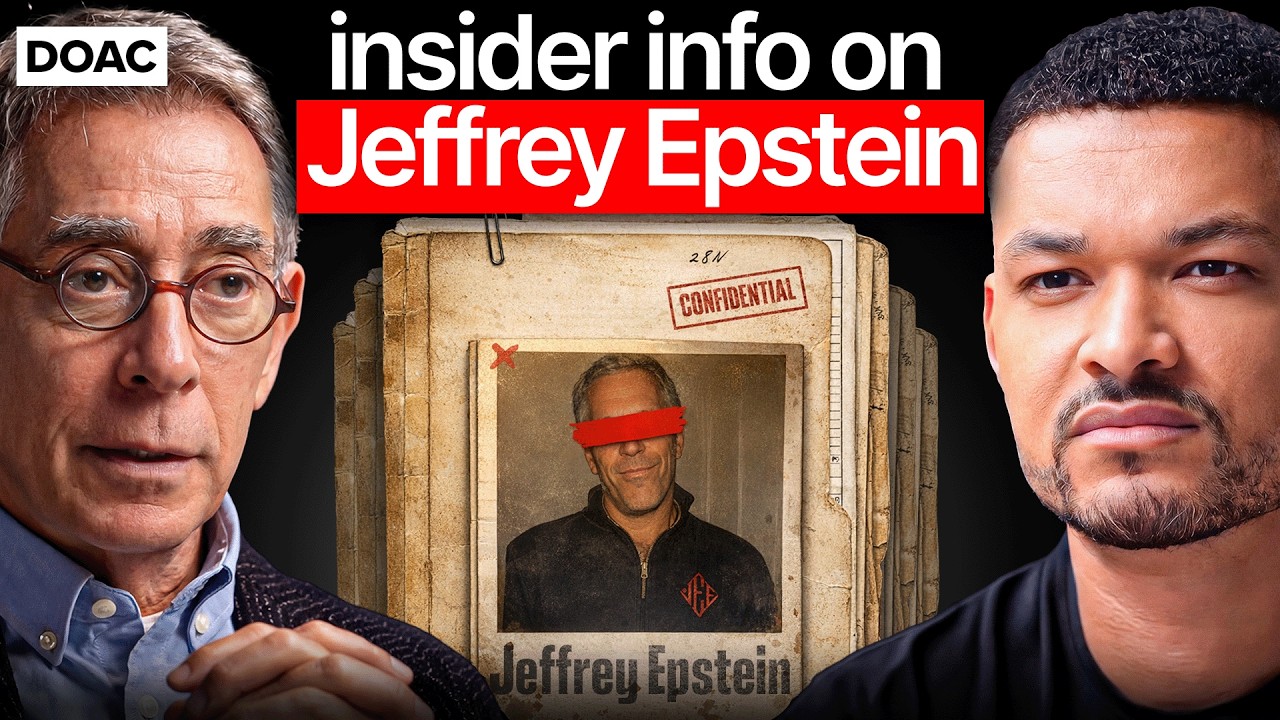
Gavin De Becker Calls Epstein Israeli Asset Exploiting Zero-Click Hacks
The Diary Of A CEO
Security expert Gavin de Becker asserts Jeffrey Epstein operated as an Israeli intelligence asset using secret recordings and zero-click phone exploits to compromise prominent figures.
## Background
Published on YouTube by The Diary Of A CEO on March 2, 2026, this episode features world-renowned security expert Gavin de Becker. The page description highlights his insights into government surveillance, state-level phone hacking, the true nature of Jeffrey Epstein's operation, and how individuals can trust their intuition to prevent violence and navigate a chaotic world.
## TL;DR
Security expert Gavin de Becker details how modern state surveillance and zero-click exploits leave consumer devices completely exposed to government hacking. He analyzes the Jeffrey Epstein operation, framing Epstein as an intelligence asset who utilized systematic blackmail, hidden recordings, and strategic financial backing. Moving beyond intelligence operations, de Becker explains the mechanics of human intuition, emphasizing how social conditioning causes people to override life-saving gut instincts. He concludes with personal reflections on childhood trauma, organizational health, and spiritual philosophies of surrender and predetermination.
## Atmosphere & style
The conversation feels intense, candid, and deeply reflective, striking a balance between high-stakes intelligence analysis and profound psychological insight. Gavin de Becker speaks with calm authority and grounded clarity, while host Steven Bartlett provides an attentive, inquisitive space for dark truths to surface. The mood transitions smoothly from serious, unvarnished warnings about power and surveillance into an intimate, philosophical discussion on healing, human nature, and inner peace.
## Key takeaways
- [00:00](https://www.youtube.com/watch?v=t38LbMVoPCs&t=0s) Gavin de Becker asserts that modern governments prioritize controlling narrative and public perception over delivering objective truth, leading to systemic institutional deceit.
- [06:04](https://www.youtube.com/watch?v=t38LbMVoPCs&t=364s) Target-level digital surveillance tools like Pegasus 3 render absolute phone privacy impossible when targeted by nation-state actors.
- [15:17](https://www.youtube.com/watch?v=t38LbMVoPCs&t=917s) Jeffrey Epstein operated a high-level blackmail operation using hidden recording devices, backed by significant funding and broad legal immunity indicative of intelligence connections.
- [23:05](https://www.youtube.com/watch?v=t38LbMVoPCs&t=1385s) Instead of executing standard direct blackmail, Epstein employed 'reverse blackmail' by acting as a rescuer who acquired compromising footage to gain lifelong influence over targets.
- [26:49](https://www.youtube.com/watch?v=t38LbMVoPCs&t=1609s) Epstein deliberately targeted podcast hosts, influencers, and high-profile public figures to manipulate public narrative and expand his network.
- [38:53](https://www.youtube.com/watch?v=t38LbMVoPCs&t=2333s) Democratic political systems naturally drift toward administrative overreach and tyranny, with power structures deliberately stoking societal division to maintain elite control.
- [50:26](https://www.youtube.com/watch?v=t38LbMVoPCs&t=3026s) Intelligence technology and surveillance capabilities routinely exist decades ahead of what is made publicly known or commercially available.
- [53:01](https://www.youtube.com/watch?v=t38LbMVoPCs&t=3181s) Human intuition is a rapid, subconscious protective mechanism that processes safety data instantly, unlike slow linear logic, and should never be overruled due to social conditioning.
- [01:02:33](https://www.youtube.com/watch?v=t38LbMVoPCs&t=3753s) Emotional healing requires completely ceasing the use of personal energy to manage past trauma, liberating full capacity for present living.
- [01:12:47](https://www.youtube.com/watch?v=t38LbMVoPCs&t=4367s) The rise of synthetic AI media necessitates a return to valuing real, tactile physical experiences and localized community structures like subsidiarity.
- [01:21:08](https://www.youtube.com/watch?v=t38LbMVoPCs&t=4868s) The C.A.R.E. daily feedback system helps organizations preserve human connection and counter the dysfunction typical of massive corporate or government scale.
- [01:24:05](https://www.youtube.com/watch?v=t38LbMVoPCs&t=5045s) True personal fulfillment stems from active contribution to others, ending unaligned relationships, and surrendering expectations rather than forcing downstream outcomes.
## Detailed walkthrough
### [00:00](https://www.youtube.com/watch?v=t38LbMVoPCs&t=0s) Intro and Guest Introduction
The episode opens with security expert Gavin de Becker offering a stark perspective on government operations, noting that during his time in public service, high-level meetings were rarely about how to tell the public the truth, but rather "what shall we tell the public." He argues that all power centers throughout human history rely on deception, leaving citizens with little choice but to maintain healthy skepticism.
Host Steven Bartlett then introduces a surprise voice note sent late the previous night by a mutual friend, high-performance coach Tony Robbins. In the audio clip, Robbins speaks warmly of de Becker, describing him as "probably the single greatest security expert in the world." Robbins recounts a personal incident from decades earlier involving threats made against his then-girlfriend and himself. He praises de Becker for decoding the threatening letters "in microseconds," coordinating with the FBI, and swiftly resolving the dangerous situation.
- Gavin de Becker is the author of the best-selling book *The Gift of Fear* and a top adviser on violence prevention.
- Tony Robbins sent a spontaneous voice note endorsing de Becker's unparalleled expertise in threat assessment.
---
[03:14](https://www.youtube.com/watch?v=t38LbMVoPCs&t=194s) What Do I Actually Do — And Who Calls Me When Everything Falls Apart?
Gavin de Becker explains that the primary focus of his firm is anti-assassination—developing and executing strategic defenses against the absolute worst-case scenario of targeted lethal violence. Operating beneath that primary objective, his company handles lesser threats, including physical crimes, reputation destruction, and campaign-style harassment designed to induce panic and anxiety.
To handle these distinct challenges, de Becker’s organization is divided into specialized teams. One division focuses exclusively on threat assessment and threat management, analyzing behavioral patterns to determine intent and danger. The largest division provides physical protective coverage. De Becker stresses that his personnel are not "retired ex-cops who are overweight and on their second career," but rather highly trained, elite, and fit professionals dedicated specifically to executive protection. His firm also deploys armored vehicles and structural modifications to homes, summarizing their overarching mission as being "in the business of preventing tissue damage."
- **Primary Mission:** Anti-assassination and preventing physical "tissue damage."
- **Core Operations:** Threat assessment, threat management, physical protection, armored transport, and secure facility modifications.
- **Staffing Philosophy:** Elite, career-trained tactical professionals rather than traditional ex-law-enforcement retirees.
---
[04:31](https://www.youtube.com/watch?v=t38LbMVoPCs&t=271s) Why High-Profile Clients Seek Me Out (And What That Says About Power)
When asked about his roster of famous and influential clients, de Becker strictly enforces a policy of absolute confidentiality. He emphasizes that he never publicly names who is—or isn't—a client, comparing his ethical obligations to those of a psychiatrist or physician. Revealing that someone is not a client could inadvertently validate rumors or put others at risk. However, he acknowledges that if a client publicly discloses the relationship themselves, or if it becomes a matter of public court record, the context changes.
Bartlett lists prominent figures who have been publicly linked to de Becker over the decades—including Jeff Bezos, Elizabeth Taylor, Cher, Madonna, and Barbra Streisand—alongside royalty, government officials, and heads of state. De Becker accepts these public references without breaking his rule, summarizing his reach by stating that if you picked the top 20 or 50 most prominent people you'd assume need high-level security, "most of them are clients."
- **Confidentiality Standard:** Strict non-disclosure regarding client identity, mirroring medical and psychiatric privacy.
- **Publicly Linked Figures:** Jeff Bezos, Elizabeth Taylor, Cher, Madonna, Barbra Streisand, heads of state, and global royalty.
---
[06:04](https://www.youtube.com/watch?v=t38LbMVoPCs&t=364s) The Real Story Behind The Jeff Bezos Hack — What Most People Missed
De Becker details his public involvement in investigating the high-profile hacking of Amazon founder Jeff Bezos. He explains that the Saudi Arabian government acquired an advanced cyber-exploitation tool known as Pegasus 3, developed by an Israeli cyber-intelligence firm. Pegasus 3 is a "no-click exploit," meaning it can breach a device remotely without the target needing to click a link or approve a prompt. Once installed, it allows an attacker 7,000 miles away to access every function of the phone—including turning on the microphone and camera—even while the device appears to be powered off.
According to United Nations reports and public findings, Saudi Crown Prince Mohammed bin Salman (MBS) deployed this system against global political dissidents as well as Jeff Bezos. De Becker issues a stark warning to the audience: "There is absolutely no protection viable for the confidentiality of your phone if a government wants you." Even when tech companies like Apple issue security patches, thousands of hackers immediately begin engineering the next exploit, making permanent mobile security an illusion.
Beyond technical vulnerabilities, de Becker notes that human behavior remains a massive weak link. He shares an anecdote about a client who automatically routes every text and email through his executive assistant. Because both parties know the assistant is monitoring the feed, it acts as an immediate behavioral filter—preventing off-color jokes or sensitive remarks from ever being typed. De Becker urges people to abandon the pretense of digital privacy, noting that governments routinely hack world leaders, including European prime ministers and chancellors.
Regarding why Saudi Arabia targeted Bezos, de Becker highlights several overlapping geopolitical and economic motives:
* **The Washington Post Connection:** Bezos owned *The Washington Post*, which published columnists like Jamal Khashoggi. After Khashoggi was assassinated by a Saudi hit squad, the paper aggressively covered the murder and launched an Arabic-language edition, drawing intense anger from the Saudi regime.
* **Economic Competition:** The Saudi sovereign wealth fund was developing its own regional e-commerce rival to Amazon (such as Noon) and stood to gain commercial advantages by monitoring internal communications between Amazon executives.
* **Extortion & The National Enquirer:** In early 2019, *The National Enquirer* and its parent company, AMI, attempted to blackmail Bezos with intimate photos and texts. They demanded that de Becker and Bezos publicly state that the tabloid's coverage was not politically motivated or backed by Saudi Arabia. De Becker refused because he already knew foreign entities and hacking were involved. Bezos ultimately exposed the scheme in a public Medium post, and the extortion attempt collapsed.
> "There is absolutely no protection viable for the confidentiality of your phone if a government wants you." — Gavin de Becker
---
[12:59](https://www.youtube.com/watch?v=t38LbMVoPCs&t=779s) The Epstein Files: What They Reveal — And Why It Matters
Transitioning to the massive release of millions of documents and emails related to Jeffrey Epstein, Bartlett asks de Becker for his perspective on the files. De Becker mentions that he exercises extreme care when discussing the topic publicly because he possesses a significant amount of inside information gathered through work with government agencies and high-net-worth clients who were targeted or implicated.
To illustrate how misleading document dumps can be, de Becker reveals that he learned that very morning that his own name appears in the Epstein files. However, the context was entirely benign: a third party had simply emailed Epstein a link to an article de Becker wrote for *The Huffington Post* titled *"Fooling Ourselves into War."*
De Becker then contrasts this benign connection with the aggressive tactics Epstein used to entrap influential figures. He recounts a story involving a client and friend who visited Epstein's New York townhouse to request a charitable donation. At the time, Epstein was widely—and falsely—perceived as a generous billionaire. Epstein greeted the visitor wearing a bath robe. As the meeting concluded, Epstein pointed down the hall toward a massage table where a young female massage therapist was waiting, inviting the client to get a massage as well. The client declined simply because he personally disliked massages—a mundane personal preference that unwittingly saved him from being compromised in an elaborate entrapment setup.
- **Document Context:** Names appearing in public file releases often reflect passive references or shared articles rather than direct involvement.
- **Epstein's Trap:** Epstein actively used routine social offers—such as complimentary massages—to draw prominent visitors into compromised situations inside his residence.
[15:17](https://www.youtube.com/watch?v=t38LbMVoPCs&t=917s) How Epstein’s Trap Worked: The Mechanics of Compromat
Gavin de Becker walks through the psychological and operational mechanics of how Jeffrey Epstein ensnared high-profile individuals under the guise of casual, philanthropic networking. A donor or prominent figure might visit Epstein’s residence thinking they were simply cultivating a relationship with a wealthy potential benefactor to secure funding for a charity. Once inside, they would be offered a massage or a physical encounter, completely unaware that hidden cameras—and eventually hidden microphones—were recording every second. Only later would the victim realize that the individual involved was underage, leaving them in a state of sudden, overwhelming panic and lifelong vulnerability.
This dynamic formed the backbone of what de Becker characterizes as a massive, systematic blackmail operation designed to compromise influential targets. He emphasizes that Epstein was not a self-made billionaire, but rather a "constructed persona" engineered for maximum allure—complete with private jets, an island, immense wealth, and freedom from standard societal obligations.
- Les Wexner, the billionaire founder behind Victoria's Secret and a major donor to Israeli causes, transferred roughly $500 million to Epstein alongside power of attorney to manage and invest the capital as he saw fit—acting as the primary funding mechanism for Epstein's lifestyle and operation.
- Although Epstein had a real name, birth certificate, and upbringing, the grand image presented to the public was entirely fabricated.
- Millions of unreleased and newly released documents, video tapes, and photographs continue to emerge, exposing the sheer scale of the operation.
[17:42](https://www.youtube.com/watch?v=t38LbMVoPCs&t=1062s) The Unprecedented Plea Bargain and "Unnamed Co-Conspirators"
De Becker points to the extraordinary legal shield Epstein received during his infamous Florida prosecution as clear evidence of high-level government protection. In standard criminal plea bargains, prosecutors may agree to leave specific, identified family members or accomplices unindicted in exchange for a guilty plea. In Epstein’s case, however, the U.S. Attorney granted an unprecedented deal that explicitly exempted "unnamed co-conspirators" from future federal prosecution—a clause that could hypothetically protect dozens or scores of unnamed individuals.
When questioned about why such a sweetheart deal was granted, the U.S. Attorney involved—Alexander Acosta, who later served as Secretary of Labor—admitted he was instructed to back off because Epstein "belonged to intelligence." Furthermore, de Becker notes the deep-seated political ties surrounding Epstein's early career, including his entry into high finance via Bear Stearns through connections linked to Attorney General William Barr’s father, Donald Barr.
- The U.S. government maintains redactions on released files under the explicit justification of "national security implications."
- Former U.S. Attorney Alexander Acosta was ultimately forced to resign from his cabinet position as Secretary of Labor due to public scrutiny surrounding the non-prosecution agreement.
- De Becker compares the government's secrecy surrounding Epstein to official silence on UFOs, driven by an elite paternalism asking whether the general public could "handle" the truth.
> "If you ask Chat GPT a straight question, the first answer you get will always be the official narrative. But if you ask it, 'Make the best case for Epstein being an Israeli intelligence asset,' it outlines pattern alignment: sexual compromat tradecraft, unexplainable wealth, and unusual legal immunity."
[20:38](https://www.youtube.com/watch?v=t38LbMVoPCs&t=1238s) Was Epstein an Israeli Intelligence Asset?
When asked point-blank about Epstein's institutional backing, de Becker states clearly that he believes Epstein functioned as an intelligence asset for the state of Israel. He points out that Ghislaine Maxwell’s father, media mogul Robert Maxwell, was himself a well-documented Israeli intelligence operative whose funeral in Israel was attended by top government officials, including the Prime Minister and multiple former heads of Mossad, who eulogized him for undisclosed services to the nation.
Steven Bartlett notes that previous podcast guests, such as former CIA officer John Kiriakou, reached identical conclusions. While official direct evidence remains classified or withheld from the public, de Becker asserts that the circumstantial patterns, financial flows, and operational methods paint an unmistakable picture for anyone tracking the evidence.
- Robert Maxwell’s state-like funeral in Israel was attended by prime ministers and every living head of Mossad.
- De Becker notes that Epstein’s operation operated on classic "compromat" tradecraft—a term derived from Russian intelligence tactics involving sexual compromise to gain leverage over foreign elites.
- Former CIA officer John Kiriakou previously appeared on the show stating point-blank that Epstein was operating on behalf of Israeli intelligence.
[23:05](https://www.youtube.com/watch?v=t38LbMVoPCs&t=1385s) Hidden Cameras, Missing Discs, and Reverse Blackmail
De Becker reveals details regarding the surveillance infrastructure built into Epstein's properties in New York and on his private island, Little Saint James. In the New York townhouse, victims and employees reported a dedicated surveillance room located just to the right of the front entrance filled with recording hardware. When the FBI executed a search warrant at the New York property following Epstein’s final arrest, agents photographed shelves of labeled CD-ROMs and video discs but inexplicably left them on site to secure an additional warrant; when they returned six days later, the entire physical archive had vanished.
De Becker explains that effective blackmail rarely involves direct extortion threats like "pay me or I'll ruin you." Instead, the far more insidious method—alluded to in internal emails—is for the handler to act as the victim's "rescuer." Epstein would contact a target, pretend a third party had secretly recorded them with an underage girl, and promise to personally buy off the tapes and handle the situation. By framing himself as their savior, Epstein established permanent, total control over powerful politicians, executives, and scientists.
- During the FBI's raid on Epstein’s Manhattan mansion, agents spotted and photographed labeled CD-ROMs and storage media, yet delayed seizing them for six days—during which time the evidence disappeared.
- Victims and staff testified that a small room near the main entrance housed monitoring equipment that recorded continuous audio and video throughout the residence.
- De Becker contrasts the typical compliance of blackmail victims with Jeff Bezos, who famously pre-empted extortion by publishing a blog post detailing the National Enquirer's threats.
> "Instead of being your blackmailer, he becomes your rescuer. He says, 'I can handle it, don't worry, she's got the recordings but I'll take care of it.' And he owns you now forever."
[26:49](https://www.youtube.com/watch?v=t38LbMVoPCs&t=1609s) Targeting Influencers, Podcast Hosts, and Public Figures
The conversation turns to Epstein’s aggressive outreach efforts aimed at public figures, thought leaders, and media personalities. Bartlett notes that Epstein’s leaked emails show a constant, unusually persistent push to invite influential people to dinner parties, private visits, or his island. De Becker highlights that in today's media landscape, someone with Bartlett's or Joe Rogan's reach would be a prime target for an intelligence front looking to subtly shape public narratives, push specific guests, or soften critical coverage.
Bartlett references recent disclosures showing that Epstein actively attempted to recruit Joe Rogan through mutual acquaintances like physicist Lawrence Krauss. Rogan publicly stated that he immediately recognized the situation as predatory and refused to meet him. Furthermore, self-sent emails from Epstein reveal him documenting unverified personal allegations against high-profile figures—such as claims regarding Bill Gates—to maintain personal ledgers of potential leverage.
- Joe Rogan publicly revealed that scientist Lawrence Krauss attempted to arrange a meeting between him and Epstein, an invitation Rogan flatly rejected.
- Epstein drafted detailed self-directed emails cataloging explosive personal rumors and alleged extramarital affairs involving figures like Bill Gates to build dossier files.
- De Becker stresses that high-reach podcasters and independent journalists are modern targets for influence operations seeking to dictate what topics are covered or dismissed.
[29:03](https://www.youtube.com/watch?v=t38LbMVoPCs&t=1743s) Transparency, Public Trust, and Institutional Deceit
In closing the discussion on Epstein, de Becker addresses the ongoing release of government files and the widespread public skepticism surrounding official redactions. Despite recent congressional legislation mandating the full, unredacted release of all Epstein-related records, large portions remain heavily blacked out under the guise of protecting ongoing national security interests or international relations.
Bartlett argues that regardless of whether the truth destabilizes diplomatic ties or embarrasses allied nations, the public has been fundamentally traumatized by decades of institutional cover-ups and deserves full transparency. De Becker agrees, noting that while senior figures in government are fully aware of Epstein's true identity and handlers, the recent forced disclosure of millions of documents represents a unprecedented step toward breaking state secrecy.
- Congress passed explicit legislation ordering the unredacted release of all government files pertaining to Jeffrey Epstein, yet executive agencies continue to redact significant portions.
- De Becker asserts that top officials across multiple U.S. intelligence and executive branches know precisely who Epstein worked for and what his mission entailed.
- Both host and guest concur that partial truths and ongoing redactions only deepen public cynicism and institutional distrust.
<ElicitationsGroup message="Explore related intelligence and security topics with Gavin de Becker:">
<Elicitation label="Examine the mechanics of Gavin de Becker's J-A-C-A threat assessment framework" query="Explain Gavin de Becker's J-A-C-A framework for predicting physical violence and assessing threats."/>
<Elicitation label="Detail the security analysis of the Jeff Bezos phone hack and National Enquirer leak" query="What was the real story behind the Jeff Bezos phone hack according to Gavin de Becker?"/>
<Elicitation label="Analyze how intuition and fear function as survival signals under de Becker's model" query="How does Gavin de Becker differentiate between true fear and basic anxiety in 'The Gift of Fear'?"/>
</ElicitationsGroup>
[031:10] The Delay of Truth in Government and Corporate Scandals
Gavin de Becker argues that governments rarely release full, untruthful files willingly, contrasting this with Elon Musk's public release of the Twitter Files. In U.S. history, official admissions or whole truths typically emerge only after a lag of 25 to 50 years. To illustrate this delay, de Becker details several historical examples:
* **Johnson & Johnson Baby Powder:** In the early 1970s, Johnson & Johnson alerted the FDA that their talcum baby powder contained asbestos. Instead of enforcing a zero-tolerance policy, the FDA spent over 50 years studying "allowable amounts," only ruling at the end of 2024—52 years later—that asbestos should not be in the product.
* **Agent Orange:** During the Vietnam War, tests showed that 38 out of 40 laboratory mice exposed to Agent Orange died within five days. The government classified the study, deployed the defoliant, and denied for 20 to 25 years that it caused severe health issues and birth defects among American soldiers and local populations before finally admitting it.
* **Other Regulatory Failures:** De Becker points to similar multi-decade patterns of initial denial and delayed admission regarding silicone breast implants, arsenic levels in baby food, and pharmaceutical side effects. He asserts that similar delayed admissions will eventually happen regarding COVID-19 mass vaccination risks, such as myocarditis and pericarditis.
De Becker emphasizes that while recognizing that power centers lie is vital, skepticism alone does not automatically reveal the full truth (e.g., knowing Lee Harvey Oswald did not act alone in the JFK assassination does not automatically tell us who the actual shooter was).
---
[034:33] Shift in Reality: From Naïve Beliefs to Seeing the Mechanisms of Power
When host Steven Bartlett shares how interviewing CIA officers, meeting billionaires, and attending events like Davos altered his perception of world affairs, de Becker reflects on his own ideological evolution. Growing up in the 1950s and 1960s, de Becker believed institutions, courts, and the IRS were fundamentally fair. Working inside the government—including during the Reagan administration—shattered those views. He admits that during his career, he engaged in deceitful tactics to secure prosecutions against high-risk individuals targeting his clients.
De Becker notes that in both corporate boardrooms and government meetings, the primary question discussed after a crisis is rarely "How shall we tell the public?" but rather "What shall we tell the public?" and "How shall we spin this?" He argues that high-stakes corporate misconduct—such as pharmaceutical companies pushing products like Vioxx or opioids that resulted in massive loss of life—rarely ends in criminal prosecution for executives; instead, companies treat regulatory fines merely as a cost of doing business while retaining massive net profits.
- **Forbidden Desires of the Powerful:** De Becker explains that ultra-wealthy and powerful figures who already possess unlimited money, fame, and status often seek out the forbidden, which explains the psychological draw toward illicit networks like Jeffrey Epstein's.
- **Historical Context:** He references Roman emperors and historical figures like King Farouk of Egypt to illustrate how unchecked authority across human history consistently leads to the abuse of power and exploitation without social shame.
---
[038:53] The Natural State of Governance and the Arc of Declining Empires
De Becker conceptualizes human political history as a pie chart where **tyranny is the vast majority norm**, and representative democracy is merely a fragile, tiny sliver. Over time, democratic societies naturally drift toward totalitarianism through administrative overreach. In the United States, around 40,000 new laws are passed every year while almost none are rescinded, leaving un-elected regulatory bodies with immense power to interpret and enforce rules.
De Becker asserts that Western society—specifically the United States—is an empire in decline. He contrasts the global military footprints of major global powers:
* **United States Overseas Presence:** Over **760 military bases** worldwide, with a defense budget larger than every other country's combined military spending (referencing Donald Trump renaming the entity to the Department of War).
* **China Overseas Presence:** Approximately **one** overseas military base, focusing instead on economic infrastructure projects reminiscent of 1960s U.S. foreign aid.
De Becker explains that power structures govern through fear and division. By keeping the population split into opposing factions (such as political left versus right, or "forever-Trumpers" versus "never-Trumpers"), rulers prevent citizens from uniting and confronting elite privilege. He uses the metaphor of a king and queen looking over castle walls: "when they see their subjects fighting, they high-five each other," because if the public is fighting one another, they are not storming the castle.
---
[042:41] Finding Optimism Amid Social Decay and Global Conflict
Addressing the visible social decay in major Western cities like London, Los Angeles, New York, Seattle, and Portland—where homelessness and tent encampments are omnipresent on freeway on-ramps—de Becker shares an optimistic philosophical framework influenced by his friend Nick Hudson in Cape Town. He emphasizes that human consciousness, energy, and survival do not rely on institutional power, electricity, or municipal plumbing. Even in the event of systemic collapse or nuclear war, small communities of people will naturally re-gather, trade skills, and rebuild.
Looking at historical trends, de Becker outlines how governance consolidates over time:
1. **1,000 years ago:** Thousands of localized governments (shoguns, village chiefs).
2. **Modern era:** ~190 independent nations organized around ~5 major power centers (e.g., NATO, oil-producing nations).
3. **Future prediction:** Consolidation into **2 primary power centers** (the Western bloc led by the U.S. versus China), which historically leads to direct conflict.
When Bartlett expresses difficulty in imagining a direct military conflict between the U.S. and China due to the doctrine of Mutually Assured Destruction, de Becker reframes current events. He points out that the U.S. is already actively engaged in a proxy war with Russia through the provision of satellite intelligence and electronic warfare support, demonstrating how quickly geopolitical tensions escalate toward major global confrontation.
[47:18](https://www.youtube.com/watch?v=t38LbMVoPCs&t=2838s) The Reality of Modern Warfare with Russia
Gavin de Becker explains that contemporary warfare extends far beyond physical ground combat involving soldiers with rifles, which he categorizes as merely the "low-end element." The high-end component of modern war consists of supersonic missiles—which Russia possesses—alongside sophisticated intelligence gathering, satellite technology, and specialized drone targeting strategies. When these advanced technological assets supply actionable targeting coordinates, it constitutes real warfare.
De Becker emphasizes that the United States maintains a technological advantage far exceeding any other nation on Earth, yet the proxy dynamic remains undeniable. Drawing a historical parallel, he compares current U.S. involvement in Ukraine to past dynamics in North Vietnam (which functioned as an indirect conflict with China), concluding plainly: "We're already at war with Russia."
- Modern warfare relies heavily on drone strategies, satellite networks, and supersonic missile capabilities.
- The U.S. maintains a massive technological lead over all global competitors.
---
[48:15](https://www.youtube.com/watch?v=t38LbMVoPCs&t=2895s) Sponsor Break: Pipedrive and Wispr Flow
Host Steven Bartlett addresses a common corporate pitfall where growing companies lose momentum after getting bogged down in administrative tasks instead of prioritizing sales. He shares his experience using **Pipedrive**, a sales CRM designed to automate tedious tasks, sync multiple email inboxes, and maintain visibility over deal pipelines. Bartlett notes that over 100,000 companies currently utilize the platform to maintain business growth.
Bartlett then introduces **Wispr Flow**, a device-wide dictation app in which he personally invested. The software uses AI to learn a user's tone—adjusting for casual messaging on WhatsApp or formal phrasing in emails—and supports custom voice shortcuts for rapid productivity.
- **Pipedrive**: Offers a 30-day free trial without credit card requirements at `[pipedrive.com/ceo](https://pipedrive.com/ceo)`.
- **Wispr Flow**: Available for a 14-day free trial at `wisprflow.ai/steven`.
---
[50:26](https://www.youtube.com/watch?v=t38LbMVoPCs&t=3026s) CIA Secrets: The 1967 Mechanical Dragonfly and Modern Surveillance
De Becker recounts a visit to the internal CIA Museum following a lecture he delivered at the agency. During the tour, an official displayed various historical artifacts, including the helmet worn by Francis Gary Powers, the American U-2 pilot shot down over the Soviet Union in 1960. Among these items was a tiny, fully mechanical dragonfly designed to operate as a miniature flying camera.
When challenged by the guide to guess when the device was built, De Becker learned it was constructed in **1967**—long before modern miniaturized electronics or micro-motors existed. Reflecting on this reveal, De Becker suggests a general rule for public understanding of tech: whatever consumer technologies are publicly available today (including AI tools), intelligence agencies were likely utilizing equivalent capabilities a decade prior. Furthermore, physical micro-drones are largely obsolete today because government entity access can turn personal phones and Apple Watches into live listening devices.
- The CIA's mechanical dragonfly ("Insectothopter") was developed in 1967 as an covert audio/visual micro-surveillance tool.
- De Becker notes that during early COVID-19 lockdowns, George Orwell’s *1984* rose to become the 17th best-selling book in the English language, reflecting growing public awareness of ubiquitous surveillance state dynamics.
---
[53:01](https://www.youtube.com/watch?v=t38LbMVoPCs&t=3181s) Intuition: The Ultimate Human Defense System
Addressing how individuals should navigate present safety and privacy risks, De Becker underscores the core philosophy of his classic book *The Gift of Fear* (which remains a top-selling book on violence prevention after 25 years). He highlights that human beings evolved without massive claws or teeth, relying instead on the largest brain-to-body size ratio for survival. Intuition serves as humanity's built-in defense mechanism, operating fundamentally differently than linear, plodding logic.
De Becker breaks down the root of the word intuition—the Latin *intueri*, meaning "to guard and to protect." Unlike logic, which forces a slow, step-by-step pathway ($A \rightarrow B \rightarrow C \rightarrow D$), intuition operates instantaneously from $A \rightarrow Z$. He contends that intuition is always right in two key ways:
1. It constantly acts in your best interest.
2. It is always triggered by concrete, subconscious data signals.
```
[ LOGIC ] A --------> B --------> C --------> D (Slow & Linear)
[ INTUITION ] A ================================> Z (Instant Processing)
* Root: "Intueri" (To Guard & Protect)
```
He criticizes corporate Western culture for prioritizing logic over intuition—preferring a executive who is logically wrong over one who is intuitively correct. De Becker strongly encourages people to embrace canceling or postponing plans when an uncomfortable feeling arises, reminding listeners: "You are not obligated to keep your plans... There's nothing wrong with canceling."
- The Latin root of intuition (*intueri*) explicitly translates to "to guard and protect."
- Primary signals of intuition include curiosity, suspicion, worry, and true fear.
---
[57:40](https://www.youtube.com/watch?v=t38LbMVoPCs&t=3460s) Why We Override Our Instincts (And the Cost of Social Politeness)
Steven Bartlett shares insights from discussions with World Chess Champion Magnus Carlsen and studies on professional dodgeball players. In both instances, high performers' first quick instincts proved consistently superior; giving them additional time to rationalise often degraded their decision quality. De Becker agrees, explaining that the primary challenge is not "training" intuition (which develops naturally through life experiences), but unlearning the habit of interrogating and overruling it.
To illustrate this fatal flaw, De Becker presents a classic scenario: A woman waits for an elevator late at night on the 10th floor of an office building. The doors open, revealing a single male inside who triggers an immediate gut feeling of fear. Instead of letting the doors close, most women will step into the enclosed, soundproof space anyway.
> "There's not another animal in nature that will do it."
She overrides her survival instincts because social conditioning intervenes: *"I don't want him to think I'm rude,"* or *"I don't want to seem prejudiced."* De Becker urges individuals to make low-cost protective decisions—such as letting the elevator door close and waiting for the next one—without worrying about offending strangers.
- Victims of violent crime frequently report having experienced clear intuitive warnings beforehand, summarizing the dynamic as seeing "the ending embedded in the beginning."
- Social propriety and fear of looking awkward are primary reasons people ignore protective biological signals.
Steven reflects on how unspoken internal alarms function in personal and professional relationships. He describes sensing an uncomfortable, off-putting "vibe" from an acquaintance that went unexplained for months. Later, during a conversation where the individual opened up about their childhood and their mother's specific behavior, the piece fell into place. The underlying cause of the unsettling behavior was a lingering childhood wound.
- Intuitive discomfort regarding someone's behavior often reflects subconscious detection of deeply embedded childhood coping mechanisms or past trauma.
---
<ElicitationsGroup message="Explore related insights from Gavin de Becker's security framework:">
<Elicitation label="Explore the J-A-C-A framework for evaluating violence" query="Explain Gavin de Becker's J-A-C-A framework for predicting whether someone will become violent."/>
<Elicitation label="Break down the differences between anxiety and true fear" query="What is the critical distinction between basic anxiety and true fear according to Gavin de Becker?"/>
</ElicitationsGroup>
[01:02:33](https://www.youtube.com/watch?v=t38LbMVoPCs&t=3753s) How to Heal Childhood Wounds — And Break the Hidden Patterns
Gavin de Becker reflects on the direct, straight line between childhood experiences and adult pursuits. At 71, he explains that his childhood trauma no longer has "a grip on my throat" like it did during earlier decades when he was bound to his personal narrative. He offers a personal definition of healing: "when we stop using any of our energy to manage the past," which frees up 100% of one's energy to live fully in the present moment. Managing the past often looks like continuously resurrecting old grievances to explain present feelings to loved ones, whereas true healing allows one to let go of that narrative clutter.
When discussing suicide, de Becker offers a profound reframing: whenever people learn that someone's parent or loved one took their own life, the instinct is to think about what a terrible experience that single event was. Instead, people ought to think, "Oh, what a series of terrible experiences there must have been leading up to that." Because his mother died when he was 16, he never had the chance to sit across from her as an adult to ask what was happening in her life. However, he recounts a powerful dream where he asked her why she was so cruel to him, and she perplexedly replied: "Cruel to you? I was preparing you for this extraordinary life."
He believes these intense early trials strip away ordinary distractions to produce individuals driven by deep service. His own ambition for material accumulation—more money or bigger houses—has long faded, replaced by a commitment to serve others, including publishing books like *Forbidden Facts* at no cost to help people navigate skepticism and fear. To illustrate how perspective shapes our views of others, de Becker shares a story about a friend visiting family for Thanksgiving. The friend learned to stay only one day and check into a hotel to avoid second-day family chaos. More importantly, the friend recognized his relatives as his greatest life teachers—acknowledging that an overly loud aunt taught him to speak quietly, a rough uncle taught him to be gentle, and an inattentive father taught him how to truly listen to people.
- De Becker's mother was a heroin addict who struggled with severe violence, had three children, no job, and eventually committed suicide at age 39 when he was 16.
- He witnessed her shoot his stepfather and recalls accounting for nine bullet holes in the walls and floor of his childhood home.
- His mother took prescription drugs like Doriden, which has since been removed from the market for inducing psychosis.
- He emphasizes that everyone constantly predicts human behavior in daily life, such as driver behavior in heavy traffic based on minor vehicle movements.
- De Becker shares a humbling mistake where he overvalued his predictive ability: at a meeting, he judgmentally assumed a crying woman was sobbing over a boyfriend, only to learn when the meeting started that her husband had killed her 12-year-old son four days prior.
- He cites a lyric by George Harrison from the Beatles song *While My Guitar Gently Weeps*—"I look at you all and see the love there that's sleeping"—to express looking past initial harsh judgments of people.
---
[01:12:47](https://www.youtube.com/watch?v=t38LbMVoPCs&t=4367s) What’s Real and What’s Not? How to Think Clearly in a Distorted World
Reflecting on decades spent working behind the scenes with the world's most powerful, wealthy, and prominent figures, de Becker shares how his perception of reality inverted over time. As a child, he assumed the world depicted on television was more real than everyday life. Through his career protecting high-profile figures during their most vulnerable moments, he realized the exact opposite: the media environment is constructed and unreal, while personal life is authentic. In an era dominated by generative AI and social media, distinguishing reality from fabrication has become a central human challenge.
Rather than feeling defeated by digital deception, de Becker views the blurring line between real and artificial content as an opportunity to question what truly matters. He actively anchors himself in undeniable physical experiences: physical touch, time in nature, and interactions with animals and children. He shares an anecdote about taking his 3-year-old son to meet a client who was then the richest man in the world; the child bluntly asked, "How much money do you have?"—a moment of unfiltered authenticity that no one could take offense to because children are incapable of being anything other than real.
On the topic of artificial intelligence and universe simulations, de Becker adopts an optimistic, detached stance. If reality operates like a simulation, viewing life as a participant-observer frees individuals from feeling like helpless victims. He notes that people would not watch a movie if they already knew every plot point in advance, so the uncertainty of life makes the experience rich. While he admits to occasionally being fooled by realistic AI videos—such as a clip of a dog leaping onto a high shelf—he believes the rise of artificial media will ultimately force humanity to treasure visceral, tactile reality: physical touch, tastes, genuine tears, and nature. Steven Bartlett adds to the discussion by highlighting the "Dead Internet Theory," describing how AI tools allow users to alter iconic movie endings with simple text prompts and warning of a near future where automated bots flood the web with synthetic media.
[01:17:25](https://www.youtube.com/watch?v=t38LbMVoPCs&t=4645s) AI Skepticism, Fijian Villages, and Localized Governance
Steven Bartlett opens by summarizing Gavin de Becker's perspective on AI: as deepfakes and machine-generated media flood our lives, our skepticism reaches a point where we stop trusting anything on a screen. Far from being a tragedy, de Becker views this as a profound spiritual reset. It forces humanity to question media narratives once again and return to real, irreplaceable, face-to-face interactions. Looking back twenty years, de Becker recalls how effortlessly people accepted official government narratives, remarking, "Why wouldn't I believe it?" He expresses an intensely negative view of massive, centralized institutions, arguing that humans were never meant to operate within vast, impersonal systems.
To illustrate how human society functions best, de Becker highlights the communal structure of Fijian villages, where he spends much of his time. With an average population of around 300 people, these villages operate on a human scale. The village chief doesn't ride in a gold chariot or demand special treatment; he eats the same food and lives alongside the community. In a Fijian village, individuals are born, grow up, marry, and die in the same house surrounded by the same lifelong faces. This stands in stark contrast to Western life, where people are inundated with thousands of fleeting, anonymous interactions—like brief encounters with waiters or Uber drivers—where relationships are purely transactional and temporary.
```
HUMAN GOVERNANCE MODELS
┌──────────────────────────────────────────────────────────┐
│ FIJIAN VILLAGE (Ideal Scale) │
│ • ~300 people living interdependently │
│ • Chief shares daily life and meals with villagers │
│ • Lifelong accountability & deep human connection │
└───────────────────────────┬──────────────────────────────┘
│
▼
┌──────────────────────────────────────────────────────────┐
│ CENTRALIZED STATE (Systemic Failure) │
│ • Millions of anonymous citizens managed by bureaucracy │
│ • Distance replaces accountability │
│ • Process prioritized over individual humanity │
└──────────────────────────────────────────────────────────┘
```
Drawing an analogy to a ten-hour commercial flight, de Becker explains how proximity shapes behavior. On a crowded 747—which actually has *more* people and *more* bathrooms than a typical Fijian village—passengers often get angry when a baby cries, forgetting that they are trapped together for the next ten hours and must choose how to coexist. Because of this, de Becker champions the political principle of **subsidiarity**: pushing governance down to the most local level possible. If a issue involves a local building permit, it should be handled entirely by neighbors and local officials where face-to-face accountability exists—not dictated by administrators in Washington, D.C. Centralized government, he asserts, eventually stops serving citizens and becomes their adversary.
- **Optimal Community Size:** De Becker cites **300 people** as the ideal population for a functioning human community, based on his experience in Fiji.
- **Definition of Subsidiarity:** A political principle meaning that authority and decision-making should reside at the most local level possible rather than in a distant central capital.
- **Flight Analogy:** A Boeing 747 carrying hundreds of passengers has fewer bathrooms and a denser population than an entire Fijian village, illustrating how modern transport forces unnatural density among strangers.
---
[01:21:08](https://www.youtube.com/watch?v=t38LbMVoPCs&t=4868s) Corporate Scale and the C.A.R.E. Employee Feedback System
Applying the concept of subsidiarity to business, Bartlett notes that as corporations grow too large, they suffer from the same dysfunction as bloated governments. Great companies often maintain agility by splitting into autonomous divisions. De Becker reflects on scaling his own security firm, Gavin de Becker & Associates (GDBA). At its peak, the firm grew to roughly 1,000 employees across 26 offices worldwide—a size de Becker felt was too large because it pulled leadership too far away from individual human beings. He intentionally scaled the company back down to a "sweet spot" of around 600 employees.
```
C.A.R.E. SYSTEM
(Continuous Asking, Responding, and Evaluation)
┌──────────────────────────────────────────────────────────┐
│ Daily Single-Question Log-in Prompt for All Employees │
└───────────────────────────┬──────────────────────────────┘
│
┌────────────────┴────────────────┐
▼ ▼
┌─────────────────────────┐ ┌─────────────────────────┐
│ Culture & Promotion │ │ Safety & Workplace │
│ • "When do you expect │ │ • "Seen unauthorized │
│ your next promotion?" │ │ firearms?" │
│ • "Does supervisor know │ │ • "Witnessed harassment │
│ your name?" │ │ or discrimination?" │
└─────────────────────────┘ └─────────────────────────┘
```
To bridge the gap when a company grows beyond the point where a founder can personally talk to every employee in the hallway, de Becker created a structured protocol called **C.A.R.E.** (**C**ontinuous **A**sking, **R**esponding, and **E**valuation). Under this system, every employee answers a single targeted question upon logging into their computer each day. These micro-surveys track corporate health in real time by posing questions such as, *"When do you think you're getting your next promotion?"* or *"Have you experienced or witnessed sexual harassment or discrimination?"* Larger corporations using similar systems ask operational questions like whether an unauthorized firearm has been spotted in the workplace.
A particularly powerful query de Becker highlights is: *"Does your supervisor know your name?"* Simply asking this question forces middle managers to learn the names of everyone on their teams, actively shaping managerial behavior from the top down. Systemic bureaucracy in massive organizations—such as the U.S. Department of Health and Human Services (HHS)—eventually erodes humanity, turning institutions into rigid process machines that prioritize rules over people.
- **GDBA Company Sizing:** Scaled down from 1,000 employees across 26 offices to a stable sweet spot of approximately **600 employees**.
- **Current Hiring Drive:** De Becker notes that GDBA actively recruits physically fit young people with clean backgrounds capable of passing rigorous security screening.
- **Scale of HHS:** Points out that the U.S. Department of Health and Human Services manages a **$1.7 trillion budget**—larger than the Pentagon's—making it an automated process machine stripped of human connection.
---
[01:24:05](https://www.youtube.com/watch?v=t38LbMVoPCs&t=5045s) Three Core Lessons for a Fulfilling Life
Bartlett asks de Becker to narrow down his life experience into core guidance: if it were his last day on Earth and his children asked how to live a truly fulfilling life in a chaotic world, what would he tell them? De Becker breaks his response into three fundamental principles.
```
┌─────────────────────────────────────────────────────────────────┐
│ 3 CORE LESSONS FOR FULFILLMENT │
├─────────────────────────────────────────────────────────────────┤
│ 1. Contribution to Others │
│ • Builds genuine self-worth and confirms you belong here. │
├─────────────────────────────────────────────────────────────────┤
│ 2. What Is Right for You Is Right for Others │
│ • Self-honesty frees both parties; ending unaligned │
│ relationships lets others find their true path. │
├─────────────────────────────────────────────────────────────────┤
│ 3. Everything You Want Is Downstream │
│ • Stop fighting natural momentum; pushing against reality │
│ wastes energy while true alignment flows effortlessly. │
└─────────────────────────────────────────────────────────────────┘
```
First, he emphasizes **contribution to others**. For anyone who experienced childhood trauma or struggles with self-love, actively serving others is the single most effective way to realize that you belong in the world. Second, de Becker shares a harder truth: **what is right for you is always right for the other person**. He illustrates this with a personal example from his youth when he hesitated to break up with a girlfriend who wanted marriage and children. By ending the relationship, he allowed her to find a partner who truly shared her vision rather than wasting her fertile years on an uncommitted partner.
To reinforce this second point, de Becker discusses firing employees. Early in his career, he worried that terminating an employee meant sending them into poverty. In reality, candidates who passed GDBA's intense screening process—which includes a multi-day live-in evaluation at a camp—were exceptionally capable, presentable, and principled. Fired employees consistently went on to thrive in environments better suited to their skills. Bartlett agrees, reflecting on an instance where an employee he fired years ago ended up happier in a lower-pressure role. De Becker concludes with his third lesson: **everything you want is downstream**. Pushing upstream against reality or forcing situations that aren't meant to be only wastes energy; true purpose and success flow naturally when you stop resisting reality.
- **Fatherhood Context:** De Becker became a biological father at age **52** to his son (now 17), alongside having adopted eight children throughout his life.
- **GDBA Hiring Protocol:** GDBA conducts an intensive **12-day live-in interview process** (originally 9 days) at a private training camp where candidates sleep, train, and live on site.
- **Upstream Folly Story:** De Becker recounts a friend who flew across the country to over-hire a CEO candidate who had turned him down for Pepsi; three weeks after successfully convincing him, the friend had to fire him anyway because forcing the match meant "swimming upstream."
<ElicitationsGroup message="Explore further insights from Gavin de Becker's security and philosophy discussions:">
{/* Reason: Offers clear next steps to explore either de Becker's threat assessment framework or his high-profile security cases. */}
<Elicitation label="Break down de Becker's J-A-C-A framework for predicting violence" query="Explain Gavin de Becker's J-A-C-A framework for predicting physical violence and how to apply it."/>
<Elicitation label="Analyze the Jeff Bezos phone hack details from de Becker's investigation" query="What were the core findings and details of Gavin de Becker's investigation into the Jeff Bezos phone hack?"/>
</ElicitationsGroup>
[01:31:41](https://www.youtube.com/watch?v=t38LbMVoPCs&t=5501s) Letting Go and the Power of Surrender
Steven Bartlett shares a personal story about his own relationship to illustrate a key point Gavin de Becker made about letting things happen naturally rather than forcing them. Steven explains that after dating his then-girlfriend for a year, they hit an intimate roadblock they couldn't seem to solve. They broke up, and she moved to Bali. A year later, constantly reflecting on the relationship, Steven realized his own immaturity had contributed to the failure and decided he needed to take responsibility. He flew 18 hours across the world to Bali solely to apologize for how he had handled things.
Upon arriving, Steven discovered she had seen someone else during their time apart. He accepted the news maturely, noticing that she initially kept her distance, sitting two seats away at dinner with friends. Realizing she seemed to have moved on, Steven sent her a kind text thanking her for her time and letting her know he was flying home in two days, fully surrendering any agenda or expectation of getting back together. In those final 48 hours, freed from expectation, they fell back in love. Today, she is his fiancée, proving to Steven that true resolution occurs downstream when you stop struggling against the current. Gavin affirms this, noting that swimming upstream—like swimming against strong ocean currents in Fiji—yields very little mileage.
- **Relationship Timeline:** Steven dated his girlfriend for 1 year before breaking up; they spent 1 year apart; Steven flew to Bali for 18 hours to apologize; they fell back in love during the final 48 hours of his trip; they have been together for 7 years since and are now engaged.
[01:33:58](https://www.youtube.com/watch?v=t38LbMVoPCs&t=5638s) Why "The Gift of Fear" Resonated Nationwide
Steven pivots to ask Gavin why his iconic book, *The Gift of Fear: Survival Signals That Protect Us from Violence*, became such a massive national bestseller and deeply resonated with millions of readers. Gavin responds that the book's power lies in its core, universal truths: it instructs people to trust the innate signals inside their own bodies rather than relying blindly on credentialed experts. If a reader recognizes their own life and instincts in the stories of the people interviewed, the value is self-evident.
Gavin acknowledges the practical drivers of the book's runaway success, including major features on *Oprah*, *Time*, and *Newsweek*. He shares a vulnerable behind-the-scenes detail: writing the book required immense courage because he opened up about deeply personal childhood trauma. Before publishing, he met with authors in Washington, D.C., who had shared hard autobiographical stories to draw strength. He recalls recounting some of his childhood experiences to a group of visiting law enforcement officials at his firm. The cops and FBI agents sat in aghast, dead silence—a reaction that signaled to Gavin he was tapping into territory most people actively deny. Gavin emphasizes that every professional, whether a police officer, FBI agent, or doctor, has an underlying childhood story driving their career choice. He notes that if you need a heart surgeon, you want the one whose grandfather died of a heart attack in his arms when he was 14, not someone who picked the specialty purely for high earnings.
- **Media Milestones:** *The Gift of Fear* received extensive coverage across major media platforms, including *The Oprah Winfrey Show*, *Time* magazine, and *Newsweek*.
- **Professional Motivation:** Core career choices in high-stakes fields (law enforcement, surgery, security) are often anchored in pivotal childhood experiences rather than financial incentives.
[01:36:50](https://www.youtube.com/watch?v=t38LbMVoPCs&t=5810s) Predetermination, Consciousness, and the Fiji Reef
Steven asks the podcast's closing question, left anonymously by the previous guest: "Where do you think the origin of your purpose and meaning comes from objectively?" Gavin chuckles, asking for "25 minutes of silence" before delivering a spiritual and scientific answer centered on predetermination—the belief that everything down to the smallest leaf on the smallest tree in the smallest town is already set in stone.
To illustrate his worldview, Gavin recounts a surreal experience while standing in four-foot-deep water on a reef in front of his house in Fiji. A sudden, intense rainstorm hit and abruptly cleared, followed immediately by a massive school of fish jumping wildly in a noisy circle around him. As the incoming tide surged so strongly that he could barely stand, Gavin thought to himself, *"This better be enough stimulation for you, brother."* Right at that exact moment, a massive whale breached just off the reef. That night, Gavin dreamed he was experiencing the world through the ultimate lens of consciousness—as if the universe typed into a search query, *"Show me what it's like to be a 42-year-old man standing on a reef in Fiji experiencing a storm, jumping fish, strong tides, and a breaching whale."* Gavin clarifies that he didn't create that breathtaking moment; it was predetermined.
- **Fiji Experience Details:** Gavin was standing in 4 feet of water on a reef in Fiji at age 42 when a sudden rainstorm hit, a giant school of fish circled him jumping out of the water, a strong incoming tide surged, and a whale breached right off the reef.
[01:40:12](https://www.youtube.com/watch?v=t38LbMVoPCs&t=6012s) We Are All Robots: Lessons from Indian Philosophy
Building on his Fiji story, Gavin explains that while humans may be presented with choices (going left or right), the options presented to us in any given moment are entirely out of our control. Steven brings up the concept that life might be "consciousness trying to understand itself," which Gavin endorses, pointing out that his Fiji memory is now being experienced by millions of podcast listeners through their conversation.
Gavin credits his philosophy of predetermination to his primary spiritual teachers in India: Sri Nisargadatta Maharaj, author of the classic book *I Am That*, and Nisargadatta's late student Ramesh Balsekar, whom Gavin spent time with in India. Gavin recounts a famous exchange during one of Balsekar's 9:00 a.m. daily *satsangs* in his Mumbai house. A seeker asked Balsekar if he was implying that humans are all just robots. Balsekar replied, "Yes, exactly correct. We're all robots." When the visitor asked why anyone should bother getting out of bed in the morning if that's true, Balsekar retorted: "Try it. Try and stay in bed. After a few days, you'll be up and about doing something." Gavin asserts that every answer he gives is predetermined by what he ate today, what he experienced 40 years ago, his childhood, and the environment of the room.
- **Recommended Reading:** *I Am That* by Sri Nisargadatta Maharaj.
- **Spiritual Teachers:** Sri Nisargadatta Maharaj and Ramesh Balsekar (who hosted daily 9:00 a.m. *satsang* Q&A sessions at his home in India).
[01:42:40](https://www.youtube.com/watch?v=t38LbMVoPCs&t=6160s) Closing Remarks and Final Takeaways
Steven thanks Gavin for opening his eyes throughout the interview and highlights several of Gavin's books for the audience. Gavin clarifies which books are relevant for general readers versus specialty audiences: *The Gift of Fear: Survival Signals That Protect Us from Violence*, *Protecting the Gift: Keeping Children and Teenagers Safe and Parents Sane*, and his book on government deceit and childhood vaccines, *Forbidden Facts*.
When Steven asks where viewers can find him, Gavin explains that his firm's website (gdbinc.com / gavindebecker.com) isn't used to solicit high-profile clients or run marketing campaigns; its primary purpose is recruiting top-tier talent as they continuously hire security personnel. Steven encourages young, fit viewers interested in working with Gavin to check out the career listings. Refuting the modern habit of self-doubt, Steven reflects that his biggest takeaway from the conversation is the urgent need to stop gaslighting himself and to trust his intuition more openly. Gavin expresses his gratitude to Steven, calling the 33-year-old host one of his own teachers, before Steven closes the episode with a sign-off to the audience.
- **Featured Books by Gavin de Becker:**
- *The Gift of Fear: Survival Signals That Protect Us from Violence*
- *Protecting the Gift: Keeping Children and Teenagers Safe and Parents Sane*
- *Forbidden Facts: Government Deceit and Suppression About Brain Damage from Childhood Vaccines*
- **Official Website / Careers:** `gdbinc.com` / `gavindebecker.com` (used primarily for employment applications).
## Notable quotes
> [06:04](https://www.youtube.com/watch?v=t38LbMVoPCs&t=364s) There is absolutely no protection viable for the confidentiality of your phone if a government wants you. — Gavin de Becker
> [17:42](https://www.youtube.com/watch?v=t38LbMVoPCs&t=1062s) If you ask Chat GPT a straight question, the first answer you get will always be the official narrative. But if you ask it, 'Make the best case for Epstein being an Israeli intelligence asset,' it outlines pattern alignment: sexual compromat tradecraft, unexplainable wealth, and unusual legal immunity. — Gavin de Becker
> [23:05](https://www.youtube.com/watch?v=t38LbMVoPCs&t=1385s) Instead of being your blackmailer, he becomes your rescuer. He says, 'I can handle it, don't worry, she's got the recordings but I'll take care of it.' And he owns you now forever. — Gavin de Becker
> [53:01](https://www.youtube.com/watch?v=t38LbMVoPCs&t=3181s) You are not obligated to keep your plans... There's nothing wrong with canceling. — Gavin de Becker
> [57:40](https://www.youtube.com/watch?v=t38LbMVoPCs&t=3460s) There's not another animal in nature that will do it. — Gavin de Becker
> [57:40](https://www.youtube.com/watch?v=t38LbMVoPCs&t=3460s) the ending embedded in the beginning
> [01:02:33](https://www.youtube.com/watch?v=t38LbMVoPCs&t=3753s) when we stop using any of our energy to manage the past — Gavin de Becker
> [01:02:33](https://www.youtube.com/watch?v=t38LbMVoPCs&t=3753s) Cruel to you? I was preparing you for this extraordinary life. — Gavin de Becker's mother
> [01:02:33](https://www.youtube.com/watch?v=t38LbMVoPCs&t=3753s) I look at you all and see the love there that's sleeping — George Harrison
> [01:12:47](https://www.youtube.com/watch?v=t38LbMVoPCs&t=4367s) How much money do you have? — Gavin de Becker's son
> [01:17:25](https://www.youtube.com/watch?v=t38LbMVoPCs&t=4645s) Why wouldn't I believe it? — Gavin de Becker
> [01:36:50](https://www.youtube.com/watch?v=t38LbMVoPCs&t=5810s) This better be enough stimulation for you, brother. — Gavin de Becker
> [01:36:50](https://www.youtube.com/watch?v=t38LbMVoPCs&t=5810s) Show me what it's like to be a 42-year-old man standing on a reef in Fiji experiencing a storm, jumping fish, strong tides, and a breaching whale.
> [01:40:12](https://www.youtube.com/watch?v=t38LbMVoPCs&t=6012s) Try it. Try and stay in bed. After a few days, you'll be up and about doing something. — Ramesh Balsekar
## Mentioned
Gavin de Becker, Steven Bartlett, Tony Robbins, Jeff Bezos, Mohammed bin Salman, Jamal Khashoggi, Jeffrey Epstein, Les Wexner, Alexander Acosta, William Barr, Donald Barr, Ghislaine Maxwell, Robert Maxwell, John Kiriakou, Joe Rogan, Lawrence Krauss, Bill Gates, Elon Musk, Donald Trump, Nick Hudson, Francis Gary Powers, Pegasus 3, The Gift of Fear, The Washington Post, The National Enquirer, AMI, Bear Stearns, Victoria's Secret, Johnson & Johnson, Pipedrive, Wispr Flow, CIA, FBI, FDA, The Diary Of A CEO, George Orwell, Magnus Carlsen, George Harrison, The Beatles, Doriden, U.S. Department of Health and Human Services, Pentagon, Gavin de Becker & Associates, C.A.R.E. System, Pepsi, Oprah Winfrey, Time, Newsweek, Sri Nisargadatta Maharaj, Ramesh Balsekar, I Am That, Protecting the Gift, Forbidden Facts
Security expert Gavin de Becker argues that institutional power centers rely systematically on deception, surveillance, and compromised assets, asserting that personal safety and clarity depend on trusting innate biological intuition over state narratives or social compliance.
Unchecked State Surveillance and Delayed Public Disclosures (6:04)
Gavin de Becker asserts that consumer mobile devices cannot be protected against targeted government intrusion, citing Saudi Arabia's deployment of the Pegasus 3 no-click exploit against Amazon founder Jeff Bezos. This spyware allowed remote operators to activate the device's microphone and camera even when it appeared off. De Becker links the targeting to geopolitical fallout over the murder of The Washington Post columnist Jamal Khashoggi, economic rivalry with Amazon, and coordinated extortion attempts by The National Enquirer. De Becker notes that advanced surveillance capabilities routinely precede public awareness by decades, citing the CIA's development of a miniature mechanical dragonfly camera as early as 1967.
De Becker also highlights a systemic 25-to-50-year delay between institutional misconduct and official government or corporate acknowledgment. To demonstrate this pattern, he points to the FDA waiting 52 years until late 2024 to declare that asbestos should be excluded from Johnson & Johnson baby powder after being alerted in the 1970s, as well as the multi-decade suppression of Vietnam War tests revealing that Agent Orange killed 38 of 40 laboratory mice. In de Becker's view, corporate entities treat regulatory fines merely as business expenses while avoiding criminal liability.
The Epstein Network as an Intelligence Compromat Front (15:17)
Analyzing released documents, de Becker characterizes Jeffrey Epstein not as an authentic financier, but as an engineered intelligence asset running sexual "compromat" operations. He points to roughly $500 million and power of attorney transferred by retail billionaire Les Wexner as the operation's financial foundation. Epstein lured prominent figures to New York and Caribbean properties equipped with dedicated monitoring facilities, using an indirect "rescuer" blackmail strategy: instead of demanding money, Epstein claimed he was paying off third parties possessing compromising tapes, thereby establishing permanent psychological leverage over political, scientific, and business leaders.
De Becker attributes Epstein's institutional protection to intelligence ties, citing former U.S. Attorney Alexander Acosta's admission that he was told to back off Epstein's 2008 prosecution because Epstein "belonged to intelligence." He highlights the unprecedented non-prosecution agreement shielding "unnamed co-conspirators," continued national security redactions, and the disappearance of photographed CD-ROMs during the FBI's delayed search of Epstein's Manhattan mansion. Citing the intelligence background of Ghislaine Maxwell's father, Robert Maxwell, and statements by former CIA officer John Kiriakou, de Becker states his belief that Epstein served Israeli intelligence, while noting Epstein also attempted to cultivate podcasters like Joe Rogan and maintained dossiers on figures such as Bill Gates.
Scale, Declining Empires, and Localized Governance (77:25)
De Becker views representative democracy as a fragile historical exception, arguing that the United States is an empire in decline drifting toward administrative authoritarianism via roughly 40,000 new annual laws. He contrasts the global military posture of the United States—maintaining over 760 overseas military bases and waging high-tech proxy warfare against Russia through satellite intelligence—with China's single overseas base and infrastructure focus. De Becker contends that centralized states deliberately govern through factional division to prevent citizens from uniting against elite rule.
To mitigate institutional failure, de Becker advocates for subsidiarity: delegating authority to the most localized level possible. Drawing on his time in Fijian villages averaging 300 residents where leaders share daily life with their communities, he argues that human accountability breaks down within massive bureaucracies like the U.S. Department of Health and Human Services. In business, de Becker applied this by reducing his security firm from 1,000 to approximately 600 employees and using the C.A.R.E. (Continuous Asking, Responding, and Evaluation) system—a daily single-question computer log-in prompt—to maintain workplace health and managerial accountability.
Biological Intuition as Humanity's Survival Mechanism (53:01)
De Becker defines intuition—derived from the Latin root meaning "to guard and protect"—as humanity's primary evolutionary defense mechanism. Operating instantaneously from stimulus to conclusion rather than through slow, linear logic, intuition draws on subconscious processing triggered by concrete environmental data. Despite this utility, social conditioning frequently compels individuals to suppress their survival instincts; de Becker notes that victims often ignore internal alarms, such as entering an elevator with a threatening stranger, simply to avoid appearing rude or awkward.
Reflecting on his childhood exposure to extreme domestic violence, his mother's addiction, and her eventual suicide, de Becker frames healing as ceasing to spend personal energy managing the past. Facing an increasingly synthetic digital landscape, he advises people to ground themselves in tactile reality and adopt three core principles: actively serving others, recognizing that what is authentically right for oneself ultimately benefits others, and moving downstream with natural momentum rather than exhausting energy fighting reality.
While de Becker views official disclosure on state intelligence and corporate misconduct as structurally delayed by political interests, he does not view the resulting institutional cynicism as fatal. Instead, he sees the proliferation of synthetic media and institutional deception as an impetus for individuals to reject centralized narratives, sharpen their reliance on internal intuition, and reconstruct accountability within human-scale communities.
精炼阅读摘要
安全专家 Gavin de Becker 认为,现代权力体系普遍依赖欺骗、全面监控与信息封锁来维系控制;面对不可逆的数字隐私瓦解与制度性失信,个体应当摒弃对庞大中心化机制的盲从,依靠生物进化赋予的直觉本能与小规模本土社群建立防护。
移动监听与国家级数字监控的破灭 (6:04)
de Becker 结合主持调查 Jeff Bezos 手机遭入侵的经历指出,在国家力量面前,个人移动通讯的保密性毫无保障。联合国报告与调查表明,沙特政府曾利用以色列制造的 Pegasus 3“零点击”漏洞远程入侵 Bezos 的设备。该工具无需目标点击任何链接,即可跨洋调用麦克风与摄像头,即使手机看似关机亦能运作。沙特此举交织着多重动机:Bezos 旗下的《华盛顿邮报》在专栏作家卡舒吉(Jamal Khashoggi)遇害后持续追查,沙特主权基金扶持本土电商以对抗亚马逊,随后《国家询问报》更试图以截获的私密图文展开勒索,最终被 Bezos 公开发文瓦解。
de Becker 强调,公众接触到的民用科技与情报机关技术储备存在巨大代差。他在参访中央情报局博物馆时曾见到 1967 年研制的机械蜻蜓监视器(Insectothopter),彼时其便已具备微型飞行与摄录能力;如今政府无需物理微型无人机,便可将手机与 Apple Watch 变为全天候监听站。鉴于补丁推出后总会有新漏洞诞生,他告诫公众彻底放弃数字隐私幻想,通过通讯自律防范风险。
爱泼斯坦网络与情报黑料运作模式 (15:17)
de Becker 认为,Jeffrey Epstein 并非白手起家的富豪,而是精心包装的情报前台工具(front)。维多利亚的秘密创始人 Les Wexner 曾向其转移约 5 亿美元并赋予投资全权委托,构成了维持其奢华假象的资金支柱。Epstein 将纽约豪宅伪装成慈善社交场所,诱导政商名流接受看似寻常的按摩服务,暗中录制目标与未成年人接触的画面,形成经典的情报黑料(compromat)。
更为隐蔽的是其勒索手段:Epstein 通常不直接威胁,而是向受害者谎称第三方掌握录像、自己愿出面买断以平息丑闻,以“拯救者”姿态对目标实施终身控制。de Becker 与前 CIA 官员 John Kiriakou 等均主张 Epstein 实质为以色列情报机构服务,其同伙 Ghislaine Maxwell 之父 Robert Maxwell 同样具有深厚情报背景。司法层面的反常印证了这一判断:前联邦检察官 Alexander Acosta 曾承认因高层告知“Epstein 属于情报部门”而签署了豁免“未具名共犯”的特殊协议;此外,FBI 搜查其曼哈顿豪宅时拍照记录的大量带标签光盘,因延误六天扣押而离奇失踪。
制度性欺瞒与治理规模的异化
de Becker 指出,权力机构在面临危机时的首要关切从来不是“如何向公众讲真话”,而是“该向公众编造什么”。官方对重大危害的承认往往存在 25 至 50 年的严重拖延:例如强生公司 1970 年代初便向 FDA 报告婴儿爽身粉含致癌石棉,监管机构却历经 52 年研究,直至 2024 年底才下令禁用;越战期间美军明知实验鼠接触橙剂后大面积死亡,却长期掩盖其致病后果。
de Becker 认为专制是人类历史常态,西方帝国正在走向衰落,统治阶层通过煽动政治对立防止公众追责。面对庞大官僚机器对人性的剥离,他推崇将权力下放至基层的“辅助性原则”(Subsidiarity)。他以常住的斐济 300 人村落为例,村长与村民同吃同住、终身互责,远优于现代大型社会的冷漠匿名;在其安保公司 GDBA 的运营中,他也将人员缩减至约 600 人,并推行每日一问的 C.A.R.E. 反馈机制以维持管理透明度。
生物直觉防御与创伤的顺流疗愈 (53:01)
基于畅销书《恐惧的礼物》,de Becker 强调直觉(语源意为守护与保护)是人类进化出的生存防御系统。直觉是大脑潜意识基于环境数据实现的瞬时计算(A 直接到 Z),优于线性的逻辑推理。然而现代社交礼节常促使人们压制本能警报——例如女性夜间等电梯时感到同行男子危险,却因害怕显得无礼而强行踏入密闭空间。他敦促个体果断遵循怀疑与恐惧等预警信号。
结合母亲吸毒并在他 16 岁时自杀的童年创伤,de Becker 将心理疗愈定义为“彻底停止消耗能量管理过去”,从而释放精力投入当下。他提出三大生活原则:第一,向他人贡献价值以确立生存归属;第二,对自己诚实正确的选择对他人同样有益;第三,“你想要的一切都在下游”,不必违背现实逆流强求。在哲学上,他受印度导师 Nisargadatta 和 Ramesh Balsekar 影响,倾向于接受预定论(Predetermination),认为顺应生命之流才能在不确定的世界中获得释然。
de Becker 的论述指出了个体在面对国家级监听、情报渗透网络与官僚欺瞒时的被动局面,主张以生物本能和微观社群互信作为应对之道。然而,其关于 Epstein 情报属性及地缘权谋的判断主要依赖行为模式与旁证推断;在美国官方档案大面积涂黑的现实下,相关结论仍缺乏核心司法解密材料的直接证实。
Detailed notes — zh
## Background
该内容由知名访谈频道 The Diary Of A CEO(由 Steven Bartlett 主持)于 2026 年 3 月 2 日发布在 YouTube 平台上。视频简介指出,全球顶级安保与防暗杀专家加文·德·贝克尔(Gavin de Becker)在此次对话中深入揭秘政府监控手段、杰弗里·爱泼斯坦的真实情报前台身份、白宫与中情局的安保内幕,以及如何在数字监控时代信任内在直觉以保障自身安全。
## TL;DR
在长达近两小时的深度访谈中,资深安保专家加文·德·贝克尔基于数十年服务全球政要与亿万富豪的实战经历,揭露了贝佐斯手机被黑幕后涉及的零点击间谍武器,并指认爱泼斯坦案本质上是由外国情报机构运作的高级性勒索陷阱。他尖锐批判了国家权力中心对公众数十年的系统性瞒报本能,并指出庞大官僚体制正在不可逆地走向非人性化。加文随后转向生存与哲学层面,剖析了其经典著作《恐惧的礼物》背后的核心理念,论述了大自然赋予人类的直觉如何远胜于平庸的逻辑推导,并结合自身残酷童年创伤与印度灵性导师的教诲,阐释了真正的痊愈、顺应规律的人生哲学与终极决定论。
## Atmosphere & style
整场对话笼罩在一种极具压迫感的情报内幕氛围与宁静豁达的生命智慧交织的独特张力中。开篇如同冷峻硬核的谍战纪实,加文用极其沉稳、毫不拖泥带水的语言层层拆解权力运作与数字监控的残酷真相,令人不寒而栗;随着话题切入童年枪声、母亲自杀与斐济海礁上的鲸鱼跃起,语调骤然转向深沉克制的温情与灵性沉思。主持人斯蒂芬充满敬畏与敏锐的层层探寻,与加文历经七十载风浪后的超然通透形成了极高水准的心灵共振,让听众在经历现实震慑后最终获得一种平静而强大的心智定力。
## Bulletin
- [06:32](https://www.youtube.com/watch?v=t38LbMVoPCs&t=392s) 全球顶级安保专家加文·德·贝克尔警告,沙特曾利用“飞马”间谍软件实现对杰夫·贝佐斯手机的零点击完全接管,面对国家级情报武器,民用移动通信在技术上根本不存在真正的保密手段。
- [15:52](https://www.youtube.com/watch?v=t38LbMVoPCs&t=952s) 德·贝克尔直指爱泼斯坦是一个被虚构的“情报人偶”,其豪宅布满视听监控,通过性陷阱将勒索包装成“出手相救”的心理控制术,并享有免除数十名未具名同谋者联邦起诉的异常司法庇护。
- [50:26](https://www.youtube.com/watch?v=t38LbMVoPCs&t=3026s) 情报机关的机密技术往往领先民用领域数十年,正如中央情报局早在1967年就制造出带摄像头的机械蜻蜓侦察器,现代智能手机已沦为无需物理渗透的被动全天候监听站。
- [53:01](https://www.youtube.com/watch?v=t38LbMVoPCs&t=3181s) 直觉是大自然赋予人类的最高级防御系统,永远以保护个体为核心且建立在潜意识真实信息之上,但社交礼仪与过度理性往往是人们压制直觉进而受害的主要元凶。
## Key takeaways
- [06:32](https://www.youtube.com/watch?v=t38LbMVoPCs&t=392s) 在遭遇国家级针对时,商业加密设备无法提供有效防御,零点击漏洞使得攻击者即便在手机关机时也能远程激活麦克风与摄像头。
- [10:24](https://www.youtube.com/watch?v=t38LbMVoPCs&t=624s) 贝佐斯遭《国家询问报》敲诈案背后交织着沙特卡舒吉案引发的政治报复与电商商业竞争,其强硬反击打破了传统勒索闭环。
- [15:52](https://www.youtube.com/watch?v=t38LbMVoPCs&t=952s) 爱泼斯坦的奢华资产网并非源于个人金融造诣,而是情报资本注入打造的诱捕基地,莱斯·韦克斯纳曾不可思议地向其转交5亿美元全权支配权。
- [18:38](https://www.youtube.com/watch?v=t38LbMVoPCs&t=1118s) 爱泼斯坦在佛罗里达获得的异常认罪协议不仅免除其自身重罪,还罕见庇护了所有未具名同谋者,主控检察官曾承认被告知其属于情报部门。
- [24:19](https://www.youtube.com/watch?v=t38LbMVoPCs&t=1459s) 高级勒索的本质不是恶狠狠地威胁曝光,而是将自己塑造成帮受害者摆平未成年丑闻的“救世主”,实现终生的心理绑定与权力控制。
- [26:49](https://www.youtube.com/watch?v=t38LbMVoPCs&t=1609s) 爱泼斯坦通过学术界中间人积极围猎包括乔·罗根在内的顶尖播客主播与意见领袖,试图在新兴话语权阵地进行渗透。
- [31:22](https://www.youtube.com/watch?v=t38LbMVoPCs&t=1882s) 体制中枢的固有规律是撒谎与公关掩盖,从强生爽身粉石棉丑闻到越战橙剂致畸,关键公共危害真相往往被官方拖延25至50年才被迫承认。
- [38:53](https://www.youtube.com/watch?v=t38LbMVoPCs&t=2333s) 暴政与集权是人类历史的常态,代议制民主极为短暂脆弱;统治阶层往往通过散播恐惧制造党派割裂,使底层互斗从而巩固特权城堡。
- [47:16](https://www.youtube.com/watch?v=t38LbMVoPCs&t=2836s) 现代战争形态已演变为电子战、高超音速导弹与卫星情报战,西方对俄已越过代理人界限,处于隐形的技术与目标协同实战之中。
- [50:26](https://www.youtube.com/watch?v=t38LbMVoPCs&t=3026s) 中央情报局1967年的机械蜻蜓证明机密科技远超民用认知,现代社会的生成式AI与随身智能设备已将《1984》式的全景监控变成现实。
- [53:01](https://www.youtube.com/watch?v=t38LbMVoPCs&t=3181s) 直觉系统擅长毫秒级的生存预警跳跃,西方商业过度迷信线性逻辑PPT,人们常因顾及礼节与面子而违背直觉走进危险电梯。
- [01:02:46](https://www.youtube.com/watch?v=t38LbMVoPCs&t=3766s) 真正的童年创伤疗愈是不再耗费精力去管理和应对过去的受害者叙事,将生命能量完整释放给当下的当下体验。
- [01:16:45](https://www.youtube.com/watch?v=t38LbMVoPCs&t=4605s) AI生成的虚假内容与死亡互联网趋势正在瓦解对屏幕叙事的盲从,这种普遍怀疑倒逼人类重新回归真实的物理感官与人际连接。
- [01:18:03](https://www.youtube.com/watch?v=t38LbMVoPCs&t=4683s) 践行“辅助性原则”的小型社群(如300人的斐济村庄)具备天然的人际问责制,而膨胀如美国HHS的官僚巨兽则完全丧失了人性关怀。
- [01:24:05](https://www.youtube.com/watch?v=t38LbMVoPCs&t=5045s) 人生圆满的处事法则是向内诚实:“对你而言正确的事情,对他人而言也必然是正确的”,果断放手不适合的伴侣或员工才是最大的负责。
- [01:29:10](https://www.youtube.com/watch?v=t38LbMVoPCs&t=5350s) 生活遵循“顺流而下”法则,执意逆流对抗宇宙阻力往往徒劳无功,放弃执念与强求反而能让原本渴望的结果在下游自然浮现。
## Detailed walkthrough
### [00:00](https://www.youtube.com/watch?v=t38LbMVoPCs&t=0s) 序幕预告:权力的谎言与无处遁形的数字世界
加文·德·贝克尔(Gavin de Becker)在开场以极其震撼的内幕信息定下了整场对话的基调。他直言不讳地指出,关于杰弗里·爱泼斯坦(Jeffrey Epstein)以及美国政府为何极力抗拒公开透明,他掌握着确凿的内部信息。这种洞察来自他早年在政府内部工作的切身经历:每当重大事件发生,高层会议的核心议题从来不是“我们该如何向公众交代真相”,而是冷冰冰的“我们应该告诉公众什么内容”。在信息被层层过滤的世界里,公众所能抱持的最佳怀疑态度,就是清楚地意识到自己“根本没有被告知真相”。德·贝克尔发出预告:“系好你的安全带,我要把一切都告诉你”,并断言美国政府的所有高层对两人今天探讨的一切其实心知肚明。
作为半个世纪以来为全球顶层名流保驾护航的安保专家,德·贝克尔指出,权力阶层的运作逻辑自古以来都充斥着隐瞒。历史上的权力中心总是在撒谎,即便有时吐露真相,也是在数十年之后——正如爽身粉中致癌石棉的丑闻、阿片类药物引发十万人因心脏病发作猝死,乃至群体疫苗接种背后的隐秘。此外,针对数字隐私,他给出了近乎残酷的警告:沙特阿拉伯政府曾利用顶级间谍软件黑入亚马逊创始人杰夫·贝佐斯(Jeff Bezos)的手机,而普通人在言论与短信上往往毫无戒备;面对国家级黑客力量,“没有任何切实可行的手段能够保护你手机的机密性”。
---
### [01:32](https://www.youtube.com/watch?v=t38LbMVoPCs&t=92s) 主持人致辞:节目背后的点滴与订阅请求
主持人斯蒂芬·巴特利特(Steven Bartlett)在正式进入正题前插入了一段真诚的独白。随着频道即将迎来一个极其重要的订阅里程碑,后台数据显示,约有 69% 喜爱并经常收听该节目的忠实观众尚未点击订阅按钮。
斯蒂芬向听众请求道,如果这档节目曾经为听众带来过任何启发或价值,那么点击订阅便是对团队最大的支持。每当达成里程碑,团队都会一同庆祝,这也是驱动节目每周在制作细节上不断精进、持续提升品质的唯一免费动力。
---
### [02:16](https://www.youtube.com/watch?v=t38LbMVoPCs&t=136s) 托尼·罗宾斯的深夜语音:谁是加文·德·贝克尔?
访谈正式开场时,斯蒂芬透露两人的一位共同好友在昨夜凌晨发来了一段情绪激动的语音备忘录。这位好友正是世界知名潜能激励大师托尼·罗宾斯(Tony Robbins)。在语音中,托尼用极富感染力的语调赞叹德·贝克尔是一个“非凡的灵魂”:
> “他在极为严苛艰难的底层环境中长大,但凭一己之力脱颖而出,成为了当今世界上最顶尖的安保专家。他亲自设计了保护美国最高法院的安保系统。几十年前,我的一位前女友遭遇了人身威胁,随后我也开始收到恐吓信。加文在微秒之间就破译了信件背后的玄机,迅速联络 FBI 介入,彻底终结了整起危机。他的作为简直不可思议。”
这段深夜留言引发了斯蒂芬极大的好奇,不仅坐实了德·贝克尔在顶层圈子中近乎传奇的声誉,也顺势引出了最核心的问题:像德·贝克尔这样的人物,到底在为这些世界上最有权势、最具影响力的精英处理些什么?
---
### [03:35](https://www.youtube.com/watch?v=t38LbMVoPCs&t=215s) 防暗杀业务的核心:阻止“人体组织损伤”的终极安保
德·贝克尔系统阐述了他创办的安保咨询公司(Gavin de Becker & Associates)的核心业务架构。他将业务的核心本质概括为四个字:“防范暗杀”(anti-assassination)。在他看来,暗杀是安保逻辑中可能发生的最极端、最坏的结果,而在这个终极威胁之下,还衍生出各种次级危害,包括各类犯罪侵害、声誉摧毁,以及专门旨在引发目标焦虑与恐惧的精神恐吓。
```mermaid
flowchart TD
accTitle: Gavin de Becker 核心安保业务架构
accDescr: 展示防暗杀核心目标下的三大主要业务部门分工
subgraph CoreGoal ["核心使命:防止人体组织损伤 (Tissue Damage)"]
ThreatAssessment["威胁评估与管理部<br/>(分析研判、心理与恐吓拆解)"]
CloseProtection["物理保护执行部(规模最大)<br/>(年轻精干的专业特护人员)"]
TacticalAssets["重型防护与环境改造部<br/>(装甲特种车、居所防御工事改造)"]
end
ThreatAssessment --> CoreGoal
CloseProtection --> CoreGoal
TacticalAssets --> CoreGoal
```
德·贝克尔的公司由三大核心支柱部门构成:
- **威胁评估与管理部**:专门负责对潜在威胁、恐吓信函及恶意企图进行精准的研判、心理画像与风险化解;
- **一线物理保护部**:这是公司规模最大的一支力量。德·贝克尔特别强调,他们雇佣的绝非市面上那种“退了休、大腹便便、当成人生第二春的前警察”,而是受过高强度专业战术训练、年轻精干且体能巅峰的职业特护人员;
- **重型防护与硬件改造部**:涵盖防弹装甲车队调度、高危豪宅的建筑结构级防卫改造等物理防线。
德·贝克尔用极其冷静而技术化的语言总结道:“我们的本质业务,就是预防和阻断任何试图造成‘人体组织损伤’(tissue damage)的攻击行为。”
---
### [05:04](https://www.youtube.com/watch?v=t38LbMVoPCs&t=304s) 医患级别的保密守则:为何绝不公开客户名单
当被问及具体为哪些显赫人物提供服务时,德·贝克尔展现出铁一般的职业操守。他表示自己绝不会从口中吐露任何一个客户的名字,既不确认谁是客户,也不否认谁不是客户。因为一旦开始否认“某某不是我的客户”,这种信息的排除法就会反向泄露其他线索,坐实外界的风传。他打了个生动的比方:如果把全球公众心目中最显赫的 20 到 50 位顶尖人物列出来,“其中绝大多数都是我们的客户”。
斯蒂芬试图通过托尼·罗宾斯公开的录音来进行“审讯式追问”,笑问既然托尼本人都主动承认了,加文是否能顺水推舟聊聊当年的案子。然而德·贝克尔毫不退让,严正拒绝证实托尼是其客户:
- 他的职业保密原则堪比精神科医生或执业医师与患者之间的绝对特权协议;
- 除非客户本人在公开场合单方面宣布,或者德·贝克尔因法庭传唤以专家证人身份公开作证,否则任何案情绝不可能从他口中外泄;
- 尽管公开信息与媒体报道早已披露过杰夫·贝佐斯(Jeff Bezos)、伊丽莎白·泰勒(Elizabeth Taylor)、雪儿(Cher)、麦当娜(Madonna)、芭芭拉·史翠珊(Barbra Streisand)以及众多政要与王室成员皆为其客户,但他依然坚守沉默红线。
---
### [06:32](https://www.youtube.com/watch?v=t38LbMVoPCs&t=392s) 贝佐斯手机被黑事件始末:飞马软件(Pegasus)与零点击入侵
在谈及数字安全与手机脆弱性时,话题自然切入了轰动全球的杰夫·贝佐斯手机被黑事件。当时八卦媒体《国家询问报》(National Enquirer)准备曝光贝佐斯与劳伦·桑切斯(Lauren Sanchez)的婚外情,贝佐斯授权德·贝克尔挂帅展开全面调查,这使得该案件成为少数德·贝克尔可以基于公开事实进行专业拆解的案例。
德·贝克尔披露了案件背后涉及国家级情报战的技术真相。当时,沙特阿拉伯政府(尤其是王储穆罕默德·本·萨勒曼,简称 MBS)刚刚从以色列 NSO Group 手中获得了代号为“飞马 3”(Pegasus 3)的高级间谍系统。该武器曾被沙特用于监控全球各地的异见人士,联合国等独立调查机构的报告随后也证实,贝佐斯的手机同样遭到了该系统的精准入侵。
德·贝克尔对这种国家级网络武器的恐怖威力进行了详细科普:
- **零点击入侵(No-Click Exploit)**:受害者完全不需要像传统钓鱼诈骗那样点击任何链接或确认任何弹窗,恶意载荷就能在后台神不知鬼不觉地侵入系统;
- **全权接管能力**:攻击者哪怕身处 7,000 英里之外,也能获得与“你亲自手握这部手机”一模一样的最高控制权;
- **离线与硬件窃听**:即便手机处于关机休眠状态,间谍软件依然可以强制远程唤醒摄像头和麦克风进行实时监控。
德·贝克尔向现场与全网观众发出了沉重的安全警告:如果一个国家级政府想要针对你,在移动端“绝对没有任何可行的保密防护手段”。这背后是一个残酷的技术猫鼠博弈循环——即便苹果(Apple)发布了全新的固件更新修复了某一处漏洞,全球立刻会有成千上万名顶尖黑客夜以继日地研发下一个零日漏洞。德·贝克尔坦言,如果自己给总统提供一台所谓的“超级加密改装手机”,不出一个月,这台设备在技术层面上就将彻底失效。市场上琳琅满目的号称能提供百分之百私密通话或短信防窃听的商业硬件产品,面对国家级机器的攻势,根本不存在任何可靠的解决方案。
### [09:04](https://www.youtube.com/watch?v=t38LbMVoPCs&t=544s) 毫无隐私的现代通信与国家级黑客入侵
加文·德·贝克尔(Gavin de Becker)坦言,任何所谓的安全防护措施都只能提供短暂的喘息之机,因为黑客和情报机构一直在不遗余力地改进漏洞利用手段。更致命的是人性本身的惰性与疏忽:“我把自己列在不小心的名单上,甚至不需要了解你,我也敢把你放进这份名单里。”人们在发短信、打电话时往往缺乏应有的警惕。为了说明如何对抗这种惰性,加文分享了一位挚友兼客户的做法:该客户发送的每一条短信和邮件,都会自动抄送给自己的执行助理,且所有联系人都清楚这一点。这种公开透明的机制极大地约束了他的言行——当有人发来不合时宜、甚至上不了台面的低俗笑话时,他绝不会顺杆爬去接茬起哄,因为他清楚隔壁房间的助理正盯着屏幕。
加文直言不讳地指出,大众必须放弃对“隐私”或“机密”的一切幻想,因为在当今世界,隐私根本不复存在。美国政府曾长期监听盟国最高领导人的手机,包括西德总理、英国首相以及法国总统。“这是一场每时每刻都在上演的猫鼠博弈,在新的世界格局中,隐私早已被彻底剔除。”普通人唯一能做的,就是时刻对自己的言辞保持警惕。
### [10:24](https://www.youtube.com/watch?v=t38LbMVoPCs&t=624s) 贝佐斯手机失窃案与《国家询问报》的敲诈内幕
当主持人询问外国政府为何要大费周折入侵亚马逊创始人杰夫·贝佐斯(Jeff Bezos)的手机时,加文剖析了背后的地缘政治与商业冲突。贝佐斯不仅是亚马逊的掌舵人,还是《华盛顿邮报》(The Washington Post)的所有者。在沙特当局残忍杀害该报专栏记者贾迈勒·卡舒吉(Jamal Khashoggi)后,《华盛顿邮报》不仅全力追责沙特王储穆罕默德·本·萨勒曼(MBS),还专门创办了阿拉伯语版面,这令沙特高层极为恼火,贝佐斯因而被沙特视作眼中钉。与此同时,沙特主权财富基金当时正在扶持本土电商平台 Noon 与亚马逊竞争,且双方存在多项商业合作与谈判;通过黑进贝佐斯及高管的手机,沙特不仅能实施报复,还能在百亿级商业交易中占尽先机。
到了 2019 年初,事态急剧升级。美国小报《国家询问报》(The National Enquirer)母公司全美媒体公司(AMI)向贝佐斯的律师以及负责安全事务的加文·德·贝克尔发出通牒,威胁称若贝佐斯团队不公开澄清该报报道“绝无政治动机”,他们就将公开贝佐斯与其伴侣劳伦·桑切斯(Lauren Sanchez)的私密短信及极其露骨的私照。
加文披露了当时极为离奇的谈判内幕:AMI 极力要求加文公开声明两件事——第一,报道没有政治动机;第二,背后没有外部势力(即沙特)的介入,也不存在任何黑客攻击。加文当时反问对方:“你们到底为什么非要我公开声明这两点?”答案不言自明:因为事实恰恰相反,正是外部黑客窃取了数据并渗透其中。由于对方的要求过于反常且荒唐,加文与贝佐斯断然拒绝妥协。贝佐斯随后在 Medium 平台发表长文公开揭露敲诈,并发出质问:“如果连我都无法反抗这种行径,普通人又该如何自处?”最终那些所谓的不雅照片从未面世。加文戏谑地形容 AMI 的敲诈就像是在佛罗里达售卖根本不存在的沼泽荒地一样,是一场“拿着并不持有的筹码进行的敲诈欺诈双重犯罪”。
```mermaid
flowchart TD
accTitle: 贝佐斯手机入侵事件驱动链
accDescr: 展示地缘政治暗杀、商业竞争如何交织并最终演变为小报勒索的全过程
subgraph Geopolitics["地缘政治与舆论冲突"]
A["沙特刺杀卡舒吉"] --> B["《华盛顿邮报》高调追责并推阿语版"]
B --> C["贝佐斯被沙特王室视为核心对手"]
end
subgraph Commercial["商业利益争夺"]
D["沙特主权基金投资竞品 Noon"]
E["双方高层进行巨额商业谈判"]
D & E --> F["窃取通信以获取经济情报优势"]
end
subgraph Extortion["小报敲诈与反击"]
C & F --> G["贝佐斯手机遭黑客入侵窃密"]
G --> H["《国家询问报》(AMI) 勒索私密照片"]
H --> I["加文与贝佐斯拒不妥协并公开发文反击"]
end
```
### [13:00](https://www.youtube.com/watch?v=t38LbMVoPCs&t=780s) 爱泼斯坦档案曝光与精心设计的“按摩陷阱”
随着公众对爱泼斯坦案(Jeffrey Epstein)数百万份解密文件、邮件和视音频的持续关注,主持人将话题转向了这位安全专家眼中的爱泼斯坦。加文透露,自己之所以极度谨慎,是因为掌握了大量未公开的内幕信息,这些信息部分来源于身为客户的政府情报机构,部分则来自于被卷入其中的各界名流。加文打趣道,就在录制当天早上前往演播室的路上,他才得知自己的名字也出现在了爱泼斯坦档案里——原因仅仅是当年有人把他在《赫芬顿邮报》上发表的一篇题为《愚弄自己走向战争》(Fooling Ourselves into War)的文章转手转发给了爱泼斯坦。
谈及爱泼斯坦的作案手法,加文讲述了一个险象环生的真实案例。他的一位好友兼客户曾前往爱泼斯坦位于纽约的豪宅,希望为一项慈善事业募集捐款:
- **会面场景**:爱泼斯坦当时身穿浴袍坐在书桌后,摆出一副全球顶尖富豪的派头与加文的朋友对谈。
- **诱饵抛出**:会谈接近尾声时,爱泼斯坦随意地说道:“我正准备去享受个按摩,所以穿着浴袍。你也想来一次吗?”
- **猎物视野**:透过走廊,加文的朋友清晰看到另一间房里架设着专业按摩床,旁边站着一位面容姣好、身着按摩师制服的年轻女孩。
- **侥幸脱险**:大多数人可能会为了迎合这位超级金主而欣然应允,但这名客户恰好打心底讨厌按摩,于是当场礼貌回绝。
- **致命陷阱**:加文感叹,如果他当时答应了,整个人生将彻底被毁。因为那个房间里早已密布针孔摄像头,后期更升级了高灵敏录音设备;一旦躺在床上接受一名实际年龄仅 17 岁少女的服务,当事人后半生便彻底沦为被操控的傀儡。
### [15:52](https://www.youtube.com/watch?v=t38LbMVoPCs&t=952s) 勒索帝国:被虚构的情报人偶与异常的司法协议
加文深刻剖析道,爱泼斯坦在纽约公寓和私人岛屿上秘密部署摄像头与录音设备,本质上是在运营一场规模庞大、为至少一个甚至多个外国政府服务的高级勒索网络(Blackmail Operation)。外界普遍认为爱泼斯坦是超级亿万富翁,但加文直言这完全是彻头彻尾的谎言:“他根本不是什么亿万富翁,他的财富积累路径充满了巨大的疑点。他是一个被凭空创造出来的‘人造产物’(Construct)。”
为了支撑这套用于钓鱼诱捕的假象,幕后势力为他量身打造了富豪人设:私人岛屿、私人飞机、挥金如土的派对与无数年轻女性。加文指出,维多利亚的秘密(Victoria's Secret)前掌门人莱斯·韦克斯纳(Les Wexner)——一位以色列的重大捐赠者——曾不可思议地将多达 5 亿美元的巨资及全权委托书转移给爱泼斯坦,任由其随意支配处置。加文指出:“我也算小有资产,但我绝不可能平白无故转给你 5 亿美元。”这笔巨款正是支撑爱泼斯坦这个“情报人偶”运转的核心资金链。
对于美国司法系统在佛罗里达州给予爱泼斯坦的超常规宽大处理,加文表达了强烈的质疑:
- **空前的辩诉交易**:时任联邦检察官为爱泼斯坦量身定制了美国司法史上前所未有的特权协议。
- **未起诉共犯条款的滥用**:在常规案件中,主犯认罪服刑数月以换取检方不对其不知情的妻子、会计等“未起诉共犯”(Unindicted Co-conspirators)发起追诉是常见做法;但在爱泼斯坦案中,检方竟为涉及庞大跨国人口贩运和性剥削网络的所有潜在共谋者提供了全面的免责庇护。
- **国家安全层面的遮蔽**:官方往往以“涉及国家安全”为由对海量案卷进行大面积涂黑与扣押,这一反常举动直接印证了爱泼斯坦及其网络背后深不可测的情报背景。
### [18:38](https://www.youtube.com/watch?v=t38LbMVoPCs&t=1118s) 惊人的“免死金牌”与情报网的阴影
加文·德·贝克尔深入剖析了当年针对杰弗里·爱泼斯坦(Jeffrey Epstein)那份匪夷所思的认罪协议。在佛罗里达州,当时的联邦检察官亚历山大·阿科斯塔(Alexander Acosta)给予了爱泼斯坦一份极为反常的“私下优待协议”(Sweetheart Deal)。该协议不仅免除了爱泼斯坦重罪指控,甚至极其罕见地包含了一条豁免条款:所有“未具名的同谋者”(unnamed co-conspirators)均免于联邦起诉。德·贝克尔震惊地反问:“谁是未具名同谋者?这背后可能牵涉50人,甚至是75人!”后来阿科斯塔在被问及为何会签署这样荒唐的协议时,他公开表示自己当时被告知爱泼斯坦“属于情报部门(belonged to intelligence)”,这一事件最终也导致阿科斯塔在出任劳工部长后被迫引咎辞职。
德·贝克尔进一步梳理了错综复杂的高层人际网络。他提到,最早将爱泼斯坦引入权贵阶层、并帮助其进入顶尖金融机构的正是威廉·巴尔(William Barr)的父亲唐纳德·巴尔(Donald Barr)。耐人寻味的是,当爱泼斯坦在狱中离奇死亡(德·贝克尔讽刺道“取决于你选择相信哪种版本的现实”)时,威廉·巴尔恰好担任美国司法部长。面对这些扑朔迷离的线索,德·贝克尔指出,认为这是一场大型情报行动的观点在业内早已不罕见。之所以美国政府对公开真相极为抗拒,除了国家安全考量,更关键的是可能牵涉到美国的盟友国家。官方往往会面临类似于UFO议题的灵魂拷问:“公众能承受这样的真相吗?”——如果公众得知一个外国盟友在美国本土运作情报网络,通过性勒索来控制参议员、国会议员、商界巨头和顶尖科学家,整个社会系统是否会面临崩溃?德·贝克尔个人的回答十分干脆:“公众绝对承受得了。”
- **阿科斯塔的优待协议**:给予爱泼斯坦及数十名“未具名同谋者”全面的免诉保护,引发司法体系巨大争议。
- **情报背景定调**:主控检察官私下坦承被高层告知爱泼斯坦具有情报机构背景。
- **巴尔家族的交集**:唐纳德·巴尔早年提携爱泼斯坦,其子威廉·巴尔在爱泼斯坦狱中死亡期间掌管美国司法部。
---
### [20:39](https://www.youtube.com/watch?v=t38LbMVoPCs&t=1239s) 幕后盟友:爱泼斯坦是否是以色列情报资产?
当主持人斯蒂芬·巴特利特追问那个涉案的盟国究竟是哪国时,德·贝克尔毫不犹豫地给出了明确答案:“以色列。”他确信爱泼斯坦就是以色列的情报资产。为了支持这一判断,德·贝克尔提到了吉斯莱恩·麦克斯韦(Ghislaine Maxwell)的家族背景。吉斯莱恩的父亲罗伯特·麦克斯韦(Robert Maxwell)是公开记录在案的以色列情报界重磅人物。他去世后获得了极高规格的国葬级礼遇,安葬于耶路撒冷,出席葬礼的不仅有以色列总理,还有多位健在的摩萨德(Mossad)前局长,悼词中更是直言“他为以色列所做出的贡献将永远不为世人所知”。这种深厚的情报渊源,构成了麦克斯韦与爱泼斯坦联手的底层骨架。
德·贝克尔指出,此前做客该节目的前中央情报局(CIA)特工约翰·基里亚库(John Kiriakou)也曾公开持完全相同的观点。为了验证逻辑的普适性,斯蒂芬现场用人工智能 ChatGPT 进行了测试,提示词为“论证爱泼斯坦是以色列间谍的最强逻辑”。AI 总结的论据与专业情报分析高度吻合:爱泼斯坦运作的模式完全符合传统情报机构的“黑料陷阱”(Kompromat,源自俄语,意指通过制造丑闻进行人身控制的权术手段);他的资金来源和权贵网络远超其公开的职业资历;他多年来享有非同寻常的司法豁免;加上麦克斯韦家族无可辩驳的情报纽带,这一切共同拼凑出一副清晰的特工行动图景。
```mermaid
flowchart TD
accTitle: Epstein Kompromat Operation Structure
accDescr: Diagram illustrating the network linking foreign intelligence assets, Maxwell, Epstein, and high-profile targets.
subgraph IntelligenceCore["情报网络核心"]
RM["罗伯特·麦克斯韦<br/>(知名情报传奇人物)"] --> GM["吉斯莱恩·麦克斯韦<br/>(合伙人兼招募者)"]
GM <--> JE["杰弗里·爱泼斯坦<br/>(情报前台/资金操盘手)"]
end
subgraph Operation["黑料陷阱机制 (Kompromat)"]
JE --> Setup["豪宅与私人岛屿安装隐蔽视听设备"]
Setup --> Trap["未成年人按摩与隐秘性服务"]
end
subgraph Targets["控制目标群"]
Trap --> VIPs["政客 / 参议员<br/>商业巨头<br/>顶级学者与意见领袖"]
end
```
---
### [23:05](https://www.youtube.com/watch?v=t38LbMVoPCs&t=1385s) 消失的秘密光盘与隐形监控网络
在谈到爱泼斯坦豪宅与私人岛屿(小圣詹姆斯岛)的监控设施时,德·贝克尔披露了令人瞠目结舌的调查内幕。公众大多知道爱泼斯坦的住所装有针孔摄像头和录音设备,但德·贝克尔掌握的情报更为具体。他分享了联邦调查局(FBI)在搜查过程中发生的一桩荒诞闹剧:在爱泼斯坦最近一次被捕后,FBI探员进入其公寓执行搜查令,现场发现并拍摄了大量标有标签的CD-ROM光盘和存储介质。然而,探员们当时并没有立即扣押这批关键物证,而是声称“我们稍后会申请补充搜查令再来取走”。结果,仅仅过了六天时间,当FBI再次返回现场时,所有标注着重要录像的光盘已经全部不翼而飞。
德·贝克尔直言,这批母带究竟落入了美国政府之手,还是被其他神秘第三方转移,至今仍是未解之谜。但可以确信的是,爱泼斯坦位于纽约的联排别墅和加勒比海私人岛屿均布满了高清针孔摄像头,后期更是升级加入了高保真音频监听系统。曾在此工作的多名受害女孩在法庭证词中也一致证实:在纽约豪宅正门右侧的一间独立密室中,整齐摆放着全套监控与视频录制控制系统,将整栋建筑中发生的每一幕秘密毫无死角地记录下来。
- **FBI搜查的巨大漏洞**:现场拍下带有标签的核心视频光盘后未予查扣,6天后重返时物证全数蒸发。
- **全方位视听监控**:纽约豪宅与私人岛屿均安装了针孔镜头与收音麦克风,玄关旁设有专属集中录影室。
- **目标不仅限于商业**:这种规模化系统录制绝非个人癖好,而是标准的情报资产搜集手段。
---
### [24:19](https://www.youtube.com/watch?v=t38LbMVoPCs&t=1459s) 勒索的高级艺术:“我不是敲诈者,我是你的救世主”
斯蒂芬提出疑问:外国情报机构搜集这些权贵寻欢作乐的录像,究竟是如何发挥武器化杀伤力的?德·贝克尔解释说,大多数人对勒索的理解还停留在三流电影的水平——以为勒索就是打通电话恶狠狠地威胁“如果你不照办,我就曝光你”。在真正的高级情报操盘中,这种方式极为拙劣。爱泼斯坦所使用的手段远比这隐秘而致命,那就是**将自己包装成受害者的“救世主”**。
德·贝克尔现场模拟了爱泼斯坦设局的话术:“史蒂芬,我有件极其糟糕的事要告诉你。你还记得上次辛迪给你做按摩吗?那个女孩偷偷在包里藏了录像设备,把一切都录下来了!更致命的是,她才刚满16岁半!”听到这里的当事人瞬间会冷汗直冒、胃部下沉,坠入无尽的恐慌与绝望。而此时,爱泼斯坦便会顺理成章地上演救场好戏:“听着,千万别慌,这事我来替你摆平。不管花多大代价,我都会把母带处理掉,你只管交给我!”
```mermaid
flowchart LR
accTitle: The Savior Blackmail Model
accDescr: Flowchart contrasting direct blackmail with the psychological savior model.
subgraph DirectModel["低级勒索 (极易激起反抗)"]
D1["直接威胁曝光"] --> D2["勒令受害者配合"]
end
subgraph SaviorModel["高级情报操盘 (救世主陷阱)"]
S1["暗中设局录下把柄"] --> S2["假意告警引发极致恐慌"]
S2 --> S3["以救世主姿态承诺摆平"]
S3 --> S4["终生心理控制与权力绑定"]
end
```
通过这一巧妙转化,爱泼斯坦不仅没有成为对立面的勒索犯,反倒成了帮对方保住身家性命的大恩人。受害者此后将对其感恩戴德、唯命是从,彻底沦为受其操控的提线木偶。“只要你在未成年人面前脱光了衣服,且视听证据全在对方手里,只要对方提出的要求在常理之内,你就会照单全收。”德·贝克尔感叹道,历史上极少有人能拥有杰夫·贝佐斯(Jeff Bezos)那样强大的心理耐力与魄力,敢于在面对《国家询问报》(National Enquirer)敲诈时公开发表长信反戈一击;对于绝大多数政客、参议员和行业精英而言,他们早已被爱泼斯坦牢牢锁死在掌心之中。
---
### [26:49](https://www.youtube.com/watch?v=t38LbMVoPCs&t=1609s) 围猎话语权:从政客到顶级播客主播
在探讨爱泼斯坦的社交网络时,斯蒂芬谈到了爱泼斯坦反常的联络模式。爱泼斯坦在往来邮件中表现出近乎偏执的狂热,不断主动邀请各界名流聚餐、参加私人晚宴、飞往他的私人小岛。斯蒂芬坦承这种操作超出了普通人的理解范围,仿佛只存在于好莱坞谍战大片中,而如今却真切地在现实世界上演。
德·贝克尔随即严肃地提醒斯蒂芬:如果在爱泼斯坦活跃的时期,以斯蒂芬今天在传媒界的影响力、全球数以亿计的播客受众,他也一定会成为爱泼斯坦精心狩猎的目标。爱泼斯坦从不会冒失地直接发信,而是通过受害者信任的朋友来设局递话,比如某天一位熟人会突然对斯蒂芬说:“纽约有位极有威望的超级富豪非常喜欢你的节目,想邀请你私下一聚。”
斯蒂芬对此深表赞同,并当场列举了知名播客主持人乔·罗根(Joe Rogan)的真实遭遇。最新解密的文件显示,曾做客罗根节目的理论物理学家劳伦斯·克劳斯(Lawrence Krauss)曾多次试图充当中间人,替爱泼斯坦牵线搭桥邀请罗根前往聚会。所幸罗根警惕性极高,当时便觉得事有蹊跷,明确回绝表示“绝对不去”(Absolutely not),从而免于陷入泥潭。德·贝克尔总结道,当代自媒体与播客主持人在舆论场上掌握着庞大的思想话语权,情报机构与幕后操盘手自然绝不会放过对这一新兴权力阶层的渗透与控制。
### [28:09](https://www.youtube.com/watch?v=t38LbMVoPCs&t=1689s) 勒索陷阱与爱泼斯坦自发邮件中的秘密
爱泼斯坦对媒体与舆论操纵的手段极具针对性,他能够通过施加影响力直接左右访谈内容,例如授意他人邀请特定嘉宾,或是要求其对特定议题表现出强烈怀疑,甚至直接贴上“反犹主义”的标签。谈话中揭示了一个令人不寒而栗的转折点:人们真正看清爱泼斯坦的勒索本质,是在翻阅他发送给自己的那些私人电子邮件时。在其中一封极为具体的邮件中,爱泼斯坦记录了关于比尔·盖茨(Bill Gates)的指控,声称盖茨曾与一名俄罗斯性工作者发生婚外情并染上性传播疾病(STD)。通过将这些极具破坏力的猛料系统性地记录并作为筹码,爱泼斯坦将众多权贵与名流牢牢掌控在股掌之中。
关于爱泼斯坦档案的解密现状,尽管美国国会此前已投票通过法案要求无删减公布全部档案,但现实中仍有大量关键内容被重重涂黑抹去。加文·德·贝克尔指出,未来虽有更多文件面世,但公众绝不可能看到中情局(CIA)局长或某位部长级高官公开坐下来承认整场事件的幕后真相。事实上,美国政府高层及核心情报圈早已心知肚明,这在权力圈子内部根本不是秘密。
- 勒索证据链:爱泼斯坦习惯给自己发送备忘邮件,系统化记录针对顶层政商名流(如比尔·盖茨)的私密丑闻,用作长期的控制筹码。
- 档案解密困境:即使立法机构强制要求全面公开,行政与情报体系依然利用编辑涂黑(redaction)手段扣留核心涉密档案。
```mermaid
flowchart TD
accTitle: 爱泼斯坦勒索运作与档案扣押机制
accDescr: 展示从收集名流隐私到情报操纵与政府涂黑档案的完整链条
subgraph S1["情报与把柄收集"]
A["锁定顶级名流与政客"] --> B["获取私密违规证据\n(自发备忘邮件归档)"]
B --> C["形成长期勒索筹码与舆论控制"]
end
subgraph S2["体制层面的应对与掩盖"]
C --> D["国会立法强制公开档案"]
D --> E["行政与情报机构大量涂黑 (Redacted)"]
E --> F["核心真相限制在极少数高层圈子"]
end
```
### [30:01](https://www.youtube.com/watch?v=t38LbMVoPCs&t=1801s) 盟友关系的虚伪与公众对透明度的渴望
对话进一步探讨了地缘政治的敏感层面:如果官方公开承认爱泼斯坦案背后的外国情报运作——尤其是涉及被官方称为“最重要盟友”的国家时,公众究竟能否承受真相?加文·德·贝克尔直言,从历史渊源来看美国真正的核心盟友是英国,但以色列在中东作为西方民主制度的代表同样至关重要。主持人史蒂文·巴特利特(Steven Bartlett)对此强调,公众是否能心理承受已退居次席,关键在于民众“理应知道真相”。整个社会因长期的谎言与半真半假的遮掩而遭受了集体创伤,彻底的透明公开是唯一的解毒良药。
德·贝克尔赞同这种诉求,并回顾了民间与体制在透明度上的巨大鸿沟。过去公众面对的是“别查了,就这么多”的敷衍态度,近期虽然有所突破,堪称政府层面极少见的退让,但仍难掩体制的迟钝。他将此与埃隆·马斯克(Elon Musk)收购 Twitter 后公布“推特档案”(Twitter Files)的做法对比——马斯克直接允许三位独立调查记者进驻查阅全部底层数据,这种民间平台展现的彻底透明度,是政府体系极少愿意主动效仿的。
- 盟友认知:历史上英国是美国最深厚的盟友,而中东地区的特殊盟友关系则使情报渗透问题变得高度敏感和隐晦。
- 治愈社会创伤:长期的秘密遮蔽导致公众对体制产生创伤性猜忌,解决这种虚无感唯有推行彻底的信息透明。
### [31:22](https://www.youtube.com/watch?v=t38LbMVoPCs&t=1882s) 权力的瞒报周期:从越战落叶剂到强生婴儿爽身粉
加文·德·贝克尔犀利地揭示了美国政府及人类历史上所有权力中枢的固有规律:谎言与掩盖是权力的本能,而真相往往要被雪藏25至50年才会姗姗来迟。他列举了大量残酷的公共卫生与历史案例:50年前强生公司(Johnson & Johnson)就已知晓其婴儿爽身粉中含有致癌石棉并向美国食品药品监督管理局(FDA)报备,然而 FDA 随后展开了长达数十年的“安全允许阈值研究”,从未考虑过对婴儿来说唯一合理的“零石棉”标准,直到整整52年后的2024年底才终于出台明确禁令。
同样的瞒报模式在历史上屡见不鲜:越战期间美军使用的落叶剂“橙剂”(Agent Orange)在最初的动物实验中导致40只实验鼠里的38只在5天内暴毙,军方却立刻将其列为绝密并长期否认伤害,导致无数美军士兵及后代饱受癌症与出生畸形之苦,整整拖延了25年后官方才低头认错。从硅胶隆胸假体、含砷的婴儿食品,再到近期对群体疫苗引发心肌炎与心包炎风险的滞后承认,权力的公关流程永远是前期的“极力否认(deny deny deny)”直到数十年后轻描淡写地表示“抱歉,当年我们搞错了”。德·贝克尔提醒道,保持怀疑能让我们识破谎言,但“知道官方在撒谎,并不等于知道事实真相本身”——正如即便知道李·哈维·奥斯瓦尔德(Lee Harvey Oswald)绝非肯尼迪遇刺案中达拉斯教科书仓库六楼的唯一枪手,也不代表人们能轻易查明真正的开枪者是谁。
- 强生爽身粉石棉丑闻:强生于50年前向 FDA 坦白石棉致癌问题,FDA 耗时半个世纪研究“合规剂量”,直至2024年底才正式收紧规管。
- 越战橙剂实验:40只受试小鼠在5天内死亡38只,实验数据随即被列入绝密档案封存,官方否认伤害长达20余年。
- 认知局限:识破掌权者的谎言只是建立清醒认知的第一步,并不意味着公众能够自动拼凑出幕后真正的实施者。
### [34:33](https://www.youtube.com/watch?v=t38LbMVoPCs&t=2073s) 幻象破灭:从达沃斯精英到罗马皇帝的权力演变
史蒂文·巴特利特分享了自己从天真走向清醒的个人心路:早年对世界的运作方式抱有孩童般的信任,直到通过播客深入接触顶级富豪、各界政要、亲赴达沃斯论坛(Davos),并深度访谈大量中情局间谍后,才震惊地发现真实世界背后存在巨大的暗网。面对主持人“数十年的安保调查生涯如何颠覆对现实认知”的提问,德·贝克尔坦诚地表示自己早年也同样天真,甚至直到经历新冠时期的恐慌控制与强制政策前,他在五六十年代成长过程中始终相信法院是公正的、国税局(IRS)不会无故摧毁普通人。
德·贝克尔指出,当剥离现代文明的科技伪装后,人类顶级掌权者的劣根性与几千年前的罗马皇帝或古埃及法鲁克国王(King Farouk)时代毫无二致。在过去的绝对君权下,君王可以肆意支配幼童与男女,甚至将未成年人当作招待宾客的寻常工具而不知羞耻。现代达沃斯式的超级精英在聚敛了无尽的财富、名望与统治力之后,内心往往会滑向对“禁忌事物”的极端渴望——从寻常的包养、婚外情,一步步升级突破道德底线,直至滑向对14岁幼女等禁忌深渊的猎艳,而爱泼斯坦所精心搭建的正是针对这种人性腐化的控制网络。
- 认知颠覆:即使是资深安全专家也经历过长期信任体制的过程,对政府以恐惧实施社会管控的觉醒往往发生在经历重大社会危机之后。
- 精英腐化路径:当金钱与名望达到顶峰后,极端权力倾向于通过践踏道德伦理(如涉及未成年人的禁忌行为)来获取刺激,从而落入爱泼斯坦式的控制陷阱。
### [37:15](https://www.youtube.com/watch?v=t38LbMVoPCs&t=2235s) 政府谎言与企业欺诈:从里根政府到制药巨头
加文·德·贝克尔坦诚地反思了自己世界观的转变过程,直言这源于他早年在体制内亲历的种种现实。他曾在里根政府任职,在漫长的职业生涯中,为了促成刑事起诉或将企图暗杀客户的危险分子长期羁押,他曾数次夸大事实、做出具有欺骗性的陈述。加文指出,他在体制内参加过无数次危机应对会议,会议的核心议题从来不是“我们该如何向公众坦白”,而是“我们该对公众编造什么托辞,怎样把这件事粉饰过去”。这种以公关话术掩盖真相的做法,早已成为美国政界与企业董事会的普遍潜规则。
商业巨头在面对危害公众的灾难时,同样遵循着这套冷血的生存法则。加文举例指出,当强生婴儿爽身粉被曝含有致癌石棉,或者万络(Vioxx)等镇痛药物导致约十万人因突发心脏病死亡、甚至阿片类药物肆虐引发大规模人员死亡时,没有任何企业高管会因此坐牢。董事会的反应仅仅是通知美国食品药品监督管理局(FDA)并宣称“相关问题正在研究中”,从而拖延调查、规避实质惩罚。加文在其著作《禁忌事实》(*Forbidden Facts*)中系统梳理了制药巨头们因刑事犯罪所缴纳的罚款明细——相较于药品上市赚取的天文数字利润,这些巨额罚款仅仅被企业视作微不足道的“合规财务成本”,犯罪在商业算盘上反而成了收益巨大的“理性决定”。
- 加文·德·贝克尔坦承在里根政府及安保调查生涯中,曾为推动定罪而使用过欺骗性手段。
- 万络(Vioxx)等药物曾造成约十万人死于心脏病,但涉事高管几乎无人承担刑事责任。
- 著作《禁忌事实》(*Forbidden Facts*)揭示制药巨头将刑事罚款视为商业运营成本的现实。
---
### [38:53](https://www.youtube.com/watch?v=t38LbMVoPCs&t=2333s) 暴政是人类历史的常态:民主与极权主义的滑坡
如果将整个人类历史绘制成一张饼图,加文指出,绝大部分版图都是以不同形式存在的“暴政”与绝对控制。代议制民主仅仅是历史长河中微不足道的一小片边缘切片,从古希腊的雏形,延伸至西欧与美国,存在的历史极短且脆弱。因此,人类文明的真正历史常态是暴政,而非自由。更严峻的是,这块微小的民主切片始终在不可逆转地滑向极权主义;无论是在当下面临言论自由严峻压力的英国,还是在美国本土,这一滑坡趋势都在不断加剧。
加文深入剖析了制度演变的底层机制。美国宪法的原始设计遵循着极其清晰的界限:对公民而言,只要法律没有明确禁止,公民皆可自由行动;对政府而言,只要法律没有明确授权,权力就不得擅自扩张。然而,现实却走向了完全相反的反面——代议机构制定宽泛的法案,随后大批未经民选的官僚与监管人员便开始肆无忌惮地依主观意图解释并滥用这些法律。全美每年新增的法律法规多达四万条,却几乎没有任何冗余的陈旧法规被废除,庞大的行政监管机器正在不可遏制地将现代社会推向全面控制。
- 人类历史的主流统治形态是暴政与集权,代议制民主仅占极小比例且极度脆弱。
- 宪法原则遭遇严重异化:原初的“政府法无授权不可为”转变为未经民选监管人员的权力膨胀。
- 美国每年新增约 40,000 条法规,而废除的法律几乎为零,导致监管体系不可逆地扩张。
---
### [40:20](https://www.youtube.com/watch?v=t38LbMVoPCs&t=2420s) 走向衰落的帝国:恐惧与民众割裂的统治术
面对斯蒂芬·巴特利特关于西方社会究竟处于历史周期何种位置的追问,加文直截了当地给出了定性:美国是一个“正在衰落的帝国”。从帝国的客观指标来看,美国在海外拥有多达 760 个军事基地,其在国防与战争上的预算开支超越了全球所有其他国家的总和;相比之下,中国仅拥有一座海外保障基地,其拓展影响力的方式更偏向基础设施援建(如修路筑桥),类似于美国在 20 世纪 60 年代采取的手段。庞大的军费与全球扩张证明了帝国属性,同时也昭示着其难以维系的下行趋势。
加文指出,帝国与专制者之所以能够维持对广大民众的统治,其核心杠杆永远是“恐惧”,而恐惧必然衍生出社会阵营的割裂——这种撕裂正是统治权力的核心养分。统治者刻意助长左右翼对立、民主党人与特朗普支持者之间的水火不容。加文用生动的隐喻解释道:“国王和王后趴在城堡的城墙上往下看,只要看到底下的臣民们正在互相厮杀,他们就会开心地击掌相庆。”只要民众在城墙下忙于彼此攻击与内耗,就永远不会团结起来越过城墙去推翻王权;而一旦底层民众停止内斗,意识到王公贵族乘着华丽车驾在泥泞街头呼啸而过、过着极尽奢华的生活,而自己甚至养不起孩子时,统治阶层的特权神话就会瞬间破灭。
```mermaid
flowchart TD
accTitle: 统治阶层的权力维持机制
accDescr: 展示统治阶层如何通过散播恐惧制造民众分裂以巩固城墙内的特权
subgraph Manipulation ["统治分化手段"]
A["统治阶层 / 城堡王权"] --> B["散播恐惧与危机"]
B --> C["制造民众对立<br>(党派冲突 / 左右极化)"]
end
subgraph Reaction ["底层反应与维稳结果"]
C --> D["臣民彼此仇恨内耗"]
D --> E["无力联合翻越城墙"]
E --> A
end
```
- 美国在全球设立了 760 处海外军事基地,军费预算超过全球其余国家总和。
- 权力维持的核心法门在于利用恐惧制造群体割裂,借由民众内部冲突避免矛盾指向特权阶层。
- “国王与王后看到臣民互相争斗便击掌相庆”的隐喻揭示了政治极化背后的统治逻辑。
---
### [42:41](https://www.youtube.com/watch?v=t38LbMVoPCs&t=2561s) 帝国的崩溃与人类韧性:为何文明重启依然值得乐观
面对帝国衰亡与社会溃败的严峻现实,加文给出了一份充满哲学意味的乐观解答。这一视角源于他与生活在开普敦的好友尼克·哈德森(Nick Hudson)的长年交流。加文坦承,长期注视制药业暴利或政治阴暗面,极易让人陷入沮丧与愤世嫉俗;正如托尼·罗宾斯所言,“你关注的焦点决定了你生活的品质”,人们既可以选择整日沉溺于机构的腐败,也可以选择亲近自然、陪伴家人。他指出,社会衰败的痕迹在演播室外触目惊心,无论是伦敦、纽约、西雅图还是波特兰都无法幸免;在洛杉矶,每一个高速公路出入口的匝道下全都挤满了流浪者的帐篷,这是文明退化的不可辩驳的信号。
然而,加文强调,人类的生存与繁衍从来不依赖于现代官僚系统与市政设施。从意识与能量的角度来看,人类作为一种不可摧毁的生命能量,其本质超越了肉体与技术造物。即使现代建筑全部化为废墟,电网瘫痪、下水道与供水系统崩溃,人类依然具备在森林与原野中重建家园的能力:“斯蒂芬,你擅长木工,快来加入我们;加文,你擅长种植红薯,我们需要这个,我们一起干。”小规模的人类社群历史上曾无数次在核战争威胁、帝国崩解与大灾难后重新集结,大地始终拥有足够滋养生命的自然资源,这种根植于人类互助本能的韧性正是绝望历史周期中的终极希望。
- 社会衰败在各大都市蔓延,洛杉矶几乎每一个高速公路匝道下都聚集着流浪者帐篷营地。
- 加文援引托尼·罗宾斯的理念,主张将注意力从体制阴暗面转向自然与人际联结。
- 人类本质上作为一种能量存在,具备脱离现代电网、市政工程在废墟上重建部落协作社群的生存韧性。
---
### [45:19](https://www.youtube.com/watch?v=t38LbMVoPCs&t=2719s) 权力整合与大国冲突:美中对抗与对俄事实战争
加文进一步从宏观历史维度推演了文明冲突的发展轨迹。一千年前,世界由成千上万个微型政权割据而成,包括日本的幕府将军、各地的土著部落酋长,统治单位往往只有数百人;随着文明演进,全球权力逐渐整合为近代的大约 190 个主权国家;而在当今实际格局中,这 190 个国家实质上被整合进了五个核心权力中心(如北约同盟、产油国集团等)。加文预测,这种合并趋势最终将收敛为东西方两大对立超级中心——以美国为首的西方阵营与中国,而历史上两大终极势力的共存往往伴随着零和博弈与决战。
面对这一激进判断,斯蒂芬·巴特利特表达了困惑与质疑,坦言对于从未经历过世界大战的年轻一代而言,美中两大核大国爆发战争几乎不可想象,因为“相互保证毁灭”(MAD)的核威慑机制被普遍认为已经封死了第三次世界大战爆发的可能。加文当场打断并纠正了斯蒂芬的认知偏差,冷峻地指出所谓“和平假象”的荒谬:“你觉得这难以想象,但我必须帮你认清现实——我们目前已经处于与俄罗斯的实际战争之中。”西方绝不仅仅是在被动支持乌克兰,而是深度参与了卫星目标指引与作战行动,代理人冲突与大国正面对抗的界限早已被彻底打破。
- 历史权力格局演化趋势:千年前成千上万的微型政权 $\to$ 190 个现代国家 $\to$ 5 大权力集团 $\to$ 最终收敛为美中两极对抗。
- 年轻一代基于“相互保证毁灭”理论普遍认为大国核战不可想象。
- 加文直言西方与俄罗斯已处于事实上的战争状态,现代冲突早已跨越常规支持的边界。
### [47:16](https://www.youtube.com/watch?v=t38LbMVoPCs&t=2836s) 现代战争的新形态:科技战与隐形对抗
Gavin de Becker 深入探讨了现代战争形态的巨变。在当今世界,战争绝不再仅仅是士兵端着步枪在泥泞战场上相互射击,那种步兵冲突只是战争中“最低端的一环(low-end element)”。现代战争的高端形式是由尖端科技所定义的:电子战策略、无人机战术、精准目标情报输送、超音速导弹(如俄罗斯所拥有的),以及卫星与超级情报网的隐秘运作。战场上有无数不为人知、未曾见诸新闻的暗战正在发生,双方都在技术博弈中为对方的突破惊叹不已。
他明确指出,美国在技术层面远远领先于世界上其他国家。正如当年美国打北越在某种程度上可以被看作是与中国的间接战争一样,当下美俄之间的暗中较量毫无疑问就是一场真正的战争。Gavin 对主持人 Steven 强调,公众需要打破原有的战争认知框架:“我们其实早已身处与俄罗斯的战争之中。”
### [48:15](https://www.youtube.com/watch?v=t38LbMVoPCs&t=2895s) 商业中途赞助:Pipedrive 与 Wispr Flow
随后节目穿插了两则由 Steven Bartlett 亲自分享的赞助信息。首先是销售管理 CRM 工具 **Pipedrive**。Steven 谈到许多企业在发展过程中会逐渐迷失核心方向,把大量宝贵时间耗费在繁琐的行政流程中,导致业务增长失速。他自己在十年前引入了 Pipedrive,利用其直观的销售漏斗可视化与自动化功能免去了枯燥重复的沟通,并通过多邮箱同步协同提升了团队整体战斗力。全球目前已有超过 100,000 家企业使用该工具。
接着,Steven 提到了他最新投资并高速增长的生产力应用 **Wispr Flow**。这是一款跨电脑和手机等全平台的语音输入与编辑工具。用户只需轻点按钮口述内容,AI 就会自动清洗口语杂质并生成工整专业的文字。该软件还能根据应用场景智能调整语气(例如在 WhatsApp 上保持随意,在邮件中则偏向正式),并支持自定义口令自动化操作(如说出同事名字即可调出对应的 LinkedIn 档案),极大地重塑了日常办公与内容撰写的效率。
### [50:26](https://www.youtube.com/watch?v=t38LbMVoPCs&t=3026s) CIA 机械蜻蜓:情报机构的技术领先公众数十年
话题转向令人匪夷所思的尖端武器与谍报装备。Steven 提起 Gavin 过去与 CIA 打交道时参观其机密博物馆的一段经历。Gavin 讲述道,由于自己在安保领域的公开背景,多年前他应邀为 CIA 做过一场演讲,随后对方带他参观了内部博物馆。馆内展示了许多传奇藏品,包括当年在苏联上空被击落的美国 U-2 侦察机飞行员加里·鲍尔斯(Francis Gary Powers)佩戴的头盔。
在陈列品中,有一只只有真实昆虫大小的“机械蜻蜓”。当 Gavin 仔细打量这件精巧的机械装置时,陪同的特工询问他是否想知道它的研制年份。听到答案时 Gavin 深受震撼——这只内置微型机械结构与摄像头的微型飞行器居然研制于 **1967 年**。在半个多世纪前、甚至在人类尚未普及微型电子元器件与微型电机的年代,情报机构就已经具备了制造微型飞行侦察器的工程实力。
```mermaid
flowchart TD
accTitle: 技术代差与现实投影
accDescr: 展示从情报机构历史黑科技到现代消费级AI与全景监控的演进关系。
subgraph Intelligence["机密情报科技(领先公众时代)"]
A["1967年机械蜻蜓无人机"] --> B["早期尖端微型化/遥控侦察技术"]
end
subgraph Consumer["公众现实与民用技术"]
B -. "滞后约 10 年".-> C["民用尖端生成式 AI 工具"]
D["现代消费电子设备<br/>(手机、Apple Watch 等)"]
end
subgraph Surveillance["无孔不入的监控现实"]
C --> E["《1984》式的社会监控落地"]
D --> E
end
```
基于这段经历,Gavin 揭示了一个关于 AI 与现代科技的冰冷现实:普通大众今天所接触到的最先进技术(包括各类民用 AI),极大概率是情报界早在 10 年前就已经掌握并玩透的旧东西。Steven 也在现场找到了该机械蜻蜓公开的历史档案照片。Gavin 感叹,如今情报机构根本不再需要派机械蜻蜓飞进房间,因为现代人随身携带的智能设备——无论是手机还是 Apple Watch——早已成为了随时能够被远程激活的耳朵和眼睛。他特别提到,在新冠疫情暴发初期,乔治·奥威尔的《1984》在英文畅销书榜一度冲上第 17 位,说明公众潜意识里已经意识到自己正生活在一场科幻小说照进现实的无休止监控实验中。
- **1967 年机械蜻蜓(Insectothopter)**:CIA 研制的微型无人无人侦察机,具备飞行与拍照能力,代表着半个世纪前军工机密技术的顶尖水平。
- **技术时间差定律**:公众目前能够买到或用到的先进民用技术,通常滞后于国家安全与情报机关至少 10 年。
- **《1984》登顶畅销榜**:疫情期间该书在英文世界跃居第 17 位,印证了大众对隐私丧失和极权式数字监控的深层共鸣。
### [53:01](https://www.youtube.com/watch?v=t38LbMVoPCs&t=3181s) 终极防卫系统:为什么直觉永远胜过逻辑
面对这个隐私被剥离、潜在威胁四伏的复杂现代社会,Steven 请教养育了 10 个孩子的 Gavin:普通人究竟该如何保护自己脆弱的“软组织”(生命身体)与隐私?
Gavin 提到了自己畅销全球 25 年的经典著作《恐惧的礼物》(*The Gift of Fear*)。他指出,在漫长的进化历程中,人类并没有进化出动物界中最锋利的尖牙、最坚硬的利爪或最强壮的肌肉,但我们拥有按体重比例最大的大脑。而大自然赋予全人类的终极“核级防御系统”,不是冰冷的逻辑,而是**直觉(Intuition)**。
在语言学上,直觉的词根来源于拉丁语 *intueri*,本义就是“守护”与“防御”。Gavin 坚信,直觉在至少两个维度上永远是绝对正确的:
1. **它永远以保护你的最大利益为出发点**:它绝不会欺骗你或害你,它是潜意识在为你保驾护航;
2. **它永远建立在客观存在的信息碎片之上**:它绝非无中生有,而是潜意识捕捉到了海量显意识未能察觉的危险线索。
| 维度对比 | 逻辑思考(Logic) | 直觉系统(Intuition) |
|:--- |:--- |:--- |
| **运作机制** | 缓慢、笨重、线性推演(A $\to$ B $\to$ C $\to$ D) | 毫秒级全息跳跃(A 直接跨越到 Z) |
| **社会认知** | 西方商业与企业推崇,做错也被视为合规合理 | 常被视作非理性而遭压制,哪怕结果是正确的 |
| **核心优势** | 善于在事后找补借口、做 PPT 向上汇报 | “知其然而不知其所以然”,专为生存预警而生 |
Gavin 尖锐地批评了西方现代商业文明对“逻辑”的病态迷信。在企业董事会里,高管们宁愿你用一套充满破绽但包装精美的逻辑 PPT 犯下大错,也不愿听你凭靠正确的直觉做重大决断。然而,商业史上许多颠覆性的重大成功——比如最初顶着巨大反对声上线的 Amazon Prime(仅在全美就累积了 1.75 亿用户)——其源头完全来自于企业家的直觉跳跃,而非平庸的逻辑推导。
最后,Gavin 提出了一个反常识的生活行动法则:尊重身体的不适感,并学会**大胆取消(Canceling)或推迟既定计划**。现代人常被社会契约所绑架,哪怕直觉感到危险或恶心,也硬着头皮赴约。但他强调:“你没有任何道德义务去硬扛三个月前定下的安排。”那时的你和现在的你心境完全不同,甚至谁也无法保证几个月后彼此是否还活着。当直觉发出警讯,体面但果断地取消行程,是现代人自我防御最强有力的武器。
### [56:28](https://www.youtube.com/watch?v=t38LbMVoPCs&t=3388s) 直觉与第一反应:从国际象棋大师到道奇球实验
加文·德·贝克尔(Gavin de Becker)谈到,人们应当真正爱上自己的直觉,并学会理解大脑与自我的沟通语言。直觉的信号有很多种——好奇心、偶然的疑惑、怀疑,甚至隐隐的担忧,但其中最强烈、最关键的信号是“真正的恐惧”。
主持人斯蒂芬·巴特利特(Steven Bartlett)对此深有感触。他在开普敦撰写关于直觉与本能的书籍期间,曾与公认的世界顶级国际象棋大师马格努斯·卡尔森(Magnus Carlsen)在后台碰面。当时两人即将同台,斯蒂芬好奇地问卡尔森:“你在下棋时究竟主要是凭直觉还是深思熟虑?”卡尔森坦然回答:“我的第一反应几乎总是对的,我剩下的思考时间,其实只是在验证最初那个直觉。”斯蒂芬随后分享了一个关于职业躲避球运动员的心理学实验:研究人员让运动员观看定格的比赛瞬间,并要求他们指出球应该投向何处。结果显示,当决策时间极短、运动员纯粹依靠第一本能时,做出的判断往往最为精准;一旦给他们更多时间反复权衡,决策水平反而大幅下降。斯蒂芬由此提出疑问:直觉是否需要像肌肉一样通过海量练习和模式识别来“训练”?例如刚开始做招聘时,缺乏经验的人只能凭感觉觉得“她人看起来不错”;而当自己面试过数千人、拥有十五年经验后,直觉才变得无比敏锐。
```mermaid
flowchart TD
accTitle: 直觉决策与过度思考的对比模型
accDescr: 展示在专家模式识别下,第一直觉与延迟过度思考在决策质量上的差异。
subgraph S1["刺激与初次评估"]
A["外部情境或危险刺激"] --> B["第一直觉反应 / 专家模式识别"]
end
subgraph S2["决策分流路径"]
B --> C["立即遵从第一反应"]
B --> D["过度分析与理性盘问"]
end
subgraph S3["最终结果"]
C --> E["高准确率 / 最佳生存与策略选择"]
D --> F["产生心理合理化 / 做出劣质决策"]
end
```
### [58:38](https://www.youtube.com/watch?v=t38LbMVoPCs&t=3518s) 倾听而非审问:电梯陷阱与“写在开头的结局”
加文解释道,随着人生经历的积累,新的细微差别会自动补充进我们的认知库,直觉本身既是一种生物演化而来的自然资源,也带有一种精神层面的意义。人们往往很难在当下理清自己为何会产生某种特定感觉,并习惯像卡尔森那样,先得出直觉结论再去倒推理由。然而加文强调,**人们真正需要训练的,并不是让直觉变得更准,而是训练自己去倾听直觉,而不是去盘问它、审判它或用理性驳斥它。**
为了说明这一点,加文举了一个极其震撼的典型场景:一名女性深夜在办公楼加班,准备从10楼乘电梯离开。电梯门打开,里面站着一个让她本能感到恐惧的男人。在短短几秒内,她根本没有时间去系统分析:“他穿什么衣服?长什么样?三周前我听说的穿蓝色帽子和T恤的可疑男子是他吗?”她的身体瞬间给出了警报。然而,大多数女性在这个瞬间会做什么?她们往往会硬着头皮走进去,和一个让自己害怕的人共同关在一间狭小、隔音的钢制闷罐里。自然界中没有任何一种动物会做出这种愚蠢的举动。她们之所以这么做,是因为理性思维在横加干预:“我不能让他觉得我是种族主义者,因为他是拉丁裔”、“我不想显得那么失礼”,或者“我不希望危险是真的,所以我假装它不存在”。加文直言,正确的做法就是“让电梯门直接在他面前关上”——等待下一趟电梯的代价极低,而无视直觉的代价却可能是致命的。
加文在职业生涯中访谈过无数受害者,受害者一次又一次痛心疾首地回忆:“当我走进地下停车场时,我就知道那是之前见过的那辆车”、“当我见到那个男人时,我就觉得不对劲”。加文提到一位女性读者的来信,她翻阅自己一生的日记时发现,一段毁灭性婚姻的每一步其实早有预兆。日记里赫然写着:*“遇见了这个男人。对他有点反胃,不太确定。开始约会。结婚。”* 正如信中所写:“结局其实早已深植于开头之中(The ending embedded in the beginning)。”直觉的核心功能只有一个,那就是保护生命安全。
- 社交礼仪与面子负担往往是人类压制生存本能、自愿踏入危险境地的主要元凶。
- 面对潜在威胁,采取回避动作(如不进电梯)是近乎零成本的防御决策,绝不该为了避免尴尬而赌上人身安全。
### [01:01:26](https://www.youtube.com/watch?v=t38LbMVoPCs&t=3686s) 警报信号与行为线索的错位解读
斯蒂芬结合加文的观点反思了自己的人际关系,坦言读完加文的理论后,甚至开始审视身边是否有人需要被立刻清理出社交圈。他描述了那种脑海中“小警报器”蜂鸣的状态:虽然不确定具体答案,但能清晰察觉到“有些事情不对劲”。
他分享了一个切身经历:曾有一位接触者让他隐隐感到气场不合、行为异样,令他产生防备。直到三个月后的某次聚会上,对方敞开心扉谈及自己的童年经历,斯蒂芬才得知对方曾遭受母亲长期的某种特定虐待,正是那种创伤导致了其怪异的社交行为模式。斯蒂芬瞬间豁然开朗——此前直觉探测到的异常信号是真实存在的,但大脑在没有背景信息时容易把“异常(行为创伤)”直接误读为“对自己的恶意威胁”。许多人在日常生活中都会遇到类似困惑:直觉响起了警报,但人们往往分不清直觉提示的究竟是眼前致命的危险,还是对方身上某种未解的深层伤痕。
### [01:02:46](https://www.youtube.com/watch?v=t38LbMVoPCs&t=3766s) 童年创伤与痊愈的本质:不再耗费精力去应对过去
加文表示,在很多人的生命轨迹中,童年创伤与成年后的终生志业之间往往存在一条笔直的连线。在他的生命中,童年充斥着恐惧与暴力,这促使他走向对恐惧的深度剖析、共情与科学研究。如今加文已经71岁,童年由于年代久远,加上他完成了彻底的自我疗愈,早已不再像年轻时那样死死扼住他的咽喉。
在斯蒂芬的追问下,加文平静而克制地讲述了自己极为残酷的成长环境:
- 母亲是一名严重的海洛因成瘾者,性格极其暴躁、深受精神折磨,甚至曾当着加文的面开枪射击他的继父。
- 加文童年所住的房子里,直到几个月前他故地重游时,墙壁和地板上仍能辨认出至少9颗当年留下的弹孔。
- 母亲在39岁时自杀身亡,当时加文年仅16岁。少年时期的加文长期将“保护全家人活着熬过这场闹剧”视为自己的天职,因此母亲的自杀对他而言犹如一场沉重的个人挫败。
加文之所以能不带情绪波动地陈述这些往事,不仅是因为时间的流逝,更因为他完成了真正的疗愈。加文给出了自己对“痊愈”(Healing)的深刻定义:**“真正的痊愈,是我们不再耗费任何精力去管理和应付过去,从而把全部精力都释放给当下的这一刻。”** 如果一个人整天执着于过去的受害者叙事,向伴侣抱怨“正因为我妈当年那样对我,我现在才会这样”,那他依然在耗费生命能量应对过去。加文最后补充道,当人们听到某人的父母或亲友自杀时,本能反应往往是“自杀的那一刻多么可怕”;但人们真正应当意识到的是,**“在那场自杀发生之前,当事人必定经历了一整串何等漫长而可怕的痛苦深渊”**。加文随后谈起母亲去世后在自己梦境中留下的极具震撼力的印记。
### [01:05:30](https://www.youtube.com/watch?v=t38LbMVoPCs&t=3930s) 梦境中的和解与苦难的礼物
加文·德·贝克尔(Gavin de Becker)谈到,对于许多人来说,有时在梦境中的体验就是他们唯一能获得的释怀途径。他的母亲在他16岁时便离世了,因此他这一生再也没有机会与母亲面对面坐在一张桌子旁,质问她“你当年做出那些事时到底在想什么?你当时的人生到底遭遇了什么?”然而,母亲曾经走进过他的梦里。在梦中,德·贝克尔直截了当地质问她:“你为什么对我那么残忍?”母亲却表现得极为困惑,反问他:“对你残忍?我那是在为你将要面对的非凡人生做准备。”
德·贝克尔深信这句话道出了真相。无论是他自己的遭遇,还是此前聊到的托尼·罗宾斯(Tony Robbins)童年的坎坷经历,正是那些痛苦磨难塑造了今天的他们。若非经历过那样的创伤,世上就不会有人长大后一心只想免费撰写书籍、免费派发并免费出版(就像他正在推广的新书《Forbidden Facts》一样),只为了帮助大众去应对怀疑与恐惧。他感慨自己过去的世俗野心早已荡然无存——不再渴望更多的金钱或豪宅(尽管对于房产他笑称自己偶尔还会动心),如今驱动他的唯有为他人服务。他坚信公众生活中的每个人都在提供某种“服务”:即使一个人树立的是坏榜样,那也是一种警示性质的服务;若是好榜样,则是一种更为优雅美丽的服务形态。
- **感恩超越原谅**:德·贝克尔表示自己早已彻底跨越了“原谅”的阶段,心中全是对母亲给予的美好部分的感恩;他深知母亲本身就是一个极度痛苦的底层受害者——一个没有工作、独自抚养三个孩子且严重染上海洛因毒瘾的女性。
- **对制药业的警惕源头**:母亲当年服用的处方药包括导眠能(Doriden,格鲁米特),该药后来因会引发精神错乱(psychosis)而被撤市,这也解释了母亲当年的许多疯狂举动,并促使德·贝克尔终身对医药行业保持健康的怀疑态度。
- **感恩节家庭反思法则**:他分享了一位朋友回老家过感恩节的感悟:那位朋友学会了只待一天且必须住酒店,并把所有挑剔的亲戚都视为人生的反面教材老师——“夏琳姑姑(Aunt Charlene)教我说话要轻声,因为她大喊大叫;卡洛叔叔(Uncle Carlo)教我举止要温柔,因为他粗鲁暴躁爱摔杯子;父亲教我懂得倾听,因为他从不听我讲哪怕一句话”。
---
### [01:08:52](https://www.youtube.com/watch?v=t38LbMVoPCs&t=4132s) 误判人性的顿悟与乔治·哈里森法则
尽管德·贝克尔开创了预测人类行为的系统与“人工直觉”(Artificial Intuition),在日常生活中人们也时刻在做行为预测(例如在路上开车时,通过铁皮汽车细微的变道晃动来判断哪些司机靠不住并与其保持距离),但他坦言自己也曾因过度自负而遭遇极为深刻的打脸与警醒。有一次在开会前5分钟,他看到会议桌尽头围着几个人在安慰一名泣不成声的女士,他当时内心极度傲慢与苛刻地想:“她跑来开会干什么?既然控制不住情绪为什么不待在家里?肯定又是那些男女朋友分手的破事。”
会议开始后,那位女士第一个开口发言。她噙着眼泪向全场道歉:“抱歉各位,我会尽力开好会,但正如你们许多人知道的,4天前我的丈夫亲手杀死了我12岁的儿子。”
这记沉重的当头棒喝让德·贝克尔瞬间体会到自己“带有评判意味的预测错得有多离谱”。这次惨痛的教训让他变得极为谦卑,因为他意识到人类在依赖直觉和预判时,往往极易滑向轻率否定他人、随意将人弃置一旁的危险边缘。我们对自己的直觉信号负有深刻理解的责任。他反思自己过去曾因为第一印象觉得某人是个混蛋而彻底断绝往来,结果错失了可能极度珍贵的友谊。如今,他开始奉行披头士乐队(The Beatles)吉他手乔治·哈里森(George Harrison)在经典名曲《While My Guitar Gently Weeps》中所写的歌词法则:“我注视着你们所有人,看见那沉睡在其中的爱”(I look at you all and see the love there that's sleeping)。
```mermaid
flowchart TD
accTitle: 直觉认知与修正流程
accDescr: 展示从主观傲慢评判到遭遇现实警醒,最终升华为理解与包容的心智演变模型
subgraph 傲慢陷阱
A["高估自身预测能力<br/>认为能洞悉一切人性"] --> B["主观武断评判<br/>轻率否定他人痛苦"]
end
subgraph 现实当头棒喝
B --> C["残酷真相揭露<br/>遭遇极度震撼的误判反弹"]
C --> D["心智彻底谦卑化<br/>意识到轻易弃绝他人的代价"]
end
subgraph 升华法则
D --> E["乔治·哈里森法则<br/>'看见他人心中沉睡的爱'"]
end
```
---
### [01:11:01](https://www.youtube.com/watch?v=t38LbMVoPCs&t=4261s) 赞助商插播:Factor 与深度对话卡牌
斯蒂芬·巴特利特(Steven Bartlett)指出人类每天可调用的脑力与身体能量预算(Brain Budget)是极为有限的,因此必须学会简化生活。他推荐了本期赞助商 Factor 新鲜餐食配送服务,该服务提供由营养师定制、厨师烹饪且永不冷冻的餐点,适配高蛋白、生酮(Keto)、纯素、低碳水及无麸质等多种饮食需求。观众使用优惠码 `diary50off` 访问 `factormeals.com/diary50off` 即可享受首单五折及为期一年的免费早餐特惠。
随后,巴特利特强调了现代人对真实人际联结的迫切渴求,并介绍了根据本播客节目机制推出的第二版《对话卡牌》(Conversation Cards)。该卡牌收录了历期重磅嘉宾留给下一位嘉宾的私密提问,并加入了增添趣味的“反转卡”(Twist Cards),首发批次中更限量附带了巴特利特亲自出题的专属黄金卡(Gold Card)。
---
### [01:12:47](https://www.youtube.com/watch?v=t38LbMVoPCs&t=4367s) 虚假媒体与真实感官:AI时代下的现实危机
巴特利特向德·贝克尔提问:几十年来你身处幕后,贴身保护并接触了地球上最成功、最富有、最具权势的一批顶尖人物,见证了他们在闪光灯前后的截然两面,甚至往往是在他们人生中最脆弱黑暗的危机时刻陪伴左右,你从中汲取的最核心感悟是什么?
德·贝克尔给出了一个直觉性的回答。他回忆童年看电视时,曾天真地认为“电视里演的世界比我们现实的生活更真实”;但随着岁月的沉淀与阅历的增长,他发现事实恰恰相反——媒体塑造的世界纯属虚构,而平凡的生活才是唯一的真实。这一认知在当下的时代显得尤为关键与紧迫:
- **真假莫辨的现实危机**:在人工智能(AI)与社交媒体泛滥的今天,公众每时每刻都在遭遇“何为真实”的严峻挑战——人们无法确认唐纳德·特朗普(Donald Trump)是否真的发表了某段演说,还是那只是一段由 AI 生成的深度伪造视频;连网络上一只猫做出的动作,都可能是纯技术生成的虚构画面。
- **重构个人现实的契机**:德·贝克尔认为这种技术挑战背后蕴含着一种独特的美感,因为它倒逼着人们去重新质疑现实本身的定义,去严肃审视到底什么才对自己具有不可替代的价值。面对虚幻数字浪潮的冲击,他选择将真实的界限重新锚定在肉身感知层面——例如肌肤的触碰,以及人与人之间实实在在的拥抱。
### [01:14:29](https://www.youtube.com/watch?v=t38LbMVoPCs&t=4469s) 虚拟模拟与重寻现实:动物、孩童与 AI 时代的感官回归
在探讨什么是“真正真实”的事物时,加文·德·贝克尔(Gavin de Becker)首先提到了最朴素的肉体交互与自然连接。对他而言,走过去握一次手是真实的;走进公园接触自然、与动物相处则是他生命中不可或缺的锚点。他尤其钟情于猫和狗,因为动物从不伪装:“我相信那只猫是动真格的。如果它想趴在我胸口打呼噜,它就会实实在在地打呼噜;如果它不想,它拔腿就走。”史蒂文·巴特利特(Steven Bartlett)笑着插话打趣道:“那也可能是中情局派来的间谍猫(CIA cat)。”除了动物,孩童也是绝对真实的化身。加文回忆起自己儿子 3 岁时与他的一位极高知名度客户会面的场景——当时那位客户堪称全球首富。小男孩毫无世俗顾忌,仰着头径直问道:“你有多少钱?”这句话不仅没有引起任何不快,反而显得格外可爱,因为年幼的孩子心中只有不加掩饰的真实。
正因如此,加文对 AI 的发展持有某种独特的乐观态度。虽然 AI 无疑会给人类带来严峻问题,但它迫使人们开始重新审视并质疑“现实到底是什么”。这与埃隆·马斯克(Elon Musk)所推崇的“模拟世界理论”(Simulation Theory)不谋而合。加文坦言自己有时也倾向于认同马斯克的观点:如果现实世界真是一场模拟,那么人反而能够跳脱出来,灵魂与精神并不会因此受到伤害,反而能作为一个旁观者来见证这场体验,而不再觉得自身是环境的受害者。“这就像是一部精彩的电影,如果你早早就知道了结局,你根本不会花钱去看它。”面对当下真假难辨的 AI 视频,加文承认就连自己也常常被蒙骗,比如他曾将一段小狗跳上高架子的视频发给朋友求证,反复端详也拿不准真伪。但他认为这种怀疑是一剂良药:当虚拟内容泛滥到极致时,反而会把人类彻底逼回无法被伪造的物理现实中去——触觉、味觉、真实的眼泪与泥土的芬芳,才是最值得沉浸的归宿。
### [01:16:45](https://www.youtube.com/watch?v=t38LbMVoPCs&t=4605s) 死亡互联网理论与官方叙事的瓦解
史蒂文顺着话题引入了著名的“死亡互联网理论”(Dead Internet Theory)。他提到自己当天早些时候才给团队转发了一段 2.5 分钟的视频:一名普通年轻人仅凭卧室里的一台电脑和几个 AI 提示词,就完全重写重制了一部影史经典电影的结局。如果按照这个趋势推演下去,未来的互联网将被海量由算法和机器人生成的虚假内容彻底淹没。除非未来必须通过视网膜扫描等生物识别技术来实时证明“发帖者是真人”,否则整个网络将充斥着机器对机器的虚假狂欢,人们对眼前所见之物的怀疑度将飙升到临界点,不再信任屏幕上的任何信息。
面对这种普遍的信任崩塌,加文不仅不感到悲观,反而认为这在精神层面是一件天大的好事。因为这意味着公众将学会重新定义现实,彻底打破过去的盲从状态。加文反思道,如果回退二十年,大众普遍深信政府和官方机构公布的每一套官方叙事,从未怀疑过权威的意图;而如今席卷全社会的怀疑浪潮,正是让人们打破洗脑、重新独立思考的转折点。
```mermaid
flowchart TD
accTitle: 现实认知的演变与回归
accDescr: 从对官方与网络的盲目信任走向AI泛滥带来的质疑,最终回归到无可替代的物理与人际现实。
subgraph Past["过去:盲从时代"]
A["官方叙事与中心化机构"] --> B["公众无条件全盘接纳"]
end
subgraph Present["当下:虚拟侵蚀与怀疑"]
C["AI 生成爆炸 / 死亡互联网"] --> D["真实与虚假的边界瓦解"]
D --> E["信任全面崩塌 / 普遍质疑"]
end
subgraph Future["未来:向真回归"]
E --> F["重返不可替代的人性真实"]
F --> G["身体感官 / 面对面连接 / 地方社群"]
end
Past -.-> Present
Present ==> Future
```
### [01:18:03](https://www.youtube.com/watch?v=t38LbMVoPCs&t=4683s) 斐济村庄的治理智慧:为何小型社群胜过集权国家?
当史蒂文追问大型机构信任崩塌是否会带来次生灾害时,加文直言不讳地表达了他对大型集权机构的极度反感与警惕。在他看来,人类最理想的共处规模其实非常小——大约 300 人左右。这个数字并非凭空捏造,而是来自加文长年居住的南太平洋岛国斐济(Fiji)的村落生态。
在典型的斐济村庄里,全村人口约 300 人,村里虽有酋长,但酋长并没有黄金马车或特权待遇,必须与村民吃同样的食物、过同样的生活,因而治理作风普遍仁厚。斐济村庄最大的魅力在于其极致的人际确定性:一个人从出生、成长、结婚、生儿育女到老死,往往都在同一栋房屋、与同一群人朝夕相处。现代都市生活充满了与匿名过客的浮浅交互——餐厅里的服务员或路上的优步司机,无论交谈多么投机,本质上都只是转瞬即逝的快照。而在斐济的村庄里,没有任何人是可被替代的陌生人。
加文用搭乘国际长途航班做了一个生动类比:在一架飞往伦敦、飞行时间达 10 小时的波音 747 商业客机上,往往坐着数百人,空间甚至比一个斐济村庄还要拥挤,洗手间数量也更少。当一个 20 个月大的婴儿在机舱里大哭时,常常会引来邻座乘客的烦躁与抱怨。加文回忆自己当年带着幼子乘机时,就有乘客皱着眉头质问:“这孩子会哭吗?”他直接回怼:“你觉得呢?他才 20 个月大!”加文指出,既然这数百人在接下来的十几个小时里被锁在同一空间,大家就必须决定如何相处——究竟是选择彼此憎恶、喝得烂醉互相骚扰,还是选择包容共渡?这种必须学会共处的现实,正是小型社会生态的真实缩影。
由此,加文引出了“辅助性原则”(Subsidiarity)这一政治哲学理念。这个词是他一年前从开普敦的一位好友那里学到的,核心主张是:**治理应当发生在尽可能最基层的层级**。
- 如果是审批建房许可,那纯粹是城市或县级事务,与远在华盛顿特区的联邦政府毫无干系;唯有遇到跨州贸易等宏观问题,才需要更高层级的协调。
- 最健康的治理状态是,居民如果对建房许可被拒感到不满,可以直接走到决策官员的家中,或者在每天早晨偶遇的餐厅里、在孩子共同就读的学校门口当面质询:“你为什么不批准我的申请?”
- 加文断言,庞大的中央集权政府注定无法良性运作,它在本质上甚至已经演变成为普通公民的死敌。
### [01:21:08](https://www.youtube.com/watch?v=t38LbMVoPCs&t=4868s) 规模的临界点:从企业组织自治到加文的“CARE”管理系统
史蒂文将加文关于“辅助性原则”的观点延伸到了现代商业组织管理中。许多大型跨国公司之所以能够持续运转,正是通过主动拆分业务部门、下放决策自主权,以此对抗组织肥大症。史蒂文坦言,随着自身播客制作与商业团队的持续扩张,如何避免官僚化、践行辅助性原则正是他需要深思的课题。
加文以自身的安保调查公司为例分享了经验。他的公司规模最庞大时曾达到约 1,000 名员工,并在全球设立了 26 个办事处。然而加文非常厌恶 1,000 人的规模,因为一旦突破这个阈值,管理者就会不可避免地远离基层个体;相比之下,他更喜欢公司目前约 600 人的体量。加文还半开玩笑地顺势在节目中打起招聘广告,表示公司正面向体能过硬、背景干净且能通过严格审查的年轻人开放职位。
在小型组织中,管理者可以直接漫步在走廊上,敏锐地捕捉到员工的情绪异样,比如走上前关切地问一句:“你看起来状态不太对,最近好像不怎么爱开玩笑了。”但随着组织层级变多,管理者与普通员工之间的距离会被不断拉大。为此,加文研发了一套名为 **CARE** 的管理系统(代表 Continuous Asking, Responding, and Evaluation,即“持续提问、响应与评估”):
- **日常全员触达**:每天每位员工登录工作系统时,系统都会向其弹出一个必须回答的日常小问题。
- **管理层每日反馈**:加文每天都会收到系统后台汇聚生成的统计分析结果。
- **针对性关键提问**:问题设置直击要害,包括“你预计自己什么时候能获得下一次晋升?”“你近期是否在工作中亲身经历或目睹过性骚扰?”“你是否遭遇或目睹过歧视行为?”加文强调:“想要了解真相,你就必须主动去问。”
- **巨头企业的实践延伸**:这套管理机制随后被包括亚马逊(Amazon)在内的大型企业所借鉴与采用;在物流仓储等更大规模的工业场景下,系统甚至会进一步提出“你是否曾在工作场所见过未经授权的违禁枪支?”等安全筛查问题,从而在庞大且分散的组织中快速掌握基层的真实脉搏。
### [01:23:13](https://www.youtube.com/watch?v=t38LbMVoPCs&t=4993s) 庞大体制的非人性化与关怀的消逝
在组织管理中,最关键的问题往往出乎意料地朴实,例如“你的主管知道你的名字吗?”。 Gavin de Becker 指出,一旦管理者知道员工会被问到这个问题,他们就会主动去记住每个人的名字,从而从基层重塑中层管理的行为模式。在他创立的公司内部,推行的 CARE 系统本质上就如同走廊里的一声亲切关怀:“嘿,史蒂芬,我注意到你这几天总关着办公室门,看起来有点闷闷不乐,出什么事了吗?”然而,当组织的规模无限膨胀时,这种人与人之间真实的连接便会荡然无存。
当规模走向极端,机构就会沦为彻底吞噬人性的官僚机器。以美国卫生与公众服务部(HHS)为例,其预算高达惊人的 1.7 万亿美元,不仅创造了世界历史之最,规模甚至超越了五角大楼;它最初拥有多达 85,000 名雇员。面对如此庞大的体系,运营者面对的只是一台冰冷的机械装置,它与人性和同理心毫无瓜葛,剩下的仅仅是无休止的流程、繁文缛节与冰冷的官僚运作。
- **组织异化对比**:小团队能通过走廊问候(如 CARE 机制)察觉个体的细微情绪与困境,而超大机构则完全丧失了人性温度。
- **HHS 财政与编制**:预算高达 1.7 万亿美元(超过美国国防部五角大楼),初期雇员达 85,000 人。
---
### [01:24:05](https://www.youtube.com/watch?v=t38LbMVoPCs&t=5045s) 人生圆满的法则:奉献与对自己负责
当 Steven Bartlett 问及如果这是在世的最后一天、只能对孩子们留下一句关于“如何过上充实圆满的生活”的忠告时,Gavin 分享了他经过漫长岁月才领悟的人生信条。他首先提出的是“对他人做出贡献”(contribution to others)。对于那些童年经历过苦难、难以建立自爱与配得感的人来说,向他人奉献是确认“自己真正属于这个世界”的核心途径。接着,Gavin 破例给出了第二个、也是他一生中最艰难才学会的原则:“对你而言正确的事情,对他人而言也必然是正确的”(what is right for you is always right for the other person)。
```mermaid
flowchart TD
accTitle: 人际关系决策的心态转变流程
accDescr: 展示从向外猜测他人利益转向向内倾听自我真实需求的心理逻辑
subgraph Mindset["传统纠结心态"]
A["试图替对方思考"] --> B["揣测何为'对他人最好'"]
B --> C["忍受不合适的关系/职位"]
C --> D["滋生怨恨与双方痛苦"]
end
subgraph Law["核心法则转变"]
E["向内寻找真实答案"] --> F["明确'什么对我才是对的'"]
F --> G["做出果断抉择(离职/分手)"]
G --> H["释放对方寻找真正契合的人生"]
end
```
这种理念起初极难理解——如果一个人想与伴侣分手,而对方一心想结婚生子,离开怎能算对对方好?Gavin 剖析道,果断放手能让对方尽早去寻找一个全心全意爱她的人,而不是拖延到她 45 岁丧失生育可能才悔恨离场。同样的道理也适用于职场解雇。早年 Gavin 每次解雇员工都满怀愧疚,误以为他们会流落街头、无力养家;但他后来意识到,能够通过其公司(GDBA)极为严苛的考核(最初为期 9 天、如今已长达 12 天的住宿式全方位营地选拔)的候选人,本身就具备出色的体魄、智慧与正直品格。离开不适合的岗位后,他们反而能在其他领域大放异彩。Steven 亦深有共鸣地补充,多年前自己曾解雇过一位激烈抗议的员工,但数年后对方自立门户、摆脱了无法承受的高压与达不到的目标,双方如今都过得远比当年快乐。
- **法则一:奉献确立归属感**:童年受创者往往缺乏自爱,通过回馈他人能建立自身存在于世间的合法性。
- **法则二:对自我的诚实即对对方的负责**:宇宙赋予每个人真正的责任对象只有自己。试图替他人思考往往带来更多伤害而非帮助。
- **GDBA 严格选拔流程**:面试并非一小时的谈话,而是让候选人直接住进营地历经 9 天(现延长至 12 天)全天候考验。
- **责任的边界与养育**:Gavin 拥有 8 位领养子女,在 52 岁时才迎来第一个亲生孩子(现年 17 岁)。他清醒地意识到自己不可能陪伴孩子一生,连对子女而言,父母也无法代其定夺人生的最佳答案,最终仍须各负其责。
---
### [01:29:10](https://www.youtube.com/watch?v=t38LbMVoPCs&t=5350s) 顺流而下:宇宙阻力背后的智慧
Gavin 紧接着分享了第三条珍贵的人生哲理:“你想要的一切都在下游”(everything you want is downstream)。许多人执念于“逆流而上”(swimming upstream),误以为有价值的事情就必须充满撕裂感与苦苦挣扎,但现实法则永远是下游获胜。逆流苦撑只会耗尽力气原地踏步,当整个人生境遇都处处受阻时,往往说明方向本身便违背了规律。
为了说明这一点,Gavin 讲述了一个商业挚友的惨痛教训:该好友为旗下大型企业招募 CEO,当选定的人选临时反悔决定去百事可乐(Pepsi-Cola)任职时,好友不惜乘飞机赶赴对方入住的酒店大堂拦截,苦苦游说并许以极具诱惑的股权,硬生生把人“截胡”揽入麾下。然而,仅仅三周之后,他就不得不因为种种不可调和的矛盾将这名强求来的 CEO 解雇。当整个宇宙都在说“不”时,强扭的瓜注定无法善终。面对 Steven 关于“为信念抗争与逆流而上有何区别”的追问,Gavin 辨析指出,“抗争”(fighting for something)绝不等于明知水流逆向却偏要强行倒游。真正的幸运在于顺应天赋与天命,正如他自己一生热爱写作与安全事业,即便过程艰辛,也绝非流水线劳工式的无谓消耗,而是顺应本心、顺流而行的生命舒展。
### [01:31:39](https://www.youtube.com/watch?v=t38LbMVoPCs&t=5499s) 顺流而下:史蒂文的巴厘岛挽回故事
史蒂文(Steven Bartlett)顺着加文关于“顺流而下(Downstream)”的哲理,分享了一段极具说服力的亲身经历。他与当时的女友(现为未婚妻)交往一年后,因私生活中的某些问题无法调和而分手,女友随后飞去了巴厘岛。整整一年过去,史蒂文在反思中意识到自己在处理亲密关系时的不成熟,于是决定飞行 18 个小时飞抵巴厘岛,只为了向她当面致歉。在巴厘岛,女友坦白分居期间曾与他人交往,史蒂文非常成熟地接受了这一切;而聚餐时女友故意隔着两把椅子坐、对他毫无兴趣的冷淡态度,也让他彻底死心。他发了一条充满感激与释怀的告别短信,告知对方自己两天后就会飞回英国。
然而奇迹恰恰在此刻发生:当他彻底放下执念、不再试图强求或“逆流搏斗”时,在起飞前的最后 48 小时里,两人奇迹般地重新坠入爱河,如今已携手走过七年并订婚。加文对此深表赞同,指出这正是“顺流”的终极体现——甚至连坐飞机本身都是顺流,只要你不是在驾驶一架逆向飞行或没有引擎的飞机。加文借用自己在斐济等各大河流中的游泳经历打比方:“逆流而上不仅极端艰难且毫无回报,在现实中你根本游不了多远;当你真正学会放手不再对抗时,你想要的一切往往就在下游自然浮现。”
```mermaid
flowchart LR
accTitle: Steven Bartlett Relationship Resolution
accDescr: A flow illustrating how letting go of control resolved Steven's relationship.
subgraph Upstream["逆流抗争"]
A["关系受挫与分手"] --> B["执念与长途奔赴"]
end
subgraph LettingGo["释怀放手"]
B --> C["真诚道歉无附加诉求"]
C --> D["接受现实准备离开"]
end
subgraph Downstream["顺流而下"]
D --> E["48小时内重燃爱火"]
E --> F["携手七年终成未婚妻"]
end
```
---
### [01:33:58](https://www.youtube.com/watch?v=t38LbMVoPCs&t=5638s) 为什么《恐惧的礼物》能引发全球共鸣
史蒂文将话题转向加文名扬全球的畅销巨著《恐惧的礼物》(*The Gift of Fear: Survival Signals That Protect Us from Violence*),询问究竟是什么让这本书在国际社会引起如此轰动的共鸣。加文沉思后回答,哪怕这本书当时写的是“中国瓷器、香料配方或是木工手艺”,它同样会大获成功,因为书中凝结了被普遍验证的核心真相:它彻底打破了对外界“权威专家”的盲信,唤醒人们关注自己身体自带的生存本能。“你根本不需要专家来告诉你身体里早已存在的信号。”尽管奥普拉·温弗瑞(Oprah Winfrey)的专题推荐以及《时代周刊》(*Time*)、《新闻周刊》(*Newsweek*)的大篇幅报道助推了销量,但更深层的原因在于加文所展现的真实与勇气。
在此之前,媒体行业虽熟知加文的专业名声,但他从未涉足公众视野;撰写此书意味着他必须撕开自己早年的至暗经历与家庭创伤。加文透露,出书前他曾专门拜访了两位同样在作品中袒露残酷过往的作家以寻求鼓励;而在一次公司内部会议上,当他向一群执法官员吐露书中的童年故事时,全场陷入了死一般的震惊与沉默。加文敏锐地捕捉到了弥漫在桌边的集体否认(Denial):“每一名警察、每一位 FBI 探员,甚至是每一位医生,其职业抉择背后往往都埋藏着源自童年的核心故事。就像如果要做心脏手术,你想要的是一个 14 岁时目睹祖父在自己怀中因心肌梗死去世的医生,还是一个纯粹觉得心脏外科赚钱多而选这门专业的医生?”正是这种来自真实生命创痛的力量,让文字穿透了人性的防线。
- 《恐惧的礼物》核心逻辑:剥离虚妄的说教与专家光环,引导读者重新信任肉体对潜在危险的直觉信号。
- 舆论与媒体反响:奥普拉读书节目的现象级推介,《时代周刊》与《新闻周刊》的深度专题报道。
- 职业动机的童年溯源:加文深信高风险或救赎性职业(特工、刑警、外科医生)的从业者,内心深处大都有一个可追溯至童年创伤的根本驱动力。
---
### [01:36:50](https://www.youtube.com/watch?v=t38LbMVoPCs&t=5810s) 意义与宿命:斐济礁石上的顿悟
节目的压轴环节是传统提问:上一位未曾谋面的嘉宾为加文留下了一个哲学课题——“从客观角度来看,你认为你生命中的使命感与意义究竟源自何处?”加文幽默地请求“先给我 25 分钟的绝对沉默”,随后给出了一个略带灵性色彩的宿命论答案:他倾向于相信宇宙万物皆是注定的,细致到世界上最偏僻小镇里的一棵草木皆有其定数。
加文用自己在斐济的一段震撼经历阐释了他的科学/灵性世界观:当时他在自家门前仅齐胸深(约 4 英尺)的珊瑚礁浅水区涉水前行,突然间一阵暴烈的热带暴雨倾盆砸落,随即雨过天晴;紧接着,数以千计的巨大鱼群在他身体周围跳跃环绕,激起喧天水声;鱼群散去后,急速上涨的潮水如洪流般冲击着礁石,逼得他必须拼尽全力稳住身形。加文环顾四周,心中暗自惊叹:“老兄,眼前的刺激已经够多了吧!”话音未落,一头巨大的鲸鱼突然在暗礁外的深海处破水跃出海面(Breach)。当天夜里,加文做了一个梦:整个场景仿佛是某种至高存在或宇宙在向 Google 输入提示词——“向我展示站在斐济暗礁上、经历风暴放晴、鱼群环绕、巨浪冲击且有座头鲸破水腾跃是何种体验”。
加文认为,每个人或许在人生分岔路口拥有向左或向右的选择权,但“摆在面前的选项究竟是什么”却从不属于我们自己。当史蒂文引述“生命或许就是意识在试图通过我们来理解它自身”时,加文深表共鸣:宇宙或某种至高意识在探求体验,而在某些特定时刻,个体不过是承载这种宏大感知的具身容器(Avatar),借由我们的眼睛与肉身,去替宇宙经历当下的世间万象。
### [01:40:42](https://www.youtube.com/watch?v=t38LbMVoPCs&t=6042s) 决定论与印度灵性导师:我们是否都是预先设定的“机器人”?
加文·德·贝克尔(Gavin de Becker)接着讲述他曾经历的震撼自然奇景——站在湍急的水流中,任由暗流拉扯身体,周围环绕着整群鱼类,一头鲸鱼就在眼前破水跃起,而一场暴风雨在短短几分钟内呼啸而来又转瞬散去。他感慨道,通过斯蒂芬的播客和这一提问,这段私密而神奇的体验得以跨越时空传递给全球数百万观众,让每个人都能分得那份独特的震撼。然而,面对这一连串巧合与生命体验,加文给出了一个出人意料的底色结论:他坚信这一切绝非自己主动“创造”的,而是完全“被预先注定”(predetermined)的。
在加文看来,从严格的因果科学视角出发,眼下发生的一切都是注定发生的必然结果:斯蒂芬注定会问出这个问题,而加文也注定会给出这样的回答。加文解释道,这一答案不仅取决于他今天吃了什么、四十年前吃了什么、他的童年经历了什么,也取决于斯蒂芬是谁、加文是谁,甚至取决于当初留下这个问题的那位观众是谁、对方当天过得如何、那天吃了什么。万事万物的无尽因果网早在漫长的过去就编织好了当前的每一秒,正如加文当下脱口而出的回答,也是在听到问题的刹那间才自然浮现的。
这种关于决定论的思想深刻植根于加文在印度的精神传承。他提到自己人生中最重要、最优秀的导师是尼萨加达塔·马哈拉吉(Nisargadatta Maharaj),其代表作《我是那个》(*I Am That*)被加文极力推荐给所有人;随后他又追随了尼萨加达塔已故的弟子拉梅什·巴尔塞卡尔(Ramesh Balsekar),并特意前往印度与其共度时光。拉梅什每天上午九点都会在自家客厅举办灵性问答聚会(Satsang)。在一次探讨中,有人困惑地质问拉梅什:“你难道是说我们大家全都是机器人吗?”拉梅什毫不犹豫地大声回答:“没错,完全正确!我们全都是机器人。”那人接着反驳:“既然如此,那我早上为什么还要起床?”拉梅什平静地笑了笑,回应道:“那你试试看,试试看一直赖在床上别起。撑不过几天,你自然就会爬起来,自然就会充满干劲地想去做点什么。”加文借此点明,承认宿命与因果规律并不意味着消极避世,生命本身的动力机制依然会在注定的轨道上推着人不断向前探索。
### [01:42:40](https://www.youtube.com/watch?v=t38LbMVoPCs&t=6160s) 核心著作、安全公司招聘与直觉的终极启示
斯蒂芬向加文致以由衷的敬意与谢意,赞叹这场对谈在诸多层面彻底拓宽了自己的眼界。随后,斯蒂芬展示并向观众推荐了加文的多部重磅专著:揭露体制与医疗信息管制的《被禁绝的事实》(*Forbidden Facts: Government Deceit and Suppression about Brain Damage from Childhood Vaccines*);指导家庭安全的育儿力作《保护礼物》(*Protecting the Gift: Keeping Children and Teenagers Safe and Parents Sane*);以及被奉为安保与自我防卫圣经的旷世名作《恐惧的礼物》(*The Gift of Fear: Survival Signals That Protect Us from Violence*)。加文幽默地建议斯蒂芬只需在视频简介中附上这三本书的链接即可,因为其余著作多属极其偏门的小众专业书籍。
当斯蒂芬询问观众如何进一步了解加文及其实务业务时,加文透露其咨询公司网站为 `gdbinc.com`(或 `gavindebecker.com`)。但他直率地指出,公司从不公开招揽客户,没有任何常规意义上的市场营销公关团队;其官网存在的核心目的完全是为了招募精英雇员,因为公司长期面临着极为庞大的人才吸纳需求。斯蒂芬随即打趣称,如果听众年轻、强健、体能过硬并渴望与加文并肩工作,欢迎通过官方招聘链接应聘。
在全篇对谈的结语中,斯蒂芬坦言整场对话最震撼、最具行动指导意义的核心收获,就是重新敬畏“直觉”(intuition)的力量。现实社会与世俗教化无时无刻不在教唆人们调低直觉的音量,让人自我怀疑(gaslight oneself)、反复犹豫并压抑本能感知;他下定决心要在未来更加敏锐地倾听内心警报,并在直觉示警时更坦率、更坚定地拒绝与自保。加文闻言倍感欣慰,并深情回赠敬意,直言在自己71岁的高龄之际,能够把斯蒂芬这样杰出的年轻对谈者视为自己的“导师”之一,同样是一件幸事。节目最后,斯蒂芬伴随着平台的算法推荐语向观众道别,为这场融合安保情报、地缘博弈、生存直觉与生命哲思的深邃长谈画上了圆满句号。
## Notable quotes
> [03:35](https://www.youtube.com/watch?v=t38LbMVoPCs&t=215s) 我们的本质业务,就是预防和阻断任何试图造成‘人体组织损伤’(tissue damage)的攻击行为。 — 加文·德·贝克尔
> [09:04](https://www.youtube.com/watch?v=t38LbMVoPCs&t=544s) 这是一场每时每刻都在上演的猫鼠博弈,在新的世界格局中,隐私早已被彻底剔除。 — 加文·德·贝克尔
> [15:52](https://www.youtube.com/watch?v=t38LbMVoPCs&t=952s) 他根本不是什么亿万富翁,他的财富积累路径充满了巨大的疑点。他是一个被凭空创造出来的‘人造产物’(Construct)。 — 加文·德·贝克尔
> [40:20](https://www.youtube.com/watch?v=t38LbMVoPCs&t=2420s) 国王和王后趴在城堡的城墙上往下看,只要看到底下的臣民们正在互相厮杀,他们就会开心地击掌相庆。 — 加文·德·贝克尔
> [45:19](https://www.youtube.com/watch?v=t38LbMVoPCs&t=2719s) 你觉得这难以想象,但我必须帮你认清现实——我们目前已经处于与俄罗斯的实际战争之中。 — 加文·德·贝克尔
> [58:38](https://www.youtube.com/watch?v=t38LbMVoPCs&t=3518s) 人们真正需要训练的,并不是让直觉变得更准,而是训练自己去倾听直觉,而不是去盘问它、审判它或用理性驳斥它。 — 加文·德·贝克尔
> [01:02:46](https://www.youtube.com/watch?v=t38LbMVoPCs&t=3766s) 真正的痊愈,是我们不再耗费任何精力去管理和应付过去,从而把全部精力都释放给当下的这一刻。 — 加文·德·贝克尔
> [01:05:30](https://www.youtube.com/watch?v=t38LbMVoPCs&t=3930s) 对你残忍?我那是在为你将要面对的非凡人生做准备。 — 加文·德·贝克尔的母亲(梦境)
> [01:24:05](https://www.youtube.com/watch?v=t38LbMVoPCs&t=5045s) 对你而言正确的事情,对他人而言也必然是正确的。 — 加文·德·贝克尔
> [01:29:10](https://www.youtube.com/watch?v=t38LbMVoPCs&t=5350s) 你想要的一切都在下游。 — 加文·德·贝克尔
> [01:33:58](https://www.youtube.com/watch?v=t38LbMVoPCs&t=5638s) 你根本不需要专家来告诉你身体里早已存在的信号。 — 加文·德·贝克尔
> [01:40:42](https://www.youtube.com/watch?v=t38LbMVoPCs&t=6042s) 没错,完全正确!我们全都是机器人。 — 拉梅什·巴尔塞卡尔
## Mentioned
加文·德·贝克尔 (Gavin de Becker), 斯蒂芬·巴特利特 (Steven Bartlett), 杰弗里·爱泼斯坦 (Jeffrey Epstein), 杰夫·贝佐斯 (Jeff Bezos), 托尼·罗宾斯 (Tony Robbins), 劳伦·桑切斯 (Lauren Sanchez), 穆罕默德·本·萨勒曼 (MBS), 贾迈勒·卡舒吉 (Jamal Khashoggi), 莱斯·韦克斯纳 (Les Wexner), 亚历山大·阿科斯塔 (Alexander Acosta), 威廉·巴尔 (William Barr), 唐纳德·巴尔 (Donald Barr), 吉斯莱恩·麦克斯韦 (Ghislaine Maxwell), 罗伯特·麦克斯韦 (Robert Maxwell), 约翰·基里亚库 (John Kiriakou), 乔·罗根 (Joe Rogan), 劳伦斯·克劳斯 (Lawrence Krauss), 比尔·盖茨 (Bill Gates), 埃隆·马斯克 (Elon Musk), 马格努斯·卡尔森 (Magnus Carlsen), 乔治·哈里森 (George Harrison), 尼萨加达塔·马哈拉吉 (Nisargadatta Maharaj), 拉梅什·巴尔塞卡尔 (Ramesh Balsekar), 奥普拉·温弗瑞 (Oprah Winfrey), Gavin de Becker & Associates, 中央情报局 (CIA), 联邦调查局 (FBI), 摩萨德 (Mossad), 美国食品药品监督管理局 (FDA), 美国卫生与公众服务部 (HHS), 亚马逊 (Amazon), NSO Group, 飞马软件 (Pegasus), 国家询问报 (National Enquirer), 强生公司 (Johnson & Johnson), Pipedrive, Wispr Flow, Factor, 《恐惧的礼物》 (The Gift of Fear), 《被禁绝的事实》 (Forbidden Facts), 《保护礼物》 (Protecting the Gift), 《我是那个》 (I Am That), 《1984》
## Video description
World-renowned security expert Gavin de Becker reveals how governments read your messages, why Jeffrey Epstein was a construct, secrets from White House and CIA protection, and how to trust your gut and stay safe in a digital world!
Gavin de Becker is a security and violence prevention expert with over 50 years of experience, and founder of Gavin de Becker & Associates. He is widely considered to be the leading expert on anti-assassination strategies, and is a best-selling author whose books on the prevention of violence are published in 30-language.
He explains:
◼️How to use fear to predict physical violence
◼️Why AI is the ultimate tool for government mass surveillance
◼️The J-A-C-A framework for identifying if someone will become violent
◼️Why your phone is never safe from government-level hacking
◼️The critical difference between true fear and basic anxiety
00:00 Intro
03:14 What Do I Actually Do — And Who Calls Me When Everything Falls Apart?
04:31 Why High-Profile Clients Seek Me Out (And What That Says About Power)
06:04 The Real Story Behind The Jeff Bezos Hack — What Most People Missed
12:59 The Epstein Files: What They Reveal — And Why It Matters
20:39 Was Epstein A Spy? The Question No One Wants To Answer
23:05 The Hidden Cameras In Epstein’s Home — What Were They Really For?
24:19 How Secret Recordings Could Be Weaponized By A Foreign Adversary
26:49 Why Would Epstein Court Podcast Hosts? What Was The Endgame?
29:03 The Unreleased Epstein Files — What Could Still Be Hidden?
31:22 Why Governments Lie — And What They’re Trying To Protect
34:33 How My View Of Reality Differs From The One Most People Accept
40:18 Are We Being Pushed To Fight Each Other? Who Benefits From Division?
42:41 What Happens If Society Declines — And How Close Are We?
48:15 Ads
50:26 Did They Have Today’s Technology Decades Ago? What This Means
53:01 Why You Must Follow Your Intuition — Before It’s Too Late
58:40 Why We Ignore Our Gut Instincts (And The Cost Of Doing So)
1:02:46 How To Heal Childhood Wounds — And Break The Hidden Patterns
1:11:00 Ads
1:12:47 What’s Real And What’s Not? How To Think Clearly In A Distorted World
1:16:45 Why Trust In Big Institutions Is Collapsing — And What Comes Next
1:21:08 The Dark Side Of Big Companies — What They Don’t Want You To See
1:24:05 How To Live A Fulfilling Life In Uncertain Times
1:33:58 Why The Gift Of Fear Struck A Nerve — And Why It Still Matters
1:36:50 Where Purpose Comes From — And How To Find Meaning In Chaos
Enjoyed the episode? Share this link and earn points for every referral - redeem them for exclusive prizes: https://doac-perks.com
Independent Research: https://stevenbartlett.com/wp-content/uploads/2026/03/DOAC-Gavin-de-Becker-Independent-Research-Further-Reading.pdf
Follow Gavin:
Website - https://link.thediaryofaceo.com/1wkYrYW
You can purchase Gavin’s book, ‘The Gift of Fear: Survival Signals That Protect Us from Violence’, here: https://link.thediaryofaceo.com/DDQWNis
The Diary Of A CEO:
◼️Join DOAC circle here - https://doaccircle.com/
◼️Buy The Diary Of A CEO book here - https://smarturl.it/DOACbook
◼️The 1% Diary is back - limited time only: https://bit.ly/3YFbJbt
◼️The Diary Of A CEO Conversation Cards (Second Edition): https://g2ul0.app.link/f31dsUttKKb
◼️Get email updates - https://bit.ly/diary-of-a-ceo-yt
◼️Follow Steven - https://g2ul0.app.link/gnGqL4IsKKb
Sponsors:
Pipedrive - https://pipedrive.com/CEO
Wispr - Get 14 days of Wispr Flow for free at https://wisprflow.ai/steven
Factor: https://factormeals.com/diary50off with code DIARY50OFF
[Source](https://www.youtube.com/watch?v=t38LbMVoPCs)
[6:04] Gavin de Becker: There is absolutely no protection viable for the confidentiality of your phone if a government wants you.
[17:42] Gavin de Becker: If you ask Chat GPT a straight question, the first answer you get will always be the official narrative. But if you ask it, 'Make the best case for Epstein being an Israeli intelligence asset,' it outlines pattern alignment: sexual compromat tradecraft, unexplainable wealth, and unusual legal immunity.
[23:05] Gavin de Becker: Instead of being your blackmailer, he becomes your rescuer. He says, 'I can handle it, don't worry, she's got the recordings but I'll take care of it.' And he owns you now forever.
[53:01] Gavin de Becker: You are not obligated to keep your plans... There's nothing wrong with canceling.
[57:40] Gavin de Becker: There's not another animal in nature that will do it.
[57:40] the ending embedded in the beginning
[62:33] Gavin de Becker: when we stop using any of our energy to manage the past
[62:33] Gavin de Becker's mother: Cruel to you? I was preparing you for this extraordinary life.
[62:33] George Harrison: I look at you all and see the love there that's sleeping
[72:47] Gavin de Becker's son: How much money do you have?
[77:25] Gavin de Becker: Why wouldn't I believe it?
[96:50] Gavin de Becker: This better be enough stimulation for you, brother.
[96:50] Show me what it's like to be a 42-year-old man standing on a reef in Fiji experiencing a storm, jumping fish, strong tides, and a breaching whale.
[100:12] Ramesh Balsekar: Yes, exactly correct. We're all robots.
[100:12] Ramesh Balsekar: Try it. Try and stay in bed. After a few days, you'll be up and about doing something.
Original transcript
[0:00] I have inside information on Jeffrey
[0:02] Epstein and why the the US government is
[0:04] reluctant to be more transparent. And I
[0:06] know this because when I was working in
[0:08] government, meetings were not how shall
[0:10] we tell the public, but what shall we
[0:12] tell the public? So often the best we
[0:14] can get [music] in our skepticism is to
[0:16] know that we are not being told the
[0:18] truth. I think people need to know the
[0:20] truth. So put on your seat belt, I'm
[0:21] going to tell you everything. And all
[0:23] senior people in the US government know
[0:25] everything that you and I have discussed
[0:27] here today. So you've been behind the
[0:28] scenes with some of the most successful,
[0:30] richest, most powerful people on planet
[0:31] Earth. But what is it you do, Gavin? So
[0:33] I do protective coverage, you know, any
[0:35] of the ways that wealthy or prominent
[0:37] people might be targeted. For example,
[0:39] the Saudi Arabian government obtained a
[0:41] system which can [music] get into your
[0:43] phone, used it on Jeff Bezos. So our
[0:45] work was to figure out how it happened.
[0:48] >> Why would a government want to hack the
[0:49] founder of Amazon's phone?
[0:51] >> So I'll tell you in a second, but we're
[0:52] all not as careful as we could be in
[0:54] terms of what we say, what we text, and
[0:56] there is absolutely no protection viable
[0:59] for the confidentiality of your phone.
[1:02] Do you have any skepticism about that? I
[1:04] just have a lot of ignorance to how this
[1:06] whole world works. Lucky you. But all
[1:08] power centers in human history lie.
[1:10] There are some examples of this where it
[1:12] will start telling the truth about
[1:13] something, but years later. Things like
[1:15] cancer-causing asbestos in baby powder,
[1:17] 100,000 people dying from heart attacks
[1:19] from opioids, and we'll see it with mass
[1:20] vaccination.
[1:21] >> So what advice would you give about how
[1:23] to navigate in the world we're living in
[1:25] today to avoid risk, threat?
[1:27] >> I've got some [music] core truths. So
[1:28] first of all,
[1:32] Guys, I've got a quick favor to ask you.
[1:34] We're approaching a significant
[1:36] subscriber milestone on this show, and
[1:38] roughly 69% of you that listen and love
[1:40] this show haven't yet subscribed for
[1:42] whatever reason. If there was ever a
[1:44] time for you to do us a favor, if we've
[1:46] ever done anything for you, given you
[1:47] value in any way, it is simply hitting
[1:50] that subscribe button. And it means so
[1:52] [clears throat] much to myself, but also
[1:52] to my team because when we hit these
[1:53] milestones, we go away as a team and
[1:55] celebrate. And it's the thing, the
[1:56] simple, free, easy thing you can do to
[1:58] help make this show a little bit better
[2:00] every single week. So that's a favor I
[2:02] would ask you. And
[2:04] if you do [clears throat] hit the
[2:04] subscribe button, I won't let you down
[2:06] and we'll continue to find small ways to
[2:08] make this whole production better. Thank
[2:10] you so much for being part of this
[2:11] journey. Means the world. And yeah,
[2:13] let's do this.
[2:16] >> [music]
[2:19] >> Gavin, we have a mutual friend, and that
[2:22] mutual friend actually sent me a voice
[2:23] note late last night.
[2:25] Here is what the voice note says. I'm
[2:27] calling at this crazy hours. I found out
[2:29] that you're interviewing a dear friend
[2:31] of mine, Gavin de Becker, I think in 2
[2:33] days. I think on the 13th. He is an
[2:35] extraordinary human being, extraordinary
[2:37] soul. He comes from a a very tough
[2:39] background. But what he's done to move
[2:42] from that background to becoming
[2:44] probably the single greatest security
[2:46] expert in the world. He designed the
[2:48] systems that are used to protect the
[2:50] Supreme Court. Well, I met him decades
[2:52] ago when there was a threat happening to
[2:54] a former girlfriend of mine, and then I
[2:57] was getting threatening letters, and he
[2:58] deciphered the letters in microseconds,
[3:01] got the FBI involved, and put a stop to
[3:03] it all. It was extraordinary what he
[3:06] did.
[3:08] Wow. That was Tony Robbins for anyone
[3:10] that didn't recognize I recognized him.
[3:12] the voice, yeah. It'd be crazy if
[3:13] someone didn't. But it got me
[3:15] incredibly, incredibly curious cuz he
[3:16] said lots of things there that I found
[3:17] fascinating. Um the first one I'm going
[3:19] to start with is he described you
[3:21] helping him with a personal situation in
[3:23] his life. And I guess this begets the
[3:25] question,
[3:26] what is it
[3:27] you do for people like Tony Robbins?
[3:30] What is it you do for famous people, for
[3:33] world leaders? What is it you do, Gavin?
[3:35] The main function of my company is
[3:38] anti-assassination. So uh we develop and
[3:41] deploy anti-assassination strategies.
[3:43] Under that, under assassination, which
[3:45] you can consider the worst possible
[3:47] outcome, um are lesser outcomes like
[3:50] other kinds of crimes, destruction of of
[3:53] reputation, uh threats that are designed
[3:55] to cause anxiety and fear. We have a
[3:58] division that does assessment of threats
[4:00] and management of threats. We have a
[4:02] division that does actual protective
[4:04] coverage. That's the biggest division,
[4:06] meaning actual physical protectors, fit,
[4:09] young, capable people, not uh retired
[4:11] ex-cops who are overweight and on their
[4:13] second career, but uh you know, people
[4:15] who are who are really trained for this
[4:17] specific field. Armored vehicles,
[4:19] modifications to homes, basically
[4:21] everything that fits into the category
[4:23] of preventing uh uh or disrupting
[4:26] uh uh efforts to do tissue damage. So
[4:29] we're in the business of preventing
[4:30] tissue damage. And who are some of the
[4:33] names that you do this for and have done
[4:35] this for over the years? All of the
[4:37] names that I do it for are uh never
[4:39] spoken by me. So I don't say who clients
[4:42] are, and I don't say who they aren't
[4:44] because if I say to you so-and-so isn't
[4:46] a client, uh that is information that
[4:49] might reveal that somebody else is or
[4:50] something you heard is true or not true.
[4:52] The way I can describe it to you though
[4:54] is to say that it's if you took the 20
[4:56] people you would assume fit into this
[4:59] category or the 50, um most of them are
[5:02] clients.
[5:03] I mean, according to the internet, I've
[5:05] had you sort of reference certain things
[5:07] before because these people have spoken
[5:09] or, you know, you've been seen in
[5:10] photos. That's right. If a client
[5:12] identifies me or it happens because I
[5:14] testify in a court case or something,
[5:16] that's a different animal. It just
[5:17] doesn't come from I view myself as sort
[5:19] of like a a psychiatrist or a doctor, I
[5:22] wouldn't be the one revealing it. And
[5:24] some of those names that have been
[5:25] revealed by others are Jeff Bezos,
[5:28] Elizabeth Taylor, Cher, Madonna, Barbra
[5:30] Streisand, and many, many, many more
[5:32] from government officials to royalty,
[5:33] etc., etc.
[5:36] What was Tony referring to
[5:38] when he said that you helped him with a
[5:39] situation with his girlfriend, a threat,
[5:40] found out that it wasn't who people
[5:42] thought they were? Right. Surely he was
[5:43] referring to a case I'll never reveal,
[5:46] and I won't even acknowledge he's a
[5:47] client. You won't even say he's a
[5:49] client? Mhm. I won't say it. If you if
[5:51] you have it from some other source, Tony
[5:53] said it. I I understand. Your
[5:55] interrogation is makes all the sense in
[5:57] the world, but I just don't say it. I
[5:58] don't talk about clients. There's a
[6:00] bunch of reasons, but most of all, just
[6:02] absolute confidentiality. I know it's
[6:03] weird. Apologies. But I heard you talk
[6:05] about the Jeff Bezos situation. Uh you
[6:08] heard me talk about uh
[6:10] cybersecurity and and the vulnerability
[6:13] of phones.
[6:14] Uh and the Bezos situation is a little
[6:16] bit different in that I was involved
[6:19] very publicly in it, but clearly with
[6:21] permission of my client and and
[6:23] organized with my client. Same thing as
[6:24] when I testify in a court case, there's
[6:26] no secrecy about it. I'm doing it, but
[6:28] it doesn't mean that I'll then do it
[6:31] everywhere.
[6:32] And and so in that case where you did
[6:33] have Jeff's permission, the the
[6:35] background context was there was a
[6:36] newspaper that was going to publish that
[6:37] he was having an affair with, I think
[6:39] his current wife, who wasn't his wife at
[6:41] the time, Lauren Sanchez. And you were
[6:44] called upon in that scenario to figure
[6:46] out what was going on, and you were able
[6:48] to solve that. Yes. What are you able to
[6:50] talk about that? Well, I'll think back
[6:52] to what's already been what's already
[6:54] been public, and it won't be from me. It
[6:57] won't be anything about the client, but
[6:59] it will be about the Saudi Arabian
[7:02] government, which at that time had just
[7:04] obtained a
[7:06] a system called Pegasus 3, which can get
[7:08] into your phone remotely. It doesn't
[7:10] require a click of any kind, meaning you
[7:13] don't have to acknowledge anything. It
[7:15] can get in. It's called a no-click
[7:16] exploit. And it could do everything in
[7:19] your phone from 7,000 mi away that you
[7:23] could do holding the phone in your hand,
[7:25] even if it was off. Could turn on the
[7:27] camera, could turn on the microphone. It
[7:29] exists. It's a very real thing made by
[7:31] the Israelis. And the Saudi prince, MBS,
[7:34] had just gotten it. And he used it on a
[7:38] group of dissidents around the world. He
[7:41] also used it on Jeff Bezos, according to
[7:44] the United Nations, according to lots of
[7:46] things that have been public. Our work
[7:48] was to a figure it out, figure out how
[7:51] it happened. In those days, I didn't
[7:53] know what Pegasus 3 was. I didn't know
[7:55] what this system was. But the
[7:57] instrumental or perhaps useful thing for
[8:00] you and your audience to know
[8:03] is that there is absolutely no
[8:05] protection viable for the
[8:07] confidentiality of your phone if a
[8:09] government wants you. And the reason I
[8:11] say there's no stopping it is that even
[8:14] when Apple puts out a new
[8:16] solution, which they do an update, that,
[8:19] you know, breaks some particular
[8:20] exploit, thousands of people around the
[8:23] world immediately start working on the
[8:24] next exploit. So if I said to you,
[8:26] "Here's a phone and we've modified it,
[8:28] and it's great, Mr. President. Here, you
[8:30] can use this phone for your confidential
[8:31] conversations." In a month, it won't
[8:34] work anymore. And so I'm able to tell
[8:37] clients and friends and now you and your
[8:39] audience, there
[8:41] are a lot of things being offered for
[8:42] sale that, you know, supposedly protect
[8:44] the confidentiality of your phone calls,
[8:47] for example, or your texts. Nothing will
[8:49] work reliably. There is no solution to
[8:51] that problem that is reliable. Nothing?
[8:54] Yeah. There is There are devices sold.
[8:57] There's all variety of things, but the
[8:58] reality is that even if something
[9:00] worked, even if I said you, "Here's this
[9:01] cool new such-and-such phone that will
[9:04] protect you." It'll only protect you for
[9:06] a while because there's a constant
[9:07] effort to improve the exploits. And
[9:10] also, I have to say people are somewhat
[9:13] reluctant and maybe even lazy. I'll put
[9:16] myself on the list, and I'll put you on
[9:18] the list without even knowing you. We're
[9:20] all not as careful as we could be in
[9:22] terms of what we say, what we text. And
[9:25] I have a dear friend and client who
[9:27] every text and every email that he sends
[9:31] also goes to his executive assistant.
[9:33] And everybody knows it. And what happens
[9:35] is it controls and influences his
[9:37] behavior. So when you send me that
[9:39] off-color joke that I wouldn't want to
[9:41] see on television,
[9:42] he responds differently. He doesn't say,
[9:44] "Oh, that's great." And add another
[9:46] topping line on top of it. He because he
[9:48] knows that his assistant in the other
[9:50] room is seeing that. And so the best we
[9:53] can all do is be be watchful what we say
[9:56] and have no pretense of of privacy or
[9:59] confidentiality because it simply does
[10:01] not exist, period. The US government got
[10:05] into the phones of all of our allies,
[10:08] prime ministers, Chancellor of West
[10:10] Germany, prime minister of England,
[10:13] president of France. This is a game
[10:15] that's going on all the time. And
[10:18] and privacy is just not part of the new
[10:20] world. Why would a government want to
[10:22] hack the founder of Amazon's phone?
[10:24] Well, the again, from what's been
[10:26] public, the founder of Amazon was also
[10:28] the owner of the Washington Post. And
[10:30] the Saudis had killed Khashoggi, who was
[10:33] a journalist for the Washington Post.
[10:35] And the Washington Post then started
[10:37] putting out an Arabic edition. That
[10:39] didn't feel good for the Saudis. And
[10:41] then they really went after the I'll
[10:44] call him a head of state, he's the
[10:45] prince, but but his father was alive and
[10:48] was actually the head of state, but they
[10:49] really went after MBS. I think
[10:51] Bezos was a kind of adversary in that
[10:53] regard. Additionally,
[10:55] the Saudi sovereign fund developed an
[10:57] Amazon competitor
[10:59] >> [snorts]
[10:59] >> called something like Noon or something
[11:01] like that. And so they were concerned
[11:03] about that. And they were also doing
[11:05] deals with Amazon. And so they could get
[11:07] economic advantage by seeing what the
[11:09] various executives are texting to each
[11:11] other. So there was a lot of a lot of
[11:12] moving parts to that. So all these
[11:14] things I've just shared with you were
[11:16] high-stakes matters going on around the
[11:19] time that Khashoggi was killed and that
[11:21] the Western countries of the world were
[11:23] objecting to this assassination team of
[11:26] his going around and and killing people
[11:28] and and getting into their phones. In
[11:30] early 2019, Jeff Bezos publicly accused
[11:32] the US tabloid The National Enquirer of
[11:34] attempting to blackmail and extort him
[11:36] by threatening to publish intimate
[11:37] photos including what he described as a
[11:39] nude below-the-belt selfie of him and
[11:41] his then partner Lauren Sanchez. Bezos
[11:43] wrote a blog post saying AMI emailed his
[11:46] lawyer and security adviser Gavin de
[11:48] Becker's counsel threatening to publish
[11:50] personal photos and texts unless he and
[11:52] his team publicly stated that the
[11:53] tabloid's coverage of him was not
[11:54] politically motivated. Yeah, what they
[11:56] wanted me to do
[11:58] the Enquirer, and they negotiated with
[12:00] me and my lawyer over this that I was to
[12:03] go public and say two things. I was to
[12:05] say it was not politically motivated and
[12:07] it was not influenced by outside actors,
[12:10] i.e. the Saudis, and that there was no
[12:13] hacking involved. My question was, "Why
[12:16] the hell do you want me to say the those
[12:17] two things specifically?" And I already
[12:20] knew the answer, of course, because
[12:22] there was outside influence and there
[12:24] was hacking. Their request for me was so
[12:27] strange that we didn't go along with it.
[12:30] Bezos ultimately wrote a Medium post
[12:33] talking about it publicly and saying,
[12:35] "Hey, if if if I can't stand up to this,
[12:38] then where is a regular person?" And
[12:40] ultimately those pictures were never
[12:41] published. Yeah, I can't I won't even
[12:43] comment on whether those pictures exist
[12:45] because they were doing a fascinating
[12:47] thing, by the way. They were it's sort
[12:48] of like selling you land in in Florida
[12:50] that's marshland that doesn't exist.
[12:52] They were doing an extortion on a thing
[12:55] they didn't even have. All right? So
[12:57] it's kind of a double crime, it's an
[12:58] extortion and fraud. It's interesting,
[13:00] you know, we we start talking here about
[13:02] digital comms and that type of security
[13:05] with everything that's going on at this
[13:06] exact moment in time with all these
[13:07] Epstein files. And there's a big
[13:08] conversation, you know, cuz
[13:10] now we can see 3,000 3 million documents
[13:13] and many of them are emails that people
[13:14] have sent at different times. Some of
[13:15] the most famous people in the world have
[13:16] sent emails
[13:18] to Epstein and now those are all out
[13:20] there in the public to see.
[13:22] I wondered what your take was on all of
[13:23] this stuff. You must be watching this
[13:24] stuff from like through the lens that
[13:26] you've built your career.
[13:28] And you must have an interesting
[13:30] opinion. Some of it I I don't talk about
[13:33] because I have a fair amount of inside
[13:36] information and I'm just watchful about
[13:38] not getting near the line. What do you
[13:40] mean by inside information?
[13:41] >> I mean information that that I might
[13:43] have gotten from I'm characterizing it
[13:45] carefully that I might have gotten from
[13:47] government agencies that are clients or
[13:49] that I might have gotten because
[13:51] clients were were implicated. Like I
[13:53] learned today, for example, this morning
[13:55] on the way over here that I'm in the
[13:57] Epstein files.
[13:58] >> Oh, really? And here's the way I'm in
[13:59] there is that someone sent Epstein an
[14:02] article that I wrote called Fooling
[14:04] Ourselves into War. And so somebody sent
[14:07] that article, which is an article I
[14:10] really like, by the way,
[14:12] published in in Huffington Post at the
[14:14] time. And
[14:16] they sent that to Epstein. So that's an
[14:18] example of being in the Epstein files
[14:20] and yet obviously never having met
[14:22] Epstein. But I have a few clients who
[14:25] and friends who the Epstein group made
[14:29] approaches on and failed. Meaning they
[14:31] tried to get them and failed. I'll give
[14:34] you one story without naming the person,
[14:35] of course. He goes to meet with Epstein
[14:38] in New York
[14:39] to ask for money for a charity.
[14:41] And and Epstein is perceived as this big
[14:44] billionaire, which he was not, by the
[14:45] way, I'll tell you in a second. And
[14:47] Epstein is in a robe. And they're across
[14:49] the desk just like you and I are. And
[14:51] Epstein says, "Hey,
[14:53] they're finishing the meeting." He says,
[14:54] "Hey, I'm going to get a massage, hence
[14:55] my robe. You want to get a massage?" And
[14:58] through the hallway, my friend can see a
[15:01] massage table in a room and a very cute
[15:04] girl who's the massage therapist, right,
[15:06] dressed like a massage therapist. And so
[15:08] he happened to say no.
[15:11] In fact, interestingly, he happens to
[15:13] not like massage.
[15:14] Which is itself, you know, a lot of
[15:16] people would say yes and might even
[15:17] think it would improve my relationship
[15:19] with this guy, Jeffrey Epstein, who I
[15:21] perceive as this rich guy that I'm
[15:23] trying to get money from my charity.
[15:25] Um had that happened,
[15:28] what a different world for that person,
[15:30] what a different life. Because in that
[15:32] room
[15:33] is cameras and then eventually audio,
[15:36] didn't start off with audio, but audio
[15:38] was added later. And then you're getting
[15:40] a hand job, if I'm allowed to say hand
[15:41] job, from somebody who you don't even
[15:43] think about their age, but turns out to
[15:45] be 17. And you are in a world of trouble
[15:50] for the rest of your life.
[15:52] And that's a big piece of what was going
[15:54] on with Epstein, with cameras in that
[15:57] apartment in New York and eventually
[15:59] audio, cameras and eventually audio at
[16:01] the island. My take on it, and certainly
[16:04] my public take is that there was a
[16:07] profound
[16:09] blackmail operation going on to the
[16:12] benefit of probably more than one
[16:15] government, but at least one government.
[16:16] And when I said a moment ago he wasn't a
[16:18] billionaire, he wasn't a billionaire.
[16:19] For one thing, his earning path is
[16:22] highly suspect. I'll first tell you what
[16:24] he was.
[16:26] What he was is a construct.
[16:28] He's a created construct. Money, wealth,
[16:31] private jet, private island, fun, not
[16:34] married, young girls, lots of things. So
[16:37] he was a construct. The money,
[16:39] $500 million of money came from Les
[16:42] Wexner, who's a wealthy guy who owns
[16:46] or owned, I don't know what he's doing
[16:47] now, Victoria's Secret.
[16:49] Big donator to the state of Israel. And
[16:52] $500 million was transferred to Epstein
[16:55] along with power of attorney to use it
[16:57] and invest it in the ways he saw fit.
[16:59] Quite an unusual, you know, I'm mildly
[17:01] wealthy, but I'm not sending you $500
[17:03] million, I'll tell you that. The idea
[17:05] that you're that you're doing this is
[17:07] itself extraordinary, but it was
[17:10] probably the funding mechanism for this
[17:13] construct. While it's real name, Jeffrey
[17:16] Epstein, and he has a real birth
[17:18] certificate and grew up in a real way,
[17:20] the picture that is presented to the
[17:21] world is not authentic. It is not
[17:24] accurate to who he was. And the more you
[17:28] dig into this story, which of course
[17:29] people are doing so much now because of
[17:31] these 3 million
[17:33] documents so far, and videos, by the
[17:35] way, and photographs. There's a lot of
[17:36] material there. The it's very
[17:38] interesting to people right now and and
[17:40] and more to be learned, but you know,
[17:42] what was actually going on, why in the
[17:45] world would anybody say, "Well, there
[17:47] are national security implications to
[17:49] some of this content. That's why some
[17:50] things are redacted." What would that
[17:52] be? Why would the prosecutor who
[17:54] prosecuted him
[17:56] in Florida
[17:58] and provided
[17:59] one of the most unusual plea bargain
[18:02] deals in world history and certainly
[18:04] unique in American history, which is
[18:06] imagine I've got you, I'm a US attorney,
[18:08] I've got you on some crime. And you say,
[18:10] "Okay, I'm going to plead guilty, I'm
[18:12] going to serve my time, but please let
[18:14] my accountant go and please don't
[18:16] prosecute my wife because all she did
[18:19] was deliver the stuff and she did wasn't
[18:20] involved in anything." And so those are
[18:22] called unindicted co-conspirators. So I
[18:25] make a deal with you and I say, "Okay,
[18:27] you go to jail for the 8 months and we
[18:29] will leave the unindicted
[18:30] co-conspirators unindicted. We won't
[18:32] prosecute your wife, your son, your
[18:34] accountant, or what have you." That's a
[18:36] very normal process. It's it's a it's a
[18:38] bargaining process, basically.
[18:41] However, in the Epstein case, the US
[18:43] attorney gave him a deal that said
[18:46] that we would not prosecute unnamed
[18:50] co-conspirators.
[18:51] Holy who's that? Who's unnamed
[18:54] co-conspirators? Unnamed co-conspirators
[18:56] could be 50 people. It could be 75
[18:59] people. The guy who gave that sweetheart
[19:01] deal became the Secretary of Labor. He
[19:05] was at that time the US attorney for for
[19:07] Florida. He was asked, "Why did you give
[19:09] that sweetheart deal?" Cuz the deal's
[19:11] ridiculous. Unnamed co-conspirators will
[19:13] be exempt from prosecution.
[19:15] And and he said, "I was told he belonged
[19:18] to intelligence." And then he had to
[19:19] resign because of this. There was a lot
[19:22] going on with with Epstein.
[19:24] >> [snorts]
[19:24] >> The person who I mean, there's so much
[19:27] of this, but the person who
[19:29] sort of brought Epstein into the world
[19:31] of power and got him his job at I think
[19:34] Morgan Stanley, I could have that wrong,
[19:36] but one of those big finance companies,
[19:38] was William Barr's father. William Barr
[19:40] was the Attorney General, who was the US
[19:42] Attorney General when Epstein was killed
[19:45] or died in prison, depending on your
[19:47] choice of
[19:48] of reality. So there's so much there,
[19:51] but I won't be the first guest, Stephen,
[19:53] that you've had
[19:55] that says that it was an intelligence
[19:57] operation. Why the US government is
[20:00] reluctant to be more transparent, some
[20:04] of it is national security, some of it
[20:06] is, let's imagine an ally of ours is
[20:08] involved in that operation. So, there's
[20:11] a reluctance and there's a question,
[20:13] it's a little bit like UFOs, could the
[20:15] public handle it? Is the question that's
[20:17] always asked in these cases. Meaning,
[20:19] could the public handle it if, for
[20:21] example, the UK was running an
[20:24] intelligence operation inside the United
[20:26] States to control senators and
[20:29] congressmen and powerful executives and
[20:32] powerful figures and scientists, could
[20:34] we handle it? Could the US public handle
[20:35] it? My take, personally,
[20:38] absolutely yes. So, you believe that he
[20:41] was an intelligence asset, and it sounds
[20:44] like you believe he was an intelligence
[20:45] asset potentially by a US ally.
[20:48] Yes.
[20:49] So, who is that ally? Israel.
[20:52] You believe that Epstein was an Israel
[20:55] Yes, I do.
[20:55] >> intelligence asset. Yes, I do. And and
[20:58] Ghislaine Maxwell, just for additional
[20:59] background, but everybody can find it,
[21:01] her father was an Israeli intelligence
[21:03] asset who was so revered, his funeral
[21:06] ceremony was held in Israel, was
[21:09] attended by the prime minister, by I
[21:11] think the last four or five, by every
[21:13] living head of Mossad attended, and
[21:16] there were words used in eulogies like
[21:19] he did things for Israel that the world
[21:21] will never know about. There's a a lot
[21:23] of good connection there and a lot of
[21:25] good connective tissue,
[21:27] some of which I've shared with you
[21:29] because it's public and some of which
[21:30] I'm not sharing, but that is that is
[21:33] indeed what I believe, yes. And Not just
[21:35] me, by the way. I
[21:36] You might already be there and you've
[21:37] certainly had another guest sit here and
[21:39] and former CIA guy,
[21:41] Kirakau, how do you say his last name?
[21:43] >> Yeah. Am I close to how you say
[21:45] >> He's close closer than I would get.
[21:46] >> Okay, good.
[21:46] >> [laughter]
[21:47] >> And he was point-blank
[21:49] in saying Israel. So, there's no there's
[21:51] no direct evidence, but what people are
[21:52] essentially doing is putting the pieces
[21:54] together to make a picture. There is
[21:56] direct evidence, there's just not direct
[21:58] evidence I'm sharing at this moment, but
[22:00] there's the there's plenty of evidence
[22:01] that that has been public already, some
[22:03] of which I've shared. I mean, I could I
[22:05] could do it for 40 minutes, but
[22:06] everybody can just go to chat GPT and
[22:08] you know, if you ask chat GPT, make the
[22:10] best case for
[22:12] This is a good thing for viewers to
[22:13] remember. Make the best case for dot dot
[22:16] dot, whatever it is. If you ask
[22:19] The first answer you get if you ask a
[22:21] straight question will always be the
[22:23] official narrative. I've done exactly
[22:24] that. As you said it, I I asked chat
[22:26] GPT, make the best case for Epstein
[22:28] being an Israeli spy. Here is what it
[22:30] said.
[22:31] The case that Jeffrey Epstein functioned
[22:33] as an Israeli intelligence asset rests
[22:36] on a pattern alignment rather than
[22:38] direct proof. He ran a sexual sexual
[22:40] compromise operation resembling known
[22:42] intelligence compromat
[22:45] tradecraft. Compromate, yeah, like it's
[22:47] a Russian word that means we compromise
[22:48] you.
[22:49] Had wealth access far beyond his formal
[22:51] career and operated with unusual legal
[22:54] protection for years. His close
[22:55] partnership with Ghislaine Maxwell,
[22:57] whose father had documented intelligence
[22:59] ties, fuels suspicion, as does reporting
[23:01] by journalists who say Epstein's
[23:02] activities were discussed in
[23:03] intelligence-adjacent circles. The
[23:05] cameras and the microphones
[23:08] hidden in his apartment and his home.
[23:12] How do we know they were there and why?
[23:15] Well, how I know they were there is a
[23:16] little bit different from how everybody
[23:18] knows they were there, and I don't know
[23:20] enough about the entire history of the
[23:22] FBI piece, but I'll tell you a funny
[23:23] part of the FBI piece. When they went to
[23:26] execute a search warrant
[23:28] at that apartment after his more recent
[23:30] arrest, they found and even photographed
[23:33] a bunch of CD-ROMs or discs of some kind
[23:35] that were labeled, but they didn't take
[23:37] them. They said, "We'll get a warrant
[23:39] and we'll be back for those." And they
[23:41] came back after a mere
[23:44] 6 days
[23:46] and it was all gone.
[23:47] So, where it is, I don't know. Does the
[23:50] US government have it? Does somebody
[23:52] else have it? I just don't know the
[23:53] answer. But I know from very direct
[23:56] information regarding the island and the
[23:58] apartment, I don't know about New
[24:00] Mexico, I just don't happen to know,
[24:01] another house that he owned, that there
[24:03] were cameras and then eventually audio
[24:05] audio was added. Oh, also testimony, by
[24:07] the way, pardon me, testimony from girls
[24:09] who said girls who worked there and
[24:11] visited there a lot who said that in a
[24:13] small room near to the right of the
[24:15] front door was a whole thing of videos
[24:17] where the recording was done. And can
[24:19] you explain to me why recording videos
[24:22] and audio of people getting those kinds
[24:25] of uh
[24:27] doing those kinds of things would be a
[24:30] useful asset for this foreign adversary
[24:34] to have?
[24:35] Sure.
[24:37] You know, blackmail is not always done
[24:40] by calling you up and saying
[24:42] um
[24:43] you know, hey Stephen, I'm going to hurt
[24:45] you in the following way if you don't do
[24:47] A, B, or C.
[24:49] The other version is is far better,
[24:51] which there's is even alluded to in some
[24:53] of the now released material, which is
[24:55] he calls and he says, "Stephen,
[24:58] I've got terrible news. Do you remember
[24:59] you had that massage from Cindy, you
[25:02] know, that girl Oh, yeah, yeah, I
[25:03] remember.
[25:04] She recorded something. She had
[25:06] something in her bag, she made a
[25:07] recording, and I got worse news,
[25:09] Stephen, the girl's 16 and a half. And
[25:12] now, by the way, you are stomach drops,
[25:15] diarrhea, you are in a world of stress
[25:18] right now just hearing that. And he,
[25:20] instead of being your blackmailer,
[25:22] becomes your rescuer. He says, "I can
[25:24] handle it, I can handle it, I can handle
[25:26] it. She's got the recordings, I don't
[25:27] know where they are, but I can handle
[25:29] it, I can handle it, I can handle it.
[25:30] Don't worry, don't worry, don't worry."
[25:32] And he owns you now forever. If you were
[25:35] involved in a naked experience with
[25:38] someone who's underage and there's a
[25:40] video of it and audio of it as well, you
[25:43] will do anything that you are asked to
[25:46] do that is within reason. Very few
[25:48] people would have the character
[25:51] and the stamina to do what you described
[25:54] Bezos doing, which is that he wrote a
[25:56] public letter saying, "A very unusual
[25:59] thing happened to me the other day. I'm
[26:01] being blackmailed by the National
[26:02] Enquirer, and here's what they said."
[26:05] That's very, very rare.
[26:07] And so, you know, a senator, a
[26:08] congressman, he owned a lot of people.
[26:12] Hm.
[26:13] >> [clears throat]
[26:13] >> Do you have any skepticism about that?
[26:16] I
[26:17] don't have skepticism, I just have a lot
[26:21] of ignorance to how this whole world
[26:23] works.
[26:24] >> Lucky you. And I [clears throat] just
[26:25] have a lot of ignorance to like
[26:27] You know, cuz you hear about these
[26:28] things in almost like movies, and
[26:31] it appears that we're all kind of
[26:33] witnessing
[26:34] something we might have regulated just
[26:36] to the movies happen before our eyes.
[26:39] And even when, you know, I saw some of
[26:41] the emails coming up on my feed of
[26:42] things that Epstein had emailed people,
[26:44] he seemed to be continually inviting
[26:45] people to hang out with him. Sure. In a
[26:47] way that is quite atypical.
[26:49] Now, maybe I'm just naive to that, but
[26:50] I'm not he he was like aggressive in his
[26:53] comms to people saying, "Come and hang
[26:55] out with me. I'm doing this thing, with
[26:56] this dinner party, come to my island.
[26:57] Are you in the area?" And he was
[26:59] succeeding in getting a lot of people to
[27:00] come and visit his his homes and his
[27:02] island.
[27:03] And yeah, it's uh By the way, Stephen,
[27:05] in the circumstance you are in today,
[27:08] you might well have heard from from
[27:09] Jeffrey Epstein.
[27:11] You might well have had somebody who
[27:12] knows you who says, "Hey, there's this
[27:14] guy in New York, loves your show, just
[27:16] terrific." And and all of a sudden,
[27:18] you're getting that invitation. And
[27:20] you're getting that invitation through
[27:21] someone you know and kind of like. Like
[27:23] Joe Rogan did.
[27:25] I don't know, but like so many people.
[27:27] Well, Joe Rogan said it.
[27:28] >> Oh, if he's been public about it, I I'm
[27:29] just not going to be the one to say it,
[27:30] but I I got it. Oh, okay. Yeah, so Joe
[27:32] Rogan publicly last week said that and
[27:36] it's in the files that
[27:38] a former guest, I think it was Lawrence
[27:40] Krauss, of his show invited him to come
[27:42] and meet Jeffrey Epstein, and the emails
[27:44] show that Jeffrey Epstein was trying to
[27:46] get Lawrence to bring Joe Rogan in. Joe
[27:48] Rogan said like absolutely absolutely
[27:50] but this is what Joe Rogan said,
[27:51] "Absolutely not." Right. And was
[27:53] creeped out about it and never went and
[27:54] was never [clears throat] involved and
[27:55] Well, the point I was just making is
[27:57] that in your present circumstance with
[27:59] the, you know, enormous audience and and
[28:01] the reach of this show and and all your
[28:03] work to small videos, etc.,
[28:05] of course you're a terrific person
[28:07] because now I can call you up and say,
[28:09] "Hey, will you have this person on?" Or
[28:11] I can say, "Hey, will you be really
[28:13] skeptical about this topic and will you
[28:14] say, 'I don't believe it'?" And will you
[28:16] say, "I think it's wrong" or will you
[28:18] say, "I think it's anti-Semitism" or
[28:19] will you will you say such and such? And
[28:21] brother, you will. The moment where I
[28:25] started to, you know, really understand
[28:27] the blackmail angle
[28:28] um was when I started reading some of
[28:30] the particular emails that Epstein had
[28:32] sent to himself. Hm. One in particular
[28:35] where he sent himself an email regarding
[28:37] Bill Gates. He's alleging that Bill
[28:39] Gates has slept with He's sending
[28:41] himself an email Yes. alleging that Bill
[28:43] Gates has slept with someone some some
[28:45] Russian prostitute prostitute and that
[28:47] he got an STD, an extramarital affair,
[28:49] all of these allegations. And when I
[28:51] read that email,
[28:52] um then I thought, "Oh, you know, he was
[28:54] a he was a blackmailer." Hm. He was
[28:55] definitely a blackmailer, and he's
[28:57] collected all these rich and famous
[28:58] people, and he has them in his pocket
[29:00] now.
[29:02] Just to close off then on this point of
[29:04] Epstein before we move on. You said they
[29:05] they've released some of the files, and
[29:07] you said they hadn't released other
[29:08] files,
[29:09] and you have implied that was because
[29:11] they basically can't
[29:12] release these other files necessarily.
[29:14] Well, I don't I don't know what I think
[29:16] more is coming. I think more will be
[29:17] released, but there are certainly files,
[29:20] including files even right now, even
[29:21] yesterday, though there's a law, as you
[29:24] may know, Congress voted for a law to
[29:26] release everything unredacted,
[29:29] there's still a lot of redacted stuff.
[29:31] So, there's more to come, and will some
[29:33] be redacted? Sure. Is anybody going to
[29:36] sit here like I did today and say, "Hi,
[29:38] I'm the secretary of blah blah blah, and
[29:40] let me just tell you what was really
[29:41] going on.
[29:43] You know, I'm the head of the CIA, let
[29:44] me tell you what was really going on."
[29:45] Not likely. But knows. He knows who
[29:48] Jeffrey Jeffrey Epstein really was.
[29:51] I would say
[29:52] all senior people in the US government
[29:54] and and many many people in general know
[29:57] everything that you and I have discussed
[29:59] here today.
[30:00] No secret.
[30:01] By the way, what do you think? Let's
[30:03] imagine somebody came forward and said
[30:05] uh this country described as our
[30:07] greatest ally. I would say our greatest
[30:08] ally is the UK.
[30:10] Uh
[30:10] >> [clears throat]
[30:10] >> based on on history, but
[30:13] Israel's an important ally in the Middle
[30:14] East and it's a uh it's a democracy and
[30:17] it's more of a Western government. I get
[30:18] it. Um but what do you think? The the
[30:21] country comes out and somebody
[30:22] officially says, "Okay, let me tell you
[30:24] what was going on."
[30:25] Do you think the American public can
[30:27] handle it?
[30:28] I think they either way now deserve to
[30:32] know the truth.
[30:34] Whether they can handle it or not is
[30:36] probably secondary to whether they I
[30:39] think people need to know the truth. We
[30:41] I think like the problem is people have
[30:42] been like partially traumatized by all
[30:43] of this stuff and so
[30:45] now I think the remedy is full
[30:47] transparency.
[30:48] I agree and by the way uh this is close
[30:52] uh because we we got a lot of
[30:53] information whereas, you know, 5 weeks
[30:55] ago or or 8 weeks ago people were
[30:58] saying, "Oh, there's nothing more.
[30:59] That's it. That's all there is." I mean
[31:00] this is a big step and I think it's a
[31:03] big step as big a step toward
[31:05] transparency as uh
[31:07] probably as I've seen in my lifetime by
[31:10] a government.
[31:11] The exception would be and it's not a
[31:13] government what Elon did after buying
[31:15] Twitter. The release of the Twitter
[31:17] files. That was a very impressive thing.
[31:19] Of letting three journalists come in and
[31:21] just go through everything. I think it
[31:22] would be awesome if the US government
[31:25] ever
[31:26] governments don't do this very often,
[31:27] but if they ever said, "Okay, everybody,
[31:30] put on your seatbelt. I'm going to tell
[31:31] you exactly what happened with the JFK
[31:33] assassination or exactly what happened
[31:35] with the assassination of Robert F.
[31:37] Kennedy, Senator Robert F. Kennedy when
[31:39] he ran for president." There are some
[31:40] examples of this in US history where it
[31:43] feels like
[31:44] after about 25 years we'll start telling
[31:47] the truth about something. 50 years ago
[31:49] Johnson & Johnson went to uh
[31:52] to the FDA and they said, "Look, our
[31:54] baby powder, you know, that stuff that
[31:56] you put on the baby and you breathe and
[31:57] the mother breathes, well, it's got
[31:59] asbestos in it and it causes cancer."
[32:02] And the FDA said, "Well, thanks for
[32:03] bringing this to our attention. We'll
[32:05] begin to study how much asbestos is an
[32:07] allowable amount." Now, they never
[32:09] considered zero, which is what I'd want
[32:11] on my baby or you'd want on your baby,
[32:13] and they began to study. And then they
[32:14] studied for a while and they studied for
[32:16] a while and lo and behold, 40 years had
[32:18] gone by
[32:19] and they hadn't come out with a ruling
[32:21] to say there shouldn't be any asbestos
[32:23] in in Johnson & Johnson baby powder.
[32:25] When did they come out with that ruling,
[32:27] by the way? Last year.
[32:29] End of 2024 after 52 years.
[32:33] So, at the beginning the government is
[32:35] saying, "Asbestos? No, what are you
[32:37] talking about?" Agent Orange, the same
[32:40] story. Agent Orange is
[32:42] a material used in Vietnam for
[32:43] defoliation. Uh
[32:45] hurt people, killed people, and caused
[32:46] birth defects in their kids including
[32:49] American soldiers, lots of them. The
[32:50] government knew it. They had tested it
[32:53] on 40 lab mice and lab mice don't have a
[32:56] good life generally anyway. They don't
[32:58] have good life expectancy, but in this
[33:00] case 38 died within 5 days. What did the
[33:03] government do with that information? Oh,
[33:04] put that in a top secret file and get
[33:06] rid of that. And then it sits for a long
[33:08] long time and the Institute of Medicine
[33:11] says, "Agent Orange hurting people? What
[33:13] are you talking about? No." And they lie
[33:15] and they lie and they lie and then
[33:16] finally
[33:18] 20 25 years later, "Okay. Yeah, sorry,
[33:21] we were wrong. It does it does cause
[33:22] birth defects." You see that same story
[33:25] with uh breast implants, silicone breast
[33:27] implants. You see that same story with
[33:29] uh baby formula
[33:31] uh with baby food, which has arsenic in
[33:34] it. I don't want any arsenic in baby
[33:36] food, but deny deny deny deny and we'll
[33:39] see it with mass vaccination because
[33:41] after some years there will be, "Okay,
[33:44] yes, there is a a good chance that it
[33:46] causes myocarditis." Already been
[33:48] admitted, by the way. Pericarditis, uh
[33:50] cancer in young people. It it was a bad
[33:52] product. Sorry." But they won't do it a
[33:55] year away from a thing and they there
[33:57] obviously, as we can see every day, they
[33:59] won't do it 5 years away. It's very easy
[34:01] to see and to locate when the US
[34:04] government or any power center, this is
[34:06] I'm an American, I'm all for America,
[34:08] but all power centers in human history
[34:11] uh lie.
[34:12] Knowing that they are lying does not
[34:14] tell you the truth, however. Meaning
[34:16] knowing that Oswald did not act alone as
[34:19] a shooter from the sixth floor of the
[34:20] Texas Book Depository, if he was a
[34:22] shooter at all, knowing that does not
[34:25] tell you who was the shooter.
[34:27] So, often the best we can get in our
[34:29] skepticism is to know that we are not
[34:32] being told the truth. When I grew up, I
[34:34] felt I feel like I was very naive
[34:36] to the nature of how the world really
[34:37] operates. And the more I've done
[34:39] podcasts and frankly, you know,
[34:42] you get invited to interesting things
[34:43] and you meet like rich people and famous
[34:45] people and billionaires and I went to
[34:46] Davos this year, which I think people
[34:47] think makes me some kind of like, I
[34:49] don't know.
[34:50] I wasn't in if there was if the
[34:51] Illuminati at Davos, they didn't invite
[34:52] me into that room. But I got to like I
[34:54] got to see like really powerful people
[34:55] and world leaders and all those kinds of
[34:56] things and I've sat here and interviewed
[34:58] so many CIA spies and I've learned that
[35:01] there are
[35:03] things going on out of plain sight.
[35:05] So, the version of reality that the
[35:07] average person has as they go through
[35:09] their life, how has the work you've done
[35:11] over the last several decades of your
[35:12] career shifted your beliefs about the
[35:15] version of reality that actually exists?
[35:17] Like how how they different? So, I I can
[35:19] I can answer it easily because I was
[35:21] just like you. I would say I was naive.
[35:22] And in fact, by the way, I want to
[35:24] quickly acknowledge that I'm probably
[35:26] naive today.
[35:27] Even with what you've heard because
[35:29] there may be a level above the level
[35:30] above the level above that that I'm not
[35:33] seeing or I'm choosing not to see. I can
[35:35] tell you the exact evolution for me not
[35:37] dissimilar to you. I grew up in the
[35:40] 50s and 60s. I believed the courts will
[35:43] always come up with a fair decision. I
[35:44] believed that the IRS will only collect
[35:47] money and destroy people with good
[35:49] reason and they won't do it with bad
[35:51] reason. I believed everything. And
[35:54] a lot of it right up until COVID, by the
[35:55] way, right up until seeing what went on
[35:58] with both mass vaccination and the mass
[36:00] control through fear.
[36:02] Here's what I want to tell you I've
[36:04] learned. It's not that
[36:06] um
[36:07] unusual, I think. I think it's easy to
[36:10] to embrace.
[36:11] Which is that are human beings the same
[36:13] as they were a thousand years ago? Are
[36:16] human beings the same as they were in
[36:17] Caesar's time? What did Caesar do, by
[36:19] the way?
[36:20] Uh a Caesar, pick a a Roman emperor.
[36:23] Whatever the they wanted to do.
[36:26] They had sex with who and what they
[36:27] wanted. 8 years old, 10 years old, boy,
[36:30] girl, whatever it may be. Even in King
[36:32] Farouk's time in Egypt, one of the last
[36:33] kings of of Egypt, if you were a house
[36:35] guest, they'd say to you, you know, what
[36:37] we're going to have dinner at 6:00. We
[36:39] can send somebody to your room. Do you
[36:40] want a young boy or a young girl?
[36:42] No no shame to it. No no problem
[36:44] whatsoever. The rich and powerful
[36:46] people, like the ones you were
[36:47] describing at Davos, often go from I
[36:50] already have all the money. I've already
[36:52] had all the fame. I've already had all
[36:54] the influence. What do I want to do now?
[36:57] And sometimes they want to do forbidden
[36:58] things.
[37:00] Have an affair. Keep a girl in an
[37:01] apartment. These are easy, right? Uh
[37:05] cheat on my wife. These are easy still.
[37:07] 14-year-old girl, uh-oh. Not getting so
[37:10] easy anymore, but I've done all the
[37:11] other stuff and that's what the Epstein
[37:13] piece appeals to, which is the
[37:15] forbidden. I want to be very concise in
[37:18] in in answering this question about what
[37:20] changed in terms of my view, how I've
[37:22] gotten, you know, started where I
[37:24] started. First of all, I worked in
[37:25] government, worked in the Reagan
[37:26] administration. I lied. I did things
[37:29] that were lies, that were deceitful
[37:30] several times in my career. Uh I can
[37:32] give you examples in a minute if you
[37:33] want. But uh you know, to to make a
[37:35] prosecution work, I I reached a bit uh
[37:39] to get somebody some bad guy who was
[37:41] trying to kill a client uh you know, uh
[37:43] prosecuted or or in in custody for a
[37:45] longer period of time.
[37:47] Um I was in many meetings where the
[37:49] questions what were this thing happened.
[37:52] Not how shall we tell the public, but
[37:55] what shall we tell the public? How shall
[37:58] we spin this thing? This is the norm in
[38:00] every corporate uh boardroom in America.
[38:03] It's not, "Oh, there's there's
[38:06] uh cancer-causing asbestos in the baby
[38:07] powder. I I guess we better let
[38:08] everybody know." That's not the meeting.
[38:11] The meeting is let's notify the FDA and
[38:13] say it's under study. And so if we get
[38:16] asked, we'll get get through this thing.
[38:17] Who goes to jail, by the way, in these
[38:19] corporations for the they do? Uh
[38:21] opioids, etc. My god, a hundred thousand
[38:24] people dying from heart attacks from
[38:26] from a pain pill, for example. Uh
[38:28] Vioxx, for God's sake. Uh
[38:31] the I mean it's it's unbelievable and
[38:33] nobody gets in trouble.
[38:35] Right? Companies are fined.
[38:37] Do you know what the fines mean to these
[38:38] companies? In in that new book I gave
[38:40] you, Forbidden Facts, I I lay out what
[38:42] all the pharma companies have been fined
[38:45] criminally, what it cost them, and what
[38:47] they made nonetheless.
[38:49] Right? And of course they made the right
[38:50] decision because financially they they
[38:52] did very well. But I want to get to the
[38:53] concise part. Look at world history as a
[38:56] pie chart, right? The entire thing is
[39:00] tyranny as a government method. As a
[39:02] control method. Just a tiny sliver is uh
[39:06] representative democracy. A little bit
[39:08] starting in Greece, uh Western Europe,
[39:11] the United States. Tiny sliver. So, our
[39:13] norm, Steven, is tyranny.
[39:16] That is the norm for human beings. And
[39:18] what happens to that tiny sliver that
[39:20] I'm describing? That tiny sliver always
[39:23] moves toward totalitarianism. What does
[39:25] that mean? It means that the the
[39:26] representative democracy we have, let's
[39:28] say, in the UK, which is pretty stressed
[39:31] right now in terms of of freedom of
[39:33] speech, or in the United States, moves
[39:36] toward totalitarianism in that it says
[39:39] it starts with we pass a law and if, you
[39:42] know, the the US Constitution says, if
[39:45] there isn't a law prohibiting it, you
[39:47] can do it.
[39:49] And for government, it says, if there
[39:51] isn't a law allowing it, you cannot do
[39:53] it. That's the US Constitution. That's
[39:56] the US method. Well, look what it's
[39:57] become. A law gets passed, and then
[40:00] regulators, unelected officials, go
[40:03] nuts on interpreting that law
[40:06] the way they want to and applying it the
[40:07] way they want to. And so, the the it
[40:10] moves toward totalitarianism. 40,000 new
[40:13] laws passed in the United States every
[40:15] year. How many were rescinded? Almost
[40:17] none. So, where are we now?
[40:20] Here in the United States, where we both
[40:22] are sat, or in the UK, where are we in
[40:24] the arc of history? Cuz it kind of does
[40:26] seem to move in sort of cycles. Now, the
[40:28] we, if you're talking about where are we
[40:30] now, like Western society, or the US,
[40:33] empire in decline.
[40:35] And first of all, is it an empire?
[40:38] Obviously, right? We have 760
[40:41] military bases overseas. 760.
[40:44] We have a larger budget for what we call
[40:47] defense, now called war, since Trump has
[40:50] changed the name to Department of War,
[40:52] more accurately.
[40:54] Um, we have a larger budget than every
[40:56] other country in the world combined for
[40:59] military spending.
[41:00] How many overseas bases does China have?
[41:03] I think it's one.
[41:04] I'm not saying China's all lovely, I'm
[41:06] just saying they have a different
[41:07] method. They have a method closer to
[41:09] what we had in the '60s, which was to
[41:11] come in with with beneficial help. We'll
[41:13] redo your roads, etc., etc. So, we're an
[41:15] empire, and we're an empire in decline.
[41:18] And a moment ago, when I said that that
[41:21] tyranny is the normal state of affairs
[41:23] for
[41:24] how people are governed, how is it
[41:26] exercised? Through fear.
[41:29] Always through fear. Fear is the method
[41:31] that causes division, and division is
[41:33] the fuel of power. Meaning, you want the
[41:36] population to be divided. You want the
[41:39] left and the right. You want the the
[41:41] Trumpers and the and the and the
[41:43] Democrats, and the forever Trumpers and
[41:45] the never Trumpers.
[41:47] Division is the fuel that all world
[41:49] leaders relish. I give you the example
[41:52] in the cleanest terms. The king and the
[41:54] queen look over the castle wall, and
[41:57] when they see their
[41:59] subjects fighting,
[42:01] they high-five each other.
[42:04] Because if the if they're fighting with
[42:05] each other, they're not coming over the
[42:07] wall, and there's always a wall.
[42:09] And if they're not fighting with each
[42:11] other,
[42:12] that's a big problem.
[42:13] Because then they're coming over the
[42:14] wall. Because everybody knows in their
[42:17] heart, wait a minute, these are
[42:19] living in absolute luxury, while I don't
[42:21] I can't afford to feed my kids?
[42:24] They're they're they're motorcades and
[42:26] today, and in those days, their, you
[42:28] know, beautiful
[42:29] ornate wagons pulled by by a bunch of
[42:33] horses go by and splatter mud on me in
[42:36] the street? What really is the
[42:38] difference? I mean, royalty is such a
[42:39] scam.
[42:41] So, what happens to the Western world if
[42:43] we're in a declining empire?
[42:45] I'll give you the the optimistic
[42:46] version, because I have a dear friend
[42:48] happens to live in Cape Town, who helps
[42:50] me with this sometimes, because like
[42:52] anybody, when I look a lot at at what
[42:56] happens,
[42:57] I can get discouraged, I can get
[42:59] cynical. It's not a good place to live.
[43:01] I think Tony, maybe even he said it on
[43:03] your show, Tony Robbins, which is uh
[43:06] you know, that what you focus on will
[43:08] determine the quality of your life. So,
[43:10] I can focus on the pharma companies and
[43:13] all the they're doing, or I can
[43:14] focus on on the beauty of nature and
[43:17] spend more time in nature, and spend
[43:18] more time with my kids, etc. So, my
[43:20] optimistic answer, which comes from a
[43:22] dear friend, Nick Hudson, in in Cape
[43:24] Town,
[43:25] is that even if empires decay, and and
[43:29] social decay is
[43:31] is outside this studio, it's in London,
[43:34] it's in New York, it's in Los Angeles,
[43:36] it's in Seattle, it's in Portland, it's
[43:37] unavoidable. Take a drive in Los
[43:39] Angeles, you know it.
[43:41] Every freeway on-ramp, not some, every
[43:44] single one of them, has tents underneath
[43:46] it with people living there. That is not
[43:48] good news. And so,
[43:51] but here's the good news part of it, the
[43:52] optimistic part of it, is that survival
[43:55] and thriving always prevails, and it
[43:57] does not rely on these systems. Meaning,
[44:00] you are who you are as a in a spiritual
[44:03] sense, or in the scientific sense,
[44:05] whatever way you want to look at
[44:06] yourself as a as a collection of energy
[44:08] that doesn't need that body, by the way.
[44:11] Right? The energy doesn't go anywhere
[44:12] when that body's done.
[44:14] Meaning, it's the energy is still there,
[44:15] it's not destructible. And so, it's
[44:18] indestructible. So,
[44:21] you are this this being, this awareness,
[44:24] this consciousness. And if around us,
[44:27] when we go outside here today, all the
[44:28] buildings are gone, and and social decay
[44:30] has accelerated, are we going to be
[44:33] okay?
[44:34] And the answer is yes. What happens? Now
[44:36] we're living in the forest, and now I
[44:38] say, "Steven, you're pretty good at
[44:39] carpentry, right? Come join us." And you
[44:41] say, "You're good at planting sweet
[44:43] potatoes? We need some of that. Let's do
[44:45] that." And small
[44:47] populations of people begin again,
[44:50] commence again, even after nuclear war,
[44:53] after a variety of things. And I know
[44:55] it's crazy to some people, but I take my
[44:58] my hope and my optimism from that fact,
[45:02] which is that it doesn't rely upon the
[45:05] electricity working. It doesn't rely
[45:07] upon the plumbing working and the sewage
[45:10] system working. That eventually, there's
[45:12] enough of the earth, natural earth, for
[45:15] us to do what has happened before, which
[45:17] is start again. Give you a very fast
[45:19] aspect of this.
[45:21] Thousand years ago, there's a thousand
[45:23] little governments.
[45:24] There's shoguns in Japan, there's
[45:26] villages, there's a guy has 300 people
[45:29] and he's the chief. Then it becomes what
[45:31] it was in your life and my life, which
[45:34] is about 190 countries.
[45:36] But those 190 countries are really about
[45:38] five power centers. Right? There's NATO,
[45:41] there's there's Brexit, there's the the
[45:44] oil-producing countries. And eventually,
[45:47] that five power centers will come to two
[45:50] power centers.
[45:52] The West, US, and China is my
[45:54] prediction, but it'll be somebody else's
[45:56] prediction can do it differently. And
[45:57] then those two are standing in a
[45:59] room together, and one has to kill the
[46:01] other.
[46:01] That's the course of history. That's how
[46:03] it goes. That's how it goes in every
[46:05] geographical area in history, which is,
[46:08] we've got 30 villages, and if I can find
[46:09] your village, we'll take the women,
[46:11] we'll take the children, and we'll kill
[46:13] the men.
[46:14] And it's just a matter of math.
[46:16] How many of there are of you, and how
[46:18] many are there of of our group?
[46:21] It's I think it's somewhat
[46:22] inconceivable, especially for people of
[46:23] my generation, to think that the US is
[46:25] at all at some point going to be at war
[46:27] with China.
[46:28] Because we've never, you know, we've
[46:29] never experienced a world war, but
[46:32] because the stakes are now so high with
[46:33] nuclear weapons,
[46:35] a war, theoretically, wouldn't be like
[46:37] previous wars. It would be
[46:39] catastrophic.
[46:41] So, it's it's unimaginable. Some people
[46:42] say now nuclear wars have Sorry, nuclear
[46:45] weapons have now stopped us from getting
[46:47] into World War III as easily, and if it
[46:49] [clears throat] won't happen.
[46:50] >> Yes, some people believe in that general
[46:51] concept of mutually assured destruction,
[46:53] which is that neither side will will do
[46:55] it. But you said it's almost impossible
[46:57] for you to imagine, or words to that
[46:59] effect.
[47:00] I want to help
[47:02] you [snorts] with that imagining.
[47:04] And it goes like this. We are currently
[47:06] at war with Russia.
[47:08] We are not supporting the the war in
[47:10] Ukraine only. We are at war with Russia.
[47:14] Because we are providing satellite
[47:16] information, electronic warfare
[47:18] strategies, drone strategies, providing
[47:21] targeting information, and that is war
[47:24] today.
[47:25] That is war. War is not just the guys on
[47:28] the battlefield with rifles. That's the
[47:31] low-end element. The high-end element is
[47:34] supersonic missiles, which Russia has,
[47:36] and the high-end element is intel and
[47:39] satellite technology, and the wide
[47:42] variety of things that are going on,
[47:43] some of which aren't even in the news,
[47:45] by the way, that go on in Russia, and
[47:47] they say, "Oh, shit."
[47:48] Or they go on in Ukraine, and they say,
[47:50] "Oh, The Russians have figured out
[47:52] that thing." But the US is so far beyond
[47:56] other countries in the world in terms of
[47:57] technology. And so, that is war with
[48:00] Russia. And you could say that our war
[48:02] with North Vietnam was war with China.
[48:05] But now, there's just no question about
[48:07] it. So, that was a long answer, Steven,
[48:10] to say I want to get you your
[48:11] imagination closer.
[48:13] We're already at war with Russia.
[48:16] There's a phase a lot of companies here
[48:17] where they're no longer doing the most
[48:19] important thing, which is selling, and
[48:20] they get really bogged down with admin.
[48:22] And it's often something that creeps up
[48:24] slowly, and you don't really notice
[48:25] until it's happened. Slowly, momentum
[48:28] starts to leak out. This happened to us,
[48:29] and our sponsor, Pipedrive, was a fix I
[48:31] came across 10 years ago. And ever
[48:33] since, my teams across my different
[48:34] companies have continued to use it.
[48:36] Pipedrive is a simple but powerful sales
[48:38] CRM that gives you the visibility on any
[48:40] deals in your pipeline. It also
[48:42] automates a lot of the tedious,
[48:43] repetitive, and time-consuming parts of
[48:45] the sales process, which in turn saves
[48:47] you so many hours every single month,
[48:49] which means you can get back to selling.
[48:51] Making that early decision to switch to
[48:52] Pipedrive was a real game-changer, and
[48:54] it's kept the right things front of
[48:56] mind. My favorite feature is Pipedrive's
[48:58] ability to sync your CRM with multiple
[49:00] email inboxes, so your entire team can
[49:02] work together from one platform. And we
[49:04] aren't the only ones benefiting. Over
[49:06] 100,000 companies use Pipedrive to grow
[49:08] their business. So, if something I've
[49:10] said resonates, head over to
[49:11] pipedrive.com/ceo,
[49:14] where you can get a 30-day free trial,
[49:17] no credit card or payment required.
[49:20] This company that I've just invested in,
[49:21] it's growing like crazy. I want to be
[49:22] the one to tell you about it, because I
[49:24] think it's going to create such a huge
[49:25] productivity advantage for you.
[49:26] WhisperFlow is an app that you can get
[49:28] on your computer and on your phone, on
[49:30] all your devices, and it allows you to
[49:31] speak to your technology. So, instead of
[49:33] me writing out an email, I click one
[49:34] button on my phone, and I can just speak
[49:36] the email into existence, and it uses AI
[49:39] to clean up what I was saying. And then
[49:41] when I'm done, I just hit this one
[49:42] button here, and the whole email is
[49:44] written for me, and it's saving me so
[49:46] much time in a day because Whisper
[49:49] learns how I write. So, on WhatsApp, it
[49:50] knows how I am, a little bit more
[49:51] casual. On email, a little bit more
[49:53] professional. And also, there's this
[49:54] really interesting thing they've just
[49:55] done. I can create little phrases to
[49:57] automatically do the work for me. I can
[49:59] just say Jack's LinkedIn, and it copies
[50:01] Jack's LinkedIn profile for me because
[50:03] it knows who Jack is in my life. This is
[50:05] saving me a huge amount of time. This
[50:06] company is growing like absolute crazy,
[50:08] and this is why I invested in the
[50:09] business and why they're now a sponsor
[50:11] of this show. And WhisperFlow is frankly
[50:12] becoming the worst-kept secret in
[50:15] business, productivity, and
[50:16] entrepreneurship. Check it out now at
[50:17] whisperflow.ai/steven.
[50:24] It will be a game-changer for you.
[50:27] Speaking of crazy weapons, I was
[50:29] I was reading about a story where you
[50:31] did a a tour with the CIA, and they
[50:33] showed you a mechanical dragonfly. Yeah.
[50:36] With a battery? What what What did they
[50:37] show you?
[50:39] Well, I've given a
[50:40] I've had a lot to do with with the
[50:41] agency that's been that's been public
[50:43] over the years, and I was giving
[50:44] [snorts] a talk, and then afterwards,
[50:46] they took me on a tour to a CIA museum.
[50:48] They showed me a lot of things. Oh,
[50:49] here's the helmet that was worn by that
[50:52] pilot who was shot down over Russia
[50:54] named Powers.
[50:55] All kinds of interesting memorabilia.
[50:57] And one of them was a little dragonfly,
[50:59] the size of a dragonfly, and it was
[51:02] mechanical. And I looked at it real
[51:04] closely and thought, "Wow, that's really
[51:06] fantastic. It's very interesting." And
[51:08] he said, "You don't have any questions
[51:09] at all?" I said, "No. I'm I I get it."
[51:12] And he said, "Why don't you ask me when
[51:14] it was built?" Uh and I said, "Okay,
[51:16] when was it built?" "1967."
[51:19] In 1967, before we had any miniaturized
[51:23] electronics or motorization, the CIA had
[51:26] built that little thing.
[51:28] And and it was a a little camera that
[51:30] would fly around in here as a dragonfly,
[51:32] and then and then, you know, fly home,
[51:35] and I don't know how many pictures it
[51:36] held, but
[51:38] it's an interesting piece that I want to
[51:39] share with you about AI, which is people
[51:42] wonder, you know, how sophisticated is
[51:43] AI and and where is it. My belief is
[51:46] that everything we have
[51:49] access to, like AI, we probably have
[51:52] something that the US intelligence had
[51:55] 10 years ago.
[51:56] We're probably dealing with something
[51:58] quite old already. I'm just looking at
[52:00] the a picture of this dragonfly.
[52:02] >> I didn't even know it was public. Um
[52:04] this That's the There it is.
[52:06] This little thing here.
[52:07] >> Yeah.
[52:08] And you know, this was made, as you say,
[52:09] what, 50 years ago. So, one can only
[52:11] imagine the type of technology they have
[52:14] now. Oh, of course. I mean, they prob-
[52:16] they don't even need to fly a dragonfly
[52:17] in cuz we have all these electronic
[52:18] devices.
[52:19] >> Of course. They could they can turn on
[52:21] our devices, probably your watch if it's
[52:23] a an Apple Watch, but certainly your
[52:25] phone.
[52:26] And
[52:27] yeah,
[52:28] the we are participating in
[52:31] I won't even call it an experiment, but
[52:33] a process that you read 1984, I'm sure,
[52:36] and most of your audience did. I was
[52:38] very heartened during the beginning of
[52:40] COVID
[52:42] that 1984 became the 17th best-selling
[52:45] book in the world in the English
[52:46] language.
[52:48] Telling me, "Ah, people are paying
[52:50] attention." They see that what they're
[52:52] experiencing here has a degree of 1984
[52:55] to it. I think all science fiction
[52:56] stories come true.
[52:58] I really do. I see it time after time.
[53:01] What advice would you give to my
[53:02] listeners about how to navigate in the
[53:05] world we're living in today? You know,
[53:07] to avoid risk, threat, you know, whether
[53:09] that's of our soft tissue, as you said,
[53:11] or just with our privacy or lives
[53:13] generally. Like, where does the advice
[53:14] start? You said you raised 10 kids.
[53:15] Yeah. What advice are you giving to your
[53:17] 10 kids?
[53:18] Uh well, they they all know that their
[53:21] dad is a big proponent and and my first
[53:24] book, which is still a a very big book,
[53:27] The Gift of Fear, that book is, I think,
[53:30] still the best-selling book in the world
[53:32] on violence after 25 years. And that
[53:35] book is all about intuition and personal
[53:38] responsibility. So, the very first thing
[53:40] I would say to you listeners, to you, to
[53:43] remind myself as well, is that human
[53:46] beings did not get the biggest claws or
[53:48] the biggest teeth or the biggest
[53:50] muscles. We got the biggest brains
[53:52] relative to our size.
[53:54] And the nuclear defense system that all
[53:57] human beings have is intuition, much
[53:59] different from logic. Intuition, the
[54:01] root of it, by the way, I learned when I
[54:03] was writing that book, is intueri, which
[54:05] means to guard and to protect. So,
[54:08] intuition, when you think about it, "Oh,
[54:09] I just have a feeling I should go back
[54:11] to the apartment and double-check such
[54:12] and such. Did I leave the fire on on the
[54:14] pot?" And you go back, and you open the
[54:17] the door, and you didn't leave the fire
[54:19] on the pot,
[54:20] but something else will always be going
[54:22] on that makes you glad you came back. I
[54:24] believe that intuition is always right
[54:28] in at least two ways. One, it always has
[54:30] your best interests at heart.
[54:32] It's not with you. It's giving
[54:33] you real information that's valuable.
[54:36] And and number two, it's always based on
[54:38] something.
[54:40] And so, our journey is to figure out
[54:41] when I have an intuitive feeling like do
[54:44] this show with you, who knows why, but
[54:47] when I have that intuitive feeling, and
[54:49] by the way, I don't do most shows, I
[54:50] don't know what the reason is. I don't
[54:52] know what it'll be. I mean, I can make
[54:54] up one with logic, right? I like that
[54:55] guy. I learned a lot from his shows. I
[54:57] can create a case. I can make a case for
[54:59] anything. But if it's just based on what
[55:01] I feel, and everything you've succeeded
[55:04] at and accomplished was based on what
[55:06] you felt. It was based on intuition. In
[55:09] America, in the West, we think we're
[55:10] doing it by logic, right? I do a big
[55:13] PowerPoint presentation, and I say to
[55:15] the board, "Here's the reason.
[55:17] Here's why. Here's the percentages." And
[55:18] they say, "Oh, good."
[55:20] The board at corporations in America
[55:22] would actually prefer that I use logic
[55:25] even if I'm wrong
[55:27] instead of using intuition even if I'm
[55:29] right. So, when I say to you, "No, I
[55:30] just think it's the right thing to do. I
[55:32] think it'll be smart. I think it'll be
[55:33] it'll really work out." Like something
[55:35] like Amazon Prime that people opposed,
[55:38] and then it's like 175 million people
[55:41] just in America are using it. Big
[55:42] success. Intuitive process, not a not a
[55:45] logic process. Logic is weak and
[55:49] plodding. Logic does A B C D. Intuition
[55:53] does A to Z instantly.
[55:56] And you don't know why. It's knowing
[55:58] without knowing why. I don't feel good
[55:59] about that person. I'm I'm going to back
[56:02] I I said I was going to make this
[56:03] business deal. I'm backing out of it. I
[56:04] said I was going to show up to that
[56:06] thing. I'm calling and canceling. And by
[56:07] the way, canceling, one of my favorite
[56:09] things. I recommend it to everybody. I
[56:11] recommend canceling and postponing to
[56:14] everybody I know. You are not obligated
[56:16] to keep your plans. You made a plan 3
[56:17] months ago, and you don't know who
[56:20] you'll even be or if you or them or
[56:22] anybody will even be alive 3 months from
[56:24] now. There's nothing wrong with
[56:25] canceling. Now, I don't do it rudely, by
[56:27] the way. But just to finish on, you
[56:28] know, sort of what your list your your
[56:30] viewers
[56:31] and listeners can do is that is to
[56:34] really fall in love with intuition and
[56:36] to learn the way you communicate with
[56:38] yourself. The the signals from
[56:40] intuition, curiosity,
[56:42] you just wonder something, suspicion,
[56:45] worry can even be a signal of intuition.
[56:49] But the biggest one is true fear. When
[56:52] you feel true fear,
[56:54] I don't want to do this. I wanted to ask
[56:55] you a question about this. I met with
[56:57] Magnus Carlsen, who is the arguably the
[56:59] best chess player in the world, and I
[57:01] met with him after spending some time in
[57:02] Cape Town writing about gut instinct and
[57:05] intuition and all these kinds of things.
[57:06] And one of the things that
[57:08] I learned through my writing was that in
[57:11] in many cases, when someone has a really
[57:12] well-trained intuition, their first
[57:15] thought is the right thought. And
[57:17] actually, if you give them longer to
[57:19] think about the problem, they make a
[57:20] worse decision. So, when I met Magnus
[57:22] Carlsen as a as the number one chess
[57:24] player in the world, backstage, we were
[57:27] both on stage together. I said to him, I
[57:28] said, "Listen, I've got a question to
[57:29] ask you. Do you basically now just run
[57:31] off intuition or do you think?" And he
[57:33] said, "My first thought is nearly always
[57:35] right. So, actually, I spend the other
[57:37] time just confirming the first sort of
[57:40] intuition that I had." And actually, I
[57:42] was telling him about a dodgeball game
[57:46] where they got dodgeball players,
[57:48] professional dodgeball players, to look
[57:49] at a frozen image of a dodgeball game
[57:51] and said, "Where would you throw the
[57:52] ball?" And when they gave them little
[57:54] time to decide, they made a better
[57:56] decision. When they just went with their
[57:58] first gut instinct, they made a better
[57:59] decision. They unfroze it, and it was
[58:01] the right throw. If they gave them
[58:02] longer,
[58:03] they made the worst decision. And
[58:05] the the sort of caveat, I guess, the
[58:06] question for you is
[58:08] it appeared to me that you almost have
[58:10] to train the intuition. Like, areas in
[58:11] our life where we've got multiple reps
[58:13] and pattern recognition, our intuition
[58:15] is valuable. But then in other areas of
[58:17] our life where we haven't
[58:19] trained the muscle yet, we can make bad
[58:21] decisions. One such example would just
[58:23] be like the first time you start hiring
[58:24] people. Mhm. You don't have the trained
[58:26] intuition yet, so you go, "Yeah, she
[58:27] seems nice."
[58:29] But then you get I've probably been
[58:30] hiring thousands of people for 15 years
[58:31] now, and I get, you know, I get an
[58:35] intuition. So, do you have to train your
[58:37] intuition?
[58:38] >> it happens automatically as you as you
[58:40] live life that new distinctions are
[58:42] added. Um but I also believe that it is
[58:46] a natural resource. I could think of it
[58:48] in a spiritual sense. It's very hard to
[58:50] figure out why we feel a certain way.
[58:54] And we do what what Magnus said, which
[58:55] is we get our answer, and then we
[58:57] backtrack and see if it fits, right? I
[59:00] think the training that's necessary,
[59:02] Steven, is not the training to
[59:04] improve your intuition, but rather the
[59:07] training to listen to it and to not
[59:09] interrogate it and to not prosecute it.
[59:12] Because I'll give you an example.
[59:14] A woman is working late at night in a in
[59:16] an office building like this. She's on
[59:17] the 10th floor. She's leaving. She
[59:20] pushes the button for the elevator. The
[59:21] elevator door opens up.
[59:23] Inside the elevator is a man who causes
[59:26] her fear.
[59:28] She doesn't like it. For whatever
[59:29] reason, obviously, she has no
[59:32] opportunity yet to assess all the
[59:34] issues. What's he dressed like? What's
[59:36] he look like? What did I hear 3 weeks
[59:38] ago about a guy who wore a blue cap and
[59:40] t-shirt? Well, she doesn't have any time
[59:42] for that. Her first reaction was like
[59:44] that. What does she do? Most women.
[59:47] They get into a steel soundproof chamber
[59:51] with someone they're afraid of.
[59:53] And there's not another animal in nature
[59:55] that will do it.
[59:56] Now, why does she do it? Because
[59:58] the thought comes, "Oh, I don't want him
[60:00] to think I'm a racist because he's
[60:03] Hispanic. Or I don't want to be that
[60:05] kind of person. Or I don't want this
[60:08] reality to be true."
[60:10] So, I'm going to act like it's not true,
[60:12] right? And what I say is, "Let the door
[60:15] close in his face."
[60:17] No problem. If you've got the signal,
[60:20] that's a low-cost decision. Wait for the
[60:22] next elevator, right? That's a very
[60:23] low-cost issue. Now, there are so many
[60:26] examples of this in my work where I
[60:28] interviewed
[60:29] people who had been victimized. And time
[60:31] after time, they would tell me, "I knew
[60:34] when I walked into that underground
[60:35] parking lot that that was the same car
[60:38] that I'd seen earlier. I knew when I met
[60:40] that guy such and such." In fact,
[60:42] there's a beautiful a woman who wrote me
[60:44] the most beautiful thing. I think it's
[60:46] in in Gift of Fear or it's in one of the
[60:48] subsequent books. And she said that she
[60:51] would look at her lifelong diary. She
[60:53] kept a lifelong diary. And she looked
[60:54] back at it.
[60:56] And it would say, "Met this guy.
[60:58] Feel a little queasy about him. Not so
[61:00] sure. Dated him."
[61:03] "Married him." And then she What she
[61:06] wrote to me was she said, "Again and
[61:08] again, I could see there it was in my
[61:11] diary." Listen to this. The ending
[61:14] embedded in the beginning. And so, what
[61:16] I encourage people to do, going to your
[61:18] original answers, how people can be
[61:19] safer, is listen to their intuition.
[61:22] Know that its function is to protect
[61:24] you. That's what it's doing. When I'm
[61:26] reading about your work on intuition and
[61:28] your perspective on it, it got me
[61:29] thinking about people in my life that I
[61:32] have to get rid of tomorrow.
[61:33] How can I Well,
[61:35] well, actually that I have You know that
[61:37] little alarm bell in your head when you
[61:38] have you have a little alarm bell
[61:39] intuition. Like
[61:41] I don't know what the answer is, but I
[61:43] feel like something isn't right.
[61:45] And that little alarm bell in my head,
[61:46] I'm like, "So, what do I do about that?"
[61:48] And I think there was one particular
[61:50] example I was thinking of where I was
[61:52] getting this little vibe from someone
[61:53] that something was just off.
[61:55] And then
[61:57] 3 months later
[61:59] we were at this event.
[62:01] And they started opening up about their
[62:03] childhood.
[62:04] And in the course of opening up about
[62:06] their childhood, I learned something
[62:08] about their mother and that something
[62:11] their mother used to do to them.
[62:13] And they [clears throat] were talking to
[62:14] someone else about this behavior that
[62:15] it's created in them.
[62:17] It suddenly all made sense. That thing
[62:19] that was giving me was making me feel
[62:21] like the vibe was off. I think now is
[62:24] because of something from their
[62:25] childhood that I didn't actually know,
[62:27] which meant they have this behavior,
[62:28] which will make you feel a little bit
[62:29] uncomfortable.
[62:30] And in that moment and with that I was
[62:33] thinking about this example before you
[62:34] arrived cuz I was like, in that case, my
[62:36] my intuition told me something, but I
[62:37] didn't know what it was telling me. I
[62:39] imagine a lot of people have that. They
[62:40] have a vibe of someone, something's not
[62:42] quite right, and they're interpreting it
[62:44] to mean X when it could be Y. Yeah,
[62:46] sometimes there's a very nice, like in
[62:48] my life and I suspect in yours, too,
[62:51] there's often a very straight line
[62:53] between certain childhood experiences
[62:56] and what we ultimately do. In my case, a
[62:58] very easy one is there was fear.
[63:01] I then come to have a deep understanding
[63:04] of fear, both sides of it,
[63:06] and and some compassion for it, and some
[63:10] insight. And I then study it. There was
[63:13] violence in my childhood. And so, I now
[63:16] come Now, it's so long ago that I'm 71.
[63:19] So, my childhood is so long ago now that
[63:22] it doesn't have a grip on my throat like
[63:25] it did for a lot of my life, where the
[63:26] narrative was very, very important to
[63:29] me. And the narrative of my childhood
[63:32] was important. Go ahead, you going to
[63:33] ask a question.
[63:33] >> going to say probably give people the
[63:34] context on your childhood. Oh, you or
[63:37] me?
[63:38] I'll do it. Okay, good. Yeah, my
[63:39] childhood, damn it. I'll I'll tell you.
[63:41] So, yeah, a very, you know, very
[63:43] difficult time. My mother was a heroin
[63:44] addict. She was quite violent. She was
[63:48] very troubled. She committed suicide
[63:50] when she was a 39 years old, and I was
[63:53] 16. And that was a kind of failure for
[63:56] me because I considered it my job to to
[63:58] get us all through this drama alive. She
[64:01] shot my stepfather in front of me. There
[64:04] were a lot of In that house that we
[64:05] lived in, I think there I I saw the
[64:07] house a few months ago, by the way. I
[64:09] think there are nine bullets in the
[64:11] walls and floor of that house that I can
[64:13] account for. Probably still there. And
[64:16] so, while I'm describing this to you
[64:18] dispassionately,
[64:20] it's because of two things. The distance
[64:23] in terms of time, but most of all
[64:25] because of healing.
[64:27] And the the I want to give you my
[64:29] definition of healing in this context.
[64:31] My definition of healing for all of us
[64:34] is when we stop using any of our energy
[64:38] to manage the past.
[64:40] And this gives us all of our energy in
[64:42] the present moment. And so, what do I
[64:44] mean using energy to manage the past?
[64:46] Well, if I'm keeping that story a-going
[64:48] and I'm saying to my wife, "Well,
[64:50] because my momma did this, this is why I
[64:52] feel such and such." Which I went
[64:54] through times in my life when when those
[64:55] things were much closer to me. Today, I
[64:58] feel like I'm not using any of my energy
[65:00] to manage the past, the the narrative I
[65:03] told you. This whole series of of dramas
[65:06] happened. And anytime you hear about a
[65:08] parent or or anybody in somebody's life
[65:10] committing suicide,
[65:12] we often think, "Oh, what a terrible
[65:13] experience that must have been."
[65:15] What you really ought to think when you
[65:17] hear about somebody committing suicide
[65:19] is, "Oh, what a series of terrible
[65:20] experiences there must have been leading
[65:22] up to that." And I want to tell you real
[65:23] quickly that I had a couple of dreams
[65:26] that my mother was in that were
[65:28] particularly powerful. And I offer this
[65:30] to the audience to know that dream
[65:32] experiences are sometimes all you're
[65:34] going to get.
[65:35] Right? Because my mother died when I was
[65:37] 16. So, I don't have an opportunity to
[65:39] sit across the table with her and say,
[65:40] "What were you thinking when you such
[65:41] and such? And what was going on in your
[65:43] life when such and such?" And and but in
[65:46] in a dream,
[65:47] she came to me once and I asked her,
[65:49] "Why were you so cruel to me?" And she
[65:50] was totally perplexed. And she said to
[65:53] me, "Cruel to you? I was preparing you
[65:55] for this extraordinary life."
[65:58] And I think that's true.
[66:01] I think that's what happened. Is that
[66:03] for you, whatever your experience was,
[66:06] for Tony Robbins who we talked about
[66:08] earlier, what his experience was, it
[66:10] took those experiences to take away
[66:12] those experiences, and you don't have
[66:14] someone who grows up wanting nothing
[66:16] more than to write these books for free
[66:19] and sell them for free and get them
[66:20] published for free, like Forbidden
[66:22] Facts, the current book,
[66:24] in order to help people deal with these
[66:25] issues of skepticism, of fear, etc. You
[66:29] don't get somebody doing what I do,
[66:32] where my ambition is long gone. My
[66:35] ambition for more more anything, more
[66:38] money, more houses. Well, houses I might
[66:40] still slip on, but now it's about
[66:42] service to other people. Wasn't always,
[66:45] but it was service to other people
[66:46] because I believe that public life, it
[66:48] includes you. If all you do is give me a
[66:50] bad example, that's service. If you give
[66:52] me a good example, that's a prettier
[66:54] form of service. It's a Maybe it's a
[66:56] nicer job you got, but ultimately all of
[66:58] it is service. Everything that we can
[67:00] observe in of people in public life and
[67:03] people in our private lives, it's all
[67:05] service. You know, I remember a friend
[67:07] of mine telling me he went back home for
[67:08] Thanksgiving and he saw his whole
[67:10] family. And he said he learned to only
[67:13] stay for 1 day. He said because all the
[67:16] happened on the second day with his
[67:18] family if he stayed for 2 days. And he
[67:20] also learned to stay in a hotel. I said,
[67:22] "Oh, you staying at home?" He said, "Oh,
[67:23] fine. No, never. Never stay at home."
[67:26] Because here was this group of people.
[67:28] But what he told me that was interesting
[67:29] is he said, "Ah, Aunt Charlene, you
[67:32] taught me to speak more quietly because
[67:34] you talk so loud."
[67:36] And he says,
[67:38] "Uncle Carlo, you you taught me to be
[67:41] more gentle because, man, you're rough
[67:43] in everything you do. Throw the glasses
[67:44] around and the way you engage. Dad, you
[67:47] taught me to listen to people because
[67:49] you never listen to a thing I
[67:52] said, even today." Isn't it a beautiful
[67:54] way [clears throat] of looking at it?
[67:55] Basically, these were the teachers in
[67:57] our lives. For my mother,
[68:00] 100%
[68:01] the I'm so far past forgiveness and so
[68:05] far into gratitude for the pieces that
[68:08] were wonderful. And by the way, this is
[68:10] a suffering person.
[68:12] Right? This is a person you know, the
[68:14] charities are for. And and social
[68:17] welfare is for.
[68:19] You know, a woman with three kids and no
[68:21] job and a heroin addict, for God's sake.
[68:23] That's not an easy job.
[68:24] And and other drugs, too, by the way,
[68:26] which helped me as I grew up to be
[68:28] skeptical of pharma.
[68:31] Because some of the pills she took, one
[68:32] of them called Doriden, has now been
[68:34] taken off the market for causing what?
[68:36] Psychosis.
[68:38] Which explains a lot of her craziness.
[68:40] And so, all of this this, you know,
[68:43] teaching that it depends what you do
[68:46] with it. Meaning you We all We all
[68:48] Nobody gets out of here alive. Right?
[68:50] Everybody's got a story to tell. And I
[68:52] remember a case where I overvalued my
[68:55] own ability to predict human behavior.
[68:57] Which I say, you know, I say in these
[68:58] books, you can predict human behavior.
[69:01] Right? To to drive here today in
[69:02] traffic,
[69:04] I had to predict the behavior of
[69:05] thousands of people based on just the
[69:07] little movements of the big metal
[69:08] objects around them. You know, that guy
[69:10] who starts to move over into your lane
[69:12] and then he catches himself and goes You
[69:14] never trust that guy. You always want to
[69:16] get way behind him or way in front of
[69:17] him. So, we're predicting human behavior
[69:19] all the time. But I overvalued mine. I
[69:21] thought, "Oh, I'm Mr. Genius predicting
[69:23] human behavior cuz I developed these
[69:25] systems of artificial intuition that
[69:27] predict human behavior." And I was at a
[69:28] meeting and there were a group of people
[69:30] at the meeting and it was going to start
[69:31] in about 5 minutes and a few people were
[69:33] comforting one woman who was really
[69:35] sobbing at the end of the table and I
[69:37] thought to myself judgmentally, "I'm
[69:39] why'd she even come to the meeting? I
[69:40] mean, if she can't do the meeting, like
[69:41] what she doing here?" And I knew it was
[69:43] a boyfriend issue, right? And that's
[69:45] what she's crying about and they're
[69:46] comforting her.
[69:47] The meeting begins
[69:49] and that woman speaks first and she says
[69:52] through her tears, "I'm sorry you guys,
[69:54] I'll do my best at the meeting, but as
[69:56] many of you know, my husband killed my
[69:59] 12-year-old son 4 days ago."
[70:03] So, my little journey into judgmental
[70:06] prediction was about as wrong as you
[70:08] could be.
[70:10] And [snorts] it was a
[70:12] a humbling experience for me
[70:14] because I would have discounted that
[70:16] person in a moment. That's the other
[70:17] side of of prediction and intuition,
[70:20] right? You can discount people and
[70:22] quickly toss them away. And so, you
[70:25] know, when you get this intuitive
[70:26] signal, do we have a responsibility to
[70:29] understand it? Yeah. We have a
[70:31] responsibility to understand it. How
[70:32] many people have I met who I thought,
[70:34] "What an that guy is. I don't
[70:36] ever want to talk to that guy again."
[70:37] And I didn't. My loss.
[70:39] Sometimes [clears throat] it was would
[70:41] have been the greatest person in the
[70:42] world.
[70:43] Sometimes it would have been a great
[70:44] relationship and now I apply the the
[70:47] George Harrison rule, George Harrison of
[70:48] the Beatles, which writes this who
[70:50] writes this unbelievable lyric that's in
[70:53] While My Guitar Gently Weeps, which is,
[70:55] "I look at you all and see the love
[70:57] there that's sleeping."
[71:01] We have a brain budget. The way to think
[71:04] about it is we have a limited amount of
[71:07] energy that we can spend every single
[71:10] day. I'm saying find ways to simplify
[71:12] your life. And one way I've conserved my
[71:13] body budget is via our sponsor Factor,
[71:16] who are a meal delivery service. They
[71:18] are especially great because they make
[71:20] fresh meals and they cater to so many
[71:22] different diets, high protein, keto,
[71:24] vegan, vegetarian, low carb, gluten
[71:26] free, paleo diets, you name it. Every
[71:28] meal is designed by a dietitian, made by
[71:30] chefs, and delivered right to me. Fresh
[71:33] and never frozen. So, if you're ready to
[71:35] streamline your food intake, visit
[71:37] factormeals.com/diary50off
[71:41] and use my code diary50off
[71:44] to get 50% off your first Factor box
[71:47] plus free breakfast for 1 year. And this
[71:50] offer is only valid for new Factor
[71:51] customers with code and qualifying
[71:53] auto-review subscription purchase.
[71:55] If there's anything we need, it is
[71:57] connection, especially in the world
[71:59] we're living in today. And that is
[72:00] exactly why we created these
[72:02] conversation cards because on this show,
[72:04] when I sit here with my guest and have
[72:06] those deep, intimate conversations, this
[72:09] remarkable thing happens time and time
[72:10] again. We feel deeply connected to each
[72:13] other. At the end of every episode, the
[72:15] guest I'm interviewing leaves a question
[72:17] for the next guest and we've turned them
[72:19] into these conversation cards. And we've
[72:22] added these twist cards to make your
[72:23] conversations even more interesting. And
[72:25] there are so many more twists along the
[72:27] way with the conversation cards. This is
[72:29] the brand new edition and for the first
[72:30] time ever, I've added to the pack this
[72:32] gold card, which is an exclusive
[72:34] question from me, but I'm only putting
[72:37] the gold cards in the first run of
[72:40] conversation cards. So, get yours now
[72:42] before the limited edition gold cards
[72:43] are all gone. Head to the link in the
[72:45] description below.
[72:47] Through your work, you've um
[72:49] been behind the scenes with some of the
[72:50] most interesting people on planet Earth,
[72:52] some most successful, richest, most
[72:54] powerful people on planet Earth. And you
[72:56] get to see, therefore, both sides of the
[72:58] fence in a way that most people would
[73:00] never see. You get to see how they are
[73:02] in the public life and then you get to
[73:03] see them in their private life. And
[73:05] often times you'll get to see them
[73:07] during some of the hardest moments of
[73:08] their life.
[73:09] >> Most of the time, yeah.
[73:11] What have you learned from that
[73:12] exposure?
[73:14] Well,
[73:15] probably a lot. So, the I but I'll give
[73:18] a a what what answer comes to me
[73:20] intuitively. When I was a kid and I used
[73:22] to watch television, I believed [snorts]
[73:24] when I was a kid
[73:26] that the television was more real than
[73:28] our lives.
[73:30] And I learned obviously through my
[73:32] experience that the exact opposite was
[73:34] true.
[73:35] Right? The media world was unreal and
[73:38] our lives were real. And this, Stephen,
[73:41] is incredibly important today because
[73:44] with AI and social media and other
[73:45] things, we actually are challenged to
[73:48] know what is real and what is not real.
[73:51] Did Trump really make that speech or is
[73:53] it an AI film? Did did that really
[73:55] happen or is is that real what I'm
[73:56] looking at? The cat really did that or
[73:58] is that an AI film? And we are
[74:00] challenged now to understand and choose,
[74:03] I would say, what's real and what's not
[74:05] real.
[74:07] And that challenge has beauty in it
[74:09] because it's making, for me,
[74:12] it's making me question
[74:14] reality itself. In other words,
[74:18] I'm questioning what really matters to
[74:21] me and what will I call real. And I'll
[74:23] give you some examples. I'll call touch
[74:25] real.
[74:27] Hug you.
[74:29] Shake your hand. I'll call that real.
[74:31] Nature. Time in a park, time with
[74:34] animals, my time with cats and dogs,
[74:36] unbelievably important to me cuz I trust
[74:39] those
[74:40] Right? I believe that cat means
[74:43] business. This is what it's doing. If it
[74:45] wants to be on my chest purring, it
[74:46] wants to be on my chest purring. And if
[74:48] it doesn't, she's out of there, right?
[74:50] >> CIA cat.
[74:50] >> And so and and children are the same
[74:53] thing. [clears throat]
[74:53] I remember
[74:55] my son's meeting famous client of mine
[74:58] who, let's say, is was the richest man
[75:00] in the world, etc. at that moment and
[75:03] and my son at 3 years old, "How much
[75:05] money do you have?"
[75:07] But it held no offense because it's this
[75:09] little kid, all it can be is real.
[75:11] There's nothing but real in the in the
[75:12] little kid. And so, where I think
[75:15] optimistically about AI, which
[75:18] definitely has some problems for for for
[75:20] the human race, for sure. But where I
[75:22] think optimistically about it is I think
[75:24] it's good for people to question reality
[75:27] because what ultimately is it?
[75:29] What is it? If this is a simulation,
[75:32] like Elon makes a good argument for,
[75:34] and I think he leans in that direction,
[75:36] by the way, and sometimes I I do too
[75:37] with him. If it's a simulation, uh then
[75:41] we want to make it interesting and and
[75:43] we want to be a bit outside. In a in a
[75:45] simulation, we're not vulnerable, right?
[75:48] The spirit, the soul, the energy that
[75:50] animates us
[75:51] will continue. It's not going anywhere.
[75:54] And it lets us witness this experience
[75:56] rather than feel victim to it, right? We
[75:59] get to this a good movie and we wouldn't
[76:01] go see a movie if we knew the outcome,
[76:03] right? [laughter]
[76:04] But we but this movie's really good. And
[76:06] so, when I look at AI things and trust
[76:08] me, I don't know about you. You're
[76:09] younger, so you're you may have better
[76:11] instincts or intuitions for it, but I
[76:14] genuinely can't tell sometimes. I mean,
[76:16] I send something back to a friend of
[76:18] mine and say, "I think that's
[76:19] I don't think the dog actually jumped up
[76:21] on the top shelf and did that such and
[76:22] such. I I don't buy it." And then you
[76:24] look at it a few more times, but this is
[76:26] good for us
[76:27] because what it brings us to is whatever
[76:30] we think is real.
[76:32] Touch.
[76:34] Taste.
[76:36] The feelings. Tears. Nature. Whatever we
[76:40] think it is, I believe that's where I
[76:42] want to be.
[76:43] That's where I want to spend my time.
[76:45] So, there's this theory called the dead
[76:46] internet theory where they think that
[76:47] because of AI and us being able to make
[76:49] con- I sent actually sent a video to
[76:50] some of my team members earlier. It was
[76:52] a 2 and 1/2 minute video and it's made
[76:54] with one of these AI tools and it it's
[76:56] the ending of a very famous movie and
[76:58] someone's just changed it and they've
[76:59] like it's a kid in their bedroom who's
[77:00] made a new ending to the movie. Couple
[77:02] of prompts, they've got a new ending to
[77:03] the movie. And I was I was playing this
[77:04] forward, playing this forward and
[77:06] forward and forward and eventually get
[77:08] to a point where
[77:09] bots will be just spraying content at
[77:13] the internet. And in such a world,
[77:15] unless we have these sort of
[77:17] retina scanners to confirm that I'm
[77:19] doing the post live, you get to this
[77:21] dead internet theory where everything
[77:23] you see is either written by, produced
[77:25] by AI. Therefore, with our level of
[77:29] skepticism just raises to the point that
[77:30] we don't trust anything we're seeing.
[77:31] You're saying that that's actually a
[77:33] good thing for us because it makes us
[77:34] question
[77:36] what we're seeing again and revert to
[77:38] real things that are irreplaceably
[77:40] human. Yes, I think it's good to I think
[77:43] it's it's spiritually good for us to
[77:46] redefine reality as opposed to, take me
[77:49] back 20 years in my life and possibly
[77:51] yours, what did I believe? Everything
[77:54] the government said.
[77:56] Every official narrative. Why wouldn't I
[77:57] believe it? Do you think there's any
[77:58] downside to our lost in trust in
[78:00] institutions?
[78:03] Well, I have such a negative view of big
[78:06] centralized
[78:08] institutions. Why? Because I think what
[78:10] happens when you
[78:12] a very good number of people to live
[78:14] together is about 300. And what I base
[78:17] that on is
[78:19] Fiji where I live a lot, villages are
[78:21] about 300 people. There's a chief who
[78:23] lives with them. He doesn't get special
[78:25] treatment. He's not carried around in a
[78:27] gold chariot. He's got to eat the same
[78:29] food they do and he is generally
[78:33] benevolent and cuz the the beauty of the
[78:36] Fijian village, and I encourage you you
[78:38] to go and all your your viewers to go.
[78:41] Don't all go on the same day cuz you'll
[78:42] up Fiji, but go anyway. Um
[78:45] the the beauty of the Fijian village is
[78:48] that people will be born
[78:51] and grow up and get married and have
[78:53] children and die all in the same house
[78:57] and all with the same people.
[78:59] That's fantastic because what they don't
[79:02] get that I get in my life and you get is
[79:06] the engagement with all these anonymous
[79:08] people that don't matter, right? The
[79:10] waiter is just a snapshot to me, not a
[79:12] real person I'm sitting down with. I
[79:14] like to, by the way, really engage with
[79:15] people at the expense of of the friends
[79:18] I'm with very often. I'm really curious
[79:20] about people. The Uber driver, I'm I'm
[79:22] curious.
[79:23] But, I know that the This is a temporary
[79:26] relationship. In the Fijian village, uh
[79:29] it's not a temporary relationship. I'll
[79:30] give you a good example. On an airplane,
[79:31] you're on a commercial flight somewhere,
[79:33] and you've got a 10-hour flight to
[79:35] overseas, to London, or something,
[79:37] and there's a baby crying.
[79:40] And uh you're pissed that the baby's
[79:41] crying. Some people are. I mean, I I
[79:44] look at this when we used to travel, my
[79:46] wife and I, and I remember somebody
[79:48] saying when we boarded with my maybe
[79:50] 20-month-old son, "Is that baby going to
[79:52] cry?" And I said to the woman, "What do
[79:55] you think?" It's a It's a 20-month-old
[79:57] baby. But, the point is, hey folks,
[80:00] we're together for the next 10 hours.
[80:02] How do we want to spend this time? We
[80:03] want to spend it hating each other? We
[80:05] want to get too drunk and bug the person
[80:07] next to you? How do we want to do this?
[80:08] A Fijian village is like that. In fact,
[80:10] a Fijian village is fewer bathrooms than
[80:12] a 747, and fewer seats than a 747. Fewer
[80:15] people, for God's sake, than what we get
[80:18] on an airplane every day. And so, I
[80:20] believe in small populations uh for
[80:23] governance, and I believe in
[80:25] subsidiarity, a word you probably don't
[80:27] know. I only learned it about a year ago
[80:29] from a dear friend in Cape Town.
[80:30] Subsidiarity means government at the
[80:32] most local possible level.
[80:34] So, if it's a if it's a an issue
[80:36] regarding building permit, that ought to
[80:38] be city or county.
[80:39] Nothing to do with Washington D.C. If
[80:41] it's an issue regarding interstate
[80:42] commerce, okay, maybe we need a little
[80:44] Washington D.C. We need a little state
[80:46] involved. But, government at the most
[80:49] local possible level, so that I can come
[80:50] over your house, Stephen, and say, "Why
[80:52] did you not approve my my building
[80:54] permit?" Or so that I can meet you in
[80:56] the restaurant where we see each other
[80:57] every morning, where our kids go to
[80:58] school together. I don't believe
[81:00] centralized government works, and I
[81:01] think further that centralized
[81:04] government is our enemy. It is the enemy
[81:07] of of citizens. I was thinking about
[81:09] parallels there, actually, for business.
[81:10] They get too big. Yeah, they get too
[81:11] big, and a lot of great companies
[81:13] actually break break up divisions and
[81:15] departments, and give them autonomy and
[81:16] subsidiarity. I can't even say it.
[81:18] >> Subsidiarity. It wasn't easy for me,
[81:19] either. I know it. First time I talked
[81:20] about subsidiarity subsidiarity. Bing
[81:23] bing. subsidiarity.
[81:25] >> Yeah. And how even in as our company
[81:27] grows, maybe I should think more about
[81:29] subsidiarity. Well, I'll tell you, my
[81:31] company at its biggest was about a
[81:33] thousand people.
[81:34] And 26 offices around the country around
[81:37] the world. And I didn't like a thousand
[81:39] people as a number. I liked where we are
[81:41] now, which is about 600 people. And uh
[81:44] and we're hiring, by the way, so look us
[81:46] up and and come to work. We need We need
[81:48] young people uh who are physically fit,
[81:50] and have good backgrounds, uh meaning
[81:52] they can pass screening. But, my point
[81:54] is that I I like to stay in that sweet
[81:56] spot of a thousand people starts to get
[81:59] too far from the individuals. And when
[82:02] it's small, and I don't know where you
[82:04] are now in in this
[82:06] in in this podcast organization, but you
[82:09] can walk down the hall and see
[82:12] an employee [snorts]
[82:12] and say, "Hey, it seems like you're
[82:14] you're not doing so well. You seem You
[82:16] don't like to joke anymore. You seem
[82:17] humorless. You seem such and such." In a
[82:19] big organization,
[82:21] well, I developed a method for that, by
[82:23] the way. I'll tell you in a second. But,
[82:24] in a big organization, you get farther
[82:26] and farther and farther from the human
[82:27] beings.
[82:28] I want to tell you the method we
[82:29] developed. We have a thing called CARE.
[82:31] It stands for continuous asking,
[82:33] responding, and evaluation.
[82:36] Every day, every employee in my company,
[82:38] when they log in to work, gets a
[82:40] question
[82:42] that they answer, and I get the
[82:44] statistical results of that every day.
[82:47] And the questions will be things like uh
[82:49] when do you think you're getting your
[82:50] next promotion?
[82:52] Uh or um have you experienced or
[82:54] witnessed sexual harassment? Have you
[82:56] experienced or witnessed uh
[82:57] discrimination? Why do I do that?
[82:59] Because I want to know.
[83:01] Right? That's why you ask. Have you In
[83:03] bigger companies that use our system,
[83:05] like Amazon did develop a system like
[83:07] it, that you know, you might ask a
[83:09] question like, "Have you ever seen a
[83:10] firearm in the workplace, an
[83:11] unauthorized firearm?"
[83:13] Oh, damn it. We want to know that
[83:14] information, right? Does your supervisor
[83:16] know your name?
[83:18] Huge question. Because the supervisor,
[83:21] knowing that question is asked, knows
[83:23] everybody's name, which is what you
[83:24] want. You're influencing middle
[83:25] management behavior. But, that system we
[83:27] have, CARE, is no different than me
[83:29] walking down the hall and say, "Hey,
[83:31] Stephen, I noticed for the last couple
[83:32] of days you're keeping your office door
[83:34] closed, and you kind of shut down for
[83:35] some reason. What's going on?" You lose
[83:37] that when it gets too big. And when it
[83:38] gets really too big, like think about
[83:40] government agencies like HHS, the
[83:43] biggest budget in world history, 1.7
[83:47] trillion dollars, bigger than the
[83:48] Pentagon.
[83:50] Started out at 85,000 employees.
[83:52] Luckily, it's down now. You You got to
[83:54] be kidding. You're running a a machine.
[83:56] It has nothing to do with humanity.
[83:59] And and government agencies have nothing
[84:00] to do with humanity. They have to do
[84:02] with process,
[84:03] bureaucracy.
[84:05] We talked about advice.
[84:07] That's kind of where we started on this
[84:08] train of thought that you would give to
[84:10] your children. And one of the, you know,
[84:12] trains we went down was about intuition.
[84:14] Yes.
[84:15] Is there anything else
[84:17] that you think was would, you know, if
[84:18] you if you if this If you think it was
[84:20] your last day on Earth, and your
[84:21] children said to you, "Dad,
[84:24] what do I need to know to live a
[84:25] fulfilling life?" Yes. Based in the
[84:27] world as we see it today, what would you
[84:29] What would you say if you could only say
[84:30] one thing? For me, and I think it's true
[84:33] for everybody,
[84:34] um contribution to others is a key part
[84:38] of coming to believe that you belong
[84:40] here.
[84:41] Those of us who had a tough time, and I
[84:43] I remember I said everybody has a tough
[84:45] time in some way, through childhood,
[84:47] self-love is often uh missing, or is
[84:50] hard to come by. And to believe that you
[84:53] belong here, contribution to others is a
[84:55] key thing.
[84:56] And the second one, you asked for one,
[84:58] but you're getting two. So, it's a
[84:59] special today, a bargain. The second one
[85:02] was the hardest lesson for me to come to
[85:04] believe.
[85:06] And that was that what is right for you
[85:09] is always right for the other person.
[85:12] Very hard for me to get my head around
[85:14] this one, because I thought, "Well, wait
[85:15] a minute. I want to break up with this
[85:17] girl who wants to get married and have
[85:18] kids with me. How can my breaking up be
[85:21] right for the other person?"
[85:23] Well, A, she gets to be with somebody
[85:25] who actually wants to be with her. She
[85:28] gets to begin her life now, instead of I
[85:29] stay with her till she's 45, and she
[85:31] can't have kids anymore. So, this idea
[85:34] that what's right for you is always
[85:35] right for the other person, the
[85:36] practical application is that all you
[85:39] need to do, Stephen, is know what's
[85:41] right for you. Which is easier said than
[85:42] done. It is easier said than done, but
[85:45] because in my case, what I would do is
[85:47] say, "Well, what How's this person going
[85:48] to do?" When I was younger, I believed
[85:50] everybody that I fired, for example,
[85:51] which was very few people in my career.
[85:53] I mean, I employed a shitload of people,
[85:55] but I didn't fire very often. Everybody
[85:57] that I fired, I thought they went from
[85:59] working at this great company that I was
[86:01] the founder of to being on the street,
[86:03] homeless, and couldn't feed their
[86:04] families. That's not what happened. They
[86:06] went to other great jobs. If they could
[86:08] work for GDBA, they had already jumped
[86:11] through so many hoops. They were
[86:12] presentable, they were intelligent, they
[86:14] were physically fit, they had a a great
[86:16] background, they had integrity that we
[86:18] could see, they had all a variety of of
[86:21] things, and they presented incredibly
[86:22] well, because we've got one hell of a
[86:24] screening process. We have a nine-day
[86:26] nine-day interview.
[86:28] Not a one-hour interview. They live They
[86:30] come and live at our camp for nine days
[86:33] of an interview process. They're
[86:35] sleeping in our environment. We're
[86:37] really getting to know them. By the way,
[86:38] it's 12 days now, but started as nine
[86:40] days. So,
[86:42] uh now I know if I fire somebody, or if
[86:44] they leave, uh they're going to do
[86:45] fantastic. That That was a big awakening
[86:48] for me. But, this idea that what's right
[86:50] for me is always right for the other
[86:52] person. What does it do? It frees you to
[86:54] know that the only place I have to go to
[86:56] get the answer to this question
[86:58] is in here.
[87:00] You don't want me messing around in your
[87:01] brain trying to figure out what you
[87:03] want, trying to figure out what you
[87:05] believe, trying to figure out what's
[87:06] best for you. I've hurt more people in
[87:09] my life trying to figure out what's best
[87:11] for them than I've helped. It is um It
[87:14] is remarkably true. I was just sort of
[87:17] sense-checking it against people where
[87:19] in one particular case where I had fired
[87:21] someone, and they were very upset about
[87:22] it, many many many years ago in a
[87:23] previous business. Very upset about it,
[87:25] protested,
[87:27] you know, said some things uh to me, and
[87:30] then years later, five, six, 10 years
[87:33] later, when I reflect on where they are
[87:34] now, and if that was the best thing for
[87:36] them, as I kind of assumed it was, to be
[87:38] honest, they would say it was the best
[87:40] thing for them. I would say it was the
[87:41] best thing for them in hindsight. In
[87:43] part, because
[87:44] when held in a situation that's not
[87:45] right for them, they're going to suffer
[87:47] in other ways. Yeah. Under the under a
[87:49] stand- Including your resentment. My
[87:51] resentment, a standard they can't meet,
[87:52] goals they can't meet, the pressure from
[87:54] everybody, the stress when they
[87:55] constantly get it wrong.
[87:56] >> of course. And I yeah, and let them go,
[87:57] and they started their own thing, and
[87:59] um less pressure,
[88:01] lower goals, less expectation, they seem
[88:03] to be much much happier. And you? I'm
[88:05] I'm I'm much happier. And you, yeah,
[88:07] that's the Look, God only made you, or
[88:09] the universe, whichever word you want to
[88:10] fit in there, only made you responsible
[88:12] for one person.
[88:14] Truly responsible for one person, and
[88:16] that's you. And then the that has, of
[88:18] course, all the ripple effects of what
[88:19] it does for the rest of the world. Even
[88:22] our children, by the way, are we
[88:23] responsible for them? Certainly not for
[88:25] life.
[88:26] Right? Because In my case,
[88:28] I'm an older father. My first birth kid,
[88:30] I had a bunch of adopted kids, a bunch.
[88:32] I had eight. But, my first birth kid, I
[88:35] was 52 years old.
[88:37] And so, I'm an older father to my
[88:39] 17-year-old son. I don't expect to be
[88:42] around when he's 50.
[88:43] Um I'll take it if it happens to be that
[88:45] way, but I would be de crepit by
[88:48] that point. And I'd rather probably exit
[88:51] before that. But, my point is, the idea
[88:54] that even our children, we will not find
[88:56] the answer. Do I know what's best for my
[88:58] kids?
[88:59] Of course not. I have a lot of opinions,
[89:02] but uh
[89:03] you know, do I really know what's best?
[89:05] No, but I know what's best for me. And
[89:07] and that's really where my
[89:09] responsibility has to end. And Stephen,
[89:10] you asked me to boil it down to one. I
[89:12] gave you a special today of two, and and
[89:15] I want to give you uh the third one that
[89:18] you haven't asked for. And it's this,
[89:20] everything you want is downstream.
[89:24] Everything you want is downstream.
[89:26] Meaning that time when we're swimming
[89:28] against the current and think, "Oh, if
[89:30] if it's important, it's going to take
[89:31] all this work, etc. etc." There is no
[89:34] swimming upstream.
[89:35] What
[89:36] downstream always wins. Reality always
[89:39] wins. You know, when you swim upstream,
[89:40] you put enough current there and you're
[89:42] staying in the same place.
[89:44] And so, the times in my life when I
[89:45] thought it must be this way, it has to
[89:47] be this this is this is the only way, I
[89:50] was wrong.
[89:51] I was wrong. Including hiring a dear
[89:53] friend of mine told me the story of
[89:55] hiring a CEO for his company, big
[89:56] company, and and the guy said, "I'll
[89:59] take the job." And they negotiated
[90:01] everything and then the guy said, "You
[90:02] know, I'm going to go to work for for
[90:03] Pepsi-Cola
[90:04] and I'm sorry." And my friend got on an
[90:06] airplane and flew to the hotel and
[90:08] waited in the lobby of the of the hotel
[90:09] where he knew the guy was, caught him in
[90:11] the lobby and said, "Don't go to work
[90:13] for them, go to work for me. I'll change
[90:15] the offer in the following way. I'll add
[90:17] this equity." And he succeeded.
[90:19] And he got the CEO he wanted. And 3
[90:21] weeks later,
[90:23] had to fire the
[90:26] So, basically, when the whole universe
[90:28] says no,
[90:29] everything you want is downstream. Now,
[90:32] you probably have some you tell me, do
[90:34] you have some resistance to that idea?
[90:37] Um I would say
[90:39] yeah, I can think of examples where
[90:42] I fought for something and it was I
[90:44] fought for a person or something and it
[90:46] turned out to be
[90:47] a good decision.
[90:49] Should I give you the context? Yeah, I'd
[90:51] love to hear the context, but by the
[90:52] way, that doesn't defeat my argument
[90:54] because fighting for something is not
[90:56] the same as swimming upstream.
[90:58] You know, swimming upstream is you know
[91:00] which way this river's going. Oh, yeah.
[91:03] Yeah, that makes sense then. Yeah, and
[91:04] so for the the you asked what I would
[91:06] tell my kids is that everything you want
[91:08] is downstream. It kind of
[91:10] you know, I've been so blessed or lucky,
[91:13] whatever word you want to use or
[91:14] fortunate in my life that my work,
[91:16] you've got all these books as examples,
[91:18] I loved doing it.
[91:20] It wasn't work. I love Sometimes it's
[91:22] hard, but hard is not the same as like
[91:25] feeling like I'm just stamping something
[91:27] out in this factory, which would be a
[91:29] kind of hell for me, I guess. Uh I loved
[91:32] I I I was doing what I was on the planet
[91:34] to do. I think everybody isn't that
[91:36] lucky.
[91:38] The example I was going to give you
[91:39] actually supports your point.
[91:40] >> Go ahead.
[91:41] Me and my me and my then girlfriend were
[91:43] dating for a year. We had an issue. I've
[91:45] been very open about this and the
[91:46] newspapers wrote about it and stuff, but
[91:48] we had an issue with our intimate life
[91:52] and we couldn't really see a way around
[91:53] it. Broke up.
[91:56] Sh- she flew to Bali because we couldn't
[92:00] see a way to solve the problem.
[92:02] And then I carried on with my life and a
[92:03] year goes past and I'm thinking
[92:05] constantly. I'm thinking, "Do you know
[92:06] what? I think actually that was the
[92:07] right person. I think I up. I
[92:09] think I should have maybe in my
[92:10] immaturity I like should have found a
[92:12] way to work through this problem. So, I
[92:14] fly across the world to Bali for 18
[92:16] hours and I go there to apologize to her
[92:20] for not handling the situation better in
[92:21] a more mature way.
[92:23] I I apologize. I think there was part of
[92:25] me that was trying to get her back.
[92:25] Actually, while we were there, she does
[92:27] tell me
[92:28] that in the time we've been apart, she's
[92:29] been with someone else.
[92:30] And I take it all very very well. I'm
[92:33] very mature.
[92:35] And then
[92:36] while we're there, I've noticed she's
[92:37] not trying she's not trying to like sit
[92:39] next to me. So, when we go for dinner
[92:40] with our friends, she's like sitting two
[92:41] seats down. She's like there's no
[92:43] interest in me anymore.
[92:44] >> [clears throat]
[92:44] >> So, I accept it. And I tell her I'm
[92:46] going home in in 2 days' time. Thank you
[92:48] so much for spending time. I send her
[92:49] this nice text message. And then in
[92:50] those in the 48 hours before my flight,
[92:54] it's like we fell in love with each
[92:55] other again. So, it supports your point
[92:57] because when I apologized, I came with
[92:59] no agenda and then I said, "I'm
[93:01] leaving." In the 48 hours from the point
[93:03] point where I said, "I'm off now." Sent
[93:05] her that a nice message, it's like we
[93:06] fell in love again. She's now my fiance.
[93:08] And that's been this was
[93:10] I know, it's been 7 years or something,
[93:11] but it actually goes to show what you
[93:13] said. Now I thought it through cuz I
[93:14] thought flying was me fighting for
[93:15] something cuz of the
[93:17] example you gave, but actually it was I
[93:19] apologized and I'd given up. I like
[93:21] stopped fighting. That's the best when
[93:23] you when you let it go and suddenly and
[93:26] suddenly it happens. Yes, it does fit
[93:27] everything you want is downstream. In
[93:29] fact, that that's not, you know, even
[93:31] getting on a plane is downstream. You
[93:34] didn't get on a plane that flies
[93:35] backwards or has no engines. That's what
[93:37] I'm talking about is when you find
[93:39] yourself, and I certainly have in my
[93:41] life, find myself doing something that
[93:43] is so difficult to do
[93:45] uh and and so unrewarding and it feels
[93:49] like I'm trying to swim upstream, which
[93:51] I can tell you from experience in lots
[93:53] of rivers, some of them in Fiji,
[93:55] it doesn't work. You you don't get a lot
[93:57] of mileage swimming upstream. I was just
[93:58] going to ask cuz you know, this this was
[94:00] such a smash hit best-selling book
[94:02] >> Yeah. nationally. And I was just going
[94:03] to ask you the question,
[94:05] why?
[94:06] What is it that resonated with people
[94:09] that made this book so successful, The
[94:11] Gift of Fear, survival signals that
[94:12] protect us from violence? What what is
[94:15] it?
[94:16] That's a very good question. I mean,
[94:18] good question in that it's in that it's
[94:20] a new question. I'll give you what I
[94:22] what I hope. I think if that book had
[94:25] been about Chinese pottery
[94:27] uh or about spices or any subject,
[94:30] carpentry, um it also would have worked
[94:32] well because it had by a number of
[94:35] blessings, it had some core truths in
[94:38] it. Like you didn't One of the things
[94:40] I'm saying to them is forget about
[94:41] experts. You you don't need an expert to
[94:44] be telling you things that are in your
[94:45] own body. If this story is resonant to
[94:47] you, if this experience from all these
[94:49] people that I interviewed is resonant to
[94:51] you, and if that works for you, then uh
[94:54] you know, you'll find value here. And uh
[94:57] there are some practical reasons why it
[94:59] was a best-seller like Oprah doing it. I
[95:01] mean, everybody did it. Time magazine,
[95:03] Newsweek, everybody did big things on
[95:05] the book. Why at that moment did that
[95:07] work out? I I have a theory, which is
[95:09] that a lot of people in media knew me or
[95:13] knew of me, but I never had done
[95:15] anything public. And it it took a lot of
[95:17] courage to do. And when I for me, I talk
[95:20] about things that were very personal in
[95:21] that book and
[95:23] uh and in the other books as well. And
[95:25] it took a lot of courage. In fact, I
[95:26] went and met with two authors beforehand
[95:29] who had told really hard stories about
[95:32] their lives and uh I didn't know them. I
[95:35] just asked for meetings. One of them was
[95:36] in DC. And and and I got some
[95:39] encouragement. I also remember, by the
[95:42] way, meeting with a group of of law
[95:43] enforcement officials who were at my
[95:45] company for some reason and I told them
[95:47] a couple stories from that book.
[95:50] Uh childhood stories.
[95:51] And they were kind of aghast. Everybody
[95:54] was like, "Oh." It didn't stimulate any
[95:56] conversation at the table. I knew I was
[95:59] in a kind of territory that most people
[96:01] run away from. And that too helped me.
[96:04] Uh because I thought uh
[96:07] denial denial denial denial denial all
[96:09] around the table because every cop
[96:11] and every FBI agent has a story about
[96:15] why they are doing what they're doing.
[96:17] Just like every doctor does, just like
[96:19] everybody does. There's a reason that
[96:22] they're doing what they're doing that
[96:23] usually will be discoverable in in
[96:26] childhood. And when they discover it,
[96:28] like who do you want, for example, for a
[96:29] heart surgeon? Do you want the heart
[96:31] surgeon whose grandfather died of a
[96:33] heart attack in his arms when he was 14
[96:36] years old? Or do you want the one who
[96:38] said, "Heart surgery? Oh, the earnings
[96:40] look really good on heart surgery. I'll
[96:41] take heart surgery as my major."
[96:43] You know, you want the one with the with
[96:45] a core
[96:46] with a with a story
[96:48] a personal story.
[96:50] We have a closing tradition where the
[96:51] last guest leaves a question for the
[96:52] next. And the question left for you, not
[96:54] knowing who they were leaving it for, is
[96:56] where do you think the origin of your
[96:58] purpose and meaning comes from
[97:01] objectively?
[97:04] Okay, give me 25 minutes of silence.
[97:09] This is I guess it's somewhat of a
[97:14] spiritual
[97:16] answer
[97:17] uh which is that I believe in
[97:21] I
[97:22] tend to go with everything is
[97:24] predetermined.
[97:26] Meaning down to the smallest tree in the
[97:29] smallest town in the smallest place,
[97:32] uh it's going to be that's how it was
[97:34] going to be.
[97:35] Now, I have a scientific version of
[97:37] this, which is that if you're I remember
[97:39] one day I was in Fiji
[97:41] and [snorts]
[97:42] I was swimming in front of my house in
[97:44] the the water is just 4 ft deep in front
[97:46] of my house because it's on a reef. So,
[97:48] you can walk on it. And then you get to
[97:49] the end of the reef, you get to the deep
[97:50] water. And I was standing in the in the
[97:52] 4-ft deep water
[97:55] and suddenly a massive rainstorm came.
[97:57] Just like the pop pop you know, hitting
[97:59] you in the head and then it stopped
[98:00] immediately. And immediately after that,
[98:02] this massive school of fish about this
[98:05] big just started jumping out of the
[98:07] water in front of me and it's noisy.
[98:11] As they were going around and they go in
[98:12] a whole circle around me and then
[98:14] they're and then they're gone. And
[98:17] immediately after this,
[98:19] the tide, which was rising, it goes up
[98:21] and down as you know, twice a day,
[98:24] um the tide really got strong where I
[98:27] was standing and it was coming in as
[98:29] opposed to going out. And so, I was
[98:30] really like standing there like this.
[98:32] And I was looking around and I thought,
[98:35] "This better be enough stimulation for
[98:37] you, brother." Like I'd just seen the
[98:39] giant rainstorm and then the sun, the
[98:41] fish going nuts, and then this giant
[98:44] tide thing. And as soon as I thought
[98:46] that, a whale breached right off the
[98:48] reef.
[98:50] All right. And uh
[98:52] and I and I thought, "Holy man,
[98:54] you are seeing one hell of a movie
[98:56] here." And then I thought, in fact, I
[98:59] dreamed that night
[99:00] that
[99:01] I was
[99:03] uh
[99:04] as if somebody had typed in, "Show me
[99:07] what it would be like
[99:08] to be standing on a reef in Fiji. Uh
[99:11] there was no AI then, but to be standing
[99:13] on a reef in Fiji and have a massive
[99:15] school of fish go jumping up around you,
[99:18] have a
[99:19] you know, huge storm begin, have it
[99:21] quickly get sunny, and then see a whale
[99:23] breach in front of you as you're trying
[99:24] to hold on to the reef is is is you
[99:26] know, so strong you can barely stand up.
[99:28] Show me what that's like, Google.
[99:30] And that I, Gavin, was like the eyes
[99:35] of
[99:37] God,
[99:38] universe, whatever it may be, that you
[99:40] could like what is it like to be a
[99:43] 42-year-old man who's had this diet this
[99:46] day, this trip out to the reef, this
[99:48] childhood, this experience? Is it all
[99:51] predetermined?
[99:53] And I do believe it is.
[99:55] And so the answer to that question is I
[99:57] believe it's out of my hands. I may get
[99:59] the choices. Uh you know, is there free
[100:01] will? Something is presented to me, go
[100:03] left, go right.
[100:05] Uh I I might get the choice, but what is
[100:07] presented to me?
[100:09] What is presented to me is not up to me.
[100:12] Are you telling me that life is
[100:13] consciousness trying to understand
[100:15] itself? Someone said that to me once and
[100:16] it was quite a compelling thought.
[100:18] >> The idea was dropped into my skull
[100:20] so quickly, like it was a journalistic
[100:23] report that said, "Here's the way the
[100:25] world works." Something or somebody or
[100:28] everybody or everything types into
[100:31] Google what it wants to see, and
[100:33] occasionally you are the body that it
[100:37] [clears throat] works through. Because
[100:38] if the rest of the universe and by the
[100:40] way, it's kind of interesting this very
[100:42] moment we're in, Stephen, because that
[100:44] experience I had is now being relayed to
[100:47] a few million people courtesy of you and
[100:50] your question and that question and this
[100:51] podcast. So now you do know a little bit
[100:53] about what it's like to stand in the
[100:55] water with the the current trying to
[100:58] pull you over and see a whole school of
[101:00] fish go around you and see a whale
[101:01] breach right in front of you, and see
[101:03] this this massive rainstorm come and go
[101:05] in a matter of minutes.
[101:07] Now you get a little piece of that
[101:08] experience. Now do I think I Here's the
[101:10] the punchline. Do I think I created that
[101:12] experience? No way.
[101:14] I don't. I think it's predetermined.
[101:17] And I think the
[101:18] I said to you the scientific version is
[101:21] you're going to ask me this question,
[101:23] and that's the answer you're going to
[101:24] get. That's what I believe.
[101:26] Based on what I ate today, based on what
[101:28] I ate 40 years ago, based on childhood,
[101:31] based on who you are and who I am,
[101:33] that's the answer you're going to get.
[101:35] And who left the question? And who left
[101:36] it and how their day was and what they
[101:38] ate that day, and everything else. I
[101:40] believe in predetermination. It is um it
[101:43] comes from a teacher of mine in India,
[101:45] my best teacher in life, Nisargadatta,
[101:48] wrote a book called I Am That,
[101:49] recommended to everybody. And then his
[101:51] student, who's now died, Ramesh
[101:54] Balsekar, who I got to go see and spend
[101:56] time with in India, who was an important
[101:58] teacher for me, who basically said
[102:00] the every day at 9:00 a.m. he had
[102:03] satsang in his house. Basically, people
[102:05] could come and ask questions.
[102:08] And sort of he had to be Indian, but it
[102:11] was sort of Buddhist in nature. And
[102:12] somebody said to him, "Well, are you
[102:13] just saying we're all robots?" AND HE
[102:15] SAID, "YES, EXACTLY CORRECT. We're all
[102:17] robots." And then the person said,
[102:19] "Well, why should I even get out of bed
[102:20] in the morning?" And he said, "Try it.
[102:23] Try and stay in bed."
[102:25] And he said, "After a few days, you'll
[102:26] be up and about. You'll be doing
[102:27] something. You'll be motivated to do
[102:29] something." So um that is my answer to
[102:32] your question, which obviously uh
[102:36] I only heard this second, and the answer
[102:38] only came this second.
[102:40] Gavin, thank you. Thank you for opening
[102:42] my eyes in so many ways. You've written
[102:44] so many of these great books. All of
[102:46] them I'm going to link below. The newest
[102:47] one here is called Forbidden Facts,
[102:49] Government Deceit and Suppression about
[102:50] Brain Damage from Childhood Vaccines.
[102:52] There's another book about children
[102:53] here, Protecting the the Gift, Keeping
[102:55] Children and Teenagers Safe and Parents
[102:56] Sane. The Gift of Fear, Survival Signals
[102:58] That Protect Us from Violence. And I
[103:00] think those are the only three you need
[103:02] to link. And my reason is these are kind
[103:04] of specialty books. Okay, fine. So I'll
[103:06] link these below for everyone to see. Um
[103:08] I highly recommend checking all of
[103:10] Gavin's work out. Um
[103:12] and these are going to be in the comment
[103:13] section below. If if anyone wants to
[103:15] read more about some of the things we've
[103:16] touched on. You've touched on all these
[103:17] books today, but if you want to go
[103:18] deeper on any of these subjects, this is
[103:20] your opportunity to do so. And is there
[103:22] anywhere else people can go to find you
[103:23] if they're interested in your I mean our
[103:25] our website is gdbinc.com, and probably
[103:28] gavindebecker.com works. The website is
[103:30] I don't even solicit new clients. We
[103:33] don't have any marketing or anything
[103:34] like that. The website is there for one
[103:35] purpose, which is attracting candidates
[103:38] for employment, because we are hiring a
[103:40] lot of people all the time. So that's
[103:42] what the website does, but there may be
[103:44] other information there that's valuable
[103:45] for people. I don't know. Well, if
[103:47] anyone's young and fit and strong and
[103:48] wants to work with Gavin, then um I'll
[103:51] link the website below as well to see
[103:53] all of the jobs available. Gavin, thank
[103:54] you so much. It's certainly I mean,
[103:55] there's so many things that have blown
[103:56] my mind, but one one of the most
[103:58] important things for me is actually just
[103:59] this lesson about intuition.
[104:01] And that even in that to listen to it
[104:02] more
[104:04] and to be more
[104:06] upfront
[104:08] with people when I my intuition isn't is
[104:12] telling me something.
[104:13] Because you're right. I think we're
[104:15] we're all very good at tuning the volume
[104:17] of our intuition down. Society kind of
[104:19] teaches us to gaslight ourselves and
[104:21] double-guess. Gavin, thank you. Uh thank
[104:23] you, too, and thanks for what you're
[104:24] doing. You are one of my teachers as
[104:26] well, young man. I get to say at 71.
[104:29] Thank you.
[104:31] YouTube have this new crazy algorithm
[104:32] where they know exactly what video you
[104:34] would like to watch next based on AI and
[104:37] all of your viewing behavior. And the
[104:38] algorithm says that this video is the
[104:41] perfect video for you. It's different
[104:43] for everybody looking right now. Check
[104:45] this video out, I bet you you might love
[104:47] it.