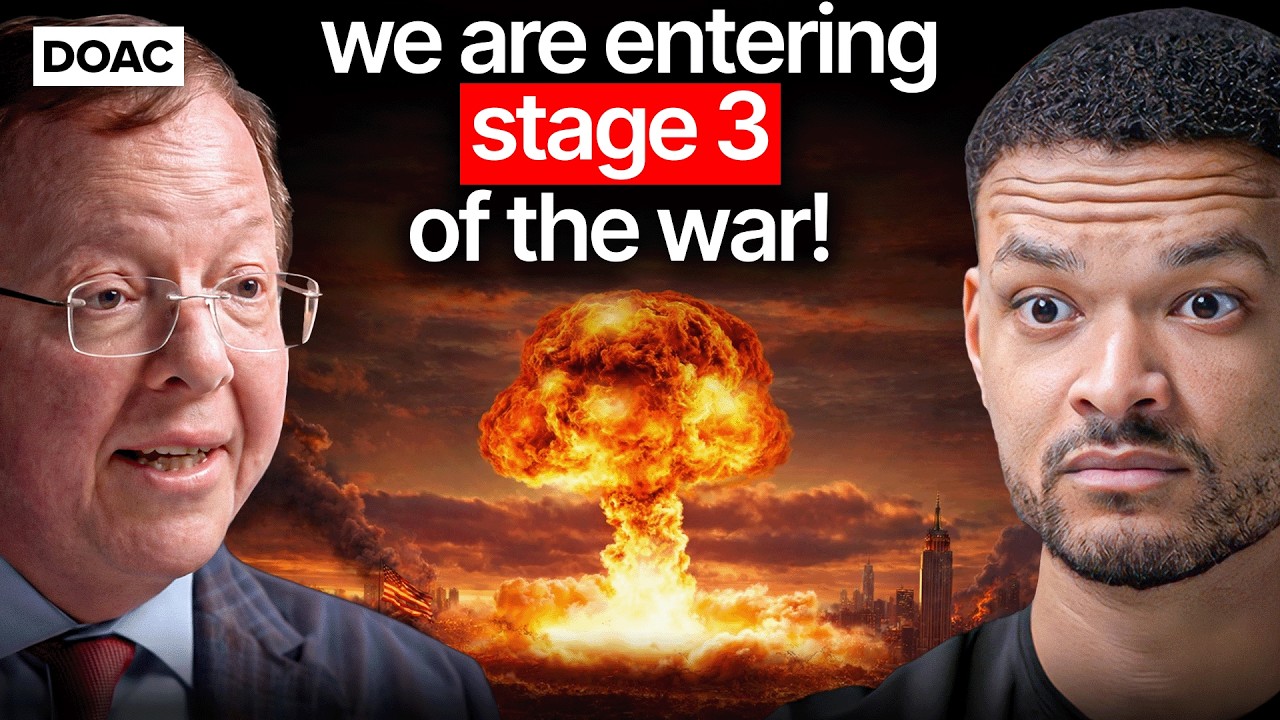
US Iran Strikes Risk Entrapment, China Dominance, Pape Warns
The Diary Of A CEO
Air strikes on Iran's nuclear sites create an escalation trap that risks ground deployment, depletes US weapon stockpiles, and cements China's global technological dominance.
## Background
This interview was published by The Diary Of A CEO on YouTube on March 12, 2026. In the video, political scientist and White House advisor Robert Pape discusses why the US is trapped in an escalating war with Iran, the risks of nuclear breakout, China's role, and how precision bombing leads to strategic failure.
## TL;DR
Political scientist Robert Pape outlines how tactical success with precision air strikes creates an 'escalation trap' that inadvertently alters political dynamics for the worse. Following US strikes and the assassination of Supreme Leader Ayatollah Ali Khamenei, Iran's regime hardened, leaving the US with an intelligence void regarding Iran's 400kg stockpile of enriched uranium—enough for approximately 16 nuclear warheads. Pape warns that ground troop deployment is increasingly likely, depleting US precision weapons and distracting America from strategic rivals like China. Ultimately, Pape cautions against pursuing the myth of 100% security abroad while ignoring the normalization of political violence at home.
## Atmosphere & style
The conversation carries a sober, analytical tone driven by Pape's decades of wargaming and strategic modeling. Host Steven Bartlett provides a attentive platform as Pape dissects complex geopolitical traps, contrasting tactical military triumph with long-term strategic miscalculation. The mood is measured yet urgent, offering a candid critique of US foreign policy and global power shifts.
## Key takeaways
- [00:00](https://www.youtube.com/watch?v=xcXfcXJvMXg&t=0s) Robert Pape's 20 years of war game simulations demonstrate that the US is losing strategic control over its long-running conflict with Iran.
- [01:58](https://www.youtube.com/watch?v=xcXfcXJvMXg&t=118s) Precision smart bombs create a dangerous 'escalation trap' by offering misleading high tactical success rates while triggering unfavorable political and strategic outcomes.
- [04:04](https://www.youtube.com/watch?v=xcXfcXJvMXg&t=244s) Striking Iranian nuclear facilities with air power failed to destroy mobile stockpiles of enriched uranium, leaving US intelligence with a critical blind spot regarding their locations.
- [14:03](https://www.youtube.com/watch?v=xcXfcXJvMXg&t=843s) The decapitation of Iranian leadership backfired by eliminating internal religious restrictions on nuclear weapons and causing the regime to harden under uncompromising leadership.
- [20:30](https://www.youtube.com/watch?v=xcXfcXJvMXg&t=1230s) The US-Iran conflict follows a three-stage escalation pattern: tactical air strikes, regional asymmetric proxy warfare, and ultimate ground troop deployment to control nuclear sites.
- [25:34](https://www.youtube.com/watch?v=xcXfcXJvMXg&t=1534s) Iran's strategy mirrors the North Korea model of acquiring multiple nuclear warheads simultaneously to ensure regime survival against US intervention.
- [01:00:01](https://www.youtube.com/watch?v=xcXfcXJvMXg&t=3601s) Deploying US ground forces to locate dispersed nuclear material risks entangling the military in a protracted counterinsurgency campaign with major homeland security threats.
- [46:48](https://www.youtube.com/watch?v=xcXfcXJvMXg&t=2808s) Escalating a war of choice creates severe political risks for US leaders, as public support rapidly erodes during prolonged wars of attrition.
- [01:16:32](https://www.youtube.com/watch?v=xcXfcXJvMXg&t=4592s) US military involvement in the Middle East drains precision-guided munition stockpiles and strategic focus away from containing China's influence.
- [01:13:18](https://www.youtube.com/watch?v=xcXfcXJvMXg&t=4398s) China is accelerating past US technological dominance through massive state investment in AI, autonomous systems, and advanced robotics infrastructure.
- [01:20:30](https://www.youtube.com/watch?v=xcXfcXJvMXg&t=4830s) Pursuing absolute, 100% military security often results in self-defeating decisions; securing temporary diplomatic freezes remains the most practical strategic outcome.
- [01:25:40](https://www.youtube.com/watch?v=xcXfcXJvMXg&t=5140s) The growing normalization of political violence inside the United States poses a greater existential threat to the nation than external geopolitical adversaries.
## Detailed walkthrough
### [00:00](https://www.youtube.com/watch?v=xcXfcXJvMXg&t=0s) Introduction: The Escalation Trap and 20 Years of Iran Simulations
Professor Robert Pape—renowned political scientist, director of the Chicago Project on Security and Threats, and author of *Bombing to Win: Air Power and Coercion in War*—opens by reflecting on two decades of running war simulations on Iran. For 20 years, every strategic model and wargame he has run at the university level has pointed to the same unfolding reality: the United States is rapidly losing control of the conflict with Iran. Crucially, the US no longer knows the precise locations of Iran's enriched nuclear material. Iran currently possesses enough enriched uranium for 16 nuclear weapons, and military actions have inadvertently given Tehran every incentive to build them.
Pape, who has advised every presidential administration since 2001 and spent 30 years building the curriculum used by the US Air Force, explains that conflicts of this nature escalate through three distinct stages. Host Steven Bartlett notes Pape’s staggering prediction: a 75% chance that President Trump will escalate the war into "Stage Three."
[01:58](https://www.youtube.com/watch?v=xcXfcXJvMXg&t=118s) The Fundamental Flaw of Smart Bombs: Tactical Success vs. Political Reality
Opening the core discussion, Pape emphasizes that while the world feels intensely unstable right now, this crisis follows historical patterns seen during the 2003 Iraq War and the 1986 bombing of Muammar Gaddafi's Libya. Having studied air power, military strategy, international terrorism, and domestic political violence for 40 years, Pape delivers his primary thesis: "Bombs don't just hit targets, they change politics."
In the modern age of precision-guided smart weaponry, military commanders and politicians become mesmerized by tactical success. Precision munitions successfully hit and destroy concrete structures, underground bunkers, and buildings over 90% of the time. However, wars are fundamentally about politics, not just hardware or operational logistics. When bombs land, they alter the internal political dynamics of both the target nation and the attacking state. This misunderstanding creates an "escalation trap," where initial tactical success blinds leaders to the severe political consequences that follow.
- **40 years:** Professor Robert Pape's total time spent studying political violence and military strategy.
- **2001 to 2024:** The span of years Pape advised successive White House administrations, including the first Trump administration.
- **90%+:** The operational accuracy rate of modern smart bombs hitting intended physical targets.
[04:04](https://www.youtube.com/watch?v=xcXfcXJvMXg&t=244s) Simulating the Iran Strike: 16 Nuclear Bombs and Missing Uranium
Pape recalls his early career after finishing his PhD, when the First Gulf War broke out in 1990–1991. As a young scholar, his expertise was sought out by major media outlets and the US Air Force to help build their air power curriculum. Over the last 20 years, the final exercise in his strategy courses has involved simulating an all-out air strike on Iran's nuclear facilities—including key sites such as Natanz, Fordow, and Esfahan.
```
+-----------------------------------------------------------------------+
| IRAN STRIKE SIMULATION |
+-----------------------------------------------------------------------+
| Primary Stealth Strike: B-2 Spirit Stealth Bombers |
| Target Destruction Rate: >90% of Physical Infrastructure (Natanz, |
| Fordow, Esfahan) |
| Material Status: Fissile material for 16 bombs untracked; |
| highly mobile and dispersed |
+-----------------------------------------------------------------------+
```
In every simulation—including one run in May just prior to actual military operations—stealth B-2 bombers penetrate Iranian airspace with minimal risk of loss and destroy over 90% of the physical targets. However, the true purpose of such strikes is not to destroy concrete, but to destroy the enriched uranium (ranging from 5%, 20%, to 60% purity). By May, Iran had accumulated enough fissile material to build 16 nuclear bombs over a span of months.
Following the simulated bombing, intelligence lost track of every single ounce of that material. Due to Iran's immense geographical size compared to the United States, enriched material can easily be dispersed anywhere in the country. Within a year of such a strike, panic sets in as intelligence agencies realize they can no longer track how many nuclear weapons are being assembled in secret, inevitably pushing the US toward demanding full regime change.
[07:09](https://www.youtube.com/watch?v=xcXfcXJvMXg&t=429s) Losing Control: The Dispersal of Nuclear Material
When host Steven Bartlett asks why the public is hearing messages of success from President Trump while Pape warns of catastrophe, Pape clarifies that the US is caught in a self-made trap. The fundamental issue is that Washington lost control over the locations of Iran's nuclear material starting with the strikes on Natanz and Fordow.
Commercial satellite imagery shows active movement around Iranian nuclear sites. Iranian forces prepared for this war by designing resilient networks to safeguard their nuclear assets and lash back aggressively. As a result, Iran is actively winning the escalation dynamic.
Explaining the timeline, Pape notes that Iran had already enriched uranium to 60% purity—dangerously close to the 90% weapons-grade threshold, though sophisticated scientists could potentially fashion a device even at 60%. Following US bunker-buster strikes launched from B-2 bombers, official statements suggested the threat was neutralized. Yet, the US immediately entered diplomatic negotiations with Iran. Pape points out the glaring inconsistency: if the program was truly destroyed, there would be no reason to negotiate. Leaked Defense Intelligence Agency (DIA) and Israeli intelligence reports confirmed that while bombs damaged underground chambers, intelligence agencies had no visibility inside and could not confirm the location of the enriched uranium. In fact, satellite photos taken two days before the strike on Fordow showed a fleet of trucks moving large containers—resembling scuba tanks the size of conference tables—out of the facility.
[12:00](https://www.youtube.com/watch?v=xcXfcXJvMXg&t=720s) The "Jenga" Fallacy: Why Regimes Adapt Instead of Collapsing
Addressing the US military action in February 2026 that targeted top Iranian leadership, Pape dismantles the popular belief that decapitating a regime's leader brings a quick end to war. Using a Jenga tower visual, Pape explains that top defense officials often operate on superficial, "one-inch deep" briefings. They view a dictatorship as a fragile tower where removing a single critical block—the supreme leader or command node—will cause the entire structure to tumble down.
```
POPULAR "JENGA" MISCONCEPTION ACTUAL ADAPTIVE MATRIX
[ Supreme Leader ] O --- O --- O --- O
| | \ | / | \ |
[ Command Nodes ] O --- O --- O --- O
/ | \ | / | \ | / |
[Missiles] [Nuclear] [Regime] O --- O --- O --- O
```
This model is fundamentally flawed. Modern revolutionary regimes do not function like fragile towers; they operate like flexible, highly redundant corporate matrices. When a key figure is removed, the adaptive system reorganizes and fills the void with remaining hardline elements.
- **The Jenga Fallacy:** The mistaken belief that targeting a regime's central leader causes the entire state apparatus to collapse.
- **Adaptive Matrix Structure:** Revolutionary regimes redistribute authority horizontally, making them resilient to decapitation strikes.
[14:03](https://www.youtube.com/watch?v=xcXfcXJvMXg&t=843s) Unintended Consequences: Eliminating the Guardrails Against Nuclear Weapons
Pape reveals a critical historical detail regarding the assassinated Iranian Supreme Leader, Ayatollah Ali Khamenei. While western media portrayed him solely as an adversary, Khamenei had issued two binding *fatwas* (religious edicts) declaring nuclear weapons forbidden under Islamic law. As the country's supreme religious authority, Khamenei functioned as a vital internal guardrail, continually balancing hardline hawks and moderate doves within Iran.
While Iran had produced enriched uranium up to 60%, it had not yet taken the final engineering steps to assemble an actual nuclear weapon under his tenure. By assassinating him, the US eliminated the very figure holding back nuclear weaponization. His son, Mojtaba Khamenei—who was recently announced as the new Supreme Leader—is not bound by his father's fatwa. Mojtaba is well known for his extreme hawkishness, having previously directed the Basij paramilitary forces responsible for brutally crushing domestic political protests.
Pape notes the tragedy of the situation: when President Trump publicly voiced opposition to Mojtaba taking power, he acknowledged that US strikes had inadvertently killed 20 to 30 moderate political alternatives surrounding the old Supreme Leader. By eliminating the competing factions, the US military strikes directly paved the way for the most aggressive, hardline figure to consolidate absolute power.
[17:34](https://www.youtube.com/watch?v=xcXfcXJvMXg&t=1054s) Leadership Decapitation and the Mechanics of Regime Hardening
The common belief that killing a dictator or taking out a regime's top leadership breaks its political system fundamentally misreads how autocratic structures function under pressure. Out of Iran's 92-million population, the nation maintains a standing army of one million active personnel—matching the total military workforce of the United States, a nation with nearly four times its overall population. Within this massive apparatus sits the Islamic Revolutionary Guard Corps (IRGC), an elite corps of 150,000 to 200,000 highly trained, ideological hardliners completely dedicated to protecting the system.
When an external power assassinates the Supreme Leader, the void is not filled by moderate or pro-Western reformers. Instead, power immediately consolidates around the regime's most aggressive military factions. The newly appointed successor faces a deadly credibility dilemma: to prevent internal mutinies or assassinations by hardline rivals, he must demonstrate immediate, overwhelming force against the external enemy. He cannot afford to look weak; doing so risks "a bullet in the back of the head."
History shows a clear pattern where targeting top autocratic leaders backfires into extreme external retaliation:
* **Libya (1986):** The U.S. attempted to kill Muammar Gaddafi in air strikes; Gaddafi retaliated years later by ordering the bombing of Pan Am Flight 103 over Lockerbie, killing 271 civilians (including 190 Americans).
* **Kosovo/Yugoslavia (1999):** U.S. attempts to degrade Slobodan Milošević’s leadership prompted him to deploy 30,000 ground troops, forcibly expelling nearly a million civilians in a brutal campaign of ethnic cleansing.
* **Chechnya (1996):** Russian forces (with U.S. technical assistance) assassinated Chechen President Dzhokhar Dudayev via a missile strike guided by nose-cone cameras. His successor, Shamil Basayev, launched "Operation Jihad" three months later, unleashing ruthless tactics that expelled Russian forces from the territory.
---
[20:30](https://www.youtube.com/watch?v=xcXfcXJvMXg&t=1230s) The Escalation Trap: From Smart Bombs to Horizontal Escalation
The progression of military conflict often follows a predictable multi-stage escalation loop. The illusion of air power creates a strategic delusion: precision-guided munitions achieve near 100% tactical success on targeted structures, yet leave the adversary's primary strategic assets and political resolve intact.
```
+-----------------------------------------------------------------------------------+
| THE 3-STAGE ESCALATION TRAP |
+-----------------------------------------------------------------------------------+
| STAGE 1: Tactical Air Strikes |
| • Precision bombing hits primary nuclear/military targets (e.g., Fordow, Natanz). |
| • Tactical success is 100%, but fails to destroy hidden strategic assets. |
| • Initial retaliation remains localized (e.g., missile strikes on Israel). |
+-----------------------------------------------------------------------------------+
│
▼
+-----------------------------------------------------------------------------------+
| STAGE 2: Horizontal Escalation & Regional Disruption |
| • Attacker turns to leadership decapitation / regime change to solve Stage 1 failure|
| • Adversary uses asymmetric precision tools (drones) against regional economic nodes|
| • Threatens tourism/GDP in host nations to break the coalition and evict U.S. bases|
+-----------------------------------------------------------------------------------+
│
▼
+-----------------------------------------------------------------------------------+
| STAGE 3: Ground Invasion & Homeland Retaliation |
| • Missing nuclear assets force ground troop deployments (e.g., 82nd Airborne). |
| • Prolonged boots-on-the-ground presence triggers global asymmetric retaliation. |
| • Export of state-sponsored proxy networks and terrorism directly to the homeland. |
+-----------------------------------------------------------------------------------+
```
#### Stage 1: Tactical Air Strikes
Initial precision air strikes hit hardened nuclear infrastructure (such as Fordow and Natanz). In response, Iran launched a massive direct ballistic missile retaliatory barrage aimed at Israel, sending over 3,000 Israelis to hospitals—the highest single casualty burden from direct military conflict since the 1973 Yom Kippur War.
#### Stage 2: Horizontal Escalation
When tactical bombing fails to secure the target nuclear material, the attacking power turns toward regime change. In response, the defending state shifts from direct regional missile battles to asymmetric **horizontal escalation**. Utilizing swarms of low-cost, precision-guided kamikaze drones, Iran targets key economic infrastructure across neighbor states—including Saudi Arabia and the United Arab Emirates (UAE).
By hitting commercial airports, luxury hotels, and transport hubs, Iran targets the vital tourism sectors of the Gulf states, which account for 5% to 10% of their annual GDP. The goal is simple: split the coalition by forcing regional partners to demand a cease-fire or evict American military bases—the grounded "aircraft carriers" that enable U.S. air operations.
* **Economic Impacts:** Expatriates and international business travelers flee regional centers like Dubai, with air travel recovery potentially taking years, mirroring the post-9/11 downturn.
* **Political Volatility:** A sharp rift exists between regional ruling elites allied with Western policy and their local populations. Public outrage over expanding military campaigns creates deep internal instability, drawing historic parallels to 1981, when Egyptian President Anwar Sadat was assassinated by his own soldiers following the Camp David Accords.
---
[25:34](https://www.youtube.com/watch?v=xcXfcXJvMXg&t=1534s) Ground Deployments and the Unknown Nuclear Stockpile
The ultimate failure of precision air strikes is the inability to locate or destroy mobile or deeply buried weapons-grade materials. Air strikes can seal facility entrances and bounce rubble, but they cannot guarantee the destruction of highly enriched uranium hidden in deep underground networks.
To locate and secure this critical stockpile, military planners are forced to consider Stage 3: deploying ground forces. Sending units like the 82nd Airborne Division to capture and hold restricted operational zones—such as an area the size of Los Angeles International Airport (LAX) around Fordow—requires thousands of troops on the ground for extended months.
```
[ 2015 JCPOA Nuclear Agreement ]
• Highly enriched uranium removed from Iran
• 24/7 IAEA camera coverage & human inspections
│
▼
[ 2018 U.S. Unilateral Withdrawal ]
• Monitoring mechanisms discarded
• Enrichment accelerated to 60%+ levels
│
▼
[ Present Crisis ]
• 400kg stockpile (enough for ~16 nuclear weapons)
• Location unknown following air strikes
```
* **The JCPOA Baseline:** Under the 2015 Joint Comprehensive Plan of Action (JCPOA), Iran's enriched uranium was shipped out of the country under continuous IAEA camera monitoring and on-site human inspections.
* **The Post-2018 Acceleration:** Following the U.S. unilateral withdrawal from the deal in 2018, Iran accelerated its enrichment operations, assembling a 400kg stockpile of highly enriched uranium—sufficient material to construct roughly 16 nuclear warheads.
* **The Intelligence Void:** With monitoring systems gone and target sites bombed, Western intelligence operates in a "Swiss cheese" environment full of blind spots. Fearing that unaccounted nuclear material could be transferred to proxy groups like Hezbollah or the Houthis, political leaders face mounting pressure to deploy ground troops—a step that risks triggering state-sponsored terrorist attacks against Western homelands.
<FollowUp label="Want to dive into Stage 3 and how proxy networks like Hezbollah or the Houthis operate?" query="Tell me more about Stage 3 escalation, specifically how Iran's proxy networks like Hezbollah and the Houthis could be deployed in retaliatory scenarios."/>
Here is a detailed and faithful walkthrough of this part of the conversation:
[35:01](https://www.youtube.com/watch?v=xcXfcXJvMXg&t=2101s) Asymmetric Warfare, Gulf Oil Traps, and the Strait of Hormuz
Professor Robert Pape warns that as the war expands into its third stage, its impact will go global. Iran’s strategy does not necessarily rely on a grand, rigid master plan, but rather on executing sequential waves of asymmetric responses. He points out that the global economy is already feeling the pressure through disrupted supply chains and surging oil prices. Following a U.S. presidential press conference, Tehran issued a direct ultimatum to the Gulf states: kick American military forces out, and your oil tankers will be allowed safe passage through the Strait of Hormuz.
To make the strategic stakes clear to a non-expert, Pape and host Steven Bartlett break down the critical importance of the Strait of Hormuz. The narrow waterway serves as the world’s primary maritime choke point for global oil transport. Tankers are already refusing to navigate the strait after a single ship was hit, because commercial crews are working for a paycheck—not dying for a nationalist cause. Pape explains that cutting off this narrow conduit drives up global gas prices at the pump, triggering worldwide inflation and heightening political panic over affordability across Western democracies.
- **Iran's Gulf Ultimatum:** Tehran offered safe passage to Gulf state oil tankers strictly on the condition that those nations expel American military assets.
- **Economic Ripple Effect:** Disruptions in the Strait of Hormuz instantly spike fuel prices globally, exacerbating U.S. inflation at a time when unemployment sits at 4.4%.
---
[38:10](https://www.youtube.com/watch?v=xcXfcXJvMXg&t=2290s) The Russian Intelligence Link and America’s Political Vulnerability
The threat level in the Gulf has been magnified by intelligence sharing between major foreign powers. Pape notes it is well-confirmed that Russia is providing real-time targeting intelligence to Iran, mirroring how the U.S. provides targeting data to Ukraine to strike deep inside Russian territory. This satellite and tracking data allows Iran’s precision-guided drones to target specific commercial ships with high accuracy. While U.S. officials like Defense Secretary Pete Hegseth attempt to downplay the development, President Trump acknowledged the dynamic during a March 7 press conference, effectively justifying Moscow's actions by stating: *"If we asked them, they'd say we do it against them. Wouldn't they say that? We do it against them?"*
Pape highlights that America's foes understand a crucial lesson dating back to the Vietnam War: you cannot defeat the United States military toe-to-toe on the battlefield, but you can defeat America politically through a prolonged war of attrition. Adversaries target America's "soft underbelly"—its political will and election cycles. North Vietnam won despite losing every major tactical battle, and the Afghan Taliban used the same patience to outlast Washington. By weaponizing energy prices and dragging out the conflict, foreign powers exploit internal U.S. political divisions.
- **Russian Targeting Data:** Russian intelligence services are supplying Iran with precise coordinates to guide suicide drones against commercial shipping in the Gulf.
- **Historical Analogy:** The U.S. lost the Vietnam War—suffering 58,000 casualties—and the war in Afghanistan not due to tactical defeats, but because adversaries successfully dragged the conflict out until domestic political support collapsed.
---
[43:14](https://www.youtube.com/watch?v=xcXfcXJvMXg&t=2594s) Trump’s Hobbesian Choice and the Escalation Trap
Asked to predict what happens next, Pape argues that President Trump is caught on the horns of a dilemma with no "golden off-ramp" that leaves him politically unscathed. He faces a classic Hobbesian choice between two difficult options. First, he could cut his losses, pull back U.S. naval assets like aircraft carriers to other theaters, and accept a modest political defeat right now. Second, he could double down, continuing the bombing campaign for weeks or months in the hope of neutralizing Iranian leadership—a path that risks dragging the nation into a catastrophic, multi-stage "smart bomb trap."
Pape explicitly draws a parallel between Trump's current predicament and President Lyndon B. Johnson's tragic escalation during the Vietnam War. LBJ continuously climbed the escalation ladder under the delusion of "escalation dominance," convinced that harder strikes would force the enemy to yield. Instead, the strategy stalled, leading his own political party to abandon him ahead of the 1968 presidential election. If Trump doubles down, he risks a similar "political failure of the first order" as the upcoming midterm elections approach.
- **Option A (Cut Losses):** Immediately halt the air campaign and withdraw major carrier strike groups, accepting an immediate political setback.
- **Option B (Double Down):** Escalate the campaign for months, chasing an elusive military victory while sliding deeper into a prolonged, costly conflict.
---
[46:08](https://www.youtube.com/watch?v=xcXfcXJvMXg&t=2768s) Wars of Choice vs. Wars of Necessity
The conversation turns to why democratic nations struggle to sustain long, overseas conflicts. Pape draws a sharp distinction between a "war of necessity" and a "war of choice." When the United States was directly attacked at Pearl Harbor, public rage sustained an intensely brutal, years-long island-hopping campaign across the Pacific. By the time atomic bombs were dropped to end World War II, a full 22% of the American public remarkably favored dropping additional nuclear weapons rather than accepting Japanese surrender. Direct attacks grant leaders an overwhelming, durable domestic mandate.
Conversely, a "war of choice"—where the U.S. throws the first preemptive punch—puts the political advantage squarely in the enemy’s hands. Because Iran did not strike the U.S. homeland first, Washington lacks the deep public resolve required for an extended conflict. The war’s legitimacy remains under constant domestic debate, making it highly sensitive to economic shocks and military casualties.
- **Public Retaliation Sentiment (1945):** 22% of Americans wanted the U.S. to drop more atomic bombs on Japan rather than negotiate terms of surrender after Pearl Harbor.
- **Political Asymmetry:** Wars of choice lack long-term public buy-in, making the domestic political front vulnerable to enemy attrition strategies.
---
[47:34](https://www.youtube.com/watch?v=xcXfcXJvMXg&t=2854s) Diplomacy Torpedoed: Israel, Preemption, and the Friday Decision
Analyzing the decision to bomb Iran, Pape reveals critical details from the hours preceding the attack. On Friday, February 27, at 3:15 PM Washington time, President Trump made the "go" decision to launch the bombing campaign. At that exact moment, an Iranian diplomatic proposal was sitting on the table that offered a better deal for America than the original 2015 Obama nuclear agreement (JCPOA). Iran’s Supreme Leader had backed the arrangement, which included strict verification measures and limits on enrichment. Rather than pursuing his self-proclaimed identity as a dealmaker, Trump discarded the proposal and opted for a campaign aimed at regime change.
Addressing comments made by U.S. Secretary of State Marco Rubio—who stated the U.S. preemptively struck Iran because they knew an Israeli attack was imminent and would trigger Iranian retaliation against U.S. troops—Pape describes the situation as "the tail wagging the dog." He notes that in both June and February, when Washington neared a diplomatic breakthrough with Tehran, Israeli military action targeted Iranian negotiators or leaders. Pape points out that the U.S. could have leveraged its massive foreign military aid package to restrain Israel, but political pressure prevented Washington from asserting control over its ally.
- **The Go-Decision Timestamp:** President Trump authorized the strike campaign on Friday, February 27, at 3:15 PM Washington time.
- **The Negotiated Offer:** Iran had submitted a verified diplomatic proposal superior to the 2015 JCPOA, backed by the Supreme Leader, prior to the U.S. military strikes.
- **Marco Rubio's Justification:** U.S. officials claimed preemption was necessary because an imminent, uncoordinated Israeli strike on Iran would have exposed American forces in the region to immediate retaliatory danger.
<FollowUp label="Want to explore the next part of the transcript covering the regional fallout?" query="Please provide the walkthrough for part 4 of this transcript."/>
[51:37](https://www.youtube.com/watch?v=xcXfcXJvMXg&t=3097s) Trump, Netanyahu, and the Pressures of the Escalation Trap
Robert Pape explains that the current trajectory is not a series of random, inexplicable events, but the predictable logic of an escalation trap. Addressing President Donald Trump’s public briefings regarding stopping the air campaign against Iran, Pape highlights the critical question that journalists failed to ask: whether Trump will call Israeli Prime Minister Benjamin Netanyahu and command him to stop bombing Iran. When host Steven Bartlett asks if Trump actually controls Netanyahu, Pape clarifies that international politics operates on structural pressures rather than personal loyalty. For Trump to force Netanyahu to halt military actions, he would have to pay a steep domestic political cost, as a significant portion of his core MAGA constituency is fiercely supportive of Netanyahu's aggressive strategy.
Pape stresses that this internal political tension illustrates why leaders should avoid falling into escalation traps in the first place. Once inside the trap, stopping the momentum becomes politically expensive and strategically complex.
- The primary unasked question from the press briefing is whether President Trump will demand that Prime Minister Netanyahu halt Israel's air campaign against Iran.
- Restraining Israel carries a high domestic political price for Trump due to strong support for Netanyahu within his core voting base.
---
[52:48](https://www.youtube.com/watch?v=xcXfcXJvMXg&t=3168s) The Impending Ground Deployment: Iran’s Dispersed Uranium and the "Fat Man" Threat
When pressed by Bartlett to provide a definitive forecast without "fence-sitting," Pape estimates that it is more likely than not that the United States will be forced into a limited ground deployment in Iran. The driving catalyst is what he terms the "fizzle" or dispersion of Iran's enriched uranium following aerial bombardments. The highly enriched material is currently unmonitored and scattered across unknown locations. Pape points out that it does not take a massive, sophisticated facility to construct an atomic bomb; literally hundreds of small rooms—scarcely two or three times the size of a standard podcast studio—could host the assembly of a crude nuclear weapon.
Pape emphasizes that Iran does not need to master the highly complex engineering required to miniaturize a nuclear warhead onto a missile nose cone, a process that took major powers a decade to perfect. Instead, Iran only needs a rudimentary, "Fat Man"-style gravity bomb similar to the weapon dropped on Hiroshima. A single device of that scale could instantly kill 75,000 people. The immediate threat is not an advanced intercontinental ballistic missile, but a basic, high-yield nuclear device built from dispersed, highly enriched material.
- Pape calculates a higher-than-50% probability of a U.S. limited ground deployment to locate scattered nuclear material.
- Enriching and assembling a crude nuclear bomb requires minimal physical space—potentially small rooms scattered across Iran.
- "Fat Man" reference: A basic, non-miniaturized atomic bomb capable of killing 75,000 people in seconds, bypassing the need for complex missile integration.
---
[54:05](https://www.youtube.com/watch?v=xcXfcXJvMXg&t=3245s) Presidential Legacy and the North Korean Nuclear Blueprint
Bartlett introduces the psychology of leadership, arguing that Donald Trump's decisions are heavily influenced by how history will view him, pointing to his interest in global peace initiatives and his expressed fear of forcing a future president to redo the war in five or ten years. Pape agrees, sharing that behind closed doors in the White House West Wing, national security advisers and top officials are deeply consumed by legacy considerations rather than minor politics. However, Pape applies this exact same psychological lens to Iran's 86-year-old Supreme Leader (Ayatollah Ali Khamenei), who reportedly suffers from terminal cancer. Facing his final months, the Iranian leader is unlikely to act out of caution or surrender; instead, he is motivated to leave a legacy as a staunch defender of the Islamic Revolution rather than a coward.
Pape debunks common media narratives that depict Iran's nuclear ambitions as an immediate plot to drop a single bomb on Tel Aviv or New York in a kamikaze act. If a country is willing to face total annihilation to strike its enemy, it only needs one bomb. Instead, Iran is meticulously executing the "North Korea plan." Developed during the 1990s when North Korea avoided U.S. air strikes, this strategy relies on acquiring multiple nuclear weapons simultaneously to conduct sequential underground test explosions.
> "When we dropped the first bomb on Hiroshima, it wasn't clear we had any more. When we dropped the second one, nobody needed to wait for a third or fourth... they knew more would come."
By demonstrating a multi-bomb capability through consecutive tests in mountain sites, North Korea successfully deterred U.S. regime-change efforts, building an arsenal of roughly 60 working nuclear weapons today. Iran recognizes that nuclear weapons are the ultimate security guarantee—a lesson reinforced by Ukraine's decision to surrender its nuclear arsenal in the 1990s, which left it vulnerable to invasion decades later.
- Iran's Supreme Leader, aged 86 and battling terminal illness, is motivated by revolutionary legacy rather than self-preservation.
- The "North Korea plan" involves acquiring 5+ bombs simultaneously and conducting sequential mountain tests to prove operational capability and achieve permanent deterrence.
- North Korea currently possesses an estimated 60 operational nuclear weapons, rendering its leadership immune to U.S.-led decapitation strikes.
---
[01:00:01](https://www.youtube.com/watch?v=xcXfcXJvMXg&t=3601s) Stage 3: Boots on the Ground and the Ghost of WMD Inspections
Pape places a 75% probability on the U.S. progressing to "Stage 3" of the escalation trap—putting boots on the ground—with only a 25% chance that a diplomatic deal or Iranian compliance prevents it. From Iran's perspective, U.S. and Israeli strikes have created a existential survival imperative: because the West repeatedly pauses and resumes targeted killings, Iran's safest option is to dash for a nuclear deterrent.
If Stage 3 unfolds, U.S. forces will initially deploy with a small footprint to specific areas like Esfahan to search for nuclear materials. However, Pape warns that this mirrors the intractable intelligence nightmare experienced with Iraq's weapons of mass destruction (WMD) from the 1990s through 2003. Even if ground troops secure known stockpiles, military intelligence can never be 100% certain that additional enriched material has not been hidden elsewhere. Over time, this lingering uncertainty feeds intense fear in Washington and Jerusalem regarding a potential nuclear or radiological "handoff"—the danger that Iran might transfer dirty bombs or nuclear material to proxy groups like Hezbollah or the Houthis.
- Pape assigns a **75% likelihood** to U.S. ground troop deployment and a **25% chance** for a negotiated diplomatic resolution.
- Initial ground operations would target key nuclear infrastructure hubs such as Esfahan.
- The core intelligence dilemma mirrors 1990s–2003 Iraq: ground searches can never conclusively prove the complete absence of hidden radiological material.
---
[01:02:48](https://www.youtube.com/watch?v=xcXfcXJvMXg&t=3768s) Proxy Dynamics: The Roots of Hezbollah and the Danger of Regeneration
To contextualize the fear of proxy groups, Pape outlines the history of Hezbollah, correcting the misconception that it was created by the CIA. Hezbollah was formed in July 1982 as a direct military reaction to Israel's invasion of southern Lebanon a month earlier, which involved 78,000 combat troops and 3,000 armored vehicles—an operational scale comparable to invading Chicago or Los Angeles. Born out of armed resistance to foreign occupation, Hezbollah's core identity has been defined by hostility toward Israel for over four decades.
Pape notes that counterterrorism campaigns against deeply embedded groups often trigger a destructive loop. Proxy forces like Hezbollah exist within a "sea of people." While military strikes successfully kill individual militants, the surrounding civilian destruction causes the group to continually regenerate. When military force fails to eliminate an entrenched insurgent group over decades, state actors are incrementally pushed toward extreme measures, such as attempting to depopulate entire cities (like Beirut) or forcibly expelling large civilian populations (as seen in Gaza). Pape notes that Israel’s push to displace large portions of Gaza's 2 million residents is the direct result of entering Stage 3 of its own escalation trap.
- Hezbollah was founded in July 1982 following Israel's June 1982 invasion of southern Lebanon (78,000 troops, 3,000 armored vehicles).
- Military action against insurgent groups operating in populated urban areas leads to continuous organizational regeneration.
- Entering Stage 3 of an escalation trap creates strategic pressures that drive military forces toward population displacement and forced expulsions.
---
[01:05:54](https://www.youtube.com/watch?v=xcXfcXJvMXg&t=3954s) The Legacy Trap: From Vietnam and Afghanistan to Iran
Looking at what happens beyond Stage 3, Pape draws parallels to past U.S. military entanglements in Vietnam and Afghanistan. When American presidents attempt to extricate the nation from an ongoing Stage 3 conflict, the resulting exit almost always severely damages their political legacy. He points to Lyndon B. Johnson with Vietnam, as well as Joe Biden's withdrawal from Afghanistan. Although Donald Trump negotiated the initial exit framework with the Taliban, he deferred the actual withdrawal to Biden. Following the chaotic U.S. exit from Afghanistan, Biden's approval ratings plummeted and never fully recovered, hitting his presidency harder than domestic inflation.
President Trump now finds himself caught on the horns of the exact same dilemma: he can either take a painful, immediate political loss by refusing to escalate, or he can double down militarily and risk cementing his long-term legacy alongside LBJ and Biden as a president bogged down in an unwinnable Middle Eastern war.
- Historical parallels: Vietnam (LBJ) and Afghanistan (Biden) demonstrate how exiting a Stage 3 conflict inflicts heavy, irreversible damage on a president's legacy.
- President Biden's public approval ratings suffered an irreversible drop following the 2021 Afghanistan withdrawal.
- President Trump faces a structural choice: absorb a short-term political hit by stopping the conflict or risk long-term strategic entrapment.
Steven Bartlett opens the section by highlighting tools for corporate team building and habit change, specifically bundling *The Diary Of A CEO* conversation cards with the *1% Diary*. The conversation cards contain unreleased questions left behind by previous podcast guests, which have become popular for fostering deep connection among couples, corporate teams, and families.
* The conversation cards feature exclusive questions written into the studio's diary by previous guests.
* The product bundle is designed for corporations looking to drive interpersonal connection and habit formation.
---
[01:09:14](https://www.youtube.com/watch?v=xcXfcXJvMXg&t=4154s) Trump's "Chaos Kid" Strategy and the Venezuelan Precedent
Steven questions whether Donald Trump or his advisors understood that dropping precision munitions to decapitate leadership would trigger an escalation trap. Robert Pape reveals that military figures like General Jack Keane likely warned Trump of these exact risks. However, Pape categorizes Trump as "the ultimate chaos kid"—someone who thrives in chaotic, fast-moving situations and believes he can out-navigate anyone else when a media storm erupts.
Pape notes that while Trump's political instinct for creating chaos works well in domestic media, political violence in international relations involves independent actors who can trap the U.S. He draws a direct comparison to Venezuela, where Trump executed "Stage 1" of the escalation trap by capturing Nicolás Maduro alongside his wife. When oil companies refused to risk personnel to develop Venezuelan fields, Trump simply halted at Stage 1, left the rest of the regime intact, declared victory, and moved on.
In the Iranian case, Trump initially attempted to stop after Stage 1 during the prior June. However, Israeli Prime Minister Benjamin Netanyahu called Trump to announce that Israel was about to assassinate Supreme Leader Ali Khamenei and twenty top associates, forcing Trump's hand into Stage 2.
> "There are people who thrive in chaos. They feel the best when they're in a chaotic situation, and I think that he believes he can navigate the chaos better than anybody else."
> "What made the difference here? It wasn't Trump. It was the intel he got from Netanyahu, the phone call from Netanyahu... 'We're about to assassinate the Supreme Leader in about 20 of his associates... You decide how you want to handle this, but we're taking off.'"
* **The Chaos Model:** Trump relies on "mixing it up" to generate media chaos, which has historically served his domestic political goals.
* **Venezuela Strategy:** Trump removed Maduro but left the broader regime structure and oil fields alone after corporate resistance, allowing him to claim a political win without deeper involvement.
* **The Israeli Variable:** Israel's unilateral decision to decapitate Iran's senior leadership eliminated Trump's ability to pause the conflict at Stage 1.
---
[01:13:18](https://www.youtube.com/watch?v=xcXfcXJvMXg&t=4398s) China's Technological Rise and the Shift in Global Primacy
Recalling his 2009 prediction that the era of a unipolar American superpower was ending, Pape asserts that Trump's current policies and tariffs are accelerating China's dominance. During a two-week tour of advanced industrial hubs in China—including Wuhan and Shenzhen—Pape observed state-of-the-art AI integration, autonomous robotics, advanced metallurgy, and electric vehicle production at BYD facilities.
Pape compares Wuhan to his home region of Western Pennsylvania. While Pittsburgh struggled over the last 30 to 40 years to transition out of its industrial steel past, Wuhan re-engineered its economy into a "robotic Silicon Valley," uplifting 9 million residents with infrastructure, medical developments, and high-tech construction jobs. Because Western visitors rarely travel beyond Beijing or Shanghai post-COVID, Western observers systematically underestimate China's technological leap.
Historical power transitions ("hegemonic shifts") between leading global powers—such as Britain versus France, or Germany versus Britain and Russia before World War I—almost always spark major conflict. The peaceful handoff of global leadership from Great Britain to the United States stands as the rare exception.
> "Wuhan today is AI... They have a robotic Silicon Valley there that I visited... This is what Pittsburgh should have been and hasn't been. And I know, I'm from Western Pennsylvania. It's heartbreaking to me to watch what's happened to Pittsburgh over the last 30 or 40 years."
* **Industrial Observation:** Visited BYD manufacturing plants, automated metallurgy facilities, and tech hubs across Wuhan and Shenzhen.
* **Socioeconomic Impact:** Wuhan's transformation modernized the city's infrastructure and uplifted its entire population of 9 million people.
* **Historical Warning:** Hegemonic transitions between global superpowers historically precipitate widespread military conflict.
---
[01:16:32](https://www.youtube.com/watch?v=xcXfcXJvMXg&t=4592s) How China and Russia Benefit from a U.S. Quagmire in Iran
Addressing commentary from sources like the *All-In Podcast* claiming China is "shaking in its boots" over U.S. actions in Venezuela and Iran, Pape strongly disagrees. While China imports 90% of Iran's oil, energy makes up only a small fraction of China's overall GDP, and most of its power grid does not run on petroleum. From Beijing's geopolitical perspective, sacrificing access to Middle Eastern oil in exchange for the U.S. entangling itself in another prolonged Middle Eastern "forever war" is "manna from heaven."
Russia similarly stands to gain from U.S. distraction in the Middle East. Entanglement in Iran diverts international focus away from Vladimir Putin's war in Ukraine. Furthermore, Russia can leverage intelligence sharing with Tehran as a bargaining chip: offering to stop providing military intel to Iran if Washington halts intelligence feeds to Kyiv.
Crucially, Pape highlights a severe military constraint: the U.S. stockpile of standoff Precision-Guided Munitions (PGMs) is rapidly depleting in the Middle East. Because defending Taiwan requires massive inventories of long-range standoff weapons, draining these stockpiles in Iran directly weakens America's ability to deter Chinese action in the Indo-Pacific.
> "To get us pinned down in the Middle East with an even bigger problem than we had with Iraq—this is manna from heaven for China."
> "If we're really running low on standoff precision weapons, Xi's just licking his chops saying, 'My goodness, how much better does this get?'"
* **China's Energy Reality:** China imports 90% of Iranian oil, but petroleum accounts for under 20% of its national energy mix and a minor portion of its GDP.
* **Russian Intelligence Swap:** Moscow can trade intelligence restraint regarding Iran in exchange for reduced U.S. intelligence sharing with Ukraine.
* **Munition Exhaustion:** Discharging long-range standoff PGMs in the Middle East directly compromises U.S. defense guarantees toward Taiwan.
---
[01:20:30](https://www.youtube.com/watch?v=xcXfcXJvMXg&t=4830s) Advice to Trump and the Myth of 100% Security
If given the opportunity to advise President Trump, Pape would urge him to immediately "take the deal"—reverting to the diplomatic agreement on the table prior to the bombing campaign. The primary objective must be securing and removing as much of Iran's 60% and 20% enriched uranium stockpiles as possible. Because the U.S. killed Supreme Leader Khamenei, the new Iranian leadership will be far more hostile, meaning Trump may have to accept a worse deal than what was originally available.
When Steven asks if striking a deal merely "kicks the can down the road" toward an inevitable Iranian nuclear weapon, Pape critiques the pursuit of absolute safety. He describes the "myth of 100% security" as a fatal flaw in strategic thinking: chasing total safety causes nations to commit actions that amount to "suicide for fear of death."
Freezing a nuclear program for 20 years is a substantial strategic victory. Over two decades, unpredictable global events—such as internal political collapse or structural economic shifts, akin to the sudden fall of the Soviet Union—can completely alter the threat landscape.
> "So, Stephen, this is the myth of 100% security... the idea that you don't have 100% security leads you to essentially do things that look like suicide for fear of death."
> "If you can freeze a problem for 20 years, that's actually a lot... You might get something good like the Soviet Union might just fall apart on you... kick a can down—you're right, it's only 20 years. I'll take that. That's better than where we are right now."
* **Immediate Policy Recommendation:** Cease bombing operations and reinstate uranium removal protocols (targeting 60% and 20% enriched stockpiles).
* **Strategic Acceptance:** Acknowledge that killing Khamenei hardened Iran's position, forcing Washington to settle for less favorable diplomatic terms.
* **Historical Precedent:** Attempting to force absolute, permanent security against smaller asymmetric adversaries is historically how great powers lose wars (e.g., the U.S. in Vietnam).
Here is the detailed walkthrough of the final portion of the transcript.
[01:23:52](https://www.youtube.com/watch?v=xcXfcXJvMXg&t=5032s) The Threat to American Primacy and China's Technological Leap
Robert Pape argues that while being the world's leading economic and military superpower provides unmatched security and strength, maintaining that position requires real, unassailable economic leadership. Instead, the United States is encumbered by a staggering $40 trillion national debt, alienating key trading partners, and taking aggressive actions that push middle-tier nations toward neutrality rather than American alignment. Meanwhile, China is accelerating rapidly through the AI revolution. Pape urges people to look beyond single headline-grabbing entities like DeepSeek and visit tech hubs across China to appreciate the sheer scale of development underway.
Pape highlights tech and industrial hubs like Wuhan, Shenzhen, and Hangzhou (home to Alibaba), where technological innovation is organized into vast clusters capable of uplifting tens of millions of people at a time. Steven Bartlett interjects that America has become "too distracted" to execute strategic vision on this level. Pape agrees, emphasizing that this self-inflicted distraction plays directly into China's hands. The central long-term question facing the United States is whether it is actively eroding its own primacy as the world's leading power—a position that is now in serious jeopardy.
- **National Debt & Economic Strain:** The U.S. national debt has reached $40 trillion, constraining strategic flexibility.
- **Chinese Innovation Hubs:** Key technology clusters driving China's AI and industrial momentum include Hangzhou (Alibaba headquarters), Shenzhen, and Wuhan.
- **Geopolitical Alignment:** Foreign policy missteps and hostile actions are driving neutral countries away from alignment with the U.S.
---
[01:25:40](https://www.youtube.com/watch?v=xcXfcXJvMXg&t=5140s) The Internal Threat: Normalization of Domestic Political Violence
Following the podcast's tradition, Steven asks Pape the closing question left by the previous guest: "What is the prediction you have for the future that most people do not want to hear?" Pape takes a heavy breath and connects the answer to his upcoming book, *Our Own Worst Enemies* (releasing in September). He reveals that despite all the geopolitical perils involving Iran and global military escalation, the single largest threat facing the United States is not external—it is the normalization of political violence inside the country.
Pape outlines how the U.S. has experienced a dramatic surge in political violence over the last decade, marked by violent riots and a wave of political assassinations not seen since the 1960s. He highlights local militarized domestic operations like "Operation Midway Blitz" in his hometown of Chicago, where Immigration and Customs Enforcement (ICE) conducted nearly 300 aggressive neighborhood surges before executing similar operations in Minneapolis. He emphasizes that this escalating trajectory of political violence spans across both the left and the right. If Americans become their own worst enemies internally, the nation risks losing its superpower standing not just for a brief moment, but for years to come.
> "The biggest danger that we face, even bigger than Iran and all the problems we've just talked about, is the normalization of political violence in our own country."
- **Upcoming Book:** *Our Own Worst Enemies*, scheduled for publication in September.
- **Historical Parallel:** Current levels of political assassinations and civil unrest mirror the instability of the 1960s.
- **Operation Midway Blitz:** Over 290 militarized ICE enforcement actions carried out in Chicago neighborhoods, followed by similar operations in Minneapolis.
- **Dual Threat:** Pape emphasizes that political violence at home and military entanglements abroad are worsening simultaneously, reinforcing one another.
---
[01:28:08](https://www.youtube.com/watch?v=xcXfcXJvMXg&t=5288s) Concluding Remarks and Final Message
As the conversation wraps up, Steven Bartlett asks where listeners can dive deeper into Professor Pape's research. Pape encourages viewers to check out his books available on Amazon and follow his Substack, *The Escalation Trap*, where he regularly publishes analysis on international security conflicts and domestic political violence.
The two express mutual gratitude for the deep dive into military strategy, domestic policy, and global power shifts. Steven concludes the episode with a brief sign-off note directing viewers to the algorithmically recommended next video on the channel.
<ElicitationsGroup message="To explore these topics further:">
<Elicitation label="Summarize the core themes of the full interview" query="Summarize the key takeaways and major strategic arguments made by Robert Pape across the entire interview."/>
<Elicitation label="Analyze Pape's theory of the Escalation Trap" query="Explain Robert Pape's concept of the 'Escalation Trap' in military conflict and how it applies to U.S. foreign policy."/>
</ElicitationsGroup>
## Notable quotes
> [01:58](https://www.youtube.com/watch?v=xcXfcXJvMXg&t=118s) Bombs don't just hit targets, they change politics. — Robert Pape
> [38:10](https://www.youtube.com/watch?v=xcXfcXJvMXg&t=2290s) If we asked them, they'd say we do it against them. Wouldn't they say that? We do it against them? — Donald Trump
> When we dropped the first bomb on Hiroshima, it wasn't clear we had any more. When we dropped the second one, nobody needed to wait for a third or fourth... they knew more would come. — Robert Pape
> [01:09:00](https://www.youtube.com/watch?v=xcXfcXJvMXg&t=4140s) There are people who thrive in chaos. They feel the best when they're in a chaotic situation, and I think that he believes he can navigate the chaos better than anybody else. — Robert Pape
> [01:12:00](https://www.youtube.com/watch?v=xcXfcXJvMXg&t=4320s) What made the difference here? It wasn't Trump. It was the intel he got from Netanyahu, the phone call from Netanyahu... 'We're about to assassinate the Supreme Leader in about 20 of his associates... You decide how you want to handle this, but we're taking off.' — Robert Pape
> [01:14:30](https://www.youtube.com/watch?v=xcXfcXJvMXg&t=4470s) Wuhan today is AI... They have a robotic Silicon Valley there that I visited... This is what Pittsburgh should have been and hasn't been. And I know, I'm from Western Pennsylvania. It's heartbreaking to me to watch what's happened to Pittsburgh over the last 30 or 40 years. — Robert Pape
> [01:17:30](https://www.youtube.com/watch?v=xcXfcXJvMXg&t=4650s) To get us pinned down in the Middle East with an even bigger problem than we had with Iraq—this is manna from heaven for China. — Robert Pape
> [01:19:30](https://www.youtube.com/watch?v=xcXfcXJvMXg&t=4770s) If we're really running low on standoff precision weapons, Xi's just licking his chops saying, 'My goodness, how much better does this get?' — Robert Pape
> [01:21:30](https://www.youtube.com/watch?v=xcXfcXJvMXg&t=4890s) So, Stephen, this is the myth of 100% security... the idea that you don't have 100% security leads you to essentially do things that look like suicide for fear of death. — Robert Pape
> [01:23:00](https://www.youtube.com/watch?v=xcXfcXJvMXg&t=4980s) If you can freeze a problem for 20 years, that's actually a lot... You might get something good like the Soviet Union might just fall apart on you... kick a can down—you're right, it's only 20 years. I'll take that. That's better than where we are right now. — Robert Pape
> [01:26:00](https://www.youtube.com/watch?v=xcXfcXJvMXg&t=5160s) The biggest danger that we face, even bigger than Iran and all the problems we've just talked about, is the normalization of political violence in our own country. — Robert Pape
## Mentioned
Robert Pape, Steven Bartlett, Donald Trump, Benjamin Netanyahu, Ayatollah Ali Khamenei, Mojtaba Khamenei, Muammar Gaddafi, Slobodan Milošević, Dzhokhar Dudayev, Shamil Basayev, Lyndon B. Johnson, Anwar Sadat, Marco Rubio, Pete Hegseth, Nicolás Maduro, Joe Biden, General Jack Keane, Vladimir Putin, Xi Jinping, Chicago Project on Security and Threats, US Air Force, Islamic Revolutionary Guard Corps (IRGC), Basij, IAEA, Defense Intelligence Agency (DIA), 82nd Airborne Division, Hezbollah, Houthis, Taliban, BYD, Alibaba, ICE, Natanz, Fordow, Esfahan, Strait of Hormuz, North Korea, Iran, China, Russia, Ukraine, Taiwan, Wuhan, Shenzhen, Hangzhou, Pittsburgh, Chicago, Minneapolis, Our Own Worst Enemies, The Escalation Trap, Bombing to Win: Air Power and Coercion in War, 1% Diary, The Diary Of A CEO
Political scientist Robert Pape argues that tactical military strikes on Iran have triggered an escalating trap that disperses untracked nuclear materials, consolidates hardline leadership, and risks bogging the United States down in another prolonged Middle Eastern conflict.
Smart Bomb Delusions and Dispersed Fissile Material (1:58)
Pape contends that modern precision-guided munitions achieve over 90% accuracy against physical structures, but this tactical success masks strategic and political failure. Air strikes on facilities like Natanz and Fordow damaged physical chambers, yet commercial satellite imagery and leaked intelligence indicate Iran moved its enriched uranium prior to the strikes. Iran holds roughly 400 kilograms of enriched uranium—sufficient for approximately 16 nuclear weapons—and Western intelligence has lost track of where this material is now stored.
According to Pape, building a crude nuclear device comparable to the Hiroshima 'Fat Man' gravity bomb does not require an advanced missile delivery system or massive infrastructure; it could be assembled in small rooms scattered across the country. Destroying physical facilities without securing the fissile material has created an intelligence void, incentivizing Iranian leaders to pursue sequential nuclear tests along the North Korean deterrence model.
The Decapitation Fallacy and Regime Hardening (12:00)
Targeting top leadership relies on what Pape terms the 'Jenga fallacy'—the flawed assumption that removing an autocrat causes the entire regime to collapse. Modern revolutionary regimes function as redundant corporate matrices rather than fragile towers. In Iran, a one-million-strong active military apparatus and the Islamic Revolutionary Guard Corps (IRGC) readily fill vacancies with harder-line figures who must project immediate military strength to survive internal power struggles.
Pape highlights that the assassination of Supreme Leader Ayatollah Ali Khamenei eliminated an internal religious constraint against weaponization, as Khamenei had issued two binding fatwas forbidding nuclear weapons. Strikes that killed moderate figures around him cleared the path for his hawkish son, Mojtaba Khamenei, to consolidate power, removing prior political and theological guardrails against building an atomic bomb.
The Escalation Stages Toward Ground Deployment (20:30)
Pape outlines a three-stage escalation loop: initial air strikes (Stage 1) fail to secure nuclear material, driving operations toward leadership decapitation and asymmetric horizontal escalation (Stage 2), which ultimately pressures the military into deploying ground troops (Stage 3). In Stage 2, Iran deployed precision drones against commercial and economic infrastructure in Gulf states like Saudi Arabia and the UAE to fracture Western coalitions, while threatening tanker traffic in the Strait of Hormuz.
Pape places a 75% probability on the U.S. deploying ground troops into Iran to secure missing stockpiles, compared to a 25% chance of a diplomatic resolution. However, he warns that ground forces cannot conclusively prove that no radiological material remains hidden, creating a prolonged search quagmire reminiscent of Iraq's weapons of mass destruction inspections.
Global Geopolitical Repercussions and Domestic Instability (38:10)
Adversaries exploit U.S. election cycles and public fatigue during wars of choice, which lack the domestic resolve created by direct homeland attacks like Pearl Harbor. In this theater, Russia provides real-time targeting intelligence to guide Iranian drones against Gulf shipping. Simultaneously, Beijing benefits from Washington expending its inventories of standoff precision-guided munitions in the Middle East, which directly depletes the stockpile necessary to deter military actions in Taiwan.
Pape concludes that pursuing total security—a mindset he characterizes as committing suicide out of fear of death—damages American primacy faster than accepting imperfect diplomatic deals that freeze programs for decades. Compounding this risk, he predicts that the growing normalization of domestic political violence and militarized policing inside the United States poses a larger long-term threat to the country's superpower status than external adversaries.
Pape advises halting the air campaign and returning to verified diplomatic agreements that remove 20% and 60% enriched uranium stockpiles, even if harsher Iranian leadership forces less favorable terms. A critical unresolved variable remains whether Washington will expend the domestic political capital required to restrain Israeli military actions, which continue to accelerate the escalation cycle.
## Background
该视频由知名访谈频道 The Diary Of A CEO(主持人 Steven Bartlett)于 2026 年 3 月 12 日发布在 YouTube 平台上。节目简介指出,曾为自“9·11”以来历任白宫提供战略咨询的著名政治学者、芝加哥安全与威胁项目(CPOST)主任罗伯特·佩普(Robert Pape)深度揭示了特朗普陷入对伊战争的升级陷阱、伊朗核突破危机、中国在冲突中的地缘获利以及美国正在失去中东主导权的底层真相。
## TL;DR
罗伯特·佩普教授结合过去二十年推演对伊战争的经验,指出美军虽然凭借精确制导武器摧毁了伊朗的核设施建筑,却彻底丢失了足以制造16枚核弹的高浓缩铀下落,落入“精确打击却战略失控”的升级陷阱。空袭与斩首行动不仅没有击垮伊朗政权,反而清除了温和派接班梯队并废除了宗教反核教令,促使更激进的强硬派掌权,赋予了德黑兰研制实战核武的最大动力。佩普警告,在盟友以色列的捆绑与核扩散恐慌下,特朗普政府有高达75%的概率被迫派出地面部队搜缴核材料,从而陷入“第三阶段”的长期泥潭;而美国深陷中东战事、消耗防区外精确弹药,恰恰为中国在科技与产业领域的全面崛起提供了战略空窗期。
## Atmosphere & style
整场对话笼罩在一种冷静克制却令人不寒而栗的危机感与历史沉重感之中。佩普教授以数十年顶级白宫军师和学者的敏锐洞察,将复杂的宏观地缘推演转化为层层递进、逻辑严密的战略解剖,而主持人则用普通人的焦虑与直觉频频追问关键盲区。访谈氛围从最初对空袭战术表象的祛魅,一步步走向对超级大国霸权瓦解与本土政治暴力常态化的深刻警示,带给听众一种眼睁睁看着历史重蹈覆辙的战栗与窒息感。
## Bulletin
- [04:53](https://www.youtube.com/watch?v=xcXfcXJvMXg&t=293s) 美军空袭福尔多与纳坦兹摧毁了地面设施,但未能消灭伊朗足以制造16枚核弹的高浓缩铀储备;情报界完全无法追踪被卡车分散转移的核材料下落。
- [14:00](https://www.youtube.com/watch?v=xcXfcXJvMXg&t=840s) 定点清除伊朗最高领袖适得其反,不仅废除了其生前颁布的禁核教令(Fatwa),还误杀温和派接班梯队,直接助推行事风格更激进的强硬军官集团上位。
- [21:18](https://www.youtube.com/watch?v=xcXfcXJvMXg&t=1278s) 伊朗通过低成本高精度无人机对海湾商业与旅游节点展开“横向升级”,试图迫使沙特与阿联酋关闭美军基地并驱逐美军这一前沿打击平台。
- [59:58](https://www.youtube.com/watch?v=xcXfcXJvMXg&t=3598s) 白宫有高达75%的概率滑向第三阶段地面介入,而在中东消耗防区外精确制导弹药(Stand-off PGMs)将严重削弱美军应对台海危机的战备能力,客观上成为中国的战略红利。
## Key takeaways
- [02:02](https://www.youtube.com/watch?v=xcXfcXJvMXg&t=122s) 智能炸弹的升级陷阱:精确制导空袭虽然战术命中率超过90%,但重塑的是双方的内部政治而非战争胜败,往往促使被打击方激进化,从而导致进攻方丧失战略主导权。
- [07:39](https://www.youtube.com/watch?v=xcXfcXJvMXg&t=459s) 空袭后迫切寻求谈判暴露出情报短板:美军之所以急于展开秘密外交,正是因为在废墟中未能找到那批浓缩铀,必须靠接触摸清原料流向。
- [12:00](https://www.youtube.com/watch?v=xcXfcXJvMXg&t=720s) “叠叠乐”(Jenga)思维认知误区:革命政权具备矩阵式自愈网络而非单节点脆弱结构,外力斩首单任领导人不仅无法令系统瘫痪,反而会激起强硬派为了确立权威而更猛烈反扑。
- [14:00](https://www.youtube.com/watch?v=xcXfcXJvMXg&t=840s) 哈梅内伊的反核教令曾是伊朗核武器化的关键刹车,定点清除摧毁了这一宗教护栏,且空袭误杀温和梯队,帮极端强硬的继任者扫清了政治阻碍。
- [20:09](https://www.youtube.com/watch?v=xcXfcXJvMXg&t=1209s) 升级第一阶段的毁灭性后果:伊朗将弹道导弹火力全面倾泻向以色列本土,造成约3000名以色列人受伤,创下1973年赎罪日战争以来的最惨烈伤亡。
- [21:18](https://www.youtube.com/watch?v=xcXfcXJvMXg&t=1278s) 伊朗采取无人机“横向升级”战略打击海湾盟友经济命脉,利用海湾大众反对以色列扩张的民意与王室精英的脱节,迫使海湾国家向白宫施压甚至驱逐美军陆基平台。
- [35:36](https://www.youtube.com/watch?v=xcXfcXJvMXg&t=2136s) 霍尔木兹海峡的非对称威慑:击沉或威胁单艘油轮即可吓退民用船员导致航道停摆,从而推高全球油价与通胀,直接戳破欧美控制生活成本危机的经济泡沫。
- [38:10](https://www.youtube.com/watch?v=xcXfcXJvMXg&t=2290s) 俄伊形成情报联盟:俄罗斯向伊朗提供油轮打击目标数据,以此作为反制美军援助乌克兰的杠杆,复制了阿富汗与越战中击垮超级大国政治意志的“软肋消耗战”模式。
- [43:14](https://www.youtube.com/watch?v=xcXfcXJvMXg&t=2594s) 特朗普面临的“霍布斯抉择”:要么承受眼前局部政治挫败果断将航母撤离战区,要么陷入越战林登·约翰逊式的持续加码陷阱,在中期选举前遭遇全面政治溃败。
- [45:55](https://www.youtube.com/watch?v=xcXfcXJvMXg&t=2755s) “选择性战争”的政治死穴:区别于珍珠港激发的狂热全民意志,主动发起的选择性战争会将政治主动权拱手送给对手,国内政治耐心极易被持久战耗尽。
- [47:34](https://www.youtube.com/watch?v=xcXfcXJvMXg&t=2854s) 外交妥协曾近在咫尺:在轰炸前夕,特朗普办公桌上摆着一份优于2015年协议的草案,但以色列抢先暗杀破坏外交进程,形成了典型的“尾巴摇狗”绑架美军战略。
- [56:19](https://www.youtube.com/watch?v=xcXfcXJvMXg&t=3379s) 伊朗正在践行深思熟虑的“朝鲜模式”:通过秘密组装多枚初级核装置并进行连续地下核试验确立核威慑,换取政权绝对安全免死金牌,而非外界臆测的自杀式核突袭。
- [01:02:48](https://www.youtube.com/watch?v=xcXfcXJvMXg&t=3768s) 常规军事清剿催生代理武装无限再生:正如1982年以军侵黎促成真主党诞生,对置身平民汪洋中的抵抗力量施加军事压迫,最终必然滑向极端的人口驱逐清场困局。
- [01:16:32](https://www.youtube.com/watch?v=xcXfcXJvMXg&t=4592s) 中东泥潭成为中国的战略红利:美军防区外精确制导弹药(Stand-off PGMs)在中东快速消耗,严重削弱了美军在亚太应对潜在台海危机的核心防务与威慑力量。
- [01:20:43](https://www.youtube.com/watch?v=xcXfcXJvMXg&t=4843s) 破除“绝对安全”的致命迷思:因追求100%安全而主动挑起不可控战争如同“因畏死而自杀”,通过务实协议将中东核危机冷冻20年等待历史转机才是大国现实主义智慧。
- [01:25:40](https://www.youtube.com/watch?v=xcXfcXJvMXg&t=5140s) 美国面临的最大危机在本土内部:政治暴力与政治暗杀常态化,加上执法部门军事化下沉突袭社区,正使美国在应对外部大国竞争时沦为“自己最大的敌人”。
## Detailed walkthrough
### [00:00](https://www.youtube.com/watch?v=xcXfcXJvMXg&t=0s) 预演20年的伊朗战争与失控的核危机
在节目的开篇,罗伯特·佩普(Robert Pape)教授直截了当地指出,过去二十年来,他在每一届战略课程中都在对一场可能爆发的对伊战争进行推演,而眼下真实世界正在按照这些推演剧本上演。美国正在一步步丧失对局势的控制权:尽管轰炸摧毁了地面目标,但情报界完全不知道伊朗的核材料究竟转移到了哪里。伊朗目前手中掌握的高浓缩铀足以制造16枚核弹,而外部的军事打击反而赋予了他们研制真正核武器的最大动机。不仅如此,之前被清除的伊朗最高领袖原本在宗教层面上反对核武器,而新上台的领导层行事风格要激进凶猛得多。
主持人史蒂文·巴特利特(Steven Bartlett)向观众郑重介绍了罗伯特·佩普的履历:他是芝加哥安全与威胁项目(CPOST)的主任,曾为过去二十年间的历任美国总统(从“9·11”之后的白宫直到2024年,包括特朗普的第一任期)提供军事战略咨询,并用了三十年时间参与构建美国空军的战略教学体系。佩普预测,这场冲突分为三个阶段,而当前特朗普政府有高达75%的概率滑向不可收拾的“第三阶段”。在正式深入探讨之前,主持人也向长期收看节目的观众发出了订阅请求,坦言近69%的忠实听众尚未点击关注,希望大家能支持团队持续带来有价值的内容。
---
### [02:02](https://www.youtube.com/watch?v=xcXfcXJvMXg&t=122s) 精确制导炸弹的幻觉:轰炸改变的是政治而非胜负
谈及全球目前的动荡格局,佩普指出我们正在经历一场前所未有但又似曾相识的危机。这与二十年前的伊拉克战争、甚至更早之前空袭卡扎菲统治下的利比亚如出一辙。佩普毕生研究军事战略、空中力量、国际恐怖主义以及美国本土的政治暴力长达四十年。当被问及研究了三十余年现代战争后最关键的结论是什么时,他给出了一个极其精辟的核心观点:“炸弹不仅击中目标,更重塑政治格局。”(Bombs don't just hit targets, they change politics.)
佩普详细阐述了这句话背后的战略悖论。在精准制导炸弹时代,人们极易被战术层面的胜利所迷惑——现代智能炸弹有90%以上的概率能够精确钻入地表、穿透混凝土并彻底炸毁指定建筑。电视画面上令人目眩神迷的爆破景象让决策者产生一种战争已胜的错觉。然而,战争绝非单纯的军工硬件对抗,也不是单纯把炸弹扔在坐标上的战术演练,战争本质上是政治的延续。炸弹一旦落地,被轰炸国(敌人)与发起国(攻击方)内部的政治生态都会随之剧烈重塑,这正是“升级陷阱”(Escalation Trap)的第一步:袭击者获得了战术胜利,却彻底丢掉了战略与政治层面的掌控权。
```mermaid
flowchart TD
accTitle: 轰炸的升级陷阱逻辑图
accDescr: 展示精准轰炸如何从战术成功演变为政治与战略层面的失控陷阱。
subgraph TacticalLevel ["战术表象"]
A["发动精确空袭<br/>(智能炸弹与钻地弹)"] --> B["战术命中率 >90%<br/>(建筑粉碎/弹坑深陷)"]
end
subgraph PoliticalReality ["政治现实"]
B --> C["被打击国:激进化与战备分散"]
B --> D["进攻发起国:政治加码与骑虎难下"]
end
subgraph EscalationTrap ["战略后果"]
C & D --> E["滑入升级陷阱<br/>(丧失战略主导权)"]
E --> F["最终走向全面政权更迭冲动"]
end
```
---
### [04:53](https://www.youtube.com/watch?v=xcXfcXJvMXg&t=293s) B-2轰炸模拟:摧毁了建筑,却丢失了16枚核弹的原料
佩普回顾了自己学术与咨询生涯的起点。1980年代完成博士论文后不久,第一次海湾战争爆发,那是一场以空中力量为主导的划时代战争。佩普在《华盛顿邮报》、《今日美国》以及PBS《战线》(Frontline)上撰写的战略分析引起了五角大楼的注意,美国空军随即邀请他协助建立专门针对空中战略的培训大纲。自2001年至2024年,每一届白宫内阁都曾向他咨询重大军事对策。
佩普在芝加哥大学执教二十年间,每一届战略课程的最后一节课都是一次历时90分钟的高强度对伊战争推演——最近一次就在轰炸发生前的5月份。推演设定非常详尽,涵盖所有打击清单与作战计划,模拟动用B-2隐形轰炸机空袭纳坦兹(Natanz)、福尔多(Fordow)和伊斯法罕(Esfahan)等核心核设施:
- **空袭战术结果**:具有隐身突防能力的B-2轰炸机以超过90%的概率成功瘫痪了这些加固目标,美军战机几乎没有任何损失风险。
- **战略核现实**:整个行动的核心本应是消灭伊朗浓缩至5%、20%甚至60%的浓缩铀。然而模拟结果显示,伊朗持有的核材料储备足以制造多达16枚核弹(并非一周内同时造出,而是能在数月内陆续完成)。
- **推演预测**:在轰炸摧毁建筑后,美方瞬间丢失了哪怕一盎司核材料的下落。伊朗国土面积庞大,这些原料可以在轰炸前夕或混乱之中被分散藏匿到全国任何隐秘角落。在空袭约一年后,美国必然会因完全无法确认核武器研制进度而陷入极度恐慌,最终别无选择地走向最极端的选项——被迫寻求全面政权更迭(Regime Change)。
---
### [07:39](https://www.youtube.com/watch?v=xcXfcXJvMXg&t=459s) 升级陷阱:美国正失去控制与空袭后谈判的秘密
面对当前特朗普政府宣称“军事行动一切顺利、高官已被肃清”的乐观表态,佩普直言公众被表象蒙蔽了,美国已经深陷自身制造的陷阱之中。所谓的陷阱,本质就是“丧失控制权”。当美军空袭纳坦兹与福尔多时,美方就已开始丧失对事态走向的主导。民用商业卫星图像已经捕捉到伊朗人在相关核区域大规模转移未知物品的痕迹,而这些被紧急运送的极大概率正是至关重要的浓缩铀。伊朗对这场战争的推演与准备不亚于美军,但他们专攻的是如何在遭遇打击后展现韧性、如何以更具进攻性的手段反扑,他们在战略升级的博弈链条上反而处于主动地位。
主持人巴特利特提出一个普通民众普遍存在的困惑:去年美军动用B-2战略轰炸机投下重型钻地弹猛烈轰炸了伊朗丰度已达60%的核设施,当时外界普遍感觉危机已经解除,但随后美国政府为何又急于同伊朗展开秘密外交谈判?佩普一针见血地揭穿了底层逻辑:
- 普通大众专注于物价与日常生活,很容易被“轰炸成功”的新闻标题安抚,误以为核威胁已被一举消灭。
- 如果轰炸真的将伊朗核能力彻底终结,华盛顿根本无需再低头去谈。美方之所以急于接触,唯一的真实原因正是军方在废墟里没有找到那些失踪的裂变材料,必须通过谈判摸清那些能够造出核弹的原料究竟流向了何方。这恰恰印证了战术狂欢掩盖下的战略失控。
### [10:29](https://www.youtube.com/watch?v=xcXfcXJvMXg&t=629s) 福尔多地下谜团:浓缩铀是否已被转移?
对于美军此前对伊朗核设施发动的空袭,五角大楼国防情报局(Defense Intelligence Agency, DIA)的事后评估报告遭到了泄露。报告中的结论惊人一致:空袭确实在地面炸出了深坑,也极可能震动了地下掩体,但由于美方无法在地下部署实际侦察视角,军方根本无法确认核心的浓缩铀到底在哪里。更令人担忧的是,卫星图像显示,就在美军轰炸福尔多(Fordow)核设施的两天前,曾有一队卡车从该设施向外转运物资。
罗伯特·佩普(Robert Pape)讽刺地指出:“如果美国马上就要轰炸你的基地,你觉得他们会往外搬什么?总不可能是爆米花吧。”这类核材料通常装在类似大型潜水气瓶的金属容器中储存转运,虽然被称为“气瓶”,但实际尺寸堪比一张会议桌,完全可以通过卡车进行秘密分散转运。种种迹象表明,在美军炸弹落下之前,伊朗极有可能就已经将浓缩铀彻底分散藏匿。美军在行动后甚至根本不知道易裂变核材料的下落,便在缺乏关键情报的情况下草率推进到了下一步的“政权更迭”(regime change)。
```mermaid
flowchart TD
accTitle: 浓缩铀分散与空袭时序
accDescr: 展示美军轰炸福尔多核设施前后的事件链条,反映精确打击面临的情报盲区
subgraph PreStrike ["空袭前 48 小时"]
A["侦察卫星捕获异动:<br/>卡车车队紧急撤离福尔多"] --> B["疑似转移浓缩铀容器<br/>(大型罐状承载体)"]
end
subgraph Strike ["精确空袭行动"]
C["美军实施深层钻地轰炸"] --> D["地表炸出弹坑 / 震动地下设施"]
end
subgraph Assessment ["DIA 泄露报告结论"]
E["地下真实受损缺乏实地侦察视野"]
F["关键核裂变原料下落完全不明"]
end
B -.-> C
D --> E
D --> F
```
---
### [12:00](https://www.youtube.com/watch?v=xcXfcXJvMXg&t=720s) “叠叠乐”思维陷阱:为何斩首行动无法击垮政权
普通民众甚至华盛顿的诸多高层决策者普遍存在一种天真认知:以为只要通过精准斩首除掉最高领袖,整个国家机器就会瞬间瓦解。史蒂芬·巴特利特(Steven Bartlett)在现场用积木(Jenga,叠叠乐)搭建模型来演示这种逻辑——抽出最顶层或最关键的积木,整栋大厦便会轰然倒塌。佩普指出,尽管自己长期给白宫和国家最聪明的人才做战术咨询与培训,但这些精英往往只接受过“一英寸深”甚至是只有一两句话的极简战术简报。在这种过度简化的认知中,伊朗政权被看作由“最高领袖—核设施—导弹—指挥链”串联的脆弱脆性结构。
现实中的革命政权绝非脆弱的积木,而是一个具备极强自愈力与适应性的“矩阵式网络”(Matrix)。这种适应机制类似于现代企业在面对外部冲击时的自我修复:拔掉一个节点,系统会迅速重新调配资源填补空白。佩普强调,从第一次世界大战前的历史经验来看,革命政权骨子里就具备这种适应生存基因,外力定点清除单个领导人根本不可能导致体系崩溃。
---
### [14:00](https://www.youtube.com/watch?v=xcXfcXJvMXg&t=840s) 弑除“核刹车”:被定点清除的最高领袖与他的裁决
巴特利特随即追问:“如果最高领袖被干掉了,谁来发布命令?”佩普解释称,弹性系统会自动用剩余的力量填补真空。更具讽刺意味的是,美军除掉的这位最高领袖(阿里·哈梅内伊),在历史上曾是伊朗研制真正核武器的重要“护栏”(guardrail)之一。作为什叶派的最高宗教领袖,他曾正式颁布过两道具有最高宗教法律约束力的教令(Fatwa),在教义上明确宣布禁止制造和使用核武器。
很多人不解:伊朗不是一直在推进核计划吗?佩普澄清,伊朗过去数十年主要是在推进铀浓缩丰度(从 5%、20% 推进至 60%),但将核原料进一步武器化、组装成核弹头属于复杂的工程学步骤,而伊朗此前并未真正迈过这道红线。在伊朗内部的鹰派与鸽派政治博弈中,老一代领袖凭借其极高的宗教权威压制了直接拥核的冲动。然而,随着他的身亡,这两道宗教教令随之失效。
- **教令约束的终结**:接任的新任最高领袖从未颁布过反核武器教令,其在宗教教义层面上毫无禁忌。
- **作风更为极端**:新上台的儿子长期实际控制着巴斯基(Basij)民兵治安力量,是国内强力镇压、血腥清洗抗议示威的核心铁腕人物。
- **华盛顿的自相矛盾**:在最高领袖遇害前夕,特朗普曾公开表示绝不希望其子掌权,但白宫官员很快尴尬地发现,美军在空袭中除了炸死老领袖,还连带炸死了周边二三十名立场相对温和、原本有望接班的理性替代人选,直接在客观上帮这位极端强硬的儿子扫清了所有竞争对手。
---
### [17:08](https://www.youtube.com/watch?v=xcXfcXJvMXg&t=1028s) 强硬派反噬:伊斯兰革命卫队与报复逻辑
当美军强行打掉政权矩阵的一个节点时,结果并非迎来投降,而是将一个更为残暴、更具攻击性的势力推上了权力巅峰。伊朗拥有近百万在册武装力量(其 9200 万人口中的军人比例极高),其中最精锐、最忠诚、训练最严苛的 15 万至 20 万人隶属于伊斯兰革命卫队(IRGC)。新任领袖正是这群极度强硬军官集团的核心代表。
从组织政治学来看,面对外部刺杀,新上任的领导人有着极强的“报复激励”。如果新官上任面对“杀父之仇”与“国家受袭”选择退让妥协,他便会立即被视为软弱无能,甚至可能直接被内部强硬派“一枪爆头”夺权。唯有对袭击者施加更加激烈的反扑,他才能确立个人权威并凝聚军心。
- **历史铁律的反扑案例**:
- **1986 年利比亚危机**:美军试图空袭炸死卡扎菲,卡扎菲随后策动洛克比空难(泛美航空 103 号班机),造成 271 名平民丧生(包含 190 名美国人)。
- **1999 年科索沃战争**:北约轰炸试图削弱米洛舍维奇政权,米洛舍维奇立即调动 3 万地面部队进行清洗,驱逐了上百万平民。
```mermaid
flowchart LR
accTitle: 斩首行动的逆向激励循环
accDescr: 展示美军暗杀领导人后,伊朗内部产生的激进化与暴力反扑反馈机制
subgraph ExternalShock ["外部定点清除"]
A["美军斩首最高领袖<br/>并波及温和接班梯队"]
end
subgraph InternalPower ["权力重组"]
B["强硬派新领袖即位<br/>(革命卫队强力背书)"]
C["面临内部权威危机<br/>(若退让恐遭内部清洗)"]
end
subgraph Retaliation ["必然反扑"]
D["采取超限反击树立威信<br/>(打破核禁忌 / 升级打击)"]
end
A --> B
B --> C
C --> D
```
---
### [20:09](https://www.youtube.com/watch?v=xcXfcXJvMXg&t=1209s) 升级陷阱:第一阶段的以伊导弹对轰
面对巴特利特未婚妻对于“自杀式恐怖袭击”的担忧,佩普结合自己长期研究自杀式袭击的专著《为了胜利而死》(*Dying to Win*)指出,升级螺旋早已按照既定轨迹启动。佩普将这场冲突复盘为“精确制导炸弹升级陷阱”的演进过程:
在冲突爆发的第一阶段(Stage 1),美军动用精确制导炸弹打击了福尔多(Fordow)、纳坦兹(Natanz)等伊朗核心核设施。伊朗并未将报复的第一击直接扣在美国的中东基地头上,而是将全部弹道导弹火力倾泻向以色列。这一波饱和式打击造成约 3000 名以色列人受伤送医,创下了自 1973 年第四次中东战争(赎罪日战争)以来以色列本土单次遭遇的最惨烈伤亡记录。美军原本以为依靠“外科手术式”精确打击就能不战屈人之兵,却直接将中东局势推入了彻底失控的第一阶段泥潭。
### [21:18](https://www.youtube.com/watch?v=xcXfcXJvMXg&t=1278s) 伊朗的“横向升级”与分化海湾联盟策略
罗伯特·佩普(Robert Pape)指出,2月28日局势进入了所谓的“第二阶段”。就在节目录制数小时前,他在《外交事务》(Foreign Affairs)杂志上发表了一篇重磅分析文章,直言伊朗在这场升级战争中占据了上风。在这一阶段,伊朗采取的核心策略被称为“横向升级”(horizontal escalation)。与最初几乎全部使用导弹不同,伊朗在此次反击中大量部署了其庞大的自杀式与攻击型无人机库。这些无人机实际上就是高精度制导武器,能够精准直扑既定目标,而它们的主要战略意图正是打散由美国构建的反伊联盟。
```mermaid
flowchart TD
accTitle: 伊朗横向升级与分化海湾联盟逻辑链
accDescr: 展示伊朗如何通过精准无人机袭击海湾国家节点,削弱反伊联盟并迫使美军丧失驻扎基地的传导链条。
subgraph IranTactic ["伊朗手段:横向升级"]
A["高精度无人机饱和攻击"]
end
subgraph GulfTargets ["打击目标与民意软肋"]
B["海湾邻国经济节点<br/>(沙特、阿联酋机场、酒店)"]
C["重创支柱产业<br/>(旅游业损失占GDP 5%~10%)"]
D["底层民意反弹<br/>(民众反感以色列扩张路线)"]
end
subgraph StrategicGoal ["最终战略目标"]
E["海湾国家向白宫施压要求停火"]
F["驱逐美军基地与使馆<br/>(摧毁美军陆基打击平台)"]
end
A --> B
B --> C
B --> D
C --> E
D --> F
E --> F
```
斯蒂芬·巴特利特(Steven Bartlett)对此感同身受,他提到自己身边的许多朋友正在疯狂逃离迪拜,甚至有人直接搬到了他在开普敦的家中避难。佩普解释道,伊朗之所以打击沙特阿拉伯和阿拉伯联合酋长国,最核心的考量就是逼迫这些海湾国家将美军彻底驱逐出境、关闭美国使领馆及军事基地。这些部署在海湾的盟国基地在战略上相当于美军庞大的“陆上航空母舰”,一旦失去这些前沿跳板,美军将失去对伊朗倾泻毁灭性火力的平台。
- **武器结构转变**:从初期的纯导弹饱和打击转向以低成本、极高精度的无人机为主。
- **打击目标选择**:精准袭击酒店、民航机场及核心商业设施,直接威胁占阿联酋等国 GDP 约 5% 至 10% 的旅游业支柱。
- **美国援助真空**:佩普戏谑地指出,国会并未通过任何一笔上千亿美元的财政法案来补贴这些盟友因战乱损失的旅游业收入。
### [23:39](https://www.youtube.com/watch?v=xcXfcXJvMXg&t=1419s) 外侨撤离浪潮与海湾盟国面临的政权脆弱性
当斯蒂芬谈及旅居迪拜五年的友人选择彻底离开搬去美国、BBC 等英国媒体正全天候直播从海湾地区撤侨的画面时,佩普指出这暴露了极深层的制度与地缘软肋。在该地区大约有 50 万美国公民,如今美国国务院只能在 CNN 等电视屏幕上滚动播放求救热线,指导公民逃难。
佩普重点剖析了海湾国家一个往往被外界忽视的致命弱点:各国统治精英与底层大众之间存在巨大的认知脱节。尽管沙特等海湾统治者因地缘与宗派考量愿意在幕后支持美国和以色列,但广大民众的立场全然不同。尽管这些逊尼派大众可能也不喜欢什叶派的伊朗,但他们绝不愿沦为以色列领土扩张野心的附庸和帮凶。
为了说明这种自下而上民意反弹的恐怖后果,佩普提到了历史惨案:
1. 20 世纪 70 年代埃及总统安瓦尔·萨达特(Anwar Sadat)与以色列签署了具有划时代意义的《戴维营协议》(Camp David Accords),实现“以土地换和平”;
2. 到了 1981 年,在开罗举行的一场盛大阅兵式上,萨达特本人的总统卫队士兵竟然直接荷枪实弹走上看台,当场将他射杀。
佩普强调,这就是残酷的现实世界,海湾领导人如今面临着同样的内部政权颠覆危险,经济受挫叠加民怨沸腾是他们绝承受不起的重压。
### [25:32](https://www.youtube.com/watch?v=xcXfcXJvMXg&t=1532s) “靴子落地”的幽灵:有限地面部署与 82 空降师
面对伊朗潜藏的核材料,斯蒂芬询问特朗普在机上接受采访时含糊其辞、并未明确否认的“地面部署”究竟意味着什么。佩普解释,所谓的有限地面行动并不意味着全面占领,而是指美军派出精锐部队强行控扼关键地理空间——比如在 6 月遭到轰炸的福尔多(Fordow)地下核设施周边区域。
佩普用通俗的比喻解释这支部队的职能:美军可能会派遣第 82 空降师(82nd Airborne Division)。该部队擅长空降突入敌对极端危险区域,并迅速建立外围防御防线,其控扼能力大约相当于一口气控制整个洛杉矶国际机场(LAX)大小的区域。第 82 空降师会出动约 5,000 名男女空降兵迅速接管阵地。然而,他们不可能只待上一天或一周,因为在核设施深层隧道被炸毁塌陷的情况下,搜寻藏匿在山体废墟深处的 400 公斤高浓缩铀需要数周乃至数月的时间。此外,美军还可能顺带占领沿海油田以切断德黑兰政权的经济命脉。
佩普评估,美军派遣地面部队(boots on the ground)进驻伊朗的概率“至少是 50/50”。公众往往误以为战争升级必须是连续不断的,一旦在 6 月至 2 月之间出现长达数月的平静期,大家便盲目乐观地以为战争已经过去。但这种认知是致命的,战争升级本质上具有“棘轮效应”(ratchet effect):表面平静的间歇期过后,积累的动能会骤然反弹,把当事国死死锁进战争循环。
### [28:06](https://www.youtube.com/watch?v=xcXfcXJvMXg&t=1686s) 升级陷阱的三阶段剖析:从精确轰炸到长期消耗战
佩普总结了整场危机不可逆的核心症结:美国始终不知道伊朗的那批核原料到底藏在什么地方。奥巴马政府时期达成的《伊核协议》(JCPOA)原本让国际社会全面监控并移走了伊朗几乎所有的高浓缩铀,国际原子能机构通过 24 小时全天候监控摄像头和核查员实地驻扎来确保无虞;但 2018 年特朗普单方面撕毁协议,导致伊朗彻底“油门踩到底”,最终囤积了足以制造 16 枚核弹的核心裂变材料。
佩普随后系统性梳理了美国深陷的升级陷阱阶段论:
| 陷阱阶段 | 实施手段与战术现象 | 战略结果与最终困局 |
|:--- |:--- |:--- |
| **第一阶段(Stage 1)**<br/>智能炸弹陷阱 | 动用高精度精确制导武器进行外科手术式轰炸,战术执行近乎 100% 完美。 | **战术胜利与战略失败的并存**:关键核材料依然完好无损地留在对手手中,目标完全落空。 |
| **第二阶段(Stage 2)**<br/>政权更迭陷阱 | 既然炸弹打在废墟上毫无意义,决策者被迫转向肉体消灭领导层,企图逼迫新政权就范交出核材料。 | **政权更迭失败且适得其反**:新政权更加顽固,前线决策者进退失据(如特朗普既不敢宣布战争结束,又不敢承认战争仍在持续)。 |
| **第三阶段(Stage 3)**<br/>横向升级与泥潭化 | 伊朗采取分散式的无人机横向反击,将破坏力外溢至整个海湾邻国与商业命脉。 | **被迫卷入持久消耗战**:外侨撤离、投资停滞,任何一次低成本无人机袭击都能瞬间摧毁一个地区的正常商业活动。 |
斯蒂芬感叹自己原定下个月在迪拜的公开演讲已被迫取消。佩普总结道,这就是残酷的战时新常态:和平的表象和昂贵的奢华旅游生活,在横向升级的阴云下顷刻间便会烟消云散,只要战火未熄,没人敢断言海外侨民何时能重返家园。
### [31:17](https://www.youtube.com/watch?v=xcXfcXJvMXg&t=1877s) 迈向“第三阶段”:核材料迷踪与升级陷阱
中东地区曾是富豪名流的游乐场,如今这一格局正发生巨变。罗伯特·佩普(Robert Pape)指出,就像“9·11”事件后全球民航业耗时整整两年才恢复元气一样,当前的动荡也会带来深远创伤。而眼下危机甚至还没发展到“第三阶段”(Stage 3)。当主持人询问如何会从第二阶段滑向第三阶段时,佩普直言核心根源在于:美军根本不知道伊朗高丰度核材料的藏匿位置。
走向第三阶段并不一定在当周发生,可能是未来一个月甚至六个月后。致命的问题在于,空袭和斩首行动换上了一个更激进、更好战的伊朗领导层与政权,此前残存的限制机制被一扫而空。美军正在追杀其领导人,这反而给伊朗提供了拥核的绝对动力——既然横竖都会遭到打击,拥有核武器成了他们确保政权生存的唯一手段。
雪上加霜的是,美国如今丧失了奥巴马政府签署《伊核协议》(JCPOA)时期那种精细入微的现场核查情报网络。佩普将现状形容为情报成了“满是孔洞的瑞士奶酪”(Swiss cheese),而在那些盲区空洞中,任何疑似核武器开发的蛛丝马迹都会引发华盛顿的极度恐慌:
- 美方会不断疑神疑鬼:核武器会不会落入黎巴嫩真主党(Hezbollah)手中并运往海法(Haifa)?
- 会不会被移交给也门胡塞武装(Houthis)?
正是这种缺乏确定性的致命恐慌,最终将迫使决策层走向最危险的陆上军事行动(ground options),从而推开第三阶段的大门。
```mermaid
flowchart TD
accTitle: 冲突滑向第三阶段的逻辑链
accDescr: 展示斩首行动如何破坏情报平衡并迫使美军考虑地面介入的升级循环
subgraph Trap["激化与失控"]
A["高层遭斩首 / 空袭打击"] --> B["激进派完全掌权<br/>丧失核武护栏"]
B --> C["政权生存受威胁<br/>赋予拥核最强动机"]
end
subgraph Intel["情报盲区与恐慌"]
D["失去伊核协议精细核查<br/>情报沦为'瑞士奶酪'"] --> E["担忧核武扩散至代理人<br/>(真主党/胡塞武装)"]
end
C --> E
E --> F["被逼采取地面行动<br/>(Stage 3: 逼近本土报复)"]
```
---
### [33:24](https://www.youtube.com/watch?v=xcXfcXJvMXg&t=2004s) 车臣教训与全球报复风险
进入第三阶段意味着报复行动将直接逼近美国本土。主持人提出质疑:伊朗真的有能力且正在谋划对美国本土发动袭击吗?佩普拿极端组织伊斯兰国(ISIS)作对比:当年仅有3万至4万人员的非国家实体 ISIS,尚且能够远程遥控并煽动加州圣贝纳迪诺(San Bernardino)枪击案以及巴黎连环恐怖袭击;而伊朗是一个拥有9200万人口的正规国家,其实力远超 ISIS。
不过,佩普纠正了“伊朗此刻正在按部就班策划具体恐袭”的猜测。根据其多年战争研究,针对本土的大规模袭击最可能触发的前提是**美军地面部队进驻**。他回顾了1996年第一次车臣战争的经典案例:
- 俄罗斯在美方协助下,通过导弹导引头摄像镜头精准暗杀了车臣分裂势力领导人杜达耶夫(Dzhokhar Dudayev)。
- 俄方原以为群龙无首便能平息叛乱,不料新上台的巴萨耶夫(Shamil Basayev)在三个月后发动了凶残的“圣战行动”(Operation Jihad)。
- 仅有百万人口的小小车臣利用残暴战术,将拥有近两亿人口的俄罗斯正规军彻底逐出,并掀起了持续多年的自杀式炸弹袭击和大规模人质绑架浪潮。
佩普强调,敌方眼下并不需要一份写好的详细执行案,但只要战事升级扩大至第三阶段,全球性报复就会拉开序幕。
---
### [35:36](https://www.youtube.com/watch?v=xcXfcXJvMXg&t=2136s) 霍尔木兹海峡的无人机咽喉战与通胀危机
事实上,全球层面的涟漪效应已经在供应链和石油市场显现。伊朗在回应特朗普的新闻发布会时开出条件:海湾国家若想让油轮安全通行,就必须驱逐境内的美军基地;如果不照办,潜台词便是伊朗的自杀式无人机随时待命。
佩普用最通俗的语言向大众剖析了霍尔木兹海峡(Strait of Hormuz)的危机本质:
- **油轮停航不需要击沉舰队**:目前仅有一艘油轮遇袭,航道便陷入停摆。因为开油轮的船员是来拿薪水过日子的普通打工人,不是上战场卖命的敢死队,无人愿冒生命危险强行闯关。
- **波及全球的加油机账单**:原油生命线一旦受阻,不仅冲击中东或依赖进口的买家,更会立刻通过国际油价推高欧美各地的加油机汽油价格。
- **戳破经济脆弱泡沫**:欧洲各国政府已对生活成本危机(affordability)焦头烂额。美国国内失业率虽处在4.4%,且总统极力吹嘘利率下降、形势向好,但这完全建立在控制通胀的前提上。石油断流引爆的通胀,瞬间让企业界陷入恐慌。
这正是现代非对称作战的威力所在:几架造价低廉的无人机,就能在全球经济链条中撬动不成比例的巨大系统性风险。
---
### [38:10](https://www.youtube.com/watch?v=xcXfcXJvMXg&t=2290s) 俄伊情报联盟与美国的“软肋”
战局更深层的地缘剧变在于俄罗斯的直接卷入。情报显示,俄罗斯正向伊朗提供精准的目标定位情报,以指引其无人机攻击特定油轮——这与美军向乌克兰提供目标数据打击俄境内目标的做法如出一辙。美国国防部长赫格塞斯(Pete Hegseth)在此事上含糊其辞,既未断然否认,也暴露出五角大楼的深度焦虑。特朗普甚至在3月7日直白承认:“如果去质问他们,他们会说‘你们不也是这么对付我们的吗?’”
佩普指出,大国博弈的政治逻辑永远主导并压倒战场战术。特朗普通话普京的背后,极可能是在尝试进行情报利益的幕后交易(例如以削减对乌情报援助换取俄停止援助伊朗)。西方最致命的盲区是习惯性将对手视为愚蠢、非理性的盲动者,但实际上自越战以来,美国的对手早已参透了击溃美国的密码:
- **正面战场避其锋芒**:在常规战场与美军硬碰硬无异于自寻死路,对手通常不打正面决战。
- **政治持久战拖垮意志**:美军在越战中赢得了几乎每一场战役,却最终输掉了整场战争;北越阵营付出了惨重代价,但美军阵亡5.8万人、陷入无休止的“治安战/无休止战争”(forever war),国内政治彻底崩溃。
- **复制阿富汗与越战模式**:从北越到阿富汗塔利班,击败超级大国的杀手锏始终是瞄准其政治耐心这一“软肋”(soft underbelly),将冲突拖入消耗美国国力的长期政治泥潭。
### [41:48](https://www.youtube.com/watch?v=xcXfcXJvMXg&t=2508s) 播客赞助:创作者工具与敏捷人才网络
在本段对话开始前,节目插播了两则赞助商广告。主持人首先推荐了创作者工具 Stan Store(coach.stan.store),介绍其能够分析创作者的语调风格、历史记录以及表现最佳的爆款内容,不仅能为缺乏灵感的用户自动生成社交媒体贴文,还能提供创意启发。随后,主持人介绍了 Fiverr Pro(pro.fiverr.com)在敏捷团队管理中的核心作用:现代企业成功的关键在于快速迭代,无需盲目扩张全职团队,而是通过 Fiverr Pro 引入经过严格审核的外部专家,覆盖本土团队紧缺的原生 AI 战略、无代码构建以及产品工作流等前沿领域,在确保交付质量的同时维持敏捷运营。
---
### [43:14](https://www.youtube.com/watch?v=xcXfcXJvMXg&t=2594s) 特朗普的霍布斯抉择:止损离场还是沦为“越战式”泥潭?
当主持人问及事态接下来的走向时,罗伯特·佩普直言,正如他在几个小时前刚刚发表在《外交事务》(Foreign Affairs)杂志上的文章结尾所写,唐纳德·特朗普总统当前正处于进退维谷的“两难困境”之中。眼前根本不存在一条既能抽身又能让他在政治上获胜的“黄金退路”(golden off-ramp)。特朗普面临的是一个典型的“霍布斯抉择”(Hobbesian choice):要么立刻止损,承受眼前的局部政治挫败;要么一意孤行,陷入更深的泥潭。
```mermaid
flowchart TD
accTitle: 特朗普的霍布斯抉择路径
accDescr: 展示特朗普面对伊朗战争时的两条决策路径及其潜在后果
subgraph Decision["特朗普的十字路口"]
ChoiceA["选项一:及时止损(真正撤军)"]
ChoiceB["选项二:加倍下注(继续轰炸)"]
end
subgraph OutcomeA["选项一后果"]
LossNow["承认局部政治失败<br/>航母撤往亚洲或本土"]
end
subgraph OutcomeB["选项二后果"]
DoubleDown["持续数周/数月空袭<br/>寄望下一任领导人妥协"]
Trap["步入越战林登·约翰逊陷阱<br/>中期选举遭遇重大政治溃败"]
end
ChoiceA --> LossNow
ChoiceB --> DoubleDown
DoubleDown --> Trap
```
佩普详细拆解了这两种截然不同的战略路径:
- **选项一:立刻止损并撤出力量。** 佩普强调,真正的抽身绝不是口头宣布所谓的“阶段性暂停”,而是必须有实质性的军事动作——必须将航母打击群调离战区,派遣至亚洲或其他海域。即便白宫对外声称行动目标仅仅是摧毁伊朗的弹道导弹,“虽然根本没人会相信这套说辞”,但这能让美国在当下以相对有限的政治代价割肉离场。
- **选项二:加倍下注(Double Down)。** 继续进行数周甚至数月的轰炸,寄希望于炸死现任领导人后,下一任继承者不会那么强硬,或者幻想某种难以预见的奇迹发生。佩普将特朗普形容为一个“混沌之子”(chaos kid),擅长在混乱局面中借势翻盘,但这一次的代价极可能是极其惨重的政治灾难,因为美国国会中期选举已迫在眉睫。
佩普发出严重警告,如果特朗普选择在智能炸弹的升级陷阱中越陷越深,他将彻底沦入越战时期林登·约翰逊(Lyndon Johnson)的境地。当年约翰逊在升级阶梯上层层加码,笃信美国拥有所谓的“升级支配地位”(escalation dominance),每一次都坚信“下一次加大打击力度就能解决问题”。直到1968年大选临近,连民主党内部议员都不得不公开摊牌,表示无法再与总统同乘一辆战车;然而由于未能及早切断战争止损线,最终导致了惨烈的全面政治溃败。
---
### [45:55](https://www.youtube.com/watch?v=xcXfcXJvMXg&t=2755s) “选择性战争”与政治死穴:从珍珠港到对伊动武
针对主持人提出的是否因美国四年一次的民主选举机制导致其无法维持长期战争的疑问,佩普给出了截然相反的战略剖析。他指出,问题的本质并非民主制度的四年周期,而在于这场冲突属于“选择性战争”(war of choice),而非受到实质威胁后的“自卫战争”。
佩普以第二次世界大战中的太平洋战争为例进行了对比:
- **自卫战争凝聚狂热的政治意志:** 当美国在珍珠港遭到突袭时,原本厌战的美国民众被彻底激怒,这种复仇怒火支撑了极其残酷血腥的跳岛战役,并延续了整整数年。佩普列举了一个惊人的历史数据:即便在投掷两枚原子弹促成二战结束时,仍有高达 22% 的美国公众主张“不要接受日本投降,继续投掷更多原子弹”。当美国先受到敌方攻击时,政治主动权与全民意志完全站在美国政府这一边。
- **选择性战争将主动权拱手送人:** 与珍珠港不同,当白宫主动挥出第一拳发动选择性战争时,哪怕事前找寻再多“对方即将攻击我们”的开战借口,政治主动权也已经完全转移到了对方阵营的手中。佩普直指核心事实:伊朗无论是在去年六月还是在此之前,都根本没有率先袭击美国本土或美军部队。
---
### [47:34](https://www.youtube.com/watch?v=xcXfcXJvMXg&t=2854s) 摆在桌上的协议:被弃置的妥协与政权更迭的诱惑
主持人紧接着追问了舆论场上最核心的两个争论点:第一,特朗普声称如果当时不对伊朗动武,伊朗就会浓缩足够铀并迅速制造核武器,从而危及全球,这种说法是否成立?第二,马可·卢比奥(Marco Rubio)等高官似乎无意中透露,美国动手是因为得知以色列正准备对伊朗发动攻击,以色列在其中究竟扮演了什么角色?
佩普将时间线拉回到轰炸行动打响前一天的下午——美东时间2月27日周五下午3点15分。那正是特朗普最终拍板决定动武的关键时刻。佩普披露,在特朗普做出决定的当下,他的办公桌上实际上摆着一份来自伊朗的协议草案,其条款内容甚至“比当年奥巴马达成的伊核协议(JCPOA)对美国更有利”。
尽管协议在伊朗保留少量民用浓缩权限与核查机制上并非绝对尽善尽美,但佩普强调,自诩为“顶级交易大师”(deal maker)的特朗普原本完全可以在该草案的基础上继续谈判达成实质性约束。更为关键的是,当时遇害的伊朗最高领袖此前已经同意了该协议的基本框架。然而,特朗普政府却在一念之间彻底撕毁了谈判成果,抛弃了此前仅轰炸福尔多(Fordow)核设施的第一阶段制约,盲目迈入了以政权更迭为目的的第二阶段,从而引爆了全面危机。
---
### [49:43](https://www.youtube.com/watch?v=xcXfcXJvMXg&t=2983s) “尾巴摇狗”:以色列如何将美国拖入先发制人的战争
随后,节目现场播放了马可·卢比奥的一段公开视频。在视频中,卢比奥为白宫的决定辩护称:“如果我们原地等待那场袭击降临才予以反击,我们将会承受高得多的伤亡。总统做出了非常明智的决定。我们事先得知以色列将采取行动,我们深知这必将引发针对美军的报复性袭击,如果我们不在对方发动打击之前进行先发制人的清剿,我们就会遭受更惨重的人员伤亡甚至更多阵亡。到那时,我们所有人都得坐在这里回答为什么明知危险却毫无作为。”
佩普在看完视频后犀利地指出,卢比奥的表态不打自招地证实了一件事:这完全是一场典型的“尾巴摇狗”(the tail wagging the dog)——以色列的单边行动正在强行牵着美国的战略鼻子走,完全是去年六月危机的情景重现。
佩普对盟友间的这种畸形互动进行了深度剖析:
- **以色列狙击外交进程的模式:** 虽然实施定点空袭炸死伊朗最高领袖及后续继任者的炸弹直接来自以色列,但外界很难排除以色列此举的动机是因为“特朗普当时距离与伊朗达成外交协议走得太近了”。正如去年六月发生的情况一样,每当特朗普即将与伊朗方面敲定谈判共识时,以色列就会采取暗杀对方核心谈判代表的极端军事行动,使得次日的和平斡旋在炸弹轰鸣中彻底告吹。
- **美国被弃用的外交杠杆:** 佩普直言,放任盟友绑架自身并非唯一的相处之道。美国原本拥有绝对有效的反制筹码:白宫本可以直接向以色列高层下达严厉通牒,明确警告“如果你们胆敢擅自行动,美国将彻底切断未来三年的全部军事援助”。尽管这一决定会让特朗普在国内面临巨大的亲以游说集团政治压力,但这足以对以色列形成决定性的威慑,从而阻止整场升级悲剧的发生。
### [51:37](https://www.youtube.com/watch?v=xcXfcXJvMXg&t=3097s) 升级陷阱与特内关系:特朗普能否踩住以色列的刹车?
罗伯特·佩普(Robert Pape)首先强调,目前正在发生的一切并不是突如其来的意外,而是深陷经典的“升级陷阱”。在当天的白宫简报会中,特朗普谈到了停止对伊朗的空中打击行动,但现场没有任何人提出那个真正致命的问题:“特朗普总统,你会打电话给内塔尼亚胡,要求以色列停止轰炸伊朗吗?”针对史蒂文(Steven Bartlett)关于“特朗普能否控制内塔尼亚胡”的提问,佩普直言,国际政治绝非建立在私人效忠或私人交情之上,这是最残酷、最纯粹的最高权力政治(politics of the first order)。
对于特朗普而言,强行按住内塔尼亚胡需要付出极为高昂的国内政治代价。特朗普的基本盘(MAGA 选民群体)中有一大部分不仅是坚定的亲以色列派,更狂热支持内塔尼亚胡领导下的强硬以色列路线。如果特朗普出面阻拦内塔尼亚胡的军事冒险,他在国内政治联盟中将面临严重的内部分裂与反噬。佩普感叹道,这也正是升级陷阱的残酷所在:一旦启动,领导人就会被盟友与国内选民绑架,根本无法凭个人意愿体面退场。
### [52:48](https://www.youtube.com/watch?v=xcXfcXJvMXg&t=3168s) 散落的浓缩铀与初级核弹的阴影
当史蒂文要求佩普放弃模棱两可的说辞、直接预测未来走向时,佩普指出,虽然未必在接下来一两周内发生,但在未来发展出“有限地面部署”的可能性极高。其核心驱动力在于空袭导致的“核材料扩散失控”。美以联合空袭不仅没能彻底消灭伊朗的高浓缩铀储备,反而迫使伊朗将这些致命材料迅速化整为零,分散隐藏到全国各地。
情报部门知道材料正在四处扩散,却无法掌握其具体坐标。佩普特别强调,外界对核武器研发存在巨大的认知误区,以为伊朗必须将核弹头微型化并安装到洲际弹道导弹的整流罩中才算拥有核威胁——那需要耗费近十年的精密工程。但现实是,伊朗根本不需要做那么复杂的微型化工程;只要有两三间普通录音室大小的房间,伊朗技术人员就能用现成的浓缩铀手工攒出一枚类似于长崎原子弹“胖子”(Fat Man)或广岛原子弹级别的初级核装置。一枚这样的初级原子弹,就足以在十秒之内抹杀七万五千人的生命。
```mermaid
flowchart TD
accTitle: 空袭后伊朗核危机升级逻辑
accDescr: 展现美军空袭如何迫使核材料分散,从而反向逼迫美国陷入地面作战的恶性循环。
subgraph Phase1["空袭失算"]
A["大规模空袭伊朗核设施"] --> B["未能完全销毁高浓缩铀"]
B --> C["伊朗将数百公斤核材料分散隐匿"]
end
subgraph Phase2["核扩散威胁"]
C --> D["在隐蔽民房组装胖子式初级核弹"]
D --> E["无需导弹弹头微型化即可具备实战杀伤力"]
end
subgraph Phase3["被迫升级"]
E --> F["空中侦察与打击彻底失效"]
F --> G["美军被迫投入地面部队进行地毯式搜寻"]
end
```
### [54:05](https://www.youtube.com/watch?v=xcXfcXJvMXg&t=3245s) 政治遗产的博弈:特朗普与哈梅内伊的生死名声
史蒂文提出,若想理解一个领导人的决策行为,就必须看透其深层动机,而特朗普目前所处的政治生涯阶段,最核心的考量就是“历史遗产”(Legacy)。无论是一心想争取诺贝尔和平奖,还是在采访中反复强调“不希望五到十年后美军还得再回去擦屁股”,特朗普都在极其焦虑后人如何评价自己。小布什总统就因为一场旷日持久的伊拉克战争而在历史中彻底名誉扫地;特朗普绝对不希望重蹈覆辙,这种对失败的恐惧反而会成为美军继续升级战争的催化剂。
佩普对史蒂文的洞察表示完全认同,但同时提醒人们进行“镜像思考”:伊朗的最高领袖难道不考虑自己的历史遗产吗?哈梅内伊已是 86 岁高龄,外界盛传他身患癌症、时日无多。在生命的最后几个月里,这位老人希望如何谢幕?是作为一个向美帝屈服的懦夫,还是作为一生捍卫伊朗伊斯兰革命成果的殉道领袖?佩普透露,每当镜头熄灭、自己走进白宫西翼(West Wing)与国家安全顾问及其助手面对面时,那些官员从来不计较鸡毛蒜皮的小事,他们内心最深沉的恐惧全都是自己的名字在美利坚历史长河中会留下什么骂名。
### [56:19](https://www.youtube.com/watch?v=xcXfcXJvMXg&t=3379s) 伊朗的“朝鲜模式”:以连续核试验换取绝对安全
佩普指出,从国际公关与历史遗产的角度来看,能让特朗普彻底身败名裂的“最大烂摊子”,就是伊朗在明年9月成功试爆核武器。西方舆论常常充斥着缺乏战略眼光的恐吓性言论,宣称“伊朗只要造出核弹,第一颗就会扔向特拉维夫,第二颗就会扔向纽约”。佩普对此驳斥道,如果伊朗真打算用自杀式袭击毁灭特拉维夫并招致举国覆灭,他们根本不需要造十几颗核弹,一颗就够了。伊朗真正采取的,其实是经过实践验证的“朝鲜模式”。
根据佩普的分析,伊朗的高级战略是“黑带级别”的深谋远虑:
- **拒绝孤注一掷**:绝不在只有一枚核弹时贸然摊牌,而是秘密同时组装出多枚(例如5枚)可用的核装置。
- **连续核试验确立威慑**:首先在荒芜的深山中试爆第一枚核弹。当西方舆论还在自欺欺人地嘲笑“伊朗浪费了唯一的底牌”时,伊朗会紧接着在山体中引爆第二枚。这正如二战时美军投下广岛原子弹后外界尚存疑虑,但当长崎的第二颗原子弹爆炸后,全世界都心知肚明后面还会有源源不断的核弹。
- **获得终极免死金牌**:朝鲜当年正是靠这一策略让特朗普放弃了对其领导人实施“斩首行动”的念头。如今朝鲜坐拥约60枚处于戒备状态的实战核武器,美军再也不敢轻言政权更迭;相反,乌克兰在1990年代交出核武器后陷入如今的惨烈战火,更是给全世界非西方政权上了一堂无比生动的安全课。拥有核武器从来不是因为邪恶,而是为了国家生存。
### [59:58](https://www.youtube.com/watch?v=xcXfcXJvMXg&t=3598s) 走向第三阶段:美军地面部队进入伊朗的必然性(75/25 抉择)
对于这场冲突的未来终局,佩普给出了一个明确的概率模型:美军有 **75% 的概率**会正式进入“第三阶段”,即派遣地面部队攻入伊朗本土;只有 **25% 的概率**可以避免地面战。而这 25% 的和平希望,完全建立在“伊朗奇迹般地主动交出高浓缩铀”或者“特朗普愿意与其达成全面妥协”的前提下。
佩普站在德黑兰的角度剖析,伊朗现在没有任何理由停下制造核武器的步伐:“美以已经在定点清除伊朗的指挥官与科学家了。哪怕现在停火几个月,说‘我们不再杀你了’,伊朗人某天早晨醒来依然可能遭到斩首。伊朗看这部电影已经看了无数次,他们唯一活下去的希望就是造出核武器。”美国和以色列的情报系统对此心知肚明,如果不想眼睁睁看着伊朗核试验成功,唯一的物理手段就是派出地面特种部队与常规力量进入伊朗纵深地带搜缴核材料。行动一开始可能会局限于特定区域,比如历史与工业重镇伊斯法罕(Esfahan),但这标志着美军正式迈入灾难性的地面战泥潭。
### [01:01:37](https://www.youtube.com/watch?v=xcXfcXJvMXg&t=3697s) 地面介入与核原料追踪的困境:重蹈伊拉克的恐惧循环
在演播室中,罗伯特·佩普(Robert Pape)尝试在道具板上推演战局。他指出,一旦战事升级,美军最初会以“小型足迹”(small footprint)的地面特种部队形式切入战场,核心任务是搜寻并缴获那些高浓缩铀原料。然而,这随即会引发一个致命的逻辑死结:即便美军成功找到了这批已知原料,在空袭发生后的十个月乃至近一年时间里,谁能保证伊朗没有在别处秘密浓缩出更多核材料?
佩普直言,这一幕与上世纪90年代至2003年伊拉克战争爆发前的萨达姆政权困局如出一辙。当年国际武器核查人员常驻伊拉克,但华盛顿永远无法百分之百确信“所有违禁原料都已肃清”。随着时间推移,安全部门内心的疑惧不会消退,反而会像滚雪球般失控,最极端的噩梦便是发生“核原料交接或放射性脏弹交接”(nuclear or radiological handoff)——即伊朗将裂变材料秘密转移给真主党(Hezbollah)或胡塞武装(Houthis)等代理人组织。
- **历史重演的搜寻死循环**:即使地面部队突击收回已知的浓缩铀,情报机构仍会因无法排除“影子浓缩点”的存在而陷入长期的战略焦虑。
- **终极恐慌情境**:决策层最担心的非对称威慑,是失控的核原料被转交给极端代理武装,制造区域乃至全球范围的放射性灾难。
---
### [01:02:48](https://www.youtube.com/watch?v=xcXfcXJvMXg&t=3768s) 真主党的起源与反恐泥潭:武力消灭催生的无限再生
当主持人斯蒂芬·巴特利特(Steven Bartlett)追问真主党和胡塞武装究竟算不算恐怖组织,并开玩笑试探真主党“是不是中央情报局(CIA)搞出来的”时,佩普严肃地纠正了历史脉络:真主党的诞生源于以色列。1982年6月,以色列出动7.8万名作战士兵、3000辆坦克及装甲车大举入侵黎巴嫩南部。佩普打了个形象的比方:“想象一下,用7.8万人去武力占领整个芝加哥或洛杉矶。”仅仅一个月后,作为抵抗运动产物的真主党正式成立,其基因自诞生起便深植对以色列的刻骨敌意,这种对抗状态至今已持续了近45年。
面对置身于平民汪洋之中的非正规武装,常规军事打击往往会陷入经典的战略悖论:军队固然能在战场上击毙现有的武装人员,但组织总能在民众的愤怒与仇恨中源源不断地“自我再生”(regenerate)。佩普指出,当政客发现历经数十年军事打击仍无法彻底铲除对手时,行动逻辑就会滑向极端的驱逐——正如以军试图迫使贝鲁特空心化,或在加沙地带试图驱离驱逐那200万平民一样。当巴特利特直白地问这是否就是“种族灭绝”(genocide)时,佩普谨慎地回避了该法学定义词汇,但他明确指出:这种清洗冲动,正是以色列跌入“升级陷阱第三阶段”的直接后果。
```mermaid
flowchart TD
accTitle: 军事干涉与武装再生的恶性循环
accDescr: 展示了从常规军事占领到代理武装诞生、陷入反恐泥潭并最终滑向极端人口驱逐的恶性升级路径。
subgraph Phase1["军事入侵与激化"]
A["大规模常规军事占领<br/>(如1982年以军侵黎)"] --> B["抵抗组织应运而生<br/>(真主党等代理武装成立)"]
end
subgraph Phase2["反恐泥潭"]
B --> C["深入平民之中的游击战"]
C --> D["定点清除杀死武装人员"]
D --> E["民愤滋生无限再生能力"]
E --> C
end
subgraph Phase3["极端升级"]
E --> F["陷入升级陷阱第三阶段"]
F --> G["诉诸极端手段:<br/>人口驱逐与区域清场"]
end
```
---
### [01:04:33](https://www.youtube.com/watch?v=xcXfcXJvMXg&t=3873s) 升级陷阱的第三阶段:从加沙困境到总统的政治遗产诅咒
佩普解释说,这套阶梯式升级分析框架是他当年为美国空军授课时创立的,旨在帮助军方和白宫认清“军事轰炸如何真正转化为政治结果”。炸弹在摧毁物理目标的同时,会剧烈改写敌我双方的内部政治生态。对于美军而言,决策者最大的心理包袱是“绝不能承认失败”,这种傲慢与恐慌正是美国深陷中东两场“持久战”(forever wars)长达二十年的根源。
针对巴特利特提出的“第三阶段之后会发生什么”,佩普给出了残酷的结论:在这一阶段强行抽身撤军,往往会彻底葬送总统的政治遗产与历史声誉。林登·约翰逊(Lyndon B. Johnson)因越战泥潭身败名裂;而拜登总统在阿富汗撤军前夕民调支持率原本高企,但喀布尔溃败的画面一出,其声望遭遇断崖式下跌,往后再未真正恢复。尽管最初是特朗普与塔利班达成了撤军协议,但特朗普在任内没有执行,而是把这个烫手山芋甩给了继任者。佩普警告,如今特朗普在中东再次面临同样的抉择困境:是承受短期的战术损失抽身,还是加码下注(double down),最终步约翰逊和拜登的后尘,被拖垮整个总统任期。
---
### [01:07:16](https://www.youtube.com/watch?v=xcXfcXJvMXg&t=4036s) 中场赞助:效率工具与对话习惯卡
在访谈间歇,巴特利特插播了两则节目赞助与产品推荐:
- **Wispr Flow 语音输入工具**:巴特利特透露自己个人投资了这款应用,因其能显著提升日常办公生产力。该软件跨手机与电脑多端运行,依托人工智能将口述语音即时转化为清洗后的规范文本。它具备自主风格学习功能,能区分 WhatsApp 上的非正式闲聊语调与邮件中的专业商务措辞,并支持短语快捷宏(例如说出“Jack's LinkedIn”便能自动检索并黏贴对应联系人的主页)。
- **DOAC 话题卡与 1% 习惯手账捆绑装**:应大量跨国企业团队与观众的要求,播客官方将每期嘉宾亲笔留下私密问题的“CEO 对话卡”,与旨在推动习惯改变的“1% 日记”(The 1% Diary)合并打包发售,主要面向企业团建破冰、职场沟通以及家庭伴侣间的情感深度连接。
---
### [01:09:14](https://www.youtube.com/watch?v=xcXfcXJvMXg&t=4154s) “终极混乱之子”:特朗普的博弈逻辑与地缘暴力的误判
回到对白宫决策层的剖析,巴特利特感到不解:既然五角大楼和白宫智囊汇聚了顶尖头脑,特朗普身边的人理应清楚“精准轰炸斩首敌方领袖必将触发升级陷阱”,为何依然做出动武决断?佩普透露,退役上将杰克·基恩(General Jack Keane)很可能已经用极其直白的语言向特朗普当面陈述过利害。
对于外界猜测特朗普是否预先设想了一套“炸死哈梅内伊—逼迫新温和领袖谈判—敲定超级协议”的如意算盘,佩普认为这种推论过于精密化、也脱离了特朗普的本性。佩普将特朗普定义为“终极混乱之子”(the ultimate chaos kid)——他属于那种在极度动荡中反而感到如鱼得水的人,深信凭借自身的直觉与博弈嗅觉,能比世界上任何人都更好地驾驭混乱局面。特朗普最擅长“把水搅浑”(mixing it up),这一套在掀起媒体舆论风暴、对抗政客对手时战无不胜,帮助他两次赢得大选;然而,佩普敲响警钟:若将这种沉迷混乱的行为模式(MO)生搬硬套到冷酷的地缘政治暴力中,面对由意识形态、仇恨与热兵器主导的生死较量,局势必然会彻底脱轨。
### [01:11:05](https://www.youtube.com/watch?v=xcXfcXJvMXg&t=4265s) 委内瑞拉与伊朗的对比:升级陷阱与第三方的干预
在战争与地缘政治的博弈中,一旦卷入多方势力的互动,局势往往会脱离最初的预想。罗伯特·佩普(Robert Pape)指出,特朗普在委内瑞拉同样经历过升级陷阱的第一阶段,但他之所以能在那里踩下刹车,是因为石油公司明确表示“我们不会为了帮你开采石油去送死”,于是特朗普选择就此打住,不再推进到第二阶段。他除掉了马杜罗(Nicolás Maduro)这一个人——而且甚至没有真正击毙对方,仅是将其抓获,并保留了原有的政权架构,随后便直接宣布胜利抽身离开。
然而,伊朗的局势完全是另一副面貌。虽然表面上看,委内瑞拉的行动没有演变成灾难,甚至在政治上被包装成了一次漂亮的“胜仗”,促使特朗普产生了轰炸伊朗的冲动,但两者之间存在一个决定性的变量:第三方盟友的深度介入。在对伊朗展开第一阶段打击后,特朗普原本也打算收手,但内塔尼亚胡(Benjamin Netanyahu)的一通电话彻底改变了走向。以色列方面明确告知美方情报:以方即将刺杀伊朗最高领袖及约二十名核心高层,让特朗普自己决定如何善后。佩普强调,委内瑞拉可没有另一个国家在特朗普抓走马杜罗后,持续不断地定点暗杀整个政权班子;正是以色列的推波助澜,彻底把美国拖入了无法自拔的连环泥潭。
```mermaid
flowchart TD
accTitle: 委内瑞拉与伊朗行动升级路径对比
accDescr: 对比特朗普政府在委内瑞拉能够踩刹车与在伊朗陷入升级陷阱的关键差异机制
subgraph Venezuela["委内瑞拉模式:单方受控与及时止损"]
V1["第一阶段行动:定点清除马杜罗"] --> V2["油企拒绝冒死开采"]
V2 --> V3["保留原有政权体系"]
V3 --> V4["宣布胜利,停止升级"]
end
subgraph Iran["伊朗模式:多方绑架与升级失控"]
I1["第一阶段行动:打击关键目标"] --> I2["试图按计划止损"]
I2 --> I3["内塔尼亚胡来电推进暗杀"]
I3 --> I4["以伊互相加码,深陷升级泥潭"]
end
```
### [01:13:18](https://www.youtube.com/watch?v=xcXfcXJvMXg&t=4398s) 见证中国产业崛起与全球霸权更迭的历史宿命
话题转向佩普在2009年作出的著名预言——“美国作为全球唯一超级大国的时代正在终结”。佩普坚定地重申这一判断,并指出特朗普的关税政策根本没有遏制中国,反而是在全方位帮中国跃升为全球第一。在关税重压下,中国展开了极为高效的魅力攻势,四处整合利益。为了实地考察,佩普在轰炸伊朗期间特意赴华考察了两周,深入探访尖端工业。他感慨自疫情以来,绝大多数西方政要学者若去中国,也仅仅停留在北京或上海,极少有人真正走进武汉或深圳,亲眼看看比亚迪(BYD)的电动汽车超级工厂,或是目睹工厂内进行冶金作业的工业机器人。
佩普动情地拿自己的家乡美国宾夕法尼亚州西部作对比:武汉在过去就像是放大版的匹兹堡(Pittsburgh),是一座传统重工业老钢城;但今天的武汉早已脱胎换骨,不仅拥有一整座“机器人硅谷”,更利用人工智能和高科技实实在在地提升了900万市民的福祉,涵盖医疗、现代基建以及数以万计的建设岗位。佩普直言,看着匹兹堡在过去三四十年间停滞不前,他感到心碎,而武汉却走出了完全不同且极为强劲的上升轨迹。当主持人斯蒂芬·巴特利特(Steven Bartlett)追问超级大国易主对历史意味着什么时,佩普指出,霸权更替(hegemonic shifts)在历史上几乎总是伴随着剧烈动荡与战争,从英法争霸到引发第一次世界大战的英德俄力量失衡皆是如此;历史上唯一一次和平完成霸权交接的,仅有美国取代英国成为世界第一这一孤例。
- **实地调研足迹**:佩普赴华两周密集走访深圳与武汉的尖端制造企业,深入比亚迪工厂调研机器人冶金及制造技术。
- **现代化对比**:武汉不仅完成了从老工业钢城向AI与机器人重镇的转型,而且基建与医疗发展带动了全城9 millions人口的民生改善。
### [01:16:32](https://www.youtube.com/watch?v=xcXfcXJvMXg&t=4592s) 中俄视角下的中东泥潭:美军战区消耗与台海防务隐患
针对硅谷知名播客《All-In》近期所提出的观点——“特朗普正通过敲打委内瑞拉和伊朗让中国吓得发抖,从而逼迫中方在4月达成重大协议”,佩普对此嗤之以鼻。尽管中国确实购买了伊朗近90%的出口石油,但石油在整个中国能源结构中占比并不大(能源总消费中石油仅占约20%,对GDP的直接挂钩比例更低)。佩普直言,如果牺牲掉来自中东的石油供应,能够换来美国被彻底吸入另一场旷日持久、比伊拉克更可怕的中东“治安战”,对正在亚洲全面扩张影响力的中国来说简直是“天赐横财(manna from heaven)”。中国甚至无需主动出手,因为他们绝不会在一个“正在朝自己双脚开枪的敌人”面前横加阻拦。
与此同时,这种地缘分流对俄罗斯也是绝佳掩护。乌克兰战事在美伊冲突爆发后瞬间被边缘化,普京完全可以利用向伊朗提供情报这一筹码,反向逼迫美国削减对乌克兰的情报支持。更为致命的是美国的军事资源消耗——正如前国防部长查克·哈格尔(Chuck Hagel)等人曾警告过的,美军的防区外防空与防区外精确制导弹药(standoff PGMs)储备正在急剧耗尽。而任何熟悉台海局势的军事专家都心知肚明,美军若要跨海防卫台湾,唯一依仗的就是充足的防区外精确制导武器;一旦这些高精尖弹药全在中东被消耗殆尽,最高兴的莫过于在一旁静观其变的中国决策层。
- **中国能源底牌**:石油仅占中国总能源消耗的约20%,即便中东原油供应受阻,其整体经济的抗风险能力也远超西方盲目预估。
- **弹药库存危机**:中东战事快速消耗美军最核心的防区外精确制导弹药(Standoff PGMs),直接削弱了美军在亚太应对台海潜在冲突的核心威慑与干预能力。
- **给特朗普的谏言**:当斯蒂芬问及如果特朗普在听会给出什么建议时,佩普斩钉截铁地回答:“接受协议(take the deal)。立刻停手,全力争取回到你前一天撕毁的那份协议中去。”
### [01:20:43](https://www.youtube.com/watch?v=xcXfcXJvMXg&t=4843s) “绝对安全”的虚妄迷思与推迟危机的战略智慧
在审视空袭后的谈判筹码时,罗伯特·佩普(Robert Pape)直言不讳地指出,美国当下的核心战略目标应当尽可能务实:尽最大努力将伊朗境内浓缩丰度为 60% 的浓缩铀转移出国,如果连同 20% 的浓缩铀也能一并运走则更为理想。然而现实极其残酷,原本打交道的温和派最高领袖已经身亡,换上台的是更强硬、更决绝的掌权者,特朗普总统最终不得不咽下苦果,被迫接受一份条件远比轰炸前更糟糕的协议。面对斯蒂芬·巴特利特(Steven Bartlett)提出的质疑——“这是否只是在‘拖延问题’(kicking the can down the road)?伊朗人亲眼目睹炸弹从天而降,更坚信没有核武器就会任人宰割,制造核武难道不是迟早的必然吗?”——佩普给出了深刻的反驳。
佩普指出,这正是大国战略中最致命的陷阱:“追求 100% 绝对安全的迷思”。纵观人类冲突史,执念于消灭所有潜在威胁,往往会导致大国做出形同“因恐惧死亡而选择自杀”的极端蠢事。面对复杂的长期地缘死结,最明智的现实方案往往不是试图毕其功于一役,而是“把危机冷冻 20 年”。20 年的时间虽然没有彻底拔除隐患,却足以让外部世界发生翻天覆地的转变,正如当年苏联在意料之外的轰然解体,并非全是美国的主动作为,而是历史大势的演化。佩普回忆起自己当年正是为了探究美国为何会在越南战争中败给小国才步入战略研究领域的——大国往往正是因为执拗于追求绝对安全,才一步步陷入战略深渊;能够将冲突成功延后 20 年,比起眼下正在滑向全面灾难的险境,已经是巨大的胜利。
```mermaid
flowchart TD
accTitle: 绝对安全陷阱与战略冷冻模型
accDescr: 展示追求绝对安全导致的战略自杀与选择冷冻危机换取转机的对比逻辑。
subgraph Trap["绝对安全迷思 (The 100% Security Trap)"]
A["拒绝任何不确定性\n追求绝对安全"] --> B["主动采取极端空袭/干预"]
B --> C["刺杀温和派,推升强硬派掌权\n反促对方坚定拥核决心"]
C --> D["陷入升级陷阱\n相当于'因畏死而自杀'"]
end
subgraph Solution["战略冷冻现实主义 (Strategic Freezing)"]
E["务实协议\n运出 60% 与 20% 浓缩铀"] --> F["将危机冻结 20 年\n(Kicking the can down the road)"]
F --> G["赢得时间窗口\n等待国际格局演变与历史转机"]
end
```
- 核心战术诉求:尽可能清空伊朗境内 60% 丰度的浓缩铀库存,次要目标为清空 20% 丰度浓缩铀。
- 谈判恶果:由于前期刺杀行动清除了原有的最高领袖,美方如今只能与立场更强硬的新领导层周旋,注定只能换来一份更苛刻的次优协议。
- 战略警示:追求 100% 的绝对安全往往是大国在非对称战争中折戟沉沙的根源(如越南战争的教训)。
---
### [01:22:54](https://www.youtube.com/watch?v=xcXfcXJvMXg&t=4974s) 真正被忽视的长期代价:美国全球霸权的自我瓦解与中国崛起
在对谈进入尾声之际,斯蒂芬询问在探讨了伊朗局势、特朗普决策与美国相对衰落后,是否还有最关键的遗漏议题。佩普神情严肃地指出,这正是全场对话最终需要揭示的核心底牌:特朗普重返执政后一系列激进举动所造成的真正不可逆恶果,是美国全球霸权(American Primacy)的实质性动摇。无论是四处挥舞关税大棒、在格陵兰岛归属问题上对欧洲传统盟友施加恐吓与霸凌,还是在西半球对委内瑞拉领导人实施肉体消灭或强行颠覆,这些单边霸凌行径正在剧烈透支美国的国际信誉,驱使全球各国主动疏离美国,即便不直接倒向中国,也决意在未来大国博弈中保持冷眼旁观的绝对中立。
佩普坦言自己作为一名学者,始终坚信美国保持全球综合实力第一、拥有最牢固的安全保障是对国家利益最有利的状态。然而,要稳坐全球头把交椅,前提必须是拥有无可撼动的真实经济基础。如今的美国背负着高达 40 万亿美元的沉重国债,亲手推开重要的贸易伙伴,而与此同时,大洋彼岸的中国正开足马力领跑全球人工智能革命。
佩普充满忧虑地呼吁西方决策者亲自去中国看一看:去武汉、深圳、杭州走一走,看看阿里巴巴周围形成的产业集聚,看看 DeepSeek 这类技术创新背后依托的完整生态。中国正在通过数个庞大的高新科技集群,成片成片地赋能和带动上千万人口实现产业升级;而美国本土却充斥着分歧与内耗,完全没有在本土开展如此规模的深耕与建设。佩普感叹道,美国已经被中东的泥潭和地缘冲突彻底分散了注意力("We're too distracted"),而这种注意力被绑架的局面正是中国的巨大战略红利,美国正在亲手葬送自己维系了数十年的世界第一宝座。
- 盟友离心:关税战、对格陵兰岛的施压以及对委内瑞拉领导人的干预,让传统欧洲盟友与中立国家深感恐慌并加速脱离美国主导的轨道。
- 经济硬伤:美国面临高达 40 万亿美元($40 trillion)的巨额国债负担,实体经济与产业升级面临断层风险。
- 技术与产业对比:中国凭借武汉、深圳、杭州等科技中心及 DeepSeek、阿里巴巴等企业集群,形成了带动上千万人口协同升级的 AI 产业生态,而美国深陷地缘争端,在核心生产力竞争中严重分心。
---
### [01:25:40](https://www.youtube.com/watch?v=xcXfcXJvMXg&t=5140s) 终极预测与警示:政治暴力常态化让我们成为“自己最大的敌人”
在播客标志性的收尾环节中,斯蒂芬宣读了上一位嘉宾留给佩普的未知提问:“你对未来有哪些绝大多数人根本不愿听到的预测?”佩普闻言深深叹了口气。他坦言,这个预测直指他将于 9 月出版的新书《我们自己最大的敌人》(*Our Own Worst Enemies*)。佩普指出,尽管中东战火与伊朗核危机已经极为严峻,但美国所面临的真正致命威胁甚至不在外部,而在美国本土内部——那就是“政治暴力的常态化”(normalization of political violence)。
佩普根据自己过去数年对美国本土政治暴力的追踪研究发出警示:过去十年里,美国社会目睹了暴力骚乱的激增,遭遇了自 1960 年代以来未曾见过的政治暗杀浪潮。更为触目惊心的是执法与行政权力的军事化下沉,例如不久前在他任教的芝加哥刚刚发生的“中途岛闪击行动”(Operation Midway Blitz),全副武装的联邦移民海关执法局(ICE)如军队般疯狂扑入社区开展突袭,行动次数逼近 300 次;类似的大规模武装突袭在离开芝加哥后,又以更烈的方式在明尼阿波利斯上演。
佩普强调,政治暴力的常态化正同时侵蚀着美国的右翼与左翼阵营,这并非是在各打五十大板搞道德等同,而是客观的系统性崩塌。如果不迅速遏制这一趋势,美国将陷入自己与自己为敌的长期内耗之中,不仅维持全球大国地位化为泡影,整个社会所珍视的家庭繁荣与社区安宁也将荡然无存。佩普在节目最后向听众推荐了自己的著作与 Substack 专栏《升级陷阱》(*The Escalation Trap*),并留下沉重的结语:外部战场的军事暴力与本土社会的政治暴力正在同步爆发,而我们正一步步沦为自己最危险的敌人。
- 新书预告:佩普将于 9 月推出重磅专著《我们自己最大的敌人》(*Our Own Worst Enemies*),系统剖析美国内部政治暴力的演变轨迹。
- 历史对照:美国当前的政治暗杀与暴力骚乱频率已回升至 1960 年代民权运动与反战风暴时期的危险峰值。
- 本土军事化执法案例:芝加哥执行的“中途岛闪击行动”(Operation Midway Blitz)中,ICE 展开了接近 300 次社区军事化武装突袭,随后该行动模式迅速蔓延至明尼阿波利斯。
- 信息获取渠道:罗伯特·佩普的相关研究与深入剖析发布于其 Substack 专栏《升级陷阱》(*The Escalation Trap*)及其多部战略专著中。
## Notable quotes
> [02:02](https://www.youtube.com/watch?v=xcXfcXJvMXg&t=122s) 炸弹不仅击中目标,更重塑政治格局。(Bombs don't just hit targets, they change politics.) — 罗伯特·佩普
> [10:29](https://www.youtube.com/watch?v=xcXfcXJvMXg&t=629s) 如果美国马上就要轰炸你的基地,你觉得他们会往外搬什么?总不可能是爆米花吧。 — 罗伯特·佩普
> [38:10](https://www.youtube.com/watch?v=xcXfcXJvMXg&t=2290s) 如果去质问他们,他们会说‘你们不也是这么对付我们的吗?’ — 唐纳德·特朗普
> [49:43](https://www.youtube.com/watch?v=xcXfcXJvMXg&t=2983s) 如果我们原地等待那场袭击降临才予以反击,我们将会承受高得多的伤亡。总统做出了非常明智的决定。我们事先得知以色列将采取行动,我们深知这必将引发针对美军的报复性袭击,如果我们不在对方发动打击之前进行先发制人的清剿,我们就会遭受更惨重的人员伤亡甚至更多阵亡。到那时,我们所有人都得坐在这里回答为什么明知危险却毫无作为。 — 马可·卢比奥
> [51:37](https://www.youtube.com/watch?v=xcXfcXJvMXg&t=3097s) 特朗普总统,你会打电话给内塔尼亚胡,要求以色列停止轰炸伊朗吗? — 罗伯特·佩普
> [59:58](https://www.youtube.com/watch?v=xcXfcXJvMXg&t=3598s) 美以已经在定点清除伊朗的指挥官与科学家了。哪怕现在停火几个月,说‘我们不再杀你了’,伊朗人某天早晨醒来依然可能遭到斩首。伊朗看这部电影已经看了无数次,他们唯一活下去的希望就是造出核武器。 — 罗伯特·佩普
> [01:02:48](https://www.youtube.com/watch?v=xcXfcXJvMXg&t=3768s) 想象一下,用7.8万人去武力占领整个芝加哥或洛杉矶。 — 罗伯特·佩普
> [01:11:05](https://www.youtube.com/watch?v=xcXfcXJvMXg&t=4265s) 我们不会为了帮你开采石油去送死 — 石油公司高管
> [01:16:32](https://www.youtube.com/watch?v=xcXfcXJvMXg&t=4592s) 接受协议(take the deal)。立刻停手,全力争取回到你前一天撕毁的那份协议中去。 — 罗伯特·佩普
> [01:22:54](https://www.youtube.com/watch?v=xcXfcXJvMXg&t=4974s) 我们太分心了(We're too distracted) — 罗伯特·佩普
## Mentioned
罗伯特·佩普 (Robert Pape), 史蒂文·巴特利特 (Steven Bartlett), 唐纳德·特朗普 (Donald Trump), 本雅明·内塔尼亚胡 (Benjamin Netanyahu), 阿里·哈梅内伊 (Ali Khamenei), 马可·卢比奥 (Marco Rubio), 皮特·赫格塞斯 (Pete Hegseth), 弗拉基米尔·普京 (Vladimir Putin), 林登·约翰逊 (Lyndon B. Johnson), 乔·拜登 (Joe Biden), 杰克·基恩 (Jack Keane), 查克·哈格尔 (Chuck Hagel), 尼古拉斯·马杜罗 (Nicolás Maduro), 安瓦尔·萨达特 (Anwar Sadat), 焦哈尔·杜达耶夫 (Dzhokhar Dudayev), 沙米尔·巴萨耶夫 (Shamil Basayev), 芝加哥安全与威胁项目 (CPOST), 芝加哥大学, 美国国防情报局 (DIA), 五角大楼, 伊斯兰革命卫队 (IRGC), 巴斯基民兵 (Basij), 黎巴嫩真主党 (Hezbollah), 也门胡塞武装 (Houthis), 伊斯兰国 (ISIS), 第82空降师 (82nd Airborne Division), 国际原子能机构 (IAEA), 美国移民和海关执法局 (ICE), 比亚迪 (BYD), 阿里巴巴 (Alibaba), DeepSeek, Stan Store, Fiverr Pro, Wispr Flow, B-2隐形轰炸机, 福尔多核设施 (Fordow), 纳坦兹核设施 (Natanz), 伊斯法罕 (Esfahan), 霍尔木兹海峡 (Strait of Hormuz), 《为了胜利而死》 (Dying to Win), 《升级陷阱》 (The Escalation Trap), 《我们自己最大的敌人》 (Our Own Worst Enemies), 《外交事务》 (Foreign Affairs), 伊核协议 (JCPOA), 中途岛闪击行动 (Operation Midway Blitz)
## Video description
White House war advisor ROBERT PAPE reveals why Trump is trapped in a war with Iran, the risk of a nuclear breakout, the role of China in the conflict, and how the US is losing control of the Middle East.
Robert Pape is a renowned political scientist and director of the Chicago Project on Security and Threats. He has advised every White House since 9/11 on military strategy and is the author of Bombing to Win: Air Power and Coercion in War.
He explains:
▪️The 3 stages of the escalation trap locking the US into war
▪️Why precision smart bombs trick leaders into strategic failure
▪️The hidden reality of Iran's 400kg enriched uranium stockpile
▪️How killing the Supreme Leader made the Iranian regime more resilient
▪️The pattern that connects Vietnam, Afghanistan, Iraq and Iran
00:00 Intro
01:58 What’s Really Happening In The World Right Now
04:04 I’ve Worked With The White House For The Last 20 Years
08:59 What Really Happened When The U.S. Bombed Iran’s Nuclear Sites
12:00 Does Removing A Leader Actually End A Regime - Or Backfire?
16:08 Iran’s New Supreme Leader May Be Even More Hostile To The U.S.
26:07 The Escalation Scenario Few People Are Talking About
41:15 Ads
43:14 What The Next U.S.–Iran War Could Actually Look Like
47:34 What Happens If The U.S. Hadn’t Bombed Iran - Would War Be Worse?
52:09 Does Trump Really Influence Netanyahu’s Decisions?
54:05 Are Trump’s Global Decisions Driven By Legacy?
01:04:33 Could The World Be Heading Toward Another Genocide?
01:05:54 What Happens After “Stage 3”?
01:07:17 Ads
01:12:14 China’s Quiet Strategy For Global Dominance
01:13:18 Is America’s Superpower Era Ending And Is China Next?
01:16:32 Why China May Benefit From A U.S. Conflict With Iran
01:22:54 The Real Long-Term Prize The U.S. Is Fighting For
Enjoyed the episode? Share this link and earn points for every referral - redeem them for exclusive prizes: https://doac-perks.com
Follow Robert:
X - https://x.com/ProfessorPape
LinkedIn - https://www.linkedin.com/in/robert-pape/
Substack - https://substack.com/@professorrobertpape
The Diary Of A CEO:
▪️Join DOAC circle here - https://doaccircle.com/
▪️Buy The Diary Of A CEO book here - https://smarturl.it/DOACbook
▪️The 1% Diary is back - limited time only: https://bit.ly/3YFbJbt
▪️The Diary Of A CEO Conversation Cards (Second Edition): https://g2ul0.app.link/f31dsUttKKb
▪️Get email updates - https://bit.ly/diary-of-a-ceo-yt
▪️Follow Steven - https://g2ul0.app.link/gnGqL4IsKKb
Sponsors:
Stan - https://coach.stan.store/?ref=stevenbartlett&utm_source=youtube&utm_medium=podcast&utm_campaign=episode1
Fiverr - https://fiverr.com/diary and get 10% off your first order when you use code DIARY
Wispr - Get 14 days of Wispr Flow for free at https://wisprflow.ai/steven
[Source](https://www.youtube.com/watch?v=xcXfcXJvMXg)
Source quotes
[2:02] 罗伯特·佩普: 炸弹不仅击中目标,更重塑政治格局。(Bombs don't just hit targets, they change politics.)
[10:29] 罗伯特·佩普: 如果美国马上就要轰炸你的基地,你觉得他们会往外搬什么?总不可能是爆米花吧。
[38:10] 唐纳德·特朗普: 如果去质问他们,他们会说‘你们不也是这么对付我们的吗?’
[49:43] 马可·卢比奥: 如果我们原地等待那场袭击降临才予以反击,我们将会承受高得多的伤亡。总统做出了非常明智的决定。我们事先得知以色列将采取行动,我们深知这必将引发针对美军的报复性袭击,如果我们不在对方发动打击之前进行先发制人的清剿,我们就会遭受更惨重的人员伤亡甚至更多阵亡。到那时,我们所有人都得坐在这里回答为什么明知危险却毫无作为。
[51:37] 罗伯特·佩普: 特朗普总统,你会打电话给内塔尼亚胡,要求以色列停止轰炸伊朗吗?
[59:58] 罗伯特·佩普: 美以已经在定点清除伊朗的指挥官与科学家了。哪怕现在停火几个月,说‘我们不再杀你了’,伊朗人某天早晨醒来依然可能遭到斩首。伊朗看这部电影已经看了无数次,他们唯一活下去的希望就是造出核武器。
[62:48] 罗伯特·佩普: 想象一下,用7.8万人去武力占领整个芝加哥或洛杉矶。
[71:05] 石油公司高管: 我们不会为了帮你开采石油去送死
[76:32] 罗伯特·佩普: 接受协议(take the deal)。立刻停手,全力争取回到你前一天撕毁的那份协议中去。
[82:54] 罗伯特·佩普: 我们太分心了(We're too distracted)
Source quotes
[1:58] Robert Pape: Bombs don't just hit targets, they change politics.
[38:10] Donald Trump: If we asked them, they'd say we do it against them. Wouldn't they say that? We do it against them?
Robert Pape: When we dropped the first bomb on Hiroshima, it wasn't clear we had any more. When we dropped the second one, nobody needed to wait for a third or fourth... they knew more would come.
[69:00] Robert Pape: There are people who thrive in chaos. They feel the best when they're in a chaotic situation, and I think that he believes he can navigate the chaos better than anybody else.
[72:00] Robert Pape: What made the difference here? It wasn't Trump. It was the intel he got from Netanyahu, the phone call from Netanyahu... 'We're about to assassinate the Supreme Leader in about 20 of his associates... You decide how you want to handle this, but we're taking off.'
[74:30] Robert Pape: Wuhan today is AI... They have a robotic Silicon Valley there that I visited... This is what Pittsburgh should have been and hasn't been. And I know, I'm from Western Pennsylvania. It's heartbreaking to me to watch what's happened to Pittsburgh over the last 30 or 40 years.
[77:30] Robert Pape: To get us pinned down in the Middle East with an even bigger problem than we had with Iraq—this is manna from heaven for China.
[79:30] Robert Pape: If we're really running low on standoff precision weapons, Xi's just licking his chops saying, 'My goodness, how much better does this get?'
[81:30] Robert Pape: So, Stephen, this is the myth of 100% security... the idea that you don't have 100% security leads you to essentially do things that look like suicide for fear of death.
[83:00] Robert Pape: If you can freeze a problem for 20 years, that's actually a lot... You might get something good like the Soviet Union might just fall apart on you... kick a can down—you're right, it's only 20 years. I'll take that. That's better than where we are right now.
[86:00] Robert Pape: The biggest danger that we face, even bigger than Iran and all the problems we've just talked about, is the normalization of political violence in our own country.
Original transcript
[0:00] You've been running simulations on a war
[0:01] with Iran.
[0:02] >> Yep, every strategy for 20 years and
[0:04] it's playing out right now. So, I can
[0:06] tell you that we are losing control of
[0:09] the situation. Like, we don't know where
[0:12] that nuclear material is. But, they have
[0:14] the material for 16
[0:17] nuclear bombs and we've given them every
[0:19] incentive to develop them.
[0:21] >> Professor Robert Pape might be the
[0:23] single most important credible person we
[0:25] all need to listen to right now.
[0:27] >> The supreme leader that we took out was
[0:29] against nuclear weapons. The new supreme
[0:32] leader, he's way more aggressive.
[0:34] >> He's advised two decades of presidents
[0:36] in the White House.
[0:37] >> President Trump is really stuck, but he
[0:40] thrives in chaos.
[0:41] >> And he's spent 30 years building the
[0:43] curriculum that trains the Air Force for
[0:45] the exact type of war that's taking
[0:46] place now in Iran. And one of the most
[0:49] mind-blowing things I've learned is that
[0:50] there are three stages to this conflict.
[0:54] Unfortunately, Professor Robert Pape,
[0:56] who has two decades of being correct
[0:58] with his predictions, gives a 75%
[1:00] [music]
[1:01] chance that Trump is about to escalate
[1:04] to stage three. In this episode, we're
[1:06] going to explain exactly what this
[1:08] means.
[1:12] Guys, I've got a quick favor to ask you.
[1:14] We're approaching a significant
[1:16] subscriber milestone on this show and
[1:18] roughly 69% of you that listen and love
[1:20] this show haven't yet subscribed for
[1:22] whatever reason. If there was ever a
[1:24] time for you to do us a favor, if we've
[1:26] ever done anything for you, given you
[1:27] value in any way, it is simply hitting
[1:30] that subscribe button. And it means so
[1:32] much to myself, but also to my team cuz
[1:33] when we hit these milestones, we go away
[1:34] as a team and celebrate. And it's the
[1:36] thing, the simple, free, easy thing you
[1:37] can do to help make this show a little
[1:39] bit better every single week. So, that's
[1:41] the favor I would ask you and um if you
[1:44] do hit the subscribe button, I won't let
[1:46] you down and will continue to find small
[1:48] ways to make this whole production
[1:49] better. Thank you so much for being part
[1:51] of this journey. Means the world and uh
[1:53] yeah, let's do this.
[1:55] >> [music]
[1:58] >> Professor Robert Pape.
[2:02] What the hell is going on in the world?
[2:03] Now, I should ask I should ask first
[2:06] who are you and what have you spent the
[2:08] last several decades of your life
[2:10] studying and doing and how does that
[2:12] relate to what's happening in the world
[2:13] right now?
[2:14] >> We are going through a crisis uh more
[2:17] than very intense right now, but it's a
[2:19] crisis that we have been through before.
[2:22] Um 20 years ago with the Iraq war, uh
[2:25] even before that um we saw the bombing
[2:27] of Gaddafi, we saw the reactions there.
[2:30] Now, I have been studying military
[2:32] strategy, air power, international
[2:35] terrorism, now terrorism inside the
[2:37] United States and also political
[2:38] violence in the United States that's not
[2:40] related to particular groups. So, I've
[2:42] been studying political violence for 40
[2:46] years.
[2:47] >> What is the headline that people need to
[2:49] be aware of when you've looked at 30
[2:51] years of these types of wars?
[2:53] >> That bombs don't just hit targets, they
[2:56] change politics.
[2:57] >> What does that mean?
[2:58] >> That means that before the bombs fall
[3:01] and even as the bombs are falling now,
[3:03] we tend to focus on the tactical success
[3:06] of bombing. We tend to ask, did the
[3:09] bombs hit the targets? And it's with the
[3:12] smart bomb age, it's almost mesmerizing.
[3:15] They hit the target and destroy the
[3:17] target crater built, crater dirt, crater
[3:20] concrete, destroy buildings 90% of the
[3:23] time. The problem is wars are not just
[3:26] about the hardware. They're not just
[3:29] about the military operation of putting
[3:31] a bomb on a target. They're about
[3:34] politics. And when the bombs start to
[3:37] fall, the politics in both the target,
[3:40] the enemy, change
[3:43] and the politics in the attacker, the
[3:45] initiator, change.
[3:48] And that threshold is the beginning of
[3:51] what I'm calling the escalation trap
[3:54] because you get at stage one tactical
[3:57] success often. What's missing here is
[4:01] the next consideration, which is
[4:03] politics.
[4:04] >> Who have you advised and at what level
[4:06] have you advised them on strategy, war,
[4:09] etc., etc.?
[4:10] >> So, in the when I finished my PhD,
[4:14] right away we started to fight the first
[4:16] Gulf War, which was an all air power
[4:18] war. And I found my work from the 1980s
[4:21] suddenly more relevant than ever. I was
[4:23] in the Washington Post, USA Today,
[4:26] Frontline, designing the stories because
[4:29] we didn't have the talking military
[4:31] heads at the time. And then I get a call
[4:33] from the US Air Force and they're asking
[4:35] me to come in and help not just teach,
[4:39] but to build the curriculum. Then what
[4:41] happens as time goes on, I end up I end
[4:44] up advising every White House from 2001
[4:47] to 2024,
[4:49] including the first Trump White House.
[4:51] >> I also heard that you've been running
[4:53] simulations on a war with Iran.
[4:56] >> Yep, the last class of every strategy
[4:58] for 20 years. In fact, we did it just
[5:00] last
[5:02] last
[5:03] May just before we started the bombing
[5:05] and 90 minutes. So, we the the class
[5:08] goes a whole quarter, strategy in all
[5:10] kinds of different ways and we ended
[5:12] with the bombing of Iran. And what did
[5:14] that mean? That meant we look took out
[5:17] the whole target. We have the targets
[5:18] that laid out. We have the attack plans.
[5:21] We really go through the bombing of
[5:23] Natanz, Fordow, Esfahan. There's a
[5:27] number of these facilities and so forth.
[5:29] And then we play out and then we look at
[5:31] what's going to happen. And what you see
[5:34] right away is 90 plus percent, those
[5:37] B-2s are going to destroy those targets.
[5:40] >> B-2s being the aircraft.
[5:41] >> The stealthy aircraft that can penetrate
[5:44] the airspace. Very few risk of small
[5:46] risk of loss and then you see but we
[5:50] don't know where the nuclear material
[5:52] is. The whole point of this is not to
[5:54] destroy a building. It's to get at the
[5:58] 5% 20% 60% enriched uranium that's the
[6:04] material for bombs. And last May it was
[6:07] very clear they had the material for 16
[6:12] bombs. Now not
[6:13] >> 16 nuclear bombs.
[6:14] >> 16
[6:15] >> Nuclear bombs.
[6:16] >> Yes, nuclear bombs not to produce them
[6:18] all in a single week but over a period
[6:21] of months. And then at after we did that
[6:25] simulation we didn't know where a single
[6:27] ounce was. And we weren't going to know
[6:29] for months after. So at the end of every
[6:33] I make some predictions. I say what's
[6:35] going to happen. What's going to happen
[6:37] is after about a year we are going to
[6:40] panic because that material could be
[6:42] dispersed anywhere in Iran, anywhere in
[6:45] that country. And that country, look how
[6:47] big that is compared to the United
[6:48] States.
[6:50] Could be dispersed anywhere now.
[6:53] And how many of those are are actually
[6:56] developing toward a bomb? We will not
[6:58] know. So what will we do? Regime change.
[7:01] >> From all of your years in I mean 31
[7:03] years old you start teaching about air
[7:06] power and and war in this regard. And
[7:08] you are 65 now.
[7:10] >> Yeah.
[7:11] >> What is the from everything you know 30
[7:14] 30 plus years studying this stuff?
[7:16] Iran running simulations on Iran,
[7:18] advising the White House, being a master
[7:20] and probably arguably the most informed
[7:22] person in the United States right now
[7:24] about air attacks like the one the US
[7:26] performing on Iran. What is the headline
[7:29] that you're trying to send to the world
[7:31] at this moment in time? Like what is it
[7:32] we're missing? Cuz we're seeing Trump
[7:33] come out and Trump say it's going well,
[7:35] everything's amazing, we've taken out
[7:36] all their guys.
[7:37] What is what are what are we missing?
[7:39] >> We're missing that we're stuck in a trap
[7:42] of our own making. I'll explain what
[7:44] that trap is, but the key consequence of
[7:47] the trap is we're losing control.
[7:50] We are losing control of the situation.
[7:54] And what you were seeing with President
[7:55] Trump is he's trying to regain control.
[7:59] Now, the problem is that starting not
[8:02] just a week ago Saturday, but starting
[8:05] back in June when we took out Natanz
[8:09] Fordow, we started to lose control. And
[8:11] what are we losing control of? Knowing
[8:15] where that nuclear material is. And we
[8:18] now have civilian satellites, and you
[8:21] can see them moving things. What would
[8:24] they be moving around the nuclear
[8:26] [laughter] areas? I wonder. You think
[8:28] they're moving the the the the you know,
[8:30] what are they moving here? It's most
[8:32] likely going to be that nuclear material
[8:35] cuz their plan their you can see they
[8:38] have prepared for this war just as we
[8:41] have, except they've been preparing for
[8:43] how to be resilient, how to now lash
[8:46] back in increasingly aggressive ways.
[8:50] They are winning the escalation part of
[8:53] the war, and that's not an accident.
[8:56] This you can see coming in stages.
[8:59] >> For anyone that doesn't know, we've got
[9:00] leaders that have different levels of
[9:02] sort of information and knowledge here.
[9:04] I'm going to try and summarize this and
[9:06] butcher it in the most
[9:08] indelicate way I possibly can. So,
[9:10] earlier
[9:11] last year last year, the United States
[9:15] suspected that Iran were very close to
[9:17] enriching uranium. They're at 60%.
[9:20] >> 60 already.
[9:21] >> If they get to 90%, they have a bomb.
[9:23] >> Uh yes, but possibly even with the 60%
[9:27] Stephen. It depends on just how good
[9:29] their scientists are, and we're not
[9:30] really sure. So, they're somewhere where
[9:33] at 60% we're already very worried. You
[9:36] go to 90, it's a gimme.
[9:38] >> And then the United States dropped these
[9:39] big bunker buster bombs. They flew these
[9:41] B-2 um
[9:43] airplanes in, dropped these bombs,
[9:45] smashing up the site.
[9:47] >> Yep.
[9:47] >> And then it felt like it was over. And
[9:49] then we the United States went into
[9:50] negotiations with Iran to try and get
[9:52] some kind of deal done.
[9:54] >> To get the material we didn't get. You
[9:57] see, why are we even talking to them? If
[9:59] this is really obliterated the program,
[10:01] why are we bothering to talk to them?
[10:03] What exactly are we talking about here?
[10:06] Do you notice the inconsistency here?
[10:08] So, when you say we thought it was over,
[10:10] that's the public.
[10:11] Okay? Now, the public need to understand
[10:13] they're very busy people. They're
[10:15] playing for the price of eggs, okay? So,
[10:17] this is they're not supposed to be able
[10:18] to be up on this.
[10:19] >> It's a good point. I've never thought
[10:20] about
[10:21] >> Yeah.
[10:22] >> Why would we be talking to them?
[10:23] >> Why why are we talking to them? You see,
[10:25] so right from the get-go. And And by the
[10:27] way, all of the
[10:29] um
[10:30] it's the Israelis. Uh we have a thing
[10:32] called the Defense Intelligence Agency.
[10:34] Um their reports that were done after
[10:37] the bombing uh were leaked, and they all
[10:40] say the same thing, which is we created
[10:43] holes, we probably shook these
[10:45] underground chambers, we're not sure,
[10:48] cuz we had no eyeballs on that, but we
[10:50] have no idea where that enriched uranium
[10:53] is. And we have good reason to worry
[10:56] they got them out cuz we actually have a
[10:57] satellite picture that shows, 2 days
[11:00] before we bombed Fordow, there's a bunch
[11:04] of trucks moving stuff out.
[11:07] Gee, what do you think you might move
[11:09] out if America's about to bomb your
[11:11] site? Again, I I don't think they're
[11:13] moving out the popcorn. So, um and it's
[11:16] pretty this material can be moved in
[11:18] what look like large scuba tank. They
[11:20] call them scuba tanks, but I I I I try
[11:23] to show pictures of this, too. They're
[11:25] They're They're actually like as large
[11:27] as this table. So, you need basically
[11:29] trucks. Trucks like that satellite
[11:31] photographer shows they took out. So, so
[11:34] we can't say for sure, but what you see
[11:37] is these are the indications
[11:40] that you worry they've dispersed the
[11:42] material even before we hit the site.
[11:44] >> And then we attack.
[11:46] >> Yep.
[11:46] >> The United States attacks in February
[11:48] February 2026, which is February
[11:50] >> No, Feb yep, February 2026, February
[11:52] 2028, we start again, this time with
[11:54] regime change. Notice we don't go even
[11:57] after the fizzle material the nuclear
[11:58] material. We don't know where it is.
[12:00] >> So, for the average person, the average
[12:02] person would think if you take out the
[12:03] supreme leader, then the war is over.
[12:06] Drop the bomb on the person and the war
[12:09] is complete.
[12:10] >> Yeah, so let's talk about your your
[12:11] Jenga thing here because what I what I
[12:14] find Stephen, so keep in mind I am
[12:16] advising, teaching some of the most
[12:18] brilliant minds in the in the country.
[12:20] Now, a lot of these smart people though,
[12:23] they don't know that they they've been
[12:24] given like 1-in
[12:26] deep briefings, maybe even one sentence
[12:29] briefings. So, their image
[12:32] is often like this and it's wrong.
[12:36] This is what they think the regime looks
[12:38] like. And they think that because
[12:40] they've been given they they they
[12:41] basically have been consuming probably
[12:43] for years one or two sentences about the
[12:46] structure. They know there's a supreme
[12:48] leader. They might know there's nuclear
[12:50] facilities, missiles, command. And so it
[12:52] looks like, "Oh my goodness gracious,
[12:54] that if you could just simply take out
[12:57] the right node, you would be able to
[13:00] make this whole thing fall down, okay?"
[13:04] >> [sighs]
[13:04] >> But that's the wrong image, Stephen.
[13:06] This is the way smart people think.
[13:09] The problem is this is a false image of
[13:13] most regimes, even the bad ones, and
[13:16] certainly the Iranian regime. Let me
[13:18] just focus on the Iranian regime.
[13:20] The Iranian regime is more like a
[13:22] matrix. It's more It's not brittle the
[13:26] way this is. So, you can keep trying to
[13:29] pull things out, but with a matrix or I
[13:33] think the corporate structures now are
[13:35] built to be adaptive to change because
[13:39] you have so many changes that happen,
[13:42] the structure needs to adapt to change.
[13:45] That is basically the structure of
[13:47] revolutionary regimes going back to
[13:50] before World War I.
[13:51] >> Okay, well I was going to ask a dumb
[13:52] question.
[13:53] >> Yep.
[13:54] >> When they took out the supreme leader in
[13:56] Iran, I
[13:57] who's going to give out the
[13:58] instructions?
[14:00] >> The adaptive system
[14:03] adapts and fills in the holes.
[14:06] It fills in the holes usually with
[14:09] what's left. And in this case, the
[14:12] supreme leader that we took out, this
[14:15] particular hole, this was the guy who
[14:19] had two fatwas, they're called. These
[14:21] are religious edicts. It's like a people
[14:24] edict.
[14:25] >> What does that mean?
[14:26] >> against nuclear weapons. It's a
[14:28] religious He's the leader of essentially
[14:31] the religion, what a little bit like the
[14:33] Shia Pope.
[14:33] >> Mhm.
[14:34] >> And he is actually issuing religious
[14:37] doctrine.
[14:38] >> No.
[14:39] >> And as And that's called a fatwa. And as
[14:41] a religious doctrine, he issued two that
[14:44] said Iran should not have nuclear
[14:46] weapons.
[14:47] The guy we killed was one of the
[14:50] guardrails
[14:52] against nuclear weapons.
[14:54] >> How does that mean he was But he was
[14:55] developing them in his country?
[14:56] >> No, no, he's developing the enrichment
[14:58] material. They hadn't been fashioned yet
[15:01] that we know of as nuclear weapons,
[15:03] okay? So, we're worried about again this
[15:06] enrichment going from 5% to 20% to 60%,
[15:11] but they hadn't actually taken that next
[15:13] step, which is more of an engineering
[15:15] step to develop the nuclear weapon.
[15:18] Now, we took out the person who at the
[15:21] very tippy top was balancing the hawks
[15:24] and doves, and he had decided for
[15:26] decades to issue this these fatwas. He
[15:30] did it not just once, but twice.
[15:32] His son, who took over, the new supreme
[15:35] leader,
[15:36] no fatwa yet. That fatwa died with this
[15:38] guy.
[15:39] So, will the new leader come in? Uh it's
[15:42] not clear. He's got the religious
[15:44] authority to do anything like what his
[15:46] father did. This is This is a very
[15:49] different world. And he's known to be
[15:50] way more aggressive than his father. Uh
[15:53] he's been in charge of the the Bazi, the
[15:56] basically the uh the the police that
[15:59] like to go and kill the protesters.
[16:01] He's been the guy who's who's been very
[16:03] very uh strongly uh supporting, if not
[16:06] leading, that particular effort.
[16:08] >> And last night it was announced that he
[16:10] has been
[16:11] appointed as the new leader of Iran.
[16:13] >> supreme leader.
[16:15] >> Did Did Trump expect this?
[16:17] >> I think that he uh expected it because
[16:19] he kept trying to talk the Iranians out
[16:22] of it. This is what he meant by uh uh
[16:24] last week when President um Trump was
[16:27] saying that he wanted um
[16:29] uh not this guy. He specifically said
[16:31] not the son. And then he he had a
[16:34] problem because people kept pushing him,
[16:36] and they said, "Okay, well, if you don't
[16:37] like the son, who who would you pick?"
[16:39] And he said, "Well, it is a problem
[16:41] because when we killed the supreme
[16:43] leader, we killed around the leader 20
[16:46] or 30 others who we actually thought
[16:48] were better. So, we actually took out
[16:50] the best alternatives when we killed the
[16:52] supreme when the supreme leader was
[16:53] killed."
[16:55] And every so everybody's scratching
[16:57] their heads going, "Well,
[16:58] what are we talking about here?" So so
[17:01] we actually helped the by killing the
[17:03] competitors to the son,
[17:05] hm, we made it more likely the son. And
[17:08] so what I'm trying to explain, Stephen,
[17:09] is this adapts, okay? So that you're not
[17:12] really taking these uh pieces out,
[17:16] you're rearranging
[17:18] them, and you are moving up. In this
[17:21] case, you're moving up
[17:23] >> The next supreme leader?
[17:24] >> Well, it's there's the supreme leader,
[17:26] but what we're not showing here, you're
[17:28] see you're seeing the target sets that
[17:30] are being discussed. You're not seeing
[17:32] the Revolutionary Guard.
[17:34] >> What is that?
[17:34] >> That is part of the army. The Iran has a
[17:38] million men in arms, a million. That's
[17:42] as that's as many as we have in our 300
[17:45] million people. They have 92 million.
[17:47] They have a million in arms.
[17:49] And about 150 or 200,000 of them are
[17:53] what are called the Revolutionary
[17:54] Guards. These are the most aggressive,
[17:57] the most uh
[17:59] well-trained. Um these are the most
[18:01] dedicated to the regime.
[18:03] The news the son who just we just uh
[18:07] just took over is the prime candidate
[18:10] for that group. So, when we took out a
[18:13] link here, it's not just being replaced
[18:15] by another It's being replaced by
[18:18] a very aggressive individual who's
[18:21] backed by some of the most aggressive
[18:23] part of that million-man army. And so,
[18:26] this is what I was trying to explain in
[18:27] my substacks, where when you take out
[18:30] the leader,
[18:32] you may kill the leader, but you get in
[18:34] its place a harder regime, a more
[18:37] resilient regime, a tougher regime that
[18:39] wants to lash back even more
[18:41] aggressively.
[18:42] >> Cuz you killed dad.
[18:43] >> You killed dad, and also, if you don't
[18:47] lash back, how does the new leader get
[18:50] his credibility with everybody else? If
[18:52] he's a wimp, why doesn't he get a bullet
[18:55] in the back of the head? You see, the
[18:57] new just because he's appointed a new
[18:58] leader, he's still just just like when
[19:01] you're the head of a new uh company,
[19:03] like let's say you take over a there's a
[19:05] company that's in shambles, and they get
[19:07] rid of their CEO, and they bring you on.
[19:10] Okay, well, you got to have a plan. You
[19:12] see, and if you don't have a plan to
[19:14] turn that thing around pretty soon, you
[19:16] know, you want must have to have the big
[19:17] plan. If you don't have that plan, guess
[19:19] what? You're out. Same here. So, you
[19:23] have incentive structure here for not
[19:26] just replacing, not just wimpy
[19:29] replacements, certainly not pro-American
[19:32] replacements. You have incentives for
[19:36] lashing back against the attacker, which
[19:39] is why when we tried to kill Gaddafi in
[19:41] 1986, he lashes back and
[19:44] takes out Pan Am Flight 103, killing 271
[19:49] civilians, 190 Americans. When we tried
[19:52] to take out the Milosevic regime to
[19:54] degrade it in March '99, Milosevic
[19:57] lashes back, sending 30,000 ground
[20:00] forces into cleanse, that is, get rid of
[20:03] a million civilians in Kosovo. Uh this
[20:07] over and over.
[20:09] >> I mean, you have written books about
[20:11] suicide terrorism.
[20:13] >> That's right.
[20:14] >> I've got one of them in front of me here
[20:15] called Dying to Win. So, I mean, you
[20:17] know a lot about this subject, and this
[20:19] is one of the concerns that actually my
[20:20] fiance had said to me. She said, I
[20:21] explained to her, I was like, you know,
[20:23] Iran, they really just have drones at
[20:24] the moment, so I think that's fine. And
[20:26] then she posed a question to me. She was
[20:28] like, yeah, but what about suicide
[20:30] terrorism?
[20:30] >> just explain. So, here we are. It is
[20:34] Here is of course Iran. And imagine it's
[20:37] back in June. So, I'm going to start the
[20:39] story in June. This is the beginning of
[20:41] the smart bomb, the escalation trap.
[20:43] Stage one. We hit Fordow, which is right
[20:47] around there, and then we hit Natanz and
[20:49] some other sites right around here. And
[20:52] what does Iran do here? They lash back,
[20:55] and who are they lashing back against?
[20:58] Israel here.
[21:00] They have their missiles focused on
[21:02] Israel. They're not really hitting our
[21:04] bases here. They're hitting Israel, and
[21:06] they send 3,000 Israelis to the
[21:10] hospital, the most since the '73 war.
[21:13] So, long time. That is stage one, okay?
[21:18] Now, what happened when in February
[21:20] 28th? February 28th, they're lashing
[21:23] back a bit against Israel for sure, but
[21:26] now they're at stage two. This is why I
[21:28] published this piece today in the
[21:30] Foreign Affairs about how Iran's winning
[21:32] the escalation war. So, it just came out
[21:34] just a few hours before we came on. And
[21:37] what's happening here is called I call
[21:38] it horizontal escalation, cuz what
[21:41] they're doing now is they're using
[21:43] drones, mostly a few missiles, but
[21:45] mostly drones. This was almost all
[21:47] missiles, no drones.
[21:49] And they're using their drone capacity,
[21:51] which they have in a lot of, and it's
[21:53] precision. These drones are like
[21:55] precision-guided weapons. They go right
[21:58] to the target. And what they're trying
[22:00] to do is break this coalition.
[22:03] >> Pretty when I can't see the moment. They
[22:05] counted with horizontal escalation
[22:06] against Saudi Arabia, the UAE.
[22:09] >> The coalition that had been formed
[22:11] against them, they're trying to break
[22:14] the coalition, you see.
[22:15] >> Right.
[22:16] >> Um and they may well do that.
[22:18] >> Why Why would they want to break that
[22:19] What friends are escaping Dubai at the
[22:21] moment? I've got friends staying in my
[22:22] house in Cape Town because he doesn't
[22:23] want to be in Dubai.
[22:23] >> Because they want these countries to
[22:26] kick the Americans out of their country.
[22:28] >> Okay.
[22:29] >> Get rid of the embassies, get rid of the
[22:31] bases. If you can then we don't have the
[22:34] platforms to plaster them. You see,
[22:37] these are our basically ground-based
[22:38] aircraft carriers.
[22:40] >> I thought they would try they would
[22:41] attacking Saudi Arabia for example
[22:43] because that will make Saudi Arabia call
[22:45] Trump and say, "Listen, stop, please.
[22:46] We're losing our tour tourism. We're
[22:49] We're shutting our airports."
[22:50] >> Well, well, they do want to They are
[22:51] threatening the tourism, hitting the
[22:54] economic nodes, they're hitting uh
[22:56] hotels, uh they're hitting the airports.
[22:59] What they are trying to do is by
[23:01] threatening tourism, which it varies
[23:04] from 5% to 10% of the GDP of these
[23:09] countries. It's not trivial amounts
[23:11] here. They're basically trying to drive
[23:14] wedges between these countries and
[23:17] America. And America right now, I don't
[23:20] see any movement through Congress. I
[23:22] Where Where is this hundred billion
[23:23] dollars going to the region to make up
[23:26] for their lost tourism? I I don't
[23:28] remember seeing that bill come through
[23:29] Congress last week. So, um I'm just
[23:31] putting a little humorously to point
[23:32] out, these countries are losing a fair
[23:35] bit right now, and that tourism may not
[23:37] come back for a while.
[23:39] >> I've got friends that are that have
[23:40] moved. I've got friends that One of my
[23:42] friends was thinking about leaving, is
[23:44] now in my house in Cape Town, and he's
[23:47] been there for 5 years. He's leaving,
[23:48] and he's going to move to America. I've
[23:50] got so many friends that have called me.
[23:51] >> And And imagine that we have 500,000
[23:54] American citizens here, and we have the
[23:57] State Department on CNN call this
[23:59] number, we'll help you get escape.
[24:02] >> It's good Even the media in the UK, you
[24:03] see it. It's like it's a They're showing
[24:04] like the BBC is showing like evacuations
[24:06] of UK citizens as they're being greeted
[24:08] in the airport, putting microphones in
[24:09] their
[24:10] >> is putting a lot of pressure here. And
[24:13] there's something else that's not widely
[24:15] known, which is there's a big gap
[24:17] between what the leaders of the
[24:19] countries want, willing to support the
[24:21] US and Israel, and their publics.
[24:24] You see, this coalition that's been
[24:26] built against Iran here is not clearly
[24:30] going down well with publics. These are
[24:33] publics They may not like Iran, they may
[24:36] be Sunni and Iran is Shia, but they
[24:38] don't want to be part of an Israeli
[24:40] expansion plan where Israel is going to
[24:42] conquer more and more territory, and so
[24:45] forth. And so, this is This is This is
[24:47] where the soft underbelly here of this
[24:50] This isn't just about the tourism.
[24:52] That's the short term. The longer term
[24:55] is
[24:56] bottom-up pressure.
[24:58] Uh Sadat, he was a leader of Egypt in
[25:00] the 1970s. He cut a deal with uh Israel.
[25:04] It's called the Camp David Accords,
[25:06] peace uh
[25:07] for land. There was but it was very
[25:09] favorable. Well, after Sadat did that,
[25:11] the president of Egypt, in 1981, in a
[25:14] military parade, his own security guards
[25:17] at the military parade
[25:20] marched with their guns, came up to his
[25:22] place, and they shot him dead.
[25:25] So, you don't This is the real world
[25:28] here. So, this is very, very dangerous
[25:30] for these leaders.
[25:32] Now, that's stage two.
[25:34] Now, what what happens if we decide to
[25:36] have one of these limited ground uh
[25:40] deployments here? Because after all, we
[25:41] still don't know where this material is.
[25:43] >> What does that mean? So, for anyone that
[25:44] doesn't know anything about the war,
[25:45] what does a a ground deployment mean?
[25:47] Cuz I I saw Trump being asked about this
[25:49] on the plane yesterday, and he didn't
[25:50] seem to deny it was going to happen.
[25:52] >> It means you try to control a limited
[25:55] amount of space, say the space around
[25:57] Fordow, or the the nuclear facility that
[26:00] you bombed in June. And you would send
[26:03] the say 82nd Airborne in to control the
[26:06] space around
[26:07] >> I don't know what any of this stuff
[26:08] >> Oh, I see. So, 82nd Airborne is is a
[26:11] division that we have that's especially
[26:14] equipped to uh go into hostile area and
[26:18] land and control, say, airports, control
[26:22] space. Think about controlling all the
[26:23] size of LAX.
[26:25] >> Mhm.
[26:25] >> So, if you want to control LAX, you
[26:27] bring in the 82nd Airborne. They will
[26:29] have 5,000 men and women, not just guys
[26:32] now, and they will come in and they will
[26:34] control that space, LAX. But, they will
[26:38] also be doing this probably not for a
[26:40] day, not for even a week. They're going
[26:42] to have to spend weeks and weeks to
[26:44] search for that material, cuz we don't
[26:48] know where it is. And it's all deeply
[26:50] buried, and a lot of the stuff has been
[26:53] the the entrances have been blown up.
[26:55] So, this means a this means long-term
[26:58] presence there. You might also take some
[27:00] of the oil fields to cut off some of the
[27:03] money here for the
[27:05] for the regime.
[27:07] That is where that book comes in.
[27:09] >> Do you think that's likely that America
[27:11] will put boots on the ground, American
[27:13] soldiers in Iran?
[27:15] >> I think it's at least 50/50 if not
[27:17] immediately. So, people keep expecting
[27:20] the escalation to be continuous.
[27:23] And then when there's a pause,
[27:25] as there was between June and February,
[27:28] they think, "Oh, it's over. I'm going to
[27:29] go now worry about something else." And
[27:31] they're blaming There's plenty else to
[27:32] worry about. So, we have Minneapolis.
[27:35] So, we got plenty to worry about here
[27:37] even with violence.
[27:38] But, that's not how escalation operates.
[27:41] Escalation can happen have a ratchet
[27:44] effect that has that's spaced out by
[27:48] months of what seems like peace, only to
[27:52] come right back and you're stuck in that
[27:55] escalation momentum.
[27:57] >> Which is what we've seen.
[27:58] >> Which is exactly what we've seen and for
[28:00] the reason I'm telling you, we don't
[28:03] know where that nuclear material is.
[28:06] That has been the $64,000
[28:09] weakness in this entire
[28:11] idea of using air power and not just in
[28:14] the last 10 days, going back to June.
[28:18] It's not just even about the regime
[28:19] change, it's about how are you going to
[28:22] get that nuclear material out. We had a
[28:25] deal, this deal with Obama. Trump did
[28:28] not like it, but with that deal, that
[28:31] held and Iran took out almost all,
[28:35] virtually just only a tiny bit was left.
[28:37] They had not enough for a bomb. All out
[28:39] of the country. And we watched it. We
[28:41] monitored it. We had 24/7 cameras to
[28:44] monitor this. We had human on-site
[28:47] inspections to monitor this.
[28:49] 2018, Trump just ripped it up, walked
[28:53] away unilaterally, and from that point
[28:55] on, it's been pedal to the metal by Iran
[28:58] in upgrading that enriched uranium, and
[29:00] that's how you got to that material that
[29:02] would be enough for the 16 bombs, and
[29:05] right now, we don't know where that is.
[29:07] >> You say Yeah.
[29:09] Stage one is
[29:11] >> Okay, stage one, you are beginning the
[29:13] escalation trap. In this case, it's a
[29:16] smart bomb trap, but it because it's
[29:18] with smart bombs, where you have
[29:20] tactical success, near perfect, call it
[29:24] 100% cuz it really is.
[29:27] But that doesn't mean you have strategic
[29:29] success. Tactical success plus strategic
[29:34] failure.
[29:35] Then, that strategic failure weighs on
[29:38] you over time because the enemy still
[29:41] got the thing that you wanted to get in
[29:42] the first place.
[29:43] Now, you do stage two, which is regime
[29:46] change, because after all, you've
[29:48] already hit the targets. You can make
[29:50] the rubble bounce, but what more That's
[29:53] why we didn't bomb them in the last 10
[29:54] days. We might go back and bomb for
[29:56] those some more, okay, but we already
[29:58] bombed it. So, so there's no one
[30:00] watching the bubble. But now we're at
[30:02] stage two because what are your options?
[30:04] The only other option is, well, let me
[30:05] get rid of the regime because then the
[30:08] regime I will control, and the next
[30:10] regime will just give us the material.
[30:14] That's not working now, and you hear
[30:16] today Trump is dancing trying to figure
[30:18] out what to say. He doesn't want to say
[30:20] the war's over,
[30:21] >> [laughter]
[30:22] >> okay? He doesn't want to say the war's
[30:23] going on, but the bottom line is, we
[30:25] don't even He won't even be clear about
[30:27] why we're fighting the war anymore. And
[30:30] I'm telling you there is a real problem.
[30:31] The nuclear material is still there,
[30:34] and it can still be fashioned into those
[30:36] 16 bombs over time.
[30:38] So, this is where then you get this
[30:40] horizontal escalation, where now they're
[30:43] really really working on this cuz now
[30:45] it's a long war.
[30:46] >> They start attacking their neighbors.
[30:48] >> And try to make it a
[30:49] the consequences go on for months. So
[30:51] just imagine when are your friends
[30:53] exactly going to move back? So let's say
[30:55] the war is over tomorrow. Are they
[30:56] moving back tomorrow? And when was the
[30:58] last time have you started to plan for
[31:00] your next vacation in Dubai? I've been
[31:02] to Dubai.
[31:03] >> I I was I was planning speaking there in
[31:04] a in a month's time but it's been
[31:05] cancelled already.
[31:06] >> Well yeah just start to think about that
[31:08] and you know minor thing like a drone
[31:10] attack could suddenly come out of
[31:11] nowhere. You know you're not even you
[31:12] think it's I'm just trying to point out
[31:14] that this is this is the world now that
[31:15] a lot of people this was a luxury
[31:17] market. This was the playground of the
[31:20] rich and famous here. This is really now
[31:23] changing and it may come back a year or
[31:25] two from now but it took two years for
[31:28] air travel to come back after 9/11. Just
[31:30] think about that. This Now we haven't
[31:33] gotten to stage three yet which gets to
[31:34] your girlfriend's point.
[31:36] >> How do we move from stage two to stage
[31:37] three?
[31:38] >> Oh well cuz you still don't know where
[31:39] the the nuclear material is.
[31:41] >> Mhm.
[31:42] >> And we don't have to move to stage
[31:45] beyond to stage three this week. We
[31:48] could do it a month from now, six months
[31:50] from now. The problem is we've now put
[31:53] in place a much more aggressive
[31:55] leadership, much more aggressive regime.
[31:58] We've taken away some of the what may
[32:00] have been guardrails. We can't say for
[32:02] sure for the nuclear weapon. This this
[32:04] new regime much more likely and we've
[32:06] given them every incentive to develop
[32:09] the nuclear bomb. We're killing them.
[32:12] So so what exactly is their incentive?
[32:15] Their their their best way to survive is
[32:18] to have a nuclear weapon and you'll say
[32:19] well we're going to kill them. Well
[32:20] we're already killing them. So we've
[32:23] taken away their incentive not to have a
[32:25] nuclear weapon. So we will start to
[32:28] worry as each week goes by
[32:31] not because we have great intel, not
[32:34] because our human it's because of the
[32:36] opposite. We don't have the exquisite
[32:39] intelligence we had with the Obama deal
[32:41] to know we had frozen the program.
[32:44] Now that we have Swiss cheese at best
[32:47] and what we will see in the holes of the
[32:49] Swiss cheese are indications of nuclear
[32:53] development and that will make us worry
[32:55] because what happens with the nuclear
[32:57] weapon? Is it going to go to Hezbollah?
[32:59] And is Hezbollah going to help put it in
[33:02] Haifa?
[33:03] What's going to happen with Are we going
[33:05] to give Are they going to give it to the
[33:06] Houthis? So, these are the kind of
[33:09] worries we will have that will push us
[33:12] to the ground options.
[33:15] And that that is with stage three
[33:20] the retaliation approaches the homeland.
[33:24] >> Is that realistic?
[33:25] >> If ISIS with its 30 to 40,000
[33:29] Remember, ISIS was not a state. Iran is
[33:31] an actual state with 92 million people.
[33:34] So, if ISIS can phone that command
[33:37] directed inspired suicide attacks and
[33:41] other attacks in San Bernardino, just to
[33:44] kind of bring it a little bit closer to
[33:45] home here across the United States,
[33:47] Paris, remember the big Paris attack?
[33:50] So, why exactly is Iran not I mean, ISIS
[33:53] was a lot weaker than Iran.
[33:55] >> Do you think in Iran at the moment
[33:58] they're working on that? They're working
[33:59] on a terrorist attack?
[34:00] >> Well, I don't I think that my work tells
[34:03] me that it's most likely to come with
[34:07] the presence of the ground forces by us.
[34:09] Doesn't mean it's it's a necessary
[34:11] condition, but it's just most likely.
[34:14] Russia in '96
[34:16] with our help, we played a trick on
[34:17] them, assassinated the Chechen leader,
[34:20] it's a leader of its republic in
[34:23] in Russia called Chechnya, Dudayev, only
[34:25] a million people. And Russia
[34:29] killed the guy and we actually have
[34:31] pictures of him seeing the the missile
[34:33] hitting him cuz we can put the cameras
[34:35] right in the nose cone.
[34:37] Then the new guy took over. His name was
[34:40] Basayev and he launched within 3 months,
[34:43] not the next week, operation Jihad. And
[34:47] his operation Jihad was much more
[34:51] vicious tactics. Kicked the Russian
[34:54] forces, Russia's a big country,
[34:57] you know, 100 almost 200 million people
[34:59] compared to this little province of a
[35:01] million. Kicked the Russians out after 3
[35:04] months. Launches a wave of suicide
[35:06] attacks. Massive kidnappings here. This
[35:10] really went on for years and years. So
[35:13] when you say are they planning it? I
[35:16] don't think it's quite right, Stephen.
[35:18] It's not like they have the detailed
[35:20] plan they're about to execute. They have
[35:23] the next wave of possibilities
[35:26] which would come, I think most likely
[35:29] with stage two. So stage three. So as
[35:31] this is expanding, as the war expands,
[35:34] it will go global.
[35:35] >> Really?
[35:36] >> You're already seeing it global with the
[35:38] supply chain and you're seeing it with
[35:39] the oil. So that's already happening. So
[35:43] what Iran said today, the
[35:45] response to Trump's press conference
[35:47] today, that just literally happened
[35:48] before we came on is, "Okay, we will
[35:52] allow Gulf states your oil tankers to
[35:54] come through if you kick the Americans
[35:56] out." So kick the Americans out and
[35:59] we'll let you pass.
[36:00] >> If you don't
[36:01] >> If you don't, [clears throat] we got
[36:02] drones. So they didn't put that in
[36:04] there, but everybody knows they got
[36:06] drones.
[36:06] >> for if you were explaining this to a
[36:08] 16-year-old
[36:09] >> Yep.
[36:09] >> just to keep it super simple, there's
[36:11] this
[36:12] passageway across the water where a lot
[36:14] of the oil tankers go.
[36:16] >> Yep, it's straight of Hormuz.
[36:18] >> Hormuz?
[36:18] >> Yep.
[36:19] >> And it sounded like the tankers are
[36:21] refusing to go through there at the
[36:22] moment.
[36:23] >> because one has been hit. But it only
[36:25] takes one to be hit with a drone. Only
[36:27] one, because
[36:29] the people driving those tankers here,
[36:32] they're doing it for a paycheck, not a
[36:33] bullet.
[36:34] They're not really wanting to die for
[36:36] this. This isn't a nationalist cause to
[36:38] ship the
[36:39] the oil.
[36:40] >> Explain why it matters to the world if
[36:41] if oil doesn't go through this strait of
[36:43] Hormuz, what matter what happens?
[36:45] >> Yeah, well, we can talk about it in like
[36:48] technical terms, but the big thing to
[36:50] say is this is what's going to increase
[36:52] the price of gas at the pump. And it's
[36:54] already gone up. When you cut the flow
[36:57] of the oil, it has global effects. It
[37:01] doesn't just affect this little region
[37:04] here. It doesn't just affect China over
[37:06] here. It affects everybody, and that's
[37:09] why the Europeans are starting to freak
[37:11] out because this they're already Every
[37:14] government worries about We talk about
[37:15] affordability, that's about to change.
[37:18] >> And this is your point about how it
[37:20] changes the politics at home, because
[37:22] people Someone goes to the pump today,
[37:23] they go, "Why is the oil higher?"
[37:25] >> That's right. Why is the We just came We
[37:28] We now have 4.4% unemployment.
[37:31] Um if we and and President Trump was
[37:33] trying to say it's all getting better,
[37:35] the interest rates are going down. Well,
[37:38] that all predicated on us not having
[37:40] inflation. You see, when the oil is cut,
[37:44] the inflation goes up, the affordability
[37:47] becomes a problem.
[37:49] That is what is panicking a lot of the
[37:52] businesses right now, because they're
[37:54] going to lose business. And and it's a
[37:57] problem of risk. It's not just about the
[38:00] damage. So, a little a few of these
[38:02] drones can have an inordinate effect on
[38:06] risk. Now, let's bring in another piece,
[38:10] which is Russia, we find out is
[38:13] providing targeting intelligence to
[38:16] Iran, much the way we provide targeting
[38:19] intelligence to Ukraine to hit
[38:22] uh uh in Russia. And what does that
[38:24] mean? That means those drones, which are
[38:27] precision-guided,
[38:28] now can more easily find exactly which
[38:31] ship to hit. So, they
[38:32] >> that Russia are doing that? Cuz
[38:34] >> We've got it pretty well confirmed from
[38:36] Yeah, it's You would hear much more
[38:38] pushback here. And what you're hearing
[38:40] from uh Secretary Hagseth is not it's
[38:43] not happening. You're saying, "Oh, no.
[38:45] Well, let's not over worry." No, it's
[38:47] happening and they're worried because
[38:49] that's the That's the again, the dancing
[38:51] around. They're not denying the fact
[38:54] that it's actually happening.
[38:55] >> Trump actually when asked said something
[38:57] words to the effect of, "I wouldn't
[38:59] blame them because [clears throat]
[39:00] that's what we do to them."
[39:01] >> Exactly. Exactly. And why is he talking
[39:04] to Putin today? He's not talking He was
[39:06] just on the phone with Putin before he
[39:07] did his press conference. What's he
[39:09] talking to Putin about? That intel, I'm
[39:11] sure.
[39:12] And maybe cutting a deal, which is we'll
[39:15] deny the Ukrainians the intel if you
[39:17] deny You see, this is the This is This
[39:20] is the the cascading effects of the
[39:22] politics dominates
[39:25] the tactics.
[39:27] >> And yeah, that's exactly what Trump
[39:28] said. He said on March the 7th when
[39:30] asked about Russia teaming up with Iran
[39:33] on intelligence, he said, "If we asked
[39:36] them,
[39:37] they'd say we do it against them.
[39:39] Wouldn't they say that? We do it against
[39:40] them?"
[39:42] They're It's almost justifying it.
[39:43] >> Uh Trump often just speaks his mind. Uh
[39:46] sometimes he kind of hides things, but
[39:48] some often he speaks his mind. And what
[39:50] you're seeing here is of Th- This is the
[39:53] natural thing. Russia is uh what's good
[39:57] for the goose, good for the gander.
[39:58] Yeah, they're doing the same thing to us
[40:00] that we've done to them. And they have
[40:01] And they're doing it to hurt us. You
[40:04] see? So, rather than just spasmodically
[40:07] or spasm
[40:09] response here, which we often think the
[40:11] the foes we're up against are stupid. We
[40:13] essentially think they're dumb. We call
[40:15] that irrational. But what's really
[40:17] happening, Stephen, is um since the
[40:20] Vietnam War,
[40:22] we have been up against foes that have
[40:23] understood something about America,
[40:25] which is the way to get at us is
[40:27] politic- politically. Make it a long
[40:31] war. Play the politics. You can't go
[40:34] toe-to-toe with us on the battlefield.
[40:36] We'll just clean their clock over and
[40:38] over. They don't often try. They don't
[40:41] go toe-to-toe with us. We lost the
[40:43] Vietnam War with never losing a battle.
[40:46] How did we lose? We lost the long game.
[40:50] 58,000 dead, no end in sight, a forever
[40:54] war. What are we doing this for?
[40:56] That is how the North Vietnamese won.
[41:00] And that's how the Afghan Taliban won.
[41:03] That's how the bad guys typically beat
[41:05] us. They don't always win, but the
[41:08] bottom line is we have a soft
[41:10] underbelly. It's not the military.
[41:14] >> Much of the reason most people haven't
[41:16] posted content or built their personal
[41:17] brand is because it's hard and it's
[41:20] time-consuming. And we're all very, very
[41:21] busy. And if you've never posted
[41:23] something before,
[41:25] there's so many factors in your
[41:27] psychology that stop you wanting to
[41:28] post. What people will think of you. Am
[41:30] I doing this right? Is the thing I'm
[41:32] saying absolutely stupid? All of these
[41:35] result in paralysis, which means you
[41:36] don't post. And your feed goes bad.
[41:39] I'm an investor in a company called Stan
[41:41] Store, which you've probably heard me
[41:42] talk about. And what they've been
[41:43] building is this new tool called Stanley
[41:45] that uses AI, looks at your feed, looks
[41:48] at your tone of voice, looks at your
[41:49] history, looks at your best performing
[41:50] posts, and tells you what you should
[41:52] post. Makes those posts for you. You can
[41:55] also you just use it for inspiration.
[41:57] And sometimes what we need when we're
[41:58] thinking about doing a post for our
[41:59] social media channels is inspiration.
[42:02] Building an audience has fundamentally
[42:03] changed my life. And I think it could
[42:05] change yours, too. So, I'm inviting you
[42:07] to give this new tool a shot and let me
[42:09] know what you think. All you have to do
[42:11] is search coach.stand.store
[42:13] now to get started.
[42:15] One of the smartest things a business
[42:16] can do is build like a bigger company
[42:19] without actually hiring like one. But,
[42:22] the problem we will face is that most
[42:23] companies don't have every skill in
[42:25] house. So, when I look at the businesses
[42:27] seeing real success today, the
[42:28] consistent pattern with all of them is
[42:30] how quickly they move. They bring in
[42:32] specialists with skills in emerging
[42:33] areas to keep themselves ahead. Even in
[42:35] our company, we spent the last year
[42:37] pulling in talent across areas like AI
[42:39] native strategy, no-code builds, and
[42:42] product workflows. And we find this
[42:43] talent through our long-time partner
[42:44] Fiverr Pro. Their premium service only
[42:47] shows you vetted talent, so you've
[42:49] always got the safeguard that anyone you
[42:51] pull in to help you with a complex
[42:53] project has the skills that you're after
[42:55] and will deliver to the same high
[42:57] standards as your internal team. And
[42:59] most importantly, they'll keep up with
[43:00] the pace. It's a simple strategy, but it
[43:02] lets us stay agile without compromising
[43:04] on quality. So, if you need these kind
[43:05] of skills in your business, head to
[43:07] pro.fiverr.com to find pioneering talent
[43:09] to fill all your business's gaps. That's
[43:11] pro.fiverr.com.
[43:14] What do you think happens next? If you
[43:16] had to, no offense sitting, yeah, if you
[43:18] had to predict what you think happens
[43:20] next, what would you predict?
[43:21] >> Well, I say this at the end of the
[43:23] Foreign Affairs article that just
[43:24] literally came out a couple hours ago,
[43:26] which is President Trump is on the horns
[43:28] of a dilemma.
[43:30] He has no golden off-ramp. He's looking
[43:33] for off-ramps, but there's no golden one
[43:35] where he comes out politically ahead.
[43:37] So, he's got a choice. Sometimes called
[43:40] a Hobbesian choice. A Hobbesian choice,
[43:42] where you
[43:44] cut your losses, accept political loss
[43:46] now, and right now if he pulls back, and
[43:49] what does it mean to pull back? You got
[43:50] to pull your forces back. It's not
[43:53] enough to say you're just doing a pause.
[43:55] If you want to stop If you want to stop
[43:57] for real, you take those aircraft
[43:59] carriers and you send them out
[44:01] somewhere. You send them to Asia, you
[44:02] send them here. You got to actually make
[44:05] You got to do something. So, choice one
[44:07] is you stop your bombing campaign you
[44:10] cut your losses you do your best to say
[44:12] we just wanted to destroy missiles even
[44:14] though nobody will believe it okay
[44:17] but that means you accept a
[44:19] modest loss now or the other is you
[44:22] double down and you go on for more weeks
[44:26] go on for more weeks hoping you'll kill
[44:29] this leader and maybe the next one won't
[44:30] be so bad or you'll you'll have some
[44:33] other sort of outcome that you can't
[44:36] imagine and Trump is nothing I call him
[44:38] a chaos kid he thrives in chaos and he
[44:42] often comes out of this with something
[44:44] happening like when you know sort of
[44:46] down the road you didn't expect it he
[44:48] probably didn't expect it but in this
[44:50] case the price is more likely going to
[44:53] be a political failure of the first
[44:55] order because we have the midterms
[44:56] coming
[44:57] so if if he he's got a choice
[45:00] stop now cut your losses accept a
[45:02] limited political defeat or double down
[45:05] go on for a few months go through more
[45:07] stages of this
[45:09] smart bomb trap I'm explaining
[45:11] and you're really now in Lyndon Johnson
[45:14] territory remember I mentioned before
[45:15] we're in Vietnam he kept escalating kept
[45:19] moving up the escalation ladder every
[45:21] rung he said well no we have escalation
[45:23] dominance we're just going to double
[45:24] down we're going to hit him harder the
[45:25] next time we're going to do this the
[45:27] next time sound familiar and then what
[45:30] happened is it became absolutely clear
[45:33] that this was going nowhere and the 68
[45:36] election came was coming and Lyndon
[45:39] Johnson's own Democrats said
[45:42] Mr President we can't ride your horse
[45:44] into that we got to do something and the
[45:46] problem is they didn't pull the plug
[45:48] fast enough
[45:49] that's how they lost they don't they
[45:51] they don't pull the plug fast enough so
[45:52] you end up having a bigger loss later
[45:55] >> when you talk about the the underbelly
[45:57] that the United States has where they
[45:59] can't prolong these wars am I right in
[46:01] thinking this is basically a function or
[46:03] a a consequence of living in a democracy
[46:06] where every 4 years
[46:07] >> I I think it's a function of a war of
[46:09] choice. So, when we were attacked in
[46:12] Pearl Harbor,
[46:14] we were attacked. We were reluctant to
[46:17] get in World War II.
[46:19] And we were we didn't get in until we
[46:20] were actually struck at Pearl Harbor.
[46:23] That was enough to really make us angry.
[46:26] We were pissed off as a country, okay?
[46:28] And we were going to get payback not
[46:30] just for a month, but we were getting
[46:32] some real payback here. And that's how
[46:34] vicious that island hopping campaign was
[46:36] and why it was so vicious.
[46:38] Here. And that went on and on. And when
[46:40] we ended the war um in in dropping those
[46:43] atomic bombs, 22% of the American public
[46:47] wanted us to forget the Japanese
[46:49] surrender and drop more atomic bombs.
[46:51] 22%. We were that angry.
[46:54] So, when we are attacked first, we have
[46:58] the politics in our advantage.
[47:01] When we do a war of choice, we can make
[47:04] up all the reasons why it was a good
[47:06] idea to start throw the first punch.
[47:08] They were going to hit us. We were going
[47:09] to
[47:10] But when we throw that first punch
[47:12] first,
[47:13] that's a war of choice, and this puts
[47:15] the politics in the other camp's
[47:18] advantage. And that's the problem that
[47:21] we're facing here.
[47:23] Iran didn't hit us first. They didn't
[47:25] hit us first in June. They didn't hit us
[47:27] first before that.
[47:28] >> So, on this point of war of choice,
[47:31] >> Yeah.
[47:35] >> There's really two questions I front of
[47:36] mind. One is was Trump right that if he
[47:39] didn't attack, then they would have
[47:41] enriched uranium, they would have made a
[47:43] nuclear weapon, and that would have put
[47:45] not just the region but the world at
[47:47] danger
[47:48] in your view? And then the second one is
[47:50] this sort of ongoing debate around the
[47:52] role of Israel in this war. And I think
[47:54] it was Marco Rubio that came out and I
[47:58] think maybe accidentally said that the
[48:00] reason why they attacked Iran was
[48:03] because they heard that Israel were
[48:05] about to attack Iran.
[48:07] >> So So, let's go back to the Friday, the
[48:09] day before we start the bombing
[48:11] campaign. This is February 27th,
[48:13] literally 3:15 Washington time.
[48:16] That's when Trump makes the go decision.
[48:18] But what's in his What What is he
[48:20] choosing between?
[48:22] He has an offer on the table from Iran
[48:25] for a better deal than the Obama deal
[48:28] for America. And it is It's not
[48:31] absolutely perfect. They still want to
[48:33] have some minor enrichment to but that
[48:37] verification Lots of things here.
[48:40] Now, maybe it's still not perfect, but
[48:42] President Trump has a choice on that
[48:44] Friday afternoon. He can go back and he
[48:47] can work this deal. He can, you know,
[48:50] after all, deal maker, right? Let's
[48:52] Let's assume he's good at deal making.
[48:54] So, he can go back and work the deal.
[48:56] But that's not what he does. What he
[48:58] does is he throws that deal away and
[49:02] also the supreme leader when he killed
[49:03] that the supreme leader was on board
[49:05] with that deal, too. And what do we do
[49:07] instead? We We go through regime change.
[49:10] So, the choices here, Stephen,
[49:13] were before we got to stage two, we were
[49:17] in stage one. Stage one, we had hit
[49:20] Fordow. It It There were were
[49:23] negotiations
[49:24] and Iran's coming up with a better deal
[49:27] than the Obama deal. And what does he
[49:29] do? He goes to stage two instead.
[49:32] So, I don't think this is This This
[49:35] story you're hearing they were going to
[49:37] do X, Y, or Z is There was a deal on the
[49:41] table
[49:42] and
[49:43] >> Rubio say that, then? Why did he say
[49:44] that they attacked because Israel were
[49:46] going to attack? Okay, I want to play
[49:48] this video, which is the one I'm
[49:49] referring to.
[49:49] >> Okay.
[49:51] >> If we stood and waited for that attack
[49:53] to come first before we hit them, we
[49:56] would suffer much higher casualties. And
[49:59] so, the president made the very wise
[50:00] decision. He we knew that there was
[50:02] going to be an Israeli action. We knew
[50:04] that that would precipitate an attack
[50:05] against American forces, and we knew
[50:07] that if we didn't preemptively go after
[50:09] them before they launched those attacks,
[50:11] we would suffer higher casualties and
[50:13] perhaps even higher those killed. And
[50:15] then we would all be here answering
[50:16] questions about why we knew that and
[50:18] didn't act.
[50:19] >> So, what
[50:20] >> that shows you is that it's the tail
[50:23] wagging the dog. That Israel is going to
[50:26] attack, as I'm saying, just happened in
[50:28] June. So, it's a replay of what happened
[50:30] in June.
[50:31] Israel may well have We don't know why
[50:33] Israel decided to attack and kill the
[50:35] supreme leader. It was actually Israeli
[50:37] bombs who killed the supreme leader. Uh
[50:39] and also those other replacement leaders
[50:41] as well. But Israel may well have been
[50:44] thinking that my goodness, Trump is
[50:46] getting too close to a deal. That's what
[50:48] happened in June. Trump was on the of a
[50:50] deal with Iran. And then Israel goes and
[50:53] kills the negotiators. You see? So, just
[50:56] think about that for a moment. They're
[50:59] Trump is negotiating with the Iranians,
[51:02] and then they say, "Well, okay, come
[51:04] back the next day." And what is there
[51:06] the next day? Israeli bombs killing
[51:08] them.
[51:09] >> So, I mean, that's not a good That's not
[51:10] a great way to handle a partnership.
[51:12] >> Well, it's just It's just showing you we
[51:14] had another choice. We could have told
[51:15] Israel not to do it. We could have told
[51:17] Israel, "If you do this, we're going to
[51:19] cut off all your military aid for the
[51:21] next 3 years."
[51:22] That would have put some pressure on
[51:24] Israel. Now, then Trump would have to
[51:25] pay a price politically. So, I'm not
[51:28] saying that's an easy thing to do. Don't
[51:29] get me wrong. But we need to understand
[51:32] that that Trump These are the These are
[51:34] the pressures for escalation in the
[51:37] escalation trap. So, I'm trying to
[51:40] explain why this isn't just randomly
[51:43] happening, Stephen. It's not like, "Oh
[51:45] my goodness, I can't follow what's
[51:47] occurring. So, that's why when Trump
[51:49] says in today's briefing, uh talks about
[51:52] stopping the air campaign, is he going
[51:55] to stop Israel's campaign?
[51:57] That's the question that did not come up
[51:58] today. It's in my I put it on my accent.
[52:00] The one of the big questions that did
[52:02] not come up is, President Trump,
[52:06] are you going to call Netanyahu and tell
[52:08] him to stop bombing Iran?
[52:09] >> Does Trump control Netanyahu in your
[52:11] view?
[52:12] >> Well, again, it's about pressures here.
[52:14] It's about what are the what are the
[52:16] ways you you you you don't It's not
[52:18] about a matter of like a personal
[52:19] loyalty relationship. This is politics
[52:22] of the first order. That's what I'm
[52:23] trying to explain. So, for President
[52:26] Trump to stop Netanyahu from doing this,
[52:29] this will be paying a price. He will
[52:31] have a There are a big part of his MAGA
[52:33] constituency is very pro, not just
[52:35] Israel, pro-Netanyahu
[52:38] version of Israel. So, this is the
[52:40] tension in in the politics that I'm
[52:42] trying to explain, which is why, you
[52:44] don't really want to start the trap in
[52:46] the first place.
[52:48] >> And I asked you a second ago,
[52:50] no fence-sitting, what happens next in
[52:53] this war based on everything you've
[52:54] studied for the last 30 years, the 20
[52:55] years of doing something
[52:56] >> I think it's more likely than not that
[52:58] maybe not in the next week or two. I've
[52:59] said uh on my Substack, it's more likely
[53:02] than not we will get to a limited um uh
[53:05] ground appointment here because of the
[53:07] fizzle because of the I keep saying
[53:08] fizzle because of the the enriched
[53:10] material that is floating around, and we
[53:13] know it's dispersing. We know it's
[53:15] dispersing. We don't know where it is,
[53:19] and there could be literally hundreds of
[53:22] rooms not much bigger than this size,
[53:25] maybe two or three times this size that
[53:26] we're in, that could be used to uh
[53:29] fashion an an uh
[53:31] um a Fat Man style A-bomb. Not to
[53:34] miniaturize it to put on a warhead. That
[53:36] would be more sophisticated. But, if
[53:38] what you want to do is you want to have
[53:40] a Hiroshima bomb that can kill 75,000
[53:43] people in a second
[53:45] or 10 seconds. That is what they are in
[53:49] the the the the the That's what we're
[53:51] talking about here. We're not talking
[53:53] about can they put miniaturize the bomb
[53:56] to put it on the nose cone of a war of a
[53:59] missile. This is they don't need it.
[54:01] That's very sophisticated stuff. We
[54:03] couldn't do that for 10 years.
[54:05] >> So I guess there's two There's two
[54:06] questions that come to mind. The first
[54:08] is to understand someone's behavior, you
[54:11] have to like understand their
[54:12] motivations. And I I think a lot about
[54:15] like where Trump is in his
[54:19] career, legacy, how how much that
[54:22] matters to him. It appears from what
[54:24] I've seen, the whole thing around him
[54:25] wanting to win the Nobel Peace Prize,
[54:27] the the peace board, the being the
[54:29] president that stops all of it. It
[54:30] appears that he's thinking about how
[54:32] he's going to be remembered. And when
[54:33] I'm looking at some of his interviews
[54:35] recently, he's saying things like
[54:37] I don't want it to be the case that in
[54:38] 10 years time or in 5 years time
[54:41] the US have to go back in again because
[54:42] like I didn't do a good job. And it made
[54:44] me start to believe that actually one of
[54:46] his one of the reasons why we might
[54:48] escalate this war further from a United
[54:50] States perspective
[54:52] is because
[54:54] legacy changes in hindsight.
[54:56] And if we think about George W. Bush
[54:58] >> you're putting your finger on it,
[54:59] Steven.
[55:00] >> George W. Bush's legacy now is like
[55:02] completely tarnished because of this one
[55:04] war and actually how it ended.
[55:07] It's a mistake in hindsight.
[55:08] >> But also now mirror image that to the
[55:11] Iranians. Why aren't they thinking about
[55:13] their legacy? Think about that for a
[55:15] moment. Why would the supreme leader, 86
[55:18] years old, decide he's not going to take
[55:21] too many more precautions? How many more
[55:24] months does he have, cancer apparently?
[55:25] How many more months does he got? How's
[55:27] he want to go out? How does he really
[55:29] want to go out? What's he want to be
[55:30] remembered for? A coward? Or does he
[55:32] want to be remembered as somebody who
[55:34] stood up for Iran, the revolution, the
[55:37] whole thing he built his whole life for.
[55:39] Uh you talk about Trump where So, when I
[55:42] get into behind when the cameras go off
[55:45] and I get a chance to uh again, let's
[55:48] just say go to the West Wing. I'm not
[55:50] seeing people being picky, minor, petty.
[55:54] I see them worried about their legacy.
[55:58] The national security advisers, their
[56:00] assistants, they're worrying about their
[56:02] legacy. Do they want to go down in in
[56:05] the history of American history as X, Y,
[56:09] or Z? And this is how humans are. It do-
[56:13] doesn't stop uh
[56:15] with like how much money do you have?
[56:16] It's what's going to happen with your
[56:18] legacy.
[56:19] >> So, with that in mind, if you think
[56:21] Trump is legacy motivated,
[56:24] does that increase the
[56:25] >> In part. I want to be careful. In part.
[56:27] It's always about
[56:27] >> reelected, so I'm like that's not
[56:29] motivating him cuz you know, you play
[56:30] differently if you think you can win a
[56:31] second term, which I knew would be
[56:32] important to him. But if he is legacy
[56:35] motivated now, when you think about
[56:36] which direction he's going to go go in,
[56:39] it does appear on the balance of things
[56:41] that he's not going to want it to be
[56:43] left a mess.
[56:45] >> And the biggest mess that could really
[56:47] embarrass him and his legacy in with
[56:50] international is if Iran has a nuclear
[56:53] bomb and they detonate a test, say next
[56:57] September.
[56:58] Let's just imagine what would happen
[57:01] next September. So, people need to think
[57:03] about See, the discussion of Iran and
[57:06] nuclear bombs here is not very
[57:08] strategic. It's to scare you. It's oh,
[57:11] they're going to get a bomb and the
[57:13] first one's going to go on Tel Aviv, the
[57:14] second one's going to go on New York.
[57:17] I don't think that's the sequence.
[57:19] Why would they Why if they're willing to
[57:21] commit suicide to take out Tel Aviv,
[57:24] they don't need 16 bombs. Okay? If
[57:26] they're willing to have their entire
[57:27] population destroyed by They You need
[57:30] one bomb, take out Tel Aviv, they're
[57:32] done, right? That's not what's going on.
[57:34] They're following the North Korea plan.
[57:36] The North Korea plan, the North Korea
[57:39] figured out when we went through this
[57:40] with North Korea in the '90s, okay? The
[57:42] very same thing. But except we didn't do
[57:44] the bombing cuz cuz it was not going to
[57:46] we didn't get we we avoided the trap.
[57:48] What they want is multiple bombs at the
[57:51] same time. So what they want to do, if
[57:53] they can do this, is have say five bombs
[57:58] working at the same time. And the first
[58:00] bomb goes off as a test in the
[58:03] mountains.
[58:04] In the mountains. And then what do we
[58:06] say? Oh, they blew it, they're stupid,
[58:09] they blew their one test. And then they
[58:11] do a second test.
[58:14] Still in their mountains, okay? When we
[58:17] dropped the first bomb on Hiroshima,
[58:19] wasn't clear we had any more. When we
[58:21] dropped the second one, nobody needed to
[58:24] wait for a third or fourth. Nobody
[58:26] really we they knew more would come. You
[58:28] see what I mean? So with Iran, the this
[58:32] is again, we're talking about now um
[58:34] you know, let's let's call it the brown
[58:36] belt or black belt strategy here that
[58:38] they are and notice they have been very
[58:41] smart in their escalation.
[58:44] What you would do is the North Korea
[58:46] strategy, which is again, you want
[58:48] multiple bombs and then you want to do
[58:50] some tests and even if one doesn't quite
[58:52] work, you want to have another. You want
[58:54] to have multiple bombs so that you can
[58:56] do multiple tests, you see? And that is
[59:01] how North Korea basically stopped Trump
[59:05] trying to kill the leader. So notice
[59:08] that Trump wants to say it was just his
[59:09] winning personality cuz you know, Trump
[59:11] is so charming here, but North Korea now
[59:14] has 60 working nuclear weapons as you
[59:17] know, best we can tell. And the idea
[59:20] that we're going to start killing
[59:22] leaders in North Korea anytime soon, I'm
[59:25] I'm sure that's going to happen.
[59:26] >> They're kind of immune now, right?
[59:27] >> Well, and notice that Ukraine had a
[59:30] bunch of nuclear weapons in the '90s,
[59:32] gave them up, and there's a lot of
[59:33] people in Ukraine right now are saying,
[59:35] "Boy, I wish we had those nuclear
[59:36] weapons back, or else we wouldn't be
[59:38] fighting this war." So, you start to
[59:40] look at the history. Why does America
[59:42] have nuclear weapons here? Are we an
[59:44] evil country, and the reason we have is
[59:46] cuz we're evil?
[59:47] We want it for our security. So, why
[59:49] doesn't Iran want it for their security?
[59:52] So, this is the strategy part that we
[59:55] have to the politics, Stephen, I keep
[59:57] trying to talk about.
[59:58] >> So,
[59:59] you're saying your prediction is that
[60:01] we're going to move to stage three,
[60:03] where Trump puts
[60:04] >> That's okay. I'll go 75/25.
[60:06] >> 75% which way?
[60:08] >> That we will put we will send in some
[60:10] ground forces to get that dispersed
[60:12] material. Um the only 25% would be if
[60:15] somehow magically the Iranians gave it
[60:17] to us.
[60:18] >> So,
[60:18] >> So, that's where the 25% comes from, cuz
[60:20] there is some chance
[60:22] >> Yeah, maybe they
[60:22] >> there's some I don't want to I mean, we
[60:24] live in the real world um here. So, I
[60:26] but I think the problem we're going to
[60:28] face is it's going to become more and if
[60:31] you're in Iran right now,
[60:34] exactly why aren't you fashioning the
[60:37] nuclear weapon?
[60:38] We're already killing you. We can pause
[60:41] for months and say we won't kill you,
[60:43] and then you wake up one day and you're
[60:44] dead. This we've done this movie now
[60:47] several times on Iran.
[60:48] Your best chance of survival
[60:51] is a nuclear weapon. And so, we now know
[60:55] that. Our intel knows that. Israel now
[60:57] knows it. We've taken these options. Uh
[61:01] so, unless
[61:02] Trump will make a deal, that's that 25%.
[61:05] So, I I think if he makes a deal, then
[61:09] there's a chance that Iran will go
[61:11] forward here.
[61:12] >> If the 75% path plays out,
[61:15] >> Yep.
[61:16] >> we put boots on the ground.
[61:17] >> Yep.
[61:18] >> What happens then?
[61:20] >> Uh now we're at stage three. Now we've
[61:23] moved to stage three because we have to
[61:26] search very not just so we will start by
[61:31] deploying ground forces in a very
[61:33] limited area. Say we're going to go to
[61:35] Esfahan, it's called. That's that's the
[61:37] the uh
[61:38] Do we have a
[61:39] >> I mean you could try and write on that.
[61:40] Does that work?
[61:41] >> Um the thing I'm trying to explain Yeah,
[61:43] assume this is a Iraq, okay? We will
[61:46] start by putting in um
[61:48] a small footprint. And again, we have
[61:51] several options here to do it. Um and so
[61:54] the hunt will be for the enriched
[61:57] material.
[61:58] But let's say that we even find it,
[62:01] Stephen, how do we know that in the
[62:04] intervening almost a year since the
[62:07] bombing, 10 months since the bombing,
[62:09] how do we know they haven't enriched
[62:12] more somewhere else?
[62:14] Because this is what happened with um
[62:17] the WMD and Iraq and Saddam Hussein in
[62:20] the '90s through 2003. We had inspectors
[62:24] in. We could never be sure there wasn't
[62:29] material.
[62:31] And the problem was over time, the fear
[62:35] got worse and worse and worse.
[62:38] And the fear is a nuclear handoff or the
[62:40] radiological handoff. You hand off some
[62:43] of that material to Hezbollah, to the
[62:46] Houthis. They
[62:48] >> Who are Hezbollah and the Houthis? Are
[62:49] they like They are terrorist groups?
[62:51] >> They we call them terrorist groups. Um
[62:54] and the uh and Hezbollah, uh which is
[62:56] this famous terrorist group started in
[62:58] 1982. How did Hezbollah start? Where'd
[63:01] it come from?
[63:02] >> Is it the CIA again?
[63:03] >> No, it's Israel. Israel invades southern
[63:06] Lebanon in June of '82 with 78,000
[63:10] combat soldiers, 3,000 tanks and armored
[63:13] vehicles. So think about that. That's
[63:15] like invading Chicago with 78,000. So
[63:18] just or LA with 78,000,
[63:21] okay?
[63:22] So they invade Southern Lebanon with
[63:24] 78,000, Israel does. One month later,
[63:27] Hezbollah is born as a resistance
[63:30] movement. So Hezbollah was born out of
[63:34] resistance to Israel. They have hated
[63:37] Israel from the beginning cuz that's how
[63:39] they were born, you see? So what you
[63:42] have is you have a group that's hot been
[63:44] radical since and since '82. This has
[63:46] been going on since '82.
[63:49] Israel just can't put that country that
[63:52] Hezbollah group out of business. And
[63:53] what are they doing literally this week?
[63:55] They're trying to depopulate this
[63:58] Beirut, the city of Beirut. Cuz what
[64:00] happens when you go up against terrorist
[64:02] groups, which we haven't described, but
[64:04] the terrorist group here is like a group
[64:06] that's in a sea of people, okay? And you
[64:09] keep saying, "All I want to do is get
[64:11] rid of that terrorist group." The
[64:13] problem is that in all that effort,
[64:16] military effort to get rid of the
[64:18] terrorist group, you do kill them, but
[64:20] they regenerate and they regenerate and
[64:23] they regenerate just as Hezbollah has
[64:25] for God, 45 years almost. Okay? And so
[64:29] what do you then push to do? Get rid of
[64:32] all the people.
[64:33] >> So you think I'll just genocide?
[64:35] >> I don't want to use those terms because
[64:37] I've written about that. That's a
[64:39] that has certain very specific So that's
[64:41] a whole conversation here. But I just
[64:43] want to point out, how is it that Israel
[64:45] got itself into the idea they were going
[64:47] to cleanse, expel,
[64:50] um, large portions of the 2 million out
[64:53] of Gaza?
[64:54] That happened because they got into
[64:57] stage three of the escalation trap in
[64:59] Gaza. So this isn't just about America.
[65:02] So we're only talking about the
[65:04] escalation frameworks with respect to
[65:06] this one conflict, really. It applies
[65:08] much more broadly. I've developed these
[65:11] since I taught for the Air Force because
[65:14] I needed to find a way to help our
[65:17] government, our military understand
[65:21] how the transition from the bombing or
[65:24] the military piece
[65:26] to the outcome. And what's in the middle
[65:29] is
[65:30] the military, the bombs change politics.
[65:34] They change politics in the enemy. They
[65:37] change politics for us.
[65:40] For us, we don't want to lose and that's
[65:43] why we got stuck in a for in two forever
[65:45] wars.
[65:47] Um and now
[65:49] we may well just get right back into
[65:50] another.
[65:51] Not because Trump wants to, he's being
[65:53] sucked into it.
[65:54] >> So what happens after stage three?
[65:58] >> After stage three, this is what America
[66:00] has faced in Vietnam and now President
[66:04] Biden faced this in spades here.
[66:07] When you try to pull out after you're in
[66:09] stage three and end these ongoing
[66:11] conflicts here, usually it ends poorly
[66:14] for your legacy. And you saw that with
[66:16] Lyndon Johnson
[66:18] and you saw that with um President
[66:20] Biden. President Biden
[66:22] actually President Trump is the one who
[66:23] was negotiating with the Taliban to pull
[66:26] out, but President Trump wouldn't leave.
[66:29] Not leave. He didn't leave before. Who
[66:30] Who did he hand it off to? He handed it
[66:32] off to Biden.
[66:34] Biden pulled out and what is Biden's
[66:36] legacy been? It's been
[66:38] negative ever since. If you look at his
[66:40] opinion polls, President President
[66:42] Biden, you will see he was riding high
[66:45] until he withdrew from Afghanistan and
[66:47] he never recovered. Yes, inflation hurt,
[66:50] too. The bigger hit was the Afghanistan
[66:54] problem. And this is where this is why
[66:57] President Trump is really stuck. You
[66:59] see, he's on that horns of the dilemma.
[67:02] Does he want to accept the short-term
[67:04] price, which is real, or does he want to
[67:06] go and double down and then you face the
[67:09] potential long-term price of becoming
[67:12] LBJ
[67:13] and President Biden.
[67:16] >> This company that I've just invested in
[67:17] is growing like crazy. I want to be the
[67:19] one to tell you about it because I think
[67:20] it's going to create such a huge
[67:21] productivity advantage for you.
[67:23] WhisperFlow is an app that you can get
[67:24] on your computer and on your phone on
[67:26] all your devices and it allows you to
[67:27] speak to your technology. So instead of
[67:29] me writing an email, I click one button
[67:31] on my phone and I can just speak the
[67:33] email into existence and it uses AI to
[67:35] clean up what I was saying and then when
[67:37] I'm done, I just hit this one button
[67:39] here and the whole email is written for
[67:41] me and it's saving me so much time in a
[67:44] day because Whisper learns how I write.
[67:46] So on WhatsApp, it knows how I am a
[67:47] little bit more casual. On email, a
[67:49] little bit more professional. And also,
[67:50] there's this really interesting thing
[67:51] they've just done. I can create little
[67:53] phrases to automatically do the work for
[67:55] me. I can just say Jack's LinkedIn and
[67:57] it copies Jack's LinkedIn profile for me
[67:59] because it knows who Jack is in my life.
[68:01] This is saving me a huge amount of time.
[68:02] This company is growing like absolute
[68:04] crazy and this is why I invested in the
[68:06] business and why they're now a sponsor
[68:07] of this show. And WhisperFlow is frankly
[68:09] becoming the worst-kept secret in
[68:11] business, productivity and
[68:12] entrepreneurship. Check it out now at
[68:14] whisperflow spelled w i s p r f l o w
[68:18] {dot} a i {slash} steven. It will be a
[68:21] game-changer for you.
[68:23] We have finally caved in. So many of you
[68:26] have asked us if we could bundle the
[68:28] conversation cards with the 1% diary.
[68:30] For those of you that don't know, every
[68:32] single time a guest sits here with me in
[68:33] the chair, they leave a question in the
[68:35] diary of a CEO and then I ask that
[68:37] question to the next guest. We don't
[68:38] release those questions in any
[68:40] environment other than on these
[68:42] incredible conversation cards. These
[68:44] have become a fantastic tool for people
[68:46] in relationships, people in teams, in
[68:48] big corporations and also family members
[68:50] to connect with each other. With that,
[68:52] we also have the 1% diary which is this
[68:54] incredible tool to change habits in your
[68:56] life. So many of you have asked if it
[68:58] was possible to buy both at the same
[68:59] time, especially people in big
[69:02] companies. So what we've done is we've
[69:04] bundled them together and you can buy
[69:06] both at the same time. And if you want
[69:07] to drive connection and instill habit
[69:09] change in your company, head to the
[69:11] diary.com to inquire and our team will
[69:13] be in touch.
[69:14] I have to ask then, you know, you said
[69:16] when you're in the White House, they're
[69:17] very smart people.
[69:18] >> Yeah.
[69:19] >> Pretty smart.
[69:19] >> Presumably, Trump
[69:21] knew this stuff or someone around him
[69:23] knew that by the way, when you drop
[69:25] bombs, these sort of very specific bombs
[69:27] we have now that can hit a
[69:28] hit a very narrow target and take out a
[69:30] leader, um you get into an escalation
[69:33] trap. Surely, he knew this.
[69:35] >> I I believe I believe General Keane
[69:37] [clears throat] told him almost this
[69:39] much this in so many words. I believe it
[69:40] and I don't have the exact evidence for
[69:42] it, but we have some inklings of it.
[69:44] >> What do you think he thought was going
[69:45] to happen?
[69:46] >> I think he I've described Trump as the
[69:50] ultimate chaos kid. There are people who
[69:52] thrive in chaos. They feel the best when
[69:56] they're in a chaotic situation and I
[69:58] think that he believes he can navigate
[70:02] the chaos better than anybody else.
[70:04] >> So, what I want to the the answer to the
[70:06] question I was looking for is what did
[70:07] he think was going to happen? Did he
[70:09] think I'll drop these bombs, Khamenei
[70:11] will be out, someone else will come in,
[70:12] then we'll negotiate with that guy and
[70:14] then we'll get a better deal?
[70:15] >> I I think that's not quite I think
[70:17] that's too specific. People keep looking
[70:19] for that. In my experience here, it also
[70:22] is that's too narrow of a way to
[70:25] understand what I think happened here.
[70:26] And again, we're reading quite a bit
[70:28] into very few tea leaves here cuz this
[70:30] will come out over time. But, um I
[70:33] believe that what you're seeing with
[70:35] President Trump is he likes to do what's
[70:37] called mixing it up. He wants to get the
[70:39] chaos going and then he he reads the
[70:43] chaos very well and and when it's a
[70:46] media storm, man, there's very few
[70:48] people that have beaten him. Just think
[70:50] about that. That's why he's president
[70:51] twice. He's He's beaten quite a few
[70:54] black belts at this, right?
[70:56] But, this is a different story. So, if
[70:57] you take that same MO and you apply it
[71:00] to political violence, now you have
[71:03] these other actors, you have this other
[71:05] set of momentum. You have Israel playing
[71:08] this big role, you have the Iranians
[71:11] playing a big role. You're suddenly now
[71:14] have more players that can trap you in
[71:17] the chaos. And this is I think what is
[71:20] happened
[71:21] now with Venezuela. He also went through
[71:24] the first stage of the trap. And notice
[71:27] that with Venezuela, he just said, "Oh
[71:29] yeah, we're just going to forget about
[71:31] developing the oil. No second stage."
[71:33] Okay, so in with Venezuela, there's a
[71:36] reason why that has paused. It's because
[71:39] he didn't go to stage two because the
[71:41] oil company said, "We're not going to
[71:43] die for you [laughter] to build that
[71:44] oil." So he is basically he took out one
[71:47] person, just literally one person. That
[71:49] person's not even dead yet. And he's not
[71:52] really developing any of those oil
[71:54] fields in Venezuela. They're just not
[71:56] being developed.
[71:57] >> He said he has a good relationship with
[71:58] the Venezuelan government now that
[72:00] >> As long as because he's not doing any
[72:03] the Venezuelan government, he's leaving
[72:04] them in place. He's basically declaring
[72:07] victory and moving on.
[72:09] >> He removed Maduro, kept the others in.
[72:12] >> And it sounds like he kept the regime.
[72:14] >> It sounds like that might have somewhat
[72:15] inspired his move to bomb Iran because
[72:18] it appears on the surface that Venezuela
[72:20] kind of didn't go too badly. It kind of
[72:22] was a
[72:23] uh political victory.
[72:25] >> Chaos kid. He caused chaos.
[72:27] >> Snatched him off the bed with his wife.
[72:29] >> off, but then he stopped. So this would
[72:31] be the equivalent would be last June.
[72:34] So last June, okay, he went through
[72:37] stage one and he tried to stop.
[72:40] What made the difference here? It wasn't
[72:42] Trump. It was the intel he got from
[72:45] Netanyahu, the phone call from
[72:46] Netanyahu, which is uh President Trump
[72:49] getting ready. We're about to
[72:50] assassinate the supreme leader in about
[72:52] 20 of his associate The other leaders
[72:55] here. You decide how you want to handle
[72:57] this, but we're we're taking off. And so
[72:59] that is that did not happen with with
[73:02] with
[73:03] the Maduro regime. So just imagine that
[73:05] there was another country that had after
[73:08] Trump took out Maduro decided they were
[73:10] going to keep assassinating
[73:12] the regime in Venezuela. Now you would
[73:16] be in a different story.
[73:18] >> You made a quite famous prediction,
[73:19] Professor. You predicted in 2009 that
[73:22] America's era as the world's only
[73:24] superpower was ending.
[73:25] >> Oh, yes. And I think that is true. We
[73:27] haven't talked about China, but I
[73:29] believe that since Trump has come into
[73:31] office, he's making China number one.
[73:33] His tariffs have done nothing but
[73:37] help China. China's
[73:40] been on charm offensive since the
[73:42] tariffs have have been and they're
[73:44] picking up all the pieces. I was just
[73:45] spent two weeks in China in June. While
[73:48] we were bombing
[73:50] Iran, I said I had to learn how to do
[73:51] social media. I toured advanced
[73:55] industries in China for two solid weeks.
[73:58] One of the most amazing visits
[74:01] trips I've ever had in my whole career.
[74:03] And it was stunning. So Steven, since
[74:07] COVID, almost nobody has gone to China.
[74:11] Now if they have, they've gone to
[74:12] Beijing or Shanghai. They haven't gone
[74:15] to Wuhan. They haven't gone to Shenzhen.
[74:17] Visited the BYD
[74:20] electric car factories. Seen the robots
[74:23] that are now doing the metallurgy. And
[74:26] you can't see it very well on the web
[74:28] because China's keeping it to
[74:29] themselves. They don't want to brag
[74:31] about it. They're going they're motoring
[74:34] ahead. So Wuhan, to give you an example,
[74:37] Wuhan is kind of like Pittsburgh. It's a
[74:39] bigger version of Pittsburgh. It's an
[74:40] old steel area. That's not Wuhan today.
[74:45] Wuhan today is the AI. It's It's
[74:48] developing not just a robotic company.
[74:52] They're uplifting 9 million people in
[74:56] Wuhan. Their medicine is improved. Their
[75:00] infrastructure is improved. They have
[75:02] more construction jobs than ever before
[75:06] because they have to build so much to
[75:08] uplift the whole 9 million people. This
[75:11] is what Pittsburgh should have been and
[75:14] hasn't been. And I know, I'm from
[75:16] Western Pennsylvania. It's heartbreaking
[75:18] to me to watch what's happened to
[75:19] Pittsburgh over the last 30 or 40 years.
[75:22] Wuhan, exactly the same trajectory, an
[75:25] old steel
[75:26] city, is now [snorts] one of the leaders
[75:29] here in They have a robotic Silicon
[75:32] Valley there that I visited. And so
[75:34] forth.
[75:35] >> And what does this matter? What does it
[75:36] matter if the US are no longer the
[75:38] world's superpower? What what then does
[75:40] history tell us is the consequence of
[75:41] that?
[75:42] >> The consequence is first of all, you get
[75:45] [sighs]
[75:46] enormous tension here for violence. So
[75:50] when you see big hegemonic shifts
[75:53] >> Hegemonic?
[75:54] >> That means when one leader, the the
[75:57] world's number one, becomes replaced by
[76:00] another.
[76:01] Bad things happen. This is what happened
[76:03] how you got the wars between Britain and
[76:05] France when they were fighting their
[76:07] wars. This is how you got World War
[76:10] essentially World War I because of the
[76:12] the rise and fall of Germany versus
[76:16] Russia versus Britain. So these rising
[76:19] and falling They they make a huge
[76:21] difference. Does it always happen? The
[76:23] one time it was peaceful was when
[76:25] America replaced Britain as number one.
[76:28] So just think about that. But other
[76:30] times it's been very tense.
[76:32] >> So how does China feel that the US are
[76:34] now at war with the Middle East?
[76:36] >> So what's interesting is to get ready
[76:38] for coming on here, I listened to the
[76:40] All-In podcast. And and that's okay to
[76:42] talk about something else in the
[76:43] podcast.
[76:43] >> I
[76:43] >> that show.
[76:44] >> I think they're brilliant, by the way. I
[76:45] love it. But, what they said, just in
[76:47] the most recent, is that that Trump's
[76:49] playing a game for China. What they said
[76:51] is China's shaking in its boots, and
[76:53] that what this is about is it's it's
[76:56] kind of Venezuela plus Iran is all about
[76:58] to cause Xi to be shaking in his boots
[77:01] in in April, so that he will somehow
[77:04] make some bigger deal with Trump. I
[77:06] think this is just wrong. I think that
[77:07] it may be that there's some
[77:10] uh uh you know, China does absolutely
[77:12] buy 90% of Iran's oil. There's no I'm
[77:15] we're not disagreeing with the facts of
[77:17] the matter. It's the interpretation and
[77:19] the consequences
[77:21] for who's going to be number one down
[77:22] the road. So, my assessment here is
[77:27] China uh is probably thrilled that we're
[77:30] on the verge of getting into another
[77:32] quagmire in the Middle East.
[77:35] And that they would gladly give up They
[77:37] have about 20% of their GDP that turn
[77:40] the energy, not GDP. 20% of their
[77:42] energy, it's a much smaller fraction of
[77:44] their GDP that turns on the oil issue.
[77:46] Uh most of their energy is not generated
[77:49] through through oil. And so, I think
[77:51] they would really if they had to give
[77:53] all of the Middle Eastern oil up to suck
[77:55] us in to another forever war with Iran
[77:59] that would go on for years and years, oh
[78:01] my goodness gracious. Cuz they see
[78:03] themselves as growing through Asia and
[78:08] spreading their wings through Asia. And
[78:11] so, to get us pinned down in the Middle
[78:14] East with an even bigger problem than we
[78:17] had with Iraq,
[78:19] this is manna from heaven for China. And
[78:21] that's what I they told and that's what
[78:22] I saw when I was there.
[78:24] >> If I was Putin or if I was running
[78:25] China, based on everything you said and
[78:27] based on everything I know, I would
[78:28] really want this war to go on for a long
[78:30] time. Oh, for sure. I'd really So, I'd
[78:32] really be helping Iran, you know,
[78:35] prolong this thing. And also, because
[78:37] Russia are in their current situation at
[78:38] the moment with Ukraine, so it's quite a
[78:41] distraction from whatever Putin's
[78:43] objectives are in Ukraine. No one's
[78:45] really talking about Ukraine this week.
[78:46] >> And it's bad for the Ukrainians because
[78:48] what's happening is by by by the little
[78:51] bit that Putin has gotten himself
[78:53] involved here, there is a chance he's
[78:55] set the stage for a deal, which is
[78:58] again, America stops the intel to the
[79:00] Ukrainians if Russia will stop the intel
[79:02] to Iran. That is much much much to
[79:05] Putin's advantage with Ukraine. So, I
[79:08] think that you have a situation here,
[79:10] Stephen, where Putin, it's not so much
[79:12] he's he's itching to get in the fight is
[79:15] he's trying to do it in ways that he
[79:17] gets something out of it in his in his
[79:19] relations war with Ukraine. Think about
[79:22] that with President Xi. I don't think
[79:24] the Chinese want to get in the fight. I
[79:26] think in fact right now, if I'm if I'm
[79:29] assessing this correctly, they're
[79:31] probably not wanting to get in the way
[79:33] of an enemy who's shooting himself in
[79:34] both feet. So, right now, America's
[79:37] damaging itself a lot more than China
[79:40] could. And if China inserts itself,
[79:42] there's a very good chance then that
[79:44] would help Trump again pull a rabbit out
[79:46] of a hat. I don't think they want to do
[79:48] that. I think right now, you just look
[79:50] at this from we're running out of what's
[79:52] called standoff PGMs. Remember Secretary
[79:54] Hagel said, well, yeah, okay, we're
[79:56] running out of standoff PGMs, but we're
[79:58] going to do something from the from the
[80:01] the bombs that we can drop more over
[80:03] country. Well, that's the problem for a
[80:05] problem for Taiwan. If we're going to
[80:07] defend Taiwan, we've got to do this with
[80:10] long standoff precision weapons. And we
[80:13] all everybody who studies this knows
[80:16] that. So, if we're really running low on
[80:18] standoff precision weapons,
[80:21] Xi's just licking his chops saying, my
[80:23] goodness, how much better does this get?
[80:27] >> If Trump was listening,
[80:30] probably not the case. I think he just
[80:31] watches CNN and Fox News.
[80:34] Um, but if Trump was listening, what
[80:35] would you say to him?
[80:36] >> What I would [clears throat] tell him is
[80:37] take the deal. I would say stop right
[80:39] now and do everything possible to go
[80:41] back to the deal you rejected the day
[80:43] before you started bombing. And what
[80:45] your goal should be is to get as much of
[80:49] the 60% enriched uranium out of the
[80:52] country as possible. If uh, you could
[80:54] also get the 20% enriched uranium out,
[80:57] that would be good, too. But you're
[80:59] probably not going to get as good a deal
[81:02] uh, because the supreme leader you were
[81:03] dealing with is gone. And you now have a
[81:05] much tougher so you might have to accept
[81:08] President Trump a worse deal.
[81:10] >> Are we just kicking the can down the
[81:11] road here? Because if you're an Iranian
[81:13] like you've said, you've watched bombs
[81:14] drop, you've you've realized that the
[81:16] reason why you are such a target is
[81:18] because you don't have these nuclear
[81:19] weapons. So, is there not an element
[81:21] where
[81:22] Iran getting nuclear weapons is um,
[81:25] inevitable in some way?
[81:26] >> So, Stephen, this is the myth of 100%
[81:28] security. So, we see this in not just
[81:31] America, but in lots of uh, conflicts in
[81:34] history where the idea that you don't
[81:36] have 100% security leads you to
[81:40] essentially do things that look like
[81:42] suicide for fear of death.
[81:44] So, so we know that that there is a
[81:47] long-term problem out there. And
[81:49] sometimes a really good solution is to
[81:52] freeze it for 20 years. Just freeze it
[81:55] for 20 years. And you know what? It's
[81:57] you're right. You didn't permanently
[81:58] take it off the table. But if you can
[82:01] freeze a problem for 20 years, that's
[82:03] actually a lot of you might get lucky.
[82:06] You might get something good like the
[82:08] Soviet Union might just fall apart on
[82:10] you. You know, out of the blue it might
[82:11] just fall apart on you. And not because
[82:13] you did anything, it's just because
[82:15] something else changed in the world. So,
[82:17] the way to think about this, Stephen, is
[82:19] not this idea that we're going to take
[82:21] an action and have 100% security. This
[82:25] is how big powers lose wars.
[82:28] Big powers are up against these little
[82:31] countries and think about how often they
[82:34] lose. We lost the Vietnam. That's how I
[82:37] got into this business in the first
[82:39] place. I wanted to understand that. And
[82:41] so this idea of the search for perfect
[82:43] security is often getting us into
[82:46] trouble.
[82:47] Kick a can down You You're right, it's
[82:49] only 20 years. I'll take that. That's
[82:52] better than where we are right now.
[82:54] >> Professor Robert Pape.
[82:56] Of all the things that we've talked
[82:58] about,
[82:59] um
[83:00] >> Which has been a wonderful conversation,
[83:02] by the way.
[83:03] >> And very diverse, but really focused on
[83:04] this subject of what's going on in the
[83:06] world at the moment with Iran and Trump
[83:07] and America's [clears throat] decline.
[83:09] What is the thing that we should have
[83:10] talked about that we didn't talk about?
[83:12] >> The big thing, well, we're finally
[83:14] getting to it at the end, is the real
[83:18] consequence of what President Trump has
[83:20] done since coming into office.
[83:23] Uh the real consequence of the tariffs,
[83:26] the real consequence of not just uh
[83:28] threatening um
[83:30] uh discussion of Greenland, but but
[83:32] becoming very aggressive with our
[83:33] European allies on Greenland, being very
[83:36] aggressive to the point of um
[83:38] uh
[83:39] a taking out a leader from Venezuela,
[83:41] which is uh in our Western Hemisphere.
[83:43] So it's creating What this is really
[83:46] doing is it's threatening America's
[83:48] primacy.
[83:49] So I am a big believer that America
[83:52] should be the strongest, most secure
[83:55] state on the planet. I think that is
[83:57] good for us.
[83:59] That means that it does make it is
[84:02] valuable to be the top dog, to be the
[84:04] number one strongest economic, military
[84:06] power.
[84:08] But in order to do that, you have to be
[84:10] the world's number one economy, for
[84:12] real.
[84:13] And with 40 trillion dollars in debt,
[84:16] um with uh us pushing away our trading
[84:19] partners, with us uh engaging in hostile
[84:24] actions here which are scaring the rest
[84:26] of the world to further drift away from
[84:29] us and maybe not side with China but be
[84:32] neutral. Oh my goodness gracious and and
[84:35] again as I said before China is motoring
[84:38] ahead on the AI revolution. We're
[84:41] talking AI but are we really doing
[84:44] Wuhan? Are we up to Wuhan? I think it
[84:47] would be interesting for
[84:49] for folks to go to Wuhan and actually
[84:52] visit or go to Shenzhen
[84:55] and visit or go to Hangzhou and visit
[84:58] and see where Alibaba is and see
[85:02] that it's it's not just one company
[85:04] here. It's not just deep seek that
[85:06] there's clusters
[85:08] that are being built that are uplifting
[85:11] 10 million people with a swath and my
[85:15] goodness why aren't we doing that in
[85:16] America? We certainly need that in the
[85:18] rest of the world.
[85:19] >> We're too distracted.
[85:20] >> We're too distracted which is what I'm
[85:22] trying to say is to China's advantage
[85:25] and I think this is the real long-term
[85:28] price which is are we actually eroding
[85:33] our position
[85:34] as the world's number one and I think
[85:38] our primacy is in is in danger.
[85:40] >> Professor Robert Pape we have a closing
[85:42] tradition on this podcast where the last
[85:43] guest leaves a question for the next
[85:45] guest not knowing who
[85:46] they're leaving it for.
[85:47] >> Ah.
[85:49] >> The question left for you is
[85:51] what is the prediction you have for the
[85:53] future that most people do not want to
[85:55] hear?
[85:58] >> [sighs]
[85:59] >> Well this is going to
[86:00] lead into the conversation. So I have a
[86:02] book coming out in September called Our
[86:04] Own Worst Enemies.
[86:06] As bad as all this problem is Stephen as
[86:09] bad as it is
[86:11] I have spent the last several years
[86:13] focusing on what's happening with
[86:16] political violence in the United States
[86:18] and its normalization.
[86:21] And the most the biggest danger that we
[86:24] face
[86:26] even bigger than Iran and all the
[86:28] problems we've just talked about is the
[86:31] normalization of political violence in
[86:33] our own country.
[86:34] >> And by political violence you mean
[86:35] >> I'm I'm talking about in the last 10
[86:38] years
[86:39] we have seen a surge
[86:42] of violent riots.
[86:45] We have seen a surge of political
[86:47] assassinations
[86:49] that we haven't seen since the 1960s.
[86:51] On top of that, we've just had operation
[86:54] Midway Blitz in my city Chicago. That is
[86:57] the surge of militarized um
[87:01] in for immigration enforcement
[87:03] >> Oh, I
[87:03] >> which surged ICE which surged into
[87:07] neighborhoods over over almost 300
[87:11] times.
[87:11] >> Crazy.
[87:12] >> Not just a small and then what happened
[87:14] after they left um
[87:16] Chicago is they did even more of that in
[87:21] Minneapolis. So these this trajectory
[87:25] Stephen that we're on where we are
[87:28] seeing the incredible normalization of
[87:31] political violence and it's happening on
[87:33] both the right and the left. It's not
[87:35] I'm not trying to make moral equivalents
[87:36] but it is in the book we'll explain this
[87:39] is probably the greatest danger that we
[87:42] face because if we are our own worst
[87:46] enemies think of what that means for us
[87:50] being that great power that that is so
[87:54] important for us and the great future we
[87:56] want for our families and our our our
[87:58] communities here. We are in danger of
[88:02] becoming our own worst enemies not for a
[88:04] day not for a month but for years.
[88:08] >> Professor, thank you so much. Um if
[88:09] anyone wants to go and read more about
[88:11] many of the things we've talked about
[88:12] today, where do they go? Substack? I'll
[88:14] link to
[88:14] >> I would I would go you can read my books
[88:17] on it. You can get them from Amazon. I
[88:18] would go to Substack and then and that's
[88:21] the escalation trap.
[88:22] And I would also just be aware that
[88:25] there will be more discussion on
[88:27] political violence. So it's not just
[88:28] political violence abroad and it's not
[88:30] just political violence at home. It is
[88:32] both happening at the same time.
[88:35] >> Professor, thank you so much.
[88:36] >> Thank you very much. Really really
[88:37] enjoyed it. Thank you very much.
[88:39] >> Thank you so much. It's fantastic.
[88:40] YouTube have this new crazy algorithm
[88:42] where they know exactly what video you
[88:44] would like to watch next based on AI and
[88:46] all of your viewing behavior and the
[88:48] algorithm says that this video is the
[88:51] perfect video for you. It's different
[88:53] for everybody looking right now. Check
[88:55] this video out. I bet you you might love
[88:57] it.