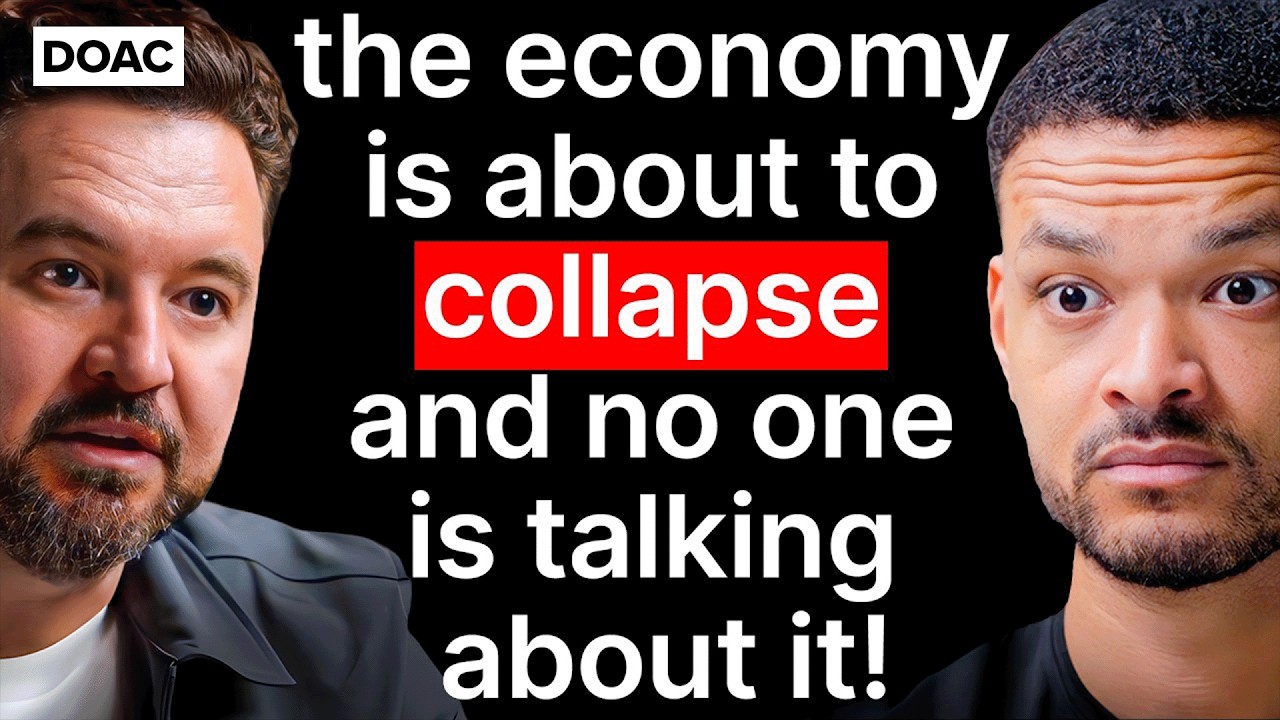
Priestley Warns $650 Billion AI Spending Risks 2029 Correction
The Diary Of A CEO
Rapid hardware depreciation and low subscription monetization threaten an infrastructure collapse unless AI businesses pivot toward high-touch human services.
## Background
Published on YouTube by The Diary Of A CEO on March 16, 2026, this episode features host Steven Bartlett interviewing business strategist, author, and serial entrepreneur Daniel Priestley. The video explores how artificial intelligence and robotics are disrupting traditional employment, predicting a potential 2029 AI financial crash, and laying out strategies for building resilient personal brands and lifestyle businesses in a shifting economy.
## TL;DR
Entrepreneur Daniel Priestley argues that rapid AI and robotics deployment is inverting the traditional economy, leading blue-collar trades like plumbing to out-earn white-collar professions like law while squeezing middle-tier knowledge work. He cautions that astronomical infrastructure costs and low subscription monetization could trigger an AI-driven financial market correction by 2029. To survive this shift, Priestley advocates for lean 2-to-20-person lifestyle businesses, deep human storytelling, physical real-world experiences, and practical personal branding over simple automated content. Ultimately, he emphasizes that human agency, critical thinking through writing, and family relationships remain the true centers of long-term fulfillment and resilience.
## Atmosphere & style
The conversation carries an urgent yet pragmatically hopeful tone, balancing stark warnings about impending economic disruption with actionable strategies for individual survival. Steven Bartlett and Daniel Priestley share a natural, highly collaborative dynamic, freely exchanging personal anecdotes, philosophical reflections, and raw business insights. The emotional arc moves from tense anxiety over systemic AI risks and job losses toward grounded empowerment, culminating in a reflective, vulnerable discussion on mortality, resilience, and the ultimate value of human connection.
## Key takeaways
- [04:03](https://www.youtube.com/watch?v=fpETS6q1Hww&t=243s) The rise of AI and robotics creates both intense fear and unprecedented opportunity, forcing a fundamental re-evaluation of human placement in the economy.
- [04:03](https://www.youtube.com/watch?v=fpETS6q1Hww&t=243s) AI deployment follows an instantaneous rollout over existing digital infrastructure, threatening traditional driving and white-collar roles faster than past industrial revolutions.
- [10:00](https://www.youtube.com/watch?v=fpETS6q1Hww&t=600s) Social media algorithms have shifted from follower networks to interest-based algorithms, creating content saturation where established personal brands thrive while new creators struggle.
- [15:32](https://www.youtube.com/watch?v=fpETS6q1Hww&t=932s) A massive monetization deficit and short hardware replacement cycles in AI infrastructure spending create a severe risk of a financial correction or crash by 2029.
- [24:16](https://www.youtube.com/watch?v=fpETS6q1Hww&t=1456s) Software and content creation are becoming commoditized, lowering costs for small teams and compressing competitive 'Blue Ocean' windows from decades to months.
- [35:20](https://www.youtube.com/watch?v=fpETS6q1Hww&t=2120s) Lived human experience, authentic storytelling, and physical real-world community events remain irreplaceable moats that AI cannot replicate.
- [46:25](https://www.youtube.com/watch?v=fpETS6q1Hww&t=2785s) Economic gravity is shifting away from screen-based legal and corporate professions toward skilled blue-collar trade jobs like plumbers, electricians, and bricklayers.
- [50:02](https://www.youtube.com/watch?v=fpETS6q1Hww&t=3002s) As basic process costs go to zero due to automation, customer service models shift toward high-touch, 'white-glove' VIP human interaction.
- [01:00:40](https://www.youtube.com/watch?v=fpETS6q1Hww&t=3640s) High tax burdens and government spending in regions like the UK are causing a significant wealth drain and flight of top producers and business owners.
- [01:25:27](https://www.youtube.com/watch?v=fpETS6q1Hww&t=5127s) Deep writing and structured thinking serve as ultimate AI superpowers, as writing remains a proxy for human understanding and critical thought.
- [01:33:07](https://www.youtube.com/watch?v=fpETS6q1Hww&t=5587s) Modern tech-enabled 'lifestyle businesses' can thrive with lean teams of 2 to 20 people, delivering high profitability without requiring corporate expansion.
- [02:01:07](https://www.youtube.com/watch?v=fpETS6q1Hww&t=7267s) True long-term satisfaction lies in meaningful human relationships, family formation, and personal legacy rather than pure financial scale or passive income.
## Detailed walkthrough
### [00:00](https://www.youtube.com/watch?v=fpETS6q1Hww&t=0s) Prologue & Introduction: A World of Extreme Fear and Unprecedented Opportunity
The opening sequence sets a stark, urgent tone regarding the radical economic shifts driven by artificial intelligence and robotics. Entrepreneur and best-selling author Daniel Priestley highlights a dramatic inversion of traditional career valuations: while blue-collar trades like plumbing, electrical work, and bricklaying have been historically devalued, they are poised to become the most elevated and lucrative professions in the coming years. Priestley predicts that within a short window, plumbers could regularly earn more than lawyers. Having built businesses through the dot-com bubble, the global financial crisis, Brexit, and COVID-19, Priestley observes that he has never seen such intense fear surrounding incoming disruption—yet simultaneously, he has never witnessed greater excitement for emerging opportunities.
From a macro perspective, Priestley warns of a potential financial catastrophe driven by the hyper-expensive infrastructure required to power AI. Hundreds of billions of dollars are being funneled into building massive datacenter facilities that require total equipment replacements every 3 to 4 years. He notes that the global spend on this compute infrastructure is projected to reach $650 billion in the coming year, posing a major risk of a system-wide financial collapse. On the practical side, host Steven Bartlett frames the conversation as a survival guide for everyday professionals, workers, and founders facing redundancy from an alien-like technology capable of scaling human intelligence instantly. To navigate this landscape, Priestley introduces core strategies, including cultivating a localized personal brand and mastering six fundamental entrepreneurial behaviors.
Before diving into the core dialogue, Steven addresses the show's audience directly with an explicit channel update. He shares internal data metrics revealing that 69% of regular viewers have not yet subscribed to *The Diary Of A CEO*, with some viewers even reporting being randomly unsubscribed by platform algorithms. Approaching a major subscriber landmark, Steven makes a direct pact with his audience: in exchange for a simple click on the subscribe button to keep the show free and improving, he commits to fighting harder every single week to secure the highest-caliber guests and conversations.
- **Key Career Inversion:** Blue-collar trade jobs (plumbers, electricians, bricklayers) are set to out-earn white-collar professions (lawyers, corporate workers) within years.
- **AI Infrastructure Risk:** Global annual expenditure on short-lifecycle AI datacenters is reaching **$650 billion**, creating a potential trigger for a massive financial crash.
- **Channel Metric:** **69%** of regular *Diary Of A CEO* viewers are not subscribed to the channel.
---
[04:03](https://www.youtube.com/watch?v=fpETS6q1Hww&t=243s) Why The Rise Of AI And Robotics Forces Us To Redefine Our Place
Opening the main discussion, Steven and Daniel evaluate the two simultaneous technological forces reshaping civilization: artificial intelligence (the digital replacement of the human mind) and advanced humanoid robotics (the replacement of human physical labor). Steven references recent, astonishing public demonstrations coming out of China featuring humanoid robots executing flawless backflips and landing seamlessly on their feet, alongside industrial humanoids from Boston Dynamics working on factory floors. Combined, these dual shifts force a fundamental existential question: where do humans fit into the future economy?
To explain why total economic collapse might not happen, Priestley introduces the **Jevons Paradox**—an economic theory stating that as technology dramatically increases the efficiency of consuming a resource, overall consumption of that resource increases rather than decreases. While people feared YouTube would eradicate television (and indeed tens of thousands of legacy Hollywood jobs disappeared), YouTube created between **500,000 to 600,000 new jobs**. Production shifted from 150-person TV crews to lean 5-to-10-person creator teams running wildly successful media operations. Applied to software, where launching a startup previously required $1M–$5M in funding, 10,000 customers, and 50 employees, AI drops those barriers so significantly that a two-person team needs only 500 customers to thrive. This shift will unlock millions of micro-businesses addressing niche, previously unviable human needs.
> "The minute an AI learns how to be a lawyer in one place, it can be a lawyer in every place... It's this instantaneous rollout because it sits on top of a network that already exists."
However, Steven points out a critical difference between AI and previous industrial shifts: the **instantaneous speed of deployment**. During the Industrial Revolution, physical infrastructure took decades to construct. In contrast, AI software and robotic neural networks run on pre-existing global internet architecture. When a Tesla Cybercab—a two-seater autonomous vehicle priced around $30,000 without a steering wheel or pedals—or a factory robot in Boston learns a task, that knowledge is deployed globally across the entire fleet overnight. This threatens the livelihoods of over 100 million global transport workers, with Uber rides expected to collapse in price from $50 down to $6 or $7.
- **Historical Parallel:** We are entering a structural transition equivalent to the shift 250 years ago from the **Agricultural Age to the Industrial Age**.
- **YouTube Job Creation:** Replaced traditional media by creating **500,000 to 600,000 jobs** operating in hyper-lean teams of 5–10 people.
- **Transportation Collapse:** Tesla Cybercab launch ($30,000 retail) threatens over **100 million driving jobs**, driving per-ride transport costs down by ~85–90%.
- **Journalism Transformation:** Traditional newspaper employment fell by **80% over 25 years**, but internet publishing and content creation expanded the total number of people earning income through journalism-style content by 3x to 4x.
---
[10:00](https://www.youtube.com/watch?v=fpETS6q1Hww&t=600s) The Birth Of The Interest Algorithm & The Fog of AI Content
Steven challenges the optimistic application of the Jevons Paradox, raising a crucial objection: in past tech shifts, human intelligence itself remained a scarce, uniquely human commodity. With AI agents capable of autonomously generating endless streams of high-quality media, social platforms are being inundated with automated output. Referencing Financial Times data, Steven highlights that Gen Z is the first generation in internet history whose time spent online has plateaued. This creates an intense supply-and-demand crisis—human attention has hit a hard ceiling, while digital content supply is expanding infinitely.
Priestley illustrates this content bottleneck using the metaphor of an **airport rolling into a heavy fog**:
> "Think about it a little bit like an airport that has got this fog that is rolling in. If your airplane is already above the fog, then you can continue to fly. But if your airplane is not taking off already, then the fog is going to keep you on the ground."
Established personal brands and creators whose "airplanes are already airborne" can rely on existing trust, offline event communities, and direct relationships. However, newcomers trying to launch standard content strategies in 6 to 12 months risk getting trapped in the "fog" of AI-generated saturation.
```
Supply/Demand Dynamics in the AI Era:
Human Attention (Demand) AI Content Generation (Supply)
[====================] [=================================> Infinite]
PLATEAUED CEILING EXPONENTIAL EXPLOSION
```
Furthermore, Steven shares proprietary findings from his internal data science team (led by his head of data, Austin) tracking 15 years of social media algorithm trends. Their analysis proves that the variance in performance between a creator's worst-performing post and best-performing post is growing exponentially wider every year. This mathematical shift marks the official end of traditional **social media** (where content was distributed based on who you followed) and the total dominance of **algorithmic interest media** (where platforms ruthlessly test content against pure user engagement, completely ignoring a creator's follower count or past success).
- **Attention Plateau:** Gen Z represents the first demographic cohort in internet history to show a plateau in daily online time consumption.
- **Data Science Insights:** Internal analysis proves social algorithms no longer reward static follower bases; distribution is controlled entirely by real-time engagement mechanics.
- **Algorithmic Shift:** Transition from connection-based *Social Media* to objective, performance-driven *Interest Algorithms*.
[14:01](https://www.youtube.com/watch?v=fpETS6q1Hww&t=841s) Algorithmic Media vs. Defensible Ecosystems
The shift from intentional social connections to algorithmically curated content has fundamentally altered media consumption. Algorithmic media delivers whatever a machine predicts a user will watch on any given day, but relying solely on a single platform is a fragile strategy. Creators who rely exclusively on YouTube AdSense revenue—operating a simple, one-dimensional model—face a declining trajectory.
To build a resilient and defensible business today, creators must cultivate a multi-dimensional ecosystem. This involves blending digital channels (podcasts, videos) with tangible, real-world touchpoints like books, live events, and physical community meetups. Audience members desire holistic packages that bridge the digital-physical divide, creating human connection points that algorithms cannot replicate or easily disrupt.
- **Defensible Creator Model**: Combines algorithmic distribution with offline elements (live events, printed books, local meetups).
- **Vulnerability**: One-dimensional digital revenue (e.g., pure YouTube AdSense) is increasingly vulnerable to automation and algorithmic shifts.
---
[14:44](https://www.youtube.com/watch?v=fpETS6q1Hww&t=884s) The "Middle-to-Middle" Nature of AI
Drawing an analogy to the Agricultural Age, farmers historically initiated the process by identifying the optimal planting season and preparing the field. The natural soil did the majority of the core value creation, and the farmer returned at the end to harvest, process, and take the yield to market.
AI functions in the exact same manner. It excels at performing the "middle to middle" labor—the heavy processing, generation, and computation between execution steps. However, AI lacks the contextual awareness to know what to initiate in the first instance, nor can it determine how to effectively commercialize or package the final product for real humans. The entrepreneur's core role is handling steps 1 and 2 (vision and initial direction), letting AI execute steps 3 through 8, and returning to manage steps 9 and 10 (refinement, positioning, and go-to-market).
- **Agricultural Parallel**: Human vision plants and harvests; the underlying system (soil/AI) powers the middle phase of production.
- **Strategic Division of Labor**: Humans handle initial vision and final commercial execution, while AI carries out intermediate production tasks.
---
[15:32](https://www.youtube.com/watch?v=fpETS6q1Hww&t=932s) Exponential Improvement and the Threat of an AI Data Center Crash
While AI agent capabilities continue to advance—theoretically allowing autonomous systems to launch businesses, contact suppliers, and build websites—exponential growth forces a reexamination of underlying assumptions. Even modest quarterly improvement rates (such as 5% per quarter or 1% per month) compound until previously non-viable initiatives suddenly explode into market-defining disruptions.
```
2029 PREDICTED FINANCIAL BUBBLE
Historical Infrastructure Cycles Current AI Data Center Cycle
(3%+ GDP Spend -> Financial Crash) (Multi-hundred Billion Global Spend)
--------------------------------------- ------------------------------------------
• Rail Networks: Lasted 100+ years • Server Arrays / GPUs: Last 3–4 years
• Power Grids: Lasted 50+ years • Replacement Cycle: Constant, high capex
• Telecom/Fiber: Lasted 30+ years • Monetization Gap: 95% use free tiers;
• Result: 10-year economic depression only 5% pay ~$20/month
```
However, continuous progress assumes the physical infrastructure does not collapse under its own weight. Historically, whenever an economy spends more than 3% of its GDP on infrastructure build-outs—such as railways in the UK and US, power grids, or interstate highways—a brief 10-year economic adjustment follows.
AI infrastructure faces a structural vulnerability: unlike railway tracks (lasting 100 years), roads (50 years), or fiber-optic cables (30 years), AI data centers and GPU hardware become obsolete every 3 to 4 years. Spending upwards of $650 billion annually on short-lived hardware creates an unsustainable financial imbalance.
> "95% of people who have been given the free iPhone are not willing to pay for it. And the tiny number of people who are willing to pay for it, they're only willing to pay $20 a month... The numbers are just astronomically out of balance."
Without a functional financial return model, the massive capital expenditure on short-lived data centers could trigger a major financial correction by **2029**—exactly one century after the Great Depression.
- **Capital Outlay**: Projected global AI infrastructure spend reaching $650 billion annually—equivalent to giving every person in America an iPhone Pro with AirPods.
- **Monetization Deficit**: ~95% of users rely on subsidized or free tiers, while the remaining 5% pay approximately $20 per month, failing to offset hardware replacement costs.
- **Hardware Lifecycle**: Modern AI server stacks and GPUs face hardware degradation and tech obsolescence every 36 to 48 months.
---
[20:11](https://www.youtube.com/watch?v=fpETS6q1Hww&t=1211s) The 6-Step Entrepreneurial Skill Set for Survival
To maintain career longevity alongside advancing automation and robotics, professionals must cultivate a fundamental entrepreneurial mindset. Rather than relying on rigid roles, individuals must learn to rapidly identify opportunities, prototype cheap experiments, validate demand, and bring offerings to market within agile structures.
### The Value Creation Loop
1. **Founder-Opportunity Fit**: Identifying an idea aligned with your unique personal strengths, domain knowledge, and interests.
2. **Market & Product Validation**: Running low-cost experiments (such as waiting list landing pages) to confirm genuine customer demand before building.
3. **Product-Market Fit (PMF)**: Refining the core delivery to ensure the offering meets customer expectations and yields high satisfaction.
4. **Go-To-Market (GTM)**: Structuring unit economics, messaging, and outbound channels to execute initial sales.
5. **Scale Up**: Expanding distribution, operations, and team capacity to serve the broader addressable market.
6. **Exit Strategy**: Offloading, automating, or selling the asset to reinvest capital into the next venture cycle.
A practical example of market validation: testing two venture concepts simultaneously via simple waitlist landing pages. The first, personal-favorite idea attracted 750 sign-ups. The second idea attracted **4,500 sign-ups** in the same timeframe. By prioritizing data over personal bias, the validated concept secured **£250,000 (~$300,000–$400,000 USD)** in angel funding within two weeks.
- **Validation Principle**: Novice entrepreneurs build immediately; experienced founders design fast, low-cost experiments to test demand before committing capital.
- **Agile Execution**: Conducting waitlist tests and securing initial angel investments can take less than 14 days when backed by real user interest.
---
[24:16](https://www.youtube.com/watch?v=fpETS6q1Hww&t=1456s) The Micro-SaaS Gold Rush and Built-In Moats
Historically, building a Software-as-a-Service (SaaS) company required an elite team of 10 to 30 developers, millions of dollars in seed funding, 12 to 18 months of development time, and a minimum of 10,000 paying users to reach break-even. Today, AI development tools allow small teams or solo founders to deploy functional software in a matter of days at minimal cost.
```
TRADITIONAL VS. AI-ERA SAAS
Metric Traditional SaaS AI-Era Micro-SaaS
------------------ ------------------------- ----------------------------
Development Time 12 to 18 Months 1 to 2 Weeks
Initial Capital $500,000+ Near $0
Team Requirement 10–30 Engineers 1 Founder + AI Tools
Break-Even Scale ~10,000 Customers 500–1,000 Niche Customers
```
Because pure software features can be easily replicated by competitors using AI, standalone tools risk rapid commoditization. An internal recruitment applicant tracking system (ATS) that previously required 18 months and $500,000 to build can now be assembled in a single week. However, when thousands of custom tools flood the market, utility alone no longer provides a competitive moat.
To build an enduring software business, founders must bundle their technical products with non-replicable human components:
- **Market Dynamics**: Lower development barriers mean software utility alone is commoditized; defensibility moves to community, brand, and proprietary operational playbooks.
- **Efficiency Gains**: Internal tools that previously took 18 months of engineering can now reach MVP status in under 7 days using modern AI workflows.
Here is a detailed, faithful walkthrough of Part 3 of the transcript.
---
[28:42](https://www.youtube.com/watch?v=fpETS6q1Hww&t=1722s) The Commoditization of Software and Content
Daniel Priestley and Steven Bartlett debate how the landscape of software and media creation is shifting as technology advances. Daniel draws an analogy to YouTube content, explaining that 25 to 30 years ago, nobody would have believed that tiny, unfunded 10-person teams could produce weekly TV-quality content for practically zero cost. Back then, television shows like *Seinfeld*, *The Simpsons*, and *Friends* cost millions of dollars per episode, whereas today, small teams replicate similar production value for next to nothing.
Steven challenges the underlying value of this shift. He notes that as things become cheaper, easier, and accessible to everyone without needing a skyscraper production budget like CNN, their inherent market value plummets at the exact same rate. If everyone can do it, it ceases to be a rare or valuable asset. Steven stresses that he continually searches from first principles for what is irreplaceably human—things that only he can do, rather than a kid in Mumbai using accessible software or creating digital content. Daniel responds that physical real-world experiences are the answer, pointing to standing on stage and speaking in front of a live audience as an experience an AI version of a person cannot replicate.
* **Production Costs:** TV shows like *Seinfeld* used to cost $5 million per episode, alongside massive budgets for *Friends* and *The Simpsons*.
* **The Commoditization Paradox:** As tools make content and software creation friction-free, supply explodes, driving individual market value down toward a commodity status.
---
[31:00](https://www.youtube.com/watch?v=fpETS6q1Hww&t=1860s) Live Experiences and the Rise of Lifestyle Businesses
Daniel elaborates on how real-world events will adapt by bundling fleeting software assets. He predicts that future conferences will feature custom-built micro-SaaS applications created specifically for attendees that pop into existence for two or three weeks to serve the event. Where media, software, and physical events used to exist in silos, they are now clustering together into an all-in-one buffet.
Addressing business scale, Daniel notes that after meeting tens of thousands of entrepreneurs, he realized the vast majority do not actually want to build massive corporate empires. Instead, most people desire a "lifestyle business"—one that yields $1 million to $5 million in revenue with a small team of around 10 people. They want non-monotonous, creative, slightly chaotic work, the ability to work three or four days a week, travel, drop their kids off at school, and collaborate with a small team they enjoy. While building a massive enterprise is harder than ever due to constant disruption, creating a thriving small business is easier than ever. Steven acknowledges his own personal bias toward seeking massive opportunities and building big "boats," but agrees that small, flexible businesses offer a far better quality of life for most people escaping monotonous corporate jobs.
* **Lifestyle Business Target:** $1M–$5M in revenue with a team of ~10 people.
* **Micro-SaaS Integration:** Software becoming so cheap to make that custom apps will be spun up temporarily just to service single events or short term projects.
* **Entrepreneurial Reality:** Building a huge company now requires an "elite athlete" level of entrepreneurial skill to navigate constant disruption, whereas small dynamic businesses are easier to establish than ever.
---
[33:29](https://www.youtube.com/watch?v=fpETS6q1Hww&t=2009s) Sailing in Blue Oceans vs. Shortened Disruption Cycles
The conversation shifts to market strategy and the concept of "Blue Oceans" versus "Red Oceans" from the book *Blue Ocean Strategy*. Steven describes Red Oceans as hyper-competitive bloodbaths where businesses engage in a race to the bottom, offering identical services while falsely claiming unique positioning—like a wine company claiming its product is superior simply because it's a year older or uses fancy labeling. Conversely, a Blue Ocean represents uncontested waters with room for true growth and minimal competition.
```
+-----------------------------------------------------------------------+
| OCEAN STRATEGY MATRIX |
+-----------------------------------------------------------------------+
| RED OCEAN | BLUE OCEAN |
| - Hyper-competitive bloodbath | - Uncontested market space |
| - Race to the bottom on price/margins | - Unique, high-value offering |
| - Minor, superficial differentiation | - High growth & low friction |
| - Disrupted rapidly by AI automation | - Built on human connection |
+-----------------------------------------------------------------------+
```
Steven reflects on starting a social media marketing agency back in 2014, which was a genuine Blue Ocean at the time. Historically, a Blue Ocean could last for up to a decade. However, Daniel emphasizes that in the age of AI and digital technology, disruption cycles compress from decades down to months. The moment a Blue Ocean is identified, AI allows competitors to replicate the model instantly and flood the market.
* **Historical Comparison:** Major agency networks (like Martin Sorrell's WPP or the Big Four/Five) are currently struggling with squeezed margins and lost market share.
* **Disruption Timeline:** Where competitive advantages used to last 10 years, AI enables rivals to replicate and enter new markets within mere months.
---
[35:20](https://www.youtube.com/watch?v=fpETS6q1Hww&t=2120s) The Irreplaceable Advantage of Lived Human Experience
To illustrate what remains defensible against AI, Daniel references human culture throughout history. Whenever societies faced low social mobility and high competition—such as in medieval times, or rural Africa and India—they relied heavily on constant physical festivals, weddings, and communal gatherings. He argues that community, real-world experiences, and a willingness to embrace chaotic change are what remain defensible.
Steven brings the discussion back to fundamental human needs, citing the classic psychology experiment with rhesus monkeys. Monkeys raised with a bare wire-mesh surrogate mother grew up emotionally damaged ("psychopaths"), while those given a soft cloth mother fared somewhat better, and those raised by real physical mothers developed normally. Steven points out that human connection is a non-negotiable biological need. While an AI agent can explain the medical facts of a condition like menopause, it can never share its own *lived experience* of going through menopause.
> "An AI can tell you what happens in menopause. An AI can't tell you its experience of menopause."
Daniel highlights a TED Talk by a financial planner named Matt Pitcher, who specialized in advising lottery winners. After realizing that he had sat eye-to-eye in living rooms with over 100 British lottery winners a week after their wins, Pitcher built his entire message around that singular, unrepeatable human vantage point. The talk gained half a million views in its first few weeks because it tapped into unique "personal intellectual property." Re-emphasizing a core philosophy they previously discussed, Daniel reminds Steven: "Relatable beats impressive."
* **Rhesus Monkey Experiment:** Demonstrates that substitute or artificial connection leads to severe psychological disruption, proving that real physical and emotional touch is a core biological requirement.
* **Matt Pitcher Example:** A financial planner who generated over 500,000 views on his TED Talk by leveraging his unique experience interviewing 100+ lottery winners.
* **Personal Playbooks:** True defensibility comes from converting unique personal stories, triumphs, and failures into intellectual property that AI can never fake.
---
[39:58](https://www.youtube.com/watch?v=fpETS6q1Hww&t=2398s) Authentic Human Storytelling vs. AI Content Churn
Steven shares how his own content strategy on platforms like LinkedIn has evolved in response to AI. Years ago, he used to churn out high volumes of generic quotes, data, and "fluffy" generic advice. Now, recognizing that anyone—and any AI—can generate generic text, he posts almost exclusively about his personal, lived human stories, sharing authentic struggles, photos of himself, and family updates.
He notes that his highest-performing post of the year was simply announcing his engagement to his fiancee on one knee—an inherently human, deeply relatable moment that no algorithm or robot could ever experience or simulate.
```
Traditional Informational Content Irreplaceably Human Content
+------------------------------------+ +------------------------------------+
| • Factual summaries & data points | | • Lived personal experiences |
| • Scalable, easy to automate | vs | • Authentic vulnerability & flaws |
| • Highly commoditized by AI | | • Live, real-world presence |
| • Zero parasocial relationship | | • Deep parasocial connection |
+------------------------------------+ +------------------------------------+
```
Daniel adds that AI possesses all the world's data and knowledge, but zero lived experience. An AI cannot stand on a stage, host a dinner party, or put a hand on someone's shoulder to say, "I've been through what you've been through, and you're going to be okay." They discuss why live video streamers build such immense parasocial bonds with their audiences. Streamers can sit online for seven hours playing games or chatting, speaking directly to the audience ("drop W's in the chat"), essentially forming genuine friendships. In an AI world where purely informational content is a commodity, content that builds deep personal relationships and converts them into real-world shared experiences will always win.
* **Steven's Content Pivot:** Shifted from high-frequency generic advice to deeply personal, authentic stories and family moments.
* **Engagement Example:** Steven's marriage proposal post became his top-performing content because of its raw, relatable human element.
* **The Power of Streaming:** Live streamers succeed not through polished informational content, but by fostering intense parasocial relationships and two-way interaction.
[42:49](https://www.youtube.com/watch?v=fpETS6q1Hww&t=2569s) The Power of a Personal Product & Service Ecosystem
Building a sustainable personal brand isn't about relying on a single revenue stream or a lone flagship product. True financial resilience stems from combining unique intellectual property with a dedicated community, creating an ecosystem of complementary offerings.
In a pre-AI world, managing dozens of disparate projects seemed chaotic and overwhelming. In a post-AI landscape, leverage makes creating and executing across multiple formats far more accessible. Top earners typically maintain over 20 distinct revenue streams running simultaneously.
* **Diverse Income Channels:** A robust ecosystem typically incorporates book royalties, software, podcast sponsorship, AdSense, keynote speaking, equity stakes, app ventures, and high-touch coaching.
* **Core Brand Drivers:** Authentic personal IP coupled with a well-defined audience organically generates brand equity; productization monetizes that momentum.
[44:39](https://www.youtube.com/watch?v=fpETS6q1Hww&t=2679s) Disrupted Professions: Why Lawyers Face a Seismic Shift
Generative AI is directly targeting knowledge workers who previously relied on billing hours for repetitive documentation or routine legal strategy. Accessible AI models can already replace hefty retainers for standard dispute resolution and transactional paperwork.
In one recent real-world dispute, an entrepreneur faced an estimated $60,000 (£50,000) bill from a law firm. Instead of engaging counsel, they utilized Claude at $20 a month to resolve the matter entirely. The AI generated a detailed strategy, structured decision-tree pathways, required documentation, and a negotiation guide outlining exact phrases to use and avoid.
* **Market Impact:** Publicly traded legacy legal technology and data companies lost approximately $280 billion in enterprise value over a single week in 2026, representing a ~20% valuation drop.
* **The Evolving Legal Role:** Future legal professionals must pivot from billing hours to acting as hybrid business advisors, strategic consultants, and prompt engineers who co-drive outcomes alongside AI tools.
* **Developer Productivity:** Companies like Spotify report that top software engineering talent spent months without writing lines of manual code, leaning heavily on automated tools.
[46:25](https://www.youtube.com/watch?v=fpETS6q1Hww&t=2785s) The Flipping Economy: Blue-Collar Trades vs. White-Collar Degrees
Economic gravity is shifting away from screen-based, white-collar roles toward hands-on physical trades. As AI commoditizes cognitive and administrative tasks, skilled blue-collar workers are experiencing higher relative earning power and market demand.
This reversal highlights how policy interventions distorted labor markets. Universal push toward higher education led millions to accumulate heavy student debt for degrees lacking clear market demand, while critical trades faced severe labor shortages.
* **The Trade Premium:** Plumbers, electricians, bricklayers, and concrete specialists regularly earn more than conventional corporate lawyers due to supply-demand imbalances.
* **Degree Debt Disconnect:** Young professionals frequently graduate with $60,000 to $80,000 in student loan debt for niche academic degrees that offer minimal commercial applicability.
[50:02](https://www.youtube.com/watch?v=fpETS6q1Hww&t=3002s) Automation, Paradoxes, and the Shift to "White-Glove" VIP Service
Mass automation is restructuring operational roles across customer service, logistics, and retail. However, Jevons paradox demonstrates that as the cost of basic processes approaches zero, total demand for high-value human interaction actually increases.
> "If the cost of low-level appointment setting goes to zero, the affordability and feasibility of VIP-level human treatment goes through the roof."
* **Klarna Workforce Restructuring:** Klarna scaled its workforce down from 7,000 to 3,000 employees following AI implementation, redeploying remaining staff into high-touch, white-glove VIP support.
* **Disruption Estimates:** Up to 30% of driving roles face automation by 2030 (McKinsey); customer service centers see headcount reductions between 50% and 80%.
* **Fulfillment & Retail:** Amazon reports that physical robotics and automated systems assist or replace human labor in roughly 40% of standard warehouse fulfillment tasks.
* **Displaced Roles:** Frontline positions most susceptible to rapid displacement include retail cashiers, payroll clerks, sales development representatives (SDRs), and fast-food line staff.
[53:05](https://www.youtube.com/watch?v=fpETS6q1Hww&t=3185s) Bottom-Up Adaptation vs. Top-Down Market Distortions
Uncertainty around AI-driven labor disruption often causes leaders to fall into a top-down planning trap—attempting to engineer society centrally rather than trusting market-driven, bottom-up adaptation.
When individuals receive clear price signals and functional training, they self-organize efficiently to capture emerging economic opportunities. Conversely, heavy state spending and artificial incentives generate systemic market distortions that mask real supply and demand.
* **UK Economic Pressures:** Youth unemployment (ages 16–24) in the UK reached 16.1%, rising over 25% year-over-year while political discourse remains focused on peripheral issues.
* **Government Spend Scale:** Public sector spending accounts for 45% to 50% of total UK economic output, creating massive non-market distortions across various industries.
* **Student Debt Trap:** Distorted incentives created over £280 billion ($350+ billion) in UK student loan debt. High marginal tax rates mean monthly repayments often fail to cover accruing interest, disincentivizing early-career workers.
<ElicitationsGroup message="Explore related strategic themes:">
<Elicitation label="How to audit a service business using the 'tombstone exercise'" query="Explain Daniel Priestley's 'tombstone exercise' for identifying AI threats to a service business."/>
<Elicitation label="Building a Key Person of Influence brand in the AI era" query="What are the key steps to becoming a Key Person of Influence in an AI-driven market according to Daniel Priestley?"/>
</ElicitationsGroup>
Here is a detailed, faithful walkthrough covering Part 5 of the transcript.
---
[57:16](https://www.youtube.com/watch?v=fpETS6q1Hww&t=3436s) Market Distortions, Government Spending, and the Bureaucracy Problem
Continuing his criticism of top-down economic management, Daniel Priestley highlights student debt as a classic example of government intervention distorting free markets, trapping millions in debt they cannot escape for decades. Steven Bartlett references a recent article by former UK Prime Minister Rishi Sunak, who warned that if the UK fails to boost its productivity and embrace AI, it risks turning into a "tourist theme park." Priestley quips that it would not even be a good theme park, since the UK lacks the natural advantages of beaches, mountain ranges, or ski resorts found elsewhere. He argues that top-down societal planning is essentially socialism—a mindset that consistently fails. When Bartlett asks what he would do if put in charge as Prime Minister, Priestley outlines his core prescription: drastically reduce government spending to under 35% of GDP and let free markets operate naturally.
When asked where he would cut spending, Priestley points to green energy subsidies—such as £40 billion poured into wind and solar projects while leaving vast reserves of accessible natural gas untouched underground—and bizarre international moves, like spending £20 billion attempting to give away islands. He singles out government bureaucracy as a massive source of waste, sharing a striking real-world anecdote about Birmingham City Council. The council decided to migrate its software system from SAP to Oracle, expecting it to cost £19 million—already a steep price tag for a software switch. Instead, the final bill exploded to £220 million. Priestley argues that excessive government intervention and heavy taxation strip away the core incentive of capitalism: the creative, entrepreneurial drive that delivers better, faster, and cheaper goods for society. Without that creative engine, economic growth stalls, leaving behind mounting debts that plunge the economy into a downward spiral.
- **Student Debt:** Serves as a prime example of government market distortion trapping hundreds of billions of dollars in unpayable debt.
- **UK Productivity Warning:** Rishi Sunak warned the UK could become a "tourist theme park" without AI adoption and productivity growth.
- **Target Spending Limit:** Priestley argues government spending must be cut to under 35% of GDP.
- **Resource Mismanagement:** Questions spending £40 billion on wind/solar while blocking access to domestic natural gas reserves.
- **Birmingham City Council Case Study:** Software migration from SAP to Oracle was budgeted at £19 million but ended up costing £220 million.
- **The Core Flaw of Socialism:** Removes entrepreneurial incentives and economic growth while retaining debt and cronyism, destroying the wealth-creation cycle.
---
[01:00:40](https://www.youtube.com/watch?v=fpETS6q1Hww&t=3640s) The Wealth Drain: Why Producers Are Fleeing the UK
Priestley observes that current UK policy actively discourages successful individuals from staying, forcing high earners to relocate. He brings up a debate he and Bartlett had a year prior with commentator Gerry Stimpson, who had claimed that wealthy residents would not leave no matter how high taxes were raised and that house prices would skyrocket. Priestley notes that Stimpson's predictions proved entirely wrong: property prices have flattened because wealth creators and productive citizens are fleeing in droves. Bartlett outlines three primary reasons people give for leaving the UK: a pervasive sense of pessimism over a country in "managed decline," burdensome taxation that prevents getting ahead, and the pull of foreign hubs like America or Dubai where capital, lower taxes, and top-tier talent are readily accessible.
Bartlett backs up this exodus with stark statistics from Henley & Partners, detailing the net outflow of millionaires from the UK:
- **2023:** 3,200 millionaires left net.
- **2024:** 9,500 millionaires left net.
- **2025:** 16,500 millionaires projected to leave (a record outflow).
- **2026:** Unpublished forecasts warn the trend will continue upward.
Priestley explains why this wealth drain is catastrophic for everyday citizens: the top 1% of earners pay 30% of total tax revenues, while the top 10% cover 60%. When top earners leave, the government's financial burdens do not disappear—they get redistributed onto remaining middle- and working-class residents. He draws a direct parallel to New York City, where Mayor Zohran Mamdani's February 2026 preliminary budget proposed a 9.5% property tax hike to address a $5.4 billion shortfall caused by wealthy residents leaving and softening business tax collections (which came in $378 million lower than projected). Priestley calls socialism a "hot stove that every generation has to touch for themselves," fruitlessly trying to redistribute wealth without productivity gains. For individuals seeking to insulate themselves, Priestley advises finding "founder-opportunity fit"—building location-independent businesses that allow entrepreneurs to earn money anywhere and move freely if their home country becomes unwelcoming.
---
[01:06:21](https://www.youtube.com/watch?v=fpETS6q1Hww&t=3981s) The Bear Case for AI: Financial Bubbles, Private Credit, and Totalitarian Risks
Transitioning to the dark side of the AI revolution, Priestley discusses the historical concept of the "Engels' pause"—a 50-year period during the early Industrial Revolution when worker wages stagnated while technology-driven wealth concentrated entirely at the top, triggering widespread social upheaval and revolution. Bartlett adds that the current AI wave is moving far faster and will be significantly more disruptive. Bartlett recounts visiting a hardware and robotics accelerator in San Francisco, expecting to see software engineers, only to find hundreds of founders building physical AI-powered devices. The accelerator founder explained that while mechanical arms and components have been cheap for decades, the missing ingredient was affordable intelligence; where controlling a cooking arm once cost tens of thousands of dollars, AI models now supply that intelligence for cents. He observed custom devices being built for everything from cooking omelets to custom-blending daily perfumes, prompting Priestley to remark that "everything that currently has Bluetooth will soon have intelligence," down to smart toothbrushes booking dentist appointments or smart mattresses adjusting sleep.
Despite his bullish view on AI's ability to enhance human intelligence, Priestley reveals his actual "bear case" for AI: a massive macro-financial crash. Over the past 180 years, whenever an economy spends over 3% of its total output on a single infrastructure buildout, it has historically triggered a severe recession or depression. Tech giants are currently pouring $600 billion annually into building out data centers that have an operational lifespan of only 3 to 4 years. Crucially, this debt is being packaged into private credit instruments yielding 6% above inflation and sold directly into pension funds on the promise that it is backed by tech titans like Google, Microsoft, and Amazon. If the economics fail to yield a return on these rapid-depreciation assets, it could trigger a catastrophic financial collapse that wipes out retirement funds.
Bartlett closes the section by quoting a widely discussed post-Davos essay written by Anthropic CEO Dario Amodei (creator of Claude). Amodei warned that humanity is being handed unimaginable power without the political or social maturity to handle it, noting that we are "considerably closer to real danger in 2026 than we were in 2023." He cautioned that if exponential AI scaling continues over the next few years, AI will surpass human capabilities at virtually everything, presenting a severe risk: the very tools built to fight autocracies could easily be turned inward to construct global totalitarian dictatorships.
- **Engels' Pause:** A 50-year industrial lag where tech progress concentrated wealth at the top and depressed wages before broader societal benefits materialized.
- **Robotics Economics:** Physical components have long been cheap, but AI dropped the cost of operational intelligence from tens of thousands of dollars down to cents.
- **Data Center Over-Investment:** $600 billion spent annually on infrastructure with a 3–4 year lifespan risks triggering a major recession.
- **Pension Fund Risk:** AI infrastructure debt is being bundled into private credit offering 6% above inflation, exposing pension systems to severe systemic risk if the bubble bursts.
- **Dario Amodei's Warning:** The Anthropic CEO warned in early 2026 that rapid AI progression could lead to uncontrollable power concentration and potential totalitarian control.
[01:10:53](https://www.youtube.com/watch?v=fpETS6q1Hww&t=4253s) The Economic Disruption of AGI, Deflation, and UBI
Steven Bartlett and Daniel Priestley paint a striking mental picture of the AI transformation: imagine a brand-new island populated by a billion geniuses who are all willing to work for free, where every single discovery made by one is instantly shared among all of them. In a world governed by that first principle, society and economic systems will look fundamentally different. All the traditional advice dispensed over the last decade regarding business, career success, and entrepreneurship was engineered for an industrial-era economy that is rapidly ceasing to exist.
Priestley highlights the compounding structural tension in today's economy between artificial intelligence and demographic shifts. Historically, human demographics resembled a pyramid with a broad base of young workers supporting a small peak of elders. Today, roughly 65% of all economic wealth is concentrated in the hands of people over the age of 65. Simultaneously, entrepreneurs leveraging AI are driving down the cost of goods and services toward zero, creating immense deflationary pressures. Meanwhile, governments and the financial system continue pumping inflationary stimulus into the economy slightly faster than productivity gains can offset it.
```
TRADITIONAL DEMOGRAPHICS AI / MODERN DEMOGRAPHICS
Because AI-driven productivity gains act as a massive deflationary engine, governments will possess the economic latitude to inject unprecedented levels of cash stimulus without triggering traditional hyperinflation. This mathematical reality makes Universal Basic Income (UBI) economically feasible as a temporary buffer during the transition. Priestley emphasizes that society should not grieve the disappearance of dehumanizing, low-connectivity jobs or an industrial system that ruined traditional pair-bonding, broken communities, and forced parents to work multiple jobs just to stay afloat. Instead, AI could provide the breathing room required to build a human-centric economic model.
- **Demographic Wealth Gap:** Over 65% of all wealth in the economy is currently held by individuals over 65 years old.
- **The Deflation vs. Inflation Tug-of-War:** AI-driven productivity pushes the cost of products toward zero, while government stimulus inflates money supply to bridge the gap.
- **UBI Mechanics:** Deflationary AI efficiency gives central institutions room to distribute cash payments to citizens during structural workforce shifts.
---
[01:13:56](https://www.youtube.com/watch?v=fpETS6q1Hww&t=4436s) Funding Social Safety Nets and the Need for "Meaningful Struggle"
When Steven questions the ethics of taxing visionary innovators like OpenAI's Sam Altman—taking the yield of their 24-hour work ethic to support individuals who choose not to work—he references Sam Altman's own 2024 "Open Research" study on UBI. The study revealed that recipients of unconditional cash transfers worked fewer hours and earned less income compared to control groups. Rather than utilizing their free time to secure superior jobs or upgrade their education, many participants simply withdrew from the labor market or reduced working hours for leisure, leading to a net decline in household earned income despite receiving free cash.
Priestley argues that humans fundamentally require a "meaningful struggle" and something purposeful to tackle every day to stay mentally grounded. Looking toward practical economic realities, he predicts that the colossal capital expenditures (CAPEX) required for AI infrastructure could trigger a severe financial crisis. Data center investments are so capital-intensive that governments may ultimately be forced to bail them out. In exchange, states would take ownership of primary infrastructure and data assets, leasing them back to tech companies while using the royalty revenues to fund national UBI programs.
To illustrate how extraordinary AI infrastructure spending is, Priestley draws a sharp contrast with traditional hyper-growth products like Ozempic and GLP-1 weight-loss medications. Despite exploding global demand for GLP-1 drugs, pharmaceutical companies spent only around 20% of their revenues on capital expenditures to build new manufacturing facilities. In stark contrast, AI companies are burning capital expenditures that dwarf their current revenues by hundreds of percent. Priestley projects that the financial engineering necessary to sustain this model will face a severe reality check around 2029, requiring a roughly 45-fold increase in paying business and consumer subscriptions to avoid catastrophic collapse.
- **The Open Research UBI Study (2024):** Unconditional cash transfers led recipients to decrease work hours and earn less overall income rather than upskill.
- **The Capital Expenditure Disconnect:** GLP-1 manufacturers re-invest ~20% of revenue into facilities, whereas AI firms invest hundreds of percent of revenue into data center CAPEX.
- **The 2029 Financial Horizon:** To sustain current AI infrastructure spending, paying subscription adoption must scale by approximately 45 times.
---
[01:18:05](https://www.youtube.com/watch?v=fpETS6q1Hww&t=4685s) Navigating the AI Era: Personal Branding, Business Buying, and Curiosity
Turning to practical career advice for surviving upcoming economic turbulence, Priestley outlines actionable steps for individuals feeling threatened by automation. The first imperative is building a modest personal brand: cultivating a network of 2,000 to 20,000 people who understand your unique skill set, professional experience, and playbooks. Remaining invisible in an AI-driven economy eliminates personal equity, whereas a targeted personal brand ensures opportunities continually reach you.
The second core directive is stepping into entrepreneurship, whether by joining an early-stage startup, launching a side project, or simply shedding the "standardized employee" mindset instilled by traditional schooling. Priestley stresses that schools were built to produce uniform labor for factories and corporate offices, whereas entrepreneurship is the art of identifying unstructured opportunities and crafting solutions.
```
+-----------------------------------------------------------------------+
| THE AI ADVANTAGE MINDSET |
+-----------------------------------------------------------------------+
| Old Employee Mindset: Relies on past training & fixed job role. |
| AI-Era Operator: Fluid identity, agency, & active curiosity. |
+-----------------------------------------------------------------------+
```
Beyond starting fresh businesses, a massive, near-guaranteed opportunity lies in acquiring existing ones. With 65% of business value owned by people over 65, two-thirds of the small business economy must change hands over the next decade as Baby Boomers retire. Many older business owners are eager to hand off their companies and will even seller-finance the purchase for dynamic individuals who demonstrate competence and possess a personal brand. Furthermore, as highlighted by Mark Cuban, a lucrative immediate gap exists in consulting small-business owners who lack the technical know-how to integrate AI into their operations.
- **Personal Brand Target:** Build a network of 2,000 to 20,000 people who understand your exact value proposition and experience.
- **The Great Boomer Business Wealth Transfer:** Two-thirds of small businesses by valuation will transition to new owners over the next 10 to 15 years as founders retire.
- **The AI Consulting Opportunity:** A massive service gap exists in onboarding non-technical small business owners onto modern AI workflows.
---
[01:20:43](https://www.youtube.com/watch?v=fpETS6q1Hww&t=4843s) Agency, Curiosity, and Giving AI Your Hardest Problems
Steven shares that his companies hire around 20 people a month, and their culture screening specifically checks whether candidates actively experiment with AI. He recounts a story about a team member tasked with analyzing sentiment across hundreds of social media posts. Instead of spending four to five weeks manually sorting data and building complex Excel formulas, she leveraged Claude co-work agent workflows without prior specialized training. By the time dinner reached the dessert course, she presented a full sentiment breakdown across years of Steven's posts, uncovering that specific posts generated vastly higher engagement despite receiving fewer initial likes.
Priestley notes that this level of adaptability requires a fluid identity—a willingness to say "I don't know how yet, but I can figure it out." He advises that people should stop treating AI as a glorified search engine, as they did years ago, and instead feed it their absolute hardest, most messy problems. By feeding AI rich context—PDFs, historical data, and deep background notes—users can ask it to draft solutions, architect workflows, or write custom software scripts.
```
[ Unstructured Data ] [ Deep AI Prompting ] [ Actionable Growth ]
Hundreds of Call Logs ---> "Find hidden operational ---> Script decision-makers
& Customer Backstory gaps & write a fix" onto call & boost sales
```
Priestley shares a real-world example from his own organization: a team member used AI to analyze three months of sales calls and discovered an unaddressed bottleneck. The AI revealed that in 75% of sales calls, prospects mentioned that their spouse or business partner was a co-decision maker. However, the company's existing sales workflow never invited these secondary decision-makers to join the initial call. The AI flagged the issue, drafted a revised invitation script to include spouses from the start, and directly drove a dramatic increase in closing conversions.
- **Mindset over Technical Mastery:** High-performing employees use AI agents to accomplish multi-week data synthesis projects in a matter of hours.
- **Stop Using AI as Search:** Prompt models with complex background context, full PDF documents, and your hardest strategic challenges.
- **Uncovering Business Bottlenecks:** AI analysis of 3 months of sales calls revealed 75% of prospects required spouse approval, prompting a script overhaul that boosted conversion rates.
[01:24:39](https://www.youtube.com/watch?v=fpETS6q1Hww&t=5079s) Employee vs. Entrepreneur: The Mindset Shift
The core divider between employees and entrepreneurs during times of drastic technological change comes down to how they view problems. An employee mindset defaults to waiting for instructions, clinging strictly to university training or past workplace protocol. When unexpected challenges arise, employees often say, "I was never trained for this" or "That’s not my job." Conversely, entrepreneurs get genuinely excited by friction points and see every problem as a market opportunity waiting to be tested, validated, and scaled.
Navigating the AI era requires embracing a structured entrepreneurial loop: identifying whether a problem is worth solving, testing assumptions quickly and cheaply, building a prototype, gathering feedback, and then scaling. Adopting this proactive orientation makes navigating economic shifts far more rewarding than hiding behind outdated job descriptions.
- **Employee Mindset:** Avoids unscripted problems due to lack of standard operating procedures or formal training.
- **Entrepreneur Mindset:** Welcomes problems as raw material for testing hypotheses, launching minimum viable products, and scaling solutions.
---
[01:25:27](https://www.youtube.com/watch?v=fpETS6q1Hww&t=5127s) Why Writing and Reflection Are AI Superpowers
Contrary to the belief that AI makes human writing obsolete, deep writing is becoming more critical because "writing is a proxy of understanding." Innovation in the AI age doesn't stem from the technology itself, but from humans who ask sharp, well-informed questions. For instance, an employee asking whether Claude can analyze all company sales calls needs a deep understanding of sales dynamics, analytical tools, and organizational goals to frame that request. Writing regularly forces the brain to organize ideas, connect disparate dots, and sharpen its ability to ask transformational questions.
A key practice for cultivating this clarity is the **Pause, Reflect, Document** method. This requires stepping away from digital noise and tech, going into nature with just a pen and notebook, and sitting in productive boredom. Taking time to map out the last five years—analyzing past struggles, key impacts, and emerging patterns—allows individuals to uncover insights uniquely tied to their lived experience that AI cannot replicate.
```
┌─────────────────────────────────────────────────────────────┐
│ PAUSE, REFLECT, DOCUMENT │
├──────────────────────────────┬──────────────────────────────┤
│ Action │ Purpose │
├──────────────────────────────┼──────────────────────────────┤
│ Disconnect from technology │ Clear digital noise │
│ Sit in nature with pen/paper │ Induce productive boredom │
│ Map last 5 years │ Connect historical dots │
│ Document lived experience │ Extract unique insights │
└──────────────────────────────┴──────────────────────────────┘
```
Relying completely on AI tools like ChatGPT to summarize or write emails creates an immediate efficiency gain of a few seconds, but imposes a long-term "cognitive tax" on deep comprehension. Drawing on Richard Feynman's learning process, true understanding requires condensing complex concepts into clear text, sharing it publicly, and collecting feedback to refine thinking.
- **The Feynman Learning Loop:** Learn a concept $\rightarrow$ Condense it simply $\rightarrow$ Share it publicly $\rightarrow$ Gather real-world feedback.
- **The Cognitive Tax:** Outsourcing all drafting and synthesis to AI saves minutes today but erodes critical thinking and domain expertise over time.
- **Key Self-Reflection Prompt:** *"When did I do something special in the last 5 years that impacted a specific type of person, where I can explain the step-by-step process and feelings, and that would interest others?"*
---
[01:29:25](https://www.youtube.com/watch?v=fpETS6q1Hww&t=5365s) The Power of Being a Generalist
True innovation rarely happens inside narrow specializations; it occurs at the intersection of diverse reference points. Major breakthroughs come from combining unrelated concepts that haven't been linked before. For example, the nonstick frying pan came about when a fisherman seeking nonstick coating for his fishing gear applied the material to kitchen cookware at his wife's suggestion. Similarly, Steve Jobs disrupted computing by combining typography and calligraphy classes he took in college with personal computers, introducing digital fonts for the first time on the Mac.
```
[ Internet Device ] ──┐
├──► [ iPhone Breakthrough ]
[ Music Player ] ──┼─┘
│
[ Telecommunications Device ] ┘
```
The future belongs to generalists who stay curious across multiple disciplines rather than remaining hyper-specialized. While Adam Smith noted that extreme division of labor drives industrial efficiency, he also warned that doing a single repetitive task over and over "destroys the human spirit." Escaping the trap of a rigid professional identity requires actively exploring odd passions, new industries, and different fields.
- **Steve Jobs & Typography:** Combined auditing a college calligraphy class with hardware engineering to create the first computer with varied fonts and proportional spacing.
- **The iPhone Mix:** Integrated three distinct domains—an internet communications device, a music player, and a cellular phone—into a single handheld product.
- **Adam Smith's Warning:** Industrial specialization boosts mechanical output but deadens human creativity if people are reduced to turning the same metaphorical knob continuously.
- **Career Differentiator:** Transferring skills from a saturated domain (e.g., social media marketing) into a legacy or emerging sector (e.g., biotech or cancer research) instantly turns those skills into rare competitive advantages.
---
[01:33:07](https://www.youtube.com/watch?v=fpETS6q1Hww&t=5587s) Small Teams and Personal Contribution
Fixing global issues can feel overwhelming, but people can make a meaningful impact by focusing on their immediate sphere of influence. Building a lean business that serves a targeted client base, adds unique value, and navigates the AI shift is a valid form of economic contribution. For those who find solo entrepreneurship daunting or lack baseline self-awareness, joining an inspiring founder's team is just as valuable as launching a company from scratch.
> "Every single one of us is on a crash course with reality."
Rather than forcing everyone to build massive corporations, the sweet spot in the modern economy is shifting toward lean, dynamic teams of **2 to 20 people** (or up to 50). Historically, human work organized naturally around small family businesses, trade groups, and tribal units under 150 people. A small team of three or four people—such as a founder, an executive assistant, and a head of customer development—can comfortably generate $600,000 to $700,000 in revenue while preserving lifestyle flexibility, school drop-offs, and geographic freedom.
```
TRADITIONAL CORPORATE MODEL EMERGING LIFESTYLE MODEL
┌─────────────────────────┐ ┌────────────────────────┐
│ Large Hierarchies │ │ 2 to 20 Person Teams │
│ 1,000+ Employees │ VS │ $600k–$700k Revenue │
│ Fixed Physical Office │ │ High Flexibility │
│ Hyper-Specialization │ │ Location-Independent │
└─────────────────────────┘ └────────────────────────┘
```
- **Optimal Modern Team Size:** 2 to 20 people (up to 50 max) operating leanly with AI leverage.
- **Historical Context:** For most of human history, work took place in family or tribal units smaller than 150 people; giant corporations are a relatively recent industrial invention.
- **Micro-Business Example:** A 3-to-4 person operations team doing $600k–$700k in annual revenue while maintaining complete control over their schedules and location.
---
[01:36:51](https://www.youtube.com/watch?v=fpETS6q1Hww&t=5811s) The "Lifestyle Business Playbook" Counter-Narrative
Addressing the widespread pessimism surrounding artificial intelligence, the overarching message of Daniel Priestley's book, *Lifestyle Business Playbook: How to Have Fun, Freedom and Fulfilment With Your Own Business*, is one of hope and agency. While public narrative often frames AI as an existential threat to employment, the emerging economy presents unprecedented opportunities to build flexible, high-margin, location-independent businesses.
```
[ TRADITIONAL FEAR ] [ REAL OPPORTUNITY ]
┌──────────────────────────────┐ ┌──────────────────────────────┐
│ • Job Elimination │ VS │ • Location Independence │
│ • AI Automation Threat │ │ • 500-2,000 Global Clients │
│ • Loss of Economic Agency │ │ • Playbook-Driven Freedom │
└──────────────────────────────┘ └──────────────────────────────┘
```
By leveraging modern tools and learning basic entrepreneurial playbooks, individuals can build a global client base of 500 to a few thousand people from anywhere in the world. Rather than fearing automation, workers can use AI to build careers grounded in creativity, autonomy, and fun.
- **Target Audience:** Anyone seeking freedom from traditional employment through lean, tech-enabled entrepreneurship.
- **Core Thesis:** AI lowers the operational overhead of running a business, allowing small teams to serve global markets with minimal capital.
<ElicitationsGroup message="Explore the concepts from this section further:">
<Elicitation label="Summarize the core arguments of the transcript" query="Provide a comprehensive summary of the key arguments and takeaways from this transcript section."/>
<Elicitation label="Draft a step-by-step 'Pause, Reflect, Document' exercise" query="Create a detailed step-by-step guide for conducting a 'Pause, Reflect, Document' session based on Daniel Priestley's framework."/>
<Elicitation label="Compare employee vs. entrepreneur mindsets" query="Compare the key differences between an employee mindset and an entrepreneur mindset as discussed in the text."/>
</ElicitationsGroup>
[01:37:56](https://www.youtube.com/watch?v=fpETS6q1Hww&t=5876s) The Myth of Passive Income vs. the Lifestyle Business
The conversation shifts to the widespread allure of passive income and side hustles. Daniel Priestley argues that the intense collective desire for passive income is actually a symptom of systemic burnout. People work incredibly hard at jobs they fundamentally hate, viewing the act of earning money as a miserable chore, so they naturally wish it would just "take care of itself." However, Priestley highlights that when entrepreneurs discover what he terms a "lifestyle business"—where they work a reasonable amount of hours, collaborate with great people, and embark on a genuinely fulfilling creative journey—the fixation on passive income completely evaporates.
True passive income, Priestley clarifies, is actually "asset income." It requires building a scalable digital asset or generating enough surplus revenue from a lifestyle business to buy traditional assets like property, stocks, and shares. Rather than fixating on the mirage of hands-free wealth, he encourages focusing on creating an active business that harmoniously supports the way you want to live your life.
When Steven Bartlett points out that many people are too paralyzed by mortgages and family responsibilities to take a blind entrepreneurial leap, Priestley explains that his playbook addresses this through progressive steps rather than a singular, high-risk jump. He advocates for starting with an "apprenticeship" or a structured side hustle. For instance, a corporate worker earning $100,000 a year could transition to joining the boards of four smaller startups at $25,000 each, maintaining their income while gaining valuable entrepreneurial confidence and learning directly from founders.
- **The Team Scale Progression:** Priestley outlines a stepped pathway for business growth that avoids a high-risk "zero to 100" leap:
- **Stage 1:** A side hustle or apprenticeship to test the waters and build baseline confidence.
- **Stage 2:** A two-person "scout team" actively researching and validating a market opportunity.
- **Stage 3:** A four-person "fire-starting team" executing the initial momentum.
- **Stage 4:** An eight-person "core team" managing a highly functional, enjoyable lifestyle business.
[01:40:31](https://www.youtube.com/watch?v=fpETS6q1Hww&t=6031s) Joy in the Struggle: The Portfolio of Interests
Steven shares his personal reflections on ambition, noting how he initially chased massive scale, spent time working as a consultant in Silicon Valley, and built large global businesses, only to realize that standalone financial gain was profoundly unfulfilling. For Steven, true satisfaction stems from pursuing an audacious mission alongside a tight-knit team. Priestley validates this, observing that a major realization for many successful entrepreneurs is that "more is not better" and "bigger is not more fun." Steven adds a contrarian twist, stating that despite having immense corporate responsibilities now, choosing standard freedom or less responsibility would actually leave him feeling far less satisfied.
This prompt brings up a deeper discussion on human psychology; Priestley notes that human beings naturally crave responsibility, creative tension, and the camaraderie of being "up to something in the world" with a trusted group. He warns against the modern trap of endless accumulation, comparing it to the algorithmic infinity of scrolling on social media. People assume another million dollars or an extra product line will yield happiness, but it rarely does.
Steven connects this to flow state psychology, explaining that human motivation relies on incremental challenges—much like video game levels or increasingly difficult crosswords. Priestley then offers a unique perspective on Steven's generation, suggesting that a lack of traditional family structures has caused many young professionals to direct their natural paternal or maternal instincts entirely into their companies. Because human biology isn't wired to receive emotional warmth back from a corporate balance sheet, founders often wonder why they feel empty despite their success. He encourages entrepreneurs to build a balanced "portfolio of interests" rather than trying to scale a single venture to a billion dollars.
- **The Portfolio Approach:** Once a business fills its designated financial bucket—such as reaching a stable £3 million in revenue with a team of 10—entrepreneurs should diversify their energy into human-centric pursuits:
- Health and fitness goals.
- Creative travel.
- Mentoring at local youth groups.
- Active involvement in community or faith organizations.
[01:45:16](https://www.youtube.com/watch?v=fpETS6q1Hww&t=6316s) The Reality of the Entrepreneurial Rollercoaster
Marking his record-breaking seventh appearance on *The Diary Of A CEO*, Priestley answers the show's traditional closing question: "What fear have you overcome to become who you are today?" He reflects openly on his unconventional background growing up on the Sunshine Coast, dropping out of university, and lacking formal qualifications. He recalls the intense terror of his early twenties, when he put an $8,000 newspaper advertisement entirely on a credit card, knowing that failure meant absolute financial ruin.
Priestley describes his subsequent 25-year career not as a smooth upward trajectory, but as a punishing "boom and bust" cycle. He scaled a $10 million company in his early twenties and lost it, built another multi-million dollar business and lost it, faced devastating operational disruptions during the COVID-19 pandemic, and survived a painful fallout with a co-founder. For the first 15 years, his primary fear was that he would never achieve lasting fulfillment or feel that the exhausting struggle was truly worth it. When asked by Steven if his 21-year-old self would still take the leap knowing how painful it would be, Priestley admits that, secretly, he would. "I kind of like the roller coaster," he smiles, confessing that a predictable, straight line would have bored him, and that missing out on a $14 million acquisition offer at age 24 was ultimately a blessing in disguise.
To map out this chaotic journey visually, Priestley takes Steven's iPad and draws a highly non-linear success-over-time graph that details the intense volatility of his career. Steven uses this visual to contrast the tidy, linear narratives often found in business books with the messy reality of entrepreneurship, noting that true growth graphs either resemble Priestley’s volatile boom-and-bust waves or a long, flat line of absolute obscurity followed by sudden exponential liftoff.
```
Daniel Priestley's 15-Year Entrepreneurial Graph (Ages 20–35):
- **Chronology of Major Entrepreneurial Volatility:**
- **Early 20s:** Runs successful nightclub parties, partners with a mentor to rapidly build a 60-employee, £6 million business, then splits with the mentor to start from scratch.
- **Age 24:** Rebuilds a new multi-million dollar enterprise, navigates unexpected legislative changes, hits an exceptional £1 million-a-month run rate, and then watches a £14 million acquisition deal collapse due to botched negotiations.
- **Mid-20s to Early 30s:** Moves to London, launches a new venture selling out events at the Palladium Theatre, gets hit by the 2008 Global Financial Crisis, and loses major contracts.
- **Mid-30s:** Expands to 11 global cities generating millions per city, faces near-total shutdown from COVID-19, pivots successfully to a highly profitable digital asset model, and achieves lifestyle stability alongside the birth of his children.
[01:51:21](https://www.youtube.com/watch?v=fpETS6q1Hww&t=6681s) Resilience and the Value of Learning from Failure
Steven asks Daniel what it actually takes for someone to survive the brutal "no man's land" of business—the cycles of boom, bust, and extended periods with zero feedback. Reflecting on his own career, Daniel confesses that he kept pushing forward simply because he felt he had "no choice" and lacked other marketable skills to fall back on. Unlike friends who had technical trade qualifications in coding, accounting, or dentistry, Daniel notes that his only qualification was a driver’s license. His primary strength was organizing teams, getting people excited in a room, and rallying them to build projects together. Despite the pain, he wouldn't change any of those crushing drops because every failure became crucial leverage for his future endeavors.
Steven reinforces this concept by recalling an interaction with his business partner, Jodie Gibson, two years prior. When Jodie emailed him asking for an investment in a startup concept Steven had previously failed at himself, Steven advised her to pursue it anyway. He explained that the true value wasn't necessarily a multi-million dollar exit, but the rare insights gained from failure. Steven recalled how, as a 20-year-old in Silicon Valley without formal qualifications, he was paid $70,000 a month to speak simply because he was one of the few people who had actually failed in social media and gained deep, practical understanding. Daniel agrees, noting that while the rock bottom moments feel horrible—complete with heavy drinking and wanting to hide from the world—a friend once described it as falling off a tightrope, only to realize you were only six inches off the ground all along.
* **Daniel's Sole Qualification:** Driver's license (no formal degrees or technical fallback trades).
* **Steven's Silicon Valley Deal:** Earned $70,000 a month at age 20 speaking about his early failure in social media ventures.
* **Jodie Gibson:** Steven's business partner who sought advice on launching a business model Steven had already failed at.
---
[01:54:04](https://www.youtube.com/watch?v=fpETS6q1Hww&t=6844s) Survivorship Bias and Mortality
Steven pushes back on the narrative of resilience by highlighting the reality of survivorship bias. Both he and Daniel experienced extreme difficulties that eventually paid off with massive success, recognition, and wealth. However, Steven points out a friend who has fought for 15 years building businesses around the world, repeating the same painful boom-and-bust cycle without ever reaching higher ground due to a lack of self-awareness. Daniel addresses this sobering point by asserting that "there are no happy endings," noting that as people turn 40, they realize life inevitably ends abruptly. He points out that objective success—houses, cars, and private jets—often leaves wealthy individuals miserable, while others find true joy simply reconnecting with friends after losing everything.
Daniel shares a deeply personal perspective triggered by a loved one who recently suffered a sudden stroke. This event shattered any lingering fantasy of having decades of guaranteed good health and endless time. He reveals that the impact shifted his mindset toward deeply treasuring human connections, realizing that anyone can experience a life-altering event in a split second.
* **The 15-Year Failure Counterexample:** A business owner Steven knows who has cycled through failure for 15 years without breaking out due to persistent blind spots.
* **The Perspective Shift:** Reaching age 40 often changes one's perception from expecting a Hollywood ending to accepting life as an unpredictable adventure that ends abruptly for everyone.
---
[01:57:13](https://www.youtube.com/watch?v=fpETS6q1Hww&t=7033s) The "It's Not Lost on Me" Legacy
With visible emotion, Daniel describes how the sudden health crisis of his close relative made him re-evaluate what true legacy looks like. He emphasizes that while people assume their legacy will be big financial structures, money, or physical assets, the things most cherished are often simple voice notes saved on WhatsApp. He shares a heartwarming detail about his relative, who was known for sending heartfelt voice messages that frequently began with the phrase, "It's not lost on me." In these messages, he would explicitly validate and acknowledge others, saying things like, "Steven, it's not lost on me how much you're dealing with at the moment... and I just want to acknowledge you." After the stroke, people from all areas of his life revealed they had received these exact same uplifting notes.
Daniel reflects on the broader human condition, stating that business and technology are secondary to the fact that we are all just "little dots" on a rock taking a few laps around the sun together. Amid the whirlwind of high expectations and constant demands, simple gestures like sending a supportive text message or voice note carry profound weight.
* **"It's Not Lost on Me" Notes:** Voice messages left by Daniel's relative that explicitly acknowledged and validated the heavy responsibilities carried by friends and colleagues.
* **The Cosmic Perspective:** Viewing human existence as electrons spinning around a nucleus, emphasizing that moving through time together is the primary source of meaning.
---
[02:01:07](https://www.youtube.com/watch?v=fpETS6q1Hww&t=7267s) Family Formation and Final Thoughts
When Steven asks if Daniel has any regrets regarding relationships or career focus, Daniel firmly states that he has none. While he has experienced the highest material highs—flying on private jets, hosting parties in his honor, riding on mega yachts, and securing huge paydays—he insists that "family formation" with his wife and children forms the absolute core of his happiness. He speaks with wonder about the intergenerational passing of consciousness, marveling at how society often forgets how profound it is to watch a new human being develop their own ideas, challenges, and awareness. Steven concludes the interview by thanking Daniel, followed by standard channel callouts regarding YouTube's video recommendation algorithm.
> "Family formation is where like the core of the core of it. Like that's the core of happiness for me... I think we've forgotten the idea that you're passing on consciousness."
* **Daniel's Core Source of Joy:** Family formation (raising children and sharing life with his wife) over luxury assets like jets and yachts.
* **Closing:** Steven wraps up the conversation and encourages viewers to check out the next algorithmically recommended episode.
## Notable quotes
> [04:03](https://www.youtube.com/watch?v=fpETS6q1Hww&t=243s) The minute an AI learns how to be a lawyer in one place, it can be a lawyer in every place... It's this instantaneous rollout because it sits on top of a network that already exists. — Daniel Priestley
> [10:00](https://www.youtube.com/watch?v=fpETS6q1Hww&t=600s) Think about it a little bit like an airport that has got this fog that is rolling in. If your airplane is already above the fog, then you can continue to fly. But if your airplane is not taking off already, then the fog is going to keep you on the ground. — Daniel Priestley
> [15:32](https://www.youtube.com/watch?v=fpETS6q1Hww&t=932s) 95% of people who have been given the free iPhone are not willing to pay for it. And the tiny number of people who are willing to pay for it, they're only willing to pay $20 a month... The numbers are just astronomically out of balance. — Daniel Priestley
> [35:20](https://www.youtube.com/watch?v=fpETS6q1Hww&t=2120s) An AI can tell you what happens in menopause. An AI can't tell you its experience of menopause. — Steven Bartlett
> [50:02](https://www.youtube.com/watch?v=fpETS6q1Hww&t=3002s) If the cost of low-level appointment setting goes to zero, the affordability and feasibility of VIP-level human treatment goes through the roof. — Daniel Priestley
> [57:16](https://www.youtube.com/watch?v=fpETS6q1Hww&t=3436s) tourist theme park — Rishi Sunak
> [01:06:21](https://www.youtube.com/watch?v=fpETS6q1Hww&t=3981s) everything that currently has Bluetooth will soon have intelligence — Daniel Priestley
> [01:06:21](https://www.youtube.com/watch?v=fpETS6q1Hww&t=3981s) considerably closer to real danger in 2026 than we were in 2023 — Dario Amodei
> [01:25:27](https://www.youtube.com/watch?v=fpETS6q1Hww&t=5127s) writing is a proxy of understanding — Daniel Priestley
> [01:33:07](https://www.youtube.com/watch?v=fpETS6q1Hww&t=5587s) Every single one of us is on a crash course with reality. — Daniel Priestley
> [01:57:13](https://www.youtube.com/watch?v=fpETS6q1Hww&t=7033s) It's not lost on me — Daniel Priestley
> [02:01:07](https://www.youtube.com/watch?v=fpETS6q1Hww&t=7267s) Family formation is where like the core of the core of it. Like that's the core of happiness for me... I think we've forgotten the idea that you're passing on consciousness. — Daniel Priestley
## Mentioned
Daniel Priestley, Steven Bartlett, The Diary Of A CEO, Boston Dynamics, Tesla Cybercab, Uber, Matt Pitcher, Seinfeld, Friends, The Simpsons, Dent Global, ScoreApp, Claude, Spotify, Klarna, McKinsey, Amazon, Rishi Sunak, Birmingham City Council, SAP, Oracle, Gerry Stimpson, Henley & Partners, Zohran Mamdani, Anthropic, Dario Amodei, Sam Altman, OpenAI, Mark Cuban, ChatGPT, Richard Feynman, Adam Smith, Steve Jobs, Jodie Gibson, Lifestyle Business Playbook, iPhone, Mac, Silicon Valley, London, Sunshine Coast, Palladium Theatre, WhatsApp
Priestley警告:6500亿美元AI支出或引发2029年市场回调
硬件的快速折旧与较低的订阅变现水平正带来基础设施崩溃风险,除非AI企业转向高触感的人力服务。
创业家 Daniel Priestley 认为,人工智能与机器人技术的快速部署正在颠覆传统经济,导致管道工等蓝领工种的收入超过律师等白领职业,同时挤压中层知识工作的生存空间。他警告称,天文数字般的基础设施成本和较低的订阅变现水平,可能在 2029 年触发一场由 AI 驱动的金融市场回调。为在此次转型中生存,Priestley 提倡建立 2 到 20 人的精益生活方式型企业,强调深度的个人叙事、线下的真实世界体验以及务实的个人品牌建设,而非单纯依赖自动化内容。他最终强调,人的主观能动性、通过写作培养的批判性思维以及家庭关系,依然是获得长期充实感与韧性的真正核心。
Daniel Priestley 预测,随着 AI 与自动化技术的普及,水管工、电工等熟练蓝领技工的收入将在数年内超越律师等白领,劳动力市场的价值分配正经历根本性逆转。 (0:00)
全球 AI 算力基础设施年支出预计将达 6500 亿美元,但其服务器硬件仅有 3 至 4 年的使用寿命,且 95% 用户依赖免费服务,这种巨大的变现缺口可能在 2029 年触发系统性金融崩溃。 (15:32)
社交平台已从关注网络彻底转向兴趣算法,在 Z 世代在线时长见顶与 AI 内容无序泛滥的双重挤压下,缺乏线下真实连接的新创作者将极难突围。 (10:00)
AI 开发工具使软件与数字内容迅速商品化,商业“蓝海”的竞争周期从数年骤降至数月,唯有独特的亲身经历、面对面社群互动与个人专属知识产权能形成无法替代的防御护城河。 (35:20)
Reading summary
Entrepreneur Daniel Priestley argues that artificial intelligence is inverting modern economic valuations, eroding the premium on traditional white-collar professions while elevating skilled manual trades and lean lifestyle businesses. However, he warns that this technological shift is vulnerable to an unsustainable infrastructure spending bubble and severe digital content saturation.
Labor Inversion Between Trades and Knowledge Work (46:25)
Priestley forecasts that economic gravity is rapidly shifting away from screen-based cognitive roles toward hands-on physical trades. Generative AI tools increasingly commoditize routine documentation, analytical drafting, and transactional problem-solving—evidenced by an entrepreneur utilizing Claude for $20 a month to resolve a dispute that previously carried an estimated $60,000 legal bill. As corporate software and legal technology companies face valuation drops, corporate lawyers and knowledge workers are losing their traditional pricing power, while plumbers, electricians, and bricklayers command rising relative earnings due to acute labor shortages that robotics cannot yet plug.
The AI Infrastructure Capex and Bubble Risk (15:32)
Priestley presents a macro-level bear case driven by the hyper-expensive physical architecture powering AI models, with annual global compute spend projected to reach $650 billion. Historically, when an economy invests over 3% of its GDP into infrastructure build-outs—such as 19th-century railways or national power grids—a severe multi-year economic correction typically followed. Unlike historical assets like steel tracks that lasted a century or fiber-optic cables lasting 30 years, data center GPUs require full hardware replacements every 3 to 4 years, creating continuous, heavy capital depreciation.
Digital Content Saturation and Defensible Human Experience (10:00)
Steven Bartlett and Priestley observe that while automated agents expand digital media output toward infinity, human attention has reached a structural ceiling, marked by Gen Z's online time plateauing. Priestley compares the resulting content flood to an airport overtaken by dense fog: established creators with existing audiences remain airborne, but newcomers relying solely on standard algorithmic distribution risk staying grounded. As standalone software and digital articles commoditize to zero value, business defensibility shifts to lived human experience, authentic vulnerability, in-person communities, and physical events that machines cannot replicate.
The Micro-SaaS Shift and Lean Lifestyle Businesses (24:16)
Software creation has shifted from capital-heavy enterprise projects requiring 10 to 30 engineers and $500,000 in funding into agile micro-SaaS operations that solo founders can launch in days using AI tools. Priestley describes AI as a 'middle-to-middle' mechanism: human entrepreneurs must provide the initial strategic direction and the final commercial positioning, while AI handles the intermediate computational execution. Rather than building massive, fragile corporate hierarchies, founders can target agile lifestyle businesses of 2 to 20 people generating $1 million to $5 million in revenue by validating demand through quick waitlist tests before investing capital.
While the discussion outlines profound macroeconomic frictions—including wealth migration from heavily taxed jurisdictions and potential state bailouts of depreciating data center infrastructure—it concludes that individual security lies in entrepreneurial agency, rapid experimentation, and maintaining focus on unscalable human connections, family, and purposeful struggle.
## Background
本期内容由著名商业播客频道《The Diary Of A CEO》(主持人 Steven Bartlett)于 2026 年 3 月 16 日在 YouTube 平台发布。节目特邀连续创业者、畅销书作家 Daniel Priestley 作客,深入剖析了 AI 时代蓝领与白领的地位反转、2029 年潜在的算力金融崩溃预测,以及普通人如何打造个人品牌与生活方式型企业以抵御自动化浪潮。
## TL;DR
对话深入探讨了 AI 与具身智能对经济结构的颠覆性重构:传统智力型白领面临贬值,而技能型蓝领(如水管工)正迎来价值回归,同时高达数千亿美元的数据中心短周期投资可能在 2029 年引爆系统性金融泡沫。面对算法媒体与内容过剩,两位嘉宾提出纯工具与纯知识正被全面商品化,唯有深植于人性脆弱、亲身经历、私域社群与线下真实体验的多维生态才能构筑坚固壁垒。最后,Daniel 结合自身 25 年来大起大落的创业过山车经历,呼吁人们放下对无限规模与虚妄“被动收入”的执念,转向 2 至 10 人的精益生活方式型企业,并在直面无常中回归家庭纽带与深层人际连接。
## Atmosphere & style
整场对谈兼具宏观思辨的冷峻锋芒与充满温情的哲学底色,节奏紧凑且信息密度极高。Steven 与 Daniel 的互动如同高水平的智力对弈与心理共振,既有拆解算力泡沫、宏观税负和技术替代时的尖锐清醒,也有剖析创业低谷、亲人中风与生命终局时的坦诚脆弱。随着话题从商业残酷博弈升华至宇宙尺度的生命沉思,听感从最初的现实紧迫感逐步收拢为一种看透繁华后的深沉安宁与豁达。
## Bulletin
- [16:46](https://www.youtube.com/watch?v=fpETS6q1Hww&t=1006s) Daniel Priestley 预测全球可能在 2029 年遭遇惨烈的 AI 金融崩塌,核心诱因在于数据中心硬件折旧周期仅为 3 至 4 年,而全行业单年算力资本支出高达 6,500 亿美元,商业收支模型严重倒挂。
- [44:39](https://www.youtube.com/watch?v=fpETS6q1Hww&t=2679s) AI 与具身智能正在重塑技能价值坐标系:纯代码编写与合同法务等脑力劳动边际成本趋零,而电工、水管工等不可远程替代的蓝领技术工人的收入正迎来历史性反超。
- [28:26](https://www.youtube.com/watch?v=fpETS6q1Hww&t=1706s) 软件与内容遭遇平民化带来的严重贬值,单纯依靠独立 SaaS 工具或线上公域内容已失去护城河,未来高利润商业形态将转向软件、线下深度体验与强粘性社群深度绑定的微型生活方式企业。
- [01:02:54](https://www.youtube.com/watch?v=fpETS6q1Hww&t=3774s) 英国高净值人群正以创纪录速度外流(2025 年预测净流失 16,500 名百万富翁),过度财政干预与高达 2,800 亿英镑的学生贷款泡沫暴露出自上而下政策对自由市场价格信号的严重扭曲。
## Key takeaways
- [16:46](https://www.youtube.com/watch?v=fpETS6q1Hww&t=1006s) AI 资产生命周期危机:历史上铁路、公路等重大基建拥有数十年折旧周期,而 AI 数据中心硬件寿命仅 3 至 4 年,每年超 6,000 亿美元的资本开支与 95% 的零付费率使 2029 年面临系统性清算风险。
- [04:52](https://www.youtube.com/watch?v=fpETS6q1Hww&t=292s) 杰文斯悖论的重演:生产力的大幅提升与成本骤降不会直接消灭行业,反而会以意想不到的方式激发出指数级的新需求和高阶人工交互机会。
- [10:00](https://www.youtube.com/watch?v=fpETS6q1Hww&t=600s) 注意力瓶颈与算法媒体时代:全人类每日上网时长已见顶,面对无限生成的 AI 合成内容,社交平台全面转向只看单篇留存率的“兴趣算法”,传统一维创作者公域起飞的窗口正在迅速关闭。
- [14:44](https://www.youtube.com/watch?v=fpETS6q1Hww&t=884s) 人类在 AI 时代的核心生态位:类比农业时代分工,人类在价值链两端牢牢占据主导(前端的目标设定与痛点洞察、末端的审美把控与信任交付),AI 则充当承担中段繁重执行的“土壤”。
- [24:16](https://www.youtube.com/watch?v=fpETS6q1Hww&t=1456s) 微型 SaaS 与生活方式型企业的黄金时代:AI 编程将软件研发成本降至几乎为零,仅需 2 到 10 人的微型团队服务 500 至 1,000 名细分垂直客户,即可构建高利润且具掌控感的事业。
- [30:06](https://www.youtube.com/watch?v=fpETS6q1Hww&t=1806s) 商业护城河从线上代码转向现实体验:单向代码易被快速克隆,但结合了“工具 + 实体晚宴/训练营 + 深度社群 + 个人剧本”的复合生态才是不可替代的防御壁垒。
- [34:32](https://www.youtube.com/watch?v=fpETS6q1Hww&t=2072s) 蓝海周期的骤缩与代理商困境:AI 驱动的超速复制让传统能维持十年的蓝海在数月内被同质化填平,唯有拥抱混乱、持续迭代与缔造真实人际连接才能维持生存。
- [37:46](https://www.youtube.com/watch?v=fpETS6q1Hww&t=2266s) 恒定人性与“共鸣胜于耀眼”:受众本能渴望真实的脆弱与切身体验,挖掘只有自己亲身经历过的“个人知识资产与剧本”,比产出泛化的空洞知识更能建立深厚的拟社会关系。
- [44:39](https://www.youtube.com/watch?v=fpETS6q1Hww&t=2679s) 白领解构与蓝领逆袭:以法律咨询为代表的按小时计费模式正被大模型以极低边际成本击穿,而过度泛滥的大学贷款反向造成了泥瓦匠、水管工等实操技能劳动力的长期稀缺与身价暴涨。
- [51:25](https://www.youtube.com/watch?v=fpETS6q1Hww&t=3085s) 自上而下规划陷阱 vs 自下而上价格信号:试图由精英替全社会分配就业会导致市场扭曲,只有维持透明的价格反馈与减少官僚干预,底层的企业家精神与自组织创新才能解决现实问题。
- [01:18:03](https://www.youtube.com/watch?v=fpETS6q1Hww&t=4683s) 个人品牌与创业实践是最佳生存防护:聚焦于触达 2,000 至 20,000 名垂直受众,打破流水线式的螺丝钉雇员思维,掌握用 AI 解决棘手业务难题的“搞定能力”。
- [01:19:45](https://www.youtube.com/watch?v=fpETS6q1Hww&t=4785s) 银发世代资产交接潮:65% 的存量企业掌握在 65 岁以上的婴儿潮一代手中,利用 AI 技术素养和现代打法配合卖家融资接盘传统“无聊业务”,蕴藏着巨大的降维改造机遇。
- [01:25:26](https://www.youtube.com/watch?v=fpETS6q1Hww&t=5126s) AI 时代写作的不可替代性:写作是认知深度与问题提炼能力的外显代理,将思考全盘外包给工具是在对个人智力“征税”,真正的突破往往源自向 AI 抛出极具洞察的根本好问题。
- [01:29:05](https://www.youtube.com/watch?v=fpETS6q1Hww&t=5345s) 通才优势与跨界迁移:工业时代的狭隘分工正在扼杀灵魂,具备跨界好奇心的通才将原领域的常规技能注入陌生产业,往往能形成降维打击式的竞争优势。
- [01:37:49](https://www.youtube.com/watch?v=fpETS6q1Hww&t=5869s) 破除规模崇拜与被动收入迷思:企业规模大并不等同于幸福,世界上只有资产性收入而无凭空产生的被动收入,认清知足边界并投身有意义的挑战才是内心充实的关键。
- [01:57:24](https://www.youtube.com/watch?v=fpETS6q1Hww&t=7044s) 超越幸存者偏差的终极真相:人生从来没有童话式的大团圆结局,面对外部波折与必然的衰老疾病,家庭纽带、人际陪伴以及意识的代际传递才是穿透繁华虚妄的最根本支撑。
## Detailed walkthrough
### [00:00](https://www.youtube.com/watch?v=fpETS6q1Hww&t=0s) 蓝领逆袭、AI金融危机与创业者思维
蓝领工种与传统白领专业人士的地位正在发生戏剧性的反转。过去很长一段时间,水管工、电工、砌砖工等体力蓝领工作一直被社会低估;但在 AI 浪潮的冲击下,未来几年这些岗位的价值或将得到空前提升,甚至会出现“水管工的收入常态化超过律师”的景象。回顾过去 25 年白手起家创办多家公司的经历,即便完整经历了互联网泡沫破灭、2008 年全球金融危机、英国脱欧以及新冠疫情,也从未见过当下这样强烈的危机感与恐惧感。
对 AI 发展最大的看空隐忧(Bear case)源于底层算力基础设施的沉重成本。每一次用户向 AI 发起请求,指令都会被送往沃尔玛超市般巨大的数据中心。这些庞大的超级计算机通常只有 3 到 4 年的使用寿命,随后就面临折旧和淘汰。仅在未来一年内,全行业在算力硬件上的资本开支就高达 6500 亿美元,如果商业化回报不及预期,这种规模的投资很可能诱发严重的金融崩塌。然而在巨大的潜在风险背后,时代所蕴藏的新机遇也同样令人振奋。
面对这场技术变革,普通人最关键的生存能力在于掌握“创业者思维”与建立个人影响力。一方面,每个人都需要建立属于自己的微型个人品牌——这并不意味着要成为社交媒体上的大网红,而是要在特定圈层内树立认知度,让潜在合作者清楚你的核心价值,从而在机会出现时第一时间想到你;另一方面,必须理解创业者的思考与行为模式,遵循创业者反复践行的六步核心法则,以此构建无法轻易被算法剥夺的个人护城河。
### [01:40](https://www.youtube.com/watch?v=fpETS6q1Hww&t=100s) 节目幕后数据与频道的成长契约
主持人 Steven Bartlett 分享了一组后台数据:长期收看该节目的观众中,居然有高达 69% 的人尚未点击订阅,部分观众甚至反馈自己曾被系统意外取消订阅。随着频道即将迎来一个极具里程碑意义的订阅数字,团队诚挚呼吁常客随手检查并点亮订阅。作为回报,节目组承诺将继续全力以赴,挖掘最具深度与洞察力的对话,保持内容的完全免费与持续升级。
### [02:38](https://www.youtube.com/watch?v=fpETS6q1Hww&t=158s) 智力与肉体的双重替代:比工业革命更剧烈的震荡
当前时代既充满了不可思议的机遇,也弥漫着前所未有的生存恐慌。这次变革的烈度被比作 250 年前农业时代向工业时代过渡的历史转折点,但眼下的冲击更为严峻。人类正在同时面对两股超级力量的夹击:一边是以 AI 为代表的脑力与生产力替代,另一边是以具身智能为代表的体力与肢体替代。
最近在中国展示的人形机器人技术进展令人震撼,机器人已经能够完成高难度的后空翻并稳稳平地着陆。当机器同时具备了处理复杂信息的心智,以及在三维物理世界中精准抓取、搬运物体的机械肉体时,人类在经济体系中的立足点被迫退守到了前所未有的狭窄边缘。
```mermaid
flowchart TD
accTitle: 传统软件公司与AI微型软件公司的模式对比
accDescr: 展示技术降本后创业门槛降低引发的商业组织形态重塑
subgraph OldModel["传统软件公司形态"]
A["50+ 人专业团队"]
B["100万 - 500万美元启动资金"]
C["至少 10,000 名客户方可打平"]
A --> B --> C
end
subgraph NewModel["AI时代微型公司形态"]
D["2 - 10 人精简团队"]
E["极低启动资本 (AI辅助研发)"]
F["仅需 500 名高价值黏性客户"]
G["软件 + 线下晚宴/滑雪营 + 播客矩阵"]
D --> E --> F --> G
end
```
### [04:52](https://www.youtube.com/watch?v=fpETS6q1Hww&t=292s) 杰文斯悖论与微型商业的繁荣
尽管自动化带来的失业威胁显而易见,但“杰文斯悖论(Jevons Paradox)”揭示了另一种可能性:当某种资源的使用效率大幅提高、成本急剧下降时,它往往不会导致该领域的彻底消亡,反而会引爆指数级增长的新需求。这如同当年 YouTube 的崛起并未彻底毁灭影视产业,好莱坞固然流失了数万个岗位,但 YouTube 生态却孕育了 50 到 60 万个全新的内容创作工作。原先制作一部影视剧需要 150 人的庞大剧组,如今一个 5 到 10 人的微型团队就能撑起一个极具影响力的视频频道。
软件行业正在重演相同的逻辑。过去创办一家 SaaS 软件公司,通常需要筹集 100 万至 500 万美元、组建 50 人的团队,并获取上万名付费用户才能维持运转;而在 AI 工具赋能下,两个人的小团队只需服务 500 个细分客户就能实现健康盈利。这些新兴微型软件公司展现出了全新的商业物种特征:
- 专注于传统软件巨头不愿涉足的极小众垂直需求。
- 业务模式不再局限于代码本身,而是将核心软件与高附加值的社群活动深度绑定,例如举办客户专属晚宴、年度滑雪私享会等。
- 搭配自带流量的播客或 YouTube 媒体矩阵,全流程仅需 5 到 10 个人结合 AI 即可高效运转。
- 探寻并激活了以往因研发与运营成本过高而被市场放弃的海量潜在需求。
### [06:45](https://www.youtube.com/watch?v=fpETS6q1Hww&t=405s) 瞬间重构的现实:从 Uber 司机到特斯拉 Cybercab
与耗费数十年铺设铁轨、厂房的工业革命截然不同,AI 是人类历史上首个完全构筑在现有全球互联网之上的技术奇迹。它的普及不存在物理基建的漫长缓冲期,而是具有“瞬间全球同步”的特征。一个能够胜任法律分析或疾病诊断的 AI 模型一旦在一个节点完成训练,便能即时部署到全世界的每一家律所和医院。
在具身智能领域同样如此。波士顿动力(Boston Dynamics)在工厂车间部署的人形机器人展现出了恐怖的群体学习效应:波士顿车间里某台机器人摸索学会的新技能,能够在毫秒间同步共享给全球网络中的所有同构机器人。
这种极速的技术落地正在对传统就业结构带来实质挤压。正如 Uber 首席执行官达拉·科斯罗萨西(Dara Khosrowshahi)在先前的访谈中所直言,随着无人驾驶技术的成熟,平台上数以百万计的专职司机和配送员将在未来失去现有的岗位角色。而特斯拉最新下线的首款无人驾驶出租车 Cybercab 更是彻底去除了方向盘与加速踏板,用户坐进车内连物理接管车辆的可能都被彻底剥离。自动化的浪潮已不再停留在科幻想象,而是直接开进了现实的物理交通中。
### [08:19](https://www.youtube.com/watch?v=fpETS6q1Hww&t=499s) 杰文斯悖论与自动驾驶革命:消灭职业还是催生新生态?
对话从自动化出行对就业的冲击切入。提到 2024 年亮相的双门无方向盘、无脚踏板无人驾驶车型(如 Waymo 与特斯拉 Cybercab),完全由 AI 引导,制造成本有望压低至 3 万美元左右。全球有超过 1 亿人的生计依赖驾驶,当任何人都能以 3 万美元租赁、购买甚至组建自己的无人车队并接入 Uber 等平台时,出行成本将被彻底打穿——今天花费 50 美元的打车行程,未来可能只需 6 到 7 美元。面对“司机是否会全部失业”的担忧,丹尼尔·普里斯特利(Daniel Priestley)引出了“杰文斯悖论”(Jevons Paradox):效率的大幅提升与成本的暴跌,往往不会单纯减少消耗,反而会以意想不到的方式激发出指数级的新需求和全新产业形态。
丹尼尔以自己的家庭背景作为印证:他的母亲曾供职于报业,全行业曾有数十万名传统记者;在过去 25 年间,传统报业岗位缩减了约 80%。然而与此同时,依托独立博客、Substack 等平台的独立创作者和内容撰写者数量实现了 100 倍的爆发式增长。如今,依靠类似记者技能谋生的人数,反倒是传统报业鼎盛时期的三到四倍。丹尼尔指出,杰文斯悖论并非保证原有岗位被一比一复制,而是技术变革在重构底层逻辑后,会催生出规模远超以往的衍生业态。
- **核心数据与案例**:全球有超过 1 亿名职业驾驶员;无方向盘纯无人车预估售价约 30,000 美元;Uber 单程费用预计将从 50 美元降至 6 至 7 美元。
- **报业迁徙范例**:过去 25 年传统报纸记者岗位骤降 80%,但通过数字化平台获得内容收入的从业者数量实现了百倍增长,实际从事实质性报道写作的人口总量达到前技术时期的 3 至 4 倍。
---
### [10:00](https://www.youtube.com/watch?v=fpETS6q1Hww&t=600s) 注意力瓶颈与“AI垃圾”海啸:内容供给的指数级膨胀
史蒂文·巴特利特(Steven Bartlett)对丹尼尔借用杰文斯悖论类比当下 AI 浪潮提出了深层质疑。他认为从报业转向自媒体的时代,核心生产要素仍然是“稀缺的人类智慧”,无论载体如何演变,人类在智力层面的独占性构筑了门槛。但现在的 AI Agent 能够全天候自主批量炮制内容,各大社交平台上已经充斥着未经任何人工干预的“AI 垃圾”(AI Slop)。更严峻的现实在于供需两端的极端失衡:根据《金融时报》(Financial Times)刊载的数据图表,全人类(尤其是 Z 世代)每日上网时长在互联网历史上首次出现了停滞与平台期。
这就导致了一个残酷的零和博弈:消费者的“总注意力时长”是一个存在物理上限的固定容器,而依托 AI 自动化工具的内容生产成本几乎归零,全球任何地方的人借助 AI 都能无止境地扩充内容供给。史蒂文直言:“注意力的资源是极其有限的,但内容却是无限的。”面对海量涌入的同质化生成内容,普通创作者若想通过打造个人品牌维持生计,其竞争环境与几年前已完全不可同日而语。
```mermaid
flowchart LR
accTitle: 注意力供需矛盾
accDescr: 展示有限的受众注意力时间与无限膨胀的AI生成内容之间的供需撕裂。
subgraph Demand ["需求端(受众注意)"]
D1["人类总注意力时长<br/>(已达物理天花板/Z世代停滞)"]
end
subgraph Supply ["供给端(内容生产)"]
S1["AI Agent 与自动化工具"] --> S2["零边际成本<br/>无限生成'AI垃圾'与内容"]
end
Supply -- "指数级挤压" --> Demand
```
---
### [11:53](https://www.youtube.com/watch?v=fpETS6q1Hww&t=713s) “大雾中的机场”与兴趣算法:社交媒体的终结
为了形象拆解这种竞争态势,丹尼尔提出了著名的“机场浓雾隐喻”:当前的个人品牌竞争就像是一场正在被漫天大雾笼罩的机场。如果你的飞机在此之前已经全速滑行、冲上云霄(比如像史蒂文一样已经拥有数百万忠实受众、巡回演讲票号召力、庞大的播客生态与真实线下社群),你就能在大雾之上继续自由翱翔;但如果你的飞机现在还停在跑道上,或者推迟到半年、一年甚至两年后才起步,那么弥漫地面的“AI 内容浓雾”将彻底锁死起飞通道,让你寸步难行。单向依靠公域流量冷启动的黄金窗口正在迅速关闭。
史蒂文随即分享了自己数据科学团队(由 Austin 主导)针对 15 年来内容传播所做的数据建模。分析显示,单篇内容在最差表现与最佳表现之间的“方差”(Variance)呈现出一条近乎完美的向上陡峭曲线。这意味着平台算法正彻底剥离对“粉丝基数”(Follower Count)的权重——算法不再关心账号是拥有 2 个粉丝还是 500 万粉丝,唯一关心的指标只有“谁产出了今天最能留存用户的内容”。丹尼尔对此总结道,我们正在见证“社交媒体”(Social Media,基于熟人与朋友关系链)的死亡,以及“算法媒体/兴趣算法”(Algorithmic Media / Interest Algorithms)的全面统治。单纯靠上传 YouTube 视频赚取 AdSense 广告分成的“一维创作者”注定走向消亡,唯有融合播客、实体图书、线下活动、私域社群等多维体验的立体生态,才能在算法时代构筑起真正的防御工事。
- **机场浓雾隐喻**:已经起飞的成熟 IP 能够在 AI 内容浪潮之上维持飞行,而尚未起步的新人若缺乏立体打法,将被海量合成内容压制在跑道上无法获取曝光。
- **算法权重的代际更迭**:数据团队验证了内容传播表现方差的急剧扩大,算法已由“人际社交网络”彻底转向“单条内容留存率至上的兴趣算法”。
---
### [14:44](https://www.youtube.com/watch?v=fpETS6q1Hww&t=884s) 农业隐喻与指数级思维:人类在AI时代的不可替代区
史蒂文从第一性原理和马斯洛需求层次探讨多维生态为何具备深层防御性,丹尼尔则以“农业时代的耕作模式”给出了精妙的阶段划分。在农业时代,最具价值的核心生产力是土壤本身的孕育能力,但农民必须精准掌握播种的时节与选种(第一、二阶段),随后把漫长的养分转化过程交给泥土(第三至八阶段),最后在恰当的日子完成收割、加工并推向市场交易(第九、十阶段)。AI 在当下就相当于“土壤”——它极其擅长执行中间环节的繁重工序,但既无法感知业务从无到有的源头意图,也无法独立把握收尾交付与商业变现的临界点。
```mermaid
flowchart TD
accTitle: 商业价值链中的人类与AI分工模型
accDescr: 展示人类负责开端与收尾决策、AI负责中段海量执行的农业分工隐喻。
subgraph StageA ["前端决策(人类核心主导)"]
A1["步骤 1 & 2:战略构想与发起<br/>明确目标、定义问题、把握时机"]
end
subgraph StageB ["中段生产(AI高效执行)"]
B1["步骤 3 至 8:海量运算与生成<br/>类似'土壤孕育',承担高密度体力与脑力执行"]
end
subgraph StageC ["末端交付(人类核心主导)"]
C1["步骤 9 & 10:收尾把控与推向市场<br/>审美判断、价值封装、建立真实信任与交易"]
end
StageA --> StageB
StageB --> StageC
```
史蒂文进一步提出激进设想:如果人类给 AI 下达一个抽象的总目标,理论上 AI Agent 可以层层派生无数子 Agent,自主注册企业、搭建网站、谈判供应商以达成商业闭环。丹尼尔指出,这种“全自主商业体”在当下仍处于理论推演阶段,但他也承认人类正迈向一个认知体系完全颠覆的新经济范式,其剧烈程度不亚于农耕文明面对工业机器与蒸汽动力的降临。史蒂文最后强调,应对未来不可使用线性视角,而应建立“指数级思维”:哪怕一项新技术每个季度只有 5% 的微小迭代,在复利滚动的拐点到来时,原本 18 个月毫无起色的投入也会在极短时间内爆发成惊人的产出。
### [16:46](https://www.youtube.com/watch?v=fpETS6q1Hww&t=1006s) AI 数据中心泡沫与 2029 年金融崩溃预测
随着 AI 智能体(Agents)以肉眼可见的速度迭代,即便每个月的性能提升幅度只有 1%,其最终累积的破坏性力量也将超越人类以往的任何发明。然而,Daniel Priestley 却在此泼下了一盆冷水:如果技术进程不被打断,整个 AI 产业在未来三年内极有可能迎来一场全面崩塌。这并非否定 AI 技术本身的卓越,而是在当前的商业现实下,疯狂扩建数据中心的财务模型根本无法自圆其说。
回望过去 180 年的经济史,每当全社会在某项重大基础设施建设上的支出超过整体 GDP 的 3% 时,往往会引发周期性的经济崩溃,甚至导致经济陷入长达十年的萧条。在英国和美国历史上,这种基建过热导致的破产在铁路狂潮中各发生过两次,此后又在电网建设和州际公路网铺设中重演。但眼下的 AI 数据中心建设面临着一个比以往更为致命的缺陷:资产的物理生命周期极短。
以往的历史性基建都是能够跨越数十年的长效投资——铁轨可以使用 100 年,公路可以使用 50 年以上,电信光纤至少也能运行 30 年,社会可以在几十年间持续利用这些资产获得回报。然而,充斥着高端 GPU 的 AI 数据中心寿命仅有短短 3 到 4 年便会被淘汰更替。Daniel 由此大胆预测,在 1929 年美国“大萧条”发生整整一百年后的 2029 年,全球将因当前盲目上马的数据中心投资而迎来一场惨烈的大规模金融海啸。
```mermaid
flowchart TD
accTitle: 基础设施投资周期与寿命对比
accDescr: 对比传统百年基础设施与现代3-4年生命周期的AI数据中心投资回报差异
subgraph Historical ["传统基础设施(多十年投资回收期)"]
A["铁路轨道: 寿命 100 年"]
B["公路网络: 寿命 50+ 年"]
C["光纤通信: 寿命 30 年"]
end
subgraph AIDataCenters ["现代 AI 数据中心(资本严重倒挂)"]
D["单年基建资本开支: 6,500 亿美元"] --> E["硬件生命周期仅 3-4 年"]
E --> F["95% 用户零付费 / 5% 用户月付 20 美元"]
F --> G["2029 金融崩溃风险"]
end
```
- **数据中心本质**:如同塞满了高性能计算机的巨型沃尔玛或机场航站楼,用户在终端发送的每一次 AI 请求,最终都会路由到这些庞大建筑中的计算集群。
- **如同 iPhone 的快速折旧**:机架上的 GPU 就像智能手机一样,生命周期大约只有 3 年就会被新一代硬件取代,但建造成本却高达数千亿美元。
- **极度失衡的投入产出比**:未来一年行业预计将在算力基建上投入 6,500 亿美元,这笔钱相当于给全体美国人每人免费发放一部带 AirPods 的顶级 iPhone Pro。然而现实是,拿到这台“免费 iPhone”的群体中,95% 的人不愿意掏一分钱,剩下 5% 肯掏钱的用户,绝大多数每个月也仅仅愿意支付 20 美元,商业收支模型严重倒挂。
---
### [20:11](https://www.youtube.com/watch?v=fpETS6q1Hww&t=1211s) AI 时代立足的核心:企业家的“价值创造闭环”
当被问及如果面对下一代的迷茫——比如孩子们看到中国制造的人形机器人已经能完成令人惊叹的后空翻,未来 20 至 40 年到底学什么才能确保职业生涯的繁荣与财富——Daniel 斩钉截铁地表示,最核心且不可替代的能力是“企业家技能组”(Entrepreneurial Skill Set)。哪怕置身于大型企业内部,具备这种敏锐嗅觉与动手能力的人才也是不可或缺的,因为企业同样需要有人能够主导新项目孵化、推出新产品并测试市场。
新手创业者与经验丰富的资深企业家之间最大的分水岭,在于“验证”(Validation)环节。新手往往只凭头脑一热就对某个主意盲目自信,随即孤注一掷(go all in)投入全部身家,最终落得惨败;而成熟的企业家则精于通过快速、廉价的小实验来测试市场真实反应。Daniel 分享了自己去年的亲身经历:他当时构思了两个新项目的想法,其中第一个是他个人格外偏爱的,另一个则感觉相对平淡。他并没有急于开发产品,而是分别搭建了两个极简的等待名单(waiting list)着陆页发起市场测试。
结果出人意料:他最中意的第一个项目只吸引了 750 人加入名单并填写问卷;而他不怎么看好的第二个项目,却引发了热烈反响,迅速累积了 4,500 名排队用户。数据直观地证明第二个想法击中了更大的市场刚需。紧接着,Daniel 拿着这 4,500 名真实意向用户的数据去接洽天使投资人,仅用了大约一周时间就顺利融到了 25 万英镑(约合 30 万至 40 万美元),整个过程不过耗时一两周。
```mermaid
flowchart LR
accTitle: 企业家价值创造闭环六步法
accDescr: 从创始人机会匹配到退出的六阶段渐进验证模型
S1["1. 创始人机会匹配<br/>Founder-Opportunity Fit"] --> S2["2. 验证阶段<br/>Validation"]
S2 --> S3["3. 产品市场匹配<br/>Product-Market Fit"]
S3 --> S4["4. 走向市场销售<br/>Go-to-Market"]
S4 --> S5["5. 规模化扩张<br/>Scale Up"]
S5 --> S6["6. 退出/变现<br/>Exit"]
```
- **第一步:创始人与机会匹配(Founder Opportunity Fit)**:找到一件你自己真正渴望去解决、且与自身优势相符的事情。
- **第二步:验证(Validation)**:用极低成本去测试市场——客户到底想不想要?这个产品能否被造出来、能否被卖出去?
- **第三步:产品市场匹配(Product Market Fit / PMF)**:交付产品并观察是否能达到客户的预期,确保他们购买后感到物有所值并产生真实满意度。
- **第四步:走向市场(Go-to-Market)**:在获得产品认可后,系统化地启动市场推广并促成规模化初始销售。
- **第五步:规模化扩张(Scale Up)**:面向整体可触达市场(Addressable Market)全面铺开运营。
- **第六步:退出(Exit)**:变现退出,复盘总结,继而转向下一个新创意的孵化。
---
### [24:16](https://www.youtube.com/watch?v=fpETS6q1Hww&t=1456s) AI 时代的商业淘金热:微型 SaaS 的套利机遇
在 AI 全面渗透商业社会的大背景下,所有行业本质上都蕴含着新的生机,因为企业家的天职就是去寻找那些能够被做得“更好、更快、更便宜,或者能带来更高情绪价值”的领域。但如果聚焦于当下最引人注目的结构性红利,Daniel 认为最大的套利机会在于“微型软件即服务”(Micro-SaaS)。
在传统软件时代,创办一家 SaaS 公司是一门只属于极少数精英的特权游戏,全球范围内能够入局的创始人顶多只有几万到数十万人。其门槛之所以高不可攀,是因为调动软件开发人才的成本极其昂贵——要打造出一款拿得出手的成熟产品,团队通常需要招募 10 到 30 名高级工程师,烧掉数百万美元的风险投资,并且往往需要获取至少 10,000 名付费客户才能勉强跨过盈亏平衡线。
如今在 AI 编程与自动化工具的赋能下,软件开发与维护的技术壁垒被彻底粉碎,资金和人力成本呈断崖式下跌。现在的创业者完全可以打造一家极其赚钱的“小而美”软件公司:你不再需要动辄上万的庞大客群,只要精准服务 500 到 1,000 名垂直细分领域(micro-niche)的忠实用户,并在软件工具周边无缝整合私域社群、垂直媒体内容和专业培训,就能构建起高利润、高粘性的商业护城河。这种轻量级的软件商业化路径,正是普通人从传统雇员身份跳脱出来、低门槛拥抱企业家红利的绝佳切入点。
### [25:47](https://www.youtube.com/watch?v=fpETS6q1Hww&t=1547s) 自研软件的革命:从数十万美金到一周搞定
Daniel Priestley 指出,当前的创业逻辑已经彻底改变:你可以将自己的专业认知整理成一套操作手册(Playbook),让 AI 针对这套手册给出软件开发建议,并直接利用各类 AI 工具将软件构建出来。整套流程几乎零成本,却能让人快速深入到产品落地的核心阶段。
Steven Bartlett 对此深有共鸣,并分享了自己公司正在进行的一个真实案例:他们决定亲自动手重构整套 ATS(Applicant Tracking System,求职者追踪系统)。过去几年里,公司每年都要为外部采购的 ATS 支付数万美元,而这类系统本质上就是管理应聘者流程的数据库和搜索引擎。Steven 认为,现在完全可以在短短几周内自主打造出一套完全贴合内部业务逻辑的定制化系统。令他震惊的是,团队启动项目仅一周,第一版原型就已经出炉,且由于彻底量身定制,体验甚至远超过去购买的高昂商业软件。
Daniel 惊叹道,换作几年前,开发这样一套系统至少要花费 50 万美元并耗时 6 个月。Steven 则苦笑纠正:“6 个月?我做梦都想。从头到尾实际至少需要 18 个月!”而如今,在 AI 的赋能下,一周时间就跨越了曾经需要巨额资金与漫长时间筑起的门槛。
---
### [28:26](https://www.youtube.com/watch?v=fpETS6q1Hww&t=1706s) 软件与内容大贬值:当人人都可复制,护城河在哪里?
自研门槛的暴跌随即引出了一个尖锐的反思:如果 Steven 的团队能在一周内搭建一套 ATS,那么世界上任何一个人也同样能做到。Steven 提出质疑:这是否意味着市面上每天都会冒出一千个新的招聘工具?某个产品可能今天在 X(Twitter)上刷屏爆火,明天用户就会因为另一个功能更强大的新工具而弃用转移。软件正在不可逆转地走向通用商品化(Commodity)。
Daniel 用媒体内容产业的发展史进行了类比:回看 25 到 30 年前,像《宋飞正传》(*Seinfeld*)单集制作成本高达 500 万美元,《辛普森一家》(*The Simpsons*)和《老友记》(*Friends*)同样是单集数百万美元的巨制;但到了今天,一个十人左右、毫无外部融资的微型 YouTube 工作室,每周都能以极低的成本产出高质量节目。
```mermaid
flowchart TD
accTitle: 软件与内容生产力平民化带来的贬值悖论
accDescr: 生产门槛降低导致供给泛滥,进而造成纯工具与纯内容的价值迅速稀释。
subgraph CostDrop ["门槛与成本崩塌"]
A["传统高壁垒<br/>(50万美元/18个月/巨型演播室)"] --> B["AI 与平民工具普及<br/>(极低成本/一人/一周交付)"]
end
subgraph Flood ["供给爆炸与同质化"]
B --> C["海量复制与激烈内卷<br/>(每天新增数千个工具与频道)"]
end
subgraph Devaluation ["护城河消失"]
C --> D["价值剧烈贬值<br/>(纯工具、纯内容沦为廉价公共品)"]
end
```
然而,Steven 犀利地指出了这背后的“生产力悖论”:
- **门槛崩塌的双刃剑**:当所有人都被鼓吹“人人皆可做内容、做软件”时,大家却忽略了一个经济学常识——一旦某件事人人都能做,它的市场稀缺性与经济价值就会按同等速度蒸发。
- **不可替代的底层追问**:“在第一性原理下,我不断思考究竟什么是‘不可替代的人性’(irreplaceably human)?什么是只有我能做,而远在孟买的一个年轻人(kid in Mumbai)拿着 AI 无法做到的?”如果一个生意仅靠敲代码做软件或隔空做视频,孟买的年轻人随时能以极低的成本将其替代。
---
### [30:06](https://www.youtube.com/watch?v=fpETS6q1Hww&t=1806s) 现实体验与产品聚合:重构商业的护城河
面对 Steven 的挑战,Daniel 强调了**线下真实世界的体验**与**复合生态打包(Bundling)**的重要性。纯粹的线上代码容易被克隆,但真人站在真实的舞台上面对面讲述故事、数千人聚在同一空间里产生的共鸣与连接,是 AI 永远无法凭空替代的。
Daniel 提出,未来的商业竞争不再是单卖一个软件工具,而是将软件打造成综合体验的粘合剂:
- **软件与培训、社群深度绑定**:如果有人推出一套 ATS 软件,同时附带全套经过实战检验的招聘文化手册、入职培训工作坊、线下训练营(Bootcamp)甚至年度高管晚宴,那么用户买单的就不再只是代码本身,而是那一整套激动人心的生态体验。
- **微型生命周期的定制化 SaaS**:未来的软件可以“即插即用”,比如一场为期三天的行业大会,主办方可以专门为参会者临时生成一套只存续两三周的定制化 SaaS 协同产品,盛会结束即完成使命。
- **跨界混合的“自助餐”模式**:过去各自独立的业务正在加速聚合,就像以前美发沙龙做自媒体会被视为不可思议,而现在几乎所有成功的实体店都同时是媒体运营者。单纯的工具缺乏壁垒,但“工具 + 教育 + 社群 + 线下体验”的组合体坚不可摧。
---
### [31:42](https://www.youtube.com/watch?v=fpETS6q1Hww&t=1902s) 大企业变难,小而美变容易:生活方式型企业的黄金时代
Daniel 深入剖析了创业者的真实心理状态:媒体总在宣扬独角兽与百亿巨头,但他接触过成千上万名创业者,其中真正渴望做大做强的仅占极小一部分。绝大多数人真正追求的,是一家能支撑极佳生活品质的“生活方式型企业”(Lifestyle Business)——能够全球远程办公、自由旅行、每周只工作三到四天、有时间接送孩子上下学,从事着充满创意、稍微带点挑战却不枯燥的工作,并与一小群志同道合的伙伴共事。
当下的时代格局呈现出两极分化:
1. **打造巨型跨国企业变得前所未有地艰难**:颠覆性技术更新极快,大企业每隔几个月就面临被新技术洗牌的风险,唯有具备超级商业运动员体质的顶尖舵手才可能经受住无休止的技术震荡。
2. **打造小而美的赚钱公司变得前所未有地容易**:一个年营收在 100 万至 500 万美元、团队仅有 10 人左右的小团队,依托 AI 与数字化工具,其人效与利润率可以达到惊人的高度。大量厌倦了大厂螺丝钉生活的打工人,未来完全可以借助这套打法跳出牢笼。
Steven 坦言自己骨子里总有“造大船、做大企业”的认知偏见,但他完全赞同避开恶性竞争的必要性。他以《蓝海战略》(*Blue Ocean Strategy*)中的理论进行阐述:
- **红海(Red Ocean)**:充斥着同质化厮杀的残酷血海,大家做着雷同的产品、说着差不多的公关套话,比如葡萄酒庄为了显得不同,只在标签上换个年份或加个高级形容词,却陷入价格战的恶性循环。
- **蓝海(Blue Ocean)**:无人争抢的全新水域,拥有广阔的增长空间,核心在于为世界提供真正独特且不可替代的价值主张。无论是做百亿帝国还是追求生活方式的小生意,驶向蓝海才是生存的唯一解法。
### [34:32](https://www.youtube.com/watch?v=fpETS6q1Hww&t=2072s) 蓝海周期的骤缩与代理商的生存困境
在数字化与社交媒体兴起的早期,创办一家社交媒体营销机构就像是航行在一片广阔的“蓝海”之中。商业理论通常认为一片蓝海能够维持长达十年之久,但到了 2024 年,这种优势正在以惊人的速度瓦解。史蒂文坦言,自己最好的朋友中大约有 70% 都在经营营销或品牌代理公司,而他现在几乎每个月都要和这些朋友进行一次充满焦虑的“心理疗愈式”对话。审视全球顶尖的五大代理巨头(如 WPP 以及马丁·索雷尔执掌的企业),无一不在利润空间上陷入苦战,市场份额正不断被侵蚀。
丹尼尔指出,人工智能与数字技术彻底粉碎了过去的商业周期。如今技术的颠覆周期已经从几年甚至几十年缩短到了短短几个月。在 AI 时代,一旦外界发现某个领域存在蓝海,竞争者就会借助 AI 以极快的速度复制你的模式,并迅速带着大量同质化产品涌入你的领地。
回顾人类历史,每当社会处于阶层流动性极低且竞争极其惨烈的状态时,往往会涌现出大量的节庆活动。无论是在中世纪的欧洲(几乎每个季节和人生节点都有特定的节日),还是在当今非洲或印度的乡村地区,人们的生活都充斥着婚礼、葬礼与季节性庆典。这种深度的现实社交体验在大都市中正逐渐流失。然而,纯粹举办活动本身也并非永固的蓝海,因为只要别人意识到这一需求,也能迅速跟进。在丹尼尔看来,真正具备防御力的资产是深度绑定的社群、不可替代的真实体验、拥抱混乱变化的适应力,以及持续创造新事物的能力。
```mermaid
flowchart TD
accTitle: AI时代蓝海衰竭与核心防御力
accDescr: 对比传统商业周期与AI时代的颠覆速度,展示真正的护城河所在。
subgraph Speed["商业周期演变"]
A["传统蓝海周期: 约10年"] --> B["AI驱动的超速复制: 数周至数月"]
B --> C["同质化竞争加剧与利润侵蚀"]
end
subgraph Defensibility["AI无法轻易复制的防御壁垒"]
D["真实社群 (Community)"]
E["线下深度体验 (Experience)"]
F["拥抱混乱与持续迭代 (Chaos & Creation)"]
end
C --> Defensibility
```
---
### [36:16](https://www.youtube.com/watch?v=fpETS6q1Hww&t=2176s) 恒定的人性需求:恒河猴实验与不可替代的真实连接
面对 AI 的全面冲击,史蒂文选择从第一性原理出发进行推导:在未来,究竟有什么事情是 AI 代理或人工智能做不到,而人类又始终不可或缺的?答案是根植于人类基因深处的底层需求。每个人从出生的那一刻起就背负着一系列永恒的需求,其中最重要的莫过于对“真实连接”的渴望。人类对于虚假拟造的连接与有温度的真实人际关系,拥有天然的辨别本能。
史蒂文回忆起自己 16 岁时在心理学课堂上学到的著名“恒河猴实验”。心理学家将幼年恒河猴与生母分离,并为它们制作了两个假母亲:一个是带有奶瓶但由铁丝网编织的“铁丝母亲”,另一个则是包裹着柔软绒布的“布料母亲”。那些由冷冰冰的铁丝母亲喂养长大的恒河猴,在成年后心理严重畸形,甚至表现出精神病态般的攻击性与社交障碍,因为它们对真实情感抚慰的需求从未被满足;由绒布母亲带大的猴子状况稍好,但唯有那些由真正肉身母亲哺育的猴子,才能成长为心理健康的个体。这生动地证明:一旦人性的根本需求被剥夺,必将带来严重的精神创伤。
这对于内容创作者和商业模式有着极为深刻的启示。一个自媒体人在镜头前机械地播报“今天早上六点某某银行发生了劫案”,这种事实性的信息陈述如今已经彻底沦为一种毫无门槛的廉价商品。相反,播客主播、幕后纪录创作者以及游戏/生活类网络主播之所以不可替代,在于他们呈现的是鲜活的人性本身。正如史蒂文所说,AI 可以准确无误地告诉你更年期在医学上的生理表现与荷尔蒙变化,但 AI 永远无法告诉你它自己经历更年期的切身感受。
---
### [37:46](https://www.youtube.com/watch?v=fpETS6q1Hww&t=2266s) 个人剧本与“共鸣胜于耀眼”
丹尼尔对此深表赞同,他认为在 AI 时代,每个人都必须找到“只有你作为人类才能讲述的故事”,而这恰恰是许多人忽略的宝藏。他举了一个财务规划师马特·皮彻(Matt Pitcher)的例子。马特曾与英国国家彩票达成合作,每当有人赢得大奖,马特就会在一周后亲自登门为大奖得主做财务规划。回顾自己的职业生涯时,马特意识到自己拥有别人绝无可能复制的独特阅历:他曾走进上百位彩票头奖得主的客厅,与他们面对面促膝长谈,见证了极端财富降临瞬间的狂喜、焦虑与震撼。马特围绕这段经历做了一场 TED 演讲,短短数周内就收获了超过 50 万次观看,他的个人品牌与业务也随之迎来爆发式增长。
丹尼尔回想起自己第一次参加《CEO 日记》录制时的困惑:那一期节目的播放量高达数百万,而在此前后做客节目的某些身价数十亿的超级富豪 CEO,播放量反而只有寥寥几十万。当时史蒂文给出了一个精辟的解释:“能引起共鸣,远胜于让人觉得高大上”("Relatable beats impressive")。很多人误以为要想打造个人影响力,必须去攻克癌症、制造火箭飞往火星、赢得诺贝尔奖,或者把公司带上纳斯达克敲钟。其实不然,每个人都需要挖掘自己的“个人知识资产”(Personal Intellectual Capital),即你的“个人剧本”(Personal Playbooks):
- 那些属于你自己的跌宕起伏、重大胜利与惨痛灾难;
- 只有你亲身走过、能够精确量化并描述出来的生命切片;
- 那些能与特定人群产生强烈心理共振的具体经验。
只有当你拥有了源于真实生活的个人剧本,AI 才能成为强大的生产力杠杆,帮你把这些故事与经验迅速打包转化为各种高质量的产品与服务;若缺乏这些源头活水,再先进的工具也无济于事。
---
### [39:58](https://www.youtube.com/watch?v=fpETS6q1Hww&t=2398s) 拒绝灌水内容:拟社会关系与有温度的个人IP
当前大量内容创作者正在犯下一个致命错误:正是因为利用 AI 创作内容变得轻而易举,大家便忍不住借此疯狂批量生产劣质的“快餐内容”。面对这股浪潮,史蒂文反而选择了反向操作——在 AI 时代大幅减少内容发布的数量。回看三四年前自己的 LinkedIn 动态,他坦言过去也曾频繁发布那些空洞无物的心灵鸡汤、励志名言和泛化的行业数据;而现在的他只追问一个问题:“如果每个人用工具都能做到这件事,我做它的意义何在?”
如今史蒂文发布在社交平台上的每一条高赞内容,几乎都是带有温度的亲身经历,配上自己或家人的真实照片。今年他在社交网络上互动量最高的一条动态,正是他向现在的未婚妻单膝跪地求婚的场景。这种单膝下跪向另一个人表达爱意的瞬间,是任何 AI 算法都无法亲身体验、更无法捏造的纯粹人类时刻。从第一性原理来衡量,一条写着“凡事发生皆有因”的泛泛之谈,根本无法拉近创作者与受众之间的距离;唯有坦诚、真实、不加修饰地展现脆弱与挣扎,才能建立起深刻的“拟社会关系”(Parasocial Relationship)。
网络游戏主播在这方面做到了极致。有些主播坐在屏幕前连续打上七个小时的《使命召唤》(Call of Duty),期间只是不断与弹幕聊天:“兄弟们觉得怎么样?觉得对的把‘W’打在公屏上!”这种看似毫无含金量的互动,在观众心中建立起来的却是极具粘性的“朋友关系”。在近期的一场慈善足球赛中,全场爆发出最热烈欢呼声的对象,往往不是传统的体育明星,而是那些平日里陪伴粉丝打游戏的主播。在未来,单纯解释“肠道微生物群是什么”这类纯事实性、知识型的内容将被 AI 全面压制并彻底廉价化;真正具有商业韧性的稀缺资产,将永远属于那些能与受众建立深厚情感纽带的创作者。
- **AI 无法替代的五大人类体验维度**:
- 拥有亲历的切身体会(而非仅仅坐拥冰冷的知识库)。
- 真实站在实体舞台上直面观众的能量场。
- 主持并营造一场真实的晚宴氛围。
- 在现实中面对面注视他人,拍拍对方的肩膀说一句“我经历过你的痛苦,一切都会好起来的”。
- 缔造基于脆弱与真实的深层拟社会关系与人际友谊。
### [42:45](https://www.youtube.com/watch?v=fpETS6q1Hww&t=2565s) 打造产品与服务生态系统:个人品牌的变现本质
Daniel Priestley 指出,个人品牌创造价值的关键从来不是单一的组成部分,而是一个完整的“生态系统”。首先,你需要拥有唯独你能表述的观点,即个人的操作手册(Personal Playbook)或个人知识产权(IP);其次,你需要拥有一群与你共同经历人生旅程的社群或理想客户画像。当这两者产生碰撞时,个人品牌便如魔法般自然诞生。但要实现变现,核心在于将其产品化——通过构建多元化的产品与服务生态系统来获取收入,而非仅依赖单一款项。在过去,企业或许只靠单一产品或服务存活,但如今赚得最多的人无一例外都在运营复杂的业务生态。
以 Steven Bartlett 为例,Daniel 直言如果翻开 Steven 上个月的个人损益表,资金流入银行账户的渠道可能多达 27 种:公众演讲、播客广告分成、AdSense 收益、品牌赞助、企业股权分红、一对一咨询、出场费、多本书籍的版税,乃至于自主推出的软件工具。在 AI 时代到来之前,管理这种盘根错节的多元业务听起来混乱且疯狂;然而在当下的后 AI 时代,利用工具低成本上线多种产品、与受众共行并维护生态系统已经变得触手可及。Daniel 坦言自己也是如此,名下随时都保持着大约 20 项并行的业务投入。
```mermaid
flowchart TD
accTitle: 个人品牌商业变现生态系统
accDescr: 展示从个人IP与核心社群的结合,到借助AI构建多元产品矩阵的完整商业闭环
subgraph Core ["核心基石"]
IP["个人知识产权 / 独家打法"]
Community["理想客户画像 / 伴随社群"]
end
Brand["个人品牌 (Personal Brand)"]
subgraph Ecosystem ["后 AI 时代产品与服务生态"]
Media["播客 / 演讲 / 版税 / 广告"]
Equity["企业股权 / 投资回报"]
Software["软件工具 / 数字化产品"]
end
IP --> Brand
Community --> Brand
Brand -->|"产品化 (AI赋能低成本落地)"| Ecosystem
```
---
### [44:39](https://www.youtube.com/watch?v=fpETS6q1Hww&t=2679s) 律师会被取代吗?用 Claude 省下 5 万英镑诉讼费与水管工的逆袭
话题转向未来五年内行将消失的职业形态。Steven 提到,Spotify 的技术高管曾透露由于 AI 的普及,其顶尖开发者自去年 12 月起甚至没有写过一行原生代码。谈到法律行业是否会被颠覆,Daniel 分享了一个亲身经历:他最近需要解决一起法律纠纷,律所起步报价高达 50,000 英镑(约 60,000 美元)。于是他们决定亲自动手,改用 Claude,每月仅花费 20 美元。AI 不仅像商业教练一样梳理了谈判思路,还生成了多条决策树路径、所需的全套法律文件,甚至附带了一份列明“该说什么、不该说什么”的 Excel 清单,最终顺利解决了争端。Daniel 感慨,如果传统律师的核心价值仅仅是按小时计费来反刍和生成合同样本,这种商业模式将不复存在。
市场上已然掀起波澜:2026 年初至今,传统法律科技与数据公司的市值普遍蒸发了约 20%,仅在一周之内就有 2,800 亿美元的上市公司市值灰飞烟灭。Daniel 认为未来的律师角色必须彻底重塑为复合型人才——集商业教练、法律顾问与提示词工程师于一身,协助客户优化 AI 指令来解决问题,客户对纯律师工时的需求将大幅减少。
与此同时,经济发展的天平正在逆转。过去长期被轻视的蓝领技术工人(如上门维修的水管工、电工)正迎来价值回归。Daniel 分析,这源于政府过度推销大学贷款引发的“市场扭曲”:政策鼓励年轻人背负 6 万至 8 万美元的债务去攻读类似“蝴蝶交配习性”等毫无就业市场对应需求的奇特学位,导致泥水匠、砖瓦匠与水管工极度稀缺。如今钟摆荡回,“水管工的收入超越传统律师”正逐渐演变成不可忽视的现实蓝海。
- **诉讼成本对比**:传统律所报价 50,000 英镑(约 60,000 美元),通过每月 20 美元的 Claude 实现全流程自主解决。
- **行业资本缩水**:2026 年初遗留法律科技及数据企业估值下跌约 20%,单周内蒸发超 2,800 亿美元市值。
- **市场扭曲与供需反转**:大学贷款泛滥造成非技能型冷门学位过剩,技能型蓝领成为当今劳动力市场最为紧缺的“蓝海赛道”。
---
### [47:52](https://www.youtube.com/watch?v=fpETS6q1Hww&t=2872s) 赞助推荐:销售管理工具 Pipedrive 与闪冻胶囊咖啡 Cometeer
随后节目插入了赞助商推荐环节。Steven 谈到许多初创企业在发展到特定阶段后,往往会迷失重心,深陷繁重的手工行政琐事而忽略了核心的销售业务。为了解决这一痛点,他的团队在过去十年间一直使用销售 CRM 软件 Pipedrive。该工具能清晰展示销售管线中的每笔交易进度,自动执行机械重复的繁琐环节,并将多平台邮箱收件箱无缝同步到同一系统内,目前已有超过 10 万家企业采用该服务。
紧接着,Steven 演示了办公室日常饮用的 Cometeer 咖啡。该品牌针对传统咖啡加工过程容易流失风味的缺陷,在萃取最醇厚的黄金瞬间采用急速冷冻(Flash Freeze)技术,将高品质黑咖啡锁入铝制小冰块胶囊中。饮用时只需将冷冻胶囊按压脱模,冲入热水搅拌即可迅速复原风味。
---
### [50:02](https://www.youtube.com/watch?v=fpETS6q1Hww&t=3002s) AI 冲击下的职业大洗牌与“杰文斯悖论”
回到 AI 颠覆职业的话题,Steven 梳理了当前预测中最先面临冲击的十类岗位。麦肯锡预测到 2030 年约有 30% 的司机将被自动化取代;而客服中心与电话销售代表的裁员潮更为剧烈,AI 部署后的初始减员幅度达 50%,极端预期甚至高达 80%。最新发布的拟真语音合成工具已经达到了人类肉耳无法分辨的程度,进一步加速了呼叫中心的解体。金融科技巨头 Klarna 的 CEO 曾私下向 Steven 坦言,公司原本拥有 7,000 名员工,凭借 AI 赋能,预计将在夏季过后裁减至 3,000 人左右,留任的传统客服人员则转型负责针对高价值用户的定制化“白手套”VIP 服务。
Daniel 借此引入了著名的“杰文斯悖论”(Jevons Paradox)来阐释劳动力的演变规律。AI 确实会消灭那些缺乏人性温度的枯燥重复工种,但当技术使机械化预约、基础触达的成本趋近于零时,市场对后续高阶人工会话的需求反而会井喷式爆发。当前大多数企业受制于庞大的人力邀约成本,无法充分开展深度的 VIP 客户沟通;一旦底层前置交互被高情商的 AI Agent 高效处理,人与人之间面对面的高净值对话机会与岗位需求将迎来前所未有的暴增。
### [51:25](https://www.youtube.com/watch?v=fpETS6q1Hww&t=3085s) 自动化浪潮与被低估的“底层自组织”力量
随着提供个性化或高端“VIP级体验”的边际成本趋近于零,传统基础劳动力面临前所未有的重构。收银员、行政助理、簿记员、薪资专员、销售开发代表(SDR),乃至各类仓库操作工正在被快速替代。亚马逊等巨头的数据显示,机器人目前已在约 40% 的履约任务中协助或直接取代人工,波士顿动力(Boston Dynamics)展示的人形机器人在工厂内自主作业的画面更是让这种未来近在眼前。Daniel Priestley 对此抱持积极态度,指出许多被替代的岗位本身充满重复性、反人性,充斥着倒班与熬夜;若能触发杰文斯悖论(Jevons paradox),释放出的劳动力转向更有趣、更人性化、更具创造力与混乱美感的领域,从长远来看反而是社会的福音。
两人还打趣谈起各自年轻时在麦当劳打工的经历——主持人 Steven Bartlett 只熬了 2 天便离职,而 Daniel Priestley 则扎扎实实干满了 2 年。然而,Steven 表达了深层焦虑:技术破坏的推进速度已达到历史最高点,而新机遇与新岗位的创造速度很可能严重脱节,普通蓝领无法在一夜之间完成技能重塑转型去从事 AI 标注或高技术工作。Steven 坦言,在播客中如果聊肠道微生物或脑-肠轴(gut-brain axis),聊透后他便不再好奇;唯独面对 AI 议题,他反复邀请嘉宾探讨,是因为他始终看不到一个令人信服的清晰答案。
Daniel 直言,Steven 陷入了一种典型的“精英主义思维陷阱”——总试图自上而下地替全社会规划每一个人该去干什么、该去哪里就业。Daniel 认为这种思维本质上正是空想社会主义的根源:自以为比全市场的人都聪明,试图设计一套大一统方案来兜底全员。而资本主义真正生效的“疯狂逻辑”在于:只要给予公众公平的教育培训、打通信息透明度,并提供真实的自由市场价格信号(price signals),底层自组织力量就会爆发,人们自会通过自下而上的动态演化,找到不可思议的新生路。
```mermaid
flowchart TD
accTitle: Top Down vs Bottom Up Approaches
accDescr: A comparison between top-down planning leading to market distortions and bottom-up market mechanisms driving entrepreneurial innovation.
subgraph TopDown["自上而下规划模式(中央/政策主导)"]
A["精英主义试图统筹分配社会就业"] --> B["大规模政府支出干预与补贴"]
B --> C["抹杀市场价格信号与真实供求"]
C --> D["市场扭曲、债务膨胀与动机丧失"]
end
subgraph BottomUp["自下而上市场机制(自由资本主义)"]
E["透明的市场价格信号与供需反馈"] --> F["劳动力根据回报自发组织与学习"]
F --> G["企业家精神与创造性创新"]
G --> H["更好、更快、更便宜的产品与服务"]
end
```
### [54:30](https://www.youtube.com/watch?v=fpETS6q1Hww&t=3270s) 市场扭曲与英国学生贷款泡沫
对话转向英国当下的现实困境。舆论和政界整天被移民与种族矛盾等表层话题撕裂,却对潜伏在深层的 AI 经济冲击视而不见。最新数据显示,英国整体失业率显著攀升超过 25%,16 至 24 岁的青年失业率更是飙升至 16.1%。Daniel 指出,历史上每当民众感到阶层跃升无望、生活困顿时,第一反应就是寻找替罪羊。然而核心症结在于政府体量过于庞大——英国政府财政支出已占到全国 GDP 的 45% 至 50%,在机制上已滑向准社会主义体系。
Daniel 强调,所有非市场驱动的政府垄断性支出,本质上都是一种“市场扭曲(market distortion)”,它剥离了供需信号,遮蔽了经济现实:
- **健康市场的调节逻辑**:若砌砖工短缺导致日薪涨到 £300,年轻人会基于明确的价格信号主动去当学徒,学门手艺拿高薪;或者商业银行因缺乏金融人才,主动出资资助员工攻读金融学位。
- **政策扭曲下的学生贷款灾难**:政府向所有年轻人无门槛发放高额贷款,鼓励人人读大学,即使去读“蝴蝶繁育习性”这种毫无产业需求的硕士学位也照借不误。这种缺乏价格信号的盲目兜底,催生出超过 2800 亿英镑(£280B)几乎注定无法偿还的坏账泡沫。
这批年轻毕业生背负着人均 5 万英镑的沉重负债进入社会,面对畸高的边际税率,即便每月拼命偿还 £600,累加的利息却导致总欠款不降反增 £650。这种制度层面的“惩罚机制”彻底剥夺了年轻一代的工作与奋斗意愿。
### [57:30](https://www.youtube.com/watch?v=fpETS6q1Hww&t=3450s) 臃肿的官僚开支与企业家的逃离
针对前首相里希·苏纳克(Rishi Sunak)此前刊文警告“英国若无法通过抓住 AI 机遇提升生产力,恐沦为平庸的二流旅游主题公园”,Daniel 尖锐讽刺道,英国连成为优秀主题公园的自然禀赋都没有——这里既没有优质的阳光沙滩,也没有连绵的滑雪胜地。他强调,摆脱这种困局的唯一解法是彻底摒弃自上而下的包办妄想,让市场机制重新发挥作用。
当 Steven 追问“如果你是首相,面对 AI 浪潮第一步会怎么做”时,Daniel 明确列出了休克疗法般的主张:
- **大幅压缩公共支出**:首要任务是将政府开支占 GDP 的比例压低至 35% 以下。
- **叫停低效浪费与盲目官僚项目**:砍掉动辄 400 亿英镑盲目补贴的风电与太阳能工程,停止自缚手脚去禁止开采脚下现成的天然气资源;叫停类似花费 200 亿英镑试图割让岛屿主权(查戈斯群岛)的荒唐开销。
- **触目惊心的行政低效案例**:伯明翰市议会(Birmingham City Council)此前计划将内部 CRM 软件系统从 SAP 迁移至 Oracle,原本预计耗资已高达 1900 万英镑(£19M),最终实际开支竟飙升到了不可思议的 2.2 亿英镑(£220M)。
Daniel 总结道,政府必须从微观经济运作中大幅抽身。在当下体制下,过度庞大的政府开支导致高昂的税负,残酷侵蚀了所有靠奋斗获得成功的正向激励,迫使最顶尖的企业家与财富创造者选择移民离开。资本主义不可替代的核心价值,就在于催生出优质、高效、低成本解决方案的“企业家创造性历程”;一旦通过高税收和行政干预扼杀了冒险与创新的激励机制,整个国家的创新飞轮便会彻底停摆。
### [01:00:04](https://www.youtube.com/watch?v=fpETS6q1Hww&t=3604s) 增长停滞与税收反噬:英国财富创造者的出走浪潮
当一个经济体失去增长,剩下的就只有吞噬一切的债务。债务会不断侵蚀并拖垮实体经济,而在没有增量增长予以对冲的情况下,社会就会彻底滑入螺旋式下降的深渊。Daniel Priestley 直言,这正是无数次在各地重演的“社会主义骗局”:政策制定者口口声声要清除经济体制中最糟糕的裙带关系与寻租榨取,但这种现象在再分配体制下依然存在,反而是真正驱动价值增长的创造力、企业家精神与创新流程被彻底消灭殆尽。
以英国当前的现状为例,体制几乎剥夺了人们留在本土奋斗并取得成功的一切激励。Steven Bartlett 和 Daniel 回忆起一年前曾与智库研究员 Gerry Stimpson 发生过的公开辩论。当时 Gerry 信誓旦旦地预测高净值人群绝不会离开英国,即便政府把税率拉到顶峰,富人也会照单全收,甚至预测房价还会继续爆炸式上涨。然而现实无情打脸:英国房地产市场陷入停滞,经济中最活跃的生产者与价值创造者正成群结队地逃离。当被问及离开的原因时,出走者给出的答案惊人一致:
- **体制性悲观**:感到国家正处于一种“受管理的平庸衰退”(managed decline)之中,看不清在此扎根的未来;
- **惩罚性高税负**:高昂的税率让努力打拼的人感觉无论如何都无法出头;
- **生态与人才的外流**:优秀人才与资本正涌向迪拜或美国等更具活力、税负更低、机会更多的地区。
Daniel 指出,当下很多政客的思维依然停留在自上而下的政策修补,但这完全南辕北辙。在 AI 时代,经济系统真正需要的是自下而上的“价格信号”(price signals)与真实数据。年轻人需要看清市场动态,知道哪些行业正爆发巨额利润、哪些领域早已无利可图。例如,当价格信号透明时,年轻一代会敏锐地发现英国存在大量老旧房屋改造的需求,看到有人因此赚到大钱,便会自发涌入该领域填补市场空缺。
```mermaid
flowchart TD
accTitle: 高税负与增长停滞引发的经济下行螺旋
accDescr: 展示从过度课税到人才外流、财政赤字及全民账单均摊的恶性闭环机制。
subgraph Policy["政策与激励机制失衡"]
A["推行高税率与过度福利承诺"] --> B["扼杀企业家创新与生产积极性"]
end
subgraph Flight["要素外流与产出衰退"]
B --> C["经济创造者与百万富豪大量外逃"]
C --> D["经济增速停滞,只剩巨额存量债务"]
end
subgraph Crisis["财政危机与全民代价"]
D --> E["地方与国家税基严重缩水"]
E --> F["将财政缺口均摊至普通民众与业主"]
F --> A
end
```
---
### [01:02:54](https://www.youtube.com/watch?v=fpETS6q1Hww&t=3774s) 账单该由谁来付?富人流失下的全民增税危机
资本外流的严峻程度有确切的数据佐证。根据 Henley & Partners 的全球财富迁移统计,英国高净值人群的净流失正在以指数级攀升:
- **2023年**:净流失 **3,200 名** 百万富翁;
- **2024年**:净流失 **9,500 名** 百万富翁;
- **2025年(预测)**:预计净流失达到创纪录的 **16,500 名**;
- 业内未公开的最新预测警告,这一资本外逃趋势将在 2026 年进一步恶化。
这为什么对普通人至关重要?Daniel 指出,残酷的财政真相在于:全社会最顶尖的 1% 人口承担了约 30% 的财政账单,前 10% 的人承担了 60% 的公共开支。一旦这些核心纳税人收拾行李出境,他们遗留下来的巨额公共服务与基建维护成本并不会凭空消失,只能被迫平摊到每一个留下来的普通居民头上。
他们录制播客所在的纽约市便是一个鲜活的镜子。面对高达 54 亿美元的财政预算赤字,纽约市长提出了一份高达 9.5% 的房产税普遍上调方案,无差别地加诸所有业主。尽管政客在竞选时向民众许诺各种免费福利,并宣称只要向大企业和顶级富豪征税就能填补空缺,但随着商业税收实际表现比预期减少约 3.78 亿美元、商业注册活动大幅放缓,富豪与资本用脚投票逃离纽约,政客最终只能把手伸向全体普通民众。“免费的午餐并不存在,一切皆有代价。”Daniel 辛辣地将这种思潮比喻为“一代又一代年轻人必须亲自伸手触摸才会相信烫手的热炉子”——自卡尔·马克思提出其理论以来的 180 年间,无视生产率提升而一味追求强制再分配的尝试无一例外地以经济灾难告终。
面对这种动荡的宏观环境,Daniel 建议个体的生存策略必须转向“创始人与机会匹配”(founder opportunity fit)。当前最具抗风险能力的商业模式,是摆脱特定地理区位限制的全球化轻资产业务,让自己具备无论身处世界何地都能持续创造收入的能力,一旦所处的城市或国家环境恶化,随时可以自由迁徙。
---
### [01:06:21](https://www.youtube.com/watch?v=fpETS6q1Hww&t=3981s) AI 的悲观情景:“恩格斯停顿”与具身机器人的成本奇点
当 Steven 抛出核心议题——“对于 AI 的未来,你的悲观情景(bear case)是什么?”时,Daniel 给出的答案是历史上的“恩格斯停顿”(Engels' pause)。在第一次工业革命从农业向工业转型的最初 50 年里,技术飞跃带来的巨大财富几乎全被最顶层的资本持有者攫取,工人工资长期停滞不前,技术对人力的剧烈挤出效应最终在欧洲多国直接引爆了剧烈的社会动荡与政治革命。而在当下的 AI 变革中,这种颠覆与替代的速度将比工业革命时期更快、更具毁灭性。
Steven Bartlett 对此深有感触,并分享了自己前不久走访旧金山一家知名孵化器的震撼见闻:
- 这家过去专注于软件创业的孵化器,如今放眼望去数百名创业者全都在研制机器人;
- 孵化器负责人指着一台在平底锅旁忙碌的机械臂说,它现在已经能自主下厨煎出一张完美的蛋卷;
- 负责人一语道破玄机:机械臂、传感器和金属电机等硬件供应链其实早就成熟且低廉,过去十几年真正昂贵的是赋予机械臂理解物理世界能力的“机器智能”——以往编写和训练一个会做饭的决策系统需要耗资数万美元,而今天调用前沿大模型的单位智能成本已经降至“几美分”;
- 现场甚至还有根据用户每日心情与指令、实时自动调配各种香精原料的定制香水机器人。
这场变革昭示着全球正在迈入具身智能与机器人的文艺复兴时代。正如过去“所有设备都会加上蓝牙”一样,Daniel 断言,在不久的将来,身边一切通电的设备都将内置认知智能:从一把能评估刷牙效果并自动预约牙医的电动牙刷,到日常生活的方方面面,技术智能的泛滥正在以前所未有的速度重构物理世界的生产关系。
### [01:07:53](https://www.youtube.com/watch?v=fpETS6q1Hww&t=4073s) AI 的真正看跌逻辑:算力基础设施与养老金债务泡沫
两人探讨了 AI 代理(Agent)未来的无孔不入——从自动预约牙医到渗透进床单、枕头和床垫等日常物件。然而,丹尼尔·普里斯特利(Daniel Priestley)明确表示,自己对 AI 的看跌态度(Bear Case)并不是对“机器智能”本身的恐惧。他坚信更多智慧必然会带来更好的社会,人类历史上从未出现过“智慧过剩反成坏事”的先例。真正的危机根植于现实世界中的**金融泡沫**。作为亲历数轮经济危局的连续创业者,他深知金融崩盘对社会角落的摧毁往往突如其来且无法预见。
当前 AI 狂潮最致命的隐患,在于数据中心和算力基础设施的严重过度投资。华尔街正在将数据中心建设的巨额债务打包成“私人信贷”(Private Credit),以“高于通胀率 6% 的稳健收益”推销给各类养老基金,并宣称背后有谷歌、微软和亚马逊等科技巨头的信用背书。但底层的财务算术根本无法成立:每年高达 6000 亿美元的资本开支,购买的却仅是折旧周期只有 3 到 4 年的硬件设施。过去 180 年的经济史表明,人类社会每当把超过经济总量 3% 的资源砸在单一基础设施建设上,最终无一例外都陷入了毁灭性的经济衰退或大萧条。
```mermaid
flowchart TD
accTitle: 数据中心债务与养老基金风险传导链
accDescr: 展示科技巨头基础设施资本开支如何通过私人信贷打包传导至养老基金,并在硬件折旧压力下引发系统性金融风险。
subgraph CapitalExpenditure["资本支出与债务打包"]
A["科技巨头巨额基建投资<br/>(每年超 6000 亿美元)"] --> B["短期折旧硬件资产<br/>(寿命仅 3-4 年)"]
B --> C["债务打包重组<br/>(私人信贷 Private Credit)"]
end
subgraph InstitutionalRisk["机构风险传导"]
C --> D["承诺高于通胀率 6% 收益<br/>(打着科技巨头担保旗号)"]
D --> E["养老基金 (Pension Funds)<br/>重仓接盘"]
end
subgraph MacroConsequences["宏观经济崩塌隐患"]
E --> F["历史规律重演:基建超支 3% GDP"]
F --> G["潜在金融崩盘与重度经济衰退"]
end
```
- **资本折旧死局**:每年在仅能维持 3 到 4 年有效寿命的高性能算力设施上倾注 6000 亿美元,面临极其严苛的资产价值归零压力。
- **历史周期的铁律**:过去 180 年间,任何将超过自身经济规模 3% 的资金投入单一基础设施狂潮(如铁路、运河或电信光纤)的时代,均以系统性金融崩溃收场。
- **养老金风险敞口**:以低风险、抗通胀为导向的社会大众养老金,正被当成高风险私人信贷的终极承接方。
---
### [01:09:25](https://www.youtube.com/watch?v=fpETS6q1Hww&t=4165s) 达里奥·阿莫代伊的达沃斯预警:不可想象的人类成人礼
史蒂文·巴特利特(Steven Bartlett)随后提到了 Anthropic(Claude 模型的母公司)首席执行官达里奥·阿莫代伊(Dario Amodei)在瑞士达沃斯论坛后发表的重磅长文。阿莫代伊发出严厉警告:人类即将被赋予“几乎难以想象的无上伟力”,然而当今的社会、政治与技术体系是否具备掌控它的成熟心智,仍是一个巨大的问号。他将这视为人类文明必须经历的“一场动荡但不可避免的成人礼”。相比于 2023 年,我们在 2026 年面对着更为迫近的真实危机;如果过去十年间得到验证的指数级增长定律持续生效,那么只要短短几年,AI 就能在几乎所有领域全面碾压人类。
阿莫代伊在文章中描绘了一个发人深省的思想实验:试想世界上凭空出现了一座聚集着数千万、甚至十亿天才的孤岛。这些天才不仅分文不取、不知疲倦地工作,而且当其中一人习得某种技能时,整座岛上的所有个体都会在瞬间同步掌握。面对如此压倒性的算力与智力,既有的社会契约将被连根拔起。巴特利特与普里斯特利一致认为,倘若以此为第一性原理进行推导,过去五到十年里关于职业规划、商业进阶和创业成功的“黄金法则”,实际上都是在为一个“已经不复存在的旧经济时代”刻舟求剑。
> “同一种能够用来对抗独裁统治的 AI 工具,也能反向对内,在自由国家内部构筑起监控暴政。全球极权专制统治的风险正变得骇人听闻。AI 是如此诱人的桂冠,以至于人类文明几乎无力对其施加任何实质性的约束。”
- **时间维度的收紧**:AI 技术的发展不再是漫长的代际迭代,从 2023 年跨越至 2026 年,人类已逼近失控的临界警戒线。
- **孤岛天才思想实验**:数亿个免费、全知、即时云端同步更新的高智商劳动力涌入市场,直接宣告传统脑力劳动的溢价模式走向瓦解。
- **专制工具的双刃剑**:超级智能的集中化使得任何掌权者都有能力建立历史上控制力最严密、反抗成本最高昂的数字极权体系。
---
### [01:11:35](https://www.youtube.com/watch?v=fpETS6q1Hww&t=4295s) 工业时代的残局、通缩奇迹与 UBI 的底层逻辑
普里斯特利指出,现代文明正处于从工业时代经济向 AI 时代经济蜕变的断层线上。与此同时,社会还面临着严重的人口老龄化与财富固化:历史上的人口结构向来是塔尖只有少数老人、底层挤满年轻人,但今天全社会 65% 的财富都集中在 65 岁以上的人群手中。在此背景下,企业家通过科技创新将商品与服务的边际成本压至极低甚至趋向免费(极度通缩);而政府和金融系统为了维持运转,不得不持续注入比生产力增长速度更快的通胀刺激。
这种结构性的两极分化,恰恰给**全民基本收入(UBI)**提供了经济学上的立足点。因为当 AI 的高生产力将生产成本无限拉低为零时,政府在理论上有空间通过强力财政刺激直接派发现金,作为人类社会阵痛转型期的安全气垫。更重要的是,普里斯特利情绪激昂地呼吁,公众完全不必为了旧体制的消亡而盲目哀悼。现代工业社会实际上摧毁了人类天然的伴侣纽带、社区温情与家庭结构,迫使普通人身兼两职仅为糊口生存;AI 释放出的巨大闲暇与智能,或许正是将人类从非人化苦役中解救出来的历史契机。
- **财富分布的结构性扭曲**:银发阶层垄断了社会近三分之二的资产,年轻人承受沉重生存压力的同时,还要面对工业劳动力贬值的现实。
- **技术通缩与法币通胀的对撞**:科技创新引发的绝对通缩,使政府拥有了前所未有的货币刺激空间,直接向公民发放生活底线资金在算术上具备了可行性。
- **摆脱非人化的低连接工作**:社会不该为失去无意义的“垃圾工作”而感到悲哀,而应抓住 AI 带来的战略喘息期,重塑以人类繁荣为核心的制度。
---
### [01:13:52](https://www.youtube.com/watch?v=fpETS6q1Hww&t=4432s) 意义的丧失、2029 算力大劫与万亿级商业清算
对于全民基本收入(UBI)的落地前景,巴特利特抛出了尖锐的现实困境:如果山姆·奥特曼(Sam Altman)每天 24 小时拼命研发技术,凭什么将他的成果强制剥夺并分配给不劳而获的人?更具讽刺意味的是,奥特曼本人资助的非营利组织“OpenResearch”在 2024 年公布的权威 UBI 长期试验结果表明,获得无条件现金补助的群体工作时长大幅缩水、自主创收减少;许多人不仅没有利用这笔资金去进修或谋求更好职业,反而退出劳动力市场换取娱乐闲暇,导致家庭总收入不增反降。
普里斯特利对此深表认同,强调“人类需要有意义的挣扎(Meaningful Struggle)”,漫无目的的空闲只会导致灵魂虚无。他预言,未来真正的剧情走向很可能是:**激进的数据中心资本泡沫彻底爆裂,迫使各国政府不得不下场托底接盘**。届时,国家将把算力中心和海量数据收归公有,转化为国家核心公共基础设施,再向科技公司征收长期特许权使用费(Royalties),以此直接供给全民基本生存基金。
最后,普里斯特利将这一金融清算的时间节点明确指向了 **2029 年**。他直言,目前的 AI 资本支出(CAPEX)已经达到了科技巨头自身营收的数倍(数百分比),其财务杠杆之凶猛前所未有。即使是近年来缔造指数级销售神话的诺和诺德(Novo Nordisk)减肥神药司美格鲁肽(Ozempic)及 GLP-1 类药物,其扩建产能的工厂资本支出也仅占总营收的 20% 左右。AI 巨头若想在 2029 年逃脱现实数学引力的惩罚,必须让企业级和个人付费订阅的规模暴增 45 倍以上——这是一场人类商业史上从未尝试过的悬崖走钢丝。
- **UBI 试验的人性悖论**:OpenResearch 2024 调研证实,单纯的直接发钱并不能自发带来阶层跃迁,反而会诱导劳动力退出生产循环,削弱生活动力。
- **数据中心“国有化”猜想**:高杠杆算力资产违约后,政府被迫出资救市并接管核心算力所有权,以基础设施分红反哺社会底线福利。
- **2029 年的数学清算法则**:
- **GLP-1 药物(Ozempic 等)**:CAPEX 仅占总营收约 20%,增长平稳可控。
- **AI 算力基础设施**:CAPEX 占总营收高达数倍(几百个百分点),必须依赖至少 45 倍的用户付费爆发,否则资产负债表必将面临残酷出清。
### [01:16:27](https://www.youtube.com/watch?v=fpETS6q1Hww&t=4587s) 赞助商与产品推荐:LinkedIn Ads 与 The 1% Diary 礼盒
Steven Bartlett 介绍了节目赞助商 LinkedIn Ads 的精准定位能力。他指出,B2B 营销面临的最大痛点之一就是精准触达,而 LinkedIn 能够让广告主按照具体职位头衔、资历级别、公司规模、所属行业甚至个人技能进行细致筛选。该平台拥有超过 10 亿职场专业人士,其中约 1.3 亿人为企业决策者。根据 Steven 自己的经验,LinkedIn 广告在所有广告网络中提供了最高的 B2B 广告支出回报率(ROAS)。新用户在首次投放 250 美元后,可通过专属渠道获得额外的 250 美元广告额度。
随后,Steven 宣布了听众期待已久的特别组合产品。许多受众一直询问是否能将播客标志性的“对话卡牌”(Conversation Cards)与“1% 日记”(The 1% Diary)捆绑销售。在《The Diary Of A CEO》节目中,每位受访嘉宾在离场前都会在日记中写下一个专属于下一位嘉宾的问题,这些私密而深刻的问题只被收录于这套对话卡牌中,成为了情侣、团队、大企业和家庭成员建立深层连接的工具。结合帮助人们培养生活好习惯的 1% 日记,团队正式推出了捆绑套装,以供个人与企业客户采购。
- LinkedIn 拥有超过 10 亿职场专业人士,包含约 1.3 亿核心业务决策者。
- 播客特制对话卡牌收录了每期嘉宾留给下一位客人的独家提问,专供人际沟通与团队破冰。
---
### [01:18:03](https://www.youtube.com/watch?v=fpETS6q1Hww&t=4683s) 应对未来动荡的两大生存利器:个人品牌与创业实践
Steven 将话题拉回到听众最切身的现实问题上:面对 Anthropic 首席执行官所预警的剧烈变革与行业动荡,普通人究竟该采取哪些切实可行的措施来保护自己?Daniel Priestley 坚决指出,每个人在当下的首要任务就是“建立一点属于自己的个人品牌”(build a little bit of a personal brand)。建立个人品牌并不意味着必须成为数百万粉丝的超级网红,而是让 2,000 到 20,000 人清楚地知道你是谁、你能做什么、你拥有什么样的实战经验。在这个时代,千万不能让自己成为隐形人,必须将自己的知识、工作打法与工作手册公开展示出来,因为这是一项能为你吸引优质机遇的核心资产。
其次,Daniel 呼吁所有人都要去“亲自尝试一次创业”(have a go at entrepreneurship)。无论是加入初创团队、做一份副业、阅读创业书籍,还是观看商业教学视频,核心是破除传统教育带来的思维桎梏。学校教育的底层逻辑是把人培养成标准化的办公室或工厂员工,但真正的价值创造来自于非标准化的创业过程——即敏锐捕捉周围未被满足的痛点并提出解决方案。哪怕只是从小事做起,例如注意到街道上的车辆很脏,挨家挨户敲门去洗车,一天赚上两百美元,也是一种主动发现问题并解决问题的商业实践。
```mermaid
flowchart TD
accTitle: 应对 AI 变革的个人核心策略
accDescr: 展示从认知转变到实际行动的个人发展闭环路径
subgraph Mindset["认知破局"]
A["打破标准化教育思维<br/>告别工厂/螺丝钉心态"] --> B["培养非标准化价值思维<br/>敏锐捕捉痛点与商业机会"]
end
subgraph Actions["行动路径"]
B --> C["建立个人品牌<br/>辐射 2,000-20,000 垂直受众"]
B --> D["践行微创业与副业<br/>参与初创团队或接盘传统业务"]
C --> E["掌握 AI 落地工具<br/>赋能中小企业数字化升级"]
D --> E
end
```
- **个人品牌规模**:聚焦于 2,000 至 20,000 名精准受众的认知覆盖,即可实现商业机会的主动链接。
- **教育与现实反差**:传统学校体制培养的是标准化的流水线劳动力,而未来财富属于能够非标准化解决问题的创业型人才。
---
### [01:19:45](https://www.youtube.com/watch?v=fpETS6q1Hww&t=4785s) 银发世代企业交接潮与中小企业的 AI 落地红利
Steven 补充道,马克·库班(Mark Cuban)近期曾谈到一个巨大的时代风口:许多中小企业主对 AI 完全一无所知,帮助这群小企业主搞懂并使用 AI 是一个庞大的市场真空。Daniel 对此表示高度赞同,并指出这背后还叠加了一个不可逆的宏观确定性:从资产估值来看,目前市场上 65% 的企业由 65 岁以上的婴儿潮一代(Baby Boomers)所持有。这意味着在未来的 10 到 20 年内,经济体中三分之二的企业资产必须经历产权更迭。
婴儿潮一代渴望退休,急于转让自己的业务。如果年轻人能通过良好的个人品牌和现代技术素养武装自己,原企业主甚至愿意提供卖家融资(Seller Financing)来帮助你接盘。Daniel 提到他们共同的朋友科迪·桑切斯(Codie Sanchez),她长期致力于指导人们如何收购婴儿潮一代的“无聊生意”(Boring Businesses)并进行现代数字化改造。这与 AI 的应用完美契合——如今任何人都能零门槛免费使用犹如“免费 iPhone”般强大的顶尖 AI 工具,而关键在于你是否敢于亲手去摆弄这些新玩具。
- **代际资产转移**:按估值计算,65% 的企业掌控在 65 岁以上的企业主手中,未来 10 至 20 年必将发生大规模代际交接。
- **降维改造机遇**:结合 AI 工具赋能传统小企业,并通过卖家融资等模式接盘婴儿潮企业,是极具确定性的财富路径。
---
### [01:20:51](https://www.youtube.com/watch?v=fpETS6q1Hww&t=4851s) 主体性与好奇心:员工层面的 AI 破局实战
讨论转向组织招聘时,Steven 分享了自己的亲身体验。作为目前每月净招募约 20 人的企业雇主,他在企业文化考核中设置的一大关键指标,就是应聘者是否有日常主动捣鼓、探索 AI 的痕迹。在当今职场中,人与人的差距已经不是传统能力,而是“主体性”(Agency)和探索意愿。
Steven 列举了一位团队成员的真实案例:该成员需要对 100 份杂乱的文档进行内容提炼与数据挖掘。如果是传统员工,可能会耗费四到五周时间在 Excel 里编写公式、手工核对;而这名新员工虽然没有任何数据分析背景,却凭借极强的主动性,直接借助 Claude 协同工作搭建智能体来自动处理这批文档。令人惊叹的是,当天大家还没吃完甜点,她就端着笔记本电脑走了过来。她不仅清洗了成百上千份文件,还完整分析了 Steven 过去几年在各个社交平台(包括所有 LinkedIn 贴文)的情感倾向,精准指出了“哪些贴文虽然点赞平平,但实际转化和综合价值最高”。
Daniel 赞叹道,这种品质正是“好奇心”与“身份流动性”(Fluid Identity)的结合——即使没有任何经验,也不会画地为牢,而是敢于直接说“我能试试”。Daniel 强调,当今人们使用 AI 时最大的误区,就是把 AI 当作普通的搜索引擎;正确的用法是“把最棘手、最头疼的问题甩给 AI”(Give AI your hardest problem)。
Daniel 分享了自己团队的落地经验:他们让 AI 对过去 3 个月的所有销售录音进行了深度复盘,结果发现了一个重大漏洞——高达 75% 的成交通话中,客户都会提及配偶也是关键决策人,需要与配偶商量。然而在此前的标准销售流程中,团队从未主动邀请配偶或其他家庭成员加入会议。发现这一盲点后,AI 立即重新编写了一套触达话术,引导客户在初次沟通时就带上配偶共同参会,这一举措直接促成了销售转化率的爆发式提升。
Steven 总结道,当下的就业市场正在发生剧烈的双极分化(Bifurcation):
- **拥抱技术型**:对技术颠覆与变化持有积极态度,充满兴奋感,拥有“搞定能力”(figure-out-ability),敢于越界调用工具解决超级难题。
- **认知失调型**:对 AI 取代自身行业产生极大的恐惧与排斥,进而选择像鸵鸟一样“把头埋进沙子里”逃避现实。
### [01:24:44](https://www.youtube.com/watch?v=fpETS6q1Hww&t=5084s) 雇员心态与创业者心态的本质差异
Daniel Priestley 指出,面对未知难题时的反应,直接界定了“雇员心态”(employee mindset)与“创业者心态”(entrepreneur mindset)。普通雇员习惯于依托已有的大学学历、职业身份和过往经验来行事,一旦遇到规则之外的新情况,本能反应往往是:“我从来没受过这方面的训练,没人告诉我该怎么做,也没有现成的操作手册,所以这不关我的事,我避开就好。”
相反,真正的创业者将问题视作绝佳的机遇。他们被问题所激发,并主动运用一整套创业验证流程来解决现实挑战:
- **评估契合度**:明确这个问题是否值得自己去解决(“这是适合我的问题吗?”)。
- **假设验证**:迅速设想解决方案并构想如何低成本测试核心假设。
- **敏捷低成本构建**:利用手头所有可用工具,快速且廉价地做出最小可行产品(MVP)。
- **迭代与规模化**:测试反馈并进一步放大规模。一旦接纳这种思维范式,人生与职业发展就会豁然开朗。
```mermaid
flowchart LR
accTitle: 创业者解决问题的思维闭环
accDescr: 展示创业者在遇到未知问题时如何经历四个关键步骤将问题转化为机遇。
subgraph Mindset["创业者转化链路"]
A["发现问题/痛点"] --> B["评估契合度并构思假设"]
B --> C["快速低成本构建原型"]
C --> D["测试验证并规模化放大"]
end
```
---
### [01:25:26](https://www.youtube.com/watch?v=fpETS6q1Hww&t=5126s) AI 时代写作的反直觉价值:深度理解的代理指标
Steven Bartlett 提出了一个反共识的观点:在生成式人工智能无处不在的今天,**写作反而比以往任何时候都更加关键**。因为“写作是深度理解的外显代理(writing is a proxy of understanding)”。他观察自己公司创新团队的实际突破,发现每一次重大的业务跃进,往往源自有人提出了一个极其深刻的好问题——例如:“我们能否利用 Claude 自动分析公司所有的销售通话录音,看看里面到底潜藏着哪些关键洞察?”
能够提出这种突破性问题的前提,在于提问者既深谙销售业务的核心逻辑,又透彻理解分析工具的边界与参照系。Steven 强调,帮助自己理清复杂概念的最佳途径,就是逼迫自己把它们写下来。
然而在 AI 普及的当下,人们习惯将日常总结、提炼和邮件撰写直接外包给 ChatGPT。表面上每次节省了 30 秒的即时生产力,实则是在向认知能力“征税”——放弃了亲自压缩信息、深度理解世界的主动权,最终丧失了提出卓越问题的思考力。正如理查德·费曼(Richard Feynman)所言,最高效的学习方式就是:
1. 学懂一件事情;
2. 提炼浓缩成连普通人都能听懂的语言;
3. 将其公开发布,从外界反馈中校准自己的认知。
---
### [01:26:09](https://www.youtube.com/watch?v=fpETS6q1Hww&t=5169s) “暂停、反思、记录”法与寻找核心差异化
Daniel Priestley 顺着 Steven 的观点进一步提出了他的个人实践法则——**“暂停、反思、记录”**(pause, reflect, document):
- **抽离环境**:远离屏幕、科技干扰与外部噪音,独自走向大自然,仅携带纸和笔坐在长椅上。
- **允许无聊**:在安静中接纳片刻的无聊,拉高视野以审视全貌。
- **回顾连点**:复盘过去 5 年的轨迹、克服过的真正难题,以及已经创造的深远影响,探索各种“如果可能”的潜在路径。
针对每个人在 AI 时代的自我定位,Daniel 给出了一道能够彻底厘清职业方向的沉思问题:
> “在过去的五年里,我究竟在哪一刻做出了一件非凡的事,深刻影响了某一类特定的人?我不仅能一步一步把实现过程清晰拆解,能真切描绘当时的感受,而且这件事还能让很多人产生由衷的兴趣?”
这一核心提问直接串联起了个人的亲历经验(lived experience)、情感记忆、行动打法(playbooks)与过往经历,提炼出真正“唯有我能做、唯有我能讲”的独特壁垒,从而将过去的价值资产转化为未来赋能他人的核心武器。
---
### [01:29:05](https://www.youtube.com/watch?v=fpETS6q1Hww&t=5345s) 通才的崛起:打破工业时代的“狭隘分工”
创新本质上是将前人从未结合过的两个不同领域的想法、原则或技术连接在一起。Steven 和 Daniel 梳理了商业史上多个经典跨界案例:
- **不粘锅的诞生**:发明者最初只是在钓鱼时寻找一种防止钓具打结黏连的材料,其妻子偶然走过并提出“能否把这层材料涂在炒锅上”,由此开启了数以千万计的不粘锅产业。
- **初代 iPhone**:并非横空出世的单一技术,而是将互联网终端设备、音乐播放器与电信通话设备有机融为一体的产物。
- **苹果电脑的字体革新**:史蒂夫·乔布斯(Steve Jobs)早年在大学旁听书法设计课(calligraphy),将对字形排印(typography)的美感追求融入首款 Mac 电脑中,使字体排版成为苹果对抗整个 PC 阵营的标志性护城河。
Daniel 批判了工业时代以来的过窄分工模式。被誉为现代资本主义之父的亚当·斯密(Adam Smith)虽然指出分工与不断重复单一动作能带来经济效率,但他也曾明确告诫:整天只是在那里反复“拧同一个旋钮”,是在扼杀人类的灵魂。
在 AI 可以轻易接管标准化窄域技能的当下,未来的主导权属于具备广泛视野的**通才(generalist)**。拥有跨界的好奇心,主动探索看似风马牛不相及的领域(如剧团运作、创业加速器、前沿技术),信任自己的直觉将多条线索编织在一起,才是人类对抗机器同质化竞争的最大优势。
---
### [01:31:34](https://www.youtube.com/watch?v=fpETS6q1Hww&t=5494s) 拒绝被单一身份标签所定义
Steven Bartlett 结合自身的真实状态指出,构建宽广的参照系并不意味着必须辞职去秘鲁隐居,关键在于有意识地抵抗将自我局限在窄小标签里的本能冲动。
- **多维信息输入**:日常通过播客深度对谈不同领域的先锋——从徒手攀岩大师亚历克斯·霍诺德(Alex Honnold),到探讨前沿商业的 Daniel,再到紧随其后的脑神经科学家,不同认知维度的碰撞不断拓宽思想参照物。
- **抵抗标签陷阱**:在离开上一家创业公司后,Steven 曾在书中写过如何有意识地摆脱外界强加的“社交媒体 CEO”标签。一旦沉溺于现成的身份光环,人就会顺理成章地只混迹在社交媒体圈子、参加特定的行业派对、在社交媒体履历上不断强化自我,最终将视野越走越窄,丧失探索广阔可能性的敏锐度。
### [01:32:31](https://www.youtube.com/watch?v=fpETS6q1Hww&t=5551s) 跨界迁移你的“超级能力”
Steven 谈及自己过往涉足迷幻药与癌症生物科技投资、转型做 DJ 以及创立播客《The Diary of a CEO》的经历,强调自己始终通过尽可能尝试多元领域来保持认知维度的宽广。Daniel Priestley 对此深表赞同,并指出当一个人把自身的技能带入全新领域时,往往会形成降维打击般的放大效应。在社交媒体从业圈层内部,人人都掌握内容传播的“超级能力”,但在圈内这些能力只算标配;一旦跳出信息茧房,将这些打法移植到一个完全陌生的传统行业,原先积累的专长瞬间就会转化为无可比拟的核心差异化优势。
- **跨界竞争法则**:在原有垂直领域被视为常规的技能,一旦跨界注入全新市场,便会成为极具壁垒的稀缺生产力。
### [01:33:07](https://www.youtube.com/watch?v=fpETS6q1Hww&t=5587s) 改变世界的最好起点是改善自身处境
当被问及面向未来最关键的机遇时,Daniel 坦言很多人渴望改善世界,却往往被宏大叙事压垮。试图一肩扛起地球上所有的沉重问题只会让人陷入窒息与无力感。实际上,世界正是由无数拥有自身具体境遇的个体构成的,因此改善世界最实际、最有效的方式,就是先改善自己的处境。
Daniel 呼吁大家克制“拯救所有人与一切”的空想陷阱,转而寻找自己的生态位:打造一家服务 500 个客户的优质小业务,用独特方式提供真实价值,并在 AI 重塑世界的浪潮中探索出自己的生存路径。通过富有创意的商业探索养活自己并获得合理回报,这种自我实现的实践本身就是对社会实实在在的贡献。
- **微观价值创造**:无需一开始就立志拯救地球,专注于服务 500 位真实客户、解决具体痛点,同样是在有力推动现实世界的改良。
### [01:34:18](https://www.youtube.com/watch?v=fpETS6q1Hww&t=5658s) 精简团队与创始人角色的去神圣化
面对自我认知与创业门槛的顾虑,Daniel 指出并不是每个人都必须在一张白纸上从零创业。如果缺乏独自起步的把握,加入一个让自己深受启发的创业团队、协助他人推进事业,同样是一条极具价值的人生通路。大家对“创始人”这一概念产生了严重的认知偏差,误以为必须成为像史蒂夫·乔布斯(Steve Jobs)或埃隆·马斯克(Elon Musk)那样颠覆世界的人物才算创业。
从人类演化史来看,绝大多数人原本就生活在以家庭或部落为单位的小型组织中(规模通常在 150 人以内,企业人数往往不超过 30 人)。如今在 AI 赋能下,最具爆发力与适应性的企业规模已收缩至 2 到 20 人,或最多 10 到 50 人。Daniel 身边有大量朋友和客户维持着极为惬意的高效模式:核心团队仅由创始人、一名助理以及一名客户拓展主管等三四人构成,年营收却能达到 60 万至 70 万美元。团队成员下午 4 点就能下班接送孩子,具备高度的工作灵活性,在全球各地边旅行边办公。
```mermaid
flowchart TD
accTitle: 现代生活方式型企业的团队演进路径
accDescr: 展示从个人学徒期到小型核心团队的生活方式型企业发展阶段
subgraph Phase1["第一阶段:能力沉淀与验证"]
A["学徒制 / 副业探索<br/>多元兼职或加入敏捷团队"] --> B["双人侦察团队<br/>验证市场与商业机会"]
end
subgraph Phase2["第二阶段:启动与精益运营"]
B --> C["四人点火团队<br/>建立产品原型并获取早期客户"]
C --> D["八人核心团队<br/>高利润、高自由度的生活方式业务"]
end
```
### [01:36:51](https://www.youtube.com/watch?v=fpETS6q1Hww&t=5811s) 新书《生活方式型企业实战指南》与反焦虑叙事
Daniel 详细介绍了他的新作《生活方式型企业实战指南:如何通过自己的事业获得乐趣、自由与成就感》(*Lifestyle Business Playbook: How to Have Fun, Freedom and Fulfilment With Your Own Business*)。当前主流舆论充斥着 AI 将毁灭一切、淘汰所有工种的绝望叙事,而这本书旨在提供一种充满希望的“反向叙事”。
Daniel 强调,当前正是人类历史上前所未有的黄金时代:凭借数字化与智能化工具,个人可以轻松突破地理限制,以极高自由度链接全球数百至数千名高净值客户。只要掌握新时代的商业游戏规则与技术趋势,拥抱不确定性与创造力,每个人都可以构建一份兼具充沛现金流与生活掌控感的事业。
### [01:37:49](https://www.youtube.com/watch?v=fpETS6q1Hww&t=5869s) 破除“被动收入”迷思:本质是资产性收益
针对互联网上铺天盖地的“被动收入”崇拜,Daniel 一针见血地指出,人们之所以对被动收入趋之若鹜,本质上是因为他们憎恨自己当下的工作,觉得赚钱是一件苦不堪言的事,才幻想金钱能自动掉进腰包。事实上,世界上根本不存在凭空产生的被动收入,它的本质是“资产性收入”(Asset income)——你要么亲手打造数字资产(如自动化运行的小型业务),要么通过经营高效业务积累资本,进而配置房产、股票等传统生息资产。
当创业者真正拥有一家“生活方式型企业”(Lifestyle business),工作本身充满创造性,共事的是优秀同侪,投入合理的时间即可换取丰厚报酬与自我表达时,对“被动收入”的执念往往会瞬间烟消云散。
- **概念澄清**:世上只有“资产收入”,没有凭空运作的被动收入;热爱创作与业务增值所带来的充实感远超对完全不劳而获的虚妄追求。
### [01:39:07](https://www.youtube.com/watch?v=fpETS6q1Hww&t=5947s) 平滑过渡的五步法实战策略
许多人因为背负房贷和育儿压力而对辞职创业望而却步,Daniel 明确反对盲目地“从零到一百一跃而起”。在实战指南中,转变应当是循序渐进的阶梯式推进:
- **第一阶段(学徒制与副业)**:若在大型企业年薪 10 万美元,可以尝试转型兼任 4 家初创企业的外部顾问或董事,每家收取 2.5 万美元年费,在维持 10 万美元年收入的同时跨界学习创业技能;或者从大公司跳槽至薪资相当但更敏捷的小型企业,近距离向创始人汲取实战经验;亦可通过风险可控的轻量级副业积累商业信心。
- **第二阶段(双人侦察团队)**:以 2 人极简编制针对具体市场机会展开可行性侦察与闭环测试。
- **第三阶段(四人点火团队)**:扩充至 4 人团队,全力点燃业务启动引擎,跑通商业模式。
- **第四阶段(八人核心团队)**:形成 8 人左右的高效核心团队,稳固运营一家低内耗、高自由度的生活方式型企业。
### [01:40:30](https://www.youtube.com/watch?v=fpETS6q1Hww&t=6030s) 认清自我本性:为什么“更多”与“更大”并不等于幸福
讨论从对生活本质的觉察切入。Steven Bartlett 指出,在听取商业与人生建议时,最关键的是认清自己的本性,明白自己究竟想从生活中得到什么。然而现实中大多数人并不知道自己要什么,他们的欲望往往是被 Instagram 或 LinkedIn 等社交媒体直接灌输的——比如盲目跟风“我必须做一家估值 50 亿美元的 AI 公司”,或是学校教育所设定的标准路径。
Steven 分享了自己的亲身经历:他年轻时极具野心并创办了公司;大约 20 岁离开那家公司后,他前往硅谷担任顾问,赚到了钱,但很快发现金钱本身并不能带来长久的满足感,真正重要的是与志同道合的人一起迎接挑战。随后他重燃野心,花了 6 年时间在全世界扩张业务;当他再次离开并重回自由顾问式的状态时,内心依然感到极度空虚。对他而言,唯有与一群伙伴共同背负一项大胆宏大的使命,无论具体做什么,才能让内心感到充实。
Daniel Priestley 深表赞同,直言许多人在摸爬滚打后都会意识到:“多并不等于好,大并不意味着更有趣”("more is not better... bigger is not more fun")。Steven 补充了一个反直觉的洞察:大众对所谓“独立与自由”的幻想往往脱离现实。他如今承担的责任比以往任何时候都要重,虽然他完全可以选择放弃责任去追求所谓的绝对自由,但那样反而会让他丧失成就感与幸福感。Daniel 以含着金汤匙出生的富家子弟为例,指出他们物质无忧、没有必须面对的现实课题,却往往陷入长期的抑郁状态。人类天生需要责任感、创造性张力,以及“有所作为”的使命感。
Daniel 提到,他书中有一章专门写到“懂得何时知足”(know when enough is enough)。现代人身处一个无休止信息流刷屏的时代,没有外界机制会提醒你“你刷得够久了,该去睡觉了”;在商业世界同样如此,人们总误以为更大的规模、更多的产品或账面上多出的几百万能带来快乐,但现实往往恰恰相反。
```mermaid
flowchart TD
accTitle: 欲望与真正满足感的循环
accDescr: 展示了从外部灌输的欲望到通过责任与使命获得真正满足感的心理演变过程
subgraph External["外部被动欲望"]
A["社交媒体与社会灌输<br/>'做大公司 / 赚更多钱'"] --> B["追求绝对自由与金钱"]
end
subgraph Void["空虚与醒悟"]
B --> C["失去挑战与协作<br/>陷入迷茫与空虚"]
C --> D["意识到规模和金钱并非核心"]
end
subgraph Fulfillment["真正的满足感"]
D --> E["拥抱责任与创造性张力"]
E --> F["与志同道合的团队<br/>共赴大胆使命"]
end
```
---
### [01:43:02](https://www.youtube.com/watch?v=fpETS6q1Hww&t=6182s) 挑战的进阶机制与当代年轻人的“错位育儿”
Steven 顺着话题探讨了动机的来源:人似乎本能地需要不断提升挑战难度,正如填字游戏会越来越难、电子游戏会分级通关一样。心理学研究表明,适度递增的难度能让人进入心流状态并维持高昂的驱动力;若缺乏这种挑战,动机便会迅速衰退。因此,他不断追求把事情做得更大,本质上是将商业规模作为自我挑战的代名词。
Daniel 对此给出了独到的剖析。他认为面对挑战有两种路径:一种是高度聚焦于单一目标做大做强;另一种则是建立涵盖多方兴趣的“兴趣组合”(portfolio of interests)。针对 Steven 这一代年轻人,Daniel 大胆指出:
- **生育能量向商业的转移**:当代年轻人把原本应当倾注给养育子女的全部精力与创造力,一股脑全投进了商业竞争中。
- **生理与情感反馈的错位**:在自然的生命阶段,人原本应当在打拼事业与抚育后代之间分散精力;当这种母性或父性关怀被错置到单一的公司业务上时,创业者常把公司当成孩子的代名词,却困惑为何感受不到预期的温暖与归属——因为人类的生理机制并不是为了从冷冰冰的商业体中汲取这种生命温度而设计的。
Daniel 强烈建议大家去生养孩子,同时将人生构建为一个平衡的兴趣组合,不必非要执着于把企业做成独角兽:
- **合理设定商业边界**:完全可以认为“300 万美元营收配 10 人的团队就已经圆满”,无需无限膨胀。
- **多元化的人文追求**:将剩余精力分配给健康健身、旅行、在当地青年组织授课或在社区教会中发挥更大作用等,这些才是更有温度、更具人性维度的生活切片。
---
### [01:45:16](https://www.youtube.com/watch?v=fpETS6q1Hww&t=6316s) 闭幕问答:二十五载大起大落与被克服的恐惧
Steven 顺势推介了 Daniel 的著作《生活方式型商业指南》(*Lifestyle Business Playbook: How to Have Fun, Freedom and Fulfilment With Your Own Business*),并指出这是 Daniel 第 7 次作客节目,创下了该播客的最高纪录。随后,Steven 抛出了经典的压轴问题:“为了成为今天的自己,你克服了什么恐惧?”
Daniel 敞开心扉,回顾了自己充满坎坷的成长与创业史:
- **草根起点与早年豪赌**:他出生在阳光海岸(Sunshine Coast),大学中途退学,没有任何正规文凭或特殊技能。21 岁时,他顶着巨大的恐惧,刷爆信用卡透支 8,000 美元在报纸上打广告,那是一场“只能成功不能失败、否则将陷入巨大危机”的孤注一掷。
- **持续 15 年的“繁荣与崩盘”循环**:他在 20 岁出头迅速做起了一家年营收 1,000 万美元的公司,随后轰然倒闭;东山再起重新做成数百万级企业后,又再次破产;之后遭遇新冠疫情冲击几乎被全盘清零,不得不彻底重建商业模式;还曾因与合伙人的严重矛盾而被迫重组团队。前 15 年间,他几乎始终在“繁荣—崩盘—繁荣—崩盘”的过山车上煎熬。
- **核心恐惧的演变**:他曾长期生活在双重恐惧中:一方面怀疑自己所经历的筋疲力尽是否真能换来内心的满足与意义;另一方面,有了家庭后,他时刻忧虑自己能否养活妻儿,害怕自己的商业构想只是自嗨、害怕再次遭遇惨败。但一次次咬牙熬过危机后,他发现跨越恐惧之后的彼岸往往比想象中更加美好。
Steven 追问:“如果你能回到 21 岁,并且提前知道接下来的 20 年里你会经历这般接二连三的成功、归零、心碎和失落,你还会选择走这条路吗?”
Daniel 沉思后坦言:“暗地里,我依然会选这条路。”他承认自己骨子里喜欢这种充满戏剧性的过山车,比起平淡无奇的直线发展,他更渴望一个跌宕起伏的人生故事。他甚至透露了一个令人唏嘘的往事:24 岁那年,曾有买家开价 1,400 万美元收购他的公司,但他搞砸了谈判,最终交易彻底告吹。回首往事,Daniel 感慨道,如果在 24 岁就轻而易举地拿到 1,400 万美元巨款,那很可能是毁掉他一生的“最糟糕的灾难”。
访谈临近尾声,Steven 拿过 iPad 开始画图,横轴为时间,纵轴为成功,准备对 Daniel 这段充满波折的创业轨迹进行更深入的可视化剖析。
### [01:48:34](https://www.youtube.com/watch?v=fpETS6q1Hww&t=6514s) 创业过山车:20岁到35岁的繁荣与破产循环
当被问及如果将自己职业生涯中的成功、挫折与起伏画成一张走势图会是什么样时,丹尼尔·普里斯特利(Daniel Priestley)坦言,在外人看来,他的创业历程完全不是平稳上升的,而是一连串剧烈的繁荣与崩盘(boom and bust)。从举办夜店派对崭露头角,到跟随一位导师工作并在第一年打造出营收 600 万美元、员工从零扩张到 60 人的企业,一切看似顺风顺水;然而,他随后与导师发生争执并被对方要求“自己去创业”,瞬间跌入谷底重头再来。紧接着,他迅速建立了一家数百万美元的企业,却因政府政策与法律修改而不得不彻底重构业务;随后拿到重大合约,在年仅 24 岁时就做到了月营收 100 万美元,却又因谈判失误而全盘皆输、重归于零。
不服输的丹尼尔转战伦敦重新开局,业务再次迅猛爆发,仅用一年时间就在著名的伦敦守护神剧院(London Palladium)举办大型活动,每周流水达数十万美元。然而,2008 年全球金融危机席卷而来,主要合同化为乌有,整个业务再次被清零重启。当他带领团队重振旗鼓、将业务拓展到全球 11 座城市且每座城市创造数百万美元收入时,2020 年的新冠疫情(COVID-19)又迎头痛击。每一次重创后,丹尼尔都选择全面拥抱数字化进行转型,最终实现业务规模的爆发式跃升,建立起稳固的资产壁垒、品牌与多元化业务版图,生活也在成家生子后逐渐走向稳定与从容。
```mermaid
flowchart TD
accTitle: 丹尼尔·普里斯特利的职业起伏历程
accDescr: 展示从20岁到35岁之间经历的多次繁荣、崩盘与最终稳定的周期
subgraph EarlyStage["早期起伏 (20-24岁)"]
A["夜店派对起步"] --> B["合伙打造$6M业务 (60人)"]
B -->|"与导师分道扬镳"| C["跌入谷底从零开始"]
C --> D["数百万业务后遇法规变更"]
D --> E["月入$1M (24岁)"]
E -->|"谈判失误"| F["全盘归零"]
end
subgraph ExpansionCrisis["伦敦扩张与危机 (25-35岁)"]
F --> G["转战伦敦: 守护神剧院单周数十万"]
G -->|"金融危机重创"| H["合约归零重新洗牌"]
H --> I["扩张至11座城市 (数百万/城)"]
I -->|"新冠疫情爆发"| J["线下停摆全面承压"]
end
subgraph DigitalStability["数字转型与稳定期"]
J --> K["彻底转向数字化业务"]
K --> L["沉淀自有资产/品牌与稳定家庭"]
end
```
- **剧烈波动的周期**:从 20 岁到 35 岁的 15 年间,丹尼尔的生活就是“归零、数百万、归零、数百万”的重复,不断被生活“迎面痛击然后爬起来”。
- **外部黑天鹅的冲击**:政策法令变更、重大商业谈判破裂、2008 年全球金融海啸以及新冠疫情,反复打碎既有的商业模式。
- **最终沉淀的护城河**:直到全面掌控核心资产与个人品牌、打造出自主团队,才真正摆脱了频繁归零的脆弱状态。
### [01:50:35](https://www.youtube.com/watch?v=fpETS6q1Hww&t=6635s) 没有退路的坚持:两种成功曲线与失败的复利价值
史蒂芬·巴特利特(Steven Bartlett)指出,大众在谈论打造热门播客或畅销书时,总喜欢将其包装成一条按部就班的线性路径,但现实中的发展轨迹往往只有两种:一种是丹尼尔经历的高潮与低谷交替的“繁荣与崩盘循环”,另一种则是漫长无反馈的“平线寂静期”,紧接着迎来爆发式的指数级飞跃(Exponential Growth)。史蒂芬以《CEO日记》(The Diary Of A CEO)为例,在很长一段时间里数据毫无起色,随后才突然爆发为 100 万、200 万、400 万、800 万乃至 1600 万的指数增长。两人探讨了在毫无正向反馈的绝境或废墟中支撑一个人走下去的底层动力究竟是什么。
丹尼尔坦言自己的动力来自“别无选择”:由于没有任何专业学历与技能退路(唯一的资格认证是一本驾照),不像朋友们精通编程、剪辑、设计、会计或牙医技术,他唯一擅长的就是把人聚在一个房间里、激发大家的兴奋感并组织团队共同创造,因此只能一次又一次地留在牌桌上。史蒂芬对此深表共鸣,并分享了自己合伙人乔迪·吉布森(Jodie Gibson)两年前向他寻求创业投资时的故事——那是一个史蒂芬曾经失败过的赛道,他当时告诉对方“这项目大概率成不了,但你必须去做,因为真正的核心资产往往不是数百万美元的成功退出,而是从巨大失败中汲取的经验”。史蒂芬回忆自己 20 岁在社交媒体创业失败后,反而在硅谷拿到了每月 7 万美元的咨询报酬,因为失败让他拥有了极其罕见的认知深度。
丹尼尔回溯身处低谷时的绝望感,承认那种滋味极其糟糕,伴随着酗酒、想要彻底隐身、不愿再见任何人的颓废心境。但他引用一位屡次受挫的创业者朋友的比喻:“当你走在钢丝上跌落时,你以为万劫不复,摔在地上才发现那根钢丝其实距离地面只有 6 英寸。”只要重新站上去,每一次惨痛的跌落都会转化为日后最坚实的认知阶梯,让下一次反弹变得更高、更稳固。
### [01:54:04](https://www.youtube.com/watch?v=fpETS6q1Hww&t=6844s) 幸存者偏差与终局真相:人生从来没有“圆满结局”
史蒂芬提出了一个更为严肃的命题:幸存者偏差(Survivorship Bias)。如今丹尼尔名利双收,走在街上被人熟知,数百万观众聆听他的商业建议,但这并不是所有人的结局。史蒂芬身边就有一位坚持创业 15 年的朋友,辗转全球建立过多家公司,却始终在同一个高度经历繁荣与毁灭的循环,甚至危及家庭财务,因为其缺乏关键的自我认知与反思能力,所谓的坚持最终并没有换来指数级回报。
面对幸存者偏差的质问,丹尼尔给出了极其通透而略显残酷的回应:“世界上根本没有所谓的圆满结局(Happy Endings),生命总是在猝不及防中戛然而止。”他感慨人在 40 岁之前往往抱有童话般的幻想,以为凡事终将走向美好;但随着年岁增长,你会发现生老病死才是绝对的宿命。丹尼尔透露,最近身边一位至亲之人突发中风,原本以为对方还有 20 年的时光,生活却在瞬间天翻地覆。这一变故让他彻底打破了对“完美终局”的执念。
丹尼尔直言,那些看似拥有豪宅、名车与私人飞机的客观成功者,内心可能深陷痛苦与空虚;反而是某些失去物质财富却重新与真挚朋友联结的人,获得了前所未有的幸福感。创业与人生本质上就是一场充满未知与体验的冒险,变老已是幸运,不幸的人甚至没有变老的机会。创业者必须学会放下对绝对圆满结局的执念,心平气和地接纳人生中交替出现的辉煌胜利与残酷灾难。
### [01:56:32](https://www.youtube.com/watch?v=fpETS6q1Hww&t=6992s) 真正的生命遗产:留在手机里的珍贵语音留言
当身边的至亲遭遇中风的沉重打击后,丹尼尔·普里斯特利(Daniel Priestley)的世界观被彻底重塑。他感慨地指出,人类总有一种美好的幻想,以为前方永远铺展着数不尽的悠长岁月、挥霍不尽的健康与绵延不绝的人际纽带,但这种幻想终究只是自欺欺人的泡沫。现实的残酷在于,每个人终将被剥夺一切,无论是所爱之人还是自身的所有。这种骤然降临的变故让他猛然醒悟:有时一次看似平淡的交谈,事后回想才会令人心碎地意识到,那竟然就是“彼此之间的最后一次对话”。
这场变故也颠覆了丹尼尔对“个人遗产”的定义。许多人耗费一生追求财富,以为自己最终留下的是庞大的商业结构、巨额资产或宏伟的世俗成就,然而在生命落幕之时,真正被至亲之人视若珍宝并反复摩挲的,往往只是手机里存留的几段 WhatsApp 语音留言。那位患病的至亲生前极擅长发送温暖人心的语音,他最常挂在嘴边的一句话是“我深知这一点”("It's not lost on me")。他常常会在语音里真挚地鼓励身边的人:“我深知你现在承担了多大的压力,也深知你肩负着许多人的生活与生计,我只是想向你表达我的敬意。”在中风发生后,大家才惊讶地发现,几乎身边的每一个人都曾收到过他这样饱含关怀的留言。丹尼尔坦言,自己近来常常在手机里重新翻听这些留言,内心翻涌着无尽的触动与温情。
- **脆弱的未来预设**:人们习惯假定自己拥有几十年的健康与稳定关系,但疾病与意外往往在一瞬间击碎所有预设计划。
- **重新定义个人遗产**:相比冰冷的金融资产和商业帝国,逝者生前留下的温情问候和短小语音留言,往往才是留给生者最深厚、最被珍视的遗物。
- **“我深知这一点”(It's not lost on me)**:一句发自内心认可他人付出与压力的口头禅,展现了对人际关系的深刻体恤与善意。
---
### [01:59:07](https://www.youtube.com/watch?v=fpETS6q1Hww&t=7147s) 宇宙岩石上的同行者:直面无常与学会珍惜当下
当史蒂文·巴特利特(Steven Bartlett)问及丹尼尔此刻脸上交织的复杂情绪时,丹尼尔流露出一种洞察生命本质后的深沉平静。他坦言,人们整天都在不知疲倦地大谈科技革命、商业模式与经济增长,但生命整场游戏的真正内核自始至终只有一个,那就是“人与人之间的关系”。对于身处狂风暴雨般快节奏生活中的创业者而言,人们很容易本末倒置——周围的人总对你抱有极高的索取与期待,让你误以为必须付出英勇卓绝的宏大努力去拯救所有人,但实际上,一条体贴的短信、一段简短真诚的语音留言,往往就足以成为他人生命中巨大的支柱。
丹尼尔用宏观的宇宙尺度来反思当下的生存境遇:人类不过是生活在一块悬浮在虚空中的岩石上,终其一生也只是陪着这块岩石绕着太阳转动几个短暂的圈子。从微观来看,人的存在就像一颗围绕着中子旋转的电子般倏忽闪现;拉远视角来看,所有人不过是在茫茫宇宙中努力找寻意义的小小微尘。生命最珍贵的馈赠,莫过于“我们在此刻一同身处这块岩石上,并肩穿行于时光之中”。他直白地指出,人生在生物学层面上注定没有传统意义上的“大团圆结局”——随着年龄渐长,你所深爱的人必然会老去、患病,甚至在眨眼之间丧失大半自理能力,生命的终局注定伴随着悲伤。因此,唯一能做的就是在眼下拥有欢乐时,全身心去拥抱、珍藏每一个快乐的微小瞬间。
```mermaid
flowchart TD
accTitle: 宇宙视角下的人生本质与人际连接
accDescr: 展示从微观与宏观宇宙尺度审视人生后,商业追求与深层人际纽带的对比。
subgraph MacroView["宇宙尺度的现实"]
A["悬浮在虚空中的地球岩石"] --> B["绕太阳公转的微薄圈数"]
B --> C["如微尘般在时间中同行的个体"]
end
subgraph ValueContrast["追求与真实的错位"]
D["世俗追逐:商业、科技、财富"] -.->|容易让人本末倒置| E["疲于奔命的宏大压力"]
C --> F["核心真相:彼此陪伴的人际纽带"]
F --> G["微小却真挚的日常关怀<br/>(短信、语音、共情倾听)"]
end
subgraph LifeOutcome["生命终局的接纳"]
F --> H["直面必然的衰老、疾病与离别"]
H --> I["毫无保留地珍视当下的快乐瞬间"]
end
```
---
### [02:01:13](https://www.youtube.com/watch?v=fpETS6q1Hww&t=7273s) 击穿虚华的核心幸福:家庭组建与意识的代际传递
面对史蒂文关于“回顾过往是否有任何遗憾”的提问,丹尼尔给出了极其笃定的否定回答。他坦陈,自己在物质和世俗成就上已经经历过令人难以置信的高峰——他曾登上过顶级奢华游艇,搭乘过私人飞机出行,享受过无数人为他举办的盛大庆功派对,更经历过巨额的财富兑现时刻。世人所梦想拥有的财富符号与名利光环,他都曾亲身体验过。
但丹尼尔深刻地意识到,那些金碧辉煌的表面繁华没有一样构成了他幸福的核心。对他而言,幸福最本源、最坚固的基石只有一个,那就是“家庭的组建”(family formation),以及与妻子和孩子们建立的深厚情感连接。他动情地谈到生命的代际传递(the intergenerational passing of life):在当今这个躁动不安、过度关注自我的时代,人们似乎早已遗忘了“创造生命并将意识传递下去”是一件多么奇妙而伟大的事情。看着一个全新的生命带着独立自主的意识来到世界,诞生属于他们自己的独立思想,去探索世界并面对属于他们自己的人生挑战,这种意识的延续构成了生命中最极致的震撼与满足。在这一深沉的生命感悟中,全场对话圆满收官。
- **看透繁华的物质体验**:私人飞机、超级游艇、盛大派对与巨额分红等极致物质享受,无法替代内心深处的归属感。
- **核心幸福的落脚点**:家庭组建与至亲之爱才是抵御虚无感的最核心支撑。
- **意识的代际传递**:将生命与自主意识传递给下一代,见证他们形成独立思考并面对世界,是生命中最深奥而震撼的奇迹。
## Notable quotes
> [10:00](https://www.youtube.com/watch?v=fpETS6q1Hww&t=600s) 注意力的资源是极其有限的,但内容却是无限的。 — Steven Bartlett
> [28:26](https://www.youtube.com/watch?v=fpETS6q1Hww&t=1706s) 在第一性原理下,我不断思考究竟什么是‘不可替代的人性’?什么是只有我能做,而远在孟买的一个年轻人拿着 AI 无法做到的? — Steven Bartlett
> [37:46](https://www.youtube.com/watch?v=fpETS6q1Hww&t=2266s) 能引起共鸣,远胜于让人觉得高大上。 — Steven Bartlett
> [01:09:25](https://www.youtube.com/watch?v=fpETS6q1Hww&t=4165s) 同一种能够用来对抗独裁统治的 AI 工具,也能反向对内,在自由国家内部构筑起监控暴政。全球极权专制统治的风险正变得骇人听闻。AI 是如此诱人的桂冠,以至于人类文明几乎无力对其施加任何实质性的约束。 — Dario Amodei
> [01:20:51](https://www.youtube.com/watch?v=fpETS6q1Hww&t=4851s) 把最棘手、最头疼的问题甩给 AI。 — Daniel Priestley
> [01:26:09](https://www.youtube.com/watch?v=fpETS6q1Hww&t=5169s) 在过去的五年里,我究竟在哪一刻做出了一件非凡的事,深刻影响了某一类特定的人?我不仅能一步一步把实现过程清晰拆解,能真切描绘当时的感受,而且这件事还能让很多人产生由衷的兴趣? — Daniel Priestley
> [01:40:30](https://www.youtube.com/watch?v=fpETS6q1Hww&t=6030s) 多并不等于好,大并不意味着更有趣。 — Daniel Priestley
> [01:50:35](https://www.youtube.com/watch?v=fpETS6q1Hww&t=6635s) 当你走在钢丝上跌落时,你以为万劫不复,摔在地上才发现那根钢丝其实距离地面只有 6 英寸。 — Daniel Priestley
> [01:54:04](https://www.youtube.com/watch?v=fpETS6q1Hww&t=6844s) 世界上根本没有所谓的圆满结局,生命总是在猝不及防中戛然而止。 — Daniel Priestley
> [01:56:32](https://www.youtube.com/watch?v=fpETS6q1Hww&t=6992s) 我深知你现在承担了多大的压力,也深知你肩负着许多人的生活与生计,我只是想向你表达我的敬意。 — Daniel Priestley
## Mentioned
Daniel Priestley, Steven Bartlett, Dent Global, ScoreApp, Anthropic, Claude, Dario Amodei, Sam Altman, OpenResearch, Dara Khosrowshahi, Uber, Tesla Cybercab, Waymo, Boston Dynamics, Spotify, Klarna, Amazon, Google, Microsoft, Pipedrive, Cometeer, LinkedIn Ads, Mark Cuban, Codie Sanchez, Richard Feynman, Adam Smith, Karl Marx, Rishi Sunak, Martin Sorrell, WPP, Novo Nordisk, Ozempic, The Diary Of A CEO, Lifestyle Business Playbook, Key Person of Influence, Oversubscribed, Blue Ocean Strategy
## Video description
What is financial freedom? The Business Strategist Daniel Priestley on why AI makes lifestyle businesses easy.
Daniel Priestley is an award-winning serial entrepreneur and self-made multimillionaire. He is the co-founder of Dent Global and ScoreApp, and the author of several international bestsellers, including Oversubscribed and Key Person of Influence.
He explains:
▪️How to build a personal brand that survives the AI automation wave
▪️The 2029 AI financial crash prediction
▪️Why traditional wages are disappearing in the power law economy
▪️The "tombstone exercise" to identify AI threats to your business
▪️The $1M hidden opportunity in AI businesses
00:00 Intro
04:03 Why The Rise Of AI And Robotics Forces Us To Redefine Our Place
10:00 The Birth Of The Interest Algorithm
16:19 Could AI Trigger The Next Financial Crash?
20:11 The 6 Entrepreneurial Skills You Must Learn To Survive The AI Era
24:16 The New AI Gold Rush: Business Opportunities Most People Are Missing
35:20 The One Human Advantage AI Still Can’t Replace
44:39 These Jobs Will Disappear Within 5 Years
47:51 Ads
50:02 What Happens To Workers When AI Replaces Their Jobs?
52:22 What’s Really Happening In The U.K. Right Now
55:07 “Market Distortions”: The Hidden Economic Effects Of AI
01:00:40 Why So Many People Are Leaving The U.K.
01:06:21 The Bear Case For AI: What If The Future Isn’t As Bright As We Think?
01:09:25 The System Is Breaking: Why Our Economy No Longer Matches Reality
01:13:56 Should AI Wealth Fund Society?
01:16:09 Ads
01:18:05 Why Building A Personal Brand May Be The Safest Career Move Today
01:18:57 Why Everyone Should Try Entrepreneurship In The AI Economy
01:20:43 How Playing With AI Tools Today Could Change Your Future
01:23:59 Employee Vs. Entrepreneur: The Mindset That Will Define Winners
01:25:27 Why Writing Is Becoming A Superpower In The AI Age
01:28:10 The One Question That Can Change Your Career Path
01:31:34 Why Thinking Too Narrowly Could Cost You The Future
01:37:49 Is Passive Income Real - Or Just Another Internet Myth?
01:43:01 Why So Many People Lose Motivation (And How To Fight It)
01:50:35 Survivorship Bias: The Harsh Truth Behind Success Stories
Enjoyed the episode? Share this link and earn points for every referral - redeem them for exclusive prizes: https://doac-perks.com
Follow Daniel:
Instagram - https://link.thediaryofaceo.com/15J7ORb
YouTube - https://link.thediaryofaceo.com/3EqYLXT
Website - https://link.thediaryofaceo.com/AcymoLQ
Scorecard - https://link.thediaryofaceo.com/VrBLNa
Score App - https://link.thediaryofaceo.com/FNab1ht
You can purchase ‘Lifestyle Business Playbook: How to Have Fun, Freedom and Fulfilment With Your Own Business’: https://link.thediaryofaceo.com/GpE0H2H
The Diary Of A CEO:
◼️Join DOAC circle here - https://doaccircle.com/
◼️Buy The Diary Of A CEO book here - https://smarturl.it/DOACbook
◼️The 1% Diary is back - limited time only: https://bit.ly/3YFbJbt
◼️The Diary Of A CEO Conversation Cards (Second Edition): https://g2ul0.app.link/f31dsUttKKb
◼️Get email updates - https://bit.ly/diary-of-a-ceo-yt
◼️Follow Steven - https://g2ul0.app.link/gnGqL4IsKKb
Sponsors:
Pipedrive - https://pipedrive.com/CEO
Cometeer: https://cometeer.com/steven for $30 off your first order
LinkedIn Marketing: https://www.linkedin.com/DIARY
[Source](https://www.youtube.com/watch?v=fpETS6q1Hww)
Source quotes
[10:00] Steven Bartlett: 注意力的资源是极其有限的,但内容却是无限的。
[28:26] Steven Bartlett: 在第一性原理下,我不断思考究竟什么是‘不可替代的人性’?什么是只有我能做,而远在孟买的一个年轻人拿着 AI 无法做到的?
[37:46] Steven Bartlett: 能引起共鸣,远胜于让人觉得高大上。
[69:25] Dario Amodei: 同一种能够用来对抗独裁统治的 AI 工具,也能反向对内,在自由国家内部构筑起监控暴政。全球极权专制统治的风险正变得骇人听闻。AI 是如此诱人的桂冠,以至于人类文明几乎无力对其施加任何实质性的约束。
[80:51] Daniel Priestley: 把最棘手、最头疼的问题甩给 AI。
[86:09] Daniel Priestley: 在过去的五年里,我究竟在哪一刻做出了一件非凡的事,深刻影响了某一类特定的人?我不仅能一步一步把实现过程清晰拆解,能真切描绘当时的感受,而且这件事还能让很多人产生由衷的兴趣?
[100:30] Daniel Priestley: 多并不等于好,大并不意味着更有趣。
[110:35] Daniel Priestley: 当你走在钢丝上跌落时,你以为万劫不复,摔在地上才发现那根钢丝其实距离地面只有 6 英寸。
[114:04] Daniel Priestley: 世界上根本没有所谓的圆满结局,生命总是在猝不及防中戛然而止。
[116:32] Daniel Priestley: 我深知你现在承担了多大的压力,也深知你肩负着许多人的生活与生计,我只是想向你表达我的敬意。
Source quotes
[4:03] Daniel Priestley: The minute an AI learns how to be a lawyer in one place, it can be a lawyer in every place... It's this instantaneous rollout because it sits on top of a network that already exists.
[10:00] Daniel Priestley: Think about it a little bit like an airport that has got this fog that is rolling in. If your airplane is already above the fog, then you can continue to fly. But if your airplane is not taking off already, then the fog is going to keep you on the ground.
[15:32] Daniel Priestley: 95% of people who have been given the free iPhone are not willing to pay for it. And the tiny number of people who are willing to pay for it, they're only willing to pay $20 a month... The numbers are just astronomically out of balance.
[35:20] Steven Bartlett: An AI can tell you what happens in menopause. An AI can't tell you its experience of menopause.
[50:02] Daniel Priestley: If the cost of low-level appointment setting goes to zero, the affordability and feasibility of VIP-level human treatment goes through the roof.
[57:16] Rishi Sunak: tourist theme park
[66:21] Daniel Priestley: everything that currently has Bluetooth will soon have intelligence
[66:21] Dario Amodei: considerably closer to real danger in 2026 than we were in 2023
[85:27] Daniel Priestley: writing is a proxy of understanding
[93:07] Daniel Priestley: Every single one of us is on a crash course with reality.
[117:13] Daniel Priestley: It's not lost on me
[121:07] Daniel Priestley: Family formation is where like the core of the core of it. Like that's the core of happiness for me... I think we've forgotten the idea that you're passing on consciousness.
Original transcript
[0:00] I was looking at the top 10 jobs that
[0:02] are most likely to be disrupted by AI,
[0:04] and I really do worry about this.
[0:05] >> So, the nature of the economy is
[0:06] changing. For a long time, blue-collar
[0:08] work like plumbers, electricians,
[0:10] bricklayers has [music] been devalued.
[0:12] But, it could be in the next couple of
[0:13] years, these are the roles that are
[0:15] elevated the most, and that plumbers
[0:17] regularly earn more than lawyers. And
[0:19] for the last 25 years, I've been
[0:20] building companies from scratch, and
[0:22] I've been through the global financial
[0:24] crisis and COVID, but I have never
[0:26] experienced what we're experiencing
[0:28] right now. I've never seen more fear for
[0:30] the disruption that is coming. And my
[0:33] real bear case for AI is that [music]
[0:35] every time you go on AI, your request is
[0:37] going off to a big computer in a
[0:39] Walmart-size building somewhere, and
[0:41] those big ginormous [music] computers,
[0:42] they last 3 to 4 years before they need
[0:44] to be replaced. And this year ahead,
[0:46] we're going to spend 650 billion, and
[0:48] that could cause a massive financial
[0:50] collapse. That's the thing that I'm
[0:51] worried most about. However, I've never
[0:53] seen more excitement for the
[0:54] opportunities that are in front of us.
[0:56] >> So, let's talk about in a world of AI,
[0:58] what are the skills that survive?
[1:01] >> really believe that everyone should
[1:03] build a little bit of a personal brand.
[1:05] Not like to become an influencer, but
[1:06] position yourself with a group of people
[1:08] who know who you are and know what you
[1:10] do, and could enroll you in their
[1:12] opportunity. Second one, if there's one
[1:14] skill set that everyone should be
[1:15] learning at the moment, it's how do
[1:17] entrepreneurs think? How do
[1:18] entrepreneurs behave? What are the
[1:19] skills that make an entrepreneur
[1:21] successful? [music]
[1:21] And entrepreneurs just simply follow six
[1:23] steps, and we do it over and over and
[1:25] over again, and we'll go through the six
[1:26] steps.
[1:27] >> So, are there any particular
[1:28] opportunities that you think that
[1:29] anybody listening right now can pursue
[1:31] to make money?
[1:32] >> So, I think one of the best
[1:33] opportunities is
[1:34] >> That is such good advice that we don't
[1:36] hear enough.
[1:40] This is super interesting to me. My team
[1:42] gave me this report to show me how many
[1:43] of you that watch this show subscribe.
[1:45] 69% of you that watch this show
[1:47] frequently haven't yet hit the subscribe
[1:48] button, and some of you have told us,
[1:50] according to this, that you are
[1:51] unsubscribed from the channel randomly.
[1:53] So, a favor to ask all of you, please
[1:55] could you check right now if you've hit
[1:56] the subscribe button if you are a
[1:58] regular viewer of the show and you like
[1:59] what we do here, we're approaching quite
[2:00] a significant landmark on this show in
[2:02] terms of a subscriber number. So, if
[2:04] there was one simple, free thing that
[2:06] you could do to help us, my team,
[2:08] everyone here, to keep this show free,
[2:10] to keep it improving year over year and
[2:12] week over week, it is just to hit that
[2:14] subscribe button and to double-check if
[2:15] you've hit it. Only thing I'll ever ask
[2:16] of you.
[2:17] Do we have a deal?
[2:18] If you do it, I'll tell you what I'll
[2:19] do. I'll make sure
[2:21] every single week, every single month,
[2:23] we fight harder and harder and harder
[2:24] and harder to bring you the guests and
[2:25] conversations that you want to hear.
[2:27] I've stayed true to that promise since
[2:28] the very beginning of The Diary of a
[2:29] CEO, and I will not let you down. Please
[2:32] help us. Really appreciate it. Let's get
[2:34] on with the show.
[2:35] >> [music]
[2:38] >> Daniel,
[2:39] I think we're living in the most
[2:43] interesting,
[2:44] opportunistic, terrifying time to be an
[2:48] entrepreneur, a professional, to really
[2:50] be anybody, because this is a moment of
[2:52] such fundamental change. And I really
[2:55] wanted to have this conversation with
[2:56] you today, because I want to understand
[2:57] how you're thinking about AI from an
[3:00] opportunity standpoint as an
[3:01] entrepreneur, but also just for
[3:02] everybody that's working in a normal job
[3:04] and who is at risk of having their their
[3:06] career, their livelihood, their
[3:07] identity, their qualifications made
[3:09] redundant, because there is now an alien
[3:11] amongst us that can do so much. So,
[3:14] this conversation really is about giving
[3:16] people answers. It's about being honest
[3:17] with them about what's coming, and it's
[3:19] about preparing them, setting them up so
[3:22] that they have an advantage
[3:24] in the face of the future we face. So,
[3:27] give me the 30,000 ft view.
[3:29] >> Well, my background for the last 25
[3:30] years has been building companies from
[3:32] scratch, and I've been through the
[3:33] dot-com, and I've been through global
[3:36] financial crisis, and I've been through
[3:38] uh Brexit and COVID. I have never
[3:40] experienced what we're experiencing
[3:42] right now. I've never seen more
[3:43] excitement for the opportunities that
[3:45] are in front of us, and I've never seen
[3:47] more fear for the disruption that is
[3:50] coming. We are living
[3:52] transformational times that is very
[3:54] similar to 250 years ago where the end
[3:57] of the agricultural age ended and the
[3:59] beginning of the industrial age began.
[4:01] >> I would argue that it's more significant
[4:03] cuz there's two forces that kind of keep
[4:04] me up at night. The first force is
[4:07] AI which is you can think of it as just
[4:10] the replacement of the human brain from
[4:12] a sort of productivity standpoint. And
[4:14] then the other is robotics. And the
[4:17] problem is they're coming in at the same
[4:19] time. And I was watching I don't know if
[4:21] you saw this the other day.
[4:22] >> yeah.
[4:22] >> So I'll put this on the screen for
[4:23] anyone that's watching the video right
[4:25] now. But this is a demonstration that
[4:28] took place in China of how advanced
[4:31] their robots are. And I had to check
[4:33] multiple times to make sure that this
[4:35] wasn't fake. They are doing backflips
[4:38] and landing perfectly on their feet. And
[4:40] so when you combine intelligence with
[4:41] the disruption of our physical form, our
[4:43] muscles, our body, our ability to pick
[4:45] things up and move them through through
[4:46] time and space,
[4:48] it begs the question like where do we
[4:50] >> Where do we fit in to all of that?
[4:52] Strangely, there's something called the
[4:53] Jevons paradox. And the Jevons paradox
[4:56] is a paradox where when we think
[4:58] something is going to completely disrupt
[5:00] the way that we uh live and work, it
[5:02] often has the opposite effect. We
[5:04] thought that YouTube was going to
[5:06] completely wipe out television. And it's
[5:08] true that Hollywood lost tens of
[5:10] thousands of jobs, but YouTubing created
[5:13] 500 to 600,000 jobs at the same time.
[5:16] And it used to take 150 people to make a
[5:18] a TV show or a movie, and now it's five
[5:20] to 10 people making YouTube videos as a
[5:22] little team and they can have a wildly
[5:24] successful YouTube channel. With the
[5:26] Jevons paradox, if we currently said
[5:29] that in order to have a successful
[5:30] software company right now today or in
[5:31] the last few years, you needed to have
[5:33] 10,000 customers and you needed to have
[5:35] a team of 50 people and you needed to
[5:37] raise 1 to 5 million dollars to get a a
[5:40] software company off the off the ground.
[5:42] If all of a sudden the cost and the
[5:44] commitment drops dramatically
[5:47] to have a software company and you only
[5:49] need 500 customers to work it to make it
[5:51] work and you only need two people on a
[5:52] team to make it work and you only need a
[5:54] tiny bit of funding to make it work.
[5:55] What happens is like YouTube channels,
[5:58] you can end up with literally millions
[5:59] of tiny little software businesses that
[6:01] are super successful for five to 10
[6:03] people and they do something niche and
[6:05] they do something special. They don't
[6:07] look like traditional software companies
[6:08] either. So a traditional software
[6:10] company would just do the software
[6:12] whereas these little software companies
[6:14] might do software plus they might do
[6:15] dinner parties where the clients get
[6:17] together. They might have an annual ski
[6:19] retreat. They might have a podcast and a
[6:21] YouTube channel that goes with it and
[6:23] all of that could be done by five to 10
[6:25] people using AI tools. So the Jevons
[6:27] paradox would basically say that there
[6:29] is millions of unmet needs
[6:32] and that those unmet needs are not
[6:34] explored because the cost to explore
[6:36] them is too high. But because the cost
[6:38] to explore those has come down, then now
[6:41] we can actually have millions of
[6:42] businesses that never existed that we
[6:43] didn't even know we needed to exist.
[6:45] >> I was sat here the other day with Dara
[6:46] who is the CEO of Uber. He turned around
[6:48] Expedia, made it super profitable,
[6:50] turned around Uber that was losing two
[6:51] billion, made it generate about nine
[6:53] billion in revenue, 10 billion in
[6:54] revenue. And he sat there and said to me
[6:56] that their 9,000 couriers and drivers
[6:58] won't have jobs in the future. And I'm
[7:00] so I sit and go, "Okay, so what are what
[7:01] are they going to do? Are they all going
[7:02] to start
[7:03] businesses somewhere? Do they And also I
[7:05] think one of the interesting things
[7:06] about AI is the speed of transition.
[7:08] With the Industrial Revolution, there's
[7:10] a little bit of a delay because
[7:11] infrastructure took time to build.
[7:13] >> a long time to build.
[7:14] >> But this is the first innovation that
[7:15] I've lived through that is built
[7:17] >> It's instantaneous.
[7:18] >> on the internet.
[7:19] >> The minute an AI learns how to be a
[7:21] lawyer in one place, it can be a lawyer
[7:23] in every place. The minute it learns how
[7:25] to diagnose a disease in in one
[7:27] location, in one hospital, it can
[7:29] diagnose a disease in every hospital in
[7:30] the world. So it's this instantaneous
[7:33] rollout because it sits on top of a
[7:35] network that already exists.
[7:37] >> This is what actually Boston Dynamics
[7:38] said to me. I was watching a video of
[7:40] their new robot that's working in
[7:41] factories. It's a humanoid robot that
[7:42] can work in factories, pick things up,
[7:43] move things around. They said the great
[7:45] thing about robotics is if one of our
[7:47] robots on a shop floor in Boston learn
[7:49] something, all of our robots learn it.
[7:51] It's it's wild.
[7:54] So yesterday, Tesla built and they took
[7:57] this wonderful photo because they built
[7:59] the world's first Tesla cybercab. And if
[8:01] anyone doesn't know what a Tesla
[8:02] cybercab is,
[8:04] it's the first ever fully autonomous car
[8:08] that doesn't have a steering wheel and
[8:11] it doesn't have pedals.
[8:12] >> Yeah, you just hop in and there's
[8:13] there's no steering wheel, no pedals.
[8:15] You can't take control even if you
[8:16] wanted to.
[8:17] >> The cybercab is the company's answer to
[8:19] vehicles like the Waymo. The two-seater
[8:21] coupe unveiled in 2024
[8:24] comes without a steering wheel or
[8:25] pedals. It's guided by AI and
[8:29] they're now making them. The first one
[8:30] was made yesterday. Again, 100 over 100
[8:34] million people's job is to drive and you
[8:35] can get one of these now for Elon saying
[8:38] $30,000
[8:40] and you can rent them, lease them. You
[8:41] can buy a bunch as investment assets and
[8:43] set them out.
[8:44] >> Set up your own fleet and connect them
[8:46] to different networks like Uber and all
[8:48] of those sorts of things. And the cost
[8:49] to move around is going to go through
[8:52] the floor because, you know, my Uber to
[8:55] come here today was probably $50
[8:57] and that will probably be six or seven
[8:59] dollars once that is rolled out. So, the
[9:02] thing that with the Jevons paradox is it
[9:04] doesn't mean that everyone gets the same
[9:06] job and that they get like there's just
[9:08] more of exactly the same jobs. It means
[9:10] that the transformation creates
[9:11] exponential growth as a result of the
[9:13] transformation in an unexpected way. So,
[9:16] >> [clears throat]
[9:16] >> growing up, my mom worked in newspapers
[9:18] and there was probably half a million
[9:20] people working in newspapers as
[9:21] journalists and all of those sorts of
[9:23] things.
[9:23] And that has dropped by 80% in the last
[9:26] 25 years. But at the same time, the
[9:27] number of people who are bloggers, the
[9:29] number of people who have substacks, the
[9:30] number of people
[9:32] who are doing the kind of work of
[9:34] journalists and actually making money as
[9:36] a result of content creation has gone
[9:39] 100 100 X. So, uh I think it's something
[9:42] like three to four times more people now
[9:44] make their money in a way that kind of
[9:46] looks like a journalist than there ever
[9:48] were journalists prior to the technology
[9:50] that disrupted journalists. So, it's not
[9:52] that it's not that those exact same jobs
[9:55] uh are are replicated, it's that
[9:57] something similar emerges as a result.
[9:59] >> I understand this and I when I read
[10:01] about the Jevons paradox, I like ran it
[10:03] through my head multiple times to to
[10:04] understand like how it fits in different
[10:06] industries. But, there is a part of me
[10:08] that still thinks this is slightly
[10:10] different because in the example you
[10:12] gave where there was a a content
[10:13] creation industry that was then
[10:15] disrupted by a content creation
[10:16] industry, I go
[10:19] yeah, this this the skill of
[10:22] intelligence was still
[10:25] of human intelligence was still
[10:27] rare and scarce and
[10:30] only humans had it.
[10:31] >> Mhm.
[10:32] >> So, the disruption of got the content
[10:33] creation industry to a different content
[10:35] creation industry was still owned by
[10:36] humans. That transition was still a
[10:37] human one. But, in such a world where AI
[10:40] agents can make if you go on a lot of
[10:41] social media platforms, I shan't name
[10:43] which ones, it's just pure AI slop now.
[10:45] >> Yes.
[10:46] >> It's just people's agents churning out
[10:48] content that they haven't touched or
[10:50] done anything about. And then I was I I
[10:52] started saying to you uh before we
[10:53] started recording that what we're going
[10:54] to experience and what I think a lot of
[10:56] people don't fully embrace about this
[10:58] idea of becoming a content creator for a
[10:59] living or building a personal brand is
[11:02] when you look at some of the graphs and
[11:03] I'll throw the graph from the Financial
[11:04] Times article on the screen, there's now
[11:06] a plateau of people spending time online
[11:08] for the first time in history, well, in
[11:10] the first time in internet history. Gen
[11:12] Z especially were the first generation
[11:14] to plateau
[11:15] >> Yeah.
[11:15] >> in their time spent. But, the amount of
[11:17] content, the amount of AI agents, the
[11:18] amount of people that are now choosing
[11:20] to make to do content as a living is
[11:22] exploding.
[11:23] >> Yes.
[11:23] >> So, you have a supply and demand issue
[11:25] where there's a set amount, really like
[11:27] a set amount of hours, cons sort of
[11:29] consumption hours, and then you have
[11:31] this huge exponential explosion in
[11:35] available content because a kid in
[11:36] Mumbai
[11:37] >> Yeah, the attention is a limited
[11:39] resource.
[11:40] >> But content is
[11:40] >> And content is unlimited.
[11:42] >> No.
[11:42] >> Yeah, and more so. So, AI slop is just
[11:45] rolling in and it's also AI slop doesn't
[11:48] do it justice. Some of my favorite
[11:49] things to watch is AI generated. I'm
[11:51] enjoying AI. So, think about it a little
[11:53] when it comes to personal brand, think
[11:54] about it a little bit like an airport
[11:56] that the airport has got this fog
[11:59] [clears throat] that is rolling in. If
[12:01] your airplane is already above the fog,
[12:03] then you you can continue to fly. But if
[12:06] your airplane is not taking off already,
[12:09] then the fog is going to keep you on the
[12:11] ground. So, like for example, you've
[12:14] invested so much into your personal
[12:15] brand
[12:16] and people will come along to see you
[12:18] live and they would love to go to dinner
[12:20] party series that you know, [snorts]
[12:22] involves you and they there's a whole
[12:23] community around Doac, right? So, all of
[12:26] those things means that your airplane's
[12:27] already up in the air, you can continue
[12:29] to fly. But if you were starting 2 years
[12:32] from now or a year from now or maybe
[12:34] even 6 months from now and you weren't
[12:35] smart about it, there's just too much AI
[12:38] generated content, you won't get
[12:39] traction. You won't get you won't get
[12:40] that lift-off moment the same way. That
[12:42] opportunity is coming to an end because
[12:44] of that AI generated content.
[12:46] >> What I'm seeing in the algorithms, we do
[12:47] some data analysis every year on the
[12:49] variance of performance of pieces of
[12:52] content we produce on different
[12:53] channels. Now, I've been making social
[12:54] media content for 15 years, so I have a
[12:56] bit of a sort of a mental history of
[12:58] like every year us doing this this
[13:00] particular data analysis to see the
[13:02] variance between the worst thing we post
[13:05] and the best thing we post. And this
[13:06] year we did the same we ran the same
[13:08] analysis with my data science team led
[13:09] by Austin in my team to see if the
[13:11] variance between the worst thing we post
[13:13] and the and the best thing we post is
[13:15] getting bigger because what that kind of
[13:16] is a proxy of is is the algorithm caring
[13:19] less and less and less about how many
[13:20] followers I have and is it caring more
[13:22] and more and more about whoever posts
[13:24] the most interesting thing today, which
[13:26] is if I was building a social media
[13:27] company and my primary objective was to
[13:29] retain people, I wouldn't care if you
[13:32] have two followers and Steven has 500
[13:35] followers, I would just care about who
[13:37] posts the best thing.
[13:39] So, we did that analysis and it's Oh,
[13:40] it's an almost perfect graph that looks
[13:42] like this.
[13:43] And this is the variance increasing.
[13:45] >> Yep.
[13:45] >> Which actually means that okay, Steven's
[13:47] taken off from the sky, but every day I
[13:49] wake up increasingly, it doesn't matter
[13:51] what I did yesterday.
[13:52] >> What we've seen is the end of social
[13:54] media and the birth of algorithmic
[13:56] media.
[13:56] >> Interest algorithms, we call them.
[13:57] >> Yeah. So, social media was all about
[14:00] connecting with your friends and finding
[14:01] out what your friends are doing.
[14:03] Um, and algorithmic media is just
[14:04] finding out what the algorithm thinks
[14:06] that you should be watching today. But
[14:07] with that said, there's this
[14:09] multi-dimension to it, which is you've
[14:10] got books, you've got live events,
[14:12] you've got the podcast, and it's the
[14:14] multi-dimensional angle that actually
[14:17] really sets you apart. The creators that
[14:19] just simply want to put a piece of
[14:21] content on YouTube and get paid through
[14:22] AdSense revenue, and that really simple
[14:25] that one-dimensional model, that's
[14:26] coming to an end. But the creators that
[14:28] have a community and they meet up in the
[14:30] real world, all of that is is part of an
[14:32] overall ecosystem that is very
[14:34] defensible. Because one, you know,
[14:36] people want all of that packaged up
[14:37] together.
[14:38] >> Why is it fundamentally defensible from
[14:40] if we think about first principles or
[14:42] human Maslovian needs?
[14:44] >> Let me give you a big answer to that,
[14:45] which is if we go back in time to the
[14:47] agricultural age, farmers had to know
[14:50] when was a good time to plant the crops.
[14:52] And then they had to go out and toil the
[14:54] soil and put the seed in the soil. And
[14:56] the soil did most of the value creation
[14:58] in the economy. At the end of that
[15:00] process, the farmer had to know this is
[15:02] the day to harvest, and then we need to
[15:04] harvest that, and we need to turn it
[15:05] into something and take it to market.
[15:08] And AI is very similar, which is that
[15:10] it's very good at doing the middle to
[15:11] the middle. It's not good at knowing
[15:14] what to do in the very first instance or
[15:16] knowing when to stop and how to take it
[15:18] to market. So, the the entrepreneur's
[15:20] job is to do step one and two, let AI do
[15:23] steps three to eight, and then do steps
[15:25] nine and 10,
[15:27] and to basically have a coherent,
[15:29] cohesive view as to what you're trying
[15:31] to get the AI to create.
[15:32] >> Theoretically though, I could I could
[15:33] ask an AI agent to think about the goal
[15:35] that would benefit me the most and make
[15:36] as many AI agents as it needs to to
[15:38] fulfill that goal. And then it would
[15:40] make start one business and then it
[15:41] would start another business.
[15:42] >> Start lots of different businesses.
[15:43] >> Start another business, build another
[15:44] website, contact a supplier.
[15:46] >> I think what you're into here is two or
[15:48] three steps ahead of yourself where
[15:50] you know, all of this is theoretically
[15:52] possible, but we haven't seen those kind
[15:54] of examples happening yet, right? We
[15:55] haven't seen whether
[15:57] that will ultimately unfold. I'm not
[15:59] saying it won't. I think we are moving
[16:01] into a completely new economy. Like like
[16:04] when you lived in the agricultural age,
[16:06] it was completely like unbelievable to
[16:09] you what the industrial age would have
[16:10] looked like. Like it's beyond all
[16:12] comprehension if you had an agricultural
[16:15] age mindset to imagine factory
[16:17] production or coal production.
[16:19] >> And the thing the principle there that
[16:20] allows you to see what the future might
[16:22] look like when it's exponential and not
[16:23] linear is imagining any rate of
[16:25] improvement. And so this is how I think
[16:28] always in my business is when I'm
[16:29] thinking about which bet to make, I
[16:31] imagine if there's just 5% rate of
[16:33] improvement per quarter,
[16:35] eventually this happens.
[16:37] >> Mhm.
[16:37] >> And so with
[16:38] some things we've done on the show, we
[16:40] started two years ago and for the first
[16:42] 18 months it didn't work. And then six
[16:45] months ago it exploded because
[16:46] eventually the rate of improvement got
[16:48] to the point where it was viable.
[16:49] >> Yeah.
[16:50] >> And now it's the single most important
[16:51] disruptive thing we've ever done.
[16:53] And I think about what I the example I
[16:54] just gave there of agents. I'm like, if
[16:55] you just imagine any rate of
[16:56] improvement, just imagine 1% a year. And
[16:59] it obviously is way more than that, but
[17:00] imagine 1% a month. Eventually we get to
[17:02] a point where a team of agents
[17:04] >> If nothing disrupts it, one thing that
[17:06] is very likely to happen
[17:08] in the next three years is the whole
[17:09] thing comes crashing down.
[17:11] It doesn't financially to make any sense
[17:13] to build the data centers that we're
[17:15] building.
[17:15] >> But you're not saying that AI is going
[17:17] to disappear.
[17:18] >> itself is remarkable,
[17:20] but the financial model just makes no
[17:22] sense whatsoever at the moment.
[17:24] >> At the moment, which is kind of typical
[17:25] of boom bubbles, right?
[17:27] >> So, over the last 180 years, there have
[17:30] been infrastructure build-outs that have
[17:32] bankrupted the economy consistently
[17:33] again and again and again. In fact,
[17:35] there's a pattern.
[17:37] Whenever we spend more than 3% of the
[17:39] overall GDP of the economy on an
[17:41] infrastructure build-out, it bankrupts
[17:43] the economy briefly for 10 years, right?
[17:46] So, this happened when we did railway
[17:48] tracks. In fact, it happened twice in
[17:50] the UK and twice in um the USA. Then, we
[17:53] bankrupt ourselves putting the
[17:54] electrification grid in place. We
[17:56] bankrupted ourselves putting uh highways
[17:58] in place. Now, there's something that
[18:00] makes this worse than ever before.
[18:03] And that is that when we built train
[18:05] tracks, they lasted for 100 years. When
[18:07] we built roads, they lasted 50 plus
[18:09] years. The telecommunications uh
[18:12] fiber optics, 30 years. All of these
[18:14] investments were multi-decade
[18:16] investments that we could get benefit
[18:18] from and and and leverage for decades.
[18:21] Data centers last 3 to 4 years before
[18:23] they need to be replaced.
[18:25] So, we are building something that has a
[18:27] 3 to 4-year life cycle that costs
[18:30] hundreds of billions,
[18:32] and it has to be replaced every few
[18:33] years. And there is no financial model
[18:35] attached to this that justifies it at
[18:37] all. So, one thing that I'm
[18:39] predicting is that in 2029, 100 years
[18:42] after the Great Depression,
[18:44] we will see a a massive financial
[18:46] meltdown based off the back of these
[18:47] data centers that have been um developed
[18:49] at the moment.
[18:50] >> And for someone that doesn't know what a
[18:51] data center is?
[18:53] >> So, it's like a big Walmart or an
[18:54] airport filled with computers,
[18:57] and those computers are running AI.
[19:00] Right? So, every time you go on AI,
[19:02] you're actually you know, your request
[19:04] is going off to a big computer in a
[19:06] Walmart-sized building somewhere, but
[19:08] those GPUs, those uh computer stacks,
[19:11] those big ginormous computers, they are
[19:14] like iPhones. They last about 3 years
[19:16] before they get superseded. This year
[19:18] ahead, we're going to spend 650 billion.
[19:21] 650 billion sounds like so abstract.
[19:24] It's the equivalent of giving every
[19:26] single person in America an iPhone Pro
[19:29] with AirPods.
[19:30] But here's the crazy thing. 95% of
[19:33] people who have been given the the free
[19:35] iPhone
[19:37] are not willing to pay for it.
[19:38] And the tiny number of people who are
[19:40] willing to pay for it, they're only
[19:42] willing to pay $20 a month, most of
[19:45] them. So, this $20 a month, everyone's
[19:47] getting a free iPhone effectively, and
[19:49] then a small 5% of people are willing to
[19:51] pay $20 a month. The numbers are just
[19:53] astronomically out of balance.
[19:56] >> The numbers are astronomically out of
[19:57] balance. So, what happens next? You're
[19:58] predicting in 2029 there's a financial
[20:00] crash.
[20:01] >> There's not a 0% chance that the
[20:02] financial model around what the what
[20:04] we've launched with AI
[20:06] is catastrophic. It's a huge financial
[20:08] problem that very few people are talking
[20:10] about.
[20:11] >> So, let's talk about in a world of AI,
[20:14] what are the
[20:15] skills
[20:17] that survive? And like what what are the
[20:18] professions that you believe survive? If
[20:21] you've got children, Daniel,
[20:23] when when they come to you and they say,
[20:24] "Dad, um I'm hearing about all this AI
[20:26] stuff and I've seen these robots in
[20:27] China doing backflips,
[20:29] what should I be learning now to make
[20:32] sure that the next 20, 30, 40 years of
[20:33] my career is prosperous?"
[20:35] >> It's the entrepreneurial skill set that
[20:36] is the most important skill set. It is
[20:38] essentially the skills of identifying an
[20:42] opportunity,
[20:43] prototyping fast and cheap experiments
[20:45] to see if you've got something that
[20:46] people want,
[20:48] taking it to market, making your initial
[20:50] sales, scaling up to your addressable
[20:52] market, and then exiting, and then
[20:54] coming up with a new idea. Because even
[20:57] if you're in a big corporate, they're
[20:58] going to want to prototype things,
[21:00] they're going to want to spin out new
[21:01] products, they're going to want to come
[21:02] up with new initiatives, and we need to
[21:04] step through that process of is this a
[21:07] good idea or not? Can we validate it?
[21:09] Can we scale it? Right? And you want to
[21:11] go through that process as fast and as
[21:13] cheap as possible the way an
[21:14] entrepreneur would.
[21:15] >> And on that first point of identifying a
[21:17] good idea,
[21:19] now, is there any way to know if the
[21:21] idea that I have is a good idea or a bad
[21:24] idea?
[21:25] >> Yeah, this is a step that entrepreneurs
[21:27] call validation. And the rookie
[21:29] entrepreneurs that fail, they don't do
[21:31] this step very well, right? So, they
[21:33] don't do market validation. They don't
[21:34] do product validation. They simply get
[21:36] excited about an idea and then they go
[21:38] all in on the idea. And what really
[21:41] experienced entrepreneurs do is that we
[21:44] come up with ways to do fast cheap
[21:45] experiments. So, for example, last year
[21:48] I had two ideas and I I actually kind of
[21:51] liked one a lot and I liked one a little
[21:54] bit. And what I did is I set up a
[21:56] waiting list campaign and I basically
[21:59] invited people to join the waiting list
[22:00] for idea number one.
[22:02] And about 750 people joined that waiting
[22:05] list and they filled in a set set of
[22:06] questions so that I knew that 750 people
[22:09] were interested in this idea. This was
[22:11] my favorite idea.
[22:12] And then the second idea, I invited
[22:14] people to join that waiting list
[22:16] and 4 and 1/2 thousand people joined
[22:18] that waiting list. [laughter] So, even
[22:20] though this wasn't my favorite idea, it
[22:22] was way more exciting for people and
[22:25] it was sitting on top of a much bigger
[22:27] need. So, off the back of collecting 4
[22:29] and 1/2 thousand people on the waiting
[22:31] list and collecting all the data and the
[22:32] information, we went to some angel
[22:34] investors about a week later after doing
[22:36] that and we raised quarter of a million
[22:38] pounds, so about 3 or 400,000 dollars.
[22:41] And all of that took about a week or
[22:43] two.
[22:43] >> With that example, how do you know that
[22:47] the business itself
[22:49] and the delivery of that idea actually
[22:51] meets their expectation? Because I can
[22:52] think of multiple examples where someone
[22:54] clicked on an idea that I had, but
[22:58] actually the delivery of that idea fell
[23:00] short of expectation. Because sometimes
[23:02] things can sound good when you you see
[23:04] the flyer or the poster or the advert,
[23:07] but the reality of the experience is
[23:08] actually not that great.
[23:10] >> So let me walk you through the six steps
[23:11] quickly. Step one is called founder
[23:14] opportunity fit.
[23:15] And founder opportunity fit is finding
[23:17] something that you want to do. Step two
[23:19] is validation, right? So this is where
[23:20] we actually try and see, is there a
[23:22] market? Could we could we build
[23:24] something? Could we sell something?
[23:25] Right? So that's two validation, can we
[23:27] build it? Can we sell it? Step three is
[23:29] called product market fit. And this is
[23:31] the next step where you're actually
[23:32] trying to figure out, can we actually
[23:34] make this live up to people's
[23:35] expectations so that they really like
[23:37] it? Is there a group of people who buy
[23:38] this and they're happy with the
[23:39] purchase? And we want to do that
[23:41] carefully and cheaply.
[23:43] And then finally, once people say oh or
[23:45] the next step, once people say yes, we
[23:47] can do that, we go to market, and go to
[23:49] market is making sales.
[23:52] And then after going to market, we scale
[23:54] up, right? Step five. And then the final
[23:56] step is we exit. So we go through those
[23:59] six steps, and we call that a value
[24:01] creation loop. And that value creation
[24:03] loop goes through those six steps, and
[24:05] each step has its own little job, and
[24:07] what we're trying to do is just
[24:09] validate, go to the next step.
[24:11] Achieve the milestones, go to the next
[24:13] step.
[24:14] And and that's how we do it as
[24:15] entrepreneurs.
[24:16] >> So in a world of AI, are there any
[24:18] particular opportunities that you think
[24:20] are um
[24:21] new and exciting that anybody listening
[24:24] right now could pursue to make money,
[24:25] whether it's passive income on the side,
[24:27] or to leave their current role and
[24:28] pursue entrepreneurship for?
[24:30] >> Well, the starting point is that
[24:32] everything is an opportunity. Because
[24:34] what do entrepreneurs do?
[24:36] We find things that could be done
[24:37] better, faster, cheaper, or with more
[24:38] emotional benefits.
[24:39] >> But has AI created any particular
[24:41] interesting opportunities in your view
[24:43] that you think that's a a huge arbitrage
[24:45] opportunity?
[24:45] >> one of the best opportunities is a small
[24:47] SaaS company. So software as a service
[24:50] was an elite-level business opportunity
[24:52] that very, very few people could enter.
[24:54] That was something that only maybe tens
[24:57] of thousands or hundreds of thousands of
[24:58] founders at most globally could have a
[25:01] software company. So, it was very very
[25:03] elite. And the reason it was elite is
[25:05] because it was very very hard to
[25:07] mobilize the talent required to build a
[25:09] software company. You probably needed,
[25:11] you know, maybe 10, 20, or 30
[25:13] developers to build a software product
[25:15] that would actually be a good software
[25:17] product. You needed to raise millions of
[25:19] dollars to get through the costs of
[25:20] developing software companies.
[25:23] And you probably needed 10,000 customers
[25:25] to have a break-even software company.
[25:27] Now, because of AI, all of those costs
[25:30] have massively come down. And there are
[25:32] software companies that are wildly
[25:34] profitable that have 500 customers or
[25:36] 1,000 customers. They service a tiny
[25:38] little niche. They attach a community
[25:41] and some media and some training to
[25:43] those little software niches. So, one of
[25:45] the most exciting things is that if you
[25:47] essentially said
[25:49] that I would like to take what I know,
[25:51] turn it into a playbook, take that
[25:53] playbook, ask AI to advise me on what
[25:56] software we could create, and then use
[25:58] AI tools to build out that software,
[26:00] you're able to get very deep into that
[26:03] journey for almost no money.
[26:05] >> I was thinking about this the other day
[26:07] because in my company we're rebuilding
[26:09] our entire ATS ourselves.
[26:12] So, an ATS is basically the system you
[26:14] use when you recruit people. Everyone's
[26:16] name goes into the ATS. It's kind of
[26:17] like a
[26:18] uh like a search engine. Yeah, like a
[26:20] database of where candidates who have
[26:21] applied for your company currently are.
[26:23] And over the last couple of years I've
[26:24] paid tens of thousands of dollars every
[26:26] year for an ATS for my companies. And
[26:29] this year I thought, you know what,
[26:30] actually I reckon we could build an ATS
[26:31] in a couple of weeks ourselves. And it
[26:33] could be bespoke to us. So, we started
[26:34] that project. I saw the the first
[26:36] version of it yesterday. We started a
[26:37] week ago.
[26:38] And the first version the the
[26:40] the version of it I saw was like, "Oh,
[26:42] this is significantly better than what
[26:43] we were using before because it's
[26:44] bespoke." And this made me think about
[26:46] the the opportunity of creating software
[26:49] generally, which is that in a world
[26:50] where it becomes, as you say, like
[26:52] cheaper, easier, faster, we're all going
[26:55] to be using more software,
[26:57] but we're probably not going to be
[26:58] paying
[26:59] other people
[27:01] for their software, especially when it's
[27:04] these kind of tools, productivity tools
[27:06] and systems.
[27:07] >> purely a tool, it's very easy to
[27:09] replicate. But, if it's a tool that
[27:11] comes with a community, if it comes with
[27:12] education and training, if it comes with
[27:15] agents that
[27:16] >> Education and training?
[27:17] >> Yeah, so like for example, if you were
[27:19] to do an ATS, right? An applicant
[27:21] tracking system or a hiring tool, and
[27:23] you had the Doac
[27:25] system and method that I can go and
[27:27] attend the training as to how you
[27:28] onboard people, how you create culture,
[27:31] how you do things at Doac, I'm now
[27:33] interested in the software because it
[27:34] comes with that exciting training. If
[27:36] there was also a boot camp that I could
[27:38] go to that was attached to that product.
[27:40] If there was also an annual retreat or a
[27:42] dinner series. If there was also some
[27:45] funding opportunities that came with
[27:46] that. So, once upon a time, you were
[27:49] just simply going to focus on creating a
[27:51] software tool because that was so labor
[27:54] intensive, and also it had a natural
[27:56] moat or protection around it that you
[27:58] didn't have to get creative. But, now we
[28:01] live in a world where the AI lets you to
[28:03] build the product pretty quickly. It
[28:04] helps you to do all these other things
[28:06] that we talked about.
[28:08] And suddenly it's actually a quite a a
[28:10] fun product that you that you can spin
[28:12] up. What you've already created would
[28:14] have probably cost 500,000 and 6 months.
[28:18] >> Oh my god, 6 months, I wish.
[28:19] >> that long ago.
[28:20] >> Yeah, it would probably cost it would
[28:21] have probably taken about 18 months
[28:22] total end-to-end.
[28:24] >> And you've done it in a week.
[28:25] >> Yeah.
[28:26] And so, everyone else can do it in a
[28:28] week. And in fact, if anyone if that's
[28:30] anyone's business right now, there's
[28:32] going to be a thousand new ATS systems a
[28:34] day. One's going to trend on Twitter.
[28:36] You know, people are going to download
[28:37] that one, then they're going to jump
[28:38] ship because a new one emerges and it's
[28:40] better, it's more genetic, whatever. And
[28:42] so again, I think are we seeing software
[28:44] generally become a commodity?
[28:45] >> What we're going to see is we're going
[28:47] to see all business opportunities be
[28:49] like YouTube content. I mean, if I went
[28:51] back 25, 30 years ago and said there's
[28:54] going to be 10 person unfunded little TV
[28:56] studios that produce content every
[28:59] single week for almost no money,
[29:02] you you would think that's crazy. I
[29:04] mean, Seinfeld used to cost 5 million an
[29:06] episode. Um
[29:07] The Simpsons and Friends, these were all
[29:09] multi-million dollars per episode.
[29:12] And we've now replicated that that can
[29:14] be done
[29:15] like by a tiny little team for free
[29:17] every week.
[29:17] >> It's interesting cuz the minute we say
[29:19] that the answer is to do these things
[29:21] that are easy and free and cheap to do,
[29:23] it's almost like we we then don't
[29:25] acknowledge the fact that if everyone's
[29:26] doing it, it's no longer a valuable
[29:28] thing to do.
[29:29] >> It's less valuable.
[29:30] >> Yeah, as it becomes easier, the other
[29:32] access is the decline in the value. So,
[29:34] we're saying we're saying to people, "Go
[29:36] be a content creator." But, the very
[29:38] fact that they can without needing a
[29:39] CNN-size skyscraper production equipment
[29:42] also means everybody can, which means
[29:44] that that that actually is losing value
[29:47] at the same rate that it's becoming
[29:49] easy, theoretically. And And so, what I
[29:51] continually think about from first
[29:53] principles is what is it that I can bet
[29:55] on that is irreplaceably human, which
[29:58] only I can do and a kid in Mumbai cannot
[30:01] do. And so, when we say software, I go
[30:02] kid in Mumbai. And then we say content,
[30:05] I go kid in Mumbai.
[30:06] >> Well, uh physical experiences in the
[30:08] world real world. So,
[30:09] standing on a stage and telling your
[30:12] story is something I mean, you already
[30:15] see that thousands of people show up to
[30:18] see this and to be part of to be in a
[30:19] room with other people who are sharing
[30:21] an experience. See, the thing that the
[30:23] AI version of you can't do is turn up to
[30:25] an event.
[30:26] >> I agree. So,
[30:28] I I say what I say because I genuinely
[30:30] want to be challenged here. I I'm I sit
[30:32] here with these AI experts and CEOs
[30:35] because I genuinely I hope that they say
[30:37] something that
[30:39] tilts the current belief that I have and
[30:41] like makes me go, ah, actually, you
[30:43] know, that's a good point. I'm in search
[30:44] of good points on the subject matter.
[30:46] So, when I said what I just said about
[30:48] content software becoming increasingly
[30:50] commoditized and because it's becoming
[30:52] commoditized, we're like tempting people
[30:53] to go do more of it without
[30:54] acknowledging the fact that the very
[30:55] fact that people are doing more of it
[30:57] means it's less valuable
[30:58] and it's more of a commodity and
[31:00] >> What I'm saying though is that these
[31:01] things have to go together. So, simply
[31:04] like anyone who's doing real-world
[31:05] experiences, I think you what's going to
[31:07] happen is you'll go to a conference and
[31:09] that conference will come with custom
[31:10] software that lasts two or three weeks
[31:13] that is really, really interesting and
[31:15] it relates to that conference and that
[31:17] software was created as a SAS product
[31:19] for the attendees of that conference and
[31:22] it kind of pops into existence very
[31:23] briefly. These things used to be
[31:25] separate and now they all cluster
[31:27] together, right? So, it's a buffet of
[31:28] things that you all put together.
[31:30] If we take most successful businesses
[31:32] now, they do social media. That used to
[31:36] be a standalone business. It was crazy
[31:38] to think that a hair salon could also be
[31:41] a media business. I've met with tens of
[31:42] thousands of entrepreneurs and the
[31:44] number of people who want to go big is
[31:46] tiny. It's a fraction of the
[31:48] entrepreneurial community. What most
[31:50] people want is a business that provides
[31:52] an amazing lifestyle. They want to live
[31:55] and work from anywhere. They want to be
[31:56] able to travel. They want to do three or
[31:58] four days a week. They want to drop
[31:59] their kids off at school. They want to
[32:02] uh do non-monotonous, interesting work
[32:05] that is a little chaotic, a little
[32:08] creative, a little bit fun, a little bit
[32:10] challenging. They want to work with a
[32:11] small group of people that they get to
[32:12] know and enjoy and travel through life
[32:14] together.
[32:15] And those are the types of things that
[32:16] the majority of people actually want.
[32:18] Very few people actually want big. So,
[32:21] one thing that I'm noticing is that it's
[32:23] probably harder than ever to build a big
[32:25] business, but it's easier than ever to
[32:27] build a small, successful business. So,
[32:30] if we were to say that a business that
[32:31] does 1 to 5 million of revenue with a
[32:33] team of 10 people, that is like totally
[32:38] like super
[32:39] possible. But once you go beyond that,
[32:42] it's becoming harder and harder because
[32:43] you get disrupted more frequently. So
[32:45] you have to be an elite athlete of
[32:47] entrepreneurs to withstand the constant
[32:49] disruption and and
[32:51] the the constant change that's coming.
[32:53] So because your natural mindset is to
[32:56] think really really big,
[32:58] you're probably missing
[33:01] that for many people who are working in
[33:03] a annoying corporate environment and
[33:06] their job is monotonous and they feel
[33:08] tethered to a desk or they feel tethered
[33:10] to a team that that doesn't really care
[33:11] about them.
[33:12] You know, a lot of those people are
[33:13] going to actually end up in small
[33:15] dynamic little businesses that will
[33:16] never be big, but they'll be great.
[33:18] They'll be fun. You know, and people you
[33:20] know, have flexibility and they'll have
[33:23] you know, great you know, great
[33:25] opportunities as a result.
[33:27] >> I think you're right. I do have a bias
[33:29] towards trying to find, you know, big
[33:30] opportunities. But actually, I think the
[33:32] big blue ocean opportunity, which is for
[33:35] anyone that doesn't know, I think of red
[33:37] oceans from the the book called blue
[33:38] ocean strategy, as very competitive
[33:41] >> Hyper-competitive.
[33:42] >> horrible markets where it's like a race
[33:44] to the bottom. You're all doing the same
[33:45] thing like
[33:47] you're all saying the same thing, doing
[33:48] the same thing, and you all think that
[33:50] your unique positioning is is unique,
[33:52] but it's actually not. The market
[33:53] doesn't value any differently. Like a
[33:55] wine company saying that their wine is a
[33:57] year older or that using a fancy word on
[33:58] the label. It's a red ocean, a
[34:00] bloodbath. A blue ocean is an
[34:02] uncontested waters where you have room
[34:05] to grow, much less competition, and
[34:07] there is actually something fundamental
[34:09] to your proposition, your business idea,
[34:11] the thing that the value you're giving
[34:12] to the world that is unique. I'm looking
[34:14] for blue oceans.
[34:16] And yes,
[34:17] I will try and build a big boat in the
[34:19] blue ocean cuz that's my nature. But
[34:21] also, life is easier when you sail in
[34:24] blue oceans for everybody. Even if you
[34:26] want a lifestyle business, I think one
[34:27] of the great examples at the moment is
[34:29] if you started a a marketing agency when
[34:30] I started one in 2014, especially a
[34:32] social media agency, you were in the
[34:34] blue ocean.
[34:35] >> You were, briefly.
[34:35] >> Briefly. And they say, you know, blue
[34:37] oceans often last for 10 years. In 2024,
[34:40] my best friends, I'd say 70% of them run
[34:43] marketing or brand agencies.
[34:45] >> Yeah.
[34:46] >> I'm having the same same therapy session
[34:47] with them once a month at the moment.
[34:49] And if you look at the big five, big
[34:50] four, big five agencies in the world,
[34:52] the WPPs, Martin Sorrell's business,
[34:55] they're all
[34:56] >> They're all competing on the way their
[34:57] margins and they're struggling, yeah.
[34:59] >> They're losing their profit, they're
[35:00] losing their market share.
[35:01] >> and AI and digital technology means that
[35:04] this disruption cycle happens in months,
[35:06] not years anymore. So, you said a blue
[35:07] ocean can last for years or decades, not
[35:09] in the world of AI. In the world of AI,
[35:11] as soon as we've identified that you've
[35:13] got a blue ocean, we can replicate that
[35:15] real fast, and we can come and fly out
[35:17] to your blue ocean with with an with
[35:18] lots of competition. Here's something
[35:20] that's interesting.
[35:21] Throughout all of history, whenever you
[35:24] find societies that have low social
[35:26] mobility and hyper competition,
[35:29] there's lots and lots of festivals. So,
[35:32] you go into medieval times, they've got
[35:34] a festival for every season, they've got
[35:35] a festival for every life event, there's
[35:37] just constant festivals. You go into
[35:39] rural Africa, rural India, and it's
[35:41] festivals, festivals, festivals, right?
[35:43] Weddings, funerals, seasonal festivals.
[35:46] It's a huge part of human culture that
[35:48] we have lost in big cities. Like, we
[35:51] don't do a lot of festival or rare it's
[35:52] rare that we do a lot of festivals.
[35:54] These real-world experiences. But, I
[35:56] don't necessarily think it's a blue
[35:57] ocean because
[35:59] uh as soon as people realize how much
[36:01] people want to do festivals and want to
[36:03] do real-world experiences,
[36:05] a lot of companies can also add this to
[36:06] the mix. I think what is defensible is
[36:10] community, experience, and embracing the
[36:13] constant chaotic change, and coming up
[36:15] with new stuff all the time.
[36:16] >> One of the bets I'm making, and it goes
[36:18] back to what I like again, reasoning up
[36:20] from first principles,
[36:22] if the question is, what can I do that
[36:23] an AI agent or AI could not do, and
[36:26] especially in the context of what humans
[36:27] will continue to need.
[36:29] >> Mhm.
[36:30] >> When you were born down, you were born
[36:31] with a bunch of needs. And those needs
[36:33] like fundamentally haven't changed. One
[36:34] of them is like connection.
[36:35] >> Mhm.
[36:36] >> I think you'll always be able to discern
[36:37] what is real human connection from
[36:39] artificial connection. I remember being
[36:42] 16 years old and in my psychology class
[36:43] at the back when they told me about the
[36:45] rhesus monkeys experiment where they got
[36:47] a rhesus monkey, this little small
[36:48] little monkey. They pretended that its
[36:50] mother was a wire mesh. So, they made a
[36:52] wire mesh mother. The rhesus monkey
[36:54] grows up to be a psychopath
[36:56] because it's its fundamental human need
[36:58] of connection is not met. They then did
[37:00] it with a a cloth and the rhesus monkey
[37:03] grew up to be a bit more stable.
[37:05] And then obviously they show the
[37:06] examples where the rhesus monkey
[37:07] actually had a physical flesh
[37:10] mother and it was it was fine. So, I say
[37:13] this to illuminate the fact that we have
[37:14] fundamental needs that if not met, there
[37:16] will be consequences. One of ours is
[37:18] connection. So, as a content creator, I
[37:20] can sit here and I can tell you what
[37:21] happened today. Right? I can say at 6:00
[37:24] this guy broke into this bank and then
[37:26] he left.
[37:27] I think that's a commodity now.
[37:28] >> Mhm.
[37:29] >> I think the thing that I can do as a
[37:30] podcaster, as a behind the scenes
[37:32] content creator, as a streamer,
[37:34] >> Mhm.
[37:35] >> this is why I'm so bullish on streamers,
[37:37] is they're making irreplaceably human
[37:38] content. There's no AI that can An AI
[37:41] can tell you what men what happens in
[37:43] menopause. An AI can't tell you its
[37:45] experience of menopause.
[37:46] >> Yes, we need to find something that only
[37:48] we can say as humans. And every single
[37:50] person has this, by the way. But a lot
[37:52] of us overlook what we can say as a
[37:54] human. I recently came across a
[37:56] financial planner and his name is Matt
[37:59] Pitcher.
[38:00] And he gave a TED Talk. And the TED Talk
[38:03] is about what it was like for him to
[38:05] meet
[38:06] 100 people who'd won the lottery. So, he
[38:09] had a partnership as a financial planner
[38:10] with the British lottery and every week
[38:13] someone wins the lottery and then he
[38:15] goes in and meets them a week later
[38:17] after they've discovered they've won the
[38:18] lottery.
[38:19] >> Wow.
[38:19] >> But what he did did is he looked back at
[38:21] his history and he had lots of different
[38:23] things that he was doing, but he looked
[38:24] back at his history and he connected
[38:25] some dots and he said, "Hey, wait a
[38:27] second, there's something that only I
[38:29] can talk about. There's something that
[38:30] is that is my thing that I've
[38:32] experienced that I lived through, that
[38:33] I've sat in those living rooms, I've sat
[38:35] eye-to-eye with those people and only I
[38:37] can talk about that." And because of
[38:39] that TED Talk, he's he's had half a
[38:41] million views in the first few weeks and
[38:43] you know, his business is obviously
[38:44] going to explode and all of those kind
[38:45] of things because he found something
[38:47] that only he could say.
[38:48] I believe that every person has
[38:50] something that's human that only they
[38:52] can say that's highly relatable. You
[38:54] shared with me an interesting philosophy
[38:56] when we first met. I did my first
[38:58] episode on Diary of a CEO and it got
[38:59] millions of views.
[39:01] And I said to you, "Why is it that my
[39:03] episode got millions of views, but a few
[39:05] weeks ago there was a billionaire CEO
[39:08] who only got a few hundred thousand
[39:09] views and a few weeks before that there
[39:11] was a billionaire CEO who only got a few
[39:13] hundred thousand views." And you said,
[39:15] "Daniel, relatable beats impressive."
[39:17] >> Yeah.
[39:17] >> And a lot of people think that they have
[39:19] to cure a cancer or launch a rocket to
[39:21] Mars or that they have to win a Nobel
[39:23] Peace Prize or float a company on the
[39:24] Nasdaq. And actually, each individual
[39:27] person we have to discover what I would
[39:29] call your personal intellectual property
[39:31] or your personal intellectual capital.
[39:33] And your personal story, your personal
[39:36] playbooks, you know, your your triumphs
[39:38] and your disasters, the things that
[39:40] you've done that are interesting to a
[39:41] certain group of people that you can
[39:43] quantify, that you can describe, that
[39:45] you can give me what it was like, those
[39:47] are your personal playbooks. Now, once
[39:49] you have personal playbooks, you have
[39:51] the ability to turn that into all sorts
[39:53] of products and services through AI. But
[39:55] you but it starts with having personal
[39:57] playbooks.
[39:58] >> I think this is the key mistake that a
[39:59] lot of content creators are um making,
[40:01] which is because it's easy to make stuff
[40:03] now, well, it's tempting just to churn
[40:05] stuff out.
[40:06] >> Yeah.
[40:06] >> Whereas I'm making less content
[40:09] now in a world of AI. If you look at my
[40:11] LinkedIn, I used to post
[40:13] >> [laughter]
[40:13] >> if you go back like three or four years,
[40:15] I was just churning stuff out, writing
[40:16] quotes, pictures, Anything fluffy, like
[40:18] just fluffy.
[40:18] >> Full of data.
[40:19] >> Yeah.
[40:20] >> Now I go, "What if everyone can do it?"
[40:21] The reason why my LinkedIn you'll see
[40:23] almost every post I post now is a human
[40:26] story about something I've gone through.
[40:27] You'll see photos of me, you'll see
[40:28] photos of my family.
[40:30] >> The same stuff that only you can say cuz
[40:31] you lived it. Yeah. So, we all have to
[40:34] find what is the thing that only you can
[40:36] say.
[40:36] >> And
[40:37] no robot, no AI could ever say that
[40:41] because it hasn't lived that experience.
[40:43] >> Yeah, it's got all the data, it's got
[40:44] all the knowledge, but it's got no lived
[40:45] experience. And also, from a business
[40:47] perspective, an AI can never stand on a
[40:49] stage. An AI can never host a dinner
[40:51] party.
[40:53] An AI can never meet someone
[40:54] face-to-face and put their hand on their
[40:56] shoulder and say, "Hey, I've been
[40:57] through what you've been through and
[40:58] you're going to be okay." Right? So, all
[41:00] of those things AI can't do. So, once
[41:03] you discover something that only you can
[41:04] say, it it becomes a superpower.
[41:06] >> I think my best performing post this
[41:07] year was actually me proposing to my now
[41:09] fiance. But
[41:11] it's a prime prime example of something
[41:12] that is irreplaceable human.
[41:14] >> Yeah.
[41:15] >> Just getting down on one one knee and
[41:16] telling another human being that you
[41:17] love them. There's no AI that is ever I
[41:19] mean, listen.
[41:20] >> experienced it.
[41:21] >> Yeah, exactly. So, and there's something
[41:23] so human about that.
[41:24] >> It's relatable. It's not impressive,
[41:26] it's relatable.
[41:27] >> Um from first principles, I ask myself
[41:30] which type of content am I making is
[41:32] creating that the strongest parasocial
[41:34] relationship with the person on the
[41:36] other end. If I post on my LinkedIn,
[41:38] "Everything happens for a reason." Am I
[41:41] How much have I moved the needle on our
[41:42] our relationship, my relationship with
[41:44] you? Probably zero. If I talk about
[41:47] something more human, some struggles
[41:49] that I'm having
[41:50] from a human perspective, if I'm more
[41:52] honest, authentic, and open, or
[41:54] vulnerable about the experience I'm
[41:56] going through. Like streamers who sit
[41:57] there for 7 I almost said I think Did I
[42:00] say this last time that I I asked a
[42:01] streamer a couple of questions?
[42:03] >> And I asked the streamer, like, "What do
[42:04] you do?" And he's like, "Oh, nothing. I
[42:05] just
[42:05] >> there and stream.
[42:06] >> 7 hours, watch the duty with the
[42:07] audience, and we chat." I say, "And this
[42:09] is a prime example of parasocial." They
[42:12] actually talk to you. They go, "Chat,
[42:13] let me know if you think X Y or Z. Chat,
[42:16] drop W's in the chat." That's a friend.
[42:19] >> It's what it is, isn't it?
[42:20] >> thing to a friend. It's the strongest
[42:22] parasocial relationship.
[42:23] >> said about the football game where the
[42:25] loudest cheers in the audience came for
[42:26] those streamers who were just connecting
[42:28] with people.
[42:29] >> They've built friendships, basically,
[42:30] with their audience. So, of all I think
[42:32] in a world of AI where just
[42:33] informational content, which is this
[42:35] thing happened or this is what the gut
[42:37] microbiome is, is going to become
[42:39] commoditized. The thing that isn't
[42:40] commoditized is content that creates
[42:43] relationships with audiences. And then,
[42:45] as you say, then converts that
[42:46] relationship into stronger experiences
[42:49] like IRL events and so on and so forth.
[42:51] I've got a couple more ideas that I
[42:53] haven't fully shared with the world yet,
[42:55] but I'm just I'll wait for the right
[42:56] time
[42:57] about all of this stuff.
[42:58] >> So, it's not one piece that is adding
[43:00] the value. It's the ecosystem of pieces.
[43:02] So, it's having something to say that
[43:04] only you can say. Let's call that your
[43:05] personal playbooks. Let's call that your
[43:07] personal intellectual property. It's
[43:08] having the people or your community that
[43:11] you're going through life with, right?
[43:12] Let's call that your ideal customers,
[43:14] your ideal personas, if you want to
[43:15] click make it a clinical definition of
[43:17] in marketing speak.
[43:19] That that gives rise to a personal
[43:21] brand. When those two things touch, you
[43:23] then end up with a personal brand,
[43:24] right? As if by magic, you end up with a
[43:26] personal brand cuz you've got
[43:27] intellectual property and you've got an
[43:28] ideal customer who connects with that.
[43:30] And then, you you are the person who
[43:31] embodies it. So, you you give rise to
[43:33] that. And then, the question is, well,
[43:35] how do you make money from that? Well,
[43:37] you productize it. Yeah, you create
[43:38] products and services.
[43:40] And it's the product and service
[43:41] ecosystem that makes money. It's not one
[43:43] product or service. It used to be that
[43:44] you could just have a a product or
[43:46] service that you offer. And now, it's
[43:48] the product and service ecosystem. The
[43:49] people that I see making the most money
[43:52] at the moment, they don't do one thing.
[43:54] You don't do one thing, right? So, if I
[43:56] look at your personal P&L,
[43:59] you've probably got 27 different ways
[44:01] that money came and hit your bank
[44:02] account last month. There's speaking,
[44:04] there's podcasting, there's AdSense
[44:06] revenue, there's sponsors, there's
[44:08] shareholdings in different companies
[44:09] that you've got.
[44:11] There might be some one-to-one coaching
[44:12] that you might have done. There might be
[44:14] an appearance fee, there might be some
[44:15] book royalties, there's multiple books.
[44:17] There might be some software that you've
[44:19] launched. So, there's all this stuff.
[44:21] That sounds crazy and chaotic in a
[44:24] pre-AI world, but in a post-AI world,
[44:26] it's not that hard to create all these
[44:27] different products and services and to
[44:29] be launching different things and to be
[44:30] going on a journey with people and
[44:32] having a product and service ecosystem.
[44:33] I'm the same, by the way. I've probably
[44:35] got 20 different things that
[44:37] you know, that I'm involved in at any
[44:38] given time.
[44:39] >> I was reading yesterday that the for the
[44:41] first time I mean, I was reading a few
[44:42] things. One of the interesting things I
[44:43] read is that Spotify said their best
[44:45] developers haven't written a line of
[44:46] code since December, thanks to AI, which
[44:49] again is a whole another conversation.
[44:50] Maybe we should touch on that. What are
[44:53] the
[44:54] occupations that you genuinely believe
[44:56] won't exist 5 years from now as we know
[44:59] them?
[45:00] People say lawyers are going to be
[45:01] disrupted.
[45:02] >> Well, well, I recently had a law legal
[45:04] case that I had to resolve and it was
[45:06] going to cost us £50,000,
[45:09] so $60,000
[45:11] as I start the process with a law firm.
[45:14] We took matters into our own hands and
[45:15] we used Claude and we actually fixed the
[45:17] process and resolved the process by
[45:19] spending 20 a month, $20 a month and
[45:22] Claude gave us a coaching session on how
[45:24] to handle it, gave us multiple decision
[45:26] tree pathways, gave us the documents
[45:29] that we would need, gave us an Excel
[45:31] spreadsheet of do say this, don't say
[45:33] this in the negotiation. And it made me
[45:35] realize, my goodness, what are lawyers
[45:37] going to do because if all they do is
[45:40] charge for time for money to regurgitate
[45:42] contracts, I don't need that anymore,
[45:45] right?
[45:45] >> Multiple reports say legacy legal tech
[45:47] and data firms have lost roughly 20% of
[45:49] their value so far in 2026.
[45:52] >> 280 billion was wiped off the value of
[45:54] publicly traded companies like that in
[45:55] the last week.
[45:57] Like it's wild.
[45:59] Um, because we're not going to need
[46:01] that. I don't believe we're going to
[46:02] need these business models as they
[46:04] currently stand. I think they're going
[46:06] to have to change and adapt. I think a
[46:07] lawyer needs to take a completely
[46:09] different shape, part business coach,
[46:11] part lawyer, part prompt engineer.
[46:13] They're going to be the key person of AI
[46:15] in the room who the lawyer's job will be
[46:18] to work with you on your AI prompting
[46:20] and help you get the resolution. You're
[46:22] probably going to need a lot less of a
[46:23] lawyer's time.
[46:25] Blue-collar work has been devalued and
[46:27] we've seen people who work with their
[46:29] hands and people who turn up to your
[46:31] house and fix your house in a devalued
[46:34] role. And it could be in the next, you
[46:36] know,
[46:37] couple of years, these are the roles
[46:39] that are elevated the most and that
[46:41] plumbers regularly earn more than
[46:43] lawyers simply because the nature of the
[46:45] economy has changed. One thing I've
[46:47] learned over the last 25 years is the
[46:49] pendulum swings.
[46:50] Things that very few things stay the
[46:52] same. There is always this swinging
[46:54] pendulum and the swinging pendulum is
[46:56] like, oh yeah, white-collar work behind
[46:58] the screen is the high-value thing. Oh,
[47:00] no, it's actually blue-collar work with
[47:01] your hands. You talked about supply and
[47:03] demand.
[47:04] We dis- the government disrupted the
[47:06] natural way children go out and find
[47:09] opportunities in the world by making
[47:11] university loans come along. They said,
[47:13] oh, everyone can just take out a
[47:15] university loan and go to university. In
[47:16] fact, you must and you should go go to
[47:18] university, get yourself in debt or else
[47:20] you'll never get a job anywhere if you
[47:21] don't do a university degree.
[47:23] And lots of young people who should have
[47:25] been plumbers, electricians, and
[47:27] concrete-ers, and bricklayers went off
[47:29] and became a mas- got a master's degree
[47:32] in the mating habits of butterflies and,
[47:34] you know, some random degree that
[47:36] doesn't have a job attached and they
[47:37] ended up in 60, 70, 80,000 dollars worth
[47:39] of debt to get this degree that no one
[47:41] was asking for. That market distortion
[47:44] means that we now don't have many
[47:45] plumbers and electricians and the blue
[47:48] ocean is now being a tradesperson.
[47:52] >> There's a phase a lot of companies here
[47:53] where they're no longer doing the most
[47:54] important thing, which is selling, and
[47:56] they get really bogged down with admin.
[47:58] And it's often something that creeps up
[48:00] slowly and you don't really notice until
[48:02] it's happened. Slowly momentum starts to
[48:04] leak out. This happened to us, and our
[48:06] sponsor Pipedrive was a fix I came
[48:07] across 10 years ago. And ever since, my
[48:09] teams across my different companies have
[48:11] continued to use it. Pipedrive is a
[48:13] simple but powerful sales CRM that gives
[48:15] you the visibility on any deals in your
[48:17] pipeline. It also automates a lot of the
[48:19] tedious, repetitive, and time-consuming
[48:21] parts of the sales process, which in
[48:23] turn saves you so many hours every
[48:24] single month, which means you can get
[48:26] back to selling. Making that early
[48:27] decision to switch to Pipedrive was a
[48:28] real game-changer, and has kept the
[48:30] right things front of mind. My favorite
[48:33] feature is Pipedrive's ability to sync
[48:34] your CRM with multiple email inboxes, so
[48:37] your entire team can work together from
[48:39] one platform. And we aren't the only
[48:40] ones benefiting. Over 100,000 companies
[48:43] use Pipedrive to grow their business.
[48:45] So, if something I've said resonates,
[48:47] head over to pipedrive.com/ceo,
[48:50] where you can get a 30-day free trial.
[48:53] No credit card or payment required.
[48:57] >> Steve, what are you doing?
[48:59] >> Uh just making myself a delicious
[49:00] coffee.
[49:01] >> From the freezer?
[49:03] >> From the freezer? You've not heard about
[49:04] Cometeer?
[49:04] >> No.
[49:05] >> Oh my gosh. This is going to change your
[49:07] life.
[49:08] Couple of months ago, the founder of
[49:09] this business called Matt sent a big
[49:11] shipment of this coffee to our office in
[49:14] London. What most people don't know is
[49:15] that the processing of coffee takes out
[49:17] a lot of the taste. So, what they do is
[49:19] they flash freeze it at the optimal
[49:22] moment when it's most tasty. And they
[49:24] send you in the post the coffee in these
[49:26] little frozen ice cubes. Now, Matt sent
[49:29] a big shipment to my office. I moved it
[49:30] to the kitchen. I said to the team,
[49:32] knock yourselves out. And then I saw so
[49:33] many messages in our Slack channel of
[49:35] people going, "Oh my god, what the hell
[49:37] is that? It's so delicious." All I have
[49:39] to do is pop it out in the morning using
[49:41] the little button on the back of this
[49:42] thing. I pour my hot water in, and I mix
[49:46] it,
[49:47] and that is done. You can get $30 off
[49:49] your first order of Cometeer coffee if
[49:52] you go to cometeer.com/steven.
[49:55] Try it and please Instagram DM me,
[49:58] LinkedIn me and let me know if you love
[50:00] it as much as I do.
[50:02] I was looking at the um
[50:03] top 10 jobs according to AI that are
[50:06] most likely to to be disrupted and it
[50:07] said things like drivers with McKinsey
[50:09] estimating 30% of them will be automated
[50:11] by 2030, customer service representative
[50:13] and call center reps, which I used to
[50:15] be.
[50:15] >> Mhm, same.
[50:16] >> 50% head count reductions after AI
[50:18] rollout according to some estimates come
[50:20] up go up to about 80%. I actually saw a
[50:21] tool on my timeline yesterday that is
[50:24] real human voice indistinguishable from
[50:26] humans that's just launched and is
[50:28] causing a huge stir. So that they're
[50:30] thinking that will replace even more of
[50:32] the customer service roles. I I did
[50:34] speak to the CEO of Klarna. TLDR as he
[50:37] said, we currently have 7,000 employees.
[50:39] We're going to be able to get down to
[50:40] 3,000. He said after summer because of
[50:43] um
[50:44] AI and we'll be using our existing team
[50:48] members that are in customer service
[50:50] roles to do more sort of bespoke white
[50:51] glove VIP
[50:53] >> VIP stuff will go up in fact Jevons
[50:55] paradox would suggest that a lot of the
[50:58] dehumanizing repetitive work will go
[51:01] away. But actually, if there are AI bots
[51:05] that are really good at setting
[51:06] appointments for a VIP human person to
[51:09] have a conversation, then that work will
[51:11] go through the roof. Because one of the
[51:13] reasons that people like right now most
[51:15] companies wish they could have more VIP
[51:17] conversations, but the appointment
[51:19] setting they don't have a lot of the low
[51:21] level appointment setting stuff
[51:22] happening. And if the appointment
[51:23] setting stuff, if the cost of that goes
[51:25] to zero, then the the the the
[51:26] affordability of the VIP level treatment
[51:30] um becomes
[51:31] you know, becomes uh much more feasible.
[51:34] >> Retail cashiers, admin assistants,
[51:36] bookkeepers, and payroll clerks, sales
[51:38] development reps, warehouse workers with
[51:41] um Amazon and others reporting that
[51:42] robots now assist or replace labor in a
[51:44] roughly 40% of fulfillment tasks. And
[51:46] that Boston Dynamics video, which I'll
[51:47] put up on the screen, shows a humanoid
[51:49] robot working in a factory.
[51:51] >> What's nice about some of this is that
[51:53] many of the jobs here are jobs that a
[51:55] lot of people don't actually like doing.
[51:56] They are repetitive and dehumanizing.
[51:59] They're late night, they're early
[52:01] mornings. So, potentially
[52:03] provided there is a Jevons paradox that
[52:05] something happens that's more fun, more
[52:07] humanizing, more interesting, more VIP,
[52:10] more chaotic, and you know, all of that
[52:12] sort of stuff, it could be a very
[52:13] positive thing.
[52:14] >> Fast food workers um
[52:16] >> I I used to be a fast food worker.
[52:18] >> So did I, in McDonald's. I think it was
[52:19] 2 days.
[52:19] >> I did 2 years at McDonald's.
[52:21] >> Oh, really? Because this disruption is
[52:23] happening at record speeds,
[52:25] where do all these people go? Because
[52:27] you you know, even in examples, oh, they
[52:28] could do AI labeling. They need to be
[52:30] upskilled and trained. And I worry that
[52:32] the rate of disruption isn't going to
[52:34] meet the rate of creation of new
[52:35] opportunities.
[52:37] And I really do worry about this. Like,
[52:38] I think people wonder why I have these
[52:39] conversations on this podcast over and
[52:40] over again. My philosophy to talk having
[52:43] conversations on this podcast is
[52:44] basically I'll say to my team, I'll say,
[52:45] "Steve, do you want to have a
[52:46] conversation about
[52:47] you know, this particular subject, the
[52:49] gut microbiome?" I'll say,
[52:51] "We've covered it."
[52:52] Which basically means I'm no longer
[52:54] curious.
[52:54] >> Yep.
[52:55] >> I have the answers. I know about the
[52:57] trillions of gut micro and I know how
[52:58] the gut brain access. Let's move on.
[53:00] >> Yep.
[53:00] >> I keep having these conversations about
[53:02] AI because I feel like I'm getting no
[53:04] good answers.
[53:05] >> Okay, so here's what's interesting.
[53:07] There is something
[53:09] which you have, which is this elite
[53:11] mindset, which is how do I organize
[53:14] society
[53:15] so that everyone gets a job and everyone
[53:17] does stuff, right? And this is this is
[53:19] the trap that many people have fallen
[53:21] into. And it's actually at the root
[53:23] cause of socialism. So, the root of
[53:25] socialism is that I know better than
[53:28] everybody else, and I will come up with
[53:31] a way of running society so everyone
[53:33] gets looked after. That's the top-down
[53:34] mindset.
[53:36] The crazy mindset that actually works is
[53:40] if we give people education and training
[53:43] and we make opportunity transparent and
[53:45] we actually let people know what's
[53:47] actually happening in the market and we
[53:48] give them price signal data, they will
[53:51] self-organize and reorganize and they
[53:53] will have a bottom-up revolution and
[53:55] they'll find amazing interesting things
[53:57] to do.
[53:58] The money is in the economy, right?
[54:00] >> true?
[54:01] >> That's called capitalism.
[54:02] >> I know, but
[54:03] >> Capitalism works.
[54:04] >> In the UK, let's take the UK as an
[54:05] example cuz we're all just screaming at
[54:07] each other about brown people. We're not
[54:08] talking about the the real alien which
[54:10] is like the fundamental economic
[54:12] disruption of AI.
[54:13] >> Yeah. There's a report that came out
[54:14] yesterday showing that unemployment in
[54:16] the UK has hit
[54:18] >> It's 25% up and youth unemployment has
[54:20] grown by more than 25%.
[54:22] >> It's like 16.1% of people that are
[54:23] between 16 and 24 are unemployed now.
[54:25] >> Yeah.
[54:26] >> And we're still not talking about the
[54:28] the economy, we're talking about brown
[54:29] people.
[54:30] >> When people feel that they can't get
[54:31] ahead, they look for somebody to blame.
[54:33] And this is historically consistent.
[54:36] What is really happening is that the
[54:38] government has become so big in the
[54:40] economy. The The UK government is now 45
[54:42] to 50% of all spending in the UK
[54:44] economy. That's essentially a socialist
[54:46] or it's getting socialist.
[54:48] Every amount of government spend is a
[54:51] market distortion. Regardless of what
[54:53] it's for and I'm saying there are plenty
[54:54] of things government should be spending
[54:55] money on, but all government spending is
[54:57] a market distortion. It's not market
[54:59] driven and there is a monopoly on spend,
[55:01] so therefore it is a market distortion.
[55:03] The more government spending you have,
[55:05] the more market distortions you have.
[55:07] >> What do you mean by market distortions?
[55:08] >> So, a market distortion is where the
[55:10] markets are not really able to function
[55:13] because there is some big organization
[55:15] like the government spending money and
[55:17] taking away price signals and taking
[55:18] away the realities of the market. So, a
[55:21] a great example is what happened with
[55:23] student loans. So, rather than what in a
[55:25] capitalist society, what would have
[55:27] happened is that young people would have
[55:29] heard, "Oh my goodness, there's a
[55:31] shortage of bricklayers. Have you heard
[55:33] that bricklayers are making £300 a day?
[55:35] Wow, I would love to make £300 a day.
[55:37] I'm going to go be a bricklayer. I Guess
[55:40] what? It's a bricklayer's apprentice.
[55:41] I'm going to go and be an apprentice.
[55:42] I'm going to get paid to learn this
[55:44] trade and there would be a market-driven
[55:46] pull towards being a bricklayer.
[55:48] A young person would get a job at a bank
[55:51] and the bank would say, "Hey, couldn't
[55:53] we please pay for you to do a finance
[55:55] degree because we need more people
[55:56] who've got a finance degree and we will
[55:58] actually pay for you to go through
[56:00] that." So, that's a functioning market.
[56:01] It's basically based on needs and wants
[56:04] and things that are needed within the
[56:06] economy. What the government did is they
[56:08] created a what's called a market
[56:09] distortion. They said to all young
[56:11] people, "We are going to give you as
[56:14] much lending as you like to go out and
[56:16] take whatever university courses you
[56:18] want. There's no price data. There's no
[56:20] signaling data. It's just you if you
[56:22] want to borrow 50,000 pounds, you can go
[56:24] to any course. If you're really
[56:26] interested in the breeding habits of
[56:28] butterflies, go and do a master's degree
[56:30] in that. And um
[56:32] you know, happy days, right? You you
[56:34] could It doesn't matter whether there
[56:35] are jobs associated with it. You must go
[56:38] and get a university degree. So, they
[56:40] set up an entire system that pushed
[56:42] young people to go get 50,000 pounds
[56:44] worth of debt and do a degree that no
[56:46] one was asking for. That's a market
[56:48] distortion. We now have a bubble of over
[56:50] 280 billion pounds worth of debt that
[56:53] will probably never be repaid. We have
[56:55] an entire generation of young people who
[56:59] are saddled with this debt that takes
[57:01] away all motivation. There's no point in
[57:03] working because they pay such high
[57:05] taxes. Every single time they make a
[57:07] payment to pay off their student loan,
[57:10] they they pay 600, but the debt goes up
[57:12] by 650.
[57:14] Right? It's It's absolutely insane. And
[57:16] that's a classic example of government's
[57:18] meddling with the markets, creating a
[57:20] market distortion and now we have
[57:22] hundreds of billions of dollars worth of
[57:24] people who are very angry, very upset
[57:26] because they are trapped in a student
[57:28] debt that will not go away for decades.
[57:30] >> Rishi Sunak, the former Prime Minister
[57:32] of the UK, wrote an article last week
[57:34] which you might have seen where he said
[57:37] that if the UK fails to fix its
[57:38] productivity problems and seize the AI
[57:40] opportunity, the country risks becoming
[57:44] a tourist theme park.
[57:46] >> Yeah, and not even a good tourist theme
[57:47] park. You know, there's there's
[57:50] you know, there's not a lot, you know,
[57:52] at least a lot of other countries have
[57:54] beaches and mountain ranges and ski
[57:55] resorts and you know, the UK doesn't
[57:58] have a lot of that. We have to let
[58:00] markets function. The issue that we
[58:01] have, and this is this is actually a
[58:03] trap that you're falling into, is trying
[58:05] to figure out top-down how do we
[58:07] organize society, which is socialism,
[58:10] right? The top-down approach of trying
[58:11] to fix this problem for everybody is the
[58:13] socialist mindset. And it does it
[58:16] doesn't work, right?
[58:17] >> the Prime Minister
[58:18] >> Yeah.
[58:18] >> and you you can see the future that's
[58:20] coming,
[58:20] >> Yeah.
[58:21] >> what would you do?
[58:22] >> So, the number one thing the UK needs to
[58:24] do is reduce government involvement,
[58:25] right? We need [clears throat] to get
[58:26] the government spending down less than
[58:29] 35%.
[58:30] >> Where'd you cut?
[58:30] >> Right. So, the key thing that you need
[58:33] is that you need Well, there's loads of
[58:34] places to cut, right? Like getting
[58:36] involved in trying to do wind farms and
[58:38] solar farms and all of this 40 billion
[58:41] and all this other stuff, preventing
[58:43] companies from accessing natural gas
[58:44] that is just sitting under our feet is a
[58:46] crazy thing to do. Spending 20 billion
[58:49] trying to give away one of our islands
[58:50] to someone is a crazy thing to do.
[58:52] There's all sorts of crazy things that
[58:54] the government is spending money on.
[58:55] Bureaucracy is a crazy spend. Do you
[58:57] know that the Birmingham City Council,
[59:00] they wanted to migrate from SAP to
[59:03] Oracle.
[59:04] >> What's that?
[59:05] >> From a CRM system with SAP to a CRM
[59:07] system with Oracle, a software system,
[59:09] right? So, they wanted to migrate from
[59:10] one software system to another software
[59:12] system.
[59:13] They thought that it would cost 19
[59:15] million pounds, which in itself is a
[59:16] very high amount to migrate from one
[59:18] software to another software. It cost
[59:20] 220 million pounds.
[59:21] >> So, you're saying that that you think
[59:22] the government should just do less
[59:24] stuff.
[59:24] >> They should be involved in less stuff
[59:26] because what's happening right now
[59:28] is that there is so
[59:30] much government spending that the
[59:33] benefits for succeeding are being eroded
[59:35] by taxation and people are just leaving.
[59:38] See, here's the thing. There's
[59:40] with capitalism, the only benefit of
[59:42] capitalism is the creative
[59:44] entrepreneurial process, right? That
[59:46] creative entrepreneurial process that
[59:48] produces amazing companies and amazing
[59:50] innovations and it creates stuff that is
[59:52] better, faster, and cheaper for
[59:53] everybody's lives. That comes from
[59:55] capitalism.
[59:57] But if you take away the incentives for
[59:58] doing that, you essentially don't have
[60:01] that happen within your country and then
[60:03] as soon as you don't have that, you
[60:04] don't have any economic growth. And then
[60:06] as soon as you don't have any economic
[60:07] growth, all you're left with is the
[60:08] debt.
[60:09] And the debt erodes your economy and
[60:12] kills your economy and you don't have
[60:14] any growth to counterbalance the debt,
[60:15] so you enter a downward spiral. And that
[60:17] is basically the same socialist scam
[60:19] that happens over and over again
[60:21] everywhere that it's tried. You're
[60:22] essentially trying to get rid of the
[60:24] worst elements of an economy, which is
[60:26] cronyism and extraction, but that
[60:28] happens under socialism. You just simply
[60:30] lose the one thing that doesn't happen
[60:32] under socialism, which is the creative
[60:34] process, the entrepreneurial process,
[60:36] the innovative process that creates new
[60:38] value in the economy.
[60:40] So, what we've currently done in the UK,
[60:43] we've taken away all incentives
[60:46] for people to be in the UK and to
[60:48] succeed. I'm sure you know people
[60:50] personally who are no longer in the UK
[60:52] as tax residents, who should be in the
[60:53] UK as tax residents. They like the UK.
[60:55] They enjoyed living in the UK, but what
[60:57] happened?
[60:59] They left. You and I had a a debate with
[61:01] a guy a year ago and he said, "Oh, no,
[61:03] people are not going to leave the UK. We
[61:05] can tax them as high as we possibly can.
[61:07] We can ramp up the taxes."
[61:08] >> Gerry Stimpson?
[61:09] >> Yeah, Gerry Stimpson. And Gerry's
[61:11] prediction was that rich people are not
[61:13] going to leave and he also predicted
[61:15] that the house prices are going to
[61:16] explode and that we're going to have
[61:17] these horrible house prices. What's
[61:19] happened? Housing market has gone flat
[61:21] because people are leaving.
[61:23] The economically active, producers,
[61:26] providers, they have left in their
[61:27] droves and the economy is now in real
[61:29] trouble. If you ask anyone who has left,
[61:32] what do they tell you is the reason that
[61:33] they left the UK?
[61:34] >> Well, it's one of two things. It's
[61:35] generally I think they feel a sense of
[61:37] pessimism about building their future in
[61:39] a place that it that feels like it's on
[61:41] managed decline to some people.
[61:44] And then the other cohort will say tax
[61:46] reasons.
[61:47] >> High taxes and and it just feels like
[61:49] you can't get ahead.
[61:50] >> And also the third I'd say is they they
[61:51] think that talent is elsewhere. So they
[61:53] think they have a better chance of
[61:54] getting capital and talent employees if
[61:56] they move to America or Dubai or
[61:58] whatever else.
[61:58] >> Yep. And if you go to Dubai, low taxes.
[62:01] And if you go to America, lower taxes.
[62:03] Um more opportunities. So we are living
[62:06] in a time where, you know, a lot of
[62:08] countries are exploring this socialism
[62:10] thing and unfortunately it's a scam. But
[62:13] even what's interesting is that even
[62:15] your mindset is we need to fix this
[62:17] top-down as opposed to fix it bottom-up.
[62:18] With AI, we need to give people price
[62:21] data, price signals.
[62:22] >> What does that mean?
[62:22] >> It means that they need to be able to
[62:23] see what's happening in in the economy.
[62:25] A young person needs to know that
[62:27] someone's making a lot of profit. They
[62:29] need to be able to see there is
[62:31] opportunities to do this, there's
[62:32] opportunities to do that. They need to
[62:34] also see, oh this is no longer an
[62:36] opportunity. So this was great This was
[62:38] a great opportunity 5 years ago but it's
[62:39] not such a great opportunity now. A lot
[62:41] of young people are going to discover,
[62:43] oh wait a second, I could get into house
[62:46] renovations because a lot of houses need
[62:47] renovating and they go, oh cool, I've
[62:49] heard about someone who's making money
[62:50] doing that. I'm going to go do that. So
[62:52] that's just having access to price data.
[62:54] >> When I look back [snorts] over the last
[62:55] couple of years data from Henley and
[62:57] Partners in 2023, it says 3,200
[63:00] millionaires net left the UK. In 2024,
[63:04] 9,500 millionaires net left the UK. In
[63:07] 2025, projected 16,500
[63:11] millionaires are expected to leave the
[63:13] UK which is a record outflow. And
[63:15] [snorts] predictions that have not yet
[63:17] been published warn that the trend is
[63:19] likely to continue into 2026.
[63:22] When you think about this, like I guess
[63:24] there's two questions which is, why does
[63:25] this matter?
[63:26] >> Mhm.
[63:27] >> And then the next question is, what
[63:28] should I do about it? On an individual
[63:30] level.
[63:30] >> Um so, why does it matter is because 1%
[63:32] of people pay for 30% of the bills and
[63:35] uh 10% of people pay 60% of the bills.
[63:37] So, if those people leave, then those
[63:39] bills get passed on to everybody. We've
[63:42] seen this here in New York. So, we're at
[63:44] the moment we're in New York and this
[63:46] socialist mayor, Mandani, has basically
[63:49] just come out today and said we need to
[63:51] put everybody's taxes up because we need
[63:54] to spread the bills of the city across
[63:56] all the residents um because people are
[63:58] leaving, right? [laughter]
[63:59] So, he wants to propose a 9.5% tax rise
[64:02] on all people uh who are who own homes
[64:05] regardless of the value of those homes.
[64:07] So, essentially, when rich people leave,
[64:09] they leave behind a lot of bills that
[64:12] everybody else has to pay that they were
[64:14] previously paying.
[64:15] >> In his February 2026 preliminary budget,
[64:19] New York Mayor Sorohan Mandani proposed
[64:22] a 9.5% property tax increase to address
[64:25] a projected 5.4 billion budget
[64:27] shortfall. This proposal acts as a last
[64:29] resort alternative to his preferred
[64:31] plan, which was increasing taxes on top
[64:33] earners and corporations to fill the
[64:35] revenue gap.
[64:36] Hm.
[64:37] >> He [clears throat] promised free stuff
[64:38] and he promised that everything was
[64:40] going to be paid for for free.
[64:42] Nothing is free. Someone has to pay for
[64:43] everything. If the rich people leave,
[64:45] there is not people who can pay for all
[64:47] the free stuff and that's what New York
[64:49] is suddenly discovering.
[64:50] So, why does it matter? Because rich
[64:53] people essentially create the growth.
[64:55] They are the high tax payers.
[64:57] Whichever way you want to say it or
[64:59] discover or discuss it, it is a small
[65:01] group of people who pay a lot of the
[65:02] taxes. You don't want those people to
[65:04] leave the economy. What do you do about
[65:06] it? The number one thing to do about it
[65:08] is you need to identify the the
[65:10] that's right for you. That's called
[65:11] founder opportunity fit. What you're
[65:13] looking for is an opportunity
[65:15] where you can earn money no matter where
[65:18] you are in the world. If you're
[65:20] somewhere that you don't perhaps like
[65:21] being for any reason, you can pick up
[65:23] and move. Um so, the best kind of
[65:25] businesses and the best kind of
[65:26] opportunities at the moment are the ones
[65:27] that are not geographically limited to a
[65:29] particular city.
[65:30] >> It says that in New York, personal tax
[65:32] income remains pretty strong, but
[65:34] business tax collections have started to
[65:35] soften. Recent reports show they are
[65:37] roughly $378 million lower than
[65:40] initially projected as business
[65:42] formation slows down in New York.
[65:44] >> Yeah. It's the same story. We've seen
[65:46] this
[65:47] over and over again. Um socialism is
[65:49] like a hot stove that every generation
[65:50] has to touch for themselves.
[65:52] That essentially every generation of
[65:54] young people, they think they've
[65:56] discovered something new. They think,
[65:57] "Oh my goodness, what if we just go to
[65:59] the rich people and take it off them and
[66:01] give it to everybody else, and we'll
[66:03] redistribute the wealth?" And even
[66:05] though it's been tried for 180 years
[66:08] since uh Karl Marx came along, uh it
[66:10] just doesn't work. It it it is a
[66:12] disaster, and it ruins economies over
[66:14] and over and over again. And trying to
[66:16] offer lots and lots of free incentives
[66:18] without any productivity gains is a
[66:20] downward spiral.
[66:21] >> What's your bear case for the future of
[66:23] AI?
[66:24] >> Well, the bear case is that we have
[66:25] something called the Engels' pause. The
[66:27] Engels' pause is what happened in the
[66:29] industrial age, where for 50 years all
[66:31] the wealth went to the top uh because of
[66:33] the new technology of the
[66:34] industrialization. When we went from
[66:36] agriculture to industrial age, that new
[66:39] technology displaced so many people that
[66:41] there were revolutions off the back of
[66:42] it.
[66:43] >> I mean, this is going to be even faster
[66:44] and more disruptive.
[66:45] >> Yeah, it's very disruptive. Yeah.
[66:47] >> I said this once before in a
[66:48] conversation I had about AI, but I went
[66:50] to my friend's accelerator in San
[66:52] Francisco,
[66:53] which used to be a software accelerator.
[66:55] And when I walked in there and went
[66:56] around, he has, you know, so hundreds of
[66:58] entrepreneurs in there building stuff. I
[66:59] was like, "Why is everyone building
[67:00] robots?" He was like, "Oh, because" and
[67:02] he showed me this I said this on a
[67:03] couple of episodes ago showed me this
[67:04] frying pan, which had an arm of arm
[67:07] attached to He's like, "I could cook you
[67:08] your dinner for you."
[67:09] >> Yeah.
[67:10] >> And I And he was like, "So, 10 years
[67:11] ago,
[67:12] the
[67:14] expensive thing wasn't actually the
[67:16] robotic arm." He's like, "All these
[67:17] pieces, all these They've been around
[67:19] for for decades." He goes, "The
[67:20] expensive thing was the intelligence."
[67:22] He goes, "Now it costs cents. Back then,
[67:23] it would have cost me tens of thousands
[67:25] to to build by the intelli- intelligence
[67:27] that would know how to make your omelet
[67:29] for you." So, he goes, "What you're
[67:30] seeing now is we're actually in the the
[67:32] Renaissance age of robotics."
[67:34] >> Yeah.
[67:34] >> And I looked around and I was like, "Oh,
[67:35] there's What's that machine over there?"
[67:36] He goes, "That makes your perfume for
[67:37] you in the morning."
[67:38] >> Yeah.
[67:38] >> You tell it how you want to smell today,
[67:40] it mixes It has all the scents loaded
[67:41] in, and it'll make you And you can see
[67:43] the making of the
[67:44] >> Well, everything that is currently got a
[67:45] Bluetooth in it will have intelligence
[67:47] in it. So, your toothbrush will tell you
[67:50] whether you've brushed your teeth well
[67:51] enough and book it It'll probably be the
[67:53] thing that books an appointment for your
[67:54] dentist uh and all that sort of stuff.
[67:56] >> I'll go even further. I'd say even
[67:58] things that don't, like my bed sheet. My
[67:59] bed sheets, my pillows, my mattresses.
[68:02] >> And they they will all have access to
[68:03] agents and all that sort of stuff. My
[68:05] bear case for AI is not about the
[68:07] intelligence side of things. I generally
[68:09] believe that more intelligence means a
[68:10] better society. Um there's never been a
[68:12] situation where lots of intelligence was
[68:14] a bad thing. Um so, I think intelligence
[68:16] has a pretty strong bull case to it.
[68:18] But, financial bubbles are a real thing,
[68:21] and I've lived through a couple of them,
[68:22] and what I've discovered is that they
[68:24] have widespread massive impacts on all
[68:27] sorts of areas of society that you
[68:28] wouldn't even expect. And my real bear
[68:31] case for AI is that we over-invest in
[68:33] these data centers, we cause a massive
[68:36] financial collapse, uh and that we wipe
[68:38] out pension funds. I don't know if you
[68:39] know this, but they're packaging up the
[68:41] debt for these financial uh assets, and
[68:44] they're selling that to um pension funds
[68:47] as private credit. So, all of these huge
[68:50] data centers, what they're doing is
[68:51] paying 6% above inflation as a
[68:54] packaged-up debt. They send it over.
[68:56] Now, when they go to the pension funds,
[68:58] they say, "Oh, this is backed by Google
[68:59] and backed by Microsoft and backed by uh
[69:01] Amazon."
[69:03] And then they say, oh, you you know,
[69:04] it's a 6%
[69:06] financial instrument backed by these
[69:08] huge companies. But unfortunately, the
[69:10] mathematics of spending 600 billion a
[69:12] year on something that only has a three
[69:14] or four-year lifespan,
[69:16] every single time in the last 180 years
[69:18] that we've spent more than 3% of our
[69:20] economy on an infrastructure build out,
[69:22] we've ended up with either a massive
[69:23] recession or a depression.
[69:25] >> Did you hear the Anthropic CEO? For
[69:27] anyone that doesn't know, Anthropic is
[69:29] one of the large AI companies.
[69:30] >> Claude.
[69:31] >> Yeah, they're they're the maker of
[69:32] Claude. Did you hear what he was saying
[69:33] the other day in the article he wrote
[69:34] about his concerns?
[69:37] >> Yeah, yeah, I I saw at Davos.
[69:40] >> Yeah, he wrote it just after he left
[69:41] Davos.
[69:42] Um, Daria Amodei?
[69:44] >> Yeah.
[69:45] >> He said, humanity is about to be handed
[69:48] almost unimaginable power, and it is
[69:50] deeply unclear whether our social,
[69:52] political, and technological systems
[69:54] possess the maturity to wield it. I
[69:56] believe we are entering a right of
[69:58] passage, both turbulent and inevitable,
[70:01] which will test who we are as a species.
[70:04] We are considerably closer to real
[70:05] danger in 2026 than we were in 2023.
[70:10] If the exponential continues, which is
[70:12] not certain, but now has a decade-long
[70:15] track record supporting it, then it
[70:16] cannot possibly be more than a few years
[70:18] before AI is better than humans at
[70:21] essentially
[70:22] >> everything.
[70:23] >> everything. The same AI-enabled tools
[70:26] that are necessary to fight autocracies
[70:28] can
[70:30] be turned inward to create tyranny in
[70:32] our own countries. There is an alarming
[70:35] possibility of global totalitarian
[70:37] dictatorship. AI is so powerful,
[70:40] such a glittering prize, that it is very
[70:43] difficult for human civilization to
[70:45] impose any restraints on it at all. And
[70:49] he said this remarkable thing about in
[70:51] that essay about imagining if there was
[70:53] an island with 50,000
[70:57] >> of geniuses on it.
[70:59] >> A billion
[71:00] >> geniuses on it.
[71:01] >> Yeah. What would happen to society? And
[71:03] I think there's I don't know. Like, you
[71:05] know what? I hope I'm really wrong about
[71:07] this, but when I think about this idea
[71:09] that there's 50 million geniuses on this
[71:11] brand new island,
[71:13] and I ask myself
[71:14] >> to work for free.
[71:15] >> Willing to work for free. When one
[71:17] learns something, they all learn
[71:18] something.
[71:19] >> You just take that as a first principle,
[71:21] you go, "Hmm, society [clears throat] is
[71:22] going to be very, very, very, very
[71:24] different." And maybe all of the advice
[71:26] we've been giving for the last 5 10
[71:28] years about how to be successful, how to
[71:29] be an entrepreneur, how to succeed in
[71:30] business,
[71:32] >> It's for an economy that no longer
[71:33] exists. Yeah, we're we're going through
[71:35] we're going from a fundamental
[71:37] industrial age economy to an AI age
[71:39] economy, right? That is that is
[71:42] different. We will have different
[71:43] economic models. We also have a problem
[71:45] of aging. For all of human history,
[71:47] we've had a small number of old people
[71:49] at the top and a lot of young people at
[71:50] the bottom, and we now have 65% of all
[71:53] wealth in the economy is held by people
[71:55] over 65. And then you've got the
[71:57] financialized economy and the government
[71:59] economy, which is inflationary. And that
[72:01] they pump money in as stimulus.
[72:04] So, while the entrepreneurs are making
[72:06] everything cheaper, even free,
[72:08] the governments are actually inflating
[72:10] the economy and the financial system is
[72:12] inflating the economy slightly faster
[72:14] than productivity gains, right? So,
[72:16] what's happening is the entrepreneurs
[72:18] bring down the cost of everything, and
[72:20] the governments and the financial system
[72:22] top it up with new stimulus. According
[72:24] to the rules that the government runs
[72:26] by,
[72:27] as AI creates huge deflationary impacts,
[72:30] they can actually just inflate the
[72:32] economy like unbelievably. They can pump
[72:34] huge amounts of stimulus into the
[72:36] economy. So, this whole idea of um
[72:39] UBI, universal basic income, it actually
[72:42] stacks up from a economic fundamentals
[72:45] basics uh principles,
[72:48] uh where you can actually, provided
[72:50] you're getting the productivity gains
[72:51] where things are costing zero because of
[72:53] AI, you can actually just pump money
[72:55] into the economy and give give money
[72:56] away for a period of time while we're
[72:59] going through that transition.
[73:01] Hopefully, that prevents massive
[73:03] craziness from unfolding. And hopefully,
[73:06] as a result of having a huge amount of
[73:07] intelligence,
[73:09] we find really interesting, fun ways to
[73:11] structure society and do things
[73:14] we're not necessarily leaving utopia. We
[73:17] shouldn't necessarily be grieving the
[73:18] loss of shitty jobs and grieving the
[73:21] loss of dehumanizing,
[73:24] low connectivity jobs.
[73:26] We have ruined
[73:28] the way that we pair bond, we've ruined
[73:30] the way that we do community, we've
[73:32] ruined the way that families run, we've
[73:35] got people working two jobs just to
[73:37] survive.
[73:39] Like, that's not something to be
[73:40] grieving the loss of. We need a new
[73:42] system. Maybe AI is going to actually
[73:44] give us the breathing room that we need
[73:47] to actually create a system that gets us
[73:49] back to a little bit towards the way
[73:51] that humans have flourished.
[73:52] >> Are we going to go towards UBI?
[73:54] >> It seems like in the short term that
[73:55] would have to be the case.
[73:56] >> So, Sam Altman's over here working to
[73:58] build OpenAI, working 24 hours a day,
[74:00] let's just say theoretically. Um we're
[74:02] going to have to take some of his hard
[74:03] work away
[74:05] and give it to theoretically, we're
[74:07] going to have to give it to someone who
[74:09] is maybe not working.
[74:11] >> Yeah.
[74:11] >> And I mean Sam Altman, funnily enough,
[74:12] he actually backed a study called Open
[74:15] Research in 2024 that looked at the
[74:18] impact of UBI and it showed that
[74:20] recipients who received UBI, which is
[74:23] money basically given to them, worked
[74:25] fewer hours and earned less money than
[74:26] the control group. Instead of using the
[74:28] freedom to find better jobs or improve
[74:29] their education, many participants
[74:31] simply dropped off the workforce or
[74:33] reduced their hours for leisure,
[74:35] resulting in a net decrease in household
[74:37] income despite cash payments.
[74:38] >> Yeah. Humans want stuff to do. We need a
[74:41] We need a meaningful struggle. We need
[74:43] something that we that we're up to in
[74:44] the world. And that is that is a very
[74:46] difficult thing. The likely thing that I
[74:48] think will probably happen is that these
[74:50] data center investments will be so
[74:52] catastrophic financially that
[74:53] governments will have to bail them out
[74:55] and then the governments will have to
[74:56] own all the data and all the data
[74:58] centers and then the tech companies will
[75:00] have to essentially pay royalties back
[75:02] to the government over long periods of
[75:03] time to manage this kind of
[75:05] infrastructure build out. So you'll have
[75:07] to have something where the government
[75:09] actually owns the primary asset and that
[75:12] is the thing that pays for the UBI. I
[75:13] mean we're we're kind of theorizing and
[75:15] just kind of
[75:16] >> We're going to find out.
[75:17] >> We are going to find out.
[75:17] >> It's going to be on the internet
[75:18] someday.
[75:18] >> The mathematics bend reality at about
[75:21] 2029. Once you the financial engineering
[75:24] required to make this thing work, you
[75:26] need something like a 45 times growth in
[75:29] the number of people paying for
[75:31] subscriptions and the number of
[75:32] businesses like
[75:35] take something that is over the last
[75:38] 5 10 years, there's been a product that
[75:40] has gone exponential which is a Zempic
[75:43] and GLP-1 weight loss drugs.
[75:46] The amount of spend to build out and
[75:48] satisfy that demand is actually
[75:50] pretty minimal. Those companies spend
[75:52] about 20% of their revenues building new
[75:54] factories to produce new GLP drugs,
[75:57] right? So CAPEX is about 20% of revenue.
[76:00] We're seeing with the AI stuff, CAPEX is
[76:02] hundreds of percent of revenue.
[76:04] Right? So it is a financial feat that
[76:07] we've never attempted before.
[76:10] >> I've had so many founders speak to me
[76:11] and say, "Why didn't this particular ad
[76:13] that I ran on this platform work for
[76:15] me?" Maybe the copy wasn't good, the
[76:17] creative wasn't strong, but usually the
[76:19] problem is they're not having the right
[76:20] conversation because that ad never
[76:21] reached the right person. And if you're
[76:23] in B2B marketing, that is much of the
[76:25] game. And this is where LinkedIn ads
[76:27] solves that problem for you. Their
[76:30] targeting is ridiculously specific. You
[76:32] can target by job title, seniority,
[76:34] company size, industry, and even
[76:36] someone's skill set. And their network
[76:38] includes over a billion professionals.
[76:41] About 130 million of them are
[76:43] decision-makers. So, when you use
[76:44] LinkedIn ads, you're putting your brand
[76:46] in front of the right people. And
[76:48] LinkedIn ads also drive the highest B2B
[76:50] return on ad spend across all ad
[76:52] networks in my experience. If you want
[76:54] to give them a try, head over to
[76:55] linkedin.com/diary.
[76:58] And when you spend $250 on your first
[77:01] LinkedIn ads campaign, you'll get an
[77:03] extra $250 credit from me for the next
[77:06] one. That's linkedin.com/diary.
[77:09] Terms and conditions apply.
[77:12] We have finally caved in. So many of you
[77:14] have asked us if we could bundle the
[77:17] conversation cards with the 1% diary.
[77:19] For those of you that don't know, every
[77:20] single time a guest sits here with me in
[77:22] the chair, they leave a question in the
[77:23] Diary of a CEO. And then I ask that
[77:25] question to the next guest. We don't
[77:27] release those questions in any
[77:29] environment other than on these
[77:30] incredible conversation cards. These
[77:32] have become a fantastic tool for people
[77:34] in relationships, people in teams, in
[77:36] big corporations, and also family
[77:38] members to connect with each other. With
[77:40] that, we also have the 1% diary, which
[77:42] is this incredible tool to change habits
[77:44] in your life. So many of you have asked
[77:46] if it was possible to buy both at the
[77:48] same time, especially people in big
[77:50] companies. So, what we've done is we've
[77:52] bundled them together, and you can buy
[77:54] both at the same time. And if you want
[77:56] to drive connection and instill habit
[77:58] change in your company, head to the
[77:59] diary.com to inquire, and our team will
[78:01] be in touch.
[78:03] Let's bring this back to back to
[78:05] reality. The reality of the person
[78:06] listening and the pressing questions
[78:09] they have about all this stuff and what
[78:10] they should do. Is there anything else
[78:11] that you would give people that are
[78:13] listening right now in terms of advice
[78:15] to be able to weather the incoming
[78:17] turbulence that the CEO of Anthropic
[78:20] describes there?
[78:21] >> Yeah. Look, the things that I know are
[78:23] good for people is I really believe that
[78:26] everyone should build a little bit of a
[78:28] personal brand. So, a personal brand
[78:30] means that two to 20,000 people know who
[78:33] you are, they know what you do, they
[78:35] know you what your experiences are like.
[78:37] They could approach you about an
[78:39] opportunity that would be a good
[78:40] opportunity. So, build a bit of a
[78:42] personal brand. Don't be invisible in
[78:44] this particular time because, you know,
[78:46] it is one of your assets, which is to
[78:48] take some of your knowledge, some of
[78:50] your playbooks, and to let people know
[78:52] that that exists. So, I think build a
[78:53] bit of a personal brand. Second one is
[78:56] have a go at entrepreneurship, right?
[79:00] Join an entrepreneurial team, do an
[79:01] entrepreneurial side hustle, read some
[79:03] entrepreneurial books, watch some
[79:06] entrepreneurial
[79:07] videos that are out there. Start the
[79:09] process of thinking, "Okay, the school
[79:11] system taught me to be a standardized
[79:14] employee, a standardized labor.
[79:16] The school system wanted me to fit in
[79:18] with an office or a factory, but
[79:20] actually there's this whole other way of
[79:21] creating value, which is
[79:23] non-standardized, called
[79:24] entrepreneurship. This is spotting
[79:25] opportunities and coming up with
[79:27] solutions to it." So, you know,
[79:30] play around with the game, even if it's
[79:31] a small game. Like, you might notice
[79:33] that there are dirty cars on the street,
[79:35] and you might say, "You know what? I'm
[79:36] going to go and knock on doors and wash
[79:37] the cars and see if I can make a couple
[79:39] hundred bucks in the day because I've
[79:41] seen an opportunity, I've seen something
[79:43] that's wrong, and I'm going to go and
[79:44] have a go at fixing it."
[79:45] >> A lot of founders are telling me, Mark
[79:47] Cuban said the other day that one of the
[79:48] great opportunities now is
[79:50] catering for the gap between small
[79:51] business owners that don't know how to
[79:53] use AI and helping them learn how to use
[79:55] AI.
[79:56] >> Yeah, huge, right? Join a join a join a
[79:58] founder team and help them do that.
[80:00] As I said as well, 65% of all the
[80:03] businesses by valuation people over
[80:05] [clears throat] 65 now. So, there is a
[80:08] mathematical certainty that 2/3 of the
[80:11] businesses that run the economy by
[80:12] valuation have to change hands in the
[80:14] next 10, 15, 20 years. So, this is a
[80:17] massive business opportunity.
[80:19] Baby boomers want to get rid of their
[80:21] businesses. They want to retire. Baby
[80:23] boomers are willing to fund you to buy
[80:24] their business if you present yourself
[80:26] well, if you've got a little bit of a
[80:27] personal brand. So, that's a that's a
[80:29] huge opportunity. So, look into that.
[80:31] You know, Cody Sanchez, a mutual friend
[80:33] of ours, she talks to people all the
[80:35] time about how to buy a baby boomer
[80:37] business and and take it over and run
[80:38] it. So, um, you know, that's a that's a
[80:41] great opportunity. Play with these toys
[80:44] called AI tools. Someone has given you a
[80:47] free iPhone, which you can just use
[80:48] called AI tools, um, on the free
[80:50] account.
[80:51] >> That is such good advice that we don't
[80:53] hear enough. Because I think people
[80:55] think there's where I am right now in my
[80:58] life and what I do, and then there's
[81:00] like Sam Altman and Elon Musk. And I can
[81:03] either I'm one of the other. But
[81:04] actually,
[81:05] what I'm seeing as an employer who's
[81:07] employing we probably employ I'd say 20
[81:10] people a month at the current rate.
[81:11] We're hiring 20 more people a month is
[81:14] increasingly on our culture test when
[81:15] we're screening who the right candidates
[81:17] are, we're looking for some kind of
[81:19] evidence that they're playing or messing
[81:21] around with AI.
[81:22] >> Yeah.
[81:22] >> One of my team members
[81:24] is she was trying to figure out how to
[81:27] get
[81:28] 100 different documents
[81:31] to synthesize and understand the data
[81:33] within these documents.
[81:35] Now, there's two types of people I can
[81:36] hire to do that. There's the
[81:38] old-fashioned way of doing that, where
[81:40] someone might sit there for four or five
[81:41] weeks and try to figure out how to get
[81:43] an Excel document to have the right
[81:45] formulas. And then there's her, who we
[81:47] hired.
[81:49] Even though she doesn't have skills in
[81:50] that particular thing, she has no
[81:51] experience in it.
[81:52] But because of her mindset and her
[81:54] agency, she went, "Hmm,
[81:55] >> [clears throat]
[81:55] >> maybe I could put this into Claude
[81:57] co-work and ask except an agent to write
[82:00] this for me."
[82:01] >> By the time dessert came,
[82:03] she pulled her laptop over to me and
[82:05] showed it to me, and she goes, "Steven,
[82:06] I ran all those hundreds of documents,
[82:08] um, into this file, and I can see the
[82:10] sentiment on every single post you've
[82:11] made on every single social platform,
[82:13] including every LinkedIn post you've
[82:14] made over the last couple of years, and
[82:16] we can see that actually, even though
[82:17] these posts get more likes, these ones
[82:20] are actually the best posts you're
[82:21] doing."
[82:22] She did that by dessert.
[82:24] >> Yeah.
[82:24] >> The And I thought there and I "Ah, isn't
[82:26] that interesting? How do you find people
[82:28] who have that bias in the modern world
[82:30] where they lean into change?"
[82:31] >> She's got curiosity, isn't it?
[82:33] >> Yeah. It's curiosity, but there's also
[82:34] something which is like I'm being fluid
[82:37] about your identity and what you know.
[82:39] >> Yes.
[82:39] >> Which is she has no experience in that.
[82:42] >> But I can try.
[82:43] >> I can try.
[82:43] >> And the one thing for anyone watching or
[82:46] listening is that don't use AI as a
[82:48] search tool. Don't use it the way you
[82:50] used it a year ago.
[82:51] Give AI your hardest problem.
[82:53] And say, "Hey, help me to solve this
[82:55] problem." So, for example, you might
[82:57] say, "I'm really struggling with these
[82:59] areas of my life. Here's all the data.
[83:02] Here's all the information. Here's the
[83:03] PDF documents. Here's the, you know, the
[83:05] the backstory. Help me solve this. Help
[83:08] me write it. What kind of piece of
[83:09] software might I be able to use to to to
[83:12] build here?" I'll give you a real
[83:13] example. One of our team members used AI
[83:15] to analyze all the sales calls for the
[83:17] last 3 months and discovered a huge
[83:20] opportunity. What they discovered is
[83:22] that 75% of all of our sales calls,
[83:26] the person who we're on the phone to
[83:27] mentioned that their spouse was a
[83:29] decision maker and that they needed to
[83:30] talk to their spouse and that decision
[83:32] making, because it was a family business
[83:34] and that there was either a spouse or a
[83:35] family member.
[83:36] There was no point in our process where
[83:38] we invited collaboration with other
[83:40] family members. So, none of our sales
[83:42] calls said, "Do you want to bring
[83:44] someone along to the sales call?" Like,
[83:45] "Would you like to have someone do
[83:47] that?"
[83:48] The AI analyzed it, discovered that
[83:50] opportunity, wrote a script as to how to
[83:52] invite people onto the call so that that
[83:54] you get all decision makers on the call.
[83:56] And now our sales conversions are going
[83:58] up dramatically.
[83:59] >> I think this is the
[84:00] the real bifurcation in terms of the
[84:02] employment market of what we're seeing
[84:04] is certain people have a a positive
[84:06] relationship to disruption and
[84:07] technology and change. They get excited
[84:09] by it. Whereas the others fall into
[84:11] cognitive dissonance where they they get
[84:12] so concerned that it's going to take out
[84:13] their business that they ostrich head in
[84:15] the sand.
[84:16] >> Mhm.
[84:17] >> And then these these other people
[84:19] have this an
[84:20] figure out ability. I could say to a
[84:22] certain team member of mine, here's a
[84:24] big problem
[84:25] and they would grab onto this big
[84:26] problem and even though they have no
[84:28] proficiency in data or technology or AI
[84:31] or claw, they will just they'll plug
[84:33] away at it on a computer and they'll
[84:35] figure it out and they'll use all
[84:37] available tools, not their identity,
[84:39] what they learned in university or their
[84:41] experience as the only tool in the
[84:43] toolbox.
[84:44] >> That's the difference between employee
[84:45] mindset and entrepreneur mindset.
[84:47] Entrepreneurs see problems as
[84:48] opportunities. They get excited by
[84:50] problems and they apply the
[84:51] entrepreneurial process
[84:53] and employees say, "Hey, wait a second.
[84:55] I was never trained for this. I was
[84:56] never told uh how to do this. I was not
[84:58] given the rule book for this. So,
[85:00] therefore, I'll just ignore it. I'll
[85:01] stay away from it." Because problems
[85:03] it's not my problem. And this is the big
[85:05] fundamental shift. We need to say, "Hey,
[85:07] problems are great. We want problems
[85:09] and is this problem for me? How would I
[85:12] test my assumptions? How would I build
[85:14] something quickly and cheaply? How would
[85:16] I then test that? How would they I then
[85:18] scale that?" Right? And it's just those
[85:20] kind of few steps that if you embrace
[85:22] those entrepreneurial steps, then life
[85:25] becomes great.
[85:26] >> I have a contrarian take that I think
[85:28] writing is actually more important now
[85:30] than ever before
[85:31] because writing is a proxy of
[85:33] understanding. And in a world of AI,
[85:35] what I'm finding when I look at like my
[85:36] innovation teams where breakthroughs are
[85:38] coming from in my company, it's actually
[85:40] someone had a really good question.
[85:42] >> Yes.
[85:43] >> So, they were like, "Could we
[85:45] theoretically analyze all of our sales
[85:47] calls using Claude to see if there's
[85:50] something interesting in there?" Now,
[85:51] that starts with someone understanding
[85:53] sales calls, understanding the tools
[85:55] that allow you to analyze them. They
[85:56] have lots of reference points. They
[85:57] understand lots of um variant things.
[85:59] And that means they ask a really great
[86:01] question. So, for me, one of the ways
[86:03] that I've been um they've been able to
[86:05] understand more things is just to write
[86:06] more often about them.
[86:07] >> Can I go one step further?
[86:09] >> And that is a process called pause,
[86:11] reflect, document. And pause, reflect,
[86:13] document, if you do it correctly, you go
[86:15] into nature
[86:17] away from noise and away from technology
[86:19] and you take a pen and a paper
[86:22] and you sit in nature on a bench and you
[86:25] just pause and just let some boredom set
[86:28] in. You reflect on what's going on. You
[86:31] try and zoom out to the bigger picture.
[86:34] You do some journaling and you do some
[86:37] dot connecting where you say, "What are
[86:38] some of the dots that have happened in
[86:39] the last 5 years? What are some of the
[86:41] bigger picture impacts that I've made?
[86:43] What are some of the problems that I've
[86:44] struggled with? What if this was
[86:46] possible? What if that was possible?"
[86:48] We live in this incredible fast-paced
[86:50] world where the one thing that no one
[86:53] allows themselves to do is to pause,
[86:56] reflect, document with a pen and paper.
[86:59] And those people who I know who are
[87:01] doing incredibly well are doing more and
[87:03] more of this.
[87:04] >> Yeah.
[87:04] >> Yeah. Same. Same. See I mean, you're one
[87:06] of them. You're a person who's I mean,
[87:08] look at this.
[87:09] >> Yeah.
[87:10] >> Yeah. That this is a lot of books.
[87:11] >> That's my head.
[87:12] >> But you tweet every day. You post every
[87:14] day. You're constantly experiencing
[87:17] something in the real world, writing it
[87:19] down to develop your thinking which
[87:21] Richard Feynman talks about the process
[87:23] of understanding where you learn
[87:24] something, condense it so an average
[87:26] person can understand it, then you share
[87:27] it with the world to collect feedback on
[87:28] that thought. He said that's the like
[87:30] the fastest, best way to learn.
[87:32] >> Yeah.
[87:32] >> But actually in a world of AI where
[87:34] ChatGPT can do all of that for me, we're
[87:36] deferring our ability to sort of
[87:38] condense, compress, and understand to an
[87:40] AI cuz we think it's creating an
[87:42] efficiency gain or a productivity gain
[87:44] in the near term. Like maybe today's
[87:46] email will will save you 30 seconds, but
[87:49] the the tax you're paying I think is an
[87:50] understanding.
[87:51] >> Mhm.
[87:52] >> And understanding is the is a proxy of
[87:54] therefore, you know, writing great
[87:55] questions. I find myself writing more.
[87:58] >> Mhm.
[87:58] >> I wrote a memo this I was up till 2:00
[88:00] a.m. last night writing a memo
[88:01] >> Yeah. Which means you were you were up
[88:03] late thinking.
[88:04] >> Yeah.
[88:04] >> You were thinking clearly and that was
[88:07] what you were really doing. A great
[88:08] question I want people to reflect on. I
[88:10] want them to think about the last 5
[88:12] years and ask the question, "When did I
[88:14] do something special
[88:16] that impacted a certain type of person?
[88:18] I can explain how I did it step-by-step
[88:20] and how it felt,
[88:22] and it would be of interest to plenty of
[88:24] people."
[88:25] All right? And that question contains
[88:28] what we talked about earlier, which is
[88:30] lived experience, feelings, playbooks,
[88:33] and connecting the dots looking
[88:35] backwards and actually coming up with
[88:37] some things that only I can do, things
[88:39] that only I can say. So, that that
[88:41] particular prompt, that particular
[88:42] question to sit in nature and think
[88:45] clearly and memo and and document and
[88:47] write a memo about it. You know, I I see
[88:49] so many people and you and I have done
[88:50] this over the last couple of hours. We
[88:52] think so much about the future and the
[88:54] uncertainty of the future, but a lot of
[88:56] value comes from just looking backwards
[88:58] and connecting the dots and then
[88:59] thinking, "What What is it that I now
[89:01] know that I want to take forward and add
[89:03] value to others?"
[89:05] >> Sort of adjacent to that, but related is
[89:07] another thing I think a lot about, which
[89:08] is
[89:09] trying to get more information and
[89:12] experiences from
[89:14] a wide set of reference points. Because
[89:16] when I think about innovation generally,
[89:18] innovation is the connection of like two
[89:20] ideas or thoughts or principles that
[89:23] someone else hasn't put together. So, I
[89:25] think about the like nonstick frying
[89:27] pan. It was a guy who was fishing and
[89:30] was trying to make get a material so his
[89:32] tackle, his fishing tackle, didn't stick
[89:33] together. And his wife walked past,
[89:35] allegedly, and says, "I'd love some of
[89:37] that stuff on our pans."
[89:39] And that ends up selling tens and tens
[89:41] of millions of nonstick pans. And even
[89:42] the Even when you think about the
[89:43] iPhone, that was a combination of a of
[89:45] an internet device,
[89:47] >> Mhm.
[89:47] >> a music device, and a telecommunications
[89:50] device
[89:51] >> Yeah.
[89:51] >> put together, which you rarely found
[89:52] those three things in one space. Three
[89:54] different reference points. To achieve
[89:56] that, someone would have had to
[89:57] understand music, the internet, and
[89:59] phones. And even Steve Jobs himself, his
[90:02] skill stack contains typography and
[90:04] design,
[90:04] >> Typography.
[90:04] >> which is why why he was able to disrupt
[90:06] Black Friday.
[90:07] >> into a calligraphy class at university
[90:10] and loved calligraphy and he was the
[90:12] first company to ever have fonts and
[90:14] those fonts became a huge differentiator
[90:16] on the first Mac and it was only because
[90:19] he had like combined calligraphy with
[90:21] with with computers. He created the font
[90:24] idea.
[90:25] >> So maybe the future's owned by the wide
[90:27] not the narrow in this regard.
[90:28] >> Definitely. Become more of a generalist,
[90:30] become more curious and go out of your
[90:32] comfort zones, right? The the industrial
[90:35] age asked us to simply specialize and do
[90:37] one thing over and over. The grandfather
[90:39] of capitalism is guy called Adam Smith
[90:41] and he said ultimately efficiency is
[90:43] about doing one thing in the process
[90:45] over and over and over. But he said it's
[90:46] going to destroy the human spirit. He
[90:48] actually wrote about the fact that that
[90:50] destroys the human spirit having to just
[90:51] twist this knob over and over. That
[90:53] creates the most value in the economy
[90:55] but it's horrible for you as a human.
[90:57] And what and he recognized that problem
[91:00] from the very beginning. What we've been
[91:02] trained to do is just twist the knob,
[91:04] twist the knob, twist the knob, do the
[91:05] same thing over and over. What we need
[91:07] to relearn how to do is allow us to
[91:10] become more human and say actually I'm
[91:12] going to explore nature, I'm going to
[91:14] explore this weird passion that I have
[91:16] for
[91:18] you know particular theater companies
[91:19] and how they run. I'm going to go and
[91:21] explore this thing about like
[91:22] entrepreneur accelerators.
[91:24] You know I'm going to combine things.
[91:26] It's those rare combinations and you
[91:28] need to trust your instincts that you're
[91:29] actually pulling on a few threads and
[91:31] bringing them together.
[91:32] >> I
[91:34] do that while still focusing on a job
[91:35] etc. because I do this for a living.
[91:38] So I get to sit here, you know,
[91:39] someone walked in before you and they
[91:41] were talking to me, you know, Alex
[91:42] Honnold was talking to me in that chair
[91:44] before you. That's why the little Taipei
[91:45] statues behind us about you know then
[91:47] you've talked to me today about this
[91:49] then the next person will talk to me
[91:50] about neuroscience and bringing a human
[91:51] brain and that's allowed me to kind of
[91:53] connect these interesting reference
[91:54] points. What I'm saying here is you
[91:56] don't need to like
[91:57] quit your job and go and live in Peru to
[92:00] to to orchestrate your life in such a
[92:02] way. I think you just need to be really
[92:03] intentional about resisting the urge to
[92:07] be a narrow person and to identify too
[92:09] much with one's identity.
[92:12] And so when I left my former business,
[92:13] one of the chapters I wrote in my book
[92:15] is how do I now resist all my labels?
[92:17] Because now I'm a social media CEO and
[92:20] it's so tempting
[92:21] >> Yeah.
[92:21] >> to gather around social media people, go
[92:24] to social media parties, put it in my
[92:26] bio, get social media opportunities and
[92:27] just go further and further and further
[92:29] down that narrow So that's why I went
[92:31] and worked in psychedelics and biotech.
[92:33] I worked in cancer biotech.
[92:35] I started to DJ. I started a podcast
[92:37] called The Diary of a CEO. I tried to do
[92:38] as many things as I possibly could to
[92:40] remain wide.
[92:41] >> Yeah, and your [clears throat]
[92:42] superpowers are extra superpowers when
[92:45] you take them somewhere new. So if
[92:47] you've got social media superpowers,
[92:49] within the social media bubble,
[92:50] everyone's got those superpowers. But if
[92:52] you go and take them into a completely
[92:54] new place, you discover that actually
[92:57] what you what you learned over here
[92:58] becomes a massive differentiator over
[93:00] here.
[93:01] >> Is there anything else the audience need
[93:02] to know about the big opportunities you
[93:04] see as we head into the future?
[93:07] >> We all want the future to be bright. We
[93:08] all want the future to be amazing and we
[93:11] love the idea of trying to improve the
[93:14] world. One of the best ways to improve
[93:16] the world is to improve your own
[93:18] situation. Because the world is made up
[93:21] of people who have their own situation.
[93:22] You know, when we try and fix every
[93:24] problem on the planet, it feels
[93:25] completely crushing and feels so much
[93:27] weight on your shoulders. When you
[93:28] actually say, "What's my opportunity?"
[93:30] Like if I could if I improve the world
[93:32] by building myself a really great
[93:34] business that helps a few people, it
[93:36] helps 500 clients do something and if
[93:39] I'm actually out there adding value in
[93:41] my unique way and I'm finding a way
[93:43] through this AI weird adventure that
[93:45] we're going on, that's actually helping
[93:47] the world, right? So you're bringing
[93:49] yourself forward, you're discovering
[93:51] something. I really want people to
[93:52] resist the trap of trying to fix
[93:54] everyone and fix everything. Try and
[93:56] figure out what is your opportunity,
[93:59] what is your way of adding value to
[94:00] others, what is your way of getting
[94:01] paid, what is your way of doing creative
[94:03] entrepreneurship, what's your
[94:05] contribution to the world, and that is
[94:07] actually a contribution.
[94:09] >> Is that
[94:10] difficult to do?
[94:11] Because I think it assumes some level of
[94:13] self-awareness that is not always
[94:16] easy.
[94:18] >> If you find it difficult to do, find
[94:20] someone who inspires you and see if you
[94:22] can join their team.
[94:23] So, that's totally a valid way to live
[94:25] as well, right? Just get onto a team
[94:27] where someone's figuring this stuff out.
[94:30] Um, you know, follow your inspiration,
[94:32] and sometimes your inspiration is to
[94:33] start something, sometimes your
[94:34] inspiration is to help propel something
[94:36] forward. Being part of someone else's
[94:38] team who does inspire you.
[94:39] Self-awareness is is a skill that we all
[94:41] have to learn. We're all on a crash
[94:42] course with reality. Every single one of
[94:44] us is on a crash course with reality.
[94:46] >> There's a lot of narrative on on the
[94:47] internet that everybody can live their
[94:49] dream.
[94:50] You know.
[94:52] And I
[94:54] wonder
[94:55] whether every
[94:57] it's good I wonder whether it's good
[94:58] advice to tell everybody to like quit
[94:59] their job and pursue their dream.
[95:01] >> I believe that the new size of business
[95:03] that makes the most sense is small and
[95:05] dynamic and lean and is probably close
[95:07] to 10 to 50 people.
[95:09] And that is the new size of company that
[95:12] is really shaking things up and doing
[95:14] stuff. In fact, it's probably two to 20
[95:16] people. I think that being part of a
[95:19] small, dynamic, vibrant, entrepreneurial
[95:22] team is a great place for people to go
[95:26] and have a look and explore. Does that
[95:28] mean that everyone's suitable to quit
[95:29] their job and go start something from
[95:31] scratch with a blank piece of paper?
[95:33] Probably not, right? That's that's a
[95:35] particular role called the founder. Not
[95:36] everyone's ready to be a founder. In the
[95:38] same way,
[95:39] everyone could probably get a black belt
[95:41] if they if they joined a martial arts
[95:42] and stuck with it, but not everyone can
[95:44] start as a black belt. That's not where
[95:46] you start.
[95:46] >> Even in those numbers, so if we said
[95:48] everyone's going to have, you know, a
[95:50] team of 10 to 50,
[95:52] those numbers suggest that one in 50 or
[95:55] one in 10 people are going to be a
[95:56] founder.
[95:57] >> Possibly, a lot more people are going to
[95:58] be founders. I really believe a lot more
[96:00] people are going to be founders. I also
[96:01] don't think it's a wildly unnatural to
[96:03] be a founder. If you go through all of
[96:04] history, most people worked in little
[96:07] family businesses. That was actually the
[96:09] vast majority of people. But, you know,
[96:11] most businesses never got past 30
[96:13] people. The our natural way of being is
[96:15] in family groups and tribal groups and
[96:17] little groups of less than 150 people.
[96:19] We've built up this idea that it to be a
[96:21] founder means Steve Jobs, Elon Musk, or
[96:23] something massive like that, and that
[96:25] you're trying to build something that
[96:26] changes the world. I've got so many
[96:28] friends and clients who it's them, their
[96:31] assistant, and uh someone who's like
[96:34] head of customer development, and
[96:35] there's three or four of them, and
[96:37] they're having a great time, and they're
[96:38] doing 6-700 grand worth of revenue, and
[96:40] they've got loads of flexibility.
[96:42] Everyone takes their kids to school.
[96:43] Everyone finishes up at 4 4:00 p.m.
[96:46] Um they can travel. They can live and
[96:48] work anywhere. Um you know, that's
[96:50] really cool.
[96:51] >> This is your most recent book, Lifestyle
[96:53] Business Playbooks: How to Have Fun,
[96:54] Freedom, and Fulfillment with Your Own
[96:56] Business.
[96:57] You've written a lot of books. You could
[96:59] have written a book about anything.
[97:00] What's this book about, and who is it
[97:02] for?
[97:03] >> This book is about the times that we're
[97:04] living in, right? So, what I'm trying to
[97:06] do, I'm trying to give people some hope.
[97:09] There's such a negative narrative that
[97:11] AI is going to wipe out everything, and
[97:12] that technology is going to destroy
[97:14] everything, and that, you know, all all
[97:16] this negativity about the times that
[97:18] we're in. I'm trying to create a counter
[97:21] narrative that actually, more than any
[97:23] other time in history, you could live
[97:25] and work from anywhere. You could have a
[97:27] group of 500 to a few thousand clients
[97:29] all over the world. You could add value
[97:32] to people in a unique and interesting
[97:33] way. You could have a career that's
[97:35] based on randomness and creativity and
[97:38] fun. And that there are some new rules
[97:40] to play by. And that if you learn the
[97:42] playbooks of entrepreneurship, and if
[97:44] you learn the trends that are unfolding,
[97:46] that actually, it could work out really,
[97:48] really well for you.
[97:49] >> A lot of people want to, you know, they
[97:50] want to side hustle, they want passive
[97:51] income.
[97:52] What's your general perspective on the
[97:54] reality of being able to generate
[97:56] passive income and a side hustle?
[97:58] >> I think passive income reflects people's
[98:00] desire that they currently feel that
[98:02] they're working really hard and they
[98:04] hate work and they hate going to work
[98:07] and that earning money is a horrible
[98:09] thing and therefore they just wish it
[98:10] would just kind of take care of itself.
[98:13] The truth is that when you discover what
[98:15] I call a lifestyle business where you
[98:18] work a reasonable amount of time and you
[98:20] have a lot of fun with great people, you
[98:22] don't necessarily
[98:24] as if by magic the desire for passive
[98:25] income just evaporates. You go, this is
[98:27] this is better than passive income cuz
[98:29] I'm on a creative journey and I'm making
[98:31] great money and I'm having a lot of fun
[98:32] and I'm expressing myself. I think
[98:34] passive income ultimately comes from
[98:36] assets. It's not it's not passive
[98:37] income, it's asset income.
[98:39] Um, you're either going to have to
[98:40] create an asset which could be a
[98:41] business that is a digital asset um, or
[98:44] you make so much money in your lifestyle
[98:46] business that you own traditional assets
[98:48] like houses or stocks and shares and all
[98:50] that sort of stuff. Um, but I'm not
[98:52] really focusing people on the idea of
[98:53] passive income. I'm focusing on the idea
[98:55] of having a lifestyle business that
[98:57] supports the way you want to live
[98:59] anyway.
[99:00] >> A lot of people would would want that
[99:01] but they're scared, right? They're
[99:02] scared that they have to quit their job
[99:03] and I've got a mortgage to pay, I've got
[99:05] kids, so it's easier said than done,
[99:06] Daniel.
[99:07] >> Yeah, so that that's why in the
[99:08] playbooks, playbook one is called a side
[99:10] hustle or an apprenticeship. So an
[99:12] apprenticeship Let's say let's say you
[99:14] currently earn $100,000 a year for uh, a
[99:19] really big corporate but you know that's
[99:21] not your future. An apprenticeship might
[99:23] be that you join four boards for 20
[99:25] 25,000 per each and you actually work
[99:28] with some startups that are more
[99:30] entrepreneurial and you take a position
[99:33] where you have four companies that are
[99:34] paying 25 grand. So you still earn 100
[99:36] grand a year but now you've got four
[99:38] smaller startups that you're you're from
[99:40] and they're learning from you and you're
[99:41] learning from them. So, that's that's a
[99:43] version of an apprenticeship. Um an
[99:45] apprenticeship could also be that you go
[99:47] from working for a big traditional
[99:49] company to getting a job that pays
[99:51] almost as much, but with a smaller, more
[99:53] interesting business that you can learn
[99:55] from a founder.
[99:56] A side hustle is where you do stuff on
[99:58] the side, and it's open and shut. You
[100:00] build your entrepreneurial confidence.
[100:02] So, those are like starting points. And
[100:04] then, after that, and these are not
[100:06] designed to make a big leap financially.
[100:09] After that, we talk about a two-person
[100:11] scout team scouting an opportunity. We
[100:13] talk about a four-person fire-starting
[100:15] team getting something started. We talk
[100:18] about an eight-person core team running
[100:20] a really cool little lifestyle business.
[100:22] So, it it it's not like people think
[100:25] that they have to go from zero to 100 in
[100:27] one jump. And it's like, "No, there are
[100:28] little steps along the way that make
[100:30] this really easy."
[100:31] >> I think it's really important with all
[100:33] of this advice to like know your nature
[100:35] and to know who you are. And kind of
[100:36] honestly to like know what you want from
[100:38] life, which a lot of people don't. And
[100:39] they're handed what they want from life
[100:41] from like scrolling on Instagram or
[100:42] LinkedIn.
[100:42] >> Or school.
[100:43] >> I need to build a $5 billion AI company,
[100:45] etc.
[100:46] I think I've I've noticed with myself
[100:47] that I started a business,
[100:49] I was really I was ambitious about the
[100:51] goals for that business. And then,
[100:53] you know, I ran that business for some
[100:54] time.
[100:56] I left that business when I was what,
[100:57] 20?
[100:58] Maybe 20 years old, went to work in
[100:59] Silicon Valley as basically a
[101:00] consultant.
[101:01] >> Mhm.
[101:02] >> And that was okay for a time being.
[101:04] But then eventually I realized that
[101:06] the money really doesn't matter It's
[101:08] really about like doing it with people
[101:09] you like.
[101:10] >> Yes.
[101:11] >> And and having a challenge. So, that
[101:12] then led me back into the ambitious
[101:15] building businesses. Did that for 6
[101:16] years, built big big business around the
[101:18] world. And then left that, and then I
[101:20] went through a period where I guess I
[101:22] was kind of a consultant freelance-y
[101:24] type guy for a while. Again,
[101:26] fundamentally unfulfilling for me.
[101:28] >> Yep.
[101:28] >> Because going on a mission with a group
[101:30] of people, an audacious mission, really
[101:32] regardless of what it is, that filled me
[101:34] up. It was never really about the money.
[101:35] >> A lot of people discover this. A lot of
[101:37] people discover that more is not better.
[101:40] Uh a lot of people discover that bigger
[101:41] is not more fun.
[101:42] >> Do you know what else they discover?
[101:44] They discover that
[101:45] their idea of independence and freedom
[101:48] is also not what they thought. And this
[101:50] is like a quite contrarian take, but
[101:52] I have more responsibility now than I've
[101:54] ever had.
[101:54] >> Yeah.
[101:55] >> I could choose less responsibility and
[101:57] more freedom, and I'd be less satisfied
[101:58] and less fulfilled in my life.
[101:59] >> Totally. Totally. Look at rich kids.
[102:01] They've They've got everything taken
[102:02] care of, and there's all this financial
[102:04] resource around them, and there's
[102:05] nothing for them to do. They live in a
[102:07] constant state of depression. We love
[102:09] responsibility. We love creative
[102:11] tension. Uh we love being up to
[102:13] something in the world. There's nothing
[102:15] greater than being up to something, to
[102:16] being on a mission. Especially with a
[102:18] great group of people that you're
[102:19] traveling through life with, that you're
[102:21] on this rock with. Um and you find your
[102:23] group of people that you want to be up
[102:24] to something with, and you nurture, and
[102:26] you solve, and you
[102:27] get curious, and you run ideas past each
[102:30] other, and you voice note it 2:00 in the
[102:31] morning. You know, that's that's where
[102:33] the juice is. That's where the joy is.
[102:35] Um there's a chapter in there that says
[102:36] know when enough is enough.
[102:38] And it says that a huge part of the
[102:40] times that we're in is, you know, we
[102:41] live in a time of endless scrolling.
[102:43] There's no queue that says you've been
[102:44] scrolling long enough.
[102:46] You know, go to bed. And it's same with
[102:48] business, that we think bigger would be
[102:50] better. Having a big bigger business,
[102:52] another, you know, another product,
[102:54] another thing, another uh
[102:56] million would make you happier. And the
[102:58] truth is it's it's not the it's normally
[103:00] not the case.
[103:02] >> Well, what is the case though is that we
[103:03] all need increasing levels of challenge,
[103:06] it seems to me. You know, this is why
[103:09] crosswords get more difficult, and video
[103:10] games get have levels, because they
[103:13] realize through the studies that when
[103:14] something becomes incrementally more
[103:16] difficult, you drop into a flow state,
[103:17] and motivation increases. And if it
[103:18] doesn't, [clears throat] then you lose
[103:19] motivation. And so I think this is why
[103:21] even in my life, like, I'm striving to
[103:23] make things bigger and better, because
[103:25] it's actually just a proxy of like, I
[103:26] want to be challenged.
[103:27] >> Well, there's a couple of things. You
[103:29] can either go really big with one thing,
[103:31] and just be really, really focused or
[103:33] you can have challenge across a
[103:34] portfolio of interests. One thing that
[103:37] is happening to your generation, if I
[103:39] can be so bold cuz I'm just 15 years
[103:41] older or whatever,
[103:43] is that
[103:44] you've taken all the energy that
[103:46] normally went into kids
[103:48] and you're putting it into business,
[103:49] right? And the normal natural thing that
[103:53] is meant to happen around this age is
[103:55] that you're meant to struggle with a
[103:58] business or struggle with a way of
[103:59] providing and also struggle with raising
[104:02] kids and all that sort of stuff. So
[104:04] there's this reservoir of creative
[104:06] energy that is
[104:08] meant to be divided amongst a few
[104:09] projects
[104:10] and I'm seeing a lot of people that that
[104:13] misplaced maternalism or paternalism
[104:15] goes into just one thing and then we're
[104:17] expected expecting to get the joy and
[104:19] the fulfillment that would normally come
[104:21] back from family and we wonder why
[104:23] that's missing. You know, it's like,
[104:25] "Oh, I'm pouring myself into the
[104:26] creation of these companies and they're
[104:29] proxies for kids." And it's like, "Why
[104:30] don't I feel this warmth back?" Cuz your
[104:33] biology's not wired to receive warmth
[104:35] back from something other than a kid. So
[104:39] this is happening because we're not
[104:40] having we're not having kids. So one of
[104:42] the things that
[104:44] uh well, one of the things I encourage
[104:46] everyone to do is have kids cuz it's
[104:47] best thing ever
[104:48] and to have a portfolio of interests
[104:50] that you don't have to struggle to get
[104:51] to a billion. You could say, "You know
[104:53] what? The business bucket's full at 3
[104:55] million and I'm really really happy with
[104:57] a revenue of 3 million and a team of 10
[104:59] and now I want to have a portfolio of
[105:01] interests that includes health and
[105:02] fitness or travel or teaching at a local
[105:06] uh you know, youth group. You know, or I
[105:08] want to play a bigger role in my
[105:09] church." Like there's all these other
[105:11] things that you say, "Okay, these are
[105:12] the portfolio of interests that that are
[105:14] are more human."
[105:16] >> Lifestyle Business Playbook. Going to
[105:18] link this book below for anyone that
[105:19] wants to give it a read who is compelled
[105:21] by the lifestyle that Dan has described
[105:23] there where you can have fun, freedom,
[105:26] and fulfillment with your own business.
[105:29] As you know, Daniel, cuz this is I think
[105:31] is your seventh time
[105:32] being on this podcast, record breaker.
[105:34] We have a closing tradition.
[105:36] The question that has been left for you
[105:37] is what fear have you overcome to become
[105:41] who you are today?
[105:45] >> You know, I grew up on the Sunshine
[105:46] Coast. Uh
[105:48] I dropped out of school or or I dropped
[105:50] out of university. I've got zero
[105:52] qualifications.
[105:54] Um
[105:56] I'm not particularly good at anything in
[105:58] particular. I've got no skills.
[106:01] Yeah, there's me at 21. I tell you, this
[106:03] was a huge fear. Running my first ad in
[106:05] the newspaper, I put everything on a
[106:06] credit card just to run an ad in the
[106:09] newspaper for $8,000, and it had to work
[106:12] or else I was in serious trouble. I've
[106:14] had a weird
[106:15] 25 years. I've boom busted over and over
[106:17] again. Um so, I had a
[106:20] massive boom in my early 20s, built a
[106:23] $10 million company rapidly, and then
[106:24] lost it, and then I built another
[106:26] multi-million dollar business, and then
[106:27] lost it, and then I got wiped out by uh
[106:30] a COVID experience and had to reinvent
[106:32] the business, and then I had a negative
[106:33] experience with a co-founder and had to
[106:35] reinvent the team. So, I've had these
[106:37] kind of like huge for for the first 15
[106:40] years it was boom bust boom bust boom
[106:41] bust. And the fear was is that it would
[106:44] never feel a sense of fulfillment. I'd
[106:47] never get to a place where I I could
[106:49] actually say it was all worth it.
[106:51] Um and to just keep going and going and
[106:54] going when I felt exhausted uh was a
[106:56] massive thing.
[106:57] >> And you have a family?
[106:58] >> Yeah, and the fear of will I be able to
[107:01] provide for the family, and the fear of
[107:04] uh will my business ideas be valued by
[107:06] anyone else other than myself? Am I
[107:08] doing something stupid? Am I doing
[107:09] something
[107:10] um that will fail again? So, it's been a
[107:13] lot of fear. Um
[107:15] but
[107:16] you know what? It's been a wonderful
[107:18] journey that every time I've pushed
[107:19] through that fear, we get to the other
[107:21] side, and actually it's better on the
[107:23] other side. It's even better.
[107:25] >> Had you known how hard it would be,
[107:27] do you think that 21-year-old Daniel
[107:29] would have done it?
[107:31] >> [sighs]
[107:32] >> I don't think I had any other choice.
[107:34] >> But if I'd sat that Daniel down and I'd
[107:35] say, "Daniel, this is what's going to
[107:37] happen in the next 20 years. You're
[107:38] going to go up, and then you're going to
[107:39] lose it all, then you go up, you lose it
[107:41] all. And you're going to feel like this
[107:42] at this moment. It's going to be the
[107:43] worst day. And you're going to feel like
[107:44] this, and then this, and then this.
[107:46] You're going to be working hard the
[107:47] whole time. Then you're going to lose
[107:47] faith."
[107:49] Would you have done it?
[107:50] >> Secretly, yes.
[107:52] And the reason for that is I kind of I
[107:55] kind of like the roller coaster.
[107:57] Feel like I needed to go through boom,
[107:59] bust, boom, bust, boom, bust because I I
[108:02] secretly didn't want a straight line.
[108:06] I think I think I actually want the the
[108:08] the I want the more interesting story.
[108:11] At 24, I was offered $14 million for my
[108:13] company,
[108:14] uh and I blew it. I I screwed up the
[108:16] negotiation, and we ended up all walking
[108:18] away from the deal.
[108:20] I think it would have been the worst
[108:21] thing possible had I had $14 million at
[108:24] uh
[108:25] at age 24.
[108:27] >> So, I've drawn a a little graph here on
[108:29] this iPad. One axis is your success, and
[108:32] the other axis is time.
[108:34] Could you draw for me what your career
[108:36] looks like in terms of success over
[108:38] time, including the ups, the downs,
[108:40] etc., etc.?
[108:41] >> Well, if we just talk objectively, what
[108:43] other people would have seen, um I do
[108:45] this nightclub party, and that's
[108:46] amazing. And then I go and I get a job
[108:50] with a mentor, and then we build this
[108:52] business that's like 6 million in its
[108:53] first year, and I'm like right close to
[108:55] it. And we go from zero to like 60
[108:57] employees. And then I have a fight with
[109:00] my mentor, and he uh tells me, "Go start
[109:02] your own business." So, I go right down
[109:04] to start from scratch again, and I'm in
[109:07] I'm in a really negative place.
[109:08] And then we get started, and suddenly
[109:10] I've got myself a multi-million-dollar
[109:12] business. And then the government
[109:13] changes the law, and we have to reinvent
[109:16] that business. And then we get a new
[109:19] amazing contract and now we do a million
[109:21] a month and this by the way, this is
[109:22] only like age 24.
[109:24] And then we screw up the negotiation and
[109:27] it's right back to the start. And then I
[109:29] go to London and I start a new business
[109:31] and that goes really, really well,
[109:32] really quickly and like one year in
[109:34] we've got the Palladium Theatre and
[109:36] we're doing hundreds of thousands a week
[109:37] worth of sales.
[109:38] And then the global financial crisis
[109:40] resets the whole business and I lose the
[109:41] major contracts that we have. And then
[109:44] >> [laughter]
[109:44] >> and then I relaunch the business and
[109:46] then COVID comes along and we're by by
[109:48] this stage we're in uh 11 cities doing a
[109:52] couple of million per city and then I
[109:55] relaunch the business as a digital
[109:56] business and it goes off the scale
[109:58] again, right? I'm running out of space
[110:00] here. And now we've figured out, okay,
[110:02] we own the assets, we own the brand, uh
[110:04] we've got a great team, we've got
[110:05] multiple businesses. And at the moment,
[110:07] and this is around the time I have kids
[110:08] as well. And it and it starts to really
[110:12] uh become more stable and more fun and
[110:14] uh less up and down. But that was my
[110:16] starting point, up, down, up, down, up,
[110:18] down.
[110:20] >> And this is over the period of how many
[110:21] years?
[110:22] >> Uh this is this was from 20 to 35. It
[110:25] was just boom, bust, boom, bust. Punch
[110:28] in the face, get back up, punch in the
[110:30] face, get back up. Uh zero millions,
[110:33] zero millions, zero millions.
[110:35] >> I say all of this
[110:37] because I think
[110:38] it's important to people for people to
[110:40] realize the reality of what it takes and
[110:43] how hard it is. And you know, often
[110:45] times if we want to get you know, have a
[110:47] high-performing podcast or write a great
[110:49] selling book, we kind of describe it as
[110:51] a linear journey. You're going to do
[110:52] this, then you're going to do this, then
[110:53] this is going to happen, then you do
[110:54] this, stick at it for long enough and
[110:55] then and then why? But actually in my
[110:57] experience, the graph either looks like
[111:00] a boom and bust cycle, which is kind of
[111:01] what I'm seeing here in your graph, or
[111:03] it looks like
[111:05] nothing, nothing, nothing, nothing,
[111:06] nothing, nothing, nothing, something
[111:07] exponential.
[111:08] >> Yeah. Yeah. [laughter]
[111:10] Yeah.
[111:10] >> I mean, even this podcast, if you look
[111:11] at the graph, it is nothing, nothing,
[111:13] nothing, nothing, nothing, nothing,
[111:14] nothing, then
[111:14] >> 1 million, 2 million, 4 million, 8
[111:16] million, 16 million, boom.
[111:18] >> Yeah.
[111:18] >> Yeah.
[111:18] >> And so, the question for me always
[111:20] becomes like,
[111:21] what would it take for you to survive
[111:24] either in your story, this boom and bust
[111:27] scenario,
[111:29] or in many of the things I've done in my
[111:32] life, this
[111:34] no man's land.
[111:35] >> of no feedback.
[111:37] >> It takes a certain something in someone
[111:39] >> Yeah.
[111:40] >> to be able to weather such a storm. And
[111:42] I would guess what the what is that?
[111:44] You said that you said a second ago, I
[111:45] had no choice.
[111:46] >> Yeah, I had no choice cuz I have no
[111:47] skills. I'm not good at anything. You
[111:50] know, I've got friends who are good at
[111:51] coding or good at editing or they're
[111:53] good at designing. They've got
[111:55] accounting or they've got dentistry or
[111:57] something like that to fall back on. I
[111:58] have no qualifications. I've got a
[111:59] driver's license as my only
[112:00] qualification.
[112:02] Um and I'm
[112:04] all I'm good at is organizing teams and
[112:06] getting people in the room and getting
[112:07] them excited and essentially
[112:10] encouraging them to work with me and and
[112:12] build something together. So, I kind of
[112:13] didn't have a choice
[112:15] but to keep playing the game, keep
[112:17] trying.
[112:18] >> And
[112:19] >> And by the way, I wouldn't change any of
[112:20] that. Like, there's there's no point
[112:22] there where I'd go back and say,
[112:23] "Actually, cuz where where where I am
[112:24] now, every single one of those crushing
[112:27] drops is where I really learned
[112:30] something that I leverage today."
[112:31] >> Actually, something I said to
[112:33] someone who works in my team as my
[112:34] business partner now, Jodie Gibson, when
[112:36] she emailed me 2 years ago asking me to
[112:37] invest in a startup,
[112:39] a startup that I myself had failed at. I
[112:41] basically was trying to say, "This is
[112:42] not going to work,
[112:44] but do it anyway,
[112:46] because the actual thing of value here
[112:47] might not be the million-dollar exit.
[112:49] It's going to be the lessons you learn
[112:52] from the failure are going to then be
[112:53] leveraged, as I did at 20 years old when
[112:55] I went to Silicon Valley and started
[112:56] talking to people about this thing I'd
[112:58] spent 2 years failing and was getting
[112:59] paid $70,000 a month to talk about this
[113:02] thing as a 20-year-old with no
[113:03] qualifications, because I was one of the
[113:04] very few people who had failed in social
[113:06] media and therefore had a deep
[113:07] understanding and a rare skill. You're
[113:09] no longer going on BBC Newsnight or in
[113:11] Forbes as the person who did this. But,
[113:15] of all the things you've done in your
[113:16] life, this great failing is going to be
[113:18] the most valuable asset you have. And
[113:20] this is what your story proves cuz every
[113:21] time it goes higher
[113:22] >> Yeah, it really does. Yeah, it was it
[113:24] was amazing. Like
[113:26] the the like I can tell you what the
[113:28] moments feel like at the bottom and
[113:29] they're horrible and alcohol's involved
[113:32] and
[113:32] you know,
[113:33] like wanting to just completely hide and
[113:36] you know, never be seen by anyone ever
[113:37] again.
[113:38] And then suddenly you go, "Okay." I
[113:40] mean, I've got this friend of mine who
[113:42] who's an entrepreneur who's failed
[113:43] several times and he says, "You feel
[113:45] like you're on a tightrope and then you
[113:46] fall off the tightrope and you realize
[113:47] it was only 6 in off the ground.
[113:50] You know, it's not as bad as you think
[113:51] and you can hop back on the tightrope
[113:53] and go and you can go again." But,
[113:56] every single [clears throat] time it's
[113:58] just gotten better and better and better
[114:00] and bigger and bigger and more more
[114:01] stable and more like reliable.
[114:04] >> There is another story which is
[114:06] one that doesn't have the survivorship
[114:08] bias cuz now Daniel, you've been wildly
[114:10] successful. People walk down the street,
[114:12] people know who you are. They you know,
[114:14] you've got millions of people that tune
[114:16] in to watch you give advice. But,
[114:17] there's also a version of reality where
[114:19] that wasn't the ending.
[114:21] And I actually know someone who
[114:24] has fought for 15 years to build
[114:26] businesses all across the world
[114:28] and they
[114:30] they just don't have that self-awareness
[114:31] piece.
[114:32] >> Mhm.
[114:32] >> I don't know if I'm self-aware. Like
[114:34] none of us can actually know cuz that
[114:35] requires self-awareness.
[114:37] >> We've all got our blind spots.
[114:38] >> They'll continue to stop businesses and
[114:39] it's putting their family at risk now.
[114:41] They go through the same boom and bust
[114:43] cycle, but it never goes higher.
[114:45] >> Yep.
[114:46] >> And if you were to ask me objectively,
[114:48] do I think they'll ever have the moment
[114:49] you've had now?
[114:51] You have a survivorship bias that I
[114:52] have. We did something, it was hard
[114:55] and then it paid off.
[114:56] >> Here's the thing, there are no happy
[114:57] endings.
[114:59] Uh life ends
[115:01] abruptly.
[115:03] One thing that happens when you get a
[115:04] little older
[115:05] is you start discovering that actually
[115:08] when when you're under 40, you think
[115:10] everything ends well.
[115:11] And then later on you discover there are
[115:13] no happy endings. Everyone dies.
[115:16] You get a phone call one day and someone
[115:17] who is an amazing person has a stroke.
[115:21] And that's them. That's them hit. That's
[115:23] That's it. What you thought of that you
[115:25] thought they'd have 20 more years and
[115:26] they don't. You know, their entire life
[115:29] changes.
[115:30] You you're you're left with the
[115:31] realization that it's just an adventure.
[115:35] Sometimes
[115:36] sometimes the happy ending that other
[115:38] people would call as a happy ending or
[115:39] an objective happy ending
[115:41] is actually pretty miserable in the
[115:43] middle of it. There are people who have
[115:45] everything. You've met them. And
[115:46] objectively they have the houses and the
[115:48] cars and the private jets and all that
[115:50] sort of stuff and they're not
[115:50] particularly happy. They're miserable.
[115:52] And then there are some people who
[115:54] they lose all of that stuff, but then
[115:56] they reconnect with a group of friends
[115:58] and they're like happier than they've
[115:59] ever been.
[116:00] >> Something's
[116:01] given you this insight.
[116:04] >> Yeah, so someone very close to me, very
[116:06] dear to me, recently had a stroke, you
[116:08] know, and
[116:09] >> [clears throat]
[116:10] >> yeah, you realize that that happy
[116:11] ending's not guaranteed. In fact, the
[116:13] opposite is guaranteed. You realize
[116:14] everyone everyone dies. Everyone decays.
[116:18] Everyone gets old. If you're lucky, you
[116:20] get old. Uh and if you're unlucky, you
[116:22] don't get old. Um so you have to There
[116:25] comes a point where you have to release
[116:27] the idea that you're going to have this
[116:28] happy ending. You're going to have
[116:29] moments of triumph and moments of
[116:31] disaster.
[116:32] You're going to lose people. You're
[116:33] going to
[116:35] have everything taken from you. It's
[116:37] guaranteed. Everything Everything is
[116:39] taken from you.
[116:40] >> How did that change your perspective,
[116:41] this loved one going through this?
[116:45] >> You you realize that uh
[116:48] you real or I realized
[116:50] that
[116:52] the mental timeline of endless decades
[116:56] spreading out ahead, endless amounts of
[116:58] health, endless amounts of relationships
[117:02] is not
[117:03] it's a it's a nice fantasy that keeps us
[117:06] together. But it's not guaranteed. And
[117:09] then the impact for me is to treasure
[117:12] relationships.
[117:13] Um there comes a moment
[117:17] where
[117:18] I don't know if this has ever happened
[117:19] to you yet but you go, "Wow, I didn't
[117:22] know that was the last conversation."
[117:25] Um
[117:26] you don't realize this, but one of the
[117:29] legacies that you leave behind not you
[117:32] because you've got this body of work,
[117:34] but one of the legacies that people
[117:36] leave behind is little voice notes
[117:38] that they leave in your phone, that they
[117:40] leave in your WhatsApp.
[117:42] And [clears throat]
[117:44] you listen back to some of these voice
[117:45] notes and you go, "Wow, I didn't know
[117:47] that was a treasure. Didn't know that
[117:49] was a special thing."
[117:51] Um
[117:52] and this particular person who got
[117:54] impacted with the stroke, he was
[117:56] wonderful at voice notes. He he had this
[117:59] thing that he would do called "It's not
[118:02] lost on me" voice notes.
[118:04] And I don't even think he knew he was
[118:05] saying this, but it was his one of his
[118:06] favorite phrases, which was "It's not
[118:08] lost lost on me." So, he'd he'd leave a
[118:10] voice note and he'd say "Steven, it's
[118:13] not lost on me how much you're dealing
[118:14] with at the moment. And it's not lost on
[118:16] me that you are responsible for a lot of
[118:19] people's lives and all this and I just
[118:21] want to acknowledge you." So
[118:24] >> [clears throat]
[118:24] >> So, he would leave these voice notes and
[118:28] he did this with everyone. Like it came
[118:30] out of the woodwork that everyone got
[118:32] these lovely voice notes from this guy.
[118:34] And um
[118:37] yeah, you you don't realize, but like
[118:39] literally that is a huge part of
[118:41] people's legacies. You think you're
[118:43] going to leave behind all this money,
[118:44] you think you're going to leave behind
[118:45] all of this big stuff, you think you're
[118:47] going to leave behind some huge
[118:50] financial structure
[118:52] and in the end you leave behind some
[118:54] really touching voice notes
[118:56] as as one of the things that will be
[118:57] most treasured if you're lucky.
[119:00] >> You've been listening to the voice
[119:01] notes.
[119:01] >> Yeah, I have. Yeah. Yeah, really really
[119:04] nice. Really really nice.
[119:07] >> What is that emotion in your face,
[119:09] Daniel?
[119:10] What's the range of emotions?
[119:16] >> Um
[119:17] it's just the deeper awareness that
[119:21] the the the real you know, we talk a lot
[119:23] about technology. We talk a lot about
[119:25] business.
[119:27] But it the whole game is relationships.
[119:32] >> It's very easy to get that wrong.
[119:34] >> Isn't it?
[119:35] >> Mhm.
[119:36] >> Very easy for you to get that wrong.
[119:37] >> Mhm.
[119:38] >> Because [clears throat]
[119:39] um
[119:40] you're surrounded by such a whirlwind.
[119:41] >> Mhm.
[119:44] >> And
[119:45] you people want so much from you.
[119:48] You know, a lot of people want a lot
[119:49] from you and
[119:50] you think you have to lift people up
[119:52] around you and you have to do this
[119:54] heroic effort.
[119:55] Actually
[119:56] little text message, little voice note
[119:58] means a lot. It's interesting.
[120:00] You you for me I figured out that we're
[120:03] that we're on a rock. We get a few
[120:05] little laps around the sun.
[120:07] That's it.
[120:08] We get this we like literally pop into
[120:10] existence like an electron
[120:12] spinning around a a neutron, whatever it
[120:14] is
[120:15] and we we get we're we're on the rock.
[120:18] The most valuable thing is that we're on
[120:20] the rock together. Like you zoom out
[120:22] enough, we're we're all just little
[120:24] dots.
[120:25] We're all just little dots trying to
[120:26] figure stuff out. Um and we're all
[120:28] trying to make sense of our own lives
[120:30] and we're all trying to ignore how you
[120:32] know, difficult things can be and
[120:35] um but then you realize that it's just
[120:37] the fact that we are moving through time
[120:39] together.
[120:41] But yeah, you you as I said, you hit a
[120:42] point where you realize that there is no
[120:44] happy ending. Unfortunately, there's
[120:46] not. Uh you you you know, the the ending
[120:49] is sad.
[120:50] When you hit a certain age, people that
[120:52] you really love get old and get old and
[120:54] die. Or they get illnesses, they lose a
[120:56] big chunk of themselves in one fell
[120:58] swoop.
[120:59] So,
[121:00] um
[121:01] while those moments are happy, while
[121:03] you've got those happy moments, treasure
[121:05] those happy moments. Really really
[121:07] embrace them. Do you have any regrets in
[121:09] this regard?
[121:10] >> That might help me avoid having similar
[121:12] regrets.
[121:13] >> I really don't.
[121:15] I'm really really happy that thing like
[121:17] I'm really
[121:19] the biggest relationships uh with my
[121:22] kids
[121:23] and with my wife.
[121:24] And family formation
[121:28] I've I've had unbelievably high highs.
[121:31] Like I've been on the big boats, I've
[121:33] flown on the private jets, I've had
[121:35] parties in my honor, I've had big
[121:38] paydays.
[121:39] All of that cool stuff that people dream
[121:41] of.
[121:42] Family formation is where like the core
[121:44] of the core of it. Like that's the core
[121:46] of happiness for me.
[121:49] You know, the the the intergenerational
[121:51] passing of life.
[121:53] Uh
[121:54] which is which is kind of like, "Wow,
[121:56] like that that we I think we've
[121:58] forgotten how cool that is.
[122:01] I think we've forgotten the idea that
[122:03] you're passing on consciousness.
[122:05] And that this being has their own
[122:06] consciousness. They do their own thing.
[122:08] They come up with their own ideas. They
[122:10] have their own challenges.
[122:12] Um yeah.
[122:13] It's wild.
[122:16] >> Daniel, thank you. We're done.
[122:18] >> That was great.
[122:19] >> YouTube have this new crazy algorithm
[122:20] where they know exactly what video you
[122:22] would like to watch next based on AI and
[122:25] all of your viewing behavior. And the
[122:27] algorithm says that this video is the
[122:30] perfect video for you. It's different
[122:31] for everybody looking right now. Check
[122:33] this video out. I bet you you might love
[122:35] it.