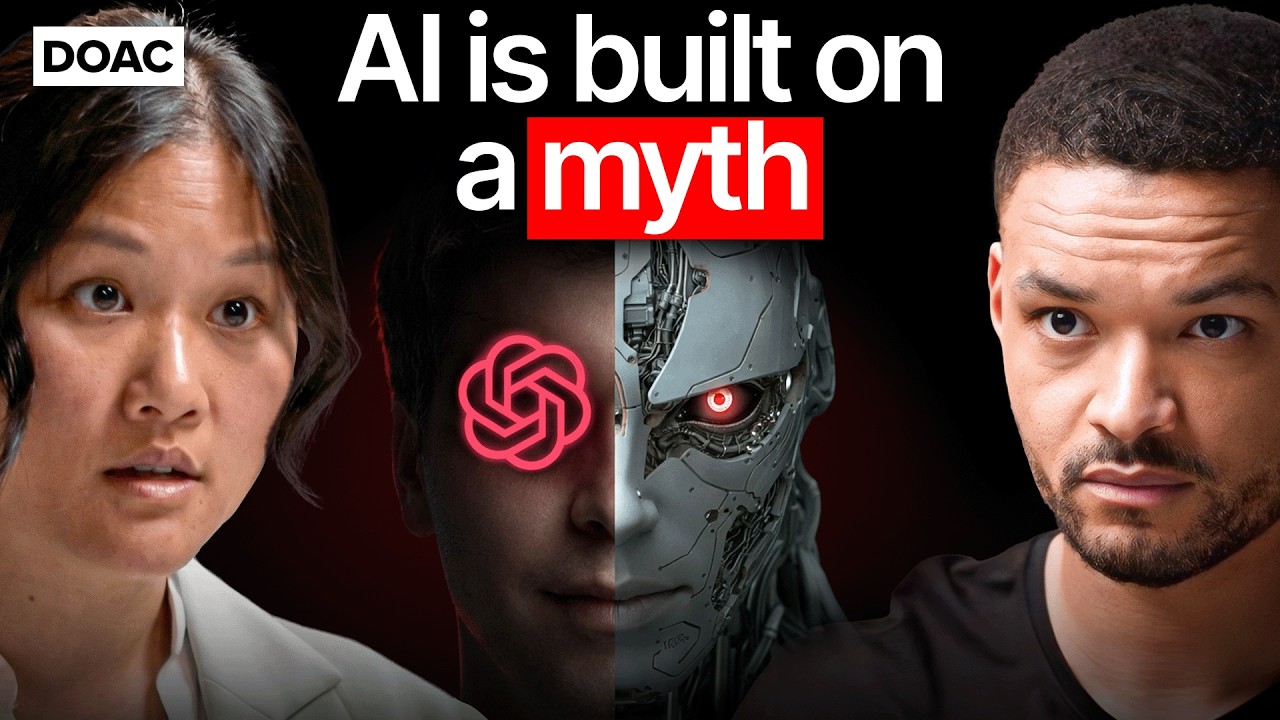
Karen Hao Warns OpenAI and Tech Giants Exploit Labor to Fuel AI Race
The Diary Of A CEO
Tech giants use existential rhetoric about AGI to consolidate trillion-dollar power and evade regulation while obscuring severe environmental and labor costs, according to investigative journalist Karen Hao.
## Background
The Diary Of A CEO published this interview video featuring investigative journalist Karen Hao on YouTube on March 26, 2026. According to the page description, the episode explores the reality behind AI corporate narratives, detailing how AGI function as a marketing construct, the hidden human and environmental costs of AI, and insider insights from OpenAI employees regarding Sam Altman.
## TL;DR
Investigative journalist Karen Hao challenges the dominant tech-industry narratives surrounding artificial intelligence, framing the current boom as a corporate resource-extraction strategy termed the 'Empire of AI.' Drawing from over 300 interviews, including past and present OpenAI insiders, she outlines internal corporate power struggles, the flaws of brute-force scaling, and the exploitation of contract annotation workers. The discussion also details the physical impact of AI infrastructure on local communities and energy grids, urging public skepticism and grassroots resistance toward unregulated tech expansion.
## Atmosphere & style
The conversation carries a serious, investigative, and deeply critical tone, balancing Steven Bartlett's engaging curiosity with Karen Hao's grounded, evidence-based skepticism. The dynamic creates a reflective atmosphere where high-level Silicon Valley idealism is systematically peeled back to reveal stark labor and environmental realities. It feels like an urgent, sobering unmasking of corporate mythmaking, moving from boardroom politics to the tangible human consequences of rapid tech acceleration.
## Key takeaways
- [00:00](https://www.youtube.com/watch?v=Cn8HBj8QAbk&t=0s) Artificial Intelligence is driven primarily by corporate profit and power consolidation rather than pure scientific progress, with terms like 'AGI' used as flexible marketing tools to attract massive investments.
- [10:05](https://www.youtube.com/watch?v=Cn8HBj8QAbk&t=605s) Sam Altman strategically used existential risk rhetoric and persuasive maneuvering to secure investments from figures like Elon Musk while retaining corporate control over OpenAI.
- [27:22](https://www.youtube.com/watch?v=Cn8HBj8QAbk&t=1642s) OpenAI censors internal critics, maintains strict media access control, and retaliates legally against watchdog organizations that scrutinize its corporate structure.
- [41:27](https://www.youtube.com/watch?v=Cn8HBj8QAbk&t=2487s) The 2023 attempt by OpenAI's board to fire Sam Altman stemmed from internal governance chaos, unauthorized corporate control mechanisms, and deep ethical disagreements.
- [01:06:49](https://www.youtube.com/watch?v=Cn8HBj8QAbk&t=4009s) Tech leaders weaponize the concept of a US-China 'AI arms race' as a national security narrative to bypass regulation and public democratic oversight.
- [01:07:41](https://www.youtube.com/watch?v=Cn8HBj8QAbk&t=4061s) Modern Large Language Models operate as statistical correlation engines rather than deterministic logic systems, meaning they inherently produce errors and cannot achieve true reasoning through brute-force scaling alone.
- [01:23:48](https://www.youtube.com/watch?v=Cn8HBj8QAbk&t=5028s) The rapid rollout of corporate AI is disrupting the white-collar labor market, eroding entry-level career ladders, and pushing displaced skilled workers into precarious, low-paying data annotation gig work.
- [01:46:32](https://www.youtube.com/watch?v=Cn8HBj8QAbk&t=6392s) Massive AI infrastructure expansion imposes severe real-world environmental and public costs, including surging utility prices, high water consumption, and localized pollution from massive data centers.
- [01:56:45](https://www.youtube.com/watch?v=Cn8HBj8QAbk&t=7005s) Instead of giant, resource-intensive 'rocket' models, AI development should shift toward targeted, energy-efficient 'bicycles' designed for specific societal goods like medical research.
- [01:58:12](https://www.youtube.com/watch?v=Cn8HBj8QAbk&t=7092s) Everyday citizens and local communities can challenge the expansion of extractive tech monopolies through legal pushback, withholding data, and opposing unvetted infrastructure buildouts.
## Detailed walkthrough
### [00:00](https://www.youtube.com/watch?v=Cn8HBj8QAbk&t=0s) The Inhumane Reality and Historical Origins of AI
The current trajectory of the artificial intelligence industry is fundamentally inhumane, driven by corporate narratives that serve to consolidate power and extract wealth rather than benefit humanity. While proponents argue that rapid AI development is necessary for civilizational superiority—a point famously echoed by tech leaders like Mark Zuckerberg—this myth primarily serves the financial interests of those promoting it. Tech giants deliberately cultivate public fear and hype to justify the exploitation of intellectual property and labor. They claim IP rights over the work of artists, writers, and creators to train their models, while simultaneously creating a destructive labor cycle: workers are laid off, hired back as contractors to train AI models on the very tasks they previously performed, and then permanently displaced when the models master those skills. The replacement jobs created in this process are overwhelmingly worse in quality, accompanied by growing environmental and public health concerns. Tech empires spend hundreds of millions of dollars lobbying to suppress regulation and silencing critical researchers, even though research demonstrates that AI capabilities could be developed in ways that avoid these harmful consequences.
```
1956 Dartmouth Conference
(John McCarthy names "AI")
│
┌────────────────┴────────────────┐
▼ ▼
No Scientific Consensus Replaced "Automata Studies"
on Human Intelligence to focus on human mind
│ │
└────────────────┬────────────────┘
▼
Goalposts Shift Continuously
(AGI redefined based on audience & corporate need)
```
The fundamental ambiguity of the field dates back to its inception in 1956 at Dartmouth College. John McCarthy chose the term "Artificial Intelligence" over his initial proposal, "Automata Studies," explicitly tying the discipline to the concept of replicating human intelligence. However, there was not then—and is not now—any scientific consensus across psychology, biology, or neurology on what human intelligence actually is. Historically, attempts to quantify and rank intelligence have often been driven by harmful motives, such as attempting to prove the inferiority of specific groups. Because the destination lacks clear goalposts, modern tech companies use the term Artificial General Intelligence (AGI) as an elastic marketing construct, constantly redefining it to suit their immediate goals and target audiences.
- **Multiple Definitions of AGI by OpenAI and Sam Altman:**
- **To Congress:** A revolutionary system capable of curing cancer, solving climate change, and ending global poverty.
- **To Consumers:** The ultimate digital personal assistant.
- **To Microsoft:** A commercial platform designed to generate $100 billion in revenue.
- **On OpenAI's Website:** Highly autonomous systems that outperform humans at most economically valuable work.
---
[10:05](https://www.youtube.com/watch?v=Cn8HBj8QAbk&t=605s) How Sam Altman Strategic Mirrors and Outmaneuvers Competitors
The messaging surrounding AI risks has long been used as a tool for strategic alignment rather than pure principle. In a 2015 blog post written prior to the public launch of OpenAI, Sam Altman explicitly stated that the development of superhuman machine intelligence was likely the greatest threat to human existence, placing it alongside risks like engineered viruses. This specific framing directly mirrored the language used at the time by Elon Musk, who famously warned at an MIT symposium that developing AI was akin to "summoning the demon." Altman adopted this apocalyptic rhetoric strategically to persuade Musk to co-found and fund OpenAI, effectively resolving his own previous public focus on biological threats to align with Musk's central fear.
```
[2015] Sam Altman adopts Musk's "Existential Risk" rhetoric
│
▼
Musk & Altman co-found OpenAI as a Nonprofit
│
▼
Shift to For-Profit Structure Needed for Capital
│
┌──────────────────────────┴──────────────────────────┐
▼ ▼
[Ilya & Greg initial choice] [Altman's intervention]
Musk as CEO Persuades Greg Brockman that
│ Musk is too unpredictable
│ │
└──────────────────────────┬──────────────────────────┘
▼
Altman becomes CEO; Musk exits
```
This strategic maneuvering extended to the leadership structure of OpenAI as it transitioned from its original non-profit model. Internal documents and emails surfaced during ongoing legal battles reveal that key figures, including Chief Scientist Ilya Sutskever and Chief Technology Officer Greg Brockman, initially selected Elon Musk to serve as the CEO of the new for-profit entity. However, Altman privately appealed to Brockman, leveraging their long-standing friendship within the Silicon Valley ecosystem. Altman argued that appointing a high-profile, unpredictable figure like Musk to lead such a potentially powerful technology carried immense risks. Brockman subsequently convinced Sutskever to change his stance, shifting their endorsement to Altman. When presented with a structure where he would not serve as CEO, Musk severed ties with the organization, sparking a lasting personal vendetta and accusations that he had been manipulated out of his investment.
- **Key Historical Milestones in the Altman-Musk Dynamic:**
- **2014–2015:** Musk publicly warns about AI existential risk, comparing it to "summoning the demon."
- **2015:** Altman writes blog posts echoing Musk's concerns to secure his partnership for OpenAI.
- **2015–2018:** OpenAI operates as a non-profit co-chaired by Altman and Musk.
- **2018:** Internal shift toward a for-profit structure; Altman sways Brockman and Sutskever to deny Musk the CEO role, leading to Musk's departure.
---
[15:06](https://www.youtube.com/watch?v=Cn8HBj8QAbk&t=906s) The Polarizing Perception of Sam Altman
Perspectives on Sam Altman among Silicon Valley insiders and former employees are sharply divided, with virtually no middle ground. To his supporters, he is viewed as the preeminent tech leader of his generation—a visionary figure comparable to Steve Jobs who possesses an unparalleled ability to articulate a compelling future, mobilize massive amounts of capital, and recruit elite talent. To his critics, however, he is perceived as deeply manipulative, dishonest, and calculated. This divide often depends on whether an individual's personal goals align with Altman's vision; those who share his direction view his intense persuasiveness as an asset, while those with differing priorities feel coerced into serving his agenda.
- Over 300 total interviews were conducted across 250+ individuals for the book *Empire of AI: Dreams and Nightmares in Sam Altman's OpenAI*.
- Over 90 of those interviewed were former or current OpenAI employees and executives.
<FollowUp label="Want to explore what the insider interviews revealed about the shift from non-profit to for-profit?" query="What did the OpenAI insiders reveal in Karen Hao's book regarding the internal shift from a non-profit mission to a commercial for-profit entity?"/>
[16:33](https://www.youtube.com/watch?v=Cn8HBj8QAbk&t=993s) Dario Amodei, Anthropic, and the Polarization Around Sam Altman
Karen Hao explains how tech executives often find themselves building things they fundamentally disagree with, highlighting the story of Dario Amodei, the CEO and co-founder of Anthropic (maker of the AI assistant Claude). Amodei was previously a senior executive and VP of Research at OpenAI. Initially, Amodei believed Sam Altman shared his long-term vision, but over time he realized Altman was steering the company in an opposing direction. Amodei felt that his intelligence, skills, and hard work had been leveraged by Altman to build a future he actively opposed. Hao notes that in her eight-plus years of investigative reporting across major tech companies—including Meta, Google, and Microsoft—Altman stands out as uniquely polarizing, with people unable to decide whether he is "the greatest or the worst."
Host Steven Bartlett points out how executive commentary shifts alongside corporate incentives. He references a 2017 quote from Amodei during his time at OpenAI, where Amodei acknowledged Nick Bostrom-style catastrophic risks: "My chance that something goes really quite catastrophically wrong on the scale of human civilization might be somewhere between 10% and 25%."
- Dario Amodei ran research at OpenAI before leaving to found rival AI firm Anthropic.
- Amodei's 2017 estimate placed the risk of a civilization-level catastrophe from AGI at 10% to 25%.
---
[18:43](https://www.youtube.com/watch?v=Cn8HBj8QAbk&t=1123s) Ilya Sutskever's Departure and the "Animals and Highways" Metaphor
The discussion turns to Ilya Sutskever, OpenAI's co-founder and former Chief Scientist, who was instrumental in the board's short-lived firing of Sam Altman. Hao notes that Sutskever felt manipulated by Altman into contributing to something he no longer believed in. Sutskever operated on two foundational principles: achieving Artificial General Intelligence (AGI) and ensuring it is created safely. He came to view Altman as actively undermining both goals by cultivating a chaotic internal culture that pitted teams against each other and delivered conflicting messages to different employees.
Recalling her 2019 interview with Sutskever for an *MIT Technology Review* profile, Hao highlights his view on human-AI relations. Sutskever famously drew an analogy to how humans treat animals: humans do not hate animals and often feel affection for them, but when building a highway between two cities, humans do not ask the animals for permission—they simply build it. In Sutskever's view, autonomous AGI operating on its own behalf would naturally hold that same relationship toward humanity.
> "The future's going to be good for AIs regardless. It would be nice if it was also good for humans as well. It's not that it's going to actively hate humans or want to harm them, but it's just going to be so powerful... when the time comes to build a highway between two cities, we are not asking the animals for permission." — Ilya Sutskever (2019)
---
[20:29](https://www.youtube.com/watch?v=Cn8HBj8QAbk&t=1229s) The Statistical Engine Hypothesis vs. Human Intelligence
Hao steps back to critique the underlying definition of intelligence held by leading AI figures like Ilya Sutskever and his academic mentor, Turing Award winner Geoffrey Hinton. Their central hypothesis is that the human brain is essentially a giant statistical model. While this remains an unproven scientific hypothesis rather than established fact, Sutskever and Hinton built their research programs on the premise that scaling up artificial statistical engines will naturally yield human-level and superhuman intelligence.
Hao recalls a keynote talk Sutskever gave at the NeurIPS (Neural Information Processing Systems) conference. During his talk, Sutskever displayed a chart illustrating the relationship between biological brain size and species intelligence, which was roughly linear. Based on that logic, Sutskever believed that building a digital statistical engine larger than the human brain would inevitably produce a superior intelligence—leading to the animal-highway scenario. Critics, however, argue that reducing human consciousness and cognition to a simple statistical engine is deeply flawed.
- **NeurIPS Keynote:** Sutskever used brain-size scaling charts to argue that larger statistical models inherently equal greater intelligence.
- **The Core Debate:** Mainstream critics contend that human intelligence involves reasoning, embodiment, and understanding that raw statistical pattern-matching cannot replicate.
---
[23:18](https://www.youtube.com/watch?v=Cn8HBj8QAbk&t=1398s) Questioning the Premise: Why Are We Building AGI?
Hao stresses why this theoretical debate matters: AI companies are making real-world, high-stakes decisions based entirely on this unproven hypothesis. In their pursuit of AGI, tech giants are hoovering up massive amounts of public data, constructing colossal energy-intensive data centers, and exploiting global labor. She challenges the core premise accepted by the tech industry and media alike—that building AGI is an inherently worthy goal.
Hao argues that technology throughout human history should exist to enhance human flourishing, not to automate people away or duplicate human consciousness. She questions why trillions in capital are poured into building systems designed to replace workers rather than developing targeted AI models aimed at concrete societal goods, such as accelerating medical drug discovery or improving healthcare outcomes.
---
[25:33](https://www.youtube.com/watch?v=Cn8HBj8QAbk&t=1533s) The "Empires of AI" Framework and Corporate Exploitation
When asked why AI companies relentlessly push toward AGI despite the risks, Hao explains that they are driven by an imperial agenda—the central thesis of her book, *EMPIRE OF AI*. She finds "empire" to be the only metaphor that fully captures their scale, behavior, and motivations, drawing direct parallels between modern tech giants and historic empires:
1. **Resource Extraction and Land Grabs:** AI companies lay claim to resources that do not belong to them, including personal data, intellectual property from artists and authors, and physical land/power resources to build massive supercomputing infrastructure.
2. **Labor Exploitation:** They rely on hundreds of thousands of low-paid contract workers globally (and within the US) to curate data, while designing products explicitly aimed at stripping away traditional labor rights and automating jobs.
3. **Monopolization of Knowledge:** They position themselves as the sole arbiters of AI knowledge, framing public or regulatory pushback as simple ignorance.
4. **Capturing Research:** They hire or bankroll the vast majority of academic AI scientists, setting research agendas to align with corporate profits.
---
[27:18](https://www.youtube.com/watch?v=Cn8HBj8QAbk&t=1638s) Gaslighting, Censorship, and the Firing of Timnit Gebru
Hao explicitly agrees with the host that AI companies are gaslighting the public. She compares the situation to climate science: if the world's climate researchers were bankrolled by fossil fuel companies, the public would never get an accurate picture of the climate crisis. Similarly, AI tech monopolies control the research ecosystem and censor internal scientists who uncover uncomfortable truths.
As a primary example, Hao cites Dr. Timnit Gebru, the former co-lead of Google's Ethical AI team. Hired to critique Google's AI models, Gebru co-authored a landmark research paper highlighting the environmental costs, training biases, and systemic risks of Large Language Models (LLMs). When Google attempted to quash the paper, Gebru stood her ground and was fired, followed shortly by her co-lead, Margaret Mitchell.
- **Timnit Gebru Case:** Fired by Google after co-authoring a paper detailing the hidden harms of large language models.
- **Margaret Mitchell:** Co-lead of Google's Ethical AI team, also terminated following the research dispute.
---
[28:42](https://www.youtube.com/watch?v=Cn8HBj8QAbk&t=1722s) Intimidation Tactics and Subpoenaing Watchdogs
Hao details how OpenAI has used aggressive legal and surveillance tactics against civil society groups and critics. She describes an incident involving the leader of MIDAS, a small watchdog non-profit that was investigating OpenAI's quiet transition from a non-profit entity into a capped-for-profit company. The group sought transparency and public debate surrounding this unprecedented structural shift.
During a critical window in the conversion process, process servers knocked on the watchdog leader's door to serve legal subpoenas. OpenAI demanded he turn over all private communications, text messages, and emails that mentioned Elon Musk. Hao explains this stemmed from OpenAI's paranoia that Musk was secretly funding civil society critics to block their restructuring—a claim that proved entirely unfounded.
- OpenAI issued legal subpoenas directly to small non-profit watchdogs attempting to scrutinize its corporate restructuring.
- OpenAI demanded records of all communications involving Elon Musk under the false assumption he was funding the watchdog's efforts.
---
[30:47](https://www.youtube.com/watch?v=Cn8HBj8QAbk&t=1847s) The "Good Empire vs. Evil Empire" Narrative
Continuing her analysis of tech imperialism, Hao explains how AI executives weaponize existential narratives to justify anti-democratic control. Imperial powers have historically justified their dominance by claiming: *"We are the good empire, and you must let us extract resources because bad empires exist. If we build it first, we bring utopia; if they build it first, we enter hell."*
Initially, OpenAI framed Google as the "evil, profit-driven empire" while presenting itself as the benevolent non-profit savior. Over time, that narrative shifted toward geopolitical rival China. AI CEOs use dual narratives simultaneously: Sam Altman speaks publicly about "lights out for everyone" as the worst case, but promises curing cancer and unlimited abundance as the best case. Dario Amodei uses identical rhetoric regarding catastrophic risk versus human flourishing. Hao asserts that both extremes are used to shut down democratic oversight and ensure a handful of executives retain total control over the technology's development.
---
[33:14](https://www.youtube.com/watch?v=Cn8HBj8QAbk&t=1994s) Sam Altman's Public Tweet and OpenAI's Snub of Karen Hao
The segment closes with a discussion of Sam Altman's public reaction to incoming books written about OpenAI. Bartlett reads a tweet from Altman stating that OpenAI only cooperated with two specific books—one by Keach Hagey focusing on Altman, and another by Ashley Vance on OpenAI—while dismissing other incoming titles as attempt to "twist things."
Hao confirms she publicly retweeted Altman, identifying her book, *EMPIRE OF AI*, as the unnamed target of his tweet. She notes that out of the three major books being published about OpenAI and Altman at the time, hers was the only one OpenAI explicitly refused to participate in or grant official access to, reinforcing her critique of the company's tight control over its public narrative.
> "There are some books coming out about OpenAI and me. We only participated in two of them... No book will get everything right, especially when some people are so intent on twisting things..." — Sam Altman (X / Twitter)
[33:58](https://www.youtube.com/watch?v=Cn8HBj8QAbk&t=2038s) OpenAI’s Media Blacklist and the “Access Game”
Karen Hao details her fraught history with OpenAI, which dates back to 2019 when she spent three days embedded in their office for an *MIT Technology Review* profile. When her piece was published in 2020, company leadership was deeply unhappy with her critical reporting. In her book *Empire of AI*, Hao quotes an internal email sent by Sam Altman to the entire company acknowledging that her profile was "not great." Following that release, OpenAI explicitly informed Hao that they would no longer participate in her work, answer her questions, or engage with her in any capacity. This stonewalling was so total that when another reporter at *MIT Technology Review* tried to pass off a press release assignment to Hao, OpenAI refused, citing their past history.
The cold shoulder lasted roughly three years until Hao joined *The Wall Street Journal*. Faced with the authority of the Journal, OpenAI felt compelled to reopen communication lines, leading to a more productive, dialogue-based relationship where Hao regularly submitted requests for comment. However, when Hao resigned from the Journal to write her book full-time, the dynamic shifted once again. OpenAI initially agreed to provide interviews and office visits, but after the board unexpectedly fired Sam Altman in late 2023, the company grew extremely sensitive to outside scrutiny. They repeatedly delayed Hao's requested interviews before issuing a total freeze: "We are not going to participate at all. You are not coming to the office." Despite having already booked flights to San Francisco, Hao adapted by sending OpenAI a meticulous 40-page document outlining her findings for comment—giving them over a month to respond. They never answered a single page.
Podcast host Steven Bartlett draws a direct parallel to his own experience trying to book Sam Altman. Bartlett notes that despite Altman making the rounds on major podcasts—ranging from Joe Rogan and Theo Von to Tucker Carlson—Altman’s team continuously avoids his show. Both Hao and Bartlett highlight how tech giants use access as a geopolitical tool: dangling interviews to manipulate journalists and content creators into staying polite, while withholding access or blacklisting anyone who platforms critics or asks uncomfortable questions. Hao reflects that while being blacklisted initially made her fear she had ruined her career, it ultimately liberated her, forcing her to rely on independent investigative techniques—including over 300 interviews—rather than PR handouts.
- Karen Hao embedded at OpenAI in 2019 and published her *MIT Technology Review* profile in 2020.
- Sam Altman sent a company-wide email describing Hao's 2020 profile as "not great."
- OpenAI enforced a three-year media blackout specifically targeting Hao until she joined *The Wall Street Journal*.
- Hao submitted a 40-page fact-checking document to OpenAI with a month-long deadline; OpenAI provided zero responses.
- Hao conducted over 300 interviews to write *Empire of AI* without OpenAI's official cooperation.
---
[41:27](https://www.youtube.com/watch?v=Cn8HBj8QAbk&t=2487s) The Board Room Coup: Why Ilya Sutskever Approached Helen Toner
Hao provides an insider, scene-by-scene account based on six or seven primary sources directly involved in or briefed on the firing of Sam Altman. The crisis began internally when co-founder and Chief Scientist Ilya Sutskever grew deeply concerned that Altman’s behavior was causing severe organizational dysfunctions, poor decision-making, and substandard research outcomes. Terrified of the personal and professional fallout if Altman discovered his misgivings, Sutskever hesitantly scheduled a meeting with independent board member Helen Toner. During their initial encounter, a nervous Sutskever practically "barely says a thing," carefully testing the waters to gauge whether Toner could be trusted.
The structure of OpenAI's board was intentionally designed to protect its public-interest mission. Because it originated as a non-profit, the board was split between members with financial stakes in the company and independent board members without financial interests, tasked with ensuring AGI development benefited humanity over commercial profits. Approaching Toner as an independent trustee, Sutskever sought to confirm if she shared his concerns about Altman's erratic leadership.
Soon, conversations expanded to include Mira Murati, OpenAI’s Chief Technology Officer. Together, Sutskever and Murati began compiling internal documentation—including emails, Slack messages, and operational logs—to present to the three independent board members. They delivered a stark warning: the deep-seated instability within OpenAI could not be fixed unless Sam Altman was removed as CEO, pointing out how he routinely pitted internal teams against one another and fostered a culture of paranoia rather than collaboration.
- The narrative of Altman's firing was reconstructed using accounts from roughly 6 to 7 sources directly tied to the board's decision-making process.
- Non-independent board member Ilya Sutskever initiated the push by secretly approaching independent board member Helen Toner.
- CTO Mira Murati joined Sutskever in gathering documentation (emails, Slack records) to present to the independent directors.
- The board was structurally split between profit-interested members and independent directors acting as public-interest stewards.
---
[44:58](https://www.youtube.com/watch?v=Cn8HBj8QAbk&t=2698s) Chaos as a Pressure Cooker: The Internals of OpenAI
When ChatGPT was publicly released in November 2022, OpenAI was completely unprepared for its viral, explosive growth. Executives had viewed the release as a simple "research preview" designed to capture user data to train their actual flagship product: a GPT-4 chatbot. Instead, ChatGPT—built on GPT-3.5—became the fastest-growing consumer app in history. The sudden rush crashed servers daily, forcing the company to scale its infrastructure at unprecedented speed. In the rush to handle the operational deluge, hiring scaled wildly out of control, resulting in rapid hires followed by swift, unannounced firings where employees would suddenly vanish from company Slack channels without warning.
Sutskever and Murati felt that rather than managing this hyper-growth chaos, Altman was actively exacerbating it by stoking internal rivalries. In any standard Silicon Valley startup, fast growth and internal friction might be tolerated. However, the executives and independent board members operated under the conviction that they were building Artificial General Intelligence (AGI)—a technology with the potential to either usher in utopia or cause global catastrophe. As the independent board members debated the situation, they asked themselves: "If this was an Instacart, would that warrant firing him?" Their conclusion was "maybe not," but OpenAI was not Instacart. In their eyes, allowing a toxic pressure cooker environment to govern the development of potentially world-altering technology carried unacceptably high risks.
Compounding these internal leadership issues, independent board member Adam D'Angelo (CEO of Quora) stumbled upon disturbing financial discrepancies. While attending a party in San Francisco, D'Angelo heard industry rumors regarding the structure of the OpenAI Startup Fund—an investment venture created to fund early-stage AI startups. Upon requesting official documentation, the board discovered that the fund was legally owned and controlled directly by Sam Altman personally, rather than by OpenAI the corporate entity. This discovery fit a broader pattern of "inconsistencies" between what Altman told the board and how operations were actually being conducted, solidifying the independent directors' resolve that Altman lacked candor and needed to be replaced immediately.
- ChatGPT was originally launched as a simple GPT-3.5 research preview to collect data flywheel feedback for a planned GPT-4 release.
- Explosive user demand led to constant server outages, chaotic hiring, and shadow firings where staff disappeared from Slack overnight.
- Board members explicitly compared OpenAI to ordinary tech companies, concluding that methods acceptable at "an Instacart" were unacceptable for a company building AGI.
- Independent director Adam D'Angelo discovered that the OpenAI Startup Fund was legally registered under Sam Altman's personal ownership rather than OpenAI's.
---
[50:01](https://www.youtube.com/watch?v=Cn8HBj8QAbk&t=3001s) The Blitz Firing and the Corporate Backlash
Fearing Altman's legendary powers of persuasion, the board concluded that any leak or warning would allow him to maneuver around them and block his own dismissal. As a result, they resolved to act in total secrecy and execute the termination as fast as possible. They held daily covert meetings to finalize the decision, choosing not to consult key stakeholders, staff, or investors in advance.
Microsoft, OpenAI's primary corporate backer and largest financial investor, was given a head-up phone call only moments before the public announcement was made. The complete lack of advance notice ignited immediate fury among stakeholders, investors, and employees who felt blindsided by the sudden removal of their high-profile CEO.
Rather than quietly transitioning leadership, the move triggered an explosive corporate crisis. Microsoft and prominent venture capitalists aggressively rallied behind Altman, while employees signed open letters demanding the board's resignation. Driven by immense financial, media, and corporate pressure, the campaign successfully forced the board's collapse, leading to Sam Altman being reinstated as Chief Executive Officer just days after his firing.
- The board executed the firing without giving advance notice to key stakeholders to prevent Altman from using his "persuasive abilities" to defeat the vote.
- Microsoft, the lead strategic investor in OpenAI, received a notification call just minutes before the firing was carried out.
- Intense pushback from major investors and an employee revolt forced the board to relent, resulting in Altman being reinstated as CEO within days.
Here is a detailed, faithful walkthrough of Part 4 of the transcript.
---
[51:15](https://www.youtube.com/watch?v=Cn8HBj8QAbk&t=3075s) Sponsor Break: Wispr Flow and Pipedrive
Steven introduces two productivity sponsors driving efficiency across his businesses. He starts with **Wispr Flow**, a desktop and mobile app that transforms spoken thoughts into polished text. Rather than typing out lengthy emails, Steven clicks a single button, dictates his thoughts, and lets AI refine the output automatically. The software learns unique communication styles—maintaining a casual tone on WhatsApp while adopting a formal structure for business emails—and supports custom voice shortcuts (like saying "Jack's LinkedIn" to instantly pull up a contact's profile). Steven shares that his personal investment in the company stems from its rapid adoption among top entrepreneurs and executives.
He then shifts to **Pipedrive**, a sales CRM he discovered a decade ago to eliminate administrative drag and keep sales pipelines moving. Pipedrive automates repetitive sales workflows and syncs seamlessly across multiple email inboxes, allowing teams to collaborate in real time from a single platform. Steven notes that over 100,000 businesses currently rely on Pipedrive to maintain momentum, offering listeners a 30-day free trial without requiring a credit card.
---
[53:24](https://www.youtube.com/watch?v=Cn8HBj8QAbk&t=3204s) Internal Fractures at OpenAI and the Mass Executive Exodus
Steven returns to the interview by citing a striking quote from page 357 of Karen Hao's book *Empire of AI*, where OpenAI co-founder Ilya Sutskever remarked, *"I don't think Sam is the guy who should have the finger on the button for AGI."* Drawing a parallel to his own company of 150 employees, Steven reflects on how severe an insider intervention must be for close colleagues to try to oust their leader. If his own core team claimed he was unfit to host *The Diary Of A CEO*, it would imply alarming behind-the-scenes discoveries. In the context of artificial general intelligence (AGI), the stakes are vastly higher, making it chilling that both Ilya Sutskever and former CTO Mira Murati expressed direct distrust in Sam Altman's leadership before their eventual departures.
```
"I don't think Sam is the guy who should have the finger on the button for AGI."
— Ilya Sutskever (quoted in 'Empire of AI')
```
Hao contextually traces these internal fractures back to OpenAI’s origin story—a foundational dinner at the high-end Rosewood Hotel in Silicon Valley, a favorite haunt of Elon Musk. Altman had cold-emailed Ilya Sutskever, using Musk's attendance to recruit him alongside key figures like Greg Brockman and Dario Amodei. Almost every original founding member who joined at that dinner ultimately clashed with Altman and left the company.
- **Key Executive Splinters:**
- **Elon Musk** departed and established **xAI**.
- **Dario Amodei** left to found **Anthropic** (creators of Claude).
- **Ilya Sutskever** departed to launch **Safe Superintelligence (SSI)**.
- **Mira Murati** left to launch **Thinking Machines Lab**.
Steven points out the passive-aggressive irony of Sutskever launching a company named "Safe Superintelligence" after leaving OpenAI, joking that if a former co-host left to start "Safe Podcasting," he would take it as a direct slight. Hao explains that these splits stem from tech founders' desire to build AI in their own personal image. When visions collide, executives split off to create competing corporate empires.
---
[57:33](https://www.youtube.com/watch?v=Cn8HBj8QAbk&t=3453s) "Summoning the Demon": The Mythmaking of AI Existential Risk
Steven brings up Elon Musk's famous warning that developing advanced AI is akin to "summoning the demon," questioning whether AI CEOs realize the existential risks they are creating. He highlights Dario Amodei’s public estimate that there is a **10% to 25% chance of catastrophic AI outcomes** capable of destroying human civilization. Steven highlights how extreme that gamble is: nobody would play Russian roulette with a four-chamber revolver for a 25% chance of getting shot, even if the upside was becoming a multi-gazillionaire.
Hao provides a nuanced perspective on whether AI CEOs actually believe they are summoning a demon:
1. **Strategic Rhetoric as Power Consolidation:** Narratives about extreme existential risk serve a double purpose. By framing AI as a terrifying force, leaders argue that only *they* are qualified to control it safely, scaring the public and regulators into granting them immense capital and regulatory leniency.
2. **The "Dune" Parallel:** Hao compares the AI ecosystem to Frank Herbert's science fiction novel *Dune*. In *Dune*, political houses plant religious prophecies about a Messiah to control populations across the galaxy. When Paul Atreides steps into that manufactured myth to lead a rebellion, he initially knows it is a political tool, but over time, living the myth blurs the line between strategy and genuine belief. Similarly, AI leaders engage in deliberate mythmaking through flashy product demos to build hype, yet eventually fall victim to their own propaganda due to cognitive dissonance.
```
"On one hand, there are all these executives that actively engage in mythmaking... and also I think many of them lose themselves in the myth because they have to live and breathe and embody it day in and day out."
— Karen Hao
```
Steven notes that this dynamic is driven by the constant demand for capital. Because these companies must raise tens of billions of dollars to build massive data centers, their CEOs cannot openly admit to investors that they might destroy humanity's future, leading them to manipulate their public messaging.
---
[01:04:17](https://www.youtube.com/watch?v=Cn8HBj8QAbk&t=3857s) Anti-Democratic Governance and Tech Empires
When Steven asks if certain AI leaders (like Anthropic's Dario Amodei) possess a stronger moral compass than Sam Altman, Hao argues that focusing on individual personalities misses the structural point. Swapping out CEOs does not solve the underlying crisis: an anti-democratic power structure where a small handful of Silicon Valley executives make decisions affecting billions of people who have zero voice in the outcome.
```
"No person is perfect... they're not going to have the ability to make decisions on behalf of so many people around the world who live and talk and have a culture and history that are fundamentally different from them without things going wrong."
— Karen Hao
```
While citizens can theoretically elect politicians to pass regulatory safeguards, AI tech giants deploy hundreds of millions of dollars in political spending during election cycles to kill safety legislation and codify their corporate advantages. Hao compares this consolidated power structure to historical empires, noting that humanity systematically transitioned from empires to democracies precisely because unchecked concentration of power inevitably fails to serve the public interest.
---
[01:06:49](https://www.youtube.com/watch?v=Cn8HBj8QAbk&t=4009s) Challenging the US-China "AI Arms Race" Narrative
Steven takes on the role of devil's advocate, pushing back with the standard geopolitical defense: if the United States slows down AI development or heavy-handedly regulates its companies, China will inevitably overtake the West in artificial intelligence. In that scenario, China would monopolize key scientific discoveries, control autonomous weapons systems, and gain the capability to shut down U.S. electrical grids and cyber infrastructure, leaving Western nations completely vulnerable.
Hao cuts through the argument immediately with a direct response: *"No, it's not."* She argues that the framed US-China "AI arms race" is largely a narrative engineered to force rapid deregulation, secure unlimited funding, and bypass public accountability under the guise of national security.
[01:07:41](https://www.youtube.com/watch?v=Cn8HBj8QAbk&t=4061s) The "Jagged Frontier" of AI Intelligence vs. Scaling Myths
Host Steven Bartlett and investigative journalist Karen Hao debate whether expanding AI models automatically scales general intelligence or simply amplifies narrowly optimized features. Steven brings up the premise that if a civilization or system is improving over time—even at a slow rate—it will eventually attain superior intelligence. Karen forcefully rejects the underlying assumptions of this argument, comparing modern large language models (LLMs) to digital calculators. Just as a calculator performs arithmetic faster than a human without being generally intelligent, current AI models excel at specific, highly constrained tasks while failing elsewhere.
Karen explains the concept of the "jagged frontier" in AI performance: models exhibit impressive mastery in certain domains but fall completely flat in others. This disconnect occurs because AI companies must strategically choose which capabilities to advance by collecting targeted datasets and hiring thousands of human annotators to fine-tune specific outputs. Rather than building a self-directed, generally intelligent entity—like a growing human child who chooses what to learn—companies allocate resources strictly based on profitability. They prioritize industries with deep pockets, such as law, finance, healthcare, and medicine, while wrapping these commercial decisions in the marketing myth of "everything machines."
* **Intelligence Analogies & Cognitive Science:** Karen notes that AI pioneer Geoffrey Hinton views the human brain primarily as a "statistical engine." However, she points out that this hypothesis is heavily contested by neuroscientists and psychologists who actually study human cognition.
* **The Problem of Uniform Failure Modes:** While Steven points out that connected AI systems (like autonomous vehicles or Optimus robots) can share learned updates instantly across an entire fleet, Karen warns of the dangerous flipside: if one system learns a flawed pattern, every connected model adopts the exact same failure mode simultaneously. Human societies derive resilience precisely from having diverse skill sets and distinct individual errors.
* **Human Adaptability vs. AI Retraining:** Humans can learn to drive in one city and immediately transfer those general driving concepts to an unfamiliar country. In contrast, self-driving platforms require extensive, localized retraining and mapping data whenever deployed in a new urban environment.
> "They create this myth that they are actually pushing the frontier of all of the capabilities of the model... They pick what capabilities they want to advance, and you know how they pick them? It's based on which industries or countries would be able to pay them the most money for their services."
---
[01:14:31](https://www.youtube.com/watch?v=Cn8HBj8QAbk&t=4471s) Brute-Force Scaling and the Fate of Specialized Professions
The debate shifts toward the aggressive, brute-force scaling strategies championed by major tech leaders. Steven points out that figures like Elon Musk, Dario Amodei, Ilya Sutskever, Mark Zuckerberg, and Demis Hassabis have all converged on a singular belief: stacking raw computing power and massive data centers will inevitably yield higher intelligence. He highlights Elon Musk's xAI project in Memphis—the "Colossus" supercomputer cluster housing 100,000 GPUs—as tangible proof of this industry-wide conviction.
Karen counters that these CEOs push the scaling hypothesis because they profit enormously from the narrative. When tech leaders make bold predictions—such as Musk advising students not to train as surgeons because Optimus robots will soon surpass human skill, or Geoffrey Hinton claiming years ago that training radiologists was obsolete—they confuse commercial task automation with genuine human expertise. In reality, radiology remains a thriving profession. Research consistently shows that the highest diagnostic accuracy occurs not by replacing humans, but by placing AI tools in the hands of expert practitioners to augment their judgment.
* **The Purpose of Technology:** Karen emphasizes that the fundamental objective of technological development should be helping human beings rather than pursuing "technology for technology's sake."
* **Medical Diagnostic Synergy:** Studies demonstrate that cancer detection and early prognoses improve most significantly when human clinicians utilize AI as an analytical input, blending algorithmic statistical power with human clinical judgment.
* **The Commercial Reality:** Rather than constructing conscious or generalized super-intelligences, tech giants are brute-forcing models to automate lucrative, repeatable corporate workflows that can be monetized immediately.
> "I heard Elon say that if you're a surgeon, there's just no point... he says in a couple of years' time, Optimus and AI generally are going to be better than any surgeon that's ever lived."
---
[01:17:00](https://www.youtube.com/watch?v=Cn8HBj8QAbk&t=4620s) The Reality of Autonomous Vehicles and Mass Job Displacement
Examining the practical limits of statistical models, Karen and Steven debate whether fully autonomous self-driving cars will completely dominate roads within the next decade. Karen argues against imminent total adoption, explaining the underlying mechanism of modern AI: neural networks operate as statistical correlation engines rather than deterministic logic systems. Because they rely on probabilities, it is technically impossible to eliminate unexpected edge-case errors entirely.
To illustrate the sheer human labor required to make autonomous driving appear seamless, Karen details the massive data annotation pipeline. Self-driving platforms rely on hundreds of thousands of outsourced human contractors who manually draw bounding boxes around every vehicle, pedestrian, traffic sign, and lane line in video frames. This labeled data is then fed into neural networks, which are tethered to non-AI deterministic rule sets (e.g., "if a red light is identified, stop"). While autonomous systems perform well in tightly controlled, heavily mapped environments like Austin or Los Angeles, they struggle when dropped into unpredictable, chaotic traffic conditions like those in Mumbai or Vietnam.
* **Technical vs. Social and Legal Friction:** Widespread adoption of autonomous vehicles faces major hurdles beyond technology, including public trust and liability assignment. Karen cites a Los Angeles court case involving a Tesla collision where both the driver (who dropped their phone) and the manufacturer were held legally responsible.
* **Current Adoption Limits:** Despite over a decade of intense capital investment and Uber CEO Dara Khosrowshahi's predictions that millions of drivers will be replaced, fully autonomous vehicles make up only a tiny fraction of total cars on US roads.
* **Corporate Layoffs vs. Real AI Capability:** On the topic of AI-driven job displacement, Karen distinguishes between actual technology capabilities and executive hype. She points out that many recent corporate layoffs—such as those initiated by Klarna's CEO—were driven by executive assumptions that AI could seamlessly replace human workers, rather than the technology actually being ready to perform those roles reliably.
> "Statistical engines are based on probabilities. It's not based on deterministic logic. So systems make errors all the time, and it is technically impossible to get them to stop making errors."
[01:22:13](https://www.youtube.com/watch?v=Cn8HBj8QAbk&t=4933s) The Truth About Klarna: Layoffs, Software Costs, and Human Connection
Steven reads an exchange of direct messages between himself and Sebastian Siemiatkowski, the CEO of Klarna, addressing media narratives that Klarna had backtracked on its AI transition. Siemiatkowski clarified that "two things can be true at the same time" and accused the media of misinterpreting his tweets. He explained that Klarna was actually doubling down on AI more than ever, shrinking its headcount from a peak of 7,400 to 5,500, then down to 3,300, with a goal of reaching 3,000 employees.
At that point, AI was handling 70% of Klarna's customer service conversations. Siemiatkowski noted that AI reduces the production cost of software to "almost zero," comparing it to the industrial revolution: coding used to be handcrafted, but is now machine-produced. Consequently, human labor will be reserved for premium, personal, and relatable experiences. "People will want to connect to humans, not only machines," he wrote, emphasizing that companies must offer a "super available human experience" while automating back-end processes.
- **Klarna Headcount Trajectory**: Peak of 7,400 employees $\rightarrow$ 5,500 $\rightarrow$ 3,300 $\rightarrow$ target of 3,000.
- **Customer Service Automation**: AI handles 70% of customer service interactions at Klarna.
- **Economic Shift**: Software creation is moving from handcrafted labor to machine production, making raw software costs approach zero.
[01:23:48](https://www.youtube.com/watch?v=Cn8HBj8QAbk&t=5028s) The Impact on the Job Market: Executive Choices vs. Model Capabilities
Karen Hao and Steven discuss the nuanced reality of job destruction, moving away from binary narratives. Karen notes that jobs are disappearing due to two distinct drivers: actual model capabilities automating tasks, and corporate executives using AI as a convenient narrative to cut headcount even when models are not fully capable or when companies over-hired during the pandemic.
Karen cites recent labor market reports showing a noticeable slowdown in white-collar hiring. She highlights a viral report from Anthropic that examined model usage and revealed a 40% reduction in entry-level jobs. Anthropic's data map showed that physical, real-world labor (like construction and agriculture) remains largely untouched by current models, whereas fields like office administration, finance, math, law, and media are heavily exposed to disruption.
- **Anthropic Report Findings**: Entry-level jobs have seen a 40% reduction.
- **Exposed Sectors**: Finance, law, mathematics, office/administrative work, and media/arts face the highest current AI disruption.
- **Resilient Sectors**: Physical real-world labor (construction, agriculture) remains insulated for now.
[01:26:24](https://www.youtube.com/watch?v=Cn8HBj8QAbk&t=5184s) Broken Career Ladders and the Shift to "Data Annotation"
The conversation turns to the structural shifts in the labor market. Karen points out that previous automation waves displaced entry-level tasks while creating higher-skilled opportunities. Today, however, the job market is bifurcating into a small set of high-paid "handcrafters" or system orchestrators, and a vast pool of lower-quality, precarious jobs.
Karen highlights an article from *New York Magazine* documenting how laid-off white-collar workers—including marketers and even award-winning Hollywood directors—are forced to take low-paying jobs at data annotation firms. In a dark economic loop, these workers spend their days annotating data to train AI models on the very skills required for the jobs they were just laid off from, accelerating future layoffs. Steven notes that this dynamic "breaks the career ladder" by gutting entry-level and mid-tier roles, leaving no clear progression path for rising professionals.
> "A marketer gets laid off and then they go and work for a data annotation firm to train the models on the very job that they were just laid off in, which will then perpetuate more layoffs if that model then develops that skill."
[01:28:46](https://www.youtube.com/watch?v=Cn8HBj8QAbk&t=5326s) How Businesses Are Hiring: The Three Irreplaceable Employee Profiles
Steven shares his perspective as an investor in ~70 companies and employer of hundreds of staff. When evaluating candidates today, he runs an experiment asking whether an AI agent—particularly utilizing open models like Claude—can perform the role. As a result, he has identified only three categories of roles that remain truly irreplaceable in his organizations:
1. **Deep Subject-Matter Experts**: Senior leaders who possess decades of domain knowledge (such as a seasoned CFO with 50 years of experience) required to direct, prompt, and audit teams of AI agents.
2. **AI Agent "Maxers"**: Young, highly curious individual contributors (citing his 25-year-old team member, Cass) who build, stack, and orchestrate AI tools to multiply organizational leverage.
3. **High-EQ In-Person (IRL) Connectors**: People who excel at real-world human interactions, hosting clients, building physical communities, and fostering relationships.
Karen challenges whether this structure is sustainable over the long term, asking how future senior experts will ever gain 50 years of domain knowledge if the entry-level roles where people learn are completely eliminated.
[01:32:10](https://www.youtube.com/watch?v=Cn8HBj8QAbk&t=5530s) The Human Return: Reduced Screen Time and Real-World Connection
Steven proposes a contrarian perspective: if AI compounds exponentially and automates laptop-based tasks, it may force humanity back into physical connection. He suggests that AI could ironically fulfill the unkept promise of earlier tech by freeing people from spreadsheets and screens, returning them to "Maslovian needs" of in-person human relationships.
To back this up, Steven cites data points on shifting digital behaviors:
- **Financial Times Social Media Data**: Social media usage peaked in 2022 and has plateaued, with younger generations reducing their usage fastest.
- **Gen Alpha Behaviors**: Embracing "posting zero"—moving away from public social feeds toward private, dark-social channels (WhatsApp, Snapchat, iMessage) and prioritizing real-world experiences like run clubs over digital performativity.
- **The Disillusionment with Tech**: Dating apps and social networks have failed user expectations, driving a cultural shift back toward physical community events.
Steven predicts that office spaces will transition away from rows of people staring at laptop screens, while physical automation (such as Boston Dynamics humanoids or Tesla's Optimus) handles factory work and manual labor.
[01:35:22](https://www.youtube.com/watch?v=Cn8HBj8QAbk&t=5722s) Live Phone Call with Klarna CEO Sebastian Siemiatkowski
In an unscripted moment, Klarna CEO Sebastian Siemiatkowski calls Steven's phone live during the recording. Steven puts him on speaker to clarify Klarna's strategy firsthand. Sebastian explains that Klarna was an early adopter of customer service AI agents, which brought immediate speed benefits to customer chats while significantly reducing operational costs.
```
+-----------------------------------------------------------------------------------+
| KLARNA'S SHIFT TO AI-FIRST OPERATIONS |
+-----------------------------------------------------------------------------------+
| Peak Staffing: 7,400 employees |
| Pre-AI Baseline: 5,500 employees |
| Current Level: ~3,300 employees |
| Target Headcount: 3,000 employees |
| Workload Shift: 70% of customer service chats handled by AI |
+-----------------------------------------------------------------------------------+
```
<ElicitationsGroup message="Explore the surrounding themes from this discussion:">
<Elicitation label="Examine the impact of AI on white-collar job displacement" query="What are the specific economic models and predictions regarding AI-driven white-collar job displacement and entry-level career ladders?"/>
<Elicitation label="Explore the role of data annotation in AI training" query="How does data annotation work, what is the labor market around it, and how does human feedback shape model capabilities?"/>
</ElicitationsGroup>
[01:36:16](https://www.youtube.com/watch?v=Cn8HBj8QAbk&t=5776s) Klarna’s Workforce Contraction and the Coding Revolution
In a phone check-in during the conversation, Klarna CEO Sebastian Siemiatkowski shares updated metrics on how AI is restructuring his company's operations. After initial experiments in customer service, Klarna doubled down on human interaction for premium VIP support while continuing to leverage AI for internal efficiency. The company reduced its head count from around 6,000 employees down to fewer than 3,000 over a two-to-three-year period without active layoffs, relying instead on natural attrition of 10% to 15% annually while doubling its revenue. Siemiatkowski points to late 2023 as a pivotal turning point when even prominent software figures, including Linus Torvalds, acknowledged that manual coding was largely solved. Despite the rapid shifts in software engineering, Siemiatkowski remains optimistic that these efficiencies will ultimately yield a wealthier society.
- Klarna reduced headcount from ~6,000 to under 3,000 over 2–3 years through natural attrition while doubling revenue.
- Annual natural attrition at Klarna runs at roughly 10% to 15%.
- Tech leaders noted a major shift in software engineering in late 2023, signaling a transition away from traditional manual coding.
---
[01:38:28](https://www.youtube.com/watch?v=Cn8HBj8QAbk&t=5908s) Mid-Show Advertisements: Saily eSIM and The 1% Diary
Steven Bartlett breaks to present two podcast sponsors. The first is Saily, an eSIM application designed to replace legacy physical SIM cards that lock users into single network carriers and trigger expensive international roaming fees. Saily provides cybersecurity-encrypted cellular data connections across more than 200 destinations, catering to business travelers handling sensitive information. Bartlett offers listeners a 15% discount code (`DOAC`). Following this, he highlights "The 1% Diary," a structured journal created by his team to help individuals achieve ambitious long-term goals by breaking them down into incremental daily steps.
- Physical SIM card technology has remained fundamentally unchanged since its invention in the 1990s.
- Saily provides encrypted eSIM data connectivity across over 200 global destinations.
- The 1% Diary provides a goal-tracking framework based on small, incremental daily progress.
---
[01:40:38](https://www.youtube.com/watch?v=Cn8HBj8QAbk&t=6038s) The Human Cost of the AI Data Annotation Economy
Karen Hao contrasts the executive narrative of AI-driven leisure with the harsh realities facing displaced workers. Referring to a *New York Magazine* expose, she explains that while corporate leaders and business owners gain time and freedom by delegating tasks to AI, working-class professionals face a far darker reality. High-growth job sectors on platforms like LinkedIn are now dominated by "data annotation"—the labor-intensive process of manually creating prompts, dialogues, and corrections to train large language models like ChatGPT. Without this massive human labor layer, generative AI models could not maintain conversational dialogue.
This work is outsourced by AI giants like OpenAI, Google, and xAI (Grok) to third-party data annotation firms. These firms create hyper-competitive, gig-based bidding environments that force workers into constant anxiety. Highly educated professionals—including PhDs, lawyers, doctors, and filmmakers who lost standard employment—are forced to sit by their screens waiting for volatile project pings on platforms like Slack. Hao recounts a poignant anecdote from the reporting: a mother was so consumed by the fear of missing a brief work window that she screamed at her returning child for interrupting her, later confessing she felt like she was being turned into a monster by a system that mechanizes and devalues human expertise.
- Data annotation ranked among LinkedIn's top 10 fastest-growing job categories over the preceding year.
- Data annotation involves humans manually demonstrating dialogue formats and grading outputs to enable reinforcement learning.
- Workers in the annotation economy experience extreme job volatility, lack labor protections, and endure constant screen monitoring to capture piecemeal task contracts.
---
[01:46:32](https://www.youtube.com/watch?v=Cn8HBj8QAbk&t=6392s) Economic Restructuring, Speed, and the Loss of Human Dignity
Steven Bartlett highlights an Anthropic prediction chart listing vulnerable white-collar industries—including arts and media, legal, social sciences, engineering, architecture, finance, and administration—noting that the transition speed of AI is unprecedented. Unlike the Industrial Revolution, where physical factory construction gave society decades to adapt, AI deploys instantly over the open internet. Bartlett expresses deep concern over the human toll of rapid job displacement, referencing a conversation with Uber CEO Dara Khosrowshahi about former drivers or professionals taking lower-tier labeling jobs, and sharing stories of immigrants—such as a former doctor from Iran forced to clean toilets in the US—who suffered severe depression and loss of self-worth from losing their professional identity.
Karen Hao agrees, emphasizing that tech companies themselves actively drive this destabilizing speed in a hyper-competitive race against one another. She argues that the current trajectory deepens structural inequality: wealthy capital owners gain outsized riches and free time, while displaced workers are forced into precarious gig labor that strips them of agency and dignity.
- Vulnerable fields identified in displacement forecasts include legal, media, finance, administration, social sciences, and engineering.
- AI distribution moves instantly across internet infrastructure, eliminating the multi-decade adaptation buffers seen in historical industrial shifts.
- Rapid occupational downshifting frequently leads to severe mental health impacts, depression, and loss of personal identity.
---
[01:49:12](https://www.youtube.com/watch?v=Cn8HBj8QAbk&t=6552s) Environmental Crises and Hyper-Scale Data Centers
Hao shifts the focus from labor exploitation to the massive environmental and public health footprint of AI infrastructure. Tech conglomerates are building colossal supercomputing facilities in vulnerable communities worldwide. In Abilene, Texas, OpenAI and its partners constructed a massive data center as part of the Stargate initiative—a $500 billion infrastructure push announced at the start of Donald Trump's second presidential administration. This single facility is designed to span an area equivalent to Central Park, housing one million computer chips and demanding more than 20% of the energy grid capacity required to power New York City.
Hao and Bartlett also discuss Meta's massive data center project in Louisiana, which is designed to be four times larger than the Abilene complex and will draw nearly half the average power demand of New York City. When Bartlett asks whether her criticism contradicts her earlier skepticism regarding AI capabilities, Hao clarifies her position: while AI executives use grand hype to influence public policy and retain unchecked control, the economic restructuring, job displacement, and environmental extraction occurring right now are starkly real.
- The Stargate initiative was launched as a $500 billion initiative for AI computing infrastructure in the US.
- OpenAI's Abilene, Texas facility footprint covers an area comparable to Central Park, housing 1 million chips and drawing over 1 gigawatt of power.
- Meta's hyper-scale data center project in Louisiana is planned to be four times the size of the Abilene site, consuming roughly half of New York City's average power demand.
[01:51:44](https://www.youtube.com/watch?v=Cn8HBj8QAbk&t=6704s) The Local Costs of Supercomputers and Environmental Racism
The physical infrastructure required to power the frontier AI boom demands immense real-world resources, causing severe strain on local communities. When massive data centers are constructed, power utility costs surge while local grid reliability drops. Furthermore, generating electricity and cooling these facilities requires immense quantities of fresh water, often pitting local residents against tech giants during severe droughts. In her book *Empire of AI*, Karen Hao highlights how these facilities can operate out of sight or bypass standard electrical grids altogether by building localized power stations.
A stark example occurred in Memphis, Tennessee, where Elon Musk built xAI's "Colossus" supercomputer cluster to train Grok using 35 unpermitted methane gas turbines. Residents in this predominantly Black, working-class, and rural neighborhood were never notified about the facility. They only discovered it when a pervasive gas odor began filling their living rooms. This community already suffered from long-standing environmental racism and elevated rates of respiratory illness and lung cancer; the sudden influx of turbine emissions severely exacerbated asthma in local children while polluting their air. Combined with automation replacing jobs and rising utility bills during an affordability crisis, the divide between Silicon Valley "haves" and marginalized "have-nots" continues to widen drastically.
- Massive AI facilities increase local electricity utility rates while reducing overall power grid stability.
- Data centers consume millions of gallons of fresh water daily for cooling, competing directly with drought-stricken communities.
- Elon Musk's xAI installed 35 methane gas turbines in Memphis, Tennessee, to power the "Colossus" supercomputer cluster without prior community notice.
- Local residents detected the facility after smelling gas inside their homes, leading to spikes in respiratory issues and asthma among children.
---
[01:55:45](https://www.youtube.com/watch?v=Cn8HBj8QAbk&t=6945s) Rockets vs. Bicycles: Reimagining AI Development
To make sense of the AI landscape, Hao offers an analogy: AI is like the word "transportation," which spans everything from a bicycle to a space rocket. Today's frontier LLMs represent the "rockets of AI"—they consume vast quantities of energy, capital, and labor to provide immense capabilities, but they impose a disproportionate ecological and human cost. Society does not insist that everyone ride a rocket just to commute across town; similarly, brute-force scaling should not be the default solution for every task.
Instead, Hao advocates building more "bicycles of AI"—highly specialized, highly efficient models trained on carefully curated, domain-specific datasets. A prime example is DeepMind’s AlphaFold, which predicts protein structures from amino acid sequences to accelerate drug discovery and earned a Nobel Prize in Chemistry in 2024. Because AlphaFold relies on targeted data rather than harvesting the entire open web, its development requires vastly less computational power, energy, and physical infrastructure while yielding immense real-world value. When host Steven Bartlett counters that "the horse has left the stable" because tech giants have already scraped the web and integrated user data, Hao points out that these companies' appetite for data is actually expanding. To keep models relevant and updating continuously, tech companies must constantly re-train models and employ ever-larger fleets of low-wage data annotators.
- **Rockets of AI:** Giant foundational LLMs that require massive supercomputers, immense energy, and continuous web-scraping.
- **Bicycles of AI:** Focused, task-specific models (like DeepMind's AlphaFold) that deliver massive breakthroughs using tiny, curated datasets and minimal energy.
- AlphaFold won the 2024 Nobel Prize in Chemistry for predicting protein structures while consuming a fraction of the compute used by frontier LLMs.
- Tech companies have not stopped collecting data; their reliance on continuous web-scraping and human data annotation has steadily increased over the past 7 years.
---
[01:58:12](https://www.youtube.com/watch?v=Cn8HBj8QAbk&t=7092s) Breaking Up the Empire through Grassroots Resistance
When asked whether the brute-force scaling paradigm can ever be stopped, Hao reframes the question around public agency and resistance. Rather than treating AI expansion as an unstoppable force backed by governments and tech moguls, she emphasizes that citizens are actively resisting tech empire building. Recent polling shows that 80% of Americans favor regulating the AI industry—a rare point of overwhelming consensus across the political spectrum. Bartlett agrees, noting that comment sections across his podcast episodes show virtually zero public support for unchecked AI expansion.
Hao defines an "empire" as a system built on extracting maximum value from workers, users, and supply chains without providing fair exchange—contrasting it with standard businesses that operate on equitable trade. Across the globe, grassroots movements are successfully challenging these imperial dynamics:
- **Data Center Opposition:** Local communities are organizing protests and pushing local governments to block or stall data center construction due to environmental and power concerns.
- **Copyright Lawsuits:** Artists, authors, and media outlets are suing AI firms for uncompensated intellectual property extraction to establish legal mechanisms for withholding their data.
- **Safety Accountability:** Hao cites Megan Garcia, the mother of Sewell Setzer III—a 14-year-old boy who died by suicide after being sexually groomed by a Character.AI chatbot. Garcia’s lawsuit sparked a broader legal movement by grieving parents, forcing a national conversation on child safety and corporate exploitation.
- 80% of Americans support government regulation of the AI industry.
- Dozens of local and international protests have successfully stalled or banned proposed data center developments.
- Megan Garcia filed a landmark lawsuit against Character.AI following the suicide of her 14-year-old son, Sewell Setzer III, inspiring similar legal actions nationwide.
---
[02:02:01](https://www.youtube.com/watch?v=Cn8HBj8QAbk&t=7321s) How Everyday Citizens Can Push Back
For viewers wondering what actionable steps they can take against unchecked AI expansion, Hao suggests auditing where their daily lives intersect with the AI supply chain. AI companies face immense internal pressure to meet staggering revenue targets, which requires seamless, universal adoption across schools, workplaces, and consumer markets. "Let's not make it go flawlessly if we don't agree with what they are doing," Hao urges, pointing out that withholding data, questioning institutional AI adoption policies, and blocking local data center construction directly challenges their expansion goals.
Bartlett reflects on his own internal dichotomy as an entrepreneur who loves using AI tools and autonomous driving, yet recognizes the severe unintended consequences surrounding labor and the environment. Hao reassures him that holding both views is natural: society can preserve the genuine utility of technology without accepting an extractive political economy. Efficient, low-resource architectures and "bicycles of AI" prove that technology can advance without inflicting widespread societal harm. Ultimately, both agree that open public discourse—outside of corporate PR channels—is essential to reclaiming human agency over the future of technology.
- Internal reports from OpenAI indicate that the company relies on "extraordinary" revenue targets that depend on flawless, widespread adoption across all sectors.
- Citizens can exercise agency by withholding personal data, pushing back against mandatory AI adoption policies in schools and workplaces, and opposing local infrastructure buildouts.
- Responsible innovation requires separating useful software capabilities from the extractive "empire" business model currently driving Silicon Valley.
[02:06:56](https://www.youtube.com/watch?v=Cn8HBj8QAbk&t=7616s) Public Concerns Around AI and the Final Podcast Tradition
Karen Hao reflects on her book tour experience, noting that everywhere she travels—including conferences like SXSW ("South by")—every room is packed with people wrestling with the exact same deep, anxious questions about artificial intelligence and its trajectory. As their time wraps up due to Karen's tight speaking schedule, host Steven Bartlett transitions to the show's signature closing tradition: asking a question left behind by the previous guest. He reads the prompt asking how her advice to a friend with a terminal diagnosis would differ from what she would do herself.
Karen laughs at the intensity of the question and candidly admits the hypocrisy: while she would tell a friend to "live life for yourself" and "take it easy," she herself is doing the exact opposite by working relentlessly on the road. Steven reassures her that her hard work is necessary, emphasizing how vital long-form, objective conversations are in an era dominated by algorithmic echo chambers and fragmented social media claims.
- Karen Hao highlights that audiences in every single city are grappling with the same critical questions about AI's impact.
- Steven Bartlett praised Karen’s book, *Empire of AI*, for unraveling complex tech narratives through rigorous, first-hand investigative journalism rather than surface-level tweets.
- Steven highlighted Karen's dedication to keeping humanity's best interests as her "north star" in her reporting.
[02:08:42](https://www.youtube.com/watch?v=Cn8HBj8QAbk&t=7722s) Closing Remarks and Recommendation
Steven formally wraps up the interview by plugging Karen Hao's bestselling book, *Empire of AI*, and encouraging viewers to read it to understand the full reality behind OpenAI and the broader AI race. He thanks Karen for her tireless work in galvanizing public awareness and collective action. In a lighthearted closing note, Steven humorously references YouTube's AI recommendation algorithm, nudging viewers toward their next personalized video recommendation before signing off.
## Notable quotes
> [18:43](https://www.youtube.com/watch?v=Cn8HBj8QAbk&t=1123s) The future's going to be good for AIs regardless. It would be nice if it was also good for humans as well. It's not that it's going to actively hate humans or want to harm them, but it's just going to be so powerful... when the time comes to build a highway between two cities, we are not asking the animals for permission. — Ilya Sutskever
> [33:14](https://www.youtube.com/watch?v=Cn8HBj8QAbk&t=1994s) There are some books coming out about OpenAI and me. We only participated in two of them... No book will get everything right, especially when some people are so intent on twisting things... — Sam Altman
> [57:33](https://www.youtube.com/watch?v=Cn8HBj8QAbk&t=3453s) I don't think Sam is the guy who should have the finger on the button for AGI. — Ilya Sutskever
> [57:33](https://www.youtube.com/watch?v=Cn8HBj8QAbk&t=3453s) On one hand, there are all these executives that actively engage in mythmaking... and also I think many of them lose themselves in the myth because they have to live and breathe and embody it day in and day out. — Karen Hao
> [01:04:17](https://www.youtube.com/watch?v=Cn8HBj8QAbk&t=3857s) No person is perfect... they're not going to have the ability to make decisions on behalf of so many people around the world who live and talk and have a culture and history that are fundamentally different from them without things going wrong. — Karen Hao
> [01:07:41](https://www.youtube.com/watch?v=Cn8HBj8QAbk&t=4061s) They create this myth that they are actually pushing the frontier of all of the capabilities of the model... They pick what capabilities they want to advance, and you know how they pick them? It's based on which industries or countries would be able to pay them the most money for their services. — Karen Hao
> [01:14:31](https://www.youtube.com/watch?v=Cn8HBj8QAbk&t=4471s) I heard Elon say that if you're a surgeon, there's just no point... he says in a couple of years' time, Optimus and AI generally are going to be better than any surgeon that's ever lived. — Steven Bartlett
> [01:17:00](https://www.youtube.com/watch?v=Cn8HBj8QAbk&t=4620s) Statistical engines are based on probabilities. It's not based on deterministic logic. So systems make errors all the time, and it is technically impossible to get them to stop making errors. — Karen Hao
> [01:23:48](https://www.youtube.com/watch?v=Cn8HBj8QAbk&t=5028s) A marketer gets laid off and then they go and work for a data annotation firm to train the models on the very job that they were just laid off in, which will then perpetuate more layoffs if that model then develops that skill. — Karen Hao
> [02:02:01](https://www.youtube.com/watch?v=Cn8HBj8QAbk&t=7321s) Let's not make it go flawlessly if we don't agree with what they are doing — Karen Hao
## Mentioned
Karen Hao, Sam Altman, Elon Musk, Ilya Sutskever, Greg Brockman, Dario Amodei, Steven Bartlett, Nick Bostrom, Geoffrey Hinton, Timnit Gebru, Margaret Mitchell, Helen Toner, Mira Murati, Adam D'Angelo, Sebastian Siemiatkowski, Dara Khosrowshahi, Linus Torvalds, Donald Trump, Megan Garcia, Sewell Setzer III, John McCarthy, OpenAI, Anthropic, Google, Microsoft, Meta, MIDAS, xAI, Safe Superintelligence (SSI), Thinking Machines Lab, Klarna, Tesla, Uber, Boston Dynamics, DeepMind, Character.AI, MIT Technology Review, The Wall Street Journal, Empire of AI, ChatGPT, Wispr Flow, Pipedrive, Dune, Claude, Grok, Optimus, Saily, The 1% Diary, Stargate, Colossus, AlphaFold
Karen Hao警告:OpenAI与科技巨头压榨劳动力助推AI竞赛
调查记者Karen Hao指出,科技巨头利用关于AGI的生存叙事来巩固万亿美元级权力并规避监管,同时掩盖了严重的环境与劳动力代价。
调查记者Karen Hao对科技行业关于人工智能的主流叙事提出质疑,将当前的繁荣定性为一种被称为“AI帝国”的企业资源掠夺策略。基于对包括OpenAI前任与现任内部人士在内的300多名受访者的访谈,她概述了企业内部的权力斗争、暴力堆砌规模模式的缺陷以及对合同标注工人的剥削。讨论还详细剖析了AI基础设施对当地社区和电网造成的实体影响,呼吁公众对不受监管的科技扩张保持怀疑态度并开展基层抵制。
调查记者 Karen Hao 指出,现代 AI 产业主要受商业利润与权力集中驱动而非纯粹的科学探索;“AGI”(通用人工智能)本质上是一个缺乏科学共识的弹性营销工具,被针对不同受众包装以吸引数万亿美元资本。 (0:00)
Sam Altman 早期曾刻意采纳 Elon Musk 的 AI“生存风险”末日论以争取其联合创办并资助 OpenAI,但在转向营利架构时成功游说核心成员排挤 Musk 出局,夺得公司绝对领导权。 (10:05)
科技巨头在 AI 领域建立起类似帝国的控制体系,通过打压与解雇披露风险的内部研究员、向民间监督组织发出法律传票,以及对批判性媒体实施严密的信息封锁来操纵公众认知。 (27:18)
2023 年 OpenAI 董事会闪电罢免 Sam Altman,起因是 Ilya Sutskever 与 Mira Murati 对其挑起内斗与管理混乱的指控,以及董事会发现 Altman 私自将 OpenAI 创业基金登记在其个人名下等一系列失信行为。 (41:27)
Reading summary
Investigative journalist Karen Hao argues that leading artificial intelligence companies operate like imperial powers, using exaggerated claims and apocalyptic rhetoric to consolidate capital and evade democratic governance while imposing severe labor and environmental costs.
Tech Imperialism and White-Collar Labor Displacement (25:33)
Hao frames frontier AI companies as modern empires that extract intellectual property, personal data, and public infrastructure without democratic consent. To protect these practices, tech giants suppress critical internal research—such as Google terminating Ethical AI co-leads Timnit Gebru and Margaret Mitchell—and use legal intimidation, illustrated by OpenAI issuing subpoenas to the non-profit watchdog MIDAS during its corporate restructuring.
This extractive model directly restructures labor markets. Corporate leaders cite AI to justify workforce reductions, as seen at Klarna, where CEO Sebastian Siemiatkowski confirmed staffing fell from a peak of 7,400 to roughly 3,300 while AI handled 70% of customer service chats. Furthermore, an Anthropic report indicated a 40% reduction in entry-level jobs across exposed fields like law, finance, and administration. Laid-off professionals increasingly find themselves pushed into precarious, low-wage data annotation contracts, training models on the exact skills required for their lost positions.
Existential Framing and OpenAI Governance Failures (41:27)
Hao contends that tech leaders strategically weaponize existential risk narratives—such as Dario Amodei’s cited 10% to 25% probability of catastrophe or Sam Altman’s apocalyptic warnings—to frighten regulators and position themselves as the sole qualified stewards of advanced computing. This rhetoric creates a false dichotomy between unchecked corporate control and societal ruin to shut down public oversight.
Internally, however, governance at leading firms has repeatedly fractured. OpenAI co-founder Ilya Sutskever and former CTO Mira Murati expressed distrust in Altman's erratic leadership, with Sutskever remarking that Altman was not fit to control artificial general intelligence. When independent board members, including Helen Toner, executed Altman's abrupt firing in late 2023 to protect OpenAI's original public-interest charter, pressure from Microsoft and major investors forced Altman's immediate reinstatement, exposing the limits of non-profit guardrails against commercial interests.
The Fragile Hypothesis of Brute-Force Scaling (67:41)
The race toward artificial general intelligence relies heavily on an unproven hypothesis championed by Geoffrey Hinton and Ilya Sutskever: that biological brains are essentially statistical engines, and scaling artificial neural networks will inevitably produce superior general intelligence. Hao critiques this foundation, noting that current large language models exhibit a 'jagged frontier'—excelling in narrow, commercially funded domains like finance and law while failing on basic reasoning and edge cases.
Rather than automating whole professions, practical evidence demonstrates that AI functions best when augmenting human experts. In medical fields like radiology, diagnostic accuracy peaks when practitioners utilize targeted AI tools rather than replacing physicians entirely. Similarly, autonomous vehicles continue to struggle with chaotic driving environments and depend on immense networks of outsourced human laborers manually annotating training data.
Resource Extraction and Local Environmental Consequences (109:12)
Frontier AI development imposes an escalating physical burden on energy grids, water supplies, and public health. Under the $500 billion Stargate infrastructure initiative, OpenAI's planned facility in Abilene, Texas is designed to span an area equivalent to Central Park, housing one million chips and demanding more than 20% of the power required by New York City. Meta's planned data center in Louisiana is projected to draw nearly half of New York City's average electrical load.
These massive facilities disproportionately harm vulnerable communities. In Memphis, Tennessee, Elon Musk's xAI installed 35 unpermitted methane gas turbines to power the 'Colossus' supercomputer cluster for training Grok. Located in a predominantly Black, working-class neighborhood already experiencing high rates of respiratory illness, the unannounced turbines generated heavy emissions and gas odors, exacerbating local health crises while driving up local utility strains.
Specialized AI Architectures and Grassroots Resistance (115:45)
To counter resource-draining systems, Hao advocates developing 'bicycles of AI'—efficient, domain-specific models trained on curated datasets rather than massive web scrapes. A prime example is DeepMind's AlphaFold, which won a 2024 Nobel Prize in Chemistry by solving protein folding while consuming a fraction of the power and data required by generalist large language models.
Hao rejects tech fatalism, noting that public pushback against unchecked expansion is accelerating. Polling indicates that 80% of Americans favor AI regulation, while local communities actively mobilize against unpermitted data centers. At the same time, creators are pursuing copyright lawsuits over unauthorized data extraction, and families are taking legal action over AI safety failures to enforce institutional accountability.
Hao concludes that citizens and institutions must actively challenge corporate AI narratives rather than treating mass automation and resource depletion as inevitable. The core unresolved question is whether public resistance, copyright litigation, and regulatory enforcement can establish democratic accountability before hyper-scale infrastructure locks in permanent economic and environmental damage.
## Background
本期视频由 YouTube 知名播客频道《CEO日记》(The Diary Of A CEO)于 2026 年 3 月 26 日发布,主持人为史蒂文·巴特利特(Steven Bartlett)。节目邀请了屡获殊荣的资深调查记者、前《华尔街日报》科技记者凯伦·郝(Karen Hao),围绕其新书《AI 帝国:全面争霸的鲁莽竞逐内幕》(*EMPIRE OF AI*)展开对话。根据页面介绍,凯伦通过采访 90 多位现任及前任 OpenAI 员工与 250 多位业内人士,揭露了萨姆·奥尔特曼(Sam Altman)的权力手腕、AGI 营销骗局背后的权力集聚,以及大模型研发背后被遮蔽的劳工剥削与环境代价。
## TL;DR
凯伦·郝在访谈中系统性解构了当代前沿 AI 巨头构筑的“科技帝国”神话,指出行业兜售的 AGI 救世主义本质上是为了垄断资源、规避监管并获取万亿美元权力的公关叙事。她深入剖析了萨姆·奥尔特曼在 OpenAI 的权力整合、与马斯克的决裂,以及 2023 年底因缺乏诚信与内部混乱而引发的董事会闪电解雇与复辟内幕。同时,访谈直面技术跃进背后真实的社会创伤:初级白领岗位遭到系统性挤压、高学历专业人才沦为低薪的数据标注零工,以及巨型算力中心对弱势社区水土资源与电网的残酷掠夺。凯伦呼吁公众打破由少数精英垄断的蛮力扩张模式,转而开发低耗、普惠且真正造福社会的“AI 自行车”式轻量级工具。
## Atmosphere & style
整场对话在尖锐的思辨交锋与深沉的人文关怀之间展开,既有高密度的内幕解密,又有发人深省的哲学拷问。史蒂文扮演务实的商业投资人与“恶魔代言人”,不断抛出技术赋能、效率提升与地缘竞速的现实论调,而凯伦则以严谨冷静的新闻调查底色逐一拆解其底层假设,语调沉稳却字字见血。现场连线 Klarna CEO 的突发插曲将理论辩论骤然拉入商业实况,而谈及数据标注员的心理创伤与被污染社区的窒息感时,演播室的气氛又变得极其凝重。全片呈现出一种撕开硅谷光鲜滤镜后的幻灭与清醒,最终在呼唤公众民主觉醒与道德行动的共鸣中落下帷幕。
## Bulletin
- [00:00](https://www.youtube.com/watch?v=Cn8HBj8QAbk&t=0s) 调查记者 Karen Hao 历时数年采访逾 250 位业内人士及 90 余名 OpenAI 现任与离任核心成员,揭示科技巨头如何通过二元对立的“救世主与末日”叙事攫取万亿美元资本并规避公众民主监管。
- [41:45](https://www.youtube.com/watch?v=Cn8HBj8QAbk&t=2505s) OpenAI 董事会闪电解雇 Sam Altman 的深层内幕曝光:首席科学家 Ilya Sutskever 及 CTO Mira Murati 曾搜集内部通信向董事会告发其挑动内耗,董事会更发现 OpenAI 创业基金法定所有人实为 Altman 个人。
- [01:24:37](https://www.youtube.com/watch?v=Cn8HBj8QAbk&t=5077s) 生成式 AI 正造成严重的劳动力异化:大量白领甚至高学历专业人才在遭遇裁员后,被迫转入低薪、无保障的按件计酬数据标注(RLHF)流水线,用自身专业技能训练取代自己的下一代算法。
- [01:49:16](https://www.youtube.com/watch?v=Cn8HBj8QAbk&t=6556s) 算力中心的超大规模扩张正向脆弱社区转嫁沉重生态成本:例如马斯克在孟菲斯部署配备 35 台燃气轮机的 Colossus 超算导致当地有毒废气排放与儿童哮喘激增,加剧了严峻的环境种族主义危机。
## Key takeaways
- [25:33](https://www.youtube.com/watch?v=Cn8HBj8QAbk&t=1533s) AI 巨头的运作模式与历史上的殖民帝国高度契合,均建立在无偿掠夺知识产权、剥削边缘外包劳工以及垄断知识解释权三大支柱之上。
- [07:03](https://www.youtube.com/watch?v=Cn8HBj8QAbk&t=423s) “通用人工智能”(AGI)缺乏严格的科学定义,沦为科技高管投其所好的营销变色龙,用以向政界索取豁免、向大众兜售愿景及向资本市场换取天量算力融资。
- [11:55](https://www.youtube.com/watch?v=Cn8HBj8QAbk&t=715s) Sam Altman 擅长运用精妙的政治话术掌控权力,早期曾通过对 Brockman 及 Sutskever 游说“马斯克过于危险”,成功将 Elon Musk 挤出 OpenAI 核心权力圈。
- [57:33](https://www.youtube.com/watch?v=Cn8HBj8QAbk&t=3453s) 科技高管渲染“AI 存在 10%-25% 灭绝人类风险”的末日论本质是一种施事性话语,其真实目的在于制造“唯有我能掌控恶魔”的神话,以排斥公众参与并实现垄断。
- [20:02](https://www.youtube.com/watch?v=Cn8HBj8QAbk&t=1202s) Ilya Sutskever 等科学家坚信的“扩大参数规模即能产生超人类智能”理论,完全建立在“人脑本质是统计预测引擎”这一未被脑科学证实的科学假说之上。
- [01:08:14](https://www.youtube.com/watch?v=Cn8HBj8QAbk&t=4094s) 所谓“无所不能的万能模型”是商业神话,其能力的跃升完全由金融、法律等高利润行业的付费意愿定向训练塑造,呈现出明显的“参差前沿”。
- [01:19:22](https://www.youtube.com/watch?v=Cn8HBj8QAbk&t=4762s) 自动驾驶汽车因深度学习模型的概率统计属性,无法从底层根除系统性故障,其全面落地还面临着极其复杂的跨场景泛化瓶颈与法律权责困境。
- [01:21:16](https://www.youtube.com/watch?v=Cn8HBj8QAbk&t=4876s) AI 削减岗位的深层诱因往往是资方追求“足够便宜、足够好”的财务降本欲望,这正迅速抽空中初级岗位,导致传统职业晋升阶梯出现严重断层。
- [01:40:38](https://www.youtube.com/watch?v=Cn8HBj8QAbk&t=6038s) 科技高管所宣扬的“被 AI 从繁琐屏幕中解放、回归真实人性”仅适用于特权管理阶层,而广大非特权工薪阶层则沦为了算法维持运行的数字牛马。
- [01:55:06](https://www.youtube.com/watch?v=Cn8HBj8QAbk&t=6906s) 发展 AI 不应盲目跟风高消耗、高排放的“算力火箭”路线,而应大力倡导类似 AlphaFold 般数据集精炼、算力极低且切实推进人类科研的“AI 自行车”路线。
- [02:00:40](https://www.youtube.com/watch?v=Cn8HBj8QAbk&t=7240s) 科技公司的商业神话高度脆弱,公众完全可以通过社区抗议叫停高能耗数据中心、发起版权维权诉讼以及打破免费数据供给,对其帝国式扩张施加有效制约。
## Detailed walkthrough
### [00:00](https://www.youtube.com/watch?v=Cn8HBj8QAbk&t=0s) 戳破“AI帝国”的神话与隐秘代价
访谈在激烈的交锋中开场。主持人史蒂文·巴特利特(Steven Bartlett)扮演起“恶魔代言人”,抛出一个科技界常见的论调:从逻辑上看,那些率先利用人工智能加速科研的文明,难道不会成为更具优势的“超级文明”吗?面对马克·扎克伯格(Mark Zuckerberg)等人经常鼓吹的这种论断,长期调查科技巨头的记者兼作家凯伦·郝(Karen Hao)毫不客气地反驳,直指这是一个由既得利益者编造的弥天大谎——正是这些预言者,从公众对 AI 的狂热与焦虑中攫取了无法估量的滔天利润。内部文件揭露,科技巨头正在处心积虑地向公众灌输这种紧迫感与神话,以此掩盖他们对资源与社会的疯狂榨取与剥削。凯伦明确指出,今天的公众必须看清现实:“我们需要打破这些人工智能帝国。”
凯伦·郝在过去八年多的深度报道中,采访了超过 250 位业内人士,其中包括 90 多位现任及前任 OpenAI 的员工与核心高管。她发现,如今的人工智能帝国与历史上的殖民帝国有着惊人的相似之处:它们未经许可大肆掠夺艺术家、作家和创作者的知识产权用于模型训练;在劳动力市场建立起残酷的剥削循环——专业人士被裁员后,不得不沦为按件计酬的数据标注工,负责训练正在取代自身工种的 AI 模型,进而引发下一轮更猛烈的裁员潮;科技高管所谓“创造未来新兴工作”的许诺,换来的却往往是环境更差、毫无保障的劣质零工。与此同时,训练庞大模型所引发的能源消耗、环境污染和公共卫生危机触目惊心,巨头们更是不惜豪掷数亿美元游说阻击一切监管法案,甚至公开打压、审查那些持批评意见的独立研究员。凯伦强调,指出这些并非全盘否定技术的实用价值,而是必须揭露当前生产模式带来的深刻苦难,因为完全存在另一种更加负责任的路径来发展同样强大的技术能力。
```mermaid
flowchart TD
accTitle: AI训练中的劳动力自噬循环
accDescr: 展示专业人员被裁员后被迫参与AI标注训练自身技能,最终导致更多裁员的恶性闭环流程。
subgraph LaborLoop ["劳动力剥削与自噬闭环"]
A["专业技能人员被裁员"] --> B["被迫从事低薪AI数据标注工作"]
B --> C["针对自身原先专业进行微调训练"]
C --> D["AI模型掌握专业核心技能"]
D --> A
end
```
- **掠夺知识产权**:科技巨头在未获授权的前提下,将全球艺术家、创作者的心血作为免费数据燃料。
- **劳动力闭环崩塌**:员工被解雇后被迫接下给 AI 标注数据的低薪零工,用自己的技能“亲手打造取代自己的工具”。
- **政治与学术干预**:投入数亿美元阻挠立法规管,并在学术界审查对“帝国扩张”不利的科研人员。
---
### [01:53](https://www.youtube.com/watch?v=Cn8HBj8QAbk&t=113s) 节目插播:频道的初心与承诺
在进入更深层的核心对话前,史蒂文·巴特利特简短打断并向观众真诚交流。他提到后台数据显示,很多长期收看《CEO日记》(The Diary Of A CEO)的铁粉经常被系统无故取消订阅,而频道即将迎来一个至关重要的订阅里程碑。他恳请观众花一秒钟检查并点击订阅按钮,以此作为支持团队制作高水准、零门槛免费内容的唯一举手之劳,并郑重承诺团队将一如既往地竭尽全力,为大众带来最重磅的对话与嘉宾。
---
### [02:47](https://www.youtube.com/watch?v=Cn8HBj8QAbk&t=167s) 工程师转行记者:在硅谷幻灭后的寻路之旅
史蒂文将目光聚焦在凯伦带来的新书《人工智能帝国:萨姆·奥尔特曼与OpenAI的梦想与梦魇》(*Empire of AI: Dreams and Nightmares in Sam Altman's OpenAI*),并询问她走上调查之路的源头。凯伦坦言自己的职业路径相当离奇:她毕业于麻省理工学院(MIT)机械工程系,刚毕业时顺理成章地搬到旧金山加入了一家极具使命感的初创公司,致力于研发对抗气候变化的硬科技,成为硅谷科技大潮的一员。然而短短几个月后,现实给了她迎头痛击——由于公司短期内无法盈利,董事会毫不犹豫地解雇了首席执行官。
这成为了凯伦人生中最关键的转折点。她惊觉硅谷的创新生态本质上完全被资本回报所绑架。如果这个号称改变世界的科技中心只服务于“能够赚钱的技术”,而人类社会面临的最严峻挑战(如气候危机、贫困)根本不是高利润生意,那么所谓的科技创新究竟在为谁服务?“我们是怎么走到这一步的?创新不仅没有服务于公共利益,反而在逐利的过程中不断侵蚀公共利益。”经历这场信念危机后,自认不适合硅谷文化的凯伦毅然决然转行写作,并在两年后成为《麻省理工科技评论》(*MIT Technology Review*)的全职 AI 记者。自 2018 年起,她获得了一个独特的切口,深入追踪技术决定权、资本意识形态与全球公众利益之间日益激化的冲突,这也成为她撰写此书长达数年调查的起点。
---
### [05:09](https://www.youtube.com/watch?v=Cn8HBj8QAbk&t=309s) 揭开OpenAI的内幕:走出硅谷的全球调查
凯伦涉足人工智能报道的 2018 年,正值 ChatGPT 引爆全球舆论风暴的前夕,是一个极其耐人寻味的观察节点。为了还原 OpenAI 成立十年来的真实历史,凯伦进行了超过 300 场深度访谈,受访者突破 250 人,其中包含了 90 多名曾亲历 OpenAI 权力演变的内部在职及离职员工与核心高管。
但凯伦明确表示,她绝不想写一本流水账式的硅谷商业传记。巨头们总在宣称“AI 将造福全人类”,但要戳破这种崇高的宏大叙事,就必须走出硅谷的高楼与舒适圈。她的调查脚步遍及全球那些与硅谷在文化、语言、历史背景上截然不同的边缘地带。正是在这些被科技浪潮掩盖的角落,才能看到廉价劳工、数据殖民与环境负担的最真实底色。面对如此庞大的议题,史蒂文提出,希望在这场对话中不使用生涩的技术术语,将算力、GPU、缩放定律(Scaling Laws)等概念剥茧抽丝,让即使完全不懂 AI 的普通观众也能彻底看清全局。
- **调研深度**:历时数年,采访超 250 位业内人士,累计进行 300 多次深入访谈。
- **内部核心信源**:采访了超过 90 位现任及前任 OpenAI 员工和核心高管。
- **跨越地域边界**:跳出加利福尼亚的闭塞视角,深入被技术剥削的全球边陲地区进行田野调查。
---
### [07:03](https://www.youtube.com/watch?v=Cn8HBj8QAbk&t=423s) 概念溯源:从1956年达特茅斯会议到AGI的“变色龙”骗局
凯伦建议将对话的起点拉回到 1956 年——人工智能作为一门正式学科诞生的时刻。当时,一群先驱科学家齐聚达特茅斯学院(Dartmouth College),达特茅斯助理教授约翰·麦卡锡(John McCarthy)将这门学科命名为“人工智能”(Artificial Intelligence)。在此之前的一年,麦卡锡曾提议将其命名为“自动机研究”(Automata Studies)。当时一些科学家就对“人工智能”这个名字表达了强烈担忧,因为这个标签强行将一门工程计算学科与“再造人类智能”绑定在了一起。
凯伦深刻指出,无论是在 1956 年还是在今天,神经生物学、心理学和脑科学领域根本没有就“什么是人类智能”达成过任何科学共识。纵观人类历史,所有试图量化、排名人类智力水平的所谓科学尝试,背后无一例外都隐藏着极其恶劣的目的——试图从伪科学的角度证明某些人群天生比另一些人群低劣。由于科学界对终点甚至没有基本定义,整个人工智能行业打着“制造匹敌人类智能的系统”的旗号,实际上是一场没有任何客观裁判标准的营销游戏。
这种标准的缺失,导致科技公司可以极其随意地操弄“通用人工智能”(AGI, Artificial General Intelligence)这一概念。科技巨头们根据自身的现实利益需求,肆意修改和粉饰 AGI 的定义。在 OpenAI 的发展历程中,萨姆·奥尔特曼就根据游说对象无缝切换其说辞:
- **游说美国国会**时,AGI 被描绘成能彻底治愈癌症、解决气候危机、根除贫困的救世技术;
- **面向大众消费者**时,AGI 变成了每个人日常生活中最强大、最顺从的顶级数字个人助理;
- **在与微软(Microsoft)谈判百亿投资协议**时,AGI 则直接被换算成一个能够带来高达 1000 亿美元惊人营收的吸金机器。
### [09:26](https://www.youtube.com/watch?v=Cn8HBj8QAbk&t=566s) 模糊的 AGI 定义与投其所好的说辞
OpenAI 在其官方网站上将通用人工智能(AGI)定义为“在大多数具有经济价值的工作中超越人类的高度自主系统”。然而,业内针对 AGI 的描述却五花八门,根本不存在一个统一且连贯的科技愿景。这种模糊不清的定义其实是经过精心设计的,旨在根据不同受众的需求进行动员——面对监管机构时用于规避干预,面对大众时用于兜售未来愿景以获取消费者认可,面对资本市场时则用于撬动源源不断的资金与算力资源。
这种话术的摇摆在山姆·奥特曼(Sam Altman)过往的言论中体现得淋漓尽致。早在 2015 年 OpenAI 尚未正式官宣前的一篇博客中,奥特曼曾直言不讳地渲染 AI 的生存威胁,宣称“超人类机器智能的发展可能是对人类生存最大的威胁,尽管人造病毒等危机更可能发生,但 AI 可能是毁灭一切的最可能途径”。事实上,当奥特曼发表公开言论或撰写博文时,他的目标往往不是普通公众,而是特定的幕后目标。当时他正极力游说埃隆·马斯克(Elon Musk)共同创立 OpenAI,而马斯克当时几乎将所有精力都花在警示 AI 的生存威胁上(包括在麻省理工学院发表演讲,将研发 AI 形容为“召唤恶魔”)。为了把马斯克拉入局,奥特曼在博文中精准地镜像模仿了马斯克的话术,甚至特意打个括号把此前自己常年挂在嘴边的人造病毒威胁与 AI 进行对比自圆其说,以打消两人此前立场的不一致。
- **话术的实用主义转变**:奥特曼此前一直将“人造病毒”视为最大危机,为了向马斯克这一“唯一目标受众”对齐,迅速转变为将 AI 描述为终极威胁。
- **公众言论的背后算计**:其公开言论往往服务于战略拉拢、资金募集或政策防守,而非客观不变的技术判断。
---
### [11:55](https://www.youtube.com/watch?v=Cn8HBj8QAbk&t=715s) 马斯克出局:CEO 争夺战与权力重组
马斯克最终为 OpenAI 捐赠了大笔资金并参与联合创立,但他事后深感自己被奥特曼巧妙操纵并最终踢出局,这也直接导致了两人如今彻底反目并在法庭上展开激烈诉讼。随着诉讼文件中曝光的内部往来邮件,当年 OpenAI 从非营利机构向营利实体转型时的权力博弈细节浮出水面。当时 OpenAI 的两位联合创始人——首席科学家伊利亚·苏茨克维(Ilya Sutskever)和首席技术官格雷格·布罗克曼(Greg Brockman)——在权衡谁该出任新营利实体的 CEO。在最初的内部邮件往来中,伊利亚和格雷格其实首选马斯克担任 CEO。
然而,奥特曼随后私下找上了与自己私交多年的格雷格,进行了一次极具说服力的游说。奥特曼对格雷格表示,让马斯克执掌新实体极其危险:马斯克名气太大、背负着外部世界的巨大压力,极易受到威胁且行为举止乖张难测,把一种未来可能拥有毁天灭地力量的技术全盘交到这样一个人手里,风险不可估量。格雷格被奥特曼说服,随后又转头说服了伊利亚改变立场。当两人最终反水支持奥特曼担任 CEO 时,马斯克愤而离席,留下一句“如果我不当 CEO,我就退出”,最终被彻底挤出了 OpenAI 的权力核心。
```mermaid
flowchart TD
accTitle: OpenAI CEO 之争的权力转移过程
accDescr: 展示了从最初倾向马斯克到奥特曼私下游说布罗克曼,最终致使马斯克出局的流程。
subgraph Initial["初始阶段"]
A["OpenAI 拟成立营利实体"] --> B["伊利亚与格雷格拟推举马斯克出任 CEO"]
end
subgraph Maneuver["幕后游说"]
C["奥特曼私下劝说好友格雷格<br/>指出马斯克行事乖张且风险过高"]
B -.-> C
C --> D["格雷格被说服,进而说服伊利亚转向"]
end
subgraph Outcome["权力重组"]
D --> E["二人转而推选奥特曼为 CEO"]
E --> F["马斯克愤然退出 OpenAI"]
end
```
---
### [15:06](https://www.youtube.com/watch?v=Cn8HBj8QAbk&t=906s) 极端极化的奥特曼:现代乔布斯还是危险操纵者?
谈及对山姆·奥特曼本人的评价,长期追踪科技巨头的调查记者普遍感受到一种罕见的极端对立。在硅谷,从来没有人对奥特曼持中间温和态度:支持者将他奉为当代最具天赋的科技领袖,视其为当代的史蒂夫·乔布斯(Steve Jobs);而反对者则痛斥他是一个极其善于精神控制的操纵狂、施虐者与说谎成性之人。这种撕裂的根源,完全取决于对话者本人的未来愿景是否恰好与奥特曼重叠。
如果你的个人目标与奥特曼一致,他就是你身边最强大的终极盟友——他擅长讲述宏大叙事、能不可思议地调动巨额资本、招募全球顶尖技术天才,扫清实现愿景路上的一切障碍;但一旦你的价值观与他发生偏差,你就会立刻察觉自己被他玩弄于股掌之间,沦为他推进个人野心的工具。Anthropic 联合创始人兼 CEO、前 OpenAI 研究副总裁达里奥·阿莫代(Dario Amodei)就是最典型的受害者。阿莫代曾坚信自己与奥特曼志同道合,但随着时间推移,他痛苦地发现奥特曼追求的方向与自己南辕北辙,自己的智慧与研发成果全被奥特曼拿去铺设一条背离初衷的轨道。这种幻灭感让许多核心技术骨干在离开时都带着深深的怨恨与被背叛的苦涩。
- **舆论评价的两极化**:科技圈将其定性为两个极端——“救世主式的商业天才”与“虚伪自私的操纵大师”。
- **利益绑定与异化**:阿莫代等顶尖研究员发现自己的才华被工具化后,最终选择出走创立 Anthropic 并开发 Claude,成为 OpenAI 最强劲的对手。
---
### [17:53](https://www.youtube.com/watch?v=Cn8HBj8QAbk&t=1073s) 伊利亚的幻灭与内部撕裂
达里奥·阿莫代早在 2017 年任职 OpenAI 时就曾公开表达对存在性风险的忧虑,他赞同哲学家尼克·博斯特罗姆(Nick Bostrom)关于 AGI 可能毁灭人类的理论,甚至公开评估“人类文明发生毁灭性灾难的概率在 10% 到 25% 之间”。而 OpenAI 联合创始人兼首席科学家伊利亚·苏茨克维的心理转变轨迹则更加剧烈,他也正是后来主导驱逐奥特曼的核心推手之一。
伊利亚内心深处有两大不可动摇的支柱:第一是确保人类能够研发出所谓的 AGI,第二是确保研发过程绝对安全。然而在日常运转中,伊利亚逐渐认定奥特曼正在有系统地摧毁这两大根基。奥特曼不仅在公司内部刻意制造混乱、挑动不同技术研发团队之间相互猜忌对抗,还习惯性地对不同的人讲不同的话,将整家公司推向失控的边缘。在 2019 年接受专访时,伊利亚曾意味深长地吐露心声:“无论未来如何,对 AI 来说都会是美好的;如果对人类也有好处,那就再好不过了。AI 不一定会主动憎恨或伤害人类,它只是太强大了……”正是这种对超级力量失控的深层恐惧,与奥特曼激进的商业操弄产生了不可调和的矛盾。
### [20:02](https://www.youtube.com/watch?v=Cn8HBj8QAbk&t=1202s) “人类与动物的关系”:Ilya Sutskever 的大脑统计学假说
对话从一段令人不安的引言展开:人类对动物并无恶意,甚至怀有深厚的喜爱与关怀,但当人类需要在两座城市之间修建一条高速公路时,绝不会去征求森林中动物的许可——“我们直接动手,因为修路对我们至关重要。”在 OpenAI 联合创始人兼首席科学家 Ilya Sutskever 看来,当真正自主运行且具备自我意志的超人类 AI 诞生后,AI 与人类之间的默认关系也将不可避免地演变成这种“人类与动物”的单向降维关系。
```mermaid
flowchart TD
accTitle: Ilya Sutskever 的智能扩展假说逻辑链
accDescr: 展示了从大脑是统计引擎的前提假设,推导至超人类智能并可能导致人类边缘化的逻辑流程。
subgraph Hypothesis["核心假说"]
A["假说前提:人类大脑本质上是巨型统计引擎"]
B["导师传承:Jeffrey Hinton 与 Ilya Sutskever 的坚定信念"]
A --- B
end
subgraph Scaling["模型规模化扩展"]
C["NeurIPS 演讲:脑容量与物种智力呈近似线性关系"]
D["技术路线:不断堆叠算力与参数,制造越来越大的数字大脑"]
C --> D
end
subgraph Consequence["终极推论"]
E["当统计模型超越人脑规模:智力全面超越人类"]
F["降维主导:AI 对待人类犹如人类对待被公路穿过的动物"]
E --> F
end
Hypothesis --> Scaling
Scaling --> Consequence
```
针对这种宿命论式的论调,Karen Hao 指出,要理解这些 AI 领袖的言行,必须退后一步审视一个最底层的哲学与科学问题:究竟什么是人工智能?究竟什么构成了“智能”?Ilya Sutskever 以及他的导师、同样做客过本播客的“深度学习之父”Geoffrey Hinton,在整个科研生涯中都秉持着一个极强烈的信念假说——人类大脑在物理本质上就是一个巨大的统计模型。正是这种深层信念,支撑着他们全力投入基于统计学原理的大语言模型与神经网络。
在顶尖 AI 学术会议 NeurIPS(神经信息处理系统大会)的一次主题演讲中,Ilya 曾展示过一张图表:自然界中各种物种的大脑尺寸与其智力水平呈现出惊人的近似线性关系。在 Ilya 的逻辑体系中,脑容量越大就越聪明,既然生物大脑不过是统计引擎,那么只要人类构建出在规模上匹敌甚至超越人脑的“数字统计引擎”,AI 就必然达到并凌驾于人类智力之上。Karen 强调,这仅仅是少数科学家的个人假说,在主流脑科学与认知学界从未得到证实,许多批评者强烈反对这种将人类复杂意识粗暴降维为“统计引擎”的还原论观点。
---
### [23:18](https://www.youtube.com/watch?v=Cn8HBj8QAbk&t=1398s) 机制之辩:为什么我们非要打造替代人类的 AGI?
主持人 Steven 提出质疑:作为普通公众或企业主,我们真的需要在意底层机制究竟是不是统计引擎吗?如果结果是确定的——AI 能够替我剪辑视频,自主 Agent 能够替我们处理日常工作,机制本身难道不是次要的吗?
Karen Hao 明确回答“既重要,也不重要”,但核心在于:整个科技巨头的未来行动蓝图完全建立在这一未经证实的假说之上。科技巨头们单方面确信这条路径绝对正确,为了无止境地扩大统计模型规模、追逐所谓的通用人工智能(AGI),正在引发巨大的全球性外部成本:
- **数据吞噬**:像吸尘器一样无休止地搜刮全人类的个人数据与创作成果;
- **资源占用**:在全球各地大规模抢占土地、巨量电力与水资源,疯狂兴建超算数据中心;
- **劳工盘剥**:通过层层外包,系统性压榨发展中国家与本土的数据标注劳工。
Karen 提出了一个更为深刻的灵魂拷问:“我们究竟为什么要制造旨在复制甚至取代人类的 AI?”在科技发展史上,技术诞生的初衷始终是为了增进人类福祉(Human Flourishing),而不是为了将人类自身从世界上自动化淘汰。当前整个行业和社会却盲目接受了巨头们设定的预设前提,误以为追逐 AGI 是理所当然的正义目标。她反问,巨头们手握天文数字级的资本与研发资源,为什么不专注于利用专用 AI 去加速靶向药物研发、彻底改善全球医疗健康,反而非要孤注一掷去打造一个全面取代人类脑力的统计引擎?
---
### [25:33](https://www.youtube.com/watch?v=Cn8HBj8QAbk&t=1533s) “AI 帝国”:新科技巨头的帝国主义议程与舆论操控
当被问及采访了近 300 名业内人士(包括 80 至 90 名 OpenAI 现任及前任员工)后,如何看待这帮科技领袖真正的底层驱动力时,Karen 直截了当地指出:他们所推进的实际上是一种“帝国主义议程”(Imperial Agenda),这正是她将新书命名为《AI 帝国》(Empire of AI)的缘由。
Karen 分析称,“帝国”是唯一能够精准涵盖这批科技巨头运作维度、庞大规模及其野心的隐喻。当下的 AI 巨头与历史上的殖民帝国具有惊人一致的行径特征:
| 帝国主义特征 | 历史殖民帝国行径 | 现代“AI 帝国”行径 |
|:--- |:--- |:--- |
| **资源掠夺与圈地** | 强行侵占他国土地、矿产与自然资源 | 强行抓取全球网民隐私数据、作家与艺术家的版权作品,抢占土地电网建造超算中心 |
| **劳工剥削与控制** | 奴役本土劳动力并榨取廉价资源 | 在全球及美国本土雇佣数十万计边缘外包工标注数据,研发削弱劳动者议价权的高压自动化工具 |
| **知识垄断与话语霸权** | 垄断教育、宗教与文明阐释权 | 宣称全天下唯有他们懂得技术黑盒,将公众与政策制定者的质疑贬为“无知”,全面资助并控制科研圈 |
针对巨头对公众的“煤气灯效应”(Gaslighting),Karen 提出了一个极具穿透力的类比:“如果全世界绝大多数气候科学家都由化石燃料巨头全额资助,我们还能指望获得关于气候危机的真实图景吗?”显而易见不可能。同样地,AI 产业网罗并资助了全球绝大多数顶级 AI 学者,他们不仅通过定向注资决定研究议程的走向,更会对违背其帝国利益的逆耳之言施以冷酷的审查。
Karen 在书中专门记录了著名学者 Timnit Gebru 博士的遭遇。Gebru 博士曾任 Google 伦理 AI(Ethical AI)团队联合负责人,其本职工作正是评估并批判 Google 正在开发的 AI 系统潜在危害。然而,当她与人合写了一篇揭示大语言模型(LLM)环境成本、训练偏见及实际危害的重磅论文时,Google 方面为了阻止该论文发表,强行解雇了 Gebru 博士,随后又将团队的另一位联合负责人 Margaret Mitchell 一并扫地出门。这表明,一旦学术研究妨碍了科技帝国的商业扩张版图,就会被毫不留情地绞杀。
---
### [28:42](https://www.youtube.com/watch?v=Cn8HBj8QAbk&t=1722s) 威慑与传票:OpenAI 对民间监督机构的施压
Steven 提到此前看过 Karen 的一段采访,其中记录了一件令人不寒而栗的真实事件:有调查记者或非营利组织成员因公开质询 AI 核心团队,竟遭遇大型 AI 公司派人直接登门敲门索要通讯记录。
Karen 证实这一事件的主角正是 OpenAI。在 OpenAI 试图从非营利实体彻底重构转型为盈利性商业公司的关键期——这一转型过程对 OpenAI 而言关乎生死存亡——包括 MIDAS 等小型民间监督智库与非营利组织在内的公民社会团体,纷纷站出来发起透明度问责,试图阻止这项涉及重大公众利益的结构变更在“黑夜中神不知鬼不觉地完成”,呼吁进行公开辩论。
作为回应,OpenAI 采取了堪称恐吓与打探虚实的法律攻势:
- 一位运营民间监督非营利组织的年轻负责人在家中遭遇陌生人登门敲门,当面被送达了来自 OpenAI 的正式传票(Subpoena);
- 传票内容极其严苛且荒诞,要求该负责人交出其所拥有的、任何可能涉及 Elon Musk 的所有私人通信记录、电子邮件和短信;
- Karen 透露,这暴露出 OpenAI 内部一种近乎偏执狂(Paranoia)的敌意心态:他们固执地认定,所有站出来公开质疑公司重组与安全透明度的批评者,背后必定都是受了 Elon Musk 的暗中资助以阻挠 OpenAI 转型,而事实上这些民间团体完全是出于独立监督立场。
### [30:24](https://www.youtube.com/watch?v=Cn8HBj8QAbk&t=1824s) “帝国”的神话构建:好帝国、邪恶对手与弥赛亚叙事
在探讨科技巨头如何运作时,Karen Hao 将当今的人工智能领军企业比作历史上扩张的“帝国”。这类帝国的建立通常建立在几个核心支柱之上:对资源的掠夺(圈地)、对廉价劳动力的剥削,以及对知识生产的严密掌控。然而,仅有力量与掠夺并不足以维系统治,每一个帝国都必须向公众兜售一套精心编织的叙事——宣称自己是“善良的帝国”,而帝国的扩张是不可或缺的正义之举。
在这套叙事逻辑中,世界被二元对立化:正因为外部存在着危险的“邪恶帝国”,善良的帝国才必须抢先占有所有资源、调用一切劳动力。他们向公众许诺,只要允许他们集中权力与财富,最终必将带来普惠的现代文明与进步,引领人类迈向“AI 天堂”般的乌托邦;反之,若被邪恶力量捷足先登,人类便会跌入万劫不复的地狱。如今,被树立为“邪恶帝国”的通常是中国;但在早期,OpenAI 眼中的邪恶对手其实是谷歌(Google)。彼时的 OpenAI 将谷歌描绘为被纯粹利润驱动的邪恶巨头,而将自己标榜为心怀苍生的非营利慈善机构,因此所有激进的决策都被包装为一场关乎人类命运的生死竞赛。
```mermaid
flowchart TD
accTitle: AI 帝国的二元对立叙事结构
accDescr: 展示 AI 公司如何通过好帝国与邪恶帝国的对抗叙事来合理化自身的权力垄断。
subgraph Narrative["帝国的二元神话"]
Good["善良帝国(OpenAI 等)<br/>承诺:带来普惠繁荣、治愈癌症、解决气候危机"]
Evil["邪恶帝国(早期为 Google,如今为中国)<br/>威胁:带来毁灭、地狱般的专制统治"]
end
subgraph Justification["权力集中与反民主开发"]
Control["垄断算力、数据与劳动力资源"]
Justify["以此为借口排斥公众监督与广泛参与:<br/>'我们必须掌控全流程,否则后果不堪设想'"]
end
Good -.对抗.-> Evil
Good --> Control
Control --> Justify
```
这种两极化的神话构建极为吊诡:AI 高管们在对外宣传时,必须同时渲染“极端灾难”与“极致繁荣”。Sam Altman 曾公开宣称,最坏的情况是“所有人彻底熄灯灭绝”,而最好的情况是“治愈癌症、解决气候变化,进入物质极度丰盈的时代”;Anthropic 创始人 Dario Amodei 也发表过如出一辙的言论,一边警示灾难性或生存级的人类毁灭,一边描绘空前的大繁荣。这种“硬币的两面”并非矛盾,而是一种精明的公关策略——通过放大潜在毁灭的恐怖,这些公司顺理成章地将公众排斥在外,为一种极度反民主、由少数精英独揽关键技术方向的发展模式进行合法化辩护。
---
### [33:16](https://www.youtube.com/watch?v=Cn8HBj8QAbk&t=1996s) 推特交锋:被拒绝的 40 页核实问卷与封杀内幕
随着科技界权力斗争的白热化,围绕公众叙事权的争夺也浮出水面。Sam Altman 曾公开发布一条推文,声称外界即将出版数本关于 OpenAI 和他本人的传记书籍,但他们仅配合参与了其中两本——一本由《华尔街日报》记者 Keach Hagey 撰写并专注于他个人,另一本由 Ashlee Vance 撰写并聚焦于 OpenAI。Altman 随后意味深长地补充道:“没有哪本书能做到面面俱到,尤其是有些人一心想要歪曲事实,但这两位作者正在努力还原真相……” Karen Hao 随即转推并直言:“那本未被点名的书《AI 帝国》(*Empire of AI*),正是我写的。”
面对 Steven Bartlett 的询问,Karen Hao 百分之百确信 Altman 的推文就是在影射她,因为当时全行业筹备出版的相关专著仅此三本。Karen 透露,早在动笔之初,她就主动联系了 OpenAI,希望他们能参与受访。她与 OpenAI 的渊源颇深:2019 年她代表《麻省理工科技评论》(MIT Technology Review)深入 OpenAI 办公室进行了为期三天的跟班探访,并在 2020 年发表了一篇极具深度的深度调查长文。然而,该报道引起了 OpenAI 管理层的极大震怒。Karen 在新书中披露了一封 Altman 当时发给全公司的内部邮件,Altman 在信中直白地表达不满,称这篇报道“可不太妙”。
自那以后,OpenAI 便对 Karen 实施了长达三年的官方封锁,明确表示绝不配合她的任何报道,对其所有提问均不予回应。甚至当 Karen 的同事因忙碌建议 OpenAI 将一份新闻通稿转给 Karen 时,公关团队直接回绝:“不行,我们之间有些过往,你懂的。”直到 Karen 入职《华尔街日报》,出于该报的行业威望,OpenAI 才被迫重新开启沟通渠道。当 Karen 离职全职撰写《AI 帝国》时,双方原本已达成初步共识,公关团队甚至同意重新安排她前往旧金山办公室进行面对面深度访谈。然而,2023 年 11 月董事会突然解雇 Sam Altman 的风波彻底打乱了一切,公司陷入空前敏感的状态并开始无限期推诿。最终,在 Karen 已经自费订好飞往旧金山的机票后,OpenAI 发来邮件彻底关上了大门,单方面取消了所有采访安排。
- **40 页事实核实问卷**:即使遭到拒访,Karen Hao 依然恪守新闻专业操守,将调查所得整理成厚达 40 页的事实核对与置评清单发给 OpenAI,并留给他们超过一个月的充分回应时间。
- **冷处理与舆论预警**:OpenAI 对这 40 页的详尽问题未作一字回应,取而代之的,是 Altman 在推特上先发制人,公开发难并给该书贴上“意图歪曲事实”的标签。
---
### [37:25](https://www.youtube.com/watch?v=Cn8HBj8QAbk&t=2245s) “胡萝卜陷阱”:科技公关对媒体与播客的访问权控制
Steven Bartlett 对此深有感触,他指出 Sam Altman 几乎上了市面上所有的知名播客与专访——从 Tucker Carlson 到 Theo Von 再到 Joe Rogan,在全球各地频频露面,却始终不愿做客自己的播客节目。尽管 Bartlett 自认一贯客观公正、不预设偏见立场,也从不搞诱导式“抓包”(gotcha questions),但他从圈内渠道得知,Altman 明确拒绝了他的邀约。
Karen Hao 指出,科技公司对研究人员实施的言论钳制,同样被肆无忌惮地复制在新闻媒体和拥有广泛影响力的传播平台身上。这种控制不仅取决于主持人“会跟他们聊什么”,更取决于主持人“还让谁上了节目”。在科技新闻界,各大公司掌控着一张屡试不爽的底牌——采访通道与独家访问权(Access)。这一特权就像一根悬在记者头顶的胡萝卜,一旦公关团队察觉记者正在接触公司不希望其接触的批评人士,他们就会毫不犹豫地在瞬间撤回这根胡萝卜,剥夺记者的接触机会。
Bartlett 深表赞同并分享了自己的切身体会:某位 AI 领域的重量级人物,其公关团队在长达 18 个月的时间里反复拿着“考虑来做客、正在看档期”充当胡萝卜吊胃口。这种公关策略的核心心理在于:只要他们把这根胡萝卜悬挂得足够久,媒体平台为了保住潜在的独家专访,就会在日常报道中表现得更加顺从温和,自觉收敛尖锐的审视,甚至拒绝让那些真正的批评者发声。Bartlett 直言,在当今这个信息时代,这种公关操弄终究是徒劳的;健康的舆论环境应当欢迎观点的碰撞与激辩,把所有事实摆在公共论坛上,交由听众与观众自主判断。然而,用特权采访权作为筹码来操弄公众形象,早已成为硅谷 AI 巨头维持光鲜神话的核心机器运作手段。
### [40:23](https://www.youtube.com/watch?v=Cn8HBj8QAbk&t=2423s) 调查记者的独立性:打破“访问权游戏”
Karen Hao 谈到了许多科技记者都会面临的公关陷阱:科技巨头极力掌控叙事,不仅封杀不想外泄的内部信息,甚至试图压制外界的不利舆论。早年在报道 OpenAI 时,对方很早就对她关上了官方沟通的大门。她坦言,当时自己作为一名资历尚浅的记者,一度感到恐慌和挫败,觉得自己搞砸了,甚至自我怀疑:“难道是我误解了新闻学的本质?我是不是应该去配合公关玩那种‘拿报道配合度换取独家信源访问权’(access game)的把戏?”
然而,正门被封死反而成了她职业生涯的一大转机。既然永远无法从官方正门获得公关通稿,她便彻底摆脱了受制于公司的顾虑,得以坚守新闻的核心准则——完全站在公众利益的立场上客观还原事实,无论公司喜欢与否(而事实证明,OpenAI 通常极度反感她的调查)。她依靠庞大的外围调查与内部离职、在职人员网络,最终完成了 300 多次深入访谈,用无可辩驳的证据拼凑出真实内幕。
---
### [41:45](https://www.youtube.com/watch?v=Cn8HBj8QAbk&t=2505s) 信任裂痕:Ilya Sutskever 与董事会的秘密接触
当谈到 Sam Altman 在 2023 年底突遭解雇的戏剧性风暴时,Karen Hao 指出,通过对大约六七位直接参与决策或与核心当事人深入沟通的人员进行交叉求证,事件的全貌逐渐浮出水面。引爆这场震荡的起点,是 OpenAI 联合创始人兼首席科学家 Ilya Sutskever 越发难以承受的焦虑。Ilya 发现 Altman 的管理方式和行为模式正在严重损害公司的科研产出与重大决策质量。
在巨大的心理重压下,Ilya 秘密约见了独立董事 Helen Toner。当时 Ilya 极度惊恐,因为这些隐秘担忧一旦走漏风声传到 Altman 耳中,后果将不堪设想。在两人的第一次会面中,Ilya 表现得极其谨慎,甚至几乎不敢正面直言,只是小心翼翼地试探,试图确认这位独立董事是否值得托付机密信息。
OpenAI 在非营利性质架构下,董事会由两类人组成:一类是在公司持有重大利益的内部成员,另一类则是纯粹以公众利益为导向的独立董事。Ilya 作为非独立董事,试图借 Helen Toner 了解独立董事们是否也目睹了 Altman 对公司造成的破坏。紧接着,时任首席技术官(CTO)Mira Murati 也加入了这一阵营。这两位掌握核心技术与日常运营的高管,开始整理内部通信记录、邮件与 Slack 聊天截图,正式向三位独立董事揭发:Altman 是公司内部混乱与剧烈动荡的根源。他习惯性地挑拨不同研发团队互相斗争,制造内部猜忌与恶性竞争,彻底摧毁了原本应当紧密协作的研究文化。
```mermaid
flowchart TD
accTitle: OpenAI 内部信任危机与董事会弹劾链条
accDescr: 展示从技术管理层察觉危机到独立董事采取闪电解雇决策的递进流程
subgraph InternalAlarm ["技术高管的内部警报"]
A["Ilya Sutskever 担忧研发受阻"] --> B["秘密试探独立董事 Helen Toner"]
C["CTO Mira Murati 加入"] --> D["整理内部证据:Slack 记录与邮件往来"]
end
subgraph BoardDeliberation ["独立董事审查与定性"]
B & D --> E["指控 Altman 挑拨团队、制造组织内耗"]
E --> F{"评判行为边界:<br/>'如果这发生在 Instacart 会如何?'"}
F --> G["定性:涉及 AGI 存亡级技术,容错率为零"]
end
subgraph Escalation ["导火索与执行"]
H["发现 OpenAI 创业基金实际由 Altman 个人全资持有"] --> I["董事会确认其长期隐瞒与不诚实"]
G & I --> J["为防 Altman 游说反扑,秘密闪电罢免"]
end
```
---
### [45:18](https://www.youtube.com/watch?v=Cn8HBj8QAbk&t=2718s) 狂乱的扩张:“这不是一家生鲜配送公司”
针对 Altman 制造的“组织动荡”,Karen Hao 给出了极具画面感的具体剖析。当 ChatGPT 在全球引爆时,OpenAI 内部其实完全没有准备好承接这种海啸级的狂热。他们最初仅仅把 ChatGPT 当作一个基于 GPT-3.5 的“研究预览版”(research preview),目标纯粹是为了跑通数据飞轮、搜集用户反馈,以便为后续基于 GPT-4 开发他们心目中真正的王牌聊天机器人做铺垫。
现实完全击垮了他们的预期与基础设施:
- 面对全球涌入的流量,服务器频繁崩溃,工程团队不得不以人类商业史上前所未有的速度扩容基础架构。
- 公司展开毫无节制的疯狂扩招,伴随而来的则是灾难性的招聘失误。大量新员工入职不久就被仓促开除,许多人直接在工作软件 Slack 上离奇消失,同事们只能通过账号注销来确认对方被辞退。
- 在这种高压混乱中,Altman 不仅没有平息事态,反而变相鼓励派系分裂,让团队间为了争夺资源陷入残酷内耗。
这正是科技巨头与普通初创公司的本质区别所在。董事会与核心高管都深信他们正在研制的是能够彻底颠覆全人类命运的通用人工智能(AGI)——它可以是全人类的乌托邦,也可以是毁灭世界的灾难。在几位独立董事进行闭门反思时,他们曾提出一个直击灵魂的问题:“如果这是一家像生鲜配送平台 Instacart 这样的普通商业公司,Altman 的这些不当行为够得上被开除吗?”
他们的结论是:“或许够不上。但我们不是 Instacart。”在这群掌控人类命运级技术的人看来,制造这种高压混乱、缺乏诚信的掌舵者,绝不能被允许继续执掌通向 AGI 的方向盘。
---
### [48:40](https://www.youtube.com/watch?v=Cn8HBj8QAbk&t=2920s) 惊天盲区与秘密罢免:失控的创业基金与闪电政变
随着调查深入,独立董事们发现了更多令人毛骨悚然的隐瞒事实。独立董事之一、问答社区 Quora 的首席执行官 Adam D'Angelo 在旧金山参加一场行业派对时,偶然听到有关 OpenAI 创业基金(OpenAI Startup Fund)股权结构的诡异传闻。在此之前,董事会从未真正审阅过该基金的设立法律文件。当董事会调取核心文件后赫然发现:这个对外以 OpenAI 名义发起、用于扶持生态初创企业的投资基金,其法定所有权人竟然不是 OpenAI,而是 Sam Altman 个人。
这一发现成了决定性的转折点。它印证了独立董事们长久以来的直觉:Altman 在口头表述与实际执行之间,始终存在着巨大的欺瞒与前后矛盾。高管的控诉与基金产权的暗箱操作彻底击碎了信任底线。
独立董事们开始几乎每天举行高强度密谈,最终一致得出结论:必须罢免 Sam Altman,而且动作必须极快。他们深知 Altman 拥有近乎妖术的公关与政治游说能力,一旦走漏半点风声,罢免行动就会被其化解于无形。
为了追求绝对的速度与隐秘性,董事会在未与任何关键利益相关方充分沟通的情况下发动了闪电政变:
- 公司最核心的资金支柱与独家云服务合作伙伴微软(Microsoft),仅仅在正式公开决定的前一刻才接到一个仓促的通报电话。
- 全体内部员工完全被蒙在鼓里,在解雇声明发布后陷入极端震惊与愤怒。
正是这种绕过所有利益主体的激进手段,瞬间点燃了投资人、管理层与普通员工的怒火。一场席卷硅谷的施压与员工联合抗议风暴迅速成型,仅仅几天之后,被赶下台的 Altman 便以绝对胜利者的姿态,重新杀回并重掌 CEO 帅印。
### [51:15](https://www.youtube.com/watch?v=Cn8HBj8QAbk&t=3075s) 生产力工具赞助:Wispr Flow 与 Pipedrive
在进入下一阶段的深度对话前,节目播出了两则赞助商推介。首先是主讲人 Steven 个人投资的语音 AI 输入应用 Wispr Flow。该工具支持电脑与手机等多端同步,允许用户点击按钮后直接口述内容,并利用 AI 自动润色梳理成行文流畅的文本。Steven 分享了自己的使用心得:Wispr Flow 能够自主学习使用者的写作风格,在 WhatsApp 上保持轻松随性的日常口吻,而在编写电子邮件时自动切换为专业商务风格。它还支持短语快捷宏指令,例如只要说出“Jack's LinkedIn”,工具就会凭借人际网络记忆自动抓取并复制好友 Jack 的领英主页。
紧接着推荐的是销售 CRM 软件 Pipedrive。Steven 结合自身创业历程指出,许多成长中的公司在规模扩大后容易陷入行政琐事,从而丢失了核心业务的专注度与冲劲。他在十年前引入了 Pipedrive,利用其直观的交易管道(pipeline)监控系统与多邮箱同步协同功能,自动化处理大量繁琐耗时的销售流程,帮助团队重新聚焦于开拓客户与业务成交。
- **Wispr Flow**:支持口述成文、自动风格切换(职场/日常)与个性化快捷短语宏指令的跨设备 AI 语音输入应用。
- **Pipedrive**:全球超 10 万家企业使用的销售 CRM 软件,专注于减少管理内耗与自动化销售流程。
---
### [53:24](https://www.youtube.com/watch?v=Cn8HBj8QAbk&t=3204s) 董事会政变与高管离职潮:谁不配触碰 AGI 的“发射按钮”?
话题重新回到 OpenAI 轰动一时的董事会政变与人事震荡。Steven 引用了 Karen Hao 新书《EMPIRE OF AI》第 357 页中的关键记录:首席科学家 Ilya Sutskever 曾明确对董事会直言:“我认为 Sam Altman 不是那个应该掌控 AGI 发射按钮(finger on the button)的人。”Steven 感同身受地分析道,任何团队内部与最高管理者朝夕相处的核心高管,绝不会轻率做出这种决定;他们必然在镜头之外观察到了极其危险的征兆,才会冒着巨大风险向董事会告发。
时任首席技术官 Mira Murati 也同样向董事会表达过对 Sam Altman 领导力的强烈质疑。然而戏剧化的是,政变仅仅维持了几天,Altman 杀回 OpenAI 重掌大权,反而是最初提出警示的 Ilya Sutskever 从此淡出并未回归,Mira Murati 也在不久之后选择辞职离职。当权者复辟后异见者纷纷被逐出,印证了当初高管们最深的恐惧。
```mermaid
flowchart TD
accTitle: OpenAI 权力冲突与核心人员出走分流
accDescr: 展现 OpenAI 内部核心团队因与 Sam Altman 发生愿景冲突而纷纷独立建厂的演变路径
subgraph Origin["2015 早期团队集结 (Rosewood 晚宴)"]
direction TB
E["Elon Musk"]
I["Ilya Sutskever"]
D["Dario Amodei"]
M["Mira Murati"]
end
subgraph Clash["愿景与控制权冲突"]
direction TB
SA["Sam Altman 掌控核心领导权"]
end
subgraph Split["出走并自立门户 (创建竞品)"]
direction TB
XAI["Elon Musk 创办 xAI"]
Anthropic["Dario Amodei 创办 Anthropic"]
SSI["Ilya Sutskever 创办 SSI (Safe Superintelligence)"]
TML["Mira Murati 创办 Thinking Machines Lab"]
end
Origin -->|理念不合 / 董事会交锋| Clash
Clash -->|决裂出走| Split
```
- **Ilya Sutskever 的断言**:“I don't think Sam is the guy who should have the finger on the button for AGI.”(我不认为 Sam 是那个应该掌控 AGI 按钮的人。)
- **人事结局**:政变失败后,曾经挑战 Altman 权威的 Ilya Sutskever 与 Mira Murati 双双出走。
---
### [54:41](https://www.youtube.com/watch?v=Cn8HBj8QAbk&t=3281s) 众神之战:科技巨头按照自己的形象雕刻 AI
Karen Hao 回溯了 OpenAI 的起源时刻:硅谷心脏地带的超奢华酒店 Rosewood Hotel。那里曾是 Elon Musk 从洛杉矶前往湾区时最喜爱的落脚点。当年 Sam Altman 正是在 Rosewood 筹办了一场秘密晚宴,以“有机会与马斯克共进晚餐”为诱饵,向学界与工业界的顶级天才群发冷邮件(cold emails),最终将 Ilya Sutskever、Greg Brockman、Dario Amodei 等一众元老招致麾下。
然而,当年出席那场晚宴的核心人物几乎无一例外在后续岁月中与 Altman 激烈冲突,并最终选择决裂出走。Steven 调侃道,Ilya 离职后创立的新公司居然命名为“安全超级智能”(Safe Superintelligence,SSI)——“这就好比有人和我合伙做播客,随后离开去创办了一档叫‘安全播客’的节目,这简直是最直白的当面打脸。”
Karen Hao 阐明了这一现象背后的本质逻辑:硅谷的科技巨头们绝非偶然各自拥有一家 AI 公司。他们渴望“按照自己的形象去塑造 AI”(create AI in their own image)。正因每个人都试图绝对控制对这一划时代技术的终极构想,他们彼此之间无法共事、乃至反目成仇。面对异见,他们唯一信任的道路就是自立门户:
- **Elon Musk** 离开后创办了 **xAI**;
- **Dario Amodei** 带领团队出走创立了 **Anthropic**;
- **Ilya Sutskever** 出走后成立了 **Safe Superintelligence (SSI)**;
- **Mira Murati** 离职后打造了 **Thinking Machines Lab**。
---
### [57:33](https://www.youtube.com/watch?v=Cn8HBj8QAbk&t=3453s) 召唤恶魔还是自我神化?末日预言背后的权力话语
针对科技领袖们不断警告“AI 存在毁灭文明风险”的现象,Steven 提出了深刻的困惑:十年前 Elon Musk 就形容开发超智能是“召唤恶魔(summoning the demon)”,而 Dario Amodei 等人也曾公开宣称 AI 有 10% 到 25% 的概率带来全球灾难性毁灭。Steven 质疑道:如果拿一把四孔转轮手枪,里面填上一颗子弹对准你的头颅,虽然有 75% 的概率成为万亿富翁并名垂青史,但有 25% 的致命毁灭风险,正常人绝不会拿人类命运赌博。难道这些 CEO 真的明知在召唤恶魔却因渴望名留青史而不在乎?
Karen Hao 揭示了这种末日叙事深层的权力算计与神话营销:
1. **塑造唯我论神话**:宣扬“召唤恶魔”恰恰是 AI 掌权者巩固垄断的关键修辞。他们的逻辑闭环极其严密:首先渲染外部威胁(“如果我们不做,中国就会做,后果不堪设想”),紧接着宣称内部风险(“但如果交给除我之外的任何人做,恶魔就会出笼”),最终推导出的唯一结论便是——“因此只有我能做,全社会必须赋予我无限的资金、算力与特权”。
2. **话语即权力**:这些灾难论预言绝非基于客观实证的科学研判,而是一种旨在说服公众和政客让渡权力与资源的“施事性话语(act of speech)”。
3. **漠视现实代价**:巨头们高谈阔论遥不可及的科幻末日,却对当前 AI 在现实中对边缘群体、脆弱社区及生态资源造成的实际伤害熟视无睹。
Karen 随后引用了科幻史诗《沙丘》(Dune)作为绝妙隐喻:在弗兰克·赫伯特的宇宙中,各大贵族家族为了争夺核心资源“香料”不择手段。统治阶层在不同星球预先散播“救世主弥赛亚降临”的宗教神话,以此来驯化与控制民众;当保罗·厄崔迪踏上厄拉科斯星时,他顺理成章地借用了这个早已植根人心的弥赛亚预言来建立自己的霸权。当今硅谷的 AI 寡头们,正是通过兜售“既能毁灭世界又能拯救全人类的 AI 救世主神话”,来实现科技帝国主义式的绝对权力扩张。
### [01:01:15](https://www.youtube.com/watch?v=Cn8HBj8QAbk&t=3675s) “救世主”神话与高管的认知失调
Karen Hao 引用了《沙丘》(Dune)中保罗·厄崔迪的角色转变来隐喻当前 AI 领域的掌权者:为了更好地统御大众并凝聚支持者以推行远大目标,领导者会主动步入“救世主”(Messiah)的设定中。起初,他们清醒地知道这只是一套虚构的神话;但当他们日复一日地浸淫、呼吸并全副身心化身于其中时,虚构与现实之间的界线便不可避免地模糊了——他们开始分不清这究竟是包装出来的宣传神话,还是自己真的就是天选的救世之主。Karen 指出,她在新书调查中查阅的大量内部文件表明,这些科技巨头高管对如何通过令人目眩的科技演示、高大上的使命包装来操纵公众认知、换取社会监管宽容度了如指掌。然而,由于必须每天对外扮演并捍卫这套叙事,他们最终也把自己困在了神话之中。例如 Anthropic 首席执行官 Dario Amodei 曾公开发表言论,声称未来有 10% 到 25% 的概率出现灾难性后果;Karen 认为 Dario 并非单纯在演戏,他自身同样被这种神话所吞噬——如果你当面问他是否真的相信,他会斩钉截铁地回答“完全相信”,因为他必须持有这种信念,才能在心理上支撑自己继续推进手头的庞大工程。
Steven Bartlett 对此补充道,这本质上是心理学上的“认知失调”(Cognitive Dissonance):人类大脑很难同时容纳两种互相冲突的世界观,因而会本能地寻找借口去抹杀其中一种,就像一个想保持健康却又戒不掉烟的人,面对吸烟有害的指责时第一反应永远是“对,但抽烟能帮我缓解压力”。目前 AI 公司面临着极度夸张的资金消耗,为了建造算力中心和维持前沿研究,他们无时无刻不在四处巨额融资;但在公开场合兜售愿景时,你绝不可能一边向投资者伸手要钱,一边向公众宣布“我有 25% 的概率会毁掉你孩子的未来”。Steven 观察到,Dario Amodei 习惯把这种灾难概率挂在嘴边,而 Sam Altman 却已经逐渐淡化这类末日危机论调。Karen 解释称,这恰恰是因为每家公司都在根据自身需要塑造截然不同的品牌人设。
```mermaid
flowchart TD
accTitle: 救世主神话的内化与认知失调闭环
accDescr: 展示 AI 高管如何从主动塑造救世主神话演变到自我催眠的闭环过程
subgraph Manipulation ["外部策略:神话构建"]
A["打造救世主使命与演示"] --> B["获取公众宽容与海量融资"]
end
subgraph Internalization ["心理演变:认知失调"]
B --> C["高管日夜扮演救世主角色"]
C --> D["模糊公关修辞与真实信念的界限"]
D --> E["自我催眠:彻底信奉末日/救世叙事"]
end
E -. 强化行动正当性.-> A
```
---
### [01:04:17](https://www.youtube.com/watch?v=Cn8HBj8QAbk&t=3857s) 个人道德指南针与帝国式的权力架构
当 Steven 问及这些 AI 领袖中是否有人拥有更坚定的“道德指南针”——例如外界普遍认为 Dario Amodei 相比其他同行更有原则、更清醒关注 AI 潜在影响时,Karen 明确表示,个别高管的道德高低根本无济于事。即使把所有公司的首席执行官全部换成道德品质更无可挑剔的人,也丝毫无法解决系统性核心危机。问题的根源在于当今社会亲手构建了一套极其专断的权力体系:极少数科技公司及其高层掌握着决定全球数十亿人命运的生杀大权,而这数十亿普通人却对此毫无发言权与参与度。
面对 Steven 提出的反论——“如果公众受过良好教育,难道不能通过投票选出愿意立法监管的技术官员吗?”Karen 揭示了现实的残酷不对等:科技巨头运作的狂飙速度与资本体量,使其能够轻易向政治舞台砸下数以亿计的游说资金。在即将到来的中期选举中,他们投入上亿美元不仅是为了扑灭一切可能限制其发展的法案,更是在亲自操刀起草能将自身垄断特权合法化的政策条款。Karen 强调,大众过分沉迷于评判某个科技领袖究竟是“好人”还是“坏人”,完全偏离了重点:
- **权力的高度集中与排他性**:没有任何单个个体能够完全代表世界上文化、语言、历史截然不同的数十亿人群体去制定重大决定,这种脱节必然导致灾难;
- **从帝国走向民主的历史规律**:“帝国”(Empire)作为一种权力结构本身就是千疮百孔的,它从来无法最大化保障全人类过上有尊严生活的概率;
- **民主治理结构的缺位**:当务之急是拷问我们建立的治理机制究竟是允许广泛公众参与的健康民主体制,还是让权力收拢于少数科技精英手中的反民主架构。
---
### [01:06:49](https://www.youtube.com/watch?v=Cn8HBj8QAbk&t=4009s) 中美 AI 军备竞赛论调与“超级智能”的假象
为了从辩证角度审视全局,Steven 扮演起“恶魔代言人”(Devil's Advocate),抛出了硅谷鹰派与政策制定者最常引用的地缘政治论点:如果美国不全力加速 AI 研发,中国的模型一旦在智力水平上实现反超,美国未来将不得不向对方租用技术底座;届时科学重大发现与新一代自主武器(Autonomous Weapons)的制高点都将被中国占领,西方甚至会沦为其“后院”。从逻辑外推来看,只要任何智能系统的提升速率长期维持下去,理论上它终将演化成一种足以彻底瘫痪美国全部电网、武器库和关键网络基础设施的终极网战武器。因此,这种基于生存竞争的紧迫感在逻辑上似乎完全成立。
对此,Karen 直截了当地回应:“不,这根本不成立。”她指出,这种看似严密的论调要想站得住脚,其底层必须依赖一系列预设前提,然而这些基本假设本身就经不起推敲。支持者们的第一大核心假设,就是“目前的这些大模型确实具备真正的智能,且只要不断加大算力规模(Scaling)堆叠下去,就能源源不断地涌现出更高维度的综合智能”。这一看似被行业奉为圭臬的底层逻辑,实际上充满了概念偷换与伪命题。
---
### [01:08:14](https://www.youtube.com/watch?v=Cn8HBj8QAbk&t=4094s) 算力扩展的局限、参差能力与“大脑是统计机器”的假说
Karen 进一步拆解指出,将大语言模型的能力简单等同于“智能”本身就是极度牵强的类比。这好比一台电子计算器在做算术题时速度远超任何人类,但这并不代表它拥有广义的智慧,充其量只是一种解决极度特定问题的“狭隘智能”(Narrow Intelligence)。尽管科技巨头对外鼓吹大模型是“无所不能的万能机器”(Everything Machines),现实中它们却只在极小范围的任务上表现优异,这正是学界所称的模型“参差前沿”(Jagged Frontier)——在某些任务上惊艳绝伦,而在另一些看似基础的任务上却错漏百出。这是因为企业根本无法全方位提升所有维度的能力,每一次特定任务能力的跃升,背后都高度依赖于定向收集专门数据,并雇佣大批人类外包数据标注员进行极其枯燥的微调训练。因此,“盲目扩大参数规模”与“定向获得更强的网络战或尖端军事能力”完全是两个垂直无关的维度。
针对 Steven 提到的“绝大多数顶尖 AI 科学家(如 Geoffrey Hinton)都坚信智能可以通过扩展规模持续增长”,Karen 剖析了其背后的认知局限。Hinton 的所有观点都建立在他个人贯穿职业生涯的核心假设之上——即“人类大脑本质上就是一台统计预测引擎”。Karen 强调,这仅仅是 Hinton 个人的科学假说,在广阔的科学界完全没有达成共识:
- **AI 领域内部与外部视角的鸿沟**:将人脑简化为统计模型的观点,只在沉迷算力规模的部分计算机圈子内被奉为主流;
- **神经科学与心理学界的根本分歧**:真正毕生研究人类大脑结构、神经元运作机制与认知心理学的专家学者们,对 Hinton 这种高度机械化、统计化的心智模型持极其强烈的保留与反对态度;
- **规模定律的虚幻外推**:仅凭大语言模型在海量语料统计上的拟合能力,就盲目推断其能够跨越到具备战略自决、全自主攻击能力的“超级武器”,完全是科技巨头兜售叙事时建立在脆弱基石上的逻辑跃迁。
### [01:10:42](https://www.youtube.com/watch?v=Cn8HBj8QAbk&t=4242s) 军用神话与通用智能的商业幻觉
Karen Hao 揭示了科技巨头在 AI 能力宣传上的核心误区。虽然 AI 在军事领域的使用已有很长历史,但加速大语言模型(LLM)的研发并非提升军事能力的唯一甚至直接路径。如果企业真要强化军事能力,必须有针对性地专门研发军工专属模型,而非声称“通用智能自然会解决一切”。企业对外兜售着一种神话,宣称自己正在全面推进模型能力的前沿;然而内部培训文档揭示的完全是另一回事:Karen Hao 手握数百页技术材料,证实模型训练中能力的优先级挑选,完全是由“哪类行业和客户出得起最高服务费用”决定的。
研发资源被精准倾斜到了金融、法律、医疗、大健康与商业等高利润领域。模型的发展绝非像人类婴儿那样,随着成长自然而然地涌现出全面的通用能力,而是受到商业利润的高度定向驱动。主持人打趣自嘲自己也有“凹凸不平的智力”(jagged intelligence),但 Karen Hao 强调,人类拥有自主学习、自主选择认知方向的能力,并且具备强大的跨场景泛化能力——一个人在某个城市学会开车,到了完全陌生的地方立刻就能应对;而现代 AI 汽车换一个新城市,往往需要针对当地数据重新进行完整训练。
```mermaid
flowchart TD
accTitle: AI模型研发的商业驱动机制
accDescr: 对比公众对通用智能成长的认知偏差与科技公司实际以商业利润为导向的研发路径
subgraph Myth ["公众神话:通用智能成长"]
A["类婴儿式全面成长"] --> B["全面能力前沿推进"]
end
subgraph Reality ["商业现实:利润导向研发"]
C["追逐最高付费行业"] --> D["定向强化特定能力"]
D --> E["金融 / 法律 / 医疗 / 商业"]
end
```
### [01:12:34](https://www.youtube.com/watch?v=Cn8HBj8QAbk&t=4354s) 群体学习优势与系统性故障模式
围绕自动驾驶车队的学习机制,两人展开了激烈的交锋。主持人指出,在他们录制播客所在的奥斯汀街头,自动驾驶车辆随处可见;如果一辆特斯拉 Optimus 机器人或一辆自动驾驶汽车掌握了一项新技能,整套操作系统便能通过网络分发,让所有终端在一夜之间全部习得,这种共享网络赋予了机器巨大的进化竞争优势。
Karen Hao 随即提出反驳:网络同步也是一把致命的双刃剑。一旦系统学到了错误的模式,所有部署同一模型的机器将陷入一模一样的“系统性故障模式”(failure mode),造成灾难性的连锁反应。人类社会的韧性恰恰根植于多样性——我们拥有不同的专业知识,也拥有各自孤立且不同的错误模式。主持人提出质疑,认为公众对 AI 往往过于苛刻,经常拿“幻觉”(hallucination)来批评模型,但人类自身也频繁出现遗忘、拼写错误或算术困难。Karen 认为这种将机器类比为人类智能的说辞,最早不过是早期学术与商业推广的营销包装手段。
### [01:14:01](https://www.youtube.com/watch?v=Cn8HBj8QAbk&t=4441s) 蛮力扩展神话与医疗专家的替代争论
主持人主张应以最终产出(output)为导向:无论底层运作是人脑还是硅基芯片,只要自动驾驶能够不触碰方向盘连续行驶数小时、且统计安全记录优于人类,其智能机制究竟为何便无关紧要。他列举了一长串科技领袖的名字——Ilya Sutskever、Dario Amodei、Elon Musk、Mark Zuckerberg、Sam Altman、Demis Hassabis,指出他们都在押注这套智能演进的预言。Karen Hao 直言不讳地指出,这群人唯一的共同点,就是他们都能从这个“神话”中获取不可思议的商业与资本利益。
谈及 Elon Musk 建造配备 10 万张 GPU 的超大型超级计算机 Colossus,企图通过“蛮力”(brute force)强行突破智能上限,Karen Hao 认为科技公司正试图用算力堆砌出足以向客户兜售的自动化工具。针对 Elon Musk 所谓“未来别去学医做外科医生,AI 几年内将超越人类外科医生”的激进言论,Karen Hao 回应道,Geoffrey Hinton 早年间也曾断言放射科医生将在几年内彻底被 AI 取代,但如今给出的期限早已过去,放射科作为一门职业依然繁荣发展。
- 大量严谨的医学研究表明,医疗保健中最优的救治结果是“放射科专家手握 AI 工具”,将机器作为辅助输入融入临床判断。
- 人机协作在癌症早筛与精准诊断中表现最佳,实质性地改善了患者的预后指标,而非简单的机器全盘替代。
### [01:16:55](https://www.youtube.com/watch?v=Cn8HBj8QAbk&t=4615s) 统计引擎的局限与自动驾驶的真实安全边际
当被问及未来数年内是否马路上所有汽车都会实现完全自动驾驶时,Karen Hao 给出了明确的否定回答,并从底层技术原理解构了原因:
当前的神经网络与深度学习模型本质上是“统计引擎”(statistical engines)。系统通过海量参数在输入数据中寻找相关性与概率模式,以此驱动自主决策。为了训练自动驾驶,背后需要成千上万的外包数据标注员在录像中一帧一帧地手动框选车辆、行人、红绿灯和车道线。这些标注数据被灌入 AI 识别模型后,再接入一套非 AI 的确定性控制软件来下达刹车或规避指令。
由于统计模型基于概率而非确定性逻辑,模型出现错误是不可避免的系统内在属性,从技术根源上无法彻底消除。主持人提到特斯拉自动驾驶的安全性声称达到了人类司机的数倍,Karen 反驳指出,这种安全表现高度依赖于环境与特定地点的定制训练。若将系统直接置于孟买或越南这类高度复杂、未曾专门过拟合的道路环境中,AI 根本无法保证安全性,她宁愿乘坐一位在当地生活了一辈子的老司机所开的汽车。
### [01:19:22](https://www.youtube.com/watch?v=Cn8HBj8QAbk&t=4762s) 自动驾驶的技术瓶颈、信任危机与法律权责
在谈到自动驾驶汽车时,Karen Hao 承认,在某些经过严密数据训练和特定区域限定(Geofencing)的测试环境中,自动驾驶车辆的安全记录确实可能优于同路段的人类驾驶员。然而,当 Steven Bartlett 追问在未来十年内,美国乃至全球的大多数车辆是否会被自动驾驶完全取代时,Karen 明确表示了怀疑。Steven 提到 Uber 首席执行官达拉·科斯罗萨西(Dara Khosrowshahi)坚信其平台上的 900 万名网约车司机和派送员终将被自动驾驶车辆取代,但 Karen 反驳指出,自动驾驶行业已经持续投入并研发了十余年,目前真正在美国公路上跑的完全自动驾驶汽车依然寥寥无几。
Karen 强调,自动驾驶的落地绝非单纯的工程技术挑战,而是一个复杂的社会信任与法律责任议题。当公众对坐进一辆没有人类司机的车缺乏基本信任时,技术普及就会受阻;更关键的是法律层面的责任划分——一旦自动驾驶汽车造成人员伤亡,法律上究竟由谁承担刑事与民事赔偿责任?她以洛杉矶发生的一起知名诉讼为例:一名司机在开启辅助驾驶时手机滑落,俯身捡拾手机瞬间车辆撞击致死致伤,最终法庭裁定特斯拉与驾驶员双方均需承担法律责任。
对于特斯拉的宣发策略,Steven 提到如今特斯拉新车普遍配备了所谓的“完全自动驾驶”(Full Self-Driving,简称 FSD),甚至在得克萨斯州奥斯汀展示了完全没有方向盘的 Robotaxi 车型,且 Model Y 更是全球销量冠军。Karen 则直截了当地指出,目前的 FSD 官方名称其实是“有监督全自动驾驶”(Full Self-Driving Supervised),驾驶员必须全程保持注意力,“这在本质上依然只是部分自动化(Partial Autonomy)”,离毫无监管的全面落地仍有漫长距离。
```mermaid
flowchart TD
accTitle: 自动驾驶全面落地的阻碍维度
accDescr: 展示技术、社会与法律三个层面交织构成的自动驾驶落地瓶颈
subgraph Tech["技术层面"]
T1["限定区域测试表现优异"] --> T2["非受控开放道路极端工况瓶颈"]
end
subgraph Society["社会信任层面"]
S1["公众对无人驾驶的普遍疑虑"] --> S2["对机器接管生命安全的信任门槛"]
end
subgraph Legal["法律监管层面"]
L1["致命事故追责归属不明"] --> L2["车企与驾驶员责任连带判定"]
end
Tech --> Reality["商业化全面普及的真实障碍"]
Society --> Reality
Legal --> Reality
```
---
### [01:21:16](https://www.youtube.com/watch?v=Cn8HBj8QAbk&t=4876s) 白领裁员风暴、Klarna 首席执行官的自白与“足够便宜”的妥协
围绕人工智能是否会彻底颠覆交通、让律师和会计师集体失业的宏大预言,Karen 认为严重的就业冲击已经发生,但背后的驱动机制常常被外界误读。大规模失业的根本原因,并不单纯是 AI 模型的实际能力已经神乎其神、可以完美自动执行所有工作,而是因为企业高管们“深信”或“希望”AI 能取代人工,从而主动发起裁员——即便 AI 表现出来的能力往往名不符实。许多公司宁可牺牲一部分交付质量,也要换取“成本几乎为零”的“足够好”(Good enough)的自动化系统;甚至还有不少企业只是借 AI 之名,掩盖疫情期间盲目扩张导致的臃肿人员编制。
为了厘清事实,Steven 特意联系了知名金融科技公司 Klarna 的联合创始人兼首席执行官塞巴斯蒂安·谢米亚特科夫斯基(Sebastian Siemiatkowski),并在节目中公布了对方的私信回复。此前媒体广泛报道 Klarna 裁员后因系统崩溃被迫重新雇回员工,但 Sebastian 在私信中予以澄清,直言外界媒体曲解了他的原意:
- **人员大幅缩减**:Klarna 正在加倍下注 AI,员工总数正以每月近 100 人的速度自然缩减或优化。公司员工规模已从峰值期的 7,400 人缩减至一年前的 5,500 人,目前降至 3,300 人,并预计进一步压缩至 3,000 人左右。
- **降本逻辑与客服自动化**:目前 Klarna 全球 70% 的客服对话已由 AI 全权接管。在 Sebastian 看来,AI 让软件开发的边际成本近乎归零,代码从过去的人工手写变成了由机器规模化产出,就像手工业转向大工业制造一样。
- **人机并行的两面性**:Sebastian 同时指出,“Klarna 本质上是一家银行,人们依然渴望与真实的人类产生连结,希望对方是有温度、有同理心甚至带有一点缺陷的真实个体。”因此,在用 AI 大规模替代基础工作的同时,必须为核心高价值业务保留高可用的真实人工服务。
Karen 指出,这种商业策略清晰展现了 AI 劳动力市场的双重现实:公众往往陷入极端的二元对立叙事——要么坚信“AI 会消灭所有人的工作”,要么嘲弄“AI 根本没用、是一场骗局”。现实真相介于两者之间:一方面技术确实侵蚀了初级工作岗位,另一方面资本方也极力利用这种技术叙事进行激进的财务成本削减。
---
### [01:24:37](https://www.youtube.com/watch?v=Cn8HBj8QAbk&t=5077s) 消失的初级岗位与沦为“数据标注民工”的专业人才
美国劳工统计局早期的就业数据以及白领行业的招聘放缓,清晰地印证了技术对劳动力市场的冷酷挤压。Steven 援引了 Anthropic 最新发布的就业影响报告:数据显示初级入门级(Entry-level)岗位数量骤降了 40%。在该报告中,那些涉及实体物理交互的行业(如建筑、农业)受到的冲击最小,而金融、数学、法律、媒体艺术以及行政助理等高度依赖文本与信息处理的岗位,绝大部分已被划入 AI 正在或即将接管的重灾区。
```mermaid
flowchart LR
accTitle: 技术浪潮下的劳动力两极分化格局
accDescr: 展示技术变革中入门工作被抹去,少数走向顶层手工高薪,大量跌落为底层数据标注的流向
In["被裁撤的白领/入门级员工"] --> Branch{"职业路径分化"}
Branch --> High["极少数顶层专家<br/>高薪从事精细'手工艺'级别核心开发"]
Branch --> Low["大量跌入底层劳动力市场<br/>进入数据标注工厂时薪打工"]
Low --> Loop["训练模型学习自身专业技能<br/>促成下一轮岗位被淘汰"]
```
Karen 剖析了每一次技术自动化浪潮都会重演的残酷规律:最先被无情抹去的是初级岗位,随之而来的是劳动力市场的极端两极分化。极少数能够驾驭全局的高阶技术人员获得更高的薪水(正如 Klarna 愿为顶级“手工精磨”的核心架构付出高薪),而大批失去出路的人员则被迫跌入更糟糕的生存处境。
她特别提到了《纽约杂志》(New York Magazine)的一篇深度调查报道:大量遭到裁撤的市场营销人员、撰稿人,甚至包括好莱坞屡获殊荣的独立电影导演,为了勉强糊口,不得不秘密加入数据标注公司,从事最底层的强化学习与标注(RLHF)零工。
- **自噬性的荒诞循环**:被裁退的白领专业人士,被迫将自己积累多年的专业领域知识拆解成问答标签,去训练那些正准备取缔他们原本岗位的 AI 模型。
- **隐藏的技术代价**:AI 巨头描绘的“旧岗位消亡必将伴随全新高阶就业诞生”的美好愿景,掩盖了当下成千上万人正滑向低薪、无保障、机械式数据标注苦力的残酷现状。企业高管用高大上的 AI 愿景粉饰降本决策,而背后的代价全由失去入门台阶的年轻一代与被迫转行的基层知识工作者默默承担。
### [01:28:15](https://www.youtube.com/watch?v=Cn8HBj8QAbk&t=5295s) 职场阶梯断裂与雇佣抉择:被抽空的初级岗位
AI 正在破坏传统的职业发展晋升阶梯。通常被技术削减的恰恰是初级(entry-level)和中阶(mid-tier)岗位,取而代之的是极少数高端决策者与大量低价值、待遇较差的零工类工作。当阶梯的中间横木全被抽空,新人便失去了磨炼经验、一步步晋升为高级专家的途径。
面对这种宏观理论,Steven 从自己的实际商业运营切入探讨。作为拥有数百名员工、投资了约 70 家公司并在 5 到 6 家企业担任主要股东的实际控制人,他每天也兼任公司的“招聘主管”。在过去一个月中,他面试了多位极具潜力、文化契合且勤勉努力的候选人,但在发放 offer 时却陷入了深深的犹豫——因为一旦进行内部测试,他发现用 AI Agent 完成同等甚至更复杂的任务,答案越来越倾向于“完全可行”,尤其是在 Anthropic Claude 等前沿模型的强力加持下。这直接引发了现实与未来的冲突:如果短期内全都雇佣 AI Agent,未来到底该从哪里选拔和培养资深管理人才?
```mermaid
flowchart TD
accTitle: 传统职业阶梯与 AI 时代的断层
accDescr: 对比传统递进式晋升阶梯与 AI 时代初级中阶岗位被抽取后的沙漏型断层结构
subgraph Traditional["传统职业晋升路径"]
T1["高阶领导 / 决策层"]
T2["中阶骨干 (承上启下)"]
T3["初级员工 (积累基础经验)"]
T3 --> T2 --> T1
end
subgraph AIAra["AI 时代的沙漏结构"]
A1["顶层专家 / 调度者 (Orchestrators)"]
A2["【中初级阶梯断裂】<br>Agent 替代分析与执行"]
A3["底层机械支持 / 零工岗"]
A1 -. 晋升断层无法衔接.- A3
end
```
---
### [01:30:16](https://www.youtube.com/watch?v=Cn8HBj8QAbk&t=5416s) AI 时代的“不可替代三人组”
面对职场晋升与雇佣的困局,Steven 梳理出了自己企业内部目前无论如何都无法被 AI 替代的三类核心人才:
1. **拥有极深沉淀的高级领域专家(Deep Expertise)**:如具有 50 余年财务经验的资深 CFO Claire。当企业引入财务分析 Agent 时,新人分析师无法胜任调度工作,唯有顶尖专家才能洞察行业本质,懂得向 Agent 提出正确的问题,指导并校验 AI 团队的输出。
2. **沉迷于 AI 技术的极客调度者(Agent Maxers)**:以公司一位 25 岁、名叫 Cass 的年轻员工为例。他极具求知欲,一到周末就自发搭建各种 AI Agent 来解决现实痛点。这种能把工具性能压榨到极致的人才,在业务中构成了极大的生产力杠杆(Force Multiplier)。
3. **顶尖的线下人际交互专家(IRL People Skills)**:现实社交与情感维系依然不可或缺。无论是接待访客、与苹果(Apple)或领英(LinkedIn)等顶级大客户共进商务午餐进行社交公关,还是在全球组织巡回播客社区活动,都需要极强的面对面组织与共情能力。
当被 Karen 追问如果技术按指数级迭代、这三类岗位是否也会受压迫时,Steven 承认,只要技术保持复合式增长,甚至连专家和技术调度者都会感受到剧烈挤压。但到最终阶段,人类最纯粹、不可替代的线下连接(IRL connection)依然会岿然不动。
---
### [01:32:32](https://www.youtube.com/watch?v=Cn8HBj8QAbk&t=5552s) 反向觉醒:AI 会让人类重新回归“人之所以为人”吗?
Steven 提出了一个独特的反直觉观点:过去的科技(如社交媒体和约会软件)虽然宣称要“连接世界”,最终却让人类陷入了前所未有的孤立与冷漠;而当 AI 足够聪慧、将人类彻底从繁琐的 Excel 表格与屏幕中解放出来时,它或许反而会兑现承诺,逼迫我们回归真实的现实生活与人类本质(Maslovian needs)。
这一观点得到了现实宏观行为数据的支持:
- **社媒见顶与“零发帖”(Posting Zero)**:根据《金融时报》(Financial Times)的数据,全球社交媒体使用时长已在 2022 年达到顶峰,年轻人正在以最快速度逃离。Alpha 世代(Gen Alpha)更倾向于“不公开发帖”,转而在 WhatsApp、Snapchat、iMessage 等私域深层社交(Dark Social)中沟通,拒绝在公众平台表演。
- **现实生活(IRL)与社群活动的爆炸**:年轻一代更渴望真实的接触,例如跑步俱乐部(Run Clubs)在全球各大品牌和城市呈爆炸式增长,年轻人饮酒狂欢减少,反而更看重真实的线下联结。
- **具身智能与体力重构**:随着 Elon Musk 的 Optimus(特斯拉人形机器人)愿景推进,以及 Boston Dynamics(波士顿动力)和 Scale AI 等机构将机器人实物带进演播室展示叠衣服、洗碗等家务技能,未来的工厂制造与基础体力劳动也将被重写,办公室里盯着笔记本电脑发呆的景象终将瓦解。
---
### [01:35:22](https://www.youtube.com/watch?v=Cn8HBj8QAbk&t=5722s) 连线 Klarna CEO:AI 自动化前沿的真实情况
在辩论正酣之际,瑞典知名“先买后付”(BNPL)金融巨头 Klarna 的联合创始人兼 CEO Sebastian Siemiatkowski 恰巧给 Steven 打来电话,录音现场随即接通了这通突如其来的实况通话。
此前媒体广泛报道 Klarna 在激进引入 AI 削减数千客服后又因效果不佳而走回头路,引发了巨大的舆论争议。Steven 抓住机会向其求证真实动态。Sebastian 澄清道,Klarna 很早就上线了支持客服体系的 AI,初期成效显著,大量用户咨询由 AI 自主接管,不仅响应速度加快,客户体验也得到了显著提升。这场对话瞬间将理论讨论拉回到了万亿美元级金融企业最真实的落地交锋现场。
### [01:36:13](https://www.youtube.com/watch?v=Cn8HBj8QAbk&t=5773s) Klarna的精简实验:用AI翻倍收入与自然减员
Klarna 联合创始人兼首席执行官塞巴斯蒂安·西米亚特科夫斯基(Sebastian Siemiatkowski)在通话中详细阐述了公司应用 AI 的战略与成效。他表示,接入 AI 后,客服聊天响应速度大幅提升,互动质量也更高。但他向外界传达的核心逻辑是:在 AI 变得廉价且唾手可得的世界里,人与人之间的真实互动反而更加珍贵,因此“VIP级客户服务的未来一定是真人”,公司正在加倍强化这部分高端真人服务。与此同时,技术带来的内部效率提升极为惊人——Klarna 过去拥有约 6,000 名员工,自两三年前停止大规模招聘以来,目前总人数已降至 3,000 人以下,但公司的营收却在此期间翻了一倍。西米亚特科夫斯基强调,他们并没有采取主动裁员,而是通过每年 10% 到 15% 的自然人员流失(如员工跳槽离职)来实现人员精简,未来仍将维持极低的招聘频率。
西米亚特科夫斯基特别指出,真正的转折点发生在去年 11、12 月间。当时,就连最挑剔、最具声望的资深工程师群体(甚至包括 Linux 创始人这类业界泰斗级别的人物)都开始流露出一种共识,即基础代码编写问题已经被 AI 攻克,人们不再需要像以前那样手动编写底层代码。在过去六个月中,编程和工程领域发生了翻天覆地的转变。当被主持人问及“那些离开的人都去哪儿了”时,西米亚特科夫斯基坦言,尽管短期内社会各界对失业和找工作存在巨大担忧与分歧,但他长期仍持乐观态度,相信人类社会最终会迈向一个更加富裕的未来。
- Klarna 员工规模从约 6,000 人缩减至不足 3,000 人,同时公司营收实现翻倍。
- 采用每年 10% 至 15% 的自然减员(Natural Attrition)而非集中裁员,停止常规社招。
- 确立高端服务策略:“AI 越普及廉价,真人互动的溢价越高,未来 VIP 客服的核心仍是人类”。
---
### [01:38:28](https://www.youtube.com/watch?v=Cn8HBj8QAbk&t=5908s) 播客中场赞助与“1%法则”日记
通话结束后,主持人进入中场赞助播报。他首先介绍了 eSIM 服务应用 Saily。主持人提到,传统的物理 SIM 卡自 20 世纪 90 年代发明以来几乎没有本质变化,用户被牢牢锁定在单一运营商和网络上,一旦跨境就会面临高昂的漫游费用。而 Saily 支持全球 200 多个国家和地区的安全数据连接,内置网络安全防护功能,免去了出境更换物理卡和支付高额漫游费的麻烦。
随后,主持人推介了团队自主研发的效率管理工具“1% 日记”(The 1% Diary)。他分享道,很多人在面对宏大目标时,往往会产生类似驻足于珠穆朗玛峰脚下仰望山顶般的心理不适与退缩。为了克服这种拖延与焦虑,其团队推行“1% 哲学”,即通过将宏大目标拆解为微小的可执行日常步骤来逐步攻克。鉴于第一版日记上线后迅速售罄,团队此次推出了优化细节并新增配色的新版本,以帮助读者系统化推进个人目标。
---
### [01:40:38](https://www.youtube.com/watch?v=Cn8HBj8QAbk&t=6038s) 谁享有“更具人性”的特权?技术繁荣背后的阶级断层
广告结束后,主持人询问嘉宾郝景芳(Karen Hao)对刚才通话及此前观点的看法。Karen 尖锐地指出了科技叙事中的巨大阶级盲区。在通话前,主持人曾提及年轻一代(Z 世代)正在主动脱离屏幕回归现实社交,另一些职场人则因拥抱 AI 摆脱了枯燥的电子表格,从而有更多时间进行人与人的面对面互动,活得“更有温度”。对此,Karen 直言,这种“AI 让人重获人性”的论调仅仅适用于极少数特权群体——即能够自主决定工作安排与时间分配的企业主、高管和领导层。
Karen 援引《纽约杂志》(New York Magazine)最新刊登的一篇重磅调查报道指出,对于广大非管理层的普通劳动者而言,现实不仅没有变得更加轻松惬意,反而陷入了残酷的生计危机。在 AI 席卷重塑经济结构的过程中,大量面临裁员或根本无法在常规市场找到全职工作的普通人,被迫涌入了被称为“数据标注”(Data Annotation)的微工(Gig)产业。讽刺的是,根据领英(LinkedIn)最新的统计报告,数据标注竟然成为了过去一年中增长最快的前十大职业之一。
---
### [01:42:02](https://www.youtube.com/watch?v=Cn8HBj8QAbk&t=6122s) 数据标注产业的残酷现实:高学历“AI牛马”的困局
Karen 详细解释了数据标注的本质及其运作机制。ChatGPT 之所以具备对话和推理能力,根本不是模型凭空生成的魔法,而是成千上万名人类工人夜以继日地在系统后台手动输入海量示例、撰写正确示范并评估模型的回答。这种标注工作是强化学习(Reinforcement Learning / RLHF)流程中不可或缺的基础环节;在这些人工精细训练之前,大语言模型只能根据提示词拼凑相邻的模糊文本,根本无法与人进行连贯自然的对话。更令人震惊的是,《纽约杂志》调查显示,如今涌入标注行业的很多并非底层体力劳动者,而是持有大学文凭、博士学位、法学学位、医学背景的高学历人才,甚至是斩获过奖项的导演。他们在被技术重构的就业市场中碰壁,只能依靠标注平台维持生计。
Karen 揭示了这个由科技巨头与第三方外包中介构建的非人道供应链:像 OpenAI、Google 以及马斯克的 xAI(Grok)等科技巨头,并不直接雇佣大量标注员,而是将任务承包给第三方数据服务公司。这些中介平台为了在竞标中以低价和交付速度胜出,设计了一套极度残酷的零工算法,故意让劳动者相互内卷恶性竞争。工人们被困在电脑屏幕前,神经紧绷地等待 Slack 发来项目开放的通知,争抢转瞬即逝的微任务计件薪酬。报道中一位母亲的自白尤为凄惨:她因长期的抢单焦虑濒临崩溃,当一个任务窗口突然弹出时,恰逢孩子放学回家想找她说话;为了在任务被抢光前拼命多赚一口饭钱,她失控地对孩子歇斯底里地大吼,事后她痛哭道:"我已经变成了一个怪物,我甚至连上厕所或照顾孩子的资格都被剥夺了,更别说照顾我自己。"
```mermaid
flowchart TD
accTitle: AI数据标注外包产业链架构
accDescr: 展示从AI科技巨头到数据标注中介平台,再到底层被零工化的劳动者的流转关系与竞逐压力。
subgraph BigTech["AI 科技巨头"]
T1["OpenAI / Google / xAI 等"]
end
subgraph Intermediary["第三方标注外包商 / 聚合平台"]
P1["平台竞标中介<br/>(争夺巨头合同:极端压缩成本与交付周期)"]
end
subgraph Workers["高技能零工劳动群体"]
W1["失业的大学毕业生 / 博士 / 律师 / 医生 / 艺术家"]
W2["全天候紧盯 Slack 消息抢单<br/>(按微任务计酬,毫无福利与人身保障)"]
end
T1 -->|"外包海量模型微调与对话对齐需求"| P1
P1 -->|"算法分发微任务、挑起工人间恶性内卷"| W1
W1 -->|"极度焦虑中争抢微小的时间窗口完成任务"| W2
```
- 数据标注已成为领英(LinkedIn)年增长率排名前十的热门职位之一。
- ChatGPT 等前沿对话模型的诞生,建立在数万至数十万人力手动编写范例与打分的微调数据之上。
- 产业中介机制导致高学历知识分子转变为平台“微工”,面临全天候在线候命、无劳动保障与严苛心理压榨的困境。
### [01:45:32](https://www.youtube.com/watch?v=Cn8HBj8QAbk&t=6332s) 人性被挤压:商业领袖的“解放”与底层工人的剥夺
在当前的 AI 浪潮中,普通劳动者正面临着生存状态的系统性解构——他们的生活被机械化,工作被拆解为细碎微小的原子,专业技能遭到贬低与贬值,而这一切最终被转化为喂养庞大机器的原料。AI 公司的高管们宣称这项技术将取代各类工作,然而现实中却形成了鲜明的阶级对照:少数企业主和管理层借助 AI 揽下繁琐事务,宣称自己因此得以“更加聚焦人性、成为更完整的人”;但这种从容完全建立在庞大底层群体的牺牲之上。那些缺乏资本与技术所有权、四处奔波谋生的普通人,被迫涌入支撑这些 AI 运行的数据流水线,沦为算法的供养者。他们的尊严、自主权与控制感被层层挤压与剥离,非但没有变得更具人性,反而活得像机器的延伸。
与历史上需要耗费数十年来修建厂房、铺设计划的工业革命不同,AI 依托于完全开放的全球互联网基础设施。这使技术扩散和岗位替代的速度被压缩到了极致——ChatGPT 能够以史无前例的速度斩获数以亿计的用户并创下增长纪录。根据 Anthropic 等机构对受冲击行业的预测,从艺术媒体、法律、生命与社会科学,到建筑、工程、计算机、金融乃至日常行政支持,广泛的白领阶层都将在极短的时间内直面生存危机。人们根本没有十到二十年的喘息期来进行职业技能重构。这种剧烈动荡并非某种自发的自然演进,而是由科技巨头之间相互竞速的资本游戏在背后强力催动,而代价则是无数被碾压在车轮之下的普通人。
```mermaid
flowchart TD
accTitle: AI发展模式下的阶层分化与代价转移
accDescr: 展示少数技术与企业所有者如何通过汲取底层工人劳动与环境资源来获益,造成严重的不平等。
subgraph Elite["受益阶层(Haves)"]
A["技术巨头与企业主"] --> B["AI 替代重复劳动<br/>享有财富、闲暇与人性自由"]
end
subgraph Displaced["底层群体(Have-nots)"]
C["传统岗位与白领劳动力"] --> D["工作被原子化与贬值<br/>被迫转型为数据标注等劣质工种"]
D --> E["劳动成果被收割<br/>用于训练加速替代自身的新模型"]
end
subgraph Costs["外部性代价转嫁"]
F["电费激增与电网脆弱"]
G["水资源争夺与干旱加剧"]
H["化石能源污染与呼吸系统疾病"]
end
A -- "竞速扩张推高能耗" --> Costs
Costs -. "沉重负担落入".-> Displaced
```
### [01:47:21](https://www.youtube.com/watch?v=Cn8HBj8QAbk&t=6441s) 超速转型中的意义迷失与尊严崩塌
当被问及如果岗位剧变以超高速发生,被淘汰的人该何去何从时,绝大多数 AI 公司的 CEO 都无法给出令人信服的答案。Uber 首席执行官达拉·科斯罗萨希(Dara Khosrowshahi)曾提出司机未来可以转型去做数据标注,但现实中不可能所有失业者都去从事数据打标,更关键的问题在于生命的意义、价值感与尊严。社会学与移民经历中充满类似的心酸案例:例如一位在伊朗受过完整训练并备受尊敬的医生,来到美国后为了谋生只能去清洗厕所,那种剧烈的落差、深层的羞耻感与尊严丧失,直接击垮了个人的自尊,甚至引发严重的抑郁症和酗酒问题。当这种大规模的技术替代在全社会范围内集中爆发时,带来的精神创伤与社会次生灾害将不可估量。
这种发展模式非但没有平复鸿沟,反而在极度加剧现有的财富与阶级不平等:
- **拥有者(Haves)的特权**:不仅坐拥暴增的财富与空闲时间,更掌握着“享受人性”的奢侈权利。
- **贫困者(Have-nots)的困境**:不仅要直面体面岗位的丧失,还要接受报酬更低、毫无尊严的机械化打标工作。
- **关于岗位预测的澄清**:针对外界对其观点的疑问,郝景芳(Karen Hao)指出,对高管言论的批判并不意味着岗位冲击是虚假的;就业报告已经显示经济结构正在发生剧烈的重组重塑。高管们吹捧未来的核心目的,是为了在公众和政客心中植入叙事,确保自身能够持续垄断技术的绝对控制权。
### [01:49:16](https://www.youtube.com/watch?v=Cn8HBj8QAbk&t=6556s) 数据中心吞噬家园:水土争夺与环境种族主义
除了对就业市场的直接碾压,科技巨头为了支撑庞大模型算力而建立的超级计算设施,正在全球多地引发严重的生态破坏与公共卫生危机。这些高能耗的数据中心往往被刻意选址在最脆弱的低收入社区。以得克萨斯州阿比林(Abilene)为例,OpenAI 计划在此建设庞大的数据中心,作为特朗普第二任期伊始宣布的 5000 亿美元“星际之门”(Stargate)AI 算力基础设施投资的一部分。该设施占地堪比整个纽约中央公园,规划容纳 100 万颗计算芯片,耗电量超过 1 吉瓦(GW),相当于纽约市总电力需求的 20% 以上。而 Meta 在路易斯安那州筹建的算力中心规模更是其 4 倍,占地达到曼哈顿面积的五分之一,电力需求直接相当于半个纽约市。
超大型算力设施的进驻给当地居民带来了沉重的生活灾难与生存资源竞争:
- **公用事业成本与断电风险**:当地居民的电费账单成倍攀升,区域电网的稳定性与承载力急剧恶化。
- **淡水枯竭危机**:为了机房发电和高密度散热,超级算力中心需要消耗惊人的淡水资源。在已经遭遇干旱、水资源极度匮乏的社区,普通居民被迫与冰冷的机房“争夺饮用水”。
- **田纳西州孟菲斯的污染惨剧**:埃隆·马斯克(Elon Musk)为了训练 Grok 模型,在孟菲斯市未通知当地社区的情况下火速落成 Colossus 超级计算机,并直接使用 35 台甲烷燃气轮机进行离网发电。当地以黑人与少数族裔为主的工薪阶层社区,直到家中客厅弥漫起强烈的疑似燃气泄漏气味,才发现自己的呼吸权已被剥夺。该社区原本就背负着长期的“环境种族主义”历史包袱,如今数以千吨计的工业毒物直接排放入空,使当地原本就高发的儿童哮喘和肺癌发病率雪上加霜。
### [01:54:41](https://www.youtube.com/watch?v=Cn8HBj8QAbk&t=6881s) 重新定义 AI:从“无序交通”到理性治理
面对这些严酷现实,失衡的底层人群不仅面临着生存环境的恶化、电费与生活成本的暴涨,还不得不眼睁睁看着这台自己被迫参与喂养的超级算力机器夺走原有的体面工作。这种“不可承受之重”彻底戳破了科技行业“AI 让所有人变得更具人性”的宣传滤网。在谈到破局思路时,郝景芳(Karen Hao)将“AI”一词比作“交通运输”(Transportation):
正如“交通”一词既能涵盖清洁环保的自行车,也能代表消耗庞大资源的火箭一样,“AI”并非单一不可分割的既定产物。人类在讨论交通体系时,懂得理智地区分不同工具的利弊,并积极引导向更可持续、更绿色的出行模式过渡;对待 AI 同样需要撕开笼统的狂热叙事,开展细致而务实的讨论,以真正可持续的方式重新决定这项技术的演进轨迹与落地形态。
### [01:55:06](https://www.youtube.com/watch?v=Cn8HBj8QAbk&t=6906s) “AI 的火箭”与“AI 的自行车”:技术发展的资源错配
在谈到人工智能的发展路线时,Karen Hao 用交通工具做了一个生动的比喻:正如人类发展公共交通和电动汽车,但绝不会主张让每个人都坐火箭去满足日常出行需求一样。如果有人在得克萨斯州从达拉斯前往奥斯汀却非要乘坐火箭,那完全是荒谬且极度浪费资源的。然而,目前科技巨头所研发的大规模前沿模型正是“AI 领域的火箭”(the rockets of AI)——它们消耗极其庞大的计算资源与能源,虽然确实为一部分人带来了惊人的收益,却因高昂的研发与资源代价,将沉重的环境和社会成本转嫁给了广泛的大众。
与其沉迷于耗资惊人的火箭,人类更应当投入去建造“AI 的自行车”(the bicycles of AI)。Karen Hao 举出了 Google DeepMind 的 AlphaFold 作为典范:
- **小而精的数据集**:AlphaFold 通过氨基酸序列预测蛋白质的三维结构,使用的是经过精心筛选的专属科研数据,而非强行抓取整个互联网。
- **巨大的科研与实际价值**:它极大地加速了新药研发和对人类疾病机理的理解,并在 2024 年获得了诺贝尔化学奖。
- **极低的资源消耗**:相比动辄包含数千亿参数的通用大语言模型,这种专用系统所需的算力和能源开销显著降低,碳排放更少,却为全人类带来了不可估量的实际利益。
```mermaid
flowchart TD
accTitle: AI发展路径对比
accDescr: 对比资源消耗巨大的通用大模型路线与精准高效的专用AI路线
subgraph Rocket["AI 的火箭(暴力规模化路线)"]
R1["抓取全网海量数据与内容"] --> R2["极高算力 / 巨额能源消耗"]
R2 --> R3["通用大语言模型"]
R3 --> R4["少数人获利,社会承担高昂环境与版权代价"]
end
subgraph Bicycle["AI 的自行车(精准专用路线)"]
B1["精选高质量结构化数据(如 AlphaFold)"] --> B2["低算力需求 / 绿色低排放"]
B2 --> B3["专用前沿科研系统"]
B3 --> B4["切实推动科学发现与医药创新(获诺贝尔奖)"]
end
```
---
### [01:56:43](https://www.youtube.com/watch?v=Cn8HBj8QAbk&t=7003s) “马已经跑出马厩了吗?”数据饥渴与帝国的扩张神话
针对这一构想,主持人 Steven Bartlett 提出了普遍的现实困惑:“马似乎已经跑出了马厩”(the horse has left the stable)。科技巨头们早已肆意搜刮了大众的知识产权与媒体内容,甚至如今在 YouTube 后台都有授权让 AI 抓取频道视频进行训练的选项,技术既成事实似乎无法逆转。但 Karen Hao 坚决驳斥了这种宿命论。她指出,如果马真的已经逃脱,这些公司就不必再没完没了地抓取新数据了。科技公司之所以对数据的胃口越来越大,恰恰是因为现行大模型为了紧跟人类社会的知识更新,必须不断进行再训练;与此同时,全球数据标注工人(data annotation workers)的规模在过去 7 年中不减反增,暴力扩张路线在底层严重依赖持续的人工介入。
当 Steven Bartlett 追问这种暴力堆砌算力、能源和参数的路线是否可能自发停止时,Karen Hao 认为问题不该停留在“科技公司会不会主动停下”,而在于“我们应当如何应对”。科技巨头之所以敢于无休止地榨取资源,正是因为他们建立起了跨国“帝国”(Empire)。
- **正常企业 vs. 科技帝国**:普通商业行为建立在“公平价值交换”(fair exchange of value)的基础上,客户购买服务并获得对等回报;而 AI 帝国则建立在单向的无情榨取之上——从数据标注员极低的报酬,到未授权抓取创作者的作品,帝国获取的价值远远超出了它给予外界的回报。
- **民意的集体反弹**:最新民意调查显示,高达 80% 的美国人认为必须对 AI 行业进行监管。Steven Bartlett 也表示,在他的播客评论区里,几乎看不到任何支持科技巨头无底线推进的言论。
---
### [02:00:40](https://www.youtube.com/watch?v=Cn8HBj8QAbk&t=7240s) 草根抵抗与问责:从叫停数据中心到抵制掠夺
Karen Hao 强调,公众面对技术洪流绝非无能为力。现实中已经爆发了一系列切实有效的抵抗行动,迫使科技巨头的扩张放缓:
- **社区抵制数据中心**:全美乃至全球范围内已经爆发了数十起针对数据中心的街头抗议活动,多地居民成功阻击并叫停了耗水耗电的高能耗数据中心项目,甚至推动地方出台了建设禁令。
- **创作者与作家的法律诉讼**:大批艺术家和作家发起侵权诉讼,将版权保护与数据提取推到了公共法律讨论的核心。
- **直面 AI 带来的生命悲剧**:Karen Hao 提到她几周前见到了 Megan Garcia——其 14 岁的儿子 Sewell Setzer III 因沉迷于 Character.ai 的虚拟聊天机器人、遭受精神诱导与情感操纵而自杀身亡。这位母亲愤而起诉相关科技公司,这一举动带动了更多遭遇类似创伤的家庭联合诉讼,彻底揭开了技术无序扩张对未成年人心理健康和真实生命的残忍剥削。
面对普通听众“我只是一个普通人,我能做什么”的无力感,Karen Hao 指出,每个人都可以审视自己的生活在哪些节点与 AI 帝国的资源链发生交集:
- **拒绝成为免费“数据捐赠者”**:主动维护个人数字权利,支持对无偿数据掠夺设置防线。
- **介入本地决策与机构政策**:在学校、工作场所和社区中,积极参与有关 AI 引入门槛和采纳政策的讨论。
- **打破科技巨头的如意算盘**:Karen Hao 透露,她近期接触的 OpenAI 内部员工坦承,公司内部背负着极其惊人的营收考核压力,“一切必须进行得天衣无缝才行”(they need things to go flawlessly for it to all work out)。科技公司要维系其商业神话,前提是全社会必须毫无保留地接纳其产品、允许其以最快速度铺建数据中心。因此,公众任何形式的理性审视、阻滞与民主抗辩,都是打破这种帝国式垄断扩张的有力武器。
### [02:04:01](https://www.youtube.com/watch?v=Cn8HBj8QAbk&t=7441s) 拒绝顺从与打造“AI 自行车”替代方案
Karen Hao 呼吁公众不要在违背自身意愿的情况下,任由当下的技术巨头毫无阻力地推进现有路线。她明确指出,自己并非全盘否定这些技术的实用价值,核心问题在于目前支撑这些技术生产的“政治经济体制”(political economy)正在对社会和弱势群体造成巨大伤害。现有学术研究已经证明,完全可以用资源消耗更少、效率更高的方法开发出同样强大的功能。在算力巨兽之外,技术库中还有很多类似“AI 自行车”(bicycles of AI)的系统——它们成本极低,却能带来非凡的社会效益。因此,公众的目标应该是“打破这个帝国”(break up the empire),开辟出一条真正普惠全人类的 AI 发展新道路。
```mermaid
flowchart TD
accTitle: AI 发展路径对比
accDescr: 对比由科技巨头主导的高消耗路线与高效普惠的替代路线
subgraph Current["巨头主导路径"]
A["高昂资源消耗与环境代价"] --> B["政治经济权力集中"]
B --> C["对劳工与社会的外部伤害"]
end
subgraph Alternative["普惠替代方案"]
D["高效低耗的模型与算法"] --> E["'AI 自行车' 式轻量级工具"]
E --> F["广泛造福公众的新路径"]
end
```
### [02:04:53](https://www.youtube.com/watch?v=Cn8HBj8QAbk&t=7493s) 技术收益与意外后果的内心二元对立
Steven Bartlett 坦言自己内心长期处于一种二元对立的拉扯中:作为一名 CEO、创业者以及科技投资人,他深感 AI 的不可思议,无论是日常生产力的大幅提升,还是清晨自动驾驶带来的行车安全,都让他确信 AI 为全球数以亿计的用户创造了实实在在的价值。Karen Hao 随即一针见血地指出,这是因为现有的 AI 系统本质上就是“专门为了赋能像你这样的人而设计的”(designed to enable people like you)。
Steven 进一步追问,技术历史上充满了前车之鉴,人们是否既能承认 AI 带来的巨大价值,又能清醒审视其深远的“意外后果”(unintended consequences),并停下脚步进行反思?Karen 回应称,这两种观念完全可以并存,而且两者之间本就不必构成不可调和的矛盾:只要改变研发与设计方式,人类完全能够在保留技术实用效益的同时,消除那些原本无需承受的负面代价。
- 现有 AI 产品和商业闭环高度偏向赋能具备资本、管理资源和数字技能的高端人群。
- 技术历史反复证明,忽视技术带来的外部负效应(环境成本、劳动剥削、社会不平等)终将反噬社会。
### [02:06:09](https://www.youtube.com/watch?v=Cn8HBj8QAbk&t=7569s) 走出行业回音室:全球公众正在觉醒与辩论
针对这种社会反思,Steven Bartlett 认为全社会必须展开一场有意识的公开讨论,直面技术对社会与环境的深远冲击。在他看来,这种严肃的讨论至今仍严重缺席于高层政府决策中,大部分话语权依然被科技行业内部垄断。
Karen Hao 对此给出了更有希望的观察。她指出,走出科技巨头的小圈子,在地方政府、州级层面乃至民间,这种关键讨论实际上正在如火如荼地展开。在为新书进行全球巡回签售的数月里,她走访了全球数十个城市(包括西南偏南大会 SXSW 所在的现场),每一个会场都座无虚席,无论是哪里的普通观众,都在严肃拷问着完全相同的核心困境。公众早已不再盲信巨头编织的宏大叙事。
### [02:07:08](https://www.youtube.com/watch?v=Cn8HBj8QAbk&t=7628s) 终极拷问:若生命进入倒计时,你与朋友的选择有何不同?
在访谈尾声,Steven 抛出了《CEO 日记》(The Diary Of A CEO)节目的经典收尾提问:“如果你给一位被确诊为绝症的朋友提建议,这番建议会与你自己面临同样处境时的实际做法有何不同?”
Karen Hao 听到这个问题后陷入了沉思,随后坦诚而感性地回答道:
- 对于身患绝症的朋友,她会建议对方:“好好享受生活,为自己而活,放轻松些,别给自己太大压力”(enjoy, live life for yourself, and take it easy)。
- 但审视自己目前的生活,她承认自己完全没有“放轻松”(I am not taking it easy),而是在全力以赴地奔走、调查与发声。
### [02:07:39](https://www.youtube.com/watch?v=Cn8HBj8QAbk&t=7659s) 寻找真理与行动号召:《AI 帝国》的精神坐标
Steven 动容地表示,幸好 Karen 没有选择“轻松的生活”,因为在充斥着算法推送和信息茧房的时代,能够展开如此深度且严肃的长篇对话显得尤为珍贵。他盛赞 Karen Hao 不仅仅坐在演播室里空谈理论,而是通过深入一线走访 90 多名 OpenAI 内部员工和行业当事人,以客观翔实的一手调查撕下了社交媒体上真假难辨的信息迷雾。
Steven 强调,Karen 显然将“全人类的根本利益”视作内心的北极星(North Star),并高度评价她的著作《AI 帝国:萨姆·奥尔特曼旗下 OpenAI 的梦想与噩梦》(*Empire of AI: Inside The Reckless Race For Total Domination*)。这本《纽约时报》畅销书正在激励全球公众走出被动接受的迷局,发起真正的集体行动。在对观众致以对下一条视频算法推荐的幽默调侃中,这场历时两个多小时的深度对话圆满落幕。
## Notable quotes
> [00:00](https://www.youtube.com/watch?v=Cn8HBj8QAbk&t=0s) 我们需要打破这些人工智能帝国。 — Karen Hao
> [02:47](https://www.youtube.com/watch?v=Cn8HBj8QAbk&t=167s) 我们是怎么走到这一步的?创新不仅没有服务于公共利益,反而在逐利的过程中不断侵蚀公共利益。 — Karen Hao
> [17:53](https://www.youtube.com/watch?v=Cn8HBj8QAbk&t=1073s) 无论未来如何,对 AI 来说都会是美好的;如果对人类也有好处,那就再好不过了。AI 不一定会主动憎恨或伤害人类,它只是太强大了…… — Ilya Sutskever
> [23:18](https://www.youtube.com/watch?v=Cn8HBj8QAbk&t=1398s) 我们究竟为什么要制造旨在复制甚至取代人类的 AI? — Karen Hao
> [25:33](https://www.youtube.com/watch?v=Cn8HBj8QAbk&t=1533s) 如果全世界绝大多数气候科学家都由化石燃料巨头全额资助,我们还能指望获得关于气候危机的真实图景吗? — Karen Hao
> [45:18](https://www.youtube.com/watch?v=Cn8HBj8QAbk&t=2718s) 或许够不上。但我们不是 Instacart。 — OpenAI 独立董事
> [53:24](https://www.youtube.com/watch?v=Cn8HBj8QAbk&t=3204s) I don't think Sam is the guy who should have the finger on the button for AGI. — Ilya Sutskever
> [01:21:16](https://www.youtube.com/watch?v=Cn8HBj8QAbk&t=4876s) Klarna 本质上是一家银行,人们依然渴望与真实的人类产生连结,希望对方是有温度、有同理心甚至带有一点缺陷的真实个体。 — Sebastian Siemiatkowski
> [01:42:02](https://www.youtube.com/watch?v=Cn8HBj8QAbk&t=6122s) 我已经变成了一个怪物,我甚至连上厕所或照顾孩子的资格都被剥夺了,更别说照顾我自己。 — 数据标注工人
> [02:00:40](https://www.youtube.com/watch?v=Cn8HBj8QAbk&t=7240s) they need things to go flawlessly for it to all work out — OpenAI 内部员工
> [02:07:08](https://www.youtube.com/watch?v=Cn8HBj8QAbk&t=7628s) enjoy, live life for yourself, and take it easy — Karen Hao
## Mentioned
Karen Hao, Steven Bartlett, Sam Altman, Elon Musk, Mark Zuckerberg, Ilya Sutskever, Greg Brockman, Dario Amodei, Mira Murati, Helen Toner, Adam D'Angelo, Geoffrey Hinton, Demis Hassabis, Timnit Gebru, Margaret Mitchell, Sebastian Siemiatkowski, Dara Khosrowshahi, John McCarthy, Nick Bostrom, Megan Garcia, Sewell Setzer III, OpenAI, ChatGPT, GPT-3.5, GPT-4, Anthropic, Claude, xAI, Grok, Safe Superintelligence (SSI), Thinking Machines Lab, Google, Google DeepMind, AlphaFold, Microsoft, Meta, Tesla, Optimus, Robotaxi, Klarna, Uber, Character.ai, Scale AI, Boston Dynamics, Wispr Flow, Pipedrive, Saily, Quora, Instacart, MIT, MIT Technology Review, The Wall Street Journal, New York Magazine, Financial Times, The Atlantic, More Perfect Union, The Interface, The Diary Of A CEO, EMPIRE OF AI: Inside The Reckless Race For Total Domination, Dune
## Video description
The truth about Sam Altman. AI Critic Karen Hao reveals what 90 OpenAI employees told her.
Karen Hao is an AI expert, award-winning investigative journalist, and former reporter for The Wall Street Journal covering American and Chinese tech companies. She is also co-host of the podcast The Interface and freelances for publications like More Perfect Union and The Atlantic. Her latest book is the bestselling ‘EMPIRE OF AI: Inside The Reckless Race For Total Domination.’
She explains:
◼️Why the US-China “AI arms race” may be misleading and politically driven
◼️Why AGI is a marketing scam used to consolidate trillion-dollar power
◼️The hidden human cost behind AI training
00:00 Intro
02:47 Why Some Insiders Say AI Is Driven More By Profit Than Progress
05:08 What 250 OpenAI Insiders Revealed Behind Closed Doors
11:07 Did Sam Altman Really Outmaneuver Elon Musk?
15:06 What People Get Wrong About Sam Altman
17:53 The Power Struggle: Who Tried To Oust Sam Altman—And Why
25:33 The Real Reason Tech Giants Are Racing To Build AI
31:55 Do AI CEOs Actually Believe This Will Help Humanity?
33:28 Why OpenAI Refused To Be Part Of This Book
00:41:27 Why Sam Altman Was Forced Out
00:44:58 The Hidden Instability, What Was Altman Actually Disrupting Internally?
51:13 Ad Break
54:35 What Really Happened When Sam Altman Was Fired—And Why Employees Revolted
01:05:10 Should You Trust Politicians To Regulate AI—Or Is That Riskier?
01:12:49 How Robots Updating Themselves Could Change Everything Overnight
01:15:30 Will AI Surpass The Best Surgeons—And What Happens If It Does?
01:18:27 Are Self-Driving Cars Truly Safe
01:24:45 Which Jobs Actually Survive AI And Who Gets Left Behind?
01:35:23 What Klarna’s CEO Sees Coming That Others Don’t
01:38:28 Ad Break
01:42:17 What AI Could Cost Us: Meaning, Health, And The Environment
01:51:12 How We Can Build AI Safely Before It’s Too Late
01:56:24 Will The AI Race Ever Slow Down Or Are We Past The Point Of Control?
Enjoyed the episode? Share this link and earn points for every referral - redeem them for exclusive prizes: https://doac-perks.com
Follow Karen:
X - https://link.thediaryofaceo.com/7MVVs8B
Website - https://link.thediaryofaceo.com/ARHB0mk
You can purchase ‘EMPIRE OF AI: Inside the reckless race for total domination’, here: https://link.thediaryofaceo.com/CcrcHj2
The Diary Of A CEO:
◼️Join DOAC circle here - https://doaccircle.com/
◼️Buy The Diary Of A CEO book here - https://smarturl.it/DOACbook
◼️The 1% Diary is back - limited time only: https://bit.ly/3YFbJbt
◼️The Diary Of A CEO Conversation Cards (Second Edition): https://g2ul0.app.link/f31dsUttKKb
◼️Get email updates - https://bit.ly/diary-of-a-ceo-yt
◼️Follow Steven - https://g2ul0.app.link/gnGqL4IsKKb
Sponsors:
Wispr - Get 14 days of Wispr Flow for free at https://wisprflow.ai/steven
Pipedrive - https://pipedrive.com/CEO
Saily - Download from the app store and use code DOAC at the checkout for 15% off
[Source](https://www.youtube.com/watch?v=Cn8HBj8QAbk)
Source quotes
[0:00] Karen Hao: 我们需要打破这些人工智能帝国。
[2:47] Karen Hao: 我们是怎么走到这一步的?创新不仅没有服务于公共利益,反而在逐利的过程中不断侵蚀公共利益。
[17:53] Ilya Sutskever: 无论未来如何,对 AI 来说都会是美好的;如果对人类也有好处,那就再好不过了。AI 不一定会主动憎恨或伤害人类,它只是太强大了……
[23:18] Karen Hao: 我们究竟为什么要制造旨在复制甚至取代人类的 AI?
[25:33] Karen Hao: 如果全世界绝大多数气候科学家都由化石燃料巨头全额资助,我们还能指望获得关于气候危机的真实图景吗?
[45:18] OpenAI 独立董事: 或许够不上。但我们不是 Instacart。
[53:24] Ilya Sutskever: I don't think Sam is the guy who should have the finger on the button for AGI.
[81:16] Sebastian Siemiatkowski: Klarna 本质上是一家银行,人们依然渴望与真实的人类产生连结,希望对方是有温度、有同理心甚至带有一点缺陷的真实个体。
[102:02] 数据标注工人: 我已经变成了一个怪物,我甚至连上厕所或照顾孩子的资格都被剥夺了,更别说照顾我自己。
[120:40] OpenAI 内部员工: they need things to go flawlessly for it to all work out
[127:08] Karen Hao: enjoy, live life for yourself, and take it easy
Source quotes
[18:43] Ilya Sutskever: The future's going to be good for AIs regardless. It would be nice if it was also good for humans as well. It's not that it's going to actively hate humans or want to harm them, but it's just going to be so powerful... when the time comes to build a highway between two cities, we are not asking the animals for permission.
[33:14] Sam Altman: There are some books coming out about OpenAI and me. We only participated in two of them... No book will get everything right, especially when some people are so intent on twisting things...
[57:33] Ilya Sutskever: I don't think Sam is the guy who should have the finger on the button for AGI.
[57:33] Karen Hao: On one hand, there are all these executives that actively engage in mythmaking... and also I think many of them lose themselves in the myth because they have to live and breathe and embody it day in and day out.
[64:17] Karen Hao: No person is perfect... they're not going to have the ability to make decisions on behalf of so many people around the world who live and talk and have a culture and history that are fundamentally different from them without things going wrong.
[67:41] Karen Hao: They create this myth that they are actually pushing the frontier of all of the capabilities of the model... They pick what capabilities they want to advance, and you know how they pick them? It's based on which industries or countries would be able to pay them the most money for their services.
[74:31] Steven Bartlett: I heard Elon say that if you're a surgeon, there's just no point... he says in a couple of years' time, Optimus and AI generally are going to be better than any surgeon that's ever lived.
[77:00] Karen Hao: Statistical engines are based on probabilities. It's not based on deterministic logic. So systems make errors all the time, and it is technically impossible to get them to stop making errors.
[83:48] Karen Hao: A marketer gets laid off and then they go and work for a data annotation firm to train the models on the very job that they were just laid off in, which will then perpetuate more layoffs if that model then develops that skill.
[122:01] Karen Hao: Let's not make it go flawlessly if we don't agree with what they are doing
Original transcript
[0:00] So much of what's happening today in the
[0:02] AI industry is extremely inhumane.
[0:04] >> But this is me playing devil's advocate.
[0:06] And logically, it could be the case that
[0:08] the civilization that accelerate their
[0:10] research with AI is going to be the
[0:12] superior civilization.
[0:13] >> No, it's not. This is a prediction that
[0:14] you're making, right?
[0:15] >> Making Zuckerberg's making.
[0:18] >> And do you know what the common feature
[0:19] of all of them is? They profit
[0:20] enormously off of this myth. You know, I
[0:22] have all these internal documents
[0:24] showing that they're purposely trying to
[0:26] create that feeling within the public so
[0:28] that they can extract and exploit and
[0:30] extract and exploit. So, what do we do
[0:32] about it?
[0:32] >> We need to break up the empires of AI.
[0:35] >> You know, I've been covering the tech
[0:36] industry for over 8 years, interviewed
[0:38] over 250 people, including former or
[0:40] current OpenAI employees [music] and
[0:42] executives. And I can tell you that
[0:43] there are many parallels between the
[0:45] empires of AI and the empires of old,
[0:47] right? like Lelay claimed the
[0:48] intellectual property of artists,
[0:49] writers, and creators in the pursuit of
[0:51] training these models. Second, they
[0:52] exploit an extraordinary amount of
[0:54] labor, which breaks the career ladder
[0:56] because someone gets laid off and then
[0:58] they work to train the models on the
[1:00] very job that they were just laid off
[1:02] in, which will then perpetuate more
[1:03] layoffs if that model then develops that
[1:05] skill. [music] And when they talk about
[1:07] that there's going to be some new jobs
[1:08] created that we can't even imagine, a
[1:10] lot of the jobs that are created are way
[1:12] worse than the jobs that were there. And
[1:14] then there's the environmental and
[1:15] public health crisis that these
[1:17] companies have created and how they're
[1:20] able to also spend hundreds of millions
[1:21] to try and kill every possible piece of
[1:23] legislation that gets in their way and
[1:25] will censor researchers that are
[1:27] inconvenient to the empire's agenda. But
[1:30] what I'm saying is not that these
[1:32] technologies don't have utility. It's
[1:34] that the production of these
[1:35] technologies right now is exacting a lot
[1:37] of harm on people. But we have research
[1:39] that shows that the very same
[1:42] capabilities could be developed in a
[1:44] different way that doesn't have all of
[1:46] these unintended consequences. So let's
[1:48] talk about all of that.
[1:53] This is super interesting to me. My team
[1:54] given me this report to show me how many
[1:56] of you that watch this show subscribe.
[1:57] And some of you have told us according
[1:59] to this that you are unsubscribed from
[2:01] the channel randomly. So favor to ask
[2:03] all of you. Please could you check right
[2:04] now if you've hit the subscribe button
[2:06] if you are a regular viewer of the show
[2:07] and you like what we do here. We're
[2:08] approaching quite a significant landmark
[2:10] on this show in terms of a subscriber
[2:12] number. So if there was one simple free
[2:14] thing that you could do to help us, my
[2:16] team, everyone here to keep this show
[2:18] free, to keep it improving year over
[2:20] year and week over week, it is just to
[2:22] hit that subscribe button and to double
[2:23] check if you've hit it. Only thing I'll
[2:24] ever ask of you, do we have a deal? If
[2:27] you do it, I'll tell you what I'll do.
[2:28] I'll make sure every single week, every
[2:31] single month, we fight harder and harder
[2:32] and harder and harder to bring you the
[2:33] guests and conversations that you want
[2:34] to hear. I've stayed true to that
[2:36] promise since the very beginning of the
[2:37] D of Sio and I will not let you down.
[2:40] Please help us. Really appreciate it.
[2:42] Let's get on with the show.
[2:44] [music]
[2:47] Karen, how you've written this book in
[2:50] front of me here called Empire of AI:
[2:52] Dreams and Nightmares in Sam Alman's
[2:55] Open AI. I guess my first question is
[2:58] what is the research and the journey you
[3:00] went on in order to write this book
[3:02] we're going to talk about and the
[3:03] subjects within it today
[3:04] >> I took a strange route into journalism I
[3:07] studied mechanical engineering at MIT
[3:09] and so when I graduated I moved to San
[3:11] Francisco I joined a tech startup I
[3:13] became part of Silicon Valley and I
[3:16] basically received an education in what
[3:18] Silicon Valley is about because a few
[3:19] months into joining a very missiondriven
[3:21] startup that was focused on building
[3:23] technologies that would help facilitate
[3:25] the fight against climate change. The
[3:27] board fired the CEO because the company
[3:29] was not profitable. And this was in
[3:32] hindsight a very pivotal moment for me
[3:35] because I thought if this hub is
[3:37] ultimately geared towards building
[3:40] profitable technologies and many of the
[3:43] problems in the world that I think need
[3:45] solved are not profitable problems like
[3:47] climate change. [snorts] Then what are
[3:50] we actually doing here? like what how
[3:52] did we get to a point where innovation
[3:54] is not actually necessarily working in
[3:56] the public benefit and sometimes even
[3:58] undermining the public benefit in
[4:00] pursuit of profit. In that moment, I had
[4:03] a bit of a crisis where I thought, well,
[4:06] I just spent 4 years trying to set
[4:10] myself up for this career that I now
[4:11] don't think I am cut out for. And I
[4:16] thought, well, I might as well just try
[4:18] something totally different. I've always
[4:20] liked writing and that's how after 2
[4:22] years I landed at a role at MIT
[4:26] technology review covering AI full-time
[4:28] and that gave me a space to then explore
[4:31] all of these questions of who gets to
[4:33] decide what technologies we build how
[4:35] does money and ideology also drive the
[4:38] production of those technologies and how
[4:40] do we ultimately make sure that we
[4:42] actually reimagine the innovation
[4:44] ecosystem to work for a broad base of
[4:48] people all around the world. And so that
[4:51] is kind of how I then set off on this
[4:53] journey of ultimately writing a book. I
[4:56] didn't realize that I was working
[4:58] towards writing a book, but starting in
[5:01] 2018 when I took that job was
[5:04] essentially the moment in which I began
[5:06] researching the story that I I document
[5:08] in it.
[5:09] >> A very timely time to start working in
[5:11] artificial intelligence. For anyone that
[5:12] doesn't know, this is pre OpenAI chat
[5:14] GPT launch moment that shook the world.
[5:19] But in writing this book, you
[5:20] interviewed a lot of people and went to
[5:21] a lot of places. Can you give me a
[5:22] flavor of how many people you've
[5:24] interviewed, where it's taken you around
[5:26] the world, etc.
[5:27] >> I interviewed over 250 people. So over
[5:29] 300 interviews, over 90 of those people
[5:32] were former or current OpenAI employees
[5:35] and executives. So the book covers the
[5:38] inside story of opening eyes's first
[5:40] decade and how it ultimately got to
[5:42] where it is today. But I didn't want to
[5:45] write a corporate book. I felt very
[5:47] strongly that in order to help people
[5:49] understand the impact of the AI
[5:52] industry, we would also have to travel
[5:54] well beyond Silicon Valley. These
[5:56] companies tell us that AI is going to
[5:58] benefit everyone and that's their
[5:59] mission. But you really start to see
[6:02] that rhetoric break down when you go to
[6:05] the places that look nothing like
[6:07] Silicon Valley, that speak nothing like
[6:09] Silicon Valley, and that have a history
[6:11] and culture that are fundamentally
[6:12] different as well. And that's where you
[6:14] start to really understand the true
[6:17] reality of how this industry is
[6:21] unfolding around us.
[6:22] >> Karen, I often try and steer
[6:24] conversations, but in this situation, I
[6:26] feel like it's probably my
[6:27] responsibility to follow. So with that
[6:30] in mind, I'm going to ask you where does
[6:32] this journey begin and where should we
[6:33] be starting if we're talking about the
[6:34] subjects of empire of AI, AI generally
[6:38] artificial intelligence and also I'd say
[6:40] one thing I'm really keen to do in this
[6:42] conversation which is I often see in
[6:43] conversations is left out is let's
[6:46] assume that our viewers know nothing
[6:47] about AI.
[6:48] >> Yeah. So they don't know what scaling
[6:50] laws are or GPUs or comput or whatever
[6:52] and let's try and keep this as simple as
[6:54] we possibly can in terms of language or
[6:57] explain all the complicated language so
[6:59] that we can bring as much people with us
[7:00] as we possibly can.
[7:01] >> Yes.
[7:02] >> Where should we start?
[7:03] >> I think we should start with when AI
[7:06] started as a field. So this was back in
[7:09] 1956
[7:11] and there were a group of scientists
[7:13] that gathered at Dartmouth University to
[7:15] start a new discipline, a scientific
[7:17] discipline to try and chase an ambition.
[7:20] And specifically an assistant professor
[7:22] at Dartmouth University, John McCarthy
[7:24] decided to name this discipline
[7:25] artificial intelligence.
[7:28] This was not the first name that he
[7:29] tried. The previous year he tried to
[7:32] name it Automata Studies. And the reason
[7:34] why some of his colleagues were
[7:36] concerned about this name was because it
[7:38] pegged the idea of this discipline to
[7:41] recreating human intelligence. And back
[7:44] then, as is true today, we have no
[7:47] scientific consensus around what human
[7:50] intelligence is. There's no definition
[7:52] from psychology, biology, neurology. And
[7:55] in fact, every attempt in history to
[7:59] quantify and rank human intelligence has
[8:02] been driven by nefarious motives. It's
[8:05] been driven by a desire to prove
[8:09] scientifically that certain groups of
[8:10] people are inferior to other groups of
[8:13] people. There are no goalposts for this
[8:17] field and there are no goalposts for the
[8:19] industry when they say that they are
[8:21] ultimately trying to recreate AI systems
[8:24] that would be as smart as humans. How do
[8:26] we even define what that means? And when
[8:29] are we going to get there if we don't
[8:31] know how to define the destination? And
[8:34] what that effectively means is that
[8:37] these companies can just use the term
[8:39] artificial general intelligence which is
[8:41] now the term to refer to this ambitious
[8:44] um goal to recreate human intelligence.
[8:47] They can use it however they want to and
[8:49] they can define and redefine it based on
[8:51] what is convenient for them. So in
[8:53] OpenAI's history, it has defined and
[8:55] redefined it many times. When Sam Alman
[8:57] is talking with Congress, AGI is a
[9:00] system that's going to cure cancer,
[9:02] solve climate change, cure poverty. When
[9:05] he's talking with consumers that he's
[9:07] trying to sell his products to, it's the
[9:09] most amazing digital assistant that
[9:11] you're ever going to have. When he was
[9:14] talking with Microsoft, you know, in the
[9:16] deal that OpenAI and Microsoft struck
[9:18] where Microsoft invested in the company,
[9:21] it was defined as a system that will
[9:23] generate hundred billion of revenue. And
[9:26] on OpenAI's own website, they define it
[9:28] as highly autonomous systems that
[9:30] outperform humans in most economically
[9:33] valuable work. This is like not a
[9:36] coherent [laughter]
[9:37] vision of one technology. These are very
[9:39] different definitions that are spoken
[9:42] out loud to the audience that needs to
[9:44] be mobilized to ward off regulation or
[9:48] get more consumer buy in into the the
[9:50] industry's quest or to get more capital
[9:54] more resources for continuing on this
[9:57] journey with ambiguous definitions. I
[10:00] mean, speaking about different
[10:01] definitions through time, in 2015, in a
[10:05] blog post that Sam Waltman wrote before
[10:07] open air was officially announced, he
[10:09] explicitly outlined the existential risk
[10:11] by saying, "Development of superhuman
[10:14] machine intelligence is probably the
[10:16] greatest threat to the continued
[10:17] existence of humanity. There are other
[10:19] threats that I think are more certain to
[10:21] happen, for example, an engineered
[10:22] virus, but AI is probably the most
[10:25] likely way to destroy everything
[10:28] >> in general." When Alman is writing for
[10:31] the public or speaking for the public,
[10:33] he does not just have the public as the
[10:35] audience in mind, there are other people
[10:38] that he is trying to motivate or
[10:40] mobilize when he says these things. And
[10:43] in that particular moment, Alman was
[10:46] trying to convince Elon Musk to join him
[10:48] on co-founding OpenAI. And Musk in
[10:52] particular was spending all of his time
[10:55] sounding the alarm on what he saw as a
[10:58] huge existential threat that AI could
[11:00] pose. And so in that blog post, if you
[11:03] look at the the language that Alman uses
[11:05] side by side with the language that Musk
[11:07] was using at the time, it mirrors all
[11:10] the things that Musk was saying
[11:11] >> identical. I mean, 10 years ago, Musk
[11:13] was going on podcast saying, tweeting,
[11:16] whatever, that the greatest existential
[11:18] risk to humanity was AI.
[11:19] >> Yeah. And so you know like his
[11:21] parenthetical there are other things
[11:23] that we that might actually be more
[11:26] likely to happen like engineered
[11:27] viruses. It's because up until then
[11:29] Alman had been talking just about
[11:32] engineered viruses. And so now that he
[11:35] needs to pivot to speak to an audience
[11:37] of one to Musk. He needs to kind of
[11:40] resolve the contradiction between what
[11:42] he's now elevating as his new central
[11:45] fear to be the same as Musk's new
[11:47] central fear with what he had previously
[11:49] been saying. So that's why he's like I
[11:51] think this is now even though before I
[11:54] said this [laughter]
[11:55] >> and are you saying that Sam Alman
[11:57] manipulated Musk because Elon did end up
[12:01] donating a huge amount of money to um
[12:03] open AAI and co-founding it I believe
[12:06] with Sam Alman. Elon Musk did end up
[12:07] co-ounding it with Altman. And certainly
[12:09] from Musk's perspective, he does feel
[12:12] manipulated because he feels like Alman
[12:16] was engineering his language in a way
[12:20] that would make Musk trust him as a a
[12:24] partner in this endeavor. And of course
[12:27] then Musk is leaves. Um and through some
[12:31] of the documents that came out during
[12:32] the the lawsuit that Musk and Altman are
[12:35] engaged in now, it has become clear that
[12:38] there was a degree to which Musk was
[12:40] actually muscled out a little bit. And
[12:43] so that's why he's left with this
[12:47] very intense personal vendetta against
[12:48] Altman, saying that somehow Alman
[12:51] tricked him into being part of this. So
[12:54] in in 2015, Sam Alman is writing these
[12:56] blog posts saying this is, you know, one
[12:58] of the greatest existential threats. At
[12:59] the same time, in 2015, Musk is doing
[13:02] some very famous speeches at the time at
[13:04] MIT. He said that AI was the biggest
[13:06] existential threat and compared
[13:08] developing AI to summoning the demon.
[13:11] [clears throat] And what you're saying
[13:11] here is you're saying that Samman was
[13:13] just mirroring the language that Elon
[13:15] was using to get Elon involved in open
[13:17] open AAI. And later it appears and again
[13:20] there's a legal case taking place now
[13:22] that Sam might have muscled Elon out in
[13:24] some capacity.
[13:25] >> Yeah. So we know from the lawsuit and
[13:27] the documents that have come out in the
[13:28] lawsuit that Ilia Sgver who is the chief
[13:33] scientist of OpenAI at the time and Greg
[13:35] Brockman chief technology officer at the
[13:37] time when they were deciding whether or
[13:40] not to maintain OpenAI as a nonprofit
[13:43] because it was originally founded as a
[13:44] nonprofit. They decided okay we need to
[13:46] create a for-profit entity but the
[13:47] question was who should be the CEO of
[13:49] this for-profit entity. Should it be
[13:50] Musk or should it be Alman? because it's
[13:52] they were the two co-chairmen of the
[13:54] nonprofit. And in the emails, it became
[13:58] clear that Ilia and Greg first chose
[14:01] Musk to be the CEO.
[14:05] But through my reporting, I discovered
[14:08] that Altman then appealed personally to
[14:11] Greg Brockman, who was a friend of his
[14:13] that they had known, they had known each
[14:15] other for many years through the Silicon
[14:16] Valley scene, and said, "Don't you think
[14:20] that it would be a little bit dangerous
[14:22] to have Musk be the CEO of this company,
[14:26] this new for-profit entity, because, you
[14:28] know, he's a famous guy. He has a lot of
[14:31] pressures in the world. He could be
[14:33] threatened. He could act erratically. He
[14:36] could be unpredictable. And do we really
[14:38] want a technology that could be super
[14:41] powerful in the future to end up in the
[14:43] hands of this man? And that convinced
[14:46] Greg and Greg then convinced Ilia, you
[14:49] know, I think there's a point here. Do
[14:52] we really want to give this much power
[14:54] to Musk? And that is why Musk then
[14:57] leaves because then they the two switch
[15:00] their allegiances. They say, "Actually,
[15:02] we want Altman to be the CEO." And then
[15:04] Musk is like, "If I'm not CEO, I'm out."
[15:06] >> So, it sounds like Sam again managed to
[15:08] persuade someone to do something.
[15:10] >> Mhm.
[15:12] >> I guess this begs the question, what do
[15:14] you think of Sam Orman?
[15:17] >> I think he's a very controversial
[15:18] figure.
[15:19] >> You did an interesting pause. It's a
[15:22] pause where someone tries to select
[15:24] their words. Well, this is this is this
[15:27] is what's so interesting
[15:30] about those interviews is people are
[15:33] extremely polarized on Alman there. No
[15:36] one has in between feelings about him.
[15:39] Either they think he's the greatest tech
[15:41] leader of this generation akin to the
[15:43] Steve Jobs of the modern era or they
[15:46] think that he's really manipulative and
[15:49] an abuser and a liar. And what I
[15:53] realized because I interviewed so many
[15:55] people is it really comes down to what
[15:58] that person's vision of the future is
[16:00] and what their goals are. So if you
[16:04] align with Altman's vision of the
[16:06] future, you're going to think he's the
[16:08] greatest asset ever to have on your side
[16:10] because this man is really persuasive.
[16:12] He's incredible at telling stories. He's
[16:14] incredible at mobilizing capital, at
[16:16] recruiting talent, at getting all the
[16:18] inputs that you need to then make that
[16:20] future happen. But if you don't agree
[16:23] with his vision of the future, then you
[16:26] begin to feel like you're being
[16:28] manipulated by him to support his vision
[16:33] even if you fundamentally don't agree
[16:34] with it. And this is the story
[16:36] especially of Daria Amade, CEO of
[16:39] Enthropic, who was originally an
[16:41] executive at OpenAI. So for people that
[16:43] don't know, Dario now runs anthropic
[16:45] which is the maker of Claude. A lot of
[16:47] people probably are more familiar with
[16:48] Claude.
[16:49] >> Yeah. And it's one of the biggest
[16:51] competitors to OpenAI.
[16:53] And Amade at the time when he was an ex
[16:57] executive at OpenAI,
[16:59] he thought that Alman was on the same
[17:03] page with him and then over time began
[17:06] to feel that Altman was actually on
[17:08] exactly the opposite page of him and
[17:11] felt that Altman had used Amade's
[17:15] intelligence, capabilities, skills to
[17:19] build things and bring about a vision of
[17:22] the future that he actually
[17:23] fundamentally didn't agree with. And so
[17:25] that's why people end up with this bad
[17:28] taste in their mouths. And so, you know,
[17:30] I've been covering the tech industry for
[17:33] over eight years and covered many
[17:35] companies. I've covered Meta, Google,
[17:36] Microsoft in addition to Open AI. and
[17:39] OpenAI and Altman is it's the only
[17:43] figure that I've seen this degree of
[17:45] polarization with where people cannot
[17:48] decide
[17:50] whether he's the greatest or the worst.
[17:52] [laughter]
[17:53] >> You mentioned Dario there and I found it
[17:56] really what I found really interesting
[17:57] is to look at how people's quotes evolve
[17:59] over time with their incentives. So I
[18:01] was looking at all of the all of the
[18:03] things they've said on the record on
[18:04] podcasts in their blog post to see how
[18:06] it's evolved over time and Dario who was
[18:08] the former VP of research open AAI and
[18:11] has now moved on to enthropic who are
[18:13] taking a slightly different approach to
[18:14] developing AI said back in 2017 while he
[18:17] was still at open AI that this is a
[18:20] quote I think at the extreme end is the
[18:22] Nick Bostonramm style of fear that an
[18:24] AGI could destroy humanity. I can't see
[18:27] any reason in principle why that
[18:29] couldn't happen. My chance that
[18:31] something goes really quite
[18:33] catastrophically wrong on the scale of
[18:34] human civilization
[18:36] might be somewhere between 10% and 25%.
[18:40] And also you mentioned Ilia who was a
[18:43] co-founder of OpenAI and then left. I
[18:45] guess the first question I'd ask is why
[18:47] did I leave?
[18:49] >> It's a great question. [gasps]
[18:52] So he was instrumental in trying to get
[18:54] Sam Alman fired and he's another one of
[18:58] the people who over time began to feel
[19:00] like he was being manipulated by Alman
[19:03] towards contributing something that he
[19:05] didn't believe in. And for
[19:07] >> you know
[19:07] >> because I interviewed a lot of people
[19:09] Ilia in particular had
[19:12] two pillars that he cared about deeply.
[19:16] One is making sure we get to so-called
[19:19] AGI and the other is making sure that we
[19:22] get to it safely. And he felt that
[19:25] Altman was actively undermining both
[19:28] things. He felt that Alman was creating
[19:31] a very chaotic environment within the
[19:33] company where he was pitting teams
[19:35] against each other where he was telling
[19:37] different things to different people.
[19:39] >> Have you ever spoken to him?
[19:40] >> I have. So, so I interviewed him in 2019
[19:43] for a profile that I did of OpenAI um
[19:47] for MIT Technology Review
[19:48] >> and back in 2019, he has a quote where
[19:51] he says, "The future's going to be good
[19:52] for AIs regardless. It would be nice if
[19:54] it was also good for humans as well.
[19:56] It's not that it's going to actively
[19:58] hate humans or want to harm them, but
[19:59] it's just going to be so powerful. And I
[20:01] think a good analogy would be the way
[20:02] that humans treat animals. It's not that
[20:04] we hate animals. I think humans love
[20:06] animals, and I have a lot of affection
[20:08] for them. But when the time comes to
[20:10] build a highway between two cities, we
[20:11] are not asking the animals for
[20:13] permission. We just do it because it's
[20:15] important to us. And I think by default,
[20:17] that's the kind of relationship that's
[20:19] going to be between us and AI, which are
[20:22] truly autonomous and operating on their
[20:25] own behalf. And that was in 2019, the
[20:27] year that you interviewed him.
[20:29] >> One of the things that I I feel like we
[20:30] should take a step back to examine is
[20:32] going back to this idea of what even is
[20:34] artificial intelligence and what do we
[20:36] mean by intelligence? And a huge part of
[20:40] the views of the different people and
[20:41] the quotes that you're reading derives
[20:43] from a specific belief that they each
[20:46] have in this question of what is
[20:49] intelligence, what constitutes
[20:50] intelligence.
[20:52] For Ilia, he has throughout his research
[20:55] career felt that ultimately our brains
[21:00] are giant statistical models. This is
[21:03] not something that you know we actually
[21:05] know but this is his own hypothesis also
[21:08] the hypothesis of his mentor Jeffrey
[21:10] Hinton who also was on this podcast.
[21:13] This is why they have such a strong
[21:15] conviction in the idea of building AI
[21:18] systems that are statistical models and
[21:20] that this particular approach is going
[21:22] to lead to intelligent systems as we are
[21:26] intelligent. It's a hypothesis that they
[21:28] have. It's not one that has been proven
[21:30] by science. And some people vehemently
[21:33] disagree with them on this particular
[21:35] thing. But if you step into their shoes
[21:38] and take on that hypothesis and assume
[21:41] that it's true, that our brains are in
[21:44] fact statistical engines and that these
[21:48] systems that they're building are also
[21:50] statistical engines, that they're making
[21:51] bigger and bigger and bigger until they
[21:53] become the size of the human brain.
[21:55] That's why they say that making this
[21:59] comparison where the system will become
[22:02] equal to human intelligence and then
[22:03] maybe exceed human intelligence is
[22:06] relevant in their framework. And um Ilia
[22:09] gave a talk at one point at this really
[22:12] prominent AI research conference that
[22:14] happens every year called neural
[22:16] information processing systems. It's a
[22:18] mouthful, but he gave this keynote where
[22:21] he shows this chart of the size of
[22:25] brains and the intelligence of a
[22:27] species. And it's roughly linear. The
[22:31] bigger the size of the brain, the more
[22:32] intelligent the species. And so for him,
[22:36] he thinks he's building a digital brain
[22:39] because he he thinks brains are just
[22:41] statistical engines. So from that logic
[22:44] it's like okay if we then build a bigger
[22:47] statistical engine than the human brain
[22:50] then based on this chart it will be more
[22:53] intelligent and then we will be
[22:55] subjected to the same treatment that
[22:56] we've subjected animals but it's really
[23:00] important to understand that these are
[23:01] scientific hypotheses of specific
[23:03] individuals within the AI research
[23:05] community and there's a lot a lot of
[23:08] debate about whether this is in fact the
[23:10] case and some of The biggest critics say
[23:14] it's very reductive to think of our
[23:15] brains as simply just statistical
[23:17] engines.
[23:18] >> Why why does it matter to know the
[23:21] mechanism?
[23:23] Is it not just important to know the
[23:25] outcome which is that it's going to be
[23:27] able to do make a video for me or agents
[23:30] are going to be able to do the work that
[23:31] I do. Does it does it really really
[23:33] matter for us to know the mechanism
[23:35] behind it?
[23:36] >> Yes and no. So it matters because these
[23:40] companies
[23:41] they are driving their future actions
[23:44] based on this hypothesis.
[23:47] So they have decided we think that this
[23:52] hypothesis is true like we should just
[23:54] continue building larger and larger
[23:55] statistical models in the pursuit of
[23:57] artificial general intelligence. And
[24:00] that's then having global consequences
[24:02] like in order to continue doing that
[24:04] they're hoovering up more and more data.
[24:07] They're building more and more data
[24:08] centers. They are having uh they're, you
[24:11] know, exploiting more and more labor in
[24:13] order to continue on this path. Here's a
[24:16] question that I think is important to
[24:18] ask is why are we trying to build AI
[24:21] systems that are duplicative of humans?
[24:23] We're kind of having this conversation
[24:24] right now where we've just taken the
[24:27] premise of this industry as a good
[24:30] thing. Like they said that we should be
[24:32] building AGI, so we say that we should
[24:34] be building AGI. I would like to ask
[24:36] like why are we doing that? Why is it
[24:39] that we are building a technology that
[24:42] is ultimately designed to replace and
[24:44] automate people away? That is not the
[24:47] enterprise of technology. Like we should
[24:51] be building technology and the purpose
[24:53] of technology throughout history has
[24:55] been to improve human flourishing, not
[24:58] to replace people. And so this is like a
[25:03] a critical part of my critique of these
[25:05] companies and and these scientists that
[25:07] have just adopted this goal and have
[25:10] relentlessly pursued it and have had
[25:12] enormous capital and enormous resources
[25:13] to pursue it. Is is this the right goal?
[25:16] What like why are we doing this? Why
[25:18] can't we just build AI systems that do
[25:22] things like accelerate drug discovery
[25:24] and improve people's health care
[25:26] outcomes, which are systems that have
[25:28] nothing to do with the statistical
[25:30] engines that they're trying to build to
[25:32] duplicate the human brain?
[25:33] >> So why are they doing it? I mean, you've
[25:35] interviewed all these people. I think
[25:36] it's what, 300 people in total, 80 or 90
[25:39] of them from OpenAI, the maker of
[25:41] CHACHBC. Why do you think they're doing
[25:43] it?
[25:44] I think it's because they're driven by
[25:46] an imperial agenda. And that is why I
[25:48] call these companies empires of AI.
[25:50] >> What do you mean by an imperial agenda?
[25:52] What does that term mean?
[25:53] >> Empire is the only metaphor that I've
[25:57] ever found to fully encapsulate all of
[25:59] the dimensions of what these companies
[26:01] do and the scale that they operate and
[26:05] what motivates them to do what they do.
[26:07] And there are many parallels that you
[26:10] see between what I call the empires of
[26:12] AI and the empires of old. They lay
[26:15] claim to resources that are not their
[26:16] own in the pursuit of training these
[26:17] models. That's the data of individuals,
[26:20] the intellectual property of artists,
[26:21] writers, and creators. Their land
[26:23] grabbing in order to build these
[26:25] supercomputer facilities for training
[26:27] the next generation models. Second, they
[26:29] exploit an extraordinary amount of
[26:30] labor. They contract hundreds of
[26:33] thousands of workers all around the
[26:35] world including in the US to ultimately
[26:38] make these technologies. We can talk
[26:40] about that more. And they also design
[26:44] their tools to be labor automating so
[26:46] that when the technologies are deployed,
[26:48] it also affects labor rights because it
[26:52] erodess away labor rights. And this is a
[26:54] political choice that they have. Third,
[26:57] they monopolize knowledge production.
[26:59] And so they project this idea that
[27:00] they're the only ones that really
[27:01] understand how the technology works. And
[27:03] so if the public doesn't like it, it's
[27:05] because they don't actually know enough
[27:06] about this technology. They do this to
[27:08] the public. They do this to policy
[27:10] makers. And they've also captured the
[27:13] majority of the scientists that are
[27:14] working on understanding the limitations
[27:16] and capabilities of AI.
[27:18] >> You think they're gaslighting the public
[27:20] in a way?
[27:20] >> They are. Yeah. So if most of the
[27:23] climate scientists in the world were
[27:25] bankrolled by fossil fuel companies, do
[27:28] you think we would get an accurate
[27:29] picture of the climate crisis?
[27:31] >> No.
[27:32] >> And in the same way they employ and
[27:35] bankroll the AI industry employs and
[27:37] bankrolls most of the AI researchers in
[27:39] the world. So they set the agenda on AI
[27:42] research in soft ways simply by
[27:44] funneling money to their priorities so
[27:47] that only certain types of AI research
[27:49] are produced. But they also will censor
[27:52] researchers when they do not like what
[27:55] the researcher has found. And so I talk
[27:58] about the case of Dr. Timmy Gabru in my
[28:00] book who was the ethical AI team co-lead
[28:04] at Google when she was literally hired
[28:07] to critique the types of AI systems that
[28:10] Google was building. She then co-wrote a
[28:13] critical research paper that was showing
[28:15] how large language models specifically
[28:18] were leading to certain types of harmful
[28:20] outcomes. And in an attempt to try and
[28:24] stop this research from being published,
[28:26] Google ended up firing Gabru and then
[28:29] fired her other co-lead Margaret
[28:31] Mitchell.
[28:33] And so they control and quash the
[28:38] research that is inconvenient to the
[28:41] empire's agenda.
[28:42] >> Did you have an example where this is
[28:44] happening to journalists as well that
[28:46] are asking questions of their team
[28:48] members? I think I was watching a video
[28:50] of yours where there was a young man
[28:52] that was saying he had someone show up
[28:53] at his door, knocked on his door and
[28:55] asked for information, emails, text
[28:58] messages, and this person was from one
[28:59] of the big AI companies.
[29:01] >> This was opening. I started subpoenaing
[29:03] some of its critics. Yeah. Um as a as
[29:06] part of a
[29:09] what's what appears to be a campaign of
[29:11] intimidation, but also what appeared to
[29:12] be a campaign of fishing for more
[29:14] information to figure out to map out the
[29:18] network of critics further. But this was
[29:20] a man who runs a small watchdog
[29:24] nonprofit and they had been doing a lot
[29:26] of work during that time to try and ask
[29:30] questions about OpenAI's attempt to
[29:32] convert from a nonprofit to a
[29:34] for-profit. Ultimately, OpenAI was
[29:36] successful in that conversion. But
[29:37] during the period where it was sort of
[29:40] existential for open AI to complete this
[29:43] conversion, there were [clears throat] a
[29:45] lot of civil society groups and watchdog
[29:47] groups like MIDAS who were trying to
[29:51] prevent the process from happening in
[29:53] the dead of night. They were trying to
[29:55] get more transparency. They were trying
[29:57] to have more public debate about this
[29:59] because it's unprecedented. And it was
[30:02] then that um there was a knock on his
[30:05] door and he was served papers.
[30:08] >> What did the papers say?
[30:09] >> The papers asked him to reproduce every
[30:12] single piece of communication that he
[30:15] had had that might have involved Musk.
[30:17] So this was like this strange paranoia
[30:18] that OpenAI had that Musk was somehow
[30:21] funding these people to block the
[30:23] conversion. None of them were actually
[30:24] funded by Musk. So in this particular
[30:27] case their request he simply was just
[30:29] answered you know I I don't have any
[30:31] documents because this doesn't exist.
[30:33] >> So going back to this point of empires
[30:35] you were saying that one of the factors
[30:36] of an empire is a land grab and then the
[30:39] next one was
[30:40] >> was labor exploitation
[30:42] >> labor exploitation. The third one,
[30:44] controlling knowledge production.
[30:47] >> And one of the other ones that's really
[30:50] important to understand about the AI
[30:52] empires in particular is empires always
[30:56] have this narrative that they they say
[30:59] to the public like we're the good empire
[31:02] and we need to be an empire in the first
[31:04] place because there are also bad empires
[31:06] in the world. And if you allow us to
[31:10] take all the resources and use all of
[31:12] the labor, then we promise we will bring
[31:15] you progress and modernity for everyone.
[31:18] >> We will bring you to this utopic state
[31:20] akin to an AI heaven. [clears throat]
[31:23] But if the evil empire does it first, we
[31:26] will descend into a hell.
[31:28] >> And the [clears throat] evil empire
[31:28] being in this case,
[31:30] >> in this case, most often it's China. But
[31:33] actually in the early days, Open AI
[31:35] evoked Google as the evil empire.
[31:38] >> So all of their decisions were about we
[31:40] need to do it first because otherwise
[31:42] Google, this evil corporation that's
[31:44] driven by profit, us as a benevolent
[31:47] nonprofit. Like this is a this is a
[31:50] critical contest of who wins.
[31:54] >> Do you think the people building these
[31:56] AI companies believe that the outcome is
[32:00] going to be all good now? Do you think
[32:02] they think that it's going to be it's
[32:04] going to serve everyone? It's going to
[32:05] be the age of abundance. Everything's
[32:07] going to go up well. What do you think
[32:08] they believe? What do you think Sam
[32:09] believes?
[32:10] >> So, [laughter]
[32:11] so this is so funny is such a core part
[32:13] of the mythology that they create around
[32:16] the AI industry includes the belief that
[32:20] it could go very badly. It goes hand in
[32:23] hand. like they need that part of the
[32:26] myth in order to then say and that's why
[32:29] we need to be in control of the
[32:31] technology because that's the only way
[32:32] that it's going to go really really well
[32:34] and Alman has said publicly you know the
[32:37] worst case lights out for everyone but
[32:40] best case we cure cancer we solve
[32:42] climate change and there's abundance and
[32:44] Dario Amade same kind of rhetoric was
[32:47] like worst case catastrophic or
[32:50] existential harm for humanity best case
[32:54] mass human flourishing. So this is like
[32:57] two sides of the same coin. Like they
[32:58] have to use both of these narratives in
[33:02] order to continue justifying an
[33:04] extremely
[33:06] anti-democratic approach to AI
[33:07] development where there should not be
[33:10] broad participation in developing this
[33:12] technology. They must be the ones
[33:14] controlling it at every step of the way.
[33:16] >> Sam Orman did a tweet saying, "There are
[33:18] some books coming out about open AI and
[33:20] me. We only participated in two of them.
[33:23] one by Kesh Hegy
[33:25] >> Keegy
[33:26] >> Khaggy focused on me and one by Ashley
[33:29] Vance on OpenAI.
[33:31] Um he went on to say no book will get
[33:33] everything right especially when some
[33:35] people are so intent on twisting things
[33:38] but these two authors are trying to
[33:41] you quote retweeted that tweet from Sam
[33:44] Alman and you said the unnamed book
[33:47] empire of AI is mine.
[33:51] Do you believe that tweet from Sam Alman
[33:53] was in reference to your book?
[33:55] >> 100%. Because there's only three books
[33:57] coming out about him
[33:58] >> and he had caught wind that your book
[33:59] was coming out and
[34:00] >> he knew my book was coming out because I
[34:02] had contacted OpenAI from the very
[34:04] beginning of my process and said I'm
[34:05] working on a book now. Will you
[34:07] participate in it? And actually
[34:09] initially they said yes even though so
[34:12] my history with OpenAI I profiled the
[34:14] company for MIT technology review. I
[34:16] embedded within the office for 3 days in
[34:19] 2019. my profile comes out in 2020, the
[34:22] leadership are very unhappy. And in my
[34:25] book, I actually quote an email that I
[34:27] received that Sam Alman sent to the
[34:30] company about my profile saying, "Yeah,
[34:33] this is not great."
[34:36] And from then on, the company's stance
[34:40] to me was,
[34:43] "We are not going to participate in
[34:46] anything that you do. we are not going
[34:48] to respond to anything any of the
[34:49] questions that you receive. And this
[34:51] was, you know, this was things that they
[34:54] explicitly articulated. It wasn't like
[34:56] me inferring. Um, so I I had a a
[34:59] colleague at MIT Technology Review that
[35:01] also covered AI. And at one point
[35:03] opening, I sent him this press release
[35:05] being like, "We would love for you to
[35:06] cover this story." And he was like, "I'm
[35:07] really busy. Will you send it to Karen?"
[35:10] And they were like, "Oh, no. We have a
[35:13] history. You understand?" And so, so for
[35:17] three years they they refused to talk to
[35:19] me, but then I ended up at the Wall
[35:22] Street Journal where if they felt a a
[35:25] bit compelled because it was the journal
[35:27] to reopen the lines of communication.
[35:30] And so I I I started having, you know,
[35:33] more dialogue with them. Every time I
[35:35] wrote a piece, I would always send them
[35:37] here's my request for comment. I would
[35:39] always ask them like, will you sit for
[35:40] interviews? And we did get to a more
[35:43] productive relationship. And then I
[35:45] embarked on the book. So I I left the
[35:47] journal to focus on the book full-time.
[35:49] And I told them right away, I'm working
[35:52] on this book. I want to continue this
[35:55] productive conversation where I make
[35:58] sure I reflect OpenAI's perspective in
[36:01] the book. And so they were like, we can
[36:04] arrange interviews for you. You can come
[36:05] back to the office. We'll set up some
[36:09] conversations.
[36:10] And then as we were going back and forth
[36:13] on this, the board fired Sam Alman.
[36:17] And that's when things started going
[36:19] kind of south because the company
[36:21] started becoming very sensitive to
[36:23] scrutiny. [clears throat]
[36:24] And so then they started pushing kicking
[36:26] the can down the road, down the road,
[36:27] down the road. And I kept saying, "Hey,
[36:29] when are we rescheduling this? What's
[36:30] going on?" And then I get an email
[36:32] saying, "We are not going to participate
[36:35] at all. You are not coming to the
[36:36] office. You're not doing interviews."
[36:37] and I had actually already booked my
[36:39] tickets. So, I was already going to fly
[36:42] to San Francisco to have the the
[36:45] interviews. And so, then I told them I
[36:48] was like, "That's fine. I will still
[36:51] engage in the process where I'll give
[36:53] you extensive requests for comment. I'll
[36:55] ask through my reporting, I'll keep you
[36:58] updated on all the things that I'm
[36:59] finding so that you can choose to still
[37:01] comment." I gave them 40 pages of
[37:04] requests for comment. and I gave them
[37:07] over a month to respond to all of that.
[37:09] So, this was when the tweet came out was
[37:12] we were doing all this back and forth
[37:14] trying to
[37:15] and that's when Alman tweeted this.
[37:20] >> H
[37:21] >> and they never responded to a single one
[37:23] of the one of the 40 pages.
[37:25] >> Sam Alman does a lot of interviews.
[37:27] >> Yeah.
[37:28] >> You know, he's doing a lot of interviews
[37:29] all the time. He's done every podcast.
[37:31] I've seen him on everything from Tucker
[37:33] Carlson to I think he's done Theo, Joe
[37:35] Rogan, um podcasts all over the world.
[37:39] >> I wonder why he won't do mine.
[37:41] [laughter]
[37:45] >> Well, maybe.
[37:46] >> I don't know why. I I I don't know. I
[37:48] think I'm fair with everyone. I just ask
[37:49] I just ask questions I genuinely care
[37:50] about. I don't come in with huge
[37:52] preconceptions or at least meet people
[37:54] for the first time. But I've heard
[37:56] through the grape vine
[37:58] um that he doesn't want to do mine. I
[38:00] mean, going back to what you were saying
[38:02] earlier that
[38:04] with this the way that OpenAI and these
[38:06] companies control research, you asked,
[38:09] do they also do this with journalists?
[38:12] I mean, yes, the answer is yes. And
[38:14] apparently they they also do it with
[38:16] anyone who has, you know, a broad mass
[38:18] communications platform.
[38:20] >> It's not just about the conversation
[38:22] that you're going to have with them.
[38:24] It's about who you also choose to
[38:26] platform.
[38:28] And there's this huge problem in
[38:30] technology journalism where companies
[38:33] know that a really big carrot that they
[38:37] can give to technology journalists is
[38:38] access.
[38:39] >> Yeah. Yeah. Yeah.
[38:40] >> And they will withhold that access at
[38:44] the drop of a hat if they catch wind
[38:46] that you're speaking to someone that
[38:47] they didn't want you to speak to.
[38:49] >> This is so true. And I don't think the
[38:51] average person really truly understands
[38:53] this.
[38:54] >> Yeah. So, this kind of sounds like
[38:55] theory as you say it, but I'm not going
[38:57] to name names here because I don't think
[38:59] it's important, but there is a
[39:01] particular person in AI who um whose
[39:05] team have basically dangled the carrot
[39:08] of them coming here for like 18 months.
[39:10] And I'm like, you don't you don't have
[39:11] to dangle the carrot. I'm going to speak
[39:13] to whoever I want to regardless of the
[39:14] carrot or not. And when this person
[39:16] comes, if they want to come, I'll I'll
[39:17] give them a fair shot. I'll ask them all
[39:19] genuinely curious questions about what
[39:21] they're doing, their incentives. I won't
[39:23] gotcha them. I don't have a
[39:24] [clears throat] history of ever
[39:25] gotchering anybody. Even if I dis like
[39:27] even if I have a different of opinion,
[39:28] I'll ask the question.
[39:29] >> Yeah.
[39:29] >> But they dangle carrots and they say,
[39:31] "Well, if you know he he's thinking
[39:33] about it, let's think about a date." And
[39:34] what what the strategy is, and I don't
[39:36] think they they think those people don't
[39:37] understand, is if we just dangle it for
[39:39] long enough, then they will
[39:42] um perform in the way that we want them
[39:44] to do and they'll be
[39:46] >> they'll be pleasant about us. They won't
[39:49] be critical. They won't give a give a
[39:52] critics.
[39:52] >> Our critics.
[39:53] >> And I think a lot of their game is just
[39:55] dangle the carrot forever.
[39:57] >> Yes. Yeah.
[39:57] >> That's like the optimal outcome is if we
[39:59] just dangle it. If we just tell them,
[40:00] yeah, look, we're just trying looking at
[40:01] the schedule.
[40:03] >> It just doesn't work. I think in the
[40:04] modern world, you just have to go there
[40:05] and give your opinion and allow the
[40:07] clash of ideas in the public forum, let
[40:08] the viewers un decide for themselves.
[40:10] >> Yeah.
[40:11] >> What they think.
[40:12] >> Yeah.
[40:12] >> Um, but this is a Yeah. This is such a
[40:14] huge part of their machinery is the way
[40:18] that they use these tactics to massage
[40:21] the public image of these companies and
[40:23] make sure that information that they
[40:24] don't want out and even opinions that
[40:26] they don't want out there go out there.
[40:28] >> Mhm.
[40:29] >> And so this is this is you know I feel
[40:33] very lucky now that opening I shut the
[40:36] door early on me
[40:38] >> at the time I didn't feel lucky. I felt
[40:40] like I had screwed myself over. I was
[40:43] nicer
[40:45] access
[40:47] to a journalist, right? Like you're
[40:49] supposed to report the truth and you're
[40:51] always supposed to report in the
[40:53] interest of the public. Like that is the
[40:55] point of journalism. And in that moment
[40:58] it I I was like relatively junior in my
[41:00] career. I was like, did I misunderstand
[41:03] what journalism about is is about? Like
[41:06] >> should I have actually been playing the
[41:08] access game?
[41:09] >> Mhm.
[41:09] >> But [clears throat] it was too late. I
[41:11] had the door shut to me and so I had to
[41:13] build my career understanding that the
[41:16] door the front door was never going to
[41:17] be open.
[41:18] >> Yeah.
[41:19] >> And that actually really strengthened my
[41:22] own ability to just tell it like it is
[41:26] like objective. Yeah. And just report
[41:28] what I see are the facts being presented
[41:31] to me irrespective of whether the
[41:33] company likes it or not. And most often
[41:34] [laughter] the company really does not
[41:36] like it but
[41:38] >> I can continue to do the work. They
[41:40] don't need to open the front door for
[41:41] me. I was still able to do more than 300
[41:44] interviews.
[41:45] >> So Sam Alman gets
[41:49] kicked off the OpenAI executive team.
[41:55] Did you find out why that happened?
[41:57] >> Yeah, there's a
[42:00] scene by scene recounting
[42:02] >> from who? I can't remember the exact
[42:04] number of sources, so I don't want to
[42:06] misquote myself, but it was around six
[42:08] or seven people that were directly
[42:10] involved or had spoken to people
[42:11] directly involved in the decision-making
[42:13] process.
[42:15] So,
[42:18] Ilia Satskever
[42:20] is seeing these serious concerns about
[42:24] the way that Altman's behavior is
[42:27] leading to
[42:29] bad research outcomes and poor
[42:32] decision-m at the company.
[42:35] He then approaches a board member, Helen
[42:38] Toner. Ilia, for anyone that doesn't
[42:40] know, is the the co-founder we mentioned
[42:42] earlier. The co-founder of OpenAI we
[42:44] mentioned earlier.
[42:45] >> Yes. And he kind of does a bit of a
[42:50] sounding board thing to Helen just
[42:51] because Ilia is freaking out. He's like
[42:54] he's been like sitting on this these
[42:56] these concerns for a while and he's like
[42:58] if I tell this to someone, this could
[43:01] also be really bad for me if Alman finds
[43:05] out.
[43:06] And so he asks for a meeting with Toner
[43:12] and in that first meeting he's like
[43:15] re like he barely says a thing. He's
[43:18] just like dancing around trying to
[43:20] figure out hey is this someone that I
[43:23] can maybe trust to divulge more
[43:25] information.
[43:25] >> And Toner's role and responsibilities at
[43:27] OpenAI were
[43:28] >> she was a board member.
[43:29] >> Just a board member.
[43:30] >> Yeah. And and specifically an
[43:31] independent board member. So opening eye
[43:34] when it was a nonprofit the board was
[43:36] split between people who had a stake
[43:38] financial stake in the company and then
[43:40] people who were fully independent and
[43:42] this was meant to be a structure that
[43:43] would balance the decision-m to be in
[43:47] the benefit of the public interest
[43:48] rather than to be in the benefit of the
[43:49] for-profit entity that opening I then
[43:51] created [clears throat]
[43:52] >> and
[43:54] Ilia as a
[43:57] non-independent board member was
[43:59] approaching toner as an independent
[44:01] board member her to try and see whether
[44:05] or not she was potentially seeing or
[44:08] hearing the same things that he was
[44:10] about the effect that Alman was having
[44:12] on the company. This then sets off a
[44:14] series of conversations first between
[44:17] Ilia and Helen and then between Amir
[44:21] Moratti and some of the board members.
[44:23] Samir Moratti was at that point the
[44:25] chief technology officer of OpenAI where
[44:28] these two senior leaders essentially
[44:30] through these conversations and through
[44:31] documentation that they're pulling
[44:33] together like email, Slack messages and
[44:35] so forth, they convey to the independent
[44:37] board members, three independent board
[44:39] members, we are very concerned about
[44:44] Altman's leadership like he is creating
[44:47] too much instability at the company and
[44:51] it is like he is the root of the
[44:54] problem. It's not they they they were
[44:57] trying to say to these independent board
[44:58] members like the problem will not be
[45:01] fixed unless Alman is removed because of
[45:04] the way that he's pitting teams against
[45:06] each other and creating this environment
[45:09] where people are unable to trust each
[45:10] other anymore and they're competing
[45:12] rather than collaborating on what's
[45:14] supposed to be this really really
[45:15] important technology. When you say
[45:18] instability,
[45:20] that's a that's quite a vague term. That
[45:21] could mean lots of things. Like
[45:23] instability could mean pushing people
[45:24] hard to work harder,
[45:25] >> right?
[45:26] >> What do you mean by instability in spec
[45:28] as specific terms as you can possibly
[45:30] say them?
[45:31] >> When chat GBT came out in the world,
[45:34] OpenAI was wholly unprepared.
[45:36] >> They didn't think that they were
[45:38] launching a gangbusters product.
[45:41] >> Yeah. They thought they were releasing a
[45:43] research preview that would help them
[45:46] get the data flywheel going, collect a
[45:48] bunch of data from users that would then
[45:50] inform what they thought would be the
[45:53] gang busters product, which was a
[45:55] chatbot using GPT4 and chat GBT was
[45:59] using GPT 3.5.
[46:01] And because of that, there were servers
[46:06] crashing all the time because they they
[46:08] weren't they had to scale their their
[46:10] infrastructure, you know, faster than
[46:12] any company in history. And there were
[46:15] um there were all of these outages. They
[46:17] were trying to also hire faster than any
[46:19] company in history to try and have more
[46:20] personnel there. And they were then
[46:23] sometimes hiring people that they were
[46:24] like, "Actually, we made a mistake. We
[46:26] shouldn't have hired you." So they were
[46:27] firing people left and right. and people
[46:29] were just disappearing off of Slack and
[46:32] that's how their colleagues would learn
[46:33] that they were no longer at the company.
[46:35] And so it was yes like many fast growing
[46:39] companies a very chaotic environment and
[46:42] a particularly chaotic environment
[46:44] because it was extra fast like they had
[46:48] to accelerate more than any other
[46:51] startup.
[46:52] And on top of that mirror Morati and
[46:55] Ilasgiver felt that Alman was making it
[46:58] worse like he was not actually
[47:00] effectively ameliorating the
[47:02] circumstances of the chaos. He was
[47:05] actually sewing more chaos, getting
[47:06] these teams to be more divided.
[47:10] And this is where it's important to
[47:13] understand that the executives and the
[47:16] independent board members, they're all
[47:19] operating under this idea that they're
[47:21] building AGI and that [clears throat]
[47:22] AGI could either be devastating or
[47:26] utopic to humanity. [clears throat]
[47:29] And so it's not yes it's like any other
[47:32] company and no it's not like any other
[47:34] company. You cannot have like in their
[47:37] view you cannot have this degree of
[47:39] chaos as the pressure cooker for
[47:42] creating a technology that they in their
[47:44] conception could make or break the
[47:47] world.
[47:48] And so that is basically what the
[47:51] independent board members also begin to
[47:53] reflect on. They have these
[47:54] conversations amongst themselves where
[47:56] they're like,
[47:58] "Well, based on what we're hearing about
[48:00] Altman's behavior, like if this was an
[48:02] Instacart, would that warrant firing
[48:04] him?" And they concluded, "Maybe not,
[48:08] but this is not Instacart."
[48:10] And that's why they were like, "Well,
[48:12] crap. Maybe this is actually this does
[48:15] rise to the to the bar where we should
[48:18] consider replacing him because we are
[48:21] ultimately building a technology that we
[48:24] think could have transformative impacts
[48:27] either in the positive or negative
[48:29] direction. And so that is what happens.
[48:31] It's like these two executives and then
[48:33] the independent board members also they
[48:35] were hearing other feedback as well from
[48:37] their connections within the company
[48:38] with other people in the industry. At
[48:40] one point, Adam D'Angelo, who is one of
[48:42] the independent board members and the
[48:44] CEO of Kora, uh, which is, you know,
[48:46] start a tech startup in the valley, he
[48:49] is at a party in San Francisco, and he
[48:52] starts to hear some of these rumors that
[48:56] there's something weird about the way
[48:58] that OpenAI has structured its OpenAI
[49:02] startup fund, which was this fund that
[49:04] they the company had created to start
[49:06] investing in other startups.
[49:08] >> Mhm. [clears throat]
[49:09] and he realizes they'd never really seen
[49:13] documentation about how the startup fund
[49:15] had been set up from Alman. And finally
[49:16] [clears throat] they get the documents
[49:18] and it turns out that OpenAI startup
[49:19] fund is not OpenAI's startup fund. It's
[49:22] Altman's startup fund. And this was
[49:26] something like one of several
[49:28] experiences that the independent board
[49:30] members were also having where they're
[49:31] like there's something not right about
[49:34] the fact that there continuously are
[49:37] inconsistencies inconsistencies between
[49:39] the way that Altman is portraying
[49:42] what is being done versus what is
[49:44] actually being done. And so when these
[49:47] two executives approach the board or the
[49:49] independent board members, then they're
[49:51] like, "Okay, this lines up with also the
[49:54] experiences that we've been having."
[49:58] And at that point, they then have this
[50:01] series of very intense discussions where
[50:04] they're meeting almost every day talking
[50:06] about should we actually really consider
[50:09] removing Altman?
[50:12] And in the end they conclude, yes, we
[50:16] should. And if we're going to do it, we
[50:18] need to do it quickly. Because they were
[50:20] very concerned that the moment that
[50:22] Alman found out, his persuasive
[50:23] abilities would make it impossible to
[50:26] do. And so they end up firing Altman
[50:31] without telling anyone. You know, they
[50:33] don't talk to any stakeholders to get
[50:36] them on the same page. Microsoft gets a
[50:38] call right before they execute the
[50:40] action saying, "We're going to fire
[50:42] Altman."
[50:42] >> And Microsoft, for anyone that doesn't
[50:43] know, are a lead investor in OpenAI at
[50:45] the time.
[50:46] >> Yes. One of the only investors in OpenAI
[50:51] at the time. And that is what then
[50:54] devolves the whole thing because every
[50:57] single person that is affected by this
[50:59] decision is now extremely angry that
[51:02] they were not involved. And that is what
[51:05] then creates this campaign to bring
[51:08] Altman back. And then Alman is
[51:10] reinstalled as CEO days later.
[51:13] >> This company that I've just invested in,
[51:15] it's grown like crazy. I want to be the
[51:16] one to tell you about it because I think
[51:17] it's going to create such a huge
[51:18] productivity advantage for you. Whisper
[51:20] Flow is an app that you can get on your
[51:22] computer and on your phone on all your
[51:23] devices and it allows you to speak to
[51:25] your technology. So, instead of me
[51:26] writing out an email, I click one button
[51:28] on my phone and I can just speak the
[51:30] email into existence and it uses AI to
[51:33] clean up what I was saying. And then
[51:34] when I'm done, I just hit this one
[51:36] button here and the whole email is
[51:37] written for me. And it's saving me so
[51:40] much time in a day because Whisper
[51:42] learns how I write. So on WhatsApp, it
[51:44] knows how I am a little bit more casual.
[51:46] On email, a little bit more
[51:47] professional. And also, there's this
[51:48] really interesting thing they've just
[51:49] done. I can create little phrases to
[51:51] automatically do the work for me. I can
[51:53] just say Jack's LinkedIn and it copies
[51:55] Jack's LinkedIn profile for me because
[51:57] it knows who Jack is in my life. This is
[51:58] saving me a huge amount of time. This
[52:00] company is growing like absolute crazy.
[52:02] And this is why I invested in the
[52:03] business and why they're now a sponsor
[52:04] of this show. And Whisper Flow is
[52:06] frankly becoming the worstkept secret in
[52:08] business, productivity, and
[52:09] entrepreneurship. Check it out now at
[52:11] whisperflow spelled w i s p r l o
[52:15] w.ai/steven.
[52:17] It will be a game changer for you.
[52:20] There's a phase a lot of companies hit
[52:21] where they're no longer doing the most
[52:23] important thing, which is selling. And
[52:24] they get really bogged down with admin.
[52:26] And it's often something that creeps up
[52:28] slowly and you don't really notice until
[52:30] it's happened. Slowly momentum starts to
[52:32] leak out. This happened to us and our
[52:34] sponsor Pipe Drive was a fix I came
[52:36] across 10 years ago. And ever since my
[52:38] teams across my different companies have
[52:39] continued to use it. Pipe Drive is a
[52:41] simple but powerful sales CRM that gives
[52:43] you the visibility on any deals in your
[52:45] pipeline. It also automates a lot of the
[52:47] tedious, repetitive, and time-conuming
[52:49] parts of the sales process, which in
[52:51] turn saves you so many hours every
[52:52] single month, which means you can get
[52:54] back to selling. Making that early
[52:55] decision to switch to Pipe Drive was a
[52:57] real gamecher, and it's kept the right
[52:59] things front of mind. My favorite
[53:01] feature is Pipe Drive's ability to sync
[53:03] your CRM with multiple email inboxes so
[53:05] your entire team can work together from
[53:07] one platform. And we aren't the only
[53:09] ones benefiting. Over 100,000 companies
[53:11] use Pipe Drive to grow their business.
[53:13] So, if something I've said resonates,
[53:15] head over to pipedive.com/ceeo
[53:18] where you can get a 30-day free trial.
[53:21] No credit card or payment required.
[53:24] How does a CEO of a major company get
[53:27] fired by the board? Because board
[53:29] members, there's a quote in your book on
[53:30] page 357 where you say about Ilia
[53:33] saying, "I don't think Sam is the guy
[53:35] who should have the finger on the button
[53:36] for AGI." Now, I I asked myself this
[53:39] question. You know, I work with lots of
[53:40] people here. We have 150 people that
[53:42] work in this business and
[53:46] those people know me best.
[53:48] >> Yeah.
[53:48] >> They see me on camera. They see me off
[53:50] camera. So if they said that we don't
[53:52] think Steven is the right person to host
[53:54] the direc
[53:55] >> Yeah.
[53:56] >> It would take a lot for them to say
[53:58] that.
[53:58] >> Yeah.
[53:58] >> They must have seen some off camera
[54:01] for them to go we don't think he's the
[54:02] right person to be on camera. Yeah.
[54:04] >> Or for whatever reason. And in the case
[54:05] of AI, which is much more consequential
[54:07] than a podcast that is, you know, filmed
[54:09] in my old kitchen. Um it almost sends a
[54:12] chill down one's body to think that the
[54:14] co-founder of a business has gone to the
[54:16] board and said this isn't the guy to
[54:18] lead this consequ I mirror Marotti then
[54:21] also said I don't think Alman is the
[54:23] right guy
[54:23] >> and then they both left later.
[54:26] >> So then Altman comes back and lo and
[54:28] behold Ilia never comes back. So his
[54:31] concerns about the fact that Alman
[54:33] founding out would be bad for him
[54:35] manifested. He ended up not coming back
[54:37] and Miriam Marotti then left shortly
[54:40] thereafter.
[54:41] >> Quite a lot of these people leave, don't
[54:43] they? Open AAI
[54:44] >> they do. So if you consider
[54:49] one of the
[54:51] origin stories of open AI is this dinner
[54:54] that happened at the Rosewood Hotel,
[54:57] which is a very swanky hotel um right
[54:59] right in the heart of Silicon Valley
[55:01] that uh was one of Elon Musk's favorites
[55:04] whenever he was coming up from LA to the
[55:06] Bay Area. And there was this dinner that
[55:08] was there where Altman was intending to
[55:11] recruit the OG team that would start
[55:14] OpenAI. So he's kind of telling everyone
[55:18] you might have a chance to meet Musk
[55:20] because Musk is going to come to this
[55:21] dinner dinner. And he cold emails Ilia
[55:24] and gets Ilia to then come because and
[55:27] Ilia specifically wants to come because
[55:28] he wants to meet Musk. And he also
[55:31] emails all these other people including
[55:33] Greg Brockman, Dario Amade. These are
[55:35] all people [clears throat] that ended up
[55:36] working at Open
[55:37] >> and they all almost all of them not not
[55:40] every one of them but almost all of them
[55:42] end up working at OpenAI
[55:45] >> and leaving
[55:46] >> almost all of them end up leaving
[55:49] specifically after they clash with Alman
[55:52] >> and Ilia he left and launched a company
[55:55] called Safe Super Intelligence.
[55:59] >> Yeah.
[56:00] >> Which is I mean that's an indirect if
[56:02] I've ever heard one. [laughter] Do you
[56:04] know what I mean? Do you know what I
[56:06] mean? If someone like co-ounded this
[56:09] podcast with me and then they left and
[56:12] started a podcast called Safe
[56:14] Podcasting, I [laughter]
[56:17] I'd take that as a slight.
[56:19] I' I'd have people knocking on their
[56:21] door [laughter]
[56:22] and asking for their texts. One of the
[56:24] things that is happening here is
[56:30] >> it is not a coincidence that every
[56:32] single tech billionaire has their own AI
[56:34] company.
[56:35] >> Mhm.
[56:38] >> They want to create AI in their own
[56:40] image and that's why they keep not
[56:44] getting along. And in fact, it's not
[56:46] just don't get along, they end up hating
[56:49] each other after working together.
[56:51] >> Mhm. and [clears throat] then splinter
[56:52] off into their own organizations. So
[56:56] after Musk leaves, he starts XAI. After
[56:58] Dario leaves, he starts Anthropic. After
[57:00] Ilia leaves, he starts Safe Super
[57:02] Intelligence. After Meera leaves, she
[57:05] starts thinking machines lab. They want
[57:09] to have control over their own vision of
[57:14] this technology. And the best way that
[57:18] they have
[57:20] derived from their experiences of trying
[57:24] to put their vision into the arena is by
[57:28] creating a competitor and then competing
[57:30] with OpenAI and with all the other
[57:32] companies out there. Do you think some
[57:33] of these AICOs realize that they are
[57:35] quite literally summoning the demon as
[57:36] Elon said 10 years ago, but they don't
[57:40] really care because being the person
[57:42] that summoned the demon is makes you
[57:45] consequential and powerful and
[57:47] historical even if the outcome is
[57:50] potentially horrific. Even if there's
[57:52] like a 20% outcome of it being horrific.
[57:53] I remember I think it was Dario, he's
[57:56] the one that said there's somewhere
[57:57] between a 10% and 25% chance of things
[58:02] going catastrophically wrong on the
[58:04] scale of human civilization. 25% is a
[58:07] one in4 chance.
[58:10] If you put bullets in a fourchamber
[58:13] revolver and said Steven, the upside is
[58:17] you could become a multi-gazillionaire
[58:19] and be remembered forever. The downside
[58:21] is that there [laughter] would be a
[58:22] bullet in your head. There is no chance
[58:23] that I would take take that bet with a
[58:26] 25% potential chance of things going
[58:29] catastrophically wrong.
[58:31] >> So, I have a very long answer to this
[58:33] because
[58:36] do they know if they're summoning the
[58:37] demon? It really depends on what we
[58:38] define as summoning the demon. And in
[58:41] this particular case, to go back to what
[58:44] we were saying before, there's a
[58:46] mythology that the AI industry uses
[58:50] where summoning the demon is an integral
[58:52] part of
[58:55] convincing everyone that therefore they
[58:58] can be the only ones that are developing
[59:00] this technology.
[59:01] >> I got it. So on one end, you got to say
[59:03] if we don't, China will and that's
[59:05] terrible.
[59:06] >> Yeah. But if we let anyone else do it
[59:08] other than me, then we're as
[59:09] well.
[59:10] >> Exactly.
[59:11] >> So that means that I have to do it and
[59:12] you have to give me money and support.
[59:14] >> Exactly. So when they're saying these
[59:15] things,
[59:18] we should understand it as not as like a
[59:21] genuine prediction based on what they're
[59:23] seeing because first of all, we don't
[59:24] predict the future. We make it. We
[59:27] should understand this as an act of
[59:29] speech to persuade other people into
[59:32] believing that they should seed more
[59:34] power, more resources to these
[59:36] individuals. And so, do they know that
[59:39] they're summoning the demon?
[59:41] I mean, they are purposely trying to
[59:43] create this this
[59:47] feeling within the public that they are
[59:49] because it is a crucial part of their
[59:52] power.
[59:53] But do they if we were to define
[59:57] just do they realize that the things
[59:59] that they are doing are having already
[60:01] really harmful impacts all around the
[60:03] world on vulnerable people, vulnerable
[60:06] communities, vulnerable countries.
[60:09] That's where I'm like maybe yes, maybe
[60:11] no. and they don't really care because
[60:15] in the frame of mind like I sometimes
[60:19] use the analogy that the AI world is
[60:21] like Dune.
[60:22] >> Dune for anyone that doesn't know Dune
[60:24] >> science fiction epic written by Frank
[60:25] Herbert and it's set in this
[60:28] intergalactic era where there are all
[60:30] these houses and they're fighting each
[60:32] other for spice. So it's a call back to
[60:34] colonialism and empire and they all are
[60:37] trying to control the spice. But one of
[60:38] the features of this story is that there
[60:41] are these myths that are seated on the
[60:44] different planets about a a religious
[60:47] myth basically about the coming of the
[60:48] Messiah that are used as ways to control
[60:51] the people.
[60:52] And Paul at Trades when he arrives at
[60:56] the planet Iraqis uh with with the
[60:59] intention of um trying to then fight
[61:01] against the empire and um avenge his
[61:06] father's death. He steps into a myth
[61:09] that has been seated on this planet that
[61:11] says that one day there will be a
[61:13] Messiah that comes and saves the planet.
[61:15] So he steps into the role of the Messiah
[61:18] and leans into this idea in order to
[61:21] better control the people and rally them
[61:24] behind him as a leader to help with this
[61:27] quest.
[61:29] He knows that it's a myth in the
[61:30] beginning, [clears throat] but because
[61:32] he lives and breathes and embodies it,
[61:36] it kind of starts to blur in his mind
[61:38] whether this is really a myth or whether
[61:40] he's really the messiah. And this is
[61:43] what I think happens in the AI world. On
[61:46] one hand, there are all these executives
[61:49] that
[61:51] actively engage in mythmaking because,
[61:54] you know, I have all these internal
[61:55] documents that I write about in the book
[61:57] where they are very keenly aware of how
[62:00] to bring the public along with them by
[62:03] showing them dazzling demonstrations of
[62:06] the technology by using crafting a
[62:09] mission that will sound really good uh
[62:12] and and and make people give more
[62:15] leniency to their companies. So they
[62:18] know they're doing the mythmaking and
[62:20] also I think many of them lose
[62:23] themselves in the myth because they have
[62:26] to live and breathe and embody it day in
[62:28] and day out. And so when you know Daario
[62:31] says he thinks that 10 to 25% of the
[62:35] future could be catastrophic or or
[62:37] whatever the probability is 10 to 25%.
[62:40] He is actively engaging in the
[62:41] mythmaking but also he's losing himself
[62:44] in the myth. Like I think if you were to
[62:46] ask him, "Do you genuinely believe
[62:47] that?" He would be like, "Yes, I
[62:49] genuinely believe that." Because there's
[62:51] been a blurring of when he's saying
[62:54] something just to say something versus
[62:57] when he actually believes what is he's
[63:01] required to believe in order to then
[63:04] continue
[63:06] doing the things that he's doing.
[63:08] [clears throat]
[63:09] >> And this is the whole psychology of
[63:11] cognitive dissonance, right? where you
[63:12] the brain struggles to hold two
[63:14] conflicting worldviews at the same time.
[63:16] So it's it's incentivized or it
[63:18] endeavors to dismiss one. So if you you
[63:20] know if you wanted to be a healthy
[63:21] person but also a smoker. Um and I
[63:24] pointed out that smoking is bad for you.
[63:25] The first words out of your mouth are
[63:26] going to be yes but
[63:28] >> smoking helps me with stress. Yeah, but
[63:31] I only do it when I think I don't know I
[63:34] kind of see that at the moment because
[63:35] these companies have to raise
[63:37] extortionate like huge amounts of money
[63:39] to fund their AI research and they're
[63:42] building out all of these data centers.
[63:44] >> So when they're out in the public,
[63:46] they're always fundraising. All of these
[63:47] major companies are fundraising all the
[63:48] time at the moment.
[63:49] >> So you can't be fundraising and saying,
[63:51] "I'm going to destroy your children's
[63:52] future potentially. There's 25% chance
[63:54] that your children aren't going to have
[63:56] a great life."
[63:58] Which might be the truth. I mean that is
[63:59] actually what they say Dario. This is
[64:01] what famously Dario Amade does. He's
[64:03] like
[64:03] >> he does that but the others Sam's not
[64:05] doing that as much anymore.
[64:06] >> Yes. And it's because you know
[64:10] it goes back to like each of them kind
[64:11] of distinguish themselves a little bit
[64:13] as as the brand that they need to
[64:16] project.
[64:17] >> Do you think any of them are more have a
[64:20] stronger moral compass than others? cuz
[64:22] I think Dario often gets the credit for
[64:23] having more of a, you know, more of a
[64:26] backbone and being more conscious of
[64:28] implications.
[64:31] >> He does get a lot of credit for that.
[64:33] >> He's from Claude and Anthropic. For
[64:34] anyone that doesn't know,
[64:37] >> I don't think it truly matters that
[64:41] question, the answer to that question,
[64:43] because to me,
[64:44] >> even if you were to swap all the CEOs
[64:46] for someone that people would say is
[64:49] better at running these companies, it
[64:52] doesn't fix the problem that I identify
[64:54] in the book, which is that there is a
[64:56] system of power that has been
[64:58] constructed where these companies and
[65:00] the people running these companies get
[65:02] to make decisions that affect billions
[65:04] of people's lives. lives around the
[65:05] world and those billions of people do
[65:07] not get any say in how it goes.
[65:10] >> Those people, they can go to the polls,
[65:13] right? So, if the public are
[65:14] sufficiently educated, they can go to
[65:16] the polls and pick a leader that says
[65:18] they're going to legislate or pass laws
[65:21] or try and pass laws.
[65:22] >> Yes.
[65:23] But at the speed and pace at which these
[65:26] companies operate and at the sheer scale
[65:28] and size, they're able to also spend
[65:31] extraordinary amounts of money, hundreds
[65:33] of millions in this upcoming midterms to
[65:35] try and kill every possible piece of
[65:37] legislation that gets in their way and
[65:39] craft legislation that would codify
[65:40] their advantage.
[65:42] And so to me,
[65:45] I think sometimes as a society, we
[65:47] obsess a little bit with
[65:50] are these leaders good or bad people?
[65:52] >> [clears throat]
[65:53] >> And to me the bigger question is is the
[65:56] governance structure that we've created
[65:59] a sound one or that allows broad
[66:01] participation or an anti-democratic one
[66:04] that has consolidated this
[66:05] decision-making power in the hands of
[66:06] the few because no person is perfect. It
[66:09] does I don't I don't care who is on at
[66:12] the top of these companies. they're not
[66:14] going to have the ability to make
[66:16] decisions on behalf of so many people
[66:18] around the world who live and talk and
[66:22] um and and have a culture and history
[66:24] that are fundamentally different from
[66:26] them without things going wrong.
[66:29] And so that is why throughout history
[66:31] we've moved from empires to democracy.
[66:36] It's because empire as a structure is
[66:39] inherently unound. it does not actually
[66:42] maximize the chances of most people in
[66:46] the world being able to live dignified
[66:48] lives.
[66:49] >> I'm going to try and take on their point
[66:51] of view. So, this is me playing devil's
[66:52] advocate. Okay. But Karen, if the US
[66:58] don't continue to accelerate their
[66:59] research with AI, at some point, China's
[67:02] model is going to become so smart and
[67:05] intelligent that we're basically going
[67:07] to have to rent it off them and we're
[67:08] going to be, you know, they'll get the
[67:09] scientific discoveries. They'll discover
[67:11] the new era of autonomous weapons and we
[67:14] will be their backyard. And like
[67:17] logically
[67:19] that argument does appear to be pretty
[67:21] true.
[67:22] >> No, it's not.
[67:23] >> If we scale up, if we just imagine any
[67:25] rate of change with this intelligence,
[67:26] at some point we're going to come to a
[67:29] weapon that could theoretically disable
[67:32] um all of the United States electricity,
[67:34] their weapons systems. It would know
[67:37] exactly how to disable the United States
[67:39] from a cyber perspective because it
[67:41] would be that smart. All you've got to
[67:42] imagine is any rate of improvement of
[67:44] any period any sort of long period of
[67:46] time. So this is a theory that might be
[67:50] true and if it's true [laughter]
[67:52] >> I mean yeah any theory might be true
[67:55] >> but but if but but you know again going
[67:57] to this point of like even if it's a
[67:58] small percentage it's worth paying
[67:59] attention to on the other side of the
[68:00] foot. This is a theory that people talk
[68:04] about. It could be the case that the
[68:06] most intelligent civilization is going
[68:09] to be the superior civilization.
[68:12] Logically, that's a pretty sound thing
[68:13] to say. No.
[68:14] >> So, there's a lot of a lot of
[68:17] fundamentals in this argument that would
[68:19] need to be true in order for this to be
[68:21] a viable argument. And let's knock them
[68:23] down one by one. So the first one is
[68:26] that
[68:29] these systems are intelligent and that
[68:31] just scaling them is going to bring us
[68:32] more intelligence.
[68:34] So far so true.
[68:35] >> No, it's actually not because first of
[68:39] all again we don't actually know if
[68:42] these systems are like intelligence is
[68:45] not it's not like the right analogy
[68:46] almost. It's sort of like
[68:50] it's like is a calculator a calculator
[68:52] can do math problems faster than a
[68:53] human. Does that make it intelligent?
[68:56] >> It has a narrow intelligence because
[68:57] they're solving a narrow problem which
[68:58] is like 1 plus 1 equals 2. But
[69:01] >> and these systems, they actually also
[69:03] are quite narrowly intelligent in the
[69:06] sense that even though these companies
[69:07] say that they're everything machines
[69:09] that can do anything for anyone, they
[69:11] actually can only do some things for
[69:12] some people. This is like the jagged
[69:14] frontier of these AI models like some of
[69:17] the capabilities are quite good, other
[69:19] capabilities are not that good. You know
[69:20] why that happens? is because the company
[69:23] can only focus on advancing certain
[69:24] types of capabilities. It can't
[69:26] literally focus on advancing all types
[69:28] of capabilities. They have to actually
[69:30] set their mind to advancing a certain by
[69:32] gathering the data that is needed for
[69:33] that capability by taking uh you know
[69:37] getting a bunch of human contractors to
[69:39] annotate and train the model to do that
[69:42] exact thing. And so
[69:45] scaling these models is actually a
[69:48] perpendicular question to are we
[69:51] actually getting
[69:53] more cyber capabilities specifically and
[69:56] more military capabilities specifically.
[69:58] >> I would argue that most of the most of
[70:00] the top people in AI believe that the
[70:02] intelligence is going to continue to
[70:04] scale for some time. a lot of them do
[70:06] like Jeffrey Hinton does.
[70:07] >> And again, it's it's back to his
[70:10] hypothesis about how human intelligence
[70:12] works and what the appropriate model of
[70:14] the brain is. His hypothesis throughout
[70:17] his career has been the brain is a
[70:19] statistical engine.
[70:20] >> But [clears throat] that's his
[70:21] hypothesis and that is not universally
[70:23] agreed upon especially among people that
[70:26] are not in the AI world. When you talk
[70:27] with neuroscientists and psychologists,
[70:29] people who actually study human
[70:30] intelligence in the human brain, that is
[70:32] where you start to get a lot of debate
[70:35] and disagreement about this particular
[70:36] view that Hinton has. And so this is
[70:42] kind of like one of the one of the
[70:44] things is like AI
[70:46] is already being used in the military
[70:48] and has been used in the military for a
[70:50] long time. But ex specifically
[70:54] accelerating large language models
[70:57] isn't just the only path for getting
[71:01] military cap. like the companies would
[71:02] have to choose to specifically pick
[71:05] military capabilities to accelerate not
[71:08] just like general intell it's like you
[71:10] know what I'm saying like they create
[71:12] this myth that they are actually pushing
[71:15] the frontier of all of the capabilities
[71:17] of the model but that's not what's
[71:18] actually happening internally and I have
[71:20] I had hundreds of pages of documents on
[71:22] like how they were specifically training
[71:24] models they pick what capabilities they
[71:27] want to advance and you know how they
[71:28] pick them it's based on which industries
[71:31] countries would be able to pay them the
[71:32] most money for their services. So they
[71:35] pick finance, law, medicine, healthcare,
[71:40] commerce. It's not actually intelligent
[71:43] like a like a a baby where you the the
[71:47] more that you that the baby grows up,
[71:48] they start having this like general
[71:50] these general abilities.
[71:52] >> I think I have jagged intelligence. I'll
[71:54] be honest. I wasn't going to say it, but
[71:57] I think I know a little I know a little
[71:59] bit about uh No, I know a lot about a
[72:01] little bit.
[72:02] >> Yeah, but if but you also have the
[72:04] capability to learn and acquire
[72:05] knowledge by yourself. And you also have
[72:06] the ability to choose what you're going
[72:08] to learn and acquire by yourself.
[72:10] >> It's not easy and it takes a lot more
[72:11] time than these models. It seems less
[72:13] compute, but
[72:14] >> and you can learn how to drive in one
[72:16] place and then immediately know how to
[72:17] drive in another place. These models
[72:19] cannot do that. Every time a
[72:21] self-driving car is shifted to another
[72:24] location, it has to completely retrain
[72:26] on that location. It's like all the
[72:28] self-driving cars. I mean, we're sitting
[72:29] in Austin right now and there's all
[72:30] these self-driving cars that are driving
[72:32] through Austin.
[72:34] But when one of them learns, they all
[72:35] learn
[72:36] >> which is which
[72:37] >> well it's just because it's a it's an
[72:40] operating system that is has an AI model
[72:43] as part of it and you're training the AI
[72:45] model and then you deploy that AI model
[72:47] across all the self-driving
[72:48] >> a big advantage because if one optimist
[72:51] robot learns one thing in one factory
[72:54] they all learn it and imagine that
[72:56] imagine if humans if we all learned what
[72:57] all the other humans learned that would
[73:00] be that would give us such an
[73:01] unbelievable competitive advantage. I
[73:02] mean one of the ways we did that is
[73:03] through communication.
[73:04] >> They could not because they could be
[73:05] learning the wrong thing which has also
[73:06] happened again and again with these
[73:08] technologies is that all of them then
[73:10] learn the wrong thing and they all have
[73:11] the same failure mode. I mean part of
[73:13] the resilience of human society is that
[73:15] we do have different expertises and we
[73:17] also have different failure modes.
[73:19] >> I think sometimes we hold AI models to a
[73:21] higher standard than we hold humans to.
[73:23] And in a weird because I I' I'd hear on
[73:25] stage we're in we're in Austin at the
[73:26] moment and I'd hear people go ah but you
[73:29] know them AI models they hallucinate
[73:30] sometimes. I'm like, "Have you met a
[73:32] human?" Like, [laughter] I I hallucinate
[73:35] all the time. I can barely spell or do
[73:37] math. [laughter]
[73:39] >> So,
[73:40] >> yes, but it's it's once again like using
[73:42] this analogy that was specifically
[73:43] picked in the early days of the field as
[73:46] a way to market these technologies. like
[73:48] we're repeatedly using the intelligence
[73:50] analogy and relating these machines to
[73:52] human intelligence as a a way to try and
[73:56] gauge whether or not it is good or
[73:59] worthy or capable in society. I think
[74:01] the output is the thing that really m is
[74:03] the most consequential which is like
[74:04] okay it might have a different brain and
[74:06] a different system but does it arrive at
[74:07] the same capability like does it is it
[74:10] able to do surgery on someone's brain is
[74:12] it able to drive a car like my car
[74:13] drives itself in in Los Angeles I don't
[74:16] touch the steering wheel and I can drive
[74:17] for many many hours and in here in
[74:19] Austin I just saw the ones the other day
[74:20] where they've removed the steering wheel
[74:22] and the pedals the new cyber cabs so I
[74:24] go it doesn't really matter if it's
[74:25] using a different system if it's
[74:26] navigating through the world as a car it
[74:28] has a better safety record than human
[74:30] beings
[74:31] Um then as far as I'm concerned,
[74:34] intelligence or not, it's like
[74:36] >> yes, you know,
[74:36] >> but that was not the original argument
[74:38] that you made, which was like these
[74:40] systems are just generally going to
[74:41] become more intelligent across different
[74:43] things based on the prediction. This is
[74:46] a prediction that you're making, right?
[74:47] Like that and [clears throat] this is a
[74:48] prediction that all the AI um
[74:50] >> Ilia's making, Dario's making, Elon's
[74:52] making, Zuckerberg's making, man's
[74:54] making, Dennis is making.
[74:56] >> And do you know what the common feature
[74:57] of all of them is? They profit
[74:59] enormously off of this myth.
[75:01] >> Elon has recently spearheaded the
[75:04] construction of Colossus, a massive
[75:05] supercomputer in Memphis housing a
[75:07] 100,000 GPU specifically to scale up
[75:10] their API models faster than their
[75:12] competitors. It appears that they've all
[75:14] converged around this idea that you can
[75:16] brute force your way to greater, more
[75:18] generalized intelligence. They've
[75:20] converged around the idea that you can
[75:22] brute force your way into models that
[75:24] they can sell to people for automating
[75:27] certain tasks that are that are
[75:29] financially lucrative.
[75:30] >> And I heard Elon say that if you're a
[75:32] surgeon, there's just no point. He was
[75:33] like, don't train to be a surgeon. He
[75:35] says in a couple of years time, Optimus
[75:37] and AI generally are going to be better
[75:39] than any surgeon that's ever lived.
[75:40] >> Yeah. You know,
[75:41] >> do you think these things are true?
[75:42] Well, you know, I I'm pretty sure it was
[75:44] Hinton that famously slash infamously
[75:46] said there would be no need for
[75:48] radiologists anymore.
[75:50] >> There would be no need for radiologists
[75:51] anymore in he set a deadline that we've
[75:54] already passed. I don't remember how
[75:56] many years.
[75:58] Radiology is doing great as a
[76:00] profession.
[76:00] >> Do you think it will be in 5 years?
[76:02] >> Okay. So, this this once again goes back
[76:05] to this question of like why do we build
[76:06] technology and why should we
[76:08] specifically be building AI? Okay. And
[76:11] for me like the whole project of
[76:14] technology development advancement is
[76:15] not to advance technology for
[76:17] technologies sake.
[76:18] >> It's to [clears throat] help people.
[76:21] And there have been lots of research
[76:23] that has shown that actually the best
[76:26] outcomes for people in a healthcare
[76:28] setting is for the radiologist to have
[76:31] the AI model in their hands
[76:36] and for the for the human expert to use
[76:40] the AI model as a tool as an input into
[76:43] their judgment. And it is that
[76:45] combination that leads to the most
[76:48] accurate and early diagnoses of certain
[76:51] types of cancer that then help improve
[76:53] the prognosis of the patient.
[76:55] >> Do you believe that in the coming years
[76:58] all the cars pretty much all the cars on
[76:59] the road will be driving themselves?
[77:00] >> No.
[77:01] >> You don't you don't think so?
[77:02] >> Mm-m.
[77:02] >> How come?
[77:03] >> Because of the way the technology works.
[77:06] >> Because because these are statistical I
[77:09] mean currently the way that AI models
[77:11] are primarily developed. They're
[77:13] statistical engines. You have what's
[77:15] called a neural network, which is a
[77:17] piece of software that has a bunch of
[77:20] densely connected nodes and
[77:22] [clears throat]
[77:22] >> like parameters. Is this what they call
[77:24] parameters?
[77:24] >> Yeah, pretty much. And you're just
[77:26] pumping a bunch of data into it and then
[77:29] it's analyzing the data and creating
[77:31] this all of these finding all these
[77:33] correlations in the data, finding all
[77:34] these patterns and then it's through
[77:36] those patterns that the machine is then
[77:39] able to act autonomously, right? And so
[77:42] [clears throat] the way that they're
[77:43] training a self-driving car is they're
[77:44] they're recording all this footage and
[77:47] then they have tens of thousands or
[77:49] hundreds of thousands of human
[77:50] contractors that draw literally around
[77:55] every single vehicle in the footage,
[77:58] every single pedestrian, every single
[78:00] traffic light, every single lane marking
[78:02] and label it exactly as such. So that
[78:06] then it's fed into an AI model that can
[78:08] identify all of these different
[78:10] components and then it's connected to
[78:13] another piece of software that is not AI
[78:16] that's saying okay if you if the AI
[78:18] model recognizes the pedestrian we do
[78:20] not run over the pedestrian.
[78:23] If the AI model recognizes a red traffic
[78:26] light we stop. And so the like the thing
[78:30] about statistical engines is that it's
[78:32] based on probabilities. It's not based
[78:34] on deterministic logic.
[78:37] So
[78:39] systems make errors all the time and
[78:41] it's impossible. It is technically
[78:44] impossible to get them to stop making
[78:47] errors.
[78:48] >> Humans make errors way more than
[78:50] >> systems in this case. Like the safety
[78:53] record is like isn't it like 10 times
[78:54] more safe to be driven in a Tesla with
[78:57] autonomous driving than it is to for a
[78:59] human to drive?
[78:59] >> It depends on the place. It depends on
[79:02] whether the Tesla was trained to
[79:03] specifically navigate the place that
[79:05] you're driving.
[79:05] >> Get drunk
[79:06] >> because if it's in Mumbai,
[79:09] >> in some place in Vietnam, no, it would
[79:12] not be safer. I [laughter] WOULD MUCH
[79:14] RATHER be driven
[79:16] >> by someone that has been driving in that
[79:18] place their whole life. I'm I'm not
[79:20] arguing against like the fact that in
[79:22] certain places where the car has been
[79:24] explicitly trained to drive in this
[79:26] place that it has a better safety record
[79:29] than the humans that are driving in that
[79:30] place. But you specifically asked if I
[79:33] think that all of the
[79:34] >> most cars
[79:35] >> most cars in the world in the US
[79:38] >> in the United States cuz we're here.
[79:40] >> I don't actually think that it's like
[79:41] imminently on the horizon
[79:43] >> 10 years.
[79:44] >> No, I don't think so.
[79:45] >> I sat with Dra from Uber and he's pretty
[79:47] convinced that his 9 million couriers
[79:48] will be replaced by autonomous vehicles.
[79:51] >> I mean, how long have has self-driving
[79:53] cars been
[79:55] invested in thus far? It's been more
[79:57] than 10 years. And what percentage of
[79:59] cars right now are autonomous
[80:03] >> on the US roads? I mean, so part of it
[80:05] is it's actually not a technical
[80:07] problem, right? Like part of it is also
[80:09] social problem like do people even trust
[80:11] getting into these vehicles? Part of it
[80:13] is also a legal problem which is if the
[80:16] car the self-driving car kills someone,
[80:19] which it has happened.
[80:20] >> Yeah, it has happened.
[80:22] >> Who is responsible? So, in the case in
[80:24] LA, it was both Tesla and the driver
[80:26] because the driver dropped their phone,
[80:29] they looked down, and this was a couple
[80:30] of years ago, I believe. Um, and they
[80:32] went to grab their phone and they hit
[80:34] someone, and so it went to court, and
[80:36] they were held both responsible, both
[80:38] the driver and Tesla. Um, in terms of
[80:42] Tesla,
[80:44] pretty much everyone that gets the car,
[80:46] it comes with autonomy now for pretty
[80:47] much most people, I believe.
[80:49] >> Partial autonomy. Yeah, it's called full
[80:50] self-driving at the moment where it's
[80:51] like
[80:52] >> I mean, yes, it is called full
[80:53] self-driving.
[80:54] >> Full self-driving supervised where you
[80:56] kind of have to be looking in the d. You
[80:57] have to be looking in the right
[80:58] direction, but
[80:59] >> Yeah. So, it's partial autonomy.
[81:01] [laughter]
[81:01] >> And here in Austin, it's full autonomy
[81:04] cuz there's no steering wheel.
[81:05] >> Yeah.
[81:06] >> On the new car. Um, so you can't drive
[81:07] it anyway. But it is, you know, the
[81:09] Model Y is the undisputed highest
[81:11] selling car, bestselling car in the
[81:13] world across all brands. Well, I guess
[81:16] my point here is like these predictions
[81:19] where they say AI is going to completely
[81:22] change transportation and driving. It's
[81:24] going to completely change lawyers
[81:25] aren't going to have jobs. Accountants
[81:26] aren't going to have jobs. Um, do you
[81:29] believe that they are true? Do you
[81:30] believe that there's going to be mass
[81:31] job displacement?
[81:33] >> Okay, so I do think that there is going
[81:35] to be huge impacts on employment and we
[81:37] already seeing those impacts.
[81:39] It is not simply because the AI models
[81:42] are just automating those jobs away. It
[81:44] is specifically
[81:47] because the models are improving in
[81:49] certain capabilities based on what the
[81:51] companies that are developing them
[81:52] choose to improve them on. And
[81:56] executives at other companies are then
[81:58] deciding to fire or lay off their
[82:00] workers because they think that AI can
[82:04] replace the worker irrespective of
[82:06] whether that might be true. And there,
[82:08] you know, there have been cases of like
[82:09] the CLA CEO who laid off a bunch of
[82:11] people thinking that he would replace
[82:12] everyone with AI and then it didn't
[82:13] actually work and he had to ask some
[82:15] people to come back.
[82:16] >> I actually DM'd him about this. If
[82:18] you're hearing this, this is because
[82:19] I've DM'd Sebastian and he's fine with
[82:21] me sharing this.
[82:22] >> He said, because I've heard his name
[82:24] mentioned a lot and so when I when we
[82:25] talked about AI in the past and people
[82:27] mention Sebastian and Cler as the
[82:29] example, I wanted to clarify with him
[82:31] what the truth was.
[82:32] >> He said, "It's great to hear from you.
[82:33] Um, I think sometimes people struggle
[82:35] with two things can be true at the same
[82:37] time. I think it might be time to come
[82:39] back on your podcast.
[82:41] To your point, this is the media
[82:42] misinterpreting my tweet. We are
[82:44] doubling down on AI more than ever. Cler
[82:46] is shrinking with almost 100 employees
[82:48] per month due to AI. We used to be 7,400
[82:52] at the peak. A year ago, 5,500. Now
[82:56] we're 3,300.
[82:58] And by the end of summer, so this was
[83:00] last year, will be 3,000 people. AI
[83:04] handles 70% of our customer service
[83:06] conversations at this moment. This is
[83:08] because we have realized that with AI,
[83:10] the production cost of software comes
[83:12] down to almost zero. Just like
[83:13] manufacturing used to be all handcrafted
[83:15] and then the machines came. Code used to
[83:17] be all handcrafted up until a few years
[83:19] ago. And now it is machine produced. And
[83:23] ultimately we pay people more than ever
[83:26] for the unique handcrafted man-made
[83:29] stuff. China is a bank. People will want
[83:31] to connect to humans not only machines.
[83:33] They want us to be personable,
[83:35] relatable, even flawed. So we need to
[83:38] make sure while we are automating
[83:40] replacing with AI in parallel, we make
[83:42] sure we offer a super available human
[83:46] experience. I'm really glad you read
[83:48] this because I think it touches on some
[83:50] really important nuances to
[83:54] the AI. Yeah. Like the impact that AI is
[83:56] going to have on employment. So I think
[83:58] the there's often these binary
[84:00] narratives. It's like AI is going to
[84:02] come for every job.
[84:04] >> Mhm.
[84:04] >> Or people say AI is not actually working
[84:07] and it's not actually coming for jobs.
[84:09] And like the reality is it's coming for
[84:11] jobs. There are definitely jobs that are
[84:14] being automated away because of the
[84:17] capabilities of their models. And
[84:18] there's also jobs that are being lost
[84:19] because executives are deciding to lay
[84:21] off the workers even if the models don't
[84:23] match the capabilities because it's good
[84:25] enough. Like they would rather have the
[84:26] good enough model for way cheaper
[84:28] >> or they made a mistake with hiring. They
[84:30] blowed their team and it's a great
[84:31] convenient thing to say.
[84:32] >> Exactly. Like there's there's there's
[84:34] many reason but like clearly we're
[84:35] already seeing impacts on the job
[84:37] market. Like the um US jobs report that
[84:40] came out earlier this year showed that
[84:43] there has been a decline in hiring is a
[84:47] slowdown in hiring across especially
[84:49] white collar professional industries.
[84:53] And you saw Anthropic's report the new
[84:54] this week. The TLDDR is it matches kind
[84:56] of what you were saying where they
[84:57] Anthropic looked at exactly how people
[85:00] were using their models and they looked
[85:02] at like what people are saying.
[85:04] >> Yeah.
[85:04] >> And they said that there's been a 40%
[85:06] reduction in entry- level jobs in
[85:08] particular and then they made this graph
[85:09] which has gone viral over the internet.
[85:11] The red shows where we are now in terms
[85:12] of capability and based on how people
[85:15] are currently using the models they
[85:17] prediction
[85:17] >> extrapolated out that the blue part will
[85:19] be the disrupted parts. This is the
[85:21] things that they say AI can do right
[85:23] now, but people don't realize it yet.
[85:25] So, if you look at it, it's like it's
[85:27] kind of all the stuff you would expect.
[85:28] >> Yeah.
[85:29] >> It's the physical real world human stuff
[85:31] >> which robots maybe can do someday like
[85:33] construction or agriculture that are
[85:35] untouched, but like office and admin, um
[85:38] like saying finance stuff, math,
[85:40] >> and notice that these are all the things
[85:42] that I just named that they purposely
[85:44] >> finance, math, law,
[85:46] >> media and arts. That's me cooked.
[85:48] >> Yeah.
[85:50] office and admin. I mean they do focus a
[85:52] lot on like assistant type and
[85:55] managerial work.
[85:56] >> So but but the the other thing that the
[85:59] CLO CEO said was
[86:02] but people also want human experiences.
[86:05] So it's not actually just about the
[86:07] capabilities of the models. It's also
[86:08] about what people want like some things
[86:11] they would turn to AI for and some
[86:14] things they wouldn't irrespective of
[86:16] whether or not AI is capable of doing it
[86:19] but because of a preference that they
[86:22] want humanto human interaction
[86:24] >> and so what we're seeing right now is
[86:29] yeah the the thing that happens with
[86:30] every wave of automation which is that
[86:32] [clears throat] there is a bunch of
[86:33] entry-level work that gets automated
[86:35] away and there There are also new jobs
[86:39] created, but the jobs that are created
[86:41] are one in one of two categories. There
[86:43] are people that get even higher skilled
[86:46] jobs and what he was saying like we pay
[86:48] people more for like the handcrafted
[86:50] code now
[86:52] >> and there's also the people who get way
[86:54] worse jobs and so there was this amazing
[86:57] article in New York magazine that was
[86:59] talking about how a lot of people are
[87:02] getting laid off and then they end up
[87:05] working in data annotation which is the
[87:09] labor that I've been referring to
[87:10] throughout this conversation that
[87:11] companies need in order to teach their
[87:14] models the next thing that the companies
[87:16] are trying to automate. And so like a
[87:18] marketer gets laid off and then they go
[87:21] and work for a data annotation firm to
[87:24] train the models on the very job that
[87:27] they were just laid off in which will
[87:29] then perpetuate
[87:31] more layoffs if that model then develops
[87:33] that skill. And the article was talking
[87:37] about how this has become a huge
[87:43] catchall for a lot of people that are
[87:44] struggling with finding job
[87:46] opportunities right now, including like
[87:48] awardwinning directors in Hollywood that
[87:51] are actually secretly doing this data
[87:52] annotation work to put food on the
[87:54] table. And so when they talk about
[87:58] there's going to be mass unemployment
[88:01] and then there's going to be some new
[88:02] jobs created that we can't even imagine,
[88:04] I think a lot of these narratives rarely
[88:06] talk about like first of all, why are
[88:09] some jobs going away? It's not just
[88:10] because of the model capabilities, it's
[88:11] also because of executive choices and
[88:13] because of the rhetoric that they use if
[88:15] they want to just downsize. Um, but the
[88:18] other thing that is rarely talked about
[88:20] is the jobs, a lot of the jobs that are
[88:22] created are way worse than the jobs that
[88:26] were there
[88:27] >> and it breaks the career ladder. So,
[88:29] it's the entry level and the mid tier
[88:31] jobs that get gouged out. It's higher
[88:34] order jobs and then way more lower order
[88:37] jobs that get created. And so, how do
[88:42] people continue to progress in their
[88:44] careers? There's no more rungs on the
[88:45] ladder.
[88:46] >> I actually don't know the answer to this
[88:47] question. And I've been furiously trying
[88:48] to find a good answer to this question
[88:50] because I can, you know, everything is
[88:52] theory. And for my audience, I would say
[88:55] most of my audience don't run
[88:56] businesses. A lot of them do, a lot of
[88:58] them aspire to, but they don't run
[88:59] businesses. So, they're kind of, they're
[89:00] also in the land of theory. They're
[89:02] hearing lots of different things. Jack
[89:03] Dorsey does his tweet saying he's
[89:04] halfing his headcount because of AI.
[89:06] They don't know what's true. They don't
[89:07] know the sort of internal economics at
[89:09] Jack's company and did he bloat the
[89:11] company during the pandemic and he's
[89:12] just using this as an excuse to make
[89:13] this share price spike seven points
[89:15] because his investors now think they're
[89:16] an AI company or whatever.
[89:18] >> Mh.
[89:18] >> It's hard to pass through. So eventually
[89:20] I go, okay, what am I doing?
[89:22] >> I have hundred hundreds of team members,
[89:24] probably 70 companies I invest in, maybe
[89:26] five or six that I'm like the lead
[89:27] shareholder in. What am I actually doing
[89:29] on a day-to-day basis right now? I am
[89:31] I'm also I also consider myself to be
[89:32] head of recruitment
[89:34] >> but in the last month in particular I
[89:36] have met extremely capable candidates in
[89:38] terms of cultural alignment hard work
[89:40] those kinds of things but I've had to
[89:42] take a great deal of pause because when
[89:44] I run the experiment of can I get an AI
[89:46] agent to do that exact same thing the
[89:48] answer is increasingly yes
[89:50] >> especially in a world of open clause
[89:53] >> and so what I'm curious like
[89:56] >> now you confront this decision where
[89:58] you're seeing in this short-term period
[90:01] you could just choose the AI agent
[90:05] and in the long-term period
[90:07] there is no career ladder. So, so who
[90:11] are you promoting into these senior
[90:13] roles? Like what how do you resolve it
[90:15] for your own company?
[90:16] >> Yeah, it's a good question. So, there's
[90:17] kind of two ways I'm thinking about it.
[90:18] I think really deep expertise is very
[90:21] very valuable because if you're now the
[90:22] orchestrator of potentially AI agents,
[90:25] it's really about um having a deep
[90:27] understanding of the right question to
[90:28] ask and and that's someone who has deep
[90:30] expertise on something. So I need my CFO
[90:33] >> because if she's going to be
[90:34] orchestrating our team of agents that
[90:36] might be doing financial analysis or
[90:37] whatever else, she needs to understand
[90:40] what to tell them to do in our company.
[90:43] >> Mhm.
[90:43] >> And in turn financial analysts can't do
[90:45] that. They need this the 50 odd years of
[90:47] experience that you know CLA has. On the
[90:50] other end, I need Cass. Cass is 25. Cass
[90:53] knows everything about AI agents. He's a
[90:56] young Japanese kid who's highly highly
[90:58] curious. You know, on the weekend, he's
[90:59] building AI agents to solve problems in
[91:01] my life. I need those two kinds of
[91:03] thinking, which is highly proficient
[91:06] agent maxing young kids or they don't
[91:07] necessarily need to be young, but like
[91:09] really lean in high curiosity. That's
[91:11] creating a force multiplier in my
[91:12] business. And then I need deep
[91:13] expertise. Now the everything else
[91:16] outside of there is another one I've
[91:18] thought of another group is like people
[91:19] with extremely great IRL people skills
[91:23] >> because we do meet people in real life.
[91:26] We greet you when you arrive here. We
[91:27] greet we when we go for lunch with big
[91:29] clients that we have whether it's Apple
[91:31] or LinkedIn or whoever it might be. We,
[91:32] you know, we need to smoosh.
[91:34] >> Mhm.
[91:35] >> And we have teams who, you know, are in
[91:37] person in the office. So, we we do a lot
[91:39] of stuff IRL and increasingly we're
[91:41] building communities even for this show.
[91:42] We're doing community events all around
[91:43] the world. So, we need people that are
[91:44] good at that as well. IRL, bringing
[91:47] people together in real life and
[91:48] organizing stuff. Those are the three
[91:49] groups of people that I'm like, you
[91:51] know, irreplaceable right now. And if
[91:54] you were to to all of the all the roles
[91:58] that could be done by AI agents, if we
[92:00] were to replace them with AI agents, do
[92:01] you think you would still have these
[92:02] three roles pools of people to hire and
[92:06] promote into the three critical things
[92:08] that you need in the long term?
[92:10] >> If things carry on at the the current
[92:12] rate of trajectory,
[92:14] >> yeah,
[92:14] >> one could assert that even those roles
[92:16] would experience pressure. If you just
[92:18] imagine like people think of things
[92:20] either statically or linearly or
[92:21] exponentially. Yeah,
[92:22] >> you imagine an exponential rate of
[92:24] improvement, which is kind of what I've
[92:25] seen. Even like a 10% compounding rate
[92:26] of improvement at some point,
[92:30] [laughter]
[92:32] >> at some point, at some point, I think
[92:34] what remains is actually the IRL
[92:37] irreplaceably human stuff, human to
[92:39] human, our Maslovian needs of being in
[92:41] person like we are now aren't going to
[92:43] change. We need connection. Humans get
[92:44] very sick when they don't have other
[92:46] human beings in their life and strong,
[92:48] deep relationships. 100% agree. So that
[92:51] stuff is going to matter a whole lot. I
[92:53] have this contrarian weird take that
[92:54] actually maybe this is the first
[92:56] technology that's going to deliver on
[92:57] the promise of making us human and
[92:59] connected because we're going to be
[93:00] rendered useless of everything else
[93:01] other than what humans are good at. Cuz
[93:04] all the other technology said, "Oh,
[93:05] we're going to make you more connected,
[93:06] connecting the world." And they
[93:08] disconnected the world and isolated the
[93:09] world. But maybe this is the one. It's
[93:10] so intelligent now that it doesn't need
[93:12] us to around in spreadsheets
[93:13] anymore.
[93:13] >> Do you see
[93:16] that actually happening in real time
[93:18] right now that it's making us more
[93:20] able to be in person, connected with one
[93:23] another, having deeper social community
[93:26] engagements.
[93:28] >> Yes.
[93:29] >> Yes.
[93:29] >> And I'll give you some data points.
[93:31] >> Okay.
[93:31] >> Data point number one, the Financial
[93:33] Times released a report on social media
[93:35] usage. And what they saw is 2022 was the
[93:39] peak and it's plateaued ever since. The
[93:40] generation that's plateaued the fastest
[93:42] and heading down is the younger
[93:44] generations. The boomers are still off
[93:46] to the races, right? So on Facebook and
[93:48] stuff. And then you look at the way Gen
[93:50] Alfa are using social media. They're not
[93:52] posting as much. They call it uh posting
[93:54] zero. They're scrolling sometimes, but
[93:56] they're in dark social environments like
[93:57] WhatsApp and Snapchat and iMessage.
[93:59] They're not like performing to the
[94:00] world. They also value IRL experiences
[94:02] much more than any other generation.
[94:04] They're like not getting smashed. We're
[94:05] seeing every brand has a run club.
[94:08] um I mean runs exploding around the
[94:10] world and we're seeing this real sort of
[94:13] sort of almost like innate realization
[94:16] that like technology let us down at some
[94:18] fundamental level like dating apps let
[94:20] us down social networking kind of has
[94:22] let us down and we're seeing I think
[94:24] maybe a bifocation of society where a
[94:26] lot of people are going this like I
[94:27] want to go back to what it is to be a
[94:29] human
[94:29] >> and I I would imagine that in such a
[94:31] world where intelligence is so
[94:33] sophisticated that we no longer needed
[94:34] to sit at laptops and like I think
[94:37] screen time is going to continue to
[94:38] fall. I think you go into an office,
[94:39] you're not going to see people sat at
[94:40] laptops. You're gonna see something
[94:41] completely different. And I think maybe,
[94:45] you know, and then we talk about robots
[94:47] and Optimus robots. Elon says there'll
[94:48] be 10 billion Optimus robots. Elon has
[94:51] been wrong with timing before. He's
[94:54] almost never been wrong on the big
[94:56] things completely. He's just his timing
[94:59] is got a bad track record. Um, so I
[95:02] think he's he's probably right. You
[95:03] know, I think I've I've got some people
[95:05] on the way from Boston Dynamics and
[95:06] these other big companies like Scale AI,
[95:08] and they're actually bringing the robots
[95:09] here to show it, like folding laundry,
[95:11] doing the dishes. I'm not saying that's
[95:12] what I would want in my home, but I
[95:13] think factory work is going to
[95:15] completely change. I think a lot of
[95:16] manual labor is going to completely
[95:17] change, and I think we're going to be
[95:18] forced to do what only we can do. Um,
[95:21] [clears throat]
[95:22] Sebastian, who's the CEO of Cler, has
[95:24] actually just called me. [laughter]
[95:29] >> Hello, Sebastian. You're right.
[95:30] >> Hey, how are you?
[95:31] >> I'm good. How are you?
[95:33] [laughter] It's been a while.
[95:34] >> It has been a while since you're on the
[95:36] show. I was just saying we do need to
[95:37] get you back on.
[95:38] >> I I just I just had a couple of simple
[95:40] questions cuz you know I do a lot of
[95:41] interviews and um Clan has always
[95:43] mentioned because I think the media has
[95:45] said that you like double down on AI
[95:46] then you reversed because it didn't work
[95:48] out. So I know I spoke to you a while
[95:50] ago and we exchanged a couple of DMs
[95:51] about it but that was more than a it was
[95:53] almost a year ago now.
[95:54] >> So I just wanted to get an update on
[95:56] Cler's business AI agents and all of
[95:58] that if possible. First and foremost, we
[96:00] were early on uh released um AI uh to
[96:04] support our customer service which had
[96:06] that uh initial uh benefit of uh more
[96:10] calls being dealt with by AI which
[96:12] customers liked because those calls or
[96:13] chat messages were much much faster and
[96:16] more qualitative. Then since then that
[96:18] has actually expanded slightly. Um what
[96:21] we did however try to communicate as
[96:23] well is that we believed in a world of
[96:25] where AI is cheap and available the
[96:28] value of human interaction will be
[96:31] regarded as higher. So the future of
[96:33] customer service VIP is a human um we
[96:37] have then hence doubled down on
[96:38] providing more of that but at the same
[96:41] time the efficiency gains within the
[96:42] company has continued. I mean we used to
[96:45] be about 6,000 people and and now we are
[96:49] less than 3,000 which is 2 3 years since
[96:52] we stopped recruiting and at same point
[96:54] in time our revenue has doubled right so
[96:57] you can clearly see that AI has allowed
[96:59] us to be do more with less people but we
[97:02] have avoided layoffs and instead relied
[97:05] on natural attrition when people kind of
[97:08] move on to other jobs. I mean from my
[97:11] perspective we will continue to be very
[97:14] you know not really recruit much. I mean
[97:16] we recruit a little bit here and there
[97:17] but we expect that kind of natural
[97:19] attrition of 10 15% per year to continue
[97:23] and to become fewer. I think the big
[97:26] breakthrough was really in November
[97:27] December last year where even the kind
[97:30] of more most skeptical
[97:33] uh engineers who were like very
[97:35] well-renowned and and appreciated like
[97:37] the founder of Linux and stuff like that
[97:39] basically said that coding has now been
[97:42] resolved and hence is not you know uh
[97:45] you don't need to code anymore and that
[97:46] was kind of a common sentiment. So I
[97:48] think in in coding that's definitely an
[97:51] engineering work that has been a
[97:53] tremendous shift in the last six months.
[97:55] >> What do all these people go do
[97:57] Sebastian?
[97:58] >> I am optimistic. I mean I think
[98:00] obviously people will have a lot of
[98:02] opinions about this topic but I still
[98:05] believe that we are going to move
[98:07] towards a richer society. Now in the
[98:09] short term there could be more worry
[98:12] about what happens if people don't get a
[98:14] job and and so forth. But I think in the
[98:16] longer term, I I am optimistic what it
[98:19] means for society and humanity.
[98:21] >> Thank you so much, Seb. I'll chat to you
[98:23] soon. Thank you for taking the time. I
[98:24] appreciate you, mate. Thanks.
[98:25] >> All right. All right. Byebye. Byebye.
[98:28] >> You know the little traditional SIM card
[98:30] that goes inside of our phones. They
[98:32] haven't changed at all since they were
[98:34] invented in the '90s. You have this
[98:36] physical piece of plastic that means
[98:37] you're locked into one carrier, one
[98:39] network, and the second you cross a
[98:42] border, that carrier can start charging
[98:43] you whatever they want. But there are
[98:45] alternatives and today's sponsor SY is
[98:48] one of them. It's an eSIM app that gives
[98:50] you a safe and secure data connection in
[98:53] over 200 destinations. All of their
[98:55] ESIMs have built-in cyber security which
[98:57] is great if you're traveling for work
[98:58] and looking at confidential material.
[99:00] I've been using SY whenever I travel
[99:02] because the connection is always
[99:03] reliable and it saves me a ton of
[99:05] roaming fees. It also means I don't have
[99:07] to deal with all of the faf that
[99:09] surrounds sorting out a SIM everywhere I
[99:11] go. If you want to give it a try,
[99:12] download the sale app from the app store
[99:14] now and scan the QR code on screen. And
[99:16] if you want 15% off your first purchase,
[99:19] use my code D O A when you get to check
[99:23] out. That's D O A for 15% off. Keep that
[99:28] to yourself. This is something that I've
[99:30] made for you. I've realized that the Dio
[99:32] audience are strivals
[99:36] that we want to accomplish. And one of
[99:38] the things I've learned is that when you
[99:40] aim at the big big big goal, it can feel
[99:43] incredibly psychologically uncomfortable
[99:46] because it's kind of like being stood at
[99:47] the foot of Mount Everest and looking
[99:49] upwards. The way to accomplish your
[99:51] goals is by breaking them down into tiny
[99:54] small steps. And we call this in our
[99:56] team the 1%. And actually this
[99:57] philosophy is highly responsible for
[100:00] much of our success here. So, what we've
[100:02] done so that you at home can accomplish
[100:04] any big goal that you have is we've made
[100:06] these 1% diaries and we released these
[100:09] last year and they all sold out. So, I
[100:12] asked my team over and over again to
[100:13] bring the diaries back, but also to
[100:14] introduce some new colors and to make
[100:16] some minor tweaks to the diary. So, now
[100:18] we have a better range for you. So, if
[100:22] you have a big goal in mind and you need
[100:24] a framework and a process and some
[100:26] motivation, then I highly recommend you
[100:28] get one of these diaries before they all
[100:30] sell out once again. And you can get
[100:32] yours at the diary.com.
[100:34] And if you want the link, the link is in
[100:36] the description below.
[100:38] >> Any thoughts? Well, I actually had
[100:40] thoughts on something that you said
[100:42] before he called,
[100:44] >> which is you were saying that the
[100:46] Jenzers like there's this trend that
[100:48] they're actually disconnecting from
[100:49] technology. So, they're becoming more in
[100:51] person. And then there's this other
[100:53] class of workers that are actually
[100:54] leaning into the technology, but then
[100:56] becoming more human because they're
[100:57] leaning into the technology
[101:00] >> because they're realizing that they
[101:01] should actually just be spending more
[101:03] time doing inerson interactions rather
[101:06] than staring at a spreadsheet. And so
[101:08] they're no longer doing the typing,
[101:09] whatever. I really want to go back to
[101:10] this New York Magazine piece that just
[101:12] came out
[101:13] >> because what you're describing is true
[101:16] for a very specific category of people,
[101:18] which is often like the business owners
[101:20] and leadership within companies that
[101:22] actually can make these decisions on how
[101:25] they spend their time and what they
[101:27] ultimately do with their time. But what
[101:30] the piece talks about is the working
[101:34] class like people like people who are
[101:36] not business owners that are then having
[101:39] to experience being laid off and then
[101:43] working for the data annotation industry
[101:46] which is now one of the top jobs on
[101:48] LinkedIn by the way. Um the yeah so
[101:51] LinkedIn had a report that showed the
[101:53] top 10 jobs with the highest growth in
[101:56] the last year and data annotation is on
[101:59] that list.
[102:00] >> And for anyone that doesn't know what
[102:01] data annotation is.
[102:02] >> Yeah. So data annotation is the process
[102:05] of teaching these chat bots or or any AI
[102:09] system to do what they ultimately are
[102:12] able to do. So the fact that chat GBT
[102:14] can chat is because there were tens of
[102:16] thousands or hundreds of thousands of
[102:17] people that were literally typing into a
[102:20] large language model and showing it.
[102:23] This is how you're supposed to then
[102:24] respond when a user types in a prompt
[102:27] like this. Before they did that work,
[102:31] chatgbt didn't exist. Like it just it
[102:34] would just you would prompt the model
[102:35] and the model would generate some text
[102:37] that was not in dialogue with the
[102:39] person. It would kind of generate
[102:40] something that was adjacently related.
[102:42] Is this what they call reinforcement
[102:43] learning where you kind of you give it
[102:44] like [clears throat] a
[102:45] >> it's a part of the process of
[102:46] reinforcement learning. So you do data
[102:48] annotation which is literally um showing
[102:51] lots of different
[102:53] um you know examples of things that you
[102:55] want the model to know and then
[102:57] reinforcement learning is getting the
[102:58] model to then train on those examples
[103:00] iteratively in a way that then
[103:02] >> gives the model some of those
[103:04] capabilities. And what the New York
[103:07] Magazine piece highlighted is many many
[103:10] of the people that are getting laid off
[103:12] now or or or are struggling to find
[103:14] work. And these are highly educated
[103:16] people. They're college graduates, PhD
[103:19] graduates, law degree graduates,
[103:21] doctors, um and again like award-winning
[103:24] directors that are that are then
[103:27] struggling to find employment in the
[103:29] economy because the economy has been
[103:31] very much restructured by AI. they are
[103:33] then finding themselves being serving
[103:36] this industry and the industry is
[103:39] designed in a way that is extremely
[103:41] inhumane because what the companies the
[103:45] companies that use these data annotation
[103:47] services like there's these third party
[103:48] providers that are data annotation firms
[103:52] an open AI a gro um a Google they will
[103:55] hire these firms to then find the
[103:58] workers to perform the data annotation
[104:00] tasks that they need for these These
[104:02] firms, these third party firms, they are
[104:05] incentivized to pit workers against each
[104:07] other because they want this data
[104:10] annotation to happen at speed and as
[104:12] cheaply as possible so that they can
[104:14] also compete with one another in this
[104:16] middle layer to get the the the bid the
[104:19] the contract from the the client. And so
[104:24] all of these workers that were
[104:25] interviewed for this New York Magazine
[104:27] story talk about how they actually no
[104:29] longer have an ability to be human
[104:32] because they are waiting at their laptop
[104:35] to be pinged on Slack for when a project
[104:38] is going to open up for data annotation
[104:40] because they've tried job hunting. They
[104:42] literally can't find anything else. This
[104:44] is the thing that's going to help them
[104:45] put food on the table for their kids.
[104:46] And there was this one woman who said
[104:49] like, "I have so much anxiety about when
[104:52] the project is going to come, when it's
[104:54] going to leave that when the project
[104:56] came, it was right when my kid was
[104:58] coming off of off of school." And I just
[105:01] started tasking furiously because I
[105:03] don't know what's going to go and I need
[105:04] to earn as much money as possible in
[105:05] this window of opportunity. So then my
[105:07] when my kid came home and tried to talk
[105:10] to me, I screamed at my child for for
[105:13] distracting me. And then she was like,
[105:16] "I've become a monster and I'm not even
[105:19] allowed to go to the bathroom or take
[105:22] care of my kids, let alone myself,
[105:25] because this industry that is absorbing
[105:28] more and more of the workers that are
[105:30] being laid off, is [clears throat]
[105:32] mechanizing my life, atomizing my work,
[105:36] devaluing my expertise, and then
[105:39] harvesting it for the perpetuation of
[105:43] this machine that all of these AI
[105:45] executives are saying is then going to
[105:47] come for everyone else's jobs. And so
[105:49] what you were saying about these this
[105:52] class of workers,
[105:54] the business owners that get to become
[105:57] more human because there are all of
[105:59] these AI models now [clears throat]
[106:00] doing the tasks that they don't have to
[106:02] do anymore. It is at the cost of the
[106:05] vast majority of people who are not
[106:07] business owners that are struggling to
[106:09] find work getting absorbed into the work
[106:12] of then providing these technologies
[106:15] that the business owners can use
[106:18] >> and instead of becoming more human
[106:20] [clears throat] they feel like their
[106:21] humanity has been squeezed and
[106:24] diminished and they have no ability to
[106:28] have control, agency and dignity in
[106:30] their lives anymore. I think this is a
[106:32] big I think this is a big question that
[106:34] kind of pertains to this graph here
[106:35] which is you know all of these people if
[106:38] we believe anthropics prediction of who
[106:40] will be disrupted these people in these
[106:42] industries like arts and media legal um
[106:46] life and social sciences architecture
[106:48] and engineering computer and maths
[106:50] business and finance and management and
[106:53] also office and admin. These people if
[106:55] we believe this would have to retrain at
[106:58] something else and unlike the industrial
[106:59] revolution where you might get 10 20
[107:01] years to retrain because factories take
[107:02] a long time to build. The distribution
[107:05] layer that AI sits on top of is the open
[107:06] internet. So this is why chat can go and
[107:09] get hundreds of millions of users in no
[107:11] time at all and become the fastest
[107:12] growing company of all time. Um one of
[107:15] my fears is that this disruption takes
[107:17] place at a speed where we can't
[107:20] transition.
[107:21] And that was you know that I think you
[107:23] you you said that sentence in the
[107:25] passive voice the transition would
[107:28] happen at a speed but who is driving
[107:31] that speed?
[107:32] >> Um
[107:33] >> it's the companies
[107:34] >> and their race with one another.
[107:36] >> Yeah. And so they are driving the
[107:38] transition to happen at a speed at which
[107:42] it would be really hard to take care of
[107:46] all of the people that would be
[107:47] bulldozed over by
[107:49] >> this is one of the crazy questions that
[107:50] no one can answer for me when I sit with
[107:52] these people that are AI CEOs. So I go,
[107:54] "So what happens to the people if this
[107:55] is if you agree that this is going to
[107:56] happen at super speed?" You know, I
[107:58] spoke to that CEO of Uber, Dar, who said
[108:00] very similar things to what you're
[108:01] saying is, you know, there'll be data
[108:03] labeling jobs, for example, for the
[108:04] drivers. But um they can't all become
[108:07] data labelers. And there's a question
[108:09] around meaning and purpose and
[108:10] fulfillment. And that comes from losing
[108:13] your meaning in life. I s also sit here
[108:15] with so many people who talk about how
[108:17] their father lost their job in Iran or
[108:19] some some other country and came to the
[108:22] United States and had to be a a toilet
[108:24] cleaner on particular case was a doctor
[108:26] in Iran but came to the US and was a
[108:28] toilet cleaner and had to deal with the
[108:30] sense of shame that that particular
[108:31] person felt and the lack of dignity that
[108:33] that caused and how that made that
[108:35] person's self-esteem feel and the
[108:36] depression alcoholism that transpired
[108:38] from that. um if this happens at a large
[108:40] scale across society, there's going to
[108:43] be a ton of consequences like that.
[108:45] >> I mean, this is this is like the core
[108:47] themes of my work. And the reason why
[108:49] I'm critical of these companies is that
[108:50] they are creating technologies in a way
[108:53] that creates the halves and have nots in
[108:56] an extreme form that we have. It's it's
[108:59] exacerbating the inequality that we
[109:01] already see in the world. Like the
[109:03] people who have things will have way
[109:07] more riches. they'll have way more free
[109:08] time. They'll be allowed to be more
[109:10] human. But the people who don't have
[109:12] things [clears throat]
[109:13] are even being squeezed even more. And
[109:17] it's not just from a work perspective. I
[109:21] mean, I talk in my book also about the
[109:24] environmental and public health crisis
[109:25] that these companies have created where
[109:29] they are building these colossal
[109:32] supercomput facilities. there and and in
[109:36] in comm community like communities all
[109:38] around the world and they specifically
[109:40] pick some of the most vulnerable
[109:42] communities. We're sitting in Texas
[109:43] right now. Open AAI's largest one of its
[109:47] largest data center projects is being
[109:48] built in Abalene, Texas as part of the
[109:50] Stargate initiative which was an effort
[109:53] announced at the beginning of Trump's
[109:55] second administration to spend $500
[109:56] billion on AI computing infrastructure.
[110:00] This facility
[110:02] consumes will when it's finished will
[110:05] consume more than a gigawatt of power
[110:07] which is over 20%
[110:11] over 20%. So this is actually a little
[110:13] bit inaccurate now. Um this was
[110:15] something that circulated online for a
[110:17] while but there's updated numbers
[110:18] >> just for someone that can't see cuz
[110:20] they're listening on Spotify or
[110:21] something. It's a picture of the size of
[110:23] this facility.
[110:25] >> So this is not the Abene Texas one. This
[110:28] is a meta facility. Yeah. So, let's
[110:29] first talk about opening eyes facility
[110:31] in Texas. That one would be the size of
[110:34] Central Park and it would run a million
[110:37] computer chips and it would require the
[110:41] power of more than 20% of New York City.
[110:45] >> Do you know one of the things which I
[110:47] found confusing, so I'd like to like
[110:48] alleviate the dissonance is I thought
[110:50] you were saying earlier that you didn't
[110:51] think the job disruption promises were
[110:53] real.
[110:55] No, what I was saying is that when we
[110:59] talk about what these executives predict
[111:03] about the future, we need to understand
[111:05] that they are ultimately trying to
[111:08] influence the public in a way that
[111:10] allows them to continue maintaining
[111:11] control over the technology.
[111:13] >> But objectively, do you think that the
[111:14] job disruption that they talk about
[111:16] where
[111:16] >> Yeah. Yeah. I mean I I mentioned
[111:18] >> real
[111:18] >> well I
[111:20] >> I don't want to comment specifically on
[111:21] like this chart but it's like we've
[111:23] already seen in job reports that there
[111:25] is a restructuring of the economy
[111:27] happening right now. Yeah.
[111:28] >> But but going back to like the data
[111:30] center. So this supercomputer facility
[111:32] it's a meta supercomputer facility
[111:34] >> is being built in Louisiana
[111:37] >> and it would be four times the size of
[111:39] the Abene Texas one and use half of the
[111:43] average power demand of New York City.
[111:44] So it's one the size of Manhattan. This
[111:46] makes it seem like almost all of
[111:48] Manhattan, but it's it would be 1/5 the
[111:49] size of Manhattan. When these facilities
[111:52] go into these communities, what happens?
[111:55] Power utility increases, grid
[111:57] reliability decreases. The facilities
[112:01] also need fresh water to generate the
[112:04] power for powering them as well as fresh
[112:06] water to cool. And there have been lots
[112:08] of documented stories of communities
[112:10] that are already really constrained in
[112:12] their freshwater resource. they're under
[112:13] a drought when a facility comes in and
[112:15] then there are people the community is
[112:17] actually like competing with this
[112:19] facility for fresh water. I talk about
[112:20] one of those communities in my book and
[112:22] also sometimes these facilities instead
[112:25] of connecting to the grid they instead a
[112:29] a power plant pops up next to it. So in
[112:31] Memphis Tennessee where Musk built
[112:34] Colossus the supercomputer for training
[112:36] Grock he used 35 methane gas turbines to
[112:41] power the facility. This is a
[112:42] working-class community, a black and
[112:44] brown community, a rural community that
[112:47] was not even told that they would be the
[112:49] hosts of this facility. And they
[112:52] discovered it because they literally
[112:54] smelled what seemed like a gas leak in
[112:58] all of their living rooms. And that's
[112:59] when they discovered that these methane
[113:02] gas turbines were taking away their
[113:05] right to clean air. And this is a
[113:08] community that's already been facing a
[113:10] history of environmental racism. They
[113:12] had already had lots of struggles to
[113:15] access their right to clean air. And now
[113:18] there's this huge supercomput that's
[113:21] landed in their midst that is pumping
[113:24] thousands of tons of toxins into their
[113:27] air, exacerbating the asthmatic symptoms
[113:30] of the children, exacerbating the
[113:32] respiratory illnesses of other people.
[113:35] that it's it's one of the communities
[113:36] that has the highest rates of um lung
[113:40] cancer
[113:41] and so
[113:42] >> and that supercomputers taking their
[113:44] jobs
[113:45] >> and then they also have supercomputers
[113:46] taking their jobs. So, so this is what I
[113:48] mean is like the halves and have nots
[113:51] are fundamentally
[113:53] being pulled apart even further. Like if
[113:56] you in this version of Silicon Valley's
[113:59] future are in the misfortunate category
[114:03] of being a have not, we are talking
[114:06] about you now getting a job that is way
[114:09] worse than what you had because you
[114:11] might be doing data annotation
[114:13] >> and you might be treated as a machine
[114:16] rather than as a human to extract value
[114:18] the value of your labor for perpetuating
[114:20] this labor automating machine that these
[114:23] people are building. You might be
[114:26] competing with these facilities for
[114:28] freshwater resources. They're also
[114:30] polluting your air. Your bills have
[114:32] increased. So, the affordability crisis
[114:34] is getting worse.
[114:37] Like, how is that making people able to
[114:40] be more human?
[114:41] >> What do we do about it?
[114:43] >> Yes.
[114:45] >> Okay. So, one of the analogies that I
[114:47] always use is AI is like the word
[114:50] transportation. Transportation can
[114:52] literally refer to everything from a
[114:53] bicycle to a rocket. And we have nuanced
[114:57] conversations about transportation where
[114:59] we always say we need to transition our
[115:01] transportation towards more uh
[115:05] sustainable options. We need a
[115:06] transition towards you know public
[115:08] transport, electric vehicles. And we
[115:11] don't we don't ever say everyone should
[115:13] get a rocket to do every to serve all of
[115:16] their transportation needs, right? Like
[115:18] we're in Austin. If you use a rocket to
[115:20] fly from Dallas to Austin, like that
[115:22] would just make not no sense. It's just
[115:24] a disproportionate use of resources to
[115:26] get the benefit [laughter] of getting
[115:29] from point A to point B. This how we
[115:31] should think about AI. So all of the
[115:34] models that we've been talking about, I
[115:36] like to think of them as the rockets of
[115:38] AI. They use an extraordinary amount of
[115:40] resources and they provide benefit some
[115:43] dramatic benefit to some people but
[115:45] they're also exacting an extraordinary
[115:47] cost on a large swath of people because
[115:50] of the like the costs of developing this
[115:54] technology.
[115:57] Why don't we build more bicycles of AI?
[116:00] This is things like deep minds alpha
[116:02] fold which is a system that predicts how
[116:06] proteins will fold based on amino acid
[116:08] sequences. It's really important for
[116:10] accelerating drug discovery for
[116:14] understanding human disease and it won
[116:15] the Nobel Prize in chemistry in 2024.
[116:18] And the reason why it's a bicycle of AI
[116:20] is because you're using small curated
[116:23] data sets. you're just you just have
[116:26] data that has amino acid sequences and
[116:29] protein folding. So that means you need
[116:32] significantly less computational
[116:35] resources to develop the system, which
[116:36] means significantly less energy, which
[116:38] means less emissions, so on and so
[116:39] forth. And you're providing enormous
[116:42] benefit to people.
[116:43] >> It feels like the
[116:46] horse has left the stable in this regard
[116:48] because they've already taken people's
[116:50] IP, they've taken media, they they train
[116:52] on this podcast. We know they do because
[116:54] it it shows that they do. Um I think
[116:56] there's a button actually in the back
[116:57] end of YouTube now that allows you just
[116:58] to click it and it says we will train on
[117:00] your YouTube channel. Um so the horses
[117:04] kind of left.
[117:04] >> Here's the thing. If the horse truly had
[117:06] left the stables, they wouldn't have to
[117:08] train on anything anymore. Why is it
[117:10] that their appetite for data has
[117:12] actually expanded? It's because in order
[117:15] to build the next generations of their
[117:17] technologies, in order to have the
[117:18] technologies continue to be relevant and
[117:21] continue to update with the pace of new
[117:25] knowledge creation and society's
[117:27] evolvement, they need to train again and
[117:30] again and again and again. And why are
[117:33] they employing actually more and more
[117:35] and more data annotation workers over
[117:36] time? It's because they need more and
[117:39] more of that work over time. I mean,
[117:41] I've been reporting on data annotation
[117:44] work for over 7 years now, and it's not
[117:47] gone down. It's gone it's increased.
[117:50] >> Do you think there's any chance of it
[117:52] going down? Do you think there's any
[117:54] chance of this sort of brute force
[117:55] scaling approach where you take data,
[117:57] you take computational power, energy,
[118:00] and you, you know, you have um the data
[118:04] labelers and, you know, building out
[118:05] more and more parameters for the models.
[118:07] Do you think there's any chance it's
[118:09] going to stop or go in a different
[118:10] direction other than the one it's going
[118:11] in now?
[118:12] >> I would love to reframe the question and
[118:14] say what should we be doing in this
[118:16] moment where it's not going down where
[118:19] we do recognize that actually these
[118:21] companies in this moment need continued
[118:24] resources, inputs and labor to
[118:26] perpetuate what they are doing.
[118:28] >> Yeah. because this sounds like stop
[118:30] >> and I just feel like stop is like a HUD.
[118:33] It feels like I just think you know with
[118:35] the government in place they're
[118:36] supporting these companies like crazy.
[118:37] Globally this is happening. So I'm like
[118:40] stop doesn't feel
[118:41] >> I always say we need to break up the
[118:43] empire and we need to develop
[118:44] alternatives and we are already seeing a
[118:47] flourishing of incredible grassroots
[118:50] movements that are applying an enormous
[118:52] amount of pressure to the way that the
[118:54] empire is trying to unfold its agenda.
[118:57] [clears throat]
[118:58] 80% of Americans in the most recent poll
[119:00] think that the AI industry need to be
[119:02] regulated.
[119:03] >> Yeah.
[119:04] >> When was the last time that 80% of
[119:05] Americans were on the same side of an
[119:07] issue?
[119:07] >> No. Yeah. When I have these
[119:08] conversations on the podcast, the
[119:09] comment section are clear.
[119:10] >> Yeah.
[119:11] >> There's no there's no disagreement.
[119:12] There's no one in there going, "Oh, no.
[119:13] I think they should crack on."
[119:14] >> Yeah. Dozens dozens of protests against
[119:17] data centers have broken out all around
[119:19] this country and the US, all around the
[119:21] world.
[119:22] >> So, what do we do about it?
[119:23] >> So, these are thing people that are
[119:25] doing something about it. They are
[119:27] actually reasserting their agency and
[119:30] exercising democratic contestation
[119:33] against the ways that the empires are
[119:35] going about their business. [laughter]
[119:36] >> What goal should we be aiming at? So, if
[119:38] I said to my audience, Janet at home,
[119:40] because this is kind of what I see in
[119:41] the comments, it's hopelessness. It's
[119:42] like, what can I do? I'm just a
[119:44] >> Yeah. Well, well, well, the goal is not
[119:47] that we completely get rid of this
[119:49] technology. The goal is that these
[119:50] companies need to stop being empires.
[119:52] And the way I define like a typical
[119:53] business versus an empire is that the
[119:55] empires are predicated on this idea that
[119:58] they do not have to provide a fair
[120:00] exchange of value with the workers who
[120:02] work for them or the people who use them
[120:04] or all of the other people that are
[120:05] involved in like the supply chain of
[120:07] producing and deploying these
[120:08] technologies. They can extract and
[120:10] exploit and extract and exploit and get
[120:12] more value than what they offer. Whereas
[120:15] typical businesses, there's a fair
[120:16] exchange. you you buy a service, you
[120:19] feel like you got the same amount of
[120:20] value as the service that you provided.
[120:22] But like for these data annotation
[120:23] workers, for example, they do not feel
[120:25] in any way that [clears throat] they're
[120:26] being paid the same value that they
[120:27] provide to these companies. So that's
[120:30] like for me the north star is like we
[120:32] should be pushing back and holding
[120:34] accountable these companies when they
[120:37] operate in an imperial way. And that's
[120:40] what we've seen with all of these people
[120:42] that are now literally protesting in the
[120:44] streets against data centers and having
[120:46] an enormous effect, by the way, actually
[120:48] stalling data center projects and also
[120:51] completely banning data centers from
[120:53] being developed in their localities.
[120:54] We're seeing that with artisan writers
[120:56] that are suing these companies for
[120:59] intellectual property infringement and
[121:00] creating a huge public conversation
[121:02] about what is it that we actually how do
[121:05] we actually want to protect our
[121:06] intellectual property? It's like I three
[121:09] weeks ago I met Megan Garcia who is the
[121:12] mother of Sul Settzer III who is the
[121:16] 14-year-old who died by suicide after
[121:19] being sexually groomed by a
[121:21] characterized chatbot.
[121:23] And she when that happened
[121:27] I mean obviously was incredibly
[121:30] devastated by what had happened to her
[121:32] son. She also decided to do something
[121:35] about it. She sued the companies and
[121:37] that lawsuit then sparked many other
[121:39] parents and families who were actually
[121:41] experiencing similar things to sue these
[121:44] companies as well. That has created an
[121:46] enormous public conversation about what
[121:50] these companies are actually doing when
[121:52] they exploit and they extract. What is
[121:55] the cost to the lives of people around
[121:58] the world including children? So, what
[122:01] do you think my audience should do if
[122:02] they if they agree with everything
[122:03] written in your book, Age Empire of AI,
[122:06] Dreams and Nightmares, and Sam Mortman's
[122:08] Open AI? If they agree with everything
[122:10] said here, if they agree with everything
[122:11] we've discussed today, they're concerned
[122:13] about their kids, they they don't want
[122:15] everyone to become data labelers, they
[122:17] don't think that's a, you know,
[122:18] particularly great solution, what what
[122:20] can they actually go and do?
[122:22] >> When I was writing the book, the only
[122:24] discourse that was happening was this is
[122:26] the best thing since sliced bread.
[122:27] >> Mhm. because of all of the actions of
[122:30] these people like saying when they're
[122:32] comp they're they're not happy with the
[122:35] things that these companies are doing.
[122:37] We now have 80% of Americans that want
[122:39] to regulate this industry. And so I
[122:40] would say to people, think about all of
[122:43] the ways that your life intersects with
[122:46] the resources and the that the AI
[122:49] industry needs to perpetuate what they
[122:50] do and also the spaces that they would
[122:53] need to deploy these technologies to
[122:55] continue having broad-based adoption
[122:58] >> in [clears throat]
[122:59] their work. So you're a data donor to
[123:02] these companies. You could withhold that
[123:05] data. And that's what those artists and
[123:07] writers are are doing. like they're
[123:08] suing these companies to withhold to try
[123:10] and create mechanisms by which that data
[123:12] would then be withheld. You probably
[123:15] have a data center popping up around
[123:16] you. If you're at a school environment
[123:19] or a company environment, you're
[123:21] probably having a discussion in those
[123:23] environments right now about what should
[123:25] the AI adoption policy be? And these
[123:27] companies they like I was talking with
[123:30] some open air employees just the other
[123:32] day and they were telling me that it's
[123:35] understood internally that the revenue
[123:38] targets for the company are
[123:41] extraordinary and they need things to go
[123:44] flawlessly for it to all work out. And
[123:48] so they would need every single person
[123:51] to adopt this, every single space to
[123:53] adopt this. They would need to be able
[123:55] to build their data centers at the speed
[123:57] that they're trying to build them. And
[123:59] so what I would say to everyone of your
[124:01] viewers is let's not make it go
[124:03] flawlessly if we don't agree with what
[124:05] they are doing.
[124:06] >> Ah, okay. I got you.
[124:08] >> And then let's build alternatives.
[124:09] Because
[124:11] the thing is what I'm saying is not that
[124:14] these technologies don't have utility.
[124:16] It's that specifically the political
[124:18] economy that has emerged to support the
[124:20] production of these technologies right
[124:22] now
[124:23] >> is exacting a lot of harm on people. But
[124:25] we have research that shows that the
[124:28] very same capabilities could be
[124:31] developed with much more efficient
[124:33] methods with much less resource
[124:35] consumption. And we have a lot of
[124:38] different other AI systems at our
[124:40] disposal that are like the bicycles of
[124:41] AI that we also know provide
[124:44] extraordinary benefit at very little
[124:46] cost. So let's break up the empire and
[124:48] let's forge new paths of AI development
[124:50] that are broadly beneficial to everyone.
[124:53] >> It's strange. I'm quite I think I'm I'm
[124:56] I've trained myself to deal with
[124:58] dichotoies in my head. And this for me
[125:00] is such is a dichotomy where I as a CEO
[125:04] and as a founder, as an entrepreneur and
[125:05] someone that loves technology, I think
[125:07] it's incredible. It's absolutely
[125:08] incredible AI. It's just so amazing and
[125:11] incredible the things it's enabled me to
[125:12] do and create.
[125:13] >> Yeah. Because it's designed to enable
[125:15] people like you.
[125:16] >> And my car driving in the morning and
[125:19] being safer. Incredible. Um I think you
[125:23] know the billion odd people that use AI
[125:25] tools or chat or whatever it might be,
[125:26] they'd probably say that it's added
[125:28] value to their life. But and this is the
[125:30] part that people find confusing that you
[125:32] can and I like I invest in companies
[125:33] that are you know heavily using AI but
[125:36] and the big butt is is it possible to
[125:37] think that is true and also think that
[125:40] there are significant unintended
[125:42] consequences which technology in the
[125:44] history of technology should have taught
[125:45] us to take a moment to pause to talk
[125:47] about because
[125:48] >> I think this is absolutely like you can
[125:52] have both of these things in your head
[125:53] and what I'm saying is that this tension
[125:55] doesn't have to be a tension because we
[125:58] could actually preserve the utility and
[126:01] benefits of these technologies but
[126:03] actually develop and design them in a
[126:05] different way that doesn't have all of
[126:07] these unintended consequences.
[126:09] >> Yes. And I think there needs to be a big
[126:10] social conversation which is why I have
[126:12] so many conversations about AI in the
[126:13] show like there needs to be a big social
[126:14] conse uh conversation about being
[126:17] intentional about the social impact um
[126:20] the social and environmental impact and
[126:22] that conversation is not being had in
[126:23] the in government. From what I can see,
[126:26] the conversation takes place in the
[126:28] industry and actually trying to pull it
[126:30] out of the industry and and open
[126:31] people's minds to it is hopefully what
[126:33] we've been doing over the last couple of
[126:34] months with this subject because
[126:35] >> I think it's actually been it it has
[126:38] been been happening everywhere outside
[126:40] of the industry and for local
[126:42] governments and state level governments
[126:44] there have been huge conversations about
[126:46] this everywhere. Like I've been on book
[126:48] tour, I've been to dozens of cities
[126:49] around the world. People are having
[126:53] these crucial conversations everywhere.
[126:56] I have not gone to a single city.
[126:57] >> Yes. Everywhere. Even here in South by.
[126:59] >> Yeah. I haven't gone to a single city
[127:00] where the room is not packed and people
[127:03] are not wrestling with the same exact
[127:04] questions as every other person in every
[127:06] other room that I've been in.
[127:08] >> Speaking of packed rooms, I know you've
[127:09] got to go cuz [laughter] you've got
[127:10] you've got to talk today. So, I'm going
[127:12] to we've got a last question which is
[127:13] the closing tradition on this podcast.
[127:15] How would your advice to a friend with a
[127:17] terminal diagnosis differ from what you
[127:20] would do yourself?
[127:22] >> That's a great question.
[127:24] >> Differ from what you would do yourself?
[127:25] >> Oh my god. I have
[127:28] I I would tell them like enjoy
[127:31] like live life for yourself. Um you
[127:33] wouldn't do it
[127:34] >> and take it easy. And yeah, I I I
[127:38] am not taking it easy.
[127:39] >> Well, I think it's a good thing you're
[127:40] not taking it easy because you're
[127:41] leading a conversation which is
[127:42] incredibly important. And I think that's
[127:44] the thing. I think the conversation is
[127:46] the important thing. And so, you know,
[127:49] because of algorithms and echo chambers,
[127:50] it's so rare to have a conversation
[127:52] >> these days, especially a long form one.
[127:54] I agree.
[127:55] >> Like this. So, I think they're so
[127:56] important. And your book is for anyone
[127:58] that's curious about
[127:59] >> I think a lot of people would have
[128:01] learned a lot of stuff today cuz I sit
[128:03] here with and interview AI people all
[128:04] the time and I've learned so much today.
[128:06] From reading your book and the extensive
[128:08] objective perspective that your book
[128:10] takes, you you're able to unravel all of
[128:12] these stories that we sometimes see in
[128:14] tweets and we don't know if they're true
[128:15] or not because you've gone and met the
[128:16] people and you've done your research and
[128:18] you're incredibly intelligent person,
[128:20] extremely intelligent person who clearly
[128:23] has humanity's interests as your north
[128:26] star and that shows up in everything you
[128:28] do and everything you say. So please
[128:29] continue to fight in the way that you
[128:30] are um because it's an incredibly
[128:32] important one. people like you that are,
[128:35] I think,
[128:36] galvanizing the world to take the
[128:39] collective action that we're starting to
[128:40] see everywhere.
[128:42] >> Yeah.
[128:42] >> Empire of AI: Dreams and Nightmares in
[128:44] Sam Alman's Open AI by Karen How. I'll
[128:47] link it below for anyone that wants to
[128:49] read this book. I highly recommend you
[128:50] do. It's a New York Times bestseller for
[128:51] good reason. Karen, thank you.
[128:53] >> Thank you so much, Stephen.
[128:54] >> YouTube have this new crazy algorithm
[128:56] where they know exactly what video you
[128:58] would like to watch next based on AI and
[129:01] all of your viewing behavior. And the
[129:02] algorithm says that this video is the
[129:06] perfect video for you. It's different
[129:07] for everybody looking right now.