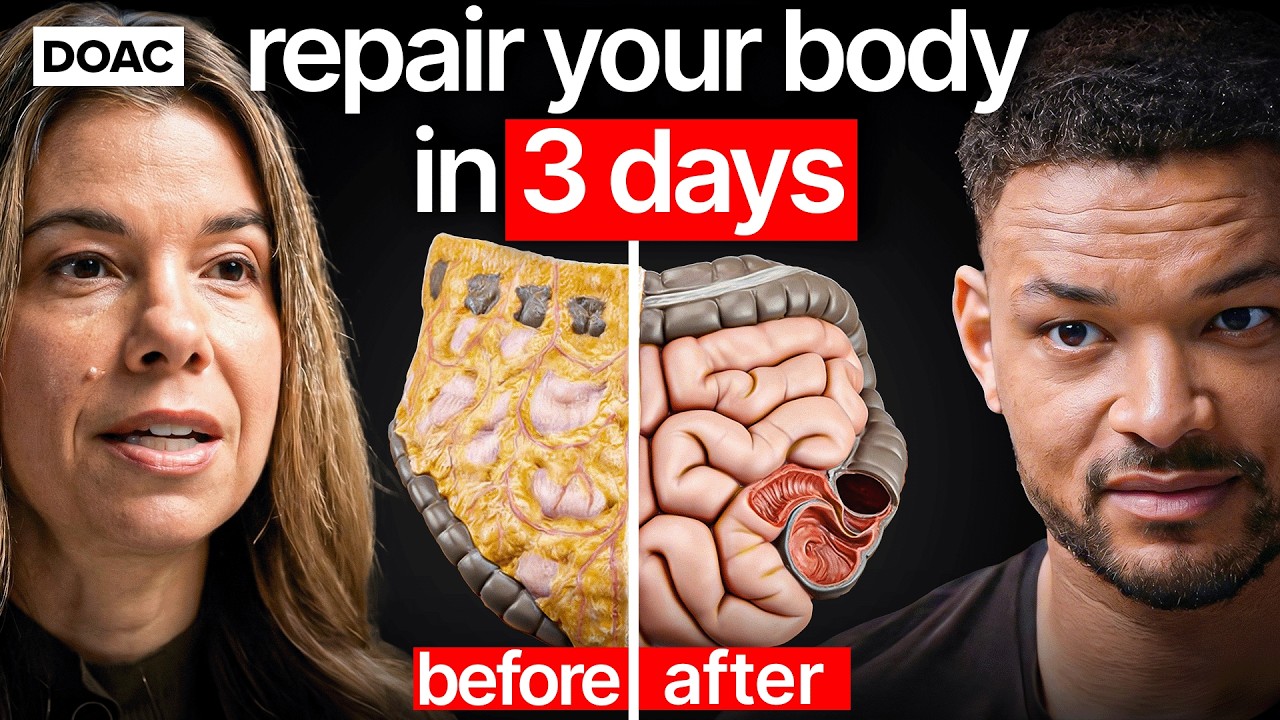
Dr. Rhonda Patrick Advocates Microplastic Reduction and High-Dose Supplementation
The Diary Of A CEO
Targeted daily doses of omega-3, vitamin D3, and creatine combined with vigorous micro-workouts offer superior protection against cognitive decline and premature biological aging than standard health guidelines.
## Background
This episode of "The Diary Of A CEO," hosted by Steven Bartlett, was published on YouTube on March 30, 2026. The video features longevity scientist Dr. Rhonda Patrick discussing how visceral fat affects organ health and early death risk, alongside actionable evidence-based strategies for sleep, fasting, exercise, supplement protocols, and avoiding daily environmental toxins.
## TL;DR
Dr. Rhonda Patrick breaks down the physiological mechanisms driving visceral fat accumulation, metabolic dysfunction, and cellular aging. She provides specific, evidence-backed protocols to optimize healthspan and peakspan, covering environmental toxin mitigation, liposomal supplement delivery, high-intensity exercise, and the nuances of GLP-1 weight-loss drugs. Throughout the discussion, she emphasizes how targeted lifestyle modifications—such as high-dose omega-3s, resistance training, short vigorous exercise bouts, and continuous glucose monitoring—can measurably reverse biological aging and preserve cognitive function.
## Atmosphere & style
The conversation carries an urgent, highly authoritative, yet accessible energy driven by Dr. Patrick's scientific rigor and Steven Bartlett's engaging curiosity. The mood balances alarming eye-openers about everyday hazards—like microplastics, sleep deprivation, and rebound weight gain—with empowering, practical solutions. It feels like an intense, deep-dive masterclass that blends cutting-edge biomedical research with grounded, real-world health advice.
## Key takeaways
- [02:45](https://www.youtube.com/watch?v=PyhmvAL-iYw&t=165s) Visceral fat behaves like an active, toxic endocrine organ, significantly raising the risk of metabolic disease, cardiovascular issues, and early mortality.
- [14:23](https://www.youtube.com/watch?v=PyhmvAL-iYw&t=863s) Just two weeks of inadequate or disrupted sleep can cause an 11% increase in visceral fat, even without any overall weight gain.
- [01:04:10](https://www.youtube.com/watch?v=PyhmvAL-iYw&t=3850s) Thermal paper receipts are coated with unbound BPA/BPS that rapidly absorbs through the skin, a process accelerated up to 100-fold by hand sanitizers and lotions.
- [01:02:41](https://www.youtube.com/watch?v=PyhmvAL-iYw&t=3761s) High-speed friction in plastic blenders and boiling water in standard coffee machines leach microplastics and endocrine disruptors directly into food and drinks.
- [01:20:46](https://www.youtube.com/watch?v=PyhmvAL-iYw&t=4846s) A daily 10-gram dose of creatine monohydrate saturates brain tissue to eliminate mid-afternoon cognitive fatigue and buffer against sleep deprivation.
- [01:17:48](https://www.youtube.com/watch?v=PyhmvAL-iYw&t=4668s) A low Omega-3 index carries a mortality risk equivalent to smoking cigarettes, whereas higher levels correlate with an extra 5 years of life expectancy and a 66% lower Alzheimer's risk.
- [01:33:49](https://www.youtube.com/watch?v=PyhmvAL-iYw&t=5629s) Urolithin A triggers mitophagy to clear damaged mitochondria, boosting VO2 max, muscle strength, and immune cell populations in older adults.
- [01:41:35](https://www.youtube.com/watch?v=PyhmvAL-iYw&t=6095s) Exogenous ketones raise circulating beta-hydroxybutyrate (BHB) to enhance focus and neuroplasticity, but they suppress lipolysis and temporarily pause body fat burning during a fast.
- [01:46:39](https://www.youtube.com/watch?v=PyhmvAL-iYw&t=6399s) Peakspan measures how long an individual maintains ~90% of their biological peak capacity, requiring early physical and cognitive training to prevent age-related decline.
- [02:05:01](https://www.youtube.com/watch?v=PyhmvAL-iYw&t=7501s) Outsourcing critical thinking and writing tasks to AI can nearly halve brain functional connectivity and weaken long-term memory retention.
- [02:10:54](https://www.youtube.com/watch?v=PyhmvAL-iYw&t=7854s) Public exercise guidelines understate vigorous activity; accelerometer data shows 1 minute of vigorous exercise equals 4 minutes of moderate activity for all-cause mortality reduction.
- [02:16:42](https://www.youtube.com/watch?v=PyhmvAL-iYw&t=8202s) Short 'exercise snacks'—such as 3.5 to 9 minutes of vigorous daily movement—can reduce cancer mortality by up to 40% and cardiovascular mortality by 50%.
- [02:29:34](https://www.youtube.com/watch?v=PyhmvAL-iYw&t=8974s) Discontinuing GLP-1 weight-loss drugs causes intense rebound hunger and rapid weight regain unless muscle mass is preserved through resistance training and high protein intake.
- [02:34:44](https://www.youtube.com/watch?v=PyhmvAL-iYw&t=9284s) An Omega-3 index finger-prick test and a Continuous Glucose Monitor (CGM) offer high-value, low-cost ways to track metabolic health and dietary needs.
## Detailed walkthrough
### [00:00](https://www.youtube.com/watch?v=PyhmvAL-iYw&t=0s) Teaser: Everyday Toxins, Peakspan, and the Hidden Danger of Visceral Fat
The episode opens with biomedical scientist Dr. Rhonda Patrick warning about the constant bombardment of endocrine-disrupting chemicals found in everyday household items. During a quick tour of host Steven Bartlett's kitchen, Dr. Patrick points out major offenders—from plastic items made from recycled electronics to thermal paper receipts covered in Bisphenol A (BPA). She notes a concerning study in adolescent boys where BPA exposure was linked to a 50% drop in testosterone levels.
Shifted to the studio, Dr. Patrick introduces the concept of **peakspan**—remaining within 90% of your peak physical and cognitive capacity. Peak function in muscle mass, bone density, and cognition generally peaks around age 25 before embarking on a steady decline. However, targeted lifestyle interventions can dramatically alter this trajectory: engaging in 5 hours of exercise a week (including high-intensity interval training) can reverse cardiac aging by up to 20 years, while proper sleep and specific protocols dramatically slow immune and brain aging.
Dr. Patrick then highlights a physical prop sitting on the table—a yellow, squishy model representing visceral fat. She delivers a stark warning: carrying high amounts of this specific fat type can double your risk of early mortality.
- **Peakspan Definition:** Staying at or above 90% of maximum physical and cognitive functionality.
- **BPA & Testosterone Link:** Study data showed paper receipts covered in BPA were associated with a 50% reduction in testosterone among adolescent boys.
- **Heart Aging Reversal:** Engaging in 5 hours of exercise per week, including HIIT, can reverse heart age by 20 years.
---
[02:45](https://www.youtube.com/watch?v=PyhmvAL-iYw&t=165s) Why Visceral Fat Is More Dangerous Than You Think
Steven holds up a yellow, gelatinous model representing visceral fat, admitting he is at a stage in his life (age 33) where metabolic health can shift dramatically over the next decade. Dr. Patrick clarifies that unlike subcutaneous fat—the outer layer of adipose tissue you can pinch under your skin—visceral fat lies deep within the abdominal cavity, wrapping around crucial organs like the liver, kidneys, and intestines. Crucially, a person can appear visually lean on the outside while carrying dangerous levels of deep belly fat internally (often referred to as TOFI: "Thin Outside, Fat Inside").
Dr. Patrick breaks down how visceral fat levels scale across age demographics and genders:
* **Age 30:** Men average ~1.2 lbs; Women average ~0.5 lbs.
* **Age 40:** Men average ~1.7 lbs; Women average ~0.7 lbs.
* **Age 50:** Men average ~2.2 lbs; Women average ~1.0 lb.
* **Age 60:** Men average ~2.7 lbs; Women average ~1.54 lbs.
By age 50, roughly 50% of men and 70% of women carry high, clinically risky amounts of visceral fat.
Visceral fat acts less like simple storage and more like an active, dysfunctional organ. It constantly secretes inflammatory cytokines that activate the immune system unnecessarily and cause structural damage to cells. Because of this persistent systemic inflammation, individuals with high visceral fat face a 44% higher risk of developing metastatic cancers. Furthermore, visceral fat continuously breaks down stored triglycerides into free fatty acids and spews them into the bloodstream, ignoring normal hormonal signals.
[07:37](https://www.youtube.com/watch?v=PyhmvAL-iYw&t=457s) The Cascade of Insulin Resistance and Brain Fog
Dr. Patrick explains how visceral fat drives insulin resistance. Normally, after eating, blood glucose spikes, prompting the pancreas to release insulin—acting like a "taxi driver" that picks up glucose and safely delivers it into liver, muscle, and adipose tissue for storage as glycogen. However, the relentless release of free fatty acids from visceral fat blocks insulin from doing its job. Because the "taxi driver" cannot drop off its cargo, elevated glucose remains trapped in the bloodstream.
To counteract this danger, the pancreas freaks out and pumps out massive amounts of extra insulin (hyperinsulinemia) to force glucose uptake. This overcompensation overshoots the mark, causing a steep drop in blood sugar—known as reactive hypoglycemia or a "glucose crash." An hour or two after a meal, the individual feels suddenly exhausted, brain-fogged, and hit with intense cravings for energy-dense, sugary foods. Over time, this vicious cycle exhausts the pancreas, laying the groundwork for type 2 diabetes.
Beyond metabolic breakdown, chronic activation of the immune system by visceral fat drains massive amounts of cellular energy away from the brain. The circulating inflammatory molecules cross into the central nervous system, disrupting neurotransmitters and producing persistent lethargy, fatigue, and brain fog.
- **Metastatic Cancer Risk:** High visceral fat correlates with a 44% higher risk of metastatic cancer.
- **Proxy Measurement:** Waist circumference over 35 inches for women or over 40 inches for men signals elevated visceral fat.
- **DEXA Gold Standard:** Ideal visceral fat mass on a DEXA scan should be under 300 grams (closer to 0 g is optimal).
- **Hormonal Drivers:** Decreasing estrogen during perimenopause/menopause shifts female fat storage from subcutaneous sites to visceral abdominal areas, while declining testosterone in aging men reduces visceral fat burning.
<FollowUp label="Want to know how poor sleep rapidly spikes visceral fat, or explore Dr. Patrick's fasting protocols?" query="Continue walking through the transcript covering sleep deprivation, visceral fat accumulation, and intermittent fasting."/>
[15:00](https://www.youtube.com/watch?v=PyhmvAL-iYw&t=900s) Sleep Loss and the Rapid Accumulation of Visceral Fat
The impact of sleep deprivation on body composition is far more insidious than simple weight gain on a scale. Dr. Rhonda Patrick highlights a striking study involving healthy, college-aged men who were subjected to just two weeks of inadequate sleep. At the end of the two weeks, the participants had gained an **11% increase in visceral fat**, despite not gaining a single pound on the scale. Their overall scale weight remained unchanged, but their internal body composition shifted dangerously toward storing fat around their internal organs.
Visceral fat does not simply sit passively; it actively drives systemic metabolic dysfunction. Even small increases—measured in mere grams rather than pounds—begin to trigger insulin resistance and set the stage for non-alcoholic fatty liver disease (NAFLD). Because the liver is directly surrounded by this accumulating fat, it becomes overwhelmed and unable to process the overload, resulting in fat storage within the liver itself—a condition once rare in young, healthy individuals but now increasingly common.
- **Study findings:** 2 weeks of poor sleep caused an **11% increase in visceral fat** in healthy young men without any overall weight gain.
- **Pathology:** Visceral fat triggers immediate metabolic dysfunction, including insulin resistance and non-alcoholic fatty liver disease (NAFLD).
---
[15:53](https://www.youtube.com/watch?v=PyhmvAL-iYw&t=953s) Ultra-Processed Excess Calories and Brain Insulin Resistance
In addition to poor sleep, diet quality and caloric excess act as major drivers for visceral fat accumulation. Dr. Patrick outlines a study in which healthy young men were fed a caloric excess of **1,200 to 1,500 extra calories per day**—primarily sourced from ultra-processed foods (equivalent to adding an extra meal like a Big Mac, fries, and a Coke). The results were remarkably rapid: within just **5 days**, participants began storing visceral fat, showed early signs of fatty liver, and developed insulin resistance in the brain.
Brain insulin resistance is a critical yet often overlooked consequence of poor diet. Insulin plays a pivotal role in signaling to the brain how energy should be partitioned and stored throughout the body. When the brain becomes resistant to insulin, it can no longer send proper signals to regulate energy storage, causing the body to revert to storing excess calories as visceral fat by default.
- **Caloric surplus tested:** 1,200–1,500 extra calories daily from ultra-processed foods.
- **Timeframe:** Visceral fat storage, early fatty liver markers, and brain insulin resistance occurred after only 5 days.
- **Brain function:** Insulin signals the brain to coordinate energy storage; when disrupted, the body defaults to storing fat viscerally.
---
[17:39](https://www.youtube.com/watch?v=PyhmvAL-iYw&t=1059s) The 3-Hour Rule: Late-Night Eating and Sleep Architecture
Steven Bartlett notes that combining poor sleep with late-night eating severely impairs his cognitive function, articulation, and mental clarity for days afterward. Dr. Patrick confirms this observation, advising that one should strictly avoid eating a large meal within **3 hours of going to bed**. Digestion activates the **sympathetic nervous system** (the "fight-or-flight" response), which directly competes with the **parasympathetic nervous system** ("rest and digest" or recovery state) required for deep, restorative sleep.
> "When you eat a meal within an hour of bedtime, you're digesting all that. Your sympathetic nervous system is active. And even if you're sleeping, it's not good sleep. It's fragmented sleep."
If circumstances force a late meal, Dr. Patrick advises against staying up late to compensate; instead, one should simply go to sleep and avoid making late eating a routine habit. When late-night nourishment is unavoidable, choosing light options—such as a simple protein shake with almond milk or foods high in **resistant starch**—minimizes digestive stress while supporting health:
* **Resistant Starch Benefits:** Cooked and cooled potatoes or rice (which can be reheated before eating) and green bananas contain resistant starch. This prebiotic fiber feeds the gut microbiome and has been shown to improve sleep quality.
---
[20:17](https://www.youtube.com/watch?v=PyhmvAL-iYw&t=1217s) Key Drivers of Visceral Fat and the Vicious Cycle of Insulin Resistance
Visceral fat gain is driven by a cluster of lifestyle factors, with chronic stress and alcohol consumption playing prominent amplifying roles:
- **Chronic Stress:** Persistently elevated cortisol prevents normal energy storage, directing excess calories straight into visceral fat deposits.
- **Excess Alcohol:** Alcohol consumption heavily prioritizes visceral fat accumulation—commonly recognized as the classic "beer belly," which is purely visceral fat rather than fluid or abdominal bloating.
Visceral fat creates a dangerous feedback loop with insulin resistance. Visceral fat actively induces insulin resistance, and higher insulin resistance in turn accelerates further visceral fat storage, causing metabolic health to spiral downward quickly.
Insulin resistance occurs when cells stop responding to the hormone's signal—like a telephone ringing that you cannot hear—preventing insulin from clearing glucose out of the bloodstream where it can cause structural damage. While excess refined glucose contributes to this strain, visceral fat itself remains one of the primary root causes of systemic insulin resistance.
---
[23:31](https://www.youtube.com/watch?v=PyhmvAL-iYw&t=1411s) Reversing Insulin Resistance: Aerobic Exercise vs. Resistance Training
Reflecting on her own experience as a new mother wearing a continuous glucose monitor (CGM), Dr. Patrick recalls being appalled to discover her fasting and postprandial (post-meal) glucose levels in the pre-diabetic range. Despite eating a clean diet, the combination of severe sleep deprivation, high stress, and temporary physical inactivity in the early months postpartum severely compromised her metabolic health.
Turning to scientific literature, she found that vigorous aerobic exercise acts as a powerful intervention to reverse insulin resistance and clear visceral fat rapidly:
- **Aerobic Exercise (Cardio):** Running, jogging, cycling, and swimming drive substantial energy expenditure and are uniquely effective at stripping away visceral fat.
- **Resistance Training (Lifting Weights):** While essential for building muscle, improving general metabolism, and increasing muscle glucose uptake, lifting weights alone does not significantly reduce visceral fat deposits.
- **Rapid Mobilization:** Visceral fat is extraordinarily metabolically active, making it the **first type of fat to be burned** during caloric deficits, aerobic exercise programs, or weight-loss interventions (including GLP-1 receptor agonists).
---
[25:41](https://www.youtube.com/watch?v=PyhmvAL-iYw&t=1541s) Intermittent Fasting and the Morning "Metabolic Switch"
Intermittent fasting acts primarily as a practical, frictionless tool for achieving a caloric deficit without the cognitive burden of tracking food or counting calories. Beyond calorie reduction, fasting triggers a fundamental biochemical shift: the **metabolic switch** from utilizing carbohydrates/glucose to burning fatty acids and generating ketones.
Dr. Patrick personalizes this through a **16:8 time-restricted feeding schedule** (fasting for 16 hours, eating within an 8-hour window), choosing to skip breakfast to prolong her overnight fast into the morning:
1. **Glycogen Depletion:** It takes roughly **10 to 12 hours** of fasting for the liver to exhaust its stored glycogen (the body's internal "petrol station").
2. **Fat Mobilization:** Once glycogen is depleted, the body switches to burning fatty acids pulled directly from adipose and visceral fat tissue.
3. **Cognitive Clarity via Ketones:** The resulting ketones supply efficient fuel to the brain and serve as evolutionary signaling molecules, enhancing focus and alertness to help locate food.
4. **Anxiety Reduction:** Ketones elevate levels of **GABA** (gamma-aminobutyric acid), an inhibitory neurotransmitter that lowers background anxiety and promotes calm, focused concentration.
<ElicitationsGroup message="To explore these metabolic and longevity strategies further:">
<Elicitation label="Summarize Dr. Patrick's exercise protocol for visceral fat" query="What specific cardio and exercise protocols does Dr. Rhonda Patrick recommend for burning visceral fat?"/>
<Elicitation label="Explain how resistant starch improves gut health and sleep" query="How does resistant starch form in foods, and what are its exact mechanisms for gut health and sleep?"/>
</ElicitationsGroup>
[30:03](https://www.youtube.com/watch?v=PyhmvAL-iYw&t=1803s) Why Your Body Repairs Itself When You Stop Eating
Dr. Rhonda Patrick explains that she prefers staying in a fasted state during the morning hours because it creates a distinct mental clarity for her work and triggers a vital "metabolic switch." Beyond reducing caloric intake, fasting provides the necessary window for cellular repair. While fed states are essential for anabolic growth, growth inevitably generates cellular damage that accelerates aging if left unaddressed. Although low-level repair processes occur continuously, fasting heightens and accelerates these mechanisms once liver glycogen stores are depleted.
To capitalize on these biological benefits, Dr. Patrick pairs her fasting routine with fasted cardiovascular exercise, such as three-mile runs or cycling sessions. She notes that while longer distance training (like a ten-mile run) requires explicit fuel, shorter aerobic workouts performed in a fasted state trigger superior physiological adaptations compared to non-fasted workouts.
- **Mechanisms of Fasted Aerobic Exercise:** Exercise naturally causes transient oxidative damage and inflammation. In response, the body activates robust antioxidant and anti-inflammatory pathways.
- **Mitochondrial Biogenesis:** Training while fasted forces the body to become more efficient at burning and oxidizing fat, which promotes the creation of new, healthy mitochondria—the energy-producing organelles vital for brain, heart, and lung function.
---
[32:46](https://www.youtube.com/watch?v=PyhmvAL-iYw&t=1966s) Fasted Training: Does It Burn More Fat or Backfire?
Addressing the ongoing debate over whether fasted exercise benefits men and women equally, Dr. Patrick emphasizes that individual feedback is the most critical metric. Listening to one's body takes priority; if an individual feels terrible during a fasted workout, they should consume food. Furthermore, duration and intensity alter the physiological stress: a 30-minute run is manageable fasted, whereas a two-hour run demands proper refueling.
Dr. Patrick addresses the specific risks women face when combining high-volume exercise with excessive caloric deficits. In these scenarios, the body suppresses key reproductive hormones—such as follicle-stimulating hormone (FSH) and luteinizing hormone (LH)—leading to amenorrhea and a cessation of ovulation. From an evolutionary perspective, the body shuts down reproduction when it perceives insufficient energy to sustain a pregnancy.
- **Target Audience for Exercise-Induced Amenorrhea:** This condition primarily affects high-volume or elite female athletes who under-fuel relative to their energy output, rather than casual exercisers.
- **Personal Anecdote:** Dr. Patrick shares that in her early 20s, while training 8 to 10 miles a day, five days a week for marathons and eating only minimal foods like carrots and hummus, she personally triggered this hormonal shutdown.
- **Middle-Ground Recommendation:** For those who feel poorly training on an empty stomach, consuming a light protein shake with almond milk offers a middle ground without requiring a full meal.
---
[35:43](https://www.youtube.com/watch?v=PyhmvAL-iYw&t=2143s) Why Belly Fat Spikes During Perimenopause—and What Helps
At age 47 and currently in perimenopause, Dr. Patrick discusses how age-related hormonal shifts make belly fat management significantly more challenging. Citing data from the SWAN (Study of Women's Health Across the Nation) study, she highlights that women experience an accelerated accumulation of visceral fat starting roughly two years before their final menstrual period, driven by a sharp drop in estrogen.
Estrogen normally directs fat storage away from vital organs toward peripheral areas like the thighs and hips. As estrogen plummets, fat storage rapidly shifts toward the abdomen. Dr. Patrick recalls noticing her own belly fat expanding almost overnight without any changes in standard blood hormone panels. To counter this 8% to 10% annual visceral fat increase typical during perimenopause, she relies heavily on intermittent fasting combined with strategic nutrition and resistance training.
- **Reproductive Lifespan Markers:** The average age of menopause is 50 to 52. Ovarian aging is strongly influenced by the age of first menstruation, maternal age at menopause, obesity, and exposure to endocrine-disrupting chemicals, which can bring on menopause up to two years early.
- **Preserving Muscle Mass:** Any caloric restriction protocol must prioritize adequate protein intake and resistance training. Without these signals, weight loss will include muscle atrophy alongside visceral fat loss.
- **Age-Related Changes in Men:** Men's testosterone and growth hormone levels peak in their late 20s and drop roughly 1% per year after age 30. Between ages 25 and 65, men experience an average 200% increase in visceral fat—even if total body weight remains unchanged—due to declining testosterone and increasingly sedentary lifestyles.
- **Visceral Fat Risks:** Unlike subcutaneous fat or traditional blood markers (such as HbA1c or lipid panels), visceral fat silently wraps around internal organs, doubling the risk of early mortality while altering daily well-being.
---
[42:14](https://www.youtube.com/watch?v=PyhmvAL-iYw&t=2534s) 3 Hormone-Disrupting Chemicals You’re Exposed to Daily
Steven Bartlett notes that male testosterone levels have dropped by up to 20% over the last two decades. While lifestyle choices like high refined sugar consumption, poor sleep, and deficiencies in zinc or magnesium contribute to this decline, Dr. Patrick points to environmental toxins as the primary driver. We are constantly exposed to man-made endocrine-disrupting chemicals (EDCs) designed to make plastics durable or materials water-, oil-, and fire-resistant.
Dr. Patrick identifies three major classes of endocrine disruptors present in modern environments:
1. **Bisphenol A (BPA):** Found in plastic water bottles and the synthetic linings of paper to-go coffee cups. Even products labeled "BPA-free" often substitute it with Bisphenol S (BPS), which exhibits similar or worse hormonal toxicity.
2. **Phthalates:** Plasticizers added to increase flexibility and durability in widespread consumer products.
3. **PFAS ("Forever Chemicals"):** Per- and polyfluoroalkyl substances used for stain, oil, and water resistance, most famously coating traditional non-stick Teflon cookware.
- **Biological Impact:** PFAS chemicals target thyroid function and accelerate ovarian aging, pulling the onset of menopause forward by one to two years in highly exposed women.
- **Hormone Mimicry:** BPA acts as an estrogen mimetic, binding to estrogen receptors to either improperly activate them or block natural estrogen from working. It also binds to androgen receptors, directly interfering with testosterone function in men.
[45:29](https://www.youtube.com/watch?v=PyhmvAL-iYw&t=2729s) The Hormonal Havoc of Phthalates and BPA
The conversation delves deep into how everyday plastics systematically dismantle endocrine function, focusing heavily on phthalates—the chemical plasticizers used to make PVC piping, food wrapping, and personal care products pliable. Dr. Rhonda Patrick warns that because phthalates are lipophilic (fat-loving), they migrate effortlessly from plastic wrappers into fatty foods like cheese, steaks, and poultry. Once inside the body, phthalates and bisphenol A (BPA) target the endocrine system from multiple angles: they bind directly to androgen receptors and disrupt testicular testosterone synthesis. The developmental consequences are stark. Studies reveal that adolescent boys with the highest BPA levels have 50% lower testosterone than those with the lowest levels, alongside severe reductions in sperm count, proper morphology, and motility.
The threat extends even into the womb. Pregnant women exposed to elevated phthalate levels risk altering the anatomical development of male fetuses. Dr. Patrick notes a alarming rise in congenital conditions like hypospadias and cryptorchidism (undescended testicles), which drastically elevate lifelong risks of infertility and testicular cancer. Beyond male reproductive health, these chemicals accelerate ovarian aging, disrupt thyroid regulation, and alter early neurodevelopment. Remarkably, maternal BPA exposure is linked to a sixfold increase in the offspring's risk of autism spectrum disorder. This occurs partly because BPA inhibits aromatase, the essential enzyme that converts testosterone into brain-masculinizing estrogen during fetal development.
* **Teen Testosterone Deficit:** Adolescent boys in the highest quartile of BPA exposure exhibit **50% lower testosterone levels** compared to those in the lowest quartile.
* **Adult Male Hormone Reduction:** Men with high phthalate levels suffer an average **20% reduction in circulating testosterone**.
* **Cryptorchidism Trends:** Approximately **20% of newborn boys** now present with an undescended testicle, a rate heavily tied to prenatal environmental toxin exposure.
* **Autism Risk Escalation:** High maternal BPA levels during pregnancy correlate with a **6-fold increase** in the incidence of autism spectrum disorder in children.
* **Mechanism of Action:** BPA inhibits the enzyme **aromatase**, disrupting the conversion of testosterone to estrogen needed to properly masculinize the developing male brain.
---
[49:59](https://www.youtube.com/watch?v=PyhmvAL-iYw&t=2999s) Actionable Avoidance Strategies and the Detoxification Power of Sulforaphane
To mitigate these daily exposures, Dr. Rhonda Patrick outlines practical lifestyle shifts and biochemical solutions. On the avoidance front, she strongly advises eliminating plastic water bottles, avoiding plastic-lined single-use coffee cups by using stainless steel mugs (such as a Yeti), and sharply curtailing the consumption of canned foods. Canned soups are particularly hazardous because they are sealed hot using sterile processing techniques, causing the plastic can linings to leach massive quantities of BPA into the liquid. While total avoidance is nearly impossible, the body possesses inherent phase 2 detoxification pathways capable of processing and excreting these fat-soluble compounds through urine once converted into water-soluble forms.
The master activator of these phase 2 detoxification enzymes is **sulforaphane**, an Nrf2-pathway activator found in high concentration within cruciferous vegetables. While mature broccoli contains sulforaphane, 3-to-4-day-old broccoli sprouts contain up to 100 times more. Because growing fresh sprouts carries bacterial contamination risks and prep friction, Dr. Patrick opts for a clinically validated supplement called Avmacol by Nutramax. Interesting clinical trial data demonstrates that sulforaphane supplementation improves behavioral metrics in autistic children—a population biologically prone to retaining environmental toxins due to a roughly 30-fold lower baseline excretion rate of BPA.
* **Canned Soup Exposure:** Consuming canned soup lined with plastic resin can increase circulating urinary BPA levels by over **1,000%**.
* **Broccoli Sprouts Potency:** Broccoli sprouts contain up to **100 times higher concentrations of glucoraphanin** (the precursor to sulforaphane) than fully grown mature broccoli.
* **Supplementation Choice:** Dr. Patrick utilizes **Avmacol** (by Nutramax), citing 12 published clinical studies validating its stability and efficacy.
* **Autism Excretion Deficit:** Children on the autism spectrum excrete BPA at a rate roughly **30 times lower** than neurotypical controls, worsening their internal toxic load.
---
[52:53](https://www.youtube.com/watch?v=PyhmvAL-iYw&t=3173s) Kitchen Audit: Uncovering Toxins in Daily Takeout and Containers
Spurred by the realization of how ubiquitous these chemicals are, Steven Bartlett invites Dr. Patrick into his studio kitchen for a spontaneous, real-time audit of his team's food and food storage containers. The atmosphere shifts to a hands-on examination of common items people consume daily without a second thought. Holding up a stack of black plastic takeaway containers left by the crew, Dr. Patrick urges Steven to grab a trash bag immediately. Black plastic is notoriously hazardous because it is largely manufactured from recycled electronic waste (e-waste), which is loaded with toxic flame retardants. When hot, greasy food is placed inside black plastic, these flame retardants and phthalates migrate directly into the meal.
Navigating through the remaining containers, Dr. Patrick ranks kitchen materials based on safety. She notes that heat and acidity act as double accelerators for chemical leaching; putting hot or spicy food into plastic containers exponentially increases toxin migration. Paper bowls with a waxy coating are a step up from black plastic, but the absolute gold standard for meal storage is heat-resistant Pyrex glass equipped with natural bamboo or silicone lids. When Steven asks about cold salad containers, Dr. Patrick concedes that while cold temperatures slow down chemical migration, microplastics still shed from the clear walls.
> "You're eating BPA hot sauce... Heat, acidic foods—not good in plastic."
* **Black Plastic Origins:** Black food containers are frequently manufactured from **recycled e-waste**, introducing toxic **polybrominated diphenyl ether (PBDE) flame retardants** directly into food.
* **Leaching Accelerators:** Heat, fat content, and acidity are the three primary environmental factors that accelerate chemical leaching from plastic into food.
* **Gold Standard Alternative:** Pyrex glass containers paired with bamboo or non-plastic lids eliminate both microplastic shedding and endocrine disruptor leaching.
---
[57:43](https://www.youtube.com/watch?v=PyhmvAL-iYw&t=3463s) Microplastics, Bottled Water, and Safe Condiment Storage
As the kitchen tour continues, Steven points out his collection of glass-bottled sparkling waters, assuming they are pristine. Dr. Patrick reveals a counterintuitive scientific nuance: studies show that glass-bottled water often contains a higher numerical count of microplastics than plastic bottled water. This occurs because the painted logos and internal plastic seals on metal bottle caps shed microplastic fragments during high-speed industrial capping and transportation. However, Dr. Patrick clarifies why she still drinks from glass: the particles shed from bottle caps are larger microplastics that pass harmlessly through the gastrointestinal tract and are excreted in feces. Conversely, plastic bottles leach billions of sub-micron **nanoplastics** that readily cross the gut barrier directly into systemic blood circulation.
The audit turns to the refrigerator door, where condiment storage practices are evaluated. Dr. Patrick commends Steven for keeping high-acidity items like ketchup and hot sauce in glass jars rather than squeeze bottles. Acidic liquids continuously react with plastic walls, turning everyday condiments into delivery vehicles for phthalates and BPA. She advises swapping out plastic-packaged mustards and flexible plastic-wrapped cheeses for glass containers and unbleached parchment paper wrappings, eliminating unnecessary exposure points in daily routines.
> "When it comes to microplastics, size matters... Glass bottled water has more microplastics, but plastic bottles have tons of nanoplastics that get into your gut and your bloodstream."
* **Microplastics in Glass:** Glass-bottled water exhibits high microplastic counts primarily due to polymer degradation from **painted metal caps and lining seals**.
* **Nanoplastic Danger:** Plastic water bottles release millions of **nanoplastics** per liter—particles small enough to cross cell membranes and accumulate in vital organs.
* **Condiment Risk:** Acidic condiments (ketchup, hot sauce, mustard) stored in plastic squeeze bottles aggressively pull plasticizers out of the container walls.
[01:00:43](https://www.youtube.com/watch?v=PyhmvAL-iYw&t=3643s) The Safest Way to Store Food and Kitchen Utensil Hazards
Continuing their audit of everyday household products, Dr. Rhonda Patrick and Steven Bartlett analyze how chemical leaching occurs in food packaging and cooking gear. Examining a block of cheese, Dr. Patrick points out that fat-soluble toxins, such as phthalates and bisphenols, readily seep into high-fat foods when wrapped in soft, clingy plastic film. To minimize exposure, she recommends purchasing foods stored in rigid plastic containers or alternative materials rather than tightly wrapped plastic film where liquid or fat sits directly against the material. Turning to eggs, Bartlett jokingly asks if they are safe, to which Dr. Patrick enthusiastically confirms that eggs in paper cartons are a great, chemical-free option.
The conversation shifts to common kitchen utensils, with Bartlett pulling out a set of spatulas and serving spoons. While stainless steel and plain wooden utensils are completely safe, Dr. Patrick warns against typical plastic spatulas—especially those made of black plastic. Black plastic is frequently manufactured from recycled e-waste and can contain toxic flame retardants and brominated compounds known to cause cancer. She also cautions that while pure silicone is theoretically inert, many commercial silicone utensils are blended with cheap plastic fillers. When subjected to high cooking heat, these low-grade silicone and plastic utensils leach harmful chemicals directly into hot meals.
- **Fat-soluble leaching:** Phthalates and BPAs rapidly migrate into high-fat foods (like cheese) when wrapped in soft plastic packaging.
- **Utensil choices:** Plain wood and stainless steel are ideal. Standard plastic utensils—especially black plastic made from recycled electronics—contain flame retardants and carcinogens that leach under heat.
- **Silicone caveats:** Many budget silicone kitchen utensils are mixed with plastic fillers that degrade when exposed to frying temperatures.
[01:02:41](https://www.youtube.com/watch?v=PyhmvAL-iYw&t=3761s) Nonstick Cookware Hazards and Blender Microplastics
Examining cookware, Bartlett brings out high-end stainless steel pans (such as All-Clad). Dr. Patrick praises stainless steel as the ultimate choice because it completely lacks plastic liners, PFAS, or nonstick coatings. She explains that traditional nonstick pans (such as those coated with Teflon) rely on "forever chemicals" (PFAS) that release toxic compounds when heated, contaminating food. While acknowledgeing that stainless steel requires slightly better cooking technique to prevent sticking, she stresses that the health benefits far outweigh the minor inconvenience.
Dr. Patrick highlights another often-overlooked source of kitchen contamination: plastic blenders. High-speed blending causes extreme friction against the plastic pitcher walls, which sheds orders of magnitude more microplastics and attached chemicals directly into smoothies. To avoid drinking millions of microplastic particles with every healthy shake, she explains that she replaced her household plastic blender with a high-power blender equipped with a stainless steel pitcher.
- **Cookware:** Stainless steel and cast iron are safe; nonstick pans (Teflon) contain PFAS forever chemicals that migrate into food during cooking.
- **Blender microplastics:** High-speed friction between food and plastic blender pitchers breaks down the surface, releasing high concentrations of microplastics into liquid mixtures.
- **Solution:** Opt for stainless steel blender pitchers when making daily shakes or purees.
[01:04:10](https://www.youtube.com/watch?v=PyhmvAL-iYw&t=3850s) The Hidden Danger of Receipts and BPA Exposure
Bartlett hands Dr. Patrick a standard paper receipt, which she handles gingerly by the very edge, prompting Bartlett to joke that she is holding it "like it's feces." Dr. Patrick agrees with the sentiment, explaining that thermal paper receipts are heavily coated with loose Bisphenol A (BPA) or Bisphenol S (BPS) to enable inkless thermal printing. Because BPA is fat-soluble, it easily crosses the skin barrier into the bloodstream. The risk escalates dramatically when people use hand sanitizers or lotions; the alcohol and oils in skin products act as dermal penetration enhancers, increasing BPA absorption into the body up to a hundredfold.
Dr. Patrick warns that cashiers and retail workers who handle thermal paper throughout the day show alarmingly elevated urinary BPA levels. She strongly advises cashiers to wear nitrile gloves—noting specifically that latex gloves do not stop BPA penetration. For general consumers, she advises declining paper receipts or opting for digital versions sent via email. Recalling a study on adolescent boys, she reiterates that high BPA levels correlate with a 50% drop in testosterone during critical developmental years, making receipt paper an unsuspected driver of endocrine disruption.
- **Thermal paper receipts:** Coated with unbound BPA/BPS that rubs off directly onto the skin.
- **Absorption multiplier:** Hand sanitizers and lotions act as skin penetration enhancers, increasing BPA dermal absorption by roughly 100-fold.
- **Occupational protection:** Cashiers should wear **nitrile gloves** (latex is ineffective against BPA absorption) or request digital receipt workflows.
- **Hormonal impact:** BPA exposure is strongly tied to suppressed testosterone levels in young males.
[01:06:14](https://www.youtube.com/watch?v=PyhmvAL-iYw&t=3974s) Water Filtration Systems and Re-mineralization
Inspecting Bartlett's kitchen water setup, Dr. Patrick compares standard pitcher-style filters to reverse osmosis (RO) systems. Pitcher filters that pass water through plastic housings and plastic cartridges may remove gross sediments or chlorine, but they can reintroduce microplastics and chemicals into the water. In contrast, reverse osmosis water filtration—whether installed under the sink or as a counter-top unit—is the gold standard for removing microplastics, nanoplastics, BPA, PFAS, and heavy metals.
However, Dr. Patrick notes an important caveat with reverse osmosis: because RO systems clear out nearly all ultra-small particles, they also strip away beneficial minerals and trace elements like magnesium, iodine, manganese, and phosphorus. To offset this, she advises anyone drinking RO-filtered water to either add liquid mineral drops back into their water or ensure they take a well-rounded multivitamin and mineral supplement to prevent trace element deficiencies.
- **Pitcher filters:** Often pass water through plastic components, potentially leaking microplastics back into the filtered water.
- **Reverse Osmosis (RO):** Effectively removes nanoplastics, microplastics, PFAS, and industrial chemicals.
- **Re-mineralization:** RO filtration strips essential minerals; drinking water should be re-mineralized with liquid trace-element drops, or nutritional gaps covered via daily supplementation.
[01:07:36](https://www.youtube.com/watch?v=PyhmvAL-iYw&t=4056s) Coffee Maker Plastics and Low-Toxin Coffee Alternatives
Turning to espresso and coffee machines, Dr. Patrick points out that standard coffee makers run boiling water through internal plastic tubing and plastic brew baskets, extracting plasticizers directly into the hot coffee. Bartlett shares his own setup, showing a frozen coffee concentrate pod system called Cometeer. He demonstrates how the aluminum pod drops directly into a glass without entering a heated machine circuit, allowing hot water from a kettle to be poured straight over it.
Bartlett discloses transparently that Cometeer is a sponsor and that he is an investor in the company. Dr. Patrick commends the design concept from a chemical-exposure perspective, expressing relief that hot water isn't forcing its way through heated plastic tubes.
- **Standard coffee machines:** Heating water through internal plastic piping and plastic capsules leaches endocrine disruptors into the beverage.
- **Safer brewing:** Using glass, stainless steel, or direct-pour methods prevents heat-induced plastic leaching.
[01:09:05](https://www.youtube.com/watch?v=PyhmvAL-iYw&t=4145s) Analyzing Steve's Supplement Stack: Glutathione vs. Liposomal Forms
Bartlett opens his personal supplement cabinet to review specific products with Dr. Patrick, starting with a bottle of standard reduced glutathione. Dr. Patrick explains that while glutathione is the master cellular antioxidant that protects the brain and body against oxidative stress and aging, standard oral glutathione supplements are virtually useless. Because human cells lack specific transport proteins to absorb raw glutathione from the digestive tract into the cell interior, plain oral supplements are broken down or excreted without raising intracellular levels.
To effectively boost cellular antioxidant levels, Dr. Patrick recommends switching to **liposomal glutathione**. Liposomal delivery encapsulates the glutathione molecule in a lipid membrane that fuses directly with cell walls, drastically increasing bioavailability.
> "Because our body makes it inside of our cells, we don't have a transporter to get glutathione from the outside of our cells into our cells... You're going to want to get something called liposomal glutathione."
- **Glutathione function:** Essential intracellular antioxidant that neutralizes free radicals and prevents cellular aging.
- **Standard oral glutathione:** Ineffective due to poor digestive stability and lack of cellular transport mechanisms.
- **Liposomal form:** Encapsulates the molecule in phospholipids, enabling high cellular absorption.
[01:10:38](https://www.youtube.com/watch?v=PyhmvAL-iYw&t=4238s) Vitamin D3 vs. D2 and Biological Age Reversal
Next, Bartlett holds up a bottle of Vitamin D3. Dr. Patrick clarifies the difference between Vitamin D3 (cholecalciferol) and Vitamin D2 (ergocalciferol). Vitamin D3 is the active form synthesized in human skin via sunlight (and found naturally in sheep lanolin or lichen), whereas D2 is a plant-derived form found in mushrooms. She warns that D2 is far less effective at raising blood levels of active vitamin D than D3. For vegetarians or vegans seeking a non-animal source, she advises choosing Vitamin D3 sourced specifically from **lichen**.
Highlighting a recent large-scale clinical study, Dr. Patrick notes that individuals who are vitamin D deficient experience accelerated biological aging. Crucially, when deficient individuals supplemented with Vitamin D3, they slowed their biological aging by nearly **2 years**. She emphasizes that while Vitamin D3 will not reverse aging in people who already have optimal levels, correcting a baseline deficiency is a powerful, science-backed way to protect longevity—especially for individuals with darker skin tones (higher melanin), who require significantly more sun exposure to synthesize adequate vitamin D naturally.
- **D3 vs. D2:** Vitamin D3 is significantly more bioactive and effective than plant-derived D2.
- **Vegan option:** Look for lichen-derived D3 rather than standard D2.
- **Biological age impact:** Supplementing D3 in deficient individuals reduced epigenetic aging by nearly 2 years.
- **Melanin factor:** Higher skin melanin acts as natural sunscreen, increasing the need for sun exposure or targeted D3 supplementation.
[01:12:19](https://www.youtube.com/watch?v=PyhmvAL-iYw&t=4339s) Multivitamins, Cognitive Protection, and Slowing Epigenetic Aging
Addressing multivitamins, Dr. Patrick shares striking data from the large-scale **COSMOS trial** (Cosmetic and Multivitamin Outcomes Study). In older adults (aged 65 and older) taking a daily baseline multivitamin (Centrum Silver), researchers observed remarkable cognitive benefits: global brain aging was reversed by **2.1 years**, while episodic memory aging (the ability to recall specific events and daily details) was delayed by nearly **5 years**.
Furthermore, follow-up data published from the COSMOS trial demonstrated that two years of daily multivitamin use measurably slowed biological (epigenetic) aging by several months. Dr. Patrick emphasizes that while a few months of slowed aging over two years might sound modest, the cumulative effect over decades of consistent use adds up substantially. She describes taking a well-formulated multivitamin as "low-hanging fruit"—a simple, accessible daily habit that supplies essential cofactors (B vitamins, vitamin C, D3, E, K, selenium, and trace minerals) required to run metabolic, immune, and neurotransmitter pathways properly.
- **COSMOS Trial brain findings:** Daily multivitamin intake in older adults reversed global brain aging by 2.1 years and episodic memory decline by almost 5 years.
- **Epigenetic age deceleration:** Daily multivitamin supplementation measurably slowed biological aging markers over a 2-year period.
- **Nutritional insurance:** Multivitamins fill crucial trace mineral and vitamin gaps caused by depleted soils and dietary shortfalls.
[01:14:36](https://www.youtube.com/watch?v=PyhmvAL-iYw&t=4476s) The Flaws of the Supplement Industry and the Danger of Iron Overload
Dr. Rhonda Patrick opens this section by highlighting two fundamental reasons people struggle to get adequate nutrition from their food alone. First, modern agricultural soils have become heavily depleted of vital minerals due to industrial farming practices and chemical treatments like organophosphates (specifically glyphosate). Second, typical modern diets rely heavily on processed foods and takeout rather than micronutrient-dense foods like dark leafy greens and colorful fruits and vegetables. When Steven Bartlett asks how to tell a good multivitamin from a bad one—confessing that he usually just buys the most expensive bottle on the shelf—Dr. Patrick cautions that the supplement industry is largely unregulated. Companies are free to market products that may contain far less active ingredient than claimed, or dangerously too much.
To illustrate the risks of unverified formulas, Dr. Patrick notes that independent testing has discovered certain vitamin D3 and melatonin supplements containing up to 1,000 to 10,000 times the labeled dose. Because melatonin is a hormone that regulates sleep architecture, consuming massive unintentional overdoses can severely disrupt normal bodily functions. She strongly advises buying only from reputable brands that undergo third-party testing by independent organizations like ConsumerLab.
Furthermore, Dr. Patrick points out a critical mistake many men make when selecting a multivitamin: taking supplemental iron. When Steven reveals that a non-scientist friend advised him to drink iron supplements when he was feeling sick, Dr. Patrick explains that unless a man is medically diagnosed with iron deficiency or anemia, supplemental iron is harmful. Free iron is highly reactive and triggers severe oxidative stress, causing damage to cellular structures and DNA. This issue is compounded in individuals who unknowingly carry genes for hemochromatosis, a common condition that leads to iron overload.
```
Iron Requirement Profiles Across Demographics
┌───────────────────────┬─────────────────────────────────────────────────┐
│ Group │ Supplementation Need │
├───────────────────────┼─────────────────────────────────────────────────┤
│ Adult Males │ Unnecessary & dangerous (causes oxidative damage)│
│ Premenopausal Females │ Recommended (16% deficient; blood loss/exercise)│
│ Postmenopausal Females│ Unnecessary (needs shift to match male profile) │
└───────────────────────┴─────────────────────────────────────────────────┘
```
- **Soil Mineral Depletion:** Organophosphates such as glyphosate drain essential minerals from agricultural soil, resulting in lower nutrient density in produce.
- **Melatonin Overdoses:** Independent lab testing has revealed unregulated sleep supplements containing up to 10,000-fold the stated amount of melatonin.
- **Iron Toxicity in Men:** Excessive iron acts as "free iron," generating reactive oxygen species that inflict oxidative damage on cells and DNA.
- **Premenopausal Women & Iron:** Roughly 16% of menstruating women suffer from iron deficiency. Intense endurance exercise further drives iron loss through red blood cell breakdown (hemolysis).
---
[01:17:48](https://www.youtube.com/watch?v=PyhmvAL-iYw&t=4668s) The Game-Changing Anti-Aging Power of Omega-3 Fatty Acids
Turning to omega-3 fatty acids, Dr. Patrick describes fish oil as one of the single most transformative interventions available for expanding healthspan and slowing biological aging. The vast majority of the population suffers from a baseline deficiency: 90% of Americans and 80% of people globally do not consume enough EPA and DHA from marine sources. Citing landmark observational and interventional research, she notes that having a high omega-3 index correlates with a five-year increase in overall life expectancy. In fact, a low omega-3 index carries a mortality risk comparable to smoking cigarettes. Furthermore, individuals with high omega-3 levels experience a 66% lower risk of developing Alzheimer's disease.
Dr. Patrick highlights a Swiss clinical trial in which active older adults were supplemented with omega-3 fish oil, vitamin D, and a resistance training protocol over one year. The results showed that omega-3 supplementation independently slowed biological and epigenetic aging. When all three interventions were combined, participants reversed their biological age by four months in just one year, while experiencing a 60% reduction in pre-frailty and a significantly lower incidence of cancer.
To obtain these protective benefits, Dr. Patrick advises taking a daily dose of 1.6 to 2 grams of EPA and DHA. However, she warns Steven about how he stores his fish oil. Because omega-3s are polyunsaturated fatty acids, their double bonds render them extremely susceptible to lipid peroxidation when exposed to light, heat, or oxygen. Consuming rancid or oxidized fats causes inflammation rather than reducing it.
> "If you're a smoker and you have a high omega-3 index, then you're going to live as long as a non-smoker with a low omega-3 index... The low omega-3 index is like smoking."
- **Global Deficiency:** 90% of Americans and 80% of the global population fail to reach optimal omega-3 intake levels.
- **Epigenetic Clock Reversal:** Combining omega-3s, vitamin D, and resistance exercise reduced biological age by 4 months in a 12-month study.
- **Clinical Outcomes:** Maintaining a optimal omega-3 index cuts Alzheimer's risk by 66% and reduces the risk of pre-frailty by 60%.
- **Storage Protocol:** Keep bulk fish oil stock in the freezer and current bottles in the refrigerator to prevent lipid oxidation. Look for brands with a Total Oxidation (TOTOX) value under 10.
The discussion shifts to creatine, a supplement Dr. Patrick considers essential for daily physical and mental performance. While creatine monohydrate has long been praised in fitness circles for increasing muscle power output and strength, Dr. Patrick emphasizes its underappreciated impact on the central nervous system. Standard physical dosing sits around 5 grams per day; however, Dr. Patrick recently doubled her daily intake to 10 grams specifically to target brain metabolism. Brain tissue requires higher systemic concentrations to bypass transport limits because skeletal muscle aggressively absorbs circulating creatine first.
At a 10-gram daily dose, clinical studies demonstrate measurable uptake of creatine into brain tissue. Dr. Patrick notes that this higher dose completely eliminated her mid-afternoon cognitive fatigue. Furthermore, acute high-dose creatine supplementation (between 20 to 25 grams, scaled to body weight) acts as a powerful buffer against sleep deprivation. Research proves that high doses can preserve cognitive performance and executive functioning during acute sleep loss, keeping the brain operating at or above its normal baseline.
Steven asks about the old-school bodybuilding myth of "creatine loading." Dr. Patrick clarifies that loading protocol (20 grams daily for 3 to 4 days) was created by researchers to rapidly saturate muscle tissues within tight study windows. For normal daily use, taking 5 grams continuously will achieve full muscle saturation within three to four weeks without needing a heavy loading phase.
Addressing market quality, Steven mentions a viral investigation by fitness creator James Smith showing that several commercial creatine gummies contained zero active creatine. Dr. Patrick confirms this finding, explaining that gummification degrades fragile active compounds. She urges consumers to stick to pure creatine monohydrate powder that carries **NSF Certified for Sport** verification to guarantee purity and avoid heavy metals like lead.
> "Studies have shown if you go up to a higher dose... it helps you basically negate the negative effects on your brain from sleep deprivation where not only are you cognitively functioning, you're functioning beyond what your even normal baseline was."
- **Brain Saturation Threshold:** A 10-gram daily dose is required to overcome muscle uptake priority and increase brain tissue creatine levels.
- **Sleep Deprivation Protocol:** Temporary doses of 20–25 grams shield cognitive performance against the mental decline caused by acute sleep loss.
- **Saturation Timeline:** Consistent daily intake of 5 grams saturates muscle stores within 21 to 28 days; a initial high-dose "loading phase" is optional.
- **Digestive Side Effects:** If 5 grams causes stomach cramps or bloating, split the dose into two 2.5-gram servings taken with meals containing carbohydrates.
- **NSF Certification:** Always verify that creatine products feature the "NSF Certified for Sport" seal to guard against toxic byproducts, lead contamination, and fake formulas.
---
[01:26:10](https://www.youtube.com/watch?v=PyhmvAL-iYw&t=5170s) The Ultimate Top 5 Daily Supplement Stack
Steven challenges Dr. Patrick to narrow down the absolute most crucial supplements into a ranked "Top 5" list applicable to both men and women. Without hesitation, she lays out her top recommendations based on human clinical data, biological necessity, and widespread population deficiencies.
```
Dr. Rhonda Patrick's Top 5 Supplement Stack
Rank Supplement Primary Mechanism & Biological Target
────── ─────────────── ───────────────────────────────────────────────────
1 Fish Oil Reduces systemic inflammation, slows biological aging
2 Vitamin D Regulates gene transcription, supports immune duty
3 Multivitamin Fills micronutrient gaps, optimizes metabolic pathways
4 Magnesium Required for 300+ enzymes and active DNA repair
5 Creatine Enhances cellular ATP energy in muscle and brain
```
Dr. Patrick ranks **Fish Oil** first for its systemic anti-inflammatory, neuroprotective, and longevity benefits, closely followed by **Vitamin D** and a high-quality **Multivitamin** to cover baseline nutritional gaps.
She then places **Magnesium** in the fourth spot, explaining that it serves as an indispensable cofactor for over 300 enzymatic reactions in the human body. Crucially, magnesium is required by the cellular machinery that constantly scans and repairs damaged DNA—damage triggered by environmental toxins, metabolic byproducts, poor sleep, or excess iron. Studies directly link adequate magnesium levels to lower rates of DNA damage, reduced cancer risk, and improved sleep quality. Given that over 50% of the population fails to meet basic dietary magnesium requirements due to a lack of dark leafy greens and nuts, supplementation provides immediate physiological dividends. Dr. Patrick rounds out her top list with **Creatine** at number five to optimize cellular energy production across both brain and muscle tissues.
- **Magnesium Deficiency Rate:** At least 50% of the general population suffers from inadequate magnesium intake.
- **Enzymatic Activity:** Magnesium acts as an essential cofactor for more than 300 biochemical reactions in the body.
- **Genomic Stability:** Magnesium facilitates critical DNA repair mechanisms that protect cells against oncogenic mutations and premature cellular aging.
[01:27:45](https://www.youtube.com/watch?v=PyhmvAL-iYw&t=5265s) Sponsor Break: Cometect, Ketone-IQ, and DOAC Circle
Before picking back up with the remaining supplements on the table, the episode takes a quick break to highlight key sponsors and special announcements. Steven Bartlett shares his genuine enthusiasm for Cometeer coffee, recounting how founder Matt shipped a box of these flash-frozen coffee cubes directly to his London office. The team’s Slack channel exploded with rave reviews, marveling at how popping out a frozen cube and pouring hot water over it delivers an exceptionally fresh, full-flavored cup by locking in taste at its absolute peak. Bartlett also opens up about his journey with Ketone-IQ, revealing that after trying a surprise package left on his desk by his colleague Lily, it completely transformed focus, energy, and overall productivity for nearly 40% of his office—prompting him to become both an official co-owner and sponsor. Lastly, Bartlett issues an exclusive invitation to his listeners to join the newly launched DOAC Circle, an inner-circle private community capped at its first 10,000 members. Inside, members gain direct access to Bartlett, unreleased podcast episodes, behind-the-scenes clips, and the actual interview briefs sitting on his iPad during recordings.
- **Cometeer Coffee Special Offer:** Listeners can claim $30 off their first order by visiting `[cometeer.com/steven](https://cometeer.com/steven)`.
- **Ketone-IQ Special Offer:** Available at `[ketone.com/steven](https://ketone.com/steven)` for 30% off plus a free gift on the second shipment; now also stocked in U.S. Target stores with the first shot free.
- **DOAC Circle Membership:** Access to the exclusive private community is available at `doaccircle.com`.
---
[01:31:13](https://www.youtube.com/watch?v=PyhmvAL-iYw&t=5473s) Curcumin: The Anti-Inflammatory Powerhouse Backed by Science
Returning to the studio table, Dr. Rhonda Patrick highlights phytosomal curcumin as another staple in her personal daily regimen. Derived from the turmeric plant, curcumin stands out as one of the most robust and consistent natural compounds for lowering systemic inflammation. Unlike non-steroidal anti-inflammatory drugs (NSAIDs) such as ibuprofen—which can blunt important training adaptations when taken around exercise by suppressing necessary prostaglandins—curcumin lowers inflammation without inhibiting muscle adaptation. Specifically, it targets and suppresses tumor necrosis factor alpha (TNF-alpha), a major pro-inflammatory cytokine that aggressively accelerates epigenetic aging. Highlighting its profound impact, Dr. Patrick notes that patients with autoimmune conditions like rheumatoid arthritis who take TNF-alpha-inhibiting medications experience an extraordinary 50% reduction in their risk of developing Alzheimer's disease.
To overcome curcumin's poor natural bioavailability—since the liver recognizes standard curcumin as a foreign compound (xenobiotic) and rapidly metabolizes it—Dr. Patrick specifically uses a phytosomal formulation (Phytosome). This advanced delivery method functions similarly to a liposome, slowing hepatic clearance and allowing the active ingredient to penetrate target cells far more effectively. By dampening performance-robbing systemic inflammation, phytosomal curcumin also offers tangible recovery and performance benefits for active individuals.
- Curcumin suppresses TNF-alpha, lowering its concentration by nearly 5 picograms per milliliter ($\text{pg/mL}$).
- Epigenetic aging clocks highlight TNF-alpha inhibition as one of the most powerful mechanisms for slowing biological age.
- Phytosomal technology prevents the liver from rapidly breaking down curcumin as a foreign xenobiotic compound.
---
[01:33:49](https://www.youtube.com/watch?v=PyhmvAL-iYw&t=5629s) Urolithin A: Rejuvenating Mitochondria and the Immune System
Moving to one of the most cutting-edge molecules on her radar, Dr. Patrick introduces Urolithin A. Naturally produced when specific gut microbes metabolize dietary polyphenols known as ellagitannins—found in pomegranates, walnuts, and berries—Urolithin A suffers from a major drawback: roughly 50% of the human population lacks the necessary gut bacterial strains to convert ellagitannins into active Urolithin A. Early preclinical studies conducted by Swiss researchers demonstrated that administering Urolithin A to aging mice yielded a staggering 20% lifespan extension alongside remarkable tissue rejuvenation. In human clinical trials utilizing muscle biopsies, 1,000 milligrams ($\text{mg}$) daily was proven to trigger **mitophagy**—the targeted cellular cleanup of damaged, dysfunctional mitochondria—without needing extended fasting.
Beyond clearing cellular "trash," Urolithin A delivers profound immune and athletic benefits. In older adults, a daily dose of $1,000\text{ mg}$ effectively rejuvenated aging immune systems by increasing critical $\text{CD8}^+$ T cells and natural killer (NK) cells—the primary line of defense against pathogens, viral infections, and cancer cells—while simultaneously reducing markers of cellular senescence. In exercise settings, supplementing with $1,000\text{ mg}$ per day for several weeks boosted $\text{VO}_2$ max by an additional 10% in untrained individuals compared to exercise alone (and 5% in trained athletes), while improving hamstring strength in older adults by 10% to 12%. For those unable to access synthetic Urolithin A supplements, Dr. Patrick notes that drinking high-quality pomegranate juice before exercise can increase $\text{VO}_2$ max by up to 17% across combined meta-analyses.
> "Exercise causes you to make new mitochondria. So the way I look at it, Stephen, is a rejuvenation of all your mitochondria within your cells, whether we're talking about your muscle cells or your immune cells."
- **Microbiome Variance:** Only 50% of people possess the gut bacteria required to convert pomegranate ellagitannins into Urolithin A.
- **Preclinical Longevity:** Urolithin A supplementation extended mouse lifespan by 20%.
- **Immune Rejuvenation:** $1,000\text{ mg/day}$ boosts $\text{CD8}^+$ T cells and NK cells while suppressing senescent cell burden.
- **Performance Gains:** Boosts $\text{VO}_2$ max by up to 10% over exercise alone and increases muscle strength by 10–12%.
---
[01:39:24](https://www.youtube.com/watch?v=PyhmvAL-iYw&t=5964s) Glutamine: Immune Support, Cellular Energy, and Gut Healing
Dr. Patrick completes her personal core supplement lineup with the amino acid glutamine. While widely recognized as a building block for protein, glutamine plays far broader physiological roles: it serves as a precursor to glutamate (a key excitatory neurotransmitter) and is converted into alpha-ketoglutarate, a critical intermediate substrate that cellular mitochondria burn for energy. Dr. Patrick began supplementing with glutamine after reviewing research on endurance athletes—a population highly vulnerable to upper respiratory infections due to extreme training stress. These studies revealed that glutamine supplementation significantly reduced respiratory illness rates by fueling hungry immune cells. Reflecting on her time as a graduate researcher, she recalled how rapidly active immune cells consume glutamine as a primary energy source.
This immune-protective effect proved essential in her mid-40s, especially while parenting a young child routinely bringing home school pathogens. In addition to bolstering immune defenses, glutamine plays a vital role in gastrointestinal health. Because enterocytes (gut lining cells) rapidly take up alpha-ketoglutarate derived from glutamine to fuel repair and maintain tight junction integrity, glutamine is exceptionally effective at repairing damaged gut mucosa and soothing gastrointestinal distress.
- **Immune Fuel:** Primary substrate consumed by active white blood cells to combat respiratory pathogens.
- **Mitochondrial Substrate:** Converts to alpha-ketoglutarate to power cellular energy pathways.
- **Gastrointestinal Repair:** Directly nourishes gut epithelial cells, assisting in mucosal barrier restoration and integrity.
---
[01:41:35](https://www.youtube.com/watch?v=PyhmvAL-iYw&t=6095s) Exogenous Ketones: Shortcut to Energy and Metabolic Switching
Transitioning into metabolic fuel shortcuts, Steven Bartlett brings up exogenous ketone drinks, noting that he takes Ketone-IQ shots nearly every day (with occasional weekend breaks). Dr. Patrick confirms that she also uses exogenous ketones frequently. Exogenous ketone drinks work by rapidly raising blood concentrations of beta-hydroxybutyrate ($\text{BHB}$)—the primary circulating ketone body produced during deep fasting, prolonged exercise, or strict ketogenic dieting—without requiring carbohydrate restriction. This shift flips the body's "metabolic switch," providing the brain and skeletal muscle with an immediate, highly efficient alternative energy source.
- **Primary Molecule:** Raises circulating levels of beta-hydroxybutyrate ($\text{BHB}$).
- **Metabolic Mimicry:** Replicates the elevated ketone state achieved through prolonged fasting or carbohydrate restriction.
[01:42:17](https://www.youtube.com/watch?v=PyhmvAL-iYw&t=6137s) Exogenous Ketones, BHB, and the Trade-Offs of Fasting
Dr. Rhonda Patrick and Steven Bartlett break down the chemical mechanics of exogenous ketone supplements, focusing heavily on beta-hydroxybutyrate (BHB). Dr. Patrick explains that while the body produces ketones like acetone and acetoacetate during a fast, beta-hydroxybutyrate is the dominant ketone body. They compare popular commercial formulations on the market, such as Ketone-IQ—which utilizes 1,3-butanediol—versus direct esterified forms often called "Oxford ketones." The 1,3-butanediol precursor must pass through the liver to be converted into BHB, providing a slower, longer-lasting elevation. In contrast, esterified compounds pair 1,3-butanediol directly with BHB, delivering both an immediate spike and a sustained tail-end effect.
Steven points out the steep price disparity between these options, noting that entry-level products like Ketone-IQ sell for a few dollars per serving, whereas high-concentration esterified formulations (like the Oxford ester) cost around $30 per shot. Dr. Patrick shares that she takes exogenous ketones before high-stakes tasks—such as podcasts, public presentations, or heavy research—because BHB acts as a powerful signaling molecule. It elevates GABA (an inhibitory neurotransmitter that quiets mental chatter and reduces anxiety) and boosts brain-derived neurotrophic factor (BDNF), which supports learning, memory, and neuroplasticity while lowering oxidative stress.
However, Dr. Patrick delivers a critical caveat that many consumers miss: exogenous ketones suppress lipolysis (the breakdown of your own fat stores). Because the brain and body perceive an influx of external energy, fat burning temporarily halts until the supplemental BHB clears the bloodstream—a window of roughly three hours. For individuals fasting specifically for visceral fat loss, daily reliance on exogenous ketones can backfire. Steven echoes this, recalling how taking ketone shots at the start of the year prevented him from entering natural nutritional ketosis. Only after stopping the shots and letting his body adapt through a strict ketogenic diet was he able to hit ketosis, after which he reintroduced ketone shots strategically for cognitive focus during podcasting sessions.
- **Major Ketone Bodies:** Beta-hydroxybutyrate (BHB), acetoacetate, and acetone.
- **Precursor Dynamics:** 1,3-butanediol converts into BHB in the liver.
- **Product Formulations:** Direct BHB esters (e.g., Oxford ketone ester) offer faster and higher peak blood levels (~$30/dose), whereas 1,3-butanediol products (e.g., Ketone-IQ) are slower acting but far more affordable (~$2–$5/dose).
- **Neurological Benefits:** BHB crosses the blood-brain barrier, increases GABA to quiet brain chatter, upregulates BDNF for neuroplasticity, and reduces cellular oxidation.
- **Metabolic Trade-Off:** Exogenous ketones transiently shut down endogenous lipolysis (fat burning) for up to 3 hours, making them counterproductive if taken solely for active fat loss during a fast.
---
[01:46:39](https://www.youtube.com/watch?v=PyhmvAL-iYw&t=6399s) Cognitive Performance, AB Testing, and "Peakspan"
Steven describes how podcasting acts as a real-world "A/B test" for his cognitive clarity. Sitting across from world-class experts for four to five hours at a time—processing complex terminology and maintaining sharp spontaneous dialogue—has allowed him to evaluate hundreds of cognitive variables. Across 600 to 700 recorded episodes, being in a state of ketosis (whether achieved via fasting, a ketogenic diet, or strategic exogenous ketones) stands out as one of the single strongest correlations to his mental performance. He references podcast host Joe Rogan, who has noted the exact same cognitive benefits and considered remaining in perpetual ketosis specifically for interviewing.
Transitioning to a central focus of Dr. Patrick's research, Steven introduces the concept of **peakspan**—a novel longevity framework recently published in a pre-print study by researchers from Duke University and international institutions. While *lifespan* merely measures the total years lived, and *healthspan* measures years lived free of chronic disease, *peakspan* evaluates how long an individual can maintain function within 90% of their absolute biological peak.
Dr. Patrick explains that traditional healthspan can still involve a long, slow functional decline. Peakspan shifts the goalpost toward preserving optimal physical, cognitive, and immunological capacity for as long as humanly possible before any steep terminal drop-off occurs.
- **Interviewer Performance:** Both Steven Bartlett and Joe Rogan report that being in a ketogenic state significantly improves pattern recognition, verbal fluidity, and sustained focus during long-form interviews.
- **Lifespan vs. Healthspan vs. Peakspan:**
- *Lifespan:* Total number of years lived.
- *Healthspan:* Number of years lived free from major chronic diseases (e.g., Alzheimer's, cardiovascular disease, type 2 diabetes).
- *Peakspan:* The duration of life spent operating at or near peak physiological capacity (defined as within ~90% of maximum biological potential).
---
[01:50:31](https://www.youtube.com/watch?v=PyhmvAL-iYw&t=6631s) Biological Timelines: Fluid vs. Crystallized Intelligence
Walking through the peakspan model's multi-system graph, Dr. Patrick maps out how different organ systems and human capacities peak and decline at vastly different rates across an individual's lifetime. Female reproductive capacity reaches its apex around age 25 before dropping off sharply into the late 30s and 40s. Musculoskeletal health (peak muscle mass, bone density, and strength), cardiorespiratory fitness ($VO_2\text{ max}$), and immune function all peak between ages 20 and 25, initiating a gradual biological decline thereafter.
Cognitive capacity, however, exhibits a striking duality between **fluid intelligence** and **crystallized intelligence**:
- **Fluid Intelligence:** Processing speed, working memory, and the capacity to solve novel logic problems without prior knowledge. This peaks early—around age 20 to 25—and steadily declines.
- **Crystallized Intelligence:** The cumulative database of facts, experiential pattern recognition, and learned information synthesized over a lifetime. This peaks much later—around age 40 to 45.
Steven connects this finding directly to entrepreneurship and leadership. Reflecting on a dinner conversation with his team—which ranges in age from 27 to over 45—he notes that his own capacity for rapid pattern recognition and applying cross-disciplinary lessons expanded significantly after age 30. Dr. Patrick confirms that midlife is often a peak era for scientists, entrepreneurs, and thinkers precisely because their massive internal database allows them to connect disparate dots effortlessly.
The core challenge of modern longevity science, Dr. Patrick argues, is identifying interventions that flatten these decline curves—allowing individuals to maintain 90% of their peak cardiorespiratory, cognitive, and musculoskeletal capacities well into their later decades. She highlights aerobic exercise as the single most powerful universal tool to achieve this, as it stimulates BDNF, promotes neurogenesis, enhances brain plasticity, and protects overall cardiovascular resilience.
- **System-Specific Biological Peaks:**
- *Female Reproductive Capacity:* Peaks ~25, declines sharply toward age 40.
- *Immune System:* Peaks early (around adolescence/age 25) and steadily senesces.
- *Musculoskeletal & Cardiorespiratory ($VO_2\text{ max}$):* Peaks ~20–25; requires intentional exercise to arrest decline.
- *Fluid Intelligence:* Peaks ~20–25; involves raw processing speed and abstract reasoning.
- *Crystallized Intelligence:* Peaks ~40–45; relies on accumulated knowledge, wisdom, and complex pattern recognition.
- **Key Interventions for Peakspan Preservation:** Aerobic exercise (the top-tier driver for BDNF upregulation, neurogenesis, and cognitive plasticity) and high-dose Omega-3 fatty acid intake.
[01:56:38](https://www.youtube.com/watch?v=PyhmvAL-iYw&t=6998s) Cognitive Reserve, Novel Learning, and Maintaining Your Physical Peak
Dr. Rhonda Patrick emphasizes that engaging in novel cognitive experiences—whether through discussions, complex work, or learning entirely new subjects—is key to boosting both fluid and crystallized intelligence. Steven Bartlett asks if building high cognitive potential acts like peaking at a higher elevation, meaning that even as age-related decline occurs, you are falling from a much higher starting point. Dr. Patrick confirms this concept of "cognitive reserve," explaining that novelty triggers vital neurochemical changes inside the brain, including increases in brain-derived neurotrophic factor (BDNF) and glutamate activation. This same principle of building reserve capacity applies to physical health: muscle mass and bone density peak around age 25, making heavy compound resistance training—such as deadlifts and rows—essential to preserve that baseline. She reminds Steven to avoid black plastics in the fridge to protect testosterone levels, pointing out that lifestyle interventions target multiple systems at once, from preserving bone density to maintaining a resilient immune system through optimized sleep.
The conversation turns to cardiorespiratory fitness, with Dr. Patrick recalling a study discussed in a previous episode demonstrating that five hours of weekly exercise—including high-intensity interval training (HIIT)—can reverse cardiac aging by up to 20 years. Steven humorously suggests that listening to *The Diary Of A CEO* should be prescribed for cognitive health, to which Dr. Patrick agrees, noting that learning new information actively builds brain reserve. Reflecting on a conversation he had over dinner, Steven realizes that hosting the podcast two times a week for up to eight hours has had a profound, unintended benefit on his own long-term cognitive health. Dr. Patrick reinforces that learning a new language significantly reduces Alzheimer's risk, whereas retiring only to sit passively and watch television is "the worst thing someone can do," accelerating rapid cognitive decline and dementia.
- Peak muscle mass generally occurs around the age of 25, making strength training and adequate protein intake essential for maintaining physiological reserves.
- Multi-joint compound lifts like deadlifts and rows help maintain bone density via weight-bearing mechanical stress.
- Engaging in 5 hours of weekly exercise that includes HIIT has been shown to reverse heart aging by up to 20 years.
- Passive retirement spent watching television drastically speeds up cognitive decline and heightens the risk of dementia.
[02:01:01](https://www.youtube.com/watch?v=PyhmvAL-iYw&t=7261s) How AI Threatens Critical Thinking and the London Taxi Driver Effect
Steven pivots the conversation to artificial intelligence, sharing a message he received that morning from his chairman, Nikki—a veteran with 25 years at Boston Consulting Group. Nikki raised concerns about how AI will impact critical thinking across organizations and broader society. Steven notes that in his daily interactions, he can increasingly tell when he is dealing with the raw output of a ChatGPT prompt rather than a human's actual thought process. Dr. Patrick acknowledges these fears of widespread "brain rot" and cognitive laziness, explaining that while accessible, accurate information is beneficial, outsourcing raw reasoning to AI risks creating a generation that lacks fundamental critical thinking skills.
To illustrate how intense mental engagement physically reshapes the brain, Steven and Dr. Patrick discuss London taxi drivers and their rigorous training exam known as "The Knowledge." To pass, drivers must memorize over 25,000 streets and thousands of landmarks across London without relying on GPS navigation. Dr. Patrick notes how marvelous these drivers are, while Steven highlights neuroscientific findings showing that London cabbies possess physically larger hippocampi—the brain's primary memory center—and display extraordinarily low rates of Alzheimer's disease. Dr. Patrick stresses that engaging in complex, intellectually demanding tasks—whether memorizing city maps or studying cellular mechanisms like autophagy—serves as essential exercise to build lasting brain capacity.
- To earn a license, London taxi drivers spend years memorizing 25,000 streets and thousands of points of interest for "The Knowledge" without using GPS.
- Brain imaging shows London taxi drivers have physically larger hippocampi (the memory hub of the brain) due to intensive spatial navigation training.
- Cognitive reserve built through rigorous learning tasks appears to protect individuals against neurodegenerative diseases like Alzheimer's.
[02:05:15](https://www.youtube.com/watch?v=PyhmvAL-iYw&t=7515s) "Brain Atrophy" vs. the "Mental Gym" & Why Handwriting Matters
Having recently returned from the South by Southwest (SXSW) conference, Steven reflects on how society is bifurcating into two distinct groups. The first group will take the path of least resistance, delegating their thinking entirely to AI and causing key cognitive functions to atrophy over time. The second group will treat problem-solving like physical exercise, purposefully visiting a "mental gym" to grapple with complex, first-principles problems using their own minds. Steven shares that he explicitly instructs his executives during messaging exchanges: "Let's try and solve this problem with our brains." He explains that relying on AI for a quick answer deprives people of foundational understanding—analogous to knowing that 1 + 1 = 2 without ever understanding what the number one actually represents.
Steven cites a striking study on generative AI that revealed severe cognitive costs when outsourcing thought processes. In the study, 83% of AI users were unable to recall the specific details of a passage of text they had just written with AI assistance, while EEG scans demonstrated that brain connectivity was nearly halved compared to writing manually. Dr. Patrick agrees, emphasizing that physical writing—particularly handwriting—deeply ingrains information into long-term memory. She shares her personal three-step study protocol for podcasts: conducting initial research, typing notes into a Google Doc, and finally handwriting key facts and statistics into a physical notebook. Steven reveals a similar habit using his iPad, reading text on one side of the split screen while manually rewriting key concepts and data points on the other to ensure the information actually lodges in his brain.
- A featured study found that 83% of generative AI users could not remember details from a text written with AI assistance.
- EEG scans showed that brain connectivity was almost halved when individuals outsourced writing and thinking to AI compared to writing manually, creating "cognitive debt."
- Dr. Patrick utilizes a three-step learning framework: initial research, typing structured summaries into a Google Doc, and handwriting the final points into a notebook.
- Steven uses a split-screen iPad setup while reading to manually rewrite key takeaways (e.g., noting that "the gut microbiome has 42 trillion bugs") to solidify retention.
[02:10:21](https://www.youtube.com/watch?v=PyhmvAL-iYw&t=7821s) AI as a Scientific Collaborator
Dr. Rhonda Patrick and Steven Bartlett share a quick moment of banter about modern reading habits and screen time. Dr. Patrick chuckles about how she avoids iPads altogether, preferring traditional old-fashioned books and a physical paper notebook whenever she has time to read. Bartlett praises her, noting that her preference for analog reading clearly pays off given her unbelievable capacity to retain complex scientific details.
Dr. Patrick clarifies that despite avoiding personal screen distractions, she is a huge proponent of artificial intelligence in research. She describes AI as a "pretty smart collaborator" that empowers scientists to analyze massive datasets rapidly, acting as an invaluable tool to accelerate scientific discovery.
---
[02:10:54](https://www.youtube.com/watch?v=PyhmvAL-iYw&t=7854s) Why Current Exercise Guidelines Are Flawed
Dr. Patrick addresses the current public health exercise guidelines, arguing forcefully that they are outdated and inadequate. Standard recommendations typically suggest 150 to 300 minutes per week of moderate-intensity exercise, or 75 to 150 minutes per week of vigorous-intensity exercise—a strict 2:1 ratio. She explains that this 2:1 formula originated purely from calorie-burning math rather than disease prevention data: running a mile burns roughly double the calories of walking a mile. Furthermore, older foundational studies relied almost entirely on self-reported questionnaires rather than objective measurements of actual physical activity.
To challenge these legacy assumptions, Dr. Patrick highlights a recent groundbreaking study that she featured in a dedicated "journal club" episode on her channel. By using wrist-worn accelerometers, researchers were able to continuously track objective activity across all intensities—light, moderate, and vigorous—and correlate those patterns directly with disease outcomes and mortality rates. The findings revealed that the true health value of vigorous exercise drastically exceeds the conventional 2:1 ratio.
* Conventional guidelines recommend a 2:1 ratio: 150–300 minutes of moderate activity or 75–150 minutes of vigorous activity per week.
* Moderate intensity equals brisk walking; vigorous intensity equals running, cycling, swimming, or fast movement.
* Traditional guidelines were built around simple caloric energy expenditure rather than hard disease mortality endpoints.
* A journal club is a regular scientific gathering (typically weekly or monthly) where researchers meticulously break down a single paper's methodology and findings.
---
[02:14:23](https://www.youtube.com/watch?v=PyhmvAL-iYw&t=8063s) The True Power of Vigorous Exercise
The objective accelerometer data revealed a dramatic disparity in how different exercise intensities protect against chronic disease and death. For all-cause mortality, achieving the risk reduction of just 1 minute of vigorous exercise required doing 4 minutes of moderate exercise or 100 to 150 minutes of light physical activity. The gap becomes even wider when examining specific conditions:
* **Cardiovascular Disease Mortality:** 1 minute of vigorous exercise equals 8 minutes of moderate exercise or 200 minutes of light exercise.
* **Type 2 Diabetes Risk:** 1 minute of vigorous exercise equals 10 minutes of moderate exercise or 100 to 200 minutes of light exercise.
* **Cancer Mortality:** 1 minute of vigorous exercise equals about 4 minutes of moderate exercise or 250 to 300 minutes of light activity.
Dr. Patrick stresses that public health messaging needs an urgent overhaul: going for a fast run or elevating your heart rate pays far higher dividends for longevity than standard guidelines suggest.
---
[02:16:42](https://www.youtube.com/watch?v=PyhmvAL-iYw&t=8202s) "Exercise Snacks" and the Myth of 10,000 Steps
Beyond structured workouts, accelerometer tracking captured short, incidental bursts of everyday physical exertion—such as sprinting after a new puppy, playing tag with kids, or dashing up stairs. These brief "exercise snacks" yield staggering health benefits without requiring a 30-to-60-minute session at the gym.
When Bartlett brings up the ubiquitous goal of walking 10,000 steps a day, Dr. Patrick pulls a skeptical face. While emphasizing that "any exercise is better than none," she insists it is time to ditch the 10,000-step target in favor of **10 minutes a day** of heart-pumping activity. Walking around an office or house accumulates light steps, but it lacks the intensity needed to drive major cardiovascular and metabolic adaptations.
* Women engaging in just 3.5 minutes of daily vigorous activity reduced their cancer risk by 40%.
* Short bursts of vigorous exercise totaling 9 minutes spread throughout the day reduced cancer mortality by 40% and cardiovascular mortality by 50% in both men and women.
* Aiming for 10 minutes of daily heart-rate-elevating exercise provides a 50% lower all-cause mortality, 50% lower cardiovascular mortality, and 40% lower cancer mortality.
* "Exercise snacks" can include bodyweight squats, jumping jacks, high knees, or fast stair climbing.
To clear up confusion around terminology, Bartlett asks Dr. Patrick to precisely define what separates vigorous, moderate, and light activity:
* **Vigorous Intensity:** In movement-tracking accelerometer studies, this is defined as moving fast (jogging, running, swimming, cycling, or fast resistance training movements). In terms of physiological heart rate metrics, vigorous exercise typically corresponds to **70% or more of max heart rate**. (For high-intensity interval training aimed at VO2 max improvement, it reaches 80%+ of max heart rate).
* **Moderate Intensity:** Brisk movement that raises the heart rate to approximately **50% of max heart rate**.
* **Light Physical Activity:** Low-effort movement around the home or office (e.g., casual walking), which takes minimal exertion and fails to elevate the heart rate significantly.
---
[02:21:55](https://www.youtube.com/watch?v=PyhmvAL-iYw&t=8515s) Breaking Up Sedentary Time to Protect Against Cancer
Bartlett reflects on his previous conversation with Dr. Patrick, noting that her warnings about sedentary lifestyle risks resonated so deeply that he now carries a portable standing desk while traveling. He mentions having already sat in his studio chair for six hours that day. Dr. Patrick points out that being "sedentary" simply refers to the total cumulative hours spent sitting, regardless of whether a person completes a workout earlier in the day.
Sedentary behavior acts as an independent risk factor for chronic conditions, showing an exceptionally strong correlation with cancer risk. While standing desks help mitigate this, Dr. Patrick advocates taking 1-minute exercise breaks every hour. Doing a minute of bodyweight squats or jumping jacks breaks up sitting periods, sends a rush of oxygenated blood flow to the brain, delivers an immediate mental lift, and accumulates toward daily vigorous exercise goals.
> "If we were to get up and do bodyweight squats right now for one minute, like you're going to feel better. You feel better after the blood flow to your brain. It gives you a little pump. I love it. I love the pump."
---
[02:24:06](https://www.youtube.com/watch?v=PyhmvAL-iYw&t=8646s) The Rise of GLP-1 Weight Loss Drugs
Bartlett humorously jokes that instead of doing all these exercise snacks and lifestyle changes, he could just pull out a Ozempic pen, jab himself, and make the fat disappear. Turning serious, he notes how widespread GLP-1 receptor agonists have become among his social circle, acknowledging that these weight-loss drugs are genuinely saving lives for many individuals dealing with severe obesity and related metabolic issues.
[02:24:28](https://www.youtube.com/watch?v=PyhmvAL-iYw&t=8668s) GLP-1 Receptor Agonists: Benefits and Long-Term Realities
The conversation shifts to weight loss medications like Ozempic, Mounjaro, and Wegovy (GLP-1 receptor agonists). Steven Bartlett notes that individuals taking these drugs report life-changing outcomes, such as reduced knee pain and improved mobility. Dr. Rhonda Patrick agrees, pointing out that obesity accelerates the aging process and dramatically increases the risk for major age-related conditions, including cardiovascular disease, type 2 diabetes, cancer, and visceral fat accumulation. When individuals lose 30, 40, or 50 pounds, their overall disease risk drops, insulin sensitivity improves, and cognitive markers show lower risks for Alzheimer's disease.
However, Dr. Patrick emphasizes that GLP-1 agonists come with significant caveats. First-generation drugs (like semaglutide/Ozempic) target the GLP-1 receptor, while second- and third-generation versions (such as tirzepatide/Mounjaro) also target glucagon and GIP pathways for greater weight loss. These medications mimic calorie restriction and fasting by slowing gastric emptying and signaling satiety to the brain. Because they bypass the psychological effort of fasting, users drop weight rapidly. Yet, Dr. Patrick warns that patients must be prepared to stay on them for life; once discontinued, hunger returns "with a vengeance" as the body attempts to reset to its baseline weight, frequently leading to rapid weight regain.
Steven highlights a *New York Times* article profiling a woman named Stacy Canterbury, who lost 50 pounds on a GLP-1 drug before insurance issues forced her off it. Within a single month, she regained 20 pounds, describing her post-medication hunger not as a mild appetite increase, but as a "ferocious, animalistic urge to eat." Both speakers agree that there is no "free biological lunch" when altering fundamental metabolic pathways.
- **Diseases Mitigated by Weight Loss:** Cardiovascular disease, type 2 diabetes, visceral fat buildup, and Alzheimer's disease (note: kidney cancer risk slightly increases in some data).
- **Primary Mechanisms:** Slowed gastric emptying and altered satiety signaling, effectively automating calorie restriction without conscious hunger signals.
- **Weight Regain Dynamics:** Appetite returns intensely upon cessation, causing most individuals to regain all or most lost weight over the course of a year.
---
[02:29:34](https://www.youtube.com/watch?v=PyhmvAL-iYw&t=8974s) Hidden Risks: Muscle Loss, Bone Density, and "Vanity Users"
Beyond standard side effects like nausea and gastrointestinal distress, Dr. Patrick raises alarm over muscle wasting and decreased bone density caused by rapid weight loss on GLP-1s. In standard weight loss diets without adequate protein intake or resistance training, up to 40% of weight lost can come from lean mass rather than fat. GLP-1 users who skip resistance training and fail to hit protein thresholds risk severe muscle breakdown. Furthermore, questions remain around bone density reduction and whether GLP-1 receptors directly influence bone tissue or if the loss stems purely from rapid mass drop. Other clinical signals include an increased risk of gallstones (sometimes requiring gallbladder removal) and animal data showing a potential link to thyroid cancer (which carries a black-box warning).
Dr. Patrick voices particular concern over the surge in non-obese individuals using GLP-1s—ranging from Hollywood celebrities to everyday people looking to lose a quick 10 or 15 pounds. In lean or moderately healthy populations, there is no evidence that the metabolic benefits outweigh the risks of muscle degradation, gallstones, or lifelong dependence.
Steven brings up friends who have used weight loss injections and dropped weight at a startling rate, questioning if users could spiral into anorexic territory. Dr. Patrick notes that weight loss typically plateaus at a stable dose, but advises that anyone coming off the drug should gradually taper down their dosage rather than stopping abruptly, as tapering helps smooth out appetite resurgence and limits rapid rebound weight gain.
- **Lean Mass Loss Risk:** Up to 40% of weight lost during unguided weight reduction can consist of lean tissue (muscle and bone).
- **Countermeasures:** Heavy resistance training acts as a mechanical signal to preserve muscle tissue, alongside high protein consumption.
- **Off-Label / Vanity Usage:** Using GLP-1s for minor weight loss (10–15 lbs) lacks safety data justifying the risk of gallstones, muscle loss, and thyroid/kidney warnings.
- **Alternative for Minor Weight Loss:** Low-dose Ozempic yields around 5–10% body weight loss—an outcome easily achievable via intermittent fasting, which triggers the metabolic switch and ketosis without drug side effects or rebound appetite.
---
[02:34:44](https://www.youtube.com/watch?v=PyhmvAL-iYw&t=9284s) The $100 Health Upgrades: Omega-3 Testing and CGMs
To conclude the interview, Steven asks Dr. Patrick the signature podcast closing question left by the previous guest: *"What is a purchase under $100 that improved your quality of life the most?"*
Dr. Patrick shares two distinct answers:
1. **The Omega-3 Index Test (<$100):** A simple finger-prick blood spot test ordered online. It measures red blood cell fatty acid levels to ensure an individual hits the target **8% Omega-3 Index**. Reaching this threshold is linked to a 5-year increase in life expectancy and a 66% lower risk of dementia. Dr. Patrick notes that many people take low-quality omega-3 supplements that fail to raise their blood levels, making testing essential to verify efficacy.
2. **Continuous Glucose Monitor (CGM):** A small, affordable wearable sensor (available for as low as $20) that tracks real-time blood sugar levels. Wearing a CGM revealed to Dr. Patrick how severely poor sleep sabotages metabolic health. While most users focus strictly on food choices, a CGM demonstrates how a night of short sleep spikes baseline glucose and impairs the body's ability to clear sugar after meals.
- **Target Omega-3 Level:** An 8% Omega-3 Index correlates with enhanced healthspan, reduced cognitive decline, and extended lifespan.
- **Key CGM Metrics to Track:**
- *Fasting Blood Glucose:* Checked first thing in the morning before eating.
- *Postprandial Response:* Glucose clearing rate 30 to 60 minutes after a meal to verify normal insulin sensitivity.
- **Where to Find Dr. Patrick:** Her podcast and YouTube channel *FoundMyFitness*, her website (*foundmyfitness.com*), and her weekly health newsletter covering research on Peakspan and exercise guidelines.
[02:38:09](https://www.youtube.com/watch?v=PyhmvAL-iYw&t=9489s) Where to Find Dr. Rhonda Patrick & Closing Gratitude
Dr. Rhonda Patrick shares where listeners can follow her work, highlighting the free weekly email newsletter produced by her team, which provides high-quality, in-depth scientific insights. She notes that her handle, website, and podcast can all be found under the unified brand "FoundMyFitness" or her own name, Dr. Rhonda Patrick. Host Steven Bartlett promises to include all of her links in the video description and warmly praises her, remarking that he doesn't even need to tell people how incredible she is because they have just witnessed it throughout the conversation.
Steven expresses deep appreciation for Dr. Patrick’s ability to remain at the absolute cutting edge of emerging health studies. Having hosted numerous health discussions on *The Diary Of A CEO*, he reflects on how rare it is to still learn so much new information. He praises her unique gift for translating complex scientific journals into language that is "relevant, accessible, and scientifically rigorous." Steven emphasizes that as scientific understanding continuously evolves, having a trustworthy guide like her allows him and his audience to live happier, healthier lives. Dr. Patrick expresses her sincere gratitude and shares how much she enjoys coming on the show for these fun discussions.
- Dr. Patrick's newsletter is free and published weekly with in-depth health insights.
- Official handle, podcast, and platform name: **FoundMyFitness** / **Dr. Rhonda Patrick**.
- Steven summarizes Dr. Patrick's work using three core terms: **relevant**, **accessible**, and **scientifically rigorous**.
[02:38:31](https://www.youtube.com/watch?v=PyhmvAL-iYw&t=9511s) Host's Final Outro to the Audience
Steven signs off the episode by calling attention to YouTube's AI-driven recommendation algorithm. He quips that YouTube knows precisely what video each individual viewer should watch next based on their unique viewing history and behavior, encouraging the audience to click on the recommended video pop-up on their screen.
## Notable quotes
> [01:00:00](https://www.youtube.com/watch?v=PyhmvAL-iYw&t=3600s) When it comes to microplastics, size matters... Glass bottled water has more microplastics, but plastic bottles have tons of nanoplastics that get into your gut and your bloodstream. — Dr. Rhonda Patrick
> [01:09:05](https://www.youtube.com/watch?v=PyhmvAL-iYw&t=4145s) Because our body makes it inside of our cells, we don't have a transporter to get glutathione from the outside of our cells into our cells... You're going to want to get something called liposomal glutathione. — Dr. Rhonda Patrick
> [01:17:48](https://www.youtube.com/watch?v=PyhmvAL-iYw&t=4668s) If you're a smoker and you have a high omega-3 index, then you're going to live as long as a non-smoker with a low omega-3 index... The low omega-3 index is like smoking. — Dr. Rhonda Patrick
> [01:20:46](https://www.youtube.com/watch?v=PyhmvAL-iYw&t=4846s) Studies have shown if you go up to a higher dose... it helps you basically negate the negative effects on your brain from sleep deprivation where not only are you cognitively functioning, you're functioning beyond what your even normal baseline was. — Dr. Rhonda Patrick
> [01:33:49](https://www.youtube.com/watch?v=PyhmvAL-iYw&t=5629s) Exercise causes you to make new mitochondria. So the way I look at it, Stephen, is a rejuvenation of all your mitochondria within your cells, whether we're talking about your muscle cells or your immune cells. — Dr. Rhonda Patrick
> [02:21:55](https://www.youtube.com/watch?v=PyhmvAL-iYw&t=8515s) If we were to get up and do bodyweight squats right now for one minute, like you're going to feel better. You feel better after the blood flow to your brain. It gives you a little pump. I love it. I love the pump. — Dr. Rhonda Patrick
> [02:29:34](https://www.youtube.com/watch?v=PyhmvAL-iYw&t=8974s) ferocious, animalistic urge to eat
> [02:34:44](https://www.youtube.com/watch?v=PyhmvAL-iYw&t=9284s) What is a purchase under $100 that improved your quality of life the most? — Steven Bartlett
> [02:38:09](https://www.youtube.com/watch?v=PyhmvAL-iYw&t=9489s) relevant, accessible, and scientifically rigorous — Steven Bartlett
## Mentioned
Dr. Rhonda Patrick, Steven Bartlett, All-Clad, Teflon, Centrum Silver, COSMOS trial, ConsumerLab, NSF Certified for Sport, Cometeer, Ketone-IQ, DOAC Circle, James Smith, Joe Rogan, Oxford ketones, Duke University, London taxi drivers, Boston Consulting Group, Nikki, ChatGPT, Ozempic, Mounjaro, Wegovy, Stacy Canterbury, New York Times, GLP-1, FoundMyFitness, YouTube, The Diary Of A CEO
Biomedical scientist Dr. Rhonda Patrick argues that extending "peakspan"—preserving 90% of peak physical and cognitive capacity—requires eliminating visceral fat, minimizing exposure to everyday endocrine disruptors, prioritizing short bursts of vigorous exercise over step counts, and utilizing evidence-backed nutritional interventions.
Visceral Fat Pathology, Triggers, and Rapid Mobilization (2:45)
Unlike subcutaneous fat, visceral fat wraps around deep abdominal organs and functions as an active, dysfunctional endocrine organ. Dr. Patrick warns that carrying high levels of visceral fat doubles early mortality risk and increases metastatic cancer risk by 44% due to persistent cytokine secretion. Accumulation occurs rapidly: healthy young men subjected to two weeks of inadequate sleep experienced an 11% increase in visceral fat despite gaining zero scale weight. Similarly, just five days of consuming a 1,200-to-1,500-calorie surplus from ultra-processed foods induced brain insulin resistance and initiated visceral fat storage.
Because visceral fat is highly metabolically active, it is the first fat mobilized during a caloric deficit. Dr. Patrick emphasizes that vigorous aerobic exercise is uniquely effective at stripping visceral fat, whereas resistance training alone does not significantly clear it. Implementing a 16:8 intermittent fasting protocol exhausts liver glycogen within 10 to 12 hours, switching the body to burning fatty acids and producing ketones. Additionally, she advises finishing large meals at least three hours before bed to prevent sympathetic nervous system activity from degrading restorative sleep.
Vigorous Intensity and "Exercise Snacks" Outperform Step Counts (134:23)
Dr. Patrick criticizes conventional exercise guidelines that equate one minute of vigorous exercise to two minutes of moderate exercise. Drawing on objective accelerometer data, she explains that matching the all-cause mortality reduction of one minute of vigorous activity (reaching at least 70% of maximum heart rate) requires four minutes of moderate activity (around 50% max heart rate) or 100 to 150 minutes of light movement. For cardiovascular mortality, the ratio widens to one minute of vigorous exercise equaling eight minutes of moderate movement.
Rather than aiming for 10,000 steps of casual walking, Dr. Patrick advises targeting 10 minutes of daily heart-pumping activity. Short incidental bursts—termed "exercise snacks"—such as stair sprinting, jumping jacks, or bodyweight squats, yield profound protective benefits. Objective data demonstrates that accumulating just 9 to 10 minutes of vigorous physical activity throughout the day cuts cardiovascular mortality by 50% and cancer mortality by 40%.
Everyday Endocrine Disruptors and Detoxification Strategies (42:14)
Modern environments present continuous exposure to endocrine-disrupting chemicals (EDCs), including bisphenol A (BPA), phthalates, and PFAS. Dr. Patrick notes that adolescent boys with high BPA exposure exhibit a 50% reduction in testosterone, while PFAS chemicals damage thyroid regulation and accelerate menopause by one to two years. Common kitchen hazards include thermal paper receipts, plastic-lined hot coffee cups, nonstick cookware, and black plastic utensils derived from recycled electronic waste containing flame retardants. Furthermore, lipophilic phthalates easily migrate from soft plastic wraps into fatty items like cheese and meat.
To limit exposure, Dr. Patrick advises substituting nonstick pans and plastic blenders with stainless steel, choosing rigid packaging over plastic film, and using reverse osmosis filtration—adding mineral drops back to the water to prevent trace element deficiencies. Because total avoidance is impossible, she recommends enhancing the body's phase 2 detoxification pathways using sulforaphane, a compound found in high concentrations in 3-to-4-day-old broccoli sprouts that helps convert fat-soluble toxins into water-soluble forms for urinary excretion.
Supplement Protocols, Mitophagy, and Cognitive Reserve (72:19)
Reviewing dietary supplements, Dr. Patrick cites the COSMOS trial, which found that daily multivitamin use reversed global brain aging by 2.1 years and episodic memory decline by nearly 5 years in older adults. For cellular defense, standard oral glutathione is poorly absorbed, requiring a liposomal delivery system. Achieving a high omega-3 index through 1.6 to 2 grams of daily EPA and DHA is linked to a five-year increase in life expectancy, while 10 grams of daily creatine supports brain bioenergetics and resilience against acute sleep loss. For mitochondrial renewal, 1,000 mg of Urolithin A triggers mitophagy and enhances CD8+ T cells, bypassing the limitation that 50% of people lack the gut microbes to produce it naturally.
To protect the brain against age-related decline, Dr. Patrick and host Steven Bartlett emphasize building cognitive reserve through intellectually demanding tasks and handwriting. Steven highlights research indicating that outsourcing critical thinking to generative artificial intelligence nearly halves neural connectivity and sharply degrades factual recall.
GLP-1 Agonists: Clinical Value and Lean-Mass Concerns (144:28)
While acknowledging that GLP-1 receptor agonists like semaglutide and tirzepatide provide life-saving metabolic benefits for individuals with severe obesity, Dr. Patrick cautions against their widespread off-label adoption for casual weight loss. These medications mimic fasting by delaying gastric emptying and suppressing appetite, but without concurrent resistance training and adequate dietary protein, up to 40% of the lost weight can come from lean muscle mass.
Dr. Patrick warns that users face additional risks, including decreased bone density, gallstone formation, and the reality that cessation triggers an intense rebound in appetite that frequently leads to rapid weight regain. For non-obese individuals seeking to lose modest amounts of weight, she argues the metabolic advantages do not outweigh the hazards of muscle wasting and potential lifelong drug dependence.
Dr. Patrick maintains that biological aging and visceral fat accumulation can be altered through vigorous physical exertion, toxin reduction, and strategic supplementation. However, substantial practical uncertainties persist regarding the unverified quality of the commercial supplement market and the long-term skeletal and muscle consequences of pharmacological GLP-1 dependence in non-obese populations.
## Background
本期内容于 2026 年 3 月 30 日发布在 YouTube 平台播客频道《The Diary Of A CEO》,由主持人 Steven Bartlett 与知名生物医学家、FoundMyFitness 创始人 Rhonda Patrick 博士对谈。节目简介指出,内脏脂肪如同摧毁器官的毒性组织且使早逝风险翻倍,Patrick 博士在访谈中系统拆解了睡眠剥夺对内脏脂肪的刺激、日常塑料化学物对睾酮的侵蚀、间歇性断食与生酮开关、被传统指南误导的运动真相及科学抗衰策略。
## TL;DR
节目全面探讨了维持“巅峰寿命”(Peakspan)的生物学机制与生活方式干预。Patrick 博士首先揭示了内脏脂肪作为活跃毒性器官引发全身炎症、胰岛素抵抗与脑雾的路径,并强调了热敏纸小票(BPA)、塑化剂与微塑料对内分泌系统及生殖健康的惊人破坏。接着,她给出了基于临床证据的优化方案,涵盖空腹有氧训练、鱼油、维生素 D3、高剂量肌酸和尿石素 A 的协同增益,并用加速度计研究证明了零散高强度“运动点心”带来的非线性防病延寿回报。最后,对话深入剖析了 AI 时代深度思考外包带来的“认知负债”,以及 GLP-1 类减肥药物伴随的瘦体重流失与报复性反弹代价。
## Atmosphere & style
整场访谈节奏紧凑、信息密度极大,充满了前沿硬核科学与日常厨房场景碰撞出的张力。Steven Bartlett 以极具共鸣的亲身体验者身份不断追问细节,而 Patrick 博士则以数据和机制为武器,在警示现代生活危机(如塑料渗透、久坐早亡)的同时给出清晰可执行的化解之道。两人在白板工作流与健康生活细节上的共鸣,让这场长达两个半小时的硬核对谈既有令人警醒的危机感,又充满掌握生命自主权的从容与行动力。
## Bulletin
- [13:36](https://www.youtube.com/watch?v=PyhmvAL-iYw&t=816s) 两周每晚 4 小时的急性睡眠剥夺可使内脏脂肪激增 11%,且体重秤读数毫无变化;内脏脂肪作为代谢活跃的毒性内分泌器官,能使转移性癌症风险上升 44% 并使全因死亡风险翻倍。
- [01:04:10](https://www.youtube.com/watch?v=PyhmvAL-iYw&t=3850s) 热敏纸小票表面覆有高浓度游离双酚A(BPA),在涂抹护手霜或免洗洗手液后经皮吸收率暴增约 100 倍,可使青春期男性睾酮水平腰斩;日常还应规避使用易析出溴化阻燃剂的黑色回收塑料餐盒及高温塑料制品。
- [02:13:08](https://www.youtube.com/watch?v=PyhmvAL-iYw&t=7988s) 基于加速度计的客观数据颠覆了现行运动指南:1 分钟高强度运动在防心血管死亡上等效于 8 分钟中等强度或 200 分钟步行;每天仅需累计 3.5 至 10 分钟碎片化的高强度“运动点心”,即可降低 40%–50% 的癌症及心血管死亡风险。
- [01:48:18](https://www.youtube.com/watch?v=PyhmvAL-iYw&t=6498s) 抗衰老范式正由寿命跨度向维持机能处于顶峰 90% 以上的“巅峰寿命”(Peakspan)演进;针对 AI 时代带来的“思考外包”与神经连通性骤降 50% 的认知负债危机,规律有氧运动与纸笔手写二次编码是构筑认知储备的核心防护壁垒。
## Key takeaways
- [02:45](https://www.youtube.com/watch?v=PyhmvAL-iYw&t=165s) 内脏脂肪是致命的毒性内分泌器官:它持续分解游离脂肪酸阻断胰岛素信号,诱发系统性慢性炎症与脑雾,即使外表精瘦的“瘦胖子”(TOFI)腹腔内也可能大量堆积,DEXA 扫描读数应严格控制在 300 克以下。
- [13:36](https://www.youtube.com/watch?v=PyhmvAL-iYw&t=816s) 睡眠剥夺与睡前饱腹会急剧恶化代谢机能:连续 2 周缺觉即可促使脂肪直接向腹腔内脏转移;睡前 3 小时内进食会激活交感神经并损害次日认知敏锐度,而将主食彻底冷却生成抗性淀粉则能滋养肠道并促进深睡。
- [24:10](https://www.youtube.com/watch?v=PyhmvAL-iYw&t=1450s) 间歇性断食与空腹耐力训练协同开启代谢开关:禁食 10 至 12 小时后肝糖原耗尽,机体切换为脂肪酸氧化与生酮供能模式;空腹进行中轻度有氧运动比饱腹状态更能强力促进骨骼肌线粒体新生,强化全天脂肪氧化效率。
- [32:46](https://www.youtube.com/watch?v=PyhmvAL-iYw&t=1966s) 女性围绝经期内脏脂肪以每年 8%–10% 的速度激增:雌激素断崖式下跌剥夺了对皮下脂肪的保护性引导,此时采用断食控重必须严格匹配高蛋白摄入与抗阻力量训练,防止宝贵肌肉流失并警惕下丘脑性闭经。
- [39:05](https://www.youtube.com/watch?v=PyhmvAL-iYw&t=2345s) 环境内分泌干扰物是男性睾酮危机的核心推手:BPA、邻苯二甲酸酯及 PFAS 广泛潜伏于生活用品中,会直接钝化雄激素受体并阻碍睾丸激素合成;孕期接触邻苯二甲酸酯与男婴高达 20% 的隐睾症相关,高 BPA 暴露使后代自闭症风险增加 6 倍。
- [54:47](https://www.youtube.com/watch?v=PyhmvAL-iYw&t=3287s) 厨房排毒需聚焦酸热介质并善用内源性解毒机制:高温、酸性及辛辣酱汁会剧烈催化塑料有害成分析出,应换用玻璃器皿与不锈钢破壁机;摄入高浓度西兰花芽苗中的萝卜硫素,能激活肝脏二相解毒酶高效排出体内脂溶性 BPA。
- [01:26:10](https://www.youtube.com/watch?v=PyhmvAL-iYw&t=5170s) 基石抗衰补剂的选择与避坑:鱼油、维生素 D3、复合维生素、镁与肌酸构成高证据等级的长寿补剂组合;大型 COSMOS 试验证实复合维生素可逆转老年人记忆衰老,但男性选购时必须避开含铁配方以防止铁过载引起的氧化应激。
- [01:20:47](https://www.youtube.com/watch?v=PyhmvAL-iYw&t=4847s) 肌酸具备深层脑力修复与抗疲劳潜力:传统 5 克日剂量优先被骨骼肌截留,提升至 10 克才能有效穿透血脑屏障消除午后脑疲劳,睡眠不足时临时增至 20–25 克可对冲认知功能损伤;选购时应认准 NSF 运动认证以规避软糖造假与重金属残留。
- [01:33:49](https://www.youtube.com/watch?v=PyhmvAL-iYw&t=5629s) 靶向清除受损线粒体与阻断核心促衰炎症:尿石素 A 通过激活线粒体自噬协同运动拉升 VO2 max 并增强肌力;磷脂复合物型姜黄素能显著降低关键促衰炎性因子 TNF-α,且不会像传统 NSAIDs 止痛药那样阻断肌肉运动重塑。
- [01:41:35](https://www.youtube.com/watch?v=PyhmvAL-iYw&t=6095s) 外源酮在脑力强化与断食减脂中的双刃剑效应:外源酮饮品能绕过断食快速提供清洁能源并上调抑制性神经递质 GABA 抚平焦虑,但其诱发的血酮升高会通过负反馈机制阻断体内自身脂肪分解达 3 小时,减脂期不宜频繁饮用。
- [01:48:18](https://www.youtube.com/watch?v=PyhmvAL-iYw&t=6498s) 从长寿(Lifespan)进阶至“巅峰寿命”(Peakspan):衰老干预应致力于将各系统生理功能维持在顶峰水平的 90% 以上;尽管流体智力在 25 岁见顶,但晶体智力在 40–45 岁达到巅峰,结合大重量复合抗阻与每周 5 小时有氧训练可使心脏年轻 20 岁。
- [01:59:46](https://www.youtube.com/watch?v=PyhmvAL-iYw&t=7186s) 警惕 AI 时代的“认知负债”与深度手写价值:将思考全盘外包给 AI 会导致大脑神经连通性腰斩近 50% 并加速海马体萎缩;唯有借助纸笔手写或分屏复述进行高负荷二次编码,才能刺激突触可塑性与 BDNF 分泌,建立对抗阿尔茨海默病的认知储备。
- [02:13:08](https://www.youtube.com/watch?v=PyhmvAL-iYw&t=7988s) 传统“2:1 运动换算”破产与高强度非线性回报:客观手腕传感器揭示 1 分钟高强度运动在全因死亡保护上等同于 4 分钟中等强度,心血管保护等效比达 1:8;盲目追求日行万步无法替代高强度心肺负荷,分散进行的几分钟高强度冲刺才是高效防病关键。
- [02:21:55](https://www.youtube.com/watch?v=PyhmvAL-iYw&t=8515s) 久坐是独立于运动缺乏的致命危险因素:哪怕每天保持规律举铁,白天连续久坐 6–8 小时仍会带来独立的癌症与代谢致病风险;每工作 1 小时起身进行 1 分钟自重深蹲或开合跳,可有效打断久坐危害并瞬间提振脑血流。
- [02:24:07](https://www.youtube.com/watch?v=PyhmvAL-iYw&t=8647s) GLP-1 类减重药物的代谢代价与反弹风险:司美格鲁肽对病理性肥胖者改善代谢与心脑血管指标效果显著,但若缺乏抗阻训练与高蛋白保障,流失体重中高达 40% 为骨骼肌等瘦体重,且停药后食欲报复性反弹;仅需减重 10–15 磅的健康人群完全无需承担该药物风险。
- [02:34:41](https://www.youtube.com/watch?v=PyhmvAL-iYw&t=9281s) 百元以内的高投资回报健康监测工具:居家指尖血 Omega-3 指数检测盒(维持在 8% 以上与多活 5 年及痴呆风险降低 66% 显著相关)和连续动态血糖仪 CGM(直观揭示缺觉与饮食对血糖波动的破坏),是指导精准干预的低门槛生物标志物工具。
## Detailed walkthrough
### [00:00](https://www.youtube.com/watch?v=PyhmvAL-iYw&t=0s) 隐藏在日常生活中的内分泌干扰物与厨房巡视
日常生活中充斥着各种化学物质的侵袭,许多甚至直接藏在常见的日用品中。为了直观展示这些隐形危害,主持人 Steven Bartlett 邀请生物医学家 Dr. Rhonda Patrick 来到演播室厨房进行实地检查。刚打开冰箱,Rhonda 就立刻指出了问题最严重的一类物品,甚至让 Steven 忍不住直呼“能不能给我拿个垃圾袋”。不仅有些物品是用回收电子塑料制成的,很多看似平常的塑料容器也暗藏隐患。在厨房用具中,有些耐热和储存工具表现合格,但另一些塑料厨具在加热时会把微塑料或化学添加剂释放到食物当中。
紧接着,Steven 提到了收银小票(热敏纸)。Rhonda 强调收银小票非常危险,因为表面涂覆了大量的双酚A(BPA);相关研究显示,青少年男性接触这类物质后,睾酮水平可下降多达 50%。生活中还有许多被人们长期忽略的细节,正在悄悄破坏体内激素与内分泌的健康平衡。
### [00:48](https://www.youtube.com/watch?v=PyhmvAL-iYw&t=48s) 什么是“Peakspan”:维持巅峰生理功能的科学
生物医学科学家、抗衰老专家 Dr. Rhonda Patrick 再次作客《The Diary Of A CEO》,探讨如何通过健康优化维持巅峰表现,并抵御日常环境毒素。Steven 提出了一个此前从未听过的概念——“Peakspan”(巅峰期跨度)。Rhonda 解释道,Peakspan 指的是让身体各项功能保持在顶峰水平的 90% 以上。人体的肌肉量和骨密度通常在 25 岁左右达到顶峰,随后便开始缓慢而持续地衰退;大脑的认知功能也遵循同样的规律。这意味着超过这个年龄的人,在生理曲线上已经在“走下坡路”。
然而,完全可以通过生活方式的干预来延缓这一过程。例如,每周坚持运动 5 小时,并在其中加入高强度间歇训练(HIIT),能够让心脏的生理年龄年轻 20 岁;良好的睡眠能有效阻止免疫系统过早衰老;特定的大脑保护策略则与阿尔茨海默病(Alzheimer's disease)风险的急剧下降密切相关。此外,间歇性禁食、营养补剂以及避免久坐,都是守护生理巅峰的核心要素。
### [01:51](https://www.youtube.com/watch?v=PyhmvAL-iYw&t=111s) 频道订阅提醒与承诺
在深入展开医学讨论前,Steven 向观众出示了一份团队统计报告。数据显示,有相当比例的常客观众甚至不知道自己被系统莫名取消了订阅。目前频道正处于向重要订阅里程碑迈进的关口,Steven 诚恳地请求大家检查一下订阅按钮。他向观众郑重承诺:只要大家举手之劳点击订阅支持团队,节目将始终保持免费,且每个月都会全力以赴邀请最优质的嘉宾、带来最具深度的硬核对话。
### [02:45](https://www.youtube.com/watch?v=PyhmvAL-iYw&t=165s) 致命的“深层脂肪”:内脏脂肪与皮下脂肪的本质区别
Steven 手中拿起了一个逼真的黄色脂肪模型。对于无法看到画面的听众,他形容这团东西“软趴趴、黏糊糊,略显恶心”。Steven 坦言自己刚满 33 岁,从数据图表来看,这正是人生的拐点期——未来数十年的身体走势取决于当下采取的行动。Rhonda 指出,这团模型代表的正是有毒的“内脏脂肪”(visceral fat)。
大众普遍知晓肥胖有害,却常混淆不同类型的脂肪。与平时能被手指捏起来的皮下脂肪(subcutaneous fat / adipose tissue)不同,内脏脂肪深埋在体内,包裹在肝脏、肾脏、肠道等关键脏器周围。甚至一个外表看起来很瘦的人(即所谓的“代谢不健康型瘦人”),内部也可能堆积大量内脏脂肪。内脏脂肪不仅是早逝风险翻倍的元凶,且随着年龄增加而大幅累积。
- **30 岁平均内脏脂肪量**:男性约 1.2 磅(约 0.54 kg),女性约 0.5 磅(约 0.23 kg)
- **40 岁平均内脏脂肪量**:男性约 1.7 磅(约 0.77 kg),女性约 0.7 磅(约 0.32 kg)
- **50 岁平均内脏脂肪量**:男性约 2.2 磅(约 1.00 kg),女性约 1.0 磅(约 0.45 kg)
- **60 岁平均内脏脂肪量**:男性约 2.7 磅(约 1.22 kg),女性约 1.54 磅(约 0.70 kg)
- **高风险人群比例**:50 岁以上的女性中有 70% 存在高水平内脏脂肪,50 岁以上的男性中则有 50%
```mermaid
flowchart TD
accTitle: Comparison of Fat Types
accDescr: Diagram contrasting subcutaneous fat and visceral fat mechanisms.
subgraph Subcutaneous["皮下脂肪 (Subcutaneous Fat)"]
S1["可捏起的浅层脂肪"] --> S2["对胰岛素响应正常"]
S2 --> S3["进食后暂停分解,储存能量为甘油三酯"]
end
subgraph Visceral["内脏脂肪 (Visceral Fat)"]
V1["包裹肝、肾、肠道的深层脂肪"] --> V2["持续分泌炎性细胞因子"]
V2 --> V3["不间断将甘油三酯分解为游离脂肪酸"]
V3 --> V4["阻断胰岛素信号传导,诱发胰岛素抵抗"]
end
```
### [05:11](https://www.youtube.com/watch?v=PyhmvAL-iYw&t=311s) 慢性炎症与代谢崩溃:内脏脂肪如何引发胰岛素抵抗
内脏脂肪并不是被动的储能组织,它在代谢上极其活跃,宛如一个具有破坏性的内分泌器官。它持续向全身泵出炎性细胞因子(inflammatory cytokines),这些分子不仅激活免疫应激,还会长期破坏健康细胞。正因如此,内脏脂肪过多的人群罹患转移性癌症(metastatic cancer)的几率足足高出 44%。
内脏脂肪也是导致代谢综合征的根源。在正常情况下,甘油三酯(triglycerides)是身体储存脂肪酸备用的形式;当我们进餐后血糖升高,胰腺就会释放胰岛素,指挥肝脏、肌肉和脂肪组织将葡萄糖摄取并合成为糖原备用,同时皮下脂肪停止分解、进入储能状态。但内脏脂肪完全不受胰岛素调控,它持续不断地将甘油三酯分解为游离脂肪酸(free fatty acids),肆虐血液循环。
这种持续释放游离脂肪酸的状态切断了器官上的胰岛素信号,犹如“没有人接听胰岛素打来的收糖电话”。血液中的葡萄糖无法顺利进入肝脏或肌肉转化为糖原,滞留在血管中造成广泛损伤。面对居高不下的血糖,机体陷入恐慌,误以为是胰岛素不足,从而迫使胰腺过量超频分泌胰岛素。Steven 形象地将胰岛素比喻成“去接葡萄糖并送回家的出租车司机”。当超量的“出租车”蜂拥而至时,血糖会在短时间内被强行压低,造成剧烈的“血糖骤降(sugar crash)”。这正是许多胰岛素抵抗人群在饱餐后一小时内感到精疲力竭、突然断电般困倦以及莫名饥饿的根本生理原因。
### [09:10](https://www.youtube.com/watch?v=PyhmvAL-iYw&t=550s) 胰岛素抵抗与内脏脂肪引发的“能量盗窃”
当血糖水平急剧崩溃跌落至正常水平以下时,身体会启动一种病态的代偿机制,发出极度饥饿的信号,疯狂渴求高热量、高能量密度的食物,这正是胰岛素抵抗恶性循环的开端。Dr. Rhonda Patrick 形象地将这一机制比作接送葡萄糖的“出租车系统”:内脏脂肪极其活跃,源源不断地代谢游离脂肪酸,直接拦截并阻断了胰岛素这辆出租车载客——受体不再响应,血液中的葡萄糖无法被正常运送到细胞内利用,胰岛素抵抗便由此产生。这种状态不仅会立即拉垮日常的精力水平,长期下去还会让胰腺分泌胰岛素的功能彻底衰竭,最终演变成 2 型糖尿病。
更为致命的是内脏脂肪释放出的巨量促炎分子。作为一个极度代谢活跃的“毒性器官”,它所产生的慢性系统性炎症会直接将罹患癌症的风险推高 44%。同时,这种慢性炎症也是让人整日昏昏欲睡、深陷脑雾(Brain Fog)与极度疲劳的罪魁祸首。Dr. Rhonda Patrick 指出,免疫系统在被慢性炎症持续激活时,就像身体在打一场隐形的抗感染硬仗,需要强行掠夺原本供给大脑的海量能量。Steven Bartlett 深有感触地附和道,每次生病感染时整个人都会彻底“瘫痪停工”好几天;Dr. Rhonda Patrick 强调这正是相同机制在作祟——不仅能量被免疫系统彻底抽干,渗透进大脑的炎性因子还会干扰神经递质的正常传递,形成双重打击。成千上万在日常生活中备受疲劳和大脑迟钝折磨的人,极有可能根本不知道自己体内正囤积着过量的内脏脂肪。
```mermaid
flowchart TD
accTitle: 内脏脂肪引发脑雾与代谢崩溃的机制
accDescr: 展示内脏脂肪释放脂肪酸与炎症因子,导致胰岛素抵抗、免疫系统抢夺能量及脑雾的恶性循环路径。
subgraph S1["内脏脂肪的有害释放"]
A["高活性内脏脂肪"] --> B["过量游离脂肪酸"]
A --> C["促炎细胞因子"]
end
subgraph S2["代谢与免疫后果"]
B --> D["阻断葡萄糖转运通道<br/>(产生胰岛素抵抗)"]
C --> E["持续激活免疫系统<br/>(癌症风险增加 44%)"]
end
subgraph S3["神经与认知症状"]
D --> F["血糖崩溃与暴食渴望"]
E --> G["抢夺大脑能量供应"]
C --> H["穿透血脑屏障干扰神经递质"]
G --> I["顽固脑雾与慢性疲劳"]
H --> I
end
```
- 内脏脂肪的代谢异常会导致葡萄糖受体失灵,最终耗尽胰岛功能并诱发 2 型糖尿病。
- 内脏脂肪释放的慢性炎症因子使癌症风险飙升 44%。
- 慢性免疫系统激活会掠夺大脑能量,并直接干扰中枢神经递质传导,导致长期的认知迟钝与脑雾。
---
### [11:41](https://www.youtube.com/watch?v=PyhmvAL-iYw&t=701s) 隐形杀手:腰围警戒线与“代谢不健康的瘦人”
从现有的统计数据来看,绝大多数现代人体内都蓄积了过量的内脏脂肪。作为日常最简便的代用评估指标,腰围能够提供非常明确的预警信号:女性腰围达到或超过 35 英寸(约 88.9 厘米),男性腰围达到或超过 40 英寸(约 101.6 厘米),即代表内脏脂肪严重超标。如果追求极致的精准测量,双能 X 射线吸收测定法(DEXA 扫描)则是黄金标准。Dr. Rhonda Patrick 指出,在 DEXA 扫描中,健康的内脏脂肪读数应严格控制在 300 克以下,实际上该数值“越接近零越好”。
Steven Bartlett 分享了一段令他大为震惊的亲身经历:他曾与一位身材苗条的朋友一同去做了 DEXA 扫描。Steven 本人体型庞大、体重远重于朋友,那位朋友从外表看完全是个不折不扣的瘦子,然而扫描结果却判定这位瘦弱的朋友内脏脂肪严重超标。Dr. Rhonda Patrick 对此解释称,这正是临床医学中典型的“瘦胖子”(TOFI / 瘦但代谢不健康,Lean but metabolically unhealthy)。在她早年的博士后临床研究中,经常会遇到外表精瘦、看似代谢极佳的受试者,但抽血测出的生化标志物报告却与重度肥胖患者完全一致。内脏脂肪的增减通常是以“克”为单位在内脏间隙悄然累积,根本无法直观地反映在普通体重秤上——日常体重的波动往往超过一磅,但几百克的内脏脂肪就足以彻底摧毁人体的代谢平衡。
- **腰围危险红线**:女性 ≥ 35 英寸(约 88.9 厘米);男性 ≥ 40 英寸(约 101.6 厘米)。
- **DEXA 扫描内脏脂肪目标**:总体积需低于 300 克,越趋近于 0 克越理想。
- **隐性肥胖特征**:即使体重秤上的数字毫无变化或体态苗条,内脏脂肪依然可在腹腔内部大量堆积并破坏代谢健康。
---
### [13:36](https://www.youtube.com/watch?v=PyhmvAL-iYw&t=816s) 激素风暴与睡眠剥夺:两周内脏脂肪激增 11%
人体之所以会逐渐倾向于堆积内脏脂肪,年龄与性激素的滑坡扮演了关键角色。女性在围绝经期(Perimenopause)和绝经期极为脆弱,因为雌激素能够指挥机体将能量优先储存在皮下脂肪组织中,而非腹腔内脏;一旦绝经期雌激素水平断崖式下跌,失去了这种保护机制的女性往往会迅速长出顽固的腹部内脏脂肪。年轻男性在睾酮的庇护下相对幸运,因为睾酮有助于加速内脏脂肪的分解与燃烧;但随着岁月流逝,睾酮水平自然回落,男性的内脏脂肪也会随之失控。
然而,比自然衰老更迅猛的内脏脂肪催化剂是现代人的生活方式,其中尤以睡眠剥夺最为触目惊心。Dr. Rhonda Patrick 引用了一项针对健康年轻男大学生的严谨临床研究:受试者每晚睡眠被强制限制在 4 小时,持续进行 2 周——这种缺觉程度对于备考赶论文的大学生或新手父母而言可谓司空见惯。实验结果令人毛骨悚然:短短 14 天后,这群健康男性的内脏脂肪暴增了 11%。最富欺骗性的是,他们站上体重秤时体重几乎没有任何变化,因为机体在无声无息中发生了组织构成的恶性置换。这些新生的脂肪迅速包裹肝脏,导致以往只在重度嗜酒者或长期慢性病患身上出现的非酒精性脂肪肝,如今在极度缺觉的年轻人群体中屡见不鲜。
- 雌激素指导脂肪储存在皮下而非内脏,围绝经期与绝经期女性因雌激素骤降而极易堆积内脏脂肪。
- 睾酮有助于机体主动燃烧内脏脂肪,但男性体内的睾酮会随增龄逐年衰退。
- 在健康年轻男性中,每晚仅睡 4 小时并持续 2 周,即可使内脏脂肪激增 11%,且体重秤读数完全不变。
---
### [15:50](https://www.youtube.com/watch?v=PyhmvAL-iYw&t=950s) 连续五天高热量狂欢:大脑胰岛素抵抗与深夜进食的代价
除了睡眠不足,饮食的质量与热量超标则是另一个驱动内脏脂肪形成的“超级杠杆”。近期一项临床实验探究了超加工食品热量过剩的即时破坏力:研究人员给平日健康的年轻男性每天额外投喂 1200 至 1500 卡路里的超加工食品(相当于每天加餐一个巨无霸汉堡配大包薯条和可乐)。仅仅持续了 5 天时间,受试者的内脏脂肪便显著激增,肝脏迅速呈现出脂肪肝的病理特征,更严重的是,他们的大脑双侧均出现了胰岛素抵抗。
Dr. Rhonda Patrick 严肃地指出,大脑同样高度依赖胰岛素来执行认知中枢的调控功能。正常情况下,大脑能感知胰岛素信号并指导全身能量应当如何合理储存与代谢;一旦超加工食品引发了大脑层面的胰岛素抵抗,大脑便彻底丧失了对身体能量分配的调控能力,机体会立刻倒退至“默认危险模式”——把吃进去的多余能量统统转化为毒性最强的内脏脂肪。
Steven Bartlett 对此深表赞同,并将睡眠剥夺与饮食过量两者联系起来分享了自己的切身体会。他坦言,在自己的所有不良习惯中,对日常认知表现、语言表达流利度以及思维敏锐度杀伤力最大的,正是“睡前暴饮暴食”:“如果我连续几个晚上在临睡前饱餐一顿,我能明显感觉到第二天自己的大脑就像彻底宕机了一样,根本无法正常运转。”睡眠与消化系统代谢负荷的冲突,正是将大脑与身体拖入恶性循环的催化剂。
- **超额热量激进实验**:每天超量摄入 1200–1500 卡路里的超加工食品,仅需 5 天即可测出内脏脂肪积累、初期脂肪肝体征及大脑胰岛素抵抗。
- **大脑信号中枢失控**:大脑发生胰岛素抵抗后,丧失了调控外周脂肪分布的能力,导致热量默认堆积于腹腔内脏。
- **睡前饱食危害**:临睡前过量进食会产生代谢与神经功能的叠加破坏,直接摧毁第二天的语言表达能力和认知敏锐度。
### [18:03](https://www.youtube.com/watch?v=PyhmvAL-iYw&t=1083s) 睡前三小时停止进食与夜间消化对神经系统的干扰
日常生活中难免有社交聚餐或外出晚宴,但如果在距离入睡不足三小时内吃大餐,会对身体造成显著的负面影响。多项研究表明,“三小时”是一个非常关键的时间节点。进食会激活交感神经系统(即“战斗或逃跑”反应),而在临睡前这恰恰是身体最不应该处于的状态。若在睡前一小时进餐,整个消化过程会迫使交感神经系统持续亢奋;即使已经睡着,这种睡眠也是支离破碎、断断续续的浅睡眠,因为真正的高质量修复需要副交感神经系统占据主导。副交感神经通常被称为负责“休息与消化(rest and digest)”的系统,但朗达·帕特里克博士指出,她其实并不喜欢“消化”这个说法,因为实际消化食物的生化过程反而在调动交感神经,睡眠时身体真正需要的是纯粹的“恢复与修复”。
当被问及如果午夜才吃完饭,是否应该强撑到凌晨三点再入睡时,帕特里克博士明确表示没必要刻意熬夜,直接去睡即可,核心在于不能让其变成日常习惯。如果睡前确实饥饿难耐,可以选择一些清淡的食物,例如用杏仁奶冲泡的蛋白粉奶昔。此外,抗性淀粉(Resistant Starch)被证实对改善睡眠有奇效。比如蒸烤后的土豆或米饭,将其静置冷却后再食用(甚至冷却后再重新加热吃也可以),其内部的纤维结构会转变为对肠道微生物群极为有益的抗性淀粉;青香蕉中也富含这种成分,既能养护肠道菌群,又能辅助深度睡眠。
- **三小时黄金法则**:睡前进食少于3小时会激发交感神经,导致睡眠碎片化与修复机制受阻。
- **抗性淀粉的制备窍门**:土豆或米饭经过“加热—彻底冷却”的物理降温过程后,部分淀粉转化为抗性淀粉,之后哪怕再次加热食用,该益生特性依然保留。
---
### [20:17](https://www.youtube.com/watch?v=PyhmvAL-iYw&t=1217s) 悄悄堆积内脏脂肪的隐形生活习惯
在日常生活中,真正显著促使内脏脂肪(Visceral Fat)堆积的因素主要来自热量过剩,尤其是过度摄入精制、高脂且高糖的加工食品。此外,睡眠不足会强力推动这一趋势,而慢性压力(Chronic Stress)则是这一过程的“放大器”。长期处于压力状态会导致皮质醇水平居高不下,皮质醇不仅会干扰身体对能量的正常存储途径,还会直接促进脂肪向腹腔内脏组织转移;若在慢性压力的同时还伴随着热量过剩和缺乏运动,内脏脂肪的积累就会成倍加剧。
酒精同样是内脏脂肪堆积的另一大诱因。过度饮酒会使身体优先代谢酒精,进而把摄入的大量热量直接转化并封存在内脏周围。民间常说的“啤酒肚(beer belly)”,其本质上根本不是肚子里装了啤酒,而是大量堆积的内脏脂肪。好消息在于,内脏脂肪虽然危险,但它在代谢上非常活跃,通过科学的生活方式干预,它是能够被相当快速且相对轻松地减掉的。
```mermaid
flowchart TD
accTitle: 内脏脂肪堆积的恶性循环与主要诱因
accDescr: 展现热量过剩、皮质醇、饮酒与睡眠匮乏如何共同加剧胰岛素抵抗和内脏脂肪积累。
subgraph Triggers ["外部诱因与生活习惯"]
A["高糖高脂/精制食品过量"]
B["慢性压力与皮质醇升高"]
C["长期过量饮酒"]
D["长期睡眠不足"]
end
subgraph Mechanism ["病理生理恶性循环"]
E["内脏脂肪持续堆积"]
F["全身性胰岛素抵抗"]
end
Triggers --> E
E -->|"加剧代谢异常"| F
F -->|"阻碍正常糖代谢并加速脂质沉积"| E
```
---
### [21:48](https://www.youtube.com/watch?v=PyhmvAL-iYw&t=1308s) 胰岛素抵抗的机制与新手父母的血糖困境
很多人常将睡眠不足与压力并存视为生活常态,特别是刚迎来新生命的年轻父母,面临着来自各方面的生理重压。睡眠剥夺之所以会加速内脏脂肪积累,核心病理机制在于它诱发了胰岛素抵抗(Insulin Resistance),从而陷入恶性循环:内脏脂肪导致胰岛素抵抗,而胰岛素抵抗反过来促进更多内脏脂肪生成,一旦失控便如滚雪球般迅速恶化。针对许多人对“胰岛素抵抗”概念的混淆,帕特里克博士打了个生动的比方:这并不是身体无法分泌胰岛素,而是“就像电话一直在响,但你却完全听不到一样”——受体细胞无法感知胰岛素信号。胰岛素原本负责将血液中的葡萄糖搬运进细胞,若血液中长期滞留高浓度游离糖分,将引发大范围血管和代谢损伤。
许多人误以为过度消耗葡萄糖是引发抵抗的全部原因,但实际上,内脏脂肪才是胰岛素抵抗最核心的原发驱动力之一。如果一个人保持高水平的身体活动,即使摄入较多葡萄糖,骨骼肌在运动刺激下也能通过转运蛋白(如 GLUT4)高效吸纳糖分,这一过程甚至可以不依赖胰岛素。帕特里克博士分享了自己初为人母时的亲身经历:当时她佩戴了连续血糖监测仪(CGM),由于前几个月基本困在家里照顾婴儿、极度缺乏睡眠且运动量骤降,即便她完全不喝可乐也不吃垃圾食品,她的空腹血糖和餐后血糖(Postprandial Glucose)依然飙升到了糖尿病前期(Pre-diabetic)水平,这让她感到极其震惊。查阅文献后她发现,高强度间歇训练(HIIT)和高强度有氧运动能够迅速扭转这种不良代谢影响。
- **胰岛素抵抗的本质**:细胞受体钝化(听不到电话铃声),导致胰岛素无法顺利促成葡萄糖进入组织。
- **骨骼肌的旁路保护机制**:运动可激活不依赖胰岛素的葡萄糖转运通道,直接利用血液中的多余糖分。
- **博士的切身体会**:在产后严重缺觉且活动受限的前几个月,即使维持健康饮食,其空腹及餐后血糖仍一度恶化至糖尿病前期水准。
---
### [24:10](https://www.youtube.com/watch?v=PyhmvAL-iYw&t=1450s) 燃脂运动的优先级与轻断食的“代谢开关”
若要逆转内脏脂肪,运动的选择至关重要。抗阻力量训练对于维持代谢率、增加肌肉量和改善肌肉对葡萄糖的敏感性非常有益,但在直接消除内脏脂肪方面却不如高强度有氧运动有效。要想高效削减内脏脂肪,必须优先进行跑步、慢跑、骑行、游泳等能够持续拉高心率的中高强度有氧运动。其根本原因在于高强度有氧能够大幅增加能量消耗,帮助身体更快进入能量赤字状态。不论是通过热量限制、间歇性禁食,还是使用 GLP-1 受体激动剂类药物减重,内脏脂肪往往都是最先被身体动员和消耗掉的脂肪类型。
谈到间歇性禁食(轻断食)时,很多人仅将其视为减重的常规手段,但其深层机制在于触发体内的“代谢开关(Metabolic Switch)”:当体内的糖原逐渐耗尽,身体的供能模式会由消耗碳水化合物与葡萄糖,切换为氧化分解脂肪酸并进入产生酮体的生酮状态(Ketosis)。帕特里克博士认为,间歇性禁食的一大实用优势在于它提供了一种无需繁琐计算热量即可实现热量缺口(Caloric Deficit)的极简工具。她个人非常推崇跳过一日中的某一餐,只要在进食窗口期确保摄入充足的优质蛋白质和必需微量营养素,就能轻松达成热量缺口,而不必把精力耗费在称重和精算卡路里上。
### [27:03](https://www.youtube.com/watch?v=PyhmvAL-iYw&t=1623s) 代谢开关:间歇性断食如何调动内脏脂肪与生成酮体
Dr. Rhonda Patrick 坦言,比起繁琐严苛的卡路里计算,她更倾向于采用断食的方式来维持体态与代谢健康。她习惯在早晨进行断食,核心原因就在于激活所谓的“代谢开关(metabolic switch)”,从而促使身体进入生酮状态(ketosis)。当人体处于夜间睡眠时,自然处于禁食状态;如果在床上睡上 8 到 10 个小时,再加上几个小时不进食,通常经过 10 到 12 个小时左右,肝脏中储存的糖原(glycogen)就会被消耗殆尽。Steven Bartlett 形象地比喻道:肝糖原就像身体的加油站,当汽油耗尽后,引擎便不得不切换为“柴油模式”。
```mermaid
flowchart TD
accTitle: 代谢开关切换机制
accDescr: 展示从耗尽糖原到脂肪动员并生成酮体的生理生理切换过程
subgraph Fed["供能阶段:糖原消耗"]
A["停止进食 10-12 小时"] --> B["肝糖原储备逐渐耗尽"]
end
subgraph Switch["代谢开关启动"]
B --> C["缺乏外源性葡萄糖供能"]
C --> D["启动代谢开关<br/>(Metabolic Switch)"]
end
subgraph Ketosis["燃脂生酮阶段"]
D --> E["脂肪动员:释放游离脂肪酸<br/>(皮下与内脏脂肪)"]
E --> F["线粒体氧化燃烧脂肪供能"]
F --> G["副产物生成:酮体进入血液"]
end
```
这种糖原耗尽的速率因人而异,高度取决于饮食结构与日常运动量。如果摄入大量高碳水化合物和精制糖,就如同不断往油箱里加满油,消耗糖原的时间会被大幅拉长;相反,坚持低碳饮食的人消耗糖原的速度则快得多。一旦糖原耗竭而身体仍需源源不断的能量,代谢开关随即触发:身体开始从脂肪组织(尤其是危险的内脏脂肪)中动员脂肪酸,将其作为燃料氧化燃烧,并在代谢过程中产生酮体。Dr. Patrick 个人习惯遵循经典的 16:8 间歇性断食法,即每天禁食 16 个小时,将一日三餐的进食窗口压缩在 8 个小时以内。
- 肝糖原耗竭基础时间:通常需要禁食 10 至 12 小时。
- 饮食构成的关键影响:高精制碳水饮食会延缓糖原消耗,低碳饮食与运动则会加速这一过程。
- 脂肪消耗的直接驱动:外源葡萄糖归零迫使机体调动深层内脏脂肪(visceral fat)与皮下脂肪作为替代燃料。
---
### [29:00](https://www.youtube.com/watch?v=PyhmvAL-iYw&t=1740s) 脑部供能、GABA 神经递质与细胞自我修复
进入这种由“代谢开关”驱动的状态之所以让 Dr. Patrick 着迷,首要原因在于酮体对大脑认知的积极赋能。酮体不仅是一种极易被脑组织直接吸收利用的高效清洁能源,同时也是一种强大的细胞信号分子。从进化生物学的角度来看,远古人类在没有送餐软件(如 Instacart、Postmates 或 Uber Eats)的漫长岁月里,经常处于饥饿与寻找猎物的循环中。当体内出现酮体,大脑接收到的演化信号是:“当前资源匮乏、没有食物,你必须保持思维高度敏锐,精准定位并捕获猎物以求生存。”此外,酮体还能提升抑制性神经递质 GABA(γ-氨基丁酸)的水平,有效抚平背景焦虑,使大脑在安静镇定的状态下保持高度专注。
另一个至关重要的机制是细胞的周期性修复。虽然处于进食状态(fed state)对于肌肉合成和组织生长等合成代谢(anabolic growth)必不可少,但生长的伴随代价往往是细胞损伤的累积;倘若这些损伤无法得到清理,便会加速人体的衰老进程。只有当机体处于断食状态时,深度的细胞修复途径才会被最大化激活。Dr. Patrick 强调,如果早晨一醒来就急着吃早餐,身体甚至还没完全耗尽肝糖原,细胞就无法获得充裕的时间处于高效修复阶段。延长断食时间,就是为体内的自愈与清除损伤机制争取宝贵的“工作窗口”。
- 认知提升机制:酮体直接为神经元供能,同时作为应急信号分子强化猎食专注力。
- 情绪镇静效应:酮体促进 GABA 合成,降低大脑背景杂音与焦虑,带来高水平的清醒与专注。
- 细胞生长与修复平衡:进食状态主导合成与损伤积累,深层断食状态则极大化激活抗衰修复通路。
---
### [31:04](https://www.youtube.com/watch?v=PyhmvAL-iYw&t=1864s) 空腹有氧耐力训练的益处与线粒体适应
在运动训练方面,Dr. Patrick 非常推崇空腹状态下的心血管耐力训练(如 3 英里左右的轻松慢跑或骑行),但她也明确界定其边界:若是挑战 10 英里等长距离高负荷运动,就必须提前补充充足燃料,绝不能盲目空腹。大量学术研究表明,在进行跑步、骑行、游泳等中低强度有氧耐力训练时,空腹训练相较于进食后训练能够带来更为优越的生理适应性。
有氧运动本身会对机体造成暂时的炎症反应和氧化应激,促使身体激活自身的抗炎与抗氧化抗逆机制。当机体在空腹状态下承受这种训练压力时,脂肪氧化燃烧的效率不仅在训练中被最大化激发,而且在全天的后续时间里都能维持更强的燃脂能力。更为核心的是线粒体适应(mitochondrial adaptations):空腹训练能够更显著地促进新生线粒体的生物合成(mitochondrial biogenesis)。线粒体作为细胞内维持大脑思考、心脏搏动和肺部呼吸的微型能量工厂,其数量与年轻健康状态,正是决定整个人体代谢活力和抗衰水平的基石。
- 推荐空腹训练类型:中轻度有氧耐力运动(如 3 英里跑步、骑车),而非极高消耗的长跑马拉松。
- 全天燃脂代谢后效应:空腹训练能训练身体更高效地氧化脂肪,并将该代谢优势延续至运动结束后的整天。
- 线粒体增生(Mitochondrial Biogenesis):空腹运动提供更强刺激,加速生成年轻、有活力的健康线粒体。
---
### [32:46](https://www.youtube.com/watch?v=PyhmvAL-iYw&t=1966s) 女性空腹运动争议、闭经风险与围绝经期腹部脂肪激增
针对业界广泛争论的“空腹运动是否同样适合女性”这一话题,Dr. Patrick 结合文献研究与多位运动生理专家的观点给出了客观解答。她认为最重要的第一准则是“倾听身体的感觉”:如果空腹锻炼让你感到恶心、无力或异常疲惫,就必须立刻吃东西,切不可强行硬撑;若想兼顾,运动前饮用一份加了杏仁奶的乳清蛋白奶昔也是极佳的折中方案。女性在空腹运动上面临的主要潜在风险是长期热量赤字过大(energy deficiency)与高负荷运动叠加。当过量消耗且后续未能充足补给时,机体下丘脑会感知到“能量不足以孕育胎儿”,进而下调促卵泡激素(FSH)和黄体生成素(LH),导致排卵停止,形成下丘脑性闭经(amenorrhea)。
Dr. Patrick 回忆自己在 20 岁出头跑马拉松时,每周跑 5 天、每天跑 8 到 10 英里,日常却只吃胡萝卜和鹰嘴豆泥,导致营养严重失衡,亲身经历过这种内分泌停摆。然而,对于普通强度的锻炼者(如 30 分钟慢跑),只要注意热量补充,无需过度担忧。现年 47 岁的 Dr. Patrick 保持着极佳的肌肉与体脂状态,但她坦白指出,步入围绝经期(perimenopause)后,自己明显需要采取更加积极进取的手段才能遏制腹部脂肪的冒头。正如著名的《全美妇女健康研究》(SWAN Study)所揭示的,女性在经历最后一次月经前的 2 年左右,体内雌激素水平急剧悬崖式暴跌,内脏脂肪的堆积速度会呈现出异常陡峭的加速态势。
- 倾听身体反馈机制:空腹感到糟糕即代表身体亮起红灯,可改用少量低热量蛋白奶昔补充。
- 运动性闭经的演化本质:过度赤字叠加高负荷训练使机体判定环境严酷,自动关闭生育繁殖系统(降低 FSH 与 LH)。
- 围绝经期女性脂肪拐点:SWAN 研究证实,女性在最终绝经前约 2 年内,随着雌激素水平崩塌,内脏脂肪会经历一段急剧的爆发式增长期。
### [36:01](https://www.youtube.com/watch?v=PyhmvAL-iYw&t=2161s) 围绝经期与卵巢衰老:内脏脂肪激增的幕后推手
女性绝经的平均年龄通常在 50 至 52 岁之间,但生殖寿命的长短和卵巢衰老的速度受到多种复杂因素的制约。罗达·帕特里克博士(Dr. Rhonda Patrick)指出,初潮年龄偏早的女性,绝经往往也来得更早;母亲的绝经年龄也是极具参考价值的遗传指标。然而,后天的生活方式与环境暴露同样起着决定性作用——肥胖会显著加速卵巢衰老,使绝经期提前;更严峻的是,现代环境中广泛存在的内分泌干扰化学物质正在悄悄剥夺女性的生殖健康,在某些情况下可使绝经期提前整整两年。
当主持人史蒂芬·巴特利特(Steven Bartlett)提到帕特里克博士如今 47 岁半、正好处于围绝经期(Perimenopause)的典型年龄段时,他援引数据指出,女性从 40 岁中期开始,内脏脂肪每年会以 8% 至 10% 的惊人速度递增。帕特里克博士深有感触地证实了这一点。许多步入围绝经期的女性在尚未出现潮热等典型症状前,体态就已经发生了剧烈变化。帕特里克博士坦言,自己唯一察觉到的突发症状就是腹部几乎在“一夜之间”膨胀起来。即便此时去医院抽血检查激素,数值可能依然显示完全“正常”,但身体的代谢机制其实已经发生转向。
雌激素在人体中扮演着能量分配调度的核心角色,它引导热量安全地储存在皮下脂肪层(如臀部和大腿),而不是包裹在脆弱的脏器周围。当围绝经期导致雌激素水平急剧下降时,保护机制随之瓦解,进入体内的脂肪会“直奔腹部”,迅速演变为危险的内脏脂肪。
- **平均绝经年龄**:女性通常在 50 至 52 岁进入绝经期。
- **绝经时机决定因素**:初潮年龄、母亲绝经遗传史、肥胖程度以及环境内分泌干扰物的长期暴露。
- **围绝经期脂肪增速**:从 40 岁中期起,女性体内的内脏脂肪以每年 8% 到 10% 的速度递增。
- **雌激素的脂肪分配效应**:雌激素维持正常的皮下脂肪分布(臀部、大腿);雌激素骤降后,多余热量会优先堆积为腹部内脏脂肪。
---
### [38:07](https://www.youtube.com/watch?v=PyhmvAL-iYw&t=2287s) 激素骤降后的应对之道:轻断食、蛋白质与抗阻训练
面对雌激素断崖式下跌带来的腹部脂肪堆积,帕特里克博士将间歇性断食作为自己的核心应对策略。然而,她极其严肃地澄清了一个常见的减重陷阱:无论采用轻断食还是常规的热量限制方案,绝对不能盲目少吃,必须确保摄入足量的优质蛋白质,并搭配抗阻力量训练。肌肉不仅是代谢的引擎,更是维持基础体温与身体机能的关键防线。
如果仅仅减少进食餐数和热量,却忽视了蛋白质补充与力量刺激,身体在分解脂肪的同时也会大量消耗宝贵的肌肉组织,导致肌肉萎缩。帕特里克博士强调,围绝经期乃至衰老管理的核心目标应当是“精准剔除内脏脂肪,同时竭尽全力保护并继续增肌”。
```mermaid
flowchart TD
accTitle: 围绝经期代谢变化与干预机制
accDescr: 展示围绝经期雌激素下降如何导致脂肪重新分布,以及正确的综合干预措施。
subgraph HormonalShift["激素与代谢变化"]
A["围绝经期雌激素下降"] --> B["失去皮下脂肪引导保护"]
B --> C["内脏脂肪年增 8%-10%"]
end
subgraph Intervention["科学干预方案"]
D["间歇性断食"] --> E["激活代谢开关,燃烧内脏脂肪"]
F["足量蛋白质摄入"] --> G["维持肌肉合成,防止萎缩"]
H["抗阻力量训练"] --> G
end
C -.-> D
E & G --> I["减脂同时留住肌肉"]
```
---
### [39:05](https://www.youtube.com/watch?v=PyhmvAL-iYw&t=2345s) 男性睾酮衰退与内脏脂肪激增:20年间的隐形健康危机
衰老带来的脂肪转移并非女性独有的困扰。史蒂芬提到,男性的睾酮和生长激素一般在 20 岁尾声达到巅峰,从 30 岁起,睾酮水平便以每年约 1% 的速率平稳下滑。在 25 岁至 65 岁之间,即便总体重保持完全不变,男性的内脏脂肪通常也会暴增 200%。巴特利特笑着调侃自己的激素巅峰恐怕早已过去,并追问这是否完全由睾酮降低所致。
帕特里克博士解释称,睾酮本身具有强大的内脏脂肪消耗能力;年轻时即便偶有放纵,充足的睾酮也能协助身体高效代谢脂肪。一旦睾酮滑坡,脂肪燃烧效率大幅受挫,净堆积便不可逆转地发生。雪上加霜的是,男性随着年龄增长往往运动量更少、久坐更甚、饮食热量超标。多重不利因素相互叠加、复合放大,使得腹部脂肪一发不可收拾。除了饮食、睡眠与运动,帕特里克博士特别提醒,长期处于慢性压力状态会持续分泌皮质醇,成为内脏脂肪蓄积的“强力放大器”。大众往往过度紧盯体重秤上的数字、糖化血红蛋白(HbA1c)或血脂指标,却对悄然滋生在器官间隙的内脏脂肪视而不见。更令人警惕的是,统计数据显示,过去 20 年间全球男性的睾酮平均水平已经跌去了整整 20%。
- **睾酮衰退曲线**:男性睾酮及生长激素在接近 30 岁时达到峰值,30 岁后每年下降约 1%。
- **内脏脂肪倍增**:25 岁到 65 岁期间,即使体重未增,男性内脏脂肪平均也会激增 200%。
- **时代性滑坡**:近 20 年来,男性的总体睾酮水平普遍下降了多达 20%。
- **生活方式叠加因子**:精制糖泛滥、缺乏睡眠、缺乏锌与镁等合成睾酮必需的微量元素、久坐与慢性压力,共同加速了这一恶化趋势。
---
### [41:25](https://www.youtube.com/watch?v=PyhmvAL-iYw&t=2485s) 潜伏在身边的三大内分泌干扰物:PFAS、邻苯二甲酸酯与 BPA
除了不当饮食与熬夜,帕特里克博士指出导致现代人激素暴跌与卵巢早衰的最主要元凶实际上源于环境——无处不在的“内分泌干扰化学物”(Endocrine Disrupting Chemicals, EDCs)。这类人造化合物被广泛添加到塑料、防油、防水和阻燃涂层中,主要包括三大类:
1. **双酚 A(BPA)**
2. **邻苯二甲酸酯(Phthalates)**
3. **全氟和多氟烷基物质(PFAS,即“永久化学物”)**
当史蒂芬看着现场提供的图片,震惊地发现 PFAS 赫然标注在外套与鞋子上,忍不住惊呼:“你是说我穿的衣服正在破坏我的激素平衡吗?”帕特里克博士解释说,衣物涂层通常产生的是下游间接影响,更直接的毒性通道源自厨房和日常饮食接触。以特氟龙(Teflon)不粘锅为代表的厨具就含有大量 PFAS。史蒂芬随即打趣称接下来要带观众直奔自己的厨房,让帕特里克博士现场排查;帕特里克博士则回忆起母亲小时候做饭时脱落的特氟龙涂层,直言那些剥落的化学碎屑几乎都被全家人吃进了肚子里。高浓度的 PFAS 重点攻击甲状腺功能,并直接损害卵巢储备,让女性绝经期提前 1 到 2 年。
谈及双酚 A(BPA)时,帕特里克博士揭露了商业包装上的文字游戏:市面上标榜“不含 BPA”(BPA-free)的塑料水杯,往往只是改用了化学结构高度类似、毒性甚至更甚的双酚 S(BPS)。此外,人们在咖啡店随手拿走的纸质外带热咖啡杯,为了防渗漏,内壁全部压合了一层含塑料的薄膜。BPA 具有极强的内分泌干扰性,它能伪装成雌激素的拟态物(estrogen mimetic),根据体内浓度既可能异常激活雌激素受体,也可能直接霸占并阻断正常雌激素的工作;更为致命的是,BPA 还会结合并封锁雄激素受体,直接阻碍睾酮发挥生理功能。
- **三大主流内分泌干扰物**:双酚类(BPA/BPS)、邻苯二甲酸酯(广泛用于软化塑料)、PFAS(特氟龙涂层、防水防污材料)。
- **特氟龙与 PFAS 风险**:不粘锅涂层受热脱落后直接经口摄入,干扰甲状腺素合成并损伤卵巢。
- **“BPA-Free”陷阱**:多数不含 BPA 的替代品只是替换为未受严格监管的双酚 S(BPS),对内分泌系统的破坏作用旗鼓相当甚至更强。
- **外带纸杯的隐形塑料**:所谓“纸杯”内壁均覆有防液体渗透的塑料淋膜,盛装热饮时极易析出干扰激素的化合物。
- **激素受体破坏机制**:BPA 既能模拟或阻断雌激素受体,亦能结合并钝化雄激素受体,从源头上削弱睾酮信号通路。
### [45:25](https://www.youtube.com/watch?v=PyhmvAL-iYw&t=2725s) 塑化剂与双酚 A 对男性睾酮与精子质量的毁灭性打击
Dr. Rhonda Patrick 深入探讨了环境毒素对男性性征与激素平衡的严重危害。研究显示,体内双酚 A(BPA)浓度较高的成年男性,其体内的睾酮(Testosterone)水平普遍显著偏低。更令人触目惊心的是一项针对青少年的研究:在青春期这个性发育的关键阶段,睾酮扮演着不可或缺的角色,然而体内 BPA 含量最高的青春期男孩,其睾酮水平竟然比 BPA 含量最低的男孩低了整整 50%。
然而在所有扰乱激素的化学物质中,对睾酮杀伤力最大的其实是邻苯二甲酸酯(Phthalates,常统称为塑化剂)。邻苯二甲酸酯广泛存在于日常生活中,包括聚氯乙烯(PVC)管道、各类洗发护发用品、化妆品、护肤霜,以及无处不在的食品包装。例如在超市购买菲力牛排、家禽等肉类时,表面包裹的那层用来增加延展性与柔韧度的超薄保鲜膜就充斥着塑化剂。由于邻苯二甲酸酯属于极度脂溶性(lipid-soluble)物质,对脂肪具有极强的亲和力,当塑料包裹在奶酪、肥肉等高脂食品上时,邻苯二甲酸酯会大量渗入其中,最终被人类摄入体内。
邻苯二甲酸酯在体内扰乱激素的机制与 BPA 类似,不仅会竞争性结合雄激素受体(androgen receptor),还会直接侵入睾丸内部,抑制睾酮的合成。在一项对比研究中,体内邻苯二甲酸酯浓度最高的男性,其睾酮水平比正常人群低了 20%。与此同时,这种毒素对男性的生育能力造成了全方位的破坏:精子形态发生异常变异、精子数量显著下降,精子的游动能力(活力)也大幅削弱。
- **青少年睾酮骤降**:体内 BPA 最高的青春期男孩,睾酮水平直接腰斩(降低 50%)。
- **脂溶性迁移机制**:邻苯二甲酸酯极易溶于脂肪,极易从保鲜膜渗入肉类、奶酪等高脂肪食物中。
- **睾丸功能受损**:邻苯二甲酸酯不仅阻断雄激素受体,更直接抑制睾丸合成睾酮,导致男性睾酮平均下降 20%。
- **精子三重打击**:高浓度的 BPA 与邻苯二甲酸酯会导致精子畸形率升高、精子总数减少、精子游动力(motility)严重衰退。
---
### [47:23](https://www.youtube.com/watch?v=PyhmvAL-iYw&t=2843s) 胎儿发育危机:隐睾症飙升与自闭症谱系障碍的潜在诱因
当孕妇暴露于高水平的邻苯二甲酸酯中且怀有男胎时,毒素会直接干扰胎儿的男性性征发育。最典型的病理表现为尿道下裂(Hypospadias,尿道开口位置异常后移)以及隐睾症(Undescended testicles,睾丸未降入阴囊)。隐睾症不仅与成年后的不育症高度相关,更是睾丸癌(Testicular cancer)的核心诱因。如今隐睾症的发生率已经攀升到令人震惊的地步——大约有高达 20% 的新生男婴存在不同程度的隐睾现象。虽然不能断言邻苯二甲酸酯是唯一原因,但在 Dr. Rhonda Patrick 看来,这是一个极具破坏性却极少被严肃公开讨论的环境因素。这些环境内分泌干扰物不仅会影响男性,还会扰乱卵巢功能、加速卵巢衰老并提前绝经期,同时干扰甲状腺激素的正常合成。
更令人震惊的发现来自于孕期 BPA 暴露与后代大脑发育之间的联系:研究表明,孕期体内 BPA 水平偏高的女性,生出患有自闭症谱系障碍(ASD)儿童的概率是低水平女性的 6 倍之多。这背后的生化机制与芳香化酶(Aromatase)受阻息息相关。通常认知下,睾酮负责男性化特征,但在母体子宫内的胎儿发育阶段,睾酮必须通过芳香化酶转化为雌激素,才能启动男性大脑部分脑区神经结构的“男性化”(Masculinizing the male brain)。然而,无处不在的内分泌干扰物 BPA 会直接抑制芳香化酶的活性,阻断该转化过程,进而对胎儿的中枢神经发育造成不可逆的干扰。
```mermaid
flowchart TD
accTitle: 孕期内分泌干扰物对男性胎儿发育的影响机制
accDescr: 展示邻苯二甲酸酯与BPA如何分别通过脂溶性迁移与酶抑制作用损害男性胎儿的性征分化与大脑发育。
subgraph Exposure["母体环境毒素暴露"]
PHT["邻苯二甲酸酯 (保鲜膜/化妆品)"]
BPA["双酚 A (BPA,塑料瓶/罐头)"]
end
subgraph FetalDamage["胎儿生理发育阻碍"]
PHT -->|"干扰雄激素合成"| HYP["性发育畸形: 尿道下裂"]
PHT -->|"影响睾丸下降"| UDT["隐睾症 (发病率高达约20%)"]
UDT --> RISK["成年后男性不育 & 睾丸癌风险上升"]
BPA -->|"抑制芳香化酶 (Aromatase)"| ENZ["睾酮向雌激素转化受阻"]
ENZ -->|"破坏男性大脑神经男性化"| ASD["自闭症谱系障碍风险激增 6 倍"]
end
```
---
### [49:57](https://www.youtube.com/watch?v=PyhmvAL-iYw&t=2997s) 规避塑料毒素与利用萝卜硫素(Sulforaphane)激活二相解毒
面对无处不在的塑料污染,Dr. Rhonda Patrick 给出了明确的日常防范建议。首先应在物理层面上尽量切断接触源:坚决不喝塑料瓶装水;购买外带咖啡时,要么堂食使用陶瓷马克杯,要么自带不锈钢保温杯(如 Yeti 随行杯)让店员装灌;最关键的一点是**远离罐头食品(尤其是罐装汤品)**。罐头内壁普遍附有一层含 BPA 的塑料涂层,而工厂灌装热汤时的高温与灭菌工艺会促使 BPA 剧烈溶出,多项经典研究显示,饮用罐装浓汤会使体内 BPA 水平暴增 1000%。类似地,铝制苏打水罐、风味气泡水罐内壁同样有塑料涂层,切勿将其作为每日必需的长期饮品。
针对已经摄入体内的脂溶性 BPA,人体主要的排出途径是通过肾脏随尿液排出,但这必须先经过肝脏的代谢转化,使其从脂溶性转变为水溶性。人体天生具备“二相解毒酶”(Phase 2 detoxification enzymes)系统,而西兰花(特别是西兰花芽苗)中富含的**萝卜硫素(Sulforaphane)**正是该解毒通路的强效激活剂。西兰花芽苗中的萝卜硫素浓度比成熟西兰花高出整整 100 倍,不过自己发芽培育存在杂菌污染的隐患。为了获得稳定的有效浓度,Dr. Rhonda Patrick 选择每日服用浓缩补剂 Avmacol(由 Nutramax 生产,已有 12 项临床研究证实其有效性)。临床研究显示,自闭症患儿和青少年服用萝卜硫素后症状有所改善,背后的一个重要原因就是它帮助排出了环境毒素;极其反常的一点是,自闭症患者排出 BPA 的能力通常比健康人群低 30 倍,这提示毒素排出障碍与疾病进展之间存在恶性循环。
面对这一连串震撼的数据,主持人 Steven Bartlett 大感触动。他坦言自己过去在生活中对待这些塑料包装和日常用品极其随意,但现在意识到自己完全有条件做出重大改变,不仅在个人厨房,甚至可以在自己掌管的公司中推行采购禁令。激动之余,Steven Bartlett 提议立即带着 Dr. Rhonda Patrick 离开演播室,直奔他自己的私人厨房,现场翻找并逐一揪出那些隐蔽伤身的日用塑料与有害厨具。
- **外带饮品建议**:拒绝塑料外带杯,自带不锈钢随行杯(如 Yeti)或在咖啡馆使用玻璃/陶瓷杯堂食。
- **罐头内胆危机**:罐装热汤在出厂加工时高温致使内壁塑料释出,摄入后体内 BPA 水平可暴增 1000%;易拉罐气泡水也不宜天天饮用。
- **解毒机理**:BPA 必须经由体内的二相解毒酶代谢为水溶性后方能随尿液排出。
- **西兰花芽苗与补剂**:西兰花芽苗的萝卜硫素含量是成熟西兰花的 100 倍,能强力激活二相解毒通路;Dr. Rhonda Patrick 本人日常服用补剂 Avmacol 来稳定排毒。
- **自闭症群体的排毒缺陷**:自闭症患者排出 BPA 的生理能力低 30 倍,而高 BPA 又反向加重自闭症风险,形成代谢死循环。
### [54:47](https://www.youtube.com/watch?v=PyhmvAL-iYw&t=3287s) 广告赞助与外卖包装实物排查:黑色塑料的隐秘剧毒
在一段播客赞助广告之后,现场对话切换到了演播室餐台前。Steven Bartlett 提到团队最近几天一直在录影,点了很多外卖,导致桌上堆满了各式各样的外卖盒与打包餐食。Dr. Rhonda Patrick 随即开始对现场的外卖容器进行实物审视,并一眼挑出了最危险的一类——黑色塑料餐盒(Black Plastic)。
面对 Steven 对黑色塑料危害的疑惑,Dr. Rhonda Patrick 解释道,常规塑料本身就含有双酚A(BPA)和邻苯二甲酸酯(Phthalates),但黑色塑料更具有特殊的危害机制:制造黑色塑料的原料通常来自回收的电子废弃物(Recycled Electronics)。为了防止电子产品在使用中起火,这些材料中添加了大量的阻燃剂(Flame Retardants)。多项研究已经证实,黑色塑料餐盒中含有高浓度的阻燃剂残留,这些化学物质会直接析出并渗透到食物中,最终进入人体。尤其是当热腾腾的食物直接盛装进黑色塑料盒中时,高温会成倍加速有害物质的析出。听到这里,Steven 惊呼立刻需要一个垃圾袋,准备当场把黑色塑料打包盒扔进垃圾桶。
- **黑色塑料的毒性根源**:主要由回收电子设备加工而成,富含大量具致癌风险的溴化阻燃剂(Brominated Flame Retardants)。
- **高温催化析出**:热食装入黑色塑料盒是危害最严重的场景,极大地促进了环境激素与化学物质向食物的迁移。
---
### [56:14](https://www.youtube.com/watch?v=PyhmvAL-iYw&t=3374s) 酸性、温度与包装层级:从纸质涂层到 Pyrex 玻璃盒
Dr. Rhonda Patrick 进一步指出,除了高温,食物的酸辣属性也是促使塑料有害化学成分快速析出的一大推手。任何酸性物质(如番茄酱、醋)或辛辣酱料盛放在塑料容器中,都会像高温加热一样,加速双酚A和邻苯二甲酸酯渗入食物。Steven 开玩笑地问道自己那些放在小塑料盒里的辣酱是不是每次都在渗毒,Rhonda 回应称,如果偶尔吃一次尚可,但若养成习惯,本质上就是在直接“食用 BPA 辣酱”。
随后,两人对现场的其他容器进行了安全层级划分。对于常见的纸质外卖盒,Rhonda 指出其内壁往往涂有一层蜡状涂层(通常含有 PFAS 等防油防水化学物质)。虽然这种涂层纸盒在安全等级上略优于黑色塑料,但仍有化学析出风险。现场最理想的示范则是一款配有竹制盒盖的 Pyrex 硼硅玻璃保鲜盒,Rhonda 连连称赞,表示如果定外卖或外包备餐,要求用玻璃盒盛装是最好的选择。对于装生菜沙拉的透明塑料盒,她表示因为食物是冷的,化学渗出相对较弱,安全性略好于装热食的容器,但微塑料(Microplastics)脱落的风险依然存在。
```mermaid
flowchart TD
accTitle: 外卖容器安全性层级
accDescr: 按照化学物质与微塑料析出风险从最差到最优的外卖及储存容器分级图
subgraph HighRisk["高危容器(避免使用)"]
A["黑色塑料盒<br/>(电子废料回收/阻燃剂)"]
B["塑料容器装热食 / 酸辣酱汁<br/>(高温与酸性加速 BPA、邻苯二甲酸酯析出)"]
end
subgraph MedRisk["中等风险(偶用 / 有限使用)"]
C["内壁有蜡质/PFAS涂层的纸盒"]
D["透明塑料盒装冷食(如沙拉)<br/>(仍有微塑料脱落,但无高温催化)"]
end
subgraph SafeOption["安全推荐(理想选择)"]
E["Pyrex 玻璃保鲜盒 + 竹制/无塑料盒盖"]
end
A --> C
B --> C
C --> D
D --> E
```
---
### [58:11](https://www.youtube.com/watch?v=PyhmvAL-iYw&t=3491s) 玻璃瓶水 vs 塑料瓶水:微塑料尺寸与纳米塑料的隐形威胁
在检查饮品时,Rhonda 肯定了 Steven 准备的玻璃瓶装气泡水,但随即引出了一个出人意料的研究发现:在某些检测中,玻璃瓶装水中的微塑料颗粒数量反而比塑料瓶装水更多。其原因在于,玻璃瓶金属盖内侧或表面的印刷涂层使用了塑料聚合物,在工业灌装、封盖及运输磨损过程中,这些涂层脱落进入水中,导致微塑料读数居高不下。
然而,Rhonda 强调绝不能因此认为塑料瓶装水更安全。在微塑料领域,“尺寸至关重要”(Size matters):
- **大颗粒微塑料**:玻璃瓶盖脱落的颗粒尺寸通常较大,人体消化道基本无法吸收,最终会随粪便直接排出体外。
- **纳米塑料(Nanoplastics)与环境激素**:普通塑料瓶装水在仓储、海运集装箱运输过程中历经反复受热,不仅持续向水中释放大量 BPA 和邻苯二甲酸酯,还会产生极其微小的纳米级塑料颗粒。这些微粒能直接穿透肠道黏膜屏障,侵入血液循环并分布至全身组织。
因此,权衡毒性机制后,玻璃瓶装水依然是危害远小于塑料瓶的优选方案。
---
### [59:40](https://www.youtube.com/watch?v=PyhmvAL-iYw&t=3580s) 冰箱调味品与高脂食物的塑料陷阱:奶酪与黄油的脂溶性吸毒
Rhonda 随后检视了冰箱中的调味酱料与乳制品。她透露自己的私人冰箱里,所有酸性调味品(如番茄酱、辣酱、芥末酱)一律选用玻璃瓶装。由于酸性极强,塑料瓶包装的番茄酱和辣酱无时无刻不在将微塑料、BPA 以及邻苯二甲酸酯浸泡并渗透进酱汁中,消费者在蘸酱时直接将这些化学物质摄入体内。
紧接着,两人查看了奶酪包装。Rhonda 看到包裹在柔软、具有延展性的塑料保鲜膜内的奶酪时表示这极为糟糕。柔软的塑料薄膜大量添加了邻苯二甲酸酯作为增塑剂,而邻苯二甲酸酯属于脂溶性化合物(Fat-soluble)。高脂肪含量的奶酪就像一块海绵,会极其高效地将塑料中的化学毒素直接吸附、溶解到脂肪层中。她建议购买无贴身塑料薄膜包裹、仅装在独立容器中的奶酪(例如散装或硬盒浸泡的羊乳酪 Feta),以减少脂肪与软塑料的长时间紧密接触。相比之下,传统的纸盒装鸡蛋则获得了 Rhonda 的一致认可,被评为安全健康的食品包装。
---
### [01:01:19](https://www.youtube.com/watch?v=PyhmvAL-iYw&t=3679s) 厨房炊具全面排查:硅胶陷阱、特氟龙特氟龙不粘锅与搅拌机隐患
话题转向了日常厨房烹饪工具。Steven 拿出了厨房里的锅铲和餐具,Rhonda 针对材质逐一剖析:
1. **锅铲与餐具材质**:
- **普通塑料锅铲与黑色塑料铲**:家庭中最常见的黑色塑料锅铲最应警惕,由于耐热需求,其大量使用混有溴化阻燃剂的回收工程塑料,在高温煎炒时会向食物中释放致癌物质。
- **硅胶锅铲(Silicone)**:理论上纯硅胶是惰性且安全的,但市面上大量廉价硅胶厨具为了降低成本混合了塑料填充物,加热时同样可能发生析出。
- **木质锅铲(Wood)**:Rhonda 自己坚持使用天然原木锅铲,完全避开了人工合成材料的高温熔解释放风险。
2. **烹饪锅具与涂层**:
- Steven 展示了自己的 All-Clad 不锈钢锅,Rhonda 对此赞不绝口。普通家庭广泛使用的“特氟龙”(Teflon)等不粘锅涂层含有被称为“永久性化学品”的全氟/多氟烷基物质(PFAS)。在高温烹饪(如煎炒肉蛋)时,涂层受热分解会将 PFAS 释放至食物中。虽然不锈钢锅烹饪易粘锅、清洗难度更高,但为了长期健康,完全值得承受这种操作上的不便。
3. **塑料搅拌机(Blender)的隐患**:
- 谈及搅拌机时,Rhonda 指出绝大多数家庭破壁机或搅拌机搅拌杯都是塑料材质。在高速旋转搅打硬物或高温食材时,高摩擦力会加速微塑料与化学物质脱落并直接混入果昔与热汤中。
### [01:03:39](https://www.youtube.com/watch?v=PyhmvAL-iYw&t=3819s) 破壁机中的微塑料风暴:为何应换成不锈钢搅拌机
搅拌机在高速运转时产生的剧烈机械摩擦,会导致塑料容器向食物中释放出高出几个数量级的微塑料颗粒,而塑料本身附带的各类化学助剂也会随之“搭便车”进入饮品。Rhonda Patrick 博士指出,如果你像她一样每天习惯打一杯羽衣甘蓝蓝莓奶昔(kale blueberry smoothie),那么日积月累下来,你本质上是在连同高浓度微塑料及其伴生化学物一起喝进腹中。
为了消除这种潜在毒性风险,博士为自己和家人果断更换了市面上由专业厂商生产的不锈钢材质搅拌机。她强烈建议有日常搅拌饮食习惯的人群效仿,切断微塑料由于剧烈物理摩擦而渗入肠道的隐形途径。
- 塑料在高速搅拌的高摩擦状态下,微塑料的脱落释放量呈几何级数(数量级)激增。
- 不锈钢材质的破壁搅拌机是目前避免物理磨损导致塑化剂与微塑料污染的最理想替代方案。
---
### [01:04:10](https://www.youtube.com/watch?v=PyhmvAL-iYw&t=3850s) 别碰购物小票:热敏纸、双酚A(BPA)与睾酮危机
现场道具中出现一张普通的购物小票,Rhonda Patrick 博士见状立刻高呼“别碰它”,并极其嫌弃地仅捏住纸张最边缘的角落。主持人 Steven 忍不住打趣道:“看你捏着它的样子,简直像在拿一坨排泄物一样。”博士解释称,绝大多数商业收据采用的都是热敏纸,其显影原理完全依赖表面厚厚涂覆的游离双酚A(BPA),“它们表面字面意义上被双酚A彻底覆盖了”。
```mermaid
flowchart TD
accTitle: 购物小票BPA经皮吸收与防护机制
accDescr: 展示接触热敏纸小票时,护手霜与免洗洗手液如何将BPA透皮吸收率提高百倍,以及丁腈手套的阻隔作用。
subgraph Exposure["接触热敏纸小票 (富含游离BPA)"]
Paper["接触热敏纸"]
end
subgraph SkinState["皮肤屏障与介质状态"]
Bare["裸手干燥接触"]
Lotion["涂抹护手霜 / 免洗洗手液\n(脂溶性溶剂介质)"]
end
subgraph Absorption["进入体内循环"]
Normal["常规经皮渗透"]
Surge["吸收效率暴增约 100 倍\n(脂溶性穿透真皮屏障)"]
Blood["进入血液循环\n破坏内分泌 / 睾酮骤降"]
end
subgraph Protection["防护方案"]
Nitrile["佩戴丁腈手套 (阻隔)"]
Latex["佩戴乳胶手套 (无效透析)"]
end
Paper --> Bare --> Normal --> Blood
Paper --> Lotion --> Surge --> Blood
Paper -.-> Nitrile -.->|阻断渗入| Blood
Paper -.-> Latex -.->|无法防护| Surge
```
当收银员等频繁接触小票的人群使用护手霜或免洗洗手液后,危险会被成倍放大。由于 BPA 属于脂溶性化合物,乳液和酒精洗手液中的油脂与溶剂会充当高效促渗剂,使 BPA 穿透真皮屏障渗入血液循环的效率飙升约 100 倍。目前已有专门的检测机构可以通过尿液精准测出极高的游离 BPA 水平。如果因职业必须接触小票,请务必佩戴丁腈手套(Nitrile gloves)防护,因为普通乳胶手套(Latex gloves)对阻隔 BPA 渗透完全无效;普通顾客则应尽量选择电子收据或直接拒绝接触纸质小票。
博士格外警示儿童接触小票的风险。小孩子天生喜欢抓玩纸张,但青少年男性的相关临床研究表明,体内双酚A水平偏高与睾酮水平剧烈下降 50% 直接相关。在性发育与生理成熟的关键窗口期,睾酮遭遇腰斩式抑制将带来极其深远的负面后果,因此必须让儿童远离热敏纸。
- 购物小票采用热敏涂层显影,表面覆盖大量游离双酚A(BPA)。
- 护手霜、润肤乳及免洗洗手液会使双酚A穿透皮肤屏障进入血液的吸收率增加约 100 倍。
- 丁腈手套能够阻隔双酚A透皮吸收,普通乳胶手套无法起到防护作用。
- 青少年男性高暴露于双酚A的环境中,与其睾酮水平降低 50% 密切相关。
---
### [01:06:14](https://www.youtube.com/watch?v=PyhmvAL-iYw&t=3974s) 饮用水净化真相:塑料滤水壶 vs. 反渗透(RO)滤水系统
针对 Steven 摆出的普通塑料滤水壶,Rhonda Patrick 博士指出了其根本缺陷:即便这类滤水器能够过滤掉水中的部分病原体或某些大分子杂质,但由于整个水壶以及滤芯外壳本身全部由塑料制成,过滤后的水直接储存在塑料腔体内,本质上是将微塑料等化学物质重新释放回了饮用水中,无法实现彻底净化。
相比之下,Steven 家中安装的反渗透(Reverse Osmosis, 简称 RO)净水系统是公认的黄金标准。反渗透技术能够高效滤除纳米级微塑料、BPA、邻苯二甲酸酯(phthalates)以及绝大多数工业化学残留物。博士提到,市面上也有台式反渗透净水机可供选择,但消费者需注意甄别,因为某些普通台式滤水设备仅仅只能截留大颗粒的微塑料,对纳米微塑料及化学毒素无能为力。
反渗透技术在提供极限纯净度的同时,也带来了一个不可避免的弊端:它在拦截污染物的过程中,同样彻底滤除了水中所有对人体有益的天然必需微量元素与矿物质。Rhonda Patrick 博士提醒,长期饮用 RO 反渗透水的人群,必须确保日常摄入综合复合维生素与矿物质补充剂,或者在饮用水中额外添加含有磷(phosphorus)、锰(manganese)、碘(iodine)等关键微量元素的矿物质滴剂(mineral drops),以补全被机器滤除的基础营养。
- 普通塑料滤水壶在截留杂质的同时,自身塑料滤芯与壳体会重新向水中释放微塑料。
- 反渗透(RO)系统能全面拦截微塑料、纳米塑料、双酚A及邻苯二甲酸酯。
- RO 纯水系统会过滤掉对人体有益的微量元素(如磷、锰、碘),长期饮用需通过补充剂或矿物滴剂回补。
---
### [01:07:45](https://www.youtube.com/watch?v=PyhmvAL-iYw&t=4065s) 咖啡机内部的隐形塑料管与低温冷冻咖啡
在厨房家电的塑化剂排查中,胶囊浓缩咖啡机是另一大被普遍忽视的重灾区。博士现场指出了意式咖啡机的隐患所在:机器内部用于输送高温沸水的管道系统通常包含塑料管线与塑料接头。当近乎沸腾的热水在承压状态下穿过这些塑料组件时,塑料受热降解并向咖啡液体中析出化学物质的风险极其高。
随后 Steven 介绍了自己目前正在饮用的冷冻浓缩咖啡品牌 Cometeer。Steven 坦承该品牌是节目的赞助商,且自己本身也是该公司的投资人。他现场展示了这种装在金属铝制小盒中的产品——它由斯坦福大学的工程师研发,在咖啡萃取的风味巅峰瞬间进行急速深冷冷冻(flash-freeze)。饮用时无需任何加热萃取机器,只需将金属盒铝盖揭开,将冷冻咖啡块直接推入玻璃杯中,随后注入热水即可还原出一杯风味饱满、香气浓郁的咖啡。
博士闻了闻咖啡香气表示非常赞赏,并欣慰地指出这种方式完全避开了家用咖啡机内部塑料管路经受高温热水的污染链条,将毒素暴露风险降到了最低。
- 意式咖啡机内部的高温热水流经塑料管道与塑料零件,存在受热析出微塑料及塑化剂的隐患。
- 铝制或金属胶囊封装、直接以热水冲泡融化的无机器萃取方案,可规避传统机身内部塑料管道受热溶出的问题。
---
### [01:09:05](https://www.youtube.com/watch?v=PyhmvAL-iYw&t=4145s) 保健品防坑指南:普通谷胱甘肽与脂质体(Liposomal)吸收差异
在翻看 Steven 杂乱的补充剂橱柜时,一瓶标注着“还原型活性谷胱甘肽”(Reduced and Active Glutathione)的产品引起了博士的注意。谷胱甘肽被公认为体内至关重要的抗氧化剂,在人体和大脑内部自然合成,能强效对抗加速大脑衰老与机体细胞衰老的氧化应激反应。
然而,市面上很多口服谷胱甘肽存在极大的营销误区。人体细胞在内部自行制造谷胱甘肽,但细胞膜表面根本没有允许外源性游离谷胱甘肽从细胞外转运至细胞内的转运蛋白通道。此外,普通的口服谷胱甘肽在经过胃肠道消化屏障时就会被迅速分解分解,最终几乎无法以完整分子状态进入细胞发挥作用,服用这种形态纯属浪费金钱。
如果想要达到切实的抗氧化效果,唯一的科学选择是脂质体谷胱甘肽(Liposomal Glutathione)。脂质体技术利用双层磷脂分子将谷胱甘肽包裹在微型囊泡中,这种结构能与人体自身的细胞膜完美融合,从而绕过转运受限的生理屏障,显著提高生物利用度。Steven 随后用通俗的比喻进行了复述确认:“也就是说,如果是脂质体形式,它就像装进了一个能穿透并融入细胞的包裹里;如果只是普通的还原型,细胞根本进不去,吃了就等于直接排泄掉。”博士对此给予了完全肯定。
- 谷胱甘肽是大脑与机体抗氧化的核心分子,负责清除加速细胞衰老的自由基。
- 细胞膜缺乏外源性完整谷胱甘肽转运蛋白,普通还原型谷胱甘肽口服吸收极差且无法进入细胞内部。
- 脂质体(Liposomal)封装技术能与细胞膜直接融合,是实现谷胱甘肽细胞级吸收的有效途径。
---
### [01:10:38](https://www.youtube.com/watch?v=PyhmvAL-iYw&t=4238s) 维生素 D3 与 D2 的关键抉择:延缓加速衰老
针对 Steven 橱柜中的维生素 D 补充剂,博士详细拆解了维生素 D3 与普通维生素 D(通常指 D2)的本质区别。维生素 D3(胆钙化醇)是人体在接受阳光紫外线照射时皮下天然合成的生理形式,动物皮肤(如羊毛中的羊毛脂提取物)也是其常见来源;而维生素 D2(麦角钙化醇)则是植物与真菌(如蘑菇)来源的维生素 D。
许多素食主义者往往错误地选择维生素 D2 作为补充来源,但大量科学研究早已证实,维生素 D2 在人体内的代谢转化率与生物活性远逊于 D3。如果纯素食者需要补充高效的维生素 D3,应当寻找由地衣(Lichen,附着于树干表皮的真菌与藻类共生体)提取的天然植物基 D3,这不仅符合素食标准,且活性完全等同于动物来源的 D3。
谈及补充维生素 D3 的深远健康收益,Rhonda Patrick 博士提到了一项近期发表的大规模临床研究:由于现代人普遍缺乏充足的户外阳光照射,体内普遍处于维生素 D 缺乏状态。研究明确指出,维生素 D 缺乏人群在生物学表观遗传上呈现出显著的“加速衰老”(accelerated aging)特征,而通过科学补充足量的维生素 D3,能够有效扭转这种非正常的加速衰老进程。
- 维生素 D3 是模拟人体阳光照射后自身合成的高活性形式;植物/菌类来源的 D2 转化效率极低。
- 纯素食者可选择从地衣(Lichen)中提取的植物源维生素 D3,避免低效的 D2。
- 大型研究证实,维生素 D 缺乏会导致机体生物学加速衰老,而足量补充 D3 具有显著的抗衰老与生理维持作用。
### [01:11:49](https://www.youtube.com/watch?v=PyhmvAL-iYw&t=4309s) 复合维生素真的能逆转衰老吗?COSMOS 研究带来的惊人发现
Rhonda Patrick 博士深入解释了营养补充剂与生物学衰老之间的内在联系。她首先强调,维生素 D3 并不是包治百病的灵丹妙药;如果一个人体内维生素 D 本身就很充足,额外补充并不会带来奇迹般的改善。它的核心价值在于“避免缺乏”。以主持人 Steven 为例,他肤色较深,皮肤中丰富的黑色素相当于一种天然防晒霜,因此深肤色人群合成维生素 D 需要在阳光下暴露更长时间,必须警惕缺乏风险。Steven 随即半开玩笑地接话:“那我只要每天吃复合维生素不就行了吗?”这立刻引出了关于复合维生素延缓衰老的关键临床证据。
Patrick 博士引用了著名的 COSMOS 临床试验数据。在该研究中,65 岁及以上的老年人每天服用一片善存银片(Centrum Silver,博士强调她并非为其代言,仅述其实验用药)。连续服用 3 年后,受试者的整体大脑衰老逆转了 2.1 年,而与记忆事件、人物细节相关的“情景记忆”(episodic memory)衰老更是逆转了整整 5 年。更震撼的是,该研究最近发表的后续数据揭示:仅仅服用两年复合维生素,受试者的表观遗传生物学衰老(epigenetic aging)就被减缓了数个月。Patrick 博士指出,不要觉得“几个月”微不足道,因为抗衰老具有复利累加效应:两年延缓几个月,如果持续坚持 20 年、30 年甚至 50 年,这种延缓将伴随整个人生轨迹,堪称最容易落地的“低垂之果”(low-hanging fruit)。
```mermaid
flowchart TD
accTitle: COSMOS Study Multivitamin Outcomes
accDescr: 展现 COSMOS 临床试验中每日补充复合维生素对认知与生物学衰老的改善效果
subgraph Intervention ["干预措施"]
A["65岁及以上老年人<br/>每日1片 Centrum Silver"]
end
subgraph BrainOutcomes ["大脑认知健康(3年干预)"]
B["整体大脑衰老逆转 2.1 年"]
C["情景记忆衰老逆转近 5 年<br/>(显著改善事件与人名记忆)"]
end
subgraph EpigeneticOutcomes ["生物学年龄(2年干预)"]
D["表观遗传衰老减缓数月"]
E["跨数十年长期复利积累:<br/>延缓衰老进程的低门槛习惯"]
end
A --> B
A --> C
A --> D
D --> E
```
### [01:13:48](https://www.youtube.com/watch?v=PyhmvAL-iYw&t=4428s) 为什么我们需要补充剂:现代土壤贫瘠与微量营养素缺口
面对复合维生素为何具有如此显著效果的疑问,Patrick 博士解读了其背后的生理机制。复合维生素中包含维生素 C、D3、E、K、烟酸、各类 B 族维生素、叶酸以及硒等必需微量元素,它们是人体新陈代谢、神经递质合成、免疫系统和肝脏解毒过程中不可或缺的辅酶因子(co-factors)。在日常生活中,人们很难意识到这些微量元素的重要性,直到随着岁月流逝,身体各项机能开始接连“散架”。
从理想状态来说,人类应当完全从食物和纯净水源中获取这些营养素,但现代社会面临两大难以调和的现实困境:
- **土壤贫瘠与化学物质耗竭**:现代工业化农业广泛使用草甘膦等有机磷农药,导致土壤矿物质严重流失,生长出的农作物微量元素含量远不如以往。
- **饮食习惯极度退化**:现代人重度依赖外卖和精加工食品,缺乏富含深色绿叶蔬菜与彩虹色系植物的微量营养素高密度饮食。因此,优质复合维生素的本质是“填补缺口”(filling the gaps)。
### [01:14:58](https://www.youtube.com/watch?v=PyhmvAL-iYw&t=4498s) 选购避坑指南:监管缺失与男性必须避开的“铁”陷阱
当 Steven 问及市面上琳琅满目的复合维生素该如何挑选,并坦言自己通常“挑最贵的买”时,Patrick 博士严肃指出了膳食补充剂行业的严峻现状。补充剂市场缺乏类似药品的严格监管,厂家标注的活性成分可能严重不足,也可能严重超标。例如部分维生素 D3 和褪黑素(melatonin)产品曾被检测出超标 1,000 倍甚至 10,000 倍,存在严重健康隐患。因此,她强烈建议消费者认准经过权威第三方检测(如 ConsumerLab)的品牌。
针对不同性别的配方差异,Patrick 博士给出了一个至关重要的警示:**男性绝不应该补充额外的铁(Iron)**。当 Steven 意外透露自己之前生病听信朋友建议去喝补铁饮料时,博士立刻警觉地追问其是否贫血。她解释道,游离铁(free iron)具有高度活性,极易诱发剧烈的氧化应激反应,直接损伤细胞与 DNA。加之部分男性携带相当常见的血色病(hemochromatosis)基因,盲目补铁极易引发体内铁过载毒性。
- **绝经前女性**:由于规律月经失血,约 16% 的育龄女性存在铁缺乏,高强度耐力运动还会加剧红细胞溶血,因此在经期前后补铁极为有益(但仍建议先测血清铁蛋白)。
- **男性与绝经后女性**:一旦女性绝经,其代谢需求便与男性趋同,两者均不需要额外补铁,应坚决避开含铁的男性综合维生素。
### [01:17:48](https://www.youtube.com/watch?v=PyhmvAL-iYw&t=4668s) Omega-3 鱼油:媲美戒烟的延寿利器与抗衰复利
谈到日常补剂的重中之重,Patrick 博士指出 Omega-3 鱼油是普通人提升健康寿命性价比最高的手段。全球有高达 80% 的人口、美国有超过 90% 的人口未能通过日常海鲜摄入足量的 EPA 和 DHA。她列举了极具冲击力的对比数据:拥有高 Omega-3 指数(Omega-3 index)的人群相比低指数人群,平均预期寿命整整多出 5 年;而一个吸烟但 Omega-3 指数高的人,其预期寿命甚至相当于一个不吸烟但 Omega-3 指数低的普通人——这意味着“缺乏 Omega-3 对寿命的折损堪比吸烟”。此外,高 Omega-3 指数还能降低 66% 的阿尔茨海默病患病风险。
瑞士最新发布的一项临床试验进一步证实了 Omega-3 在表观遗传层面的抗衰实力。这项试验纳入了平时就保持运动(88% 受试者基线具备运动习惯)且体内维生素 D 充足的受试者,分别测试了 Omega-3 补充、维生素 D、抗阻训练及三者联合干预的效果。结果显示,在基线本就健康的人群中,唯有 Omega-3 鱼油展现出了强大的延缓表观遗传衰老作用。
- **复合干预成效**:三者联合干预仅用时 1 年,就将受试者的生物学年龄逆转了 4 个月。
- **真实健康结局改善**:这一分子层面的延缓直接转化为切实的生理改善——受试者步入“衰弱前期”(pre-frailty)的风险降低了 60%,癌症发病率也出现了显著下降。
### [01:19:45](https://www.youtube.com/watch?v=PyhmvAL-iYw&t=4785s) 鱼油的储存误区与防氧化:为什么必须放进冰箱?
在谈到欧米伽-3(Omega-3)对健康指标的实际改善时,Dr. Rhonda Patrick 指出,人们每天大约只需要补充 1.6 到 2 克的欧米伽-3,就能达到理想的欧米伽-3 指数(Omega-3 Index)。然而,当她看到 Steven 放在桌上的补剂时,立刻指出了一个严重的问题——Steven 把鱼油存放在常温环境下。Patrick 直言这绝不是个好主意,因为鱼油属于多元不饱和脂肪酸(PUFA),极其容易发生氧化。
为了防止氧化,鱼油必须储存在低温环境中。Patrick 分享了自己的储存习惯:她会将大批量购买囤积的鱼油直接放进冷冻室(Freezer)冷冻,冷冻完全不会破坏鱼油的结构和功效;等到准备开封服用某瓶鱼油时,再把它拿出来放到冷藏室(Fridge)中保存。整个核心逻辑就是将氧化速率压制到最低。面对 Steven 恍然大悟的追问,Patrick 强调不仅必须冷藏,还一定要挑选经过第三方检测的高品质品牌,确保总氧化值(Total Oxidation Value,TOTOX)理想状态下低于 10。服用高度氧化的油脂对身体百害而无一利。
- 推荐日补充量:每天约 1.6 至 2 克 Omega-3。
- 储存方案:未开封的库存放入冷冻室储存,正在服用的放入冷藏室。
- 品质衡量:选择第三方检测认证品牌,总氧化值(TOTOX)应低于 10。
---
### [01:20:47](https://www.youtube.com/watch?v=PyhmvAL-iYw&t=4847s) 肌酸的进阶用法:从肌肉增长到大脑认知与睡眠剥夺补救
当话题转向肌酸(Creatine)时,Patrick 兴奋地表示这是她随身必带的新宠。在各种剂型中,她最推崇的是一水肌酸(Creatine Monohydrate),因为它的科学研究最为透彻充分。虽然传统力量训练和阻力训练者通常每天摄入 5 克即可满足肌肉需求,但 Patrick 目前将自己的基准摄入量提升到了每天 10 克。促使她加量的原因是来自德国的脑科学研究:只有当日摄入量达到 10 克这个门槛时,大脑才能有效摄取肌酸并提高特定脑区的肌酸浓度;在更低剂量下,由于骨骼肌极其“贪婪”地抢夺肌酸,大脑几乎分不到什么份额。
对于人到中年(40多岁)的 Patrick 来说,每天 10 克肌酸彻底改变了她的日常状态,不仅消除了午后昏沉倦怠(Afternoon slump),还帮助思维恢复到了年轻时的敏锐度。更令人惊叹的是,在遭遇睡眠剥夺(Sleep deprivation)时,她会根据体重将剂量进一步临时调高到 20 至 25 克。科学研究表明,极高剂量的肌酸能抵消睡眠匮乏对大脑认知造成的负面损伤,甚至让受试者在极度缺觉的状态下展现出超越平时正常基准线的认知能力。
```mermaid
flowchart TD
accTitle: 肌酸摄入剂量与目标器官分布
accDescr: 展示不同剂量肌酸在人体肌肉与大脑中的吸收和作用效果
subgraph LowDose ["常规剂量:5 克 / 天"]
M1["骨骼肌优先抢夺并饱和"]
B1["大脑获取极少(肌肉太贪婪)"]
end
subgraph HighDose ["高阶认知剂量:10 克 / 天"]
M2["肌肉维持完全饱和"]
B2["穿透血脑屏障<br/>改善午后疲劳与专注力"]
end
subgraph MegaDose ["缺觉应急剂量:20 - 25 克 / 天"]
B3["逆转睡眠剥夺认知损伤<br/>大脑功能超越日常基线"]
end
LowDose --> HighDose --> MegaDose
```
- 肌酸首选形式:一水肌酸(Creatine Monohydrate),研究证据最充分。
- 5 克/天:满足骨骼肌需求,支持力量与训练容量提升。
- 10 克/天:打破肌肉垄断,供大脑吸收,提升认知并预防午后精神低谷。
- 20-25 克/天:在睡眠极度不足时采用,用于拯救认知损伤与思维迟钝。
---
### [01:22:13](https://www.youtube.com/watch?v=PyhmvAL-iYw&t=4933s) 冲剂还是缓慢饱和?肌酸服用的科学真相与肠胃不适解法
针对 Steven 提出的传统健美圈“冲击期”(Loading Phase)疑问——即必须在两周内大剂量猛灌才能让肌肉饱和,Patrick 澄清了事实背后的学术渊源。之所以许多科学论文中采用“每天 20 克、连服 3 至 4 天”的冲击期方案,是因为科研实验周期很短,研究人员急需受试者在几天内迅速达到肌肉饱和状态以便测试。对于普通大众而言,如果你不急着几天后上台比赛,完全不需要进行冲击期;只要坚持每天摄入 5 克,连续服用 3 到 4 周(大约一个月),体内的肌酸储备就能自然达到最大饱和状态。
针对部分人群服用肌酸后出现腹胀(Bloating)和恶心(Nausea)的问题,Patrick 给出了实用的消化道耐受优化策略:
- **拆分剂量**:不要一次性喝掉 5 克,可以将其拆分为早晚各 2.5 克。
- **与食物同服**:伴随正餐服用,特别是与碳水化合物一起摄入,能极大减轻腹胀和恶心感。
- **正视训练的作用**:肌酸并不能凭空长出肌肉,它的机制是为肌肉提供充足能量以承受更大的训练量(Volume)与强度,从而刺激肌纤维超量恢复。
---
### [01:24:28](https://www.youtube.com/watch?v=PyhmvAL-iYw&t=5068s) 肌酸软糖骗局、杂质风险与 NSF 认证
针对网红健身博主 James Smith 等人所揭露的“肌酸软糖几乎不含有效成分”的现象,Patrick 从补剂制造工艺的角度做出了解释。近期一项消费者独立调查显示,市面上货架抽检的大部分肌酸软糖,实际检测出的肌酸含量近乎为零。她与补剂代工厂交流后得知,胶质软糖(Gummy)这种载体本身就极其难以稳定承载足量的活性成分,这不仅存在于肌酸产品中,更是多数软糖补剂的通病。
除了含量造假,肌酸在工业合成与加工过程中还可能产生有害副产物与重金属污染物(如铅及其他化学杂质)。因此,Patrick 强烈建议消费者在购买肌酸或任何补剂时,务必认准包装上的 **NSF Certified for Sport**(NSF 运动认证)标志。该认证意味着产品不仅通过了严格的有毒有害污染物检测,而且经过了独立第三方实验室核实,确保标贴上的活性成分足额真实存在。
---
### [01:26:10](https://www.youtube.com/watch?v=PyhmvAL-iYw&t=5170s) 终极拷问:跨越性别的长寿补剂 Top 5 排行榜
Steven 向 Patrick 发起了一个极限挑战:如果抛开性别差异,必须挑出五款最核心、最重要的长寿与健康补剂,并按重要性严格排序,她的选择是什么?Patrick 经过审慎评估,给出了她的核心清单:
1. **鱼油(Fish Oil / Omega-3)**:无可争议的榜首,直接关乎心脑血管、细胞膜功能与抗炎。
2. **维生素 D(Vitamin D)**:广泛调控基因表达、骨骼健康与免疫稳态。
3. **复合维生素(Multivitamin)**:作为兜底的营养安全网,弥补日常膳食微量营养素的死角。前三者均拥有极度坚实的科学证据,能显著减缓衰老、保护脑功能、降低疾病风险并延长寿命。
4. **镁(Magnesium)**:Patrick 特别纠结要不要把镁排在第四位(甚至在重要性上微超肌酸)。人体内有超过 300 种酶的催化需要镁的参与,它在 DNA 修复过程中发挥着无可替代的核心作用。无论是由铁过载引发的氧化损伤、日常代谢废弃物还是免疫反应激活,都需要镁来参与修复。缺乏镁会大幅增加癌症风险并破坏睡眠。更关键的现实是,全社会有超过 50% 的人群膳食镁摄入严重不足。
5. **肌酸(Creatine)**:兼顾肌肉组织维护、代谢稳态以及大脑高级认知功能的长寿利器。
### [01:27:37](https://www.youtube.com/watch?v=PyhmvAL-iYw&t=5257s) 补剂清单的补充与镁元素的缺口
在梳理完基础补剂后,朗达·帕特里克博士(Dr. Rhonda Patrick)指出多数人都存在镁元素摄入不足的问题。人体每日大约需要摄入 350 至 400 毫克的镁,而日常饮食中深色绿叶蔬菜或坚果类(如杏仁)是主要食物来源。如果一个人经常进行高强度运动并大量出汗,体内的镁还会随汗液进一步流失。看到史蒂文·巴特利特(Steven Bartlett)桌上的补剂后,她建议在清单中再增加两种让她非常兴奋的关键分子:姜黄素(Curcumin)以及一种史蒂文甚至念不太顺口的新型补剂——尿石素 A(Urolithin A)。
- **每日镁摄入建议**:约 350 至 400 毫克。
- **排镁途径**:运动流汗会加速体内镁的排出,运动人群需重点关注补充。
- **推荐新增补剂**:姜黄素(Curcumin)与尿石素 A(Urolithin A)。
---
### [01:28:16](https://www.youtube.com/watch?v=PyhmvAL-iYw&t=5296s) 间歇插播:冷冻咖啡萃取、外源酮与专属私密社区
在节目的中场插播中,史蒂文分享了三款深受其团队喜爱的产品及项目。首先是他早晨必不可少的 Cometeer 咖啡,该品牌将新鲜萃取的优质咖啡在风味巅峰时刻进行极速冷冻,做成独立冰块胶囊寄送,只需按压胶囊背面的凸起弹入杯中,加入热水即可冲出一杯香醇咖啡。接着史蒂文介绍了改善专注力和工作状态的外源酮饮品 Ketone-IQ。他不仅自己每天饮用,甚至成为了该公司的联合所有者。最后,史蒂文宣布成立仅限前 10,000 名用户加入的私密会员社群 "The DOAC Circle",会员将拥有直接与他互动的权限,并能看到未公开的幕后花絮、采访提纲草稿及未剪辑片段。
- **Cometeer 咖啡**:采用瞬时急速冷冻技术锁定咖啡风味,避免传统咖啡加工造成的风味流失。
- **Ketone-IQ**:外源酮补充剂,用于提升大脑专注度、精力水平与日常工作效率。
- **DOAC Circle**:仅限 10,000 个席位的私密社群,可查看幕后素材并参与节目选题互动。
---
### [01:31:13](https://www.youtube.com/watch?v=PyhmvAL-iYw&t=5473s) 植化素姜黄素:抑制 TNF-α 与抗衰老的天然利器
重新回到演播室后,帕特里克博士详细拆解了她日常服用的植化素姜黄素(Phytosomal Curcumin)。姜黄素提取自姜黄植物,具有非常稳定且强效的抗炎作用。与布洛芬(Ibuprofen)等非甾体抗炎药(NSAIDs)不同,在运动前后服用 NSAIDs 会因为过度抑制前列腺素和炎症反应而削弱肌肉对运动的适应性,但姜黄素不会破坏这种有益的适应机制。更关键的是,姜黄素能够显著下调肿瘤坏死因子-α(TNF-alpha),这种核心炎性细胞因子是加速衰老的罪魁祸首之一。在表观遗传衰老时钟的研究中,抑制 TNF-α 的药物是延缓表观遗传衰老最有效的手段之一,类风湿性关节炎患者长期服用 TNF-α 抑制剂后,其罹患阿尔茨海默病的风险竟降低了整整 50%。
帕特里克博士强调,姜黄素是她所见过的所有天然膳食化合物中,唯一有确凿数据证实能显著降低 TNF-α 的成分(可降低近 5 pg/mL)。然而,普通姜黄素进入人体后会被肝脏视作外来物质(异生物质 / Xenobiotic),从而极快地被代谢和排出体外。为了解决生物利用度低的问题,她选择服用结合了磷脂复合物的植化素姜黄素(Phytosome delivery)。这种技术类似于脂质体,能保护姜黄素不被肝脏过快清除,让有效成分更高效地进入细胞深层发挥抗炎与提升运动表现的作用。
```mermaid
flowchart TD
accTitle: Curcumin vs NSAID Anti-inflammatory Mechanisms
accDescr: Diagram comparing the biological effects of traditional NSAIDs versus phytosomal curcumin on exercise adaptation and aging markers.
subgraph NSAIDs["常规非甾体抗炎药 (如布洛芬)"]
A1["抑制前列腺素与炎症"] --> B1["钝化/削弱运动后的生理适应"]
end
subgraph Curcumin["植化素姜黄素 (Phytosomal Curcumin)"]
A2["磷脂复合递送技术"] --> B2["绕过肝脏快速代谢<br/>大幅提升生物利用度"]
B2 --> C1["保留有益的运动生理适应"]
B2 --> C2["显著降低 TNF-α (~5 pg/mL)"]
C2 --> D1["减缓表观遗传衰老速率"]
C2 --> D2["降低神经退行性疾病风险"]
end
```
- **TNF-α 与脑健康**:临床数据显示,使用药物阻断 TNF-α 的群体阿尔茨海默病发生率下降了 "50%"。
- **血液指标变化**:姜黄素能使血液循环中的 TNF-α 下降近 5 pg/mL。
- **异生物质特性**:肝脏天然倾向于迅速清除姜黄素,植化素磷脂复合物(Phytosome)能显著延缓代谢并增强细胞吸收。
---
### [01:33:49](https://www.youtube.com/watch?v=PyhmvAL-iYw&t=5629s) 尿石素 A 与线粒体自噬:细胞能量工厂的深度重塑
随后,帕特里克博士引入了一个极为前沿的分子——尿石素 A(Urolithin A)。这种化合物天然源于石榴等食物中富含的鞣花单宁(Ellagitannins),在进入肠道后需经肠道菌群转化才能生成。然而,全人群中大约有 50% 的人由于缺乏特定的肠道菌群,即使吃再多石榴也无法自主合成该物质,吃石榴能否受益就像是“抛硬币”。瑞士的研究团队率先合成了高纯度的尿石素 A,并在临床前动物模型中证明,老年小鼠在摄入尿石素 A 后不仅受损组织得到再生修复,其寿命更是惊人地延长了 20%。
尿石素 A 的核心机制在于诱导线粒体自噬(Mitophagy)。帕特里克博士解释,人们通常熟知的自噬(Autophagy)是整个细胞层面的“大扫除”,会清理细胞内部堆积的各种废物与衰老细胞器,而断食正是启动自噬的经典途径;而线粒体自噬则是极其精准地锁定并清除受损、衰老的线粒体或其破碎片段。线粒体作为细胞的能量工厂,内部修补能力很差,极易随年龄累积氧化损伤。一旦受损线粒体积聚,细胞生成与利用能量的能力就会全面崩溃,进而影响机体的整体代谢。尿石素 A 能够强效触发线粒体自噬,清除故障线粒体并促进新生健康线粒体的诞生,直接从细胞能量的最核心维度抵抗衰老。
- **菌群转化壁垒**:约 50% 的人群缺乏转化石榴中鞣花单宁所需的肠道微生物。
- **动物寿命延长**:临床前小鼠实验表明,补充尿石素 A 可使老年小鼠寿命延长 20%。
- **机制区分**:
- **常规自噬(Autophagy)**:广谱清除细胞内整体废弃细胞器与蛋白质垃圾。
- **线粒体自噬(Mitophagy)**:高特异性地降解并更新故障线粒体,恢复细胞 ATP 能量代谢。
### [01:36:28](https://www.youtube.com/watch?v=PyhmvAL-iYw&t=5788s) 尿石素 A 对线粒体清除与免疫系统的逆龄重塑
人体肌肉活检实验已经证实,补充尿石素 A(Urolithin A)能够切实激活人体的线粒体自噬(Mitophagy)。罗达·帕特里克博士指出,最近的研究显示,尿石素 A 展现出了令人瞩目的免疫系统年轻化效果:在给老年受试者每日补充 1000 毫克后,原本随衰老而衰退的免疫防御得到了明显改善。特别是随年龄增长而急剧减少的 CD8+ T 细胞显著增多,极大增强了人体抵御感染的能力;同时,负责清除癌细胞及病毒的自然杀伤细胞(NK 细胞)数量也大幅提升。此外,尿石素 A 还降低了衰老细胞标志物——即那些停止正常工作却不死亡、反而持续分泌促炎细胞因子的“僵尸细胞”,从而减缓了整体机体的衰老进程。
在体能与肌肉表现方面,未受过专业训练的成年人在每日补充 1000 毫克尿石素 A 并结合运动后,其最大摄氧量(VO2 max)的提升幅度比单纯运动组高出了 10%(已受过严格训练的运动员增幅约为 5%,因为其基线水平本身已非常高)。不仅如此,老年受试者的腘绳肌力量也比单纯锻炼组提升了 10% 至 12%。罗达博士向史蒂文解释,尿石素 A 的真正魅力在于它与运动的协同机制:尿石素 A 负责清除老化受损的线粒体,而运动则刺激新生健康的线粒体生成,二者结合便构成了肌细胞、免疫细胞甚至大脑细胞线粒体的全面年轻化。
关于获取途径,罗达坦言尿石素 A 无法在普通商业街药妆店买到,线上售价也相当昂贵。对于大众而言,石榴或纯石榴汁是性价比极高的替代品——多项综合分析显示,在运动前摄入石榴汁并坚持数周,受试者的最大摄氧量最高可提升 17%。罗达分享说,自己日常预防生病的补充组合就是肌酸、尿石素 A 和谷氨酰胺。
- **剂量与免疫改善**:每日 1000 毫克尿石素 A 可显著增加老年人匮乏的 CD8+ T 细胞与 NK 细胞。
- **清除僵尸细胞**:显著降低细胞衰老表型(Senescence)标志物,抑制促炎细胞因子释放。
- **体能提升对比**:未经训练者结合运动 VO2 max 额外提升 10%;训练有素者提升约 5%;老年人腿后肌群力量提升 10%–12%。
- **天然替代方案**:运动前规律饮用富含鞣花单宁前体的石榴汁数周,VO2 max 最高可提升达 17%。
```mermaid
flowchart TD
accTitle: 尿石素 A 与运动协同重塑线粒体机制
accDescr: 展示尿石素 A 激活自噬与运动促进线粒体合成的闭环协同作用
subgraph Clearance["清除阶段:清除老化损伤"]
UA["补充尿石素 A"] --> MP["激活线粒体自噬 (Mitophagy)"]
MP --> Remove["清除受损线粒体与僵尸细胞"]
end
subgraph Generation["再生阶段:刺激健康新生"]
EX["规律体育锻炼"] --> Bio["刺激线粒体生物合成"]
Bio --> NewMito["产生高机能新生线粒体"]
end
Remove --> Pool["优化细胞能量工厂"]
NewMito --> Pool
Pool --> Benefits["免疫力回升 + VO2 max提升 + 肌肉力量增强"]
```
---
### [01:39:24](https://www.youtube.com/watch?v=PyhmvAL-iYw&t=5964s) 谷氨酰胺:超越健身认知的免疫与肠道修复剂
谈及自己的第三款抗病补充剂——谷氨酰胺(Glutamine),罗达强调绝不能将其仅仅视作一种普通的构建蛋白质的氨基酸。在人体代谢网络中,谷氨酰胺不仅能够转化为细胞和线粒体酷爱的能量底物戊二酸盐(Glutarate),还能转化为关键神经递质谷氨酸(Glutamate)。罗达回顾自己读研究生时的实验经历,当时研究免疫细胞的能量代谢,发现免疫细胞极其贪婪地消耗谷氨酰胺以获取能量。过去几年的研究更是证实,高强度耐力运动员由于免疫系统承受巨大压力,极易患上呼吸道感染;而补充谷氨酰胺后,他们的呼吸道患病率大幅下降。
罗达动情地聊起自己的生活状态:步入 40 多岁中年,自身免疫力难免有所下降,加之年幼的孩子经常从外界带回各种病毒病菌,她便开始规律服用谷氨酰胺。自那之后,自己生病的频率明显锐减。除了给免疫细胞“强力供能”外,谷氨酰胺进入肠道后可转化为 α-酮戊二酸(Alpha-Ketoglutarate),这是肠上皮细胞至关重要的能量来源,对受损肠壁的修复和维持肠道屏障完整性起着决定性作用。
- **多重代谢转化**:除合成蛋白质外,可转化为线粒体能量来源戊二酸盐及神经递质谷氨酸。
- **保护高压免疫**:缓解剧烈运动后运动员免疫抑制,显著减少上呼吸道感染频次。
- **肠道微生态维护**:转化为 α-酮戊二酸,直接为肠壁黏膜细胞供能并加速肠道愈合修复。
---
### [01:41:35](https://www.youtube.com/watch?v=PyhmvAL-iYw&t=6095s) 外源酮饮品:模拟断食状态的大脑认知加速器
史蒂文提到自己几乎每天都在饮用外源酮饮料 Ketone-IQ(他本人是该品牌的投资人与合作方),罗达也表示自己虽然不是每天喝,但也极为频繁地使用外源酮。外源酮的核心逻辑在于绕过漫长的断食过程,直接在体内启动“代谢开关”,将血液中的主要循环酮体——β-羟基丁酸(BHB)拉升至断食级别的高浓度状态。
针对市面上的不同配方,罗达做出了专业拆解。Ketone-IQ 采用的是酮前体 1,3-丁二醇(1,3-Butanediol),经肝脏代谢转化为 BHB;而罗达自己使用的则是“牛津酮酯”(BHB 与 1,3-丁二醇酯化结合物)。后者既能迅速释放游离 BHB 带来立竿见影的血酮峰值,又能在后续代谢丁二醇时维持持久的尾部效应。面对史蒂文递过来的 Ketone-IQ 样品,罗达现场喝了一口,笑着赞叹:“哇,这个味道确实好喝多了!”史蒂文随之指出了商业现实:Ketone-IQ 单剂仅需几美元,因而能迅速铺进全美零售渠道;而昂贵的牛津酮酯每剂高达 30 美元,门槛极高。
罗达详细阐述了自己使用外源酮的场景:每逢录制大型播客节目、进行公开演讲或沉浸于高难度重度科研时,她都需要外源酮带来的强劲认知提升。这在神经机制上完美复刻了断食的益处——BHB 能有效促进抑制性神经递质 GABA 的释放,从而“关掉脑海深处嘈杂的焦虑与杂音”,带来极致清醒的专注力;同时,BHB 还能充当信号分子,上调脑源性神经营养因子(BDNF)的表达,支持神经突触与大脑机能。
- **酮体类型区别**:主要循环酮体为 β-羟基丁酸(BHB),另有丙酮(Acetone)等次要酮体。
- **两款产品结构对比**:
- **Ketone-IQ**:含 1,3-丁二醇前体,需经肝脏转化,释放平稳温和,单价数美元,普及性高。
- **牛津酮酯(Oxford Ketone)**:BHB 与 1,3-丁二醇酯化,起效快、峰值高且续航长,单价约 30 美元。
- **大脑认知机制**:提高 GABA 水平抑制大脑背景杂念与焦虑,同时刺激 BDNF 产生,赋予高度专注与思维敏锐度。
### [01:45:06](https://www.youtube.com/watch?v=PyhmvAL-iYw&t=6306s) 外源性酮体、自噬与减脂的权衡机制
Dr. Rhonda Patrick 解释了外源性酮体(如 β-羟基丁酸,BHB)对大脑健康的多重积极影响。酮体不仅能提升脑源性神经营养因子(BDNF)的水平,促进学习、记忆并延缓大脑衰老,还能有效降低体内的氧化应激。然而,她提出了一个在健康讨论中极少被提及的重要权衡:如果你进行断食的目的是减脂(尤其是内脏脂肪),外源性酮体反而会短暂阻断这一过程。
当外源性酮体进入血液后,身体会误以为体内已经拥有充足的可用能量酮体,从而通过负反馈机制下调甚至关闭“脂肪分解”(lipolysis)。由于代谢自身体脂的初衷正是为了生成酮体供能,摄入外源性酮体就会让机体暂停分解自身的脂肪储备。这种抑制作用通常会持续到血液中的外源性 β-羟基丁酸被代谢完毕为止,最长大约持续 3 个小时。因此,Dr. Rhonda 强调她绝不会每天都摄入外源性酮体,因为她高度重视利用断食来消除顽固的内脏脂肪。
```mermaid
flowchart TD
accTitle: 外源性酮体对脂肪分解的抑制机制
accDescr: 展示摄入外源性酮体如何提升大脑表现,但同时短暂关闭自身脂肪分解与减脂过程。
subgraph INTAKE["外源性酮体摄入"]
A["口服外源性酮体 (BHB)"]
end
subgraph BRAIN["大脑认知效益"]
B["提升 BDNF 表达"]
C["降低氧化应激"]
D["显著提升清晰度与注意力"]
end
subgraph METABOLISM["代谢反馈调节"]
E["血液中酮体浓度瞬时升高"]
F["身体误判能量充足"]
G["短暂关闭脂肪分解 (Lipolysis)"]
H["自身内脏脂肪燃烧暂停 (~3小时)"]
end
A --> B
A --> C
B & C --> D
A --> E
E --> F
F --> G
G --> H
```
### [01:46:10](https://www.youtube.com/watch?v=PyhmvAL-iYw&t=6370s) 播客与演讲中的认知“A/B 测试”
Steven Bartlett 分享了自己将酮症状态作为大脑表现催化剂的亲身实践。年初他尝试进入生酮状态时,曾因为使用外源性生酮饮品(Ketone shots)而难以依靠自身机制进入深度生酮。意识到这一点后,他果断停用了几天外源性酮体,纯粹依靠生酮饮食让身体自然适应并进入内源性酮症,随后才在外源性酮体辅助下进行播客录制。无论通过内源性饮食还是外源性补充,酮症状态都为他带来了极其剧烈的认知提升。
作为一名每周录制两场播客、与顶级专家面对面高强度交锋四到五个小时的主持人,Steven 将每一次采访都视作对自己大脑状态的“A/B 测试”。在完成了六七百场这样的严苛测试后,他发现自己能否展现敏锐的思维、流利的口才以及迅速理解生僻专业词汇的能力,与他是否处于酮症状态高度相关。著名播客主持人 Joe Rogan 也表达过几乎一模一样的感受,甚至由于生酮对主持状态带来的巨大增益而考虑长期保持生酮状态。
- **高强度脑力输出保障**:Dr. Rhonda 表示自己在每次录制播客或进行学术演讲前都会使用外源性酮体,并结合空腹状态迅速拉高血酮水平,从而保持极佳的专注度。
- **代谢灵活性(Metabolic Flexibility)至关重要**:优先通过生酮饮食或断食让身体建立天然的代谢适应能力,再将外源性酮体作为功能性工具进行叠加,是更为合理的策略。
### [01:48:18](https://www.youtube.com/watch?v=PyhmvAL-iYw&t=6498s) 从寿命、健康寿命到“巅峰寿命”(Peakspan)
Steven Bartlett 引入了一个在长寿与健康领域极具前瞻性的全新概念——“巅峰寿命”(Peakspan)。为了建立清晰的认知框架,Dr. Rhonda 梳理了长寿科学的演变历程:
1. **寿命(Lifespan)**:单纯关注存活的生物学年限。其弊端在于如果生命晚期伴随着阿尔茨海默病、心血管疾病或 2 型糖尿病等慢性疾病,生存质量会急剧恶化。
2. **健康寿命(Healthspan)**:旨在延长机体“无疾病”(Disease-free)生存的时间跨度,这也是近年来大众最为追捧的指标。
3. **巅峰寿命(Peakspan)**:杜克大学(Duke University)联合中国及其他研究机构在一篇最新预印本论文中提出的开创性概念。该理论指出,即便一个人在传统意义上处于无病状态,其身体机能依然在持续不可逆地下滑;因此,“巅峰寿命”倡导将各器官系统的功能指标长期维持在**生理巅峰状态的 90% 以上**(如最大摄氧量 $\text{VO}_2\text{ max}$、心肺耐力或神经认知指标),而不仅仅满足于“没有患病”。
### [01:50:31](https://www.youtube.com/watch?v=PyhmvAL-iYw&t=6631s) 人体机能的衰退图谱:流体智力与晶体智力
在展示机能容量随年龄变化的图表时,Dr. Rhonda 指出纵轴代表各项生理机能的相对潜能(0% 至 100%),横轴代表年龄。人体的不同器官和系统在生命周期中达到巅峰和退化的轨迹截然不同:
- **女性生殖功能**:在 25 岁左右达到巅峰,随后开始下滑,接近 40 岁时呈现断崖式下跌并趋于底部。
- **免疫系统与肌肉骨骼系统**:免疫防御、峰值骨密度、肌肉量和力量通常在 25 岁左右触顶,随后步入不可逆的进行性下降,到 80 岁时滑落至令人担忧的脆弱水平。
- **流体智力(Fluid Cognitive Function)**:涵盖信息处理速度和在没有任何先验知识背景下快速解决新问题的能力。令人意外的是,这项核心认知指标同样在 25 岁左右便达到顶峰,之后一路下滑。Steven 听闻后苦笑自嘲:“我已经走下坡路了。”
- **晶体智力(Crystallized Cognitive Function)**:该指标呈现出截然不同的上升曲线,通常在 40 岁至 45 岁(人到中年)才迎来真正巅峰。它如同一个终身积累的“资料图书馆”,依托个体数十年积累的知识、经验与事实储备来分析并攻克复杂挑战。Dr. Rhonda 以自身为例,她从 20 岁投身生物学至今已有 27 年,无论是研究生时期对谷氨酰胺的研究,还是多年前对线粒体自噬(mitophagy)的长期追踪,都能在如今的决策和学术讨论中转化为强大的认知资产。
Steven 对此深有共鸣并分享了一个团队聚餐的趣事:团队成员年龄分布在 27 岁、30 岁、35 岁和 45 岁以上。跨过 40 岁的同事坦言自己已完全不在乎他人的外在评价,而 Steven 自己则明显感觉到,跨过 30 岁门槛后,自身的模式识别(pattern recognition)与深度综合分析能力迎来了突飞猛进的阶段性跃迁。
### [01:53:36](https://www.youtube.com/watch?v=PyhmvAL-iYw&t=6816s) 晶体智力、创业决策与维持90%机能峰值(Peakspan)
史蒂文·巴特利特(Steven Bartlett)顺着前文关于晶体智力(crystallized knowledge)的讨论指出,自己整天与各领域的专家对谈,源源不断地汲取知识,在创业实践中运用这些知识的能力也显著增强。由于听众中有很大一部分是创业者或渴望创业的人,史蒂文提出一个核心疑问:既然创业高度依赖模式识别——面对具体问题时快速调取过往的不同参照坐标并推导解决方案——那么创业者认知能力的黄金年龄究竟在什么时候?从曲线来看,这一能力似乎在45岁左右才迎来真正的峰值。
朗达·帕特里克博士(Dr. Rhonda Patrick)对此表示认同,指出晶体智力确实在45岁前后达到顶峰,这也正是为什么许多生物学家在中年期依然能够产出极高水平的学术成果。她以自身体会为例,谈到自己如今仿佛在脑海深处拥有一个庞大的数据库,各类知识积累成型,随时可以被调取并加以应用,而这种模式对于任何职业道路都大有裨益。随后,博士将话题引向更宏观的概念——“机能峰值期”(Peakspan)。人体各系统的峰值时间各不相同:免疫系统在青春期达到峰值;肌肉骨骼健康、流体智力以及心肺耐力则普遍在20至25岁见顶,随后逐年滑落。核心的挑战在于:我们如何在变老的过程中,将各系统的机能维持在峰值的90%左右,而不是断崖式地下跌?
面对史蒂文“这真的可能实现吗”的疑问,博士坦言,对某些器官而言完全不可能,比如女性的卵巢与生殖寿命,在不借助医疗干预的情况下,80岁绝不可能生孩子。但对于心肺系统、肌肉骨骼、认知智力以及免疫功能,人类完全可以通过全系统协同或针对性的干预措施,无限逼近年轻时的巅峰表现。
```mermaid
flowchart TD
accTitle: 维持机能峰值期的生活方式干预矩阵
accDescr: 展示有氧运动、阻力训练、认知新体验与睡眠分别对应提升的身体系统与生物分子标志物。
subgraph Inputs["核心干预手段"]
A["有氧运动与高强度间歇训练 (HIIT)"]
B["抗阻训练与复合负重动作"]
C["新奇认知刺激与深度学习"]
D["充足高质量睡眠与营养补充"]
end
subgraph Targets["生物机制与指标"]
T1["BDNF 脑源性神经营养因子 / 谷氨酸激活"]
T2["心肺功能 / 逆转心脏衰老"]
T3["睾酮水平 / 肌肉量与骨密度储备"]
T4["认知储备 (Cognitive Reserve)"]
T5["免疫细胞修复与抗衰"]
end
subgraph Outputs["系统峰值维持 (~90%)"]
E1["脑功能:流体与晶体智力"]
E2["心血管与心肺耐力"]
E3["肌肉骨骼系统健康"]
E4["免疫系统衰老延缓"]
end
A --> T1
A --> T2
B --> T3
C --> T1
C --> T4
D --> T5
T1 --> E1
T4 --> E1
T2 --> E2
T3 --> E3
T5 --> E4
```
- **各机能峰值年龄分布**:免疫系统(青春期)、肌肉量与骨骼健康(约25岁)、流体智力(20–25岁)、心肺适应能力(20–25岁)、晶体智力(约45岁)。
- **维持目标**:避开机能暴跌,通过针对性生活方式干预将生理与认知系统尽量锁定在峰值的90%水准。
---
### [01:56:00](https://www.youtube.com/watch?v=PyhmvAL-iYw&t=6960s) 多系统抗衰干预:从BDNF、复合力量训练到认知储备
博士深入拆解了能够同时延缓认知衰老与身体衰退的综合策略。提升认知表现的核心,在于让流体智力与晶体智力协同强化。首当其冲的是有氧运动,它能强效刺激脑源性神经营养因子(BDNF)的分泌,促成新生神经元的生长与突触连接的构建,显著提升大脑的可塑性与环境适应能力。此外,充足的 Omega-3 脂肪酸也是保护大脑衰老不可或缺的基础营养素。而日常中最具威力的干预之一,就是接触“新奇认知体验”(novel cognitive experiences)——无论是投身未知课题的学习、深度跨界对谈还是挑战新工作,“新奇”(Novelty)正是神经可塑性、BDNF 分泌以及谷氨酸能神经通路激活的强催化剂。
史蒂文询问,这是否相当于在年轻时把潜力峰值筑得更高,以便在日后衰退时能从更高的基准线下落?博士指出这正是“认知储备”(Cognitive Reserve)的本质:你必须拥有足够丰厚的本金,日后才有消耗的缓冲空间。这一逻辑在肌肉骨骼系统上完全一致。肌肉量与骨密度在25岁左右见顶后便逐渐流失,唯有通过高强度的抗阻训练、大重量复合负重动作(如硬拉、划船等深层刺激多关节的动作)以及充足的蛋白质摄入来构建力量储备。史蒂文打趣道“还要避开冰箱里的黑色塑料外卖盒”,博士笑着表示赞同,强调环境内分泌干扰物会拉低睾酮水平,直接削弱增肌与护骨能力。
此外,免疫系统对抗急速衰老的核心防线在于睡眠质量;心肺耐力则可通过有氧运动以及尿石素A(Urolithin A)等抗衰补剂形成双重叠加效应。博士重申了此前节目中提到过的震撼证据:每周保证5小时运动并结合适度高强度间歇训练(HIIT),足以将心脏衰老逆转20年。
- **认知与神经健康关键点**:有氧运动拉升 BDNF;Omega-3 构筑脑细胞膜;新奇学习与互动激活谷氨酸和突触重塑。
- **骨骼肌肉维护法则**:深蹲、硬拉等复合多关节抗阻动作对抗骨质与力量流失;杜绝塑料毒素对睾酮合成的压制。
- **心脏逆龄证据**:规律进行每周约5小时的耐力与 HIIT 训练,已被科学证实可实现心脏功能逆龄约20年。
---
### [01:59:46](https://www.youtube.com/watch?v=PyhmvAL-iYw&t=7186s) 主持人播客的认知红利,与AI时代思维退化的潜在危机
讨论到认知刺激的重要性时,史蒂文开玩笑询问:听《CEO日记》(The Diary Of A CEO)播客算不算一种延缓衰老的绝佳处方?朗达博士笑着回应这确实极有益处,尤其是那些自己做客的剧集。玩笑过后,史蒂文分享了前几天与博士共进晚餐时的一段深层感悟:他意识到主持这档播客带来了意想不到的认知副产品——在过去的成年岁月里,他每周要录制两次、累计耗费长达8小时沉浸在完全陌生的前沿知识中,这种被动却坚决的“强制输入”构筑了极其厚实的脑神经储备。博士直言这是保护大脑最好的方式之一,就如同学习一门外语能急剧降低阿尔茨海默病(Alzheimer's disease)的发病风险;而现代人最糟糕的举动莫过于退休后整天坐在沙发上看电视,这会直接加速认知衰竭与痴呆。
顺着智力使用与思维退化的话题,史蒂文严肃地将讨论引向当下炙手可热的生成式人工智能(AI)。他透露,当天早晨刚刚收到公司董事长尼基(Nikki,曾任职波士顿咨询公司 BCG 长达25年)发来的深切忧虑。尼基正在密切思考 AI 的全面普及将对企业团队乃至整个社会的“批判性思维能力”(critical thinking)带来怎样的摧毁性影响。史蒂文坦言,自己在日常工作中已经清晰地觉察到了这种异化:当与某些员工或合作伙伴沟通时,他感到自己根本不是在与一个活生生的人类大脑交流,而是在与屏幕另一端 ChatGPT 生成的死板回帖打交道。博士神情严肃地赞同道,这正是当前时代必须直面且至关重要的严肃课题。
- **高强度脑力维持机制**:持续性的新知识输入不仅延缓阿尔茨海默病,更能防止退行性病变;完全放弃主动思考的被动生活(如久坐看电视)是认知断崖式滑坡的温床。
- **职场与社会隐忧**:AI 大语言模型在企业内的泛滥使用正逐步架空人类的批判性思考与底层推导,促使个体退化为 prompt 的中转代理。
### [02:01:54](https://www.youtube.com/watch?v=PyhmvAL-iYw&t=7314s) AI带来的“大脑退化”隐忧与伦敦出租车司机的认知储备
朗达·帕特里克博士(Dr. Rhonda Patrick)与史蒂文·巴特利特(Steven Bartlett)深入探讨了人工智能(AI)浪潮对人类心智产生的深远影响。帕特里克博士指出,当前大众围绕 AI 的焦虑主要集中在两点:一是工作被替代,二是人类因不再主动思考而陷入所谓的“大脑退化(brain rot)”。虽然她能“一眼在百万里之外就识破 AI 生成的痕迹”,但如果 AI 能提供准确信息并辅助人们高效学习,它本应是一个革命性的工具。然而史蒂文敏锐地指出,前提是信息必须“准确”,而且这种准确性极度依赖模型版本、提示词(prompts)以及复杂的推理链条。两人共同的忧虑在于:伴随技术红利成长的新一代人,是否正在丧失独立批判性思维的能力。
为了具象化大脑可塑性与认知训练的价值,两人谈及了著名的伦敦出租车司机实验。帕特里克博士回忆起几年前造访伦敦时对当地“黑出租车(Black Cab)”司机留下的深刻印象,赞叹他们异于常人、宛如活地图的记忆力。史蒂文解释道,要成为一名合格的伦敦出租车司机,必须经历长达数年的魔鬼训练,通过名为“知识测试(The Knowledge)”的严格考核。他们必须在完全不借助 GPS 导航的前提下,将伦敦全城超过 25,000 条街道、地标及路线深深烙印在大脑中。
神经科学研究证实,这些司机的海马体(负责空间记忆与长期记忆的核心脑区)体积在生理结构上明显增大,且几乎罕见患上阿尔茨海默病。帕特里克博士将这种现象延伸至日常认知活动:无论是司机记住全城道路,还是研究人员深究线粒体自噬(mitophagy)的生化机理,亦或是史蒂文在访谈中向各领域专家汲取跨学科知识,这种主动挑战新奇知识(novel learning)的行为正是给大脑做的“力量训练”,能够构建强大的认知储备(cognitive reserve)。
- **伦敦出租车司机考核(The Knowledge)**:要求熟记伦敦约 25,000 条街道及无数路线,不依赖 GPS。
- **脑结构生理改变**:长期高强度的空间记忆训练使司机的海马体结构物理性增大,展现出对抗阿尔茨海默病的极高认知储备。
- **认知机制**:主动接触新颖、有挑战性的知识是维持神经元网络活跃的关键“脑部锻炼”。
---
### [02:05:15](https://www.youtube.com/watch?v=PyhmvAL-iYw&t=7515s) 认知的两极分化与生成式AI导致的“认知负债”
刚参加完西南偏南大会(SXSW)的史蒂文分享了他的观察,当时几乎所有对话都绕不开 AI。在登台演讲前查阅相关科学文献后,他得出一个结论:人类社会正在因对待 AI 的态度而发生两极分化(bifurcation)。第一类人选择遵循阻力最小的路径,将核心思考完全外包给 AI。正如神经科学反复验证的“用进废退(use it or lose it)”原则,这部分人群负责深度思考的大脑区域将逐步萎缩退化。而第二类人则会像在身体优渥的现代生活中主动去健身房锻炼肉体一样,选择走进“心智健身房(mental gym)”,刻意保留时间通过自身大脑攻克复杂的认知难题。
史蒂文透露,他在管理团队时常会对高管们强调,在 Slack 或 WhatsApp 上讨论策略时,必须尝试用自己的大脑从第一性原理(first principles)出发解决底层问题。AI 或许可以直接给出“1 + 1 = 2”的即时答案,但它无法代替你建立对“什么是 1、什么是数字、加法的本质是什么”的底层认知框架;一旦脱离了基础理解,面对全新变量时便会彻底丧失独立推导能力。
```mermaid
flowchart TD
accTitle: 思考方式分化与认知后果
accDescr: 对比完全外包给AI与主动进行心智健身房训练在神经机制和认知能力上的分化结果
subgraph Outsourcing["路径一:思维外包(低阻力路径)"]
A["依赖生成式AI直接获取答案"] --> B["大脑连通性下降 / 深度处理缺失"]
B --> C["形成'认知负债'<br/>长期神经硬件无法构建"]
C --> D["脑区功能废退 / 无法从第一性原理推演"]
end
subgraph MentalGym["路径二:心智健身房(主动认知训练)"]
E["主动进行困难问题求解与手写编码"] --> F["神经元网络高度激活 / 刺激BDNF释放"]
F --> G["构建底层第一性原理与'神经硬件'"]
G --> H["增强认知储备 / 具备长期迁移解决新问题的能力"]
end
```
史蒂文引用了一项引起轰动的前沿研究,该研究揭示了生成式 AI 带来的惊人“记忆代价”:
- **记忆留存崩塌**:在借助 AI 辅助写作的受试者中,高达 83% 的人甚至无法记住所写文本的核心细节。
- **脑电图(EEG)断崖式下滑**:EEG 扫描显示,当个人将思考外包给 AI 时,其大脑内部的神经连通性相比纯手动书写时几乎腰斩(减少近 50%)。
- **认知负债(Cognitive Debt)**:依赖 AI 可以极速拿到表面输出,但大脑完全没有搭建出能够理解、内化知识的“长期神经硬件(long-term neural hardware)”。
---
### [02:07:21](https://www.youtube.com/watch?v=PyhmvAL-iYw&t=7641s) 手写与深度编码:构建神经可塑性与BDNF的实战工作流
针对研究揭示的神经断联现象,帕特里克博士指出,知识的内化依赖于高强度的编码过程,尤其是“纸笔手写”具有无法替代的神经重塑价值。面对公开演讲和访谈中海量严谨的医学文献与枯燥数据,她总结出一套专属记忆工作流:首先进行深入文献调研;接着将核心提炼在 Google Docs 中敲出来;最后也是最关键的一步——拿出实体笔记本,亲手用笔将重点数据与逻辑逐字手写一遍。纯数字统计因为缺乏天然的故事情境最难识记,而手写动作能强迫大脑进行二次深度加工,真正将信息固化在长时记忆中。
帕特里克博士进一步解释,被动的“复制与检索”无法产生神经可塑性。唯有当人沉浸在对新奇事物的热情钻研与主动书写中时,大脑才会有效刺激脑源性神经营养因子(BDNF)的分泌,促进突触新生并强化神经回路。尽管她同样热爱 AI 带来的效率提升,但为了保护认知储备,她从未放弃在录制播客前手写大纲的习惯。
史蒂文对这种做法感同身受,并分享了自己在 iPad 上的阅读笔记工作流。虽然他平时很少使用传统纸笔,但他利用 iPad 的分屏多任务功能,将一边放正在阅读的电子书,另一边分屏打开记事本手写笔录。当读到“肠道微生物组包含 42 万亿微生物”这样的具体概念时,他会立即在笔记本上手写复述该知识点,再翻到下一页。他直言,很多摄入的知识如果不是自己亲笔写出来,大脑根本无法真正“着陆”并建立长久印记。
### [02:10:13](https://www.youtube.com/watch?v=PyhmvAL-iYw&t=7813s) 记忆的物理载体与 AI 时代的科研伙伴
朗达·帕特里克博士(Dr. Rhonda Patrick)回顾了自己深层的记忆与学习习惯:先在键盘上打字,随后拿起笔手工书写,这种多重编码方式能让知识极其牢固地印刻在脑海中。她坦言自己几乎从不碰 iPad,只要时间允许,至今依然偏爱翻阅传统纸质书籍,随身只带一个实体笔记本。史蒂芬(Steven Bartlett)打趣并赞叹,正是这种习惯赋予了她惊人的信息记忆力。
尽管执着于纸笔,朗达博士明确表示自己其实非常推崇人工智能(AI)。她指出,现代科学家已经普遍将 AI 视作日常科研的有力“合作者”(collaborator)——这位合作者极其聪明,不仅拥有海量的数据吞吐能力,还能以极高的效率完成复杂的数据挖掘与统计分析。
---
### [02:10:54](https://www.youtube.com/watch?v=PyhmvAL-iYw&t=7854s) 现行运动指南的缺陷与“2:1 比例”的盲点
当史蒂芬询问朗达博士对现有运动指南的看法时,她直言不讳地指出,现行的指导方案早已过时,甚至可以说是“远远不够好”。主流指南通常建议公众每周进行 150 至 300 分钟的中等强度运动(Moderate Intensity Exercise),或者 75 至 150 分钟的高强度运动(Vigorous Intensity Exercise)。两者之间隐含着一个极其僵化的 **2:1 时间换算比例**。
在定义层面,“中等强度”通常被界定为有意识地快步走,步频较快但绝非慢跑;而“高强度”则是跑步、慢跑、游泳、骑行等能让心率飙升、躯体快速做功的项目。朗达博士揭露了这个“2:1”法则背后的历史根源:它完全是建立在**能量消耗(卡路里燃烧)**的基础之上的——跑一英里所消耗的热量大约是走一英里的一倍。然而,预防癌症、降低心血管疾病致死率以及降低全因死亡率的生物学机制,根本不能简单与“能量消耗/减重”画等号。更致命的是,以往支撑这些指南的经典研究几乎全依赖受访者的主观调查问卷,从未客观测量过真实的运动量。
```mermaid
flowchart TD
accTitle: 运动指南演进与效益对比
accDescr: 对比传统指南基于热量消耗的2比1假说与基于客观加速度计监测的真实健康效益回报比
subgraph OLD["传统运动指南(基于问卷与热量消耗)"]
A["高强度 1 分钟"] -->|热量消耗等效比 1:2| B["中等强度 2 分钟"]
B --> C["仅侧重能量代谢与减重"]
end
subgraph NEW["现代客观监测研究(加速度计真实数据)"]
V["高强度运动 1 分钟"]
V -->|全因死亡风险| M1["中等强度 4 分钟 / 轻度 100-150 分钟"]
V -->|心血管致死风险| M2["中等强度 8 分钟 / 轻度 200 分钟"]
V -->|2型糖尿病风险| M3["中等强度 10 分钟 / 轻度 100-200 分钟"]
V -->|癌症致死风险| M4["中等强度 4 分钟 / 轻度 250-300+ 分钟"]
end
```
---
### [02:13:08](https://www.youtube.com/watch?v=PyhmvAL-iYw&t=7988s) 颠覆性研究:高强度运动的超额生命回报
朗达博士在自己的播客中专门组织了一期科研文献俱乐部(Journal Club),与同行深入拆解了一项里程碑式的新研究。该研究摒弃了主观回忆问卷,采用手腕加速度计(Accelerometer)全天候精准记录受试者的身体活动水平,细分为轻度活动(如在室内闲逛踱步)、中等强度与高强度运动,并追踪了全因死亡、癌症、心血管疾病、心肌梗死及 2 型糖尿病的实际发生率。
数据揭示的结果彻底推翻了“2:1”的旧法则——高强度运动在防病抗衰上的健康回报率呈现出压倒性的非线性优势:
- **全因死亡风险(All-Cause Mortality)**:每进行 **1 分钟** 高强度运动,需要足足 **4 分钟** 中等强度运动,或 **100 至 150 分钟** 的日常轻度活动,才能获得同等的死亡风险降幅。
- **心血管疾病致死风险(Cardiovascular Mortality)**:回报比进一步拉大至 **1: 8**,即 1 分钟高强度运动等效于 8 分钟中等强度运动,或高达 **200 分钟** 的轻度散步。
- **2 型糖尿病风险(Type 2 Diabetes)**:高强度与中等强度的比值达到惊人的 **1: 10**,轻度活动同样需要 100 到 200 分钟。
- **癌症致死风险(Cancer Mortality)**:1 分钟高强度运动等价于约 4 分钟中等强度运动;而对于轻度闲逛而言,几乎需要 **250 至 300 分钟以上** 才能勉强看到抗癌效益。
朗达博士强调,公共卫生宣传必须彻底改写话术:出门跑步或冲刺的价值,在防病控病层面远比公众想象的要高得多。
---
### [02:16:42](https://www.youtube.com/watch?v=PyhmvAL-iYw&t=8202s) “运动点心”与破除“每日万步”迷信
这项研究不仅刷新了高强度的权重大盘,还印证了微习惯的力量——即所谓的“运动点心”(Exercise Snacks)。由于佩戴了加速度计,研究完整记录了生活中的细碎动作:在后院陪刚领养的小狗全速冲刺两三分钟、与孩子玩捉迷藏追逐狂奔、或者爬楼梯快速冲刺。这些无需换上运动服去健身房打卡半小时的“短时爆发”,同样能产生震撼的健康回报:
- 女性每天累计仅需 **3.5 分钟** 的零碎高强度运动,癌症发生风险便能骤降 **40%**。
- 在包含男女的大规模样本中,每天累计仅 **9 分钟**(如零散的 1 分钟累加),癌症相关死亡率降低 **40%**,心血管死亡率暴跌 **50%**。
史蒂芬提到大众目前普遍对“每天一万步”着迷。朗达博士闻言仰头苦笑,史蒂芬甚至调侃她当时的表情仿佛“受到了人格侮辱”。朗达博士随即澄清,任何运动当然都强于完全久坐,但执着于慢悠悠凑够“一万步”的概念早已该被果断抛弃("ditch it")。对于无法每天抽出 30 至 60 分钟泡在健身房追求体能巅峰(Peakspan)的普通人来说,利用零散的短时高强度冲刺来锁定长寿与健康期(Healthspan),才是性价比最高的健康策略。
### [02:18:50](https://www.youtube.com/watch?v=PyhmvAL-iYw&t=8330s) 为什么每天10分钟高强度运动胜过日行万步:运动强度的科学界定
Dr. Rhonda Patrick 强调,相比盲目追求“每天一万步”,每天仅需保持10分钟心率提升的剧烈运动(Vigorous intensity exercise),就能带来显著的健康红利。这种短时间的高强度刺激可以通过自重深蹲、与孩子或孙子玩抓人游戏(Tag),或者分散的小爆发来完成。研究数据显示,只要达到每天累计10分钟剧烈运动,心血管疾病相关死亡风险可降低50%,全因死亡率降低50%,癌症死亡率降低40%——而普通的日行万步根本无法达成同等的效果,两者的健康收益比例完全不同。
面对 Steven Bartlett 关于“剧烈(Vigorous)”、“中等(Moderate)”与“轻度(Light)”三类强度的区分疑问,Patrick 解释道,许多用于制定运动指南的研究并不直接使用心率监测,而是使用加速度计(Accelerometer)来测量动作的快慢与加速度。在这些指南中,“移动得快”就代表了高强度,比如慢跑、跑步、游泳、骑行、使用踏步机,甚至包括快速移动手腕的抗阻训练(如快速做二头弯举)。不过在生理学机制上,心率上升正是身体快速移动的直接后果。
Patrick 进一步给出了心率维度的量化参考:在运动指南语境中,通常达到最大心率(Max heart rate)的70%或以上即被视为剧烈运动,这也是慢跑或跑步时普遍达到的状态;而通常讨论的高强度间歇训练(HIIT)要求更高,往往需要达到最大心率的80%甚至更高,这对提升最大摄氧量(VO2 max)和心肺耐力至关重要。若心率维持在最大心率的50%左右,则属于中等强度运动。相比之下,在室内散步等活动心率提升极少,只能算作轻度活动。Patrick 指出,在家里或办公室走完一万步往往要花费一个小时到漫长的一个半小时,这类活动虽然比久坐好,但其刺激远远不足以带来高强度运动所具备的强大长寿保护效应。
- **10分钟剧烈运动的死亡率降幅**:全因死亡率降低 50%、心血管疾病死亡率降低 50%、癌症死亡率降低 40%。
- **运动强度对应的心率区间**:
- 剧烈强度(Vigorous):$\ge 70\%$ 最大心率(如慢跑、骑行、抗阻快训);HIIT 通常要求 $\ge 80\%$。
- 中等强度(Moderate):约 $50\%$ 最大心率。
- 轻度活动(Light):低于中等强度水平,如在室内、办公室步行的“万步累积”。
```mermaid
flowchart TD
accTitle: 运动强度分级与生理收益对比
accDescr: 对比轻度、中等与剧烈运动的心率门槛及其健康效益
subgraph Light["轻度活动 Light"]
L1["日常散步 / 室内走动"] --> L2["心率提升微弱"]
L2 --> L3["优于久坐,但无法激发深层保护"]
end
subgraph Moderate["中等强度 Moderate"]
M1["快走 / 舒缓活动"] --> M2["约 50% 最大心率"]
M2 --> M3["维持基础代谢与能量消耗"]
end
subgraph Vigorous["剧烈运动 Vigorous"]
V1["慢跑 / 骑行 / 自重深蹲爆发"] --> V2["70% - 80%+ 最大心率"]
V2 --> V3["全因及心血管死亡率下降50%"]
end
```
### [02:21:55](https://www.youtube.com/watch?v=PyhmvAL-iYw&t=8515s) 久坐的致命独立风险与“运动零食”的拯救方案
探讨完运动强度后,Steven Bartlett 提到,在两人上次对话中,观众回放最多的片段之一正是关于“久坐(Sedentary)危害”的内容。久坐对身体的破坏深深震撼了他,以至于他如今在全球奔波录制节目时都随身携带便携式升降桌,因为作为播客主持人,他经常一坐就是6个小时。Patrick 赞同并提到了 Kelly Starrett 几年前撰写的畅销书《Deskbound》(被困在书桌前的人),该书极大地向大众普及了久坐的隐形危机。
Patrick 纠正了大众的一个常见认知误区:过去很多人认为“久坐”仅仅是“没有健身习惯”的同义词,但从生理学角度来看,久坐本身是一个完全“独立于锻炼之外的致病危险因素”。即使你每天按时去健身房举铁,只要你白天依然连续静坐6到8个小时,你依然处于久坐状态,其增加疾病发生率的风险并不会被完全抵消,其中与久坐关联最强的正是癌症发病率。
为了破解长时间久坐的僵局,Patrick 极力推荐在日常工作中引入“运动零食”(Exercise snacks)。你不需要专门换上运动服,只需每隔一小时从工位站起来一分钟,做做自重深蹲、开合跳(Jumping jacks)或高抬腿(High knees)。这种做法将原本连续6到8小时的漫长久坐切断为数个1小时的碎片区间。Patrick 笑着分享道:“即使现在我们站起来做一分钟自重深蹲,你的感觉也会立刻变好,大脑的血流量瞬间涌上来,你能体会到那种充血感(Pump),我非常享受那种充血的感觉!”这种极短的高强度爆发不仅能立刻提神醒脑,而且完全能计入每天10分钟剧烈运动的总目标。
- **久坐的本质**:一种独立的健康危险因素,即使有规律锻炼习惯,长时间连续伏案依然会独立增加癌症等疾病的发病风险。
- **运动零食(Exercise Snacks)实践法**:每坐1小时起身活动1分钟,进行开合跳、高抬腿或深蹲,打断久坐链条并促进脑部血流供应。
### [02:24:07](https://www.youtube.com/watch?v=PyhmvAL-iYw&t=8647s) 降糖减肥药(GLP-1)的奇迹与现实:终身服药的代谢权衡
面对坚持锻炼和对抗久坐的各种挑战,Steven 开玩笑说现在很多人干脆选择“拿出注射笔扎几针 Ozempic”,所有困扰便烟消云散。他承认身边许多使用 GLP-1 药物的朋友确实体验到了惊人的改变——膝盖疼痛缓解了、能自如爬楼梯了、整体状态焕然一新。Patrick 对此态度客观,她直言过度肥胖和超重是对健康最具破坏性的因素之一,不仅全方位加速衰老过程,还成倍放大心血管疾病、2型糖尿病、癌症、内脏脂肪堆积以及胰岛素抵抗等每一种老年退行性疾病的发病几率,严重削弱生活质量与关节负荷;而在现实中,仅凭饮食和生活方式改变减掉三四十磅甚至五十磅体重极其艰难,从这个层面来看,以 Ozempic(司美格鲁肽,Semaglutide)为代表的 GLP-1 受体激动剂确实在挽救无数人的生命。
Patrick 总结了减重带来的直接收益:随着内脏脂肪的大幅削减,患者的胰岛素敏感性得以重建,临床数据显示其心血管疾病风险、全因癌症风险(除肾癌风险略有异常外)以及阿尔茨海默病风险均大幅下降。但她同时严肃提醒,使用者必须看清这类药物的迭代发展与重大潜在代价。目前市场已从第一代单受体药物发展到双靶点甚至三靶点的第二、第三代药物(如同时靶向 GLP-1 与 GIP 受体的 Mounjaro/替尔泊肽,乃至靶向胰高血糖素受体的候选药物),减肥效果越发迅猛。
然而,Patrick 发出了关键的预先警告:任何决定使用 GLP-1 药物的人,都必须做好“可能需要终身用药”的心理准备。大量临床随访研究表明,虽然患者在用药期间能减轻大量体重,但一旦停止注射,身体便会本能地试图将代谢拉回最初的体重调定点(Reset point),届时“食欲会带着复仇般的凶猛反扑”(Hunger comes back with a vengeance),几乎所有停药者都会重新反弹,甚至恢复到用药前的全部体重。
- **肥胖的危害网络**:不仅加速系统性衰老,还会直接诱发内脏脂肪蓄积、全身性胰岛素抵抗、加重心血管及关节机械压力。
- **GLP-1 药物的临床获益**:大幅降低心血管疾病发生率、逆转胰岛素抵抗、降低全因癌症与阿尔茨海默病风险。
- **药物代际与机制演进**:
- 第一代:单靶点 GLP-1 受体激动剂(如 Ozempic/司美格鲁肽)。
- 第二代及后续:双重或多重受体激动剂(同时作用于 GLP-1、GIP 甚至胰高血糖素 Glucagon,如 Mounjaro/替尔泊肽),体重下降幅度更大。
- **停药的严峻现实**:人体存在强大的能量平衡调定机制,停药后强烈的代偿性饥饿感会导致体重迅速反弹,绝大多数人必须长期甚至终身维持用药。
### [02:27:05](https://www.youtube.com/watch?v=PyhmvAL-iYw&t=8825s) GLP-1 药物的作用机制与停药后的报复性食欲反弹
朗达·帕特里克博士(Dr. Rhonda Patrick)深入拆解了以司美格鲁肽为代表的 GLP-1 受体激动剂类药物在体内的生化运作路径。这类药物核心在于双重调控饱腹感机制:一方面直接作用于中枢神经系统的饱腹感激素受体,彻底切断饥饿信号;另一方面显著延缓胃排空速度,使摄入的食物在肠道内停留更久,持续向大脑释放“饱腹”反馈。从生理表象来看,它实际上是在强制模拟“热量限制(Caloric Restriction)”和“禁食”状态,但关键区别在于使用者无需依靠意志力对抗饥饿感,也不必付出任何自律的努力,药物替人体代劳了一切。这种极具诱惑力的捷径促成了极其迅速且显著的减重效果,但帕特里克博士严肃指出,许多使用者可能面临“终身无法停药”的宿命。多项临床研究已经证实,绝大多数停药者不仅体重快速反弹,食欲更会以惊人的烈度“报复性归来”。
史蒂文·巴特利特(Steven Bartlett)随即补充了《纽约时报》(The New York Times)报道过的一个典型案例:一位名为斯泰西·坎特伯雷(Stacy Canterbury)的女性在使用 GLP-1 药物后成功减重 50 磅,达到了心目中的巅峰理想体重;然而由于医疗保险报销问题被迫停药后,她在一个月内便骤然反弹了 20 磅。斯泰西在采访中形容,那种饥饿感的复苏绝非缓慢渐进的食欲增长,而是一种“凶猛如野兽般的吞噬冲动(ferocious, animalistic urge to eat)”,其饥饿强度甚至远超她开始用药前的任何时期。史蒂文感慨现实世界中“没有免费的午餐”,帕特里克博士随即呼应:“生物学上从来不存在免费的午餐(There's no free biological lunch)。”人体在长期被压抑热量摄入后,一旦药效消退,生存本能便会疯狂叫嚣“快喂饱我”,将处于极度能量匮乏假象的身体推向暴饮暴食的深渊。
```mermaid
flowchart TD
accTitle: GLP-1 药物作用机制与停药反弹循环
accDescr: 展示 GLP-1 药物如何抑制食欲并导致停药后食欲报复性反弹的生化逻辑循环
subgraph GLP1_Mechanism ["GLP-1 药理作用阶段"]
A["GLP-1 受体激动剂"] --> B["延缓胃排空速度"]
A --> C["调节下丘脑饱腹感信号"]
B & C --> D["被动模拟深度热量限制"]
D --> E["体重迅速断崖式下降"]
end
subgraph Rebound_Risk ["停药后生理危机"]
E --> F["突发性停药"]
F --> G["中枢饱腹感抑制解除"]
G --> H["野兽般报复性饥饿感爆发"]
H --> I["极速反弹复胖与代谢紊乱"]
end
```
- **胃排空减缓效应**:食物长时间停留在肠道内,持续阻断下丘脑的饥饿神经反射。
- **停药反弹特征**:停药后一年内多数人体重全面反弹,食欲呈补偿性剧烈亢进。
- **典型案例数据**:患者斯泰西在一个月内无阻碍回弹 20 磅体重。
---
### [02:28:46](https://www.youtube.com/watch?v=PyhmvAL-iYw&t=8926s) 快速减重的生理代价:肌肉萎缩、骨量丢失与潜在癌症风险
在评估长期服药的安全性时,帕特里克博士指出,早期 GLP-1 类化合物最初是用于治疗 2 型糖尿病的,已有相当长期的随访数据,整体表现出诸多正面效益,因为肥胖本身就是多种退行性慢性病的独立高危诱因,大幅减重自然会直接拉低全因发病率。然而,医学界很难彻底剥离“药物本身的直接效应”与“减重带来的继发益处”。除了常见的恶心、呕吐及长期胃肠功能紊乱等副作用外,最令长寿与代谢科学家担忧的隐患是快速脱重伴随的**肌肉萎缩(Muscle Loss)**与**骨质流失(Bone Loss)**。
在缺乏足量优质蛋白质补充与针对性抗阻训练的前提下,任何形式的急速热量断崖都会迫使身体分解自身组织。临床减重研究表明,非自律性快速减重过程中,**高达 40% 的流失重量实际上来自于瘦体重(Lean Mass,包含骨骼肌)**。人体长期处于深度禁食状态而未摄入充足的必需氨基酸时,肌肉组织不仅无法合成,还会被分解以提供游离氨基酸库来维持基本生命代谢。此外,骨密度伴随极速消瘦而显著下降的机制尚不明确,究竟是单纯体重骤减导致的力学骨载荷减轻,还是骨组织表面的 GLP-1 受体被过度激活所致,目前仍属未解之谜。同时,流行病学监测数据中出现了肾癌(Kidney Cancer)发病信号上升的迹象,药品包装上关于甲状腺癌风险的“黑框警告(Black Box Warning)”虽然主要源于啮齿类动物实验数据、在人体中尚未得到确凿证实,但依然构成了不可忽视的潜在健康阴影。史蒂文坦言,如今尚处该药物大规模流行的极早期阶段,医学界至少还需要五年时间才能真正看清这些化合物的全貌。
- **瘦体重流失比例**:缺乏抗阻训练与高蛋白饮食干预的快速减肥,流失体重中有高达 40% 来自于包括肌肉在内的瘦体组织。
- **机械力学信号保护**:抗阻力量训练是防止肌肉在减重期被异化分解的关键力学生物学刺激。
- **骨量与内脏隐患**:骨质密度异常流失;临床试验监测到肾癌风险信号;FDA 标明甲状腺髓样癌的动物实验黑框警告。
---
### [02:31:37](https://www.youtube.com/watch?v=PyhmvAL-iYw&t=9097s) 药物滥用乱象、胆结石隐患与停药减量策略
帕特里克博士表达了对当下药物滥用风潮的深切忧虑。对于体重达到 300 磅、面临严重心血管及代谢死亡威胁的重度肥胖患者而言,此类药物无疑是救命的“游戏规则改变者(Game-changer)”;但如今好莱坞名流以及只想轻松减掉 10 到 15 磅的普通人群却纷纷开始依赖这种针剂。医学界根本没有任何临床证据能够支持原本体脂率健康、仅出于身材焦虑的人群使用该药具有净健康收益。不仅如此,急速消瘦还会大幅增加胆囊炎与**胆结石(Gallstones)**的发病概率,临床上不少患者因此不得不接受紧急胆囊切除术。
面对史蒂文提到身边部分注射减肥笔的朋友身形消瘦到宛如厌食症、令人担忧其体重是否会无休止下跌的疑问,帕特里克博士解释道,只要剂量维持恒定,人体代谢终会适应并稳定在一个平台期。针对想要停止使用该药物的人群,绝不能骤然停药,而必须采用**渐进式减量(Tapering Down)**策略,给予消化道和大脑神经中枢适应的时间,从而缓释食欲回弹的剧烈程度。博士强调,对于非病态肥胖者,间歇性断食(Intermittent Fasting)完全可以作为温和安全的替代方案:极低剂量的 GLP-1 药物减重幅度通常在 5% 到 10% 左右,而这一目标通过科学的轻断食同样能够达成,且后者能自然触发代谢开关、诱导生理性生酮状态、无药物毒副作用,并让人体在神经心理层面逐渐适应轻度饥饿感,彻底规避停药后的暴饮暴食。帕特里克博士感叹,虽然人性本能倾向于“选择阻力最小的捷径”,但为了减掉区区 10 磅体重而承担未知的全身性生理代价是极其荒唐的。
- **胆囊病变风险**:胆固醇在胆汁中过度饱和沉积,引发胆结石甚至迫使手术切除胆囊。
- **科学停药准则**:必须采取阶梯式逐步减量(Taper down),严禁突发性直接停药。
- **断食替代优势**:间歇性断食同样可提供 5%~10% 的减重效果,并在不破坏机体自稳态的前提下完成代谢重塑。
---
### [02:34:41](https://www.youtube.com/watch?v=PyhmvAL-iYw&t=9281s) 终极传统提问:百元以内改善生命质量的最佳投资
访谈进入尾声,史蒂文按照《CEO日记》(The Diary Of A CEO)的标志性节目传统,向帕特里克博士提出了上一位匿名嘉宾留下的特定问题:“**你曾经买过的低于 100 美元、却对你的生命质量改善最大的物品是什么?**”
帕特里克博士会心一笑,表示自己脑海中立刻浮现出了两件物品。她率先分享的第一件高性价比健康投资,是**欧米伽-3 指数检测盒(Omega-3 Index Test)**。该项测试如今已完全实现居家便捷化:消费者只需在线订购检测试剂盒,在家中通过极细的采血针进行简单的指尖采血(Finger prick),将几滴血液滴在滤纸干血斑上寄回实验室,即可精准测定自身红细胞膜上的 EPA 和 DHA 脂肪酸浓度占比,从而掌握自身心血管、大脑认知与系统性抗炎的核心基准指标。
- **测试形式**:居家采集微量指尖外周血(Blood spot),操作简便无痛。
- **核心检测指标**:测量红细胞膜中 EPA 与 DHA 的构成百分比(Omega-3 指数),反映长期的全身必需脂肪酸营养与抗炎状态。
### [02:35:25](https://www.youtube.com/watch?v=PyhmvAL-iYw&t=9325s) Omega-3 指数检测与抗衰老延寿的硬核数据
朗达·帕特里克博士(Dr. Rhonda Patrick)指出,将体内的 Omega-3 指数提升并维持在 8% 左右,是实现全身健康的关键门槛。这一数据背后对应着极其显著的健康获益:不仅与预期寿命延长 5 年直接相关,更能将罹患痴呆症的风险降低整整 66%。许多人日常虽然有服用 Omega-3 补充剂的习惯,但由于个体吸收差异或产品氧化、剂量不足等问题,补充剂可能根本没有起效。如果不通过专门的血液检测,个人对此将一无所知;而这种居家检测简便易行,花费还不到 100 美元。
当斯蒂芬询问这项检测究竟是真正提升了日常生活质量,还是仅仅帮她规避了糟糕的健康后果时,帕特里克博士纠正道,它确实从根本上改善了生命质量,因为 Omega-3 已经被科学证实能够切实减缓衰老进程。她强调,在相关临床试验中,Omega-3 是唯一被证实具有减缓衰老效果的膳食补充剂,即便在本身就非常健康且运动量充足的人群中也是如此。以一项针对瑞士人群的试验为例,受试者中有高达 88% 的人保持着日常规律运动(帕特里克博士打趣道,这种极高比例的健康活跃人群在美国的研究样本中几乎不可能找到)。因此,优化 Omega-3 水平不仅能延长总寿命(Lifespan)和健康寿命(Healthspan),更能大幅拓宽一个人保持身心巅峰状态的“巅峰期”(Peakspan)。
- **目标血液指标**:Omega-3 指数达到 8% 靶向区间。
- **关键获益数据**:预期寿命平均增加 5 年,老年痴呆症风险降低 66%。
- **临床衰老干预**:在高达 88% 受试者均保持规律运动的健康瑞士人群研究中,Omega-3 成为唯一能显著延缓生物学衰老的补充剂。
- **筛查成本**:单次血液检测费用低于 100 美元。
---
### [02:36:28](https://www.youtube.com/watch?v=PyhmvAL-iYw&t=9388s) 动态血糖仪(CGM):揭示睡眠对代谢健康的隐形冲击
当斯蒂芬询问第二项对其生活质量带来颠覆性改善的工具时,他本以为帕特里克博士会提到此前热烈讨论的肌酸,并笑着调侃道:“哦,我以为你会说是肌酸呢!好了,选了动态血糖仪可不许反悔了。”帕特里克博士笑着确认,真正从根本上改变她认知维度的确实是动态血糖仪(Continuous Glucose Monitor, CGM)。佩戴 CGM 让她首次亲眼见证了睡眠不足对个人代谢健康所造成的毁灭性冲击。在此之前,她一直以为自己在饮食与运动方面已经做得无懈可击,直到血糖仪的实时监测曲线揭示了睡眠不足时身体那紊乱的血糖反应。绝大多数人使用 CGM 时只死盯着吃了什么碳水化合物,却完全忽略了睡眠对胰岛素敏感度的决定性影响。
对于普通用户如何通过 CGM 观察睡眠与代谢之间的具体关联,帕特里克博士给出了两个清晰的切入点:
```mermaid
flowchart TD
accTitle: CGM 代谢健康双指标评估流程
accDescr: 展示佩戴动态血糖仪时用于评估代谢健康的两个核心时间节点与标准
subgraph Morning["1. 清晨基线检测"]
A["晨起空腹状态"] --> B["查看空腹血糖基线"]
B --> C["比对同年龄/性别健康正常值"]
end
subgraph PostMeal["2. 餐后动态代谢监测"]
D["摄入正餐"] --> E["进食后 30 至 60 分钟"]
E --> F{"血糖峰值是否顺利回落?"}
F -- 是 --> G["代谢机能正常"]
F -- 否 --> H["提示代谢或胰岛素敏感性受损"]
end
```
- **清晨空腹血糖**:在清晨完全未进食的状态下查看血糖基础值,并与同年龄、同性别的在线正常生理参考区间比对,这是最直观的代谢健康自测基准。
- **餐后血糖清除速率**:在进餐后 30 分钟至 1 小时内观察血糖曲线。健康的身体会快速调动胰岛素将外周血糖清除降回稳态;若看到血糖峰值迟迟不降、居高不下,就明确说明体内的代谢机能或胰岛素敏感性出现了严重障碍。
- **设备可及性**:斯蒂芬表示这类设备目前在网上大约 20 美元即可买到,十分亲民,自己也打算重新佩戴体验。
---
### [02:37:45](https://www.youtube.com/watch?v=PyhmvAL-iYw&t=9465s) 科学传播与闭幕致谢:如何让严谨科研赋能日常生活
在节目的尾声,斯蒂芬询问广大观众应当去何处系统追踪并学习帕特里克博士的前沿知识。帕特里克博士介绍了自己的个人健康科普播客《FoundMyFitness》(可在 YouTube、Spotify、Apple Podcasts 等各大主流音频及视频平台收听),以及官方网站 `foundmyfitness.com`。她表示,自己拥有一支极为出色的科研团队,每周都会向公众发送一封免费的高质量深度邮件 Newsletter,此前就曾系统拆解过关于“巅峰期”(Peakspan)的重磅研究论文以及针对现行运动指南的全面更新版本,其所有社交平台账号与个人主页均统一使用“Rhonda Patrick”或“FoundMyFitness”名称。
斯蒂芬向帕特里克博士致以由衷的赞叹与感谢。斯蒂芬坦言,自己在节目中进行过无数次深度的健康主题对谈,有时甚至觉得自己在这个领域已经很难再学到全新的东西,但帕特里克博士始终稳居全球前沿科研的最前沿。最难能可贵的是,她能把那些晦涩繁复的医学与生物学文献,提炼转化为让普通大众能够轻松吸收并落地的日常指南。斯蒂芬总结了定义帕特里克博士科普工作的三个核心特质:
> “贴近生活(Relevant)、通俗易懂(Accessible)且科学严谨(Scientifically Rigorous)——这正是我想起你时脑海中浮现的三个词。”
斯蒂芬真诚地感慨,正是因为帕特里克博士长年坚持的科学传播,才让他以及无数观众能够生活得更加健康快乐。帕特里克博士对此表达了由衷的谢意,并表示自己非常享受与斯蒂芬之间这种充满深度又富有趣味性的对话。在节目的最后,斯蒂芬以 YouTube 最新基于 AI 和观看行为的个性化推荐算法打趣,热情引导观众点击屏幕上由算法精准推荐的下一期深度视频。
## Notable quotes
> [00:00](https://www.youtube.com/watch?v=PyhmvAL-iYw&t=0s) 能不能给我拿个垃圾袋 — Steven Bartlett
> [15:50](https://www.youtube.com/watch?v=PyhmvAL-iYw&t=950s) 如果我连续几个晚上在临睡前饱餐一顿,我能明显感觉到第二天自己的大脑就像彻底宕机了一样,根本无法正常运转。 — Steven Bartlett
> [41:25](https://www.youtube.com/watch?v=PyhmvAL-iYw&t=2485s) 你是说我穿的衣服正在破坏我的激素平衡吗? — Steven Bartlett
> [01:04:10](https://www.youtube.com/watch?v=PyhmvAL-iYw&t=3850s) 看你捏着它的样子,简直像在拿一坨排泄物一样。 — Steven Bartlett
> [01:04:10](https://www.youtube.com/watch?v=PyhmvAL-iYw&t=3850s) 它们表面字面意义上被双酚A彻底覆盖了 — Dr. Rhonda Patrick
> [02:16:42](https://www.youtube.com/watch?v=PyhmvAL-iYw&t=8202s) ditch it — Dr. Rhonda Patrick
> [02:27:05](https://www.youtube.com/watch?v=PyhmvAL-iYw&t=8825s) ferocious, animalistic urge to eat — Stacy Canterbury
> [02:27:05](https://www.youtube.com/watch?v=PyhmvAL-iYw&t=8825s) There's no free biological lunch — Dr. Rhonda Patrick
> [02:34:41](https://www.youtube.com/watch?v=PyhmvAL-iYw&t=9281s) 你曾经买过的低于 100 美元、却对你的生命质量改善最大的物品是什么? — Steven Bartlett
> [02:37:45](https://www.youtube.com/watch?v=PyhmvAL-iYw&t=9465s) 贴近生活(Relevant)、通俗易懂(Accessible)且科学严谨(Scientifically Rigorous)——这正是我想起你时脑海中浮现的三个词。 — Steven Bartlett
## Mentioned
Steven Bartlett, Dr. Rhonda Patrick, The Diary Of A CEO, FoundMyFitness, DEXA 扫描, SWAN Study (全美妇女健康研究), COSMOS 临床试验, Centrum Silver (善存银片), Avmacol (Nutramax), ConsumerLab, Pyrex, All-Clad, Cometeer, Yeti, BPA (双酚A), BPS (双酚S), PFAS (全氟和多氟烷基物质), 邻苯二甲酸酯 (Phthalates), 萝卜硫素 (Sulforaphane), 脂质体谷胱甘肽 (Liposomal Glutathione), Omega-3 (EPA/DHA), 维生素 D3, 抗性淀粉 (Resistant Starch), 一水肌酸 (Creatine Monohydrate), 姜黄素 (Curcumin), 尿石素 A (Urolithin A), 谷氨酰胺 (Glutamine), Ketone-IQ, The DOAC Circle, Duke University, NSF International, The New York Times, Ozempic, Mounjaro, CGM (连续动态血糖仪), Joe Rogan, James Smith, Kelly Starrett, Stacy Canterbury
## Video description
Visceral fat is destroying your organs. The Longevity Scientist Dr Rhonda Patrick explains what actually burns it!
Dr. Rhonda Patrick is a Ph.D. biomedical scientist specialising in ageing, nutrition, and disease prevention. She is the founder of FoundMyFitness, a popular YouTube channel and podcast dedicated to translating complex health science into actionable advice.
She explains:
◼ Why visceral fat acts like a toxic organ that doubles your risk of early death
◼ How 2 weeks of poor sleep increased visceral fat by 11% without gaining a pound
◼ The 3 chemicals hiding in everyday plastic that are crashing testosterone levels
◼ Her personal intermittent fasting protocol and the "metabolic switch" that burns belly fat
◼ Why the current exercise guidelines are wrong and what the science actually shows
00:00 Intro
00:02:45 Why Visceral Fat Is More Dangerous Than You Think
00:14:23 What Happens to Your Body When You Don’t Sleep Enough
00:20:17 The Hidden Habits Quietly Increasing Your Visceral Fat
00:21:48 How to Reverse Insulin Resistance Before It Gets Worse
00:25:41 Intermittent Fasting: What Actually Happens Inside Your Body
00:30:08 Why Your Body Repairs Itself When You Stop Eating
00:31:04 Fasted Training: Does It Burn More Fat or Backfire?
00:35:43 Why Belly Fat Spikes During Perimenopause—and What Helps
00:42:14 3 Hormone-Disrupting Chemicals You’re Exposed to Daily
00:49:56 How to Actually Avoid Toxins in Everyday Life
00:57:43 Are Microplastics Leaking Into Your Food Right Now?
00:59:40 The Safest Way to Store Condiments (Most People Get This Wrong)
01:01:18 Which Kitchen Utensils Are Secretly Harming You?
01:03:25 Why Your Blender Might Be Contaminating Your Food
01:09:05 Inside Steve’s Supplement Stack: What He Actually Uses
01:12:19 Do Multivitamins Really Extend Your Life?
01:13:07 Are Men’s Multivitamins Worth It—or Misleading?
01:14:58 How to Tell If Your Multivitamin Is Actually Good
01:20:46 Creatine: The Supplement That Does More Than Build Muscle
01:31:13 Curcumin: The Anti-Inflammatory Compound Backed by Science
01:33:49 The Molecule That Could Help Your Cells Stay Younger
01:41:35 Exogenous Ketones: Shortcut to Energy
01:48:18 What Is “Peakspan” and Why Should You Care?
01:55:09 How to Extend Your Peak Years (Not Just Your Lifespan)
02:01:01 How AI Could Be Rewiring Your Ability to Think
02:10:54 Why Current Exercise Guidelines Might Be Failing You
02:21:55 Why Sitting Too Much Is More Dangerous Than You Realize
02:24:07 GLP-1 Drugs: Miracle Weight Loss or Hidden Risks?
Enjoyed the episode? Share this link and earn points for every referral - redeem them for exclusive prizes: https://doac-perks.com
Independent Fact Check: https://stevenbartlett.com/wp-content/uploads/2026/03/DOAC-Dr-Rhonda-Patrick-2026-Independent-Research-Further-Reading.pdf
Follow Dr Rhonda:
Instagram - https://link.thediaryofaceo.com/B51VVNS
X - https://link.thediaryofaceo.com/BZD8DMW
YouTube - https://link.thediaryofaceo.com/CnuZdXT
Health Newsletter - https://link.thediaryofaceo.com/72VO9Ea
You can download Rhonda's free protocol guides, here:
The Cognitive Enhancement Blueprint - https://link.thediaryofaceo.com/7GoLoul
The Omega-3 Supplementation Guide - https://link.thediaryofaceo.com/DudfUef
How to Train According to the Experts - https://link.thediaryofaceo.com/G3gvLtG
The Diary Of A CEO:
◼ Join DOAC circle here - https://doaccircle.com/
◼ Buy The Diary Of A CEO book here - https://smarturl.it/DOACbook
◼ The 1% Diary is back - limited time only: https://bit.ly/3YFbJbt
◼ The Diary Of A CEO Conversation Cards (Second Edition): https://g2ul0.app.link/f31dsUttKKb
◼ Get email updates - https://bit.ly/diary-of-a-ceo-yt
◼ Follow Steven - https://g2ul0.app.link/gnGqL4IsKKb
Sponsors:
Stan - Visit https://coach.stan.store/?ref=stevenbartlett&utm_source=youtube&utm_medium=podcast&utm_campaign=episode3
LinkedIn Marketing - https://www.linkedin.com/DIARY
Saily - Download from the app store and use code DOAC at checkout for 15% off. For more details: https://saily.com/DOAC ⛵
Cometeer - https://cometeer.com/steven for $30 off your first order *Steven is an investor in this business
Ketone - https://ketone.com/STEVEN for 30% off your subscription order
[Source](https://www.youtube.com/watch?v=PyhmvAL-iYw)
Source quotes
[0:00] Steven Bartlett: 能不能给我拿个垃圾袋
[15:50] Steven Bartlett: 如果我连续几个晚上在临睡前饱餐一顿,我能明显感觉到第二天自己的大脑就像彻底宕机了一样,根本无法正常运转。
[41:25] Steven Bartlett: 你是说我穿的衣服正在破坏我的激素平衡吗?
[64:10] Steven Bartlett: 看你捏着它的样子,简直像在拿一坨排泄物一样。
[64:10] Dr. Rhonda Patrick: 它们表面字面意义上被双酚A彻底覆盖了
[136:42] Dr. Rhonda Patrick: ditch it
[147:05] Stacy Canterbury: ferocious, animalistic urge to eat
[147:05] Dr. Rhonda Patrick: There's no free biological lunch
[154:41] Steven Bartlett: 你曾经买过的低于 100 美元、却对你的生命质量改善最大的物品是什么?
[157:45] Steven Bartlett: 贴近生活(Relevant)、通俗易懂(Accessible)且科学严谨(Scientifically Rigorous)——这正是我想起你时脑海中浮现的三个词。
Source quotes
[60:00] Dr. Rhonda Patrick: When it comes to microplastics, size matters... Glass bottled water has more microplastics, but plastic bottles have tons of nanoplastics that get into your gut and your bloodstream.
[69:05] Dr. Rhonda Patrick: Because our body makes it inside of our cells, we don't have a transporter to get glutathione from the outside of our cells into our cells... You're going to want to get something called liposomal glutathione.
[77:48] Dr. Rhonda Patrick: If you're a smoker and you have a high omega-3 index, then you're going to live as long as a non-smoker with a low omega-3 index... The low omega-3 index is like smoking.
[80:46] Dr. Rhonda Patrick: Studies have shown if you go up to a higher dose... it helps you basically negate the negative effects on your brain from sleep deprivation where not only are you cognitively functioning, you're functioning beyond what your even normal baseline was.
[93:49] Dr. Rhonda Patrick: Exercise causes you to make new mitochondria. So the way I look at it, Stephen, is a rejuvenation of all your mitochondria within your cells, whether we're talking about your muscle cells or your immune cells.
[141:55] Dr. Rhonda Patrick: If we were to get up and do bodyweight squats right now for one minute, like you're going to feel better. You feel better after the blood flow to your brain. It gives you a little pump. I love it. I love the pump.
[149:34] ferocious, animalistic urge to eat
[154:44] Steven Bartlett: What is a purchase under $100 that improved your quality of life the most?
[158:09] Steven Bartlett: relevant, accessible, and scientifically rigorous
Original transcript
[0:00] We are being bombarded with disrupting
[0:02] chemicals. A lot of them, they're in art
[0:04] products.
[0:05] >> Okay, let's go to my kitchen. Come with
[0:07] me. So, this is my fridge.
[0:09] >> So, the first thing I notice is this,
[0:10] cuz that's like the worst.
[0:11] >> Can I get a bin bag?
[0:14] >> This is made from recycled electronics.
[0:17] >> What about this?
[0:18] >> This is a problem also.
[0:21] >> And this?
[0:22] >> Ding, ding, ding. This is great.
[0:23] >> I'm going to do utensils next.
[0:24] >> Heating it up. The plastic is getting
[0:26] into [music] your food.
[0:27] >> What about a receipt?
[0:28] >> That's bad. that's covered with BPA and
[0:31] study in [music] adolescent boys showed
[0:33] that it was associated with a 50%
[0:36] reduction in testosterone. And then this
[0:38] is one that people often miss.
[0:40] >> The biomedical scientist [music] and
[0:42] anti-aging doctor Rhonda Patrick is
[0:44] back.
[0:44] >> This time she's talking about health
[0:46] optimization, [music] maintaining peak
[0:47] performance
[0:48] >> and the environmental toxins disrupting
[0:50] your body.
[0:50] >> Dr. Rhonda Patrick, let's talk about
[0:52] something that I've never heard of
[0:53] before. Peak span. What the hell is peak
[0:55] span? So it's essentially being within
[0:58] 90% of your peak function. For example,
[1:01] muscle mass, bone density that kind of
[1:03] peaks around 25 years old and then they
[1:06] kind of steadily start to decline.
[1:07] [music]
[1:08] >> You're joking.
[1:08] >> And the same goes for cognitive
[1:09] function.
[1:10] >> So I'm on the way down.
[1:11] >> Yeah. And I'm definitely on the way
[1:12] down. But we can do things in our life
[1:14] to help maintain that peak span. Like if
[1:16] you exercise 5 hours a week, do some
[1:19] highintensity interval training in there
[1:20] and you can reverse heart aging by 20
[1:22] years. And then sleep very very
[1:24] important for preventing your immune
[1:26] system from aging rapidly. And then
[1:28] another thing that you can do that's
[1:29] really important for brain aging is this
[1:31] is associated with a rapid decrease in
[1:33] Alzheimer's disease risk. But what I
[1:35] really want to talk about is
[1:36] intermittent fasting supplements and
[1:38] being sedentary.
[1:39] >> So I want to talk about all of that but
[1:41] we've got to talk about this in my hands
[1:42] at the moment.
[1:43] >> So if you have this it's going to double
[1:45] your risk of early mortality.
[1:46] >> Double your risk.
[1:47] >> Double.
[1:48] >> Okay. So talk me through this. I want as
[1:49] much detail as possible.
[1:51] This is super interesting to me. My team
[1:53] given me this report to show me how many
[1:54] of you that watch this show subscribe.
[1:55] And some of you have told us according
[1:57] to this that you are unsubscribed from
[1:59] the channel randomly. So favor to ask
[2:01] all of you. Please could you check right
[2:03] now if you've hit the subscribe button
[2:04] if you are a regular view of the show
[2:05] and you like what we do here. We're
[2:07] approaching quite a significant landmark
[2:09] on this show in terms of a subscriber
[2:10] number. So, if there was one simple free
[2:13] thing that you could do to help us, my
[2:14] team, everyone here, to keep this show
[2:16] free, to keep it improving year over
[2:18] year and week over week, it is just to
[2:20] hit that subscribe button and to double
[2:22] check if you've hit it. Only thing I'll
[2:23] ever ask of you, do we have a deal? If
[2:25] you do it, I'll tell you what I'll do.
[2:27] I'll make sure every single week, every
[2:29] single month, we fight harder and harder
[2:31] and harder and harder to bring you the
[2:32] guests and conversations that you want
[2:33] to hear. I've stayed true to that
[2:34] promise since the very beginning of the
[2:36] Dio, and I will not let you down. Please
[2:39] help us. Really appreciate it. Let's get
[2:40] on with the show. [music]
[2:45] Dr. Rhonda Patrick, I am fascinated by
[2:48] so many of the things that you talked
[2:49] about and they're front of mind for me
[2:51] at the moment because I'm a 33y old man
[2:53] and I know from doing this podcast and
[2:56] looking at graphs like this one, which
[2:57] we'll talk about today, which I don't
[2:59] think most people have ever seen in
[3:00] their lives, that this is the age where
[3:04] things might start changing direction
[3:06] from here on over the next decade. And
[3:08] there's things I can do to set myself up
[3:10] now if I listen to your advice for the
[3:13] remaining decades of my life to be
[3:15] remarkably different. I'm playing with
[3:17] this in my hands at the moment. It's for
[3:19] anyone that can't see, you should
[3:20] probably look at the screen right now.
[3:21] It's a yellow blob of squidgy, slightly
[3:27] disgusting material. What is this and
[3:30] why does this matter?
[3:33] >> So, this represents visceral fat.
[3:37] It's something that most people haven't
[3:39] heard of. Many people have heard of fat.
[3:42] They know fat is bad, but they don't
[3:44] realize there are different kinds of
[3:45] fat.
[3:46] >> There is visceral fat. And this is the
[3:48] kind of fat that you can't really pinch
[3:51] atapost tissue kind of fat, right? I
[3:53] mean, if you opened up your body, you
[3:55] could pinch it because it's deep deep
[3:57] within your body. It's often referred to
[3:59] as belly fat
[4:01] >> and it's it's surrounding your organs
[4:03] like your liver, your kidney, you know,
[4:06] your intestines. This is a very deep
[4:09] belly fat and it's very different from
[4:11] subcutaneous fat. You can actually be
[4:15] lean but have a high amount of visceral
[4:17] fat. We call these metabolically
[4:19] unhealthy people. So visceral fat, you
[4:22] mentioned you're 33. The average 33 year
[4:25] old male has how much visceral fat?
[4:28] >> According to the data, it says roughly
[4:30] 1.2 pounds at the age of 30. And then
[4:33] for a woman,.5 lb of visceral fat at the
[4:37] age of 30. At 40, it's 1.7 lb for a man
[4:41] and.7 for a woman. At 50, 2.2 lb for a
[4:44] man, £1 for a woman. And at 60, 2.7 lb
[4:48] of visceral fat and 1.54 lb for a woman,
[4:53] which is the highest risk for metabolic
[4:55] syndromes at that age. But I mean, all
[4:57] of them are pretty scary.
[4:58] >> It is. And as you notice, the trend is
[5:00] as you get older, you have a higher risk
[5:01] of having more of it. 70% of women over
[5:05] the age of 50 have a high amount of
[5:06] visceral fat. 50% of men over the age of
[5:08] 50 have a high amount of visceral fat.
[5:11] This visceral fat, for one, it's going
[5:13] to double your risk of early mortality.
[5:15] Full stop. That's that's you know it's
[5:17] it's going to double your risk. Double
[5:19] your risk. Double double. Visceral fat
[5:22] is as I mentioned different from the
[5:24] other kind of fat. The subcutaneous kind
[5:26] of fat the atapost tissue kind of fat
[5:29] >> in several ways. One is that it is
[5:32] metabolically active. It is secretreting
[5:36] inflammatory cytoines. These are, you
[5:39] know, molecules that are signaling to
[5:41] the immune system, but they're also
[5:43] involved with damaging our cells. And
[5:46] for this reason, people with a high
[5:48] amount of visceral fat are 44% more
[5:51] likely to get metastatic cancer. That's
[5:54] cancer that's going to metastasize. Very
[5:56] dangerous types of cancer. They're also
[5:58] more likely, you mentioned metabolic
[6:00] syndrome. This is a big big thing with
[6:02] visceral fat. This type of fat is
[6:06] constantly
[6:07] breaking down triglycerides into free
[6:10] fatty acids. It's constantly doing it.
[6:12] >> What's triglycerides?
[6:13] >> Triglycerides are how your body is able
[6:16] to store fatty acids and fat and use
[6:21] them for later, you know, energy, right?
[6:23] So, they're constantly breaking them
[6:24] down and using them. They're using these
[6:26] these fatty acids. But typically what
[6:28] happens in your body when you eat a
[6:30] meal, you have your glucose levels go
[6:33] up, right? Your blood sugar elevates,
[6:35] your glucose levels go up and that
[6:37] signals to the pancreas in your body to
[6:38] make insulin. Insulin is this hormone
[6:41] that plays a role in many things. One of
[6:43] it is to tell different parts of the
[6:44] body to take gluc glucose up like your
[6:46] liver, your muscle, your atapost tissue.
[6:49] Well, the problem is is this visceral
[6:51] fat is constantly making those free
[6:53] fatty acids. And so those fatty acids,
[6:56] it doesn't it doesn't respond this this
[6:59] we call it it's not really an organ, but
[7:01] this type of fat doesn't respond to
[7:02] insulin. So whereas the subcutaneous fat
[7:05] will stop breaking down fat and using
[7:08] fat as energy. It says, "Okay, look, I
[7:09] have energy here. I got to do something
[7:11] with this energy. Let me let me store it
[7:13] for later use." Right? Well, that that
[7:16] doesn't happen with visceral fat. What
[7:18] happens is it just keeps going, keeps
[7:19] going, keeps going. What happens is when
[7:22] your visceral fat is metabolically
[7:24] active like that, it is basically making
[7:27] it where insulin can't work its job. And
[7:31] so what happens is that glucose can't go
[7:34] into your liver. It stays in your blood
[7:36] system.
[7:37] >> And you really want it to be stored in
[7:38] your liver, right?
[7:38] >> You want it to be stored in your liver
[7:39] as glycogen to be used as energy when
[7:41] you're fasting or when you're, you know,
[7:43] physically active or when whenever you
[7:45] need it, right? Also in your muscle.
[7:47] same thing, stored as glycogen or stored
[7:49] in your atapost tissue. Um, and so and
[7:51] so none of that happens because insulin,
[7:54] it's not able to to basically act on
[7:57] your your your organs. It's there's no
[7:58] signal. So no, nobody's getting the
[8:00] phone call, hey, time to take the
[8:02] glucose up. It's not happening, right?
[8:03] So the glucose sits around. So what
[8:05] happens is your body freaks out because
[8:07] it's not good to have glucose sitting
[8:09] around in your bloodstream for a while.
[8:11] It causes a lot of damage, right? Mhm.
[8:13] >> And so what [clears throat] happens is
[8:14] your body makes even more insulin to try
[8:16] to overcompensate. Your body goes, "Oh,
[8:19] maybe that wasn't enough insulin
[8:20] because, you know, the glucose isn't
[8:22] coming in to the organs like the liver
[8:24] like it's supposed to. So, let me put
[8:26] some more out."
[8:26] >> And for anyone that doesn't know,
[8:27] insulin is kind of like the taxi driver
[8:29] that goes and picks up the glucose and
[8:31] takes it home.
[8:32] >> Exactly. It's taking it home. It's
[8:33] taking it back to the liver. And so what
[8:35] happens when you make more insulin,
[8:37] you're overcompensating in such a way
[8:39] that now glucose really does get taken
[8:42] up into these other organs like the
[8:44] liver. And it so much so that it causes
[8:48] your blood glucose levels to go down and
[8:50] and you're crashing. And all of a
[8:52] sudden, this is responsible for that.
[8:55] You know, people that eat a meal and
[8:57] they're kind of insulin resistant. They
[8:58] eat a meal and then all of a sudden
[9:00] they're crashing an hour later. We're
[9:02] like, why am I why do I have no energy?
[9:04] Why am I hungry? Right? Because when
[9:06] you're after you crash, your blood
[9:08] glucose levels go down. That's what I
[9:10] mean by crashing. Um really f far down.
[9:13] Not not normal levels, but like below
[9:15] that. [clears throat]
[9:16] And so then your body tries to
[9:17] overcompensate by going, "Oh, I'm
[9:19] hungry. I need to eat." And so you start
[9:21] to have these cravings for like energy
[9:22] dense foods. And that's part of this
[9:25] cycle of the beginnings of insulin
[9:27] resistance. And so when I'm talking
[9:28] about here with visceral fat, it causes
[9:31] insulin resistance. And that's
[9:32] essentially the take-home here by by
[9:34] it's constantly metabolizing fatty
[9:37] acids, it's it's stopping that taxi car
[9:40] from going and getting the glucose. It's
[9:42] it's not happening. It's not responding.
[9:43] You're not picking up the driver, right?
[9:45] And so you become insulin resistant. And
[9:48] that has a lot of problems. One, it's
[9:50] going to affect your immediate energy
[9:52] levels. It's going to affect the way
[9:53] you're feeling. And two, it's going to
[9:56] make you more likely to become type two
[9:58] diabetic because eventually your body
[10:01] will won't be able to produce enough
[10:03] insulin to bring the glucose in. And so
[10:05] then you become type 2 diabetic. So that
[10:07] is a big consequence of having this
[10:09] visceral fat in addition to those
[10:12] inflammatory molecules that are being
[10:14] generated from this fat. It's just so
[10:16] metabolically active. And that
[10:18] inflammation that you're generating not
[10:19] only does things like raise your cancer
[10:21] risk by 44%. It also makes you tired. It
[10:25] gives you brain fog, lethargy. When your
[10:29] immune system is being activated by this
[10:31] inflammation,
[10:32] you're taking energy away from your
[10:34] brain. It c it's a lot of energy to
[10:36] activate your immune system. And so,
[10:39] yeah. So, that energy is now going to
[10:41] the wrong place. It's not going to your
[10:42] brain.
[10:43] >> So, you can feel you won't feel
[10:44] cognitively as sharp and
[10:46] >> absolutely won't just think about when
[10:47] you're when you're when you have an
[10:48] infection. Your immune system is very
[10:50] active. You're fighting off a pathogen,
[10:51] right? Do you feel like you're tired or
[10:54] do you feel like you're cognitive
[10:56] cognitively at your peak?
[10:57] >> Uh yeah, I'm like I'm I'm out of out of
[10:59] action for several days usually,
[11:00] >> right? You're tired and your brain isn't
[11:01] working. And part of that reason is
[11:03] because your activation of your immune
[11:05] system is sucking energy away from your
[11:06] brain. And the other reason is because
[11:08] the inflammation being generated gets
[11:10] into the brain and disrupts
[11:12] neurotransmitters and things like that.
[11:14] So you're it's like a double whammy.
[11:15] You're not your your brain isn't working
[11:17] working properly. And so there's a lot
[11:19] of people walking around constantly
[11:22] feeling tired, feeling lethargic,
[11:23] feeling brain fog, and they might have a
[11:26] high amount of visceral fat and not even
[11:28] know it. So typically,
[11:30] >> looking at the data, I mean, most people
[11:32] have too much visceral fat.
[11:33] >> Most people do have too much visceral
[11:35] fat. And typically a really high amount
[11:37] is I would say a proxy for it would be
[11:41] measuring your waist circumference. So,
[11:42] like if women have a waist circumference
[11:44] of 35 in or greater, that is a sign of
[11:48] too much visceral fat. If men have a
[11:50] waist circumference of 40 in or more,
[11:52] that is a sign of too much visceral fat.
[11:54] Ideally, you would go and get what's
[11:55] called a DEXA scan. Now, this is not
[11:58] something that's routinely done, and it
[11:59] doesn't necessarily have to be done
[12:01] unless you're that person that really
[12:02] likes to go the extra mile and directly
[12:04] measure things. That would be
[12:05] [clears throat] another way to do it.
[12:06] You really want to have below 300, you
[12:08] know, grams of visceral fat. ideally
[12:11] closer to zero the better.
[12:12] >> Me and my friend went and got a DEXA
[12:14] scan done and [clears throat] the
[12:16] remarkable thing is I weigh a lot more
[12:18] than him and I'm much bigger than him.
[12:20] He's skinny but after the DEXA scan they
[12:23] said that he had too much visceral fat
[12:25] which I I thought vis I thought you must
[12:27] be like big or obese to have visceral
[12:29] fat but he's a skinny guy and the DEXA
[12:32] scan said too much visceral fat.
[12:34] >> Yes, that's the thing. You know, I was
[12:36] involved in clinical research for many
[12:37] years when I was doing my post-graduate
[12:39] training. And we were looking at
[12:41] populations of people that were
[12:43] metabolically unhealthy or maybe
[12:44] overweight, obese in some cases, and you
[12:47] would have someone come in that they
[12:49] looked skinny, they looked like they
[12:51] were metabolically healthy because they
[12:53] weren't overweight. And yet all of their
[12:56] biomarker data was showing the opposite.
[12:58] Like they looked on paper, if you would
[13:00] have shown me their metabolic data, I
[13:01] would go, "Oh, this is an overweight
[13:02] obese person." So these are these are
[13:04] lean but metabolically unhealthy people
[13:06] and a large percentage of that has to do
[13:08] with an increase in visceral fat. You
[13:10] won't even necessarily know that you're
[13:12] getting higher amounts of v visceral
[13:13] fat. It's not necessarily going to be
[13:15] reflected on the scale. You know, you
[13:17] mentioned maybe a pound, maybe a little
[13:18] bit more. That's like daily fluctuation
[13:20] in some cases, right? Like I mean I
[13:23] don't know about you, but like I I can
[13:24] fluctuate a pound from day to day for
[13:26] sure. If you're talking about 500 grams
[13:28] or less, that's not going to be, you
[13:30] know, reflected on a scale either. You
[13:32] might be going, well, what why visceral
[13:35] fat? What's causing visceral fat? You
[13:36] know, I mentioned age, that's a big one.
[13:38] Hormones is a big one. Women are very
[13:41] susceptible as they go through
[13:42] pmenopause and menopause because
[13:44] estrogen actually tells helps tell the
[13:47] body how to store energy and it tells it
[13:50] to store energy and fat in atapost
[13:53] tissue, not viscerally. So when your
[13:55] estrogen starts to go down during par p
[13:57] parmenopause and then menopause, women
[14:00] really start to gain a lot of vis this
[14:02] belly fat. They gain a lot of the
[14:03] visceral fat. Testosterone also it
[14:06] doesn't tell the body how to store the
[14:08] fat so much. It helps you burn visceral
[14:10] fat. So men are a little bit more
[14:12] protected when they're younger as well,
[14:14] but as they age, of course, testosterone
[14:16] goes down as well, and that affects the
[14:17] visceral fat. But mostly, it's our diet
[14:19] and our lifestyle that's really
[14:21] affecting visceral fat. It's kind of
[14:24] mind-blowing how quickly you can gain
[14:26] visceral fat. Like there was sleep is a
[14:29] big one. When you're when you miss
[14:31] sleep, that is something that can really
[14:33] you can start to store you can start to
[14:35] gain visceral fat very quickly. Um there
[14:37] was a study in healthy young men. These
[14:39] men were sleep restricted. Typically
[14:42] when sleep restriction studies are done,
[14:43] you're you're looking at four hours of
[14:45] sleep per night. So pretty severe. Not
[14:48] out of the ordinary. I did many of those
[14:50] college graduate school deadlines.
[14:52] Definitely as a new parent, I mean it's
[14:54] unfortunately drags on for months. So
[14:56] these men were only sleeping four hours
[14:58] a night for two weeks. Okay, these are
[15:00] healthy young men, college age students.
[15:02] Okay, young. They gained 11% visceral
[15:06] fat after that two weeks, but not a
[15:08] pound on the scale, but they had 11%
[15:10] higher visceral fat after just, you
[15:13] know, two weeks of not getting enough
[15:15] sleep.
[15:15] >> And they weighed the same
[15:17] >> pretty much. So, it was the composition
[15:18] of their body that's shifting.
[15:20] >> Yes. Also, the visceral fat, like like I
[15:22] said, you're not gaining pounds and
[15:24] pounds and pounds of it necessarily. You
[15:26] know, you're gaining grams and grams,
[15:27] but like it's happening and and any
[15:30] amount that you're starting to gain is
[15:31] unhealthy, right? It's going to start
[15:33] causing insulin resistance. It's going
[15:34] to start, you know, causing fatty liver.
[15:37] That's another thing. It does it because
[15:38] it's around the liver. It basically the
[15:40] liver doesn't know what to do with all
[15:41] the fat. So, it starts to make and store
[15:43] it around the fat. And so you start to
[15:44] get this non-alcoholic fatty liver which
[15:46] is happening now in like young people.
[15:48] So sleep is one another major major I
[15:51] would say lever for gaining visceral fat
[15:53] is your diet quality and quantity. So if
[15:58] you start to be in a caloric excess
[16:00] constantly you can start to gain
[16:02] visceral fat and that's also been shown
[16:04] in studies. So, there was a recent study
[16:07] that again was in healthy young men
[16:09] given about 1,200 extra calories a day
[16:12] and it was mostly from ultrarocessed
[16:15] foods, right? I mean, they're 1,200
[16:17] calories, so like Big Mac and a Coke,
[16:19] Big Mac and fries, whatever, you know?
[16:21] So, you're you're talking about almost
[16:22] like an extra meal a day and from
[16:26] processed foods, ultrarocessed foods.
[16:28] For 5 days, they were given, you know,
[16:30] this extra caloric intake. After that
[16:32] five days, they started to gain visceral
[16:35] fat. They started to have signs of fatty
[16:37] liver after five days. And their brains
[16:40] became insulin resistant. And this is
[16:42] important. Yes. You
[16:44] >> How many calories were they having in
[16:45] excess?
[16:46] >> 1,200 to,500.
[16:47] >> In excess.
[16:49] >> More than what they were usually going
[16:52] to eat. Yes. Okay.
[16:53] >> Yes. So, you know, it's a lot of people
[16:56] are eating caloric excess, you know,
[16:59] daily. They're not they're not
[17:01] exercising and there's no energy
[17:03] expenditure and they're eating more and
[17:05] so they're in in you know 1,200. Now
[17:07] this is the extreme end right I'm giving
[17:10] you an extreme end because that's what
[17:11] they do usually in in studies like this
[17:12] because they want to get a significant
[17:14] result but after 5 days they they were
[17:17] gaining visceral fat their brains became
[17:19] insulin resistant. So insulin is also
[17:21] very important for the brain. the brain
[17:24] is telling the body how to store the fat
[17:26] and how to store energy. And when the
[17:28] and when insulin is not able to to get
[17:30] into the brain and have its action, then
[17:32] you start to not have the brain tell the
[17:34] body how to store this energy and it
[17:36] ends up storing it viscerally. It's like
[17:38] this default.
[17:39] >> Do you know putting those two things
[17:40] together, the thing I've noticed that
[17:42] impacts my performance the most as it
[17:44] relates to articulation, cognitive
[17:45] performance, my ability to think is
[17:47] those two things coming together. You
[17:49] talked about sleep and diet. It's when I
[17:52] h I eat late
[17:55] >> close. It's when I eat close to sleep.
[17:57] If I do that a couple of nights in a
[17:58] row, I feel like my brain no longer
[18:00] works.
[18:01] >> Yes. Yeah. You know, obviously we all
[18:03] have to like live our lives and there's
[18:05] social things and it's fun to go out and
[18:06] have a dinner with your friends or an
[18:08] event, right? But it's not a good idea
[18:12] to eat a meal, a big meal three hours
[18:16] before, fewer than three hours before
[18:18] bed. So, you want to stop eating 3 hours
[18:20] before bed. And three is really the
[18:22] magic number in multiple studies because
[18:25] when you eat a meal, it is activating
[18:27] your sympathetic nervous system, right?
[18:30] That's the fight orflight response.
[18:33] That's not what you want active when
[18:35] you're about to go to bed. When you're
[18:36] activating the sympathetic nervous
[18:38] system right before you're going to bed,
[18:39] let's say you eat a meal within an hour
[18:41] of bedtime, you're digesting all that.
[18:44] It's your sympathetic nervous system is
[18:45] active. And even if you're sleeping,
[18:48] it's not good sleep. It's fragmented
[18:50] sleep. And so it's disrupted sleep
[18:53] because you you need to be in that
[18:54] parasympathetic
[18:56] part of, you know, the nervous system.
[18:59] That dominance needs to be
[19:00] parasympathetic, which is the rest
[19:03] restore. It's called rest and digest.
[19:05] But I don't like digest because actually
[19:07] digesting is what activates the
[19:08] sympathetic nervous system. So it's like
[19:10] the recovery, right?
[19:11] >> So should I stay up then for three
[19:13] hours? If I if I eat at midnight,
[19:16] >> should I stay up till 3:00 a.m.?
[19:17] >> No. No. You should just go to bed, but
[19:20] don't do it on a daily basis, right? I
[19:22] mean, the the key is the habit, you
[19:24] know, the habit. And so, if you need to
[19:26] eat something before bed, you should do
[19:28] something that's light. Maybe a protein
[19:30] shake with some almond milk, you know,
[19:33] something that's not super heavy.
[19:34] >> I've heard you talk about fiber.
[19:36] >> Resistant starch does, interestingly,
[19:39] seem to help improve sleep. And so, you
[19:42] know, maybe some rice or a potato,
[19:45] >> a little bit of rice or a potato,
[19:46] >> some fries or something. [laughter]
[19:47] >> Maybe not a fried potato, baked baked
[19:50] potato and then cool it because then
[19:52] it's resistant starch, right? Because
[19:53] then it's good for your your gut
[19:54] microbiome.
[19:55] >> Why?
[19:56] >> It changes the composition of the fiber
[19:59] [clears throat]
[20:00] >> and and you can cook it, let it cool,
[20:02] and then heat it again if you like to
[20:03] eat it heated as long as it went through
[20:05] a cooling part.
[20:06] >> Wow.
[20:07] >> And then you can eat it. But that's
[20:08] resistant starch. Resistant starch is
[20:10] also in green bananas. very beneficial
[20:12] for the gut and also for interestingly
[20:14] for improving sleep. So things that are
[20:17] really moving the needle to to make you
[20:19] gain visceral fat or being in basically
[20:21] being in a caloric excess especially
[20:23] from refined highfat high sugar foods.
[20:27] And then not getting enough sleep, move
[20:29] the needle. Chronic stress is an
[20:32] amplifier of it. So if you're constantly
[20:34] having cortisol that's kind of stopping
[20:37] the body from storing energy right the
[20:39] right way and it's going viscerally as
[20:40] well. I would say that amplifies
[20:42] especially if it's like in the context
[20:44] of being in a caloric excess and not
[20:46] exercising. Alcohol is another one. If
[20:49] you drink if you're excessively
[20:50] consuming alcohol you're going to store
[20:52] a lot of the energy that you're also
[20:53] consuming is going to be stored
[20:54] visceral. I mean you've seen the beer
[20:56] belly right? I mean that's like a thing.
[20:58] It's visceral fat. It's it's not beer.
[21:00] It's visceral fat. So alcohol is another
[21:03] one. In terms of losing visceral fat, I
[21:06] mean the good news is is that you can
[21:08] lose it quite easily and quite rapidly.
[21:11] I
[21:11] >> was going to say parents have a hard
[21:12] time because you're naming those things
[21:14] about like sleep and stress and and I
[21:17] was thinking gosh parents have like a
[21:18] have it coming from them from all sides.
[21:20] >> They do. Um the but see this is where
[21:22] the good news comes in because you know
[21:25] part of the reason why sleep is causing
[21:28] you to gain more visceral sleep loss is
[21:30] causing you to gain visceral fat is
[21:32] because it's causing your body to become
[21:34] insulin resistant. It's like this
[21:36] vicious cycle. Visceral fat causes
[21:38] insulin resistance. Insulin resistance
[21:40] causes more visceral fat. Right? And
[21:42] becomes this and that's why once you get
[21:43] into that cycle it just spirals out of
[21:46] control, right? And you start to gain
[21:47] more and more and more.
[21:48] >> Sorry. Insulin resistance. What is that?
[21:50] That is when your body no longer
[21:52] produces insulin or
[21:54] >> No, no. Insulin resistance is when your
[21:57] body is no longer responding to insulin.
[22:00] So, it's like it's like you're waiting
[22:01] for the phone to ring and it's ringing,
[22:03] but you can't hear it, right? Like you
[22:06] you're not getting the signal and so
[22:08] your your cells are not responding to
[22:10] the insulin that's made. Insulin is
[22:13] really helping your body bring move the
[22:15] glucose out, right? move it move it out
[22:17] of your bloodstream where
[22:18] [clears throat] it can cause a lot of
[22:20] damage if it sits around
[22:21] >> and if you put too much pressure
[22:22] pressure on the insulin system then it
[22:24] kind of shuts down
[22:25] >> eventually shuts down
[22:26] >> and the thing that puts too much
[22:27] pressure is consuming too much glucose
[22:30] or too much activity
[22:32] >> too much glucose refined glucose can do
[22:35] that visceral fat is one of the I would
[22:37] say bigger causes of insulin it's
[22:40] actually one of the major major causes
[22:41] of insulin resistance because if you are
[22:44] physically active and eating a lot of
[22:46] glucose, that glucose is going to your
[22:48] muscles. Physical activity makes your
[22:50] muscles very responsive to glucose
[22:52] without needing insulin. Your the
[22:54] transporters that transport glucose are
[22:56] super super responsive when you
[22:59] exercise. That's why physical activity
[23:00] and this is what I was getting at with
[23:02] parents is so important. The visceral
[23:04] fat is the really big like concern with
[23:09] insulin resistance. This is and this is
[23:11] the thing that again it's like people
[23:12] don't even know about it. A lot of
[23:14] people are thinking about glucose and
[23:15] oh, I got to watch my glucose. And
[23:17] that's all fine. I mean, yes, to some
[23:19] degree that's also playing a role, but
[23:21] it's it's it's the visceral fat that's
[23:24] the real underlying problem that's
[23:25] that's causing you to become insulin
[23:27] resistant. You mentioned parents have it
[23:29] like bad because they're stressed out
[23:30] and they don't get sleep. I was wearing
[23:32] a continuous glucose monitor when I
[23:34] became a new mother. I was appalled by
[23:37] my fasting blood glucose and by my
[23:39] postprandial blood glucose levels. Never
[23:41] >> postrenal. Postprandial means after a
[23:43] meal. Okay?
[23:44] >> So your levels go obviously much higher
[23:46] after you eat a meal versus in the
[23:47] morning when you haven't had anything to
[23:48] eat.
[23:49] >> And my levels were were so high. It was
[23:52] pre-diabetic
[23:53] >> and and I was just I couldn't believe
[23:56] it. And it's not like I'm eating, you
[23:57] know, drinking Cokes and eating
[23:59] terrible, right? But there was a period
[24:01] of time when I'm not as physically
[24:03] active, particularly in the first couple
[24:04] of months. It's really, you know, that's
[24:06] the time when you're kind of just in
[24:08] this cave. I immediately was looking
[24:10] into the scientific literature and found
[24:12] that high-intensity interval training
[24:13] and exercise can help almost negate most
[24:16] of the those poor effects of causing
[24:18] insulin resistance and causing your
[24:20] glucose regulation to not be normal.
[24:23] That's the good news for parents is that
[24:25] you should prioritize new parents should
[24:26] prioritize exercise and exercise does
[24:30] cause you to lose visceral fat. It's not
[24:32] just any type of exercise really has to
[24:34] be aerobic and the more vigorous the
[24:37] better. So for people that don't know
[24:38] what that means, aerobic and vigorous.
[24:41] >> Yeah. So what I mean is resistance
[24:43] training and lifting weights don't
[24:46] really move the needle in terms of
[24:47] helping you lose visceral fat. It does
[24:49] help you improve your metabolism. It
[24:52] does help with like glucose, you know,
[24:55] sensitivity and all that like because
[24:56] your muscles are going to be more
[24:57] sensitive to take the glucose in. But if
[24:59] you want to lose visceral fat, you're
[25:00] going to have to do running, jogging,
[25:02] cycling, swimming. You want to like get
[25:04] your heart rate up a little more.
[25:06] >> Why? It's energy expenditure. It plays a
[25:09] role in getting you to that caloric more
[25:12] caloric deficit and that's better. So
[25:14] that's one way. And the other thing is
[25:15] weight any any weight loss program. So
[25:17] intermittent fasting, caloric
[25:19] restriction, you know, even GLP-1
[25:21] receptor agonist and all the classes of
[25:24] GLP1, anything that is going to make you
[25:26] lose weight, lose fat, visceral fat's
[25:29] one of the first to go. And in fact,
[25:31] people on on these these weight loss
[25:33] programs or even on exercise training
[25:35] program, visceral fat's the first fat to
[25:37] go and and so you can lose it quite
[25:39] quite quickly.
[25:41] >> So on this point of fasting, are you a
[25:43] fan of fasting to combat visceral fat?
[25:46] And also, could you give me your
[25:48] thoughts on being in a ketogenic state
[25:50] as it relates to visceral fat? Yeah,
[25:52] people when they think about
[25:53] intermittent fasting, they kind of think
[25:56] about,
[25:57] you know, one thing and they think about
[26:00] weight loss, right? But there's a lot
[26:02] going on here. And I like I like that
[26:04] you mentioned being in a ketogenic state
[26:05] because there's also a metabolic switch
[26:06] that happens. This metabolic switch from
[26:09] burning carbohydrates and glucose to
[26:11] burning fatty acids and getting in
[26:13] ketosis, right? That's a metabolic
[26:15] switch. And it's very important. There
[26:17] are two different things happening here.
[26:19] But intermittent fasting is essentially
[26:22] a good tool that people can use to
[26:24] reduce their calorie intake without
[26:26] having to count their calories. That's
[26:28] why I like it. You can you can lose
[26:30] weight by counting your calories and
[26:32] reducing your calorie intake. I
[26:34] personally think that's a lot of work.
[26:36] Some people love doing it and that's
[26:37] great. I think whatever works for a
[26:38] person. But the way in which
[26:41] intermittent fasting helps people lose
[26:42] visceral fat is by reducing calorie
[26:45] intake. That's what I'm getting at. It's
[26:46] like a tool that some people like to use
[26:49] because I like it for one because I can
[26:51] not think I just I'll skip one meal
[26:54] making sure I get enough nutrients in
[26:55] the the meals that I eat and protein in
[26:57] the meals I eat. But I'll skip a meal
[26:59] and it gets me in a caloric deficit
[27:01] without having to think about and count
[27:03] everything. So it's easier on me
[27:05] >> to fast
[27:06] >> to fast versus counting calories.
[27:08] >> And how how do you do that? So, I like
[27:11] to fast in the morning. And the reason I
[27:13] like to fast in the morning is for the
[27:15] exact reason you mentioned, and that is
[27:17] the ketosis, which I like to call the
[27:19] metabolic switch. You're not eating
[27:21] while you're sleeping, obviously. So, if
[27:22] you're sleeping for 8, if you're in bed
[27:24] for 9 hours, 10 hours, you're not eating
[27:26] during that time. And it takes about 10
[27:30] to 12 hours for your liver to deplete
[27:34] glycogen. glucose that's been taken up
[27:36] by the liver is stored as glycogen so
[27:38] that you can then use it for energy
[27:40] later if you don't have energy coming
[27:42] in. Right.
[27:42] >> So the glycogen is like the the petrol
[27:44] station.
[27:44] >> Yes.
[27:45] >> So it runs out of petrol.
[27:46] >> That's right. And and so um it takes
[27:49] >> it switches to diesel.
[27:49] >> And it switches to diesel. And so after
[27:51] that switch, that metabolic switch when
[27:53] you deplete that glycogen while you're
[27:55] sleeping or while you're not, you know,
[27:57] not eating after about 12 hours. And by
[27:58] the way, this is all relative because it
[28:01] depends on the kind of foods you eat and
[28:03] how physically active you are. So, if
[28:05] you eat a lot of high carbohydrate,
[28:07] refined sugar stuff, you might take even
[28:09] longer to deplete your glycogen because
[28:11] you're you're putting a lot of input in
[28:12] there. You keep filling up the the fuel
[28:14] tank, right?
[28:15] >> But if you're eating things that are
[28:17] more low carb, you might deplete your
[28:19] glycogen sooner. So, when you deplete
[28:21] your glycogen, you get into this
[28:22] metabolic switch because your body still
[28:24] needs energy, but there's no nothing, no
[28:26] glucose around, right? So, you start to
[28:28] switch to, you know, your fatty acids
[28:30] are mobilized. They come out of your
[28:31] atapost tissue. This is why people lose
[28:33] fat. They come out of the visceral fat.
[28:35] You you start to use those fatty acids
[28:37] and burn them as energy. And as a
[28:38] product of that energy, you're making
[28:40] ketones, ketosis. And the reason I like
[28:43] to do this in the morning is because
[28:44] then I can really get into that ketoic
[28:46] state where if I'm fasting, I do it
[28:49] typically I fast for about 16 hours a
[28:51] day and then I eat my meals within eight
[28:53] hours a day. Typically, that's my what I
[28:56] do. The reason I like to be in that
[28:57] metabolic switch state is many reasons
[29:00] actually. One, the ketones themselves
[29:03] are providing my brain with energy, very
[29:07] e easily utilizable energy, but they're
[29:10] also acting as a signaling molecule to
[29:12] my brain going, "Hey, this is a
[29:14] stressful time. There's no food. You
[29:16] better be cognitively sharp. You got to
[29:18] find that food. You got to like know
[29:19] what you're doing, right? It's an
[29:20] evolutionary adaptation." You know,
[29:23] humans for thousands of years were going
[29:25] through this metabolic switch because we
[29:26] didn't have Instacart. We didn't have
[29:27] Postmates. We didn't have all Uber Eats,
[29:29] right? We had to find our food. We had
[29:31] to hunt our food. And we always didn't
[29:33] always do that, right? And so when I get
[29:36] into that metabolic switch state, I feel
[29:39] it. I feel more cognitively sharp. And I
[29:43] feel less anxious, which is part of it
[29:45] because those ketones also help increase
[29:48] something called GABA. That's an
[29:49] inhibitory neurotransmitter. It's
[29:52] essentially, you can just think of it as
[29:53] like it helps you feel calmer. When I
[29:55] feel calmer, I'm more cognitively
[29:58] focused because it's like the background
[30:00] anxiety is down, right? It it's like you
[30:03] can focus. And so, I love being in that
[30:06] state in the morning because that's when
[30:07] I get my work done. I also like to be in
[30:09] that metabolic switch state. And this is
[30:11] why I like fasting in addition to, you
[30:13] know, the calorie, the fewer calories
[30:14] I'm consuming, right? Your body has to
[30:16] be in that fasted state to repair. If
[30:19] you're constantly in a fed state, fed
[30:20] states are important for anabolic
[30:22] growth. We need it to grow, right? But
[30:24] the repair state is also very important
[30:26] because with the growth comes damage.
[30:29] Damage comes along with that and you
[30:31] want to repair that damage because
[30:32] damage will accelerate aging. And so I
[30:34] like to be and give my body enough time.
[30:37] I don't want to just wake up and eat
[30:39] where it's like, oh, I've only barely
[30:41] depleted my liver glycogen. I'm not even
[30:43] in that repair state very long, right? I
[30:45] want to extend it a little bit. And so I
[30:47] like to have that repair process active
[30:49] and that it is active during it's
[30:52] fasting activates it but also you have
[30:55] some amount of active repair going on
[30:56] even when you're in a fed state. It's
[30:58] just heightened when you're fasted. So
[31:00] those are the reasons I like to be I
[31:03] like intermittent fasting. I feel good
[31:05] when I do it. I also do a lot of
[31:06] training, not all of it. I do a lot of
[31:08] training fasted. Cardiovascular aerobic
[31:12] endurance exercise. So running, biking,
[31:14] that stuff I like to do fasted. I'm not
[31:16] going for a 10-mi run. I'm going for a
[31:18] three- mile run, right? I mean, this is
[31:20] So, if I was going for a 10 mile run, I
[31:22] wouldn't be fasted. I would need some
[31:24] fuel. But there are studies, me,
[31:27] multiple studies showing that if you do
[31:29] aerobic endurance training, this kind of
[31:31] running, cycling, swimming type of
[31:33] training, you actually have better
[31:35] adaptations if you're fasted versus fed.
[31:37] >> What does that mean? So much of the
[31:40] benefit from exercise, right? Aerobic
[31:42] exercise when you're breathing in,
[31:44] you're you're you're you're right,
[31:46] you're working hard is from the working
[31:48] hard, but your body responds to that,
[31:51] right? Because the working hard is
[31:52] causing inflammation. It's causing
[31:54] oxidative damage. And your body is
[31:56] responding to that by going, "Oh, we got
[31:58] to get better at this stuff." So, you
[31:59] have anti-inflammatory pathways
[32:01] activated. You have antioxidant pathways
[32:03] activated. Your body needs to burn fat.
[32:05] You need fuel. And so if you're fasted,
[32:08] you get better at burning the fat and
[32:10] oxidizing the fat and you continue to do
[32:12] that throughout the day better as well.
[32:13] So you have what are called
[32:14] mitochondrial adaptations that are
[32:16] better. You make more mitochondria.
[32:18] Mitochondria are very important little
[32:21] tiny organels inside of most of our
[32:23] cells that make energy and they, you
[32:26] know, they're very important for
[32:27] everything. I mean, they're running our
[32:30] brains right now so we can talk, our
[32:32] heart, you know, so we can breathe, our
[32:34] lungs, everything, right? And so
[32:35] exercise does make you increase the
[32:38] amount of those new mitochondria that
[32:40] you make that are young and healthy.
[32:41] >> If you're fasted
[32:42] >> both, even if you're not, but if you're
[32:44] fasted, it's even better.
[32:46] >> This has been a big debate around
[32:48] whether this applies to both men and
[32:49] women.
[32:50] >> Should both men and women exercise
[32:52] fasted?
[32:53] >> This is my read of the literature and my
[32:56] thoughts on this from also having
[32:58] experts that have studied male versus
[32:59] female responses to exercise. First and
[33:03] foremost, how do you feel when you
[33:05] exercise fasted? If you feel terrible,
[33:08] that's a sign. I think listening to your
[33:11] body is the most important thing that
[33:13] you can do. There are times when I have
[33:15] to eat before I exercise and I listen to
[33:18] my body. I that's it. I'm I'm going to
[33:20] eat. When it comes to women versus men
[33:22] and doing exercise fasted, it also
[33:24] depends on are you again, are you doing
[33:26] a 30 minute run? Are you doing a 2hour
[33:29] run? If you're doing a 2-hour run, you
[33:31] need to fuel. That's a lot. That's a big
[33:33] stress. When it comes to a 30-minute
[33:36] run, you don't really necessarily need
[33:38] to. Now, the problem with women is that
[33:40] they're often if you're in too much of a
[33:42] caloric deficit and you don't eat enough
[33:45] food within, you know, like afterwards,
[33:46] you're not refueling enough and you're
[33:48] doing very very long high volume types
[33:51] of exercise, then you can basically
[33:54] disrupt your, you know, some of your
[33:56] hormones, your your follicle stimulating
[33:58] hormone, luteinizing hormone. These
[33:59] things will make you become amenoretic.
[34:02] So you basically stop ovulating and you
[34:05] stop getting your menstrual period.
[34:06] >> And what's the evolutionary reason for
[34:08] that? What's going on?
[34:09] >> Because your body's like there's not
[34:10] enough food and energy around to sustain
[34:13] a ba, you know, a growing fetus like
[34:16] they're growing shutting down.
[34:17] >> So it's so it's basically like, hey,
[34:18] we're not going to allow you to have a
[34:20] baby basically. So you stop you stop
[34:22] ovulating, right? So you can't you're
[34:24] not making you're not making those eggs.
[34:26] Is this often the case with women who
[34:28] exercise a lot and no longer have their
[34:29] menstrual cycle?
[34:30] >> First of all, this is not a common
[34:31] thing. This is like this is something
[34:33] that happens in, you know, like
[34:36] athletes, elite athlete, women that are
[34:38] not eating enough food. Like I I did
[34:41] this to myself when I was in my early
[34:43] 20s and I was running I was racing
[34:45] marathons and I was running 10 miles a
[34:47] day, you know, eight to 10 miles a day,
[34:49] five days a week and then I was eating
[34:51] carrots and hummus and you know, I just
[34:54] I wasn't fueling myself and I did I did
[34:57] this to myself, too. So, how do you feel
[34:59] if you train fasted? Do you feel
[35:01] terrible? Don't do it. If you want to
[35:03] train somewhat fasted, go for the
[35:05] protein, you know, protein shake with a
[35:08] little bit of almond milk or something
[35:09] like that where you're not eating a full
[35:11] meal, but you're getting something. So,
[35:13] I do a lot of my training fasted and
[35:16] that has helped me. You know, I'm 47
[35:18] years old and penmenopause.
[35:21] >> You're in phenomenal shape.
[35:22] >> Thank you. Thank you. Um, but I did
[35:25] notice, of course, as as I started to
[35:27] reach that pmenopause part of my life
[35:30] that I had to be a little bit more
[35:32] aggressive and put a little bit more
[35:34] effort in to not get this fat right here
[35:37] on my belly cuz it started coming up and
[35:40] I didn't want it. I didn't it wasn't it
[35:41] wasn't an option for me. Speaking of uh
[35:43] studies done for women, you I've heard
[35:46] you talk in the past about the Swan
[35:47] study, which kind of relates to what you
[35:48] just said there. Um when relating to
[35:51] women in visceral fat, and they found
[35:52] that women experience an accelerated
[35:54] increase in visceral fat starting 2
[35:55] years before their final menstrual
[35:57] period.
[35:58] >> Yeah. Because that's when their estrogen
[35:59] is about it's just it's plummeting,
[36:01] right? You're just going off a cliff
[36:03] because you're you're about to go into
[36:04] menopause.
[36:05] >> Again, what age would that be? Average
[36:07] age of menopause is between 50 about 50
[36:10] 52 for women. A lot of that there's a
[36:13] lot of things that can affect your
[36:16] reproductive lifespan, your ovarian
[36:18] aging I guess we can call it. And
[36:22] unfortunately, one of them is when you
[36:24] the age you were when you got your
[36:25] menstrual period. So the younger you
[36:27] were, the younger you're going to be
[36:30] when you experienced menopause. So also
[36:32] when your mother experienced menopause
[36:34] is very very indicative of when you're
[36:36] going to experience it. But lifestyle
[36:38] and diet play a role too. Obesity
[36:41] accelerates ovarian aging. So you're
[36:43] more likely to go into menopause earlier
[36:44] with obesity. Also these chemicals that
[36:48] we're exposed to and we can talk about
[36:50] those as well. A lot of these endocrine
[36:52] disrupting chemicals affect the age of
[36:55] menopause as well and and accelerate
[36:56] that. So some in some cases women go
[36:58] into menopause two years earlier than
[37:00] they would have otherwise.
[37:01] >> And you're so you're 47
[37:03] >> Mhm. [clears throat] and a half
[37:04] >> and a half. And the data that I'm
[37:06] looking at here says when we think about
[37:08] permenopause, it usually starts in
[37:09] mid-40s, which is the age range you're
[37:11] in. This is where the 8 to 10% annual
[37:15] visceral fat increase begins.
[37:16] >> It is. And and I
[37:19] >> Yeah. I can tell you from people in my
[37:21] life that I've seen going through this,
[37:24] it's pretty sudden that you'll see
[37:26] someone in your life that's a woman
[37:28] that's going through Mary Pen Perry
[37:30] menopause and maybe hasn't had any other
[37:32] symptoms yet, so they haven't really see
[37:35] any treatment. Now, you can you can try
[37:37] to do some hormone replacement therapy
[37:38] as well to help with that, but they
[37:41] start to gain visceral fat and it shows
[37:42] up around the belly quite rapidly. And I
[37:46] noticed this in myself. It almost feels
[37:49] overnight. Seriously, this is the only
[37:50] symptom that I noticed in myself where
[37:53] it was like all of a sudden my belly was
[37:56] like growing and um you know, not super
[38:00] super large, but enough where I was like
[38:02] there's something wrong. It's not even
[38:03] necessarily reflected if you get hormone
[38:05] tests cuz mine all seemed normal. The
[38:07] thing is is that the estrogen when it
[38:09] drops that estrogen is so important for
[38:12] telling your body to store energy
[38:14] differently, not around the organs, but
[38:17] to make it around, you know, other parts
[38:18] of your body like your your thighs and
[38:20] your butt, right? Like your atapost
[38:22] tissue. And so when that estrogen goes
[38:24] down and declines, it's like boom, it
[38:27] starts to go right to the belly. So that
[38:30] is why for me intermittent fasting has
[38:32] been really important. Like with any
[38:35] weight loss or calorie restriction
[38:38] protocol, you do need to make sure
[38:40] you're getting enough protein because
[38:41] that's important for muscle, right?
[38:43] Muscle growth and preventing atrophy of
[38:46] your muscle. And you need to also do
[38:48] resistance training. That also is a very
[38:50] important signal for muscle. Because the
[38:52] problem is some people calorie restrict
[38:54] and eat fewer meals and then they're not
[38:56] getting enough protein and they're not
[38:57] training and they start to lose muscle
[38:58] in addition to fat and you don't want to
[39:00] do that. You want to kind of just lose
[39:01] the visceral fat and keep the muscle
[39:03] ideally keep gaining muscle.
[39:05] >> And for men, I was reading that
[39:06] testosterone and growth hormone
[39:08] typically peak in their late 20s. So I
[39:10] guess mine's peaked already. Um and
[39:12] starting at age 30, testosterone drops
[39:14] roughly 1% a year. So between the age of
[39:16] 25 and 65, men typically see a 200%
[39:20] increase in their visceral fat even if
[39:22] their total weight stays the same. So
[39:27] [clears throat]
[39:28] is that linked into testosterone
[39:29] decline? Is that what's going on there?
[39:30] What's causing it?
[39:31] >> Yeah, I mean it's it's testosterone does
[39:33] you burn even if you're gaining visceral
[39:35] fat, it helps you burn it. It's it's
[39:37] also why some women that are in
[39:38] pmenopause want to do testosterone
[39:40] because it helps them burn the visceral
[39:42] fat. M um so it is it is linked to
[39:44] testosterone decline as well but also as
[39:47] men are aging their they become more
[39:49] sedentary they send they tend to eat a
[39:51] little bit they're consuming more
[39:52] calorie like all these things are
[39:53] handinand so it's like a it's not just
[39:55] like a one punch right it's like
[39:57] multiple angles are kind of all
[39:58] compounding and coming together whereas
[40:00] you could get away with it a little bit
[40:01] easier when you're younger because the
[40:02] testosterone was helping you burn it
[40:04] more [clears throat]
[40:05] >> when you're declining it doesn't it
[40:07] doesn't work that same way so even
[40:09] though you're gaining it you're not
[40:10] burning it as quickly so you start to
[40:12] have a net gain in it. Uh if that makes
[40:15] sense.
[40:15] >> So going back up to the top then we were
[40:17] talking about things you can do to lower
[40:18] your visceral fat and we talked a little
[40:20] bit about exercise, sleep, diet. Is
[40:22] there anything else in that category?
[40:24] >> Yeah, I think those are the main ones.
[40:26] Obviously avoiding excess alcohol
[40:27] consumption. Yeah.
[40:28] >> And also
[40:30] >> stress. Stress.
[40:31] >> Yeah. Yeah.
[40:31] >> The stress like you know trying to to
[40:35] relaxation techniques buffer that
[40:37] stress. That's a big one. It's an
[40:39] amplifier.
[40:40] >> Yeah. People don't talk enough about
[40:41] visceral fat, you know, they look at
[40:44] other markers.
[40:45] >> No. Well, most people just want to lose
[40:47] weight and look good.
[40:48] >> Yeah.
[40:48] >> Or Yeah. They look at, you know, HBA1C,
[40:51] your long-term glucose, or they're
[40:52] looking at lipids, and visceral fat is
[40:55] just it's it's insidious, right? It just
[40:57] starts increasing, increasing,
[40:58] increasing. You can't see it. You can't
[41:00] see until all of a sudden belly, right?
[41:03] I mean, it's it's it's bad. And it
[41:04] affects the way you feel daily. On this
[41:07] point of testosterone, why is it the
[41:09] case that testosterone seems to be
[41:11] dropping amongst men? I think it said
[41:13] something like I wrote it down. Yeah,
[41:15] testosterone levels in men have dropped
[41:17] by up to 20% over the last two decades.
[41:21] >> Um, which is quite terrifying.
[41:25] >> It is. So, look, there's a lot of
[41:29] factors that can affect testosterone. I
[41:31] mentioned dietary factors, refined
[41:33] sugar, sleep is a big one. people aren't
[41:35] getting enough sleep, lack of sleep
[41:37] drops testosterone, micronutrients, not
[41:39] getting enough zinc, for example, zinc's
[41:41] very important for testosterone
[41:42] synthesis and magnesium. Like there's a
[41:45] there's there's important nutrient
[41:46] components, but I think the big player
[41:49] here is actually environmental. I think
[41:52] that
[41:53] we are being bombarded with what are
[41:57] called endocrine disrupting chemicals.
[42:00] These are man-made chemicals. A lot of
[42:03] them are part of plastic. They're made
[42:07] to help plastic be more durable or more
[42:10] robust or they're found or they're water
[42:13] resistant. So there's probably three
[42:16] main endocrine disrupting chemicals that
[42:19] are found in our environment mainly
[42:21] because they're in plastic or they're in
[42:24] they're also in things that are water
[42:25] resistant, oil resistant, fire
[42:27] resistant, flame retardant. BPA
[42:29] bisphenol AA is one. Another one is
[42:32] phalates. PH phalates. And the last one
[42:36] would be PAS. These are the forever
[42:38] chemicals. These are the three main I
[42:41] would say players in terms of disrupting
[42:45] endocrine function. Endocrine being
[42:47] hormones. Sex hormones like
[42:49] testosterone, estrogen, but also thyroid
[42:51] hormone. Very important for regulating
[42:52] our metabolism for example.
[42:54] >> Are they really causing a problem?
[42:57] >> Absolutely.
[42:58] >> Really? Like
[42:58] >> absolutely. cuz I'm looking at the
[43:00] picture you have there of Pa Pas
[43:03] >> PAS
[43:04] >> PAS and it's got like a coat and shoes
[43:06] on there. You're telling me my the
[43:07] clothes that I wear are having an impact
[43:09] on my hormones.
[43:10] >> They can, but I think it's it's it's
[43:14] less of a direct effect and more
[43:15] downstream. So the the the PAS chemicals
[43:18] or the forever chemicals, they're used
[43:20] in things to make them oil resistant,
[43:22] stain resistant, water resistant. So the
[43:24] teflon pans would be the biggest
[43:26] example. You remember those non-stick
[43:28] pans? They have teflon that has PAS on
[43:31] it.
[43:32] >> We're going to go into my kitchen in a
[43:33] second. So, I'll take all of the viewers
[43:34] that are watching now into my kitchen.
[43:36] We'll have a stroller around my kitchen.
[43:37] You let me know if there's some things.
[43:38] >> Oh gosh, I hope you don't have Teflon.
[43:39] But, I mean, my mom used it when I was,
[43:41] you know, growing up. I remember the
[43:42] non-stick pans that stuff is coming off
[43:45] into your food and so you're eating the
[43:47] these PAS.
[43:48] >> How do we know that they're dangerous?
[43:50] >> Okay. Well, I'll tell you how we know.
[43:52] like let's let's start with so the PAS
[43:55] chemicals are ones that are really
[43:56] they're more affecting the thyroid and
[44:00] they're affecting I would say ovarian
[44:02] aging they seem to target the ovaries
[44:04] and accelerate the age that you're going
[44:06] to get menopause so you're going to get
[44:08] it around two one to two years earlier
[44:10] if you have a high amount of these
[44:11] forever chemicals but there's been
[44:13] studies a lot of studies looking at
[44:14] let's start with BPA okay bispenol A
[44:18] that's a big one because you see a lot
[44:19] of marketing around BPA free. This
[44:22] plastic water bottle is BPA free. Well,
[44:25] it's BPA free, but it has another
[44:27] chemical called BPS, which is very
[44:29] similar, if not worse, than BPA. So, BPA
[44:32] is something that's found in a lot of
[44:33] water bottles. It's in those plastic
[44:35] water bottles. It lines the cups of uh
[44:38] paper cups, like these to-go coffee cups
[44:41] that you're getting at your favorite,
[44:42] you know, coffee place. Plastic is
[44:45] lining them. Yes, plastic lines them
[44:47] because it's protecting it from the
[44:49] liquid, right? BPA has been linked to
[44:52] many different diseases, but really
[44:54] really it's an endocrine disruptor. So
[44:56] what it does is a couple of things. One,
[44:59] BPA acts as an estrogen mimemetic. So it
[45:02] kind of mimics estrogen and it binds to
[45:05] the receptors that estrogen do to do its
[45:08] function. And so it sometimes binds to
[45:10] estrogen and either makes it seem like
[45:12] there's estrogen around or it blocks
[45:14] estrogen from working. So it's it it
[45:16] depends on the dose and the
[45:18] concentration. So it can do both, but it
[45:20] also binds to androgen receptors that
[45:23] interact with testosterone, right? And
[45:25] so there have been studies that have
[45:26] found that men that have high amounts of
[45:29] BPA also have low amounts of
[45:31] testosterone. That there was also a
[45:33] study done in teens. This is when you
[45:36] know your sexual development is
[45:38] happening, right? Testosterone is very
[45:39] important during this part of of your
[45:41] life during puberty. Teens, adoles, ad
[45:44] adolescent boys that had the highest
[45:46] amount of BPA
[45:48] had 50% lower testosterone than men than
[45:52] the boys, sorry, that had the lowest
[45:54] amount of BPA. The biggest one that's
[45:56] affecting testosterone is the phalates.
[45:59] These phalates, they are present in a
[46:02] lot of PVC piping. They're present in a
[46:05] lot of our food packaging. all those
[46:06] like thin art or you go to the you know
[46:09] to the grocery store and you get a filet
[46:11] manon steak and it's wrapped in plastic
[46:13] poultry all that plastic wrapping and
[46:16] all the foods that we're eating has
[46:18] phalates in them that make it more
[46:20] flexible and stuff and it's also found
[46:22] in our hair products our cosmetic
[46:24] products our creams and it's also very
[46:27] lipid
[46:29] soluble it likes fat it is drawn to fat
[46:32] so when you have plastic around fat like
[46:34] cheese you know things like fat meat.
[46:37] It's getting into that meat. It's
[46:39] getting into that cheese, the phalates.
[46:41] These disrupt our hormones in ways
[46:44] similar to BPA. So, they're binding to
[46:47] the androgen receptor, but they're also
[46:50] going into the testes and disrupting the
[46:52] synthesis of testosterone. So, there was
[46:54] a study in men that had the highest
[46:56] phalate levels, those men had 20% lower
[46:59] testosterone compared to men with higher
[47:02] levels. And
[47:03] >> and this is Yeah. And this is like it's
[47:06] affecting not only just the
[47:07] testosterone, but it's affecting sperm
[47:09] quality. So the shape of the sperm
[47:11] wasn't good. It's affecting the number.
[47:14] So sperm count is down if they're higher
[47:18] BPA or higher phalates. And also um
[47:21] motility, the the ability to swim.
[47:23] Pregnant women that get exposed to high
[47:25] levels of phalates and if they have if
[47:27] they're carrying a a male fetus, right,
[47:29] they they're having a boy. What's been
[47:32] shown is it's also affecting sexual
[47:34] development. So these boys, they're
[47:37] getting something called hypospadia.
[47:39] That's where like this the slit on the
[47:41] ur on the um on the penis is like moved
[47:44] backwards kind of closer to like what a
[47:45] a woman would have. And they're getting
[47:47] undescended testicles. So one of their
[47:49] testicles is not descending. And that's
[47:51] associated with you know infertility,
[47:53] cancer, testicular cancer being the big
[47:54] one. This is happening at a alarming
[47:58] rate. like something like 20% of boys
[48:00] now have an undescented testicle. I
[48:03] mean, it's crazy
[48:05] >> because their mother had high phalates.
[48:07] >> Well, it's this is definitely something
[48:10] that is known in our environment to
[48:12] cause that. I don't know if that's the
[48:13] only cause, but it in my opinion is a
[48:16] very very concerning cause that nobody
[48:19] is talking about and that should be
[48:20] addressed. And it's everywhere. We have
[48:22] these in all of our all of our plastic
[48:24] wrappers that we everything that we're
[48:26] eating. you know, you you even getting
[48:28] your meat, you're you think it's well,
[48:30] it's meat. It's, you know, but it's
[48:32] wrapped in plastic and that phalates are
[48:33] getting into the food. So, they're
[48:35] getting into our bodies and they're
[48:37] disrupting hormones. They're disrupting
[48:39] sexual development. They're disrupting
[48:41] our ovaries, estrogen, you know, ovarian
[48:44] aging, age of menopause. They're
[48:46] disrupting thyroids, the thyroid
[48:48] hormones. I mean, there's there's even
[48:50] studies now with women, pregnant women
[48:52] that have high levels of BPA.
[48:55] they have they're six times more likely
[48:58] to have a child with autism spectrum
[49:00] disorder compared to women with low
[49:03] levels of BPA. Again, BPA is disrupting
[49:08] the estrogen and androgen receptor. And
[49:11] this is very important because
[49:13] the androgen you you want to have it's
[49:16] it's disrupting aromatase as well, that
[49:19] enzyme that's involved in converting
[49:21] testosterone into estrogen. So,
[49:25] believe it or not, when you're a boy
[49:27] developing in your mom's womb, estrogen
[49:30] plays a very important role in your
[49:32] brain and brain development and what's
[49:34] called masculinizing the male brain. You
[49:37] actually, it's kind of contradictory.
[49:38] You're like, "Oh, well, wouldn't
[49:39] testosterone do that?" Well, actually,
[49:41] estrogen is very important for
[49:42] masculinizing parts of the male brain.
[49:44] And so when you have aromatase being
[49:46] inhibited by bisphenol A by this
[49:49] endocrine disrupting hormone that is so
[49:51] ubiquitous everywhere
[49:52] >> that is found in plastic bottles
[49:53] >> plastic bottles it's it's found in yeah
[49:56] it's found everywhere.
[49:57] >> So what what do you recommend?
[49:59] >> First of all I think if you can uh
[50:01] eliminate and not drink out of plastic
[50:03] bottles as much as possible. If you do
[50:05] want to go coffee either drink it there
[50:07] in their mugs or bring your own to- go
[50:10] mug. Like I bring my like I have like a
[50:11] Yeti kind of to- go coffee mug that I'll
[50:14] bring into a Starbucks or wherever
[50:16] coffee bean and I'll have them fill it
[50:18] up. Soup cans canned soup are lined with
[50:21] BPA. They're lined with plastic and soup
[50:24] usually goes into the can hot sterile
[50:27] technique. I mean they they want to make
[50:29] sure it's so you're getting the soup has
[50:31] been classically shown in multiple
[50:33] studies to me to to increase BPA levels
[50:35] by a thousand%.
[50:37] Crazy amounts. So, don't eat canned soup
[50:40] as much as possible. I mean, obviously,
[50:42] this is about the habit, not the
[50:43] one-off, but but you know, try to avoid
[50:46] cans, drinking out of even soda cans,
[50:49] even like your your favorite sparkling
[50:50] water cans. Don't make it a daily habit
[50:53] because they are lined with plastic.
[50:55] That's a source of BPA into your bodies.
[50:57] There are ways that you can excrete BPA.
[51:00] So, the major way to get rid of it is
[51:02] through urine. It's excreted through
[51:03] your urine, but it has to become water
[51:06] soluble first. It's a fats soluble
[51:08] compound. And so there are things that
[51:12] we can eat in our diet that will
[51:14] increase that excretion. Compounds in
[51:17] broccoli. Broccoli sprouts being the big
[51:18] one. Sulurophane activates a pathway
[51:21] that are enzymes involved in making BPA
[51:24] become water soluble. So they come out
[51:26] your urine.
[51:26] >> Oh, so broccoli is like a cleanser.
[51:28] >> It's like a cleanser. It's like we we
[51:29] actually do have these it's called phase
[51:31] 2 detoxification enzymes in our body. We
[51:34] have the ability to detox a lot of
[51:36] things. We just have to give our body
[51:38] the right, you know, input so that it
[51:40] can activate those pathways. I
[51:42] personally take a supplement of that
[51:43] sulfurophane because I want a
[51:45] concentrated amount of it because I used
[51:47] to do broccoli sprouts. Broccoli sprouts
[51:48] have a hundred times more sulfurophane
[51:50] than mature broccoli, but you have to
[51:52] sprout them and then there's
[51:53] contamination issues and it's just, you
[51:55] know, some people do it. It's great, but
[51:57] I used to do it. I don't anymore. I just
[51:58] take a supplement.
[51:59] >> That supplement's called
[52:00] >> The supplement I take has is called
[52:02] Avacol. It's by a company called
[52:04] Neutramax. I don't um you know I'm not
[52:07] like affiliated with them. I like their
[52:09] supplement because one they've got 12
[52:11] published studies using it. Clinical
[52:13] studies too showing that it actually
[52:15] helps with um autism children and
[52:18] adolescence with autism that take the
[52:20] sulfurophane supplement that they have
[52:21] improved symptoms because it's a detox.
[52:23] It helps interestingly people with
[52:25] autism are like 30 times less likely to
[52:28] excrete BPA. It's a weird thing going on
[52:31] here where BPA increases autism spectrum
[52:35] disorder, but then kids that have it are
[52:37] not able to detoxify it as well.
[52:38] >> Wow.
[52:39] >> Yeah, it's interesting. Again, I think
[52:41] that excretion is important, but
[52:43] avoiding avoiding the plastic as much as
[52:45] you can. Make it a habit. Don't freak
[52:46] out. I mean, obviously you can like make
[52:48] yourself crazy and stress is not good.
[52:50] As we talked about, I see you like
[52:52] going, "Oh my god."
[52:53] >> Yeah. Know, I'm thinking about just how
[52:54] casual I am about these things, though.
[52:56] And I could I could easily make small
[52:58] changes. I I could frankly I could easy
[53:00] make big changes in the position I'm in.
[53:01] I could just say I can say in my company
[53:03] we no longer buy this kind of stuff. I
[53:05] could say in my kitchen cuz you know to
[53:07] my team or whatever. Let's not buy this.
[53:09] Can we go look at my kitchen now?
[53:10] >> Let's do it. Let's go. Let's go to my
[53:12] kitchen. Be right. No, you guys can come
[53:13] too. So we're going to go to my kitchen.
[53:15] If you're Listen, if you're listening on
[53:17] the dog walk, this might be a nice time
[53:18] to sit on a bench and look because
[53:20] you're about to go into my kitchen and
[53:21] we're going to look at real things that
[53:23] you might not even know in your kitchen
[53:24] are causing you some of these problems.
[53:26] Come with me. You know, the little
[53:28] traditional SIM card that goes inside of
[53:29] our phones, they haven't changed at all
[53:32] since they were invented in the '90s.
[53:34] You have this physical piece of plastic
[53:36] that means you're locked into one
[53:37] carrier, one network, and the second you
[53:40] cross a border, that carrier can start
[53:42] charging you whatever they want. But
[53:43] there are alternatives, and today's
[53:45] sponsor, SY, is one of them. It's an eim
[53:48] app that gives you a safe and secure
[53:50] data connection in over 200
[53:52] destinations. All of their eims have
[53:54] built-in cyber security, which is great
[53:56] if you're traveling for work and looking
[53:57] at confidential material. I've been
[53:59] using SY whenever I travel because the
[54:01] connection is always reliable and it
[54:03] saves me a ton of roaming fees. It also
[54:05] means I don't have to deal with all of
[54:07] the faf that surrounds sorting out a SIM
[54:09] everywhere I go. If you want to give it
[54:10] a try, download the SY app from the app
[54:12] store now and scan the QR code on
[54:14] screen. And if you want 15% off your
[54:17] first purchase, use my code D O A C when
[54:21] you get to checkout. That's D O A C for
[54:24] 15% off. Keep that to yourself. I've
[54:27] spent the last decade building and
[54:29] investing in companies. And so often the
[54:31] conversation around marketing budgets
[54:32] follows the exact same pattern. The
[54:34] budget gets approved, but then the
[54:36] results don't come back. And most of the
[54:37] time, the creative pitch and the offer
[54:40] is fine. The problem lies with the
[54:42] audience. Ads reach people who will
[54:44] never buy or refer, nor do they have the
[54:47] power to sign off anything at all. And
[54:49] this is why so much budget gets wasted.
[54:51] LinkedIn Ads, who are sponsor of this
[54:53] podcast, lets you reach them
[54:54] specifically by job title, seniority,
[54:57] company size, industry, the skills that
[55:00] they have, and much more. You're no
[55:01] longer hoping your ad reaches the right
[55:03] person. Instead, you're defining exactly
[55:06] who sees it. And LinkedIn Ads drives the
[55:08] highest B2B return on ad spend across
[55:10] all major ad networks. Give them a try
[55:13] at linkedin.com/diary.
[55:16] And if you spend $250 on your first
[55:18] campaign, you'll get a $250 credit for
[55:21] your next one just by going to
[55:22] linkedin.com/diary.
[55:25] Keep this to yourself. Terms and
[55:26] conditions apply.
[55:29] Okay, so the team have been here for the
[55:31] last couple of days. We've been getting
[55:32] lots of takeaways. And so this is a
[55:33] higgled piggledy of everybody's food.
[55:35] What's wrong? You got you're pulling
[55:37] >> black plastic.
[55:38] >> What's wrong with the black plastic?
[55:40] >> Um, we talked about plastic. It has BPA.
[55:42] It has phalates, but it also typically
[55:44] is made from recycled electronics. And
[55:46] the problem here, Stephen, is recycled
[55:49] electronics have flame retardants in
[55:50] them because you don't want your
[55:51] electronics catching fire. And there
[55:53] have been a variety of studies now that
[55:55] have found that black plastic has a high
[55:57] amount of these flame retardants that
[55:58] are leeching into the food and getting
[55:59] into people's bodies that way. Not only
[56:02] do you not want to eat out of black
[56:04] plastic, you don't want hot food going
[56:05] in there, right? Cuz that's like the
[56:07] worst.
[56:07] >> Can I get a bin bag? I need a bin bag.
[56:09] Okay. Okay. So, let's throw that in the
[56:11] bin. What else? I'm going to take all of
[56:14] it out.
[56:14] >> Okay. This is the other thing that
[56:16] really reaches out. Stands out to me
[56:18] because
[56:20] spicy foods, anything acidic that goes
[56:23] into plastic causes the chemicals to
[56:25] leech into it even more rapidly. Kind of
[56:27] the same way the heat does. So, heat,
[56:30] acidic foods, not good in plastic.
[56:33] >> So, my spicy sauce, if it comes in a
[56:35] little plastic tub, it's going to leech
[56:36] in.
[56:37] >> Look, if it's the oneoff, okay, but like
[56:40] not a habit. Yes. A big time leech in
[56:42] it. You're you're you're eating BPA hot
[56:44] sauce.
[56:46] >> Okay. So, the black stuff is out and
[56:49] >> it's going in hot.
[56:51] >> Yeah, this has phalates and had BPA. I
[56:54] mean, look, are you drinking this every
[56:55] day or is it the oneoff?
[56:56] >> No comment. No comment. Mind your
[56:58] business. Okay. What else? What about
[57:01] this?
[57:02] >> This is made of paper.
[57:03] >> Here's my little thing I do. See that
[57:07] waxy? There's a waxy
[57:10] >> a pas
[57:11] >> on the edge.
[57:12] >> Yeah. Does it seem like it has a waxy
[57:14] substance to you?
[57:14] >> Yes.
[57:16] >> This is This is better than the black
[57:17] plastic. If you had to like if there's
[57:19] like tears, this is better than black
[57:21] plastic.
[57:21] >> Okay. And this
[57:23] >> ding ding ding. This is great. This is
[57:25] the best thing that you can do if you're
[57:27] going to have food made for you or you
[57:28] want to order takeout, have someone make
[57:29] it for you and deliver you in this.
[57:30] >> And this is a bamboo lid.
[57:32] >> Bamboo lid with with GL Pyrex glass,
[57:35] right?
[57:36] >> Okay. So, this is what this is good.
[57:37] >> This is great.
[57:38] >> So, I need more of this.
[57:39] >> You need more of this and get rid of all
[57:41] I mean, this is already looking better.
[57:43] This is on the scale. At least it goes
[57:45] in cold. So, here's the thing.
[57:47] Microplastics are also shedding into
[57:49] this. We didn't talk about
[57:50] microplastics. They're shutting into
[57:51] here. the chemicals, not as much in
[57:55] something like this, but they're still
[57:56] getting in. So, this is a little bit
[57:58] better when it comes to like the the
[58:01] tears here. The hot food is the worst.
[58:03] This is a little bit better, but I still
[58:04] would get lettuce
[58:05] >> because it's cold.
[58:06] >> Because it's cold.
[58:07] >> So, it's not seeping.
[58:08] >> Exactly.
[58:08] >> Okay. So, I might be able to keep that
[58:10] then. What else do you notice here?
[58:11] >> So, I noticed that I really like your
[58:13] glass sparkling waters. That's great
[58:15] because, you know, glass is is less
[58:19] likely to have microplastic shedding,
[58:20] less likely to have the chemicals.
[58:22] >> There was a study that actually found,
[58:24] interestingly, there were more
[58:26] microlastics in on the top. So, the
[58:30] paint that's on these lids, plastic
[58:33] polymers are used in that. And during
[58:35] the processing and, you know, bottling
[58:36] up of these things, they get into the
[58:38] the the water. And so, believe it or
[58:40] not, glass bottled water has more
[58:43] microlastics than plastic bottled water.
[58:46] Okay, this is terrible. But I'm going to
[58:49] tell you why I think this still is
[58:50] worse. Okay, so this is got
[58:53] microplastics, but it also has BPA and
[58:55] phalates. They're in this water. This
[58:57] was not always cold. It's, you know, it
[58:59] was some warehouse shipping container.
[59:02] Who knows how it got here? It's been
[59:03] heated up, I'm sure, several times. The
[59:06] problem is is that there was a study
[59:07] showing that glass bottles have a higher
[59:08] amount of microlastics than than
[59:11] plastic. And you might go, why is that?
[59:13] Because they're all coming off on this
[59:14] paint and getting in. When it comes to
[59:16] microplastics, size matter. I'm not as
[59:18] worried about it having more
[59:20] microplastics because it would show that
[59:21] they were large microplastics. Your body
[59:24] doesn't absorb a large ones very well.
[59:25] They come out through your feces. These
[59:28] This has tons of what are called
[59:29] nanoplastics, very, very small particles
[59:32] that get into the gut and get into your
[59:33] bloodstream. So, I still go for the
[59:35] glass water. So, I would avoid drinking
[59:37] out of these as much as possible. So, I
[59:40] like how you have these condiments in
[59:42] the glass. This is how my refrigerator
[59:43] looks as well. I'm very, very obsessive
[59:46] about anything that has acidity in it,
[59:48] like hot sauce and ketchup. It needs to
[59:50] be in glass because the acidity is
[59:52] leeching microplastics and BPA and
[59:54] phalate chemicals into your condiments
[59:57] and then you're putting that on your
[59:58] food and you're eating them. Again, this
[59:59] is ubiquitous. It's everywhere. Plastic
[60:01] is everywhere. The chemicals are
[60:02] everywhere. And you're not even thinking
[60:04] about the fact that your hot sauce and
[60:05] ketchup are also, you know, vehicles for
[60:08] delivering these microplastics and, you
[60:10] know, their associated chemicals into
[60:11] your body. So, I really like these.
[60:14] Like this one, I would go for a glass
[60:16] mustard. Those those are better.
[60:18] [clears throat]
[60:18] >> Glass bottle. So, this is plastic. Same
[60:20] thing. It's acidic. I would say um you
[60:23] know, for the most part, the butter. Oh,
[60:25] yeah. This is bad. Is this butter? Oh,
[60:28] cheese. Yeah. So, this is a problem
[60:29] also. So if you look at this um it's
[60:32] that flexible plasticky stuff, right? It
[60:34] has phalates in it.
[60:35] >> Well, this this
[60:36] >> Oh, that's even worse. This is
[60:38] [laughter]
[60:39] Yeah. So this is the plastic that
[60:41] basically, you know, phalates are in
[60:43] this and they're fat soluble and they
[60:46] are just leeching into this fatty
[60:48] cheese. They're leeching into the fatty
[60:50] cheese. So you can buy cheese that's
[60:52] like without this in just the container
[60:54] that's a little bit better.
[60:56] >> You know what I mean? Like like I'm
[60:57] thinking of feta cheese for example.
[60:59] Like some feta cheese comes in this
[61:00] plastic wrapper, but you can buy it with
[61:02] just the container and at least it's not
[61:04] like close like with juices like just
[61:07] seeping into it, you know, getting the
[61:09] chemicals into it.
[61:10] >> Ah, but this is fine, isn't it?
[61:13] >> Eggs.
[61:14] >> Yes, eggs are great.
[61:15] >> There we go.
[61:15] >> Eggs are great.
[61:16] >> We found something.
[61:19] Okay, Vonda. So, spatulas and kitchen
[61:22] utensils. Are these good? Are these bad?
[61:25] What's What's the best?
[61:26] >> Yeah, good question. These are great,
[61:28] right? Okay. There's no plastic here. No
[61:30] possibility of plastic leaking into your
[61:32] foods. You got your nice pasta spoon.
[61:34] These are silicon, I'm imagining. Um,
[61:37] >> in theory, the silicon should be okay.
[61:41] Um, the problem is is that there's a lot
[61:43] of silicon that actually still has it's
[61:46] mixed with plastic, too. So, I go for
[61:48] the wood ones that are like this, like
[61:50] the wooden spatula. That's what I use.
[61:53] You in theory should be good. In
[61:55] practice, a lot of silicone that's been
[61:57] measured out there and tested does have
[62:00] plastic. So, I would say if you want to
[62:03] really be careful, I would switch.
[62:06] >> But most people at home probably have a
[62:08] plastic spatula. Is that accurate?
[62:10] >> Most people at home have plastic spatula
[62:13] and a lot of people also have black
[62:15] plastic spatulas, which again back to
[62:17] that black recycled electronics, flame
[62:19] retardants, these are cancer-causing
[62:21] chemicals in there. Bromelated chemicals
[62:23] that are causing cancer. So yeah, I
[62:24] would say that even shifting from the
[62:26] plastic to this is probably a step up,
[62:29] but I don't know that this is just pure
[62:32] silicon. I I I I would guess that
[62:34] there's some plastic still in it. And so
[62:35] if you're heating it up, the plastic,
[62:37] it's getting into your food.
[62:38] >> Okay. What about um my my pans? So what
[62:41] about Got my pans here.
[62:44] >> Great. All clad. This is what I use.
[62:46] These are amazing.
[62:48] No plastic lining, no PAS, no nonstick.
[62:52] So, most people's pans at home have a
[62:55] sort of a protective layer here that's
[62:58] nonstick so that they can cook their
[62:59] food and their food doesn't stick to the
[63:02] pans. Like scrambled eggs, they're kind
[63:03] of a pain in the butt if they stick to
[63:04] everything. That has the forever
[63:06] chemicals in them and that is being
[63:08] heated up and is leeching into your food
[63:10] and you're eating it. So, really what
[63:12] you want to avoid the most is uh Teflon,
[63:16] right? Anything that's nonstick.
[63:18] >> It's harder to cook with these though.
[63:19] >> It's so much harder. But you know what?
[63:21] you're healthier and that's what you
[63:22] have to imagine.
[63:23] >> The other thing I want to talk to you
[63:24] about is this.
[63:26] >> The blender.
[63:28] >> Ah, yes. The blender. This is one that
[63:31] people often miss. The problem is most
[63:33] blender
[63:35] tops here that's blending your stuff is
[63:37] plastic. And there are studies showing
[63:39] that when you have a lot of friction on
[63:42] plastic, that releases orders of
[63:44] magnitude more microlastics. And of
[63:46] course, their associated chemicals are
[63:47] hitchhiking along there. There are
[63:49] companies that make a stainless steel
[63:52] version of the blender, and I highly
[63:54] recommend if you're someone like myself,
[63:56] I like to do my kale blueberry
[63:58] smoothies, that you switch to the
[64:00] stainless steel. I did. I switched for
[64:02] my family. Um because essentially the
[64:04] friction, you're drinking microplastics
[64:06] and chemicals. So that's bad.
[64:10] >> A receipt.
[64:11] >> Yeah, don't touch it.
[64:12] >> What What do you mean don't touch it?
[64:13] >> Um so receipts are
[64:15] >> Why are you touching it like that?
[64:17] covered with BPA. I mean, literally just
[64:20] covered. That's how it prints it, right?
[64:22] This isn't like a printer. This is
[64:24] printed. It's a thermal paper and and
[64:27] the BPA is allowing the printing to
[64:29] happen. And so, they're covered with
[64:30] bisphenol A. People that are handling
[64:33] receipts, like cashiers that are
[64:34] handling receipts, have really high
[64:36] levels of BPA. Um, particularly if they
[64:38] use like hand sanitizing lotion or any
[64:41] lotion, any sort of cream makes the BPA.
[64:44] Again, BPA is fat soluble. these creams
[64:46] um the hand sanitizers are carrying it
[64:48] inside to your inside your bloodream
[64:51] about a hundfold higher than not having
[64:53] that. So, first of all, you can opt to
[64:55] have an receipt emailed to you if you
[64:57] need the receipt. I would do that or,
[65:00] you know, don't touch it. But also, if
[65:02] you work in the cash, if you're a
[65:04] cashier and you work in this industry,
[65:06] really, really, please wear nitrial
[65:09] gloves. I mean, this is like your BPA
[65:11] levels. If you were to go get them
[65:12] measured, which you can, there are
[65:13] companies out there now that do measure
[65:15] BPA levels in urine, you will see that
[65:17] they are extremely extremely high. So,
[65:19] um, nitro gloves will protect you from
[65:21] from the BPA getting across your your
[65:24] dermal barrier and getting to your
[65:26] bloodstream. Uh, latex gloves do not.
[65:28] So, make sure they're nitro gloves. And
[65:30] for people that are not in the industry,
[65:32] try to avoid the receipts. I mean, it's
[65:34] a really big exposure to BPA that people
[65:36] aren't even realizing.
[65:37] >> I can tell by the way you're like
[65:38] grabbing the corner of it like it's
[65:39] feces or something.
[65:40] >> Oh, it's terrible. And my son, like, you
[65:42] know, kids love paper. And of course I
[65:44] don't want them touching it because we
[65:45] talked about that study in adolescent
[65:46] boys where they had high BPA levels and
[65:48] that was associated with a 50% reduction
[65:51] in testosterone. I mean this is at a
[65:52] part of your life when testosterone is
[65:55] you know important for sexual
[65:57] development and development in general.
[65:58] So really really really important to
[66:00] remember receipts are a very big source
[66:03] of BPA that people are not thinking
[66:05] about particularly people that are
[66:07] routinely handling these receipts. And
[66:09] um the other thing I want to talk you to
[66:11] you about is water.
[66:14] So here is one of my water filters. I
[66:16] also have a filter attached to the tap.
[66:18] What are your thoughts?
[66:20] >> So this is filtering water, but it's
[66:22] filtering it into plastic and it's also
[66:24] got plastic filter.
[66:26] >> So I think that you know you're probably
[66:28] filtering away some other things,
[66:29] pathogens, gross other chemicals that
[66:31] might be in the water, but you're
[66:32] essentially reintroducing the plastic.
[66:34] So I don't know that that's necessarily
[66:36] the best way to get the filter. What you
[66:38] have over here is a reverse osmosis
[66:40] water filter. That is absolutely the
[66:43] ideal reverse osmosis water filters
[66:46] filter out microplastics, nanoplastics,
[66:48] BPA, phalates, chemicals, all these
[66:51] things that we're talking about today.
[66:53] People can get a tabletop one kind of
[66:55] like this is tabletop, but it's a
[66:57] tabletop reverse osmosis water filter.
[66:59] These only filter out the bigger, larger
[67:01] plastic size, microplastic size. And
[67:03] then the last thing I want to mention,
[67:04] Stephen, because you do have a reverse
[67:06] osmosis water filter, is that it does
[67:08] filter out a lot of small particles,
[67:11] including essential, you know, trace
[67:13] elements and some essential like
[67:16] minerals and stuff. So, you want to make
[67:17] sure that you are taking a multivitamin
[67:19] mineral supplement. And you can also get
[67:21] what's called little essential um
[67:23] element drops that have things like
[67:26] phosphorus, maganese, iodine, some of
[67:28] these things that are being filtered out
[67:30] of your water and making sure you're
[67:32] reintroducing that to your water.
[67:33] >> H Okay. So, it takes some good stuff out
[67:35] too.
[67:35] >> It does. Yeah.
[67:36] >> Okay. Is there anything else that maybe
[67:39] is either in my kitchen now or not in my
[67:41] kitchen that is a culprit of BPAs and
[67:44] pouls?
[67:45] >> Yeah. Here's the first problem here. And
[67:47] then inside where the hot water is going
[67:49] through is there's plastic pieces. So
[67:52] the hot water is going through plastic
[67:54] to get to your little espresso, you
[67:56] know, cup here. These I actually looked
[67:59] into this cuz at first I thought they
[68:00] were lined with plastic. They're not. My
[68:02] concern is mostly the water going
[68:04] through the system that's heating up.
[68:06] It's going it's got plastic, you know,
[68:08] piping in there that it's going through.
[68:10] >> Okay. So I'm going to just stay there
[68:11] and I'm going to just grab
[68:15] Okay. So this is now the coffee that I
[68:18] drink called contier.
[68:20] >> Um they flash freeze it at the perfect
[68:22] moment and it's delivered frozen. So
[68:23] metal and then this is an aluminum lid,
[68:26] >> right? So it shouldn't be lined with
[68:27] plastic, right?
[68:28] >> You go like this, press the little
[68:30] button on top and it goes straight into
[68:32] your glass and then this
[68:34] comes out and that's the coffee.
[68:37] >> Oh, I love it.
[68:38] >> So you just drop It's funny cuz they're
[68:40] a sponsor.
[68:40] >> Oh, should disclaimer and I'm also an
[68:43] investor in this company. So, um, no no
[68:46] machines at all. Put it straight into
[68:47] the glass, pour the hot water in, and
[68:48] that's it.
[68:49] >> So, it's like in instead of instant co
[68:50] It's like instant coffee, but it's real
[68:52] coffee that's been frozen.
[68:53] >> It's from some Stanford engineers who
[68:55] flash freeze it at the perfect moment to
[68:56] lock in the taste. And you can literally
[68:58] smell
[68:59] >> Smells good.
[68:59] >> Smells good. Yeah. Um,
[69:00] >> yeah. I'm so glad you're not putting it
[69:02] in a machine cuz that's
[69:03] >> No, no longer do that. Okay. So, this is
[69:06] my supplement cupboard. It's a It's a
[69:07] mess, but I've pulled out things that I
[69:08] that I'm personally interested in, good,
[69:10] bad, indifferent. The first one that
[69:12] jumped out at me when I was looking is
[69:14] reduced and active glutathione.
[69:17] This is something that um I think people
[69:19] should be aware of. There's marketing
[69:21] involved here. Glutathione is in a major
[69:23] it's a major antioxidant. We make it in
[69:25] our body. We make it in our brain.
[69:27] >> What does it do? Sorry.
[69:28] >> So, it's a very important antioxidant.
[69:30] It helps negate oxidation which is
[69:32] causing brain aging. It's it's negating
[69:34] oxidation which is aging yourself.
[69:36] Right. M
[69:37] >> people want to supplement with it
[69:38] because they've heard about glutathione
[69:40] and how beneficial it is and how it's a
[69:41] great antioxidant. The problem is
[69:43] because our body makes it inside of our
[69:45] cells inside of our cells. We don't have
[69:47] a transporter to get glutathione from
[69:50] the outside of our cells like if we eat
[69:51] it and if it makes it through our
[69:53] digestion, which it really doesn't, into
[69:55] our cells. And so this kind of
[69:57] glutathione isn't going to make it
[69:58] inside of your cells.
[69:59] >> So this is just a waste of time. It
[70:01] >> it is. You're going to want to get
[70:03] something called liposomal glutathione.
[70:05] Liposal glutathione has been shown to
[70:07] get inside because liposomes it's
[70:10] essentially taking the glutathione
[70:11] molecule and encapsulating it in
[70:13] something that's going to fuse with your
[70:15] cell. Liposal products in general have a
[70:18] higher bioavailability for that reason.
[70:20] >> So let me repeat that back to you. So
[70:22] I've got it. So if it's liposal, it's
[70:24] basically in a packet which can get
[70:25] through into the cell. If it's not, this
[70:27] one is um reduced and active. Then it's
[70:30] never going to get in the cell. So it's
[70:31] waste of time. It's just going to be
[70:32] excreted. Yeah, I would say that it's
[70:34] really not doing much and that if you're
[70:35] going to want to supplement with liposal
[70:37] glutathione, that's what I have.
[70:38] >> What about this vitamin D3? I've always
[70:41] been confused because people say take
[70:42] vitamin D, but then this one says D3,
[70:45] >> right? D3 is the form of vitamin D that
[70:47] you make when you're in the sun. That's
[70:49] the major way we make vitamin D is from
[70:51] sun exposure. There is a plant form of
[70:54] vitamin D called vitamin D2. It's found
[70:56] in things like mushrooms, for example.
[70:59] The problem is is that there have been
[71:01] studies showing that vitamin D2, which
[71:03] is unfortunately what a lot of
[71:04] vegetarians take because they want a
[71:06] vegetarian form. Vitamin D3 is also
[71:09] found in like sheep skin because the
[71:11] sheep are making it in their, you know,
[71:12] skin when they're exposed to sunlight.
[71:14] Um, vitamin D2 is not as effective as
[71:17] vitamin D3. If you are a vegetarian or a
[71:19] vegan, you're going to want to look for
[71:21] vitamin D3 from lychen. Lyken is that
[71:24] like green stuff that you can find on
[71:25] trees and stuff that also makes vitamin
[71:28] D3 and so it's a it's a much better
[71:31] option than getting the vitamin D2 which
[71:32] is what a lot of vegetarians do. So
[71:34] there's actually a a study, recent study
[71:36] showing that people that are vitamin D
[71:38] deficient, so they're not getting enough
[71:40] vitamin D3 because we don't go out in
[71:41] the sun anymore. They have accelerated
[71:43] aging. And if they supplement, this is a
[71:45] very large study, by the way, if they
[71:47] supplemented with vitamin D3, they
[71:49] slowed their their biological aging by
[71:51] almost 2 years. That didn't happen in
[71:53] people that were not vitamin D deficient
[71:55] from the start. So it's not like a
[71:57] vitamin D3 supplement is going to do
[71:58] something miraculous if you already have
[72:00] enough vitamin D. The the point is to
[72:02] avoid deficiency and so you know someone
[72:05] like yourself that does probably doesn't
[72:06] go outside a lot but also well you go
[72:08] outside but you're not you have darker
[72:10] skin so melanin is a natural sunscreen
[72:12] and so people with more melanin have to
[72:14] spend a lot more time in the sun and so
[72:16] that is something to consider as well.
[72:18] Well, I can always just take my
[72:19] multivitamin,
[72:20] >> right? Multivitamin. I think I might
[72:22] have talked about one study last time we
[72:24] talked last episode where men and women
[72:27] that were older adults, they were 65
[72:29] years and older, they took one
[72:30] sententrum silver a day. And I'm not,
[72:32] you know, I'm not advocating for
[72:34] sententrum silver. I'm just saying that
[72:35] was involved in the study. And um after
[72:38] 3 years, they had reversed their brain
[72:40] aging, global brain aging by 2.1 years.
[72:43] And they reversed their episodic brain
[72:46] aging by almost 5 years. So episodic
[72:48] memory is the kind of memory involved in
[72:51] remembering events and people and things
[72:53] like that you know as you get older you
[72:55] know that stuff doesn't come as quick
[72:57] right so it delayed that aging by 5
[72:59] years well this same study also um just
[73:02] recently published literally like a
[73:04] couple of weeks ago again part of this
[73:07] large study it's called the Cosmos study
[73:09] they looked at the multivitamin use and
[73:12] biological aging epigenetic aging and
[73:14] they found that the Centrum silver
[73:16] multivitamin also slowed slowed
[73:18] biological aging, epigenetic aging by a
[73:20] few months and this was only after two
[73:21] years and you might go oh a few months
[73:23] but that was after two years and that
[73:25] that trial was two years long. So if you
[73:27] add two two years and then you add
[73:29] another two years and then you add and
[73:30] then you're talking about 20 talking
[73:31] about 30 talking about 50 years that is
[73:34] slowing aging the entire time. It adds
[73:36] up. It's cumulative and it's one of the
[73:38] easiest things that someone can do to
[73:40] basically you know make sure that
[73:42] they're aging better. There's things
[73:44] that are harder to do, but that to me is
[73:46] such a lowhanging fruit. It's easy.
[73:48] >> What is it about this? What is in here
[73:50] that's making a male multivitamin have
[73:52] such profound effects?
[73:53] >> If you look at the back at the the
[73:55] supplement facts, there's a lot of
[73:56] vitamins and minerals. Things like
[73:58] vitamin C, vitamin D3, vitamin E,
[74:00] vitamin K, nascin, the B vitamins,
[74:03] folate. You have things like selenium,
[74:05] the essential those essential elements.
[74:07] These are all things that we need to run
[74:11] everything in our body. All of our
[74:13] metabolism, our neurotransmitter
[74:14] synthesis, our immune system, you know,
[74:17] our our liver, all these these these are
[74:19] co-actors that are really important for
[74:20] all those things. And you don't realize
[74:22] how important they are until time goes
[74:24] on and things start to fall apart. It's
[74:26] basically filling the gaps because we're
[74:28] supposed to get this these things from
[74:30] our foods. We're supposed to be getting
[74:31] all these vitamins and minerals from our
[74:33] foods, from from our water, and it's
[74:35] just not happening for many reasons.
[74:36] One, our soils are depleted. You know,
[74:38] the organo phosphates like glyphosate is
[74:40] depleting our minerals. And so the foods
[74:42] that are being grown in the soil aren't
[74:44] getting their minerals that they're
[74:45] supposed to. And then the second problem
[74:47] is we're not eating the right foods
[74:48] because we're taking we're eating
[74:49] takeout. We're eating foods that are not
[74:51] micronutrientdense. Things like dark
[74:53] leafy greens. We're not eating the
[74:55] colors of the rainbow. And those are
[74:56] really important for vitamins and
[74:58] minerals.
[74:58] >> So I've got two questions there. Is
[75:00] there a multivitamin that I could take
[75:03] that is not good for me? Because when I
[75:05] go to the shops, there's so many
[75:06] different types these days and I don't
[75:08] know which one's good, bad or how to
[75:10] tell the difference. And so honestly,
[75:11] sometimes I just go based on the most
[75:13] expensive because I assume the most
[75:14] expensive is the best quality.
[75:15] >> Yeah. So, you know, the problem with
[75:18] supplements is they're not regulated. I
[75:20] mean, not that I necessarily want them,
[75:22] but it is a problem because supplement
[75:24] companies can kind of put whatever they
[75:26] want in the supplements. They don't
[75:27] necessarily have the amount of active
[75:30] ingredient that they say or they can
[75:32] either have too little or too much. And
[75:34] so that is the problem with
[75:35] >> too much.
[75:36] >> Yeah. So for example, some vitamin D3
[75:39] supplements and some um melatonin
[75:42] supplements have like some in some cases
[75:45] like a,000 to 10,000fold more. And it
[75:48] was a really big problem with melatonin
[75:50] because melatonin is that hormone that
[75:52] you make to help you fall asleep and
[75:53] there was excessive amounts in them. So
[75:56] it's not regulated. So that you really
[75:58] don't know the amount you're getting.
[75:59] So, I would say number one, go to a
[76:02] trust trusted brand that is thirdparty
[76:04] testing. There's so much thirdparty
[76:06] testing now. Consumer lab does it. You
[76:08] can, you know, look up what they've
[76:09] tested. But for a man, I would say the
[76:12] thing that's essential here is you don't
[76:13] want to get iron. You don't want
[76:16] supplemental iron.
[76:17] >> Well, someone told me to start drinking
[76:18] these iron drinks.
[76:19] >> Were you iron deficient?
[76:21] >> No.
[76:21] >> Okay.
[76:21] >> I was just sick one time and they said
[76:23] this would really help.
[76:24] >> So,
[76:25] >> this wasn't a scientist, just a friend.
[76:26] Most men do not need to supplement with
[76:28] iron unless they have, you know, a
[76:30] problem with iron and they're anemic.
[76:32] For example, iron can be very bad. I
[76:35] mean, if you're supplementing with iron,
[76:36] it's very reactive and it causes uh
[76:40] oxidative stress easily. It's called
[76:42] free iron. The free iron reacts with
[76:43] other things with your DNA, your cells.
[76:45] And so, most men do not need to sell. In
[76:48] fact, even you know something called he
[76:50] hemocchromattosis where there you're
[76:52] basically you have too much iron already
[76:54] and you if you have those genes it's
[76:55] actually quite common then you're really
[76:57] talking about iron overload. So you
[76:59] really do not need a supplement with
[77:01] iron.
[77:01] >> Women
[77:02] >> women premenopausal women are different
[77:04] because premenopausal women do lose a
[77:06] lot of iron from menration when they're
[77:08] menrating. And so I would say about 16%
[77:12] of of menrating women are iron
[77:13] deficient. And then if you add exercise
[77:15] on top of that, you know, a lot of
[77:16] endurance exercise, you can get licis of
[77:19] your red blood cells. And so you do need
[77:20] iron for your red blood cells. If you're
[77:22] eating meat, if you're not a vegetarian,
[77:24] you know, maybe that would be a case if
[77:26] you're like a vegan or something, maybe
[77:28] some iron could come in, but you have to
[77:29] get your iron levels measured. You don't
[77:30] want to be too high because it is it
[77:32] does cause damage.
[77:33] >> But I would say that premenopausal
[77:35] women, iron is especially around your
[77:37] cycle is good. Post-menopausal women,
[77:39] once you hit menopause,
[77:41] >> it you kind of shift to like what a men
[77:42] needs. You don't need the iron again.
[77:44] So, it's very it's very much just
[77:45] premenopausal women that need iron.
[77:47] >> That's so funny. I've been drinking
[77:48] these. Omega3. Does that
[77:50] >> Yes. Omega-3 fish oil, as we've talked
[77:52] about before. I mean, this is probably
[77:54] one of the best and easiest things that
[77:55] people can do to improve their health,
[77:57] improve the way they age. Um, omega-3
[77:59] fatty acids. 90% of the US population is
[78:02] not getting enough of them. 80%
[78:03] globally, everyone. Nobody's getting
[78:05] enough omega-3 fatty acids, particularly
[78:08] from seafood. So the EPA and DHA from
[78:10] fish oil are probably the best forms.
[78:12] You know, we talked about studies if you
[78:14] have a high omega-3 index, you have a
[78:16] fiveyear increased life expectancy
[78:18] compared to low omega-3 index. If you're
[78:20] a smoker and you have a high omega-3
[78:22] index, then you're going to live as long
[78:23] as a non-smoker with a low omega-3
[78:25] index, right? I mean, so the low omega-3
[78:27] index is like smoking. Basically, you
[78:29] know, you have a 66% lower chance of
[78:32] getting Alzheimer's disease with a high
[78:33] omega-3 index. And even more recently,
[78:35] there were studies showing that omega-3
[78:38] slows epigenetic aging. Um, and this is
[78:41] this is not just a in deficiency. I
[78:43] guess because everyone's deficient,
[78:44] maybe that's why, but um, a study showed
[78:46] that omega-3 fish oil supplementation.
[78:49] This was a study out of Switzerland.
[78:50] These individuals are mostly active.
[78:52] There were 88% of them were already
[78:54] physically active at the start of the
[78:55] trial. And I mentioned that because the
[78:57] trial involved omega-3, it involved
[78:59] vitamin D, and it involved resistance
[79:01] training or the combination of all
[79:03] three. And only the omega-3 was able to
[79:05] slow epigenetic aging, biological aging,
[79:08] because for one, they were already
[79:10] physically active. So adding resistance
[79:11] training on top of their baseline didn't
[79:13] do much. And they were vitamin D
[79:15] sufficient. So the omega-3 was able to
[79:17] slow epigenetic aging. The combination
[79:19] of all three slowed it by four months.
[79:22] This was just after one year.
[79:24] >> So slowed it by four months. And if you
[79:26] imagine that, uh, it doesn't sound like
[79:27] a lot. Again, it's compounding, but also
[79:29] within that study, they looked at
[79:31] realworld outcomes. So that also
[79:33] correlated with they had a 60% less
[79:36] likely chance of being pre fail uh pre-
[79:38] frail. So pre-frailty, right? Um they
[79:40] also were less likely to get cancer as
[79:44] well. So I mean it's really kind of
[79:45] translating to these health outcomes
[79:47] that we think of. And all you need to do
[79:49] is supplement with about 1.6 to two
[79:51] grams a day of omega-3 to get a good
[79:54] omega-3 index. But I will mention one
[79:55] thing, Stephen, it's at room
[79:57] temperature. I don't think that's a
[79:59] great idea. Um because fish oil is a
[80:02] polyunsaturated fatty acid. It is prone
[80:04] to oxidation. So you want to put it in a
[80:06] low temperature environment. I keep all
[80:08] my actually I keep all my fish oil
[80:10] frozen. Frozen and then when I'm ready
[80:12] to use it, I put it in the fridge. So
[80:14] like I have a store of it. I have a
[80:15] stock of it I buy and then it's in the
[80:17] freezer and then I put it in the fridge
[80:18] with the the bottle that I'm using from
[80:20] and it's freezing it does nothing. It's
[80:22] fine. It so it's [clears throat]
[80:23] basically just keeping it really really
[80:25] low oxidation.
[80:25] >> So I need to put this in the fridge. You
[80:27] need to put it in the fridge and also
[80:28] make sure you're getting a quality
[80:29] brand, right? So, you're going to third
[80:30] party testing. Again, you want to have a
[80:32] total oxidation, ideally less than 10.
[80:36] And there are brands out there that do
[80:38] have a oxidation less than 10,
[80:40] >> which means it's more fresh and pure.
[80:41] >> It's more It's Yeah, it's less oxidized.
[80:43] You don't want to be consuming oxidized
[80:44] fat because that's also not good.
[80:47] >> Okay. So, what else jumps out to you
[80:50] here? We've got creatine. I mean,
[80:52] >> yeah, creatine is like my new I travel
[80:54] with it everywhere. You got microionized
[80:57] is this this is
[80:57] >> I've got so many different types,
[80:59] >> right? This is the one I take. Yeah, I
[81:00] take I take the creatine monohydrate
[81:02] because it's the most wellstudied
[81:04] >> and you know obviously for I do a lot of
[81:07] training and workout train you I do a
[81:09] lot of resistance training and strength
[81:10] training. So I at least get five grams a
[81:12] day which is what I always was doing in
[81:13] the past. I up that to 10 grams a day as
[81:16] my baseline because I wanted to have
[81:17] benefits in my brain. Studies out of
[81:19] Germany show that once you get to the 10
[81:22] gram mark, you're actually your brain is
[81:23] able to take it up and it's increasing
[81:25] creatine in certain brain regions. That
[81:28] doesn't happen much at lower doses and
[81:30] that's because your muscles are very
[81:32] greedy. The creatine in my brain,
[81:33] honestly, I've for me, I've mentioned
[81:35] this before, it's a game changer just on
[81:37] a daily basis. I feel like I don't have
[81:39] that afternoon slump. I'm in my mid-4s.
[81:42] My brain isn't as sharp as it was.
[81:45] Creatine has really helped me kind of
[81:46] get a little bit closer to where I used
[81:48] to be. And also when I'm sleep deprived,
[81:51] I go up even higher. Sometimes I do 20
[81:52] 25 grams. And that is because studies
[81:55] have shown if you go up to a higher dose
[81:57] like that, depending on your weight,
[81:59] it's kind of a scale. Um that it helps
[82:01] you basically negate the negative
[82:03] effects on your brain from sleep
[82:04] deprivation where not only are you
[82:06] cognitively functioning, you're
[82:07] functioning beyond what your even normal
[82:09] baseline was, which was kind of
[82:11] mind-blowing. The question I had is
[82:13] around loading and how long it takes to
[82:16] feel the impact. Because when I first
[82:19] heard about creatine, I was 16 and my
[82:20] brother was bodybuilding and they were
[82:22] told that you need to like load up on
[82:23] big loads of it and then in like two
[82:25] weeks time your body would be saturated.
[82:27] What's the truth?
[82:28] >> Right? So the reason that creatine
[82:30] loading was done was because they
[82:33] there's a short window of time when
[82:35] researchers are doing a study
[82:37] >> and they want their muscle stores to be
[82:39] saturated. They want their their muscle
[82:41] stores to be saturated and so you have
[82:43] to do 20 gram loading phase in order to
[82:45] saturate them after you know three or
[82:48] four days.
[82:49] >> If you're not about to compete and if
[82:52] you haven't been using creatine and
[82:53] you're not participating in the study,
[82:54] it takes about four week 3 to four weeks
[82:57] of five grams a day consistently to
[83:00] saturate your muscle. So you don't have
[83:02] to do any loading phase. If you are
[83:04] supplementing with five grams a day and
[83:05] you've been doing it for a month, your
[83:07] muscle stores are saturated until you
[83:09] exercise and you get that five grams in
[83:11] again. They're saturated, right? So,
[83:12] they keep they're they're already that
[83:13] five grams a day is keeping them
[83:14] saturated. And that's why I said your
[83:16] muscles are really hungry and greedy.
[83:18] They're wanting that five grams. They're
[83:19] wanting that five grams. And that's
[83:21] about what it takes daily to saturate
[83:22] them. However, if you're starting from
[83:24] ground zero where you've never taken
[83:26] creatine, it's going to take four weeks
[83:28] to really get the effects. Otherwise,
[83:31] yeah, you'll have to get higher doses.
[83:32] are not going to be saturated after 5 g.
[83:34] >> So, some people might have tried
[83:35] creatine for a week, have not felt any
[83:37] effect, and given up.
[83:39] >> That's a good that's actually a really
[83:40] good point. Yeah, it's about a
[83:41] month-long experiment. I would say close
[83:44] to four weeks. I think some people can
[83:45] saturate it at 3 weeks, but it all
[83:47] depends body size and all that. So, four
[83:49] weeks is a good experiment time and five
[83:51] grams is a good dose to start with. If
[83:53] five grams a day actually help makes you
[83:56] more bloated and nauseous, cut that down
[83:58] to 2 and 1 half and 2 and 1/2 grams so
[84:00] that you split the doses. If you split
[84:01] the doses, if you take it with food,
[84:03] particularly carbohydrates, it seems to
[84:05] help negate some of the bloating and
[84:06] nausea and negative effects people feel.
[84:08] And obviously, if you're not working
[84:09] out, you know, creatine is not going to
[84:12] like grow your muscles. You have to put
[84:13] in the work. You have to put in the
[84:15] effort. It's what it's doing is it's
[84:16] helping your muscles, you know, grow and
[84:18] give you the energy to to do more
[84:20] training volume so that they can grow
[84:22] bigger and also so that you can be
[84:23] stronger. If you're traveling and
[84:26] stressed and all those things, yes,
[84:28] creatine is good for the brain. I was
[84:30] seeing I think it was James Smith did a
[84:32] video about different creatine
[84:34] percentages in the creatine products we
[84:36] drink and um or eat or consume and he
[84:38] looked at creatine gummies and found
[84:40] that some of the creatine gummies don't
[84:41] even have any creatine in them at all.
[84:44] And it was quite shocking because you
[84:45] just assume that if it says creatine
[84:46] there's going to be creatine in there.
[84:48] >> This goes back to the whole problem
[84:49] where supplements are not regulated and
[84:52] so you never really know what you're
[84:53] getting and you have to have third party
[84:55] testing and go to a quality brand.
[84:56] Gummies in general. So, there was a
[84:58] study that was published not long ago.
[85:00] It was a consumer study that was done
[85:02] where people went and got a lot of
[85:04] different creatine gummies off the shelf
[85:06] and then measured how much creatine was
[85:07] in them. And essentially almost all of
[85:09] them had none. And I've talked to some
[85:12] supplement manufacturers and their
[85:14] basically their statement was it's
[85:17] really hard to get active ingredients in
[85:18] gummy in general, not even just creatine
[85:21] in general. But the other thing I did
[85:23] want to mention with creatine is that
[85:25] you do want to make sure it's NSF
[85:26] certified. That's a really important
[85:28] thing because there are contaminants
[85:31] that are even produced in the processing
[85:34] of creatine and creatine monohydrate.
[85:37] And so you want to make sure that you're
[85:38] not getting those contaminants which can
[85:40] be harmful. And some of them are like
[85:41] lead for example, but even some other
[85:43] compounds that are formed. And so you
[85:45] want NSF certification. And that's
[85:48] always what I look for when I'm buying a
[85:49] creatine supplement is NSF certification
[85:52] or any supplement. I really like to have
[85:53] all supplements NSF certified because
[85:55] that really means they've one looked at
[85:57] contaminants and two it's got that
[85:58] active ingredient in there and that's
[86:00] really what you want.
[86:01] >> And the NSF certification is just a
[86:03] little logo on the side of the tub here
[86:05] that says NSF certified sports.
[86:07] >> That's it. Yeah. And it's all on
[86:08] websites, too, if you buy online. Yeah.
[86:10] >> Okay. So, I've got one challenge for
[86:11] you. If you had to pick five supplements
[86:13] for me to take, assuming that I am
[86:18] male and female.
[86:19] >> Okay.
[86:20] >> Okay. So, it's neither gender. Um, and
[86:22] it can be things that are either
[86:23] currently in my cupboard or not. What's
[86:26] the top five? And ideally, give me them
[86:28] in order if you can, in order of
[86:29] importance.
[86:32] >> Fish oil
[86:33] >> number one.
[86:33] >> Number one,
[86:35] vitamin D.
[86:38] Multivitamin.
[86:40] All three very very strong evidence that
[86:43] you're going to slow aging, you're going
[86:45] to improve your brain function, lower
[86:48] disease risk, live longer, and creatine
[86:50] is going to be there.
[86:51] >> So that's one, two, three, four.
[86:53] >> And then the last one is magnesium.
[86:55] Magnesium would be I mean it might be
[86:57] number four and creatine number five
[86:59] actually.
[87:00] >> Really?
[87:00] >> Yeah. Um
[87:02] >> you sure?
[87:03] >> What is magnesium doing for me?
[87:04] >> Magnesium is running. It's important for
[87:07] 300 different enzymes in your body. It's
[87:09] important to repair damage to your DNA
[87:11] that's being done all the time. It's
[87:13] being done from the iron that you're
[87:14] taking. Um, it's being done from normal
[87:16] metabolism, normal immune activation,
[87:18] but when you're in a state where you
[87:20] have you're, you know, not eating a good
[87:21] diet or you're not getting enough sleep,
[87:23] magnesium is really important to repair
[87:25] that damage. And that's why studies have
[87:26] shown that magnesium is really important
[87:29] for preventing cancer. And it also helps
[87:32] with sleep. It's really good for sleep.
[87:34] But more importantly, 50% of the
[87:36] population doesn't get enough magnesium.
[87:37] And I bet you're probably one of those
[87:39] people because most of us are. Do you
[87:40] eat a lot of dark leafy greens or
[87:42] almonds?
[87:45] You're supposed to be getting 400 about
[87:46] 350 to 400 milligrams a day. Are you
[87:48] physically active? Yeah. You're sweating
[87:50] magnesium out. Let's make it six
[87:52] supplements. So, there's a new
[87:53] supplement uriththn that I'm pretty
[87:56] excited about. The other thing I take
[87:58] that's really important is that I don't
[88:00] necessarily see here.
[88:02] >> What's it called?
[88:03] >> Um, so curcumin. All those supplements
[88:06] you've mentioned, the first one which I
[88:08] can't say and the second one cumin, we
[88:09] have on the table in the studio. So,
[88:11] let's get back into the studio and we'll
[88:13] pick up from there.
[88:16] >> Steve, what are you doing?
[88:17] >> Uh, just making myself a delicious
[88:19] coffee
[88:20] >> from the freezer.
[88:21] >> From the freezer? Have you not heard
[88:22] about Compier?
[88:23] >> No.
[88:24] >> Oh my gosh, this is going to change your
[88:26] life. A couple of months ago, the
[88:28] founder of this business called Matt
[88:29] sent a big shipment of this coffee to
[88:32] our office in London. What most people
[88:34] don't know is that the processing of
[88:35] coffee takes out a lot of the taste. So
[88:37] what they do is they flash freeze it at
[88:40] the optimal moment when it's most tasty
[88:43] and they send you in the post the coffee
[88:45] in these little frozen ice cubes. Now
[88:47] Max sent a big shipment to my office. I
[88:49] moved it to the kitchen. I said to the
[88:50] team, "Knock yourselves out." And then I
[88:52] saw so many messages in our Slack
[88:53] channel of people going, "Oh my god,
[88:55] what the hell is that? It's so
[88:57] delicious." All I have to do is pop it
[88:59] out in the morning using the little
[89:00] button on the back of this thing. I pour
[89:02] my hot water in and I mix it and that is
[89:06] done. You can get $30 off your first
[89:09] order of Cometier coffee if you go to
[89:12] cometier.com/stephven.
[89:14] Try it and please Instagram DM me,
[89:17] LinkedIn me and let me know if you love
[89:18] it as much as I do. You know, every once
[89:21] in a while you come across a product
[89:23] that has such a huge impact on your life
[89:25] that you'd probably describe it as a
[89:28] gamecher. And I would say for about 35
[89:32] to 40% of my team, they would currently
[89:35] describe this product that I have in
[89:36] front of me called Ketone IQ, which you
[89:39] can get at ketone.com
[89:41] as a game changer. But the reason I
[89:43] became a co-owner of this company and
[89:44] the reason why they they now are a
[89:45] sponsor of this podcast is because one
[89:48] day when I came to work, there was a box
[89:49] of this stuff sat on my desk. I had no
[89:51] idea what it was. Lily in my team says
[89:53] that this company have been in touch. So
[89:54] I went upstairs, tried it, and quite
[89:57] frankly, the rest is history. in terms
[89:58] of my focus, my energy levels, how I
[90:01] feel, how I work, how productive I am.
[90:04] Game changer. So, if you want to give it
[90:06] a try, visit ketone.com/stephven
[90:08] for 30% off. You'll also get a free gift
[90:10] with your second shipment. And now you
[90:12] can find Keton IQ at Target stores
[90:14] across the United States, where your
[90:16] first shot is completely free of charge.
[90:19] Make sure you keep what I'm about to say
[90:21] to yourself. I'm inviting 10,000 of you
[90:23] to come even deeper into the diary of a
[90:25] CEO. Welcome to my inner circle. This is
[90:28] a brand new private community that I'm
[90:31] launching to the world. We have so many
[90:32] incredible things that happen that you
[90:34] are never shown. We have the briefs that
[90:36] are on my iPad when I'm recording the
[90:38] conversation. We have clips we've never
[90:40] released. We have behind the scenes
[90:42] conversations with the guests and also
[90:43] the episodes that we've never ever
[90:45] released. And so much more. In the
[90:49] circle, you'll have direct access to me.
[90:50] You can tell us what you want this show
[90:52] to be, who you want us to interview, and
[90:54] the types of conversations you would
[90:55] love us to have. But remember, for now,
[90:58] we're only inviting the first 10,000
[91:00] people that join before it closes. So,
[91:02] if you want to join our private closed
[91:03] community, head to the link in the
[91:05] description below or go to
[91:06] daccircle.com.
[91:09] I will speak to you then.
[91:13] So, phytoal curcumin is another one that
[91:16] I supplement with. And let's just start
[91:19] with curcumin in general. Curcumin is
[91:21] found in the turmeric plant. It's
[91:23] something that is able to pretty
[91:27] robustly and I would say consistently
[91:29] lower inflammation.
[91:31] And it's doing it in a different way
[91:33] that like a NSAIDE like an ibuprofen
[91:36] would do it, right? And that is
[91:37] important because
[91:40] it's been shown if you take NSAIDE,
[91:43] right? So these non-steroidal
[91:45] anti-inflammatory drugs, something like
[91:46] ibuprofen
[91:48] around exercise, it can blunt the
[91:50] adaptations because it's basically
[91:52] lowering inflammation and and
[91:54] prostaglandins and things that are
[91:56] important to cause exercise adaptations.
[91:59] So curcumin doesn't hasn't been shown to
[92:01] do that but it has been shown to lower
[92:03] something called TNF alpha and that is a
[92:05] major inflammatory cytoine that is
[92:10] really really powerfully accelerating
[92:12] aging. In fact those epigenetic aging
[92:15] clocks that we talked about earlier one
[92:18] of the most powerful drugs that's able
[92:20] to slow them are TNF alpha inhibitors.
[92:23] So these are drugs that people take to
[92:25] inhibit TNF alpha. Certain people take
[92:27] them, like people with rheumatoid
[92:29] arthritis, they have a high level of
[92:30] inflammation. Their immune system is
[92:32] overactive. They're [clears throat]
[92:33] making a lot of it. Well, guess what?
[92:34] Those individuals taking TNF alpha
[92:36] inhibitors are like they have a 50% less
[92:40] likelihood of getting Alzheimer's
[92:41] disease than people.
[92:43] >> 50%.
[92:44] >> Mhm. Yes. So, I like it because curcumin
[92:48] is one of the most it is the
[92:51] na most naturally occurring dietary
[92:53] compound that I've seen data showing
[92:56] that it lowers TNF alpha. I haven't seen
[92:58] anything else that's naturally occurring
[93:00] that does it. This does it. It lowers it
[93:02] by quite a bit by almost five pogs per
[93:05] milliliter. Phytoal curcumin is the
[93:08] reason I take phytoal. It's kind of like
[93:09] a liposome but it's phytome. So, it's
[93:12] essentially just making the ingredient
[93:14] get into the cells better. It's more
[93:15] bioavailable
[93:16] >> because curcumin is easily metabolized
[93:20] quickly by the liver. It's a it's what's
[93:21] called a xeninoiotic. It's not a
[93:23] compound that's a vitamin or a mineral
[93:25] or something that the body body normally
[93:26] recognized. It's seen as a drug, a
[93:28] foreign drug, xeninoiotic, right? And so
[93:31] the liver gets rid of it quickly. The
[93:33] phytoal delivery of it kind of slows
[93:35] that whole process where it's not
[93:37] getting rid of so quickly. It's not
[93:39] being metabolized so readily. So that's
[93:40] why I take that. And also it's been
[93:42] shown to improve performance in people
[93:44] that are exercising again because it's
[93:46] reducing inflammation. Inflammation can
[93:47] be dampening for performance.
[93:49] >> And what else have we got here?
[93:51] >> The other supplement that I really want
[93:52] to talk about is the uraliththan A. And
[93:56] as I mentioned, this is a compound
[93:57] that's usually generated in the gut by
[94:00] the bacteria in your gut. It's something
[94:03] that we can get from our diet. So if we
[94:05] eat things like pomegranate, pomegranate
[94:07] has a type of polyphenol in it called
[94:09] elagitanins.
[94:11] >> I've never heard about this before.
[94:13] >> Okay, listen to this. This is this is
[94:15] like you got to try this supplement.
[94:16] Uthin A again, it's made from eating
[94:18] things like pomegranate. However, 50% of
[94:21] the population doesn't have the right
[94:23] bacteria to make it. So you're kind of
[94:24] like a to a coin toss if you eat
[94:26] pomegranate. Am I going to be the person
[94:28] that can make uriththna or am I not?
[94:30] Right? So there was a company that did
[94:32] out of Switzerland these stud a lot of
[94:34] these early studies were done in
[94:35] Switzerland and they ended up making
[94:37] uriththn and then testing you know doing
[94:39] clinical studies doing animal studies
[94:41] first and then clinical studies to test
[94:43] you know what is uroliththna doing. So
[94:44] what is it? [snorts] It is a compound
[94:47] that is able to basically get rid of
[94:49] damaged mitochondria. So it's called
[94:52] mphagy. You've probably heard of
[94:55] autophagy. you know getting clearing out
[94:57] your all the gunk and the trash from
[94:59] your cells making them rejuvenating
[95:01] rejuvenating them right
[95:02] >> which is associated with fasting.
[95:03] >> Fasting activates autophagy. Fasting
[95:06] activates mphagy which is specifically
[95:09] just clearing out damaged mitochondria
[95:11] or pieces of damaged mitochondria.
[95:13] Autophagy is essentially you have a
[95:15] whole cell
[95:16] >> and [clears throat] within that cell you
[95:18] have a lot of different organels they're
[95:20] called. So mitochondria being one and so
[95:23] autophagy kind of helps clear out all
[95:25] the stuff inside of the cell. Mphagy is
[95:28] very specific to just the mitochondria
[95:31] within the cell. Those mitochondria get
[95:34] older and they don't have a really good
[95:36] repair process and so they accumulate
[95:38] damage and as they get older you're
[95:40] you're not going to be making energy as
[95:42] well. You're not going to be using
[95:43] energy as well. It's going to affect all
[95:45] the cell function because energy is at
[95:47] the core of everything, right? So
[95:49] mitochondrial health is at the core of
[95:51] all health basically. This compound very
[95:54] robustly induces mphagy. And so um there
[95:57] have been of course many animal studies
[95:59] that were done preclinally before
[96:01] clinical studies were done. Animal
[96:03] studies were exciting. I mean mice that
[96:05] were given old mice that were given
[96:07] uraliththna were able to like rejuvenate
[96:09] you know tissues but also 20% life
[96:12] extension was found in these mice given
[96:15] uralithn. 20% is pretty big for a mouse
[96:17] mouse study. All right, but we're not
[96:20] mice. So, let's talk about humans and
[96:22] why I'm actually excited about it. For
[96:24] one, urthan A and mphagy was shown to be
[96:28] activated in humans taking it. So, they
[96:30] took muscle biopsies and found that in
[96:32] fact mphagy was activated. It's also
[96:35] recently been shown that this uriththnan
[96:37] A is able to to basically rejuvenate the
[96:40] immune system. So older adults were
[96:41] given a thousand milligrams a day and it
[96:44] it basically as we age our immune system
[96:47] ages our te- cells aren't fighting off
[96:49] pathogens as well and it increased the
[96:51] number of a very specific type of immune
[96:53] cell that decreases with age called CD8
[96:56] positive tea cells. Those were
[96:58] increased. That's very important because
[96:59] you're able to fight off infection
[97:01] better. And then it also increased a
[97:03] kind of immune cell that's able to kill
[97:05] cancer cells and also kill viruses and
[97:07] pathogens. it's called natural natural
[97:10] killer cells. Um so those cells
[97:12] increased as well with the uriththan a
[97:15] and it also decreased markers of like
[97:18] scinsessence. So this is basically when
[97:20] a cell is still alive but it's not
[97:23] functioning it's basically like it's
[97:25] dead but not only is it not dead and not
[97:27] functioning it's secretreting
[97:28] inflammatory cytoines accelerating
[97:30] aging. I know it's complicated. So the
[97:32] study showed that it was basically able
[97:34] to re rejuvenate the immune system in
[97:35] older adults younger adults that have
[97:37] taken it. So, there's been studies
[97:38] showing that untrained athletes
[97:41] supplementing with 1,000 milligrams a
[97:42] day were able to improve their V2 max um
[97:46] 10% more than just exercise alone. So,
[97:49] if they exercise and took uriththan A,
[97:51] their V2 max went up 10% compared to the
[97:54] exercise alone group. Wow.
[97:55] >> If they were Yes. If they were trained
[97:57] athletes, it only went up 5% because
[97:59] trained athletes already are doing a
[98:01] lot, right? So, you always get a bigger
[98:03] increase in B2 max if you have an
[98:04] untrained athlete. Same with obese
[98:06] people.
[98:07] And on top of that, so again, energy,
[98:10] it's you're clearing out damaged
[98:12] mitochondria. If you combine it with
[98:14] exercise, exercise causes you to make
[98:17] new mitochondria. So the way I look at
[98:19] it, Stephen, is a rejuvenation of all
[98:21] your mitochondria within your cells,
[98:22] whether we're talking about your muscle
[98:24] cells or your immune cells. I think it's
[98:26] probably happening in the brain as well.
[98:28] So it's been shown to increase muscle
[98:30] strength in older adults. So, their
[98:31] hamstring strength improved by like 10
[98:33] to 12% after supplement supplementing
[98:36] versus just exercise alone. I think it's
[98:38] a supplement that's important for aging
[98:40] because it's affecting mitochondria and
[98:42] pretty much everything relies on
[98:43] mitochondria.
[98:44] >> And you can buy this in a normal shop on
[98:46] the high street.
[98:47] >> You cannot buy it in a normal shop. You
[98:49] can buy it online. It's not cheap,
[98:52] unfortunately. Uh that's the other
[98:54] thing. So, pomegranate itself is the
[98:56] next best thing for people. And there
[98:58] are studies showing that people that
[99:00] take pomegranate juice before they
[99:02] exercise they and over over the course
[99:04] of several weeks can actually increase
[99:06] their V2 max by up to 17%. This is
[99:09] analysis of multiple studies showing
[99:10] that. So again I think it's all coming
[99:12] down to the uriththna and it's a new
[99:15] supplement that I'm I've been
[99:17] experimenting with. Again the immune
[99:19] system effects. I think I'm not getting
[99:21] sick but I'm doing the creatine. I'm
[99:22] doing the uriththna and I'm doing
[99:24] glutamine.
[99:24] >> So glutamine is the last one. What what
[99:26] is that? Well, you probably heard of
[99:28] glutamine as an amino acid, right? It's
[99:31] so much more. It's so much more. So,
[99:33] glutamine is something that it is an
[99:35] amino acid, but it gets converted into
[99:39] and metabolized to many different
[99:41] things. So, one, it can be an amino
[99:43] acid. Two, it can form something called
[99:45] glutarate, which is used by your cells
[99:49] for energy. Mitochondria love it. Or
[99:51] [snorts] it can be converted into that
[99:53] neurotransmitter that we were talking
[99:54] about, right? Glutamate. So, it's really
[99:57] something that can be used for many
[99:58] things. I supplement with it because I
[100:02] came across some studies in the past
[100:04] couple of years where endurance
[100:06] athletes, so these are I'm not an
[100:07] endurance athlete, but endurance
[100:10] athletes are very prone to respiratory
[100:13] illness because they're really just
[100:14] going hard, right? And their im your
[100:16] immune system kind of takes a takes it
[100:18] takes attacks on your immune system.
[100:21] studies were showing that if those
[100:22] endurance ath athletes supplemented with
[100:24] glutamine, they didn't get sick as
[100:26] often. They were having fewer
[100:27] respiratory illnesses. And I remembered
[100:30] back to when I was a graduate student
[100:31] and I was doing research and I used
[100:33] glutamine. And I was doing glucose and
[100:35] glutamine and looking at immune cells
[100:37] and how I could make them active or what
[100:39] happens if I get rid of glucose or
[100:40] glutamine. And I remembered how much
[100:43] they love glutamine. They consume it.
[100:45] They're using it for energy.
[100:47] >> And it started to make sense to me. And
[100:49] this was during a period of time where,
[100:51] you know, again, mid-4s, your immune
[100:53] system is not going doing as well as it
[100:54] used to. I've got a had a young child
[100:56] that was bringing home all sorts of
[100:58] pathogens. And so, I started
[100:59] supplementing with glutamine. And it
[101:02] could be placebo, but again, I you know,
[101:04] the sickness bouts were going down. I
[101:07] wasn't getting sick as often. The other
[101:09] thing it's good for is the gut. And that
[101:12] is because glutamine can be glut uh
[101:14] converted into something called alpha
[101:15] ketoglutarate which is a important
[101:19] energy compound that the gut uses. And
[101:21] so there are studies showing that it's
[101:23] beneficial for gut health. I think
[101:24] that's what a lot of people think about
[101:25] when they take glutamine is their gut.
[101:27] I'm thinking about my immune system. But
[101:29] basically it's very easily used by the
[101:32] gut cells as energy and that really
[101:34] helps the gut heal.
[101:35] >> Okay. The other thing which I take
[101:38] almost daily. Sometimes I give myself
[101:40] the weekend off depending on how things
[101:42] are going, but almost daily are these
[101:43] ketone IQ shots which I am affiliated
[101:45] with. I I'm an investor in the company.
[101:48] Ketone shots, exogenous ketone shots.
[101:50] >> I take them also quite frequently, not
[101:52] daily. Um, you know, so what are they
[101:56] doing? There's different forms of them
[101:58] and why do I take them and I think let's
[102:01] talk about what I think people should
[102:02] realize if they are taking them. So, you
[102:04] know, there it's an it's it's
[102:05] essentially giving you that metabolic
[102:07] switch, right? It's getting getting your
[102:08] ketone levels up as if you were fasted.
[102:11] So you're you're elevating your beta
[102:12] hydroxybutyrate levels. That's the major
[102:14] circ circulating ketone. [snorts]
[102:16] >> Beta hydroxybutyrate,
[102:17] >> BHB for short.
[102:19] >> Does that just mean ketone?
[102:20] >> It's a ketone. It's there are several
[102:22] ketones. Acid acetone is another ketone,
[102:25] but that beta hydroxybutyrate is the
[102:28] major one, right? So and and that is a
[102:31] major ketone that's in in your body when
[102:33] you're fasted. That's what you're
[102:34] making. And when you're taking these
[102:36] ketone IQs or other exogenous ketones is
[102:39] what you're going to get. So ketone IQ
[102:41] is got the precursor for the ketone.
[102:43] It's got 13 butane dial that in your
[102:46] liver gets converted into beta
[102:47] hydroxybutyrate. I take a ketone that
[102:50] has 13 butane dial but also it's
[102:52] asterified to the actual beta
[102:54] hydroxybutyrate.
[102:55] >> What does that mean? It means that it
[102:57] has both an immediate action, a fast
[103:00] action effect of having your ketones
[103:02] elevated, but it also has a tail end
[103:04] effect. So the 13 butane dial, if you
[103:06] take it, you have to wait for it to get
[103:08] to your liver.
[103:12] >> You have to Can I have one?
[103:14] >> Yes. You have to wait. [laughter]
[103:16] >> Oh, perfect. Okay.
[103:20] >> Wow, those taste better. M.
[103:22] >> So,
[103:23] so the other ketone exogenous ketone is
[103:26] the beta hydroxybutysterified
[103:28] to the 13butin dial which just means
[103:30] it's going to have a fast acting effect
[103:33] but also a long-term effect. So you
[103:35] you'll get a little bit more elevation
[103:37] in your blood ketones from
[103:38] [clears throat] from the one that has
[103:39] the beta hydroxybutyrate to the 13bin
[103:42] dial. That said,
[103:43] >> the difference is I think from what I
[103:45] know and I don't know a ton is pricing.
[103:47] >> Yes, it's pricing but also again
[103:51] concentration. So, I mean, you know,
[103:53] you're going to get you're going to get
[103:54] a higher peak quicker and you're going
[103:56] to get higher levels of it with the one
[103:58] that's the the Oxford, you know, the
[104:01] Oxford ketone, I guess it's called, but
[104:04] the ketone IQ has 13 butane dial, which
[104:07] does get converted into beta
[104:08] hydroxybutyrate.
[104:08] >> This one I think cost costs a couple of
[104:10] dollars. And I have the Oxford one here
[104:11] as well, which I think is $30 a pop. So,
[104:14] it's quite expensive.
[104:16] The reason why this has been able to
[104:17] break into retail, especially across
[104:18] America, is just because it's more
[104:20] affordable for most people to be able to
[104:22] take spend a couple of dollars,
[104:24] >> right? The reason I take it is because I
[104:27] like the cognitive boost that I get from
[104:29] it. And I usually take it on occasions
[104:32] like this when I'm doing a show or I'm,
[104:35] you know, doing a presentation or I just
[104:37] I'm doing a lot of heavy research and I
[104:39] just need to be on because I get a
[104:41] cognitive boost from it. And that
[104:42] cognitive boost does come down to what I
[104:44] was talking about with why I like to
[104:45] fast. It's mimicking that, right? I have
[104:48] that beta hydroxybutyrate which is
[104:50] increasing GABA, that inhibitory
[104:52] neurotransmitter that's silencing down
[104:54] some of the anxiety in the back of the
[104:55] brain or the chatter and just helping me
[104:57] focus. And also it increases brain drive
[105:00] neurotrphic factor. So beta
[105:01] hydroxybutyrate is a signaling molecule.
[105:04] It's able to increase brain drive of
[105:06] neurotrophic factor in the brain that
[105:08] helps with learning, memory, brain
[105:09] aging. It's also been shown to lower
[105:12] oxidation. So, there's all sorts of
[105:14] reasons why I like to take it. For
[105:16] people that are fasting and they're
[105:19] wanting to burn fat,
[105:21] consider that if you take exogenous
[105:24] ketones, you stop you stop burning your
[105:26] own fat because your body thinks it's
[105:28] now got all it's got the ketones there,
[105:30] which is what the metabolism of fat is
[105:32] trying to do is produce ketones for
[105:34] energy. And so, it does shut down what's
[105:36] called lipolysis, which is basically
[105:38] breaking down fat. And so if you're
[105:40] doing fasting and you're doing it for
[105:42] reasons of fat loss, if you take an
[105:45] exogenous ketone during that period of
[105:47] time, it will transiently kind of shut
[105:49] down that process. So keep that in mind.
[105:51] It's one reason why I don't do it every
[105:52] day because I am looking for that effect
[105:55] for losing visceral fat in particular.
[105:57] >> That's a really interesting important
[105:59] point.
[105:59] >> It is
[106:00] >> that people don't talk about.
[106:01] >> Yeah, it's important and it's only going
[106:03] to last as long as the beta
[106:05] hydroxybutyrate lasts in your in your
[106:07] blood system. So, you know, maybe 3
[106:09] hours max.
[106:10] >> What I noticed was when I was trying to
[106:12] get into ketosis at the top of the year
[106:14] and I was doing exogenous ketone shots.
[106:16] I was struggling to get into ketosis.
[106:19] And so, what I did is I stopped taking
[106:20] the ketone shots for a couple of days,
[106:22] just focused on my ketogenic diet. I got
[106:24] into ketosis and then afterwards I
[106:27] started taking the ketone shots when I
[106:29] was doing podcasting because just like
[106:30] you, I noticed just such a radical
[106:33] radical difference when I take exogenous
[106:35] ketones or when I'm in a natural sort of
[106:36] dietary ketosis. Radical difference. And
[106:39] as a podcaster, I've said this a million
[106:41] times before, but I'm going to say it
[106:42] again. Two times a week, I do an AB test
[106:45] of how my brain is working. I sit with
[106:47] someone who is an expert in what they do
[106:49] for sometimes four or five hours and I
[106:51] look at them in their face and I have to
[106:52] ask questions and respond and understand
[106:54] big words and hope that my brain
[106:56] [clears throat] is connected to my mouth
[106:57] today. And so I've done 600 or 700 of
[107:00] these AB tests now. And one of the the
[107:02] factors that correlates to good
[107:04] performance as an interviewer, a thinker
[107:05] or a speaker on stage is whether I'm in
[107:08] a ketosis state or not. And it's so
[107:12] profound. In fact, I've actually heard
[107:13] Joe Rogan say this. Rogan said that the
[107:15] upside he gets from being in a ketogenic
[107:16] state is so evident for him as an
[107:20] interviewer that he he's considered
[107:22] being in that state all the time.
[107:24] >> It's the same for me too. I mean, as you
[107:26] know, I'm also doing the same thing,
[107:27] right? I'm I have a podcast and I'm
[107:29] giving presentations and very very much
[107:32] having to use my brain and be on and
[107:35] it's really made a huge difference for
[107:37] me as well. And that is also why I like
[107:39] to fast because I get the same effect
[107:41] when I'm when I'm fasted. And then I
[107:43] will take an exogenous ketone when I'm
[107:45] also fasted. And so I get into ketosis
[107:47] quicker as well
[107:49] >> because I'm already I'm already kind of
[107:51] there. I don't have other things
[107:52] inhibiting it.
[107:53] >> So it [clears throat] does help. And
[107:55] there's again pros and cons to doing it.
[107:57] You do want your body to be metabolic
[107:59] flex flexible. So I'm glad you did do
[108:01] the keto like the ketogenic diet and let
[108:03] your body kind of do it and adapt and
[108:04] then add the ke ketones on top of that.
[108:07] But um they do help. They help with
[108:09] cognitive function for sure. I mean I I
[108:12] use them every single podcast I do,
[108:14] presentation I'm giving. It's it's part
[108:16] of my routine.
[108:18] >> Let's talk about something different,
[108:20] which is something that I've never heard
[108:21] of before. Um it's a word that you
[108:24] started to make popular in the health
[108:26] and longevity community, which is this
[108:28] idea of peak span.
[108:31] I have this graph in front of me, which
[108:32] I'll throw up on the screen. It's
[108:33] fascinating. What the hell is peak span?
[108:35] I've heard of health span. I've even
[108:38] heard of lifespan, but I've never heard
[108:40] of peak span.
[108:41] >> Well, let's start with lifespan and work
[108:43] our way to peak span to give people a
[108:45] frame of reference. I think most people
[108:47] are familiar with the word longevity,
[108:50] >> wanting to extend their lifespan, how
[108:51] many years they live, how long they
[108:53] live, right? But the problem with
[108:55] lifespan is well, you could live longer,
[108:58] but you're going to have per perhaps you
[108:59] have some diseases. So why do you want
[109:02] to live longer if you have Alzheimer's
[109:03] disease or cardiovascular disease or
[109:06] type two diabetes? I mean the qual your
[109:07] quality of life is not as good and
[109:09] that's where this idea of health span
[109:10] came in right so health span is well
[109:13] let's increase the amount of time we
[109:15] live diseasefree
[109:17] >> and [clears throat] that's the new thing
[109:18] that everyone wants to increase and
[109:20] improve their health span I want to live
[109:22] I want to increase my health span so I
[109:23] want to live longer and not have any
[109:25] diseases while I'm living that that
[109:27] longer life. Well, there's this new
[109:29] concept now, very new that was just
[109:31] published by some researchers out of
[109:32] Duke University as well as I think um
[109:36] the China
[109:38] some university in China and another
[109:40] university, but I want to give them
[109:42] credit. They just it's a pre-print study
[109:44] and it came out on my radar. I
[109:46] immediately loved it. And this is idea
[109:47] of peak span. Peak span says, hey, you
[109:51] know, health span is great. Being
[109:53] disease-free is great, but you're still
[109:54] in a period of decline. You're still
[109:56] declining.
[109:58] Why not try to be as close to your peak
[110:02] span which is essentially within 90% of
[110:06] your peak function for a certain
[110:09] measurement whether we're talking about
[110:11] V2 max cardiorespiratory fitness we're
[110:13] talking about you know any any other
[110:15] function and that's where this graph
[110:17] comes in on the y ais we have our
[110:20] relative capacity
[110:21] >> so if you're listening now this is a
[110:22] good time to look at the screen because
[110:24] uh Rhonda's going to show us something
[110:26] okay [clears throat] your relative
[110:27] capacity 100 being 100% and zero being
[110:30] 0%.
[110:31] >> What does relative capacity mean?
[110:33] >> Your capacity for cognitive function for
[110:37] you know your fertility
[110:40] hormonal Yeah. your potential. Yeah.
[110:43] >> And on the x- axis we're talking about
[110:45] age, right?
[110:46] >> And so what you'll notice is that
[110:49] different capacities, different organ
[110:51] functions kind of peak at different
[110:53] rates. So we can talk about first
[110:57] obviously female reproductive
[110:59] really starts to peak at you know 25 or
[111:03] so and then it just sharply declines
[111:06] until you hit 40 right and it's like b b
[111:08] b b b b b b b b b b b b b b b b b b b b
[111:08] b b b b b b b b b b b b b b b b b b bmed
[111:08] out. So that's the reproductive female,
[111:11] right?
[111:12] >> Mhm.
[111:12] >> Immune function. So let's find immune
[111:15] function here.
[111:16] >> That kind of peaks around 25 years old
[111:21] and it also kind of declines and it
[111:24] keeps declining.
[111:25] >> It's quite scary
[111:26] >> as you get to 80.
[111:27] >> And then we have muscular skeletal,
[111:30] right? So this is our peak strength,
[111:32] peak muscle mass, peak bone density.
[111:35] Those also peak around 25 and then they
[111:38] kind of steadily start to decline. And
[111:40] the same goes for cognitive function. We
[111:42] have two different kinds of cognitive
[111:43] function. We have fluid cognitive
[111:44] function like processing speed. That is
[111:47] the kind of I would say cognitive
[111:49] function where you can answer a question
[111:51] without any prior knowledge.
[111:53] >> Mhm.
[111:54] >> You know that. So that peaks around 25.
[111:56] >> You're joking.
[111:57] >> No, I know.
[111:58] >> So I'm on the way down.
[111:59] >> You're on I'm definitely on the way
[112:01] down. You're on the way down as well. So
[112:02] that would be the blue one here. Peaks
[112:05] around 25. And then we have the
[112:08] crystallized cognitive function.
[112:09] Crystallized cognitive function is
[112:11] interesting because it peaks around
[112:13] midlife. And the reason it peaks around
[112:15] 40, 45 is because it's the kind of
[112:18] intelligence that it's like the library
[112:21] where you have all these facts that
[112:23] you've accumulated over the years and
[112:24] you're able to use those facts to answer
[112:28] or solve a problem, right?
[112:29] >> Is that wisdom or is that
[112:30] >> It really just means that you have all
[112:32] these facts that you've learned over
[112:34] your life. Like for me, you know, I've
[112:36] been a biologist for since I was, you
[112:38] know, 20, so 27 years. I have so much
[112:42] that I've learned over that time. And so
[112:44] now I'm sitting here and I use that
[112:46] knowledge. I talked about glutamine,
[112:47] what I learned from graduate school. I'm
[112:49] using that knowledge, right? [snorts]
[112:50] Mphagy, I learned about that like
[112:52] forever ago and I've been following it.
[112:54] So you use all this these facts and this
[112:56] data that you've learned in your life
[112:57] and you're able to solve problems. So
[112:59] fluid intellig I'm sorry, crystallized
[113:01] intelligence.
[113:02] >> I've got to ask a question there. I I we
[113:03] were sat having dinner the other day, me
[113:05] and my team, and we were talking about
[113:06] the difference cuz we're all different
[113:07] ages. We've got someone in the team
[113:08] who's 45, 35, 30, and it was the other
[113:12] person at the table was 27. And we were
[113:14] all talking about the differences we've
[113:15] noticed in ourselves as we've aged. And
[113:18] they all said different things. So Leona
[113:20] and my team, who's just is above the age
[113:22] of 40, was saying that she just like
[113:24] doesn't really give a anymore in
[113:25] the same way that she used to care about
[113:26] people's opinions when she was 30. One
[113:28] of the things I said I noticed about
[113:29] myself was after I turned 30. I feel
[113:32] like I saw a step change in pattern
[113:34] recognition and like exactly what you've
[113:36] just described there which is like
[113:37] crystallized knowledge cuz I sit here
[113:39] with experts all day learn all this
[113:41] stuff from them and then my ability to
[113:43] then like apply it in my life as an
[113:44] entrepreneur seems to be improving. And
[113:47] so the question I was really going to
[113:48] ask you is you think about
[113:50] entrepreneurship lot my a lot of my
[113:51] audience are entrepreneurs in some
[113:53] capacity or aspire to be. I was
[113:55] wondering as you were saying that like
[113:56] when is the best age because
[113:58] entrepreneurship is a lot about pattern
[114:00] recognition. It's problem in front of
[114:02] you. Okay, I've seen this before. I'm
[114:04] pulling on different reference points to
[114:05] arrive at a solution. So I was wondering
[114:08] here because it looks like it peaks at
[114:09] like 45.
[114:11] >> 45. So if we look at it, it's peaking at
[114:14] 45. And that's also why a lot of
[114:16] biologists continue to do great work in
[114:18] their midlife as well. And that is
[114:21] something that I do feel like better for
[114:23] me as well. you know, where I'm I'm now
[114:25] able to pull on I have so much of a
[114:27] database in the back of my head, you
[114:29] know, where it's like I I've got all
[114:31] this knowledge and then it comes up and
[114:32] you can use it. And so it's interesting
[114:34] you can talk about entrepreneurs, but
[114:35] you can I mean any any sort of career
[114:38] path, right? What it would be beneficial
[114:39] to be able to do that. So the question
[114:41] is then how do we get here's peak span
[114:44] you're going up and what you want to do
[114:45] is you want to get and maintain about
[114:48] 90% of all these things that we're
[114:50] talking about peaking right we immune
[114:52] aging it peaks at you know immune aging
[114:55] actually peaks around adolescence I
[114:56] think muscularkeeletal health 20 25 the
[115:00] fluid int intelligence 2025 you're
[115:03] having cardiorespiratory fitness that's
[115:04] also 20 to 25 it peaks and then it goes
[115:07] down the question is how do Do you
[115:12] maintain your peak span? Right? How do
[115:14] you get as close as you can? You're
[115:16] obviously not going to be your 100%. But
[115:18] how do you not drop below 90% of that
[115:20] peak, right?
[115:21] >> Is that possible?
[115:22] >> Is it first of all, is it possible? And
[115:24] I would say for some organs, no. Which
[115:27] organs are that? I don't think a
[115:28] reproductive life expectancy for a
[115:30] female I don't think you're going to be
[115:32] having babies at 80 years old um without
[115:35] actual medical intervention but that's a
[115:38] whole other conversation. So I but I do
[115:41] think there are ways that we can get
[115:43] really close to our peak for
[115:45] cardiorespiratory for muscle skeletal
[115:48] you know for our our intelligence
[115:50] cognitive intelligence as well as our
[115:52] immune system and I think there are
[115:55] blanket things that we could do that
[115:57] affect multiple systems right like and
[115:58] there's also targeted things so we
[116:00] talking about fluid versus cognit versus
[116:02] crystallized intelligence right
[116:04] obviously crystallized intelligence you
[116:06] know it doesn't peak until mid-4s you
[116:09] the things that you can do to improve
[116:11] crystallized intelligence also improve
[116:13] your fluid intelligence. What are those
[116:15] things? One, exercise number one thing.
[116:17] Aerobic exercise is increasing brain
[116:20] derived neurotrophic factor. Very
[116:22] important for both these aspects. It's
[116:24] also, you know, growing new neurons,
[116:26] making connections between the neurons,
[116:27] making your brain more plastic and
[116:29] adaptable so it adapts to the changing
[116:31] environment. Top thing that you can do.
[116:33] Another thing that you can do that's
[116:34] really important for brain aging is the
[116:36] omega-3. We talked about that. really
[116:38] important for brain aging. But the other
[116:40] thing that you can do is what we're
[116:42] doing right now. Engaging in novel
[116:45] cognitive, you know, experiences. It
[116:49] could be a discussion. It could be your
[116:51] work. If you are learning new things,
[116:54] novel is key here. Novel. If you're
[116:56] learning new things, you are going to
[116:58] really help yourself improve both your
[117:00] fluid and crystallized intelligence. And
[117:02] so,
[117:03] >> is that because you're raising your
[117:06] potential? i.e. So you're falling from a
[117:09] higher place as you decline because I
[117:11] was thinking about this like how much of
[117:12] this has got to do with making sure that
[117:14] I I peak at a higher place
[117:17] >> right yeah I mean I think that maybe has
[117:20] something to do with it but in addition
[117:22] there's neurochemical things that are
[117:23] changing when you're learning new
[117:25] experiences for one you are increasing
[117:27] brain drive neurotrphic factor and stuff
[117:29] as well because novelty does that you're
[117:31] also glutamate and you're h you're
[117:34] having you know glutamate being
[117:35] activated as well But um yeah, I think
[117:38] the cognitive reserve is what you're
[117:39] talking about and that is really
[117:40] important, right? Because you you need
[117:42] to you need to have that reserve if
[117:44] you're going to start pulling from it.
[117:45] And that also comes with muscle muscle
[117:47] health, right? Muscle and bone. So those
[117:49] are peaking around the same times 25 or
[117:51] so. Peak muscle mass generally occurs
[117:54] around the age of 25. There are things
[117:56] that you can do to keep close to that
[117:59] peak though, right? And that would be
[118:00] resistance training, big big one.
[118:03] Strength training. Strength goes down.
[118:05] This is something protein intake, right?
[118:08] >> Avoid the black plastics in my fridge.
[118:10] >> Avoid black plastics in your fridge.
[118:11] Yeah.
[118:12] >> Because then my testosterone is going to
[118:13] go down.
[118:13] >> Testosterone is going to go down and
[118:14] that's going to affect your ability to
[118:16] gain muscle mass. Exactly. A a lot of
[118:19] these healthy lifestyles that we're
[118:20] talking about are multi-system
[118:22] targeting, right? So, you're targeting,
[118:24] but key would be strength training and
[118:26] resistance training. And it's going to
[118:27] also affect your bones. So, you're going
[118:29] to want to do these weight bearing
[118:30] exercises that are multi- joint, the
[118:32] compound lifts, right? the deadlifts,
[118:34] rows, things like that. Those are very
[118:37] important to help maintain that peak.
[118:39] Immune system, sleep, very, very
[118:41] important for maintaining a healthy
[118:44] immune system and preventing your immune
[118:46] system from aging rapidly. So, making
[118:48] sure you're prioritizing sleep, how you
[118:51] going to do that, right? I mean, there's
[118:52] a lot of ways to people people a lot of
[118:55] people have sleep problems and they have
[118:57] sleep problems for different reasons and
[118:59] there's way to ways to target them. But
[119:01] just realize thinking about it and
[119:03] prioritizing is important for your
[119:04] immune system and for your brain. Also
[119:06] [snorts] the exercise plays a role in
[119:08] your cardiorespiratory fitness, the
[119:10] brain, everything, muscle. So
[119:12] cardiorespiratory fitness is something
[119:13] that you we talked about uralithn
[119:15] helping improve it on top of exercise.
[119:17] So there's supplements and stuff that
[119:18] you add in as well. But this idea here
[119:21] is really that we can do things in our
[119:24] life that are healthy to help maintain
[119:26] that peak span to get us not just free
[119:28] of disease but like close to what we
[119:30] were peing. And I do think it's
[119:32] possible. I mean we talked last time I
[119:33] was here we talked about that study you
[119:35] exercise 5 hours a week do some
[119:38] highintensity interval training in there
[119:39] and you can reverse heart aging by 20
[119:41] years. That's incredible.
[119:43] >> It's so crazy. So,
[119:46] >> and you're also saying that listening to
[119:47] the diary of a sea obviously is
[119:49] therefore good for [laughter]
[119:51] >> Yeah. It's good for cognitive um your
[119:54] fluid intelligence and your your
[119:55] crystallized intelligence. It's good for
[119:57] learning new things, right? I mean,
[119:58] that's
[119:59] >> So, you would prescribe it.
[120:00] >> Yeah.
[120:00] >> Yeah. Especially the episodes I'm on.
[120:03] [laughter]
[120:06] No, I say that as a joke, but actually
[120:08] it's part of the conversation we had the
[120:09] other day at dinner was I don't think
[120:11] I'm going to appreciate maybe until
[120:14] later in my life how much an unintended
[120:16] consequence of doing this as a job had
[120:19] on my cognition and my brain
[120:23] and it's like not something that I would
[120:24] notice you know in the moment but over
[120:26] time you know doing this two times a
[120:28] week for sometimes eight hours a week
[120:30] learning something new being forced is a
[120:32] strong word but having an obligation to
[120:34] learn something new for eight hours a
[120:36] week for my entire adult life.
[120:38] >> It's great. I mean, it's it's one of the
[120:41] best things that you can do for your
[120:42] brain. That's why learning a new
[120:43] language is associated with a rapid, you
[120:46] know, decrease in Alzheimer's disease
[120:47] risk.
[120:48] >> You're working your brain. You're
[120:49] learning new things. It's so one of the
[120:52] worst things that someone can do is
[120:53] retire
[120:54] >> and just sit and watch TV, right? I
[120:57] mean, that's like the worst thing.
[120:58] You're gonna you're rapidly going to
[120:59] decline and get dementia.
[121:01] >> We've got to talk about AI in this
[121:02] conversation.
[121:03] >> Oh my gosh. because I actually woke up
[121:06] this morning and I got a message. Look,
[121:08] I'll check with him that I can put this
[121:09] in before I say out before um it's
[121:11] published. But I got a message from my
[121:13] chairman, Nikki. Um Nikki is an
[121:15] incredible man. He's, you know, 25 years
[121:17] bossing consulting group. He's seen it
[121:19] all. Um, and he said to me that one of
[121:22] the things he's thinking a lot about at
[121:24] the moment is how across our, you know,
[121:26] businesses, but just generally in
[121:27] society, how AI is going to impact
[121:30] critical thinking and what that then
[121:32] might mean for our teams, our
[121:33] executives, etc. So, this is a
[121:35] conversation I was having this morning
[121:36] with him. And it's also something I've
[121:38] noticed. There are certain people I
[121:40] interact with now where I I do not feel
[121:42] at all like I'm dealing [clears throat]
[121:44] with their brain. I feel like I'm
[121:45] dealing with what came out the other end
[121:46] of a chatbt prompt.
[121:49] Yes.
[121:49] >> Good, bad, and different. Like I don't,
[121:50] you know.
[121:51] >> Yeah. It's it's an interesting and
[121:53] important question, Stephen, because
[121:54] I've been thinking a lot about
[121:58] what with AI, it's changing so much. And
[122:00] the question is like, do you focus on,
[122:03] you know, the negative parts and the
[122:05] short-term parts? Do you focus on the
[122:07] potential benefits that could be great
[122:09] and grand? And I do I do think a lot of
[122:11] it is people are worried about things
[122:13] like, oh, AI is going to take all of our
[122:15] jobs. Oh, we're going to have brain rot
[122:16] because we don't use our brains anymore.
[122:18] And and those are concerns to have, but
[122:21] there's also a lot of exciting things to
[122:23] think about. I also worry about the the
[122:25] brain rot part where it's like, well,
[122:27] okay, these people aren't critically
[122:29] thinking for themselves. I've seen
[122:32] comment. I can I can spot AI a million
[122:34] miles away, a million miles away, right?
[122:36] And and you know, part of it is if AI is
[122:40] accurate and they're and people are e
[122:42] more easily accessing the in accur
[122:44] accurate information and they're
[122:46] learning it, that's great. Like that's
[122:48] what it's supposed to be there for,
[122:50] right?
[122:50] >> I think that's a big if, right?
[122:52] >> If right if and and it does have a lot
[122:55] to do with the version of AI you're
[122:57] using. It has a lot to do with the
[122:59] prompt. It has a lot to do with the
[123:00] question, how much, you know, reasoning
[123:03] it has to do. I mean, there's we're it's
[123:05] still evolving, but I agree. It's kind
[123:08] of like the worry is are are we going to
[123:11] have a generation of of people growing
[123:13] up that don't know how to critically
[123:15] think.
[123:16] >> You've heard about that London taxi
[123:17] driver test experiment. I think I've
[123:19] heard you talk about it before,
[123:20] actually.
[123:21] >> Yeah. I mean, well, they have these maps
[123:23] in their heads, right? And you have
[123:24] these taxi drivers in London that um
[123:27] they don't use GPS. Like, they know
[123:30] everywhere to go. By the way, I was in
[123:31] London a couple of years ago. I love the
[123:34] taxi drivers there. They are so awesome.
[123:36] Like they are just different. They're
[123:38] totally different than
[123:39] >> For anyone that doesn't know, I'm
[123:40] absolutely going to butcher this. To
[123:42] become a London taxi driver, you have to
[123:44] take a test for many, many years. You
[123:46] have to learn for many, many years, and
[123:47] you have to learn like every street
[123:49] across London from the top of your head
[123:52] without using GPS.
[123:54] >> So that's incredible.
[123:55] >> So yeah, when you get in a black cab in
[123:56] London, it's amazing. You can go, I kind
[123:57] of want to go to and they go, got you.
[123:59] >> They know everywhere. [laughter] They
[124:00] have maps in their brain. I mean, think
[124:02] about the cognitive reserve they have.
[124:04] Think about the like all the things they
[124:07] learned and what and the spatial memory
[124:09] and all that. And um do these do these
[124:11] guys ever get Alzheimer's disease? I
[124:13] don't know that they do. I mean, there's
[124:14] studies out there showing that these
[124:16] these types of um taxi drivers like do
[124:18] not get Alzheimer's disease.
[124:20] >> They have to learn 25,000 streets and
[124:23] it's called the knowledge and they have
[124:24] physically larger hippocampus centers in
[124:27] their brain which is the [clears throat]
[124:28] memory center. And I like to extrapolate
[124:31] if I may and think that all this
[124:33] cognitive learning that I do daily and
[124:35] that you're doing by like talking to
[124:37] guests from all sorts of fields is also
[124:39] very I mean you're learning things. It's
[124:41] not just going you're you're interested
[124:43] in things and you're learning them and
[124:44] it really is also a type of brain
[124:48] exercise. And so I think that this is
[124:51] ultimately what we were getting to is
[124:52] basically we're gonna talk about AI
[124:54] because I know we got to get there but
[124:56] is essentially like if you can engage in
[124:58] intellectual types of activities or
[125:02] anything that's going to exercise your
[125:03] brain whether it's learning the map of
[125:05] London or it's learning about mphagy
[125:08] whatever it is you know it's really good
[125:11] to engage in that novel learning it's
[125:13] really good for your brain it's working
[125:14] your brain out
[125:15] >> I've been thinking a lot about this I've
[125:16] just come back from South by Southwest
[125:18] and every conversation was about bloody.
[125:19] I was there too.
[125:19] >> I really they were asking me a lot about
[125:21] AI. So before I went on stage I was
[125:23] looking at some of the studies and I
[125:25] concluded that at the moment we are in
[125:27] society there's going to be a bit of a
[125:28] bifocation of people. One group is going
[125:31] to do take the path of least resistance
[125:33] with AI which is they're going to defer
[125:35] their thinking to AI which is you know
[125:37] one of the things I learned from people
[125:38] like you often is that if you don't use
[125:40] it you lose it and that part of their
[125:42] brain whatever it is will begin to
[125:44] atrophy to some extent. And I think
[125:45] there'll be another group of people who
[125:46] will just like we go to the gym now
[125:48] because we have to because our lives are
[125:50] so easy. They will go to like the mental
[125:52] gym which means they will set aside time
[125:54] to intentionally solve difficult
[125:56] cognitive problems or or challenges. And
[125:59] I've I literally have said to some of my
[126:01] executives, we'll have a moment where
[126:03] we're talking on WhatsApp or Slack and
[126:05] I'll literally say, let's try and solve
[126:07] this problem with our brains because I
[126:09] believe that solving this problem with
[126:10] our brains will create a deeper
[126:12] understanding of the first principles of
[126:14] the problem. Not the just surface level
[126:16] 1 plus 1 equals 2, but like what is one?
[126:19] >> What is a number? And this is the
[126:21] difference like I AI can like give you
[126:23] the answer, but it's not going to give
[126:25] you the foundation so that you can solve
[126:26] other problems in the future. Because if
[126:28] I never told you what the number one
[126:29] was, you would never in the future be
[126:31] able to use it yourself. All you would
[126:33] know is 1 plus 1 equals 2. But there's
[126:35] foundations like what are numbers, what
[126:36] is 1, what is 2, what is plus that you
[126:39] need to understand to be able to do 1 +
[126:41] 2 equals 3. Um, and the study, one of
[126:44] the studies I looked at which was has
[126:46] been heavily discussed was from last
[126:48] year, I found staggering memory cost
[126:51] using generative AI. In this study,
[126:53] which I'll throw up on the screen, 83%
[126:55] of AI users were unable to remember the
[126:58] details of a passage of text that they
[127:00] had written with AI's assistance. EEG
[127:04] scans showed that brain connectivity was
[127:06] almost halfed when individuals
[127:08] outsourced their thinking to AI compared
[127:10] to writing manually, which created
[127:12] cognitive debt. You get output faster,
[127:15] but you don't build the long-term neural
[127:17] hardware to understand the information
[127:20] or the knowledge.
[127:21] >> So true. It's so true. You know what's
[127:24] interesting about what you just said is
[127:25] the when you're writing something,
[127:28] whether you're typing it or even
[127:30] actually the most I think there's been
[127:32] some studies on this like handwriting
[127:34] something,
[127:35] >> something about handwriting it really
[127:37] ingrains it into your memory. And I have
[127:39] this process when I'm trying to there's
[127:41] a lot of facts that I have to remember,
[127:44] you know, when I'm talking about them.
[127:46] And I have this process that I do. And
[127:48] the first one is the research, right?
[127:50] you research it and you find it and then
[127:52] I type it in a Google doc
[127:55] >> and then [clears throat] I write it
[127:56] >> and that process is really what gets it
[128:00] into my memory all the like statistics
[128:02] and you know think statistics are always
[128:04] harder because it's just a number
[128:06] >> you know [clears throat] versus like you
[128:08] like you're saying you're understanding
[128:09] the fundamental nature of something that
[128:12] I'm interested in that always helps and
[128:14] so it's interesting that if you're if
[128:17] you're writing something if you're
[128:18] writing it like typing it or writing it,
[128:21] handwriting, they're probably talking
[128:22] about typing it. Even that really does
[128:24] help you remember something. If you're
[128:27] just copying it and then trying to do
[128:29] some recall,
[128:31] it's not going to it's not going to
[128:33] work. And then there's the whole other
[128:34] layer that you were talking about, which
[128:36] is like you're not even using the
[128:38] novelty isn't there. You're not like
[128:40] really into it and learning. And that's
[128:43] what it really takes to build that
[128:45] cognitive reserve to improve the
[128:47] connections to increase brain derived
[128:49] neurotrophic factor, right? You need
[128:50] that novelty. So I do love AI, but I
[128:54] also know that um I need to continue
[128:58] using my brain and I have my own
[129:01] protocols that I like and that I still
[129:03] do. I still write things down. I have a,
[129:06] you know, I have my little notebook and
[129:08] I when before I go on a podcast too, I
[129:11] like to go through and write stuff down
[129:13] that I've already typed that I've
[129:14] learned and things I wanted to cover. It
[129:17] really makes a difference in memory. So
[129:20] for people that are like you and I and
[129:22] learners and optimizers, I keep take
[129:25] take that take that pointer because it
[129:27] really does work.
[129:28] >> This was one of my favorite things with
[129:30] the iPad. Listen, I'm not the type of
[129:31] person that does a huge amount of
[129:33] writing on pen and paper. Although I
[129:34] would do more because everything you've
[129:36] said is proven to be true for me. If I
[129:37] write something down, it's like I'm
[129:38] writing it directly into my brain,
[129:39] >> right?
[129:40] >> But the iPad now allows you to split
[129:42] what you're reading in terms of a book
[129:44] on one side and then a notepad on the
[129:47] other. So what [clears throat] I do when
[129:48] I read is I read the thing and then I
[129:52] try and write out the lesson on the
[129:53] other side of the page. So I'll say the
[129:55] gut microbiome has 42 trillion bucks.
[129:56] And I'll go the gut microbiome has 42
[129:59] million bucks. I love it. I love it.
[130:01] >> And then I turn the page and I I'm so
[130:03] I'm trying to do exactly what you said
[130:04] because I realized that a lot of stuff I
[130:05] learned doesn't land unless
[130:07] >> right
[130:08] >> I write it out myself.
[130:09] >> It's something about the act of writing
[130:11] >> and if you add the layer of like what I
[130:13] do it takes time you know so you have to
[130:15] type it and then write then it really
[130:17] sticks in your brain. Like those are the
[130:18] ones when I've done those are the ones
[130:20] that really have stuck if I've done them
[130:21] both. But I love that I don't use iPads
[130:25] ever and I still like read books, you
[130:27] know, like old books and when I have
[130:29] time to do them and I just have my
[130:30] notebook. [laughter]
[130:30] >> I think it shows though you you you have
[130:32] an unbelievable ability to remember so
[130:34] many things.
[130:35] >> But I still love AI, you know, I still I
[130:38] think there's a lot of benefits and I
[130:39] and I think that, you know, scientists
[130:40] in general are using a AI is now their
[130:45] collaborator, right? They're they're
[130:48] pretty smart collaborator that has
[130:50] access to a lot of data and can analyze
[130:52] a lot of data quickly.
[130:54] >> What are your thoughts on exercise and
[130:55] the current suggestions and
[130:56] recommendations around exercise?
[130:59] >> Well, I'm glad you asked this question.
[131:01] I think I've been thinking about this a
[131:03] lot. I did a podcast on the current
[131:04] exercise guidelines and I think they
[131:06] need to be updated. I think they're
[131:08] they're not good enough. And and it's
[131:11] important for people to realize how
[131:13] these extra exercise guidelines were
[131:14] formulated and what they mean. So
[131:16] typically you'll hear exercise
[131:18] guidelines 150 to 300 minutes a week of
[131:21] moderate intensity exercise is good for
[131:23] optimal health or 75 minutes to 150
[131:26] minutes a week of vigorous intensity
[131:29] exercise. Right? So they're basically a
[131:31] 2:1 ratio, right? Twice as many minutes
[131:34] for for moderate intensity as vigorous
[131:36] intensity. What is defined as moderate
[131:39] versus vigorous? That's also important
[131:40] because it's different across different
[131:42] studies. In these guidelines, it's
[131:45] basically moderate intensity is you're
[131:48] walking. You're moving with intent, but
[131:50] not really really fast. You're walking.
[131:51] You're walking at maybe a fast pace, but
[131:53] you're not jogging, you're not running.
[131:56] That kind of activity would be
[131:57] considered moderate. Vigorous would be
[131:59] considered jogging, running, swimming,
[132:02] cycling. So the the kind the kind of
[132:05] activity where you're actually moving
[132:06] fast with intent.
[132:08] Why do we have this 2:1 ratio? Where did
[132:11] it come from? Well, it all came from
[132:13] energy expenditure. You burn twice as
[132:15] many calories if you're doing vigorous
[132:18] intensity exercise as you do if you're
[132:19] doing moderate intensity. Right? So if
[132:21] you're walking one mile, you'll burn x
[132:24] amount of calories. If you jog that
[132:27] mile, you'll burn twice as many
[132:28] calories. That's where these guidelines
[132:29] came from, the 2:1 ratio, right? weight
[132:32] loss, energy expenditure, but that's not
[132:35] necessarily what's important for
[132:37] reducing cancer mortality, reducing
[132:39] cardiovascular related mortality,
[132:40] reducing all cause mortality. Right?
[132:43] These guidelines used that data, this
[132:46] 2:1 ratio of energy expenditure, and
[132:50] then they looked at other studies and
[132:52] said, okay, how much exercise is
[132:54] required to reduce cardiovascular
[132:56] related mortality or all cause
[132:58] mortality? And they kind of like
[132:59] connected the dots. By the way, these
[133:01] studies also were using um
[133:04] questionnaires. They weren't actually
[133:05] measuring how active people were. A new
[133:08] study came out and I did a journal club
[133:10] podcast on it because it was a study
[133:12] that I felt was so important that we
[133:14] wanted I wanted to break down all the
[133:16] components of the study with um another
[133:18] scientist and talk about them because
[133:21] it's very important. So journal clubs
[133:22] typically in science you have them in my
[133:26] career it was you know sometimes it was
[133:28] once a week other times it was once a
[133:30] month and and someone you choose a study
[133:32] that's important and you break it down
[133:33] and you talk about the results and you
[133:35] talk about the methods and you talk
[133:36] about what the findings mean that's what
[133:38] a journal club is and it's essentially
[133:40] you choose a a journal and a publication
[133:42] within that journal and it's a it's a
[133:44] club you have different scientists that
[133:46] are talking about it
[133:47] >> why did this warrant a journal club
[133:49] >> because I think this study bas basically
[133:53] is is strong enough data that it's
[133:56] implying we need to change our exercise
[133:58] guidelines, at least the messaging of
[134:00] them at the very least. And I'll tell
[134:02] you why. Because I talked about these,
[134:04] you know, these guidelines, how they're
[134:06] formulated. They're using
[134:08] questionnaires. They're not measuring
[134:09] anything. Well, a new study came out.
[134:10] Not only did it measure physical
[134:12] activity through these accelerometers,
[134:14] it was able to measure how active people
[134:15] were and the type of activity whether it
[134:18] was I I mentioned moderate versus
[134:20] vigorous, they also me they also
[134:21] measured light physical activity that
[134:23] would be considered walking around your
[134:25] house kind of doing that kind of light
[134:27] activity, not necessarily going for a
[134:29] walk or going for a run. And they looked
[134:33] at deaths from different causes of
[134:35] disease. They looked at deaths from all
[134:37] causes. So all cause mortality, they
[134:39] looked at cancer related deaths, they
[134:41] looked at cardiovascular related deaths,
[134:43] they looked at type2 diabetes, they
[134:44] looked at heart attacks, right? [snorts]
[134:46] And what was so profound was that what
[134:49] we found, what they found and what we
[134:51] now know is that everything changes in
[134:54] terms of how important vigorous
[134:56] intensity exercise is. It's so much more
[134:59] valuable than we thought. It's not 2 to
[135:01] one. So if we're looking at all cause
[135:03] mortality, you know, dying from all
[135:05] causes, cancer, respiratory, anything
[135:07] related that's non-acal,
[135:09] for every one minute of vigorous
[135:10] intensity exercise, you had to do 4
[135:12] minutes of moderate intensity and you
[135:15] had to do like 100 to 150 minutes of
[135:17] light exercise to get the same reduction
[135:20] in all cause mortality.
[135:22] >> For every one minute,
[135:23] >> for every one minute of vigorous
[135:24] intensity exercise, it gets better.
[135:27] Okay? For every one minute of vigorous
[135:29] intensity exercise to reduce your death
[135:31] from cardiovascular disease, you had to
[135:34] do eight minutes of moderate intensity
[135:36] and 200 minutes of light exercise. For
[135:39] every one minute of vigorous intensity
[135:42] exercise, it's huge. to reduce your type
[135:44] two diabetes risks. For every one minute
[135:47] of vigorous, you had to do 10 minutes of
[135:50] moderate intensity or you had to do
[135:52] again you're in the 100 150 minutes to
[135:55] 200 minutes of light exercise to reduce
[135:59] your risk of dying from cancer. For
[136:01] every one minute of vigorous intensity
[136:03] exercise, you had to do four minutes
[136:04] about four minutes of moderate
[136:06] intensity. And for light, it was like I
[136:09] it was almost not not even happening. I
[136:11] mean it was like 250 300 like you had to
[136:13] just a ton of minutes unbelievable
[136:16] amount of minutes. Okay. But the the
[136:18] value of vigorous intensity exercise is
[136:21] so much more than this 2:1 ratio based
[136:25] on energy expenditure based on burning
[136:27] calories that our guidelines were based
[136:29] on. It's time to rethink them. It's time
[136:32] to tell people, hey, if you're getting
[136:34] out and you're going for a run, it is
[136:36] worth way more than you think it is in
[136:38] terms of reducing your disease risk and
[136:40] your death from that disease. Right?
[136:42] Also, what was really interesting about
[136:44] this study, and this goes back to this
[136:46] exercise snacks that we talked about
[136:48] before last episode, is that because
[136:51] there people were participants were
[136:53] wearing these accelerometers on their
[136:54] wrist, they were able to measure all
[136:58] physical activity. Let's say you're you
[137:00] have a new puppy and you're sprinting in
[137:02] the yard and playing with them for a
[137:03] minute or two minutes or three minutes
[137:04] or whatever. Not 30 minutes in the gym,
[137:06] right? Or not 30 minutes on the
[137:07] treadmill, but you're just a short burst
[137:09] or you're playing with your grandkids or
[137:10] your kids and you're playing tag,
[137:12] whatever. Those moments count. They
[137:14] really add up. And that is also a
[137:16] take-home from this study and other
[137:18] studies is that you can actually get
[137:20] massive benefits from the sprinting, the
[137:22] vigorous exercise. One minute, two
[137:25] minute, three minutes. Women that did
[137:27] three and a half minutes of just this
[137:29] vigorous types of exercise per day
[137:31] lowered their cancer risk by 40%.
[137:34] Yes, three and a half minutes a day.
[137:36] This was in women. Now there's bigger
[137:37] studies showing men and women that
[137:39] exercise 9 minutes a day. The short
[137:41] vigorous types of exercise adding up not
[137:44] 9 minutes altogether, but like a minute
[137:46] here, a minute there, a minute here,
[137:47] right? It adds up 40% lower cancer
[137:50] related mortality, 50% lower
[137:52] cardiovascular related mortality. And
[137:53] that's another big takehome from this
[137:55] study that I really want people to know
[137:57] about because some people don't like
[138:00] spending 30 minutes or putting out
[138:02] blocking out a 30 minute time or an hour
[138:04] long time to go to the gym. They should.
[138:06] I mean, if they want their peak span,
[138:07] that's what you're going to have to do.
[138:09] But if you're just wanting to avoid
[138:10] disease and be be your health span, you
[138:13] know, you can get that by doing these
[138:15] short moments of short bursts of
[138:18] physical activity and those count. And
[138:20] some people are like, "Oh, thank God.
[138:22] Thank god I can do that because I hate
[138:24] going to the gym. I'll, you know, they
[138:26] just won't do it. They won't do it.
[138:28] >> A lot of people as well are caught up
[138:29] with this 10,000 steps a day thing.
[138:31] >> Yes. 10,000 steps a day.
[138:33] >> What's that facial reaction for people
[138:34] that can't see your face? She looked up
[138:35] into the corner like I personally
[138:37] offended her.
[138:38] >> Yeah. I look, any exercise is better
[138:41] than none. I want to just get that on
[138:42] the table. Okay. That's important. I
[138:44] don't want to totally diss the 10,000
[138:46] steps a day, but I think that we need to
[138:48] ditch it. I think we need to ditch
[138:50] 10,000 steps a day and say 10 minutes a
[138:52] day. 10 minutes a day of getting your
[138:54] heart rate up. You can you can you can
[138:56] do body weight squats. You can, you
[138:58] know, play tag with your kids or your
[139:00] grandkids. You can do shorter bursts of
[139:03] it, but it needs to be 10 minutes. And
[139:05] if you get to that 10 minutes a day, 50%
[139:07] lower cardiovascular related mortality,
[139:09] 50% lower all-c cause mortality, 40%
[139:12] lower cancer mortality. That is what
[139:14] you're going to get. 10,000 steps a day
[139:16] is not going to get you that. We just
[139:18] talked about it. It's not going to get
[139:19] you that, right? It's a different ratio.
[139:21] It's not 2 to1 ratio.
[139:23] >> I imagine there's people thinking you
[139:24] use three terms there. Vigorous,
[139:25] moderate, and light. We probably need to
[139:27] quite clearly define those definitions
[139:30] like what is vigorous,
[139:31] >> right?
[139:31] >> Heart rate is it or
[139:33] >> vigorous intensity exercise can be heart
[139:35] rate and it is heart rate. In a lot of
[139:38] studies that are done in terms of the
[139:41] exercise guidelines, they don't use
[139:43] heart rate. They're using movement. Like
[139:45] when I say accelerometer, I mean moving
[139:48] fast. So they're able to measure the
[139:50] acceleration of your movement. And so
[139:52] the way that they're talking about it in
[139:54] these in these exercise guidelines
[139:56] studies is moving fast. Moving fast
[139:59] would be jogging, running, swimming,
[140:03] biking. You're moving even
[140:04] >> stepper.
[140:05] >> Stepper would would with stepper would
[140:06] be moving fat. Even even weights are
[140:08] moving fast. That's part of it too.
[140:09] Weights you're doing you're doing
[140:11] weights
[140:11] >> weight
[140:12] >> because you're because they're on your
[140:13] wrist. And so if you're if you're doing
[140:15] bicep curls or you're doing, you know,
[140:17] something with your with your wrists
[140:18] that are fast, it's part of that it's
[140:20] part of that equation as well.
[140:22] >> Heart rate isn't the thing that we're
[140:23] measuring, but that's a consequence of
[140:24] moving fast. Typically, it is.
[140:26] >> So you want to be thinking about getting
[140:27] your heart rate.
[140:28] >> Personally, when I think about it, and
[140:30] if I'm talking about in the context of
[140:31] these exercise guidelines,
[140:34] I would say that heart vigorous would be
[140:36] probably considered 70% or more of your
[140:38] max heart rate would be considered
[140:40] vigorous. Previously in my when I'm
[140:42] talking about vigorous I also talk about
[140:44] highintensity interval training and
[140:45] that's more like 80% of your max heart
[140:48] rate or higher very important for
[140:50] improving V2 max and cardiorespiratory
[140:53] fitness but in these studies heart rate
[140:55] was is more like a 70% your max heart
[140:58] rate and more because that's you can be
[141:00] jogging at that rate right jogging or
[141:02] running that's a big that's vigorous
[141:04] intensity exercise if you're below that
[141:06] if you're like you know 50% your max
[141:09] heart rate that's considered moderate
[141:10] intensity and then you know maybe even
[141:13] lower than that if you're just sort of
[141:15] you know walking around the house. I
[141:18] mean that's not even going out much at
[141:19] all. That's light. That's considered
[141:21] light. 10,000 steps would be probably
[141:24] considered it depends because actually
[141:26] they're saying steps which means could
[141:28] just be around the house. If you walk
[141:30] around your house, how long does it take
[141:32] to do 10,000 steps? Like an hour, hour
[141:36] and a half.
[141:36] >> Yeah, probably just doing six or 7,000
[141:38] just walking around the office. So, but
[141:40] that's considered light exercise.
[141:42] >> So, [clears throat] that's why I think
[141:43] we need to get rid of that. It's not
[141:45] enough. It's not enough. It's better
[141:48] than sitting because sitting is bad.
[141:50] Sitting is an independent risk factor
[141:52] for disease, for cancer in particular.
[141:54] >> This was one of the most replayed
[141:56] moments last time I spoke to you was
[141:58] people replayed the section where you
[142:00] talked about being sedentary and how
[142:02] much of an issue that is for all of us.
[142:04] And it's really stayed with me to the to
[142:05] the fact I don't know if this helps but
[142:07] I've been using standing desks
[142:08] everywhere. Even when I travel around
[142:10] the world now I've actually got a
[142:11] portable standing desk just to try and
[142:13] keep me up because as a podcast I I've
[142:15] sat in this chair for what I've sat down
[142:17] for six hours today and it's 3 p.m.
[142:20] >> Right. Yeah. Uh Kelly Starret wrote a
[142:22] book Deskbound some years ago and you
[142:24] know he really played a role in
[142:25] popularizing this this idea and I think
[142:27] in the public um as well being sedentary
[142:31] is time you're you're spent sitting
[142:33] right time you spend sitting it doesn't
[142:35] necessarily mean I used to think about
[142:37] being sedentary as oh do you work out
[142:39] yes or no you're sedentary yes no you're
[142:42] not sedentary that's not what sedentary
[142:45] is sedentary is time you're spending
[142:48] sitting we've been sitting here quite
[142:49] quite a few course we've been sedentary
[142:51] this whole time. So being sedentary and
[142:53] sitting is an independent risk factor.
[142:56] Even if you're exercising, it's an
[142:57] independent risk risk factor for
[142:59] diseases. I mentioned cancer in
[143:00] particular. That seems seems to be the
[143:02] one that's more strongly correlated to
[143:03] being sedentary. But standing standing
[143:06] helps if you're standing up or also
[143:08] getting up and doing exercise snacks. So
[143:10] you can get up every hour and like do
[143:12] some body weight squats, do some jumping
[143:13] jacks, do some high knees, get your
[143:15] heart rate up. That breaks up the
[143:17] sedentary time. So now it's only an hour
[143:18] of sedentary versus eight hours, right?
[143:20] Or six hours or however long you're
[143:22] sitting at your desk. It makes a
[143:24] difference. And those exercise snacks
[143:25] are easy to do. I have a standing desk.
[143:28] I don't use it enough. I I still have
[143:31] it. I do do exercise snacks. And I like
[143:33] doing the exercise snacks because like
[143:35] literally if we were to get up and do
[143:36] bodyweight squats right now for one
[143:38] minute, like you're going to feel
[143:39] better. You feel better after the blood
[143:42] flow to your brain. It gives you a
[143:43] little pump. I love it. I love the pump.
[143:45] It's it's just one minute of it and you
[143:47] get a short pump to your brain and it
[143:49] makes you feel better. So exercise
[143:50] snacks are a really good way to break up
[143:52] sedentary time. They're also adding up.
[143:55] They count as I just mentioned. They
[143:57] count towards your exercise goal and
[144:00] they're vigorous. You're you're getting
[144:01] you're moving fast, right? Vigorous
[144:04] exercise. You're getting your heart rate
[144:05] up.
[144:06] >> Or I could just take a Zen. [laughter] I
[144:09] just get the pen out, jab, jab, jab, and
[144:11] it's uh all of this stuff disappears,
[144:13] right? I could do all of this stuff or I
[144:15] can just zen it, right?
[144:16] >> Yeah. I mean,
[144:17] >> so many people are taking a Zen. So
[144:19] interesting. And I listen, I have to say
[144:21] it's saving people's lives. Amazing.
[144:23] I've heard so many of my friends who are
[144:24] on a Zen and taking the GLP1 pens say
[144:28] that they've had profound benefits.
[144:30] Their knees are better. They can walk
[144:31] upstairs. They feel better.
[144:34] >> Yeah. I mean, let's be real here. Being
[144:37] obese and overweight is one of the worst
[144:39] things you can do for your health,
[144:41] right? It's going to accelerate the
[144:42] aging process and it's going to increase
[144:45] the risk of every age related disease.
[144:46] Cardiovascular disease, type two
[144:48] diabetes, cancer, you know, visceral
[144:50] fats happening. You're insulin
[144:51] resistant. You know, it's all it's all
[144:53] happening. It's going to affect your
[144:54] quality of life. It's harder to walk
[144:55] around. You're not as mobile. Your
[144:57] joints are getting more stress on them,
[144:59] right? So, it anything that can help you
[145:02] lose that weight is going to be
[145:03] beneficial. And so, these GLP1, you're
[145:06] talking about ombic, that's the GLP1
[145:08] receptor agonist, right? They are very
[145:12] they're life-changing for people that
[145:14] are obese, people that need to lose, you
[145:17] know, 40 lb, 50 lb, 30 lb. It's not easy
[145:21] to lose that weight with diet and
[145:24] lifestyle.
[145:25] >> Yeah. Well, let's talk about the butts.
[145:27] Let's talk about So, the benefits are
[145:30] obviously if they're going to lose that
[145:31] fat, the visceral fat, they're going to
[145:33] become insulin sensitive. They're going
[145:35] to reduce their risk for all those
[145:36] diseases. And that's what the data
[145:37] shows. cardiovascular disease risk goes
[145:39] down, cancer risk goes down. Um, except
[145:41] for one type of cancer goes up, kidney
[145:44] cancer, but you know, the Alzheimer's
[145:46] disease risk goes down. Anything that
[145:48] you're going to when you lose weight,
[145:49] those risks are going to go down. There
[145:51] are side effects and there are things to
[145:54] consider when you're taking I'm calling
[145:56] them GLP-1s because we have first
[145:57] generation, sec second generation, and
[146:00] now third generation. And they're
[146:01] affecting not only the GLP-1 receptor,
[146:03] but they're affecting glucagon, for
[146:05] example. they're affecting another
[146:06] peptide called GIP, GIP. So, I'll just
[146:09] call them GLP1s for short. Okay. Um,
[146:12] semiglutide or zic is the f one of the
[146:14] first generations. We now have the
[146:16] second generation that's targeting two
[146:18] pathways. You can lose even more weight.
[146:19] Marjaro would be something that people
[146:21] would relate to. That's this one of the
[146:23] second generation ones. And I think that
[146:26] for people that are going to start these
[146:27] these drugs, first of all, they have to
[146:30] realize there's a good chance they're
[146:32] going to have to be on them for the rest
[146:33] of their lives. And that that's
[146:35] something that you have to be willing to
[146:37] do. And I say that because
[146:39] many studies have shown now that
[146:41] individuals that do take these GLP1s do
[146:44] lose a lot of weight. And it's very
[146:46] beneficial to lose that weight. But if
[146:49] they stop taking the GLP1s, they gain
[146:51] the weight back and and often oftentimes
[146:54] they gain all the weight back because
[146:56] your body's kind of trying to go back to
[146:57] that reset point and their hunger comes
[147:00] back with a vengeance. And so part of
[147:02] what GLP-1 drugs are doing are they are
[147:05] basically, you know, they're they're
[147:07] they're making you feel satiated and not
[147:09] hungry. So they're affecting your
[147:10] satiety hormone so you don't feel
[147:12] hungry. They're also slowing gastric
[147:15] emptying so food stays around in your
[147:17] intestines longer so you feel full. When
[147:19] food is in your intestines, you don't
[147:21] feel hungry. So they're slowing that
[147:23] process and so people don't feel hungry.
[147:25] And so what ends up happening is in many
[147:27] ways it's mimicking calorie restriction
[147:30] and fasting, right? You're basically not
[147:33] eating as much food. So that's
[147:35] essentially but it's doing it for you.
[147:37] It's not you don't have to put in that
[147:38] you don't have to feel hungry. You don't
[147:40] have to put in that work and and it's
[147:42] doing it for you, right? And so people
[147:44] are losing a lot of weight and they're
[147:46] losing it very rapidly. And I said you
[147:49] might have to be on it for the rest of
[147:51] your life. And what I what I mean by
[147:52] that is because a lot of studies show
[147:54] that majority of people do gain back
[147:56] their weight. Their appetite comes back.
[147:57] It comes back with the vengeance and
[147:59] they they regain the weight over over a
[148:01] year or so. So that's one thing to
[148:04] consider. Are you willing to take it for
[148:06] the rest of your life?
[148:07] >> There was a a New York Times piece where
[148:09] they looked at a lady called Stacy
[148:10] Canterbury. She had lost 50 pounds on
[148:13] one of the GLP ones that you mentioned,
[148:15] reaching her peak goal weight. And after
[148:17] stopping the drug due to insurance
[148:18] issues, she regained 20 pounds back
[148:21] straight away in a month. Interestingly,
[148:23] she described the return of hunger not
[148:24] as a gradual increase, but as a
[148:27] ferocious, anim animalistic urge to eat.
[148:31] That was far more intense than before
[148:33] she ever started the medication. And the
[148:36] New York Times did a big piece about
[148:37] that because one of the things that I've
[148:39] come to learn is that there's no free
[148:40] lunch in life. No pun intended.
[148:42] >> There's no free lunch. There's no free
[148:43] biological lunch. It's it's true. Um
[148:46] yeah, people's appetite, that's why I
[148:47] said it comes back with the vengeance
[148:49] because it seems to be the case where
[148:50] your body's like it hasn't been hungry.
[148:52] And it's like, wait a minute, I've been
[148:54] starving for so long. I need to eat.
[148:56] Right? So it's kind of like feed me. And
[148:58] that's that's obviously something to
[149:00] consider. So the question is, well, what
[149:02] happens if you're on these drugs long
[149:04] term? And you know, we've got these
[149:06] drugs early early versions of them have
[149:09] been around. They they also help treat
[149:10] type two diabetes, right? That's part of
[149:12] like they where they first came from.
[149:14] They've been around a while. We do have
[149:15] some data. Mostly the data is positive
[149:18] because people are losing a lot of
[149:19] weight and that is what's putting them
[149:21] at a high risk for these diseases. And
[149:23] so when you lose that weight, it what
[149:25] ends up happening is your disease risk
[149:26] for all these diseases goes down, right?
[149:29] So it's hard to uncouple weight loss
[149:31] from what the drug's doing itself. But
[149:34] there are side effects in addition to
[149:36] that, right? Nausea, GI upset, all that
[149:38] stuff. Maybe temporary. Some people it
[149:40] kind of sticks around. Some other
[149:43] effects I think that are are that people
[149:45] are a little more concerned about are
[149:47] the um muscle loss and bone loss. That's
[149:50] a big one. And that is probably
[149:52] something coming from just rapid weight
[149:55] loss and and not eating enough food and
[149:57] not resistance training. So when you're
[149:59] when you're largely fasting throughout
[150:02] the day, if you're not getting enough
[150:03] protein, then your muscle is not going
[150:05] to have amino acids to help, you know,
[150:07] basically keep growing. And not only
[150:09] keep growing, not use its own amino acid
[150:11] reserve for making protein, right? So
[150:13] you break down muscle. In fact, there's
[150:15] weight loss studies showing that in any
[150:16] weight loss diet, you know, if you're
[150:19] not eating enough protein and you're not
[150:20] resistance training, up to 40% of your
[150:22] weight can come from muscle weight loss
[150:24] that you're losing. I should say lean
[150:26] mass, including muscle. So that's a
[150:28] little different, but it's it's a big
[150:30] percent, right? And so you're talking
[150:32] about losing a lot of muscle as well.
[150:34] And that is something that happens with
[150:35] these drugs. If people are training,
[150:38] it's really helps. If they're resistance
[150:40] training, it's really helping because
[150:41] that's a signal to to your muscle to
[150:44] grow muscle. It's a mechanical force
[150:45] that helps you grow muscle, right?
[150:47] That's something to consider. Bone loss
[150:48] is another one. You can also lose bone
[150:51] from rapid rapid weight loss. I don't
[150:54] know if there's an independent like
[150:56] GLP-1 receptors that are on bone doing
[150:58] something directly there yet to be
[151:01] uncovered. I think we don't really know
[151:04] why bone loss occurs. It's thought maybe
[151:06] it's just the weight loss, but like I
[151:08] said, maybe there's something that we
[151:10] don't understand yet. Kidney cancer is
[151:12] another one. It seems like there's an
[151:14] increased signal for kidney cancer.
[151:15] Don't know why that is. Needs to be
[151:17] studied. There's a blackbox warning on
[151:20] them for thyroid cancer increase. that's
[151:23] never really been shown in human
[151:25] studies. It all comes from animal data,
[151:27] but it's there nonetheless. Something to
[151:29] consider
[151:29] >> and it's very early. So, I feel like
[151:31] we're going to have a conversation in 5
[151:33] years time when there's more understood
[151:36] about these compounds.
[151:37] >> Well, the the thing that worries me is
[151:39] that, you know, okay, you have the
[151:41] person who's 300 lb and like they have
[151:43] to get down like like that's really
[151:45] unhealthy, right? It's that can really
[151:47] be a gamecher for them. But now what
[151:50] we're seeing is Hollywood. We're seeing
[151:53] just just your average moms. They're
[151:56] like, "I want to lose 10 pounds, but I
[151:58] want it to be easy." Right? They're 10
[152:00] or 15 pounds, whatever. And they're
[152:02] going to these JLP1s.
[152:04] And the question is, I don't know that
[152:07] we have data showing it's actually
[152:08] beneficial in that population because
[152:10] they're already pretty pretty lean and
[152:13] they're just wanting to look a little
[152:15] bit better. And we don't really know. We
[152:17] don't really know if it's beneficial. We
[152:19] know that losing weight's beneficial for
[152:20] sure and that's what these drugs are
[152:22] doing. You're losing a lot of weight
[152:24] rapidly. The other thing is gallstones.
[152:26] Um you're getting the increased risk of
[152:28] gallstones, right? Some people's
[152:30] gallbladder has to be removed.
[152:31] >> What about like anorexia and stuff like
[152:33] that? Cuz I've got a couple of friends
[152:34] who who are on the pen and they have
[152:38] they have dropped weight at a speed that
[152:41] has blown my mind. And part of me is
[152:44] going stop like stop here. You know, I'm
[152:46] thinking like I'm thinking, gosh, does
[152:47] this just keep going down and down and
[152:49] down and down and down? [snorts]
[152:51] >> I don't Yeah, I mean, I don't think it
[152:53] keeps going down and down and down and
[152:54] down generally. I think you kind of
[152:56] stay. You hit a certain point and stay
[152:58] >> if the dose remains the same.
[152:59] >> If the dose remains the same. And I
[153:01] think that people that are already kind
[153:02] of like at a certain healthy weight
[153:05] should taper down the dose too, right?
[153:08] >> Um, and that's also been shown to help
[153:09] at least with weight regain too. you
[153:11] want to stop and get off it, you have a
[153:14] better chance of success if you taper
[153:16] down the dose and and don't just full
[153:18] stop, you know, get off of it. Um, it
[153:20] seems like tapering down helps people at
[153:22] least slow the weight regain where it's
[153:23] not happening all of a sudden. Your body
[153:25] kind of adjust. But I also want to
[153:27] mention, you know, there are other ways
[153:30] that you can lose weight, right?
[153:32] Intermittent fasting. Intermittent
[153:34] fasting is so on the lowest dose of some
[153:37] of these drugs like ozic for example if
[153:40] you're on the lowest dose you can
[153:41] achieve a similar amount of weight loss
[153:43] from intermittent fasting as you do from
[153:46] that and it's not you know if it's five
[153:48] five you know 5 to 10% body weight not
[153:51] huge amount but you know for people that
[153:53] don't need to you lose a huge amount
[153:55] that's a good way to do it because
[153:57] you're going to get the metabolic switch
[153:59] you're going to get the ketosis you're
[154:00] not going to have to worry about the
[154:01] side effects you don't have to worry
[154:02] about regaining the weight because guess
[154:04] what? You're going to adapt. Your body
[154:05] adapts. You get used to the fasting
[154:07] becomes easier. So, I think that, you
[154:10] know, it it depends on the population
[154:11] that we're talking about here. Do I have
[154:13] concerns? Yes, I do. I have concerns.
[154:16] But do I also think some of these people
[154:18] that are obese and would never lose that
[154:20] weight? Is are are they getting a
[154:22] benefit from these drugs? Absolutely. I
[154:24] think they are. But it all comes down to
[154:26] the population who's using them. And
[154:28] right now, it's become so popular in
[154:31] everyone. And there's so many people I
[154:33] don't think need to use it to lose their
[154:34] 10 pounds. It's ridiculous.
[154:37] >> People take the path of least resistance
[154:38] though, don't they? And appears to be
[154:40] the path of least resistance for many.
[154:41] So, we shall see, I guess. Rhonda, we
[154:44] have a closing tradition where the last
[154:45] guest leaves a question for the next,
[154:46] not knowing who they're leaving it for.
[154:48] And the question left for you, I think,
[154:49] is a great one. It is, what is a
[154:51] purchase that you made that is less than
[154:54] $100 that improved your quality of life
[154:58] the most?
[154:59] That was probably okay. I have two.
[155:04] Um, I would say the omega-3 index test
[155:08] that is measuring your omega-3 fatty
[155:11] acid levels.
[155:12] >> And you can get that at home or
[155:13] >> you can order it online and get it at
[155:15] home. And you do a little you do like a
[155:17] little spot of blood. It's like a finger
[155:18] prick blood spot spot. And
[155:22] just knowing that you're not in that you
[155:25] want to be 8% range. 8% range is the
[155:28] 5year increased life expectancy. It's
[155:30] the, you know, 66% lower dementia risk.
[155:34] I mean, it's really where you want to be
[155:35] to to be the healthiest. And you might
[155:39] you might be supplementing with an
[155:40] omega-3 supplement that's not really
[155:42] working and you won't know it unless you
[155:43] do take that test. And I think it's one
[155:45] of the the easiest ones that I've done.
[155:48] >> And how did that improve your quality of
[155:49] life or are you saying it um
[155:51] >> helped you avoid a bad quality of life?
[155:53] It's no, I think it's improving my
[155:54] quality of life because it's it's it's
[155:56] slowing it's slowing my aging. That's
[155:58] been shown with omega-3. It's absolutely
[156:00] slowing aging. I told you omega-3 was
[156:02] the only supplement that was able to do
[156:03] that. Um, even in the context of people
[156:06] that were healthy and physically active.
[156:07] I mean, this the Swiss these Swiss
[156:09] people are healthy. It's like if they
[156:10] did the study in the US, there's no way
[156:12] 88% of them would be physically active.
[156:14] Not a chance, right? Um, yeah. So, it's
[156:17] it's slowing the aging process and that
[156:19] is exactly what I want to do. It's going
[156:20] to help with peak span. It's going to
[156:22] help with, you know, health span. It's
[156:23] going to help with life lifespan as
[156:24] well. So, and it's it's affordable. It's
[156:26] less than 100 bucks.
[156:28] >> And the second one,
[156:29] >> the second one I think um the one that
[156:31] really did improve my in quality was a
[156:34] continuous glucose monitor.
[156:35] >> Oh, I thought you were going to say
[156:36] creatine. Okay. Continuous glucose
[156:38] monitor. No, no, no. You can't go back
[156:39] now. [laughter]
[156:40] >> Yeah, it did. It did because I realized
[156:44] how important sleep was for my metabolic
[156:46] health. I thought I was doing everything
[156:47] right for metabolic health and and it
[156:50] was it was knowing how not getting
[156:53] enough sleep was affecting my glucose. I
[156:55] never would have thought that. Never
[156:56] would have known. And most people that
[156:57] get the continuous gluc glucose monitors
[157:00] never think about that either. They
[157:01] think about the food they're eating.
[157:03] They don't think about sleep.
[157:04] >> And when you get that continuous glucose
[157:05] monitor, what is it you're looking at to
[157:07] figure out the connection with sleep?
[157:09] You can look at first you can look at
[157:11] your fasting blood glucose levels and
[157:12] you can go online and for your age and
[157:14] and gender and figure out what's a
[157:15] normal range.
[157:16] >> So that's when you haven't eaten.
[157:18] >> Yes. Okay. First thing in the morning
[157:20] and you have not eaten. That would be
[157:21] the easiest thing to look at.
[157:23] >> Mhm. [clears throat]
[157:24] And the second thing
[157:26] >> Yes. The second thing would be to look
[157:27] at after you eat a meal 30 minutes to an
[157:30] hour later making sure that you're
[157:31] clearing that glucose from your meal.
[157:33] And if you're not seeing that peak come
[157:35] down and clearing there's something
[157:36] wrong. Uh,
[157:39] okay. I might wear another one of those.
[157:40] It's been a while and they're quite
[157:41] cheap. You can get them for like $20 on
[157:43] on the internet. Dr. Ronda, I think
[157:45] people are going to want to continue to
[157:47] learn from you. So, where should they go
[157:49] to learn more from you?
[157:51] >> I have a podcast called Found My
[157:53] Fitness. It's on YouTube, Spotify, Apple
[157:55] Podcast, everywhere you listen to
[157:56] podcasts. That would be the the best
[157:59] place. I have a website,
[158:00] foundmyfitness.com. I have a wonderful
[158:02] newsletter. Every week we put out
[158:03] something. We put out one on that
[158:04] Peakspan paper. We put out a newsletter
[158:06] on updating the exercise guidelines. I
[158:09] have a great team. We put out an email
[158:10] newsletter that's free every single
[158:12] week. And they're really good. They're
[158:14] really good in-depth emails so people
[158:16] can find me there. I'm on social media.
[158:18] Rhonda Patrick found my fitness. That's
[158:20] all my that's my my handle, my website
[158:23] name, my podcast name.
[158:24] >> I'll link it below for anyone as well
[158:26] that um would like to go check out that
[158:28] information. It'll all be in the
[158:29] description below. I highly recommend. I
[158:31] mean, I don't really need to tell people
[158:33] how incredible you are. I think they've
[158:34] just observed that. So I shant. Um I
[158:37] shall. You are incredible.
[158:39] >> Thank you.
[158:39] >> Um so thank you so much for doing this.
[158:41] I've learned so much and I've done so
[158:42] many of these health conversations on
[158:44] this show and it's almost at a point now
[158:46] where I'm wondering if there's much more
[158:47] that I've got to learn. But because I
[158:48] think you stay at the very cutting edge
[158:50] of the studies that are coming out and
[158:51] you're so good at both articulating them
[158:54] in a simple way that someone like me can
[158:55] understand even though I can't
[158:57] understand a lot of the literature as it
[158:59] comes out of these sort of scientific
[159:00] journals. I think that you, you know,
[159:02] you're a person people do need to follow
[159:04] um because [clears throat] the world and
[159:06] the scientific understandings are always
[159:08] changing and it's good to have someone
[159:10] who can distill that down for you in a
[159:12] way that is relevant, accessible, and
[159:15] scientifically rigorous. And that's
[159:17] exactly sort of the three terms that I
[159:18] think of when I think of you. So, please
[159:20] do continue to do the work you're doing
[159:21] because it's teaching me so much. And by
[159:23] way of that, it's meaning that I can
[159:24] live a happier, healthier life. And I
[159:26] appreciate you for that, Ronda.
[159:27] >> I really appreciate that. Thank you so
[159:29] much, Stephen. I love coming and having
[159:30] discussions with you. They're fun.
[159:31] >> Thank you. YouTube have this new crazy
[159:33] algorithm where they know exactly what
[159:35] video you would like to watch next based
[159:37] on AI and all of your viewing behavior.
[159:40] And the algorithm says that this video
[159:42] is the perfect video for you. It's
[159:45] different for everybody looking right
[159:46] now. Check this video out and I bet you
[159:48] you might love