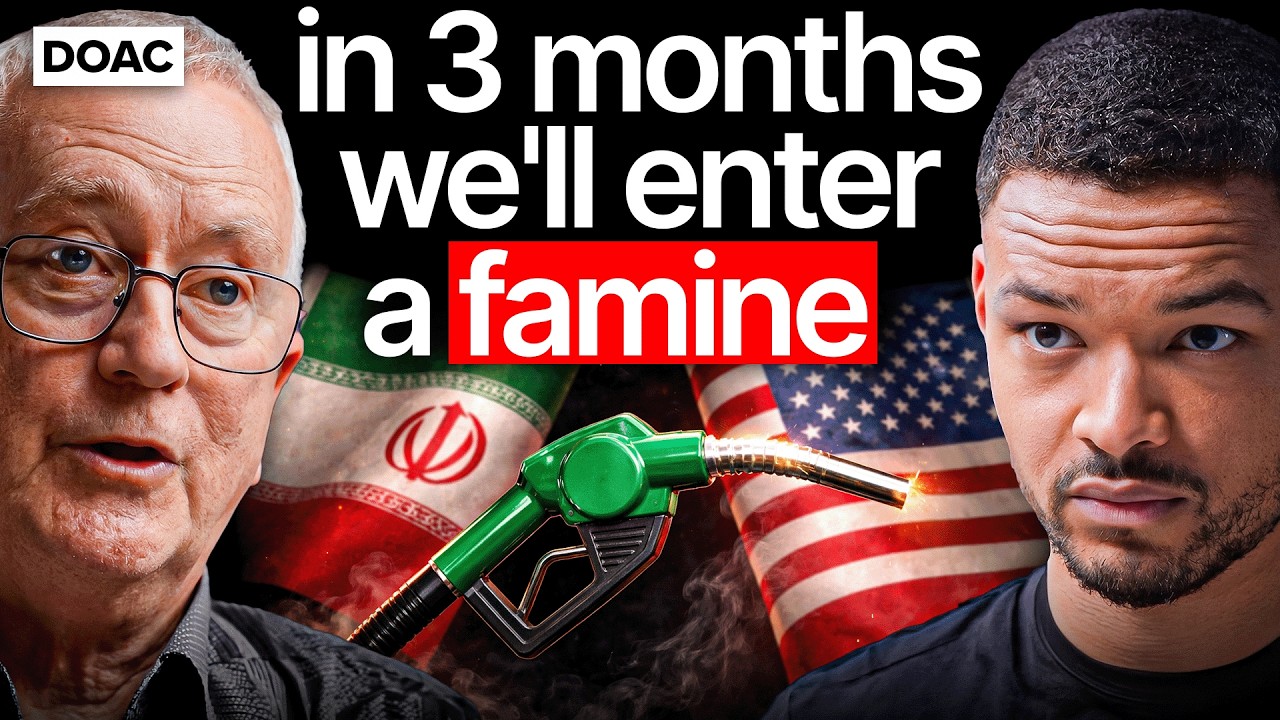
Economist Keen Warns Iran Conflict Risks Global Famine, Market Shock
The Diary Of A CEO
Closing the Strait of Hormuz will choke global helium and fertilizer supplies, triggering a 20% drop in food production and a severe global recession within months.
## Background
Published on YouTube by The Diary Of A CEO on April 6, 2026, this episode features host Steven Bartlett interviewing rebel economist Professor Steve Keen. According to the page description, the discussion explores how the escalating conflict with Iran could double food prices, the potential endgames for the war, the vulnerabilities of critical global trade choke points, political motivations surrounding Donald Trump, and how AI could displace half of all jobs.
## TL;DR
Economist Steve Keen details how the military conflict with Iran threatens global energy, fertilizer, helium, and semiconductor supply chains, risking an unprecedented worldwide famine and economic contraction. He analyzes five potential conflict scenarios, rating Iran's neutralization of Israel's nuclear capabilities and subsequent U.S. withdrawal as the most probable outcome. Keen also warns of an imminent AI-driven financial crash within 12 to 24 months, advocating for Universal Basic Income and systemic economic reforms to replace fragile hyper-capitalist models.
## Atmosphere & style
The dialogue carries an urgent, sobering tone as Keen delivers stark geopolitical and economic warnings grounded in macro-data. Bartlett acts as an engaged foil, balancing Keen's apocalyptic warnings with tactical pushback regarding political strategy and technology adoption. The conversation moves from high-stakes military tension to existential reflection, concluding on a poignant note as Keen marks his 73rd birthday with a simple wish for peace.
## Key takeaways
- [18:27](https://www.youtube.com/watch?v=PUO51DoSEqk&t=1107s) Steve Keen highlights that global energy supply and economic output (GWP) track in virtual lockstep, meaning any sharp drop in global energy or oil access will force a direct contraction in global GDP.
- [12:46](https://www.youtube.com/watch?v=PUO51DoSEqk&t=766s) A potential closure or blockade of the Strait of Hormuz poses an existential threat to global supply chains, cutting off essential flows of oil, natural gas, helium, and synthetic fertilizer components.
- [13:40](https://www.youtube.com/watch?v=PUO51DoSEqk&t=820s) A severe disruption in Persian Gulf helium and fertilizer exports could trigger a major global semiconductor bottleneck as well as widespread agricultural collapse and famine within months.
- [30:10](https://www.youtube.com/watch?v=PUO51DoSEqk&t=1810s) The transcript outlines five potential geopolitical scenarios for the Middle East conflict, ranging from global nuclear winter and destruction of Gulf energy infrastructure to Iran neutralizing Israel's nuclear launch capabilities.
- [56:31](https://www.youtube.com/watch?v=PUO51DoSEqk&t=3391s) Donald Trump's unpredictable policy declarations and temporary pauses in conflict are framed as potentially manipulating energy markets while attempting to construct exit strategies without prolonged entanglements.
- [01:04:14](https://www.youtube.com/watch?v=PUO51DoSEqk&t=3854s) The economy faces a impending financial crash within 12 to 24 months driven by an AI investment bubble where corporate infrastructure spending vastly outpaces real revenue generation.
- [01:08:42](https://www.youtube.com/watch?v=PUO51DoSEqk&t=4122s) Rapid advances in AI and robotics threaten to displace up to half of the global workforce, necessitating structural safety nets like Universal Basic Income (UBI) to prevent a collapse in consumer demand.
- [01:21:46](https://www.youtube.com/watch?v=PUO51DoSEqk&t=4906s) Bitcoin is structurally unsustainable in the long term due to the immense energy demands of its proof-of-work model in an increasingly energy-constrained world.
## Detailed walkthrough
### [00:00](https://www.youtube.com/watch?v=PUO51DoSEqk&t=0s) Five Scenarios for the War's End and Trump's Political Motivations
Professor Steve Keen opens by asserting that the ongoing conflict with Iran threatens everyone on the planet, framing it as an escalating crisis sparked by Donald Trump taking on Israel's long-standing desire to destroy Iran. Keen argues that the coalition has "bitten off far more than they can chew" and outlines a volatile series of scenarios for how the war might end. He accuses Trump of operating a "pump and dump scheme" with global oil markets—artificially driving prices up and down through public announcements to enrich his inner circle and exploit his presidency like a "mafia don" running a protection shakedown rather than executing coherent grand strategy.
When host Steven Bartlett asks why Trump would pursue such an unpopular war, Keen attributes it to pathological narcissism rather than rational statecraft. Drawing on personal experience with narcissistic personality disorder, Keen explains that Trump craves being the center of attention at all costs and only values opinions that praise him. He asserts that while Washington's "deep state" and Israel have sought to dismantle Iran for decades, Trump jumped into the conflict out of a mixture of cunning, stupidity, and a constant need for spotlight. Keen also points to a profound disconnect between world leaders and their populations, suggesting the public is overwhelmingly appalled by the humanitarian crisis in Gaza and broader Middle Eastern aggression, while politicians remain inexplicably bound to Israeli interests.
Keen goes on to hypothesize about why political elites across Western nations remain aligned with Israeli actions despite widespread domestic protests. He references the concept of the "Epstein class," noting how Iranian commentators frequently frame the conflict as a fight against compromised Western elites. In Keen's view, potential intelligence blackmail gather by figures like Jeffrey Epstein is one of the few plausible explanations for why Western politicians continue to back extreme military escalation even when their own citizens are protesting in the streets and face arrest for displaying slogans like "Free Palestine."
- **Key Scenarios Highlighted**:
- *Scenario 1*: Iran destroys Gulf power and energy infrastructure, rendering regions in Saudi Arabia, Qatar, and Dubai practically uninhabitable.
- *Scenario 2*: Iran successfully disables or neutralizes Israel's nuclear capabilities.
- **Geopolitical Disconnect**: Keen emphasizes that while ordinary citizens around the globe view Israel as the primary aggressor in the region, Western governments aggressively police anti-war dissent and prosecute peaceful protesters.
---
[07:46](https://www.youtube.com/watch?v=PUO51DoSEqk&t=466s) Why Israel Miscalculated Iran's Military Preparedness
Turning to the military realities on the ground, Keen details why Israel and the United States drastically underestimated Iran's resilience. Historically, Israel maintained military dominance in the region—exemplified by wiping out invading Arab armies in six days during the 1967 war. However, knowing it could not defeat Iran single-handedly, Israel sought to draw the United States into a war of total destruction. Both nations expected to rely on classic "decapitation tactics"—assassinating high-level political and military leaders to cause the state and its armed forces to collapse overnight, just as the U.S. did with Saddam Hussein's regime in Iraq.
Iran, however, spent the last four decades studying Western military interventions and engineered its defenses specifically to survive decapitation attacks. The country divided its military operations into 31 autonomous units corresponding to its 31 internal provinces. Each province operates with its own fail-safe command system, local resource stockpiles, and independent missile production units. Because of this decentralized structure, taking out central command in Tehran does not stop the war; an invading force would have to systematically destroy 31 separate, self-sustaining military apparatuses across a massive, mountainous landmass.
Keen stresses the sheer physical geography of Iran to illustrate the impossibility of a standard ground invasion or rapid military victory. On a standard map projection, Iran's size is often visually compressed, but in reality, it is larger than France, Germany, Italy, Spain, and Poland combined, boasting a population of over 90 million people nestled within rugged, highly mountainous terrain.
- **Iran's Defense Strategy**: 31 province-based military divisions, each equipped with independent command structures, fail-safes, and underground missile manufacturing facilities.
- **Geographic Scale**: Iran covers a landmass larger than half of Western Europe (over twice the size of the UK) with a population of ~90 million, making a conventional ground invasion a "suicide mission."
- **Market Manipulation Claims**: Keen highlights how public declarations about Middle Eastern developments cause wild swings in energy markets, allowing well-timed financial trades prior to major policy speeches or tweets.
---
[12:46](https://www.youtube.com/watch?v=PUO51DoSEqk&t=766s) The Strait of Hormuz and the Supply Chain Threat
The discussion shifts to the critical geopolitical vulnerability of the conflict: the Strait of Hormuz. Keen breaks down why this narrow waterway is the single most dangerous choke point in the global economy. Spanning just 21 kilometers (about 13 miles) at its narrowest point, the strait serves as the primary export route for a massive portion of the world's oil, natural gas, fertilizer components, and helium. Because Iran directly borders this narrow corridor, its military holds total physical control over who passes through.
To illustrate the absurdity and danger of managing such a crisis via public posturing, Keen points to Trump boasting about receiving a "present" from Iran when eight cargo ships were allowed to pass through the strait. Keen clarifies that those ships were not American, and warning that selective naval blockades allow Iran to dictate global economic stability. If Iran decides to close the gap entirely or restrict ships based on a nation's foreign policy, global energy and agricultural supply chains will immediately fracture.
- **Strait Dimensions**: A narrow 21-kilometer choke point through which a major fraction of global maritime energy and commodity traffic must pass.
- **Key Resources at Risk**: Crude oil, refined petroleum products, agricultural fertilizer raw materials, and industrial helium.
---
[13:36](https://www.youtube.com/watch?v=PUO51DoSEqk&t=816s) The Critical Role of Helium and Looming Famine
Moving past crude oil, Keen highlights two far more dangerous shortages lurking behind a Strait of Hormuz blockade: helium and agricultural fertilizer. Demonstrating helium's unique physical properties in the studio with a balloon, Keen explains that helium is not merely a party novelty—it is a finite, inert element essential for modern technology, medical equipment, and high-tech manufacturing that cannot be synthetically substituted. Roughly 30% of the world's helium supply comes from a shared giant natural gas field in the Persian Gulf spanning Saudi Arabia and Iran. If uncaptured during gas extraction, helium escapes directly into the atmosphere and outer space forever.
Even more catastrophic than a helium shortage is the threat to global food production. Between 20% and 30% of global synthetic fertilizer ingredients originate from or pass through the Persian Gulf region. Modern industrial agriculture relies entirely on these nitrogen- and sulfur-based fertilizers to maintain global crop yields. Keen warns that if the Strait of Hormuz remains blocked and fertilizer shipments stall, the world will not just face higher prices at the grocery store—it will face widespread global famine within months.
- **Helium Dependence**: ~30% of global helium supply originates from Persian Gulf natural gas fields; it is an irreplaceable inert element required for advanced industry and scientific infrastructure.
- **Global Famine Risk**: 20% to 30% of global fertilizer supply flows through the Strait of Hormuz; cutting off this supply will trigger catastrophic food shortages and skyrocketing starvation worldwide.
[015:05] The Helium Crisis and the Global Semiconductor Bottleneck
The discussion shifts from energy directly to a hidden critical vulnerability in global supply chains: helium. Trapped underground in the exact same geological formations as natural gas and oil, helium is extracted as a byproduct of oil drilling. While it was historically treated as an insignificant gas, it is now an indispensable element in the manufacturing of semiconductors, microprocessors, CPUs, and memory chips. A disruption in the region directly threatens the hardware powering everything from smartphones and tablets to basic modern electronics.
Steve Keen points out that cutting off roughly 30% of the world's helium supply from the Persian Gulf translates directly to losing 30% of global semiconductor manufacturing capacity. Quoting leading industry expert Phil Cornblutch from March 2026, he notes that the market faces a minimum two-to-three-month shutdown of helium production, with recovery taking up to six months. Unlike oil, helium cannot be stockpiled for long periods because its tiny atomic structure allows it to leak through standard storage containers.
- **South Korea’s Risk:** South Korea relies on Qatar and the immediate region for 65% of its helium supply.
- **Memory Chip Vulnerability:** South Korea produces two-thirds of the world's memory chips, prompting their government to launch an emergency investigation into the supply shock.
- **Production Stoppage:** Once existing helium reserves run dry, semiconductor fabrication lines will come to a complete halt.
[016:40] Famine, Fertilizer, and the Haber-Bosch Process
Beyond microchips, the disruption threatens the foundational layer of human survival: the global food supply. Keen holds up a physical potato to illustrate that crop yields depend entirely on synthetic fertilizers. Nitrogen-based fertilizers are produced via the Haber-Bosch process, which synthesizes petroleum products, natural gas, and nitrogen. The same massive gas fields in the Gulf that yield helium also supply the raw natural gas and sulfur required to manufacture agricultural fertilizer and sulfuric acid.
Without synthetic fertilizer, the Earth's carrying capacity would drop dramatically—from over eight billion people down to just one or two billion. With 20% to 30% of global fertilizer supply passing directly through the narrow Strait of Hormuz, a total blockade would instantly trigger a 20% drop in global food production. Keen emphasizes that humanity has experienced severe regional famines—such as historical events in India and parts of Africa—but losing this volume of fertilizer would cause the first truly global famine in human history.
- **Haber-Bosch Dependency:** Synthetic fertilizer synthesis relies on natural gas and petroleum feedstocks combined with atmospheric nitrogen.
- **Human Population Impact:** Without chemical fertilizers, global agriculture could only sustain 1 to 2 billion people.
- **Bottleneck:** 20% of the world's fertilizer, helium, and sulfuric acid pass through the Strait of Hormuz.
[018:27] The Direct Link Between Energy Supply and Global GDP
Pulling an empty 20-liter petroleum canister onto the set, Keen addresses the core economic reality of oil. While headlines focus primarily on price spikes at the gas pump, the true danger lies in the physical availability of energy. Keen references his proprietary economic charts plotting the annual percentage change in Gross World Product (GWP) against the annual percentage change in gross energy consumption over the last 40 years. The two lines track each other in virtual lockstep and with identical magnitude.
Because economic output is strictly bounded by energy input, any drop in energy availability forces a proportional drop in global economic output. If the conflict cuts off 20% of the world's liquefied natural gas (LNG) and a substantial portion of its crude oil, global energy availability could fall by 5% to 10%, directly causing an immediate 5% to 10% contraction in Gross World Product.
```
Change in Energy Consumption ───► Correlates 1:1 ───► Change in Gross World Product (GWP)
(e.g., -5% to -10% Energy) (e.g., -5% to -10% Global GDP)
```
- **Geographic Concentration:** Crucial reserves of easily extractable crude oil are heavily concentrated in Iran, Saudi Arabia, Iraq, Russia, and the United States.
- **Oil Homogeneity Myth:** Mainstream economic theory incorrectly treats oil as a single, uniform commodity. In reality, heavy Venezuelan crude is thick like tar, whereas Middle Eastern crude flows easily like water and requires completely different refinery processing infrastructure.
- **Systemic Fragility:** A localized conflict in the Persian Gulf has the immediate potential to decapitate 20% to 30% of all global industrial and agricultural production.
[021:29] Widespread Shortages and the Reality of Cost of Living
If the conflict does not end within two to three months, global supply buffers will empty completely. Major agricultural nations like India will run out of imported fertilizer, leading to immediate crop failures and severe regional food shortages. Even wealthy, developed nations are far more fragile than their citizens realize. For example, Australia maintains roughly a 30-day domestic oil reserve; once that supply is exhausted, fuel supplies fail, stopping trucks from transporting food from rural farms into major urban centers.
The conversation turns to the human toll of the economic crisis. Steven Bartlett shares a personal story about taking an Uber at 2:00 a.m. with a driver who was working his third job just to cover his basic cost-of-living expenses. Bartlett reflects on how easy it is for wealthy individuals to become detached from the daily financial struggles of ordinary people living on the edge of survival. Keen notes that when basic systems collapse, a 20% surge in prices forces millions of working-class families past the point where money can buy necessities, rendering standard financial mechanisms completely useless.
- **Australia's Fuel Reserve:** Australia maintains only about 30 days of domestic fuel reserves, leaving its domestic distribution networks highly vulnerable to maritime blockades.
- **Poverty Traps:** Millions of households in advanced economies like the UK and the US live hand-to-mouth; even minor price increases push them into immediate financial distress.
- **Decoupled Leadership:** Wealthy leaders and politicians often view rising commodity prices strictly as profit opportunities rather than existential threats to working-class survival.
[025:38] Inequality, Economic Collapse, and the Causes of War
Addressing whether wars worsen inequality, Keen argues that severe economic inequality is actually the primary driver that causes wars in the first place. He points to the historical parallel of the Great Depression leading directly into World War II. Contrary to the popular belief that Adolf Hitler rose to power due to the Weimar hyperinflation of the early 1920s, Hitler actually assumed power during a period of intense *deflation* (around minus 10%) and massive unemployment, which had spiked to 25% after Germany repaid its private and public debts to America.
Desperate populations living in extreme inequality are far more likely to elect authoritarian demagogues who promise economic salvation. Following World War II, Western leaders recognized that to prevent the spread of fascism or communism, they had to rebuild society around high living standards for the working class. This birthed the "golden age of capitalism" in the 1950s and 1960s, where a single-income household could comfortably support a family. Over the subsequent 80 years, those lessons were forgotten, allowing massive wealth inequality to return and set the stage for modern global conflicts.
- **Weimar Myth vs. Reality:** Hitler came to power in 1933 during severe economic deflation (-10%) and 25% unemployment, not during the 1923 hyperinflation episode.
- **The Golden Age of Capitalism:** Post-WWII economic policies deliberately focused on building a strong middle class to prevent political extremism.
- **The Inequality Cycle:** High wealth inequality leads to political instability and war; the aftermath forces a temporary return to economic fairness, which slowly erodes over time.
[027:48] The Geopolitics of Oil Control and Strategic Miscalculations
The discussion turns to the world's largest proven oil reserves. Venezuela holds the largest oil reserves globally, followed by Saudi Arabia (effectively aligned as a US partner), Iran in third place, and Canada in fourth. Keen notes that foreign policy decisions and military interventions frequently align with attempts to secure or dominate these major resource deposits.
However, attempting to forcibly secure these resources often leads to catastrophic geopolitical miscalculations. Decisions driven by elite echo chambers—such as oil executives or wealthy advisors—frequently underestimate the defensive capabilities of target nations. While foreign strategists assumed that taking out Iran's leadership or blockading its coast would easily hand control of regional oil to Western interests, Iran has spent over 40 years explicitly preparing for this exact scenario, making them far more resilient and dangerous than coalition strategists anticipated.
- **Top Global Oil Reserves:**
1. Venezuela (Largest global reserves)
2. Saudi Arabia (US-aligned partner)
3. Iran (Uncontrolled by Western influence)
4. Canada (Major North American reserve)
- **Elite Detachment:** Isolation from average citizens often breeds a dangerous hubris in foreign policy, leading leaders to mistake complex military interventions for easy wins.
[30:10](https://www.youtube.com/watch?v=PUO51DoSEqk&t=1810s) Scenario 1: The Apocalyptic Nuclear Option
Professor Steve Keen walks through the first of five scenarios detailing how the conflict between Israel, Iran, and the United States could unfold. The first scenario—which Keen believes Israel wants, but Trump may not—is the total destruction of Iran. Keen warns that destroying a nation the size of Western Europe is impossible using conventional weaponry; it would require dropping hundreds of high-yield nuclear weapons. If this scenario comes to pass, "we're all gone" because the resulting atmospheric debris and environmental devastation would trigger a global nuclear winter.
When questioned on whether smaller, tactical nuclear weapons could be used instead, Keen dismisses the idea. Unlike the 20,000-ton TNT-equivalent bombs dropped on Hiroshima and Nagasaki, modern strategic weapons carry yields equivalent to 20 million tons of TNT. He assigns a probability of under 1% to this scenario under normal leadership, but raises it to roughly 5% to 10% given current political dynamics in Washington and Israel. The discussion touches on the terrifying prospect of establishing a precedent for modern nuclear weapon use, which could spark a domino effect leading to universal mutually assured destruction.
* **Target Scale:** Iran's landmass is roughly equivalent to Western Europe, requiring hundreds of nuclear warheads to guarantee complete neutralization.
* **Payload Comparison:** Hiroshima and Nagasaki weapons were ~20 kilotons (20,000 tons of TNT); modern strategic warheads reach up to 20 megatons (20,000,000 tons of TNT).
* **Assessed Probability:** Keen estimates a 5% to 10% chance of this outcome occurring due to erratic leadership.
---
[33:21](https://www.youtube.com/watch?v=PUO51DoSEqk&t=2001s) Scenario 2: Gulf Power Infrastructure Collapse
The second scenario involves Iran systematically destroying the power and energy infrastructure of the neighboring Gulf States. Keen regards this scenario as highly likely. Because these desert nations rely almost entirely on oil- and gas-fired power systems for energy, desalination, and cooling, knocking out their power grids would render cities like Dubai, Riyadh, and Doha completely uninhabitable. Keen highlights that a single previous attack on a Saudi Arabian facility crippled two out of fourteen critical units needed for liquid natural gas (LNG) production—destroying roughly 2.5% of the entire world's energy supply for an estimated five-year repair window, as only five companies worldwide possess the capability to rebuild them.
This strategy serves as an economic vice to force Gulf leaders to pressure Washington into halting military action. The financial fallout of even minor disruptions is staggering: Dubai officials estimate that an emergency shutdown of Dubai International Airport costs $1 million per minute ($60 million per hour, or $1.4 billion per day) in lost revenue, logistics disruptions, and missed commerce. Because Dubai's GDP is roughly 30% dependent on aviation and tourism, such attacks expose the profound fragility of a region heavily dependent on migrant labor from India, Pakistan, and the Philippines.
```
Dubai Airport Emergency Shutdown Cost:
• Per Minute: $1,000,000
• Per Hour: $60,000,000
• Per Day: $1,400,000,000
```
* **Global Energy Impact:** 1/4 of global LNG passes through the Strait of Hormuz; taking out key Saudi infrastructure wiped out 10% of that flow (~2.5% of global energy supply).
* **Repair Timeframe:** Rebuilding specialized LNG infrastructure takes up to 5 years, with only 5 companies globally equipped to do the work.
* **Demographic Vulnerability:** A collapse of power systems would spark an exodus of the foreign worker majority, paralyzing local economies.
---
[37:51](https://www.youtube.com/watch?v=PUO51DoSEqk&t=2271s) Scenario 3: The Samson Option and Nuclear Sole Authority
The third scenario centers on the "Samson Option"—a reference to the biblical story of Samson pulling down the pillars of the Philistine temple to destroy his enemies along with himself. In a military context, if Israel faces an existential defeat, it could unleash its nuclear arsenal against its adversaries and the broader world, accepting total destruction rather than capitulation. The discussion delves into the psychological escalation between the two nations, noting historical declarations of destruction alongside a sharp shift in March 2026, when Iranian officials declared all Israeli energy, water, and IT infrastructure to be legitimate targets with "zero restraint."
The conversation shifts to the terrifying mechanism of nuclear launch authority. Citing an interview with national security journalist Annie Jacobson, the host and Keen highlight that the President of the United States possesses "sole presidential authority" to launch a nuclear strike. The President does not require consent from Congress, the Secretary of Defense, or the Joint Chiefs of Staff. Keen contrasts this with historic Cold War safeguards—such as a Soviet submarine crew in the 1980s that required unanimous agreement among three officers to launch, one of whom famously refused after a false early warning—expressing deep concern over a system that places planetary survival in the hands of a single individual.
* **The Samson Concept:** A national defense strategy of total nuclear retaliation when facing imminent annihilation, regardless of global consequences.
* **March 2026 Shift:** Iranian Parliamentary Speaker Mohammad Ghalibaf formally designated all Israeli water, energy, and IT grids as targets for irreversible destruction.
* **Sole Presidential Authority:** Confirmed by Congressional reports; the US President can unilaterally order a nuclear strike without external checks or approvals.
In the fourth scenario, Keen considers the possibility of Iran neutralizing Israel's nuclear arsenal using advanced conventional missile strikes rather than nuclear weapons. Keen asserts that he hopes Iran manages to disable Israel's nuclear launch capabilities because removing the nuclear threat prevents global catastrophe and nuclear winter. Under this framework, any remaining conflict would be fought strictly with conventional forces and ground troops, preserving human civilization even if regional warfare continues.
While acknowledging the uncertainty surrounding the full capabilities and accuracy of Iran's missile technology, Keen notes that the degree of strategic planning demonstrated by Iranian military commanders has exceeded prior Western expectations. By eliminating the nuclear wildcard from the equation, the existential threat of planetary annihilation is taken off the table.
* **Core Objective:** Disarming nuclear launch sites and command infrastructure via precision conventional strikes.
* **Primary Outcome:** Prevents the escalation to nuclear winter and global civilizational collapse.
* **Warfare Shift:** Confines the conflict to conventional regional warfare, troop movements, and localized engagements.
<ElicitationsGroup message="Explore the remaining scenarios and economic analyses from Steve Keen:">
<Elicitation label="Examine Trump's strategy and Scenario 5 (Nuclear Iran)" query="Summarize the transcript section covering Scenario 5 (a nuclear Iran), Trump's real motivations, and ground troop possibilities."/>
<Elicitation label="Analyze the economic crash drivers and AI job market impacts" query="Detail Professor Steve Keen's analysis on global cost-of-living drivers, financial crash triggers, and AI replacing jobs."/>
</ElicitationsGroup>
Here is a faithful walkthrough of Part 4 of the transcript, capturing the arguments, specific examples, numbers, geopolitical scenarios, and the dynamic exchange between the host and Professor Steve Keen.
---
[45:46](https://www.youtube.com/watch?v=PUO51DoSEqk&t=2746s) Scenario 4: Neutralizing Nukes and the Asymmetric Balance of Power
Steve Keen outlines his perspective on Iran’s preparedness for war, noting that while his primary expertise is economics rather than global military politics, discovering Iran’s administrative division into 31 semi-autonomous regions revealed a deeply wargamed defense strategy against American attacks. Keen argues that Iran’s strategic planners likely anticipated the threat of Israel utilizing the "Samson Option"—a total nuclear retaliation if facing existential defeat—and must have wargamed methods to disable Israel’s launch capabilities before they can be deployed.
The host pushes back strongly, questioning how Iran could accomplish this when their conventional military assets—such as ships and planes—have been largely decimated. Keen counters that conventional hardware is secondary to Iran’s underground missile inventory. He emphasizes that Iran possesses hundreds of missile launch facilities buried hundreds of meters underground and has developed advanced rocketry capable of evading Israel's Iron Dome missile defense system.
```
UNCONVENTIONAL ASYMMETRY IN THE MIDDLE EAST WAR
Israel's Advantage Iran's Advantage
------------------ ----------------
• Advanced Aviation & Jet Fleet • Deep Underground Facilities (100s of meters)
• Superior Air Defense (Iron Dome) • Vast Subterranean Missile Inventories
• High-Tech Targeting Systems • 31 Autonomous Regional Military Commands
• ~10 Million Total Population • ~90 Million Population (Conscription Capacity)
```
Keen takes the controversial position that Iran successfully neutralizing Israel's covert nuclear capability would represent the best possible global outcome. He criticizes Israel as a "rogue state" in the Middle East operating nuclear weapons outside the Nuclear Non-Proliferation Treaty (NPT), asserting that the world becomes safer if those weapons are rendered non-functional. When the host suggests Israel would simply manufacture more nuclear weapons, Keen contends that rebuilding lost capabilities during active defeat is impossible due to the immense technological and intellectual resources required.
The debate turns to population dynamics and technical capabilities. Keen emphasizes the massive demographic disparity between Iran’s 90 million citizens and Israel’s sub-10 million population. When the host argues that Israel maintains a profound technological gulf in aircraft, missile systems, and intelligence capabilities, Keen dismisses Western assumptions, arguing that Iran’s military sophistication and educated culture have systematically surprised intelligence agencies throughout the war.
* **Autonomous Regions:** Iran partitioned its military command into 31 regional divisions to ensure survival against decapitation strikes.
* **Underground Facilities:** Missile sites are reported to be buried hundreds of meters beneath mountain networks.
* **Population Disparity:** 90 million people in Iran versus fewer than 10 million in Israel.
* **Duration of Conflict:** The conversation takes place 3 to 4 weeks into a war that Donald Trump originally claimed would end in a single day.
---
[49:23](https://www.youtube.com/watch?v=PUO51DoSEqk&t=2963s) Trump’s Posturing, Market Manipulation, and the Ground Troop Dilemma
The conversation shifts to Donald Trump’s recent public statements regarding energy infrastructure and the Strait of Hormuz. The host recounts the timeline: on March 21, Trump threatened to destroy Iran’s power plants unless the Strait was reopened within 48 hours. Shortly thereafter, Trump announced a 10-day pause until April 6, claiming that indirect negotiations were progressing well and that Iran was "begging to make a deal."
Keen presents a sharp critique of Trump’s motivations, asserting that Trump is actively "gaming the markets" by using aggressive statements and pauses to trigger sharp fluctuations in oil prices for personal or insider financial gain. The host offers an alternative view rooted in behavioral patterns: Trump consistently uses extreme threats to force negotiations, later claims the opposing side capitulated and "begged for a deal," and uses these declarations to construct a exit strategy without following through on destructive threats.
```
TRUMP'S DE-ESCALATION PATTERN
[ Extreme Threat ] ──► [ Public Pause ] ──► [ Declaration of Victory ]
Destroy power plants 10-day delay until "They are begging for a deal;
in 48-hour window April 6th window we won total leverage."
```
Keen maintains that Trump’s approach fails because he projects his own fears onto Iranian leadership. While a threat of decapitation or personal ruin might force a transactional figure like Trump to negotiate, Iran's decentralized structure renders such leverage ineffective. The host notes that Trump’s primary obsession is his historical legacy—aspiring to be remembered alongside Mount Rushmore presidents—and that being dragged into a protracted regional war with American casualties is his ultimate fear.
* **March 21 Ultimatum:** 48-hour threat to obliterate Iran's power grid unless the Strait of Hormuz opened.
* **April 6 Pause:** A 10-day suspension of strikes declared on the premise of ongoing indirect negotiations.
* **Ground Troop Probability:** Keen estimates a **greater than 50% probability** that the U.S. will deploy ground troops to the region within weeks.
* **Landing Vector:** Speculated deployment zone is restricted to a narrow corridor near the Pakistani border involving 2,000 to 10,000 troops, which Keen characterizes as a potential "suicide mission" against motivated Iranian soldiers fighting on home soil.
* **Historical Military Comparisons:** Keen asserts that the U.S. has not won a decisive military conflict since World War II, pointing to failure states in Vietnam, Iraq, and Afghanistan.
---
[56:31](https://www.youtube.com/watch?v=PUO51DoSEqk&t=3391s) Regional Realignment and Scenario 5 (Nuclear Escalation)
Discussing the best-case geopolitical scenario, Keen outlines a outcome where the United States accepts military defeat, relinquishes its bases, and leaves the Asian continent. In this scenario, the region transforms into an integrated Iranian protectorate, removing Western intervention entirely. Keen draws a historical parallel between the current Middle Eastern conflict and Europe’s 100 Years' War, comparing the Sunni-Shiite divide to the historical European struggles between Protestants and Catholics.
Keen argues that Gulf monarchies made a profound strategic mistake by allying with the U.S. and Israel (the "Christians") to protect themselves against Shiite Iran. With American bases obliterated at the onset of war and U.S. forces withdrawing, Arab states are realizing that reliance on Western military power has failed. Keen believes this collapse will force a consolidation of pan-Islamic solidarity, bringing an end to internal sectarian warfare across Saudi Arabia, Iran, Iraq, Pakistan, and Afghanistan.
```
### Geopolitical Realignment Scenarios
| Scenario | Strategic Premise | Primary Consequence |
|:--- |:--- |:--- |
| **Scenario 4 (Keen's Peak Outcome)** | Iran neutralizes Israel's nuclear launch capabilities. | U.S. forces exit Asia; regional power shifts to an integrated Muslim protectorate. |
| **Scenario 5 (Worst Case)** | Iran successfully builds and tests operational nuclear weapons. | Accelerates global nuclear proliferation among all major U.S. geopolitical rivals. |
```
The discussion concludes with Scenario 5: Iran acquiring nuclear weapons. Keen explicitly states that he prefers Scenario 4 over Scenario 5. He rates Iran neutralizing Israel's nuclear arsenal as the single most probable outcome of the conflict, driven by Iran's extensive advance preparation compared to U.S. and Israeli unreadiness. If Iran is destroyed instead, Keen warns that every global rival to the U.S. will feel compelled to acquire nuclear weapons, accelerating the world toward widespread nuclear proliferation.
---
<ElicitationsGroup message="Explore related economic and geopolitical themes from this interview:">
<Elicitation label="Analyze the economic impact of the Strait of Hormuz closure" query="What are Steve Keen's arguments regarding the Strait of Hormuz closure, oil prices, and fertilizer shortages from earlier in the interview?"/>
<Elicitation label="Examine Steve Keen's predictions on AI and universal basic income" query="What does Steve Keen say about AI job destruction, Universal Basic Income, and financial market crashes later in this episode?"/>
</ElicitationsGroup>
[01:00:32](https://www.youtube.com/watch?v=PUO51DoSEqk&t=3632s) Donald Trump, Psychology, and Personal Self-Sufficiency
Steve Keen and host Steven Bartlett reflect on Donald Trump's deep-seated aversion to defeat, tying it directly to his background in reality television and personal identity. Keen points out that Trump's framing of the world relies on avoiding the ultimate insult from *The Apprentice*—being dubbed a "loser." Because standing on a stage and admitting "I lost" would shatter his self-image, any deal or political outcome will inevitably be spun by Trump as a total victory.
Transitioning to practical advice for everyday individuals facing global macro instability, Keen emphasizes the vital importance of personal self-sufficiency. When global supply chains and energy markets are disrupted, relying entirely on centralized infrastructure leaves people vulnerable. Keen urges people to invest in domestic solar energy systems to break their dependence on fragile oil supplies, declaring: "Without energy, there's no civilization."
The conversation shifts briefly to Elon Musk's role in advancing solar power, battery storage, and rocketry. While Keen expresses great admiration for Musk's engineering contributions, he sharply criticizes Musk's heavy involvement in getting Donald Trump elected. Keen notes that Musk seems to have realized how "poisonous" politics is and has wisely backed away, advising that Musk stick to engineering where his true legacy lies. On the topic of food security, Keen admits he has "brown thumbs, not green ones," but warns that skyrocketing fertilizer prices could severely impact food availability. Drawing a parallel to World War II Britain, where citizens turned residential backyards into productive market gardens, Keen argues that physical resources close at hand—rather than paper money—are what truly guarantee survival when supplies vanish from store shelves.
- **Trump's Mindset:** Driven by a psychological refusal to accept being a "loser," guaranteeing he will frame any geopolitical outcome as a personal win.
- **Energy Security:** Installing residential solar systems provides a crucial buffer against oil price shocks and power grid fragility.
- **Elon Musk's Legacy:** Praised for pioneering work in renewables and space, but cautioned to stay away from political endorsements after backing Trump.
- **Food Security & WWII Lessons:** Real physical assets and local food production matter more than cash when goods disappear from markets, mirroring the Victory Gardens of WWII.
---
[01:04:14](https://www.youtube.com/watch?v=PUO51DoSEqk&t=3854s) The Impending AI Economic Crash and Schumpeterian Cycles
Steve Keen outlines his prediction of an impending financial crash within one to two years, driven by the massive speculative bubble surrounding artificial intelligence. He explains that AI is undergoing a classic Schumpeterian "boom and bust" cycle—a historical pattern identified by Austrian economist Joseph Schumpeter. In these cycles, banks and venture capitalists over-fund a revolutionary new technology (such as 19th-century railways or the late-1990s dot-com boom). Massive capital flows in because every competing firm aims to be the dominant monopoly, leading to extreme over-investment and sky-high valuations.
Eventually, the new technology comes online and severely undercuts existing industries, triggering a sharp economic slump and the collapse of overestimates. Big tech giants—including Meta, Amazon, Microsoft, Alphabet (Google), and Oracle—are on track to pour an astronomical $720 billion into AI infrastructure in 2026 alone. However, these investments yield a unsustainable ratio where spending outpaces actual revenue generation by 5 to 1.
| Metric / Indicator | Historical Parallel (Railways/Dot-Com) | Current AI Market Dynamics (2026) |
|:--- |:--- |:--- |
| **Capital Allocation** | Speculative over-investment by banks/VCs | Massive capex by Big Tech ($720B target in 2026) |
| **Revenue-to-Spend Ratio** | High expenditure yielding minimal near-term yields | **5:1 ratio** of money spent vs. revenue earned |
| **Startup Failure Rate** | Over 90% of speculative firms liquidated | **90% failure rate** for AI startups; **95% failure** for enterprise pilots |
| **Market Outcome** | Widespread crash followed by stable utility | Imminent 24-month market contraction and paper wealth evaporation |
Bartlett agrees with Keen's prognosis, observing that the failure rate for AI-specific startups has surged to 90% in 2026—far exceeding the traditional 70% failure rate for general tech startups. Furthermore, roughly 95% of enterprise AI pilots fail to progress into full production due to exorbitant operational costs. Bartlett shares an example of a startup generating only a couple million dollars in revenue that secured a $1 billion valuation simply by attaching "AI" to its pitch, warning that when these inflated paper gains evaporate, companies will be forced to slash spending and lay off workers. Keen predicts a severe economic contraction within 24 months, comparing the coming fallout to the 1990–2002 telecommunications and dot-com crashes, though warning that the systemic footprint of AI will make this bust far larger.
- **Schumpeter's Creative Destruction:** Technological booms build essential infrastructure (like railways or internet backbones), but inevitably trigger slumps as old business models are undercut.
- **Unsustainable Capital Expenditure:** Major tech firms are spending $5 on AI infrastructure for every $1 generated in actual revenue.
- **Enterprise AI Bottlenecks:** 95% of enterprise AI pilots stall out before production due to runaway deployment costs.
- **Timeline for Contraction:** Both Keen and Bartlett expect a severe market pullback and economic correction within 12 to 24 months.
---
[01:08:42](https://www.youtube.com/watch?v=PUO51DoSEqk&t=4122s) Preparing for the Bust, Universal Basic Income, and Mass Job Displacement
When Bartlett asks how individuals, entrepreneurs, and team members should prepare for the impending downturn, Keen candidly admits that insulating oneself from a systemic market crash is like trying not to fall over during an earthquake. Asset classes like gold and Bitcoin have experienced extreme volatility, making traditional safe havens unpredictable. However, Keen's primary long-term concern is not the immediate financial crash, but rather the unprecedented structural threat AI poses to human labor. Unlike previous technological revolutions, AI and robotics threaten to displace up to 50% of the global workforce by automating both white-collar administrative tasks and blue-collar manual labor.
```
┌──────────────────────────────────────────┐
│ AI & Robotics Automation Wave │
└────────────────────┬─────────────────────┘
│
Displaces Up to 50% of Workforce
│
┌────────────────────┴─────────────────────┐
▼ ▼
┌───────────────────────────┐ ┌───────────────────────────┐
│ White-Collar Labor │ │ Blue-Collar Labor │
│ (Clerks, Software, │ │ (Manufacturing, │
│ Data Analysis) │ │ Assembly, Logistics) │
└───────────────────────────┘ └───────────────────────────┘
│
▼
┌──────────────────────────────────────────┐
│ Mandatory Economic Safety Net: UBI │
└──────────────────────────────────────────┘
```
Because labor income supports 70% of the world's population, destroying these jobs without a replacement mechanism would crash aggregate consumer demand and destroy society's economic foundation. Keen notes that tech leaders in Silicon Valley are increasingly advocating for **Universal Basic Income (UBI)**—a system where the state guarantees every citizen enough money to cover essential living costs. UBI would free individuals from grueling survival jobs, allowing them to pursue entrepreneurship or focus on singular productive endeavors.
Keen highlights an example from a classic *New York Times* report on an air conditioning factory. In the story, a woman was paid to manually insert thermocouples into 3,000 factory units a day—a mind-numbing job she accepted purely for the paycheck. Historically, her job was secure because industrial machines lacked the delicate sensory perception needed to place a wire inside variable circuitry. However, modern AI-driven vision and robotic perception can now master these precise physical tasks with ease. As these flexible, low-skilled manual jobs disappear alongside routine office work, society will face an urgent choice: adopt UBI or accept catastrophic economic inequality and widespread poverty.
- **Unprecedented Labor Threat:** AI is the first technology in human history capable of eliminating labor across both cognitive and physical industries simultaneously.
- **Universal Basic Income as a Necessity:** UBI must be implemented to ensure baseline consumer purchasing power when traditional employment collapses.
- **Advocacy from Tech Leaders:** Silicon Valley executives are pushing for UBI because they recognize their technology will eliminate tens of millions of middle- and working-class jobs.
- **The Thermocouple Example:** Illustrates how modern AI computer vision solves spatial variability problems, eliminating the final manual assembly jobs that previously resisted automation.
---
<FollowUp label="Want to explore Steve Keen's 5 geopolitical scenarios for how the Iran conflict could end?" query="What are Steve Keen's 5 geopolitical scenarios for how the conflict involving Iran and Israel could play out, and what are the economic impacts of each?"/>
[01:14:17](https://www.youtube.com/watch?v=PUO51DoSEqk&t=4457s) How AI Is Quietly Rewriting the Job Market
The discussion delves into how artificial intelligence is shifting from theoretical workplace commentary into concrete hiring decisions. Anthropic recently reported a 13% decline in entry-level job hires, a trend that is hitting white-collar sectors immediately. Employers are caught in real-time behavioral shifts. Candidates who would have been instantly hired six months ago are now placed on pause because internal innovation teams can handle their functions using autonomous AI agents.
```
┌─────────────────────────────────────────────────────────────┐
│ EMERGING WORKFORCE TRIAGE │
├───────────────────────────┬─────────────────────────────────┤
│ Deep Domain Experts │ Unreplaceable strategic thinkers│
│ AI-Proficient Operators │ Architects of agentic workflows │
│ High-Touch Human Roles │ Relationship-driven dealmakers │
├───────────────────────────┴─────────────────────────────────┤
│ AT RISK: University grads lacking deep domain experience │
└─────────────────────────────────────────────────────────────┘
```
Modern corporate hiring is consolidating into three distinct talent segments:
* **Deep Domain Experts:** Highly specialized leaders (e.g., Chief Financial Officers) whose strategic judgment cannot be duplicated by algorithms.
* **AI-Proficient Operators:** Workers capable of designing and driving agentic workflows across internal departments.
* **High-Touch Human Roles:** Relationship-driven professionals in areas like face-to-face sales, where handshakes, trust, and physical accountability remain essential.
This shifting dynamic leaves recent university graduates in a vulnerable position. Lacking both deep domain experience and specialized agent-management skills, traditional entry-level white-collar roles—such as junior analysts at investment firms—are rapidly contracting. Investment funds that previously required teams of hundreds of analysts now streamline operations around a single professional leveraging a network of AI agents.
- **Anthropic Report:** Documents a **13% decline** in entry-level job hiring.
- **Investment Fund Case:** An investment team replaced multiple candidate pipelines with a single analyst ("Molly") who orchestrates three specialized AI agents to handle workload volume.
- **Ravel Software Example:** Steve Keen notes how an online student used AI tools to automatically construct mathematical simulation models in Keen's proprietary **Ravel** software and generate system code, illustrating how software development workflows are shifting toward agent orchestration.
---
[01:18:18](https://www.youtube.com/watch?v=PUO51DoSEqk&t=4698s) Jevons’ Paradox, Coding, and the "Star Trek" vs. "Hunger Games" Future
While platforms like Spotify report that AI now generates vast swaths of their code base, the overall demand for software engineering competence remains strong due to **Jevons' Paradox**. When a resource or capability becomes vastly cheaper and more efficient to produce, aggregate consumption increases rather than decreases. As technical execution becomes frictionless, non-technical professionals—from media operators to legal executives—increasingly rely on programmatic and agentic tools, driving demand for high-level software architects.
The broader socio-economic impact presents two distinct structural pathways for society:
1. **The "Star Trek" Future:** Automated systems and energy abundance eliminate compulsory labor, enabling individuals to pursue creative and self-actualizing endeavors without economic exploitation.
2. **The "Hunger Games" Future:** A small elite controls the robotic and technological capital, leaving the broader population disenfranchised and dependent under authoritarian oversight.
While automated physical hardware—such as Tesla's Optimus humanoid robots—promises to drastically lower the cost of services like medical procedures, significant resource constraints remain. Scaling billions of physical units faces strict material limits in critical minerals like copper. Furthermore, the essential human element in fields like medicine cannot be replaced by machines alone.
- **Spotify Coding Metric:** Engineering teams report significant reliance on AI-generated code.
- **Jevons' Paradox:** Cheaper technology creation drives total market demand up across all corporate departments rather than eliminating programming entirely.
- **Resource Bottlenecks:** Manufacturing billions of humanoid robots requires massive amounts of raw copper and heavy minerals, creating physical supply ceilings.
---
[01:21:46](https://www.youtube.com/watch?v=PUO51DoSEqk&t=4906s) Is Bitcoin Headed to Zero?
Steve Keen argues that Bitcoin is structurally doomed to head toward zero due to its high energy consumption. The fundamental consensus mechanism of Bitcoin—proof-of-work—relies on extensive computational processing to secure its public ledger. While early advocates (such as Max Keiser and Stacy Herbert in El Salvador) praised this security model, Keen views its energetic footprint as ecologically unsustainable.
As climate pressures force global reductions in total energy use and material extraction, high-energy, non-essential activities will face severe regulatory and physical restrictions. Keen highlights two primary targets for energy reduction:
1. **Cryptocurrencies** (due to proof-of-work overhead)
2. **International short-haul travel**
Even with shifts toward nuclear power or renewable alternatives, physical limits persist. Citing analysis from minerals engineer Simon Michaux, Keen points out that Earth lacks the required reserves of copper, nickel, lithium, and rare earth elements to build out a fully solar- and wind-powered industrial economy alongside massive robotic fleets. Standard economic models routinely fail by treating the planetary biosphere as an infinite resource sink, ignoring thermodynamic limits.
- **Bitcoin Security Cost:** Each transaction requires significant global computing runtime to secure the ledger against network attacks, creating a high energy baseline.
- **Mineral Deficits:** Research highlights severe physical deficits in essential elements needed to scale global renewable infrastructure and humanoid robotics simultaneously.
- **Biosphere Limits:** Keen argues that unless industrial production moves off-planet, planetary boundaries will force sharp reductions in global energy consumption.
---
[01:25:12](https://www.youtube.com/watch?v=PUO51DoSEqk&t=5112s) Seneca Cliffs, Fragility, and Reforming Leadership
The global economic architecture is far more fragile than mainstream policymakers realize. Systems subjected to continuous stress can experience non-linear collapses—a phenomenon known as the **Seneca Cliff**, where decline occurs far faster than the original growth trajectory.
To navigate these systemic risks, current political and economic paradigms require fundamental reform:
* **Abandon Neoliberal Frameworks:** Move away from market-centric policies that ignore physical resource constraints in favor of realistic ecological planning.
* **Rethink Democratic Selection:** Replace candidate-driven elections, which often attract narcissistic and power-seeking personalities, with **sortition**—a system modeled on ancient Athenian democracy that uses random selection to appoint representative citizens to key administrative roles.
* **Prioritize Systemic Sustainability:** Focus on long-term ecological balance and resource preservation rather than short-term financial returns.
> "Our system is far more fragile than we've convinced ourselves that it is... We can go from an abundant future to a collapse... Planet Earth has got physical restraints. We haven't respected them. Planet Earth will tell us what it thinks of that this century."
- **Seneca Cliff:** A mathematical model where systemic collapse occurs at a dramatically faster rate than the preceding period of growth.
- **Sortition / Athenian Model:** The process of using random selection to choose decision-makers, eliminating campaign-driven political dynamics.
[01:28:09](https://www.youtube.com/watch?v=PUO51DoSEqk&t=5289s) Individual Survival vs. Systemic Sustainability
Professor Steve Keen addresses whether individuals can protect themselves within a crumbling macro environment, arguing that advice for personal survival misses the main point. When asked how people can survive in an unsustainable system, he responds frankly: "Answer is they don't." He emphasizes that individual coping strategies only function when the surrounding systemic structure remains stable. When the broader economic system breaks down, personal micro-adjustments are no longer sufficient to insulate anyone from systemic collapse.
- Trying to make individual adjustments within an unsustainable macro system only works if the background system stays stable.
- Attempting personal survival tactics during systemic failure is ultimately futile without underlying structural reform.
---
[01:28:34](https://www.youtube.com/watch?v=PUO51DoSEqk&t=5314s) Balancing Cooperation and Competition: Rethinking Economic Models
Comparing Western and Eastern governance, Keen suggests that China's model offers important structural lessons because it balances collective focus with individual initiative. While acknowledging the potential pitfalls of single-party rule and permanent leadership, he highlights how China requires rigorous education and proven regional administrative performance before political advancement. He clarifies that he is not advocating for the West to adopt Chinese communism outright, but rather to construct a system that prioritizes societal cohesion alongside market dynamics.
Keen argues that Western thought suffers from a false binary—treating competition and cooperation as mutually exclusive rather than complementary principles, like yin and yang. He cites historical examples of cooperative social enterprises, such as the Quaker-founded Cadbury chocolate company and Spain's Mondragon Corporation (started by a Catholic priest), to prove that market enterprises can operate on socialist, cooperative foundations without sacrificing commercial viability. Unlike the Soviet Union's rigid top-down approach, China successfully blended top-down oversight with bottom-up dynamic market mechanics.
- **Cadbury's Chocolate:** Originally established as a socialist Quaker enterprise aiming to balance ethical worker conditions with profitable output.
- **Mondragon Corporation:** A successful Spanish federation of worker cooperatives founded by a Catholic priest.
- **Soviet Union vs. China:** USSR failed due to overly centralized, top-down planning that stifled product development, whereas China integrated top-down planning with bottom-up entrepreneurial energy.
---
[01:30:37](https://www.youtube.com/watch?v=PUO51DoSEqk&t=5437s) What's Broken in Western Capitalism
When asked what is fundamentally broken in Western capitalism as practiced in the UK and US, Keen points to the total reliance on competition at the expense of cooperation. He explains that hyper-competitive market systems are inherently obsessed with short-term financial returns. Investors demand returns on borrowed capital faster than the interest rate obligations dictate, which discourages patient, long-term capital investments that might take decades to mature.
Keen asserts that a healthy economy requires state-led investment in long-term infrastructure designed to last 100 years, alongside short-term competitive enterprise. The West has tilted far too heavily toward short-term speculative market returns, neglecting the core public infrastructure that underpins long-term societal stability.
- Pure market competition creates an excessive, short-term focus driven by debt payback periods and interest rates.
- Long-term infrastructure requiring 100-year horizons gets neglected when left solely to private, profit-seeking capital.
- A functional society requires a balance between state-driven long-term stability and market-driven short-term competition.
---
[01:31:37](https://www.youtube.com/watch?v=PUO51DoSEqk&t=5497s) Concluding Remarks and a Birthday Celebration
Steven Bartlett thanks Professor Steve Keen for bringing clarity to complex economic realities, noting how eye-opening Keen's analysis of global supply chain dependencies and the geopolitical risks around the Strait of Hormuz has been. Bartlett encourages viewers to subscribe to Keen's YouTube channel for ongoing insights into global markets, economics, and international conflicts.
The interview takes a warm turn as Keen reveals he is celebrating his 73rd birthday the following day, joking nervously about whether he will survive to see his 74th given current global uncertainties. The podcast team surprises him with a birthday cake brought onto the set while singing "Happy Birthday." Embarrassed yet touched by the gesture, Keen blows out the candles and makes his wish: "Well, I wish for peace in the Middle East."
- **Steve Keen's Birthday:** Celebrated his 73rd birthday the day after recording.
- **Birthday Wish:** "I wish for peace in the Middle East."
## Notable quotes
> [00:00](https://www.youtube.com/watch?v=PUO51DoSEqk&t=0s) bitten off far more than they can chew — Steve Keen
> [00:00](https://www.youtube.com/watch?v=PUO51DoSEqk&t=0s) pump and dump scheme — Steve Keen
> [00:00](https://www.youtube.com/watch?v=PUO51DoSEqk&t=0s) Epstein class — Steve Keen
> [07:46](https://www.youtube.com/watch?v=PUO51DoSEqk&t=466s) decapitation tactics — Steve Keen
> [07:46](https://www.youtube.com/watch?v=PUO51DoSEqk&t=466s) suicide mission — Steve Keen
> [25:38](https://www.youtube.com/watch?v=PUO51DoSEqk&t=1538s) golden age of capitalism — Steve Keen
> [30:10](https://www.youtube.com/watch?v=PUO51DoSEqk&t=1810s) we're all gone — Steve Keen
> [37:51](https://www.youtube.com/watch?v=PUO51DoSEqk&t=2271s) zero restraint — Mohammad Ghalibaf
> [44:53](https://www.youtube.com/watch?v=PUO51DoSEqk&t=2693s) rogue state — Steve Keen
> [49:23](https://www.youtube.com/watch?v=PUO51DoSEqk&t=2963s) begging to make a deal — Donald Trump
> [01:00:32](https://www.youtube.com/watch?v=PUO51DoSEqk&t=3632s) Without energy, there's no civilization. — Steve Keen
> [01:25:12](https://www.youtube.com/watch?v=PUO51DoSEqk&t=5112s) Our system is far more fragile than we've convinced ourselves that it is... We can go from an abundant future to a collapse... Planet Earth has got physical restraints. We haven't respected them. Planet Earth will tell us what it thinks of that this century. — Steve Keen
> [01:28:09](https://www.youtube.com/watch?v=PUO51DoSEqk&t=5289s) Answer is they don't. — Steve Keen
> [01:31:37](https://www.youtube.com/watch?v=PUO51DoSEqk&t=5497s) Well, I wish for peace in the Middle East. — Steve Keen
## Mentioned
Steve Keen, Donald Trump, Steven Bartlett, Saddam Hussein, Jeffrey Epstein, Phil Cornblutch, Adolf Hitler, Samson, Annie Jacobson, Mohammad Ghalibaf, Elon Musk, Joseph Schumpeter, Simon Michaux, Max Keiser, Stacy Herbert, Ravel, University of Amsterdam, The Diary Of A CEO, Iron Dome, Nuclear Non-Proliferation Treaty, Meta, Amazon, Microsoft, Alphabet, Google, Oracle, Anthropic, Spotify, Tesla, Mondragon Corporation, Cadbury, The Apprentice, Bitcoin
Professor Steve Keen argues that the convergence of Middle Eastern military escalation, physical commodity chokepoints, and an unsustainable artificial intelligence speculative bubble threatens a rapid global economic contraction. He contends that modern industrial civilization is fundamentally bounded by thermodynamics and physical supply chains—chiefly energy, helium, and fertilizer—rather than financial abstractions.
Middle East Escalation and Five Conflict Scenarios (30:10)
Keen outlines five trajectories for the escalating confrontation between the US-Israel coalition and Iran, arguing that Western strategists fundamentally miscalculated Iran's resilience. Rather than collapsing under decapitation strikes, Iran has organized its defense into 31 semi-autonomous provincial commands equipped with deeply buried missile facilities across rugged terrain, backed by a population of 90 million. Keen asserts that conventional Western ground invasion would prove disastrous against this decentralized structure.
Among the projected outcomes, Keen considers a complete nuclear destruction of Iran (5% to 10% assessed probability) an existential threat that would induce a global nuclear winter. A second, highly probable scenario involves Iran targeting Gulf energy grids, which would incapacitate desalination and power in cities like Dubai—where an airport shutdown costs an estimated $1.4 billion daily. While Israel might contemplate the existential "Samson Option" of total nuclear retaliation, Keen views Iran using precision conventional strikes to neutralize Israel's nuclear capability as the most probable and globally stabilizing resolution, despite the host's skepticism regarding Iran's degraded conventional forces.
Hormuz Chokepoint: Energy, Chips, and Famine (12:46)
The 21-kilometer-wide Strait of Hormuz functions as the world's most critical economic bottleneck. Citing historical data showing a near 1:1 correlation between annual percentage changes in Gross World Product and global energy consumption, Keen warns that a 5% to 10% drop in energy supply caused by Persian Gulf blockades would trigger an immediate 5% to 10% contraction in global output. He notes that crude oil cannot simply be substituted from other regions because refinery infrastructure depends on specific crude weights and chemical compositions.
The vulnerability extends far beyond transportation fuel. Persian Gulf gas fields supply approximately 30% of global helium, an irreplaceable inert element essential for semiconductor manufacturing. South Korea, which produces two-thirds of the world's memory chips, depends on Qatar and the region for 65% of its helium, facing fabrication shutdowns once existing buffers empty. Furthermore, 20% to 30% of synthetic fertilizer components pass through the strait; because Haber-Bosch synthesized nitrogen sustains global population levels above 1 to 2 billion people, prolonged maritime disruption risks the first truly worldwide famine within months.
AI Speculative Bubble and Workforce Displacement (64:14)
Turning to financial markets, Keen predicts an acute economic correction within 12 to 24 months driven by an artificial intelligence bubble. Major tech firms are projected to spend $720 billion on AI infrastructure in 2026, producing an unsustainable 5:1 ratio of expenditure to actual revenue. Bartlett reinforces this warning, noting that 90% of AI-specific startups fail and 95% of enterprise AI pilots stall before production due to runaway deployment costs, mirroring the Schumpeterian over-investment dynamics of the late-1990s dot-com era.
Beyond financial volatility, Keen identifies AI as the first technological shock capable of simultaneously displacing cognitive white-collar workers and manual blue-collar labor through advanced robotic vision. With hiring reports already showing a 13% drop in entry-level white-collar roles, Keen warns that eliminating wages—which sustain 70% of the world's population—will collapse aggregate consumer demand. To avoid severe economic bifurcation between asset owners and the displaced, he argues governments will eventually be compelled to implement Universal Basic Income.
Planetary Limits, Bitcoin, and Systemic Fragility (81:46)
Keen criticizes conventional economic models for assuming infinite resource extraction while ignoring planetary and thermodynamic boundaries. Citing research by mining engineer Simon Michaux, Keen highlights that known reserves of copper, lithium, and nickel are physically inadequate to build out full-scale global renewable grids while concurrently manufacturing billions of humanoid robots. Under increasing biosphere stress, Keen forecasts that energy-intensive, non-essential systems will face severe restrictions, arguing that Bitcoin's proof-of-work consensus mechanism makes it ecologically unsustainable and destined to fall toward zero.
This structural overshoot threatens a "Seneca Cliff," where complex economic systems collapse at a far more rapid rate than their decades-long growth. To mitigate systemic fragility, Keen advocates reforming Western market economies—which he views as dangerously skewed toward short-term debt returns—by reviving cooperative enterprise models like Mondragon, funding century-long public infrastructure, and replacing candidate elections with sortition to eliminate narcissistic leadership.
Keen concludes that individual survival strategies, such as personal solar installations, are ineffective once surrounding macro systems fail, arguing that planetary survival requires accepting thermodynamic limits and reforming governance models. A significant unresolved question remains whether Western political and military coalitions would accept the loss of regional hegemony without resorting to the extreme nuclear measures Keen identifies.
[3:01] Steve Keen: 你无法回避一个事实——我们基本上把一个黑手党头目(Mafia Don)选进了白宫,成为了美利坚合众国的总统。
[7:18] Steve Keen: 这是试图在荒谬之中寻找逻辑:以色列一直处心积虑想要彻底摧毁伊朗,他们自以为能做到这一点,并且相信自己终于迎来了一位愿意为其充当马前卒的美国总统;但他们彻底低估了伊朗面对这场冲突所做的充分准备。
[10:38] John Maynard Keynes (引用): 如果你认为某只股票在不久的将来会暴跌,那么就算你确信它长期能够增值,现在去买入也是毫无意义的。
[16:40] Steve Keen: 如果完全没有化肥,地球实际上只能支撑 10 到 20 亿人。
[25:38] Steve Keen: 往往是极端严重的不平等催生了战争。
[68:17] Steve Keen: 这就像问人在发生大地震时如何站稳不倒一样,想要在这场全球性的周期性崩塌中做到完全独善其身,几乎是不可能的。
[72:45] 空调厂女工 (引用): 只要能拿到薪水,你不需要热爱你的工作。
[81:46] Steve Keen: 如果我当时买了,我现在绝对比你富有得多。
[85:13] Steve Keen: 停止选出蠢货(Stop electing fools)。
[91:37] Steve Keen: 我祈祷中东能够实现和平,这大概是当前最需要被诉说的心声。
Source quotes
[0:00] Steve Keen: bitten off far more than they can chew
[0:00] Steve Keen: pump and dump scheme
[0:00] Steve Keen: Epstein class
[7:46] Steve Keen: decapitation tactics
[7:46] Steve Keen: suicide mission
[25:38] Steve Keen: golden age of capitalism
[30:10] Steve Keen: we're all gone
[37:51] Mohammad Ghalibaf: zero restraint
[44:53] Steve Keen: rogue state
[49:23] Donald Trump: begging to make a deal
[60:32] Steve Keen: Without energy, there's no civilization.
[85:12] Steve Keen: Our system is far more fragile than we've convinced ourselves that it is... We can go from an abundant future to a collapse... Planet Earth has got physical restraints. We haven't respected them. Planet Earth will tell us what it thinks of that this century.
[88:09] Steve Keen: Answer is they don't.
[91:37] Steve Keen: Well, I wish for peace in the Middle East.
Original transcript
[0:00] So there are five scenarios in which the
[0:02] war could end because Trump is stupid
[0:03] enough to take on what Israel wanted to
[0:06] do, which was destroy Iran, but they've
[0:08] bitten off far more than they can chew.
[0:10] So scenario one is Iran destroys the
[0:12] Gulf power infrastructure. I think
[0:13] that's highly likely. And if that
[0:15] happens, then Saudi Arabia, Qatar,
[0:18] Dubai, they'll become uninhabitable. And
[0:20] then scenario two, Iran disables
[0:22] Israel's nukes. I hope that happens, but
[0:24] there's this one. And it scares the
[0:27] out of me. Professor Steve, I have so
[0:29] many questions. What is going on?
[0:30] >> So, this war is threatening everybody on
[0:32] the planet. And what Trump is doing at
[0:33] the moment is a pump and dump scheme.
[0:35] He's trying to drive up the oil price
[0:36] and exploiting it for his friends and
[0:38] for his own wealth in the process. So,
[0:40] people are focusing upon the price of
[0:42] this. But the really important point is
[0:44] this, the straight of Ham. So, oil,
[0:46] fertilizer, helium all have to pass
[0:48] through the straight of Ham
[0:49] >> and Iran have blocked that gap.
[0:51] >> So, they can say you do or do not pass
[0:53] depending on your country's attitude
[0:55] towards our country. And that's quite
[0:57] terrifying because 20 to 30% of our
[0:59] fertilizer comes through at this point.
[1:00] But if this is not available, the globe
[1:02] has a famine.
[1:03] >> Do you think he will send ground troops
[1:04] in?
[1:04] >> Yes, I do. But I'd hate to be one of
[1:06] those troops because it's a suicide
[1:08] mission. They've got underground
[1:09] military units of weapons [music] and
[1:11] troops, but we have no idea of the
[1:12] scale.
[1:13] >> Trump keeps saying that the war has been
[1:14] won.
[1:15] >> Yeah.
[1:15] >> What's going on there in your view?
[1:16] >> I think he's been fed propaganda to tell
[1:19] him that he's winning the war by his
[1:21] immediate advisers because you cannot
[1:23] tell a person like that that they've
[1:24] made a mistake. We'll talk about that as
[1:26] well. But you developed a bit of a
[1:27] reputation because you're very good at
[1:28] predicting things. So, which of these
[1:30] five outcomes do you think is most
[1:32] probable to happen?
[1:34] >> Oh god,
[1:37] >> this is super interesting to me. My team
[1:39] given me this report to show me how many
[1:40] of you that watch this show subscribe
[1:41] and some of you have told us according
[1:43] to this that you are unsubscribed from
[1:45] the channel randomly. So, favor to ask
[1:47] all of you, please could you check right
[1:49] now if you've hit the subscribe button
[1:50] if you are a regular viewer of the show
[1:51] and you like what we do here. We're
[1:53] approaching quite a significant landmark
[1:54] on this show in terms of a subscriber
[1:56] number. So, if there was one simple free
[1:59] thing that you could do to help us, my
[2:00] team, everyone here to keep this show
[2:02] free, to keep it improving year over
[2:04] year and week over week, it is just to
[2:06] hit that subscribe button and to double
[2:08] check if you've hit it. Only thing I'll
[2:09] ever ask of you, do we have a deal? If
[2:11] you do it, I'll tell you what I'll do.
[2:13] I'll make sure every single week, every
[2:15] single month, we fight harder and harder
[2:16] and harder and harder to bring you the
[2:18] guests and conversations that you want
[2:19] to hear. I've stayed true to that
[2:20] promise since the very beginning of the
[2:21] D ofio and I will not let you down.
[2:25] Please help us. Really appreciate it.
[2:26] Let's get on with the show. [music]
[2:33] [music]
[2:35] >> Professor Steven, who who are you? If
[2:38] you had to sort of distill it down to
[2:39] three areas of specialism, what would
[2:41] those be? history of economic thought,
[2:44] financial instability, so the what
[2:46] causes volatility in the in the economy
[2:49] and the dynamics of money and ironically
[2:53] it makes me a minority in economics
[2:56] because most economists ignore money
[2:57] completely.
[2:58] >> It's a strange thing to you.
[3:00] >> It's ridiculous but it's true.
[3:01] >> We'll talk about that as well today. I
[3:02] really want to focus on what's going on
[3:04] in the world right now because there's
[3:05] so many questions. It's it's all quite
[3:08] confusing
[3:08] >> extremely
[3:09] >> and understanding the layers of
[3:10] motivation that you know Trump has, Iran
[3:13] have, Israel have is um it's a difficult
[3:16] jigsaw puzzle to put together.
[3:19] >> I guess the the question that I keep
[3:21] asking myself is like what is going on?
[3:24] >> You can't get away from the fact that
[3:25] we've basically elected a mafia dawn to
[3:28] president of the United States. You've
[3:30] got a guy who
[3:32] admires the mafia
[3:34] who's running the country. So what we're
[3:37] getting in some ways is a shakeddown
[3:38] rather than anything driven by any sense
[3:41] of political necessity. Okay. So that's
[3:44] that's a crazy element to begin with.
[3:47] And the American deep state as it's
[3:50] called has been anti-Iran for 40 or 50
[3:53] years. Israel has wanted to defeat Iran
[3:56] for that length of time. Trump is stupid
[3:58] enough but also cunning enough. It's a
[4:00] combination of the two to take on what
[4:04] Israel wanted to do, which was destroy
[4:06] Iran. They're now trying to do it and
[4:08] they're finding that they've they've
[4:10] bitten off far more than they can chew.
[4:12] >> Trump is someone who cares a lot about
[4:13] people's opinions of him and he must
[4:17] have known that this would be
[4:18] politically unpopular to target around
[4:20] at this moment in time.
[4:22] >> I don't think so. I had a relationship
[4:24] with somebody with narcissistic
[4:25] personality disorder. So that's
[4:27] something over and above what I learned
[4:29] academically that I when I think about
[4:31] his behavior and somebody like that,
[4:33] they want to be the center of attention
[4:35] at all times. They can't stand it when
[4:38] somebody else is being spoken about.
[4:39] It's ridiculous, but it's it's a
[4:41] pathology. So he's interested in
[4:43] people's opinions so long as they're
[4:45] positive and they're about him.
[4:47] >> So you are you saying that he attacked
[4:49] Iran and started this war in part
[4:50] because he wanted attention?
[4:52] >> That's always something with somebody
[4:54] who's got that disorder. Yeah.
[4:56] >> I mean, what do you think about his
[4:58] rational? He's saying that he attacked
[4:59] Iran because they had nuclear weapons
[5:01] and they were there was an imminent
[5:02] threat.
[5:03] >> We still don't know whether Iran has
[5:04] nuclear weapons. Okay. We know that
[5:07] Israel has. If you're going to attack a
[5:09] country with you, you should attack
[5:10] Israel, not Iran.
[5:12] >> But you can't attack attack Israel, can
[5:13] you? Cuz
[5:14] >> I cannot make sense of what politicians
[5:16] all over the planet are doing these
[5:17] days. There's a huge gap between what
[5:20] politicians are saying about global
[5:22] politics and what people in the street
[5:24] are saying about it. So people on the
[5:26] street have seen the Gaza genocide.
[5:28] They've seen all the conflicts Israel
[5:30] has started there. And I think the
[5:32] general sentiment in most countries in
[5:34] the world today is anti-Israel because
[5:37] of the way it's treating the
[5:38] Palestinians. And that's what people are
[5:40] thinking about. the top echelons like in
[5:42] this country as you know if I if I say
[5:44] free Palestine I say that outside on the
[5:47] street I can be arrested it's crazy what
[5:52] there's a huge divorce between what
[5:54] people are thinking and what the
[5:56] politicians are saying and I can't give
[5:59] any explanation for that divorce apart
[6:02] from believing that Israel has something
[6:05] over our political leaders
[6:06] >> what do you mean you think they have
[6:08] something over our political leaders
[6:09] >> I think there
[6:11] We know about the whole Epstein. The the
[6:12] way that the Iranians refer to what's
[6:14] happening is they say they're fighting
[6:15] the Epstein class and there's belief
[6:17] that there's something where Epstein
[6:20] has been working for with the Israeli
[6:22] intelligence service and has blackmailed
[6:25] worthy material on a huge range of
[6:27] politicians. And that's the only way
[6:30] that I can explain the the sort of
[6:31] things that politicians are supporting
[6:33] when their populace is angry about those
[6:36] same policies. So you get demonstrations
[6:38] here, you know, free Palestine
[6:40] demonstrations, 80-year-old female
[6:42] vicers being arrested for saying this
[6:45] sort of stuff. You go back 40 years ago,
[6:47] there was a a a belief in the public and
[6:50] a belief amongst politicians that Israel
[6:53] had a right to exist and it was all
[6:54] pro-Israel. And now after 40 years, the
[6:58] type of abuses that have happened in
[7:00] Palestine have hit individual ordinary
[7:04] people's attitudes to Israel. So
[7:06] ordinary people are saying Israel's the
[7:08] aggressor. Israel's making the mistakes.
[7:10] But the politicians are all saying it's
[7:12] a it's it's anti- um Seemitic to
[7:15] criticize Israel.
[7:17] >> If you had to give a a one-s sentence
[7:19] answer as to why this war started
[7:23] because we sort of hypothesized a few
[7:25] things there. What would that one
[7:26] sentence answer be?
[7:31] >> Again, this is trying to make sense of
[7:32] the senseless. I just think Israel
[7:35] wanted to destroy Iran. They thought
[7:37] they could do it and they thought they
[7:38] had an American president who would help
[7:40] them do it and they I drastically
[7:42] underestimated how prepared Iran was for
[7:44] that conflict.
[7:46] >> Why would Israel want to destroy Iran?
[7:48] What's the context there?
[7:50] >> This goes back to religious elements.
[7:52] The Zionist state had the right to that
[7:54] whole region and there's an expansionist
[7:57] element to Israel's behavior for the
[7:59] last 40 years. And the major rival they
[8:02] saw themselves as having in that sense
[8:04] was Iran. They can invade Jordan. They
[8:06] could attack Lebanon. Uh they could do
[8:10] all these things. Of course they the 67
[8:13] war. Uh they wiped out the is Arab
[8:16] invading Arabian armies in six days.
[8:18] They have this past history of being
[8:21] militarily dominant in the area and they
[8:24] they knew that Iran was too big for them
[8:26] to take on on their own. They thought
[8:28] they could get the Americans in there
[8:29] and I think they drastically
[8:30] underestimated how prepared Iran was for
[8:33] this situation.
[8:34] >> When you say Iran were prepared for this
[8:36] situation and it somewhat surprised
[8:38] Israel and the US. What is that
[8:40] preparedness you're speaking about?
[8:41] Well, it's for a start the the fact that
[8:43] Iran witnessed that there were um
[8:46] decapitation attacks on other countries
[8:49] in the region going way way back not
[8:51] just the last 10 years but the last 40
[8:54] or 50 years decapitation
[8:56] >> you take off the leader you kill the
[8:57] leaders and then with the leaders killed
[8:59] the armies in disarray and you can come
[9:01] in and invade and take over. So getting
[9:03] rid of Saddam Hussein that sort of thing
[9:05] you know wipe out Saddam Hussein's power
[9:07] base and then the whole system
[9:09] collapses. That was the Iraq story. But
[9:11] the Iranians observed that and they have
[9:15] broken their military into 31 divisions.
[9:17] There are 31 provinces like 31 states in
[9:20] that sense inside Iran. Their military
[9:23] has broken into those 31 units. They've
[9:25] got their own fail safe system running
[9:27] in the background. They've got their own
[9:29] resources, their own missiles,
[9:31] production systems, all that sort of
[9:33] stuff. So you've got to take out the
[9:35] whole 31 and then they'd have that sub
[9:38] area. So the only way you can beat the
[9:39] country is by literally bombing it to
[9:42] back to the stone age
[9:43] >> which is appears to be what they've been
[9:45] trying to do
[9:46] >> trying to do. But the thing is it's a
[9:47] huge country. I mean look at you know
[9:48] the scale of around the map's always
[9:50] distort how large. So that is larger.
[9:52] That's more than half the size of
[9:53] Western Europe. It's got a population of
[9:56] 90 million about 1/3 or one quarter the
[9:58] population of Europe far more than Iraq.
[10:01] >> I mean it looks like it's double the
[10:02] size of the UK or more
[10:04] >> or more than double. I mean you know one
[10:06] thing about the MA projection.
[10:07] >> No. What's that?
[10:08] >> Okay. It's that it's it makes the the
[10:10] northern hemisphere is twice as large as
[10:12] the southern and arounds in the northern
[10:14] hemisphere but not as far north as
[10:16] England. So the distortion gets
[10:17] amplified the further north you go. So
[10:19] it's bigger than France and Germany and
[10:21] Italy and Spain
[10:23] >> and possibly Poland in terms of area.
[10:26] And then if you even see just looking on
[10:27] the map itself you can see the
[10:28] corrugations there versus what you can
[10:31] see corrugation
[10:33] >> the what representing mountains. Okay.
[10:35] >> Okay. There's more mountains inside
[10:36] there. It's a hor it's a horrendous
[10:38] terrain to fight a war on. I think what
[10:40] Trump is doing at the moment is a pump
[10:42] and dump scheme. He's trying to drive up
[10:44] the oil price, tell friends beforehand
[10:47] that he's about to make his announcement
[10:49] which will cause the price to fall and
[10:51] he's just oscillating this way up and
[10:53] down and exploiting it for his friends
[10:56] and for his own wealth in the process.
[10:57] >> Do you actually think that's the case?
[10:59] Because this must be make sense of this
[11:02] stuff. this must be hurting his friends
[11:03] economically because the this, you know,
[11:05] the stock market's going to take a dip
[11:06] if he's not careful and his friends are
[11:08] all shareholders in different big
[11:09] companies. So, you know, also if you
[11:12] know like the one of Kane's great lines
[11:14] was that there's no point in buying a
[11:17] stock which you think is going to
[11:18] increase in value over time if you think
[11:20] it's going to slump in the immediate
[11:22] future. So, he's making an announcement
[11:24] which causes oil markets to panic. So,
[11:26] the price goes up. We've given him
[11:28] control of the most powerful country on
[11:30] the planet. He knows if you make an
[11:32] announcement, it moves markets. He has
[11:35] no compunction whatsoever in exploiting
[11:37] that to cause rises and falls in prices
[11:40] and try to exploit them himself and with
[11:42] his friends.
[11:43] >> I did. I mean, I did see that. I've got
[11:44] the data here on on the floor showing
[11:46] those graphs. I I generally looked at
[11:47] that and thought, yeah, you know, maybe,
[11:50] but it's also conceivable that Trump is
[11:52] quite a predictable character and he
[11:54] tweets at the same time every day. And
[11:55] it's also I think me and you both know
[11:57] that before the markets open on a Monday
[11:59] morning, he's going to want to say
[12:01] something really positive.
[12:02] >> He has a track record of doing that. So
[12:04] is it conceivable that they knew he was
[12:06] flying because it was tracked that he
[12:08] was going to be on this plane journey.
[12:09] There's going to be a press gaggle. We
[12:11] know he's going to give an interview. I
[12:12] actually think that was quite
[12:13] predictable. If I was a betting man, I
[12:14] would have gone Sunday night or Monday
[12:16] morning. I would have put a bet on oil
[12:18] prices coming down, the stock market
[12:20] going up.
[12:20] >> Yeah. And like for example that one of
[12:22] the things he said most recently he
[12:24] talked about getting a present from Iran
[12:26] >> and then he finally let slip what the
[12:27] present was and was letting eight ships
[12:29] through the straight of Hmas.
[12:31] >> Oh
[12:32] those eight ships were not American.
[12:35] They were other allies. I think what
[12:37] he's thinking is these um that's going
[12:39] to mean the oil market gets calmed down.
[12:42] That means the price is going to fall.
[12:44] Uh so I can then do another pump and
[12:46] dump.
[12:46] >> Let's explain the straight of hormones.
[12:49] >> Oh god. Yeah. is if we had to explain it
[12:51] for 16 year olds because there's been
[12:53] lots of coverage on it and I think some
[12:54] people have kind of skipped past the
[12:56] importance of the region. What is the
[12:58] straight of hormones and why does it
[12:59] matter?
[13:00] >> Well, it's the choke point in the
[13:02] Persian Gulf to get through. You've got
[13:04] like 21 km. Okay, that's an incredibly
[13:06] narrow gap for ships to pass through and
[13:09] that means that all the countries that
[13:11] pump not just oil but fertilizer, uh,
[13:14] helium, all these critical elements for
[13:16] the production system all have to pass
[13:18] through this point. And obviously that's
[13:20] well within reach of any weapons from
[13:22] Iran. So they can say you do or do not
[13:24] pass depending on whether we approve or
[13:26] don't approve of your political your
[13:28] country's attitude towards our country.
[13:30] >> You said fertilizer.
[13:32] >> Yeah.
[13:32] >> Oil and helium.
[13:34] >> Yeah. Helium.
[13:35] >> Where are they coming from?
[13:36] >> They're mainly coming from I think for
[13:38] mainly from the Saudi Arabian side.
[13:40] Saudi Arabia and like Iran will have the
[13:42] same things but Iran would keep it keep
[13:44] those for themselves but Saudi Arabia is
[13:47] the main source of gases and oils which
[13:50] are refined and as byproducts we get
[13:52] sulfur dioxide and we get helium. This
[13:55] is the helium.
[13:56] >> Yeah.
[13:56] >> Okay. That's you know a couple of kilos
[13:59] of helium. But helium it's an element
[14:02] which there's no substitute.
[14:04] >> So helium is inert.
[14:07] >> What does that mean? It means it doesn't
[14:08] interact with other chemicals. You want
[14:10] to give it a try?
[14:11] >> I've never done it.
[14:12] >> I don't think there's any in here.
[14:13] >> Oh, what a pity. Okay. What I would have
[14:14] done to give it a try. You got any real
[14:16] helium?
[14:18] >> Oh, bloody hell. Helium balloon.
[14:20] >> Okay.
[14:24] >> Does it change your voice?
[14:26] >> I don't know. Has my voice changed?
[14:27] >> It did. [laughter] I'll give my voice a
[14:30] try. Okay.
[14:31] >> Um Okay. I've never done this before,
[14:33] but I've heard it at parties.
[14:37] >> Okay. And now I think my voice has
[14:39] changed somewhat from [laughter]
[14:42] the fact you can do it. Oh my god.
[14:48] That is a riot. Okay.
[14:49] >> Where is helium coming from?
[14:51] >> It's coming from a gas field. So about
[14:53] 30% of the world's helium comes from a
[14:55] gas field which spans both Saudi Arabia
[14:58] and Iran. If you don't trap helium
[15:01] physically somehow it goes to outer
[15:03] space. That's the ultimate destination
[15:05] of the stuff. So it's trapped in the
[15:07] same things that trap oil. And then when
[15:09] you drill for oil, you also get helium
[15:11] coming out. And then helium is
[15:13] absolutely critical for the
[15:15] semiconductor industry. It didn't matter
[15:17] 100 years ago.
[15:18] >> And semiconductors are important for
[15:19] what?
[15:20] >> Everything. I mean you you know your you
[15:22] take the semiconductors out of that,
[15:23] you've got a brick. Okay. The the the
[15:26] processors, the CPUs, the memory chips,
[15:29] they're all made. Helium is an essential
[15:31] element to make them
[15:32] >> for our iPhones, our tablets,
[15:34] >> everything. Everything electronic. If
[15:35] you need semiconductors, you need
[15:37] helium. So if you cut off 30% of the
[15:39] world's helium supply, you cut off the
[15:41] capacity to produce 30% of the world's
[15:44] semiconductors.
[15:45] >> And Iran have blocked that gap.
[15:47] >> And that means that we've suddenly lost
[15:49] 30% of the world's helium.
[15:50] >> I've got a quote from March 2026 from
[15:52] leading helium expert Phil Cornblutch.
[15:55] >> He said, "We're looking at a minimum 2
[15:57] to 3 months shutdown of helium
[15:59] production with up to 6 months before
[16:01] supply gets back to normal." and he
[16:04] explained you can't stockpile helium
[16:06] because it leaks through containers.
[16:07] >> Y
[16:08] >> so once supply is cut off semiconductor
[16:10] production will stop entirely. South
[16:13] Korea gets 65% of its helium from Qatar
[16:16] in that region and makes 2/3 of the
[16:19] world's memory chips. Their government
[16:20] has launched an emergency investigation
[16:22] into the shortage. Nobody's talking
[16:24] about this.
[16:24] >> I know. And this this is one reason it's
[16:26] quite terrifying about the scale of what
[16:28] we're going through cuz people just
[16:30] thinking it's going to be oil's going to
[16:31] be more expensive. That's the sort of
[16:33] mindset we have. But in fact, critical
[16:36] elements of the production system are
[16:38] being terminated by this conflict. You
[16:40] can't produce chips anymore. And you
[16:42] can't Well, you got hang on. You can't
[16:44] produce these chips either because the
[16:46] fertilizer is disappearing.
[16:47] >> So, you're holding a potato in your
[16:49] hand.
[16:49] >> Yeah.
[16:50] >> How are potato chips going to be
[16:52] impacted by the water?
[16:53] >> Because the fertilizer. If we don't have
[16:55] the fertilizer, we can't grow the
[16:56] potatoes. And it's not just potatoes.
[16:58] It's a whole range of crops. We eat
[17:00] food, okay? We eat this green stuff. It
[17:02] actually starts as brown stuff because
[17:05] the fertilizer is an essential part of
[17:07] growing all the food we eat. And the
[17:09] fertilizer is produced by a process
[17:11] called the habber bosch process which
[17:13] takes petroleum and nitrogen and fixes
[17:17] them in such a way that you can put this
[17:18] on the on the field and your plants will
[17:20] grow courtesy of the fertilizer. If we
[17:23] didn't have fertilizer at all, guess how
[17:25] many billion people the planet could
[17:27] actually support?
[17:28] >> I don't know.
[17:29] >> Between one and two. And fertilizer
[17:31] comes from this region.
[17:32] >> Again, 20 to 30% of our fertilizer comes
[17:34] from that region.
[17:35] >> Through the straight of
[17:36] >> through the straight of Hamos.
[17:37] >> Where is it coming from?
[17:38] >> It's coming again from the the same gas
[17:41] field that's producing the helium
[17:43] produces a side effect of fertilizer.
[17:46] And you need you need I'm not a chemist,
[17:48] okay? So I can get these things wrong,
[17:50] but you need sulfur. You need sulfuric
[17:52] acid as well as part of these production
[17:53] processes. 20% of the world's
[17:55] fertilizer, helium, sulfuric acid, all
[17:59] pass through that straight. And if you
[18:01] take them away, then you can't make
[18:03] microchips, which is what Korea is
[18:05] suffering from. You [snorts] can't make
[18:07] fertilizer, which which everybody will
[18:10] suffer from. If we lost 20% of the
[18:12] world's fertilizer, we'd lose roughly
[18:14] 20% of the world's food. And it cause a
[18:16] global famine. We've never had this
[18:17] experience before. We've had localized
[18:20] famines. You know, countries like India
[18:21] have had famines in parts of Africa and
[18:23] so on. But if this is not available, the
[18:25] globe has a famine.
[18:27] >> And what's the last uh tanker you've got
[18:28] down there? There's one more on the
[18:29] floor.
[18:30] >> Oh my god. Okay.
[18:32] Hey, that's pretty good. It was
[18:33] accidental, but that's that's petroleum.
[18:35] Okay. A petroleum tank. Obviously empty.
[18:37] 20 L.
[18:38] >> So that's oil.
[18:39] >> That's oil.
[18:40] >> Oil. Okay. And so if that that's what
[18:42] we're losing right now and people are
[18:44] focusing upon the price of this but the
[18:46] really important point and I can bring
[18:47] up one of my own charts here is the role
[18:51] of energy in production because if we
[18:54] don't have energy we can't produce goods
[18:56] and services and the link is incredibly
[18:58] tight. This is looking at change in
[19:01] energy and change in gross world product
[19:04] over the last 40 years. I'll throw this
[19:06] graph on the screen for people that are
[19:07] watching.
[19:07] >> Okay. So, what what you've got here is
[19:09] the annual percentage change in gross
[19:11] world product and the annual percentage
[19:13] change in gross energy consumption. And
[19:15] they're virtually lock step and they're
[19:17] the same magnitude.
[19:18] >> So, when energy goes up, GDP goes up.
[19:20] >> And when energy goes down, GDP goes
[19:22] down. Now, we're losing 20% of the
[19:25] world's liquefied natural gas, a
[19:28] substantial proportion of its oil as
[19:29] well. We could see a 5 or 10% fall in
[19:32] energy. we will certainly see a 5 or 10%
[19:35] fall in global world gross world
[19:37] product.
[19:37] >> So explain that to me. So where is the
[19:39] oil in this region?
[19:40] >> It's everywhere. [laughter]
[19:41] >> Okay.
[19:42] >> I mean this this is one of the accidents
[19:43] of history that the oil is a large part
[19:46] is concentrated here and a large part
[19:48] over here and a bit in Russia.
[19:49] >> So over here for people that can't see
[19:51] you're pointing at Iran, Saudi Arabia,
[19:54] >> Saudi Arabia,
[19:55] >> Iraq and then there's a lot in the
[19:57] United States and there's a lot
[19:58] >> you've got some in Russia as well. There
[20:00] was a small amount like the North Sea
[20:02] had a substantial amount of oil as well
[20:04] at one stage.
[20:05] >> And the type of oil in this region I
[20:07] hear is quite important.
[20:08] >> It's very I mean oil there's no such
[20:11] thing as a homogeneous product.
[20:12] >> What does homogeneous mean?
[20:14] >> Me everything is the same everywhere.
[20:15] You can if you don't get it here you can
[20:17] substitute for something over here.
[20:19] That's a myth that economists actually
[20:21] unfortunately believe. They basically
[20:23] could persuade people to think that
[20:24] everything is homogeneous. In fact oil
[20:26] from Venezuela is almost like tar. oil
[20:29] from here is flows like water
[20:31] comparatively. You need different
[20:33] processing systems to to extract that
[20:35] oil than you need over here. Uh if we
[20:38] lose this, we can't replace it with
[20:39] something from over here. So once that
[20:42] goes then the production system of the
[20:44] planet is damaged. Uh this has been the
[20:47] shocking thing for me as a citizen has
[20:51] been the fact that a war with one
[20:53] country could decapitate what 20 to 30%
[20:57] >> of global production
[20:58] >> global production of oil.
[21:00] >> Yeah. And food.
[21:01] >> That's a vulnerability if I've ever
[21:02] heard one.
[21:03] >> I know. And this is like one reason I'm
[21:05] a critic of mainstream economics is they
[21:07] trivialize all this stuff. They don't
[21:09] teach their students how critical this
[21:11] is. So most people are like you, even
[21:13] people who've done a PhD in economics,
[21:15] even worse in that sense than other
[21:17] people, they don't understand how
[21:19] critical and how fragile our production
[21:21] systems are. So people can talk about a
[21:23] war in Iraq and think, "Oh, that's a war
[21:24] in Iran and that's going to cut off our
[21:26] oil supply." No, it's going to cut off
[21:28] your food supply.
[21:29] >> And for [snorts] the average person
[21:30] listening now, what will they start to
[21:32] experience if this war doesn't
[21:34] immediately end? 2 or 3 months India is
[21:37] going to run out of fertilizer and so
[21:40] there'll be a famine in India. Food
[21:42] production on the planet could fall 10
[21:44] 25%. And therefore the there simply
[21:48] won't be enough food for everyone on the
[21:49] planet and then it's a question of who's
[21:51] going to starve. Now you'd think the
[21:54] wealthy countries are going to be safe
[21:56] there. Look for Australia, my old home
[21:58] country has about 30 days oil supply.
[22:01] When it runs out it can't get food from
[22:03] the farm to the city anymore. So
[22:06] Australia is incredibly vulnerable.
[22:08] We're all far more vulnerable than we
[22:09] realize and this war is threatening
[22:11] everybody on the planet.
[22:13] >> I got in an Uber yesterday and I was
[22:14] with a a wonderful guy who was actually
[22:17] weirdly I sat to the Uber at 2 a.m. and
[22:19] I looked up on the screen and he was
[22:20] listening to the D of Sierra and then he
[22:22] clocked he clocked me in the back of the
[22:23] car. We had a great chat and he was
[22:24] saying to me, listen this isn't actually
[22:26] my main job. It's my third job. I do
[22:28] this because of the cost of living and
[22:30] it really stayed with me.
[22:32] >> He's doing three jobs which I love.
[22:33] Yeah. three jobs and he picked me up at
[22:35] 2:00 a.m. He's got a family
[22:37] >> and he's working his butt off to keep
[22:39] the family alive.
[22:40] >> Yes. And you know, I'm going to say
[22:42] something which I probably um I don't
[22:44] say a lot which which came to mind which
[22:47] is um in the position I'm in now. I
[22:50] think it it it was a real reminder of my
[22:52] own personal privilege that I think is
[22:54] really important for someone like me
[22:55] that doesn't has an interview show
[22:57] because you've got to be like
[22:59] intellectually honest with yourself or
[23:00] just like honest with yourself generally
[23:01] that like as a as someone in my position
[23:04] who has been fortunate enough to be able
[23:05] to make significant money. I can
[23:07] understand from having that conversation
[23:10] how
[23:13] detached
[23:14] >> you are
[23:15] >> I am
[23:15] >> from the world around you.
[23:16] >> Yes.
[23:18] You're you're a very unique soul because
[23:21] you I know like read a bit of your
[23:22] history of course and you've had that
[23:24] terrible period where you were you know
[23:25] unemployed and what the hell do I do
[23:27] >> shoplifting food and stuff and
[23:28] >> you were ambitious but you okay if you
[23:31] don't experience poverty you don't know
[23:32] what it's like
[23:34] >> yeah but even if you have
[23:35] >> you can forget it
[23:36] >> you can forget it
[23:37] >> but you haven't yet
[23:38] >> well this is why it's so important for
[23:39] me to have those conversations because
[23:41] him saying I'm working three jobs and
[23:43] this is and picking me up at 2 a.m. in
[23:44] his Uber and him telling me he's doing
[23:47] that because of cost of living because
[23:48] he needs to pay the bills immediately
[23:50] made me think of ahead of this
[23:51] conversation today like oh my god if the
[23:54] prices go up 20% for people
[23:56] >> he's out he's he can't work 24 hours a
[23:58] day
[23:58] >> can't work another he can't work more
[23:59] hours in the day and it was just one of
[24:00] those moments where you go hell
[24:01] Steve like man you need to stay close to
[24:04] the plight of uh of people that are
[24:07] >> on the bread line and so many people are
[24:09] these days in advanced countries not
[24:11] just third world countries but certainly
[24:14] like in America and the UK there are
[24:16] huge numbers of people who are basically
[24:18] living from hand to mouth at the current
[24:21] system. So if we have a breakdown they
[24:23] can't afford it and in that situation
[24:26] you can no longer use money as your way
[24:29] of deciding whether you can eat food or
[24:31] not.
[24:31] >> I wonder if politicians know this cuz
[24:33] part of the reason I say this is because
[24:34] you know Trump is a very wealthy man
[24:36] multi-billionaire reportedly
[24:38] >> and if the prices go up 20% at the pump
[24:41] >> he makes profit. I mean he actually when
[24:43] he said he said he said in favor of the
[24:44] rising oil price we'll make a lot of
[24:46] money out of it. His immediate
[24:48] association rising price of something
[24:50] that I'm indirectly selling that's good.
[24:52] He doesn't say what about people buying
[24:54] it. The people who buy it can no longer
[24:56] afford it.
[24:57] >> You've got um some food there on the
[24:59] table which shows how these conflicts
[25:04] and the pressure they put on some of
[25:06] these scarce resources can impact our
[25:08] ability to go and buy food. I think
[25:09] you've got two bowls of potatoes.
[25:12] >> Well, let's actually make it fairer
[25:14] right now. Let's get the actual
[25:15] distribution correct initially. So, you
[25:18] are talking about someone who in your
[25:21] situation, you've got that
[25:24] local Uber's got this, and now you're
[25:26] taking away the oil price. That's going
[25:28] to make Trump better off, but he's down
[25:30] to the stage where, you know, he's not
[25:32] too far from that happening. And that's
[25:35] what we've pushed ourselves into with
[25:36] this war.
[25:38] Do do wars typically make inequality
[25:42] worse?
[25:44] >> Very good question. I think wars are
[25:47] created when inequality is bad. If you
[25:50] go back to the Great Depression and see
[25:51] what caused World War II, it was largely
[25:54] the collapse of the German economy. Uh
[25:57] when they repaid their debt, their
[25:59] private debt to America or government
[26:01] private government debt to America that
[26:03] led to the rise of Hitler. Everybody
[26:05] thinks Hitler rose because of the VHimar
[26:06] inflation. That's what people normally
[26:08] think. In fact, the when when Hitler
[26:11] came to power in Germany, the rate of
[26:13] inflation was minus 10%. It was
[26:16] deflation. Prices were falling.
[26:18] Unemployment rose from very low to 25%
[26:21] of the population. In that situation,
[26:23] people supported Hitler. He revived the
[26:26] economy. I'm happy to talk about how he
[26:28] did that later. But inequality leads to
[26:31] people being willing to elect demagogues
[26:34] to say we can save you. And then you get
[26:36] war coming out of it. What happened
[26:38] after the World War II is
[26:41] politicians realized that people had
[26:43] been through the Great Depression, which
[26:44] was horrific, and they'd been through
[26:46] World War II, which was horrific. And in
[26:48] that period, people in America were
[26:51] talking about either a fascist world or
[26:54] a communist world. So the Americans
[26:56] realized they had to improve the living
[26:58] standards of the average American
[27:00] substantially to get away from that. And
[27:02] if you look at, you know, in 1950s
[27:04] and60s, that's what is called the golden
[27:07] age of capitalism because at that stage,
[27:09] you could be a single male supporting a
[27:12] wife and four kids and have a
[27:15] comfortable lifestyle at the time.
[27:18] That was where we started from. So the
[27:19] the war itself led to a focus upon
[27:22] equality, a focus upon fairness and
[27:24] getting as much as you can to the
[27:26] poorest in society. And then we've
[27:29] forgotten that over the last 80 years.
[27:31] And we've now got back to massive
[27:33] inequality once more. So I think
[27:35] inequality causes wars. Wars in the
[27:37] aftermath make people focus on equality
[27:41] not to allow that horror to happen once
[27:42] more. And then we forget and do the
[27:44] whole damn thing again.
[27:45] >> One of the um surprising things I
[27:48] learned the other day was that the
[27:50] country that is estimated to have the
[27:52] biggest reserve of oil
[27:55] is Venezuela.
[27:56] >> Yep. The third country on this list that
[27:59] is estimated to have the biggest reserve
[28:00] of oil is Iran.
[28:03] >> Yeah. Yeah.
[28:05] >> Now, it doesn't take a genius. Funny
[28:06] enough,
[28:07] >> of two countries have added. Yeah. The
[28:09] second country being America.
[28:11] >> Well, it says Saudi Arabia.
[28:12] >> Saudi Arabia. Well, that's already an
[28:14] American vessel. Yeah.
[28:15] >> Yeah. That's already basically they're
[28:16] basically partners with America already.
[28:18] >> And funnily enough, the fourth one is
[28:19] Canada. And if you if you're listening a
[28:22] lot to Trump's rhetoric, he said he was
[28:23] going to take Canada and make it the
[28:25] 51st state or something.
[28:27] it doesn't feel
[28:29] that the countries that the US are
[28:31] invading their leaders are the country
[28:33] that have the biggest supplies. And
[28:35] Trump has already said, you know,
[28:36] immediately he said after taking out
[28:39] Maduro in Venezuela,
[28:41] >> pulling him out of his bed with his wife
[28:42] and flying him back to the US,
[28:44] >> he already said that the oil's on the
[28:45] way back to America.
[28:47] >> Yeah. One might assume that much of the
[28:49] motivation here with Iran is when they
[28:52] were in negotiations with them, maybe
[28:55] they weren't playing boy ball with the
[28:56] oil. Maybe they were threatening
[28:58] something with the oil and maybe it's
[29:00] such an economic waste.
[29:02] >> Well, maybe most of Trump's friends, if
[29:04] he has them, are oil executives and they
[29:07] can see the benefit for them in
[29:08] controlling global oil and the one part
[29:10] they can't control is Iran.
[29:11] >> But I mean, it would it's backfired
[29:13] pretty horrifically. I think one of the
[29:14] great sayings in humanity is it's looked
[29:16] like a good idea at the time, then you
[29:19] do it and you realize you underestimated
[29:21] your opponent. You have you don't
[29:23] realize how difficult it is. Like you
[29:25] mentioned, you know, talking about how
[29:27] being wealthy can make you dissociate
[29:29] from the problems that ordinary people
[29:31] have. It can also make you dissociate
[29:33] from reality in general. You don't
[29:35] realize how difficult it is to something
[29:37] do something you want to have done. So
[29:39] all these oil executives and people who
[29:41] Trump socializes with could have
[29:43] thought, take out Iran, America
[29:45] dominates the global oil thing. We're
[29:47] all going to be rich. Okay? But they
[29:49] don't realize that Iran's been aware of
[29:51] this possibility for 40 years. And
[29:53] they're prepared. They're far better
[29:55] prepared than the Americans and the
[29:56] Israelis thought.
[29:58] >> So you've got five scenarios laid out on
[30:00] these cards in front of you here that
[30:02] you think could happen next. I'm going
[30:04] to ask you to explain to me what the
[30:05] five scenarios are and then tell me
[30:07] which one you think is most likely to
[30:09] occur.
[30:10] >> So, scenario one, which is the one that
[30:12] I think Trump is I think Israel wants
[30:15] this one, Iran has destroyed. Okay, if
[30:18] that happens, we're all gone because to
[30:20] destroy Iran, you're going to have to
[30:21] use nuclear weapons. Okay, you can't
[30:24] destroy it without obliterating it as
[30:27] nuclear weapons do. And that's the
[30:29] scariest. I don't think it's going to
[30:30] happen. My main hope here is that Iran
[30:32] realizes that possibility and they've
[30:36] got a way to neutralize
[30:39] not America's nuclear weapons, but
[30:40] Israel's.
[30:41] >> You think it's a possibility?
[30:42] >> It's a possibility and it's what scares
[30:43] the out of me because if this
[30:45] happens, then we're all dead. Obviously,
[30:48] a nuclear bomb doesn't just blow up an
[30:50] individual target. It everything within
[30:52] reach gets exploded into the atmosphere.
[30:54] That's what led people to realize that
[30:56] you couldn't have a nuclear war back in
[30:58] the days when we had mutually assured
[31:00] destruction as the as the policy. If you
[31:03] attack a country, then you will also
[31:05] die.
[31:05] >> But can't they use narrow nuclear
[31:07] weapons? Is that not a thing?
[31:08] >> Well, um
[31:10] >> smaller nuclear weapons.
[31:12] >> Well, again, if the country is smaller,
[31:13] you're talking about destroying Europe.
[31:16] The weapons you'd need to make sure you
[31:18] got every last potential element of Iran
[31:21] neutralized. You're talking about
[31:22] bombing something which is, you know,
[31:25] virtually the size of Western Europe.
[31:27] The amount of weapons you got to drop to
[31:28] do that
[31:30] and you've got to if you if you don't
[31:32] get it right,
[31:34] then they're going to come at you with
[31:35] what they've got left.
[31:36] >> The world has dropped nuclear weapons
[31:37] before and people survive. Other
[31:39] neighboring countries survived
[31:41] >> only twice and only small weapons. The
[31:43] weapons we're talking about in Hiroshima
[31:46] and Nagasaki, they're about equivalent
[31:48] to 20,000 tons of TNT. We're now talking
[31:52] weapons to 20 million tons of TNT, the
[31:55] biggest nuclear weapons. And if you
[31:57] wanted to hit a country the size of Iran
[32:00] and know you've neutralized it, so you
[32:01] destroy the whole thing, you're talking
[32:04] hundreds of those weapons.
[32:05] >> If you had to give a percentage
[32:07] probability of that outcome occurring,
[32:10] would it be less than 1%?
[32:13] If we didn't have a madman in
[32:15] Washington, yes, be less than 1%. Um, if
[32:19] we didn't have madman in Israel, less
[32:21] than 1%, I think probably 5%.
[32:23] >> 5% probability that
[32:25] >> that's a possibility. I mean, again, you
[32:27] know, this is trying to make sense of
[32:28] the senseless.
[32:29] >> Okay.
[32:30] >> But I'd put it about less than 10% but
[32:32] still scary as a possibility.
[32:35] >> If we end up there, we're all gone.
[32:38] I mean, you know, I know very little
[32:40] about all these things, so that's the
[32:41] disclaimer. Um, I'd say that I don't
[32:46] think Israel would intentionally wipe
[32:49] out the rest of the world or cause a
[32:51] nuclear winter because that would
[32:52] obviously impact them as well. But I I I
[32:55] am quite scared of president's setting.
[32:57] And what I mean by that is if we
[32:58] establish it being okay to drop nuclear
[33:01] weapons on people you don't like, the
[33:03] sort of domino effect of that for people
[33:05] in Ukraine and other parts of the world
[33:07] where there's conflict might then lead
[33:09] to,
[33:10] >> you know, mutually assured destruction.
[33:12] >> Yeah. It's the it's the last possibility
[33:14] you want to have happen. The fact that
[33:15] it's even possible to contemplate it is
[33:18] a terrifying prospect.
[33:20] >> Let us hope.
[33:21] >> Yeah. So scenario two
[33:24] is Iran destroys the Gulf power
[33:25] infrastructure. I think that's highly
[33:27] likely.
[33:28] >> Iran destroys Gulf power infrastructure.
[33:30] What does that mean?
[33:31] >> What it means is that Iran all the Gulf
[33:34] states have got their own power systems
[33:36] mainly based on burning oil for obvious
[33:38] reasons. Uh if you take out their power
[33:40] structure systems then those countries
[33:43] become uninhabitable.
[33:44] >> Is that what's happening already? Cuz I
[33:46] know Iran have attacked a few sort of
[33:47] power facilities in the region. There
[33:48] have been a couple of well there was one
[33:50] attack on a Saudi Arabian power systems
[33:53] and that took out two of the 14 units
[33:55] that are critical for creating liqufied
[33:57] natural gas and apparently it'll take 5
[34:00] years to rebuild them and there are only
[34:02] five companies on the planet that can
[34:04] actually do that rebuilding. One quarter
[34:06] of the world's liquid natural gas comes
[34:08] through the straight of Hamos. One tenth
[34:10] of that has been destroyed. It's like 2
[34:13] and a half% of the world's energy supply
[34:15] is gone for the next 5 years until those
[34:18] are rebuilt. If Iran destroys the Gulf
[34:20] power infrastructure, then Saudi Arabia,
[34:22] Qatar, uh Dubai, they all become
[34:25] uninhabitable.
[34:26] >> And we're seeing that happen in parts. I
[34:28] mean, it sounds like this these attacks
[34:30] have slowed down a little bit, but it
[34:32] was interesting that Iran's strategy was
[34:33] to attack their neighboring sort of
[34:35] partners and specifically targeting a
[34:37] lot of their energy infrastructure. Is
[34:38] that in part to apply pressure?
[34:41] >> Yeah. If I attack Dubai, the leaders of
[34:43] Dubai are going to call Trump and say,
[34:44] "Listen, cut this out."
[34:45] >> Oh, yeah. I mean, the pressure coming
[34:46] back from the Arabian states on America,
[34:49] I imagine, is quite immense right now,
[34:51] saying, "Don't do it." It's quite
[34:52] possible Israel could do it, like attack
[34:55] Iran and then Iran does a retribution
[34:57] attack. Trump, if you would have seen
[35:00] his tweet this morning, I think he's put
[35:01] it off to April the 6th before he says
[35:03] he starts attacking power
[35:04] infrastructure. if he attacks power
[35:06] infrastructure in Iran. Iran has said we
[35:08] will attack power infrastructure in the
[35:10] Gulf States. So we've got till you know
[35:13] what 8 days. I think he's bluffing. I
[35:16] hope he's bluffing. But if he does do
[35:18] the attack then Iran will respond by
[35:20] destroying either an equivalent
[35:22] component of the Gulf States or the
[35:25] whole infrastructure.
[35:27] >> I don't think people quite realize how
[35:29] costly it is for regions like Dubai when
[35:33] Iran attack them. I was looking at some
[35:34] of the data.
[35:35] >> Yeah.
[35:36] >> And according to current estimates and
[35:38] historical risk assessments by Dubai
[35:40] officials,
[35:41] >> they lose a million per minute, which is
[35:45] 60 million per hour or 1.4 billion a day
[35:50] when there's an unplanned emergency
[35:52] shutdown just of their airport.
[35:54] >> Their airports, let alone their power
[35:56] systems. Yeah.
[35:57] >> As we probably saw on the news, Iran had
[35:59] flown it seemed like a couple of drones
[36:01] into Dubai's airport, which meant that
[36:02] it had to shut down. Yeah,
[36:03] >> they're losing a billion a day because
[36:06] that airport is closed. I think it's the
[36:07] biggest airport in the world.
[36:09] >> It is economic pressure
[36:13] which will then trickle down to Trump
[36:14] and sort of force his hand. So, they've
[36:16] got a clear incentive to cause chaos.
[36:18] >> Yeah.
[36:19] >> And that partly what Iran is saying.
[36:22] It's it's like a game of bluff. You
[36:24] don't want to do this bluff. If that
[36:25] bluff happens then the Saudi Arabian
[36:28] peninsula becomes uninhabitable
[36:30] and therefore all the I mean that if if
[36:33] people have are forced out of there and
[36:34] most of the residents in those countries
[36:36] are not Saudis. They're third world
[36:39] workers from India and Pakistan and the
[36:41] Philippines and so on. They're being
[36:43] paid lousy wages to to work on all these
[36:45] systems. If they leave because the power
[36:48] is not there to support them anymore.
[36:49] they try to leave then we lose the
[36:52] entire energy contribution that that
[36:54] region makes to the global economy
[36:57] >> and and the figure screwed
[36:58] >> and that figure I cited includes not
[37:00] just lost airport revenue but then the
[37:01] immediate impact on airlines cargo
[37:03] logistics and the missed opportunity
[37:04] cost of thousands of highv value
[37:06] business travelers attending the region
[37:07] that Dubai's GDP is roughly 30%
[37:10] dependent on the aviation and tourism
[37:12] sectors so when the airport closes it
[37:14] impacts tourism hospitality real estate
[37:16] investing global supply chains and
[37:17] everything so it's Um, it's quite
[37:20] remarkable specifically with Dubai
[37:22] >> because Dubai I think Dubai is a lovely
[37:24] place. I've been multiple times. I I I I
[37:26] love going there.
[37:28] >> But it felt really safe and so a lot of
[37:30] people
[37:30] >> It's not safe. Yeah.
[37:31] >> It's not safe.
[37:32] >> Yeah.
[37:33] >> Yeah. A lot of people had chosen to
[37:34] uproot their lives and move there and
[37:36] you'd almost kind of forgotten you were
[37:38] in the Middle East to some degree.
[37:39] >> Yeah. Yeah.
[37:40] >> But I think this is going to be a pretty
[37:42] traumatic reminder for a lot of people
[37:43] there
[37:44] >> how fragile
[37:45] >> how fragile
[37:45] >> this area is and like that's the lesson
[37:47] we're learning. It's the fragility of
[37:49] the society we take for granted.
[37:51] >> So that was scenario number two.
[37:53] >> Okay. Scenario three. That's the one
[37:55] that really scares me because that is
[37:58] the Samson doctrine. You know the story
[38:00] of Samson. Yeah. Okay. Samson is a
[38:03] enormously strong individual who's
[38:05] strong because of his hair. And then he
[38:08] gets conned. This is an ancient story
[38:10] from the Bible. And the woman who's
[38:12] conned him shaves his hair. So he's
[38:14] weakened. And then they put him in a
[38:17] temple where he's standing between two
[38:19] pillars and his hair is gone. He's bald.
[38:21] He can't do a thing. They forget the
[38:23] fact that his hair is starting to grow.
[38:25] His hair gets to the stage where he's
[38:27] now got his strength back. He pushes
[38:29] those pillars and the whole thing
[38:30] collapses and everybody dies. That's the
[38:33] Samson doctrine. And that involves
[38:35] Israel's nuclear weapons. If they
[38:37] realize that they are going to lose this
[38:39] war and it becomes existential for them
[38:42] then one of the things they have claimed
[38:44] that they do is unleash destruction on
[38:47] the rest of the world [snorts] like
[38:48] Samson pushing the towers and the whole
[38:50] thing comes collapsing down.
[38:52] >> This is I mean going back to the
[38:53] situation with Iran and Israel. One of
[38:55] the things I was thinking a lot about
[38:56] from some commentary that I'd seen is
[38:59] Israel really have a motive to get rid
[39:03] of Iran because Iran have repeatedly
[39:05] threatened Israel. It's also because I
[39:08] mean Israel is trying to get rid of the
[39:09] Palestinians and in that sense Iran has
[39:12] been probably the major bulkwood
[39:15] supporting the Palestinians say let the
[39:17] Palestinians survive. Let the
[39:19] Palestinian people continue existing.
[39:22] And the Israelis have been pushing and
[39:25] pushing and pushing the Palestinians
[39:27] out. You know, it's a hornets's nest.
[39:28] We've provoked a hornets's nest. Iran is
[39:31] responding right now, I think, in a very
[39:32] judicious way. But if the Israelis
[39:35] realize they're facing an existential
[39:37] defeat, that scenario, it would again
[39:40] mean uh civilization potentially gets
[39:43] destroyed. And just looking at some of
[39:44] the things that Iran have said about
[39:46] Israel, historically, the Supreme Leader
[39:48] of Iran stated in 2015 that Israel would
[39:51] not see the next 25 years. Other
[39:54] officials said things like, "The end is
[39:56] near." Um,
[39:58] >> and in March 2026, Iran's tone shifted
[40:02] from ideological to purely retaliatory
[40:06] with the speaker of the Iranian
[40:07] Parliament, Muhammad, stating that Iran
[40:11] has officially declared that it
[40:12] considers all Israel energy, water, and
[40:14] IT infrastructure legitimate targets for
[40:17] irreversible destruction with zero
[40:20] restraint.
[40:21] If we think about this from a psychology
[40:23] perspective, you've got two neighbors.
[40:24] They're both either implying implicitly
[40:26] or explicitly that they want to wipe the
[40:28] other one out.
[40:29] >> Yeah.
[40:29] >> Trump is sort of this third party in in
[40:31] the arrangement who's not in the region,
[40:33] so he might be a little bit safer.
[40:35] >> Those two parties that are against each
[40:37] other, one of them has nuclear weapons
[40:39] and the other appears to be trying to
[40:42] make one. the neighbor that is Israel
[40:45] presumably cannot let that happen
[40:48] because if it gets to a point where they
[40:49] both have nuclear weapons and they both
[40:51] want to wipe each other out.
[40:54] >> No, I I actually think that the old days
[40:56] of mutually assured destruction were a
[40:59] more stable time than what we're in now
[41:01] because if you realize that if you
[41:02] attack you also die, you don't attack.
[41:05] >> But what if you think of death as being
[41:07] a better thing than life?
[41:10] You you have to have a society
[41:12] continuing after you die. If you're
[41:14] going to be a martyr, there has to be
[41:15] people who are going to mourn your
[41:17] death. If you believe being a martyr
[41:18] means everybody else so so dies and you
[41:20] don't do it.
[41:21] >> So, do you think if Iran had nuclear
[41:22] weapons, it would be a safer world?
[41:24] >> I think it'd be safer because it would
[41:26] tell the Israelis, stop attacking your
[41:27] neighbors.
[41:28] >> I sat with um a few nuclear experts and
[41:32] one of the things that was shocking that
[41:33] I learned is
[41:35] >> if the United States wanted to launch a
[41:37] nuclear weapon today,
[41:38] >> Yeah. It is one person's decision.
[41:40] >> I heard that. And that's what Trump can
[41:42] actually just make that decision.
[41:43] >> He can make the decision on his own. He
[41:45] doesn't need to consult Congress or
[41:46] anybody else. He has someone who walks
[41:48] around with a briefcase that has the
[41:49] nuclear codes in at any moment. They
[41:52] call it Yeah. And when I think about the
[41:53] same in this region, actually, you don't
[41:55] need a whole state to decide that they
[41:58] don't like their neighbor. All you need
[41:59] is one supreme leader
[42:01] >> or Netanyahu to say, "Do you know what?
[42:04] I'm near the end of my life and these
[42:06] [snorts] people have really pissed me
[42:07] off." Yeah, that's right. And that's I
[42:10] mean I thought there was at least some
[42:11] control. I saw I saw that segment with
[42:13] Annie Jacobson. Yeah.
[42:14] >> I thought there was at least some
[42:15] control. He had to consult someone.
[42:18] >> But if and or they had to have
[42:19] circumstances were justified not
[42:21] consulting someone.
[42:22] >> If he's got that right, then we it comes
[42:24] down to what's the behavior of the
[42:26] person who carries the nuclear football.
[42:28] Does he let Trump get hold of it? And
[42:31] like there there was another incident
[42:33] way way back I think in this 70s or 80s
[42:36] that the Russian early warning system
[42:39] reported that there was a nuclear attack
[42:41] on the way to Russia and there was one
[42:43] submarine commander or one element of a
[42:46] submarine command system and they had to
[42:48] have three people in the submarine who
[42:49] agreed to to launch an attack and this
[42:52] particular person refused.
[42:55] If he'd agreed with the other
[42:58] nuclear war at it,
[43:04] even the Russian submarine had three
[43:06] people who had to make that decision.
[43:08] So, we didn't have a nuclear war. Now,
[43:10] we've got one maniac in this White House
[43:12] who could do it. I'll play Annie
[43:14] Jacobson's clip now where she talks
[43:16] about the idea of sole authority which I
[43:19] think is an important thing for people
[43:20] to understand because when we think
[43:22] about who we're electing to lead our
[43:24] nuclear capable countries
[43:27] >> you have to think about who you want to
[43:29] give sole authority to
[43:31] >> the United States president has sole
[43:34] presidential authority to launch a
[43:35] nuclear war
[43:36] >> what does that mean
[43:38] >> it's exactly like it sounds what's so
[43:40] interesting is a lot of this stuff this
[43:41] nomenclature that gets thrown at
[43:43] If you just break it down, it's sole
[43:46] solo presidential. He's the pus
[43:50] authority. He doesn't have to ask anyone
[43:52] for permission. Not the SEC staff, not
[43:55] the chairman of the joint chiefs of
[43:57] staff, not the Congress. I love the
[43:59] worried look on your face in this moment
[44:01] because it is once you know that
[44:06] you say well first you might Google is
[44:08] it really true and you will get for
[44:11] example on Reddit like that's not really
[44:13] true you'll get like hundreds of
[44:15] thousands of people you know coming in
[44:18] with their opinions about how that's not
[44:20] really true well it is really true it's
[44:23] absolutely true and in fact during the
[44:25] former President Trump administration
[44:29] Congress became so sort of I want to say
[44:32] motivated or alarmed by this issue
[44:34] meaning they were being asked questions
[44:36] by the powers that be. Is this actually
[44:40] true that they released a report stating
[44:43] specifically and I quote in the book yes
[44:45] it is true as commanderin-chief
[44:48] the president has this sole authority.
[44:50] He doesn't need to ask anyone.
[44:53] >> So what is scenario four in your
[44:55] envelopes there? Iran disables Israel's
[44:58] nukes. Nobody can know. But I do believe
[45:00] that Iran has not developed nuclear
[45:02] weapons.
[45:03] >> So you're hoping Iran disables Israel's
[45:05] nuclear weapons?
[45:06] >> I am. I hope that happens because that
[45:08] takes out the nuclear option. Okay. We
[45:10] won't see nuclear war as a result of
[45:12] this. If the only nuclear weapons that
[45:13] we know exist in the Middle East are
[45:15] destroyed.
[45:16] >> But if Iran starts disabling Israel's
[45:18] nukes and attacking Israel that
[45:21] effectively, there's going to be an even
[45:23] bigger problem. Well, not not if we're
[45:25] talking conventional weapons. If it's
[45:27] conventional weapons and ground trips,
[45:29] then you don't end up with nuclear
[45:31] winter and the death of everybody on the
[45:33] planet.
[45:33] >> Wait, so you're saying you hope Iran
[45:35] invades Israel and takes out their
[45:36] nuclear weapons?
[45:37] >> No, that's necessarily invasion. It
[45:38] could be the missiles they've got left.
[45:40] Again, we don't know how capable their
[45:42] missiles are. The level of planning that
[45:44] Iran has done in this war, I I had no
[45:46] idea of of the fact they had those 31
[45:49] regions, for example, until the war
[45:50] began. My special is economics, not
[45:52] global military politics. But once I
[45:56] learned that, I thought they have really
[45:57] thought this through. They have wargamed
[46:00] what happens if they get attacked by
[46:02] America. And they've warmed it
[46:04] comprehensively. Now, I hope they've
[46:07] also wargamed if we start defeating
[46:10] Israel and Israel realizes they're going
[46:13] to be wiped out, then the possibility
[46:15] for the Samson doctrine comes in. We
[46:17] have to disable that before it happens.
[46:19] How could they possib They They don't
[46:20] have a functioning military left in any
[46:23] sort of typical sense. They don't have
[46:26] ships left. They don't have planes left.
[46:27] >> They don't have ships. They don't have
[46:28] planes. But they have got missiles. And
[46:30] we don't know how many missiles they've
[46:32] got. We don't know where the missiles
[46:33] are. Certainly the Americans would have
[46:35] some intelligence. I think the word's
[46:36] got to be used with inverted commas
[46:38] these days, but some intelligence over
[46:40] where they are located in Iran. But if
[46:42] you listen to the Iranians talking about
[46:44] it, they say they've got hundreds of
[46:46] these facilities buried hundreds of
[46:49] meters below the ground. If the with the
[46:52] weapons they've developed, the the um
[46:54] advanced rocketry they've developed,
[46:56] they can evade RIL's Iron Dome, maybe
[47:00] they can also get into and destroy
[47:02] Israel's launch capabilities. And if
[47:05] that happens, I think that's that would
[47:06] be the best possible outcome because we
[47:09] have a a rogue state in the Middle East
[47:12] which has nuclear weapons which will
[47:14] neither admit that it has or won't sign
[47:16] it. They're not part of the nuclear
[47:18] nonpol proliferation treaty. They won't
[47:20] sign that treaty. We should never have
[47:22] allowed that to happen. And if Iran gets
[47:25] rid of them, I think it's the world's a
[47:26] safer place.
[47:26] >> Israel are just going to make more
[47:28] nuclear weapons.
[47:29] >> They have the resources. Uh, you need a
[47:32] hell of a lot of technology and a hell
[47:33] of a lot of intelligent people to do
[47:35] that. You've already lost the war to
[47:36] >> How could Israel lose the war?
[47:39] >> You've got 90 a population of 90 million
[47:41] in Iran and a [snorts] population of
[47:43] less than 10 million in Israel.
[47:45] >> But they've got it's a sort of
[47:46] technological
[47:48] gulf.
[47:49] >> It's not as big as we thought it was.
[47:51] We're only realizing now the level of
[47:52] technology that Iran has. I mean the
[47:55] things which Iran are doing in this war
[47:56] so far have surprised everybody who's
[47:59] hasn't got the background of
[48:00] intelligence to tell them what's going
[48:03] on uh it's an educated sophisticated
[48:06] culture far more so than the caricature
[48:08] we've got from the west has been about
[48:10] it in the past so they
[48:12] >> they don't have near nearly the same
[48:13] level of resources and technology and uh
[48:19] and I would say maybe sort of
[48:20] sophisticated yeah advanced systems from
[48:23] a war perspective that Israel do.
[48:27] >> We think we don't know. We're assuming
[48:30] >> even the intelligence services, even
[48:31] their like their planes and their
[48:33] missiles and their defense systems are
[48:35] like profoundly more advanced than
[48:36] Iran's.
[48:38] >> If that was the case, we wouldn't be
[48:39] having this conversation. It's 3 weeks
[48:41] after the war began or 4 weeks. You
[48:44] know, the original belief that Trump has
[48:46] to be over in one day. That's proved
[48:48] false.
[48:49] >> I think that's in part because of what
[48:50] you said because they've prepared for
[48:52] decapitation. If I was the supreme
[48:54] leader of Iran, yeah, that's the sort of
[48:56] approach I would have taken, which is
[48:58] you take me out and actually you've got
[49:00] a bigger problem because now you've got
[49:01] to negotiate with 41 or 31 different
[49:04] sort of submillitaries and that's an
[49:06] impossible task.
[49:07] >> Yeah. Yeah. And that's the Iranians were
[49:09] aware of that and they've got a, you
[49:11] know, a huge army. They've got they can
[49:13] conscript far more people than Israel
[49:15] has. Um it's to me if it gets down to an
[49:18] conventional military then it's possible
[49:21] that you know Israel could lose that as
[49:23] well.
[49:23] >> On March 21 Trump threatened to
[49:26] obliterate Iran's power plants if they
[49:28] did not fully reopen the straight of
[49:29] Hormos within 48 hours.
[49:32] >> He then came out and said that he was
[49:34] pausing that because Iran were
[49:36] negotiating
[49:37] >> um and he says he he thinks he's
[49:39] negotiating with the right person. As of
[49:42] yesterday, Trump has announced a 10day
[49:44] pause until April 6th on destroying
[49:48] energy plants, claiming that indirect
[49:50] talks are going very well and that Iran
[49:52] is begging to make a deal according to
[49:54] the Guardian. So, what's going on there
[49:57] in your view?
[49:58] >> I think he's gaming the markets. I
[50:01] really think he's using it to cause the
[50:03] OMI price to go up and down and gaming
[50:05] at either side. and somebody in his
[50:08] circle or people are making a fortune
[50:10] playing that's the case.
[50:12] >> Yeah, I do. I mean
[50:13] >> because there's lots of ways to make
[50:15] money that don't involve crashing the
[50:18] global economy, losing the midterms.
[50:20] >> Yeah, you'd think of that. You've got
[50:21] you've got ethics, you've got empathy,
[50:23] you've got morals. Trump has none of
[50:25] those things.
[50:26] >> Do you not think it's just it's just
[50:27] again if we look at Trump's pattern of
[50:29] behavior over time, even with the
[50:30] tariffs?
[50:31] >> Yeah. The same pattern of behavior
[50:32] occurred there where he would come out
[50:34] and say, "Every leader is calling me.
[50:36] They can't stop calling me. They all
[50:38] want to make a deal. I'm going to do a
[50:39] tariff on you 10%. Wait, no, I'm not.
[50:41] Pause. Call me."
[50:42] >> Yeah.
[50:43] >> It's the same pattern of behavior. It's
[50:44] you you make a threat system. Yeah.
[50:46] >> You then
[50:48] >> blackmail the person to try and
[50:49] negotiate with you. when they don't, you
[50:51] hit them with the thing hard and
[50:53] eventually in the end of the day, you
[50:55] don't really do any of the stuff you
[50:56] threaten to do
[50:57] >> because you've sort of
[50:59] >> manipulated a person into getting your
[51:01] way. It's the same pattern of behavior.
[51:03] We're going to smash you if you don't
[51:04] call me.
[51:05] >> Yeah,
[51:06] >> they do or don't call. He announces to
[51:07] the world that they called. They're
[51:09] begging. Look, it says here, "They're
[51:10] begging me for a deal. I'm going to give
[51:12] them 10 more days."
[51:14] >> To me, it sounds like he's trying to
[51:15] build his golden bridge to get the
[51:17] out of there. What he's imagining is
[51:19] he's dealing with somebody like himself
[51:20] in Iran. Okay? He's he's projecting what
[51:24] how he would react to these things. He's
[51:26] obviously projecting his own behavior
[51:28] onto the system. And it's projection
[51:30] rather than understanding. So if you
[51:32] decapitate, you know, if you took out
[51:34] Trump, the fear of being, you know,
[51:36] assassinated, yes, well bargain, what do
[51:38] you want me to do? He thinks that works
[51:40] in Iran. It doesn't.
[51:41] >> You can look at his behavior and sort of
[51:43] understand what he wants. He wants to
[51:44] win this war and he he want you know he
[51:47] wants to win the war and that's and get
[51:48] out of there because that's what he's
[51:49] been saying. We've won. We won. We've
[51:50] won every day. We've won. More missiles
[51:52] go in. We've won. So that's clearly what
[51:54] he wants to happen. The problem is
[51:55] winning here doesn't seem like a
[51:57] straightforward thing.
[51:57] >> No, it's not going to happen.
[51:58] >> No pun intended with a straight up. But
[52:00] it really doesn't seem like a
[52:01] straightforward thing.
[52:02] >> So I it's my opinion now that they are a
[52:05] little bit stuck because if you leave
[52:07] now you lose.
[52:08] >> Yeah.
[52:09] >> Iran start firing at Israel. Israel
[52:11] don't stop even though you tell them to.
[52:13] Yeah,
[52:13] >> they start firing at each other. The
[52:15] whole thing blows up. Oil, they keep the
[52:17] straight of Horos closed. Oil prices go
[52:20] up. It looks terrible, terrible,
[52:21] terrible for Trump. We might get he
[52:23] might find himself in a Bush situation
[52:25] where his legacy, and I think that's
[52:26] such an important word, a man that can't
[52:29] be elected for a third term. His legacy
[52:32] is tarnished in the same way that Bush's
[52:34] legacy was tarnished by going to war in
[52:36] the Middle East. M
[52:37] >> I think his greatest fear, Trump's
[52:39] greatest fear, you think back through
[52:41] all of these moments over the last
[52:42] couple years where he talked about the
[52:43] Nobel Prize,
[52:44] >> I think he's trying to put himself on
[52:45] the Mount Rushmore of presidents.
[52:47] >> Yeah.
[52:47] >> In history's mind.
[52:49] >> And I think how this situation plays out
[52:52] now, the sole thing he's thinking about
[52:53] is his legacy. And right now, being
[52:56] stuck in a war and contemplating putting
[52:59] ground troops in is arguably the worst
[53:01] thing for one's legacy. Americans dead.
[53:03] >> Yeah. And lots of Americans dead. These
[53:05] wars are like you think about Vietnam.
[53:07] These wars are never really won.
[53:08] >> No. Well, they did. America hasn't won a
[53:10] war since World War II and even World
[53:12] War II was won by the Russians more so
[53:14] than the Americans. So, we have this
[53:16] picture of America as being this, you
[53:18] know, invincible military power. But it
[53:20] lost in Vietnam. It lost in Iraq. It
[53:23] lost in Afghanistan. America's failed in
[53:25] all of these. This is another American
[53:27] failure, but on a scale far beyond what
[53:30] happened in Afghanistan and Vietnam.
[53:32] >> Do you think he will send ground troops
[53:33] in? Yes, I do. Uh, and like I've seen
[53:36] people talking about where the troops
[53:37] might land. And the only part of they
[53:39] can land is is right towards this edge
[53:41] here with Pakistan, where they might
[53:43] land to between 2 and 10,000 troops. I'd
[53:46] hate to be one of those troops because
[53:47] it's a suicide mission. again with those
[53:49] 31 provinces, the separated um military
[53:52] commands they've got, the weapons
[53:54] they've got hidden underground, the
[53:56] troops themselves who if if you know
[53:58] that there are Americans landing and
[54:00] you're Iranian and a soldier, you are
[54:03] going to attack them like nobody's
[54:05] business and not be afraid of your own
[54:07] death because you do think if you get
[54:09] martyed, it's the remaining people that
[54:11] you're defending. There will be people
[54:12] who recognize you as a martyr. It's it's
[54:15] horrific. If you had to give a sort of
[54:17] percentage probability of them putting
[54:18] ground troops in,
[54:19] >> I would say more than 50%. We're going
[54:22] to find out in the next couple of weeks.
[54:24] >> Much of the reason most people haven't
[54:26] posted content or built their personal
[54:27] brand is because it's hard and it's
[54:30] timeconuming and we're all very very
[54:31] busy and if you've never posted
[54:33] something before, there's so many
[54:36] factors in your psychology that stop you
[54:38] wanting to post. What people will think
[54:40] of you, am I doing this right? Is the
[54:41] thing I'm saying absolutely stupid? All
[54:44] of these result in paralysis, which
[54:46] means you don't post and your feed goes
[54:48] bare. I'm an investor in a company
[54:50] called Stanto, which you've probably
[54:52] heard me talk about. And what they've
[54:53] been building is this new tool called
[54:55] Stanley that uses AI, looks at your
[54:57] feed, looks at your tone of voice, looks
[54:59] at your history, looks at your best
[55:00] performing posts, and tells you what you
[55:02] should post, makes those posts for you.
[55:04] You can also just use it for
[55:06] inspiration. And sometimes what we need
[55:08] when we're thinking about doing a post
[55:09] for our social media channels is
[55:11] inspiration. Building an audience has
[55:13] fundamentally changed my life and I
[55:14] think it could change yours, too. So,
[55:16] I'm inviting you to give this new tool a
[55:18] shot and let me know what you think. All
[55:20] you have to do is search
[55:21] coach.stand.store
[55:23] now to get started. This company that
[55:25] I've just invested in is grown like
[55:27] crazy. I want to be the one to tell you
[55:28] about it because I think it's going to
[55:29] create such a huge productivity
[55:30] advantage for you. Whisperflow is an app
[55:32] that you can get on your computer and on
[55:34] your phone on all your devices and it
[55:36] allows you to speak to your technology.
[55:37] So, instead of me writing out an email,
[55:38] I click one button on my phone and I can
[55:41] just speak the email into existence and
[55:43] it uses AI to clean up what I was
[55:45] saying. And then when I'm done, I just
[55:47] hit this one button here and the whole
[55:48] email is written for me. And it's saving
[55:50] me so much time in a day because Whisper
[55:54] learns how I write. So on WhatsApp, it
[55:55] knows how I am a little bit more casual.
[55:57] On email, a little bit more
[55:58] professional. And also, there's this
[55:59] really interesting thing they've just
[56:00] done. I can create little phrases to
[56:02] automatically do the work for me. I can
[56:04] just say Jack's LinkedIn and it copies
[56:06] Jack's LinkedIn profile for me because
[56:08] it knows who Jack is in my life. This is
[56:10] saving me a huge amount of time. This
[56:11] company is growing like absolute crazy.
[56:13] And this is why I invested in the
[56:14] business and why they're now a sponsor
[56:16] of this show. And Whisflow is frankly
[56:17] becoming the worstkept secret in
[56:20] business, productivity, and
[56:21] entrepreneurship. Check it out now at
[56:22] Whisper Flow spelled w
[56:26] lw.ai/stephven.
[56:29] It will be a game changer for you.
[56:31] >> What is the best case scenario? The
[56:34] Americans have to realize they've lost.
[56:36] They've not going to negotiate the terms
[56:37] of reparation. And what Iran has
[56:39] proposed, when you look at Iran's terms,
[56:42] they're extremely reasonable. They're
[56:43] saying America
[56:45] leaves the whole Asian. America no
[56:47] longer comes back in this region. No
[56:49] military bases, no agreements. This
[56:52] becomes Iranian protectorate. That
[56:54] becomes an Arabian Empire or not Arabian
[56:56] Iranian Empire because they're not
[56:58] they're not Arabs. They're Persians. Uh
[57:00] so this becomes like a Muslim part of
[57:03] the world that's you can actually take
[57:06] the whole region out to here it's all
[57:08] Muslim and what's been happening and
[57:10] this is part of the weird religious
[57:11] elements here you've got the Sunni sect
[57:13] and the Shiite sect which is a bit like
[57:15] the Protestants versus the Catholics go
[57:18] back 500 years and what we're seeing
[57:20] here is like the 100red years war that
[57:22] occurred in Europe back in the days when
[57:25] it was Protestant birth as Catholic was
[57:27] a serious thing. Um, so we're seeing a
[57:29] religious war being fought here and the
[57:32] the Sunni majority about 90% of Muslims
[57:34] are Sunni. They have focused on their
[57:36] rivalry with the Shiites. And so what
[57:39] they've done is they've sided with this
[57:40] mob to enable United States the states
[57:44] to so they've sided with the Christians
[57:46] to strengthen their own Muslim sect
[57:49] which is the Sunni sect against the
[57:51] Shiite sect which is Iran is
[57:52] predominantly Shiite. Now what's
[57:54] happening here is as soon as the war
[57:56] started America
[57:59] the reason the the Arabs agreed to bases
[58:02] here military bases is they thought it
[58:04] to protect them from Iran. As soon as
[58:06] the war starts those spaces are
[58:08] obliterated the Americans leave and they
[58:10] realize that hasn't worked at all. So
[58:12] the deal the Sunnis made to side with
[58:14] the Christians has proved to be an
[58:16] extremely bad deal. You're going to have
[58:19] to have change in who rules these
[58:21] countries to enable it to happen. But I
[58:23] think the persuasive case coming out of
[58:25] this within the Muslim areas is Muslims
[58:28] stick together. Don't cooperate with the
[58:30] Christians.
[58:31] >> Don't cooperate with the United States.
[58:32] >> I think that's what's going to happen.
[58:34] >> You think that's going to happen?
[58:35] >> I hope so because that at least gives us
[58:37] something which is relatively stable.
[58:38] This becomes a region that is Muslim.
[58:41] >> When you say this, you mean the Middle
[58:42] East?
[58:42] >> I mean the whole Middle East, Saudi
[58:43] Arabia, Iran, Iraq, Pakistan as well
[58:46] because it's a Muslim country.
[58:47] Afghanistan. This region becomes Muslim
[58:51] dominated. Shiites and Sunnis start to I
[58:53] mean the whole idea of of Catholics
[58:56] fighting Protestants that's completely
[58:58] dissipated. Um there's no level in in
[59:01] the west anymore of large scale military
[59:04] type animosity between Catholics and and
[59:07] Protestants. That's what's happening
[59:09] over here. The the conflicts those
[59:12] religious conflicts within the Cath
[59:13] within the Christians disappeared
[59:15] largely speaking. They're still
[59:17] happening within the Muslim religion.
[59:20] This could persuade them that that's got
[59:22] to end.
[59:23] >> So, we've got one more scenario.
[59:24] Scenario five.
[59:25] >> Iran develops nuclear weapons. I'd
[59:28] rather four happen than five.
[59:29] >> Which of these five outcomes do you
[59:31] think is most probable to happen?
[59:35] >> I think the most likely outcome is Iran
[59:38] disables Israel's nuclear weapons.
[59:40] Because Iran has been so prepared for
[59:42] this conflict in a way that America has
[59:44] not, in a way that Israel was not. I
[59:46] hope they're also prepared for the
[59:48] eventuality of having to neutralize
[59:50] Israel's nuclear weapons.
[59:52] >> You think the highest probability is
[59:53] Iran disabling Israel's nukes?
[59:56] >> Yeah, I hope I'm right. I mean, if Iran
[59:58] gets destroyed, then this leads not to
[60:01] Iran developing nuclear weapons, but
[60:03] every potential rival for America on the
[60:06] planet developing nuclear weapons. We go
[60:09] to a nuclear war dominated world. Do you
[60:11] not think it's more likely that Trump is
[60:14] going to find himself a golden bridge to
[60:17] get out of this situation? He's going to
[60:18] call Netanyahu in Israel and say, "Stand
[60:21] down, please. I'm going to announce that
[60:23] we've won this war. I'm going to
[60:24] announce that we've done a deal. It's
[60:26] all over."
[60:28] >> Well, without doubt, whatever happens,
[60:29] Trump is going to say he won. Okay,
[60:32] that's again the narcissistic
[60:33] personality disorder thing. He simply
[60:36] couldn't bring himself to stand on a
[60:38] stage and say, "I lost." I mean, think
[60:40] about the biggest insult that Trump ever
[60:42] made in his apprenticeship show. You're
[60:44] a loser. Okay? Being a loser is the
[60:46] absolute worst possible thing that
[60:48] anybody can be in his mind. If he has to
[60:50] say, "I'm a loser," then his life is
[60:52] over in that sense. He's self his
[60:55] selfimage is over. So, whatever deal
[60:58] comes out, he's going to say he won. For
[61:00] the for the average person that's
[61:01] listening now when they hear all this
[61:03] conflict going on on in the world from
[61:05] an economic perspective, is there
[61:07] anything they can be doing to protect
[61:09] themselves against some of these
[61:11] downstream consequences?
[61:12] >> Well, I think one thing is people we
[61:14] we've now got to the stage where you can
[61:16] buy your own uh solar systems for your
[61:19] house. You need something which means
[61:21] you are not dependent upon oil anymore.
[61:23] I I think we've trivialized the dangers
[61:25] of climate change for the last half
[61:27] century. We've done very little about it
[61:29] to reverse it. This is telling people
[61:31] that if you relied upon oil, you've got
[61:34] a fragile existence. Even if it cost you
[61:36] more to build solar, you've got to build
[61:38] solar as your own alternative energy
[61:40] system. Cuz without energy, there's no
[61:42] civilization.
[61:43] And that's what we're learning the hard
[61:45] way from this conflict. So I think
[61:47] individual responses is going to be get
[61:50] some way to have your own power source
[61:52] and for most people that means having a
[61:54] solar. One man that has done a lot for
[61:56] both solar and sustainable energy is
[61:59] Elon Musk.
[62:00] >> He has. He's also helped get bloody
[62:02] Trump elected. So I think you've got to
[62:04] score that against him as well. But
[62:06] yeah, his work on solar then and and and
[62:08] power and rocketry. I've absolutely
[62:10] admired that and I see that as a
[62:12] critical positive contribution. But
[62:14] getting Trump elected, he played a major
[62:16] role in that. He should learn from that
[62:18] mistake and get the out of
[62:19] politics. He has backed off politics
[62:22] now, which is
[62:22] >> I think he's realized how poisonous it
[62:24] is. Yeah.
[62:25] >> Yeah. It sounds like he's realized you
[62:26] can't really change the beast. No,
[62:28] >> he tried.
[62:29] >> Yeah. He should stick with the era where
[62:30] he's mature, which is what he does with
[62:32] energy systems and what he does with
[62:34] rocketry. He's really I mean, in terms
[62:36] of legacy, uh, he's tainted his legacy
[62:38] by getting involved in politics. Go back
[62:40] to engineering. So you say that you
[62:43] think people should invest in solar for
[62:45] their homes to get their own energy
[62:47] sources so they're a little bit
[62:48] insulated from these sort of
[62:49] macroeconomics. Is there anything else
[62:51] they should be thinking about? You know,
[62:52] the average person the cost of living
[62:54] crisis. What what happens next? What
[62:56] should they be doing now?
[62:57] >> The thing that I'm most worried about
[62:58] this is the impact upon food. I'm the
[63:00] last person to talk about growing your
[63:03] own food. I've never done it. I'm I've
[63:06] got brown thumbs, not green ones. But I
[63:09] think if you can have any way to produce
[63:10] your own food, you've got a bit of
[63:13] insulation against what's happening at
[63:14] the global level. The lesson that comes
[63:16] out of this is self-sufficiency.
[63:19] If we don't have self-sufficiency, then
[63:21] these sorts of global chaotic things can
[63:23] destroy you completely with you having
[63:25] no recompense. If you have some degree
[63:27] of self-sufficiency, you can survive.
[63:29] >> And how does one create
[63:30] self-sufficiency? Growing your own food
[63:32] is quite expensive and slow, isn't it?
[63:33] >> Yeah, extremely.
[63:34] >> So, how does one develop
[63:36] self-sufficiency in this these sort of
[63:37] economic climates? Is it saving money or
[63:40] is it um
[63:41] >> I think it's having your own physical
[63:42] resources close to you that enable you.
[63:45] Money doesn't matter if you can't buy
[63:47] the product in the first instance. The
[63:49] product doesn't exist anymore. So, one
[63:52] thing that happened during World War II
[63:53] is a large amount of food was grown in
[63:55] the UK by people turning their gardens
[63:57] into market gardens. I
[63:59] >> I've heard you make a few predictions
[64:01] about the future of the economic
[64:03] markets. You know, you're famous for
[64:04] predicting 2008 and the financial crash
[64:07] that occurred then. I've heard you
[64:08] saying that you think because of AI
[64:10] there's going to be another financial
[64:11] crash around the corner within one or
[64:13] two years.
[64:14] >> Yeah. What's happening with AI is a
[64:16] classic economic boom and bust cycle
[64:19] overlaid on the fact that AI can also
[64:21] eliminate a huge amount of employment
[64:24] which we've never seen that possibility
[64:27] in the past on that scale. But a common
[64:30] pattern in capitalism is that some new
[64:33] technology will be developed like
[64:34] railways for example. Some people see
[64:37] the potential profitability of railways.
[64:39] Everybody pours in creating railways.
[64:42] You get too many railways built. The 90%
[64:45] of the companies that create the
[64:47] railways go bust. But then we all have
[64:49] these rail systems that we benefit from
[64:51] afterwards. So that's the classic uh
[64:54] pattern of Joseph Schumpeda was the
[64:56] person who best described that of that
[64:58] Austrian economist from the early uh
[65:00] early 20th century. So he said you'll
[65:03] get the the banks will finance a new
[65:04] investment area that investment produces
[65:07] a new technology which causes a boom
[65:09] while you're building the technology but
[65:11] when the technology comes online it
[65:13] undercuts existing businesses and causes
[65:16] a slump. So they boom and slump cycle
[65:18] and AI is a natural example of that and
[65:21] what you get is massive overinvestment
[65:23] in the first instance because everybody
[65:25] who invests in AI has the ambition of
[65:28] being the only AI provider on the
[65:29] planet. Therefore you get too many
[65:31] companies investing there's too much
[65:32] money going into it. That's what causes
[65:34] a boom. But then when the technology
[65:36] comes online because it undercuts
[65:38] existing technologies you have a slump.
[65:41] And when you look at the investment
[65:42] taking place at the moment, the big tech
[65:44] companies, Meta, Amazon, Microsoft,
[65:46] Alphabet, own Google, Oracle is on track
[65:49] to spend 720 billion on AI
[65:54] infrastructure in 2026 alone, which is
[65:56] less than 20% of the revenue that
[65:59] they're making. We are seeing a 5:1
[66:02] ratio of money being spent versus money
[66:04] coming in. Yeah.
[66:05] >> Which is historically unsustainable.
[66:07] >> Yeah. And I think that's true. There
[66:08] there has to be a slump coming out of
[66:10] this. And in in a sense, that's part of
[66:12] the natural cyclical behavior of
[66:15] capitalism because if you want to make a
[66:16] profit, you've got to bring in
[66:17] technology that undercuts everybody
[66:19] you're currently rivals with. So that's
[66:21] the railways are a classic example
[66:23] there. You know, you had to get around
[66:24] by carriage instead. You undermine the
[66:27] carriage companies by bringing in the
[66:28] railways. But the ultimate benefit,
[66:30] society benefits because now you got the
[66:32] railways for transportation. So that's
[66:34] the same sort of thing that AI is doing
[66:36] this time around. But companies 90% of
[66:38] those companies are going to fail.
[66:40] >> I mean this is kind of what we're seeing
[66:41] already. So the failure rate of AI
[66:42] specific startups has hit 90% in 2026.
[66:45] >> Wow. That's luck.
[66:46] >> Yeah, you you predicted that one
[66:48] correctly. Significantly higher than the
[66:49] 70% average for general technology.
[66:52] Roughly 95% of enterprise AI pilots fail
[66:54] to move into into production when they
[66:56] incur massive cost. The other thing I
[66:58] think a lot about is um
[67:00] >> a lot of startups now are raising a lot
[67:02] of money at crazy crazy valuations. I
[67:05] can think of one particular startup I
[67:06] know they're making like a couple of
[67:07] million dollars a year. They've raised
[67:09] at a billion dollar valuation
[67:11] >> and because they've [clears throat] got
[67:12] the word AI on them. And the thing is
[67:15] >> because everyone's so such in a frenzy
[67:16] at the moment about AI, they're probably
[67:18] going to raise at a 2 billion valuation
[67:19] 6 months from now.
[67:20] >> When you think about what's going on
[67:21] there, someone somewhere is putting
[67:23] their money in
[67:24] >> and they're going to lose it all.
[67:25] >> And they're going to lose it all. And
[67:26] when when everybody starts losing all
[67:28] their money very very quickly, you see
[67:29] this contraction.
[67:30] >> Yeah. where everybody realizes that
[67:31] their paper gains, the gains they
[67:33] thought they had on paper because of
[67:34] valuation went up have just evaporated.
[67:37] And when you see that, you have to
[67:38] quickly count your pennies.
[67:40] >> Yeah.
[67:40] >> And get frugal
[67:41] >> and pull back in again.
[67:42] >> Pull back in again. Lay people off and
[67:44] so on and so forth. So I I actually do
[67:47] personally believe that we're probably
[67:48] within 24 months of a pretty severe
[67:51] contraction. And that won't just impact
[67:53] these tech oligarchs, it'll impact all
[67:55] of us in different ways.
[67:57] >> Yeah, it's a Burman bus cycle. I mean
[67:59] the only thing which we've experienced
[68:00] in our own lives which is similar would
[68:02] be the telecommunications bubble and
[68:04] then the internet bubble between 1990
[68:06] and 2001 2002
[68:09] um we don't get bubbles in the internet
[68:11] anymore because that's now a stable
[68:13] technology in that sense uh but it
[68:15] wasn't a big one this is much bigger
[68:17] >> what do we do as entrepreneurs as team
[68:21] members and companies what do we do at
[68:22] this moment if what you're saying is
[68:24] correct that there will be a
[68:26] >> a boom and bust
[68:27] >> a boom and bust which which I think ab
[68:29] every smart person that I've spoken to
[68:30] agrees that there will be a bust soon.
[68:32] >> Yeah.
[68:33] >> Their timelines vary.
[68:35] >> Yeah.
[68:35] >> But what does one do right now in March,
[68:39] April 2026 to prepare for this?
[68:42] >> Well, you put money aside if you can.
[68:43] You buy other assets you think are going
[68:45] to survive the the Burman bus cycle.
[68:47] >> Like what?
[68:47] >> That's the trouble. I mean, gold's been
[68:49] driven up. Gold's now been driven down.
[68:51] Uh people are buying Bitcoin, but
[68:52] Bitcoin is collapsing as well. uh in
[68:55] some ways you you really you can't it's
[68:58] like saying what do I do during an
[68:59] earthquake to not fall over in terms of
[69:01] insulating yourself I really can't see a
[69:03] way of insulating yourself from the
[69:05] downturn but I don't I'm not wor as
[69:07] worried about that as long-term
[69:08] consequences of AI because this is the
[69:12] first technology which implies you can
[69:14] actually virtually eliminate labor as
[69:16] necessary for reducing output because
[69:18] [snorts] you can use AI rather than
[69:21] clarks you can use I know this is a long
[69:23] way from being feasible, but robots
[69:25] could replace process workers and then
[69:28] suddenly something which employs 70% of
[69:31] the global population is no longer
[69:33] necessary. And then what do you do in
[69:36] that situation? What I've seen which I
[69:38] respect coming out of the tech bros in
[69:41] America is they're talking in terms of
[69:43] universal basic income.
[69:45] >> You think a universal basic income is a
[69:46] good idea? I we should probably explain
[69:48] what that is.
[69:49] >> Yeah. Well, it's it's the state provides
[69:52] everybody with enough money to stay
[69:54] alive. That's the basic idea. Rather
[69:56] than having to work for a living at the
[69:58] minimum, you get paid an amount of money
[70:01] that means you can buy the goods and
[70:02] services that are necessary to stay
[70:04] alive. You don't necessarily prosper,
[70:07] but you get enough to survive. And so
[70:09] that's the idea of UBI. Now, at the
[70:11] moment, to survive, you got to have a
[70:12] job. And like that guy you mentioned is
[70:14] working at three three jobs right now.
[70:16] if he got a UBI, he wouldn't have to
[70:18] work at those three jobs. He might work
[70:20] at one or he might actually consider his
[70:22] own business possibilities in that
[70:25] situation. So, I think universal basic
[70:27] income is a necessity given what
[70:30] robotics and AI can do to employment.
[70:34] Every time I've tried to improve
[70:35] something in my life, like my
[70:36] businesses, my health, my relationships,
[70:38] I've noticed that the biggest shifts
[70:40] have come from being better informed.
[70:42] And when it comes to our health, most of
[70:43] us know very, very little. So when our
[70:45] team was approached about partnering
[70:47] with function health, it felt very much
[70:49] aligned. Their team has developed a way
[70:50] of giving you a full 360deree view of
[70:53] your health, many of the things that are
[70:54] going on in your body in the form of
[70:56] different tests. You do one blood draw
[70:58] and it gives you access to over 160 lab
[71:01] results, hormones, heart health,
[71:03] inflammation, stress, toxins, the whole
[71:06] picture. I use it and so have many of my
[71:08] team members.
[71:08] >> You sign up and you schedule your test
[71:10] and once you're done, you get a little
[71:11] report like the one I have here. I can
[71:13] see my in-range results, my out of range
[71:15] results, and there's a little AI
[71:17] function, too. So, if I have any
[71:18] questions about my out of range results,
[71:20] I can just go in there and ask it any
[71:22] question I want. And these tests are
[71:24] backed by doctors and thousands of hours
[71:25] of research.
[71:26] >> It's $365 for a yearly membership. Go to
[71:29] functionhealth.com/doac
[71:32] and use the code DOAC25
[71:34] for $25 off your membership. This is
[71:37] something that I've made for you. I
[71:39] realized that the direio audience are
[71:41] strivvers. Whether it's in business or
[71:43] health, we all have big goals that we
[71:45] want to accomplish. And one of the
[71:46] things I've learned is that when you aim
[71:48] at the big big big goal, it can feel
[71:51] incredibly psychologically uncomfortable
[71:54] because it's kind of like being stood at
[71:55] the foot of Mount Everest and looking
[71:57] upwards. The way to accomplish your
[71:59] goals is by breaking them down into tiny
[72:02] small steps. And we call this in our
[72:04] team the 1%. And actually this
[72:05] philosophy is highly responsible for
[72:08] much of our success here. So what we've
[72:10] done so that you at home can accomplish
[72:12] any big goal that you have is we've made
[72:14] these 1% diaries and we released these
[72:17] last year and they all sold out. So I
[72:20] asked my team over and over again to
[72:21] bring the diaries back but also to
[72:22] introduce some new colors and to make
[72:24] some minor tweaks to the diary. So now
[72:26] we have a better range for you. So, if
[72:30] you have a big goal in mind and you need
[72:32] a framework and a process and some
[72:34] motivation, then I highly recommend you
[72:36] get one of these diaries before they all
[72:38] sell out once again. And you can get
[72:40] yours at the diary.com.
[72:42] And if you want the link, the link is in
[72:44] the description below.
[72:45] >> And you think up to 50% of working-class
[72:48] jobs could be wiped out because of AI
[72:50] and robotics.
[72:51] >> Yeah.
[72:51] >> I mean, that's um that's been a
[72:53] prediction from the leaders of some of
[72:54] the biggest companies in AI. I heard the
[72:56] the leader of Anthropic uh recently say
[72:58] the same thing. thinks 50% of jobs could
[73:00] be wiped out. I think the shocking thing
[73:02] that we've talked a lot about in the
[73:03] show is just,
[73:04] >> you know, there's been other sort of
[73:05] economic or industrial revolutions in
[73:07] the past that have caused for job
[73:09] displacement.
[73:10] >> Yeah.
[73:10] >> But none, I would argue at this speed.
[73:13] >> No. And none that can replace virtually
[73:14] everything. I see one of there's a
[73:16] there's a classic story I read back when
[73:18] I was uh talking about the global
[73:20] financial crisis uh came out of the New
[73:22] York Times article where they went to
[73:25] interview workers in an air conditioning
[73:27] factory. And there was one woman they
[73:29] found there whose job it was to place a
[73:31] thermouple inside the air conditioning
[73:34] units as they went past. So there's
[73:36] 3,000 of these going past her a day.
[73:38] She's just placing one of these
[73:40] thermouples where it needs to go inside
[73:41] the circuitry of the air conditioning
[73:44] unit. And she said, "You don't have to
[73:46] love your job as long as it pays you
[73:48] money." It was totally boring job.
[73:50] That's all she's doing. The thing is the
[73:52] reason she got that job was she couldn't
[73:53] make a machine to replace her because
[73:55] the air conditioning units don't
[73:57] necessarily end up precisely at the same
[73:59] point. To make a machine that would do
[74:01] that is really difficult. Now if you
[74:03] train a robot on it, the robot
[74:05] perception can ultimately get to the
[74:07] point where the robot can place that
[74:09] piece inside there. That particular
[74:10] unskilled job disappears. So people who
[74:13] work in jobs like that no longer have a
[74:15] possibility of getting a job. I think
[74:17] even, you know, Anthropic released a
[74:18] report. Anthropic are the makers of
[74:20] Claude. They released a report saying
[74:22] that entry- level positions, they're
[74:24] seeing a 13% decline already in people
[74:27] getting those entry- level jobs. And
[74:28] actually, as an employer, someone that
[74:30] spends literally all last night, I was
[74:31] looking through our inbox, our
[74:32] recruitment inboxes at candidates and
[74:34] talent.
[74:35] >> I have noticed myself changing. I've
[74:37] noticed that um
[74:40] people that I would have given roles to
[74:43] maybe six months ago,
[74:44] >> yeah,
[74:45] >> I now have to think long and hard about
[74:47] whether there's going to be technology
[74:49] that can do those exact roles instead.
[74:52] And it's it was really shocking thing. I
[74:53] was saying to the team last night at
[74:54] like 1:00 a.m. in the office, I was
[74:55] like, this is a prime example of a
[74:57] candidate. I was looking at this
[74:58] particular candidate that 6 months ago I
[75:01] would have bitten their hand off but now
[75:04] >> I have to pause because my innovation
[75:06] team in the corner of the office they're
[75:08] they're able to do that now with these
[75:10] AI agents instead and so I am you know
[75:13] you hear a lot about the theoretical
[75:15] impact of AI
[75:16] >> but you're actually making the decision
[75:18] yourself
[75:19] >> and then it's theory it's theory it's
[75:21] this thing on my Twitter feed like blah
[75:22] blah blah whatever you hear on a podcast
[75:24] you go blah blah blah whatever and then
[75:26] you find yourself actually behaving that
[75:28] way.
[75:29] >> Your behavior is changing and you're
[75:30] going, "Oh, it's very hard to know the
[75:33] types of people to hire into our
[75:35] company." And I've kind of almost
[75:37] segmented them into these two groups
[75:38] where you've got people that have very
[75:40] deep expertise. Yeah,
[75:41] >> I'd say it's three groups. People that
[75:42] have very, very deep expertise on a
[75:44] particular thing, you know, like my CFO.
[75:46] Group number two, I'd say, are people
[75:48] that are AI proficient,
[75:50] >> who can actually handle this stuff and
[75:52] be the people who manage the agents.
[75:53] >> Yes. and they can redesign our workflows
[75:56] across every department in the company
[75:57] to be agentic
[75:59] >> um the word about AI agents that's kind
[76:01] of like the word you use so agentic
[76:03] workflows and then the third group of
[76:05] people are people who have skills that
[76:07] are highly beneficial human to human and
[76:09] in in real life so like humanto human
[76:11] sales people that deal with
[76:12] relationships
[76:13] >> and are very good at it
[76:14] >> and are very good at it because there
[76:16] are still a certain type of sale where
[76:19] people want to meet the person shake
[76:20] their hand and say okay you're
[76:22] responsible for this deal
[76:23] >> we're still in a situation where people
[76:24] don't want agents to do that. Those are
[76:26] like the three groups. What I didn't say
[76:28] is young people who have
[76:31] >> just come out of university, maybe don't
[76:32] know anything about agents. They don't
[76:34] have the deep expertise yet.
[76:35] >> Yeah.
[76:36] >> And when you look at the data, we'll
[76:37] throw some of the data up on the screen.
[76:39] It appears that these sort of entrylevel
[76:42] white collar jobs are the ones that are
[76:45] right now suffering. Yeah. Some of these
[76:47] investment companies would hire like
[76:48] three or 400 analysts to look at um
[76:51] companies and make decisions. That is
[76:53] one example of a of a role that's very
[76:55] at risk now. We've got an investment
[76:56] fund. We need one analyst, Molly. 6
[76:59] months ago, we were interviewing more
[77:00] analysts. We now realize that we just
[77:02] need Molly, and we need to give Molly
[77:04] AI.
[77:04] >> Yeah.
[77:04] >> And she can set up I think Molly said to
[77:06] me yesterday when I left the office at
[77:07] when she left the office at midnight,
[77:09] she's now set up three agents, these
[77:11] error agents
[77:12] >> as her team. Those would have been three
[77:14] people.
[77:15] >> Well, I I saw a demo of that. Like I've
[77:16] developed a software package called
[77:17] Ravvel uh which I've got one programmer
[77:20] for and I I teach an online course as
[77:22] well and I give Ravel as part of that
[77:24] online course and one of the members of
[77:26] the course said he's using an AI to
[77:29] build RAL models and he's also using an
[77:31] AI to write code behind Ravvel and he
[77:34] gave a demo this a couple of days ago
[77:36] and you know I watched it happen on
[77:39] screen as he built a model a simulation
[77:41] system and it was messy on one stage but
[77:45] it produced the correct mathemat atics.
[77:47] So he's showing you can actually he he's
[77:48] trying to tell me that we should get my
[77:51] main programmer to learn to drive agents
[77:53] to do the whole thing. Now my main
[77:55] programmer has said look there's things
[77:57] that I can do that an AI cannot do. He's
[77:59] one of your highly gifted people. And he
[78:02] said it wouldn't be worth my while to
[78:03] have me telling an AI what to do because
[78:06] what I lose in terms of my own
[78:08] initiative I can't I just sort of
[78:10] balance out. It's really a okay. But he
[78:12] hires a junior programmer. than the
[78:13] junior programmer would be one who's
[78:15] trained to drive the AI.
[78:16] >> I I do think programmers are fine.
[78:18] Actually, there was some stats that I
[78:19] saw the other day that showed there's
[78:20] been this huge demand and people trying
[78:22] to hire programmers. It's interesting
[78:24] because you hear stats from Spotify.
[78:26] Spotify saying, "We haven't written a
[78:27] human line of code since December."
[78:29] >> And I'm very good friends with the guys
[78:30] at Spotify. I was actually with the CEO
[78:31] the other day, a couple of weeks ago in
[78:32] in Austin. And you you hear that and I
[78:34] did check that with them. That's true.
[78:37] >> So, you assume that that means we don't
[78:38] need programmers anymore. But if you
[78:40] think about like Jeban's paradox, when
[78:42] something becomes, you know, Jeb's
[78:43] paradox is the old analogy,
[78:45] [clears throat]
[78:45] >> cheaper, you use more of it. Yeah.
[78:46] >> Yeah. So like when coal became cheaper,
[78:48] people were worried that maybe the coal
[78:50] industry was out of business or trains,
[78:52] whatever. But actually what ended up
[78:53] happening is people just drove more
[78:55] trains and they used them for other
[78:56] things like transport. And the same
[78:58] applies, I think, for AI. When
[79:00] >> creating technology becomes easier,
[79:02] every company starts using more
[79:04] technology. So media companies, lawyers,
[79:07] you name the company, executive
[79:09] assistants, they all become coders. And
[79:11] actually the demand for highly for
[79:13] really anyone who knows how to code or
[79:16] program it,
[79:17] >> we're seeing it. It's exploding.
[79:18] >> Yeah.
[79:20] >> But I just think the job disruption in
[79:22] the near for most people is going to be
[79:23] pretty
[79:24] >> Yeah. I mean there's ways in which AI
[79:27] and robotics should be welcomed
[79:29] >> because it means the possibility exists
[79:33] and it's only a possibility that we can
[79:35] no longer have to be exploited to get an
[79:37] income because if you look at the
[79:39] Marxist attitude towards capitalism as a
[79:42] cap workers capitalists exploit the
[79:44] workers. Okay. Um the real world is
[79:46] we've been exploiting energy
[79:48] >> mutually both labor and capital exploits
[79:50] energy. We could have a future where we
[79:52] don't have to work for a living and
[79:54] therefore you could do what you want to
[79:56] do for a living. That it's a Star Trek
[79:58] future. That's that's the possibility
[80:00] that it promises. But at the same time,
[80:03] uh it could actually eliminate the jobs
[80:05] that people currently rely upon. And
[80:08] what I fear is we have two
[80:10] possibilities. We have a future where
[80:12] Star Trek's high future where you have
[80:14] replicators that make the goods and we
[80:16] consume and and we all live a energy
[80:18] abundant life. uh or the hunger games
[80:22] where there's one little elite that gets
[80:24] has all the robots and lives extremely
[80:26] well and we tolerate and oppress the
[80:29] vast majority and they end up you know
[80:31] hunger game entertainment those are the
[80:34] two possibilities we face
[80:36] >> I do think the cost of goods and
[80:37] services will come down which is great
[80:39] >> I think robotics you know if Elon is
[80:41] right and I often say with Elon like his
[80:43] timelines are not always accurate but he
[80:45] does tend to deliver magic
[80:47] >> he ultimately delivers but it you know
[80:49] he always overpromises and delivers
[80:51] later than he plans.
[80:53] >> And if he's right about when he says
[80:55] there's going to be more humanoid
[80:56] robots, his Optimus robots, than humans,
[80:59] and he says also in his predictions that
[81:02] there's going to be no need to study to
[81:03] be a surgeon because the robots are
[81:04] going to be so much more uh advanced and
[81:07] better than any living surgeon, that
[81:09] would imply that surgery and other sort
[81:11] of medical diagnoses and procedures are
[81:14] going to be incredibly cheap, incredibly
[81:15] quick. Great.
[81:16] >> How do you pay for them? That's the next
[81:18] question. Yeah. So, yeah. How do you pay
[81:21] for them? And do people want to, you
[81:22] know,
[81:23] >> it's also it's also the physical
[81:24] requirements. I mean, the amount of
[81:26] copper inside a robot, you're talking,
[81:29] you know, several kilos per robot. Um,
[81:32] do we have enough to produce 8 billion
[81:34] of them?
[81:35] >> And maybe, you know, surgeons do much
[81:36] more than just operate.
[81:38] >> Yeah.
[81:38] >> There's a human element to the medical
[81:40] profession, which I think is sometimes
[81:40] unappreciated. Like, I would I don't
[81:42] know if I'm quite ready to go talk to a
[81:44] robot about my health yet. Maybe I'll
[81:45] adjust. I wanted to come back to
[81:46] something you actually said earlier. You
[81:48] talked about Bitcoin briefly. I've heard
[81:49] you say that you think Bitcoin is going
[81:51] to zero.
[81:52] >> Yeah.
[81:52] >> Okay. This is worrying. I think I have
[81:54] some Bitcoin. [laughter]
[81:56] >> You're an economist. You're saying that
[81:57] Bitcoin is going to zero. Why?
[82:00] >> Because ultimately because of its
[82:01] reliance upon energy. I mean I you know
[82:04] you Max you Max Kaiser and Stacy
[82:06] Herbert. Have you met them at all? No.
[82:07] They were sort of the original
[82:08] proletizers for Bitcoin and they're now
[82:11] living in I think El Salvador um which
[82:15] is adopted Bitcoin as a form of
[82:16] currency. When they told me about
[82:19] Bitcoin, I could have bought it for a
[82:20] pound a bitcoin which would have been I
[82:22] would have been bloody would be
[82:23] wealthier than you if I'd done that. The
[82:25] reason I didn't was they explained that
[82:27] the way that the public ledger is kept
[82:29] safe is that it takes too much energy to
[82:32] break it. So each transaction requires
[82:35] 10 minutes of computer processing time
[82:38] globally by the looks of it to actually
[82:40] create an extra bitcoin and that means
[82:43] it's too expensive for somebody to try
[82:45] to break the ledger. That means it's got
[82:47] a huge requirement for energy use and I
[82:52] believe knowing what I know from climate
[82:54] scientists that at some point we're
[82:56] going to realize we're using far too
[82:58] much energy on the planet. We've got to
[83:00] cut the energy consumption and the two
[83:02] easiest things to cut out to reduce
[83:04] energy consumption are cryptocurrencies
[83:06] and international travel.
[83:08] >> But aren't you saying that, you know,
[83:09] nuclear energy is becoming vogue again?
[83:12] And they're talking a lot, you know,
[83:13] about
[83:14] >> it's the amount of time it takes to
[83:15] build that stuff. I mean, China is
[83:17] building nuclear power stations at a
[83:19] hell of a rate and much much cheaper,
[83:22] more cheaply than America is doing.
[83:23] >> Solar has become a big topic of
[83:25] conversation.
[83:26] >> Yeah. Again, there's a guy called Simon
[83:28] Machau, whom I recommend you get in
[83:30] touch with as well. And Simon is an
[83:32] engineer who claims that we simply don't
[83:34] have the physical minerals necessary to
[83:37] support a completely solar and
[83:39] wind-based
[83:41] energy system. He's got people who
[83:43] criticize his analysis definitely, but
[83:46] we still are using far more physical
[83:49] resources than we're aware of at the
[83:51] moment on the planet. And the
[83:53] availability of various critical
[83:55] elements that we need for the system we
[83:58] have right now, it's much less abundant
[84:01] than we would like it to be. So, a lot
[84:03] of these things about, you know,
[84:04] robotics taken over, do we have the
[84:06] minerals for it? Solar power, do we have
[84:09] the minerals? The answer is is not is
[84:11] not yes. Okay. Sometimes the answer is
[84:14] no. Other times it's it's dubious. But I
[84:17] think that energy requirement alone is a
[84:19] problem.
[84:19] >> You're saying that we're going to have
[84:20] we're going to have to cut back on our
[84:22] energy consumption.
[84:23] >> But I mean the direction of travel has
[84:24] been we've been able to produce more and
[84:26] more and more and more energy
[84:27] >> and we're dumping it into the
[84:28] environment. The planet the problem
[84:30] about the use of energy is it's
[84:32] happening on a planet. Okay. Can the
[84:35] biosphere cope with the waste that we
[84:37] dump into it as a result of using that
[84:40] energy? And that is something which
[84:41] economists are completely stupid on
[84:44] beyond stupid. They've trivialized the
[84:46] dangers of the amount of resources we
[84:49] use and the amount of energy we use. So
[84:51] I don't think that energy future is
[84:53] possible on this biosphere at the
[84:54] moment. It's possible in the future if
[84:57] we get off the biosphere. So in that
[84:59] sense I'm even more of a space cadet
[85:00] than Elon Musk is. I think we have to
[85:03] plan to take production off planet, but
[85:05] while we're constrained on the
[85:06] biosphere, the biosphere's constraints
[85:08] will stop us using as much energy as we
[85:11] used wish to use.
[85:12] >> What are you what are your closing
[85:13] statements on this whole situation with
[85:15] the war and Iran and everything that's
[85:16] going on from a geopolitical
[85:18] perspective?
[85:19] >> Basic thing is our system is far more
[85:20] fragile than we've convinced oursel that
[85:23] it is. And we can make observations
[85:26] about potential futures which presume a
[85:28] robustness we don't have. And if that
[85:31] robustness is destroyed either by
[85:35] military conflict or by overextending
[85:37] what we put into the biosphere, then we
[85:40] can fall off what's called the Senica
[85:42] cliff. We can go from an abundant future
[85:44] to a collapse.
[85:45] >> And what would you say the people at
[85:46] home should be doing to course correct
[85:49] the path that you think we're on?
[85:52] >> Stop electing fools.
[85:54] Um, electing Trump was an enormous
[85:56] mistake. We've got politicians who
[85:59] follow what's called neoliberal
[86:02] political philosophies. Therefore, put
[86:04] us in this problem. It hasn't worked. We
[86:06] need to reverse back to having a
[86:08] humanoriented and physically realistic
[86:11] view of how the economy managed should
[86:14] be managed and how the biosphere should
[86:16] be managed. We have to take care of our
[86:18] home and in a central sense we're
[86:20] destroying our home and thinking we can
[86:22] keep on doing that indefinitely. We
[86:24] can't. Our poem is planet earth. Planet
[86:27] earth has got physical restraints. We
[86:30] haven't respected them. Planet earth
[86:32] will tell us what it thinks of that this
[86:34] century.
[86:34] >> And which leaders do you think we should
[86:36] be electing? Do you think we should be
[86:37] electing?
[86:38] >> I don't think I I think even lifting
[86:39] leaders itself is a mistake because what
[86:42] we then do is end up getting we we
[86:46] pander to narcissists. We pander to
[86:48] people who believe they can solve all
[86:50] our problems. We end up with
[86:52] megalomaniacs making decisions. If you
[86:55] look back at where Athenian democracy
[86:58] came from, Athenanian democracy didn't
[87:00] use elections. It used a process of like
[87:03] random number generators to select
[87:05] intelligent people to fulfill essential
[87:08] roles in those societies. And they they
[87:12] weren't even people you got to know by
[87:13] name in that sense. We know Trump here,
[87:15] we know Star here, we have Albanesei
[87:18] over here. We end up getting narcissists
[87:20] and megalomaniacs
[87:22] directing us and they're the last people
[87:24] you need to make decisions.
[87:26] >> When you're thinking about your own
[87:27] money as an economist, what are you
[87:29] doing to protect your
[87:30] >> I'm not doing much. I mean, I I've been
[87:33] I've been a a crusader for reforming
[87:35] economic theory. For my whole life, I've
[87:38] sort of neglected this side of things to
[87:41] my detriment, I've got to say. Um, but I
[87:46] really am focused on what's sustainable
[87:47] for everybody rather than what I can
[87:49] make as my own cut. And I don't think
[87:51] we've got a sustainable economy at the
[87:53] moment. We have a philosophy of
[87:55] economics which leads to breakdowns.
[87:57] >> I'm asking that cuz I've got so many
[87:58] friends and listeners that ask me often
[88:00] like, should I be buying a house right
[88:01] now? Do you think I should be investing
[88:02] in gold? Do you think I should be saving
[88:04] my money? Should I be, I don't know,
[88:06] investing in technology companies?
[88:07] >> Yeah.
[88:08] >> And I'm wondering if you had a
[88:09] perspective for them.
[88:10] >> Not on that. No. like I've I've really
[88:12] left that area alone. I'm I'm actually
[88:14] looking at the overall system and saying
[88:16] how do we make the system sustainable so
[88:18] that people can live within it and what
[88:20] we've got is an unsustainable system and
[88:22] you're asking me how do people survive
[88:24] within an unsustainable system? Answer
[88:26] is they don't. We always think we can do
[88:28] something at the individual level to
[88:29] cope with what's happening in the system
[88:31] around us that only works if the system
[88:33] around us is stable.
[88:34] >> What is a better system then? Uh I think
[88:37] I think what China has done is a better
[88:39] in a better direction. They have a they
[88:42] have a collective focus as well as an
[88:44] individual focus.
[88:45] >> What's their system called?
[88:46] >> It's called communist.
[88:47] >> So you think communism is better than
[88:49] capitalism?
[88:50] >> I think a system which reflects the need
[88:53] for a cohesive society as well as
[88:56] individual gain is needed and the system
[88:59] in China is closer to that than the
[89:01] system in America. in in China. Listen,
[89:03] I don't know a ton about this, but they
[89:05] have a leader who stays in power and
[89:07] >> that's one that's the potential weakness
[89:09] >> and suppresses the people's decision-m
[89:12] entrepreneurialism.
[89:13] >> Equally, you've got a system to get into
[89:15] the Communist Party. You've got to have
[89:18] uh highly you've got to be educated to
[89:20] get in and you have to perform to some
[89:23] extent in the region in which you begin
[89:25] your role.
[89:26] >> But you're not saying you think the West
[89:27] should adopt communism, are you? No, I'm
[89:29] saying that is west should adopt a
[89:30] system which reflects the need for a
[89:33] cohesive society.
[89:34] >> Is that socialism?
[89:35] >> Socialism is closer to it. I mean I the
[89:37] words are all tainted. Okay. If you go
[89:40] back, you know, do you eat Cadbury's
[89:42] chocolate?
[89:43] >> I try not to.
[89:44] >> You have, haven't you? Okay. Cadbury's
[89:46] was a socialist enterprise. Okay. It was
[89:48] formed as a a belief we have one who
[89:51] could work as the best possible
[89:52] situation while also selling a
[89:54] profitable product. Mondreon in Spain is
[89:57] another cooperative started by a
[89:58] Catholic priest. Uh of all things we
[90:01] tend to be very binary in the west. We
[90:03] say you either have competition or you
[90:05] have cooperation. Okay. Well, you need
[90:07] to be more like the east in the sense of
[90:09] the idea of ying and nang. You have to
[90:11] have both. Okay, cooperation and
[90:13] competition.
[90:14] >> And so that view is the closest thing is
[90:16] socialism.
[90:16] >> The closest to socialism. And what China
[90:19] has done that better than Russia. You go
[90:21] back to the USSR. uh that was they they
[90:24] were disastrous in terms of product
[90:25] development. China's been extremely
[90:27] successful on that front. They've
[90:29] learned from the mistakes of being too
[90:31] centralized and too top down in Russia
[90:33] to have both the top down and the bottom
[90:35] up dynamic going on.
[90:37] >> What's wrong with capitalism? And
[90:38] capitalism is what the UK and the US
[90:40] have adopted as their sort of economic
[90:42] model.
[90:42] >> It's seeing competition absolutely
[90:45] ruling and ignoring cooperation. Now the
[90:47] real the successful society combines
[90:50] both. You have cooperation, you also
[90:52] have competition. And we've pushed it
[90:54] far too far in the competitive end and
[90:56] not enough in the cooperative. And what
[90:58] comes out of that as well is this cooper
[91:01] competitive tends to be short-term
[91:02] focus. What can I make a profit out of
[91:04] in time that the money that I've
[91:06] borrowed is I'm going to be able to make
[91:09] more of a profit than the interest I'm
[91:11] paying on the money I've I've created.
[91:13] And if the interest if the longer it
[91:14] takes to get the the repayment, the less
[91:17] likely you are to make the investment.
[91:18] So what you get is a focus upon
[91:20] short-term with just a market system
[91:23] whereas with the long term you say
[91:24] what's going to last for 100 years and
[91:27] like and what that means is you build
[91:28] the infrastructure for the long term
[91:30] while you allow competition to occur in
[91:32] the short term. It's getting the balance
[91:34] right. We've got the balance extremely
[91:36] wrong.
[91:37] >> Professor Steve, thank you. I highly
[91:40] recommend people go check out your
[91:42] YouTube channel where you make videos
[91:43] all the time about what's going on in
[91:44] the world. to give your opinion on
[91:46] economic issues, political issues, the
[91:47] Iran war. So, if people are listening
[91:49] and they want to learn more from
[91:50] Professor Steve, then look down below
[91:52] and you should see his YouTube channel
[91:54] linked um next to our name because we're
[91:56] going to try and collaborate on this
[91:58] post and I'll put you the the link to
[91:59] your channel in the description below
[92:01] for anyone that wants to check you out
[92:02] and subscribe. It's so fascinating,
[92:04] especially the stuff about around the
[92:05] raw materials coming out the
[92:06] straightforward because I really had no
[92:08] idea. I it's just it's quite staggering
[92:10] to me that we're so dependent on one
[92:12] region of the world and I think from
[92:13] watching your videos over the last
[92:14] couple of weeks,
[92:15] >> it's really made me understand the
[92:17] unintended consequences of war
[92:19] generally, but specifically this war in
[92:21] Iran.
[92:22] >> Um, so thank you for turning the lights
[92:23] on for me. I really, really appreciate
[92:25] this and I hope we can meet again soon
[92:26] and have a conversation and hopefully,
[92:29] you know, this all resolves itself in a
[92:31] way that's good for everybody.
[92:32] >> I hope so. I I'm having my 73rd birthday
[92:34] tomorrow. Oh, I might have 74th as well,
[92:36] but I think there's a question mark over
[92:38] that now.
[92:39] >> Well, I did hear it was your birthday
[92:42] tomorrow.
[92:43] >> I think the team have gotten you a
[92:45] little something.
[92:46] >> Okay.
[92:47] >> Happy birthday [laughter]
[92:48] to you.
[92:50] >> I'm embarrassed.
[92:51] >> Happy birthday.
[92:53] >> Oh my god.
[92:55] [laughter]
[92:56] >> Happy birthday.
[92:59] >> My god. Thank you.
[93:01] Happy birthday to [singing] you.
[93:05] >> Holy hell. I'm missing.
[93:07] >> Thank you. Should I blow the candles
[93:08] out?
[93:08] >> Yes, you should.
[93:10] >> Okay, you get a wish.
[93:11] >> You blew them all out, so you get a
[93:12] wish. [laughter]
[93:14] >> Well, I wish for peace in the Middle
[93:16] East.
[93:16] >> Okay,
[93:17] >> that's probably the main thing to say
[93:18] about right now.
[93:18] >> That is a gorgeous cake. I have to say
[93:20] >> it's a marvelous cake. Yeah,
[93:21] >> that's marking our own homework, but
[93:22] [laughter]
[93:23] >> this better be eaten by the crew cuz I'm
[93:25] not going to eat all this myself. Okay,
[93:27] you want to get out a knife and start
[93:28] slicing up? My god,
[93:30] >> thank you. Thank you so much. We're
[93:31] done.
[93:31] >> Thank you.
[93:31] >> YouTube have this new crazy algorithm
[93:33] where they know exactly what video you
[93:35] would like to watch next based on AI and
[93:37] all of your viewing behavior. And the
[93:39] algorithm says that this video is the
[93:42] perfect video for you. It's different
[93:44] for everybody looking right now. Check
[93:46] this video out and I bet you you might
[93:48] love