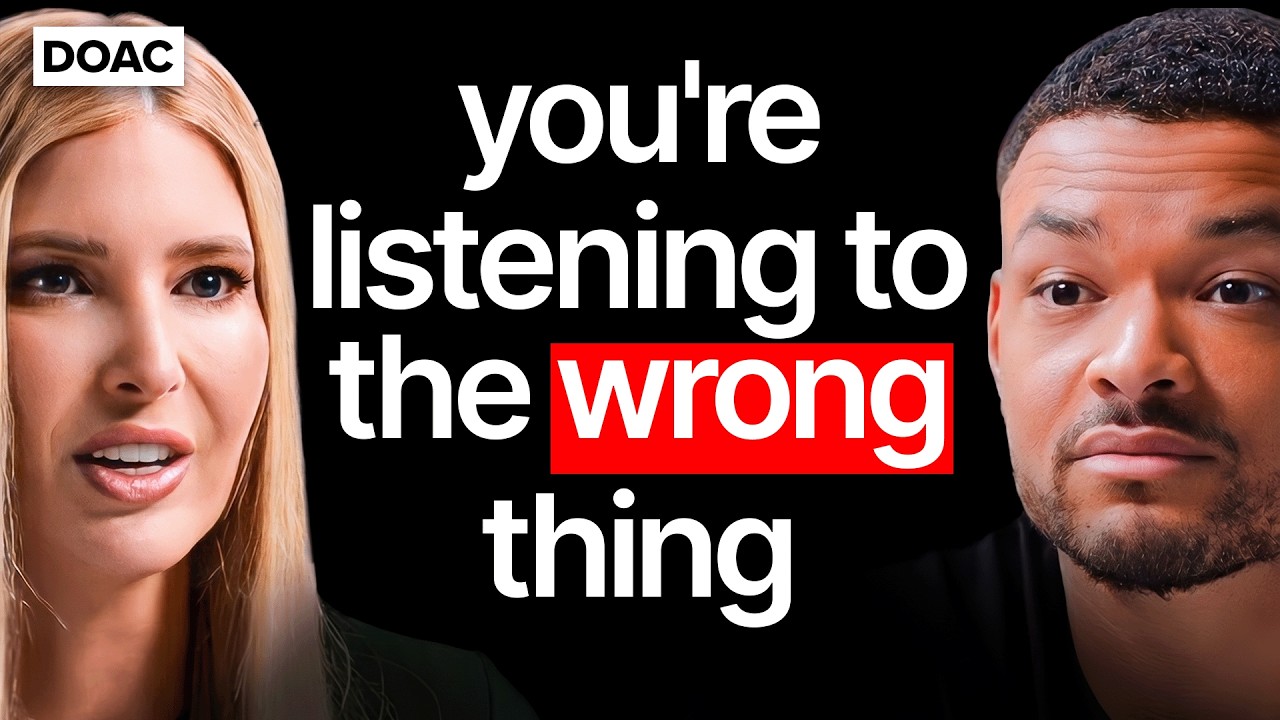
Ivanka Trump Rejects Government Return to Build Agri-Tech Venture
The Diary Of A CEO
Ivanka Trump permanently stepped back from political campaigns to protect her family from toxic public scrutiny and focus on scaling Planet Harvest to curb national agricultural food waste.
## Background
Published on April 9, 2026, by the YouTube channel 'The Diary Of A CEO' hosted by Steven Bartlett, this episode features an in-depth interview with businesswoman and former Presidential Advisor Ivanka Trump. According to the page description, Ivanka opens up about building her $800 million brand, stepping away from politics and her business empire, high-stakes negotiation tactics, her mother's legacy, and her latest ventures.
## TL;DR
In this extensive conversation, Ivanka Trump reflects on growing up under relentless media scrutiny, learning to find 'signal in the noise,' and leveraging being underestimated as a strategic advantage in real estate and business. She details her transition into public service during the Trump administration, her policy achievements in Washington, and her decisive exit from politics to prioritize family and private ventures. Throughout the discussion, she offers insights into Stoic philosophy, processing personal grief following her mother Ivana's passing, navigating high-stakes negotiations, and her current mission-driven work tackling agricultural food waste with Planet Harvest.
## Atmosphere & style
The interview is intimate, highly reflective, and deeply personal, characterized by a quiet, measured composure that contrasts sharply with the high-decibel world of national politics. Host Steven Bartlett creates an empathetic, unhurried space, allowing Ivanka to move fluidly between sharp business insights and vulnerable emotional reflections—such as shedding tears when speaking about her grandmother and late mother. The overall dynamic feels candid yet carefully guarded, presenting an earnest narrative of self-protection, resilience, and inner peace amidst intense public turbulence.
## Key takeaways
- [02:46](https://www.youtube.com/watch?v=7VxeyTfhBM8&t=166s) Growing up surrounded by wealth and fame made Ivanka guarded, but over time she intentionally embraced vulnerability as essential for meaningful human connection.
- [30:57](https://www.youtube.com/watch?v=7VxeyTfhBM8&t=1857s) Ivanka considers being underestimated early in her career as a strategic edge that allowed her to out-prepare opponents and close major deals.
- [34:59](https://www.youtube.com/watch?v=7VxeyTfhBM8&t=2099s) In negotiations, Ivanka prioritizes discovering what the other party truly values by actively listening and using silence as a strategic tool.
- [41:06](https://www.youtube.com/watch?v=7VxeyTfhBM8&t=2466s) Ivanka built her fashion and lifestyle brand to nearly $800 million in annual retail sales before voluntarily shuttering it to serve in the White House and avoid ethics conflicts.
- [58:08](https://www.youtube.com/watch?v=7VxeyTfhBM8&t=3488s) Serving in the White House stripped away the illusion of political power and revealed that global leaders are ultimately ordinary people dealing with human struggles.
- [53:52](https://www.youtube.com/watch?v=7VxeyTfhBM8&t=3232s) Ivanka permanently stepped away from political campaigns to prioritize being present for her teenage children and protect her family from political toxicity.
- [59:44](https://www.youtube.com/watch?v=7VxeyTfhBM8&t=3584s) Witnessing the 2024 assassination attempt on her father deepened her commitment to internal peace, emotional healing, and living intentionally.
- [01:08:50](https://www.youtube.com/watch?v=7VxeyTfhBM8&t=4130s) Ivanka uses the metaphor of the eagle flying higher to rise above criticism, avoiding defensive conflicts with media or political opponents.
- [01:26:05](https://www.youtube.com/watch?v=7VxeyTfhBM8&t=5165s) Drawing from Stoicism, Lao Tzu's Tao Te Ching, and jiujitsu, Ivanka navigates chaotic environments by accepting reality and maintaining internal alignment.
- [01:28:37](https://www.youtube.com/watch?v=7VxeyTfhBM8&t=5317s) Co-founding Planet Harvest allowed Ivanka to address farm-level food waste by repurposing cosmetically imperfect produce rejected by retail standards.
- [01:31:42](https://www.youtube.com/watch?v=7VxeyTfhBM8&t=5502s) Her three core rules for entrepreneurial success are loving your craft, staying authentic to yourself, and believing in your vision before external validation arrives.
## Detailed walkthrough
### [00:00](https://www.youtube.com/watch?v=7VxeyTfhBM8&t=0s) Intro: Finding Signal in the Noise
Opening with highlight clips from the conversation, Ivanka Trump reflects on the core lessons instilled by her late mother, Ivana Trump, and how growing up under the shadow of famous, highly accomplished parents shaped her mindset. She emphasizes that being underestimated early in life is a hidden super-power rather than a handicap:
> "Being underestimated is not a bad thing. It's a very powerful thing actually, and it almost always worked to the detriment of the person who underestimated me."
She addresses her decision to leave behind an $800 million business empire to join her father Donald Trump's presidential administration, observing that under intense public pressure and relentless political attacks, surviving requires learning how to "find the signal in the noise." The intro concludes with host Steven Bartlett briefly reminding viewers to subscribe to *The Diary Of A CEO* channel before diving into the interview.
---
[02:46](https://www.youtube.com/watch?v=7VxeyTfhBM8&t=166s) Why Trust Doesn't Come Easy
Asked why she rarely does long-form podcast interviews or public media appearances, Ivanka explains that her natural inclination is to put on blinders and stay hyper-focused on her projects. However, she values deep, unhurried conversations with people she respects.
```
┌──────────────────────────────────────────────┐
│ CHILDHOOD GUARD & DEFENSES │
│ Wary of people liking her for wrong reasons │
└──────────────────────┬───────────────────────┘
│
▼
┌──────────────────────────────────────────────┐
│ DECISION TO OPEN & EXPAND │
│ Chooses vulnerability despite risk of │
│ getting burned │
└──────────────────────────────────────────────┘
```
Growing up surrounded by wealth and fame made her instinctively guarded from an early age, always fearful that peers might seek her out for status or material possessions. She notices a similar dynamic today with her own children:
> "I see this now with my son. He wants to be loved by his friends... for who he is, not for who we are, and certainly not for what we have."
While this self-protective wall kept her safe—leaving her with a tight circle of loyal friends who never betrayed her—she eventually realized that true human connection requires vulnerability. Over time, she intentionally taught herself to be more trusting, accepting that being occasionally burned is a worthwhile trade-off for deeper, meaningful relationships.
---
[06:04](https://www.youtube.com/watch?v=7VxeyTfhBM8&t=364s) Growing Up Different & The Michael Jackson Incident
Reflecting on when she first realized her childhood was atypical, Ivanka notes that while her parents tried to shield their children from the press, media scrutiny was constant. However, growing up in the 1980s and 1990s was vastly different from today's smartphone-saturated environment, where kids are continuously recorded in public.
She shares a surreal childhood anecdote from when she was roughly eight years old and dancing with the School of American Ballet in New York City's annual production of *The Nutcracker* at Juilliard:
* **The Roles:** She was cast in modest entry-level roles as a "party girl" and an "angel."
* **The Guest:** Pop icon Michael Jackson had recently moved into Trump Tower as their neighbor. Donald Trump bumped into him in the lobby and casually invited him to watch Ivanka perform.
* **The Chaos:** Michael Jackson attended the performance alongside her father at the peak of his global stardom. Rather than feeling thrilled, eight-year-old Ivanka was utterly mortified:
> "I was horrified! I'm like... I thought we had ruined *The Nutcracker*. Everyone was dancing with one glove... I thought it was all my fault!"
---
[08:42](https://www.youtube.com/watch?v=7VxeyTfhBM8&t=522s) The Nurturing Love of "Bubby"
Despite the flashy public moments, Ivanka insists her daily upbringing was grounded, largely due to her maternal grandparents. Her grandmother—whom she affectionately calls "Bubby"—was a constant presence who cooked every meal and showered her with unconditional tenderness.
Ivanka becomes visibly overcome with emotion and sheds tears when discussing her grandmother, who is now 98 years old and in declining health while living in Ivanka's home:
> "To have the experience to be there for her in just like a small fraction of the way that she was there for me is such an extraordinary privilege... for my children to grow up with her at our table every single meal."
---
[11:47](https://www.youtube.com/watch?v=7VxeyTfhBM8&t=707s) Ivana Trump: Trailblazer and Role Model
Shifting to her mother, Ivana Trump, Ivanka describes her as an extraordinary trailblazer who demonstrated how to combine intense ambition with maternal devotion. At a time when very few women were operating at executive levels, Ivana managed real estate developments and commanded boardrooms—famously striding across active construction sites in five-inch heels with flawless hair.
| Aspect | Description |
|:--- |:--- |
| **Professional Role Model** | Excelled in design and architecture in corporate boardrooms dominated by men. |
| **Support System** | Relied on a tight inner circle, including Ivanka's grandmother and two dedicated nannies. |
| **Paternal Availability** | Donald Trump was intensely busy, but always picked up Ivanka's payphone calls from school—often placing her on speakerphone to brag about her grades to executives. |
Ivanka refutes the idea that her parents were "absent," noting that while her father filled a traditional era-specific paternal role, he made it unequivocally clear that his children were his top priority.
---
[15:43](https://www.youtube.com/watch?v=7VxeyTfhBM8&t=943s) Understanding Her Mother's Complex Legacy
Ivanka compares her own personality to her mother's, noting both striking similarities and key differences. Ivana possessed an outrageous, over-the-top glamour—partly as a personal rebellion against the strict austerity and control she experienced growing up under a communist regime in former Czechoslovakia:
> "Nobody was going to tell her what to do. Nobody was going to tell her what to say. So she actually would make my father look tame, and it was hysterical!"
Following Ivana's sudden death from an accidental fall, Ivanka spent time studying her mother's life history and earlier writings. She realized that, like many people who lived through severe childhood hardships, Ivana compartmentalized her past and rarely looked back. Re-reading her mother's story through the lens of adult maturity allowed Ivanka to understand her mother's sacrifices and fiercely independent spirit on a far deeper level.
[17:55](https://www.youtube.com/watch?v=7VxeyTfhBM8&t=1075s) Growing Up in the Media Spotlight and Finding Healthy Guardrails
Reflecting on a photo taken on her ornate childhood bed at Mar-a-Lago, Ivanka Trump speaks with fondness and admiration about her late mother, Ivana, describing her as "impossibly glamorous." However, that glamorous childhood was abruptly disrupted at age nine when her parents' high-profile divorce unraveled in the public eye. Host Steven Bartlett reads a quote from a 25-year-old Ivanka published in *GQ*, where she had stated that the intense media storm taught her "not to trust anybody" and never to drop her guard. Viewing that quote through the lens of time, Ivanka chuckles and identifies it as a classic defensive posture of her younger self, yet she stands by the fundamental truth behind it. She emphasizes that building boundaries and maintaining a healthy level of skepticism was an essential defense mechanism while she honed her instincts and learned how to read people.
```
"There was a level of aggression that like even today
wouldn't exist with the paparazzi... to be shouting
things and reading quotes from tabloids to me as I'm
leaving school."
— Ivanka Trump
```
The media circus surrounding the separation was relentless, producing a higher volume of headlines at the time than even the O.J. Simpson trial. Paparazzi camped outside her school, screaming tabloid headlines at a nine-year-old child as she walked out the doors. While her home remained a safe sanctuary once she stepped inside—free from blaring televisions—she notes how vastly different child protection is today. In the age of smartphones and social media, children can no longer be shielded from ambient noise in the same way, as information is instantly accessible and amplified right in front of their faces.
- **Divorce Media Circus:** The public breakdown of Donald and Ivana Trump’s marriage reportedly generated more media coverage and headlines than the O.J. Simpson trial.
- **Paparazzi Harassment:** Media crews regularly waited outside Ivanka’s school when she was nine years old, shouting tabloid headlines and questions at her as she left the building.
- **Learning of the Divorce:** Although her parents planned to sit her down in the afternoon to explain the separation, Ivanka first discovered it that morning on a newspaper vending machine cover depicting a photo of her parents torn down the middle.
- **Silver Lining:** The shared trauma of navigating the hyper-public separation created an exceptionally strong, protective bond between Ivanka and her siblings.
---
[23:36](https://www.youtube.com/watch?v=7VxeyTfhBM8&t=1416s) Navigating Public Scrutiny: Finding Signal in the Noise
Addressing the pressure of living under constant public judgment and media spin, Ivanka shares her core philosophy for surviving intense scrutiny: tuning out external chaos to "find the signal in the noise." Having spent years navigating what she describes as "dancing in the eye of the hurricane," she has cultivated an inner peace that keeps her grounded. She refuses to engage in combative online dynamics or trade cheap shots on social media, prioritizing a quiet strength over reactive back-and-forth arguments. For Ivanka, remaining true to her personal values sets a clear, healthy standard for her children and shields her from being defined by outside narratives.
```
┌────────────────────────────────────────────────────────────────────────┐
│ STOIC PRINCIPLES │
├────────────────────────────────────────────────────────────────────────┤
│ "The soul becomes dyed the color of its thoughts." │
│ — Marcus Aurelius │
│ │
│ "The cost of anything is the amount of your life you're willing │
│ to exchange for it." │
│ — Henry David Thoreau│
└────────────────────────────────────────────────────────────────────────┘
```
Ivanka attributes much of her mindset to Stoic philosophy, particularly Marcus Aurelius’s *Meditations*. She reflects on how an emperor writing in a tent on a battlefield kept his soul clear, echoing his insight that our minds are shaped by what we choose to dwell upon. Paraphrasing Henry David Thoreau, she notes that the true cost of any conflict is the exact amount of life and mental energy exchanged for it. Because compromising her internal alignment is simply "too expensive" for her soul, she intentionally avoids toxic engagements and protects her mental bandwidth.
- **The Apprentice Era:** Reflecting on her father’s transition from New York real estate fame to international stardom via *The Apprentice*, she notes that his unfiltered candor was what drew people in, even when it proved polarizing.
- **Empathy and Growth:** Admitting she is naturally an empath, Ivanka explains that becoming a mother was the pivotal moment that "cracked her open," forcing her to mature, build true confidence, and lead a life driven by intentionality.
- **Intentionality in Business and Life:** She selects her projects, business ventures, and personal interactions with strict boundaries, choosing only to spend time with people who exhibit genuine curiosity and alignment with her core values.
---
[30:57](https://www.youtube.com/watch?v=7VxeyTfhBM8&t=1857s) Differentiation, Parenting, and Turning Being Underestimated into an Advantage
When asked about the challenge of forging an independent identity while growing up inside a famous, high-profile family, Ivanka emphasizes the importance of boundaries and self-knowledge. As a parent herself, she works consciously not to treat her children as mere extensions of herself or validate them based solely on external achievements. She credits her own parents with creating an environment where respectful dissent was permitted behind closed doors, allowing her to serve as a peacemaker within the family while remaining firm in her own beliefs.
```
"Being underestimated is not a bad thing. I think it's a very powerful
thing actually. And it almost always worked to the detriment of the
person who underestimated me."
— Ivanka Trump
```
Reflecting on her early career entering the heavily male-dominated New York real estate industry—after starting out as an intern at an outside firm—Ivanka explains how she was routinely underestimated on two distinct fronts. First, as the child of famous real estate moguls, people assumed she lacked drive, rigor, or preparation. Second, as a young woman in rooms filled with veteran male executives, she was frequently written off before she even spoke. Rather than viewing this as a disadvantage, she transformed it into her strategic edge, knowing that when opponents underestimate your preparation, they drop their guard and leave themselves unprepared for the negotiation.
Here is a detailed, faithful walkthrough of the transcript segment.
[34:32](https://www.youtube.com/watch?v=7VxeyTfhBM8&t=2072s) Being Underestimated and the Art of Negotiation
Ivanka reflects on her early years as a young woman breaking into the male-dominated real estate industry. While women were commonly seen in sales or marketing roles, they were rarely present in development, construction, finance, or acquisitions. She describes how she harnessed her own lingering insecurities and transformed the fear of being underestimated into a source of motivation. Rather than feeling discouraged by low expectations, she turned that sentiment to her advantage by always being meticulously overprepared and outworking everyone in the room.
When Steven notes that former colleagues have described her as a "naturally born dealmaker," Ivanka admits she would much rather be underestimated than overestimated on any given day. She details her core philosophy on negotiation, emphasizing that the most crucial element is identifying what the other party truly wants. While research occasionally provides clues, true insight comes from listening—and leveraging silence as a strategic weapon. Because people naturally feel uncomfortable during silent pauses, they often fill the air with critical details about what they consider a win. By discovering what the other person values, a negotiator can frequently grant a major concession at very little cost, resulting in a genuine win-win outcome.
Beyond tactical maneuvers, Ivanka highlights the irreplaceable value of authentic relationship-building. She notes that the best transactions occur when both sides genuinely know and respect each other, fostering a collaborative mindset where everyone wants the other side to succeed. Ultimately, she prefers building tangible physical assets that uplift communities and solving complex problems through coalitions of like-minded partners.
- **Negotiation Philosophy:** Focus on understanding the other party's definition of a win, using silence to encourage them to reveal their priorities.
- **Relational Strategy:** Building authentic personal relationships creates deals where both parties actively champion each other's success.
- **Real Estate Dynamics:** Used being underestimated as a female executive in construction, finance, and development to fuel overpreparation.
---
[37:49](https://www.youtube.com/watch?v=7VxeyTfhBM8&t=2269s) Hiring Strategy, Core Values, and Competitive Upbringing
When evaluating talent for her projects, Ivanka prioritizes a strong sense of self, good judgment, and personal agency. She notes that while technical skills can be taught, attributes like street smarts, emotional intelligence (EQ), and the ability to read a room are far more difficult to instill. Fundamental to her hiring process is choosing to work exclusively with good, trustworthy people whom she respects and enjoys spending time with.
Ivanka shares how this philosophy extends to her parenting. In a society obsessed with external badges of success—such as high grades, trophies, and outside validation—she continuously reminds her children that the most impactful way to impress her is simply by being a good person. When Steven gently asks whether that same standard applied to her own childhood—suggesting the Trump household appeared from the outside like an intense competition among siblings—Ivanka laughs and acknowledges that her experience was slightly different.
Growing up, her mother was a strict disciplinarian, creating a high-performance environment where competition among the siblings ran deep. However, Ivanka defends this rigorous approach, noting that her mother’s perspective as an immigrant drove high expectations. Reflecting on her own parenting, she observes that her daughter sets such an extraordinarily high bar for herself that her primary duty as a mother is actually giving her daughter permission to drop the pursuit of perfection.
- **Core Hiring Criteria:** Looks for high EQ, strong personal agency, good judgment, and fundamental trustworthiness.
- **Parenting Philosophy:** Shifts the focus away from external accolades (grades, trophies) toward character and internal values.
- **Trump Family Culture:** Characterized by high expectations, an intense drive for performance, and competitive sibling dynamics overseen by a strict mother.
---
[41:06](https://www.youtube.com/watch?v=7VxeyTfhBM8&t=2466s) Turning Down Anna Wintour and Building an $800 Million Brand
Recalling the start of her post-college career, Ivanka recounts a famous phone call she received on the morning of her graduation from the Wharton School of Business at the University of Pennsylvania. Anna Wintour personally called at 8:00 AM to offer her a job at *Vogue*. Though groggy from the early morning call and deeply honored by the offer, Ivanka turned it down because she had known from a young age that her true passion lay in real estate, architecture, and urban design.
Despite her real estate focus, Ivanka eventually entered the fashion world, starting with fine jewelry at age 26 and expanding to found IvankaTrump.com by age 33. She identified a massive gap in the market: professional women's workwear was uninspiring and rigid, incapable of seamlessly transitioning from the office to a evening date or drinks with friends. By creating an accessibly priced, feminine brand for the "multi-dimensional woman," her business caught fire across 11 distinct product categories—including apparel, footwear, fragrance, and sunglasses—and was carried by major retailers such as Nordstrom and Neiman Marcus.
At its peak, her brand was generating close to $800 million in annual retail sales. However, when her father won the presidency and asked her to join his administration, she chose to permanently shut the business down. To comply strictly with the Office of Government Ethics, her brand was barred from using her image or expanding into new domestic or international accounts. Recognizing that a brand cannot simply sit on ice without stagnating, Ivanka made the tough decision to close it down on a high note rather than watch it deteriorate, choosing instead to focus entirely on her new role in public service.
- **Wharton Graduation:** Declined a personal job offer from Anna Wintour at *Vogue* to pursue real estate development.
- **Brand Scale:** Built her fashion and lifestyle brand to nearly $800 million in annual sales across 11 product categories.
- **Brand Closure:** Liquidated the company to adhere to federal ethics guidelines regarding conflicts of interest and brand expansion.
---
[45:08](https://www.youtube.com/watch?v=7VxeyTfhBM8&t=2708s) The Pivot to Washington and Expanding Horizons
Ivanka reflects on the sudden transition from running a successful corporate empire to serving in government. When her father unexpectedly asked her and her husband, Jared Kushner, to move to Washington, D.C. to help him navigate an unfamiliar political landscape, he jokingly gave her an "anti-sale" warning: "They're going to come at you hard. They're probably going to hate you. You're too young." Despite having no prior plans to enter politics and loving her business career, she realized she couldn't look back in 40 years and regret saying no to serving her country.
Steven points out that Ivanka didn't choose the turbulent political spotlight, noting how her life path has repeatedly been altered by her father's grand ambitions—from being hounded by paparazzi at age nine during her parents' divorce to entering the White House. Ivanka acknowledges that while everyone's path is shaped by circumstance, entering presidential politics was an unprecedented shock. Unlike career politicians who slowly build experience through local elections, her father's very first run for public office was for President of the United States—and he won.
The campaign and subsequent White House tenure completely shattered her New York City bubble. Stepping out into the country exposed her to vast, divergent perspectives from everyday Americans, deeply challenging and expanding her worldview. While some conversations reinforced her core beliefs, others fundamentally altered her outlook on key issues. Despite the intense personal and public challenges, she views the experience of serving the nation as an extraordinary privilege that permanently broadened her horizon.
- **Father's Warning:** Donald Trump candidly warned her that Washington would be brutal and that she would face intense public backlash.
- **Abrupt Transition:** The family went straight into the White House without the typical ramp-up of local or state political campaigns.
- **Perspective Shift:** Traveling the country during the campaign broke her out of her New York bubble and broadened her understanding of American viewpoints.
[50:57](https://www.youtube.com/watch?v=7VxeyTfhBM8&t=3057s) The Pre-Election Horizon and Early Political Inklings
Steven Bartlett kicks off the segment by bringing up Donald Trump’s early, sporadic flirtations with running for the presidency. He points to the famous, viral Oprah Winfrey interview from the late 1980s where Trump stated he would never completely rule out running if things in the United States got bad enough, driven by an unyielding conviction that he would win. Steven also mentions a 1980 interview with Rona Barrett where the concept was floated, and asks Ivanka if she ever had a true sense during her youth that a political run was actually on the family horizon.
Ivanka responds with a candid "Not really." She explains that her childhood conversations with her father were dominated by real estate, design, and building the family business rather than political aspirations. However, she recalls one specific moment of sheer teenage panic when she was 16 years old at boarding school. Having read a rumor that her father was going to run for president, she called him in a hysterical state, crying, "Oh my god, I read that you're going to run for president. This is going to ruin my life." Her father laughed it off and reassured her, saying, "Don't worry about it. Not happening."
Looking back, Ivanka notes that Donald Trump’s political thoughts were born out of his dissatisfaction with the options he was given as a voter, which slowly led him to formulate what he would do differently. She points out that his core principles—particularly his views on trade policy being deeply unfair to American workers—have remained remarkably consistent from that Oprah interview all the way to the present day.
---
[52:54](https://www.youtube.com/watch?v=7VxeyTfhBM8&t=3174s) The 2015 Announcement and Full Steam Ahead
Steven fast-forwards to 2015. At 33 years old, Ivanka learned just two weeks before the official announcement that her father was formally entering the presidential race. Steven asks if she experienced an existential panic upon hearing the news.
Ivanka describes how the family gathered at Trump National Golf Club Bedminster in New Jersey, where Donald Trump shared his ultimate intention and asked her to deliver his introduction. Even as they were preparing for the big moment, the sheer velocity of the event felt surreal. Ivanka recalls standing by the famous golden escalator, preparing to give her introductory speech, and thinking to herself, "Are you really going to do this? Is he going to get up here and actually?" Despite the rapid pace of the launch, she knew that once her father finally pulled the trigger after years of internal debate, it was going to be "full steam" ahead. She admits with a nostalgic smile that life has truly never been the same since, describing it as an extraordinary ride filled with massive highs and lows where they have done "a lot of living."
---
[53:50](https://www.youtube.com/watch?v=7VxeyTfhBM8&t=3230s) White House Achievements and Resisting "Power Fever"
Steven lists a series of major policy achievements from Ivanka’s four years serving as a Senior Advisor in the White House. He asks if leaving the political arena at the end of the term brought a sense of relief, drawing a parallel to Michelle Obama's apparent happiness upon exiting the White House.
Ivanka reflects on her time in public service with immense pride and zero regrets, stating, "I left it all on the field." She acknowledges that while the role required a significant personal sacrifice from her children and demanded incredibly grueling work, she felt deeply privileged to deliver tangible results for the American people. She notes that she is completely immune to what insiders call "POTUS fever"—the addictive allure of proximity to high office that causes people to constantly hang around the hoop and cycle back into government. For Ivanka, the decision to step away from the subsequent campaign was incredibly straightforward because her absolute priority is being a mother to her three children.
```
White House Policy Metrics (Trump Administration)
┌──────────────────────────────┬────────────────────────────────────────────────────────┐
│ Policy Initiative │ Key Impact & Metrics │
├──────────────────────────────┼────────────────────────────────────────────────────────┤
│ Child Tax Credit │ Doubled from $1,000 to $2,000 │
│ │ Benefited 40 million American families │
│ │ Kept an average of $2,400 per year in parents' pockets │
├──────────────────────────────┼────────────────────────────────────────────────────────┤
│ Vocational & Skills Training │ Secured private sector commitments to skill/reskill │
│ │ 16 million American workers │
│ │ Facilitated 1 million new apprenticeship opportunities │
│ │ Provided $1.3 billion annually to 13+ million students │
├──────────────────────────────┼────────────────────────────────────────────────────────┤
│ Human Trafficking Leg. │ Helped pass 9 distinct pieces of legislation to │
│ │ combat human trafficking and child exploitation │
├──────────────────────────────┼────────────────────────────────────────────────────────┤
│ Environmental & Federal Care │ Helped secure paid family leave for federal workers │
│ │ Helped pass the Great American Outdoors Act │
└──────────────────────────────┴────────────────────────────────────────────────────────┘
```
Ivanka stresses that the decision to remain out of politics is further solidified by the fact that her children are now teenagers. With her daughter being 14, Ivanka recognizes that there is only a finite window of time left before her kids leave the nest. "Even if like a quarter of my interactions with her through her closed bedroom door, like I need to be present and I need to be there," she explains. She notes that the political landscape has shifted as well; unlike the early days, her father now possesses a deep bench of highly motivated people eager to serve, allowing her to peacefully prioritize her family in the private sector.
---
[58:08](https://www.youtube.com/watch?v=7VxeyTfhBM8&t=3488s) Pulling Back the Veil on Global Leaders
When asked what she was least prepared for, Ivanka explains that absolutely nothing can truly train a person for life inside the White House. The experience quickly taught her a fundamental truth about human nature: "Power, just like money, makes people more of what they already are."
Her time in Washington and on the international stage completely stripped away the mystery and intimidation of global power. Interacting closely with world leaders—ranging from heads of elected democracies to monarchs—revealed to her that they are ultimately just regular people. She discovered that many of these monumental historical figures deal with the exact same mundane human struggles as everyone else: "Some of them their kids don't speak to them. They got in a fight with their wife that morning." While some leaders felt genuinely historic and consequential, others left her wondering how they ever managed to get elected to high office in the first place. This realization permanently removed the veil of awe surrounding fame and authority.
---
[59:44](https://www.youtube.com/watch?v=7VxeyTfhBM8&t=3584s) The 2024 Assassination Attempt and Its Emotional Toll
The conversation takes a somber, highly emotional turn as Steven brings up the dramatic shift in Ivanka's personal safety, noting that politics is an incredibly dangerous game. He explicitly references the July 2024 assassination attempt in Butler, Pennsylvania, where Donald Trump was shot in the ear on the campaign trail.
Ivanka grows visibly moved as she recalls being at the family's Bedminster estate when the shooting occurred. She was out by the pool bistro when the televisions started buzzing with real-time commotion. Because two of her children were right there with her, her immediate maternal instinct was to turn them away from the screen. She witnessed the terrifying moments before her father stood back up. Oddly enough, Ivanka describes an intense, intuitive certainty that gripped her in that exact moment: "I knew real time in that moment that he was fine. Like, I had I just knew that like it wasn't his time."
* **The Late-Night Return:** Donald Trump was discharged from the hospital and flew straight back to Bedminster that very evening. At roughly 1:00 or 2:00 in the morning, Ivanka and her husband, Jared Kushner, stayed up to meet his car as it pulled into the driveway.
* **Life's Fragility:** Ivanka links the trauma of that day to a string of profound personal reminders regarding how finite life is, including the premature passing of her mother, Ivana Trump, and Jared's previous scare with thyroid cancer.
* **The Recommitment to Love:** Rather than letting the reality that someone tried to publicly execute her father make her bitter or negative, Ivanka consciously chooses to view the failed attempt as a miracle and a blessing. "Forgiveness is a difficult thing in this regard," she reflects, but emphasizes that she refuses to let darkness win. "In life, you have a choice only in how you respond. And I choose to see the positive outcome that transpired and dwell there."
---
[01:07:20](https://www.youtube.com/watch?v=7VxeyTfhBM8&t=4040s) Stepping Away from the "Gladiator" World of Politics
Steven observes that the deep emotional toll of the assassination attempt is still very present in Ivanka's demeanor, which makes complete sense given that he is her father. He transitions into her complete departure from politics in 2022, quoting her public statement prioritizing her family, as well as an interview on Lex Fridman's podcast where she described politics as a "pretty dark world" full of negativity. Steven suggests that Ivanka’s inherent nature seems to be the absolute antithesis of that hostile environment.
Ivanka enthusiastically agrees with the assessment, stating plainly, "There's this like gladiatorial aspect of it that's just like not for me." While she remains deeply passionate about policy and finding ways to help people—which she now pursues through private business and real estate developments—she strongly dislikes the toxic theater of politics. Steven praises her highly disciplined public stance, noting that she famously refuses to "punch back" at critics or engage in public mudslinging. Ivanka smiles subtly and admits, "It takes training."
Here is a detailed, faithful walkthrough of this part of the conversation:
[01:08:50](https://www.youtube.com/watch?v=7VxeyTfhBM8&t=4130s) The Crow and the Eagle: A Metaphor for Rise Above the Noise
Ivanka Trump shares a story about crows that she read recently, calling it a great metaphor for life and dealing with criticism. Crows are highly intelligent animals, but they can be aggressive and territorial. Uniquely, a crow will actively attack an eagle—sometimes out of territoriality, and other times seemingly just for fun. It will mob the eagle, land on its back, and begin pecking relentlessly at it. Even though the eagle is exponentially larger and stronger, its response is never to twist, turn, knock the crow off, or engage in a fight. Instead, the eagle simply flies higher and higher into the sky.
Because the crow is not built for high-altitude flight, it eventually suffocates or tires out and falls away. The eagle expends no energy on a counterattack; it just plays the game on its own terms. Ivanka explains that this analogy perfectly mirrors how to handle political attacks and media noise: rather than wasting energy fighting back or getting confused by unfair claims, one must simply "fly up" and let the crows fall off. She admits that earlier in her life, she felt genuinely confused and hurt by unfair attacks, but she eventually trained herself not to get distracted by either public hostility or pedestals.
[01:13:28](https://www.youtube.com/watch?v=7VxeyTfhBM8&t=4408s) Stoicism, Self-Protection, and Inner Peace
Steven Bartlett notes how Ivanka seems to have developed a stoic mindset to survive being characterized or judged for things she never did, floating in the "eye of the hurricane." Ivanka expresses deep gratitude for these intense experiences, reflecting that life keeps teaching a person a lesson until it is learned. As someone who naturally craved peace and harmony, it took an extreme level of public intensity for her to realize that she can only control her inner peace, not massive external forces outside her command.
When asked if she ever sought therapy, Ivanka clarifies that while she did not go during childhood, she has leaned on trusted friends—who are professors, teachers, and therapists—throughout her adulthood. She views therapy not as a place to linger endlessly, but as a practical tool for an "internal inventory" alongside meditation. She believes it is crucial to process heavy emotions in near-real time rather than compartmentalizing them away in a box, because hidden baggage secretly "drives the bus" and compromises future decision-making.
[01:15:48](https://www.youtube.com/watch?v=7VxeyTfhBM8&t=4548s) Navigating Public Demeanor vs. Authentic Self
Ivanka points to a series of heavy life events that triggered her desire for deep introspection: leaving Washington D.C., her life being in flux, her husband Jared Kushner being diagnosed with thyroid cancer for a second time, and the sudden loss of her mother, Ivana Trump. While Ivanka acknowledges that she naturally puts on a tough exterior and can look stoic in public, she emphasizes that she is equally soft and empathetic behind closed doors.
She and Bartlett contrast this with traditional politicians who feel inauthentic or robotic on stage because they never allow their mask to slip. Ivanka notes that her father, Donald Trump, stands out precisely because he remains unfiltered and authentic in a profession filled with staged personas. However, she believes it is entirely healthy and necessary to guard one's core vulnerabilities and family privacy in the public eye—where every minor slip-up is weaponized—as long as one doesn't lose themselves or bring that rigid public defense home into personal relationships.
[01:20:28](https://www.youtube.com/watch?v=7VxeyTfhBM8&t=4828s) Processing the Loss of Her Mother, Ivana Trump
Ivanka becomes visibly emotional when discussing the tragic, sudden passing of her mother, Ivana Trump, in 2022 from a fall down the stairs at age 70. She notes the stark contrast between her mother's sudden death and her grandmother (Ivana's mother), who is still alive at 99 years old. Ivanka recounts how COVID-19 geographical separations—with her in Washington and her mother in New York—robbed them of precious time together during those final years.
To grieve properly rather than running away from the discomfort, Ivanka consciously chose to step back and process her memory. She made a deliberate effort to view her mother not just through the idolizing eyes of a child, but through the clear, clear-eyed perspective of an adult who sees both her strengths and her struggles. Ivanka sees her duty as a mother to her own children like a "lioness"—standing guard to pass along the joyful stories, dance, and vibrant spirit of Ivana, while protecting her children from repeating any of the family's generational struggles.
- **Key Detail:** Ivanka's grandmother was 99 years old at the time of recording, while her mother Ivana passed away suddenly at age 70.
- **Ventures Mentioned:** In 2023, at age 41, Ivanka co-founded **Planet Harvest** with her friend Melissa Ackerman (inspired by her work on the USDA Farmers to Families Food Box program during COVID-19), alongside investing in tech companies and leading a major real estate development project in Albania.
[01:25:28](https://www.youtube.com/watch?v=7VxeyTfhBM8&t=5128s) The Illusion of Work-Life Balance
When asked how she balances her high-profile business ventures, real estate projects, and family life, Ivanka rejects the notion of "balance" entirely, calling it a scale that is fundamentally elusive. She notes that true balance is a practical impossibility because a single phone call from a school nurse saying a child has the flu instantly throws everything off kilter. Instead of pursuing the artificial goal of balance, she focuses on living an intentional, aligned life.
[01:26:05](https://www.youtube.com/watch?v=7VxeyTfhBM8&t=5165s) Stoicism, Philosophy, and Finding Flow
Reflecting on how to maintain clarity amidst high-stakes real estate investments, complex business deals, family commitments, and public scrutiny, Ivanka explains that strict daily balance is a myth. Life is simply too hectic and unpredictable to maintain total equilibrium at all times. Instead, success lies in aligning daily actions with core priorities so that, more days than not, one feels centered.
When asked about the foundational frameworks that help her stay grounded, she points to world religions—such as the Bible and the Torah—as timeless guides for living a purpose-driven, ethical life. Beyond religious texts, she relies on Stoicism and ancient Eastern philosophies, singleing out Lao Tzu's *Tao Te Ching*. She compares the wisdom of Taoism to the physical philosophy of jiujitsu: both center on presence, fluid adaptability, and accepting "what is" rather than fighting reality. Much of human suffering stems from fighting unchangeable facts instead of focusing on what lies within one's direct control. To stay internally aligned, she tracks moments when she enters a true "flow state"—whether over the past day, week, or month—and uses those experiences as "medicine" to design her life around what makes her feel most alive.
* **Core Philosophies Mentioned:** Stoicism, Christianity/Judaism (Bible, Torah), Taoism (*Tao Te Ching* by Lao Tzu), and Buddhism.
* **Key Concept:** Suffering often arises from rejecting current reality rather than focusing on controllable elements.
* **Personal Benchmark:** Identifying moments of peak "flow state" to recognize one's core essence and actively cultivate those environments.
---
[01:28:37](https://www.youtube.com/watch?v=7VxeyTfhBM8&t=5317s) Tackling Food Waste with Planet Harvest
Ivanka discusses her mission-driven enterprise, Planet Harvest, which addresses systemic agricultural waste across the United States. She notes that the most impactful opportunities often arise from "being obvious by being contrarian." Her passion for agriculture grew during the COVID-19 pandemic when she helped establish the Farmers to Families Food Box program. When supply chains collapsed and demand from restaurants, airlines, and hotels evaporated overnight, farmers were forced to plow viable crops back into the soil because they could not afford to harvest them without buyers. The grant program bridged that gap, connecting farmers directly with distributors, nonprofits, and churches to deliver fresh food to families in need.
This hands-on experience exposed a persistent, non-pandemic issue: vast quantities of pristine, highly nutritious produce are routinely left to rot in fields simply because they fail to meet rigid cosmetic standards established by retailers decades ago. Planet Harvest was co-founded alongside a female CEO to monetize this surplus, providing critical incremental revenue to farmers while supplying fresh nutrition to communities and reducing environmental impact.
* **Primary Mission:** Reducing farm-level food waste while creating new revenue streams for American farmers.
* **Background Driver:** Lessons learned from creating the federal Farmers to Families Food Box program during the pandemic.
* **Strawberry Example:** Roughly 400 million pounds of strawberries are left unharvested in fields every year solely due to outdated, rigid cosmetic specifications rather than poor quality or taste.
---
[01:31:42](https://www.youtube.com/watch?v=7VxeyTfhBM8&t=5502s) The 3 Rules for Success and Happiness
Closing with the podcast's signature tradition, the host reads a question left by the previous guest asking what three pieces of advice Ivanka would give her oldest child—her daughter, Arabella—if she chose to follow in her footsteps as an entrepreneur and investor.
#### 1. Love What You Do
Ivanka stresses that true entrepreneurship demands an immense amount of dedication, heavy responsibility for others' livelihoods, and continuous grind. "I have never seen someone at the peak of their game who doesn't absolutely love what they do." She recalls brilliant classmates from top schools who flamed out because they pursued paths where they were skilled, but ultimately lacked passion. A less naturally gifted competitor who works twice as hard out of genuine love for the craft will always win.
#### 2. Be Authentic and Blaze Your Own Course
Referencing insights from her friend, naval strategist and investor Naval Ravikant, she emphasizes that copying others is a losing strategy. Authenticity makes a person non-fungible—when you are genuinely yourself, no one can compete with you. While entrepreneurs must remain receptive to feedback and know when to execute a pivot, they cannot build a business that is merely derivative of someone else's idea.
#### 3. Believe in Yourself First
For any young builder, self-conviction must precede external validation. "You're going to have to believe in yourself before the world believes in you." Reflecting on her recent investments in early-stage technology, AI, and robotics companies, Ivanka observes that founders often possess confidence that far outpaces their initial level of experience. That unshakeable self-belief is essential to get off the starting line; external recognition and "putting up some W's" only come after taking the initial leap.
## Notable quotes
> [00:00](https://www.youtube.com/watch?v=7VxeyTfhBM8&t=0s) Being underestimated is not a bad thing. It's a very powerful thing actually, and it almost always worked to the detriment of the person who underestimated me. — Ivanka Trump
> [02:46](https://www.youtube.com/watch?v=7VxeyTfhBM8&t=166s) I see this now with my son. He wants to be loved by his friends... for who he is, not for who we are, and certainly not for what we have. — Ivanka Trump
> [06:04](https://www.youtube.com/watch?v=7VxeyTfhBM8&t=364s) I was horrified! I'm like... I thought we had ruined The Nutcracker. Everyone was dancing with one glove... I thought it was all my fault! — Ivanka Trump
> [08:42](https://www.youtube.com/watch?v=7VxeyTfhBM8&t=522s) To have the experience to be there for her in just like a small fraction of the way that she was there for me is such an extraordinary privilege... for my children to grow up with her at our table every single meal. — Ivanka Trump
> [15:43](https://www.youtube.com/watch?v=7VxeyTfhBM8&t=943s) Nobody was going to tell her what to do. Nobody was going to tell her what to say. So she actually would make my father look tame, and it was hysterical! — Ivanka Trump
> [17:55](https://www.youtube.com/watch?v=7VxeyTfhBM8&t=1075s) There was a level of aggression that like even today wouldn't exist with the paparazzi... to be shouting things and reading quotes from tabloids to me as I'm leaving school. — Ivanka Trump
> [50:57](https://www.youtube.com/watch?v=7VxeyTfhBM8&t=3057s) Oh my god, I read that you're going to run for president. This is going to ruin my life. — Ivanka Trump
> [53:50](https://www.youtube.com/watch?v=7VxeyTfhBM8&t=3230s) Even if like a quarter of my interactions with her through her closed bedroom door, like I need to be present and I need to be there — Ivanka Trump
> [58:08](https://www.youtube.com/watch?v=7VxeyTfhBM8&t=3488s) Some of them their kids don't speak to them. They got in a fight with their wife that morning. — Ivanka Trump
> [59:44](https://www.youtube.com/watch?v=7VxeyTfhBM8&t=3584s) I knew real time in that moment that he was fine. Like, I had I just knew that like it wasn't his time. — Ivanka Trump
> [59:44](https://www.youtube.com/watch?v=7VxeyTfhBM8&t=3584s) In life, you have a choice only in how you respond. And I choose to see the positive outcome that transpired and dwell there. — Ivanka Trump
> [01:07:20](https://www.youtube.com/watch?v=7VxeyTfhBM8&t=4040s) There's this like gladiatorial aspect of it that's just like not for me. — Ivanka Trump
> [01:31:42](https://www.youtube.com/watch?v=7VxeyTfhBM8&t=5502s) I have never seen someone at the peak of their game who doesn't absolutely love what they do. — Ivanka Trump
> [01:31:42](https://www.youtube.com/watch?v=7VxeyTfhBM8&t=5502s) You're going to have to believe in yourself before the world believes in you. — Ivanka Trump
## Mentioned
Ivanka Trump, Ivana Trump, Donald Trump, Steven Bartlett, The Diary Of A CEO, Michael Jackson, School of American Ballet, Juilliard, Trump Tower, Mar-a-Lago, GQ, The Apprentice, Marcus Aurelius, Henry David Thoreau, Anna Wintour, Wharton School of Business, University of Pennsylvania, Vogue, IvankaTrump.com, Nordstrom, Neiman Marcus, Jared Kushner, Office of Government Ethics, Oprah Winfrey, Rona Barrett, Trump National Golf Club Bedminster, Michelle Obama, Child Tax Credit, Great American Outdoors Act, POTUS, Lex Fridman, Planet Harvest, Melissa Ackerman, USDA Farmers to Families Food Box program, Lao Tzu, Tao Te Ching, Naval Ravikant, Arabella
Ivanka Trump argues that navigating intense public scrutiny, business negotiations, and high-stakes governance requires filtering out external chaos by cultivating internal conviction and strict boundaries. Drawing from her career in real estate, private business, and four years as a White House Senior Advisor, she reflects on turning underestimation into a tactical edge, rejecting the addictive lure of political power, and refocusing on family and mission-driven enterprise.
Turning Underestimation into a Negotiating Edge (34:32)
Entering the male-dominated New York real estate sector after graduating from Wharton—where she turned down an immediate job offer from Vogue editor Anna Wintour—Trump recalls being routinely discounted as both a young woman and the child of famous developers. Rather than resisting these assumptions, she treated low expectations as a strategic advantage, deliberately overpreparing to outwork counterparts who let their guard down. Trump later translated this dynamic into her own venture, scaling a multi-category lifestyle brand to nearly $800 million in annual retail sales before liquidating the business to comply with federal ethics rules upon entering public service.
Trump outlines a negotiation philosophy focused on listening rather than dominance. She advocates the deliberate use of silence during high-stakes discussions, observing that people naturally rush to fill uncomfortable pauses with revealing details about their definitions of success. Uncovering an opposing party's core desires allows a negotiator to grant major concessions at low personal cost, fostering collaborative outcomes and long-term relationships where both parties actively champion each other's success.
Managing Scrutiny through Stoic Distance (23:36)
Trump's self-protective boundaries developed in childhood; at age nine, her parents' high-profile divorce generated intense media coverage that reportedly exceeded the O.J. Simpson trial, subjecting her to paparazzi shouting tabloid headlines outside her school. To navigate persistent public judgment without becoming reactive, Trump relies on Stoic philosophy, citing Marcus Aurelius and Henry David Thoreau to argue that trading public insults or engaging in online battles exacts an unsustainable toll on personal bandwidth and mental clarity.
She illustrates her approach to public attacks through the metaphor of an eagle mobbed by a territorial crow: rather than expending energy to knock the crow off, the eagle simply flies into higher altitudes until the crow runs out of oxygen and falls away. Trump asserts that surviving the eye of media storms requires refusing to engage with bad-faith criticism, conducting regular emotional processing through therapy and meditation, and recognizing that one can control only internal peace rather than external narratives.
White House Service and Demystifying Power (53:50)
Reflecting on her four years as a Senior Advisor in the Trump administration, Trump highlights policy outcomes including doubling the Child Tax Credit from $1,000 to $2,000 for 40 million families, securing corporate pledges to skill or reskill 16 million American workers, and passing paid family leave for federal employees. Her time in Washington also demystified global authority; working closely with heads of state revealed that prominent world figures deal with identical personal dysfunctions and insecurities as ordinary citizens, reinforcing her belief that power merely magnifies preexisting character traits.
Despite these policy engagements, Trump determinedly exited government at the end of the term, asserting that she is entirely immune to 'POTUS fever'—the tendency of political insiders to endlessly cycle through government for proximity to high office. Citing the limited time remaining before her teenage children leave home, she concluded that maternal presence took precedence over continuing in presidential campaign politics, especially as a broader bench of personnel emerged to run the political operation.
Family Grounding and Post-Political Enterprise (59:44)
Trump credits her personal grounding to her maternal line, particularly her 99-year-old grandmother living in her home and her mother Ivana Trump, whose sudden accidental death in 2022 prompted a reexamination of family history and personal priorities. Heightened safety risks—most acutely felt during the July 2024 assassination attempt against her father in Butler, Pennsylvania, alongside her husband Jared Kushner's past bouts with thyroid cancer—deepened her aversion to the hostile, 'gladiatorial' theater of political life.
Dismissing the concept of work-life balance as an impossible standard easily derailed by daily disruptions, Trump focuses instead on intentionality and purpose. Her private sector work includes international real estate in Albania, venture investments in robotics and artificial intelligence, and co-founding Planet Harvest. Developed from lessons learned leading the pandemic-era Farmers to Families Food Box program, the enterprise monetizes cosmetically imperfect agricultural surplus—such as the estimated 400 million pounds of strawberries discarded annually in the U.S.—to generate farmer revenue and reduce food waste.
Trump presents her departure from politics not as a retreat from engagement, but as an intentional boundary against toxic environments in favor of family presence and private sector ventures. While she maintains that individuals can rise above public hostility through emotional discipline and Stoic detachment, her experiences underscore the constant friction between personal boundaries and the inescapable gravity of public life.
## Background
本期内容由知名播客频道 The Diary Of A CEO(主持人 Steven Bartlett)于 2026 年 4 月 9 日在 YouTube 平台发布。节目简介重点介绍了前白宫总统顾问、企业家伊万卡·特朗普(Ivanka Trump)的深度专访,涵盖她早年关闭估值数亿美元的个人品牌、退出政治竞选的原因、百亿美元谈判法则、告别政坛后的家庭与投资新生活,以及应对 AI 浪潮的洞察。
## TL;DR
在长达一个半小时的坦诚对话中,伊万卡·特朗普回顾了自己在显赫声名与媒体审视下成长的经历,分享了如何将外界的轻视转化为谈判与商业博弈中的绝对战略优势。她首度详述了为协助父亲履职而亲手关停年销售额达 8 亿美元时尚品牌的合规考量,剖析了在白宫推行儿童税收抵免等政策的核心政绩,以及经历父亲刺杀未遂后对生命无常的觉察。她明确表达了彻底远离残酷政坛、优先陪伴子女的决心,并阐述了借助斯多葛主义与老子哲学在喧嚣舆论中坚守内在平静的心路历程。节目尾声,她深入探讨了创立农业科技企业 Planet Harvest 以解决农田食物浪费的初心,并向年轻一代创业者提出了“热爱为基、真实做自己、先于世界相信自己”的三大制胜法则。
## Atmosphere & style
整场访谈氛围深沉、克制而极具情感张力,摒弃了政客常见的防御性辞令,呈现出一种罕见的内省与温度。主持人 Steven Bartlett 以细腻而富有同理心的提问循序渐进,引导伊万卡在谈及 99 岁外祖母的照拂与母亲伊万娜骤逝时数度动情哽咽,甚至在镜头前擦拭泪水。对话在斯多葛哲学的理性冷静与血脉亲情的柔软真诚之间自然流动,既有在聚光灯飓风之眼中跳舞的历练从容,又充满了一位母亲历经洗礼后的从容定力,带给听众一种平静且充满生命韧性的聆听质感。
## Bulletin
- [43:48](https://www.youtube.com/watch?v=7VxeyTfhBM8&t=2628s) 伊万卡在特朗普赢得大选后,为遵守政府道德办公室的严苛合规要求,毅然关闭了年销售额逼近8亿美元的个人同名时尚与生活方式商业帝国,随同进入白宫全职担任总统顾问。
- [53:50](https://www.youtube.com/watch?v=7VxeyTfhBM8&t=3230s) 在白宫任职四年期间,伊万卡推动了多项重大立法与政策,包括将儿童税收抵免翻倍至每名儿童2000美元、确立联邦雇员带薪家庭假,并促成私营企业承诺为1600万名工人提供技能培训与重塑。
- [01:07:20](https://www.youtube.com/watch?v=7VxeyTfhBM8&t=4040s) 2022年伊万卡正式声明彻底退出政界并拒绝参与后续竞选,将母亲身份和陪伴青春期子女置于首位,直言政治厮杀的残酷黑暗与个人本性格格不入。
- [01:28:37](https://www.youtube.com/watch?v=7VxeyTfhBM8&t=5317s) 离开政界后,伊万卡不仅在阿尔巴尼亚开发大型地中海岛屿地产项目,还联合创立了旨在盘活农田滞销与外观瑕疵蔬果的农业食品企业 Planet Harvest,同时将投资重点转向人工智能与机器人赛道。
## Key takeaways
- [00:00](https://www.youtube.com/watch?v=7VxeyTfhBM8&t=0s) 母亲从小教育伊万卡“被人低估是极其强大的力量”,在男性主导的严酷商业与地产博弈中,对手的轻敌往往成为伊万卡凭借过度准备实现降维打击的胜势来源。
- [03:32](https://www.youtube.com/watch?v=7VxeyTfhBM8&t=212s) 童年在显赫名门与媒体审视下成长,让人本能地筑起心理防线;但成熟后的伊万卡选择主动信任并承担被辜负的代价,坚信人生的意义在于心灵的扩张与真诚联结。
- [21:21](https://www.youtube.com/watch?v=7VxeyTfhBM8&t=1281s) 9岁时从报刊亭头条获知父母轰动全美的离婚,深切体会到离异儿童对失去爱与被遗忘的恐惧,同时也与患难与共的兄弟姐妹缔结了极为紧密的信任纽带。
- [23:36](https://www.youtube.com/watch?v=7VxeyTfhBM8&t=1416s) 面对外界舆论的狂暴审视,伊万卡践行斯多葛主义哲学,在飓风之眼中“从噪音中提炼信号”,拒绝将生命能量浪费在低价值的网络争吵和对抗性竞技场中。
- [35:46](https://www.youtube.com/watch?v=7VxeyTfhBM8&t=2146s) 商业谈判的核心不在于咄咄逼人的施压,而在于极致倾听与运用沉默,摸清对方眼中的“胜利形态”,以极小的让渡成本促成心理满足与实质双赢。
- [37:50](https://www.youtube.com/watch?v=7VxeyTfhBM8&t=2270s) 选拔核心团队时,伊万卡将个人独立判断力(good judgment)、街头智慧以及善良正直置于首位,认为自驱力与主体性远比单纯后天培养的技能更加稀缺。
- [46:23](https://www.youtube.com/watch?v=7VxeyTfhBM8&t=2783s) 深入全美各地竞选打破了伊万卡此前在纽约大都会精英圈建立的认知茧房,直面底层选民的现实诉求与极化立场,重塑了其思维模式与视野。
- [58:08](https://www.youtube.com/watch?v=7VxeyTfhBM8&t=3488s) 近距离接触全球最高掌权者打破了对权威的敬畏感,伊万卡意识到权力与财富只是人性的放大器,剥去光环后所有决策者终究都有各自焦头烂额的普通人一面。
- [01:01:11](https://www.youtube.com/watch?v=7VxeyTfhBM8&t=3671s) 面对2024年7月父亲集会遇刺事件的生死惊魂,伊万卡拒绝被仇恨吞噬,选择将心神聚焦于生还的奇迹与感恩,坚守“人唯一能全权掌控的是如何回应”。
- [01:07:20](https://www.youtube.com/watch?v=7VxeyTfhBM8&t=4040s) 奉行“乌鸦与雄鹰”的处世法则:面对外界如乌鸦般的啄咬挑衅,不予正面纠缠反击,而是全力展翅飞向更高空,让乌鸦因无法耐受极端高空缺氧而自行脱落。
- [01:14:24](https://www.youtube.com/watch?v=7VxeyTfhBM8&t=4464s) 在遭遇丈夫癌症复发与母亲猝逝的双重打击后,伊万卡意识到不能单纯依靠“心理隔离”硬扛,创伤必须在接近发生的时间点被主动拆解愈合,否则会在潜意识中操控人生。
- [01:25:25](https://www.youtube.com/watch?v=7VxeyTfhBM8&t=5125s) 所谓“绝对的生活平衡”是极其脆弱的幻觉,现实人生的真正追求应是让日常行动与核心优先事项(Priorities)保持同频,在混乱与变数中守住大方向。
- [01:26:28](https://www.youtube.com/watch?v=7VxeyTfhBM8&t=5188s) 借鉴《道德经》顺应自然与巴西柔术的智慧,认为人类痛苦多源于对“既成事实”的徒劳对抗,唯有专注于可控因素、多置身于心流状态才能获取充沛生命力。
- [01:32:29](https://www.youtube.com/watch?v=7VxeyTfhBM8&t=5549s) 给下一代创业者的核心忠告:必须发自内心地热爱事业,坚守不可复制的独特性,保持灵活变通(pivot)的同时在全世界相信你之前先坚定相信自己。
## Detailed walkthrough
### [00:00](https://www.youtube.com/watch?v=7VxeyTfhBM8&t=0s) 开篇导视:被低估的力量与白宫风暴的预告
伊万卡·特朗普(Ivanka Trump)在开篇深情地谈及母亲对她的深远塑造,尤其是母亲教会她做任何事情都要带着专注与意图(intention)。作为功成名就的显赫父母的孩子,外界往往先入为主地认为她必然缺乏野心、毅力与准备,但她的母亲很早就告诉她:“被人低估绝不是一件坏事,相反,它是一股极其强大的力量(being underestimated is not a bad thing. It's very powerful thing actually)。”在真实的商业与职场博弈中,这种轻敌几乎总是成为那些低估她的人的致命弱点。从涉足高端房地产开发到亲手打造年销售额达数亿美元的个人时尚帝国,她一直在商界走出属于自己的道路。
然而,人生的剧烈转折发生在唐纳德·特朗普(Donald Trump)正式宣布参选美国总统的两周前。当父亲决定竞选总统并向她和家人发出求助时,他坦率警告道:“他们会极力攻击你们,大概率会非常恨你们。”面对这一抉择,伊万卡放弃了年营收达8亿美元的商业品牌,毅然进入白宫担任总统顾问。在承受难以想象的舆论显微镜审查与政治攻伐期间,任何细微闪失都会被政治对手武器化,而她生存与应对的关键准则在于“从噪音中提炼出真实信号(find the signal in the noise)”。她强调自己从不被外界的刺耳纷扰牵着鼻子走,因为人唯一能够掌控的,只有自己面对外界冲击时的回应方式。对话片段随后抛出了父亲遭遇刺杀未遂这一极具冲击力的话题,预告了整场长谈对政治黑暗面与家庭命运的深度剖析。
- **商业体量放弃**:为协助父亲履职并进入政府核心圈,伊万卡放弃了当时年营收规模约8亿美元的个人时尚与生活方式商业版图。
- **政治与审查原则**:面对所有言行都被极端政治化和武器化的环境,伊万卡奉行的核心处事哲学是剥离杂音、聚焦信号,恪守个人的应对选择权。
---
### [01:48](https://www.youtube.com/watch?v=7VxeyTfhBM8&t=108s) 频道订阅呼吁与访谈开场:为何鲜少接受公开采访
主持人史蒂文·巴特利特(Steven Bartlett)插播了一段真诚的频道互动呼吁,向观众展示后台数据并说明部分老观众可能会意外被系统取消订阅,希望大家点击订阅按钮,以支持团队每周继续请到世界级重磅嘉宾。随后镜头切回正式访谈,史蒂文单刀直入地问起一个显而易见的现象:作为全球知名度极高的人物,伊万卡为何极少接受媒体采访、播客对话或参与公众舆论场?
伊万卡微笑着坦言,自己其实并没有什么精心设计的媒体回避策略,纯粹是因为自己的工作性格。一旦投入某个具体的项目或事业,她习惯彻底埋头深耕,像戴上遮光眼罩(blinders)一样屏蔽外界、全力冲刺。但与此同时,她也非常渴望能够与自己由衷敬佩的人展开不设防的深度长篇对话。史蒂文回应称,自己做访谈的初衷就是将每个人视作一幅复杂的拼图,而伊万卡所经历的人生之非典型与极度特殊,放眼全球几乎无人能够复制,这正是深入探寻她内心世界的迷人之处。
---
### [03:32](https://www.youtube.com/watch?v=7VxeyTfhBM8&t=212s) 在光环与审视下成长:从筑起防线到学会主动信任
谈话很自然地切入到家庭背景对伊万卡心智模式的深层塑造。史蒂文指出,像她这样在极度受瞩目的环境中长大的人,往往面临一个根本性的人性课题——如何信任他人。伊万卡毫不避讳地承认,含着金汤匙出生在极其富有且声名显赫的家庭,孩子心中往往会天然筑起一道坚固的心理防线。童年时代最大的隐忧,就是担心别人接近自己是出于错误的动机——不是因为“你是谁”,而是因为“你父母是谁”或者“你家拥有什么财富”。如今在观察自己的儿子时,她也看到了同样的渴望:孩子渴望被同龄朋友喜欢,但必须是因为他本人的品格,而非他的家庭名望。
这堵长年驻留的心墙在过去很长一段时间里确实保护了她。在波澜起伏、充满动荡的非凡成长历程中,她极其亲近的核心朋友圈从未让她遭遇背叛,朋友们没有因她家庭环境的剧变而变质。然而随着阅历的增长,伊万卡对生命的意义有了截然不同的感悟。她认为人生的真正意义在于“心灵的扩张而非收缩(the expansion and not contraction of the heart)”。如果在岁月的侵蚀下把防御之墙砌得越来越厚,人就会丧失与他人建立真诚联结的能力。
```mermaid
flowchart TD
accTitle: 信任与心理防线的演变路径
accDescr: 展示伊万卡从童年自我防御到成年主动信任的心智演进过程
subgraph Childhood["童年与青年期:防御模式"]
A["显赫名门与财富背景"] --> B["担忧他人带有非分动机"]
B --> C["筑起心理防线与警惕之墙"]
C --> D["免受外界背叛与情感伤害"]
end
subgraph Maturity["成年与反思期:开放模式"]
D --> E["顿悟:筑墙阻断了深层连接"]
E --> F["追求心灵扩张与真诚联结"]
F --> G["依托敏锐洞察力选择主动信任"]
G --> H["接纳偶尔被伤害的代价,换取丰沛关系"]
end
```
伊万卡表示,尽管岁月往往容易让人走向玩世不恭和愤世嫉俗(cynical),但她近年来却刻意训练自己变得更加愿意信任他人。她坚信自己拥有一套非常灵敏的人际雷达,能够迅速识人,因此极少被他人虚伪的表象所蒙蔽;但更重要的是,她愿意接受偶尔可能会被辜负或“被烫伤”的风险。在她看来,为了换取深刻而有温度的生命连接,承担这种被伤害的代价是完全值得的,从长远来看也是人生最丰厚的回报。
---
### [06:05](https://www.youtube.com/watch?v=7VxeyTfhBM8&t=365s) 芭蕾舞台上的迈克尔·杰克逊与外祖母无微不至的爱
当史蒂文拿出一张伊万卡童年时期的旧照片时,伊万卡忍不住惊呼,第一眼看到照片就像是看到了自己的女儿。被问及究竟是在几岁意识到自己的人生与普通人截然不同时,伊万卡回忆道,那种无处不在的媒体聚光灯和外界审视很早就存在。幸运的是,父母在当年极力为他们隔绝外界纷扰,而且那个时代没有智能手机和社交媒体,孩子们不必承受随时随地被路人举着 iPhone 拍摄并上传网络的巨大成长压力。
尽管如此,童年生活依然充斥着常人难以想象的戏剧性时刻。伊万卡回忆起自己八岁左右在纽约美国芭蕾舞学校(School of American Ballet,隶属于茱莉亚学院与林肯中心系统)学习芭蕾舞的往事。母亲伊万娜·特朗普(Ivana Trump)曾是捷克斯洛伐克国家队的优秀滑雪运动员,极其推崇体育运动对培养个人纪律与毅力的作用,因此全力支持女儿练舞。当时,伊万卡在林肯中心演出的著名芭蕾舞剧《胡桃夹子》(The Nutcracker)中获得了属于初学者的两个小角色——派对女孩(party girl)和天使(angel)。
就在她为此兴奋不已时,流行音乐巨星迈克尔·杰克逊(Michael Jackson)恰好刚搬进特朗普大厦(Trump Tower),成了他们家货真价实的对门邻居。一天在大堂相遇时,唐纳德·特朗普便随口向迈克尔·杰克逊发出邀请:“我女儿在演《胡桃夹子》,你一定要来看看演出。”结果,正值演艺生涯巅峰期的迈克尔·杰克逊真的跟随特朗普一起现身剧场。这一本该令人艳羡的经历却成了八岁伊万卡的“童年噩梦”:
> “当时全场轰动,后台演职人员近乎疯狂,甚至舞台上所有的伴舞孩子都自发戴上了一只白色单手套致敬迈克尔·杰克逊。作为演出的制作团队彻底歇斯底里了,而我当时吓坏了,满心以为是我们父女把整场神圣的芭蕾舞剧彻底给毁了,羞愧得无地自容。”
与这些光怪陆离的名流时刻形成鲜明对比的,是伊万卡极其接地气的日常生活基底。伊万卡的外祖父母(来自捷克的外公以及被亲切称为“Babi”的外祖母玛丽·泽尔尼奇科娃 Marie Zelníčková)实际上承担了抚养他们兄妹的核心责任。外祖母几乎包办了伊万卡整个童年时期的每一顿饭菜,用最质朴无私的方式诠释着母爱与温情:伊万卡放学回家洗个澡的工夫,外祖母就已经把换洗衣服洗净、熨烫折叠好整齐码放在床上;无论何时都在不停地为她准备食物,甚至到了青春期伊万卡睡懒觉时,外祖母也会准时推门叫她起来吃午餐,仿佛世上最可怕的事就是饿着孩子。如今外祖母已届98岁高龄,身体健康正在面临衰退,伊万卡深情地表示,能够陪伴并回报外祖母当年无微不至关怀的哪怕一小部分,并让自己的孩子们围坐在餐桌旁与曾外祖母共同生活,是她生命中至高无上的特权与福气。
- **母系体育背景与纪律灌输**:母亲伊万娜曾是捷克斯洛伐克国家滑雪队队员,将严苛的竞技体育纪律性带入家庭教育。
- **《胡桃夹子》名场面**:8岁时出演群舞配角(派对女孩与天使),邻居迈克尔·杰克逊与父亲唐纳德·特朗普的突袭观演引发了全场小演员自发戴白手套跳舞的混乱轰动。
- **捷克外祖母的无私照拂**:现年98岁的“Babi”(玛丽·泽尔尼奇科娃)用烹饪与家务构筑了伊万卡童年最踏实稳定的情感庇护所,食物被她视为爱的终极表达。
### [10:03](https://www.youtube.com/watch?v=7VxeyTfhBM8&t=603s) 外祖母的情感联结与动情时刻
访谈在极其动人的一幕中继续。伊万卡·特朗普(Ivanka Trump)在谈起外祖母时情绪难以自抑,甚至忍不住哽咽。外祖母如今不仅和他们一家住在一起,每晚还会与家人共进晚餐,给孩子们讲述过去的故事,以及孩子们未曾有机会亲身结识的母亲伊凡娜·特朗普(Ivana Trump)的往事。看到伊万卡眼泛泪光,主持人史蒂芬·巴特利特(Steven Bartlett)关切地询问她是否还好,伊万卡微笑着承认自己通常极少在公开场合如此动情:“我深爱着这个女人,这种情况在我身上不常发生。”
当被问及这种复杂的情绪究竟源自何处时,伊万卡拿过纸巾擦拭泪水,坦言外祖母教会了她关于爱与人际联结的一切。眼下看着年事已高的外祖母在衰老与健康状况中苦苦挣扎,令她深感心痛,但能将外祖母接至家中共同生活,她又觉得是一份无比珍贵的恩赐与福报。巴特利特感叹道,从伊万卡的神情中能够深切感受到外祖母对她人生塑造的深远意义与厚重分量。
```mermaid
flowchart TD
accTitle: 外祖母在家族中的角色与情感纽带
accDescr: 展现外祖母如何作为代际纽带将爱与过去的记忆传递给伊万卡及其子女。
subgraph MemoryConnection["代际传承与记忆"]
A["外祖母 (Grandmother)"] --> B["讲述母亲伊凡娜的故事"]
B --> C["伊万卡的孩子们<br/>(未曾亲身结识外婆)"]
end
subgraph EmotionalImpact["情感与人生塑造"]
A --> D["言传身教:爱与人际联结"]
D --> E["伊万卡的人格底色与家庭观"]
A --> F["晚年同住:目睹衰老的痛心与感恩"]
end
```
### [11:47](https://www.youtube.com/watch?v=7VxeyTfhBM8&t=707s) 母亲伊凡娜与童年“不在场”背后的真实陪伴
巴特利特提及伊万卡在约十岁时基本由外祖母照顾,并推测她的父母当时极为忙碌。伊万卡毫不掩饰对母亲伊凡娜的崇拜,称母亲是一位非凡的开拓者,兼具力量、坚韧、魅力、坚定与勃勃野心。伊万卡指出,母亲从来不打肿脸充胖子地假装自己可以搞定一切,而是非常坦然地构建了一个充满爱的支持网络:
- 雇用了两位尽心尽责的保姆——其中一位一直陪伴母亲直到其去世;另一位在孩子们长大后转为母亲的私人助理,母亲离世后至今仍在伊万卡身边工作,早已成为不可分割的家庭成员。
- 将孩子们完全托付给伊万卡的外祖母照料。
- 母亲在那个极少有女性能进入商业核心的时代,脚踩五英寸高跟鞋、顶着一丝不苟的发型,穿梭于董事会和建筑工地之间,以举重若轻的姿态打破职场与生活的界限,成为伊万卡心中最完美的榜样:既是一位充满爱、育儿有方、懂得生活情趣的母亲,也是一位在职场中毫不掩饰、极具韧劲追求个人事业目标的职业女性。
针对外界认为其父母因事业繁忙而“缺位”(absent)的看法,伊万卡予以了澄清。她解释道,母亲确实不会在家下厨做饭(掌勺的是外祖母),但只要孩子们在餐桌旁,母亲总会陪他们一起用餐,之后才外出继续工作或社交。在设计与建筑等领域追逐创造力是父母共同的激情所在。对于父亲唐纳德·特朗普(Donald Trump),虽然他扮演着彼时传统的父亲角色,很少到场观看孩子们的每场体育比赛,但他对伊万卡的关爱从不缺席。伊万卡回忆,当年在查平学校(Chapin School)时,她常常从扫帚间里的投币电话打给父亲,无论父亲当时是在进行巨额商业谈判,还是接待政客要员,他每一次都会接听,并按下免提自豪地向满屋宾客炫耀女儿在学校拿了优异成绩,让电话那头的伊万卡羞红了脸。
### [15:43](https://www.youtube.com/watch?v=7VxeyTfhBM8&t=943s) 母亲留下的遗产与两代人的差异
当被问及若让同龄的母亲坐在这里两人会有何不同时,伊万卡指出她们既极其相似又大相径庭。母亲身上那种极致华丽、甚至略带夸张的时尚风格与耀眼魅力,在某种程度上是对早年在捷克斯洛伐克共产主义体制下经历的物质匮乏与严苛控制的心理反弹——“没有人能对她说三道四,没有人能对她指手画脚”。这种极致的张扬甚至有时让父亲都显得拘谨,让伊万卡童年时常常无奈感慨:“噢,妈妈,快打住吧。”
母亲几年前因意外跌倒离世,留下了一团巨大的空白和未解的疑惑,这促使伊万卡深入探寻并研究母亲过去的经历与人生故事。她反思道,经历过极度艰难岁月的人往往习惯将过去“隔绝封闭”,只顾低头向前看,母亲生前极少主动提及早年的苦难。随着伊万卡自己为人母并逐渐走向成熟,她反而通过母亲晚年撰写的书籍与家族记忆,比母亲在世时更全面、更深刻地理解了她。伊万卡借此建议所有人:“多向身边的长辈提问,特别是那些习惯把往事深锁心底的人,因为正是那些过往的人生经历深刻地塑造了他们。”
### [18:27](https://www.youtube.com/watch?v=7VxeyTfhBM8&t=1107s) 9岁父母离异:八卦媒体的围剿与信任的防御机制
九岁那年,父母轰动全美的离婚事件席卷了伊万卡的世界。父亲的婚外情被媒体连篇累牍地报道,其热度甚至超过了后来的辛普森案(OJ Simpson trial)。当年大批记者公然围堵在伊万卡就读的学校门外,对着年仅九岁的她高声叫嚷、宣读小报上的丑闻言论以期拍摄特写照片。巴特利特援引了伊万卡早年接受《GQ》杂志采访时的一段话:
> “如果我没有经历那一课,我不知道自己今天会不会这么坚强。它教会了我不要去信任任何人。你永远不能放下戒备。从那时起,我从未真正放下过。”
回顾这段言论,伊万卡认为那是二十五六岁时带着特定创伤记忆的自己给出的真实反馈。在一个人尚未磨砺出敏锐的直觉以及辨识人心的成熟能力之前,建立一层坚硬的心理防御机制不仅合情合理,甚至是一种健康的自我保护手段。
对比当今环境,伊万卡反思了童年经历与现代育儿的差异:
- **当年的骚扰形式**:狗仔队在校门外的语言攻击与咄咄逼人极其野蛮,这种针对未成年人的直接侵犯在当今社会已被普遍视为不可接受。
- **物理避难所的存在**:当年只要一跨进家门,关掉电视机,家里就是一个绝对安全的避风港,能彻底隔绝外界的风暴。
- **当今数字时代的挑战**:如今的父母面临着更加棘手的难题。智能手机与社交媒体的极速放大,让负面信息和恶意审视如影随形、直扑孩子眼前。出于好奇的天性,孩子们能轻而易举地获取海量信息,这让现代父母几乎无法像过去那样为孩子筑起坚实的物理防御屏障。
### [21:21](https://www.youtube.com/watch?v=7VxeyTfhBM8&t=1281s) 父母婚姻破裂与报刊亭上的头条童年
伊万卡·特朗普(Ivanka Trump)坦言,从物质衡量标准来看,她的成长环境极其优渥而舒适——她从不需要担心下一顿饭在哪里,也不用发愁是否交得起所能考上的最好学校的学费。然而,真正塑造一个人性格与抗压能力的,往往是那些令人极度不适、甚至难堪的至暗时刻,其中对她冲击最大的莫过于父母婚姻的破裂。
九岁那年,她面对的不只是家庭分崩离析的内在痛苦,更有外界铺天盖地的媒体长枪短炮与闪光灯的包围。原本父母打算当天下午找她和兄弟们促膝长谈,但消息提前在早间被媒体曝光。那天早晨在上学的路上,伊万卡无意间路过街边的报纸售报箱,赫然在头版看到了一张父母的照片——画面中间被打上了一道触目惊心的撕裂折痕,宣告了唐纳德·特朗普(Donald Trump)与伊凡娜·特朗普(Ivana Trump)的婚姻走向终点。
尽管这场离异被赤裸裸地置于公众的聚光灯下,但伊万卡表示,她的内心体验与世界上任何一个父母离异的孩子别无二致。那种幼小心灵深处的惶恐——“我还会被爱吗?”、“我会被遗忘吗?”、“这究竟意味着什么?”——如影随形。她也曾本能地试图扮演调停者,努力在父母之间维系和平,盼望他们重归于好。在这段充满动荡的艰难岁月中,唯一的积极收获是她与兄弟姐妹之间形成了一种非同寻常的紧密纽带,因为他们是在狂风暴雨中共同熬过来的。
- **成长特权的反差**:物质上的绝对丰盈无法阻挡家庭变故带来的心理创伤。
- **获知真相的时刻**:9 岁时在上学路上通过街头报纸头条得知父母离婚,头版配图是父母被从中撕开的照片。
- **共通的童年创伤**:不仅要承受媒体围堵的惊吓,更经历了典型离异家庭孩子对“失去爱与被遗忘”的深层恐惧。
- **兄弟姐妹的纽带**:共同经历家庭变故让孩子们建立了极其深厚且特殊的彼此信任与依附。
### [23:36](https://www.youtube.com/watch?v=7VxeyTfhBM8&t=1416s) 飓风之眼:从《学徒》风暴到“在喧嚣中寻找信号”
史蒂芬·巴特利特(Steven Bartlett)向伊万卡指出,身为特朗普的女儿,外部世界始终充满审视与算计——媒体总想挑拨她与父亲的关系,诱导她说错一句话来制造爆炸性头条。面对这种常人难以承受的心理重压,伊万卡分享了她受用一生的核心处世哲学:“在喧嚣中寻找信号”(find the signal in the noise)。她形容自己的生活多年来就像是在“飓风之眼中跳舞”,外部环境极其狂暴,但她的内心深处却始终保有一份笃定与平静,只要明确自己所坚守的立场,外界的风浪就纯粹只是无意义的噪音。
```mermaid
flowchart TD
accTitle: 应对外部舆论风暴的心智模型
accDescr: 展示从外部纷扰中提炼自我信号并拒绝无谓内耗的心智过滤流程
subgraph External["外部飓风与噪音"]
A["媒体挑拨与猎奇头条"]
B["社交网络恶意抹黑与攻击"]
end
subgraph Filter["内心防御与斯多葛过滤"]
C["明确自身核心价值观"]
D["计算生命能量的交换成本"]
end
subgraph Internal["飓风之眼:内在秩序"]
E["专注于真正有意义的信号"]
F["保持内在宁静与行为纯粹"]
end
External --> Filter
Filter --> Internal
```
当史蒂芬提到自己最初认识特朗普家族是因为风靡一时的真人秀《学徒》(The Apprentice)时,伊万卡回忆起进入政治“漩涡前”的那段时光。《学徒》在当时是全球现象级的头部节目,虽然父亲早已是纽约地产界与商界的名流,但这档节目真正将他的知名度推向了全球舞台。伊万卡表示,那时的父亲与现在的他本质上毫无二致——心直口快、直抒胸胸臆,虽然这种表达方式常具争议,但也是许多人深爱他的原因。在她看来,父母身上都有着一种极其深刻的“真实感”(deeply authentic),无论外界是否赞同他们的观点,都很难不尊重那种坦率以及敢于直言不讳的无畏态度。
### [26:05](https://www.youtube.com/watch?v=7VxeyTfhBM8&t=1565s) 斯多葛主义、内耗的代价与做母亲的蜕变
与父亲硬碰硬、随时回击的行事风格不同,伊万卡的谈吐显得更加克制与温和。她坦言,在经历了无数针对她的暗箭与恶意攻击后,她从不选择挥拳反击,因为她绝不愿意把宝贵的精力和焦点浪费在对抗性的竞技场或充满恶意的社交网络泥潭中。她希望通过这种始终如一的从容,为自己的孩子们树立正向的榜样。
她从斯多葛学派(Stoicism)中汲取了大量智慧,尤其是罗马皇帝马可·奥勒留(Marcus Aurelius)在战场营帐中所写的《沉思录》(*Meditations*)。奥勒留曾写道:“灵魂会被其思想染上颜色”(The soul becomes dyed the color of its thoughts)。伊万卡认为,如果为了回应外界的攻击而活出一种与自己内在不一致、违背良知与价值观的生活,其“灵魂成本”过于高昂。她同样深受亨利·戴维·梭罗(Henry David Thoreau)观点的启发——任何事物的真实成本,都是你愿意用多少生命去换取它。因此,她坚决不愿用自己的生命去置换廉价的网络争论,而是全力聚焦于能升华灵魂、带来喜悦以及加深与所爱之人联结的事物。
伊万卡澄清,自己并非天生就如此超然,她本性上是一个极度敏感、能深刻感知他人情绪的“共情者”(empath)。这种处变不惊的定力是经过后天的自我磨炼、心智成熟与建立自信才逐渐形成的。尤其是成为母亲之后,那种全新维度的爱彻底“击碎并重塑了她”(cracks you open),让她对生活中的一切选择都抱有强烈的“专注与意图性”(intentionality)。如今无论是社交还是商业决策,她宁愿少做,也必须以极高的专注度和清晰的意图去完成。
- **不还击原则**:拒绝在社交网络中进行争吵或对廉价挑衅挥拳反击,避免被拽入对抗竞技场。
- **哲学基石**:
- **马可·奥勒留《沉思录》**:警惕消极思想侵蚀灵魂的底色。
- **梭罗的人生算式**:做任何事都要权衡所消耗的生命能量是否划算。
- **共情者的进阶**:从天生情绪敏感的共情者,逐步进化出强大的精神屏障;母亲的身份是完成这一蜕变的关键转折点。
### [29:06](https://www.youtube.com/watch?v=7VxeyTfhBM8&t=1746s) “如果你不知道自己是谁,乌合之众就会赢”
史蒂芬深有感触地指出,无论是十六岁面对父母的期望,还是三十多岁作为知名播客主持人面对每期嘉宾引来的非议,每个人都在抵抗外部世界对自我的拉扯。伊万卡对此一针见血地总结:“如果你不知道自己是谁,乌合之众就会赢”(if you don't know who you are, the mob wins)。一旦个体丧失了自我认知,大众就会强行定义你,而最终你甚至会开始相信那些虚妄的评价;相反,当你真正认清自己时,你甚至会对那些在社交网络上互相怒骂嘶吼的人产生同情。
伊万卡批评了现代社会对“高速度、快节奏、即时响应与时刻在线”的病态崇拜。正是这种浮躁让人们失去了与更高精神层面的连接,甚至根本不认识真正的自我。她给自己设立了强制“断联”的机制,定期向内探索:每当面临重大决定时,她都会静下心来拷问自己的内心,探寻何为真正的正确。她确信,无论做出的是肯定还是否定的决定,只要该决定与自身的核心价值观深度契合,就永远不会是一场错误。
### [31:09](https://www.youtube.com/watch?v=7VxeyTfhBM8&t=1869s) 摆脱家庭投射与允许异见的家庭环境
在声名显赫且极具公众影响力的家庭中成长,外界往往会施加一种无形的压力,期望子女在各方面都遵循既定轨迹,持有完全相同的信念并过上如出一辙的生活。谈及这一代际投射,伊万卡·特朗普(Ivanka Trump)嘴角掠过一丝笑意,坦言自己在教育自己的孩子时时刻保持警惕:许多父母下意识地将孩子视作自我的延伸,但她极力避免这种心态,因为每个人都是独立完整的个体。尽管成年人身上难免带有来自原生家庭的条件反射和习得性行为——有些令人受益匪浅,有些则需要耗费成年后的大半时光去慢慢剥离与消解——但个体的本质依然是独特且特别的。她竭力让孩子们感受到,他们之所以被深爱,是因为他们本身作为纯粹独立的人格就是完整的,而非源于学业成就或外界的认可。
回望自己的父母,伊万卡表示自己虽然在某些方面与父母极为相像,但在许多层面又截然不同。尽管她在家里向来扮演着“和平使者”的角色,但她始终保持着真实的自我。她对父母尤为感念的一点是,他们营造了一个包容异见的家庭氛围:在私底下,她完全可以对父母的想法表达赞同或反对,只要这种沟通建立在相互尊重的基础上。这种私密的开放与包容,构成了她童年家庭环境的重要基石。
---
### [33:00](https://www.youtube.com/watch?v=7VxeyTfhBM8&t=1980s) 被低估的威力:作为年轻女性闯荡房地产行业
在正式加入特朗普集团(The Trump Organization)家族业务之前,伊万卡曾以类似实习生的身份在另一家外部房地产公司工作。二十多年前的纽约房地产开发行业是一个充斥着男性主导的严酷竞技场。当主持人史蒂文·巴特利特(Steven Bartlett)问及作为年轻女性在该行业立足有何体会时,伊万卡回顾了自己当时面临的双重“被低估”处境:一方面,作为成功人士的子女,外界要么神化她为天才,要么更多地认定她只是个挂名混日子的二世祖,缺乏深度思考、抱负与充分准备;另一方面,当时女性在房地产领域多局限于销售与市场营销部门,极少有人能涉足核心的开发、施工、金融与资产并购。
为了证明自己有资格坐上谈判桌,伊万卡强迫自己付出两倍于常人的努力,甚至在自觉尚未完全准备周全时就勇敢迈入会议室。然而,这种被低估的处境最终变成了她最锋利的武器。她直言,被低估不仅不是坏事,反而是极其强大的战略优势,因为傲慢地低估她的人几乎无一例外会为此付出代价。那些极具声望的商业老手往往以为她不会做功课,因而自己也疏于防备;而伊万卡则将内心的不安全感与恐惧转化为近乎执念的动力,在每一次交锋前都做到极度甚至过度的准备,从而在对手措手不及间彻底扭转局面。
```mermaid
flowchart TD
accTitle: 转化被低估为战略优势的过程
accDescr: 展示外界的双重低估如何激发过度准备并最终形成商业胜势
subgraph External["外界预期"]
A["名流二世祖标签"]
B["男性主导行业对女性的偏见"]
end
subgraph Internal["内在转化机制"]
C["产生不安全感与危机感"]
D["转化为超常的驱动力与饥饿感"]
E["极致的过度准备与深度调研"]
end
subgraph Advantage["谈判与博弈结果"]
F["对手自大轻敌、疏于防备"]
G["在关键领域展现降维打击"]
H["达成商业利益与达成共赢"]
end
A --> C
B --> C
C --> D --> E
E --> G
F --> G
G --> H
```
---
### [35:46](https://www.youtube.com/watch?v=7VxeyTfhBM8&t=2146s) 商业谈判哲学:倾听、沉默与寻找双赢
同行曾评价伊万卡是一位天生的交易撮合者(deal maker)。在谈到具体的谈判策略时,伊万卡明确表示,任何时候自己宁愿“被严重低估”,也绝不愿“被过度高估”。她认为商业谈判的核心秘密并非咄咄逼人的施压,而是精准洞察对手内心深处真正想要的是什么。这种信息很少能单靠前期调研获得,更多必须依靠当面的极致倾听。在博弈桌上,“沉默其实是一种极其锋利的武器”;大多数人在空气突然安静时会感到莫名的局促不安,为了打破冷场而开始不自觉地滔滔不绝,恰恰在这时,他们会暴露出自己最在意的底牌。
伊万卡指出,除了纯粹数字比拼的极简交易,绝大多数商业博弈都充满了复杂的利益维度。只要摸清了对方眼中的“胜利”究竟是什么形态,往往就能以极小的自身代价,换取对方心理上的巨大满足,进而促成真正的双赢局面。此外,她极其看重发自内心的真实人际交往。她职业生涯中许多最成功的交易,往往衍生自真诚、长期的信任关系,双方都发自内心地希望彼此获胜。如今,她更专注于参与那些能创造实体价值、解决艰巨难题的项目,而这唯有依靠聚集志同道合者的联盟与伙伴关系才能实现。
- **倾听胜于表达**:顶尖谈判者的核心技能是克制表达欲并敏锐捕捉对方流露出的真实渴望。
- **沉默的心理威慑**:刻意营造的短暂死寂往往会促使对手在慌乱中泄露谈判关键诉求。
- **低成本换取高满意度**:识别出对方眼中的“胜利定义”,有时只需让渡极小成本即可锁定胜局。
---
### [37:50](https://www.youtube.com/watch?v=7VxeyTfhBM8&t=2270s) 选拔人才的标准与家庭内部的竞争反差
在为旗下企业与新项目挑选核心团队成员时,伊万卡将“自我主体性”(agency)与强大的自我认知置于首位。她坦言,智商和才华或许可以通过后天培养,但一个人是否拥有独立判断力(good judgment)以及自驱力,是几乎无法教导的外在赋予。她格外看重具备“街头智慧”(street smarts)和高情商(EQ)的人才——那些能够敏锐审时度势、洞察房间内微妙氛围的人。最根本的一点是,对方必须在骨子里是个“正直善良的好人”;她坚决不愿将宝贵的时间耗费在不尊重、不信任或无法享受相处过程的合作伙伴身上。
谈及价值观的传递,伊万卡分享了她常对孩子们强调的一点:外部世界总是企图用学业成绩、奖杯、头衔等外在成功徽章来建立认可体系,但她对孩子的要求只有一条,那就是“成为一个善良的人”。巴特利特随即笑着追问,这种温和的标准是否适用于她自己当年的成长经历。伊万卡笑着承认“当时恐怕并非如此”。她回忆起当年与兄弟姐妹之间极具侵略性的竞争氛围,母亲伊万娜(Ivana Trump)作为移民,有着极其严苛的纪律要求,对庸碌绝不姑息;父亲唐纳德·特朗普(Donald Trump)甚至会在聚满宾客的房间里公开宣读她优异的成绩单。
然而,经历过这套高压竞争机制的伊万卡,在面对下一代时选择了不同的路径。她骄傲地提到自己的女儿:女儿给自己设定的标准之高,远超任何父母所能施加的上限。因此,她认为自己如今身为母亲的核心职责,恰恰是给予女儿“不执着于追求完美的许可”,学会接纳自我的从容。
### [41:06](https://www.youtube.com/watch?v=7VxeyTfhBM8&t=2466s) 婉拒 Anna Wintour 与重返地产初心
在从宾夕法尼亚大学沃顿商学院(Wharton School of the University of Pennsylvania)毕业当天清晨八点整,伊万卡·特朗普(Ivanka Trump)接到了《Vogue》主编安娜·温图尔(Anna Wintour)亲自打来的工作邀约电话。伊万卡打趣道,对于一名刚毕业的大学生而言,早上八点接电话几乎和凌晨四点半没两样;尽管深感荣幸,甚至父亲唐纳德·特朗普也赞同她涉足时尚出版业,但她很早就笃定自己最想深耕的领域是房地产。在她眼中,建筑设计不仅是自我的具象化表达,每一座拔地而起的摩天大楼与城市天际线,更凝聚着无可估量的勇气、希望与乐观主义愿景。
虽然最初忠于家族的地产主业,伊万卡后来依然踏入了时尚领域,并在 26 岁涉足高级珠宝,随后在 33 岁创立同名生活方式品牌网站 IvankaTrump.com。她的产品迅速铺开至 Nordstrom、Neiman Marcus 等主流高端百货,拓展出成衣、鞋履、太阳镜、香氛等 11 个品类。伊万卡形容这段创业经历如同“捕捉到了装在瓶子里的闪电(lightning in a bottle)”,因为当时的职场女性往往买不到兼具美感与功能性的服饰——既无法作为令人向往的职场着装,又难以无缝切换至下班后的约会或小聚。她瞄准这块空白,为多元角色的现代女性打造价格亲民且优雅的衣橱,该品牌随后迎来了爆发式增长。
- 沃顿商学院毕业当天上午 8:00 接到 Anna Wintour 的《Vogue》工作邀约
- 26 岁推出高级珠宝线,33 岁推出个人品牌生活方式业务,涵盖 11 个品类
- 业务进驻 Nordstrom、Neiman Marcus 等全美各大高端零售百货
---
### [43:48](https://www.youtube.com/watch?v=7VxeyTfhBM8&t=2628s) 亲手关闭年入八亿的商业帝国
当主持人史蒂文·巴特利特(Steven Bartlett)问及为何在品牌年销售额逼近 8 亿美元的巅峰时期毅然关停时,伊万卡透露,这完全是为了遵循美国政府道德办公室(Office of Government Ethics)严苛的合规规定。当她决定随父亲进入政府任职时,伦理审查机构对她的资产进行了全方位审视,明确要求设立信托、剥离资产,且企业不得再使用她的个人形象,更不得拓展任何新账户或开展国际业务。面对一支原本极具向前冲劲的全女性团队,伊万卡认为与其让企业在政策捆绑下陷入停滞与萎缩,不如“在最光彩的巅峰体面收尾(end on a high note)”。
放弃亲手孕育的商业巨头在外界看来不可思议,但伊万卡坦言自己从不习惯走回头路。在特朗普胜选数周后,面对在华盛顿特区毫无政治根基的父亲,伊万卡和丈夫贾里德·库什纳(Jared Kushner)收到了前往华府协助的请求。特朗普当时甚至反向劝阻道:“我得提前警告你们,他们会对你们发起猛烈抨击,大概会恨透你们,你们太年轻了。”然而,面对这份前所未有的国家召唤,伊万卡深知自己不可能在父亲孤身涉险时当缩头乌龟,尽管这意味着彻底告别平稳而热爱的前半生。
```mermaid
flowchart TD
accTitle: 转型决策流程
accDescr: 展示伊万卡从年销8亿美元的时尚帝国退出并转型进入白宫任职的决策逻辑与合规制约。
subgraph Business["商业巅峰与伦理合规"]
A["个人品牌年销售额达 8 亿美元"] --> B["特朗普赢得大选"]
B --> C["政府道德办公室伦理审查"]
C --> D["禁止使用个人形象 / 禁止扩张"]
end
subgraph Decision["抉择与公共服务"]
D --> E{"选择模式"}
E -->|"拒绝缓慢萎缩"| F["体面关停业务(End on a High Note)"]
E -->|"应父亲之召"| G["与 Jared Kushner 赴白宫任职"]
end
```
---
### [46:23](https://www.youtube.com/watch?v=7VxeyTfhBM8&t=2783s) 打破纽约信息茧房与政治冲击
针对史蒂文指出她从小到大的人生际遇并非出于自主选择的观察,伊万卡坦承,父亲跨界竞选总统对整个家族而言就像“对着消防水龙头饮水(drinking water from a fire hose)”,是一场极其激进的适应过程。通常政界家族会从地方选举逐步起步历练,而她的父亲生平第一次竞选公职便是直奔美国总统,并且一举获胜。尽管全美专家普遍预测特朗普绝无胜算,但伊万卡在陪伴竞选的过程中却真切感受到了底层选民的汹涌能量。
这场竞选彻底打碎了伊万卡此前在纽约市的生活认知。她原以为常年生活在纽约的大都会圈子里,早已接触到了多元的思想、观点与立场,但深入全美各地巡回集会后,她才惊觉自己过往完全生活在一个狭隘的精英气泡中。走入基层让她直面了无数与自身立场截然不同、极其分化的观点,有些经历强化了她固有的信念,更多的则是彻底重塑了她的思维方式与看世界的维度。正是这种极为开阔眼界的经历,让她坚定地接下公职挑战,即便前路充满了不可预知的政治风浪。
- 首次参选即直接竞逐总统并获胜,跳过了常规政治家族的地方积累阶段
- 深入全美竞选打破了纽约都市圈的“信息茧房”,全面重塑了伊万卡的思想视野
- 面对巨大的政治争议与未知,将协助父亲与服务国家视为无法回绝的责任
---
### [48:52](https://www.youtube.com/watch?v=7VxeyTfhBM8&t=2932s) 创业工具与销售管理支持
在新年伊始谈及将想法付诸实践时,史蒂文指出了许多创业者迟迟未能迈出第一步的通病,并推荐了本期节目的赞助商 Shopify。作为一站式商务平台,Shopify 能够帮助创业者在同一个后台完成在线建店、社交平台销售、支付结算以及运用 AI 工具进行业务运维,有效降低了启动项目的门槛。
此外,史蒂文结合自身创办与管理多家企业多支销售团队的经历,介绍了智能 CRM 平台 Pipedrive。针对多团队销售进度混乱、线索推进不透明的痛点,该工具通过实时可视化销售漏斗(visual pipeline),让每一笔交易的当前阶段与后续待办事项一目了然,帮助企业以清晰的结构替代复杂的管理流程,实现业务规模化扩张。
### [50:56](https://www.youtube.com/watch?v=7VxeyTfhBM8&t=3056s) 父亲早期的政治萌芽与 2015 年的正式参选
早在 20 世纪 80 年代,唐纳德·特朗普(Donald Trump)在接受奥普拉·温弗瑞(Oprah Winfrey)以及罗娜·巴雷特(Rona Barrett)等人的采访时,就曾流露出参选总统的念头,并表示自己若参选就绝不会为了失败而去。然而在伊万卡·特朗普(Ivanka Trump)的成长记忆中,政治从未成为餐桌上的核心议题。家里的日常交谈从不是普通的“今天在学校过得怎么样”,而是充斥着房地产、商业建筑以及未来接班家族企业的规划。伊万卡回忆,自己唯一一次在童年时以为父亲真要参选,是在她 16 岁读寄宿学校期间,她在报纸上看到传闻后歇斯底里地打电话质问父亲:“天呐,我看到你要竞选总统,这会毁了我的生活!”父亲当时只是笑着安抚她不用担心,根本没这回事。
在伊万卡看来,父亲年轻时只是作为一个对现状不满的选民在脑海中审视那些选项,并逐渐构建起自己的治理视角。令人惊讶的是,特朗普在 1980 年代谈及的诸多核心立场——例如抨击国际贸易政策对美国工人极度不公——与他数十年后的执政核心理念完全一致,始终保持着高度的连贯性。直到 2015 年伊万卡 33 岁时,整个家庭在贝德敏斯特(Bedminster)聚会,特朗普才在正式公开前两周向家人坦白了参选总统的决定,并邀请她担任演讲引荐人。当特朗普站在特朗普大厦著名的金色扶梯上准备走下时,伊万卡心中甚至仍在暗自犯嘀咕:“他真的要这么做吗?他真的会走上去宣布吗?”然而一旦扣动扳机,整个竞选进程便如开足马力的蒸汽火车,势不可挡地彻底改变了全家人的生活轨迹。
```mermaid
flowchart TD
accTitle: 从商业家族到白宫竞选的演变历程
accDescr: 展示特朗普早期政治萌芽至2015年正式参选并进入白宫的决策路径
subgraph EarlyStage ["早期萌芽与家庭背景"]
A["80年代访谈流露政治观点<br/>(贸易政策与美国工人诉求)"]
B["聚焦家族地产主业<br/>(非政治导向的家庭日常沟通)"]
A --> C["选民视角的观察与政策思维沉淀"]
B --> C
end
subgraph Decision2015 ["2015 参选转折点"]
C --> D["贝德敏斯特家族会议<br/>(提前两周通知核心家庭)"]
D --> E["金色扶梯正式宣布参选<br/>(伊万卡担任引荐嘉宾)"]
end
subgraph WhiteHouse ["执政与后续抉择"]
E --> F["白宫四年全职公共服务<br/>(推动税收、就业与家庭政策)"]
F --> G["拒绝留在华盛顿权力场<br/>(重归家庭与母亲职责)"]
end
```
### [53:50](https://www.youtube.com/watch?v=7VxeyTfhBM8&t=3230s) 白宫四年的政策成果与“倾尽全力”
回顾在白宫担任总统顾问的四年岁月,伊万卡用“在球场上倾尽了所有”("I left it all on the field")来形容自己的工作状态。面对这段极具挑战但也充满牺牲的高压历程,她表示自己毫无遗憾。在任期内,她主持并深度参与了多项影响深远的重大跨党派政策立法,取得了诸多可圈可点的实质性政绩。
- **儿童税收抵免(Child Tax Credit)翻倍**:将抵免额从每名儿童 1,000 美元直接提高至 2,000 美元,全美惠及近 4,000 万个美国家庭,平均为每个家庭每年带来约 2,400 美元的直接税收返还。
- **带薪家庭育儿假(Paid Family Leave)**:首次成功为美国联邦政府雇员争取并确立了带薪家庭假权益。
- **大美国户外法案(Great American Outdoors Act)**:协助促成了自国家公园系统建立以来最大规模的保守派环境保护与公园维护法案。
- **现代职业与技能培训(CTE)改革**:推动立法每年为超过 1,300 万名学生提供 13 亿美元的职业技术教育资金;并促使私营企业承诺为 1,600 万名美国工人提供在岗技能培训或转岗重塑培训,推动全美创造了 100 万个学徒就业岗位。
- **打击人口拐卖与儿童剥削**:主导并协调国会两党通过了 9 项专门打击人口拐卖与保护未成年人的关键联邦立法。
伊万卡强调,随着人工智能(AI)海啸的逼近,当年针对劳动力技能重塑和学徒制的努力变得愈发具有现实意义。她深感荣幸能获得父亲的信任并主导这些重大专项,但她也深知这项工作给家庭和年幼孩子带来的沉重代价。
### [56:45](https://www.youtube.com/watch?v=7VxeyTfhBM8&t=3405s) 告别“波托马克热”:母亲身份高于一切权力
谈及离开白宫的生活,伊万卡直言自己完全没有患上华盛顿特区政客常见的“波托马克热”(Potomac fever)。很多涉足过核心决策层的人在体验过极度接近最高权力的滋味后,便会像打篮球时“死守在篮筐下”一样,极度迷恋那个圈子并千方百计重返权力中枢。伊万卡坦言自己当初完全没预料到会在人生的那个阶段背井离乡进入政府,当父亲需要帮助时,她义无反顾地投入并赢下了很多硬仗,但她深知自己的第一天职永远是母亲。
如今,她的三个孩子正处于完全不同的人生阶段。大女儿已经 14 岁,伊万卡感慨道,即便青春期的女儿有四分之一的时间是隔着紧闭的卧室门与自己说话,作为母亲也必须时刻在场陪伴。孩子离开家庭走向独立的时间窗口极其有限,经历过四年的白宫生涯后,她已经无比清醒地明白若重返政坛,孩子们需要承受多大的隐形代价与牺牲,而她绝不愿意让孩子们买单。与此同时,现在的特朗普身边已经拥有了一支庞大的人才储备库,大批具备强烈信念和成熟政策体系的专业人士主动请缨,父亲早已拥有了所需的执政班底。因此,退居政治幕后、把精力百分之百投入家庭,对她而言是一个毫不犹豫且发自内心感到踏实的决定。
### [58:08](https://www.youtube.com/watch?v=7VxeyTfhBM8&t=3488s) 卸下权力光环:洞悉政坛人性的真实一面
当被问及白宫经历中有哪些是事前完全无法准备的,伊万卡直言:“你根本无法为其中的任何事情做好准备,没有任何培训能教你如何面对这种生活。”她指出,权力和金钱一样,本质上都是一种放大器——它们只会让一个人原有的本质暴露得更加淋漓尽致,这在现实政治中体现得尤为生动。
在白宫期间,伊万卡频繁与全球舞台上的最高领导人打交道,接触的对象涵盖了君主制领袖、民选民主政体元首以及各类政体变体的执政者。走近权力核心的最大收获,是彻底打破了外界对“权力巨头”的神秘感与畏惧感。她发现褪去头衔的光环后,“人终究只是普通人”——有些人名留青史、极具历史分量感,但也有很多人私底下焦头烂额,有的孩子根本不愿理他们,有的当天早上刚和妻子大吵了一架;甚至还有一些人会让你由衷怀疑他们究竟是怎样当选这种高位公职的。这种近距离的平视彻底撕下了政治的威严面纱,也彻底消除了她在面对任何人类权威时的胆怯或敬畏心理。
### [59:45](https://www.youtube.com/watch?v=7VxeyTfhBM8&t=3585s) 政治暴力阴影与安保现实的彻底颠覆
涉足政治带来的另一个不可逆转的现实是安全环境的剧变。政治是一项极其危险的博弈,从总统职位的历史致死率来看,它甚至堪称全球最危险的工作之一。尤其在特朗普遭遇竞选集会枪击事件、耳朵被子弹击中之后,政治暴力的真实阴影更加令人不寒而栗。
伊万卡谈到,参与政治彻底重塑了全家人的安全防卫级别,他们全天候生活在美国特勤局(US Secret Service)的严密保护之下。她由衷感激那些甘愿冒着生命危险守护她父亲、她本人以及她年幼子女的特工人员。然而,她也难掩心中的沉重与忧虑:公共服务与人身暴力之间竟存在着如此直接的关联,这本身就是当下极其令人不安且可悲的社会现实。面对这种冷酷的客观环境,她唯有清醒面对,用最严密的防范倾尽全力守护家庭的安全。
### [01:01:11](https://www.youtube.com/watch?v=7VxeyTfhBM8&t=3671s) 惊魂时刻:2024年7月刺杀事件的回忆与生命的无常
斯蒂芬·巴特利特(Steven Bartlett)问及 2024 年 7 月唐纳德·特朗普(Donald Trump)在集会上遭遇暗杀未遂、耳朵中弹的那一刻,作为女儿的伊万卡身在何处、内心翻涌着怎样的思绪与情感。伊万卡回忆道,事发时她正位于新泽西州贝德明斯特(Bedminster)。周围突然爆发出一阵巨大的骚乱,电视机纷纷被打开。虽然她平日里并不喜欢看电视,但当时她在泳池边的小餐馆里几乎实时目睹了惨剧的发生——甚至在父亲重新站立起来之前,那一幕就映入了眼帘。由于身旁还带着两个年幼的孩子,她的第一本能是迅速转过身去挡住孩子的视线,不让他们看到血腥残忍的画面。
在那极度煎熬且令人恐慌的时刻,伊万卡心中却产生了一种奇异而笃定的直觉:她瞬间深信父亲不会有事,“他的大限未到(it wasn't his time)”。尽管她既惊骇又极力保护孩子,但内心始终不相信最坏的结果已经降临。当晚深夜大约凌晨一两点,特朗普离开医院返回贝德明斯特的住所(他当天早晨正是从这里出发前往集会的),伊万卡和丈夫贾里德·库什纳(Jared Kushner)一直守候未睡,走到车旁迎接平安归来的父亲。那一刻,她感到无比幸运与感恩,上天在那一天庇佑了他。
这场刺杀未遂让伊万卡对生命的脆弱与无常有了更刻骨铭心的领悟。她坦言,生活中的诸多变故都在反复告诫人们“绝不能把任何事情视为理所当然”——从母亲伊万娜(Ivana Trump)的过早离世,到丈夫贾里德经历的甲状腺癌惊魂,再到这次父亲死里逃生的暗杀事件。这些严酷的挑战让人清醒地意识到,生命中的每一刻都是如此有限且珍贵。劫后余生不仅是对幸运的庆幸,更是一次灵魂层面的重新承诺:重新专注于爱、人与人之间的联结,并深刻敬畏我们在世间有限的时光。
- **事发地点**:新泽西州贝德明斯特高尔夫俱乐部,伊万卡在泳池旁的小餐馆通过电视实时看到突发画面。
- **第一反应**:迅速遮挡身旁两个孩子的视线,防止幼童遭受心理创伤。
- **深夜迎候**:凌晨 1 点至 2 点左右,伊万卡与丈夫贾里德守候在车道旁,迎接从医院归来的父亲。
- **人生沉思**:母亲骤逝、丈夫癌症惊魂与父亲遇刺,构成了她对生命有限性与珍惜当下的三大认知基石。
---
### [01:04:20](https://www.youtube.com/watch?v=7VxeyTfhBM8&t=3860s) 拒绝被仇恨吞噬:如何面对公众的恶意与选择回应方式
面对斯蒂芬提出的尖锐问题——当得知公众中有人试图公开处决自己的父亲、巴不得他死去时,为何依然能不对这个世界心生怨恨与消极,伊万卡的回答坚定而决绝:“因为我不允许自己变成那样。”她反问,对这个世界抱持消极态度究竟能改变什么?那种情绪只会向世界注入更多的负能量。即便是对于向她父亲开枪的枪手,她也认为那背后充斥着病态与扭曲。
谈及宽恕,伊万卡承认在面对刺杀至亲的行为时,原谅极其艰难,但她坚信“他的生还是上天的恩赐”。作为女儿,她完全有充分的理由沉溺于创伤与痛苦中,没有人能对此提出质疑;然而,人必须穿透这种创伤向前迈进。创伤的另一面是无可辩驳的奇迹——父亲依然活着,陪伴在家人身边,这才是最值得庆幸的恩典。伊万卡强调,在生活中,人唯一能全权掌控的就是“如何做出回应(how you respond)”,而她选择把目光投向事件中积极的一面,并将心神栖息于感恩之中。
对于媒体在数月内反反复复重播中弹画面的折磨,伊万卡表示这正是她多年来不愿看电视新闻的原因之一,她宁可选择阅读文字资讯。斯蒂芬敏锐地指出,与其他谈及此事的身边人相比,伊万卡眼中流露的情感波澜更加真实且深沉。伊万卡动情地回应道,那是因为“他是我的父亲,他那天差点丢了性命,但他挺过来了”,这份源自血脉亲情的感恩与触动是无法磨灭的。
---
### [01:07:20](https://www.youtube.com/watch?v=7VxeyTfhBM8&t=4040s) 彻底告别政坛:乌鸦与雄鹰的处世哲学
谈到特朗普开启总统生涯的“第二季”,斯蒂芬回顾了伊万卡在 2022 年公开发表的声明:她正式宣布退出政界,不再参与父亲的第三次竞选,明确表态“这一次我选择优先考虑年幼的孩子以及我们正在建立的家庭私生活”。伊万卡此前在播客中曾直言“政治是一个非常阴暗的世界”,充斥着黑暗与消极,与她作为普通人的本性格格不入。斯蒂芬评价伊万卡的内在特质似乎与聚光灯和权力竞技场完全相反,伊万卡对此深表赞同,直言政治中那种近乎古罗马“角斗士式”的残酷厮杀根本不适合她。她深切关怀的是具体的公共政策与帮助大众的实事,而这些在私营领域同样可以推进。
```mermaid
flowchart TD
accTitle: 乌鸦与雄鹰的隐喻流程图
accDescr: 展示面对外界恶意攻击时,雄鹰不予正面纠缠而是全力向上高飞、使乌鸦因缺氧自行脱落的应对智慧。
subgraph Attack["外界攻击(乌鸦)"]
A["乌鸦主动挑衅袭扰"] --> B["降落在雄鹰背上啄击"]
end
subgraph WrongResponse["低效应对(纠缠对抗)"]
B -.->|"耗费精力反击"| C["翻滚缠斗、互相对攻"]
C -.-> D["陷入负面情绪与泥潭"]
end
subgraph EagleMindset["高维应对(雄鹰法则)"]
B ==>|"拒绝正面缠斗"| E["振翅向更高空翱翔"]
E --> F["高度持续攀升<br>进入极端高空环境"]
F --> G["乌鸦无法耐受缺氧与气压"]
G ==> H["乌鸦无力支撑自行跌落"]
H --> I["雄鹰专注自身航向与高度"]
end
```
谈及如何在面对外界恶评与攻击时不公开发难、不还手回击,伊万卡透露这并非与生俱来的本能,而是“需要经过极其严苛的心智训练”。她分享了一个极具启发的自然隐喻——乌鸦与雄鹰:
- **乌鸦的纠缠**:乌鸦是一种极度聪明却富有领地意识和攻击性的鸟类,甚至会主动成群围攻比自身体型大数倍的雄鹰,落在雄鹰背上反复啄咬。
- **雄鹰的抉择**:面对袭扰,雄鹰并不会在空中翻转缠斗或耗费能量去击退乌鸦,而是选择竭尽全力展翅向更高空飞翔。
- **高度的淘汰**:乌鸦的生理构造无法适应高海拔的严寒与稀薄氧气。随着雄鹰不断拉升高度,毫无还手对抗的乌鸦最终因无法承受高空环境而自行坠落。
伊万卡表示,初入政坛时她也曾倍感困惑与委屈,面对无中生有的指责会本能地感到“这太不公平了”。但久而久之她领悟到,在政治这类高度极化的阵营博弈中,攻击往往缺乏理智,外界要么把你奉上神坛,要么踩入泥潭。面对喧嚣与暗箭,唯有专注做好自己,“飞得更高,任由背上的乌鸦自行脱落”。
---
### [01:11:04](https://www.youtube.com/watch?v=7VxeyTfhBM8&t=4264s) 赞助插播:Vivo Barefoot 赤足鞋的足部健康哲学
斯蒂芬·巴特利特在节目间歇插播了赞助商 Vivo Barefoot 的产品推介。他提及此前与人类学家丹尼尔·利伯曼博士(Dr. Daniel Lieberman)的对话曾创下极高播放量,其中最受观众反复重温的片段,正是关于斯蒂芬所穿的“赤足鞋(Barefoot Shoes)”。
- **产品特性**:去除传统鞋履过多的足弓支撑与厚重缓冲,让双脚在行走与站立时自然受力、重塑肌肉力量。
- **科研实证**:英国利物浦大学(Liverpool University)的研究表明,连续穿戴 Vivo Barefoot 赤足鞋 6 个月,受试者的足部力量平均可提升高达 60%。
- **专属福利**:受众可访问 `vivobarefoot.com/doac`,输入折扣码 `Steven B15` 享受 85 折(15% off)优惠。
### [01:12:55](https://www.youtube.com/watch?v=7VxeyTfhBM8&t=4375s) 在舆论风暴眼做自己:斯多葛主义与内在平静
主持人史蒂芬·巴特利特将话题引向伊万卡与其父亲唐纳德·特朗普之间的显著差异。史蒂芬坦言,自己深知伊万卡深爱父亲,无意通过提问制造分裂或迫使她说出违心之言,但他非常好奇伊万卡如何在铺天盖地的“衍生噪音”中闯出自己的路、成为一个独立的人——尤其是大众常常根据她本人从未做过的事情来对她进行评判与定性。史蒂芬观察到,生活似乎逼着她成为了一名“斯多葛主义者”,若不具备这种哲学韧性,一个人根本无法在暴风眼的中心生存下来。
伊万卡笑着接纳了这种形容,并坦言自己有时甚至对此充满感激。她深信,生活中的某些课题如果你没有真正参透,命运就会不断重复施加教训,直到你彻底学会为止。作为一个天生渴望和平与和谐的人,她意识到或许正是需要经历这种极端的外部强度,才能促使她领悟:自己只能在个人能够推动和促进的范围内去建立和谐,而无法掌控那些过于庞大、不可控的外部风暴。对她而言,这种剧烈的外部环境或许就是命运赐予她的“解药”。
- **应对衍生噪音**:面对外界基于非本人言行所施加的预设立场与标签,唯有建立强大的内在防御机制。
- **课题的重复性**:伊万卡认为人生总在不断重演同一种挑战,直到当事人领悟如何划定控制边界为止。
---
### [01:14:24](https://www.youtube.com/watch?v=7VxeyTfhBM8&t=4464s) 寻求心理咨询:面对杰瑞德癌症复发与人生变故
当被问及是否接受过心理咨询时,伊万卡表示童年时期从未有过,而是在成年之后开始接触。她身边有许多优秀的教师、学者和心理治疗师朋友,而她自身又具有极强的成长型思维,始终渴望探索自我与外部世界。对她来说,心理咨询与冥想一样,本质上是一种做“内在自我盘点”的实用工具。她强调,找到合适的治疗师至关重要,关键在于对方能帮助你厘清思绪并向前迈进,而非无休止地沉溺在过去的痛苦中。
谈及寻求心理支持的催化剂,伊万卡透露,当时他们刚刚离开华盛顿特区,生活正处于剧烈的动荡与重构之中。就在那时,她的丈夫杰瑞德·库什纳(Jared Kushner)被确诊甲状腺癌复发,紧接着她的母亲伊凡娜·特朗普(Ivana Trump)又不幸离世。伊万卡坦言,自己极擅长表现坚强,也极擅长进行“心理隔离”(compartmentalizing),但这恰恰需要警惕。她需要一个契机提醒自己停下脚步、向内审视并滋养自我,确保自己是在真正愈合伤口,而不是单纯麻木地硬扛着往前冲。
```mermaid
flowchart TD
accTitle: 心理应对机制的转变
accDescr: 展示从单纯的情感隔离向实时内省愈合转变的心理路径
subgraph ExternalStresses["外部连续重击"]
A["搬离华盛顿 / 生活处于巨变动荡"]
B["丈夫杰瑞德甲状腺癌二次复发"]
C["母亲伊凡娜突然意外离世"]
end
subgraph InternalResponse["内在应对与觉察"]
D["惯性防御:心理隔离与硬扛坚强"]
E["认知觉醒:未处理的创伤会'暗中驾驶人生的巴士'"]
F["引入工具:心理咨询与冥想进行内在盘点"]
end
A --> D
B --> D
C --> D
D --> E
E --> F
```
- **心理隔离的隐患**:伊万卡指出,那些被你刻意隐藏或封存起来的情绪,实际上每次都会在你做出糟糕决定时如影随形,甚至在潜意识里“驾驶着你的巴士”(driving the bus)。
- **即时化解的必要性**:面对创伤不能假装它不存在,必须在尽可能接近发生的时间点去剖析、拆解并接纳它。
---
### [01:17:34](https://www.youtube.com/watch?v=7VxeyTfhBM8&t=4654s) 公共人格的坚硬外壳与内在真实的博弈
史蒂芬提到,伊万卡的外在呈现存在一种鲜明的二元性:私下接触时能感受到她纯粹、柔软且富有同理心的灵魂,但在公众面前,生活环境逼迫她戴上一副严肃坚毅、波澜不惊的“面具”,从不轻易还击或暴露情绪。伊万卡对此深有感触,但她也观察到,许多政客往往因为长年累月佩戴这种防御面具,导致他们看起来极其虚伪和僵硬,甚至“像机器人一样”失去了真实感。与之相对,她认为父亲唐纳德·特朗普之所以独特,正是在于他在那个充满伪装的政客圈子里保持了罕见的真实。
伊万卡认为,在公众面前维持界限与保护隐私并不等同于虚伪。身处聚光灯下,任何细微的差错都会被外界彻底武器化用来攻击你,因此审慎行事是对自我和家庭的健康保护,并不需要向公众展露自己最脆弱的一面。然而,真正的危险在于许多人渐渐分不清边界,把用于公共舞台的防御性外壳带入到了真实的私人关系之中,最终不仅失去了真诚连接的能力,也彻底迷失了真实的自我。
- **政客的“机器人化”**:长期在镜头前掩盖真实情绪,会导致人在私下交流与公开辩论中都呈现出不自然的机械状态。
- **公共防御的界限**:公众场合的谨慎克制是必要的自卫手段,但绝不能让坚硬的外壳渗透并吞噬个人的真实私人生活。
---
### [01:20:28](https://www.youtube.com/watch?v=7VxeyTfhBM8&t=4828s) 忆母亲伊凡娜·特朗普:骤然离世与对生命的领悟
当话题转向2022年母亲伊凡娜·特朗普的离世时,现场展示了一张伊凡娜生前发型标志性、神采飞扬的优美照片。伊万卡情绪瞬间涌上心头,眼眶湿润并努力克制泪水,感叹母亲是一位“非凡的女性”(She was extraordinary)。平复情绪后,伊万卡深情地回忆道,母亲的一生过得充实而尽兴,她是一个极具生活乐趣、热爱舞蹈和玩乐的人,无论何时都活得坦荡真实、充满喜悦。
母亲的生命态度给予了伊万卡深刻的启发,教会了她如何在日常行动中保持全然的投入与专注(bringing intention to what you do)。史蒂芬感慨道,伊万卡的外祖母如今已年近百岁依然健在,而健壮强韧的伊凡娜却在七十多岁时因意外在自家楼梯跌落而猝然离世,这种毫无预兆的骤然告别,对任何子女而言都是极其沉重且难以承受的创痛。
- **伊凡娜·特朗普的人生哲学**:尽情享受生活、忠于自我、充满活力与快乐,将专注与热情倾注于当下的每一刻。
- **突遭变故的冲击**:在身心依然强健的生命阶段意外骤逝,与外祖母近百岁的高寿形成鲜明反差,成为家庭中最痛心的刻骨经历。
### [01:22:15](https://www.youtube.com/watch?v=7VxeyTfhBM8&t=4935s) 悼念母亲伊万娜:用成人的眼光审视与疗愈悲伤
伊万卡在开场轻快地更正了一个小细节:她之前提到祖母是 98 岁,其实老人家已经 99 岁了,引得两人一阵欢笑。然而话题很快转向了深刻而沉重的失去。谈到母亲伊万娜·特朗普(Ivana Trump)的骤然离世,伊万卡神情动容,直言失去至亲的痛感非同寻常,尤其是那种突如其来的永别。加之发生在疫情之后,那场浩劫偷走了太多人与家人相伴的岁月。当时母亲在纽约,而自己在华盛顿特区,地理上的阻隔成了难以弥补的遗憾。
伊万卡分享了自己如何面对与铭记母亲。她不再仅仅用孩童时期全然崇拜、将其偶像化的滤镜去看待母亲,而是选择作为一个成年人,去清晰、完整地审视母亲的优点与局限。作为母亲,她将自己的角色比作母狮:一方面要像守护者一样,确保孩子们能了解外婆身上所有精彩绝伦的特质,传承那些美好的故事与记忆;另一方面,也要筑起防线,警惕并阻断家族中那些挣扎与苦痛的代际传递。
面对史蒂文关于她是否真正好好经历过哀恸的追问,伊万卡坦言,尽管生活极其忙碌,但正视悲伤至关重要。她曾有过极为短暂的回避,但很快意识到“哪里感到不适,你就必须走向哪里”。她允许自己在谈起母亲时落泪,主动腾出内心空间去思考、倾诉和消化痛苦,最终通过内省完成了对这段创痛的深层疗愈。
### [01:25:25](https://www.youtube.com/watch?v=7VxeyTfhBM8&t=5125s) 所谓“生活平衡”的幻觉:追求与核心优先事项同频
史蒂文列举了伊万卡当前极其繁重的事业与生活版图——在阿尔巴尼亚开发地中海岛屿的大型地产项目、进行前沿科技投资、共同创立食品农业企业 Planet Harvest,同时还要全心陪伴守护家庭,不禁发问普通人究竟该如何平衡这一切。伊万卡毫不犹豫地打破了这种幻想,断言“平衡根本是个伪命题”。在她看来,平衡就像天平,极其容易倾斜;现实中只要孩子得一次突如其来的流感、接到学校医务室的一通电话,或者项目遭遇意外阻碍,所有平衡就会瞬间崩塌。
追求绝对的平衡既不切实际,也会让人徒增挫败感。伊万卡指出,真正值得追求的,是过一种与自己核心优先事项(Priorities)保持一致的生活:
- 放弃对绝对均衡的执念,接纳生活本身的混乱与不可控。
- 努力让“符合核心价值观与优先次序的日子”在整个人生中占大多数。
- 只要在大部分时间里把握住了最根本的方向,人生就已经处于非常良好的状态。
### [01:26:28](https://www.youtube.com/watch?v=7VxeyTfhBM8&t=5188s) 内在锚定与心流:从斯多葛主义、老子到柔术的智慧
史蒂文好奇伊万卡是如何在一个不断将人往外拉扯的名利喧嚣世界中,成功向内收拢、守住内心的平静与自我锚定的,并询问是否有推荐的经典书籍。伊万卡表示,宗教经典(如《圣经》、《妥拉》)为人们提供了如何做个好人、过上有意义生活的道德框架。而在哲学层面,除了斯多葛学派,她尤其推崇东方哲学,特别是老子的《道德经》以及道家与佛教思想。
伊万卡将《道德经》中关于活在当下、顺应自然的哲理,与自己练习巴西柔术的体验相勾连。她指出,人类大部分的痛苦,本质上都源于对“既成事实”(What is)的抗拒。与其消耗能量去对抗那些客观存在且不可控的现实,不如专注于自己真正能够掌控的领域。此外,她提出了一个寻找内心力量的直观方法:回顾过去一周、一个月乃至一天中自己何时处于“心流状态”(Flow state)、何时感觉生命力最旺盛;那种纯粹充盈的状态就是个人的“良药”与本质,人应当在生活中尽可能多地主动创造并置身于这种情境之中。
### [01:28:37](https://www.youtube.com/watch?v=7VxeyTfhBM8&t=5317s) 创立 Planet Harvest:用逆向思维解决农田浪费
史蒂文将话题引向伊万卡与好友梅丽莎·阿克曼(Melissa Ackerman)于 2023 年联合创立的企业 Planet Harvest。拥有巨大影响力和资源的她,为何偏偏选择扎入解决农田食物浪费这个硬核领域?伊万卡表示,这完全是一项使命驱动的探索,其核心理念在于“通过逆向思考发现显而易见的巨大价值”。
项目的灵感源于她在白宫时期主导的“农户至家庭食品箱计划”(Farmers to Families Food Box Program)。新冠疫情初期,由于餐馆、航空、酒店等传统供应链瞬间瘫痪,农民无法承担采收成本,只能眼睁睁看着大量成熟蔬果烂在田里被翻耕掩埋;而与此同时,大量底层民众却排队申领救济。当时政府通过拨款补助,打通了农民、分销商与非营利组织的链条,将农产品送到最需要的地方。这段经历让伊万卡深入田间地头,目睹了即便在常态下,农业生产端依然存在触目惊心的系统性浪费。
```mermaid
flowchart TD
accTitle: Planet Harvest 运转逻辑
accDescr: 展现农场过剩或外观不符规格的蔬果如何通过 Planet Harvest 转化为农民收益并减少浪费的闭环
subgraph Problem["农田端的现实痛点"]
A["传统零售商制定严苛的外观标准"] --> B["农产品因尺寸形状不合规遭滞留"]
C["全美每年约4亿磅草莓等新鲜农产被弃置田间"]
end
subgraph Solution["Planet Harvest 解决方案"]
B & C --> D["建立供应链激活田间过剩与不合规蔬果"]
D --> E["拓展多元需求渠道将其引入生态网络"]
end
subgraph Impact["双重社会经济效益"]
E --> F["减少食物浪费并保护生态环境"]
E --> G["为面临经营挑战的美国农户创造增量收入"]
end
```
- **惊人的浪费数据**:仅草莓一项,全美每年就有高达 4 亿磅(约 1.8 亿公斤)的新鲜草莓被直接遗弃在农田里腐烂。
- **荒谬的标准瓶颈**:这些被遗弃的草莓品质完美、营养丰富,仅仅是因为不符合二三十年前零售巨头为了标准化而设定的僵化“外观尺寸规范”。
- **商业与公益的结合**:Planet Harvest 通过构建新的需求管道与物流网络,将这些所谓“不合规格”但完好健康的农产品带入市场,不仅为在微薄利润中挣扎的农户提供了急需的额外现金流,更从源头上遏制了资源的无谓消耗。
### [01:31:42](https://www.youtube.com/watch?v=7VxeyTfhBM8&t=5502s) 留给下一代的忠告:走向成功与幸福的前提
节目录制尾声进入了 DOAC 的传统保留环节——前一位匿名嘉宾为下一位嘉宾留下了一道深思熟虑的问题。此前的提问恰好契合了为人父母的伊万卡:“如果你的大孩子对你说,想要追随你的脚步成为一名创业者和投资人,你会给她哪三条建议,以提升她获得幸福与成功的概率?”
面对大女儿阿拉贝拉(Arabella)未来可能提出的设想,伊万卡神情专注而认真。她给出的第一条、也是最根本的前提建议是:**你必须发自内心地热爱它**。唯有建立在纯粹热爱之上的投入,才足以支撑一个人在漫长且充满不确定性的创业与投资道路上走得长远。
### [01:32:29](https://www.youtube.com/watch?v=7VxeyTfhBM8&t=5549s) 热爱与真实:不可替代的创业基石
作为一名创业者,所背负的辛劳、专注、磨砺以及挑战是极其巨大的,尤其是当你一步步把企业做大,还要对团队中所有人的生计承担责任时,这种心理负担往往无比沉重。伊万卡·特朗普(Ivanka Trump)坦言,在她所见过所有站在行业巅峰的人中,没有一个人不是发自内心地深爱着自己的事业。在求学期间,她曾目睹过许多极其聪慧的同窗——他们甚至比班级里任何人都聪明得多,但最终却悄然黯淡出局(flamed out)。究其根源,是因为他们选择了一条自己虽有能力、足够精通,却毫无真正热情的道路。商业竞争残酷无情,倘若你缺乏这种发自肺腑的渴望,那些即便天资略逊、智力稍低的人,也会因为对事业的狂热而付出双倍的努力,而在这种全力以赴的韧劲面前,任何仅凭才能应付的人都毫无胜算。
其次,创业绝不能亦步亦趋地模仿他人,而必须全然做真实的自己。伊万卡提到了她的好友纳瓦尔·拉维肯特(Naval Ravikant)所秉持的理念:对于创业者而言,真实性(authenticity)是制胜的根本法宝。正如纳瓦尔所说,“当你开始模仿时,你就已经输了;只有做独一无二的自己,才没有人能在你的赛道上与你竞争”。创业者固然可以向他人学习吸取经验,但绝不能成为任何人的派生品或影子,必须走出一条只属于自己的独特道路。
```mermaid
flowchart TD
accTitle: 创业成功与个人坚守的核心路径
accDescr: 展现从内在热情、独特性到面对外界质疑时的信心建立闭环。
subgraph Mindset["内在核心动力"]
A["纯粹热爱与热情<br/>超越纯粹能力的驱动力"]
B["真实做自己 (Naval Ravikant 理念)<br/>拒绝盲目复制,构筑独特护城河"]
end
subgraph Execution["执行与迭代"]
C["保持韧性与敏锐度<br/>不戴有色护目镜,灵活 Pivot 转向"]
D["先于世界相信自己<br/>即使经验不足,也保持强大信念"]
end
subgraph Outcome["外部回馈"]
E["积累阶段性胜绩 ('Putting up W's')<br/>世界最终认可并跟随"]
end
A --> C
B --> C
C --> D
D --> E
```
- **热爱胜过天资**:面对商业中重大的生计责任与残酷竞争,缺乏热情的高智商人群极易精疲力竭,而更努力、更专注的对手会迅速超越他们。
- **不可替代的真实性**:援引纳瓦尔·拉维肯特的观点,真正的竞争壁垒来自于无法被复制的自我风格。
---
### [01:34:19](https://www.youtube.com/watch?v=7VxeyTfhBM8&t=5659s) 在世界相信你之前相信自己:投资未来与信念的力量
开辟全新事业不仅需要做自己,还需要在此过程中展现出超乎常人的韧性(resilience)。伊万卡强调,这种坚持本身包含着非常细腻的平衡:坚守自我并不意味着戴上眼罩(blinders)对外界充耳不闻,创业者依然要保持极高的敏锐度,随时准备在获取新信息时做出经典的商业转向(pivot)。然而无论如何调整策略,内心的基准点不可动摇。如果给她自己的女儿提出建议,她最想说的一句话是:“在世界相信你之前,你必须先相信自己。”如果连你自己都不坚信自己能做到,外界永远不会给予你无条件的认可。
正是怀着对这种原生信念的敬意,伊万卡如今将大量精力投入到前沿科技领域的投资中,重点关注人工智能(AI)、机器人技术(robotics)以及正在打造划时代产品的杰出创始人们。她感叹道,最打动她的是这些年轻创业者身上展现出的坚定信念。有时,他们的经验与资历或许还配不上那样宏大的野心和自信,但所有伟大的突破都必须从这种近乎执拗的信念起步。只有怀抱绝对的自信勇往直前,逐步在现实中赢得几场漂亮的胜利("putting up some W's"),周围的世界才会逐渐转过头来,真正开始相信你的宏图大业。对谈在此圆满落幕,主持人史蒂文·巴特利特(Steven Bartlett)亦风趣地提及 YouTube 依据 AI 算法和用户行为所定制的个性化视频推荐,为整场深度对话画上了生动的句号。
- **动态调整而非盲目固执**:在保持坚韧信念的同时,创业者必须敞开怀抱接收新信息,随时具备果断 Pivot 的灵活变通能力。
- **先于外界建立信任**:成功必须从内生信念开始破土,外部认可只会伴随着真实的阶段性战果(W's)而后至。
- **押注时代定义级科技**:伊万卡当下的战略重心全面聚焦于 AI 和机器人等前沿赛道,投资那些敢于凭信念对抗不确定性的优秀创业者。
## Notable quotes
> [00:00](https://www.youtube.com/watch?v=7VxeyTfhBM8&t=0s) being underestimated is not a bad thing. It's very powerful thing actually — 伊万卡·特朗普
> [00:00](https://www.youtube.com/watch?v=7VxeyTfhBM8&t=0s) find the signal in the noise — 伊万卡·特朗普
> [03:32](https://www.youtube.com/watch?v=7VxeyTfhBM8&t=212s) the expansion and not contraction of the heart — 伊万卡·特朗普
> [18:27](https://www.youtube.com/watch?v=7VxeyTfhBM8&t=1107s) 如果我没有经历那一课,我不知道自己今天会不会这么坚强。它教会了我不要去信任任何人。你永远不能放下戒备。从那时起,我从未真正放下过。 — 伊万卡·特朗普
> [26:05](https://www.youtube.com/watch?v=7VxeyTfhBM8&t=1565s) The soul becomes dyed the color of its thoughts — 马可·奥勒留
> [29:06](https://www.youtube.com/watch?v=7VxeyTfhBM8&t=1746s) if you don't know who you are, the mob wins — 伊万卡·特朗普
> [53:50](https://www.youtube.com/watch?v=7VxeyTfhBM8&t=3230s) I left it all on the field — 伊万卡·特朗普
> [58:08](https://www.youtube.com/watch?v=7VxeyTfhBM8&t=3488s) 你根本无法为其中的任何事情做好准备,没有任何培训能教你如何面对这种生活。 — 伊万卡·特朗普
> [01:01:11](https://www.youtube.com/watch?v=7VxeyTfhBM8&t=3671s) it wasn't his time — 伊万卡·特朗普
> [01:04:20](https://www.youtube.com/watch?v=7VxeyTfhBM8&t=3860s) 因为我不允许自己变成那样。 — 伊万卡·特朗普
> [01:22:15](https://www.youtube.com/watch?v=7VxeyTfhBM8&t=4935s) 哪里感到不适,你就必须走向哪里 — 伊万卡·特朗普
> [01:32:29](https://www.youtube.com/watch?v=7VxeyTfhBM8&t=5549s) 当你开始模仿时,你就已经输了;只有做独一无二的自己,才没有人能在你的赛道上与你竞争 — 纳瓦尔·拉维肯特
> [01:34:19](https://www.youtube.com/watch?v=7VxeyTfhBM8&t=5659s) 在世界相信你之前,你必须先相信自己。 — 伊万卡·特朗普
## Mentioned
伊万卡·特朗普 (Ivanka Trump), 唐纳德·特朗普 (Donald Trump), 伊凡娜·特朗普 (Ivana Trump), 史蒂文·巴特利特 (Steven Bartlett), 玛丽·泽尔尼奇科娃 (Marie Zelníčková / Babi), 迈克尔·杰克逊 (Michael Jackson), 贾里德·库什纳 (Jared Kushner), 阿拉贝拉 (Arabella Kushner), 纳瓦尔·拉维肯特 (Naval Ravikant), 安娜·温图尔 (Anna Wintour), 奥普拉·温弗瑞 (Oprah Winfrey), 罗娜·巴雷特 (Rona Barrett), 马可·奥勒留 (Marcus Aurelius), 亨利·戴维·梭罗 (Henry David Thoreau), 梅丽莎·阿克曼 (Melissa Ackerman), 丹尼尔·利伯曼博士 (Dr. Daniel Lieberman), 老子, 特朗普集团 (The Trump Organization), 白宫 (The White House), 美国特勤局 (US Secret Service), 美国政府道德办公室 (Office of Government Ethics), 美国芭蕾舞学校 (School of American Ballet), 查平学校 (Chapin School), 宾夕法尼亚大学沃顿商学院 (Wharton School), Planet Harvest, Nordstrom, Neiman Marcus, Shopify, Pipedrive, Vivo Barefoot, YouTube, 《学徒》 (The Apprentice), 《沉思录》 (Meditations), 《道德经》, 《胡桃夹子》 (The Nutcracker), 《Vogue》, 《GQ》, 儿童税收抵免 (Child Tax Credit), 大美国户外法案 (Great American Outdoors Act), 农户至家庭食品箱计划 (Farmers to Families Food Box Program)
## Video description
She built an $800 million business…but sacrificed it all when her father became President, now Ivanka Trump tells her story!
Ivanka Trump is a world-renowned businesswoman, real estate developer, and entrepreneur who served as Advisor to the President during Trump’s first administration. She was previously Executive Vice President in the Trump Organization, and is the author of 2 New York Times bestsellers, including ‘Women Who Work: Rewriting the Rules for Success’.
She explains:
▪️The negotiation tactic used to close billion-dollar deals
▪️Why she permanently stepped back from the Trump campaign
▪️How to build a billion-dollar brand from total scratch
▪️Why most leaders fail to adapt to the upcoming AI revolution
▪️Her mission to develop a pristine Mediterranean island in Albania
00:00 Why Trust Doesn’t Come Easy And What That Reveals
03:32 When You Realize You’re Different What Happens Next
05:44 What Her Mother Was Really Like Behind Closed Doors
11:47 The Key Difference That Shaped Who She Became
15:43 What Donald And Ivana Trump’s Divorce Really Meant For Her
18:27 The Reality Of Being Trump’s Daughter What People Get Wrong
23:36 How Do You Find Yourself Surrounded By Power And Fame
30:57 Why Being Underestimated Became Her Biggest Advantage
32:59 What She Actually Looks For When Hiring And Why It Matters
37:49 Why She Walked Away From Fashion For Government
41:06 What Really Happened When Trump Decided To Run
46:23 Trump Running For President What Changed Everything
48:52 Ads
51:04 Did She Ever Think Her Father Would Actually Do It
54:26 Was Leaving The White House A Relief Or Something Else
58:08 Was Anyone Truly Prepared For Life Inside The White House
59:44 What The Assassination Attempt Changed Forever
1:07:20 What Life Looks Like After Stepping Away From Politics
1:11:04 Ads
1:14:24 How Therapy Changed The Way She Sees Everything
1:20:28 The Loss Of Her Mother And What It Taught Her
1:26:28 The 3 Rules She Believes Define Success And Happiness
1:28:37 What Planet Harvest Is And Why It Could Matter More Than You Think
Enjoyed the episode? Share this link and earn points for every referral - redeem them for exclusive prizes: https://doac-perks.com
Follow Ivanka:
Instagram - https://link.thediaryofaceo.com/8tOoNMr
Facebook - https://link.thediaryofaceo.com/69wVEv5
X - https://link.thediaryofaceo.com/9z3Vx7h
You can purchase ‘Women Who Work: Rewriting the Rules for Success’, here: https://link.thediaryofaceo.com/F9lFRYu
The Diary Of A CEO:
◼️Join DOAC circle here - https://doaccircle.com/
◼️Buy The Diary Of A CEO book here - https://smarturl.it/DOACbook
◼️The 1% Diary is back - limited time only: https://bit.ly/3YFbJbt
◼️The Diary Of A CEO Conversation Cards (Second Edition): https://g2ul0.app.link/f31dsUttKKb
◼️Get email updates - https://bit.ly/diary-of-a-ceo-yt
◼️Follow Steven - https://g2ul0.app.link/gnGqL4IsKKb
Sponsors:
Wispr - Get 14 days of Wispr Flow for free at https://wisprflow.ai/steven
Shopify - https://shopify.com/bartlett
Pipedrive - https://pipedrive.com/CEO
Vivobarefoot - https://vivobarefoot.com/DOAC with code STEVENB15 for 15% off
[Source](https://www.youtube.com/watch?v=7VxeyTfhBM8)
Source quotes
[0:00] 伊万卡·特朗普: being underestimated is not a bad thing. It's very powerful thing actually
[0:00] 伊万卡·特朗普: find the signal in the noise
[3:32] 伊万卡·特朗普: the expansion and not contraction of the heart
[18:27] 伊万卡·特朗普: 如果我没有经历那一课,我不知道自己今天会不会这么坚强。它教会了我不要去信任任何人。你永远不能放下戒备。从那时起,我从未真正放下过。
[26:05] 马可·奥勒留: The soul becomes dyed the color of its thoughts
[29:06] 伊万卡·特朗普: if you don't know who you are, the mob wins
[53:50] 伊万卡·特朗普: I left it all on the field
[58:08] 伊万卡·特朗普: 你根本无法为其中的任何事情做好准备,没有任何培训能教你如何面对这种生活。
[61:11] 伊万卡·特朗普: it wasn't his time
[64:20] 伊万卡·特朗普: 因为我不允许自己变成那样。
[82:15] 伊万卡·特朗普: 哪里感到不适,你就必须走向哪里
[92:29] 纳瓦尔·拉维肯特: 当你开始模仿时,你就已经输了;只有做独一无二的自己,才没有人能在你的赛道上与你竞争
[94:19] 伊万卡·特朗普: 在世界相信你之前,你必须先相信自己。
Source quotes
[0:00] Ivanka Trump: Being underestimated is not a bad thing. It's a very powerful thing actually, and it almost always worked to the detriment of the person who underestimated me.
[2:46] Ivanka Trump: I see this now with my son. He wants to be loved by his friends... for who he is, not for who we are, and certainly not for what we have.
[6:04] Ivanka Trump: I was horrified! I'm like... I thought we had ruined The Nutcracker. Everyone was dancing with one glove... I thought it was all my fault!
[8:42] Ivanka Trump: To have the experience to be there for her in just like a small fraction of the way that she was there for me is such an extraordinary privilege... for my children to grow up with her at our table every single meal.
[15:43] Ivanka Trump: Nobody was going to tell her what to do. Nobody was going to tell her what to say. So she actually would make my father look tame, and it was hysterical!
[17:55] Ivanka Trump: There was a level of aggression that like even today wouldn't exist with the paparazzi... to be shouting things and reading quotes from tabloids to me as I'm leaving school.
[50:57] Ivanka Trump: Oh my god, I read that you're going to run for president. This is going to ruin my life.
[53:50] Ivanka Trump: Even if like a quarter of my interactions with her through her closed bedroom door, like I need to be present and I need to be there
[58:08] Ivanka Trump: Some of them their kids don't speak to them. They got in a fight with their wife that morning.
[59:44] Ivanka Trump: I knew real time in that moment that he was fine. Like, I had I just knew that like it wasn't his time.
[59:44] Ivanka Trump: In life, you have a choice only in how you respond. And I choose to see the positive outcome that transpired and dwell there.
[67:20] Ivanka Trump: There's this like gladiatorial aspect of it that's just like not for me.
[91:42] Ivanka Trump: I have never seen someone at the peak of their game who doesn't absolutely love what they do.
[91:42] Ivanka Trump: You're going to have to believe in yourself before the world believes in you.
Original transcript
[0:01] She was extraordinary.
[0:07] [snorts]
[0:10] Um, my mother taught me a lot about just
[0:13] like [snorts]
[0:15] bringing intention to what you do.
[0:17] Bringing sorry
[0:20] and being the child [music] of
[0:21] accomplished parents. Most people
[0:23] thought that I would lack the ambition,
[0:24] the preparedness, [music] but my mother
[0:26] taught me that being underestimated is
[0:28] not a bad thing. It's very powerful
[0:30] thing actually [music] and it almost
[0:33] always worked to the detriment of the
[0:35] person who underestimated me.
[0:36] >> From real estate to her own
[0:38] multi-million dollar fashion line,
[0:39] Ivanka Trump continues to carve her own
[0:42] path into the business world, succeeding
[0:43] at every turn.
[0:45] >> And then you learn 2 weeks before he
[0:47] announces your father decides he wants
[0:49] to be president of the United States.
[0:50] Did you have any sense that this was at
[0:52] all on the horizon?
[0:53] >> Not really. And then when he pulled the
[0:54] trigger, it was full steam. Well, most
[0:56] people wouldn't give up an $800 million
[0:58] annual business to go into government.
[1:00] Why did you?
[1:01] >> He asked us for help. He's like, "But I
[1:03] have to warn you. They're going to come
[1:04] at you hard. They're probably going to
[1:06] hate you." But one of the things I've
[1:07] learned in moments of tremendous
[1:09] pressure and scrutiny where any slip up
[1:12] is completely weaponized against you is
[1:14] to find the signal in the noise. I just
[1:16] don't get distracted by [music] the
[1:18] outside noise. That's probably the thing
[1:20] that has been most helpful to me in
[1:22] terms of performance and success because
[1:24] you have a choice only in how you
[1:26] respond.
[1:27] >> You've said politics [music] is a pretty
[1:28] dark world. This is quite a difficult
[1:30] question to ask, but when you heard the
[1:32] news that there was an assassination
[1:33] attempt on your father's life, do you
[1:35] remember where you were and like what's
[1:36] that like as a daughter?
[1:48] This is super interesting to me. My team
[1:50] given me this report to show me how many
[1:51] of you that watch this show subscribe.
[1:53] And some of you have told us according
[1:54] to this that you are unsubscribed from
[1:56] the channel randomly. So favor to ask
[1:58] all of you. Please could you check right
[2:00] now if you've hit the subscribe button.
[2:01] If you are a regular viewer of the show
[2:03] and you like what we do here, we're
[2:04] approaching quite a significant landmark
[2:06] on this show in terms of a subscriber
[2:07] number. So, if there was one simple free
[2:10] thing that you could do to help us, my
[2:12] team, everyone here, to keep this show
[2:14] free, to keep it improving year over
[2:16] year and week over week, it is just to
[2:18] hit that subscribe button and to double
[2:19] check if you've hit it. Only thing I'll
[2:20] ever ask of you, do we have a deal? If
[2:22] you do it, I'll tell you what I'll do.
[2:24] I'll make sure every single week, every
[2:26] single month, we fight harder and harder
[2:28] and harder and harder to bring you the
[2:29] guests and conversations that you want
[2:30] to hear. I've stayed true to that
[2:32] promise since the very beginning of the
[2:33] D of Sio, and I will not let you down.
[2:36] Please help us. Really appreciate it.
[2:37] Let's get on with the show.
[2:41] [music]
[2:46] >> Ivanka, you um you don't do many
[2:49] interviews, do you?
[2:50] >> Not really. No.
[2:51] >> Why don't you do much media stuff or
[2:53] podcasting or interviews?
[2:56] >> I actually don't know. I think I'm I get
[2:59] sort of really locked in and heads down
[3:01] on what I'm working on
[3:03] >> that
[3:05] I tend to kind of put on blinders and
[3:08] just go, but I like to have
[3:09] conversations in longer form with people
[3:12] that I admire.
[3:13] >> I think the reason why I um I do this is
[3:16] because I see I naturally see everybody
[3:17] as like a jigsaw puzzle.
[3:19] >> And you've lived an extraordinary life.
[3:21] you've lived an extraordinary atypical
[3:24] >> life that I mean it's safe to say almost
[3:26] nobody on planet earth has has ever
[3:27] experienced and so I think I asked that
[3:29] question just to be completely honest at
[3:31] the top because the life you've lived
[3:33] that we'll get into is is one that would
[3:36] have shaped you in a number of ways and
[3:40] one of them is I think from what I read
[3:43] things that you had said and different
[3:44] experiences you had as a child is just
[3:46] like trusting people [sighs]
[3:49] >> you know it's interesting I I grew up
[3:52] the child of wealthy and accomplished
[3:55] parents.
[3:56] >> And so I do think there's like um a
[3:59] natural barrier that goes up. You're
[4:01] you're worried about people, especially
[4:03] when you're a kid, um liking you for the
[4:05] wrong reasons. I see this now with my
[4:07] son. You know, he wants to be loved by
[4:10] his friends, and I appreciate that.
[4:11] That's that's good for who he is, not
[4:14] for who we are, and certainly not for
[4:15] what we have. So I do think being the
[4:18] child of of of famous um parents and
[4:22] living such a privileged life, I had
[4:24] this
[4:26] guard and um that guard served me really
[4:30] well for a long time. Like I I didn't
[4:32] have any friends despite the
[4:36] really tumultuous
[4:38] life that I've had, ups and downs, who
[4:40] really disappointed me. meaning close
[4:42] close close friends who who didn't show
[4:44] up for me or or who changed because of
[4:47] my circumstances or
[4:48] >> what was happening around me and I've
[4:50] learned for me I mean you were saying
[4:52] the purpose of life for me it's you know
[4:54] the expansion and not contraction of the
[4:56] heart and that's hard as you get older
[4:59] you know how do you live a life of of
[5:02] service and rooted in and love and
[5:05] connection and I've learned more and
[5:07] more that those walls
[5:10] they don't serve you and the only way to
[5:15] have connection which is so fundamental
[5:17] to the human experience is to [gasps]
[5:20] um is to build it and that requires
[5:22] trust.
[5:23] >> So I have to trust people. Now I have a
[5:26] good radar. I'm not foolish. I'm
[5:28] >> I think I'm a very good read of people
[5:30] and I think it's one of um my strengths
[5:34] >> and I think it's why I haven't been
[5:37] surprised by a lot of people. Um, so I
[5:40] read pretty quickly, but I also have had
[5:42] to teach myself rather than grow sort of
[5:45] cynical as one tends to as they get
[5:48] older. I've really actually taught
[5:50] myself to be more trusting. And to the
[5:53] extent that means periodically I'll be
[5:55] burned like that's I'm okay with that
[5:58] trade-off because I think it will lead
[5:59] to more meaningful connections in my
[6:02] life.
[6:02] >> Probably nets out better right in the
[6:03] long term.
[6:04] >> I think so. I have this photo here of a
[6:06] very smaller and [clears throat]
[6:09] >> so funny. I look at this and I see my
[6:10] daughter.
[6:11] >> Really?
[6:11] >> That was like the first thing when I saw
[6:13] that photo.
[6:14] >> At what age did you realize that life
[6:16] for you was slightly different from the
[6:18] average person? Like when does a child
[6:20] realize that?
[6:22] >> H
[6:24] I think there was always a lot of
[6:29] media attention and scrutiny. You see
[6:31] it, you experience it very early on. And
[6:33] I think my parents did a really good job
[6:35] trying to shelter us from it. And it was
[6:38] different then without social media. You
[6:40] know, not everyone I think the
[6:42] experience our children have where
[6:44] anywhere they go people have a recording
[6:47] device in their hands, their iPhone um
[6:50] and can take pictures of them and you
[6:52] know it's so um you're [clears throat]
[6:54] so exposed during um during your
[6:57] formative years and thankfully I did not
[6:58] have that growing up but there were
[7:01] times I felt it. I remember
[7:03] I wanted to be a dancer, a ballet
[7:06] dancer. And you know, my mom um was an
[7:09] incredible skier. She skied on the
[7:11] national team for then Czechoslovakia,
[7:13] now Czech Republic. And so she really
[7:15] believed in the importance of of sport
[7:18] for cultivating discipline and um so she
[7:22] really encouraged this. And I was
[7:23] dancing at Giuliard, the school of
[7:25] American Ballet here in New York. I was
[7:27] in the Nutcracker and I remember I was
[7:29] probably eight and I was, you know, like
[7:32] some small role in the Nutcracker. I was
[7:33] a party girl and an angel. Those were
[7:36] like the entry roles where you like
[7:38] dance at the party, uh, where the the
[7:41] man with the Nutcracker arrives and then
[7:42] you're in that angel scene. And I
[7:44] remember being so excited and was my
[7:46] first Nutcracker.
[7:48] And, um, Michael Jackson had just moved
[7:51] into Trump Tower [laughter]
[7:53] and was literally our neighbor in Trump
[7:55] Tower. And my father sees him one day,
[7:57] you know, passing in the lobby. I'm with
[7:59] him. I said, 'You know, my daughter's in
[8:01] the Nutcracker. You should come. You
[8:03] should come see a performance. So, he
[8:05] comes to the Nutcracker with my father
[8:08] at the height of his fame to watch me
[8:10] dance. And now this in retrospect could
[8:14] be like, wow, what a cool experience.
[8:17] But I was horrified. [laughter]
[8:19] I'm like, this is I was so embarrassed.
[8:21] I thought we had ruined the Nutcracker.
[8:23] Everyone was dancing with one glove.
[8:25] people who produced the show were, you
[8:27] know, hysterical that everyone was
[8:29] dancing with one glove. I thought it was
[8:31] all my fault and this was like just a
[8:33] wild childhood experience. I had things
[8:35] like that happen that were so far from
[8:37] normal that it's actually like comical
[8:39] in retrospect, but I think the the
[8:42] dayto-day was like really grounded. My
[8:44] grandmother and uh and grandfather
[8:47] before he passed on my mother's side
[8:48] really raised us. My grandmother cooked
[8:51] every meal we ate for, you know, most of
[8:53] my childhood.
[8:54] >> And uh Bubby
[8:56] >> Bubby Bubby.
[8:57] >> Yeah. So she taught me um
[9:01] [clears throat] a type of unconditional
[9:04] love and tenderness and um I think more
[9:08] than anything she was just this un
[9:10] that's her. She's um unbelievably
[9:14] nurturing. I'd come home from school
[9:16] and, you know, before I'd be out of the
[9:19] shower, she would have laundered my
[9:20] clothes and folded them and put them
[9:22] back on my bed. She was always feeding
[9:24] me and food for her was very much like
[9:26] an expression of love. I remember when I
[9:28] became a teenager and I'd sleep later
[9:30] and later, she'd wake me up for lunch,
[9:32] you know, [laughter]
[9:33] just like, god forbid I wasn't being fed
[9:35] at all at all hours. But
[9:37] >> I can see she means the world to you.
[9:39] >> She does. She's 98 years old and um you
[9:42] know her health has suffered and you
[9:46] know it's it's been a little bit of a
[9:47] difficult time for her but I I feel so
[9:50] strongly for for me and my children to
[9:52] have the experience to be there for her
[9:55] in just like a small fraction of the way
[9:57] that she was there for me is such an
[9:59] extraordinary privilege. and for them to
[10:01] grow up with her at our table every
[10:03] single meal um each night and her
[10:06] [clears throat] telling her stories and
[10:08] stories of my mother who they sadly
[10:10] didn't get to know. Um
[10:14] >> are you okay? I can see [laughter]
[10:16] >> No, I'm Yes, I'm great. I I have a lot
[10:21] of um I have a lot of love for this
[10:23] woman. So,
[10:31] This doesn't happen to me often.
[10:37] >> What is that um mixture of emotions that
[10:39] you're experiencing?
[10:41] >> Um
[10:44] she taught me so much just about love
[10:47] and we were talking before about
[10:49] connection. Um,
[10:52] and uh, you know, it's it's been hard to
[10:56] see her now as she as she struggles, but
[10:59] um,
[11:01] but she's uh, it's a blessing to have
[11:03] her in our home and living with us and
[11:06] [sighs and gasps]
[11:07] very special person.
[11:14] Maybe I'll have a tissue. [laughter]
[11:17] Thank you.
[11:20] It's a real credit to her.
[11:22] >> Yeah.
[11:22] >> It's often a testament um to the person
[11:25] and the value that they've added to your
[11:26] life and how they were there for you
[11:28] that you would feel
[11:30] feel the way you do about her and that's
[11:32] so like visible in your face. You know,
[11:34] she must have been quite formative.
[11:36] >> Oh, for sure. Um for sure.
[11:41] So, she's been
[11:43] she's an amazing person.
[11:47] You said that she she was really taking
[11:49] care of you
[11:50] >> and and sort of at the age of 10. Mother
[11:52] and father, I'm assuming very very busy.
[11:54] >> Yeah.
[11:55] >> Explain that to me.
[11:57] >> You know, my mother was an incredible
[12:00] trailblazer. Um an amazing example for
[12:04] me of
[12:06] strength and resilience and glamour and
[12:11] um determination and ambition. And she
[12:13] was a great mother, too.
[12:16] But she would also say like she couldn't
[12:17] do it alone and she wasn't pretending
[12:19] she could. So she surrounded us with
[12:22] people who loved us. We had um two
[12:25] amazing nannies. One of them worked for
[12:28] my mother until the day she died. The
[12:31] other um is worked for my mother until
[12:34] the day my mother died um and still
[12:36] works with us today. She worked as after
[12:39] we grew up she worked as my mother's
[12:41] personal assistant. So they were very
[12:42] much part of our lives and and part of
[12:44] our extended family and of course my
[12:46] grandmother who she trusted completely
[12:48] with us. So so she showed me a lot at a
[12:52] time when
[12:54] you know not many women were doing what
[12:56] my mother was doing um inside the
[12:59] boardroom and on the construction sites
[13:02] all the time by the way with 5-in heels
[13:05] and like perfectly caught hair. So she
[13:08] made it look incredibly easy, but it was
[13:11] and continues to be very challenging to
[13:14] balance work and life like that,
[13:16] especially at a time where what she was
[13:18] doing was so singular. So she she really
[13:21] and my mother served as an unbelievable
[13:24] role model for me for what is possible.
[13:27] How to be an amazing mother who is
[13:30] loving and nurturing and fun and
[13:33] provides for her children and and also
[13:35] to be unadashedly
[13:38] um
[13:40] and doggedly pursuing one's
[13:44] goals in in a professional capacity. So
[13:47] she did that when she was married to my
[13:49] father. she did that [gasps] um
[13:51] following their divorce and um and
[13:54] really was just an amazing an amazing
[13:56] mentor for me. You're growing up in a
[13:58] context where your family are
[14:01] privileged, they have um they have no
[14:03] notoriety and the both parents are quite
[14:07] absent by way of them being so busy and
[14:09] they're also kind of
[14:10] >> I wouldn't say absent but
[14:12] >> you know my mother wasn't home cooking
[14:14] us meals. my grandmother was.
[14:16] >> Mhm.
[14:16] >> But [clears throat] my mother was home
[14:17] when we ate them and then she'd go out
[14:19] again. You know, her and my father were
[14:22] actively building their life and
[14:24] pursuing their passions. And for my mom,
[14:27] much like me today, you know, one of her
[14:28] creative expressions came in the form of
[14:30] design and architecture. She wasn't
[14:33] absent and and you know, neither was my
[14:35] father. So, he was filled more typical
[14:38] of that generation male role where he
[14:40] was less like present. But there was
[14:43] never a doubt in my mind that I was his
[14:46] top priority and that he was available
[14:48] to me. So I used to call him from the
[14:50] pay phone at uh at Chapen. It was in a
[14:54] broom closet and never once did he not
[14:56] pick up and sometimes his office would
[14:58] be filled with people of um you know
[15:01] he'd be in the middle of a deal or a
[15:03] negotiation or some politician or
[15:05] whatever it was and he'd always put me
[15:07] on speaker phone and then start the
[15:08] conversation by telling everyone how I
[15:10] got great grades and I'd start to blush.
[15:14] Um but he always picked up.
[15:16] >> They weren't absent. Did I what?
[15:17] >> Miss him?
[15:19] >> No, because I didn't feel like they I
[15:21] didn't feel like he was absent. it was
[15:22] just different like he wasn't attending
[15:24] [snorts] all of our sports games but by
[15:26] the way few parents were um you know
[15:29] four decades ago there's a lot more sort
[15:32] of active participation like the way I
[15:34] am in my kids' life the way my husband
[15:37] is I I think it is you know a little
[15:39] different especially um for fathers
[15:41] today than than 30 years ago
[15:43] >> if I sat Avana your mother here next to
[15:45] us at the same age you are now what
[15:48] would be the the the fundamental
[15:49] differences in in those individuals
[15:53] >> [sighs and gasps]
[15:54] >> You know, it's funny. I think back now
[15:56] and um my mother
[16:00] and I are both incredibly similar and
[16:02] very different. So, she had like
[16:05] over-the-top style and glamour, you
[16:07] know, and I think in some ways it was a
[16:10] reaction to the austerity and the
[16:12] control of growing up in a communist
[16:15] country in in then Czechoslovakia.
[16:18] Like, nobody was going to tell her what
[16:19] to do. nobody was going to tell her what
[16:21] to say. So, she actually would make my
[16:24] father look pissy and was hysterical. I
[16:28] mean, I spent much of my childhood being
[16:29] like, "Oh, mom, please stop." You know,
[16:33] it was really interesting. Um, I feel
[16:36] like today [sighs]
[16:39] because my mother passed away um
[16:42] unexpectedly um from a fall a few years
[16:45] ago,
[16:47] there were just like I had a lot of
[16:48] questions and um and I really dug into
[16:53] her story and her history and
[16:56] um and really studied her almost in a
[16:59] way that I wish I had done when she was
[17:01] living and I could speak to her
[17:02] directly. [gasps and sighs] And I think
[17:04] I understand her a because I'm at a
[17:06] level of maturity and I've have some of
[17:09] the same issues, you know, having young
[17:11] children. And I think I understand her
[17:14] though better today than I did in some
[17:16] ways in in her life. [clears throat]
[17:17] Like I see her more fully.
[17:19] >> And what did you understand more about
[17:21] her that you didn't understand while she
[17:23] was here after she passed? She wrote a
[17:26] book in the final years of her life that
[17:30] talked a lot more about her childhood
[17:33] and I think not uncommon um for people
[17:36] who have experienced you know a lot of
[17:39] hardship sometimes they compartmentalize
[17:41] and it's like forward only and this
[17:44] whole part of her life she never talked
[17:46] about and I think when you're younger
[17:47] you ask a lot less questions like now I
[17:50] would tell everyone who's listening like
[17:52] really ask the questions especially if
[17:55] people are a bit of a vault and are less
[17:58] inclined to to look back in the past
[18:01] because I you know all of her life
[18:03] experience very much shaped her.
[18:06] >> This was a beautiful photo that I found
[18:07] of of you and I.
[18:10] >> That was in uh in Mara Lago on my uh
[18:14] childhood bed. Very uh ornate.
[18:18] [laughter and gasps]
[18:19] Um, yeah, she was really I mean she was
[18:22] impossibly glamorous.
[18:24] >> Yeah, I couldn't find a photo where she
[18:25] didn't like incredible photos.
[18:27] >> 9 years old, your mother and father
[18:30] split up, divorced.
[18:32] >> It was quite well publicized. Um, that
[18:34] your father had an affair with somebody.
[18:36] And this is actually where the quote
[18:38] that I referenced earlier about trust
[18:39] comes in because
[18:41] >> quite remarkably reporters were waiting
[18:44] outside of your school to take photos of
[18:46] you and ask questions about your your
[18:49] father's affair. And the quote that I
[18:51] read in GQ said this is a quote from
[18:53] you. If I didn't have that lesson, I
[18:55] don't know that I'd be tough. It taught
[18:58] me not to trust anybody. You can never
[19:00] let your guard down. And I never really
[19:03] have since that time.
[19:06] >> [sighs]
[19:06] >> So that's probably the 25year-old
[19:08] version of me [laughter]
[19:10] >> as as you know there's a lot of truth in
[19:13] it and I think certain defense
[19:15] mechanisms we create for ourselves are
[19:17] actually healthy
[19:18] >> because it was healthy for me not to be
[19:22] trusting before I had honed my own
[19:24] instincts and had learn to understand
[19:27] people and read people. So I think there
[19:29] was nothing wrong with a 25 or
[19:33] 27year-old
[19:34] with my lived experience answering that
[19:36] way. But um but I do like
[19:39] >> I completely understand though like
[19:41] every part of me completely understands
[19:42] that reaction to that event at like 9
[19:44] years old.
[19:45] >> Yeah.
[19:46] >> I mean reporters being at your school or
[19:49] just generally you know how that must
[19:51] have been as as a kid in school. Well,
[19:52] there was a level of aggression that
[19:54] like even today wouldn't exist with the
[19:56] paparazzi then, like to be shouting
[19:58] things and like reading um quotes from
[20:01] from tabloids to me as I'm leaving
[20:04] school. To put this in context, this
[20:07] divorce apparently garnered more
[20:10] headlines than the OJ Simpson trial. So,
[20:14] that was a lot. The difference is that
[20:17] once I stepped into my home, it was a
[20:20] safe place. you know, unless the TVs
[20:23] were blaring, which obviously they
[20:24] weren't during that period of time. So,
[20:26] I think the difference today for parents
[20:29] and that I think about a lot with my
[20:30] kids is you just can't protect them in
[20:33] the same way. Like social media
[20:35] amplifies everything. So, while that
[20:37] experience with those reporters was
[20:39] extremely combative and aggressive and
[20:42] like totally unacceptable in a way that
[20:45] I don't think society would allow today,
[20:48] today it's very much more in children's
[20:50] faces. you know, they can acquire the
[20:52] information they need. And obviously,
[20:54] when you're young, you're curious.
[20:56] >> Again, I'm trying to like world build in
[20:58] my head because I think understanding
[21:00] that early context helps us understand
[21:02] everybody. And if that was my early
[21:04] context, I think you'd be you'd see the
[21:05] fingerprints on me today,
[21:08] >> you know?
[21:08] >> Well, I think we're all, you know, I
[21:09] think about it with my own children.
[21:11] like I
[21:13] I grew up with a lot of privilege and um
[21:16] and [clears throat] I've lived an
[21:18] extraordinary life and [sighs]
[21:20] you know I never worried where my next
[21:21] meal came from. I never worried about
[21:23] being able to pay for the best school
[21:25] that I was able to get into. And so by
[21:29] so many metrics my life was extremely
[21:32] comfortable and easy. And I do think
[21:35] back like some of the challenges the the
[21:38] moments that were disgusting or
[21:41] uncomfortable or you know even just the
[21:43] fact of um my parents' marriage being to
[21:47] torn apart. [sighs and gasps]
[21:49] I think those create the pressure that
[21:52] turns you into who you become.
[21:54] >> Did you know what it meant at 9 years
[21:57] old? Cuz I again I transport myself
[21:59] back.
[22:00] >> I probably then you couldn't look things
[22:02] up as easily. Yeah. Yeah. Okay. [snorts]
[22:05] Newspaper,
[22:06] >> you know, I I don't know what I thought.
[22:08] I I think I was probably more scared
[22:09] than anything of like the mob and the
[22:11] lights and um the surprise of it all. Um
[22:14] >> do you know what them separating me?
[22:16] Like did they have a conversation with
[22:17] you and say, you know, we're we're
[22:18] splitting up or was it
[22:19] >> They did. And I think the experience I
[22:21] had, albeit
[22:23] it was televised. Um, but it was very
[22:26] much like any other child who's dying
[22:29] whose parents are separating. You start
[22:30] to wonder, [snorts]
[22:32] you know, will I be loved? Will I be
[22:35] forgotten? What does this mean? Um, you
[22:38] want them to get back together. You're
[22:39] hoping. You're trying to create peace
[22:43] between them. Um, rekindle the love. All
[22:46] the things that I think are like deeply
[22:49] normal and and [clears throat] human.
[22:51] And you found out about the divorce by
[22:53] seeing a newspaper on your way to school
[22:55] one day.
[22:57] >> Um, yes. [laughter]
[23:00] That wasn't the plan. Um, they used to
[23:02] have uh the big news boxes with the
[23:05] newspaper. So,
[23:06] >> what did it say?
[23:07] >> My parents had sat me down that
[23:08] afternoon. That's when they had intended
[23:09] to, but it had it had come out in the
[23:11] morning.
[23:12] >> What did the newspaper say?
[23:13] >> I don't remember. I remember the photo.
[23:15] There was a picture of them with a rip
[23:17] down the middle. It was not an easy
[23:19] situation for a child. But um that
[23:22] experience I always look for like what
[23:25] is the positive in any situation and you
[23:27] know the positive for me and my siblings
[23:30] were we really like bonded in a
[23:33] different type of way because we were
[23:34] going through it together.
[23:36] >> It must be so interesting being in your
[23:38] shoes because you look me and you're
[23:40] both aware that people they want to
[23:42] drive a a wedge between you and your
[23:44] father. They want a headline. They want
[23:46] you to say something. I can see it
[23:47] within you that you have a real desire
[23:48] to be like open and transparent, but if
[23:50] I was in your shoes, I'd be thinking
[23:53] like everyone's trying to trip me out.
[23:55] Everyone's trying to make a headline um
[23:56] on on me and my life. They want to drive
[23:58] a wedge between me and my father. It's
[24:01] difficult. It must be difficult. Like
[24:02] even I think about it as a podcast. The
[24:04] podcast, you know, the podcast gets big.
[24:05] I say the wrong line,
[24:08] >> you know. You know, I think one of the
[24:10] things I've learned under moments in my
[24:13] life of tremendous sort of pressure and
[24:15] scrutiny is um to like find the signal
[24:19] in the noise. And that's probably the
[24:22] thing that has been most helpful to me.
[24:25] It can become quite turbulent. I find
[24:27] myself sometimes literally like dancing
[24:29] in the eye of the hurricane. It's been
[24:31] many years of my life, but there's a lot
[24:33] of like peace within me. So I just don't
[24:36] get distracted by by the outside noise
[24:39] and um and I think if you know what you
[24:41] stand for then it really is just noise.
[24:44] >> When did you have to learn this? Because
[24:46] am I right in thinking you this is the
[24:48] first time that I saw the Trump family
[24:50] during the apprentice. So obviously you
[24:52] know growing up as a kid big fan of
[24:53] business we had the UK apprentice but
[24:55] the US one was much more interesting in
[24:57] my in my opinion.
[24:58] >> So this is when I first understand who
[25:00] your father is and who you are. What was
[25:04] the sentiment around you as a family at
[25:06] this point? Because again, people can't
[25:08] remember
[25:11] >> pre vortex.
[25:12] >> It was the biggest show in the world at
[25:15] one point. Um, it was this massive
[25:18] phenomenon. you know, he had been very
[25:21] famous in sort of New York and in real
[25:23] estate and in business circles, but this
[25:25] kind of like expanded awareness of him
[25:29] beyond those New York circles onto
[25:33] um a global stage. So, there was a lot
[25:35] of attention and a lot of excitement.
[25:38] You know, he was very similar to how he
[25:40] is now. He said exactly what he was
[25:42] thinking, which could be polarizing at
[25:44] times, but it's part of what people
[25:46] loved about him. I think the thing about
[25:48] my father and my mother is they're like
[25:49] deeply authentic. So you can disagree,
[25:53] but there's a certain amount of like
[25:54] respect for the cander of it. Um, and
[25:57] the lack of fear to say what you're
[25:59] thinking because so many people are sort
[26:01] of afraid to be them true, their true
[26:04] selves.
[26:05] >> You're more delicate with your words.
[26:07] >> Yeah, but I know exactly who I am.
[26:09] That's why the noise doesn't affect me.
[26:11] I'm [clears throat] really proud of the
[26:12] fact that, you know, I've lived through
[26:14] some incredibly intense times where
[26:16] people are taking cheap shots and
[26:18] swinging and [sighs and gasps]
[26:19] I don't punch back because I don't
[26:23] believe in
[26:25] sort of spending my time and focus like
[26:29] being combative like jumping into that
[26:32] particular arena and like the nasty
[26:34] swirl of social media. It's just it's
[26:36] not for me and I've been consistent in
[26:38] that my whole life and I feel like that
[26:40] sets an amazing example to my children.
[26:42] >> Where did you learn that? What is it
[26:43] that you've read? What are the sort of
[26:45] >> you just have to be yourself and you
[26:46] have to be true to yourself and like I
[26:48] don't allow that noise to distract me.
[26:50] We were talking um earlier about
[26:53] stoicism. I think like Marcus Aurelius's
[26:55] meditations is so informative on so many
[26:58] levels. I mean here you have somebody
[26:59] who was literally an emperor and he's
[27:02] writing this journal in a tent in a
[27:04] battlefield. So his perspective is
[27:08] amazing and he once wrote that the soul
[27:11] becomes dyed the color of its thoughts
[27:14] and I think about that all the time. The
[27:16] cost to me of living in a way that's
[27:20] inconsistent and not aligned with what
[27:24] feels right, what models the right thing
[27:26] for my children, what feels inherently
[27:29] true to me. It's too expensive. it's too
[27:33] expensive for for my soul, so I won't do
[27:35] it. So, you know, there there have been
[27:38] times when the incoming and I say, well,
[27:39] but that isn't right or this isn't right
[27:41] or I want to correct it. And then I say
[27:43] like, what's the cost of doing it? Theo
[27:46] has another great quote. It's something
[27:48] paraphrasing to the effect of, you know,
[27:50] the cost of anything is the amount of
[27:52] your life you're willing to exchange for
[27:53] it. I focus on those things that like
[27:56] elevate my soul, um my my joy, my
[28:00] happiness, my connection to the people I
[28:02] love and care about.
[28:04] >> Have you always been there? Because you
[28:06] seem more stoic now, but you know,
[28:08] >> I have like I'm much more naturally like
[28:10] this. Like I feel things like a lot of
[28:13] things.
[28:14] >> You're a bit of an empath, right?
[28:15] >> Oh, for sure.
[28:16] >> Okay. Yeah, that makes sense.
[28:16] >> Uh so I have not always been like this.
[28:19] It's like I had to work to be like this
[28:21] and I had to I think mature and I
[28:23] [clears throat] had to gain like
[28:24] confidence and it took me a while to
[28:26] really let people in. And I think it was
[28:28] after my children were born that I
[28:31] really experienced a different type of
[28:34] love. It like cracks you open
[28:36] [clears throat] and you're never the
[28:37] same, you know, and and you want more of
[28:39] that feeling. Like I I'm very
[28:42] intentional about everything that I do.
[28:44] even sitting here today like I I have
[28:46] zero interest in spending two hours
[28:48] having a conversation with somebody I
[28:49] think is like a bully um because they
[28:52] get good podcast you know like I I like
[28:54] having conversations with people I think
[28:56] are interesting and curious but in
[28:58] business as well like I'm I'm you know I
[29:01] do less things and I do them with a lot
[29:03] more focus and intention. You've lived
[29:06] an extraordinary life and it's a very
[29:08] anomalous one. But actually the lesson
[29:09] there about being intentional
[29:13] in every sense of the word, not just
[29:15] with what you do every day, but also
[29:16] what you let occupy your mind is one
[29:18] that I think everybody listening
[29:21] >> might derive a lot of value from because
[29:23] we live everybody lives on a spectrum of
[29:25] the world clawing at them
[29:27] >> to deviate from who they are. um some
[29:30] you know one end of the spectrum if I
[29:31] take myself back to when I was I don't
[29:32] know 16 years old the world you know
[29:34] other than my mother telling me she
[29:35] wanted me to go be doctor lawyer
[29:36] whatever the world wasn't really pulling
[29:38] me away from myself but then on the
[29:40] other end of the spectrum you know I'm
[29:42] 33 now you know every time I have a
[29:45] podcast guest on someone's mad at me
[29:47] >> and everything I say can be spun in
[29:49] whatever so you also on this side of the
[29:51] spectrum you have to get really really
[29:53] clear as you said on like who you are
[29:54] and what matters
[29:55] >> well I think that's key like if if you
[29:58] don't know who you are the mob wins.
[30:00] >> Oh, 100%.
[30:01] >> Because they tell you who you are and
[30:02] then you start to believe it.
[30:03] [clears throat]
[30:04] >> Once you know who you are,
[30:06] >> you feel sorry for the people who are
[30:09] like screaming at each other on on
[30:11] social media. It takes like a beat to
[30:14] get there. Like I think it it takes a
[30:16] lot of work to to really understand
[30:18] yourself. And I think sometimes
[30:21] modern society it praises sort of speed
[30:26] [snorts] and fast pace and um you know
[30:28] accessibility and being available and
[30:31] responding quickly then people wonder
[30:33] like why don't they know themselves like
[30:35] why aren't they connected to something
[30:37] bigger and they're not taking the time.
[30:39] I [clears throat] take time to shut down
[30:41] and like really go inward and ask myself
[30:43] every time I have a big decision like
[30:45] what feels right and even if it's hard
[30:47] to make a decision like whether it's a
[30:49] no or a yes if it feels aligned with
[30:53] your values and who you are like it
[30:55] never is a mistake ever.
[30:57] >> You grew up in the uh you know with a
[31:00] with a family and a father that are very
[31:03] prominent. at some point do you have to
[31:05] make the decision to become your own
[31:07] person like because I was wondering if
[31:09] in that context you there's a there's a
[31:12] pressure to kind of like be the same
[31:13] person in every regard
[31:15] >> to believe all the same things to live
[31:16] the same life to go the same path
[31:18] >> is there some point in your journey
[31:19] where you where you go do you know what
[31:20] I've actually got to like figure out I
[31:22] can see a little smirk in the corner of
[31:24] your mouth
[31:24] >> well no I think about it with my own
[31:26] children because as a parent it's very
[31:28] easy to see them as
[31:31] you know a lot of parents they they view
[31:33] their children as extens ions of
[31:34] themselves and I really try not to do
[31:36] that. Like they are their own people
[31:38] just like I'm my own person sometimes in
[31:42] the context of a broader public
[31:44] narrative.
[31:46] Everything's sort of comingled and
[31:47] related. But we're all our own people.
[31:49] We obviously have conditioning. We have
[31:52] learned behaviors. We have um some of
[31:55] which are great. Some of which we spend
[31:57] part of our adulthood um unwinding.
[32:02] But we're all like fundamentally unique
[32:05] and special. And I work really hard to
[32:07] make sure my kids see themselves, each
[32:10] of them individually, that they know how
[32:12] much I love them as like perfect,
[32:15] complete human beings, not I love you
[32:18] because of this accomplishment or
[32:21] because of this sort of external
[32:22] validation that you've received because
[32:25] you're sort of perfect as as you are and
[32:28] like in your essence. So, so my parents
[32:31] taught me a lot a lot. I love them so
[32:34] much. I'm like them in some ways. I'm
[32:36] very dissimilar to them in other ways.
[32:38] But even though I was like the
[32:39] peacemaker in our house, I was also like
[32:41] very like true to myself. And they
[32:44] created and I give them credit for this,
[32:46] they created an environment where like
[32:47] disscent was okay. And so I could agree
[32:51] or disagree and share it with each of
[32:53] them and um do so respectfully and and
[32:56] privately. and that was our home.
[33:00] >> Um, you started off in real estate. You
[33:03] you worked in a It sounded like to me
[33:05] you were basically an intern at a a a
[33:07] different real estate company before
[33:09] moving into the the family business and
[33:10] in the family business, you know,
[33:12] heavily male-dominated space. I heard
[33:14] you talk about how actually being a
[33:16] woman in that context proved to be in
[33:18] your mind an advantage of sorts. What is
[33:21] the the context there? And I'm in 2026
[33:23] right now, so I don't have the
[33:25] perspective of what it was like to be a
[33:26] young woman in the real estate industry,
[33:28] presuming in New York. Yeah.
[33:30] >> Some sort of 20 years ago.
[33:32] >> Well, I think I was like underestimated
[33:34] twice. First, being the child of
[33:36] accomplished parents. There was an
[33:38] expectation that I on one hand some
[33:42] people thought I was like a savant
[33:44] because I was their child but most
[33:46] people
[33:48] thought they would be um that I would
[33:50] phone it in that I would lack sort of
[33:52] the thought process, the ambition, the
[33:55] preparedness. So, I I always worked like
[33:58] twice as hard as everyone else to sort
[34:00] of prove my worth and prove um my
[34:04] ability to to be in these rooms where
[34:06] truthfully often times I was in them
[34:08] before I was prepared to be in them. So,
[34:10] that was, you know, on my mind. But I
[34:13] think being underestimated is is not a
[34:15] bad thing. I think it's like a very
[34:17] powerful thing actually. And it almost
[34:21] always worked to the detriment of the
[34:23] person who underestimated me. So, I
[34:25] think if you're somebody who's prepared
[34:27] and somebody underestimates you, well,
[34:29] guess what? They're not. So, when you're
[34:31] dealing with people who are extremely
[34:32] accomplished, like do the work. Like,
[34:35] know what you're doing because probably
[34:36] they haven't done the work when they
[34:38] know they're dealing with you. And I
[34:40] think as a young woman in real estate
[34:44] especially, you know, there were there
[34:45] were women in sales and there were women
[34:47] in marketing, but there were very few
[34:50] women in development and construction
[34:52] and finance and acquisitions.
[34:54] And
[34:56] I think um I harnessed both the belief
[35:01] some of it may be stemming from my own
[35:03] insecurity but the belief that the
[35:05] people would underestimate me. I
[35:06] harnessed that like sort of fear, that
[35:09] sentiment and I used it to sort of
[35:11] propel me and I used it to give me
[35:14] motivation and and drive and then I also
[35:18] would use it against the people who
[35:20] underestimated me just because I I was
[35:23] always prepared. I was overprepared. I I
[35:25] always did the work. I heard you
[35:27] described as um from people that worked
[35:29] with you at the time a naturalb born
[35:32] deal maker. And this kind of overlays
[35:34] with what you're saying there that if
[35:35] someone underestimates you, they're
[35:38] actually setting themselves up to be
[35:41] surprised or
[35:42] >> Well, I'd prefer to be underestimated
[35:44] than overestimated any day of the week.
[35:46] >> Give me specifics on what what
[35:47] environment that creates for you to then
[35:49] win in a deal. I think in in negotiation
[35:52] it's like incredibly important to
[35:56] know what the other person wants.
[35:58] Sometimes you can learn that through
[36:00] research. Very infrequently though, like
[36:03] you have to listen. Like you're probably
[36:05] a great negotiator because you're an
[36:06] incredible listener. Silence can also be
[36:09] a weapon. People get very uncomfortable
[36:11] in moments of silence and then they
[36:13] start talking. And I think the more you
[36:15] can get a person to share with you
[36:19] what they consider to be a win, the more
[36:22] you can potentially accomplish something
[36:24] where you give
[36:27] where you really have like a mutual
[36:29] win-win. Like I've seen negotiations
[36:30] where you give up very little, but the
[36:32] person feels incredibly happy because
[36:34] it's what they wanted.
[36:35] >> Yeah.
[36:35] >> Right. Now, when you're dealing with
[36:37] like a negotiation that's purely price,
[36:39] that's kind of different. That's like a
[36:40] very simple transaction. It's, you know,
[36:43] but very few negotiations are purely
[36:45] that, you know, one of first and
[36:48] foremost in a negotiation like like make
[36:51] sure you understand what the other
[36:52] person wants because you may be able to
[36:54] give it to them at at very little cost
[36:56] and then everyone's happy. And I also
[36:58] think there's a lot of value in like
[37:02] authentically building relationships.
[37:04] though, you know, some of the the best
[37:06] deals I ever did were uh derivatives of
[37:11] really like getting to know someone like
[37:12] authentically and genuinely. And um they
[37:15] want you to win, you want them to win.
[37:17] And those are are like really beautiful
[37:19] types of transactions. And you know, I
[37:22] believe in you know, a lot of the
[37:23] projects I'm working on now are about
[37:24] like creating things. Like I like
[37:27] building tangible things. I like
[37:28] creating things that um that uplift. to
[37:32] like solving challenging problems and um
[37:37] and you don't do that alone. You do that
[37:39] [clears throat] through partnership. You
[37:42] do that through coalitions of people who
[37:46] share your passion and interest and um
[37:48] and that's very rewarding.
[37:50] >> When you hire people, what are you
[37:51] looking for for your businesses? Are
[37:53] there I mean, everyone's got their own
[37:54] hiring bias and it often stems from
[37:56] their past experiences who's burnt them
[37:57] in the past. when you're looking to hire
[38:00] someone for one of your organizations or
[38:01] for some of the projects we'll talk
[38:02] about in a second, what what are the
[38:04] like the key characteristics?
[38:06] >> I think first and foremost, you want
[38:07] someone with a strong sense of self and
[38:11] a strong like orientation towards like
[38:13] agency, like somebody who has agency.
[38:16] It's very hard to teach people, you
[38:18] know, you could have a brilliant person,
[38:20] but if they don't have like good
[38:21] judgment or if they're not like a
[38:23] self-starter, it's very hard to give
[38:26] them that. It's very hard to sort of
[38:27] give them good judgment. And some of
[38:29] it's like street smarts, right? We
[38:31] talked before about, you know, how can
[38:33] you both be trustworthy
[38:35] and not be disappointed or burn too
[38:37] often? You have an instinct about a
[38:39] person
[38:40] >> and you can read a room and and that's
[38:42] like EQ skills and those are those are a
[38:45] little bit harder to teach. So, I look
[38:46] for that.
[38:47] >> I look for good people at the end of the
[38:49] day. like I don't want to do a deal with
[38:53] I don't want to work with people I don't
[38:55] enjoy that I don't think are like good
[38:57] people um because I don't want to spend
[38:59] my time with somebody who I don't trust
[39:02] or who I don't respect. So that's like
[39:04] really core and fundamental for me. you
[39:07] know, for somebody who's working with
[39:10] me, I actually tell my kids this all the
[39:12] time because I think so much of the
[39:14] outside world is like, "Impress me by
[39:17] what you do." Like, "Impress me by what
[39:18] you accomplish. The grades, the
[39:20] trophies, the the badges of like
[39:24] external validation and success." Like,
[39:26] our whole life is oriented towards that,
[39:29] the validation that comes from the
[39:32] outside world. So like I always want my
[39:34] kids to know like how I'm going to
[39:35] validate them is like be a good person.
[39:37] Like you want to impress me like be a
[39:39] good person.
[39:39] >> Was that the case for you? Cuz when I
[39:41] look at
[39:42] >> Probably not.
[39:42] >> I [laughter]
[39:43] look at the Trump family for me as an
[39:45] outsider looked like a competition
[39:47] between siblings and even when I think
[39:49] about your father
[39:49] >> I think because we're so competitive and
[39:52] hard. Yeah. No, I think um I think it
[39:56] all like worked out and we're all I I
[39:58] like to think you know my my siblings
[40:01] and I grew up with um like good values
[40:05] and uh but no like we were in a more
[40:08] like I was like very competitive with my
[40:10] siblings like you know my mom was like a
[40:13] disciplinarian there was like a high
[40:15] expectation of like performance and
[40:17] success um
[40:18] >> and when you're in that when you're
[40:19] calling collect your father he's
[40:21] reciting your great grades to the room
[40:23] of people He's in. No, no, no. That was
[40:27] >> That mattered. And And it matters to a
[40:30] lot of parents. And by the way, it's not
[40:31] bad like having an incredibly high
[40:34] standard. And to some degree,
[40:36] >> Yeah. And I think look, I I think it's
[40:38] >> a lot of parents like I think especially
[40:41] like my mom was an immigrant to this
[40:42] country, there's like a high standard.
[40:44] Um and uh and she didn't like humor
[40:48] fools, right? One of the things I'm most
[40:50] proud of, I look at my daughter and
[40:52] there's no bar I could set for her that
[40:54] the bar she sets for herself isn't
[40:56] higher. So like I actually view my job
[40:59] as a parent with her is to like give her
[41:01] permission to not like strive for
[41:04] perfection.
[41:06] >> You [snorts]
[41:07] go on to build a business in the jewelry
[41:10] industry and fashion industry. Um there
[41:13] was I was reading about there was a
[41:15] point in your career where you were you
[41:16] were offered a job by Anna Wintor. Yeah.
[41:18] >> At Vogue. And your I think your father
[41:20] did kind of want you to go in that
[41:21] direction, but you wanted to go in the
[41:22] real estate business direction.
[41:24] >> She called me actually on the day I
[41:25] graduated from university. I went to
[41:28] Warden School of Business at University
[41:30] of Pennsylvania and she offered me a job
[41:33] at Vogue and I was like incredibly
[41:35] honored and flattered and groggy because
[41:38] she called me at 8:00 in the morning
[41:40] which calling a college student at 8:00
[41:41] in the morning, you might as well call
[41:42] them at 4:30 in the morning, you know?
[41:44] like that was that I was like deeply
[41:47] aware from when I was a young girl that
[41:49] like I wanted to go into real estate.
[41:51] Life has taken me in different
[41:53] directions and and interestingly now I'm
[41:55] returning with some amazing projects
[41:57] back to my real estate roots. But I love
[42:01] architecture. I love design. I love it
[42:04] as an expression of self. If you look at
[42:07] a city skyline and it's an expression of
[42:10] like a vision for
[42:13] um of hope and optimism and the amount
[42:16] of courage that took to build each of
[42:18] those buildings and it's it's
[42:19] extraordinary.
[42:20] >> But you did go into the fine jewelry at
[42:22] 26 years old and then at 33 you launched
[42:24] Ivanka Trump.com and you were in a huge
[42:28] amount of major retailers including
[42:29] Nordstrom, Neiman Marcus and that's
[42:32] really also that's what I knew you first
[42:34] for. I knew you for running a fashion
[42:37] business which was doing exceptionally
[42:40] well. I think from what I read it was
[42:41] making hundreds of millions of dollars
[42:44] and then you shut it down.
[42:45] >> Yeah. [gasps]
[42:47] Yeah. It was kind of like lightning in a
[42:49] a bottle. I caught a moment. So, I was
[42:52] um still sort of leading the charge at
[42:54] our family real estate business. I had
[42:56] young children at home um or was just
[42:58] starting to have uh children when when I
[43:01] first launched Fine Jewelry. Ultimately,
[43:03] we ended up having 11 different
[43:05] categories, apparel, footwear,
[43:08] sunglasses, fragrance. Um,
[43:11] but we created an accessibly priced line
[43:15] that was feminine and beautiful, but for
[43:18] like a multi-dimensional woman. Like, at
[43:21] the time when I was coming up, the
[43:24] outfits that women were buying for work
[43:26] were so far from aspirational and they
[43:29] couldn't transition with the woman to
[43:31] the date night. they would have that
[43:32] evening or after work drinks with their
[43:35] girlfriends. It was like nobody was
[43:38] posting on Instagram like what they were
[43:40] wearing to work. And so we thought like
[43:42] let's bridge the gap and create
[43:43] something for a modern woman. And it
[43:46] caught fire. And it was
[43:48] >> how big an amazing success. We were
[43:50] doing um close to $800 million in sales
[43:53] annually um when I shut it down when I
[43:55] went into government. It was great. But
[43:58] >> you were doing 800 million in sales
[44:00] annually when you shut it down.
[44:02] >> Yeah.
[44:02] >> Why did you shut it down?
[44:04] >> I went into government and you always
[44:05] have to sort of be moving forward and I
[44:07] had built a team of women who were
[44:10] oriented towards forward momentum and I
[44:14] had to put it on ice and this was all
[44:16] just part of the rules of complying with
[44:17] the office of government and ethics. So
[44:19] they basically look at everything you
[44:20] have and they say sell this, put this
[44:22] into a trust, do this, do that, do this.
[44:24] So you do that and and for my own
[44:27] business, they weren't allowed to use my
[44:28] image. They weren't allowed to grow the
[44:30] business in terms of new accounts or
[44:32] internationally. And that was fine for a
[44:35] moment, but at the end of the day, you
[44:37] need like growth. And so I thought it
[44:39] would be easier to end on a high note
[44:41] than to um allow the business to sort of
[44:44] stagnate. And I also felt like for
[44:47] myself, I'm always looking forward like
[44:49] I don't like to look back. And I feel
[44:51] the
[44:53] experience of of this new experience, I
[44:56] mean, serving was so expanding.
[45:00] >> Most people wouldn't give up an $800
[45:01] million annual business to go into
[45:05] government.
[45:06] >> Why did you,
[45:08] >> you know, I I
[45:09] >> It's your baby as well. You know, it's
[45:10] like
[45:11] >> Yeah. I, you know, I thought about the
[45:13] version of me in 40 years that when
[45:17] asked the question to serve by my
[45:20] father, who at the time knew no one in
[45:22] in Washington DC at all, said no and
[45:26] just proceeded with life as usual. And
[45:29] that didn't like sit right with me. So,
[45:30] I had no intention of serving. And a few
[45:33] weeks after he won, he asked Jared and
[45:37] me to go with him and sort of help him
[45:40] navigate this new environment. And my
[45:42] eyes grew big. And he joked with me.
[45:45] He's like, "But I have to warn you,
[45:46] they're going to come at you hard.
[45:48] They're probably going to hate you.
[45:49] You're too young. You're too." And he
[45:50] like, [laughter] I'm like, "Oh my god."
[45:53] I'm like, "What?" That was like the
[45:54] anti- sale. But, you know, he asked us
[45:56] for help. Um, and I feel incredibly
[46:00] privileged that he gave us the
[46:02] opportunity to serve a country we love
[46:04] so much. We hadn't been expecting it. We
[46:06] hadn't set up our lives for it. We were
[46:08] loving the path we were on and and the
[46:12] work we were doing. But you also, you
[46:14] know, can't put your head in the sand
[46:16] and like life had changed. As much as
[46:18] I'd like to say like, oh, he wins
[46:20] business as usual, there is no business
[46:22] as usual. Your life has changed.
[46:23] >> You didn't choose this though. In fact,
[46:25] you didn't choose most of these things.
[46:26] I look at your life and I go that from a
[46:29] very young age you've not chosen the
[46:31] context which you've been thrust into
[46:33] because of your your father's ambitions
[46:36] and I mean I can see it in your face
[46:38] that it kind of rings true
[46:40] >> but I think that's true for all of us
[46:41] right to some degree like our path is
[46:44] determined by our circumstance I
[46:46] >> not really not really in the same way
[46:48] >> this is a little bit different with
[46:51] [laughter] politics and the presidency
[46:52] but
[46:53] >> but even from 9 years old you know
[46:54] you're not choosing to leave school and
[46:56] have reporters uh treat you like that
[46:58] and you're not choosing these other
[47:00] things along the way and then your
[47:01] father decides he wants to be president
[47:03] of the United States. It's not like he
[47:04] had a political career where he like
[47:05] built up slowly. It's like he woke up
[47:07] one day and was like
[47:08] >> was drinking water from a fire hose for
[47:09] all of us. It was a lot. Normally you
[47:11] cut your teeth on, you know, some local
[47:14] election as a family have the
[47:16] experience.
[47:18] The first time he ever run for office
[47:20] was president and he won. So, it was a
[47:22] radical adjustment period for um for all
[47:26] of us. But
[47:27] >> did you think you would
[47:27] >> Boy did it. Oh, yeah. I did.
[47:31] >> I mean, it was it was hard to believe
[47:33] myself because everyone was saying that
[47:35] he wouldn't. And I'd say, "Well, these
[47:37] people probably know what they're
[47:38] talking about, but it felt like he
[47:40] would." And, you know, so for me, that
[47:43] time was extraordinary because I really
[47:46] believed, you know, I lived in New York
[47:47] City. I thought I was around surrounded
[47:50] by diverse minds and opinions and
[47:53] perspectives and viewpoints and I really
[47:56] thought I had sort of a lot of exposure
[47:59] to ideas and
[48:01] his campaign like ripped it open for me
[48:04] and that I realized like the bubble that
[48:06] I was in and suddenly I got out into the
[48:08] country and I heard from people who had
[48:11] very divergent views on a number of
[48:12] issues. Some of it reinforced my
[48:15] existing beliefs. Other times it
[48:17] completely changed my perspective and
[48:20] and orientation. So it was extremely
[48:24] mindexpanding. So when you ask like,
[48:26] "Oh, why didn't I go back to what I was
[48:28] doing?" I think like, you know, you you
[48:30] get thrown into something and you learn
[48:33] and you grow and you change. And um and
[48:36] I felt as challenging it was as that
[48:40] moment in my life to um to say yes when
[48:44] when my father asked us to to go help
[48:47] him. I felt like it was an amazing
[48:50] privilege to be able to serve. So new
[48:54] year always has a strange energy to it
[48:56] because people start talking about their
[48:57] goals, fresh starts and new habits. But
[48:59] the reality is that most people carry
[49:00] the same ideas they had last year into
[49:03] the new year. I'm guilty of that too.
[49:04] and they still don't end up doing
[49:06] anything with them. And I get why
[49:08] starting something new, especially if
[49:09] it's a business or a project, is
[49:10] overwhelming. Before you start, you're
[49:12] looking for the perfect moment and to be
[49:13] the perfect version of yourself when
[49:15] really what matters most is taking that
[49:17] first step. If you've had an idea for a
[49:19] while, a product, a store, something
[49:21] you've been sitting on, our sponsor,
[49:23] Shopify, makes it easy to get started
[49:25] because you can build your store, sell
[49:27] on socials, take payments, use AI tools,
[49:29] and manage everything all in one place.
[49:32] So, if 2026 is the year you finally back
[49:35] yourself, go to shopify.co.uk/bartlet
[49:39] and start selling. And you can sign up
[49:41] for a $1 per month trial right now, too.
[49:45] Just go to shopify.co.uk/bartlet.
[49:49] I promise you, you don't need to have it
[49:51] all figured out. You just need to start.
[49:54] I run multiple companies that have
[49:56] multiple sales teams. And one of the
[49:58] things as a founder of a company that's
[49:59] often confusing is you find it hard to
[50:01] figure out where sales are. So about 10
[50:04] years ago, I started using Pipe Drive in
[50:05] my former company and it's also the
[50:07] reason why I switched over all of my
[50:08] commercial teams in my current media
[50:10] company called Steven.com to use Pipe
[50:11] Drive as well. Not only do they sponsor
[50:13] this show, but they've been an
[50:14] incredibly effective way of scaling our
[50:16] sales engine over the years. Pipe Drive
[50:18] is an easy to use intelligent CRM. And
[50:20] at its very core, it makes your sales
[50:22] process visible through one dashboard. a
[50:26] visual pipeline showing every deal, what
[50:28] stage it's in, what needs to happen
[50:30] next, and it's all in real time with no
[50:32] delay. It doesn't magically close the
[50:34] deal for you, of course, but it does
[50:36] replace complexity with clarity. If you
[50:38] want to join over a 100,000 companies
[50:40] already using Piperive, you can use my
[50:42] link for a 30-day free trial with no
[50:45] credit card payment needed. Head to
[50:46] piperive.com/ceeo
[50:49] to get started. That's
[50:50] piperive.com/ceeo.
[50:53] I'll see you over there. I watched
[50:56] interviews going back to the 1980s where
[50:57] it sounded like your father was playing
[50:59] with the idea. I remember that Oprah
[51:01] interview that's subsequently gone viral
[51:03] of him saying that um if it got so bad
[51:05] in the US he would never rule it out
[51:07] totally. He thought he would win because
[51:10] he's never gone into anything to lose as
[51:12] I think you said and even 1980 in an
[51:16] interview with Rona Beret can't
[51:18] pronounce that name he said maybe I'd
[51:20] run for president I don't know. Did you
[51:23] have any sense that this was at all on
[51:25] the horizon in
[51:26] >> Not really.
[51:27] >> That's interesting.
[51:28] >> No, it was, you know, it was actually
[51:31] where we discussed things that weren't
[51:33] sort of the normal how was your day at
[51:35] school. It was we spoke a lot about real
[51:37] estate and about
[51:39] um and about building and we were going
[51:42] to go into the family business and and I
[51:44] do think he sort of toyed with it in his
[51:46] mind um for a while. I I do remember
[51:48] once thinking it was real. I was 16 and
[51:52] I was at boarding school and I called
[51:53] him up. I go, "Oh my god, I read that
[51:55] you're going to run for president. This
[51:56] is going to ruin my life." [laughter]
[51:59] I think I was like hysterical and he's
[52:00] like, "Don't worry about it. Not
[52:02] happening." You know, I think he was he
[52:05] was thinking about the options he was
[52:07] given as a voter [snorts] and he was
[52:10] dissatisfied and I think he was
[52:13] beginning to formulate his perspective
[52:15] on what he would do differently. But it
[52:18] was not my childhood that was not an
[52:21] ambition of his that was at least
[52:23] articulated to to us. You know some of
[52:26] the ideas you mentioned that Oprah
[52:27] interview he was talking about [sighs]
[52:30] um trade policy being deeply unfair to
[52:34] American workers. you know, his
[52:36] viewpoint remained consistent over time
[52:39] and remains consistent to this day on
[52:41] exactly that about trade policy and and
[52:44] many of many of the things he
[52:46] articulated then are very true for him
[52:48] to this day.
[52:49] >> And then in 2015 when you're 33, my age,
[52:54] you learn two weeks before he announces
[52:57] that he's going to announce that he
[52:58] wants to run for president
[53:01] >> again. How do you receive that? is in
[53:03] like an existential panic like you have
[53:05] >> we came together as a family in
[53:06] Bedminster. Um and he shared with us his
[53:10] intention and he asked me to introduce
[53:12] him and I said to him I'm like well are
[53:14] you really doing this [laughter]
[53:17] um are you really going to do this? He
[53:19] was coming down the escalator and I'm
[53:22] trying to like introduce him and give
[53:23] this speech. I'm like, is he going to
[53:24] get up here and actually? It was so
[53:26] quick. But I think, you know, I think he
[53:28] had debated it in his mind for a long
[53:30] time and then when he pulled the
[53:31] trigger, it was
[53:33] full steam.
[53:35] >> Life hasn't been the same since in many
[53:37] respects.
[53:38] >> Mm- [clears throat] No, it hasn't. But
[53:40] it's been I mean, it's been an
[53:42] extraordinary ride. There have been
[53:43] highs and there have been lows, but um
[53:46] we've done a lot of living. So,
[53:47] [laughter]
[53:48] >> a lot of living.
[53:49] >> A lot of living.
[53:50] >> Of which you spent four years working in
[53:52] the White House.
[53:52] >> Mhm. Some of your sort of key headline
[53:54] achievements are doubling the child tax
[53:56] credit from $1,000 to $2,000, benefiting
[53:58] 40 million Americans with an average of
[54:01] $2.2,000 $2,000 per year, helping secure
[54:04] paid family leave for federal workers,
[54:06] helping pass the Great American Outdoors
[54:08] Act, which is one of the largest
[54:10] Conservative bills since the National
[54:11] Park System was created, leading efforts
[54:13] to modernize career and technical
[54:15] education, providing 1.3 billion
[54:17] annually to over 13 million students,
[54:20] and helping to pass nine pieces of
[54:22] legislation combating human trafficking
[54:23] and child exploitation.
[54:26] And then it ended.
[54:28] >> Were you happy it ended? cuz I saw it
[54:31] with Michelle Obama. She seemed happy.
[54:34] >> I left it all on the field, you know? I
[54:36] I don't look back and say
[54:39] like I I I don't have regrets. Like I
[54:41] worked as hard as I could and I'm
[54:43] incredibly
[54:45] proud of what I was able to accomplish
[54:48] in in those four years. and um like I
[54:51] don't regret it in any way, but it's you
[54:54] know it's a sacrifice um to my children
[54:57] and it's um and it's it's it's hard work
[55:01] you know so I feel both incredibly
[55:04] privileged for the opportunity but also
[55:07] I don't have what they refer to as PTOIC
[55:09] fever you know there's some people that
[55:11] once they have the experience of of
[55:14] being in those rooms and and close to
[55:16] that type of power they just like hang
[55:17] around the hoop [clears throat]
[55:18] constantly like cycling back in. I feel
[55:21] like I wasn't expecting to serve in this
[55:24] capacity, at least not at this stage of
[55:26] my life. My father asked me to help him.
[55:30] We uprooted our lives and went and did
[55:33] just that and scored a lot of wins. I
[55:35] mean, you think about something like the
[55:36] child tax credit. 40 million American
[55:39] families benefited from that policy. An
[55:43] average of $2,400 in their pockets.
[55:47] That's extraordinarily meaningful and
[55:50] consequential and I'm so proud to have
[55:52] been able to do that. nine pieces of
[55:55] human trafficking legislation, the work
[55:58] that I did around vocational education
[56:00] and skills training, which is all the
[56:02] more relevant as we sort of surf the
[56:05] oncoming tsunami that is AI. you know,
[56:08] the fact that we were able to um get the
[56:11] private sector to commit to skilling or
[56:13] res-killing 16 million American workers,
[56:17] the fact that we were able to facilitate
[56:19] the creation of a million apprenticeship
[56:22] opportunities in in the United States,
[56:24] like these are are deeply meaningful.
[56:27] So, I
[56:29] I'm so proud of my service. I I feel
[56:32] deeply honored that
[56:35] he trusted me to pursue these different
[56:39] verticals and and to work alongside of
[56:42] him. And I also know that it's really
[56:45] hard and for my children, you know, my
[56:48] first responsibility is to be their mom.
[56:50] It was true then as well, of course. And
[56:52] and I did the best I could every single
[56:54] day to be everywhere I needed to be. But
[56:58] my kids are a different age now and
[57:00] there's a finite period of time before
[57:02] they leave our home. I think, you know,
[57:05] I look at at my teenage daughter, she's
[57:07] 14 and even if like a quarter of my
[57:12] interactions with her through her closed
[57:13] bedroom door, like I need to be present
[57:15] and I need to be there. It's not
[57:17] theoretical for me because now I know
[57:20] the sacrifice
[57:22] that they would have to bear the cost to
[57:25] them of if I went back into service and
[57:29] I'm not willing to let them pay that
[57:31] price. So for me it's like actually a
[57:33] rather easy decision. I made it
[57:35] immediately. You know that in this
[57:37] moment I'm where I need to be. It's also
[57:39] a different time. You know, now my
[57:41] father has a deep bench of people
[57:43] raising their hand who want to help and
[57:45] participate. That wasn't true [laughter]
[57:48] before. He's really refined his
[57:50] policies, his beliefs, and has a lot of
[57:54] conviction in terms of what he wants to
[57:56] do. So, so I feel like for him, it's
[57:58] amazing. He's got the team he needs and
[58:01] um and for me, I think, you know, my
[58:03] priorities are are my family, and that
[58:05] just feels really good and right for me.
[58:08] >> What weren't you prepared for? I asked
[58:10] the same question to Michelle when she
[58:11] was here about, you know, you get that
[58:13] phone call from your dad and he says,
[58:14] "Come, come help. One has a vision of
[58:17] what that might look like, but there's
[58:19] surprises." Michelle talked to me about
[58:20] so many of the things she had no idea
[58:22] would be the case.
[58:23] >> I wasn't prepared for you're not
[58:25] prepared for any of it. There's nothing
[58:26] that trains you for the experience. And
[58:30] I think one of the things you realize
[58:31] pretty quickly is like power, just like
[58:33] money, makes people more of what they
[58:35] already are. And you see that very much
[58:38] in playing out in in politics and and in
[58:41] life, right? I also think you realize
[58:44] people are just people. Like you look at
[58:47] and I'm you know I had exposure to some
[58:50] of the great leaders of business and now
[58:51] I was being exposed to um to leaders on
[58:56] a global stage of countries. Um,
[58:58] sometimes they were monarchies, other
[59:00] times they were elected democracies and
[59:02] then all sorts of varants of of that,
[59:05] you know, were and and you realize at
[59:08] the end of the day like people are
[59:10] people, you know, some of [laughter]
[59:11] them their their kids don't speak to
[59:13] them. They got in a fight with their
[59:15] wife that morning. They're, you know,
[59:17] they're just people. And now some of
[59:18] them feel extraordinarily historic. You
[59:22] meet a person and say, "This person
[59:24] feels consequential." others of them you
[59:27] leave and say, "I wonder how this person
[59:28] ever got elected to to this, you know,
[59:32] high office." But, um, but I think it it
[59:35] removes the veil and and the mystery and
[59:38] I think it removed for me a lot of any
[59:41] of like intimidation I may have in like
[59:43] interacting with another human being.
[59:45] >> Your security situation must have
[59:46] changed quite considerably. So,
[59:47] >> it did. Yeah.
[59:48] >> You know, and because politics is a
[59:50] dangerous game. I think I I heard
[59:52] something that said being president is
[59:54] the most dangerous job in the world when
[59:55] you look at the fatality rate and
[59:57] obviously we've seen political
[59:58] assassinations in this country even in
[60:00] recent times but your father was also
[60:02] shot at hit in the ear when he was on
[60:04] the campaign trail more recently.
[60:07] What's that been like and what does it
[60:08] actually can you give me any specifics
[60:10] on what that actually like means when
[60:12] you become involved in politics? How
[60:15] does life change from a security
[60:16] perspective?
[60:18] Yeah, [sighs and gasps]
[60:19] I think
[60:21] well it changes radically. Now we're
[60:23] protected by US Secret Service and I'm
[60:26] so grateful to to the men and women who
[60:29] who take care of my family um took care
[60:31] of my father, protected him and uh
[60:34] risking their own lives to do so and now
[60:36] do so for for me and and my children. So
[60:39] very grateful uh to all of them. But
[60:43] it's it's it's scary. We live in um very
[60:47] troubling times and like you know the
[60:49] fact that there is a correlation between
[60:53] service and violence is um
[60:57] is uh terrible in and of itself. But but
[61:00] that's the the world we live in. So, you
[61:02] know, I have to acknowledge that reality
[61:04] and defend my family as as best I can
[61:07] and make sure they're protected. And I'm
[61:09] very fortunate. The the Secret Service
[61:11] are the best in the world at doing that.
[61:13] Where were you in 2024 in July when you
[61:16] when you heard the news that your father
[61:18] had been shot in the ear? There was an
[61:21] assassination attempt on his life. Do
[61:23] you remember where you were? Like what's
[61:24] that like as as a daughter? What are all
[61:26] the feelings and thoughts?
[61:29] >> I was in Bedminster, New Jersey, and um
[61:34] there was a lot of commotion and um the
[61:37] televisions were on so I saw it almost
[61:39] immediately. Not in my house. I actually
[61:42] don't love watching television.
[61:44] [laughter]
[61:45] Um but out by the pool in the beastro
[61:48] and um it was almost real time. It was
[61:51] before he had stood back up
[61:56] that I had seen um what was transpiring
[61:59] and um two of my children were there. Um
[62:02] so you know my first reaction was to
[62:05] turn them away. Um,
[62:08] but
[62:10] it was incredibly difficult.
[62:13] Interestingly, I knew real time in that
[62:16] moment that he was fine. Like, I had I
[62:20] just knew that
[62:24] like it wasn't his time. So, I was
[62:28] horrified and I was scared and I was
[62:31] protective of my children, but I also
[62:35] I didn't believe like the worst possible
[62:37] outcome had transpired. Thank God. And
[62:40] um and thank God it it hadn't.
[62:46] And then I saw him that night when he
[62:48] came home from the hospital because he
[62:49] was also staying. That morning he had
[62:51] left from Bedminster. And that evening
[62:54] he he returned after he left the
[62:56] hospital and um it's late 1 2:00 in the
[63:00] morning and Jared and I stayed up and we
[63:03] [clears throat] met his his car as he
[63:04] was pulling in and um I just feel
[63:09] feel like just incredibly lucky that he
[63:12] was protected on that day. But it's, you
[63:15] know, when
[63:20] you can't take things for granted in
[63:22] life, and I've learned that in numerous
[63:24] ways, that being one of them. Um, when
[63:27] my mom passed prematurely,
[63:29] when my husband had a scare with cancer,
[63:32] you know, all of these challenges that
[63:35] remind you how finite and how precious
[63:39] every moment of this life we live are.
[63:44] make you realize you just can't take
[63:46] anything for granted. And I think as you
[63:49] move through them and you know, God
[63:51] willing, you're able to. And we were so
[63:54] fortunate that day that
[63:57] that this was a failed attempt to take
[63:59] his life. Um, not a realized one. But
[64:03] you just I think you you recommmit
[64:07] to sort of love and connection and to
[64:12] a recognition of um how short our time
[64:16] here on earth is and how you have to
[64:18] value it.
[64:20] >> Someone shooting at your dad um and
[64:21] trying to kill your dad. This is quite a
[64:23] difficult question to ask, but it's like
[64:25] if if um most of us will never be able
[64:28] to relate to the fact that
[64:31] members of the public want our parents
[64:34] to be deceased and that's the reality of
[64:37] the the situation for your father is
[64:39] someone shot at him was trying to
[64:41] execute him publicly. And um I wonder
[64:45] how that again doesn't make you negative
[64:49] to the world
[64:50] >> because I don't allow it to.
[64:53] What does that accomplish being negative
[64:55] towards the world? I think that brings
[64:59] more negativity into the world. Even for
[65:01] the person that shot at your father,
[65:06] >> there's a lot of sickness there. And
[65:15] I,
[65:17] you know, I think that
[65:23] forgiveness is a difficult thing in in
[65:25] this regard, but I think you have to
[65:29] um
[65:31] his living
[65:33] was a blessing.
[65:36] So I could look at what happened and be
[65:40] rightfully traumatized by the experience
[65:44] and nobody could really argue with that.
[65:47] But
[65:48] you have to you have to move through it.
[65:51] And and on the opposite side of that is
[65:54] the fact that he's with us today, that
[65:56] he didn't die, that my father is alive.
[65:59] And that is an extraordinary blessing
[66:03] for me as his as his daughter. In life,
[66:06] you have a choice only in how you
[66:07] respond. And I choose to
[66:11] see the positive outcome that
[66:15] that transpired and dwell there.
[66:18] >> The mind plays out scenarios, right? The
[66:20] mind plays out the scenario that where
[66:22] he he didn't make it, where the he
[66:24] turned his head in the other direction,
[66:25] the bullet hit him
[66:27] >> and you presumably played out that
[66:29] scenario of what how different life
[66:31] would have been. Well, seeing it on
[66:33] repeat for months on television on the
[66:36] news was certainly like not the easiest
[66:38] thing and you know that's part of why I
[66:40] just even before I didn't I never loved
[66:43] watching the news. I'll read the news
[66:45] but but no I mean he's here you know
[66:48] really felt like um a miracle and a
[66:51] blessing and and that's what I focus on.
[66:53] I can see the emotion again in you which
[66:56] is again it's fascinating to me because
[66:58] I've you know I've heard you know people
[67:00] around you speak about it but the the
[67:02] emotional toll seems to be more still
[67:04] sort of present in you about that
[67:06] incident than it does about other people
[67:07] that I've heard speak about this
[67:09] >> well he's my father he's my father and
[67:12] he almost lost his life that day but he
[67:15] didn't and I feel truly grateful for
[67:19] that
[67:20] >> and in this second season of his
[67:22] presidential career you decide that you
[67:23] want to pursue um many other things,
[67:26] many other things, many other business
[67:27] developments and um real estate
[67:29] developments. You step away from
[67:31] politics in 2022, I believe. You
[67:34] announced that you would not be
[67:35] returning for the third election
[67:37] campaign. [snorts] Uh you said, "This
[67:39] time around, I'm choosing to prioritize
[67:40] my young children and the private life
[67:42] we're creating as a family. I do not
[67:43] plan to be involved in politics." You
[67:45] also said on Lex Lex's podcast,
[67:47] "Politics is a pretty dark world.
[67:50] There's a lot of darkness, a lot of
[67:51] negativity, and it's just really at odds
[67:54] with what feels good to me as a human
[67:57] being. I was thinking this earlier on
[67:58] about 30 minutes ago. I was thinking,
[68:00] your nature, as I've known you, seems to
[68:03] be the antithesis of this type of world,
[68:07] like fame.
[68:08] >> Totally true. You know,
[68:09] >> there's this like gladatorial aspect of
[68:12] it that's just like not for me. I care
[68:14] deeply about policy, about helping
[68:16] people, and I think there's all sorts of
[68:18] ways to do that. and and and I'm doing
[68:20] that now in in the private sector, but I
[68:24] don't like politics, but I I do care
[68:26] about policy um quite deeply and I've
[68:29] tried to focus on on that element of
[68:32] service.
[68:32] >> And do you feel the need to express you
[68:36] never do because you don't punch back at
[68:38] the world publicly, which is I think
[68:41] something to be admired. And I I've
[68:43] learned actually quite a lot from
[68:44] everything you said there about not
[68:46] feeling the need to like punch back at
[68:48] the world.
[68:48] >> It takes training.
[68:50] >> It like takes real training. I was
[68:52] actually reading uh recently uh
[68:58] about the crow and I thought it was like
[69:00] a great metaphor for life. So crow is
[69:03] like a highly intelligent animal,
[69:05] extraordinarily so in some cases, but it
[69:08] can get aggressive and territorial and
[69:12] it's one of the only animals that will
[69:14] actually attack an eagle. Like a crow
[69:17] will go and just sometimes because it's
[69:19] being territorial and other times for
[69:21] fun. And the crow will actually like mob
[69:24] the eagle and it will land on its back
[69:26] and it will start pecking it. And the
[69:29] eagle's response to this, which
[69:31] naturally the eagle's
[69:33] many times over larger than the crow,
[69:35] isn't to like twist and turn and knock
[69:37] the crow off or um defend itself and and
[69:40] and then go on the offense. It's just to
[69:43] fly up. And it flies up while the crow
[69:46] continues to like just peck at its at
[69:50] its back. It flies up and up. And the
[69:52] crow is not built for high altitude
[69:54] flight. So at a certain point as the
[69:56] eagle flies up, not expending any energy
[69:59] in the counterattack, the crow just
[70:02] falls off.
[70:03] >> It can't sustain the altitude.
[70:06] So I and I kind of love that analogy for
[70:09] life because you have a choice. You
[70:11] know, you can turn around, you can fight
[70:12] back, probably the eagle would win or
[70:15] you can just, you know, play the game on
[70:18] your own terms. And I I think about that
[70:20] sometimes and I thought it was like a
[70:22] brilliant metaphor for dealing with the
[70:25] noise.
[70:26] >> And you trained that muscle
[70:27] >> for sure.
[70:28] >> So there was a time when you did care.
[70:30] >> For sure. Because I there was a time
[70:31] when I was just like confused. I'm like
[70:33] well but I didn't even do that. Like
[70:34] what are you talking about? Like I don't
[70:36] even know what you're and and then
[70:38] there's a sense of well that's unfair.
[70:39] Like that's an unfair attack. And then
[70:41] you realize like a lot of it's unfair
[70:43] especially in politics. It's like it's
[70:45] just like a team sport and people attack
[70:48] and you know and and people also, you
[70:51] know, put you up on a pedestal and you
[70:54] just can't get distracted by either. You
[70:56] just have to be yourself and uh you have
[70:58] to fly up, let the crows fall off and um
[71:02] and that's it. That's all you can do.
[71:04] >> Do any of you remember a conversation I
[71:06] had on this podcast with anthropologist
[71:08] Dr. Daniel Lieberman? It was one of the
[71:10] most viewed conversations of all time on
[71:12] the Diary of a CEO. And interestingly,
[71:14] the most replayed moment of that entire
[71:17] conversation was when I talked about a
[71:18] specific pair of shoes that I wear.
[71:21] They're called Barefoot Shoes, and
[71:22] they're made by a brand called Vivo
[71:24] Barefoot, who have become one of the
[71:26] sponsors of this show. Now, all of their
[71:27] shoes have significantly reduced
[71:29] support, which gives my feet the
[71:31] opportunity to strengthen just by
[71:33] wearing them. And research from
[71:34] Liverpool University backs this up.
[71:36] They've shown that wearing Vivo Barefoot
[71:38] shoes for 6 months can increase foot
[71:40] strength by up to 60%. So if you want to
[71:43] start strengthening your feet, which are
[71:45] the foundation for the rest of your
[71:46] body, head to vivobarefoot.com/doac.
[71:50] And if you do that, I'll give you 15%
[71:52] off when you use my code Steven B15.
[71:56] Use that code at checkout. And I'll also
[71:58] give you a 100day money back guarantee.
[72:02] Steven B15.
[72:04] Enjoy. We have finally caved in. So many
[72:08] of you have asked us if we could bundle
[72:10] the conversation cards with the 1%
[72:12] diary. For those of you that don't know,
[72:14] every single time a guest sits here with
[72:15] me in the chair, they leave a question
[72:17] in the diary of a CEO and then I ask
[72:19] that question to the next guest. We
[72:20] don't release those questions in any
[72:22] environment other than on these
[72:24] incredible conversation cards. These
[72:26] have become a fantastic tool for people
[72:28] in relationships, people in teams, in
[72:30] big corporations, and also family
[72:32] members to connect with each other. With
[72:34] that, we also have the 1% diary, which
[72:36] is this incredible tool to change habits
[72:38] in your life. So many of you have asked
[72:40] if it was possible to buy both at the
[72:42] same time, especially people in big
[72:44] companies. So, what we've done is we've
[72:46] bundled them together and you can buy
[72:48] both at the same time. And if you want
[72:49] to drive connection and instill habit
[72:52] change in your company, head to the
[72:53] diary.com to inquire and our team will
[72:55] be in touch. You are very different from
[72:58] your father. Now listen, I know you you
[73:00] know you love your father deeply and
[73:02] I've watched you in every interview
[73:03] you've ever done to talk to that love
[73:05] and I have zero exactly zero desire to
[73:09] to ask you any questions or ask anything
[73:11] that's going to try and drive a a wedge
[73:12] or get you to say something that I think
[73:14] you know is is is not fair. But the
[73:17] thing I find interesting is that like
[73:19] how you make your way in the world and
[73:21] like become your own person
[73:23] >> when you do have this derivative noise
[73:26] that's trying to define you through
[73:28] things that you have never even actually
[73:29] done.
[73:30] >> Yeah.
[73:30] >> And I just find that fascinating like
[73:31] how and life has clearly made you a
[73:33] stoic for this very reason because you
[73:35] have to deal with I guess to some degree
[73:37] being characterized in a certain way for
[73:39] actions that you yourself haven't taken.
[73:40] So one has to become a stoic or else how
[73:42] could one possibly survive [laughter]
[73:44] >> like we all deal I think on microscopic
[73:46] levels with like
[73:48] >> the eye of the hurricane. [laughter]
[73:49] >> Yeah.
[73:50] >> I think but like I I sometimes like feel
[73:53] a lot of gratitude for it because I I
[73:56] think sometimes you
[73:58] keep being taught a lesson until you
[74:00] learn it. And I think as somebody who
[74:03] always wanted peace and harmony and I
[74:06] think I needed to like maybe it took
[74:08] this level of intensity to be like okay
[74:11] you know like peace and harmony within
[74:13] the context that I can help facilitate
[74:17] you know like I can't control something
[74:19] so much um bigger than that. So so
[74:22] sometimes like maybe that was my
[74:24] medicine you know.
[74:24] >> Did you go to therapy?
[74:27] not in my childhood in actually as an
[74:30] adult I um I I have a lot of um friends
[74:35] who are unbelievable either teachers,
[74:38] professors, therapists and um and I have
[74:43] like a very growthoriented mindset as
[74:46] you could probably tell like I'm always
[74:47] looking to learn about myself and about
[74:49] the world and uh so they've provided
[74:52] unbelievable perspective for me over the
[74:54] years. I asked that because I imagine
[74:56] there's lots of people watching now who
[74:57] contend with their own struggles. Yeah.
[75:00] >> Similar to that, dealing with the
[75:01] outside world or
[75:02] >> I think therapy can be amazing. Um I
[75:04] think you have to have the right
[75:05] therapist. Um and somebody who helps you
[75:08] sort of process and move through. I
[75:10] don't think it's like healthy to linger
[75:13] too long. Um like I think you have to
[75:17] move forward.
[75:18] >> When did you decide to start seeing a
[75:20] therapist?
[75:24] um
[75:25] in my adulthood like as an adult and it
[75:28] was more just as like another tool for
[75:31] me in the same way that I meditate you
[75:34] know I view it as as an opportunity to
[75:37] like
[75:39] to do an internal inventory
[75:41] >> was there a catalyst there's often a
[75:43] catalyst when I interview people
[75:44] something happened they realized that
[75:45] they needed more tools
[75:48] >> you know I I think um some of the
[75:51] challenges es around um Jared's health.
[75:56] >> I [clears throat] just left Washington.
[75:57] Our life was in flux. Jared um was
[76:01] diagnosed with thyroid cancer for a
[76:03] second time. Um and uh and then my
[76:07] mother passed and I wanted to make sure
[76:09] I'm I'm really good at like being tough
[76:14] and I'm really good at kind of
[76:17] compartmentalizing. So it was more just
[76:19] like a check with myself that I was also
[76:22] taking time to like you know sort of
[76:24] like look inward and uh and like nurture
[76:28] myself. So it was not it was not
[76:30] particularly like formal um but it was
[76:34] more you know and I think when you can
[76:38] speak to people you trust who are
[76:41] knowledgeable and just make sure you're
[76:43] like taking time to like really heal and
[76:45] not just move forward. You strike me as
[76:47] someone that spent a lot of time being
[76:48] tough
[76:50] >> on the outside.
[76:51] >> Um because
[76:52] >> I like tough and super soft at the same
[76:54] time. [laughter]
[76:54] >> But I see that.
[76:55] >> But I' I've kind of But that's like
[76:58] where you know I have to like watch
[77:00] myself from because my life has always
[77:03] had such intensity like I can like move
[77:06] through things like I sometimes have to
[77:08] pull myself back and say like process
[77:10] because I don't believe that you ever
[77:12] put something in a box. I think that
[77:15] thing that you're hiding from yourself
[77:18] is with you every time you make a bad
[77:20] decision and like driving the bus, you
[77:22] know, like it's you may not be like
[77:24] fully conscious of it, but it's it's
[77:26] like there so you better unpack it um
[77:29] and as close to real time as possible, I
[77:32] think the better.
[77:34] >> Yeah. And in your context, I imagine as
[77:35] well, you can't just offload like the
[77:37] average person does in every context
[77:39] like Yeah. because there's consequences
[77:40] to that. Whether it's trusting people,
[77:42] whether it's the media trying to get
[77:43] something on you, what, you know,
[77:44] whoever it might be. So, and then, you
[77:46] know, you're in a family where,
[77:48] you know, it's important to keep a
[77:52] straight face, especially in public a
[77:54] lot. And I was watching the footage from
[77:56] >> Yeah. people think I'm like have like
[77:57] sort of like a stoic look in public. I'm
[77:59] very like,
[78:00] >> but I but I [laughter] spent time with
[78:01] you behind the scenes. You do you have
[78:03] this sort of bit of a dichotomy in the
[78:05] sense that you're there's a real
[78:10] like pure
[78:13] um
[78:14] soft
[78:16] empathetic
[78:18] soul. And then it appears to me that
[78:22] life is
[78:25] demanded for the survival in the context
[78:26] you've been in that you pop a mask on in
[78:29] front of that to keep a straight face
[78:30] and a tough demeanor and to not punch
[78:32] back and to to suppress that in certain
[78:35] contexts because frankly you kind of
[78:37] have to if you're in the shoes that
[78:39] you've had to fill. And I guess one can
[78:42] keep that that mask that tough exterior
[78:45] on too long.
[78:47] >> Yeah. Yeah. To the point.
[78:48] >> Well, I think you actually see it with a
[78:51] lot of politicians.
[78:53] They feel inauthentic because they are,
[78:55] you know, they've experienced so much
[78:57] that they they never allow the mass to
[79:00] slip.
[79:00] >> Yeah.
[79:01] >> I think one of the things that makes my
[79:02] father so unique is how is he so
[79:05] authentic in a world where so few people
[79:06] are like in that profession, that realm?
[79:09] And they're like almost like you look at
[79:12] they feel like they're robots. the way
[79:14] they speak, the way they interact, the
[79:16] way they engage. Oftentimes you see that
[79:18] when you're with them one-on-one as as
[79:21] you do as it comes across like on a
[79:23] debate on a television set. Um, so I
[79:27] think there's a balance. Like I I don't
[79:29] think you need to be
[79:33] [snorts]
[79:34] like your most vulnerable self in the
[79:36] public. Like why? like what is I think
[79:39] you want to be authentic but I think
[79:41] like you should like you have to guard
[79:43] things about yourself about your family
[79:45] and I think that's like healthy and and
[79:47] good and I do think there is a part of
[79:49] me that's like there's never been like
[79:51] uh there's no room for error you know
[79:54] like even as a child like growing up in
[79:56] the public eye was always nervous about
[79:58] doing something and embarrassing my
[79:59] parents and then politics and you have
[80:02] to be perfect and any slip up is
[80:04] completely weaponized against you so you
[80:07] become very careful publicly. I think
[80:09] the mistake though is people
[80:12] get confused and they lose a sense of
[80:15] themselves and
[80:17] they bring that into their relationships
[80:21] like off um the public stage and and I
[80:25] think that's really unfortunate.
[80:28] >> You mentioned um one of the catalyst
[80:31] moments for you seeking out some sort of
[80:34] more professional support was the death
[80:36] of your mother. 2022.
[80:39] >> Another beautiful photo of her wonderful
[80:41] hair as well.
[80:48] Try not to cry again.
[80:49] >> It's okay.
[80:50] >> She's extraordinary.
[80:54] She was extraordinary.
[81:02] >> It's [snorts] okay.
[81:06] She lived a good life though. You know,
[81:09] I tell myself with my mom, she like
[81:12] really lived she had fun. Um, so she
[81:16] taught me a lot about just like, you
[81:19] know, the presence I talk about about
[81:21] just like [snorts]
[81:24] bringing intention to what you do.
[81:25] Bringing Sorry.
[81:31] >> [snorts]
[81:32] >> Um
[81:34] she uh
[81:38] she was very herself and she was very
[81:40] joyful and she loved to dance and she
[81:43] loved to play and so um she lived uh she
[81:47] lived a good life.
[81:57] It's a really it's a unbelievably tragic
[82:00] way to lose a parent is suddenly and
[82:02] unexpected when they are
[82:03] >> sure
[82:04] >> strong. I mean it says a lot that your
[82:06] grandmother which is her mother
[82:08] >> still alive
[82:09] >> still alive almost 100 years old and she
[82:11] lost her life at 70 to falling down the
[82:14] stairs in her her
[82:15] >> By the way I said my grandmother was 98
[82:16] she's 99.
[82:17] >> Wow. Okay. [laughter]
[82:19] >> Crazy. It's amazing. [snorts]
[82:22] Yeah. No, it's it very challenging and
[82:25] you know grief is just
[82:32] losing a parent. It's it like hits
[82:35] different you know um especially
[82:38] unexpectedly especially sort of postco
[82:42] which like kind of robbed so many of us
[82:44] of so many years you know some for some
[82:47] people they
[82:48] >> sort of sheltered together um and it
[82:51] actually created connection between
[82:52] generations and you know unfortunately I
[82:55] was she was in New York and I was in
[82:57] Washington so [snorts]
[82:59] >> um there was the
[83:03] there was distance there just
[83:05] geographically. Um
[83:08] but um but you know I I really like we
[83:12] really I was telling you before we
[83:14] really keep her memory alive like I
[83:15] really took the time to think about her
[83:20] not through the eyes of the child who
[83:22] idolized her fully but through the eyes
[83:25] of an adult who saw her clearly.
[83:28] her strengths, her challenges, and like
[83:32] I think about like my role as a parent
[83:36] to my own children is
[83:39] to sort of stand guard against like to
[83:42] to make sure they're exposed to all the
[83:45] elements of her that were amazing and
[83:47] and share the stories and remind them.
[83:50] Um,
[83:52] and also to like kind of like a lionist
[83:56] and guard against the passing on of of
[84:01] you know challenges she had and and
[84:03] struggles and um and so I try to do that
[84:07] with my own family.
[84:08] >> Have you grieved properly?
[84:10] >> Yeah,
[84:11] >> because you're [clears throat] very
[84:12] busy.
[84:12] >> I think it's no I think it's super
[84:14] important and that's part of the reason
[84:16] I really got introspective. I think
[84:19] wherever there's discomfort, that's
[84:20] where you have to go.
[84:22] >> And you know, I would talk about her and
[84:23] start to cry just like I'm still doing
[84:26] um but in a different kind of way, you
[84:27] know, like I I was avoiding
[84:31] for a moment, a very short moment
[84:32] because I recognized in myself like the
[84:34] discomfort and like you [snorts] have to
[84:37] like unlock that and you have to really
[84:39] make the time to think about and talk
[84:42] about and and process. On the business
[84:46] side of things, you have started in
[84:48] 2023, I believe, at 41 years old, you
[84:50] co-founded Planet Harvest with one of
[84:52] your friends, Melissa Akerman, inspired
[84:55] by your experiences creating the USDA's
[84:59] farmers to families food box program
[85:01] during COVID 19. When I look at all that
[85:04] you do, you know, there's you're doing
[85:06] this incredible project in Albania to
[85:09] develop the land there. You are
[85:12] investing in technology companies. you
[85:14] you've got this planet harvest project
[85:16] with which is incredible and then you've
[85:18] got you know um a family which you know
[85:20] you talk about standing in guard in
[85:21] front of them and so on and so forth.
[85:25] How how do you balance all of this
[85:28] stuff? How does one balance it?
[85:31] >> You don't like balance is elusive. Like
[85:33] I think of balance it's like a scale.
[85:35] It's going to tip. You're one child's
[85:38] flu away from like complete imbalance,
[85:42] right? where you get the call from the
[85:43] school nurse and your son has to come
[85:45] home unexpectedly or um or there's like
[85:49] a roadblock in a project you're working
[85:51] on or you know you can't striving for
[85:55] balance is not
[85:59] like a practical pursuit. I think what I
[86:02] strive for is to live a life that aligns
[86:05] with my priorities and to have more days
[86:10] than not that I feel like I've done just
[86:13] that. And I think if you get that right,
[86:15] most of the time you're doing pretty
[86:17] well because balance doesn't work. It's
[86:19] just like our lives are too hectic and
[86:21] there's too much outside of our control
[86:23] to to maintain
[86:25] that equilibrium.
[86:28] I'm so curious as to where you've um you
[86:30] know I know you've read a lot of
[86:32] stoicism and you read a lot of books and
[86:33] you've you've been to therapy but you
[86:35] know you've you contend with a lot
[86:38] businesses investing the real estate
[86:41] projects all the family stuff the
[86:43] broader noise.
[86:44] >> Yeah.
[86:44] >> Um and you've really much of what I've
[86:47] learned about you is that you've really
[86:48] managed to center yourself on yourself.
[86:50] >> You've managed to sort of pull yourself
[86:51] inwards in a world that pulls all of us
[86:53] outwardly. And is is there a particular
[86:56] book you might advise people to
[86:57] [laughter] read about this or is there
[86:59] or they just have to have life hit them?
[87:02] >> Well, I think you know religion for many
[87:04] people provides a beautiful framework um
[87:07] whether it's the Bible, the Torah, the
[87:09] you know of of like be a good person
[87:12] [laughter] like really [gasps]
[87:14] um live a purpose- driven meaningful
[87:18] life. Um, so I I think there's so much
[87:22] wisdom there and I I think, you know, we
[87:24] talked about the Stoics. I think they're
[87:26] some of the great guides. I also love
[87:29] some of the Eastern philosophies. Like I
[87:31] love lu and the taq ching is an amazing
[87:36] it kind of reminds me of like the it was
[87:38] like similar to the philosophy of of
[87:40] jiujitsu around just sort of presence
[87:43] and and not sort of fighting what is you
[87:47] know so much of suffering comes from a
[87:50] rejection of like what is um like
[87:53] fighting something that it just is fact
[87:56] um as opposed to sort of that which is
[87:59] within our control. So I I'm actually
[88:02] very drawn to sort of Buddhism and
[88:04] Dowoism and um I personally feel um like
[88:08] very alive. Like I think
[88:11] you look at if you if you think back
[88:14] over the last week and I don't know what
[88:15] this is for you but you think back over
[88:17] the last week maybe even the last month
[88:19] or the last day like when you were in
[88:21] like a flow state when you fel felt most
[88:23] alive like that's your medicine like
[88:26] that's like you in your essence. But so
[88:29] I try to also like put myself in those
[88:31] situations as much as possible and and
[88:34] um and make sure to like bring that into
[88:36] my life.
[88:37] >> I'm fascinated by Planet Harvest
[88:39] >> because you could have done so much with
[88:41] the leverage and and experience that you
[88:43] have and you chose to build a business
[88:45] called Planet Harvest, which you can
[88:47] find at planeth harvest.com
[88:49] [clears throat] that is helping to
[88:51] reduce food waste and creating change
[88:53] for farmers across the country. why of
[88:55] all the things that you could have aimed
[88:56] at um and I know you're aiming at many
[88:58] at once, but why is Planet Harvest so
[89:01] central to your mission at the moment?
[89:03] >> Thank you. I mean, this is truly like a
[89:06] missiondriven
[89:08] um passion and and pursuit of mine and
[89:11] um I think I told you before that like
[89:13] there's nothing better than
[89:15] being obvious by being contrarian. And
[89:18] and that's sort of how Planet Harvest
[89:20] was born. saw through the co pandemic.
[89:23] Um, I got really close to the farmers
[89:25] because I created this farmertof family
[89:26] food box program that created grants
[89:31] that would enable farmers to sell their
[89:34] perishable produce um to third parties,
[89:37] distributors, NOS's, churches who would
[89:41] then get it to the last mile of needs,
[89:43] ensuring that when people needed food,
[89:45] the food in the fields wasn't going to
[89:47] waste by being tilled under as we saw in
[89:49] the early days of the pandemic. You
[89:50] know, the supply chain shut down. So the
[89:53] restaurants were closed, the airlines,
[89:54] the hotels. Um, so the farmers had no
[89:57] place to to send their food and couldn't
[89:59] afford to take it out of the fields. So
[90:01] we created a grant program to enable
[90:04] that connection. But it really got me um
[90:07] very [clears throat] close at a at a
[90:08] farm level to to the farmer and and and
[90:11] their experience. And obviously that was
[90:14] a catastrophic time when there was just
[90:17] zero demand. But but I started seeing
[90:19] even in a normalized situation the
[90:22] amount of waste that happens on a food
[90:24] on a on a field level and the amount of
[90:26] food beautiful nutritious perfect food
[90:29] that's left to rot in the fields while
[90:32] so many communities want for for that
[90:35] form of nutrition. and um and I I met a
[90:39] woman um who's uh CEO of the company and
[90:42] we decided to co-found an effort
[90:44] together to utilize this excess and
[90:48] create demand for it and and get it into
[90:50] the ecosystem supporting the
[90:51] environment, supporting um these great
[90:54] American farmers. Like I'll just give
[90:56] you one example. I mean, strawberries,
[90:59] 400 million pounds of strawberries every
[91:02] year get left in the fields, not even
[91:04] taken out and and given. Not because
[91:07] they're imperfect. They're just don't
[91:10] meet a really rigid
[91:13] cosmetic specification that's defined by
[91:15] retailers oftent times 20, 30, 40 years
[91:18] ago so that everything's very
[91:19] standardized. It's just a great way to
[91:21] solve a problem, provide incremental
[91:23] revenue for farmers, which is so needed
[91:26] in such a tough business. So, we're
[91:28] really proud of of the work we're doing
[91:29] there.
[91:30] >> It's a beautiful, beautiful cause. I'm
[91:31] going to link link below if anyone wants
[91:33] to learn more um as many details as they
[91:35] can about the project and ways others
[91:36] can get involved, whether they're
[91:38] retailers or farmers or anyone that's
[91:40] interested in getting involved. Um,
[91:42] Avanka, we have a closing tradition
[91:44] where the last guest leaves a question
[91:45] for the next guest, not knowing who
[91:46] they're leaving it for. And the question
[91:48] that has been left for you, it assumes
[91:50] you are a parent, so thankfully you are,
[91:53] um, is if your oldest child came to you
[91:56] and said they wanted to follow in your
[91:58] footsteps, what are the three pieces of
[92:00] advice you would give them that would
[92:03] increase their probability of happiness
[92:05] and success?
[92:08] >> Oh, that's a great question. Um,
[92:12] I think first and foremost,
[92:14] >> that's your eldest.
[92:15] >> Yes. [clears throat]
[92:15] >> Arabella, is it?
[92:16] >> Arabella.
[92:18] So what would you say to Arabella? She
[92:19] says she wants to be an entrepreneur and
[92:20] an investor. And
[92:22] >> I think first you have to love it.
[92:27] I think especially if you want to be an
[92:29] entrepreneur like the amount of work and
[92:32] dedication and grind, the challenges,
[92:36] um the responsibility as you build a
[92:38] business for other people's livelihoods.
[92:40] Um it's it's enormous and it's you know
[92:43] this I mean it's it's it can be very
[92:46] heavy um to carry and I have never seen
[92:50] someone
[92:52] at the peak of their game who doesn't
[92:55] absolutely love what they do and I've
[92:57] seen a lot of brilliant people I went to
[92:58] school with many of them who were way
[93:00] smarter
[93:01] >> than anyone else in the class who flamed
[93:04] out
[93:05] >> by going in a direction that they were
[93:08] capable and proficient
[93:09] but not passionate about. So, it has to
[93:12] you have to want it because if you
[93:14] don't, somebody who's less um perhaps
[93:18] less capable, perhaps less smart,
[93:20] they'll work twice as hard and like you
[93:22] can't compete with that.
[93:23] >> Mhm.
[93:23] >> So, that's number one. I think number
[93:25] two
[93:27] is um
[93:30] you can't imitate anyone. You have to be
[93:31] yourself. And we've talked a lot about
[93:33] like knowing thyself, but um actually uh
[93:38] Naval who's a friend of mine who's who's
[93:40] great um he talks about like as an
[93:44] entrepreneur the importance of
[93:48] authenticity and how
[93:51] it's like it's the key like when you're
[93:54] copying you're losing like you have to
[93:56] be yourself and then nobody can compete
[93:58] with you. Um, and so I think you you
[94:01] have to sort of find yourself, be
[94:03] yourself. You can't be derivative of
[94:05] anything else. Of course, you can learn
[94:06] from others, but um, but you have to
[94:09] blaze your own course and um, and as an
[94:11] entrepreneur building something new, you
[94:14] have to have also like a tremendous
[94:15] amount of resilience through that
[94:17] process. [sighs]
[94:19] And
[94:21] you know it's um that's nuanced in and
[94:23] of itself because that doesn't mean like
[94:25] you have to wear blinders and go when
[94:27] you know it's right but you have to also
[94:30] I mean they talk about the famous pivot
[94:32] right like in like you also have to
[94:34] pivot sometimes right so it's not not
[94:37] like a fault you have to still be
[94:39] receptive to um to sort of incoming
[94:43] information but for the most part like
[94:45] you have to go and um and I think for a
[94:47] young person I would tell my daughter,
[94:50] you know, you're going to have to
[94:51] believe in yourself before the world
[94:52] believes in you. Like, you can't wait
[94:55] for the world to believe in you
[94:56] >> because if you haven't believed in
[94:58] yourself, you'll never get there. So,
[95:00] you have to start. And that's why like I
[95:02] love talking like one of the things I've
[95:04] I've been doing a lot of is investing in
[95:08] technology businesses, AI, robotics, um,
[95:11] incredible founders and entrepreneurs
[95:14] doing building generationally defining
[95:16] products.
[95:18] um and and developing these amazing
[95:20] ideas and I love seeing the belief and
[95:24] the conviction they have in themselves
[95:25] and sometimes like it's like their
[95:28] experience doesn't match like their
[95:30] confidence but like you have to start
[95:32] somewhere and if you don't like believe
[95:34] in yourself you'll never get out of the
[95:36] gate. So, so believe in yourself,
[95:40] charge forward, and um and then when you
[95:43] start putting up some W's and getting
[95:45] some wins, like the rest of the world
[95:48] may or may not um start to believe in
[95:51] you as well,
[95:53] >> thank you.
[95:53] >> Thank you.
[95:54] >> YouTube have this new crazy algorithm
[95:56] where they know exactly what video you
[95:58] would like to watch next based on AI and
[96:01] all of your viewing behavior. And the
[96:02] algorithm says that this video is the
[96:05] perfect video for you. It's different
[96:07] for everybody looking right now.