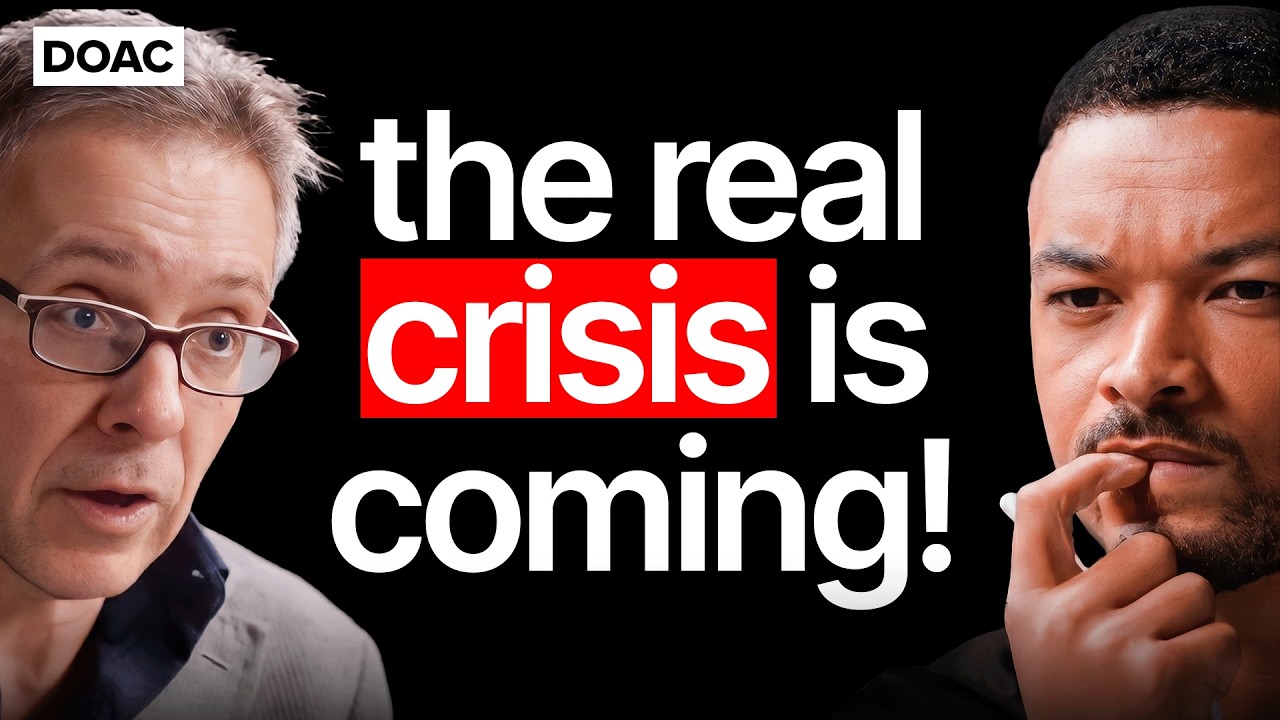
Ian Bremmer Warns US Political Instability Drives Global Crises
The Diary Of A CEO
The geopolitical analyst argues that American domestic policy shifts and unilateral military actions have displaced traditional international rules to become the main engine of global disorder.
## Background
This video was published on April 16, 2026, by The Diary Of A CEO channel on YouTube. In the episode, geopolitical expert and Eurasia Group founder Ian Bremmer joins host Steven Bartlett to discuss the top global risks for 2026, including political instability driven by the U.S., China's long-term resource strategy, escalating Middle Eastern conflicts, and the disruptive potential of artificial intelligence.
## TL;DR
Ian Bremmer outlines the primary drivers of global volatility, arguing that domestic political shifts in the United States have positioned it as a leading source of international instability. He examines military escalations in the Middle East—specifically around Iran and the Strait of Hormuz—and contrasts China's strategic planning with Western governance challenges. Transitioning to emerging technological threats, Bremmer details how AI developments threaten economic systems, critical infrastructure, and labor markets, ultimately advocating for new global governance models and practical workforce policies to manage systemic disruption.
## Atmosphere & style
The conversation carries an urgent, analytical, and sober tone as Bremmer delivers direct assessments of pressing global crises. The dynamic between host Steven Bartlett and Bremmer is reflective and grounded, blending high-level geopolitical analysis with candid commentary on societal vulnerabilities. Despite exploring heavy topics like military escalation, systemic economic risks, and public backlash against AI, the discussion concludes with a contemplative, humanistic perspective on personal agency and public service.
## Key takeaways
- [02:04](https://www.youtube.com/watch?v=EVts3Ui_0AI&t=124s) The United States has shifted from enforcing the rules-based international order to becoming the primary source of global geopolitical risk.
- [04:04](https://www.youtube.com/watch?v=EVts3Ui_0AI&t=244s) China has executed a multi-decade strategy dominating energy dynamics, EV supply chains, and the vast majority of critical minerals refining capacity.
- [07:04](https://www.youtube.com/watch?v=EVts3Ui_0AI&t=424s) The lack of a single dominant global leader creates a 'G-Zero' world characterized by lawlessness and transactional power politics.
- [10:00](https://www.youtube.com/watch?v=EVts3Ui_0AI&t=600s) The swift removal of Nicolás Maduro in Venezuela emboldened Donald Trump to pursue aggressive military action and regime change in Iran.
- [19:28](https://www.youtube.com/watch?v=EVts3Ui_0AI&t=1168s) US strikes in Iran eliminated key intermediaries, leading Iran to activate a decentralized 'mosaic defense' while using its control over the Strait of Hormuz for economic leverage.
- [41:01](https://www.youtube.com/watch?v=EVts3Ui_0AI&t=2461s) Centcom plans include the option to seize Iran's Kharg Island, though doing so carries major political risks regarding domestic gas prices.
- [45:21](https://www.youtube.com/watch?v=EVts3Ui_0AI&t=2721s) Rising energy prices and diverted US resources benefit Russia in Ukraine, while European powers form independent security arrangements as US leadership retreats.
- [52:08](https://www.youtube.com/watch?v=EVts3Ui_0AI&t=3128s) Europe faces economic decline due to heavy regulatory burdens, demographic challenges, energy vulnerability, and post-Cold War security complacency.
- [01:00:14](https://www.youtube.com/watch?v=EVts3Ui_0AI&t=3614s) Major tech corporations like Microsoft and Starlink have become geopolitical superpowers whose power rivals that of nation-states.
- [01:04:19](https://www.youtube.com/watch?v=EVts3Ui_0AI&t=3859s) Near-term AI risks center on automated cyber exploits targeting financial institutions, stock markets, and critical infrastructure.
- [01:06:28](https://www.youtube.com/watch?v=EVts3Ui_0AI&t=3988s) Visible, AI-driven job displacement will heavily impact white-collar workers, triggering growing public backlash against AI and data center expansions.
- [01:22:42](https://www.youtube.com/watch?v=EVts3Ui_0AI&t=4962s) A proposed framework for global AI governance includes US-China arms control treaties, an International AI Stability Board, and frameworks ensuring global technology access.
- [01:28:14](https://www.youtube.com/watch?v=EVts3Ui_0AI&t=5294s) Independent media creators hold a unique responsibility to foster cross-ideological dialogue and combat algorithm-driven polarization.
## Detailed walkthrough
Here is a detailed, faithful walkthrough of the transcript section.
### [00:00](https://www.youtube.com/watch?v=EVts3Ui_0AI&t=0s) Overview of the Top Risk Report
The episode opens with host Steven Bartlett introducing Professor Ian Bremmer, founder of Eurasia Group and one of the world's leading political scientists. Every year, Bremmer and his firm publish a flagship risk report outlining the top ten global risks for the year ahead. In this discussion, they focus on three major risks that stand out above the rest. First, Bremmer predicts a dramatic U.S. political revolution, noting that the U.S. has unexpectedly transformed into the single largest driver of geopolitical instability worldwide. Second, the conversation turns to the hidden, systemic dangers unfolding behind the scenes with rapid developments in artificial intelligence. Finally, the discussion aims to explore how these immense global challenges might be navigated toward realistic solutions and a more stable future.
---
* Eurasia Group releases its Top Risks report annually at the start of the year to help global leaders, businesses, and the public navigate global uncertainty.
* The 2026 report has proven remarkably prophetic, with its top predictions playing out in real time within months of publication.
### [00:02](https://www.youtube.com/watch?v=EVts3Ui_0AI&t=2s) Risk #1: The U.S. as the Primary Source of Global Risk
Bremmer emphasizes that the U.S. is currently the single largest driver of global risk and geopolitical uncertainty. Historically, the U.S. created and enforced the global rules-based order, guaranteed collective security, advocated for free trade, and maintained relatively open borders. Today, American leadership itself is dismantling that system. The U.S. is stepping away from its role as the global policeman, rejecting free trade frameworks, and imposing dramatic policy shifts. Because of the size and reach of the U.S. economy, even small political changes in Washington send shockwaves across the globe—and the massive structural shifts occurring now affect every nation.
```
+------------------------------------+------------------------------------+
| Traditional U.S. Global Role | Current Strategic Direction |
+------------------------------------+------------------------------------+
| Global policeman / security anchor | Retreat from global commitments |
| Architect of free trade systems | Protectionist tariffs & trade wars |
| Welcoming to global talent & movement| Strictly enforced borders |
| Rules-based international order | Unilateral, transactional policy |
+------------------------------------+------------------------------------+
```
- Key global hotspots directly impacted by shifting U.S. policy include trade tariffs, military intervention in Venezuela, disputes regarding Greenland, and escalating tensions with Iran.
- Unlike historical challenges to the international order, the U.S. system is not primarily being dismantled by China, but rather from within by its own political leadership.
### [00:04](https://www.youtube.com/watch?v=EVts3Ui_0AI&t=4s) Risk #2: China's Long-Term Strategy in Energy and Critical Minerals
The second critical theme centers on how China—the world's second most powerful nation—is responding to growing U.S. unpredictability. Under the banner of being "overpowered," China has spent decades executing a long-term strategy to dominate global energy dynamics, electric vehicle (EV) supply chains, battery manufacturing, and the extraction and processing of critical minerals and rare earths. While Western economies historically prioritized short-term, "just-in-time" supply chains to maximize quarterly returns for shareholders, China focused on long-term industrial infrastructure and resource dominance.
- Critical minerals like lithium and antimony are essential for consumer electronics, EV batteries, advanced military weaponry, and missile defense systems.
- China not only controls access to these raw materials out of the ground globally, but crucially holds the vast majority of the world's refining and reprocessing capacity.
- As the U.S. becomes increasingly volatile, third-party nations are actively hedging their bets by deepening economic and strategic ties with Beijing.
### [00:07](https://www.youtube.com/watch?v=EVts3Ui_0AI&t=7s) The Collapse of Global Order and the Rise of the "G-Zero" World
Bremmer offers a sharp political assessment, predicting that Trump's current agenda "will fail" due to policy incompetence and an unwillingness to engage with expert guidance. Highlighting Trump's low public approval across key domestic issues, Bremmer foresees significant losses for the administration in the upcoming November midterm elections, which will effectively render Trump a lame duck as Republicans begin looking toward their own political futures. However, because the deep underlying economic and societal grievances of average Americans remain unaddressed, the populist demand for a political revolution will persist.
When international cooperation breaks down and the U.S. abdicates its global leadership without any other single power able to take its place, the world leaves behind frameworks like the G7 or G20. Instead, it enters what Bremmer terms a **G-Zero world**—a lawless international landscape characterized by an absence of global leadership, where powerful states write rules purely for their own immediate benefit while weaker nations are forced to adapt.
- **Emergence of Domestic Radicalism:** Illustrating the deep shift in voter sentiment, socialist Zohran Mamdani's tenure as Mayor of New York City—the heart of global finance—demonstrates that the electorate's appetite for structural political change is surging across both sides of the aisle.
- **Midterm Strategy:** Quoting veteran Democratic strategist James Carville, Bremmer quips that Democrats should simply "get on a plane and go to Turks and Caicos until after the election" to allow the administration's unforced errors to speak for themselves.
- **Polling Noise:** Bremmer dismisses early 2026 presidential polling—such as a Yale poll placing Kamala Harris narrowly ahead of Gavin Newsom, Pete Buttigieg, and Alexandria Ocasio-Cortez—as meaningless noise two years out from the 2028 election.
### [00:10](https://www.youtube.com/watch?v=EVts3Ui_0AI&t=10s) The Real Motive Behind U.S. Action in Iran: The Venezuela Precedent
Shifting focus to military operations in the Middle East, Bremmer unpacks the three main reasons why Trump engaged in conflict with Iran despite campaigning on a promise to end foreign wars. A primary catalyst was the immediate success of the U.S. military operation in Venezuela earlier in the year. U.S. forces executed a rapid, precise strike that removed President Nicolás Maduro without a single American casualty, transporting him to face trial in Brooklyn.
When Vice President Delcy Rodríguez stepped in as acting president, her administration immediately cooperated with Washington, opening Venezuela’s vast oil and mining sectors, releasing hundreds of political prisoners, and working to stabilize the regional refugee crisis. This swift, successful outcome emboldened Trump, leading him to believe he could replicate the same decisive, low-cost regime change model in Iran.
> "Trump had plans to take out Maduro... They go in, they take Maduro out. They don't kill him, they bring him to a jail in Brooklyn... And now he's like, 'I can do that in Iran. I can do it even bigger.'"
- **Regional Impact of Venezuela:** Prior to Maduro's capture, 8 million Venezuelan refugees had fled the country, creating economic and security strain across Colombia, Peru, Brazil, and Chile.
- **Oil Infrastructure Bottlenecks:** While Venezuela holds the world's largest proven oil reserves, ExxonMobil's CEO noted in public testimony that the country remains largely uninvestable in the short term due to destroyed infrastructure, lost engineering talent, and unresolved legal disputes.
### [00:15](https://www.youtube.com/watch?v=EVts3Ui_0AI&t=15s) Historical Precedents: Soleimani and Escalating Escalation
The second reason for U.S. aggression lies in Trump's historical interactions with Tehran during his first term. Following Iranian-backed proxy attacks on U.S. bases in Iraq and drone strikes on Saudi Arabia's primary Aramco oil refinery, Trump ordered the targeted assassination of Qasem Soleimani, head of the Islamic Revolutionary Guard Corps' Quds Force. Despite Iran's intense rhetoric and promises of catastrophic retaliation, their actual military response at the time was minimal, convincing Trump that firm, aggressive force against Iran would not result in a protracted war.
Furthermore, as Iran continued stockpiling enriched uranium up to 60% purity and advancing its ballistic missile programs, U.S. intelligence began providing direct support to Israeli operations targeting Iranian nuclear facilities, setting the stage for a broader regional confrontation.
<Elicitation label="Explore Part 2: Middle East & Global AI Risks" query="Walk me through Part 2 of this transcript covering the Middle East conflict and AI risks."/>
[16:28](https://www.youtube.com/watch?v=EVts3Ui_0AI&t=988s) Trump’s Escalation in Iran and the Strategic Miscalculation
The dynamic surrounding the escalating conflict with Iran highlights Donald Trump's impulsive decision-making process. Following initial Israeli military successes that proved remarkably popular, Trump sought to join the offensive. During an earlier 12-day war, Israel suffered approximately 100 casualties while Iran limited its response to firing warning missiles at the Al Udeid Air Base in Qatar—having pre-notified U.S. forces via Iraq to avoid direct American engagement. Seeing this restraint, Trump calculated that he could target Iran’s 86-year-old Supreme Leader without triggering a full-scale military backlash, believing the Islamic Revolutionary Guard Corps (IRGC) and remaining leadership would yield and negotiate, much like his administration anticipated in Venezuela.
This strategy was heavily flawed by the changing nature of Trump’s inner circle. Unlike his first administration—which featured independent, pushback-ready figures like Mike Pompeo and Defense Secretary "Mad Dog" Mattis who were willing to check or leak reckless policy decisions—his current team consists primarily of loyalists. While advisers like Marco Rubio and Scott Bessent are capable, and others like Pete Hegseth are viewed as deeply out of their depth, the unifying trait among them is an unwillingness to challenge the President. Consequently, warnings from top military officials like Chairman of the Joint Chiefs of Staff Gen. Dan Caine—who warned that military scenarios were perilous and that Iran could realistically close the Strait of Hormuz—were ignored in favor of echoing Trump’s self-assessed brilliance.
- **Casualties & Precedent:** Israel suffered around 100 deaths during the 12-day war, while Iran deliberately avoided killing Americans by warning them before targeting Al Udeid Air Base in Qatar.
- **Internal Dynamics:** Trump presumed Iran's Supreme Leader (age 86) was disposable and that power held by the IRGC could be leveraged to force a quick deal.
- **Dissent Ignored:** Gen. Dan Caine, Chairman of the Joint Chiefs, raised serious concerns about Iran's gamed-out ability to shut down the Strait of Hormuz, but these warnings were sidelined by loyalist advisers.
---
[19:28](https://www.youtube.com/watch?v=EVts3Ui_0AI&t=1168s) The "Mosaic" Chaos and Iran's Resilient Regime Structure
Instead of forcing a quick surrender, the assassination of Iran's top political and military figures caused immediate operational fragmentation. Israel's strikes eliminated many of the precise Iranian military officials with whom American intermediaries had been communicating, prompting Trump to publicly admit, "a lot of the guys we were talking to are dead now, so we don't really know who to work with." In response to the leadership vacuum and the threat of targeted strikes on centralized communication nodes, Iran activated a decentralized "mosaic defense" structure. This delegated tactical authority to local commanders across the country to prevent Israeli tracking via cell signals.
Despite this decentralization, Iran maintains a functional command structure capable of strategic coordination. Following attacks on its major natural gas infrastructure, Iran demonstrated rapid retaliatory execution ordered from central spokespeople down to field commanders. Furthermore, during 21 hours of high-stakes negotiations in Islamabad, Pakistan—where Vice President JD Vance met with Iranian representatives—the Iranian delegation included the foreign minister, the speaker of parliament, and experts carrying detailed briefs on ballistic missiles, regional proxy networks, maritime transit in the Strait, and the nuclear program. While the negotiations ultimately stalled over nuclear concessions, the meeting proved the Iranian regime remains operational and far from collapsed.
> "A lot of the guys we were talking to are dead now, so we don’t really know who to work with."
- **Mosaic Defense:** Local Iranian commanders were empowered to execute independent strikes against Gulf state infrastructure and maritime lanes to prevent high-level target tracking.
- **Islamabad Negotiations:** Vice President JD Vance engaged in 21 hours of intense talks in Pakistan with top Iranian leaders, including their foreign minister and parliament speaker.
- **Core Stumbling Block:** While briefs covered regional proxies and missile capabilities, disagreement over the nuclear program proved to be the primary dealbreaker.
---
[22:42](https://www.youtube.com/watch?v=EVts3Ui_0AI&t=1362s) The Strait of Hormuz Blockade and Trump's "Glass Jaw"
Following the impasse in Pakistan, Trump abruptly announced a U.S. blockade of the Strait of Hormuz. However, the move is largely viewed as tactical posturing to regain leverage rather than a total breakdown of diplomacy, evidenced by reports that both sides intend to resume talks. Trump severely undermined his own leverage during a prime-time national address by stating the war would be over in "two to three weeks max" and suggesting the Strait was primarily a problem for regional actors to handle. Iranian leadership interpreted these statements as a sign that the U.S. could not sustain the economic or political cost of a prolonged engagement.
Iran's leaders recognize that Trump is politically vulnerable at home, facing declining public approval on the conflict and pressure from corporate leaders concerned about supply chain disruptions. Much like during the previous trade disputes with China—where retaliatory tariffs and critical mineral restrictions forced Trump to back down after CEOs appealed to him at Mar-a-Lago—Iran understands that democracies are constrained by upcoming midterm elections and public dissatisfaction. Knowing that caving to military strikes would establish a dangerous precedent for future U.S. presidents, Iranian leaders are incentivized to wait out American pressure.
- **Prime-Time Assessment:** Trump publicly claimed the military engagement with Iran would wrap up in "two to three weeks max," signaling time constraints to Iranian negotiators.
- **Economic Leverage:** As seen during China's tariff retaliations that threatened U.S. factory lines and triggered executive intervention at Mar-a-Lago, non-democratic states exploit the political vulnerabilities of American election cycles.
- **Legal Status:** Although a maritime blockade is legally an act of war, Trump maintained the active ceasefire, keeping the immediate conflict lower in intensity than the previous week.
---
[27:42](https://www.youtube.com/watch?v=EVts3Ui_0AI&t=1662s) Israeli Strategy in Lebanon and the Breakdown of Regional Order
The conflict extends beyond Iran into Lebanon, where Israel is executing a massive military campaign against Hezbollah. Over one million Lebanese civilians have been displaced in recent weeks as Israel works to establish a 5 to 7 kilometer buffer zone inside southern Lebanon. This push aims to stop ongoing missile strikes into northern Israel, which had previously forced over 100,000 Israeli residents to evacuate their homes for nearly a year following the October 7 attacks by Hamas. Although the Lebanese government promised to disarm Hezbollah, its failure to do so prompted direct Israeli territorial control.
This campaign highlights the near-total collapse of Iran's regional deterrence. At the start of the conflict, Hezbollah was considered the most powerful non-state military force in the world. Today, its senior leadership has been systematically assassinated, its military infrastructure gutted, and Israeli forces strike targets in central Beirut with near impunity. Iran has proven completely unable to protect its primary proxy, signaling a fundamental shift in the regional balance of power.
- **Displacement:** Over one million people in Lebanon have been displaced by recent military operations, while 100,000 Israelis were previously displaced from the north for nearly a year.
- **Buffer Zone:** Israel is occupying approximately 5 to 7 kilometers of southern Lebanese territory to shield northern communities from short-range rocket fire.
- **Degradation of Hezbollah:** Formerly the world's most formidable non-state military, Hezbollah's command chain and infrastructure have been largely neutralized by Israeli strikes.
---
[29:36](https://www.youtube.com/watch?v=EVts3Ui_0AI&t=1776s) Roots of Instability and Positive Trajectories in the Middle East
The broader turmoil in the Middle East is driven by two fundamental forces: a revolutionary Iranian theocracy dedicated to exporting instability, and an assertive Israeli state capable of reshaping its security environment by force. Historically, Iran destabilized the region by funneling arms, money, and military training to proxy forces across Yemen, Iraq, Syria, and Lebanon, while refusing to recognize Israel's right to exist. Conversely, Israel—supported by billions in annual U.S. military aid that remains untouched even as aid to nations like Ukraine is cut—acts decisively to seize territory in the West Bank, strike Lebanon, and attack Iranian targets directly without fearing an existential threat to its own survival, backed by its own unacknowledged nuclear arsenal of over 100 warheads.
Despite this violence, significant structural transformations are occurring across the region. The collapse of Bashar al-Assad's regime in Syria—overthrown after his own military refused to fight and Russian support proved insufficient—opens a path toward a more representative Syrian government. Concurrently, Gulf nations like Saudi Arabia, the UAE, and Qatar are pursuing aggressive domestic modernization plans to diversify their economies away from oil. Saudi Arabia, for example, is actively integrating its population of 35 million into the workforce, reversing historical restrictions on women and creating high-paying domestic employment opportunities.
- **US Military Aid:** Israel continues to receive billions in annual U.S. military backing despite widespread American foreign aid cuts to other partners.
- **Israel's Deterrent:** Israel operates with a strategic safety net underpinned by an estimated arsenal of over 100 nuclear weapons.
- **Syrian Regime Change:** The fall of dictator Bashar al-Assad occurred after domestic forces collapsed and Russian military support failed to sustain his rule.
- **Gulf Modernization:** Gulf states are investing heavily in infrastructure, global tourism, and workforce reforms—most notably Saudi Arabia opening up its economy to women across its 35-million-strong population.
[33:02](https://www.youtube.com/watch?v=EVts3Ui_0AI&t=1982s) Emerging Middle Eastern Blocs and Regional Realignment
The geopolitical landscape in the Middle East is undergoing a profound structural transformation, driven both by internal societal shifts and changing global dynamics. Within Saudi Arabia, the ongoing socio-economic revolution represents one of the most significant governance stories in the modern world: women are being integrated into every sector of the workforce, expanding from basic access to education to comprehensive economic participation.
Concurrently, as the United States scales back its traditional role as the primary global guarantor of security, regional powers are realigning into two increasingly distinct strategic blocs to safeguard their futures:
* **The Technology and Security Alignment:** The United Arab Emirates, Israel, the United States, and India are solidifying an international bloc centered on advanced technology, national security, and trade—building directly upon the momentum of the Abraham Accords.
* **The Regional Defense Quad:** Saudi Arabia, Pakistan, Turkey, and Egypt are forging a heavily defense-oriented coalition calling for an independent regional security framework. This explicit partnership bridges nuclear-armed Pakistan with major regional powers possessing large populations and heavy diplomatic weight.
```
+-----------------------------------------------------+----------------------------------------------------+
| UAE – Israel – US – India Axis | Saudi – Pakistan – Turkey – Egypt Quad |
+-----------------------------------------------------+----------------------------------------------------+
| Focus: Tech transfer, trade, national security | Focus: Regional security framework, defense |
| Key Anchor: Abraham Accords heritage | Key Anchor: Pakistan's nuclear deterrence capability|
+-----------------------------------------------------+----------------------------------------------------+
```
This structural division creates significant diplomatic friction across the region. Caught in the middle are the 95 million citizens of Iran. Plagued by an economy that was mismanaged long before the war, a severely degraded industrial base, and a decimated military apparatus, Iran operates not as a dominant victor, but as a compromised survivor using its geographic leverage over the Strait of Hormuz to maintain relevance.
---
[35:27](https://www.youtube.com/watch?v=EVts3Ui_0AI&t=2127s) Trump's Impulsiveness, De-escalation Signals, and the Strait's Toll
Looking toward an endgame for the conflict, President Trump faces a complex personal and geopolitical puzzle. Bound by a two-term limit, his focus centers on legacy—aspiring to historical acclaim on par with Mount Rushmore while avoiding an irreversible, Bush-era foreign policy failure. Because he cannot simply walk away without appearing defeated, yet Iran cannot afford to grant him an explicit victory, predicting his next move requires understanding his decision-making style.
```
┌────────────────────────────────────────┐
│ Trump's Competing De-escalation & │
│ Escalation Narrative │
└───────────────────┬────────────────────┘
│
┌───────────────────────────┴───────────────────────────┐
▼ ▼
┌──────────────────────────────────────────┐ ┌──────────────────────────────────────────┐
│ De-escalation Narrative │ │ Escalation Narrative │
├──────────────────────────────────────────┤ ├──────────────────────────────────────────┤
│ • "Nuclear sites are entomb'd in rubble" │ │ • "Open the Strait or I will end │
│ • "Regime change has already happened" │ │ civilization" │
│ • "Strait of Hormuz is not our problem" │ │ • Threatens to bomb bridges and │
│ • Focus on US domestic energy self- │ │ infrastructure │
│ sufficiency │ │ • Driven by recency bias and media │
└──────────────────────────────────────────┘ └──────────────────────────────────────────┘
```
Trump's impulsive style—amplified by constant media consumption, cell phone communication, recency bias, and a hyper-fixation on stock market fluctuations—creates volatile messaging. Despite apocalyptic threats to "end civilization" or bomb Iranian power plants, his rhetoric has increasingly laid the groundwork for an exit strategy.
* **The Most Likely "Less Bad" Scenario:** The current 14-day ceasefire (which has roughly 9 or 10 days remaining) is extended following substantive diplomatic talks.
* **The Compromise:** Iran likely concessions on nuclear enrichment parameters in exchange for retaining a privileged position over transit through the Strait of Hormuz.
* **Reconstruction via Transit Fees:** Charging transit tolls allows Iran to secure vital revenue under the guise of war "reparations," retaining a permanent strategic deterrent against future attacks.
* **International Maritime Protection:** Once the ceasefire stabilizes, European nations, India, and other global powers step in to provide naval escorts for commercial shipping.
---
[41:01](https://www.youtube.com/watch?v=EVts3Ui_0AI&t=2461s) The Option to "Take the Oil": Kharg Island Strategy
A secondary, higher-risk scenario remains possible if Trump decides to leverage the massive American military build-up currently moving into the Persian Gulf. With ground forces expanding toward 15,000 troops alongside a new aircraft carrier strike group, the administration possesses the physical capacity for direct territorial intervention before the ceasefire window closes.
```
[ Persian Gulf Maritime Trade Routes ]
│
▼
( Strait of Hormuz)
│
▼
┌───────────────────────────┐
│ Kharg Island │
│ (Size: ~1/2 Manhattan) │
└─────────────┬─────────────┘
│
Handles ~90% of Iranian Oil Exports
│
▼
┌───────────────────────────────────────────────┐
│ CENTCOM Assessment: 12,000–15,000 US Troops │
│ could seize and hold export facilities │
└───────────────────────────────────────────────┘
```
Trump has repeatedly mused publicly that if the American public were patient, the US could simply "take the oil." In practical military terms, this does not mean establishing a distant naval blockade, but seizing control of **Kharg Island**—a lightly fortified island roughly half the size of Manhattan located just off the Iranian coast.
* **Economic Impact:** Kharg Island processes roughly **90% of all Iranian crude oil exports**. Occupying it grants absolute leverage over Iran's primary revenue stream.
* **Military Requirements:** CENTCOM estimates taking Kharg Island requires 12,000 to 15,000 troops.
* **Escalation Risks:** While seizure cripples Iranian finances, it exposes US forces to coastal missile strikes, drone swarms, and retaliatory raids.
Although CENTCOM possesses plans for coastal raids on drone and missile sites, the probability of Trump ordering a full land seizure remains well below 50%. An extended occupation would carry severe domestic political costs at home, where he is fully accountable for spiraling economic pain:
- Gas prices exceeding **$4.00 per gallon**
- Diesel climbing past **$5.00 per gallon**
- Ticking inflation and rising food prices impacting voter affordability
---
[45:21](https://www.youtube.com/watch?v=EVts3Ui_0AI&t=2721s) Global Repercussions: Opportunities for Russia and China
On the broader international stage, the Middle Eastern crisis reshapes global power dynamics, directly impacting the war in Ukraine and altering relations between Western allies.
```
┌─────────────────────────────────────────┐
│ Global Ripple Effects of US │
│ Middle East Reorientation │
└────────────────────┬────────────────────┘
│
┌──────────────────────────────────────┼──────────────────────────────────────┐
▼ ▼ ▼
┌─────────────────────────┐ ┌─────────────────────────┐ ┌─────────────────────────┐
│ Russia's Gain │ │ China's Position │ │ European Pivot │
├─────────────────────────┤ ├─────────────────────────┤ ├─────────────────────────┤
│ • Commodity prices surge│ │ • Observes US diversion │ │ • US defense diversion │
│ (oil, gas, fertilizer)│ │ with strategic ease │ │ leaves Ukraine exposed│
│ • Sanctions eased to │ │ • Deepens long-term │ │ • UK and France forced │
│ stabilize markets │ │ resource dominance │ │ into independent │
│ • Air defense intercept-│ │ │ │ security planning │
│ ors diverted from Kyiv│ │ │ │ │
└─────────────────────────┘ └─────────────────────────┘ └─────────────────────────┘
```
For **Russia**, the conflict provides an economic and strategic windfall. While the war in Ukraine has faded from American media coverage, Moscow's position is bolstered by surging global prices for its core exports—oil, natural gas, and fertilizer. To cushion domestic market shocks, Washington has quietly eased select sanctions against Moscow. Furthermore, critical US air defense interceptors previously intended for Ukraine are being redirected to the Middle East, crippling Kyiv's ability to defend its cities against Russian strikes and removing any incentive for Vladimir Putin to negotiate a ceasefire.
Concurrently, **China** stands back as a primary beneficiary, watching the United States entangle itself in another discretionary conflict.
In **Europe**, a unprecedented rift has opened between traditional allies. For the first time in modern history, key partners like the United Kingdom are stepping back from automatic alignment with Washington. Prime Minister Keir Starmer and French President Emmanuel Macron are actively consulting on independent security arrangements, marking a historic shift away from relying on American military leadership.
---
<ElicitationsGroup message="Where would you like to take this analysis next?">
<Elicitation label="Explore China's long-term strategy for resource dominance" query="Deepen the analysis on China's long-term economic and resource strategy as discussed in the Eurasia Group report."/>
<Elicitation label="Examine the AI disruption and economic shock predictions" query="Detail the AI job threat and global economic shock risks covered later in this episode."/>
</ElicitationsGroup>
Here is a detailed, faithful walkthrough of Part 4 of the transcript:
[48:44](https://www.youtube.com/watch?v=EVts3Ui_0AI&t=2924s) Europe’s Lagging Competitiveness and the Fallacy of Post-Cold War Naivety
Steven Bartlett opens by describing the degrading tone coming out of Davos, where American officials treat European counterparts "like a lap dog," telling them to "get your [stuff] together" and stop being so "woke." Ian Bremmer agrees that while Trump's uniquely confrontational style amplifies this rhetoric, it stems from a stark 30-year geopolitical shift. Over the last three decades, power has migrated toward China and India, while America's traditional allies—Europe, Canada, Japan, and South Korea—have steadily declined. These allied nations face severe demographic contraction, flat economic growth, and lagging productivity compared to the United States because they failed to invest in their own defense and technology. As a result, when the US pulls back from global free trade and international intervention, these allies simply do not bring enough to the bargaining table.
Bremmer points to the "Draghi Report"—an 800-page competitiveness plan written by former European Central Bank President Mario Draghi (nicknamed "Super Mario"). The report outlines everything Europe and the UK must do to boost entrepreneurship, slash red tape, and fund high-return technologies. However, implementing such a strategy is structurally far more difficult in Europe. Unlike centralized powers like China, the UAE, Saudi Arabia, or Singapore, Europe consists of 27 distinct EU member states plus a post-Brexit United Kingdom, all bound by frequent election cycles and lacking unified scale. Europe's fundamental mistake after the fall of the Berlin Wall in 1989 and the collapse of the Soviet Union in 1991 was assuming the entire world would permanently adopt peaceful, European-style democratic systems. Believing quality of life mattered more than raw growth, they neglected defense and tech investments—wrongly assuming China’s rising wealth would turn it into a free-market democracy rather than a consolidated dictatorship under Xi Jinping.
- **Demographic & Economic Trajectory**: US allies are contracting demographically with much flatter productivity growth compared to the US.
- **The Draghi Report**: ECB head Mario Draghi issued an 800-page competitiveness roadmap focused on cutting red tape, fueling technology investment, and restoring European entrepreneurship.
- **Structural Bottlenecks**: Europe’s division into 27 EU nations plus post-Brexit UK prevents long-term, unified state action at the scale achieved by China or Gulf states.
- **Post-1989 Fallacy**: Europe assumed global peace was permanent and that economic integration would automatically transform China into a democracy.
---
[52:08](https://www.youtube.com/watch?v=EVts3Ui_0AI&t=3128s) The Energy Dilemma: Europe’s Ideological Shift vs. China’s "All-of-the-Above" Strategy
Bartlett shifts the conversation to energy and productivity, asking whether Europe’s self-inflicted wounds stem from aggressive net-zero policies and anti-innovation environments, while the US and China continued drilling oil or building nuclear power. Bremmer clarifies that it is a misconception that China ignored green energy. In reality, China pursued an aggressive "all-of-the-above" energy strategy. While China continues using dirty coal to power its massive industrial base, it has simultaneously invested for decades to dominate every layer of clean technology—becoming the undisputed global leader in solar, wind, electric vehicles, and battery technology, while securing the raw materials required for their production.
In contrast, most European nations—with the notable exception of nuclear-heavy France—turned away from nuclear energy and made non-green energy sources prohibitively expensive without securing an all-encompassing alternative. Bremmer argues that nuclear power *should* be treated as green energy, and phasing it out has severely inhibited European economic growth. Meanwhile, the United States has cycled between political administrations, periodically advancing or stalling green tech. Nevertheless, the US remains the world's leading oil and natural gas producer by a wide margin through hydraulic fracturing. Bremmer points out the political irony that red states like Texas lead the US in sustainable energy production, proving that energy technologies are economic necessities rather than partisan issues.
- **China's Energy Dominance**: China uses coal for base industrial load while dominating global supply chains for solar, wind, battery manufacturing, and electric vehicles.
- **Europe's Nuclear Mistake**: Outside of France, European nations restricted nuclear energy, missing out on a reliable, zero-carbon energy source.
- **US Energy Position**: The US leads the world in oil and natural gas (fracking) production, while states like Texas simultaneously lead the nation in renewable energy output.
---
[54:38](https://www.youtube.com/watch?v=EVts3Ui_0AI&t=3278s) China’s Long-Term Strategy vs. America’s Internal Dysfunction
Addressing whether China will replace the United States as the dominant global superpower, Bremmer states this will not happen anytime soon, though China's long-term trajectory clearly poses a threat. The US retains unmatched structural advantages: the US dollar remains the world's undisputed reserve currency, allowing America to run massive deficits and print money with lower interest rates. China cannot challenge dollar supremacy because making the yuan fully convertible would trigger massive capital flight and internal political instability. Furthermore, China's military capability is a fraction of America's; China lacks global projection capabilities and has not fought a ground war in decades or a naval war in modern history.
The real danger from China lies in its dominance over core, foundational technologies. If China achieves technology control, it can dictate global standards, set supply rules, and potentially cut off critical supplies to adversarial nations. Bremmer compares this vulnerability to Europe’s past reliance on Russian natural gas, or the US reliance on Taiwanese semiconductors from TSMC. Crucially, Chinese leadership operates on a 10-to-20-year horizon with "no-regret" long-term investments, free from short-term election cycles. Bremmer emphasizes that the single greatest threat to American supremacy is not China, but internal US self-sabotage—getting in its own way by undermining its own competitiveness, universities, and appeal to global talent.
- **Currency & Military Gaps**: The US dollar remains the sole global reserve currency, while China's military lacks the operational experience and global reach of the US armed forces.
- **Supply Chain Leverage**: Over-reliance on China for critical technology carries the same economic risk Europe faced with Russian natural gas or the US faces with TSMC chips in Taiwan.
- **Planning Horizons**: China makes low-risk, long-term strategic investments spanning decades, whereas the US is constantly distracted by short-term 2-to-4-year election cycles.
---
[58:08](https://www.youtube.com/watch?v=EVts3Ui_0AI&t=3488s) Sponsor Interlude: Ketone-IQ and Wispr Flow
In a brief mid-show break, host Steven Bartlett shares personal endorsements for two of his podcast sponsors and investments:
- **Ketone-IQ**: Bartlett highlights exogenous ketones as one of his top three daily productivity and cognitive boosters. Created by Stanford graduates, the shot replicates the mental focus of a ketogenic diet. He offers listeners 30% off at `[ketone.com/steven](https://ketone.com/steven)`, noting that the product is also available in Target stores across the US.
- **Wispr Flow**: Bartlett introduces Wispr Flow, an AI voice-dictation desktop app that converts speech to text instantaneously with high accuracy. He notes it allows him to be "100% more productive using this app despite spending 50% less time typing." Listeners can try it at `wisprflow.ai/steven`.
---
[01:00:14](https://www.youtube.com/watch?v=EVts3Ui_0AI&t=3614s) The New Global Superpowers: Tech Giants and the Anthropic Security Crisis
Bartlett references Bremmer’s viral 2023 TED Talk—*"The next global superpower is not who you think"*—which predicted that tech giants are usurping traditional nation-states in geopolitical power. Bremmer explains how major corporate decisions now shape international conflicts directly: Microsoft detected and warned about Russian cyberattacks on Ukraine a day before the 2022 physical invasion began, and Elon Musk’s Starlink provided the critical communications infrastructure that kept President Volodymyr Zelenskyy’s government from collapsing.
This corporate power shift is intensifying rapidly with advanced AI models. Bremmer points to a high-stakes incident involving AI lab Anthropic, which developed a powerful AI model capability (internally referred to in relation to severe cybersecurity risks) capable of discovering zero-day software vulnerabilities across banking systems, water supplies, and power grids. Anthropic recognized that releasing this tool publicly posed an immediate, systemic threat to global financial and physical infrastructure. While some critics dismissed Anthropic's warnings as clever marketing, Bremmer highlights that Federal Reserve Chair Jerome Powell and Treasury Secretary Scott Bessent immediately convened emergency meetings with top bank executives—including JPMorgan CEO Jamie Dimon, who treated the situation as a "five-alarm fire." This event proved that tech firms hold national security capabilities so vital that even the US Department of Defense cannot afford to sideline them over political or "woke" disputes.
> "The most important new global leaders aren't countries, they're technology companies that are writing their own rules."
- **Tech Firms as Geopolitical Actors**: Corporate entities like Microsoft (cyberdefense) and Starlink (satellite communications) dictated early survival outcomes in the Ukraine war.
- **The Cyber Security Vulnerability**: Advanced AI models possess the capability to systematically locate exploit bugs across critical infrastructure, power grids, and banking software.
- **Government Emergency Response**: The potential threat forced Fed Chair Jerome Powell, Treasury Secretary Scott Bessent, and JPMorgan CEO Jamie Dimon to urgently coordinate systemic defense strategies.
- **Department of Defense Tension**: Despite Pentagon friction over Anthropic's safety guardrails restricting military targeting or surveillance, the U.S. government remains dependent on their technological breakthroughs.
Here is a detailed walkthrough of this transcript section covering global AI risks, labor displacement, rising political backlash, and the competing models of tech governance.
---
[01:04:19](https://www.youtube.com/watch?v=EVts3Ui_0AI&t=3859s) Cyber Security Threats, AI Exploits, and the New Arms Race
Addressing the immediate horizon of technological risk, Ian Bremmer emphasizes that AI vulnerabilities must be patched instantly before hostile actors gain equal access to automated exploit tools. While this risk might rank as "severe" rather than "critical" only because the current year is already underway, Bremmer stresses how severely underappreciated it remains compared to traditional geopolitical headlines like Iran, Venezuela, or China.
Steven Bartlett asks whether the core threat stems from mass unemployment, nuclear proliferation, or another systemic issue. Bremmer clarifies that the most pressing near-term danger is cyber vulnerability: if frontier AI models enable anyone with a laptop or smartphone to hack complex systems, global stock markets will plummet, banking infrastructure will stall, and sensitive data will be stolen on a massive scale. State adversaries—such as Russia or Iran—will inevitably acquire these capacities and leverage them aggressively.
Bremmer draws a direct parallel to the war in Ukraine to illustrate how technology rapidly alters geopolitical power dynamics. Despite Russia’s overwhelming traditional advantage, Ukraine reclaimed territory due to its rapid emergence as a world-leading, large-scale drone producer. Following US strikes on Iran and subsequent counterattacks, American officials were forced to contact Ukrainian President Volodymyr Zelenskyy—whom Bremmer dryly references as "the guy that didn't say thank you in the White House"—to request Ukraine’s assistance with drone defense strategies to protect Gulf allies.
- **Cyber exploit risks:** Tools capable of automated hacking threaten to paralyze banking systems, corrupt global markets, and compromise critical infrastructure.
- **Asymmetric warfare:** Drone technology enabled Ukraine to offset Russia's traditional military size advantage and gain territory.
- **Middle East spillover:** The US military sought Ukraine's drone expertise to help safeguard Gulf state partners against Iranian counterstrikes.
---
[01:06:28](https://www.youtube.com/watch?v=EVts3Ui_0AI&t=3988s) The Unseen Workforce: Training AI to Replace Human Labor
Steven Bartlett brings up a video he watched prior to the interview, describing it as "quite dystopian" yet reflective of a growing global phenomenon. The footage displays Indian factory workers performing manual tasks while wearing head-mounted cameras that continuously monitor their hands in real time.
Bremmer observes that the workers' actions are being tracked directly. Bartlett reveals the sobering reality: tech and robotics companies are paying low-cost labor to record their exact physical movements so that AI models and robots can be trained to automate those exact roles and eliminate human positions. Bartlett compares this setup to the famous cartoon meme of a person sitting on a tree branch while sawing off the very limb supporting them.
While acknowledging the terrifying nature of the footage, Bremmer notes a paradoxical sense of potential empowerment, provided society properly redistributes the wealth generated. Because most workers do not find self-actualization in repetitive manual labor, automation could theoretically free human effort. However, Bartlett notes that high-level tech executives are forecasting that next year will mark the point where AI-driven job loss takes a visible, painful hold on society.
- **Data collection practices:** Workers in the Global South are being recorded to capture physical movement data necessary for training advanced robotics models.
- **Labor displacement dynamic:** Human workers are effectively documenting their own routines to build the datasets that render their jobs obsolete.
- **Upcoming labor shifts:** Top tech insiders privately project that AI-driven structural unemployment will become a primary driver of public distress in the near term.
---
[01:10:13](https://www.youtube.com/watch?v=EVts3Ui_0AI&t=4213s) The Anti-AI Wave: Data Center Backlash and Rising Public Anger
The discussion shifts to how different regions view artificial intelligence. Bremmer highlights a stark geographic divide: populations across the Global South and China express enthusiasm for AI, viewing it as a powerful tool to elevate human capital, expand educational access, and improve daily life. In contrast, citizens across the United States and Europe harbor deep anxiety, fearing the technology directly threatens white-collar knowledge jobs and middle-class stability.
While Bremmer skepticism exists regarding sudden mass unemployment in the very near term—noting that most CEOs avoid sweeping layoffs unless forced by a broader economic recession, and pointing to union mobilization like the U.S. Longshoremen striking to keep AI out of ports—he warns that political hostility is accelerating rapidly. Bremmer shares a private conversation with a centrist, pro-business U.S. Senator who admitted he could no longer defend AI data centers to his constituents. Local voters are furious over skyrocketing energy and water prices, ugly zoning changes, and heavy local resource strain that yields zero local job creation.
This anger is coalescing into a dangerous new populist movement. Bremmer notes that Donald Trump initially won election behind working-class men who felt displaced by automation, global trade with China, and immigration. The next major political wave in 2028 will likely be driven by college-educated, urban, and suburban women terrified over their own career displacement and their children's future. Bartlett adds that AI is now polling as less popular than Immigration and Customs Enforcement (ICE) in the United States, reflecting deep public hostility toward tech elites who enrich themselves while average citizens reap few visible benefits.
> "I can't talk about data centers. I've never seen my constituents so upset about an issue as they do about AI data centers... no jobs, energy prices going up, water prices going up, zoning looks horrible in their neighborhoods."
- **Geographic sentiment split:** Enthusiasm for AI remains high in the Global South and China, whereas deep skepticism dominates the US and Europe.
- **Resource strain:** AI data centers are sparking fierce local political pushback due to rising electricity rates, water usage, and minimal local employment.
- **The 2028 populist threat:** The next populist surge is expected to be led by college-educated knowledge workers facing professional displacement.
- **Targeted hostility:** Recent violent incidents—including a Molotov cocktail and gunfire directed at OpenAI CEO Sam Altman’s residence, alongside the murder of UnitedHealthcare's CEO in New York—signal a dangerous breakdown in public trust toward corporate elites.
---
[01:14:57](https://www.youtube.com/watch?v=EVts3Ui_0AI&t=4497s) Policy Responses: Workweek Reductions, Retraining, and Inhumane Systems
When Bartlett asks whether society requires Universal Basic Income (UBI) or an "AI tax" to prevent economic collapse, Bremmer dismisses the idea that societies can transition overnight from traditional full-time employment to UBI within a single year. Instead, he advocates for structured transition programs, such as shifting affected industries from a 5-day to a 4-day or 3-day workweek at full pay, with mandatory paid time dedicated to AI literacy and career retraining.
Bremmer stresses that humanity's greatest existential threat is not the technology itself, but rather the failure of political systems. Current institutions allow a small cohort of elite tech founders to capture all economic gains, draft their own rules, and display indifference toward displaced workers. When citizens realize the legal and political framework offers no protection, they naturally abandon institutional channels in favor of mass unrest or violence.
Addressing the mindset of top tech leaders, Bremmer criticizes executives who passively observe the impending turmoil—calculating that political swings toward rival parties won't personally affect their vast fortunes—rather than actively funding transition frameworks for workers.
- **Structured transition models:** Proposed solutions include shifting to 4-day or 3-day workweeks with paid hours explicitly allocated for AI skill training.
- **Institutional failure:** Societal risk stems from corporate elites capturing outsized gains while operating outside public accountability.
- **Political misalignment:** Key technology figures remain focused on "winner-take-all" capital accumulation rather than engineering policy safety nets.
---
[01:16:22](https://www.youtube.com/watch?v=EVts3Ui_0AI&t=4582s) Three Models of Tech Governance: US, China, and Europe
Steven Bartlett raises the dilemma of government overreach, citing a conversation with the Chief Technology Officer of a global tech firm. The CTO explained that certain hardware features cannot be released in Europe due to stifling EU regulations. For instance, EU mandates requiring user-replaceable batteries in devices force manufacturers to produce and stock spare batteries that deteriorate over time while stripping products of waterproofing—ultimately resulting in higher device failure rates and greater environmental harm. Consequently, global tech firms are increasingly willing to bypass the European market entirely in favor of expanding developing regions like Brazil.
Bremmer maps out the three global systems governing tech and society today, illustrating the structural flaws inherent in each extreme approach:
| Governance Model | Core Mechanism | Primary Advantage | Major Vulnerability / Failure Mode |
|:--- |:--- |:--- |:--- |
| **United States** | Private sector holds primary power; writes own regulations. | Drives massive economic growth, innovation, and corporate wealth. | Fails average citizens, leading to extreme inequality, public anger, and political instability. |
| **China** | Authoritarian state controls, owns, and captures private enterprise. | Delivers long-term strategic growth and rapid deployment. | Denies citizens a voice, breeding quiet rebellion and societal apathy ("lying flat"). |
| **Europe** | State prioritizes social protections and heavy regulatory guardrails. | Protects consumer rights and maintains a stronger social safety net. | Stifles entrepreneurship and growth, leaving the state unable to fund its promises. |
Bremmer concludes that none of these three frameworks are functioning effectively in their current extreme forms. In the US, the total capture of the regulatory apparatus by mega-corporations leaves working-class and knowledge-worker citizens without systemic protections, setting the stage for deep societal friction.
[01:19:01](https://www.youtube.com/watch?v=EVts3Ui_0AI&t=4741s) The Populist Demand for a New Deal and the Danger of Alienating the Public
Political scientist Ian Bremmer and host Steven Bartlett delve into why political landscapes across Western democracies have shifted so radically. People are desperately searching for a "new deal"—whatever shape that might take—and Donald Trump won election by successfully positioning himself as the ultimate outsider who promised to deliver it. His message resonated because he promised to end foreign wars and put "America First" rather than prioritizing other nations. At their core, voters are motivated by simple, fundamental desires: they want to be taken care of, to have real economic opportunities for their families and communities, and to escape feeling a sense of despair.
Bremmer brings this back to his own heritage and personal journey. His grandmother fled the Armenian genocide and arrived at Ellis Island; later, Bremmer himself started a thriving company in a land built on promise and opportunity. The critical problem today is that most average Americans no longer believe the American Dream applies to them. Addressing the disruptive surge of artificial intelligence requires giving people the actual capability to build a future for their families in their own communities; if working people are continuously deprived of that opportunity, history shows they will eventually revolt against the system.
While history proves that disenfranchised populations do not always successfully overthrow autocratic regimes—pointing to the 25 million people in North Korea who have been ruled by a worshipped dynastic cult for decades—democracies behave differently. When democratic citizens feel increasingly powerless, they eventually push back hard against kleptocratic leadership and elites who place themselves above the system.
- **Immigration Story:** Bremmer's grandmother fled the Armenian genocide and entered the US via Ellis Island.
- **North Korea Example:** Demonstrates that systemic oppression of ~25 million people can persist indefinitely without revolt under totalitarian conditions, unlike in democratic systems.
---
[01:22:42](https://www.youtube.com/watch?v=EVts3Ui_0AI&t=4962s) Taming the Techno-Oligarchy: A Three-Point Governance Blueprint
Turning to the exponential rise of AI, Bartlett points out that figures like Jeff Bezos (reportedly raising $100 billion for Project Prometheus), Elon Musk (xAI), Demis Hassabis and Sundar Pichai (Google), and Sam Altman (OpenAI) are racing to build superintelligence. When intelligence itself becomes the ultimate commodity—something Sam Altman has suggested people will pay for like utility water or electricity—it strips away people's sense of free will. Asked what he would do to solve this growing "techno-oligarchy," Bremmer lays out a clear, three-part global governance framework:
1. **U.S.–China AI Arms Control:** Mirroring the nuclear de-escalation protocols that were established only after the near-catastrophic 1962 Cuban Missile Crisis, the U.S. and China must establish direct hotlines, deconfliction measures, and formal treaties to prevent a catastrophic AI race.
2. **An International AI Stability Board:** Functioning like the Financial Stability Board—where central bankers from the Fed, ECB, Bank of England, and People's Bank of China cooperate during financial panics regardless of ideology—this body would be run by independent technocrats. They would identify and neutralize systemic threats, such as powerful AI models capable of autonomously discovering and exploiting software vulnerabilities at scale.
3. **Universal Access and Funding:** Preventing a catastrophic divide where half the developing world lacks basic electricity while elite "hybrid individuals" leverage AI to amplify their capabilities. Humanity cannot allow a multi-tier species divide to form based on AI access.
Bremmer stresses that these governance structures must transcend artificial national borders. Looking down at Earth from space reveals no political boundary lines, only 8 billion human beings using short-term, inefficient decisions to risk their own survival.
- **Project Prometheus:** Jeff Bezos's reported $100B AI initiative.
- **Cuban Missile Crisis Parallel:** Historical reference highlighting that formal arms control between superpowers only occurred after almost destroying the world in 1962.
- **Financial Stability Board Analogy:** Technocratic global collaboration across central banks used as the template for governing advanced AI models.
---
[01:28:14](https://www.youtube.com/watch?v=EVts3Ui_0AI&t=5294s) Humanity at a Crossroads: Utopia, Algorithms, and the Loss of Human Connection
When asked whether a true "utopia" is achievable given the flaws of human nature, Bremmer remains optimistic about humanity's long-term trajectory. Over the past 50 years, the macro-trends of human history have overwhelmingly leaned toward progress: longer lifespans, broader education, better healthcare, increased global wealth, and sharp drops in extreme poverty. The real threat to our future isn't the rise of Artificial General Intelligence (AGI), but rather human beings becoming increasingly computer-like.
As people spend hours absorbed in smartphones, algorithms actively program human behavior into narrow lanes, stripping away authentic, humane connection. Bremmer expresses strong disdain for prediction markets, arguing that turning political institutions into a "casino" where citizens only care about financial payouts distorts civic responsibility and suppresses our better selves.
Bartlett shares his unique vantage point as an independent podcaster who interviews figures across the entire political spectrum—ranging from Ivanka Trump and Michelle Obama to Kamala Harris and Gavin Newsom. Despite intense audience backlash driven by algorithmic outrage, meeting political opponents in person reveals that most people agree on the ultimate destination even if they debate the path. Bremmer pushes back constructively on Bartlett's perspective: when you are truly independent and cannot be fired, being open-minded isn't just an "opportunity"—it is a profound moral obligation to serve as a bridge above the tribal noise.
- **50-Year Progress Trend:** Dramatic macro-improvements in global health, literacy, wealth, and poverty reduction despite short-term crises.
- **The Smartphone Threat:** The danger of algorithmic feedback loops programming humans to behave like computers rather than engaging in real, face-to-face dialogue.
- **The Duty of Independent Media:** Independent creators have a structural responsibility to foster cross-ideological dialogue because traditional media workers face job insecurity.
[01:32:59](https://www.youtube.com/watch?v=EVts3Ui_0AI&t=5579s) Resisting the Algorithm and Embracing Diverse Opinions
Ian Bremmer and Steven Bartlett discuss the vital importance of authenticity in long-form media. Bremmer commends Bartlett for staying true to himself and his audience, noting that mainstream media is in deep trouble precisely because it pulls back out of fear of irritating people. When Bartlett notes that vocal minorities online often react aggressively to differing views, Bremmer challenges whether those voices are even real humans, suggesting they are often bots or algorithmically generated noise. He emphasizes that real-world interactions on the street are overwhelmingly friendly, proving that the digital sphere does not accurately reflect human reality. To combat this, Bremmer argues that creators and audiences must prioritize live interactions and long-form content to actively "resist the algorithm," which benefits both the planet and the human species.
Bartlett shares his deep affection for conversing with people he disagrees with, recalling a favorite quote: "If you have the same complete set of opinions as one group of people, those are not your opinions." He reflects on how easy it is to adopt useful ideas from anyone, even if doing so goes against an algorithmic echo chamber designed to protect users by forcing them to choose a side. Bremmer wholeheartedly agrees, adding his own rule of thumb: if your opinions remain rigid while the world changes, you will inevitably end up wrong. However, because algorithms reward static polarization, resisting them requires deliberate effort.
---
[01:34:55](https://www.youtube.com/watch?v=EVts3Ui_0AI&t=5695s) Public Service Outside of Broken Political Systems
When asked for closing thoughts, Bremmer offers personal praise for Bartlett's global journey—from being born in Botswana to building a massive international platform without resorting to hate, lies, or polarization. Bremmer pivots to a story from his childhood to illustrate how power and impact have fundamentally shifted away from traditional politics. Back in second grade, his teacher, Miss Kiritziko, asked the class who wanted to be president during an election period. Bremmer raised his hand, only to look around and realize he was the only student in the room with his hand up. While he once believed holding public office was the ultimate expression of making a difference, he stresses that he would never raise his hand for that today.
Bremmer explains that while political systems may be broken, the positive trade-off is that people now have endless avenues to make a monumental global impact outside of government institutions. He notes that although he will likely live his entire life without ever serving in public office, he can still drive meaningful change through his work at Eurasia Group and GZERO Media. Bartlett echoes this sentiment by quoting astrophysicist Neil deGrasse Tyson, who observed that the most powerful people on Earth are no longer elected officials, but rather those who influence the electorate. Bartlett highlights Bremmer’s extensive library of books—including *The Power of Crisis: How Three Threats – and Our Response – Will Change the World*—and notes that a new book is scheduled to be released next year.
* Ian Bremmer was born and raised in the U.S., while Steven Bartlett was born in Botswana and raised in the UK before moving to Los Angeles.
* Ian Bremmer's second-grade teacher was named Miss Kiritziko.
* Neil deGrasse Tyson quote: The most powerful people on Earth are those who influence the electorate, rather than the politicians themselves.
* Ian Bremmer's book, *The Power of Crisis*, focuses on major global threats, including AI.
* Bremmer has over 1 million followers on X (formerly Twitter) and runs a YouTube channel sharing geopolitical updates.
---
[01:38:07](https://www.youtube.com/watch?v=EVts3Ui_0AI&t=5887s) At the End of Life: What Will Your Choices Really Mean?
Bartlett introduces the podcast’s signature closing tradition: answering a question left behind by the previous guest without knowing who wrote it. The question asks: "When you are on your deathbed, how will you describe your life?" Bremmer answers instantly with a single word: "Unanticipated."
He explains that his fundamental optimism stems from the realization that none of us know what we did to deserve being here in the first place, making every single day feel like a gift. Bartlett expresses deep gratitude to Bremmer, calling his work an essential public service that demystifies a chaotic world, helping millions make better decisions as voters and human beings. Bremmer promises to keep doing his best, and the episode wraps up with Bartlett reminding viewers to check out the next recommended video chosen specifically for them by YouTube's algorithm.
* Ian Bremmer's one-word description of his life on his deathbed: "Unanticipated."
* Bremmer's core philosophy: Every day is a gift because human existence itself is entirely unearned and surprising.
## Notable quotes
> [10:00](https://www.youtube.com/watch?v=EVts3Ui_0AI&t=600s) Trump had plans to take out Maduro... They go in, they take Maduro out. They don't kill him, they bring him to a jail in Brooklyn... And now he's like, 'I can do that in Iran. I can do it even bigger.' — Ian Bremmer
> [19:28](https://www.youtube.com/watch?v=EVts3Ui_0AI&t=1168s) A lot of the guys we were talking to are dead now, so we don’t really know who to work with. — Donald Trump
> [01:00:14](https://www.youtube.com/watch?v=EVts3Ui_0AI&t=3614s) The most important new global leaders aren't countries, they're technology companies that are writing their own rules. — Ian Bremmer
> [01:10:13](https://www.youtube.com/watch?v=EVts3Ui_0AI&t=4213s) I can't talk about data centers. I've never seen my constituents so upset about an issue as they do about AI data centers... no jobs, energy prices going up, water prices going up, zoning looks horrible in their neighborhoods. — Ian Bremmer
> [01:32:59](https://www.youtube.com/watch?v=EVts3Ui_0AI&t=5579s) If you have the same complete set of opinions as one group of people, those are not your opinions. — Steven Bartlett
> [01:38:07](https://www.youtube.com/watch?v=EVts3Ui_0AI&t=5887s) Unanticipated. — Ian Bremmer
## Mentioned
Alexandria Ocasio-Cortez, Anthropic, Aramco, Bashar al-Assad, CENTCOM, Delcy Rodríguez, Demis Hassabis, Donald Trump, Draghi Report, Elon Musk, Emmanuel Macron, Eurasia Group, ExxonMobil, Financial Stability Board, GZERO Media, Gavin Newsom, Gen. Dan Caine, Google, Hamas, Hezbollah, ICE, IRGC, Ian Bremmer, Ivanka Trump, JD Vance, James Carville, Jamie Dimon, Jeff Bezos, Jerome Powell, JPMorgan, Kamala Harris, Keir Starmer, Ketone-IQ, Mario Draghi, Michael Pompeo, Michelle Obama, Microsoft, Miss Kiritziko, Neil deGrasse Tyson, Nicolás Maduro, OpenAI, Pete Buttigieg, Pete Hegseth, Project Prometheus, Qasem Soleimani, Sam Altman, Scott Bessent, Starlink, Steven Bartlett, Sundar Pichai, TSMC, The Power of Crisis: How Three Threats – and Our Response – Will Change the World, UnitedHealthcare, Vladimir Putin, Volodymyr Zelenskyy, Wispr Flow, Xi Jinping, Zohran Mamdani, xAI
Political scientist Ian Bremmer argues that global stability is fracturing into a "G-Zero" world where the United States has unexpectedly become the principal driver of geopolitical risk through unilateralism and institutional retreat. This leadership vacuum accelerates regional instability and leaves the international community vulnerable to systemic shocks, particularly the immediate cybersecurity perils of frontier artificial intelligence.
The G-Zero Order and American Retrenchment
Bremmer contends that the international rules-based order is no longer primarily challenged by external rivals, but is being dismantled from within by U.S. leadership. As Washington steps away from collective security, multilateral trade pacts, and traditional alliances, the global landscape is descending into a "G-Zero" environment marked by transactional diplomacy where powerful nations act purely for short-term advantage. Because the U.S. dollar remains the indispensable global reserve currency and the American economy anchors international markets, domestic political instability sends immediate shockwaves worldwide.
Simultaneously, China has pursued a disciplined, decades-long strategy to monopolize critical supply chains, including green energy infrastructure, electric vehicles, battery manufacturing, and the refining of critical minerals like lithium and antimony. While Bremmer does not foresee China displacing the U.S. as the sole superpower—owing to capital controls that limit the yuan's internationalization and an untested military lacking global reach—he warns that Western allies, particularly a stagnating Europe burdened by heavy regulation and demographic decline, are ill-prepared for American isolationism.
Middle East Escalation and Global Repercussions
Following a rapid, bloodless military intervention in Venezuela that ousted Nicolás Maduro, the Trump administration miscalculated that decisive military strikes against Iranian leadership would produce a similarly swift diplomatic surrender. Instead, Israeli targeted assassinations eliminated the moderate interlocutors Washington previously communicated with, prompting Tehran to activate a decentralized "mosaic defense" that dispersed operational command to local units across the Persian Gulf. Bremmer observes that Trump's public statements limiting U.S. involvement to several weeks further eroded American leverage by signaling political time constraints to Iranian strategists.
While Israel systematically crippled Hezbollah in Lebanon—displacing over one million civilians—the regional chaos has catalyzed new international alignments. Regional powers are coalescing into a technological security partnership between the U.S., Israel, the UAE, and India, countered by a regional defense quad comprising Saudi Arabia, Pakistan, Turkey, and Egypt. Crucially, the distraction has aided Russia: spiking energy prices have cushioned Moscow's export revenues, and the diversion of U.S. air defense interceptors to the Persian Gulf has left Ukrainian cities increasingly vulnerable.
Frontier AI and Systemic Cybersecurity Fragility (60:14)
Bremmer emphasizes that the most pressing near-term danger from artificial intelligence is not hypothetical superintelligence or rapid structural unemployment, but automated cyber exploitation. He highlights an incident where AI lab Anthropic identified model capabilities capable of autonomously discovering zero-day vulnerabilities across banking, water, and power grids. The discovery prompted Federal Reserve Chair Jerome Powell and Treasury Secretary Scott Bessent to convene urgent crisis meetings with major banking executives, including JPMorgan's Jamie Dimon, who viewed the breach potential as an immediate systemic crisis.
This episode reflects a historic migration of geopolitical authority from sovereign states to major tech corporations, which now operate as de facto global powers. Because automated exploit tools and advanced autonomous systems can be rapidly adapted by state adversaries like Russia or Iran, the barrier to asymmetrical warfare has dropped significantly. Bremmer points out that warfare dynamics have fundamentally shifted, noting how Ukraine's domestic drone production altered traditional frontline defense and prompted Gulf allies to seek Ukrainian counter-drone expertise.
Societal Backlash and Tripartite Tech Governance (70:13)
Domestic reception of artificial intelligence displays a sharp geographic divergence. While populations across the Global South view AI as an engine for education and economic mobility, Western publics increasingly view it with hostility. In the United States, public anger is mounting over resource-heavy AI data centers that inflate local electricity and water costs without delivering local jobs. Bremmer anticipates that the next populist wave will be driven by educated, suburban workers who fear professional displacement and perceive that tech elites capture all economic rewards while operating outside public accountability.
Bremmer argues that existing governance frameworks are failing: the U.S. free-market approach generates extreme inequality; China's state control suppresses civic agency; and Europe's restrictive regulations strangle technological competitiveness. To avert widespread political disruption, Bremmer advocates structured labor transitions—such as shifting to 3-day or 4-day workweeks with mandatory paid AI retraining—alongside a global AI Stability Board modeled after international central banking frameworks and formal U.S.–China deconfliction treaties.
Bremmer remains fundamentally optimistic about humanity's long-term trajectory, citing fifty years of sustained global improvements in literacy, health, and poverty reduction. However, he warns that the central danger of the current era is political institutional failure rather than technological development itself. The unresolved question is whether fractured democratic systems can implement functional labor safety nets and multilateral regulatory guardrails before algorithmic polarization and public economic despair trigger severe civil instability.
精炼阅读摘要
欧亚集团(Eurasia Group)创始人 Ian Bremmer 指出,当前全球地缘政治秩序的最大破坏因素并非外部对手,而是美国自身的战略收缩与制度内耗,这一转变叠加中东战局误判与不受约束的人工智能风险,正加速将世界推入缺乏主导力量的“零极世界”(G-Zero)。
美国战略退潮与“零极世界”的形成
政治学者 Ian Bremmer 指出,当前全球地缘政治不确定性的首要来源正是美国自身角色的逆转。历史上,美国长期承担着以规则为基础的国际秩序护卫者、集体安全保障者和自由贸易推动者的角色;如今,美国政治领导层正主动放弃“世界警察”职能,推行单边关税与交易型外交。随着大国协作框架瓦解,全球正在步入没有单一领导力量的“零极世界”(G-Zero),规则由各强权依据眼前利益随意制定,中小国家被迫承受外部冲击。
Bremmer 预测,受制于政策执行力的缺失及排斥专业顾问指导,现任特朗普政府的施政纲领将遭遇挫败并在中期选举中面临失利风险。然而,由于美国普通选民在经济和产业层面的底层焦虑始终未获实质解决,两党激进民粹势力的诉求仍将长期存在。这种内政动荡使得华盛顿的对外政策高度不稳定,严重削弱了国际社会对美国战略承诺的信任。
委内瑞拉先例、中东战事误判与区域裂变
Bremmer 剖析认为,特朗普政府对伊朗采取强硬军事施压,主因之一是此前在委内瑞拉采取精确行动迅速逮捕总统马杜罗的经验,促使决策层误判可以通过有限、低成本的斩首行动在伊朗实现政权屈服。同时,第一任期刺杀苏莱曼尼未引发大战的历史记忆,以及白宫内部由忠诚派主导、缺乏有效制衡的顾问团队,促使高层忽视了参谋长联席会议主席等军方将领关于霍尔木兹海峡可能被封锁的专业预警。
面对高层遭遇打击,伊朗并未崩溃,而是启动了去中心化的“马赛克防御”架构,将战术授权下放至地方指挥官,同时保持着具备协同打击和外交谈判能力的指挥层。美军虽然理论上具备动用1.2万至1.5万兵力占领控制伊朗约90%原油出口的哈尔克岛(Kharg Island)的战力,但 Bremmer 评估实际发生地面占领的概率显著低于50%。与此同时,以色列军事推进导致黎巴嫩逾百万人流离失所并重创真主党,中东正重组为两大对立阵营:阿联酋、以色列、美国和印度组成的技术与安全联盟,以及沙特、巴基斯坦、土耳其和埃及结成的自主防务四方机制。
关键矿产博弈、能源战略分化与欧洲竞争力危机
在国际格局剧变中,中国推行以十至二十年为维度的长远产业规划。Bremmer 澄清指出,中国并非只依靠传统煤炭工业,而是采取“全包容式”(all-of-the-above)能源战略,在保留煤炭保障基础电力的同时,系统性垄断了全球太阳能、风电、电动汽车及电池供应链,并掌握了全球绝大多数锂、锑等军工与高科技关键矿产的开采与精炼产能。这促使诸多第三方国家在面对美国政策波动时,持续深化与北京的战略对冲。
相比之下,欧洲盟友正陷入严重的结构性滞后。Bremmer 援引马里奥·德拉吉(Mario Draghi)的竞争力报告分析,欧洲受制于繁琐监管、人口萎缩、创新投资匮乏以及过早放弃核能等政策偏颇,导致科技企业开始绕开欧洲市场。此外,中东危机刺激大宗商品价格暴涨,使俄罗斯得以缓解制裁压力,原本拨给乌克兰的关键美制防空拦截弹也被迫分流至中东。Bremmer 强调,美国目前仍享有美元储备货币与全球军力投射的绝对优势,对美国霸权构成真正威胁的不是中国,而是美国削弱自身教育、科研与人才吸引力的体制性自残。
人工智能系统性漏洞与科技寡头治理蓝图 (60:14)
科技巨头正在地缘政治博弈中行使超越传统主权国家的影响力。Bremmer 列举了人工智能实验室 Anthropic 发现的模型自动挖掘零日漏洞事件,该能力可对银行系统、供水与电网构成毁灭性打击,一度促使美联储主席鲍威尔、财政部长贝森特及摩根大通首席执行官杰米·戴蒙等高层召开紧急会议应对。Bremmer 强调,短期内最紧迫的 AI 威胁是自动化网络攻击对金融和关键基础设施的瘫痪风险,而中远期风险则在于劳动力替代——目前已有发展中国家低成本工人通过佩戴摄像头记录手部动作以训练替代自身的人形机器人,欧美民众对数据中心推高水电账单且不创造本地就业的民愤也在快速积聚。
为防范极少数科技富豪垄断规则与技术红利,Bremmer 提出了三项治理框架:一是借鉴古巴导弹危机后的核军控机制,建立中美双边 AI 军控条约与危机热线;二是设立由独立技术官僚组成的“国际人工智能稳定委员会”,协同识别并拦截系统性模型风险;三是推进普惠访问与资助,防止产生物种级技术鸿沟。在社会制度适应上,Bremmer 认为不能奢望一年内过渡至无条件基本收入(UBI),而应转向全薪的四天或三天工作制,并由企业强制资助员工进行 AI 技能培训,以防制度失能诱发更大规模的社会对抗。
Ian Bremmer 总结认为,技术与地缘政治虽然带来了巨大的系统性脆弱,但人类社会的长期宏观趋势仍偏向进步。真正的危机不在于人工智能本身的崛起,而在于政治体制对底层诉求的漠视以及数字算法对人类理性沟通的侵蚀。在传统政治机制日益失效的当下,打破算法造成的部族化对立、在体制之外建立具备实操性的跨国治理共识,是应对未来风险的关键依托。
Detailed notes — zh
## Background
本期节目由 YouTube 知名访谈频道《The Diary Of A CEO》(主持人 Steven Bartlett)于 2026 年 4 月 16 日发布。视频围绕欧亚集团(Eurasia Group)创始人兼地缘政治专家伊恩·布雷默(Ian Bremmer)对 2026 年全球局势的研判展开。页面简介指出,对谈深入剖析了美国沦为全球不稳定头号推手、中国在关键资源博弈中的长远战略布局、AI 引发的系统性安全与就业危机,以及全球领导力塌陷所带来的“无极世界”(G-Zero)困境。
## TL;DR
伊恩·布雷默系统性地指出,美国主动撕毁国际规则底牌并陷入冲动的对外误判(如伊朗局势),已成为全球地缘政治最大的不确定性策源地,而中国则在关键矿产与新能源全产业链上构筑起深厚的长期战略壁垒。与此同时,科技巨头正在超越传统主权国家成为新型霸权,高阶 AI 模型的漏洞突防风险与多模态自动化替代浪潮正在逼近临界点,引发了美欧基层对算力中心与科技寡头的剧烈政治反噬。面对全球领导力真空的 G-Zero 现实,布雷默呼吁设立对标多边央行机制的“AI 稳定委员会”并推动中美军控谈判,以防范文明级系统性崩塌。
## Atmosphere & style
整场对话在宏大冷峻的地缘推演与真挚温厚的人文关怀之间自如穿梭,既有对白宫决策黑箱与前沿 AI 威胁的惊心剖析,也有对普通劳动者被时代边缘化的深切同情。主持人巴特利特以敏锐且具共情力的发问步步推进,布雷默则以举重若轻的智识框架和犀利比喻化解繁复宏局,互动兼具专业张力与朋友间的坦诚契合。当尾声从冷硬的博弈转入对算法驯化人性的反思、独立媒体人的公共服务担当乃至临终回望时的谦卑感激,整期节目带给观众一种在动荡末世感中拨云见日的清醒与力量。
## Bulletin
- [02:04](https://www.youtube.com/watch?v=EVts3Ui_0AI&t=124s) 美国已成为全球最大的地缘政治不确定性策源地,其主动撕毁亲手构建的自由贸易、集体安全与开放移民规则,导致全球秩序滑向无领导的“G-Zero”真空时代。
- [41:01](https://www.youtube.com/watch?v=EVts3Ui_0AI&t=2461s) 中东冲突面临失控风险,美军若出兵占领控制伊朗90%石油出口的哈尔克岛将引发严重导弹报复与泥潭战;而较不坏的妥协结局是伊朗以核让步换取霍尔木兹海峡通行费收取权。
- [45:21](https://www.youtube.com/watch?v=EVts3Ui_0AI&t=2721s) 俄乌冲突红利与中东危机导致国际能源与化肥价格暴涨,俄罗斯经济获得喘息反弹,而美军防空资源向中东倾斜使乌克兰防御能力严重承压。
- [01:01:48](https://www.youtube.com/watch?v=EVts3Ui_0AI&t=3708s) 前沿 AI 模型(如 Anthropic 漏洞挖掘能力)已演变为系统性网络安全威胁,引发美联储与华尔街最高级别应对,全球亟须对标金融稳定委员会建立独立专家主导的“AI 稳定委员会”。
## Key takeaways
- [02:04](https://www.youtube.com/watch?v=EVts3Ui_0AI&t=124s) 美国对外战略转向内缩,放弃充当“世界警察”和自由贸易捍卫者,成为全球首要的不稳定策源地。
- [04:43](https://www.youtube.com/watch?v=EVts3Ui_0AI&t=283s) 中国凭借数十年长线布局,在关键矿产开采加工、先进电池及新能源汽车产业链上构筑了全方位规模优势,强化了全球供应链黏性。
- [07:04](https://www.youtube.com/watch?v=EVts3Ui_0AI&t=424s) 大国退缩与国际组织协调力瓦解,标志着 G7/G20 时代的终结,世界正式进入由弱肉强食主导的“G-Zero”无极秩序。
- [11:37](https://www.youtube.com/watch?v=EVts3Ui_0AI&t=697s) 委内瑞拉低成本“外科手术式政权更迭”的成功误导了特朗普团队,使其盲目低估了在伊朗采取强硬行动的军事与政治风险。
- [15:18](https://www.youtube.com/watch?v=EVts3Ui_0AI&t=918s) 白宫内阁异见机制塌陷与虚假威慑错觉,导致美方误判德黑兰会在领导层遭清除后迅速屈服,反而触发了去中心化的“马赛克防御”和海峡危机。
- [29:29](https://www.youtube.com/watch?v=EVts3Ui_0AI&t=1769s) 中东危机根源于两大难以调和的力量:向外输出动荡的伊朗神权政权,以及拥有核武威慑且获美全力军援、肆意实施单边军事打击的以色列。
- [32:00](https://www.youtube.com/watch?v=EVts3Ui_0AI&t=1920s) 中东阵营正加速分化为“阿以印美”安全技术集团与“沙巴土埃”区域防务四方同盟,重构去美国化背景下的区域地缘均势。
- [48:38](https://www.youtube.com/watch?v=EVts3Ui_0AI&t=2918s) 欧洲因缺乏统一规模效应、沉重的官僚监管以及在冷战后的历史和平红利幻觉,在硬核科技、军工防务与能源自主上集体落后沉沦。
- [01:00:14](https://www.youtube.com/watch?v=EVts3Ui_0AI&t=3614s) 科技巨头在乌克兰星链部署与关键基础设施防御中展现出超越主权国家的实权,数字治理权正在架空传统主权国家的边界。
- [01:01:48](https://www.youtube.com/watch?v=EVts3Ui_0AI&t=3708s) AI 模型具备自动化渗透软硬件系统的能力,使关键金融与能源基础设施暴露于致命网络武器风险之下,引发监管高层震动。
- [01:09:06](https://www.youtube.com/watch?v=EVts3Ui_0AI&t=4146s) AI 数据中心的高能耗水耗推高居民账单且不创造就业,已在基层引爆跨党派民怨,未来因知识岗位被替代可能在 2028 年激化出新型民粹风暴。
- [01:12:54](https://www.youtube.com/watch?v=EVts3Ui_0AI&t=4374s) 防止社会因技术脱节撕裂的务实方案是将工作制压缩至 3-4 天,并强制由科技红利资助带薪 AI 技能转型培训,而非急于推行全额 UBI。
- [01:22:42](https://www.youtube.com/watch?v=EVts3Ui_0AI&t=4962s) 应对超级智能竞赛,中美两国必须借鉴冷战核军控历史建立 AI 军控护栏,设定发展红线以规避技术自我毁灭。
- [01:28:14](https://www.youtube.com/watch?v=EVts3Ui_0AI&t=5294s) 相较于 AGI 失控,当下更迫在眉睫的危机是人类在智能手机与推荐算法驯化下丧失面对面同理心,被数字茧房程序化并推向极化仇恨。
- [01:34:55](https://www.youtube.com/watch?v=EVts3Ui_0AI&t=5695s) 现代公共服务的影响力杠杆已从传统官僚体制转向体制外的思想启蒙与深度对话,跨越党派鸿沟提供真实视角是独立媒体人的核心责任。
## Detailed walkthrough
### [00:00](https://www.youtube.com/watch?v=EVts3Ui_0AI&t=0s) 2026年全球最大地缘政治风险导读
每年年初,全球顶尖的地缘政治学家、欧亚集团(Eurasia Group)创始人伊恩·布雷默(Ian Bremmer)都会发布一份重磅的《全球年度最高风险报告》(Top Risks Report),为政界与商界领袖解析未来世界面临的十大地缘挑战。在本次对谈开篇,主持人史蒂芬·巴特利特(Steven Bartlett)指出,布雷默今年所聚焦的三大核心威胁极为严峻:首先,一场深刻的美国政治革命正在酝酿,美国自身已沦为全球地缘政治不确定性的头号策源地,而且在布雷默的研判中,“特朗普终将失败”;其次,人工智能领域正在幕后发生令人不寒而栗的演变,顶尖科技团队研发的模型威力过大,若贸然发布将对全球经济与安全造成系统性瘫痪风险,“AI 正在反噬其用户”;最后,面对如此癫狂动荡的世界,人类是否仍有可能通过务实的解决方案走向真正的乌托邦?
在正式深入地缘政治分析之前,主持人插播了一段真诚的听众呼吁。团队数据显示,大量常客听众在不知情的情况下被算法误退订,他恳请认可节目价值的观众随手检查并点击订阅,以帮助团队持续邀请全球顶级嘉宾带来深度长对话。
---
### [02:04](https://www.youtube.com/watch?v=EVts3Ui_0AI&t=124s) 风险一:美国成为全球最大的地缘政治不确定性策源地
回到 2026 年初撰写、并在 4 月持续发酵的风险报告,布雷默开门见山地抛出了无可争议的第一大核心风险:美国自身已经转变为全球最危险的不稳定引擎。无论是对全球贸易突施关税壁垒、干预委内瑞拉政局、提出购买格陵兰岛的争议诉求,还是在伊朗周边挑起紧张局势,这一连串激进动作如果发生在小国,全球市场或许只会视作局部噪音;但作为全球秩序基石的美国发生任何风吹草动,其冲击波都会波及每一个普通人。
布雷默深入剖析了这一历史性逆转的本质:当下的地缘巨震并非源于外部强权向美国发难,而是美国领导层自己公开撕毁了过去的规则底牌。美国主动宣称“我们不再想遵守昔日亲手建立的游戏规则”——不再捍卫亲手构建的全球自由贸易体系,不愿再自掏腰包担任维护集体安全的“世界警察”,也不再奉行吸纳全球移民的开放边界政策。布雷默强调,这是一项不仅正在切实发生、而且其冲击力无法估量的“确定性”剧变,直接重塑了全球经济运转、国际政治博弈乃至安全架构的根本逻辑。
```mermaid
flowchart TD
accTitle: 地缘政治格局演变与G-Zero秩序
accDescr: 展现美国退缩与中国长线布局如何导致全球领导力缺失与G-Zero世界
subgraph US["美国战略收缩与不确定性"]
A["放弃自由贸易与全球警察角色"] --> B["关税政策与地缘激进决策"]
B --> C["政策不可预测性激增"]
end
subgraph China["中国长线布局"]
D["掌控关键矿产开采与精炼加工"] --> E["规模化主导新能源与电动车链条"]
end
subgraph Outcome["全球新秩序走势"]
C --> F["第三方国家被迫对冲、向中靠拢"]
E --> F
F --> G["G-Zero:全球领导真空与丛林法则"]
end
```
---
### [04:43](https://www.youtube.com/watch?v=EVts3Ui_0AI&t=283s) 风险二:“过载”与中国的长远博弈(关键矿产与新能源)
报告列举的第二大严重风险被布雷默命名为“过载”(Overpowered),聚焦全球第二大经济体对当前世界格局的战略回应与能源维度的长线控制。布雷默指出,西方世界长期被“即时化全球化”(Just-in-time Globalization)和短期财报束缚,满脑子都是“如何为下季度的财报利润赚快钱”;而中国则在过去数十年里持之以恒地执行超长远战略,在关键矿产、稀土供应链、先进电池及全球电动汽车生态链上,建立了无以伦比的规模化精炼与制造优势。
当主持人提问为何关键矿产对普通人生活至关重要时,布雷默用极其直观的例子进行了解释:
- **无处不在的基础要素**:无论是锂(Lithium)还是锑(Antimony),广泛深埋于每一部智能手机、笔记本电脑和家用设备中。
- **产业与国家安全命脉**:不仅决定了所有电动车动力电池的技术上限,更直接嵌入在防空导弹系统和尖端国防武器之中;没有关键矿产和稀土的加工主导权,就根本不可能维系一个现代高科技经济体。
布雷默澄清道,虽然从 2026 年单年来看,这项风险的紧迫性不及正在剧烈震荡的美国政坛,但其严重程度属于长期的“慢性致命伤”。中国并不需要目前在账面上全面超越美国经济,单凭几十年的长线布局,就足以将自身置于更强韧的远期轨道上。当世界各国意识到美国变得越来越不可预测、自身极易受到华盛顿突发政策冲击时,越来越多的国家势必选择建立对冲机制,主动深化与中国的经济纽带。
---
### [07:04](https://www.youtube.com/watch?v=EVts3Ui_0AI&t=424s) 特朗普的必然挫败与“无极世界”(G-Zero)的降临
针对全球秩序与中东等热点冲突的走向,布雷默给出了极其断然的预测:特朗普必定会遭遇彻底失败。失败的根源在于其惊人的“政策不称职以及对专业知识的绝对抗拒”。他预测,由于当前政策在诸多核心议题上民怨沸腾,特朗普将在即将到来的 11 月中期选举中惨败,迅速沦为一名毫无威望的“跛脚鸭”总统;届时共和党内部也将为了各自的政治前途作鸟兽散,不再盲目依附这位行将就木的 80 岁老人。
然而,特朗普的失势并不会终结美国的内部撕裂。底层民众的基本生存困境依然无解,全美对政治革命的渴望不仅不会熄灭,反而会愈发高涨。真正的危险在于下一位民粹弄潮儿究竟是心系国家,还是利欲熏心:
- **政治光谱剧烈异动**:作为全球资本主义和金融心脏的纽约市,如今迎来了民主社会主义者佐兰·马姆达尼(Zohran Mamdani)出任市长,这一讽刺性事实表明大众对彻底打破现有体制有着强烈的底层需求。
- **“无极世界”(G-Zero)成型**:当超级大国拒绝承担责任,而又没有任何一个大国能够或愿意取而代之时,曾经由 G7 或 G20 坐下来商定“交通规则”的时代便宣告死亡,世界堕入由弱肉强食主导的无领导真空状态(G-Zero)。
- **2028 年民主党民调的虚无**:谈到 2026 年 4 月耶鲁大学的一项民意调查(卡玛拉·哈里斯以 20% 微弱领先加文·纽森的 19%、皮特·布蒂吉格的 14% 和 AOC 的 13%),布雷默直言这在当下“毫无意义”。他援引资深民主党战略家詹姆斯·卡维尔(James Carville)的辛辣讽刺称,民主党人目前唯一明智的做法就是“全体买张机票飞去特克斯和凯科斯群岛度假,在选举前保持隐形闭嘴”;正如《孙子兵法》所言,当对手正在犯下大错时,千万别去挡道。在中期选举尘埃落定之前,整个美国舞台除了特朗普以及外界对特朗普的应激反应之外,一切政治算计都只是过眼云烟。
### [10:04](https://www.youtube.com/watch?v=EVts3Ui_0AI&t=604s) 2028大选为时尚早与中东大棋局的开启
对谈伊始,伊恩·布雷默(Ian Bremmer)打断了关于美国未来政治周期的空想,直言现在讨论2028年大选毫无意义。届时数十亿美元将被砸进竞选机器,公众会被海量候选人信息彻底淹没,唯有尘埃落定后才有讨论的实质空间。随后,主持人将目光引向两人面前铺开的地缘政治地图,抛出了最尖锐的问题:特朗普一直自诩为“终结一切战争的总统”,甚至声称自己叫停了八场冲突(其中包括对伊朗的敌对行动),为何如今却在中东掀起惊涛骇浪?这不仅背离了他的竞选承诺,更与公众对结束“无休止战争”的渴望背道而驰。
布雷默回顾了特朗普第一任期结束阿富汗战争的往事。特朗普与塔利班达成协议,虽然对塔利班极其优厚,但终究让美军在经历二十年、耗资数万亿美元后得以撤离。那场旷日持久的泥潭战争是由阿富汗平民、欧洲盟友以及美国贫困阶层的普通士兵承担沉重代价的——这些前线军人无法像富家子弟那样逃避兵役。在经历越南、伊拉克与阿富汗的惨痛教训后,美国民众早已厌倦了对外干预,要求政府彻底收手。然而面对伊朗,特朗普却突然反其道而行之。布雷默指出,促成这一颠覆性决策的核心动力并非突发奇想,而是交织了三个致命的战略误判与地缘连锁反应。
### [11:37](https://www.youtube.com/watch?v=EVts3Ui_0AI&t=697s) 误判根源一:委内瑞拉“完美政变”带来的盲目自信
特朗普对伊朗动手的第一个诱因,源自年初在南美洲委内瑞拉上演的惊人胜利。在此之前,委内瑞拉危机已外溢为整个南美大陆的毒瘤:800万难民流离失所,毒品泛滥重创邻国安全。在哥伦比亚、秘鲁、巴西和智利等国,选民与领导层对治安和经济恶化深恶痛绝,将马杜罗视为乱源。外界常猜测行动是否为了石油,但布雷默澄清,尽管委内瑞拉拥有全球最大的石油储量,其石油工业却早已崩溃——专业工程师大量流亡至地质构造相似的加拿大油田,基础设施年久失修,法治与监管架构荡然无存,还牵扯海量国际诉讼。埃克森美孚(ExxonMobil)首席执行官在国会听证时直言该国“目前根本不可投资”,引来特朗普的公开暴怒,而其他能源巨头私下虽心有戚戚却不敢公开发声。因此,石油不过是一层华丽的公关包装,对当前任期并无实质产量助益。
真正让特朗普心态膨胀的,是该军事行动的近乎完美:没有一名美军士兵伤亡,特种部队闪电擒获马杜罗,未伤其毫发便将其直接押送至纽约布鲁克林的联邦监狱受审。更具戏剧性的是随后的政局发展:原副总统德尔茜·罗德里格斯(Delcy Rodríguez)随即出任代理总统,不仅没有抵抗,反而主动配合,表示愿意开放石油与矿业、改善法规、释放数百名政治犯。南美多国领导人对此拍手称快,这位代理总统在国内甚至赢得了可能在未来民主选举中获胜的高民意支持。这场教科书级别的“外科手术式政权更迭”让特朗普产生了一种极度危险的错觉:他认为自己完全可以在伊朗如法炮制,甚至干得更漂亮。
```mermaid
flowchart TD
accTitle: 战略误判演变逻辑图
accDescr: 展示从委内瑞拉斩首成功到误判伊朗局势的心理推演链条
subgraph VZ["委内瑞拉模式(误导范本)"]
A["特种突袭逮捕马杜罗<br>零美军伤亡"] --> B["代理总统主动妥协<br>政权架构保持运转"]
B --> C["地区盟友叫好<br>极低成本实现目标"]
end
subgraph IR["伊朗盲目套用(灾难推演)"]
C --> D["过度自信膨胀<br>误判伊朗不愿正面对抗"]
D --> E["定点清除最高领袖<br>幻想军方妥协求和"]
E --> F["误判破灭:报复失控<br>霍尔木兹海峡危机爆发"]
end
```
### [15:18](https://www.youtube.com/watch?v=EVts3Ui_0AI&t=918s) 误判根源二与三:虚假的威慑错觉与丧失纠错的“回音室”内阁
第二个原因来自特朗普以往与伊朗交手的经验偏差。在其第一任期内,伊朗及其代理人频繁袭击美军伊拉克基地并用无人机轰炸沙特阿美全球最大炼油厂,沙特与阿联酋苦求美方还击,特朗普却长期按兵不动;直到最后阶段,他才下令暗杀圣城旅指挥官卡西姆·苏莱曼尼(Qasem Soleimani)。彼时伊朗虽高喊“美国去死”,实际报复却雷声大雨点小。到了去年6月,面对伊朗浓缩铀丰度攀升至60%并扩充弹道导弹库,以军发动袭击且进展顺利,尝到甜头的特朗普顺势介入。在为期12天的冲突中,以军伤亡约百人,而伊朗不仅未击中美国本土目标,在向美军驻卡塔尔阿尔乌代德基地(Al Udeid Air Base)发射导弹前,甚至还特意通过伊拉克提前通报预警。这一系列虚晃一枪的克制,彻底蒙蔽了特朗普,使他坚信86岁且在伊斯兰革命卫队内部失去人心的最高领袖一旦被除掉,群龙无首的德黑兰军政高层就会像委内瑞拉那样乖乖坐到谈判桌前。
第三个,也是最致命的原因,在于白宫内部纠错机制的全面塌陷:
- **第一任期与第二任期的内阁反差**:第一任期内,诸如吉姆·马蒂斯(Jim Mattis)和迈克·蓬佩奥(Mike Pompeo)等内阁成员将对国家的忠诚置于个人顺从之上,敢于当面争辩、对外泄密甚至主动阻击不当决策;而如今的团队中,既有马可·卢比奥(Marco Rubio)、斯科特·贝森特(Scott Bessent)等资深官员,也有皮特·赫格塞斯(Pete Hegseth)等备受争议的角色,他们唯一的共同特征是对特朗普的绝对忠诚。
- **消灭异见与盲目乐观**:军方内部如参谋长联席会议主席丹·凯恩(Dan Caine)等人其实深知军事推演的极高危险性——过去二三十年间的美军兵棋推演均表明伊朗拥有封锁霍尔木兹海峡的绝对能力。然而这些逆耳忠言在白宫“回音室”中被彻底屏蔽,特朗普耳边充斥的尽是对其战略天才的阿谀奉承。
特朗普原本盘算着斩首最高领袖后,伊朗内部会在几周甚至几天内屈服并签署城下之盟。然而现实却迎头痛击:以色列不仅精准清除了伊朗最高领袖,更将美方此前暗中保持沟通、意图作为政变后谈判对接人的多位温和派高级军官一并炸死,整个局势瞬间脱轨,滑向不可收拾的全面对抗深渊。
### [19:41](https://www.youtube.com/watch?v=EVts3Ui_0AI&t=1181s) 斩首行动与伊朗的“马赛克防御”
在针对伊朗高层的定点打击之后,前线局势一度陷入荒诞而危险的混乱。特朗普在公开场合直接口无遮拦地声称:“我们正在对话的很多人现在都死了,所以我们真不知道该找谁合作。”即便这是事实,由一国总统在没有任何过滤的情况下公之于众,依然令人瞠目。
这凸显了当时局势的险恶:伊朗领导层被成体系清除后,德黑兰迅速启动了所谓的“马赛克战略”(Mosaic defense)。为了防止高级将领使用手机或与同僚联络时被以色列情报网定位暗杀,伊朗将军事指挥权彻底下放给地方指挥官。这种去中心化的指挥体系瞬间引发了连锁反应——地方指挥官开始独立行动,直接向海湾国家、关键基础设施发射导弹,并擅自阻断霍尔木兹海峡的航道通行。
```mermaid
flowchart TD
accTitle: 伊朗马赛克防御体系触发机制
accDescr: 展示领导层遭暗杀后伊朗指挥权下放至地方导致的连带冲突链条
subgraph STRIKE["美以定点清除"]
A["伊朗高级指挥层遭定点暗杀"]
B["通信渠道遭全面监控锁定"]
end
subgraph RESPONSE["马赛克战略启动"]
C["军事指挥权紧急下放"]
D["地方前线指挥官自主决策"]
end
subgraph ESCALATION["连锁冲突爆发"]
E["袭击海湾国家关键设施"]
F["霍尔木兹海峡航行受阻"]
end
A --> B
B --> C
C --> D
D --> E
D --> F
```
---
### [20:38](https://www.youtube.com/watch?v=EVts3Ui_0AI&t=1238s) 德黑兰政权是否依然具备控制力?
面对地方武装各自为政的乱局,外界普遍怀疑伊朗是否还存在一个能够坐下来谈判并约束全军的中央政权。尤其是在美方派遣副总统 JD·万斯(JD Vance)前往巴基斯坦伊斯兰堡与伊方举行秘密和谈之际,外界的质疑声更是达到顶峰。
真实情况是,伊朗内部决策机制目前极其严密封闭,外界难以窥其全貌。但从两个关键事实可以明确推断出,其中央政权不仅依然运转,而且掌控力惊人:
- **言出必行的反击闭环**:当伊朗最大的天然气田遇袭后,外交部和官方发言人刚撂下报复狠话,前线地方部队紧接着便精准执行了反击行动,显示出中央命令能够迅速穿透到地方终端。
- **海峡征税与高级代表团赴会**:在霍尔木兹海峡拦截船只并收取通航费的并非散兵游勇,而是严格执行德黑兰中央指令的人员。更关键的是,伊朗派往伊斯兰堡的代表团阵容极其强大,包括外交部长、议会议长以及整支专家技术团队,针对海峡通行权、弹道导弹、代理人武装支持以及分歧最大的核问题准备了极其详尽的谈判简报。长达 21 小时的拉锯谈判清楚地证明:尽管美以全力宣称重创了伊朗,但该政权的核心架构依然岿然不动。
---
### [22:42](https://www.youtube.com/watch?v=EVts3Ui_0AI&t=1362s) 霍尔木兹海峡封锁令与特朗普的“玻璃下巴”
伊斯兰堡谈判持续了整整 21 个小时,期间万斯与特朗普通话超过 10 次。如果谈判从一开始就是一场灾难,双方两三个小时就会不欢而散。谈了 21 个小时,说明美伊双方在所有核心关切上展开了极其深度的实质性磋商。然而,双方最终未能达成协议,核心在于伊朗人自认为掌握着比美方预期更多的谈判筹码,这让特朗普大为光火,随即气急败坏地宣布美军将亲自封锁霍尔木兹海峡。
但这更像是一种色厉内荏的恐吓姿态。就在周一市场开盘前,又有消息传出双方仍将继续接触。特朗普之所以急于摆出强硬姿态,是因为他在战略上已经失去了大量杠杆:
- **言行自相矛盾暴露软肋**:特朗普在唯一的黄金时段涉伊全国电视讲话中曾声称“战争两到三周内就会结束”,并反复抱怨海峡问题“不是美国的问题,让他们自己去解决”。这种急于脱身的言论让伊朗彻底看清:美国根本承受不起油价飙升和经济剧痛,也没有可行的纯军事解决方案。
- **政治民意陷入泥潭**:特朗普在该议题上的支持率已经全面翻船(underwater),面临即将来临的中期选举压力。此前他在格陵兰岛问题上曾威胁对支持丹麦的欧洲国家加征关税,最终也是 180 度大转弯草草收场。
- **民主机制下的“玻璃下巴”**:正如前一年在关税战中遭遇中国反制稀土出口、导致美国红州工厂线面临停工危机、各大企业 CEO 齐聚海湖庄园施压后特朗普被迫让步一样,伊朗人深知威权政权熬得起时间,而选举制国家的领导人拥有致命的脆弱软肋。
值得注意的是,尽管封锁海峡在法理上属于战争行为,但特朗普迄今并未撕毁停火协议,也未下令对伊朗本土重启全面轰炸。与前一周极其凶险的战争边缘相比,局势实际上正处于某种隐蔽的降温通道中。
---
### [27:42](https://www.youtube.com/watch?v=EVts3Ui_0AI&t=1662s) 黎巴嫩战火蔓延与威慑体系的全面破产
在伊朗领导层的利益考量中,绝不能树立“只要美国轰炸,德黑兰就会摇尾乞怜”的先例,否则未来几十年历任美国总统都会依样画葫芦,靠定点清除和地毯式轰炸逼迫伊朗彻底放弃核项目。然而不可忽视的现实是,自前一年 6 月的“12天战争”之后,伊朗构建的威慑能力已经彻底失效。
在中东舞台上,另一场残酷的战争正在黎巴嫩全境展开,以色列的猛烈打击已在数周内造成超过 100 万人流离失所:
- **冲突的诱因**:黎巴嫩政府未能兑现解除真主党(Hezbollah)武装的承诺,真主党持续向以色列北部城镇倾泻小规模火箭弹,导致自 10 月 7 日哈马斯袭击后,超过 10 万名以色列平民背井离乡长达一年之久。
- **以色列的战略目标**:以军旨在强行切入黎巴嫩领土 5 至 7 公里,建立一个军事缓冲区,将真主党的打击火力推离以色列边境城镇。
- **神话破灭的真主党**:在 10 月 7 日危机爆发之初,真主党号称是全世界综合战力最强大的非国家军事武装,没有任何势力能够望其项背。然而时至今日,其核心高层遭以色列跨代差情报与空袭力量连根拔起、成批暗杀,昔日无懈可击的军事威慑在绝对技术降维打击面前彻底崩解。
### [29:29](https://www.youtube.com/watch?v=EVts3Ui_0AI&t=1769s) 中东危机的根源:两个不可调和的核心驱动力
主持人询问,中东局势如今混乱不堪,以色列可以肆意打击黎巴嫩首都贝鲁特,关键基础设施遭到破坏,却没有任何力量能够有效反制并回击以色列。面对这一连串失控的局势,是否在更早的“上游”阶段就存在避免危机的可能?究竟哪一枚才是倒下的第一块多米诺骨牌?
```mermaid
flowchart TD
accTitle: 中东动荡的双核心驱动架构
accDescr: 展示伊朗革命政权与以色列军事行动如何成为中东长期冲突与不稳定的两大核心根源。
subgraph CoreDrivers["中东不稳定的两大核心驱动"]
Iran["伊朗革命政权<br/>- 对内残酷镇压(如1月事件)<br/>- 否认以色列生存权<br/>- 向也门/伊拉克/叙利亚输出武器与资金"]
Israel["以色列(美国头号盟友)<br/>- 拥有‘美国优先’政策下的巨额军援<br/>- 占领约旦河西岸更多领土<br/>- 拥有100多枚核弹头的威慑力"]
end
subgraph Impact["地缘后果与现实冲突"]
RegionalInstability["区域安全架构崩塌<br/>(代理人战争蔓延)"]
UnilateralAction["单边军事打击无惧报复<br/>(空袭黎巴嫩/加沙/直接打击伊朗)"]
end
Iran --> RegionalInstability
Israel --> UnilateralAction
```
Ian Bremmer 指出,中东冲突与动荡主要源于两个截然不同却又互相强化的基本根源:
- **伊朗的革命神权政权**:这是一个极度残暴且高压的体制,正如当年一月份所展现的那样,政权能以难以想象的残酷手段对付本国人民。更为关键的是,伊朗从根本上否认以色列的生存权,长年累月向中东各地的革命武装输送武器、资金与军事顾问,持续破坏也门、伊拉克和叙利亚的安全局势。一个处于中东心脏地带、致力于向外输出动荡与暴力的政权,构成了危机的首要根源。
- **以色列的绝对军事优势与单边行动能力**:作为美国在中东的头号盟友,即便唐纳德·特朗普奉行“美国优先”并切断了几乎所有其他盟友(包括乌克兰)的军事援助,以色列依然每年稳定获得数十亿美元的美援。现在的以色列具备完全按照自身意愿打击周边所有敌人的能力,完全不在乎是否会在这些国家引发混乱。从持续蚕食约旦河西岸领土,到重创黎巴嫩而无需担心报复,以色列确信此类打击不会对其自身政治生存构成根本威胁。更重要的是,即使全世界都极力阻止伊朗研制核武器,以色列自身早就拥有了“100多枚核弹头”。一个输出革命的神权政权,对抗一个美国全力支持且拥有核武装的区域强权,两者碰撞注定让局势走向失控。
---
### [32:00](https://www.youtube.com/watch?v=EVts3Ui_0AI&t=1920s) 破局与新生:叙利亚的转机与海湾国家的新格局
在混乱的地缘阴霾之下,Ian Bremmer 强调该地区其实也出现了极其积极的突破性进展。首先是叙利亚,残酷统治多年的巴沙尔·阿萨德独裁政权被本国人民推翻,其军队拒绝为他而战,而俄罗斯也证明了自己根本无力为其提供实质支撑。这为叙利亚建立一个代议制政府、并重新融入地区与国际合作打开了大门。
与此同时,以沙特阿拉伯、阿拉伯联合酋长国(UAE)和卡塔尔为代表的海湾国家,正在国内推行颠覆性的现代化改革:
- **吸引全球投资与发展文旅**:全力打造吸引全球游客的旅游目的地与商业体验。
- **劳工与经济待遇提升**:为外国劳动力提供远优于其母国的报酬,使巨额汇款得以反哺周边发展中国家。
- **沙特的女性赋权革命**:在沙特3500万人口中,过去曾对女性彻底封闭的半壁经济现在全面开放。沙特不仅普及女性教育,更在各个就业领域向女性提供实际机会。Ian Bremmer 赞叹这是当今全球在国家治理与社会变革方面“最非凡的故事之一”。
```mermaid
flowchart LR
accTitle: 中东新兴的两大对立阵营架构
accDescr: 展示随着美国全球领导力收缩,中东形成的UAE-以色列阵营与沙特-巴基斯坦防务四方阵营。
subgraph Quad1["科技与安全技术联盟"]
UAE["阿联酋 (UAE)"]
ISR["以色列"]
USA["美国"]
IND["印度"]
UAE --- ISR
ISR --- USA
USA --- IND
end
subgraph Quad2["区域防务四方同盟 (Quad)"]
SAU["沙特阿拉伯"]
PAK["巴基斯坦 (拥核国)"]
TUR["土耳其"]
EGY["埃及"]
SAU --- PAK
PAK --- TUR
TUR --- EGY
end
Quad1 -.->|"地缘安全架构竞争"| Quad2
```
然而,随着美国逐步放弃全球领导角色,依附于美国的各盟友为了自保,正在分化并重组为两大潜在对立的新阵营:
- **“阿以印美”安全与科技集团**:基于特朗普第一任期达成的《亚伯拉罕协议》(Abraham Accords),阿联酋与以色列正式建交,全面深化旅游、商业与技术转让合作。如今,阿联酋、以色列、美国与印度越走越近,正在以该地区为支点,打造一个深度绑定国家安全与高科技的国际联盟。
- **“沙巴土埃”区域防务四方集团**:沙特阿拉伯与长期在防务上紧密合作的巴基斯坦公开走向军事结盟。巴基斯坦是拥核国,而沙特不是,“如果沙特真的想要,巴基斯坦会向其提供核武器,这绝对是一个必须考虑的现实”。以此为基础,沙特、巴基斯坦、土耳其与埃及这四个拥有庞大人口的大国正在组建区域防务四方同盟(Quad),呼吁建立一套由本土大国主导的独立中东安全架构。这两大阵营之间存在着难以调和的地缘张力。
至于深陷战火的伊朗,其拥有9500万人口,但其军事能力已被大幅摧毁,工业与经济遭到重创,而且早在战争爆发前其经济就已濒临崩溃。Ian Bremmer 直言:“这些人不是赢家,他们只是幸存者(They aren't winners. They're survivors)。”他们虽然依然能够影响霍尔木兹海峡,但绝对谈不上胜利,这种苟延残喘的脆弱状态在长期来看极为危险。
---
### [35:27](https://www.youtube.com/watch?v=EVts3Ui_0AI&t=2127s) 特朗普的冲动心智与霍尔木兹海峡危机的终局推演
主持人提出核心疑问:目前各方陷入了僵局,美国坚决要求伊朗放弃铀浓缩与核发展计划,而伊朗坚称拥有浓缩铀和和平利用核能的主权权利。特朗普此前封锁了霍尔木兹海峡,虽然达成了为期14天的停火协议,但眼下只剩下9到10天。特朗普极度在乎自己的历史遗产,渴望名列总统山甚至拿下诺贝尔和平奖,他不可能接受像小布什那样的地缘外交溃败,他必须“被看作赢家”;但与此同时,伊朗也绝不可能任由他以胜利者姿态离场。这场死局究竟如何破解?
Ian Bremmer 提出了一个出人意料的判断:与其他任何政客不同,**如果特朗普真想结束冲突,他完全可以随时拔腿就走,并且直接单方面宣布“我赢了”**。事实上,特朗普已经在不同场合铺垫了脱身的理由:
- 他曾公开宣称自己根本不在乎伊朗的核设施了,因为“我们已经把它们掩埋在废墟之下,卫星时刻紧盯,伊朗人若敢去挖,我们随时再炸”。
- 他曾表示伊朗已经发生了政权更迭,“上来了新面孔,我们可以跟这些人打交道”。
- 他甚至声称霍尔木兹海峡的通航“根本不是美国的问题,美国拥有自己的石油”。
然而,就在外界以为他做好了脱身准备时,特朗普突然又发推特威胁称“如果不开放海峡,我就要终结你们的文明(end civilization)”,叫嚣要炸毁伊朗的桥梁和核电站。
```mermaid
flowchart TD
accTitle: 特朗普决策机制与行为特征
accDescr: 分析特朗普缺乏冲动控制的心理特征、信息获取偏好以及其行为对市场与危机走向的影响。
subgraph Inputs["输入源与心理诱因"]
Phone["全天候沉迷手机与即时信息"]
Media["不间断收看电视新闻"]
Recency["强烈的‘近因偏差’ (Recency Bias)"]
Market["痴迷股市涨跌与内幕利益"]
end
subgraph Mindset["决策特征"]
Impulse["极度缺乏冲动控制 (Impulse Control)"]
NoChecks["身边没有任何制约冲动的机制/官僚结构"]
end
subgraph OutputAction["现实行为模式"]
Contradictory["言行自相矛盾 (退场言论 vs 毁灭文明威胁)"]
MarketTiming["选在开盘/收盘前后发布突发政策"]
end
Inputs --> Mindset
Mindset --> OutputAction
```
谈及这一自相矛盾的行为,Ian Bremmer 剖析了特朗普的深层决策心智:
- **严重缺乏冲动控制**:“我不想去当特朗普的心理医生,但显而易见的是,他极其冲动,极度缺乏自我克制。”更致命的是,他的核心圈子里完全没有能够制约他冲动的机制或专业幕僚。
- **近因偏差(Recency Bias)**:特朗普全天候盯着手机,无休止地浏览媒体资讯,随时接听来自世界各地的电话。他脑子里想的往往就是他刚刚听到的最后一句话或看到的最后一条新闻。
- **股市痴迷与利益驱动**:特朗普异常执着于股票市场,这解释了为何他许多重大政策声明都特意选在美股开盘前或收盘后的敏感节点发布。围绕这些操作甚至引发了大量内幕交易的质疑,他和身边的人渴望攫取数十亿美元的财富,这一考量在决策中真实存在。
关于冲突的最终走向,Ian Bremmer 预测:
- **停火协议大概率会延长**:此前长达21小时的实质性接触表明谈判通道依然存在,未来即便副总统不再亲自出面,也会举行级别更高、更务实的后续磋商。
- **潜在的妥协方案**:最终最可能达成妥协的切入点在于,如果伊朗能够保留在霍尔木兹海峡过境事务中的某种“特权地位”(privileged position)以换取经济收入与安全感,伊朗极有可能会在铀浓缩与核问题上作出实质性让步。只要海峡筹码在手,伊朗就拥有了对外界的威慑底牌。
### [39:24](https://www.youtube.com/watch?v=EVts3Ui_0AI&t=2364s) 伊朗的战略筹码与“较不坏”的妥协结局
伊恩·布雷默(Ian Bremmer)深入剖析了中东局势的潜在走向,指出伊朗其实始终没有、也不可能真正拥有核武器——所有人都清楚,哪怕技术上距离核门槛仅剩两周,只要他们敢迈出提炼武器级浓缩铀的实质性一步,立刻就会遭到美以联军的毁灭性打击。然而在现实中,伊朗却实打实地握住了霍尔木兹海峡这条全球能源命脉。他们不仅拥有封锁海峡的影响力,更已经将其付诸行动并以此大发横财,而唐纳德·特朗普手中眼下并没有成熟的反击军事预案。
在布雷默看来,当前概率最大的“较不坏场景”(less bad scenario)是一种利益交换:伊朗在核问题上做出一定程度的妥协与让步,换取对霍尔木兹海峡更大、更合法的实质控制权。这意味着伊朗不仅能决定放行哪些国家的船只,甚至能堂而皇之地向过往油轮征收“通行费”。德黑兰方面会理直气壮地将这笔过路费宣传为战后重建的“战争赔偿”(reparations),尽管西方世界绝不会承认这一名目。一旦达成相对稳固的停火协议,欧洲各国、印度等主要能源买家便会组建舰队进驻海峡执行联合护航,从而形成一种勉强维持航行安全的脆弱新常态。
- **核门槛假设的虚幻性**:所谓“两周内造出核武”包含太多极难成立的假设前提,一旦付诸行动必遭美以全面空袭。
- **海峡经济杠杆**:伊朗通过卡住咽喉要道,将航道控制权直接变现为真金白银的外汇收入。
- **过路费即“赔偿金”**:伊朗计划将航道收费包装为战争索赔,用于填补本轮冲突造成的经济窟窿。
- **多国护航机制**:停火后欧洲与印度等国将介入提供护航,试图在既成事实下恢复航运秩序。
---
### [41:01](https://www.youtube.com/watch?v=EVts3Ui_0AI&t=2461s) 危险的第二选择:夺取哈尔克岛与特朗普的“自选战争”困境
除了上述妥协方案,布雷默警告还存在另一种更具破坏性的可能:特朗普此前的按兵不动仅仅是因为兵力尚未部署到位。事实上,一支崭新的美军航母打击群正全速驶向波斯湾,数千名地面部队正源源不断地开赴前线。自战事爆发以来,特朗普调集部署的美军地面部队总数将在两周内逼近 1.5 万人。特朗普在公开场合反复念叨“夺取石油”(take the oil),甚至抱怨只要美国公众多一点耐心就能办到。布雷默解释称,“夺取石油”绝非简单的海上封锁,其真正的军事含义是直接出兵占领哈尔克岛(Kharg Island)。
```mermaid
flowchart TD
accTitle: 美军对哈尔克岛的军事推演与战略困局
accDescr: 展示美军突袭哈尔克岛的战术设想与随后引发的恶性循环
subgraph Operation["军事行动设想"]
A["集结 1.2万 - 1.5万 地面部队"] --> B["突袭占领哈尔克岛\n(掌控伊朗90%石油出口)"]
B --> C["美方直接掌控原油外运筹码"]
end
subgraph Retaliation["伊朗反击与战局升级"]
C --> D["伊朗沿海发射弹道导弹与自杀无人机"]
D --> E["美军被迫发起沿岸突袭\n清除导弹发射阵地"]
E --> F["伤亡激增,陷入长期治安战泥潭"]
end
subgraph Politics["国内政治反噬"]
F --> G["汽油超4美元/柴油超5美元\n通胀高企,选民民怨沸腾"]
end
```
哈尔克岛面积仅约曼哈顿的一半,防御并不严密,且距离伊朗本土海岸极近,却扼守着伊朗 90% 的原油出口。美国中央司令部(CENTCOM)评估认为,只需动用 1.2 万至 1.5 万兵力就能“相对轻松地”拿下该岛,从而瞬间扼死伊朗经济。然而,一旦美军登岛,立刻会沦为伊朗岸基弹道导弹和无人机的活靶子。美军若想彻底压制反击并强行护航,就必须对伊朗沿岸发动更大规模的突袭以摧毁其导弹阵地,这势必造成大量美军伤亡。布雷默估计特朗普真正下达全面进攻命令的概率“远低于 50%”,因为特朗普心知肚明这在政治上是自杀行为;但放弃动武,就意味着他不得不硬着头皮向选民推销一份糟糕透顶的妥协协议——“给一头丑猪抹上口红”(sell a pretty ugly pig with lipstick on it)。
- **哈尔克岛的战略分量**:承担伊朗 90% 的原油出口,面积狭小且紧贴伊朗海岸线。
- **CENTCOM 兵力预算**:中央司令部估算夺取该岛需要投入 1.2 万至 1.5 万地面作战部队。
- **无法推卸的政治全责**:这完全是特朗普一意孤行的“自选战争”(war of choice),无法像对待新冠疫情那样甩锅给不可抗力。
- **民生经济重创**:全美普通汽油突破 4 美元/加仑,柴油突破 5 美元/加仑,食品物价与通胀全面抬头,特朗普在生活成本议题上的支持率彻底崩盘。
---
### [45:21](https://www.youtube.com/watch?v=EVts3Ui_0AI&t=2721s) 俄乌暗度陈仓:普京发横财与西方联盟的裂痕
将视野拉至全球格局,主持人指出,俄乌战争似乎已经从美国的新闻头条中彻底蒸发,而中国则在隔岸观火看着美国陷入“自残”。布雷默对此纠正道,俄乌战事在波兰和波罗的海三国依然是生死攸关的绝对核心,但在美国本土确实已退居次席。在各大受影响的大国中,俄罗斯的处境反而是最容易看清的:俄罗斯自身缺乏高端制造业和前沿科技,正全面倒向并依赖中国,但它拥有在危机中暴涨的核心资产——石油、天然气和化肥。随着大宗商品价格冲上云霄,此前在西方严厉制裁下捉襟见肘的俄罗斯经济突然迎来了滚滚财源。为了平抑全球能源价格,特朗普甚至主动放松了对俄制裁,让普京赚得盆满钵满。
| 战略维度 | 危机前态势 | 中东战火爆发后的连锁变化 |
|:--- |:--- |:--- |
| **俄罗斯经济命脉** | 饱受西方全面制裁封锁,财政承压 | 原油、化肥价格飙升暴赚外汇;美方为控油价主动松绑部分制裁 |
| **乌克兰前线防务** | 依赖美国经欧洲转交的先进防空拦截弹 | 美军将防空资源与精确弹药紧急挪调中东,乌克兰城市遭导弹无人机重创 |
| **美欧同盟协同** | 英国等传统盟友在军事冲突中无条件紧跟美方 | 英国首次公开放弃追随,转而与法国总统马克龙抱团密斟、寻求自主 |
| **停火谈判动力** | 特朗普誓言迅速终结俄乌冲突,普京面临压力 | 普京彻底丧失停火意愿;特朗普极可能绕过欧洲直接与俄达成绥靖协议 |
更严峻的是,原本美方卖给欧洲用于支援乌克兰的防空导弹和弹药,如今被紧急调往中东以应对伊朗的威胁。这使得乌克兰各大城市在面对俄罗斯巡航导弹和无人机饱和打击时变得脆弱不堪。普京此刻毫无停火谈判的动力,而这恰恰刺痛了特朗普的神经——特朗普在本届任期伊始曾信誓旦旦要迅速终结俄乌战争,甚至在以色列议会(Knesset)因加沙停火接受全场起立鼓掌时,还罕见地公开自嘲未能搞定俄乌冲突。与此同时,西方内部阵营正在四分五裂:历来在战事上对美国唯命是从的英国,破天荒地拒绝为美国的冒险买单,反而转头与法国总统马克龙闭门磋商、选择“单干”。面对曾经不可一世的英国与欧洲如今深陷增长停滞与生产力低迷的窘境,主持人不禁沉重发问:欧洲到底在哪一步走错了?
### [48:38](https://www.youtube.com/watch?v=EVts3Ui_0AI&t=2918s) 盟友关系的裂痕与欧洲竞争力的衰退
在国际舞台上,美欧与美英之间传统盟友关系的感知正在发生剧烈变化。主持人 Steven Bartlett 直言,美国如今对待英国的态度就像在训斥一只“哈巴狗”(lap dog);在达沃斯论坛等国际场合,美国政客甚至公开训话,要求盟友们“赶快把自己的烂事收拾好,变得强硬起来,别再搞那一套政治正确(stop being so woke)”。Ian Bremmer 指出,这种粗暴的外交辞令很大程度上带有唐纳德·特朗普政府鲜明的个人风格,过去的任何一任民主党或共和党总统都不会用这种方式对待最核心的盟友。然而,这一现象背后隐藏着过去三十年间极为深刻的地缘政治巨变:虽然美国自身的外交取向在内缩,但其综合国力并未衰退;真正发生转移的是全球力量格局——中国与以印度为代表的“全球南方”迅速崛起,而美国的传统盟友网络却陷入了集体沉沦。
欧洲、加拿大、日本和韩国等传统西方阵营的核心经济体,普遍面临着严峻的人口萎缩与老龄化危机。这些国家的经济增长陷入停滞,生产率水平被美国越拉越远,且几十年来长期忽视对自身国防军工与前沿科技研发的战略投资。这种不对称性导致了一种尴尬的现实:一方面,美国越来越厌倦充当“世界警察”,不想继续在海外打仗,也不再热衷于推动自由贸易;另一方面,欧洲盟友在走上谈判桌时,手中根本拿不出能够与美国平起平坐的战略筹码。
欧洲中央银行前行长、被誉为“超级马里奥”的马里奥·德拉吉(Mario Draghi)曾发布了一份长达800页的欧盟竞争力重磅报告,明确开出了重振欧洲经济的药方:必须全面激发企业家精神、削减繁琐的官僚行政壁垒、投资具有长期高回报的核心技术。然而,欧洲与中美最大的不同在于,欧洲并不是一个单一国家,而是由27个欧盟成员国以及选择脱欧(Brexit)的英国所组成的松散集合体。缺乏统一的体量与规模效应(scale),加上各成员国每隔几年就要经历一轮选举周期的震荡,使欧洲根本无法像阿联酋、沙特阿拉伯、新加坡或中国那样,以十年为跨度推行大规模、长周期的国家战略。
```mermaid
flowchart TD
accTitle: 欧洲竞争力衰退机制
accDescr: 展现欧洲因规模碎片化、历史误判与产业失策陷入竞争力危机的逻辑链条
subgraph StructuralProblems["结构性短板"]
A["27个欧盟国+英国脱欧<br/>缺乏统一规模效应"]
B["选举周期频繁掣肘<br/>难以推进长期战略"]
end
subgraph StrategicMiscalculations["战略误判与政策偏颇"]
C["冷战后和平红利幻觉<br/>削减国防与硬核科技投资"]
D["极端押注绿能<br/>过早摒弃核能与传统能源"]
end
subgraph CurrentCrisis["当下面临的危机"]
E["能源成本高企<br/>工业生产率与增长停滞"]
F["缺乏科技与军事筹码<br/>沦为大国博弈边缘角色"]
end
StructuralProblems --> StrategicMiscalculations
StrategicMiscalculations --> CurrentCrisis
```
---
### [51:13](https://www.youtube.com/watch?v=EVts3Ui_0AI&t=3073s) 历史幻觉与能源政策的致命战略失误
欧洲如今的被动局面,根源于其在冷战结束时所犯下的历史性误判。自1989年柏林墙倒塌、1991年苏联解体之后,欧洲社会形成了一种近乎盲目的普遍共识:他们坚信人类历史已经终结,未来的世界必将迎来永久的和平与繁荣,全球各国最终都会走向欧洲式的福利社会体制。在这一幻觉支配下,欧洲认为自身既不需要在国防军备上浪费预算,也不必在硬核前沿技术上争夺主导权,只要维系良好的生活品质并依靠盟友保护即可。然而现实却走向了截然相反的方向——中国虽然实现了巨大的财富积累,却并未像西方预期的那样演变为西式自由市场经济或民主体制,而是建立起了由国家严密掌控经济命脉的超大规模体制。在这样一个充满竞争对抗的残酷世界中,缺乏竞争力的欧洲发现自己陷入了前所未有的被动。
在能源政策与科技创新的战略路线上,美欧中三者展现出了截然不同的演进逻辑:
- **欧洲的单向押注**:欧洲激进推行“净零排放”(Net Zero),过度偏向风能、太阳能等部分可持续能源,却在监管上对其他关键能源形态设置重重障碍。除法国凭借深厚的核电底蕴抵御了能源危机外,欧洲大部分国家主动放弃了核能,未能采取兼顾安全与转型的“全盘押注”(all-of-the-above)策略,导致整体工业用能成本居高不下,严重挫伤了制造业与经济活力。
- **中国的全产业链并进**:与西方普遍认为中国“不在乎环境”的刻板印象相反,中国采取的是务实且激进的全面投资策略。中国深知现阶段仍必须依赖煤炭来维持庞大的基础工业运转,但与此同时,中国在清洁能源领域的规模化投资无人能及——无论是风电、光伏装机量,还是全球领先的电动汽车制造、高能量密度电池产业链,乃至掌控动力电池所需的全球上游关键矿产资源,中国已经布局数十年,并且仍在高速扩建新一代核电站。
- **美国的资源优势与摇摆**:美国虽然在环保与清洁能源补贴政策上面临激烈的两党政治轮替(一届政府押注绿能,下一届政府则全盘推翻),但美国拥有得天独厚的资源底色——如今美国是全球遥遥领先的最大产油国,页岩气水力压裂技术也独步全球。即便在传统保守的“深红州”德克萨斯州,其清洁能源发电规模同样位居全美之冠。
---
### [54:38](https://www.youtube.com/watch?v=EVts3Ui_0AI&t=3278s) 中美霸权之争与短视政治带来的系统性风险
针对中国是否即将取代美国成为全球头号超级大国的疑问,Ian Bremmer 明确表示,这一转折“在短期内不会发生”,但若沿着当前的战略轨迹发展下去,美国的支配地位必将面临前所未有的实质性挑战。
目前,支撑美国全球霸权的核心护城河依然稳固:
- **美元霸权与金融特权**:美元是全球无可争议的核心储备货币,这种绝对优势赋予了美国“肆意印钞”(print money with reckless abandon)与维系巨额财政赤字的特权,同时还能享受更低的融资利率。相比之下,人民币至今无法完全自由兑换,中国国内缺乏成熟的法治与产权保护环境;中国政策制定者深知,一旦贸然实现资本项目可兑换,势必引发灾难性的资本外逃与国内政治经济动荡。
- **跨代差的军事投送能力**:在军事硬实力层面,中国的实际战力与美国仍存在巨大断层。中国海军从未打过一场现代海战,地面部队也已有数十年未曾经历实战检验;无论是常规武器库还是全球力量投射网络(例如美军近期在委内瑞拉或伊朗周边展现的威慑与打击能力),中国目前都完全无法企及。
然而,真正令西方必须高度警惕的核心威胁,在于**全球颠覆性核心技术的定义权与供应链控制力**。中国正以前所未有的国家资本和规模优势,对能够重塑世界秩序的前沿技术进行饱和投资,在诸多关键领域已经与美国平起平坐甚至大幅领跑。一旦中国完全掌控了这些关键产品的全球供给、核心标准与底层规则,就具备了随时掐断西方经济命脉的能力:
| 战略维度 | 美国现状与核心软肋 | 中国战略优势与推进方式 |
|:--- |:--- |:--- |
| **供应链咽喉** | 尖端半导体高度依赖台积电(TSMC),一旦遭遇地缘切断将遭受毁灭性打击。 | 在电池、光伏、电动汽车及稀有金属原材料等核心产业上构筑了全产业链垄断优势。 |
| **决策时间跨度** | 沦为短周期选举政治的牺牲品,充斥着两党恶斗、即兴拍板与短视内耗。 | 战略视野锚定在未来10年乃至20年,推行低风险、不可逆的“无悔行动”(no-regret moves)。 |
| **对外战略冲动** | 极易被中东(伊朗)或东欧(乌克兰)等地缘冲突转移战略注意力与国家资源。 | 保持极高战略定力,避免在台海等问题上被短期情绪裹挟,专注长期国力积累。 |
Ian Bremmer 指出,当今美国所面临的最大敌人根本不是中国,而是美国自己。美国政治正在被短视的选举周期自我捆绑,不断削弱自身的营商环境、前沿创新活力以及作为全球顶尖人才留学与定居之地的吸引力;而对手却在耐心且坚定地布局下一个二十年。
### [58:07](https://www.youtube.com/watch?v=EVts3Ui_0AI&t=3487s) 赞助商插播:提升专注的外源酮与高效语音输入工具 Wispr Flow
主持人 Steven Bartlett 分享了近期显著改变自己办公效率的两款产品。首先是外源酮(exogenous ketones)补充剂,它由斯坦福大学的毕业生研发,能将生酮饮食带来的专注与高能脑力体验浓缩为即饮浓缩液。Bartlett 坦言,在自己尝试过所有提升生产力与认知的补剂中,外源酮绝对稳居前三名,令人难以置信的临床研究数据促使他不仅成为投资人,还入股了该企业。目前该产品不仅在官网开放订购,也已进驻全美 Target 门店。
另一款让他爱不释手的工具是智能语音听写应用 Wispr Flow。Bartlett 表示,尽管自己打字的时间减少了 50%,整体工作效率却反而提升了 100%。这款工具能够将说话内容实时转换为文本并发送到任意应用或设备上,不仅准确度极高,甚至能在使用者中途改变句式表达时自动进行语义纠错。当他在公司的 Slack 频道询问是否有团队成员想要专业版账号时,半数员工在一小时内迅速申请,充分印证了它在捕捉即时灵感与办公提速方面的巨大价值。
### [01:00:14](https://www.youtube.com/watch?v=EVts3Ui_0AI&t=3614s) 预言成真:科技巨头正在超越主权国家成为新一代全球霸权
两人的话题转回到 Ian Bremmer 于 2023 年 6 月发表的爆款 TED 演讲《下一个全球超级大国并非你所想的那样》(The next global superpower is not who you think)。该演讲在 YouTube 上收获了数千万次播放,如今评论区挤满了来自“未来”的留言,纷纷惊呼 Bremmer 一年前对 2025 年的预言“百分之百准确”。面对 Bartlett 的询问,Bremmer 阐明了其核心论点:当大众和学者还在死盯着中美博弈等传统地缘政治叙事时,世界的运行底层逻辑已经发生了质的转移——当今最具影响力的新型全球领导者不再是拥有领土的主权国家,而是自行制定数字规则的科技巨头。
Bremmer 用俄乌冲突爆发的真实细节证明这一观点:世人普遍认为战争始于 2022 年 2 月 24 日俄军越过边境,但实质上的交锋早在 2 月 23 日就已经打响。当时是微软(Microsoft)率先检测到了针对乌克兰的全方位网络突袭,并紧急通报了美国与乌克兰政府。紧接着,埃隆·马斯克(Elon Musk)火速向战区部署星链(Starlink)卫星通信,若没有这一私营技术支持,乌克兰地面部队在通信瘫痪下根本无法抵御俄军推进,泽连斯基政府甚至可能早已倾覆。在华盛顿官方还在对是否提供先进军事援助犹豫不决之际,科技巨头已经凭一己之力改写了现代战争的胜负走向。
```mermaid
flowchart TD
accTitle: 现代地缘政治主导权的转移示意图
accDescr: 展示主导国际安全与冲突的关键力量由传统主权国家转向私营科技巨头的演变路径。
subgraph Traditional["传统地缘政治力量"]
A["主权国家政府<br/>美 / 中 / 俄"] --> B["传统外交谈判与常规军事打击"]
end
subgraph TechOligarchs["新型技术地缘霸权"]
C["私营科技巨头<br/>Microsoft / Starlink / Anthropic"] --> D["网络防御与空天地通信保障"]
D --> E["改写战场局势与国家基础设施安全"]
end
Traditional -.->|"权力转移与依赖"| TechOligarchs
```
### [01:01:48](https://www.youtube.com/watch?v=EVts3Ui_0AI&t=3708s) Anthropic 突防模型警报:是公关营销还是系统性安全危机?
随着人工智能飞速进化,这种科技越权带来的不稳定性正呈指数级放大。Bartlett 提到 Anthropic 最新发布的高阶 AI 模型(如 Mythos 等前沿能力展示),该模型在内部基准测试中展现出极度危险的能力:它能自动挖掘各类通用软件及数字系统的未公开安全漏洞,形成堪比毁灭性网络武器的突防风险。由于它足以对全球金融网络、电网、供水系统等关键基础设施构成即时的系统性威胁,Anthropic 宣称出于安全伦理决定暂缓公开发布。面对外界关于这是“科技公司炫耀技术实力的营销炒作”的质疑,Bremmer 给出了极为严肃的剖析。
Bremmer 明确指出,尽管顶级科技企业深谙资本市场公关之道,但这一技术危机绝非虚构噱头。当美联储主席鲍威尔(Jerome Powell)与美国财政部长贝森特(Scott Bessent)在得知测试结果后,第一时间紧急召集全美顶尖银行 CEO 召开闭门应对会议,要求金融机构必须立即在内网部署防御;而全美网络安全水准首屈一指的摩根大通首席执行官杰米·戴蒙(Jamie Dimon)更是将该风险定性为“五级火警”(five alarm fire),足见事态之严峻。此外,Anthropic 前不久刚因坚守安全底线、拒绝美军将模型直接接入致命打击定位与大规模监控系统而遭到美国国防部的严厉斥责,但五角大楼随即发现军方根本无法承受将其完全踢出供应链的代价。这恰恰印证了AI模型的战略级权重,任何系统补丁都必须争分夺秒地赶在敌对阵营掌握同等技术之前完成部署。
- **金融监管层紧急介入**:美联储主席鲍威尔与财长贝森特勒令主要商业银行全面启动防御性代码审计与内测。
- **摩根大通的警报**:华尔街网络安全防线最严密的机构亦将其视作最高级别的“五级火警”。
- **国防与技术伦理拉锯**:即便美国国防部曾以反“觉醒文化”(woke)为由指责 Anthropic 拒绝军用化,但因其技术无可替代,军方依然无法将其剔除出国家安全底座。
### [01:04:31](https://www.youtube.com/watch?v=EVts3Ui_0AI&t=3871s) 严重且被低估的威胁:科技颠覆地缘政治与现代战争
在评估该维度的风险评级时,Bremmer 将其直接定为“严重”(severe),并指出若放在未来两年的时间跨度内考量,这绝对是压倒性的“致命级”(critical)风险。令人担忧的是,相比于铺天盖地的伊朗冲突、委内瑞拉局势或中美贸易争端,全球主流舆论对 AI 引发系统性崩溃的警惕程度低得可怕。大众普遍以为 AI 威胁仅仅关乎失业或远期的末日假想,却忽视了近在咫尺的网络攻击平民化:一旦具有自动化渗透能力的大模型代码扩散至人手一台的笔记本电脑或智能手机,敌对主权国家(如俄罗斯、伊朗)或犯罪组织便能在极短时间内令目标国的资本市场停摆、银行瘫痪、关键数据被盗掘一空。
不仅如此,技术不仅在重构网络安全,更在不可逆地颠覆物理战场上的均势格局。Bremmer 举例谈到,尽管乌克兰在国土体量和人口规模上远落后于俄罗斯,但乌军在过去几个月内成功夺回了大片失地,其核心驱动力正是规模化无人机(Drone)技术的极致运用。乌克兰甚至已经崛起为全球最具规模化产能的自研自制无人机强国。具有讽刺意味的是,当伊朗向美军基地发起反击时,美国官方第一时间联系的正是泽连斯基——那个曾经在白宫因“不够感恩”而饱受批评的乌克兰总统——向乌方紧急求援无人机战术与拦截技术,以保护美国及其海湾盟友的防御安全。这种科技力量的下沉与扩散,标志着现代攻防规则已被彻底重写。
### [01:06:28](https://www.youtube.com/watch?v=EVts3Ui_0AI&t=3988s) 隐形的训练者:头戴摄像头的底层劳工与即将到来的替代浪潮
在探讨 AI 究竟如何深远重塑实体经济与人类劳动时,Bartlett 播放了一段在节目开录前令他深感震撼的纪实视频。视频画面呈现出一幅极具反乌托邦色彩的现实图景:在远隔重洋的发展中国家工场里,成群的印度劳工正低头进行着重复性的手工劳动,但与常规车间截然不同的是,每位工人的头部都紧紧绑缚着一台高清摄像头,镜头正时刻以第一人称主观视角严密追踪着他们手部翻转、抓取与操作的每一个细微动作。
面对画面,Bremmer 敏锐地指出这些工人的作业正被外部系统进行毫秒级的实时监测。Bartlett 随即揭开了冰冷而残酷的现实真相:这并不是普通的数字化绩效考核,而是一家科技公司正在付费雇佣廉价劳工,用他们的手部经验数据喂养多模态具身智能(Embodied AI)系统。讽刺之处在于,这些工人戴着摄像头所打磨的每一项技能,其最终目的都是加速训练出能够彻底取代他们自身工种的自动化机器人与算法。这种利用底层劳动者的双手来为其自身职业“挖掘坟墓”的现实场景,正在世界各地悄无声息地同步上演,预示着实体产业将迎来前所未有的替代冲击。
### [01:07:18](https://www.youtube.com/watch?v=EVts3Ui_0AI&t=4038s) 自断后路的工人与迫在眉睫的失业焦虑
主持人提到了网络上流传的一张经典表情包:一个人正坐在树枝上,手里拿着锯子锯断自己屁股底下的那根树枝。现实中正在发生完全相同的一幕——由于人工智能和机器人研发公司急需大量真实世界的作业数据,工厂工人正被要求架设摄像头,全程拍摄并记录自己的日常操作流程,而这些数据将被直接用于训练取代他们的机器。主持人苦笑着表示,这种现象既让人不寒而栗,又带有一丝讽刺的“赋能”感,完全取决于社会最终如何分配技术创造的财富,因为绝大多数人并不希望将这种重复性劳动视为实现自我价值的终极途径。
面对智能机器全面接管工作、大量人口面临失业的前景,主持人追问未来的政治和社会体制该如何维系。他透露在录音前曾与一位朋友通话,对方刚与全球最顶尖、人尽皆知的科技巨头领袖深谈过。那位科技巨擘预测,次年 AI 造成的失业潮将全面爆发,公众的不满情绪会急剧恶化。尽管该巨头个人偏向共和党,但他预测民主党将在接下来的选举中获胜,因为 AI 带来的失业冲击过于剧烈,选民会将共和党直接视为“亲 AI 党”而予以惩罚。最新民调甚至显示,AI 在美国的支持率已经比饱受争议的美国移民和海关执法局(ICE)还要低。播客评论区里普通民众的愤怒显而易见,因为绝大多数人看不到技术改善普通人生活的分红,只能眼睁睁看着科技巨头变得更加富有。
```mermaid
flowchart TD
accTitle: AI技术替代与社会反弹循环
accDescr: 展现工人数据喂养AI导致替代,进而激化大众不满与政治反弹的闭环
subgraph DataCollection["数据反噬阶段"]
A["工厂工人记录自身日常操作"] --> B["AI与具身智能学习真实作业数据"]
B --> C["自动化系统逐步替代人类岗位"]
end
subgraph SocietalBacklash["社会反弹阶段"]
C --> D["白领与蓝领群体面临就业危机"]
D --> E["公众敌意激增:AI民调支持率跌入谷底"]
E --> F["政治版图重构:亲科技阵营遭遇选举清算"]
end
```
### [01:09:06](https://www.youtube.com/watch?v=EVts3Ui_0AI&t=4146s) 全球态度分化与数据中心引发的基层民愤
伊恩·布雷默(Ian Bremmer)指出,全球对 AI 的态度存在极大的地缘分化。在全球南方(Global South)国家,绝大多数民众对 AI 充满热情与期待,他们坚信 AI 将赋予他们提升人力资本和人生跃迁的工具;中国公众同样对 AI 抱有高度热情,认为它能显著改善生活质量。然而,美国和欧洲社会却陷入了深深的恐慌,他们担忧技术正在迅速摧毁自己的工作,尤其是白领群体和知识工作者的岗位。不过,布雷默并不认同次年就会在美国爆发“断崖式大规模失业”的判断。他强调现实中存在巨大的经济阻力与摩擦成本:除非发生严重的经济衰退给企业提供大规模裁员的借口,否则大多数 CEO 在非必要情况下不会轻易解雇大批员工;此外,工会和基层组织的激烈抵制也会拖慢替代步伐,正如美国码头工人此前举行全美大罢工坚决抵制自动化技术进驻码头,成功达成了保护就业的协议。
即便失业潮尚有缓冲期,AI 带来的政治反噬却已在基层全面爆发。布雷默分享了他最近与一位熟识的美国联邦参议员的私下谈话。这位参议员属于典型的中间偏右、亲商且支持技术的理性政客,但他向布雷默坦言自己目前在选区内“根本不敢开口提数据中心”——他从政以来从未见过自己的选民因为某项议题如此群情激愤。AI 数据中心在该地区如雨后春笋般疯狂兴建,吞噬了数以百亿计的投资,却没有为当地带来任何实际就业机会。不仅如此,数据中心巨大的能耗和水耗直接推高了当地居民的水电账单,庞大丑陋的工业建筑严重破坏了社区规划,“几乎所有当地人都对其深恶痛绝”。
- 全球态度对比:全球南方国家和中国民众将 AI 视为实现阶层跃升与生产力飞跃的赋能工具;美欧民众则普遍视其为抢夺白领饭碗的生存威胁。
- 就业替代阻力:企业缺乏大规模裁员的经济周期借口,加之码头工会等强力工会的集体抗争,客观上延缓了自动化替代的落地速度。
- 基层激化矛盾:AI 数据中心成为选民怒火的核心靶点,其高能耗推升水电费、破坏社区景观且不创造实质就业,引爆了跨党派的基层民怨。
### [01:10:56](https://www.youtube.com/watch?v=EVts3Ui_0AI&t=4256s) 2028民粹浪潮:从蓝领男性到受高等教育女性的政治裂变
布雷默进一步剖析了美国政治中民粹主义的深层动力。唐纳德·特朗普之所以能够两次赢得大选,其核心基本盘是大量没有高等学位的蓝领男性群体。尽管他们中很多人曾经拥有高薪稳定的体面工作,但他们清晰地感受到世界正在离他们远去:车间流水线上到处是工业机器人与自动化系统;全球自由贸易将工作机会源源不断地输送至中国、印度等劳动力成本低廉的发展中国家;同时大量移民涌入国境,而现有体制却对本国工薪家庭的困境不闻不问。这种“被时代抛弃”的被剥夺感不仅造就了特朗普的两次胜选,也催生了英国奈杰尔·法拉奇(Nigel Farage)所代表的右翼民粹浪潮。
然而,布雷默发出了极其严肃的政治预警:公众迄今尚未见识到那些拥有高等学位、居住在城市及郊区的女性群体,在面临自身工作被技术剥夺以及对子女未来极度担忧时所能爆发的政治能量。这场因 AI、算力数据中心和知识型岗位替代而触发的全新民粹风暴,必将在 2028 年全面降临。布雷默坦言,虽然他确信这场政治风暴无可避免,但放眼目前的美国政坛,尚未看到任何一位具备应对这一历史性危机能力的成熟政治人物。
与此同时,社会情绪对科技精英的仇视正在迅速走向极端化。主持人与布雷默谈及,AI 公司的掌舵人如今已成为全美最不受欢迎的群体之一,甚至引来了致命的物理暴力:OpenAI 首席执行官萨姆·奥尔特曼(Sam Altman)的住所接连遭遇燃烧瓶袭击和枪击;在此之前,联合健康集团(UnitedHealthcare)高管也于曼哈顿街头遭遇枪杀。布雷默表示,虽然任何理智的人绝不应该支持此类暴力犯罪,但这种悲剧的发生“毫不令人意外”。全美最顶级的财富正以惊人的速度向少数科技寡头集中,民间对权贵阶层的滔天怒火已经溢出体制之外。
- 传统民粹基本盘:由面临全球化、自动化与移民冲击的无大学文凭蓝领男性构成,主导了此前两届大选与欧洲右翼浪潮。
- 新兴民粹冲击波:预计于 2028 年集中爆发,核心由面临 AI 知识替代危机的城市/郊区高学历女性及其家庭主导。
- 极端社会对立:科技巨头占据全美绝对财富,阶级对立直接激化为针对奥尔特曼等高管的枪击、爆炸等体制外暴力袭击。
### [01:12:54](https://www.youtube.com/watch?v=EVts3Ui_0AI&t=4374s) 制度失序的危险与全民基本收入的现实路径
当被问及“是否存在一种两全其美的方案,既能释放技术的巨大潜力,又能让广大普通工薪阶层享受到时代红利”时,布雷默给出了极其坚定的肯定回答。他强调,AI 正在展现出令人惊叹的实际价值:
- 在环境保护与资源循环领域,传统垃圾回收效率低下,而 AI 驱动的分选技术能将废弃物高效转化为有价值的生产资料;
- 在航空业,AI 对飞行航线和气动姿态进行的毫秒级微调,能够直接降低高达 10% 的燃料消耗;
- 在农业与民生领域,拥有超过一亿人口的埃塞俄比亚长期面临农作物种植规划混乱的问题,而 AI 农业优化模型能让农民精准掌握耕作时机与品种,大幅降低食品成本。
布雷默严肃指出,如果人类社会最终走向崩溃,“绝不是因为技术本身的罪过,而是因为人类制度与政治体制的彻底失败(If we blow ourselves up, it's not going to be because of technology, it's going to be because of people and politics)”。当前的政治体制任由极少数公司和寡头操纵规则、独吞技术红利,对底层积聚的愤怒熟视无睹。当人民发现现有的法律框架和投票选举再也无法改变自身命运时,大规模社会抗议乃至激进暴力便会成为他们眼中的唯一出路,这正是制度走向瘫痪的终极征兆。
针对“是否需要推行全民基本收入(UBI)或征收 AI 税”的设想,布雷默认为,期望社会在一年之内从“人人追求全职工作”瞬间跨越到“全民发放基本收入”是不切实际的。他提出了一套务实的过渡方案:在受 AI 冲击最严重的行业推行试点计划,将每周 5 天工作制缩短至 4 天或 3 天,同时保障劳动者的原薪酬待遇不变;腾出的 1 至 2 天工作时间,则被强制指定为带薪 AI 技能转型培训。布雷默强调,只有掌握这些新生产力工具的人才能在未来三到五年内保住饭碗,科技巨头和政府必须立刻将巨额红利投入到劳动者的技能重塑中。布雷默最后批评了那位与主持人通电话的顶层科技巨头:此人虽然敏锐预见到了失业与大选结局,却公然摆出“即便民主党赢了我也资产雄厚,我无所谓”的置身事外态度——这种手握全球最多资源和认知、却对社会危机冷眼旁观的精英阶层,正是导致当前危机无法解决的核心根源。
### [01:16:12](https://www.youtube.com/watch?v=EVts3Ui_0AI&t=4572s) 监管过度的代价:欧洲在科技竞争中的边缘化
史蒂文·巴特利特(Steven Bartlett)指出,如果科技行业彻底演变为“赢家通吃”的残酷格局,人类社会势必面临秩序瓦解。然而,政府介入技术监管同样面临棘手困境,欧洲便是最典型的警示。巴特利特分享了他与全球顶尖科技巨头首席技术官(CTO)的一次私下对话:该高管无奈地表示,公司开发的一款全新硬件设备甚至无法在欧洲上市,原因在于欧盟极其繁琐严苛的合规指令。
该 CTO 举了一个极具讽刺意味的案例:欧盟强制要求所有相关便携设备必须设计成用户可拆卸和自行更换的电池结构。表面上看这是为了延长产品寿命,但现实中却带来了更恶劣的连锁反应。一方面,厂商被迫生产并长期在货架上囤积海量备用电池,许多电池尚未售出就已自然老化失效,造成巨大的环境浪费;另一方面,可拆卸设计彻底摧毁了设备的防水性能,导致日常进水损坏率大幅飙升,反而制造了更多电子垃圾。更残酷的是,该高管坦言欧洲决策者尚未认清现实:“我们现在根本不需要欧洲市场了”。随着巴西等庞大新兴经济体迅速崛起为高端电子消费主力,科技巨头完全可以选择直接放弃欧洲市场,避开不合理的监管负担。伊恩·布雷默(Ian Bremmer)对此完全赞同,直言欧洲由于自我束缚,在科技创新与全球竞争力维度上早已“无足轻重”。
### [01:17:34](https://www.youtube.com/watch?v=EVts3Ui_0AI&t=4654s) 全球三大体系的失衡与美国民粹主义反弹
布雷默深入剖析了当今世界并行的三大治理与经济范式,指出问题并非源于制度本身的设计意图,而在于各模式走向极端后的全面失衡:
```mermaid
flowchart TD
accTitle: 全球三大治理模式对比
accDescr: 对比美国、中国与欧洲三者的发展驱动力、核心优势与系统性弊端
subgraph US["美式模式:私营资本主导"]
U1["私营资本捕获监管"] --> U2["驱动超强财富增长与创新"]
U2 --> U3["普通大众无法分享红利"]
U3 --> U4["民怨沸腾与政治撕裂"]
end
subgraph CN["中式模式:国家权力统筹"]
C1["国家全面监管并掌控企业"] --> C2["长期基础设施与经济增长"]
C2 --> C3["民众缺乏制度话语权"]
C3 --> C4["社会疏离感与‘躺平’抗议"]
end
subgraph EU["欧式模式:社会契约优先"]
E1["强监管保障公民优厚福利"] --> E2["沉重合规阻碍创业创新"]
E2 --> E3["缺乏经济增长动力"]
E3 --> E4["难以负担长远福利支出"]
end
```
布雷默表示,当今美国民众普遍渴望迎来一场新的“罗斯福新政”(New Deal)。唐纳德·特朗普(Donald Trump)之所以能够胜选,核心在于他精准把自己塑造成打破建制的局外人,喊出“美国优先”(America First),承诺终结海外无休止的战争,将资金与关注转回国内。普通选民的诉求极其朴素:他们希望获得保护,希望自己、家人和社区拥有向上流动的经济机会,不愿在绝望中度日。布雷默动情地回忆起自己的家族史——他的亚美尼亚裔外祖母当年为逃离亚美尼亚大屠杀背井离乡,经由埃利斯岛(Ellis Island)踏上美国土地,凭借这片热土赋予的广阔机遇养育后代,布雷默自己也因此得以白手起家创办公司。然而,绝大多数当代美国人已经不再相信“美国梦”依然对他们生效。布雷默严肃强调,面对 AI 带来的巨大冲击,核心答案其实只有一个:必须给普通人在本土创造美好生活的实质机会;如果他们丧失了希望,终将发起反抗。
当巴特利特询问历史是否注定走向大众反叛时,布雷默指出结果并非单一演进。例如朝鲜两千五百万人被狂热的个人崇拜统治了数十年,社会并未发生自下而上的剧变;但在民主社会中,民众往往不会永远逆来顺受,一旦当权者与精英阶层滑向盗贼统治(kleptocracy)、把自己凌驾于体制之上,选民必然会采取激烈的政治手段发起反击。
### [01:20:51](https://www.youtube.com/watch?v=EVts3Ui_0AI&t=4851s) 电商转化痛点与 DOAC 商业公告
巴特利特在节目间歇插播了商业与品牌合作内容。他援引贝马德研究所(Baymard Institute)长达 10 年的独立追踪研究:全球电商平台上有高达 70% 的消费者将商品加入购物车后最终选择放弃购买;而只要优化结账流程体验,无需增加营销费用或重塑产品,平均每家网店的转化率便能直接提升 35%。他推荐企业使用集成度高、配备 AI 自动化工具的建站平台 Shopify 改善结算闭环。
随后,巴特利特宣布正式上线《CEO日记》两款招牌周边产品的联名套装:包含汇集过往每位重磅嘉宾在节目录制后亲笔留下私密追问的“对话卡牌”(Conversation Cards),以及旨在帮助职场团队与个人重塑行为习惯的“1% 日记”(1% Diary),向企业与个人读者提供增进人际联结与习惯养成的系统化工具。
### [01:22:42](https://www.youtube.com/watch?v=EVts3Ui_0AI&t=4962s) 科技寡头的超级智能竞赛与中美 AI 军控谈判
巴特利特将话题转回横亘在全人类头顶的巨大问号:如何制约日益膨胀的科技寡头(Tech Oligarchy)?如今全球最富有的科技精英正掀起一场疯狂的军备竞赛:
- 杰夫·贝索斯(Jeff Bezos)正筹集巨资支持其推进的 AI 战略(如被外界披露的“普罗米修斯计划”(Project Prometheus)相关动向);
- 埃隆·马斯克(Elon Musk)全力扩张 xAI;
- 达里奥·阿莫代伊(Dario Amodei)执掌的 Anthropic;
- 戴密斯·哈萨比斯(Demis Hassabis)与桑达尔·皮查伊(Sundar Pichai)统领下的 Google DeepMind;
- 山姆·奥特曼(Sam Altman)领导的 OpenAI。
巴特利特感慨,科技巨头们仿佛在把“超级智能”当作神明或孩童一般全力哺育。如果智能成为地球上最具支配力的新型硬通货,那些掌控它的人便握有终极权力。更令人不安的是奥特曼等人的言论——他们宣称未来人类获取智能就像购买自来水或天然气一样按需付费。对于普通美国人而言,原本属于人类天赐的自由意志与思考能力,突然变成了必须向垄断企业定期纳税购买的商品,这引发了深刻的心理恐慌。
面对巴特利特的提问——“如果你有一根魔法棒,能够重塑并解决科技寡头垄断,你会怎么做?”布雷默明确提出,全球需要确立“三层治理框架”(Three Types of Governance)。
布雷默给出的第一大支柱,是立即启动中美之间针对尖端 AI 的“军备控制谈判”(AI Arms Control Conversations)。布雷默以冷战史为鉴:在美苏争霸的漫长岁月里,双方起初完全没有任何军控对话,直到 1962 年古巴导弹危机爆发,全人类在毁灭边缘擦肩而过,两个超级大国才被血淋淋的现实惊醒。那时的技术水平远逊于今天,危险程度却已险些终结文明。危机之后,两国才痛定思痛建立领导人直通热线、达成军事冲突降级机制,并签署限制反导防御系统(如限制太空“星球大战”计划相关进攻与防御武器扩张)的条约。布雷默尖锐指出,中美两国如今必须在 AI 领域建立类似的军控护栏,设定发展红线以保障文明安全。
### [01:24:32](https://www.youtube.com/watch?v=EVts3Ui_0AI&t=5072s) 设立人工智能稳定委员会与弥合全球技术鸿沟
在探讨如何应对科技巨头的系统性风险时,伊恩·布雷默(Ian Bremmer)指出了全球治理目前最紧迫需要的两项制度性举措。第一项关键借鉴来自国际金融市场:无论政治体制是资本主义还是社会主义,在全球金融危机爆发时,中国人民银行、欧洲央行、英格兰银行和美联储都会坐到同一张谈判桌前通力合作,因为各方央行官员本质上是深谙市场运行机制的技术官僚(Technocrats)。布雷默指出,当前的人工智能领域迫切需要一个对标“金融稳定委员会”(Financial Stability Board)的“人工智能稳定委员会”(AI Stability Board)。以 Anthropic 最近发布的模型为例,该模型能够自动扫描并发现任何软件潜在的代码漏洞,若被不当利用,实质上已成为极具破坏力的网络武器。因此,全球亟须一个由独立技术专家领导的治理机构,具备跨越政治边界识别系统性风险、向掌权者预警并即时协同处置安全威胁的能力。
与此同时,布雷默强调的另一项核心任务是为无力承担新技术的弱势群体提供 AI 资金与资源支持。当前撒哈拉以南非洲仍有半数人口未通电;若这一鸿沟从电力延伸至 AI,其后果将是灾难性的——社会将被割裂为能够借助 AI 放大认知与执行能力的“混种增强人类”,以及另一群被彻底边缘化、甚至“几乎被当成另一个物种对待”的人群。这种极端的分化不仅存在于全球南北之间,同样广泛存在于美国、英国等技术先发国的国内底层社会中。
```mermaid
flowchart TD
accTitle: AI全球治理与稳定体系架构
accDescr: 展现从技术风险识别、多边央行式协作到普惠资金支持的AI治理框架。
subgraph RiskDetection["技术风险识别与防御"]
A["高风险前沿模型\n(如自动挖掘漏洞的代码工具)"] --> B["独立技术专家与安全监测平台"]
end
subgraph GovernanceBoard["多边治理机制: AI 稳定委员会"]
B --> C["系统性技术风险评估"]
C --> D["对标金融稳定委员会 (FSB)\n跨国技术官僚快速响应与协同干预"]
end
subgraph ResourceEquity["全球与国内资源普惠"]
E["全球/国内AI普惠基金"] --> F["基础设施赋能\n(解决电力与算力短缺)"]
F --> G["消除群体割裂\n(防止人类被异化为不同物种)"]
end
D -.-> E
```
- **金融危机的启示**:各主要央行(美联储、中国人民银行、欧洲央行、英格兰银行)在面对系统性金融危机时能够搁置地缘政治争端展开跨国协作,AI 治理必须复制这一技术官僚主导的协调机制。
- **Anthropic 模型的安全警示**:当模型能够自主发现并利用软件底层漏洞时,它实际上具备了被作为系统性网络武器的潜在杀伤力。
- **“新人类物种”的断层危机**:AI 技术鸿沟比电气化差距更为致命,它可能在获得 AI 赋能的超级个体与无法接触技术的人群之间划下难以弥合的人格与生存权断层。
---
### [01:26:58](https://www.youtube.com/watch?v=EVts3Ui_0AI&t=5218s) 太空视角的省思:八十亿人与缺失的全球治理
当谈到全球政治视角的局限性时,布雷默引用了从阿耳忒弥斯(Artemis)绕月飞行任务中俯瞰地球的意象。从浩瀚的太空中回望,地球表面根本看不到国界与地缘隔阂,映入眼帘的唯有生活在同一颗脆弱星球上的 80 亿人类。假如有地外文明造访地球并观察人类的运作方式,他们的第一反应必定是震惊于拥有如此先进技术的人类,其全球治理架构竟然如此落后而原始——整个人类社会被割裂在狭隘的边界与短视的政治博弈中,为了短期的零和利益不断做出低效而互害的决策,正在一步步将自己推向自我毁灭的边缘。
布雷默动情地提到,自己作为创建了联合国的国家的公民,非常清楚当年人类经历两次世界大战几近毁灭后痛定思痛、设立跨国多边机制的初衷。然而令人担忧的是,当今世界非但没有走向更紧密的全球治理,反而正在全方位向着逆全球化和分裂的相反方向倒退。尽管人类目前研发出的前沿技术理论上完全具备帮助世界实现互联互通与协同治理的潜力,但现实中的政治意愿却在将世界拖入相反的泥潭。
- **阿耳忒弥斯的“太空视角”**:从月球轨道回望,地球上没有国界线,只有休戚与共的 80 亿人。
- **地外文明的假想审视**:先进技术与极度脆弱、割裂且短视的治理模式之间的巨大落差,是导致文明自我毁灭的最大隐患。
- **联合国的历史意义**:二战后的多边机构是在人类几乎彻底自我毁灭的惨痛教训下建立的,而当前的国际秩序正在丧失这种凝聚全球共识的意愿与能力。
---
### [01:28:14](https://www.youtube.com/watch?v=EVts3Ui_0AI&t=5294s) 乌托邦的可能,抑或被算法驯化的人类危机
斯蒂芬·巴特利特(Steven Bartlett)抛出了一个更深层的人性疑问:面对人类天性中充斥的幽暗与自毁冲动,那个依靠先进科技实现富足繁荣的“乌托邦”未来究竟是否可能存在?布雷默给出了坚定的肯定回答。他回顾过去半个世纪乃至更长的人类历史指出,人类社会的底层主旋律始终是文明能力的扩张与进步:人类预期寿命大幅延长、教育普及率提升、医疗水平改善、贫困与饥饿人口急剧下降。虽然历史进程偶有剧烈的挫折与波折,但长期趋势始终朝着积极赋能人类的方向前进;而现代人之所以感到悲观,很大程度上是因为信息算法将远在万里之外的极端负面事件以最刺激眼球的方式全天候推送到用户面前。
相较于人们广泛担忧的通用人工智能(AGI)失控,布雷默直言自己最担忧的其实是“人类自身被电脑化与程序化”。当人们每天沉溺于智能手机数小时时,本质上是机器的算法在对人类大脑进行编程与驯化。人类正在逐渐丧失有温度、有同理心的真实面对面交谈能力,反而像流水线上的数据模型一样被归类到互相对立的算法信息茧房中。布雷默特别抨击了如今将严肃政治制度与选举演变为“预测市场”(Prediction Markets)的投机狂潮——科技公司出于逐利动机,将原本服务于公众福祉的社会体制降格为一个只关心资金盈亏的数字赌场,这种异化正在彻底腐蚀人性的崇高面,亟待强有力的监管与反思来守护人类的精神家园。
- **半个世纪的进步底色**:寿命延长、教育普及、健康改善、饥贫锐减是过去 50 年人类不可磨灭的真实进展,科技工具本质上具备通向善意的力量。
- **被算法驯化的危机**:真正的生存威胁不是 AGI 超越人类,而是人类在智能手机与推荐算法的驯化下退化为像机器一样单向思考的冷酷个体。
- **对政治预测市场的批判**:谴责将神圣的政治制度与公共治理异化为押注输赢的投机赌场,这种商业模式违背了人性的本质。
---
### [01:30:35](https://www.youtube.com/watch?v=EVts3Ui_0AI&t=5435s) 独立播客的双重考验:从个人特权到公共责任
斯蒂芬结合自身作为独立播客主持人的经历分享了切身体会。在这个被算法严重撕裂的时代,独立创作者处于一种极为特殊的境遇:没有企业老板或高层权力干涉采访名单,甚至团队成员在联络嘉宾时也从不因政治倾向而自我设限。从伊万卡·特朗普(Ivanka Trump)到米歇尔·奥巴马(Michelle Obama),再到卡玛拉·哈里斯(Kamala Harris)和加文·纽森(Gavin Newsom),斯蒂芬得以采访横跨政治光谱各个维度的公众人物。然而,算法的极化分发机制导致无论邀请谁,都会在社交网络上引来半数受众的极度愤怒与辱骂。斯蒂芬坦言,在现实面对面接触中,这些在网络上被妖魔化的公众人物往往能够建立真诚的连接,他们虽然在实现路径上争锋相对,但对于国家发展的终极愿景往往并不存在根本的分歧——“没有人在自己的故事里会是反派”("No one's a villain of their own story")。
对于斯蒂芬将这种独立地位称为一种“机会”(Opportunity),布雷默给出了极具分量的纠正与升华:“这不仅是机会,更是一项不可推卸的责任(Obligation)”。在全社会充满裁员恐惧、言论审查和职场自保的严酷现实下,绝大多数普通人根本不具备独立发声的特权。正因如此,那些拥有独立平台、不会轻易被外部势力解雇的人,肩负着超越半数人无端仇恨与谩骂、坚持搭建跨党派公共对话桥梁的历史使命。斯蒂芬追问自己是否应当向听众开诚布公地阐述这种理念,布雷默明确表示,除了在言谈举止中自然流露外,在节目中向公众坦率传递这种追求真实、超越党派对立的价值信念,本身就是捍卫公共对话空间至关重要的一环。
- **横跨党派的对谈实践**:斯蒂芬展示其无政治门槛的嘉宾阵列(涵盖特朗普家族到民主党建制派核心人物),直面算法极化引发的舆论反弹。
- **独立性即责任(Independence as an obligation)**:布雷默强调,在绝大多数人因生计所迫而无法自由表达的时代,拥有“免于被解雇”的独立地位是一种巨大的特权与义务,必须勇敢承担公共对谈的重任。
- **算法极化下的共识追寻**:面对面的人际对话能够打破网络算法制造的假想敌,揭示出政治对立双方在终极社会目标上的潜在重合。
### [01:32:53](https://www.youtube.com/watch?v=EVts3Ui_0AI&t=5573s) 对抗算法与信息茧房:真实交流的价值
在对当今舆论环境的剖析中,对话转向了如何在数字洪流中坚守本真。伊恩·布雷默(Ian Bremmer)指出,无论创作者与观众在价值观或优先事项上存在多大差异,核心都在于对自我和受众保持诚实,绝不在表达真正关切的内容时“出卖自己”(selling out)。绝不能因为顾忌“可能会惹恼某些人”而选择噤声退缩——主流媒体正是因为陷入了这种迎合与退缩的泥潭,才落得如今举步维艰的下场。
史蒂芬·巴特利特(Steven Bartlett)对此深表认同,并反思了现实与网络世界的巨大割裂。在现实生活中走出家门与人交流时,人们普遍能够理解并感激这种开诚布公的态度;反而是网络上那些极其喧嚣的少数派,根本无法容忍任何异见。布雷默随即提出了一个犀利的疑问:这些极端尖锐的反对声音,究竟真是现实中的极少数群体,还是算法推波助澜制造出来的机器人?当大家走上街头,偶遇的路人几乎全都是友好而温暖的。布雷默感叹道:“数字世界并不是一个真正的人类世界。”为了对抗算法的扭曲,人类需要更多线下的真实相遇、参与现场活动,并深耕长音频与长视频对话——“我们越能抵抗算法,作为一个星球和一个物种,我们的处境就会越好。”
两人探讨了倾听不同观点的重要性。巴特利特分享了一句令他印象深刻的名言:“如果你和某个群体的所有观点都完全一致,那这些观点根本就不是你自己的。”在一个只要选边站队就能获得回音室算法无上限保护与强化的时代,跨越立场去汲取不同人的合理想法显得尤为珍贵。布雷默补充了自己的处世哲学:世界在不断变迁,如果一个人的观点始终一成不变,那他终将被时代证明是错误的,然而算法偏偏最想剥夺的就是人们改变立场的空间。
- **数字异化与现实温情**:线上充斥着由算法和水军放大的极化仇恨,但在线下真实的日常互动中,随机相遇的普通人绝大多数都极其友善。
- **长形式内容的防御力**:对抗算法控制和短平快思维的最有效工具,是面对面的真实互动与深度、长篇幅的观点碰撞。
- **独立思考的准则**:完全附和某个阵营的全部论调,等同于丧失自主思考;在动态变化的世界里,拒绝修正观点的人注定会走向谬误。
---
### [01:34:55](https://www.youtube.com/watch?v=EVts3Ui_0AI&t=5695s) 重新定义“公共服务”:在体制之外影响世界
面对全球动荡,布雷默回顾了自己理解世界权力和人生价值的转变过程。他首先称赞巴特利特作为一名出生在博茨瓦纳、在英国长大并走向全球的媒体人,打造了具有世界影响力的对话平台,却没有靠煽动不可原谅的谎言、仇恨和对立来牟利。在布雷默看来,当今世界的权力来源早已不局限于科技巨头或传统政客,越来越多的力量正来自体制之外的个体。
布雷默分享了一段深刻影响他人生轨迹的童年回忆。小学二年级时,他的希腊裔班主任克里蒂奇科老师(Miss Criticico)在课堂上谈论选举并询问全班同学:“谁长大后想当总统?”当时的小布雷默觉得当总统棒极了,立刻兴高采烈地举起了手。可当老师点名问他“伊恩,你为什么想当总统”时,他环顾四周,赫然发现全班居然只有他一个人举手。那个让童年的他感到无比困惑的瞬间,成了他思考权力的起点。布雷默坦言,如果换作今天,他绝对不会再举手:“我小时候真的坚信,参与‘公共服务’是改变世界的最崇高表达。但今天事实已经不再如此了。”这并非单纯因为现有政治体制已经千疮百孔,而是因为人类创造出了前所未有的广阔空间,让人们能够完全独立于官僚政治机构之外去对全球产生深远影响。
巴特利特援引天体物理学家尼尔·德格拉斯·泰森(Neil deGrasse Tyson)的观点予以呼应:当今地球上最有权势的人早已不是民选官员,而是那些能够启蒙和影响选民思想的人,因为正是选民的意志决定了选票的归属。因此,像布雷默这样通过撰写书籍、分享地缘政治分析来开启民智的人,本质上就是在履行极其崇高且责任重大的“公共服务”。巴特利特向观众力荐布雷默的多部著作,特别是其探讨人工智能等全球性危机的新书《危机的力量:三种威胁与我们的应对将如何改变世界》(*The Power of Crisis: How Three Threats - and Our Response - Will Change the World*)。
```mermaid
flowchart TD
accTitle: 现代影响力与公共服务的转移路径
accDescr: 流程图展示了传统权力结构向现代舆论与思想影响力的转变路径。
subgraph 传统路径["传统政治逻辑"]
A["竞选公职 / 成为民选官员"] --> B["行使体制内行政权力"]
B --> C["被动应对既定政治体系"]
end
subgraph 现代路径["思想与舆论塑造"]
D["体制外独立发声 / 智库研究"] --> E["深度内容与通识教育"]
E --> F["影响选民认知与底层共识"]
F --> G["倒逼并塑造全球治理决策"]
end
C -. "体制受限与官僚僵化".-> D
```
- **权力的再分配**:改变世界的杠杆已经从白宫或传统议会席位,转移到了能够跨国界启蒙大众、塑造思潮的思想领袖手中。
- **著作矩阵与未来计划**:除了畅销全球的《危机的力量》,布雷默透露自己正在撰写下一部尚未定名的新作,预计于次年出版,持续剖析地缘政治与新兴科技的交汇冲击。
---
### [01:38:07](https://www.youtube.com/watch?v=EVts3Ui_0AI&t=5887s) 临终回望的一生:“出乎意料”与心怀感激
在节目的经典压轴环节中,巴特利特拿出了由上一位受访嘉宾留下的神秘盲盒提问:“当你躺在临终的病榻上,回首这一生,你会用什么词来形容自己的一生?”
布雷默稍作沉吟,给出了一个极富哲思的回答:“出乎意料(Unanticipated)。”
他解释道,这个词代表了一种极佳的人生状态,而他所有的乐观主义,本质上都源于人类对自身的存在怀有一种纯粹的谦卑——“我们根本不知道自己到底做了什么,才配得上活在这个世界上。”正因为生命本身就是一个无法预设因果的奇迹,活着经历的每一天都是一份珍贵的恩赐;一个人越能时刻谨记这一点,整个人生的境遇和心态就会越发从容积极。
巴特利特向布雷默致以由衷的谢意。他动情地表示,多年以来,每当地球陷入战乱、纷争和动荡的至暗时刻,当他急需有人“把房间里的灯打开”来驱散困惑时,布雷默在 YouTube 和社交平台 X 上的输出总是他的第一指引。布雷默能够将错综复杂的国际乱局去伪存真,以最平实通透的语言呈现给公众,帮助普通人理解疯狂的世界,进而做出更明智的选民抉择、善待彼此。布雷默对此深受触动,郑重承诺将继续竭尽全力做好研究与发声,在掌声与默契中为本场长谈画上了句号。
## Notable quotes
> [19:41](https://www.youtube.com/watch?v=EVts3Ui_0AI&t=1181s) 我们正在对话的很多人现在都死了,所以我们真不知道该找谁合作。 — 唐纳德·特朗普
> [32:00](https://www.youtube.com/watch?v=EVts3Ui_0AI&t=1920s) 这些人不是赢家,他们只是幸存者。 — 伊恩·布雷默
> [35:27](https://www.youtube.com/watch?v=EVts3Ui_0AI&t=2127s) 我不想去当特朗普的心理医生,但显而易见的是,他极其冲动,极度缺乏自我克制。 — 伊恩·布雷默
> [01:12:54](https://www.youtube.com/watch?v=EVts3Ui_0AI&t=4374s) 如果人类社会最终走向崩溃,绝不是因为技术本身的罪过,而是因为人类制度与政治体制的彻底失败。 — 伊恩·布雷默
> [01:16:12](https://www.youtube.com/watch?v=EVts3Ui_0AI&t=4572s) 我们现在根本不需要欧洲市场了。 — 科技巨头首席技术官
> [01:30:35](https://www.youtube.com/watch?v=EVts3Ui_0AI&t=5435s) 没有人在自己的故事里会是反派。 — 史蒂芬·巴特利特
> [01:30:35](https://www.youtube.com/watch?v=EVts3Ui_0AI&t=5435s) 这不仅是机会,更是一项不可推卸的责任。 — 伊恩·布雷默
> [01:32:53](https://www.youtube.com/watch?v=EVts3Ui_0AI&t=5573s) 数字世界并不是一个真正的人类世界。 — 伊恩·布雷默
> [01:32:53](https://www.youtube.com/watch?v=EVts3Ui_0AI&t=5573s) 我们越能抵抗算法,作为一个星球和一个物种,我们的处境就会越好。 — 伊恩·布雷默
> [01:32:53](https://www.youtube.com/watch?v=EVts3Ui_0AI&t=5573s) 如果你和某个群体的所有观点都完全一致,那这些观点根本就不是你自己的。 — 史蒂芬·巴特利特
> [01:34:55](https://www.youtube.com/watch?v=EVts3Ui_0AI&t=5695s) 我小时候真的坚信,参与‘公共服务’是改变世界的最崇高表达。但今天事实已经不再如此了。 — 伊恩·布雷默
> [01:38:07](https://www.youtube.com/watch?v=EVts3Ui_0AI&t=5887s) 我们根本不知道自己到底做了什么,才配得上活在这个世界上。 — 伊恩·布雷默
## Mentioned
伊恩·布雷默 (Ian Bremmer), 史蒂芬·巴特利特 (Steven Bartlett), 欧亚集团 (Eurasia Group), GZERO Media, 唐纳德·特朗普 (Donald Trump), 尼古拉斯·马杜罗 (Nicolás Maduro), 德尔茜·罗德里格斯 (Delcy Rodríguez), 埃克森美孚 (ExxonMobil), 卡西姆·苏莱曼尼 (Qasem Soleimani), 吉姆·马蒂斯 (Jim Mattis), 迈克·蓬佩奥 (Mike Pompeo), 马可·卢比奥 (Marco Rubio), 斯科特·贝森特 (Scott Bessent), 皮特·赫格塞斯 (Pete Hegseth), 丹·凯恩 (Dan Caine), JD·万斯 (JD Vance), 霍尔木兹海峡 (Strait of Hormuz), 哈尔克岛 (Kharg Island), 真主党 (Hezbollah), 哈马斯 (Hamas), 巴沙尔·阿萨德 (Bashar al-Assad), 普京 (Vladimir Putin), 泽连斯基 (Volodymyr Zelenskyy), 埃马纽埃尔·马克龙 (Emmanuel Macron), 马里奥·德拉吉 (Mario Draghi), 佐兰·马姆达尼 (Zohran Mamdani), 奈杰尔·法拉奇 (Nigel Farage), 萨姆·奥尔特曼 (Sam Altman), 埃隆·马斯克 (Elon Musk), 杰夫·贝索斯 (Jeff Bezos), 达里奥·阿莫代伊 (Dario Amodei), 戴密斯·哈萨比斯 (Demis Hassabis), 桑达尔·皮查伊 (Sundar Pichai), 杰米·戴蒙 (Jamie Dimon), 杰罗姆·鲍威尔 (Jerome Powell), 尼尔·德格拉斯·泰森 (Neil deGrasse Tyson), Anthropic, OpenAI, Google DeepMind, xAI, 微软 (Microsoft), 星链 (Starlink), 联合健康集团 (UnitedHealthcare), 台积电 (TSMC), 《危机的力量》 (The Power of Crisis), Wispr Flow, Shopify
## Video description
After predicting the world’s biggest risks for over 25 years, Geopolitical Expert Ian Bremmer reveals the top 10 risks for 2026, and why the AI job threat is far bigger than people think!
Ian Bremmer is a political scientist and founder of Eurasia Group, a leading political risk research and consulting firm, and GZERO Media, a global affairs media company. He is also a Professor at Columbia University’s School of International and Public Affairs, and the author of several books, including, “The Power of Crisis: How Three Threats - and Our Response - Will Change the World”.
He explains:
◼️Why the US has become the biggest driver of global instability
◼️How China is quietly winning the long-term power and resources game
◼️The AI threat that could hack banks, infrastructure, and entire economies
◼️Why millions of jobs could disappear and trigger political backlash
◼️How collapsing global leadership is creating a dangerous “G-Zero” world
00:00 Intro
02:04 The Report Warning of 2026’s Biggest Global Threats
07:04 Are We Watching International Cooperation Collapse in Real Time?
10:25 The Real Motive Behind Trump’s Most Controversial Moves
12:54 The Hidden Forces Driving the Iran War
19:12 The Critical Mistake That Escalated the Iran Conflict
20:38 Who Really Holds Power Inside Iran?
22:42 Why the U.S. Blocked the Strait of Hormuz—and What It Triggered
27:42 How the Lebanon–Iran War Spiral Began
29:36 What Could Have Prevented This Crisis From Unfolding?
32:00 The Unexpected Shifts in the Middle East
35:27 The Real Impact of Trump’s Impulse-Driven Decisions
41:01 The Path That Could Change Everything
45:21 Russia and China’s Calculated Response to the Iran War
48:19 What Europe Got Wrong - and Why It Matters Now
52:08 China’s Long-Term Strategy: Where Does It Leave America?
58:08 A Brief Break—But What Comes Next Matters More
01:00:14 I Predicted 2025—Here’s What’s Coming Next
01:04:31 Why AI Could Trigger a Global Economic Shock
01:06:28 The Unseen Workforce Powering AI’s Rise
01:10:13 Rising Public Anger: Why Elites and AI Leaders Are Under Fire
01:14:57 Is Universal Basic Income Becoming Inevitable?
01:16:22 The Growing Problems Big Tech Can’t Solve
01:22:42 Can the Tech Oligarchy Actually Be Stopped?
01:28:14 Is a True “Utopia” Possible?
01:34:55 Why Public Service Matters More Than Ever Today
01:38:07 At the End of Life: What Will Your Choices Really Mean?
Enjoyed the episode? Share this link and earn points for every referral - redeem them for exclusive prizes: https://doac-perks.com
Follow Ian:
Instagram - https://link.thediaryofaceo.com/HII48p9
YouTube - https://link.thediaryofaceo.com/4yJPMn2
Eurasia Group - https://link.thediaryofaceo.com/Jhf7nJ
You can purchase Ian’s book ‘“The Power of Crisis: How Three Threats - and Our Response - Will Change the World”, here: https://link.thediaryofaceo.com/6YBkvoW
The Diary Of A CEO:
◼️Join DOAC circle here - https://doaccircle.com/
◼️Buy The Diary Of A CEO book here - https://smarturl.it/DOACbook
◼️The 1% Diary is back - limited time only: https://bit.ly/3YFbJbt
◼️The Diary Of A CEO Conversation Cards (Second Edition): https://g2ul0.app.link/f31dsUttKKb
◼️Get email updates - https://bit.ly/diary-of-a-ceo-yt
◼️Follow Steven - https://g2ul0.app.link/gnGqL4IsKKb
Sponsors:
Wispr - Get 14 days of Wispr Flow for free at https://wisprflow.ai/steven
Ketone - https://ketone.com/STEVEN for 30% off your subscription order
Shopify - https://shopify.com/bartlett
[Source](https://www.youtube.com/watch?v=EVts3Ui_0AI)
[10:00] Ian Bremmer: Trump had plans to take out Maduro... They go in, they take Maduro out. They don't kill him, they bring him to a jail in Brooklyn... And now he's like, 'I can do that in Iran. I can do it even bigger.'
[19:28] Donald Trump: A lot of the guys we were talking to are dead now, so we don’t really know who to work with.
[60:14] Ian Bremmer: The most important new global leaders aren't countries, they're technology companies that are writing their own rules.
[70:13] Ian Bremmer: I can't talk about data centers. I've never seen my constituents so upset about an issue as they do about AI data centers... no jobs, energy prices going up, water prices going up, zoning looks horrible in their neighborhoods.
[92:59] Steven Bartlett: If you have the same complete set of opinions as one group of people, those are not your opinions.
[98:07] Ian Bremmer: Unanticipated.
Original transcript
[0:00] These conversations aren't always easy,
[0:02] but nonetheless, they are important. So,
[0:04] every single year, Professor Ian Bremer,
[0:07] who's one of the world's leading
[0:08] political scientists, produces this
[0:11] [music] risk report, and it highlights
[0:13] the top 10 biggest risks that everybody
[0:15] should be thinking about. And today,
[0:17] he's going to talk to me about the three
[0:19] that matter the most. [music] So, he
[0:21] predicts that a US political revolution
[0:23] is on its way. the US has become the
[0:27] biggest [music] driver of geopolitical
[0:29] uncertainty in the world and in my view
[0:32] Trump will fail.
[0:33] >> And he also says that the other thing
[0:35] everybody needs to be talking about and
[0:37] aware of is what's really playing out
[0:39] with AI behind the scenes.
[0:40] >> They created a model which is so
[0:42] powerful that they couldn't release it
[0:45] because it would have been an immediate
[0:47] systemic risk to the global economy and
[0:49] our security and artificial intelligence
[0:52] is eating its users. and we can talk
[0:55] about that.
[0:56] >> And lastly, I want to end on a point of
[0:58] optimism. Can we take this craziness and
[1:01] turn it into a utopia with realistic
[1:03] solutions?
[1:05] This is super interesting to me. My team
[1:07] given me this report to show me how many
[1:08] of you that watch this show subscribe.
[1:10] And some of you have told us according
[1:11] to this that you are unsubscribed from
[1:13] the channel randomly. So, favor to ask
[1:15] all of you. Please could you check right
[1:17] now if you've hit the subscribe button
[1:18] if you are a regular viewer of the show
[1:20] and you like what we do here. We're
[1:21] approaching quite a significant landmark
[1:23] on this show in terms of a subscriber
[1:24] number. So, if there was one simple free
[1:27] thing that you could do to help us, my
[1:29] team, everyone here to keep this show
[1:31] free, to keep it improving year over
[1:33] year and week over week, it is just to
[1:34] hit that subscribe button and to double
[1:36] check if you've hit it. Only thing I'll
[1:37] ever ask of you. Do we have a deal? If
[1:39] you do it, I'll tell you what I'll do.
[1:41] I'll make sure every single week, every
[1:43] single month, we fight harder and harder
[1:45] and harder and harder to bring you the
[1:46] guests and conversations that you want
[1:47] to hear. I've stayed true to that
[1:49] promise since the very beginning of the
[1:50] Dio and I will not let you down. Please
[1:53] help us. Really appreciate it. Let's get
[1:55] on with the show.
[1:57] [music]
[2:03] Ian Bremer, what is this document that I
[2:07] have in front of me here?
[2:09] >> This is our top risk report. We put it
[2:11] out at the beginning of every year. try
[2:14] to help people around the world
[2:16] understand the risk environment
[2:19] globally.
[2:20] >> So for the last 30 years your firm has
[2:23] been trying to understand the world to
[2:25] help make better decisions based on the
[2:27] big picture of what's happening
[2:29] geopolitically.
[2:30] >> Yeah.
[2:31] >> And every year your firm releases this
[2:33] top risk report.
[2:34] >> The 2026 one appears to be pretty
[2:37] prophetic because a lot of things that
[2:38] you list as the top risks are playing
[2:40] out before our eyes. For anyone that
[2:42] hasn't read this report, what are the
[2:45] most important subjects? You wrote this
[2:47] in January. We're now sat here in April,
[2:49] I believe.
[2:50] >> What are the most important subjects of
[2:52] the top 10 risks that you think we
[2:53] should talk about today? I think that
[2:55] there are three that are really big. Um,
[2:58] the first is that the United States has
[3:02] become the biggest driver of risk, the
[3:06] biggest driver of geopolitical
[3:08] uncertainty in the world. And we see
[3:11] that with the tariffs. We see that with
[3:14] Venezuela. We see it with Greenland. We
[3:17] see it with Iran. I mean, if there was
[3:20] that level of uncertainty in a smaller
[3:23] political system, and that happens all
[3:24] the time, we wouldn't care as much
[3:26] because the global impact would not
[3:27] matter. But everyone out there is
[3:29] affected by even small changes in the
[3:31] United States. Suddenly, big changes in
[3:33] the United States. The Americans are
[3:34] saying, "We no longer want to play by
[3:36] the rules that we set up historically.
[3:39] We don't want the free trade system that
[3:42] we put together. We don't want to be the
[3:45] global policeman that is paying for the
[3:48] collective security. We don't want the
[3:51] open borders that used to welcome so
[3:53] many people from around the world. We
[3:55] want a very different set of rules. It's
[3:58] the American system is not being
[4:00] challenged by the Chinese saying we
[4:01] don't want the Americans themselves and
[4:03] the leadership are saying we refuse to
[4:05] be the leader that we used to be.
[4:07] >> So that's number one. Yeah, that is
[4:08] number one.
[4:09] >> And this is a critical risk.
[4:10] >> That is a critical risk. That's but it's
[4:11] the most important without any question.
[4:14] >> And again, I say critical in terms of it
[4:17] is happening right now. It is
[4:19] overwhelmingly likely. It's
[4:21] overdetermined. Um and the impact is
[4:24] massive. So there's no way you could
[4:25] look at the geopolitical order today and
[4:28] not say this is the most important thing
[4:30] that is not just driving headlines but
[4:33] that's creating real movement in how the
[4:36] global economy works, how global
[4:38] politics works, global security,
[4:40] everything is driven by this change.
[4:42] >> And what's the second one?
[4:44] >> The second one is the big question of
[4:48] how the second most powerful country in
[4:50] the world is responding to all of that.
[4:53] Now we in the top risks piece talked
[4:57] about overpowered. Overpowered being the
[5:00] global energy dynamic. How China has
[5:04] been working to build the most effective
[5:08] electric vehicles all over the world at
[5:11] scale and the batteries all over the
[5:14] world at scale and the critical minerals
[5:16] in rare earths for decades now. not just
[5:19] having access so they can exploit them,
[5:21] but also so that they can reprocess
[5:24] them.
[5:24] >> For anyone that doesn't know what
[5:25] critical minerals are,
[5:26] >> Yeah.
[5:27] >> and how important they are to our
[5:29] everyday lives, could you give us some
[5:30] color there?
[5:31] >> Sure. We're talking about all of these
[5:34] things that you take out of the ground,
[5:36] whether it's lithium, antimony,
[5:39] >> which is in all these devices,
[5:40] >> in every device, in your car battery,
[5:44] it's in your missile systems and your
[5:47] advanced weaponry that keeps you safe at
[5:51] home or allows you to go to war against
[5:53] somebody. I mean, you can't have an
[5:55] advanced economy without critical
[5:57] minerals and rare earths. and and the
[6:00] Chinese have been investing at scale
[6:03] globally in that capability for decades
[6:06] now, thinking long term. And a lot of
[6:09] the rest of us have not been thinking
[6:11] long term. We're like just in time,
[6:13] globalization. How do we make the most
[6:15] money now for our next quarterly return?
[6:18] And that reality is making China not a
[6:23] better economy today, but it's setting
[6:25] them up for a much stronger long-term
[6:28] trajectory. So, as a risk, you're going
[6:30] to ask me to do this. It is not as
[6:32] critical as the US political revolution
[6:35] because this is focusing on 2026 and
[6:38] China is playing out over a longer
[6:40] period of time. But it is absolutely
[6:43] severe because the Chinese understand
[6:47] that long-term
[6:49] as countries are saying the Americans
[6:52] are less predictable and we're more
[6:54] vulnerable to their sudden changes in
[6:56] decisions. Many more countries are
[6:58] saying well we want to hedge and do more
[7:00] with the Chinese and those decisions
[7:03] really matter. If this continues, if
[7:05] this direction of travel continues, what
[7:07] happens next in terms of global order,
[7:08] in terms of the Middle East, in terms of
[7:10] all of these things we've talked about,
[7:11] >> Trump will fail. Um, and and I think
[7:14] that the level of policy incompetence
[7:17] and unwillingness to take on expertise
[7:20] is ensuring that it will fail. He's
[7:22] quite unpopular on so many issues right
[7:24] now. He's going to lose in a big way in
[7:26] the midterms coming up in November. And
[7:28] that will make him look like a lame
[7:30] duck. and Republicans will start to
[7:32] think about their own futures as opposed
[7:34] to holding on to this 80-year-old guy.
[7:37] Having said that, we will not have
[7:39] resolved these underlying challenges for
[7:41] average Americans. So, there will still
[7:43] be a demand for a political revolution
[7:46] in the United States. The question will
[7:48] be will the next person that comes and
[7:51] captures that are they going to be
[7:53] focused on themselves or focused on the
[7:54] country? Right? that Trump actually
[7:57] identified the symptoms and was able to
[8:01] benefit as a political entrepreneur
[8:04] twice from getting elected in free and
[8:06] fair elections. Right. Mostly the
[8:08] reality is a future person. We we're in
[8:12] New York right now. Zoran Mdani, a
[8:15] democratic socialist, is the mayor of
[8:19] New York City, which is like the capital
[8:21] of global capitalism and finance in the
[8:23] world. What does that tell you? That
[8:26] tells you that there's still a demand
[8:28] for something very different. And we
[8:31] don't know is it going to come from the
[8:32] left or the right, but we know that that
[8:34] level of uncertainty is growing. And
[8:37] it's not just growing in the United
[8:38] States. It's growing in the global
[8:40] order. Because if the Americans are no
[8:42] longer willing to act as the global
[8:44] leader, but no one else is capable of
[8:46] filling those shoes, you don't have a G7
[8:50] or a G20 where governments come together
[8:52] and agree on the rules of the road. You
[8:54] have a G0, an absence of global
[8:57] leadership, where people, the powerful,
[9:00] make the rules that are useful to them
[9:03] and the weak have to accept that, have
[9:06] to find a way to live under that. That
[9:08] that's where we're heading. There was a
[9:10] Yale poll in April 2026 that said Camala
[9:14] Harris is leading the overall Democratic
[9:16] field with 20% narrowly edging out Gavin
[9:19] Newsome at 19% and Pete Bhajed at 14%
[9:21] with AOC at 13%.
[9:24] Means literally nothing to me. You know,
[9:26] I think it was Jim Carville, the great
[9:28] um Democratic political strategist that
[9:30] was talking about November. He said,
[9:32] "You know what the Democrats need to do?
[9:33] They need to all get on a plane and go
[9:35] to Turks and Caos until after the
[9:37] election. Say nothing. be absent. Just
[9:40] do not be and allow it's it's like um
[9:43] you know the SunSu it's like when your
[9:46] when your opponent is making mistakes
[9:48] stay out of their way.
[9:49] >> When you say the election, do you mean
[9:50] the midterm election?
[9:51] >> Midterm election. Yeah. Yeah. So for now
[9:54] there there's nothing happening except
[9:56] Trump and the reaction to Trump. Then
[9:59] after that we have a two-year long god
[10:01] god help us uh election in the United
[10:04] States. billions of dollars will be
[10:05] spent and people will have far too much
[10:08] information about far too many of these
[10:09] people. Then we can have a conversation.
[10:11] It is too early to talk about 2028 right
[10:13] now.
[10:13] >> I have to ask you then what on earth is
[10:16] going on?
[10:17] >> I wonder when we're going to get there.
[10:18] We got this big map in front of us here.
[10:20] We haven't even touched the Middle East.
[10:22] We literally haven't touched it.
[10:23] >> What is going on? Like really take me
[10:26] back to the beginning. What did Trump
[10:28] think was going to happen? How is this
[10:29] linked to Venezuela? Why would he do
[10:31] this after saying that he was the
[10:33] president that was going to stop all the
[10:34] wars? What is the big picture here?
[10:36] >> And literally one of the eight wars that
[10:38] he said that he had stopped was with
[10:40] Iran.
[10:41] >> This was not what he was voted in on.
[10:45] >> He was voted in, he ended the war in
[10:46] Afghanistan. I mean, he cut the deal
[10:49] with the Taliban. Was it a great deal?
[10:51] Yeah, for the Taliban it was pretty
[10:52] good. But it got the Americans out. 20
[10:55] years, a trillion dollars fought on the
[11:00] backs of the Afghan people and of
[11:03] Americans, not wealthy Americans, not
[11:05] people like Trump that could find a way
[11:06] out of service, but poor Americans
[11:09] >> and Europeans.
[11:11] >> Yeah. And Europeans who fought side by
[11:14] side with the Americans when the
[11:15] Americans asked them to. almost all of
[11:17] them sending troops and many of them
[11:19] wounded and dying in the same numbers,
[11:21] the same percentages, just as courageous
[11:23] as the Americans were, right? So,
[11:26] Americans wanted an end to that.
[11:28] Vietnam, Iraq, Afghanistan, what the
[11:31] hell are you guys doing? We're not
[11:32] benefiting that. Stop it. Trump stopped
[11:34] it. So, why did he do this?
[11:36] >> Why did he do this?
[11:37] >> Why did he do this? I think there are
[11:38] three reasons why he did it. I'll take
[11:40] you through. First reason you said
[11:43] Venezuela, not on this map. Shouldn't be
[11:45] relevant to this map. Turns out it's
[11:48] relevant to this map. Trump had plans to
[11:51] take out Maduro.
[11:53] He's got a lot of people inside his
[11:55] administration that see this guy as a
[11:57] real problem. And by the way, a problem
[11:59] for the region. 8 million Venezuelan
[12:01] refugees destabilizing the region. Lots
[12:04] of drug export destabilizing the region.
[12:07] So he had been planning to do something.
[12:09] >> Was it also linked to oil? it was
[12:11] relevant. They have the world's largest
[12:13] oil reserves. It is going to take far
[12:16] more years than Trump will be in office
[12:18] to make that meaningful. So, it sounds
[12:22] good from a branding perspective and
[12:23] you're going to see a few hundred
[12:24] thousand more barrels a day, but it's
[12:26] it's going to be years. If you saw that
[12:29] um testimony by the CEO of Exxon Mobile
[12:32] who said, you know, Venezuela is not
[12:35] investable today and Trump was angry at
[12:37] him and all the other energy CEOs like,
[12:38] "Thank you for saying that. We're not
[12:40] saying anything like him. Look at him.
[12:42] Look at him. Not much courage among
[12:43] those CEOs publicly. So the oil is a
[12:46] great headline for Trump. It doesn't
[12:48] matter much for Trump's presidency as we
[12:50] know.
[12:51] >> Just to get some color on that. Is that
[12:52] because they just can't they have to
[12:53] build up lots of infrastructure to be
[12:55] able to extract it?
[12:55] >> Oh yeah. And and because all their
[12:57] engineers are gone, most of them in the
[12:59] oil patch up in Canada, which has
[13:00] similar uh geology to it because they've
[13:04] destroyed so much of their
[13:05] infrastructure. It's broken down because
[13:07] the governance structure isn't there
[13:09] yet. They don't have people that are
[13:10] capable of actually ensuring that there
[13:12] will be contracts that you would follow
[13:15] through on engage in people that still
[13:17] have huge lawsuits that need to be
[13:18] resolved. Right? So all of this stuff
[13:20] but to get to your I don't want to lose
[13:22] sight of your why did Trump do this in
[13:24] Iran. So the first point is beginning of
[13:27] the year Trump goes in to Venezuela,
[13:31] right? It is the most successful
[13:35] military operation you can possibly
[13:37] imagine. Not a single American
[13:40] serviceman or woman is killed. They go
[13:42] in, they take Maduro out. They don't
[13:45] kill him. They don't injure him. They
[13:48] bring him to a jail in Brooklyn, right
[13:50] here in New York. Out of burrow, but
[13:52] still counts. New York City, right?
[13:54] Extraordinary. And he's facing justice.
[13:58] And meanwhile, Deli Rodriguez, right?
[14:01] Suddenly, vice president becomes acting
[14:04] president. It's like, "Sir, we want to
[14:07] work with you guys. We don't want any of
[14:09] that." Right? And so, you've got a new
[14:11] government that is has a different
[14:12] trajectory, but it's basically the same
[14:14] regime. And they say, "Whatever you
[14:16] want, we will work on. You want we'll
[14:18] open our oil sector. We'll open our
[14:20] mining sector. We'll have better rags.
[14:22] We'll we'll we'll try to improve the
[14:24] economy for the average Venezuelan. I
[14:25] mean, they're starting to become
[14:26] popular. In another year, if they had
[14:29] elections in Venezuela, it is not
[14:31] inconceivable that she would win in a
[14:34] democratic election, which is like blows
[14:36] your mind, right? Whole bunch, hundreds
[14:38] of political prisoners, they've
[14:40] released. I talked to leaders all over
[14:43] South America. They all think this was a
[14:46] success. This is enormously popular
[14:48] among the populations in those countries
[14:50] because they care about security. That's
[14:53] what they've been voting on. Their
[14:54] elections have been about the economy
[14:56] and local security and Venezuela has
[14:59] been a problem for them, right? I mean,
[15:00] they're exporting people causing crime.
[15:03] Colombia, Peru, Brazil, this Chile,
[15:06] right? This has been a serious issue.
[15:08] Trump Trump is hugely feeling great,
[15:11] successful, and now he's like, I can do
[15:13] that in Iran. I can do it even bigger.
[15:15] That's the first reason. That's the I
[15:17] said three reasons. That's the first
[15:18] reason. Second reason, this is not
[15:20] Trump's first rodeo with the Iranians.
[15:24] In his first presidency, the Iranians
[15:26] were engaging in strikes against the
[15:29] Americans directly and with proxies, uh,
[15:32] bases in Iraq, other places also were
[15:36] taking on strikes against the biggest
[15:38] refinery in the world in Saudi Arabia.
[15:40] Those drone strikes, you may remember,
[15:43] the Saudis and the Amiradis were telling
[15:45] the Americans, when are you going to do
[15:46] something? we need to take some action.
[15:48] Trump didn't want to do anything.
[15:49] They're getting angry, right? Finally,
[15:52] the end of his presidency, he orders,
[15:54] pretty bold move, the assassination of
[15:57] this incredibly charismatic military
[15:59] leader, Kasamsulammani, the head of the
[16:01] Kuds force as it was called in Iran. And
[16:04] Iran was so angry and they were going to
[16:06] destroy the United States. Death to
[16:08] America. What do they actually do?
[16:10] Nothing. And then last June,
[16:14] Iranians are developing their ballistic
[16:16] missiles. They're developing their
[16:17] nuclear enrichment in radian enrichment.
[16:20] They're like stockpiling at higher
[16:22] levels 60% and the Israelis want to go
[16:25] in. Trump's providing intelligence. He
[16:28] doesn't want to go. Kind of dangerous.
[16:29] The Israelis go in. It's enormously
[16:31] popular. It's going well. Succeeding.
[16:33] Trump's like, I want a part of that.
[16:35] That's successful. So, he joins in.
[16:37] Second time Israel took casualties about
[16:40] 100 killed I think in the course of that
[16:42] 12-day war. The United States Iran
[16:45] talked big did not hit the Americans.
[16:47] They threw some missiles at that Alade
[16:49] base in Qatar, the biggest US base. They
[16:52] warned the Americans through Iraq before
[16:54] the missiles were launched. So it was
[16:57] very clear the Iranians didn't want any
[16:59] part of that fight. So Trump is thinking
[17:01] to himself, "This is going to be awesome
[17:04] cuz I'm going to go in. I'm going to
[17:05] pull Venezuela in Iran. And I know they
[17:07] don't want to fight me. I kill the
[17:08] Supreme Leader, 86 years old. He's going
[17:10] to die anyway. He's not that popular
[17:11] among the Iranian, the Islamic
[17:13] Revolutionary Guards Corps, the IRGC,
[17:16] because they're the ones that really run
[17:17] the country. I'm going to have this huge
[17:19] military force that shows what I'm
[17:21] capable of doing. Then the rest of the
[17:23] Iranian leadership, they're going to
[17:25] want to work with me just like they did
[17:26] in Venezuela. That was reason number
[17:27] two. And then the most important reason,
[17:31] the most important reason is that unlike
[17:34] Trump's first term where he had people
[17:36] around him that were patriotic first and
[17:39] foremost to the country and when they
[17:41] had disagreements with Trump, they let
[17:43] him know and they leaked and they also
[17:47] um were willing occasionally to do what
[17:50] they could to undermine an incompetent
[17:52] decision that would hurt the country.
[17:53] And we saw that whether it was with Mike
[17:56] Pompeo or or or Mad Dog Mattis, right?
[18:00] All of these people who were much more
[18:03] independent, strong actors. This time
[18:06] around, Trump has some really good
[18:07] adviserss, people like Marco Rubio and
[18:11] uh Scott Besson. He also has some
[18:13] staggeringly incompetent adviserss like
[18:15] Pete Hegath for example. But what they
[18:17] all share is that they are first and
[18:20] foremost loyal to the president and they
[18:23] will not tell him. They won't push back.
[18:26] And what he hears from them is shaded
[18:30] towards how brilliant he is. And that
[18:32] makes him think that he will be more
[18:34] successful even when the military thinks
[18:38] this is a horrible idea. And we just saw
[18:40] this with the reporting from the head of
[18:42] the joint chiefs, Dan Kaine, who clearly
[18:45] thinks that this is a really bad idea
[18:46] and understands that the military um
[18:49] scenarios are super dangerous and that
[18:51] the Iranians will be able to shut down
[18:53] the straight. And every military in the
[18:55] US for the last 20, 30 years has gamed
[18:58] out how the Iranians could shut down the
[19:00] straight in a major conflict. And Trump
[19:03] hears very little of that and he's
[19:06] taking away. I'm incredible. I'm
[19:08] confident I'm going to make this happen.
[19:10] Those are the reasons he went in.
[19:12] >> And so he thought it would be take out
[19:13] the Supreme Leader, then they'll
[19:15] negotiate. We'll get a better deal.
[19:16] We'll have a political system there or
[19:19] political leader there that is obedient
[19:20] to us.
[19:21] >> Yep. It'll be and it'll be maybe it
[19:23] won't be a day, but it's not going to be
[19:25] a month.
[19:26] >> And what actually happened?
[19:28] >> That did not happen. What actually
[19:30] happened is um the Americans took out
[19:32] well the Israelis took out the supreme
[19:34] leader and also took out a lot of the
[19:37] military leadership that the Americans
[19:39] had been speaking to which is why Trump
[19:41] came out and he said well a lot of the
[19:43] guys were talking to are dead now so we
[19:45] don't really know who to work with. He
[19:47] said that in the not even if it's true
[19:50] and it was you don't want the president
[19:51] saying that right he has no filter. Um
[19:54] so which is which is one of the more
[19:55] interesting things about this
[19:56] presidency. What happened is the Iranian
[19:59] leadership was taken out. The response
[20:02] was immediately what they call this
[20:03] mosaic situation uh where they
[20:06] decentralized the um military decision-m
[20:10] to local commanders because they were
[20:12] worried that the high level commanders
[20:14] if they were on cell phones, if they
[20:16] were engaging with other commanders, the
[20:18] Israelis would know where they were and
[20:19] they'd be able to assassinate them. So
[20:21] then suddenly the Iranians were taking
[20:24] shots at other at Gulf states at
[20:27] critical infrastructure and stopping
[20:30] transit from the straight.
[20:31] >> This is one of the questions I had is in
[20:33] several interviews that Trump has done
[20:35] he alludes to the fact that he thinks
[20:36] he's talking to the right people. Do you
[20:38] really believe I know there was a
[20:40] meeting recently in Pakistan where they
[20:41] sent JD Vance in to negotiate with Iran.
[20:45] Do you think anyone is running Iran at
[20:47] the moment? Is there leadership in Iran?
[20:49] Is it possible to negotiate and control
[20:51] all of these dispersed forces
[20:55] um at the moment?
[20:57] >> First, the honest answer is it's
[20:58] impossible to know because this is right
[21:02] now the the the internal decision-m of
[21:05] Iran is extremely buttoned up. Um and it
[21:08] they ain't talking to anyone uh about
[21:12] that.
[21:13] >> But it's very easy to assess two things.
[21:17] first um that their ability to make
[21:21] centralized decision plans and implement
[21:25] them is real. So when their biggest gas
[21:29] field is hit and they say we're going to
[21:31] hit you back in return, they are able to
[21:33] implement on that in short order. So
[21:35] we've seen a number of occasions in the
[21:38] last five weeks where Iran has gone from
[21:41] statement made by the foreign ministry
[21:43] and by spokespeople to action taken by
[21:47] local commander in Iran which implies
[21:49] that there is a centralized structure.
[21:51] We also see toll taking on the strait by
[21:55] individuals that are being ordered by
[21:58] the central Iranian government to do
[21:59] that. They're not operating by
[22:00] themselves. So in that regard, the fact
[22:03] that the Iranians showed up in Islamabad
[22:06] in Pakistan with significant leadership
[22:10] with the foreign minister, also the
[22:12] speaker of the parliament, but also a
[22:13] team of experts who had briefs on
[22:17] negotiating on a number of different
[22:19] points on the street and on ballistic
[22:23] missiles and on support of proxy actors
[22:27] and on the nuclear issue which proved
[22:28] the most divisive in those 21 hours of
[22:30] talks.
[22:32] shows that this regime is still very
[22:34] much functioning despite all of the
[22:37] Israeli and the American efforts to say
[22:39] that, you know, they've done all this
[22:40] incredible damage. This regime is still
[22:41] very much in place
[22:42] >> and they couldn't get a deal. So Trump
[22:45] announced that he's going to block the
[22:46] strait of Humuz himself
[22:48] >> just hours ago. I think that that is
[22:50] also overstated.
[22:52] You have 21 hours of talks led by the
[22:56] vice president of the United States. I
[22:58] assure you if these talks were a
[23:00] disaster, they don't last 24 hours. Two
[23:03] or three and then they're out. 21 hours
[23:06] means very substantive conversations on
[23:09] the entire range of topics that were of
[23:13] importance to the Americans and the
[23:14] Iranians. Trump did not get the outcome
[23:17] he wanted. Ultimately, I'm not super
[23:20] surprised because the Iranians feel like
[23:21] they have more leverage right now than
[23:23] the United States thinks they do. And
[23:25] this frustrates Trump immensely. And so
[23:28] at the end, remember he's he's calling
[23:29] and talking with Vance more than 10
[23:32] times over the course of this entire
[23:33] conversation. It's a they're they're in
[23:36] regular contact. At that point, Trump
[23:38] says, "Okay, I'm blockading the street."
[23:42] But just before markets open on Monday,
[23:45] you also see reporting that, well, these
[23:47] talks that were a disaster, we're we're
[23:50] going to engage in further talks. So
[23:52] maybe it wasn't such a disaster. Maybe
[23:54] what's really going on here is Trump
[23:57] wants to show that he still has more
[23:59] leverage to use against the Iranians
[24:01] because he's lost a lot of his leverage.
[24:03] He gave a speech to the American people,
[24:05] one speech so far about Iran. Prime time
[24:07] speech. In that speech, he said, "War's
[24:09] almost over. Two to three weeks, Max.
[24:11] We're done. If I'm the Iranians and I
[24:14] hear that, I'm like, great. The
[24:16] Americans can't take this pain anymore.
[24:17] They can't take it." He keeps saying,
[24:19] "Straits, not my problem. Straits, let
[24:21] them take care of it." I hear that I'm
[24:23] the Iranians. Great. He can't take this
[24:26] economic pain. He knows he doesn't have
[24:27] a military solution. So, it's not that
[24:30] the Iranians are only hearing for Trump,
[24:32] I'm going to destroy your civilization.
[24:33] They're seeing what he's actually doing.
[24:35] >> And he seems to change his mind a lot or
[24:37] not follow through on some of the
[24:38] threats that he makes.
[24:39] >> Right. Of course.
[24:40] >> And then they also will be aware that
[24:41] he's becoming increasingly unpopular
[24:44] >> on this issue specifically. on this
[24:45] issue
[24:46] >> on this issue specifically. He is
[24:47] underwater just like he was on Greenland
[24:49] where he eventually completely did a
[24:52] 180. He was going to put tariffs on all
[24:54] the Europeans that supported Denmark. He
[24:56] had to take Greenland. Those things went
[24:58] away.
[24:59] >> So you're sat there. You're going
[25:00] Trump's own people are pressurizing him
[25:03] to get the hell out of here.
[25:04] >> He's unpopular day by day. It's hurting
[25:07] his economy. Correct. His midterms
[25:09] elections that are coming up. He's going
[25:11] to be severely hurt and he's going to
[25:12] lose power in that regard. So actually
[25:15] the Iranian leaders, I mean they might
[25:19] be incentivized just to wait it out.
[25:20] >> That's right. Because they don't think
[25:21] they have to wait it out for months.
[25:24] >> It's a democracy. So he's going to be
[25:25] unelected at some point in a couple
[25:26] years.
[25:26] >> They saw China. China did this right
[25:29] last year, Liberation Day as Trump
[25:32] called it where he puts tariffs on all
[25:33] these countries. He puts these high
[25:34] tariffs on China. They hit back. He does
[25:37] it again. They hit back again. He's
[25:39] like, "I'm going to do export controls."
[25:40] I said, "Well, we're going to shut down
[25:41] your critical minerals." Suddenly CEOs
[25:42] are going to Mara Lago. They say you got
[25:44] to deal with the Iranians or or we're
[25:46] going to shut down our factory lines. In
[25:48] red states, Trump has to back down.
[25:50] Right? So they've we've already seen
[25:53] that when a country has leverage over
[25:55] Trump and they can hit him, he has the
[25:57] most strong military in the world, but
[25:59] he also has a glass jaw. He can't take a
[26:01] hit the way that unelected
[26:03] non-democracies can. The Chinese and now
[26:07] the Iranians over the Strait. So what
[26:09] Trump is doing with announcing the
[26:11] blockade, and by the way, he hasn't
[26:12] broken the ceasefire. So even though a
[26:14] blockade is an act of war, he still
[26:16] hasn't said, "Okay, you guys have to
[26:17] start hitting the Iranians again right
[26:18] now." So he this is still deescalated
[26:22] compared to a week ago. A week ago, this
[26:24] looked much more dangerous than it looks
[26:25] today. He's saying to the Iranians, hey,
[26:28] I'm willing to cut off your source of
[26:30] funds. I'm willing to stop you from
[26:33] exporting oil and making money off of
[26:35] it. same Trump that suspended those
[26:38] sanctions on Iran because he wanted to
[26:40] keep the prices down. So that's that's
[26:42] what's happening right here.
[26:44] >> Iran also, again, I'm trying to put
[26:46] myself in the the mind of, you know, the
[26:49] incentive structure of the Iranian
[26:50] leaders. They can't let it be seen or
[26:53] known that dropping bombs on us made us
[26:57] pander to you. Because if they set that
[26:59] precedence, then for the next couple of
[27:01] decades, every American leader is going
[27:03] to know, okay, if you want Iran to play
[27:04] ball, all you do is take out their
[27:06] leadership, you drop loads of bombs on
[27:07] everything they have, and then they come
[27:08] and negotiate with you and give up their
[27:10] nuclear weapons and everything else. So,
[27:13] I imagine there's an element of an
[27:15] Iranians now going, if we buckle here,
[27:18] then for the rest of time, America are
[27:21] going to repeat this playbook.
[27:22] >> I I hear what you're saying. I I would
[27:24] put it slightly differently. I I think
[27:26] that after the 12-day war last June, the
[27:30] Iranians understood that their deterrent
[27:32] capacity had failed. They were incapable
[27:36] of preventing the Americans and the
[27:39] Israelis from hitting them and their
[27:40] proxies whenever they wanted. We've
[27:42] talked a lot about Iran. We haven't
[27:44] talked at all about Lebanon. There's
[27:47] another war going on in Lebanon right
[27:48] now. The Israelis are hitting the
[27:51] Lebanese very hard. There's over a
[27:52] million displaced people in the last
[27:54] several weeks.
[27:55] >> Why? Why? What? What is this war?
[27:57] >> Well, Hezbollah, which is um a terrorist
[28:00] organization uh as recognized by Israel
[28:03] and the United States, though not
[28:04] everybody, continues to have the ability
[28:07] to engage in strikes against Israel.
[28:09] Nowhere close to the strength of the
[28:10] Israeli military. But le the Lebanese
[28:13] government promised to disarm them. They
[28:15] have not done that. And so Hezbollah has
[28:17] been able to continue to engage in
[28:20] missile strikes, relatively small
[28:21] numbers of missile strikes into the
[28:24] north of Israel where Israeli citizens
[28:26] live. There was a period of time after
[28:28] the October 7th um attacks by Hamas
[28:31] where over a 100,000 Israelis had to
[28:34] evacuate from their homes and their
[28:36] schools and the rest for like a year
[28:39] because Hezbollah was making their lives
[28:42] hell. Right? So what Israel is now doing
[28:45] is they're going to take territory about
[28:47] 5 to 7 kilometers of Lebanese land.
[28:50] They're going to occupy it as a buffer
[28:52] zone to protect those Israeli civilians
[28:57] from Hezbollah being able to hit them
[28:59] with their weapons. That is the
[29:01] intention here. And so what Iran
[29:04] understands is that their ability to
[29:06] deter Israel from hitting Hezbollah,
[29:09] Hezbollah at the beginning in October
[29:11] 7th, Hezbollah was the most powerful
[29:14] non-state military in the world. No one
[29:17] else was close. And today, Hezbollah has
[29:20] shown that their leadership gets
[29:22] targeted and destroyed, assassinated
[29:24] across the board by the Israelis, that
[29:26] their military is incapable, their
[29:29] critical infrastructure can be
[29:31] disrupted, and that Israel can also hit
[29:33] Beirut, the capital of Lebanon, and no
[29:34] one can do anything and return to
[29:36] Israel.
[29:36] >> There's lots of chaos going on in the
[29:38] world right now.
[29:39] >> Yes. Was there a way to have avoided all
[29:43] of this? Was there something that
[29:45] someone could have done further upstream
[29:48] to avoid all this chaos that we're
[29:49] seeing now in the Middle East? Like what
[29:51] was the first domino that fell
[29:52] >> in Iran?
[29:54] You do have an enormously repressive
[29:57] regime that has the ability um to take
[30:00] action against their own people in a in
[30:04] in a incredibly brutal way as we saw
[30:06] play out in January.
[30:07] >> And it's also a regime that does not
[30:09] respect the right of Israel to exist.
[30:11] It's also a regime that has been sending
[30:15] weapons and money and military advice to
[30:19] other revolutionary actors around the
[30:22] region, undermining security in Yemen,
[30:26] undermining security um in Iraq,
[30:30] undermining security in Syria. So, I
[30:32] mean, the fact that at the core of the
[30:34] Middle East, you have a revolutionary
[30:35] regime that was exporting instability
[30:38] and violence is a serious problem.
[30:40] That's number one. Number two, Israel.
[30:43] America's top ally in the region.
[30:45] America first. But Trump still gives
[30:47] billions of dollars every year to
[30:48] Israel, even as he's cut off military
[30:50] aid and support for almost everyone,
[30:51] including for Ukraine. Right. This
[30:54] country is very capable of now attacking
[30:59] all of its enemies and creating outcomes
[31:01] that it wants whether or not it creates
[31:04] instability in those countries. We've
[31:06] seen that in Gaza and the West Bank,
[31:09] right? I mean reality is Israel is
[31:11] continuing to take more and more
[31:13] territory in the West Bank and no one
[31:14] can do anything about it. They hit
[31:16] Lebanon really hard. No one can respond
[31:18] to that. So that is creating a reality
[31:21] where Israel is able to determine
[31:23] outcomes and even attack Iran directly
[31:26] with the United States. They felt very
[31:28] confident about taking that on and that
[31:30] there would not be backlash that would
[31:33] undermine Israel's own political
[31:36] survival. It wasn't an existential risk
[31:38] to Israel and even if Iran developed
[31:41] nukes which is everyone wants to prevent
[31:43] from happening but Israel has their own
[31:44] nukes right I mean they have like a 100
[31:46] plus so those are two fundamental
[31:50] drivers of of conflict and instability
[31:53] in the region one aligned with the
[31:55] United States one a revolutionary
[31:57] theocracy there have been very positive
[32:00] developments in this region very
[32:01] positive developments first of all Syria
[32:05] Assad was a brutal dictator that was
[32:08] overthrown by his own people and his own
[32:11] military would not support and fight for
[32:13] him and the Russians proved that they
[32:14] couldn't support him in a significant
[32:17] way. And so now you have an opportunity
[32:19] for Syria to become a representative
[32:21] government that can engage with others
[32:24] around the region and more broadly.
[32:26] That's a positive. You've got Saudi
[32:28] Arabia and the UAE and Qatar that are
[32:32] engaging in transformative domestic
[32:36] policies to attract investment from all
[32:40] over the world to build experiences that
[32:43] everyone would want to travel and engage
[32:45] in to create work opportunities that are
[32:48] far better remunerated than anything
[32:50] that foreign labor could get in their
[32:52] own home countries allowing them to
[32:54] bring money home. And in the case of
[32:56] Saudi Arabia specifically, they're
[32:57] taking 35 million people. Half of that
[33:00] economy used to be closed to women and
[33:02] now they're bringing women into the
[33:04] economy. They're actually not just
[33:05] educating them, but they're giving them
[33:06] opportunities in every area of
[33:09] employment. That is one of the most
[33:11] extraordinary stories in the world today
[33:13] in terms of change and governance and
[33:15] that continues. Then final point here is
[33:18] that in the context of this Iran war we
[33:22] do and in the context of a United States
[33:25] which is doing less global leadership
[33:28] there are questions of how these
[33:30] countries that are aligned with the US
[33:32] want to ensure their own futures. And so
[33:35] we see increasingly two different blocks
[33:39] that are starting to form. You've got
[33:42] the United Arab Emirates together with
[33:44] Israel. You remember the Abraham Accords
[33:47] which was Trump's big foreign policy
[33:49] success in his first term where he got
[33:51] these countries the UAE and others to
[33:54] recognize Israel and and start doing a
[33:57] lot more tourism and you know business
[33:59] and technology transfers and the rest.
[34:01] So UAE, Israel, the United States and
[34:04] India are increasingly aligning on
[34:07] national security and technology and
[34:09] they're becoming more of a international
[34:13] block
[34:14] based on this region. At the same time,
[34:17] Saudi Arabia and Pakistan long worked
[34:20] together on defense are now much more
[34:22] public about an alliance. Pakistan is
[34:24] nuclear, Saudi Arabia is not, but
[34:26] Pakistan would provide them nuclear
[34:27] weapons if they really wanted it. That's
[34:30] absolutely something to think about.
[34:31] They are increasingly becoming a
[34:33] regional defense quad. Four countries
[34:36] together with Turkey and Egypt. Big
[34:40] countries, big populations aligning more
[34:43] diplomatically and on defense calling
[34:45] for a regional security architecture in
[34:49] the region, but that would not be easily
[34:51] aligned with the UAE, America, Israel,
[34:55] and with India. So that is also a
[35:00] significant tension. And in the context
[35:02] of all of that, 95 million people in
[35:05] Iran whose military has been
[35:08] substantially degraded, whose economy
[35:11] and industry have been substantially
[35:13] degraded and who were already running
[35:15] their economy into the ground before the
[35:17] war happened. These guys aren't winners.
[35:19] They're survivors,
[35:21] right? They have influence over the
[35:23] strait, but they're not winning. And
[35:25] this is dangerous long term.
[35:27] >> Your firm makes a lot of predictions. So
[35:29] I I wanted to ask you to help me try and
[35:33] look forward as to how this conflict
[35:36] might end. Um we're in a position now
[35:38] where it seems that the US aren't going
[35:40] to give up the demand to Iran that they
[35:43] cease to develop and pursue nuclear
[35:45] enrichment. It appears that Iran have
[35:48] said that they want the right and they
[35:50] believe they have the right, they said
[35:51] this before this conflict started to
[35:52] enrich uranium and to have nuclear power
[35:55] plants and all these kinds of things. So
[35:56] how does this end? Like Trump's now he's
[35:58] blockaded the straight off news.
[36:00] >> Um we're in another standoff.
[36:02] >> Cease fires in place.
[36:03] >> The ceasefires in place which I think he
[36:05] said was 14 days
[36:06] >> and we're now probably what got 9 10
[36:08] days left of that.
[36:09] >> Yeah.
[36:10] >> He's thinking a lot about his legacy. He
[36:12] can't be reelected. He talks sometimes
[36:14] about, you know, winning the peace prize
[36:16] and want wanting to be on a Mount
[36:18] Rushmore of presidents and all this. So
[36:20] he he can't just leave. If he just
[36:23] leaves, then Iran carry on with their
[36:26] enrichment program. It goes down in
[36:28] history almost like a Bush failure,
[36:30] geopolitical failure. He can't just
[36:32] leave. He has to be seen to win. But
[36:35] also Iran can't let him be seen to win.
[36:38] So So how what happens? I think unlike
[36:42] almost anybody else you can imagine, if
[36:44] he decided that he wanted to end this,
[36:47] he could end this. He could just leave
[36:49] and he would say, "I won." He's already
[36:51] said this in different ways. I don't
[36:53] even care about the nukes because we've
[36:55] already intumeded them. They're under
[36:57] all this rubble. We've got satellite
[36:59] coverage. If the Iranians try to get at
[37:01] them, we can hit them back. He's already
[37:03] said that there's already a regime
[37:04] change. It's already new people. We can
[37:06] work. We can talk with these people. He
[37:07] already said the strait isn't his
[37:08] problem, right? But of course, he's also
[37:10] said different things sometimes in the
[37:12] same tweet. Right. So he he's picking
[37:14] and choosing. But what I'm suggesting to
[37:16] you is that Trump has already moved
[37:18] towards deescalation.
[37:20] >> You're spot on when you say he's set the
[37:22] stage to back out.
[37:24] >> To back out.
[37:24] >> We won. Regime change. Straight is not
[37:26] my problem. We have our own oil. Blah
[37:27] blah blah blah blah. But then
[37:29] >> if you don't open that straight, I'm
[37:30] going to end civilization.
[37:31] >> Yeah.
[37:32] >> So which was which didn't seem to fit.
[37:34] It seemed like he was setting the stage
[37:35] to back out. And then suddenly the
[37:37] civilization tweet, I'm going to bum
[37:38] bomb your bridges and your nuclear power
[37:39] plants. Which suddenly made me think,
[37:41] okay, so maybe he does really care.
[37:42] >> And wasn't plausible, by the way. I
[37:44] mean, there was no chance that he was
[37:45] actually going to do all that that
[37:46] evening.
[37:47] >> So why didn't he just back out?
[37:48] >> Well, I do not want to be Trump's
[37:50] psychologist, right? It is very clear
[37:53] that he is impulsive and that he does
[37:57] not have much impulse control. Nor does
[38:00] he create around him mechanisms that
[38:03] create impulse control that enforce
[38:05] impulse control. He's on his phone all
[38:07] the time. He watches the media
[38:09] relentlessly. People engage with him
[38:11] from all over the world on his cell
[38:13] phone and he has recency bias. The thing
[38:15] he heard and saw last, he frequently
[38:17] focuses on.
[38:18] >> But he also watches the markets. He
[38:20] seems obsessed with the stock stock
[38:22] market.
[38:22] >> That's why so many of the announcements
[38:23] he makes are right before or right after
[38:25] the market opens. And obviously there's
[38:27] been a lot of insider trading concerns
[38:29] around that too. And people there's he's
[38:30] concerned about personal enrichment and
[38:32] people around him making billions of
[38:34] dollars. That plays in too. I I wish it
[38:36] didn't. It's it's horrible to talk
[38:38] about. But you can't avoid that topic.
[38:41] What happens? You want to know what
[38:42] happens? I don't have a crystal ball. No
[38:44] one does. But where I think this could
[38:47] be going on the basis of that, the most
[38:49] likely outcome is that the ceasefire is
[38:51] eventually extended. That [snorts] we
[38:54] have those talks that were 21 hours that
[38:56] were substantive. There'll be more
[38:57] talks. Maybe not with the vice
[38:59] president, but there'll be more talks.
[39:00] They'll become more substantive. and
[39:03] that eventually I expect that the
[39:05] Iranians are more likely to give on the
[39:08] nuclear issue and on enrichment
[39:12] if they're able to maintain a privileged
[39:14] position on transit through the straight
[39:17] because that will help provide them with
[39:19] money and with security. They get a
[39:21] level of deterrence if everybody knows
[39:24] these guys could shut down the straight
[39:25] in the future. That helps them. They
[39:27] never had nukes. They weren't going to
[39:28] get nukes. If they got nukes, they were
[39:30] going to get blown up. Like everyone
[39:32] knew that they were two weeks away if
[39:34] they had access to the material and they
[39:36] reprocessed the nuclear grade and they
[39:38] weren't stopped by the Americans and the
[39:39] Israelis. That's a lot of ifands, right?
[39:42] So, but here they've got influence over
[39:45] the strait. They have it. They've used
[39:47] it. They're using it. They're making
[39:49] money. Trump does not have a military
[39:51] plan to hit them back. So, I think that
[39:53] is the most likely outcome. If that is
[39:55] the case, then over time the Iranians
[39:59] will cut more deals with more countries
[40:02] to get more oil out. And meanwhile,
[40:05] there will be after the ceasefire is in
[40:07] place and strong, then the Europeans and
[40:10] other countries, the Indians, other
[40:12] countries will come in and they will
[40:13] start escorting ships to create a more
[40:16] secure environment in the strait itself.
[40:19] That is the good scenario or it's the
[40:21] less bad scenario because all of this
[40:23] should have been avoided. I want to make
[40:24] sure I'm clear on this scenario. You're
[40:26] saying that they'll concede on the
[40:27] nuclear point Iran potentially
[40:29] >> at least somewhat. I think they will
[40:30] compromise on the nuclear point,
[40:32] >> but in turn they'll get more control
[40:34] over the straight. Yes.
[40:35] >> And what does that mean? That they'll be
[40:37] able to decide who goes through there.
[40:38] They'll get a toll. Oh, they'll get
[40:40] >> they'll be able to charge. And by the
[40:42] way, you could define them charging the
[40:44] toll as part of the reconstruction money
[40:48] that they're going to need for the war
[40:49] that they just
[40:49] >> reparations for.
[40:50] >> I mean, they'll call it reparations. No
[40:52] one else will call it reparations, but
[40:53] that's fine. I think that is the good
[40:56] scenario again, the less bad scenario,
[40:58] and I would say it is more likely than
[41:00] not. There is another scenario, right?
[41:03] And the other scenario is that
[41:05] everything that Trump has been saying is
[41:07] because he doesn't yet have a military
[41:09] plan. Over the last days with all this
[41:12] ceasefire, there's still this new
[41:15] aircraft strike group that is motoring
[41:18] its way over to the Gulf. You got
[41:22] thousands more American troops that are
[41:24] heading into position, ground troops,
[41:27] right? They're going to have almost
[41:28] 15,000 total that will be deployed by
[41:31] Trump since this war started. They're
[41:33] going to be there in the next 2 weeks.
[41:35] Once Trump has them there, he can use
[41:39] them. And there are lots of things he
[41:41] might use them on. He keeps saying, I
[41:42] keep seeing him go back. Before I was
[41:44] talking about all the ways he was
[41:46] saying, we don't need to defend the
[41:48] strait. We don't need the nuclear. we
[41:50] can hit them. But he also has been
[41:53] saying we should take the oil.
[41:55] >> I've heard him say this on a number of
[41:56] occasions. I've also seen him say if
[41:59] just the American people were a little
[42:00] more patient, we can take the oil. What
[42:02] does he mean by taking the oil? That's
[42:04] not a block. B blockade isn't taking the
[42:05] oil. Blockade is stopping the Iranians
[42:07] from getting the oil out. Take the oil
[42:10] is control the export facility on Car
[42:14] Island. Right. And and explain this for
[42:17] for anyone that doesn't know what Car
[42:18] Island is and the significance of it in
[42:20] the oil situation.
[42:21] >> This is this is a comparatively small
[42:23] island. It's about half the size of
[42:25] Manhattan.
[42:26] >> It's not incredibly fortified or
[42:29] defended. Um and it's very close to the
[42:32] Iranian shore and it is uh responsible
[42:35] for 90% of the export of Iranian oil.
[42:39] sentcom the central command say that you
[42:42] can take Car Island with 12 to 15,000
[42:47] men relatively comfortably.
[42:49] >> So where is Car Island on here?
[42:51] >> Yeah. So Car Island is right about here.
[42:53] It's not in the straight itself, but it
[42:55] is this is it's right off of the Iranian
[42:57] coast and and we're talking about 90% of
[43:00] Iranian oil export comes out through
[43:03] there. So if the Americans take it,
[43:05] obviously very easy for the Iranians to
[43:07] be engaged in strikes against them, but
[43:09] the Iranians will not be able to get any
[43:12] oil out. So suddenly the Americans have
[43:13] far more leverage over the Iranian
[43:16] economy, right? In a very direct way, in
[43:18] a very targeted way. And that is the way
[43:21] that you take the oil.
[43:23] >> Could Trump take the actually take it
[43:26] out of this region somehow? Is there
[43:29] like another passage through that
[43:30] doesn't involve Okay, so he could just
[43:32] stop the oil.
[43:32] >> He could stop the oil. Okay.
[43:33] >> But again, if he has control of Carg,
[43:36] the oil coming out of CarG, if you want
[43:38] to have bring it to market, the only
[43:40] ones that could do it would then be the
[43:42] Americans. Now, the Iranians at that
[43:43] point could still disrupt the strait.
[43:45] And there are other conversations, there
[43:47] other military plans about how you might
[43:49] be able to take coastal regions, raids
[43:53] on the territory that would take out
[43:55] more ballistic missile sites, go after
[43:57] their drones. All of this takes more
[44:00] troops. All this takes more casualties,
[44:02] but would also give you more capacity to
[44:06] eventually enforce a navigable straight
[44:09] with escorts, which right now you can't
[44:11] do. Right now, the Iranians can prevent
[44:13] you from getting any ships out if they
[44:16] wish to. I I think that the likelihood
[44:18] that Trump is ultimately going to make
[44:20] that order is well below 50%. I think
[44:23] that the worst scenario is not the more
[44:25] likely one because he understands how
[44:27] unpopular it will be. But it does mean
[44:30] that he's going to have to sell a pretty
[44:33] ugly pig with lipstick on it.
[44:35] >> Mhm.
[44:36] >> It means that because this was the
[44:38] problem Trump has is he can't blame
[44:40] anyone else for this.
[44:41] >> Yeah.
[44:42] >> He's the decider. Like he did it. I
[44:44] mean, he's got his secretaries in the
[44:46] cabinet. They're all saying, "Well, the
[44:47] war, it's up to Trump. He's got the war
[44:48] goals. It'll be over when he says it.
[44:50] It's all about Trump. He can blame NATO
[44:52] for not want to join him. They're
[44:53] joining him. It was his war of choice.
[44:55] and he's never been responsible directly
[44:58] for an economic downturn. I mean, the
[45:00] the pandemic wasn't his fault, right?
[45:02] [clears throat] This is an economic
[45:03] downturn with oil prices shooting up,
[45:06] gas is over four bucks a gallon,
[45:08] diesel's over five, inflation's ticking
[45:11] up, food prices are going up, he's
[45:13] wildly underwater on affordability, and
[45:16] he is completely responsible for it. No
[45:19] one else is responsible. And zooming out
[45:21] even further, when we think about this
[45:22] on a global scale, you've got Russia,
[45:24] who are at war with the Ukraine, that
[45:26] seems to have just completely vanished
[45:28] from the news cycle, by the way.
[45:29] >> It has not in in Europe, I promise you,
[45:31] but in the United States, they're
[45:32] talking a lot less about it. It's true.
[45:34] In Poland, this is a very big issue. In
[45:36] the Baltics, it is a very big issue.
[45:38] >> And then you've got China who must be
[45:40] laughing because it looks like the
[45:43] United States are just sort of
[45:44] selfharming themselves.
[45:45] >> Yep. And then you've got Europe, which
[45:47] is the last power, who seem to now just
[45:50] be sort of colluding with themselves and
[45:51] getting together and saying, "Listen,
[45:52] you know, we're not going to help the US
[45:53] anymore." I mean, we I grew up through
[45:55] all these little conflicts and wars, and
[45:58] the UK always seemed to come to the US.
[46:01] Yeah.
[46:02] >> And for the first time ever, I'm
[46:03] watching the UK go, "Actually, no, you
[46:05] do this yourself.
[46:06] >> I'm going to meet with Macron in France,
[46:07] and we're going to we're going to uh
[46:09] huddle and um go it alone."
[46:12] >> What is that big picture? And which part
[46:13] of that big picture is most pertinent to
[46:15] talk about? Yeah, China is the most
[46:16] pertinent because it's the most
[46:18] powerful. Russia is the easiest to deal
[46:20] with. Um, which is that for the
[46:22] Russians, they don't have um much that
[46:26] they produce that's manufactured. They
[46:29] don't have very good technology, right?
[46:31] They're they're relying more on the
[46:32] Chinese.
[46:33] >> They've got oil there, haven't they?
[46:35] >> That they manufacture. They've got oil,
[46:37] they've got gas, they've got fertilizer,
[46:40] right? All the things with the prices
[46:42] have just spiked through the roof.
[46:43] That's what the Russians have. That's
[46:45] where their power is. And so they are
[46:47] making so much more money. Their economy
[46:49] was really getting squeezed with all the
[46:51] sanctions. Now they're getting so much
[46:53] more for everything that they actually
[46:54] sell. And the Americans have reduced
[46:56] sanctions like they did on Iran against
[46:58] Russia because Trump cares about the
[47:00] markets as you say. So Russia's in a
[47:02] better position for that reason. And
[47:04] they're in a better position because all
[47:06] the weapons the Americans have been
[47:07] selling to the Europeans to get to
[47:09] Ukraine, America now needs to get to the
[47:11] Middle East. So the the Ukrainians are
[47:15] going to have a harder time defending
[47:16] their cities against Russian ballistic
[47:18] missiles, against Russian drones. So
[47:21] this clearly means that Putin will be
[47:23] much much less interested in a
[47:26] ceasefire, which let's face it, he
[47:28] wasn't really very interested in to
[47:30] begin with. Trump at the beginning of
[47:32] this term promised he would end this
[47:34] war. He was hugely frustrated. He goes
[47:37] to Israel to announce the Gaza
[47:38] ceasefire. It's a big win. the Knesset,
[47:41] the Israeli parliament, their standing
[47:43] ovation. He's like, you know, I thought
[47:45] I was going to get the Russia war done
[47:47] and I failed it. They haven't been able
[47:48] to do that. I got this one instead. Like
[47:51] Trump never brings up his own failures.
[47:53] But this really bothers him. So here
[47:56] you've got yet more ability for the
[47:58] Russians to say, "We're going to
[48:00] persist." And it makes it more likely
[48:03] that Trump will eventually do a deal
[48:04] with the Russians over the heads of the
[48:06] Europeans. So that's that's the Russia
[48:08] issue kind of in a little box. Now
[48:11] Europe, we already talked about how
[48:14] Europe is having its problems
[48:15] economically. It doesn't have the
[48:17] productivity. It doesn't have the
[48:18] growth.
[48:19] >> What What did Europe do wrong in your
[48:21] view? Like how did I'm a European, I
[48:24] guess. I was born in Botswana in Africa,
[48:26] but I moved to the UK when I was young,
[48:28] so I guess I'm I'm British. Um,
[48:31] >> what did the country do wrong? because
[48:33] the country was so strong and powerful
[48:35] and respected when I was younger and I
[48:38] love Britain. But it appears on a global
[48:41] stage that that perception has changed.
[48:44] The US are talking to us like a lap dog.
[48:46] >> Yeah.
[48:46] >> At Davos, I saw the talks. They're like,
[48:48] "You need to get your together and
[48:49] be stronger and stop being so woke blah
[48:51] blah blah blah."
[48:52] >> Yeah. Well, first, the the Americans
[48:54] talking to the Europeans that way has a
[48:56] lot more to do with the change in
[48:58] administration. Okay. I don't think any
[48:59] other Democratic or Republican president
[49:02] would do what Trump is doing to his
[49:04] closest allies. I think that's more
[49:06] unique. But but it is certainly true
[49:09] that over the last 30 years, there have
[49:11] been two really big geopolitical shifts.
[49:15] Right? The United States has shifted its
[49:17] orientation, but not geopolitical power.
[49:20] But in terms of power shift, you've got
[49:22] the rise of China and the global south,
[49:25] India in particular after China, but
[49:27] China is the biggest piece of that. And
[49:28] then you have the decline of American
[49:31] allies.
[49:32] Europe, Canada, Japan, South Korea.
[49:36] These are countries most of which are
[49:39] contracting demographically, right?
[49:41] They're countries most of which that
[49:43] have much flatter growth and much more
[49:46] reduced productivity than the United
[49:49] States. They've not been investing in
[49:51] their own defense. They've not been
[49:53] investing in their own technology. So
[49:55] what you see is an asymmetry. At the
[49:58] same time that the Americans are saying
[49:59] we're not interested in the rest of the
[50:01] world. We don't want to do all this
[50:02] stuff. Want don't want to fight the
[50:03] wars. Don't want free trade. You're also
[50:05] seeing a reality where those countries
[50:07] don't bring as much to the table in a
[50:10] conversation with the United States. So
[50:12] the the so-called draggy plan, the
[50:15] 800page plan by the former central bank
[50:18] head in Europe, the ECB, Mario Draghy,
[50:21] they called him Super Mario. He had this
[50:23] competitiveness report that all of these
[50:25] things that the Europeans needed to do
[50:27] and he would say the Brits as well to to
[50:29] address that to build entrepreneurship
[50:32] to spend in ways that would actually
[50:34] bring a return long-term to like invest
[50:38] in new technologies to reduce red tape.
[50:41] The plan is there. But unlike the United
[50:45] States, unlike China, Europe is not a
[50:48] country. Europe is 27 countries in the
[50:52] EU and the United Kingdom which decided
[50:55] for Brexit. It's a lot harder when you
[50:57] don't have scale. It's just harder. And
[50:59] when you have elections every, you know,
[51:02] sort of couple every few years, it's
[51:04] just more challenging. You can't do the
[51:06] sort of stuff that the UAE or the Saudis
[51:08] or the Singaporeans or the Chinese can
[51:11] do at scale long term. So, as a
[51:13] consequence, what did Europe do wrong?
[51:15] Europe focused, Europe believed that the
[51:18] world after the wall came down in 1989,
[51:21] after the Soviet Union collapsed in
[51:22] 1991, they believed that the world was
[51:24] just going to be peaceful, that everyone
[51:26] was going to have a system like the
[51:27] Europeans did. So, they didn't need to
[51:28] invest in invest in defense. And it was
[51:30] okay if they didn't invest in lots of
[51:32] technology because they had friends that
[51:34] they could work with and maybe their
[51:36] growth wouldn't be as big, but their
[51:37] quality of life would be so high. And
[51:40] they were completely wrong. China did
[51:43] not. They got wealthier, but they didn't
[51:46] suddenly align with the United States
[51:47] and Europe. China didn't become a free
[51:49] market economy. China didn't become a
[51:51] democracy. China is a consolidated
[51:54] dictatorship under Xihinping with no
[51:57] term limits and with control of the
[51:59] economy, state control of the economy.
[52:01] And that that's a not an easy
[52:03] environment for the Europeans to be
[52:06] comfortable being non-competitive.
[52:08] >> A lot of this come down to energy and
[52:10] productivity.
[52:11] >> The cost of energy,
[52:12] >> the cost of energy. So a lot of these
[52:13] countries decided to carry on drilling
[52:15] oil and pursuing nuclear and a lot of
[52:18] the European countries decided to go for
[52:20] net zero where they tried to focus more
[52:22] on sort of sustainable energy sources
[52:24] >> whereas China didn't seem to give a
[52:26] quite frankly the US didn't really seem
[52:28] to care much um and then also on this
[52:30] point of entrepreneurship and innovation
[52:32] these the US and China have both really
[52:35] aggressively pursued entrepreneurship
[52:36] and innovation and new technologies
[52:38] whereas one could make the case that the
[52:40] European environment has been less
[52:42] friendly ly to new technologies and
[52:44] innovation.
[52:45] >> So the the Chinese, you said the Chinese
[52:47] didn't really give a Not true. The
[52:50] Chinese have invested in everything. So
[52:52] the Chinese know that they still need
[52:54] lots of dirty coal in order to power um
[52:57] their industry, but they also have
[52:59] invested like nobody else in green
[53:02] technologies at scale,
[53:03] >> solar and things like that.
[53:04] >> Solar and wind and their their car
[53:07] companies are the electric vehicle
[53:09] leaders in the world. and batteries that
[53:11] are the best batteries, the most
[53:13] efficient batteries at scale in the
[53:15] world and all of the the the materials,
[53:18] the raw materials that go into producing
[53:20] those. The Chinese have invested in this
[53:21] for decades now. And nuclear, right?
[53:24] While the while the Europeans have, with
[53:25] the exception of France, France is, you
[53:27] know, has heavy nuclear and that's
[53:28] helped them in this crisis, most of the
[53:30] Europeans have turned away from nuclear,
[53:32] the Europeans have not done an allforall
[53:36] approach. The Europeans have done a
[53:38] let's lean into green but let's make
[53:40] other technologies more challenging
[53:42] including nuclear which should be seen
[53:44] as a green technology. So yeah there's
[53:46] no question that that has inhibited
[53:48] growth in Europe. The United States has
[53:52] been on again off again. You've got one
[53:54] administration that's leaning into
[53:56] green, the next one that's not when
[53:58] America should be doing America today is
[53:59] the world's leading oil producer by a
[54:02] long margin and fracking natural gas as
[54:06] well by a long margin doing incredible
[54:08] work there. Yet the United States is
[54:10] actively undermining the ability to also
[54:13] produce clean technologies for energy.
[54:16] Texas produces more sustainable energy
[54:19] than any other state in the United
[54:20] States. Red Texas. So I mean it's not
[54:23] like this is these energy technologies
[54:26] are not Republican or Democrat. They are
[54:28] at scale becoming cheaper. You need all
[54:31] of them. And so the Europeans made a
[54:34] mistake in not recognizing that you need
[54:37] everything.
[54:38] >> Everybody says that the United States is
[54:39] the world's leading superpower and that
[54:42] has been the case. You know hard to
[54:44] argue against that for a long time. Is
[54:46] that set to change? Is China set to
[54:49] become the world's leading superpower?
[54:52] not soon.
[54:54] Um but the trae the present trajectory
[54:57] if it continues
[54:59] clearly would challenge America's
[55:01] dominant position clearly. I mean the US
[55:04] has the dollar is the global reserve
[55:06] currency right now. Nothing else is
[55:08] close. And transacting in the dollar is
[55:10] a huge advantage for the Americans who
[55:14] can continue to print money with
[55:15] reckless abandon and run massive
[55:17] deficits and have lower interest rates
[55:20] as a consequence. China does not have a
[55:22] convertible currency. They don't have
[55:24] rule of law. If they opened their
[55:26] currency to become convertible, there'd
[55:28] be massive capital flight and political
[55:30] instability. That's what they worry
[55:32] about. So, they don't compete with the
[55:34] US there. China's military is still a
[55:36] fraction of the capabilities of the US.
[55:38] They're watching what's happening in
[55:39] Venezuela, in Iran. They don't have that
[55:42] capacity. They're not close. They're
[55:44] building their nuclear weapons out.
[55:45] They're building their conventional
[55:46] weapons out. They have never fought a
[55:48] naval war. They have It's decades since
[55:51] they fought a ground war. U they're not
[55:53] capable of doing these things.
[55:54] >> So, is there any concern with China?
[55:56] >> Yes.
[55:57] >> What is that concern? The concern with
[55:59] China is that the most the world
[56:01] changing new technologies out there, the
[56:03] Chinese are investing at scale and the
[56:05] Chinese are now either at parody or
[56:08] ahead of the Americans and everyone else
[56:10] by a long margin in many of the core
[56:13] technologies that matter most in the
[56:14] world.
[56:15] >> And what does that potentially mean that
[56:17] is worth paying attention to? Why does
[56:19] that matter?
[56:20] >> It means that they can set the rules.
[56:21] They can set the standards. They can
[56:23] sell the products that you need them.
[56:25] that if they determine that they're
[56:26] going to shut you off, you're dead,
[56:28] right? I mean, think about what
[56:29] happened. The Europeans were so
[56:31] dependent on Russia for gas and for oil.
[56:35] And the Russians invade Ukraine, they
[56:37] want to shut it down, and it destroys
[56:39] the European economy. The Americans are
[56:41] doing just fine. The Americans are
[56:43] building and get so many of their
[56:45] semiconductors from TSMC in Taiwan. I'm
[56:48] sure you've talked about that before in
[56:49] your show. Well, what happens if China
[56:51] decides that they want to cut that off?
[56:53] If they have that capacity, the
[56:54] Americans are really screwed. So you
[56:56] don't want to be in a position where one
[56:59] country, an adversarial country that you
[57:02] don't trust, have a good relationship
[57:03] with suddenly produces all this stuff
[57:06] that you desperately need or your
[57:07] economy will fall apart. And yet that is
[57:10] the the the the trajectory where
[57:12] president if China if China had
[57:14] elections coming up in November, I'd be
[57:17] worried, right? Because, you know, you
[57:20] can just imagine a situation where the
[57:21] Chinese being more short-term would say,
[57:23] "Well, look, the Americans are
[57:25] distracted with Iran and the Europeans
[57:27] are distracted with Ukraine. Now is our
[57:28] time for Taiwan because we really want
[57:30] to get like all that support. So, let's
[57:32] jin it up." Chinese aren't doing short-
[57:34] term at all. They're doing long-term.
[57:36] The Chinese are thinking for 10 years
[57:38] down the road, 20 years down the road,
[57:39] and they're investing that way. They're
[57:41] taking very little risk. They're making
[57:43] no regret moves to set themselves up
[57:46] long term while the Americans are doing
[57:48] all this short-term stuff, all this
[57:50] electoral cycle stuff. That's the worry.
[57:52] If the the Americans the biggest danger
[57:54] to the United States, not China, it's
[57:56] America. It's America getting in its own
[57:59] way and not investing in having the best
[58:01] products, the most competitiveness, the
[58:03] most attractive place to study, the most
[58:05] attractive place to live, the most
[58:07] attractive place to work. This has had
[58:11] probably the single biggest impact on my
[58:13] office. Of all the products that I've
[58:15] tried that have given me productivity
[58:17] gains or cognitive boosts, I would say
[58:19] that exogenous ketones are in the top
[58:22] three most pivotal things that have
[58:25] given me massive productivity gain. It's
[58:26] some Stanford graduates that have been
[58:28] able to basically bottle up the effect
[58:30] you get from being in a ketogenic diet
[58:33] in a small shot that you can take that
[58:36] makes you feel incredibly focused and
[58:38] gives your brain an incredible source of
[58:40] energy. And the clinical studies that
[58:41] have been done on exogenous ketones have
[58:43] absolutely blown my mind. I reached out
[58:44] to them. I became a coiner in the
[58:46] company. I became an investor in the
[58:48] company. And so it's with great pride
[58:49] that I can tell you that this exists. If
[58:51] you haven't tried these shots, go to
[58:53] ketone.com/stephven
[58:55] for 30% off your subscription order, and
[58:57] you'll also get a free gift with your
[58:59] second shipment. I still buy my ketone
[59:01] shots predominantly online. But
[59:03] thankfully, I can now grab them at
[59:04] Target whenever I drive past them here
[59:06] in the United States as well, because
[59:07] we're now stocked in Target, where your
[59:09] first shot is completely free. I'm 100%
[59:12] more productive using this app despite
[59:15] spending 50% less time typing. And that
[59:17] might confuse you, but let me explain,
[59:19] which is exactly why I invested in
[59:20] Whisper Flow. They're also one of our
[59:23] sponsors on this podcast. Whisper Flow
[59:25] turns your speech into text, so you can
[59:27] send it in any app or device at any
[59:30] time. And I promise you, it doesn't seem
[59:31] to ever make mistakes. This is the most
[59:34] accurate voice dictation I have ever
[59:36] used after a decade of trying to get one
[59:38] to work. Not only does it save me a ton
[59:40] of time, it also corrects your speech if
[59:42] you change your mind mid-sentence before
[59:44] turning it into text on the device. I
[59:46] love it and I know my team loves it too
[59:47] because when I posted it in our Slack
[59:48] channel asking if anybody wanted a pro
[59:50] version, half the office said yes and
[59:52] they had it within an hour which tells
[59:54] me everything. This is the tool you and
[59:56] your team need to speed yourselves up
[59:58] and to capture those important ideas so
[60:01] that they don't disappear. Head over to
[60:03] whisperflow.ai/stephven
[60:06] to download it now. That's wispr
[60:09] lw.ai/stephven.
[60:13] you um did a TED talk two years ago in
[60:17] June. It was published in June 14th,
[60:19] 2023 and it's done tens of millions of
[60:22] views on YouTube. It is titled the next
[60:24] global superpower is not who you think.
[60:28] Yeah.
[60:28] >> And I was looking at the comment section
[60:30] earlier and the some of the top comments
[60:32] are you called it a year ago and you
[60:34] were 100% right. There's another one
[60:36] here saying hello writing to you from a
[60:39] year in the future. I have some bad news
[60:40] about 2025.
[60:42] You were right. What were you right
[60:45] about?
[60:46] >> I was I guess what they're saying I this
[60:50] you and I have been talking about the US
[60:51] and China and traditional geopolitics.
[60:54] What I was saying is that increasingly
[60:56] the world is moving beyond geopolitics
[60:58] and that the most important new global
[61:01] leaders aren't countries, they're
[61:03] technology companies that are writing
[61:05] their own rules. I was looking how the
[61:08] Russian invasion of Ukraine that that
[61:10] war started not on the 24th of February
[61:12] but the 23rd of February when Microsoft
[61:16] found out about all of the cyber strikes
[61:19] that were hitting Ukraine and made the
[61:21] US government and the Ukrainian
[61:22] government aware of it. I look at Elon
[61:23] Musk and providing Starlink. If it
[61:26] wasn't for that, I'm not sure that the
[61:28] Ukrainian government was going to be
[61:29] able to fight these guys on the ground.
[61:31] They wouldn't have been able to
[61:32] communicate. Silinski might be gone.
[61:34] These are companies. The US government
[61:36] at that point was scared about sending
[61:38] all the military support, but the
[61:39] companies were making a big difference.
[61:41] Now I see that these new AI tools like
[61:45] we [clears throat] saw with Anthropic
[61:47] and Mythos.
[61:48] >> For anyone that doesn't know, Anthropic
[61:51] released a new AI model, which they say
[61:53] is so capable that it presents the world
[61:56] with a really fundamental security risk
[61:59] to all of our technology. They say in
[62:00] their report that in testing this new
[62:04] model, this new um type of AI could find
[62:08] security vulnerabilities in lots of
[62:10] different applications and software
[62:12] applications that we use. So essentially
[62:14] it posed a cyber security risk. It could
[62:16] hack
[62:17] >> a lot of banks and
[62:19] >> critical infrastructure, your power
[62:21] grid, water systems, anything with
[62:24] software. and and not just like the
[62:27] things that a hacker could get to, but
[62:29] every bug that could be exploited. So,
[62:32] it's so powerful that they couldn't
[62:35] release it because it would have been an
[62:37] immediate systemic risk to the global
[62:40] economy and our security.
[62:42] >> And do you believe them? I say this
[62:44] because I heard some people debating
[62:45] whether this was marketing talk for them
[62:48] as a company to say, "Look, look how
[62:49] powerful we are that we're not going to
[62:51] release this model because it's it's
[62:52] going to cause that much harm." or do
[62:54] you think they are being responsible?
[62:57] >> It is inconceivable to me that a company
[62:59] that is this capable of raising money
[63:02] and this capable of talking to the
[63:04] markets is not going to have a
[63:06] communication strategy that is fully
[63:08] aligned with that.
[63:09] >> So of course there's marketing here,
[63:12] >> but this was a real risk.
[63:13] [clears throat] When you have Jerome
[63:16] Powell, the chief of the Fed, and Scott
[63:19] Bessent, the Secretary of Treasury,
[63:20] looking at this and immediately calling
[63:22] an urgent meeting of all the CEOs of the
[63:26] banks, saying, "We have to deploy this
[63:29] internally." And you have JP Morgan,
[63:31] Jamie Diamond, is by far the best at
[63:34] cyber security in terms of the big banks
[63:37] and the big US institutions and
[63:39] considers this a five alarm fire. I I
[63:41] take this very seriously. Mhm.
[63:43] >> I [clears throat] think this is actually
[63:44] a big deal that also happens to be
[63:46] useful for anthropics marketing, not
[63:48] least because Anthropic had just been in
[63:50] a big fight with the defense department
[63:53] and the US defense department saying we
[63:55] don't want these anthropic guys because
[63:57] like they're not they're woke, right? I
[63:59] mean, they don't they refuse to let us
[64:01] use and deploy their AI in our targeting
[64:05] or our surveillance. So, we're going to
[64:07] take them out of our system. Well, turns
[64:08] out you can't afford to take these guys
[64:10] completely out of your system because
[64:11] what they're doing is too important for
[64:13] American national security. So, the
[64:15] timing is convenient from that
[64:16] perspective. But this risk is real and
[64:19] it's real because it needs to be
[64:21] deployed immediately to find these bugs
[64:24] and to patch them before other people
[64:27] have those tools because other people
[64:28] will have these tools in very short
[64:30] order. [snorts]
[64:31] >> And so on the scale of risks that we
[64:34] have in front of us here, critical,
[64:35] severe,
[64:36] >> yep, also severe. Okay,
[64:37] >> again would be critical if we were
[64:39] talking about two years out because
[64:41] we're talking about this year and it's
[64:42] already April. It just happened. I would
[64:44] say severe, but my god, underappreciated
[64:46] because the amount of attention this
[64:48] gets on headlines
[64:50] >> compared to Iran or Venezuela compared
[64:53] to China is still tiny.
[64:55] >> And is that because of unemployment
[64:57] because AI is going to take our jobs or
[64:58] is it something else? Is it the nuclear?
[65:00] What is it? No, I mean if if what I just
[65:04] mentioned with anthropic, like if
[65:05] suddenly your systems are hackable by
[65:09] anyone that has access to this tool,
[65:12] your markets are going to go down. Your
[65:14] banks aren't going to work. Your data is
[65:16] going to be stolen. You know, your your
[65:18] imagine if the Russians have that
[65:20] capacity, what they would do with it. If
[65:21] the Iranians today had that capacity,
[65:23] what they would do with it, they will.
[65:25] the these AI tools are are becoming
[65:28] available to anyone with a laptop or a
[65:31] cell phone. So I mean suddenly in the
[65:34] same way that the war in Russia Ukraine,
[65:36] Russia is much bigger than Ukraine and
[65:38] yet in the last 3 months Ukraine has
[65:40] actually taken territory back from
[65:42] Russia. How is that possible? Technology
[65:44] drones, right? They have become the most
[65:47] capable drone producer in the world at
[65:50] scale. so much that when the Iranians
[65:52] were attacked by the United States and
[65:54] they counter hit, what did the Americans
[65:56] do? They called Zalinski, remember the
[65:57] guy that didn't say thank you in the
[65:59] White House, and they said, "Could we
[66:01] have your help with your drone
[66:03] technologies in figuring out how we
[66:05] combat Iran for our Gulf allies?" So
[66:08] technology is changing the world so
[66:10] fast, and it turns out that the biggest
[66:13] way it's changing our security and the
[66:14] economy is AI. on this point of AI. I
[66:17] actually was watching a video this
[66:19] morning before you arrived, which I I
[66:20] thought I'd show you because um it's
[66:22] quite it's quite dystopian, but what
[66:25] you'll see in this video is true and
[66:27] it's happening around the world and I
[66:28] don't think anybody has any ideas. This
[66:31] is the video. I'll play it for those of
[66:34] you that are looking at the screen at
[66:35] the moment. Can you tell what's going on
[66:36] in this video
[66:40] from watching it?
[66:41] It looks to me um like uh they're uh the
[66:46] work that they are doing is being uh
[66:49] monitored real time. Um presumably by
[66:52] some external source. Um you're going to
[66:55] suggest to me that the external source
[66:57] that's monitoring them is not a human
[66:58] being but is artificial intelligence.
[67:01] >> Yes. Kind of. What's happening is a
[67:04] company has paid these Indian workers to
[67:06] wear cameras on their heads
[67:08] >> to watch their hands.
[67:09] >> Yeah.
[67:10] >> To train the AI so that the AI can do
[67:14] that job in the future
[67:15] >> to remove the workers from those jobs.
[67:18] >> Yes.
[67:18] >> Yeah.
[67:19] >> So it's kind of like sitting on the
[67:20] branch of a tree and you yourself
[67:22] cutting the There's this meme I'll throw
[67:24] up on the screen. It's of a guy sat on
[67:26] the branch of a tree and he's cutting
[67:27] the branch himself. And what you're
[67:29] seeing here is because the AI companies
[67:32] and the robotics companies need real
[67:34] world data of these jobs being done,
[67:36] they're now asking the workers in the
[67:38] factories to record themselves doing it
[67:40] so that they can replace them.
[67:41] >> Yeah. [clears throat]
[67:43] [laughter]
[67:43] >> It's um I laugh because it's slightly
[67:45] terrifying. It's slightly terrifying and
[67:47] yet it's also slightly empowering
[67:49] depending on what we decide to do with
[67:52] the wealth that comes from this because
[67:54] let's face it, most human beings do not
[67:58] want that work to be what
[68:01] self-actualizes them.
[68:02] >> What kind of political system do you
[68:04] need or social system do you need in
[68:05] such a world where a lot of the work
[68:08] that we do today is being done by these
[68:10] intelligent machines and a huge amount
[68:12] of people don't have work? I was saying
[68:14] to you before we started recording, a
[68:15] friend of mine called me the other day
[68:16] and he had had a conversation with one
[68:18] of the most successful technologists in
[68:20] the world that everybody knows and he
[68:22] said next year is the year where the
[68:24] unemployment because of AI really will
[68:26] take hold and people are going to get
[68:28] increasingly
[68:30] annoyed. They also said that they think
[68:32] the Democrats, even though I think this
[68:34] person might be Republican, they think
[68:36] the Democrats are going to win the
[68:37] election because the impact of AI is
[68:39] going to be so severe next year in terms
[68:40] of employ unemployment that people are
[68:42] going to associate the Republicans with
[68:44] being the pro AAI party. And I saw
[68:46] another report last week saying that AI
[68:48] is now less popular than ICE in the
[68:50] United States. And just as a podcaster
[68:52] who has conversations about this, I know
[68:54] people are are not happy. I know they're
[68:57] not happy. I see it in the comment
[68:59] section in part because we don't see it
[69:01] flowing down and making people's lives
[69:02] better. We see major corporations
[69:05] getting richer.
[69:06] >> And so the funny thing that video you
[69:08] showed me, most people in the global
[69:11] south are very excited, enthusiastic
[69:13] about AI because they think it's going
[69:15] to give them tools to improve their
[69:17] human capital, to improve their
[69:19] opportunities. China, the Chinese are
[69:21] very excited about AI because they think
[69:24] that it's going to make their lives
[69:26] better. Mhm.
[69:27] >> The Americans, the Europeans are not.
[69:31] They worry that this is actually going
[69:34] to undermine their jobs, particularly
[69:35] their white collar jobs, [clears throat]
[69:37] >> uh their knowledge worker jobs. And and
[69:40] what I think is going to happen
[69:41] politically, I I I don't agree that
[69:43] we're going to see massive unemployment
[69:44] in the US next year. I think there's
[69:46] going to be much more friction. And most
[69:48] CEOs don't want to get rid of a lot of
[69:52] their workers unless they have to. So
[69:53] unless there's a major economic downturn
[69:55] that gives them that excuse, I think
[69:57] it's going to take a lot longer. And I
[69:59] also think that social mobilization long
[70:01] shoreman in the United States like said
[70:03] no AI, you're going to protect our jobs.
[70:04] And they were willing to actually
[70:05] demonstrate. They mobilized and it kept
[70:07] AI out. There'll be a lot of like, you
[70:10] know, resistance that will slow this
[70:13] process down. But what I do think is
[70:15] going to happen, I think you'll see it
[70:16] politically. I was talking to uh someone
[70:20] I know um reasonably well uh a senator,
[70:23] US senator who was saying uh can't talk
[70:26] right now and prochecknology person pro
[70:28] business person centrist right someone
[70:30] you and I would recognize as such say I
[70:33] can't talk about data centers I've never
[70:35] seen people my constituents so upset
[70:39] about an issue as they do about data
[70:41] centers
[70:41] >> AI data centers
[70:42] >> AI they said that no jobs energy prices
[70:45] going up water prices going up. Zoning
[70:48] looks horrible in their neighborhoods.
[70:50] They're growing like topsy. Huge amount
[70:52] of investment. Everyone hates these
[70:53] things. I I mean Trump in the United
[70:56] States won on the back of a lot of men
[71:00] who many of whom had good jobs and were
[71:03] making good money, but they didn't
[71:05] necessarily have advanced degrees.
[71:07] >> And they felt like the world was moving
[71:08] away from them. They saw robotics and
[71:10] automation on their factory lines. They
[71:12] saw free trade and jobs going to much
[71:15] poorer, much, you know, less expensive
[71:17] labor around the world, China
[71:18] especially, but India, other countries.
[71:20] They said they saw immigrants coming in,
[71:22] but you're not taking care of me and my
[71:23] family, so why am I letting that happen?
[71:25] You see this in Europe, too. This is the
[71:26] Nigel Farage movement. Like lots of
[71:28] stuff, right? They voted Trump in not
[71:31] once, but twice. Despite everything he
[71:34] is, everything he stands for, they voted
[71:35] for. We haven't seen women with advanced
[71:40] degrees, urban and suburban, worried
[71:43] about their jobs and worried about their
[71:45] kids. And that wave of populism is
[71:49] coming absolutely in 2028. And that is
[71:52] AI is a very big piece of that. AI, data
[71:55] centers, and the rest. So in that
[71:56] regard, I agree that there's going to be
[71:58] a real political wave here. And I don't
[72:00] yet know who the political figures are
[72:03] that are going to respond to that. I I
[72:05] don't think that person today exists in
[72:08] the political spectrum. I haven't seen
[72:10] that person.
[72:10] >> It appears that the least popular job or
[72:14] least popular people in society at the
[72:15] moment are AI CEOs. I mean, you're
[72:18] probably seeing what um what's going on.
[72:20] >> We saw what Sam Alman just had a you
[72:22] know, the the Molotov cocktail that was
[72:24] actually thrown at his uh
[72:25] >> and then yesterday again they said
[72:27] someone shot at his house yesterday.
[72:29] Yeah.
[72:29] >> Yesterday night again.
[72:30] >> Yeah.
[72:31] >> Which obviously nobody should support
[72:33] violence of this type. My god, no. No,
[72:36] but it's not surprising. And we also had
[72:38] the CEO of United Healthcare gunned
[72:40] down, you know, a year ago, just uh a
[72:42] few blocks from where you and I are
[72:44] having this conversation right now.
[72:45] There is general anger at the elite. And
[72:48] it's true that the wealthiest people in
[72:50] the United States right now happen to be
[72:52] those tech owners. Is there a solution
[72:54] here where the technology which presents
[72:57] us with tremendous potential upsides can
[73:00] be be thrive and be successful and make
[73:02] our lives better but also the average
[73:04] person the working-class people can also
[73:06] capitalize and benefit from this
[73:08] technology?
[73:09] >> Of course there is.
[73:10] >> What does that look like?
[73:11] >> Well, I mean first of all these
[73:12] technologies are already doing
[73:14] extraordinary things in improving
[73:17] productivity and in reducing waste. I
[73:20] mean, recycling doesn't work very well,
[73:22] but with AI, you can recycle in a way
[73:24] that would allow you to actually get
[73:27] that trash product back into a
[73:31] productive format. Who wouldn't want the
[73:34] ability to make micro adjustments in um
[73:38] the way that an airplane is navigating
[73:41] real time because of AI that reduces
[73:44] fuel consumption by 10%. Or improve
[73:46] agricultural use. In Ethiopia, you've
[73:49] got over a hundred million people and
[73:51] they don't know what to plant and where
[73:53] and when. Suddenly, you optimize for
[73:55] that. They have cheaper food. Like the
[73:57] these are amazing things. Every day I
[74:00] see uses for these technologies in
[74:02] companies around the world that blow my
[74:05] mind. But I also see and again I focus
[74:08] on politics. And if we blow ourselves
[74:11] up, it's not going to be because of
[74:12] technology. If we blow ourselves up,
[74:14] it's going to be because of people and
[74:15] politics.
[74:17] What do you mean by that?
[74:18] >> That the system is deploying these
[74:20] technologies in inhumane ways. It's
[74:24] allowing the benefits of the
[74:26] opportunities to be captured by a small
[74:29] number of individuals, a small number of
[74:31] companies that write their own rules and
[74:34] don't care about people that are getting
[74:35] angry. So when you ask, violence is the
[74:38] wrong thing. But if you're seeing that
[74:40] people are getting so angry that they're
[74:43] starting to do things that they see the
[74:45] only way that they think that they can
[74:47] respond is outside of the legal
[74:49] framework. It's not by voting for
[74:51] somebody new, but it's by mass action or
[74:54] even violent action. Then the politics
[74:56] are really broken.
[74:57] >> So, do we need like universal basic
[74:58] income or something? or does there need
[75:00] to be an AI tax or
[75:01] >> I don't think that you go from everybody
[75:04] has a full-time job or aspires to a
[75:06] full-time job to universal basic income
[75:10] in a year. I I I don't think that
[75:11] happens. But I could easily see pilot
[75:14] programs that say instead of a five-day
[75:17] work week in the following areas that we
[75:20] think are going to be disrupted, it's
[75:22] going to be a 4-day work week or 3-day
[75:24] work week. And we're going to pay you
[75:25] the same amount of money, but that
[75:26] additional day every week is going to be
[75:29] on AI training that will allow you to
[75:33] have a job. either be more effective in
[75:35] your existing job because the only the
[75:38] people that know how to deploy these
[75:39] tools are going to have a job another
[75:40] three or five years or will allow you to
[75:42] transition. But you've got to start
[75:44] spending the money on that now. And this
[75:47] that that guy that you had that
[75:49] conversation with, I've been watching
[75:51] him publicly. He's not part of the
[75:53] solution. He's saying I think the
[75:55] Democrats are going to win. Oh well,
[75:57] I'll be fine. I'm still worth a lot of
[75:58] money, but I'm not going to do anything
[76:00] to actually help facilitate this. Like
[76:02] if you if the people that are most
[76:06] capable of being aware of these
[76:09] challenges and of addressing them are
[76:12] instead all in winner take all mode,
[76:15] then obviously we're going to have a
[76:18] breakdown in society.
[76:22] It's a tricky situation, isn't it?
[76:23] Because we've seen what happens when
[76:25] governments get involved in technology
[76:27] sometimes, you know, even in the UK for
[76:30] and the European Union. Bloody hell. I
[76:32] remember speaking to I don't know if I
[76:34] have permission to say his name either,
[76:36] but he is the CTO of one of the biggest
[76:37] technology companies in the world and he
[76:39] was explaining to me that they can't
[76:41] release their features. This particular
[76:43] piece of hardware, we can't even release
[76:44] it in Europe because the European Union
[76:46] have so much regulation.
[76:48] >> Yeah.
[76:48] >> That they've actually created a bunch of
[76:51] issues for us as companies. One of them
[76:52] was [clears throat] that in this
[76:54] particular device, the European Union
[76:56] demand that the battery can be taken out
[76:59] and put back in again. And what this
[77:01] actually means, he was explaining to me,
[77:03] is that we're going to have to buy loads
[77:04] of batteries and keep them on the shelf
[77:06] and then they're going to go bad and
[77:07] actually it's going to be worse for the
[77:09] environment, but also it means that the
[77:11] devices are no longer waterproof. So
[77:13] more devices are going to break, which
[77:14] is even worse for the environment. And
[77:16] this overregulation that's
[77:18] >> which means that the Europeans are
[77:19] nowhere in terms of competitive.
[77:21] >> They know they're not competitive.
[77:22] >> So he and you know what he said to me?
[77:23] He goes, um, and I don't think what the
[77:25] Europeans don't realize is we just don't
[77:26] need their market anymore. He said
[77:27] Brazil's coming online and all these
[77:29] other big markets are coming online as
[77:31] buyers. So we just can decide just to
[77:32] not sell to to Europe.
[77:34] >> So there are three systems out there,
[77:35] right? Broadly speaking, one system, the
[77:38] United States system, most power in the
[77:41] hands of the private sector so much so
[77:43] that they're able to capture the
[77:45] regulatory process, write their own
[77:47] regulations. That turns out that system
[77:49] drives an enormous amount of growth and
[77:52] wealth. The problem is that lots of
[77:54] average Americans do not benefit from
[77:56] it. Mhm.
[77:57] >> Because nobody is looking out for them.
[77:59] Then they get angry and then they lash
[78:00] out, right? The Chinese system where the
[78:03] state actually captures the private
[78:06] sector and they say what the private
[78:08] sector can and can't do. And frequently
[78:10] they own the private sector, state-owned
[78:11] enterprises, right? And that system
[78:14] drives an enormous amount of growth over
[78:16] the long term, but the people have no
[78:19] say over what is and what is not
[78:21] allowed. And that creates a lot of
[78:23] dissent and this lying flat. we're not a
[78:26] part of the system and the solution.
[78:27] Then you have the Europeans and the
[78:29] European system is very oriented towards
[78:33] we want to make sure that the social
[78:34] contract works for the citizens. We're
[78:36] very interested in like having all of
[78:39] the benefits that people need, but we
[78:41] can't afford them because our system is
[78:43] so heavily regulated and so anti-
[78:45] entrepreneurial that we don't drive the
[78:46] growth that would be necessary to keep
[78:48] paying for the people. Right? So
[78:51] obviously each of these systems have
[78:53] challenges but the problem comes not in
[78:56] the nature of the system but in when
[78:58] they become extreme. Americans today
[79:01] want a new deal whatever that new deal
[79:04] looks like. And Trump won because of
[79:06] that. He won because he positioned
[79:08] himself as the outsider that would make
[79:12] sure those things happen. Right? He was
[79:14] the guy that was going to end the wars.
[79:16] He was the guy that was going to invest
[79:17] in the United States. America first, not
[79:20] these other countries first. People like
[79:22] that. Take care of your people. That's
[79:24] what they want. People are voting for
[79:26] very simple things. They want to be
[79:28] taken care of. They want to have
[79:30] opportunities for themselves and their
[79:31] families and their communities. They
[79:32] don't want to feel despair. That's what
[79:34] the American dream was all about. That's
[79:36] why my grandparents came here. My
[79:38] grandma, Armenian, you know, fled her
[79:40] family fled the genocide. She came on
[79:42] Ellis Island. That's why I'm here. I
[79:45] came and I started a company in a land
[79:46] that had great opportunity. But most
[79:48] Americans don't believe that applies to
[79:50] them anymore. And you asking me all
[79:53] these questions about AI. The answer is
[79:55] very simple. Give these people the
[79:57] opportunity to create a dream for
[79:59] themselves and their families in their
[80:01] own countries. If they don't have that,
[80:03] they will eventually revolt against you.
[80:06] >> Is that what history tells us happens
[80:07] next in such a situation where the
[80:09] people feel more and more powerless and
[80:11] they feel like they have less and less
[80:12] opportunity?
[80:13] >> It doesn't happen everywhere. I mean,
[80:15] let's face it. We've got 25 million
[80:17] people in North Korea that have been,
[80:19] you know, ruled by, you know, a cult
[80:22] figure who they essentially worship for
[80:25] decades now. So, history doesn't
[80:27] necessarily tell us that it the story
[80:29] always goes well. But in a democracy,
[80:31] >> in a democracy, sometimes democracies go
[80:35] bad. But what we see frequently is push
[80:39] back against people that are
[80:41] kleptocratic, but it's people that put
[80:43] themselves above the system. And we've
[80:46] seen that in many cases in many
[80:48] democracies all over the world. 70% of
[80:51] people who add something to their online
[80:52] cart never actually buy it. And that
[80:54] number is based on over 10 years of
[80:56] research. But what I think is even more
[80:58] interesting is what the Bayard Institute
[81:00] discovered. They're a private research
[81:01] company that ran a study which found the
[81:04] average e-commerce store can increase
[81:05] its conversion rate by 35% just by
[81:09] making its checkout easier. Not better
[81:11] marketing or better products, but by
[81:12] delivering a smoother checkout
[81:14] experience. So, if you're looking for an
[81:16] easy way to make your checkout process
[81:18] smoother, I want you to think about
[81:19] moving your business onto Shopify. It's
[81:20] the platform we use to sell the 1%
[81:22] diaries and the conversation cards
[81:24] because it's so simple and smart to use.
[81:27] It puts all of our inventory, payments,
[81:28] and analytics in one place and has so
[81:31] many AI tools to help us get up and
[81:33] running straight away. Not to mention
[81:34] that it grows with you regardless of the
[81:36] stage that your business is at. So, if
[81:38] you're ready to fix your checkout
[81:39] process, sign up for your $1 per month
[81:42] trial at shopify.com/bartlet.
[81:46] That's shopify.com/bartlet.
[81:48] And don't tell anybody.
[81:50] We have finally caved in. So many of you
[81:53] have asked us if we could bundle the
[81:55] conversation cards with the 1% diary.
[81:57] For those of you that don't know, every
[81:59] single time a guest sits here with me in
[82:00] the chair, they leave a question in the
[82:02] diary of a CEO and then I ask that
[82:04] question to the next guest. We don't
[82:05] release those questions in any
[82:07] environment other than on these
[82:09] incredible conversation cards. These
[82:11] have become a fantastic tool for people
[82:13] in relationships, people in teams, in
[82:15] big corporations, and also family
[82:17] members to connect with each other. With
[82:18] that, we also have the 1% diary, which
[82:20] is this incredible tool to change habits
[82:22] in your life. So many of you have asked
[82:24] if it was possible to buy both at the
[82:26] same time, especially people in big
[82:29] companies. So, what we've done is we've
[82:31] bundled them together and you can buy
[82:32] both at the same time. And if you want
[82:34] to drive connection and instill habit
[82:36] change in your company, head to the
[82:38] diary.com to inquire and our team will
[82:40] be in touch.
[82:42] I think the part that I still have this
[82:43] big question mark in my head about is
[82:46] what you do about that. I was reading
[82:48] this morning that Jeff Bezos is
[82:49] investing or raising money raising a
[82:51] hundred billion dollars for I think it's
[82:53] called Project Prometheus which is his
[82:55] own AI company. Um you've got Elon with
[82:58] XAI, you've got Anthropic, you got
[83:00] Dermis at Google and Sundar, you've got
[83:03] OpenAI, Sam Alman, you've got all these
[83:05] big tech CEOs that are trying to sort of
[83:08] raise super intelligence like like it's
[83:11] a child.
[83:11] >> Yeah. And if they are to be successful,
[83:13] one would one would assert that
[83:15] intelligence itself is the most powerful
[83:17] commod like currency or commodity that
[83:18] there isn't on planet earth. So those
[83:20] that you wield it
[83:21] >> and commodity is right because Alman
[83:23] talks about you're going to need to pay
[83:24] for intelligence the way you pay for
[83:26] water.
[83:27] >> Yeah.
[83:27] >> Or pay for G and that that average
[83:29] American hears that and goes what what
[83:32] I'm going to have to pay for
[83:33] intelligence.
[83:33] >> Yeah.
[83:34] >> That that feels like something we have
[83:35] free will over. Suddenly you don't.
[83:36] Suddenly a company has control over
[83:38] that. You know, if you had a wand and
[83:40] you could wave the wand and solve this
[83:42] techno oligarchy. Yeah.
[83:44] >> What would you do?
[83:45] >> I want three things. I want three types
[83:48] of governance.
[83:49] >> First, I I want to make sure um that the
[83:54] United States and China start to have AI
[83:57] arms control conversations. When we were
[84:00] fighting the Soviets, there were no arms
[84:02] control discussions until after 1962
[84:05] Cuban Missile Crisis. We almost blew up
[84:07] the entire world. That was super
[84:10] dangerous with much much lower levels of
[84:12] technology. And then after that we said,
[84:14] "Oh, maybe we should like have a have a
[84:16] hotline between the two leaders. Oh,
[84:18] maybe we should have deconliction. Maybe
[84:19] we should not invest in certain areas.
[84:21] Maybe we shouldn't try to develop Star
[84:23] Wars defense, for example. Maybe we
[84:24] should have some arms control agreements
[84:26] that limit, you know, what we do so that
[84:28] it's safer." We desperately need that
[84:30] between the Americans and the Chinese.
[84:32] That's number one. Number one. Second
[84:34] thing we need the financial markets. We
[84:38] all need the financial markets, right?
[84:40] We we need we need them systemically.
[84:42] When there's a financial crisis, the
[84:43] whole world comes together to get out of
[84:46] the financial crisis. And it doesn't
[84:47] matter if you're capitalist or
[84:48] communist, the People's Bank of China,
[84:50] the European Central Bank, the Bank of
[84:52] England, the Fed, they all work together
[84:54] because they are first and foremost
[84:57] technocrats who understand that we need
[84:59] the markets to function. You need
[85:02] something like that for AI. in an AI
[85:04] stability board so that whenever there
[85:06] is a model that creates a danger to us
[85:10] globally like Anthropic just did last
[85:13] week that model is dangerous to all of
[85:15] us globally because any software with a
[85:18] potential bug in it is findable by that
[85:20] model and it can be exploited that's
[85:22] incredibly dangerous weapon so we don't
[85:24] want everyone to have that so you need
[85:27] at scale because everyone's going to
[85:28] develop this stuff you need an AI
[85:30] stability board like the financial
[85:31] stability board that is governed by
[85:33] technocrats, by people that have an
[85:36] independent capacity to identify threats
[85:39] to the systemic environment, the AI
[85:42] environment that we need to work that
[85:44] can communicate that to the people that
[85:46] have power and that can immediately
[85:49] attack and address it. Right? That's the
[85:51] second thing we need. We don't have that
[85:52] yet. The third thing we need is we have
[85:56] to have an ability to fund AI for people
[86:01] that otherwise would not be able to take
[86:03] advantage of it. We've got half of
[86:06] Africa that doesn't have electricity.
[86:08] The the gap between people with
[86:10] electricity and people that don't have
[86:11] electricity is going to be a hell of a
[86:13] lot worse when it's AI. It's going to be
[86:16] a gap between people that act like
[86:18] empowered human beings, hybrid
[86:20] individuals that have AI as a principal
[86:23] relationship and can deploy that
[86:24] knowledge and people that we won't even
[86:26] treat as human beings
[86:27] >> like a different species almost
[86:28] >> like a different species. That's
[86:30] unacceptable. We can't allow humanity to
[86:32] develop that way. So, we have to spend
[86:35] the money to ensure that everyone has
[86:38] access. We aren't close to that. What
[86:39] about the domestic economy here in the
[86:41] United States or in I know the UK or any
[86:43] of these countries that are developing
[86:44] the technology.
[86:45] >> Same as the last point. It's the exact
[86:46] same.
[86:47] >> Okay. So, you've got to also fund.
[86:49] >> Yeah. It can't just be global. I mean,
[86:50] the Americans will not care about this
[86:52] if this is like for subsaharan Africa.
[86:53] They'll whatever, right? It's them. I'm
[86:55] saying this is something that is
[86:56] necessary for humanity. But when I
[86:58] looked at our our teas going around the
[87:01] moon, we're looking down. I don't see
[87:04] borders. I see 8 billion people. I mean,
[87:06] if anyone that that came down that
[87:08] wasn't being shot up from the earth and
[87:10] came down, anyone that came down to the
[87:11] earth would look at us and they say,
[87:13] "Oh, look at this. 8 billion people,
[87:15] they don't see borders, right?" And and
[87:17] the first thing they would learn if they
[87:18] learned how we actually operate with our
[87:21] 8 billion people is, "Wow, you guys,
[87:23] given the technology you're developing,
[87:24] you have nowhere near adequate
[87:26] governance for your 8 billion people.
[87:27] you guys are all divided into and all of
[87:30] these short-term decisions you're making
[87:32] that are so inefficient and you are
[87:35] you're going to destroy yourselves.
[87:36] That's what they'd say. That's what they
[87:38] say. And and and I say that as a person
[87:41] who is a citizen of the country that
[87:42] created the United Nations because we
[87:44] understood the last time we almost
[87:46] destroyed ourselves in a world war. We
[87:48] can't do that anymore. So we need more
[87:51] global governance. We need more forums
[87:54] that bring everyone together, not that
[87:55] divide us apart. We're not heading in
[87:56] that direction right now.
[87:57] >> We are not heading in that direction
[87:58] right now.
[87:59] >> Yes.
[88:01] >> I mean, we're certainly heading in the
[88:02] opposite direction in every sense of the
[88:03] word.
[88:03] >> In the opposite direction in most senses
[88:05] of the word, but technologically, one
[88:08] could imagine that we're developing the
[88:10] tools that will help us move in that
[88:13] direction if we wish to.
[88:14] >> There is another version of the future,
[88:16] isn't there? Uh sometimes I question
[88:18] whether it's possible because the human
[88:19] condition is so
[88:21] you know contaminated with all of these
[88:23] um these sort of darker
[88:26] parts of ourselves. But sometimes I
[88:29] wonder if there is like a version of the
[88:30] future which is utopia.
[88:33] >> I don't see how there isn't. I mean I
[88:34] don't I don't see how you allow human
[88:36] beings to create the kind of tools that
[88:39] we have and not have the ability to use
[88:41] them for good. The big stories of the
[88:43] world over the past 50 years, my
[88:46] lifetime, those big stories have been
[88:48] about growth. Those big stories have
[88:50] been about how human beings are living
[88:52] for longer with better education and
[88:55] better healthcare and more wealth and
[88:57] less starvation and less poverty. Those
[89:00] have been the big stories of the last 50
[89:02] years. Now, you can say maybe it's a
[89:04] blip, but actually when you look at
[89:05] humans history on the planet, it's
[89:08] generally moved towards more capacity.
[89:11] We've just had a couple of really bad
[89:13] episodes
[89:14] >> and information spreads so quickly that
[89:16] we hear about these bad episodes in a
[89:18] way that we wouldn't have otherwise. It
[89:19] feels
[89:20] >> the algorithm serving me up what's going
[89:21] on 10,000 miles that way.
[89:23] >> And I worry the most about that. I worry
[89:25] the most about people getting
[89:28] programmed. I'm not worried about
[89:31] artificial general intelligence. I'm
[89:33] worried about human beings becoming more
[89:35] computer-like. When you spend all of
[89:37] your time on your smartphone, that is a
[89:40] computer programming a human being. And
[89:42] we're acting more like the computer when
[89:44] we know that we're not like that. We we
[89:46] know that we're more like who we are
[89:48] over the last few hours.
[89:50] >> We're sitting here. We're having a
[89:51] conversation with each other. I've never
[89:53] met you before. We know a bit about each
[89:55] other, but we're having a real
[89:56] conversation. That's a humane
[89:58] conversation. As soon as it gets
[89:59] intermediated by algorithms, as soon as
[90:02] you get programmed into a lane, we
[90:04] become much more much more inhuman. And
[90:06] I I worry that's why I hate prediction
[90:08] markets. The idea that we're going to
[90:10] instead of looking at our political
[90:12] institutions as things that we built
[90:14] that serve us, instead we create a
[90:16] casino out of them, and we only care
[90:17] about whether we're in or out of the
[90:19] money. That that human beings don't
[90:21] operate that way. Companies that want to
[90:23] line their pockets make us work that
[90:25] way. We're we're being forced away from
[90:28] being our better selves. We need
[90:30] regulations and governance models and
[90:32] companies that help us be more of our
[90:34] better selves.
[90:35] >> What's interesting is as a podcaster,
[90:36] you sit in this really interesting
[90:37] position where I don't have like a boss
[90:39] or an overlord telling me who I can
[90:40] interview and who I can't. And my team
[90:42] know me so well now that they would
[90:45] never even mention
[90:48] the implications of me interviewing
[90:50] someone to me. And when I say that is
[90:53] like they would never come to me and
[90:54] say, "Stephen, you should you should
[90:56] interview Ian, but just so you know,
[90:58] this is his politics and if you if you
[91:00] interview him, these people might scream
[91:01] at you." They know me so well that they
[91:03] would never even mention it. So I say
[91:05] this to say that I have the opportunity
[91:06] to be like truly independent and that
[91:08] means that you know last week we had
[91:09] Ivanka Trump on had Michelle Obama
[91:11] Michelle Obama on then Kamala Harris and
[91:13] Gavin Newsome and I've interviewed Men
[91:15] Dani and
[91:17] it's funny when you sit in this position
[91:19] and you have you look at your you know
[91:21] the list of people that want to come on
[91:22] the show and that you've asked you know
[91:23] can we reach out to these people and you
[91:25] see every name and yet you know that
[91:30] this having a conversation because of
[91:33] the algorithms
[91:34] with someone that half my audience don't
[91:36] agree with is going to cause like real
[91:38] anger. Real anger. But like it's what
[91:41] what I also find to be really funny is
[91:43] like when I meet these people in real
[91:44] life that half my audience hates
[91:47] >> for some reason
[91:48] >> you connect with them.
[91:49] >> I can see like a lot of the time they
[91:52] have a disagreement about the path but
[91:53] they all agree on the destination.
[91:55] >> Well, no one's a villain of their own
[91:56] story. The one thing I would tweak of
[91:59] what you just said, you said um because
[92:00] you're independent, you have the
[92:01] opportunity,
[92:03] >> right, to to do what you want and to say
[92:05] what you want and to interview whoever
[92:06] you want, handle you. I think you have
[92:08] the obligation.
[92:09] >> Yeah.
[92:10] >> In this environment, independence is a
[92:13] responsibility because there are so many
[92:15] people that are not in your position or
[92:18] my position that aren't independent that
[92:19] can be fired and they do not have the
[92:22] same opportunity and and instead we
[92:24] can't be angry at those people. But we
[92:26] have to recognize no no we we are
[92:28] fortunate enough to be independent and
[92:30] if you can't be fired we have an
[92:32] obligation to be out there and above the
[92:35] 50% of people that are going to hate you
[92:37] for whatever it is.
[92:38] >> Can I ask you a question then? Do you
[92:39] think I need to say something to the
[92:41] audience on why this is so important?
[92:45] >> Of course you do. I think I think you do
[92:47] that [clears throat] through your
[92:48] conversations but I think being mindful
[92:49] of it is important.
[92:51] >> I mean it's it's about being authentic
[92:53] to who you are. I mean, you and I may
[92:54] not have exactly the same values. We may
[92:56] not have the same priorities, but but if
[92:59] you're being honest about yourself, with
[93:01] your audience, about what matters,
[93:04] you're doing that through your podcast,
[93:05] your conversation. It's about never
[93:07] selling out when you do that.
[93:08] >> It's about never pulling back and
[93:11] saying, "Oh, no, that that might
[93:12] irritate someone, so I'm not going to
[93:13] say it." That's not who you are. You
[93:14] can't do that.
[93:16] >> Yeah.
[93:16] >> Right. Because again, that's that's what
[93:17] mainstream media does, and that's why
[93:18] they're in trouble.
[93:20] >> I I I completely agree. And I think it's
[93:23] funny because sometimes I think that the
[93:24] audience might not understand that. But
[93:27] the reality is in the real world when I
[93:29] go outside and I speak to people, they
[93:31] understand that and they appreciate
[93:32] that. It's just sometimes I think vocal
[93:34] minorities that that really don't want
[93:37] to hear from someone that disagrees with
[93:38] them at all. But I I just are they
[93:40] really vocal minorities or are they
[93:42] bots? Are they algorithmically created?
[93:46] When you and I are on the street and
[93:47] people come up to us, it's over and it's
[93:50] random. It's overwhelmingly friendly.
[93:53] >> Maybe, you know, I I think the digital
[93:56] world is not really a human world. And
[93:59] that's why it's so much more important
[94:00] to do more live, just get out there.
[94:02] Also, do more long form. The more that
[94:04] we can do to resist the algorithm, the
[94:06] better we'll be as a planet, the better
[94:08] we'll be as a species.
[94:09] >> I'm so in love with the idea of like
[94:11] talking to people you disagree with or
[94:13] just have a difference of opinion with.
[94:14] I'm so in love by their I remember
[94:16] reading a quote once that said if you
[94:18] have the same opinion if you have the
[94:20] same complete set of opinions as one
[94:23] group of people those are not your
[94:25] opinions and I find that to be really
[94:27] really true because I can steal and take
[94:29] ideas and opinions that I agree with
[94:31] from almost everybody that I speak to.
[94:33] And this is such a strange position to
[94:34] take in an algorithmically driven world
[94:36] where the echo chamber will un
[94:37] unbelievably
[94:40] reinforce and protect me if I just
[94:42] choose a side.
[94:42] >> That's right. And the part of my life
[94:44] that that resists this is that my view
[94:46] is that if you hold the same opinions as
[94:48] the world is changing, you will be
[94:50] wrong.
[94:51] >> True. Yeah.
[94:52] >> And but the algorithm doesn't want you
[94:53] to change your views.
[94:55] >> Is there any closing remarks that you
[94:57] have for for the listeners based on the
[94:58] journey we've been on?
[94:59] >> I mean, again, I know you're based um
[95:02] you're Brit.
[95:03] >> I live in Los Angeles as well.
[95:04] >> Yeah, I know. But but still, I mean, you
[95:06] know, you got an accent and I mean, you
[95:08] know, you're global. You four years old.
[95:10] You bought Batswana, right? that whole
[95:12] story. Um, I mean, the fact is that
[95:14] you've managed to build something
[95:17] global
[95:19] without promoting irresponsible lies and
[95:23] hatred and dislike. And I don't I don't
[95:25] think you're bad for people, right? And
[95:26] we need more of that. Look, I mean, I I
[95:28] I think about when I think about where
[95:30] power is coming from, it's not just tech
[95:33] companies. It's also people outside of
[95:36] established political force. When I was
[95:39] a kid, I was here's what we're talking
[95:40] about. I was in second grade, I think.
[95:43] Uh my my teacher's name was uh Miss
[95:45] Criticico. She was she was Greek. And
[95:48] she was asking us, we were talking about
[95:50] um the elections and she was asking us
[95:52] who wanted to be president and and she
[95:56] was talking about what it meant to be
[95:57] president. I remember raising my hand of
[95:59] course and everyone's talking about
[96:00] think how cool it would be. And then all
[96:01] of a sudden, Ian, why why why do would
[96:03] you want to be president? And I looked
[96:04] around and I realized that I was the
[96:06] only person that had my hand up, which
[96:07] did not make any sense to me at the
[96:09] time. I would not have my hand up today.
[96:11] I thought when I grew up, I really
[96:13] believed that like public service was
[96:16] the ultimate expression of how you make
[96:18] a difference. That is no longer true.
[96:21] But it's not because our system is so
[96:23] broken, it's so bad. It's rather that we
[96:25] have created all sorts of opportunities
[96:29] for people to really make a difference
[96:31] globally outside of political
[96:33] institutions. And I've devoted my life
[96:37] to that uh professionally. And I think
[96:39] it's incredibly important, right? And
[96:41] maybe people don't agree with me uh all
[96:44] the time. Obviously, that's fine. But
[96:47] they do know that I really care about
[96:49] what I'm doing and I'm trying to get
[96:51] better over time. That's all we can do.
[96:53] Um and I don't think that has to be It
[96:54] turns out I'll go through my life and
[96:56] hopefully I'll have a long and healthy
[96:57] life and I don't think I'll ever have
[96:59] served in public office, but hopefully
[97:02] continue to have more and more impact in
[97:04] a good way over time.
[97:05] >> Yeah. I remember I remember hearing um
[97:07] Neil Degrass Tyson say something very
[97:08] similar where he said the most powerful
[97:10] people on planet earth are no longer the
[97:12] elected. They are those that influence
[97:14] the electorate because they end up going
[97:16] to the polls and making that decision
[97:17] and and so it is a huge amount of
[97:19] responsibility in such a world for
[97:21] people like yourself who I do think do a
[97:22] public service and educating all of us.
[97:24] I mean look at all these books in front
[97:25] of me.
[97:26] >> Um unbelievable how many books you've
[97:28] written and how incredible they all are.
[97:29] >> I don't know how you found them all but
[97:30] they are out there. Yeah. Yeah. I'm
[97:31] going to link all of them below and I
[97:33] would ask my audience to take a look at
[97:35] the variety of different I think this is
[97:36] the most recent one. The power of the
[97:37] most another one coming out next year
[97:39] too.
[97:40] >> Yeah.
[97:40] >> What's the new book coming?
[97:41] >> Don't have a title yet.
[97:42] >> Oh, you don't have no
[97:44] >> um The power of crisis, how three
[97:46] threats and our response will change the
[97:48] world. And in this book, you talk more
[97:49] about AI as one of those threats as
[97:52] well, but I'm going to link them all
[97:54] below. And I highly recommend people go
[97:55] and follow you both on your YouTube
[97:56] channel where you make content
[97:58] frequently about these issues as they're
[98:00] evolving. If you want to keep in touch
[98:01] with Ian's perspective and also over on
[98:03] your ex page, you've got over a million
[98:05] followers over on X. Big audience over
[98:07] there.
[98:07] >> We have a closing tradition on this
[98:08] podcast when the last guest leaves a
[98:09] question for the next guest, not knowing
[98:10] who they're leaving it for.
[98:11] >> Okay.
[98:11] >> And the question left for you is I
[98:13] cannot read this. Okay, here we go.
[98:16] >> When you are on your deathbed, how will
[98:19] you describe your life?
[98:21] >> Unanticipated.
[98:25] >> Sounds like a a good life. Definitely. I
[98:29] mean, you know, let's face it, the my
[98:31] optimism comes from the fact that we
[98:33] have no idea what we did to deserve
[98:35] being here.
[98:36] >> So, every day is kind of like it's a bit
[98:38] of a gift, right? The more you can
[98:40] remember that, the more I think the
[98:41] better off we are.
[98:44] >> Ian, thank you. I really appreciate all
[98:45] the nice you and you. Um, I've been
[98:47] watching you for many, many, many, many
[98:48] years. and uh whenever the world
[98:50] descends into turmoil and I'm looking
[98:52] for someone who can turn the lights on
[98:53] for me. You're the person that I come to
[98:54] typically on YouTube. I watch most of
[98:55] your stuff on there, but I also follow
[98:56] you on X and find your takes um
[98:58] incredibly accessible and um
[99:01] demystifying, which is I think exactly
[99:02] what we need more of at this time. So,
[99:03] you are doing a public service even
[99:05] though you're not running a country. Um
[99:07] you're helping people like me understand
[99:09] all of this craziness and therefore um
[99:11] hopefully live better lives and make
[99:13] better decisions as to who we elect and
[99:15] and how we think about the world and how
[99:16] we treat one another. So, thank you for
[99:18] doing that. It's it's a great service to
[99:19] humanity.
[99:19] >> Well, it's very motivating to hear that,
[99:21] frankly, and uh I promise you I'll keep
[99:23] doing my best side.
[99:24] >> Thank you. YouTube have this new crazy
[99:25] algorithm where they know exactly what
[99:27] video you would like to watch next based
[99:29] on AI and all of your viewing behavior.
[99:32] And the algorithm says that this video
[99:35] is the perfect video for you. It's
[99:37] different for everybody looking right
[99:38] now. Check this video out and I bet you
[99:40] you might love