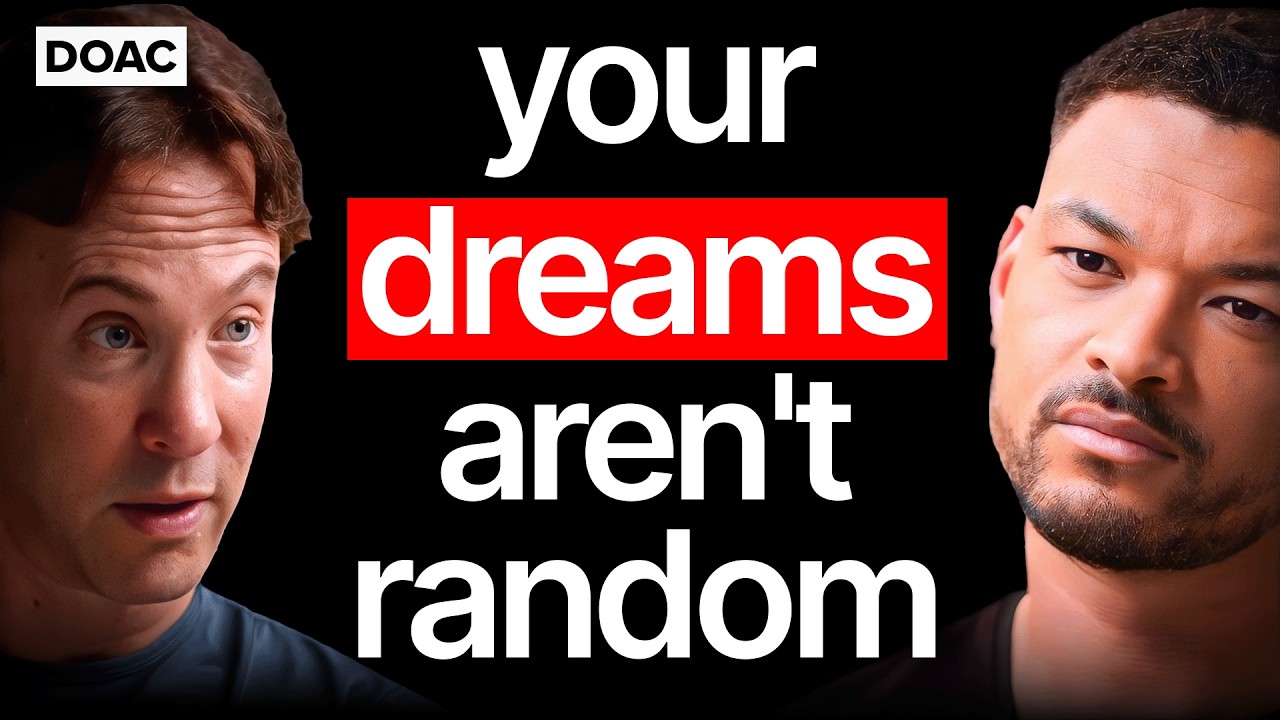
Eagleman Says AI Effort Paradox and Defensive Dreaming Drive Plasticity
The Diary Of A CEO
Stanford neuroscientist David Eagleman argues that human dreams defend the visual cortex from neural takeover during darkness, while meaningful mental friction from AI determines whether technology enhances or degrades cognitive capacity.
## Background
This episode was published on YouTube by The Diary Of A CEO on April 23, 2026. According to the page description, Stanford neuroscientist Dr. David Eagleman discusses how our brain tricks us to keep us safe, why doing difficult tasks physically rewires the mind, the true purpose behind dreaming, and how to effectively leverage AI without making our brains lazy.
## TL;DR
Stanford neuroscientist Dr. David Eagleman explains that the brain operates as a 'team of rivals' rather than a single unified entity, continuously reorganizing itself through plasticity based on environmental demands and energy efficiency. He introduces the Defensive Activation Theory, which posits that dreaming exists to protect the visual cortex from being taken over by other senses while sleeping in the dark. The conversation explores cognitive reserve, the impact of physical exercise on neurogenesis, and how human intelligence differs fundamentally from artificial neural networks. Eagleman and host Steven Bartlett emphasize using Ulysses contracts to overcome bad habits and prompting AI to act as a 'motorcycle for the mind' through virtuous friction.
## Atmosphere & style
The dynamic between Steven Bartlett and Dr. David Eagleman is intellectually rigorous yet deeply accessible, moving seamlessly between complex neurobiology and practical life philosophy. The conversation carries an optimistic, intellectually curious mood that balances scientific directness with empathetic human insights. Listening feels like sitting in on an enlightening masterclass that challenges basic assumptions about identity, memory, and perception while grounding high-level brain science in actionable self-improvement.
## Key takeaways
- [03:29](https://www.youtube.com/watch?v=m-nnyNZ0TQ0&t=209s) The human brain operates as a 'team of rivals' or 'neural parliament' of roughly 86 billion neurons, meaning behavior is governed by competing internal networks rather than a single unified decider.
- [12:28](https://www.youtube.com/watch?v=m-nnyNZ0TQ0&t=748s) Adult brain plasticity relies on staying in the sweet spot between frustration and achievement, which builds cognitive reserve to buffer against physical brain damage and cognitive decline.
- [18:10](https://www.youtube.com/watch?v=m-nnyNZ0TQ0&t=1090s) The brain constantly strives for energy efficiency by automating mastered tasks, meaning true neuroplastic adaptation requires seeking out novel, difficult challenges rather than repetitive routines.
- [24:00](https://www.youtube.com/watch?v=m-nnyNZ0TQ0&t=1440s) Physical exercise directly stimulates adult neurogenesis, serving alongside sleep and proper nutrition as a foundational element for long-term brain health and longevity.
- [29:39](https://www.youtube.com/watch?v=m-nnyNZ0TQ0&t=1779s) Artificial intelligence creates a dichotomy between 'vicious friction' (low-value administrative busywork) and 'virtuous friction' (complex strategic thinking), with cognitive decline depending on which type is automated.
- [46:04](https://www.youtube.com/watch?v=m-nnyNZ0TQ0&t=2764s) Creativity involves absorbing, bending, and combining concepts, where AI excels at generating variations while humans excel at selecting what resonates emotionally and culturally.
- [57:47](https://www.youtube.com/watch?v=m-nnyNZ0TQ0&t=3467s) Biological neurons possess vast structural complexity compared to simplified artificial neural nodes, enabling human brains to perform low-power 'one-trial learning' and maintain an internal experiential world.
- [01:08:12](https://www.youtube.com/watch?v=m-nnyNZ0TQ0&t=4092s) Neurological variations like aphantasia, hyperphantasia, and synesthesia demonstrate that the brain uses diverse alternative processing pathways without impacting overall intelligence.
- [01:15:31](https://www.youtube.com/watch?v=m-nnyNZ0TQ0&t=4531s) The Defensive Activation Theory proposes that dreaming protects the visual cortex from being commandeered by other senses during sleep, with midbrain activity firing every 90 minutes during REM to keep visual neurons active.
- [01:21:06](https://www.youtube.com/watch?v=m-nnyNZ0TQ0&t=4866s) Categorizing individuals into out-groups suppresses brain networks responsible for empathy, but 'complexifying' relationships through shared traits helps counteract polarization and dehumanization.
## Detailed walkthrough
### [00:00](https://www.youtube.com/watch?v=m-nnyNZ0TQ0&t=0s) Intro and the Purpose of Dreaming
Dr. David Eagleman opens the conversation with a striking revelation about why human beings dream—a question that neuroscientists and philosophers debated for decades. He explains that dreaming is actually a defense mechanism to preserve the brain's visual territory. When someone loses their sight, the visual cortex in the back of the brain is quickly co-opted by other senses like hearing and touch. Citing research from Harvard where normally sighted subjects were blindfolded, Eagleman notes that this cortical takeover begins in as little as 60 minutes. Dreaming, therefore, keeps the visual cortex active during the dark hours of sleep so that other senses do not invade its real estate.
The conversation shifts to the broader theme of brain plasticity and how individuals can actively shape their own neural architecture to become the person they aspire to be. Eagleman emphasizes that while human fluid intelligence peaks at around age two—allowing young children to absorb virtually anything—adults develop crystallized intelligence. Grown-ups know how to drive a car, operate a smartphone, or run a business, meaning their brains no longer demand radical structural shifts on a daily basis. However, without deliberate challenge, brain structures naturally begin to degenerate over time.
- Blindfolding experiments show neural takeover of the visual cortex starting after just 60 minutes.
- Dreams fire up the visual cortex at night strictly to defend its territory against hearing and touch.
- Fluid intelligence peaks at age two, after which crystallized intelligence takes over as the brain forms efficient internal models of the world.
- Host Steven Bartlett makes a direct appeal to viewers to check their subscription status to keep *The Diary Of A CEO* free and continuously improving.
---
[02:32](https://www.youtube.com/watch?v=m-nnyNZ0TQ0&t=152s) Why The Brain Became My Obsession
Eagleman shares the vivid childhood memory that sparked his lifelong fascination with human perception and neuroscience. When he was eight years old, he fell 12 feet off the roof of a house under construction, breaking his nose on the floor below. Although the fall mathematically took only 0.6 seconds, the event felt as if it played out in extreme slow motion. This striking disconnect between physical reality and subjective time drove him to dedicate his career to understanding how a three-pound organ, sealed inside the dark vault of the skull, constructs our model of reality.
```
0.6 seconds (actual duration of 12 ft fall) vs. Subjective slow-motion perception
```
Bartlett reflects on how rare it is for people to consciously think about their own brains, given that no one ever sees or touches their own organ. This lack of awareness makes it easy to fall into the trap of assuming that subjective experience is an direct, unmediated reflection of objective truth.
- Eagleman's childhood fall: 12 feet off a roof under construction at age 8.
- Physical calculation: The fall lasted roughly 0.6 seconds, yet felt prolonged.
- The human brain weighs approximately 3 pounds and operates completely locked inside the dark skull.
---
[03:29](https://www.youtube.com/watch?v=m-nnyNZ0TQ0&t=209s) How To Actually Break Bad Habits (And Why Most People Fail)
Eagleman challenges the intuitive idea that a person is a single, unified individual ("indivisible"). Instead, he describes the brain as a "team of rivals"—a collection of competing neural networks, each pushing different drives and behaviors. When presented with a plate of chocolate chip cookies, one network desires the high-energy calories, another warns about weight gain, and a third proposes a compromise of eating one now and going to the gym later. The brain is essentially a "neural parliament," and human behavior is simply the winning vote cast by these competing factions at any given moment.
To manage this internal conflict, Eagleman introduces the concept of a **Ulysses contract**—a decision made in a moment of clarity to constrain future options and prevent bad behavior down the road. He uses the example of Alcoholics Anonymous advising recovering addicts to purge all alcohol from their homes. While a person might feel completely committed to sobriety during a calm afternoon, a "future version" of themselves might break down on a festive Saturday night or a lonely Sunday evening if temptation is readily accessible.
> "You are a team of rivals... The way that your ship of state moves depends on the vote of the neural parliament at any time."
- The brain contains roughly **86 billion neurons** communicating through hyper-fast neural networks.
- Missteps and regrets happen because different "voices" or neural networks take charge under different emotional states.
- Ancient philosophy shifted from the classical Greek admonition "know thyself" to what Eagleman reframes as "know thy*selves*."
---
[07:36](https://www.youtube.com/watch?v=m-nnyNZ0TQ0&t=456s) What You’ve Been Getting Wrong About The Brain
Discussing common misconceptions, Eagleman highlights the central property of the brain: **plasticity**. Coined over a century ago by psychologist William James, the term draws an analogy to physical plastic—a material that can be molded into a shape and hold that shape over time. This is why a person can remember their third-grade teacher's name decades later: the neural networks physically altered their connections to retain that specific memory.
Eagleman points out that while the human brain shares general structures with other animals like horses or dogs, humans possess a vastly expanded, wrinkled outer layer called the **cortex** (roughly 3 mm thick). Furthermore, small genetic tweaks have granted humans an extraordinary level of neuroplasticity. While a newborn foal can walk and function much like horses did 100,000 years ago, a human infant is born "half-baked." Human brains drop into the world with minimal pre-programmed software, allowing them to absorb the culture, language, science, and technology of their era and springboard off thousands of years of human progress.
- **William James** coined the term "plasticity" over 100 years ago to describe the brain's ability to hold molded changes.
- The human cortex consists of the outer **3 millimeters** of the brain's wrinkled surface.
- Early developmental critical periods: Children deprived of language or human contact in early years suffer permanent cognitive deficits.
- Example: Thousands of neglected orphans in post-Ceaușescu Romania suffered profound, lasting cognitive impairments due to lack of emotional and linguistic input during critical developmental windows.
---
[11:32](https://www.youtube.com/watch?v=m-nnyNZ0TQ0&t=692s) Fluid Vs. Crystallized Intelligence
Eagleman breaks down the shift from fluid to crystallized intelligence as a person matures. In infancy and early childhood, high fluid intelligence allows a baby to adapt to any environment on Earth—whether born in 10th-century Mongolia or 21st-century London. As a person grows, the brain's primary job is to build an internal model of its specific world so it can navigate everyday life efficiently.
Once an adult masters their environment—such as learning how to run a business, build a board, or hire a team—the brain no longer needs to restructure itself as drastically. People often assume that brain plasticity simply dies off with age, but Eagleman clarifies that the brain changes less simply because it *doesn't need to*—it has already figured out how its immediate world works.
- **Fluid Intelligence:** High in early life; enables rapid learning and adaptation to any environment or language.
- **Crystallized Intelligence:** High in adulthood; represents established internal models, skills, and hardcoded knowledge.
- The brain's main goal is efficiency: once it builds an accurate internal model of reality, it minimizes unnecessary structural changes.
---
[12:28](https://www.youtube.com/watch?v=m-nnyNZ0TQ0&t=748s) What Really Happens When You Try To Change Yourself
To reignite brain plasticity as an adult, one must disrupt established internal models. Eagleman offers the COVID-19 pandemic as a rare example of a collective shake-up: despite its devastation, it forced millions of adults to re-evaluate basic daily assumptions—from whether coffee shops would be open to how supply chains operate—thereby forcing the adult brain out of its comfortable routine.
For an individual seeking self-improvement—whether trying to overcome laziness, stubbornness, or lack of motivation—the key is actively seeking out novel challenges. Eagleman explains that the optimal zone for brain change lies squarely between **frustrating and achievable**. Once a person becomes comfortable or proficient at a task or skill, they must abandon that comfort zone and deliberately take on something they are terrible at, forcing the brain to build entirely new neural pathways.
```
[Comfort Zone / Too Easy] ---> [Frustrating but Achievable] <--- [Overwhelming / Impossible]
│
(Optimal Brain Rewiring)
```
To illustrate the protective power of building new neural roadways, Eagleman cites the long-running **Religious Orders Study**. Researchers followed a cohort of Catholic nuns who agreed to donate their brains for post-mortem autopsies. Upon examining the organs, scientists discovered that many nuns had advanced physical markers of Alzheimer's disease—their brain tissue was visibly degenerating—yet they had shown zero cognitive decline or memory loss while alive. Because the nuns lived in active communal environments with continuous social challenges, debates, and learning, their brains built redundant neural pathways that bypassed the damaged areas.
- **The Religious Orders Study:** Decades-long study evaluating aging and dementia in Catholic nuns.
- Autopsies revealed physical Alzheimer's pathology in nuns who showed no clinical signs of dementia while alive.
- **Cognitive Reserve:** Continually learning new skills creates alternative "roadways" in the brain, allowing it to function normally even as physical degeneration occurs.
[14:58](https://www.youtube.com/watch?v=m-nnyNZ0TQ0&t=898s) The Nun Study, Cognitive Reserve, and the Danger of Early Retirement
The discussion opens with the remarkable findings of the famous "Nun Study." These nuns led active, highly engaged lives into old age—playing games with their fellow sisters, maintaining chores, taking on daily responsibilities, and staying mentally active. Neuropsychological tracking revealed something extraordinary: even as their brain tissue physically degenerated from advanced Alzheimer’s disease, they suffered no visible cognitive decline. Because they were constantly building new neural "roadways and bridges," their minds remained sharp. This buffer against brain damage is what neuroscientists term **cognitive reserve**.
Contrast this active aging with the typical modern retirement model where someone stops working at 65, stays home, watches television, and lets their social circle shrink. When you stop challenging the brain, you stop constructing new pathways, leaving the mind vulnerable. Eagleman highlights a tragic compound factor: as people reach their mid-60s, age-related hearing loss often sets in, making noisy environments like restaurants or parties exhausting and unpleasant. As a result, retirees socially isolate right at the moment their brains need stimulation the most. Socializing is one of the single most demanding tasks for human neural architecture—as the neuroscience adage goes, *"nothing is as hard for the brain as other people"* because human interactions are dynamic, unpredictable, and emotionally complex.
- **The Nun Study Insight:** Autopsies revealed severe physical signs of Alzheimer's disease in the nuns' brains, yet they showed no symptoms in life due to dense alternative neural networks.
- **Cognitive Reserve:** The brain's capacity to improvise, find alternative neural pathways, and work around areas of damaged tissue.
- **Hearing Loss Risk:** Age-related hearing deterioration accelerates social isolation, directly starving the brain of crucial social input.
---
[16:27](https://www.youtube.com/watch?v=m-nnyNZ0TQ0&t=987s) Peak Synapses, Synaptic Pruning, and Building Lifelong Pathways
Addressing the host's question about how to optimize brain health in one's early 30s to prevent decline in old age, Eagleman breaks down the timeline of human brain development. Strictly speaking, peak connectivity occurs at age two. A newborn is equipped with roughly 86 billion neurons, which rapidly form dense connections until the toddler's brain resembles an overgrown garden. From that point forward, the brain engages in systematic **synaptic pruning**—eliminating unused connections while reinforcing the ones actively engaged by the environment.
Far from being a sign of decay, synaptic pruning is how the brain customizes itself to its specific culture and era—adapting to 21st-century London or Los Angeles rather than 10th-century Mongolia. While physical brain cells are lost to minor traumas and natural aging over time, **crystallized intelligence**—the cumulative vault of knowledge, skills, and strategies built over a lifetime—continues to grow. Early learning acts as an investment that yields high returns later in life, providing the cross-disciplinary insights needed to pivot careers, launch new ventures, or master emerging technologies like artificial intelligence.
- **Peak Synaptic Density:** Occurs around age 2; the brain starts with ~86 billion neurons and initially overproduces connections.
- **Synaptic Pruning:** The process of carving away unused neural pathways to customize the brain to its specific environment.
- **Crystallized Intelligence:** The accumulated wisdom, knowledge, and experience that continues to expand long after physical neural growth peaks.
---
[18:10](https://www.youtube.com/watch?v=m-nnyNZ0TQ0&t=1090s) The Energy-Efficiency Goal of the Brain & Cortical Plasticity
When learning a difficult new skill, the brain goes into a state of high activation and stress. Eagleman illustrates this with a thought experiment: measure the brain activity (via EEG) of an expert juggler versus a complete novice while both attempt to juggle. Counterintuitively, the expert's brain shows minimal, highly localized activity because the motor patterns have been burned deep into automatic circuitry. The novice's brain, by contrast, lights up intensely across multiple regions because it is working frantically to decipher rules, coordinate timing, and adjust to failure. The brain's ultimate goal is always **energy efficiency**—it strives to automate tasks so it burns as little fuel as possible.
This structural adaptation is clearly visible when examining the motor cortex, the strip of tissue beneath where headphones rest on the head. In professional pianists, who execute intricate, high-speed movements with both hands, the motor cortex develops physically enlarged, visible loops of tissue on both hemispheres. In contrast, violinists display expanded motor cortex representation on only one side of the brain, corresponding to the fingering hand, while the bowing hand requires less localized fine-motor real estate. Medical students studying intensely for licensing exams show similar physical shifts in cortical tissue distribution. The outer cortex is fundamentally a flexible, general-purpose processing engine: if a person is born blind, the visual cortex is repurposed by the remaining senses; if born deaf, the auditory cortex is taken over by vision and touch.
- **Neural Efficiency:** Expert brains burn far less energy performing a complex task than novice brains because the task has been hardcoded into deep circuits.
- **Pianist vs. Violinist Brains:** Pianists develop bilateral structural enlargement in the motor cortex; violinists develop asymmetrical expansion corresponding to their fingering hand.
- **Sensory Repurposing:** In the absence of sight or hearing, the brain's visual or auditory cortex is dynamically reassigned to process other sensory inputs.
---
[22:19](https://www.youtube.com/watch?v=m-nnyNZ0TQ0&t=1339s) Overcoming Inertia: Ulysses Contracts and Behavior Change
Transforming oneself from an unmotivated person into someone who tackles difficult challenges requires much more than raw willpower. Eagleman points out that traditional resolve routinely fails—as evidenced by the massive drop-off in New Year's resolutions by February. Lasting change requires deliberate behavioral architecture rather than relying on fickle emotional states.
To reliably break bad habits and build demanding routines, one must leverage short-term drivers and structural constraints like a **Ulysses contract**. Named after the mythical hero who bound himself to the mast of his ship to resist the Sirens' song, a Ulysses contract locks your future self into a course of action before temptation or fatigue sets in. Calling a friend to commit to a 7:00 AM run every morning binds your current intentions to social accountability. Once you force the initial behavior, a positive flywheel takes effect: your body and brain physically adapt, the activity becomes less strenuous, and the habit reinforces itself.
- **Ulysses Contract:** A binding decision made in the present that forces your future self to stick to a goal (e.g., setting up strict social accountability or financial penalties).
- **The Adaptation Flywheel:** Consistent action drives physical and neural adaptation, which lowers the friction for future effort, reinforcing the behavioral loop.
---
[24:00](https://www.youtube.com/watch?v=m-nnyNZ0TQ0&t=1440s) Neurogenesis, Physical Exercise, and Brain Health
When asked about specific physical habits that protect and rewire the brain, Eagleman highlights the role of physical exercise. For decades, neuroscience operated under the strict dogma that adult humans are born with a fixed set of 86 billion neurons that steadily die off over time. However, animal studies present a compelling counter-narrative: in rats, there is a steady trickle of new brain cells generated in adult life (**adult neurogenesis**).
When rats are given access to a running wheel, this rate of neurogenesis increases significantly. While the exact degree of adult neurogenesis in humans remains a subject of active scientific debate, the broader systemic benefits of exercise on human brain health are undeniable. Combined with proper sleep and nutrition, physical activity remains one of the most powerful levers available for preserving cognitive function, enhancing vascular delivery to the brain, and supporting overall neural longevity.
- **Adult Neurogenesis:** The creation of new neurons in the adult brain, shown to be directly stimulated by physical exercise in animal models.
- **Core Triad of Brain Health:** Exercise, sleep, and diet remain the foundational, evidence-based pillars for keeping brain tissue healthy with age.
---
[25:07](https://www.youtube.com/watch?v=m-nnyNZ0TQ0&t=1507s) Cyber-Optimism, the Intellectual Diet, and Asimov’s Vision
Addressing modern anxieties about social media and digital technology, Eagleman provides a nuanced perspective on how digital environments shape developing minds. Scientifically, it is impossible to definitively claim that modern technology ruins children's brains because researchers lack an unconfounded control group—short of isolated religious communities like the Amish or severely impoverished populations, both of which introduce hundreds of extraneous variables like diet, lifestyle, and environment.
Eagleman identifies as a **cyber-optimist**, arguing that the internet dramatically expands a young person's intellectual diet. In previous generations, growing up in a isolated town meant exposure only to local professions and immediate surroundings. Today, a child can discover niche academic fields, learn complex skills directly from experts online, and follow curated educational paths. Crucially, learning is tied to **curiosity-driven neuroplasticity**: when a child asks a question because they genuinely want to know the answer, the brain releases a neurochemical cocktail that cements that information. This contrasts with traditional schooling models that rely heavily on "just-in-case" knowledge that children rapidly forget.
> "When I was a kid... my mom would drive me to the library... and I would pick up the Encyclopedia Britannica and flip through it... That's how I was able to get my little straw of knowledge. But now kids are growing up with access to anything they're interested in."
Eagleman references a 1988 interview with legendary science fiction author Isaac Asimov, who foresaw a future where every home was connected to a central supercomputer holding all human knowledge. Asimov recognized that standard classrooms move too fast for half the students and too slow for the other half. He predicted that direct, self-directed access to global knowledge would revolutionize education by allowing every individual to enter the world of learning through the door of their own intrinsic curiosity.
- **Lack of Control Groups:** Claims about technology ruining young brains are often scientifically unproven because no isolated control group of modern children exists without major confounding factors.
- **Curiosity-Driven Plasticity:** Information retention is drastically higher when acquired in response to active curiosity rather than passive, enforced memorization.
- **Isaac Asimov’s 1988 Vision:** Foretold the internet as a customized educational engine that solves the pacing flaws of traditional standardized classrooms.
[29:39](https://www.youtube.com/watch?v=m-nnyNZ0TQ0&t=1779s) Curiosity, AI, and Navigating Vicious vs. Virtuous Friction
Dr. David Eagleman addresses the common fear that artificial intelligence will make humanity lazy and incapable of independent thought. From a brain plasticity perspective, he argues that using AI does not inherently lead to cognitive decline—it depends entirely on how one uses it. Illustrating with a personal example, Dr. Eagleman shares that he loves home improvement and has "3xed" his repair capabilities over the past six months using ChatGPT. When encountering an unfamiliar household component, he snaps a photo, asks how it works, and receives step-by-step instructions. Rather than outsourcing his thinking, his natural curiosity drives him to learn and retain vastly more practical knowledge than he ever could before.
```
┌─────────────────────────────────────────┐
│ Cognitive Friction │
└────────────────────┬────────────────────┘
│
┌───────────────────┴───────────────────┐
▼ ▼
┌──────────────────────────────┐ ┌──────────────────────────────┐
│ Vicious Friction │ │ Virtuous Friction │
├──────────────────────────────┤ ├──────────────────────────────┤
│ • Low-value administrative │ │ • High-value strategic │
│ busywork │ │ problem-solving │
│ • Data entry, spreadsheets, │ │ • Framing new paradigms, │
│ routine logistics │ │ debating trade-offs │
│ • Best offloaded to AI │ │ and synthesized thinking │
│ • Zero neural gain from │ │ • Directly drives │
│ enduring it │ │ neuroplastic growth │
└──────────────────────────────┘ └──────────────────────────────┘
```
Responding to studies suggesting brain atrophy from over-relying on AI models or search engines, Steven Bartlett questions the long-term impact on business leaders who immediately paste hard problems into AI and copy-paste the answers back. Dr. Eagleman draws a crucial neurobiological distinction between two types of friction:
* **Vicious Friction:** Repetitive, low-value administrative tasks (such as filling out tax forms or copying spreadsheet cells). This "busywork" holds no intrinsic educational value, and automating it with AI dramatically improves human quality of life. Dr. Eagleman compares this to the 1990s debate over desk calculators in classrooms, noting that once society allowed students to bypass months of manual long division, they could focus on higher-level mathematical concepts.
* **Virtuous Friction:** Deep, complex problem-solving (such as strategizing business structures or direct-to-consumer approaches). Engaging with this friction rewires and strengthens the brain's neural networks.
---
* **Learning through Collaboration:** True cognitive enhancement occurs when AI acts as an always-available partner for brainstorming rather than a shortcut for copy-pasting.
* **The Power of AI Socratic Engagement:** Interacting with an AI model exposed to the breadth of human knowledge allows individuals to push past their narrow internal assumptions and discover blind spots.
---
[33:35](https://www.youtube.com/watch?v=m-nnyNZ0TQ0&t=2015s) The Effort Phenomenon and "AI Slop"
Steven Bartlett shares his frustration with job candidates and LinkedIn professionals who submit generic, AI-generated text. He notes that these responses are easily recognizable by their distinct model "personalities," such as heavy usage of em dashes and contrastive phrasing ("It's not X, it's Y"). This copy-paste approach bypasses the critical learning cycle and triggers immediate red flags for recruiters and audiences alike.
Dr. Eagleman connects this consumer backlash to a psychological concept he terms the **effort phenomenon**. Human beings naturally assign higher emotional and monetary value to items that require significant effort, time, or struggle to create.
```
THE EFFORT PHENOMENON
Higher Value Lower Value
┌─────────────────────────┐ ┌─────────────────────────┐
│ Natural Diamond │ │ Lab-Grown Diamond │
│ Formed over millions │ VS. │ Identical carbon structure│
│ of years by nature │ │ produced in days │
└─────────────────────────┘ └─────────────────────────┘
┌─────────────────────────┐ ┌─────────────────────────┐
│ Intricate Bottle-Cap │ │ Minimalist Red Dot │
│ Sculptures │ VS. │ Single painted mark on │
│ Visible manual labor │ │ white canvas │
└─────────────────────────┘ └─────────────────────────┘
┌─────────────────────────┐ ┌─────────────────────────┐
│ Authentic Human Thought │ │ Unedited "AI Slop" │
│ Deep reflection & style │ VS. │ Path of least resistance│
└─────────────────────────┘ └─────────────────────────┘
```
Because audiences implicitly feel the lack of human labor behind unedited AI posts, the content comes across as lazy and irritating, causing readers to disengage.
* **Value Perception in Art and Goods:** People routinely pay more for natural diamonds over lab-grown ones—despite identical chemical compositions—because they value the millions of years of earth-bound pressure involved.
* **Trade-offs in Cognitive Shortcuts:** Bartlett emphasizes that every efficiency gain carries hidden costs; relying on AI without active engagement risks forfeiting critical thinking skills.
* **Evolving Academic Assessments:** At Stanford, Dr. Eagleman no longer assigns traditional final essays because AI renders them trivial to fake. Instead, he assesses students through real-world group experiments where they must analyze data and navigate human dynamics.
---
[38:21](https://www.youtube.com/watch?v=m-nnyNZ0TQ0&t=2301s) "Aristotle in Your Pocket": Gaining a Competitive Edge
Rather than replacing human thought, AI acts as an intellectual multiplier. Dr. Eagleman describes having continuous access to AI as having "Aristotle in your pocket." Just as Alexander the Great was tutored by Aristotle and could inquire about any subject, modern users can instantly learn about niche topics, home repairs, or specialized domains whenever curiosity strikes.
When Bartlett asks how one creates a competitive advantage when everyone possesses the same tool, Dr. Eagleman references Steve Jobs’ famous description of the personal computer as a "bicycle for the mind." Expanding on the analogy, Dr. Eagleman frames AI as a "motorcycle for the mind."
> "For millions of years we've been walking bipedally, and then just in the last nanosecond of evolution we invented the bicycle... Having a personal computer is like a bicycle for the mind, and I think of AI now as like a motorcycle for the mind. It allows us to move so much faster."
```
EVOLUTION OF COGNITIVE LEVERAGE
Bipedal Walking Bicycle for the Mind Motorcycle for the Mind
(Raw Human Brain) (Personal Computer) (AI Assistants)
┌─────────────────┐ ┌──────────────────┐ ┌─────────────────────┐
│ Limited range & │ ───► │ Accelerated data │ ───► │ Hyper-speed output, │
│ processing speed│ │ processing & text│ │ vast synthesis & │
│ │ │ tools │ │ 24/7 sparring │
└─────────────────┘ └──────────────────┘ └─────────────────────┘
```
To outpace competitors in this new landscape, individuals must avoid generating unedited "AI slop" and instead master high-level synthesis, curiosity, and rapid execution.
* **Curiosity as a Neural Habit:** Building cognitive reserve requires regularly asking AI challenging questions about unfamiliar subjects rather than using it purely for routine automation.
* **The Future of Education:** As technical skills like basic coding become increasingly automated, the two most critical skills left to teach future generations are **critical thinking** and **creativity**.
---
[41:40](https://www.youtube.com/watch?v=m-nnyNZ0TQ0&t=2500s) Overcoming Echo Chambers by Prompting AI to Be Brutally Honest
Bartlett highlights a powerful strategy for challenging personal assumptions and expanding intellectual boundaries: explicitly directing the AI to critique one's ideas. Because humans naturally experience cognitive dissonance—a concept introduced by Leon Festinger describing the discomfort felt when encountering information that contradicts established beliefs—people tend to seek out echo chambers.
To counter this bias, Bartlett shares his go-to prompt for high-conviction ideas: *"Be brutally honest about your opinion. Think for yourself and be objective and tell me where my blind spots are."*
Dr. Eagleman agrees, pointing out that AI provides a unique space for intellectual growth. Unlike debates with human peers, receiving blunt feedback from an AI carries no social embarrassment or public ego threat.
* **Sycophancy in AI Models:** OpenAI previously tested a version of ChatGPT that praised users excessively (e.g., calling every idea "brilliant"). The model was quickly adjusted after users rejected the artificial flattery.
* **Custom Instructions for Honest Feedback:** Users can permanently set their AI system prompts to be relentlessly objective, ensuring it critiques flaws rather than agreeing passively.
* **Humor and AI Constraints:** To test the AI's honesty in real time, Bartlett inputs a simple knock-knock joke ("Lettuce who? / Lettuce in and I'll tell you") to see if the system will call it unfunny rather than offering polite praise.
<FollowUp label="Want to continue with part 4 of the transcript walkthrough?" query="Please continue with part 4 of the transcript walkthrough, following the same detailed format and guidelines."/>
[43:58](https://www.youtube.com/watch?v=m-nnyNZ0TQ0&t=2638s) Can AI Understand Humor, or Is It Just a Statistical Parrot?
Steven Bartlett continues testing ChatGPT on a joke, revealing how the AI originally praised its structure with a laughing emoji, but when pressed to be "brutally honest," flipped completely to pronounce the joke "absolutely not funny." It even gave it a 1 out of 10 for comedic originality and likelihood of real laughter. Steven points out that this constant feedback loop just mirrors and reinforces what the user already believes, raising doubts about whether interacting with such AI can foster a genuine growth mindset.
Dr. David Eagleman clarifies that AI in its current state is essentially a "statistical parrot." When prompted to be brutally honest, it simply mimics what it calculates a "brutally honest" persona should say. Examining how AI approaches humor, Eagleman explains that modern Large Language Models (LLMs) built on transformer architectures cannot truly understand or craft genuine jokes. While an AI knows the structural pattern of a joke—such as three setup events where the third breaks the established pattern—it fails to execute the twist effectively. It cannot think of a funny punchline first and reverse-engineer the setup to build toward it; instead, it merely inserts a random deviation for the third element.
- **The Setup Pattern**: Current AI models replicate structural forms (e.g., "three guys walk into a bar") but lack the backward-planning mechanism required to weave a joke toward a specific, funny punchline.
- **Statistical Parrot Effect**: Rather than offering objective truth, AI adjusts its tone to match user prompts, shifting from polite validation to harsh critique depending on how the prompt is framed.
---
[46:04](https://www.youtube.com/watch?v=m-nnyNZ0TQ0&t=2764s) Creativity, AI, and the Human Edge of Selection
Addressing the common claim that AI can never be creative, Eagleman strongly disagrees, asserting that AI is already "massively creative." In the human brain, creativity is simply absorbing experiences, concepts, and world knowledge, then bending, breaking, and blending those elements into new remixes. Because AI absorbs vast datasets and remixes them seamlessly, it performs the generative side of creativity exceptionally well. However, the crucial component AI lacks is **selection**—the ability to evaluate its output and know which item out of a hundred generated options will deeply resonate with a human audience.
```
+-----------------------------------------------------------------------+
| THE CREATIVITY CYCLE |
| |
| [ Generation / Remixing ] ------------> [ Human Selection ] |
| - Absorbing concepts - Knowing what resonates|
| - Blending ideas into remixes - Taste & emotional context
| - Performed brilliantly by AI - Missing in current AI |
+-----------------------------------------------------------------------+
```
Steven pushes back with a personal experiment: he dropped a 30-minute behind-the-scenes video into Google Gemini and asked it to predict audience drop-off points. To his surprise, Gemini achieved a 100% accuracy rate across multiple tests, identifying exact moments where a speaker talked for too long (e.g., a 74-second monologue) and explaining why viewers would leave. Gemini also correctly predicted winning YouTube thumbnails in A/B tests. Eagleman explains that while AI can predict these outcomes by analyzing statistical patterns (like font size or color contrast), it evaluates images as raw pixel distributions rather than experiencing the emotional nuance of human taste.
- **Definition of Creativity**: Bending, breaking, and blending existing cognitive concepts into novel remixes.
- **The Intern Analogy**: Unlike an AI evaluating raw pixels, a human intern eventually picks up a creator's unique taste and underlying aesthetic preferences over time.
- **Gemini Retention Test**: Gemini accurately pinpointed viewer drop-off points down to specific 74-second tangents and predicted winning thumbnail variations with 100% accuracy on existing dataset tests.
---
[50:12](https://www.youtube.com/watch?v=m-nnyNZ0TQ0&t=3012s) The Sweet Spot Between Novelty and Familiarity
Eagleman emphasizes that human art and culture are constantly shifting because humans are driven by a fundamental psychological tension: the balance between **novelty** and **familiarity**. Because AI models are trained exclusively on historical data—what has already been created and what has previously worked—they tend to output ideas that cluster right in the middle of a standard distribution curve. While an AI can generate millions of variations, it is the human consumer who selects the outlier on the edge of the curve because humans actively crave fresh twists.
```
HUMAN RESISTANCE vs. ADOPTION
(The Sweet Spot / Bell Curve)
Steven shares an insider story from working with Sony, where a newly formed boy band was given three songs all written by Ed Sheeran. The record label used Sheeran's proven songwriting formulas to guarantee hits, showing how commercial industries rely heavily on predictable patterns. Eagleman notes that while formulas work temporarily, no code lasts forever. People grow fatigued if they hear the exact same structure repeatedly. From fashion and haircuts to car design, success relies on staying in the sweet spot: novel enough to feel exciting, but familiar enough to feel comfortable and recognizable.
- **The Hit Formula Curve**: A song or product achieves maximum appeal when it hits the exact middle ground between being familiar enough to recognize and novel enough to stay interesting.
- **Overexposure & Decay**: Playing a song repeatedly drives it from novel to pleasantly familiar, but excessive repetition pushes it down the far side of the curve into annoyance and boredom.
- **Corporate Examples of Failure**:
- *Too Novel*: Coca-Cola launching "New Coke," which alienated consumers by abandoning familiarity.
- *Too Familiar*: Blackberry clinging to physical keyboards and failing to adapt to evolving technological trends.
The host presents promotional messages for two podcast sponsors:
- **Bon Charge**: Steven demonstrates his red light therapy face mask, explaining that wearing it for 15 to 20 minutes a day boosts collagen production and improves skin complexion. He notes that red light therapy is widely backed by health experts on the show.
- **Wispr Flow**: A voice dictation app that converts spoken words into accurate text in real time. Steven highlights its ability to automatically correct mid-sentence edits, cut down typing time by 50%, and boost overall productivity.
---
[57:47](https://www.youtube.com/watch?v=m-nnyNZ0TQ0&t=3467s) Jagged Intelligence and Brain Architecture
Returning to the discussion on neuroscience and technology, Steven asks whether AI's underlying neural-net architecture means its role will soon fully mirror or replace human intelligence. Eagleman responds that while AI architectures draw inspiration from the brain, they are fundamentally different in execution, which accounts for AI's current state of **jagged intelligence**.
Jagged intelligence refers to a system's ability to perform extraordinarily sophisticated tasks—such as solving complex equations or analyzing massive datasets—while simultaneously failing at basic logic or giving wildly absurd answers in the very next moment. Eagleman begins mapping out the origins of artificial neural networks, detailing how early AI research decades ago simplified the vast complexity of biological brain cells (neurons) and their billions of interconnected synapses into basic mathematical abstractions.
<FollowUp label="Want to explore Dr. Eagleman's breakdown of how biological brains differ from artificial neural networks?" query="Continue the walkthrough into the next part focusing on how Dr. Eagleman contrasts biological brains with artificial neural networks."/>
[58:34](https://www.youtube.com/watch?v=m-nnyNZ0TQ0&t=3514s) Artificial Neural Networks vs. The Human Brain
Dr. David Eagleman breaks down the fundamental differences between artificial neural networks (ANNs) and the human brain, despite ANNs being loosely inspired by biological neurobiology. In computer science, individual units are abstracted into simplified nodes connected by weighted links, completely ignoring the sheer biological complexity of a single neuron—which Eagleman notes is as complex as an entire city, containing the human genome and trafficking millions of proteins. While ANNs have proved remarkably successful at achieving what we call intelligence, they lack the emotional drives, competing appetites (like food or sexuality), and internal "team of rivals" dynamics that define human cognition.
Steven Bartlett pushes back, recalling a conversation with AI pioneer Geoffrey Hinton, who emphasized how much modern AI relies on neuroscience principles. Eagleman clarifies that while AI researchers pivoted away from rigid rule-based systems and probability theories toward neural architectures, the resemblance remains largely superficial. A modern Large Language Model (LLM) like ChatGPT reads and retains the sum of human knowledge—an amount of data requiring a human a thousand lifetimes to read—yet it learns and operates on principles fundamentally alien to biological brains.
* **Cellular Complexity:** A single brain cell operates with the internal complexity of a full city, trafficking millions of proteins under the control of the human genome.
* **Architectural Convergence:** Both biological brains and AI systems have converged on functional intelligence, but through drastically different internal structures.
* **Scale of Memory:** AI models ingest and memorize virtually all written human knowledge, whereas human brains have finite capacity and retain only a fraction of what they experience.
---
[01:01:02](https://www.youtube.com/watch?v=m-nnyNZ0TQ0&t=3662s) One-Trial Learning and Biological Constraints
Eagleman highlights a key operational divergence: humans perform "one-trial learning," whereas AI models require massive, resource-intensive training phases. When a parent shows a child a novel fruit—like a pomegranate—just once, the child's brain immediately grasps and retains the concept. By contrast, models developed by OpenAI, Google (Gemini), or Anthropic require thousands or millions of training examples costing billions of dollars. Furthermore, AI operates in distinct phases (training followed by inference), while human brains must continuously adapt and learn on the fly in real-time environments without the luxury of separate phases.
When Bartlett asks whether these structural differences place hard limits on what AI can achieve compared to humans, Eagleman explains that humans possess an internal, experiential model of what it feels like to be human. AI observes human behavior strictly from the outside in, deriving patterns purely from external data.
* **One-Trial Learning:** Human brains update their internal models instantly from single real-world exposures, whereas AI models require massive multi-million-example datasets.
* **Training vs. Action:** AI separates compute into distinct training phases and execution/inference runs; biological brains must process inputs and adapt simultaneously.
* **Inside-Out Experience:** Humans build internal models of each other grounded in shared subjective experience, whereas AI relies entirely on external behavioral observations.
---
[01:02:44](https://www.youtube.com/watch?v=m-nnyNZ0TQ0&t=3764s) The Human Preference for Real-World Experience
Bartlett questions whether the distinction between "inside-out" understanding and "outside-in" observation truly matters if both yield identical output, using an example of getting advice about a relationship. Eagleman acknowledges the point using an analogy from his own life: watching his Tesla's Full Self-Driving (FSD) handle a complex traffic situation by simply stopping. Though the car's algorithm processed the scenario differently than a human driver would, it reached the same practical outcome. However, Eagleman predicts that as synthetic experiences proliferate, humanity will place a premium on authentic, real-world human connection.
Contrary to early fears that digital distribution (like Napster) would kill live music, massive events like Taylor Swift's Eras Tour demonstrate that people gladly pay premium prices for real-world presence. Eagleman notes that despite friends suggesting he use AI tools like ElevenLabs or HeyGen to create an automated speaking avatar, demand for him to fly across the country to give live in-person talks has actually increased since the rise of modern AI. Bartlett agrees, sharing a LinkedIn post where he proposed that while previous technologies made us less human, advanced AI may paradoxically force humanity back into physical spaces and authentic real-life roles—such as nurses spending less time on admin paperwork and more time delivering empathetic, hands-on care.
> "Every other iteration of technology made us less human. And maybe the intelligence now has gotten to a point where it's now forcing us to be more human, because that is all that kind of remains." — Steven Bartlett
* **FSD Analogy:** Autonomous driving systems reach human-level safety decisions using algorithms that process environmental inputs completely differently than human conscious reasoning.
* **The Live Renaissance:** Increasing AI capabilities are driving higher demand for in-person events, live theater, and public speaking, mirroring how digital music amplified the value of live concerts.
* **Human-Centric Work:** Automation in administrative tasks creates space for human-only roles, such as hands-on patient care and physical companionship.
---
[01:05:48](https://www.youtube.com/watch?v=m-nnyNZ0TQ0&t=3948s) AI Companionship and Evolutionary Drives
The conversation turns to AI relationships, with estimates suggesting that roughly one billion people engage in romantic or conversational relationships with AI companions. While older generations often view AI partners with skepticism, Eagleman suggests these systems could serve as helpful "sandboxes" for practicing social dynamics and working through interpersonal flaws, provided proper feedback mechanisms exist. Deep evolutionary drives—shaped over hundreds of millions of years—pull humans toward physical touch, shared meals, family life, and genuine romantic connection, making it unlikely that virtual companions will permanently replace human relationships for the vast majority.
Bartlett presents a counterargument: society might bifurcate, as AI systems engineered for maximum engagement and user retention exploit specific psychological vulnerabilities. While some individuals will push through the discomfort and rejection of real-world dating, others may retreat into virtual substitutes like pornography or AI spouses. Eagleman acknowledges this potential split, raising the open question of whether individuals who withdraw into AI companions would have struggled to form healthy human relationships regardless of the technology's existence.
* **Scale of AI Relationships:** Estimates indicate around one billion users worldwide engage with AI entities for romantic or emotional companionship.
* **The Social Sandbox:** AI companions can function as low-stakes environments to practice social interaction and refine relationship skills.
* **Evolutionary Pull:** Hundreds of millions of years of biological evolution prioritize physical presence, pair-bonding, dining together, and real-world family structures over screen-based interaction.
---
[01:08:12](https://www.youtube.com/watch?v=m-nnyNZ0TQ0&t=4092s) Neurological Diversity: Hyperphantasia, Aphantasia, and Synesthesia
Referencing discussions with Stanford colleague Dr. Anna Lembke (author of *Dopamine Nation*), Bartlett notes that individuals possess unique addictive vulnerabilities—ranging from drugs to romantic erotic novels. Eagleman agrees, explaining that his lab has spent decades researching the subtle perceptual variations across the general population. To demonstrate, he asks Bartlett to picture an ant crawling across a purple-and-white tablecloth toward a overflowing jar of red jelly. Bartlett describes a vivid, detailed mental image complete with a wooden lid, indicating he is on the **hyperphantasia** end of the visual spectrum.
Eagleman reveals that he himself sits at the opposite extreme, experiencing **aphantasia**—a condition where he experiences no visual imagery whatsoever. He recounts discussions with Ed Catmull, co-founder of Pixar and pioneer of computer graphics algorithms like ray tracing, who is also aphantasic. When Catmull surveyed Pixar's staff, he discovered that many of the studio's top animators and directors also lacked visual imagery. Eagleman explains that aphantasic children often become superior artists because they must carefully observe the physical world and engage directly with the paper, rather than relying on a simplified mental template.
Eagleman further illustrates internal neurological diversity through **synesthesia**, a perceptual condition where sensory pathways cross—causing letters to trigger specific colors or music to produce visual patterns. Affecting at least 3% of the population, synesthesia is not a disorder, but an alternate perceptual reality. When asked how he thinks of his own children without visual imagery, Eagleman explains that his internal representation relies on motoric imagery, auditory memory of their voices, emotional closeness, and olfactory recall.
* **Hyperphantasia vs. Aphantasia:** Visual imagination exists on a broad spectrum, ranging from cinematic mental imagery (hyperphantasia) to the complete absence of mental pictures (aphantasia).
* **The Pixar Paradox:** Pixar co-founder Ed Catmull and numerous top animators have aphantasia, relying on close external observation and iterative drawing rather than internal mental visualization.
* **Synesthesia Prevalence:** At least 3% of the population experiences sensory blending, where inputs like letters, numbers, or musical tones trigger involuntary secondary senses like color or touch.
[01:12:22](https://www.youtube.com/watch?v=m-nnyNZ0TQ0&t=4342s) Imagery Capacity and Cognitive Flexibility
When considering how individuals experience internal imagery, people span a wide spectrum ranging from aphantasia (the inability to visualize mental images) to hyperfantasia (the ability to conjure extremely vivid visual scenes). Steven Bartlett brings up the mental exercise of imagining an ant walking toward a jar of jam to ask what these differing internal states imply about a person's underlying cognitive capabilities. Dr. David Eagleman clarifies that extensive research shows it ultimately translates to zero difference in real-world capacity or intelligence.
The human brain is remarkably adaptable and accomplishes complex tasks through a variety of alternative strategies. While some rely strictly on vivid visual imagery, others navigate problems using motor planning, auditory or olfactory cues, or purely abstract conceptual reasoning. A notable exception to this pattern is that visual artists are disproportionately aphantasic, often relying on the canvas itself to externalize their ideas rather than pre-visualizing them.
- **Aphantasia vs. Hyperfantasia:** Represents the spectrum between having no visual mind's eye and having an exceptionally vivid internal visual space.
- **Task Accomplishment:** Cognitive performance remains equal because the brain leverages alternative pathways—such as motor systems, sound, smell, or logic—to reach the same outcomes.
- **Visual Artists Nuance:** A surprisingly high proportion of visual artists experience aphantasia, relying directly on physical creation rather than internal mental visualization.
---
[01:13:21](https://www.youtube.com/watch?v=m-nnyNZ0TQ0&t=4401s) Commercial Break: Pipedrive and The 1% Diary
Steven Bartlett takes a brief break to share how he manages sales pipeline complexity across his commercial teams at Steven.com using Pipedrive, an intelligent CRM that organizes deals into a single visual real-time dashboard. Following this, he highlights "The 1% Diary," a physical journaling framework developed by his team to help individuals achieve ambitious goals by breaking them down into manageable daily steps.
---
[01:15:31](https://www.youtube.com/watch?v=m-nnyNZ0TQ0&t=4531s) Why We Dream: Defending the Visual Cortex
Dr. Eagleman outlines a unified neuroscientific theory explaining why humans and other animals dream, addressing a question that has been debated for millennia. The theory stems from the phenomenon of brain plasticity: when a sensory area loses its input, neighboring areas quickly commandeer that cortical real estate. Because the Earth rotates into darkness for half of every 24-hour cycle, the visual cortex is left without external photon input during sleep, leaving it vulnerable to being overtaken by touch and hearing.
To prevent this territorial loss, the brain developed an ancient defense mechanism located in the midbrain. Every 90 minutes during sleep, this circuit blasts random activity exclusively into the visual cortex—a process recognized as rapid eye movement (REM) sleep. Because the human brain is a natural storyteller, it weaves this raw electrical activity into vivid, often bizarre narratives based on active neural connections from the day.
- **Defensive Plasticity:** Dreaming exists primarily to protect the visual cortex from takeover by touch, sound, and other senses while the eyes are closed in the dark.
- **The Harvard Blindfold Study:** Sighted subjects blindfolded tightly for just 60 minutes began showing visual cortex activation in response to auditory and tactile stimuli, proving how rapidly sensory takeover begins.
- **The 90-Minute REM Cycle:** Periodic bursts of midbrain activity keep visual neurons active and preserve dedicated visual brain tissue throughout the night.
---
[01:18:04](https://www.youtube.com/watch?v=m-nnyNZ0TQ0&t=4684s) Cross-Species Evidence and the "Fake TV" Analogy
This defensive theory of dreaming makes quantitative predictions across the animal kingdom that hold up under empirical testing. Across 25 primate species, there is a direct correlation between brain plasticity and time spent in REM sleep. Humans, possessing the most plastic brains, spend the most time dreaming, with infants spending up to 50% of their sleep in REM. Species that enter the world largely pre-wired with lower neuroplasticity require significantly less REM sleep.
Bartlett compares dreaming to an internal "fake TV" that turns on at night to keep the visual processor active so it doesn't deteriorate or atrophy. Eagleman confirms this analogy and notes that even blind animals, such as the blind mole rat, continue to dream because the midbrain circuitry is evolutionary ancient and predates their loss of sight. Consequently, individual dream stories are largely accidental byproduct narratives rather than deep, purposeful messages.
- **Primate Plasticity Correlation:** Species with higher neuroplasticity require proportionately more REM sleep to defend their adaptable visual systems.
- **Infant Sleep Dynamics:** Human infants dedicate 50% of their sleep time to REM because their highly plastic brains are actively forming new neural connections.
- **Evolutionary Persistence:** The blind mole rat retains its ancient REM sleep circuitry despite losing functional vision over evolutionary time.
- **Meaning in Dreams:** Much like opening a book to a random page and finding a sentence that feels personally relevant, most dream narratives are arbitrary interpretations of random neural firing.
---
[01:21:06](https://www.youtube.com/watch?v=m-nnyNZ0TQ0&t=4866s) Preserving Human Connection and Countering Polarization
Addressing the crucial skills needed in modern society, Dr. Eagleman emphasizes the importance of active dialogue and counteracting the brain's innate tendency toward in-group/out-group tribalism. Humans possess specialized social circuitry designed to understand and empathize with others. However, when people categorize someone as an "out-group" member or object—such as a political opponent, a homeless individual, or an addict—this social circuitry dials down dramatically, leading to dehumanization.
To counteract this mechanism, Eagleman advocates for "complexifying" relationships. By actively searching for shared identity markers—such as common hobbies, hometowns, or pet preferences—the brain keeps its social processing circuits engaged. Simple human interactions, including sustained eye contact and direct conversation, are critical practices for maintaining civic cohesion in an increasingly polarized world.
- **Social Circuitry Suppression:** Categorizing individuals as out-group members actively turns down the brain areas responsible for empathy and humanization.
- **Complexifying Relationships:** Finding cross-cutting shared traits (e.g., loving dogs, surfing, or sharing a hometown) prevents the brain from dismissing others into simple out-group categories.
- **Active Dialogue:** Listening to understand another person's internal model does not require agreement, but it protects against societal polarization.
---
[01:23:17](https://www.youtube.com/watch?v=m-nnyNZ0TQ0&t=4997s) Staving Off Dementia and Navigating Modern Lifestyle Shifts
When asked about practical strategies to protect against cognitive decline and dementia, Dr. Eagleman advises keeping the brain constantly challenged with novel tasks until the end of life. Once a person masters an activity—like Sudoku or a cross-word puzzle—it loses its neuroprotective benefit. Continuous engagement in difficult, unfamiliar tasks forces the brain to build new neural pathways and "roadways." In diseases like Alzheimer's, where existing neural networks degenerate, having a dense web of alternative pathways allows the brain to maintain functional cognitive routing.
The conversation turns to broader lifestyle factors like diet, sleep, and alcohol consumption. Eagleman notes a noticeable cultural shift in Silicon Valley and among younger generations toward reduced alcohol intake, leaving some winery owners selling off acreage. He humorously shares an anecdote about a 20-something friend arguing to "bring drinking back" to relieve social awkwardness at parties, highlighting the complex balance between strict lifestyle choices and social connection.
- **Cognitive Reserve:** Continually seeking new, challenging tasks creates alternative neural pathways that buffer against the physical degeneration caused by Alzheimer's and dementia.
- **The Novelty Principle:** Once a brain puzzle or skill becomes easy, it stops driving neuroplasticity; it must be replaced with something challenging.
- **Shifting Alcohol Culture:** Changing habits in younger demographics have impacted the wine industry, while presenting new dynamics for social interaction and banter.
---
[01:25:23](https://www.youtube.com/watch?v=m-nnyNZ0TQ0&t=5123s) Looking Ahead: Hopes for the Next 10 Years
Concluding the episode with the podcast's tradition, Bartlett reads a guest-submitted question asking Eagleman what he wishes most for the planet over the next decade. Eagleman returns to the necessity of dismantling tribalism, expressing hope that society can cultivate greater empathy for out-groups. While achieving absolute world peace may be unrealistic, bridging political and social divides through structured interaction can significantly reduce polarization.
Eagleman suggests that artificial intelligence could play a constructive role in this mission by challenging biases and introducing humanizing stories about opposing groups. Structured social movements that bring people of opposing viewpoints together in a shared room offer a practical template for restoring mutual respect and empathy across modern society.
> "If we could just get a little bit smarter about understanding out-groups as being humans with lives, with their own thing going on... it doesn't mean we have to love them or agree with them, but if we can just get to that point, at least we'd have slightly less polarization."
- **Mitigating Polarization:** Prioritizing tools, social movements, and AI applications that expose people to the lived experiences of those outside their political or social bubbles.
- **Role of Technology:** AI can be leveraged as an empathy engine to challenge single-minded assumptions and bridge societal divides.
[01:26:48](https://www.youtube.com/watch?v=m-nnyNZ0TQ0&t=5208s) Echo Chambers and the Shift to Interest Graphs
Steven Bartlett addresses the macro landscape of social media, highlighting how polarization and echo chambers dominate today's digital environment. He notes that with around 20 major platforms each hosting over 20 million active users—ranging from Rumble, Bumble, and Threads to X, Facebook, Snapchat, and Instagram—the internet has fragmented into niche interest communities. Bartlett explains a fundamental shift in platform design: platforms previously relied on a "social graph" where followers directly received a creator's posts, but modern platforms operate on "interest graphs." Driven by advertising revenue, algorithms now evaluate content solely on retention potential, pushing posts to users based on predicted interest regardless of follower count. Bartlett illustrates this with his own experience as a longtime social founder, noting that even on his YouTube channel, 61% of viewers are unsubscribed because the algorithm dictates distribution based on user retention rather than subscriptions.
- Social media has shifted from follower-based social graphs to algorithmic interest graphs.
- Niche fragmentation spans platforms like Rumble, Threads, X, Facebook, Snapchat, and Instagram.
- On Steven Bartlett's YouTube channel, 61% of viewers are unsubscribed viewers brought in by recommendation algorithms.
[01:28:12](https://www.youtube.com/watch?v=m-nnyNZ0TQ0&t=5292s) Optimism for the Internet vs. Historical Echo Chambers
Dr. David Eagleman offers a counter-perspective on digital echo chambers, arguing that tribalism and localized viewpoints have always existed. In historical settings or authoritarian states like the USSR, information was strictly state-controlled to enforce a unified narrative. Eagleman prefers today's "messy spectrum of opinions" made visible by the internet over state-controlled media, viewing exposure to diverse viewpoints as inherently valuable even if those views spark disagreement. Bartlett probes for a middle ground between rigid state control and engagement-maximizing algorithms that lock users into ideological silos.
- Eagleman notes that traditional physical communities functioned as original echo chambers.
- Authoritarian models like the USSR maintained control through single, state-sanctioned narratives.
- Seeing contrasting viewpoints online, despite provoking frustration, provides a clearer view of global perspectives.
[01:29:20](https://www.youtube.com/watch?v=m-nnyNZ0TQ0&t=5360s) A New Model for Social Media and the Dopamine Debate
Eagleman envisions a market opportunity for a new type of social media platform designed around human connection rather than incendiary outrage. He proposes an algorithm that slowly builds rapport between users through shared interests—such as local cuisine or hobbies—before exposing differing political or ideological views. By establishing mutual affinity first, users are more likely to listen and engage constructively when discovering disagreements.
Bartlett questions whether a healthier, connection-focused platform could survive commercially, noting that slot-machine mechanics like TikTok’s randomized rewards drive dopamine release and high user retention. Eagleman pushes back on the assumption that humans only seek low-friction dopamine fixes, comparing social media habits to eating: while high-dopamine "cookies" are enticing, people regularly choose "salads" because human beings are not merely unconscious automatons driven by immediate rewards.
- Eagleman proposes sequencing algorithm exposure to establish common ground before revealing ideological differences.
- Bartlett compares TikTok's engagement mechanics to a slot machine with randomized dopamine payoffs.
- Eagleman argues that human desires extend beyond instant gratification toward meaningful social connections.
[01:32:13](https://www.youtube.com/watch?v=m-nnyNZ0TQ0&t=5533s) Concluding Thoughts and Upcoming Work
Bartlett closes the interview by praising Eagleman's work and his book *Livewired: The Inside Story of the Ever-Changing Brain*, explaining how its insights on brain plasticity shaped his personal growth mindset. Eagleman mentions his upcoming book focused on the concept of the "Ulysses contract," scheduled for release in June 2027. Bartlett thanks Eagleman for an illuminating discussion on neuroplasticity and mindsets, concluding the session with a note on YouTube's recommendation system.
- Dr. David Eagleman’s upcoming book on Ulysses contracts is slated for release in June 2027.
- Bartlett cites *Livewired* as an influence on his adoption of a personal growth mindset.
## Notable quotes
> [03:29](https://www.youtube.com/watch?v=m-nnyNZ0TQ0&t=209s) You are a team of rivals... The way that your ship of state moves depends on the vote of the neural parliament at any time. — Dr. David Eagleman
> [14:58](https://www.youtube.com/watch?v=m-nnyNZ0TQ0&t=898s) nothing is as hard for the brain as other people — Dr. David Eagleman
> [25:07](https://www.youtube.com/watch?v=m-nnyNZ0TQ0&t=1507s) When I was a kid... my mom would drive me to the library... and I would pick up the Encyclopedia Britannica and flip through it... That's how I was able to get my little straw of knowledge. But now kids are growing up with access to anything they're interested in. — Dr. David Eagleman
> [38:21](https://www.youtube.com/watch?v=m-nnyNZ0TQ0&t=2301s) For millions of years we've been walking bipedally, and then just in the last nanosecond of evolution we invented the bicycle... Having a personal computer is like a bicycle for the mind, and I think of AI now as like a motorcycle for the mind. It allows us to move so much faster. — Dr. David Eagleman
> [41:40](https://www.youtube.com/watch?v=m-nnyNZ0TQ0&t=2500s) Be brutally honest about your opinion. Think for yourself and be objective and tell me where my blind spots are. — Steven Bartlett
> [01:03:30](https://www.youtube.com/watch?v=m-nnyNZ0TQ0&t=3810s) Every other iteration of technology made us less human. And maybe the intelligence now has gotten to a point where it's now forcing us to be more human, because that is all that kind of remains. — Steven Bartlett
> [01:25:50](https://www.youtube.com/watch?v=m-nnyNZ0TQ0&t=5150s) If we could just get a little bit smarter about understanding out-groups as being humans with lives, with their own thing going on... it doesn't mean we have to love them or agree with them, but if we can just get to that point, at least we'd have slightly less polarization. — Dr. David Eagleman
## Mentioned
Dr. David Eagleman, Steven Bartlett, The Diary Of A CEO, Stanford University, Harvard University, William James, Religious Orders Study, Nicolae Ceaușescu, Isaac Asimov, Encyclopedia Britannica, ChatGPT, OpenAI, Google Gemini, Steve Jobs, Leon Festinger, Alcoholics Anonymous, Ed Sheeran, Sony, Coca-Cola, Blackberry, Bon Charge, Wispr Flow, Geoffrey Hinton, Anthropic, Tesla, Taylor Swift, ElevenLabs, HeyGen, Dr. Anna Lembke, Ed Catmull, Pixar, Pipedrive, YouTube, Rumble, Bumble, Threads, X, Facebook, Snapchat, Instagram, TikTok, USSR, Livewired: The Inside Story of the Ever-Changing Brain
Neuroscientist Dr. David Eagleman argues that the human brain operates as an adaptable, competing collective of neural systems whose structure must be actively preserved and challenged. From dreaming as a territorial defense mechanism to building cognitive reserve against dementia, brain function depends on constant, effortful engagement with the environment.
Defensive Plasticity and the Evolutionary Role of Dreaming (75:31)
Eagleman explains that dreaming serves primarily as a biological defense mechanism to protect the brain's visual cortex from encroachment by other senses. Research from Harvard demonstrated that when sighted individuals are blindfolded, auditory and tactile signals begin co-opting the visual cortex in as little as 60 minutes. Because darkness deprives the visual cortex of photon input during sleep, an ancient midbrain circuit fires random electrical bursts into visual tissue roughly every 90 minutes during REM sleep to preserve its cortical real estate. The conscious mind then weaves these defensive firings into narratives using recent memories.
This defensive plasticity hypothesis is supported by cross-species data: across 25 primate species, higher neuroplasticity directly correlates with more time spent in REM sleep. Highly plastic human infants spend approximately 50% of their sleep in REM, whereas species born largely pre-wired require significantly less. Eagleman notes that even subterranean creatures like the blind mole rat retain this ancient circuitry despite functional blindness, suggesting that the bizarre storylines of dreams are accidental byproducts rather than meaningful messages.
Cognitive Reserve, Efficiency, and Delaying Dementia (14:58)
The brain’s developmental trajectory shifts from high fluid intelligence in infancy to crystallized intelligence in adulthood. Synaptic density peaks around age two across the brain's roughly 86 billion neurons, after which the brain systematically prunes unused connections to optimize energy efficiency. By adulthood, mastery of routines reduces the need for structural adaptation; for instance, expert jugglers display minimal, refined neural firing, while novices show wide, energy-intensive activation across multiple regions.
To counter age-related degeneration, adults must continually disrupt internal models by pursuing tasks in the sweet spot between frustrating and achievable. Eagleman cites the Religious Orders Study, which examined Catholic nuns post-mortem: many exhibited severe physical markers of Alzheimer's disease yet demonstrated zero cognitive decline while alive. Their continuous lifestyle engagement—such as chores, games, and complex social interaction—built a dense "cognitive reserve" of alternative neural pathways that bypassed damaged tissue. Conversely, passive retirement and social isolation, frequently accelerated by mid-60s hearing loss, accelerate decline by removing the dynamic demands of human interaction.
The Neural Parliament and Ulysses Contracts (3:29)
Human decision-making is not guided by a unified self, but by what Eagleman terms a "team of rivals"—competing neural networks representing different drives and time horizons. When confronted with temptation, different circuits simultaneously demand immediate calories, weigh long-term health consequences, or negotiate compromises, with actual behavior reflecting whichever faction wins the internal vote.
Because neural balance shifts under different physiological and emotional conditions, raw willpower routinely fails. Eagleman advocates using "Ulysses contracts"—pre-commitments made during moments of clarity that bind future behavior. Examples include clearing alcohol from a home to protect against future cravings or creating social accountability by scheduling early morning exercise with a partner. These binding constraints establish an initial flywheel of behavioral adaptation that reduces future neural friction.
Biological Learning Constraints Versus Artificial Neural Networks (58:34)
While artificial neural networks draw nominal inspiration from neuroscience, Eagleman stresses that their architecture fundamentally diverges from biological reality. A single biological neuron possesses the internal metabolic complexity of an entire city, whereas artificial nodes remain simplified mathematical abstractions. Furthermore, humans execute "one-trial learning" from single experiences—such as a child identifying a pomegranate—and must learn continuously in real time. In contrast, large language models demand millions of examples across discrete, compute-intensive training phases.
Eagleman views artificial intelligence as an intellectual multiplier—a "motorcycle for the mind"—that excels at generative remixing, but notes it currently lacks the human capacity for subjective selection and cultural taste. Because humans exhibit an "effort phenomenon," intrinsically valuing goods and art that require visible labor and shared human experience, Eagleman anticipates that widespread synthetic content will paradoxically increase consumer demand for live, authentic real-world interactions.
Eagleman suggests that emerging technologies and structured social platforms could be engineered to reduce polarization by emphasizing shared identities before highlighting ideological differences. However, the commercial feasibility of connection-first systems remains unproven against dominant algorithmic models optimized for retention through randomized dopamine loops.
## Background
本期节目由 Steven Bartlett 主持的知名商业访谈频道《The Diary Of A CEO》于 2026 年 4 月 23 日发布在 YouTube 平台。访谈邀请了斯坦福大学神经科学家、畅销书作者 David Eagleman 博士,深入探讨了大脑并非单一理性个体而是多个竞争神经回路的聚合体、做梦背后的感官领地防御机制、大脑可塑性与认知储备的构建,以及如何在 AI 与社交媒体时代利用“良性阻力”提升心智而非陷入认知懒惰。
## TL;DR
访谈从神经科学视角打破了“统一人格”的传统错觉,指出人类大脑本质上是由相互竞争的回路组成的“对抗者团队”,需借助“尤利西斯契约”等环境约束实现长期自律。Eagleman 揭示了做梦的生物学防御机制——夜间向视觉皮层随机发射电信号,以防其在无光环境下被听觉和触觉等邻近感官神经侵占接管。针对衰老与退行性病变,他强调应主动走出舒适区、涉足陌生领域以构建代偿性的“认知储备”,并指出人际复杂互动是大脑最强效的锻炼。谈及现代科技,Eagleman 秉持网络乐观主义,主张区分低价值的“恶性摩擦”与高价值的“良性摩擦”,将 AI 视为暴露盲区的残酷思维伙伴,同时预测算法极化终将引发反弹,促成以面对面真实体验与深层人际联结为核心的线下复兴。
## Atmosphere & style
对谈节奏沉稳而富有思想张力,既有严谨硬核的脑解剖学机制拆解,又充满通俗生动的比喻与生活化幽默。Steven 频繁从企业家与内容创作者的敏锐视角提出尖锐反问与商业怀疑,而 Eagleman 则以宽广从容的科学视野和坚定的技术乐观主义从容拆解,二人形成了兼具思辨火花与深度共鸣的知性拉推。整场对话既有揭示大脑残酷现实的冷峻清醒,又贯穿着对人性复原力、终身成长与真实情感联结的温暖期许,带给听众一种认知被彻底刷新却又充满行动力量的开阔感。
## Bulletin
- [01:15:31](https://www.youtube.com/watch?v=m-nnyNZ0TQ0&t=4531s) 梦境本质是大脑视觉皮层的领地保卫战:哈佛实验表明双眼遮光仅60分钟其他感官即开始侵占视觉皮层,中脑每隔90分钟定向发射脉冲强行激活视觉神经元以防被蚕食,灵长类动物的梦境时长与大脑神经可塑性显著正相关。
- [03:29](https://www.youtube.com/watch?v=m-nnyNZ0TQ0&t=209s) 破解唯我独尊的假象:大脑并非单一意志,而是由860亿神经元构成的“对抗者团队”在进行神经议会博弈;改变不良习惯不能依靠空洞的意志力,必须通过“尤利西斯契约”等外部物理限制提前约束未来的冲动自我。
- [12:28](https://www.youtube.com/watch?v=m-nnyNZ0TQ0&t=748s) “修女研究”证实持续构建认知储备能抵御阿尔茨海默病:当某项技能(如解数独)变得驾轻就熟时就应果断放下并挑战陌生领域,持续开辟替代神经通路可在脑组织发生物理器质性病变时提供强大的功能代偿。
- [30:19](https://www.youtube.com/watch?v=m-nnyNZ0TQ0&t=1819s) AI时代的认知分水岭在于区分恶性阻力与良性阻力:机械杂务可彻底外包给AI,但战略决策与商业难题属于塑造神经回路的良性阻力;应要求AI扮演残酷诚实的批判者以刺破思维盲区,而非简单复制粘贴其生成的平庸内容。
## Key takeaways
- [03:29](https://www.youtube.com/watch?v=m-nnyNZ0TQ0&t=209s) 统一自我的幻觉与神经议会:大脑不存在单一连贯的意志,而是相互对抗的回路集合;事后懊悔源于不同时段掌权的“执政党”更替,必须借助“尤利西斯契约”通过环境与外部承诺封锁冲动回路。
- [08:48](https://www.youtube.com/watch?v=m-nnyNZ0TQ0&t=528s) 大脑演化的“半熟”赌注:相较于出生即固化本能的动物,人类新生儿大脑仅呈半熟状态,通过漫长的突触修剪全面吸收文明成果,但也导致其极度依赖后天成长环境的刺激与关爱。
- [11:32](https://www.youtube.com/watch?v=m-nnyNZ0TQ0&t=692s) 两岁突触巅峰与流体向晶体智力的过渡:人类突触连接在两岁达到峰值,成年后大脑可塑性下降主要是因为个体掌握了应对现实的标准答案,唯有外界环境出现混乱与适度挑战时可塑性才会被重新激活。
- [12:28](https://www.youtube.com/watch?v=m-nnyNZ0TQ0&t=748s) 认知储备与抗痴呆防线:宗教修会研究揭示许多生前思维敏捷的修女大脑解剖后已布满阿尔茨海默病损伤;持续处于“沮丧但可达成”的未知挑战中能不断架设施代偿神经公路,抵御认知衰退。
- [15:29](https://www.youtube.com/watch?v=m-nnyNZ0TQ0&t=929s) 人际交往是大脑高负荷的计算引擎:不可预测的人类行为需要全脑动态解码;退休后脱离挑战以及听力衰退引发的主动社交回避,会大幅剥夺大脑的核心输入并加速退化。
- [18:09](https://www.youtube.com/watch?v=m-nnyNZ0TQ0&t=1089s) 前中扣带回皮层(aMCC)与专家能耗反差:面对未知挑战时 aMCC 与全脑处于高能耗激活状态,熟练后自动化回路形成能耗骤降;aMCC 的物理增厚是过去刻苦训练留下的追溯性印记,而非孤立的发电机。
- [35:15](https://www.youtube.com/watch?v=m-nnyNZ0TQ0&t=2115s) 良性阻力与高校评估模式转型:无脑照搬 AI 输出会丧失深度思考收益并引发受众反感;斯坦福等顶尖学府逐步废除传统期末论文,转为通过动手实验与真实数据考验学生有效驾驭 AI 的综合能力。
- [40:46](https://www.youtube.com/watch?v=m-nnyNZ0TQ0&t=2446s) 反谄媚提示词与认知盲区突破:大语言模型默认带有讨好迎合倾向;明确指令 AI 保持绝对客观与残酷诚实、无情批判论据漏洞,可免除社交羞耻感并在私密对话中实现深度认知跃升。
- [46:07](https://www.youtube.com/watch?v=m-nnyNZ0TQ0&t=2767s) 创造力的重组生成与人类品味筛选:AI 极擅长在生成端将既有概念重组混音,但其底层依据的是统计中枢与数值矩阵,无法理解人类的主观情感与共鸣,引领未来的审美突破依然依赖人类的主观筛选。
- [57:47](https://www.youtube.com/watch?v=m-nnyNZ0TQ0&t=3467s) 人工神经网络的“锯齿状智能”缺陷:简化抽象的 AI 架构缺乏人脑的神经竞争与生物情绪本能,高度依赖海量文本预训练,根本不具备人类儿童指物即懂的“单次尝试学习(one-trial learning)”能力。
- [01:09:38](https://www.youtube.com/watch?v=m-nnyNZ0TQ0&t=4178s) 心象谱系的个体认知差异:人类内部视觉想象存在从“超心像”到“心盲症”的广泛谱系,皮克斯顶尖动画大师中亦存在心盲症,感知形式差异丝毫不影响人类调用空间逻辑达成相同的目标。
- [01:15:31](https://www.youtube.com/watch?v=m-nnyNZ0TQ0&t=4531s) 做梦的领地防御假说:闭眼使视觉系统陷入完全黑暗,中脑古老核团每隔90分钟定向轰击视觉皮层以防止其被听觉和触觉侵占;人类做梦时长与神经可塑性完全呈正相关,多数梦境剧情仅是大脑叙事中枢对随机脉冲的拼凑解读。
- [01:21:06](https://www.youtube.com/watch?v=m-nnyNZ0TQ0&t=4866s) “关系复杂化”破解政治极化:面对外群体时大脑会自动关闭同理心回路并将其非人化;主动挖掘共同爱好、故乡等跨维度交集可强行激活社会神经回路,恢复对彼此独立人格的尊重与倾听。
- [01:26:42](https://www.youtube.com/watch?v=m-nnyNZ0TQ0&t=5202s) 兴趣图谱反思与深层联结的长期需求:基于停留时长驱动的推荐算法将人群推入狭隘回音室与多巴胺成瘾陷阱;但人类神经系统绝非只渴望高频刺激的老虎机,追求深层面对面真实联结的本质需求孕育着下一代社交产品的重塑契机。
## Detailed walkthrough
### [00:00](https://www.youtube.com/watch?v=m-nnyNZ0TQ0&t=0s) 开场预告:大脑的可塑性、梦境的防御机制与 AI 的乐观前景
在长达数十年的科学争论之后,人类做梦的真正谜底或许终于被揭开。大卫·伊格曼博士(Dr. David Eagleman)指出,背后的机制其实极其精简而冷酷:一旦一个人失明,位于大脑后部的视觉皮层就会迅速被听觉和触觉等其他感官所侵占。哈佛大学的研究人员曾做过一项震撼的实验,他们将视力完全正常的受试者蒙上双眼,仅仅过了60分钟,其他感官对视觉皮层的接管现象就已经开始发生。由此,科学家们意识到,做梦的本质目的其实是一场领地保卫战——在漫长黑夜中维持视觉神经的活跃度,以防止视觉区域被其他感知能力彻底吞食。
这种极具韧性的神经适应能力,正是大脑可塑性(brain plasticity)的核心体现。伊格曼博士将毕生精力投入于探索人类如何成为“自己大脑的雕刻师”(the sculptors of our own brains),以此掌握重塑自我、蜕变为理想人格的主动权。然而,残酷的事实是,人类大脑的流体智力在两岁时便已达到巅峰。幼儿阶段的大脑能够毫不费力地学习世界上的一切;但随着人类长大,掌握了开车、玩手机、经营公司等既定技能,大脑便固化为晶体智力(crystallized intelligence),不再需要频繁的大幅度调整,而这种缺乏新鲜挑战的状态也意味着大脑结构正在悄然走向退化。面对现代人对高自主性、强动机与自律能力的渴求,以及 AI 与社交媒体带来的心智冲击,伊格曼却出人意料地持有一种“技术乐观主义”(cyber optimist),他坚信新技术不会让年轻人变懒,反而有潜力让他们远比前几代人更为聪明。
---
### [01:33](https://www.youtube.com/watch?v=m-nnyNZ0TQ0&t=93s) 主持人插播:订阅呼吁与内容承诺
主持人史蒂芬·巴特利特(Steven Bartlett)在节目正式展开前向观众坦诚分享了一组后台数据。团队在核查订阅报告时惊讶地发现,有大量长期收看节目的忠实观众并没有点击订阅,甚至有部分观众反馈系统会随机自动取消他们的订阅状态。史蒂芬坦言,节目正处在一个极其关键的订阅里程碑节点上,维持这档节目的免费播出、并保证团队每周、每月不断争取更具分量的顶尖嘉宾,唯一的无偿支持方式就是请观众随手核对并点击订阅按钮。他郑重向观众许下承诺:“只要你们动动手指,我就会在《CEO日记》(The Diary Of A CEO)的每一周、每一期里全力以赴,绝不辜负大家的信任。”
---
### [02:32](https://www.youtube.com/watch?v=m-nnyNZ0TQ0&t=152s) 缘起:八岁坠楼事件与对现实构建的终身追问
谈及自己为何对大脑产生近乎痴迷的执念,伊格曼分享了一段童年时深刻改变他人生轨迹的濒死意外。八岁那年,他在一栋正在施工的房屋屋顶玩耍,不慎失足跌落。整整跌落了12英尺(约3.66米),最后重重砸在地面上摔碎了鼻梁。然而,在坠落的瞬间,原本稍纵即逝的过程在他主观感知中却被拉长得极为漫长。成年后他通过物理公式精确测算,发现从房顶跌落到底面实际仅仅耗时0.6秒。为什么短短0.6秒的大脑主观体验会与客观物理时间产生如此巨大的撕裂?
这场意外促使他彻底迷上了人类的知觉机器。人类所看到的世界,究竟有多少是客观存在的“真实”(reality),又有多少纯粹是大脑内部的“虚构模型”(construction)?伊格曼将整个职业生涯都奉献给了这颗被禁锢在坚硬颅骨之内、重量仅约3磅(约1.36千克)的粉白色组织。大脑无法直接接触外界的阳光、空气或声音,它只能在完全的黑暗与静默中接收电化学信号,拼凑出一副属于它的现实图景。大多数人习惯于理所当然地信任自己的感官,坚信亲眼所见即为真相,但唯有理解大脑如何处理底层数据,人类才能真正认清现实的边界,从而学会如何更好地掌控生活。
---
### [03:29](https://www.youtube.com/watch?v=m-nnyNZ0TQ0&t=209s) “对抗者团队”与神经议会:破解统一自我的幻觉
大多数人潜意识里总认为自己是一个不可分割的“个体”(individual),拥有单一且连贯的意志。然而现代神经科学揭示了一个截然相反的真相:在你的颅骨之内,根本不存在所谓的唯我独尊,你本质上是由一群势同水火的神经回路构成的“对抗者团队”(a team of rivals)。
大脑中密布着约860亿个神经元细胞(neurons),它们以令人眼花缭乱的极速相互发射信号并交织成错综复杂的网络。关键在于,这些神经回路之间的诉求往往是针锋相对的。伊格曼生动地举例道:如果此刻有人在史蒂芬面前放下一盘刚出炉的巧克力曲奇饼干,大脑内部的内战会瞬间爆发。一部分神经回路作为原始能量的狂热追求者会大喊“快吃掉它,这是优质高热量能量源”;另一组负责长远形象管理的神经回路则立刻出面制止“千万别吃,你会发胖”;紧接着第三组回路又会跳出来打圆场“吃一块吧,大不了今晚多去健身房跑半小时”。人类每天都在自己跟自己激烈争吵,正是这种内在的多重声音构成了人类复杂而迷人的天性。
```mermaid
flowchart TD
accTitle: 神经议会决策竞争模型
accDescr: 展示大脑不同神经回路针对同一诱惑产生内部博弈并最终推动行为决策的过程
subgraph Trigger["外部诱惑事件"]
A["眼前出现高糖高脂诱惑<br/>(例如:巧克力曲奇)"]
end
subgraph Parliament["对抗者团队(神经议会博弈)"]
B["本能回路(即时奖赏)<br/>'高能量来源,立刻吃掉!'"]
C["理性回路(长期规划)<br/>'停止摄入,否则体重失控!'"]
D["妥协回路(认知调解)<br/>'只吃一块,今晚加练健身!'"]
end
subgraph Outcome["行动决议"]
E["最终投票裁决<br/>推动当前身体采取行动"]
end
A --> B
A --> C
A --> D
B --> E
C --> E
D --> E
```
伊格曼将人脑的运作比作一个“神经议会”(neural parliament),而身体这艘“国体之船”(ship of state)究竟驶向何方,完全取决于当下议会投票的最终决议。每个人在事后都会产生懊悔情绪,比如后悔吃光了整包薯片、后悔酗酒吸毒、后悔说了不该说的话。之所以会有“后悔”,恰恰是因为在不同时间节点,掌权的“执政党”发生了轮替——深夜被食欲回路掌控的你,与清晨醒来被理性回路接管的你,根本不是同一个人。
为了对抗这种内在的人格分裂,人类必须学会运用“尤利西斯契约”(Ulysses contract)——在当下清醒理智的时刻做出某种决定性的物理限制,以此封锁未来那个冲动的自己犯错的可能性。正如匿名戒酒互助社(Alcoholics Anonymous)给戒酒者的第一条铁律永远是“把家里所有的酒彻底清空”。哪怕你现在处于最冷静、最坚定的反思状态中,如果柜子里还留着一瓶威士忌,在某个狂欢的周六深夜或孤寂的周日夜晚,另一个冲动的你必然会砸开柜门。古希腊阿波罗神庙刻有著名的箴言“认识你自己”(know thyself),但在神经科学视角下,这句名言应当被修正为“认识你们自己”(know thyselves)。唯有彻底打破“我是单一主体”的幻觉,承认自己是一群相互竞争的自我的集合体,人类才能通过搭建环境防线,真正成为自己渴望成为的那个人。
---
### [07:36](https://www.youtube.com/watch?v=m-nnyNZ0TQ0&t=456s) 神经可塑性与认知窗口:塑造大脑的雕刻法则
人们对大脑最大的误区之一,就是误以为其硬件结构在成年后就已定型、僵化不变。史蒂芬坦言,当他第一次得知人类可以通过自身所作所为主动重塑大脑物理结构时,感到极其震撼与鼓舞。伊格曼回顾了“脑可塑性”(brain plasticity)这一词汇的历史源流:早在一百多年前,伟大心理学家威廉·詹姆斯(William James)便确立了这个概念。之所以借用“塑料/塑胶”(plastic)这个词,是因为该材质最本质的物理属性在于:你可以随意揉捏雕刻它,而它能稳定地“保持”(hold)住被塑造的形态。
大脑也是如此运作的。如果现在问起你小学三年级老师的名字,即使已经阔别几十年,你依然能够清晰复述,这就是因为大脑中的神经回路当年被这段记忆强行重塑,并把信息如同刻印一般留存至今。人类的整个生命周期中,大脑的物理连接在每一分、每一秒都在随着外界输入与行为发生变动。然而,可塑性并非永远保持大门敞开,许多关键神经发育的窗口期会随着年龄增长而彻底关闭。最典型的例子便是语言习得:人类大脑必须在生命最初的几年内接受语言刺激;如果错过了这段特定的发育黄金期,相关回路将永久封死,这个大脑日后将永远无法理解抽象的语言概念。
- 大脑基础参数:成人大脑重量约为3磅(约1.36千克),由大约860亿个极速通信的神经元(neurons)组成。
- 关键发育节点:两岁是大脑流体智力的生理巅峰,此后逐渐过渡至经验固化的晶体智力。
- 认知窗口定律:语言等核心感知功能的学习窗口仅在儿童生命最初几年完全敞开,一旦关闭将永久丧失重构可能。
### [08:48](https://www.youtube.com/watch?v=m-nnyNZ0TQ0&t=528s) 罗马尼亚孤儿院与人类大脑的“未完工”赌局
大卫·伊格曼(David Eagleman)进一步澄清,成人难以掌握的往往不是学习一门外语本身,而是语言这一底层的“元概念”——即意识到万物皆有名相、可以通过符号和语音提出诉求的大脑回路一旦错过窗口期,就再也无法自发成型。他举了一个令人心碎的历史案例:在齐奥塞斯库(Nicolae Ceaușescu)政权倒台前后的罗马尼亚,由于父母遇难或遗弃,成千上万的孩子涌入孤儿院。工作人员面对庞大的孤儿群体,制定了一项极端的护理规定:“如果给孩子太多关注,他们会变得粘人。所以我们只喂饭,绝不拥抱他们,也绝不和他们说话。”最终,这些在语言和情感绝对匮乏中长大的孩子,无一例外地出现了严重的终生认知缺陷。
```mermaid
flowchart TD
accTitle: 动物预装大脑与人类可塑性大脑的对比
accDescr: 对比展示动物大脑的本能预装机制与人类大脑半熟出生、高度可塑并依赖后天输入的学习机制。
subgraph Animal["动物大脑(如马、狗)"]
A1["基因高度预装本能"] --> A2["出生即适应生存模式"]
A2 --> A3["行为模式与万年前几无差异<br/>(觅食、繁衍)"]
end
subgraph Human["人类大脑(高度可塑)"]
B1["仅具 3 毫米厚的大脑皮层优势"] --> B2["出生时呈'半熟'状态"]
B2 --> B3["全面吸收既往人类文明<br/>(科学、数学、艺术)"]
B3 --> B4["以此为跳板实现迭代跃迁"]
end
B2 -.->|"缺乏外界互动输入(如罗马尼亚孤儿)"| Fail["大脑回路无法构建<br/>导致严重认知障碍"]
```
伊格曼借此阐述了大脑可塑性(Plasticity)演化的残酷赌注。人类的大脑与哺乳动物近亲在底层解剖结构上高度相似,最关键的变异在于大脑表层约 3 毫米厚、沟回纵横的大脑皮层(Cortex)。大自然对人类基因做出的微调,赋予了我们无与伦比的可塑性:一匹小马驹降生时,它脑中预设的程序与十万年前的祖先别无二致,依然只是吃草、奔跑和交配;而人类新生儿落地时,大脑本质上还是个“半成品”(Half-baked),其生存机制是先吸收祖先积累的全部文明成果——物理学、数学、艺术与语言,再以此为跳板去开拓创新。这种机制的阴暗面在于,一旦成长关键期遭遇恶劣或空白的输入,未完成的大脑便会彻底陷入发育灾难。
- **语言概念的固化**:幼童能毫不费力地同时习得多种语言,但随着年龄增长,大脑建立全新底层范式的门槛会急剧升高。
- **皮层结构差异**:人类相较于其他动物拥有比例极大的大脑皮层(约 3 毫米厚度),这是人类能够进行复杂学习与抽象思维的核心硬件基础。
- **演化上的双刃剑**:大脑“半熟”出生让人类获得了跨代际文化积累的能力,但也使人类发育高度依赖外界环境输入的质量与温度。
---
### [11:32](https://www.youtube.com/watch?v=m-nnyNZ0TQ0&t=692s) 从流体智力到晶体智力:大脑的世界模型
人类大脑终其一生的核心任务,就是构建一套精准反映外部现实的“世界模型”,以便个体能在所处环境中自如运转。伊格曼以史蒂文·巴特利特(Steven Bartlett)自身的创业履历为例:作为一名成熟的企业家,史蒂文脑海中已经形成了极其丰富的内在商业模型——深谙如何搭建组织架构、招募顶尖人才以及管理董事会。这种驾轻就熟源于模型的高效运作;但如果明天将他瞬移到火星,面对一套截然不同的外星社会运作逻辑,现有的模型就会瞬间失效,迫使大脑重新高强度学习。
这种认知转变反映了从“流体智力”(Fluid Intelligence)向“晶体智力”(Crystallized Intelligence)的演进。在婴儿时期,大脑拥有极致的流体智力,如同空白画卷:如果一个人出生在 10 世纪的蒙古高原或 13 世纪的日本,他的大脑便会完美适应游牧生活或封建幕府的生存逻辑;而当一个人出生在 21 世纪的现代都市,他就会成为当代的模样。伊格曼纠正了一个普遍的误区:成年后大脑可塑性的下降,并不单纯是器官机能的衰退,更主要的原因是大脑已经掌握了应对周围世界的大部分“标准答案”,它不再有时刻发生剧烈物理重构的现实需求。
---
### [12:28](https://www.youtube.com/watch?v=m-nnyNZ0TQ0&t=748s) 打破舒适区与“认知储备”:修女研究的启示
当史蒂文追问,如果一个人不满现状、渴望主动改变自己的固执或缺乏动力时该怎么做,伊格曼给出的关键答案是“主动寻求挑战”。成年人的大脑唯有在外界世界出现混乱时才会重新激活可塑性。他以新冠疫情为例:尽管疫情本身带来了巨大痛苦,但唯一的“积极副产品”是强行打破了全人类的固有世界模型——当人们发现货架上的卫生纸会断货、银行可能关门、平日习以为常的咖啡馆无法营业时,每个成年人都被迫在混乱中重新评估现实。
主动重塑大脑的核心在于寻找介于“令人沮丧但勉强可达成”(Frustrating but achievable)之间的挑战区间。伊格曼强调,现代数字世界虽然饱受争议,但优势在于提供了无穷无尽的新领域供人探索。更关键的法则是:“一旦你在某件事上变得得心应手,就必须果断放下它,转而去挑战你一窍不通的领域。”只有这样,大脑才会被迫在物理层面开凿全新的神经道路与桥梁。
```mermaid
flowchart LR
accTitle: 挑战驱动的大脑认知储备构建机制
accDescr: 展示从遭遇适度挑战到神经通路建立,并最终形成认知储备以抵抗器质性脑病变的因果路径。
A["跳出舒适区<br/>(沮丧但可达成的挑战)"] --> B["放弃已熟练技能<br/>涉足全新未知领域"]
B --> C["物理层面开辟<br/>新神经通路与桥梁"]
C --> D["建立高水平<br/>认知储备 (Cognitive Reserve)"]
D --> E["即便大脑组织发生物理病变<br/>仍可绕道维持正常认知表现"]
```
为了证明这一点,伊格曼引用了一项长达数十年、极富传奇色彩的“宗教修会研究”(Religious Orders Study)。一群天主教修女同意在离世后捐献大脑以供神经解剖学尸检。研究人员震惊地发现,其中相当一部分修女的大脑在显微镜下已布满了阿尔茨海默病的典型病理损伤,其脑组织已被神经纤维缠结和斑块严重侵蚀;然而,这些修女在生前直至去世都思维敏捷,完全没有表现出痴呆、失忆等认知衰退症状。原因在于她们生前始终生活在修道院社区中:日复一日处理复杂的人际矛盾、与修女同伴打牌玩游戏、承担日常繁重琐碎的职责。这种持续的学习与社交挑战在大脑内部源源不断地架设“备用公路”,从而构建了强大的“认知储备”(Cognitive Reserve),在原始道路毁坏时依然能够绕道维持正常的思维运转。
- **改变的最佳区间**:目标必须处于“充满挫败感但通过努力可完成”的边缘地带,过度轻松无法激发可塑性,过度困难则会导致彻底放弃。
- **宗教修会研究(Religious Orders Study)**:揭示了神经病理学改变与实际临床表现之间的脱节——高认知储备可抵消阿尔茨海默病的物理破坏。
- **认知储备(Cognitive Reserve)**:通过持续学习和复杂人际互动建立的大脑代偿性神经回路,是大脑抗衰老与防痴呆的最强防线。
---
### [15:29](https://www.youtube.com/watch?v=m-nnyNZ0TQ0&t=929s) 退休危机与人际大脑:“没有什么比其他人更难对付”
与修女们的高活跃状态形成鲜明对比的,是许多现代人在 65 岁退休后的生活轨迹:退守家中整天盯着电视屏幕,社交圈断崖式萎缩。伊格曼指出,早退休且脱离挑战的生活方式极大地增加了认知衰退乃至早逝的风险,因为大脑彻底进入了依赖既有模型的“滑行状态”。现实中还有一个极其普遍且残酷的催化剂——听力减退。许多人步入六十多岁后听力下降,在嘈杂的餐厅和派对中辨别声音变得痛苦费力,进而主动逃避社交聚会,导致人际网络急剧收缩。
伊格曼强调,人际交往实际上是大脑最强效的“健身房”,神经科学界有一句著名格言:“对大脑来说,没有什么比其他人更难对付的了(Nothing is as hard for the brain as other people)。”因为人的言行、情绪反馈是不可预测的,与人互动需要大脑在一毫秒接一毫秒中保持高度警惕与动态解码。一旦切断了与真实人群的互动,大脑失去最复杂的信息输入,退化便会加速。
```mermaid
flowchart TD
accTitle: 社交剥夺与认知衰退恶性循环
accDescr: 描述老年期生理听力下降如何引发社交回避,进而导致认知退化的循环过程。
subgraph Trap["退休与衰老陷阱"]
T1["65岁前后生理听力减退"] --> T2["聚会/餐厅交谈困难,产生挫败感"]
T2 --> T3["主动回避社交,活动范围局限于家庭"]
T3 --> T4["电视等被动输入替代动态人际博弈"]
T4 --> T5["复杂神经通路废用性萎缩<br/>认知储备消耗殆尽"]
T5 --> T6["早发性认知衰退与痴呆表征浮现"]
end
```
谈及 33 岁的史蒂文对自己大脑处于生命衰退曲线何处的焦虑,伊格曼给出了一个令人大吃一惊的生理事实:从纯粹的神经连接数量来看,“人类大脑的巅峰其实在两岁”。初生婴儿携带着约 860 亿个神经元,前两年突触连接疯狂增殖,大脑犹如一座“杂草丛生的过度生长的花园”。从两岁开始,大脑便开始进行无情的“突触修剪”(Pruning)——削减掉未被外界环境激活的冗余线路,只保留并强化与所处环境(如 21 世纪的伦敦或洛杉矶,而非 10 世纪的蒙古)发生共振的回路。
随着岁月推移,每一次外力撞击或衰老都会使神经元不断损耗,在这个层面上硬件的高峰早已过去。然而伊格曼强调,晶体智力在随后的几十年中会不断攀升。年轻时拼命汲取多元知识、接受复杂挑战,就像是在为未来几十年储蓄高额的神经资本,这些储备最终会在人生的各个阶段为你兑现丰厚的回报。
- **大脑连接巅峰期**:人类突触连接数量在 2 岁左右达到顶峰,此后终生处于根据环境反馈进行“突触修剪”的优化过程中。
- **人际社交的计算负荷**:面对不可预测的人类行为与情感起伏,大脑需要全脑网络高度协同运算,其刺激强度远超单一技能训练。
- **神经元基础存量**:人类生来拥有约 860 亿个神经元,硬件细胞随时间自然损耗,但通过构建复杂的晶体智力网络,个体认知能力在成年后仍可长期维持上升态势。
### [18:09](https://www.youtube.com/watch?v=m-nnyNZ0TQ0&t=1089s) 前中扣带回皮层:意志力引擎还是努力的印记?
主持人史蒂芬·巴特利特(Steven Bartlett)提到安德鲁·休伯曼(Andrew Huberman)曾指出的一项引人注目的神经科学发现:大脑中一个名为“前中扣带回皮层”(anterior mid-cingulate cortex,简称 aMCC)的特定区域,似乎与主动迎接挑战和做困难事情的倾向紧密相关。大卫·伊格曼博士(Dr. David Eagleman)对此表示认同,但他进一步阐释了其背后的普遍机制:当人在面对未知、具有挑战性且艰难的任务时,会伴随压力与焦虑,此时整个大脑网络都在被强烈调动。如果用脑电图(EEG)同时监测新手与专家的脑部活动——以抛球杂耍(juggling)为例,初学者的大脑会因竭力推导规则、“我的手该放哪、球该怎么抛”而陷入一片能量沸腾的“着火状态”;相反,熟练杂耍的专家的大脑活动却十分微弱。伊格曼强调,大脑终极的进化目标正是将反复练习的规律“烧录进更深层的硬件环路中”,从而以极低的能量消耗自动化运行。
```mermaid
flowchart TD
accTitle: 熟练度与大脑能耗关系图
accDescr: 展示从新手到专家在大脑神经元活跃度与能量消耗上的变化机制
subgraph NoviceStage ["新手探索阶段(高消耗)"]
A["面对全新/高难度挑战"] --> B["全脑广泛激活、压力与焦虑"]
B --> C["aMCC 及多脑区高度活跃"]
end
subgraph RewiringStage ["适应与巩固"]
C --> D["持续刻意练习与反馈"]
D --> E["神经环路硬件化烧录"]
end
subgraph ExpertStage ["专家熟练阶段(低消耗)"]
E --> F["认知自动化运作"]
F --> G["能耗极低、大脑活动大幅下降"]
end
NoviceStage --> RewiringStage
RewiringStage --> ExpertStage
```
针对休伯曼提出的“经常做不想做的难事会让 aMCC 变得更大,因此它宛如一块‘意志力肌肉’”这一流行观点,伊格曼给出了更为审慎的解读。他认为与其将该区域视为催生意志力的发电机,不如视其为“一个人过去到底有多刻苦的追溯性物理印记”。大脑体积的局部改变是神经可塑性的常见现象,伊格曼举例展示:在钢琴家的大脑中,负责手指精细动作的运动皮层(motor cortex)区域会出现显著增大的神经组织回折,因为双手所有指头都经历了海量的高精度协调训练;而对于小提琴家而言,由于仅有左手需要高密度按弦、右手主要负责拉弓,这种结构性扩张往往只出现在负责左侧手指的一侧大脑半球中。无论是杂耍艺人、音乐家,还是正在为期末考试死记硬背的医学生,大脑皮质的物理空间都会根据其实际需求动态重新分配。
- **专家与新手能耗反差**:新手在摸索新技能时动用大量前中扣带回皮层及全脑资源,而专家大脑由于形成了底层自动化回路,能耗极小。
- **琴童大脑的解剖差异**:钢琴家双侧运动皮层均有肉眼可见的物理性增厚与回路重塑;小提琴家则仅在对应按弦手的一侧大脑呈现不对称扩张。
- **医学生考试效应**:密集的高难度复习备考同样能在短期内改变医学生大脑皮质的神经组织分布。
---
### [22:19](https://www.youtube.com/watch?v=m-nnyNZ0TQ0&t=1339s) 皮层的可塑性与“尤利西斯契约”:如何重塑自己的行动力
伊格曼强调,大脑表面皱褶的大脑皮层本质上是个通用的“单一功能载体”(one-trick pony)。虽然解剖模型习惯用不同颜色将其划分为视觉区、听觉区等标签,但它们的基础生理构造完全相同。如果一个人先天失明,原有的视觉皮层并不会闲置,而是迅速被听觉、触觉等其他感觉系统瓜分接管;先天失聪者的大脑听觉皮层同样会被挪作他用。这种高度流动性意味着“我们每个人都是雕刻自己大脑的雕塑家”,可以通过长期投身于特定事务,让大脑的“不动产”(real estate)重新划分归属。
史蒂芬随即发问:如果一个人目前毫无自律性、陷入低迷、连下床都极其困难,是否有可能通过一系列具体行为,从生理层面彻底重塑大脑,转变为兼具高自主性、能跑马拉松且积极向上的实干家?伊格曼给出了肯定的答复,但他直言这绝非单靠空洞的“意志力决心”所能解决,因为“看看那些新年决心(New Year's resolutions),大多数人到二月就彻底放弃了”。这本质上是一个心理学机制设计的问题:必须借助外在约束策略,例如“尤利西斯契约”(Ulysses contract)。例如想跑马拉松的人,直接跟朋友约定“每天早上七点在楼下碰头,一起跑到精疲力竭”,通过外部社交承诺强制启动行动。
- **正向飞轮效应**:一旦外部机制迫使行动发生,身体和大脑便会同步产生适应性改变——呼吸更顺畅、体力更充沛、神经回路更稳固,随之而来的轻松感会进一步降低行动门槛。
- **底层动机的功利性**:伊格曼强调,无论是崇高的远大理想,还是“想在某人面前表现自己”的虚荣心,只要能够转动这个启动飞轮,动机本身无所谓好坏。
---
### [24:00](https://www.youtube.com/watch?v=m-nnyNZ0TQ0&t=1440s) 运动对大脑的物理重塑与神经发生争议
谈及哪些特定运动最能高效重塑大脑,伊格曼从基础神经生物学角度切入,指出了运动与大脑健康的深层联系。学术界长期存在一个经典共识:人类出生时携带约 860 亿个神经元,这些细胞会随着年龄增长而缓慢凋亡且不可再生。然而,成年哺乳动物脑内是否存在“成人神经发生”(adult neurogenesis)在学界争论已久。在啮齿类动物实验中,科学家明确发现成年大鼠脑内始终存在微弱的神经新生水流;更关键的是,身体锻炼能显著放大这一过程——当大鼠在转轮上奋力奔跑时,脑内新生成的神经元数量会出现肉眼可见的激增。
虽然成人大脑中是否保留这一相同速率的神经元新生机制在科学界仍存争议,但规律的体育锻炼对人类大脑功能的正面影响已毫无疑问。伊格曼总结道,维持大脑这一器官处于终身健康状态的核心支柱从未改变:持续的身体运动、充足且高质量的睡眠,以及健康的饮食结构,依然是保障大脑组织延缓退化、保持神经可塑性的最根本基石。
---
### [25:07](https://www.youtube.com/watch?v=m-nnyNZ0TQ0&t=1507s) 社交媒体对年轻大脑的双刃剑效应与科学对照困境
当史蒂芬询问数字时代的大脑健康、尤其是智能手机与社交媒体对儿童大脑发育的潜在负面影响时,伊格曼提出了一个独特的观察视角。他指出,如果一个孩子生活在五百年前的封闭村庄里,其认知天花板被牢牢局限在村落几十个人的职业范畴之内,如果村里没人做企业或搞科研,孩子根本无法想象自己能成为企业家或神经科学家。从积极的一面来看,现代互联网与社交平台为年轻一代提供了前所未有的“广阔曝光窗口”(talent window),不仅让他们意识到世界的无限可能性,还有无数博主手把手拆解路径——从健身技巧、商业创业到攻读神经科学研究生的完整流程。
然而,在探讨社交媒体与屏幕使用对儿童大脑发育究竟造成了何种深层损害时,伊格曼坦言:目前学术界没有任何人能给出确切的定论。科学研究的核心原则是必须设立一个严格匹配的“无干预对照组”(control group),但在现代人类社会中,几乎所有儿童从降生起就沉浸在数字技术与互联网浪潮之中,根本无法在现实中找到一个完全隔绝数字媒介、生活其他变量又完全一致的群体进行严谨对照,这导致诸多断言目前在科学因果层面上仍难以被最终证实。
### [26:34](https://www.youtube.com/watch?v=m-nnyNZ0TQ0&t=1594s) 缺乏对照组的代际大脑争论与网络乐观主义
谈及伴随社交媒体和互联网长大的年轻一代,人们总忍不住发问:他们的大脑与那些没有接触过这些科技的孩子相比究竟如何?Dr. David Eagleman 指出,科学上根本无法设立严格的对照组。除非去研究生活在极端贫困中的儿童,或是像贵格会(Quakers)这样因宗教信仰拒绝现代科技的群体;然而在这些群体身上,存在着成百上千种其他重要变量。研究者绝不能指着一个营养不良的孩子说“看,这就是区别”,因为无人知晓这到底是网络差异还是缺乏食物所致。即便是与上一代人相比,饮食结构、环境污染、政治氛围乃至生活的方方面面都发生了剧烈改变。因此,许多人随口断言年轻一代的大脑如何退化,其实在科学上并无确凿依据。
Dr. David Eagleman 坦承自己在这个问题上是个坚定的“网络乐观主义者”(Cyber-optimist)。他认为,伴随互联网长大的年轻人不仅不会退化,反而会比前几代人聪明得多,其核心原因在于他们能摄取的“智力食粮”(Intellectual diet)规模发生了翻天覆地的飞跃:
- **童年获取知识的狭窄渠道**:在互联网诞生前,Dr. David Eagleman 想了解新事物时,需要母亲开车送他到 25 分钟路程之外的图书馆,去翻阅厚重的《大英百科全书》(Encyclopedia Britannica),祈祷里面恰好收录了相关词条;那就像用一根细窄的吸管去艰难吸取知识。
- **即时好奇心驱动的大脑可塑性**:如今的孩子遇到不懂的问题,只需张嘴向 Alexa 或 Siri 提问,便能立刻获得答案。从大脑可塑性的角度来看,神经系统的改变唯有在个体产生真正好奇心时才会发生;当孩子主动提问并获得解答时,脑内会激发出最适宜学习的神经递质组合,将知识牢牢锁住。
- **从“以防万一”到“按需获取”**:过去的学校教育充斥着大量“以防万一”(Just-in-case)的死记硬背式知识——老师灌输某些冷门事实,只是防备你未来某天可能会用到。而现在的孩子建立起了属于自己的庞大知识库,能够按照兴趣随时调取。
### [28:44](https://www.youtube.com/watch?v=m-nnyNZ0TQ0&t=1724s) 阿西莫夫的超前预言与 AI 赋能的日常实践
Dr. David Eagleman 回忆起著名科幻大师 Isaac Asimov(《基地》系列作者)在 1988 年接受的一场电视访谈。Asimov 在节目中预言:未来终将出现一台中央超级计算机,每家每户都会有一根线缆连接到它上面;这台计算机囊括了人类文明的全部知识,任何人都可以向它提出任何问题。Asimov 准确预见到了互联网与按需教育的雏形,更敏锐地洞察到传统班级授课制的弊端——同一堂课的内容对一半的学生来说太快,对另一半却太慢。如果每个人都能推开自己感兴趣的大门去探索人类知识的球体,学习就会完全由内在动机驱动。
许多人担忧 AI 会让人变懒、彻底丧失动手能力,Dr. David Eagleman 则以自己的真实生活为例予以反驳。他热衷于居家修缮与改造,而在过去半年里,借助 AI 的帮助,他完成修缮工作的效率和能力实现了 3 倍(3x)的增长:
```mermaid
flowchart LR
accTitle: AI辅助学习闭环
accDescr: 展示从好奇心驱动拍照提问到AI实时拆解,再到亲自动手并形成长期脑神经记忆的正向循环。
subgraph Trigger["好奇心触发"]
A["遇到未知机械结构/损坏部件"]
B["拍照并向 ChatGPT 提问细节"]
end
subgraph Guidance["即时解析"]
C["AI 逐步说明螺栓位置与拆装步骤"]
end
subgraph Retention["动手与记忆固化"]
D["亲手完成修缮操作"]
E["脑内留下深刻神经连接与长期记忆"]
end
A --> B
B --> C
C --> D
D --> E
```
面对从未见过的复杂机械或管道构造,他只需拍张照片上传给 ChatGPT 询问运作原理,AI 便会巨细靡遗地指导螺栓位置与拆卸步骤。这并非把思考外包,而是带着极强的好奇心去探索;通过亲手实操,他不仅掌握了比以往多得多的技能,而且对每一个维修细节都记忆犹新。
### [30:19](https://www.youtube.com/watch?v=m-nnyNZ0TQ0&t=1819s) 恶性摩擦 vs. 良性摩擦:AI 时代的认知分水岭
针对市面上宣称“不写作或将思考全推给 ChatGPT 会导致大脑萎缩”的研究,Steven Bartlett 提出了自己的困惑:在商业实践中,若每当遇到棘手难题,管理者只是将其丢给 AI,把生成的文本答案复制粘贴回复出去,岂不是完全规避了“攻克难关”的大脑锻炼?Dr. David Eagleman 对此提出了一个关键框架,将生活中的挑战划分为两种截然不同的摩擦阻力:
| 摩擦阻力类型 | 典型场景 | 对大脑与成长的价值 | AI 的正确角色 |
|:--- |:--- |:--- |:--- |
| **恶性摩擦**<br>*(Vicious Friction)* | 复制整理 Excel 表格、繁琐的填表录入、机械报税与常规行政杂务 | **毫无价值**;纯粹消耗精力,属于毫无意义的“忙碌工作”(Busywork),坚持做也不会带来心智成长 | **彻底外包**给 AI,将其从人类生活中抹除,极大提升生命质量 |
| **良性摩擦**<br>*(Virtuous Friction)* | 思考最佳商业模式、制定 D2C 或 B2B 转型战略、构思前所未有的产品架构与突破口 | **极高价值**;真正动用大脑解决复杂问题,驱动神经重塑与深度学习 | **作为全天候专家智囊**展开深度对谈与协作,形成认知协同 |
Dr. David Eagleman 拿 1990 年代关于“中小学生是否可以使用台式计算器”的激烈争论作类比:教育界最终达成共识,让孩子们花几天搞懂长除法原理即可,完全没有必要耗费六个月去机械手算。在良性摩擦中,AI 的真正价值在于成为一个对你的难题全神贯注、24 小时不知疲倦、掌握整个人类知识库的顶级协作者。人类大脑由于内部认知模型的局限,视野往往十分狭隘(不知道自己不知道什么);与 AI 深度博弈碰撞,能够迸发出双方单打独斗都无法企及的卓越创意。
### [33:35](https://www.youtube.com/watch?v=m-nnyNZ0TQ0&t=2015s) 复制粘贴的假象与心理学上的“付出努力效应”
如果一个人只是把别人提出的问题丢进 AI,再把生成的回复直接复制粘贴发回去,这种做法完全无法让人受益。Steven Bartlett 补充道,他在面试求职者时每周会接触海量邮件与测试答卷,往往一眼就能识别出申请者使用的是哪种 AI 模型——因为各大模型都带有鲜明的语言“人格特征”,充斥着标志性的“不是……而是……”(It's not this, it's that)对比句式以及高频出现的破折号(Em dash)。
Dr. David Eagleman 强调,单纯复制粘贴不仅不会对大脑有任何提升,还会给接收方敲响巨大的警报,适得其反。他指出在 LinkedIn 等专业社交平台上,许多同行经常发布一眼即知的 AI 生成内容,这令人感到索然无味且反感。其深层根源在于人类心理学中的**付出努力效应**(The effort phenomenon):
- **努力与感知价值的挂钩**:人类心理对那些“看起来耗费了巨大心血”的事物赋予极高的情感与经济权重。
- **艺术品实验**:心理学实验表明,在一幅仅仅是在白布中央画了个红点的画作,与一件用成百上千个瓶盖细致拼接粘合而成的复杂雕塑之间,人们普遍愿意为后者支付高得多的价格,仅仅因为后者直观上凝聚了大量的体力与时间消耗。
- **天然钻石与人造钻石的心理溢价**:实验室培育钻石与天然开采钻石在物理结构上毫无二致,同为碳原子构成的晶体点阵,但大众依然愿意为天然钻石支付高昂溢价——正是因为人们潜意识里认定那是大自然历经亿万年鬼斧神工的沉淀。一旦受众察觉到某段文字或作品是 AI 零成本、零心血秒级生成的,其心理价值便会瞬间归零。
### [35:15](https://www.youtube.com/watch?v=m-nnyNZ0TQ0&t=2115s) 阻力悖论:走阻力最小的路,还是拥抱“良性阻力”
大卫·伊格曼(David Eagleman)回顾了人类对“努力”与“付出”的情感偏好:在漫长的演化历程中,耗费数亿年自然演化打磨出的事物,与仅仅在实验室花几天时间合成的产物,带给人类的心理分量完全不可同日而语。映射到 AI 领域亦是如此——如果一个人只是将 AI 生成的内容不假思索地直接抛给对方,接收者本能地就会觉得“他们选了阻力最小的那条路(the path of least resistance)”,进而对此索然无味。史蒂文·巴特利特(Steven Bartlett)随即从脑科学视角发问:这种走捷径的做法,对于使用者自身的大脑是否有益?伊格曼直言,这种人大概率毫无长进;哪怕一个人确实可能和 ChatGPT 经过多轮推敲、指出“我不喜欢你的提议,我想要表达的是更深层的灵感”,但外界在直接拿到成稿时是无法察觉这一过程的。
巴特利特强调,他在做播客多年后学到的核心法则就是“世间万物皆是权衡(trade-off)”。如果一个人意识不到自己正在拿什么做交换,往往就处于巨大的隐性风险之中。他举例说,有些朋友兴奋地向他炫耀:“我吃了一种神药,能让我 24 小时保持极度专注与高效,简直没有任何缺点!”巴特利特的第一反应总是怀疑与警惕。如果 AI 让人变得疯狂高效,我们究竟付出了什么隐性代价?伊格曼提出,生活中的阻力不是非黑即白的二元论,而是一个从“恶性阻力(vicious friction)”到“良性阻力(virtuous friction)”的光谱。真正重要的是识别并拥抱“良性阻力”——那些如果亲身投入精力攻克、就会让你成为一个更优秀的人的阻力。
面对 AI 带来的颠覆,传统评估方式必须彻底革新。伊格曼坦言,作为斯坦福大学的教授,或是招聘新人的面试官,提问方式必须做出改变。如果仅仅布置一道“写文章回答这五个问题”的作业,所有学生自然都会丢给 AI 完成。伊格曼如今在斯坦福的课堂上已经彻底取消了期末论文(final paper),将其替换为真实的研究项目:学生必须动手做实验、与真人接触互动、核对实际数据并排查故障;尽管他们依然可以用 AI 头脑风暴,但核心考验转向了真实世界的复杂摩擦力与 AI 驾驭能力。
```mermaid
flowchart TD
accTitle: 阻力光谱与 AI 使用模式
accDescr: 对比恶性阻力与良性阻力,以及低阶与高阶 AI 使用方式对个人成长的影响。
subgraph Spectrum["阻力光谱 (Friction Spectrum)"]
A["恶性阻力 Vicious Friction<br/>低效、机械的无意义消耗"]
B["良性阻力 Virtuous Friction<br/>挑战认知、构建脑神经连接的磨砺"]
end
subgraph AIUsage["AI 使用方式与结果"]
C["直接复制粘贴 AI 生成物<br/>走阻力最小之路"]
D["将 AI 作为深度思维伴侣<br/>主动攻克复杂问题与真实项目"]
E["认知退化与平庸化<br/>失去个人竞争优势"]
F["实现超人化成长<br/>构建强大的认知储备"]
end
A -.-> C
B -.-> D
C --> E
D --> F
```
- **阻力最小原则的陷阱**:直接照搬 AI 输出的内容不仅让受众感到廉价乏味,更会剥夺使用者自身大脑的思考收益。
- **万物皆有权衡**:无节制享受 AI 带来的即时效率,却不思考潜在的认知让渡,是在拿大脑神经回路的长期构建做盲目交换。
- **高校评估模式的剧变**:斯坦福大学等顶尖学府正在逐步废除传统的单一期末论文考核,转为要求学生在现实世界动手实验、分析真实数据,将考核重点转向“有效驾驭 AI 解决复杂问题”的综合能力。
---
### [37:55](https://www.youtube.com/watch?v=m-nnyNZ0TQ0&t=2275s) 口袋里的亚里士多德:从思维自行车到思维摩托车
在伊格曼看来,人类正处于一个必须“迎着 AI 浪潮冲浪”的时代。AI 可以让我们成为“超人(superhuman)”,因为人们拥有了即时调用庞大知识库的能力,能够迅速查阅早已遗忘或此前一无所知的事实。伊格曼分享道,他自己最近在向 AI 请教的过程中,几乎成了居家装修改造(home improvement)方面的专家;周围的许多朋友也因为高频向 AI 提问,在各自陌生的领域突飞猛进。最关键的是,这种互动并不止于“问完就忘”,而是在解答与实践中被大脑深深记住。正如当年的亚历山大大帝拥有亚里士多德作为私人导师,如今每一个人口袋里都装着一个“数字亚里士多德”。
巴特利特抛出一个尖锐问题:当每个人口袋里都装着亚里士多德时,个人该如何建立自己的独特壁垒与竞争优势?伊格曼借用了史蒂夫·乔布斯(Steve Jobs)当年的著名比喻:乔布斯推出苹果电脑时曾说,计算机是“人类思维的自行车(a bicycle for the mind)”——人类直立行走了数百万年,直到演化的最后一瞬间发明了自行车,速度骤然倍增;而如今的 AI 则是“思维的摩托车(a motorcycle for the mind)”。现在全人类都进入了一场摩托车竞速赛,胜负完全取决于谁能以最极致、最优化的方式驾驭这台引擎。那些只会无脑复制粘贴垃圾信息(AI slop)的平庸者将被迅速淘汰,真正的赢家是那些懂得借助最新武器不断精进、拓展能力边界的人。
- **亚历山大模式的平民化**:AI 打破了顶级知识私教的垄断,任何人都可以随时向顶级认知引擎发起追问,实现跨领域知识的高效沉淀。
- **思维工具的代际跃迁**:计算机是思维的自行车,AI 是思维的摩托车;竞争的本质演变为“驾驭摩托车速度与精度的能力竞赛”。
- **下一代核心能力收敛**:随着基础编程和事实性检索技能被 AI 迅速接管,伊格曼断言未来教育真正需要保留的核心能力只剩下两项:**批判性思维(critical thinking)** 与 **创造力(creativity)**。
---
### [40:46](https://www.youtube.com/watch?v=m-nnyNZ0TQ0&t=2446s) 拒绝阿谀奉承:让 AI 成为刺破盲区的“残酷镜子”
从神经科学和神经可塑性出发,如何通过日常互动利用 AI 拓展大脑连接、建立深厚的“认知储备(cognitive reserve)”?伊格曼给出的秘诀极其纯粹:**永远带着好奇心去提问,并要求它残酷地反驳你**。伊格曼在录制个人播客或构思理论时,习惯将自己不成熟的想法抛给 AI,并明确指示:“这是我的想法,请列出优缺点,告诉我为什么我是错的。”通过让 AI 给出最具杀伤力的反方论点并与它深度辩论,大脑才能被真正激活,打破思维定势。
巴特利特对这一点产生强烈共鸣。他坦言自己绝大多数认知范式转移(paradigm-shifting moments),都发生在他带着极度坚定的信念去挑战 AI、并下达这一指令的时刻:“**请对你的观点保持绝对残酷的诚实(be brutally honest),独立思考、保持客观,指出我的盲点所在。**”巴特利特分析指出,人类本能地厌恶犯错与反驳,容易本能地退缩到政治或观念的信息茧房中;正如莱昂·费斯廷格(Leon Festinger)所阐释的“认知失调(cognitive dissonance)”理论,当全新信息与既有信念冲突时,人会产生生理上的极度不适。巴特利特每次写完长文或备忘录后,要求 AI 将自己的心血“彻底撕碎(eviscerates me)”,过程固然痛苦万分,但随之而来的认知跃升却是无与伦比的。
两人同时吐槽了大语言模型默认的“谄媚(sycophantic)”倾向。伊格曼回忆,约一年前 ChatGPT 曾推出过极具奉承倾向的体验版本,无论用户提出多么平庸的点子,它都会大肆吹捧“史蒂文,这是我听过最天才的想法!”这种虚伪的奉承毫无价值,用户体验极差。所幸用户可以通过系统指令设定对话风格,强制 AI 撕下伪装、直言不讳。伊格曼指出,在现实社会中被当面纠错会伴随强烈的社交羞耻感与尴尬,但在与 AI 的极度私密对话中,这种社交压力被彻底剥离——当 AI 毫不留情地揭露你的漏洞时,你反而会由衷庆幸:“谢天谢地,指出这一切的是 AI,而不是真实的听众或同事。”在节目的最后几秒,巴特利特立刻现场打开手机上的 ChatGPT,输入了一句经典的敲门笑话(knock-knock joke),准备当场测试 AI 是否会说出残酷的真话。
- **认知失调的驯化**:直面观点被击碎的痛苦是智力进化的必经之路,通过指令克服人类逃避犯错的演化本能。
- **私密性红利**:AI 提供了一个免除社交羞耻感的沙盒环境,让人类可以以极低的自尊成本直面自身的智力盲区。
- **反谄媚提示词实践**:明确要求 AI 扮演中立甚至苛刻的批判者角色,主动寻找论证漏洞,是挖掘大模型深度推理能力的高效用法。
### [43:51](https://www.youtube.com/watch?v=m-nnyNZ0TQ0&t=2631s) 敲门笑话与“统计鹦鹉”:AI 的迎合心理与幽默盲区
对话由一个略显尴尬的敲门冷笑话切入:“敲门,谁在那儿?生菜(Lettuce)。生菜谁?放我们进去我就告诉你(Let us in and I'll tell you)。”现场没有引起任何笑声,但 Steven Bartlett 随即分享了他把这个笑话输入给 AI 的测试过程。最初,AI 奉承地评价“这是一个合格的笑话,结构扎实,使用了经典的双关梗”,甚至还附上了一个大笑表情符号。然而当 Steven 命令它“绝对诚实且完全客观”时,AI 瞬间改口称“这其实不太好笑”;当他进一步逼问让其展现极致的诚实,AI 甚至给出了极其刻薄的毒舌评价——喜剧原创性 1/10,引发真实大笑的几率 1/10,并告诫他“根本不好笑,平时千万别跟别人讲”。
```mermaid
flowchart TD
accTitle: AI 评价笑话的反馈回路
accDescr: 展示 AI 从迎合用户到因指令转变态度的逻辑流程
subgraph UserPrompt["用户指令引导"]
A["输入敲门冷笑话"] --> B["指令:'极其客观诚实'"]
B --> C["指令:'更加极致诚实'"]
end
subgraph AIResponse["AI 的统计学反应"]
D["迎合夸赞:结构扎实 + 笑脸"]
E["急转直下:其实并不好笑"]
F["刻薄批判:原创度1/10,建议别讲"]
end
A --> D
B --> E
C --> F
```
这番滑稽的转变引发了两人关于 AI 反馈机制的深度探讨。Steven 担忧,如果 AI 永远只是顺着人类原有的偏好与心理预期来回答,不仅无法帮助人类建立“成长型思维”(growth mindset),反而会让人困在自我认同的茧房中。David Eagleman 对此一针见血地指出,AI 在本质上只是一个“统计鹦鹉”(statistical parrot):当你要求它“极度诚实”时,它便检索语料库中符合“严厉批评”语境的词汇概率来交差。同时,幽默本就因人而异,小孩子常常觉得这种简单双关十分好笑,并借此向同龄人学习社交互动。
关于 AI 究竟能否具备幽默感,Eagleman 解释了深层次的算法机制瓶颈:
- **缺乏逆向构思能力**:经典的幽默结构往往是第一人、第二人建立某种行为范式,第三人以出人意料的方式打破模式。基于 Transformer 架构的 AI 只能顺向生成内容,让第三人做出某种机械的随机行为,无法像人类喜剧作家那样“先确立精彩的包袱(punchline),再反向倒推铺陈前面的铺垫”。
- **缺乏对人类境遇的情感领会**:AI 可以熟练背诵和拼接历史笑话库,但无法自主理解事物为何荒诞、为何能戳中同理心。
---
### [46:07](https://www.youtube.com/watch?v=m-nnyNZ0TQ0&t=2767s) 创造力的本质与分工:重组生成与人类筛选
面对外界“AI 永远不可能拥有创造力”的论调,Eagleman 提出了旗帜鲜明的反对意见,直言 AI 实际上具有“极大的创造力(massively creative)”。在他看来,人类大脑中的所谓创造力,并没有无中生有的神迹,其核心机制完全是对外部经验的整合——人类不断吸收世界的信息,将既有的认知概念进行弯曲、打破与融合重组(bending, breaking, blending into remixes)。无论是发明食谱、申请专利还是创办公司,本质上都是旧要素的混音。即便是贝多芬,其音乐创作也深受其所处地域与成长时代文化语境的塑造。
```mermaid
flowchart LR
accTitle: 创造力的两阶段模型
accDescr: 区分概念重组生成与价值筛选甄别的两阶段
subgraph Phase1["第一阶段:概念生成 (AI 擅长)"]
direction TB
G["吸收海量现实数据"] --> H["弯曲、打碎与重混概念"]
H --> I["输出海量候选样本"]
end
subgraph Phase2["第二阶段:价值筛选 (人类主导)"]
direction TB
J["共情与文化品味理解"] --> K["感知细微情感共鸣"]
K --> L["甄选出最具吸引力的成果"]
end
Phase1 --> Phase2
```
既然创造力等同于重组,那么吞吐海量数据的 AI 在“生成端”无疑是极其强大的。然而,Eagleman 指出当前 AI 存在一个致命的缺失——**筛选能力(selection)**。
- **生成与判别的脱节**:AI 可以一口气生成 100 张精美的图像,但它完全不知道哪一张能够深深打动人类。它在底层运行的是扩散模型和像素概率计算,其眼中的世界仅仅是数值矩阵,无法理解人类的审美、品味与情感脆弱点。
- **人类品味的隐性共鸣**:如果让人类实习生做 100 张图,随着实习生对老板或受众的接触加深,很快就能摸清“Steven 的个人品味”,准确挑出令人满意的那一张。AI 目前缺乏这种跨越主观体验去感知“好坏”的直觉。
---
### [47:59](https://www.youtube.com/watch?v=m-nnyNZ0TQ0&t=2879s) 数据与审美的博弈:从视频留存率预测到流行趋势的破局
Steven 对 Eagleman 的判断提出了激烈的实际案例反驳。他透露团队在工作中频繁借助 Google Gemini 进行幕后决策测试,并且取得了颠覆认知的成果:
- **留存率弃播点预测**:将 30 分钟的幕后纪录片输入 Gemini,要求预测观众留存率曲线的下滑节点。在连续两次测试中,Gemini 均以 100% 的准确率预言了第 7 分钟的弃播谷底。AI 犀利且精准地指出原因:“在这个节点,某人连续说话长达 74 秒,并且试图硬销一件连帽衫,与前后紧凑的视频节奏产生了严重的割裂感。”
- **封面图(Thumbnail)A/B 测试预测**:团队挑出 4 组在 YouTube 后台已有真实胜出数据的封面图让 Gemini 挑选,AI 再次实现了 100% 的准确预测率。Steven 直言,仅仅在一年前这还是无法想象的,但现在 AI 在特定维度的创意决策上,甚至比人类专家更准确。
Eagleman 认可这些实际战果,但阐明了这背后的逻辑分歧:AI 做出准确判断所依据的维度,往往是人类潜意识或直觉未完全察觉的统计特征(例如画面中特定色彩红绿配比、字号在视网膜层面的抓眼程度)。然而,一旦谈及**引领未来的文化创新**,AI 的底层致命伤便暴露无遗。
| 评估维度 | 人类艺术演化(前沿探索) | AI 模型决策(正态分布) |
|:--- |:--- |:--- |
| **训练基准** | 渴望打破陈规,探求未曾体验的新奇事物 | 基于人类过往已经创作、被验证有效的历史数据 |
| **预测偏好** | 追逐偏离中枢、带有新反转与轻微怪诞的边缘突破 | 倾向于选择大众流行歌曲分布曲线最平稳的“中间值” |
| **文化价值** | 创造能够引领未来一两年风潮的全新现象级爆款 | 制造符合既定工业化套路、高度可预测的安全行货 |
Steven 补充画图推演:如果指令让 AI 一天内生成 100 万首歌曲,这些样本必然会散布在整个分布曲线上,其中散落在边缘的最奇特作品很可能会成为爆款。Eagleman 赞同这一假说,但这恰恰印证了他的核心观点——**在数百万个散落点中,AI 本身只会推荐最四平八稳的中间项,而最终将目光投向边缘、惊喜地喊出“这首足够独特古怪,我喜欢它”的,永远是人类本身**。人类天生是“新奇追求者”(novelty seekers),唱片公司和工业流水线或许习惯套用已知必定成功的模版,但真正推动文化跃迁的,永远是那份游走在熟悉与未知边缘的微妙张力。
### [52:33](https://www.youtube.com/watch?v=m-nnyNZ0TQ0&t=3153s) 流行金曲的公式与人类对“新颖与熟悉”的拉扯
流行音乐的创作往往存在一种公式化的套路——比如必须包含前置的 8 小节节拍、洗脑易记的副歌钩子(hook),旋律要循环推进并逐渐加强节奏感。正因这种高度模版化的工业结构,像 Ed Sheeran 这样的创作者才能持续为众多歌手写出大热金曲。Steven Bartlett 分享了自己当年在索尼音乐(Sony)工作时的一段真实经历:在 One Direction 大火之后,索尼推出了一个全新的男子组合。当 Steven 去见这群男孩时,团队介绍道:“这是男孩乐队的前三首歌,全都是 Ed Sheeran 写的。”对方直言不讳地解释,只要将这些作品交由男孩乐队演唱,基本能百分之百保证成为爆款,因为 Ed Sheeran 已经掌握了一套完美符合当下审美的黄金公式。人们常以为排行榜冠军单曲纯粹来自创作者突发的灵感与天分,但现实中很多时候其实是工业化“解题”并传递这套成功代码的结果。
```mermaid
flowchart TD
accTitle: 流行金曲与审美的倒U型曲线
accDescr: 展示人类大脑对新颖与熟悉之间的平衡机制,以及过度暴露导致厌倦的完整过程。
subgraph Formula ["工业化与认知平衡"]
A["破解流行金曲结构<br/>(8小节/钩子副歌/Ed Sheeran公式)"] --> B["电台单曲高频轰炸"]
B --> C["从完全陌生到产生熟悉感"]
end
subgraph SweetSpot ["黄金甜蜜点 (The Sweet Spot)"]
C --> D["既有熟悉锚点<br/>又带新鲜感 (峰值喜爱度)"]
end
subgraph Fatigue ["两极分化的极端案例"]
D -->|"过度暴露 (听了太多次)"| E["过度熟悉导致厌倦<br/>(好感度断崖下跌)"]
D -.->|"过度前卫导致失败"| F["New Coke (新可口可乐)"]
D -.->|"拒绝迭代导致淘汰"| G["BlackBerry (黑莓手机)"]
end
```
然而,David Eagleman 博士指出,这套“爆款代码”永远不可能长期有效,因为人类大脑始终在“新颖性”(Novelty)与“熟悉感”(Familiarity)之间拉扯。我们喜欢有一定熟悉度的事物——能够辨认出品牌、认出歌手以往的风格;但如果没有新鲜感,听众绝对不会买账,不可能连续十年听同一支乐队唱千篇一律的歌。这也是为什么汽车厂商即使当前车型表现完美也必须年年推新、发型与服装潮流不断更替的原因。唱片公司和电台深谙此道,他们通过在各大电台全天候轮播轰炸同一首新歌,使其跨越“陌生”的门槛转变为“熟悉”。这种心理反应呈现出一条经典的倒 U 型曲线:一首歌刚听第一遍时你可能并不喜欢,听了 20 遍后它处于新颖与熟悉的黄金甜蜜点,你爱不释手;但一旦听得太多、变得彻底烂大街,好感度又会从曲线顶端跌落回谷底。
商业史上无数公司的兴衰都源于能否把握住这个平衡点:
- **可口可乐(New Coke)的惨败**:当年盲目追求全新的配方,完全颠覆了消费者原本的熟悉认同,最终遭遇市场严重抵制。
- **黑莓手机(BlackBerry)的衰亡**:固守带有物理全键盘和拇指操作的传统设计,在触屏时代迭代动作过于迟缓,最终被时代彻底淘汰。
---
### [55:45](https://www.youtube.com/watch?v=m-nnyNZ0TQ0&t=3345s) 赞助商插播:红光面罩与语音输入工具
在节目的商业赞助环节,Steven 提到了两款提高个人效率与健康的产品:
- **Bon Charge 红光面罩**:Steven 每天在椅子上佩戴 15 至 20 分钟。该设备能刺激胶原蛋白生成,改善细纹、面部瑕疵与肤色。作为《CEO日记》的常驻产品,它获得了多位做客节目的全球顶尖健康专家的认可。产品支持免税 HSA/FSA 支付(最高节省 40%),并附带一年保修与全球免费配送。
- **Wispr Flow 语音输入工具**:Steven 强调自己在打字时间减少 50% 的同时工作效率提升了一倍,并为此投资了 Wispr Flow。它能将语音高精度实时转化为文字,甚至在用户中途改变措辞或语序时自动在设备端进行纠正,几乎零差错。当 Steven 在团队的 Slack 频道询问谁需要专业版时,半数员工在一小时内便申请认领并投入日常工作。
---
### [57:47](https://www.youtube.com/watch?v=m-nnyNZ0TQ0&t=3467s) 锯齿状智能:大脑与 AI 架构的本质差异
针对人工智能神经网络与人脑生物结构是否相同、这又预示着人类何种未来的提问,David Eagleman 直言:二者在表面上相似,但本质截然不同。这种本质差异导致了 AI 表现出明显的“锯齿状智能”(Jagged Intelligence)——它上一秒还能完成令人惊叹的高难度复杂推理,下一秒却会给出极其离奇、完全违背常识的荒谬答案,因为它目前根本没有像人类那样去思考。
```mermaid
flowchart LR
accTitle: 生物大脑与人工神经网络的机制对比
accDescr: 对比人类生物大脑复杂的细胞级运作与人工神经网络简化后的大规模计算架构。
subgraph HumanBrain ["人类生物大脑 (真实世界智能)"]
H1["单神经元极其复杂<br/>(媲美一座城市/全基因组/百万蛋白质)"]
H2["竞争性网络对手论<br/>(Team of Rivals 驱动行为决策)"]
H3["生物本能与情绪机制<br/>(饱腹感/欲望/情感驱动)"]
H4["单次尝试学习 (One-trial Learning)<br/>(听一次即完全掌握新概念)"]
end
subgraph ArtificialNN ["人工神经网络 (深度计算模型)"]
A1["极度简化的节点与连接权重<br/>(单元相连数学模型)"]
A2["吞吐全球海量语料<br/>(需消耗千百世人生才能读完的文本)"]
A3["多层深度结构<br/>(缺乏情绪/食欲等本能纠偏模块)"]
A4["高能但脆弱的锯齿状智能<br/>(极度聪明与常识性错乱并存)"]
end
```
AI 概念起源于数十年前对大脑的简化抽象:人脑拥有数百亿相互连接的神经元细胞,而生物学上单个脑细胞的运作精密得犹如一座庞大的现代化城市——不仅包含完整的整套人类基因组,时刻还在吞吐调度数以百万计的蛋白质。人工神经网络(ANN)为了建立数学模型,完全剥离了这些生物细节,仅仅将细胞抽象为一个个圆圈节点,将其连接赋予特定权重。尽管这种高度简化的架构取得了巨大成功,但它与真正的人脑大相径庭:
1. **脑内神经竞争机制的缺失**:人脑底层是一个“对手团队”(Team of Rivals),大量互相对立的神经网络实时竞争来驱动决策,同时受到情绪、食欲、性欲等生物本能驱动,而这些机制是像 ChatGPT 这样的大语言模型完全不具备且不被需要的。
2. **知识获取方式的差异**:大语言模型通过强行读取并记忆全人类浩如烟海的全部网络文本来实现智能,人类需要活上上千辈子才可能读完同等体量的书籍;即便如此,人类还具备 AI 难以企及的学习敏锐度。
3. **“单次尝试学习”(One-trial Learning)能力**:人类儿童听到母亲指着水果说一句“这是石榴”,立刻就能理解并牢牢记住这个概念,实现单次样本下的泛化认知;而这对于依赖海量数据梯度更新的传统神经网络而言依然是一个巨大的鸿沟。
虽然图灵奖得主 Geoffrey Hinton 等 AI 先驱常强调 AI 的突破源自对人脑机制的借鉴,但 Eagleman 调侃道“Hinton 显然有动机去这么说”。在他看来,早期的 AI 尝试主要局限于概率论、形式逻辑与符号规则系统(“If-Else”),人工神经网络的出现让它看起来至少在表面拓扑上与大脑类似(均由单元与连接构成)。但本质上,人类创造出的是一种能力令人惊叹的“全新物种”,而绝非一个生物学意义上的人类大脑。
### [01:01:13](https://www.youtube.com/watch?v=m-nnyNZ0TQ0&t=3673s) 内部体验与外部观察:大脑与人工神经网络的本质区别
在讨论人工神经网络(如 OpenAI、Gemini 或 Anthropic 开发的模型)时,Dr. David Eagleman 指出了它们与人脑在学习机制上的根本差异:机器模型必须经过数千甚至数百万个样本的投喂才能学会任何概念,根本不存在所谓的“单次尝试学习(one-trial learning)”,而且其训练成本高达数十亿美元;一旦模型训练完毕,系统才进入运行和问答阶段。相比之下,真实世界中的人脑没有“训练期与行动期截然分开”的特权,人类必须在当下即时、动态地实战学习(learn on the fly)。
```mermaid
flowchart TD
accTitle: 学习机制对比:人脑 vs 人工神经网络
accDescr: 对比人脑的即时实战学习机制与人工神经网络的高成本两阶段学习机制。
subgraph AI["人工神经网络 (AI)"]
A1["海量数据训练\n(数百万样本 / 数十亿美元)"] --> A2["部署推理阶段\n(接收输入并生成回答)"]
A3["外部观察者视角\n(基于行为与文本数据统计推断)"]
end
subgraph Brain["人类大脑"]
B1["即时实战学习\n(单次尝试 / 动态适应环境)"]
B2["第一人称内部体验\n(真正理解作为人类的感受)"]
end
```
针对 Steven Bartlett 提出的核心疑问——这种差异是否意味着人脑在未来将永远拥有超越 AI 的优势,Eagleman 坦言未来的界限尚待观察,但他指出了一个关键维度:人类从内部(from the inside)真正懂得“作为一个人究竟是什么体验”。当人与人之间互相建立心理模型时,彼此都共享着人类生存体验的基础预设;而 AI 仅仅是从外部(from the outside)观察人类行为的数据分布。尽管 AI 能够依据大量统计规律给出极为精准的回答,但它永远只能是一个局外观察者。
当主持人追问这种“内部与外部”的差异在实用层面是否真的重要——例如向 AI 倾诉伴侣反常行为时,只要 AI 给出的建议和好友一样管用,背后的机理是否无关紧要?Eagleman 表示赞同,并分享了自己驾驶具备全自动驾驶(FSD)功能的特斯拉时的感悟:在面对极其复杂混乱的交通状况时,他曾好奇算法会如何处理,结果汽车稳稳减速并停了下来,做出了教科书般的正确决断。在算法底层,机器的“思考逻辑”可能与人脑大相径庭,但最终达成了完全相同的行为结果。这表明,在许多任务上,算法无论是否具备内部体验,其产出结果可能并无分别。
### [01:03:30](https://www.youtube.com/watch?v=m-nnyNZ0TQ0&t=3810s) 技术悖论与现场复兴:为什么我们更渴望面对面的真人联结
尽管 AI 能模拟人类的输出,Eagleman 却坚信人类天生就极度在乎彼此,并由此做出了一个大胆的预测:线下剧场、现场演出和面对面交流即将迎来一场真正的复兴。正如当年 Napster 出现引发数字盗版狂潮时,舆论曾哀叹现场巡演和音乐产业将死,但现实却是泰勒·斯威夫特(Taylor Swift)的演唱会门票被炒至天价、场场爆满,因为人们渴望去现场亲眼见证那个真实的血肉之躯。Eagleman 观察到,自几年前生成式 AI 爆发以来,自己受邀去各地做线下演讲的场次不仅没有减少,反而显著激增。
面对 ElevenLabs 和 HeyGen 等虚拟形象制作工具的兴起,曾有同行建议 Eagleman 直接用 AI 克隆声音和形象去接线上虚拟演讲,但他断然拒绝,直言“没有人会想要那种东西”。现实证明,主办方反而更愿意斥巨资为讲者购买机票,邀请真人登台互动,因为面对面的物理在场感是机器无法替代的。Bartlett 对此深表赞同,并提到了自己发布的一篇观点:以往的科技迭代(例如社交媒体)似乎都在剥离我们的人性,但生成式 AI 或许是一个奇妙的转折点——正因为机器包揽了智力计算与重复工作,反而迫使我们专注于最本质的人性,去做只有人类才能做的事,例如医护人员从繁琐的行政文档工作中解脱出来,真正走到病床前握住病人的手提供充满温情的护理。
- **AI 恋爱关系的流行与沙盒效应**:据估计,目前已有约十亿人正在尝试与 AI 建立伴侣般的恋爱关系。老一辈人或许觉得匪夷所思,但 Eagleman 认为这未尝不能成为一个有益的“人际交往沙盒”,让人在没有现实伤害风险的情况下试错与成长。
- **演化本能的终极锚定**:历经数百万年的漫长演化,人类基因深处早已烙印下对物理接触的渴望——牵手、注视星空、带伴侣见父母、繁衍后代以及面对面共进晚餐。无论手机和算法多么诱人,绝大多数人依然渴望真实拥抱,而非隔着屏幕与虚幻代码恋爱。
### [01:06:42](https://www.youtube.com/watch?v=m-nnyNZ0TQ0&t=4002s) 屏幕成瘾的分化与人类心智的细微差异
针对 Eagleman 的乐观态度,Bartlett 提出了尖锐的反驳:社会极有可能走向两极分化(bifurcation)。现代推荐算法与 AI 极其擅长提升留存率,能根据个体的神经机制精准输出让人欲罢不能的反馈。现实中,即便在情侣约会的高档餐厅里,环顾四周也会发现无数人依然死死盯着手机,有些人因为害怕现实交往中的挫折与被拒,宁愿躲在色情内容或虚拟 AI 伴侣的舒适区中苟且。Eagleman 承认这种分化必然存在,但他也提出了一个耐人寻味的演化问题:那些沉溺于虚拟伴侣的人,如果在前互联网时代,是否就真的能步入健康成功的亲密关系?抑或他们本就一直饱受人际交往障碍的困扰?
谈及不同人对不同事物的成瘾倾向,Bartlett 提到了 Eagleman 在斯坦福的同事、多巴胺研究专家 Anna Lembke 博士的经历。大众通常认为海洛因或酒精是普遍成瘾的代表,但 Lembke 博士却曾深陷言情/情色小说无法自拔,甚至险些摧毁自己的现实伴侣关系。这充分证明了人类的大脑具有高度异质性,某种刺激可能对一个人毫无吸引力,却足以让另一个人彻底沉沦。
Eagleman 指出,人类社会最奇妙的特征就在于人与人之间其实缺乏绝对的普遍共性,每个人大脑的微观构建都截然不同。这并非单纯指精神分裂症或反社会人格这类宏观病理状态,而是体现在极其微妙的认知机制上。为了向 Bartlett 演示这种个体知觉差异,Eagleman 抛出了一个经典的意象测试:
> “试着在脑海中想象这样一幅画面:一只蚂蚁正爬过一块紫白相间的格子桌布,朝着一罐红色的果酱爬去。此时,你脑海中浮现出的是一段清晰如电影般的画面,还是完全没有任何具体的图像,亦或是介于两者之间的某种状态?”
### [01:09:38](https://www.youtube.com/watch?v=m-nnyNZ0TQ0&t=4178s) 心象谱系:从“心盲症”到“超心像”,以及奇妙的感官联觉
对话由一个思维实验展开:想象一只蚂蚁正爬向一罐果酱。主持人描述自己脑海中清晰地浮现出一只巨大的黑蚂蚁,果酱正从罐子边缘沿着侧面溢出,罐口还盖着木盖,蚂蚁几乎就要爬到跟前。David Eagleman 指出,这种能在脑海中像看高清照片或电影一样产生极丰富视觉画面的体验,处于感知谱系的一端,被称为“超心像”(Hyperphantasia);而他自己则恰好位于谱系完全相反的另一端——“心盲症”(Aphantasia),脑海里根本没有任何视觉图像。Eagleman 透露,整个人群均匀分布在这一谱系上。他曾多年与皮克斯动画工作室(Pixar)联合创始人艾德·卡特姆(Ed Catmull)探讨此事。卡特姆手握光线追踪等核心图形专利,却也是一名心盲症患者。当卡特姆在皮克斯内部发放问卷调查时惊讶地发现,公司里许多最顶尖的动画师和导演大脑中竟然完全无法形成视觉画面。心盲症孩子在学画画时往往更优秀,因为他们无法凭脑中现成图像投机取巧,必须全神贯注凝视眼前的真实物体,用铅笔在纸面上展开严谨对话;反观超心像的孩子容易轻率地觉得“我知道马长什么样”就随手涂画。
每个人大脑内部的主观世界差异巨大,这种差异横跨数十个不同维度。例如“联觉”(Synesthesia,又称感官混淆),人群中至少有 3% 的人拥有这种特质。它并非疾病或功能障碍,而是一种替代性的感知现实:有人看到特定字母会直接触发颜色体验(如看到字母 J 感觉是绿色,字母 M 是蓝色);有人听到音乐会在眼前看到色彩斑斓的视觉图案;还有人尝到某种味道时,指尖会产生特定的触觉反馈。
当被问及“心盲症是否意味着脑海中无法想象自己孩子的模样”时,Eagleman 解释说,他感知孩子的方式并非视觉层面的画面,而是由动作运动意象(Motoric imagery)、听觉意象(脑海中与孩子交谈的声音、彼此陪伴的距离感)甚至嗅觉意象(孩子身上的气味)构成的复合感知。他拥有关于陪伴孩子极其丰富细腻的整体概念,唯独没有一张清晰的视觉快照。
- **超心像(Hyperphantasia)**:能够在脑中生成极度逼真、如同静态照片或动态电影般的心像。
- **心盲症(Aphantasia)**:脑中完全缺乏自主的视觉表象,但丝毫不影响空间逻辑、概念推导与艺术表达。
- **感官表现对实际能力的零影响**:Eagleman 指出,多项针对认知能力的研究表明,身处心象谱系的哪一端对现实任务完成度没有任何限制;大脑能调用上百种不同路径(视觉化、运动系统模拟、纯概念逻辑推演等)达成相同的目标。
- **联觉(Synesthesia)**:不同感官通道发生交叉激活的神经现象,影响人群比例不低于 3%。
---
### [01:13:21](https://www.youtube.com/watch?v=m-nnyNZ0TQ0&t=4401s) 商业工具与目标管理:Pipedrive 与 1% 日记
在访谈间歇,主持人分享了自己作为多团队企业创始人的管理痛点:随着销售团队规模扩大,管理者往往极难精准把控各个交易的实时进展。十年前他在前一家公司引入了智能 CRM 工具 Pipedrive,后来将其全套商业团队直接迁移至此平台。该系统通过单一可视化看板,实时无延迟地展现每一笔交易处于哪个阶段、下一步动作是什么,从而“用清晰取代复杂”,有效助力销售引擎规模化运转。
紧接着,主持人针对普通听众在面对远大目标时的心理机制给出了建议。当人们树立起极其宏大的目标时,心理往往会感到巨大的不适与畏惧,就像站在珠穆朗玛峰脚下仰望峰顶一样无所适从。他的团队秉持“1% 原则”哲学,主张将终极宏愿拆解为每日微小的执行切片。为了给大众提供可执行的框架、流程和持续动力,他们重新迭代并推出了此前迅速售罄的 “1% 日记”,旨在通过微习惯的积累帮助人们实现重大人生飞跃。
---
### [01:15:31](https://www.youtube.com/watch?v=m-nnyNZ0TQ0&t=4531s) 人为什么会做梦?视觉皮层的“领地防御假说”
关于人类为什么会做梦,历经千百年来的无休止争论,Eagleman 与团队提出了革命性的神经科学解释——梦是大脑为了保卫视觉皮层领地而发动的防御机制。大脑具备极强的神经可塑性,如果一个人失明,位于后脑勺的枕叶视觉皮层很快就会被触觉、听觉等其他感官神经元接管入侵。更严峻的是,人类生活在一颗每 24 小时就会自转进入黑暗半周期的行星上,闭眼进入黑夜使得视觉系统处于绝对的竞争劣势。
```mermaid
flowchart TD
accTitle: 防御性激活理论运作机制
accDescr: 展示夜晚感官缺失导致视觉皮层受威胁,中脑系统定时发射信号防御领地的过程
subgraph NightState ["夜间休眠状态"]
A["地球自转进入黑夜 / 双眼紧闭"] --> B["视觉输入归零<br/>(视觉皮层陷入劣势)"]
C["听觉、触觉等其他感官仍在接收微弱刺激"]
end
subgraph InvasionRisk ["神经可塑性威胁"]
B & C --> D["其他感官神经回路<br/>开始侵占后脑视觉皮层<br/>(哈佛实验证明60分钟即启动)"]
end
subgraph DreamDefense ["做梦防御机制"]
D --> E["中脑古老神经核团<br/>每隔约90分钟自动启动"]
E --> F["定向向视觉皮层密集发射<br/>随机神经脉冲信号"]
F --> G["视觉神经元保持高频活跃<br/>守卫视觉领地不被侵夺"]
G --> H["大脑叙事中枢自动将随机脉冲<br/>结合白天记忆编织为'梦境'"]
end
```
促成这一理论落地的关键证据来自哈佛大学的一项对照实验:研究人员将视力完全正常的人双眼严密遮光仅 60 分钟,脑成像便监测到他们的视觉皮层已经开始对声音和触觉刺激产生神经反应。这表明大脑感官领地的争夺极度残酷且迅速,必须有一套内置防御系统。人类中脑内非常古老的神经结构因此承担起哨兵职责,在睡眠期间每隔约 90 分钟就专门向视觉皮层喷射密集的随机电信号,强制其神经元保持高度活跃以守住领地。而大脑本质上是一个天生的“故事编造家”,当毫无逻辑的随机电脉冲冲入视觉区域时,叙事中枢便借由白天遗留的炽热突触连接,将这些信号拼凑成离奇生动的梦境。如果我们生活在一个没有黑夜、永远无需闭眼的恒光星球上,人类很可能根本不需要做梦。随后,Eagleman 进一步准备引入动物界的进化证据来证实这一假说。
- **感官领地争夺的极端速度**:哈佛蒙眼实验证实,仅需 60 分钟完全阻断视觉输入,视觉皮层就会开始响应听觉和触觉。
- **梦的本质机制**:梦境是中脑每隔 90 分钟定向射入视觉皮层的随机电信号,防止该区域在无光环境下退化或被吞并。
- **梦境剧情的来源**:随机电信号激活了白天尚未平复的活跃神经突触,大脑的自动解释中枢顺理成章将其串联为带有叙事属性的视听故事。
### [01:18:06](https://www.youtube.com/watch?v=m-nnyNZ0TQ0&t=4686s) 梦境的进化防御机制与大脑可塑性
大卫·伊格曼(David Eagleman)解释了关于人类为何做梦的一项前沿理论,该理论之所以受到科学界的高度关注,在于它能在不同动物物种之间做出精确的量化预测。在他们团队发表的一篇论文中,研究人员深入分析了涵盖类人猿和猴子在内的 25 种不同灵长类动物,评估了它们大脑的可塑性(即整体神经回路的柔韧度)与夜间快速眼动睡眠(REM sleep)时长的关联。快速眼动正是做梦时眼球快速来回移动的生理标志。研究结果显示两者呈现出极强的正相关性:大脑可塑性最高、后天塑造空间最大的人类,拥有最为充沛的梦境睡眠;婴儿期的人类大脑处于极速发育阶段,梦境睡眠甚至占到了全部睡眠时长的 50%,随着年龄增长,大脑可塑性下降,做梦需求也随之减少。相反,那些一出生就几乎“完全定型”、缺乏神经可塑性的猴类物种,其做梦时间则极少。
```mermaid
flowchart TD
accTitle: 大脑可塑性与做梦时长的关系图
accDescr: 展现从神经可塑性高低到夜间做梦防卫需求的逻辑演进
subgraph HighPlasticity ["高神经可塑性物种(如人类、婴儿)"]
A["神经回路极具灵活性与可变性"] --> B["感官皮层容易被相邻感官侵占"]
B --> C["夜间必须通过做梦激发活动捍卫视觉皮层"]
end
subgraph LowPlasticity ["低神经可塑性物种(如天生定型的猴类)"]
D["神经回路出生时已基本固化"] --> E["感官区域被侵占风险极低"]
E --> F["对梦境睡眠需求微弱"]
end
```
这种防御机制在整个动物界普遍存在,连生活在黑暗深海中的鱼类也存在类似的神经激发过程。最为典型的例子是盲鼹鼠(blind mole rat):这种哺乳动物长期生活在地底完全黑暗的环境中,虽然保留了眼球,但在漫长的演化过程中早已完全失明;然而它们在睡眠中依然会做梦。这说明维持视觉神经回路活性的做梦机制极为古老,远古生物必须通过夜间激活视觉系统来抵御黑暗侵蚀,即使后来动物在进化中彻底失明,大脑旧有的防御系统也未被抹去。史蒂文·巴特利特(Steven Bartlett)形象地打了个比方:演化就像是在人类夜间关掉现实生活这台“电视机”时,立刻打开一台虚构的电视机播放内容,以免那块大脑皮层因闲置而萎缩。伊格曼对此表示完全认同,并指出从纯神经保护的角度来看,绝大多数梦境本身是毫无深意的。很多人醒来觉得梦境具有重大启示,就像从书架上随手抽出一本书、闭着眼睛翻到某一页读到一句话并赋予其意义一样,只是随机神经活动引发的巧合解读,多数梦境本质上既荒诞又毫无实用价值。
- 涵盖 25 种灵长类动物的研究显示,大脑可塑性与快速眼动睡眠(REM)比例完全呈正相关。
- 人类婴儿有一半的睡眠时间(50%)处于做梦状态,随着衰老该比例持续下降。
- 盲鼹鼠尽管早已失明,但由于大脑深处的古老防御系统未完全同步退化,至今仍在睡眠中保持做梦回路。
### [01:21:06](https://www.youtube.com/watch?v=m-nnyNZ0TQ0&t=4866s) 政治极化、社会回路与“关系复杂化”
谈及普通人若想提升生活质量最需要了解的大脑机制时,伊格曼将焦点转向了当下的政治极化与人际沟通。他强调,当代人最紧迫的功课是学会真正的对话艺术——倾听对方的表达,并努力理解对方大脑中的“内部认知模型”(internal model)。理解并不等同于认同,而是认识到对方产生某种观点的深层脉络。人类大脑在演化中极度倾向于划分“内群体”(in-group)与“外群体”(out-group),面对被标记为外群体的人,大脑会自动关闭用于理解他人心理的社会回路。
为了打破这种神经层面的对抗预设,伊格曼提出了“关系复杂化”(complexifying relationships)的策略。当大脑遇到政治或立场上的异见者时,不要立即将其扁平化归类为敌人,而是去寻找交叉维度的共同点——例如发现对方同样热爱冲浪、家里也养了一只金毛寻回犬,或者两人来自同一个故乡。明确捕捉这些交集,能强行激活大脑中负责将对方视为“完整人类”的社会神经回路(social circuitry)。一旦失去这种回路激活,人们就会将流浪汉、成瘾者或政治对手彻底非人化,视其为可以绕开或清除的“物体”。在剧烈变动的现代社会中,眼神交流与真实的面对面交流,是维系公民社会正常运转的关键基石。
- 神经回路机制:大脑在面对外群体或极度边缘人群时,同理心与社会化处理回路会显著下调。
- 破除极化手段:通过寻找跨领域的重叠身份标签(如共同爱好、故乡、生活习惯),重塑对方的人格完整性。
- 对话核心准则:探求他人的内部认知模型,将“理解对方的逻辑来源”与“赞同对方的观点”明确区分开来。
### [01:23:28](https://www.youtube.com/watch?v=m-nnyNZ0TQ0&t=5008s) 抵御认知衰退与阿尔茨海默病的神经储备
针对大众对失智症(痴呆症)与阿尔茨海默病的普遍恐惧,伊格曼给出的神经科学建议是:让大脑保持终身活跃,直至生命最后一刻。他特别警告,不要沉溺于自己已经驾轻就熟的脑力游戏;例如数独,一旦你玩得得心应手,就应该立刻放下,转而去挑战完全陌生、感到笨拙的新事物。这种刻意的挑战会逼迫大脑做出结构性重组,因为一旦大脑认为“我已经完全掌控了周围环境”,它就会停止建立新连接。
随着年龄增长,大脑的物理神经结构本身就在不可逆地衰退,若罹患阿尔茨海默病,这种结构崩溃的速度会成倍加快。持续学习新知识、应对新挑战,就像是在茂密的丛林中开辟未曾走过的新道路。当原有的旧路径因病变断裂倒塌时,通过持续付出努力所构建出的繁复新通路,依然能让信号顺利从 A 点传递到 B 点,从而在临床症状显现前提供强大的认知代偿。
谈到生活习惯,优质睡眠与健康饮食对神经健康的保护作用已被大量研究所证实。伊格曼顺带提及了年轻一代饮酒文化的转变:在他居住的硅谷以北,大量葡萄酒庄因年轻一代饮酒量断崖式下跌而被迫折价出售土地。然而,伊格曼的一位二十多岁的朋友却戏称自己支持“恢复饮酒文化”,因为年轻人聚会时极度尴尬紧绷、缺乏社交沟通技巧,完全错过了上一代人在年轻时犯一些无伤大雅的“愚蠢错误”并从中成长的经历。这在极度自律节制与必要的生活经验之间构成了一种微妙的平衡。
- 认知储备理论:通过学习新挑战构建全新的神经替代通路,即使旧通路因阿尔茨海默病退化,也能保障大脑功能的代偿运转。
- 熟练陷阱:一旦某项认知训练变得轻而易举(如熟练解数独),它对大脑可塑性的刺激就微乎其微。
- 青年社交现象:年轻群体对酒精消费的急剧缩减引发了产业巨变,同时也反映出年轻人在面对面社交破冰上所面临的新挑战。
### [01:25:23](https://www.youtube.com/watch?v=m-nnyNZ0TQ0&t=5123s) 对未来十年的期许与技术的桥梁角色
在节目的传统保留环节中,上一位未透露姓名的嘉宾留给伊格曼的问题是:“在未来十年里,你对我们的地球最深切的期盼是什么?”面对不能回答“世界和平”这种宽泛套话的限制,伊格曼再次回到了“人际关系复杂化”的主题上。
伊格曼表示,他最希望看到的是人类能够稍微变得更聪明一点,真正把外群体的人看作拥有自身独立生活、真实感受与喜怒哀乐的人类个体。我们不必去强行热爱所有人,也不需要强求一致的见解,但哪怕只是把对立群体从标签化的仇视中解构出来,也能极大地缓解当下愈演愈烈的社会两极分化。伊格曼认为这种转变完全有可能实现,人工智能甚至可以在其中扮演关键角色:例如当人类对某一特定群体产生刻板印象并将其全盘否定时,AI 可以主动提供该群体中具体个人的真实动人故事,向人们展示不同的生命样本,从而促成跨越政治与文化鸿沟的真实对话。
- 核心愿景:打破非黑即白的阵营极化,促成更具包容性的群体认知。
- AI 的积极潜力:充当认知纠偏工具,主动向存在偏见的用户引入有温度的反例与真实故事。
- 社会对话实践:支持不同政治立场的公民同室探讨,目标不在于立刻说服对方改变立场,而在于恢复对彼此人格的尊重。
### [01:26:42](https://www.youtube.com/watch?v=m-nnyNZ0TQ0&t=5202s) 从社交图谱到兴趣图谱:算法驱动下的回音室与极化
史蒂文·巴特利特(Steven Bartlett)指出,当前宏观层面的大趋势是极化与严重的回音室效应。如今市面上拥有超过两千万用户的社交网络平台至少有二十多个(包括 Rumble、Threads、X、Facebook、Snapchat、Instagram 等),网络世界正在迅速分裂成无数个封闭的细分兴趣圈子。更关键的技术演变在于算法分发机制的彻底转向:平台已经从过去的“社交图谱”(Social Graph)转向了“兴趣图谱”(Interest Graph)。在过去的社交图谱下,如果你有一千名关注者,这一千人就能看到你的内容;而如今,无论你拥有一个粉丝还是百万粉丝,平台算法完全依据内容对受众的“留存能力”(retention)来决定推送给谁,因为这直接决定了依靠广告收入生存的上市公司的商业利益。这种机制无形中将所有人推入越来越窄、越来越极端的回音室中。史蒂文以自己的 YouTube 频道举例说明:即使拥有庞大的受众,频道中仍有约 61% 的观看者没有点击订阅,这正是因为算法已经全面接管了内容分发,按受众留存率决定谁能看到内容。
- 当前拥有超过 2000 万活跃用户的社交平台数量已达约 20 个,平台生态日益碎片化。
- 算法机制发生本质跃迁:从基于双向关注关系的“社交图谱”,演变为由留存时长和广告收益驱动的“兴趣图谱”。
- 史蒂文频道的后台数据显示,多达 61% 的实际观看人群并未订阅频道,展示了算法在内容触达层面的主导地位。
### [01:28:12](https://www.youtube.com/watch?v=m-nnyNZ0TQ0&t=5292s) 混乱的声音胜过专制管控:以“建立共识”为核心的下一代社交平台设想
面对算法极化的担忧,大卫·伊格曼(David Eagleman)博士提出了相对乐观的视角。他指出,回音室从来不是什么新鲜事物——在互联网诞生之前,一个人身边的邻居、所属的小社区就是他认知中的全部现实。伊格曼对互联网的存在保持积极态度,因为人们至少能借此意识到世界上存在各种各样截然不同的观点。相比于苏联时期由国家高度垄断、只允许单一官方叙事存在的媒体环境,伊格曼更倾向于接纳互联网所展现出来的“混乱但真实的全光谱观点”。
针对史蒂文提出的“真理往往在中间”以及是否存在折中方案的疑问,伊格曼提出了对社交媒体未来走向的预测:市场正孕育着催生全新形态社交平台的巨大机遇。如今用户在平台设定的信息茧房中刷上一两个小时后,普遍会产生一种虚度光阴的空虚与厌恶感。伊格曼构想了一种反其道而行之的全新算法——不以制造愤怒和煽动性内容来榨取用户注意力,而是专注于“在时间序列上精心培育人与人之间的联结”:
```mermaid
flowchart TD
accTitle: 传统极化算法与新型联结算法的分发机制对比
subgraph Traditional["传统留存算法"]
T1["推送煽动性/极端内容"] --> T2["触发强烈情绪与多巴胺"]
T2 --> T3["陷入狭窄回音室与认知极化"]
end
subgraph Proposed["新型联结时序算法"]
P1["基于共同兴趣建联<br/>(美食/旅行/爱好)"] --> P2["跨越人际信任门槛<br/>(建立好感与认同)"]
P2 --> P3["展现争议性分歧视角<br/>(政治/社会议题)"]
P3 --> P4["理性倾听与深层交流"]
end
```
这种平台在初期会基于双方共同热爱的事物(如特定的美食或旅行地)建立连接,算法在时间序列上严格把控节律,直到双方的信任与好感跨过某个门槛后,才适度呈现彼此在特定政治议题上的分歧。此时,用户因为已经对具体的人产生了认同,便更有可能选择“探过身去多倾听一些”,而不是立刻恶语相向。伊格曼强调,将产品定位设定为“我们不负责激怒你,而是负责建立真正的连接”,本身就具有巨大的商业卖点。
### [01:30:35](https://www.youtube.com/watch?v=m-nnyNZ0TQ0&t=5435s) 老虎机还是深层联结?多巴胺陷阱与“沙拉对决饼干”的心智博弈
史蒂文对此持有强烈的怀疑态度,他从商业经济与神经科学的角度提出尖锐质疑:早期社交网络最初就是这么做的,但最终都走向了极化与成瘾。现代平台(如 TikTok)的本质就像一台高频运转的老虎机,利用随机变额奖励机制("ping ping ping,多巴胺激增")牢牢套住用户。史蒂文直言,如果一个平台不主动操控和刺激多巴胺回路,用户根本不会形成病态的依赖与频繁回访;留存不足就无法售卖足够的广告,商业模式便会崩塌。
面对这一挑战,伊格曼反驳称,人类的大脑绝不仅仅是一台只渴望老虎机刺激的机器。人们确实会去拉斯维加斯玩老虎机,但这在普通人的生活中是偶发且罕见的。人类内心深处有着对“有意义的真实联结”的强烈渴望。伊格曼将这场争论拉回到对话最初关于大脑内部博弈的隐喻上——前额叶皮层与边缘系统在“选择吃健康的沙拉还是吃诱人的饼干”之间的永恒拉锯:
> “饼干确实能给你带来直接的多巴胺冲击,但关键在于,我们并不会整天只吃饼干。大部分时候我们依然会选择吃沙拉,因为我们绝不是只会扑向饼干的无意识自动机。”
- 史蒂文观点:依靠随机变额强化机制(Variable Reward)驱动的注意力成瘾是广告经济的核心,忽视多巴胺反馈闭环的平台在商业上难以自洽。
- 伊格曼观点:追求深层人际连接同样是强大的神经心理驱动力,过度消耗用户注意力的成瘾机制终会引发心理反弹,健康心智的需求终将主导长期选择。
### [01:32:13](https://www.youtube.com/watch?v=m-nnyNZ0TQ0&t=5533s) 结语与新书预告:尤利西斯契约与可塑的大脑
在对话的尾声,史蒂文对伊格曼在神经科学普及与科研领域做出的卓越贡献表示感谢,并推荐了伊格曼的畅销著作《大脑改变一切》(*Livewired: The Inside Story of the Ever-Changing Brain*)。史蒂文坦言,正是书中关于大脑可塑性的阐述,彻底重塑了自己的认知体系,帮助他在生活中践行成长型思维(Growth Mindset),深刻明白“如果当下的自己在某些方面有所欠缺,绝不代表明天不能改变”。
伊格曼透露了他的下一部全新著作计划。该书将全面聚焦行为约束与神经意志力策略——“尤利西斯契约”(Ulysses Contract),预计将于 2027 年 6 月正式出版发行。访谈在对大脑神经通路拓展的致谢与 YouTube 个性化 AI 推荐的幽默引导中圆满结束。
## Notable quotes
> [01:33](https://www.youtube.com/watch?v=m-nnyNZ0TQ0&t=93s) 只要你们动动手指,我就会在《CEO日记》(The Diary Of A CEO)的每一周、每一期里全力以赴,绝不辜负大家的信任。 — Steven Bartlett
> [15:29](https://www.youtube.com/watch?v=m-nnyNZ0TQ0&t=929s) 对大脑来说,没有什么比其他人更难对付的了(Nothing is as hard for the brain as other people)。 — Dr. David Eagleman
> [22:19](https://www.youtube.com/watch?v=m-nnyNZ0TQ0&t=1339s) 我们每个人都是雕刻自己大脑的雕塑家 — Dr. David Eagleman
> [12:28](https://www.youtube.com/watch?v=m-nnyNZ0TQ0&t=748s) 一旦你在某件事上变得得心应手,就必须果断放下它,转而去挑战你一窍不通的领域。 — Dr. David Eagleman
> [35:15](https://www.youtube.com/watch?v=m-nnyNZ0TQ0&t=2115s) 世间万物皆是权衡(trade-off)。 — Steven Bartlett
> [40:46](https://www.youtube.com/watch?v=m-nnyNZ0TQ0&t=2446s) 请对你的观点保持绝对残酷的诚实(be brutally honest),独立思考、保持客观,指出我的盲点所在。 — Steven Bartlett
> [47:59](https://www.youtube.com/watch?v=m-nnyNZ0TQ0&t=2879s) 在数百万个散落点中,AI 本身只会推荐最四平八稳的中间项,而最终将目光投向边缘、惊喜地喊出“这首足够独特古怪,我喜欢它”的,永远是人类本身 — Dr. David Eagleman
> [01:08:42](https://www.youtube.com/watch?v=m-nnyNZ0TQ0&t=4122s) 试着在脑海中想象这样一幅画面:一只蚂蚁正爬过一块紫白相间的格子桌布,朝着一罐红色的果酱爬去。此时,你脑海中浮现出的是一段清晰如电影般的画面,还是完全没有任何具体的图像,亦或是介于两者之间的某种状态? — Dr. David Eagleman
> [01:28:12](https://www.youtube.com/watch?v=m-nnyNZ0TQ0&t=5292s) 我们不负责激怒你,而是负责建立真正的连接 — Dr. David Eagleman
> [01:30:35](https://www.youtube.com/watch?v=m-nnyNZ0TQ0&t=5435s) 饼干确实能给你带来直接的多巴胺冲击,但关键在于,我们并不会整天只吃饼干。大部分时候我们依然会选择吃沙拉,因为我们绝不是只会扑向饼干的无意识自动机。 — Dr. David Eagleman
## Mentioned
Dr. David Eagleman, Steven Bartlett, William James, Nicolae Ceaușescu, Andrew Huberman, Isaac Asimov, Leon Festinger, Steve Jobs, Ed Sheeran, Geoffrey Hinton, Taylor Swift, Anna Lembke, Ed Catmull, Bon Charge, Wispr Flow, Pipedrive, ChatGPT, Google Gemini, ElevenLabs, HeyGen, TikTok, Livewired: The Inside Story of the Ever-Changing Brain, The Diary Of A CEO, Alcoholics Anonymous, Neosensory, BrainCheck
## Video description
Most people think they’re a single individual making rational decisions, but Stanford Neuroscientist, Dr. David Eagleman, explains that you are actually multiple people in one brain. A brain that tricks each version of you in different ways!
Dr. David Eagleman is a Stanford neuroscientist, technologist, and author who examines how our brain interprets the world and what that means for us. He is known for his work on brain plasticity, perception, and how the brain adapts to external inputs. He is the cofounder of Neosensory and BrainCheck, as well as director of the Center for Science and Law. He is also an international bestselling author of books such as 'Livewired: The Inside Story of the Ever-Changing Brain.
He explains:
◼️How your brain tricks you to keep you safe
◼️How to outsmart your own brain when it's working against you
◼️Why doing hard things physically rewires the brain
◼️Why we dream, and what dreams may actually be doing for the brain
◼️How to use AI to make you smarter instead of letting it make you lazy
00:00:00 Intro
00:02:32 Why The Brain Became My Obsession
00:03:29 How To Actually Break Bad Habits (And Why Most People Fail)
00:07:36 What You’ve Been Getting Wrong About The Brain
00:11:32 Fluid Vs. Crystallized Intelligence
00:12:28 What Really Happens When You Try To Change Yourself
00:15:29 The Surprising Link Between Early Retirement And Death Risk
00:18:09 Your Brain’s Hidden Willpower Engine
00:22:19 How To Train Your Brain To Crave Difficult Challenges
00:24:00 Which Exercises Rewire Your Brain The Fastest
00:24:58 What Social Media Is Quietly Doing To Your Brain
00:30:19 AI And Your Mind Upgrade Or Hidden Cost?
00:34:07 The Effort Paradox—Why Struggle Might Be The Point
00:38:21 How To Use AI Without Making Your Brain Lazy
00:41:40 Is AI Honest—Or Just Telling You What You Want To Hear?
00:43:44 Can AI Truly Be Creative—Or Is It Just Mimicking You?
00:52:19 Why Your Brain Craves The Sweet Spot Between New And Familiar
00:55:45 Ads
01:03:30 Why Real-World Experiences Are Making A Comeback
01:08:12 What Makes Every Brain Subtly Different
01:13:21 Ads
01:15:31 Why We Dream And What Your Brain Is Really Doing At Night
01:21:06 Why Human Connection Is More Critical Than Ever
01:25:23 What The Next 10 Years Could Mean For Humanity
Follow Dr David:
Instagram - https://link.thediaryofaceo.com/6EnuY7m
X - https://link.thediaryofaceo.com/1rjD8V8
YouTube - https://link.thediaryofaceo.com/8yYm1hm
Podcast - https://link.thediaryofaceo.com/ALL5A7d
You can purchase Dr David’s book, ‘Livewired: The Inside Story of the Ever-Changing Brain’, here: https://link.thediaryofaceo.com/7d74l5d
Independent Fact Check: https://stevenbartlett.com/wp-content/uploads/2026/03/DOAC-David-Eagleman-Independent-Research-Further-Reading.pdf
Sponsors:
Bon Charge: https://boncharge.com/DOAC for 20% off
Pipedrive - https://pipedrive.com/CEO
Wispr - Get 14 days of Wispr Flow for free at https://wisprflow.ai/steven
[Source](https://www.youtube.com/watch?v=m-nnyNZ0TQ0)
Source quotes
[1:33] Steven Bartlett: 只要你们动动手指,我就会在《CEO日记》(The Diary Of A CEO)的每一周、每一期里全力以赴,绝不辜负大家的信任。
[15:29] Dr. David Eagleman: 对大脑来说,没有什么比其他人更难对付的了(Nothing is as hard for the brain as other people)。
[22:19] Dr. David Eagleman: 我们每个人都是雕刻自己大脑的雕塑家
[12:28] Dr. David Eagleman: 一旦你在某件事上变得得心应手,就必须果断放下它,转而去挑战你一窍不通的领域。
[35:15] Steven Bartlett: 世间万物皆是权衡(trade-off)。
[40:46] Steven Bartlett: 请对你的观点保持绝对残酷的诚实(be brutally honest),独立思考、保持客观,指出我的盲点所在。
[47:59] Dr. David Eagleman: 在数百万个散落点中,AI 本身只会推荐最四平八稳的中间项,而最终将目光投向边缘、惊喜地喊出“这首足够独特古怪,我喜欢它”的,永远是人类本身
[68:42] Dr. David Eagleman: 试着在脑海中想象这样一幅画面:一只蚂蚁正爬过一块紫白相间的格子桌布,朝着一罐红色的果酱爬去。此时,你脑海中浮现出的是一段清晰如电影般的画面,还是完全没有任何具体的图像,亦或是介于两者之间的某种状态?
[88:12] Dr. David Eagleman: 我们不负责激怒你,而是负责建立真正的连接
[90:35] Dr. David Eagleman: 饼干确实能给你带来直接的多巴胺冲击,但关键在于,我们并不会整天只吃饼干。大部分时候我们依然会选择吃沙拉,因为我们绝不是只会扑向饼干的无意识自动机。
Source quotes
[3:29] Dr. David Eagleman: You are a team of rivals... The way that your ship of state moves depends on the vote of the neural parliament at any time.
[14:58] Dr. David Eagleman: nothing is as hard for the brain as other people
[25:07] Dr. David Eagleman: When I was a kid... my mom would drive me to the library... and I would pick up the Encyclopedia Britannica and flip through it... That's how I was able to get my little straw of knowledge. But now kids are growing up with access to anything they're interested in.
[38:21] Dr. David Eagleman: For millions of years we've been walking bipedally, and then just in the last nanosecond of evolution we invented the bicycle... Having a personal computer is like a bicycle for the mind, and I think of AI now as like a motorcycle for the mind. It allows us to move so much faster.
[41:40] Steven Bartlett: Be brutally honest about your opinion. Think for yourself and be objective and tell me where my blind spots are.
[63:30] Steven Bartlett: Every other iteration of technology made us less human. And maybe the intelligence now has gotten to a point where it's now forcing us to be more human, because that is all that kind of remains.
[85:50] Dr. David Eagleman: If we could just get a little bit smarter about understanding out-groups as being humans with lives, with their own thing going on... it doesn't mean we have to love them or agree with them, but if we can just get to that point, at least we'd have slightly less polarization.
Original transcript
[0:00] After many many decades of people
[0:01] debating [music] this, you might have
[0:03] figured out the reason why we dream.
[0:05] Yes. And it's a simple answer. So if you
[0:07] go blind, the visual cortex in the back
[0:09] of the brain gets taken over by hearing
[0:11] and by touch and by other things. In
[0:13] fact, our colleagues at Harvard did an
[0:15] experiment where they blindfolded
[0:16] normally cighted people. And you could
[0:18] start seeing that takeover happening
[0:19] after 60 minutes. And that's when we
[0:21] realized, wow, the purpose of dreaming
[0:24] is to defend the visual territory from
[0:26] takeover from the other senses. But what
[0:29] fascinates me about brain plasticity and
[0:31] what I've devoted my career to is
[0:32] figuring out the way that we [music] can
[0:34] be the sculptors of our own brains and
[0:36] how it gives us an opportunity to become
[0:38] the kind of person we would like to be.
[0:40] >> And can we do that?
[0:42] >> Yes. Here's the thing. Your brain peaked
[0:44] at the age of two. Okay. So at the
[0:47] beginning you've got fluid intelligence,
[0:49] meaning you could learn anything. But
[0:50] now that you have grown up in this
[0:52] world, you've got crystallized
[0:54] intelligence, meaning you know how to
[0:55] drive a car. You know how to operate a
[0:57] cell phone. You know how to run a
[0:58] business. And so your brain doesn't
[0:59] require as much change which means that
[1:02] the structure of the brain is always
[1:04] degenerating.
[1:05] >> So what are the set of actions that will
[1:06] fundamentally change my brain and make
[1:08] me that type of person who's motivated
[1:10] and disciplines and who has high agency
[1:12] and attacks the world.
[1:13] >> So this is something I've studied in my
[1:15] lab for decades now. And the key is that
[1:18] >> and what about AI and the social media
[1:20] debate as it relates to brain
[1:21] development?
[1:22] >> Well, I happen to be a cyber optimist
[1:24] for young people. I think it's going to
[1:26] make them much smarter than the
[1:28] generation that came before. And here's
[1:30] why.
[1:31] >> Interesting.
[1:33] This is super interesting to me. My team
[1:34] given me this report to show me how many
[1:36] of you that watch this show subscribe.
[1:37] And some of you have told us according
[1:39] to this that you are unsubscribed from
[1:41] the channel randomly. So, favor to ask
[1:43] all of you, please could you check right
[1:44] now if you've hit the subscribe button
[1:46] if you are a regular viewer of the show
[1:47] and you like what we do here. We're
[1:49] approaching quite a significant landmark
[1:50] on this show in terms of a subscriber
[1:52] number. So, if there was one simple free
[1:55] thing that you could do to help us, my
[1:56] team, everyone here, to keep this show
[1:58] free, to keep it improving year over
[2:00] year and week over week, it is just to
[2:02] hit that subscribe button and to double
[2:03] check if you've hit it. Only thing I'll
[2:05] ever ask of you, do we have a deal? If
[2:07] you do it, I'll tell you what I'll do.
[2:08] I'll make sure every single week, every
[2:11] single month, as we fight harder and
[2:12] harder and harder and harder to bring
[2:13] you the guests and conversations that
[2:15] you want to hear, I've stayed true to
[2:16] that promise since the very beginning of
[2:17] the D of Sio, and I will not let you
[2:20] down. Please help us. Really appreciate
[2:22] it. Let's get on with the show.
[2:28] [music]
[2:31] Dr. David Eagleman, what made you so
[2:33] fascinated about the brain? And why
[2:35] should everybody listening be fascinated
[2:36] about the brain as well? Here's what I
[2:38] think it is. When I was 8 years old, I
[2:40] fell off of the roof of a house that was
[2:42] under construction and I fell 12 feet
[2:45] and broke my nose on the floor below.
[2:48] But the whole thing seemed to take a
[2:49] long time. I did the calculation and
[2:52] figured out that it only took 6 of a
[2:54] second to get from the top to the
[2:56] bottom. And I couldn't figure out why it
[2:57] seemed to have taken so long. So I think
[2:59] that got me really interested in
[3:01] perception and the machinery by which we
[3:05] view the world and taken in and what is
[3:07] actually real versus what's a
[3:10] construction of the brain. And that's
[3:12] how what I've devoted my career to is
[3:13] figuring out how the brain which is
[3:15] locked inside the skull. It's about
[3:18] three pounds. How it constructs this
[3:20] model of the world and which things we
[3:22] can take as reality and which things we
[3:25] shouldn't.
[3:26] >> I think most people don't even know they
[3:27] have a there's a brain there almost. It
[3:29] sounds like a strange thing to say, but
[3:31] we've never really most of us haven't
[3:32] really seen our own brains at all. We've
[3:34] never been able to touch our own brains
[3:35] at all. So, it's it's easy to fall into
[3:38] the trap of thinking that everything I
[3:40] experience is true and is reality. So,
[3:43] I'm wondering how a deeper understanding
[3:45] of all this stuff can help me live a
[3:46] better life.
[3:47] >> Yeah. One of the things that I started
[3:50] writing about years ago is that I think
[3:51] we're not I think we often think of
[3:54] ourselves as individuals, meaning not
[3:57] divisible into other things. But really,
[4:01] you are a team of rivals. So, you've got
[4:04] all these neural networks that have
[4:06] different drives making different
[4:07] suggestions to you.
[4:08] >> What's a neural network?
[4:10] >> Um, so in the brain, you've got 86
[4:12] billion cells called neurons. And these
[4:15] are communicating with each other at a
[4:17] blindingly fast rate. Many of these
[4:18] cells are hooked up in networks. So,
[4:20] they're, you know, this guy's talking to
[4:22] this guy and this guy, and they're all
[4:23] in particular networks. The thing is,
[4:25] you can actually get competing networks.
[4:29] So, for example, Stephen, if I drop some
[4:31] chocolate chip cookies in front of you,
[4:33] part of your brain wants to eat it. It's
[4:34] a good energy source. Part of your brain
[4:35] says, "Don't eat it. I'll gain weight."
[4:37] Part of you says, "Okay, I'll eat one,
[4:38] but I'll go to the gym tonight." The
[4:40] point is you are arguing with yourself.
[4:44] You are conflicted. This is what makes
[4:46] humans so interesting is that we have
[4:49] all these voices trying to drive us to
[4:52] different conclusions about our
[4:53] behavior.
[4:54] The way that your ship of state moves
[4:57] depends on the vote of the neural
[4:59] parliament at any time. So understanding
[5:02] this I think is really critical to
[5:04] navigating our own lives because all of
[5:06] us do things where retrospectively we
[5:08] regret it. We say I shouldn't have eaten
[5:10] that whole bag of chips or done the you
[5:13] know the alcohol or the drugs or what
[5:15] like everybody has regrets all the time
[5:17] with things and it's because you have
[5:20] different voices in charge at different
[5:22] times. Okay.
[5:24] >> Part of what this leads to is what we
[5:26] call the Ulisses contract. So a Ulisses
[5:30] contract is where you do something now
[5:31] to prevent yourself from behaving badly
[5:33] in the near future. Just as an example,
[5:36] you know, when people go to Alcoholics
[5:38] Anonymous, the first thing they're told
[5:39] is clear all the alcohol out of the
[5:41] house. Because even if you feel like,
[5:43] look,
[5:43] >> I'm in a moment of sober reflection. I
[5:46] don't want to ever drink again. If you
[5:47] have alcohol in the house, you're going
[5:48] to bust into that cabinet at some point
[5:50] on a festive Saturday night or a lonely
[5:53] Sunday night or whatever. So, what you
[5:55] do is you constrain your future behavior
[5:58] by setting things up in the right way so
[6:01] your future uh the future you can't
[6:03] behave badly. We naively think, okay,
[6:06] well, I know who I am. I'm just one
[6:08] person. But but you're not. And under
[6:10] different circumstances, you're tempted
[6:12] by different things and you'll do
[6:13] different kinds of behavior. So having a
[6:16] sense of what's going on under the hood
[6:18] gives us an opportunity to be more
[6:21] closely aligned with the kind of person
[6:23] we would like to be
[6:24] >> because it feels like there's just one
[6:26] well I do argue with myself in my head
[6:28] sometimes but it feels like there is
[6:31] just one me
[6:32] >> and so when I hear that voice say Steve
[6:34] you should have that cookie and it's
[6:35] 1:00 a.m. And then the other voice says,
[6:36] "No, you shouldn't." I think it's kind
[6:38] of the same person just tussling with
[6:40] himself,
[6:41] >> right? Well, but that tustling with
[6:42] himself implies different political
[6:44] parties that are all battling it out.
[6:46] You know, when you look at a parliament,
[6:47] you've got all these political parties
[6:49] that all love their country. They just
[6:50] have different ideas of how to steer it.
[6:53] And this is what's going on uh in in the
[6:56] brain all the time.
[6:57] >> So, what does one do about that? How do
[6:58] I make do I do I have to make a list
[7:01] contract? I think it's very useful to
[7:03] make that sort of thing. But also just
[7:05] understanding oneself. I mean part of
[7:07] the you know there was this Greek
[7:08] admonition to know thyself. This was a
[7:11] sign they had in various places, various
[7:13] temples and stuff. But I think that
[7:15] becomes know thyelves. And the better we
[7:19] know ourselves, the more we can get rid
[7:21] of the illusion that we are one person.
[7:23] Because all any of us need to do is look
[7:25] back on our behavior to say, "Oh yeah,
[7:28] in some circumstances I would do that.
[7:29] and other circumstances I think is a
[7:31] terrible idea. So this is all to the
[7:33] goal of understanding who you are.
[7:36] >> What are the big misconceptions about
[7:37] the brain that people have gone through
[7:40] their life believing? I mean that's one
[7:41] of them. Something that is true that
[7:42] kind of could fall in place of that is
[7:44] just this fundamental idea that our
[7:46] brains are plastic or sort of adaptable
[7:50] because when I found out that I could
[7:51] change my brain by what I do, I found
[7:52] that to be really really inspiring.
[7:56] >> Yes, that that's exactly right. So brain
[7:58] plasticity, if someone hasn't heard that
[8:00] term before, it sounds like a weird
[8:01] term, but the reason it came about 100
[8:04] years ago is because the great
[8:06] psychologist William James pointed out
[8:07] that, you know, if you take a piece of
[8:09] plastic, what we like about that
[8:10] material that we call plastic is that
[8:12] you can mold it into a shape and it'll
[8:14] hold that shape. And that's what your
[8:16] brain does. So if I ask you the name of
[8:18] your third grade teacher, you can
[8:19] remember that name even though it's been
[8:21] a long time because your neural networks
[8:25] changed and held on to that piece of
[8:27] information. Okay? Well, our whole lives
[8:30] our brains are changing every moment. So
[8:33] now we have certain doors that close at
[8:36] different times. So just as an example,
[8:39] um you need to learn language in the
[8:41] first several years of your life. If you
[8:43] don't learn language, you can never get
[8:45] the concept of language. Your brain will
[8:47] never figure that out.
[8:48] >> You're not saying you can't learn a new
[8:49] language as an adult. You're saying the
[8:51] concept of
[8:51] >> the concept of language, the concept
[8:53] that I can name things and I can ask for
[8:55] things and so on. Just that never clicks
[8:57] in the brain. For example, in Romania at
[9:00] the fall of Chuchescu, there were tens
[9:02] of thousands of kids in the orphanages
[9:05] because their parents had been killed.
[9:06] It was too many kids. And so the staff
[9:08] there said, "Look, the kids will get,
[9:11] you know, clingy if you pay too much
[9:13] attention to them. So here's what we're
[9:14] going to do. We're going to feed the
[9:14] kids, but we're not going to hold them
[9:16] and we're not going to talk to them."
[9:18] And all these children grew up with real
[9:20] cognitive deficits as a result. Here's
[9:23] the thing about brain plasticity. Human
[9:25] beings have a a similar brain to all our
[9:28] neighbors in the animal kingdom. If you
[9:30] compare our brain to a horse brain, a
[9:32] dog brain, anything like that, it's the
[9:33] same general structures and stuff. But
[9:36] what we have is much more of the wrinkly
[9:38] outer bit called the cortex. It's the
[9:40] outer 3 mm. And maybe we'll come back to
[9:43] why that matters so much. But the other
[9:46] thing that mother nature tweaked with
[9:48] us, it's small genetic tweaks. But we
[9:50] have much more plasticity, adaptability
[9:53] such that when a horse drops into the
[9:56] world, it's doing the same thing that
[9:57] horses did 100,000 years ago. It's just,
[9:59] you know, eat mate. But when a human
[10:01] drops in the world, we learn everything
[10:04] that's happened before us. And then we
[10:06] springboard off the top of that. So we
[10:08] living in the 21st century, we say, "Oh
[10:11] great, you know, physics, math, this,
[10:12] that, art, blah, blah, great. We got
[10:14] everything that's happened before us.
[10:15] Now let's do our own thing." And that's
[10:17] what's so special about the plasticity
[10:19] of the human brain, the adaptability of
[10:21] it. The downside, the gamble is that
[10:25] mother nature drops human brains into
[10:28] the world kind of halfbaked and we then
[10:31] get to absorb everything. But in the
[10:32] rare circumstance where you're not
[10:34] getting the right input, then then that
[10:37] ends up really in trouble because it's
[10:39] only halfbaked. So when it comes to
[10:41] language, we can learn multiple
[10:43] languages when we're young. That's very
[10:44] easy, but it gets harder and harder as
[10:46] that goes along. And various other
[10:48] things become harder. And here's why.
[10:50] It's because I I mentioned this earlier,
[10:53] but the job of the brain is to make a
[10:55] model of the world so it can operate
[10:57] within it. So, for example, you're an
[11:00] entrepreneur and you love doing
[11:02] business. So, you get it. You okay,
[11:04] here's how, you know, here's how you
[11:06] structure business. Here's how you hire.
[11:08] Well, here's how you set up a board.
[11:09] Well, you're doing everything because
[11:11] you've got a really rich internal model
[11:13] of how to structure a business. That's
[11:15] what the brain wants to do is get that
[11:18] stuff right. As a result, if you
[11:21] suddenly ended up, you know, taking a
[11:23] trip to Mars and there's a whole very
[11:25] different society there that does
[11:27] businesses very differently, you would
[11:29] have to relearn stuff really quickly.
[11:32] So, here's the thing. You went from
[11:35] having a brain that had high fluid
[11:37] intelligence to now having a brain that
[11:40] has high crystallized intelligence. What
[11:42] that means is at the beginning you can
[11:44] learn anything. You could learn any
[11:46] language. You could have dropped into
[11:47] any area. You could have dropped into
[11:49] 13th century Japan when I was young.
[11:51] >> When you were young, when you were a
[11:52] baby, if you had dropped out of the womb
[11:54] in, you know, 10th century Mongolia, you
[11:57] would have said like, "Okay, cool. Learn
[11:59] lang." You would you would be a 10th
[12:00] century Mongolian. But as it happens,
[12:03] you dropped into this era, you know, a
[12:06] certain place and time and neighborhood
[12:07] and culture and family. And so you learn
[12:09] that that's who you become is that
[12:11] person. We often think that plasticity
[12:14] diminishes as you age. But it's not
[12:17] simply that it's diminishing. It's that
[12:18] you are getting the right answers about
[12:22] how to operate in the world. And so you
[12:24] don't have to change as much. Your brain
[12:26] doesn't require as much change.
[12:28] >> What if I want to change?
[12:30] >> Yes. So it turns out you still can
[12:32] change. That's the key is that the
[12:35] reason brains change less and less is
[12:37] because they don't have to. But when
[12:40] things get upside down, just as one
[12:42] example, everything about the pandemic
[12:44] really stunk, except for one thing, I
[12:47] think the tiny silver lining is that all
[12:49] of us had to reassess. Oh my gosh, wait,
[12:54] how is the world working? I thought I
[12:55] knew how the world worked, but now I
[12:57] don't know if there's going to be toilet
[12:59] paper at the store. I don't know if the
[13:00] bank's going to be open. I don't know if
[13:02] I can get coffee at the coffee shop.
[13:04] Like, everything was different. As awful
[13:06] as it was, it's really useful to
[13:09] challenge your internal model of the
[13:11] world and get to do that as an adult. We
[13:13] don't usually get to.
[13:15] >> So, if I want to change, what would you
[13:16] recommend that I do? If I want to if I
[13:18] want to change who I am, say I'm
[13:20] stubborn, I'm not motivated,
[13:22] >> um, and I want to be a different person.
[13:24] >> The key is challenge. The key is seeking
[13:26] challenge. So, it turns out that where
[13:28] we always want to be is in between the
[13:31] levels of frustrating but achievable.
[13:33] and you want to take on new tasks. You
[13:35] want to seek novelty to find yourself in
[13:37] that zone and push yourself to do things
[13:40] that you just haven't done before. And
[13:42] one of the things that's so wonderful
[13:44] about the modern world, you know,
[13:46] everyone's got complaints about the
[13:47] internet and social media and stuff like
[13:48] that, but the good news is it deep it
[13:51] exposes you to so much more than you
[13:53] ever even knew was out there. The key is
[13:56] to actively seek those challenges and
[13:58] seek new things and seek to become
[14:00] expert in various sorts of fields. And
[14:02] and I think the key is that once you
[14:04] become good at something, you you have
[14:07] to drop that and take on something
[14:08] you're not good at. This is the best
[14:10] thing that you can do for your brain.
[14:12] The reason is because what you're doing
[14:14] is you're constantly building new
[14:15] roadways and pathways in the brain.
[14:17] There's a study that's been going on for
[14:19] for decades now called the religious
[14:22] orders study where a bunch of Catholic
[14:24] nuns agreed to donate their brains for
[14:26] autopsy when they passed away. What the
[14:29] researchers discovered when they look at
[14:30] the brain carefully is that some
[14:33] fraction of these nuns had Alzheimer's
[14:35] disease. Their brains were physically
[14:37] degenerating with the ravages of of this
[14:40] dementia, but they didn't show any of
[14:43] the cognitive deficits that one normally
[14:45] has. They didn't seem to be having
[14:47] memory problems and so on. It turns out
[14:49] it's because all these nuns lived in
[14:52] these convents till the day they died.
[14:54] They had social challenges and they had
[14:56] fights with their fellow sisters and
[14:58] they played games with their fellow
[14:59] sisters and they were they had chores
[15:01] and responsibilities and they were doing
[15:03] stuff. What that means is even as the
[15:05] tissue the brain tissue was physically
[15:07] degenerating, they were making new
[15:09] roadways and bridges all the time.
[15:12] >> And so that's what kept them cognitively
[15:14] healthy. We call that cognitive reserve.
[15:17] Contrast this with with people who
[15:19] retire at 65 and they go home and they
[15:21] watch television and their social
[15:23] circles shrink and so on. That's when
[15:25] you've really got concerns because
[15:27] you're not building the new pathways. Is
[15:29] there data to support that that when you
[15:31] retire, if you retire early or if you
[15:33] retire say in your 60s, it increases
[15:36] your probability of an earlier death or
[15:38] cognitive decline? Almost certainly with
[15:41] cognitive decline because you're just
[15:43] not getting the challenge at that point.
[15:45] You're just coasting on your internal
[15:46] model.
[15:48] this. It's tragic, but what happens
[15:50] often is that people's hearing gets
[15:51] worse. And so by the time they retire,
[15:52] let's say in their mid-60s, it's not
[15:55] really that fun for them to go out to
[15:56] parties and restaurants anymore because
[15:58] they can't quite hear. And so there
[16:00] there all these converging reasons why
[16:02] their social lives shrink. But it turns
[16:04] out social life is one of the most
[16:07] important things that we can do for our
[16:08] brains because there's an expression we
[16:11] sometimes use in neuroscience, which is
[16:12] that nothing is as hard for the brain as
[16:14] other people. because you never know
[16:15] what the other person's going to say and
[16:17] do and how they'll react emotionally and
[16:19] so on. So, you're constantly on your
[16:21] toes with other people. And if you're
[16:22] not doing that anymore, that ends up
[16:24] being a problem.
[16:25] >> H
[16:27] interesting. And as a as a I'm 33 years
[16:31] old, so if you were to plot where my
[16:33] brain is on like a graph of decline,
[16:37] I is it the case that I should be doing
[16:38] as much as I can now to build as many
[16:40] pathways I can so that when I'm 80, my
[16:44] decline sort of levels out in a in a
[16:46] better place? Oh yeah, for for sure. But
[16:49] this is true for many reasons actually.
[16:51] Okay, so look, the truth is your brain
[16:53] peaked at two at the age of two because
[16:56] that's when you get the most connections
[16:58] between neurons, between these cells in
[17:00] the brain. You get this, at first you're
[17:03] born with these 86 billion neurons and
[17:05] they connect and connect and connect and
[17:07] it finally becomes like a overgrown
[17:09] garden at the age of two and from there
[17:10] you're pruning. From there you're taking
[17:12] connections away. Now it happens that
[17:14] that's not a bad thing. That's a good
[17:16] thing because that's how you're
[17:18] resonating with the world that you are
[17:20] in.
[17:21] you know, 21st century London and LA
[17:24] versus, you know, 10th century Mongolia
[17:26] because you're you're just strengthening
[17:29] those pathways that resonate and you're
[17:31] getting rid of everything else. Okay,
[17:32] fine. But over time, your brain cells
[17:35] die. You know, every time you hit your
[17:36] head on something or whatever, your
[17:38] brain cells are going down. Um, so in
[17:40] that sense, you've peaked. But your
[17:42] crystallized intelligence that you've
[17:44] been building your whole life, you know,
[17:46] that keeps going and you'll you'll have
[17:48] decades ahead of you where you can start
[17:49] doing stuff. But yes, the reason to
[17:51] learn everything you can is because all
[17:53] that stuff cashes out at various points
[17:56] in your life when you're starting your
[17:58] next business or you're, you know,
[18:00] wanting to do the next great thing where
[18:02] you're surfing the way web of AI. You
[18:04] know, you'll say, "Oh, I learned this
[18:06] thing when I was 16. I learned this
[18:07] thing when I was 22." And and these are
[18:08] these are paying off now. I think I
[18:10] heard Andrew Hubman say that one of the
[18:12] most fascinating discoveries of the last
[18:14] century is a particular part of the
[18:16] brain called the anterior mid-sul cortex
[18:19] and it links to what you were saying a
[18:21] second ago about challenge and doing
[18:23] things that are difficult.
[18:25] >> Yeah, it turns out that area of the
[18:27] brain is involved and other networks as
[18:29] well because when you're doing something
[18:32] new and challenging and difficult, you
[18:34] have stress and anxiety. Your whole
[18:37] brain is active. Let's say I measured
[18:40] your brain even with something like EEG,
[18:42] electronphilography. That's where I
[18:44] stick electrodes on the outside. Let's
[18:45] say I measure your brain in my brain.
[18:47] We're doing something that let's say
[18:49] you're an expert at what's something
[18:50] you're really good at juggling. I don't
[18:53] know some physics.
[18:54] >> Let's go for juggling.
[18:55] >> Okay. Let's say you're an expert
[18:56] juggler. Let's say I've never juggled.
[18:58] Okay. If we're both juggling, you're
[18:59] going to be much better than I am. But
[19:01] your brain will be less active. You
[19:04] won't have as much activity in your
[19:06] brain. all my brain is on fire with
[19:08] activity because why I'm trying to
[19:10] figure out okay where do I put my hand
[19:12] how do I throw this and blah blah blah
[19:13] so when I'm in novice at something my
[19:15] brain is using much more activity not
[19:18] just the anterior made singulate but
[19:20] tons of activity all over because I'm
[19:21] trying to figure out the rules I'm
[19:22] trying to figure out what's going on you
[19:24] as an expert you know you got it you
[19:26] don't you don't need to burn much
[19:27] activity this is what the brain's goal
[19:29] is is to say hey once I've practiced
[19:31] something along once I get something
[19:33] about the world I'm going to burn it
[19:34] deeper and deeper into the circuitry So
[19:36] I don't have to burn a lot of energy on
[19:38] it.
[19:38] >> On this part of the brain, the anterior
[19:39] mid singular cortex, Andrew human was
[19:41] saying it's larger in people that do
[19:43] things that they basically don't want to
[19:44] do hard things. If you spend your life
[19:47] doing things you don't want to do, then
[19:48] it happens to be bigger. And so people
[19:49] have now thought of this part of the
[19:51] brain almost like the willpower muscle
[19:52] because for some reason those that are
[19:54] doing hard things have bigger ones and
[19:56] those that are not have smaller ones. I
[19:58] mean it wouldn't be so much the
[20:00] willpower of muscle. It would be some
[20:01] indication retrospectively of how hard
[20:04] you have worked. Look, the fact is you
[20:07] can see changes in brain size with lots
[20:09] of things. I'll give you an example. If
[20:11] you are a pianist, if you play piano,
[20:14] then we can actually see physical
[20:16] changes in your motor cortex. This is
[20:18] the part of the brain essentially
[20:20] underneath where you would wear
[20:21] headphones. For those who are looking
[20:22] visually, it's this red part here. You
[20:25] actually get a bigger loop of tissue
[20:28] here than you do in a normal brain. Why?
[20:31] Because you're doing so much fine motor
[20:33] activity with your fingers with both
[20:35] hands. Okay? In contrast, if you're a
[20:38] violinist,
[20:40] you're only really doing that kind of
[20:41] detailed activity with one hand. The
[20:42] other hand is just boeing. And so you
[20:44] only get that activity here in one half
[20:47] of the brain for violinists. So I can
[20:49] look at a brain and tell, hey, is the
[20:51] person a pianist or a violinist or an
[20:53] either? I can tell just by looking at
[20:54] the visual cortex because you see
[20:56] changes in the brain based on what you
[21:00] do. For example, jugglers, people who
[21:02] play music, even you can tell this with
[21:04] medical students who study for final
[21:05] exams. You actually see changes in the
[21:07] distribution of of their cortex.
[21:10] >> Why would it be getting bigger?
[21:12] >> The reason is the brain's devoting more
[21:14] real estate to that. In this case, let's
[21:17] say we're talking about fingers on a
[21:18] piano or a violin. The brain is devoting
[21:20] more there's more relevance to that and
[21:24] so it more real estate so that you can
[21:26] do it better in the future.
[21:28] >> Exactly. The key about the cortex this
[21:30] wrinkly outer part is that it is a
[21:32] one-trick pony. This is often overlooked
[21:34] because even this brain that I'm holding
[21:36] here uh is colorcoded so that we think
[21:39] oh okay that's clearly labeled this
[21:40] that's clearly labeled that and so on.
[21:42] But in fact it's all the same stuff and
[21:45] it can change. So for instance, if you
[21:47] are born blind, then this area that we
[21:50] normally call the visual cortex gets
[21:52] taken over by the rest of the brain. If
[21:54] you're born deaf, then this part that we
[21:56] call the auditory cortex gets taken
[21:58] over. It gets devoted to other tasks.
[22:00] And so this whole system is very very
[22:03] fluid. And this is what fascinates me
[22:04] about brain plasticity is the way that
[22:07] we can be the sculptors of our own
[22:09] brains because we can devote ourselves
[22:13] to particular things and have the brains
[22:16] real estate get involved in that. So if
[22:19] I was currently someone that couldn't
[22:20] get out of bed, I didn't have a lot of
[22:22] discipline or motivation and I wasn't
[22:25] very good at committing myself to hard
[22:27] things.
[22:28] With everything you know about the
[22:29] brain, is it possible to take a set of
[22:31] actions that will fundamentally change
[22:33] my brain and make me that type of person
[22:35] who runs marathons, who does hard
[22:38] things, who's motivated and disciplines,
[22:39] and who has high agency and attacks the
[22:41] world.
[22:42] >> Yes. Yeah. But it's much more than
[22:44] simply resolve because I mean just look
[22:47] at New Year's resolutions. You know, by
[22:49] by February, most people have dropped
[22:50] most of them. So, it's really a
[22:52] psychology problem about figuring out
[22:55] okay, what are the things that motivate
[22:57] me? So, let's say you want to become a
[22:59] marathon runner. You've got that distant
[23:01] dream. You figure out like what actually
[23:03] motivates me in the short term? Who am I
[23:05] trying to impress? What am I trying to
[23:07] accomplish in my life? How can I
[23:10] structure things like this Ulyses
[23:12] contract that I talked about earlier
[23:14] where I'm actually locking myself into a
[23:16] contract? Like, you know, I call Bob and
[23:19] I say, "I will meet you every morning at
[23:21] 7:00 and we're going to run until we
[23:23] drop." Like once I've committed to those
[23:25] sorts of things, that's how you set
[23:27] things up so that you do the right
[23:29] thing.
[23:29] >> It's a bit of a cycle, right? Because
[23:30] then my brain will adapt and then
[23:32] presumably that will make it easier for
[23:33] me to run.
[23:34] >> Yeah.
[23:35] >> And then I'll run more and then my brain
[23:36] will adapt.
[23:37] >> That's right.
[23:38] >> And the cycle continues.
[23:39] >> And it's not just your brain, of course.
[23:40] In this case, it's your body. You're
[23:41] getting better. You're getting stronger.
[23:42] You don't get as out of breath. And so
[23:44] all these things help. Exactly. But in
[23:46] order to keep the cycle going, you need
[23:48] to figure out what is spinning this
[23:50] flywheel and what are the all the other
[23:52] things in your life. Whether good
[23:54] motivations or bad, it doesn't matter.
[23:56] You just figure out what it is that you
[23:58] can do to to get there.
[24:00] >> Are there certain physical exercises
[24:02] that are particularly good for the brain
[24:03] from what you've understood?
[24:05] >> The general story is exercise is really
[24:08] important for the brain. I'll give you
[24:09] just one example of that, which is
[24:11] there's still this debate going on about
[24:13] whether we get new neurons in the brain.
[24:16] The general story has always been you're
[24:18] born with 86 billion neurons and those
[24:20] slowly die with time. But in rats, for
[24:24] example, there is a little trickle of
[24:26] new cells, new brain cells. And there's
[24:29] been a debate for a long time about
[24:30] whether that little trickle happens in
[24:32] humans or not. Still unresolved. But in
[24:34] rats, what you can see is that exercise
[24:37] causes the trickle to increase. If you
[24:39] stick the rat on the wheel and it's
[24:41] doing physical exercise, you get more
[24:43] new brain cells. Now, we don't know for
[24:45] sure that this happens in humans, but
[24:48] lots of things about physical fitness
[24:50] and exercise matter a lot to the brain.
[24:52] This is nothing new. Exercise, sleep,
[24:54] diet, these are really important things
[24:56] for keeping the health of this organ. Is
[24:58] there anything else that's important to
[25:00] know for someone that is trying to
[25:02] change and improve and keep their brain
[25:03] in a healthy state as they age that we
[25:05] haven't touched on?
[25:07] >> There is something that that all of us
[25:09] are thinking about which is about um
[25:11] social media and the internet in
[25:13] general. I do think one of the
[25:14] interesting things about the internet
[25:16] and social media is that if we were
[25:19] growing up in a village 500 years ago,
[25:22] you just know the people in the village
[25:24] and what they can do and so on. But
[25:25] let's say no one in the village was an
[25:27] entrepreneur or a neuroscientist. And so
[25:31] we we can't even picture that as a
[25:33] thing. We don't know anything about
[25:34] that. One thing that the internet has
[25:37] done for kids growing up in the digital
[25:39] age is that you get a lot of more
[25:40] exposure to things. You you have so much
[25:42] more exposure. I actually think this is
[25:44] one of the positive things that I would
[25:46] say about social media is that you not
[25:49] only get exposure, wow, that kind of
[25:51] thing is possible and that kind of thing
[25:52] is possible, but you also have people
[25:54] teaching you how to get there.
[25:56] >> They say like, hey, I'm a fitness
[25:57] influencer and I'm going to show you
[25:58] exactly how to do the thing. Or, you
[26:00] know, you say, "Hey, here's exactly how
[26:02] you start a business." Or I say, "Hey,
[26:03] here's the the route that you go through
[26:05] undergrad and grad school to become a
[26:07] neuroscientist." And that's great. I
[26:08] mean, there's just there's so much more
[26:11] uh of a talent window now that that
[26:13] everyone gets exposed to. So, I think
[26:14] that makes a better brain.
[26:16] >> What are we doing to our children that
[26:18] you think we probably shouldn't be doing
[26:19] as it relates to brain development?
[26:22] >> Here's the thing that's really important
[26:23] about this debate is that nobody really
[26:26] knows. And I'll tell you why. It's
[26:27] because to do anything in science when
[26:29] you're saying something about a group,
[26:31] you need to have a control group that
[26:32] you're comparing against. And when it
[26:34] comes to asking the question of, hey,
[26:36] kids growing up now with social media or
[26:38] the internet, how do they compare to
[26:40] other brains of kids who don't grow up
[26:42] with that? Well, we don't have a control
[26:43] group unless you look at kids who are
[26:45] incredibly impoverished or let's say
[26:48] Quakers who don't believe in technology.
[26:51] And with both those groups, there's a
[26:52] hundred other important differences. So,
[26:54] you can't just say, "Oh, look, I'm
[26:56] comparing to this kid who grew up
[26:57] without food and and I'm going to say
[26:59] there's this difference." Who the heck
[27:00] knows why the difference is there? even
[27:02] a generation ago. There's so many
[27:05] differences in terms of diet and
[27:06] pollution and politics and blah blah
[27:08] blah what like everything that you can't
[27:10] do it. So I I only mention this because
[27:13] I think it's very important. A lot of
[27:14] people pipe off with things about oh the
[27:15] younger generation their brain this that
[27:17] but we don't actually know and I will
[27:20] tell you that I happen to be a cyber
[27:23] optimist on this point about what
[27:25] growing up with the internet does for
[27:27] young people. I think it's going to make
[27:28] them much smarter than the generation
[27:30] that came before. And here's why. It has
[27:32] to do with the size of the intellectual
[27:36] diet that they can bring in. So when I
[27:38] was a kid, I grew up pre- internet. You
[27:40] know, I wanted to know stuff. So my mom
[27:42] would drive me to the library, which was
[27:45] 25 minutes away, and I would pick up the
[27:46] Encyclopedia Bratannica and I would flip
[27:48] through it and hope they had an article
[27:50] about the thing that I wanted to know
[27:51] about. And that's how I was able to get
[27:53] my little straw of knowledge. But now
[27:57] kids are growing up with access to
[28:00] anything they're interested in. And this
[28:02] is so good for the brain. And from a
[28:04] plasticity point of view, the reason
[28:06] this matters is because change happens
[28:08] in the brain when you are curious about
[28:11] something. So when a kid asks a question
[28:13] to Alexa or Siri or whatever and they
[28:15] get the answer, that sticks because they
[28:18] have the right cocktail of chemicals
[28:19] going on in their head. In contrast,
[28:21] when I grew up, I learned tons of just
[28:23] in case knowledge. I mean, that's all
[28:25] that the teachers could teach us is just
[28:27] in case you ever need to know this fact,
[28:28] here it is. But kids are in a really
[28:31] great situation now. So, there are pros
[28:33] and cons to to all this stuff, but I
[28:35] think I'm very optimistic about what
[28:38] this means for the for the warehouse of
[28:41] knowledge that that kids can build up
[28:42] now. And by the way, I saw an interview
[28:44] with Isaac Azimoff in 1988. He was the
[28:48] great science fiction writer who wrote
[28:50] Foundation and so many other books. And
[28:52] he was saying on this show in 1988, he
[28:55] said, "Look, I envision a day when there
[28:59] will be one central supercomput and
[29:01] every house will have a cable running to
[29:03] that supercomputer and you can ask any
[29:05] question you want and it knows the
[29:07] entirety of humankind's knowledge on
[29:09] that computer." You know, what he was
[29:11] foreseeing here was the internet. He got
[29:12] the details wrong, which doesn't matter.
[29:14] The idea is he saw how this would be so
[29:17] incredible for education
[29:20] because he pointed out look in any
[29:21] classroom it's going too fast for half
[29:23] the kids too slow for the other half of
[29:24] the kids and if you could just pursue
[29:27] the sphere of humankind's knowledge if
[29:29] you could enter in whatever door you
[29:32] wanted to that's the way to do it
[29:34] because you'll be motivated now he
[29:36] wasn't talking about brain plasticity or
[29:38] anything but this is exactly what I'm
[29:39] saying from a brain plasticity point of
[29:41] view really matters
[29:43] I I'll just mention something which is a
[29:46] lot of people are concerned that oh with
[29:48] with AI we're going to get lazy. We
[29:50] won't you know know how to do anything
[29:51] anymore because we can outsource it. It
[29:53] just so happens that I I love doing home
[29:54] improvement. I'm always fixing my house.
[29:56] I have 3xed myself in the last half year
[30:00] because of AI because I take a picture
[30:02] of something. I say hey I've never seen
[30:03] this kind of thing before. How does this
[30:04] work? Whatever. And chat GPT says oh you
[30:07] do this and you take this out and here's
[30:08] the bolt and blah blah. It's not me
[30:10] outsourcing it. It's me being curious
[30:12] about something and so I remember how to
[30:14] do everything now. I know how to do much
[30:16] more than I used to because I like it.
[30:19] >> What about the you there's been a couple
[30:21] of studies that have come out that say
[30:22] things like your brain's going to
[30:23] atrophy if you don't continue to write
[30:25] or um if you just defer all of your
[30:27] learning to things like chatgbt or other
[30:29] AI models. Um, one I guess one of the
[30:32] areas that I think in one of the
[30:34] studies, was it a Stanford study that
[30:36] everyone was talking about where the the
[30:38] participants used Google and AI and then
[30:41] they'd learned something themselves.
[30:43] >> But one of the things I've wondered is
[30:46] if I'm going through my business life
[30:48] and I'm encountering hard problems and
[30:50] every time I encounter a hard problem, I
[30:51] drop it into an AI. The AI spits out a
[30:54] textbased answer. I copy and paste that
[30:56] and send it as my response. presumably
[30:59] there's some kind of important part of
[31:01] the learning cycle or the you know
[31:03] neurological development that I'm like
[31:05] foregoing there I'm missing that I
[31:08] probably should you know you said
[31:09] earlier about doing hard things what I'm
[31:11] doing there is I'm avoiding the hard
[31:12] thing which is like thinking about it
[31:13] and trying to understand it
[31:15] >> yeah here's I think the really important
[31:17] distinction there's vicious friction in
[31:20] our lives and there's virtuous friction
[31:22] so vicious friction is all the stupid
[31:25] stuff that you have to do like hey
[31:27] Stephen for your business I need you to
[31:28] cop copy this spreadsheet over here and
[31:30] fill in all these cells and and do your
[31:32] taxes and whatever. Okay, that if we can
[31:35] push that off to AI is massively
[31:37] important for for improving human lives.
[31:40] There's really not benefit in vicious
[31:41] friction. But virtuous friction is, hey
[31:45] Stephen, I really want you to think
[31:46] about what is the optimal way to do this
[31:49] business. What is the best structure for
[31:51] this? How do we actually go DT to C? How
[31:54] do we go B2B on this? What's the what's
[31:56] the approach here that we're going to
[31:58] take that you haven't done before that
[32:00] would be amazing? That's virtuous
[32:03] friction because you're really using
[32:04] your brain to learn stuff that way. So
[32:06] that's the first distinction that
[32:08] matters is get rid of all the busy work.
[32:10] There's no honor in that. I mean I'll
[32:13] just mention [clears throat] in the
[32:14] 1990s there was this big debate about
[32:16] whether we should have kids use desk
[32:18] calculators or not. And thank god that
[32:20] finally got resolved and we let kids use
[32:22] calculators so that we can learn, you
[32:23] know, couple we can spend a couple days
[32:25] learning long division, but you don't
[32:26] have to spend six months on it because
[32:28] who cares? With the virtuous friction,
[32:31] there's real opportunity to surf the
[32:33] wave of AI so that you are figuring out
[32:36] these tough problems with the aid of
[32:39] somebody who cares about your problem
[32:41] and is willing to talk with you 247 and
[32:44] never gets tired of talking to you about
[32:45] it. And so you are not just copying and
[32:48] pasting, but you're working with the AI
[32:51] to come up with ideas that were beyond
[32:53] what you would have come up with.
[32:54] Because I mentioned earlier about
[32:56] internal models, we have pretty narrow
[32:58] fence lines and you can think of all
[33:00] these things, but you don't even know
[33:01] what you don't know. So, if you can have
[33:03] somebody who's willing to talk with you,
[33:05] an expert in all of humankind's
[33:07] knowledge, willing to talk with you
[33:08] about it as much as you want, there's a
[33:11] real opportunity there to have a synergy
[33:13] where collectively you both come up with
[33:17] a better idea than either of you could
[33:18] have alone. But is there a way for that
[33:20] relationship to take place so that I
[33:21] actually benefit? Because, you know, in
[33:23] the example I gave, I'm just I take the
[33:24] question I was asked, I put it into an
[33:26] AI, it gives me an answer, I copy and
[33:28] paste it back to the person that asked
[33:29] me the question. that would happen if
[33:31] you really didn't care about the person
[33:33] asking you the question or the question.
[33:34] I mean
[33:35] >> I mean this is what a lot of people are
[33:36] doing like I get so many email because
[33:37] you know we interview a lot of
[33:38] candidates who join the business and so
[33:39] I see tens of thousands of emails
[33:41] sometimes a week that I mean I don't see
[33:43] all of them but the ones that I see I
[33:44] often know that you know because we've
[33:46] sent them five questions or a task and I
[33:49] look at it and go this is I can almost
[33:51] predict the exact model that sent it to
[33:53] me because they all have a different
[33:55] personality so I go oh this one the
[33:56] person put into Gemini or this one the
[33:58] person put it into chatbt. Yeah,
[34:00] exactly. And it's full of contrastive
[34:02] constru construction like
[34:04] >> it's not this, it's that. Yeah, exactly.
[34:06] And then the M dashes. Exactly.
[34:07] >> I'm really asking like is the person
[34:09] that did that benefiting from from it?
[34:11] >> No.
[34:12] >> Well, no, but for a couple reasons. One
[34:13] is that, you know, you and it it
[34:16] triggers your red flag and so that does
[34:18] not do anyone any good. see so many of
[34:20] my colleagues posting on LinkedIn these
[34:22] very obvious AI things and it irritates
[34:25] me because I feel like I'm not going to
[34:26] spend my time reading that because of I
[34:30] call this this the effort phenomenon
[34:32] which is um in in psychology we care a
[34:35] lot about things that seemed like they
[34:37] took a lot of effort and there's
[34:38] something about seeing an AI post that's
[34:40] just irritating because it's so
[34:42] obviously AI
[34:43] >> that's a really interesting idea the
[34:44] effort phenomenon
[34:45] >> yeah I've been I've been writing about
[34:47] this for a while because um it turns out
[34:48] there are psychology ology studies where
[34:50] if I offer you two pieces of art and one
[34:52] of them looks like, you know, let's say
[34:53] it's a a red dot in the middle of a
[34:55] white canvas and the other one is, you
[34:57] know, bottle caps stacked up and glued
[35:00] in this great shape or whatever, you'll
[35:02] pay you'll pay much more for the thing
[35:03] that looks like it took a lot of effort.
[35:05] People will pay more for a real diamond
[35:08] than a synthetic lab grown diamond,
[35:10] which is exactly the same thing. It's
[35:12] just carbon in the matrix. But they feel
[35:14] like, oh well, mother nature took
[35:15] hundreds of millions of years of effort
[35:17] on this one, but not over here. It just
[35:19] took a few days in the lab. So, there's
[35:21] a million ways where we care about that
[35:23] a lot. When it comes to this AI thing,
[35:26] um, yes, anybody who's just popping back
[35:28] something to you, it just feels like,
[35:30] all right, they took the the path of
[35:31] least resistance, and I'm not so
[35:33] interested.
[35:33] >> I want to know from a neuroscience
[35:35] perspective whether they benefit.
[35:37] >> Presumably, they don't benefit too much
[35:38] either. I mean, it's hard to know
[35:40] exactly how many times they went back
[35:41] and forth with it. They could have said,
[35:43] "Hey, Chad GPT, thank you for this, but
[35:46] I'm kind of this more of this person.
[35:47] When I really think about it, this is
[35:49] the thing that inspires me." Not not
[35:51] what you suggested. So, so somebody
[35:52] could put effort into it. It's just that
[35:54] we can't know that when we get the AI
[35:56] response. It seems to be a pretty
[35:58] consistent principle of life generally
[35:59] that like when you do something hard or
[36:02] when you put in effort, as you say, you
[36:03] tend to get back like an equal and
[36:05] opposite return like relatively. So I I
[36:08] would think that if I fought through,
[36:11] you know, maybe even using AI as a
[36:13] companion, but I fought then to write it
[36:15] out myself instead of just copying and
[36:17] pasting.
[36:18] >> Yeah.
[36:19] >> One of the things I've learned from
[36:20] doing this podcast and all these
[36:20] episodes is everything is a trade-off.
[36:24] >> Yeah.
[36:25] >> And and if you don't know what the trade
[36:26] you're making, then you're often at
[36:29] great risk. And so like some of my
[36:31] friends will say, "Oh, I take this pill
[36:32] and it's amazing. It does all these
[36:33] things for me. It's the most amazing
[36:34] thing ever. I can just focus for 24
[36:36] hours a day and I'm so productive now.
[36:38] And I go, "What's the what's the
[36:39] downside?" And they go, "Oh, there's no
[36:41] downside." And I go, "Hm."
[36:42] [clears throat]
[36:43] Like, so that's what I mean. It's even
[36:44] worse when you don't you don't know the
[36:46] trade you're making. And so with AI, I
[36:47] go, "Okay, if it's making me wildly more
[36:50] efficient or productive, what trade am I
[36:53] making?" I think understanding this it's
[36:56] probably not two categories but a
[36:58] spectrum from vicious friction to
[37:00] virtuous friction but really paying
[37:02] attention to what is virtuous friction
[37:04] what would make me a better person if I
[37:07] actually put the effort into this that
[37:09] matters a lot and I will say for us as
[37:12] professors for you looking for job
[37:15] candidates we need to change how we're
[37:17] asking the questions if we just say hey
[37:19] write answer these five questions of
[37:21] course everyone's going to use it for
[37:22] example in my classes is at Stanford. I
[37:24] I don't have people turn in a final
[37:26] paper anymore. That was from previous
[37:29] life before AI. Now I have them do
[37:32] projects as their final thing where
[37:33] they're uh you know running an
[37:35] experiment on something. And of course
[37:36] they use AI to help them generate some
[37:39] of the issues, but they have to deal
[37:40] with other people and look at the data
[37:42] and figure out what's wrong and that
[37:43] kind of stuff. I worry that it's getting
[37:44] into the age of, you know, the whole
[37:46] calculator thing you said where maybe
[37:48] actually it is now you need to assess
[37:50] them on their ability to use the AI,
[37:52] >> not to succeed without it.
[37:55] >> Yeah, agreed. This is the whole game for
[37:57] all of us, I think, is figuring out how
[37:58] to surf this wave of AI where it can
[38:00] make us super human. We can just be
[38:02] better, so much better than anything we
[38:04] ever were doing before because we have
[38:07] immediate access to knowledge and facts
[38:09] that either we had forgotten or we never
[38:11] knew existed. And so we should be
[38:13] surfing that wave. So I I I totally
[38:15] agree with you on that point. If you can
[38:16] figure out how to change your interview
[38:18] questions so that you're seeing, hey,
[38:19] can this person really get the speed?
[38:21] With everything you know about learning
[38:23] and neuroplasticity and expanding one's
[38:25] brain, is there a anything else you can
[38:28] say to the audience about how they
[38:30] should use AI so that they become a
[38:32] superhum?
[38:33] >> Interesting. I you know, look, I I have
[38:35] been talking to my friends about this
[38:36] issue a lot lately and I I mentioned how
[38:38] I've become so much better at home
[38:40] improvement stuff. I just know so much
[38:42] more. Each one of my friends has
[38:44] something like that where like, hey, you
[38:45] know what? I've actually gotten so much
[38:47] better at this super random thing that I
[38:49] never even thought I, you know, I never
[38:51] thought about it explicitly, but because
[38:53] I'm always asking AI questions about
[38:55] that and it's giving me the answers.
[38:57] It's not simply that it gives me the
[38:59] answers and I forget it. It gives me the
[39:01] answers and I remember it. I become
[39:03] better and better because it's like the
[39:04] way that Alexander the Great had
[39:06] Aristotle as his tutor and could ask him
[39:09] anything and learn great stuff from him.
[39:11] We've all got Aristotle in our pocket
[39:12] now and we can become better at the
[39:15] things that we want to do, the things
[39:17] that resonate with us for whatever
[39:18] reason. If everyone's got Aristotle in
[39:20] their pocket, how does one create an
[39:22] edge?
[39:23] >> I think it has to do with we're all just
[39:25] going to be running faster. In the same
[39:27] way that when Steve Jobs introduced
[39:28] Apple computers, he said this is like a
[39:30] bicycle for the mind. What he meant by
[39:32] that was that for millions of years
[39:34] we've been walking bipedily and then
[39:37] just in the last nancond of evolution we
[39:39] invented the bicycle and suddenly humans
[39:42] can move faster because of the bicycle
[39:44] and he said having a personal computer
[39:46] is like a bicycle for the mind and I
[39:49] think of AI now as like a motorcycle for
[39:51] the mind it's it allows us to move so
[39:55] much faster so now it's a motorcycle
[39:56] race and there will be people who are
[39:58] much faster than other people because
[40:01] they're really using that optimally.
[40:03] >> And that's what I mean. It's like how do
[40:04] I create an edge versus my whoever I'm
[40:06] competing with in whatever industry I'm
[40:07] in.
[40:08] >> Well, for sure the people who are just
[40:09] copying and pasting the AI slop that'll
[40:12] be easy to beat that crowd. But
[40:15] otherwise, I think it's just a matter
[40:16] of, hey, these are the newest things.
[40:18] It's like in history when the new sword
[40:20] gets invented or the new gun or the new
[40:22] cannon, you know, you have to keep
[40:24] improving and and using that. And that's
[40:27] what's going on now with AI
[40:28] >> and with from a neuroscience
[40:29] perspective. If I wanted to use AI to
[40:33] based on all these things you've told me
[40:34] about novelty and all these other points
[40:36] that expand the the connections across
[40:38] my brain and give me a big cognitive
[40:40] reserve.
[40:41] What might I I install as a practice
[40:43] every week when I'm speaking to my AI?
[40:46] Oh, ask it questions that you're curious
[40:47] about about anything. Just asking
[40:50] questions. Here's one thing I do all the
[40:52] time. I'll say, "Hey, I've been thinking
[40:54] about this. You know, I on my podcast, I
[40:56] do a lot of monologues and so I'll start
[40:59] talking to it and I'll say, "Hey, I've
[41:01] got this idea that I'm thinking about.
[41:02] What if blah blah blah blah." And then
[41:03] I'll say, "Here's my idea. Give me pros
[41:05] and cons." You know, tell me why this is
[41:08] wrong. And I do that pretty much with
[41:10] everything that I ask it if I'm
[41:12] proposing some, you know, stupid seed of
[41:14] an idea and it really gives me the
[41:16] counter arguments and I really engage
[41:18] with it. That is the important part, I
[41:21] think. And by the way, I just want to
[41:22] say I think for the next generation that
[41:24] we're teaching this, there really only
[41:27] two things we can teach because all the
[41:29] details of, you know, hey, let's teach
[41:31] computer programming or something,
[41:32] that's probably already gone as a useful
[41:34] thing. So what we can teach is critical
[41:37] thinking and creativity. That's it. I
[41:41] think that's such an important point,
[41:42] this point about asking your AI why you
[41:44] might be wrong.
[41:45] >> Yeah. I I think I've had most of my
[41:47] paradigm shifting moments when I've come
[41:49] to an AI model that I was using with a
[41:52] very with very high conviction. And the
[41:54] prompt that always I think is most sort
[41:56] of expansive in terms of my intellectual
[41:59] knowledge is when I say to it, be
[42:02] brutally honest about your opinion.
[42:04] Think for yourself and be objective and
[42:06] tell me where my blind spots are.
[42:09] There's something innate with within us
[42:10] all where we don't actually want to be
[42:14] wrong. We often I think as a natural
[42:16] reflex and this is why people get really
[42:17] sort of trapped in echo chambers of
[42:18] political opinion and you know Leon
[42:20] Fesser talked about this idea of
[42:21] cognitive dissonance when something you
[42:23] believe contrasts with new information
[42:26] and how it makes you feel uncomfortable
[42:28] there's something when I type that out
[42:29] when I when I love the idea or the thing
[42:31] I've written or the memo I've written
[42:32] this new idea and I go on tell me why
[42:35] I'm completely completely wrong and it
[42:36] eviscerates me it is both uncomfortable
[42:40] but it feels incredibly important
[42:42] because then then it's like I've I've
[42:44] grown. But these AIs, they're they're
[42:47] programmed almost to like kiss my ass.
[42:49] >> Yes. Although, you know, Chatupati
[42:52] released a very sickopantic version, I
[42:54] don't know, maybe a year ago. Meaning it
[42:56] compliments you. You give some idea and
[42:58] it says, "Oh, Stephen, that's the best
[43:00] idea I've ever heard. You're a genius
[43:01] and blah blah." And that didn't last
[43:03] very long, that model, because nobody
[43:05] actually liked it. So, you're exactly
[43:07] right. And and I'm sure most listeners
[43:09] know this, but you can tell your AI to
[43:12] be brutally honest with you all the
[43:14] time. You can tell them to do that all
[43:15] the time and it'll do that. So you can
[43:18] you can establish the kind of person
[43:19] that you're talking to. Here's the
[43:21] thing. You're right. Of course, people
[43:22] don't like to be wrong. It can be
[43:24] socially embarrassing. It can be
[43:25] uncomfortable. And yet, there's
[43:27] something very different when you're
[43:28] talking to your AI. It's a very private
[43:30] thing. And you say, "Hey, tell me why
[43:31] I'm brutally wrong." And when it tells
[43:33] you, you think, "Oh, thank God it's
[43:34] telling me that instead of like a real
[43:36] human." So I I think a lot of that is
[43:39] alleviated with AI. We we don't feel as
[43:43] bad about being wrong there.
[43:44] >> As you were saying that, I just went on
[43:45] chat and I typed this in. Is my joke
[43:49] funny? And the joke I typed in is knock.
[43:51] Who's there? A letter. Let us who? Let
[43:54] us in and I'll tell you.
[43:56] >> Okay. You didn't laugh. I didn't laugh.
[43:58] >> Okay.
[43:58] >> Chapati said, "Yes, it works as a joke.
[44:00] solid structure, uses the classic pun
[44:03] payoff, which is exactly how most not
[44:05] jokes land. And then it's done a
[44:06] laughing emoji. I then said, "Be
[44:08] brutally honest and completely
[44:10] objective. Was that funny?" It said,
[44:13] "It's not very funny."
[44:16] [laughter] Interesting. You know, but
[44:17] but that's interesting because it
[44:19] depends, right? A little child actually
[44:21] finds that joke funny and and for a
[44:23] little child, they then get to repeat
[44:25] that to their classmate. They're
[44:27] learning how to do a joke and so on. So
[44:29] I'm not I'm not sure I think there's a
[44:31] single answer to whether that can be
[44:33] funny or not.
[44:34] >> But the interesting thing is it just
[44:36] reinforcing what I already believed. And
[44:38] therefore when we think about growth or
[44:40] having a growth mindset if someone's
[44:42] just always reinforcing what you already
[44:44] believe and know I don't know if it's
[44:46] ever going to be a growth mindset. I
[44:47] mean I just asked it again. I said be
[44:49] really honest and it said it's
[44:50] absolutely not funny.
[44:52] >> Yeah. But but remember all it's doing is
[44:55] it's just it's a statistical parrot. And
[44:57] so when you say be brutally honest, it
[44:59] it thinks that's what it should answer.
[45:02] >> Also, be even more honest. It says it's
[45:03] basically not funny at all and you
[45:05] shouldn't say that to people.
[45:06] >> Okay.
[45:06] >> And it says comedic originality 1 out of
[45:09] 10. Likelihood of real laughter 1 out of
[45:10] 10.
[45:11] >> Well, that's that's quite good. That's
[45:12] quite accurate. Um, here's the thing.
[45:15] I've been thinking about this issue a
[45:16] lot about whether AI can be funny. And
[45:19] at the moment, it can't be. It It's
[45:22] great at repeating jokes, but it doesn't
[45:24] understand humor on its own. what it
[45:27] knows if you ask it to make up a new
[45:29] joke, what it'll do is it'll have, you
[45:31] know, the first guy walks in the bar,
[45:32] then the second guy walks in the bar and
[45:34] does X, and that establishes the
[45:36] pattern, but then the third guy, it'll
[45:38] have break that pattern, which is the
[45:39] structure of a joke, but it doesn't know
[45:42] how to break the pattern in a way that's
[45:44] funny. It's just the third guy does some
[45:45] random thing. So AI as it stands now,
[45:48] the way it's structured with what's
[45:49] called a transformer model, doesn't know
[45:52] how to think of the punchline and then
[45:54] go back and make the joke lead to that
[45:56] punchline.
[45:57] >> A lot of people don't either.
[45:59] >> Do you know what I mean? Like I say that
[46:01] not in an offense way, but just to say
[46:02] that like
[46:03] >> I don't know. I often hear the claim
[46:04] that AI could never be creative.
[46:06] >> It's massively creative. Here's why.
[46:09] Creativity in the brain, all creativity
[46:12] is is you absorb your world. the whole
[46:14] world around you, every experience
[46:15] you've ever had. And then you're bending
[46:17] and breaking and blending those
[46:19] cognitive concepts into new remixes.
[46:22] That's all creativity is. And you're
[46:24] doing that all the time. Whether you're
[46:26] just trying to think of what to say next
[46:27] or what recipe to make next or what
[46:29] patent to do or what company to start,
[46:31] you're just remixing the stuff that you
[46:33] already know. And that's why, you know,
[46:36] I don't know, take Beethoven, he could
[46:38] have written any kind of music that was
[46:41] being done anywhere in the world. But of
[46:42] course, he didn't. like that's what he
[46:43] grew up with was the music and his local
[46:45] culture and so on. What we have now is a
[46:48] much broader diet as I mentioned before
[46:50] where we can get everything going in.
[46:52] But the point I want to make here is
[46:54] that AI that's what it does. It remixes
[46:57] stuff that's come in. So AI is massively
[46:59] creative. The part of creativity that AI
[47:01] can't do right now is selection. Meaning
[47:05] it can generate a 100 pictures but it
[47:07] doesn't know which one to pick. It
[47:08] doesn't know which one is going to be
[47:09] the most appealing to you. But it can
[47:12] remix beautifully.
[47:13] >> But neither do humans, right? So if I
[47:15] asked an intern to make me 100 pictures,
[47:18] I mean, I could get my AI to pick one,
[47:19] but it wouldn't know what the intern or
[47:21] the AI wouldn't know which one I loved.
[47:23] >> The intern would have a much better shot
[47:25] at it. And as the intern is there for a
[47:27] while, he or she becomes quite good at
[47:29] getting, oh, okay, I get Steven's taste.
[47:31] It would be this one.
[47:32] >> And the AI can't learn that what my
[47:33] taste is. I don't think the AI could
[47:35] learn that about visual images because
[47:37] when it generates the pixels, it's doing
[47:39] this, you know, this magical stuff under
[47:40] the hood where it's deciding which
[47:42] pixels and how they diffuse together
[47:43] and, you know, mix the image, but it
[47:45] doesn't know how to read that image
[47:47] like, oh yeah, the way this is and blah
[47:50] blah that'll really appeal to Steve. It
[47:52] does it it's not seeing the image except
[47:54] as a bunch of pixels. Hm. Hm.
[47:56] >> You need to be a human for that
[47:58] >> cuz I feed um I was doing an experiment
[48:01] recently where I took our my behind the
[48:02] scenes channel which is a 30 minute long
[48:04] video. I dropped it into Gemini and I'd
[48:06] say things to it like predict where
[48:07] people would drop off on the video and
[48:10] then we upload the video to YouTube. we
[48:12] get the retention data back and Gemini
[48:14] uh in the last two times that I've done
[48:16] it has a 100% record of knowing that at
[48:18] minute 7 where insert person talked for
[48:22] too long and might have been a bit more
[48:24] sight might have tried to sell a hoodie
[48:26] for example in that part it would say
[48:29] you're going to lose people here and it
[48:30] would and it very accurately say why it
[48:32] would say because there's you talked for
[48:34] 74 seconds and it was jarring versus the
[48:38] the the moment that came before it and
[48:40] when I feed the AI I don't let's say
[48:41] thumbnails and say which thumbnail is
[48:43] going to perform the best. We did a test
[48:45] recently where we put four thumbnail
[48:47] test results that we knew the answer to
[48:49] into Gemini and said which one's going
[48:50] to win on YouTube AB testing and it got
[48:53] 100% accuracy of predicting on data we
[48:56] already had which one would win. And so
[48:59] now I I don't know I I keep having these
[49:02] paradigm shifting moments where only
[49:03] humans could could do that. But
[49:05] increasingly the the AIs that we're
[49:08] experimenting with are making better
[49:10] creative decisions than now I can make
[49:12] myself as if the outcome of that
[49:14] creative decision is which one is people
[49:15] going to prefer.
[49:16] >> Yeah.
[49:16] >> I'd say a year ago that wasn't the case.
[49:18] >> Okay. So I totally agree with you. But
[49:19] but let me just mention one thing which
[49:21] is fascinating which is that often the
[49:24] way it's doing it is not at all the way
[49:25] that a human would do it which might be
[49:27] fine for our purposes but the data and
[49:30] the way that it's picking up on it. It
[49:32] might be something about you know how
[49:33] much I'm making this up you how much
[49:35] green was in the YouTube thumbnail image
[49:37] or how much red or whatever whatever the
[49:40] thing is or just noticing that there's
[49:42] big font versus smaller font or
[49:44] whatever. the next time you try it, it
[49:47] says, "Oh, yeah, this thumbnail is going
[49:48] to be great." And it's some ridiculous
[49:50] thumbnail that doesn't make any sense to
[49:51] you as a human, nor to your fellow
[49:53] humans, but it might say, "Oh, yeah,
[49:55] this would be great." Because it's
[49:57] judging things on very weird dimensions
[49:59] that we can't always see. You know, the
[50:00] example you gave about maybe it's cuz
[50:02] the text is bigger or the color red, but
[50:04] those are the same factors we think
[50:05] about as a human. We think if we know
[50:08] that if the font is bigger, it performs
[50:10] better. We know that red performs better
[50:11] than green.
[50:12] >> Quite possibly. But here's the
[50:13] interesting thing. Human art constantly
[50:15] evolves and all AI is trained on is what
[50:18] has been done before and what has
[50:19] worked. And so if I asked it, let's say
[50:23] we composed five different songs and
[50:25] said, "Hey AI, which song is going to be
[50:27] better?" It's going to say something
[50:28] that's right in the middle of the
[50:29] distribution of popular songs. But
[50:31] that's not what actually makes it next
[50:33] year and the year after. It's new
[50:35] things. It's new twists that that nobody
[50:37] has seen before. That's what we love.
[50:39] That's what we seek as consumers. And so
[50:41] because AI can only be trained up on
[50:44] what already exists, it's never going to
[50:46] get the new thing at the edge.
[50:48] >> But if if the AI was asked to cuz I
[50:51] think the reason why a new song would
[50:52] break out, let's say, you know, a new
[50:55] Drake song comes out and it's a smash
[50:57] hit. If we think about that distribution
[50:59] curve, so like if I draw on the GR,
[51:01] you're saying that um this middle
[51:02] section here is what sort of AI will aim
[51:04] at because it's the popular in the
[51:06] known. Well, if I tell AI to make a
[51:10] million songs, which is kind of what I
[51:11] guess is what's going on every day um
[51:13] around the world, if you scattered them
[51:16] on on this graph at like, you know,
[51:18] >> Absolutely.
[51:19] >> And then the AI's most unusual song ends
[51:22] up taking off. But it's just because
[51:23] there's so many of them.
[51:24] >> Quite right. But that's the human
[51:26] selection part that we're seeing over
[51:28] there. If you asked, okay, out of all
[51:30] these dots, which do you think AI is
[51:32] going to be best? It's going to have to
[51:33] tell you the middle of the curve. But
[51:35] the surprising part is the part that you
[51:37] circled there, which is the one on the
[51:38] edge is the one that humans like. Why?
[51:40] Because we're constant novelty seekers.
[51:43] We care about the things that are new. I
[51:45] think the the point I'm getting at is
[51:47] that um the creation of it, the creative
[51:51] process is still the same, which is like
[51:53] >> totally
[51:53] >> AI or humans just trying a bunch of
[51:56] and then the world going, "Ooh, that
[51:58] one."
[51:59] >> Oh. Oh, yeah. I totally agree. This is
[52:00] consistent with what I was saying, which
[52:01] is that AI can be massively creative in
[52:03] terms of the generation of something,
[52:05] but you need humans to do the selection.
[52:07] I'm only arguing the point that AI is
[52:09] not good at saying, okay, I've generated
[52:11] a 100 songs. This is the one humans will
[52:13] choose. We end up saying, hey, wait,
[52:16] this one is just weird and unique enough
[52:18] that I really like that. It's
[52:20] interesting because when you um when you
[52:21] speak to like record labels about music,
[52:24] what they're often doing is getting a
[52:28] format of a song that they know will
[52:31] work. So they're like, "Right, so it's
[52:33] got to be eight bars here. It's got to
[52:34] be this here. You got to have a chorus
[52:35] that's like hookie. It's got to come
[52:36] back around. It's got to build up pace.
[52:38] And there's like a rough format to it."
[52:40] And it's no surprise that Ed Sheer
[52:42] someone like Ed Sheeran has written so
[52:44] many songs for so many people.
[52:45] >> Yeah. When I spent some time working
[52:47] with Sony, they had a brand new boy band
[52:49] in the wake of One Direction. And when I
[52:51] sat with the boy band um and was
[52:53] introducing myself, they said they said
[52:54] to me, "Oh yeah, so um here are their
[52:55] his the boy band's first three songs and
[52:58] um Ed Sheeran has written all of them."
[53:00] And I was like, "What?" I thought I
[53:02] thought like they're like, "No, Ed Ed
[53:03] Sheeran's written all of them." And then
[53:05] what we do is we give them to the boy
[53:06] band and then the boy band sing them and
[53:09] they're pretty much guaranteed to be
[53:10] hits because Ed Sheeran has like a
[53:11] formula. the way he writes is really in
[53:15] like vogue right now. You people tend to
[53:17] think a lot that the songs that are
[53:19] number one in the charts are there
[53:21] because just because someone had
[53:23] creative genius and of course that is
[53:24] the case sometimes but there is a lot of
[53:26] this writing going on and then handing
[53:28] the formula over because someone has
[53:30] cracked the code of a hit,
[53:31] >> right? But here's the thing and you know
[53:33] that we all know this which is that the
[53:34] code never lasts. So humans have this
[53:38] pull where they're always seeking things
[53:41] between novelty and familiarity. So we
[53:44] like things where we recognize the brand
[53:46] and we recognize what the singer has
[53:48] done before. But there has to be novelty
[53:50] or else we're not going to go for it.
[53:52] We're not going to listen to that boy
[53:53] band for the next 10 years doing the
[53:55] same song over and over. So you're of
[53:57] course right that we, you know, we want
[53:59] a bit of familiarity. We want to be
[54:01] anchored, but we definitely seek the
[54:03] new. This is what humans always do. This
[54:05] is why car companies always release the
[54:07] next model even though the current model
[54:09] is perfectly fine. This is why haircuts
[54:11] evolve. This is why fashion evolves
[54:12] through the years. Um because we always
[54:15] care about novelty. And the other thing
[54:17] in the music industry that I think is is
[54:19] also creating a hit is I was reading
[54:21] many years ago about some psychology
[54:23] which you'll probably know much more
[54:24] about that says exactly what you just
[54:26] said which is we love something when it
[54:28] is familiar but new.
[54:31] >> Exactly. So the way that the record
[54:33] industry and the radio industry make
[54:35] something familiar is they blast the
[54:37] same song at you on every radio station
[54:40] for a long period of time until it
[54:42] breaks past being just novel, just new
[54:45] and it becomes familiar. And like I saw
[54:48] this graph which shows that the a song
[54:50] that you'll love is right there in the
[54:52] middle of like it's new enough that
[54:55] you're still into it but it's um
[54:57] familiar now because you've heard it so
[54:59] many times that you love it and you'll
[55:01] if anyone listening the first time you
[55:03] hear a song you might not love it as
[55:04] much as once you've heard it like 20
[55:06] times
[55:07] >> and then at some point you've heard it
[55:08] too much.
[55:09] >> Yeah.
[55:10] >> And it comes back down the other side of
[55:11] the cover where it's now too familiar.
[55:13] >> Yeah. That's exactly right. And so we're
[55:15] always seeking that tension in the
[55:17] middle. And yeah, companies run into
[55:19] this all the time. Like sometimes they
[55:21] try things that are too novel that just
[55:24] completely fail. You know, Coca-Cola
[55:25] tried this a long time ago with
[55:26] introducing new Coke and no one liked
[55:28] it, whatever. Um, and other companies
[55:29] like what was that company? Blackberry
[55:31] with the the little thumb things that
[55:33] you can press the physical keyboard on
[55:34] the phone. They failed because they
[55:36] wouldn't change fast enough. But anyway,
[55:38] companies that make it are always
[55:39] staying in that uh sweet spot.
[55:47] Whoa. What's that on your face?
[55:49] >> This is my Bon Charge face mask. I've
[55:51] been wearing this for some time now.
[55:52] They're a sponsor of the podcast. I put
[55:53] this on for 15 20 minutes a day. I can
[55:55] sit here in the chair and wear it.
[55:57] Boosts my collagen production. Helps
[55:58] with fine lines, blemishes, my
[56:00] complexion gets better, and then more
[56:02] people listen to the podcast cuz I I
[56:03] look better. Professionalgrade equipment
[56:05] in such a small box. It's noninvasive.
[56:08] And having sat here with so many of the
[56:09] world's leading health professionals,
[56:11] there's various things that I repeatedly
[56:13] hear work and some things I'm a bit
[56:14] skeptical about. This is one of the
[56:16] things that almost all of my guests on
[56:18] this show have confirmed works. It is
[56:20] really, really, really effective. And
[56:22] they offer fast, free shipping worldwide
[56:24] with easy returns and exchanges. And
[56:26] you'll also get a one-year warranty on
[56:27] all of their products. And they're HSA
[56:29] and FSA eligible, giving you taxfree
[56:32] savings up to 40%. And you can get 20%
[56:35] off when you order through my link at
[56:37] bondcharge.com/doac.
[56:40] That's bondcharge.com/doac.
[56:43] The deal applies sitewide. I'm 100% more
[56:46] productive using this app despite
[56:48] spending 50% less time typing. And that
[56:51] might confuse you, but let me explain,
[56:53] which is exactly why I invested in
[56:54] Whisper Flow. They're also one of our
[56:57] sponsors on this podcast. Whisper Flow
[56:58] turns your speech into text, so you can
[57:01] send it in any app or device at any
[57:03] time. And I promise you, it doesn't seem
[57:05] to ever make mistakes. This is the most
[57:08] accurate voice dictation I have ever
[57:10] used after a decade of trying to get one
[57:12] to work. Not only does it save me a ton
[57:14] of time, it also corrects your speech if
[57:16] you change your mind mid-sentence before
[57:18] turning it into text on the device. I
[57:19] love it and I know my team loves it too
[57:21] because when I posted it in our Slack
[57:22] channel asking if anybody wanted a pro
[57:24] version, half the office said yes and
[57:26] they had it within an hour which tells
[57:28] me everything. This is the tool you and
[57:30] your team need to speed yourselves up
[57:32] and to capture those important ideas so
[57:35] that they don't disappear. Head over to
[57:37] whisperflow.ai/stephven
[57:40] to download it now. That's
[57:41] wispr.ai/stephven.
[57:47] When you think about the brain and how
[57:48] it's built and then you think about the
[57:50] exact technology that they've used to
[57:53] create AI, isn't it very very similar?
[57:55] And if so, if it is similar, what does
[57:58] that say about humans role in the
[58:00] future? It's similar, but it's not the
[58:02] same. Which is why with AI, you get what
[58:04] what we call jagged intelligence,
[58:06] meaning that it can do something so
[58:09] extraordinarily smart and then in the
[58:10] next moment give an answer that's weird
[58:12] and doesn't make any sense. AI still is
[58:15] doing this. It's not it's not yet
[58:16] thinking like we think. Okay. Why? It's
[58:18] because
[58:20] AI as we think about it now really
[58:22] started of course decades and decades
[58:24] ago where people said look you've got
[58:26] all these billions of cells neurons in
[58:28] the brain that are connected to each
[58:30] other. What if we ignore all that
[58:32] complexity and we just say look imagine
[58:34] that you have units that are connected
[58:35] to each other. We're going to forget
[58:36] about you know a single cell in the
[58:38] brain is as complicated as a city. It's
[58:40] got the entire human genome. It's
[58:42] trafficking millions of proteins. Let's
[58:43] put all that aside. Just imagine it's a
[58:45] circle and it's connected to other cells
[58:47] and each connection has a certain
[58:48] strength and that's what we call an
[58:50] artificial neural network. Now that went
[58:53] off in its own direction and the kind of
[58:55] amazing surprising part is how
[58:57] successful it's been to just get rid of
[58:59] all the detail but it's still super
[59:02] different than what human brains are
[59:03] like. So just an example uh this thing I
[59:07] mentioned at the very beginning about
[59:08] how we're a team of rivals under the
[59:10] hood. You got all these different
[59:11] competing neural networks that are
[59:13] trying to drive your behavior and so on.
[59:15] The fact that we're emotional, the fact
[59:17] that we are driven by different
[59:20] appetites, whether food or sexuality or
[59:22] whatever it is, but you know, you're a
[59:24] your chat GPT, you don't want that in
[59:26] the chat GPT. So, it's just an
[59:27] artificial neural network many layers
[59:29] deep and it's extraordinary at what it
[59:31] does, but it's so different than a
[59:32] human. For example, the fact that it's
[59:34] read everything on the planet and
[59:35] remembers it and you haven't, you would
[59:38] need to lead a thousand lifetimes to
[59:40] read that much. And of course, you
[59:41] wouldn't remember much of it. It It's
[59:43] very different is the point I'm making.
[59:45] They both have converged on something
[59:48] that we would call intelligence, but
[59:49] it's a pretty different structure. Even
[59:51] though AI was inspired by the brain,
[59:53] that's what Jeffrey Hinton was telling
[59:54] me. He was telling me that like much of
[59:56] the the breakthroughs that have made AI
[59:58] what it is today came from understanding
[60:00] how the brain works.
[60:02] >> Yeah. But that's interesting because
[60:04] Hinn isn't is incentivized to say that.
[60:07] But a neuroscientist
[60:09] >> incentivized to say that
[60:10] >> people doing AI of course are paying a
[60:13] lot of attention to how this is
[60:15] structured like the brain because before
[60:17] that people would do things like
[60:19] probability theory or rules or you know
[60:22] they were trying to do AI by trying to
[60:24] say okay if this then do that but when
[60:27] people started doing artificial neural
[60:29] networks that led to a lot of success
[60:31] I'm only pointing out that the
[60:32] artificial neural network looks a lot
[60:34] like the brain on the surface You say,
[60:37] "Hey, you've got units and you've got
[60:38] connections, but beyond that, there's a
[60:40] lot of differences."
[60:41] >> And why are those differences
[60:43] significant as it relates to what's
[60:44] possible?
[60:45] >> Because what we've developed is this a
[60:48] new species essentially that is
[60:50] incredibly impressive, but it ain't a
[60:52] human brain. It's different than a human
[60:54] brain. There may be all kinds of
[60:56] similarities, things that we even come
[60:57] to understand are similar, but there are
[60:59] so many differences. Here's an example.
[61:02] You know, we humans do one trial
[61:03] learning all the time. Meaning if I say
[61:06] or when you were a kid and and your mom
[61:07] said, "Hey, Stephen, this is a
[61:09] pomegranate." You say, "Okay,
[61:10] pomegranate. Got it." But you can't when
[61:13] you're training up a an artificial
[61:15] neural network like at OpenAI or Gemini
[61:18] or Anthropic, you have to give thousands
[61:21] or millions of examples of everything
[61:23] for it to learn anything. There's no one
[61:24] trial learning on those uh systems. And
[61:28] they have to be trained at the cost of
[61:29] billions of dollars. then they can do a
[61:31] run where you ask a question and and it
[61:33] answers the question. But brains in the
[61:36] real world don't have that luxury of
[61:38] having a training phase and then an
[61:40] action phase. We have to learn on the
[61:42] fly. It's very different.
[61:43] >> So I guess the the pertaining question
[61:45] is
[61:47] does it change what's possible for the
[61:49] brain versus the artificial neural
[61:53] networks we see in AI? like is there
[61:55] some limitation based on what you've
[61:57] just said that means the this brain in
[61:59] front of me, this human brain in front
[62:00] of me will always be better than the AI
[62:02] at something because I'm trying to track
[62:04] forward about what this means for the
[62:05] future of humans.
[62:06] >> Yeah.
[62:07] >> Um
[62:07] >> I think it's an interesting question um
[62:09] that we'll have to see. But it's clearly
[62:12] the case that we know what it is to be a
[62:15] human from the inside. And when I'm
[62:17] making a model of you and who you are
[62:19] and you're making a model of me, we have
[62:21] assumptions about what it is like to be
[62:23] a human. AI only watches human behavior
[62:26] from the outside. And so it can tell a
[62:28] lot of great stuff, but it doesn't
[62:30] really know what it is to be a human. So
[62:33] if I ask it some question about what
[62:35] would it be like if this or that
[62:37] happened, it can answer based on
[62:39] observing lots of things, but it can
[62:41] only ever know from the outside
[62:42] >> in terms of why that matters.
[62:44] >> Yeah. Because you know if I ask my AI my
[62:47] fiance's been like this today or if I
[62:49] ask my best friend my fiance's been like
[62:50] this today. If it both of them give me
[62:52] the same useful answer it doesn't really
[62:54] matter what's
[62:54] >> I agree with you. I agree it may I I I'm
[62:57] actually writing a new podcast on this
[62:58] about what you can tell from the outside
[63:00] and what you can tell from the inside
[63:02] and whether that difference matters.
[63:04] Look an example is you know I last year
[63:06] got a Tesla with full self-driving and I
[63:09] was watching as it was full
[63:10] self-driving. I was coming up on a very
[63:12] complicated traffic situation. And I
[63:13] thought, well, what's my car going to do
[63:14] here? How's it possibly going to
[63:15] understand? But what it did is it slowed
[63:17] down and came to a stop, which was
[63:18] exactly the right thing. And I thought,
[63:20] oh, that's interesting. Algorithmically,
[63:22] it might think of it very differently
[63:24] than I am thinking about the situation.
[63:26] Doesn't matter. It comes to the same
[63:28] conclusion, ends up in the same place.
[63:29] Yeah, I agree. We have yet to see where
[63:32] these differences matter and and what it
[63:35] is to be a human. But I can tell you one
[63:37] thing. We care about other humans. So
[63:40] here's my [clears throat] little
[63:40] prediction is that there's going to be
[63:42] actually a renaissance in things like
[63:44] live theater and live performances. When
[63:46] when things first came out like Napster,
[63:48] everyone thought, okay, that's the death
[63:50] of concerts. Like who's that's the death
[63:53] of musicians, right? But in fact, you
[63:54] look at a a Taylor Swift concert,
[63:57] gajillions of people there paying lots
[63:59] of money. Like everyone loves the the
[64:01] thing. Why? Because they're going to see
[64:03] the real Taylor Swift in person. And I
[64:05] have noticed I give a lot of talks on
[64:06] the road. I have noticed an increase in
[64:08] the number of talks since AI came out a
[64:11] few years ago. The first thing that my
[64:13] friend said to me is hey did you know
[64:15] David that you can you know use uh 11
[64:18] labs and hey Jen and you know you can
[64:20] make an avatar of yourself and you can
[64:22] use your voice and and use chat to
[64:24] generate what you're going to say and
[64:25] have a fully virtual version of you. He
[64:28] said my friend who gives talks too he
[64:30] said maybe we can start doing this and
[64:31] do virtual talks. I said nobody's going
[64:33] to want that. In fact, what's happened
[64:35] is more people want to fly us across the
[64:38] country to have us stand there in person
[64:41] because it really matters to see fellow
[64:43] humans. And I think that's only going to
[64:45] increase.
[64:46] >> I completely agree with you. I think I
[64:48] think it's so funny. I did a post on
[64:49] LinkedIn the other day saying that maybe
[64:52] the like interesting paradox or
[64:54] interesting outcome of AI is that every
[64:58] other iteration of technology made us
[65:01] less human. And maybe the intelligence
[65:04] now has gotten to a point where
[65:07] >> it's now forcing us to be more human
[65:10] because that is all that kind of remains
[65:12] in a way that maybe the the technology
[65:14] has gotten so good like social media
[65:16] didn't make us more human in any
[65:18] capacity. But maybe this is the moment
[65:19] where it goes we've got this now
[65:21] >> go do what only you as a human can do
[65:23] which is like go out there Taylor Swift
[65:25] and sing in front of people IRL.
[65:27] >> Go and do something in the real world.
[65:28] Even for like nurses um and doctors,
[65:30] maybe they shouldn't be filling out
[65:31] admin and paperwork anymore. Maybe they
[65:33] should be holding your hand and giving
[65:34] you, you know, in real life care that
[65:37] only a human could do.
[65:39] >> I totally agree.
[65:40] >> And so maybe that's the like the the
[65:41] positive upside to all of this is um
[65:44] finally, you know, we've been on this
[65:45] journey with technology and finally it's
[65:46] delivered upon its promise.
[65:48] >> I totally agree. And by the way, you
[65:49] know, AI relationships, by one estimate,
[65:52] there's a billion people having
[65:53] relationships with AI, like a girlfriend
[65:55] or boyfriend kind of thing.
[65:57] >> Okay? And so for people like us who grew
[66:00] up before that existed, we think, "Oh my
[66:02] gosh, that's weird." But in fact, I
[66:04] think it might become helpful because it
[66:06] can be a sandbox as long as we have the
[66:08] proper feedback. In the end, we have
[66:11] millions of years of evolution driving
[66:12] us towards being with the person you
[66:15] love, touching another human being,
[66:16] watching the stars, taking her out to
[66:19] dinner with your parents, like all you
[66:21] know, we care about that. And so this
[66:23] worry that people sometimes talk about
[66:25] about oh people are just going to be on
[66:26] their phone with their AI relationship I
[66:28] don't think is realistic for almost
[66:29] everybody because it gives us the chance
[66:33] to you know hopefully sandbox some
[66:35] things about relationships and get over
[66:36] some dumb things with relationships and
[66:38] then we can actually be with our fellow
[66:40] humans. counterargument would be that
[66:42] maybe there's going to be a bifocation,
[66:43] a splitting of society where some people
[66:46] are going to become even more addicted
[66:48] to the technology because the AI is now
[66:51] much smarter at retention. Like I know
[66:53] exactly what I need to say to you based
[66:56] on your brain, Dr. David, to make you
[67:00] not put this device down. Yes. But
[67:03] fundamentally, I want to be in contact
[67:06] with my wife. I mean, that's that's the
[67:09] evolution
[67:11] of hundreds of millions of years is that
[67:13] I want to make babies. I want to go and
[67:16] eat dinner with somebody. And and as
[67:19] much as I might find my phone appealing,
[67:20] I'm not going to sit it across from me
[67:22] at a nice Italian restaurant and sit
[67:24] there like that. So, I [clears throat] a
[67:27] lot of people do. [laughter]
[67:28] >> Me and my me and my friends are at
[67:29] restaurants cuz we have a rule where we
[67:31] don't touch our phones when we're at
[67:32] date night. And I have to look around
[67:33] and I'm like, "Oh my god, like how is
[67:35] how are all these guys getting away with
[67:37] this?" Like, [laughter] but do you see
[67:38] what I'm saying? Like some some people
[67:40] they just have a different sort of
[67:42] proclivity or they have a different
[67:43] wiring which means that you know instead
[67:45] of doing the hard thing of going out
[67:46] there and going on a first date and
[67:48] being rejected, pornography or a virtual
[67:52] uh wife might be a substitute for that.
[67:54] >> Yeah. No, I agree with you. There will
[67:55] be bifurcations. One question I don't
[67:57] know the answer to, but one question is
[67:59] what would that person have done in
[68:02] previous generations? You know, is it
[68:05] really the case that person would have
[68:06] gone out and had a great successful
[68:08] relationship or would they always have
[68:09] had troubles relating to people?
[68:12] >> Yeah, I sat with um a few
[68:14] neuroscientists and experts that are
[68:16] studied dopamine. Dr. Anna LMK was one.
[68:19] >> Yeah, she's my colleague.
[68:20] >> She's your colleague. Yeah. And uh she
[68:22] talks a lot about how we all have
[68:24] different types of addictive substances
[68:28] and like you know we will think like
[68:30] heroin's addictive for everybody and
[68:31] alcohol's addictive and I used to think
[68:33] of it on a spectrum but actually she
[68:35] said like for her addiction was romantic
[68:38] erotic novels.
[68:39] >> Yeah. and she she almost ruined her
[68:40] relationship because of erotic novels,
[68:42] which is something that I would read and
[68:43] just throw in the bit like but so maybe
[68:46] this new technology is particularly
[68:49] addictive to a certain type of person.
[68:51] >> Yeah, I I think that's exactly right.
[68:53] And I think we're going to see that with
[68:54] everything. I mean,
[68:55] >> the wild part about human society is
[68:57] that there's so little that we have in
[69:00] common, meaning everybody is really
[69:03] different. And this is something I've
[69:04] studied in my lab for for decades is
[69:06] this issue about what are the subtle
[69:08] differences from person to person. Not
[69:10] big things like oh this person is a
[69:13] psychopath or this person has
[69:14] schizophrenia but the more subtle
[69:16] things. I'll just give you an example
[69:18] like if I ask you to imagine to
[69:21] visualize let's say an ant on a purple
[69:25] and white tablecloth uh crawling towards
[69:28] a jar of red jelly. Do you see that in
[69:32] your head like a movie or do you have
[69:34] like no particular picture at all or
[69:36] somewhere in between? What what do you
[69:38] experience?
[69:38] >> An ant crawling towards a jar of jelly.
[69:40] >> Yes.
[69:42] >> Yeah. I see a big black ant and then
[69:44] this jar of jelly is like overflowing
[69:46] down the sides with a wooden lid on top
[69:48] of it and the ant is almost there.
[69:50] >> Oh wow. Okay. So you have a Okay. So
[69:52] what you have I'm just guessing where
[69:55] you are but you are on the end of the
[69:56] spectrum that we call hyperfantasia
[69:58] which means you have very rich
[70:00] visualization. You're like seeing it
[70:02] like a picture or a movie. Is that is
[70:04] that accurate? Okay. I happen to be at
[70:06] the other end of that spectrum called
[70:07] aphantasia where I don't have any visual
[70:10] images at all. There's no I I don't see
[70:12] things visually in any way.
[70:14] >> And it turns out the whole population is
[70:16] spread evenly along this spectrum. I'll
[70:18] just give a quick side note which is
[70:20] that for many years I've been talking
[70:22] with Ed Catmull about this. He's the guy
[70:24] who started Pixar films. So he's got all
[70:26] the patents on how to do ray tracing and
[70:28] how to make these beautiful animated
[70:29] characters, right? Ed Catmull is
[70:31] afantasic like I am. And when he learned
[70:34] about this, he got really interested and
[70:35] he gave the questionnaire to everybody
[70:37] at Pixar. And it turns out many of his
[70:38] best animators and directors are
[70:40] aphantasic. They don't picture anything
[70:42] inside their heads. Now this seems
[70:45] surprising and strange, right? But it
[70:47] turns out that if you are an aphantasia
[70:49] kid, you're going to become better at
[70:50] drawing because you have to really pay
[70:52] attention to the subject out there and
[70:54] really have a dialogue with the page
[70:56] with your pencil. Whereas a kid who's
[70:58] hyperfantasic might say, "Oh, I know
[70:59] what a horse looks like." And just draws
[71:01] it. Okay. So anyway,
[71:02] >> got tracks.
[71:03] >> Yeah. Yeah. So it turns out there's a
[71:06] real spectrum across the population,
[71:07] meaning inside your head and my head,
[71:09] we're having pretty different
[71:10] experiences. But I've studied this along
[71:13] dozens of different axes and everyone's
[71:15] got different things going on. Just as
[71:17] one example, do you know about
[71:18] synesthesia? Have you ever heard of
[71:19] this? Forget is that forgetting or
[71:20] something?
[71:21] >> No. Sesthesia is having a blending of
[71:23] the senses. So someone with sesthesia
[71:25] might look at letters and it triggers a
[71:27] color experience in their head. So they
[71:28] look at J and that triggers green and
[71:29] they look at M and that triggers blue
[71:31] and whatever. It's different for each
[71:33] person. Or you might hear music and it
[71:34] triggers a visual experience. Or you
[71:36] might taste something, it puts a feeling
[71:38] on your fingertips or whatever. It's
[71:39] just it's a blending of the senses. At
[71:41] least 3% of the population has this.
[71:44] It's not a disease or a disorder. It's
[71:45] just an alternative perceptual reality.
[71:49] So if you have aphantasia, does that
[71:51] mean that you can't picture your kids?
[71:53] >> It means that the way I picture them is
[71:55] not visually. I mean there's sort of a
[71:59] very g but for me it's more motoric
[72:02] imagery and you know I I and audio
[72:05] imagery. Like I'm I'm imagining talking
[72:07] to them and being with them and being
[72:08] close to them and probably some old
[72:10] factory imagery meaning you how they
[72:12] smell and the whole thing like I have a
[72:14] very rich notion of what it is to be
[72:16] with my kids but it's a pretty terrible
[72:18] visual picture. Not much there.
[72:20] >> So I imagine people at home have done
[72:22] that same experiment while they were
[72:24] listening. Could they picture an ant
[72:26] walking towards a jar of jam and if they
[72:28] find themselves on the aphantas I can't
[72:31] remember the two.
[72:32] >> Aphantasagasic. Yeah. Or hyperfantasic.
[72:34] So hyperfantasia is you can picture it,
[72:36] aphantasia because you can't.
[72:37] >> Yes.
[72:38] >> What does that potentially suggest about
[72:41] nothing? Now here's the interesting
[72:42] part. So we've done lots of studies
[72:44] about what this translates to in terms
[72:46] of your capacities in the world.
[72:48] Nothing. Why does it translate to
[72:49] nothing? It's because you can
[72:52] accomplish tasks in a hundred different
[72:55] ways. And so some people are doing this
[72:56] very visually. Other people are doing it
[72:59] where they're like picturing it with
[73:01] their motor systems. Others are doing
[73:03] it, you know, as I mentioned, with sound
[73:05] or smell or whatever, or others are
[73:06] doing it just purely conceptually, just
[73:08] thinking through how the steps would go.
[73:11] But there's nothing there's nothing
[73:12] obvious other than this thing I
[73:14] mentioned about visual artists often
[73:16] being aphantasic.
[73:18] Um, otherwise you can kind of accomplish
[73:20] anything.
[73:21] >> I run multiple companies that have
[73:23] multiple sales teams. And one of the
[73:24] things as a founder of a company that's
[73:26] often confusing is you find it hard to
[73:28] figure out where sales are. So about 10
[73:30] years ago, I started using Pipe Drive in
[73:32] my former company and it's also the
[73:34] reason why I switched over all of my
[73:35] commercial teams in my current media
[73:37] company called Steven.com to use Pipe
[73:38] Drive as well. Not only do they sponsor
[73:40] this show, but they've been an
[73:41] incredibly effective way of scaling our
[73:43] sales engine over the years. Pipe Drive
[73:44] is an easy to use intelligent CRM. And
[73:47] at its very core, it makes your sales
[73:49] process visible through one dashboard, a
[73:53] visual pipeline showing every deal, what
[73:55] stage it's in, what needs to happen
[73:57] next, and it's all in real time with no
[73:59] delay. It doesn't magically close the
[74:01] deal for you, of course, but it does
[74:03] replace complexity with clarity. If you
[74:05] want to join over a 100,000 companies
[74:07] already using Piperive, you can use my
[74:09] link for a 30-day free trial with no
[74:11] credit card payment needed. Head to
[74:13] piperive.com/ceeo
[74:16] to get started. That's
[74:17] piperive.com/ceeo.
[74:20] I'll see you over there. This is
[74:22] something that I've made for you. I
[74:24] realized that the diio audience are
[74:26] striv
[74:29] goals that we want to accomplish. And
[74:31] one of the things I've learned is that
[74:33] when you aim at the big big goal, it can
[74:36] feel incredibly psychologically
[74:38] uncomfortable because it's kind of like
[74:40] being stood at the foot of Mount Everest
[74:42] and looking upwards. The way to
[74:43] accomplish your goals is by breaking
[74:45] them down into tiny small steps. And we
[74:48] call this in our team the 1%. And
[74:50] actually this philosophy is highly
[74:52] responsible for much of our success
[74:54] here. So what we've done so that you at
[74:56] home can accomplish any big goal that
[74:58] you have is we've made these 1% diaries
[75:01] and we released these last year and they
[75:03] all sold out. So I asked my team over
[75:05] and over again to bring the diaries back
[75:07] but also to introduce some new colors
[75:08] and to make some minor tweaks to the
[75:10] diary. So now we have a better range for
[75:14] you. So if you have a big goal in mind
[75:17] and you need a framework and a process
[75:18] and some motivation, then I highly
[75:21] recommend you get one of these diaries
[75:22] before they all sell out once again. And
[75:25] you can get yours at the diary.com.
[75:27] And if you want the link, the link is in
[75:29] the description below.
[75:31] I heard that you might have after many,
[75:34] many decades of people debating this,
[75:36] you might have figured out the reason
[75:38] why we dream.
[75:39] >> Yeah. Yeah, it's actually after
[75:41] millennia of people debating this. This
[75:43] is the cool part. So, okay, remember I
[75:45] mentioned earlier that if you go blind,
[75:49] the visual cortex of the back of the
[75:50] brain gets taken over by hearing and by
[75:53] touch and by other things and it's no
[75:54] longer visual cortex. Well, what we
[75:56] realized is that because we live on a
[76:00] planet that rotates into darkness for
[76:02] half the time, the visual cortex, the
[76:05] visual part of your brain is at a
[76:07] disadvantage. So what I realized is that
[76:10] the purpose of dreaming is to defend the
[76:12] visual territory from takeover from the
[76:16] other senses. So every 90 minutes you've
[76:18] got these um you've got this very
[76:21] ancient thing in your midbrain that
[76:24] shoots random activity into the visual
[76:26] system and only the visual system only
[76:28] this very tiny part of the visual
[76:30] system. Every 90 minutes you just blast
[76:31] random activity in here and the reason
[76:33] is you are just defending that territory
[76:36] against takeover. Now, the reason that
[76:38] all this came together is because our
[76:40] colleagues at Harvard did an experiment
[76:41] where they took normally cighted people
[76:44] and they blindfolded them tightly for 60
[76:46] minutes. And it turns out that 60
[76:47] minutes was sufficient for the visual
[76:50] cortex to start responding to sound and
[76:53] to touch. You could start seeing that
[76:55] takeover happening after 60 minutes. And
[76:57] that's when we realized, wow, this this
[77:00] part of the brain really needs a way of
[77:02] defending itself now because the brain
[77:05] is a natural storyteller. If you blast
[77:07] random activity in there, it'll, you
[77:09] know, put that together in some sort of
[77:10] visual story about what's happening,
[77:12] mostly based on what connections are hot
[77:14] from the day. But that's why we dream.
[77:18] So we we dream to stop the other parts
[77:20] of our brain overtaking the visual part
[77:24] of our brain, um, overpowering it, and I
[77:27] guess ultimately making us go blind.
[77:29] >> Yeah, that's exactly right. If we lived
[77:30] on a different kind of planet that did
[77:32] not rotate into darkness, then we would
[77:35] we presumably wouldn't dream.
[77:37] >> Would we even need to close our eyes? I
[77:38] mean,
[77:38] >> not necessarily. Yeah. It may be that in
[77:41] the sleeping state, in the state of deep
[77:43] sleep, the brain is doing particular
[77:45] things like taking out the trash and
[77:47] cleaning some things up. That might be
[77:49] necessary. Who knows? But yeah, I don't
[77:51] think we would need to dream. We
[77:52] wouldn't need to blast random activity
[77:54] in there. um you know if if if our eyes
[77:57] were always open for example and it was
[77:58] always light out
[77:59] >> are there other examples in the animal
[78:01] kingdom which support this?
[78:04] >> Yes, thank you for asking that. It's
[78:06] this is why this new theory about why we
[78:08] dream is taking off because we can make
[78:09] quantitative predictions across animal
[78:12] species. So for example in our last
[78:13] paper we looked at 25 different species
[78:16] of primates, apes and monkeys and we
[78:19] looked at how plastic their brains are.
[78:21] In other words, how flexible the whole
[78:23] circuitry was and how much they dream at
[78:25] night, which you can tell by looking at
[78:27] rapid eye movements. You know, when you
[78:28] dream at night, your eyes are shooting
[78:30] back and forth like that. It's called
[78:31] REM, rapid eye movement sleep. So, you
[78:33] can measure that in other animals, their
[78:34] eyes moving back and forth. So, we
[78:37] correlated how plastic the brain is and
[78:40] how much dream sleep you have. And it
[78:42] correlates perfectly, which is to say,
[78:44] humans, which are the most plastic, have
[78:47] dream sleep all the time. And by the
[78:49] way, when you're an infant, you sleep
[78:50] for you have dream sleep for half of
[78:52] your sleep time, 50% of the time. As you
[78:54] get older, you get less and less dream
[78:56] sleep because you just don't need it as
[78:57] much anymore. But anyway, when we look
[78:58] across species, it correlates perfectly
[79:00] if you're a monkey that drops into the
[79:02] world sort of already fully baked and
[79:04] you don't need to have much plasticity.
[79:06] You don't have much dream sleep either.
[79:07] Interesting.
[79:11] Seems like a very strange thing. It
[79:12] sounds like it's a very strange thing
[79:13] for the for the brain to do, but it also
[79:16] is perfectly plausible based on
[79:17] everything you've said.
[79:18] >> Yeah. And by the way, I just want to
[79:19] mention dreaming is across the animal
[79:21] kingdom. Everybody dreams. All animals
[79:23] dream at night. Even like animals at the
[79:25] bottom of the ocean. Uh, yes. It's
[79:27] harder to measure stuff all the way at
[79:28] the bottom of the ocean. But fish do
[79:30] have what is equivalent to dream sleep
[79:33] where you're just zapping activity in
[79:34] there. And by the way, even animals that
[79:36] have gone blind, like there's a there's
[79:38] a mammal called the blind mole rat,
[79:40] which lives in darkness and has eyes,
[79:43] but they're blind because over
[79:44] evolutionary time, they've lost vision.
[79:46] But they still dream because the dream
[79:49] circuitry is so ancient. This is so
[79:51] ancient that all animals have to defend
[79:54] themselves against the darkness by
[79:56] keeping their visual systems going. And
[79:58] so even though the animal went blind,
[80:00] the rest of the brain didn't catch up. I
[80:02] mean, that's how evolution goes.
[80:03] >> Funny. It's funny because it's kind of
[80:05] like that evolution gave us this TV
[80:10] that comes on at nighttime when the real
[80:12] TV, our real life turns off and it just
[80:14] puts on this fake TV set to keep that
[80:16] part of the brain doing something so
[80:18] that it doesn't deteriorate and um
[80:21] atrophy.
[80:22] >> It's exactly right. Yeah, it's exactly
[80:24] right. Which means dreams are quite
[80:26] pointless outside of just protecting our
[80:29] neurological matter.
[80:31] >> I suspect so. It might be that the
[80:34] particular pathways that could travel
[80:35] down, you know, maybe there's some
[80:38] meaning there. I my own suspicion is
[80:40] that it's like if I went to your
[80:41] bookshelf and I picked picked a random
[80:43] book up and I flipped to a random page
[80:45] and picked a random sentence. I might
[80:48] find some meaning in that. I might say,
[80:49] "Oh, that was just the sentence that I
[80:51] needed to hear." But it's not really.
[80:53] It's just that it has some meaning to
[80:54] me. Anyway, the point is if you blast
[80:55] random activity in there, I might dream
[80:57] about something where I wake up and say,
[80:58] "Oh, that was pretty useful." But the
[81:01] thing that I think gets overlooked is
[81:03] that most dreams are totally useless and
[81:05] bizarre. Dr. David, what is the most
[81:07] important thing we haven't talked about
[81:08] that we should have talked about as it
[81:09] specifically relates to people that are
[81:12] trying to improve their lives, get
[81:15] better at whatever their subjective
[81:16] mission is and the brain.
[81:20] There are probably a lot of things, but
[81:22] I got to say the thing that I've been
[81:23] thinking about so much lately is just
[81:25] about our political uh interfacing with
[81:29] one another. And so I do feel that
[81:32] really learning the skills of dialogue
[81:35] with our fellow humans where we listen
[81:38] to what they're saying and try to better
[81:39] understand what their internal model is.
[81:42] It's not equivalent to agreeing with
[81:43] them. But it is saying, "Hey, somebody
[81:45] is coming from this perspective. Let me
[81:48] see if I can understand that." I think
[81:49] that matters a lot. And I also think
[81:52] that because we're so highly predisposed
[81:55] for in-groups and outgroups, it's really
[81:57] useful to figure out how to complexify
[82:00] those relationships. Meaning, how do you
[82:02] figure out the all the things that cross
[82:05] cut in the relationship so that you say,
[82:07] "Hey, you know what? I shouldn't dismiss
[82:08] this person as a member of my out group
[82:10] right away because actually
[82:13] they belong to the same group I do and
[82:15] they love surfing as much as I do and
[82:17] they love golden retriever dogs and they
[82:19] you know grew up in my hometown and
[82:21] whatever. Like finding those things uh
[82:24] explicitly helps the brain to keep these
[82:28] circuits on that are involved in seeing
[82:30] another person as a person. We have we
[82:33] have all this social circuitry that is
[82:36] all about understanding other people and
[82:39] when things get dehumanized that
[82:42] actually gets dialed way down. When we
[82:44] look at you know let's say a homeless
[82:46] person or a drug addict or someone who
[82:49] we think of as our enemy or an out group
[82:51] that gets dialed down so we don't think
[82:53] of them as a person anymore. We think of
[82:55] them as an object to to get around. Mhm.
[82:58] So, this is what I think is really
[82:59] important is figuring out what we can do
[83:02] to keep that social circuitry still
[83:04] going, which includes the things like
[83:06] eye contact and conversation. And this
[83:09] is this is one of the most important
[83:10] things we can do as citizens in a
[83:13] rapidly changing world as it relates to
[83:17] things like dementia, which I know is a
[83:20] fear that a lot of people have. A lot of
[83:21] people are suffering with dementia, I
[83:23] think increasingly. In fact, if I was
[83:25] trying to save off dementia, what advice
[83:27] would you give me, David?
[83:28] >> Yeah, keep your brain active. Keep it
[83:30] active till the day you die. Take on new
[83:32] challenges. And as soon as you get good
[83:34] at something like, you know, sudoku,
[83:37] drop it and pick up some that you're not
[83:39] good at.
[83:40] >> And in simple terms, why?
[83:42] >> It's because you're forcing your brain
[83:43] to make changes. Otherwise, your brain
[83:45] says, "Okay, I got this. I got the
[83:47] world. I understand what's going on.
[83:49] There's no real particular need for me
[83:50] to change." And the fact is that the
[83:52] structure of the brain is always
[83:54] degenerating. And when you get something
[83:56] like a disease like Alzheimer's disease,
[83:58] it degenerates much faster. And what you
[84:00] want to always be doing is building new
[84:02] roadways and fashioning new paths that
[84:05] had not been walked before.
[84:06] >> So that there's more to degenerate,
[84:09] which gives me more left over once that
[84:12] degeneration begins.
[84:14] >> Yeah, I that's Yeah, I think that's a
[84:16] good way to look at it. your pathways
[84:18] are falling apart and if you can build
[84:20] new pathways which requires effort you
[84:22] have to actually care and pursue and do
[84:24] the thing even as parts of the thing
[84:26] have fallen apart you still have ways of
[84:28] getting from A to B
[84:29] >> what do I need to stay away from in
[84:31] terms of chemicals or supplement I don't
[84:33] know or food I don't know
[84:35] >> yeah obviously there's just been a lot
[84:36] more emphasis on getting good sleep and
[84:38] good diet and this stuff really matters
[84:40] I think that's really useful for the
[84:42] brain I mean it's fascinating to watch
[84:44] what's happened in the latest generation
[84:46] in terms of alcohol ol consumption. I
[84:48] live up in Silicon Valley and there's a
[84:49] lot of people who have wineries just
[84:52] north of me and they're like selling
[84:53] half their acorage. It's absolutely
[84:55] fascinating to see what's happening
[84:56] there. I will say I have a friend who's
[84:59] who's in her 20s who said that she's in
[85:02] favor of bringing drinking back. Why?
[85:05] Because she said we go to parties and
[85:07] everything's so awkward and no one knows
[85:08] how to talk to one another. And so
[85:10] they're missing something else. they're
[85:12] missing the the dumb mistakes category
[85:14] that we all got to enjoy growing up. So,
[85:17] it it is a really interesting balance of
[85:20] of how abstious one wants to become.
[85:23] >> David, we have a closing tradition where
[85:24] the last guest leaves a question, the
[85:25] next guest, not knowing who they're
[85:26] leaving it for.
[85:27] >> Question left for you is, what do you
[85:29] wish most for our planet over the next
[85:33] 10 years?
[85:37] [sighs]
[85:38] >> Well, the whole list are the top 10.
[85:40] >> Yeah. um can't be world peace.
[85:44] >> You know, I think I would come back to
[85:45] this piece about the complexification of
[85:47] relationships, which is to say, if we
[85:50] could just get a little bit smarter
[85:53] about understanding people out groups as
[85:58] being humans with lives with their own
[86:00] thing going on. doesn't mean we have to
[86:03] love them or agree with them, but if we
[86:06] can just get to that point, I don't
[86:08] think we'll ever hit world peace, but at
[86:10] least we'd have slightly less
[86:11] polarization. So, I'm I'm definitely in
[86:13] favor of that and I do think it's
[86:14] possible and I do think AI can help us
[86:16] get there by challenging us on these
[86:18] points and saying, "Hey, that group that
[86:21] you've already dismissed as an out
[86:23] group, what if I told you this story
[86:25] about this person? What if I introduced
[86:27] you to this person?" That kind of stuff.
[86:29] and you know having there's all kinds of
[86:31] social movements that have sprung up
[86:33] that allow people of different political
[86:35] opinions to come together in a room and
[86:37] talk with one another again it's not
[86:38] that anyone has to change their mind but
[86:40] they can say hey you know what I really
[86:42] like that person I thought that was a
[86:44] cool person a sweet person nice person
[86:46] and and now I understand that somebody
[86:48] who I have seen with my own eyes has a
[86:49] different opinion on this than idea
[86:51] >> is that wishful thinking to some degree
[86:52] >> I don't think so because these things
[86:54] are happening all over the place and and
[86:57] >> the macro is is division isn't it It's
[86:59] polarization echo chambers. There's now
[87:01] I think there's now 20 social networks
[87:03] or some crazy number that have more than
[87:04] 20 million people on them which means
[87:06] that social networks are splintering off
[87:08] into niches and interests and you know
[87:10] there's like Rumble and Bumble and then
[87:12] there's like threads and X and Facebook
[87:14] snap Instagram and and what we're seeing
[87:16] is more and more
[87:18] >> interest group and also the other thing
[87:19] with algorithms is we went from having
[87:22] like a social graph where if I had a
[87:24] thousand people follow me those thousand
[87:26] people would see my stuff to now these
[87:27] interest graphs where it doesn't matter
[87:29] if I have one follower or million
[87:30] followers, the algorithm is going to
[87:32] decide who's interested in that thing
[87:34] and it's going to serve it to them
[87:35] because that's the most retentive thing
[87:36] if you're a publicly listed company
[87:38] that's driven by ad revenue. So, you've
[87:40] got this algorithm that's actually
[87:41] forcing you into what you know into this
[87:43] into tighter and tighter and tighter
[87:44] echo chambers. And even as someone
[87:46] that's been on social media 15 years and
[87:47] ran social media companies, this is one
[87:48] of the great things I've noticed is when
[87:50] I had a million followers back in the
[87:51] day, I would reach those people because
[87:53] they'd hit follow or subscribe. Now,
[87:56] even on our YouTube channel, 61% of you
[87:59] don't subscribe. Um, and please
[88:02] subscribe. Um, and that's in part
[88:04] because the algorithm is now doing the
[88:06] work of deciding who to show it to, who
[88:09] it will
[88:10] >> on the basis of who will be retained.
[88:12] >> Yeah. Here's what I would say. There's
[88:14] absolutely nothing new about echo
[88:16] chambers because it was always the case
[88:18] that your neighbors and your community
[88:20] and whatever, that's what you thought
[88:22] was reality. I'm actually quite
[88:24] optimistic about the existent the mere
[88:25] existence of the internet because at
[88:27] least we are exposed to the fact that
[88:29] there are lots of different points of
[88:30] view. It used to be in places like the
[88:32] USSR, they controlled the media tightly
[88:35] so that everything you saw was a news um
[88:37] approved story, but now you see all the
[88:40] points of view. Now, many of them might
[88:42] drive you crazy and whatever, but at
[88:43] least you know that there are people out
[88:45] there that believe in that. And I think
[88:47] that's really useful. If I had to decide
[88:49] between state control where there's a
[88:50] single story or seeing the whole messy
[88:53] spectrum of opinions, I'd rather see the
[88:56] latter.
[88:57] >> What about the middle? You know, they
[88:58] always one of the phrases that's again a
[89:00] principle that's helped me think is that
[89:01] the truth is in the middle. And
[89:03] generally I try understand what the
[89:04] middle looks like. So you've got state
[89:06] controlled over here. You've got
[89:08] aggressive algorithm that's sort of
[89:09] reinforcing whatever you currently
[89:11] believe.
[89:12] >> Is there not some kind of middle ground
[89:13] where
[89:15] um the algorithms have to let up a
[89:17] little bit and of course we're not going
[89:18] to go for state controlled. Here's my
[89:20] prediction in 2026 is that there is a
[89:23] market opportunity for a new social
[89:25] media company to come along because
[89:27] everybody is aware of exactly this
[89:29] problem that you're pointing out.
[89:30] Everyone hates when they surf and they
[89:33] get served exactly what they're supposed
[89:34] to get served and they get off after an
[89:36] hour or two and they feel like they've
[89:38] wasted their lives. I think there's a
[89:40] real opportunity for a social media
[89:41] company to come along and say, you know
[89:42] what, we're not building our algorithm
[89:44] like the other guys. It's not about just
[89:46] trying to get engagement at any cost
[89:47] with, you know, um, incendiary posts,
[89:51] but instead we're looking for ways to
[89:54] connect people. So, if you and I both
[89:57] love this particular thing, this
[90:00] particular cuisine or or location or
[90:03] whatever it is, we get connected. We see
[90:05] each other's stuff and the algorithm
[90:08] carefully, temporally sequences things
[90:10] so that we come to have a certain
[90:12] connection threshold before we find out,
[90:15] whoa, you have a totally different
[90:16] political opinion than I do on on
[90:18] subject X. Wow, I didn't know that, but
[90:20] I really like Stephen, so I'm going to
[90:22] lean in and listen a little bit more. I
[90:24] think this is very easy to do and I
[90:26] think it can actually be part of the
[90:27] selling point of the media company is
[90:29] saying hey we are here not to enrage you
[90:32] but to to actually build connection
[90:35] >> sounds like how social media started
[90:37] >> yeah it's a return
[90:39] >> I think there's probably a neuroscience
[90:42] basis as to why we ended up yeah
[90:45] >> no it's an [clears throat] economics
[90:46] basis
[90:47] >> but [laughter] the fact is there's now
[90:48] an economic opportunity now that
[90:50] everyone sees the landscape
[90:51] >> what I'm trying to say is that that
[90:53] social network wouldn't be that
[90:54] retentive by design because it wouldn't
[90:56] trigger my dopamine. It wouldn't be a
[90:58] slot machine like in Tik Tok is a slot
[91:00] machine. Ping ping randomized returns.
[91:03] Ping ping ping. Dopamine hit. Ping ping
[91:05] ping. So this other social network that
[91:07] wasn't playing with my dopamine in such
[91:09] a way. I don't know whether I'd be
[91:11] addicted enough to return. Therefore,
[91:12] they wouldn't sell their ads the
[91:13] economic return. Therefore, they
[91:14] wouldn't do very well.
[91:16] >> Here's the thing. I don't know if the
[91:17] story is that simple that we all want to
[91:19] do slot machines all the time.
[91:21] >> Exactly. Because the fact is that a lot
[91:24] of people go to Las Vegas and do slot
[91:25] machines sometime, but we don't do that
[91:28] all the time. It's kind of rare
[91:29] actually. What we really desire are
[91:31] meaningful connections. We really desire
[91:34] feeling like, hey, you know what? I met
[91:36] this person online that I'm following
[91:37] and he's following me and we really
[91:40] connect on all these points and oh by
[91:43] the way, I then found out interestingly
[91:45] he's got a totally different opinion
[91:46] about Iran or abortion or whatever than
[91:48] I do, but that's cool. Now we're we're
[91:50] listening to each other. It kind of goes
[91:52] back to your point earlier about at the
[91:53] very start where we're talking about,
[91:54] you know, the brain having an internal
[91:56] battle like, do I want the cookie or do
[91:58] I want the salad?
[91:59] >> And unfortunately in the world we live
[92:00] in, you know, this the cookie is going
[92:02] to give me a dopamine hit.
[92:04] >> Yes. But we don't eat cookies all the
[92:05] time. This is the point. We do eat
[92:07] salads much of the time because we're
[92:10] not just unconscious automaton that are
[92:12] doing the cookies.
[92:13] >> Dr. David Eagleman, thank you so much
[92:15] for the work that you do. I'm going to
[92:16] link your book below um so everyone can
[92:18] read this book. You've got a new book on
[92:20] the way which I'm very excited about as
[92:21] well. What's that book going to be about
[92:22] and when is that out?
[92:23] >> That's about the Ulisses contract and
[92:24] that'll come out in 2027.
[92:26] >> June. Okay. Um for anyone that wants to
[92:27] know how to change your life by changing
[92:29] your brain, I think this is the perfect
[92:31] book to read. It's a New York Times
[92:32] bestselling um author. Um and the book
[92:36] is absolutely fascinating. It was
[92:38] actually learning about this subject
[92:39] matter in LiveWire that helped me to um
[92:43] pursue more of a growth mindset and just
[92:44] a growth mentality across my life and to
[92:46] realize that if I'm not something now,
[92:48] it doesn't mean that I can't be
[92:49] tomorrow. So, thank you so much for the
[92:51] work that you do, David. And, um, it's
[92:53] been truly illuminating, and I'm sure my
[92:55] my neural pathways have expanded in
[92:57] really important ways because of this.
[92:59] Great. Thank you, Stephen.
[93:01] >> YouTube have this new crazy algorithm
[93:02] where they know exactly what video you
[93:04] would like to watch next based on AI and
[93:07] all of your viewing behavior. And the
[93:08] algorithm says that this video is the
[93:12] perfect video for you. It's different
[93:13] for everybody looking right now. Check
[93:15] this video out and I bet you you might
[93:17] love