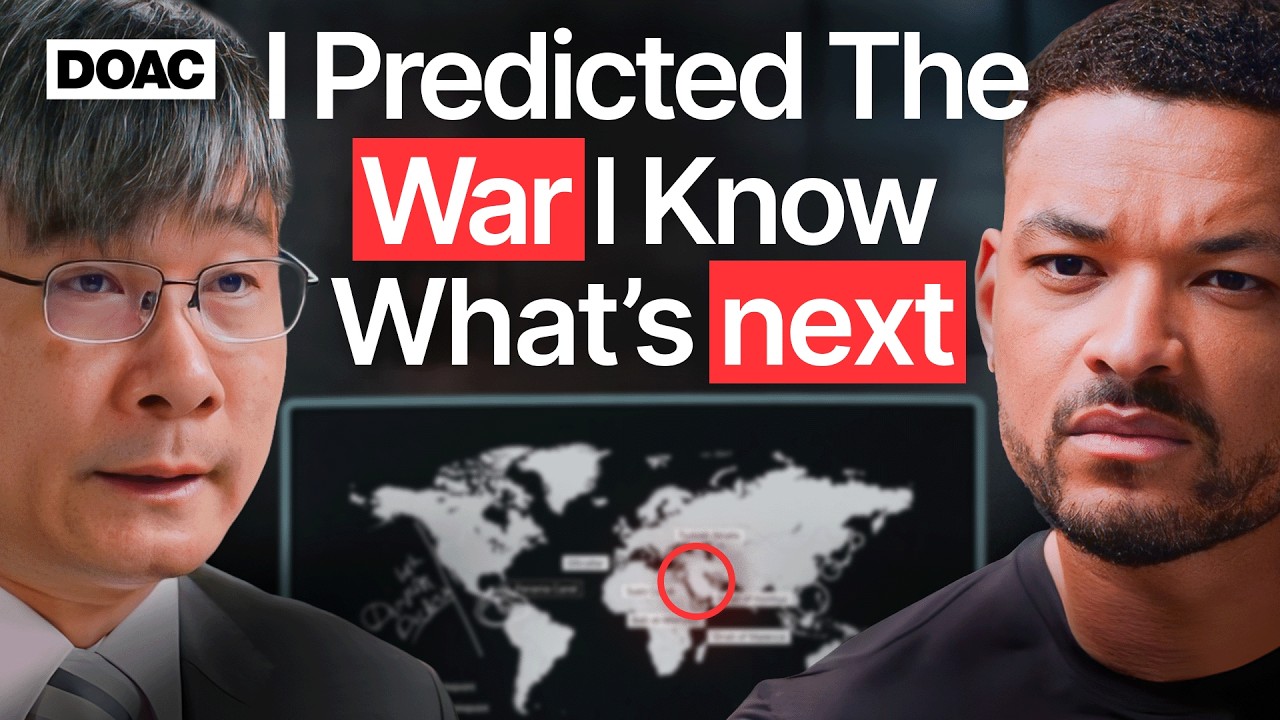
Professor Jiang Sees 90% WW3 Risk as Iran Oil Siege Escalates
The Diary Of A CEO
The American empire faces potential collapse within ten years as U.S. naval interdictions of Iranian and Russian oil shipping escalate into regional multi-front warfare.
## Background
This episode was published by The Diary Of A CEO on YouTube on May 7, 2026. Featuring geopolitical analyst Professor Jiang from the 'Predictive History' channel, the interview explores why he believes World War III may have already begun through escalating conflicts involving the US, Iran, Israel, Russia, and China.
## TL;DR
Professor Jiang outlines a stark geopolitical analysis predicting the inevitable downfall of the American empire within the next 5 to 10 years due to strategic overstretch, national debt, and multi-front global conflicts. He detail Iran's decentralized 'Mosaic strategy,' Israel's broader territorial ambitions, Russia's economic maneuvers, and North Korea's strategic positioning amid a shifting global order. Beyond geopolitics, the discussion transitions into philosophical and spiritual realms, examining how power structures shape human perception, the war between traditional finance and tech elites, and the ultimate importance of personal love and moral integrity during systemic collapse.
## Atmosphere & style
The interview carries an intense, apocalyptic, and deeply introspective tone, striking a balance between cold geopolitical pragmatism and profound philosophical existentialism. Hosted by Steven Bartlett, the dialogue shifts from high-stakes grand strategy to intimate, raw personal reflection as Professor Jiang credits his wife's unconditional love with saving him from career despair. Listening to it feels like a urgent, sweeping journey from the brink of global catastrophe back down to the grounding essence of human connection.
## Key takeaways
- [39:41](https://www.youtube.com/watch?v=BTJGr78-zyw&t=2381s) Iran has implemented the 'Mosaic Strategy,' decentralizing its military into 31 regional armies to prevent U.S. decapitation strikes from disabling its defense apparatus.
- [40:42](https://www.youtube.com/watch?v=BTJGr78-zyw&t=2442s) Driven by an eschatological vision, Iran seeks to establish God-centric governance and displace Saudi Arabia as the undisputed leader of the Muslim world.
- [40:42](https://www.youtube.com/watch?v=BTJGr78-zyw&t=2442s) Professor Jiang estimates an 80% to 90% probability that the ongoing conflict in the Middle East escalates into World War III.
- [42:18](https://www.youtube.com/watch?v=BTJGr78-zyw&t=2538s) The four main global powers operate under distinct geopolitical models: the U.S. ('Fortress America'), Russia ('Third Rome Strategy'), Israel ('Greater Israel Project'), and Iran (Islamic unification via asymmetric warfare).
- [54:40](https://www.youtube.com/watch?v=BTJGr78-zyw&t=3280s) Under Operation Southern Spear, the U.S. military has begun actively interdicting and seizing tankers from Russia's shadow fleet to break its energy supply lines.
- [01:15:53](https://www.youtube.com/watch?v=BTJGr78-zyw&t=4553s) North Korea faces an unprecedented opening to extort South Korea, as U.S. strategic air defenses like THAAD are redeployed from South Korea to the Middle East.
- [01:18:46](https://www.youtube.com/watch?v=BTJGr78-zyw&t=4726s) The decline of the American empire parallels the Bronze Age Collapse, where interconnected systemic failures could lead to mass famine and massive refugee flows.
- [01:25:01](https://www.youtube.com/watch?v=BTJGr78-zyw&t=5101s) Global power is structured in layers ranging from U.S. military enforcement and central banking institutions (BIS, SWIFT, Fed) down to legacy media framing consensus reality.
- [01:32:37](https://www.youtube.com/watch?v=BTJGr78-zyw&t=5557s) A fundamental struggle over global architecture is unfolding between traditional Wall Street financial institutions and Silicon Valley technology leaders.
- [01:34:56](https://www.youtube.com/watch?v=BTJGr78-zyw&t=5696s) The American empire faces a high probability of collapse within the next 5 to 10 years due to excessive debt, systemic corruption, and strategic overstretch.
- [01:40:41](https://www.youtube.com/watch?v=BTJGr78-zyw&t=6041s) End-times theology, Kabbalistic concepts, and dialectical frameworks play a significant role in motivating geopolitical strategies in the Middle East.
- [01:37:08](https://www.youtube.com/watch?v=BTJGr78-zyw&t=5828s) Rather than attempting to stop macro geopolitical collapses, individuals should focus on personal moral development, local community support, and living authentically.
## Detailed walkthrough
### [00:00](https://www.youtube.com/watch?v=BTJGr78-zyw&t=0s) Overview of Predictions and the Coming War
In the opening exchange, the host highlights three bold predictions Professor Jiang made in 2024 that have since come true, including Donald Trump starting a war with Iran. Professor Jiang then introduces a dramatic series of new geopolitical predictions: Trump securing a third term through emergency war powers to delay elections, the implementation of an automatic US national military draft for young men aged 18 to 24, a rapid shift toward an "AI civilian state" tracking online behavior, and the impending collapse of the American empire driven by World War III.
After a brief channel subscription request from the host, the conversation returns to Professor Jiang's 2024 predictions. Professor Jiang re-states his original three calls: Trump winning the 2024 presidential election, the US launching a war against Iran, and the US ultimately losing that war. He argues that the United States was forced into invading Iran out of systemic necessity; without an invasion, the US empire—which he describes as a "Ponzi scheme" anchored by the petrodollar—would collapse as global actors abandon US Treasuries and dollar-denominated trade.
- **The Dollar's Neutrality Crisis:** The turning point occurred in February 2022 when Russia invaded Ukraine. The American response—sanctioning Russia, removing it from SWIFT, and freezing over $200 billion in Russian assets—shattered the fundamental guarantee that the US dollar would remain a politically neutral global reserve currency.
- **The Eurasian Bloc:** To bypass American economic control and naval power, Russia, China, and Iran are building an interconnected continental trading block. This includes a Eurasian railway system that circumvents US maritime patrols and utilizes gold rather than fiat currency as a medium of exchange.
- **BRICS Expansion:** Countries across Europe, Africa, the Middle East, and Asia are evaluating whether to stick with the American financial model or pivot toward the gold-backed BRICS trading system (Brazil, Russia, India, China, South Africa, and expanding partners).
---
[06:20](https://www.youtube.com/watch?v=BTJGr78-zyw&t=380s) Economic Fallout and Global Energy Leverage
Professor Jiang breaks down how attacking Iran drastically reshapes the global energy landscape and strategically isolates key economies. By initiating conflict in the Middle East, China—which relies on the region for 50% to 60% of its energy needs (including imports from Qatar and Saudi Arabia)—is cut off from crucial fuel sources. Although China is a leader in renewables, its vast industrial base demands massive fossil energy supplies from every available source.
This energy shock cascades worldwide. Europe, already cut off from sanctioned Russian energy and reliant on Middle Eastern liquid natural gas (especially from Qatar), is left severely depleted. Major East Asian economies like Japan and South Korea face identical vulnerabilities. With Russian energy constrained by Ukrainian drone strikes on refineries and export hubs, nations have no choice but to turn to the United States for their basic energy survival.
- **Western Hemisphere Hegemony:** Professor Jiang points out recent aggressive US actions across the Americas—taking control of Venezuela (home to the world's largest proven oil reserves) and pressuring Canada, Greenland, Mexico, and Colombia.
- **The Petrodollar Rescue Plan:** By gaining absolute control over Western Hemisphere energy production while choking off Middle Eastern flows, the US forces the rest of the world to "beg Trump for energy and resources," temporarily propping up the US dollar and preserving imperial dominance.
---
[08:55](https://www.youtube.com/watch?v=BTJGr78-zyw&t=535s) Why the US Will Lose the War in Iran
When asked why he predicted an American defeat, Professor Jiang cites a fundamental lack of political will, manufacturing infrastructure, and risk tolerance within American society. The US strategy relies on fighting a quick, cheap, and easy war, operating on the flawed assumption that decapitating Iran's leadership—such as striking key figures and the Supreme Leader—would force an immediate surrender.
> "He paid no attention to the culture. He paid no attention to the history of the Iranian people. He had absolutely no respect for the nation. And when you do that... you're going to lose."
Professor Jiang criticizes Trump's reliance on "reality TV optics" over deep geopolitical strategy. He argues that Trump viewed Iran through the lens of recent operations—such as the January 3 Delta Force operation in Venezuela that captured President Nicolás Maduro and led to a rapid capitulation—without understanding Iran's deep institutional and cultural differences. Furthermore, Professor Jiang characterises the modern US military as an insular, commercially driven institution focused primarily on generating funding for the military-industrial complex rather than executing long-term total warfare.
---
[11:48](https://www.youtube.com/watch?v=BTJGr78-zyw&t=708s) Topography as a Fortress: Iraq vs. Iran
Moving to a physical map of the Middle East, Professor Jiang contrasts the 2003 invasion of Iraq with the present conflict in Iran, emphasizing that geographical topography determines military strategy. In 2003, the US executed its "shock and awe" campaign in Iraq, capturing Baghdad within two weeks. Iraq's flat, open desert terrain allowed air power to swiftly destroy command centers and achieve a rapid decapitation strike.
In stark contrast, Iran's geography functions as a natural mountain fortress. This terrain makes it impossible for air strikes alone to force a collapse, enabling Iranian forces to wage an asymmetric war of attrition—a strategic "game of uncle."
- **War of Attrition:** Because the US and Israel cannot easily conquer a mountainous nation of 92 million people, they resort to heavy bombardment to force a surrender. Conversely, Iran uses its geography to absorb strikes and inflict severe leverage-point damage elsewhere.
- **Underground Missile Bases:** Iran hides its missile arsenals and command centers deep inside mountain networks, allowing its forces to continually strike American bases and regional energy infrastructure.
---
[15:53](https://www.youtube.com/watch?v=BTJGr78-zyw&t=953s) The Strait of Hormuz and Global Supply Bottlenecks
Professor Jiang highlights a critical economic vulnerability that US strategists underestimated: the Strait of Hormuz. Measuring only 33 kilometers across at its narrowest point, this narrow waterway serves as the single most critical choke point for global trade.
The Gulf Cooperation Council (GCC) countries—including Qatar, Saudi Arabia, the UAE, Oman, Kuwait, and Iran—export roughly 20% of the world's energy through the Strait, alongside vital agricultural inputs like chemical fertilizers bound for India and East Asia. In return, GCC nations rely on these maritime routes to import 89% of their food requirements to sustain their rapidly growing populations.
- **Desalination and Food Security:** GCC states depend heavily on coastal electrochemical desalination plants for drinking water and agriculture, leaving their populations uniquely vulnerable to localized missile and drone strikes.
- **Maritime Insurance Shutdown:** Iran does not need to physically block the Strait of Hormuz with warships to halt traffic. By simply threatening attacks, commercial shipping loses access to maritime insurance, effectively grounding global trade through the passage.
- **The National Defense Strategy:** Responding to claims that Trump was merely hot-headed or misled by Israeli intelligence, Professor Jiang introduces the official US *National Defense Strategy* document (published by the Department of War) to demonstrate that choking global trade lines was a deliberate, documented strategy.
[19:46](https://www.youtube.com/watch?v=BTJGr78-zyw&t=1186s) The National Defense Strategy: A Four-Point Plan for Imperial Hegemony
Professor Jiang unpacks the official rationale behind current U.S. foreign policy by examining the National Defense Strategy document, which is publicly available on the Department of War website. The document frames global affairs around the narrative that America has been "bullied by the world" for far too long. While the U.S. acts as a global protector, allies in Europe and East Asia allegedly exploit American generosity—with Europeans reallocating defense savings into generous domestic welfare and pension systems, and China engaging in unfair trade practices, technology theft, and selling manufactured goods back to American consumers. To rectify this decades-long arrangement, President Donald Trump's strategy outlines a core four-point program to restore American power and put "America First."
```
National Defense Strategy Framework
├── 1. Secure Western Hemisphere ("Don Monroe Doctrine")
├── 2. Restructure Global Coalitions (Offload Regional Defense to Allies)
├── 3. Contain & Blockade China (Strait of Malacca Economic Strangulation)
└── 4. Reindustrialize Defense Base (Pivot Consumer Manufacturing to Munitions)
```
The four distinct pillars of this strategic framework establish a aggressive blueprint for global control:
* **Securing the Western Hemisphere:** Reasserting total control over the entire Western Hemisphere—encompassing Canada, Greenland, Mexico, and South America—under what Jiang coins the "Don Monroe Doctrine" (Trump's expansion of the historic Monroe Doctrine). Under this framework, foreign powers cannot trade within the hemisphere without U.S. permission or paying tribute, backed by one-third of the U.S. naval fleet currently deployed in the Caribbean.
* **Reimagining Alliance Relationships:** Shifting the burden of direct regional defense onto allies. NATO members are expected to shoulder the ground fight against Russia in Ukraine with the U.S. acting primarily as a weapons supplier and financier, while Asian allies like South Korea and Japan are forced to take the lead in checking Chinese expansion.
* **Economically Strangling China:** Confronting China not through outright destruction or humiliation, but by establishing economic dominance over vital maritime trade routes. By leveraging the "First Island Chain" (stretching from South Korea, Japan, and Taiwan down to the Philippines and Malaysia) and deploying aircraft carriers to choke points like the Strait of Malacca, the U.S. can cut off up to 90% of China's energy imports and force trade to pay transit tolls.
* **Supercharging the Defense Industrial Base:** Revitalizing domestic arms manufacturing by converting commercial industrial capacity into defense production. Pentagon officials explicitly met with major automakers like Ford and General Motors in Detroit, directing them to prepare assembly lines to pivot from civilian vehicles to munitions and military drones.
- "For too long, America has been bullied by the world. America is a nation that protects the world, yet Europe, East Asia takes advantage of American generosity."
- "If you're like Ford or General Motors, the best deal in the world is to go make weapons for the Pentagon to fight these wars in the East that could go on forever."
- The strategy seeks to absorb $42 trillion in U.S. national debt by forcing global trade and defense consumption into American financial and industrial channels.
---
[26:15](https://www.youtube.com/watch?v=BTJGr78-zyw&t=1575s) Trump's Strategy and the Looming Ground Invasion Mirage
Addressing popular critiques that frame the administration's actions as chaotic, Professor Jiang argues that when evaluated against the strategic map, current U.S. maneuvers are calculated steps to construct a "Fortress America." Recent aggressive actions and public statements regarding Venezuela, Cuba, Greenland, Canada, Mexico, Colombia, Nicaragua, and Honduras fit into a cohesive effort to lock down the Western Hemisphere. Simultaneously, by encouraging proxy conflicts across three distinct theaters—NATO against Russia in Europe, China against East Asian neighbors, and Iran against Israel and GCC nations in the Middle East—the U.S. aims to weaken all foreign competitors while selling arms and financing to every side, mirroring the economic dynamics of the World War II era.
Despite early tactical successes, Jiang maintains his bold prediction that the U.S. will ultimately lose the conflict in Iran. In his framework, "losing" is defined not as an immediate military defeat on paper, but as getting dragged into a prolonged, costly ground invasion. When Iranian forces resist and survive the ground assault, the resulting domestic political backlash and internal chaos will eventually force a humiliating American military retreat from the entire Middle East.
The evolution of the conflict has already passed through distinct phases, making ground troop insertion an unavoidable trap:
* **Phase 1 (Decapitation Attempt):** Initiated on February 28th and lasting roughly six weeks, featuring widespread "shock and awe" strikes against Tehran and key military installations designed to force the Iranian government to surrender.
* **Phase 2 (Iranian Retaliation):** Iran refused to yield, doubling down by launching retaliatory strikes on U.S. bases across the Gulf Cooperation Council (GCC) region, shutting down the Strait of Hormuz, and mobilizing its civilian population.
* **Phase 3 (Naval Blockade Counter-Strategy):** Recognizing that decapitation strikes failed, the U.S. initiated a naval blockade to counter Iran's closure of the Strait of Hormuz, where Iran had begun extracting $2 million tolls from passing commercial ships to fund its war effort.
- "Losing a war means that America would send ground troops, Iran would survive the ground invasion, and this would be so politically damaging that chaos breaks out in the United States."
- "Trump recognizes that the Iranians can close off the Strait of Hormuz, but not only that... they're forcing ships to pay a toll, about $2 million, in order to cross."
---
[31:25](https://www.youtube.com/watch?v=BTJGr78-zyw&t=1885s) The Game Theory of Escalation: Blockades, Ethnic Fractures, and Siege Tactics
Applying game theory—the model that nation-states operate as rational actors making calculated decisions based on rules, incentives, and self-interest—Professor Jiang outlines the three-point strategy the U.S. military must deploy to try to force Iran into capitulation. Because air power alone cannot secure victory, the U.S. is driven toward actions that push the conflict deeper into ground operations and internal destabilization.
```
U.S. Escalation Blueprint
├── 1. Economic Strangulation (Blockade Kharg Island & Hormuz Tolls)
├── 2. Internal Subversion (Arm Minority Insurgencies via Forward Operating Bases)
└── 3. Siege of Tehran (Cut Off Water, Power, and Food to 10M Residents)
```
The key elements of this strategic pressure campaign include:
* **Economic Strangulation:** Sealing off Iran's financial lifelines by blockading Kharg Island—the strategic export hub responsible for handling 90% of Iran's oil exports (primarily bound for China)—and neutralizing Iran's ability to collect maritime transit fees through the Strait of Hormuz.
* **Stoking Internal Ethnic Insurgency:** Exploiting geographic and demographic vulnerabilities inside Iran. While ethnic Persians populate the central core, the borderlands are home to historically rebellious minority populations. The strategy calls for establishing Forward Operating Bases (FOBs) in the southeast among the **Baluchis** (along the Pakistani border) and in the northwest among the **Kurds**. By inserting ground troops to arm, train, and fund these groups, the U.S. aims to turn minority insurgents into "cannon fodder," forcing hidden Iranian military units out of their mountain strongholds and into open terrain where American air power can decimate them.
* **Besieging the Capital:** Applying pressure directly on Tehran, a metropolis of 10 million people. By systematically targeting reservoirs, power grids, and rail infrastructure bringing food into the capital, the U.S. seeks to deny residents basic necessities—water, electricity, and food—triggering massive internal civil unrest that forces political leaders to sue for peace.
- "You basically destroy the state's capacity to finance the war... Kharg Island, this little spot here, is where Iran will export 90% of its oil overseas."
- "Your strategy is to establish forward operating bases in these areas in order to arm and train ethnic insurgents... to turn them into cannon fodder and force a response from the Iranian military."
---
[36:10](https://www.youtube.com/watch?v=BTJGr78-zyw&t=2170s) The Dual State and the Mosaic Strategy: Why Peace Is an Illusion
Professor Jiang highlights a fundamental misunderstanding in Western analysis regarding Iran's political and military structure. The Iranian state operates under a dual system: a secular administrative bureaucracy handling day-to-day governance, and a parallel religious theocracy led by Islamic clerics (the mullahs). This dual political structure translates directly into a bifurcated military apparatus consisting of the regular armed forces alongside the Islamic Revolutionary Guard Corps (IRGC).
```
Iranian Political & Military Architecture
┌─────────────────────────────────────────┐
│ Theocratic Mullahs │
└────────────────────┬────────────────────┘
│ Controls
▼
┌─────────────────────────────────────────┐
│ IRGC (Islamic Revolutionary Guard) │
├─────────────────────────────────────────┤
│ • Motivated by religious crusade │
│ • Commands regional "Axis of Resistance"│
│ • Executes decentralized "Mosaic Plan" │
└─────────────────────────────────────────┘
This structural division renders diplomatic ceasefire negotiations largely symbolic:
* **Ideological Divide:** While secular political leaders in Tehran view the conflict as a conventional confrontation subject to diplomatic negotiation, the IRGC views it as a global religious crusade against the "Great Satan" (the U.S. Empire). The IRGC operates a network of regional proxies—including Hezbollah in Lebanon, the Houthis in Yemen, and Hamas in Palestine (with Syria previously serving as a key partner before its government was destabilized).
* **The Mosaic Strategy:** Designed specifically to counter American surveillance dominance and "shock and awe" decapitation tactics, the IRGC implemented a decentralized doctrine dividing Iran into 31 autonomous provincial commands.
* **Decentralized Resistance:** Each of the 31 provinces maintains its own independent command, control, and leadership structure. Even if U.S. forces successfully eliminate central leadership in Tehran, 31 separate, self-sustaining military units will continue fighting locally, guaranteeing a prolonged and exhausting war of attrition.
- "The IRGC see this as a religious war, as a crusade to kill the Great Satan and they want to fight to the death."
- "Ceasefire negotiations, it's really all for show... even if the Americans gave the Iranians everything they wanted, the IRGC still controls the battlefield."
- "How do you respond to decapitation? You respond to that using decentralization—31 provinces in the country with their own localized command and control."
Here is a detailed, faithful walkthrough of the transcript segment.
---
[39:41](https://www.youtube.com/watch?v=BTJGr78-zyw&t=2381s) Decentralized Leadership and Iran's "Mosaic Strategy"
To prevent the United States from neutralizing its command structure, Iran has intentionally decentralized its leadership across the entire nation. The central government orchestrates 31 distinct regional armies. When asked how a central authority sends directives to these spread-out forces, a recent comment by Peter Hegseth is highlighted. During an interview regarding a temporary ceasefire where missiles were still actively being launched, Hegseth casually remarked that "it takes some time for the pigeons to get out to the armies," referencing the delay in communicating orders down the chain of command.
However, under Iran's overarching "Mosaic strategy," there is practically no functional way to centralize or coordinate these 31 independent military operations once set in motion. The strategic objective assigned to these units—and the Mojahedin—is to fight to the bitter end. They are instructed not to halt operations until they achieve full control of the region, the Americans are permanently driven out of the Middle East, and Israel is humbled.
- **Key Strategic Mechanics**: 31 independent regional armies operating across Iran under a decentralized framework.
- **Underlying Mission**: Fight continuously until U.S. forces are expelled from the Middle East and Israel's power is broken.
---
[40:42](https://www.youtube.com/watch?v=BTJGr78-zyw&t=2442s) Iranian Eschatology and the Struggle for the Muslim World
The driving force behind Iran's military resolve is rooted in its specific eschatology—its theological vision of how the global order ought to be structured and how history moves toward that end. From the Iranian leadership's perspective, for Iran to fulfill its ultimate potential, it must establish itself as the rightful leader and master of the Muslim world.
This vision requires displacing Saudi Arabia, which Iran views as entirely compromised by its close alignment with the United States—referred to in Iranian political rhetoric as the "Great Satan." The presence of American military bases in Saudi Arabia is seen as a desecration, placing the holy cities of Mecca and Medina under foreign, imperial influence. Consequently, Iranian leadership views the unfolding conflict not merely as a defensive war, but as a historic opportunity to overthrow the ruling structures of Saudi Arabia and the entire Gulf Cooperation Council (GCC), replacing them with governments that prioritize God and Islam above all else. Because this is viewed as a fundamental religious duty, Iran will not surrender, locking the region into an escalating confrontation that carries an 80% to 90% probability of expanding into World War III.
- **Core Theological Goal**: Displace Saudi Arabia as the custodian of the Islamic world and purge Western influence from Mecca and Medina.
- **Broader Target**: Overthrow the existing leadership of the GCC and establish God-centric governance across the region.
- **War Probability**: Estimated at an 80% to 90% likelihood of escalating into a full-scale global war.
---
[42:18](https://www.youtube.com/watch?v=BTJGr78-zyw&t=2538s) The Global Grand Strategies: USA vs. Russia vs. Israel vs. Iran
To illustrate how this regional flashpoint triggers a global war, the grand strategies and internal structures of four major global actors—the United States, Russia, Israel, and Iran—can be modeled using pieces on a chessboard:
```
+---------------------------------------------------------------------------------------+
| THE GLOBAL CHESSBOARD |
+---------------+-------------------+-----------------------+---------------------------+
| Nation | System (King) | Grand Strategy (Queen)| Attack Vectors (Rook/etc.)|
+---------------+-------------------+-----------------------+---------------------------+
| United States | Democracy | Fortress America & | Air Supremacy, US Dollar, |
| | (Weakness: Civil | Global Chaos | Global Media Control |
| | Polarization) | | |
+---------------+-------------------+-----------------------+---------------------------+
| Russia | Autocracy | Third Rome Strategy | Geography, Orthodox |
| | (Weakness: | (Eurasian Alliances) | Faith, Land Artillery |
| | Succession) | | |
+---------------+-------------------+-----------------------+---------------------------+
| Israel | Democratic/ | Greater Israel | Mossad, Diaspora Network, |
| | Theocratic Mix | Project (Nile to | Christian Zionist Support |
| | | Euphrates) | |
+---------------+-------------------+-----------------------+---------------------------+
| Iran | Theocracy | Muslim World | Proxies, Asymmetric |
| | (Weakness: Public | Leadership | Warfare, Mountain Terrain |
| | Alienation) | | |
+---------------+-------------------+-----------------------+---------------------------+
```
#### The United States
- **System (King)**: A vibrant, creative democracy. Its fatal flaw is deep political polarization between factions (Democrats and Republicans), which rivals can exploit to spark internal civil conflict rather than attempting a direct military conquest.
- **Grand Strategy (Queen)**: "Fortress America." Establish a protected homeland while fostering controlled chaos abroad to make other nations dependent on U.S. weapons, energy, and resources.
- **Attack Vectors (Rook, Bishop, Knight)**:
1. Technological and Air Supremacy (advanced fighters, precision strike assets).
2. The U.S. Dollar (the foundation of global financial power).
3. Narrative & Propaganda Control (dominant global media outlets like *The New York Times* and CNN).
- **Pawns**: Frontline allies that can be strategically leveraged or sacrificed, including the UK, European nations, South Korea, Japan, and partners across the Western Hemisphere.
#### Russia
- **System (King)**: An autocracy centered around a single decisive leader. It excels at swift coordination and long-term planning, but its primary vulnerability is a succession crisis if the leader is removed.
- **Grand Strategy (Queen)**: The "Third Rome Strategy," heavily influenced by philosopher Aleksandr Dugin's 1997 work, *Foundations of Geopolitics*. It positions Moscow as the successor to Rome and Constantinople, seeking to unite Eurasia to counter American naval and air dominance.
- **Attack Vectors**: Massive geographical depth (making physical invasion virtually impossible), the unifying force of the Orthodox Church, and dominant land artillery/drone capabilities.
- **Pawns**: High-resilience military personnel willing to endure extreme casualty rates.
#### Israel
- **System (King)**: A hybrid democracy and theocracy, limited by internal political and cultural rifts between secular hubs like Tel Aviv and religious centers like Jerusalem.
- **Grand Strategy (Queen)**: The "Greater Israel Project," aiming to expand influence from the Nile to the Euphrates based on biblical mandates.
- **Attack Vectors**: Mossad's global intelligence capabilities, influential diaspora business networks, and political backing from Christian Zionists in the United States.
#### Iran
- **System (King)**: A religious theocracy where committed fighters do not fear death. Its internal vulnerability is the potential backlash from a domestic population that desires economic stability over rule by religious zealots.
- **Grand Strategy (Queen)**: Lead and unify the Islamic world.
- **Attack Vectors**: Regional proxy forces (Hezbollah, Hamas, the Houthis), asymmetric missile and drone capabilities designed for economic disruption, and an nearly impenetrable mountainous topography.
---
[54:40](https://www.youtube.com/watch?v=BTJGr78-zyw&t=3280s) Energy Blockades and the Escalating Tanker War
The global chessboard is shifting as the U.S. leverages its maritime power to control key economic chokepoints—including the Strait of Hormuz, the Strait of Malacca, the Panama Canal, Greenland, and the Strait of Gibraltar. By controlling maritime trade and targeting global energy infrastructure, the U.S. aims to deplete global oil reserves, forcing foreign economies to rely on American-controlled energy supplies from sources like Canada, Mexico, or Venezuela.
In response, Russia relies on a "shadow fleet" of roughly 1,000 unsanctioned tankers to bypass trade restrictions and move energy markets. Because building land-based Eurasian railways and pipelines leaves supply lines vulnerable to air strikes, Russia is forced to arm its shadow fleet. This sets up direct naval confrontations between Russian shadow tankers and American destroyers enforcing blockades.
This conflict is already underway. Under "Operation Southern Spear," the U.S. military and Coast Guard have intercepted and seized dark-fleet oil tankers in the Caribbean and North Atlantic—including high-profile seizures on January 7, 2026—marking a direct physical escalation over global energy lines.
- **Critical Maritime Chokepoints**: Strait of Hormuz, Strait of Malacca, Panama Canal, Strait of Gibraltar, and routes around Greenland.
- **Russian Shadow Fleet**: Approximately 1,000 covert tankers operating globally to evade Western sanctions.
- **Enforcement Actions**: U.S. interdictions under Operation Southern Spear targeting dark-fleet oil shipments tied to sanctioned regimes.
<FollowUp label="Want me to walk through the next section of the transcript on Trump's potential third term and the secret US-China deal?" query="Continue the detailed walkthrough for the next section of the transcript (around 00:56:30 onward), covering Trump's third term, the US-China deal, and draft plans."/>
[59:04](https://www.youtube.com/watch?v=BTJGr78-zyw&t=3544s) Maritime Chokepoints and the Escalation to Global War
The conversation picks up with recent operations targeting shadow fleet tankers violating U.S. sanctions by transporting crude oil linked to Venezuela, Iran, and Hezbollah. While these vessels do not fly a primary national flag directly, they are essentially serving Russian interests to ship energy outside American financial oversight. Professor Jiang outlines how the United States is systematically expanding its global maritime control. Rather than relying solely on unilateral interdictions, Washington is building legal frameworks and military agreements with key coastal states commanding critical maritime bottlenecks—signing military cooperation agreements with Indonesia to monitor the Strait of Malacca and with Morocco regarding the Strait of Gibraltar.
This bid to control global maritime chokepoints creates a direct collision course with Russia's economic lifeline. While host Steven Bartlett questions what specific spark will detonate a full-scale clash between U.S. and Russian forces, Professor Jiang argues that there won't necessarily be a single isolated "flashpoint." Instead, the world is experiencing a drawn-out, compounding escalation where shadow fleet seizures coincide with Ukrainian drone strikes destroying Russian oil infrastructure—sabotage Moscow firmly attributes to NATO coordination. Professor Jiang asserts that World War III has effectively already begun; the structural friction between competing world orders makes an expanding global confrontation functionally inevitable.
- **Key Maritime Chokepoints:** Strait of Malacca (Indonesia alliance) and Strait of Gibraltar (Morocco agreement).
- **Economic Warfare:** Interdiction of non-compliant "shadow fleet" oil shipping alongside drone sabotage of inland Russian refineries.
- **Core Premise:** World War III should not be viewed as a future event with a distinct starting gun, but as an ongoing multi-theater escalation that is already active.
---
[01:01:03](https://www.youtube.com/watch?v=BTJGr78-zyw&t=3663s) Russia’s Moral Imperative and Entry Into the Iran Conflict
Professor Jiang predicts that Russia will inevitably enter the war directly on Iran's side, driven by both ideological grand strategy and existential security requirements. Moscow frames its geopolitical struggle not merely as economic or territorial, but as a civilizational war between the spiritual world—representing tradition, family, and community—and a materialist, hedonistic order led by the United States. Having established this moral narrative, the Kremlin faces a narrative and strategic imperative to aid Tehran in its hour of need.
This ideological alignment is actively converting into diplomatic and military reality. Professor Jiang points to Iranian Foreign Minister Abbas Araghchi's visit to Moscow, where Vladimir Putin personally received him and publicly expressed the Russian people's admiration for Iran’s resolve against American pressure. This meeting signals that Russia has "entered the chat" and will incrementally step up direct support as the conflict deepens.
> "We, the Russian people, admire your determination, your resolve against the Americans." — *Vladimir Putin (as quoted by Professor Jiang)*
---
[01:02:13](https://www.youtube.com/watch?v=BTJGr78-zyw&t=3733s) Countering the American Plan: The Tripartite Axis
Examining the strategic map, Professor Jiang details America's three-pronged strategy to collapse Iran:
1. Ground forces establishing forward operating bases while stoking internal ethnic division.
2. Maritime blockades cutting off maritime exports and global financial access.
3. Systemic infrastructure collapse (targeting food, water, and power grids) to incite an internal uprising against the government.
While the United States would easily achieve victory under isolated conditions, direct Russian and Chinese intervention completely alters the equation. To defeat the U.S. strategy, Moscow and Beijing can deploy three specific countermeasures:
```
┌────────────────────────────────────────────────────────────────────────┐
│ TRIPARTITE COUNTER-STRATEGY │
├──────────────────────────┬─────────────────────────────────────────────┤
│ Caspian Sea & BRI Supply │ Russian shipments across the Caspian Sea │
│ Lines │ plus Chinese rail networks neutralize US │
│ │ blockade of food, water, and energy. │
├──────────────────────────┼─────────────────────────────────────────────┤
│ Sovereign Financial │ Moscow and Beijing back Iranian credit, │
│ Backstop │ using raw natural resources as collateral │
│ │ to fund a long war of attrition. │
├──────────────────────────┼─────────────────────────────────────────────┤
│ Russian Nuclear │ Extended deterrence eliminates America's │
│ Umbrella │ option to deploy tactical nuclear weapons. │
└──────────────────────────┴─────────────────────────────────────────────┘
```
By securing Tehran through Eurasian land routes, the conflict shifts from a swift American intervention into a long-term global war of attrition. To counter this Eurasian bloc, Washington would ultimately be forced to widen the theater of war globally in an effort to destabilize the regime in Moscow itself.
- **Strategic Geography:** The International North–South Transport Corridor (INSTC) through Iran gives Russia access to the Indian Ocean and Africa, while China's Belt and Road Initiative relies on Iranian territory as a overland bridge.
- **Eurasian Trade Integration:** Neutralizing Iran effectively severs the land lines connecting Russia, China, and Middle Eastern markets, making Iran the indispensable anchor of the non-Western economic bloc.
---
[01:08:23](https://www.youtube.com/watch?v=BTJGr78-zyw&t=4103s) The Midterm Fallacy and Strategic Continuity
Addressing the timeline of this expanding conflict, Steven Bartlett highlights a potential constraint: Donald Trump’s finite time in office, noting that adversaries might attempt to delay major moves until a new administration takes over. Professor Jiang counters that Iranian leaders holding this view are operating under a dangerous misconception. Tehran hopes the November midterm elections will return control to the Democrats, leading to impeachment proceedings or legislative constraints that limit the White House's war-making powers.
Professor Jiang explains that American grand strategy operates on structural continuity rather than electoral cycles. Just as the Biden administration codified and expanded the aggressive anti-China trade policies initiated during Trump's first term, future administrations will institutionalize the aggressive containment frameworks set by the National Defense Strategy. The overarching apparatus of state power ensures that World War III remains a multi-decade war of attrition regardless of shifts in party control.
- **Tehran's Calculation:** Waiting out the current White House team in anticipation of domestic political gridlock or midterm losses.
- **Institutionalization Mechanism:** Historical precedent demonstrates that foreign policy escalations pioneered by one administration become permanently codified by the next.
---
[01:10:20](https://www.youtube.com/watch?v=BTJGr78-zyw&t=4220s) Prediction: The Mechanisms for a Trump Third Term
Turning to a sealed box of new predictions, Professor Jiang reveals his most controversial claim: Donald Trump will secure a third presidential term. Responding to Bartlett's immediate objection that a third term violates the 22nd Amendment of the U.S. Constitution, Jiang breaks down two specific legal and political mechanisms through which this could occur:
1. **The Electoral Loophole:** In 2028, Donald Trump Jr. (or another ultra-loyal figure like Jared Kushner) runs for president with Donald Trump Sr. as the vice-presidential running mate. Upon taking office, the newly elected president abdicates, elevating Trump back to the presidency. Jiang notes that while politically radical, the constitutional text does not explicitly forbid this succession route.
2. **Emergency War Powers:** By 2028, heightened global conflict, a reinstated national draft, and widespread martial provisions could allow the executive branch to claim emergency war powers, suspending constitutional elections similar to actions taken by Volodymyr Zelenskyy in Ukraine.
Beyond the legal mechanics, Professor Jiang points to Trump's personal psychology. Describing him as an individual addicted to public attention who routinely maintains an exhausting campaign schedule on a diet of fast food, Jiang argues that for a personality of this nature, "death is to be ignored." In Trump's mind, he genuinely believes the 2020 election was stolen via mail-in ballots and voting machines; he views a third term not as an extra period, but as rightful compensation owed to him by the American public.
> "This is a man who is addicted to attention... For him, death is to be ignored. So, given his personality, he would rather die in office than live peacefully somewhere else." — *Professor Jiang*
- **Controversial Claim:** Donald Trump will serve a third term as President of the United States.
- **Succession Strategy:** Running as Vice President on a ticket headed by a family member or ultra-loyalist who subsequently abdicates.
- **Statutory Alternative:** Invoking emergency war powers during an active global draft to delay national elections.
<ElicitationsGroup message="Explore related analyses from this interview:">
<Elicitation label="Examine the Strait of Hormuz global economic breakdown" query="What does Professor Jiang say about the Strait of Hormuz and its impact on energy and food security?"/>
<Elicitation label="Analyze Israel's broader regional strategy" query="What are Professor Jiang's predictions regarding Israel's military goals and territorial strategy?"/>
<Elicitation label="Detail the secret US-China deal predictions" query="What is the secret US-China deal mentioned in Professor Jiang's predictions?"/>
</ElicitationsGroup>
Here is a detailed, faithful walkthrough of this part of the conversation between host Steven Bartlett and geopolitical analyst Professor Jiang.
---
[01:15:54](https://www.youtube.com/watch?v=BTJGr78-zyw&t=4554s) Legal Debates Over a Potential Third Trump Term
Steven Bartlett questions the legal feasibility of Donald Trump serving a third presidential term, referencing the 22nd Amendment of the U.S. Constitution, which explicitly states that no person shall be elected to the office of the president more than twice. Bartlett notes that while some legal theorists argue a loop-hole exists—suggesting someone could serve a third term if they were *appointed* or succeeded to the role (for example, by serving as Vice President first)—most legal scholars and the judicial community reject this idea. This rejection stems from the 12th Amendment, which dictates that anyone serving as Vice President must be eligible for the presidency. Since a two-term president cannot be elected again, they would be legally barred from serving as Vice President.
Professor Jiang pushes back, arguing that there is no explicit language directly forbidding someone from running as Vice President, leaving room for legal debate around the "spirit" of the 22nd Amendment rather than its literal text. He emphasizes that if this challenge arises, the decision ultimately rests with the U.S. Supreme Court. Jiang points out that the Supreme Court currently holds a conservative majority, with three of the nine justices appointed by Trump himself and the potential for a fourth appointment later in the year. Consequently, Jiang asserts that whether Trump can pursue or hold power again is entirely in the hands of the conservative-controlled court.
- **22nd Amendment:** Limits individuals to two elected presidential terms.
- **12th Amendment argument:** Requires Vice Presidents to meet presidential eligibility standards, theoretically barring two-term presidents.
- **Supreme Court makeup:** Currently conservative-dominated; three justices were appointed by Trump, with a potential fourth opening expected later in the year.
---
[01:17:19](https://www.youtube.com/watch?v=BTJGr78-zyw&t=4639s) A "Grand Bargain" Between the United States and China
Moving on to his second prediction, Professor Jiang forecasts a "grand bargain" between the United States and China, running counter to the popular narrative that the two superpowers are inevitably headed toward war over Taiwan. While many analysts expect China to challenge U.S. hegemony and try to replace America as the global leader, Jiang claims China has no interest in doing so. Taking on global hegemony requires investing immense resources into foreign wars that ultimately bankrupt nations—a burden China wants to avoid. Instead, China's strategy is to "triangulate" between Russia and the United States, drawing parallels to the Cold War when China was part of the non-aligned movement rather than a true Soviet ally.
Jiang predicts that while China may offer financing to Russia or aid Iran during World War III, it will simultaneously forge economic deals with Washington. He projects that Trump and Chinese President Xi Jinping are scheduled to meet three or four times in the current year, starting with a mid-May summit in Beijing. In this arrangement, the U.S. gets China to continue purchasing U.S. Treasuries to support American debt, while China secures access to American consumer markets and energy resources from the Western Hemisphere. Jiang describes Trump as a purely "transactional character" who will embrace this deal, meaning China will remain friendly with both Moscow and Washington while letting those two powers fight each other.
> "China's probably happy with America being the world's hegemon, because you have to invest so much of your resources into fighting these wars that bankrupt your nation."
- **Planned Summit:** Predicts 3–4 meetings between Trump and Xi Jinping during the year, beginning in mid-May in Beijing.
- **U.S. Goal:** Secure Chinese purchases of U.S. Treasury bonds to finance national debt.
- **China's Goal:** Secure Western Hemisphere energy supplies and maintain access to U.S. consumer markets.
---
[01:19:43](https://www.youtube.com/watch?v=BTJGr78-zyw&t=4783s) A Forever War in Iran and the Return of the U.S. Draft
In his next prediction, Professor Jiang states that the conflict with Iran will turn into a multi-decade "forever war" and force the United States to institute a national military draft. He argues that defeating Iran is not actually part of America's grand strategy; rather, Iran serves as a perfect pretext for the U.S. to expand globally, control vital maritime choke points, and force other nations to buy American energy. Because keeping this geopolitical strategy alive requires massive numbers of ground troops over 10 to 20 years, a draft becomes unavoidable.
Addressing how this would impact American citizens, Jiang explains that starting in December, military draft registration will become automatic for all young men between the ages of 18 and 24 (or 25). Although the Selective Service System has existed for decades, compliance was previously passive; under new legislation, eligible males will automatically be entered into a military draft lottery database. While acknowledging that Congress must formally declare war before a active conscription call-up can occur, Jiang insists the structural framework for a draft is already locked in place and will provoke significant societal reaction reminiscent of the Vietnam War era.
- **War Horizon:** Predicted to last 10 to 20 years or more without stopping, functioning similarly to Afghanistan.
- **Target Demographic:** Males aged 18 to 24 (or 25).
- **Automation Timeline:** Automatic registration in the draft system slated to begin in December.
---
[01:22:20](https://www.youtube.com/watch?v=BTJGr78-zyw&t=4940s) The Rise of the Global AI Surveillance State
Jiang warns that the world is rapidly moving toward an AI-driven surveillance state—a trend he considers obvious given that major technology firms like OpenAI and Anthropic are signing contracts for military and government surveillance projects. For the average citizen, this transformation will be enforced through two primary mechanisms: mandatory digital identification and central bank digital currencies (CBDCs). Together, these tools will allow governments to monitor all online activity and tightly control personal financial transactions.
To illustrate how this system operates, Jiang draws directly from his experience living in China, where digital IDs are already mandatory to open bank accounts, make electronic payments, or register a mobile phone. He explains that by tracking every purchase and message, governments can map individual habits, predict behavior, and engineer social incentives—framing it under the guise of "progress" by claiming to help citizens lose weight, work harder, or avoid drugs. When Bartlett asks if Jiang risks getting into trouble by criticizing the system, Jiang admits he operates in a specific "gray area": he works exclusively in English for Western audiences, avoids Chinese social media, and deliberately keeps a low profile inside China so the government has no reason to target or control him.
> "They think this is progress, by the way. This is progress because I'm making you a better person, right? I'm helping you achieve your dream. I'm helping you lose weight. I'm helping you avoid drugs."
- **Core Control Mechanisms:** Digital IDs and Programmable Central Bank Digital Currencies (CBDCs).
- **Data Capabilities:** Real-time tracking of online messaging, browsing, and financial purchases to build predictive behavioral profiles.
- **Personal Strategy:** Operates exclusively in English for foreign media to stay off the radar of Chinese domestic censors.
---
[01:25:44](https://www.youtube.com/watch?v=BTJGr78-zyw&t=5144s) Israel's Pursuit of the "Greater Israel" Expansion
Turning to the Middle East, Professor Jiang predicts that Israel will achieve the "Greater Israel" project by expanding its territorial dominance across the region. He argues that Israel has already effectively conquered its immediate surroundings and that the only force holding it back is the presence of the U.S. military. Once Washington eventually pulls out of the region, Israel will absorb CENTCOM infrastructure—the network of U.S. military bases in the Middle East—and eliminate all remaining regional opposition.
Jiang asserts that Israel is intentionally dragging out the war with Iran to systematically destroy its strategic rivals. With Saudi Arabia and the Gulf Cooperation Council (GCC) already economically or politically destabilized by the fighting, Jiang identifies Turkey as Israel's final major opponent. Once Turkey is drawn into the conflict, Israel will fulfill its territorial ambitions. He details the geographical scope of the "Greater Israel" vision, explaining that it stretches from the Nile River in Egypt to the Euphrates River in Iraq.
- **Geographic Extent:** Stretches from the Nile (Egypt) to the Euphrates (Iraq), encompassing parts of Turkey, all of Syria, Lebanon, and Jordan, plus parts of Saudi Arabia including Mecca and Medina.
- **Next Target:** Identifies Turkey as the final power standing in the way after Iran and the GCC are neutralized.
- **Trigger Event:** The eventual withdrawal of U.S. military forces and the takeover of CENTCOM infrastructure by Israel.
---
[01:27:35](https://www.youtube.com/watch?v=BTJGr78-zyw&t=5255s) The Battle for Odessa and Control of the Black Sea
Addressing the war in Eastern Europe, Professor Jiang predicts that NATO and Russia will ultimately engage in a decisive battle over the Ukrainian port city of Odesa. He explains that while Russia is currently focused on securing the Donbas—Ukraine's industrial and agricultural heartland where much of the population is ethnically Russian—Western Ukraine on its own would simply become a non-viable "rump state." The true strategic prize of the war is Odesa, located on the Black Sea.
Controlling Odesa would allow Russia to completely cut Ukraine off from maritime trade and secure total dominance over the Black Sea. Jiang points out that controlling this region gives Russia leverage over roughly one-third of the world's carbohydrate and grain supply. Because countries across Africa and the Middle East rely heavily on grain and fertilizer exports from Russia and Ukraine, controlling Odesa gives Moscow the ability to weaponize global food supplies. NATO recognizes that if Odesa falls, Russia will have achieved all its major war objectives, effectively ending the war on Moscow's terms.
- **Strategic Value:** Odesa serves as Ukraine's primary deep-water access point to the Black Sea and global shipping routes.
- **Global Food Supply:** Regional grain exports account for roughly 33% (one-third) of the world's carbohydrate supply.
- **Impact on Developing Nations:** Gives Russia strategic leverage over food security in Africa and the Middle East.
---
[01:29:43](https://www.youtube.com/watch?v=BTJGr78-zyw&t=5383s) Three Asian Flashpoints: Taiwan, Malacca, and North Korea
In his final set of predictions, Professor Jiang outlines three major friction points in East Asia that risk erupting into military conflict. The first is Taiwan, where China's unification goals clash directly with Japan's vital national interests. Japanese Prime Minister Sanae Takaichi has explicitly declared Taiwan core to Japan's survival. As a resource-poor manufacturing nation, Japan relies on open sea lanes; if Beijing takes Taiwan, China could blockade Japan's access to energy and raw materials passing through the South China Sea and the Strait of Malacca, leaving Tokyo no choice but to fight.
The second flashpoint is the Strait of Malacca itself, where the U.S. seeks maritime control while China views the choke point as essential to its economic survival. However, Jiang identifies North Korea as the third, most surprising, and most pressing flashpoint. Using game theory, he asks the audience to consider the perspective of North Korea's supreme leader: running a totalitarian dictatorship with an absolute cult of personality, but governing a impoverished nation desperate to change the status quo.
- **Flashpoint 1 (Taiwan):** Conflict driven by Japanese national survival concerns over sea routes and South China Sea resources.
- **Flashpoint 2 (Strait of Malacca):** Strategic choke point contested between the U.S. Navy and the Chinese military.
- **Flashpoint 3 (North Korea):** Highlighted as the most volatile and urgent flashpoint in East Asia using game-theory analysis.
---
<ElicitationsGroup message="Explore related geopolitical analyses from this interview:">
<Elicitation label="Break down the game theory behind North Korea's strategy in East Asia" query="Explain Professor Jiang's game theory analysis of North Korea and why he considers it the most pressing flashpoint in East Asia."/>
<Elicitation label="Examine the economic mechanics of the U.S.-China 'Grand Bargain'" query="Detail the economic mechanics of the proposed U.S.-China Grand Bargain, including U.S. Treasuries, energy access, and trade."/>
</ElicitationsGroup>
[01:32:53](https://www.youtube.com/watch?v=BTJGr78-zyw&t=5573s) North Korea’s Strategic Opportunity to Extort South Korea
With major global powers distracted by escalating conflicts—Europe locked in war with Russia, the Middle East in flames, the U.S. spread thin trying to manage global stability, and Japan and China clashing over the South China Sea—North Korea faces an unprecedented opening. Professor Jiang describes Kim Jong Un's regime as the "brawler in high school that no one pays attention to because all the big boys are fighting each other." In this geopolitical void, North Korea can step in to dominate the Korean Peninsula without fear of effective intervention.
The target of this potential aggression is South Korea, whose population is heavily concentrated in Seoul. Located roughly 20 minutes away from North Korean conventional artillery positions, Seoul is extremely vulnerable. Within minutes, North Korea could rain down mass artillery and flatten the capital. The U.S. military has been actively cannibalizing its air defense assets in South Korea and Japan—including transferring THAAD (Terminal High Altitude Area Defense) systems to the Middle East—leaving South Korea exposed. Rather than engaging in a full-scale invasion, Professor Jiang predicts North Korea will use this leverage for outright extortion.
Despite South Korea's advanced military and wealthy economy, its democratic, rights-focused society makes it averse to total destruction. In contrast, North Korea's impoverished population is forced to fight to the death—a dynamic demonstrated by the thousands of North Korean troops sent to fight for Russia in Ukraine under threat of family execution back home. Consequently, South Korea would likely choose to pay massive bribes to Pyongyang to prevent an artillery catastrophe rather than risk an all-out war.
- **Geopolitical Distractions:** Global focus is split between the U.S. involvement in the Middle East, the Russo-Ukrainian war, and South China Sea tensions.
- **Seoul's Vulnerability:** Located within 20 minutes of North Korean artillery range.
- **Defensive Drain:** Strategic U.S. missile defense assets like THAAD have been redeployed from South Korea to the Middle East.
- **Asymmetric Motivation:** South Korean wealth and democratic values create high risk-averse leverage compared to North Korea's totalitarian state control.
[01:35:46](https://www.youtube.com/watch?v=BTJGr78-zyw&t=5746s) Leadership, Empire Collapse, and the Bronze Age Collapse Analogy
Addressing what this chaotic geopolitical landscape means for average people, Professor Jiang stresses that the future will require community-level leaders, entrepreneurs, visionaries, and "prophets" who can instill hope and foster collective survival. When global order breaks down, formal infrastructure inevitably collapses with it. Rather than relying on central governments during blackouts or resource shortages, survival will depend on neighbors knocking on doors, organizing meetings, and solving basic problems—such as securing clean water—together as a tight-knit unit.
Professor Jiang explicitly states that the American empire is collapsing, creating a void that no single global power can fill. To explain the current trajectory, he draws a direct historical parallel to the **Bronze Age Collapse** over 3,000 years ago. During that period, flourishing civilizations—including Mycenaean Greece, the Hittite Empire in Anatolia (modern-day Turkey), Mesopotamia, and New Kingdom Egypt—suffered a sudden, catastrophic, and simultaneous breakdown.
```
Bronze Age Crisis Factors (3,000+ Years Ago)
├── Environmental & Seismic Calamities (Earthquakes, Climate Crisis, Famines)
├── Societal Ruptures (Wars, Civil Wars, Revolutions)
└── Mass Displacement ("Sea Peoples" / Pirate Armies Sweeping the Middle East)
```
The primary threat of the coming era will not just be conventional interstate wars, but massive waves of millions of displaced refugees fleeing famine and state collapse from Africa, the Middle East, and South America. Citing an episode featuring economist Steve Keen, Professor Jiang points out that global agriculture relies fundamentally on synthetic fertilizers; without them, the Earth can sustain at most 2 billion people out of its 8 billion population. Advanced technology like AI and robotics cannot solve this fundamental biological constraint, as synthetic fertilizer is essential for crop yields regardless of automated labor.
- **Historical Parallel:** The Bronze Age Collapse (c. 1200 BCE) wiped out Mycenaean Greece, the Hittite Empire, and weakened Egypt through interconnected crises.
- **Demographic Vulnerability:** Without synthetic fertilizers, global agriculture can only sustain ~2 billion people, threatening the remaining ~6 billion with starvation or displacement.
- **Modern "Sea Peoples":** Impending resource scarcity risks driving millions of hungry refugees toward stable economic zones.
- **Human Resilience:** Professor Jiang remains optimistic about human creativity and adaptability when forced out of modern Western complacency by crisis.
[01:42:01](https://www.youtube.com/watch?v=BTJGr78-zyw&t=6121s) Plato's Allegory of the Cave and the Construction of Reality
To address the fundamental forces governing modern society, Professor Jiang turns to **Plato's Allegory of the Cave** from *The Republic*, calling it one of the foundational masterpieces of Western civilization. In Plato's metaphor, prisoners are chained inside a deep, dark cavern, shackled so they can only look straight ahead at a blank wall. Behind them burns a massive fire, and unknown entities move puppets in front of the flame, casting shadows onto the wall. The prisoners mistake these shadows for objective reality, building entire languages, religions, and social structures—appointing priests, poets, and teachers—around the study of these mere projections. Over time, the prisoners become addicted to this artificial reality, reacting with lethal violence against anyone who attempts to free them or reveal the illusion.
Comparing this mental conditioning to watching thousands of hours of a Korean TV drama—where a viewer initially finds the absurd plot distasteful but eventually becomes completely invested in it—Professor Jiang asserts that human consensus reality is a collective hallucination driven by imagination. Applying Plato's framework step-by-step, he maps out the structural layers that manufacture modern global perception:
```
[ Top Level: Internalized Perception ]
├── Values, Norms, Legal Systems, Cultural Customs
│
[ Layer 4: Legitimizers & Interpreters ]
├── Media, Hollywood/Culture, Education Systems
│
[ Layer 3: Multilateral Mask / Formal Institutions ]
├── World Bank, United Nations, World Trade Organization (WTO)
│
[ Layer 2: The Game Masters / Financial Elite ]
├── Bank for International Settlements (BIS - Basel)
├── SWIFT Payment System, Wall Street, City of London
├── Federal Reserve System (Money Creation)
│
[ Layer 1: The Chains / Enforcers ]
└── U.S. Empire & Military-Industrial Complex
```
When host Steven Bartlett asks if he, as a podcast host, is part of this media machine, Professor Jiang confirms that anyone operating within media is facilitating the narrative. He explains that even independent creators are bound by the system because the financial elite at Layer 2 control the creation and distribution of money itself. The true tragedy of modern society, according to Professor Jiang, is that people mistakenly believe the system is anchored at the top by objective laws, values, and norms, when in reality, those are merely artificial constructs designed to keep the population compliant within the cave.
- **Primary Source Text:** Plato’s *The Republic* (Allegory of the Cave).
- **Layer 1 (The Chains):** The American military-industrial complex and imperial power enforce physical control.
- **Layer 2 (The Puppet Masters):** Private financial elites operating through the Bank for International Settlements (BIS) in Basel, SWIFT, Wall Street, the City of London, and the Federal Reserve manage currency creation and global transaction rules.
- **Layer 3 (The Facade):** Multilateral institutions like the UN, World Bank, and WTO present an illusion of neutral global management.
- **Layer 4 (The Interpreters):** Media, education, and cultural institutions act as the "prisoners who became leaders," teaching others to revere the shadows on the wall.
<FollowUp label="Want me to break down Professor Jiang's analysis of the global financial architecture in the previous sections?" query="Break down Professor Jiang's detailed analysis of the global financial architecture, the U.S. dollar, and global trade routes from earlier in the video."/>
[01:50:06](https://www.youtube.com/watch?v=BTJGr78-zyw&t=6606s) Authoritarian Enforcement and Independent Media
Continuing his breakdown of how global power structures maintain control, Professor Jiang emphasizes that the current social order is a remarkably delicate edifice. If a single key actor fails to cooperate, the entire architecture threatens to collapse. The primary reason our world feels increasingly unstable is that younger generations are losing faith in the "shadows on the wall"—the foundational narratives handed down by authorities. When the public stops believing these illusions voluntarily, the system is forced to become significantly more authoritarian, utilizing pressure and coercion to mandate belief.
Steven Bartlett interjects, pointing out that this mechanism explains the intensifying war on independent media and podcasters, who are actively questioning the status quo and challenging establishment narratives. Bartlett observes that the corporate media's hostility is rooted in human nature and financial self-interest—noting how legacy media aggressively targeted platforms like Facebook and Google when 70% to 80% of total advertising revenue shifted away from traditional outlets. Professor Jiang agrees, adding that while media elites act out of systemic incentives rather than pure villainy, their crackdowns are ultimately futile. Mechanisms like censorship, deplatforming, and forced ideological conformity (such as "woke politics" and DEI mandates) serve as enforcement tools to protect fragile interests.
- **Systemic Vulnerability:** The global control framework is a delicate structure dependent on total compliance; non-cooperation by key players risks widespread collapse.
- **Rise of Independent Media:** State and corporate panic over independent podcasters stems from the fear that alternative voices reveal the "shadows" to be fake, triggering a dangerous ripple effect.
- **Enforcement Mechanisms:** Ideological conformity, DEI policies, and social censorship are analyzed as compliance mechanisms designed to stabilize an increasingly wobbly societal framework.
> "The system needs to become much more authoritarian. It needs to force people to believe what they refuse to believe."
---
[01:52:37](https://www.youtube.com/watch?v=BTJGr78-zyw&t=6757s) The War for Reality: Bankers vs. Tech Bros
The discussion pivots to Yuval Noah Harari’s *Sapiens*, with Bartlett observing that human civilization relies on shared fictions—such as paper money, nation-states, and formal religions—that keep society from dissolving into chaos. Professor Jiang warns, however, that as more young people realize they are being lied to, a massive historical opening emerges to overthrow the existing order. This isn't merely a geopolitical conflict between nation-states; it is a fundamental war over the nature of reality itself, currently playing out as a clash between traditional Wall Street bankers and Silicon Valley tech titans.
For decades, traditional financial institutions and Wall Street held unquestioned authority over the United States. Today, a new faction of tech leaders—including Peter Thiel, Larry Ellison, Sam Altman, and Palantir—are aligning with political movements to build infrastructure like "Operation Stargate." Jiang argues that these advanced AI and technological architectures aim to consolidate absolute control over the human imagination. Yet, drawing on historical patterns, he stresses that no matter how stable an empire or control structure seems, it will inevitably come crashing down in a cyclical fashion.
- **Foundational Narratives:** Human civilization is held together by stacked, accepted stories; rejecting these narratives creates structural crises.
- **Factional Power Struggle:** The current global power structure is split between legacy financial elites (Wall Street bankers) and high-tech moguls (the Silicon Valley "tech bros").
- **Operation Stargate & AI:** Advanced technological initiatives like Operation Stargate represent an attempt by tech figures to shape and govern human imagination directly.
> "It's not just a war between different nation-states. It's also a war for the fundamental nature of reality. You have the bankers versus the tech bros."
---
[01:54:56](https://www.youtube.com/watch?v=BTJGr78-zyw&t=6896s) The Twilight of the American Empire
Invoking historical theorists like Oswald Spengler and modern investors like Ray Dalio, Professor Jiang outlines the lifecycle of global superpowers. While empires historically average roughly 250 years, the United States has entered its final twilight phase. Drawing on Spengler’s *The Decline of the West*, Jiang explains that human societies act like biological organisms: they are born, they grow, they decline, and they die. This organic cycle is ultimately necessary because the fall of an established superpower creates the fertile ground required for fresh human innovation.
When Bartlett asks if a total collapse could occur within his own lifetime, Jiang responds with a stark timeline: a very strong possibility exists that the American empire collapses within the next 5 to 10 years. The drivers behind this decline are identical to those that brought down previous historic empires: unsustainable national debt, rampant systemic corruption, extreme economic inequality, and strategic overstretch. By alienating allies and aggressive posturing overseas, the United States is inadvertently uniting rival world powers into a cohesive anti-American bloc.
- **Historical Empire Lifespan:** Superpowers follow predictable biological lifecycles, lasting roughly 250 years before collapsing under structural strain.
- **Timeline for Collapse:** High probability of an American imperial collapse within 5 to 10 years.
- **Four Drivers of Imperial Decay:**
- Excessive national debt
- Deep-seated corruption
- Severe economic inequality
- Geopolitical overstretch that unifies foreign adversaries
> "I think there's a very strong possibility that the American empire will collapse in the next 5 to 10 years because it is overstretched, it's in too much debt, and it is really angering the entire world."
---
[01:57:08](https://www.youtube.com/watch?v=BTJGr78-zyw&t=7028s) Hermetic Philosophy, Consciousness, and Personal Purpose
When asked what an individual should do to prepare for the collapse of Western hegemony, Professor Jiang shifts from geopolitical strategy to ancient metaphysics. He introduces Hermetic philosophy—an ancient Egyptian body of thought that underpins Plato’s Allegory of the Cave—which posits that physical reality is not primary, but rather a dense manifestation of energy, vibrations, and universal consciousness. Our physical bodies are merely temporary vehicles used by the soul to experience a tangible universe that does not exist in the non-material spiritual realm.
According to this view, every human being is a fractal of the divine ("as above, so below; as below, so above"). Because individual actions directly influence the collective fabric of reality, focusing obsessively on global geopolitical wars or financial wealth accumulation is counterproductive. The true response to systemic collapse is to focus on personal moral development, cultivating creativity, and bringing unconditional goodness to those immediately around you. Bartlett echoes this sentiment, sharing a personal story of watching tourists in Europe and recognizing them as individual points of a single, fragmented consciousness exploring its own creation.
- **Hermetic Principles:** Physical material is secondary to energy and consciousness; reality is fundamentally driven by thought and spiritual intention.
- **Fractal Nature of Existence:** The principle of "as above, so below" means each individual acts as a fractal of the whole, meaning personal morality directly alters universal reality.
- **Practical Guidance for Crisis:** Rather than panicking over geopolitical collapse or wealth hoarding, individuals should focus on self-improvement, local community impact, and creative expression.
> "It's not really about how can I stop these wars from happening, because you cannot... It's really about how do I live my life to the fullest? How do I become a much more creative individual that brings goodness to the people around me?"
---
[02:00:41](https://www.youtube.com/watch?v=BTJGr78-zyw&t=7241s) The Kabbalah, Dialectics, and Eschatology in the Middle East
To illustrate how deep spiritual frameworks influence world events, Professor Jiang highlights Kabbalistic mysticism and the archetype of the Tree of Life. He frames global history through a classic dialectical model: thesis, antithesis, and synthesis. In this framework, the divine "will to bestow" creates Adam Kadmon (the "will to receive"), whose eventual separation shatters the world structure. True redemption (*Tikkun Olam*) occurs only when humanity recognizes its structural folly and seeks forgiveness, restoring the original cosmic balance.
Jiang argues that this exact eschatological framework drives key religious and political actors in the Middle East today. Certain hardline factions in Israel operate under a belief that by provoking catastrophic regional conflict, they are forcing the hand of God. In their theological worldview, driving events to an absolute extreme will cause the world to turn on Israel, humbling the nation and breaking its hubris. This collective desperation and divine plea will, in their view, trigger the end of the current world order and a return to paradise.
- **Dialectical Framework:** The cosmic cycle follows thesis, antithesis, and synthesis—mirroring the spiritual separation and ultimate reunification of creation.
- **Adam Kadmon Archetype:** Represents the collective spiritual vessel whose shattering requires systematic repair (*Tikkun Olam*).
- **Geopolitical Millenarianism:** Certain geopolitical strategies in the Middle East are explicitly designed around end-times theology, attempting to force divine intervention through engineered crisis.
> "If Israel is committing all these atrocities in the Middle East... eventually the world will have to punish the Israelis... And once that phenomenon happens, when all people in Israel, at the same time, beg God for deliverance and for forgiveness, the world will end and will return to paradise."
---
[02:02:33](https://www.youtube.com/watch?v=BTJGr78-zyw&t=7353s) Salvation Through Love: How Professor Jiang’s Wife Saved His Life
Bartlett transitions to the podcast's signature closing tradition, asking Professor Jiang the question left by the previous guest: *"Who will you miss the most and why?"* Emotionally moved, Jiang answers without hesitation that he will miss his wife most. He reveals that despite graduating from Yale with immense expectations, he suffered decades of professional failure, ended up teaching without a steady income, and plummeted into severe depression. At his absolute lowest point, he met his wife, whom he describes as an angel sent in response to his desperate prayers for redemption.
His wife loved him unconditionally when he had nothing, proving her absolute faith in him by choosing to have a child together—a sacrifice that completely altered his outlook on life. When Jiang considered taking a lucrative $1 million corporate consulting job packaging wealthy Chinese students for Ivy League admissions, his wife stopped him. She urged him to stay true to himself and set an authentic example for their son. This pushed him to teach high school and start creating the geopolitical YouTube videos that eventually exploded online to over 2.5 million subscribers. Jiang concludes that her unconditional love restored his purpose, giving him something in this world he truly treasures.
- **The Fall from Yale:** Despite an Ivy League education, Professor Jiang experienced decades of failure and severe depression before finding his path.
- **The Turnaround:** His wife's unconditional love and the birth of their son forced him out of despair and into authentic work.
- **Refusing the $1M Shortcut:** Turned down high-paying admissions consulting for Chinese elites ($1M per student package) on his wife's advice to maintain personal integrity.
- **Rise of 'Predictive History':** His teaching background and commitment to authenticity led directly to the organic explosion of his YouTube platform.
> "She told me, 'You can't do that. You have to be true to yourself and you have to be true to our son. Set a good example for him.'... By loving me unconditionally, by being kind to me, it changed me forever."
[02:06:08](https://www.youtube.com/watch?v=BTJGr78-zyw&t=7568s) The Origin of Predictive History and the Power of Unconditional Love
Professor Jiang reflects on the explosive growth of his YouTube channel, *Predictive History*, explaining that while he imagined finding an audience, he never anticipated scaling to such an extent. He shares that the true catalyst for his creative vision was falling in love with his wife. Loving each other unconditionally opened up his imagination, allowing him to see and feel things that were previously inaccessible and making him feel deeply connected to "the universe." This spiritual and emotional connection gave him the intuitive drive and courage to launch a YouTube channel centered on geopolitics and history, famously deciding to make bold, seemingly "stupid predictions" to see where they would lead.
The host, Steven Bartlett, expresses sheer amazement at Professor Jiang's rapid trajectory, noting that gaining two to two-and-a-half million subscribers within a single year is virtually unheard of—especially for niche educational content focused on geopolitics and history. Despite this massive success, Professor Jiang insists that the sudden fame and audience growth have not changed his core identity. He emphasizes that his ultimate mission is to share himself with others, learn continuously, and remain brave and open-minded for his family, rather than trying to build a massive media education enterprise or a private university network like Jordan Peterson.
* **Key Catalyst:** Falling in love and experiencing unconditional family love opened his mind and connected him to "the source."
* **Rapid Growth:** Acquired between 2.0 to 2.5 million subscribers in just about one year.
* **Core Philosophy:** Values his family mission far above fame, wealth, or status; if his channel were deleted tomorrow, he notes he could simply start over because his true source of creativity remains intact.
---
[02:09:15](https://www.youtube.com/watch?v=BTJGr78-zyw&t=7755s) Polarizing Perspectives, Demystifying Geopolitics, and Final Words
Steven Bartlett reveals how Professor Jiang came to be a guest on *The Diary Of A CEO*, explaining that an overwhelming, staggering number of audience members flooded his comment section demanding an episode with him. Bartlett describes going down the "rabbit hole" of Professor Jiang's videos after repeatedly seeing his name mentioned. Professor Jiang acknowledges his reputation, noting candidly, "I am a polarizing figure," where some people deeply love his work while others intensely dislike it. Bartlett responds that his goal as an interviewer—whether sitting across from figures like Kamala Harris, Ivanka Trump, Gavin Newsom, or Michelle Obama—is always the pursuit of truth rather than getting trapped in ideological tribalism.
Bartlett praises Professor Jiang for his ability to demystify complex geopolitical dynamics and break them down through clear visual storytelling. This approach makes intricate global affairs accessible and actionable even for those who struggled with traditional academic textbooks or school settings. In response, Professor Jiang delivers his core closing message: every single individual possesses the innate capacity to learn the truth for themselves, provided they have the desire and the will to pursue it.
* **Audience Demand:** Professor Jiang was brought onto the podcast due to relentless viewer requests in the comment section.
* **Educational Impact:** Simplifies complex historical, economic, and geopolitical frameworks into visual, easily digestible insights.
* **Closing Philosophy:** "Everyone has the capacity to learn the truth for himself or herself. It's only a question of desire and will."
## Notable quotes
> [39:41](https://www.youtube.com/watch?v=BTJGr78-zyw&t=2381s) it takes some time for the pigeons to get out to the armies — Peter Hegseth
> [01:50:06](https://www.youtube.com/watch?v=BTJGr78-zyw&t=6606s) The system needs to become much more authoritarian. It needs to force people to believe what they refuse to believe. — Professor Jiang
> [01:52:37](https://www.youtube.com/watch?v=BTJGr78-zyw&t=6757s) It's not just a war between different nation-states. It's also a war for the fundamental nature of reality. You have the bankers versus the tech bros. — Professor Jiang
> [01:54:56](https://www.youtube.com/watch?v=BTJGr78-zyw&t=6896s) I think there's a very strong possibility that the American empire will collapse in the next 5 to 10 years because it is overstretched, it's in too much debt, and it is really angering the entire world. — Professor Jiang
> [01:57:08](https://www.youtube.com/watch?v=BTJGr78-zyw&t=7028s) It's not really about how can I stop these wars from happening, because you cannot... It's really about how do I live my life to the fullest? How do I become a much more creative individual that brings goodness to the people around me? — Professor Jiang
> [02:00:41](https://www.youtube.com/watch?v=BTJGr78-zyw&t=7241s) If Israel is committing all these atrocities in the Middle East... eventually the world will have to punish the Israelis... And once that phenomenon happens, when all people in Israel, at the same time, beg God for deliverance and for forgiveness, the world will end and will return to paradise. — Professor Jiang
> [02:02:33](https://www.youtube.com/watch?v=BTJGr78-zyw&t=7353s) She told me, 'You can't do that. You have to be true to yourself and you have to be true to our son. Set a good example for him.'... By loving me unconditionally, by being kind to me, it changed me forever. — Professor Jiang
> [02:09:15](https://www.youtube.com/watch?v=BTJGr78-zyw&t=7755s) Everyone has the capacity to learn the truth for himself or herself. It's only a question of desire and will. — Professor Jiang
## Mentioned
Professor Jiang, Peter Hegseth, Aleksandr Dugin, IRGC, Hezbollah, Hamas, Houthis, Mossad, GCC, New York Times, CNN, North Korea, South Korea, Seoul, Kim Jong Un, THAAD, Steve Keen, Plato, United States, Bank for International Settlements (BIS), SWIFT, Federal Reserve System, World Bank, United Nations, World Trade Organization (WTO), Steven Bartlett, Wall Street, City of London, Facebook, Google, Yuval Noah Harari, Sapiens, Silicon Valley, Peter Thiel, Larry Ellison, Sam Altman, Palantir, Operation Stargate, Oswald Spengler, Ray Dalio, The Decline of the West, Yale, Predictive History, Jordan Peterson, The Diary Of A CEO, Kamala Harris, Ivanka Trump, Gavin Newsom, Michelle Obama
Professor Jiang argues that structural economic vulnerabilities—chiefly the erosion of the petrodollar system—have driven the United States into calculated foreign confrontations, predicting that an attritional war against Iran will trigger compounding global conflicts and accelerate the collapse of the American empire within five to ten years.
Petrodollar Defense and Energy Chokepoints (6:20)
According to Professor Jiang, the United States entered the conflict with Iran out of systemic economic necessity rather than mere ideological impulse. Following the February 2022 freezing of over $200 billion in Russian assets, the perceived neutrality of the US dollar dissolved, threatening global demand for US Treasuries and dollar-denominated trade. To preserve its financial hegemony, Jiang argues that Washington adopted a "Fortress America" strategy aimed at securing absolute control over Western Hemisphere resources—including Venezuelan oil reserves—while restricting Middle Eastern energy flows.
This energy containment strategy places immense pressure on import-dependent powers. Middle Eastern instability threatens China, which relies on the region for 50% to 60% of its energy needs, alongside heavily exposed economies in Europe, Japan, and South Korea. Central to this geopolitical vulnerability is the Strait of Hormuz, a 33-kilometer-wide maritime passage handling roughly 20% of global petroleum exports as well as vital agricultural fertilizers. Jiang observes that Iran can disrupt international trade and spike insurance rates through asymmetric threats without needing to deploy conventional naval blockades.
Topography and Iran's Decentralized Defense (11:48)
Jiang forecasts an eventual American defeat in Iran, asserting that Western planners operate on the flawed assumption that leadership decapitation will force a swift capitulation. Contrasting the campaign with the 2003 invasion of Iraq—where flat desert terrain enabled rapid air strikes against Baghdad—Jiang emphasizes that Iran's mountainous topography functions as a natural fortress, sheltering underground missile networks and command bunkers that cannot be neutralized by air power alone.
Furthermore, Jiang highlights the structural resilience of the Iranian state, which pairs a secular administrative apparatus with an ideological theocracy commanding the Islamic Revolutionary Guard Corps (IRGC). Under its decentralized "Mosaic Strategy," Iran distributes operational authority across 31 autonomous regional armies instructed to fight continuously until foreign forces are driven from the region. Motivated by an eschatological ambition to lead the Islamic world and displace Saudi Arabia, Iranian leadership views the conflict as an existential religious duty, ensuring an extended war of attrition.
Great Power Blocs and Proxy Fronts (62:13)
Jiang models the broadening global confrontation as a clash between distinct grand strategies: the United States pursuing hemisphere security and maritime control, Russia advancing Eurasian alliances, and Iran mobilizing regional proxy networks. While the U.S. executes maritime interdictions—such as Operation Southern Spear targeting Russia's estimated 1,000-ship "shadow fleet" and plans to blockade Iranian oil exports at Kharg Island—Jiang predicts that direct Russian and Chinese support will neutralize these pressure points through Caspian Sea transit routes, resource-backed sovereign credit, and an extended nuclear umbrella.
Simultaneously, secondary flashpoints are predicted to compound into wider war. These include an attritional struggle over Ukraine's port city of Odesa, which controls roughly one-third of regional carbohydrate and grain exports, and rising tension across Asian sea lanes around Taiwan and the Strait of Malacca. In East Asia, Jiang forecasts that North Korea will exploit the depletion of regional U.S. air defense systems—such as redirected THAAD batteries—to extort South Korea under the imminent threat of mass artillery strikes against Seoul.
Domestic Militarization and Imperial Lifecycle (79:43)
Domestically, Jiang predicts that sustaining a multi-decade foreign war will force the United States to reinstate a military draft, noting that automatic draft registration mechanisms are expanding to encompass young men aged 18 to 24. He also forecasts the acceleration of an AI-driven surveillance state enforced through digital identification and central bank digital currencies (CBDCs) designed to monitor online discourse and personal financial transactions. Politically, Jiang speculates that Donald Trump could pursue a third presidential term by leveraging emergency war powers or legal loopholes around succession.
Drawing on Oswald Spengler's historical models and the systemic collapse of Bronze Age civilizations over 3,000 years ago, Jiang asserts that the American empire has entered its terminal twilight. Burdened by unsustainable national debt, domestic political polarization, and strategic overreach, he estimates a high probability that the American imperial framework will collapse within 5 to 10 years, advising individuals to prioritize local community resilience over centralized institutional dependencies.
Professor Jiang's thesis portrays the expanding geopolitical conflict as an inevitable structural consequence of imperial overextension and financial decline. However, his assertions rely heavily on speculative forecasts, such as the legal viability of a third presidential term—which faces formidable constitutional challenges under the 12th and 22nd Amendments—and the assumption that Eurasian powers will absorb catastrophic economic risks to openly counter U.S. maritime dominance.
[39:41] Peter Hegseth: it takes some time for the pigeons to get out to the armies
[110:06] Professor Jiang: The system needs to become much more authoritarian. It needs to force people to believe what they refuse to believe.
[112:37] Professor Jiang: It's not just a war between different nation-states. It's also a war for the fundamental nature of reality. You have the bankers versus the tech bros.
[114:56] Professor Jiang: I think there's a very strong possibility that the American empire will collapse in the next 5 to 10 years because it is overstretched, it's in too much debt, and it is really angering the entire world.
[117:08] Professor Jiang: It's not really about how can I stop these wars from happening, because you cannot... It's really about how do I live my life to the fullest? How do I become a much more creative individual that brings goodness to the people around me?
[120:41] Professor Jiang: If Israel is committing all these atrocities in the Middle East... eventually the world will have to punish the Israelis... And once that phenomenon happens, when all people in Israel, at the same time, beg God for deliverance and for forgiveness, the world will end and will return to paradise.
[122:33] Professor Jiang: She told me, 'You can't do that. You have to be true to yourself and you have to be true to our son. Set a good example for him.'... By loving me unconditionally, by being kind to me, it changed me forever.
[129:15] Professor Jiang: Everyone has the capacity to learn the truth for himself or herself. It's only a question of desire and will.
Original transcript
[0:00] In 2024, you made three predictions that
[0:03] have come perfectly true. Like Trump
[0:05] would start a war with Iran. And you've
[0:07] made a series of new predictions. Yes,
[0:09] and I'll explain each prediction one by
[0:11] one. Okay, so first, I predict that
[0:13] Trump will get a third term. But isn't
[0:14] this constitutionally illegal? It's not.
[0:16] The president now has emergency war
[0:18] powers. And so he can actually delay the
[0:20] election. My second prediction is Iran
[0:22] is now up for a war, and the United
[0:24] States will institute a national draft.
[0:26] Meaning that if you're between 18 and 24
[0:28] in America and you're male, you'll be
[0:29] automatically put into the draft system.
[0:31] And they just passed a law that says
[0:33] that starting in December, you'll be
[0:34] automatically registered. Which means
[0:36] you're obliged to go and fight. Exactly.
[0:39] Next, the world will move towards an AI
[0:41] civilian state. So, everything you do
[0:43] online is being recorded to figure out
[0:46] how to control you. And then, this is
[0:47] the most controversial prediction. This
[0:48] is pretty bad. And I'll explain why. And
[0:51] also, I will tell you why this war can
[0:53] only lead to World War III. Why? There's
[0:54] a very strong possibility that the
[0:56] American empire will collapse. And also,
[0:58] I'll show you what the Russians will do,
[1:00] and how the private bankers are
[1:02] controlling you.
[1:03] >> I'm not owned by anybody. That's what
[1:04] you think. So, let's talk about that.
[1:09] This is super interesting to me. My team
[1:11] gave me this report to show me how many
[1:12] of you that watch this show subscribe,
[1:14] and some of you have told us, according
[1:15] to this, that you are unsubscribed from
[1:17] the channel randomly. So, favor to ask
[1:19] all of you, please could you check right
[1:21] now if you've hit the subscribe button.
[1:22] If you are a regular viewer of this show
[1:24] and you like what we do here. We're
[1:25] approaching quite a significant landmark
[1:27] on this show in terms of a subscriber
[1:28] number. So, if there was one simple,
[1:31] free thing that you could do to help us,
[1:32] my team, everyone here, to keep this
[1:34] show free, to keep it improving year
[1:37] over year and week over week, it is just
[1:38] to hit that subscribe button and to
[1:39] double check if you've hit it. Only
[1:41] thing I'll ever ask of you.
[1:42] Do we have a deal?
[1:43] If you do it, I'll tell you what I'll
[1:44] do. I'll make sure
[1:46] every single week, every single month,
[1:48] we fight harder and harder and harder
[1:49] and harder to bring you the guests and
[1:50] conversations that you want to hear. I
[1:52] stayed true to that promise since the
[1:53] very beginning of the Diary of a CEO,
[1:55] and I will not let you down. Please help
[1:57] us. We appreciate it. Let's get on with
[1:59] the show.
[2:07] Professor Dieng.
[2:09] There's so much going on in the world at
[2:11] the moment that it's quite confusing for
[2:13] an ordinary person like me, and you've
[2:15] blown up across the internet because
[2:16] you've been able to demystify all of all
[2:19] of this craziness, but also because in
[2:22] 2024,
[2:24] you made three predictions that have
[2:26] come
[2:27] perfectly true.
[2:29] Some might say unfortunately.
[2:31] Unfortunately, yes. What were those
[2:32] three predictions? My first prediction
[2:35] was that Trump would win in November
[2:37] 2024.
[2:39] Second prediction is that he would start
[2:42] a war against Iran.
[2:44] And the third prediction is that the
[2:46] United States would lose this war, and
[2:48] in losing this war, this would radically
[2:51] reshape the geopolitical landscape. How
[2:54] did you know that Trump would start a
[2:56] war with Iran? The simple answer is
[2:59] this. The The United States have to
[3:01] invaded Iran because it has no choice in
[3:05] the matter. If it were not to invade
[3:07] Iran, it would lose its empire. Its
[3:10] empire is based purely on US dollar, the
[3:14] petrodollar, which is a Ponzi scheme.
[3:17] If it did not invade Iran, then people
[3:19] would choose not to trade with it
[3:22] anymore. People would choose to not buy
[3:25] US Treasuries. Why? For the longest
[3:27] time, this system worked fine.
[3:31] But then, in February 2022,
[3:36] Russia invaded Ukraine. Yeah. That
[3:38] wasn't the issue. The issue was the
[3:41] American response.
[3:42] The American response was to sanction
[3:45] Russia, and we moved Russia from the
[3:48] Swift global payment system. It also
[3:52] ordered the Europeans to freeze over 200
[3:56] billion dollars
[3:58] in Russian assets. And this is a problem
[4:01] because the very basis for having the US
[4:03] dollar
[4:05] as the global reserve currency is that
[4:07] it would remain politically neutral.
[4:11] It It The Americans guaranteed seamless
[4:15] and politically neutral
[4:18] international exchange.
[4:20] So, if this trend continues,
[4:23] right? If you don't do anything about
[4:25] Russia, Russia will take over Ukraine.
[4:28] And Russia then would build an alliance
[4:31] with China and Iran. If you look at
[4:35] these three countries on a map, Russia,
[4:37] China, and Iran, this is the entire
[4:40] Asian continent. And then what they can
[4:43] do is this. They can say, "Okay,
[4:47] the United States is a bully.
[4:49] They force us to play by their rules.
[4:51] They get very angry if we don't play by
[4:54] their rules. So, let's not play with the
[4:56] United States anymore. Let's just trade
[4:58] amongst ourselves."
[5:00] And then what they can do is they can
[5:02] build a
[5:04] Eurasian railway system connecting
[5:07] Russia, Iran, and China together.
[5:10] And then what this would do is negate
[5:14] American sea power because it's American
[5:17] ships that patrol and protect
[5:19] the oceans.
[5:22] And then what happen is the world,
[5:25] Europe, Middle East, Africa, India, East
[5:29] Asia would look at this trading block
[5:31] and think to themselves, "Wow, these
[5:34] guys, the Russians, and Iranians, and
[5:37] Chinese, they use gold
[5:40] as their medium of exchange.
[5:44] Gold is valuable.
[5:46] The Americans, on the other hand, use US
[5:49] dollars
[5:50] as the medium of exchange, which is not
[5:53] valuable. So, am am I better off with
[5:56] the American system or this new BRICS
[5:59] system?
[6:00] What's BRICS? It's an acronym. It stands
[6:02] for Brazil,
[6:04] Russia, India,
[6:06] uh South Africa, China. So, am I right
[6:09] in thinking because Iran, Russia, and
[6:11] China were colluding, it threatened US
[6:14] dominance, which is driven by the world
[6:16] using the dollar as the primary currency
[6:20] for trading? That's correct. Okay. So,
[6:22] they felt they needed to invade because
[6:24] then they can control more of the Middle
[6:25] East. Right. So, by attacking Iran,
[6:28] certain things happened. Okay? The first
[6:30] thing that happened is that
[6:34] China is now cut off
[6:37] from Middle East energy.
[6:40] China
[6:41] receives anywhere between 50 to 60% of
[6:44] its energy needs
[6:46] from the Middle East. Not just Iran, but
[6:48] also Qatar and Saudi Arabia.
[6:51] A lot of people say that China today,
[6:53] it's reliant on renewables, solar,
[6:56] wind. And that's true to a certain
[6:58] extent. Remember that China, it is an
[7:00] industrial powerhouse. So, it needs
[7:02] energy from everywhere and
[7:05] everyone.
[7:06] So,
[7:08] the fact that China is losing all this
[7:11] energy from the Middle East presents
[7:13] China with a long-term strategic
[7:15] vulnerability.
[7:16] Okay, that's the first thing that
[7:18] happens.
[7:19] Second thing that happens is that Europe
[7:22] is now in trouble because remember,
[7:24] because of the of Russia's invasion of
[7:26] Ukraine,
[7:27] Russian energy was sanctioned.
[7:29] And so, Europe relied more on
[7:33] Middle E- on the Middle East for its
[7:34] energy needs, especially Qatar.
[7:37] And now, Europe has lost all of this
[7:40] oil. So, you and then you have Japan and
[7:43] South Korea, these two powerful East
[7:46] Asia economies are also reliant on the
[7:49] Middle East for its
[7:50] energy. So, now question is
[7:53] if you're not getting your energy from
[7:55] the Middle East, where can you get your
[7:57] energy from? And there's only two
[7:58] answers.
[7:59] Either Russia
[8:01] or the United States.
[8:04] Russia is at war. And what's happening
[8:06] is the Ukrainian drones are attacking
[8:08] Russian oil refineries and export hubs.
[8:12] So, the world in the short-term have has
[8:17] no choice but to look to America for its
[8:20] energy needs.
[8:22] And what did Trump do recently? He took
[8:24] over He took over Venezuela.
[8:26] Which has the world's
[8:27] greatest
[8:29] oil reserves.
[8:31] He's threatening Canada. He's
[8:33] threatening Greenland, Mexico, Columbia.
[8:36] If Trump controls the entire
[8:39] Western Hemisphere,
[8:42] the entire world has to beg Trump for
[8:45] energy and resources. And this saves
[8:48] both the US dollar
[8:50] as well as American empire. So, as part
[8:54] of your prediction in in 2024, I believe
[8:57] it was, you said that the US would lose
[8:59] this war, right?
[9:00] Why did you predict that the US will
[9:03] lose this war with Iran?
[9:05] Because
[9:06] the the American society does not does
[9:08] not have the political will.
[9:11] Does not have the manufac- manufacturing
[9:13] capacity.
[9:14] Does not have the risk tolerance to
[9:17] fight this war in
[9:19] Iran.
[9:20] Basically, America wants to fight this
[9:22] war as cheaply as easily and as quickly
[9:26] as possible.
[9:27] Right? So, Trump Trump really thought
[9:30] that, you know, if I sent my airplanes
[9:33] to strike Iran and kill the Ayatollah,
[9:36] they would just surrender. That was like
[9:38] literally his plan going into this war.
[9:42] He paid no attention to the culture. He
[9:45] paid no attention to the history of the
[9:48] Iranian people. He had absolutely no
[9:49] respect for
[9:52] for the nation. And when you do that,
[9:54] when you disrespect your opponent, when
[9:56] you underestimate your opponent, when
[9:57] you yourself are not willing to commit
[9:59] to the fight, you're going to lose.
[10:02] So, is Iran's game just a tool to stall
[10:05] as long as they possibly can?
[10:07] How they, you know, cuz he's taking out
[10:10] the leaders. And then do you also think
[10:11] that Trump thought that just if I just
[10:12] bomb the leader, then everything will
[10:15] sort of regenerate itself and we'll be
[10:16] fine?
[10:18] What was the sort of fundamental
[10:19] misunderstanding? There's a lot of
[10:21] confusion as to how this war started.
[10:24] Even today, no one actually knows how
[10:26] this war started.
[10:29] But, I think that Trump, given his
[10:31] personality,
[10:32] he was convinced
[10:34] that if he killed the leadership of
[10:38] Iran,
[10:40] then they would have no choice but to
[10:42] surrender. And his proof of concept was,
[10:44] of course, on January 3rd of this year,
[10:48] Delta Force went into Venezuela,
[10:51] kidnapped Maduro,
[10:52] and they just completely surrendered.
[10:54] So, in Trump's mind, he wanted to replay
[10:58] this the Venezuela scenario.
[11:00] And he
[11:02] didn't realize that Iran is
[11:03] fundamentally different from Venezuela.
[11:06] The short answer is
[11:09] he is a reality TV star. He thinks in
[11:11] terms of optics. He doesn't think in
[11:12] terms of like geopolitical strategy. The
[11:14] long answer is that the American
[11:18] military has become a very corrupt and
[11:21] insular institution
[11:23] that is trying to generate as much
[11:25] commercial funding as possible in order
[11:28] to fund the military-industrial complex.
[11:31] Did he think that he was going to bomb
[11:33] Iran, the people would rise up, they
[11:36] would elect a new government, and that
[11:38] would
[11:39] be that, and then he could control Iran?
[11:41] That's exactly what he thought. So, what
[11:44] I want to do now is go to the map.
[11:46] >> Okay. All right? And I'll show you what
[11:48] he got wrong.
[11:48] >> Okay. All right. So, this is a map of
[11:52] the Middle East.
[11:54] And the first thing to notice about this
[11:58] map
[11:59] is the topography.
[12:01] What does that mean? How many mountains
[12:03] you have. So, this is What's really
[12:06] interesting is that the topography
[12:09] between Iraq and Iran are completely
[12:13] different.
[12:15] And this is important because to In
[12:17] 2003,
[12:18] the Americans invaded Iraq, and they won
[12:21] the war in about 2 weeks. And the reason
[12:25] why they won the war is Americans
[12:27] practiced something called shock and
[12:29] awe.
[12:33] The idea of shock and awe
[12:35] is that
[12:37] it is a military strategy that believes
[12:41] that if you cut off the head of the
[12:43] snake, the snake will die. The
[12:45] decapitation strike.
[12:47] And so, what they did was they went into
[12:52] Baghdad,
[12:53] seized Baghdad, and the
[12:57] regime collapsed, and the war was over.
[13:03] And they were able to do this because of
[13:06] the topography.
[13:07] If you look at a map of Iraq, it's all
[13:10] flat, it's all desert.
[13:13] Meaning that you can just fly in your
[13:16] planes,
[13:19] cut off the head of the snake, and the
[13:21] war is over. There's absolutely no way
[13:24] you can defend against air strikes
[13:27] because you're entirely a desert.
[13:32] Now, let's go to let's look at the
[13:35] topography of I of Iran. And Iran is all
[13:39] mountainous.
[13:41] In fact, you can make the argument that
[13:44] Iran is a fortress.
[13:47] Okay?
[13:49] And so
[13:51] the first thing is
[13:54] that
[13:55] Iran can choose to fight a war of
[13:59] attrition. What's a war of attrition? A
[14:02] war of attrition is a game of uncle.
[14:05] What's that? Right. A game of uncle is
[14:07] where
[14:08] uh we don't have enough power to destroy
[14:11] each other. So we what we try to do is
[14:13] we try to create pain points, leverage
[14:16] points
[14:18] to force you to submit, to cry uncle.
[14:22] Right? So because Iran is too large
[14:27] and has 92 million people, it's
[14:29] impossible
[14:30] for the Americans and Israelis to
[14:32] destroy Iran. So what they try to do
[14:34] instead is
[14:36] bomb enough targets so that they
[14:40] recognize that resistance resistance is
[14:42] futile and they surrender.
[14:44] Okay? That's the extent of the strategy.
[14:47] But again, the problem with this is that
[14:50] one, Iran is much too big. Number two is
[14:54] that it is a mountain fortress, which
[14:57] means that you can hide your weapons and
[15:00] your military
[15:01] inside mountains.
[15:04] Right? Which allows you to conduct a
[15:06] guerrilla warfare strategy against your
[15:09] opponent.
[15:11] And this is exactly what Iran is doing
[15:13] right now, where their underground
[15:14] missile bases are hidden inside
[15:17] the mountains and then they're able to
[15:20] strike targets throughout
[15:23] the Middle East. Primarily American
[15:25] bases, but also energy installations
[15:29] that are key to the American petrodollar
[15:30] system.
[15:32] And so, it's a game of uncle where the
[15:34] Americans are trying to create as much
[15:36] damage as possible in every nation and
[15:39] Iran's response is trying to destroy as
[15:43] much of of the global economy as
[15:45] possible to force the world to pressure
[15:48] America to call the war off. So, that's
[15:51] the situation we are facing right now.
[15:53] Second thing that Trump got got wrong
[15:56] is how vulnerable the global economy is.
[15:59] Because
[16:01] the Iranians can control something
[16:02] called the Strait of Hormuz.
[16:03] Okay? And as you can see
[16:05] on this map, the Strait of Hormuz is a
[16:08] very
[16:09] very narrow
[16:12] piece
[16:13] of land. It's only about 33 km across.
[16:16] You can actually swim
[16:18] across the Strait of Hormuz.
[16:20] Okay? And what's important is
[16:23] that the GCC
[16:25] export 20%
[16:28] of the world's energy. The GCC The Gulf
[16:32] Cooperative Council. Okay? So, the Gulf
[16:34] Cooperative Council are certain nations
[16:37] in the Middle Middle East that align
[16:39] politically. So, they include Qatar,
[16:42] Saudi Arabia,
[16:43] uh the UAE, Oman, Iran, Kuwait.
[16:48] They've been exporting
[16:51] energy.
[16:52] But not just energy, but also a lot of
[16:54] byproducts of of energy production
[16:56] including fertilizer
[16:58] to the world, primarily
[17:01] East Asia
[17:02] and India.
[17:03] In return, they've been getting
[17:06] um
[17:08] food
[17:09] back. So, most people don't don't don't
[17:11] appreciate this, but the GCC actually
[17:13] imports 89% of its
[17:16] food needs. The the reason why is that
[17:19] they become so rich these past few
[17:20] decades
[17:22] that the populations have um blown up.
[17:26] And as a result,
[17:28] they have to feed the population, but
[17:31] they don't have agricultural resources.
[17:33] They also don't have water resources.
[17:36] And so, they have two major
[17:37] vulnerabilities, which is food and
[17:40] water. And they have a lot of these
[17:41] other these desalination plants around
[17:43] the area.
[17:45] And so,
[17:46] >> What's a desalination plant?
[17:47] >> Okay.
[17:48] So, a desalination plant takes salt
[17:51] water from the seas, and then through an
[17:53] electrochemical process, turns it into
[17:56] portable water that people can use uh
[18:00] for drinking purposes and for
[18:03] agricultural purposes.
[18:04] >> Okay.
[18:05] Right? So, as you can see, the entire
[18:07] area
[18:09] it is extremely vulnerable
[18:11] to drone and missile attacks from Iran.
[18:15] So, that's the second thing that Iran
[18:16] has done, which Trump did not expect. He
[18:18] didn't expect that the Iranians would
[18:20] close off the Strait of
[18:24] Hormuz. And how the Iranians were able
[18:25] to close off the Strait of Hormuz was
[18:28] just by threatening to attack any ships
[18:31] that wanted to cross it. The reason why
[18:34] is that the ships depend on maritime
[18:38] insurance in order to operate.
[18:40] But if there's a risk, a very high risk
[18:42] of being destroyed, then um
[18:45] you will not be able to get insurance.
[18:47] Okay. So, it's not that the Iranians
[18:49] have said to these ships, "You can't
[18:50] cross." It's just that the insurers
[18:52] refused to allow these ships to cross
[18:55] because it's too dangerous.
[18:56] And Trump didn't Do you think they'd
[18:58] consider this before they started
[18:59] bombing Iran? That Iran would have some
[19:02] leverage in shutting down such a
[19:04] critical
[19:06] piece of uh water for, you know,
[19:08] shipping fertilizer, energy, etc. You
[19:11] think that they would have known this.
[19:13] Right, so that's what a lot of people
[19:15] say, that Trump's stupid, that Trump is
[19:19] hot-headed, that he was misled by the
[19:21] Israelis.
[19:23] And there's good evidence to support
[19:25] this.
[19:26] But I want to show you something. Okay,
[19:28] it's it's called the
[19:30] National Defense Strategy. All right?
[19:33] And so this is
[19:35] a document that was published by the
[19:37] Department Department of War.
[19:39] And in it,
[19:40] it explains
[19:42] what the American strategy to maintain
[19:46] global dominance is.
[19:48] And in the introduction, what it says is
[19:51] that
[19:52] for too long, America has been bullied
[19:55] by the war world. America is a nation
[20:00] that protects the world.
[20:02] Yet Europe,
[20:04] East Asia, takes advantage
[20:07] of American generosity.
[20:08] The Europeans don't pay for their
[20:11] defense.
[20:12] And so they put all this money into
[20:14] welfare, into a pension system.
[20:16] The Chinese
[20:18] have been giving America a bad trade
[20:22] deal. The Chinese steal American
[20:24] technology and then use it to make
[20:27] products that they sell back to the
[20:28] Americans.
[20:29] So,
[20:31] the Americans have been have been
[20:33] getting a really bad deal
[20:35] for decades. And President Donald Trump,
[20:38] he's going to change that by doing four
[20:41] things.
[20:42] All right? The National Defense Strategy
[20:43] calls for a four-point
[20:46] program
[20:48] to put America first.
[20:50] The first thing that
[20:53] um America's going to do, it's going to
[20:55] secure
[20:57] the Western Hemisphere.
[20:58] Why? Because the Western Hemisphere
[21:00] belongs to the United States. When you
[21:03] say the Western Hemisphere, what do you
[21:05] mean? What What region is that? Is that
[21:07] Canada there as well and So if you look
[21:08] at a map, we can divide we can divide
[21:11] the map into the Eastern Hemisphere,
[21:14] okay, and the Western Hemisphere. Okay,
[21:16] so everything over here. Everything,
[21:18] including Greenland, including Canada,
[21:21] including Mexico. Every part of this
[21:24] area belongs to United States.
[21:27] Therefore, you cannot trade with any of
[21:30] these countries
[21:32] without American permission or paying a
[21:35] tribute to the Americans.
[21:38] And that this is why
[21:40] that the Americans have parked 1/3 of
[21:43] their naval assets in the Caribbean
[21:46] today.
[21:48] It's to It's to tell the Chinese and the
[21:50] Russians
[21:51] back off.
[21:53] You want to come here,
[21:54] you either pay a tribute
[21:56] or you'll be attacked.
[21:59] Okay, so that's the first
[22:01] point of this strategy. The Western
[22:03] Hemisphere belongs to America. Something
[22:06] that they call the Don Monroe Doctrine.
[22:09] Okay, which is Trump's corollary to the
[22:10] Monroe Doctrine.
[22:12] Okay, so that's point one.
[22:15] Point two is that America wants to
[22:19] reimagine its relationship with its
[22:21] allies.
[22:23] Basically, NATO needs to pay for its own
[22:27] defense.
[22:29] NATO needs to go fight Russia in
[22:32] Ukraine. America will provide support.
[22:35] It'll provide weapons and financing,
[22:38] but NATO needs to do more work.
[22:42] And in these Asia, South Korea and Japan
[22:45] need to do better job of keeping China
[22:49] in check.
[22:51] Okay, that's point two.
[22:53] Point three is specific to China.
[22:56] And the idea is United States does not
[22:59] want to destroy China.
[23:01] The States does not want to humiliate
[23:02] China,
[23:03] but China needs to be put in its place.
[23:07] China needs to respect the power
[23:10] and the reach of the United States. And
[23:14] how
[23:15] the United States is going to do this
[23:17] is by strangling China economically.
[23:21] Right? So, you look at at a map of
[23:23] China,
[23:25] most of its trade goes through something
[23:27] called the Strait of Malacca.
[23:30] And the Strait of Malacca is most
[23:31] important maritime choke point in the
[23:34] world. All America has to do is park
[23:37] naval carriers inside the Strait of
[23:39] Malacca, and China will lose 90% of its
[23:43] energy exports. But if they park them
[23:45] there, China could still go through, no?
[23:48] No, because you have to go for the
[23:49] Strait of Strait of Malacca. So, America
[23:51] has something called the First Island
[23:52] Chain.
[23:54] Okay? And the First Island Chain
[23:56] prevents China from reaching the Pacific
[23:58] Ocean. The First Island Chain includes
[24:00] South Korea, Japan, Taiwan, the
[24:03] Philippines, and Malaysia. That blocks
[24:05] China from reaching out into into
[24:07] Pacific. Mhm. So, in order for it to
[24:10] access trade, it has to go through the
[24:12] Strait of Malacca.
[24:13] And for the Strait of Malacca, it can
[24:15] access
[24:16] uh India,
[24:17] Africa,
[24:18] and the
[24:20] um Middle East. Okay. Right?
[24:23] And so, by positioning naval carriers
[24:27] inside the Strait of Malacca, it creates
[24:29] a blockade, and China would have to pay
[24:33] a toll in order to access
[24:35] um the Strait of Malacca.
[24:37] And the fourth one? And the fourth one
[24:39] is to
[24:41] um rejuvenate, reinvigorate
[24:45] Am- America's defense manufacturing
[24:48] sector. So, supercharge the US defense
[24:50] industrial base. That's exactly correct.
[24:52] Yes. All right? So, what this means is
[24:55] that the Pentagon, a few weeks ago went
[24:58] to Detroit and talked to Ford and
[25:01] General Motors and said, "You know what?
[25:03] Because of this war in Iran, we might
[25:04] need you to stop making cars and start
[25:07] making more munitions and drones." How
[25:10] do you know they said that? It's They
[25:12] published it. They published it, yes.
[25:13] Really? Yes.
[25:14] So, the United States went to Forbes and
[25:16] GM and said, "We might need you to start
[25:18] making weapons with your factories."
[25:19] Yes, and they're happy doing this
[25:20] because profit margins are much greater
[25:22] for weapons than for for cars. This is
[25:25] the Pentagon, so you can charge them as
[25:27] you can charge them as much as you want
[25:29] and they'll pay for it. Whereas, you
[25:30] make cars, it's for the consumer market
[25:32] and they may not buy your cars. Mhm.
[25:34] Right? So, so you're like Ford or
[25:36] General Motors, the best
[25:38] deal in the world is to go make weapons
[25:42] for the Pentagon to fight these wars in
[25:44] the East that could go on for forever.
[25:46] So, so so we're in a situation where
[25:48] okay, look, if you read the news, if you
[25:50] talk to a lot of people, Trump's an
[25:53] idiot and this war in Iran makes no
[25:57] sense at all.
[25:58] But, then if you just read the National
[26:00] Defense Strategy that is on the
[26:03] Department of War website and anyone can
[26:05] go there and download for free and read
[26:06] themselves, it's a very clear road map
[26:10] of what America needs to do in order to
[26:13] maintain imperial hegemony. And so,
[26:15] let's let's let's just summarize the
[26:17] major points. The first major point is
[26:19] to maintain control over the Western
[26:23] Hemisphere and create a fortress
[26:25] America. Which is why he invaded
[26:27] Venezuela and he said he's going to
[26:28] invade Cuba. Exactly. And also
[26:31] Greenland. Look at all the countries
[26:33] that he's named over the past year.
[26:35] Greenland, Canada, Mexico, Venezuela,
[26:39] Cuba, Colombia, Nicaragua, Honduras.
[26:43] It's all
[26:45] the Western Hemisphere.
[26:47] Right? And they're all together. Second
[26:49] point is to create divide and rule
[26:52] around the world. So, imagine a
[26:53] situation where in Europe, NATO fight
[26:57] Russia in Ukraine.
[27:00] In East Asia, China fight South Korea
[27:03] and Japan.
[27:04] In the Middle East, Iran fights
[27:08] the GCC allied with Israel.
[27:11] What does America do? America can now
[27:13] sell sell everyone weapons and resources
[27:16] and finance it. This would be back to
[27:20] World War II. But it makes them weaker
[27:22] as well, generally. That's the point.
[27:24] Yeah. Right? And then what happened is
[27:27] that $42
[27:28] that
[27:29] that America has in debt, it would
[27:30] disappear. Because it would be absorbed
[27:32] by the world.
[27:34] Right? So, you can say
[27:36] look, Trump's an idiot, but if you
[27:38] actually look at a map and how America
[27:41] wants this map this world map to play
[27:43] out, it makes perfect sense.
[27:46] Hm.
[27:47] So,
[27:49] the war is going well for Trump.
[27:51] The war is going very well for Trump.
[27:52] Really? Yes.
[27:54] But you said in your prediction that he
[27:55] would lose the war.
[27:57] What is
[27:57] >> What's your definition of lose the war?
[28:00] Losing a war means that America would
[28:03] send ground troops, Iran would survive
[28:06] the ground invasion,
[28:08] and this would be so politically
[28:11] damaging that
[28:14] chaos breaks out in the United States,
[28:16] and the US ground invasion is forced to
[28:20] retreat, and the United States is forced
[28:22] to retreat from the Middle East. And you
[28:25] still think that's going to happen?
[28:26] >> I still think that's going to happen.
[28:27] So, you think the United States is going
[28:28] to put ground troops in,
[28:29] Iran are going to resist, and then chaos
[28:31] is going to break out in the United
[28:32] States? Yes.
[28:34] Okay. So, let me explain to you why
[28:35] ground troops have to be sent. I mean,
[28:37] all right. Okay.
[28:39] So,
[28:40] in phase one of this war, which started
[28:43] February 28th, and which lasted for
[28:45] about 6 weeks, the intention was to
[28:48] decapitate the regime. And you do that
[28:50] by striking Tehran, and you do that by
[28:53] striking the military bases and
[28:55] installations throughout
[28:58] Iran. It's It's what the Americans call
[28:59] shock and awe.
[29:01] And the point is to force Iranians to
[29:04] call uncle.
[29:06] But that's not what happened. To To give
[29:07] up. To give up, basically.
[29:09] Because what the Iranians did was they
[29:11] responded by attacking US bases
[29:15] throughout the GCC. They closed off
[29:20] the Strait of
[29:23] Hormuz,
[29:24] and they rallied their people, okay?
[29:28] So, rather than surrender, the Iranians
[29:31] basically doubled down. Okay, that's
[29:33] phase two of the war.
[29:35] Now we've gone to phase three of the
[29:37] war, where Trump
[29:39] has basically decided that decapitation
[29:41] does not work.
[29:43] And so, what Trump's going to do is he's
[29:46] going to impose a naval blockade
[29:49] on Iran's naval blockade.
[29:52] Right?
[29:54] And so, the question then is
[29:57] if Trump understands that decapitation
[29:58] does not work,
[30:00] then using game theory, What's game
[30:02] theory? Game theory is the belief that
[30:07] all the world is governed by rules and
[30:11] incentives.
[30:12] And when you understand the rules and
[30:13] incentives, you can predict how people
[30:17] behave. These people will always behave
[30:20] according to their best interests.
[30:24] So, in geopolitics,
[30:26] the nation-states are individual
[30:28] players.
[30:29] And each nation-state is trying to use
[30:33] its resources
[30:35] and um its advantages in order to
[30:39] pressure other nation-states
[30:41] to obey it.
[30:42] Okay? So,
[30:44] Trump recognizes that the Iranians can
[30:47] close off the Strait of Hormuz, but not
[30:49] only that, but the Iranians can also use
[30:51] the Strait of Hormuz to finance the war.
[30:54] Meaning that now they're forcing ships
[30:57] to pay a toll, about $2 million, in
[30:58] order to cross in order to cross it.
[31:01] And so, this is a huge advantage for the
[31:03] Iranians. And so, Trump has said, "No,
[31:06] I'm going to blockade your blockade,
[31:09] negating Iran's advantage of the Strait
[31:12] of Hormuz." So, if you think about it,
[31:14] again using game theory, I want to
[31:15] discuss what the Americans will do in
[31:18] order to force
[31:20] uh the Iranians to capitulate.
[31:23] Okay? So, I would say there's a three-
[31:26] point strategy.
[31:27] The first strategy is economic
[31:30] strangulation.
[31:32] You basically destroy the state's
[31:34] capacity to finance the war.
[31:36] And there are two ways that Iran is
[31:38] financing the war so far.
[31:40] The first is using oil exports, right?
[31:43] 90% of Iran's oil goes to China.
[31:49] And um this is Kharg Island.
[31:52] Okay? This this little spot here is
[31:53] Kharg Island. This is where
[31:55] Iran will export 90% of its oil
[31:58] overseas. That's the first
[32:01] mechanism. Second mechanism mechanism is
[32:03] the Strait of Hormuz, where the Iranians
[32:05] now can collect tolls.
[32:08] Right? So, what you have to do is you
[32:10] have to eliminate both of these finance
[32:13] mechanisms.
[32:15] You can close off both
[32:17] with an oil blockade, okay?
[32:18] So, that's strategy one.
[32:20] Strategy two
[32:23] is
[32:24] you need
[32:26] to create as much chaos within Iran as
[32:30] possible.
[32:32] You want to turn this fortress
[32:34] into a prison. And the way you do that
[32:36] is by storing up ethnic tensions in the
[32:40] country. So, if you look at a map
[32:44] uh ethnic map of Iran, what you will
[32:46] discover is that the Persian people
[32:50] are primarily in this area, in the
[32:52] middle of the country.
[32:54] But, you go to the borderlands, okay?
[32:58] The border areas, it's primarily ethnic
[33:00] minorities. And there are two ethnic
[33:02] minorities
[33:04] in the country that have always been
[33:06] problematic for the government.
[33:08] The first
[33:10] problematic people are the called
[33:11] Baluchis,
[33:13] here.
[33:14] Uh in
[33:16] south
[33:17] east
[33:19] uh Iran, by the Pakistani border. They
[33:22] have a history of insurgency against the
[33:25] government, okay?
[33:27] Second people that have been problematic
[33:29] are the Kurds,
[33:31] who are primarily in the
[33:34] uh northwest of the country.
[33:38] So, if you are the US government, if you
[33:41] are the military,
[33:42] your strategy is to establish
[33:46] forward operating bases
[33:48] in these areas.
[33:50] A forward operating base
[33:52] is
[33:53] uh a spearhead of the military,
[33:56] where you insert ground troops to hold
[33:58] an area Okay, so you
[34:00] >> in order to resupply, in or- in order to
[34:03] push further into the territory. Okay,
[34:05] so a forward operating base would be the
[34:07] US putting troops into the the northwest
[34:11] and the southeast,
[34:14] and then using that as a way to uh move
[34:16] forward into Iran? No, you don't want to
[34:19] move forward into Iran because it's too
[34:21] large. You don't have enough forces to
[34:23] move into Iraq. What you want to do is
[34:26] this. You want to establish forward
[34:28] operating bases in these areas in order
[34:30] to arm
[34:33] and train
[34:35] ethnic insurgents. Okay. That you can
[34:37] also finance as well.
[34:40] And you do this because you want to turn
[34:42] them into cannon fodder.
[34:44] You force You have to force a response
[34:46] from the Iranian military. Right? So, if
[34:48] they come in with the army in order to
[34:51] quell
[34:53] these rebellions, that's great because
[34:56] now you can use your air power to
[34:58] decimate the Iranian military. Your plan
[35:01] right now is the Iranian Iranian
[35:02] military is hiding inside mountains.
[35:06] And so, you want to force them out in
[35:07] the open.
[35:08] And so, you want to create as many
[35:10] points of tension in the country as
[35:12] possible to force the Iranian military
[35:14] to respond.
[35:16] Right?
[35:17] Does that make sense? Uh-huh. Okay.
[35:19] And now, your third strategy
[35:22] is to strangle the capital, Tehran.
[35:26] Because that's the That's where the
[35:28] political elite are. It's a city of 10
[35:30] million people.
[35:32] And the way you strangle Tehran is you
[35:35] deny them three things. You deny them
[35:37] water,
[35:39] electricity, and food.
[35:43] So, you attack power plants. You attack
[35:46] reservoirs.
[35:47] You attack railways that bring
[35:50] um food into the capital.
[35:54] And when you do that, these nine These
[35:56] 10 million people in Iran
[35:59] will now oppose the government and
[36:01] demand a political settlement.
[36:03] Because if they need food, uh water,
[36:06] electricity to survive.
[36:07] Right? Is there a government?
[36:10] Right now, there's a debate as to the
[36:13] true extent
[36:15] of leadership in Iran. Cuz Trump's
[36:18] recent interviews, he's saying he's he's
[36:20] claiming that the the leadership in Iran
[36:22] are fighting themselves, but then he's
[36:24] also saying in other interviews that
[36:25] there's They don't even know who they're
[36:27] dealing with. Exactly. Iran has a very
[36:30] unusual political system in that it's a
[36:34] theocracy. It's a religious government,
[36:36] it's run by clerics, called the mullahs,
[36:38] in theory.
[36:40] And then there's a parallel system, the
[36:42] state apparatus, that actually takes
[36:44] care of day-to-day bureaucracy. Okay,
[36:47] and that's secular.
[36:49] Uh the mullahs control the morality of
[36:51] the country, they also control foreign
[36:53] affairs. So, basically, uh this is
[36:56] important because Iran has two parallel
[37:00] military structures. You have the
[37:03] military, but you also have
[37:05] the IRGC.
[37:08] The IRGC are only loyal to the mullahs,
[37:11] which is the religious part.
[37:12] >> Exactly. All right? So, you have this
[37:15] divide in the in the country where the
[37:18] IRGC see this as a religious war, as a
[37:21] crusade to kill the Great Satan, and
[37:24] they want to fight to the death. And the
[37:25] Great Satan is The Great Satan is the
[37:28] American Empire. Okay. Uh which is the
[37:29] source of the misery that Iranians have
[37:32] been suffering for the past few decades.
[37:35] And the IRGC, not only do they see
[37:39] America as the Great Satan, but they
[37:41] also see this as a global conflict
[37:43] because they have proxies that support
[37:45] their beliefs, including here in
[37:48] Lebanon, Hezbollah, including here in
[37:51] Yemen, the Houthis, and of course in
[37:54] Palestine, Hamas. Okay, and and before
[37:57] Syria was also part of their axis of
[38:00] resistance. But Syria has been toppled
[38:03] by the Americans and and Israelis. So,
[38:06] the IRGC see this as a religious crusade
[38:09] that is global in nature. The political
[38:11] leadership in Tehran
[38:13] sees it completely different. They see
[38:14] this as a classic primary between
[38:17] America and Iran, and they want to reach
[38:20] a political settlement as soon as
[38:21] possible.
[38:23] And so, in other words,
[38:25] these
[38:26] ceasefire negotiations, it's really all
[38:28] for show.
[38:30] Because, at the end of the day, even if
[38:32] the Americans gave the Iranians
[38:34] everything they wanted,
[38:36] the IRGC still controls
[38:39] um the battlefield, and they would not
[38:42] um surrender or or seek peace terms
[38:46] lightly. Another problem in this
[38:48] situation is the IRGC practices only
[38:51] called the Mosaic strategy. Mosaic.
[38:55] The idea of the Mosaic strategy is,
[38:57] okay,
[38:59] you know the Americans the most
[39:00] effective military ever in human
[39:02] history. You know that they practice
[39:04] shock and awe, decapitation.
[39:06] So, how do you respond to that? You
[39:08] respond to that using decentralization.
[39:11] 31 provinces
[39:13] in the country with where own command
[39:15] and control that is localized. So,
[39:17] basically, they have 31 different armies
[39:19] that have their own leadership.
[39:21] >> That's correct, okay? And when you do
[39:23] this, it's a fight to the finish. Why
[39:24] did they do that? They did it because
[39:27] the Americans possess the most
[39:30] sophisticated surveillance technology in
[39:32] the world, meaning they can
[39:34] easily identify the leadership, and they
[39:37] can easily track you down and kill you.
[39:41] So, the only way around that is to
[39:42] decentralize the leadership and spread
[39:45] it around the country so that the
[39:47] Americans cannot kill the everyone. How
[39:49] does the central government orchestrate
[39:51] 31 different armies in Iran? How does it
[39:54] get a message out to them? I heard Peter
[39:55] Hegseth make a a comment in one of the
[39:58] interviews saying that it takes some
[40:00] time for the pigeons to get out to the
[40:03] armies. And what he was saying,
[40:04] basically, is that
[40:06] um when the ceasefire was called and
[40:07] there were still some um missiles
[40:09] flying, he was basically saying that's
[40:10] just because it takes a long time to
[40:12] tell the 31 different armies to stop.
[40:14] The reality is that, given the Mosaic
[40:16] strategy, there's actually no way to
[40:19] coordinate these 31 different military
[40:23] operations.
[40:25] Because
[40:26] the Mojahedin was meant to the was meant
[40:30] to fight to the bitter end. You do not
[40:31] stop until you completely control the
[40:34] Middle East and the Americans have been
[40:36] forced out of the Middle East
[40:39] and Israel has been humbled.
[40:42] Okay. So, let's go into the specifics of
[40:45] what the Mojahedin is. The idea is that
[40:48] they have an eschatology.
[40:51] Okay? So, eschatology is an
[40:53] understanding of how the world should be
[40:56] and how we move towards this world.
[41:01] And for the Iranians,
[41:04] their eschatology is that Iran, in order
[41:07] to reach its true potential, needs to be
[41:10] master
[41:11] of the Muslim world.
[41:13] It needs to displace Saudi Arabia.
[41:16] Because Saudi Arabia is too aligned with
[41:18] the United States, which is the Great
[41:20] Satan. Mecca and Medina are under the
[41:23] influence of the Great Satan.
[41:26] Because why are there US military bases
[41:29] in Saudi Arabia?
[41:32] So, this war, from their perspective, is
[41:35] a great opportunity to overthrow the
[41:38] corrupt leadership of Saudi Arabia, but
[41:40] not only Saudi Arabia, but the entire
[41:41] GCC.
[41:42] Overthrow the corrupt governments of the
[41:44] entire Muslim world.
[41:46] And install governments that
[41:50] put
[41:52] God, Allah, first.
[41:54] So, they're they're not going to quit.
[41:56] Iran.
[41:57] This war, once it starts,
[42:00] can only to World War III.
[42:03] That's a strong statement to make. As a
[42:05] probability, Okay. what probability
[42:07] would you assign to that claim?
[42:09] I would put it pretty high, anywhere
[42:11] between 80 to 90% probability.
[42:14] >> So that's certainty.
[42:16] Basically certainty, yes. Explain to me
[42:18] how that happens. Okay. So, we need to
[42:20] step back and appreciate
[42:23] um
[42:25] that there's a global dynamic going on.
[42:27] Mhm. Okay?
[42:29] And we need to appreciate
[42:31] the grand strategy of the different
[42:32] players involved. Mhm. Right? So, what I
[42:34] what I'm going to do is this.
[42:37] I'm going to explain
[42:41] to you how each nation
[42:44] sees itself in the world. Mhm. Okay? And
[42:47] to you and to that, I'm going to use a
[42:49] chess set, okay? Okay. All right. This
[42:51] is the king.
[42:53] This is the political system
[42:55] of the United States, which is a
[42:57] democracy.
[42:58] And there are certain strengths and
[43:00] weaknesses to a democracy. Democracy is
[43:02] vibrant. It's creative. It's flexible.
[43:06] But its ultimate weakness is
[43:08] polarization,
[43:10] where today
[43:12] um the different political factions
[43:14] refuse to get along, and this may bring
[43:16] up the civil war, okay? Mhm. So, the way
[43:18] you defeat the United States is not to
[43:21] conquer it. You can never conquer the
[43:22] United States. The way to defeat the
[43:24] United States is to force it into a
[43:27] civil war,
[43:28] which then kills the king. To get its
[43:30] people to rise up against the
[43:32] leadership. No, you want the Democrats
[43:34] and Republicans to form different
[43:36] factions and fight a civil war. Okay.
[43:39] You you want to create some political
[43:40] polarization and different elite
[43:42] factions to take up arms against each
[43:44] other, okay? Okay. So, this is the
[43:45] political system, okay?
[43:47] A democracy.
[43:49] Now, let's look at the queen. What's the
[43:50] queen?
[43:51] The queen is what I refer to as the
[43:53] grand strategy
[43:55] of the United States. How the United
[43:58] States can maintain its control over the
[44:00] entire world. And the grand strategy
[44:02] it's already outlined in the national
[44:03] defense strategy, right? Let's create
[44:06] fortress America
[44:08] and then
[44:09] create chaos throughout the entire world
[44:12] so that we can sell everyone weapons and
[44:15] resources. Okay, that's a grand
[44:16] strategy, all right?
[44:18] All right. Now, what is a grand
[44:19] strategy? You need You need to implement
[44:21] this grand strategy. So, you need attack
[44:23] vectors.
[44:24] All right, the attack vectors
[44:26] are the rook,
[44:29] the bishop, and the knight. All right,
[44:30] so let's go over the three major attack
[44:33] vectors of the United States. They are,
[44:35] first of all,
[44:37] America's technological supremacy. So,
[44:39] these are the basically the tools that
[44:40] they use to attack others. Exactly. In
[44:42] order to achieve the grand strategy. All
[44:44] right, so air supremacy, right?
[44:46] Which is the planes and the stuff like
[44:48] that. Then you have
[44:50] the
[44:51] US dollar.
[44:53] Right? Because the US dollar
[44:55] allows you to finance everything. And
[44:58] everyone wants the um
[45:01] uh US dollar, okay? Mhm. So, that is the
[45:04] second attack vector. Now, the third
[45:06] attack vector is propaganda.
[45:09] Meaning the United States controls the
[45:11] world's most powerful media, including
[45:13] New York Times, CNN. And as such, they
[45:15] can control the narrative of the world.
[45:18] Okay? So, these are the three major
[45:19] attack vectors.
[45:20] Now, they use the pawns. Now, pawns are
[45:25] weapons that they can sacrifice in order
[45:27] to achieve the grand strategy.
[45:29] And in the case of the United States,
[45:32] the pawn are the allies.
[45:35] Mhm. Meaning
[45:37] I hate to say this,
[45:38] but the UK,
[45:41] um Europe,
[45:44] South Korea,
[45:47] and Japan.
[45:49] Okay? And also, the entire
[45:52] Western Hemisphere.
[45:54] This is the
[45:56] Ameri- the Americans, okay? The people
[45:58] who are most opposed to this grand
[46:01] strategy of Americans are the Russians.
[46:03] So, let's go over to the Russian system.
[46:06] In the Russian system,
[46:09] the king of the political system is an
[46:10] autocracy.
[46:12] And an autocracy is good because it
[46:14] allows for coordination. It allows for
[46:17] decisiveness. It allows for
[46:20] um resolve. Long-term thinking. Exactly,
[46:24] right? That's Putin.
[46:25] What's bad is
[46:28] if this guy dies,
[46:31] there's a succession crisis.
[46:32] Right? So, basically, once you topple
[46:35] the
[46:37] autocrat, then the system itself
[46:40] breaks down. Okay, so that's the Russian
[46:42] system, right?
[46:44] For the Russians, the grand strategy is
[46:45] something called the Third Rome
[46:47] strategy. The Third Rome strategy?
[46:49] >> Yes. Okay. So, the people in Russia
[46:52] believe that they are the true
[46:54] successors to the Roman Empire. And
[46:56] previously, there were two Romes. There
[46:58] was the First Rome,
[47:00] then it moved to Constantinople,
[47:03] and Moscow is destined to the to be the
[47:06] Third Rome. And what makes Moscow
[47:09] interesting is that it wants to unite
[47:13] the entire
[47:15] Christian world under its leadership. Um
[47:18] the main philosopher for the Third Rome
[47:20] strategy is Alexander Dugin, who in 1997
[47:23] wrote a wrote a book called Foundation
[47:25] of Geopolitics. And what he said was
[47:26] this. What he said that if Russia is to
[47:28] defeat the Americans, it needs to build
[47:30] alliances throughout Eurasia
[47:33] in order to negate American sea power
[47:36] and air supremacy.
[47:37] All right?
[47:38] So, what are the attack vectors
[47:42] for Russia? Okay.
[47:44] The first attack vector, the size of the
[47:46] country makes it almost invincible. So,
[47:49] think about the World War II, Operation
[47:51] Barbarossa, the Germans went into
[47:53] Russia with 6 7 million men,
[47:55] and it didn't get very far, okay? So,
[47:58] the terrain is very important. The
[48:00] geography is very important.
[48:02] Then you have the Orthodox religion.
[48:05] Which is meant to galvanize believers
[48:09] into supporting Russia.
[48:12] The third attack vector is artillery.
[48:15] So, Russia has the best land army in the
[48:18] world.
[48:19] And we we're seeing that play out in
[48:21] Ukraine where a combination of Russian
[48:24] artillery and drones it's devastating
[48:27] Ukrainian military in Ukraine. The pawns
[48:30] for Russia are are its soldiers. So,
[48:33] Russia is able to sustain
[48:37] many, many
[48:39] casualties in its military.
[48:41] If you actually go and interview Russian
[48:44] soldiers, they are probably the bravest
[48:46] soldiers in the world. They are
[48:48] literally not afraid to die
[48:50] for what they believe in. Okay? So, this
[48:52] is the um
[48:53] Russian third world strategy. You can
[48:55] see how it conflicts with the Americans.
[48:59] Mhm. Okay?
[49:00] Now, we go to the Israelis.
[49:03] Jerusalem, the capital. It's a mixed
[49:05] system, meaning it's both democracy as
[49:07] well as a theocracy.
[49:10] And
[49:11] it's good in that the Israelis are very
[49:14] creative.
[49:15] But, the fundamental weakness is the
[49:17] division within society.
[49:19] Where Tel Aviv and Jerusalem don't get
[49:21] along.
[49:22] Okay? So, that is
[49:25] the political system of Israel.
[49:28] The grand strategy of Israel is called
[49:31] the Greater Israel Project.
[49:32] So, the Israelis believe that the entire
[49:34] Middle East belongs to them from the
[49:36] Nile
[49:38] to the Euphrates because that's what it
[49:40] says in the Bible. This is what God,
[49:42] Yahweh,
[49:43] promised Abraham.
[49:45] So, their intention is to conquer the
[49:48] entire Middle East, including Egypt,
[49:52] Saudi Arabia, Lebanon, even parts of
[49:54] Turkey.
[49:57] Now, let's look at the attack vectors
[50:00] for the the the the Israelis.
[50:04] The first attack vector
[50:06] is
[50:08] Mossad.
[50:09] Mossad is the most powerful intelligence
[50:12] agency in the world in that it is able
[50:16] to infiltrate
[50:18] and undermine
[50:20] given political systems.
[50:21] And Mossad for anyone that doesn't know
[50:22] is the secret service. Basically, yes.
[50:25] Best spy system. Second
[50:27] attack vector
[50:29] for the Israelis
[50:31] is the Jewish diaspora.
[50:33] Because Jews do business everywhere
[50:35] around the world.
[50:37] And Jewish businessmen work very closely
[50:40] with Mossad.
[50:42] And as such, they have influence in a
[50:44] lot of places that they shouldn't have.
[50:47] And the um
[50:49] third
[50:50] um attack vector
[50:52] is the Bible.
[50:53] Why? Because if you're Christian
[50:56] and there are many Christians who
[50:56] believe this, you believe that the Jews
[50:59] are God's chosen people.
[51:02] So, if you look at what's happening in
[51:04] uh the Middle East,
[51:05] um all this conflict between Israel and
[51:07] Palestine, a lot of this conflict is
[51:10] being supported
[51:12] politically in the United States by a
[51:14] group of people called Christian
[51:15] Zionists.
[51:16] And these are Christians. They're not
[51:17] Jews, they're Christians who believe
[51:20] that Israel should achieve achieve the
[51:22] greater Israel project because this is
[51:25] part of God's plan. And the pawns
[51:28] for the Israelis
[51:30] are basically
[51:32] everyone else, okay?
[51:35] So, a lot of the hardware underpinning
[51:38] the global
[51:39] IT infrastructure
[51:41] um is being controlled by the Israelis.
[51:45] So, now we go to the fourth player in
[51:47] this great game, and that's Iran. So,
[51:49] Iran
[51:50] it is a theocracy. People are not afraid
[51:53] to die for what they believe in in Iran.
[51:56] But, the weakness is that it can
[51:58] alienate the majority of the population.
[52:00] It is only a minority are religious
[52:02] zealots in Iran.
[52:04] Most people just want to live to live a
[52:07] decent life. So, they feel that these
[52:10] mullahs, the IRGC are a threat
[52:14] to their peace and prosperity, then they
[52:16] might rise up against the mullahs. Which
[52:18] is what we've seen over the years,
[52:19] right? Exactly. So, so this is a
[52:21] political system of the Iranians.
[52:24] Their grand strategy is to unite the
[52:27] Muslim world under leadership. They have
[52:30] three attack vectors, okay? The first
[52:33] attack vector are their proxies.
[52:36] Hezbollah,
[52:37] Hamas,
[52:39] the Houthis.
[52:40] Another attack vector
[52:42] um is their asymmetrical warfare,
[52:44] meaning using drones and missiles to
[52:47] create as much economic damage as
[52:48] possible. Mhm. Okay. And the third
[52:51] attack vector
[52:53] is their geography or the topog-
[52:55] topography. They are a fortress, so it's
[52:57] almost impossible to um in- invade them.
[53:01] All right? So, that's their Shia
[53:03] militiamen. These religious zealots who
[53:05] are not afraid to die. Um essentially,
[53:08] they're all Many of them could be
[53:10] suicide bombers, okay? And and so, for
[53:12] them, this is a religious war. Okay. So,
[53:15] now we're seeing how this entire
[53:18] battlefield unfolds across the world.
[53:22] All right? So, I've mapped out the grand
[53:24] strategy
[53:25] of these different nation-states who
[53:27] will be involved in World War III.
[53:29] Let's look at our present situation,
[53:31] okay? So, what we have so far is that
[53:35] the Russians are occupied with their
[53:37] army in Ukraine.
[53:40] Okay? This is where their infantry,
[53:42] their artillery is based.
[53:44] At the same time, Russia has something
[53:46] called the shadow fleet.
[53:48] And these are about a thousand
[53:50] um tankers that evade sanctions around
[53:53] the world. Okay? And this is essentially
[53:56] their navy.
[53:59] America is the most powerful military in
[54:01] the world. They have the most
[54:03] sophisticated air supremacy, as well as
[54:06] control over the sea lanes. And it tries
[54:09] not to use infantry
[54:11] uh because that creates civilian
[54:12] casualties and that pisses everyone off
[54:14] in America. Okay?
[54:15] These releases
[54:17] are essentially
[54:20] a mercenary army aligned with American
[54:23] Empire, doing the bidding of American
[54:24] Empire. It's fighting
[54:26] in against Lebanon as well as Iraq.
[54:32] The Iranians, they don't have much of an
[54:33] air force,
[54:35] but they use a lot of drones to
[54:37] threaten. So, this is where we are so
[54:40] far. According to the grand strategy,
[54:43] we can predict how they will make their
[54:46] moves over next few months, over next
[54:48] few years. America
[54:50] doesn't really care about this war
[54:53] in Iraq.
[54:54] Because what America wants to do
[54:57] is force entire world to become
[54:59] dependent on American weapons
[55:01] and
[55:02] resources.
[55:04] And you do that in two ways. The first
[55:06] is you control
[55:08] the strategic choke points of the world.
[55:12] And they include the Strait of Hormuz,
[55:14] but you also want to control the Strait
[55:16] of Malacca,
[55:17] over here. Because that blocks off East
[55:20] Asia. You also want to control the
[55:22] Panama Canal.
[55:23] You also want to control Greenland. You
[55:24] also want to control the Strait of uh
[55:26] Gibraltar. You can see the American Navy
[55:29] extending outward and occupying all
[55:31] these maritime choke points.
[55:33] At the same time, you You to use your
[55:35] technological supremacy, your air
[55:37] supremacy, your drones
[55:39] to destroy the world's critical energy
[55:42] infrastructure.
[55:44] Already we're seeing oil refineries
[55:46] being destroyed throughout the world.
[55:48] Oil refineries? Oil refineries, yes. So,
[55:50] you as as America, you're trying to
[55:53] deplete the world's energy inventory, so
[55:57] they're forced to beg you
[56:00] for to supply energy.
[56:02] Right? And once this market is created,
[56:04] then you can
[56:06] build infrastructure for Venezuela.
[56:08] You can take over Canada. You can
[56:09] control Mexico. You can take over take
[56:11] take over Greenland, okay?
[56:13] The Russians have no choice but to
[56:15] respond.
[56:17] Because
[56:18] if the Americans are controlling the
[56:21] strategic choke points,
[56:22] your shadow fleet
[56:24] is rendered redundant, useless.
[56:29] So, how do you ship your oil
[56:33] around the world? We have two options.
[56:36] I'm just going to build railways to
[56:38] unite the Eurasian continent, okay? And
[56:40] I'm I'm I'll transport my oil using
[56:43] pipelines and railways. The problem with
[56:44] that is now is now that you're
[56:46] vulnerable to American air supremacy,
[56:50] drone attacks.
[56:51] So, you have no choice but to arm your
[56:54] shadow fleet. And now, what's going to
[56:57] happen is this
[56:59] continent of oceans between Russian
[57:02] shadow
[57:04] fleet tankers that are trying to
[57:06] transport oil around the world, and
[57:07] these American
[57:09] destroyers were trying to capture or
[57:12] destroy the shadow tankers.
[57:14] Now, the advantage that
[57:16] Russia has is that America doesn't have
[57:20] that much naval assets anymore. It used
[57:22] to, but not anymore.
[57:24] The other thing is that the world really
[57:26] needs energy, so you can imagine China
[57:29] financing
[57:31] the militarization of the Russian shadow
[57:33] fleet. Why would sir, why to the US try
[57:35] and stop Russian boats?
[57:39] Because um in this
[57:42] global outlook
[57:44] there are two nations that could provide
[57:47] weapons
[57:48] and resources to the rest of the world.
[57:50] They are Russia and they are America.
[57:52] So, if America is to become dominant, it
[57:54] needs to blockade Russia. And what you
[57:56] do that is by seizing
[57:59] their shadow fleet. That could if this
[58:00] were to happen, that would be an act of
[58:01] war.
[58:02] But it's already happening. What?
[58:04] Really? Yes, it's already happening.
[58:05] Where? Iranian
[58:07] tankers have been seized by the
[58:09] Americans.
[58:10] And
[58:11] tankers are being seized in the
[58:13] Caribbean as well by the American Navy.
[58:16] Whose tankers?
[58:18] I believe they are Russian tankers.
[58:20] Yes, the United States has indeed been
[58:23] seizing tankers linked to Russia. A
[58:25] major escalation occurred earlier this
[58:26] year on January the 7th, 2026 when the
[58:28] US military and Coast Guard intercepted
[58:30] two sanctioned shadow fleet oil tankers.
[58:34] While one was seized directly in the
[58:35] Caribbean, the other involved a dramatic
[58:37] chase that started in the Caribbean and
[58:39] ended in the North Atlantic.
[58:43] US forces captured the sanctioned tanker
[58:45] during a pre-dawn raid directly in the
[58:47] Caribbean Sea. The US military described
[58:49] it as stateless sanctioned dark fleet
[58:53] vessel which was engaged in illicit
[58:55] activities.
[58:57] These seizures are part of operation
[58:59] Southern Spear, a strict enforcement of
[59:01] the US embargo on Venezuelan oil
[59:04] exports. Both vessels were targeted for
[59:06] violating US sanctions by transporting
[59:08] illicit crude oil linked to Venezuela
[59:11] as well as Iran and Hezbollah.
[59:14] And as you point out, this is an act of
[59:15] war.
[59:16] So, those were ships that didn't have a
[59:19] country linked to them directly. That's
[59:21] why they call shadow fleet tankers.
[59:22] Okay. Yes, but they're essentially
[59:24] Russian. But they were essentially
[59:26] shipping oil outside of the United
[59:28] States the United States wouldn't
[59:30] control. Is that kind of
[59:31] >> That is correct, yes. Okay.
[59:32] >> Yes. So
[59:34] >> So if the US said, "Listen, this is our
[59:35] oil get lost." That is correct, yes.
[59:37] Right? So what the US is doing is slowly
[59:39] expanding its global reach. And what
[59:42] it's doing that is by signing treaties
[59:44] with nations that are part of these
[59:46] choke points. So the Strait of Malacca,
[59:48] which the United States has signed a
[59:49] military cooperation agreement with
[59:51] Indonesia.
[59:52] And with the Strait of Gibraltar, uh the
[59:54] Americans have signed an agreement now
[59:55] with Morocco.
[59:57] Right? So they are looking for the legal
[59:58] framework and certification to control
[60:01] the world's choke points, which would
[60:03] bring them directly in conflict with the
[60:05] Russian shadow fleet. So at some point
[60:07] you think the way that the war starts is
[60:10] the US Navy
[60:11] attacks a Russian boat.
[60:16] So I personally believe that this will
[60:18] be a drawn-out process
[60:20] that and there's no real concrete flash
[60:23] point. Because not only
[60:25] are Russian shadow flanker shadow
[60:28] fleet tankers being seized, but remember
[60:31] Russian oil farmers are being destroyed
[60:33] by Ukrainian drones. And the Russians
[60:34] believe that it is NATO that is
[60:36] responsible for the sabotage. So what
[60:39] what what do you think the catalyst
[60:40] moment is
[60:41] when this all kicks off? I think we're
[60:43] already in the catalyst moment. I think
[60:45] we're we're already in World War III
[60:47] because
[60:48] this conflict it's going to expand
[60:50] outwards
[60:51] uh into a global conflict and there's
[60:53] nothing anyone can do to stop this,
[60:55] right? Because again, you have these
[60:56] different competing visions of how the
[60:58] world should work and the Russians and
[61:00] Americans are already at conflict with
[61:02] each other.
[61:03] So the next step will be the Russians
[61:06] come into this war on the side of the
[61:09] Iranians. You think that's going to
[61:10] happen? I think that's going to happen
[61:11] because according to Russian grand
[61:13] strategy, you have no choice but to save
[61:15] the Iranians.
[61:16] Because you're trying to promote this
[61:18] view that the world is split between the
[61:20] spiritual and the material. The
[61:22] Americans are the Antichrist. The
[61:25] Americans support individual hedonism,
[61:28] whereas we Russians, we believe in
[61:31] humanity. We believe in goodness. We
[61:33] believe in community. Right? So, if you
[61:35] believe if you that is your argument, if
[61:37] that's your grand strategy, you have a
[61:38] more obligation, a more imperative to
[61:40] help the Iranians in their time of need.
[61:42] And in fact, Prime Prime Minister
[61:45] Araghchi of of Iran has recently visited
[61:48] Putin in Moscow. Putin Putin personally
[61:51] received him
[61:53] and said to Araghchi, "We, the Russian
[61:55] people, admire your determination, your
[61:58] resolve um against the Americans." And I
[62:01] think that is a
[62:03] sign that Putin has entered the chat and
[62:07] that the Russians will start to help the
[62:10] Iranians as this war progresses. So,
[62:13] let's go back to this map, okay?
[62:14] >> Okay. And the Americans have a
[62:16] three-pronged strategy
[62:19] to
[62:21] strangle
[62:22] um Iran.
[62:24] The first is to use ground forces to
[62:27] establish forward operating bases to
[62:29] incite ethnic violence in the country.
[62:32] The second is to block all the shipping
[62:34] moves and cut off Iranian financing. The
[62:37] third is to strangle Iran and cause the
[62:40] people to rise up like against the
[62:42] government, okay?
[62:43] And the Russians So, if things stay the
[62:46] stay as they are now,
[62:49] America wins. Easily.
[62:51] But, if Russia were to enter the war on
[62:54] behalf of the Iranians, the first thing
[62:56] that Russia would do is provide
[62:59] Iran with reinforcement from the Caspian
[63:02] Sea. Right? Because the Americans want
[63:05] to knock out Iran's capacity to provide
[63:08] food, water, and electricity to its
[63:10] people. But, uh through the Caspian Sea,
[63:12] the Russians can support the uh
[63:15] Iranians. But, not only that, and this
[63:17] is much more important, if the Russians
[63:18] were to come in, they could also bring
[63:20] the Chinese into the war on behalf of
[63:22] the Iranians. And the Chinese could use
[63:25] the Belt and Road Initiative, basically
[63:26] the railway system, to reinforce Tehran
[63:29] from
[63:31] uh the
[63:33] east. So now you can no longer strangle
[63:35] Tehran because the Russians and the
[63:36] Chinese are reinforcing Tehran. Then
[63:39] what the Russians could do is provide
[63:41] financing to the Iranians. Basically the
[63:45] Iranian the Chi- sorry, the Chinese and
[63:47] the Russians can say to Iranians, "Don't
[63:49] worry about financing. We will give you
[63:52] enough uh financing for you to continue
[63:54] this war for as long as you want, and
[63:56] we'll use our resources as collateral
[63:59] for this financing."
[64:01] Right? And the third thing, and this is
[64:03] actually the most important, is that
[64:06] Russia could put Iran
[64:08] under its nuclear umbrella.
[64:10] And this would negate the use of
[64:12] tactical nuclear weapons.
[64:15] Israelis and Americans, if they really
[64:18] felt under pressure,
[64:20] if they were really put in a corner,
[64:21] they could always choose to use tactical
[64:23] nuclear weapons. If the Russians were
[64:25] involved, that negates
[64:27] that option.
[64:28] Right? So if the Russians get involved
[64:31] in this war, they bring in the Chinese,
[64:32] they provide they provide the resources
[64:34] and the financing to continue this war
[64:36] for as long as it takes.
[64:38] Mhm.
[64:40] Right?
[64:41] And now the Americans need to expand
[64:43] this war around the world to try now to
[64:47] topple the government in Russia.
[64:50] Because the Russians are the main
[64:53] backers of the Iranians.
[64:56] And you're predicting that Russia will
[64:57] get involved here. According to the
[65:00] grand strategy of Russia, the Russians
[65:03] have no choice but to get involved
[65:05] because what will happen is that if you
[65:07] look at this map, if Iran were to be
[65:10] conquered by the Americans or the
[65:12] Israelis, the entire southern flank of
[65:16] the Russians were now exposed
[65:19] to possible attack. And that's that's
[65:21] something that the Russians would never
[65:23] allow to happen.
[65:24] The sovereign flank, so what this from
[65:27] underneath?
[65:28] >> Basically, right?
[65:29] Right? But not only that, but the
[65:31] Americans already have close relations
[65:33] with Azerbaijan.
[65:36] And they already have bases in
[65:37] Turkmenistan as well as Uzbekistan,
[65:38] right? So, you can see how once the
[65:41] Americans control this area, they can
[65:43] now attack Russia from the south. But,
[65:45] what's most important is
[65:48] the issue of global trade, where like a
[65:50] counter
[65:51] to America's naval blockade is by
[65:54] creating a Eurasian trade block that
[65:57] involves Iran, Russia, and China. You
[65:59] look at Russia's north-south corridor,
[66:03] right?
[66:04] You look at China's If you look at
[66:06] Russia's north-south corridor, it runs
[66:08] through Iran. If Russia wants to have
[66:10] access to the Middle East as well as
[66:11] Africa, it has to go through Iran. Look
[66:13] at China's Belt and Road Initiative, it
[66:14] goes through Iran as well.
[66:16] So, by taking out Iran, you've blockaded
[66:19] both Russia and China.
[66:23] 70% of people who add something to their
[66:24] online cart never actually buy it, and
[66:27] that number is based on over 10 years of
[66:29] research. But, what I think is even more
[66:30] interesting is what the Baymard
[66:32] Institute discovered. They're a private
[66:33] research company that ran a study which
[66:35] found the average e-commerce store can
[66:37] increase its conversion rate by 35% just
[66:41] by making its checkout easier. Not
[66:43] better marketing or better products, but
[66:44] by delivering a smoother checkout
[66:46] experience. So, if you're looking for an
[66:48] easy way to make your checkout process
[66:50] smoother, I want you to think about
[66:51] moving your business onto Shopify. It's
[66:53] the platform we use to sell the 1%
[66:55] diaries and the conversation cards
[66:56] because it's so simple and smart to use.
[66:59] It puts all of our inventory, payments,
[67:01] and analytics in one place, and has so
[67:03] many AI tools to help us get up and
[67:05] running straight away. Not to mention
[67:07] that it grows with you, regardless of
[67:08] the stage that your business is at. So,
[67:10] if you're ready to fix your checkout
[67:11] process, sign up for your $1 per month
[67:15] trial at shopify.com/bartlet.
[67:18] That's shopify.com/bartlet, and don't
[67:20] tell anybody.
[67:22] I run multiple companies that have
[67:23] multiple sales teams. And one of the
[67:25] things as a founder of a company that's
[67:27] often confusing is you find it hard to
[67:29] figure out where sales are. So, about 10
[67:31] years ago, I started using Pipedrive in
[67:33] my former company, and it's also the
[67:35] reason why I switched over all of my
[67:36] commercial teams in my current media
[67:37] company called steven.com to use
[67:39] Pipedrive as well. Not only do they
[67:40] sponsor this show, but they've been an
[67:42] incredibly effective way of scaling our
[67:43] sales engine over the years. Pipedrive
[67:45] is an easy-to-use intelligent CRM, and
[67:48] at its very core, it makes your sales
[67:50] process visible through one dashboard, a
[67:53] visual pipeline showing every deal, what
[67:56] stage it's in, what needs to happen
[67:57] next, and it's all in real time with no
[68:00] delay. It doesn't magically close the
[68:02] deal for you, of course, but it does
[68:03] replace complexity with clarity. If you
[68:06] want to join over 100,000 companies
[68:08] already using Pipedrive, you can use my
[68:10] link for a 30-day free trial with no
[68:12] credit card payment needed. Head to
[68:14] pipedrive.com/ceo
[68:17] to get started. That's
[68:17] pipedrive.com/ceo.
[68:21] I'll see you over there.
[68:23] So, when do you think this was going to
[68:25] happen? If you get it where to give me a
[68:26] timeline of events you think are going
[68:27] to occur.
[68:28] What timeline do you think you're
[68:30] operating under? I guess one of the
[68:30] factors here is that
[68:32] Trump only has what, 3 years left in
[68:35] power.
[68:36] So,
[68:38] you know, he's presumably going to leave
[68:40] power at some point soon. So, if you
[68:42] were around, you might just want to play
[68:43] it out and hope that there's a different
[68:45] leadership in place by
[68:47] by 20, what, be 2030?
[68:50] The political leadership in Iran believe
[68:52] that they can wait Trump out. So,
[68:54] they're waiting for the midterms,
[68:55] because they believe that in November,
[68:57] the Democrats will win in the midterms,
[68:59] and then they'll impeach Trump.
[69:01] And basically constrain his capacity to
[69:03] fight wars.
[69:05] And worst case scenario
[69:08] Trump will be gone
[69:10] in 2020 as you point out.
[69:12] There's some problems with this. The
[69:14] first major problem is the national
[69:16] defense strategy which we looked at
[69:18] previously.
[69:19] The national defense strategy, it is a
[69:21] long-term strategic
[69:24] framework for how America can control
[69:26] the world.
[69:28] And so one possibility is that Trump is
[69:31] just creating enough chaos for America
[69:33] to
[69:34] to transition. When the Democrats come
[69:36] to power, if they come to power, they
[69:38] will institutionalize the strategy. And
[69:41] we know this
[69:42] as a possibility because in Trump's
[69:45] first term he changed America's strategy
[69:49] around the world.
[69:50] And then when Biden came into power he
[69:53] then institutionalized the strategy
[69:56] uh via V China. Right? So it was Trump
[69:59] who launched these
[70:01] this terror war against China. And then
[70:03] Biden comes in power, he
[70:04] institutionalizes it.
[70:06] Right? So I think World War III, it's a
[70:07] much more
[70:09] long-term
[70:10] uh war of attrition. And I don't think
[70:14] that this war
[70:16] um will end anytime soon.
[70:20] You've made a series of new predictions.
[70:23] You've made eight new predictions.
[70:24] >> Okay.
[70:25] And I have them in this box here. Okay.
[70:28] I'll let you review what those
[70:30] predictions are. Okay.
[70:33] Um this is one prediction.
[70:36] Okay.
[70:41] Okay. So this is my most controversial
[70:43] prediction, okay? I predict that there
[70:45] will be a use of war and Trump will get
[70:47] a third term.
[70:48] You think Trump will get a third term?
[70:50] Isn't that constitutionally illegal?
[70:53] There are things that are unconventional
[70:56] and immoral
[70:59] and wrong and evil and dangerous.
[71:02] And there's certain things that are
[71:04] illegal.
[71:06] Trump getting a third term
[71:08] is not illegal.
[71:11] So, let me explain the loophole.
[71:14] What Trump could do is this, okay? There
[71:17] There two possibilities. The first
[71:18] possibility is in 2028, he has his son,
[71:22] Don Jr., run as a president
[71:25] and he runs as the vice president.
[71:28] And then when Don Jr. wins, if he wins,
[71:31] then Don Jr. could abdicate
[71:34] and Trump would be the president.
[71:37] And in the Constitution, if you read the
[71:39] Constitution very carefully, it doesn't
[71:41] actually prohibit people from doing
[71:44] that. It's not been done in the past.
[71:47] And like no sane person
[71:49] with any morality would do this.
[71:53] But that doesn't stop Trump from from
[71:55] doing this, okay? That's one
[71:56] possibility. Another possibility is that
[71:59] by 2028, America
[72:02] is at war with everyone. There's a
[72:05] national draft.
[72:07] The president now has emergency war
[72:09] powers. And so, he can actually suspend
[72:12] the Constitution
[72:13] and delay the election, which is what
[72:15] Zelenskyy did in Ukraine.
[72:17] So, these are two different
[72:18] possibilities.
[72:20] But I think that given
[72:23] Trump's track record,
[72:26] given his personality,
[72:28] I think he very much
[72:30] um wants a third term.
[72:32] And I think that he will do everything
[72:34] possible to get a third term.
[72:38] He would turn 83 years old
[72:41] in the same year that he finishes his
[72:43] second term.
[72:44] This is the man
[72:46] who eats McDonald's hamburgers
[72:51] every day.
[72:53] He doesn't really work out.
[72:55] Yet,
[72:57] on the campaign trail,
[72:58] he's able to go to two rallies a day.
[73:02] And in each rally, there's 50,000
[73:04] people. And he will talk on and on and
[73:08] on.
[73:09] Then,
[73:10] at night, when he should he should be
[73:12] sleeping, he's either on Truth Social
[73:16] tweeting about the world, or he's
[73:18] calling up reporters and telling him or
[73:20] her some confidential that he really
[73:22] shouldn't be discussing with the media.
[73:26] This is a man who is addicted to
[73:30] attention.
[73:32] This is a man who loves the spotlight.
[73:35] He's lived all his life in the
[73:36] spotlight.
[73:37] For him, death
[73:40] is
[73:41] to be ignored.
[73:43] So, given his personality,
[73:45] he would rather die in office
[73:48] than live
[73:50] uh peacefully
[73:52] somewhere else. And of those two
[73:53] strategies that you named, where he puts
[73:54] his son in and then becomes president
[73:56] that way, or you know, there's a war
[73:58] breaks out, so he has he says he has to
[74:01] stay in office. Of those two strategies,
[74:03] which one do you think he's more likely
[74:04] to deploy? I actually think that, given
[74:06] his narcissism,
[74:08] he would prefer the first strategy. His
[74:11] putting his son in? Because because that
[74:13] shows himself and the world
[74:15] that America loves him.
[74:18] Okay. And it could also be Jared Kushner
[74:20] or someone else, right? It doesn't have
[74:21] to be his son necessarily. Trump does
[74:23] not trust anyone. Trump has never had a
[74:25] polit- polit In fact, everyone that's
[74:28] really worked for Trump has been kind of
[74:29] screwed over by him. Do you not think
[74:31] that if his son decided to run and then
[74:35] announced that the vice president was
[74:36] his dad,
[74:38] do you not think that there would be
[74:41] such a huge backlash in the United
[74:43] States that his son wouldn't win?
[74:46] Well, I think there's a possibility that
[74:49] they figure out how to cheat in 2028.
[74:52] Oh, as in actually cheat the election.
[74:55] Right. So, At the poll booth.
[74:56] >> Right. So, let's go into Trump's mind,
[74:59] all right? His
[75:00] his psychology.
[75:01] In his mind,
[75:03] he won in 2020.
[75:06] The people voted for him.
[75:09] But the Democrats
[75:10] stole the election with mail-in ballots
[75:13] and by rigging the election machines.
[75:17] Okay? He In his mind, he literally
[75:18] believes that.
[75:20] So, in his mind, he believes that this
[75:22] is actually his third term, and the
[75:25] people
[75:26] and the government, they owe him a
[75:29] second term, which is what he wants now.
[75:31] He wants
[75:33] uh compensation for having the election
[75:35] stolen from him in 2020.
[75:38] I find it really um really
[75:40] implausible to think that Trump would
[75:42] run and would run for a third time.
[75:45] So, again, this is a prediction.
[75:47] >> Yeah. And it is a test of the validity
[75:51] of my theoretical framework.
[75:54] I was looking at some of the
[75:55] the constitutions and the laws, and it
[75:58] says that the 22nd Amendment explicitly
[76:01] states, "No person shall be elected to
[76:03] the office of the president more than
[76:04] twice."
[76:05] Some theorists have tried to argue that
[76:07] since the amendment says elected, a
[76:09] person might be able to serve a third
[76:11] time if they were appointed to succeed
[76:13] to the role.
[76:14] He's not
[76:15] >> If they were appointed or succeeded to
[76:16] the role, e.g., by being vice president
[76:19] first.
[76:20] Legal scholars and the judicial
[76:22] community
[76:24] almost universally reject this. The 12th
[76:26] Amendment requires that anyone serving
[76:28] as vice president must be eligible to be
[76:30] president. Since a two-term president is
[76:33] ineligible to be elected again, they're
[76:35] legally barred from being vice
[76:37] president. So, the point is there's
[76:40] nothing explicit in the constitution
[76:43] that bars someone
[76:45] from having a third term. Mhm. And
[76:47] there's debate in the legal community
[76:50] about the spirit
[76:52] of the 22nd Amendment. It would go to
[76:54] the Supreme Court, right?
[76:55] >> And the Supreme Court's controlled right
[76:57] now by the conservatives. Trump Trump
[76:59] appointed three of the nine justices,
[77:02] and there's a possibility he gets a
[77:03] fourth later in the year.
[77:06] So, it's entirely up to the Supreme
[77:07] Court whether or not he can run. And
[77:09] again, there's nothing explicit in the
[77:11] constitution that forbids him from
[77:13] running
[77:14] as vice president. Okay.
[77:17] What's your next prediction?
[77:19] The My second prediction is there'll be
[77:20] a grand bargain between the United
[77:22] States and China. What does that mean?
[77:25] It means that people expect that the
[77:28] United States and China will go to war
[77:31] at some point over Taiwan.
[77:34] It means A lot of people expect that
[77:36] China wants to challenge American
[77:38] hegemony and replace America as the
[77:41] global superpower.
[77:43] But China does not want to do that.
[77:46] China's probably happy
[77:48] with America being the world's hegemon,
[77:51] because you have to invest so much of
[77:53] your resources into fighting these wars
[77:56] that bankrupt your nation. China China
[77:58] China doesn't want to fight these wars.
[78:01] So, what China's going to do is try to
[78:04] triangulate between Russia
[78:06] and the United States. This is what
[78:08] happened during the Cold War, when China
[78:11] was not actually on the side of the
[78:12] Soviet Union. China was part of the
[78:14] non-aligned community.
[78:18] And that's what China's going to strive
[78:19] for in World War III, where China may
[78:22] help out Iran, may provide financing for
[78:25] Russia, but it's also going to strike
[78:26] deals with the United States as well.
[78:28] Mhm. Okay.
[78:29] So, I think that Trump and President Xi
[78:34] are supposed to meet at least three
[78:36] times, possibly four times
[78:38] this year. Only this year. The first
[78:40] will be
[78:41] in mid-May in Beijing.
[78:43] And I think that they will start a
[78:45] process
[78:46] in which China and America come to an
[78:49] arrangement that benefits both
[78:52] economically.
[78:53] What does America want? America wants
[78:55] China to continue to buy US Treasuries
[78:59] in order to finance the American debt.
[79:01] What does China want? China wants energy
[79:04] resources from the Western Hemisphere
[79:08] and it wants to access the American
[79:09] market. Mhm. So, there's no reason why
[79:13] China and America cannot come to an
[79:16] arrangement that benefits both. And
[79:18] Trump is very much a transactional
[79:20] character. And what will that mean for
[79:22] the world?
[79:24] It means that China is not really part
[79:27] of World War in a meaningful way.
[79:29] Okay. So, they're going to do a deal.
[79:31] They'll continue to work together as
[79:32] friends.
[79:33] But China or will be friends of both
[79:35] Russia and the United States as Russia
[79:37] and the United States fight each other.
[79:38] Okay.
[79:39] What's your next prediction?
[79:43] Iran is another forever war and the
[79:45] United States will institute a national
[79:47] draft.
[79:48] Iran is another forever war and the
[79:49] United States will institute a national
[79:51] draft. So, you think Iran is going to
[79:54] Iran as a war is going to tumble on for
[79:56] decades and that the US are going to
[79:58] draft people which means you're
[80:01] obliged to go and fight. Exactly. Okay.
[80:04] So,
[80:05] the logic is this.
[80:07] America doesn't really care
[80:10] if Iran
[80:12] is defeated or not. That's not really
[80:13] part of the American grand strategy.
[80:15] Iran right now is a perfect pretext for
[80:19] America to expand outwards and establish
[80:22] maritime choke points around the world.
[80:24] And to force the world to buy American
[80:28] energy.
[80:29] So, this war in Iran benefits America
[80:32] tremendously. So, why not have it go on
[80:34] for a long, long time?
[80:37] In order to make sure this war goes on
[80:39] for a long time, you need ground troops.
[80:44] And you need a lot of ground troops.
[80:46] And that's why you need a national
[80:47] draft.
[80:48] So, what would a national draft look
[80:50] like in the United States? Everyone
[80:51] between the age of 18 and 25 has to sign
[80:53] up to the army. Right. So, most people
[80:55] don't appreciate this, but America has
[80:57] always had a draft. But, for the longest
[80:59] time, it didn't really care
[81:02] whether or not you actually signed for
[81:03] the draft. And starting in December,
[81:05] participation in the draft will be
[81:07] automatic. Meaning that if you're
[81:08] between 18 and 24
[81:10] in America and you're male, you'll be
[81:13] automatically put into the draft system.
[81:15] From when? I mean, from December. This
[81:17] year? Yes, that that is correct. Yes.
[81:19] So, between the age of 18 and 25, you
[81:21] think? And what does that What does that
[81:22] really mean? Well, I've never not really
[81:23] experienced that in my lifetime. So, it
[81:25] means that if you're between the age of
[81:26] 18 and 24, either gender? No, male.
[81:29] Male, then you have to sign up for the
[81:31] army.
[81:32] No, you're already put into a draft.
[81:35] >> Oh, you're already Okay, but you might
[81:37] be called upon. That's right. It's a
[81:38] lottery system. Okay. Right.
[81:41] And uh this created a lot of backlash
[81:43] during the Vietnam era.
[81:45] And so, they sort of toned it down.
[81:47] But, starting in December, they just
[81:49] passed a law that says that starting in
[81:50] December, um you will be automatically
[81:53] registered
[81:54] for for the They've passed them all.
[81:56] Yes, they have.
[81:58] Well, in theory, Congress first needs to
[81:59] declare war. Okay, fine.
[82:01] >> Right? That's the first step. And
[82:03] Congress has not actually declared war
[82:05] yet. Okay. So, you think there'll be a
[82:07] draft and you think this will This war
[82:09] in Iran is going to trickle on for
[82:11] a long time. How long? 10, 20 years?
[82:13] Like Afghanistan or I don't see it
[82:15] stopping. Okay. Yeah.
[82:18] What's next in your prediction box?
[82:20] Okay.
[82:22] Okay, this is pretty bad. The world will
[82:25] move towards an AI surveillance state.
[82:27] I feel like that's already happening.
[82:29] I think it's pretty obvious. Yeah. What
[82:31] does that mean in reality for the
[82:32] average person? Because you know, we're
[82:33] seeing some of these big companies like
[82:36] OpenAI and Anthropic all sort of signing
[82:38] up to government um military
[82:41] surveillance projects.
[82:43] What does that mean for the average
[82:44] person? Right. So, for the average
[82:45] person, it means two things. It means
[82:47] digital ID and digital currency.
[82:49] Okay. So, what that what that will allow
[82:51] is for the government to basically
[82:52] monitor everything you do online and
[82:54] control all financial transactions. It
[82:57] it can basically program
[82:59] your bank account. So, like, you can't
[83:01] buy cigarettes
[83:03] or you can't buy drugs. Um and this will
[83:06] allow the government to basically
[83:09] um categorize everyone and put everyone
[83:11] into a certain database
[83:13] to monitor that person. And once you
[83:15] have once you're able to categorize
[83:17] everyone, you're allowed then you're you
[83:20] are able to use AI to predict their
[83:22] behavior. Isn't this what goes on in
[83:24] some parts of the This is what goes on
[83:26] in China.
[83:27] And that's how I know about this.
[83:29] How does it work in China?
[83:31] Well, in China, we all have digital ID.
[83:34] If you want to access anything in China,
[83:37] you need your digital ID. So, you want
[83:39] to open a bank account, you have to you
[83:41] have to use um a digital ID. If you want
[83:43] to use any uh e-payments, you have to
[83:47] use digital ID. If you want to use a
[83:48] phone,
[83:49] you have to use digital ID, okay? So,
[83:52] everyone's part of this national
[83:53] database.
[83:54] And this this allows government to do is
[83:57] basically monitor everything you do.
[84:00] Because basically, depending on how you
[84:03] buy things, I can then extrapolate to
[84:05] figure out your behavior.
[84:09] And then I can figure out your thinking.
[84:11] Right? And then I can create incentives
[84:15] in order to guide
[84:17] and control your behavior. So, in China,
[84:20] can they see everything that you do?
[84:22] Yes, they can.
[84:23] Messages you send? Everything. Payments
[84:25] you make?
[84:26] >> Everything.
[84:27] Everything.
[84:29] Everything you do online is being
[84:31] recorded
[84:32] and is being
[84:34] inputted into the database
[84:36] to
[84:37] figure out who you are,
[84:40] what you want,
[84:41] and how to control you.
[84:43] And they think this is progress, by the
[84:45] way.
[84:46] This is progress because I'm making you
[84:48] a better person, right?
[84:50] I'm helping you achieve your dream. I'm
[84:52] I'm helping you lose weight. I'm helping
[84:55] you avoid drugs. I'm helping you work
[84:57] harder.
[84:58] Wouldn't you be in trouble if you talk
[85:00] against this system?
[85:03] Well,
[85:04] me personally, okay. So, I operate in a
[85:07] gray area where I do not interact with
[85:09] the Chinese internet.
[85:11] So, everything I do is in English. It's
[85:13] meant for consumption in the Western
[85:16] world.
[85:17] And um I I don't talk to Chinese
[85:19] reporters. I don't talk to Chinese
[85:21] social media. I've no Chinese media
[85:23] presence.
[85:25] And I am not at all influential in
[85:28] China. And I prefer it that way because
[85:30] if I be ever became famous in China,
[85:33] then they would obviously want to
[85:35] control
[85:37] me in order to better influence other
[85:39] people.
[85:40] Huh.
[85:41] What's your next prediction?
[85:44] Israel will achieve the greater Israel
[85:46] project. So, you think Israel are going
[85:48] to conquer the Middle East?
[85:51] Israel has essentially already conquered
[85:53] the Middle East. The only force in their
[85:56] way right now is America.
[85:58] So, once America leaves the Middle East,
[86:01] which I expect to happen, then Israel
[86:04] will absorb CENTCOM, which is the um
[86:07] Central Command, the American military
[86:08] bases in the Middle East, and they will
[86:11] achieve the greater Israel project.
[86:13] There's no other power in in Middle East
[86:15] that can withstand the might and power
[86:18] of Israel.
[86:20] And do you have a timeline for this?
[86:22] The moment America quits this war
[86:24] against Iran, the moment that America
[86:26] leaves
[86:28] the Middle East,
[86:29] Israel will achieve the greater Israel
[86:31] project. And what's really interesting
[86:33] right now is that Israel's trying to
[86:35] drag this war out for as long as
[86:37] possible because they see this war as a
[86:40] way to destroy all its major enemies in
[86:43] the um Middle East. You know,
[86:47] they It's really It's already said this.
[86:49] After Iran, Turkey is next.
[86:51] >> Turkey, hm.
[86:52] Turkey is next. This war is already
[86:54] destroying Saudi Arabia and the GCC,
[86:56] right? So, the last opponent is Turkey.
[87:00] Once Turkey is brought into this war,
[87:04] then
[87:06] Israel will achieve the greater Israel
[87:07] project.
[87:08] And the greater Israel project covers
[87:10] all of this region here from Turkey,
[87:12] Egypt, Yemen, Oman. Is so the greater
[87:15] Israel project is like this, okay? So,
[87:18] it goes from the Nile in Egypt to the
[87:21] Euphrates in Iraq. And it covers part of
[87:25] Turkey, all Syria, all Lebanon, all
[87:27] Jordan, and parts of Saudi Arabia, which
[87:30] also includes Mecca and Medina.
[87:32] What is your next prediction?
[87:35] NATO and Russia will fight for Odessa.
[87:38] Odessa? What's Odessa?
[87:40] So, if you look at the uh Ukraine front
[87:43] lines, right now Russia is preoccupied
[87:47] in trying to control
[87:49] uh the Donbas, which is basically
[87:51] eastern Ukraine.
[87:52] Why Russia is doing this is that eastern
[87:55] Ukraine has historically been part of
[87:57] Russia, therefore most people there
[87:59] speak Russian and are are ethnically
[88:01] Russian.
[88:03] The Donbas is also the agricultural and
[88:05] industrial heartland
[88:07] of Ukraine. So, if Russia were to
[88:11] control east eastern in Ukraine, it
[88:13] doesn't really need Western Ukraine.
[88:15] And then Western Ukraine would basically
[88:16] become a rump state. It'd be useless,
[88:18] right? So, the last piece to this puzzle
[88:21] would be Odessa, which sits on the Black
[88:24] Sea. The reason why you want Odessa
[88:27] is that it is the major port.
[88:31] And once you control Odessa, you
[88:33] basically block off Ukraine from the
[88:36] Black Sea. You have complete control
[88:37] over the Black Sea. The Black Sea is
[88:39] that the Black Sea? This is the Black
[88:40] Sea and this is Odessa right here. Yes.
[88:42] Okay, so you're saying that you Russia
[88:43] will take take Odessa. That's correct.
[88:47] Okay, so they'll control the Black Sea.
[88:49] That's right. But NATO recognizes that
[88:52] if Odessa falls to the Russians, the war
[88:54] is over.
[88:55] And Russia will have achieved all its
[88:57] major strategic objectives. Why is the
[88:59] war over?
[89:00] Because Russia doesn't want to continue
[89:02] on after Odessa. It doesn't need that
[89:06] of of Ukraine.
[89:07] >> Like what does it get from taking
[89:08] Odessa?
[89:09] Once they take Odessa, control of
[89:13] 1/3
[89:14] of the world's carbohydrates.
[89:16] If Russia willed it,
[89:18] Africa
[89:20] would starve to death.
[89:22] The Middle East would starve. Why?
[89:25] Because Russia and Ukraine export a lot
[89:27] of grain to these places. These places
[89:30] are not food independent. They rely on
[89:33] fertilizer. They rely on food imports.
[89:36] Okay. And Russia's using the the Black
[89:39] Sea here to export. Exactly. Okay.
[89:42] What is your next prediction? This is
[89:43] the last one.
[89:47] Please be good.
[89:48] Okay. I was hoping for an optimistic
[89:50] one. But East Asia breaks out into
[89:52] conflict.
[89:54] Okay, what do you mean by that? Okay.
[89:56] So, we've talked a lot about the Middle
[89:58] East and we've talked briefly about
[90:00] Europe, okay? So, now let's go into
[90:03] East Asia.
[90:04] And I think there are three major
[90:07] sources of friction
[90:11] and conflict in East Asia and these
[90:13] could be potentially major flash points.
[90:16] The first flash point is of course over
[90:20] Taiwan.
[90:21] Cuz China believes that Taiwan
[90:24] is part
[90:27] of its territory and so it wants to take
[90:31] over
[90:32] uh Taiwan. The problem with this is The
[90:34] problem with this is that
[90:35] the recently Prime Minister Sanae
[90:37] Takaichi of Japan has said
[90:40] that Taiwan is core to Japanese
[90:44] strategic interests. What she means
[90:46] by this is that
[90:48] Japan
[90:50] has no resources. It's a manufacturing
[90:52] power
[90:53] that depends on resources from overseas.
[90:56] If China were to take over Taiwan, it
[90:59] can now block Japan from accessing the
[91:02] Strait of Malacca.
[91:03] And that's a policy that Japan cannot
[91:06] permit. So Japan would fight
[91:10] to ensure that Taiwan and China were
[91:13] never to unify.
[91:17] Would they actually? Because China is so
[91:19] strong, right? Can they just knock Japan
[91:21] straight out? Japan has no choice but to
[91:24] fight because again if China and Taiwan
[91:28] were to unify peacefully Japan would be
[91:31] cut off from the entirety of Southeast
[91:35] Asia. And Japan relies on Southeast Asia
[91:39] historically for resources.
[91:42] Why would it be cut off from Southeast
[91:43] Asia? Can't it just
[91:45] go go down here to through the
[91:47] Philippines?
[91:48] There's a lot of resources around the
[91:50] South China Sea. Okay. Right. Oil,
[91:53] minerals, all of that. Yeah.
[91:55] >> Um
[91:56] so
[91:58] if China and Taiwan were to uh unify
[92:03] basically uh Japan would feel a bit
[92:06] threatened.
[92:08] And your prediction is that there will
[92:09] be some kind of conflict in this region.
[92:11] Yeah, so so that's the first flashpoint,
[92:13] okay? Taiwan. There's another
[92:14] flashpoint, which is Strait of Malacca,
[92:17] right? Because again, America wants to
[92:18] control the Strait of Malacca, but China
[92:20] recognizes that the Strait of Malacca is
[92:22] key to its economic survival. And so
[92:26] there's a lot conflict over the Strait
[92:28] of Malacca, okay? That's flashpoint
[92:29] number two.
[92:30] The third flashpoint, which I think
[92:32] would be the most surprising
[92:34] but actually will be the most
[92:36] uh pressing
[92:37] is North Korea.
[92:39] Okay? So, let's just use game theory.
[92:41] We are
[92:43] the leader, supreme leader of North
[92:44] Korea.
[92:46] It is a dictatorship. Everyone worships
[92:49] me. It is is a cult personality.
[92:51] But we're poor.
[92:53] And the rest of the world is in
[92:55] conflict, right? Europe is fighting with
[92:58] Russia, the Middle East is in flames,
[93:01] America's distracted trying to control
[93:03] the world to the best of its ability,
[93:05] Japan and China are fighting over the
[93:07] South China Sea.
[93:09] If you are North Korea
[93:11] now
[93:12] is the best opportunity to create as
[93:15] much havoc in the world as possible.
[93:18] There's absolutely nothing they and I
[93:20] can do to stop you.
[93:23] You are the brawler in high school that
[93:27] no one pays attention to because all the
[93:29] big boys are fighting each other. You
[93:30] can come in and dominate the school now.
[93:33] Who would they be dominating? They could
[93:35] dominate South Korea.
[93:36] Because if you just look at uh a
[93:40] population map of South Korea
[93:42] most of South Korean population is
[93:44] located in Seoul, and Seoul is about
[93:47] about 20 minutes artillery
[93:49] from North Korea. So, in 20 minutes
[93:52] uh North Korea could rain artillery onto
[93:54] Seoul and like basically they flatten
[93:57] their whole city.
[93:59] Why wouldn't you extort the South
[94:00] Koreans? Because the South Koreans are
[94:02] going to shoot back.
[94:04] With what? Do they not have military?
[94:06] They're being protected by the Americans
[94:07] right now, and Americans are busy
[94:08] transporting artillery and weapon
[94:11] systems, including the THAAD system,
[94:13] over to the Middle East.
[94:15] It's called THAAD. T H A A D
[94:19] It used to be in South Korea to protect
[94:21] against North Korea, and now it's over
[94:23] in the Middle East.
[94:27] So, Americans are cannibalizing both
[94:29] South Korea and Japan in order to
[94:31] maintain this war in the Middle East.
[94:35] Now's the time.
[94:36] Why not? It's free money. It's like
[94:38] taking candy from a baby.
[94:40] But South Korea have their own military,
[94:42] though.
[94:43] How do you defend against artillery
[94:45] strikes?
[94:47] Uh I don't know. You don't.
[94:50] But but they they they they would fire
[94:51] back, right? You'd get they'd get
[94:52] themselves into a pretty ugly war. South
[94:54] Korea have a have a big military. Well,
[94:56] my people are poor. They're not afraid
[94:58] to die. In fact, I've sent thousands of
[95:01] them to go to Ukraine to fight for the
[95:03] Russians, and
[95:05] they fight to the death.
[95:07] Because they're poor, and if they don't
[95:08] fight to the death, if they're allowed
[95:10] to be taken prisoner, I'll kill their
[95:11] families back at home.
[95:14] South Koreans are rich.
[95:17] They are used to democracy. They use
[95:19] individual rights.
[95:21] So, if I threaten to blow your city up,
[95:24] you're telling me you won't bribe me not
[95:26] to do so?
[95:28] Isn't Isn't the fastest, quickest way is
[95:30] to bribe me not to cause trouble for
[95:32] you? Okay, so you think they're going to
[95:34] bribe them? Extortion. This is
[95:35] extortion. I don't need to destroy South
[95:38] Korea. All I need to do is is basically
[95:40] threaten the South Koreans,
[95:43] and they'll just like
[95:44] bribe me not to do anything.
[95:46] So, what does all of this stuff mean for
[95:47] the average person?
[95:49] You know, people listening right now,
[95:50] they're just normal people. A lot of
[95:52] them. Not all of them, but a lot of them
[95:54] are just normal people getting on with
[95:55] their lives and they care about their
[95:56] families, their their jobs, their
[95:57] futures. What does
[95:59] What what message have you got for them?
[96:01] In this new world,
[96:03] we will need leaders.
[96:06] We will need average people
[96:09] who are able to bring hope
[96:13] to the to people around them.
[96:15] Who are able to tell their neighbors,
[96:18] their friends,
[96:19] we have to come together
[96:21] as a community
[96:23] and become a family if we are to
[96:24] survive.
[96:28] That's what the world needs
[96:30] in the future.
[96:31] It will need
[96:33] um entrepreneurial leaders.
[96:35] It will need visionaries. It will need
[96:37] prophets. Those who will most thrive are
[96:40] those who make an effort
[96:42] to reach out,
[96:44] knock on the door
[96:46] of your neighbors and say, "Listen,
[96:48] there's a blackout.
[96:49] And
[96:51] there's probably no water.
[96:53] But,
[96:54] don't fear because if we come together
[96:57] as a community,
[96:58] if we go and knock on everyone's doors,
[97:00] then everyone in this apartment
[97:02] building, and there will be 100 of us,
[97:03] we just sit down
[97:05] and have a meeting and just discuss
[97:09] what's happening, one of us
[97:12] will come up with a solution.
[97:14] And one of us will help everyone else
[97:16] figure out how
[97:18] to find water or how to
[97:21] build a better society. And we know this
[97:23] because historically this has always
[97:24] been true. When empires collapse,
[97:27] infrastructure collapses. Which empire
[97:29] do you think is collapsing? The United
[97:30] States empire?
[97:32] Uh the United States empire is
[97:33] collapsing, yes.
[97:36] And who is taking its place? No one can
[97:38] take the place of American empire. So,
[97:40] we live in a unipolar moment. And the
[97:42] closest historical analogy to today is
[97:46] something called the Bronze Age
[97:47] collapse. The Bronze Bronze Age.
[97:49] >> The Bronze Age collapse. This happened
[97:52] um about over 3,000 years ago.
[97:55] And what happened during the Bronze Age
[97:57] collapse is that
[97:59] you have these established kingdoms
[98:02] throughout the Middle East and Europe.
[98:05] You have Mycenaean uh Greece. You had
[98:08] the Hittite uh Empire in Anatolia, which
[98:10] is present-day Turkey. You had uh the
[98:13] Mesopotamian
[98:14] Empire and the Egyptians.
[98:16] Um and one by one
[98:19] they collapsed. The reason why was that
[98:21] a perfect storm of calamities came at
[98:24] the same time. There were earthquakes.
[98:25] There were famines. There was a climate
[98:27] crisis. There were wars. There were
[98:28] civil wars. There were revolutions. And
[98:30] so you have this massive surge of
[98:32] refugees, called the Sea Peoples,
[98:34] flowing from north and
[98:37] uh West Europe and sweeping the entire
[98:40] sweeping food to the entire entire
[98:43] Middle East. And the reason why is they
[98:46] were hungry. They didn't have any food
[98:48] to eat. So they organized into
[98:51] um you know, these large pirate armies
[98:53] and they overwhelmed
[98:55] uh entire civilizations.
[98:57] And so we're see we will see a version
[98:59] of this dynamic play out in the world
[99:02] where in the future
[99:05] our concern won't be
[99:08] wars. Our concern will be these millions
[99:10] of refugees who want to flood into our
[99:13] societies because they're hungry.
[99:17] And they're going to come from Africa.
[99:19] They're going to come from the Middle
[99:21] East. They'll probably come from South
[99:23] America as well.
[99:26] So I saw your show with Steve Keen, by
[99:27] the way.
[99:28] Steve Keen? Yeah. It was a great show,
[99:30] right? He talked about this where look
[99:34] the world depends on fertilizer. Mhm.
[99:36] And there's 8 billion people in the
[99:37] world. Without fertilizers, the world
[99:40] can only sustain
[99:41] at most two billion people.
[99:44] Well, what what are the six billion
[99:46] people going to do? Just starve to
[99:47] death? No, they're they're going to
[99:49] migrate.
[99:50] And they're going to want food. And it's
[99:52] going to create a huge
[99:54] global crisis throughout the world.
[99:57] I mean, one might argue that with the
[99:58] rise of things like AI and robotics, the
[100:00] cost of production is going to drop and
[100:02] there's going to be more, you know, Elon
[100:04] talks about the age of abundance
[100:06] and all these kinds of things. But you
[100:07] have to grow food out of the ground.
[100:10] And you are using fertilizer to maximize
[100:14] the land's capacity to grow food. So you
[100:16] don't have fertilizer, you can have as
[100:18] many robots as you want. They don't have
[100:20] to eat food, we have to eat food.
[100:23] So what is your um you talked about
[100:24] hopefulness?
[100:26] Right. Are you hopeful?
[100:28] I'm very hopeful. What are you hopeful
[100:29] for?
[100:32] I believe that humans are first and
[100:35] foremost creative and resilient.
[100:38] And our abilities have become dormant
[100:41] because we've become too complacent.
[100:43] Western lifestyle have made us um
[100:47] extremely lazy and fat.
[100:51] And but the moment we're presented with
[100:53] crisis,
[100:54] the moment that we find our families in
[100:57] danger,
[100:59] we're able to come together as a people
[101:02] and come up with all this tremendous
[101:03] imagination in order to make a better
[101:06] society.
[101:08] Make sure you keep what I'm about to say
[101:09] to yourself. I'm inviting 10,000 of you
[101:12] to come even deeper into the Diary of a
[101:13] CEO. Welcome to my inner circle. This is
[101:17] a brand new private community that I'm
[101:19] launching to the world. We have so many
[101:20] incredible things that happen that you
[101:22] are never shown. We have the briefs that
[101:25] are on my iPad when I'm recording the
[101:26] conversation. We have clips we've never
[101:28] released. We have behind the scenes
[101:30] conversations with the guest and also
[101:31] the episodes that we've never ever
[101:34] released and so much more. In the
[101:37] circle, you'll have direct access to me.
[101:39] You can tell us what you want this show
[101:40] to be, who you want us to interview, and
[101:42] the types of conversations you would
[101:43] love us to have. But, remember, for now,
[101:46] we're only inviting the first 10,000
[101:48] people that join before it closes. So,
[101:50] if you want to join our private closed
[101:52] community, head to the link in the
[101:53] description below or go to
[101:54] doacircle.com.
[101:58] I will speak to you then.
[102:01] Professor, what's the most important
[102:02] thing we haven't talked about that we
[102:03] should have talked about?
[102:06] So, let's talk about the nature of
[102:07] reality.
[102:08] To explain the nature of reality,
[102:10] um I'm going to explain Plato's allegory
[102:14] of the cave,
[102:15] which he talked about in his book, The
[102:16] Republic.
[102:18] Right, exactly. This book. Yes, The
[102:19] Republic, okay? One of the masterpieces
[102:21] of Greek civilization as well as Western
[102:23] civilization. All right. So, this is how
[102:25] Plato
[102:27] explains the nature of reality.
[102:30] And so, he uses a metaphor called the
[102:32] cave. So, I want you to imagine a dark
[102:37] cavern
[102:39] that is huge. Mhm. And in this cavern,
[102:42] there are
[102:43] hundreds of people
[102:45] lined up together.
[102:48] And
[102:50] they're all sitting in a row,
[102:51] and this goes on for, you know, miles
[102:54] and miles, just thousands of people.
[102:57] And they are chained
[102:59] to the ground.
[103:01] And they're next or shackled, so they
[103:02] can't actually move.
[103:04] And all they can do is stare in front of
[103:06] them at a giant wall that's empty.
[103:11] Okay?
[103:12] Now,
[103:13] behind these people, and again, they
[103:16] can't they can't see behind them, right?
[103:19] Is a great fire.
[103:21] Along the alongside this fire are
[103:24] people, okay? We don't know who they
[103:25] are. They they'll never explain who
[103:27] these people are. They take puppets,
[103:30] and they project these puppets off the
[103:32] fire onto
[103:34] the wall.
[103:38] And
[103:41] when people see
[103:43] the shadows,
[103:44] they think that this is reality.
[103:48] And as such, they begin to create
[103:51] narratives
[103:52] to explain this reality. They create
[103:55] language. They give shadows names.
[103:57] They explain where these shadows come
[103:58] from. They create religion.
[104:00] Then these people decide to specialize.
[104:04] So some people who are priests who
[104:06] explain this new religion. There are
[104:08] some people who are poets that talk
[104:10] about the beauty of the shadows.
[104:13] And then you have teachers who teach
[104:16] about the shadows to children.
[104:20] And then over time, what happens is that
[104:24] these people
[104:26] fall in love
[104:28] with this reality.
[104:31] So that they are addicted to it.
[104:33] So if anyone comes along and says, "Hey
[104:36] guys, why don't you look behind you and
[104:39] see it's all just a farce?"
[104:41] These people will be so angry that they
[104:43] kill this person.
[104:46] All right? So I'm not sure if you've
[104:47] ever watched a Korean drama. Have you
[104:49] Have you watched a Korean TV drama? Not
[104:51] really, no.
[104:52] >> All right. So unfortunately, I have. And
[104:54] these things go on for like thousands of
[104:57] hours. Mhm.
[104:58] And the first first 10 hours, you're
[105:00] disgusted
[105:02] by the plot.
[105:04] Uh because it makes no sense. But by
[105:07] sometime by by the 20th hour, you can't
[105:09] stop watching it.
[105:11] >> Mhm. All right? The same situation here
[105:13] where it's a it's a silly television
[105:15] drama. It's all fake. But once people
[105:18] watch too much of it,
[105:20] they want it to be true.
[105:23] Okay? And that's the nature of reality
[105:25] that we live in. All right? So, certain
[105:26] things to remember is
[105:29] that what creates this reality
[105:32] are not
[105:34] the people in charge. What creates this
[105:36] reality is our imagination.
[105:39] Okay.
[105:40] So, the first thing to appreciate is
[105:42] that
[105:43] everything is a hallucination.
[105:46] And this is something that
[105:46] neuroscientists have confirmed. So, what
[105:49] we're going to do is we're going to take
[105:50] Plato's allegory of the cave, the
[105:52] framework,
[105:53] and then apply it to our reality to
[105:55] understand how it's created. Okay? So,
[106:00] in the first layer, you need a power, a
[106:03] force, to put people in chains, right?
[106:08] And this is what we call the
[106:10] military-industrial complex of America
[106:12] as well as the empire.
[106:13] So, going back to this example, it's the
[106:16] layer that puts the people into chains.
[106:19] But now, the second step is you need
[106:21] people to create the reality, to direct
[106:24] people's attention, to create the game.
[106:26] And this
[106:28] these people are the financial elite,
[106:30] the Bank of International Settlements
[106:32] based in Basel.
[106:34] So, what do they do?
[106:36] These people are the ones who set the
[106:38] the exchange currency rates. And they
[106:40] also allow for seamless
[106:44] financial transactions, the Swift
[106:46] system, basically.
[106:47] Then, Wall Street
[106:50] and the City of London were the
[106:51] financiers.
[106:54] And then you have the Federal Reserve.
[106:55] The Federal Reserve system. Because the
[106:57] Federal Reserve are the people who print
[106:59] money.
[107:01] Okay.
[107:02] Now,
[107:03] once you create the rules of the game,
[107:06] you need to create the game itself,
[107:08] which is the global economy.
[107:09] Right?
[107:11] Global economy.
[107:13] And obviously, this is a pretty vast
[107:16] system that encompasses everything,
[107:18] okay?
[107:20] Now, you have to explain to people how
[107:22] the global economy works.
[107:23] You cannot tell people, "Oh, really,
[107:26] there are these secret people working on
[107:28] the scenes that are projecting shadows
[107:30] onto a wall."
[107:31] So, what you do is you create
[107:33] multilateral organizations that pretend
[107:36] to
[107:37] control the global economy, and they are
[107:39] the World Bank, United Nations,
[107:41] WTO.
[107:43] You make people believe that this is all
[107:45] being controlled impartially for our
[107:49] benefit.
[107:52] Now, you have to convince people that
[107:54] the system
[107:55] is legitimate.
[107:57] That what you're actually seeing the
[107:58] shadows on the wall, they're real. And
[108:00] that's why you need
[108:02] the media.
[108:03] That's why you need
[108:05] culture such as Hollywood, movies
[108:07] basically. And you need
[108:10] education, school system.
[108:12] Okay? These are the people who who are
[108:14] all prisoners who have become leaders of
[108:17] the prisoners and who are
[108:19] helping them understand the shadows on
[108:21] the wall.
[108:22] So, am I in the media?
[108:24] Yes, you are. Am I? Yes. So, am I What
[108:26] am I doing? What Am I one of the people
[108:27] in the fire controlling the narrative?
[108:29] Is that what Yes. Yes. But how But I I'm
[108:32] not owned by anybody.
[108:34] That's what you think. Oh, really? Yes.
[108:36] And who who am I owned by?
[108:38] Ultimately, it's the people who control
[108:40] the fire that are in charge, right? So,
[108:43] ultimately, it's these people, the
[108:44] second layer. Okay.
[108:45] >> The game masters, the financial elite
[108:47] that control everything. And the
[108:49] financial elite then are like the World
[108:50] Bank, you said. No. No. The financial
[108:53] elite are these private bankers. Okay,
[108:56] so are the private bankers controlling
[108:57] me?
[108:58] Cuz you said I was in the media. Do you
[109:00] want to make money?
[109:01] Yeah. Then they're controlling you.
[109:03] Okay. Right?
[109:04] How are they controlling me? Because
[109:06] they control the creation of money.
[109:09] And so,
[109:10] now that you have the media,
[109:13] the schools, and the cultural systems
[109:17] helping people understand the shadows on
[109:19] the wall,
[109:20] these shadows now
[109:22] become internalized. And they dictate
[109:25] the
[109:26] values and norms of people, what they
[109:28] believe to be good and bad.
[109:30] They dictate habits and customs, how you
[109:33] live your life.
[109:34] And they dictate the legal system, who's
[109:36] punished
[109:37] for what. Okay? And this becomes a top
[109:41] edifice.
[109:42] And what's amazing about the system
[109:44] is that in our minds, okay? In our
[109:47] minds, we believe that the system is,
[109:50] first of all, the complete opposite.
[109:53] Where where the foundation is actually
[109:57] the laws, the habits, and the values.
[110:00] When in fact, in reality,
[110:02] these are just figments of our
[110:03] imagination. Okay? That's point one.
[110:06] Point two is that this is a very very
[110:09] delicate structure. So, if anyone
[110:12] doesn't cooperate, okay?
[110:14] Then this is this edifice collapses.
[110:16] It's because it's a very very delicate
[110:17] system, okay?
[110:19] And the third thing, and this is the
[110:20] most important to understand the world
[110:21] that we live in,
[110:22] as this system becomes much more wobbly,
[110:25] meaning that young people don't really
[110:27] believe in the shadows anymore. Young
[110:29] people grow up and says, "Hmm, are these
[110:31] shadows really real? They don't feel
[110:33] real to me."
[110:35] The system needs to become much more
[110:37] authoritarian.
[110:39] It needs to force people to believe what
[110:41] they refuse to believe.
[110:43] Because
[110:44] everyone in the system is incentivized
[110:47] to ensure this edifice is stable. Do you
[110:50] think this is somewhat linked to what's
[110:52] going on with independent media?
[110:54] Exactly. Because independent media are
[110:56] asking a lot of questions about the way
[110:57] society functions. Exactly. And that's
[111:00] why we're seeing governments becoming
[111:03] very worried about independent media.
[111:05] Because if you have people in the
[111:07] population saying, "These These shadows
[111:09] are fake."
[111:10] This creates a ripple effect. It causes
[111:13] uh people to start questioning the
[111:15] shadows on the wall. You can't have
[111:16] that. So, that's why it's important to
[111:19] have censorship. That's why it's
[111:20] important to deplatform people. That's
[111:22] why you have woke politics, DEI. This is
[111:25] a enforcement mechanism.
[111:28] Yeah, I mean, it is pretty hard, you
[111:29] know, it's pretty It's not easy being a
[111:31] uh an independent podcaster if you have
[111:33] a big platform cuz
[111:35] you're not always the most loved by the
[111:37] mainstream media. And they'll figure out
[111:38] how to eventually But, I think that's I
[111:41] think that's very human, actually. I
[111:42] think I think the incentives are quite
[111:45] understandable from a human perspective.
[111:47] Look, if you look at the system, no
[111:49] one's really in charge,
[111:50] and no one's a villain.
[111:53] They just grow up in the system.
[111:55] >> And everyone's protecting their
[111:55] incentives. Exactly. That's kind of what
[111:57] I mean. I'm like, yeah, I have human
[111:59] nature is to protect one's incentives,
[112:01] and you know, the media didn't like Mark
[112:03] Zuckerberg and Facebook because 80% of
[112:05] 70, 80% of ad revenue went to Google and
[112:07] Facebook. So, they had a bit of a war.
[112:09] So, I kind of get it. People are trying
[112:10] to protect what's theirs.
[112:12] And disruption causes people to, I
[112:14] guess, panic a little bit, but makes
[112:16] sense.
[112:17] But, the problem is
[112:20] that
[112:21] over time, more and more young people
[112:23] are going to grow up and say, "I don't
[112:25] see shadows.
[112:26] I'm pretty sure we're being lied to."
[112:30] In which case, this presents an
[112:31] opportunity to overthrow the system and
[112:35] create a new system.
[112:37] And this is why AI is important.
[112:42] But, we we we currently believe this
[112:44] one. We currently believe in this
[112:45] structure. It's almost It's really
[112:46] difficult, I think, for the average
[112:47] person listening now to accept the fact
[112:49] that they have believed a bunch of
[112:51] fundamental ideas and stories that
[112:55] everything they care about is sat upon.
[112:57] But, I mean, you only if you read the
[112:58] book Sapiens and understood that humans
[113:00] got here because we had a remarkable
[113:01] ability to believe in stories that maybe
[113:03] the orangutan could not believe. It
[113:05] couldn't believe in money and
[113:07] governments, and religions, and all
[113:09] these kinds of things. It makes perfect
[113:10] sense that yeah, there's really
[113:12] foundational stories we are accepting,
[113:14] and that's what's brought us here today.
[113:16] That's what keeps me from running out on
[113:17] the street without our clothes on, or
[113:19] doing other illicit activities, is I'm
[113:21] held in place by a set of stories um
[113:24] that I've accepted, and they are stacked
[113:26] one upon the other to make me believe
[113:28] that everything I'm saying and accepting
[113:30] is
[113:31] valid.
[113:32] But
[113:33] you know, I guess the question becomes,
[113:34] am I okay with this reality?
[113:37] And what's stopping us from creating our
[113:38] own reality that benefits everyone? Is
[113:41] that possible?
[113:42] Well, in theory, it's possible, but as
[113:45] you point out, there's certain people
[113:47] who are happy with the system and want
[113:51] to maintain the system. And that's why
[113:53] we're going to war around the world,
[113:55] because it's not just a war between
[113:58] different nation-states. It's also a war
[114:01] for the fundamental nature of reality.
[114:04] You have the bankers
[114:05] versus the tech bros, right? That's what
[114:09] we're seeing in the world right now.
[114:11] Where for the longest time, Wall Street
[114:14] has controlled America, but now with the
[114:16] with the Trump revolution, you have
[114:18] Palantir.
[114:19] You have people like Larry Ellison,
[114:21] Peter Thiel,
[114:23] uh Sam Altman, who want to create
[114:25] Operation Stargate,
[114:27] which gives them complete control over
[114:30] people's imagination.
[114:32] You cannot get over that. Okay.
[114:36] And
[114:37] that thing will come down eventually,
[114:39] because that is just
[114:42] the fundamental fact of human history.
[114:45] Everything, no matter how stable it
[114:47] seems in the beginning, it all comes
[114:49] crashing down eventually. Eventually.
[114:52] Eventually.
[114:52] >> Cyclically. Cyclically.
[114:54] Yes.
[114:56] Um Ray Dalio talks about the cycles
[114:58] through history, and how so or they are,
[115:01] and how frequent they are. Is there a
[115:03] frequency to the rise and fall of these
[115:06] I guess perceived realities or empires
[115:08] as he as he calls it. Yeah, so they say
[115:10] empires last about 20 years.
[115:13] And so we are now in the twilight of the
[115:16] American empire.
[115:18] And what we know is that when empires
[115:20] decline,
[115:21] it's always for the same reasons.
[115:23] And
[115:25] um
[115:26] it's always because of too much debt,
[115:29] too much corruption,
[115:30] too much inequality. And we're seeing
[115:32] that in America today. And the other
[115:34] thing that we know is you can't actually
[115:36] stop the decline of empires. So Oswald
[115:40] Spengler, who is a German theoretician,
[115:44] he argues that
[115:46] we are human beings and we have natural
[115:48] life cycles because we're organisms.
[115:51] Well, societies are the same way where
[115:54] empires, they will be born, they'll
[115:56] rise, and they'll die. And it's And it's
[115:59] a good thing because that's what allows
[116:01] for constant human innovation. Do you
[116:04] think that will happen in my lifetime?
[116:05] I'm 30 years old, 33 years old.
[116:07] It may happen in everyone's lifetime. It
[116:10] may happen next 5 to 10 years. We are We
[116:12] are seeing
[116:13] >> Do you think that's going to happen in
[116:14] the next 5 to 10 years? I think there's
[116:15] a very strong possibility that the
[116:17] American empire will collapse in the
[116:19] next 5 to 10 years because it is
[116:21] overstretched, it's in too much debt,
[116:24] and it is really angering the entire
[116:26] world. It's basically unifying the
[116:27] entire world against it right now. And
[116:29] if
[116:29] >> that is to be the case, what would you
[116:31] give me as advice as a 33-year-old? What
[116:34] What action should I be thinking about
[116:35] taking now based on what you know about
[116:37] history to make sure that, you know,
[116:40] it's not too bad for my myself? I guess
[116:42] I'm asking this question in light of you
[116:44] predicting that there might be a
[116:46] collapse of the sort of Western or the
[116:48] American empire.
[116:51] And in such a scenario, I was wondering
[116:52] what what what it would look like to be
[116:54] an American.
[116:55] And is there a a solution or course of
[116:58] behavior one should take in such a
[116:59] scenario? But what I guess that's the
[117:01] key question which is if the US empire
[117:04] does collapse, how does American life
[117:06] change or Western life change? Okay. So,
[117:08] one theory that's very important to
[117:10] understand
[117:12] is something called hermetic philosophy.
[117:14] And hermetic philosophy is what
[117:15] underpins
[117:17] um Plato's allegory of the cave. Mhm.
[117:20] And hermetic philosophy comes from
[117:21] Egypt.
[117:23] And it has certain principles, but its
[117:25] main principle is that reality is
[117:28] energy, is vibrations. Okay, so we think
[117:31] of it as material, but material is a
[117:34] consequence of energy. Mhm. Right? So,
[117:38] what this means is that
[117:40] reality is consciousness itself. Mhm.
[117:44] So,
[117:45] our thoughts are what's real.
[117:48] Our bodies
[117:49] are just vehicles to expre- to
[117:52] experience the world around us, but
[117:54] they're not real. When we die, our souls
[117:56] return to the source, and we come back
[117:59] again. And we're here primarily in order
[118:01] to experience things we cannot
[118:02] experience in the spiritual world,
[118:04] because in the spiritual world it's not
[118:06] material. Mhm.
[118:07] So,
[118:09] what's really important is to appreciate
[118:12] that
[118:13] every one of us is part of the source.
[118:16] And so, if we think about the totality
[118:19] of things, we can only become
[118:22] despondent. We can only give up hope.
[118:24] But if we think about how individually
[118:28] we can become a better person,
[118:31] and how we can impact the people around
[118:33] us,
[118:34] then that becomes reflected
[118:37] onto the reality itself.
[118:39] Because we're just part of God itself.
[118:42] Right? So, the idea is as above, so
[118:44] below.
[118:46] As below, so above. Meaning that we are
[118:48] each and every one of us fractals of
[118:50] God. Mhm. So, we choose to be a good
[118:53] person,
[118:54] this
[118:56] makes the world a better place. We
[118:57] choose to be a bad person, it also makes
[118:59] the world a worse place. So, it's not
[119:01] really about how can I stop these wars
[119:03] from happening, because you cannot. It's
[119:05] not really about where can I put my
[119:07] money to make generate more income,
[119:08] because that because that's not going to
[119:09] happen. It's really about
[119:12] how do I
[119:14] live my life
[119:15] to the fullest.
[119:17] How do I become a much more creative
[119:19] individual that brings goodness to the
[119:22] people around me?
[119:23] If you do that, you're changing the
[119:25] world
[119:26] everyday for the better.
[119:32] That's a nice message.
[119:35] That's a very nice message.
[119:37] And I agree. And I It's really
[119:38] interesting. I've spoken to a couple of
[119:39] physicists now who say similar things
[119:41] regarding
[119:42] about consciousness, and it really has
[119:44] stuck with me. A lot of things people
[119:45] say, you know, sometimes because I I
[119:47] learn so much doing this that I forget
[119:49] them. But this idea that um
[119:52] that we're all part of the same
[119:53] consciousness, and that I think someone
[119:54] said to me, a physicist said to me that
[119:56] um
[119:57] it's almost like consciousness divided
[119:59] into lots of little pieces so that
[120:00] >> That's right. Fractals. Fractals. So,
[120:02] that it yeah, it could it could
[120:03] experience the world or view the world.
[120:05] >> Exactly. And I found that to be a really
[120:06] compelling idea. Weirdly, I was thinking
[120:08] about this the other day. I was in a
[120:09] European country, and I was I was
[120:11] driving in a taxi, and I looked out the
[120:13] window, and you had all of these like
[120:14] tourists
[120:15] just stood at the edge of the water, all
[120:17] just like looking up and looking around.
[120:19] And I just for a second thought of it
[120:20] thought of them as like little peach
[120:22] pieces of consciousness exploring the
[120:23] world, cuz they were like looking up and
[120:25] looking around and looking at mountains
[120:26] and looking at the ocean and looking at
[120:27] the floor. And it it dawned on me for a
[120:29] second that that might just be
[120:30] consciousness
[120:32] is manifestation for sort of I guess
[120:35] exploration.
[120:36] It's which is a really interesting idea.
[120:38] I don't necessarily know what it means,
[120:39] but it does create a little lot of
[120:40] empathy.
[120:41] >> So, so one one area that you might want
[120:43] to explore is the Kabbalah. So, what
[120:45] How's this What What's this Kabbalah
[120:46] thing? Right. It's called It's what they
[120:48] call the Tree of Life. And in the Tree
[120:49] of Life, it's it's It's what I'm trying
[120:52] to say is that it's a certain dynamic in
[120:53] the world that governs all human
[120:55] affairs. And this dynamic is
[120:57] thesis, antithesis, synthesis.
[121:00] So, God is the will to bestow, creates
[121:04] Adam Kadmon, who is the will to receive.
[121:07] Adam Kadmon has to abandon God. This
[121:09] This destroys the world, but eventually,
[121:11] because the world is destroyed, Adam
[121:13] Kadmon and his and his descendants, us,
[121:15] recognize the folly of our ways and beg
[121:18] God for forgiveness, and this will
[121:20] redeem the world, repair the world.
[121:23] And if you think about it, okay? This is
[121:26] what underpins a lot of actions
[121:30] that is happening in the Middle East.
[121:33] Where Israelis are doing what they're
[121:34] doing because they're trying to force
[121:37] the hand of God.
[121:39] Meaning that, okay,
[121:41] if Israel is committing all these
[121:43] atrocities in the Middle East, it's
[121:45] creating all these wars, eventually the
[121:48] world will have to punish Israel the the
[121:50] Israelis.
[121:52] Right? There'll be war between the world
[121:53] and Israel.
[121:55] And Israel will be humbled. But once
[121:57] Israel is humbled,
[121:59] everyone
[122:00] in Israel recognize the folly
[122:03] of his or her arrogance,
[122:06] hubris,
[122:08] and then will beg God for forgiveness.
[122:11] And once that phenomenon happens, when
[122:13] all people in Israel, at the same time,
[122:16] beg God for deliverance and for
[122:18] forgiveness,
[122:20] the world will end.
[122:22] And will return to paradise.
[122:24] That's literally what they believe.
[122:33] We're going to have to stop there,
[122:33] Professor. Um we have a closing
[122:35] tradition where the last guest leaves a
[122:36] question for the next guest, not knowing
[122:37] who they're leaving it for.
[122:39] And the question left for you is, who
[122:41] will you miss the most and why?
[122:44] Well,
[122:45] I will miss my wife the most
[122:49] because I met my wife about 10 years ago
[122:52] and this was a time in my life when I
[122:54] had and when I had I had hit rock
[122:56] bottom.
[122:58] Um I went to Yale and so I have a very
[123:01] um elevated sense of myself and my
[123:04] abilities. And so I went into the world
[123:06] thinking that I would conquer it.
[123:08] And after decades of failure,
[123:11] um I
[123:14] basically became very depressed.
[123:16] Failure?
[123:17] Yes, I meaning I didn't have a job,
[123:19] meaning I didn't have much income,
[123:22] meaning I didn't have much hope in my
[123:24] life. And so I was working as a teacher
[123:27] and in formal acquaintance, I met my
[123:29] wife.
[123:30] And
[123:32] I think that it was because
[123:35] I became so depressed that my heart
[123:38] I begged for relief. I begged God, even
[123:43] though I don't believe in God,
[123:45] for salvation and redemption.
[123:47] And my wife
[123:49] came as an angel.
[123:50] And what she did that no one else did
[123:53] before was she loved me unconditionally.
[123:57] She was kind to me.
[123:59] She
[124:01] told me
[124:02] to believe in myself.
[124:04] And she proved it
[124:06] by making the ultimate sacrifice and
[124:08] having a child with me.
[124:10] Right? It's one thing to for someone to
[124:12] say, "I believe in you. I love you." But
[124:14] it's another thing to have a child with
[124:17] that person. And so that changed me
[124:21] totally. And I I said to myself, "I
[124:24] can't despair anymore. I have to work
[124:26] hard. I have to provide for my family."
[124:31] And at this time I was thinking that
[124:33] maybe I could help Chinese students
[124:36] go
[124:37] to Yale. Like, you know, in China uh
[124:40] consulting is a huge business where if
[124:41] you help package your kid and you get
[124:44] into Yale, you get about a million
[124:45] dollars. That's a lot of money, right?
[124:47] And she told me, "You can't do that. You
[124:49] have to be true to yourself and you have
[124:51] to be true to our son.
[124:54] Set a good example for him." And so,
[124:56] what happened was that I got a job as a
[124:59] high school teacher.
[125:01] And then I started to make these YouTube
[125:02] videos.
[125:04] And then it blew up online.
[125:06] And this was not something that we
[125:07] expected. This is not something that we
[125:09] planned for. It just happened
[125:11] organically.
[125:12] So,
[125:14] it was my wife just just by saying,
[125:17] "I love you" to me and I knew it to be
[125:19] true because we had a child together, we
[125:21] started a family together. By loving me
[125:22] unconditionally, by being kind to me, it
[125:24] changed me forever.
[125:25] And that's what empowered me to want to
[125:29] share myself with other people as well.
[125:31] And so, I don't know how I will ever
[125:33] thank my wife. I'm I'm forever grateful
[125:36] for her. And I don't I don't Before I
[125:39] didn't really mind leaving this world,
[125:41] but I don't want to leave this world
[125:42] anymore because I don't want to separate
[125:44] from her.
[125:46] Could you have expected that you'd have
[125:48] the success you've had online? You've
[125:50] got to what to almost 2.5 million
[125:51] subscribers on YouTube alone.
[125:54] Um getting millions and millions and
[125:55] millions of views on your videos.
[125:57] I mean, some of your videos have almost
[125:59] 10 million views on on various channels
[126:00] that you've been on.
[126:02] You've only made 146 of these videos.
[126:05] And your your channel has grown
[126:07] immensely. Could could you have
[126:08] imagined?
[126:11] I did. You did imagine? Yes. You thought
[126:14] it would go like this?
[126:15] Um not this big, but I imagined, you
[126:18] know, I I would find people who believe
[126:22] in what I was doing and would be
[126:23] inspired by what I was doing. And I knew
[126:26] this because
[126:28] when I met my wife and I fell in love
[126:30] for the first time. We love each other
[126:33] uh
[126:33] unconditionally.
[126:35] My imagination start to open up. I could
[126:39] see and feel things that were not
[126:41] available to me before.
[126:44] And it was as though I became much more
[126:47] connected to the source. I became much
[126:49] more connected to the universe. The
[126:51] universe was giving me insights
[126:54] as to how to proceed.
[126:56] And so
[126:58] I had one day an inspiration. Let me
[127:00] start our YouTube channel. Let me make
[127:02] stupid predictions and see where where
[127:03] it goes.
[127:04] Because if I'm right, then then
[127:07] I would be
[127:09] pretty famous. If I'm wrong, then I'm an
[127:11] idiot.
[127:12] But what gave me the courage to imagine
[127:16] all this was again the love of my wife.
[127:20] So that's why I say kindness and love.
[127:25] So I did imagine this, but not to the
[127:28] extent that um
[127:31] you know, my YouTube channel has blown
[127:32] up.
[127:33] You've only been doing it about a year.
[127:35] I I don't think I've ever seen someone
[127:37] get two two and a half million
[127:37] subscribers in a year.
[127:39] Especially making a geo- geopolitics and
[127:42] uh
[127:44] It's mainly geopolitics, isn't it? And
[127:46] history videos. In a year, that's crazy.
[127:49] But I will tell you this.
[127:51] It has not changed me.
[127:53] Because
[127:55] being with my wife,
[127:57] having a family,
[127:58] I know my mission is to share myself
[128:01] with others.
[128:03] So
[128:04] I could easily
[128:06] um create a media education company like
[128:09] Jordan Peterson um and start my own
[128:12] university. I don't want to do that. I
[128:14] want to share myself with others. I want
[128:18] to constantly learn. I want to
[128:19] constantly ask questions. I want to be
[128:22] open-minded. I want to be brave
[128:24] for my wife and my family.
[128:27] And so yes, I did succeed. And I think I
[128:31] thank the universe for letting me
[128:32] succeed. And I thank most of all the
[128:35] fact that I succeeded at age and at time
[128:39] when I can focus on a mission and ignore
[128:43] the fame,
[128:44] the wealth, the status.
[128:47] Are you happy?
[128:49] I'm very happy with my family because
[128:51] it's my wife and my children who bring
[128:53] me tremendous happiness
[128:55] in the world. The The YouTube channel,
[128:58] if they close it down tomorrow,
[129:00] and they might,
[129:01] I wouldn't be at all
[129:04] uh unhappy because I can just go and
[129:07] create more videos. Uh what matters is
[129:10] the source of my creativity, which is my
[129:12] the love I have for my family.
[129:15] That is beautiful.
[129:17] Really beautiful. I mean, it's it's
[129:18] really self-evident the value you're
[129:20] giving to people because the amount of
[129:22] people that showed up in my comment
[129:24] section and and demanded that you come
[129:25] here was staggering. In fact, that's
[129:27] actually how I I learned about you was I
[129:29] just saw your name so much in the
[129:31] comment section. So I was like, "Who's
[129:33] this guy?" And I went on YouTube and
[129:34] looked around and then I found these
[129:35] videos and then I got served them
[129:37] because I clicked on them and then I got
[129:39] went down the rabbit hole like everyone
[129:40] >> Did they just want you? Yeah. I am a
[129:41] polarizing figure. Oh, it's probably
[129:44] because
[129:44] >> some people really love me, but some
[129:46] people also really really hate me.
[129:48] >> It Listen, I have I sit here with people
[129:50] really regardless of
[129:52] of of that stuff and I think that's
[129:55] important and quite rare. So I you know,
[129:56] I've sat with Kamala Harris or Ivanka
[129:58] Trump or Gavin Newsom or Michelle Obama,
[130:01] you know, and for me it's really about
[130:02] the pursuit of truth rather than being
[130:04] captured too much by
[130:06] you know, Right.
[130:07] >> all the blocks that we have on the
[130:08] table. So um
[130:10] thank you for doing what you do because
[130:11] you're demystifying and you're you're
[130:13] giving a perspective to the world. And I
[130:14] think one of the things you you do that
[130:16] really has compelled people is you
[130:18] you're able to um
[130:20] break things down in visual ways that
[130:22] allow people like me who aren't the best
[130:26] when it comes to
[130:27] books and textbooks and weren't
[130:29] necessarily very good in school to
[130:31] understand concepts in a simpler way and
[130:33] really to bring them to life in ways
[130:34] that make them actionable and relevant
[130:36] to our lives. And so long may you carry
[130:38] on doing that. And that's the essential
[130:40] message that I hope people understand
[130:41] like everyone has the capacity to learn
[130:45] the truth for himself or herself. It's
[130:48] only a question of desire and will.
[130:50] Thank you. Thank you. YouTube have this
[130:52] new crazy algorithm where they know
[130:53] exactly what video you would like to
[130:56] watch next based on AI and all of your
[130:58] viewing behavior. And the algorithm says
[131:00] that this video is the perfect video for
[131:03] you. It's different for everybody
[131:05] looking right now. Check this video out
[131:07] and I bet you you might love it.