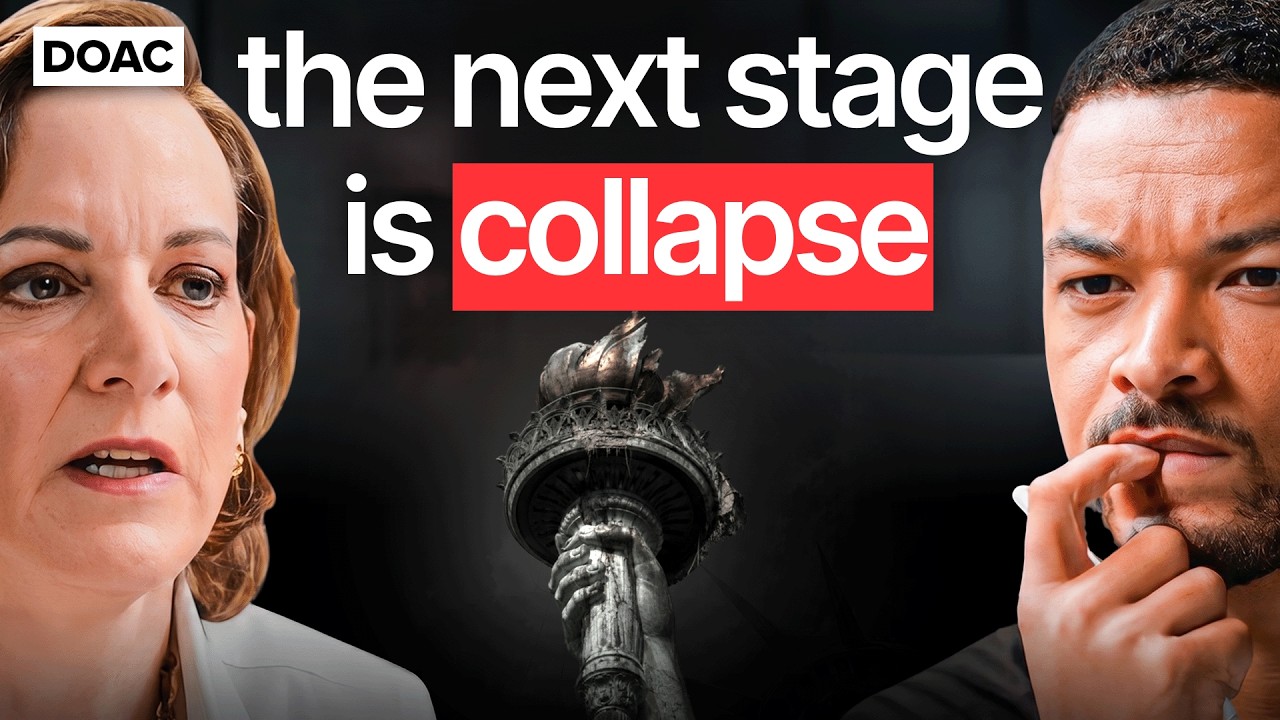
Applebaum Warns US Democracy Faces Erosion Through Autocratic Tactics
The Diary Of A CEO
The American democratic system faces collapse as leaders systematically weaponize regulatory power, corrupt civil institutions, and manipulate voter access.
## Background
This interview featuring Pulitzer Prize-winning historian Anne Applebaum was published by Steven Bartlett on his YouTube channel, The Diary Of A CEO, on May 11, 2026. According to the page description, Applebaum discusses how modern democracies gradually collapse, the rise of global authoritarianism, and why America is entering a dangerous political phase.
## TL;DR
Anne Applebaum breaks down the five core tactics modern autocrats use to subvert democratic institutions from within, ranging from electoral manipulation and media control to purging the civil service and deploying unaccountable power structures. She analyzes how foreign policy missteps, political tribalism, and algorithmic echo chambers accelerate democratic erosion in the United States and abroad. Rejecting historical determinism, Applebaum stresses that preserving democracy requires active civic engagement, algorithmic regulation, and objective investigative journalism rather than passive compliance.
## Atmosphere & style
The conversation carries a grave, urgent, and deeply analytical tone, balancing academic rigor with real-world concern over democratic fragility. Host Steven Bartlett provides a reflective space for Applebaum, whose articulate and measured commentary lends a candid, sobering weight to complex political topics. Watching the interview feels like a compelling warning, transforming abstract historical patterns into an immediate, stark reality.
## Key takeaways
- [45:39](https://www.youtube.com/watch?v=kwEtOyaFhCA&t=2739s) Autocratic decision-making structures eliminate critical internal dissent, leaving executive leaders susceptible to strategic miscalculations such as military escalation without institutional checks.
- [52:50](https://www.youtube.com/watch?v=kwEtOyaFhCA&t=3170s) Autocrats maintain power through specific tactics including corrupting elections, altering electoral rules, and gerrymandering to dilute opposing votes.
- [57:39](https://www.youtube.com/watch?v=kwEtOyaFhCA&t=3459s) Replacing independent civil service experts with political loyalists undermines institutional loyalty to the rule of law.
- [59:40](https://www.youtube.com/watch?v=kwEtOyaFhCA&t=3580s) Modern autocrats influence media and control public discourse by using state pressure, regulatory power, and loyal business allies to acquire critical platforms.
- [01:04:40](https://www.youtube.com/watch?v=kwEtOyaFhCA&t=3880s) A clear distinction exists between voluntary government requests regarding online disinformation and outright state coercion or platform takeover.
- [01:14:15](https://www.youtube.com/watch?v=kwEtOyaFhCA&t=4455s) Autocrats utilize power ministries—including military, intelligence, and law enforcement agencies—to exercise physical coercion and state-sanctioned repression.
- [01:17:32](https://www.youtube.com/watch?v=kwEtOyaFhCA&t=4652s) Democracy's survival is not governed by historical determinism; rather, it depends on human choices, active strategy, and civic engagement.
- [01:26:27](https://www.youtube.com/watch?v=kwEtOyaFhCA&t=5187s) Autocrats actively promote civic detachment, apathy, and cynicism to convince citizens that all politicians and systems are inherently corrupt.
- [01:28:01](https://www.youtube.com/watch?v=kwEtOyaFhCA&t=5281s) Modern media business models rely on catering to audience biases and outrage to drive engagement, complicating objective news coverage.
- [01:33:11](https://www.youtube.com/watch?v=kwEtOyaFhCA&t=5591s) Algorithmic recommendation engines construct hyper-personalized echo chambers, removing a shared factual baseline and destroying constructive democratic debate.
- [01:40:48](https://www.youtube.com/watch?v=kwEtOyaFhCA&t=6048s) Regime change fundamentally alters society by replacing meritocracy and open expression with political favoritism and ideological compliance.
## Detailed walkthrough
### [00:00](https://www.youtube.com/watch?v=kwEtOyaFhCA&t=0s) Teaser: How Autocracies Replace Democracies from Within
Host Steven Bartlett previews a striking financial comparison from Donald Trump's presidency, noting that his net worth was recorded at $2.3 billion when he entered office and climbed to $6.5 billion just two years later. Journalist and historian Anne Applebaum highlights the danger of a president operating private businesses while serving in public office, observing that executive decisions become oriented around personal corporate gain rather than the public good. As a concrete example, she questions the Saudi Arabian government's decision to invest $2 billion into Jared Kushner's investment firm, asserting that the capital allocation was driven by Kushner's status as Trump's son-in-law rather than raw business acumen.
```
"Most people think democracies end with tanks in the street or somebody shooting up the presidential palace, but actually in the modern world, they mostly end because someone who is legitimately elected begins to take apart the system."
```
Applebaum expresses deep alarm over the gradual erosion of American democratic norms. She points out that Trump has historically shown little regard for democratic institutions and visibly admires foreign leaders who operate completely unconstrained by laws or checks and balances. Her overarching objective is to wake the public up to how quietly democracies decay, encouraging citizens to identify the warning signs early enough to organize and push back before systemic changes become irreversible.
[02:10](https://www.youtube.com/watch?v=kwEtOyaFhCA&t=130s) Why History Keeps Repeating
Applebaum shares her personal background, reflecting on how her career began with an intense fascination with the Soviet Union. She traveled there as a student while it was still intact and later worked as a Warsaw-based journalist witnessing the collapse of the Warsaw Pact. After reporting on those historic transitions, she spent years writing historical works to analyze how a tiny elite managed to exert total control over a vast territory and its population. At the time, she assumed she was documenting a bygone era and analyzing a political model that had been permanently retired.
Over the past decade, however, Applebaum realized that the authoritarian playbooks she thought were buried in the past have resurfaced. Modern democratic collapses rarely resemble the dramatic 20th-century military coups with tanks rolling down capital streets. Instead, they occur when legally elected officials leverage their mandate to dismantle the very guardrails and electoral rules that make future free elections possible. Watching this pattern replay across multiple nations convinced her to shift her focus to documenting the resurgence of authoritarian impulses in contemporary politics.
When Bartlett asks whether current events are just routine political cycles or part of a larger historical shift, Applebaum clarifies what makes the present era distinct. For the first time in several long-established democracies—most notably the United States—political parties are taking power with the explicit strategy of altering the system so they can remain in office indefinitely. She points to Viktor Orbán in Hungary as the primary pioneer of this modern strategy. After winning a legitimate electoral victory by a large margin, Orbán systematically moved to capture state institutions from within.
```
"In a democracy you have to preserve the rules so that four years from now your bitter enemies can contest you and maybe beat you again... It requires a certain level of agreement about the nature of the system."
```
To remain stable and fair across political cycles, a constitutional democracy relies on neutral, independent institutions that operate without partisan interference:
* **Independent Judiciary & Courts:** Legal bodies that enforce the constitution regardless of who holds power.
* **Non-partisan Electoral Commissions:** Neutral oversight agencies that guarantee fair voting rules and honest count tallies.
* **Independent Press:** Free media outlets capable of holding public officials accountable.
* **Meritocratic Civil Service:** Bureaucrats, engineers, and regulators hired for subject-matter expertise rather than family connections or party loyalty.
Democracy is fundamentally an unusual system because it requires the winner of an election to safeguard the rules so their fiercest opponents can challenge them four years later. Conversely, the losing party must accept defeat because they trust the system will remain fair for the next election cycle. When that foundational consensus breaks down, citizens lose faith in the process, conversations deteriorate, and democratic stability erodes. Because the United States has historically acted as the leader of the democratic world, its domestic political shift exerts a profound influence on foreign nations, encouraging copycat behavior globally.
[07:41](https://www.youtube.com/watch?v=kwEtOyaFhCA&t=461s) The Internal Threats: Paramilitary Forces and High-End Corruption
Acknowledging the common skepticism that an autocracy could take root in America, Applebaum notes that non-democratic systems fall on a spectrum between liberal democracy and outright totalitarianism like Russia's. The United States itself has a history of regional authoritarianism: between the Civil War and the 1960s Civil Rights movement, many Southern states functioned as effectively one-party regimes where Black Americans were disenfranchised and election outcomes were rigged. She suggests that certain figures in contemporary political circles draw upon that specific state-level historical template.
Applebaum outlines two primary internal developments currently threatening American democratic norms:
* **Alienation and Paramilitary Enforcers:** A growing subset of the population feels completely disenfranchised from the political system, creating conditions ripe for political violence. Concurrently, agencies like Immigration and Customs Enforcement (ICE) have taken on federal police characteristics—wearing combat gear and face masks while operating outside traditional local police oversight.
* **Normalized High-End Corruption:** High-ranking officials and political insiders are leveraging state power for explicit financial profit on a scale previously unseen in modern American history.
[08:52](https://www.youtube.com/watch?v=kwEtOyaFhCA&t=532s) Mapping Democratic Decline Around the World
Directing attention to a global map displaying regime types, Applebaum points out that democracy research organizations no longer classify the United States as a full "liberal democracy," categorizing it instead as an "electoral democracy" with weaker protections. While Western Europe, Australia, Japan, and South Korea maintain liberal democratic standards, vast portions of the world are classified as either closed autocracies (such as China or Russia) or unstable gray-zone regimes that could tip in either direction.
```
"If you'd looked at a map like this a decade ago or two decades ago, it would have been a lot bluer... You do see an absolute process of democratic decline."
```
Comparing the current map to those from ten or twenty years ago highlights a visible decline in free societies worldwide. Applebaum emphasizes that political models are contagious; when key nations abandon democratic standards, neighboring countries take note and mimic their behavior.
[10:18](https://www.youtube.com/watch?v=kwEtOyaFhCA&t=618s) Could America Become an Autocratic Gray Zone?
When asked if the U.S. could become autocratic within our lifetimes, Applebaum describes how America could slide into an "autocratic gray zone" characterized by dominant one-party rule. Through systematic gerrymandering—redrawing legislative district lines to guarantee party victory—politicians eliminate genuine competitive elections. Once politicians no longer fear losing their seats, they lose accountability to their constituents, causing public services to decay while corruption and backroom deals with friendly business interests flourish.
These state-level pathologies are increasingly threatening to entrench themselves at the federal level. Applebaum cautions that dismissing the possibility of an electoral takeover is naive, pointing out that Trump already attempted an electoral coup after refusing to accept the outcome of the 2020 election. Given that precedent, similar attempts to subvert or block legitimate democratic transitions remain a very real risk in future election cycles.
[12:05](https://www.youtube.com/watch?v=kwEtOyaFhCA&t=725s) Trump’s Evolution: From First Term Constraints to Second Term Ideologues
Applebaum doubts Trump would pursue an unconstitutional third term himself, but warns that figures within his ecosystem may attempt to manipulate the electoral process to ensure a Republican successor—or even a member of the Trump family—retains power. She explains that the coalition surrounding Trump underwent a fundamental shift following the January 6th attack on the U.S. Capitol.
```
"Trump's first term, I think he has never cared much one way or the other for American democracy... but he was constrained... and now he's surrounded himself by people who are seeking to help him avoid those constraints."
```
While traditional national-security and conservative foreign-policy experts distanced themselves after the Capitol attack, a new alignment of factions rallied around Trump, viewing his willingness to shatter norms as an opportunity to overhaul the state:
* **Tech Authoritarians:** Tech-industry elites who seek political influence to advance their corporate interests, viewing democratic processes as inefficient hurdles to their leadership.
* **Christian Nationalists:** Ideologues who aim to strip away the secular nature of the government and re-establish America explicitly as a Christian state.
* **Traditional MAGA Populists:** A base that seeks to return political dominance to white, Christian demographics and roll back modern social changes.
During his first term, Trump's personal desire to exercise unrestrained executive power was held in check by institutional guardrails and conventional staff. In a second term, however, he is supported by organized factions actively designing strategies to help him bypass those checks entirely.
[14:56](https://www.youtube.com/watch?v=kwEtOyaFhCA&t=896s) The Appeal of Autocracy and the Rule of Law
Applebaum challenges the assumption that every citizen naturally prefers democracy, noting that autocratic systems appeal to those who prioritize rapid, unhindered exercise of power over consensus. The defining difference between a free society and an autocracy lies in how law operates:
* **Rule of Law:** An independent judiciary enforces codified laws and constitutional rights equally, protecting citizens from arbitrary state power.
* **Rule *by* Law:** The legal system is weaponized as an instrument of control, where the law means whatever the ruler says it means on a given day.
In an autocratic framework, media figures, podcast hosts, or private citizens who voice dissent or offend the leadership face swift legal retaliation, arrest, and sham trials, stripping away the basic protections that free societies take for granted.
Here is a detailed, faithful walkthrough of the transcript segment.
---
[15:47](https://www.youtube.com/watch?v=kwEtOyaFhCA&t=947s) Autocratic Retaliation, Corporate Coercion, and the Anthropic Precedent
In a fully functioning democracy governed by the rule of law, courts evaluate cases against constitutional protections like free speech. In an autocratic system, however, legal precedent and constitutional rights are subordinated to executive decree. Leaders in the Kremlin or the White House can simply place a phone call to dictate judicial outcomes, demanding a citizen's imprisonment regardless of statutory law. Applebaum illustrates this dynamic through a real story from Hungary’s transition toward a one-party state. When a business owner refuses to sell a majority stake in their company to state-aligned actors, the regime systematically unleashes state power and informal harassment: windows are smashed, children are intimidated on their way to school, employees face targeted legal or mortgage troubles, and regulators subject the firm to aggressive tax audits. Eventually, the owner breaks under the pressure, surrenders the company, and flees the country.
The conversation connects this tactic directly to recent events in the United States involving the AI company Anthropic. When Anthropic refused to grant the U.S. government access to its artificial intelligence models under certain conditions, political figures—including Pete Hegseth and Donald Trump—publicly posted threats to restrict the company's ability to secure government contracts. In free societies, citizens are unaccustomed to the government deciding which private businesses thrive and which die. Once an autocratic state dismantles legal guardrails, it distributes vital government contracts based on cronyism, political donations, or personal investments rather than fair, blind procurement processes.
[18:08](https://www.youtube.com/watch?v=kwEtOyaFhCA&t=1088s) Presidential Profiteering and the Rise of American Kleptocracy
For the first time in American history, a sitting president actively conducts private business deals with foreign entities whose political interests directly intersect with U.S. foreign policy. Applebaum highlights the Trump family's lucrative partnerships in Saudi Arabia, including deals with the real estate development firm Dar Al Arkan, an entity closely tied to Saudi leadership. The Saudi monarchy leverages these business arrangements to secure favorable diplomatic and strategic outcomes with the United States, channeling money directly into the Trump family coffers. In a declining democracy marked by kleptocracy, executive decisions are no longer evaluated on whether they benefit the American public, but on how they enrich the leader's private enterprise—mirroring the operational models of Russia and China.
To visualize the magnitude of this shift, the host presents two visual representations of Trump's net worth:
* **Initial net worth upon entering office:** $2.3 billion
* **Net worth two years later:** $6.5 billion
While previous American administrations faced occasional "whiffs of corruption" or relatives trading on a family name, a president running active global businesses while in office is completely unprecedented in U.S. history. Addressing the defense that Trump’s children are managing the operations, Applebaum notes that foreign governments do not invest billions out of personal affinity. For instance, the Saudi government's $2 billion investment into Jared Kushner's private equity fund creates an overwhelming conflict of interest, especially given Kushner’s role as the primary U.S. diplomatic negotiator in the Middle East. Citing Winston Churchill’s maxim that "democracy is the worst system of government except for all the others," Applebaum emphasizes that while democratic systems can be noisy and exhausting, their fundamental strength lies in forcing these conflicts of interest into the public sphere for debate.
[21:27](https://www.youtube.com/watch?v=kwEtOyaFhCA&t=1287s) The Collapse of the Post-1945 International Order
The escalation of global conflicts—including ongoing wars in Ukraine and Iran, alongside turmoil in Venezuela—is tied directly to domestic democratic decline and broader geopolitical shifts. Leaders in deteriorating democracies and autocracies frequently initiate foreign wars to consolidate domestic power and unite their political base. However, these conflicts also signal the structural breakdown of the post-1945 international rules-based system (often termed the "liberal world order"). Established after World War II around the United Nations, this order sought to prevent territorial expansion by force, substituting military conquest with international law and diplomacy.
This global stability is eroding due to two converging forces: internal political decay within the United States (a primary pillar of the system) and deliberate disruption by an autocratic coalition including Russia, China, Iran, and Venezuela. These autocratic regimes view the core tenets of liberal democracy—free speech, rule of law, and the separation of powers—as existential threats to their survival. Vladimir Putin’s primary fear is a domestic street revolution akin to Ukraine's 2014 Euromaidan protests, where citizens demanded an end to corruption and closer integration with Europe. Because democratic ideals possess explosive appeal to populations living without fundamental rights, autocratic regimes actively deploy foreign propaganda and covert social media campaigns to undermine democratic institutions worldwide.
- Russia's invasion of Ukraine represents a direct attack on post-war European norms prohibiting the forcible alteration of national borders.
- The war serves as a fundamental geopolitical fault line between democratic self-determination and autocratic imperial expansion.
[26:27](https://www.youtube.com/watch?v=kwEtOyaFhCA&t=1587s) The Fragility of Democratic Governance Across History
When evaluating historical longevity, autocratic governance has overwhelmingly dominated human history. Monarchies, warlords, and tribal oligarchies represent the default historical state, whereas liberal democracies remain rare, delicate anomalies that frequently collapse. The architects of the U.S. Constitution studied ancient history extensively—specifically the fall of the Roman Republic to Julius Caesar and the collapse of Greek democracies like Athens. Recognizing this inherent vulnerability, they designed a complex system of checks and balances across the executive, legislative, and judicial branches to ward off autocratic consolidation.
Despite their structural fragility, democracies consistently outperform autocracies in citizen well-being. Annual global happiness rankings consistently place democratic, stable, and prosperous nations at the top:
* **Top-ranking nations for societal happiness:** Finland, Sweden, Denmark, and Norway.
* **Structural benefits of democratic governance:** Participation in public life, transparent institutions, reduced corruption, and public infrastructure (such as healthcare and transit) designed to serve the entire population.
In contrast, autocracies deny citizens any voice in state resource allocation. An ordinary Russian citizen cannot demand that public funds be redirected from bombing Ukrainian cities toward building local hospitals. While autocracies falsely market themselves as bastions of stability, traditional values, and order, their governance relies on information control, state security apparatuses, and a monopoly on violence to suppress public discontent. In a closed state where public opinion is effectively erased, citizens who openly challenge executive rule face immediate imprisonment, rendering even widespread majority dissatisfaction powerless to effect political change.
[31:18](https://www.youtube.com/watch?v=kwEtOyaFhCA&t=1878s) How Authoritarian Systems Enforce Conformity and Silence Debate
The conversation delves into the psychological mechanisms that sustain authoritarian regimes, drawing a direct line between Soviet-style propaganda and modern Russia. Applebaum explains how citizens gradually adjust their public behavior and internal thoughts when expressing dissent carries real danger. In totalitarian and autocratic systems, state propaganda—such as inflated agricultural yields or industrial output—is often blatantly false. Yet, whether ordinary citizens genuine "believe" the lies becomes irrelevant; believing, or publicly performing belief, becomes a practical necessity for daily survival and career advancement. Over time, the boundary between sincere belief and self-preservation blurs until authentic public discourse disappears entirely.
Reflecting on Russia's trajectory, Applebaum describes the retreat from open political debate as a deep tragedy. During the 1990s and early 2000s, Russians engaged in vibrant public discussions about their nation's future. However, under Vladimir Putin, expressing dissenting views became increasingly dangerous, driving citizens to retreat from public life altogether and treat politics as a toxic, dangerous domain best avoided. Applebaum emphasizes that this erosion was not an overnight shift, but a continuous decay that developed steadily over two decades.
- The shift away from public political expression in Russia has been a gradual process of decline spanning over 20 years, beginning around the year 2000.
- Public dynamic: In autocratic environments, citizens adopt state narratives pragmatically, rendering underlying personal convictions secondary to outward conformity.
---
[32:40](https://www.youtube.com/watch?v=kwEtOyaFhCA&t=1960s) Tactic 1: Institutional Corruption and the Politicization of Justice
Moving into the core tactics used by autocratic leaders to dismantle democratic institutions, Applebaum outlines how institutional corruption operates as both a symptom and a primary mechanism of democratic decline. While corruption exists in democratic systems, robust checks and balances typically empower independent law enforcement agencies to investigate executive overreach. In an autocratic shift, the executive branch captures the legal system—specifically targeting agencies like the Department of Justice and the FBI—to shield allies from scrutiny while deploying prosecutorial power against political rivals.
```
Democratic Norms Autocratic Shift
---------------- ----------------
• Independent DOJ/FBI investigations • Executive capture of legal system
• Merit-based civil service • Loyalty-driven appointments
• Equal application of law • Protection of allies / Prosecution of rivals
```
Applebaum contrasts current developments in American governance with past administrations, pointing out that previous White Houses did not seek to monetize the presidency or systematically politicize the civil service to block investigations. Under this dynamic, corruption becomes a tool of statecraft: leaders offer regulatory favors, lucrative government contracts, and immunity in exchange for absolute personal loyalty and public silence.
---
[34:19](https://www.youtube.com/watch?v=kwEtOyaFhCA&t=2059s) Big Tech Sycophancy and the "Pay-to-Play" Incentive Structure
The discussion shifts to the behavior of prominent technology executives who have adjusted their public stances toward Donald Trump. Bartlett highlights the striking turnaround of tech leaders—such as OpenAI CEO Sam Altman—who in 2016 characterized Trump as an "unprecedented threat," "erratic," and comparable to historical authoritarians using "big lie" tactics, yet later appeared alongside him at the White House offering praise and making substantial political donations.
```
[Tech Leaders / Corporate Execs]
│
┌────────────────┴────────────────┐
▼ ▼
[Sycophantic Alignment] [Independent Stance]
• White House donations • Uphold legal codes/ethics
• Public praise • Risk short-term friction
• Temporary deal access • Gain long-term trust/stability
│ │
▼ ▼
[Oligarchic Vulnerability] [Institutional Resilience]
• Subject to shifting rules • Sustainable market foundation
```
Bartlett offers a hypothesis on the psychological and competitive pressures driving this behavior among tech CEOs:
> "I think that being rich for these people is actually just a proxy of status. And I think the thing that risks their status... is losing to their direct competition."
He suggests that for tech executives, maintaining position against rivals like Anthropic, xAI, or Google Gemini outweighs broader institutional concerns. Applebaum responds that while this transactional approach yields short-term access, it represents a highly shortsighted "mug's game." She cautions that relying on personal favor rather than the rule of law leaves business leaders vulnerable when autocratic leaders decide to replace existing oligarchs—a pattern historically demonstrated in both Russia and China. Conversely, she notes that firms standing firm on legal ethics and institutional independence can successfully win public trust and commercial success.
- OpenAI CEO Sam Altman's 2016 statements previously described Trump as a "potential disaster for the American economy" and "irresponsible in the way dictators are."
- Major corporate concessions include funding White House reconstruction projects and making elevated inaugural donations to secure regulatory access.
---
[38:11](https://www.youtube.com/watch?v=kwEtOyaFhCA&t=2291s) The Permanent Breakdown of Democratic Norms and International Alliances
Addressing whether American political life will eventually return to traditional norms, Applebaum warns against expecting a simple reset. Once legal boundaries and informal governance norms are breached, subsequent administrations—whether led by figures like JD Vance or future Democratic presidents—may be tempted to utilize the newly expanded executive powers for their own ends. Breaking norms creates systemic precedents: if an administration successfully weaponizes federal agencies against critics or media platforms, future leaders inherit those same tools.
This domestic erosion creates immediate international repercussions. Security partners and trade allies can no longer treat the United States as a predictable anchor of the global order. Applebaum explicitly advises foreign governments and multilateral bodies like NATO to establish alternative contingency plans rather than relying solely on American commitments.
> "A lot of things will not ever be quite normal again, either inside the US or around the world... It's really time for NATO to have a plan in case the United States flakes out."
---
[39:27](https://www.youtube.com/watch?v=kwEtOyaFhCA&t=2367s) Global Hedging and the Realignment of Middle Powers
As confidence in U.S. stability wanes, nation-states worldwide are actively hedging their geopolitical and economic strategies. Bartlett observes that historical partnerships—such as the UK-US "Special Relationship" or traditional US-Canada ties—are fragmenting as middle powers form new bilateral and regional coalitions. Applebaum details how countries including Canada, India, Brazil, Japan, and members of the European Union are creating alternative trade agreements and security frameworks to insulate themselves from unpredictable shifts in U.S. policy.
A critical inflection point in this diplomatic realignment occurred over administrative threats regarding Greenland. Applebaum discloses that behind-the-scenes signals surrounding U.S. interest in Greenland forced the Danish government to undertake sobering military preparedness planning. Danish officials faced the unprecedented scenario of calculating how to defend their territory against their primary NATO ally—including evaluating choices like disabling Greenlandic airfields or facing U.S. forces—a crisis that deeply alarmed European intelligence and defense leadership.
- Middle powers like Canada, India, Brazil, Japan, and EU nations are actively building independent trade and security networks to offset U.S. volatility.
- Following U.S. statements regarding Greenland, Danish and German authorities engaged in real-time military crisis planning for potential defense contingencies involving American forces.
- Former Bank of England and Bank of Canada Governor Mark Carney has been active in exploring new international energy, tech, and trade relationships to preserve Canadian sovereignty.
---
[43:57](https://www.youtube.com/watch?v=kwEtOyaFhCA&t=2637s) The Economic and Strategic Costs of American Isolationism
Applebaum emphasizes that the global turn away from the U.S. carries severe consequences for ordinary Americans. The post-WWII era of American economic prosperity and global influence rested directly on dominant trade networks, dollar supremacy, and forward-deployed military installations. Overseas bases, particularly in Europe, provided the infrastructure necessary to project stability into adjacent regions like the Middle East and Africa.
As global partners lose faith in U.S. reliability, the foundations of that prosperity are eroded:
- **Consumer Boycotts:** European and Canadian consumers have increasingly turned away from American goods, with dedicated mobile apps emerging in countries like Denmark to help shoppers identify and boycott U.S.-manufactured products in supermarkets.
- **Digital Infrastructure Disincentives:** European governments and corporations are actively shifting toward localized cloud storage and European-owned payment gateways to eliminate dependency on American tech platforms.
- **Financial Risks:** Declining global trust threatens the long-term status of the U.S. dollar as the world's primary reserve currency, directly impacting domestic purchasing power and national wealth.
---
[45:39](https://www.youtube.com/watch?v=kwEtOyaFhCA&t=2739s) Executive Miscalculation and Conflict in Iran
The conversation closes on the vulnerabilities inherent to autocratic decision-making in foreign policy. Applebaum notes that absolute control eliminates critical internal dissent, leaving leaders prone to massive strategic miscalculations. She points to the escalating military conflict in Iran as an example of an administration misjudging the regional consequences of executive action, contrasting initial targeted ops (such as actions against Venezuelan leadership) with drawn-out, unpredictable regional conflicts that lack clear exit strategies.
> "Here's another feature of dictatorships is that nobody questions [the leader]..."
Here is a detailed, faithful walkthrough of this section of the transcript.
---
[46:03](https://www.youtube.com/watch?v=kwEtOyaFhCA&t=2763s) Trump’s Unilateral Foreign Policy, Isolation, and the War in Iran
Anne Applebaum explains that when an autocratic leader surrounds themselves with yes-men, decision-making breaks down because nobody dares offer realistic alternatives. During the planning of the war in Iran, reporting indicates that advisors tentatively mentioned that Iran was not like Venezuela; it possessed an embedded regime, a decentralized leadership contingency plan in case top figures were killed, allies and proxy groups across the Middle East, and potential control over the Strait of Hormuz. However, these warnings were delivered timidly. No one confronted the president directly with "Mr. President, this is a bad idea," knowing that doing so meant being dismissed with a harsh "get out of my sight."
Applebaum expresses deep frustration over Trump's complete failure to engage with the Iranian people or democratic opposition groups. Despite the Iranian regime being one of the most unpopular and ugly on the planet, Trump made no contact with democratic opposition leaders or monarchists like Reza Pahlavi (the son of the Shah). Applebaum points out that Trump was motivated not by promoting democracy or improving Iran, but by a desire for dominance and securing a share of oil revenues—the exact model he applied in Venezuela, where the dictatorship remains intact under new leadership. Unlike previous American presidents like George W. Bush—who made monumental errors in Iraq but frame their goals around democratization—Trump openly brags about taking foreign oil. Host Steven Bartlett notes how surreal it is to hear a U.S. president proudly announce on the same day he removes a world leader that American ships are seizing another nation's oil.
- Advisors were too intimidated by Trump to deliver firm warnings against military action in Iran.
- Trump ignored viable Iranian opposition groups, including democratic dissidents and Reza Pahlavi.
- Applebaum highlights that Venezuela remains a dictatorship despite U.S. intervention, functioning under the same regime with a different figurehead.
- Contrast between George W. Bush’s democratization narrative in Iraq and Trump's overt focus on extracting oil wealth.
---
[48:49](https://www.youtube.com/watch?v=kwEtOyaFhCA&t=2929s) Low Approval Ratings, Narcissism, and Tactical vs. Strategic Thinking
With upcoming midterms, Trump’s approval ratings have dropped to record lows, prompting even formerly devoted supporters like Tucker Carlson to apologize for backing him. Bartlett observes that the war in Iran appears to have severely backfired, noting a telltale sign in Trump’s media appearances: whenever Trump obsessively repeats 75 times that the war is going "great" and that "we've won," it usually signals the exact opposite reality. Applebaum adds that when a leader lies pathologically, public trust evaporates to the point where people would disbelieve even a true statement.
Applebaum diagnoses Trump’s core weakness as a complete lack of long-term strategy. He is unconcerned with history or future consequences; his entire worldview is driven by immediate, moment-to-moment narcissistic validation. For Trump, "winning" is defined arbitrarily—whether it means out-arguing a journalist, claiming positive poll numbers, or declaring victory in a war. This impulsive need to appear victorious in the current news cycle prevents him from forming or executing the long-term strategic plans required for effective governance.
- Tucker Carlson and other high-profile supporters have publicly expressed regret or apologized for supporting Trump amid falling approval ratings.
- Trump's rhetoric relies on repetitive declarations of victory ("we've won, we've won") to mask setbacks.
- Applebaum defines Trump's mindset as purely transactional and narcissistic, lacking historical context or strategic vision.
---
[52:50](https://www.youtube.com/watch?v=kwEtOyaFhCA&t=3170s) The Second Tactic of Autocrats: Corrupting and Shaping Elections
Transitioning back to the core mechanics of democratic erosion, Applebaum details the second tactic used by autocrats: attacking, corrupting, and altering the rules of elections. When a regime begins restricting who can vote or changing how votes are counted to manipulate the outcome, democracy is in severe danger. She cites Viktor Orbán in Hungary, who used his party's two-thirds parliamentary majority over 16 years to repeatedly rewrite the constitution, redrawing electoral boundaries and altering vote-counting systems to entrench his power. In the United States, gerrymandering serves as a prime, highly anti-democratic equivalent.
Applebaum explains the origins of gerrymandering—named after 19th-century politician Elbridge Gerry, who created an electoral district shaped like a salamander. She illustrates its modern impact using Nashville, Tennessee, which was carved up into multiple districts designed to neutralize its Democratic majority and guarantee Republican congressional victories. Furthermore, Applebaum raises alarms about potential voter intimidation tactics, such as deploying paramilitary ICE units near polling stations on election day, and proposals to overhaul voter ID requirements.
Proposed changes requiring a passport or birth certificate to vote would disenfranchise large swathes of the population. A high percentage of Americans do not hold passports, and millions lack accessible birth certificates. The policy would disproportionately affect married women whose current legal names do not match their birth certificates, requiring them to present additional documentation like marriage licenses. Bartlett shares specific demographic figures showing how severely these rules would impact young, minority, and low-income voters. Applebaum notes that the overarching strategy is to manufacture a false narrative that undocumented immigrants are voting in massive numbers—a baseless conspiracy theory—providing a pre-fabricated excuse to challenge election results in cities whenever Republicans lose.
- **Origin of Gerrymandering**: Named after Elbridge Gerry, whose awkwardly shaped 1812 electoral map resembled a salamander.
- **Nashville Case Study**: The city was divided across multiple districts to dilute Democratic votes and secure Republican seats.
- **Voter ID Impact Data**:
- **Young Voters (18–29)**: Approximately 24% lack the strict documentation required under proposed voter ID laws.
- **Minority Voters**: 11% of citizens of color lack these specific documents, compared to a significantly lower percentage of white citizens.
- **Low-Income Households**: Only 1 in 5 households earning under $50,000 per year possesses a passport.
- **Married Women**: Roughly 69 million women have birth certificates that do not match their current legal name due to marriage.
- The administration uses unproven theories of illegal immigrant voting to lay the groundwork for disputing election losses in major urban centers.
---
[57:39](https://www.youtube.com/watch?v=kwEtOyaFhCA&t=3459s) The Third Tactic: Purging and Corrupting the Civil Service
The third tactic autocrats employ is dismantling the non-partisan civil service. In a healthy 21st-century democracy, objective experts manage essential public operations—regulating insurance markets, maintaining infrastructure, and monitoring environmental pollution. In corrupt autocracies, these expert roles are stripped away and handed to political loyalists, cronies, or family members.
Applebaum points to the administration's attacks on the Federal Reserve as a prime example of this dynamic. Trump repeatedly attempted to undermine Fed Chairman Jerome Powell, targeting him with investigations into fabricated financial scandals and pressuring him to adjust monetary policy or resign. Autocratic leaders seek to replace independent officials—including the Attorney General, Department of Justice personnel, and economic regulators—with figures who serve the personal and financial interests of the president rather than the public interest.
- Functional democracies rely on subject-matter experts within neutral civil institutions.
- Pressure was applied to Federal Reserve Chair Jerome Powell through manufactured investigations and public demands for resignation.
- Undermining the civil service shifts institutional loyalty from the nation and the rule of law to the ruler and their inner circle.
---
[59:40](https://www.youtube.com/watch?v=kwEtOyaFhCA&t=3580s) The Fourth Tactic: Controlling Information and Shaping Public Reality
The fourth classic strategy of autocratic regimes is controlling the flow of information. Applebaum outlines how China constructed a closed, heavily monitored internet infrastructure starting in the 1990s, linking digital activity to extensive surveillance cameras and tracking databases. Similarly, Vladimir Putin has increasingly walled off Russia from the global internet, banning Western social media platforms like Instagram—a shift highlighted by viral videos of distraught Russian influencers losing their online followings overnight.
While the United States maintains a noisy and open media ecosystem, Applebaum warns that the administration is actively attempting to reshape the information landscape. Federal regulators are being leveraged to pressure television stations critical of the president, while executive influence is being applied to media acquisitions to ensure new owners align politically with the regime.
- China’s internet is entirely closed and integrated with national physical surveillance systems.
- Russia’s block on platforms like Instagram illustrates how autocratic states cut off foreign information sources.
- In the U.S., regulatory pressure and intervention in media company sales are being used as subtle tools to censor or steer public discourse.
<FollowUp label="Want to continue with the next part of the transcript walkthrough?" query="Please provide the detailed walkthrough for the next part of the transcript (starting around 1:05:58)."/>
[01:01:09](https://www.youtube.com/watch?v=kwEtOyaFhCA&t=3669s) Modern Censorship and Media Ownership Controls
Contemporary media suppression rarely looks like the traditional image of a censor sitting in a backroom crossing out newspaper sentences. Modern autocrats like Viktor Orbán in Hungary and Recep Tayyip Erdoğan in Turkey operate at the level of media ownership, actively orchestrating or encouraging loyal business allies to purchase major television networks and publications. Donald Trump has attempted similar tactics in the U.S. by pressuring outlets like TikTok, CBS, and CNN to install sympathetic leadership.
```
Modern Censorship Strategy:
Traditional Model: Direct state suppression & redacting individual articles
Modern Autocratic Model: Acquisition of major media outlets by political loyalists
```
This strategy of structural consolidation does not grant total control—independent online websites can still operate on the margins—but it effectively shapes the dominant narrative for the broader electorate. Beyond the media ecosystem, this effort to constrain critical voices extends into cultural and academic institutions. For example, during the Trump administration, the federal government took over Washington's Kennedy Center and attempted to alter its booking choices, ultimately leaving the prestigious arts venue shut down for two years.
- Major Hungarian television channels were brought under direct or indirect state-aligned control, though small independent news sites survived.
- Federal intervention at the Kennedy Center disrupted its leadership and operations, leading to a two-year closure.
---
[01:03:00](https://www.youtube.com/watch?v=kwEtOyaFhCA&t=3780s) The Left vs. Right Dynamics of Free Speech
While illiberal instincts to police speech exist across the political spectrum, the methods differ significantly between the left and right. The phenomenon often labeled as "cancel culture" relied primarily on social peer pressure and institutional dynamics within universities or media organizations to fire or exile individuals for saying the wrong thing. In contrast, state-driven censorship relies on top-down executive authority.
Executive action has moved toward direct interference in corporate governance and academic curricula. For instance, the Trump administration attempted to dictate course offerings and faculty hiring decisions at Harvard University, prompting the institution to refuse compliance and launch legal action. Genuine defenders of free speech must remain consistent by calling out overreach on both sides, rather than decrying left-wing cancellations while remaining silent when state power suppresses opposing views.
> "The people who are really in favor of free speech, and they're vanishingly few, are the people who are willing to call it out on both sides."
- The U.S. executive branch attempted to intervene directly in Harvard's course offerings and faculty hiring choices.
- Many self-proclaimed "free speech warriors" vocalize opposition to social cancellation from the left while ignoring state-driven speech restrictions from the right.
---
[01:04:40](https://www.youtube.com/watch?v=kwEtOyaFhCA&t=3880s) Executive Pressure vs. State Takeover of Tech Platforms
During congressional testimony, Meta CEO Mark Zuckerberg revealed that the Biden-Harris administration repeatedly pressured platform executives to demote or remove specific content, including flagging the *New York Post* story regarding Hunter Biden's laptop following FBI communications. Similarly, White House officials routinely emailed Twitter executives to request content adjustments.
| Government Action Type | Characteristics | Examples |
|:--- |:--- |:--- |
| **Monitored Content Requests** | Voluntary dialogs regarding potential fake news, foreign influence, or disinfo. No legal coercion. | Biden White House requests to Meta and Twitter regarding Russian disinformation & Hunter Biden story. |
| **State Takeover / Coercion** | Direct takeover or threats of financial and legal retaliation to control messaging. | Structural acquisition of media companies in Hungary, Turkey, or proposed state takeovers. |
A vital distinction exists between informal government requests regarding foreign disinformation and outright state coercion. While presidential administration emails asking to flag flagged posts involve no financial penalties or direct legal threats, taking over tech platforms to dictate their content strips them of independent editorial choice.
- Mark Zuckerberg confirmed that Meta was asked by federal officials to demote the *New York Post* story on Hunter Biden's laptop.
- White House officials maintained direct communication pipelines with Twitter and Meta executives to flag suspected foreign disinformation campaigns.
---
[01:06:26](https://www.youtube.com/watch?v=kwEtOyaFhCA&t=3986s) Regulating Social Media and Section 230
Section 230 of the Communications Decency Act grants social media companies immunity from the legal liabilities that traditional news publishers face, allowing tech giants to disclaim responsibility for user-generated content. Democratic lawmakers like Senator Elizabeth Warren have repeatedly pointed to Section 230 to urge social platforms to take a more aggressive stance against hate speech and online disinformation.
```
Legal Responsibility Framework:
Traditional Media (Newspapers/TV): Subject to libel, defamation, and offline laws
Social Media Platforms (Section 230): Exempt from publisher liability for user content
```
Aligning digital platforms with real-world legal standards is essential for maintaining rule of law and national sovereignty. If offline activities—such as distributing child pornography, recruiting for terrorist groups, or violating campaign finance limits—are illegal, they should be equally regulated online. Democracies must enforce their own electoral spending and advertising laws on digital platforms, as unseen digital ad buys running into millions of dollars on apps like TikTok can undermine an entire nation's electoral integrity.
> "Democracies have the right to say, 'These are our laws... and if the platforms violate those laws, they're in breach of the law.' Finding a way to bring the social media companies into the legal system seems to be completely legitimate."
- Section 230 shields digital platforms from standard libel and defamation laws applied to traditional publishers.
- Brazilian authorities fined X (formerly Twitter) over non-compliance with national legal rulings, briefly shutting down the platform when it refused to comply.
- Electoral spending laws are far harder to monitor on digital platforms like TikTok than through traditional television advertising.
---
[01:09:16](https://www.youtube.com/watch?v=kwEtOyaFhCA&t=4156s) Free Speech Boundaries and Platform Governance
Every legal framework around free speech involves inherent trade-offs, particularly when navigating bad state laws versus platform enforcement. While the First Amendment in the U.S. protects ugly or racist speech online, other robust democracies enforce strict speech boundaries; post-WWII Germany, for example, legally bans Nazi symbols to preserve its constitutional order. Expecting American tech companies to override local democratic laws in sovereign nations undermines those nations' right to govern their own public discourse.
```
Free Speech Frameworks:
United States: First Amendment protects hate speech & racist content online
Germany: Strict constitutional post-WWII limits banning Nazi symbolism
```
Platform moderation often comes down to user retention rather than purely legal mandates. When platforms allow antisemitism and racism to flourish unchecked, users choose to leave, forcing platforms to constantly negotiate acceptable norms. By contrast, autocracies like China do not engage in subtle content moderation or debates over hate speech; instead, they enforce strict, centralized control over the system itself to silence any criticism of the ruling party.
- German law bans Nazi symbolism to protect its electoral democracy, whereas the U.S. First Amendment protects such speech.
- High levels of hate speech and racism on X cause users to reduce their platform engagement, driving internal moderation debates.
- The Chinese government's primary digital restriction is preventing any critical discussion of the Chinese Communist Party.
---
[01:12:58](https://www.youtube.com/watch?v=kwEtOyaFhCA&t=4378s) Practical Realities of Emigrating from Autocracies
Leaving an authoritarian state like China or Russia is far more complex than simply packing up and moving abroad. While citizens may theoretically obtain exit passports, relocating requires securing visas, finding legal work, navigating language barriers, and transferring professional qualifications.
```
Obstacles to Fleeing an Autocracy:
Legal & Bureaucratic: Exit passports, visa approvals, work permits
Personal & Social: Language barriers, transferable credentials, aging family ties
```
Many citizens remain in repressive regimes not out of political support, but due to practical and personal obligations. Russian citizens, for example, often stay behind to care for elderly relatives or because they lack foreign language skills, demonstrating that physical departure is rarely a simple option for average citizens under authoritarian rule.
- Fleeing an authoritarian regime requires securing foreign visas, work permits, and transferable credentials.
- Many Russian citizens remain in the country despite opposing the political system due to family caretaking duties and language barriers.
---
[01:14:15](https://www.youtube.com/watch?v=kwEtOyaFhCA&t=4455s) The 5th Tactic: Control Over Power Ministries and Physical Coercion
The fifth core tactic used by autocrats is asserting control over "power ministries"—the military, intelligence agencies, and law enforcement—to establish a physical system of repression. Information control alone is rarely enough to sustain autocracy long-term; regimes eventually rely on direct physical coercion and threats to intimidate citizens who refuse to conform.
```
Autocratic Control Hierarchy:
1. Information Space: Controlling media, platforms, and public narrative
2. Physical Coercion: Weaponizing law enforcement & power ministries
```
While institutions like Immigration and Customs Enforcement (ICE) in the United States were originally created purely for administrative immigration enforcement, weaponizing such agencies beyond their historical mandate mirrors the early stages of physical coercion seen in autocratic regimes.
- Autocrats rely on power ministries to create physical systems of coercion alongside digital and media control.
- Weaponizing domestic enforcement agencies like ICE beyond traditional boundaries represents a shift toward state coercion.
Here is a detailed, faithful walkthrough of this section of the interview.
### [01:15:08](https://www.youtube.com/watch?v=kwEtOyaFhCA&t=4508s) The Rise of Unaccountable Paramilitaries
Anne Applebaum describes the chilling reality of how agencies like ICE (U.S. Immigration and Customs Enforcement) operate during aggressive crackdowns. Agents wear military uniforms, cover their faces with masks, drive unmarked vans instead of standard police vehicles, and routinely bypass the traditional rules governing local law enforcement. They answer neither to state governors nor to city mayors, leaving them answerable directly to the Department of Homeland Security and the President. This structural lack of oversight creates a culture of total impunity, allowing agents to act with unchecked power.
This danger was starkly demonstrated during protests in Minnesota, where two people were killed by federal officers. Applebaum notes that what was most horrifying was not only the loss of life, but the official reaction from political leaders like JD Vance and Kristi Noem. Rather than expressing horror that American citizens were killed by a federal force, acknowledging the tragedy, or calling for an immediate, independent investigation to ensure it never happens again, the administration's immediate instinct was to declare the victims guilty and shield the officers from accountability.
When a militarized force—dressed as if deployed in Fallujah—is placed above the law and can harm citizens without paying any price, it ceases to be a traditional police force serving the public interest. Instead, it becomes a partisan paramilitary operating solely to serve the interests of the ruling party.
---
### [01:17:32](https://www.youtube.com/watch?v=kwEtOyaFhCA&t=4652s) Empire Collapse and the Fallacy of Historical Inevitability
Steven Bartlett introduces a framework on the lifecycle of empires, citing the 250-year pattern popularized by British historian Sir John Glubb in *The Fate of Empires*. Glubb analyzed civilizational lifespans from the Assyrians to the British Empire, identifying six recurring stages: the Age of Pioneers, the Age of Conquests, the Age of Commerce, the Age of Affluence, the Age of Intellect, and finally the Age of Decadence—marked by internal division, massive inequality, rampant debt, and a collapse of civic duty. Bartlett points out that measuring the U.S. from its founding in 1776 to 2026 hits the 250-year mark exactly, prompting political scientists to suggest America has entered its final stage of decadence.
Applebaum firmly rejects the notion of historical inevitability, calling it both dangerous and intellectually flawed. She argues that believing a nation is on an unstoppable downhill slope takes away people's agency and willingness to act. This mindset mirrors the fatal post-Cold War mistake of the 1990s, when Western leaders assumed liberal democracy had triumphed forever (Francis Fukuyama's "End of History") and that no effort was required to maintain it. That era of complacency caused the West to miss the authoritarian rise of modern Russia and China.
Whether the U.S. survives as a democracy depends strictly on active human choices, civic engagement, and public debate today—not on deterministic rules engineered by political scientists. While human nature remains a constant, history is heavily shaped by random accidents and unpredictable decisions.
- **Historical Contingency Example:** When an ailing, intoxicated Boris Yeltsin chose his successor in Russia, he selected a low-ranking FSB officer named Vladimir Putin, believing Putin would remain loyal and shield the Yeltsin family from prosecution. Had Yeltsin chosen a forward-looking, open-minded politician like Boris Nemtsov instead, Russia might have integrated with Europe, fundamentally altering world history.
- **Boredom in Prosperous Societies:** Applebaum acknowledges Fukuyama's warning that when societies achieve peace and high prosperity, a segment of the population eventually grows bored, seeking disruption simply for the sake of change or out of a desire for power.
---
### [01:24:20](https://www.youtube.com/watch?v=kwEtOyaFhCA&t=5060s) Democracy, Extreme Wealth Inequality, and Oligarchy
Addressing whether democracies naturally degrade into unchecked capitalism, Applebaum points out that democratic nations in the second half of the 20th century actively fostered middle-class prosperity, high social mobility, and reduced wealth inequality. The happiest and most stable modern democracies maintain strong social safety nets and wealth redistribution, ensuring citizens feel invested in the system rather than outclassed by a tiny elite. The 1950s in the U.S. marked a period of booming prosperity alongside expanding civil rights and democratic inclusion.
The primary threat today comes from the emergence of tech oligarchs who hold vastly more power than elected politicians and control the digital information space. As this group amasses unprecedented wealth and control, elements within the tech elite are becoming openly anti-democratic and illiberal, questioning why they should remain subject to a system where every citizen receives an equal vote.
---
### [01:26:27](https://www.youtube.com/watch?v=kwEtOyaFhCA&t=5187s) Protecting Democratic Institutions Against Apathy
To safeguard a democracy from collapsing into autocracy, citizens must resist apathy and actively participate in all elections, including local ones. Autocrats like Vladimir Putin in Russia or the leadership in China actively promote civic detachment, encouraging citizens to adopt the cynical belief that "all politicians are corrupt" so they abandon politics altogether.
A fundamental test for evaluating any political leader is observing how they treat foundational democratic safeguards:
- **Respect for Key Institutions:** True democratic leaders respect an independent judiciary, a free press, and a professional, non-partisan civil service because these institutions ensure future elections remain fair.
- **Dismantling Safeguards:** Autocrats systematically attack judges, journalists, and civil servants to dismantle checks and balances from within.
---
### [01:28:01](https://www.youtube.com/watch?v=kwEtOyaFhCA&t=5281s) Media Polarization and Economic Incentives
When asked about political bias in mainstream media, Applebaum explains that media institutions face structural and economic pressures that drive polarization. Outlet business models—such as Fox News on the right—depend on catering to specific audience biases to drive viewership. Even well-intentioned journalists attempting neutral reporting face bad-faith accusations of bias whenever an objective investigation unearths uncomfortable facts about a political leader or administration.
Bartlett notes that as a podcaster, he sees how the underlying economic and algorithmic incentive structure rewards outrage over neutrality. News organizations quickly realize that publishing articles catering to their audience's ideological outrage generates ten times the engagement, clicks, and subscriber conversions compared to balanced reporting, creating a financial loop that reinforces political tribalism.
Here is a detailed, faithful walkthrough covering Part 7 of the transcript.
---
[01:29:17](https://www.youtube.com/watch?v=kwEtOyaFhCA&t=5357s) Media Polarization, Tribalism, and the Mission of Journalism
Steven Bartlett and Anne Applebaum explore the structural incentives that push media outlets and independent content creators into political corners. Bartlett explains that as a media business owner, publishing balanced or non-conforming content yields only a fraction of the reach, engagement, and subscriber growth compared to publishing outrage-inducing or critical stories against a specific figure. Furthermore, hiring talent in major metropolitan areas like New York or Los Angeles naturally draws employees with specific political leanings, making political capture feel almost inevitable.
Bartlett admits that as a podcaster, he now experiences the intense pressure of media tribalism firsthand. Hosting figures from across the political spectrum—whether Kamala Harris, Ivanka Trump, Michelle Obama, or Gavin Newsom—invariably unleashes severe backlash from opposing audiences. He reflects on a favorite quote, noting that creators often feel "you have to join a tribe or you get killed by one," which explains why so many podcasters seek refuge behind a single political tribe rather than taking arrows from both sides.
Applebaum distinguishes general podcasting and commentary from the core mission of investigative journalism. While commentary often centers on presenting opinions or interviewing personalities, true journalism requires going out into the world, gathering facts, verifying reality, and presenting an accurate account of what actually occurred—regardless of whose feelings or political standing it hurts. Maintaining a viable business model for truth-seeking journalism is crucial to preventing society from drifting into an entirely algorithm-driven, fragmented reality.
* Bartlett highlights the economic dynamic: praise or neutral coverage produces far lower engagement and subscription revenue than attack pieces, forcing media companies to produce exponentially higher output to match revenues.
* Bartlett reflects on his own role as a young Black entrepreneur, acknowledging that previous generations of investigative truth-seekers exposed societal injustices that directly paved the way for his current privileges and success.
* Applebaum notes the constant occupational hazard for accurate reporting: pointing out when a political leader is lying immediately subjects journalists to accusations of partisan bias.
---
[01:33:11](https://www.youtube.com/watch?v=kwEtOyaFhCA&t=5591s) Algorithmic Bubbles and the Threat to Democratic Cohesion
Applebaum and Bartlett discuss how artificial intelligence and predictive algorithms are altering human perception and eroding democratic norms. Bartlett expresses deep concern over feed algorithms optimized for maximum watch time and ad revenue. By serving users content tailored to past viewing habits—such as street fights—the algorithms convince individuals that their personal feed reflects broader reality. This creates hyper-personalized echo chambers where citizens no longer share a common baseline of facts.
Applebaum emphasizes that extreme political polarization is the single most toxic threat to a functioning democracy. When political opponents are no longer viewed merely as rivals with different policy positions on taxes or public spending, but as "existential enemies" whose governance would mean the end of society, traditional democratic debate and peaceful elections break down entirely.
* Algorithms prioritize high-friction, emotive content to maximize user dwell time and advertising dollars.
* AI models trained strictly on digitized text risk disconnecting public understanding from real-world, ground-truth developments happening offline in places like Ukraine or Iran.
* Severe polarization transforms healthy democratic competition into existential zero-sum warfare.
---
[01:34:21](https://www.youtube.com/watch?v=kwEtOyaFhCA&t=5661s) Personal History, Marriage, and Public Life
Bartlett shifts the conversation to Applebaum’s personal background, surprising her by bringing out a physical copy of her 1992 *New York Times* wedding announcement. Applebaum looks back at the article, recalling her marriage in Washington, D.C., to her husband, who was working as a Polish journalist at the time and later became Poland's Foreign Minister (Radosław Sikorski).
Reflecting on decades in a high-profile political family, Applebaum shares how living part of her life in the public eye provided invaluable insights for her work as a journalist. Experiencing the stark contrast between public perception and actual reality taught her to look past media caricatures when meeting politicians and public figures. To maintain professional integrity and independence, she chose not to adopt her husband's surname and has deliberately maintained a separate career focused on international journalism rather than participating in Polish domestic politics.
* Applebaum and her husband have been married since 1992.
* Her husband, Radosław Sikorski, transitioned from journalism to serving as Poland's Foreign Minister.
* Applebaum explicitly rules out ever running for public office herself, remarking with a laugh that "you can't have two politicians in one family" and explaining that the analytical role of a journalist is fundamentally different from the persuasive, campaign-driven role of a politician.
---
[01:38:02](https://www.youtube.com/watch?v=kwEtOyaFhCA&t=5882s) Witnessing Authoritarianism and the Duty to Warn
When asked about the ultimate objective of her books, articles, and lectures, Applebaum stresses that her purpose is not to campaign for specific candidates or parties, but to remind society why democracy is essential and to highlight the subtle ways it decays. Her passion stems from early personal experiences as a student in Leningrad during the final years of the Soviet Union, where she felt firsthand what it meant to live inside a tightly controlled autocracy.
For most of her career, Applebaum focused on writing deeply researched historical works, including her books on the Soviet Gulag, the Ukrainian famine (*Red Famine*), and the post-WWII Soviet takeover of Eastern Europe (*Iron Curtain*). However, around 2014 and 2015, she recognized a profound historical shift occurring in real-time across Western democracies. Watching friends, colleagues, and center-right figures radicalize inspired her to write *Twilight of Democracy*, her first book written from a first-person perspective as an eyewitness to contemporary political unraveling.
* Lived experience in Leningrad as a university student sparked Applebaum's lifelong drive to understand why people comply with authoritarian systems.
* She shifted from writing purely historical accounts of 20th-century autocracies to documenting the real-time erosion of democratic norms across the West.
* *Twilight of Democracy* opens with a personal account of a party she hosted, contrasting the shared center-right, anti-communist consensus of her friends in 1999 with their subsequent political radicalization.
---
[01:40:48](https://www.youtube.com/watch?v=kwEtOyaFhCA&t=6048s) What Regime Change and Authoritarian Rule Actually Feel Like
Applebaum addresses a critical point that citizens in stable democracies often overlook: what regime change actually feels like when experienced from within. People raised in established democracies often view concepts like democratic backsliding or regime change as abstract, theoretical ideas or simply the outcome of electing a new leader.
In reality, regime change alters the basic rules and implicit values of a society. Applebaum asks listeners to imagine waking up in a country where core principles—such as free speech or meritocracy—are suddenly inverted. In an autocratic system, free speech is treated as dangerous rather than beneficial, and professional advancement depends not on hard work, talent, or education, but on having personal connections or family ties within the ruling political party. Pointing to Russia's occupation of eastern Ukraine, she stresses that authoritarian regimes actively rewrite the unwritten social contract, strip citizens of basic protections, and destroy the foundational freedoms that democratic societies take for granted.
* Regime change fundamentally redefines everyday societal norms, replacing rule of law and meritocracy with political favoritism and ideological compliance.
* Bartlett acknowledges the privilege of having lived entirely within a functioning democracy, which makes authoritarian decay seem unimaginably distant until it is already underway.
* Applebaum highlights that historical cycles of democratic collapse are driven by recurring aspects of human nature, making active civic awareness and defense of institutions necessary to prevent bad outcomes.
---
<ElicitationsGroup message="Explore the remaining topics from this interview:">
<Elicitation label="Walkthrough Part 8: Final Thoughts and Reflections" query="Please provide a detailed, faithful walkthrough of Part 8 of the Anne Applebaum transcript."/>
<ElicitationsGroup message="Or dive deeper into key concepts from Part 7:">
<Elicitation label="Analysis of Media Polarization and Autocracy" query="How does media polarization contribute to democratic backsliding according to Anne Applebaum?"/>
</ElicitationsGroup>
</ElicitationsGroup>
Here is a detailed, faithful walkthrough of the provided transcript segment:
[01:43:17](https://www.youtube.com/watch?v=kwEtOyaFhCA&t=6197s) Agency, Strategy, and Human Nature
Steven Bartlett and Anne Applebaum discuss whether the cyclical nature of human politics makes democratic decline inevitable. Bartlett reflects on whether believing in recurring political cycles while simultaneously believing in individual agency is a contradiction. Applebaum clarifies that understanding human nature provides crucial warning signs. She explains that effective strategy requires focusing intently on the outcome you wish to avoid and working backward to determine what actions are necessary in the present to prevent that negative outcome.
- Understanding human nature allows societies to identify and avoid repeating past political failures.
- Strategic thinking involves identifying the worst-case scenario and taking proactive measures in the present to block it.
---
[01:44:08](https://www.youtube.com/watch?v=kwEtOyaFhCA&t=6248s) The Personal Toll of Radicalization and Interviewing Strategy
Answering the podcast's traditional final question left by the previous guest—asking about her most challenging setback and the lesson learned—Applebaum shares that her greatest personal struggle was witnessing the political radicalization and rise of illiberalism among people she knew well. She admits she is "bad at" coping with these personal shifts because she cares too deeply to remain detached.
When Bartlett asks if her journalistic background means she could interview anyone, Applebaum notes that interviewing figureheads who rely on untruths, such as Donald Trump, presents a distinct practical challenge: a journalist must either constantly interrupt to correct falsehoods or passively record them, neither of which is particularly productive. Both agree that engaging with figures who reject basic facts or demand topics be off-limits yields little value, with Applebaum noting she prefers speaking to anyone who is "reality-based" and willing to engage in a genuine argument.
- Applebaum admits that watching close acquaintances adopt radical or illiberal political views has been her most difficult personal and professional challenge.
- Interviewing public figures who frequently lie presents a dilemma between constant real-time fact-checking and allowing false statements to go unchallenged.
- Bartlett notes his policy of refusing interviews where guests place subjects strictly off-limits, which Applebaum commends.
---
[01:46:33](https://www.youtube.com/watch?v=kwEtOyaFhCA&t=6393s) Concluding Reflections on Democracy
Bartlett expresses his gratitude for Applebaum’s work, praising her ability to demystify complex geopolitical trends in an era overloaded with information. He lightheartedly mentions discovering that she once wrote a cookbook, calling it a surprise diversion from her political writing. Bartlett admits that, as a 33-year-old living in the West, he had long taken democracy for granted until this conversation illuminated its fragility. Applebaum agrees that taking democracy for granted is natural, offering a vivid metaphor: "It's the water we swim in. We're the fish, you know, and the idea that there would someday not be water is unimaginable."
- Applebaum’s body of work serves as a clarifying force in an increasingly confusing, information-dense media landscape.
- Bartlett reflects on how living in stable Western nations makes it easy for younger generations to assume democracy is permanent.
- Applebaum compares living in a democracy to fish living in water—it feels so ubiquitous that its total loss seems unthinkable until it happens.
## Notable quotes
> [45:39](https://www.youtube.com/watch?v=kwEtOyaFhCA&t=2739s) Here's another feature of dictatorships is that nobody questions [the leader]... — Anne Applebaum
> [01:03:00](https://www.youtube.com/watch?v=kwEtOyaFhCA&t=3780s) The people who are really in favor of free speech, and they're vanishingly few, are the people who are willing to call it out on both sides. — Anne Applebaum
> [01:06:26](https://www.youtube.com/watch?v=kwEtOyaFhCA&t=3986s) Democracies have the right to say, 'These are our laws... and if the platforms violate those laws, they're in breach of the law.' Finding a way to bring the social media companies into the legal system seems to be completely legitimate. — Anne Applebaum
> [01:34:21](https://www.youtube.com/watch?v=kwEtOyaFhCA&t=5661s) you can't have two politicians in one family — Anne Applebaum
> [01:46:33](https://www.youtube.com/watch?v=kwEtOyaFhCA&t=6393s) It's the water we swim in. We're the fish, you know, and the idea that there would someday not be water is unimaginable. — Anne Applebaum
## Mentioned
Anne Applebaum, Steven Bartlett, Donald Trump, Reza Pahlavi, George W. Bush, Tucker Carlson, Viktor Orbán, Elbridge Gerry, Jerome Powell, Vladimir Putin, Recep Tayyip Erdoğan, Mark Zuckerberg, Elizabeth Warren, Sir John Glubb, Francis Fukuyama, Boris Yeltsin, Boris Nemtsov, JD Vance, Kristi Noem, Kamala Harris, Ivanka Trump, Michelle Obama, Gavin Newsom, Radosław Sikorski, ICE, Federal Reserve, Department of Justice, Department of Homeland Security, Kennedy Center, Harvard University, Meta, Twitter, TikTok, CBS, CNN, Fox News, New York Post, New York Times, Red Famine, Iron Curtain, Twilight of Democracy, Autocracy, Inc.: The Dictators Who Want to Run the World, Soviet Union, Ukraine, Iran, Venezuela, China, Leningrad
Historian Anne Applebaum argues that contemporary autocracies rarely emerge from military coups, but rather from legally elected leaders who systematically dismantle constitutional checks, capture neutral state institutions, and subordinate public policy to personal enrichment.
Dismantling Guardrails from Within Legitimate Mandates (3:33)
Modern democratic erosion diverges sharply from 20th-century paradigms involving tanks in the street or armed overthrows. Applebaum observes that political figures now enter power via legitimate elections and subsequently weaponize their majorities to rewrite rules, entrenching themselves indefinitely. Citing Viktor Orbán's constitutional rewrites in Hungary and American state-level gerrymandering, such as dividing Nashville, she highlights how independent judiciaries, neutral civil services, and non-partisan electoral commissions are systematically neutralized to prevent political rivals from contesting power on equal terms.
Presidential Kleptocracy and Corporate Retaliation (18:08)
Applebaum identifies private monetization of public office as a primary vector of democratic backsliding. The host highlights that Donald Trump entered office with a reported net worth of $2.3 billion, which rose to $6.5 billion two years later. Applebaum points to commercial deals with foreign governments—such as the Saudi monarchy channeling $2 billion into Jared Kushner's investment firm and partnering with the Trump family via developers like Dar Al Arkan—as evidence that foreign policy can be diverted to private corporate enrichment, mirroring oligarchic models in Russia and China.
This economic leverage is reinforced through coercion against non-compliant corporations. As an American analogue to Hungary's pressure tactics against unaligned businesses, Applebaum and host Steven Bartlett cite public threats from Donald Trump and Pete Hegseth against AI company Anthropic to withhold federal contracts after it refused government access under specific conditions. Concurrently, major tech executives, including OpenAI CEO Sam Altman, adopted public stances of sycophancy to safeguard commercial standing against direct rivals.
Autocratic Tactics: Civil Service, Information, and Coercion (57:39)
Autocratic capture advances across three operational fronts: politicizing the civil service, shaping information environments, and consolidating physical force. Applebaum highlights repeated executive attacks on Federal Reserve Chair Jerome Powell as an effort to replace objective, meritocratic expertise with compliant political loyalty. In the media sphere, modern censorship relies less on traditional red pen editing and more on structural media buyouts by regime allies—a dynamic seen in Turkey and Hungary, and mirrored in executive pressures on outlets like CBS, CNN, and TikTok.
Physical coercion represents the final threshold. Applebaum warns against unmonitored federal agencies operating like paramilitaries. She points to Immigration and Customs Enforcement (ICE) deploying masked personnel in unmarked vans without municipal or state oversight, noting a lack of official accountability following the fatal shooting of two citizens by federal officers during protests in Minnesota.
Global Destabilization and Polarization Feedback Loops (21:27)
Domestic democratic decay directly undermines the post-1945 international order. As internal stability erodes, autocracies including Russia, China, Iran, and Venezuela actively contest democratic norms, which they view as existential threats. Applebaum cautions that unilateral executive actions, such as escalating military intervention in Iran without long-term strategy, demonstrate how yes-men advisory circles trigger foreign policy miscalculations. Internationally, this instability spurs European consumer boycotts of American products and prompts calls for NATO allies to develop contingency plans independent of U.S. security guarantees.
Domestically, algorithmically driven media ecosystems amplify this decay by optimizing for ideological outrage to drive revenue and subscriptions. Applebaum and Bartlett argue that hyper-personalized feeds destroy a shared factual reality, transforming normal democratic competition into zero-sum, existential warfare where compromise becomes impossible.
Historical Agency Versus Civilizational Inevitability (77:32)
Responding to frameworks like Sir John Glubb's 250-year empire lifecycle theory, Applebaum firmly rejects the notion that democratic decay is historically inevitable. She contends that determinism absolves citizens of agency, replicating the complacency of the 1990s 'End of History' era that overlooked the authoritarian revival in Russia and China. Democratic resilience, she asserts, depends strictly on active civic participation and strategic resistance before foundational protections are dissolved entirely.
Applebaum emphasizes that regime change is not a theoretical abstraction, but an experiential shift where meritocracy and equal protection are replaced by patronage and fear. While she outlines clear institutional warning signs, the brief leaves unresolved how hyper-polarized democracies can realistically rebuild shared factual baselines and institutional trust within an algorithmic information economy.
[45:39] Anne Applebaum: Here's another feature of dictatorships is that nobody questions [the leader]...
[63:00] Anne Applebaum: The people who are really in favor of free speech, and they're vanishingly few, are the people who are willing to call it out on both sides.
[66:26] Anne Applebaum: Democracies have the right to say, 'These are our laws... and if the platforms violate those laws, they're in breach of the law.' Finding a way to bring the social media companies into the legal system seems to be completely legitimate.
[94:21] Anne Applebaum: you can't have two politicians in one family
[106:33] Anne Applebaum: It's the water we swim in. We're the fish, you know, and the idea that there would someday not be water is unimaginable.
Original transcript
[0:00] This was Trump's net worth when he went
[0:02] into office, $2.3 billion. And this is
[0:04] his net worth now, just two years later.
[0:07] $6.5 billion.
[0:09] >> So, we've never had a president running
[0:11] businesses while in office. And so,
[0:13] decisions are being made not based on
[0:15] what's good for Americans, but what's
[0:17] good for his company. For example, why
[0:19] did the Saudi government invest $2
[0:21] billion in Jared Kushner's fund? It
[0:23] wasn't because they just like Jared
[0:25] Kushner. It was because Kushner is
[0:27] Trump's son-in-law. And so my biggest
[0:29] concern is the deterioration of American
[0:31] democracy. I mean, it's already
[0:33] happening. Most people think democracies
[0:35] end with tanks in the street or somebody
[0:37] shooting up the presidential palace, but
[0:38] actually in the modern world, they
[0:40] mostly end because someone who is
[0:42] legitimately elected begins to take
[0:44] apart the system. Trump, he has never
[0:47] cared much one way or the other for
[0:49] American democracy. He admires foreign
[0:51] leaders who have no constraints. And I
[0:53] have a goal that is to remind people of
[0:56] why democracy is important and to pay
[0:58] attention to the ways in which it's
[1:00] declining so that we can fight back. So
[1:02] we're just at the beginning of what
[1:04] could be quite a big change.
[1:05] >> So there's five core tactics that
[1:07] autocratic leaders use to dismantle a
[1:09] democracy. Could you walk me through the
[1:10] five tactics?
[1:11] >> So first of all,
[1:16] >> this is super interesting to me. My team
[1:18] given me this report to show me how many
[1:19] of you that watch this show subscribe.
[1:20] And some of you have told us according
[1:22] to this that you are unsubscribed from
[1:24] the channel randomly. So favor to ask
[1:26] all of you please could you check right
[1:28] now if you've hit the subscribe button
[1:29] if you are a regular viewer of the show
[1:30] and you like what we do here. We're
[1:32] approaching quite a significant landmark
[1:34] on this show in terms of a subscriber
[1:35] number. So if there was one simple free
[1:38] thing that you could do to help us, my
[1:39] team, everyone here to keep this show
[1:41] free, to keep it improving year over
[1:44] year and week over week, it is just to
[1:45] hit that subscribe button and to double
[1:47] check if you've hit it. Only thing I'll
[1:48] ever ask of you. Do we have a deal? If
[1:50] you do it, I'll tell you what I'll do.
[1:52] I'll make sure every single week, every
[1:54] single month, we fight harder and harder
[1:56] and harder and harder to bring you the
[1:57] guests and conversations that you want
[1:58] to hear. I've stayed true to that
[1:59] promise since the very beginning of the
[2:01] D of Sio, and I will not let you down.
[2:04] Please help us. Really appreciate it.
[2:05] Let's get on with the show. [music]
[2:10] >> An Apple Bomb, what is it you spent the
[2:13] last couple of decades of your life
[2:15] doing, understanding, studying, and
[2:16] sharing with the world? I started out as
[2:19] somebody who was fascinated by the
[2:20] Soviet Union. I went there when it still
[2:23] existed as a as a student. I was lucky
[2:26] enough to watch it fall apart. I was a
[2:28] journalist based in Warsaw at the time
[2:30] the Warsaw pack came to an end. Then I
[2:33] spent
[2:35] some years writing history books trying
[2:37] to explain how control was maintained
[2:40] over such a large space uh by so few
[2:43] people. But all that time, I thought
[2:45] that what I was doing was writing
[2:46] stories about the distant past. I was
[2:49] analyzing a system that didn't exist
[2:51] anymore.
[2:52] What's happened to me in the last decade
[2:54] is that I've discovered that a lot of
[2:56] what I thought was over and done and
[2:57] belonged to some other era uh has come
[3:00] back. Most people think democracies end
[3:03] with a coup d'eta or, you know, tanks in
[3:06] the street or somebody shooting up the
[3:07] presidential palace. that actually in
[3:10] the modern world they mostly end because
[3:12] someone who is legitimately elected
[3:15] begins to take apart the system and take
[3:18] away the things that ensure free
[3:21] elections can continue and I started
[3:24] watching that happen in multiple
[3:25] countries at the same time and I saw
[3:28] this authoritarian instinct started to
[3:31] come back and that's what I write about
[3:33] now
[3:34] >> are these just election cycles or is
[3:36] there something bigger at play here
[3:37] because you know I spend a lot time
[3:38] reading articles from decades ago or
[3:41] hundreds of years ago and in all times
[3:44] in history it seems that there were
[3:45] problems but it seems that the I don't
[3:47] know the democratic system has a
[3:49] remarkable way every four years of
[3:50] clearing out what people weren't happy
[3:52] with and putting something new in is
[3:54] this time different to the past
[3:56] >> what feels different to me is for the
[3:58] first time in several established
[4:00] democracies most notably United States
[4:02] but not only you have political parties
[4:04] who come to power with the explicit idea
[4:08] that they will alter the system in order
[4:10] to make sure that they can stay in
[4:12] forever. The pioneer of this idea was
[4:15] Victor Orban in Hungary. He was elected
[4:17] legitimately with a big margin and then
[4:20] what he did was slowly seek to capture
[4:23] the state. So what a democracy needs in
[4:26] order to survive, in order to maintain
[4:28] its stability, it needs a few neutral
[4:31] institutions. You know, it needs
[4:33] independent courts. It needs an
[4:35] independent electoral commission. It
[4:37] needs independent media. In the modern
[4:40] world, it needs a meritocratic
[4:42] bureaucracy. So, people are hired and
[4:44] fired to measure pollution or worry
[4:47] about traffic and road construction who
[4:50] aren't cousins of the ruling party. They
[4:53] aren't somebody's friend, but they're
[4:55] actual experts who understand how to do
[4:56] things. So you need those things to be
[4:59] in place in order to ensure that each
[5:01] time there's an electoral cycle, it's a
[5:03] fair election. And you see people who
[5:06] are elected who who once they had power
[5:09] decided to take those institutions
[5:12] apart. You know, if you think about
[5:13] democracy, it's actually a very strange
[5:16] system, right? So you win an election
[5:20] [snorts] and in a democracy you have to
[5:22] preserve the rules so that four years
[5:25] from now your bitter enemies can contest
[5:28] you and maybe beat you again. You know
[5:32] you lose an election, you have to say
[5:34] okay we're allowing our rivals to stay
[5:36] in power uh but we trust that the system
[5:39] will remain fair so four years from now
[5:42] we can also contest them again. So it
[5:44] requires a certain level of agreement
[5:47] about the nature of the system and when
[5:49] that begins to break down then you begin
[5:52] to have imbalances and then you begin to
[5:54] have elections that seem unfair to
[5:56] people and then you begin to have a
[5:57] completely different kind of national
[5:59] conversation and we can see that has
[6:01] happened in several places and of course
[6:03] most notably in the United States and
[6:06] because the United States is the largest
[6:09] democracy because it's played the role
[6:10] of leader of the democratic world the
[6:13] influence uence of America on other
[6:15] countries is pretty profound. Uh and so
[6:17] this this idea that democracies can
[6:20] possibly break down is suddenly um both
[6:23] horrifying people but also interesting
[6:25] to other people who say all right if you
[6:27] can do it in America you can do it here.
[6:29] >> There's a part of me that just thinks
[6:33] that could never happen in America. And
[6:36] that's obviously a bias that I have
[6:37] being 33 years old and not knowing a ton
[6:39] about history. But there's I'm sure
[6:40] there's lots of people that think this
[6:41] is some sort of theoretical idea, but it
[6:44] would never happen in America because we
[6:45] would never allow America to not be a
[6:48] democracy. We wouldn't allow a a Russia
[6:50] situation where you've got Putin sitting
[6:52] in power for two decades or whatever.
[6:54] >> Sure, but there are systems in between
[6:56] Russia and liberal democracy. You can
[6:59] have democracies that aren't fair. And
[7:02] actually, I'm afraid to tell you that in
[7:03] the United States, there is a history of
[7:05] that. So the in the American South
[7:07] before the civil rights movement, you
[7:09] very often had in effect in in the
[7:11] southern states, you had these one party
[7:13] states where, you know, the rules were
[7:15] pretty rigged. Everybody knew who was
[7:17] going to win. Not everybody was allowed
[7:19] to vote. So black people weren't allowed
[7:21] to vote or they were it was very heavily
[7:22] restricted. It was hard for them to
[7:24] vote. And that existed in the United
[7:26] States, you know, between the Civil War
[7:27] and the and the 1960s, you had very
[7:30] undemocratic parts of the United States.
[7:32] And I think some of the people who are
[7:34] in Washington right now in the Trump
[7:37] administration are working from that
[7:39] history and from that historical memory.
[7:41] >> What is your biggest concern in this
[7:43] regard?
[7:45] >> Well, I have two concerns. Uh, one is
[7:47] that inside the United States, the
[7:50] deterioration of American democracy, I
[7:53] mean, it's already happening, right? So,
[7:54] it's already creating a class of people
[7:57] who no longer feel they have a stake in
[7:59] the political system and who won't vote,
[8:02] may never vote and fe and and will be
[8:05] outside of politics and outside of the
[8:07] national conversation. That can lead in
[8:08] the direction of violence that can lead
[8:10] in in all kinds of negative directions.
[8:12] We see the development of new kinds of
[8:16] um paramilitary in the United States
[8:18] that we never had before. the
[8:20] development of ICE. We've never before
[8:22] had a single national police force
[8:25] wearing combat uniforms, wearing masks,
[8:28] not subject to the normal restrictions
[8:30] of local police forces. We also have a
[8:32] rise in um high-end corruption. The
[8:37] president, people around him, companies
[8:39] close to him seem to have access to ways
[8:42] to make money and are making money out
[8:44] of doing politics in a way that was also
[8:46] not possible at that scale in America
[8:48] before. And that's sort of one whole set
[8:49] of concerns if you want to go down one
[8:51] of those roads.
[8:52] >> There's this map in front of us on the
[8:53] table. I realize some people can't see
[8:55] because they're listening, but there's a
[8:57] map on the table in front of us. Could
[8:58] you just explain what this map shows and
[9:00] why it's significant?
[9:02] >> The map shows the level of of democracy
[9:04] around the world. And of course, the
[9:06] thing that's immediately notable to me
[9:08] is that those who made the map don't
[9:09] count the United States anymore as a
[9:11] liberal democracy. Mhm.
[9:13] >> So at a liberal democracy, meaning a
[9:15] state where, as I said, the electoral
[9:17] rules are clear, where the electoral
[9:20] system is set up not to favor one party
[9:21] or the next, and instead it's described
[9:24] as an electoral democracy, which is
[9:25] somewhat less free. You see similar
[9:28] systems in South America. In Europe, you
[9:30] mostly still have liberal democracies.
[9:32] In Australia, Japan, South Korea, you
[9:34] still have liberal democracies. And then
[9:36] most of the rest of the world are some
[9:38] form of autocracy. Either very closed
[9:42] and very repressive like China or like
[9:44] Russia or they are in a democratic gray
[9:47] zone. So there are states that could
[9:49] really go in either direction. I mean
[9:50] they're still they're still open. But
[9:52] it's true that if you'd looked at a map
[9:54] like this a decade ago or two decades
[9:56] ago, it would have been a lot bluer than
[9:58] the the blue being democracy and the red
[10:01] or reddish being autocracy. So you do
[10:04] see a an absolute process of democratic
[10:06] decline that's been written about um by
[10:09] many people over the last few years. I I
[10:11] I think I believe very much that states
[10:14] influence one another. People follow and
[10:16] imitate and copy their neighbors.
[10:18] >> Do you think it's possible that in our
[10:20] lifetimes the US might become an orth
[10:24] orcratic
[10:26] country?
[10:28] So the US could become a what I think on
[10:32] this map is described as an autocratic
[10:34] gray zone. So you could imagine the US
[10:36] as in effect a one party state. So a
[10:40] state where one political party has
[10:43] control and the other just can't win
[10:46] national elections. you already have
[10:49] this system of we call it gerrymandering
[10:51] where electoral districts are being
[10:54] written in such a way as to favor one
[10:56] party or the another. The effect of that
[10:58] also is that once you have people who
[11:00] don't really have to contest elections
[11:02] anymore, then you have corruption.
[11:04] Because if you're going to win anyway,
[11:06] why do you have to worry about your
[11:07] constituents? then you have worse
[11:09] government and worse services because if
[11:11] you don't have to have a an electoral
[11:14] contest then you know you can pursue
[11:16] your own interests. You can do favors
[11:18] for businessmen who help you in other
[11:20] ways. And we see this decline of
[11:22] democracy already at the state level.
[11:23] And of course there could be a danger at
[11:25] the national level of a fixed system
[11:28] that made sure only one party ever wins.
[11:32] And then you would get all these
[11:33] pathologies that we already have at the
[11:35] state level. We're beginning to have
[11:36] them uh even now. And remember, we have
[11:39] right now a president who refused to
[11:42] accept the result of an election in 2020
[11:45] and who staged what was intended to be
[11:48] an electoral coup. Uh it failed. But,
[11:52] you know, the idea that he wouldn't do
[11:54] it again or nobody would ever dare to do
[11:56] that or nobody would block an election,
[11:58] I think it's pretty naive at this point.
[12:00] I mean, it happened already. Um, and so
[12:04] of course it can happen again.
[12:05] >> Do you think he's going to try and get a
[12:07] third term in office?
[12:08] >> I don't think so because I don't think
[12:10] he wants one.
[12:12] >> Um, but I think it's possible that
[12:14] people around him will try to shape and
[12:18] affect the elections in a way that makes
[12:21] sure that a Republican wins
[12:23] >> or maybe his his children.
[12:25] >> It's very possible that one of his
[12:27] children will run for president
[12:28] >> because there's a way to kind of control
[12:30] power in America. You know, when they
[12:31] they talk about MAGA, which is, I guess,
[12:33] a collection of people now. You know,
[12:35] you could say Jay Vance is part of MAGA
[12:36] and the kids and Trump. So, maybe they'd
[12:40] want to keep it within MAGA. Maybe
[12:42] that's the
[12:42] >> they might or they might want to want to
[12:44] keep it within the family. I mean, look,
[12:46] what is MAGA now? You know, what what
[12:49] what is different about Trump's second
[12:50] term from Trump's first term. So, one of
[12:53] the things that happened after January
[12:55] the 6 after the attack on the Congress
[12:58] was that many of the people who'd been
[13:01] around Trump, Republicans, people who do
[13:04] foreign policy, people who do domestic
[13:06] policy,
[13:08] left. They said, "Right, this is too
[13:10] much for us. You know, we're we're
[13:11] American patriots. You know, we can't
[13:14] support this kind of attack on our
[13:15] political system." And they departed his
[13:17] presence.
[13:19] But that exactly that moment that attack
[13:21] on the electoral system attracted other
[13:23] people.
[13:24] >> So for different reasons, people who
[13:26] disliked the American political system,
[13:28] who don't like democracy, don't like
[13:30] liberal democracy, thought it was
[13:32] leading America in a leftwing direction.
[13:34] Some of them have political reasons.
[13:35] They were attracted to Donald Trump
[13:37] because they said, "Right, this is
[13:38] somebody who has the nerve to try and
[13:40] overthrow the system, and we like that."
[13:42] And they're they're they're not all the
[13:43] same. They have different views. So
[13:45] there's a tech authoritarian group who
[13:48] want influence over the American
[13:49] political system because it's good for
[13:51] their businesses and because they don't
[13:52] get the point of democracy anyway and
[13:54] they think they should be in charge.
[13:56] There's a a kind of Christian
[13:58] nationalist group who think the United
[14:00] States should not be a secular state. It
[14:02] should be a Christian state and they
[14:03] want to they are interested in taking
[14:05] over the system um with that. And and
[14:07] then there's a traditional MAGA group
[14:09] who think the United States should be
[14:10] run by the people who used to run it.
[14:12] you know, kind of white Christian people
[14:15] of a certain kind and they want to bring
[14:16] the United States back in that
[14:18] direction. So, they're they're different
[14:19] views. Um, and they don't all agree with
[14:22] each other, but they they do agree that
[14:24] the system requires radical change and
[14:26] that's the difference between the first
[14:28] and second term. So, Trump's first term,
[14:31] I think he has never cared much one way
[14:34] or the other for American democracy. He
[14:36] personally sees himself as someone who
[14:38] should be allowed to act in any way he
[14:40] wants. He doesn't like any kind of
[14:41] constraint. Um he admires foreign
[14:44] leaders who have no constraints, but he
[14:46] was one way or another constrained in in
[14:48] in his first term by the system and now
[14:50] he's surrounded himself by people who
[14:52] are seeking to help him avoid those
[14:54] constraints. And that's that's new.
[14:56] >> I think when we have these
[14:57] conversations, we assume that everybody
[14:59] agrees that democracy is the better
[15:01] path.
[15:02] >> Sure.
[15:02] >> And that they understand the downsides
[15:04] of an autocracy. So there are different
[15:06] kinds of autocracies to be clear and
[15:08] some are some are more repressive than
[15:10] others. The the main thing that you
[15:13] would notice the first thing that you
[15:14] would notice would be the absence of the
[15:16] rule of law. Rule of law means that
[15:20] judges and courts and the legal system
[15:22] make decisions based on the constitution
[15:26] or on the laws. And in an autocracy you
[15:29] have rule by law. And that means that
[15:32] the law is what the person in power says
[15:34] it is.
[15:34] >> Mhm. And so if you did a program for
[15:37] example and someone on your program said
[15:40] something that was offensive to the
[15:41] leader of the country, you could be
[15:44] arrested and you could be put on trial.
[15:47] And instead of the court saying, "Right,
[15:50] we we've looked at this case and
[15:51] according to the law, we have in the law
[15:53] it says we have freedom of speech and
[15:54] you can do whatever you want," they
[15:56] could somebody could could ring up from
[15:58] the Kremlin or from the White House or
[16:00] from, you know, whatever is the
[16:02] leadership of your country and say, "No,
[16:03] actually, we want this guy in jail and
[16:05] we don't care what the courts think."
[16:07] Um, and that's the big difference here.
[16:09] I'll tell you a real story that happened
[16:10] in Hungary when Hungary was going down
[16:12] the road in the direction of a one party
[16:14] state. You can be the CEO of a company
[16:16] and people can come and knock on your
[16:18] door and they can say, "We would like
[16:20] you to sell us a majority share in your
[16:23] company and you say, 'N no, why should I
[16:25] let you do that? I I my company, I built
[16:28] it. I invested in it. I don't want to
[16:29] sell it." And then, okay, so what
[16:32] happens the next day? Somebody breaks
[16:33] the windows of your house. A few days
[16:36] later, your children are harassed on the
[16:38] way to school. People who work for you
[16:40] start having legal problems. this or
[16:42] that, you know, some kind of mortgage
[16:44] issue or some, you know, and you
[16:46] suddenly your company encounters
[16:48] regulatory issues. There's a tax
[16:50] inspection and one by one, the state
[16:53] finds a way to harass you, to harass
[16:55] your company, your workers, so that
[16:57] eventually you say, "Okay, I give up. I
[16:59] sell and I'm leaving the country." And
[17:00] this happened to somebody I know. Sounds
[17:02] like um anthropic in the United States
[17:04] recently where an anthropic the AI
[17:06] company refused to give the United
[17:09] States access to its AI under certain
[17:12] conditions and then very quickly Pete
[17:14] Pete Hegsth did a a post I think and
[17:16] Donald Trump did a post basically saying
[17:18] that they were going to restrict their
[17:20] ability to work with the government.
[17:23] >> We aren't used to the idea that the
[17:25] government decides which companies
[17:27] thrive and which ones die, you know. So
[17:30] once you have an an autocratic state
[17:32] that can do what it wants legally, then
[17:34] it can decide which companies succeed.
[17:37] It can base government contracts which
[17:39] are very important in every country not
[17:41] on who's the best company or not on some
[17:44] kind of blind procurement process but on
[17:46] who's your friend you know or or who's
[17:49] donated to your political party or who's
[17:52] in the case of the United States who's
[17:53] invested in your company. So one of the
[17:55] things that we have in the United States
[17:56] for the first time ever I think is a
[17:59] president who is actively doing business
[18:03] in countries and in areas that are of
[18:06] interest to the people he's doing
[18:08] business with. So for example the Trump
[18:09] family does business in Saudi Arabia. It
[18:12] has a it has a deal with a a Saudi
[18:14] company called um Dar Alakan which is a
[18:17] sort of development company and it that
[18:19] company has close relations to the Saudi
[18:21] leadership. The Saudi leadership is
[18:25] interested in deals with the United
[18:27] States, but I mean political arrangement
[18:29] with the United States and the money is
[18:31] going into the Trump family coffers in
[18:34] order to make a better arrangement for
[18:36] the country of Saudi Arabia. So it's a
[18:38] way in which because we have a declining
[18:40] democracy and because we have a
[18:42] increasingly kleptocratic system
[18:44] decisions are being made by the
[18:46] president of the United States by the
[18:47] white house not based on what's good for
[18:49] Americans but on what's good for his
[18:51] company and that's and that if you look
[18:53] at Russia that's exactly how the
[18:55] political system works there if you look
[18:56] at China is more complicated it's a
[18:59] bigger country it's more sophisticated
[19:00] but even there you have again decisions
[19:04] made not for the welfare
[19:07] of the Chinese people, but for the
[19:10] ruling party, for the Communist Party.
[19:12] >> And we have two uh jars of money here.
[19:14] This was uh Trump's net worth when he
[19:17] went into office, $2.3 billion
[19:20] reportedly. And this is his net worth
[19:23] now, just 2 years later.
[19:25] $6.5 billion. Looks like being a
[19:28] president is a profitable job.
[19:30] >> So that has never happened before. This
[19:32] is completely new in American history.
[19:35] There have been presidents who there
[19:36] have been whiffs of corruption around
[19:37] them. There's been, you know,
[19:39] presidential relatives who've tried to
[19:41] trade off the president's name. But
[19:43] we've never had a president running
[19:45] businesses while in office. And as I
[19:48] said, in such a way that the people with
[19:51] whom he's doing business are are hoping
[19:53] to benefit politically or or or in other
[19:56] ways. And that's that's completely brand
[19:58] new. And if you just back to your
[20:00] original question, which is why is
[20:01] democracy better? Churchill was the
[20:03] person who said that democracy is the
[20:05] worst system of government except for
[20:06] all the others. So it's a multi-reasons
[20:09] why it's flawed. You know democracies
[20:11] have require an immense amount of
[20:14] tolerance. There's always a lot of
[20:15] cacaphony. There's a constant flux and
[20:18] change that that people find
[20:20] innervating. But at the very least what
[20:22] democracies can do is they can force
[20:25] issues like this into the public sphere.
[20:27] you know, you're allowed at least in a
[20:29] democracy to question whether uh this
[20:32] decisions are being made in on the basis
[20:34] that they're good for everybody or
[20:35] they're being made for the benefit of
[20:36] the president.
[20:37] >> I guess supporters would say, you know,
[20:39] Trump's not running the businesses
[20:40] himself. It's just his kids activity
[20:43] that is generating this net worth.
[20:47] >> Yeah. But I mean, everybody knows that
[20:49] they're his kids and you you wouldn't do
[20:52] it. You know, why why did the Saudi
[20:54] government invest $2 billion in Jared
[20:56] Kushner's fund? It wasn't because they
[20:59] just like Jared Kushner. It was because
[21:02] Kushner is Trump's son-in-law. And now,
[21:04] of course, Kushner is the Trump
[21:06] administration's negotiator in the
[21:08] Middle East. Um, so he's negotiating
[21:11] with his business partners. The
[21:13] appearance of conflict of interest is
[21:16] overwhelming. And as I said, we've never
[21:18] had in American history or I think in
[21:20] recent British history, we've never had
[21:22] that kind of conflict of interest so
[21:25] clear at that at that high a level.
[21:27] >> Do you spend much time thinking about
[21:29] what's going on in the Middle East, the
[21:31] wars in Iran and what in Venezuela and
[21:33] the bigger picture here of what's
[21:35] happening and how this might link back
[21:36] to what you were saying about
[21:38] authoritarian regimes. It's all very
[21:40] confusing. I I feel like we went through
[21:42] a period of relative peace through the
[21:44] Biden era and Trump obviously ran on
[21:47] this promise that he wasn't going to
[21:48] start new wars. Um and we seem to be
[21:50] having a lot of wars. Russia and Ukraine
[21:53] still raging on doesn't seem to be
[21:54] nearer to any conclusion and now there's
[21:56] this war in Iran that threatens to be a
[22:00] neverending war. What is what what what
[22:04] >> there are several things going on. One
[22:06] of them is that in declining democracies
[22:09] and in historically in autocracies is
[22:12] you have leaders who conduct wars as a
[22:16] way of consolidating their base and
[22:18] consolidating their support. Uh and so
[22:20] one of the things that Trump likes to do
[22:22] is if he declares a war, I believe he
[22:24] had a different expectation of the Iran
[22:26] war. He's using foreign policy. He's
[22:28] using these fighting of wars in order to
[22:30] consolidate his support at home. So
[22:31] that's that's a part of what's
[22:32] happening. But some of this is nothing
[22:34] to do with Trump. You know, we are now
[22:36] living in a world where the historical
[22:39] political system, um, the one that was
[22:41] built after 1945, some people call it
[22:43] the liberal world order, I don't really
[22:45] like that term because it sounds kind of
[22:47] mushy, but the the order that has
[22:49] existed since 1945, the one that was
[22:52] somewhat based on the UN, that was based
[22:54] on a set of rules and treaties, that
[22:57] order has begun to break down. And
[22:59] [snorts] it's breaking down for several
[23:00] reasons. one we've started to discuss
[23:03] already which is changes inside the
[23:05] United States and the United States was
[23:06] an really important pillar of that order
[23:08] but it's also breaking down because the
[23:10] autocratic powers uh Russia, China,
[23:14] Iran, Venezuela until recently uh and
[23:17] and others have been challenging that
[23:20] order for a while themselves. They
[23:22] didn't like the American dominance of
[23:26] you know of international politics in
[23:27] the conversation. they were competing
[23:29] with America at a at a strategic level
[23:32] but also in what is really a war of
[23:34] ideas. So let's go back to autocracy and
[23:37] democracy. You know if you are the
[23:39] leader of Russia or you're the leader of
[23:41] China, what is the thing that is most
[23:43] threatening to you? And the answer is
[23:47] the language of liberal democracy. So
[23:49] all this stuff that we find boring and
[23:52] we're used to and you know this idea of
[23:54] freedom of speech and separation of
[23:56] powers and rule of law all those things
[23:59] that we have come to take for granted in
[24:01] our societies are a huge challenge to
[24:05] the political system in Russia or China.
[24:07] You know what is Putin most afraid of?
[24:09] He's most afraid of a street revolution
[24:12] of the kind we had in Ukraine in 2014.
[24:15] So when people are standing on the
[24:16] street and they have signs saying we're
[24:18] against corruption, you know, we want
[24:20] democracy, we want to be in the European
[24:21] Union, we want to be integrated with
[24:23] Europe, he's afraid of that happening in
[24:25] Russia because if you live in an
[24:27] autocratic state where you don't have
[24:29] freedom of speech, where there is no
[24:31] justice, where the government decides
[24:34] what all the rules are, then those ideas
[24:37] are explosive and exciting, the same way
[24:38] they were in the 18th century when when
[24:40] they first appeared in the Declaration
[24:42] of Independence. And people can be
[24:44] motivated by them. People will go into
[24:45] the street for them. People will risk
[24:47] their lives for them. And the autocrats
[24:49] know that. And so really for the past
[24:52] decade since 2013, 2014, you see them
[24:57] seeking to spread those ideas to promote
[25:00] them. I mean, we all know now about
[25:02] Russian propaganda campaigns. We know
[25:04] what Russian disinformation looks like.
[25:06] There's a Chinese version, too, which we
[25:07] don't see that much in English, but it
[25:08] appears in in other countries. We see
[25:11] them seeking to undermine democracy,
[25:14] trying to spread the influence of a
[25:16] different set of ideas. So the war in
[25:19] Ukraine is exactly that war. The
[25:22] Russians are firstly trying to destroy
[25:25] Ukraine as a nation. They want it to
[25:27] disappear. This is they're they're an
[25:28] empire. They want Ukraine to be their
[25:30] colony. And they understood perfectly
[25:32] well that by challenging Ukraine, by
[25:36] invading Ukraine, they were defying this
[25:38] liberal world order. They were defying
[25:40] the rules of post-war Europe because in
[25:42] post-war Europe, there was a decision
[25:44] made after 1945. We're not going to
[25:46] invade each other anymore. We're not
[25:47] going to have wars. Instead, we're going
[25:48] to decide everything by by diplomacy.
[25:51] Borders will not be changed by force.
[25:53] And the Russians understood that they
[25:55] were breaking that that norm. And they
[25:57] invaded Ukraine. They also invaded
[25:59] Ukraine because the Ukrainians were
[26:00] using that language, that powerful
[26:03] democratic language that we take for
[26:04] granted. And Putin said, "If they can do
[26:07] it in Ukraine, then people could do it
[26:08] in Russia. and so I need to crush this
[26:10] Ukrainian democracy movement. And so
[26:12] that war really is a fault line between
[26:15] the democratic world and the autocratic
[26:17] world. So I think what what you're
[26:18] seeing is the breakdown of an older
[26:21] system that was more or less organized
[26:24] around by American rules.
[26:27] >> Through history, which lasts longer,
[26:29] democracy or autocracy?
[26:32] >> Oh, autocracies.
[26:33] >> They last longer. Well, look, if you
[26:34] look back in history, most human
[26:35] societies in most times have been what
[26:38] you would we would now call autotocracy,
[26:40] but they were whatever. They were
[26:40] monarchies. They were led by tribal
[26:43] leaders, by warlords. There have been
[26:46] very, very few liberal democracies. And
[26:48] most of them have not lasted. And I
[26:50] should also say the people who wrote the
[26:51] American Constitution knew that. And
[26:54] when they wrote it, they were reading
[26:56] the history of ancient Rome. There was a
[26:58] Roman Republic and it fell when it was
[27:00] taken over by Julius Caesar. So, they
[27:01] all knew that story. They were reading
[27:03] about the Greek democracies, Athens,
[27:05] which also fell. And when they wrote the
[27:08] US Constitution, they were thinking, how
[27:10] do we make this last? What can we put in
[27:12] it to make it last? It's a longer story
[27:15] whether you think they were successful
[27:16] or not. But everybody who created
[27:18] democracies, whether it was after World
[27:20] War II in Europe, whether it was America
[27:21] in the 18th century, everybody
[27:23] understood that this was a fragile
[27:25] system. And they tried to put checks and
[27:28] balances,
[27:30] you know, judicial, legislative, and
[27:31] executive power. They tried to create
[27:34] systems that would ward off the impulse
[27:36] towards autocracy.
[27:38] >> I don't know if you have the answer to
[27:39] this question, but where are people
[27:41] happier on average in a democracy or in
[27:44] autocracy?
[27:44] >> So, I have to tell you, I know a little
[27:46] bit about happiness surveys, and over
[27:48] and over and over again, the happiest
[27:50] place in the world is Finland.
[27:51] [laughter]
[27:52] Finland, Sweden, Denmark, Norway,
[27:55] Scandinavia is very happy.
[27:57] >> The reasons for that may not be anything
[27:59] to do with the nature of the political
[28:01] system might have other sources, but the
[28:03] happiness is certainly connected to
[28:05] democracy. It's connected to stability
[28:06] and of course connected to wealth. Just
[28:09] looking at some research here. It says,
[28:10] "While wealth and economic stability are
[28:11] critical for happiness, regardless of
[28:12] the government type, democracy provides
[28:14] additional structural benefits like
[28:15] participation, security, and lower
[28:17] corruption that tend to lift a society's
[28:20] overall life satisfaction.
[28:22] >> Well, democracies by definition are at
[28:25] least in theory, the state is structured
[28:27] in a way to benefit everybody, right? At
[28:30] least that's how it's supposed to work.
[28:31] Mhm. [clears throat]
[28:32] >> So whether it's a national health care
[28:34] system or whether it's a system of roads
[28:37] and railroads, you know, the state is
[28:39] building things that are designed to
[28:40] serve everybody in an autocracy that
[28:43] doesn't necessarily happen. So in
[28:44] Russia, ordinary Russians have no
[28:46] influence on that decision. They have no
[28:48] way of expressing their views. They
[28:50] can't say what they think. They have no
[28:52] ability to influence the state. They
[28:54] can't say, "Well, actually, hey, we'd
[28:55] like to build a hospital instead of
[28:57] bombing another city in Ukraine." And so
[28:59] they have very little ability to change
[29:00] the system and that and that of course
[29:02] creates frustration and unhappiness.
[29:04] >> If that is true and this is why I asked
[29:05] the question if it's better for the
[29:07] people and at some degree I think if
[29:10] informed people would choose it which I
[29:13] think is and I say the word informed
[29:14] because I I understand in a lot of these
[29:16] countries where they don't have
[29:17] democracy I'm now using don't have
[29:19] democracy instead of having to say that
[29:20] word again. They limit the access to
[29:22] information so that people don't know
[29:24] what they're missing out on, I guess, or
[29:26] don't have those potentially disruptive
[29:29] ideas. They're not exposed to them on
[29:31] their on their phones or devices. I I
[29:33] would think a person would choose to
[29:35] live in a democracy if given the choice
[29:36] and the information.
[29:38] >> I would think so. Although
[29:40] you know there are other you know there
[29:43] there's a deep human need for a sense of
[29:47] stability and security and hierarchy for
[29:51] some people
[29:52] >> and it's true that authoritarians seem
[29:56] to offer that. You know in a democracy
[29:58] you do have this constant change of
[30:00] leaders. You know there's more demands
[30:02] on citizens. You know you have to
[30:03] participate if you care about your
[30:05] country. It's not just enough to vote.
[30:07] you need to be involved in politics in
[30:08] some way. And autocracies, I mean, I
[30:11] think falsely offer stability. And so
[30:13] the the argument of the Russians and
[30:16] Chinese governments and the argument
[30:17] they make on in those social media
[30:19] campaigns that they run inside the US or
[30:21] the UK or Europe is exactly that,
[30:23] authoritarianism, stability, safety,
[30:26] traditional values, hierarchy. And there
[30:28] are people for whom that's deeply
[30:30] appealing. So I I wouldn't discount that
[30:32] instinct. And when people like that are
[30:34] also able to control information, when
[30:36] they control the security services, when
[30:38] they monopolize the use of violence,
[30:40] they can be very hard to undo even if
[30:43] the majority of the country wants
[30:44] something different.
[30:45] >> It's almost hard for me to understand
[30:47] how the people in Russia are okay with
[30:50] the fact that their the leader has been
[30:52] there for several decades and isn't
[30:54] moving.
[30:55] But it's hard for us to understand
[30:56] because in the UK or in America, we
[30:58] there would be people on the streets.
[30:59] >> It doesn't matter what they think
[31:01] >> really. Well, because they have no way
[31:03] of expressing what they think. There's
[31:05] no such thing as public opinion or
[31:08] public debate. There's no there's no
[31:10] forum you can join where you can say
[31:12] what you you could express your views in
[31:14] a way that's fair. And and if you do
[31:16] say, I think Putin should be, you know,
[31:18] it's time for him to retire, you could
[31:20] be arrested. And so people begin to
[31:23] adjust what they think and they begin to
[31:26] change their behavior because they know
[31:28] that it's dangerous to say things. I
[31:29] mean, this is something this is a
[31:30] phenomenon I found in the work I did
[31:32] years ago on the Soviet Union. The
[31:34] propagandist said how successful we are
[31:35] and how much hay we've grown this year
[31:38] and how many bits of steel we've made
[31:40] and it was always fake. And so the
[31:42] question was always, well, did people
[31:43] really believe that? Did people believe
[31:45] in the system? Do they believe in the
[31:46] propaganda? And the answer was a little
[31:49] weird. It was convenient for them to
[31:51] believe it. In other words, in order to
[31:53] get on in life, you had to believe it or
[31:55] you had to say you believed it. And at a
[31:58] certain point, what they really thought,
[32:00] like deep in the back of their mind,
[32:01] didn't matter because there was no way
[32:04] to say what you think. And that's what
[32:07] you have in Russia. Again, now it's for
[32:08] me very tragic because there was a
[32:10] period in Russia in the 90s and 2000s
[32:12] when there was open debate and people
[32:13] were speaking freely and clearly about
[32:16] about the state of the country. But
[32:18] right now it's it's once again a
[32:19] situation where
[32:21] expressing your views is dangerous and
[32:23] so people just don't do it and they try
[32:25] to stay out of politics altogether. You
[32:27] know, politics is dangerous and ugly and
[32:29] nasty. Like just stay home. And remember
[32:32] that this is something that's developed
[32:33] over years. It didn't happen from one
[32:36] day to the next. It was a decline that's
[32:38] been happening since the year 2000.
[32:40] >> I've heard you say that there's five
[32:42] core tactics that autocratic leaders use
[32:44] to dismantle a democracy. Could you walk
[32:47] me through the five tactics and maybe
[32:49] also link them to things that are
[32:50] happening now in in the West which might
[32:52] be warning signs of the dismantling of
[32:54] one's democracy?
[32:56] >> Well, corruption,
[32:59] we've done that one already.
[33:00] >> Mhm.
[33:01] >> Corruption you have in any political
[33:02] system, and you often have it in
[33:04] democracies, too. But in an autocratic
[33:06] society, you have more corruption
[33:10] because the the legal system is
[33:12] controlled. And so what you have for
[33:14] example in the United States the fact
[33:15] that Donald Trump has taken over our
[33:18] department of justice and has installed
[33:21] loyalists who are looking among other
[33:23] things for example to pro prosecute his
[33:25] enemies just because they're his
[33:27] enemies. That means you have a check and
[33:30] balance. So normally if there was high
[33:32] level corruption in the White House or
[33:34] in the administration you would have
[33:36] people inside the Department of Justice
[33:37] and the FBI who would investigate it.
[33:39] But now we don't have that happening.
[33:41] >> Is that different from the past? It's
[33:43] different. It's different. I mean, we
[33:44] didn't have anybody try to use the White
[33:47] House to make money in this way before.
[33:48] So, hard for me to say what would have
[33:50] happened in like, I don't know, the
[33:52] Clinton administration, but we didn't
[33:54] have a completely politicized civil
[33:57] service, completely politicized FBI who
[33:59] would avoid, you know, any any kind of
[34:02] investigation. Um, and so corruption is
[34:05] a particular symptom of
[34:07] authoritarianism, and it's also a tool.
[34:09] you know, it's something that the
[34:11] president can offer people. You get
[34:13] along with me, you don't criticize me,
[34:15] your business will prosper. You know,
[34:17] you will get government contracts.
[34:19] >> Is that what we're seeing with all these
[34:20] big tech CEOs that seem to be going
[34:22] frequently to the White House and saying
[34:24] wonderful things about him and his
[34:25] support and having dinner with him and
[34:27] none of them speaking out? But if you
[34:29] look at their Twitter feeds a couple
[34:30] years ago, they were all saying the most
[34:32] horrific things about Trump.
[34:33] >> Yes. I mean I mean they they've
[34:35] understood that, you know, if this is
[34:37] going to be a an American administration
[34:39] that you have to genulect the president,
[34:42] you have to be sickantic to the
[34:44] president in order to get business
[34:46] deals, um then they'll do it. If you
[34:48] have to donate to his White House
[34:50] reconstruction fund, which many of them
[34:52] have done, then you'll do it. If you
[34:54] have to donate to his inauguration,
[34:56] you'll you'll do it. It's a question of
[34:58] who is supposed to be the beneficiary of
[35:00] government regulation. It's supposed to
[35:02] be Americans. I mean, ordinary people,
[35:05] we're supposed to become more pro
[35:07] prosperous. The beneficiary is not
[35:09] supposed to be, as I said, the president
[35:10] and his family and his entourage. And
[35:13] that is a big shift in in in American
[35:16] politics.
[35:17] >> When I look back at someone like like
[35:18] the CEO of OpenAI's statements on Trump,
[35:20] if you go back to 2016, he said he was
[35:22] an unprecedented threat to America and
[35:24] called him a potential disaster for the
[35:26] American economy. He said he was
[35:28] irresponsible in the way dictators are
[35:30] and compared his rhetoric to the big lie
[35:32] tactics used by historical
[35:33] authoritarians like Hitler. He described
[35:35] him as erratic, abusive, and prone to
[35:37] fits of rage. And then I see him side by
[35:40] side at the White House saying nice
[35:42] things about him and saying nothing
[35:45] critical at all.
[35:46] >> It's one of the most bizarre things
[35:48] actually about this whole
[35:49] administration. you know, if I were that
[35:52] rich, like what's the point of being
[35:54] rich unless if you can't say what you
[35:57] think?
[35:57] >> Mhm.
[35:58] >> You know, I don't I don't understand the
[36:00] value of it.
[36:00] >> Can I hazard a guess as to why the like
[36:02] incentive structure they're trapped in?
[36:04] >> What's your guess?
[36:05] >> I think that being rich for these people
[36:07] is actually just a proxy of status. And
[36:09] I think the thing that risks their
[36:11] status, which is what they care about
[36:12] more than anything else in the games
[36:13] that they're playing, is losing to their
[36:15] direct competition. And it's quite clear
[36:17] to me that if someone like Sam Alman was
[36:18] to say anything negative about Trump, it
[36:20] would of course hurt his business, but
[36:22] actually it would hurt something more,
[36:23] which is his status. He would lose to
[36:25] anthropic and XAI and Gemini. To lose in
[36:29] your category of peers, which the all
[36:30] these sort of tech oligarchs are in like
[36:32] category of peers would hurt more than
[36:34] anything. I think it would hurt more
[36:36] than losing a gazillion dollars is just
[36:37] like losing the the game.
[36:39] >> Yeah. There are two things about it. One
[36:41] is it's very shortsighted
[36:42] >> because ultimately who will suffer if
[36:46] there is a decline in in in the American
[36:49] political system in the American legal
[36:50] system? I mean it's them.
[36:53] >> Maybe they've gotten used to paying to
[36:54] play
[36:55] >> in a way.
[36:56] >> They they have but it's a it's a it's a
[36:58] mug's game. I mean it's fine as long as
[37:00] you're one of the people who are
[37:01] winning, but what if what if the rules
[37:03] change?
[37:04] >> Oh yeah. Like like in Russia with the
[37:05] oligarchs put
[37:06] >> That's right. I'm sick of these
[37:07] oligarchs. I want different oligarchs.
[37:08] And that happened in China, too. So it's
[37:10] a so that's one um argument against it.
[37:12] The second argument is and I think
[37:14] anthropic might have figured this out
[37:15] already and some of the law firms have
[37:17] figured it out. There's also a game to
[37:19] be made by saying no I'm independent. We
[37:22] have our own corporate rules. We have
[37:23] our own legal code of ethics and we're
[37:25] going to behave as patriotic Americans
[37:28] and then you attract business
[37:30] >> and they and they may be doing all of
[37:31] it. And as I said there's a there's a
[37:32] parallel thing that happened with US law
[37:33] firms. there were some frivolous
[37:35] lawsuits and they settled them and then
[37:37] there were some who said no we won't
[37:38] settle we won't do that and the ones who
[37:41] didn't do it have all won you know and
[37:43] they're all thriving I mean so there is
[37:45] also a benefit to be gained both
[37:48] commercially and financially and I would
[37:50] think even in that weird world of status
[37:53] by standing up for what you believe in
[37:55] and by remembering the bigger picture
[37:57] and the bigger picture is what happens
[37:58] to the United States I mean the United
[38:00] States is your main market it's where
[38:01] your employees come from it's the place
[38:03] where you're doing business and if if
[38:05] the United States begins to suffer then
[38:07] you suffer too and so thinking a little
[38:09] bit like that would might help some of
[38:10] them.
[38:11] >> Is this just another 3 years of this
[38:13] sort of you know unusual behavior before
[38:15] we resume business as usual in in in our
[38:18] democracies.
[38:19] >> I'm I'm asked this by Europeans all the
[38:21] time and my sense is that a lot of
[38:23] things will not ever be quite normal
[38:25] again [snorts] either inside the US or
[38:27] around the world. I mean, I I would
[38:29] advise, for example, I mean, if you're
[38:31] doing business with the US or you're a
[38:33] security partner of the US, I would
[38:35] strongly recommend that you have plan B.
[38:37] You know, it's really time for NATO to
[38:41] have a plan in case the United States
[38:43] flakes out, to have a different security
[38:46] option. You know, what happens to the US
[38:48] after Trump isn't clear? First of all,
[38:49] the next president could be JD Vance,
[38:51] who I think is even more committed to
[38:53] the project of making America into a one
[38:55] party state. Or the next president could
[38:58] be a Democrat we haven't heard of yet,
[39:00] who decides to use the broken system in
[39:04] order to take advantage of it in a
[39:05] different way. I mean, I hope that won't
[39:07] happen, but you can't count it out. I
[39:09] mean, once the norms are broken and once
[39:11] the laws have changed, then it can be
[39:13] anybody can take advantage of it. I
[39:14] mean, if if Trump can use the federal
[39:17] bureaucracy to threaten media companies,
[39:19] then why can't the next president? And
[39:22] so, you know, you certain things don't
[39:24] necessarily get fixed once they're
[39:26] broken.
[39:26] >> On that point of global partners of the
[39:29] US now thinking about their own defense
[39:30] and themselves more. Is that a pattern
[39:33] that you're seeing? just from my
[39:35] observations of you know we're we're sat
[39:36] here in London at the moment but my
[39:38] observations of the UK the UK used to
[39:40] consider ourselves to be the great
[39:42] alliance sort of partner of America
[39:44] >> special relationship
[39:45] >> that we had the special relationship
[39:46] which I never knew what it meant but I
[39:47] always liked it seems like that's gone
[39:49] out the window
[39:50] >> and the UK are now speaking a lot to
[39:52] like President Mccron in France and it
[39:54] seems like we're having our own little
[39:55] European meetings but around the world
[39:57] it seems that that's happening Canada
[39:59] don't seem to be a great ally of the US
[40:00] anymore after they threaten to invade
[40:02] them. What it what is happening from
[40:05] that perspective? Are we are we becoming
[40:06] more individualistic and breaking into
[40:08] our own little groups because of Trump's
[40:10] rhetoric?
[40:11] >> What you're watching is everybody all
[40:13] over the world hedging. Everybody is
[40:16] looking for alternatives. So you now
[40:18] have an EU India trade agreement which
[40:21] nobody would have bothered to do a few
[40:22] years ago. You have Canada
[40:25] in initiating a security relationship
[40:27] with the EU. you have conversations
[40:31] inside NATO about, you know,
[40:33] realistically if the United States
[40:35] weren't to help us in case of a Russian
[40:37] attack, what would we do? So that's
[40:39] those aren't really public
[40:40] conversations, but privately lots of
[40:41] people are having them. Everywhere you
[40:43] go, you see these so-called middle
[40:45] powers. This is a term that Mark Carney
[40:46] of Canada first started using. You know,
[40:48] Brazil, India, the EU countries begin,
[40:51] Japan, you see them beginning to make
[40:54] new relationships with one another. You
[40:56] know, if the United States flakes out
[40:58] and we can't trade with them in a normal
[41:00] way anymore because the president
[41:01] changes the trading rules every 5
[41:03] minutes, then at least we'll have a
[41:05] decent trading relationship with
[41:06] somebody else. I I travel a lot. I've
[41:09] traveled a lot in the last three months
[41:10] and everywhere I go, that's the main
[41:11] topic of conversation. Canada was
[41:15] completely integrated with the United
[41:16] States. I mean, it didn't almost didn't
[41:18] have an independent economy. And now
[41:20] that Canadians are thinking, how do we
[41:21] benefit from our oil and gas wealth to
[41:23] protect our sovereignty? Who else do we
[41:26] do deals with? Carney's been to China.
[41:28] He's, you know, also talking to India.
[41:29] With whom will we share potentially
[41:32] share nuclear technology? There are
[41:33] these conversations between France and
[41:35] Poland and France and Germany about a
[41:37] different kind of nuclear umbrella. It's
[41:39] all pretty tentative, but it's it's
[41:41] moved much faster than I would ever
[41:43] expected. I think the breaking point for
[41:44] a lot of people in Europe was Greenland.
[41:48] And I don't know if people have really
[41:50] focused on what exactly happened there,
[41:52] but you had the president of the United
[41:54] States saying he was going to invade
[41:57] Denmark. All right, there we go. So, the
[42:01] United States was saying it was going to
[42:02] invade Greenland. So, Trump was kind of
[42:05] hinting it in public and behind the
[42:07] scenes there were other signs that maybe
[42:09] they were really preparing to do it. And
[42:10] so, what did that mean in Denmark? That
[42:13] meant that the Danes said, "Okay, we're
[42:17] preparing for a US invasion." And this
[42:19] is a very, this is a country that's very
[42:20] pro-American. Lots of big Danish
[42:23] companies in the United States,
[42:25] including the ones who create the the
[42:26] weight loss drugs. Lots of Danish
[42:29] American travel, friendship, everything,
[42:32] security relationship going back to to
[42:34] the Second World War. Okay, the
[42:36] Americans are invading. What do we do?
[42:38] Do we blow up the airports in Greenland?
[42:42] And they did start planning that. Do we
[42:44] plan to shoot down American planes? Are
[42:46] we going to shoot at American soldiers?
[42:48] You know, are they going to shoot at us?
[42:51] And they had to suddenly imagine a real
[42:55] war with their closest ally and how that
[42:59] would impact them and impact trade and
[43:01] impact NATO and so on. And not only did
[43:03] they have to do it, their close allies
[43:04] in Europe did it, too. So the Germans
[43:06] were consulting with the Danes all
[43:08] through this period. You know, what if
[43:09] the Danes shoot down an American plane?
[43:11] like how does that affect us? And
[43:13] everybody went through this kind of
[43:14] traumatic experience of imagining a US
[43:17] invasion of a NATO ally. And then Trump
[43:20] made a speech at Davos where he somehow
[43:22] changed the subject and confused
[43:24] Greenland and Iceland a few times and
[43:26] you know and it got put off. But no one
[43:29] has recovered. Everybody remembers that
[43:32] moment and said, "Okay, this is a this
[43:34] is an unstable power. [snorts] They
[43:37] could do real damage to us. they can't
[43:39] be relied on. We need alternatives. And
[43:42] so really since then, and that was in
[43:43] January, since then, this is when you've
[43:46] seen this the stuff you were talking
[43:47] about, you know, the visits to China,
[43:49] the visits to Canada, um the back and
[43:51] forth with India, and you see you see
[43:53] everybody hedging and rearranging the
[43:56] way they think about the world.
[43:57] >> If you're an American, is this good news
[43:59] or bad news that the rest of the world
[44:01] is hedging?
[44:02] >> It's very bad news.
[44:03] >> Why? because a lot of America's
[44:06] prosperity in the post-war period has
[44:08] been based on the fact that America was
[44:11] dominant in global trade and you know we
[44:14] make money out of our European
[44:15] relationships. Um you know we produce
[44:18] things that we sell all over the world
[44:19] and actually you know we import things
[44:21] from all over the world and that's good
[44:22] too. You know the the root of American
[44:24] post-war prosperity is is are these
[44:26] relationships especially with Europe um
[44:28] and also the root of America's security
[44:30] dominance. I mean why are there NATO
[44:33] bases in Europe? It's not just to
[44:34] protect Europe. It's also because from
[44:36] there the US can project power into the
[44:40] Middle East. It has it can you know into
[44:41] Africa. It has it has a sort of window
[44:44] on the world from there. And once those
[44:46] bases are gone then the US is suddenly
[44:49] cut off and far away in a way that it
[44:52] wasn't it wasn't before. And there are
[44:53] all kinds of other risks. You know will
[44:54] the US dollar go on being so dominant?
[44:57] US makes money out of that. Um, will US
[44:59] goods go on being so valued? You know,
[45:01] in Canada, they boycott US products now.
[45:03] And actually, this was when I was in
[45:04] Denmark uh in February. I was shown an
[45:08] app. You can take a picture of a thing
[45:10] you see in the supermarket and it will
[45:11] tell you whether it's made in the United
[45:13] States. And if it's made in the United
[45:14] States, you don't buy it because they
[45:16] were so angry. Even the dominance of
[45:19] American tech, which a lot of Europeans
[45:21] have belatedly woken up to as a problem,
[45:24] could be in question. So Europeans are
[45:27] looking to do cloud storage in Europe
[45:28] and payment systems in Europe because
[45:31] you know maybe the US is unreliable and
[45:33] so all all it's it's we're just at the
[45:35] beginning of what could be quite a big
[45:37] change and yes Americans would feel
[45:38] that.
[45:40] >> Coming back to this point about the war
[45:41] in Iran you said that Trump sort of
[45:44] misestimated what would happen here.
[45:46] Yes. Obviously flew into Versa and took
[45:47] Madura out of bed
[45:49] >> and that seemed to go fairly well um
[45:51] from what he might have been expecting.
[45:53] Um but then he attacked Iran and this
[45:57] war seems to know no end now.
[45:59] >> I mean here's another feature of
[46:01] dictatorships is that nobody questions
[46:03] your decisions and nobody offers you
[46:05] alternatives. So
[46:06] >> the people around you
[46:07] >> the people around you. So when he was
[46:09] planning the war in Iran you from the
[46:11] reporting that we know people did say
[46:14] well you know Mr. President you know the
[46:16] Iranians are not like the Venezuelans.
[46:18] It's a it's a very embedded regime and
[46:20] the Iranians had a plan already for what
[46:22] would happen if their leadership was
[46:23] killed. They just they had a sort of
[46:25] decentralized system, you know, that
[46:27] will kick into place. You know, they
[46:29] have allies all over the Middle East.
[46:30] They have these proxy groups in
[46:31] different parts of the Middle East and
[46:33] famously the control over the straight
[46:34] of Hormuz possibly. And he was told
[46:38] that, but it seems he wasn't told it in
[46:41] a very definitive way. Like some people
[46:43] said, well, maybe this might be the
[46:45] case, but nobody said to him, "Mr.
[46:47] president, this is a bad idea because
[46:49] he's known if you said, "Mr. President,
[46:51] this is a bad idea," he might have said,
[46:52] "Well, get out of my sight."
[46:54] >> Mh. [clears throat]
[46:54] >> Because he's not somebody who listens to
[46:56] other people's views or or takes them
[46:58] into into consideration. The thing that
[47:00] bothers me the most about Iran, I have
[47:02] friends and I've been involved with
[47:03] organizations that do Iranian human
[47:05] rights. The thing that bothered me the
[47:06] most was his utter failure even to talk
[47:09] to or about Iranians. I mean, there it
[47:12] is an unpopular regime. It's one of the
[47:14] worst regimes, ugliest on the planet.
[47:16] And yet there seems to have been no
[47:18] communication with the you know
[47:20] democratic opposition in Iran. No
[47:22] communication even with Paly the son of
[47:24] the sha the monarchists in Iran. I mean
[47:26] there are alternative governments. There
[47:27] are alternative people who you could
[47:30] speak to. And he never did that because
[47:32] his real interest isn't democracy you
[47:35] know or making Iran into a better place.
[47:37] His real interest was in somehow
[47:39] dominating Iran and getting them to give
[47:40] him a share of the oil revenues which is
[47:42] what happened in Venezuela.
[47:44] you know, so he he he's also not even
[47:46] thinking the way previous Democratic
[47:49] presidents thought. So even George W.
[47:51] Bush also somebody who made huge
[47:53] mistakes, you know, and so on. You never
[47:57] heard George W. Bush say, "What I want
[47:59] is to run Iraq and steal its oil.
[48:03] >> They wanted to make Iraq into a
[48:04] democracy." Okay, that you know, which
[48:06] by the way it is now, but it's it was it
[48:08] was a long bloody pathway. Trump doesn't
[48:11] even think like that. He thinks my idea
[48:14] is to do some deal with one of the
[48:16] dictators and and move on. And actually
[48:19] that's what's happened in Venezuela. So
[48:20] Venezuela is still a dictatorship and
[48:22] it's run by the same regime as before
[48:25] just led by a different person.
[48:27] >> And he's been quite vocal about the fact
[48:29] that they're getting all the oil. Yes.
[48:30] Which is it's crazy thing to hear that
[48:32] you'd snatch up you'd snatch a world
[48:33] leader and then the same day you talk
[48:35] about how you've got the boats stealing
[48:37] the country's oil. I say the word
[48:38] stealing but taking the country's oil
[48:40] and proudly saying it. And it's not even
[48:41] clear what he means by that and so on,
[48:43] but it was not the action of a of a of a
[48:46] 20th or 21st century president.
[48:49] >> The midterms are coming up and um
[48:51] [clears throat] I was reading that
[48:52] Trump's approval ratings are at an
[48:54] all-time low. It's the first time I've
[48:55] seen people that were sort of devoted
[48:57] supporters of his like Tucker Carlson
[48:59] coming out and saying apologizing for
[49:01] supporting him.
[49:02] >> So this this war in Iran seems to have
[49:04] really backfired in a way that I don't
[49:05] think he was he was intending. And you
[49:07] can kind of tell by how Trump's feeling
[49:09] because you just watch him in
[49:10] interviews. And the line that he repeats
[49:12] 75 times is [snorts]
[49:14] probably like in some respects the exact
[49:17] opposite of what's going on. [laughter]
[49:18] So when I when I watched him in an
[49:20] interview this week and he was
[49:22] repeatedly saying obviously he says how
[49:24] great the war is going. So that makes me
[49:26] feel like it's not going well. Yeah. It
[49:27] was that was the main narrative was just
[49:28] like how well the war is going.
[49:30] >> He keeps saying we've won, we've won,
[49:32] it's over. One of the problems of having
[49:33] a president who lies all the time is
[49:35] that you, you know, you just stop
[49:36] believing. I mean, even if the war was
[49:37] over, you wouldn't believe it because
[49:39] he's his his his track record is not
[49:41] good. Um, I mean, look, I think the
[49:43] important thing to understand about
[49:44] Trump is that he's somebody who has no
[49:46] strategy. He doesn't care that much
[49:49] about what happened before he was
[49:51] president. He doesn't know the history
[49:53] of Iran, you know, um, he doesn't
[49:55] understand much about the history of the
[49:56] region, and he doesn't really care about
[49:59] what's going to happen later. He's
[50:01] interested in what is happening now and
[50:04] is he winning in the current moment.
[50:07] >> What does winning mean?
[50:08] >> Whatever it means to him. So I'm I'm
[50:10] winning the contest with this journalist
[50:12] or I'm winning the argument about Iran
[50:15] or like we're winning the war or we're
[50:17] I'm you know the opinion polls are all
[50:18] in my favor. So whatever is the
[50:21] situation, he has to emerge as the
[50:23] winner. That's his narcissistic
[50:26] mentality. That's not very good for
[50:28] strategic thinking because sometimes you
[50:29] don't win immediately like you have to
[50:31] have a plan, you know, and you have to
[50:32] have a long-term aim and you have to
[50:35] have a strategy on how to get there. But
[50:37] he he doesn't think like that. If you
[50:39] watch him if you watch him perform on
[50:41] television,
[50:42] whatever is the happening, he will
[50:44] convert it into that, you know, I'm
[50:46] winning.
[50:49] >> I'm 100% more productive using this app
[50:51] despite spending 50% less time typing.
[50:54] And that might confuse you, but let me
[50:56] explain, which is exactly why I invested
[50:57] in Whisper Flow. They're also one of our
[51:00] sponsors on this podcast. Whisper Flow
[51:02] turns your speech into text, so you can
[51:04] send it in any app or device at any
[51:07] time. And I promise you, it doesn't seem
[51:09] to ever make mistakes. This is the most
[51:11] accurate voice dictation I have ever
[51:13] used after a decade of trying to get one
[51:15] to work. Not only does it save me a ton
[51:17] of time, it also corrects your speech if
[51:19] you change your mind mid-sentence before
[51:21] turning it into text on the device. I
[51:23] love it and I know my team loves it too
[51:24] because when I posted it in our Slack
[51:26] channel asking if anybody wanted a pro
[51:28] version, half the office said yes and
[51:30] they had it within an hour which tells
[51:31] me everything. This is the tool you and
[51:34] your team need to speed yourselves up
[51:36] and to capture those important ideas so
[51:38] that they don't disappear. Head over to
[51:40] whisperflow.ai/stephven
[51:43] to download it now. That's wispr
[51:46] lw.ai/stephven.
[51:50] Much of the reason most people haven't
[51:52] posted content or built their personal
[51:53] brand is because it's hard and it's time
[51:55] consuming and we're all very very busy.
[51:57] And if you've never posted something
[51:59] before, there's so many factors in your
[52:02] psychology that stop you wanting to
[52:04] post, what people will think of you, am
[52:06] I doing this right, is the thing I'm
[52:08] saying absolutely stupid. All of these
[52:10] result in paralysis, which means you
[52:12] don't post and your feed goes bare. I'm
[52:15] an investor in a company called Stanto,
[52:17] which you've probably heard me talk
[52:18] about. And what they've been building is
[52:20] this new tool called Stanley that uses
[52:22] AI. Looks at your feed, looks at your
[52:24] tone of voice, looks at your history,
[52:25] looks at your best performing posts, and
[52:27] tells you what you should post, makes
[52:29] those posts for you. You can also just
[52:31] use it for inspiration. And sometimes
[52:33] what we need when we're thinking about
[52:34] doing a post for our social media
[52:35] channels is inspiration. Building an
[52:38] audience has fundamentally changed my
[52:40] life, and I think it could change yours,
[52:41] too. So, I'm inviting you to give this
[52:43] new tool a shot and let me know what you
[52:46] think. All you have to do is search
[52:47] coach.stand.store
[52:49] now to get started.
[52:53] When you begin to see attempts to
[52:56] corrupt and shape elections, this is
[52:59] when you know your democracy is in
[53:00] trouble. When the rules of the election
[53:03] are challenged. when um there there
[53:06] begin to be arguments about who can vote
[53:08] and and attempts to make some people not
[53:11] be allowed to vote when you try to alter
[53:13] the result in some way. I mean any an
[53:15] attack on elections is a classic way in
[53:19] which democratically elected leaders
[53:21] undermine democracy. So an example of
[53:23] this okay Victor Orban who just lost an
[53:25] election in Hungary after 16 years he
[53:29] had twothirds control of in Hungary if
[53:32] you have twothirds of the parliament
[53:34] then you can change the constitution so
[53:35] he continually altered the Hungarian
[53:38] constitution in order to give himself
[53:40] electoral advantages so changing
[53:42] constituencies and rebalancing the way
[53:44] votes were counted in the United States
[53:46] I think we already talked about
[53:47] gerrymandering um gerrymandering is
[53:50] unbelievably anti-democratic and the
[53:52] fact that we of a kind of gerrymandering
[53:54] contest right now.
[53:55] >> What's gerrymandering?
[53:56] >> Jerrymandering is a great word actually.
[53:58] It comes from a congressman named Jerry
[54:00] in the early 19th century who drew a map
[54:04] of an electoral map which looked like a
[54:06] salamander. And a gerrymandered map in
[54:09] in US terms is a electoral map that has
[54:13] been altered to favor one political
[54:15] party. you know, the city of Nashville,
[54:16] instead of having a single Democratic
[54:18] representative, instead of having a
[54:19] sensible constituency around the city,
[54:22] um, that would vote for one member of
[54:24] Congress, has been divided into several
[54:26] constituencies that are designed in such
[54:28] a way that only Republicans win. And
[54:31] once you have maps that are designed to
[54:35] favor one party or the other, then you
[54:37] begin to get real democratic decline.
[54:41] >> But there are other things happening in
[54:42] the US too. So there are fears that ICE
[54:45] which is the paramilitary organization
[54:48] created by the president supposedly to
[54:51] go after immigrants that what if what if
[54:53] ICE troops are put on the street dur on
[54:55] election day you know would some people
[54:57] be intimidated from voting so there are
[54:59] fears that he will do that uh in some
[55:02] states
[55:03] >> there's something called voter ID he
[55:04] talks about a lot
[55:05] >> yes well this is also very strange so of
[55:07] course in the US you have voter ID and
[55:08] most people have driver's licenses um
[55:10] they want to change the law so that
[55:12] either have to use a passport or a birth
[55:15] certificate. And most Americans don't
[55:18] have passports. I think 60% don't. I I
[55:21] don't remember the number, but it's it's
[55:22] very low. Many people have lost or never
[55:25] had their birth certificates. If you
[55:27] passed a law like that, it would make it
[55:29] much more difficult for some people to
[55:31] vote, especially certain kinds of
[55:32] people. So married women would have to
[55:35] show a passport, a birth certificate,
[55:36] and a marriage license because you'd
[55:38] have to show that because your birth
[55:39] certificate name is different from your
[55:41] married name.
[55:42] >> Okay. Yeah.
[55:43] >> So you'd have and so many people believe
[55:46] this is a way to get fewer women to vote
[55:47] and women are more likely to vote
[55:49] Democrat. It's also part of a narrative.
[55:53] So, the administration is trying to
[55:55] argue that lots and lots of illegal
[55:59] immigrants are voting,
[56:01] which is a conspiracy theory. There's no
[56:03] evidence of it. There's no evidence of
[56:05] really of almost any illegal immigrants
[56:07] ever voting. And if you think about it,
[56:08] if you were an illegal immigrant, why
[56:10] would you want to vote?
[56:11] >> Because [clears throat] it would just be
[56:12] a way of attracting attention to
[56:14] yourself. But they seek to establish
[56:16] this narrative as a way of disqualifying
[56:19] Democratic votes. They want to say that
[56:22] votes in Trump did this during the last
[56:24] election. Votes in cities are too high.
[56:27] If they need to call for a voter
[56:29] recount, they want to say that this is
[56:31] the explanation for why they've lost.
[56:33] Um, [snorts] and so the part of the
[56:35] reason why they're talking about voter
[56:36] ID is that
[56:37] >> so just looking at some of the data, it
[56:39] says young voters between 18 and 29,
[56:41] roughly 24% of them lack the documents
[56:44] that would qualify them to vote. Um, in
[56:46] minority voters, 11% of citizens of
[56:48] color lack these documents. um compared
[56:50] to a smaller percentage in white
[56:51] citizens. In lowincome America, only one
[56:54] in five households earning under $50,000
[56:57] has a passport. And as you said, married
[56:59] women, 69 million women have birth
[57:01] certificates that do not match their
[57:03] current legal name due to marriage,
[57:06] >> right?
[57:06] >> So, okay. [clears throat]
[57:07] >> I mean, it's it's risky because I
[57:09] imagine lots of Republicans don't have
[57:11] passports.
[57:11] >> Yeah.
[57:12] >> But I think they've calculated that it
[57:14] would suit them better. So, they're
[57:15] looking to shape the voting population
[57:17] in a way that will benefit them. M
[57:19] >> so they're looking to find ways to
[57:21] massage the outcome.
[57:23] >> And that's you know that that's a kind
[57:25] of classic when you're in a country
[57:27] which is declining democratically one of
[57:29] the classic things that happens is the
[57:32] ruling party seeks to alter or change
[57:34] who is able to vote and how votes are
[57:36] weighted as a way of altering the
[57:38] outcome.
[57:39] >> What's the third one?
[57:40] >> Personnel. Well, we talked about this
[57:42] one a little bit already.
[57:43] >> Oh, the civil servants.
[57:44] >> This is civil service in a modern
[57:47] democracy. So in a 21st century
[57:49] democracy, government does a lot of
[57:51] things. It manages the road system. It
[57:53] it sometimes organizes health care. It
[57:56] organizes regulates the insurance
[57:57] markets. It does all kinds of governance
[58:00] pollution and all those people who do
[58:03] those jobs. Um [snorts] it's very
[58:05] important that they be people who know
[58:06] how to do them. So you want the person
[58:08] who's measuring air pollution, you want
[58:10] that person to be an expert in air
[58:11] pollution. Mhm. [clears throat]
[58:12] >> You don't want them to be, you know, the
[58:15] president's cousin
[58:17] >> or the person who is regulating the
[58:20] insurance market. You want that to be
[58:21] someone who knows about insurance
[58:22] markets. And you don't want it to be the
[58:25] best friend of the vice president
[58:28] >> in corrupt autocracies. That is who gets
[58:31] those jobs.
[58:32] >> Seeing this a little bit with the Fed.
[58:33] No, he doesn't like Jerome Pal in the
[58:35] Fed,
[58:36] >> right? And so he's tried to undermine
[58:37] Jerome Powell. He's sued Jerome Powell
[58:40] or he was investigating him rather for
[58:42] some kind of fake um financial scandal
[58:45] and he tried to put pressure on him to
[58:47] resign. He tried to put pressure on him
[58:49] to change his policy. And I you know
[58:51] honestly I don't I don't know whether
[58:53] the person who who will come in next
[58:55] will be will be more susceptible but
[58:57] he's certainly been chosen because Trump
[58:58] thinks he is. And so what Trump wants is
[59:01] to have civil servants who are
[59:03] historically independent and that
[59:04] includes the chairman of the Fed. Um it
[59:06] includes actually department of justice
[59:08] the attorney general usually has some
[59:09] independence. What you want is people
[59:12] who are acting in the interests of
[59:13] everybody and in a in a functional
[59:15] democracy in the happy Scandinavian
[59:17] countries then at least most of the time
[59:20] that's what they're doing. And in a
[59:22] corrupt democracy or in a failing
[59:24] democracy, then you have people whose
[59:26] interests are not everybody in the
[59:28] country, but their interests are the
[59:30] president, his family, his party,
[59:34] anyway, not not American. And so that's
[59:36] the danger of undermining the civil
[59:38] service.
[59:40] >> The fourth one is
[59:42] >> information.
[59:43] >> Okay,
[59:44] >> all dictatorships seek to control
[59:46] information. You know, in China, the
[59:49] entire internet since the 1990s has been
[59:51] constructed so that the government can
[59:53] control it. There is no outside
[59:56] internet. There is there's nobody who's
[59:57] active on the Chinese internet who isn't
[59:59] somehow known or accounted for somehow
[60:01] by the authorities. And the internet is
[60:03] also connected to a whole system of
[60:06] surveillance cameras and other kinds of
[60:07] databases so that people can be tracked
[60:09] all through the system and all through
[60:11] the country. People do have VPNs in
[60:13] China and they and they do get out, but
[60:15] the majority of people are inside the
[60:16] that's probably the China is the most
[60:18] extreme form of that and Russia is
[60:20] actually now heading in that direction.
[60:21] So Putin has now cut off Russian access
[60:24] to most forms of Western social media,
[60:27] you know, Instagram and there were some
[60:29] amazing videos of really sad Russian
[60:33] Instagram influencers who were losing
[60:35] their audiences because of [laughter]
[60:38] Putin's Putin's changes. So he's now
[60:41] he's now heading in that direction. But
[60:43] even inside the United States, which is
[60:45] maybe the loudest and most open
[60:47] democracy in the world, you can see the
[60:48] Trump administration seeking to shape
[60:51] the information space in new ways. So we
[60:54] have federal regulators who are now
[60:57] willing to put pressure on television
[60:59] stations if the president asks them to.
[61:01] We have the president putting his thumb
[61:03] on the scale of people who are acquiring
[61:06] new media companies in order to make
[61:08] sure that the new owners are somehow
[61:09] friendly to him.
[61:10] >> What about Tik Tok?
[61:11] >> Tik Tok, CBS, uh CNN, these are all
[61:15] media companies where the president is
[61:17] trying to get people who are sympathetic
[61:20] to him in charge. And this is, by the
[61:21] way, you know, we all have this idea
[61:23] about censorship that it's like there's
[61:25] a guy in a room and he's crossing
[61:26] sentences out of a newspaper article.
[61:28] You know, that's what censorship is. But
[61:30] actually nowadays that's not how media
[61:32] control works. So in Orban's Hungary in
[61:36] Erdogan's Turkey what happens is that
[61:38] the leadership
[61:41] encourages or helps business people or
[61:44] groups close to them to acquire media
[61:46] properties. So they do it through the
[61:48] level of media ownership.
[61:49] >> So who owns the media becomes the most
[61:53] important question and then the person
[61:54] who's who's in charge of the media can
[61:56] then influence in some ways what it's
[61:58] able to say. So it doesn't give you
[62:00] complete control. So actually in Hungary
[62:01] you still had a couple of very small but
[62:05] still existing independent websites who
[62:08] turned out to be very important but you
[62:10] had an attempt to control for most of
[62:12] the television was controlled either
[62:14] directly or indirectly uh by Orban and
[62:17] it looks to me like Trump is trying to
[62:18] achieve something like that. There's a a
[62:21] piece of that that also involves culture
[62:24] and universities as well. [laughter] um
[62:26] [clears throat] pressure on universities
[62:28] so that they don't produce people who
[62:30] are too critical. In the US, you've had
[62:32] the Trump administration took over the
[62:33] Kennedy Center, which is the most
[62:35] prestigious arts venue in Washington,
[62:39] and tried to change its nature and tried
[62:41] to change its, you know, who who was who
[62:43] could play there and who couldn't. Um
[62:45] and the result is actually that it's now
[62:46] been shut down for two years. You see
[62:48] this on both sides of the political
[62:50] aisle, both on the Democratic side in
[62:53] different ways. But I but I think that
[62:55] both parties when they're in for long
[62:56] enough, what we're allowed to say
[62:59] changes.
[63:00] >> Yes. Although the mechanisms have been
[63:02] different. I mean, I was involved in the
[63:04] argument, you know, some years back
[63:05] about this, you know, we I think it was
[63:08] incorrectly called cancel culture, but
[63:09] whatever. The the the argument that was
[63:12] happening inside universities and some
[63:13] press and other institutions about what
[63:15] you could and couldn't say. [snorts] And
[63:17] I thought it was um you know that that
[63:20] there was this peer pressure and
[63:21] sometimes institutional pressure on
[63:23] people and people were cancelled that
[63:24] means they lost their jobs or they were
[63:26] kicked out of whatever group they were
[63:28] in because they'd said something the
[63:30] wrong way. You know I I I argued against
[63:32] that and wrote about it and so on. What
[63:34] you have now is a little different. You
[63:37] now have the president just, you know,
[63:39] attempting to change media ownership and
[63:43] you have you you're beginning to see
[63:44] what happens when the administration
[63:46] goes into university and said, "You
[63:47] can't teach this course. You can't hire
[63:49] that teacher." That was the deal that
[63:51] was given to Harvard, I don't know, um,
[63:53] you know, some months back. The reason
[63:55] why Harvard wound up refusing to deal
[63:57] with the Trump administration and when
[63:58] it started to sue them was because the
[64:00] administration was trying to actually
[64:02] decide who would teach what courses at
[64:04] Harvard. I don't believe there's a
[64:05] precedent for that. But I agree with you
[64:07] that it is an illiberal instinct to try
[64:10] to control speech. And there's a
[64:13] left-wing version of it and there's a
[64:14] right-wing version of it. And the people
[64:16] who are really in favor of free speech,
[64:20] and they're vanishingly few, are the
[64:22] people who are willing to call it out on
[64:23] both sides. And one of the things you
[64:25] often hear now from these sort of
[64:26] so-called free speech warriors is that
[64:30] they're perfectly happy to shout about
[64:32] the left cancelling people or left-wing
[64:35] rhetoric that they don't like, but then
[64:36] they keep quiet when it comes from the
[64:38] other side.
[64:40] >> Yes. I was looking back through the
[64:42] history of this happening on both sides
[64:43] of the aisle and in Mark Zuckerberg's
[64:45] testimony I think in front of Congress
[64:47] he said that he was repeatedly pressured
[64:50] um for months by the Biden Harris
[64:52] administration to remove certain content
[64:55] and then there's the whole Hunter Biden
[64:56] lap laptop story where Zuckerberg
[64:59] confirmed that Meta were asked to demote
[65:02] a New York Post story by the FBI and
[65:06] then there's various other stories here
[65:07] about PE Twitter executives being
[65:09] emailed by White House officials um and
[65:12] being asked to change things on their
[65:14] platform.
[65:15] >> So there is a difference between someone
[65:17] sending you an email and saying you know
[65:19] look we this has been flagged by a
[65:21] monitoring group as maybe fake or as
[65:24] maybe Russian disinformation or as you
[65:26] know coming from some kind of foreign
[65:28] influence campaign and so you know it
[65:30] would be great if you took it down or
[65:31] demoted it and there's a difference
[65:33] between that and taking over the company
[65:35] in order that the president gets to
[65:37] dictate what's on it. Nobody coerced
[65:40] Meta into doing anything
[65:43] or Twitter. You nobody said, you know,
[65:46] Twitter will be will pay a fine if you
[65:48] don't do X or Y in the context of people
[65:51] looking for foreign influence campaigns.
[65:54] There were conversations about what was
[65:56] appropriate to print and what wasn't.
[65:58] >> I think from what from what I've
[66:00] observed, it happens on both sides, but
[66:01] in different ways. I remember was it was
[66:04] it Elizabeth Warren talking a lot about
[66:06] um the section 230? M [clears throat]
[66:09] which I think protects some of the big
[66:11] social media companies from being sued
[66:12] for users posts. And I think she would
[66:15] repeatedly reference section 230 and
[66:17] other democratic lawmakers as a way to
[66:19] get the platforms to take a more
[66:21] aggressive stance on what they called
[66:23] like hate speech and speech and
[66:24] disinformation.
[66:26] >> So section 230 essentially allows the
[66:29] platforms to be to escape the rules that
[66:32] newspapers for example have to abide by.
[66:34] So
[66:35] >> so actually we do have regulations. We
[66:38] have liable laws. We have laws about
[66:40] terrorist content, for example. So,
[66:42] there are laws that regulate some parts
[66:44] of speech that we've agreed are good in
[66:46] order to, you know, maintain peace and
[66:48] so on. And the platforms are exempt
[66:51] >> um because of section 230. And so, the
[66:54] platforms have argued that we don't
[66:56] control what's put up on our platforms
[66:58] and we don't bear any responsibility for
[66:59] it. I'm not sure that removing section
[67:02] 230 is the best way to deal with this,
[67:03] but making the online world conform to
[67:07] the same laws as the offline world seems
[67:10] to me kind of very basic. I mean, it's
[67:14] [clears throat] it seems obvious to me
[67:15] that child pornography that's illegal if
[67:18] you have it in your house should also be
[67:21] illegal if it's published online. Um it
[67:23] seems to me that um people recruiting
[67:27] for ISIS that's illegal to do you know
[67:30] down the street from here then it should
[67:32] also be illegal to do online. Um and the
[67:35] tech companies have been trying in
[67:36] recent years in this is an argument
[67:38] that's taking place both in Europe and
[67:39] the US and elsewhere to get out of
[67:42] responsibility for just for conforming
[67:44] to the law in the countries where
[67:45] they're active. And in one or two places
[67:47] there have been big clashes. I was just
[67:48] in Brazil which is one of the places
[67:49] where that happened. um where the
[67:52] Brazilian law said something that was
[67:54] published on Twitter was illegal and
[67:56] they fined the company for publishing
[67:58] it. Twitter didn't want to pay the fine
[68:00] and there was an argument back and forth
[68:01] and for a while Twitter was shut down in
[68:02] Brazil. But it does seem to me that any
[68:05] given country whether it's Brazil or
[68:07] Nepal or you know Ethiopia and
[68:11] particularly democracies I should say
[68:13] you know democracies have the right to
[68:15] say these are our laws for example these
[68:17] are our electoral laws we have laws on
[68:18] election spending and if the platforms
[68:21] violate those laws they're in breach of
[68:23] the law you know and so election is a
[68:26] very important one because if you're
[68:28] spending a million dollars on Tik Tok
[68:32] illegally
[68:33] that can be much harder to see than it
[68:36] would be if you were buying television
[68:38] ads. And so finding a way to bring the
[68:40] the social media companies into the
[68:42] legal system seems to be completely
[68:44] legitimate.
[68:45] >> Mhm.
[68:46] >> And in fact, I would even go farther
[68:47] than that. I would say that if European
[68:50] countries in particular don't do this,
[68:53] then I'm not sure European countries
[68:55] will be able to maintain their
[68:56] sovereignty. Like will you be able to
[68:58] run an election in Germany or England?
[69:02] >> If
[69:03] >> if your electoral rules can be easily
[69:06] defied by platforms that are based in
[69:08] the US or China,
[69:10] >> what such electoral rules might be
[69:12] defied by?
[69:12] >> Well, laws about spending, laws about
[69:14] advertising.
[69:15] >> Yeah, fine. Everything is a trade-off,
[69:17] right? And this is what I've learned
[69:18] from being a podcaster and interviewing
[69:19] so many people about so many things. So,
[69:21] I often just think all the time with
[69:22] every idea that I'm exposed to about
[69:24] what the trade is. So as you were
[69:25] speaking I was thinking about what like
[69:27] how does this become a slippery slope or
[69:28] what's the the the downside of this
[69:30] trade?
[69:32] So what do you think that
[69:33] >> I'm sure there's a you know of course
[69:34] there's a downside. I mean the the
[69:36] downside is you know I don't know
[69:37] country X has bad laws and then the
[69:40] platforms have to conform to the bad
[69:41] laws. Questions about speech are
[69:43] particularly sensitive. You know what
[69:44] one one person's terrorist speech is
[69:47] another person's free speech right? So
[69:49] >> but somebody has to make that decision
[69:51] about what the rules are. And I think
[69:52] the person who should make the decision
[69:54] is the are the people who should make
[69:55] the decision are the elected
[69:56] representatives of that country.
[69:58] >> Yeah.
[69:58] >> And the decision should not be taken by
[70:00] Elon Musk.
[70:01] >> It's funny because
[70:02] >> or Mark Zuckerberg
[70:03] >> to some degree it sounded like what Elon
[70:05] Musk says. I remember watching him him
[70:07] in an interview. I can't remember who it
[70:08] was with but he basically said exactly
[70:10] that. He said we'll abide by the laws of
[70:11] every country that we operate in. And
[70:14] some and oh it was his interview with um
[70:17] the CNN guy that used to be on CNN, Don
[70:19] Lemon.
[70:20] >> Mhm. and Don Lemon is pushing is saying
[70:22] look there's hate speech on your
[70:24] platform and then he asks him what the
[70:26] hate speech is and I don't think he can
[70:27] say but he Elon's response to him is we
[70:30] abide by the laws and pushing push
[70:33] >> there's but there's a record of them not
[70:34] doing that but so you know so that
[70:36] that's just disingenuous I mean it's
[70:37] true hate speech is a you know it's a
[70:39] longer conversation I mean what you how
[70:41] you define it what you say it is is
[70:43] different but some countries do have
[70:44] hate speech Germany has them so Germany
[70:47] decided after World War II you know to
[70:49] ban Nazi symbols I think Germany is a
[70:52] very very successful electoral democracy
[70:54] and if they want to ban Nazi symbols I
[70:56] think they should be allowed to. I mean,
[70:57] in America that wouldn't work, you know,
[70:59] and it was you you can't ban Nazi
[71:01] symbols in the United States. But I
[71:02] don't see why America should impose its
[71:05] rules on Germany. Like, doesn't Germany
[71:07] have sovereignty? Doesn't Germany get to
[71:09] decide, you know, what the rules of its
[71:11] national conversation are?
[71:13] >> Because in the US, racism is not illegal
[71:15] on the internet in the United States due
[71:17] to the First Amendment,
[71:18] >> right?
[71:19] >> So, I could be racist on X.
[71:22] >> Yes.
[71:22] >> And that is fine.
[71:23] >> And many people are. If you spend any
[71:25] time on X, you will see it. It's very
[71:26] hard to miss
[71:27] >> according to the laws because it's not
[71:29] it's not legal. But I think most people
[71:32] a lot of people would say that the
[71:34] platform would have an obligation to
[71:35] take down that racism. Someone starts
[71:38] being racist to me.
[71:39] >> Yeah.
[71:39] >> Me me on the internet. A lot I
[71:41] understand why a lot of people would say
[71:42] like okay that kind of behavior should
[71:44] be taken down but it's within the
[71:45] country's laws. So do you think it's f
[71:47] like this is a bit of a I don't want to
[71:48] be got your question but it's like do
[71:50] you know what I mean? I guess this is
[71:52] where the clash comes in because
[71:53] something can feel deeply immoral but be
[71:55] illegal.
[71:56] >> Sure, there's a difference between
[71:57] illegality and immortal. And some, you
[71:59] know, historically newspapers and other
[72:01] media have decided not to print racist
[72:04] material because it's immoral or because
[72:06] it's offensive. Even social media
[72:08] platforms, I I think have a debate about
[72:10] how much ugly stuff they want to appear
[72:12] on their sites because if people see too
[72:14] much of it, they'll stop going on it. I
[72:15] mean, I, you know, reduced my usage of
[72:17] of Twitter because there was too much
[72:19] anti-semitism and too much racism and I
[72:22] didn't want to watch it anymore. So, um,
[72:23] and I think many people, others have
[72:25] made the same decision. You know, speech
[72:27] is a constant negotiation. You know,
[72:29] what's acceptable, what's unacceptable,
[72:31] and the norms do change over time. I
[72:33] will agree to that. What the autocrats
[72:34] try to do is something a little bit
[72:36] different. It's not in this gray area of
[72:38] hate speech and free speech. It's
[72:40] controlling the system itself. you know,
[72:43] what what are the boundaries of what
[72:45] people can see, what platforms they have
[72:47] access to. So, the Chinese don't really,
[72:50] you know, what they're what they're
[72:51] interested in is are you criticizing the
[72:53] Chinese Communist Party?
[72:54] >> That's the fundamental thing that
[72:56] they're controlling for.
[72:58] >> I was wondering, as you were speaking
[72:59] about this earlier, if I'm in China, can
[73:00] I just get up and go?
[73:02] >> Can I just leave?
[73:04] >> Where would you go? And could you get a
[73:05] visa to go there?
[73:07] >> Good question.
[73:08] >> I mean, the Chinese do leave. I was I
[73:10] just wondering if it's easy to leave
[73:12] China if you're a citizen of China or do
[73:14] they restrict you from going somewhere
[73:16] else? I don't know. I'll go to Bali.
[73:17] >> Um
[73:18] >> could I not just go move to Bali
[73:19] [laughter] if I
[73:20] >> think about think about it if I mean
[73:21] this is this was a you know this used to
[73:23] be a problem for people in the Soviet
[73:24] Union. I mean okay theoretically you
[73:26] could leave you could get an exit
[73:27] passport. I mean I'm sure there are some
[73:29] restrictions on who's able to get
[73:30] passports and who isn't. I mean I'm um
[73:32] but say you were able to go. you you'd
[73:34] need to go somewhere where you could get
[73:36] a visa, where you could work,
[73:39] >> where you [clears throat] could set up a
[73:40] life, where you speak the language,
[73:42] where it's reasonable to imagine you
[73:44] could stay there for a long time. I
[73:45] mean, immigration, I mean, especially
[73:47] given languages and and and professional
[73:50] qualifications. So, it is not always
[73:52] easy. It's not always practical for
[73:53] everybody. I mean, I have friends who
[73:55] are still I have many friends who left
[73:56] Russia, but I have one or two friends
[73:57] who are still there and that's because
[74:00] they have aging relatives or because
[74:03] they don't speak any other languages and
[74:05] they don't feel they'd be at home
[74:06] anywhere else. I mean, there are there
[74:08] are many reasons why people can't leave
[74:11] even if they don't like their state or
[74:12] they don't like their political system.
[74:15] >> So, what's number five on our numbers?
[74:18] >> Uh, you've you've used the word power.
[74:20] >> Okay.
[74:24] control over power ministries and the
[74:27] use of violence. Most autocracies sooner
[74:30] or later want to create some kind of
[74:33] repressive system that's also physical.
[74:35] So it's not just control of the
[74:36] information space. There's also some
[74:39] element of coercion. [snorts] So people
[74:41] who don't go along with the system don't
[74:44] get to just float around. There's some
[74:46] way of threatening them physically
[74:48] >> like ice.
[74:50] So, ICE is not supposed to be that. ICE
[74:53] is supposed to be an immigration
[74:54] enforcement
[74:56] institution. Um, but the way it's been
[74:59] used is well beyond the way any
[75:03] immigration institution was used before
[75:05] in the United States. So, look at what
[75:08] ICE looks like. They are masked. They
[75:12] are wearing military uniforms. They are
[75:14] often driving unmarked cars. They drive
[75:17] in vans. They're not driving in police
[75:19] vans and they're not following the rules
[75:22] of local police. They're not accountable
[75:24] to anybody. They're not accountable to
[75:26] the mayor, you know, or to the governor
[75:28] of the state where they are. And that
[75:30] gives them a kind of impunity and a kind
[75:33] of ability to behave badly and they seem
[75:35] to be accountable directly to the
[75:38] Homeland Security Department and to the
[75:39] president. And we've already seen how
[75:42] this can affect the behavior of ICE.
[75:44] that we saw during the during the
[75:46] protests and the arrests and the
[75:47] protests in Minnesota. We saw two people
[75:49] were killed. And what was really
[75:51] horrifying to me wasn't just that they
[75:53] were killed. It was how the
[75:55] administration reacted. You know, it was
[75:58] Vance and Gnome and several other people
[76:01] immediately said of the people who were
[76:03] killed, they were guilty. So instead of
[76:05] saying this is horrible,
[76:08] >> you know that an American police force
[76:09] killed a these were both US citizens. I
[76:11] mean, there have been other people
[76:12] killed, too, by the way, but these two
[76:13] were were notable because they were US
[76:15] citizens and they weren't immigrants.
[76:17] Two, instead of saying two people were
[76:19] killed, this is horrible. We need to
[76:20] have an investigation. This must not be
[76:22] allowed to happen again. The immediate
[76:24] instinct was to give them impunity.
[76:27] Like, you know, we're not going to
[76:29] investigate this. It's not a real
[76:32] problem. You know, the the the instinct
[76:35] was to put them above the law. And when
[76:37] you have a military force, and as I
[76:39] said, especially one that's militarized
[76:41] and looks like, you know, they they're
[76:43] dressed like they're in Fallujah, you
[76:45] know, when you have a military force
[76:47] that's above the law, then it's really a
[76:49] paramilitary. If you have a police force
[76:51] that can harm ordinary citizens and not
[76:53] pay any price for it and isn't
[76:54] accountable, then you're not serving
[76:56] Americans. You're serving the interests
[76:58] of of the of the ruling party.
[77:01] >> This is super interesting to me. My team
[77:03] gave me this report to show me how many
[77:04] of you that watch this show subscribe.
[77:06] So, favor to ask all of you. Please
[77:07] could you check right now if you've hit
[77:09] the subscribe button if you are a
[77:10] regular viewer of the show and you like
[77:11] what we do here. We're approaching quite
[77:13] a significant landmark on this show in
[77:15] terms of a subscriber number.
[77:16] [clears throat] So, if there was one
[77:17] simple free thing that you could do to
[77:19] help us, my team, everyone here to keep
[77:21] this show free, to keep it improving
[77:23] year over year and week over week, it is
[77:25] just to hit that subscribe button and to
[77:27] double check if you've hit it. Only
[77:28] thing I'll ever ask of you. Do we have a
[77:30] deal? Let's get on with the show.
[77:32] Do you think this is um potentially the
[77:35] decline of the what one might call the
[77:37] American empire? I was um I was looking
[77:40] at how long empires tend to last and I
[77:42] was before you came and there's this
[77:45] 2000 250 year figure which is famously
[77:47] popularized by a British historian
[77:48] called Sir John Gub in his essay the
[77:51] fate of empires and the search for
[77:53] survival after analyzing empires from
[77:55] the I can't say that wordians
[77:59] >> Assyrians
[78:00] >> exactly what I said Assyrians to the
[78:02] British um club found that despite
[78:04] differences in technology geography
[78:06] religion and surprisingly shared a
[78:08] similar lifespan standard life cycle.
[78:10] Glob argued that empires typically go
[78:12] through a predictable sequence of stages
[78:14] over those 250 years. The first one
[78:17] being the age of pioneers, outburst and
[78:19] conquest. The age of conquest which is
[78:20] the military dominance. The age of
[78:22] commerce which is vast wealth creation.
[78:24] The age of affluence, comfort and a
[78:26] shift from duty to selfishness. The age
[78:29] of intellect focus on philosophy and
[78:30] education over defense. The age of
[78:32] descendence, internal division, massive
[78:35] inequality and collapse. So if you view
[78:37] the United States as an expansionist
[78:40] project from its very inception, pushing
[78:42] westward across the North American
[78:44] continent through its power, then the
[78:47] math says if you take it from 1776 to
[78:49] now to 2026, it's exactly 250 years old.
[78:53] So if you use Gub's 2000 250ear life
[78:57] cycle model from 1776 to now, political
[79:00] scientists argue that we are in the age
[79:02] of descendants of the American Empire.
[79:05] This stage is typically characterized by
[79:07] deep internal political division, vast
[79:08] wealth inequality, massive national
[79:10] debt, and a cultural shift away from a
[79:12] shared sense of civic duty. So, first of
[79:16] all, that's a pretty accurate
[79:17] description of what's happening in the
[79:18] United States. However, you have just
[79:20] touched on something that I feel very
[79:22] strongly about, which is that I don't
[79:24] believe in historical inevitability.
[79:26] >> Interesting.
[79:27] >> And I I think is very dangerous. So the
[79:30] idea that we are on a slippery slope
[79:34] downhill and we can't stop it because
[79:36] that's the way history is going or
[79:38] alternative the idea that everything is
[79:40] fine and it will continue to be fine
[79:42] because liberal democracy has triumphed
[79:43] which is what we thought in the 1990s.
[79:45] Anytime you think that something is
[79:47] inevitable that takes away your
[79:50] willingness to act. Yeah.
[79:52] >> What happens tomorrow and next year is
[79:56] completely dependent on what we do
[79:59] today. Whether the United States
[80:01] survives as a democracy or not depends
[80:03] on choices Americans make, things they
[80:05] say, the arguments they have, you know,
[80:08] the degree of civic participation, not
[80:11] some historical rule that some very
[80:14] brilliant political scientist invented.
[80:16] And as I said, I think this has happened
[80:17] before. I think we had this moment of
[80:19] complacency after the fall of the Soviet
[80:21] Union in the '90s. Americans and
[80:24] Europeans became convinced that
[80:27] everything was best in the best of all
[80:28] possible worlds and we didn't have to do
[80:31] anything in particular to maintain our
[80:33] democracies because democracy was the
[80:35] best system and we just won the Cold War
[80:36] and it was all going to be fine and we
[80:39] lost sight of the ways in which
[80:42] democracy was beginning to slip and we
[80:44] were beginning to lose things.
[80:46] >> And I think it was sense of complacency
[80:48] and above all it was a sense of
[80:49] inevitability. It's inevitable. We've
[80:52] won the war of ideas. the war of ideas
[80:54] is over. And that's why we we missed the
[80:56] rise of Russia. We missed the the
[80:58] significance of China. And we missed a
[81:00] lot of those things because we were so
[81:02] sure that we were just winning.
[81:03] >> Isn't that in and of itself a cycle?
[81:06] >> It's a cycle. But my point is that the
[81:07] cycles aren't predictable. I mean, you
[81:10] can stop the cycle. You can reverse the
[81:11] cycle. Countries can and do change their
[81:14] trajectory. I say I've I've lived a lot
[81:15] of my life in Poland. First went there
[81:17] in the 1980s. My husband is Polish. So
[81:19] on Poland is a completely different
[81:21] country from what it was 30 years ago.
[81:22] And it's a country that has really
[81:24] changed itself in ways that weren't
[81:27] necessarily predictable in 1990. And so
[81:30] I I do think countries change. Is all of
[81:33] this downstream
[81:34] from something that doesn't change,
[81:36] which is human nature. And therefore, if
[81:38] we understand human nature as the
[81:39] constant, then one can almost predict
[81:41] these dare I say the word again, cycles
[81:43] of how humans will go from there to d
[81:47] >> human nature is a constant. But there is
[81:49] so much accident in history and so many
[81:52] random things happen that you can
[81:55] sometimes predict how people will react,
[81:57] but you can't necessarily
[81:59] predict exactly what's coming. You know,
[82:01] when Boris Yeltson was drunk and sick
[82:05] and had to choose the next leader of
[82:07] Russia, there were a number of choices
[82:09] he had. And the person he chose was
[82:10] Vladimir Putin, who at the time was a
[82:12] very low ranking. I mean, he was a he
[82:14] was a FSB. He came from the KGB and he
[82:17] was someone they chose because they
[82:19] thought he would be loyal to the Yeltson
[82:21] family and he wouldn't prosecute them.
[82:22] Nobody imagined him as a dictator or an
[82:25] imperial leader who would be seeking to
[82:27] reconquer the former Soviet Union. And
[82:30] what if they'd chosen, for example,
[82:31] Boris Nimsov, who was another leading
[82:33] Russian politician at the time. You
[82:34] know, I don't know that he was a perfect
[82:36] Democrat, but he was very open-minded
[82:37] and he would have been interested in
[82:39] integrating Russia with Europe. Okay.
[82:40] What if he'd become the leader of
[82:42] Russia? We would be in a completely
[82:43] different world. And why was there was
[82:46] nothing inevitable about that decision.
[82:48] There are many random completely out of
[82:52] the blue things that happen in history.
[82:55] You can always say there's always some
[82:56] percentage of any population that's
[82:59] instinctively authoritarian for example
[83:01] and there's always some percentage of
[83:02] any population that's instinctively
[83:04] liberal or extinctly libertarian
[83:06] >> because of egos and power
[83:07] >> because of just the way people the human
[83:08] nature have the people have different
[83:10] but what is the balance of that group
[83:12] how the leadership of the country
[83:14] encourages or discourages one set of
[83:16] values or the other you know that that
[83:19] affects h you know who who's winning the
[83:21] arguments um and so I I I don't believe
[83:24] in inevitable cycles.
[83:25] >> Have you heard of Ray Dalio talking
[83:27] about the sort of boom and bust cycles
[83:29] through history and when like a
[83:30] population becomes very comfortable you
[83:33] have this sort of inversion goes the
[83:34] other way. Do you believe in those kinds
[83:36] of cycles? You know, I suppose there is
[83:38] a phenomenon whereby yes, as people
[83:40] become comfortable, then if Frank
[83:41] Fukiyama actually had in his famous book
[83:43] about the end of history, he had a
[83:44] description of well, what happens if we
[83:47] have two, you know, if everybody becomes
[83:48] a liberal democracy and everybody's
[83:50] pretty prosperous, then the next thing
[83:51] that will happen is some people will get
[83:53] bored
[83:54] >> and out of their boredom and out of
[83:56] their desire for change, they'll attack
[83:58] the system and and want to undermine it.
[84:00] It's kind of what happened. So there's I
[84:02] suppose there's some there's a there's
[84:03] some human element like that you know
[84:05] that the there will always be some part
[84:08] of the population that feels left out or
[84:10] feels discriminated against and and
[84:12] wants a bigger voice or wants to run the
[84:14] country. I mean so you can you can see
[84:16] that I just don't think it's something
[84:18] that scientists can predict.
[84:20] >> Is there a link between democracies and
[84:22] sort of rampant capitalism? So, in a
[84:26] democracy, I don't know much about this
[84:27] stuff, so I'm just asking the question.
[84:28] But in a democracy, does it tend to be
[84:30] the case that you end up with wealth
[84:31] inequality because you let everybody,
[84:32] you let free markets play out and then
[84:34] you're going to have these like tech
[84:35] oligarchs up here that have all
[84:36] gazillions of dollars, a trillion
[84:37] dollars, and lots of people at the
[84:39] bottom of the rung. Whereas in I don't
[84:40] know, in China, I guess they somewhat
[84:42] defend. I don't know. Do they defend
[84:43] against?
[84:44] >> No, I would say almost the opposite. So,
[84:46] historically, democracies have I mean,
[84:49] there have been different phases, right?
[84:50] So I don't want to overgeneralize but
[84:52] certainly in the 20 second half of the
[84:54] 20th century the the democracies since
[84:56] the second world war have tended towards
[84:58] equality and including in the United
[85:00] States and at their most successful and
[85:02] prosperous moments people there was if
[85:04] there was much less wealth equality than
[85:07] inequality than there is now and the
[85:09] countries we were talking about earlier
[85:10] the happy countries those are relatively
[85:13] equal countries and those are countries
[85:14] with big welfare states and a lot of
[85:17] redistribution of wealth and those are
[85:19] countries where people feel invested in
[85:21] the system partly because they don't
[85:23] feel completely outclassed by a group of
[85:25] oligarchs. If you look at the United
[85:26] States in the 1950s, that was a period
[85:28] of also huge social mobility when lower
[85:32] middle class, middle- class people began
[85:33] to get wealthier and there's this
[85:35] enormous wave of prosperity and that's a
[85:37] period when everybody is becoming
[85:39] wealthier. And that was also a period
[85:40] when you have the, [clears throat] you
[85:41] know, very successful American
[85:43] democracy. You have the civil rights
[85:44] movement. You have democracy beginning
[85:45] to spread to new populations or to
[85:48] people who'd been excluded before. So
[85:50] you have a a connection between equality
[85:52] and democracy, wealth, even wealth
[85:54] equality. And one of the things that
[85:56] gives critics of the United States most
[86:00] anxiety now is precisely what you just
[86:03] said, you know, the emergence of tech
[86:05] oligarchs who have so much more power
[86:08] than any one politician and who even
[86:11] have the power to to organize
[86:13] information space. How long will that
[86:15] group of people want to live in a
[86:17] democracy where everybody gets a vote
[86:19] and wealth is supposed to be distributed
[86:21] more evenly? There are some members of
[86:22] that community who have become illiberal
[86:24] or anti-democratic for exactly that
[86:26] reason.
[86:27] >> If we don't believe in inevitabilities,
[86:29] then [snorts] what is it we have to look
[86:31] out for as those living in a democracy?
[86:33] We talked about the five things there,
[86:34] but are there anything is there anything
[86:36] coming up where you're worried that as a
[86:38] society we might overlook it or allow it
[86:41] which results in us falling back down
[86:44] into an autocratic society? And is there
[86:46] anything we can do proactively now to
[86:49] defend our democracy?
[86:51] >> We are lucky in that we live in
[86:52] societies where we can vote.
[86:54] >> Mhm. Um, and so it's really important
[86:57] that we vote, that we know who we're
[87:00] voting for, that we vote in all
[87:02] elections, including local ones. When
[87:04] people become nihilistic, when they say,
[87:07] "They're all the same. I don't care who
[87:09] wins the election. It's not worth voting
[87:11] because, you know, they're all corrupt."
[87:13] This is what autocrats try to create.
[87:16] So, what does Putin want Russians to do?
[87:18] Does he want them to be political? No.
[87:20] He wants them to stay out of politics.
[87:22] You know, what do the Chinese want? they
[87:23] want their people out of politics. And
[87:25] so whenever you see too many people who
[87:27] are have responded to that kind of
[87:30] negative inspiration, that's when you
[87:33] should worry. And I worry a lot about
[87:35] the United States on exactly those
[87:36] grounds. Actually, look at how the
[87:39] leader of your country talks about the
[87:41] press, how he or she talks about the
[87:44] judges, the judiciary, how he or she
[87:47] talks about the civil service. A real
[87:50] Democrat respects those institutions and
[87:53] wants them to stay in place precisely so
[87:56] that democracy can remain so that at the
[87:58] next election there will be a fair
[88:00] election.
[88:00] >> Do you think the the mainstream media
[88:02] are politicized? Do you think there's
[88:04] political bias in the mainstream media
[88:06] like the big titles?
[88:08] >> You know, some of them have business
[88:09] models that are that are biased. So
[88:11] Fox's business model is to appeal to the
[88:14] right-leaning part of the American
[88:15] population and to, you know, to
[88:18] encourage them in their biases and get
[88:19] them to watch TV. There's
[88:21] [clears throat] some media that are now
[88:23] dependent on on polarization and kind of
[88:25] live off it. There are some who try to
[88:27] be neutral, but you know, even
[88:28] neutrality is hard to achieve now
[88:31] because a neutral investigation that
[88:34] turns up something bad about the Trump
[88:36] administration will immediately incur
[88:39] the reaction on the part, you know,
[88:40] you're biased. You we've lost our our
[88:43] assumption that that press are operating
[88:45] in good faith.
[88:47] >> So, it's become much more difficult.
[88:48] >> This is so interesting for me as a
[88:49] podcaster who I guess now is considered
[88:51] to be media. the like the inherent
[88:53] incentives of media mean that like if
[88:58] say I'm running X newspaper and I write
[89:00] a story and I've built up a base of
[89:02] people for whatever reason right that
[89:04] want me to say something negative about
[89:06] Trump I have an economic model and an
[89:08] incentive structure that means that if I
[89:10] write that article it's going to get 10
[89:11] times the reach 10 times the engagement
[89:13] 10 times the subscribers if I write the
[89:15] exact opposite article I know I'm going
[89:17] to get so if I say Trump is amazing even
[89:19] though I've built up a base that I think
[89:20] a certain way the article is going to
[89:22] get a fraction of the the reached
[89:24] engagement subscribers. So, as a as a
[89:26] CEO of such such a company, you're going
[89:28] to have to hire more and more people,
[89:29] create more and more output to receive
[89:31] the same um rewards versus just writing
[89:34] something bad about that particular
[89:36] person. So, you become incentivized. But
[89:37] then the other factor is that
[89:39] geographically Democrats and Republicans
[89:41] in the United States exist in certain
[89:43] areas. So if I open my office in New
[89:45] York or LA, most of the people I'm going
[89:47] to be able to hire come with a certain
[89:49] like statistically come with a certain
[89:50] political view. So I I do wonder if
[89:52] eventually like the fate of most media
[89:54] organizations is they do get politically
[89:56] captured one way or the other.
[89:58] >> You have to fight it.
[89:59] >> You have to fight. And as a podcaster,
[90:01] yeah, cuz now I'm I'm part of the media.
[90:03] I I now understand because I feel it.
[90:07] >> So I feel that I sit here with Kamala
[90:09] Harris, I'm attacked. I sit here with
[90:11] Ivanka Trump, I'm attacked. I see it
[90:13] with Michelle Obama attacked. Gavin
[90:14] Newsome attacked. [laughter]
[90:16] And I understand there's this great
[90:18] quote which I favored the other day. It
[90:19] was like, "You have to join a tribe or
[90:21] you get killed by one." Or something
[90:22] words to that effect. And I I get it. I
[90:24] get why some of my peers in podcasting
[90:27] have sought defense behind a particular
[90:30] tribe because just taking the arrows
[90:32] from both sides is not the nicest
[90:34] feeling in the world.
[90:35] >> No, [laughter] but
[90:36] >> No. I mean, it's funny when you said
[90:38] mainstream media. I don't even know who
[90:39] that is anymore. It's not so much about
[90:40] hearing from both sides. It's about
[90:44] trying to establish what's true.
[90:46] >> Yeah.
[90:46] >> And so the job of what what you do is a
[90:48] little bit different from what
[90:49] journalists do. So journalists go into
[90:51] the world and they gather information
[90:54] and they if they're good journalists,
[90:56] they try to figure out what actually
[90:57] happened and then they bring it back and
[91:00] they write it down or they make a video
[91:01] about it and they try and make sure that
[91:03] it's accurate, right? And so if you're
[91:05] devoted to that project, then you you
[91:07] seek to avoid political bias, but you
[91:10] know, inevitably
[91:12] you might wind up saying the president
[91:14] is lying or the leader of the opposition
[91:16] is lying. And then you're immediately,
[91:18] you know, in the world of people
[91:19] shouting at you and saying you're
[91:21] biased.
[91:21] >> Um, but I I do feel that it's really
[91:23] important that this particular
[91:25] profession of the people who go into the
[91:27] world and try and establish reality that
[91:30] it continues to exist.
[91:31] >> I agree. You know,
[91:32] >> there needs to be a business model for
[91:33] that. I mean, for democracy to exist,
[91:36] for an accurate and meaningful national
[91:38] conversation to exist, we need to have
[91:40] some people who are trying to figure out
[91:42] what's real.
[91:42] >> I agree. And I think those people are
[91:44] incredibly important, which I think
[91:45] people think podcasters won't say cuz I
[91:46] think sometimes we're positioned as
[91:47] being like the rebels or radicals or
[91:49] whatever that are like doing it from
[91:50] their kitchen. This did actually used to
[91:52] be my kitchen. But [laughter] um but I
[91:54] very much agree. I very much agree that
[91:56] there are incredibly
[91:58] um rigorous truth seeeking journalists
[92:02] out there that have this very unique
[92:04] skill which is not one that I possess or
[92:05] or test to possess at all that they go
[92:08] deep for long periods of time without
[92:10] bias in search of the truth and then
[92:13] they deliver it to the world. And I'm
[92:14] well aware that if we lose that, then I
[92:16] lose so many of the things that I
[92:18] fundamentally care about and that I've
[92:19] built my entire life and career on,
[92:21] especially as like a young black man in
[92:22] business who understands that there's
[92:24] lots of people that came before me that
[92:26] revealed things about the way society
[92:28] functioned that have benefited me. And
[92:30] so that I should my way of sort of
[92:32] paying that forward is protecting the
[92:33] same privileges as a um as a podcaster.
[92:36] is I mean there is a danger that we go
[92:37] down a road in which especially as AI
[92:40] develops and we get more and more of our
[92:42] information online that we lose touch
[92:44] with reality. Mhm.
[92:46] >> You know, if if AI is only accessing
[92:49] what's available to the, you know, to
[92:51] the model online,
[92:52] >> there's still a whole world out there
[92:54] where things are happening, you know,
[92:56] that that's not online [laughter]
[92:58] and and the making sure that we're
[93:00] constantly in touch with what's what's
[93:02] reality on the ground, what's really
[93:04] happening in Ukraine, you know, what's
[93:05] really happening in Iran, and not living
[93:08] on just what's available to us on our
[93:09] phones. It's really important. One of my
[93:11] fears is that the the algorithms with AI
[93:12] are becoming better at knowing what to
[93:14] serve me in order to make me dwell and
[93:16] therefore it creates more ad dollars for
[93:18] the companies. And so I might not just
[93:20] be living in a fake reality. I might be
[93:21] living in a completely personalized one
[93:23] that's completely different from your
[93:24] own because as I went on my phone this
[93:26] morning, one of the things the sections
[93:28] on my phone is suggested for you. Now
[93:30] this is obviously showing me things that
[93:32] are based on my past viewing
[93:35] consumption. So if I viewed this person
[93:36] having a fight in the street, I'm
[93:37] getting more people having fights in the
[93:38] street. So now my perception is that
[93:40] everyone's having fights in the street
[93:41] [laughter] and and that means it's
[93:43] harder to connect to each other.
[93:44] >> We are very much I mean I think this has
[93:46] really happened already that we we live
[93:48] in our own algorithms when you're asking
[93:50] the more fundamental question about the
[93:52] breakdown of democracy. I mean, there's
[93:53] nothing more toxic to democracy than
[93:56] polarization. Because if you live in a
[93:58] world where the people on the other side
[94:01] of the political divide aren't just your
[94:02] rivals and you don't just disagree with
[94:04] them about taxes, you know, but they are
[94:06] your existential enemies and if they're
[94:08] in charge, then you know, the world
[94:10] ends, then it's very hard to have a
[94:13] normal democratic debate or create a
[94:15] normal, you know, have a normal
[94:18] election.
[94:18] >> Mhm.
[94:21] Do you know what this is?
[94:22] >> It looks like a very old newspaper.
[94:24] >> Very old newspaper
[94:26] from a long time ago.
[94:28] And you're in it.
[94:31] >> Gosh.
[94:32] Oh, it's Wow. Uh, that's a um that was
[94:37] that took a lot of research.
[94:39] >> Yeah. What is that?
[94:41] >> That is I don't they don't even have
[94:43] these anymore. That was a New York Times
[94:44] wedding announcement
[94:46] >> from 1992. I think
[94:47] >> 1992. married since 1992. I'm still
[94:50] married to the person who it was
[94:52] announced that I was marrying a Polish
[94:54] He was then a journalist
[94:57] >> and now he's the Polish foreign
[94:58] minister. We got married in Washington,
[95:01] but he was born in Poland and it's a
[95:04] long story, but anyway,
[95:06] >> lots of photos of you here.
[95:09] >> Interesting. Oh, there's a nice one as
[95:10] well. You're looking very presidential
[95:11] there.
[95:12] >> That was a long time ago.
[95:13] >> And I've got another one of him and
[95:14] Hillary Clinton.
[95:15] >> Right.
[95:16] Politics has been a big part of your
[95:18] family's life in various ways.
[95:21] >> I mean, it would be hard to deny that.
[95:23] Yeah.
[95:25] >> Is it stressful?
[95:27] Cuz it's constant and it's and it's and
[95:29] it's more polarizing than ever before
[95:31] and it's divisive and it's it's a lot of
[95:33] energy. Even talking about these things
[95:34] I find to be quite um
[95:37] energy draining.
[95:41] >> Yes. I mean, actually, it became more
[95:42] stressful in more recent years. I mean,
[95:45] social media made it more stressful than
[95:46] it used to be.
[95:47] >> The stressful part is um living a part
[95:50] of your life in public. We try to not
[95:54] live all of our lives in public. This
[95:55] has been very useful to me as a
[95:56] journalist. Actually, you begin to
[95:57] understand the difference between what
[95:59] you look like in public and what your
[96:01] reality is, you know. So, people react
[96:04] to you in all kinds of ways depending on
[96:06] how where they've seen you on TV or
[96:08] where they've what stories they've read
[96:09] about you, some of which might not be
[96:10] true. And there's often a kind of, you
[96:13] know, that the way you're perceived is
[96:15] not necessarily the way you are. And so
[96:17] I I try to keep that in mind when I meet
[96:19] public figures, you know, that I have a
[96:22] set of perceptions of them based on what
[96:24] I've read about them,
[96:25] >> which I wouldn't have if I met, I don't
[96:26] know, somebody introduces me to the next
[96:28] door neighbor. I wouldn't have that in
[96:29] my head when I met them. But when you
[96:31] meet a politician or somebody who's um
[96:33] who's who's wellknown, you come with you
[96:36] come with stuff. And I try when I meet
[96:39] people to drop it as much as I can
[96:41] >> because you've seen that at home.
[96:42] >> Because I've seen it at home. So yes, I
[96:45] mean we have compatible lives that are
[96:48] somewhat different. I mean I have stayed
[96:50] well away from Polish politics. I don't
[96:52] play any role in it. I have a different
[96:55] name from my husband which you know I
[96:57] didn't change my name and that was also
[96:59] has led us allowed us to be separate and
[97:01] we share a lot of views but not all. Um,
[97:06] and so we, you know, we have kind of
[97:07] different trajectories, but as I said, I
[97:10] find mostly knowing what it's like to be
[97:13] a politician helps me understand them.
[97:16] >> Have you ever thought about going into
[97:17] politics yourself?
[97:18] >> No.
[97:20] >> You can't have two politicians, one
[97:21] family. [laughter]
[97:23] >> You know, a lot of what I do is
[97:24] journalism or it's something or
[97:26] journalist adjacent. You know, I go in
[97:27] and try and find things. I try and
[97:29] explain them. I try and say what what I
[97:32] think is happening. And the job of a
[97:34] politician is quite different from that.
[97:36] You know, it's to you arrive with a set
[97:40] of views. You need to explain them to
[97:42] people. You need to convince them. It's
[97:44] just it's a different it's a different
[97:45] way of thinking about approaching the
[97:46] public. So, I'm not I'm not campaigning
[97:49] for a for a cause.
[97:51] >> Is there a particular outcome you're
[97:53] seeking with the work that you do, with
[97:54] the books that you write, and the
[97:56] conversations you have? Is there one
[97:57] particular outcome above all others that
[97:59] you're aiming at?
[98:02] There's an outcome that's general but
[98:03] not specific. In other words, I'm not
[98:05] trying to elect any particular person to
[98:07] be president. I do have a goal that is
[98:10] to remind people of why democracy is
[98:14] important, why we need to maintain it
[98:16] and to pay attention to the ways in
[98:18] which it's declining so that we can
[98:21] fight back. I mean, I have a I have a I
[98:23] have a broad goal in that sense and
[98:24] that's not only inside the United
[98:26] States.
[98:26] >> Why is this so personal to you?
[98:30] It it's the thing I've been fascinated
[98:32] by since I was in my 20s.
[98:35] >> Why?
[98:36] >> Because I think it's I saw the Soviet
[98:39] Union when it was still the Soviet
[98:40] Union. I was a student in Lennengrad
[98:43] when it was still Lengrad. I felt what
[98:45] it was like to live in a heavily
[98:47] autocratic society even briefly. And I
[98:51] had really spent the rest of my life
[98:52] trying to understand what it was, how it
[98:56] worked, why people went along with it.
[98:59] And I've also spent a lot of time more
[99:02] recently trying to warn people against
[99:04] it, against going in that direction. You
[99:07] know, it's also not the thing I thought
[99:08] I would be doing. I changed um you know,
[99:12] if you if you're looking at my books,
[99:13] you know, I wrote three history books. I
[99:15] wrote the Gulad book. I wrote a history
[99:18] of the Ukrainian famine. I wrote a book
[99:20] this is this is a book about how the
[99:21] Soviet Union took over Eastern Europe.
[99:23] How they sort of did regime change in
[99:24] Eastern Europe after the war. You know,
[99:25] they're about things that happened, you
[99:27] know, in the distant past. But I had a
[99:29] realization in about 2014 2015 that I
[99:35] was living through a period of history
[99:37] myself. In other words, there was a
[99:40] historical shift happening around me and
[99:43] I felt the need to start recording it as
[99:45] a kind of eyewitness. And so that book
[99:47] Twilight of Democracy was a description
[99:50] I mean it starts with a description of a
[99:51] party I gave and then the book is about
[99:54] how people I knew had changed. I knew a
[99:57] lot of people who had been very
[99:58] radicalized. I knew lots of people on
[100:00] the center right, you know, we were
[100:02] anti-communists, we were, you know,
[100:03] whatever, Thatcherites, Reganites, and I
[100:06] saw many of them become more radical.
[100:08] And I thought, this is a really
[100:09] important moment of change, and so I
[100:11] should record it as a witness. And so
[100:13] that book is the first book that I wrote
[100:14] in the first person about something I'd
[100:17] seen. And that was just me being
[100:20] affected by the world I live in. Maybe
[100:22] it did matter that I was married to a
[100:24] politician because some things that you
[100:26] would have noticed in a more distant way
[100:28] affected me personally.
[100:29] >> Mhm. [clears throat]
[100:30] >> Maybe it was
[100:32] the particular circumstances of being
[100:34] both American and Polish and you know
[100:37] seeing a similar pattern of things
[100:38] happening in both places. Either way, I
[100:40] I felt that something important was
[100:42] happening and I've really been motivated
[100:43] for the last decade to explain it to
[100:45] people and try and understand it.
[100:47] >> In [snorts] that regard, what is the
[100:48] most important thing we haven't talked
[100:49] about that we should have talked about?
[100:50] Um,
[100:52] >> what would regime change really look
[100:54] like
[100:56] >> in our countries?
[100:57] >> Oh, in the west?
[100:58] >> Yes.
[101:00] >> Isn't it just electing a new person?
[101:02] >> What would it feel like to live in a
[101:05] very different kind of society? How
[101:07] would you feel living in a place where
[101:09] suddenly the values shifted? They were
[101:11] different
[101:12] >> for better or for less.
[101:13] >> For the, you know, the the, you know, we
[101:15] think, for example, free speech is is a
[101:18] value and we've been arguing about it
[101:19] here. What does it mean? what's hate
[101:20] speech, you know, how do we measure it
[101:22] and so on. What if you suddenly found
[101:24] yourself waking up one morning in a
[101:25] society where free speech was bad,
[101:28] [clears throat]
[101:28] >> you know, where it wasn't? You didn't
[101:29] automatically assume that it was good.
[101:31] We also have an assumption that there is
[101:34] some kind of meritocracy in our
[101:35] societies, right? That if you try hard
[101:37] and work hard and maybe you're lucky and
[101:39] study, then you can be successful. What
[101:41] if you found yourself suddenly in a
[101:43] society where that wasn't true and
[101:45] actually the only way to get ahead was
[101:46] to have a cousin in the ruling party?
[101:48] Being able to imagine that and think
[101:50] about it um is important for
[101:53] understanding this bigger issue of
[101:55] democratic decline like what's the
[101:56] change of our system that we're trying
[101:58] to avoid and what does it feel like to
[102:00] people who experience that. So [snorts]
[102:02] this has been a subject of a lot of my
[102:04] books. So that book Iron Curtain is
[102:06] about it. I've written a lot about
[102:08] Ukraine and what happened when the
[102:10] Russians occupied eastern Ukraine. They
[102:14] did this thing. They did regime change.
[102:16] They change the rules of the society. I
[102:18] think we don't reflect enough about what
[102:21] what are the what are the deep rules of
[102:23] the societies we live in and what we
[102:25] would lose if we lost them.
[102:28] Hm.
[102:30] it seems unimaginable and it seems quite
[102:32] far away and that is I guess a privilege
[102:34] of having lived in a democratic society
[102:36] for my whole life that it's almost just
[102:38] seem like as I said like it seems like a
[102:40] theoretical concept but you know history
[102:45] they say it doesn't repeat but it rhymes
[102:47] and um I guess there's you know I I
[102:49] believe that even if we don't know the
[102:50] time frames I do believe that there are
[102:52] certain cycles in history that are um
[102:55] accelerate or come about because of
[102:57] human nature and so But I'm also well
[102:59] aware that there are things that we can
[103:01] do or not do that could lead us to go
[103:04] down the uh the slope of
[103:08] a bad a bad slope.
[103:09] >> So then you don't believe in
[103:10] inevitability.
[103:11] >> Well, it's interesting. I kind of
[103:12] believe in both, which is I think that
[103:14] there's this fundamental human nature
[103:15] which drives us which um causes these
[103:17] cycles to occur. And actually, one could
[103:19] even argue that it's inevitable that
[103:22] eventually we miss the signs and we go
[103:24] down the slope. But the time frames of
[103:25] that occurring or if it occurs there we
[103:28] still have agency and control over that.
[103:30] Does that make sense or is that does
[103:31] that sound like a total contradiction to
[103:33] believe in both human nature does cause
[103:35] these cycles but but at the same time
[103:37] today we have a choice. We have agency
[103:39] over whether we go in that direction.
[103:42] >> Yeah. Hum I mean human nature is like we
[103:44] know how it works and so it offers us
[103:45] some warnings right. It it's you know we
[103:48] we know what we should be trying to
[103:49] avoid. Mhm.
[103:51] >> As I said, if you if you focus hard on
[103:53] what it is that you don't want to
[103:55] happen, I mean, that's what strategy is,
[103:57] right? And then you work backwards and
[103:58] you think, how do I how do I make sure
[104:00] to prevent that from happening, you
[104:02] know? Then you you begin to get a pretty
[104:04] clear idea of what's useful behavior in
[104:07] the present. [clears throat]
[104:08] >> We have a closing tradition and where
[104:10] the last guest leaves a question for the
[104:11] next guest, not knowing who they're
[104:12] leaving it for.
[104:15] And the question left for you,
[104:18] what is the most challenging setback
[104:19] you've experienced and what's the lesson
[104:21] you want to pass on to others?
[104:28] I suppose the most I mean the most
[104:30] challenging things I've experienced have
[104:32] been political shifts where I when I saw
[104:37] radicalization I saw the rise of
[104:40] illiberal groups and movements including
[104:44] among people I knew close closely and
[104:46] very well and figuring out both how to
[104:50] cope with them and how to trying to
[104:53] under you know shift my thinking in
[104:54] order understand how to explain it and
[104:57] deal with it. That was probably the most
[104:59] important.
[105:00] That was probably the most important.
[105:02] >> How do you cope with them?
[105:04] >> Someone in your life has a sort of
[105:06] >> bad at it.
[105:06] >> Really
[105:07] >> interesting.
[105:08] >> I um I mean lots of people think that um
[105:12] you know you should be able to you know
[105:13] be friends with everybody and talk to
[105:15] everybody and I see that. I see some
[105:17] people are able to do that. I find that
[105:19] I care too much.
[105:21] >> Interesting.
[105:22] >> It becomes hard for me. Do you think you
[105:24] could interview as a journalist? Do you
[105:26] think you could interview anybody?
[105:29] >> Probably could interview anybody. I
[105:31] mean, there would be some people who are
[105:32] hard to interview because they lie, you
[105:34] know, for example, and then I don't know
[105:36] how to deal with that. Then you don't
[105:37] want to have an interview where you're
[105:38] correcting somebody the whole time.
[105:40] >> I would certainly talk to anybody as a
[105:42] journalist.
[105:42] >> Would you interview Trump?
[105:45] >> Yeah. I mean, he he would have he would
[105:46] pose exactly that problem because how
[105:48] would you deal with the fact that he's
[105:50] saying something that's not true? Would
[105:51] you then say, "But Mr. the president
[105:52] that's not true and then go down that
[105:54] road of arguing with him or would you um
[105:57] or would you just listen and write it
[105:58] down?
[105:59] >> So you're worried it wouldn't be
[106:00] productive?
[106:00] >> I'm worried it wouldn't be productive.
[106:02] >> That that's also my line to be honest
[106:03] with um with people is there's certain
[106:05] people that are really consequential so
[106:07] you feel you should interview them but
[106:08] part of me worries that some of them
[106:10] wouldn't be it wouldn't be productive
[106:11] anyway.
[106:12] >> So I wouldn't get anything out of them
[106:14] that is new or useful or productive. So,
[106:17] >> right. I mean, I would I would talk to
[106:18] anybody who is who with whom you can
[106:21] have an argument and who's reality
[106:23] based.
[106:24] >> Mhm. And my other thing is just people
[106:25] that don't take things off the record
[106:26] because sometimes when we ask to
[106:27] interview people, they'll say, "Yes, but
[106:29] as long as you don't talk about this and
[106:30] for me that's a no-go."
[106:32] >> Well, I didn't take anything off the
[106:33] record.
[106:33] >> You didn't? Thank you. I appreciate
[106:34] that. [laughter] Um, well, you have so
[106:36] many wonderful books. I heard there's
[106:37] also a cookbook which I didn't manage to
[106:39] locate which is a bit of a diversion
[106:41] from from your subject matter but um
[106:43] they are brilliant books and the reason
[106:45] why I I was very keen for my team to
[106:47] reach out to you and ask you to come
[106:48] today was because not because just you
[106:50] write great books but you're a real
[106:51] demystifying force in a world that's
[106:52] becoming incredibly misty for many of us
[106:54] in part because there's just so much
[106:56] information accessible to all of us now.
[106:58] But I highly recommend people go check
[106:59] out these wonderful books. I'm going to
[107:01] link them all below and many of them are
[107:03] a continuation of the themes and
[107:04] subjects we've talked about or adjacent
[107:06] stories from history. But you're a
[107:08] remarkable storyteller an and that's why
[107:10] I think people love listening to you so
[107:11] much. So I really appreciate you taking
[107:13] the time today to um help demystify all
[107:15] of this for me. I actually have never
[107:16] had a conversation that is so centered
[107:18] on the the subject of democracy. I've
[107:20] heard people talking about it for the
[107:21] last 10 years as this sort of this thing
[107:22] that matters. But this conversation has
[107:24] really opened my eyes to both the value
[107:26] of it, but also the risks and the
[107:29] slippery slope that causes societies to
[107:31] lose it. So, thank you so much for doing
[107:32] what you do because it's incredibly
[107:33] important. And as a as a 33-year-old
[107:35] that's lived most of my life in the
[107:37] West, um it's very easy to take
[107:39] democracy as a subject for granted.
[107:41] >> I think I have, to be honest.
[107:43] >> Yes. Well, it's it's it's normal. It's
[107:45] it's it's the it's the water we swim in.
[107:47] We're the fish, you know, and the idea
[107:49] that there would someday not be water is
[107:50] unimaginable.
[107:52] >> But thank you for asking such um such
[107:54] penetrating questions. Thank you.
[107:57] >> YouTube have this new crazy algorithm
[107:58] where they know exactly what video you
[108:00] would like to watch next based on AI and
[108:03] all of your viewing behavior. And the
[108:05] algorithm says that this video is the
[108:08] perfect video for you. It's different
[108:09] for everybody looking right now. Check
[108:11] this video out and I bet you you might
[108:13] love