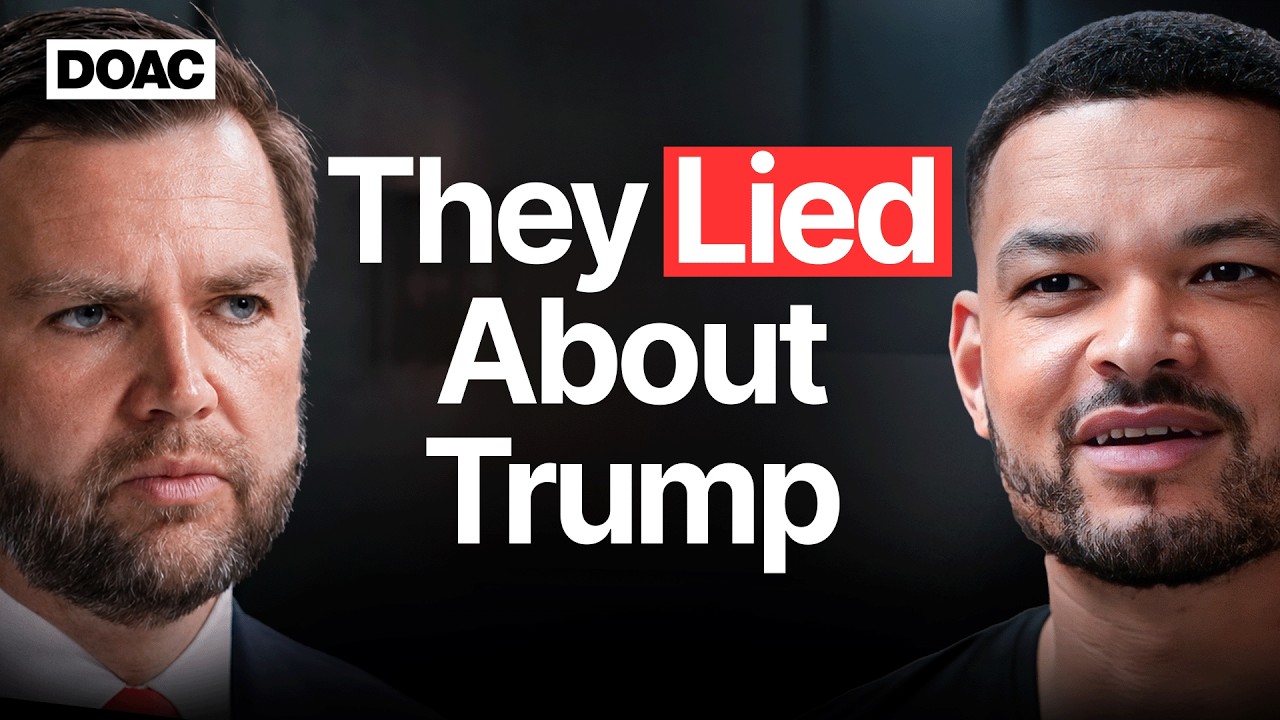
Vance Backs Sovereign AI Equity to Curb Wealth Inequality
The Diary Of A CEO
Vice President JD Vance argues that AI's primary risk is extreme wealth concentration rather than job loss, advocating for public equity stakes in major AI infrastructure.
## Background
This video was published on June 18, 2026, by Steven Bartlett on his YouTube channel, The Diary Of A CEO. According to the page description, US Vice President JD Vance discusses the inside story behind the Iran peace deal, his journey from an angry atheist to a baptized Christian, how his mother's opioid addiction shaped him, and Donald Trump's leadership style behind closed doors.
## TL;DR
In this extensive interview, Vice President JD Vance reflects on his political and personal evolution, detailing how his early childhood trauma and grandmother's guidance shaped his worldview. He addresses his past public criticisms of Donald Trump, explaining his shift from skeptic to Vice President, and outlines the diplomatic dynamic between the United States, Israel, and Iran. Vance also speaks candidly about the challenges his family faced adapting to Secret Service protection, his return to Christian faith, and his perspectives on the economic and social impacts of artificial intelligence.
## Atmosphere & style
The conversation carries a introspective, candid, and measured tone, blending deep political reflection with vulnerable personal storytelling. Steven Bartlett facilitates a grounded dialogue that encourages Vance to speak openly about his private struggles, family life, and shifting beliefs without falling into political posturing. The narrative arc moves fluidly between high-stakes global politics and intimate human moments, creating an engaging, reflective experience for the listener.
## Key takeaways
- [01:03:45](https://www.youtube.com/watch?v=5cKDs7bIGPE&t=3825s) Evaluating alliances like US-Israel relations through pragmatic shared interests rather than implicit trust allows for clear strategic communication between leaders.
- [01:03:51](https://www.youtube.com/watch?v=5cKDs7bIGPE&t=3831s) JD Vance considers his 2016 criticisms of Donald Trump wrong, attributing his shift in perspective to realizing broken institutions and military strategy needed non-traditional leadership.
- [01:07:17](https://www.youtube.com/watch?v=5cKDs7bIGPE&t=4037s) Behind closed doors, Trump proved to be warm, generous, and sharp, contrasting sharply with Vance's initial public assumptions during 2016.
- [01:09:40](https://www.youtube.com/watch?v=5cKDs7bIGPE&t=4180s) Vance missed the initial offer call from Trump to join the presidential ticket due to a flooded phone line after landing in Milwaukee.
- [01:13:01](https://www.youtube.com/watch?v=5cKDs7bIGPE&t=4381s) The sudden transition into Vice Presidential security bubbles created intense personal guilt for Vance regarding its disruptive impact on his introverted son.
- [01:18:43](https://www.youtube.com/watch?v=5cKDs7bIGPE&t=4723s) The constraints of Secret Service protection drastically altered Vance and his family's daily privacy and spontaneous travel routine.
- [01:22:18](https://www.youtube.com/watch?v=5cKDs7bIGPE&t=4938s) After leaving behind an evangelical upbringing for New Atheism during his youth, Vance returned to faith after growing disillusioned with elite obsession with prestige.
- [01:23:32](https://www.youtube.com/watch?v=5cKDs7bIGPE&t=5012s) Vance embraces adult baptism and prioritizes regular family church attendance, supported by his non-Christian wife Usha.
- [01:28:11](https://www.youtube.com/watch?v=5cKDs7bIGPE&t=5291s) Vance dismisses apocalyptic rhetoric around AI mass job loss as viral marketing, citing historical policy and trade choices rather than technology as the cause of manufacturing job loss.
- [01:32:01](https://www.youtube.com/watch?v=5cKDs7bIGPE&t=5521s) Wealth inequality and widespread surveillance pose far greater risks from AI advancement than immediate mass unemployment.
- [01:37:45](https://www.youtube.com/watch?v=5cKDs7bIGPE&t=5865s) Instead of relying on post-hoc wealth distribution handouts, Vance advocates for structural pre-distribution frameworks like labor unions to empower workers directly.
- [01:39:21](https://www.youtube.com/watch?v=5cKDs7bIGPE&t=5961s) Vance credits his late grandmother Mamaw with instilling humility, warning him never to look down on others or get too full of himself.
- [01:43:09](https://www.youtube.com/watch?v=5cKDs7bIGPE&t=6189s) Grounding his beliefs in non-materialist Christian faith, Vance remains open to unexplained phenomena and extraterrestrial life.
## Detailed walkthrough
### Immigration, Political Division, and the Trump Paradox
The conversation opens mid-stream with a blunt assessment of the Biden administration's immigration policy, described as having "really screwed up our immigration policy in a profoundly dangerous way." Host Steven Bartlett challenges this narrative by pointing out that while immigration may be a problem, political division seems to be the ultimate strategy. He quotes a past campaign line directed at the Black community—"What do you have to lose?"—and shares his personal perspective as a Black man who feels he does have a lot to lose. He expresses concern over a Western political narrative that paints brown people, such as Mexicans, as murderers and the root cause of everyday hardships, warning that this rhetoric easily fosters misplaced anger toward innocent neighbors.
JD Vance pushes back slightly, noting that politicians are often accused of saying things they never actually uttered or that lack proper context. Bartlett counters sharply, "You wouldn't say that." Vance acknowledges that he and Donald Trump possess very different personal styles, but insists that Trump is a fundamentally different human being behind the scenes than the caricature presented by mainstream media.
Bartlett immediately brings up the elephant in the room: a notorious 2016 private message between Vance and a roommate where Vance questioned whether Trump was a cynical figure or "America's Hitler." Bartlett asks the pivotal question: How do you bridge that gap and become Vice President to the very same person? Vance calls it a "crazy journey, man," explaining that his perspective shifted because he realized his initial assumptions were wrong. He thought Trump would be a failed president, and he thought America's institutional structures were fundamentally functioning—both of which turned out to be incorrect. Vance highlights Trump's profoundly unconventional approach to governance, arguing that it brings previously unimaginable outcomes onto the table, pointing to a real peace deal with Iran as a prime example.
* Key topics covered: The debate over immigration rhetoric, media portrayal versus reality of Donald Trump, Vance's famous 2016 private message ("America's Hitler"), and his evolving assessment of institutional stability.
* Notable dynamics: A tense and direct line of questioning from Bartlett regarding personal political evolution and past criticisms of Trump.
---
Early Childhood Context and the Revolving Door of Father Figures
Shifting gears from contemporary politics to personal history, Bartlett pulls out Vance's memoir, reading a striking passage: *"Of all the things that I hated about my childhood, nothing compared to the revolving door of father figures. I hated the disruption, and I hated how often these boyfriends would walk out of my life just as I began to like them."* Bartlett explains that understanding someone in front of him requires digging into their earliest foundations.
Vance takes listeners back to his upbringing in a working-class Ohio town, describing a family struggling to adapt to middle-class life. He reflects on photographs of his grandfather, who had a modest high school education, and his grandmother, who dropped out of school at just 13. Vance's biological father put him up for adoption, leading to a legal adoption around age five or six by Robert Hamill, who remained in the picture roughly from age seven until ten or eleven before disappearing completely by the time Vance was 12.
The instability was compounded by multiple marriages and relationships. Vance's older sister Lindsey had a different father (the first husband), his biological father was number two, and his adoptive legal father was number three. More relationships followed quickly, including a man named Matt whom Vance knew around age 13 or 14. Vance describes living with his mother and Matt during his teenage years as "a front row seat to the end of the world," characterized by chaotic rows, screaming, and flying plates.
* Concrete facts & names:
* Adoptive legal father: Robert Hamill (present from roughly age 7 to 10 or 11).
* Sister: Lindsey (five or six years older).
* Stepfather/partner: Matt (present around age 13/14).
* Verbatim reference: *"A front row seat to the end of the world."*
---
Childhood Trauma, The Role of Papaw and Mamaw, and Addiction
Vance reflects on how this chronic instability created an internal psychological barrier, making it difficult to attach to people because he always anticipated they would leave. He shares an insight from a child psychologist he met at a conference, who noted that children from chaotic or traumatic backgrounds who manage to succeed almost always have one stabilizing anchor—whether a teacher, social worker, or grandparent.
For Vance, that anchor was his grandmother ("Mamaw"). While boys need positive male role models, his grandmother served as both a mother and a father figure. He shares a striking anecdote: when he was 12 or 13, he started hanging out with a neighborhood kid who was sliding into drug use. Upon finding out, his grandmother gave him a fierce ultimatum, threatening to run the boy over with her car and promising, *"JD, I promise you, and no one will ever find out about it."* Vance notes that it was through this sheer, unorthodox toughness and willpower that she kept him on the straight and narrow.
Meanwhile, the family was ravaged by addiction. Vance's grandfather ("Papaw") had been his mother's safe place and anchor. When Papaw died, his mother's substance abuse—escalating from prescription drugs all the way to heroin—spiraled severely out of control, nearly bankrupting his grandparents through various attempts to save her. In a deeply emotional note of redemption, Vance shares that his mother has now been clean and sober for 11 years.
* Key figures and timelines:
* Mamaw (grandmother): Tough-love anchor who kept Vance out of trouble.
* Papaw (grandfather): Died when Vance was 13; his death accelerated the mother's addiction decline.
* Mother's sobriety milestone: Clean and sober for 11 years at the time of the conversation.
* Verbatim quote: *"JD, I promise you, and no one will ever find out about it."*
---
How Formative Trauma Shapes Adult Life and Marriage
Bartlett bridges Vance's past to his present life, asking how his wife would describe the ways these formative years shaped him, keeping in mind the psychological premise that a person's dark and light sides are fundamentally interconnected.
Vance admits candidly that on the dark side, his upbringing bred an extraordinary mistrust of people he doesn't know well, alongside an underlying anxiety that circumstances are always on the verge of falling apart. Even in his exceptionally happy 12-year marriage, where he and his wife are best friends and their kids are healthy and thriving, invasive catastrophic thoughts frequently surface—such as looking out the window when his wife takes the kids to the grocery store and immediately fearing a head-on collision with a drunk driver.
Conversely, the bright side of witnessing human behavior at both its absolute worst and best is that Vance retains an intrinsic capacity for empathy. Having lived through severe instability, he assumes the best about human beings at their core and possesses a high empathy quotient that helps him understand what makes people tick. He concludes by recalling how, in the early days of their relationship before marriage, any heated argument would instantly trigger his default defense mechanism: *"Okay, well, fine. Let's just break up."*
* Core themes: The duality of trauma—pairing deep-seated anxiety and catastrophic thinking with profound empathy and resilience.
* Verbatim quote: *"Okay, well, fine. Let's just break up."*
By the way, to unlock the full functionality of all Apps, enable [Gemini Apps Activity](https://myactivity.google.com/product/gemini).
[14:08](https://www.youtube.com/watch?v=5cKDs7bIGPE&t=848s) Dynamics in Relationships and Deciding Against Therapy
J.D. Vance reflects on the early days of his relationship with his wife, Usha, illustrating how his defensive, conflict-prone nature contrasted sharply with her calm, rational approach. Coming from an environment where arguments were volatile, Vance initially found it disorienting when Usha proposed discussing issues calmly rather than breaking up. He credits self-awareness and years of growth for transforming their connection into a stable partnership today.
When asked if they sought couples therapy to navigate his avoidant attachment style and initial hesitation toward commitment, Vance reveals he never underwent couples therapy and only attempted individual therapy briefly. He found opening up to a stranger deeply uncomfortable, but his primary issue was philosophical: he felt the process leaned too heavily into self-referential blaming of parents, trauma, or past circumstances, which felt like relinquishing personal agency. Instead, the couple worked through their differences internally. Vance notes that Usha—the child of South Asian immigrants raised in a stable, middle-class household in San Diego—brought remarkably healthy relationship habits to their marriage, providing a solid foundation for them both.
[16:18](https://www.youtube.com/watch?v=5cKDs7bIGPE&t=978s) Empathy, Political Rhetoric, and Viewing Opponents
Transitioning to politics, host Steven Bartlett asks how Vance reconciles his personal emphasis on empathy with the harsh realities of modern political campaigns, referencing his and Donald Trump's rhetoric against opponents like Kamala Harris. Vance explains that while he does not claim to fully understand Harris on a personal level, he rejects the idea of harboring genuine animosity or cynicism toward political rivals. His baseline view is that most human beings are fundamentally good; when people make decisions he disagrees with, he attributes it to mistakes or misjudgements rather than inherent malice.
Vance acknowledges that campaign politics naturally functions like a product pitch, requiring candidates to highlight the faults and failures of their opponents' policies. While he admits that certain political figures genuinely hate their opposition, he insists that approach isn't his style. He draws a firm line between fiercely criticizing disastrous policies—such as the Biden-Harris administration's handling of the U.S. southern border—and hating the individuals implementing them.
Addressing public perception surrounding Donald Trump's provocative rhetoric on immigration and minority communities, Vance argues that media outlets and social media clips often strip context from the former president's statements. Recalling his initial reaction in 2015 to Trump's controversial remarks about "rapists and murderers," Vance explains that a closer look revealed Trump was referring to foreign governments actively encouraging criminals and prisoners to migrate to the United States—not asserting that every immigrant was a criminal.
While acknowledging that he and Trump possess vastly different communication styles, Vance emphasizes that they remain aligned on the substance of immigration policy. He uses a dinner party analogy to explain his perspective on national capacity:
> "It's like if I have a bunch of people over to my house for dinner and I invite 10 people to come over for dinner and one of them brings a stranger, that's probably going to be fun, right? But if like every single one of them bring three strangers, it's going to totally change the character of the conversation that you're going to have..."
- **Total U.S. Population:** Vance references the country's population of 330 million people to illustrate how sheer numbers dictate social dynamics and integration capacity.
- **Underlying Principle:** Vance maintains that while the overwhelming majority of people entering the country are decent, rapid demographic shifts without boundaries inevitably strain the host society.
[23:04](https://www.youtube.com/watch?v=5cKDs7bIGPE&t=1384s) Immigration Speed, Community Integration, and Cultural Friction
The conversation turns to the societal tension and division surrounding immigration across the Western world. Bartlett shares his personal experience as a Black child moving into a predominantly white neighborhood in the UK, where his family faced occasional racial slurs. Vance condemns such behavior, asserting that children should never experience that kind of hostility. However, he counters the narrative that political leaders are the primary drivers of societal division. Rather than politicians inventing hate, Vance argues that division is the natural consequence of population changes occurring too fast for proper community integration.
Drawing on memories from his own upbringing in Middletown, Ohio, Vance shares a story about his grandmother (Mamaw). Despite her traditional, non-progressive views on race, she deeply respected their Black neighbor—a local preacher—saying "he has a good heart," which was her highest compliment. Vance notes that hostility in communities often stems not from bigotry toward individuals, but from rapid neighborhoods shifts where newcomers bring different cultural norms or language barriers.
Vance defends the right of citizens to want a shared culture and language, pushing back on accusations of racism:
> "It's actually okay if you're an American, an English native speaker—it's actually okay for you to want the person who moves in next to you to speak English. Not because you're a racist or a xenophobe, but because you want to be able to talk to the person you share a community with."
- **Conditions for Successful Integration:** Vance emphasizes that integration must be gradual and managed carefully—10 newcomers entering a neighborhood can be absorbed smoothly, whereas 100 arriving at once creates strain.
- **Economic Context:** Rapid immigration causes far greater friction when local residents are already experiencing economic distress or job insecurity, making economic stability a prerequisite for welcoming newcomers.
[28:22](https://www.youtube.com/watch?v=5cKDs7bIGPE&t=1702s) Political Messaging, Rapid Change, and Immigration
The conversation opens with a discussion on the social friction and division caused by rapid demographic and cultural shifts. The host questions whether political leaders exacerbate neighborly tension by pointing fingers at immigrants when everyday life becomes difficult, warning that scapegoating leads directly into dangerous culture wars. JD Vance responds that his anger is directed squarely at the political system—not at individual illegal immigrants who come seeking a better life for their families and may not even realize they are breaking laws.
Vance explains that humans naturally seek community with those with whom they share common ground. Using a culinary metaphor, he notes that while "a little bit of spice is good, too much spice changes the dynamic." He argues that while most people can adapt to change, change occurring too quickly in an immigration context creates deep societal instability—a challenge currently facing the US, the UK, and Europe.
* "I'm not mad at the illegal alien who broke our laws and came into the country... What I am mad at is the political system that encourages people to break those rules."
* "A little bit of spice is good. Too much spice changes the dynamic a little bit."
---
[30:56](https://www.youtube.com/watch?v=5cKDs7bIGPE&t=1856s) Patriotic Devotion and the Boundary of Migration
The host poses a hypothetical scenario: if America were facing a economic catastrophe and Mexico were flourishing, would Vance cross the border without a visa to protect and provide for his family? Vance candidly answers that he doesn't think he would, drawing a sharp distinction between basic economic migration and a deeper, non-transactional attachment to one's homeland.
Vance references a poll from his youth showing that over 70% of young Americans expressed a willingness to die for their country if necessary, compared to just 20% to 35% in most Western European nations. He describes a profound, emotional connection to the physical landscape of America—specifically praising the green, life-filled mountains and rivers of Eastern Kentucky and West Virginia. While acknowledging that his own grandparents migrated from Eastern Kentucky to Southern Ohio for job opportunities, Vance notes that extreme life-or-death coercion (such as someone holding a gun to his family) is very different from standard economic migration.
```
+-------------------------------------------------------------+
| NATIONAL PATRIOTIC DEVOTION |
| (Percentage of young people willing to die for country) |
+-------------------------------------------------------------+
| United States | [====================] ~70% |
| European/Western Nations| [========] 20% - 35% |
+-------------------------------------------------------------+
```
* "I love this place in a way that is totally independent of the economic opportunities it provides to my children. There's something much deeper."
* "If somebody showed up to my home in Cincinnati and pointed a gun at my head and said, 'You have to leave or we're going to kill your children,' I'd leave, right? But I think most migration decisions are not actually that extreme."
---
[34:07](https://www.youtube.com/watch?v=5cKDs7bIGPE&t=2047s) Joining the Marines and the World War II Legacy
Vance reflects on his decision to enlist in the United States Marine Corps in 2003 right after high school. He recalls a poignant moment standing outside a Skyline Chili restaurant in Southwestern Ohio, where he met an elderly World War II veteran wearing a "red hatter" cap. Shaking the man's hand and realizing that generation was fading away, Vance felt a deep calling that his own generation needed to step up following the September 11 attacks.
Driven by family tradition—his older cousins were Marines—and a desire to serve in what was perceived as the toughest branch, Vance enlisted on an "open contract," allowing the military to assign him whatever role was needed. He served in the Marine Corps from 2003 onwards, including a deployment to Iraq from 2005 to 2006.
* Enlisted in 2003 on an **open contract** with no pre-assigned job path.
* Deployed to **Iraq** between 2005 and 2006 during a turbulent period of the conflict.
* Inspired by post-9/11 patriotism and personal interactions with World War II veterans in Ohio.
---
[37:06](https://www.youtube.com/watch?v=5cKDs7bIGPE&t=2226s) The Broken Social Contract and the Iraq War
Reflecting on his military service, Vance voices deep lingering frustration with President George W. Bush and the political leadership of that era. He argues that politicians manipulated the nation's "patriotic reservoir" by drawing false historical parallels, such as framing Saddam Hussein as Adolf Hitler and the Iraq War as an existential threat akin to World War II.
Vance contends that when political leaders misuse patriotism or mislead the public—whether intentionally or through bad intelligence—they drain the foundational trust between citizens and the state. He predicts that the percentage of young Americans willing to die for their country in 2026 is significantly lower than it was in 2003, precisely because that social contract was broken.
* "That patriotic reservoir... is a very valuable thing... but statesmen must only tap into it when it's really necessary and justified."
* "If you ask somebody to do something and it turns out you were lying to them... you draw down that patriotic reservoir."
---
[41:42](https://www.youtube.com/watch?v=5cKDs7bIGPE&t=2502s) The War with Iran and Escalation Dynamics
The discussion shifts to current foreign policy and recent military actions concerning Iran. Vance highlights that the US and Iran have just announced a cease-fire and peace agreement the previous day, bringing a swift pause to hostilities. The host brings up insights from academic Robert Pape regarding how the fundamental psychology and political dynamics of war instantly shift on both sides the moment bombs begin falling.
* A newly reached cease-fire and peace term sheet was announced with Iran just prior to recording.
* Discussion centers on the unpredictable political and psychological escalations that occur once active bombardment starts.
[42:43](https://www.youtube.com/watch?v=5cKDs7bIGPE&t=2563s) The Aftermath of Strikes and the "Forever War" Question
Steven Bartlett questions the trajectory of the military intervention in Iran, recalling early expectations that the local population might rise up after Supreme Leader Ali Khamenei was taken out. Instead, the country appeared to fracture into localized pockets of militia and military force. Citing comments from Defense Secretary Pete Hegseth about the slow flow of communications to remote outposts, Bartlett points out that both President Donald Trump and JD Vance had publicly acknowledged not knowing who they were negotiating with after eliminating top-tier Iranian leadership. With falling home approval ratings, a changing landscape on the ground, and unintended consequences mounting, Bartlett asks directly whether this has become another "forever war."
Vance firmly rejects the "forever war" label. He emphasizes that Trump did not merely learn the mistakes of the Iraq War after the fact—he had publicly criticized the invasion of Iraq back when it occurred. Vance notes that as an insider observing Trump’s deliberations, he never feared a multi-year, endless expedition because the administration explicitly set out to define narrow objectives, execute them, and evaluate the results.
While a street uprising was considered a potential best-case scenario, the core strategic target was degrading Iran's conventional military capability so that whoever held power no longer had a "loaded gun" pointed at the West.
```
• Core Strategic Goal: Strip Iran of its conventional military threat rather than relying solely on regime change.
• Command Fractures: Iran's leadership structure initially fragmented across three key poles:
1. Political Pole (President, Foreign Minister, Speaker of Parliament)
2. Clerical Pole (Supreme Leader and top religious authority)
3. Military Pole (Islamic Revolutionary Guard Corps / IRGC)
```
[45:16](https://www.youtube.com/watch?v=5cKDs7bIGPE&t=2716s) Diplomatic Realignment and Trump's Non-Conventional Strategy
By mid-June, Vance explains, the initial confusion surrounding Iranian power dynamics had stabilized. The three competing factions within Iran coalesced around a shared realization: after 47 years of standard posture toward the United States, their existing approach was no longer viable. The Iranian delegation communicated a willingness to make long-term commitments never to develop nuclear weapons, provided they could secure a completely restructured economic arrangement with the West.
Vance argues that Trump’s approach to foreign policy is fundamentally non-conventional. He notes that Trump is willing to put deals on the table that would have been unthinkable under previous Democratic or Republican administrations. Trump’s message to Tehran was straightforward: if Iran gives up its nuclear ambitions, the U.S. will lift sanctions and allow the country to prosper economically. Vance remarks lightheartedly that Trump despises "insider books" written by advisors sharing confidential details, but if he ever wrote one, it would highlight how Trump's willingness to ignore past diplomatic rules creates entirely new possibilities.
> "When Donald Trump says to the Iranians, 'We want you to be a successful country. If you give us what we need on nuclear, we'll take the sanctions off your country and allow you to prosper.' That would have been unthinkable 10 years ago... but it's thinkable because Donald Trump is just like, 'No. The way things worked in the past are dumb. We're going to do something new.'"
[48:54](https://www.youtube.com/watch?v=5cKDs7bIGPE&t=2934s) The Strait of Hormuz and Energy Markets
Addressing the major economic tension of the conflict, Bartlett brings up the Strait of Hormuz, calling it a powerful weapon that Iran used to disrupt global energy markets and raise gas prices worldwide. Vance dismisses media claims that the White House was caught off guard by the blockade, explaining that Iranian retaliation in the Strait was a central variable in their initial planning.
The White House anticipated that Iran would attempt to shut down the Strait for Western shipping while keeping it open for their own traffic. However, the U.S. counter-blockade neutralized that asymmetrical advantage. While Brent Crude oil temporarily spiked to $126 per barrel, it quickly fell back to around $82 per barrel as global markets recognized the disruption was short-term. Vance highlights underreported data showing that while Western oil flow through the Strait was near zero around April 1st, significant traffic resumed by late May and early June, steadily eroding Iran's primary economic leverage point.
```
• Brent Crude Peak: Reached $126/barrel at the height of the crisis before dropping to ~$82/barrel by mid-June.
• Timeline of Oil Flow Recovery: Near zero barrels through the Strait on April 1st; millions of barrels per day restored by late May/early June.
• Long-Term Regime Outlook: Iranian leadership realized stalling for 2.5 years until the end of Trump's term would risk reducing Iran to a "Libya-style rump state."
```
[52:38](https://www.youtube.com/watch?v=5cKDs7bIGPE&t=3158s) Negotiating the Term Sheet and Securing Nuclear Material
Bartlett expresses skepticism about claims of an impending deal, pointing out that previous reports, foreign trips, and public declarations over preceding weeks had failed to yield a final agreement. Vance clarifies that this negotiation is different because both sides have officially agreed to a preliminary term sheet, which is currently being drafted into a formal contract.
Under the agreed term sheet, Iran agrees to cease firing drones and missiles at commercial shipping and cooperate in de-mining operations, allowing naval blockades to be lifted and normal traffic in the Strait of Hormuz to resume. In return for a 60-page stack of crippling U.S. economic sanctions being removed, Iran agrees to permanently give up its highly enriched nuclear material and submit to a comprehensive, verifiable international inspection regime. Addressing the status of nuclear material buried deep underground by American bunker-buster bombs, Vance confirms that the agreement mandates joint cooperation between Iranian authorities, American personnel, and the International Atomic Energy Agency (IAEA) to retrieve and destroy the remaining material.
```
• Key Term Sheet Provisions:
1. Immediate de-escalation in the Strait of Hormuz, including de-mining and lifting naval blockades.
2. Complete surrender and destruction of all highly enriched nuclear material.
3. Long-term, verifiable inspections by the International Atomic Energy Agency (IAEA).
4. Phased dismantling of the 60-page U.S. sanction stack to reintegrate Iran into the global economy.
```
[57:00](https://www.youtube.com/watch?v=5cKDs7bIGPE&t=3420s) Verification and Details of the Iran Term Sheet
Regarding the proposed Iran peace deal, host Steven Bartlett asks how the United States can verify that Iran will not simply "go to a different mountain and building new nuclear weapons." Vice President JD Vance responds that while the specific mechanics of the checks have not been fully defined yet—confirming it is currently a term sheet based on broad agreement on principles—the U.S. possesses an exceptional level of intelligence within the country. "We have a very good sense of what's going on in the country of Iran," Vance notes, hinting at deep intelligence capabilities. The ultimate goal is not to permanently bury the material, but to establish a fundamentally transformed economic and diplomatic relationship between Iran and the West. If the deal falls through, Vance asserts that the United States is "no worse off."
Bartlett summarizes the core tenets of the current term sheet: open nuclear inspections, a coalition to remove nuclear waste, the lifting of economic sanctions, and an opportunity for Iran to fully participate in the global economy. Vance confirms this summary is correct, adding that the agreement also hinges on a "permanent cessation of hostilities" designed to usher in a broader regional era of peace.
[58:11](https://www.youtube.com/watch?v=5cKDs7bIGPE&t=3491s) Tensions with Netanyahu and the Realities of US-Israel Relations
The conversation shifts to recent friction between Donald Trump and Israeli Prime Minister Benjamin Netanyahu. Bartlett brings up reports from the previous day involving a Fox reporter, noting that Netanyahu had "started flat-firing some bombs" just an hour before the deal was supposed to be signed. Trump reportedly called Netanyahu, expressing immense frustration and using "select words, kind of like your grandmother's words." According to the reports, Trump told Netanyahu he had "no judgment," questioned why he had to launch an attack at that moment, called him a "very difficult guy," and stated that Israel should be thankful because "if Iran had a nuclear weapon, Israel wouldn't be around for 2 hours."
When asked about the relationship, Vance emphasizes that the United States and Israel are "different countries with different interests." While acknowledging Israel is a good partner, he rejects the common narrative that the two nations are always fundamentally aligned due to their differing needs and geographies. When Bartlett directly asks, "Do you trust them?", Vance responds candidly: "You know, I don't trust anybody." He explains that in international affairs and diplomacy, he evaluates capabilities and shared interests rather than relying on blind trust. Vance defends Trump's blunt approach, explaining that as the world's superpower and Israel's most important ally, the U.S. president must sometimes have "very frank" and direct conversations with the Israeli Prime Minister to accomplish American objectives.
[01:00:13](https://www.youtube.com/watch?v=5cKDs7bIGPE&t=3613s) The Dynamics of the US-Israel Alliance
Bartlett observes that public scrutiny over the US-Israel relationship has spiked dramatically over the past 6 to 12 months, with many questioning who the "dominant partner" truly is. Vance provides a foundational breakdown of the alliance, highlighting that Israel is a highly advanced economy of 9 million people that generates a disproportionate share of global inventions and possesses world-class intelligence collection. While the two nations shared massive alignment in the early 2000s against Islamic radical terrorism, Vance points out that even then, their priorities differed: the Israelis were laser-focused on Iran, whereas the U.S. was primarily worried about Al-Qaeda.
Vance firmly establishes the hierarchy of the alliance based on his observations of Trump in office: "I feel quite confident that, you know, they are the junior partner, we're the senior partner, we're the world superpower. That's the way that it works." He compares it to the U.S. relationship with the United Kingdom—which he calls America's "closest" and "oldest" ally. Vance admits he does not fully trust the UK either, noting it is simply the nature of foreign policy, though he expresses an "incredible fondness" for British culture and maintains a good working relationship even with the politically misaligned Labour government.
When pressed on what Netanyahu ultimately wants amid claims from some experts that Israel wishes to run the entire Middle East, Vance states, "I don't know. I don't know... I can't get inside somebody's head." However, he clarifies that while some factions in Israeli society might want to see Iran decimated into a failed state like Libya, a "Persian Libya" with 90 million people would be disastrous for the United States. Therefore, the Trump administration remains focused exclusively on eliminating the nuclear threat and stabilizing the region.
[01:03:51](https://www.youtube.com/watch?v=5cKDs7bIGPE&t=3831s) "Cultural Heroin": Accounting for Past Criticisms of Trump
The interview transitions to Vance's personal political journey. Bartlett quotes a highly critical op-ed Vance wrote for *The Atlantic* during the 2016 presidential campaign, in which Vance referred to Trump as "cultural heroin" offering an "easy escape from pain" to the struggling working class. In the excerpt, Vance wrote that Trump promised simple solutions to complex problems—such as curing the opioid epidemic by building a Mexican wall, punishing offshore companies to bring back jobs, and using indiscriminate bombing to avoid military defeat. The 2016 article concluded that Trump made people feel better temporarily but could not fix what truly ailed them.
Vance nods as the quote is read, calling it a "long time ago" but acknowledging the need to admit when you are wrong. He zeroes in on his past claim that "no credible military leader has endorsed his plan," stating he feels "almost embarrassed" reading it now because it was "so obviously absurd." Vance explains that Trump's misalignment with the military leadership of 2016 was actually a virtue. He points out that from the early 1990s until 2016, "America hadn't won a war in 30 years," proving that Trump's deep mistrust of the established military architecture was correct. Trump recognized that American institutions had become broken and sclerotic, acting as a "weapon to break down those institutions."
[01:06:37](https://www.youtube.com/watch?v=5cKDs7bIGPE&t=3997s) The Journey from Critic to Vice President
Bartlett pushes further, pointing out that Vance's 2016 views closely mirrored current Democratic criticisms, bringing up a leaked private text message to a former law school roommate where Vance wondered if Trump was a cynical asshole or "America's Hitler." Bartlett asks how one goes from that position to becoming the man's Vice President. Vance laughs and calls it a "crazy journey," explaining that his perspective shifted entirely because his baseline assumptions turned out to be wrong: he predicted Trump would be a failed president, but he was not; he believed American institutions were functioning, but they were broken; and he assumed institutional "experts" were inherently wise, which they proved not to be.
Vance notes that his political evolution happened purely from the outside looking in, well before he developed a personal relationship with Trump or voted for him in 2020. However, gaining insider access during the 2024 campaign revealed a completely different, multi-dimensional human being than the one portrayed by the media. Behind closed doors in the Oval Office, Vance describes Trump as incredibly warm, generous, and deeply dedicated to his children and grandchildren. He shares an aside about Trump's obsession with hospitality, noting that Trump cannot let a visitor leave without handing them a gift, whether it is a MAGA hat, a water bottle, a coin, or a pin. Furthermore, Vance dismisses the 2016 media narrative that Trump lacks intelligence, asserting that Trump has a remarkably high IQ, reads constantly, and possesses an instinctual understanding of human nature that places him "either near the top or at the top" compared to all other U.S. presidents.
[01:09:40](https://www.youtube.com/watch?v=5cKDs7bIGPE&t=4180s) The Call to the Ticket
By 2022, Trump endorsed Vance in his successful run for the U.S. Senate in Ohio. Vance recalls becoming very close with Trump over the subsequent year, noting that he was one of the very first senators to endorse Trump's re-election bid early in 2023. At the time, conventional political wisdom dictated that Trump could not even win the Republican nomination and that his political career was effectively over. Vance's early loyalty cemented a close bond between them, leading to frequent late-night phone calls and meetings where they regularly debated policy positions and discussed upcoming legislation.
[01:10:23](https://www.youtube.com/watch?v=5cKDs7bIGPE&t=4223s) The VP Nomination Call and Missing Trump's Phone Call
JD Vance reflects on how his working relationship with Donald Trump originally took root. While serving in the U.S. Senate, the two bonded closely after working together on the response to the tragic train derailment in East Palestine, Ohio. Over time, that professional collaboration evolved into a strong personal relationship where Vance viewed Trump as a central figure and mentor in his political life. As the 2024 presidential campaign heated up, widespread media speculation linked Vance to the running mate slot, but the two never actually discussed the possibility directly until just a day or two before the final decision. In fact, Vance had an in-person meeting with Trump on the very morning of the Butler, Pennsylvania rally where Trump survived an assassination attempt. Two days later, Vance officially received the offer to join the Republican ticket.
The moment Vance was selected played out with a touch of comedic chaos. Having just landed in Milwaukee for the Republican National Convention, Vance had no definitive word on his selection, though he knew the delegate nomination deadline was looming just hours away at 3:00 or 4:00 PM. At around 11:00 AM, his phone didn't even ring due to the flood of incoming calls, causing a direct call from Donald Trump to go straight to voicemail. Moments later, Vance received a text message from a friend—who later became the White House Chief of Staff—warning him that he had just missed an extremely important call. When Vance quickly called back and greeted him with "What's up, Mr. President?", Trump teased him in typical fashion, saying, "J.D., you have just missed a very important phone call. I'm going to have to pick somebody else now," before officially inviting him onto the ticket.
* Vance and Trump grew close while addressing the toxic train derailment in East Palestine, Ohio.
* Their first direct discussion about the vice presidency took place in person the morning of Trump's Butler, Pennsylvania rally.
* Vance missed Trump's initial selection call because his phone went straight to voicemail amid a flood of incoming calls.
* Current White House Chief of Staff texted Vance to alert him that he had just missed the President's call.
* The formal delegate nomination at the RNC in Milwaukee had a strict deadline around 3:00 or 4:00 PM on Monday.
---
[01:13:01](https://www.youtube.com/watch?v=5cKDs7bIGPE&t=4381s) The Reality of High-Level Security and Impact on Family
Entering the highest levels of American government brought immediate lifestyle shocks that Vance felt completely unprepared for. When Steven Bartlett mentions arriving at the studio and passing through heavy security featuring roughly 50 armed personnel and thorough building sweeps, Vance candidly admits that he had no idea what he was truly signing up for beyond his desire to serve at the highest level. While he was accustomed to political life as a U.S. Senator and ready for the intense six-month campaign grind, the sudden reality of around-the-clock Secret Service protection transformed his family's everyday existence in an instant.
The immediate transition occurred in their Milwaukee hotel room. While Vance was casually chatting with his son about Pokémon cards and unpacking suitcases, a knock at the door signaled that Secret Service agents were instantly placing the entire family inside a tight protective bubble and relocating them to Donald Trump's hotel. The sudden disruption created deep personal guilt for Vance regarding his oldest son, who was nine years old at the time. Unlike his extroverted six-year-old brother who thrived on the excitement, the introverted nine-year-old hated the extra attention, disliked being treated differently at school, and simply longed for everyone to go back to treating them normally. In his book *Communion: Finding My Way Back to Faith*, Vance wrote on page 198 that he felt like he had "ruined his life without even asking him."
* Bartlett describes passing heavy security, pat-downs, and armed agents posted in hallways and basements to reach the interview.
* Vance was unpacking suitcases and discussing Pokémon cards with his son when Secret Service agents arrived to take over their protection.
* The family was immediately moved to Donald Trump's hotel in Milwaukee to maintain a single protective bubble.
* Vance's nine-year-old son, an introvert, struggled with being treated differently at school and explicitly asked to go back to their old normal life.
* Turning to friend Charlie Kirk for advice helped Vance learn to acknowledge the sacrifice made by his son without minimizing it, while emphasizing positive aspects like traveling the world and residing at the Naval Observatory in Washington, D.C.
* After four or five months of adjustment, Vance's son admitted that living in the Vice President's house was "actually pretty good."
---
[01:18:43](https://www.youtube.com/watch?v=5cKDs7bIGPE&t=4723s) Courtship with Usha and Secret Service Constraints
Reflecting on a photo taken during his early relationship with his wife, Usha, Vance reminisces about their courtship in 2011. The photo shows them on an observation deck along the High Line in Lower Manhattan during the weekend he first met her mother. At the time, Vance was working as a research assistant in New Haven, Connecticut, and taking an hour-and-a-half train into New York City whenever possible. Coming from a rural background, Vance found navigating New York City, buying subway cards, and riding the train completely intimidating, but his infatuation with Usha drove him to visit every chance he got as they explored the city together as a young couple.
When asked what surprised Usha most about his ascension to Vice President, Vance notes that she is rarely surprised by anything, but adjusting to constant Secret Service protocols proved to be a major shift. He describes a favorite personal pastime—taking quiet, two-hour walks alone with Usha to unwind, whether in a countryside setting or a bustling city. He recalls a trip to Rome for the inaugural mass of the new American Pope, where trying to take a simple walk felt like "SEAL Team 6 had just descended upon Rome," complete with closed traffic intersections and overhead helicopters. While statutory prohibitions require the Secret Service to maintain strict legal obligations for his safety, Vance explains that they have since learned to work together with their security detail to find comfortable routines without constantly disrupting public life.
* Vance and Usha began dating in March 2011 while he was a student/research assistant in New Haven and she was in New York City.
* The featured photo was taken on the High Line in Lower Manhattan during the weekend Vance met Usha's mother.
* Vance admits he was initially intimidated by New York City and didn't even know how to purchase a subway card.
* During a trip to Rome for the Pope's inaugural mass, simple attempts to go for a walk required shutting down intersections and flying helicopters overhead.
* Federal statutes legally obligate the Secret Service to maintain strict protective standards over the Vice President.
---
[01:22:18](https://www.youtube.com/watch?v=5cKDs7bIGPE&t=4938s) Losing and Finding Faith: From Evangelical Roots to Atheism
Vance opens up about the spiritual evolution detailed in his book, *Communion: Finding My Way Back to Faith*, tracing his journey from an evangelical childhood to secularism in his twenties. He grew up in a deeply conservative, evangelical environment anchored by his grandmother ("Memaw"), who read her Bible and prayed five or six times every day. However, his family belonged to what he terms the "unchurched"—their religious exposure came primarily through televangelists, Billy Graham revival broadcasts, and sporadic church visits with his mother, father, or grandmother, rather than active membership in a local congregation.
As Vance entered his early twenties, he felt his childhood faith losing its relevance to his daily life. A growing influence of the "new atheist" movement took hold, leading him to naively assume he possessed greater intellectual sophistication than the religious "bumpkins" who had raised him. This intellectual distance, combined with the lack of a structured church community, caused him to abandon his faith entirely throughout his twenties and early thirties before eventually seeking a path back.
* Vance's new book is titled *Communion: Finding My Way Back to Faith*.
* His grandmother ("Memaw") was devoutly religious, reading the Bible and praying 5–6 times daily.
* The family was largely "unchurched," consuming religion via televangelist broadcasts and Billy Graham specials rather than regular church attendance.
* Vance embraced atheism in his early twenties, influenced in part by the cultural wave of "new atheism."
Here is a detailed, faithful walkthrough of this section of the transcript, capturing the arguments, context, and tone of the conversation.
[01:23:32](https://www.youtube.com/watch?v=5cKDs7bIGPE&t=5012s) The Return to Faith and Overcoming Intellectual Arrogance
Reflecting on his path away from religion during his youth, JD Vance describes how his early loss of faith stemmed from a mix of "intellectual arrogance" and a lack of grounding. As a college-educated young man, he had adopted the mindset that his grandmother's faith was merely "superstition" and believed he knew things others did not. Although he had genuinely believed in Christianity as a teenager, it existed quietly in the background without real practical application. When he confronted the broader world, he found himself ill-equipped to integrate his faith into his new environment, ultimately sliding into an "angry atheist" phase where he sought to debate religious individuals and pretend he was smarter than everyone else.
Looking back, Vance identifies a core personal flaw that drove this phase: an intense, unyielding desire to "rise above." While this impulse originated from a healthy place—a desire for stability, a reliable income, and a safe home for his future children that he never had growing up—it mutated into an unhealthy obsession with credentials, prestigious institutions, and earning power. New Atheism provided the perfect philosophical framework for a young man driven purely by ambition. By his late 20s, he had achieved every goal on paper: he was attending Yale Law School, everyone viewed him as exceptionally intelligent, and he was dating a wonderful woman. However, he realized he was fundamentally unhappy and was not behaving like a good person. He acknowledges that he was a chaotic and difficult boyfriend who would threaten to break up every couple of months or disappear for days after an argument, prioritizing his academic resume over how he treated the woman he loved.
This crisis led Vance to re-evaluate what truly mattered. Observing the people he genuinely admired, he noticed that those who displayed real virtue and strength of character under tough circumstances were committed Christians. Their faith motivated them not to chase status, but to treat others well and build personal integrity. Seeing these "rays of sunshine" convinced him that Christianity held a truth he had previously dismissed. His return to faith started as an intellectual journey, grew into an emotional and daily practice, and eventually led to his baptism as an adult. Today, Vance requires his family to attend church every week—noting with humor that his wife, Usha, is not Christian but remains "remarkably patient" about taking their three children to services every Sunday.
- Vance summarizes his youthful worldview: "I know things that other people don't."
- He credits his wife's patience as he leads his family to church every week despite their different religious backgrounds.
- Podcast host Steven Bartlett notes that he considers himself agnostic because asserting absolute knowledge, even as an atheist, feels arrogant.
[01:28:11](https://www.youtube.com/watch?v=5cKDs7bIGPE&t=5291s) AI, Job Disruption, and the Rhetoric of Tech CEOs
The conversation shifts to the societal and economic impact of artificial intelligence. Host Steven Bartlett references public anxiety surrounding AI, comparing its current unpopularity in the U.S. to that of Immigration and Customs Enforcement (ICE). Bartlett points out how top tech executives like Sam Altman and Elon Musk often paint dystopian visions of AI's future, noting that former Google CEO Eric Schmidt was recently booed every time he uttered the word "AI" during a university commencement address.
Vance addresses whether he fears widespread job displacement caused by AI, stating he is less fearful of mass unemployment than of other potential risks. He argues that tech CEOs have a strong financial incentive to promote dystopian narratives because extreme warnings function as "viral marketing"—if the public is terrified of a technology, it creates the perception that the product is immensely powerful.
Reflecting on his own past economic assumptions, Vance admits that during the early 2010s he held a near-religious belief in the idea that economies naturally and inevitably transition from agriculture to manufacturing, and finally to service industries. At the time, conventional wisdom blamed technological automation and industrial robots for the loss of American manufacturing jobs, asserting that technology—not outsourcing or immigration—had replaced line workers. Vance now views that narrative as completely false. While automation altered line work between 1955 and 2005, global manufacturing job growth did not stop; it simply shifted overseas due to trade policies and outsourcing. He cautions that political leaders often blame technology for job losses to distract from deliberate policy choices regarding trade and immigration.
- Vance notes that extreme warnings from tech executives serve as a form of viral marketing to highlight their products' power.
- Drawing from the Industrial Revolution, Vance points out that major technological shifts historically end with more total people employed, despite short-term labor market shifts.
[01:32:01](https://www.youtube.com/watch?v=5cKDs7bIGPE&t=5521s) Economic Inequality, Surveillance, and Social Harmony
While Vance does not foresee AI causing permanent mass unemployment, he outlines two major threats posed by the technology: extreme wealth inequality and pervasive surveillance. Drawing another historical parallel to the Industrial Revolution, he notes that while that era did not cause permanent joblessness, it concentrated massive wealth at the top, triggering severe societal instability that eventually led to fascism and communism in Europe. He points out that the United States and the United Kingdom were among the few nations that avoided violent totalitarian revolutions, largely by developing social structures that gave working people a voice.
Vance highlights Pope Leo XIII's famous 1891 encyclical (*Rerum Novarum*) as a pivotal Christian framework for industrial harmony. The encyclical argued that to prevent class warfare and preserve social cohesion, capital and labor must work together, establishing early moral foundations for collective bargaining so workers could negotiate effectively against powerful industrialists. Vance worries that without a similar moral framework today, AI will dramatically enrich tech elites while leaving average citizens stagnant—a dynamic that breeds dangerous social resentment. Furthermore, Vance expresses deep concern over AI-driven surveillance, recounting a friend's description of AI as "fundamentally a communist technology" due to its ability to enable state and corporate monitoring. He warns against the creation of an AI-powered social credit system where algorithms control daily life and basic freedoms.
Steven Bartlett cites 2026 data from the Federal Reserve and the Census Bureau showing that financial inequality in the United States has reached its highest point in nearly four decades, pointing to recent news regarding the emergence of the world's first trillionaire and Elon Musk's massive pay packages linked to deployment of millions of humanoid robots. When Bartlett asks how society should handle wealth redistribution or whether the public should hold a stake in AI companies—referencing Bernie Sanders' proposal that the public should own 50% of major AI firms—Vance reveals that President Donald Trump actually likes the underlying concept of giving the public a direct stake, even if not at the 50% mark. Vance distinguishes between post-hoc redistribution and "pre-distribution," advocating for models that give workers structural bargaining power against corporate leaders like Anthropic's Dario Amodei. He concludes by observing that historical institutions, including organized religion, once forced elites to consult with the broader public—such as Hollywood studios historically consulting religious leaders to align content with public values—and warns that the collapse of these mediating institutions leaves society vulnerable to unchecked corporate power.
- Vance warns against an AI-driven social credit system that could restrict an individual's ability to buy basic goods based on opaque algorithmic scores.
- 2026 Fed and Census Bureau figures confirm U.S. wealth inequality has hit a nearly 40-year high.
- Vance reveals President Trump is open to concepts where the public retains an ownership or equity stake in major AI infrastructure.
- Vance contrasts "redistribution" (taxing wealth after the fact) with "pre-distribution" (giving workers structural power and representation at the table before wealth accumulates).
[01:37:45](https://www.youtube.com/watch?v=5cKDs7bIGPE&t=5865s) AI, Wealth Accumulation, and Radical Pragmatism
Addressing Donald Trump’s stance on tech governance, JD Vance notes that the President supports the idea of the United States taking an equity stake in major AI corporations through a sovereign wealth fund. Vance highlights that while traditional political observers might consider it un-republican, Trump operates as a "radical pragmatist" rather than a hyper-ideological figure. Instead of adhering strictly to party dogma, Trump evaluates proposals purely on whether he believes they are good or bad ideas.
Looking a decade or two into the future, Vance expresses deep skepticism toward the standard liberal concept of wealth redistribution. He argues that allowing tech giants to accumulate trillions of dollars while relying solely on post-hoc taxation to redistribute money to displaced workers creates a system of subservience to the wealthy. Rather than turning citizens into dependents on government payouts, Vance advocates for models like labor unions that give workers an actual seat at the table and direct ownership in society.
- Donald Trump publicly supports a sovereign wealth fund taking stakes in leading AI companies.
- Vance rejects the model of taxing hyper-wealthy corporations to fund government handouts, calling it a recipe for worker subservience.
- He emphasizes the need for structural worker stakeholding rather than simple wealth redistribution.
[01:39:21](https://www.youtube.com/watch?v=5cKDs7bIGPE&t=5961s) Remembering Mamaw and Keeping Humble
The conversation turns to Vance's late grandmother, Mamaw, who passed away when he was 21 years old after suffering a collapsed lung two days after her 72nd birthday. Host Steven Bartlett references page 169 of *Hillbilly Elegy*, noting how Vance initially refrained from crying upon her death because he felt his entire family was on the verge of collapse and needed a show of emotional strength. Vance reflects on what she would think of his current position as Vice President, remarking that while she would be awed by the patriotism and pageantry of visiting the White House, her core concern would always be that he not "get too big for your britches."
Vance shares that the single most important lesson he has learned is the vital role of gratitude, stating plainly that he would not be alive today without his grandmother. He reminds himself daily that his position as Vice President is a four-year tenure that does not make him superior to anyone else or inherently wiser. In his view, once a leader begins to consider themselves better than the people they represent, they become fundamentally incapable of governing a democratic nation.
- Mamaw passed away two days after her 72nd birthday after being taken off life support due to a collapsed lung.
- Her primary warning to Vance throughout his life was "don't get too big for your britches," warning against arrogance tied to money or titles.
- Vance stresses that leaders who view themselves as superior lose the ability to successfully govern a democracy.
[01:41:38](https://www.youtube.com/watch?v=5cKDs7bIGPE&t=6098s) Grieving, Usha, and the Clash of Two Worlds
Reflecting on his grief, Vance admits that while he held back tears at the hospital, he wept intensely two days later and has grieved his grandmother for years. His deepest regret remains that Mamaw never had the chance to meet his wife, Usha. Despite coming from vastly different backgrounds—Mamaw dropped out of middle school while Usha attended law school—Vance sees striking parallels between the two most important women in his life. Both possess incredible intelligence and a complete lack of a filter, speaking their minds directly regardless of who might take offense.
Vance illustrates the cultural gap between his upbringing and his wife's background with a humorous anecdote. When he first told his mother that Usha was ethnically Indian, his mother naively asked, "Which tribe?" highlighting how isolated their world was at the time. Vance notes that while his grandmother anchored the first twenty years of his life, Usha anchors the rest, making it particularly bittersweet that they never met.
- Vance broke down crying two days after his grandmother's death and views her absent connection with Usha as his biggest personal regret.
- Usha and Mamaw shared key traits, including sharp intellect and unapologetic directness.
- Vance recalls his mother asking "Which tribe?" upon learning Usha was Indian, reflecting the insular environment of his upbringing.
[01:43:09](https://www.youtube.com/watch?v=5cKDs7bIGPE&t=6189s) Unexplained Phenomena, Faith, and "Are Aliens Real?"
Answering a recurring closing question left by a previous guest, Vance addresses whether he believes extraterrestrial life exists. He admits that despite serving as Vice President for a year and a half, he has not yet found time in his daily schedule to read through the government's highly classified UFO reports. However, he remains open to the possibility, noting that as a practicing Christian who believes a Jewish man rose from the dead 2,000 years ago, he is comfortable accepting ideas that hyper-rationalists might find "out there."
Vance argues that a purely narrow, hyper-rational worldview fails to capture the full truth of human experience. He points to documented accounts of exorcisms where experts acknowledge 99.9% of cases stem from mental illness, yet a fraction remains entirely inexplicable. He also recalls unexplainable personal moments, such as a lightbulb violently exploding when his sister lost her temper shortly after Mamaw died—leading them both to say "That was Mamaw"—and an incident where a glass randomly fell off a bar counter and shattered while he was discussing the Pope with a New York Times writer.
- Vance has not yet reviewed the classified UFO files due to the intense daily demands of the vice presidency.
- He views his Christian faith in the resurrection as proof that he is open to concepts outside standard materialist explanations.
- He recounts personal encounters with inexplicable events, including an exploding lightbulb following his grandmother's passing and a glass shattering during a discussion on papal authority.
[01:45:54](https://www.youtube.com/watch?v=5cKDs7bIGPE&t=6354s) Returning to Faith and Closing Remarks
Steven Bartlett connects Vance's journey to his own transition from rigid "new atheism" to an open-minded agnosticism, acknowledging that Vance's new book, *Communion: Finding My Way Back to Faith*, articulates a path many modern readers experience. Bartlett observes that individuals who reclaim a spiritual anchor often project a unique sense of stability, charity, and purpose—qualities that appear increasingly absent in broader modern society.
The interview concludes with Bartlett praising Vance's book as an essential read for anyone navigating their own search for meaning, thanking the Vice President for dedicating time from his schedule for the in-depth conversation.
- Host Steven Bartlett notes his own shift away from militant atheism toward curiosity and humility regarding faith.
- Vance's book *Communion: Finding My Way Back to Faith* explores the psychological and spiritual journey from secular rationalism to religious meaning.
## Notable quotes
> [01:03:45](https://www.youtube.com/watch?v=5cKDs7bIGPE&t=3825s) I feel quite confident that, you know, they are the junior partner, we're the senior partner, we're the world superpower. That's the way that it works. — JD Vance
> [01:03:45](https://www.youtube.com/watch?v=5cKDs7bIGPE&t=3825s) I don't know. I don't know... I can't get inside somebody's head. — JD Vance
> [01:03:51](https://www.youtube.com/watch?v=5cKDs7bIGPE&t=3831s) America hadn't won a war in 30 years — JD Vance
> [01:09:40](https://www.youtube.com/watch?v=5cKDs7bIGPE&t=4180s) J.D., you have just missed a very important phone call. I'm going to have to pick somebody else now — Donald Trump
> [01:13:01](https://www.youtube.com/watch?v=5cKDs7bIGPE&t=4381s) ruined his life without even asking him — JD Vance
> [01:13:01](https://www.youtube.com/watch?v=5cKDs7bIGPE&t=4381s) actually pretty good — Ewan Vance
> [01:18:43](https://www.youtube.com/watch?v=5cKDs7bIGPE&t=4723s) SEAL Team 6 had just descended upon Rome — JD Vance
> [01:23:32](https://www.youtube.com/watch?v=5cKDs7bIGPE&t=5012s) I know things that other people don't. — JD Vance
> [01:32:01](https://www.youtube.com/watch?v=5cKDs7bIGPE&t=5521s) fundamentally a communist technology — JD Vance
> [01:39:21](https://www.youtube.com/watch?v=5cKDs7bIGPE&t=5961s) don't get too big for your britches — Mamaw
> [01:41:43](https://www.youtube.com/watch?v=5cKDs7bIGPE&t=6103s) Which tribe? — JD Vance's mother
> [01:43:09](https://www.youtube.com/watch?v=5cKDs7bIGPE&t=6189s) That was Mamaw — JD Vance
## Mentioned
United States, Israel, Donald Trump, Benjamin Netanyahu, JD Vance, Steven Bartlett, Usha Vance, Mamaw, Charlie Kirk, Sam Altman, Elon Musk, Eric Schmidt, Pope Leo XIII, Dario Amodei, Bernie Sanders, The Atlantic, Yale Law School, Secret Service, Al-Qaeda, Federal Reserve, US Census Bureau, Anthropic, Hillbilly Elegy, Communion: Finding My Way Back to Faith, Rerum Novarum, Ewan Vance
Vice President JD Vance argues that his evolution from a sharp critic to Donald Trump's running mate reflects an awakening to institutional failure, framing his worldview through working-class resilience, social cohesion, and pragmatic skepticism toward established political dogmas.
Reassessing Donald Trump and Institutional Skepticism (63:51)
Vance attributes his transition from a 2016 critic—when he labeled Trump "cultural heroin" and privately questioned whether he was "America's Hitler"—to flawed underlying assumptions. He contends that his past deference to institutional experts was mistaken, noting that decades of military stagnation and deindustrialization validated Trump's instinct to challenge sclerotic establishments. Vance argues that Trump's contentious relationship with elite architectures was a strategic necessity rather than a flaw.
On an interpersonal level, Vance rejects media characterizations of Trump as unhinged or unintelligent, describing him behind closed doors as high-IQ, exceptionally generous, and intensely focused on his family. Vance emphasizes that their political alignment grew through direct collaboration in Ohio, including responses to the East Palestine train derailment, leading to an early endorsement that solidified their working partnership.
Childhood Trauma, Family Anchors, and Psychological Duality (14:08)
Reflecting on an upbringing characterized by a revolving door of father figures and his mother's severe substance abuse—she has now achieved 11 years of sobriety—Vance credits his grandmother ("Mamaw") as his primary stabilizing anchor. While her fierce discipline steered him away from delinquency, Vance acknowledges that persistent childhood instability fostered adult defense mechanisms, such as catastrophic anxiety and a tendency to threaten relationship breakups during conflict.
Vance notes that he and his wife, Usha, bypassed formal therapy—which he viewed as philosophically disempowering for overemphasizing past victimhood—relying instead on personal agency and her grounding background. He observes that surviving formative trauma produced a dual psychological legacy: an enduring capacity for empathy alongside an instinctive vigilance and mistrust of unfamiliar environments.
Immigration Speed, Community Integration, and Homeland Attachment (23:04)
Addressing border policy, Vance asserts that societal tension is not manufactured by political rhetoric, but rather stems naturally from population inflows occurring too rapidly for cultural integration. Using a dining analogy, he argues that while measured diversity enhances a community, sudden demographic scale strains social dynamics and public services across a nation of 330 million people. He emphasizes that his opposition is directed at the political system that encourages unlawful border crossings rather than at individual migrants seeking better economic opportunities.
Vance draws a boundary between standard economic migration and patriotic attachment to one's native land. Citing polling on generational willingness to defend the country, he argues that healthy societies require a shared linguistic and cultural foundation, maintaining that citizens have a legitimate right to desire neighborhood continuity without being branded xenophobic.
Foreign Policy Realism and Strategic Realignment (45:16)
Informed by his military service as a U.S. Marine deployed to Iraq, Vance warns that misleading intelligence and protracted conflicts squander the public's vital "patriotic reservoir." Rejecting accusations that recent military actions against Iran constitute another endless war, he argues that the administration sought narrow objectives to degrade Tehran's conventional offensive capabilities rather than enforce open-ended regime change.
Vance outlines a preliminary diplomatic term sheet in which Iran agrees to halt regional missile strikes, surrender highly enriched nuclear material, and permit verifiable IAEA inspections in exchange for phased relief from U.S. sanctions. Regarding regional allies, Vance characterizes the U.S.-Israel relationship as an explicit hierarchy where Washington is the senior partner, defending frank exchanges with Prime Minister Benjamin Netanyahu as an essential exercise of superpower interests.
Artificial Intelligence, Economic Ownership, and Spiritual Grounding (92:01)
Vance dismisses apocalyptic forecasts of sudden AI-driven unemployment as tech executive viral marketing, but warns against extreme wealth concentration and algorithmic surveillance. Citing Pope Leo XIII's 1891 encyclical Rerum Novarum, he advocates for institutional frameworks like labor unions and public equity stakes—including Trump's proposal for an AI-invested sovereign wealth fund—to ensure workers retain direct ownership rather than relying on state-directed welfare handouts.
This material framework converges with Vance's personal spiritual trajectory from youthful secularism back to Christian faith. Recalling his grandmother's core warning never to "get too big for your britches," Vance concludes that political leadership requires deep personal humility, gratitude, and an openness to moral truths that lie outside narrow materialist rationalism.
While Vance presents a cohesive framework uniting domestic economic populism, strategic foreign restraint, and cultural conservatism, unresolved tensions persist regarding how effectively bilateral pacts like the Iran term sheet can be verified and whether restrictive border policies can successfully defuse cultural polarization without inflaming civic friction.
精炼阅读摘要
副总统JD Vance在访谈中阐述了自己的政治蜕变与世界观,指出其从最初将Donald Trump斥为危险人物转向成为其竞选搭档,源于对美国既有建制派权威与专家智慧破灭的深刻反思,并结合早年创伤剖析了自身在移民、外交、人工智能及个人信仰层面的务实立场。
从批评者到搭档:对建制权威的幻灭与认知转变 (63:51)
主持人Steven Bartlett提及Vance在2016年曾撰文将Trump比作“文化海洛因”,并在私人信息中质疑Trump是否是“美国的希特勒”。Vance回应称这是一段不可思议的转变历程,他坦承当年所依据的前提假设完全错误。他当时曾断定Trump会成为失败的总统、坚信美国体制运转良好且各领域专家具备深厚智慧,但随后的现实证明美国的体制架构早已僵化失能。Vance特别对当年引述“没有体面的军事领袖支持Trump”感到难堪,直言美国自1990年代初至2016年近30年未赢得任何一场战争,正说明既有的军事与外交建制深陷泥潭,而Trump打破常规的直觉反而是打破僵局的必要武器。
Vance进一步强调,媒体对外描绘的Trump形象往往被严重失真化。在私下交往与椭圆形办公室的决策过程中,Trump表现出极其慷慨、重视家庭且待人热忱的一面。从2022年竞选俄亥俄州参议员获得Trump背书,到2023年初力排众议率先公开支持Trump连任,两人在多次深夜长谈与共同应对东巴勒斯坦火车脱轨事故中建立了深厚的信任。Vance认为,政治人物不应因过去的错误判断而固步自封,敢于认错正是理解当代美国政治演变的关键前提。
童年创伤、情感防御与祖母的精神锚定 (14:08)
Vance将自身的性格基调直接追溯至在俄亥俄州蓝领小镇度过的童年。他的成长环境充满动荡,母亲饱受处方药与海洛因等药物成瘾的摧残,家中频繁经历“走马灯式”的父亲角色更替。亲生父亲自幼放弃监护权,随后的养父Robert Hamill也在他12岁前彻底消失,家中常年充斥着摔砸碗碟与激烈争吵。这种不安全感塑造了他的逃避型依恋机制,导致他在成年后的亲密关系中极易产生灾难化联想,并一度习惯以“分手”作为防御机制;尽管与妻子Usha结婚12年且生活幸福,他仍偶尔会无端担忧突如其来的横祸。
Vance将自己免于沉沦的功劳归于祖母(Mamaw)。他引述儿童心理学观点指出,在混乱逆境中成长的孩子若能成功,往往需要一个稳定的支柱。他的祖母虽然仅有初一文化程度且行事粗暴——甚至曾严词威胁邻家少年以阻止Vance沾染毒品——却以坚定意志为他树立了道德规训。即便如今身居高位,祖母生前反复告诫的“切勿自高自大”(don't get too big for your britches)仍是他每日自省的信条,提醒自己不能自视优于所代表的普通公民。
移民流动与社区同化:文化承载力的现实考量 (19:35)
围绕西方世界高度撕裂的移民议题,Vance反驳了关于政治人物纯属故意挑动仇恨的指责,主张社会紧张情绪主要源于人口涌入速度远远超出了社区的承载与同化速度。他以宴会招待陌生人作比喻:若10位宾客中偶尔有一人带来陌生朋友尚可融洽相处,但若每位客人都带来数倍的生面孔,聚会的性质就会发生剧烈改变。面对拥有3.3亿人口的美国,毫无边界的大规模人口流动必然严重挤压本土公共服务,并在文化和语言层面催生隔阂。
Vance明确划清界限,强调自己针对的是纵容和鼓励违法偷渡的政治制度,而非那些渴望改善家庭生计的个别无证移民。他坚称,本土居民希望邻居能讲同一种语言并非种族歧视或排外心理,而是渴望维持基本的社区交往与共同信任。与此同时,Vance将这种诉求与爱国情感挂钩,引述民调称曾有约70%的美国青年愿为国捐躯,远高于欧洲的20%至35%,表明公民对本土不仅有经济考量,更有一份超越交易的深厚情感归属,政府有责任维护这种社会契约的边界。
务实外交与地缘博弈:打破教条的战略重构
反思2003年加入海军陆战队并在2005至2006年派驻伊拉克的经历,Vance抨击了当时小布什政府以虚假的“二战与希特勒”叙事滥用公众爱国热忱的做法,认为不当的对外干涉严重透支了国民对国家的信任储蓄。谈及近期的伊朗局势,Vance坚决否认美国会重蹈“无休止战争”的覆辙。他透露,美军的行动目标并非强推政权更迭,而是精准削弱伊朗的常规军事打击能力,使其不再具备威胁西方阵营的资本。
Vance披露,双方已就初步框架协议达成共识:伊朗同意停止在霍尔木兹海峡袭击商船并协助排雷、永久交出高浓缩核材料并接受国际原子能机构(IAEA)的长效核查;作为交换,美国将逐步解除长达60页的经济制裁,助其重回全球贸易体系。针对近期以色列总理Netanyahu在签字前夕发动空袭引发的摩擦,Vance直言两国虽为伙伴但利益绝非完全一致,强调在国际政治中从不轻信任何单一方,而美国凭借超级大国的绝对实力在联盟中占据主导地位,Trump的务实手腕正是打破过往数十年中东外交僵局的关键。
技术治理与信仰回归:警惕AI垄断并重塑精神基石 (82:18)
在探讨人工智能(AI)的前景时,Vance驳斥了科技巨头宣扬的末日失业论,认为夸大危害实则是制造炒作效应的病毒式营销。他更担忧的是极端的财富集中与监控机制的蔓延,并警告未经约束的AI可能演变为控制日常生活的数字社会信用工具。借鉴教宗良十三世1891年《新事》(Rerum Novarum)通谕中关于劳资协作的思想,Vance反对单纯依赖事后税收与福利施舍的做法,认为那将把民众沦为依附富豪的附庸;他支持Trump主张的通过国家主权财富基金参股核心AI企业的设想,主张赋予劳工真实的制度发言权与资产所有权。
在个人思想层面,Vance回顾了自己在成名过程中经历的信仰迷失与回归。步入二十多岁并进入耶鲁法学院后,他一度受“新无神论”思潮影响,陷入自负与功利主义的执念,将名校光环和赚钱能力当作唯一目标。然而,这种过度追求外在成就的心态最终导致了内心的空虚与人际关系的破坏。在历经反思后,他撰写了《圣餐:寻找归信之路》(Communion: Finding My Way Back to Faith),重新接纳超越唯物主义的基督教信仰,并认识到纯粹的极端理性主义无法解释人类体验的全部深度,唯有重拾谦卑与感恩才能真正锚定人生意义。
JD Vance全篇试图将民粹主义叙事与其个人的阶层跃升、创伤治愈及基督教复归深度绑定,将Trump主义解释为一种打破失败建制教条的实用主义方案。然而,其推崇的去意识形态化外交策略(如对伊朗协议的具体落实及对以关系的微妙平衡)以及国家主权资本介入AI的治理构想,在复杂的全球地缘与既有资本结构中能否顺利维系,仍留有待实践检验的巨大未知。
Detailed notes — zh
## Background
本期视频由知名播客频道 The Diary Of A CEO(主持人为史蒂文·巴特利特,Steven Bartlett)于 2026 年 6 月 18 日发布在 YouTube 平台上。视频简介指出,美国副总统 JD·万斯(JD Vance)在节目中深度披露了伊朗和平协议的内幕、母亲阿片类药物成瘾对他性格的塑造、自己从愤怒的无神论者皈依为受洗基督徒的心路历程,以及唐纳德·特朗普幕后的真实行事作风。
## TL;DR
访谈从万斯动荡的阿巴拉契亚童年与外祖母(Mamaw)的钢铁庇护切入,剖析了家庭创伤如何塑造了他的回避型依恋与高同理心。万斯坦诚回应了早年称特朗普为“美国的希特勒”等尖锐批评,解释了自己为何在目睹传统体制失灵后转变为特朗普的坚定盟友与副总统候选人。随后,万斯披露了美伊达成的历史性条款清单内幕,阐述了对美以同盟中“利益至上”的冷峻定调,并针对快速移民带来的社会冲击提出了逆向思考。最后,对话深入探讨了 AI 时代财富极度分化与监控专制的隐忧,万斯结合自己的新书《共融》(Communion)讲述了重寻基督信仰的灵魂救赎,以及对已故外祖母的永恒怀念。
## Atmosphere & style
整场对话在深刻的私人情感回忆与高烈度的地缘政治交锋之间流畅切换,语调坦诚、沉稳且极富思辨性。主持人巴特利特以同理心兼具尖锐追问的提问风格步步紧逼,而万斯则展现出罕见的政治坦率,既不回避早年抨击特朗普的尴尬言论,也毫不遮掩身处白宫高压安保下的家庭愧疚。对谈在回忆外祖母与反思信仰时流淌着温情与脆弱,在拆解美伊博弈与 AI 危机时又透出冷峻务实的战略理性,整体氛围兼具大片般的宏大叙事与深夜长谈般的灵魂剖白。
## Bulletin
- [53:46](https://www.youtube.com/watch?v=5cKDs7bIGPE&t=3226s) 万斯透露美伊已正式签署具有实质效力的停火与和平协议“条款清单”(Term Sheet),涵盖霍尔木兹海峡立即解封复航、美伊及国际原子能机构联合挖掘并销毁地下高浓缩核材料,以及在核查落实后全面解除厚达60页的对伊制裁。
- [58:11](https://www.youtube.com/watch?v=5cKDs7bIGPE&t=3491s) 在美以地缘关系上,万斯定性美国为绝对的“资深主导伙伴”而以色列是“次席伙伴”,强调盟友间利益并不天然一致,并披露特朗普曾因内塔尼亚胡在美伊签协议前一小时发动空袭而对其大发雷霆,美方绝不允许伊朗沦为9000万人口动荡的“波斯版利比亚”。
- [01:34:30](https://www.youtube.com/watch?v=5cKDs7bIGPE&t=5670s) 针对AI催生的极端财富不平等与万亿富翁现象,万斯主张借鉴天主教工运传统的“事先预分配”而非事后税收补贴,并证实特朗普倾向于通过设立国家主权财富基金(Sovereign Wealth Fund)持有顶级AI公司股权,同时警告AI最大的风险在于成为赋予寡头全方位监控能力的工具。
- [01:06:29](https://www.youtube.com/watch?v=5cKDs7bIGPE&t=3989s) 万斯坦承自己从2016年私下称特朗普为“美国的希特勒”转变为其副总统,核心在于亲历了美国军政建制体制的深层失灵,认识到过去三十年所谓“可信的军事领袖”从未打赢过战争,而特朗普的反常规直觉正是打破腐朽官僚体系所必需的工具。
## Key takeaways
- [08:24](https://www.youtube.com/watch?v=5cKDs7bIGPE&t=504s) 童年“稳定之锚”对打破代际创伤的决定性意义:来自创伤家庭的孩子走出阴霾的关键在于生命中是否存在一个稳定的支柱,外祖母(Mamaw)以严厉且绝对的意志力充当了万斯的人生之锚,阻断了阿片类药物成瘾与混乱家庭的恶性蔓延。
- [11:46](https://www.youtube.com/watch?v=5cKDs7bIGPE&t=706s) 童年混乱带来的性格双面性:早年动荡导致万斯在亲密关系中深陷回避型依恋与灾难化预设,但见识过人性两极也赋予了他极高的同理心商数,促使他在政治博弈中倾向于理性分析分歧而非将对手妖魔化。
- [19:35](https://www.youtube.com/watch?v=5cKDs7bIGPE&t=1175s) 社区撕裂的诱因是人口剧变的速率与规模而非政治修辞:万斯以“晚宴”比喻移民冲击,强调当大量新成员在极短时间内涌入且缺乏语言与文化融合时,本土工薪阶层的焦虑是自然的应激反应,政客只是在代其发声而非凭空煽动对立。
- [30:56](https://www.youtube.com/watch?v=5cKDs7bIGPE&t=1856s) 对故土的忠诚超越纯粹经济考量,领导层撒谎正透支“爱国主义蓄水池”:万斯认为维系一个国家运转需要公民在危机时响应号召,但小布什等建制派基于谎言或夸大威胁发起反恐战争,严重破坏了国家与公民间的信任契约。
- [42:43](https://www.youtube.com/watch?v=5cKDs7bIGPE&t=2563s) 对伊军事行动聚焦狭窄现实目标,坚决防范演变为“无休止战争”:特朗普政府打击伊朗的核心意图是实质性摧毁其常规军事能力与核威胁,彻底拔掉对准西方的枪口,而非抱有推动街头政变或政权更迭的不切实际幻想。
- [53:46](https://www.youtube.com/watch?v=5cKDs7bIGPE&t=3226s) 美伊正式签署具备法律推进效力的“条款清单”:协议确立了海峡恢复通航、美伊与IAEA联合清除被深埋的裂变材料,以及美方分步解除经济制裁;伊朗因海峡杠杆边际递减且撑不过两年半时间,最终选择重返谈判桌。
- [58:11](https://www.youtube.com/watch?v=5cKDs7bIGPE&t=3491s) 美以同盟以国家利益为第一准绳,不存在盲目信任:万斯坦言美以利益存在显著差异,美方作为超级大国在同盟中占据绝对主导地位,特朗普坚决反对破坏谈判进程的军事冒进,底线是防止中东出现大规模失控的动荡泥潭。
- [01:03:51](https://www.youtube.com/watch?v=5cKDs7bIGPE&t=3831s) 建制派专家神话的破灭促成了对特朗普立场的根本逆转:万斯回顾2016年痛批特朗普是“文化海洛因”的旧文,自省当年迷信军方建制派十分幼稚;事实证明过去数十年的传统精英屡屡误国,特朗普颠覆体制的魄力才是破局关键。
- [01:07:28](https://www.youtube.com/watch?v=5cKDs7bIGPE&t=4048s) 私底下的特朗普展现出被主流媒体掩盖的温情与极高智商:万斯指出媒体描绘的“愚蠢与狂暴”严重失真,特朗普在幕后阅读量巨大、对待家人温厚、极重待客之道,在洞察人性方面的敏锐本能在历任总统中首屈一指。
- [01:13:01](https://www.youtube.com/watch?v=5cKDs7bIGPE&t=4381s) 身居高位的家庭代价与对子女的愧疚:特勤局的介入使万斯全家瞬间失去私人生活与匿名性,导致9岁内向的长子在学校备受瞩目并产生心理负担;父母必须在坦承牺牲的同时,引导孩子正视见识广阔世界的积极面。
- [01:23:32](https://www.youtube.com/watch?v=5cKDs7bIGPE&t=5012s) 从“愤怒的新无神论者”到重拾基督教信仰的精神觉醒:万斯在二十多岁跻身耶鲁法学院并取得世俗成功后,深刻体会到智识傲慢带来的道德空虚与人际破裂,见证身边优秀基督徒的美德韧性促使他重回信仰并在成年后受洗。
- [01:28:11](https://www.youtube.com/watch?v=5cKDs7bIGPE&t=5291s) 科技高管的AI末日论本质是一种病毒式营销:渲染AI灾难性风险旨在反向证明自家产品的强大威力;美国制造业岗位的萎缩主要由离岸外包和劳动力引入造成,AI革命将大幅提升生产力并重塑岗位形态,但不会引发永久性大规模失业。
- [01:32:07](https://www.youtube.com/watch?v=5cKDs7bIGPE&t=5527s) 警惕AI催生的极度不平等与算法专制监控:历史表明技术剧变易导致财富高度集中于寡头手中并引发阶级剧震;同时AI具有高度集权的监控属性,若缺乏制约极易演化为通过信用评分控制平民日常生活的数字利维坦。
- [01:34:30](https://www.youtube.com/watch?v=5cKDs7bIGPE&t=5670s) 推行劳动阶层“事先预分配”而非事后福利救济:面对科技巨头的万亿财富吸聚,万斯主张通过工会集体谈判在前端赋予工人议价权,特朗普亦支持通过设立国家主权财富基金持有顶级AI企业股权,让全民共享发展红利。
- [01:40:37](https://www.youtube.com/watch?v=5cKDs7bIGPE&t=6037s) 坚守外祖母的谦卑遗训与对未知世界的开放视角:万斯时刻以外祖母“翅膀硬了别得意忘形”提醒自己四年任期中保持本质平等,不可自命不凡;同时他认为狭隘的超理性主义无法解释宇宙全貌,基于现实神秘体验对外星生命持开放态度。
## Detailed walkthrough
### [00:00](https://www.youtube.com/watch?v=5cKDs7bIGPE&t=0s) 采访预告与开场:从“特朗普的批评者”到副总统的剧变
在节目的开篇剪辑中,史蒂文·巴特利特(Steven Bartlett)与美国副总统 JD·万斯(JD Vance)就一系列极具争议的话题展开了交锋。讨论首先聚焦于移民政策,万斯直言拜登政府“以一种极其危险的方式彻底搞砸了美国的移民政策”。主持人随后追问,即使移民确实存在问题,政治家也往往会利用分裂叙事来煽动情绪,例如将犯罪与特定族群绑定,是否会让普通黑人或有色人种感受到生存威胁、甚至导致邻里反目。万斯回应称,总统特朗普经常被外界断章取义,他本人与特朗普的行事风格虽截然不同,但真实的特朗普与媒体塑造的形象大相径庭。
```mermaid
flowchart TD
accTitle: 万斯政治立场的转变历程
accDescr: 展示万斯从2016年质疑特朗普到成为副总统的思想转变过程。
subgraph S1["2016年:怀疑与批评"]
A["私下称特朗普可能是'美国的希特勒'"]
B["认为特朗普若当选将成为失败的总统"]
C["坚信美国传统体制运转良好"]
end
subgraph S2["现实冲击与反思"]
D["目睹特朗普打破常规的执政效果"]
E["意识到美国制度本身存在深层失灵"]
F["承认自身当年认知判断有误"]
end
subgraph S3["最终转变"]
G["成为特朗普的竞选搭档与副总统"]
H["参与推进颠覆常规的重磅外交决策"]
end
S1 --> S2 --> S3
```
对话触及了万斯个人历史上最广为人知的争议:2016年他曾在给室友的私信中直指特朗普“要么是个犬儒,要么是美国的希特勒”。面对主持人“你究竟经历了怎样的历程,才会成为当年口中之人的副总统”这一尖锐提问,万斯坦率承认这是一段不可思议的转变。他表示,自己当年误以为特朗普会是个失败的总统,同时也误以为美国的传统体制仍在有效运转;人必须具备直面错误并勇于纠正的坦诚,而特朗普打破一切常规的做事风格,让以往无法想象的事情变成了现实——例如与伊朗达成的和平协议。被问及美以关系及以色列总理内塔尼亚胡时,万斯强调美以利益并不完全重合,自己“不盲目信任任何人”,但清楚美国是绝对的“超级大国”,以色列则是“次要伙伴”。预告最后,万斯甚至在快问快答中肯定地表示自己相信“外星人可能是真实存在的”。
随后,主持人巴特利特向观众诚恳呼吁,许多常客反馈因算法原因会被随机取消订阅,希望大家点击订阅以支持制作团队持续带来高水准的对谈。
---
### [02:58](https://www.youtube.com/watch?v=5cKDs7bIGPE&t=178s) 贫困、外祖母与阿巴拉契亚的早年印记
正式对谈由万斯的回忆录《乡下人的悲歌》(*Hillbilly Elegy*)切入。主持人朗读了书中一段令其极具触动的文字:“在我童年所厌恶的一切事物中,没有什么比那些走马灯般轮换的父亲角色更让我痛恨的了。我痛恨这种生活动荡,更痛恨这些男友往往在我刚开始喜欢上他们的时候,就彻底走出了我的生活。”主持人坦言,在阅读这些细节之前,完全无法想象副总统竟有这样的成长背景。
万斯凝视着现场展示的童年旧照,情绪翻涌。他回忆自己成长于一个典型的蓝领工人小镇和工薪家庭,全家人在努力融入中产阶级生活的过程中备受挣扎。照片中是他、姐姐以及他的外祖父。外祖父只读完了高中,而外祖母在十三岁时就彻底辍学。两位老人虽然非常虔诚(尤其是外祖母),但一生大部分时间都在与贫困搏斗。外祖父在他十三岁时离世,外祖母则在他二十岁时离开人世。
万斯看着一张自己在赴伊拉克前线服役前不久与外祖母的合影,声音充满感慨。那是极为瘦弱年迈的外祖母在人世最后一年留下的画面,而她正是真正抚养万斯长大的灵魂人物。万斯解释道,自己的母亲本是个了不起的人,如今已成功戒毒十一年,但在他整个童年时期,母亲都深陷严重的阿片类药物成瘾泥潭中无法自拔。外祖母在那个时刻挺身而出,成为了他的“拯救者”,为他混乱动荡的童年筑起了唯一一道遮风避雨的稳定屏障。
---
### [04:48](https://www.youtube.com/watch?v=5cKDs7bIGPE&t=288s) 十三岁怀孕与家族代际创伤的起源
谈及外祖母的早年遭遇,万斯讲述了一段令人唏嘘的家族往事。当年外祖母只有十三岁,在肯塔基州东部极其贫困闭塞的山区农村,与当时年仅十六岁的外祖父恋爱并怀孕。两个尚未成年的孩子为了寻找出路,不得不背井离乡搬到俄亥俄州打拼,因为当时的阿巴拉契亚山区根本没有足够的就业机会来维持生计。
- **早婚与流产**:十三岁的外祖母在搬家后遭遇了流产。万斯推测,如果不是那次意外怀孕,这两个孩子绝不会在十三岁和十六岁的年纪仓促成婚。然而命运将他们彻底绑定在一起,开启了一段充斥着暴力与争吵的混乱婚姻。
- **代际传递的创伤**:外祖父母养育了三个孩子——万斯的母亲、舅舅和阿姨。这个家族的历史,本质上是代际创伤如何在后代身上蔓延的缩影。有些人成功打破了这种贫困与家庭暴力的循环,而有些人却不幸深陷其中。万斯表示,这正是促使他当年动笔写书的核心动力:探寻为何同样的泥泞开端,却导致了截然不同的人生走向。
---
### [05:54](https://www.youtube.com/watch?v=5cKDs7bIGPE&t=354s) 动荡的父职角色与“世界末日般的常态”
随后,主持人询问了关于万斯被生父放弃的细节。万斯证实,他在五六岁时被一名叫罗伯特·哈梅尔(Robert Hamill)的男子收养,至今出生证明上仍将该男子列为法定父亲。然而罗伯特仅在他的生活中出现了几年,在他十岁或十一岁时与母亲离婚,到了万斯十二岁时便彻底从他的生命中消失,再无任何音讯。
```mermaid
flowchart LR
accTitle: 万斯童年时期的父亲角色更迭
accDescr: 展示万斯母亲在不同时期更换的伴侣及其对家庭的影响。
F1["第一任丈夫<br/>(姐姐林赛的生父)"] --> F2["第二任:生父<br/>(后放弃抚养权)"]
F2 --> F3["第三任:罗伯特·哈梅尔<br/>(法定养父,12岁时失联)"]
F3 --> F4["后续伴侣<br/>(更迭加速,如马特等)"]
```
在罗伯特之后,母亲的伴侣更迭变得越来越频繁。万斯十三岁左右时,母亲与一位名叫马特(Matt)的男子生活在一起。万斯坦言马特是个勤劳的好人,对政治很热衷,多年后两人还因政治话题重新联络过;尽管马特只在家里待了短短几年,却带来了短暂的积极力量。然而,万斯在回忆录第124页将十四岁与母亲及马特同住的时光形容为“宛如坐在世界末日的第一排看戏”。
万斯对此解释说,那种家庭状态用“极度混乱”来形容毫不为过。在那个环境里,无休止的争吵、摔砸东西、激烈冲突中有人直接将盘子砸向对方,在当时的他看来都属于“司空见惯的日常”。直到长大成人后与妻子、朋友交流,他才惊觉这种人际关系的极度不稳定是极其病态且有害的。小时候身处其中,人的认知会被扭曲,以为全世界的家庭都在这种混乱与破碎中运转,直到跳脱出来,才看清那种童年阴影在成年后留下的深刻烙印。
### [08:24](https://www.youtube.com/watch?v=5cKDs7bIGPE&t=504s) 生命中的“锚”:外祖母的铁血守护
在混乱动荡的环境中长大,最难建立的就是对安全感和依恋关系的信任,因为年幼的 JD·万斯(JD Vance)总习惯性地预设身边的人迟早会离开。多年后,万斯在一次大会上发表演讲,一位儿童心理学家走上前对他分享了一个学术界反复印证的结论:那些来自创伤或动荡家庭却最终走出阴霾、表现优异的孩子,生命中几乎毫无例外地拥有一个“锚”(anchor)——无论那个人是一位老师、一名社工,还是祖父母、姑姑或叔叔。万斯深感自己极其幸运,因为他拥有自己的外祖母(Mamaw)。如今坐在这把身为美国副总统的椅子上,他常常忍不住回想:如果当年拿掉外祖母这个稳定的支柱,只留下那些如影随形的家庭混乱,自己的人生究竟会堕落成什么模样?
在万斯眼中,外祖母以一种极不寻常的方式,同时扮演了慈母与严父的双重角色。万斯用极度深情却又打趣的语气形容她“极其古怪”(extraordinarily odd),更有着常人难以企及的彪悍。当万斯大概十二三岁时,他开始与社区里一个走向歧途的坏孩子混在一起——那个孩子吸大麻、接触更危险的毒品,后来甚至真进了监狱。外祖母得知后,直接对万斯撂下狠话:如果他敢继续跟那个混混来往,她就开车把那个孩子撞死。万斯当时被吓得目瞪口呆,外祖母紧接着又面不改色地补了一刀:“JD,我向你保证,绝对没有任何人能查得出来是我干的。”万斯心头一颤,为了保住那个朋友的性命,他彻底斩断了与对方的来往。正是外祖母这种近乎蛮横的钢铁意志,以纯粹的力量硬生生将年幼的万斯按在正轨之上。
### [10:33](https://www.youtube.com/watch?v=5cKDs7bIGPE&t=633s) 毒瘾泥潭与十一年的救赎
然而,家庭的另一侧却坠入了漫长的深渊。在随后的二十年里,万斯母亲的毒瘾不断恶化,从最初的处方止痛药一步步沦落到海洛因及各类硬性毒品,不仅摧毁了她自己的生活,也将整个家庭拖入绝境,甚至差点让外祖父母彻底破产。万斯提到,母亲如今已经保持清醒、滴酒不沾、远离毒品整整 11 年,这堪称生命的奇迹。回溯当年,外祖父(Papaw)正是母亲生命中的“安全岛”和定海神针,就像外祖母之于万斯一样;当外祖父离世后,母亲原本就存在的成瘾倾向瞬间彻底失控,轨道全面坍塌。
在外祖父去世前,两位老人曾竭尽所能尝试各种方法拉她一把,但情况依旧急转直下。母亲遭遇了几次险些丧命的严重药物过量,几经生死。万斯感慨道,毒品最残忍的地方在于它会彻底剥夺一个人作为人类的本质与尊严;但令人欣慰的是,靠着上帝的恩典与奇迹,彻底戒毒后的清醒生活又将那些被剥夺的美好一点点还给了她。
```mermaid
flowchart TD
accTitle: 核心支持系统与代际依恋链条
accDescr: 展现外祖父母作为定海神针如何分别支撑母亲与万斯的人生轨迹
subgraph Grandparents ["核心支撑系统:外祖父母"]
Papaw["外祖父 (Papaw)<br/>母亲的情感支柱"]
Mamaw["外祖母 (Mamaw)<br/>万斯的钢铁护盾"]
end
subgraph MotherPath ["母亲的轨迹"]
Loss["外祖父去世<br/>安全锚断裂"]
Addiction["毒瘾全面恶化<br/>处方药至海洛因/濒死过量"]
Recovery["奇迹戒断 11 年<br/>重获人生尊严"]
end
subgraph VancePath ["万斯的轨迹"]
Willpower["绝对意志力管教<br/>斩断不良社交"]
Anchor["确立人生锚点<br/>走出混乱逆袭"]
end
Papaw -->|"离世导致支撑崩塌"| Loss
Loss --> Addiction
Addiction -->|"恩典与救赎"| Recovery
Mamaw -->|"硬核管教与庇护"| Willpower
Willpower --> Anchor
```
### [11:46](https://www.youtube.com/watch?v=5cKDs7bIGPE&t=706s) 创伤的双面性:回避型依恋、灾难化思维与极高同理心
当主持人问及,如果询问万斯的妻子乌莎(Usha Vance),童年这段最具塑造性的岁月在他身上留下了怎样的印记时,万斯引用了迈克尔·乔丹(Michael Jordan)教练的观点:一个人的阴暗面与光明面在本质上是密不可分的,外界所赞赏的优点,往往与内在挣扎的痛苦同根同源。
万斯坦言,妻子眼中的“阴暗面”是他对外界根深蒂固的不信任感。他总是不自觉地对不可控的环境抱有最坏的打算,仿佛冥冥中世界随时都会崩塌:
- **灾难化预设**:即便两人结婚十二年、育有健康的子女、彼此视对方为最好的朋友与最亲密的知己,万斯脑海深处依然会时不时闪过“这一切绝不可能长久”的恐慌念头。哪怕妻子只是开车带孩子去趟超市,他都会在脑海里疯狂幻想迎面而来的醉驾车辆酿成惨烈车祸。
- **回避型依恋**:在两人恋爱初期,只要一发生争吵,万斯的第一反应永远是:“行吧,那干脆分手好了。”而妻子乌莎则会理智地反问:“这太荒谬了,为什么不能坐下来理性沟通?”万斯当时甚至自嘲:“亲爱的,在我的世界里根本没有‘理性沟通’这回事。”他承认自己是百分之百的“回避型依恋人格”,缺乏健康亲密关系的词汇和认知。
而相伴而生的“光明面”,则是他在见识过人性最好与最坏的一面后,拥有极高的同理心商数(empathy quotient)。他极其渴望理解他人行为背后的动因,对具体的个人往往抱有善意的推测。谈及如何维系这段关系,万斯坦言他们从未做过伴侣咨询,自己早年试过几次个人心理咨询也体验极差。万斯反感向陌生人倾诉,更重要的是,他觉得传统心理治疗具有过强的自我指涉性(self-referential),甚至诱导人去怨恨过去、怨恨母亲或怨恨他人,这让他感觉自己被剥夺了对自己人生的能动性(agency)。相比之下,妻子乌莎出生于加州圣迭戈的一个南亚移民中产家庭,成长环境平稳健康,拥有极其成熟的亲密关系模式,这也帮助万斯在过去十四年中完成了脱胎换骨的改变。
### [16:18](https://www.youtube.com/watch?v=5cKDs7bIGPE&t=978s) 政治竞技场中的理性与敌意
顺着这种对人性的深入理解与同理心,主持人将话题引向了白热化的政治领域。主持人指出,在选战中,万斯和唐纳德·特朗普(Donald Trump)曾对卡玛拉·哈里斯(Kamala Harris)等对手展开猛烈抨击,按照这种同理心逻辑,万斯是否在心底也认为哈里斯其实是个好人、并且能够理解她的处境?
万斯澄清说,自己不敢妄言完全理解哈里斯,但他对政治光谱另一侧的人确实没有私人的仇恨或敌意(animosity)。主持人追问:指出对手的缺陷、证明他们糟糕透顶,难道不正是竞选这份工作的本质要求吗?万斯坦承确实如此,但他强调人们完全可以用一种理性和冷静(cerebral)的视角来处理政治交锋。即便对手的某些政策主张和做法确实令他恼火,他的基本出发点依然倾向于认为:绝大多数人在本质上并非十恶不赦,分歧往往来自认知与立场的根本差异,而非不可化解的个人仇怨。
### [17:04](https://www.youtube.com/watch?v=5cKDs7bIGPE&t=1024s) 宽容与政治中的“非黑即白”推销
JD Vance 谈到自己看待人性的基本底色:他坚信绝大多数人骨子里都是好人,如果对方做了自己不同意的事,要么是把事情搞砸了,要么纯粹是犯了错。他承认自己可能“过于宽容”,但即便如此,他也宁愿显得过分宽容,也不愿对人性充满犬儒主义。带着那种凡事怀疑别人动机的病态视角进入政界,整个人迟早会陷入极为糟糕的境地。主持人对此深有同感,指出采访各路政客时也是如此——抛开外界为他们贴上的标签,直接去接触真实的人,往往会发现大家其实都是看重家庭的普通人,追求的目标差别不大,只是实现路径存在分歧。然而,现代政治游戏的本质似乎就是不择手段地将政敌塑造成居心叵测的恶魔。
对此,JD Vance 剖析了政治竞选的残酷逻辑。他认为政治归根结底是一场面向全体美国人民的“推销”,候选人必须像对比两款商品一样,明确指出自己好在哪里、对手差在哪里。他自称并不讨厌 Kamala Harris,即便他极其猛烈地抨击拜登政府在边境政策上犯下的严重过失,他也更倾向于批评政策本身的破坏性与失误,而不是上升到人格仇恨。政坛中确实充斥着真正憎恨对手的人,但他明确表示自己绝不会成为那种人。
### [19:35](https://www.youtube.com/watch?v=5cKDs7bIGPE&t=1175s) 解读特朗普的移民言辞与“晚宴”隐喻
谈话随即切入极具争议的移民议题。主持人回忆起自己在英国普利茅斯乡间生活时的感受,提到特朗普曾使用侮辱性语言攻击墨西哥人,甚至对黑人社区抛出“你们还有什么可失去的?”这种言论。主持人直言,作为一名黑人男性,听到这种话感觉自己“有很多可以失去”,这种以肤色或标签式归类(如“强奸犯与杀人犯”)来激化矛盾的做法,虽然能在短期内动员选民,但从长远来看只会撕裂社会并给少数族裔带来伤害。
```mermaid
flowchart TD
accTitle: 移民规模对社区影响的晚宴隐喻
accDescr: 展示10人晚宴引入少量客人与大量陌生人对整体氛围的不同影响
subgraph Normal["良性互动 (低速/小规模)"]
A["10 位熟悉的朋友聚餐"] --> B["其中一人带来 1 位陌生人"]
B --> C["增添聚会新鲜感,氛围融洽"]
end
subgraph Disruption["秩序冲击 (高速/大规模)"]
D["10 位熟悉的朋友聚餐"] --> E["每人带来 3 位陌生人 (共30人)"]
E --> F["彻底改变房间性质与对话结构"]
end
```
针对特朗普的攻击言论,JD Vance 辩解称,公众在社交媒体与传统媒体滤镜下看到的往往脱离了原话语境。他回忆自己在 2015 或 2016 年最初听到“强奸犯和杀人犯”那句话时也感到被冒犯,但后来查证发现,特朗普的实际意思是部分国家在有意纵容罪犯潜入美国,并非指每一个移民都是恶徒。谈到两人的表达风格,JD Vance 承认自己与特朗普风格截然不同,但他完全认同特朗普对移民问题的远见。为了说明移民体量对社会的实际冲击,他打了一个生动的“晚宴比方”:
- 如果邀请 10 位朋友来家里吃饭,其中一人带了一位陌生人,那聚会大概率会很有趣;
- 但如果每个朋友都带了 3 位陌生人,原本私密的聚会空间和对话性质就会被彻底颠覆。
美国拥有 3.3 亿人口,即便新迁入的移民自身也是体面善良的普通人,一旦涌入的速度与规模超负荷,整个国家原本维系的平衡与内部生态就会被彻底打乱。
### [23:04](https://www.youtube.com/watch?v=5cKDs7bIGPE&t=1384s) 社会撕裂的根源:是政客煽动,还是人口剧变?
主持人进一步追问,政客们是否能够在不妖魔化特定族群的前提下探讨合法的边境管制,并指出当前英国与整个西方社会街头针对有色人种和穆斯林的恶性情绪,正是高层政治叙事煽动社会撕裂的恶果。JD Vance 对此回应称,他在探讨这一问题时,唯一妖魔化的是那些对后果视而不见的决策高层。
随后,JD Vance 提出了一个逆向视角来反思“撕裂”(Division):
- 大众习惯将撕裂归咎于政客煽动对立,但真正的诱因往往是**一个社会在短时间内经历了过快、过大的人口结构剧变**;
- 当普通工薪阶层的社区生活在短时间内发生翻天覆地的变化时,政客不过是在替这群陷入焦虑的民众表达出内心的不安;
- 这种情绪的表达方式有时或许不尽如人意甚至令人不适,但它所映射的现实冲击是真实存在的。
正当 Vance 以“假设你是一名英国或美国的工薪阶层,突然有陌生人搬进你的社区”为例展开推导时,主持人打断并以自身经历接过了话茬——他的母亲是尼日利亚人,自己出生于博茨瓦纳,作为黑人家庭,他们正是当年搬进纯白人社区的“外来者”。
### [25:22](https://www.youtube.com/watch?v=5cKDs7bIGPE&t=1522s) 搬入白人社区与对“融入”的真正理解
主持人 Steven Bartlett 分享了自己儿时搬进全白人社区的经历,提到自己曾被骂过几次侮辱性的“N 开头词汇”(N-word),但他也承认社区里多数人其实非常热情,只是小孩子往往只会对让自己显得格格不入的负面经历印象深刻。JD·万斯对此表示赞同,强调必须坚决反对这种歧视,不应该让年轻孩子带着这种童年伤痕成长。
万斯随即回忆起自己小时候的隔壁邻居——一户黑人家庭。他的祖母(Mamaw)并不是个思想“进步”(woke)的人,在种族、性别等观念上相当保守,但她生前极其尊重隔壁那位黑人男士,常称赞他“心肠极好”,而这是祖母对一个人能给出的最高赞誉。那户人家家境殷实、生活稳定,男主人是位牧师,有妻子和几个孩子,万斯也与其中的小儿子走得很近。在万斯的记忆里,他从不觉得那家人与自己有什么本质差异,那家人在街坊里也从未天天遭遇排斥或敌意。
真正让邻里关系和社区走向崩溃的,是街区人口与生活方式的骤变。万斯在《乡下人的悲歌》(Hillbilly Elegy)中也写过这种急转直下:一些带来截然不同生活习惯的人突然涌入,比如曾有邻居醉酒后放洗澡水昏迷,导致整栋房子被水彻底淹毁。万斯为祖母当年的感受辩护:当生活环境被过快颠覆,以至于老人无法再感到安全舒适,甚至因为新搬来的人价值观完全不同、语言不通而无法交谈时,感到被冒犯是人之常情。他在 2024 年大选竞选期间曾因一句话招致猛烈攻击——“作为一名以英语为母语的美国人,希望搬到隔壁的邻居也会说英语,这完全无可厚非”。万斯重申,这根本不是种族主义或排外情绪,而是人们天然希望与共同生活在一个社区里的人建立沟通与纽带。
政治家若未能确保移民与本地社会的“融合”(integration)切实可行,社会分裂就会被无限放大:
- **速度决定成败**:10 个人搬进社区与 100 个人同时涌入完全是两码事,融合必须循序渐进。
- **经济环境是底线**:在大家都有体面工作时接纳新人是一回事;但在人人都深陷经济困境时涌入移民,社会的应激反应会截然不同。
- **民选官员的核心职责**:创造能减少隔阂的环境,正视人们在事物变迁过快时的应激防御本能,而不是假装分歧与断层根本不存在。
---
### [28:36](https://www.youtube.com/watch?v=5cKDs7bIGPE&t=1716s) 政治信息如何煽动社会对立与文化战争
Steven 提出质疑,认为想与邻居交流是人之常情,但当邻居不会说本土语言时,人们该如何反应?Steven 坦言,如果邻居不会英语,他们或许很难深交,但他绝不会因此仇恨邻居。他最大的担忧在于当下西方世界的政治叙事——政客们不断灌输“正是有色人种导致了你们生活艰难、丢掉工作”,一旦民众听信这种话,即便邻居什么坏事都没做,仅仅因为存在就会招致怨恨,从而滑向极端危险的文化战争。
万斯正面回应称,他在竞选集会上反复强调过,自己绝不怨恨那些为了寻求家庭更好未来而跨越边境的非法移民,其中许多人甚至根本不清楚自己触犯了法律。他真正愤怒的是背后的政治体制——正是这一套建制在纵容、鼓励人们践踏规则,一手制造了撕裂,反过来还要指责本土民众:“你们怎么敢抱怨?我们可没签字同意承受这一切。”
```mermaid
flowchart TD
accTitle: 快速移民引发社会分裂的机制
accDescr: 展示政治体制决策失当、移民涌入过快与经济困境如何导致社区撕裂与文化对立的过程。
subgraph Policy ["政治与政策失控"]
P1["政客放任边境与法律规则"] --> P2["移民短时间内超速涌入"]
end
subgraph Community ["社区现实承压"]
P2 --> C1["原住民生活习惯与语言隔绝"]
C2["底层经济拮据与就业压力"] --> C3["缺乏自然融合的空间"]
C1 --> C3
end
subgraph Friction ["社会矛盾爆发"]
C3 --> F1["本土群体产生被剥夺感与恐慌"]
F1 --> F2["政客反向指责本土民众排外"]
F2 --> F3["文化战争与邻里对立加剧"]
end
```
万斯用调味料打了个生动的比方:想要生活有滋味,放一点香料(spice)是锦上添花,但要是香料放得太多太猛,整锅菜的滋味就被全毁了。绝大多数人并不排斥改变,但如果移民变革发生得过于迅猛剧烈,对任何国家都是灾难。英国、美国乃至多个欧洲国家近年来都犯了同样的错误,当下的关键是吸取教训,换一种稳妥的方式处理问题。
---
### [30:56](https://www.youtube.com/watch?v=5cKDs7bIGPE&t=1856s) 为了家人跨越边境:生存本能与故土忠诚的交锋
Steven 抛出了一个直击灵魂的人性假设:如果自己的家庭陷入困境、面临危险,而邻近的一片土地能给家人带来更好的生路,任何有责任感的人都会拼尽全力把家人带过去;如果美国某天遭遇毁灭性灾难,而墨西哥繁荣昌盛,万斯难道不会在没有签证的情况下带妻子儿女逃亡墨西哥吗?
万斯直接给出了否定回答:“我不认为我会这么做。”他承认人类有填饱肚子、养家糊口的生存本能,但他认为在移民议题中,人们忽视了更深层的东西——一个人对自身土地的扎根感与绝对忠诚。万斯提及自己青年时代看过的一项民调对比:
- **为国捐躯的意愿**:当被问及“是否愿意在国家需要时为国牺牲”时,当时约有 70% 的美国年轻人表示愿意,而在其他西方欧洲国家,这个比例仅在 20% 到 35% 之间。
万斯动情地解释,自己对美国的爱完全超越了“这片土地能为孩子提供多少经济机遇”的功利考量。那是一种根植于共同记忆、民俗与土地深处的血脉相连。他描绘起自己开车穿行在肯塔基州东部和西弗吉尼亚州群山之间的震撼体验——那里连绵起伏的山峦不同于落基山脉的冷峻,而是满目葱翠、河流蜿蜒、生机盎然,是他心中世界上最美丽的地方。他对这片土地的眷恋不可割舍。
面对 Steven 追问“如果有人拿枪指着你家人的头,你难道也不走吗?”,万斯退后一步坦承,自己的祖父母当年也为了生计,被迫离开肯塔基东部老家迁移到俄亥俄州南部,他完全能对这种经济驱动的离乡背井感同身受。如果真到了极端情境,有人在辛辛那提的家门前拿枪指着他的脑袋威胁要杀害孩子,他当然会带家人逃命。但他直言,全球绝大多数的跨境移民潮,根本没有达到这种极端非生即死的存亡边缘。
### [34:07](https://www.youtube.com/watch?v=5cKDs7bIGPE&t=2047s) 参军加入海军陆战队与“响应号召”的爱国主义情怀
JD·万斯(JD Vance)看着节目组展示的照片,回忆起自己年轻时加入美国海军陆战队(Marine Corps)的经历。一张照片是他刚从新兵训练营(boot camp)毕业时拍摄的,大约是在 2003 年 5 月;另一张则是他在 2005 年或 2006 年驻扎伊拉克期间拍下的,当时伊拉克战争的局势已经变得非常糟糕。主持人询问他当初为何做出参军的决定。万斯坦言,回过头来看,他内心充满怨恨,甚至至今仍对乔治·W·布什(George W. Bush)总统感到十分愤怒,即便他在私底下尊重布什,也有不少朋友曾在布什政府任职。
万斯深情讲述了高中时期经历的一个转折性瞬间:当时他在俄亥俄州西南部的 Skyline Chili 餐厅用餐,看到一名头戴二战老兵红帽子(在美国常被称为“红帽子”老兵)的老人走出来。万斯心里清楚,二战那一代人正在逐渐离世,当时人们遇到的大多是越战或第一次海湾战争的老兵。他走上前去握住老人的手,说:“长官,感谢您的付出。”那位老人深受触动。那一刻,万斯内心涌起强烈的使命感——“这位老人当年响应了国家的召唤,现在轮到我们来响应了。”
```mermaid
flowchart TD
accTitle: 万斯参军并走向反思的心路历程
accDescr: 展现从9/11事件后的爱国热情到参军伊拉克并最终对战争领导层感到幻灭的过程
subgraph Motivation ["参军动机"]
A["经历 9/11 事件<br/>(高二时期)"] --> B["偶遇二战老兵<br/>受到深深震撼"]
B --> C["家族影响与信念<br/>(表兄弟均是陆战队员)"]
end
subgraph Service ["服役经历"]
C --> D["2003年新兵入伍<br/>(签署 open contract)"]
D --> E["2005-2006年<br/>派驻伊拉克前线"]
end
subgraph Disillusionment ["幻灭与反思"]
E --> F["对海军陆战队抱有极高敬意"]
E --> G["对政治高层与虚假叙事<br/>感到彻底幻灭"]
end
```
9/11 事件发生时,万斯正读高二,全美弥漫着“这就是属于我们这一代人的第二次世界大战”的氛围。当时的政治叙事充满了历史类比:萨达姆·侯赛因(Saddam Hussein)被描绘成阿道夫·希特勒(Adolf Hitler),政客们宣称“如果当年希特勒吞并苏台德区时你有机会站出来反对他,你会不会抓住这个机会?”万斯认为,当时的统治阶级极其擅长调动这种深植于民间的爱国主义源泉。出于对国家的忠诚,以及家中表兄们的榜样力量,万斯找到了征兵官,直接签了“开放合同”(open contract,即不挑选任何特定兵种或职务,完全由军方分配),只求成为一名海军陆战队员。然而在伊拉克服役期间,面对战局的泥潭,万斯对美国政治领导层的信任彻底破灭。
---
### [37:06](https://www.youtube.com/watch?v=5cKDs7bIGPE&t=2226s) 政治家的谎言与被消耗的“爱国主义蓄水池”
万斯深入剖析了他对小布什政府不满的根源。他将公众的爱国热情比喻为一个宝贵的“爱国主义蓄水池”。在美国,爱国精神尤其强烈,调查显示有超过 70% 的美国年轻人表示愿意为了国家牺牲生命,这在发达国家中是独一无二的。欧洲人或许会讥讽这种现象为“盲目狂热的好战傻子”,但万斯坚定认为,一个真正的国家必须拥有这样的凝聚力,在极端危机时刻有公民愿意穿上军装挺身而出。
然而,这种机制能够持续运转的前提是领导者必须保持诚实,绝不能滥用国民的信任。万斯指出:
- **过度夸大威胁**:不能随意将萨达姆·侯赛因比作希特勒;反恐战争固然重要,必须扫清前几代美国领导人忽视的恐怖网络,但这绝非像二战对英国那样的“生死存亡危机”。
- **透支信任的代价**:当领导人呼吁年轻人走上战场,而行动最终证明建立在谎言或错误情报之上时,那个原本珍贵的爱国主义蓄水池就会被急剧掏空。
- **国家契约的破裂**:向公众隐瞒真相或误导公众,直接破坏了公民与国家之间基于信任的契约。万斯敢断言,到 2026 年,愿意为国家赴死的美国年轻人的比例,已经远远低于 2003 年的水平。
---
### [41:42](https://www.youtube.com/watch?v=5cKDs7bIGPE&t=2502s) 刚刚落幕的伊朗冲突与战争政治学
在一段广告赞助插播后,访谈切入当时的焦点地缘政治议题。主持人提到美国似乎正处于一场战争之中,万斯随即纠正并透露最新内幕:“现在已经不是了……我们昨天刚刚与伊朗宣布了停火和平协议。”
主持人感叹,主持这个节目让他从多位专家学者那里深刻认识到了战争的心理学。他特别引用了芝加哥大学政治学教授罗伯特·佩普(Robert Pape)的洞察:“人们在战前往往极度低估战争的不可控性——一旦炸弹开始落下,不仅炸弹落下的地方的政治格局会被彻底颠覆,发起袭击的本国国内的政治局势也会发生翻天覆地的转变。”原本外界以为对伊朗的军事行动会非常简单利落(投下炸弹、定点清除核心领导人、寄希望于伊朗民众起义),但现实中的战争冲突永远比纸面计划要错综复杂得多。
### [42:43](https://www.youtube.com/watch?v=5cKDs7bIGPE&t=2563s) 针对伊朗的军事打击与“无休止战争”的质疑
面对主持人关于美军击毙阿里·哈梅内伊(Ali Khamenei)后伊朗陷入军阀割据、缺乏统一谈判对手的担忧,JD·万斯(JD Vance)直截了当地否认了这场冲突会演变成另一场“无休止战争”(Forever War)。主持人提及美国国防部长皮特·海格塞斯(Pete Hegseth)曾形容前线消息传递迟缓得如同“信鸽飞向哨所”,并指出美方在消灭伊朗第一、二梯队领导层后陷入“不知道在和谁谈判”的困境,加之美国国内支持率暴跌,战争似乎再度失控。万斯反驳称,唐纳德·特朗普(Donald Trump)从根本上与以往的建制派不同——早在伊拉克战争爆发时,特朗普就公开批评其愚蠢并主张撤军,因此他无需“吸取”伊战教训,而是从一开始就具备这种战略直觉。
万斯解释,作为全程参与决策的核心内幕人员,他深知政府设定的战略目标非常狭窄且明确。尽管战前曾有人幻想伊朗民间会掀起街头革命、建立亲美政权,但特朗普政府真正的核心任务只有一个:实质性削弱和摧毁伊朗的常规军事能力,拔掉对方长期对准西方脑门的“上膛的手枪”。通过集中力量摧毁其常规武装,美国为自己争取到了战略选择权,进而能为伊朗领导层规划一条全新的谈判路径。
```mermaid
flowchart TD
accTitle: 对伊打击战略目标与决策路径
accDescr: 展示美国对伊朗军事打击的核心目标及战后谈判转换路径
subgraph Objectives["军事打击的核心考量"]
A["摧毁常规军事力量<br/>(消除直击西方的威胁)"]
B["清除伊朗一二级核心领导层"]
C["放弃不切实际的街头政变幻想"]
end
subgraph Outcome["战略成效与转换"]
D["削弱军力并掌握战略主动权"]
E["确认谈判三大派系格局"]
F["开启去核化与解除制裁谈判"]
end
A --> D
B --> D
C --> D
D --> E
E --> F
```
### [45:37](https://www.youtube.com/watch?v=5cKDs7bIGPE&t=2737s) 伊朗权力铁三角与特朗普颠覆性的外交交易
万斯详细拆解了伊朗政局在战后两个月内的巨变。他承认,在受访前两个月(约四月中旬),美方确实面临“不知道跟谁对话”的混乱局面;但截至采访录制的 2026 年 6 月 15 日,伊朗体制内部已经完成整合,美方对其权力结构和诉求有了清晰的把握。他将伊朗体制高度概括为三极互动的结构:
- **政治极(Political Pole)**:对行政和外交最为敏感的高层,包括伊朗总统、外交部长及议会议长。
- **神职人员极(Clerical Pole)**:通过最高领袖掌握国家终极合法性与最高权力的宗教神职团体。
- **军方极(Military Pole)**:特别是伊斯兰革命卫队(IRGC),掌握实际武装力量。
万斯指出,尽管伊朗内部对美充满敌意与不信任,但其各派系达成了前所未有的共识:“过去 47 年间我们在对美关系上只做了一件事,我们不该再这样继续下去了,我们想要改变。”伊朗方面开出的条件是:如果美方愿意展开严肃谈判,他们愿意做出长期承诺永不发展核武器,但前提是西方必须彻底重构现有的经济经贸安排。
在万斯看来,这种谈判契机完全源于特朗普打破常规的外交风格。建制派通常陷于几十年的意识形态死结,而特朗普则直接提出过去民主党或共和党都“不可想象”的方案:“我们希望你们成为一个成功的国家;只要你们在核问题上满足要求,我们就会解除对你们的制裁,让你们繁荣发展。”
### [48:55](https://www.youtube.com/watch?v=5cKDs7bIGPE&t=2935s) 霍尔木兹海峡封锁与全球能源市场的博弈
主持人将话题转向全球经济的咽喉要道——霍尔木兹海峡(Strait of Hormuz),询问特朗普团队是否预料到伊朗会封锁海峡来挟持世界经济并推高美国国内汽油价格。万斯坦言,媒体报道所谓“特朗普团队被打得措手不及”完全是假象,海峡危机从一开始就是推演打击行动时的核心变量。
美方在战前就预判伊朗会试图封锁海峡以推高油价,并幻想能做到“单向封锁”——切断西方的原油外运,同时保留自己的出口通道。然而,当美国随即对伊朗实施严厉的海上封锁后,伊朗的如意算盘落了空。能源市场的实际数据也证明了美方对“短期冲击”的判断:
- **布伦特原油价格走势**:在危机爆发的最高峰一度冲上每桶 126 美元,但随着恐慌消退与局势受控,已一路跌回每桶 82 美元左右,并未造成持久的全球能源崩溃。
- **海峡原油运力恢复**:在 4 月 1 日前后,美国与海湾盟国通过霍尔木兹海峡的原油运输量一度接近归零;但到 5 月 30 日及 6 月初,每日通航运量已恢复至数百万桶。
万斯强调,地理位置固然赋予了伊朗得天独厚的破坏能力,但封锁海峡是一张“边际效应递减”的底牌,无法周复一周无限期地打下去。随着航运在外部护航和应对措施下逐步恢复,伊朗自身的谈判筹码正在迅速贬值,这也是其愿意坐回谈判桌的关键原因之一。
### [51:33](https://www.youtube.com/watch?v=5cKDs7bIGPE&t=3093s) 伊朗的地缘筹码与为何无法“耗走”特朗普
万斯指出,伊朗在地理上扼守海峡的杠杆优势随着时间推移正在不断减弱,这也正是双方目前能够达成一份极其有利的协议的原因。尽管他谨慎地补充了一句“但愿如此(knock on wood),我们还得看它最终落地”,但大势已经明朗。
```mermaid
flowchart TD
accTitle: 伊朗筹码流失与谈判逻辑
accDescr: 展示伊朗为何无法通过拖延时间耗死特朗普政府并最终被迫签署协议
subgraph Leverage["筹码削弱"]
A["霍尔木兹海峡石油运量持续流出"] --> B["地理扼守筹码急剧下降"]
C["经济长期受制裁严重窒息"] --> D["政权面临沦为边缘残存国家风险"]
end
subgraph Reality["现实考量"]
E["等待新总统上任需耗时2.5年"] --> F["伊朗在经济与地缘上根本撑不住"]
end
Leverage --> G["放弃无限期拖延策略"]
Reality --> G
G --> H["接受美方提出的框架协议(Term Sheet)"]
```
针对主持人提出的疑问——伊朗是否会采取拖延战术,赌特朗普任期只剩两年半,熬到新一届政府上台也许会更温和——万斯给出了明确反驳。他强调,伊朗高层非常清楚自己根本撑不过这两年半:
- **地缘筹码流失**:随着越来越多的石油在护航与强行运输下继续流经海峡,伊朗的封锁威慑力每况愈下。
- **文明与政权诉求**:伊朗拥有悠久自豪的波斯文明历史,绝不希望看到国家沦为像“利比亚那样的残存破败国家”(Libya-style rump state),他们渴求更光明的未来。
尽管双方积怨极深,万斯认为该政权看待世界的方式已经发生了根本性的转变。
---
### [52:39](https://www.youtube.com/watch?v=5cKDs7bIGPE&t=3159s) 破除“虚假协议”质疑:具备实质效力的条款清单(Term Sheet)
主持人直言不讳地表达了怀疑:以往在新闻中(包括皮特·海格塞斯 Pete Hegseth 以及特朗普本人的采访)已经听过不下三十次所谓“协议已达成”的言论,甚至之前万斯飞往巴基斯坦后空手而归,往往周日宣布有进展、周一又陷入僵局,让人难以相信这次是真的。
万斯斩钉截铁地确认:“这次是真的(Well, this one's real)。”他解释道,双方目前已经正式签署并认可了一份**条款清单(Term Sheet)**。正如商业投资与并购中的流程一样,双方先就核心条款框架达成一致,随后将其细化为正式法律合同并最终签署。
---
### [53:46](https://www.youtube.com/watch?v=5cKDs7bIGPE&t=3226s) 伊朗协议条款清单的核心内容与地核级核材料处理
万斯详细拆解了这份条款清单所包含的核心支柱:
1. **立即开放霍尔木兹海峡与解除封锁**:
- 封锁立即实质性解除,海峡全面复航。
- 逐步清除海峡内的水雷。万斯澄清,海域十分辽阔,美方清楚水雷的具体分布位置,此前通航受阻的核心原因其实是伊朗军方的无人机和导弹袭扰,而非水雷本身。随着协议达成,这类袭击已经出现断崖式下跌。
- 美军将同步撤除海上封锁,确保国际航运全面恢复。
2. **交出高浓缩核材料与建立长期核查机制**:
- 伊朗必须彻底放弃其库存的高浓缩裂变材料,并承诺接受长期、严格的核查监督体系。
- 此前美军使用大型钻地弹(bunker buster bombs)发动军事打击后,伊朗的核设施已被彻底摧毁,核材料被深埋于地下。
- 按照协议,**伊朗、美国与国际原子能机构(IAEA)三方将联合开展行动**,深入地下将这些核材料取出并彻底销毁。
3. **重返全球经济与解除制裁**:
- 美方针对伊朗的制裁文件厚达整整60页,对其经济造成了毁灭性打击。
- 只要伊朗迈出实质性步伐“表现得像一个正常国家”,美国将全面解除制裁,允许其重新融入全球贸易与经济体系。
- 美方的底线诉求十分明确:换取伊朗永远无法成为拥核国家的长期确信保障。
万斯坦言,虽然具体检查伊朗是否会在其他隐蔽山体另起炉灶的细节仍在敲定中,但美方的情报能力对伊朗内部动向了如指掌,这份协议旨在从根本上解决问题并开启两国外交新纪元。
---
### [58:11](https://www.youtube.com/watch?v=5cKDs7bIGPE&t=3491s) 特朗普痛斥内塔尼亚胡:美以并非天然利益一致
在访谈中,主持人提及前一天福克斯新闻(Fox News)爆料的一桩外交风波:就在美伊准备签署协议的前一个小时,以色列总理本雅明·内塔尼亚胡(Benjamin Netanyahu)突然下令发动空袭轰炸,险些彻底破坏整场谈判。
特朗普在电话中对内塔尼亚胡大发雷霆,言辞激烈程度堪比万斯祖母的粗口:
- 痛斥内塔尼亚胡“毫无判断力(no judgment)”;
- 愤怒质问“为什么比比非要在这个节骨眼上发动袭击?在我们要签协议前一个小时,我他妈简直气炸了(pissed off)”;
- 直言内塔尼亚胡是个“非常难缠的家伙(very difficult guy)”,并警告他“应该对美国感恩戴德,因为如果伊朗真造出核武器,以色列在地球上撑不过两个小时”。
当被问及如何看待美以关系及是否信任以色列时,万斯给出了极其务实且冷峻的回应:
> “我谁也不信(I don't trust anybody)。在国际事务与外交领域,他们是否极具能力?绝对是的。但我们是不同的国家,拥有不同的利益、不同的需求和不同的地缘现实。把美以关系描绘成‘在根本上永远步调一致’是完全脱离事实的。”
### [59:28](https://www.youtube.com/watch?v=5cKDs7bIGPE&t=3568s) 美以同盟的本质:利益至上与“小弟与大哥”的关系
谈及自己对以色列的信任程度时,JD·万斯给出了极其直白的回答:“我谁都不信任。”他指出,在外交政策上,美国必须时刻聚焦自身的核心利益。如果美以两国的利益高度一致,双方自然会紧密合作,但这种合作并不建立在盲目的信任之上。作为全球超级大国,美国毫无疑问是以色列在全球最核心的盟友;为了确保美国的目标得以实现,特朗普总统有时不得不与以色列总理内塔尼亚胡进行直言不讳、甚至气氛紧张的交锋。在万斯看来,任何健康的双边关系都是如此——有时协同并进,有时充满摩擦与对抗,不可能永远一帆风顺。
针对外界对美以关系“谁主导谁”的日益质疑,万斯从地缘与经济角度拆解了美以纽带的起源。他坦言自己算不上美以关系史的顶级专家,但强调以色列作为中东地区某种意义上唯一的民主政体,拥有先进的经济、极其庞大的科技创新能力(仅凭 900 万人口就贡献了全球大量的关键发明),以及全球首屈一指的情报搜集能力。两国人民都渴望和平生活、抚养下一代,这构成了共同利益的基础。早在 2000 年代初应对伊斯兰极端主义崛起时,这种合作便已深厚。但即便是当年,两国的关注焦点也不尽相同:以色列对伊朗的忌惮远深于美国,而美国当时则全神贯注于应对基地组织。
万斯明确表示,近距离目睹特朗普的行事方式后,他非常确定美以之间主次分明:美国是无可争议的“Senior Partner”(资深主导伙伴/超级大国),而以色列是“Junior Partner”(次席伙伴)。他将这与美英关系做对比——尽管万斯非常热爱英国的文化与人民,甚至对英国工党政府在政治理念相悖的情况下仍抱有好感,但他同样坦承“我不相信任何人”。归根结底,盟友之间必然存在利益分歧,各自的首要职责始终是捍卫本国国家利益。
- 以色列拥有 900 万人口,却在科技发明与全球情报搜集领域处于极顶尖水平。
- 历史分歧案例:2000 年代初,以色列的核心安全关切是伊朗,而美国的核心关切则是基地组织等恐怖主义威胁。
- 地缘权力层级:美国在同盟中扮演绝对的主导角色(Senior Partner),绝非受次席伙伴摆布。
---
### [01:02:45](https://www.youtube.com/watch?v=5cKDs7bIGPE&t=3765s) 内塔尼亚胡的真实意图与“波斯版利比亚”的危险构想
当被问及内塔尼亚胡到底想要什么、是否真如某些中东专家所言试图“接管并统治整个中东”时,万斯失笑并表示自己无法读懂别人的内心想法。在最近的具体军事行动中,美以两国的利益交集在于:彻底削弱并摧毁伊朗的常规军事能力。两方在此战略节点上达成了共识。
然而,万斯也指出,以色列国内可能确实存在某些声音,希望看到拥有 9000 万人口的伊朗彻底分崩离析,沦为一个像利比亚那样的失败国家。万斯直言,他不知道内塔尼亚胡本人是否持有这种极端想法,但他毫不含糊地下了定论:一个变成“波斯版利比亚”(Persian Libya)的动荡伊朗,对美利坚合众国而言绝对是一场灾难。这正是特朗普总统坚定将美国战略锚定在“消除核威胁”和“重构对伊互动模式”,而非推动伊朗政权彻底崩溃陷入混乱的关键原因。
```mermaid
flowchart TD
accTitle: 美国与以色列对伊战略异同
accDescr: 展示美以两国在削弱伊朗常规军力上的共识,以及美国坚决防范伊朗沦为利比亚式失败国家的底线。
subgraph CommonGoal ["美以共同战略目标"]
A["摧毁并重创伊朗常规军事能力"]
B["解除核武装威胁"]
end
subgraph DivergentPaths ["战略边界与分歧"]
C["以色列部分激进声音:<br/>使伊朗政权彻底解体(失败国家化)"]
D["美国核心底线:<br/>坚决反对出现'波斯版利比亚'<br/>(9000万人口动荡失控)"]
end
CommonGoal --> D
C -.->|"违背美国国家利益"| D
```
---
### [01:03:51](https://www.youtube.com/watch?v=5cKDs7bIGPE&t=3831s) 从《大西洋月刊》的尖锐抨击到特朗普的同盟者
随着话题转向万斯竞选俄亥俄州参议员的经历,主持人翻出了万斯在 2016 年发表于《大西洋月刊》(*The Atlantic*)上对特朗普极尽苛刻的旧文。在那篇流传甚广的评论中,万斯曾痛批特朗普是迎合挣扎中的工薪阶层的“文化海洛因”(Cultural heroin),承诺为一切复杂的困境提供廉价虚幻的简单解药;指责特朗普声称靠建墙挡住毒品贩子、靠无差别轰炸避免军事屈辱,却“从未获得过任何可信军事领袖的背书”,只是给大众提供暂时的心理安慰,根本无法真正治愈社会的创伤。
万斯平静地回顾了这篇发表于十年前的文章,展现出坦诚认错的姿态。他特别让主持人重读了那句“没有任何可信的军事领袖认可他的计划”。万斯直言不讳地反思道,当年写下这句话时自己确实深信不疑,但如今重温却感到十分难堪,因为那句话在逻辑上荒谬至极。他指出,特朗普在 2016 年与所谓的“军方建制派领袖”意见相左,非但不是坏事,反而是巨大的幸事。万斯强调,自己极度尊敬在一线服役的普通官兵,但纵观 1990 年代初至 2016 年的这三十年,那些身居高位的军事领袖们几乎没有为美国打赢过一场真正的战争。
万斯深刻意识到,特朗普当年的本能直觉完全正确:美国的各大建制体制早已僵化、腐朽(sclerotic and broken),而特朗普正是选民用来砸碎这些体制的强力重锤。
---
### [01:06:29](https://www.youtube.com/watch?v=5cKDs7bIGPE&t=3989s) “美国的希特勒”?思想巨变与体制幻象的破灭
主持人随后追问了最具争议的历史细节:万斯在 2016 年曾向大学室友发送私信,质疑特朗普究竟是“一个玩世不恭的混蛋,还是美国的希特勒”(America's Hitler)。从这种极端的敌视与恐惧,一路跨越成为特朗普的竞选搭档乃至副总统,究竟经历了怎样的心理裂变?
万斯笑着感叹这是一段“疯狂的旅程”(A crazy journey, man)。他解释称,这一转变的根本在于自己当年的核心预设被现实彻底粉碎:
- **关于总统能力的误判**:他曾断定特朗普一旦当选必将是一个失败无能的总统,但特朗普首任期的实际政绩证明他成功兑现了许多承诺,并没有毁掉国家。
- **关于建制派神话的破灭**:他曾天真地认为美国的官僚与专业建制系统在根本上运转良好,相信那些大谈战争的军方高官、那些在疫情期间发号施令的科学专家虽然偶有失误,但总体上明智可信。后来发生的一切让他痛苦地认清——体制早已失灵,而自己当年彻底看错了。
万斯表示,一个成熟的政治家必须具备在事实面前承认自己错误的勇气。正是在亲眼见证了体制的崩塌与特朗普在幕后展现的决断力之后,他彻底颠覆了十年前由媒体与精英圈子灌输给他的偏见。
### [01:07:28](https://www.youtube.com/watch?v=5cKDs7bIGPE&t=4048s) 私下里的特朗普:颠覆媒体标签的温情与智商
JD·万斯首先做出了澄清:他在 2020 年投票给唐纳德·特朗普,并在 2024 年竞选初期、远未被选为副总统搭档前就深度投入了特朗普的竞选活动;这种立场转变最初完全是基于“局外人视角”对特朗普执政成果的观察,并非源于任何内幕消息。然而,一旦真正进入特朗普的内部圈子,他才深刻意识到外界——尤其是像《大西洋月刊》(The Atlantic)这类主流媒体——对特朗普的描绘存在多么严重的偏差。
在万斯的描述中,特朗普在私底下展现出一种极具人情味的温度。他对待自己的子女和孙辈充满了爱意与温情,行事为人更是异乎寻常地大方周到。万斯回忆,任何人只要走进椭圆形办公室,特朗普都恨不得塞给你一份礼物——无论是瓶装水、一顶 MAGA 鸭舌帽、一枚纪念币还是一枚胸针。他是一个发自内心享受“待客之道”、乐于让身边人开心的人。在万斯深入了解他之前,他在电视上看到的只有特朗普与记者针锋相对的冲突片段,那种单向度的媒体呈现极大地遮蔽了特朗普立体、丰富的多维人性。
更让万斯感到荒唐的是 2016 年媒体给特朗普贴上的“愚蠢”标签。回顾当年,万斯直言那种舆论论调愚蠢至极。实际上,特朗普极为聪明,阅读量极大,在洞察人性方面的本能直觉更是万斯生平仅见。万斯甚至断言,如果让特朗普与美国历史上所有的 45 位或 46 位总统同台进行 IQ 测试,“他要么名列前茅,要么高居榜首”。然而在 2016 年,整个美国媒体的宣传铺天盖地,连万斯自己也被误导,一度以为对方智商并不出众。
---
### [01:09:40](https://www.youtube.com/watch?v=5cKDs7bIGPE&t=4180s) 迟到的来电:密尔沃基酒店里的副总统提名
2022 年,特朗普的背书助力万斯赢得了俄亥俄州联邦参议员选举。进入参议院后,万斯在 2023 年极早的时候就公开宣布背书特朗普竞选总统——万斯可能是最早公开表态的参议员之一。在那个时间节点,主流建制派的共识普遍唱衰特朗普,断定他甚至无法通过共和党党内初选、政治生涯早已告终,但万斯坚信他会获胜。在随后的日子里,两人私交日益深厚,讨论立法议程,并在俄亥俄州东巴勒斯坦城(East Palestine)发生危险品列车脱轨事故期间展开了非常紧密的合作。
随着 2024 年大选选情白热化,外界有关万斯可能成为竞选搭档的传闻四起,但两人在此之前从未当面挑明过这个话题。直到刺杀事件发生当天早晨,他们才进行了面对面的交流。就在特朗普随后前往宾夕法尼亚州集会并遭遇枪击后的两天,决定性的时刻到来了。
当时万斯刚飞抵密尔沃基参加共和党全国代表大会(RNC)。根据党代会规则,副总统候选人必须在周一下午三四点左右获得代表正式提名。上午 11 点,万斯带着家人刚进酒店房间,虽然觉得自己有很大机会,但依然充满不确定性。就在这时,特朗普打来了电话。由于各种来电蜂拥而至,电话竟直接转入了语音信箱,连铃声都没响。随后,如今已出任白宫幕僚长的好友给万斯发来短信警告:“你刚刚错过了一个非常重要的电话。”万斯急忙回拨过去问:“总统先生,怎么了?”特朗普在电话那头幽默地打趣道:“J.D.,你刚刚错过了一个无比重要的电话,我现在只能选别人了。”玩笑过后,特朗普正式向他发出了出任副总统候选人的邀请。
```mermaid
flowchart TD
accTitle: 万斯获选副总统候选人时间线
accDescr: 展现从2023年参议员背书到密尔沃基接获副总统邀请的关键节点
subgraph S1["建立盟友纽带"]
A["2023年初:万斯极早公开背书特朗普"] --> B["东巴勒斯坦列车脱轨事故中深度合作"]
end
subgraph S2["历史性转折点"]
B --> C["集会遇刺当天清晨两人进行当面深谈"]
C --> D["宾夕法尼亚集会枪击事件发生"]
end
subgraph S3["决选与通知"]
D --> E["两天后万斯携全家飞抵密尔沃基"]
E --> F["上午11点:错过特朗普来电"]
F --> G["白宫幕僚长短信提醒后火速回电"]
G --> H["特朗普幽默打趣并正式发出搭档邀请"]
end
```
---
### [01:13:01](https://www.youtube.com/watch?v=5cKDs7bIGPE&t=4381s) 枪口下的生活:当选代价与对儿子的愧疚
当主持人询问万斯是否在接下重任那一刻就知道自己即将面对什么时,万斯斩钉截铁地回答:“不知道,我完全不知道。”他之所以接下这份使命,是因为作为现任参议员,他渴望在最高级别的平台为国家服务,并协助特朗普走完这极其艰苦的竞选半程。然而,政治抱负背后的家庭代价远超他的预料。主持人回忆道,今天来到采访现场时,四周警戒森严,仿佛有 50 名荷枪实弹的安保人员搜查整座大楼数日,普通家庭根本无法想象如何在这样的阵势下生活。
万斯生动地还原了生活被彻底颠覆的那一刻:接完特朗普电话后,他还在密尔沃基的酒店房间里一边听着大儿子聊宝可梦(Pokémon)卡片,一边从行李箱里往外拿衣服,脑子里还要盘算着穿上西装准备三四个小时后的登台提名。突然,一阵敲门声响起——特勤局(Secret Service)探员站在门外宣告:“你们现在正式进入我们的安保保护程序,全家必须立刻转移到总统所在的酒店,纳入同一个防护气泡。”
成年人尚能调整心态适应特勤局无孔不入的管治,但这种转变对当时年仅 9 岁的大儿子造成了极大的心理冲击。大儿子讨厌铺天盖地的公众关注,更讨厌自己在学校里被当成“特殊人物”看待,他只想做一个普普通通的孩子。万斯坦言自己内心深处涌起了强烈的愧疚感:孩子从未签字同意过这种生活,是自己擅自将他强行征召进了这个充满聚光灯和枪口护卫的特权“牢笼”。正如万斯在新书第 198 页中所写的揪心感悟:“有时我觉得,我甚至连问都没问一声,就毁掉了他原本平静的生活。”
- **密尔沃基换防细节**:接到提名通知后,特勤局迅速介入,要求万斯全家立即打包退房,转移至与特朗普相同的指定安保酒店,建立封闭式防护气泡。
- **长子的心理负担**:万斯时年 9 岁的大儿子对失去匿名性极其抗拒,极度排斥外界因其副总统之子身份而给予的特殊对待。
### [01:15:37](https://www.youtube.com/watch?v=5cKDs7bIGPE&t=4537s) 成为副总统对孩子的影响与内疚
主持人提到万斯曾说过的一句话——面对当时 7 岁的儿子,万斯曾感到自责:“有时我觉得自己甚至没问过他的意见,就毁掉了他的人生。”万斯坦言,这确实是他当时的真实心境。不过随着时间推移,他逐渐获得了新的视角。万斯夫妇在保护孩子方面做得很好,他们为孩子寻找了一个相对封闭、能远离公众过分关注和压力的成长环境,比如送他去了一所非常棒的基督教学校,孩子非常喜欢那里。万斯感叹,做父母会让人深刻意识到“先天本性远比后天抚养更重要”:他的大儿子是个内向的孩子,而 6 岁的二儿子性格更像他自己,是个外向型孩子,甚至很享受这种受人瞩目的状态,因此父母必须平衡这种生活对不同孩子造成的不同影响。万斯表示,虽然现在面对已经 9 岁的大儿子不再有那种“毁了他人生”的感觉,但当时他确实对自己把孩子拖入这种处境怀有极大的负罪感。
在万斯的新书《共融》(*Communion*)中,他引用了大儿子的一句话:“爸爸,我只希望大家能回到过去对待我们的样子。”当主持人问及听到这种话是否感到揪心时,万斯动情地表示这当然无比艰难。得知主持人正在备孕要孩子后,万斯表达了祝福,并谈到孩子对父母造成的情感冲击是彻底且震撼人心的。当孩子向你索求一件你已经无法再提供给他的东西(指平凡普通的生活)时,做父亲的心里极度难受。不过事情也有另一面,万斯坦言这或许是一种合理化解释,但也是事实:副总统的生活也带来了许多恩赐。
在处理大儿子的情绪上,保守派活动人士查理·柯克(Charlie Kirk)给了万斯极具启发性的建议——不要试图假装这不是一种牺牲,不要否认你确实改变了孩子的生活;但与此同时,也要向孩子展示这其中的积极面。万斯会告诉儿子,他看到了世界上绝大多数孩子终其一生都无法看到的广阔天地,还能住进位于华盛顿特区的美国海军天文台(副总统官邸)。万斯学会了既不淡化消极面,又将其置于现实语境中并强调积极面。就职大约四五个月时,万斯曾问大儿子:“我当上副总统,你还觉得难过吗?”儿子斩钉截铁地回答:“当然。”而最近万斯再次问起时,儿子改口说:“其实现在挺好的。”万斯总结道,孩子们会慢慢适应,生活会建立起新的秩序,正是当初的那份内疚感,促使他们夫妇竭尽全力为孩子打造一个安全受保护的环境。
- **性格差异与先天本性**:大儿子天性内向,对聚光灯极为敏感;6 岁的小儿子外向活泼,很适应甚至喜欢副总统家庭的生活节奏。
- **查理·柯克的沟通建议**:不要粉饰牺牲,坦率承认给孩子生活带来的剧烈冲击,同时引导孩子看到见识世界、入住海军天文台官邸等独一无二的积极收获。
- **大儿子的心态转变**:从就职初期 4-5 个月时毫不犹豫地表示“依然很不开心”,到如今坦承“其实现在感觉挺不错”。
### [01:18:43](https://www.youtube.com/watch?v=5cKDs7bIGPE&t=4723s) 与妻子乌莎的初恋岁月:从高线公园到通过岳母的考验
现场展示了一张万斯与妻子乌莎(Usha Vance)年轻时的合影。万斯看着照片赞叹妻子非常美丽,并回忆起背后的故事:那张照片拍摄于两人恋爱的第一个夏天,正是万斯第一次去见乌莎母亲的那个周末。照片的拍摄地点在曼哈顿南部的高线公园(The High Line),两人正坐在公园的一处观景台上。
万斯与乌莎是在 2011 年 3 月开始交往的。那个夏天,万斯在康涅狄格州纽黑文(New Haven)担任助研,距离纽约大约有一个半小时的火车车程,而乌莎当时人在纽约市。万斯形容纽约对他而言就像一段关系的隐喻——作为一个来自中西部小镇的人,他觉得纽约庞大得令人望而生畏,他甚至不知道怎么坐地铁,连怎么买地铁票都不会。然而,坠入爱河的他陷入了一种近乎痴迷的状态,只要一有空闲就坐火车冲去纽约,想把每一分每一秒都留给乌莎。那个夏天,这对年轻的情侣一起探索了整个纽约市。正是那个周末,万斯接受了未来岳母的审视,万斯幽默地调侃道:“显然我通过了考核,不然我今天也不会坐在这里。”
### [01:19:52](https://www.youtube.com/watch?v=5cKDs7bIGPE&t=4792s) 特勤局的严密安保:从罗马散步到录音棚外的持枪特工
谈到副总统身份给生活带来的颠覆,主持人询问乌莎对此最意外的是什么。万斯表示妻子是个处变不惊的人,极少被什么事情惊扰,但美国特勤局(Secret Service)的全天候严密保护确实彻底打乱了他们的生活节奏。万斯分享了一个生动的例子:如果给他在全世界范围内两个小时的自由时间,他最渴望的度假和放松方式就是在乡村或大城市里与乌莎并肩散步。在前往罗马参加新任美国籍教宗的就职弥撒期间,夫妇俩想在罗马街头散个步,结果场面瞬间变成了“海豹六队突袭罗马”般的阵仗——特勤局封锁了沿途的每一个交通路口,头顶上甚至有直升机盘旋警戒。正是这种日常小事被极度安保化的现实,给他们带来了巨大的冲击。
```mermaid
flowchart TD
accTitle: 副总统外出散步引发的特勤安保机制
accDescr: 展示副总统提出日常散步诉求后,特勤局因法定安保责任所采取的一系列高规格安保措施。
subgraph UserWish ["个人意愿"]
A["万斯与妻子乌莎希望在罗马街头散步"]
end
subgraph LegalMandate ["法定安保程序"]
B["特勤局承担不可豁免的法定保护义务"]
end
subgraph SecurityExecution ["安保行动展开"]
C["封闭周边全部交通交叉路口"]
D["空中盘旋警戒直升机"]
E["大规模全副武装特工贴身护卫"]
end
A --> B
B --> C
B --> D
B --> E
```
面对主持人关于“副总统是否能自己拍板决定去哪(比如临时走去沃尔玛)”的提问,万斯坦言特勤局在法律上有保护他的法定职责,并非他单方面说一句“别跟着我”就能取消的。特勤局的人员非常敬业且专业,经过一段时间的摸索与磨合,他们已经找到了一种折中方式,既能让他们散步,又尽可能减少对周围民众的干扰。万斯承认,一开始这种安保流程与他们习惯的私人生活方式完全脱节,场面极其疯狂。
主持人感同身受地提到了当天录制现场的戒备森严:即便是平时熟悉的自家工作室,主持人当天进门时也经历了严格的搜身、掏空口袋检查,甚至下楼去地下室上厕所时,赫然发现门口守着一名全副武装、手持枪械的特工,房门外也同样站着荷枪实弹的守卫。万斯听后笑着打趣说:“你这辈子大概从来没像此刻这么安全过。”
### [01:22:18](https://www.youtube.com/watch?v=5cKDs7bIGPE&t=4938s) 新书《共融》:从福音派童年到二十多岁的新无神论者
随后,话题转向了万斯撰写的新书《共融:寻回信仰之路》(*Communion: Finding My Way Back to Faith*)。主持人提到,万斯在二十多岁时曾一度彻底沦为无神论者。万斯证实了这一点,并详细讲述了自己的精神演变历程。
万斯在一个保守的福音派基督教家庭中长大。他的外婆(Mamaw)是一个极为虔诚的信徒,每天读经五六次、祈祷五六次。然而,万斯形容自己的家庭在当时属于“不去教堂的信徒”(unchurched)。尽管他偶尔会跟着父亲、母亲或外婆去教堂,但家庭的核心宗教体验基本是在客厅里完成的——主要是通过看电视上的电视布道家(televangelists),或是看葛培理(Billy Graham)的福音复兴布道大会转播。
到了二十岁出头,万斯经历了一场严重的信仰危机。他感到原有的信仰已经无法对自己说话,与自己的现实生活彻底脱节。在当时社会思潮的影响下,他陷入了某种“新无神论”(New Atheism)的心态中,自大且傲慢地认为自己接受了高等教育,懂得比抚养自己长大的那些底层“乡巴佬”(bumpkins)多得多,从而彻底背离了童年的信仰。
- **童年信仰形态**:家庭高度保守与福音化,但缺乏固定的教会生活(unchurched),宗教熏陶高度依赖外婆个人的虔诚祈祷以及电视上的布道节目。
- **二十多岁的信仰决裂**:认为福音传统陈旧且与现实无关,受到“新无神论”思潮影响,在知识分子式的傲慢中将家乡长辈的信仰贬低为无知,从而沦为坚定的无神论者。
### [01:23:32](https://www.youtube.com/watch?v=5cKDs7bIGPE&t=5012s) 从“愤怒的无神论者”到精神幻灭
JD Vance 坦言,年轻受过大学教育后,自己身上曾滋生出一种强烈的“智识上的傲慢”(intellectual arrogance)。当时他自视理性,瞧不起外婆的信仰,把那些观念当成落后的迷信。回头审视,他认为年少时的信仰之所以未能真正生根发芽,是因为他从未理解“信仰到底有什么用”;它仅仅是生活背景中的一种默许认同。一旦那个年轻男孩一头撞上现实世界的残酷与复杂,他就完全没有能力将信仰融入新的认知体系之中。
这一脱节让他迅速倒向无神论,而且变成了一个极具攻击性的“愤怒的无神论者”(angry atheist)。他乐于和任何自称有宗教信仰的人激烈辩论,假装自己比所有人都聪明,如今回想起来只觉得“非常尴尬”。与此同时,他内心深处极度渴望阶层跃迁——这固然源于追求安全感、摆脱童年动荡与贫困的良好初衷,但也催生了病态的虚荣:过度看重名校光环、学位文凭和收入水平。新无神论恰好成了这种一门心思往上爬的野心信条的完美注脚。
在二十多岁后半期,Vance 赢得了世俗意义上所有的竞争。他考入全美顶尖的耶鲁法学院(Yale Law School),身边所有人都盛赞他的聪慧,他也有了一位非常优秀的恋人。然而,站在世俗成功的顶峰,他却惊觉自己“既不快乐,也不是个好人”。他发觉自己更在乎毕业院校的光环,胜过善待自己的女友。由于童年充满混乱,他在感情中同样情绪动荡,动辄每两个月闹一次分手,吵完架便失踪数日。他不得不正视内心的空虚:所有对成就的偏执、理性的自傲,并没有让自己成为一个品行端正、内心安宁的人。
### [01:26:21](https://www.youtube.com/watch?v=5cKDs7bIGPE&t=5181s) 重拾信仰与灵魂的转变
当 Vance 开始审视自己真正仰慕的人时,他发现那些最具美德、能在顺逆境中保持强大品格韧性的人,恰恰都是虔诚的基督徒。驱使这些人的不是争名夺利,而是关怀他人和修养品德。基督教思想如同一缕缕温暖的光芒穿透了他的生活,让他开始反思:如果基督教在这些最本质的人性层面展现出超越世俗的真实与温度,那么它的整个信仰体系或许包含着极其深刻的真理。
这种转变最初是纯理性的探索,随后逐渐沉淀为情感与生活层面的实践。成年后的 Vance 最终接受了洗礼。尽管他的妻子并非基督徒,但每个周末 Vance 都会带着妻子和三个孩子一起去教堂做礼拜,妻子对此也展现出极大的包容与耐心。Vance 感慨,信仰真正彻底重塑了他,只是这种改变发生得缓慢而深沉。对此,主持人补充道,无神论在某种意义上也是一种宗教,因为它同样带有一种不可动摇的确信;正因觉得自诩全知过于傲慢,主持人更愿意将自己归类为不可知论者。
```mermaid
flowchart TD
accTitle: JD Vance 的信仰转变历程
accDescr: 展示从童年名义信仰到青年傲慢无神论,再经由道德反思最终受洗皈依的转变流程。
subgraph Phase1["迷茫与傲慢"]
A["童年默许认同<br>(缺乏根基)"] --> B["大学教育与智识傲慢<br>(视信仰为迷信)"]
B --> C["愤怒的新无神论者<br>(极度执迷名利与名校光环)"]
end
subgraph Phase2["觉醒与回归"]
C --> D["耶鲁法学院时期的道德反思<br>(世俗成功却带来空虚与性格缺陷)"]
D --> E["见证基督徒的美德韧性<br>(从理性探索走向情感与实践)"]
E --> F["成年受洗与全家参与礼拜<br>(内在生命得到深刻重塑)"]
end
```
### [01:28:11](https://www.youtube.com/watch?v=5cKDs7bIGPE&t=5291s) AI 恐慌、技术外衣与就业真相
对话随后转向人工智能(AI)这一热门议题。主持人指出,不论是 OpenAI 的 Sam Altman 还是 Elon Musk,顶尖科技巨头往往在描述 AI 前景时极具末日色彩(dystopian),民意调查中公众对 AI 的反感度极高,Eric Schmidt 在大学毕业演讲中甚至每次提到 AI 都会引来嘘声。对此,主持人询问 Vance 是否对 AI 可能引发的大规模失业深感恐惧。
Vance 回应称,相比于就业流失,他更警惕其他潜在问题。他一针见血地指出,科技巨头 CEO 散播末日叙事实际上是一种病毒式营销(viral marketing)——通过让公众感到恐惧,来反向证明自家产品的强大威力。对于“技术必将导致大规模失业”的论调,Vance 结合自身经历予以反驳。他曾在 2010 年代初盲目相信一种经济宿命论,认为美国制造业衰退纯粹是因为自动化和机器人取代了人工。
他如今认为这种说法完全是谎言。自动化虽然提升了单兵生产率并改变了流水线形态,但全球制造业就业岗位实际上一直在增长,只是流失到了海外。政客与精英往往拿“技术导致失业”当作遮羞布,掩盖外包(outsourcing)和移民政策冲击本土就业的本质。回溯工业革命,技术颠覆不仅没有导致永久性的大规模失业,反而让更多人走上了全新的工作岗位。因此,Vance 认为 AI 会大幅提升生产力、改变工作性质并造成局部动荡,但绝不认同它会引发全社会范围内的长期大规模失业。
- **科技大佬的末日营销**:Vance 认为 Sam Altman 等人极度悲观的 AI 言论背后存在商业协同效应,渲染恐惧成为证明产品效能的手段。
- **制造业失业的真相**:美国制造业工人减少的核心根源在于离岸外包和劳动力输入,而非单纯的技术进步或自动化。
- **历史周期的启示**:工业革命之后社会的总就业人数远多于革命前,AI 带来的更可能是生产力跃升与岗位结构转变,而非所谓的大规模失业潮。
### [01:32:07](https://www.youtube.com/watch?v=5cKDs7bIGPE&t=5527s) 工业革命的教训:AI 时代的极度不平等与监控噩梦
JD Vance 从历史视角切入,指出从农业社会向工业经济转型的核心后果并非就业岗位的彻底消失,而是财富以前所未有的速度向极少数富人集中。在欧洲,这种严重的贫富分化最终催生了法西斯主义和共产主义的血腥动荡;而在 Vance 看来,英国和美国是极少数成功规避了这两种极端革命的国家。他提到基督教在这一历史进程中扮演了关键的缓和角色——与卡尔·马克思(Karl Marx)宣扬不可调和的阶级斗争不同,教宗良十三世(Pope Leo XIII)在具有里程碑意义的通谕(《新事》通谕)中提出,维护社会阶级和谐的途径是确保工人拥有议价能力,这正是“集体谈判”(Collective Bargaining)概念最初的基督教思想基石:资本家不能任意剥削劳工,而必须对工人保持起码的尊重。
Vance 警告称,面对当下的 AI 革命,西方社会必须重拾这种追求劳资和谐的模式,否则等待社会的将是更严峻的危机。即使现代经济为大众提供了智能手机(iPhone)和 21 世纪的各种物质便利,人们对“相对贫困”的厌恶与仇恨依然刻骨铭心。一旦富人变得极度富有,而美国或英国的普通工薪阶层陷入停滞,严重的社会撕裂将不可避免。
除了财富差距,Vance 直言 AI 技术最让他感到恐惧的另一面是“无孔不入的监控”。他引用一位朋友的尖锐观点称:“AI 在本质上是一种共产主义技术”,因为这项技术赋予了政府与大型科技巨头以前所未有的深度监控平民的能力。Vance 极其警惕由 AI 驱动的社会信用体系,并表达了强烈的反感:“我绝不希望你哪天突然买不了一杯啤酒,仅仅是因为某个科技公司的 CEO 凭借某种谁也搞不懂的人工智能算法,给你打了一个低分。”因此在他看来,AI 带来的最大危险并非大规模失业,而是极端的社会不平等与监控专制。
```mermaid
flowchart TD
accTitle: Vance关于AI冲击与社会应对模式的对比
accDescr: 对比传统自由派事后税收再分配模式与良十三世启发的基督教预分配谈判模式
subgraph Risk["AI时代的核心社会危机"]
direction TB
A["资本急剧集中<br/>万亿富翁与巨头崛起"] --> C["严重相对贫困与社会分化"]
B["算力与算法垄断"] --> D["全面监控与算法信用控制"]
end
subgraph Path["两条应对路径"]
direction TB
subgraph Redistribution["传统自由派路径:事后二次分配"]
E["事后征收巨额财富税"] --> F["政府向底层发放补贴"]
F --> G["工人沦为富人阶层的依附者"]
end
subgraph PreDistribution["基督教/工运路径:事先预分配"]
H["国家主权基金入股 / 工会集体谈判"] --> I["工人拥有桌前议价权"]
I --> J["共享发展成果与社会尊严"]
end
end
Risk --> Path
```
---
### [01:34:30](https://www.youtube.com/watch?v=5cKDs7bIGPE&t=5670s) 万亿富翁时代与“预分配”:特朗普眼中的 AI 财富重构
主持人 Steven 结合 2026 年美联储(Federal Reserve)与美国人口普查局(Census Bureau)的数据指出,美国的财务不平等已攀升至近四十年来的最高点,且全球范围内已经诞生了历史上首位个人财富达到万亿美元的超级富豪。随着特斯拉机器人(Tesla Optimus)的大规模量产计划推进、埃隆·马斯克(Elon Musk)关于未来人形机器人数量将超过人类总数的预言,以及 OpenAI、Anthropic、Meta 等前沿基础大模型厂商对财富的强力吸聚,颠覆性的财富聚集已经成为现实。面对伯尼·桑德斯(Bernie Sanders)提出“民众应拥有这些 AI 公司 50% 股权”的激进主张,Vance 给出了令人意外的内幕回应:唐纳德·特朗普(Donald Trump)其实很青睐这个方向。
Vance 解释说,虽然特朗普不一定会支持刚好达到 50% 这个具体比例,但他此前已公开支持通过设立主权财富基金(Sovereign Wealth Fund)持有部分顶级 AI 公司股权的想法。Vance 评价特朗普是一个彻底的“激进实用主义者”(radical pragmatist),完全跳脱了传统共和党意识形态的束缚;许多欧洲人误以为特朗普是一个极端意识形态化的人,但事实上特朗普在处理这类实际问题时只看方案是否有效,从不在意是不是违背了某种刻板教条。
对于财富失衡的解法,Vance 重点阐述了社会福利学界“再分配”(Redistribution)与“预分配”(Pre-distribution)的本质差别:
- **事后二次分配(Redistribution)的弊端**:Vance 对“放任大科技巨头在未来数十年聚集数十万亿美元财富,然后再依靠向富人征税分发给穷人”的自由派传统方案持强烈的怀疑态度。这种自上而下的施舍并不能带来稳定的社会,反而会让普通人沦落为富人的侍从和附属品。
- **事先预分配(Pre-distribution)的价值**:必须在财富分配的最前端,赋予普通工人直接坐在谈判桌前的权利。单个普通工人显然不可能单打独斗去跟 Anthropic 的首席执行官达里奥·阿莫代(Dario Amodei)谈判,这正是工会和集体谈判机制不可替代的核心意义。
---
### [01:36:41](https://www.youtube.com/watch?v=5cKDs7bIGPE&t=5801s) 制度化信仰的衰落与谈判桌上“席位”的丧失
Vance 进一步把工人议价权上升到精神与文化层面。他指出,给予每个人在社会决策中的“一席之地”(a seat at the table)是极其深厚的基督教理念。除了经济分配,AI 正在深刻重塑人类消费、分发和创造的文化生态。
Vance 回顾了 20 世纪五六十年代的美国文化工业:在那个时期,好莱坞在创作电影和文化作品时,虽然没有法律层面的强制审查,但各制片厂普遍会主动向各大宗教领袖请教与协商,确保好莱坞生产的内容符合基本的大众常识与基督教核心价值观。这种非强制性的互动机制,在当时迫使掌控文化机器的精英阶层不得不与社会的普罗大众坐在一起对话。
Vance 感慨,在当代西方社会,制度性基督教的衰退带来了许多恶果,其中最致命的一条便是:**社会再也没有一种现存的强大机制,能够强迫高高在上的权贵阶层必须与普通大众共同商议、妥协并开展合作**。宗教曾是西方历史上最深远、最有效的社会粘合剂,而这一纽带的断裂,让技术精英与平民百姓之间的鸿沟在 AI 时代变得更加难以逾越。
---
### [01:39:22](https://www.youtube.com/watch?v=5cKDs7bIGPE&t=5962s) 姥姥的离世与未竟的告别
访谈的基调随即从宏观的技术哲学转向深刻的私人情感。Steven 提起 Vance 生命中最核心的人物——他的姥姥(Mamaw)。在 Vance 21 岁那年,姥姥刚过完 72 岁生日两天就因突发肺萎陷(collapsed lung)被紧急送医,随后在家人的痛苦抉择下撤掉了生命维持设备。Steven 援引 Vance 在自传《乡下人的悲歌》(Hillbilly Elegy)第 169 页的自述:当时 Vance 并没有流泪,甚至强行压抑了悲伤情绪,因为他敏锐地察觉到当时的整个家庭正处于分崩离析的边缘,为了成为全家人的支柱,他必须向外传递出绝对的情感力量与坚韧。
当 Steven 问及:“如果姥姥今天还在,看到你成为美国副总统,她会怎么想?她会说什么?” Vance 笑了笑,神情中充满了温情与怀念:
- **姥姥眼中的副总统**:姥姥骨子里是一个极其朴素、深沉的爱国者。如果她能亲眼目睹 Vance 走进白宫、站在国家盛典的最高舞台上,她一定会感到无比的震撼与自豪,因为这些代表国家荣誉的仪式对她而言重如千钧。
- **万斯想对她说的话**:如果此时能与姥姥面对面,万斯唯一想说的话就是一声简单的“谢谢你”。他感慨道,自己这一生学到的最核心的一课,就是那些最终能把人生过好的人,与那些在深渊中挣扎沉沦的人之间,最本质的差别往往不是天赋,而是身旁是否有真正守护他们的良善之人。
### [01:40:37](https://www.youtube.com/watch?v=5cKDs7bIGPE&t=6037s) 姥姥的告诫与生平最大的遗憾
谈起抚养自己成长的姥姥(Mamaw),JD·万斯(JD Vance)满怀感激,直言如果没有这个女人,自己今天不仅不可能坐在这里,甚至可能根本活不下来。他感慨道,如果姥姥还在世,看到他如今身居副总统高位,一方面肯定会为这些宏大的排场与盛典感到不可思议并乐于见证,但另一方面也一定会忧心忡忡。姥姥生前最常告诫他的一句话就是“别以为自己翅膀硬了就得意忘形”(don't get too big for your britches)——意思是永远不要让虚荣冲昏头脑,绝不能因为拥有了头衔或者比别人有钱,就自以为高人一等。万斯表示自己时刻以此警醒内心:
> “我必须不断提醒自己,我能做副总统只有四年时间。这四年里我会竭尽所能做好工作,但这并不意味着我比任何人优秀,也不意味着我比任何人都懂得多——我指的不是阅读中情局简报那种专业情报,而是本质上的平等。如果你开始自命不凡,我认为你就彻底丧失了治理一个民主国家的能力。”
当主持人史蒂文·巴特利特(Steven Bartlett)问他是否曾为姥姥的离去而悲伤时,万斯立刻答道:“当然。”他在回忆录中曾写过,姥姥去世当天他没有哭,但两天后却痛哭失声。万斯透露,面对姥姥的离世,自己心底最大的遗憾就是她未能亲眼见到妻子乌莎(Usha Vance)。乌莎与姥姥之间有一种奇妙的共通点,却又来自截然不同的世界:两人都极其聪明伶俐(姥姥初中就辍学了,乌莎则毕业于顶尖法学院),且说话都极其直率犀利,毫无掩饰。万斯笑称,自己当初之所以迅速被乌莎吸引,正是因为她哪怕会冒犯别人也一定要直抒胸臆的性格。
忆及当年带乌莎回家见家长的情景,万斯坦言老一辈人对外界的认知往往带着时代的局限与幽默的反差。乌莎是出生在美国的印度裔,当万斯告诉姥姥乌莎是“Indian”(在美语中兼指印度人与印第安人)时,姥姥一脸认真地追问:“她是哪个部落的?”("Which tribe?")引来全场大笑。万斯感慨道,如果说姥姥是他人生前二十年最重要的人,那么乌莎就是他后半生最重要的人,未能让这两个极富魅力的非凡女性见上一面,是他心中永远挥之不去的伤感。
### [01:43:09](https://www.youtube.com/watch?v=5cKDs7bIGPE&t=6189s) 外星人存在吗?超自然与神秘体验
访谈进入尾声,巴特利特拿出了节目惯例的“神秘提问环节”——上一位嘉宾在不知道下一位是谁的情况下留下一个问题。这次的问题相当耐人寻味:“外星人是真的存在吗?”万斯听后忍不住大笑,坦白回答自己目前真的不知道。他透露,自己宣誓就职副总统已经一年半了,原本在上任之初曾暗暗发誓,一定要把所有关于不明飞行物(UFO)的最高机密档案彻底翻个底朝天,但现实中纷繁繁重的白宫日常政务彻底淹没了他,导致他至今都没能腾出空去查阅那些绝密文件。
谈及未知存在,万斯展现出了超越传统科学实证主义的哲学视角。他表示,许多理所当然被现代人视为荒谬的事物,自己却深信不疑:比如作为一个基督徒,他坚信两千年前有一位犹太男子是上帝的独生子,被钉在十字架上并在三天后死而复生。他完全清楚在外人听来这可能很不可思议,但他深信这是事实。万斯进一步指出,自己百分之百相信世上存在超自然与神秘体验:
- **驱魔现象的真实维度**:万斯曾与亲历过驱魔仪式的人深谈,对方坦言所接触的个案中 99.9% 都可以用精神分裂症或其他严重精神疾病来解释,但确实存在极少数现代医学完全无法解释的诡异现象。
- **母亲离世后的灵异瞬间**:姥姥离世后不久,万斯的姐姐在管教七八岁的女儿时一时动怒,客厅的灯泡瞬间毫无征兆地当场炸裂。姐弟俩当时面面相觑,脱口而出:“那是姥姥在发威!”
- **与纽约时报记者的奇异对话**:万斯在新作《共融》(Communion)中记录过一幕,他在酒吧与一位《纽约时报》专栏作家争论对教皇的看法,对方尖锐批评,万斯则认为不能用政客的标准去衡量教皇。就在两人争执不下的当口,吧台上的一个玻璃杯突然以极其不可思议的角度飞坠砸碎,全场瞬间死寂,两人目瞪口呆地看着碎玻璃,半天说不出话来。
万斯总结道,极端狭隘、超理性的世界观(hyper-rational view)并不能完整勾勒宇宙的全貌,这个世界上确实存在着大量现有科学框架无法解释的神秘现象。正因如此,他认为外星生命的存在“完全是有可能的”。
### [01:45:52](https://www.youtube.com/watch?v=5cKDs7bIGPE&t=6352s) 《共融》:从无神论到信仰的回归
针对万斯提到的超理性局限,巴特利特深有共鸣地分享了自己的心路历程。他坦言自己早年也深受“新无神论”(New Atheism)影响,极度崇尚理性,只要有机会就会抓住基督徒激烈辩论,试图用逻辑瓦解宗教。然而随着阅历增长,他逐渐转变为一个谦卑、抱持开放与好奇心态的不可知论者,意识到自己当年的傲慢与狭隘,并承认自己很可能是彻底错误的。
巴特利特认为,万斯在个人精神探索上的转变代表了当代许多人的共鸣:那些曾用理性逻辑把自己推离信仰的人,最终却在内心深处感到精神基石的巨大虚空与缺失,从而重新踏上寻找生命意义的归途。在当下社会普遍缺乏目标感与归宿感的背景下,巴特利特指出一个鲜明的事实:他在节目中访谈过的基督徒嘉宾,往往是他所接触过的人群中最具德行、精神最沉稳坚定、最快乐、最富同理心且最热衷慈善的一群人,这本身就是信仰力量的一种确凿印证。
万斯的新书《共融:重寻信仰之路》(*Communion: Finding My Way Back to Faith*)正是对这一精神涅槃的详尽记录。巴特利特极力推荐这本书,认为无论读者正处于精神探索的哪一个阶段,都能从中获得深刻的启发。最后,巴特利特向这位身兼要职的副总统表达了诚挚的谢意与敬意,万斯也对这场深入真诚的对话表示由衷感谢。节目在对算法推荐机制的幽默总结中圆满收官。
## Notable quotes
> [02:58](https://www.youtube.com/watch?v=5cKDs7bIGPE&t=178s) 在我童年所厌恶的一切事物中,没有什么比那些走马灯般轮换的父亲角色更让我痛恨的了。我痛恨这种生活动荡,更痛恨这些男友往往在我刚开始喜欢上他们的时候,就彻底走出了我的生活。 — JD·万斯
> [08:24](https://www.youtube.com/watch?v=5cKDs7bIGPE&t=504s) JD,我向你保证,绝对没有任何人能查得出来是我干的。 — 外祖母(Mamaw)
> [25:22](https://www.youtube.com/watch?v=5cKDs7bIGPE&t=1522s) 作为一名以英语为母语的美国人,希望搬到隔壁的邻居也会说英语,这完全无可厚非 — JD·万斯
> [30:56](https://www.youtube.com/watch?v=5cKDs7bIGPE&t=1856s) 我不认为我会这么做。 — JD·万斯
> [41:42](https://www.youtube.com/watch?v=5cKDs7bIGPE&t=2502s) 现在已经不是了……我们昨天刚刚与伊朗宣布了停火和平协议。 — JD·万斯
> [52:39](https://www.youtube.com/watch?v=5cKDs7bIGPE&t=3159s) 这次是真的(Well, this one's real)。 — JD·万斯
> [58:11](https://www.youtube.com/watch?v=5cKDs7bIGPE&t=3491s) 我谁也不信(I don't trust anybody)。在国际事务与外交领域,他们是否极具能力?绝对是的。但我们是不同的国家,拥有不同的利益、不同的需求和不同的地缘现实。把美以关系描绘成‘在根本上永远步调一致’是完全脱离事实的。 — JD·万斯
> [01:09:40](https://www.youtube.com/watch?v=5cKDs7bIGPE&t=4180s) J.D.,你刚刚错过了一个无比重要的电话,我现在只能选别人了。 — 唐纳德·特朗普
> [01:13:01](https://www.youtube.com/watch?v=5cKDs7bIGPE&t=4381s) 有时我觉得,我甚至连问都没问一声,就毁掉了他原本平静的生活。 — JD·万斯
> [01:15:37](https://www.youtube.com/watch?v=5cKDs7bIGPE&t=4537s) 爸爸,我只希望大家能回到过去对待我们的样子。 — 万斯的长子
> [01:32:07](https://www.youtube.com/watch?v=5cKDs7bIGPE&t=5527s) 我绝不希望你哪天突然买不了一杯啤酒,仅仅是因为某个科技公司的 CEO 凭借某种谁也搞不懂的人工智能算法,给你打了一个低分。 — JD·万斯
> [01:40:37](https://www.youtube.com/watch?v=5cKDs7bIGPE&t=6037s) 我必须不断提醒自己,我能做副总统只有四年时间。这四年里我会竭尽所能做好工作,但这并不意味着我比任何人优秀,也不意味着我比任何人都懂得多——我指的不是阅读中情局简报那种专业情报,而是本质上的平等。如果你开始自命不凡,我认为你就彻底丧失了治理一个民主国家的能力。 — JD·万斯
## Mentioned
JD·万斯 (JD Vance), 史蒂文·巴特利特 (Steven Bartlett), 唐纳德·特朗普 (Donald Trump), 乌莎·万斯 (Usha Vance), 罗伯特·哈梅尔 (Robert Hamill), 乔治·W·布什 (George W. Bush), 卡玛拉·哈里斯 (Kamala Harris), 本雅明·内塔尼亚胡 (Benjamin Netanyahu), 阿里·哈梅内伊 (Ali Khamenei), 皮特·海格塞斯 (Pete Hegseth), 罗伯特·佩普 (Robert Pape), 查理·柯克 (Charlie Kirk), 萨姆·奥尔特曼 (Sam Altman), 埃隆·马斯克 (Elon Musk), 埃里克·施密特 (Eric Schmidt), 伯尼·桑德斯 (Bernie Sanders), 达里奥·阿莫代 (Dario Amodei), 良十三世 (Pope Leo XIII), 葛培理 (Billy Graham), 《乡下人的悲歌》(Hillbilly Elegy), 《共融:寻回信仰之路》(Communion: Finding My Way Back to Faith), 《大西洋月刊》(The Atlantic), OpenAI, Anthropic, Meta, 特斯拉 (Tesla), 美国特勤局 (Secret Service), 国际原子能机构 (IAEA), 伊斯兰革命卫队 (IRGC), 美国海军陆战队 (US Marine Corps), 耶鲁法学院 (Yale Law School)
## Video description
US Vice President JD Vance reveals the inside story of the Iran peace deal, how his mother's opioid addiction shaped him, why he went from angry atheist to baptised Christian, and how Donald Trump operates behind closed doors!
JD Vance is the 50th Vice President of the United States, serving under President Donald Trump. A Yale Law School graduate and former US Senator for Ohio, he is the bestselling author of 'Hillbilly Elegy' and his new book 'Communion: Finding My Way Back to Faith'.
He explains:
◼️ Why one stable person in your childhood can determine your entire future
◼️ Why he went from calling Trump 'America's Hitler' to becoming his Vice President
◼️ Why governments lying to young people about war are destroying the West
◼️ Why AI won't take your job but will make the rich dramatically richer
◼️ Why the speed of immigration is what really divides communities
00:00:00 Intro
00:02:58 How Childhood Shaped Who You Became
00:05:54 You Were Put Up For Adoption
00:07:00 Watching Your Mother's Relationships Up Close
00:08:02 How Childhood Trauma Shapes Adults
00:10:33 How Addiction Tore The Family Apart
00:16:18 Why Empathy Is Missing In Politics
00:18:07 Why Politics Turns Opponents Into Villains
00:19:35 Trump's Immigration Rhetoric Explained
00:23:04 Can You Discuss Immigration Without Division?
00:25:15 Moving Into An All-White Neighborhood
00:28:36 How Political Messaging Creates Division
00:30:56 Would You Cross A Border For Your Family?
00:34:07 Why You Joined The Marine Corps
00:37:06 Why George W. Bush Frustrated You
00:39:38 Ads
00:41:42 The War With Iran
00:48:54 Iran's Most Powerful Weapon
00:51:43 Could Iran Wait Out Trump?
00:52:38 The Real Deal With Iran
00:53:46 What's Inside The Iran Term Sheet?
00:56:19 What Happens To Iran's Nuclear Material?
00:57:06 Can Inspectors Stop Secret Nuclear Programs?
00:58:11 Trump's Message To Netanyahu
00:59:18 Do You Trust Israel?
01:00:13 Why The US And Israel Are So Closely Linked
01:02:45 What Does Netanyahu Really Want?
01:03:51 Why Your Views On Trump Changed
01:07:20 What You Learned Behind Closed Doors
01:09:40 The Call To Become Vice President
01:12:01 Ads
01:13:01 Did You Know What You Were Signing Up For?
01:15:30 How Becoming VP Changed Your Family
01:19:52 What Surprised Your Wife Most
01:20:54 Does The Secret Service Control Your Life?
01:22:18 Why Faith Came Back Into Your Life
01:24:19 When You Realized Faith Matters
01:28:11 What AI Means For America's Future
01:28:57 Are You Worried About AI Job Loss?
01:37:45 Should America Own The Biggest AI Companies?
01:39:21 What Mamaw Would Think Today
01:43:09 Are Aliens Real?
You can pre-order JD Vance’s book, ‘Communion: Finding My Way Back to Faith’, here: https://link.thediaryofaceo.com/4LtlJPz
The Diary Of A CEO:
◼ Join DOAC circle here - https://doaccircle.com/
◼ Buy The Diary Of A CEO book here - https://smarturl.it/DOACbook
◼ The 1% Diary is back - limited time only: https://bit.ly/3YFbJbt
◼ The Diary Of A CEO Conversation Cards: https://linkly.link/2hm7r
◼ Get email updates - https://bit.ly/diary-of-a-ceo-yt
◼ Follow Steven - https://g2ul0.app.link/gnGqL4IsKKb
Sponsors:
Flightcast - Check out https://www.flightcast.com/DOAC3
Ketone - Go to https://ketone.com/steven to enter to win! no purchase necessary, terms and conditions apply.
HeyGen - https://heygen.com/doac
[Source](https://www.youtube.com/watch?v=5cKDs7bIGPE)
[63:45] JD Vance: I feel quite confident that, you know, they are the junior partner, we're the senior partner, we're the world superpower. That's the way that it works.
[63:45] JD Vance: I don't know. I don't know... I can't get inside somebody's head.
[63:51] JD Vance: America hadn't won a war in 30 years
[69:40] Donald Trump: J.D., you have just missed a very important phone call. I'm going to have to pick somebody else now
[73:01] JD Vance: ruined his life without even asking him
[73:01] Ewan Vance: actually pretty good
[78:43] JD Vance: SEAL Team 6 had just descended upon Rome
[83:32] JD Vance: I know things that other people don't.
[92:01] JD Vance: fundamentally a communist technology
[99:21] Mamaw: don't get too big for your britches
[101:43] JD Vance's mother: Which tribe?
[103:09] JD Vance: That was Mamaw
Original transcript
[0:00] The Biden administration just like
[0:01] really screwed up our immigration policy
[0:03] in a profoundly dangerous way.
[0:05] >> But even if you agree that immigration
[0:06] is a problem, it seems division is the
[0:08] most compelling narrative for
[0:10] politicians. I remember this particular
[0:11] quote about the black community where he
[0:13] said
[0:13] >> What do you have to lose?
[0:16] >> I'm a black man. I feel like I've got
[0:18] things to lose. And my concern [music]
[0:20] is when the Western narrative is that
[0:21] it's the brown people that are the
[0:23] reason that your life is hard or like
[0:24] Mexicans and murderers. If I heard that
[0:27] from my political leaders, it's
[0:28] conceivable that I might be angry at my
[0:29] neighbor even though they've done
[0:30] nothing.
[0:31] >> But let me just say very often what the
[0:33] president is accused of saying he didn't
[0:35] say it or there was much greater
[0:36] context.
[0:36] >> You wouldn't say that.
[0:37] >> But I but but I think look, the
[0:39] president I certainly have way different
[0:40] styles. But Donald Trump is much
[0:42] different [music] as a human being than
[0:44] the media makes him out to be.
[0:46] >> But back in 2016, there was a private
[0:47] message between you and a roommate where
[0:48] you said Trump was either a cynical
[0:49] or America's Hitler.
[0:52] How do you go from that position to
[0:55] vice president of the same person? What
[0:57] what is that journey?
[0:58] >> A crazy journey, man, but look, I
[1:00] thought Donald Trump would be a failed
[1:02] president. He was not. I thought that
[1:04] America's institutions were
[1:05] fundamentally functioning. They were
[1:06] not. You always have to be able to
[1:09] acknowledge when you're right and when
[1:11] you're wrong. Like he's so
[1:12] non-conventional in the way that he does
[1:14] everything that things that were
[1:16] previously unimaginable are actually on
[1:18] the table. This peace deal with Iran,
[1:20] for example.
[1:21] >> But there's been lots of false deals.
[1:22] >> Well, this one's real, so. [music]
[1:24] >> And Israel, Trump called Netanyahu a
[1:26] very difficult guy.
[1:27] >> What does Netanyahu want?
[1:29] >> I don't know. All I'd say is that we're
[1:30] different countries with different
[1:31] interests.
[1:32] >> Do you trust them?
[1:33] >> I don't really trust anybody. But having
[1:34] [music] seen the president of the United
[1:35] States operate, I feel quite confident
[1:36] that they are the junior partner, we're
[1:38] the senior partner, we are the world's
[1:39] [music] superpower.
[1:40] >> I'm going to take out a little bit of a
[1:41] hot take. Um, do you think aliens could
[1:43] be real?
[1:44] >> I do.
[1:45] >> Mr. Vice President, I had no idea about
[1:48] your earliest context.
[1:49] >> Mhm.
[1:50] >> And it hasn't formed what I've then seen
[1:52] from you later as an adult, but can you
[1:54] take me back?
[2:00] >> The emotion is still right on the
[2:01] surface for you.
[2:02] >> Very much so.
[2:04] >> This is super interesting to me. My team
[2:05] gave me this report to show me how many
[2:07] of you that watch this show subscribe,
[2:08] and some of you have told us, according
[2:10] to this, that you are unsubscribed from
[2:12] the channel randomly. So, favor to ask
[2:14] all of you, please could you check right
[2:15] now if you've hit the subscribe button
[2:17] if you are regular viewer of the show
[2:18] and you like what we do here. We're
[2:19] approaching quite a significant landmark
[2:21] on this show in terms of a subscriber
[2:23] number. So, if there was one simple free
[2:25] thing that you could do to help us, my
[2:27] team, everyone here, to keep this show
[2:29] free, to keep it improving year over
[2:31] year and week over week, it is just to
[2:33] hit that subscribe button and to
[2:34] double-check if you've hit it. Only
[2:35] thing I'll ever ask of you.
[2:37] Do we have a deal?
[2:38] If you do it, I'll tell you what I'll
[2:39] do. I'll make sure
[2:41] every single week, every single month,
[2:42] we fight harder and harder and harder
[2:43] and harder to bring you the guests and
[2:45] conversations that you want to hear. I
[2:46] stay true to that promise since the very
[2:48] beginning of The Diary of a CEO, and I
[2:49] will not let you down. Please help us.
[2:52] Really appreciate it. Let's get on with
[2:53] the show.
[2:55] >> [music]
[2:58] >> Mr. Vice President,
[3:00] I have your book here.
[3:01] >> Okay.
[3:03] >> And it says, "Of all the things that I
[3:05] hated about my childhood, nothing
[3:07] compared to the revolving door of father
[3:09] figures.
[3:11] I hated the disruption, and I hated how
[3:13] often these boyfriends would walk out of
[3:15] my life
[3:16] just as I began to like them."
[3:20] I always think to understand
[3:22] the people that are sat in front of me,
[3:23] you have to take get a picture of that
[3:25] early context.
[3:26] >> Sure.
[3:27] >> And I had no idea about your earliest
[3:29] context.
[3:29] >> Mhm.
[3:30] >> And it it has in some respects informed
[3:33] what I've then seen from you later as an
[3:34] adult, but can you take me back
[3:36] >> Sure.
[3:36] >> to your earliest context and explain
[3:38] that quote for me?
[3:40] >> [snorts]
[3:40] >> Yeah, so um I I was raised in very
[3:43] working-class town, very working-class
[3:45] family. You know, this is a photo of me
[3:46] when I was a little kid here.
[3:48] And [snorts] my family, like a lot of
[3:49] other families in similar circumstances,
[3:51] we struggled. We struggled to adapt to
[3:53] middle class life. Yeah, this is my
[3:55] sister and my grandfather. It's
[3:57] interesting my my my grandfather had
[3:58] very low formal education. He graduated
[4:00] from high school. My grandmother
[4:01] actually left school when she was 13.
[4:03] Very religious people, particularly my
[4:05] grandmother, but you know, they they
[4:07] struggled pretty much economically for
[4:09] most of their lives. My grandfather died
[4:11] when I was 13. I think my grandmother
[4:13] died when I was 20.
[4:15] And you know, this is yeah, this is
[4:17] right this probably not even a year
[4:18] before she died. And I was about to go
[4:20] to Iraq and she was very old and frail.
[4:23] And this is one of the last photos of
[4:25] the two of us. And this is really the
[4:26] woman who raised me because you raised
[4:28] the the revolving door of father
[4:29] figures. So, Mom amazing person. She's
[4:33] been clean and sober for now 11 years.
[4:36] But she was was in the throes of a
[4:39] pretty bad addiction problem for much of
[4:41] my childhood. And so, this was kind of
[4:43] my savior. This was the person who
[4:45] stepped in and made sure I had a stable
[4:46] life to the extent that I did.
[4:48] >> And your grandmother, she got pregnant
[4:49] at 13.
[4:50] >> Correct.
[4:51] >> And she had a miscarriage at that age?
[4:53] >> Yeah, that's right. So, think about
[4:55] this. Eastern Kentucky, you're talking
[4:56] about the hills of an extremely
[4:59] impoverished, very rural part of the
[5:01] United States of America.
[5:03] And so, you know, she is dating my
[5:06] grandfather who I think at the time was
[5:08] 16. She's 13. So, these are children.
[5:12] She gets pregnant. They move to Ohio for
[5:15] more opportunity because you you just
[5:16] couldn't build a good life for yourself.
[5:18] There weren't enough good jobs in that
[5:19] part of the world. And she had a
[5:21] miscarriage. So, like the thing that
[5:23] brought her out of her home
[5:26] I think hastened them getting married. I
[5:27] don't think they would have gotten
[5:28] married at 13 and 16 were it not for
[5:30] this unplanned pregnancy. You know, she
[5:31] was kind of in it then. So, they're
[5:33] married. They have a very chaotic
[5:34] marriage, an abusive marriage in a lot
[5:36] of ways.
[5:37] But they have three kids, my mom, my
[5:40] uncle, my aunt. And the story of our
[5:43] family is in some ways some of us were
[5:45] able to kind of break the cycle and some
[5:47] of us weren't. And part of what
[5:49] motivated me to write that book is
[5:50] trying to understand why is it Why is it
[5:51] that life worked out for some of us and
[5:53] didn't work out for others?
[5:54] >> So, your biological father.
[5:56] >> Yeah.
[5:56] >> He
[5:58] he put you up for adoption.
[5:59] >> So, he did. So, I was adopted by a man
[6:02] when I was five or six years old by the
[6:04] name of Robert Hamill.
[6:06] And he became and is still technically,
[6:08] if you look at my birth certificate, he
[6:09] is still listed as my legal father. Now,
[6:12] he was in the picture from call it I was
[6:15] seven until 10 or 11.
[6:18] And then he and mom got divorced. He
[6:22] still stuck around for a little bit
[6:23] after that, but by the time I was 12
[6:25] years old, he was just gone.
[6:27] Never talked to him again, never saw him
[6:28] again. And
[6:30] >> And am I right in thinking this is the
[6:31] the third man in your life at this point
[6:33] because your sister, Lindsey,
[6:36] comes from a different father.
[6:38] >> That's right. So, so her father, very
[6:39] good guy. She's five or six years older
[6:41] than me. And so, he was the first of my
[6:44] mother's husbands. And then my dad, my
[6:47] biological father, was number two. And
[6:48] then my legal father was number three.
[6:51] And then, you know, things sort of got a
[6:54] little quicker from that point forward.
[6:55] So, there was a there was a there was
[6:57] more turnover, let's say, in the
[6:58] relationships in that point forward.
[7:00] >> There was also a guy called Matt
[7:02] thereafter at 13 years old that your mom
[7:04] had Matt.
[7:05] >> Yeah, yeah, good guy. Very close to him.
[7:06] He actually is very political. And so,
[7:09] he and I reconnected a little bit over
[7:11] our shared interest in politics, but he
[7:14] was just a a good, hard-working guy. You
[7:16] know, he was only around for maybe a few
[7:17] years, probably less than that in my
[7:19] life, but he was a a significant and
[7:21] positive force.
[7:23] >> In your book, page 124, you say living
[7:25] with mom and Matt, which is when you
[7:26] were 14 years old, was like a front row
[7:28] seat to the end of the world.
[7:30] >> Yeah. Yeah.
[7:31] Well, it was just chaotic, right? I
[7:33] mean, the things that I thought of as
[7:35] normal that I later realized and, you
[7:37] know, talking to my wife or talking to
[7:38] friends that just the level of
[7:40] relationship instability, you know,
[7:42] fighting, people throwing stuff. If the
[7:44] fights get really bad, some person
[7:46] throws a plate at somebody else. Again,
[7:48] it sounds, even talking about it now,
[7:50] kind of crazy, but it was pretty normal
[7:53] back then. And
[7:55] you know, sometimes it was worse and
[7:57] sometimes it was better, but there was a
[7:58] sense in which relationships were always
[8:00] just kind of chaotic.
[8:03] >> As an adult, you know, you like you can
[8:05] almost imagine now that you've got so
[8:06] many kids yourself that
[8:07] >> Yeah.
[8:08] >> I I can understand the feeling
[8:10] >> of
[8:10] >> craziness being normal and you kind of
[8:12] don't realize until you see into someone
[8:14] else's world or someone else hears about
[8:15] yours.
[8:16] >> Cuz I can relate to that in many ways,
[8:17] but as an adult you must look back on
[8:19] that and now see the the way that that
[8:21] shaped you.
[8:22] >> Yeah. Well, it was very unhealthy.
[8:24] Um I I certainly think it again it was
[8:26] hard to sort of really feel a sense of
[8:28] stability. It was hard to really attach
[8:29] to people because you always assumed
[8:31] that they were going to be gone.
[8:33] And you know, years later I was I was
[8:36] talking to I was actually at a a
[8:38] conference. I was giving a speech and
[8:39] this
[8:40] >> guy came up to me
[8:41] >> and he was a child psychologist.
[8:43] And you know, he said, you know, one of
[8:46] the things the literature shows is that
[8:48] people who come from traumatic or
[8:50] chaotic environments and end up doing
[8:52] pretty well, they always have one
[8:55] person, whether it was a teacher or a
[8:56] social worker, a grandparent, an aunt or
[8:58] an uncle. They always have one person
[9:00] who's sort of their anchor. And that
[9:02] seems to be the difference for a lot of
[9:03] these kids. And And again, I was lucky
[9:05] enough to have that. And I think about
[9:07] my life a lot of time. I mean, sitting
[9:09] here I'm the Vice President of the
[9:10] United States. What would my life have
[9:12] turned out to be if you had all that
[9:13] chaos, which was just a background part
[9:16] of my life, but you take out those
[9:18] stabilizing forces?
[9:19] >> Your grandmother.
[9:20] >> Your grandmother. My grandmother. That's
[9:22] right.
[9:23] >> Cuz in through your story when I was
[9:24] reading about your childhood, she seemed
[9:25] like the safe place that you would
[9:26] retreat to
[9:27] >> Correct.
[9:27] >> over and over again.
[9:28] >> You know, I was obviously I I I think
[9:30] it's very important for boys to have
[9:33] male role models, to have father figures
[9:34] that they look up to.
[9:36] She was in in an unconventional way like
[9:39] both a mother figure and a father
[9:40] figure. She was extraordinarily odd, and
[9:43] I mean that in the most loving way
[9:45] possible, but she was just incredibly
[9:47] tough. You know, I was I don't know I
[9:49] was 12, 13. I was hanging out with one
[9:51] of the kids in the neighborhood who was
[9:52] kind of going down a bad path. He
[9:53] actually would later spend some time in
[9:55] jail, but you know, he was getting into
[9:56] drugs, starting to smoke weed, starting
[9:58] to do a little bit more than that.
[9:59] Again, 12, 13, so we were pretty young
[10:01] kids. My grandmother found out, and she
[10:03] told me that if I kept on hanging out
[10:06] with this kid, she was going to run him
[10:07] over with her car, and then I was like
[10:10] kind of caught off guard by that, and
[10:11] then she said, "JD, I promise you, and
[10:13] no one will ever find out about it." And
[10:15] I was like, "Whoa."
[10:17] >> [laughter]
[10:18] >> So, like for the sake of this kid, I
[10:20] pretty much stopped hanging out with
[10:22] him, but that toughness, I think, was
[10:24] like a necessary part. It was like
[10:26] through sheer willpower that she kept me
[10:29] on the straight and narrow. And uh
[10:31] again, I don't know where I'd be without
[10:33] her.
[10:34] >> And over the next sort of couple of
[10:35] decades, your mother your mother's
[10:38] addiction um seems to get worse and
[10:40] worse.
[10:41] >> It does.
[10:42] >> From prescription drugs to heroin and
[10:44] everything in between, and it really
[10:45] sort of ravages
[10:47] not just her life, but the family's
[10:49] life.
[10:49] >> That's right.
[10:50] >> Nearly making your your grandparents
[10:51] bankrupt.
[10:52] >> Yes.
[10:53] And Mom, by the way, has been clean and
[10:54] sober for 11 years, which is an amazing
[10:56] thing, but you know, when Papaw died,
[10:59] he was what my grandmother was for me. I
[11:01] sort of realized that that's what Papaw
[11:03] was for Mom. He was her safe place. He
[11:04] was her anchor.
[11:06] And I think she already had some
[11:07] addiction problems, but it just really
[11:09] accelerated from there, and things kind
[11:11] of went off the rails. And you know, my
[11:14] my grandparents, before my grandfather
[11:16] died, were trying various ways to help
[11:18] her, and yeah, it got worse and worse,
[11:21] harder and harder drugs, had a few bad
[11:23] overdoses, and
[11:25] you know, by the grace of God, some
[11:27] miracle, you know, it's it's amazing how
[11:30] transformed she is. And it sort of
[11:32] drives home how for some people
[11:35] drugs are just
[11:37] they they take so much away from a human
[11:39] being. And she was certainly that that
[11:42] way in the same way that they took so
[11:43] much away from her, sobriety has given
[11:45] her a whole lot back.
[11:46] >> If I asked your wife
[11:48] >> Yeah.
[11:48] >> how this season of your life, the most
[11:50] formative season of your life,
[11:51] >> Sure.
[11:52] >> has changed you,
[11:54] what are all the things she would say?
[11:55] It's funny because I remember
[11:56] interviewing, I think it was Michael
[11:57] Jordan's coach,
[11:58] >> Okay.
[11:59] >> said to me that
[12:01] people's dark sides and their light
[12:02] sides are like fundamentally
[12:03] interconnected.
[12:04] >> Yes.
[12:05] >> And I can relate.
[12:05] >> Absolutely.
[12:06] >> things people might clap for or applaud
[12:08] about you are also fundamentally linked
[12:10] to the things that
[12:11] you struggle with or that make you
[12:14] sometimes not the most
[12:15] >> [clears throat]
[12:15] >> normal person.
[12:16] >> Yes. That makes total sense to me. I
[12:18] think on the dark side, what she would
[12:20] say is I am an extraordinary
[12:23] mistrust.
[12:25] I think of of people that I don't know
[12:27] particularly well. I sort of assume the
[12:29] worst sometimes about circumstances and
[12:32] and and things outside of my control.
[12:35] But I maybe assume the best about the
[12:37] people themselves, right? So there's an
[12:39] inherent like sense that the world is
[12:42] going to fall apart. I think that's a
[12:44] very true thing. Even in our like our
[12:46] marriage is it would be hard to imagine,
[12:49] I'm saying, you know, all marriages are
[12:50] work, but it would be hard to imagine
[12:52] like a marriage that was more successful
[12:54] and more happy than ours. Our kids are
[12:55] doing great. They're healthy. Like my
[12:57] wife and I love each other very much,
[12:58] but we're also just like she really is
[13:00] my best friend. She's the person I talk
[13:01] to about everything. She's my closest
[13:04] confidant. And yet
[13:06] there are all kinds of times during our
[13:08] 12-year marriage where I've just had
[13:10] this thought like there's no way this is
[13:12] going to last. Either because she's
[13:15] taken the kids to the grocery store and
[13:17] I start thinking to myself, "Oh my god,
[13:18] a drunk driver is going to have a
[13:19] head-on collision." I I I just there's a
[13:22] sense of like instability that is very
[13:24] much built in. That's that's kind of the
[13:26] dark. I think the light is because I've
[13:30] seen a lot of people at their very best
[13:32] and their very worst.
[13:33] I sort of assume the best about the
[13:35] human beings themselves. So, even though
[13:37] the circumstances are crazy and even
[13:39] though hits the fan sometimes
[13:40] completely outside of your control,
[13:43] I just
[13:44] I think what she would say is that I
[13:46] probably have a higher empathy quotient
[13:47] than any person that she knows. And I
[13:51] really try to understand what makes
[13:52] people tick. And so, there's there's the
[13:54] light and the dark together, but there's
[13:55] there's a lot beyond that. Look, I mean,
[13:57] I I was a lot of work.
[13:59] When I look back at our early
[14:00] relationship and we'd have an argument,
[14:04] like before we were even married, and
[14:06] and I'd be like, "Okay, well, fine.
[14:07] Let's just break up."
[14:08] And her response is like, "Well, that's
[14:10] crazy. Why would we break up? Let's just
[14:12] like have a rational conversation."
[14:14] Like, "I don't Honey, I don't do
[14:15] rational conversations in this context.
[14:18] That is not something we do." But again,
[14:21] so long as you're I think self-aware
[14:23] about that, it's a problem that you can
[14:24] solve. And certainly, I I mean, I think
[14:28] she would say now compared to 14 years
[14:30] ago when we first started dating, it's
[14:32] just night and day. But very early on,
[14:36] it was a chaotic relationship itself.
[14:38] >> Clearly an avoidant attachment style,
[14:39] which obviously makes
[14:40] >> 100% 100% Yeah.
[14:42] >> I can relate. And
[14:42] >> Yeah. I didn't have the vocabulary to
[14:44] describe that, but that's exactly what
[14:45] that was.
[14:47] >> Uh Did you go Did you have to go to like
[14:49] couples therapy? Because it it seems
[14:51] almost inconceivable that you could go
[14:53] through that early context be so
[14:55] avoidant, be so sort of on a on edge
[14:57] with commitment, and see everything as
[14:58] kind of being ephemeral,
[15:01] yet still have a healthy relationship
[15:03] like the one you you have with her.
[15:05] >> No, never went to couples therapy. I
[15:07] actually went to like therapy a couple
[15:09] of times, and I just found it way too
[15:10] uncomfortable to talk to a stranger. And
[15:13] so,
[15:13] >> Is this uncomfortable?
[15:15] >> Well, no.
[15:15] >> [laughter]
[15:15] >> No, I mean, this is I guess this is kind
[15:17] of a you know, a weird kind of therapy,
[15:19] but no, it it's
[15:21] it's the idea The other thing I really
[15:24] didn't like about it and again I I don't
[15:26] mean this to criticize therapy. I'm sure
[15:27] it helps a lot of people. So so please
[15:29] don't take this the wrong way.
[15:31] But there was something about it that
[15:33] felt almost too self-referential
[15:37] and too like it almost encouraged at
[15:40] least me
[15:41] to blame others or to blame my past or
[15:45] to blame my mom or to blame it just I
[15:48] really didn't like this feeling that
[15:49] I've sort of giving up agency over my
[15:51] own life.
[15:52] And so we've just gotten better at how
[15:54] we relate to each other. That's
[15:56] primarily me. I mean she grew up in a
[15:57] very stable situation. Her So her
[15:59] parents are South Asian immigrants to
[16:01] the United States of America, but she
[16:02] was born and raised in San Diego,
[16:03] California. You know, just very normal
[16:07] middle-class Southern California life.
[16:10] And I think because of that she just
[16:13] had much healthier let's say she had
[16:15] much healthier relationship practices
[16:17] than I did.
[16:19] >> That point about understanding the
[16:20] person on the other end and having
[16:22] empathy for the human being
[16:23] politics.
[16:24] >> Yeah.
[16:25] >> Appears to be almost exactly cuz I
[16:26] watched the I watched the election
[16:28] campaigns. I watched how like yourself
[16:30] and the president [clears throat] went
[16:31] against um people like Kamala Harris.
[16:34] >> Sure.
[16:34] >> So you must with that logic think that
[16:36] Kamala Harris is actually like a really
[16:37] good person. Like you must understand
[16:39] Kamala.
[16:40] >> I I don't I I don't have I wouldn't say
[16:42] that I understand her.
[16:44] I would say that I just don't have this
[16:45] animosity towards people on the other
[16:47] side.
[16:47] >> But you Is that not like sort of
[16:49] implicit in the job itself that you have
[16:50] to point out their faults and how good
[16:52] they
[16:52] >> Yeah, no, I I absolutely. But I think
[16:55] you can be sort of rational about it.
[16:56] You can be cerebral about it. Certainly
[16:58] there are things the other side does
[16:59] that annoy me, but you know, like my my
[17:02] fundamental bias is that just most
[17:04] people are good people and to the extent
[17:06] that they do something you disagree
[17:07] with, it's either because they screwed
[17:09] up on something or because they made a
[17:11] mistake or I just I've always been like
[17:14] this. I've always been more charitable
[17:16] about other human beings and I I don't
[17:18] know. Again, maybe I maybe I do that too
[17:20] much. Maybe I'm too charitable, but I'd
[17:23] rather be too charitable than too
[17:24] cynical about human beings cuz that I
[17:26] mean, you talk about a screwed up
[17:28] perspective to take into politics. If
[17:30] you're always cynical about other
[17:32] people's motivations, man, you're going
[17:34] to be in a very very bad spot.
[17:36] >> I actually think the same about
[17:37] interviewing, remarkably. [laughter]
[17:38] Because I know cuz I
[17:39] >> No, absolutely.
[17:40] >> I miss I meet so many people from so
[17:41] many different
[17:42] and one of the things that I've come to
[17:44] learn is just try and meet everybody as
[17:46] I experience them versus like, you know,
[17:48] especially when I'm interviewing
[17:49] politicians, it's I just want to meet
[17:51] them as I experience them versus
[17:52] thinking about how they've been framed
[17:54] to whatever.
[17:54] >> Yeah.
[17:55] >> And it's actually made me much more
[17:56] empathetic because again, obviously, we
[17:58] all have preconceptions. And then you
[17:59] meet someone and you go, oh, they are a
[18:00] family person, they care about X, Y, and
[18:03] Z. They care about the same things, they
[18:04] just disagree about pathways.
[18:06] >> Yeah, yeah. Of course.
[18:07] >> But politics seems to be like
[18:09] the sort of game of politics to me seems
[18:10] to be like paint the other side to be
[18:13] malicious.
[18:15] >> Well, I I think the game of politics, I
[18:17] mean, fundamentally, you're making a
[18:18] pitch to people, right? It's not it's
[18:20] not about Kamala Harris or Donald Trump
[18:22] or J.D. Vance or Tim Waltz, it's about
[18:23] the American people, right? And
[18:25] fundamentally, to make that sales pitch,
[18:26] you have to say, what's better about
[18:27] this product? What's worse about the
[18:29] other product? So, that that is just
[18:31] inherent. But again, I I think you can
[18:32] do that You know, what I always try to
[18:34] do is I try to talk about here are the
[18:37] policies that are really bad. Here are
[18:38] the reasons why I think this is screwed
[18:40] up. Here are the reasons why I think
[18:41] that she made mistakes. But I you know,
[18:44] it is weird. It is fundamentally you are
[18:46] in a position where you're trying to
[18:47] point out the faults in another people,
[18:50] even if it's just their conduct as
[18:51] opposed to their character. But even
[18:53] with that, I again, I I I do think that
[18:56] you see people in politics who
[18:58] fundamentally just really hate the
[19:00] people on the other side.
[19:01] >> Yeah.
[19:01] >> That's that's just not me. It's never
[19:03] going to be me. Even when I'm being very
[19:05] pugilistic, like even when you you
[19:06] really have to drive home a point. Like
[19:08] I, you know, not to get too much into
[19:10] the weeds of of partisan politics, but
[19:12] like something I think the Biden
[19:13] administration just like really screwed
[19:15] up in a profoundly dangerous way was the
[19:18] was our immigration policy, right? Now,
[19:21] there all kinds of reasons why that
[19:23] might have happened, but fundamentally
[19:25] that was a very very very bad screw up.
[19:28] But I don't hate Kamala Harris because I
[19:29] think she had a bad immigration policy.
[19:32] I just think it's important to point out
[19:34] the flaws.
[19:35] >> On on the immigration policy, I mean
[19:37] sorry about to give you a chance to
[19:38] talk, on this point of immigration
[19:39] [clears throat] this is another area
[19:40] where you get such division. Sure. And
[19:42] you get, you know, I remember watching
[19:44] the There's a couple of things I
[19:45] remember watching when I was I think I'm
[19:46] probably back in Plymouth in the
[19:48] countryside. One of them was like Trump
[19:51] the president demonizing Mexican people
[19:54] and brown people. I remember this
[19:55] particular quote which I've always
[19:57] struggled with a little bit where he
[19:58] said about the black community, what
[20:00] have you got to lose?
[20:02] And I remember thinking, I'm a black
[20:04] man.
[20:05] I feel like I've got things to lose.
[20:07] Um that kind of narrative about those
[20:09] individuals that broad strokes
[20:12] sort of demonization of them would make
[20:14] people's lives harder and feels
[20:15] unnecessary. Even if you agree that
[20:18] immigration is a problem.
[20:19] The the sort of like skin color or
[20:22] religion or like Mexicans rapists and
[20:24] murderers is is
[20:26] might might galvanize in the near term,
[20:28] but in the long term is probably going
[20:30] to sow division. And that's probably net
[20:32] negative for society.
[20:34] >> Well,
[20:35] >> [sighs]
[20:35] >> what I one thing I'd say just about
[20:37] anything that I've ever heard the
[20:40] president say that then that's then
[20:42] refracted through the lens of social
[20:44] media or, you know, non-social media
[20:47] is very often what he is accused of
[20:50] saying he didn't say it or he said it in
[20:52] a totally different way or there was
[20:53] much greater context. So like I like I
[20:55] remember for example, like I remember
[20:56] back in 2016 or 2015 whenever he said
[20:58] this sort of being like offended at the
[21:00] rapists and murderers line.
[21:02] And then I went and looked at what he
[21:03] said and what he said, which is actually
[21:05] true, is that some of these countries
[21:08] are actually encouraging prisoners to
[21:11] come into the United States of America.
[21:12] Does that mean that every person comes
[21:13] to America is a rapist or a murderer or
[21:15] is a prisoner? No, it doesn't. But he
[21:16] didn't say that. Right? So So again,
[21:18] this goes back to the point about being
[21:20] charitable is I I do try to understand
[21:22] fundamentally like why did a person say
[21:25] that? What are they actually thinking?
[21:27] What are they trying to get across? And
[21:28] again, if you disagree, well, that's
[21:29] fine.
[21:30] >> You wouldn't have said that though.
[21:30] >> But But I think Well, the president I
[21:32] certainly have way different styles.
[21:34] Absolutely we have different styles. But
[21:35] I mean, the the way that I talk about
[21:37] immigration, I'd say that's one of the
[21:38] issues where where we've always been
[21:40] like extremely closely aligned and that
[21:43] was obviously a major issue during the
[21:44] 2024 campaign.
[21:46] But the way that I think about
[21:48] immigration is is fundamentally like as
[21:50] a country, you are the people who live
[21:53] in your nation, okay? So America's 330
[21:56] million souls, you know,
[21:58] I think fun Again, most of them what Who
[22:00] are they voting for me or not? They're
[22:02] really good people. And they want really
[22:05] good things for their families, they
[22:06] want really good things for themselves.
[22:08] And yeah, there are like some bad apples
[22:09] in every crew. 330 million people, there
[22:11] are definitely some bad people, but most
[22:13] people are fundamentally good and
[22:14] decent. However, you could let people
[22:17] into your country who could be fun,
[22:20] decent, normal human beings who just
[22:23] kind of mess with the the equation a
[22:25] little bit. It's like if I have a bunch
[22:27] of people over to my house for dinner
[22:28] and I have I invite 10 people to come
[22:30] over for dinner and one of them brings a
[22:32] stranger, that's probably going to be
[22:34] fun, right? But if like every single one
[22:36] of them bring three strangers, it's
[22:38] going to totally change the character of
[22:39] the conversation that you're going to
[22:41] have, of the room that you're going to
[22:42] have. A country's like that just on a
[22:44] much more massive scale. So I may be
[22:47] come at it or I describe it a different
[22:49] way, but fundamentally I think that the
[22:51] president was very right about
[22:53] immigration in a way that was prescient.
[22:56] And even if the blunt way that he
[22:57] described it offended some people, I
[22:59] think it was like a very important
[23:01] contribution to not just our country,
[23:03] but to the world.
[23:04] >> I think it would be hard to find an
[23:05] American who didn't think we needed um
[23:08] again, I'm not an American, so I'm I
[23:09] guess I'm talking about where I'm from,
[23:10] but we needed borders and a policy
[23:12] around borders. Sure. Just in the same
[23:14] way that we have it around our house and
[23:15] every festival we enjoy and whatever it
[23:17] whatever venue we go to. I think the
[23:20] thing I've always been concerned about
[23:21] when I see the sort of rising narrative
[23:22] across the world, not just in America,
[23:24] but now across the West.
[23:25] >> Yeah.
[23:26] >> Um the UK as well is
[23:28] in trying to solve that problem, it
[23:30] seems that like division is the most
[23:32] compelling narrative for politicians and
[23:34] then the like downstream consequence of
[23:35] division you see playing out on the
[23:37] streets. You see like especially in the
[23:39] UK at the moment, you're really seeing
[23:41] um certain communities be quite um
[23:44] demonized and victimized because of this
[23:46] broad political narrative which which is
[23:48] being used to get people into power, but
[23:50] then the downstream consequences of like
[23:52] real people on the streets that are
[23:53] brown or black or Muslims is like
[23:56] I don't think the the people at the top
[23:57] consider that.
[23:59] >> [sighs and gasps]
[24:00] >> Well, I mean I
[24:00] >> Is there another way of of making the
[24:02] point on immigration, legal immigration
[24:04] without
[24:05] demonizing people?
[24:07] >> Well, I I certainly when I when I talk
[24:08] about it to the extent that I demonize
[24:10] anybody on the immigration conversation,
[24:11] I demonize the leadership that is immune
[24:15] to thinking about the consequences of
[24:17] this. And so just this this point about
[24:19] division, division is a very interesting
[24:20] word to me because I think division is
[24:21] very bad. Like I like living in a in a
[24:24] community that's cohesive where people
[24:26] get along where we love everybody
[24:28] regardless of what they look like or
[24:29] what they what thoughts they might have
[24:30] in their head. But like let me give you
[24:32] like a slightly different perspective on
[24:33] the division thing. What if division is
[24:36] not the result of politicians demonizing
[24:39] certain groups, but what if division is
[24:42] the inevitable consequence of when the
[24:45] population changes too quickly too fast
[24:47] in a given society? And what you see as
[24:50] as you know, politicians exploiting
[24:52] division, I actually think that what
[24:54] they're trying to do is articulate a
[24:56] feeling that people have and sometimes
[24:59] people might express that feeling in
[25:01] ways that we don't like or maybe they're
[25:03] offensive but but fundamentally like
[25:05] like let's just say you're
[25:07] you know you're working class guy in
[25:09] Britain or you're working class guy in
[25:10] the United States of America
[25:12] and
[25:14] you know somebody moves in your
[25:14] neighborhood.
[25:15] >> That's right. I did I did.
[25:17] >> Yeah.
[25:17] >> So my my black
[25:18] my family is black. My mom's Nigerian
[25:20] and I came from Botswana and I moved
[25:22] into a white neighborhood.
[25:23] >> Okay.
[25:24] And how I mean how did people treat you?
[25:26] >> Uh we were called the N-words a couple
[25:28] of times and
[25:29] >> Okay.
[25:30] That's terrible. I don't like that.
[25:32] But I imagine that a lot of people in
[25:33] your community were welcoming unless
[25:35] unless
[25:35] >> they were. For sure for sure. You know
[25:37] as a kid you only remember the ways you
[25:38] stand out.
[25:39] >> No no of course of course. Yeah yeah
[25:40] yeah. That can be like yeah and I and I
[25:41] understand that and I and I certainly
[25:43] think it's important to like try to
[25:44] fight back against that stuff. Like we
[25:46] don't want young kids who come into a
[25:47] community for that to be like their
[25:49] their memory but like I also like our
[25:52] next door neighbor was black family. And
[25:54] my my grandmother was not woke. She did
[25:56] not have progressive views about race or
[25:58] gender or pretty much anything else but
[26:00] like she really loved I'll never forget
[26:02] this the the the the black man who lived
[26:04] next door to us. She said he has a good
[26:06] heart and that was her highest
[26:07] compliment of anybody.
[26:08] >> Mhm.
[26:09] >> He was a preacher. [clears throat]
[26:10] The family was like a very very good
[26:11] family stable family mom dad few kids
[26:14] and I was very close to to to the young
[26:16] son and I I just
[26:18] I did not experience that
[26:21] where people talk about division I just
[26:23] did not see that family as substantially
[26:26] different from us and I don't think that
[26:28] family I'm sure they experienced racism
[26:30] but I don't think that was like a a
[26:32] common fixture of their day living in
[26:34] that neighborhood. Now
[26:35] >> that's fair.
[26:35] >> what where Maywood really did resist the
[26:38] changes is when we had a few people like
[26:42] the neighborhood went downhill very
[26:44] quickly and I talk about that a little
[26:45] bit in the book and you had a bunch of
[26:47] people move in with different habits and
[26:50] you had a woman who you know, she sit a
[26:53] bath but then she got drunk and passed
[26:55] out and so she ruined her entire house
[26:57] and you know,
[26:59] at some level
[27:01] was it wrong for my grandmother to feel
[27:03] offended that her neighborhood had
[27:05] changed so quickly, so fast that she
[27:09] never felt she didn't feel comfortable
[27:11] there anymore or the people who came in
[27:13] had different values or she couldn't
[27:15] hold a conversation with somebody in the
[27:17] same way and I I got attacked by this on
[27:19] this campaign in 2024 when I said, you
[27:23] know, it's actually okay if you're an
[27:26] American, an English native speaker it's
[27:29] actually okay for you to want the person
[27:31] who moves in next to you to speak
[27:32] English. Not because you're a racist or
[27:34] a xenophobe but because you want to be
[27:36] able to talk to the person you share a
[27:37] community with and so what what I often
[27:40] see is that division gets magnified when
[27:43] statesmen don't do the job of actually
[27:47] ensuring that integration is possible
[27:50] and for integration to be possible, it
[27:52] has to be I think slow moving, you have
[27:54] to be careful, right? 100 people moving
[27:56] into a community is different from 10
[27:58] people moving into a community. You have
[28:00] to make sure that everybody has economic
[28:02] opportunities, right? It's one thing to
[28:04] welcome a newcomer when everybody has
[28:06] access to a good job but you welcome a
[28:08] newcomer when a lot of people are
[28:09] feeling economically distressed, they're
[28:11] going to react to it totally
[28:12] differently. So again, this is maybe me
[28:15] being charitable to people you think I
[28:17] shouldn't be charitable to but
[28:18] fundamentally like my job as a an
[28:21] elected leader
[28:22] is to create the kind of environment
[28:24] where division happens less.
[28:26] It's not to pretend that division
[28:29] doesn't exist. People naturally, I think
[28:32] feel reactive when things change too
[28:34] quickly and that's okay.
[28:36] >> No, I I understand that the especially
[28:37] this sort of human instinct of
[28:39] of I guess of kind of like xenophobia in
[28:41] a way and I think
[28:44] we all we all would want our neighbor to
[28:45] to be able to connect with our neighbor.
[28:47] I think it's like the the point of
[28:49] nuance is
[28:51] when they can't speak my language,
[28:53] what do I then do about that? And I
[28:55] think, you know, maybe if my neighbor
[28:58] didn't speak my language, we might not
[28:59] get along cuz we won't be able to
[29:00] connect and talk. But but I wouldn't be
[29:02] angry at them.
[29:04] And I and my my concern is from a high
[29:05] level when the the sort of Western
[29:07] narrative now is that it's the brown
[29:09] people that are the reason that your
[29:10] life is hard is I if if I believed that,
[29:13] if I heard that from my political
[29:13] leaders,
[29:15] it's conceivable that I might be angry
[29:16] at my neighbor, even though they've done
[29:17] nothing. Just their presence alone might
[29:20] make me resent them a little bit. And
[29:21] then what happens when I resent them
[29:22] because I'm being told that they're the
[29:25] reason that I'm suffering. They're
[29:26] they're the reason I don't have a job.
[29:28] And then we get into this these like
[29:29] cultural wars,
[29:31] which is a slippery slope.
[29:32] >> Yeah.
[29:33] >> I've always wanted to hear you.
[29:34] >> But what I would say is is I'm not mad,
[29:36] and I said this on the campaign trail
[29:37] all the time. I'm not mad at the illegal
[29:39] alien who broke our laws and came into
[29:41] the country, probably some of them
[29:42] probably didn't even know they were
[29:43] breaking our laws,
[29:44] who came into our country and wanted
[29:47] better opportunity for their families.
[29:49] What I am mad is the political system.
[29:52] The
[29:53] I don't know, right? So it's hard to
[29:54] say. But I am mad at the political
[29:56] system that encourages people to break
[29:58] those rules and sows division and then
[30:01] gets mad at the native population for
[30:03] looking around and saying, "Wait a
[30:04] second. I didn't sign up for this. I
[30:05] didn't agree to this." So I just like
[30:08] you I don't know what you describe that.
[30:10] I would say there's an instinct in every
[30:12] human being to want to share community
[30:15] with people where you've got something
[30:16] in common with, okay? And and it's like
[30:18] everything, right? A little bit of spice
[30:20] is good. Too much spice changes the the
[30:23] dynamic a little bit. And I think most
[30:25] people
[30:26] they're okay with change, but change
[30:28] that happens too fast, too quickly, I
[30:30] think in an immigration context is very,
[30:31] very bad for a country. And I think you
[30:33] guys have had that, we've had that, a
[30:35] lot of European countries have had that.
[30:37] I don't even feel particularly angry
[30:39] um at any country because it's a mistake
[30:41] that all of us made. But now that you
[30:43] see that that I mean you rightly call it
[30:44] division. I just think that we have to
[30:46] say, "Wait a second. Let's try to do
[30:48] things a slightly different way."
[30:49] >> I think algorithms also play a big role
[30:51] in that because of the the design of the
[30:52] >> Yeah, yeah, absolutely.
[30:53] >> So, that's but that's really another
[30:54] conversation. Um I do think though, if I
[30:58] if my family were struggling or at at
[31:01] all in danger or at risk and there was a
[31:05] an area of land over there that offered
[31:07] them a better chance, I personally think
[31:09] for the sake of my family if my family
[31:10] were struggling, I would try and move my
[31:12] family into that area. And I I assume
[31:14] you would do the same. I assume you
[31:15] would if your family, I've got this
[31:17] wonderful photo of your kids and your
[31:18] wife, were if America went to
[31:20] catastrophe and Mexico was doing great,
[31:23] would you not try and get into Mexico
[31:24] even if it wasn't
[31:26] um you didn't have a visa?
[31:27] >> I know, I don't think I would. I mean I
[31:29] I I can understand why some people have
[31:31] to like move. You need to eat. You need
[31:32] to provide for your family, but you know
[31:34] what? I I think that this is another
[31:36] thing about about the immigration thing
[31:38] that is that is challenging is
[31:40] you know, you want people to feel a
[31:42] certain rootedness and a certain
[31:43] devotion to their country. You know, one
[31:45] of the things that's very unique about
[31:47] America compared to Europe is
[31:49] there's this poll question that went
[31:50] around when I was a teenager maybe I was
[31:52] or my early 20s and it asked, "What
[31:54] percentage of young people in that
[31:56] society would die for their country if
[31:59] they had to?" Like I'm not excited about
[32:01] the idea, but would actually do it. In
[32:02] the United States it was something like
[32:04] 70%. And in all the other European all
[32:06] the other Western countries, it was like
[32:08] 20 to 35%.
[32:11] And so,
[32:13] you know, you talk about like okay,
[32:14] moving to Mexico because there's
[32:15] economic opportunity. In in any universe
[32:17] where Mexico's flourishing and America's
[32:18] struggling,
[32:20] I get what you're saying that you want
[32:22] people to move and migrate to the place
[32:24] where they can have a chance of feeding
[32:25] their family, but like I I love this
[32:27] place in a way that is totally
[32:29] independent of the economic
[32:31] opportunities it provides to my
[32:32] children. There's something much deeper
[32:34] and there's a connection to to to the
[32:36] places, to the memories, to the
[32:38] folkways. I I mean, I I drive through
[32:41] Eastern Kentucky, man, and those
[32:43] beautiful rolling hills, and even
[32:46] mountains, but they're all mountains
[32:48] that are alight with life because
[32:50] they're, you know,
[32:51] it's not the Rockies. You know, you go
[32:53] you go to you go to West Virginia. You
[32:55] should do this. It's the the most
[32:56] beautiful area, I think, in the world
[32:58] because you get the mountains, and you
[32:59] get the rivers, and you get that, but
[33:01] it's also so green and rich with life. I
[33:04] feel an attachment to it that is very,
[33:06] very unique.
[33:08] >> But even if if your family were at risk,
[33:10] you wouldn't move them into Mexico.
[33:12] >> Well, I mean, look, my my the story of
[33:14] my family, my grandparents, is they came
[33:17] from Eastern Kentucky and moved to
[33:18] Southern Ohio, not exactly that far
[33:20] away. These are These are two very close
[33:21] areas, but they moved away even though
[33:23] they didn't want to because of economic
[33:24] opportunity to provide for their
[33:26] families. So, I I certainly empathize
[33:27] with that. I mean, yeah, if somebody
[33:29] showed up, I mean, like I'm the vice
[33:30] president, I have a Secret Service
[33:31] detail. It's hard to put myself in this
[33:32] perspective right now, but if like
[33:34] somebody showed up to my home in
[33:35] Cincinnati and pointed a gun at my head
[33:37] and said, "You have to leave or we're
[33:38] going to kill your children." I'd leave,
[33:40] right? But
[33:42] >> Yeah.
[33:42] >> I I think most migration decisions are
[33:44] not actually that
[33:46] >> extreme consequential extreme.
[33:48] >> Makes sense.
[33:48] >> Yeah.
[33:49] >> There should be a button just down below
[33:51] here, and if it says subscribe, you're
[33:53] already subscribed. If it says
[33:54] subscribe-a, that means you're not yet.
[33:57] And if you're not subscribed, please
[33:58] could you do us a favor and hit that
[33:59] button. It helps to show more than you
[34:00] know, and according to the algorithm,
[34:02] you're someone that watches our show,
[34:04] but you haven't yet. Hit that button.
[34:05] Thank you so much.
[34:07] >> This young man here, you're ultimately
[34:08] going to the Marine Corps?
[34:10] >> I go to the Marine Corps. Yeah, so this
[34:12] is this is me in, I believe, right after
[34:15] boot camp. So, in 2003, maybe May Yeah,
[34:18] I think 2003. This is me. This photo is
[34:20] taken in boot camp, and this is I'm
[34:23] pretty sure this is taken in Iraq,
[34:24] actually. This is either in '05 or '06
[34:27] at a point when, you know, the Iraq war
[34:29] was not going well,
[34:31] >> But why did you go to out of
[34:33] >> What was the decision?
[34:34] >> You know, [sighs]
[34:36] there was this sense, and in hindsight I
[34:38] really resent this. I mean, I
[34:40] I'm genuinely still angry at George W.
[34:42] Bush over this.
[34:43] Even though again, I I try to I try to
[34:45] be charitable, and I have friends who
[34:47] worked for him, think he's a great guy,
[34:49] not saying he's not.
[34:51] But, when I was a senior in high school,
[34:53] I remember
[34:55] I'm at a restaurant. It's called Skyline
[34:57] Chili in Southwestern Ohio.
[35:00] And this guy comes out of Skyline Chili.
[35:03] He's got like a World War II red
[35:04] veteran's hat. We call them red hatters
[35:06] in the United States. So, he was a
[35:07] veteran of World War II.
[35:09] And I remember feeling like, cuz you
[35:11] know, even at stage, this is probably
[35:13] 2003, 2002 maybe, but I think to myself,
[35:16] this generation is dying away. Like I I
[35:17] had this feeling, right? Because most
[35:19] most veterans you met, they were
[35:21] veterans of Vietnam, maybe of the first
[35:23] Iraq War, but I just went up and I was
[35:25] like I shook his hand and I said, "Thank
[35:26] you, sir, for your service."
[35:27] And you know, he was like genuinely
[35:30] touched, but I remember thinking, "This
[35:33] guy answered the call. Now we have to
[35:35] answer the call." You know, September
[35:37] the 11th happened when I was a junior in
[35:38] high school,
[35:39] and there was this patriotic sense of
[35:42] this is our World War II, right? And
[35:45] even some of the historical analogies
[35:46] that got used were the exact same.
[35:48] Saddam Hussein was Adolf Hitler. What if
[35:51] you had an opportunity to stand up and
[35:53] say no to Adolf Hitler when he annexed
[35:55] the Sudetenland, wouldn't you have taken
[35:56] that chance?
[35:58] And it it's like they they they were so
[36:01] good at tapping into that patriotic
[36:03] reservoir. And by the way, I think that
[36:05] reservoir is a very valuable thing. I
[36:06] think it's important for statesmen to
[36:08] cultivate it, but only to tap into it
[36:10] when it's really necessary, and when
[36:12] it's really justified. And what was so
[36:14] screwed up about Iraq is I mean, I
[36:16] remember like I went to the Marine Corps
[36:18] recruiter, and I wanted to be Marine
[36:20] because my older cousins were Marines,
[36:22] and people said the Marines were the
[36:23] toughest. Whether that's true or not,
[36:25] that was certainly the impression that
[36:27] Marines had of themselves. I signed on
[36:29] the dotted line. I went in what's called
[36:30] open contract. So sometimes you sign up
[36:33] and you have your job assigned like you
[36:34] already know what you're going to do. I
[36:36] went to I went open contract. I said,
[36:38] you can give me whatever job you want
[36:39] to. I just want to be a Marine.
[36:41] And
[36:42] I did that because I loved my country
[36:45] and I wanted to contribute in the same
[36:47] way that that guy who wore a red hat was
[36:50] still wearing his red hat, was still
[36:51] proud of it, knew that he contributed.
[36:53] And you know, that led me of course to
[36:55] go to Iraq from '05 to '06 and made a
[36:58] lot of friends, gained a a ton of
[37:00] appreciation for the Marine Corps as an
[37:01] institution and the people, but you
[37:03] know, became a little jaded about our
[37:04] political leadership.
[37:05] >> Why are you Do you said you you kind of
[37:07] annoyed at Bush?
[37:09] >> Because
[37:11] that patriotic reservoir that exists in
[37:13] any country, I think it's maybe most
[37:15] powerful in the United States of America
[37:17] because again, we have this 70 70 plus
[37:20] percent of young people say they would
[37:22] die for their country. That's very
[37:23] unique among advanced economies. And I'm
[37:25] sure a lot of people in Europe look at
[37:26] that and say, oh, those jingoistic
[37:28] idiots, they're you know, they're
[37:30] they're wrong or there's something bad
[37:31] about that. But I actually think you
[37:33] have to have a real nation, you have to
[37:36] have the willingness that if God forbid
[37:38] something happens, you're willing to put
[37:40] on your uniform and go and do what needs
[37:41] to be done.
[37:43] But again, in order for that to work,
[37:46] in order for that feeling to be
[37:47] justified, leaders have to not take
[37:49] advantage of it. You can't say Saddam
[37:52] Hussein is Adolf Hitler. He wasn't.
[37:54] >> Mhm.
[37:54] >> You you [clears throat] got to be
[37:55] careful with it. And I don't think that
[37:57] George W. Bush was careful with it. I I
[37:59] think that he called the nation to do
[38:00] something that ultimately wasn't
[38:03] actually in our best interest as a
[38:04] nation, but more fundamentally, he drew
[38:07] on that wellspring of patriotism to
[38:10] direct us to do something that we
[38:12] shouldn't have been doing in the first
[38:13] place.
[38:13] >> Because he had bad information or
[38:15] because of negligence or incompetence?
[38:17] >> I don't I mean, I you know, I know
[38:19] enough people who know him. I think he
[38:20] had bad information.
[38:21] But, you know, fundamentally, like
[38:25] post 9/11 was really important. We had
[38:27] to go and deal with the terrorist
[38:30] networks that had existed all across the
[38:32] world that had been allowed to fester
[38:34] over the previous generation of of
[38:36] American negligence. But, fundamentally,
[38:39] the war on terrorism was not an
[38:41] existential thing to the United States
[38:43] of America. In the same in the way that
[38:45] like World War was an existential thing
[38:47] for Britain, right?
[38:48] And I I think we just we have to be
[38:50] careful about how we describe what we're
[38:53] asking our young people to do because if
[38:56] you ask them to do something and they
[38:58] feel like you were being honest with
[38:59] them,
[39:00] I think that sort of pays dividends into
[39:02] that patriotic reservoir. If you ask
[39:04] somebody to do something and it turns
[39:05] out you were lying to them, whether it
[39:07] was intentional or not, I think you draw
[39:09] down that patriotic reservoir. I don't
[39:10] know what the By the way,
[39:12] I mentioned that that poll, and you
[39:14] know, I don't have the information I
[39:15] don't have the data in front of me,
[39:17] but whatever the number of Americans
[39:20] young Americans who say they would die
[39:21] for their country, I would bet my I'd
[39:24] I'd bet a lot of money that that number
[39:26] in 2026 is much lower than it was in
[39:28] 2003.
[39:30] >> So, it's really like a sort of a
[39:31] contract with the nation of that's built
[39:33] on trust.
[39:33] >> contract built on trust. You violate
[39:35] that trust and has very, very bad
[39:37] consequences.
[39:38] >> If you're going to take tips from anyone
[39:39] on how to stay focused and high energy,
[39:41] let it be from the greatest
[39:43] pound-for-pound fighter of all time, the
[39:45] guy they call Johnny "Bones" Jones. Jon
[39:48] is a co-owner of our show's sponsor,
[39:50] Ketone-IQ, alongside myself. And when
[39:52] you hear why, it probably makes a lot of
[39:54] sense to you. When he's training or
[39:56] fighting, he needs high-quality, steady,
[39:58] laser-like focus without the crash, and
[40:00] ketones give him exactly that. And
[40:02] unlike caffeine, ketones don't stimulate
[40:04] your brain, they fuel it. So, your brain
[40:07] actually loves ketones because it runs
[40:09] on them much more efficiently than
[40:10] anything else. And right now, Ketone-IQ
[40:12] is giving away one-of-a-kind pair signed
[40:16] MMA gloves from Jon Jones himself and
[40:18] the upcoming gold medal wrestler he's
[40:20] coaching called Gable Steveson. They are
[40:22] very, very rare. And if you want your
[40:24] shot at winning them, go to
[40:25] ketone.com/steven
[40:27] 20 to win. No purchase necessary, terms
[40:29] and conditions apply, and you'll also
[40:31] get 30% off your first subscription
[40:33] order, exclusive KetoneIQ merch, and of
[40:34] course, your shot at these signed
[40:37] gloves.
[40:41] I don't speak Vietnamese, but this show
[40:43] can because of AI video technology from
[40:45] our sponsor HeyGen. I get messages every
[40:47] single week from those of you listening
[40:48] to the Diary of a CEO all around the
[40:50] world, and you express how much impact
[40:52] it's had on you and your life. And if
[40:53] that's true, then those conversations
[40:55] shouldn't only reach people in English.
[40:57] HeyGen can take one recording of me and
[40:59] deliver in any language while keeping my
[41:01] voice, timing, and expressions intact.
[41:04] But you don't need a studio like this to
[41:06] make it work for you. Record 15 seconds
[41:09] of yourself and get an AI avatar that
[41:11] delivers studio-quality video in over
[41:13] 175
[41:15] languages. We're up to 20 languages now,
[41:18] and we're not the only ones using it.
[41:20] HeyGen is already used by 30 million
[41:22] people, including 85% of the Fortune
[41:24] 100. Whether you're building an audience
[41:26] on social media, launching an online
[41:28] course, or rolling out training across
[41:29] your team, check out HeyGen now. Your
[41:32] first three videos are totally free at
[41:34] heygen.com/doac.
[41:36] That's h e y g e n dot com slash d o a
[41:40] c. See you there.
[41:42] The The US is, I guess, at in a war now.
[41:45] >> Well,
[41:46] not anymore.
[41:48] >> [laughter]
[41:49] >> Famous last words.
[41:51] >> Fair.
[41:51] >> Cuz we are in a ceasefire that I feel
[41:53] very good about. Okay.
[41:54] >> That we announced, I know this is going
[41:55] to air later, but but we announced the
[41:57] ceasefire we announced the the peace
[41:59] agreement with the Iranians yesterday.
[42:01] >> Yes. I've learned so much about war
[42:03] [clears throat] because of this war.
[42:05] Um in part because I'm an interviewer at
[42:07] the time of war. Sure. And so I've been
[42:08] having lots of conversations with lots
[42:09] of people about the nature of war, and
[42:11] I've learned so much. Frankly, I didn't
[42:12] know anything about Vietnam and really
[42:14] the psychology of war.
[42:15] >> Yeah.
[42:15] >> And how like when you start a war,
[42:17] Robert Pape said this to me. He said,
[42:20] "The thing you people underestimate
[42:21] about a war is when the bombs start
[42:22] dropping, politics changes both where
[42:24] the bombs are dropping and at home."
[42:26] >> Sure.
[42:27] >> And I I to some degree think that with
[42:29] the Iran war now, that's like exactly
[42:30] what happened.
[42:32] >> Mhm.
[42:32] >> It from my assessment of it, which is
[42:35] it looked like it was going to be quite
[42:36] straightforward. Drop the bombs, take
[42:38] out the leader.
[42:39] Um the people rise up, which is what um
[42:42] the president had said he had encouraged
[42:43] the people to rise up when those bombs
[42:45] dropped and Khamenei was taken out. But
[42:47] then what then happened, what it's
[42:48] again, I don't know what I'm talking
[42:49] about here, so please correct me. Is it
[42:51] looked like the country kind of
[42:52] fractured into all of these sort of
[42:54] little pockets of m- militia and
[42:56] military. Um I remember, I think it was
[42:58] Hegseth saying, "It just takes some time
[43:00] for the carrier pigeon to get out to
[43:02] where the soldiers are, the outpost."
[43:03] But and it's to how the fracturing had
[43:05] happened.
[43:06] >> Yeah.
[43:06] >> And then I had the president, and I
[43:08] think yourself, multiple times say like
[43:10] we don't really know who we're
[43:11] negotiating with or words to that
[43:13] effect.
[43:15] Because we've taken out the first and
[43:16] second row of leadership.
[43:19] And then
[43:20] I I thought we were gosh, we're in the
[43:21] same situation again where the bombs
[43:23] started dropping. Unintended
[43:25] consequences were there's now not one
[43:27] central leadership to negotiate with,
[43:29] but also politics at home has shifted.
[43:31] The I mean, the approval ratings of
[43:34] I got this graph of the approval ratings
[43:36] had started to plummet at home.
[43:38] >> Mhm.
[43:38] >> And politics are changing on the ground
[43:40] there as well. Is this another forever
[43:42] war?
[43:44] >> Well, the answer is no.
[43:46] Um and you know, this is always
[43:49] when I I talked about this this
[43:51] conflict,
[43:52] I always said,
[43:54] "Donald Trump learned the lessons." It's
[43:56] actually that's almost unfair to him. He
[43:59] didn't learn the lessons of the Iraq war
[44:00] because back during the Iraq war, he was
[44:03] saying this was stupid, we should get
[44:04] out of Iraq.
[44:05] He was saying that back then.
[44:07] And I think that while there were
[44:09] certainly some objectives that we had in
[44:11] this conflict, I just never had any
[44:13] doubt. Now, obviously I'm an insider. I
[44:14] saw the president's deliberations and
[44:16] thought on this. But I I never had any
[44:18] worry that this would become a
[44:20] multi-year expedition with no end in
[44:22] sight because I knew that we had
[44:23] leadership that was trying to define the
[44:25] objective very narrowly, accomplish the
[44:28] objective, and then see where we are.
[44:30] And so, [clears throat] you know, if you
[44:31] go back to you talk about this this
[44:33] street uprising. Certainly there was
[44:35] some thought that it would be possible
[44:37] that the Iranian street would rise up in
[44:39] the face of this thing and that you
[44:41] would see, you know, a new government
[44:44] that was much more pro-American, much
[44:47] more pro-Western.
[44:49] What what happened though is in what we
[44:51] knew we could do is degrade their
[44:53] military. That was the that was actually
[44:54] the primary objective. Yes, the
[44:56] president talked about the Iranians
[44:57] rising up, but the primary objective was
[44:59] always to degrade their conventional
[45:01] power so that we could be in a better
[45:03] position vis-à-vis Iran. So, whoever was
[45:05] calling the shots, they didn't have a
[45:07] loaded gun to our head anymore, okay?
[45:09] And that's what we knew we could
[45:10] accomplish. And then there was always
[45:12] the question about, okay, now that we've
[45:13] accomplished that, where do we go from
[45:15] here?
[45:16] And, you know, what one of the things
[45:18] that I I feel just just quite good about
[45:20] this moment that we're in
[45:22] is the president basically bought us an
[45:23] option. He said, we can weaken their
[45:26] military, destroy their conventional
[45:28] military, we can change their
[45:30] leadership, and then we can actually
[45:33] present a pathway to the Iranian
[45:35] leadership where do we go from here?
[45:37] Like you said something very interesting
[45:38] that was true two months ago that's not
[45:40] true now. Two months ago I would have
[45:42] said I had no idea who we're who we're
[45:43] negotiating with, absolutely. Now I feel
[45:46] very confident that we have an
[45:47] understanding of who we're negotiating
[45:49] with, what it is that they care about.
[45:51] Yes, there are fractures in their
[45:52] system. Well, there there so so the
[45:55] Iranian system, this is very
[45:57] oversimplifying it a lot, but it has
[45:59] kind of three poles. There's the
[46:01] political pole, the people who are most
[46:03] responsive to leadership. That's the
[46:05] foreign minister, the president, the
[46:07] speaker of the parliament, okay? There
[46:09] is a clerical pole, meaning the clerics
[46:12] who actually hold ultimate authority in
[46:14] the Iranian system via the supreme
[46:17] leader. The the clerics, the the
[46:19] the the religious leaders. And then you
[46:21] have the military, particularly the
[46:23] IRGC, okay? All three of these poles
[46:26] interact with each other in in weird
[46:28] ways. And one of the things we
[46:30] definitely two months ago we were like,
[46:31] wait a second, who has the upper hand?
[46:34] What does this group want versus this
[46:36] group versus that group? But what what I
[46:38] feel pretty confident about now, I mean
[46:39] this this we're we're taping this
[46:41] interview I guess June 15th, right? What
[46:43] I feel quite confident about right now
[46:45] is that we know who we're dealing with
[46:46] and the fractures really aren't
[46:49] the the you know, the system is kind of
[46:51] coalesced.
[46:52] And what what they're telling us, which
[46:54] is interesting. Now, is it the street
[46:55] rising up? No. But what they're telling
[46:57] us is, you know what?
[47:00] You know, obviously they're not like
[47:01] endorsing anything that we did. There's
[47:04] a lot of mistrust, a lot of animosity,
[47:06] but you know, fundamentally we've done
[47:08] one thing vis-a-vis the United States
[47:09] for 47 years and we shouldn't do that
[47:12] thing anymore. We want to change.
[47:14] And if you, the Americans, are willing
[47:18] to actually negotiate with us, to have a
[47:21] conversation, yeah, we're willing to
[47:23] make the long-term commitment never to
[47:24] develop nuclear weapons, but we want a
[47:26] totally different economic arrangement
[47:27] than what we have with the West right
[47:29] now. So, that's where we're at right now
[47:31] is actually figuring out the details of
[47:33] what that would look like.
[47:35] But where where we stand right now, I
[47:36] actually feel pretty good about it. I
[47:38] feel good that we actually could have a
[47:39] better relationship with that country. I
[47:41] feel good that they'll never have a
[47:42] nuclear weapon, so that'd be like a real
[47:44] loaded gun they would have to the west.
[47:46] But I also think that there is a general
[47:49] consensus that their in in their system
[47:52] that their relationship would be
[47:53] different than than um than the past.
[47:56] The other thing just, this is very
[47:57] important.
[47:59] The under-appreciated element, like this
[48:01] is like if I was ever going to write a
[48:03] book about Donald Trump's foreign
[48:05] policy, and by the way, he hates people
[48:07] who write books, not like books like
[48:09] that, but insider books where you take
[48:12] trusted information and put it into a a
[48:14] book. Doesn't like that. But what I
[48:16] would what I would say is he's so
[48:18] non-conventional in the way that he does
[48:20] everything, but certainly the way that
[48:22] he does foreign policy, that things that
[48:24] were previously unimaginable are
[48:27] actually on the table. So when Donald
[48:29] Trump says to the Iranians, "We want you
[48:31] to be a successful country. If you give
[48:33] us what we need on nuclear, we'll take
[48:36] the sanctions off your country and allow
[48:37] you to prosper." That would have been
[48:39] unthinkable 10 years ago in any Democrat
[48:42] or Republican administration, but it's
[48:44] thinkable because Donald Trump is just
[48:45] like, "No. The way things worked in the
[48:47] past are dumb. We're going to do
[48:48] something new." And that's that's what
[48:50] he's putting on the table. We'll see if
[48:52] they meet us, but right now I feel
[48:53] pretty good about it.
[48:55] >> term I'd never heard before, Strait of
[48:56] Hormuz.
[48:57] >> Yes.
[48:57] >> I've heard that so much about the bloody
[48:58] Strait of Hormuz.
[48:59] >> [laughter]
[48:59] >> Um, did you have any idea that the
[49:02] Iranians would cut off the Strait of
[49:04] Hormuz? You you you you did know that
[49:05] going into it, so
[49:06] >> It was a major Yeah, it's it's it's you
[49:09] see these media reports like the the
[49:10] Trump team was caught off guard. What
[49:13] would happen in the Strait of Hormuz was
[49:14] a main fixture of the conversation that
[49:16] we were having about whether to do this,
[49:19] how to do this. So it was certainly a
[49:21] variable. Now now you could never
[49:23] predict with 100% certainty what people
[49:25] were going to do, but the basic bias
[49:27] that we had going into it is that they
[49:29] would try to cut off the Strait. They
[49:32] would try to jack up energy prices. They
[49:35] thought, and I think this is true, they
[49:37] thought that they could cut off the
[49:38] Straits for us, but actually keep the
[49:40] Straits open for themselves. That ended
[49:42] up not being true when we imposed the
[49:43] blockade. But fundamentally, we we knew
[49:47] some version of what would happen, but
[49:49] we also went into it saying, "If they do
[49:52] this, fundamentally it's a short-term
[49:54] thing."
[49:55] So, like Brent crude is sort of the main
[49:58] crude oil index, right? I think the
[50:00] highest it got was $126 per barrel.
[50:04] Right now, sitting here, it's around $82
[50:06] a barrel. It's fallen off a cliff
[50:08] because there's a broad recognition that
[50:11] yeah, it was a short-term shock, but not
[50:13] a short-term shock that's going to
[50:14] permanently alter the world energy
[50:16] economy.
[50:17] >> It's quite powerful weapon they have in
[50:18] their arsenal just to take shut of the
[50:21] world's economy and piss off your people
[50:23] at home at the gas pump.
[50:24] It's quite like it's quite a
[50:26] >> [laughter]
[50:27] >> Well, uh geography really matters in
[50:29] warfare, it turns out. And yes, they
[50:31] have great proximity to the Strait of
[50:32] Hormuz, but but again,
[50:33] >> [clears throat]
[50:34] >> if you just go back 2 weeks ago,
[50:36] one of the things that's interesting,
[50:38] really underreported, um but I think,
[50:40] you know, your listeners will obviously
[50:42] be interested in,
[50:43] is
[50:45] if you look at the amount of oil that we
[50:47] were getting out of the Strait of
[50:48] Hormuz, we I mean, the United States,
[50:50] the Gulf Coast Coalition, broadly
[50:52] speaking, the Arabs in the Gulf, right?
[50:55] You look at it what it was, call it
[50:57] April 1st, it was like close to zero.
[51:01] You go to May 30th, early June, it was
[51:05] many, many million barrels of of oil a
[51:07] day. Now, not enough to eliminate the
[51:09] shock, to be clear, but we were seeing
[51:11] significant increases in oil traffic.
[51:14] And again, I think that's one of the
[51:15] reasons why we're having a good
[51:16] negotiation with the Iranians is they
[51:18] recognized yes, they have this leverage
[51:20] point, but maybe not forever. And it's
[51:23] one of those cards you can play,
[51:25] but you can't necessarily play it week
[51:27] after week after week. It degrades in
[51:29] power. So, I take your point, yeah, they
[51:31] have this geographical thing going on,
[51:33] but I think that geographical leverage
[51:35] point was weakening over time, and it's
[51:38] it's why we are where we are with I
[51:40] think with a very good deal.
[51:41] >> Cuz with
[51:41] >> Knock on wood. We have to see it to
[51:42] completion.
[51:44] >> Because if you're them, And go, "Well,
[51:45] all I've got to do is wait 2 years. Cuz
[51:47] the president is going to be, you know,
[51:49] removed from from office in 2 years
[51:51] time. He's going to be at the end of his
[51:53] term. So, if they could just wait it out
[51:54] for 2 years,
[51:56] they can hope that new political leader
[51:57] that comes in
[51:58] um might be more charitable with them.
[52:01] >> Yeah, but if if if Donald Trump has 2
[52:03] and 1/2 years left in office, I think
[52:04] the Iranians recognize they did not have
[52:06] 2 and 1/2 years to wait things out. One
[52:08] is more as we got more and more oil out
[52:10] of the straight, their leverage point
[52:11] decreased. But it's always more
[52:13] importantly, like look, you look at
[52:15] Persian culture, you look at the history
[52:16] of Iran. This is one of the proudest and
[52:18] oldest civilizations anywhere in the
[52:20] world. They don't want to be like a
[52:23] Libya-style rump state. They want to
[52:26] have a much brighter future. Like I
[52:29] think that that's actually true. Now,
[52:31] there's a question about how to get
[52:32] there, and obviously there's a lot of
[52:33] animosity between the two sides, but I
[52:35] do think something has fundamentally
[52:37] changed in the way that regime sees the
[52:38] world.
[52:39] >> The um
[52:40] the deal that you have on the table
[52:42] >> Yes.
[52:42] >> Now, okay, excuse me if I'm skeptical.
[52:45] But I said to you before we start start
[52:47] recording, I watch everything.
[52:48] >> Yes.
[52:49] >> So, I've watched every If if you do an
[52:51] interview, Heggseth does one, if the
[52:52] president does one, I see it. I see the
[52:55] whole thing. I don't know why,
[52:57] but I that I I'm very very interested in
[52:59] US politics because it does impact the
[53:00] whole world.
[53:01] >> Sure.
[53:01] >> And as I've watched these interviews,
[53:03] there's been lots of false deals. You
[53:05] flew out there to Pakistan, and you flew
[53:07] right back. The deal wasn't done.
[53:09] Um I think I saw a report the other day
[53:11] that said uh the president has said
[53:13] roughly 30 times that there's a deal
[53:14] done or that there's a deal on the
[53:15] table.
[53:17] Usually on a Sunday, then it's not, then
[53:18] we go back into this negotiation thing.
[53:20] So, I'm like, I don't have any trust
[53:21] anymore for the for a deal getting done.
[53:23] >> Well, this one's real. So.
[53:24] >> Okay, good. Okay, so
[53:26] >> People can always change their minds,
[53:27] but this one is real.
[53:27] >> For sure. So, what what does that mean?
[53:29] Does it mean that there's a contract
[53:31] that has been sent with terms on it, and
[53:33] they've provisionally, like a term
[53:34] sheet, said, "We agree."
[53:36] >> Yes.
[53:36] >> Okay.
[53:37] >> That's exactly what's happened.
[53:37] >> Okay, so they've agreed to a term sheet.
[53:39] >> Yes.
[53:40] >> And then as is the case in business and
[53:42] investing, that becomes more of a
[53:43] formalized contract
[53:44] >> Correct. and then that's signed.
[53:46] So what is in the term sheet?
[53:47] >> [snorts]
[53:48] >> Well, a few things. So the the first is
[53:50] that the Strait of Hormuz opens
[53:53] effectively immediately and the blockade
[53:55] is lifted effectively immediately. Now
[53:57] when I say effectively, that's doing a
[53:59] little bit of work there because, you
[54:01] know, part of what's going on is there's
[54:03] a different risk tolerance for different
[54:04] shippers in the Gulf. So some again,
[54:07] like I said earlier, some of these guys
[54:09] are already shipping a lot of oil
[54:11] through the Strait of Hormuz right now
[54:12] even though the Iranians are threatening
[54:13] to shoot at them.
[54:15] But what what this means is that over
[54:17] time, we're going to de-mine the Strait
[54:19] of Hormuz. The Iranians are going to
[54:21] stop shooting. We're going to lift our
[54:22] naval blockade and you're going to see I
[54:24] think a pretty quick resumption of full
[54:26] flow of traffic in the Strait of Hormuz.
[54:27] That that's number one and the most
[54:29] important thing.
[54:30] >> There's mines in
[54:30] >> Yeah, there there there mines in there,
[54:31] but it it's, you know, it's a very big
[54:33] waterway. There's a lot of traffic
[54:35] moving right now. So we know where the
[54:38] mines are. They're not everywhere. And,
[54:40] you know, again, the ships are able to
[54:42] move. The biggest obstacle and
[54:44] impediment to ships moving right now is
[54:46] actually not the mines themselves. It's
[54:48] the Iranians who are shooting drones and
[54:50] missiles on the other side. Now I say
[54:51] that, we have seen a precipitous decline
[54:54] since we signed this agreement, we've
[54:56] seen a precipitous decline in even that
[54:57] happening. So you're already again
[54:58] seeing the fruits of this negotiation
[55:01] that we have.
[55:02] Number two,
[55:04] is it contemplates the Iranians
[55:07] giving up their highly enriched
[55:08] stockpile of material,
[55:10] committing to a long-term inspections
[55:12] regime on their nuclear program, and in
[55:15] exchange having a totally different
[55:17] economic relationship with the United
[55:18] States of America. So like there's a
[55:20] stack of of sanctions that the US has on
[55:23] Iran that is like 60 pages long.
[55:26] That is incredibly destructive to the
[55:28] Iranian economy by design, right? The
[55:29] the the deal is you're not going to
[55:31] behave like a normal country, we're not
[55:34] going to engage in normal trade and
[55:35] transactions with you. What this
[55:37] agreement provides is that if the
[55:39] Iranians take significant steps to
[55:41] behave like a normal country, they're
[55:43] going to get significant reintegration
[55:45] into the world economy. And I think
[55:47] that's that's that that is in some ways
[55:49] the most profound thing. And what the
[55:50] United States gets out of that is is the
[55:52] long-term guarantee that they never
[55:54] become a nuclear power. Like people
[55:56] always sort of it's hard to to
[55:58] appreciate how temporal this is.
[56:00] The Iranian nuclear program has been
[56:03] completely destroyed. Like it doesn't
[56:05] exist right now. But over time, you can
[56:08] try to rebuild it. And so what we're
[56:09] trying to say is
[56:11] we don't want you to rebuild this
[56:12] program. If you make real commitments
[56:14] and verifiable commitments that you're
[56:16] not going to, then you're going to get a
[56:18] lot of economic benefits on the side.
[56:20] >> You dropped those big bunker buster
[56:22] bombs.
[56:22] >> Correct.
[56:23] >> Um it's very fascinating about all the
[56:24] all that whole
[56:25] >> Yeah.
[56:26] >> series of military operations and um
[56:29] it the nuclear material is now buried
[56:31] pretty deep underground from what I
[56:32] understand. With this deal, do you get
[56:34] to go and get it? Do they hand it over
[56:36] to you? What happens?
[56:37] >> So the way the deal is is structured is
[56:39] that the Iranians, the Americans, and
[56:42] the International Atomic Energy Agency
[56:44] will actually work together to go get
[56:46] the material and destroy it. That's
[56:47] That's the basic idea. Is they're all
[56:49] going to work together. Again, the the
[56:51] agreement contemplates a new era in
[56:53] relationship. So the idea is that we're
[56:55] all going to try to work together,
[56:57] destroy this material. And again, if
[56:58] that happens, the Iranians are going to
[57:00] have a totally different economic
[57:02] relationship with the West. And if it
[57:03] doesn't happen, then the United States
[57:05] is no worse off.
[57:06] >> And you do you get to check that they're
[57:08] not just going to a different mountain
[57:09] and building new nuclear weapons?
[57:11] >> the verification element comes in, but
[57:13] we have a very good sense. You know, you
[57:14] can probably guess why. We have a very
[57:16] good sense of what's going on in the
[57:17] country of Iran. We could probably keep
[57:19] that material just permanently buried,
[57:20] but we don't want to do that. We
[57:21] actually want to solve the problem and
[57:23] we want the Iranians to have a different
[57:24] relationship with us, and that's what
[57:26] we're trying to do.
[57:27] >> And the specifics of you being able to
[57:28] go and check that they're not just
[57:29] building new nuclear weapons.
[57:31] >> [clears throat]
[57:31] >> It sounds to me like the specifics
[57:33] haven't been defined yet, like how those
[57:35] checks take place.
[57:36] >> Well, it's Yeah, it's like you said,
[57:37] it's it's a term sheet where we've got
[57:40] broad agreement on principles and how
[57:42] we're going to approach the negotiation,
[57:44] but there are a lot of details that we
[57:45] got to figure out from here.
[57:47] >> So, I've got straight out of his opens
[57:49] nuclear inspections, but also a
[57:51] coalition to remove the nuclear waste.
[57:53] >> Correct.
[57:53] >> Um from that they get the opportunity to
[57:54] participate in the in the economy and
[57:56] sanctions will be lifted.
[57:57] >> Yep.
[57:58] >> Is there anything that's in that term
[57:59] sheet that's not included there?
[58:02] >> I mean, there are other like little
[58:03] details and things like that. There's
[58:04] you know, obviously the permanent
[58:05] cessation of hostilities. We're trying
[58:07] to bring in a a regional era of peace
[58:09] here, but that's pretty much the main
[58:11] thing.
[58:11] >> And Israel, um there was
[58:13] some interesting words exchanged
[58:16] yesterday. [laughter] And I watch
[58:17] everything, so I saw that the the Fox
[58:19] reporter had called Trump, I think
[58:20] yesterday,
[58:21] >> [laughter]
[58:21] >> because Netanyahu had started
[58:23] flat-firing some bombs.
[58:25] And he had some select words, kind of
[58:28] like your grandmother's words.
[58:29] >> Yes, indeed.
[58:30] >> Apparently, he said uh Trump said he'd
[58:32] phone Netanyahu and told him he had no
[58:34] judgment. Why did Bibi have to
[58:36] do a attack? I'm so pissed off
[58:38] an hour before we were supposed to sign
[58:39] the deal. Trump called Netanyahu a very
[58:41] difficult guy. He should be very
[58:43] thankful for us for doing this, because
[58:45] if Iran had a nuclear weapon, Israel
[58:46] wouldn't be around for 2 hours.
[58:49] Um lots of cussing at Netanyahu
[58:51] [laughter] and what he had done.
[58:53] You I've heard you actually say that you
[58:55] think Israel and the United States have
[58:56] two different objectives as it relates
[58:58] to I don't want to mischaracterize your
[59:00] words, but
[59:01] >> All I'd say is that we're different
[59:01] countries with different interests. I
[59:03] think the United States sometimes people
[59:04] characterize You know, Israel is a is a
[59:06] good partner to the United States, that
[59:08] is true, but sometimes people
[59:09] mischaracterize it and say that Israel
[59:11] and the United States are fundamentally
[59:12] always aligned. It's just not true.
[59:14] We're different countries, we have
[59:15] different needs, we have different
[59:17] geographies.
[59:18] >> Do you trust them?
[59:19] >> You know, I don't trust anybody.
[59:21] Um
[59:21] when it comes to international affairs
[59:23] and diplomacy, do I think that they're
[59:25] they're very capable? Absolutely. Do I
[59:27] think that again, when we have shared
[59:28] interests, we work together very well?
[59:30] Absolutely. But but do I but I don't
[59:33] trust anyone.
[59:34] And I I think that we we just have to
[59:36] continually be laser-focused on what our
[59:38] interests are. And And you know what the
[59:39] president said about Bibi is you know,
[59:42] sometimes
[59:44] you know, we we are the world's
[59:45] superpower, and obviously we're Israel's
[59:47] most important ally anywhere in the
[59:49] world. And sometimes to ensure that we
[59:52] are able to accomplish our objectives,
[59:55] the president has to have a very frank
[59:57] conversation with the prime minister of
[59:58] Israel. Sometimes he does that.
[60:00] Sometimes everything works smoothly.
[60:01] Sometimes it doesn't. It's just the
[60:02] nature of any relationship, right? Any
[60:04] relationship is going to have moments
[60:07] where you have to be more direct,
[60:10] sometimes you're working together, and
[60:11] sometimes there's a little bit more
[60:13] conflict.
[60:13] >> The world's
[60:15] opinion and thoughts about the US-Israel
[60:17] relationship has never been more widely
[60:20] discussed.
[60:21] >> I agree.
[60:22] >> I And I don't I almost I almost don't
[60:23] know why, but it's it seems to be the
[60:25] case that over [clears throat] the last,
[60:26] I'd say, 6 to 12 months, people are
[60:28] really now questioning, what is this
[60:29] relationship? And who is who is the
[60:32] dominant partner in the relationship?
[60:33] What for someone And just in super
[60:35] simple terms, cuz I don't really know a
[60:36] lot about this particular point. What is
[60:38] the relationship, and why and where did
[60:40] it come from?
[60:42] >> Well, [sighs]
[60:43] you know, I'm I'm hardly an expert in
[60:44] US-Israeli relations, right? But But let
[60:47] let me just say
[60:49] they're obviously
[60:51] in some ways the only democracy in the
[60:52] Middle East, okay?
[60:54] Uh very advanced economy, very
[60:57] high-skilled people, technological
[60:58] ingenuity. I mean, it's a country of 9
[61:00] million people. They generate a lot of
[61:01] the world's inventions just from 9
[61:03] million people. It's a very impressive
[61:04] country economically. They're also
[61:06] probably better at intelligence
[61:07] collection than any country in the
[61:08] world. So, they're again And And again,
[61:10] because they're an advanced economy,
[61:12] because, you know, their people,
[61:13] generally speaking, want to live in
[61:15] peace and harmony, just want to go to
[61:17] work and raise their kids, there are a
[61:19] lot of shared interests and a lot of
[61:20] shared objectives. And I think that, you
[61:22] know, over time, especially for example,
[61:24] when one of our biggest problems going
[61:26] back to, you know, the early 2000s was
[61:29] the rise of Islamic terrorism,
[61:31] um Islamic radical terrorism, I should
[61:33] say, there was a sort of broad
[61:34] recognition that there's a lot for us to
[61:36] work on. But but again, even even if you
[61:38] go back to then, the early 2000s,
[61:41] very large alignment between Israeli
[61:43] interests and American interests. But
[61:45] even in like the early 2000s, the
[61:46] Israelis were much more worried about
[61:48] Iran than the United States was, right?
[61:49] We were much more worried about
[61:51] Al-Qaeda, like a different branch of
[61:53] Islamic terrorism. So even when we've
[61:55] been very aligned, we're just different
[61:57] countries that have different
[61:58] objectives. And you know, I will say
[62:00] having seen the president of the United
[62:01] States operate, I feel quite confident
[62:03] that, you know, they are the junior
[62:05] partner, we're the senior partner, we're
[62:06] the world superpower. That's the way
[62:08] that it works. But you know, again,
[62:10] sometimes it's it's like with the UK. I
[62:12] would say the UK is our closest ally,
[62:14] our oldest ally. I'm not just saying
[62:15] that cuz you're a Brit. Do you trust the
[62:16] UK? Uh again, I don't really trust
[62:19] anybody. But do I like Do I like a lot
[62:21] of Brits? Absolutely. Do I have a I
[62:23] mean, incredible fondness for the United
[62:24] Kingdom as a country and a culture?
[62:26] Absolutely.
[62:27] And I really like a lot of the people,
[62:29] even the Labour government, even though
[62:30] they're politically misaligned
[62:32] uh with with me and in the rest of the
[62:33] Trump administration. But, you know,
[62:36] like we have disagreements from time to
[62:37] time. So we work really well together.
[62:39] And sometimes we have misaligned
[62:42] interests, and we have to pursue our
[62:43] interests in the best way we can.
[62:45] >> What does it
[62:46] And please do you tell me like What does
[62:48] Netanyahu want?
[62:49] Cuz I sit here with these experts and
[62:51] they say they want to overtake the whole
[62:52] of the Middle East, and they want to run
[62:53] the Middle [clears throat] East.
[62:54] What does he want?
[62:55] >> I don't know. I don't know.
[62:58] >> You don't [laughter] know?
[62:59] >> Well, I mean, I I I I I I don't I can't
[63:00] get in inside somebody's head.
[63:01] >> Have you asked them what they want? What
[63:03] do you think
[63:04] >> Well, I I think that in this particular
[63:06] operation, again, where interests were
[63:08] aligned is we wanted Iranian
[63:12] conventional military power to be much
[63:14] weaker, to be decimated. You know, the
[63:16] the Israelis shared that objective. Do I
[63:18] think that there are maybe I don't know
[63:19] if BB thinks this, but do I think there
[63:21] are people within Israeli society who
[63:23] would like to turn Iran into Libya?
[63:25] Basically a failed state with 90 million
[63:27] people? Probably, but I don't know that
[63:29] BB wants that. I've actually never had
[63:31] that conversation with him. It'd be an
[63:32] interesting conversation to have. I'll
[63:34] tell you right now, is Iran turning into
[63:36] a Persian Libya good for the United
[63:38] States of America? Absolutely not. And
[63:41] that's one of the reasons why the
[63:42] president has set us on this course of
[63:44] working on our interests, which is the
[63:46] elimination of the nuclear threat and a
[63:48] and a changed dynamic with the Iranians,
[63:50] which is very much on the table.
[63:51] >> You run for Senate.
[63:53] >> Yeah.
[63:53] >> Um and you're [clears throat]
[63:54] successful. And this is really from what
[63:56] I could see from my research where you
[63:57] and Trump first
[63:59] uh made friends, I should say.
[64:00] >> Yeah.
[64:00] >> Uh before then you weren't friends.
[64:02] >> No, that's right.
[64:03] >> You were quite critical of Donald Trump
[64:04] before then.
[64:06] Um and you've been probably asked this a
[64:07] million times, but what I I actually
[64:08] didn't know this until literally today
[64:10] >> Okay.
[64:10] >> that you I read the piece you'd written
[64:12] in The Atlantic where you criticized him
[64:13] for taking advantage of the struggling
[64:14] working working class.
[64:16] What Trump offers, this is your quote,
[64:18] is an easy escape from pain. To every
[64:19] complex problem he promises a simple
[64:21] solution. He can bring jobs back simply
[64:23] by punishing offshore companies into
[64:24] submission. As he told a New Hampshire
[64:26] crowd, folks are too similar with the
[64:28] opioid scourge. He can cure the
[64:30] addiction epidemic by building a Mexican
[64:32] wall and keeping the cartels out. He
[64:34] will spare the United States from
[64:35] humiliation and military defeat with
[64:38] indiscriminate bombing. It doesn't
[64:39] matter that no credible military leader
[64:41] has endorsed his plan. He never offers
[64:43] detail for those plans to work. Because
[64:45] Trump's Trump is cultural heroin. He
[64:48] makes some people feel better, but he
[64:49] cannot fix all that ails
[64:51] all that ails them and one day they'll
[64:53] realize it.
[64:55] Very tough words
[64:56] >> Mhm.
[64:57] >> against Trump.
[64:57] >> Long time ago, but
[64:58] >> 2016 and 10 years ago.
[65:01] What changed?
[65:02] >> Well, let me let me pick up. First of
[65:04] all,
[65:05] I think you always have to be able to
[65:06] acknowledge when you're right and when
[65:09] you're wrong.
[65:10] And
[65:12] there was a lot I right about in 2016,
[65:14] but but just pick up on something. Can
[65:16] you read the line for me again where I
[65:18] talk about No Is it no credible military
[65:20] leader has endorsed these plans?
[65:22] >> Yeah, it says, "Um it doesn't matter
[65:24] that no credible military leader has
[65:25] endorsed his plan."
[65:27] >> Okay.
[65:28] So, what I would say is I wrote that, I
[65:32] believed it when I wrote it, and reading
[65:34] it now, I'm almost embarrassed that I
[65:35] wrote it cuz it was so obviously absurd.
[65:38] In fact, the the the fact that Donald
[65:40] Trump was misaligned with the military
[65:43] experts and the military leadership of
[65:45] 2016 was a good thing, not a bad thing.
[65:49] Think about those military leaders. I
[65:50] mean, I have a lot of respect for the
[65:51] troops, the people who serve, the people
[65:53] who put on a uniform, but you could make
[65:56] a very credible argument that from the
[65:59] early '90s
[66:01] until
[66:03] you know, at least 2016, America hadn't
[66:05] won a war in 30 years.
[66:07] Like there's a reason why Donald Trump
[66:10] mistrust mistrusted the military
[66:12] leadership, and he was right. And so
[66:14] much of what I think the president rec-
[66:16] represented at the time was a
[66:18] recognition that American institutions
[66:21] had become sclerotic and broken,
[66:24] and he was a weapon to break down those
[66:27] institutions.
[66:29] >> Your assessment of him is similar to the
[66:31] Democratic assessment of him. Your
[66:33] assessment of him back in 2016 is
[66:34] similar to the Democratic assessment of
[66:36] him.
[66:37] There was a private message between you
[66:38] and your roommate where you said he was
[66:40] either a cynical or America's
[66:41] Hitler.
[66:43] How do you go from that position
[66:45] to
[66:46] >> [laughter]
[66:47] >> vice president of the same person? What
[66:50] What is that journey?
[66:51] >> A crazy journey, man. But But again, I
[66:52] mean,
[66:53] it's
[66:54] You have to ask yourself, first of all,
[66:58] I thought Donald Trump would be a failed
[66:59] president if he got elected.
[67:01] He was not.
[67:03] I thought that America's institutions
[67:04] were fundamentally functioning. They
[67:06] were not. I thought that the military
[67:09] leaders who told us this about a war
[67:11] were the scientific experts who told us
[67:13] this other thing about a pandemic were
[67:15] fundamentally, maybe not always right,
[67:17] but fundamentally wise people who are
[67:18] mostly right. I was wrong.
[67:20] >> What have you observed behind the scenes
[67:22] that that JD
[67:24] didn't see? So, in operation, when you
[67:26] see him making decisions,
[67:28] >> Yeah, so I mean,
[67:30] I I would have caveat this with with
[67:31] saying that, you know, I didn't know him
[67:34] well by the time, you know, I mean, I I
[67:37] voted for him in 2020.
[67:39] Obviously, you know, very very involved
[67:42] in the 2024 campaign well before I was
[67:44] ever his vice presidential nominee.
[67:46] I I had that change based purely on what
[67:50] I saw from the outside. It's not like I
[67:51] had insider knowledge about Donald
[67:53] Trump, and that's what caused me to
[67:54] change. Now, what I will say is that
[67:56] having the insider knowledge, one thing
[67:58] that that really mistakes or gets wrong
[68:01] that piece in The Atlantic, that's when
[68:03] that that that's where that piece was
[68:04] published, is that Donald Trump is much
[68:08] different as a human being than the
[68:11] media makes him out to be. He's very
[68:13] warm. He's a very like loving person to
[68:15] his kids, to his grandkids. He's
[68:17] incredibly generous. Like if you see
[68:19] Donald Trump,
[68:21] you know, in the Oval Office, it's like
[68:23] he has to give you a gift. Like he has
[68:25] to, whether it's, you know, a water
[68:26] bottle or a MAGA hat or a coin or a pin.
[68:29] Like he he just he's one of these people
[68:31] who he really likes
[68:34] hospitality. He really likes making
[68:35] other people happy. I had no
[68:37] understanding of that from him from the
[68:39] outside. What I would see is, you know,
[68:42] clips of him arguing with a journalist,
[68:45] and that was it. And that gives you a
[68:46] very very one-dimensional view of a
[68:48] person. So, yeah, I definitely from the
[68:49] inside have seen a much much more
[68:51] multi-dimensional figure. The thing I
[68:53] say about about Donald Trump is I
[68:54] remember this in 2016,
[68:57] and in hindsight, it's just so so dumb.
[68:59] People would say that he was dumb or
[69:02] that he wasn't very smart. He's super
[69:04] smart. Like he reads a lot. He
[69:08] understands people at an instinctual
[69:10] level better than anybody that I've ever
[69:11] known, but he is a very very Like from a
[69:15] pure IQ perspective, he's a very smart
[69:17] person. And it's interesting that so
[69:19] many people like
[69:21] you know, if you give Donald Trump an IQ
[69:23] test with the other
[69:25] 45, 46 presidents that the United States
[69:27] has had, I guarantee he'd be either near
[69:30] the top or at the top. And the entire
[69:34] American media in 2016 had convinced me
[69:38] at least that he was not a smart person.
[69:40] >> And by 2022, he's endorsed you and you
[69:43] you win your race in the US Senate.
[69:45] >> Correct.
[69:46] >> And then sometime after then,
[69:47] [clears throat] um at some point you're
[69:48] going to get introduced to him and he's
[69:49] going to ask you to be the vice
[69:50] president of the United States.
[69:52] >> Yeah.
[69:52] >> Bring me If I was a fly on the wall, was
[69:53] that a phone call or was it a meeting?
[69:55] >> Well, there had been meetings before
[69:57] that. Just generally at that point, I
[69:59] was involved in his election campaign. I
[70:00] was one of the first, maybe the very
[70:02] first senators to endorse him in 2023, I
[70:05] believe is actually when I endorsed him
[70:06] very early on in 2023. When again, I
[70:09] thought he would win, but the
[70:10] conventional wisdom was that he would
[70:11] not win even the Republican nomination,
[70:13] that his political career was over.
[70:15] So, I endorsed him very early. He and I
[70:16] became quite close over over that
[70:19] period. We talked a lot about issues. He
[70:21] gave me some advice on various bills
[70:23] that I was working on in the Senate. We
[70:24] just became pretty close. He and I
[70:26] worked very closely together over there
[70:27] was a train derailment in East
[70:28] Palestine, Ohio. And he and I became
[70:30] quite quite close over that. So, we just
[70:32] sort of developed a relationship. We
[70:34] were friendly and then we were closer
[70:36] and then he was sort of, you know, a
[70:38] person that I really looked to in
[70:40] politics. And then the 2024 campaign
[70:43] really started heating up and there were
[70:45] all these rumors about possibly me being
[70:47] his running mate. And you know, he and I
[70:50] didn't ever have that conversation like
[70:51] about being his running mate until like
[70:54] a day or two before he picked me.
[70:55] And that was an in-person conversation.
[70:57] It was actually the morning he was shot
[70:59] in person.
[71:01] He goes to that rally in Pennsylvania.
[71:03] He gets shot.
[71:04] Um obviously he's okay, thank God. And
[71:07] then 2 days later he asked me to be the
[71:08] nominee.
[71:09] >> So when when were you when he asked you?
[71:12] >> Uh I just landed in Milwaukee for the
[71:13] RNC convention. It was There's like a
[71:16] deadline to it because the way the
[71:17] convention works is you have to be
[71:19] formally nominated by the delegates on
[71:21] Monday at like 3:00 or 4:00.
[71:22] >> Mhm.
[71:23] >> And it was 11:00. I had just arrived in
[71:26] Milwaukee. I had no idea what was going
[71:28] on. And I thought I had a good chance,
[71:30] but I wasn't sure. And he called me. I
[71:32] didn't answer the phone.
[71:35] Uh I think that it was like It was just
[71:37] It was one of those things where I was
[71:38] getting so many phone calls and the call
[71:40] went straight to voicemail. Like it
[71:41] never rang. And so I get a text message
[71:44] from a friend of mine who's now the
[71:45] White House Chief of Staff. Said, "You
[71:47] just missed a very important phone
[71:48] call." I called him back. I said,
[71:51] "What's up, Mr. President?" He said,
[71:52] "J.D., you have just missed a very
[71:54] important phone call. I'm going to have
[71:55] to pick somebody else now."
[71:56] >> [laughter]
[71:59] >> Uh but then he asked me and the rest is
[72:00] history, man.
[72:02] >> For the last couple of years I've been
[72:03] working on something that I realized
[72:05] every podcaster listening to this, but
[72:06] actually probably every creator
[72:08] listening to this might just need.
[72:10] Podcasting is difficult for many
[72:11] reasons, and one of them is that these
[72:12] hosting platforms don't give you much
[72:14] information, and also because they're so
[72:15] fragmented, you kind of have to go
[72:17] through every single platform uploading
[72:19] it to YouTube and then taking the same
[72:21] big old video file and uploading it to
[72:22] Spotify's platform. It takes huge
[72:24] amounts of time, and that friction means
[72:26] most of us don't do it. That is the
[72:28] problem we set out to solve, and so we
[72:29] built something called Flight School,
[72:31] which you can find at flightschool.com.
[72:33] And today Flight School is also one of
[72:35] our show sponsors, and some of the
[72:36] world's biggest podcasters are now using
[72:38] our platform to run their shows because
[72:40] it gives you an edge. It saves you time.
[72:44] It gives you analytics most people won't
[72:46] typically get. It allows you to use AI
[72:48] to be more informed on your show, and it
[72:50] has growth tools that other hosting
[72:52] platforms don't have. So podcasters that
[72:54] are using Flight Cast have this unfair
[72:56] advantage. So go to flightcast.com/doac
[72:59] now.
[73:01] >> Did you know at that time what you were
[73:02] signing up for?
[73:03] >> No, I had no idea.
[73:05] No idea.
[73:05] >> So why did you want to do it? And you
[73:07] you know, people say I represent my
[73:08] country, but why why it's it's a lot.
[73:10] It's a big cost to your family. When
[73:12] when I when I arrived here today, I saw
[73:14] I don't know if it felt like 50 men with
[73:15] guns.
[73:15] >> Probably.
[73:16] >> Yeah.
[73:16] >> Yeah.
[73:17] >> They've they've scoped out the whole
[73:18] building. They've you know, they've been
[73:19] searching this for a couple of days and
[73:21] I thought wow, like how does
[73:24] how does the Vice President live life
[73:26] with his his family when you have this
[73:31] going everywhere with you? Like did you
[73:32] know what you were signing up for?
[73:33] >> No, no I didn't. I mean I you know, you
[73:36] sign up because you want to make a
[73:37] difference and because you know, I was
[73:40] already a senator. So I'm already in the
[73:41] politics business. I might as well try
[73:43] to serve at the highest level possible.
[73:45] You know, you think you could help,
[73:46] right? Part of it being the VP is you
[73:48] help on the campaign trail. You you
[73:49] know, six months really the part of the
[73:51] campaign that is the most intense is the
[73:53] part where you're sort of riding uh side
[73:55] saddle with uh with the presidential
[73:57] nominee. So it's like all these things
[73:59] for why people get into politics in the
[74:00] first place. But no, I mean look, I I
[74:02] I'm not a whiner and I would never
[74:04] complain about this, but if I was a
[74:06] whiner, the one thing I would say is it
[74:10] was very hard on the kids. In
[74:12] particular, our oldest son. And I just
[74:15] had no idea what I was getting myself
[74:16] into. I mean, okay, so the president, he
[74:18] and I had this brief phone conversation.
[74:20] You know, my kid is talking to me about
[74:21] Pokémon cards at the Hotel Milwaukee.
[74:23] We're still like unpacking our suitcase.
[74:25] And it's like okay, I'm now the VP
[74:27] nominee. I have to get on my suit. I
[74:29] have to get prepared to be nominated
[74:31] like three or four hours later and all
[74:34] these thoughts are swirling through my
[74:35] head. Knock at the door and it's the
[74:38] Secret Service and it's like all right,
[74:39] you're under our protection now. We have
[74:41] to move your entire family to the
[74:43] president's hotel so that you're in the
[74:44] same protective bubble.
[74:46] And all of a sudden, I just realized my
[74:49] life is totally different now. It'll
[74:50] never be the same. I I was okay with
[74:52] that. You know, like you you sort of you
[74:54] just get used to it. I'm grown man, but
[74:56] it was very hard on you know, my my
[74:58] oldest boy who's 9 years old now.
[75:00] >> He made a comment, didn't he?
[75:01] >> Oh, yeah, he hated it. He he hated the
[75:03] attention. He hated how people treated
[75:05] him differently. He was like one of
[75:07] these things where you know, he would go
[75:08] to a school and people would treat him
[75:10] like he was special and he just wanted
[75:12] to be a normal kid. And I felt guilty I
[75:14] felt really guilty about that. And I
[75:17] felt this sort of sense like, oh my God,
[75:20] I've conscripted this kid into this
[75:22] life. I had no idea what he was he was
[75:25] what I was signing him up for. He didn't
[75:26] sign up for it. I signed him up for it.
[75:29] And that was pretty tough.
[75:31] >> Sometimes I feel like I ruined his life
[75:33] without even asking him. You wrote that
[75:35] in your new book page 198.
[75:37] >> Yes.
[75:38] >> In reference to your 7-year-old son.
[75:41] Sometimes I feel like I ruined his life
[75:43] without even asking him.
[75:44] >> Yeah.
[75:45] Yeah, and that's that's how I that's how
[75:47] I felt. I mean, I I I think that I've
[75:49] I've gained certainly some perspective
[75:51] about it.
[75:52] You know, one of the things we've been
[75:53] quite good at is just finding
[75:55] communities where he's more isolated
[75:57] from all the attention and all the
[75:58] pressures of it. You know, we have a
[76:00] very very good school community for him,
[76:02] a a Christian school that he goes to and
[76:03] he loves. There's also by the way a flip
[76:05] side is you know, kids as you may know,
[76:09] you realize how much nature matters more
[76:12] than nurture. You know, our oldest boy
[76:14] is an introvert. Um our 6-year-old is a
[76:17] little bit more like me. He's a bit of
[76:19] an extrovert. He loves it. And so you
[76:21] you kind of have to balance the way that
[76:23] it affects the kids, but you know, I
[76:25] don't feel like I've ruined my
[76:26] 9-year-old's life anymore, but I
[76:28] certainly at that time I felt extremely
[76:31] guilty about what I'd signed him up for.
[76:33] >> And then you need but communion you say
[76:34] that he you quote him and say that he
[76:36] said, "Dad, I just want every everyone
[76:38] to go back to treating us like they used
[76:40] to."
[76:41] >> Yes. That's right.
[76:42] >> Are these Are these things hard to hear?
[76:44] Like Is it hard
[76:45] >> course, man. Of course. I mean, you you
[76:46] know
[76:47] >> Do you have kids?
[76:48] >> Not yet. We're trying.
[76:49] >> Yeah, yeah. Good for you. Like, you
[76:50] know, my my prayers for that endeavor,
[76:52] but
[76:52] >> Thank you.
[76:53] >> I I think
[76:56] your kids have an emotional effect on
[76:59] you that is just
[77:01] totally profound and revelatory.
[77:04] And yeah, man, when when your son tells
[77:07] you that he wants something that you can
[77:09] no longer provide him, that's a very,
[77:11] very tough thing. Now, the flip side of
[77:14] it is
[77:15] and you can say this is a
[77:16] rationalization, but I think it's true.
[77:18] The flip side is there are a lot of
[77:19] blessings that come along with this
[77:21] life.
[77:22] And, you know, I've talked to him a lot
[77:23] about this. I actually, you know, I
[77:25] write this in the book that Charlie Kirk
[77:27] was probably the person who was most
[77:28] influential in helping me think through
[77:30] this conversation is
[77:32] you know, don't try to pretend that it's
[77:35] not a sacrifice to him. Like, I I you
[77:37] know, don't pretend that you haven't
[77:39] signed him up for something that has
[77:40] changed his life. You have. But, I try
[77:43] to talk to him about well, there are
[77:44] benefits, too. You've gotten to see the
[77:46] world. You've gotten to see the country
[77:48] in a in a way that no kid has ever
[77:49] gotten to see it. And we get to live in
[77:51] this cool house. I live in the Naval
[77:52] Observatory here in Washington, D.C. We
[77:53] would not get to do that if I was not
[77:55] the Vice President. So, what I've I've
[77:57] I've learned to do with him is not to
[78:00] minimize the negative, but to try to
[78:02] contextualize it, but also to try to
[78:05] emphasize the positive. And it's funny,
[78:07] you know, what I I asked him this
[78:08] probably about a year ago. I said, "Are
[78:10] Are Are you still unhappy that I became
[78:12] the Vice President?" This is probably
[78:13] four or five months into it. He said,
[78:14] "Absolutely." I asked him that question
[78:16] recently, and he said, "I actually it's
[78:17] pretty good."
[78:18] So, kids adjust.
[78:21] You know, lives change. You figure out a
[78:23] routine for the kids. But, I also think
[78:25] that, you know, that that guilt
[78:26] motivated certain conduct. Would we have
[78:29] built the life that we have around him
[78:31] were it not for this recognition that we
[78:33] had caused this change and this
[78:35] disruption? No. So, you take the good
[78:37] with the bad. You accept that you've
[78:39] caused some problems, but you also
[78:41] accept that you can make things better.
[78:43] >> Lovely photo here of your
[78:45] your wife is good.
[78:46] >> I love this photo. I think she looks
[78:47] beautiful.
[78:48] This is actually the day, or at least
[78:51] the weekend that I met her mom. We were
[78:53] This is at the High Line in Brooklyn.
[78:54] Have you ever been to the Not Not in
[78:56] Brooklyn, in South Manhattan.
[78:57] >> Oh, the High Line. Yeah, I know the
[78:59] park. It's
[78:59] >> Yeah, it's basically travels a long way
[79:01] up South Manhattan.
[79:03] There's this little observation deck
[79:04] where we're sitting there taking a
[79:05] photo. And, you know, that that first
[79:08] summer we were together we started
[79:09] dating in March of 2011.
[79:13] And so, I was doing a research assistant
[79:15] thing in New Haven, Connecticut, about
[79:16] an hour and a half train ride. She was
[79:18] in New York City.
[79:20] And, um,
[79:21] you know,
[79:22] it was in some ways like a metaphor for
[79:24] our relationship because I found New
[79:26] York just this totally intimidating
[79:27] place. I didn't know how to ride the
[79:29] subway. I didn't even know how to like
[79:30] buy a subway card to get on the subway.
[79:32] But, I was just because I was in love
[79:34] with her, I went down there every chance
[79:35] I could get. We spent every moment You
[79:38] know, you know, like when you when
[79:38] you're when you're newly in love with
[79:39] somebody, it's just like an obsession.
[79:42] And, we sort of explored New York City
[79:45] together as this young couple this
[79:46] summer. And, that was the day that I met
[79:49] her mom. And, I passed the test because
[79:51] here I am.
[79:52] >> What surprised her most about you
[79:54] becoming the Vice President?
[79:55] What What What didn't she expect?
[79:58] >> She doesn't get surprised by much. So,
[79:59] that's actually a very, very hard
[80:01] question. I do think the Secret Service
[80:02] protection surprised her, too. The way
[80:04] that it changes your life. Let me give
[80:06] you an example. So,
[80:08] you know, we went to Rome
[80:10] for [clears throat]
[80:11] the Pope's inaugural mass, the new Pope,
[80:13] the American Pope.
[80:15] And, like my favorite thing to do in the
[80:17] world, like if you said, "I'll give you
[80:18] 2 hours. You can do whatever you want."
[80:21] What I would do is I would go to some
[80:22] place, whether in the country or in a
[80:24] big city, and I would just take a walk
[80:26] with Usha. Like that's that that is my
[80:28] ultimate way to like vacation or relax.
[80:32] And, you know, we try to take a walk in
[80:34] Rome and it was like, you know,
[80:38] SEAL Team 6 had just descended upon
[80:40] Rome. They were shutting down every
[80:41] traffic intersection. There was a
[80:42] helicopter flying overhead.
[80:45] And just that I think that's surprising
[80:48] to her how much the security protocols
[80:50] have changed just the way that, you
[80:52] know, we we do things like take a walk
[80:53] together.
[80:54] >> Can you make that decision still
[80:55] yourself? Could you could you
[80:56] [clears throat] say to all these Secret
[80:57] Service people there's none Okay, I
[80:59] can't see any Secret Service at the
[81:00] moment but I know they're behind that
[81:02] curtain.
[81:02] >> They're all behind the curtain.
[81:03] [laughter] Yeah.
[81:03] >> And they're they're everywhere. Yeah,
[81:05] they're outside. They're everywhere.
[81:06] They're probably on the roof. But can
[81:07] you just Are you the one that still gets
[81:09] to make the call of of what you wanted
[81:10] to do? So could you say listen, I I want
[81:12] to walk down the street to Walmart?
[81:15] >> There are actually like statutory
[81:16] prohibitions. Like they they have legal
[81:18] obligations in order to protect me. They
[81:21] are obviously great people, amazing
[81:23] people and we found accommodation like
[81:25] we found a way of taking a walk without
[81:27] disrupting everybody, right? But it's
[81:29] taken a little bit of work and a little
[81:30] bit of practice and the the biggest
[81:32] change is just again, it's not that you
[81:35] can't take a walk. It's that the basic
[81:38] protocol, the thing that they've gotten
[81:40] used to is much different and more
[81:43] misaligned with the way that we want to
[81:45] live our lives. So we figured it out.
[81:46] Like we've gotten things to a good place
[81:48] but in the in the in the first instance,
[81:50] man, it was crazy.
[81:52] >> I I just can't imagine. It was actually
[81:53] getting here today. Like you hear about
[81:54] Secret Service but when you as someone
[81:56] like me who I was here yesterday so
[81:58] making my way into this building today
[82:00] which is like our studio. Yeah. I can
[82:02] believe that I was being tapped down,
[82:03] pocket checked. Yeah, yeah. People were
[82:04] handing me stuff, keep this on.
[82:06] Uh I went downstairs to the toilet in
[82:08] the basement. There was a guy down there
[82:09] with a gun. I was like
[82:10] I was like there was a guy outside my
[82:12] door with a gun. The guns got I was like
[82:13] wow,
[82:13] >> You've never been safer than you are
[82:15] right now.
[82:16] >> [laughter]
[82:17] >> Yeah. Yeah. Um you've written this new
[82:20] book called Communion
[82:21] >> Yeah.
[82:21] >> which is about it's I mean the subtitle
[82:23] is finding my way back to faith.
[82:26] Back to faith.
[82:27] >> Yeah, that's right.
[82:28] >> So, for your 30s, you you you became
[82:31] atheist?
[82:32] In your In your early In your late 20s?
[82:34] >> Yeah, it was in my 20s. Even in Yeah, in
[82:36] my early 20s. So, I was raised in an
[82:38] evangelical household. Very
[82:40] conservative,
[82:42] you know, very evangelical Christianity.
[82:44] My grandmother was one of these people,
[82:46] you know, she read the Bible five, six
[82:48] times a day. She prayed five, six times
[82:49] a day. Was Was a woman, you know, Memaw
[82:51] was was devoutly religious. But, we were
[82:53] what you you would call unchurched. So,
[82:56] I would go to church with my dad. I
[82:57] would occasionally go to church with my
[82:58] mom, occasionally with my Memaw, but,
[83:01] you know, our religion was very much
[83:03] experienced at home. It was you would
[83:05] watch televangelists on TV.
[83:07] You would watch Billy Graham revival
[83:10] things on TV, but we didn't go to church
[83:12] that much.
[83:13] And so, you know, I got to a point in my
[83:15] life where I I just felt like my faith
[83:20] wasn't speaking to me anymore. It didn't
[83:23] seem to have particular relevance to my
[83:24] life. There was a certain, you know, new
[83:26] atheist element to it where I assumed
[83:28] that I knew more than these, you know,
[83:30] bumpkins that had raised me and, you
[83:32] know, her faith is all superstition. I'm
[83:34] rational and I'm a college-educated kid
[83:36] and I know things that other people
[83:37] don't. So, there's a certain
[83:39] intellectual arrogance that was built
[83:40] into it. But, sort of all these things
[83:43] kind of swam together. But,
[83:45] fundamentally, I I I think that the
[83:48] with all love and affection of my
[83:50] grandmother,
[83:51] I I think the thing about my faith that
[83:53] just never took root is that I never saw
[83:56] why it actually mattered that much. It
[83:58] was just a thing. It was in the
[84:00] background. It was something we
[84:01] believed. And I really did believe this
[84:02] stuff when I was a teenager.
[84:04] But, it didn't really matter.
[84:06] And so, when that boy collided with
[84:09] reality
[84:10] and collided with a lot of things that
[84:12] were going on in the world, I just was
[84:14] not properly prepared to actually
[84:17] integrate my faith into this new world.
[84:19] >> When did you realize that it mattered?
[84:21] >> Well, well, so so okay. So so I become
[84:24] an atheist. I'm sort of one of these
[84:25] like angry atheists, you know, where
[84:27] I'll like argue with people who say that
[84:30] they're religious and I I pretend that
[84:31] I'm smarter than everybody else and it
[84:33] was like very embarrassing in hindsight,
[84:35] but you know, I I I go back and
[84:39] so
[84:40] just a flaw that I have. All of us have
[84:43] many flaws, many virtues, but a flaw
[84:44] that I have is I just I wanted to rise
[84:46] above.
[84:48] Now, where it came from a good place is
[84:49] I wanted stability, I wanted a decent
[84:51] income, I wanted to provide my kids that
[84:53] stability that I didn't have.
[84:55] But where it was a very bad thing is I
[84:57] cared way too much about what
[84:59] credentials I had, where did I go to
[85:01] school, how much money that I made. And
[85:03] so this sort of new atheism
[85:06] actually was like the perfect philosophy
[85:09] for the creed of a kid who just wanted
[85:12] to get ahead. I wanted to make as much
[85:13] money, I wanted to have the most
[85:15] prestigious profession. I was super
[85:17] ambitious for ambition's sake.
[85:20] And you know, so I I I'd won every
[85:22] competition that life had put before me.
[85:24] You know, I'm I'm at this point in my
[85:25] late 20s. I've got a beautiful
[85:28] girlfriend. Things are going pretty
[85:30] well. I'm at Yale Law School, right? The
[85:33] top law school in the United States of
[85:34] America, very prestigious. Everybody
[85:36] thought I was very smart because I went
[85:38] to Yale Law School and I cared about
[85:39] that back then. I don't care about it
[85:40] now.
[85:41] And I sort of realized I'm actually not
[85:44] like a happy person.
[85:46] I'm not a good person. I care about
[85:48] where I went to law school way more than
[85:49] whether I'm good to this girl, right? I
[85:51] mean, I like like I I really was like
[85:53] madly in love with her, but was I like a
[85:55] particularly good boyfriend? No. I I'd
[85:57] learned from my youth to be chaotic and
[86:00] I'd threaten to break up with her every
[86:02] other month and you know, if we had an
[86:03] argument, I'd just like disappear for a
[86:05] couple days. I mean, I was just like not
[86:07] and I I sort of realized, okay, there's
[86:09] something missing here.
[86:11] There's something that all of this
[86:12] obsession with achievement and being
[86:15] smarter than everybody else and being
[86:17] rational,
[86:18] it has not actually made me a good
[86:20] person.
[86:21] And I sort of looked around and said,
[86:22] "Well, who are the people that I like
[86:24] actually want to be like? Who are the
[86:25] people that I most admire in the world?"
[86:28] And I slowly realized that the ones who
[86:29] are the most virtuous, the ones who are
[86:31] the best at the things that actually
[86:32] mattered, they were Christians. And
[86:36] their faith motivated not an obsession
[86:39] with getting ahead, but an obsession
[86:42] with treating people well, or an
[86:43] obsession with developing the strength
[86:45] of character that mattered so that you
[86:47] could withstand in a very tough
[86:49] circumstances. And I started to think to
[86:51] myself, "Okay, wait a second.
[86:53] There's like these rays of sunshine from
[86:56] Christians that I knew in my life, from
[86:58] Christian ideas that it sort of were in
[87:00] the background of my own, you know,
[87:02] intellectual curiosity.
[87:04] And if there are all of these rays of
[87:06] sunshine where Christianity seems to be
[87:10] warmer and truer than something else,
[87:13] maybe the rest of it actually has
[87:14] something to be said for it, too. And
[87:16] that kind of led me down a pathway of
[87:18] thinking about my faith in a way that I
[87:20] never had when I was a teenager. I never
[87:21] had to when I was a teenager. And it
[87:23] finally just hit me like, there is
[87:26] something deeply profound about this.
[87:28] And at first it was an intellectual
[87:30] thing, right? But over time, it became a
[87:33] more emotional and more practiced thing.
[87:37] And eventually I got baptized. I never
[87:38] been baptized as a kid. And, you know,
[87:41] even though my wife is not Christian, I
[87:43] force force her to take take take uh our
[87:46] three kids and husband to to to church
[87:49] every single week. And she's remarkably
[87:51] patient about it, but it's it's it's one
[87:54] of these things where it really did
[87:55] transform me, but in a slower way.
[87:59] >> Atheism is a form of religion in a in a
[88:00] way, isn't it? It has the same level of
[88:02] sort of certainty. And I that's why I
[88:05] describe myself to you as an agnostic
[88:06] cuz I it feels a little bit arrogant to
[88:08] say that I know.
[88:09] >> Yeah. Yeah, no, that's that's that's
[88:10] interesting.
[88:11] >> I'm going to change out a little bit of
[88:12] a hot topic which is [laughter]
[88:14] AI. AI is going to cause a lot of job
[88:16] disruption and um
[88:17] >> Yeah.
[88:18] >> it's a big topic of conversation for my
[88:19] audience but also as an entrepreneur and
[88:21] investor we we're talking a lot at the
[88:23] moment about the impact of AI. When you
[88:24] look at the the words of the big AI CEOs
[88:27] over time
[88:28] >> one thing I find fascinating is if you
[88:29] look at Sam Altman's words about the
[88:31] impact AI is going to have it's very
[88:32] dystopian. You look at Elon, very very
[88:34] dystopian.
[88:34] >> Yeah.
[88:35] >> And right now I think the only thing
[88:37] that's
[88:39] up there with being as unpopular as AI
[88:41] is ice in the US. [laughter]
[88:44] I saw it this graph the other day
[88:46] in terms of how unpopular it is. Eric
[88:47] Schmidt who I know you know because he
[88:49] was an investor in your company I
[88:51] believe. The other day when he was doing
[88:53] that commencement speech in front of the
[88:54] college students he was booed every time
[88:56] he said the word
[88:56] >> That's right.
[88:58] >> Are you scared about the potential
[89:00] economic impact and unemployment impact
[89:02] of artificial intelligence at this
[89:03] moment in time?
[89:05] >> So I'd say I'm less scared about that
[89:06] than I am about other things.
[89:07] >> Okay.
[89:08] >> Okay. So
[89:10] historical analogies are always fraught.
[89:12] And by the way, I think the AI companies
[89:13] themselves, the CEOs, there's a certain
[89:16] incentive to be super dystopian
[89:19] >> Yeah.
[89:19] >> because it's it's like a form of viral
[89:21] marketing. That if people are really
[89:23] scared of your product that must mean
[89:24] that it really works. And if they're not
[89:26] scared of your product maybe it actually
[89:27] doesn't work that well. So I think
[89:29] there's something weird there there's
[89:31] something synergistic about the most
[89:34] pessimistic predictions about AI and
[89:36] some of the people who are making them.
[89:37] But like set that to the side cuz I do
[89:39] have some real concerns. But on the job
[89:41] displacement thing, okay. So let me back
[89:44] up for a second because I bring a
[89:45] certain bias to this.
[89:47] So when I was again, this is a this is
[89:49] an almost religious idea that I
[89:50] developed in the early 2010s that I
[89:55] think it's just preposterous now. And
[89:57] that religious idea was that there was
[89:59] like this inevitable march of economics
[90:03] from agricultural to industrial to
[90:06] service-based.
[90:07] >> Mhm.
[90:07] >> And the reason that all of my friends
[90:10] and family were losing their jobs was
[90:13] because that was just an inevitable
[90:15] economic trend that advanced economies,
[90:18] they deindustrialized, okay? And there
[90:20] was even this argument at the time that
[90:23] the reason why manufacturing employment
[90:24] was going down in the United States was
[90:27] because of automation, because of
[90:28] technology. That it had nothing to do
[90:32] with outsourcing or with immigration,
[90:34] but it was purely because of technology
[90:36] had replaced all these workers with
[90:38] robots.
[90:39] I think that story is totally false.
[90:41] Now, the robots that exist in
[90:43] manufacturing, did they make people more
[90:44] productive? Absolutely. Did they cause a
[90:47] change in what a manufacturing line
[90:49] worker was doing in say 2005 versus
[90:52] 1955? Absolutely. So, the change is
[90:54] there. But in reality, there was a ton
[90:57] of manufacturing job growth. It just
[90:59] wasn't happening in the United States of
[91:00] America. And I think sometimes we tell
[91:02] ourselves a story that technology always
[91:05] leads inevitably to job loss to make up
[91:09] for the fact that what often leads to
[91:11] job loss among populations is either
[91:15] outsourcing or immigration. You ship the
[91:17] job to another country, or you have
[91:19] somebody else take the job of somebody
[91:21] who currently has it.
[91:22] So, what do I think is actually going on
[91:24] with AI? I think you know, if you go
[91:27] back to the Industrial Revolution,
[91:28] right, the last significant major
[91:31] disruption in the labor market, you
[91:33] actually had way more people working at
[91:35] the end of the Industrial Revolution
[91:36] than you did beforehand. Again, some of
[91:38] the jobs were different. There was some
[91:40] job disruption. But when I look at AI, I
[91:43] don't see mass unemployment as the most
[91:46] likely consequence. I think people will
[91:48] become more productive. I think some
[91:49] people's jobs will change. Some people
[91:51] will lose their jobs. But I I just don't
[91:54] buy this idea, and I haven't seen any
[91:55] evidence in the data that it's going to
[91:57] lead to mass unemployment. Let me tell
[91:59] you what it does what does worry me.
[92:01] Again, historical analogies are always
[92:03] fraught. You go back to the Industrial
[92:04] Revolution, was mass joblessness the
[92:07] main consequence of the shift from an
[92:09] agricultural to an industrial economy?
[92:11] No. But, what did happen? Rich people
[92:14] got way richer.
[92:16] And that led to in Europe fascism and
[92:19] communism. In fact, your country and my
[92:21] country, pretty much the only two
[92:22] countries that successfully avoided
[92:24] either a fascist or communist revolution
[92:27] in the in response to the Industrial
[92:28] Revolution. That's By the way, one of
[92:30] the real interesting things about, you
[92:31] know, Christianity
[92:33] is the these seminal texts about how
[92:38] capital and labor could work together,
[92:40] about how you could have social harmony,
[92:43] compared to Marx who was sort of saying
[92:44] there was inevitable social division,
[92:46] was Pope Leo the 13th who wrote in his
[92:50] famous encyclical that the way to
[92:52] preserve harmony between the social
[92:54] classes was to ensure that the workers
[92:58] could bargain. This is where sort of the
[92:59] idea of collective bargaining had a
[93:01] Christian underpinning.
[93:03] And to make sure that the the
[93:05] capitalists weren't able to take
[93:06] advantage of the workers, they had to
[93:08] sort of respect them.
[93:10] And that that that model of social
[93:13] harmony, I think it's something we're
[93:14] either going to follow that Christian
[93:15] concept of social harmony in the age of
[93:17] AI, or we're going to wake up and we're
[93:20] going to realize that rich people have
[93:22] gotten way richer.
[93:24] The average American, the average Brit,
[93:26] the average Western society member has
[93:28] stagnated. And people really hate
[93:30] relative poverty. You can give people
[93:33] iPhones and you can give the people the
[93:35] creature comforts of a 21st century
[93:37] economy, but if you make rich people way
[93:40] richer, you're going to have significant
[93:42] problems. And so, I think that is like
[93:44] one of the consequences that I see from
[93:46] AI. The other The one other just cuz you
[93:47] asked about it. The other thing I really
[93:49] worry about with AI is surveillance.
[93:51] AI is, you know, a a friend of mine once
[93:53] said that AI is fundamentally a
[93:54] communist technology in that it allows
[93:58] governments and corporations to surveil
[94:01] people in very profound and different
[94:03] ways.
[94:04] And that scares me a lot. Like I don't
[94:07] want a social credit system that's
[94:09] powered by AI. I don't want you to not
[94:11] be able to buy a beer because some tech
[94:14] CEO has given you a score based on an
[94:17] artificial intelligence algorithm that
[94:19] nobody actually understands. That scares
[94:21] me, too. But
[94:23] I don't think we're going to have mass
[94:24] unemployment. We might have mass
[94:26] inequality. That's its own problem. It's
[94:29] a different problem, though.
[94:30] >> Um according to the the current 2026
[94:32] Federal Reserve and [clears throat]
[94:34] Census Bureau data, financial inequality
[94:36] in the United States has reached its
[94:37] highest level in nearly four decades.
[94:39] And obviously we've seen this headline
[94:41] this week of the US's first
[94:42] trillionaire.
[94:43] >> Yeah.
[94:43] >> Which again has been talked about
[94:44] everywhere around the world and it's now
[94:46] has sparked this debate. You think about
[94:48] the the explosion we're seeing in robo-
[94:49] robotics and Elon Musk's pay packet
[94:51] rewarding him for getting a a million
[94:53] humanoid robots out there at at a
[94:55] certain timeline. And Elon himself
[94:57] saying there'll be a billion humanoid
[94:59] robots at some point. There'll be more
[95:00] humanoid robots than humans. It appears
[95:02] to me that there will be some kind of
[95:04] job disruption. We can obviously there's
[95:06] new jobs created which are like hard to
[95:07] forecast.
[95:07] >> Yeah.
[95:09] >> And you've got these big like um
[95:11] frontier model companies like OpenAI and
[95:13] Anthropic that are going to be
[95:15] benefactors of this evolution. Wealth is
[95:18] presumably going to accrue to these
[95:20] large large corporations, the Metas, the
[95:23] Anthropic, the OpenAIs. How would you
[95:24] think about We're already We already
[95:26] have crazy crazy inequality. How do you
[95:28] think about redistributing that wealth?
[95:31] Bernie Sanders [snorts] is saying people
[95:33] need to own 50% of these AI companies.
[95:35] What is your
[95:35] >> Which the president, by the way, likes
[95:36] that idea, too.
[95:37] >> it.
[95:37] >> He likes that idea. Um I don't know that
[95:39] he would say 50%, but he does like that
[95:41] idea. So there there's a um there's a
[95:44] concept in uh in in like the social
[95:47] welfare literature of redistribution
[95:49] versus pre-distribution.
[95:51] The idea of pre-distribution is that you
[95:52] give workers you give people normal
[95:54] people a seat at the bargaining table.
[95:56] And I don't think it's just economic.
[95:57] The economic thing by the way is very
[95:59] important. Like you you you want the the
[96:02] the worker whose life has been
[96:04] transformed by this technology to have a
[96:06] seat at the table. You want them to be
[96:08] able to actually bargain with the
[96:10] company for better wages. Now that's
[96:12] impossible if you think about it. Like
[96:14] the individual worker to negotiate
[96:16] against you know Dario from Anthropic.
[96:18] It's not going to happen. But workers
[96:21] working together this is where the idea
[96:22] of collective bargaining came from it.
[96:24] There's all all kind of interesting
[96:24] things and again I I think there's like
[96:25] a deeply Christian concept to this. I
[96:27] know you're sort of you know fascinated
[96:29] by faith but not a person of faith
[96:30] yourself. There is a very deeply
[96:33] Christian concept that
[96:36] you have to give everybody in the
[96:39] country a seat at the table.
[96:41] So for example like okay there's the
[96:43] economic piece of it. What about the
[96:44] cultural piece of it? How will AI
[96:46] transform the culture that we consume
[96:49] that we distribute that we make?
[96:52] You know back in the 50s and 60s it was
[96:54] broadly accepted that now wasn't a
[96:57] censorship regime there's nothing legal
[96:58] going on here but it was broadly
[97:00] accepted that Hollywood would consult
[97:03] with the religious leaders of the time
[97:05] in order to ensure that the content they
[97:08] were making was actually consistent with
[97:10] the sensibilities of their membership
[97:12] and consistent with some basic Christian
[97:13] ideas. Again that wasn't forced but
[97:16] there was this mechanism that gave
[97:18] everybody a seat at the table. And I
[97:20] think that's one of the the bad things
[97:21] about the there many things about the
[97:23] decline of institutional Christianity in
[97:25] this country but we do not have a
[97:28] mechanism
[97:29] that gives powerful people that forces
[97:33] them to actually work with everybody
[97:35] else.
[97:36] >> So do you think
[97:37] >> Religion was one of the ways that
[97:38] happened in the west. I think it
[97:39] probably probably the most profound and
[97:41] effective way that happened in the west.
[97:43] We just don't have it anymore and I
[97:44] really worry about that.
[97:45] >> So the president is supportive of the
[97:47] United States owning these big AI
[97:49] companies.
[97:50] >> He likes the idea as sort of a sovereign
[97:52] wealth fund idea of the United States
[97:54] taking some stake in these AI companies.
[97:56] He's said so publicly. I'm not breaking
[97:58] news, but you know,
[98:00] the president he is a very
[98:02] unconventional person. You would say a
[98:04] Republican's not supposed to think like
[98:06] that. The president doesn't care. The
[98:07] president just thinks the thoughts that
[98:09] he has. He develops them whether
[98:11] they're, you know, he
[98:12] he tries to determine is this a good
[98:14] idea or bad idea. I would kind of call
[98:16] him sort of a rad- radical pragmatist.
[98:18] So, I think most Europeans think that
[98:19] he's this hyper ideological person. He's
[98:22] extremely pragmatic about this stuff.
[98:25] But but
[98:26] one one one very important thought.
[98:28] The idea that we're going to allow
[98:32] these companies, let's say 10, 20 years
[98:33] down the road, to accumulate trillions
[98:37] and trillions and trillions of dollars
[98:39] of wealth, and then we're going to be
[98:40] able be able to successfully
[98:42] redistribute it to workers, I'm very
[98:44] skeptical of that. Very skeptical of
[98:47] that. I think that's that's a that's a
[98:48] very modern, I'd call it a liberal
[98:51] concept. This idea that you can just tax
[98:53] people and give it to poor people and it
[98:55] works out.
[98:56] Then you turn the poor people into
[98:58] effectively subservience of the rich
[99:01] people. You have to give everybody a
[99:04] stake in the society. I haven't quite
[99:06] figured out how this is going to work in
[99:07] the age of AI. I think labor unions are
[99:10] a very important model here, but this is
[99:13] the the the model where you just take
[99:14] from some people and give to other
[99:16] people, that's never provided a stable
[99:18] society. You've got to give the workers
[99:20] a seat at the table.
[99:22] >> Mama. Mama?
[99:23] >> Mama.
[99:24] >> Mama.
[99:24] >> Mama.
[99:25] >> She passed away when you were 21 years
[99:27] old. Rushed to the hospital with a
[99:28] collapsed lung 2 days after her 72nd
[99:31] birthday.
[99:32] >> Yep.
[99:33] >> And she was taken off life support. She
[99:34] was clearly the most important um figure
[99:36] in your life from reading your story for
[99:37] so many reasons.
[99:38] >> Sure.
[99:39] >> She hasn't gotten to see the the
[99:40] position you rose to today.
[99:42] >> Yeah.
[99:43] >> I read that you didn't cry when she
[99:44] passed away. And you didn't process
[99:46] those emotions either because you sensed
[99:50] that your entire family was on the verge
[99:51] of collapse and you wanted to give the
[99:53] impression of emotional strength. That's
[99:55] what you say in your book
[99:56] >> Yeah.
[99:57] >> um Hillbilly and and page 169.
[100:00] What would she think of you today?
[100:02] [laughter] What what would she have
[100:03] said?
[100:05] >> Well, I think you know, she she she was
[100:07] again a deeply patriotic person. She
[100:10] should be amazed by this. I mean the the
[100:12] pageantry being able to go to the White
[100:13] House just things like that would have
[100:15] been very very meaningful to her.
[100:17] Um
[100:18] >> What would you say to her?
[100:20] >> I think that I would say thank you.
[100:22] I mean the the
[100:24] the
[100:25] the through the maybe the most important
[100:28] lesson that I've learned is that the
[100:31] difference between good people
[100:34] and people who struggle is good people
[100:37] have a good sense of gratitude. And I
[100:41] don't know that I would be alive were it
[100:42] not for this woman.
[100:44] I certainly wouldn't be here.
[100:46] And I think that the one thing Ma would
[100:48] worry about and I think I've done a
[100:49] pretty good job just to be clear.
[100:51] But Ma would worry a lot about the pomp
[100:53] and the circumstance and the same way
[100:55] that she would be amazed by it. She
[100:56] would find it incredible and she would
[100:58] love to participate and see it. She's
[101:00] always really really worried. She would
[101:02] always say don't get too big for your
[101:03] britches.
[101:04] And what that means is don't let it go
[101:06] to your head. Don't think that you're
[101:07] better than somebody just because you
[101:09] have a title or because you have more
[101:10] money than they do. And I think that I I
[101:12] have to constantly remind myself that I
[101:16] get to be vice president for 4 years.
[101:18] I'm going to do as good of a job as I
[101:19] can for that 4 years, but it doesn't
[101:21] make me better than anybody and it
[101:23] doesn't mean that I know more than
[101:24] anybody. I mean I mean it more about
[101:26] like CIA reports, but fundamentally
[101:30] if you start to see yourself I think as
[101:32] better
[101:34] you become unable to successfully govern
[101:37] a democratic country.
[101:38] >> Have you ever grieved the loss of mom
[101:40] because
[101:40] >> Oh, absolutely. I mean I you know, I
[101:41] think I wrote in the book. I didn't cry
[101:43] when she died. I I cried a lot 2 days
[101:44] later.
[101:46] Yeah, I mean I've I've grieved I've
[101:47] grieved her for a long time. I mean my
[101:49] my biggest regret with mom
[101:51] is just she never met Usha.
[101:54] >> [sighs]
[101:56] >> And
[101:57] there's something so similar about them
[102:01] but so different. Like they're both
[102:03] incredibly smart. You know, mom left
[102:06] school middle school. Usha went to law
[102:08] school.
[102:09] They're incredibly blunt people, right?
[102:12] I mean Usha just doesn't have a filter.
[102:14] It's one of the things I I was
[102:15] immediately attracted to about her is
[102:17] that even she if she was going to offend
[102:18] you, she was going to say exactly what
[102:20] was on her mind. But they came from such
[102:22] different worlds and I think my
[102:23] grandmother would be fascinated by her.
[102:25] You know, when mom met Usha
[102:27] and you know, Usha
[102:29] ethnically is Indian. She was born in
[102:30] the United States but
[102:32] you know, my mom said it just goes to
[102:34] show sometimes how how uh
[102:37] how little some of us knew about the
[102:39] world.
[102:40] She said, you know, what is she like
[102:42] ethnically?
[102:43] And I said, "Mom, she's Indian."
[102:45] And my mom says, "Which tribe?"
[102:48] >> [laughter]
[102:49] >> So, they came from very different
[102:50] worlds, both mom and Usha but also mom
[102:53] and Usha.
[102:54] But that that is the biggest regret
[102:55] about her death is that you know, if she
[102:58] was the most important person in my life
[102:59] for the first 20 years, Usha's the most
[103:01] important for the rest of it and I
[103:03] really wish those two people could have
[103:04] met cuz they're amazing people.
[103:05] >> The emotion's still right on the surface
[103:07] for you.
[103:07] >> Very much so.
[103:10] >> We have a closing tradition on this
[103:11] podcast.
[103:12] >> Okay.
[103:12] >> Where the last guest leaves a question
[103:13] [laughter]
[103:14] for the next next guest not knowing who
[103:15] they're leaving it for.
[103:16] >> Okay.
[103:17] >> The question that's left for you is I
[103:18] think it was slightly biased. But the
[103:20] question is
[103:22] are aliens real?
[103:24] >> [laughter]
[103:27] >> It's interesting.
[103:29] Here's the thing, I don't know.
[103:31] It is It is something that I have sworn
[103:33] to myself. I'm now a year and a half
[103:34] into this job that I would go through
[103:36] all of the highly classified information
[103:38] about everything that we know about
[103:39] UFOs. I just haven't done it yet. It's
[103:42] like one of these crazy things where you
[103:43] get in the job and the day-to-day just
[103:44] takes over. So, I haven't done that yet.
[103:47] But, I mean, look, I I am
[103:49] I believe in things
[103:52] and I think that they're true and I
[103:53] think that they're rational, but I
[103:54] recognize that there may be even crazier
[103:57] than the idea that there are
[103:58] extraterrestrials. Like, I believe that
[104:00] a Jewish man about 2,000 years ago was
[104:03] the only begotten son of God, was
[104:04] literally crucified, and then rose from
[104:06] the dead 3 days later. Like, I recognize
[104:08] that sounds a little out there,
[104:10] but I think that it's true.
[104:12] And I 100% believe that people have
[104:16] mystical experiences. I mean, I've I've
[104:18] talked to people who have been involved
[104:20] in exorcisms.
[104:22] And again, I think the rational mind
[104:23] says, "Well, that's just schizophrenia
[104:25] or that's some other mental illness."
[104:26] I've talked to people who said, "Yeah,
[104:27] 99.9% of the people that I've looked at
[104:29] doing an exorcism on were schizophrenic
[104:32] or had some other mental illness." But,
[104:34] there's something There are weird things
[104:35] out there that we cannot explain. There
[104:37] are weird moments. I mean, I remember
[104:40] not long after my grandmother died, my
[104:42] sister lost, you know, she didn't really
[104:44] lose her temper, but like got kind of
[104:45] angry with her daughter, and her
[104:48] daughter was I don't know, 7 or 8 years
[104:49] old at the time, and like the light bulb
[104:51] just exploded.
[104:53] And both of us looked at each other
[104:55] like, "That was Ma Bell." I remember I
[104:57] was talking I I write about this in
[104:59] Communion.
[105:00] I was talking to New York Times writer
[105:02] um about the Pope in sort of different
[105:04] perspectives on the Pope. And he was
[105:07] more critical of the Pope, and I was
[105:09] more my attitude is like, "Ah, you know,
[105:11] he's not a politician. You can't judge
[105:12] him by politician standards. This is the
[105:13] last Pope." And we're like having this
[105:15] conversation, and it's like, "I'm
[105:16] telling you, man."
[105:18] A glass just falls off the bar in a
[105:22] totally crazy way and shatters, and like
[105:25] stops us dead in our tracks. We both
[105:27] just at each other and said, "What the
[105:28] hell was that?" And
[105:31] I'm a believer in mystical experiences.
[105:32] I don't think they happen that often,
[105:34] but I think that people have experiences
[105:36] that are impossible to explain if you
[105:39] have a purely narrow, hyper-rational
[105:42] view of the world. In other words, I
[105:43] think the hyper-rational view of the
[105:44] world is actually not totally accurate.
[105:47] There's some weird out there.
[105:49] >> So, you think aliens could be real?
[105:50] >> I do.
[105:51] >> [snorts]
[105:52] >> Communion.
[105:54] Um it's really interesting because
[105:56] I went on a similar journey to you in
[105:58] terms of new atheism,
[105:59] very rational, how could any of this be
[106:01] true, arguing with Christians every time
[106:03] that I had the opportunity to in part to
[106:05] try and figure out my own opinion.
[106:06] >> Yeah.
[106:07] Of course.
[106:08] >> Um and I now find myself as being an
[106:09] agnostic person and being open-minded
[106:12] and curious to new ideas. And I've it's
[106:13] almost a humility
[106:15] >> Mhm.
[106:15] >> that I wasn't humble before in that in
[106:16] that season of my life. But now I'm like
[106:18] open that I could be completely wrong
[106:19] >> Sure.
[106:20] >> and listening intently. And I think this
[106:21] is why this book is so interesting
[106:23] because you represent I think the
[106:24] journey of a lot of people who have
[106:27] rationally talked themselves out of the
[106:29] possibility of faith,
[106:30] but then [snorts] have felt something
[106:32] >> Yeah.
[106:33] >> is missing at some level, feel like
[106:35] they've been
[106:36] lied to by themselves or society or some
[106:38] kind of culture.
[106:39] >> Sure.
[106:39] >> And then have had the sort of
[106:40] open-minded exploration back to a place
[106:43] of meaning. And I'd say that that
[106:44] meaning and that sense of purpose is so
[106:45] absent in society at the moment. And
[106:47] also, like you said, the Christians that
[106:49] I've interviewed here,
[106:52] it doesn't feel to me to be a
[106:53] coincidence that they're the most
[106:55] virtuous, anchored, stable, happy,
[107:00] empathetic, charitable individuals I get
[107:02] to sit with. And that itself appears to
[107:04] be proof of something.
[107:05] >> Mhm.
[107:06] >> And so, your book here, Communion,
[107:07] Finding My Way Back to Faith,
[107:10] is I think a wonderful journey in that
[107:11] direction for anybody who is finds
[107:14] themselves at any stage in that journey.
[107:15] And it's out right now.
[107:18] Mr. Vice President, thank you so much
[107:19] for your time. I realize you're very
[107:20] busy, so it's a true honor that you
[107:22] chose to give me some of your time
[107:23] today. I really really appreciate it.
[107:24] Thank you.
[107:25] >> enjoyed this. Thank you.
[107:26] >> Thank you. YouTube have this new crazy
[107:27] algorithm where they know exactly what
[107:29] video you would like to watch next based
[107:32] on AI and all of your viewing behavior.
[107:34] And the algorithm says that this video
[107:37] is the perfect video for you. It's
[107:39] different for everybody looking right
[107:40] now. Check this video out. I bet you you
[107:42] might love it.