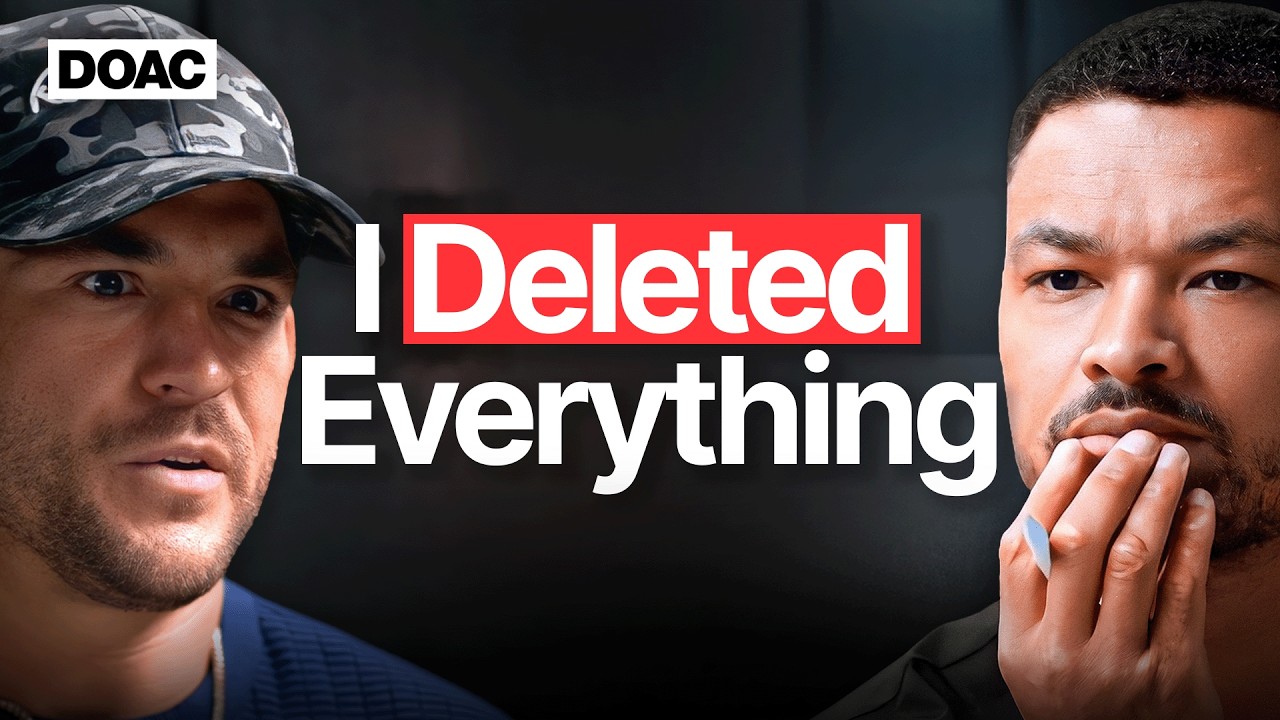
Dustin Poirier Quits Alcohol After Post-Retirement Airport Arrest
The Diary Of A CEO
The former UFC fighter is ending his drinking following a Father's Day arrest in Atlanta as he struggles with brain trauma and the loss of purpose that comes with retirement.
## Background
This interview was published by The Diary Of A CEO channel on YouTube on July 06, 2026. According to the page description, retired UFC legend Dustin Poirier addresses his recent arrest for public intoxication at an Atlanta airport, his struggle with alcohol, losing paid sponsor deals, and the difficult transition to life off the mat after fighting.
## TL;DR
In a deeply honest conversation with Steven Bartlett, Dustin Poirier reflects on his recent Father's Day arrest at an Atlanta airport, attributing the relapse to a spiral of depression, unstructured downtime post-retirement, and unresolved trauma tied to his father's severe alcoholism. He discusses his complete vow of sobriety, deleting social media to avoid toxic coverage, and his fear of brain damage after recent neurological scans revealed brain tissue scarring. Despite losing corporate sponsors and facing identity loss after two decades in combat sports, Poirier takes full accountability for his actions, refusing to make excuses while highlighting his commitment to his family and charitable efforts through The Good Fight Foundation.
## Atmosphere & style
The interview has an extraordinarily raw, vulnerable, and somber atmosphere, starkly contrasting Poirier's fierce combat persona with his quiet, emotional presence as a retired father in crisis. Steven Bartlett acts as a compassionate and empathetic host, giving Poirier the space to open up without judgment while gently probing into difficult topics like CTE, childhood trauma, and public shame. The emotional arc moves from deep remorse and heartbreak over his public arrest to quiet resolve as Poirier reaffirms his commitment to therapy, fatherhood, and total sobriety. Watching it feels like witnessing an intimate confession—heavy, deeply human, and grounded in a sincere effort to heal.
## Key takeaways
- [00:00](https://www.youtube.com/watch?v=DM2jRSgjy1o&t=0s) Dustin Poirier's public arrest for public intoxication at the Atlanta airport on Father's Day was triggered by emotional overwhelm and spiraling thoughts regarding his estranged, homeless father.
- [03:19](https://www.youtube.com/watch?v=DM2jRSgjy1o&t=199s) Growing up in Lafayette, Louisiana, Poirier faced early childhood adversity, including his parents' divorce, domestic turmoil, school expulsion at age 14, and time in juvenile detention.
- [09:36](https://www.youtube.com/watch?v=DM2jRSgjy1o&t=576s) Poirier's father suffers from chronic, severe alcoholism and is currently homeless in Louisiana, a cycle Poirier fought to break after realizing his own drinking was spiraling.
- [15:53](https://www.youtube.com/watch?v=DM2jRSgjy1o&t=953s) A key catalyst for Poirier's severe depression and decision to begin therapy was his loss in his second fight against Justin Gaethje.
- [22:48](https://www.youtube.com/watch?v=DM2jRSgjy1o&t=1368s) Retiring from a 20-year career in combat sports created a profound identity crisis and emotional void for Poirier, highlighting the complete absence of post-retirement mental health support systems for fighters.
- [26:51](https://www.youtube.com/watch?v=DM2jRSgjy1o&t=1611s) Following the airport arrest, Poirier vowed to his wife, Jolie, to completely eliminate alcohol from his life to avoid following in his father's footsteps.
- [30:39](https://www.youtube.com/watch?v=DM2jRSgjy1o&t=1839s) To protect his mental health in the wake of the arrest video going viral, Poirier deleted all social media apps from his phone and strictly refused to watch the arrest footage.
- [41:13](https://www.youtube.com/watch?v=DM2jRSgjy1o&t=2473s) Despite receiving public sympathy and messages of support from peers like Jon Jones, Poirier firmly takes full personal accountability and refuses to use head trauma or retirement stress as an excuse.
- [58:05](https://www.youtube.com/watch?v=DM2jRSgjy1o&t=3485s) The airport incident resulted in immediate financial fallout and lost sponsorship deals just as Poirier was transitioning into a post-fighting media and broadcasting career.
- [01:16:51](https://www.youtube.com/watch?v=DM2jRSgjy1o&t=4611s) Neurological MRI scans revealed physical signs of brain trauma, including scarring and a separated septum between brain hemispheres, which may contribute to mood swings and impulsive behavior.
- [01:19:55](https://www.youtube.com/watch?v=DM2jRSgjy1o&t=4795s) Poirier estimates there is only a 5% chance he will ever return to the UFC, citing the required six months of mandatory drug testing and his commitment to his family.
- [01:26:32](https://www.youtube.com/watch?v=DM2jRSgjy1o&t=5192s) Outside of fighting, Poirier channels his purpose into family and community through The Good Fight Foundation, a non-profit he co-founded with his wife to aid families and communities in need.
## Detailed walkthrough
### [00:00](https://www.youtube.com/watch?v=DM2jRSgjy1o&t=0s) Intro & The Atlanta Airport Incident
Dustin Poirier opens with a candid admission that while he has wrestled with depression throughout his fighting career, its onset can be completely overwhelming. This mental strain culminated in a public arrest for public intoxication at the Atlanta airport on Father's Day. After spending a heartwarming morning with his children, a familiar "cloud" settled over his mind as he traveled for work. Overwhelmed by his emotions and spiraling thoughts about his estranged, homeless father, he turned to alcohol, leading to an airport confrontation and his subsequent arrest. Reflected against the backdrop of his childhood struggles with an alcoholic parent, early school expulsions, and juvenile detention, Poirier acknowledges the volatility that has accompanied both his personal life and his rise as one of the world's premier UFC lightweights.
Poirier reflects emotionally on a photo taken on July 30th when he officially retired and laid his gloves down on the UFC canvas. Visibly holding back tears, he references the adage, "If a man's lucky, he gets to die twice," explaining that the elite, relentless fighter inside him has died to make room for his new chapter as a businessman and father. However, after twenty years of single-mindedly chasing greatness, he candidly admits that nothing fills the profound void left by fighting, leaving him struggling to find a new dream and constantly tempted by the thought that he could still defeat the top contenders in the division.
- **Record & Standing:** Retired UFC lightweight fighter with a 30-10 record, widely celebrated as the only fighter to knock out Conor McGregor in MMA.
- **Key Quotes:**
- *"It's like a cloud in my head that I just can't get out from under."*
- *"Those gloves, me putting them on the mat is a piece of myself I left. But a wise man said, 'If a man's lucky, he gets to die twice.'"*
- *"For 20 years I was dreaming about being the best. I just want to dream again, you know."*
---
[03:13](https://www.youtube.com/watch?v=DM2jRSgjy1o&t=193s) Early Life in Lafayette and Childhood Mindset
When asked how he is faring overall, Poirier summarizes his status as doing well generally, despite experiencing severe recent "turbulence." Pressed for details, he takes full responsibility for letting his emotions get the better of him during his airport arrest in Atlanta, admitting he is far from proud of the situation. To build a complete picture of his life, interviewer Steven Bartlett examines Poirier's early upbringing in Lafayette, Louisiana, highlighting photos of him as a young boy to understand the environment that shaped his resilience and temperament.
Poirier describes himself simply as a working-class kid from Lafayette who refused to fear hard work or chasing big dreams once he found his calling in combat sports. Raised in a modest family where money was tight but basic needs were met, he notes that while both his father and grandfather were fighters—his father boxed and his grandfather served in the Navy while working in the oil fields—neither achieved widespread fame.
- **Background:** Raised in Lafayette, Louisiana; comes from a working-class family of non-professional fighters.
- **Key Quote:** *"I'm just a man... Just a kid from Lafayette, Louisiana, who found something to put his all into and try to become great at it."*
---
[06:01](https://www.youtube.com/watch?v=DM2jRSgjy1o&t=361s) Broken Home, Upbringing, and Escalating Trouble
Poirier reveals that his parents divorced when he was around six or seven years old. His earliest memories of them together are marred by domestic conflict, physical fighting, and hostility, rather than warmth. Following the separation, he lived primarily with his mother and grandmother—whom he credits as his ultimate anchors—while spending alternating weekends with his father. Looking back with the perspective of a father himself, Poirier expresses frustration at his father's choices, stating he could never imagine missing out on waking up with his own children every day.
As he grew older, the volatile environment manifested in frequent street fighting, chronic absenteeism, and academic failure. By age 14, Poirier was expelled from school after a severe fight that resulted in physical harm to another youth. Already on probation for truancy, he subsequently failed a drug test and was remanded to a juvenile detention center. He reflects that during these formative years, he was simply living day-to-day without goals or constructive outlets for his energy.
- **Family Structure:** Lived with mother and grandmother; spent alternate weekends with his alcoholic father; has two brothers he grew up with, plus two brothers and a sister from his father's side met later in life at age 25–26.
- **Key Milestones:** Expelled from school at age 14 due to fighting; sent to juvenile detention at 14 following a physical altercation, truancy, and a failed drug test.
---
[09:36](https://www.youtube.com/watch?v=DM2jRSgjy1o&t=576s) Early Alcohol Use and the Shadow of an Alcoholic Father
Poirier reveals that his exposure to alcohol began exceptionally early, estimating his first experience with drinking at just 12 or 13 years old. Discussing his father's lifelong struggle with severe alcoholism, Poirier paints a tragic picture of a man whose addiction destroyed his marriages, friendships, career opportunities, and parental relationships, leading to multiple incarcerations and leaving two of his children completely estranged.
This heavy family dynamic directly collided with Poirier's life on Father's Day. Despite striving to help his father, the elder Poirier had relapsed and returned to living on the streets as a homeless man in Louisiana. Burdened by this weight while traveling through the Atlanta airport, Poirier attempted to numb his dark mood with alcohol, breaking the sobriety tools he had previously cultivated in therapy and triggering the viral airport incident.
- **Early Drinking:** Started consuming alcohol around 12 or 13 years old.
- **Father's Current Status:** Currently homeless in Louisiana due to chronic, lifelong severe alcoholism.
- **Post-Arrest Actions:** After being released from jail in Atlanta on Tuesday, Poirier flew back to Louisiana on Wednesday morning, went to the local sheriff's office, and secured an Order of Protective Custody (OPC) to force his father into treatment; however, because his father was coherent when picked up by authorities, he was legally released back onto the streets.
- **Key Quote:** *"If I could paint a picture what you think of a classic drunk or alcoholic, you know, very selfish and continues to go back to it."*
[15:53](https://www.youtube.com/watch?v=DM2jRSgjy1o&t=953s) Bouts with Depression and the Catalyst
Dustin Poirier describes what depression feels like to someone who has never experienced it, explaining how a dark cloud settles over his head and creates a gravitational pull toward negativity. No matter what he tries to do, everything feels heavy and inescapable. While his wife, Jolie, is naturally happy and optimistic, she often tries to understand his mindset. Looking back on their relationship—which began off and on in middle school and high school—she reminds him that he always avoided big crowds and parties when they were younger, suggesting he may have been quietly dealing with social anxiety or depression for far longer than he realized.
He explains that while subtle feelings existed earlier in life, his depression became acutely noticeable over the last three to four years. He pinpointed a distinct turning point: his second fight against Justin Gaethje. After losing that bout, he returned home and found his emotional state spiraling out of control. Some days he felt fine, but on others, he felt overwhelming sadness. Recognizing that something was fundamentally wrong, he decided to start therapy to unpack emotional baggage he didn't even realize he was carrying.
---
* **Onset:** Marked worsening over the last three to four years.
* **Key Catalyst:** The defeat in his second bout against Justin Gaethje.
* **Relationship Context:** Together with his wife, Jolie, since middle school and high school.
[17:48](https://www.youtube.com/watch?v=DM2jRSgjy1o&t=1068s) Unpacking Childhood Trauma in Therapy
Returning from Atlanta after the airport incident, Dustin immediately recommenced therapy, having previously paused sessions when his mood had stabilized. He reflects on how therapy is not a one-time fix but a continuous discipline. To rebuild his routine, he has been waking up early, reading, journaling, and completing a difficult physical task every morning to regain control over his mental health.
Through therapy, Dustin began recognizing that deep down, he was still carrying unaddressed trauma from his childhood. Host Steven Bartlett notes research showing that young boys raised without a stable father figure—especially when compounded by domestic violence or parental addiction—are far more likely to battle anger and depression as adults. Dustin agrees with this observation, explaining how opening up to a professional helped him realize he was carrying burdens that were never his to hold.
* **Morning Routine:** Waking up early, reading, writing, and doing a difficult physical challenge every morning.
* **Key Insights:** Realizing his underlying struggles stem from growing up without a father figure and dealing with family addiction.
[20:21](https://www.youtube.com/watch?v=DM2jRSgjy1o&t=1221s) Overcoming the Stigma of Therapy as a Fighter
In a combat sport built on toughness, admitting to seeking help was initially difficult for Dustin. When he first disclosed in media interviews with journalists like Ariel Helwani that he was going to therapy, he secretly worried it made him look weak. Over time, however, he reframed that perception, coming to view seeking help as a profound sign of strength.
Dustin notes that for two decades, combat sports served as his primary therapeutic outlet. The gym was a place where he could drown out the noise in his head and quiet the inner negative dialogue. However, he always harbored a underlying fear about what would happen once he retired and lost that physical outlet.
> "I always had somewhere to go, you know... to focus on something. Every day I could get up and push myself to try to be better... And when I retired, I was kind of worried about that—like how will life look post-fighting?... I was scared of it."
* **Public Disclosure:** First publicly discussed attending therapy during interviews with MMA journalist Ariel Helwani.
* **Career Span:** Spent over two decades in combat sports, having started fighting around age 16 or 17.
[22:48](https://www.youtube.com/watch?v=DM2jRSgjy1o&t=1368s) The Identity Crisis of Retirement
While Dustin can still go to the gym every day at age 37, training without a fight on the horizon feels empty. He reflects on the loss of purpose that comes with no longer preparing to step onto the mats to fight for his life, his family's financial security, and his legacy in front of the world.
He shares a poignant piece of wisdom passed down from a friend: *"If a man's lucky, he gets to die twice."* For Dustin, his identity as an elite active fighter has died, forcing him to transition into his new roles as a businessman and full-time father. He points out that his official retirement occurred less than a year prior on July 30th in New Orleans, leaving him in the middle of navigating this transition.
> "That part of me that every day wake up, push yourself to be the best fighter you can be is dead. You know, I'm retired Dustin now. I'm businessman Dustin."
* **Current Age:** 37 years old.
* **Retirement Date:** Announced his retirement on July 30th in New Orleans.
[23:48](https://www.youtube.com/watch?v=DM2jRSgjy1o&t=1428s) The Absence of Post-Fight Support Systems
Dustin criticizes the complete lack of transitional programs or mental health support for athletes retiring from combat sports. He explains how common it is for former professional athletes to spiral into addiction, financial ruin, or legal trouble when they suddenly lose the massive dopamine high and singular focus of their careers.
He admits he always swore he would never become one of those statistics. While he ran into legal trouble in Atlanta, he maintains that he is still making the right daily choices overall. However, he reflects on how easy it was to judge other athletes before experiencing the overwhelming vacuum created by retirement himself.
* **Post-Retirement Support:** Confirms there are zero official post-career transition or mental health programs provided to retiring fighters.
* **Athlete Risk:** The urge to chase extreme dopamine hits often leads retired athletes toward dangerous behaviors, addiction, or financial instability.
[25:10](https://www.youtube.com/watch?v=DM2jRSgjy1o&t=1510s) A Destructive Relationship with Alcohol
Reflecting on his past, Dustin explains that alcohol was present during his youth, where he drank heavily on weekends. Throughout his professional fighting career, he would go years without touching a drop while in training camp. However, after retiring, alcohol gradually crept back into his life because he no longer had the strict discipline of early morning runs, weight cuts, and daily gym sessions holding him accountable.
Dustin clarifies that while he has never been a daily alcoholic, he possesses an extreme "all-or-nothing" personality when he does drink. Rather than stopping after one or two drinks like his wife or friends, his competitive drive kicks in, leading him to drink until the bottle is empty.
> "90% of the times if I do drink, I'm going to drink to be the best at drinking. I'm going to drink more than everybody."
---
* **Training Discipline:** Went years completely sober while actively preparing for fight camps.
* **Drinking Pattern:** Binge-drinking behavior driven by an extreme, competitive mindset rather than daily dependence.
[26:51](https://www.youtube.com/watch?v=DM2jRSgjy1o&t=1611s) The Decision to Eliminate Alcohol Completely
Referencing conversations about dopamine and addiction—such as insights from dopamine expert Dr. Anna Lembke—Steven notes how alcohol triggers immediate chemical spikes that affect individuals differently. Dustin acknowledges his envy of people who can casually enjoy a single drink, admitting that every attempt he made to moderate his intake ultimately failed.
Following the airport arrest, Dustin had a serious conversation with his wife and made the firm commitment to eliminate alcohol from his life entirely. Determined not to follow in his father's footsteps or repeat his public mistakes, he concluded that alcohol offers him zero long-term benefit.
> "I'm going to cut alcohol completely out of my life... I'm not going to be like my father or make another mistake like I made in the airport. It's just it's not helping me in any way."
* **Sober Commitment:** Made a vow to his wife to completely eliminate alcohol from his life.
* **Social Impact:** Admits being the sober person in social settings is challenging, but necessary for his well-being.
[28:28](https://www.youtube.com/watch?v=DM2jRSgjy1o&t=1708s) The Sequence of Events Leading to the Airport Arrest
Dustin recounts the details of the day he was arrested at the airport. He was at the start of an ambitious three-leg business trip that was supposed to take him from Lafayette, Louisiana, to South Florida for an afternoon, then on to Los Angeles for a three-day commercial shoot, and finally to Las Vegas to work a broadcast event for CBS.
The trouble began during his initial flight out of Lafayette, where he drank two glasses of champagne. Upon landing at the Atlanta airport for a layover, he went to a restaurant bar and continued drinking champagne. Other patrons at the bar recognized him and began buying shots. Feeling the combined effects of the alcohol and his underlying depression, he walked to his departure gate and got into a heated verbal altercation with the gate agent.
---
* **Planned Trip Itinerary:**
1. Lafayette, Louisiana $\rightarrow$ South Florida (afternoon stay)
2. South Florida $\rightarrow$ Los Angeles (3-day commercial shoot)
3. Los Angeles $\rightarrow$ Las Vegas (desk analyst work for CBS)
* **Initial Drinks:** Two glasses of champagne on the flight out of Lafayette, followed by more champagne and shots with fans at an Atlanta airport bar.
* **The Incident:** A verbal altercation at the gate led to agents denying him boarding and calling security and local police. Dustin notes he reached out to an Atlanta lawyer to obtain the arresting officer's contact details so he could send a formal apology for his behavior.
<ElicitationsGroup message="Where would you like to go next with Dustin Poirier's interview?">
<Elicitation label="Read the next section covering his reaction to the viral video" query="Show me the next part of the transcript covering Dustin Poirier's reaction after watching the airport arrest video and the charges he faced."/>
<Elicitation label="Explore his discussion on his relationship with his father" query="Show me the transcript sections where Dustin Poirier discusses his alcoholic father and their relationship."/>
</ElicitationsGroup>
[30:39](https://www.youtube.com/watch?v=DM2jRSgjy1o&t=1839s) Refusing to Watch the Footage and Deleting Social Media
Dustin Poirier reflects on the chaotic aftermath of his arrest at the Atlanta airport, expressing immense gratitude toward the arresting police officer. Poirier notes that he wished he could call the officer directly to write him a thank-you letter for his professionalism, emphasizing that the situation "could have been so much worse" had the officer reacted with aggression. When asked if he remembers the initial argument with the airport desk agents that triggered the police response, Poirier admits he has no memory of it.
Crucially, Poirier reveals that he has strictly avoided watching the viral arrest video. While his wife and his close training partner—whom he works out with five days a week—have watched it and pieced the timeline together for him, Poirier refuses to view the footage himself. He explains that seeing himself in a degraded, drunken state—disrespecting law enforcement, airport staff, his family, and himself—would offer no therapeutic value and would only drag his mental state down into a deeper downward spiral.
Immediately upon returning home after the incident, Poirier made a decisive break from the public eye. After posting a brief statement on Instagram, he uninstalled every social media application from his phone, remaining completely offline since the day after Father's Day. Aware that the internet is mocking him and dissecting his worst moments, he relies solely on the filtered updates provided by his wife and training partner to maintain his peace of mind.
* **Social Media Blackout:** Poirier uninstalled all social media apps from his phone immediately after returning home and has stayed offline since the day after Father's Day.
* **Reconstructing the Event:** He relies exclusively on secondhand accounts from his wife and his training partner (with whom he trains 5 days a week) to understand what happened.
* **Gratitude for Law Enforcement:** Poirier strongly credits the police officer's composure for preventing a potential disaster, acknowledging how easily a "young hothead cop" could have escalated the situation.
---
[32:11](https://www.youtube.com/watch?v=DM2jRSgjy1o&t=1931s) The Taser Moment and Realization of a Near-Disaster
The host describes key moments from the viral video to Poirier, noting that Poirier initially appeared aggressive and offered to fight the officer. The officer recognized Poirier immediately, backed off, and drew his taser, warning that he might have to use it. Strangely, as Poirier was being led away in handcuffs, the interaction shifted dramatically: Poirier "dapped up" the officer, shook his hand, and congratulated him on handling the situation well. Poirier's training partner jokingly told him that his wife considered that polite exit the "best part of the video."
Poirier attempts to explain his sudden shift in demeanor, speculating that even through a "drunken stupor," he had an instantaneous "aha moment" where he snapped back to reality and realized the absurdity and danger of his behavior. Looking back, he recognizes how close he came to facing severe, life-altering legal charges that would have devastated his wife and children.
Following the arrest, Poirier was charged with public intoxication and spent the remainder of the afternoon and night in a holding cell until he sobered up. He was released on bond and is currently awaiting his court appearance, which preceded his decision to re-enter therapy, seek out his estranged father, and cancel planned upcoming trips.
* **Legal Charge:** Poirier was officially charged with **public intoxication** (not disorderly conduct) and released on bond after sobering up in jail.
* **Court Status:** At the time of the interview, Poirier had not yet attended his official court date.
* **The Taser Interaction:** The arresting officer pulled out a taser during the confrontation before Poirier calmed down and complimented the officer's performance.
---
[35:04](https://www.youtube.com/watch?v=DM2jRSgjy1o&t=2104s) The Painful Conversation at Home with Jolie
Returning home to face his wife, Jolie, proved to be one of the most painful experiences of Poirier's life. Having maintained a clean record without an arrest for decades, he felt entirely unprepared for the conversation. He describes facing his lifelong partner—who has stood by him through every stage of his career—and repeatedly apologizing, promising that such a breakdown would never happen again. Jolie made it explicitly clear that it *could not* happen again.
Poirier reflects deeply on their shared history. He and Jolie began dating in middle school, well before high school. When they were young, she made the massive sacrifice of dropping out of nursing school to move with him to South Florida so he could pursue his dream of becoming a professional fighter. Poirier credits her as the absolute anchor of his life, stating unequivocally that he would never have achieved his pinnacle in the UFC without her support.
The emotional weight of disappointing his wife and two children (his son and daughter) is what breaks Poirier down the most. He vows that this single arrest will permanently alter his life's trajectory: he has resolved to quit drinking alcohol entirely so his children never have to witness him intoxicated or out of control.
> "My son and my daughter is never going to grow up and see me intoxicated. They're never going to see me say things or do things I don't mean to do or mean to say... It's going to benefit me and my family in the long run."
* **Relationship History:** Poirier and Jolie started dating in middle school (younger than age 14).
* **Jolie's Sacrifice:** She dropped out of nursing school to move with Dustin to South Florida at the start of his MMA career.
* **Family Impact:** Poirier explicitly cites his son and daughter as his main motivation for making the permanent commitment to sobriety.
* **Arrest Timeline:** The police called Jolie while Dustin was still sitting in the airport holding cell, hours before his release.
---
[41:13](https://www.youtube.com/watch?v=DM2jRSgjy1o&t=2473s) Public Support, Viral Clips, and Refusing to Make Excuses
Contrary to Poirier's fears of total public condemnation, the host informs him that public sentiment online has been overwhelmingly supportive. Because Poirier has built a reputation over a decade as a genuine, respectful fighter who speaks candidly about his mental health struggles, fans and fellow fighters viewed the incident as a cries-for-help "bad day" rather than a reflection of bad character. Poirier attributes any goodwill to fans who have watched him grow up in the sport since he was a teenager.
During the fallout, older clips of Poirier discussing his post-fight struggles went viral alongside the arrest footage. In past interviews on *The Theo Von Show* and *The Joe Rogan Experience*, Poirier famously admitted: "I'm a danger to myself when I have nothing... No goal circled on my calendar." He explained to Rogan how his obsessive, "all-in" personality—a quality that made him an elite fighter—becomes destructive when applied to drinking or unstructured downtime after retirement.
Despite the public's sympathy and the viral understanding of athlete identity loss, Poirier firmly refuses to use these factors as a crutch. He takes full accountability, rejecting the idea of blaming head trauma, retirement, or his father's homelessness for his actions at the airport.
> "I did these things. I know better. I know right and wrong. I don't want to lean on these as a crutch of my actions... I am just a human being and I make mistakes."
* **Viral Context:** Clips from *The Theo Von Show* and *The Joe Rogan Experience* resurfaced, highlighting Poirier's previous admissions about struggling with idle time and obsessive tendencies.
* **Age Clarification:** Poirier notes during his discussion on age and life after fighting that he is **37 years old**.
* **Core Philosophy:** Poirier insists on complete personal accountability, refusing to blame CTE, alcohol addiction genetics, or career transition stress for his behavior.
[046:09] Navigating the Post-Retirement Identity Crisis
Dustin Poirier reflects on the jarring shift from elite athletics to ordinary life. For two decades, every single day began with a singular focus: how to push his physical limits, absorb new training techniques, and conquer the division to become a world champion. Stepping away from the octagon strips away that lifelong purpose overnight, leaving a sudden vacuum where an intense routine used to be.
```
"Every day I would wake up for the last 20 years: 'How can I be a better fighter? How can I—what's new in fitness? How can I push myself? I want to be the champion.' And then boom, you lay the gloves down and you wake up and you're a civilian."
```
When peers like Jon Jones and Matt Brown released public messages offering sympathy and encouragement following Poirier's recent public arrest, the response felt complicated. While Poirier sincerely respects the support, he struggles to consume those videos or engage with social media. He stresses that he is not seeking sympathy and refuses to hide behind mental health struggles as a crutch or excuse for his actions, insisting that he alone takes full ownership of his choice to drink.
* **Peer Support:** Peers including Jon Jones and former UFC fighter Matt Brown publicly posted supportive videos during Poirier's recent struggles.
* **Refusal of Sympathy:** Poirier rejects using mental health as a shield: *"I did that. I decided to drink that day when I wasn't feeling well. It's all on me."*
---
[048:29] The Emotional Rollercoaster of Life After Fighting
Life after fighting feels like a endless mental tug-of-war. Some mornings Poirier wakes up entirely convinced he made the right decision, feeling content to perform household duties, make breakfast, and spend quality time with his children. But on other days, the instinctual fire of a lifelong fighter flares up, convincing him that he could easily step back in and dominate the current top-ranked lightweights.
```
"Some days I wake up and I'm like, 'What the f*** am I doing? I can beat all these guys still, you know?'... But I don't know if that ever leaves. I might be a 60-year-old having coffee one day saying the same thing: 'I can beat these guys.'"
```
This psychological fluctuation is an ongoing battle rather than a solved problem. Drawing parallels to a previous low point three years prior, Poirier realizes that maintaining emotional well-being is a daily commitment—requiring morning journaling, quiet reflection over coffee, and active effort—rather than a single "Eureka moment" where a person is permanently fixed.
* **The Daily Work:** Mental well-being requires continuous daily practice: *"It's not a Eureka moment where you're fixed. You got to—this is everyday work for the rest of your life."*
* **The Struggle to Communicate:** Poirier admits he frequently hides his low days from his wife to avoid making her anxious about which version of him will wake up each morning.
* **Impact on Family:** To shield his nearly 10-year-old daughter from confusion when depression leaves him bedridden, he tries to stay quiet and carry on with daily fatherhood responsibilities whenever possible.
---
[053:59] Searching for a Purpose Outside the Octagon
Retiring at age 36 leaves decades of life ahead, creating an urgent need to stay busy and find new outlets. To keep his mind occupied and avoid sinking into dark thoughts, Poirier threw himself into work with CBS Sports, podcasting every Monday in South Florida, and accepting as many opportunities as possible—a relentless schedule he acknowledges might have contributed to his recent burnout by leaving zero time for self-care.
```
"I have a void inside of me that nothing will... Being a father is very fulfilling, and I love it... but nothing fills that void of what fighting was in my life. I haven't found anything yet. I don't think there is."
```
Despite the rewards of fatherhood and stay-at-home life, nothing has replicated the overwhelming obsession that defined his fighting career. He draws direct parallels to military veterans returning to civilian life after deployments, missing the extreme intensity, structure, and unique camaraderie. Even staying connected to the sport as a UFC desk analyst or podcaster offers only about 20% of the fulfillment that actual competition provided.
* **Current Projects:** Broadcaster for desk analyst roles (working alongside major networks like Paramount/CBS) and host of a weekly South Florida podcast.
* **Veteran Comparison:** Compares his sudden retirement at 36–37 to military personnel transitioning back to civilian life after years of service.
---
[058:05] The Professional Fallout and Financial Consequences
The airport incident in Atlanta immediately imperiled Poirier's post-fighting career ambitions. Beyond the personal embarrassment caused to his family, the situation triggered swift financial and professional consequences. Multiple appearances planned for that week were canceled outright, and major corporate sponsorships dissolved as brand partners evaluated the situation.
```
"That day cost me not only embarrassment... it cost me a lot of money, too. You know, I'm losing sponsors. I'm losing gigs and losing things that I had set up."
```
Poirier reflects on how he actively built his broadcasting career, proactively reaching out to networks like Paramount to offer his services as a desk analyst. He emphasized his lifelong coachability, explicitly inviting producers and veteran media members to critique and refine his broadcast etiquette without ego. Seeing that carefully constructed second act threatened by a single public incident remains one of his primary sources of anxiety.
* **Financial Impact:** Lost multiple planned gigs for the week of the arrest and lost at least one major corporate sponsor immediately.
* **Approach to Broadcasting:** Reached out directly to media executives to express his desire to learn: *"I told them like, 'I'm coachable. I don't have no hard feelings. Like, if I'm doing something wrong, please let me know... Coach me.'"*
[01:01:09](https://www.youtube.com/watch?v=DM2jRSgjy1o&t=3669s) Broadcasting Work and Transitioning Careers
Transitioning into media desk work presents a whole new learning curve for Dustin Poirier. He candidly shares that talking about fights on live television is a completely new craft for him, but one he is eager to master. Poirier reveals that he held a one-year contract with Paramount and CBS to serve as an analyst on fight broadcast desks. While he expresses some anxious uncertainty about where his standing currently lies following his recent public incident, he notes that he is scheduled to rejoin a weekly fight podcast shortly, leaving him hopeful about keeping his media role.
Steven Bartlett reflects on how rare it is for professional athletes to face total career retirement in their mid-30s. Drawing a parallel to his own life as a 33-year-old entrepreneur, Bartlett notes that while business executives can continue climbing the same professional mountain indefinitely, elite fighters are forced to completely climb down after two decades and build an entirely new profession from scratch. Poirier admits he had never viewed his retirement through that specific lens, emphasizing how dearly he loves desk work because it keeps him closely tied to the sport that provided everything for his family.
[01:04:40](https://www.youtube.com/watch?v=DM2jRSgjy1o&t=3880s) Financial Security and Smart Investments
Addressing the common narrative surrounding fighter pay in the UFC, Bartlett asks Poirier if he is financially set for the remainder of his life. Poirier gives an unequivocal "yes," confirming that due to the success of his career, he never has to work another day in his life if he chooses not to. He attributes this long-term stability to early financial discipline and a proactive approach to business, explaining that he began investing at age 23 back when he was barely making any money at all. Recognizing early on that a single injury or car accident could end a fighting career instantly, he constantly planted business seeds in Louisiana and beyond to secure his future.
Poirier humorously contrasts his disciplined financial habits with his minor vice of recreational gambling. When Bartlett brings up how many athletes blow through fortunes on watches or gambling, Poirier laughs and recounts a recent lighthearted conversation with his wife, Jolie:
> "I told my wife the other day, she was like, 'I just paid some bills. I saw you made another deposit to the gambling thing.' I was like, 'I can't cold turkey everything! Give me one. Let's go one thing at a time.'"
Interestingly, Poirier reveals that when he was 18 or 19 years old, long before knowing how his career would unfold, he told Jolie he planned to retire from fighting by age 35. Having officially stepped away at 36, he reflects on how he always intended to use the second half of his life to attend college or pursue entirely new paths.
[01:06:48](https://www.youtube.com/watch?v=DM2jRSgjy1o&t=4008s) Emotional Reactions to the Final Fight
Looking at a photograph taken immediately following his final fight in Louisiana, Poirier becomes visibly emotional and struggles to hold back tears. Surrounding him in the octagon were his closest teammates, his mother, and his extended family. Fulfilling a lifelong dream, he was able to leave his gloves on the canvas in his home state of Louisiana—a rare location for a UFC event, which hadn't hosted a card there since 2015.
Poirier reflects on the bittersweet nature of laying down his gloves and stepping away from the only life he has known since adolescence:
> "I was just a kid chasing dreams, and it just flew by so quick. And I guess that's a part of me that's scared for the future... For 20 years I was dreaming about being the best. I just want to dream again, you know. I don't know what that dream will be. I just need that in my life, whatever that is."
He describes putting his gloves on the mat as leaving a physical piece of his soul behind. Despite taking physical damage over the years, Poirier states without hesitation that if he could go back to his 16-year-old self, he would take the exact same journey all over again:
> "Nobody rides for free, you know... Whether you're clocking in at a job, working in an office your whole life, or you're fighting men all over the world, we're exchanging something for something. So, I would do it again."
- **Octagon Canvas Gesture:** The UFC secretly printed the names of Poirier's wife and daughter directly onto the octagon canvas for his retirement fight, later presenting him with the cut canvas framed in a shadow box alongside fight photographs.
- **Isolating Himself:** Following the Father's Day airport arrest, Poirier admits he muted all phone calls and withdrew from friends, including neglecting texts from his long-time coach Mike Brown, whom he resolves to call back to let him know he is doing okay.
- **Fall from Grace:** Poirier describes the deep internal ache of sitting in an interview discussing his recent arrest while looking at a photograph where he was on top of the world, feeling he had exited the sport with complete grace.
[01:14:38](https://www.youtube.com/watch?v=DM2jRSgjy1o&t=4478s) CTE, Brain Scans, and Health Concerns
The discussion turns to the physical toll of combat sports and the fears surrounding long-term brain health. Poirier shares that while his extended family was not pushing for him to retire, his wife, Jolie, strongly encouraged him to step away, partly because she was pregnant with their son and partly out of concern for subtle behavioral changes she noticed a few years prior.
Bartlett presents sobering statistics regarding Chronic Traumatic Encephalopathy (CTE)—a progressive degenerative brain disease linked to repeated head impacts:
- Older adults with a history of traumatic brain injuries face a **230% higher risk** of developing Alzheimer's disease.
- **61% of UFC fighters** express concern over long-term brain damage, with **21% noticing measurable cognitive changes** post-career.
- A 2023 study showed that **over 40% of contact-sport athletes** who died before age 30 exhibited evidence of CTE.
Poirier reveals that his wife's concerns prompted him to visit a neurologist for an MRI scan with contrast dye in his veins. The medical imaging did reveal structural changes in his brain; however, because he never had a baseline "passport" scan taken before his career began, doctors can only evaluate a single snapshot in time. The neurologist explained that definitive diagnoses for conditions like CTE require post-mortem tissue examination, leaving Poirier to manage the uncertainty of his long-term health as he steps into retirement.
<ElicitationsGroup message="Explore more from this interview series:">
<Elicitation label="Walkthrough Part 6 (01:16:48 onwards)" query="Provide the next detailed walkthrough part for this video starting from timestamp 01:16:48."/>
<Elicitation label="Summarize Poirier's perspective on alcohol" query="Summarize Dustin Poirier's comments on his relationship with alcohol and his decision to get sober."/>
</ElicitationsGroup>
Here is a detailed, faithful walkthrough covering the provided portion of the transcript.
---
[01:16:51](https://www.youtube.com/watch?v=DM2jRSgjy1o&t=4611s) Brain Trauma, Neurological Scans, and Uncharacteristic Behavior
Dustin Poirier discusses the physical toll combat sports take on the brain and the difficulty of diagnosing chronic traumatic encephalopathy (CTE) in living athletes. While doctors cannot definitively diagnose CTE until a post-mortem brain examination is performed, Poirier explains that recent neurological scans revealed abnormal signs of brain trauma. He shares that his neurologist identified brain tissue scarring, thinning at the back of his brain, and a significant separation or splitting of the brain's septum (similar to the nasal septum). The neurologist suspects that because of this structural separation caused by head trauma, the left and right hemispheres of his brain are not communicating as smoothly as they should.
When asked if he feels noticeably different in his day-to-day life, Poirier admits that beyond mood swings and emotional fluctuations, he has noticed a rise in uncharacteristic, impulsive decision-making. He reflects on moments where he thought, "Fuck it, I'll just put $5,000 on this bet right now," or the spontaneous decision to drink heavily at the airport. He candidly acknowledges that while it is easy to "draw lines" and connect bad behavior or emotional turmoil directly to brain trauma when searching for answers, he is unsure if that is the true cause or simply who he is now.
- **CTE Indicators & Symptoms:** Mentioned as including mental health disorders, mood swings, addiction, slurred speech, and brain tissue plaque buildup.
- **Physical Brain Scan Findings:** Thinning in the back of the brain, brain tissue scarring, and a split/separated septum impairing left-right hemisphere communication.
- **Impulsive Behaviors Noted:** Spontaneous high-stakes gambling ($5,000 bets) and sudden heavy drinking episodes.
[01:19:55](https://www.youtube.com/watch?v=DM2jRSgjy1o&t=4795s) The Likelihood of Returning to the UFC
When pressed on whether there is any possibility of him returning to active competition in the UFC, Poirier puts the probability at just 5%, noting that the number has steadily decreased since he retired. He explains that coming out of retirement is not a simple choice; it involves jumping through immense logisitcal and personal hoops. First and foremost, he would need to get his wife, Jolie, on board with the idea of enduring another taxing training camp.
Additionally, re-entering the sport requires officially reinstating himself into the mandatory drug testing protocol, which entails completing six full months of clean drug testing before becoming eligible to fight again. Given the lengthy six-month timeline and the physical demands required, he feels a return is highly unlikely.
[01:20:39](https://www.youtube.com/watch?v=DM2jRSgjy1o&t=4839s) The Ongoing Struggle with His Father's Addiction
The conversation turns to Poirier's father, who continues to fight a severe, destructive battle with alcoholism. Poirier reveals the heartbreak of receiving a photo from his sister just two days prior—during Father's Day week—showing his 74- or 75-year-old father shirtless and shoeless, getting out of a truck his sister had given him, where he is currently living behind a business. Despite Poirier and his sister trying everything alongside his wife to get him into rehab or treatment, his father refuses help. Other siblings have completely cut contact, leaving Dustin and his sister alone in trying to manage the situation.
Poirier reflects emotionally on the toll this takes, admitting he almost lost his mind on Father's Day. He recognizes that while he wants to help, he cannot "babysit" his father at the expense of his own mental health and immediate family. He describes living in constant dread, admitting that every time his phone rings with a call from his sister, he braces himself for the news that his father has passed away due to his failing health and homelessness.
- **Father's Current Situation:** Living out of a truck gifted by Dustin's sister, sleeping behind businesses, shirtless and shoeless.
- **Father's Age & Health:** 74 or 75 years old, in poor health, with unknown eating habits.
- **Substance Profile:** Purely alcohol; never smoked cigarettes, never used marijuana, and never took pills.
- **Family Dynamics:** Dustin, his sister, and his wife are the only ones still attempting to offer aid; Dustin's mother was unaware of the homelessness until Dustin recently informed her.
[01:25:01](https://www.youtube.com/watch?v=DM2jRSgjy1o&t=5101s) Future Plans, Family Vacation, and Leaving the Internet
Looking ahead to his immediate future, Poirier states that his primary goal is to take a vacation with his family along Highway 30A in Florida, sit in the sun with his kids, and stay completely off the internet. Host Steven Bartlett reassures Poirier that public reception on the internet regarding his recent situation has actually been overwhelmingly kind and empathetic. Bartlett emphasizes that the interview serves as a platform to highlight the complex, universal human struggles surrounding mental health, loss of purpose, and addiction.
Poirier admits that patience is a virtue he was not naturally blessed with, but he is working on himself every single day. He stresses the importance of having good mornings, focusing on his family, and taking life step-by-step as he transitions into the next chapter of his career.
[01:26:32](https://www.youtube.com/watch?v=DM2jRSgjy1o&t=5192s) The Closing Question and The Good Fight Foundation
In keeping with the podcast's closing tradition, Poirier answers a question left by the previous anonymous guest: *"Dear next guest, what are you doing to improve the world?"* Poirier answers that his core goal is to leave the world better than he found it. Expressing deep remorse over the airport incident, he shares how hard it has been to look in the mirror, stating: "I hurt myself, man. Really let myself down." He emphasizes that despite his recent slip-ups, 99.9% of his intentions in life are good, and he refuses to hide behind alcohol or a mental breakdown as an excuse.
To illustrate his commitment to doing good, Bartlett brings up The Good Fight Foundation, which Poirier and his wife founded in 2018. It began organically when they were packing up their South Florida house to move back to Louisiana and saw a news article about Officer Middlebrook, a local police officer killed in the line of duty near their former school, leaving behind a family. Instead of keeping his memorabilia, Poirier auctioned off his fight-worn gloves and shorts on eBay to raise money for the officer's family and local food pantries.
- **Foundation Origins:** Started around 2018 by auctioning memorabilia to assist the family of fallen Lafayette police officer Middlebrook.
- **Key Achievements & Milestones:**
- Awarded the UFC's inaugural **Forest Griffin Community Award** at age 30 for exceptional charity work.
- Funded multiple new clean water wells for communities in **Uganda**.
- Hosts an annual back-to-school drive delivering **1,300 backpacks** fully stocked with required Louisiana school supplies.
- **Operational Model:** Ran as a lean, hands-on operation with no paid staff; Poirier, his wife, and volunteers personally break down pallets in warehouses and pack every single backpack by hand to stretch every donated dollar.
[01:32:06](https://www.youtube.com/watch?v=DM2jRSgjy1o&t=5526s) A Legend's Integrity and Being Openly Human
Host Steven Bartlett closes the conversation by expressing deep gratitude and respect for Dustin Poirier, referring to him as a true legend. Bartlett emphasizes that his admiration goes beyond Poirier’s incredible achievements in the Octagon and his ability to climb seemingly impossible mountains. He highlights Poirier’s conduct outside the cage, praising his commitment to his values, integrity, dedication to family, and his desire to do good in the world. Above all, Bartlett commends Poirier for his willingness to be "openly human"—navigating his life, mistakes, and personal struggles in the public eye with authenticity and grace.
Poirier responds with a touch of lighthearted humility and deep sincerity, reflecting on his ongoing journey and acknowledging the realities of his flaws by reminding the host, "that's my first time living life, man." Bartlett reassures him that despite the initial distress caused by his recent public incident, his transparency will ultimately serve a greater purpose. Bartlett notes that the airport incident, while difficult, will end up indirectly helping countless people struggling with similar battles. Poirier accepts the host's kind words with quiet gratitude, reiterating that he considers himself an open book and expressing his sincere hope that sharing his personal struggles will offer comfort or guidance to anyone going through a tough time.
* Poirier candidly embraces his mistakes and humanity, noting that this is his first time navigating life.
* Bartlett emphasizes that Poirier's vulnerability around his alcohol struggles and airport arrest will ultimately serve as an inspiration and aid to others.
* Poirier reaffirms his commitment to being an open book regarding his ongoing mental health journey and recovery.
## Notable quotes
> [00:00](https://www.youtube.com/watch?v=DM2jRSgjy1o&t=0s) If a man's lucky, he gets to die twice. — Dustin Poirier
> [00:00](https://www.youtube.com/watch?v=DM2jRSgjy1o&t=0s) For 20 years I was dreaming about being the best. I just want to dream again, you know. — Dustin Poirier
> [09:36](https://www.youtube.com/watch?v=DM2jRSgjy1o&t=576s) If I could paint a picture what you think of a classic drunk or alcoholic, you know, very selfish and continues to go back to it. — Dustin Poirier
> [25:10](https://www.youtube.com/watch?v=DM2jRSgjy1o&t=1510s) 90% of the times if I do drink, I'm going to drink to be the best at drinking. I'm going to drink more than everybody. — Dustin Poirier
> [26:51](https://www.youtube.com/watch?v=DM2jRSgjy1o&t=1611s) I'm going to cut alcohol completely out of my life... I'm not going to be like my father or make another mistake like I made in the airport. It's just it's not helping me in any way. — Dustin Poirier
> [35:04](https://www.youtube.com/watch?v=DM2jRSgjy1o&t=2104s) My son and my daughter is never going to grow up and see me intoxicated. They're never going to see me say things or do things I don't mean to do or mean to say... It's going to benefit me and my family in the long run. — Dustin Poirier
> [41:13](https://www.youtube.com/watch?v=DM2jRSgjy1o&t=2473s) I did these things. I know better. I know right and wrong. I don't want to lean on these as a crutch of my actions... I am just a human being and I make mistakes. — Dustin Poirier
> [46:09](https://www.youtube.com/watch?v=DM2jRSgjy1o&t=2769s) Every day I would wake up for the last 20 years: 'How can I be a better fighter? How can I—what's new in fitness? How can I push myself? I want to be the champion.' And then boom, you lay the gloves down and you wake up and you're a civilian. — Dustin Poirier
> [48:29](https://www.youtube.com/watch?v=DM2jRSgjy1o&t=2909s) Some days I wake up and I'm like, 'What the f*** am I doing? I can beat all these guys still, you know?'... But I don't know if that ever leaves. I might be a 60-year-old having coffee one day saying the same thing: 'I can beat these guys.' — Dustin Poirier
> [53:59](https://www.youtube.com/watch?v=DM2jRSgjy1o&t=3239s) I have a void inside of me that nothing will... Being a father is very fulfilling, and I love it... but nothing fills that void of what fighting was in my life. I haven't found anything yet. I don't think there is. — Dustin Poirier
> [58:05](https://www.youtube.com/watch?v=DM2jRSgjy1o&t=3485s) That day cost me not only embarrassment... it cost me a lot of money, too. You know, I'm losing sponsors. I'm losing gigs and losing things that I had set up. — Dustin Poirier
> [01:04:40](https://www.youtube.com/watch?v=DM2jRSgjy1o&t=3880s) I told my wife the other day, she was like, 'I just paid some bills. I saw you made another deposit to the gambling thing.' I was like, 'I can't cold turkey everything! Give me one. Let's go one thing at a time.' — Dustin Poirier
> [01:06:48](https://www.youtube.com/watch?v=DM2jRSgjy1o&t=4008s) Nobody rides for free, you know... Whether you're clocking in at a job, working in an office your whole life, or you're fighting men all over the world, we're exchanging something for something. So, I would do it again. — Dustin Poirier
> [01:32:06](https://www.youtube.com/watch?v=DM2jRSgjy1o&t=5526s) that's my first time living life, man. — Dustin Poirier
## Mentioned
Dustin Poirier, Steven Bartlett, Jolie Poirier, The Diary Of A CEO, UFC, The Good Fight Foundation, Conor McGregor, Justin Gaethje, Jon Jones, Matt Brown, Ariel Helwani, Theo Von, Joe Rogan, Dr. Anna Lembke, Mike Brown, Officer Middlebrook, Forest Griffin Community Award, Paramount, CBS, CBS Sports, Wispr, Function Health, Ketone, The Theo Von Show, The Joe Rogan Experience, Instagram, X, YouTube, eBay
Retired UFC fighter Dustin Poirier reveals how the abrupt loss of athletic identity following his retirement, compounded by unaddressed childhood trauma and his father's chronic homelessness, catalyzed an emotional spiral and public arrest that prompted his complete withdrawal from alcohol and social media.
The Airport Arrest and Total Sobriety (28:28)
On Father's Day, Poirier was arrested for public intoxication at the Atlanta airport after combining champagne and bar shots while wrestling with severe depressive thoughts regarding his estranged, homeless father. The confrontation escalated into a verbal dispute with gate agents and a standoff with a responding police officer who drew a taser before Poirier regained composure and thanked him for his de-escalation. After spending the night in a holding cell and securing release on bond, Poirier resolved never to drink again, citing an 'all-or-nothing' competitive personality where he would binge-drink rather than moderate. Disappointed by the impact on his wife, Jolie, and his two children, he uninstalled every social media application from his phone and refused to watch the viral arrest footage to avoid further mental distress.
Navigating the Identity Vacuum After Fighting (22:48)
Having officially stepped away from mixed martial arts on July 30th with a 30-10 professional record, the 37-year-old Poirier describes retirement as an existential loss, citing the adage that 'if a man's lucky, he gets to die twice.' For two decades, daily training served as his principal therapeutic mechanism to quiet internal negativity. Although he established financial independence by investing early at age 23 and has transitioned into desk analyst work with Paramount and CBS, he contends that civilian life and broadcasting offer only a fraction of the fulfillment derived from active competition. Poirier also criticizes the absence of structured transitional or mental health programs for retiring combat athletes, noting that the loss of dopamine and discipline routinely leaves former fighters vulnerable to addiction and personal ruin.
Familial Alcoholism and Generational Trauma (9:36)
Poirier traces his emotional volatility to an unstable childhood in Lafayette, Louisiana, where he was raised by his mother and grandmother following a combative parental divorce. After first drinking around age 12 or 13, he was expelled from school for street fighting and remanded to juvenile detention at 14. Through ongoing therapy—which he recommenced after the Atlanta arrest—Poirier connected his internal anger and depression to the long shadow cast by his father's severe, lifelong alcoholism. His Father's Day breakdown was heavily driven by learning that his 74- or 75-year-old father was living shoeless out of a truck behind local businesses; while Poirier attempted an Order of Protective Custody to mandate rehabilitation, authorities released the elder Poirier back to the streets after finding him coherent.
Brain Trauma Findings and Impulse Control (76:51)
Prompted by his wife's observations of subtle behavioral changes, Poirier consulted a neurologist for an MRI scan with contrast dye. The imaging demonstrated brain tissue scarring, thinning at the back of the brain, and a split septum separating the brain hemispheres that medical specialists suspect impairs bilateral communication. While acknowledging alarming statistics surrounding Chronic Traumatic Encephalopathy (CTE) and noting recent spikes in uncharacteristic, impulsive behaviors—including spontaneous $5,000 gambling bets and the Atlanta binge—Poirier adamantly refuses to use brain damage, career transitions, or family genetics as a moral crutch for his misconduct. He places the probability of ever returning to active UFC competition at approximately 5%, citing the six-month drug-testing protocol and family obligations.
Poirier is focusing on daily mental health disciplines, family time, and hands-on philanthropy through The Good Fight Foundation, which he co-founded in 2018 to support community initiatives such as water wells in Uganda and local school supply drives. However, navigating the unpredictable long-term physical effects of combat-related brain trauma and the painful realities of his father's ongoing homelessness remain unresolved challenges in his post-fighting life.
精炼阅读摘要
退役UFC名将Dustin Poirier在《The Diary Of A CEO》播客中坦言,退役带来的身份真空、童年创伤与酗酒倾向,是导致他在亚特兰大机场因公开醉酒被捕的核心诱因;他明确承诺全面戒酒并坚持心理治疗,以承担家庭责任并开启人生新篇章。
机场被捕事件与全面戒酒承诺 (28:28)
Poirier详细还原了父亲节当天在亚特兰大机场发生的被捕细节。当时他正开启一段跨多地的商业出差,在自路易斯安那州拉斐特的航班上饮用两杯香槟后,又在亚特兰大中转酒吧与认出他的顾客一同饮酒。在酒精与底层抑郁情绪的共同冲击下,他在登机口与地勤人员爆发激烈言语冲突并被拒绝登机,警方随即赶赴现场。虽然他在现场曾一度挑衅并促使警官拔出电击枪,但随后迅速恢复理智配合执法并向警方致谢。Poirier最终因公开醉酒罪被正式指控并收押,随后获释候审。事件发生后,他出于避免情绪二次崩塌的考虑,坚决拒绝观看网络热传的被捕视频,并在发布简短声明后彻底卸载了手机上的所有社交媒体软件。
面对此次风波对妻子Jolie和两名子女造成的伤害,Poirier深感懊悔,并与妻子做出绝对承诺:彻底从生活中剔除酒精。他解释称自己虽非每日饮酒的慢性依赖者,但具有极端的“非全即无”竞争型人格,一旦开饮便会狂饮至见底。回顾过往,他在备战期间能维持数年滴酒不沾,但退役后缺乏严格训练的自我约束导致饮酒复发。为了打破家庭中酗酒的恶性循环,防止子女看到自己失控,他决意永久戒酒,并重返心理治疗建立早起、阅读与晨练等自律日程。与此同时,事件直接导致他当周多场商务活动被取消,并失去关键商业赞助,媒体解说前途一度受挫,但他坚决拒绝将头部创伤或退役压力作为开脱错误的借口,全盘承担个人责任。
原生家庭阴影与创伤代际纠葛 (6:01)
Poirier深入探讨了童年经历对其心理与行为模式的深远影响。他成长于路易斯安那州拉斐特的一个工人阶级家庭,父母在他约六至七岁时离异,童年记忆充斥着家庭冲突与暴力。父亲长年饱受严重酗酒困扰,瘾症摧毁了婚姻、人际关系与工作,并导致其屡次入狱、多名子女与其断绝往来。Poirier在12至13岁便过早接触酒精,青少年时期因街头斗殴、旷课在14岁被学校开除,后因药检不合格被送入少年管教所。长期缺乏稳定父亲角色的成长环境,埋下了他成年后情绪波动与抑郁的诱因。
父亲节当天情绪失控的直接催化剂,正是其父亲再度恶化的流浪处境。他74至75岁的父亲因严重酗酒复发,拒绝接受任何康复治疗,常年赤脚赤膊借住在妹妹赠予的一辆皮卡车中并露宿街头。从亚特兰大看守所获释后,Poirier立即返回家乡申请保护性监护令试图强制父亲就医,但因其父亲被警方找到时神智清醒而依法重获自由。Poirier坦言,面对父亲的持续堕落与随时可能离世的恐惧,他必须在尽力提供救助与保护自身心理健康及核心家庭之间划清界限,避免被无底洞般的代际创伤吞噬。
职业退役引发的身份危机与机制缺失 (22:48)
结束长达二十年职业综合格斗生涯后,Poirier面临着剧烈的身份认同真空。他于7月30日在新奥尔良正式宣布退役并留下拳套,职业战绩定格在30胜10负,是MMA赛场上唯一击倒过Conor McGregor的选手。他借用“若人足够幸运,一生能死两次”的格言,指出那个每天醒来追求极限的精英斗士已然死去,但目前作为商人和全职父亲的新身份尚未能完全填补格斗留下的巨大心理空洞。即便身处退役状态,他依然时常在清晨产生自己仍能击败现役顶尖轻量级挑战者的心理拉扯;他估计自己未来重返UFC赛场的可能性仅有5%,且面临重新进入长达六个月药检期及说服妻子的巨大现实阻力。
Poirier对职业格斗运动缺乏退役过渡与心理健康支持体系提出了明确批评。他指出,运动员在骤然告别比赛带来的极端多巴胺高潮与单一目标后,极易滑向成瘾、财务困境或违法深渊。尽管Poirier早年展现出优异的财务纪律,从23岁起便积极投资,实现了终身财务自由,无需再为生计奔波,但日常缺乏确定目标仍使他感到空虚脆弱。即便转型参与CBS Sports与Paramount的演播室解说工作,也仅能带来过去征战八角笼约20%的满足感。
脑部损伤隐忧与社会公益实践 (74:38)
除了心理层面的调试,长期高强度对抗造成的生理损伤也是Poirier退役的核心动因。在妻子因担忧其情绪波动与冲动行为的强烈建议下,Poirier接受了静脉造影核磁共振脑部扫描。神经学专家发现其脑后部组织变薄、存在脑组织瘢痕,且脑隔膜出现明显分离,怀疑头部创伤已影响其左右脑半球之间的信息顺畅传递。尽管CTE在活体状态下无法确诊,但Host Steven Bartlett援引数据指出,61%的UFC选手担忧长期脑损伤,且既往脑外伤病史会使阿尔茨海默病患病风险上升230%。Poirier承认,近年来自己出现的单次5000美元大额冲动博彩或机场酗酒等反常行为,可能与脑部创伤有关,但他依然审慎对待这种归因,避免将其视作开脱责任的手段。
在努力重构人生的过程中,Poirier将精力持续倾注于公益慈善事业。他与妻子在2018年创立了“好斗基金会”(The Good Fight Foundation),起初通过拍卖自己的比赛战袍与装备为因公殉职警官的遗属及食品银行筹款,后续更资助了乌干达多处清洁水井的建设,并每年为路易斯安那州学童发放1300个装满物资的爱心书包。该基金会坚持无薪酬人员的精简运营模式,由夫妻二人亲手打包分发物资,Poirier也因此荣膺UFC首届福雷斯特·格里芬社区奖。他表示,尽管近期经历了严重的人生低谷,但自己99.9%的初衷依然是积极向善,期望通过毫无保留地公开自己的脆弱与挣扎,为身处类似困境的人群提供镜鉴与支撑。
Poirier直面了精英格斗家退役后的心理崩塌与健康隐患,全盘认领个人过失并坚定践行戒酒与治疗。然而,面对脑损伤不可逆的生理现实、父亲难解的慢性酗酒危机,以及退役后终极人生目标的再追寻,他在这场漫长的新人生过渡期中仍面临持续而严峻的考验。
Detailed notes — zh
## Background
本期视频由 YouTube 知名访谈频道 The Diary Of A CEO(主持人为 Steven Bartlett)于 2026 年 7 月 6 日发布。节目简介指出,UFC 传奇名将达斯汀·普瓦里尔(Dustin Poirier)在 2026 年 6 月于亚特兰大机场因公共场合醉酒被捕后首度敞开心扉,深度剖析退役后的身份危机、童年创伤与酗酒心魔,并立誓彻底戒酒,直面人生赛场外最艰难的战役。
## TL;DR
访谈围绕达斯汀·普瓦里尔近期在亚特兰大机场醉酒被捕的丑闻展开,深入探讨了其背后交织的原生家庭创伤、父亲节对流落街头酗酒父亲的无力感,以及长达二十年职业格斗生涯落幕后的巨大精神空洞与抑郁暗流。普瓦里尔拒绝将过错推诿给脑损伤或心理疾病,而是全盘承担责任并痛下决心彻底戒酒,通过重返心理咨询与自律日常来重建自我秩序。对话还回顾了他与妻子风雨同舟的过往、对潜在 CTE 脑损伤隐患的担忧,以及通过创立 The Good Fight Foundation 亲力亲为回馈社会的初心。
## Atmosphere & style
整场对话沉郁、坦荡且极具情感穿透力,褪去了格斗八角笼中的血气与光环,呈现出一名硬汉在现实泥潭中艰难自省的破碎与坚韧。普瓦里尔在凝视退役照片和谈及家人时数度哽咽落泪,主持人史蒂文则以极其克制、共情且富有洞察力的提问温柔承托起对方的脆弱。整期节目宛如一场灵魂深处的忏悔与救赎仪式,听众能真切感受到主角在跌落神坛的羞耻与重塑新生的勇气之间激荡出的沉重人性力量。
## Bulletin
- [10:36](https://www.youtube.com/watch?v=DM2jRSgjy1o&t=636s) 前UFC顶尖轻量级名将达斯汀·普瓦里尔在亚特兰大机场因公共场所醉酒被捕,退役后长达二十年的生活重心骤然抽离,加之父亲节期间对常年流浪酗酒生父的心理重负,诱发了情绪失控与恶性饮酒。
- [27:26](https://www.youtube.com/watch?v=DM2jRSgjy1o&t=1646s) 普瓦里尔坚决拒绝将过错归咎于脑损伤、心理危机或原生家庭创伤,事后主动退出社交媒体,并向妻子立下终身彻底戒酒的重誓,以斩断家族酗酒恶习。
- [55:12](https://www.youtube.com/watch?v=DM2jRSgjy1o&t=3312s) 被捕风波直接导致其核心大赞助商解约及数项商业通告泡汤;普瓦里尔直言演播室分析仅能替代约20%的昔日擂台热血,顶尖运动员在30多岁退役转型期普遍面临严重的身份认同断崖。
- [01:15:03](https://www.youtube.com/watch?v=DM2jRSgjy1o&t=4503s) 神经科造影检查显示其脑部存在透明隔分离与后部组织变薄等结构性改变,可能关联冲动决策倾向;普瓦里尔评估自己重返UFC的几率仅剩5%,未来将聚焦家庭陪伴与精益慈善基金会运营。
## Key takeaways
- [21:02](https://www.youtube.com/watch?v=DM2jRSgjy1o&t=1262s) 退役身份认同崩塌:格斗曾是普瓦里尔二十年来屏蔽内心杂音与寻求人生秩序的唯一支柱,退役使他感觉追求卓越的格斗家自我已经死去,普通健身训练已无法聚焦灵魂。
- [10:36](https://www.youtube.com/watch?v=DM2jRSgjy1o&t=636s) 原生家庭创伤与心结:自幼在酗酒家暴阴影中长大,年过七旬的父亲至今流落街头;父亲节探视无果的深切无力感,成为诱发机场情绪失控的深层心理导火索。
- [27:26](https://www.youtube.com/watch?v=DM2jRSgjy1o&t=1646s) 极端饮酒模式与戒酒决断:普瓦里尔性格中带有极致倾向,对待饮酒无法浅尝辄止,因深恐重蹈父亲覆辙并伤害妻儿,他在事后决然选择终身滴酒不沾。
- [28:28](https://www.youtube.com/watch?v=DM2jRSgjy1o&t=1708s) 机场事件经过与事后反思:在转机醉酒后与登机口地勤及警方发生口角,面对电击枪警告时惊醒配合;事后他主动通过律师联络当事警察,对其专业与克制的执法表达由衷感谢。
- [47:20](https://www.youtube.com/watch?v=DM2jRSgjy1o&t=2840s) 直面过错拒绝任何托词:尽管公众舆论普遍抱以同情,同行选手亦公开声援,普瓦里尔坚决不拿心理健康问题或格斗创伤作为开脱拐杖,坚持独立承担全盘后果。
- [50:35](https://www.youtube.com/watch?v=DM2jRSgjy1o&t=3035s) 隐瞒脆弱的心理反噬:退役后他曾试图用密不透风的忙碌行程麻痹自我,并为保护家人而强行压抑长期的抑郁与焦虑,这种情感压抑最终在临界点引发剧烈失控。
- [55:12](https://www.youtube.com/watch?v=DM2jRSgjy1o&t=3312s) 擂台激情的不可替代性:退役后的演播室解说、播客对谈和带徒仅能提供昔日擂台激情的20%左右,世上几乎没有任何事物能填补脱下拳套后的巨大精神空洞。
- [01:15:03](https://www.youtube.com/watch?v=DM2jRSgjy1o&t=4503s) 潜在脑创伤与冲动行为:神经造影显示其脑部后侧组织变薄且透明隔分离,加上青少年橄榄球与长期职业MMA经历,医学推测这可能是近期突发冲动决策与情绪剧烈波动的诱因之一。
- [01:04:40](https://www.youtube.com/watch?v=DM2jRSgjy1o&t=3880s) 未雨绸缪的财务独立:从23岁起便持续布局实体商业投资,普瓦里尔早已实现财务自由,36岁正式挂拳退役亦践行了其早年向妻子许下的绝不打拳超过35岁的人生规划。
- [01:10:22](https://www.youtube.com/watch?v=DM2jRSgjy1o&t=4222s) 退役战的荣耀与重返擂台几率:家乡路易斯安那谢幕战上UFC特制了印有妻女姓名的八角笼帆布留念;目前重返赛场的几率仅剩5%,且随时间推移进一步降低。
- [01:28:08](https://www.youtube.com/watch?v=DM2jRSgjy1o&t=5288s) 亲力亲为的精益慈善事业:2018年因资助殉职警官遗属而成立“好拳赛基金会”,全机构零行政薪酬支出,每年返校季由家人亲自打包派发约1300个装满文具的书包。
- [01:32:04](https://www.youtube.com/watch?v=DM2jRSgjy1o&t=5524s) 坦诚缺陷的生命哲学:在经历从擂台神坛跌落至机场被捕的巨大落差后,普瓦里尔以“这也是我第一次过人生”自勉,愿以翻开的书般的坦诚姿态激励同样身处困境中的他人。
## Detailed walkthrough
### [00:00](https://www.youtube.com/watch?v=DM2jRSgjy1o&t=0s) 访谈前瞻:内心的阴云、机场被捕与退役后的灵魂空缺
访谈在一组充满张力与痛楚的对话片段中拉开帷幕。达斯汀·普瓦里尔(Dustin Poirier)坦承,抑郁情绪在他的职业生涯中如影随形,每当这股阴霾袭来,破坏力都极其沉重。近期在亚特兰大机场发生的醉酒被捕事件,正是这种心理状态失控的爆发点。他回忆道,事发当天恰逢父亲节,早晨他原本还开开心心地陪伴着孩子们,然而在启程赶往工作地点的途中,脑海中那团始终无法驱散的阴云再次笼罩下来。为了逃避痛苦,他开始借酒消愁,最终情绪彻底失控,在机场与人发生冲突并被警方逮捕。回顾那个混乱的时刻,他心有余悸地自问:“我是否亲手毁掉了自己为之奋斗的一切?”
这场危机的背后,交织着他对家庭尤其是父亲的复杂心结。普瓦里尔透露,他的父亲目前处于无家可归的状态;尽管自己曾竭尽全力提供援助,父亲最终还是流落街头。这种无力感与童年创伤被深深勾连在一起。普瓦里尔重新接受了心理咨询,在向治疗师敞开心扉的过程中,他意识到自己长久以来的情绪黑洞源自原生家庭的裂痕——酗酒的父亲、家庭暴力、12至13岁便染上酒瘾、被学校开除以及进出少管所的灰色少年时期。
格斗曾是他宣泄痛苦与寻找人生秩序的唯一出口。然而,当他在7月30日正式宣布退役、将拳套留在八角笼的地面上时,他感到生命的一部分也随之死去了。看着退役当天的照片,这位硬汉强忍着泪水引用了一句格言:“如果一个人足够幸运,他的一生可以死上两次。”那个每天清晨醒来、拼尽全力成为世界最强格斗家的“格斗家达斯汀”已经彻底死去了,如今的他必须学着去当“退役的达斯汀”和“经商的达斯汀”。二十年来,他的生命完全由成为顶尖拳手的梦想所驱动,而如今没有任何事物能够填补格斗留下的巨大精神空洞,甚至某些早晨醒来,他依然坚信自己能击败现役榜单上的顶尖选手。
```mermaid
flowchart TD
accTitle: 达斯汀·普瓦里尔的情感轨迹与心理危机流程图
accDescr: 展示从童年创伤、格斗救赎到退役真空与机场事件的演变过程
subgraph EarlyLife ["童年创伤与恶性循环"]
A["暴力家庭与酗酒父亲"] --> B["青少年时期打架斗殴、饮酒与少管所"]
end
subgraph FightingCareer ["格斗生涯的替代性救赎"]
B --> C["投身MMA综合格斗(宣泄痛苦与心理疗愈)"]
C --> D["登顶UFC世界顶尖轻量级行列"]
end
subgraph RetirementCrisis ["退役后的身份认同崩塌"]
D --> E["告别赛场封拳退役(部分自我死去)"]
E --> F["失去目标与宣泄出口(精神空洞无法填补)"]
F --> G["父亲节情绪爆发+酗酒,导致机场被捕风波"]
end
```
- 普瓦里尔坦言退役不仅是职业身份的剥离,更是失去了长达二十年的精神支柱与心理疗愈机制。
- 父亲节当天的情绪触发点是其无家可归、重度酗酒的生父,尽管普瓦里尔多次提供住房和资金援助,父亲依然重回街头流浪。
- 普瓦里尔在退役后重新开始接受专业心理治疗,试图理清童年创伤与成年后情绪失控之间的深层联系。
---
### [02:19](https://www.youtube.com/watch?v=DM2jRSgjy1o&t=139s) 栏目插播:主持人的订阅呼吁与内容承诺
主持人史蒂芬·巴特利特(Steven Bartlett)在此插入了一段面向观众的真诚呼吁。他透露,后台数据显示有相当一部分固定观众其实尚未订阅频道,甚至部分观众反馈系统会在不知情的情况下自动取消订阅。随着频道即将迎来一个极其重要的订阅里程碑,史蒂芬诚恳请求经常观看节目的老朋友们花几秒钟检查自己的订阅状态。他承诺,作为回报,团队将每周、每月竭尽全力挖掘最重磅的嘉宾与最具深度的对话,延续自节目开播以来的初心,绝不让支持者失望。
---
### [03:13](https://www.youtube.com/watch?v=DM2jRSgjy1o&t=193s) 直面风波:“最近的生活经历了一场剧烈的动荡”
正式访谈开始,史蒂芬抛开社交场上敷衍的客套,以最郑重、最开放的姿态询问普瓦里尔:“你最近究竟过得怎么样?”普瓦里尔平静却带着一丝迟疑地回答:如果从人生的整体宏观来看,自己过得很好;但若聚焦于最近这段时间,生活确实经历了一场剧烈的动荡。
在史蒂芬的进一步探问下,普瓦里尔毫无保留地提及了数天前在亚特兰大机场发生的被捕丑闻。他没有回避责任,坦承自己当时陷入了极度糟糕的精神状态,任由负面情绪彻底接管了大脑,随后借由酒精麻痹自己,最终在公共场合引发冲突并被警方拘捕。他神情落寞地表示,这并不是自己第一次被情绪冲昏头脑,尽管内心对所发生的一切感到深深的难堪与羞愧,但事情已经发生,他必须正视现实。
- 普瓦里尔坦白自己在事发时心理处于极端脆弱和崩溃的状态,酒精进一步放大了失控的行为。
- 面对公众舆论与法律后果,他选择直面错误,承认“这不是什么值得骄傲的事,但事实就是事实”。
---
### [04:19](https://www.youtube.com/watch?v=DM2jRSgjy1o&t=259s) 溯源成长:拉法叶小镇、蓝领家庭与格斗基因
为了探寻普瓦里尔情绪机制与人格特质的源头,史蒂芬展示了多张普瓦里尔童年及少年时期的旧照片。史蒂芬指出,尽管全世界都看到他在八角笼里击败各路世界顶级强手、站上次轻量级的巅峰,但如果不了解他最初成长的土壤,就无法真正看懂如今这个饱满而矛盾的达斯汀·普瓦里尔。面对早年青涩的照片,普瓦里尔给自己下了一个朴素的定义:他本质上只是一个来自路易斯安那州拉法叶(Lafayette)的普通蓝领孩子,不怕吃苦,敢于追梦,竭尽全力为家庭提供安稳的生活,并在格斗这项运动中找到了倾注全部生命与热血的支点。
谈及家族是否带有格斗基因,普瓦里尔证实,自己的父亲年轻时曾练习拳击,而祖父曾服役于美国海军并在油田工作,两人身上都带着打斗的草莽气息。虽然长辈们绝非声名显赫的职业拳手,但那种尚武、好斗的血统确实流淌在家族之中。他的家庭毫无财富背景可言,属于典型的底层工薪阶层。小时候他虽然不至于挨饿受冻,但家里也绝对没有余钱支持额外的开销。这种物质匮乏在当时的普瓦里尔看来极其稀松平常,因为在周围的生活圈子里,所有人都在过着同样捉襟见肘的日子。
- 达斯汀·普瓦里尔出生并成长于路易斯安那州拉法叶市,成长环境为典型的美国南方底层蓝领社区。
- 父亲早年曾参与业余拳击,祖父为海军老兵兼油田工人,家族具备草根斗殴与体力劳动背景。
- 家境虽然能够维持基本温饱,但缺乏任何多余的经济资源,这种成长背景塑造了他坚韧且吃苦耐劳的性格底色。
---
### [06:01](https://www.youtube.com/watch?v=DM2jRSgjy1o&t=361s) 破碎的童年:家暴阴影、酗酒父亲与为人父的反思
当话题转向父母的关系时,普瓦里尔的神色变得沉重。他的父母在大约他读幼儿园或小学一年级期间正式分道扬镳。当被问及对父母在一起的时光是否有美好记忆时,普瓦里尔直言,那些残存的早期记忆充斥着黑暗——频繁的争吵、激烈的肢体冲突和无休止的家庭暴力。父母离婚后,法院判决了共同监护权,他每隔一个周末就会去父亲家里度过两天。
父亲对酒精的严重依赖彻底毁掉了原本可能完整的家庭,也贯穿了普瓦里尔的整个成长历程。如今,已经为人父的普瓦里尔再回首审视父亲当年的作为,感受到的更多是荒谬与愤怒。作为一个父亲,普瓦里尔每天早晨最享受的就是看着自己的孩子们在屋子里奔跑、撒欢,亲手为他们做早餐;他根本无法理解一个男人怎么能够抛下自己的骨肉不管不顾。在普瓦里尔看来,父亲当年犯下了不可饶恕的愚蠢错误,而这些错误的余波至今仍在折磨着父亲自己。
- 父母在普瓦里尔五六岁(幼儿园至小学一年级)时离异,童年对父母共同生活的记忆全部被肢体暴力和争吵占据。
- 父亲终生深陷严重酗酒泥潭, alcoholism 彻底摧毁了父亲的个人生活与家庭责任。
- 普瓦里尔以自身作为父亲的体验为对照,强烈批判父亲缺席子女成长的行为,认为这是父亲一生无法挽回的过失。
---
### [07:42](https://www.youtube.com/watch?v=DM2jRSgjy1o&t=462s) 母亲的庇护、少年叛逆与14岁踏入少管所
在冷漠混乱的父爱缺失中,母亲与外祖母成为了普瓦里尔生命中坚不可摧的支柱。史蒂芬展示了普瓦里尔母亲的照片,普瓦里尔满怀敬意地表示,母亲给予了他全部的爱,至今依然每天给他打电话、发短信嘘寒问暖,时刻关注他的心理状态。家庭结构方面,他有两个一起长大的同胞兄弟;直到25、26岁时,他才辗转认识了父亲后来所生的另外两个同父异母弟弟和一个妹妹。
即便有母亲的悉心照料,缺乏父亲引导和管教的普瓦里尔依然在童年后期不可避免地滑向歧途。在路易斯安那州南部狂野粗暴的街头文化熏陶下,打架斗殴是男孩们解决争端的常态,而普瓦里尔不仅乐此不疲,甚至在暴力中越陷越深。从10岁到14岁,他在学校的学业一塌糊涂,冲突与斗殴接连不断,最终因为一次恶性打架事件被学校彻底开除。当史蒂芬提及坊间传闻他在15岁进入少年拘留所(少管所)时,普瓦里尔当场给出了精确的纠正:那一年他实际上只有14岁。过早接触暴力与酒精,使得这个年轻的灵魂在尚未成年时便已撞上了人生的第一堵铁壁。
- 普瓦里尔由母亲与外祖母一手拉扯大,母亲至今仍是他精神世界中最核心的依靠。
- 普瓦里尔有两个共同长大的亲兄弟,并在25至26岁左右首次相认了父亲一方的三个同父异母弟妹。
- 普瓦里尔在10至14岁期间频繁参与街头斗殴与校园冲突,最终因恶性打架被学校正式勒令退学。
- 普瓦里尔进入少年拘留所(少管所)的实际年龄并非传闻中的15岁,而是年仅14岁。
### [09:06](https://www.youtube.com/watch?v=DM2jRSgjy1o&t=546s) 从街头斗殴到少年管教所:毫无方向的迷茫童年
达斯汀·普瓦里尔(Dustin Poirier)回顾了自己少年时期走向失控的转折点。当时他正与父亲生活在一起,因为卷入一场恶性街头斗殴并将对方打伤而遭到逮捕。那时他本就处于缓刑监督期(Probation),又因长期逃学旷课被警方抓了现行,随后进行的毒品尿检也未能通过,多项违规叠加之下,年仅十五岁的他被法官直接送进了少年管教所。当主持人史蒂文追问他在那个年纪是否已经沾染酒精时,普瓦里尔坦言自己前几天还在和妻子探讨这个话题,回想起来大约在十二、三岁的时候,酒精就已经进入了他的生活。
面对一个十三四岁就酗酒、频繁打架并在十五岁被关进管教所的少年,主持人体会到了强烈的刺痛与困惑,好奇那个年轻孩子的大脑深处究竟在经历什么。普瓦里尔坦诚自己至今也没有一个明确的答案。他解释道,自己当时并不是想要去争当什么拔尖人物,生活完全没有任何重心与目标,仅仅是浑浑噩噩地过一天算一天。当被问及那时候是否快乐时,普瓦里尔给出了肯定的回答,表示在记忆里自己依然是个快乐的孩子,平时主要跟着母亲生活,隔周末或定期去父亲那边度过。那种漫无目的的游荡与冲突,在年幼的他看来更像是在凭着本能混日子。
- **管教所缘由**:在父亲家居住期间斗殴伤人被捕,因旷课和缓刑期间药检未过被强制送往少年管教所。
- **接触酒精的年龄**:约十二、三岁便已开始饮酒。
- **少年心境**:缺乏人生目标与精力投放的锚点,对未来没有明确规划,完全随波逐流。
---
### [10:36](https://www.youtube.com/watch?v=DM2jRSgjy1o&t=636s) 沦为流浪汉的父亲与机场事件的导火索
话题转向了普瓦里尔那位被酒精彻底击垮的父亲。普瓦里尔描绘了一幅令人窒息的画面:父亲用酒精彻底烧毁了他所拥有的一切——毁掉了婚姻、毁掉了人际关系与友谊,也切断了与血肉至亲的羁绊。父亲膝下的几个孩子中,除了小儿子偶尔还会断断续续与他联系外,另外两个孩子早已和他彻底断绝往来;父亲因为各种与酗酒相关的治安事件频繁进出监狱,表现出极端自私且屡教不改的典型酗酒者特征。普瓦里尔吐露了一个残酷的现实:他的父亲目前在路易斯安那州街头流浪,完全是一个无家可归者。
这个压抑的家庭伤口与普瓦里尔在亚特兰大机场的醉酒被捕事件有着直接的因果链条。事发当天恰逢父亲节,正准备乘机出差工作的普瓦里尔内心被一种难以承受的无力感死死缠住。他知道背负父亲的命运并不是自己的责任,但他曾经倾尽全力去帮助父亲,换来的却是对方一次次重新流落街头,仿佛父亲自己根本就不想上岸。在那个特殊的节日里,父亲流落街头的形象在脑海中挥之不去,强烈的抑郁与心理失衡让他走向了机场酒吧。普瓦里尔毫不避讳地表示,尽管自己多年前就接受过心理咨询,但当病情好转后他就疏忽了那些心理疏导技巧,在明知自己状态不对、绝不该碰酒的脆弱时刻,依然任由酒精将自己推向深渊。
```mermaid
flowchart TD
accTitle: 普瓦里尔机场事件诱因与恶性循环
accDescr: 展现父亲酗酒流浪对普瓦里尔心理造成的重压,进而在父亲节诱发抑郁情绪导致失控饮酒的传导链条。
subgraph 父亲的人生轨迹
A["长期严重酗酒"] --> B["家庭破裂 / 亲子关系断绝"]
B --> C["屡次入狱并在街头流浪"]
end
subgraph 普瓦里尔的心理传导
C --> D["尝试施救无果产生的无力感"]
D --> E["父亲节出行触发抑郁与心魔"]
E --> F["心理防线崩溃,在机场饮酒借消愁"]
F --> G["亚特兰大机场醉酒被捕事件"]
end
style A fill:#ffebee,stroke:#c62828,color:#000
style C fill:#ffebee,stroke:#c62828,color:#000
style G fill:#ffcdd2,stroke:#b71c1c,color:#000
```
---
### [12:41](https://www.youtube.com/watch?v=DM2jRSgjy1o&t=761s) 无法拯救的至亲:紧急保护令与父亲的人生轨迹
普瓦里尔详细还原了事发当天的情感落差。父亲节当天清晨,他和自己的孩子度过了一段温馨幸福的时光,女儿为他写了信、送了礼物,整个早晨都充斥着天伦之乐。然而,一旦踏出家门前往机场,铺天盖地的阴霾便排山倒海般涌来。此前数天里断断续续的低落情绪在这一刻彻底爆发。从亚特兰大拘留所被保释返回路易斯安那的第二天清晨,普瓦里尔所做的第一件事就是驱车前往父亲平日栖身的露宿地点,并赶往治安官办公室和法医处,签署了紧急保护羁押令(Order of Protective Custody, OPC),试图通过司法与医疗途径违背父亲意愿将其强制收治戒毒。然而命运却弄人,由于他去得太早,警察找到父亲时父亲宿醉未醒、神志尚处于清醒正常的状态,官方无法判定其丧失自理能力,只能再度将其释放。
谈及对父亲的感情,普瓦里尔表示自己心中并没有仇恨,更多的是一种眼睁睁看着至亲在自我毁灭中越陷越深的悲哀与痛惜。正常人在犯错后会试图修复人生,争取让明天比昨天更好,但深陷酒精成瘾的父亲却在同一个恶性泥潭中沉沦了一辈子。普瓦里尔感慨父亲年轻时也是个辛勤的劳动者,曾长年在油田靠出卖体力谋生,一辈子过着入不敷出的紧巴日子;父亲读书时本是一名极具天赋的优秀运动员,但因为在高中时期过早让一位女孩怀孕,在那个时代的社会观念下不得不立刻结婚、找工作养家,从而彻底斩断了自己的橄榄球职业梦想。
- **父亲节的心境转折**:早晨还在享受女儿手写信与礼物的温暖,离家前往机场途中被无法遏制的沉重情绪吞噬。
- **强制收治尝试**:出狱归家后立即申请了法定保护羁押令(OPC),试图强制干预父亲,但因清晨执法时父亲神智未失常而无功而返。
- **父亲的过往困局**:年轻时曾是出色运动员,因高中时期意外为人父而被迫放弃橄榄球梦想,终身在油田从事繁重体力劳动。
---
### [15:44](https://www.youtube.com/watch?v=DM2jRSgjy1o&t=944s) 脑海中的阴云:失利后的抑郁发作与重返心理治疗
对于未曾经历过抑郁症的人,普瓦里尔用极具画面感的语言形容了那种灭顶之灾般的窒息感:“感觉周围的一切都具有某种独立的负面重力,不顾一切地将我拖入黑暗;脑海里像笼罩着一层无论如何也逃不出的阴云。”妻子乔莉(Jolie)曾提醒他,这种情绪或许早在青少年时期就已埋下根基——年轻时的普瓦里尔极度排斥大型社交聚会和拥挤人群,妻子怀疑他长期伴有社交焦虑与潜在的抑郁倾向,只是他自己直到近三四年才开始清晰感知并正视这种心理病态。
这种内在暗流在竞技场遭遇重创后彻底演变成了无法忽视的情感危机。普瓦里尔谈到,真正的爆发点发生在他在与贾斯汀·盖奇(Justin Gaethje)的二番战失利之后。回到家后,他的情绪陷入了毫无规律的剧烈摆动,有时看似安然无恙,有时却毫无征兆地被深渊般的悲伤淹没。察觉到心理机制彻底失衡的他第一次走进了心理咨询室,开始层层剖析那些自己过去浑然不觉却常年背负的沉重包袱。在亚特兰大机场事件发生后,普瓦里尔在前往寻找父亲的前一刻便重新联系了心理医生。他深刻领悟到,心理健康绝不是一个“修好之后就可以关上大门”的短暂工序,而是一场需要终身对抗的持久战;最近一周里,他强迫自己清晨早起、坚持阅读写作并完成艰难的自律磨练,拼尽全力去重新拾起三年前曾拯救过自己的健康生活秩序。
- **抑郁的具象体验**:如同脑海中挥之不去的阴云,世间万物都化作将自己拽向负面绝境的强力引力场。
- **心理危机触发点**:二战被贾斯汀·盖奇击败后情绪陷入周期性崩溃,正式促使他接受系统性心理咨询。
- **对心理健康的全新认知**:心灵的创伤无法毕其功于一役,童年背负的隐性阴影需要通过终身的日常自律与心理干预来持续化解。
### [18:43](https://www.youtube.com/watch?v=DM2jRSgjy1o&t=1123s) 创伤的潜意识与走进心理诊疗室的“软弱”与“力量”
达斯汀·普瓦里尔(Dustin Poirier)坦言,很多心理活动在很大程度上是潜意识的,但在内心深处,他依然背负着童年留下的沉重包袱。通过心理咨询,他学到了每个人处理情绪和消化创伤的方式都截然不同;目前他又重新回到了心理咨询中,继续直面这些问题。主持人史蒂文·巴特利特(Steven Bartlett)提到,自己在采访了大量心理学家和治疗师后发现了一个极为鲜明的统计现象:成长过程中缺乏稳定父亲角色的年轻男孩,更容易出现愤怒控制障碍、抑郁以及生活中的重重挣扎;如果童年家庭中再掺杂家庭暴力,问题会被进一步剧烈放大;再加上父母一方若深陷成瘾问题,更是雪上加霜。普瓦里尔的人生恰恰集齐了这三项挑战,这些创伤如影随形地伴随他进入成年。
普瓦里尔深有感触地表示,人在年轻时可能一辈子都不会去主动思考这些深层原因,直到有一天坐下来与专业人士长谈、把内心层层剥开,才会惊觉:“原来这一切是环环相扣的,我可能一直背负着原本不属于我的重担。”回忆起最初寻求心理咨询的经历,他承认自己内心曾有过强烈的抗拒与羞耻感。在刚开始接受 Ariel Helwani 等媒体采访时,当他谈到自己在做心理咨询、努力修复自身时,那一瞬间心里觉得这是一种“软弱”——毕竟自己身处全世界最硬汉、最残酷的格斗运动中,每天在八角笼里流血、击倒世界上最顶尖的高手,却需要去找心理医生倾诉,这听起来匪夷所思。然而事后回想,他才意识到敢于直面内心的创伤恰恰是真正的力量,人类大脑与心理机制的复杂远超想象。
```mermaid
flowchart TD
accTitle: 童年创伤对普瓦里尔心理与行为的影响链条
accDescr: 展示缺乏父爱、家暴和父母成瘾如何通过格斗得到宣泄,并最终在退役后带来身份与情绪挑战。
subgraph Trauma ["童年原生家庭创伤"]
A["缺乏稳定的父亲角色"]
B["早年目睹或经历家庭暴力"]
C["父亲深陷酒精成瘾泥潭"]
end
subgraph Coping ["20年格斗生涯的宣泄"]
D["将健身房与八角笼作为心理治疗"]
E["极致的目标驱动:每天变强、生存拼搏"]
F["压制内心情绪杂音与潜意识伤痛"]
end
subgraph Retirement ["退役后的真空与挑战"]
G["失去终极目标,陷入身份认同危机"]
H["多巴胺与极限刺激缺失,面临自毁诱惑"]
I["重返心理咨询,重新拆解内心创伤"]
end
A --> D
B --> D
C --> D
D --> E --> F
F --> G
G --> H
G --> I
```
### [21:02](https://www.youtube.com/watch?v=DM2jRSgjy1o&t=1262s) 格斗是二十年的解药,也是退役后身份死去的深渊
谈到社会上人们对身体训练与心理健康的双重标准,普瓦里尔指出,所有人都可以毫无顾忌地去健身房锻炼体魄,却总觉得心理咨询见不得人。但对他而言,过去二十年的拳馆训练和擂台格斗本身就是一种“心理治疗”。整整二十年里,无论生活发生什么变故,他只要踏进健身房,就能彻底屏蔽掉脑海中的一切杂音,让内心那个怀疑或痛苦的声音安静下来。格斗给了他每天醒来去拼搏、去回答未知、去全方位提升体能与技巧的绝对重心。正因如此,他职业生涯中始终深埋着一种恐惧:一旦退役失去了这个出口,自己会不会开始自我毁灭?
退役之后的生活印证了这种空虚。普瓦里尔指出,尽管他现在依然可以每天去健身房锻炼,但那种感觉已经彻底变了——没有了在全世界观众面前为了自己和家庭的生计去以命相搏的终极目标,普通的训练就像是“原地打转的空转车轮”,即便依然有趣,却无法再聚焦他的灵魂。普瓦里尔援引一位智者曾对他朋友说过的话:“如果一个男人足够幸运,他这一生能死两次(If a man's lucky, he gets to die twice)。”普瓦里尔深切地感受到,自己每天醒来只为成为世界最强格斗家的那部分自我,已经在退役那一刻彻底死去了;现在的他必须在退役选手、商人和父亲等多重身份中重新摸索前行。然而,在去年7月30日于新奥尔良结束退役战之后,这项运动并没有为拳手提供任何应对退役心理断崖的过渡指导或心理支持方案。
- 普瓦里尔从16、17岁开始练习格斗,退役时已年近37岁,格斗作为他人生“北极星”的时间长达二十余年。
- 他正式退役的时间是去年7月30日,地点是在新奥尔良,退役至今还不足一年。
- 职业格斗组织并未给运动员提供退役过渡期心理辅导项目,尽管这在整个职业体育界是极其普遍且致命的转型危机。
### [24:16](https://www.youtube.com/watch?v=DM2jRSgjy1o&t=1456s) 职业运动员的退役陷阱与普瓦里尔的极端饮酒模式
普瓦里尔坦言,过去看到其他退役运动员被捕、染上毒瘾、挥霍光所有积蓄时,他总会暗下决心“我绝对不要成为那样的人”,甚至觉得那些人愚蠢至极;可当自己真正脱下拳套、失去倾注一切的极限刺激后,才终于理解了那种试图寻找新事物来填补巨大多巴胺缺口的冲动。尽管近期在机场遭遇了公共醉酒被捕的风波,但他强调自己依然在努力做出正确的决定,并没有彻底滑向深渊。
谈及酒精问题,普瓦里尔澄清自己并非一生都在持续酗酒:年轻时他确实每周末都在狂欢饮酒,但随着成年并全力投入格斗事业,在长达数年的严苛备战训练营期间,他为了减重、晨跑数英里和保持专注,可以做到长达数年滴酒不沾。然而,退役解除了所有的身体约束,酒精开始步步紧逼地重新渗透进他的生活。更危险的是他对待酒精的极端态度——普瓦里尔有着一种“无论做什么都要做到极致”的执念,一旦端起酒杯,在90%的情况下他都要成为“全场最能喝的人”,喝得比任何人都多。这种极端的驱动力用在格斗训练上能成就冠军,用在酒精上却极具毁灭性。史蒂文随后引用了多巴胺专家安娜·伦布克博士(Dr. Anna Lembke)的理论解释道,酒精能带来巨大的多巴胺冲击,且基因决定了不同人拥有不同的成瘾软肋(例如伦布克博士曾对言情小说成瘾,而另一些人则是酒精);对某些人来说喝两三杯就会停下回家,但对具有成瘾体质的人而言,一旦喝下第一杯,多巴胺的渴望便会呈直线飙升,彻底失控。
### [27:26](https://www.youtube.com/watch?v=DM2jRSgjy1o&t=1646s) 痛下决心彻底戒酒:摆脱父亲的阴影与成瘾的恶性循环
达斯汀·普瓦里尔(Dustin Poirier)坦言,自己非常羡慕那些能够浅尝辄止的人。他的妻子茱莉(Jolie)以及身边的挚友都能做到喝完两杯就收手,但他自己完全不同——只要沾了第一口酒,就必须喝到整瓶见底才肯罢休。在过往的人生中,无论他多少次向自己保证“这一次会有所不同”、“我只喝两杯”,最终都无一例外地以失控告终。从亚特兰大回到家与妻子长谈之后,达斯汀做出了一个斩钉截铁的决定:彻底将酒精从生活中剥离。
他清楚地意识到,酒精虽然能带来短暂的宣泄和多巴胺快感,但对自己的人生没有任何实质助益。他坚决不想重蹈酗酒父亲的覆辙,更不想再犯下类似机场被捕那样的严重错误。达斯汀解释道,在社交场合保持清醒确实需要面对一些人际压力,但在日常生活中戒酒对自己并不困难。他自认并不是那种每天不可自拔的“慢性酗酒者”,而是只要一开始喝酒,就会陷入一种完全失控的糟糕关系中;因此,彻底断绝酒精反而成了最干脆、最轻松的解决之道。
---
### [28:28](https://www.youtube.com/watch?v=DM2jRSgjy1o&t=1708s) 亚特兰大机场事件还原:原本雄心勃勃的行程全面崩塌
谈及事发当天的经过,达斯汀原本规划了一趟行程极其紧凑的“三段式”工作出差。他从路易斯安那州拉法叶(Lafayette)启程,原计划经由亚特兰大中转前往南佛罗里达州处理一天事务,接着当天下午直飞洛杉矶进行为期三天的广告拍摄;随后再飞往拉斯维加斯为 CBS 电视台工作一个周末,最后返航回家。然而,这趟涉及多项重磅商业合作的长途差旅,甚至连第一程都没能顺利走完。
在从拉法叶飞往亚特兰大的航班上,达斯汀喝了两杯香槟,当时一切尚算平稳。但降落在亚特兰大中转候机时,他在机场的酒吧餐厅继续点香槟饮用。期间有几名旅客走过来与他一起喝烈酒(shots),在推杯换盏之间酒精彻底上头。当他走到登机口时,与地勤值机人员发生了言语冲突。虽然达斯汀当时已经断片,有90%的把握确信自己根本没登上飞机,但他推测是工作人员察觉他处于醉酒状态因此拒绝其登机,从而引发了口角。随后地勤人员呼叫了安保与机场警察。达斯汀在采访中深感愧疚,不仅向无辜遭受波及的地勤人员和警方诚恳道歉,甚至特地委托亚特兰大的代理律师寻找当事警官的联系方式和地址,希望亲自写信或致电,感谢那位警官在面对失控醉汉时所展现出的极高专业度与克制。
```mermaid
flowchart TD
accTitle: 达斯汀·普瓦里尔出差行程崩溃流程
accDescr: 展示达斯汀从拉法叶出发到亚特兰大机场醉酒被捕的全过程流转
subgraph Leg1["第一段航程:拉法叶至亚特兰大"]
A["从路易斯安那州拉法叶起飞"] --> B["机上饮用两杯香槟"]
B --> C["降落亚特兰大机场候机"]
end
subgraph Incident["亚特兰大机场失控"]
C --> D["机场酒吧继续饮用香槟与烈酒"]
D --> E["登机口与地勤人员爆发言语冲突"]
E --> F["被拒绝登机,地勤呼叫警察与安保"]
F --> G["与警察对峙后被捕入狱"]
end
subgraph Cancelled["被迫取消的后续行程"]
G -.-> H["南佛罗里达短期事务(取消)"]
H -.-> I["洛杉矶3天广告拍摄(取消)"]
I -.-> J["拉斯维加斯 CBS 电视转播工作(取消)"]
end
```
- 原定行程路线:路易斯安那州拉法叶 ➔ 亚特兰大(中转)➔ 南佛罗里达 ➔ 洛杉矶(拍商业广告3天)➔ 拉斯维加斯(CBS 电视工作周末)➔ 返家。
- 事发核心转折:拉法叶航班上的2杯香槟 ➔ 亚特兰大机场酒吧与其他旅客喝烈酒断片 ➔ 登机口与地勤起冲突被拒登机。
---
### [31:11](https://www.youtube.com/watch?v=DM2jRSgjy1o&t=1871s) 拒绝直视羞耻:卸载社交媒体与视频背后的情绪深渊
网络上疯传的被捕视频引发了海啸般的讨论,但达斯汀本人至今一眼都没有看过那段视频。他的妻子茱莉在隔壁房间看视频传出的声音、以及每周一起训练5天的密友向他转述的内容,是他了解现场全貌的唯一拼图。达斯汀直言,自己打心底里抗拒看那段画面,因为目睹自己处于那种丑态——公然对警察和机场工作人员不敬、甚至践踏自己和家庭的尊严——不仅对当下的生活毫无益处,反而会让他陷入无休止的精神内耗与消沉。
根据朋友与妻子的转述,视频中的达斯汀情绪失控得非常迅速,甚至一度摆出架势向警官叫嚣约架。对方认出了眼前这位享誉全球的顶级综合格斗名将,迅速后撤并掏出了电击枪(Taser)进行言语警告。然而滑稽而戏剧性的是,就在达斯汀最终被戴上手铐带走的那一刻,他仿佛突然从醉酒状态中猛然惊醒(Aha moment),立刻转变态度,极具礼貌地与警官击掌(dap up),并由衷赞扬警官的工作做得非常出色。朋友的妻子甚至戏称这是整段视频“最好笑、最精彩的转折”。
- 舆论应对与社交退网:在 Instagram 发布声明确认事件后,达斯汀在父亲节次日彻底删除了手机上的所有社交软件,完全屏蔽外界的嘲讽与评论。
- 后怕与庆幸:达斯汀反复强调,万幸当天出警的是一位经验丰富且沉着克制的警官;如果遇上的是一名血气方刚、急于出名的年轻警察,以他的格斗身手和当时的情绪,局面很可能会升级为极其惨烈的流血冲突,自己如今面临的可能将是毁灭人生的严重重罪指控。
---
### [34:22](https://www.youtube.com/watch?v=DM2jRSgjy1o&t=2062s) 拘留所的清醒:面对妻子茱莉与挽救家庭的沉痛誓言
达斯汀最终被警方指控犯有公共场所醉酒罪(Public Intoxication)。他在亚特兰大的拘留所里度过了一个下午与夜晚,直到酒精彻底代谢清醒后才获准保释。此时,所有后续的高薪商业活动与电视工作全部泡汤,他不得不两手空空、满怀愧疚地飞回老家面对自己的妻子。对于数十年未曾触犯法律、远离拘捕与骚乱的达斯汀来说,这种回家面对至亲的难堪与懊悔无以复加。
当主持人问及推开家门面对妻子时的场景,达斯汀描述了一段极其沉重而真实的对话。茱莉是他从初中时期就相恋的伴侣——甚至早在14岁进入高中之前,两人就已经走到了一起。当年为了支持达斯汀追逐渺茫的综合格斗冠军梦想,原本正在攻读护士专业的茱莉毅然选择从大学退学,跟随一无所有的他背井离乡搬到了南佛罗里达。面对这位风雨同舟数十载的爱人,达斯汀只能一遍又一遍地卑微道歉,保证“这种事绝不会再发生”;而茱莉给出的回应则是沉重如铁的通牒:“这种事绝对不能再发生(It can't happen again)。”达斯汀深知当前的处境狼狈不堪,但他坚信,因这次被捕而彻底斩断酗酒恶习的决定,将在未来真正拯救他自己、拯救茱莉,并为他们的孩子们筑起一道安全的人生防线。
- 法律指控:公共场所醉酒(Public Intoxication),在拘留所醒酒后交保候审(on bond)。
- 夫妻相识与牺牲:达斯汀与妻子茱莉在初中阶段便开始交往(早于14岁),茱莉当年为支持达斯汀打拳而主动放弃大学护理专业学业。
### [37:00](https://www.youtube.com/watch?v=DM2jRSgjy1o&t=2220s) 家庭是生命之锚:辜负妻儿的心碎与永不复饮的誓言
谈及妻子茱莉(Jolie),达斯汀·普瓦里尔(Dustin Poirier)的声音中充满了深情与感激。他坦言,如果家中没有这样一个坚如磐石的“锚”(anchor),他在格斗擂台上绝对走不到今天的高度。两人相伴相守多年,妻子一直是他最亲密的挚友。然而,这次在机场因公共场合醉酒被捕后,最击垮达斯汀的并不是外界的眼光,而是回到家中面对妻儿的那一刻:“我不仅让自己失望了,我还有一个家庭,我有孩子。我辜负了我的家人,伙计,这才是真正让我心痛的地方。”
看着现场展示的温馨全家福,达斯汀下定决心要让这次惨痛的教训成为整个人生轨迹的转折点。他立下重誓,这种情况绝不会再次发生:“我的儿子和女儿在成长过程中,绝不会再看到我喝得酩酊大醉,绝不会看到我说出或做出那些并非出自本意的话和事。”虽然这场风波极其难堪、令人痛苦,但他相信长远来看会让家庭受益,甚至某种程度上是“命中注定必须发生的一记警钟”。当被问及妻子何时知晓此事时,达斯汀解释说,被送进拘留室后,警官给茱莉打了电话,所以她在自己被正式登记入册的几小时内就已经知道了实情。
- 达斯汀视妻子为不可或缺的精神支柱,承认没有家庭后盾自己无法在格斗界取得现有成就。
- 他誓言彻底戒酒,保护子女免受酒精和失态行为的负面影响。
---
### [38:50](https://www.youtube.com/watch?v=DM2jRSgjy1o&t=2330s) 赞助商插播:提升效率与全方位健康监测
节目在此切入赞助商环节。主持人史蒂文·巴特利特(Steven Bartlett)首先演示了他所投资的语音转文字工具 Wispr Flow。史蒂文在60秒内展示了该工具如何融入日常工作:先是通过语音在团队 Slack 频道中发布每周实验之星的祝贺信息,表彰了拖车组团队成员;接着在 Gmail 邮件群组中直接语音下达指令添加团队邮箱;随后又迅速给日程排期助理胡安(Juan)发消息调整录制时间。史蒂文表示,该工具的速度比手动打字快四倍,能大幅提升各类应用间的沟通效率。
随后,史蒂文介绍了深度健康检测平台 Function Health。他分享道,自己生活和事业中的巨大飞跃往往源于获得了更全面的信息,但在身体健康方面,大多数人往往知之甚少。Function Health 仅需一次抽血即可提供包含激素、心脏健康、炎症、压力水平、毒素等160多项实验室指标的全面报告,并由专业医生和数千小时的研究支持,平台还内置了 AI 问答功能来辅助解读异常指标。
- **Wispr Flow**:语音输入转化工具,主打跨应用集成与比手动打字快四倍的高效率。
- **Function Health**:提供全方位体检服务,单次采血检测超160项指标,年费会员制并配备智能报告分析。
---
### [40:54](https://www.youtube.com/watch?v=DM2jRSgjy1o&t=2454s) 宽容的舆论场:长期品格积累与坦诚面对挣扎带来的支持
回到对谈,史蒂文指出这次事件引发的网络舆论极其不同寻常。在公众人物爆出丑闻时,大众往往会群起而攻之,认定其是“坏人”;然而在达斯汀被捕后,无论普通网民还是其他格斗选手,主流声音几乎全是一边倒的理解、同情与支持。史蒂文认为,这一方面归功于达斯汀整个职业生涯中的优秀人品与胜负两端展现出的高尚武德,另一方面则是因为他多年来始终在公众面前坦荡谈论自己的心理挣扎与心理咨询经历,让大家明白他是一个正在经历艰难时刻的好人。
达斯汀表示自己事发后根本没看网络上的任何评论,但他非常理解老拳迷们的心情。粉丝们一路看着他从毛头小子成长为顶尖选手,深知他的真实品格。“那只是糟糕的一天,并不代表糟糕的一生,”达斯汀坦言,自己当时对整个世界充满愤怒,而酒精无疑火上浇油导致了严重的失控。尽管得到了公众的宽容,达斯汀依然拒绝为自己开脱,他强调自己深知是非对错,必须先照顾好自己、走在正确的道路上,把这件错事转化为人生的积极动力,不辜负那些见证他成长的支持者。
```mermaid
flowchart TD
accTitle: Public Perception and Personal Accountability
accDescr: 展现公众正面舆论的成因与达斯汀自身的反思态度
subgraph Causes["正面舆论的基石"]
A["长年职业生涯积累的高尚品格"]
B["公开坦陈心理挣扎与心理咨询经历"]
C["老拳迷见证其从小到大的成长历程"]
end
subgraph Sentiment["舆论反馈"]
D["公众广泛的同情与理解<br/>(定性为‘好人在渡劫’而非‘品德败坏’)"]
end
subgraph Dustin["达斯汀的反思"]
E["拒绝以童年创伤或脑损伤为借口"]
F["承认错误,将坏事转化为戒酒与成长的契机"]
end
A --> D
B --> D
C --> D
D -.-> Dustin
Dustin --> E
Dustin --> F
```
---
### [43:11](https://www.youtube.com/watch?v=DM2jRSgjy1o&t=2591s) 疯传的旧片段:失去目标时的自我危险与退役后的精神虚空
史蒂文透露,机场事件发酵期间,达斯汀过去做客西奥·冯(Theo Von)和乔·罗根(Joe Rogan)播客的两个视频片段同时在网上爆火,为公众提供了强有力的背景脉络。在被重新翻出的片段中,达斯汀曾极其精准地剖析过自己的心魔:“坦白说,伙计,当我无所事事、日历上没有圈出既定目标时,我对自我来说就是一个危险的存在(I'm a danger to myself)。”一旦没有硬仗要打,他就会在家陷入严重的精神内耗、借酒消愁,整个人陷入负面漩涡。
史蒂文感叹,顶级格斗选手离开高多巴胺、高肾上腺素的残酷八角笼后,大脑机制早已被永久改变,再加上格斗造成的脑部损伤,大众对此抱有极大的共情。但达斯汀断然拒绝将这些当作遮羞布:“我绝不想把格斗、脑外伤或我那无家可归的父亲当作行为的借口或拐杖。我知道什么是对什么是错。”
在与乔·罗根的对话片段中,达斯汀将这种性格形容为“天赋亦是诅咒”——像他这样的人天生要么全情投入,要么彻底失控,一旦失去格斗这项把一切聚合在一起的锚点,巨大的空虚就会将人吞噬。如今退役后日子变得漫长而空旷,年仅37岁的他站在人生的十字路口,失去了“准备下一场战斗”的生活主线,坦承自己曾陷入长达一周多的迷茫与抑郁之中。
- 达斯汀在西奥·冯的节目中坦言自己是目标导向型人格,若无目标则易陷入自我毁灭与酗酒。
- 史蒂文指出运动员退役上面临神经递质骤降与脑损伤隐患,但达斯汀坚决不以此推卸个人责任。
- 乔·罗根的对谈印证了其极端专注的性格特征;离开擂台后,漫长无序的日常生活让他深感不适与抑郁。
### [46:08](https://www.youtube.com/watch?v=DM2jRSgjy1o&t=2768s) 告别八角笼后的身份困惑与同行的善意声援
达斯汀·普瓦里尔(Dustin Poirier)坦言,退役之后自己陷入了一种极度低落的迷茫状态中,每天都在叩问内心:“我的生活接下来到底该做什么?”在过去的整整二十年里,他每一天醒来的念头完全被格斗占据:怎样才能成为一名更强的战士?健身领域有什么前沿训练法?如何突破自己的身体极限?怎样才能夺得世界冠军?然而,挂起拳套的那一刻转瞬即逝,一觉醒来,自己突然变成了一个普通“平民”(civilian)。
```mermaid
flowchart LR
accTitle: 退役心理转变过程
accDescr: 展现从职业格斗生涯的日常目标到退役后平民身份与情绪波动的心理转变
subgraph Career["20年职业生涯"]
A["每日核心目标:追求冠军"]
B["高强度自律与训练"]
end
subgraph Transition["退役转折"]
C["挂起拳套,身份突变为平民"]
end
subgraph PostFight["退役后心境"]
D["丧失目标感与日常驱动力"]
E["在回归家庭与渴望重返赛场间剧烈摇摆"]
end
Career --> C
C --> PostFight
```
在亚特兰大机场醉酒事件发生后,许多格斗界同行公开表达了对他的理解与支持。达斯汀提到,每天跟他一起训练的挚友凯尔(Kyle)告诉他,包括 UFC 巨星乔恩·琼斯(Jon Jones)以及前拳手马特·布朗(Matt Brown)都公开录制了视频或发文力挺他。达斯汀对此心存感激,但坦白由于自己退出了社交媒体,不想不断倒带去重温那个丢脸的瞬间,所以并没有主动去翻看这些内容。尽管体会到了外界的好意,达斯汀内心依然感到极其别扭:他坚决不希望公众将此解读为博取同情,发生这种事“一点都不可被原谅(It's not okay)”。
### [47:20](https://www.youtube.com/watch?v=DM2jRSgjy1o&t=2840s) 拒绝将错误归咎于心理健康:承担全盘责任
主持人指出,过去大众往往缺乏对心理健康的认知,一旦有人做出出格行为,通常会直接将其打为“疯子”;而如今公众开始关注行为背后的语境与挣扎。让主持人感到欣慰的是,许多人看到新闻时的第一反应并不是将达斯汀妖魔化为一个恶人,而是意识到“这是一个在心理健康危机中苦苦挣扎的人”。
面对这种善意的开脱,达斯汀表现出极强的反思与担当。他斩钉截铁地表示,绝不拿心理健康当挡箭牌或拐杖来为自己的过错开脱:“这件事就是我干的。我不会把责任推给心理健康问题。那天我心情很糟,但我依然做出了喝酒的决定,所有的后果百分之百由我自己承担。”
### [48:28](https://www.youtube.com/watch?v=DM2jRSgjy1o&t=2908s) 剧烈摇摆的内心:在回归家庭与重返赛场之间内耗
退役后的达斯汀在心理上如同坐上了过山车,日常充斥着极端的情绪起伏:
- **平静释怀的时刻**:有些早晨醒来,他会觉得自己退役的选择无比正确,他需要待在家里,给快满10岁的女儿做早餐,分担家务,享受天伦之乐,庆幸自己终于不必再去和那些凶狠的对手拼命。
- **好胜心煎熬的时刻**:另一部分早晨,他醒来后又会陷入强烈的自我质疑:“我到底在搞什么鬼?”看着目前排名前列、正在赢比赛的当红选手以及即将开打的对阵,他坚信凭借自己的状态依然能击败他们,甚至再次争夺世界冠军。
达斯汀感慨,这种好胜欲可能永远不会随岁月消退,或许等自己60岁喝着咖啡时,依然会觉得能痛扁台上的年轻人。尽管此前情绪表面上保持得还算平稳,但随着父亲节期间情绪爆发到了沸点,他意识到心理建设绝非一劳永逸的顿悟(Eureka moment),而是一场旷日持久的终身修行。即便日后自感恢复正常,他也必须坚持每天早晨写日记、自我反思,不可半途而废。
### [50:35](https://www.youtube.com/watch?v=DM2jRSgjy1o&t=3035s) 隐忍与隐瞒:作为父亲与丈夫的隐形重担
在过去两三个月里,达斯汀的心境时常滑入低谷,但他经常选择向妻子隐瞒自己的真实感受。这种隐忍源于他作为一家之主的强烈保护欲:
- 他极度害怕妻子每天清晨醒来都要提心吊胆,猜测今天走下楼的究竟是一个抑郁颓废的达斯汀,还是那个积极乐观的正常丈夫。
- 他也不愿让快满10岁的女儿走进卧室,看到父亲整天瘫在床上不起。孩子尚且无法理解什么是心理危机,达斯汀觉得自己甚至都无法完全理清这团乱麻。
因此,只要情绪低落的程度还在忍受范围内,他便强忍咽下,硬撑着扮演好父亲的角色。然而,长时间将负面情绪封闭在内心深处,往往会在日后以其他剧烈的方式爆发,这也是酿成机场失控事件的潜在诱因之一。达斯汀承认,虽然平时在重大问题上尽量保持坦诚,但若只是轻微的心理失衡,他宁愿咬碎牙齿独自消化,也不愿让家庭笼罩在不安之中。
### [53:59](https://www.youtube.com/watch?v=DM2jRSgjy1o&t=3239s) 失去二十年的支柱:在无尽的忙碌中搜寻全新人生使命
在36岁(目前37岁)从职业擂台退下来后,达斯汀突然面临着后半生数十年的漫长空白。退役后,为了防止大脑空闲下来胡思乱想,他选择了一味用忙碌麻痹自己:
- 担任 CBS 体育分析工作;
- 每周一前往南佛罗里达参与播客节目的录制;
- 对几乎所有找上门的项目来者不拒,把行程填得密不透风。
达斯汀反思道,这种极端的盲目忙碌或许正是导致自己心理崩盘的推手之一,因为狂奔的生活节奏让他彻底忽视了内心早已拉响的健康警报。面对主持人提问未来50年是否找到了能够倾注全力的新山峰,达斯汀坦言目前完全没有明确的规划,但他坚信必须尽快找到新的寄托。而当被问及世上是否有任何事物能替代擂台格斗所带来的极致体验时,达斯汀给出了斩钉截铁的回答:世界上绝没有任何东西能够与之媲美。
### [55:12](https://www.youtube.com/watch?v=DM2jRSgjy1o&t=3312s) 无法填补的内心空洞:没有任何事物能替代格斗
达斯汀·普瓦里尔(Dustin Poirier)坦言,退役后自己的内心深处出现了一个巨大的空洞,而现实中没有任何东西能够将其填补。虽然成为一名父亲让他感到极其充实、快乐且幸福,他发自内心地享受父亲这个角色,但这与格斗在生命中所占据的分量截然不同。他直言,直到现在他都没能找到任何可以替代格斗的事物,甚至悲观地怀疑“这世上根本就不存在能替代它的东西”。格斗曾彻底吞噬并占据了他的整个生命——清晨睁开双眼第一个念头是它,夜晚闭上眼睛入睡前想的依然是它,他将整颗心完完全全奉献给了这项运动,爱得无可救药。
主持人史蒂芬·巴特利特(Steven Bartlett)提出,他依然可以在格斗行业中扮演重要角色。达斯汀表示,这确实曾是他退役后的既定规划与目标:留在格斗领域,不论是担任演播室直播分析嘉宾(desk analyst)、主持播客,还是在拳馆垫子上指导年轻拳手。他渴望围绕着这项赋予了他一切、教会他人生道理的运动,继续发光发热。然而,当被问及做分析与播客究竟能在多大程度上替代上台搏击的热血时,达斯汀给出了残酷的回答:连 50% 都达不到,实际感受“可能只有 20% 左右”。
```mermaid
flowchart TD
accTitle: 格斗生涯与退役转型的心理落差
accDescr: 展现达斯汀·普瓦里尔从全身心投入的格斗生涯过渡到退役角色后的巨大心理空洞
subgraph 格斗生涯["昔日巅峰:格斗生涯 (100% 精神寄托)"]
A["晨起所思,夜寐所想"]
B["整个人生被彻底占据与燃烧"]
end
subgraph 退役现实["退役后转型角色 (~20% 情感替代)"]
C["成为尽责父亲 (极具成就感但无法替代格斗)"]
D["演播室赛事分析嘉宾"]
E["搏击播客对谈"]
F["拳馆指导年轻一代拳手"]
end
格斗生涯 -->|退役产生无法填补的内心空洞| 退役现实
```
### [56:44](https://www.youtube.com/watch?v=DM2jRSgjy1o&t=3404s) 走下巅峰之后的迷茫:退役运动员与老兵共同的困境
许多退役的前辈和同行注意到达斯汀的状态后,纷纷主动向他伸出援手。一些达斯汀十分敬重的前辈拳手曾联系他,表示“如果你想聊聊,我随时洗耳恭听;我也经历过这个阶段,脱下拳套退役远没有想象中那么容易”。然而,达斯汀承认自己始终没有主动回拨电话或向他人倾诉,他把这归咎于自己的固执与封闭,同时也反思自己其实应该多跟过来人交流。
巴特利特指出,这种迷茫并非个例,它广泛存在于登顶过巅峰的顶尖运动员群体中,甚至与退伍军人的经历高度相似。巴特利特提到,他的一些军人朋友在 36、37 岁左右离开军队退役时,同样陷入了这种空虚:在军营和海外派驻任务中,他们拥有过无可替代的生死兄弟情谊与人生至高目标,但一夕之间重返社会成为普通平民,那种脱节感是极其痛苦的。达斯汀对此深表认同,感慨道这就是生活,生活本身就是艰难的,人必须不断去解开下一个谜题,因为生活无论如何都会继续往前走。
### [58:05](https://www.youtube.com/watch?v=DM2jRSgjy1o&t=3485s) 机场事件的代价:失去的赞助与未知的未来
当亚特兰大机场醉酒事件发生时,达斯汀原本正准备赶去履行工作合约。这场风波不仅让他和家人蒙受了巨大的公众羞辱,更直接重创了他的职业转型与财务状况。达斯汀坦言,事发后他每天都在极度焦虑中度过,反复问自己:“我是不是亲手毁掉了自己退役后苦心经营的一切?”由于事发不久,局势依旧扑朔迷离,最终的损害程度还难以彻底评估。
最直接的打击体现在商业合作与出场机会上。达斯汀拥有许多商业赞助,尽管部分合作伙伴表达了理解,但商业现实极其冰冷:
- **大牌赞助商解约**:已经有一家核心大赞助商在事件发生后迅速宣布终止合作。
- **即期工作全数取消**:原定在事发当周进行的 3 项既定工作通通被取消。
- **后续合约悬而未决**:达斯汀只能等待“尘埃落定后”,看最终还有多少品牌愿意继续站在他身边,其经济损失与工作机会的流失极其惨重。
### [59:39](https://www.youtube.com/watch?v=DM2jRSgjy1o&t=3579s) 转型解说分析嘉宾:放下身段从零开始学习
谈及退役后的专业发展,达斯汀透露了自己此前是如何主动向 Paramount/CBS 争取机会的。他当时主动联系管理层表示,自己在格斗领域深耕了二十年,伴随这项运动共同成长,非常希望能成为解说转播团队中的专业声音。最难能可贵的是,达斯汀放下了超级格斗巨星的身段与自尊,以极度谦逊的态度对制作方承诺:“我非常服从指导(coachable)。如果我做错了什么,或者有任何不合电视转播礼仪的地方,请直接告诉我,我绝不会心生芥蒂,请尽情指导我,我只想把它做好。”
巴特利特对此深表赞赏,指出很多在各自专业领域攀登至绝对顶峰的人,往往带着极强的虚荣心与自尊心(ego),根本无法放低姿态去接受批评,更不用说从头学起。达斯汀与 Paramount/CBS 签署过一份为期一年的赛事演播室分析合约,尽管机场事件让未来的合作充满变数,但达斯汀透露在未来两周内,他将按计划回归每周一的搏击复盘播客节目。
两人还对比了体育界与商业界的职业寿命差异:
- **运动员的人生断崖**:达斯汀年仅 37 岁,巴特利特 33 岁。巴特利特指出,商业人士可以干一辈子,而运动员在 30 多岁登顶后,由于身体衰老必须被迫退役,在人生正当年时突然面对一座“空白的新山峰”,这种心理落差是绝大多数普通职业所未曾体会的。
- **对解说事业的热爱**:达斯汀表示自己发自内心地热爱演播室分析工作,正因如此他才格外害怕失去这份差事,因为这项运动赋予了他和家人如今拥有的一切。
### [01:02:51](https://www.youtube.com/watch?v=DM2jRSgjy1o&t=3771s) 赞助商插播广告(Ketone)
节目在此处插播了由主持人巴特利特代言的 Ketone 品牌赞助广告。巴特利特分享道,如同终极格斗冠军 Jon Jones 需要在极细微的认知表现提升中寻求竞争优势一样,他在日常高强度的日程中(例如连续进行长达 10 小时的播客录制,或是在电视节目录制间隙处理繁重工作)也面临着巨大的认知负荷。他通过饮用外源酮饮料来保持思维清晰、表达流畅以及更佳的训练状态,团队成员试用后亦对其赞不绝口,这也是他选择投资入股并让该品牌成为节目赞助商的核心原因。
### [01:04:40](https://www.youtube.com/watch?v=DM2jRSgjy1o&t=3880s) 财务自由与未雨绸缪:从23岁开始播下的种子
面对退役后如何长期支撑家庭生计的现实考量,主持人史蒂文·巴特利特提出了许多格斗选手在职业末期必须直面的问题:格斗界向来充斥着选手薪酬微薄、退役后挥霍无度甚至迅速破产的传闻,现年37岁的达斯汀·普瓦里尔是否已经为未来三四十年的家庭生活备足了资本。普瓦里尔语气笃定地给出了正面回应,坦言凭借自己职业生涯积累的财富与规划,他下半辈子“一天都不必再出去工作”。
话锋一转,现场谈到了运动员退役后沉迷名表或嗜赌等不良恶习,普瓦里尔带着自嘲幽默地分享了一则家庭趣事:他前几天才被妻子抓到又向博彩账户充了值,妻子无奈质问时,他只能告饶说自己不可能一口气把所有毛病彻底戒断,“戒赌”在他要戒掉的坏习惯清单上还得往后排几位,必须循序渐进。然而玩笑归玩笑,普瓦里尔在理财上的深谋远虑其实始于青年时代。他在路易斯安那及其他地区很早就布局了多项实体商业投资,从23岁还没赚到真正大钱时便开始把每一分微薄的收入拿去投资。他很早就清楚格斗生涯脆弱不堪,一场突发的车祸或伤病就能在瞬间毁掉一切,因此必须时刻播下未来的种子。
普瓦里尔甚至回忆起早在18、19岁刚入行时,他就曾向妻子发誓自己绝不打拳超过35岁。虽然最终在36岁正式挂拳,但他当时的心态异常清醒:35岁只活了半辈子,退役后完全有足够的时间去读大学、开创新事业,开启全新的一段人生。
- **早年财务规划**:从23岁未成名时期便坚持拿出微薄所得进行投资,在路易斯安那等多地拥有自己的商业实体。
- **35岁退役诺言**:18岁时便与妻子约定在35岁前转型,为下半生保留重新学习与探索新生活的空间。
---
### [01:06:48](https://www.youtube.com/watch?v=DM2jRSgjy1o&t=4008s) 凝视退役照片的泪水:在八角笼里留下的一块灵魂
当史蒂文在现场展示出普瓦里尔正式退役那一刻的巨幅照片时,演播室内的气氛骤然变得无比深沉凝重。凝视着画面中簇拥在身旁的团队兄弟和站在后方的母亲,普瓦里尔强忍着眼眶中的泪水,声音因哽咽而颤抖。他坦言自己正竭力克制不哭出来,因为格斗对他而言是刻入骨髓的热爱,把拳套解下留在八角笼地垫上的那一刻,他感觉自己真正将生命中的一部分永远留在了那里。
回顾这段旅程,普瓦里尔感慨自己当年只是一个懵懂追梦的穷小子,二十年的时光转瞬即逝。如今回望,他心底最深的恐惧并非衰老,而是未来生活目标的缺失:过去整整二十年,他每天醒来的唯一执念就是成为世界最强,如今格斗画上句号,他急切地渴望重新找到能够让自己为之全情投入的新梦想。格斗不仅填补了缺乏正规学校教育的遗憾,更教会了他如何为人处世、如何经商,甚至带他周游世界,坐到了原本做梦也想不到的高端席位上。
普瓦里尔发自肺腑地表示,世上“没有免费的午餐”(nobody rides for free),人生无论是在办公室朝九晚五打卡,还是在擂台上与全世界的强敌血拼,都是在用某种代价交换人生的体验。即便重新回到十六七岁,明知会承受满身创伤和无数未知风险,他也依然会毫不犹豫地再走一遍这条格斗之路。
- **脱下拳套的仪式**:认为将格斗手套留在八角笼帆布上,等同于将自己灵魂的一部分永远留在了赛场。
- **二十年的执念**:人生前二十年全部围绕“成为最强者”这一单一目标运转,退役后面临重建全新梦想的迷茫。
- **以伤痛交换人生**:坚信格斗教会了自己关于男人、商业与世界的全部知识,即便知晓身体受创的代价也绝不后悔。
---
### [01:10:22](https://www.youtube.com/watch?v=DM2jRSgjy1o&t=4222s) 路易斯安那的告别、家庭印记与“坠落神坛”的心境波折
退役战能够放在家乡路易斯安那举办,对普瓦里尔而言具有无可替代的意义。UFC极少涉足该地区,上一次在此办赛还要追溯到2015年普瓦里尔参战的场次。能够让UFC为了自己的谢幕之战重返家乡,让他深感自豪。UFC官方还在赛后送给他一份极其珍贵的退役礼物:赛事方在普瓦里尔不知情的情况下,将他妻子与女儿的名字直接印在了比赛八角笼的帆布上,赛后特意将带有名字的帆布块裁剪下来,与比赛现场照片一同精心制作成阴影盒装裱相框,如今正挂在他家中的游戏室里。
看着照片中神情激动的功勋教练迈克·布朗(Mike Brown),普瓦里尔猛然意识到自己必须尽快给教练回电话。自父亲节在亚特兰大机场发生因醉酒被捕的丑闻以来,心怀愧疚的普瓦里尔切断了外界联系,将所有打进来的电话全部静音,而迈克·布朗这几天一直在焦急地发信息询问状况。从退役当晚伴随着《My Way》(我行我素)的乐曲昂首走出八角笼、自认以最坦荡姿态赢得世界尊重的巅峰时刻,跌落到几天前因公共场合醉酒被戴上手铐并接受媒体审判,这种巨大的落差让他深刻体会到了什么是“从神坛跌落”的刺痛与不堪。
史蒂文适时地宽慰普瓦里尔,指出低谷与救赎正是经典“英雄之旅”不可分割的部分。普瓦里尔童年经历了酗酒家暴的父亲与底层的残酷磨难,却一步步登顶世界,人生的过山车必然有起有伏。普瓦里尔对此深表认同,他坦承自己就像普通人一样在犯错中摸索前行,并直视着史蒂文的眼睛坚定地表示,抛开所有虚饰,他坚信只要自己下定决心,就一定能跨越眼前的坎坷,做成任何想做的事。
- **定制八角笼纪念**:UFC秘密将普瓦里尔妻女的名字印在退役战八角笼帆布上,赛后将其剪下装裱成相框赠予他留念。
- **失联与愧疚**:机场被捕事件后,普瓦里尔因羞愧屏蔽了所有来电,包括功勋教练迈克·布朗连日发来的关切问候。
- **巅峰与低谷的对照**:退役之夜伴随弗兰克·辛纳屈的名曲《My Way》退场,与几天后的机场被捕形成极具讽刺意味的人生戏剧性对比。
### [01:13:46](https://www.youtube.com/watch?v=DM2jRSgjy1o&t=4426s) 寻找下一座“令人恐惧的险峰”与挂拳套的时刻
主持人回顾了达斯汀·普瓦里尔(Dustin Poirier)所取得的非凡成就,坦言在这个世界上,尤其是考虑到他的出身背景,极少有人能够达成如此高度。如今普瓦里尔才 35 岁左右,如果他能将同样充沛的精力倾注在未来二十年的下一个目标上,成就将无可限量。普瓦里尔对此深表赞同,直言他当前最迫切需要的就是“一个令人感到恐惧的目标”——一件能让他魂牵梦萦、时刻停不下来的挑战。普瓦里尔强调,无论面对什么艰巨的目标,他都从不畏惧付出汗水与艰辛的努力。
当谈到他告别擂台的那一刻,普瓦里尔透露,在家庭成员中,真正强烈支持他退役的只有妻子乔莉(Jolie)。当时乔莉怀有身孕,距离两人的儿子出生只有几个月的时间,而普瓦里尔已经在八角笼中征战了太多年。两人心照不宣地明白,彻底卸下拳套的时刻已经到来。
### [01:15:03](https://www.youtube.com/watch?v=DM2jRSgjy1o&t=4503s) 脑损伤的阴影:CTE 隐患与神经科检查
告别擂台不仅意味着告别熟悉的职业身份、面对生活目标的虚空,更源于对格斗运动长期创伤的深层担忧。主持人列举了关于慢性创伤性脑病变(CTE)的一系列触目惊心的数据:这是一种因反复脑部创伤导致异常蛋白沉积、进而引起脑功能退化的进行性脑病;有脑外伤史的老年人患阿尔茨海默病的风险高出 230%;约 61% 的 UFC 选手担忧潜在的长期脑损伤,21% 的选手察觉退役后脑功能发生变化;而在 2023 年的一项研究中,30 岁前死亡的接触性运动运动员中,超过 40% 的大脑检测出了 CTE。
普瓦里尔证实,挂拳套的重要原因之一确实是妻子的担忧。几年前,妻子察觉到他的情绪和行为有些异样,于是普瓦里尔前往神经科接受了造影扫描(向静脉注射造影剂进行检查)。医生发现他的脑部确实出现了一些结构性改变,但由于缺少职业生涯前期的基线脑部数据作为对比,无法确诊是否存在 CTE——因为 CTE 迄今只能在患者去世后通过对大脑组织的解剖分析来最终确诊。
神经科检查的具体发现与潜在影响包括:
- **脑后部组织变薄**:影像显示大脑后部特定区域出现了萎缩变薄与疤痕组织。
- **透明隔分离(Septum Pellucidum Separation)**:脑中类似鼻中隔的结构出现了显著裂开与分离,神经科医生推测这可能导致左右大脑半球之间的信息传递不再顺畅。
- **复合接触史**:除了长期的职业 MMA 训练与比赛,普瓦里尔在整个青少年时期都在打美式橄榄球(American Football),头部经历过极其频繁的撞击与震荡。
```mermaid
flowchart TD
accTitle: 普瓦里尔脑部创伤担忧与检测链路
accDescr: 展示从长期创伤接触史到医学检查发现及当前症状表现的逻辑关系
subgraph Exposure["头部创伤接触史"]
A["青少年时期长期打橄榄球"]
B["多年 UFC/MMA 高强度擂台生涯"]
end
subgraph Clinical["神经科造影扫描发现"]
C["脑后部组织变薄与疤痕"]
D["透明隔(Septum)显著分离"]
E["生前无法绝对确诊 CTE<br>(需死后脑解剖)"]
end
subgraph Symptoms["行为与心理表现"]
F["情绪起伏波动增大"]
G["冲动决策倾向<br>(如临时重注、机场酗酒)"]
end
Exposure --> Clinical
Clinical --> Symptoms
```
### [01:18:42](https://www.youtube.com/watch?v=DM2jRSgjy1o&t=4722s) 心理波动还是脑部创伤?面对重返擂台的可能性
当被问及离开高强度职业后自身是否感受到实质性变化时,普瓦里尔坦言,除了日常情绪的剧烈起伏,他最明显察觉到的是冲动决策倾向。例如突然脑子一热就冒出“去他的,我现在就下 5000 美元赌注”的冲动,或者在机场毫无预兆地下定决心“我现在就要喝到酩酊大醉”。普瓦里尔表示,这种轻率的即兴决定放在过去并不是他的行事风格。但他随即苦笑着反思,当人拼命在脑海里寻找解释时,很容易把所有行为与糟糕决定都归咎于“脑部创伤”;除了那些阴晴不定的日子,在大多数时候他依然觉得自己是个正常人。
谈到重返 UFC 的几率,普瓦里尔给出了十分清晰的回答:
- **回归可能性仅为 5%**,而且随着退役时间推移,这一概率还在不断持续走低。
- **面临重重关卡**:重返赛场不仅需要说服妻子全力支持他再熬过一个艰苦的训练营,更需要向药检机构重新提交复出申请,并接受至少长达 6 个月的例行反兴奋剂检测流程,繁琐的程序让他望而却步。
### [01:20:39](https://www.youtube.com/watch?v=DM2jRSgjy1o&t=4839s) 父亲的挣扎与沉沦:露宿卡车与无尽的戒瘾拉锯
话题转向了普瓦里尔家庭中最沉重、最复杂的一面——他一直在酗酒深渊中挣扎的父亲。普瓦里尔情绪沉重地透露,就在受访的两天前,父亲还睡在停在一家商铺后面的皮卡车里度日。
就在父亲节那一周,普瓦里尔的姐姐发来了一张熟人拍到的照片:父亲把车停在公园边,光着上身、光着脚从车里走下来。普瓦里尔坦承,那辆破旧的皮卡车还是姐姐特意送给父亲住的。看着曾经强壮的父亲沦落到无家可归、露宿街头的地步,普瓦里尔感到无比心酸与无奈。他澄清道,父亲一生从未抽过一根香烟,不碰大麻,也不吃止痛药片,摧毁他一生的唯一恶魔就是酒精。
尽管普瓦里尔、姐姐以及他的妻子乔莉想尽了一切办法,试图劝说父亲主动寻求医疗救助或进入戒瘾机构,但如果当事人自身没有戒酒与改变的意愿,外界无论投入多少也是徒劳。普瓦里尔清醒地意识到,作为一名父亲,他现在的首要责任是守护自己的家庭和孩子,"这不是我该背负的重担"(that's not my weight to carry),他无法一辈子去照看一个不愿自救的成年父亲;试图单方面把一个人从自我毁灭中拽出来,往往只会被一同拖入泥潭。
### [01:23:18](https://www.youtube.com/watch?v=DM2jRSgjy1o&t=4998s) 拯救家人的沉重代价与对父亲病危电话的恐惧
对话深入探讨了试图拯救深陷困境的家庭成员所承受的心理摧残。主持人 Steven Bartlett 分享了一段相似的切身经历:他的一位近亲也曾试图挽救陷入泥潭的亲人,结果陷入了长期的痛苦与绝望中,而其他早已放手不管的兄弟姐妹反而过得平静。Dustin Poirier 感同身受地直言自己在父亲节那天几乎彻底精神崩溃,因为出于内心的责任与爱,他根本无法狠心切断联系。
这种牵挂转化为一种长期的恐惧。Dustin 坦白,几个月来他和妻子 Jolie 几乎每天都在提心吊胆地等待那个最坏的消息。每当妹妹打电话过来,他心里都会猛地一沉,心想“肯定是那个噩耗来了”。他的父亲已经 74 或 75 岁高龄,身体极差,流落街头,甚至连下一顿饭有没有着落都不知道。此外,谈到母亲的态度时,Dustin 透露母亲直到最近才知道前夫已经无家可归;当 Dustin 告知她这一切时,母亲只感到心酸与无奈,为儿子不得不独自背负这一切感到抱歉。
- **父亲的现状**:年龄在 74 至 75 岁左右,健康状况严重恶化,露宿街头。
- **家人的反应**:Dustin 的母亲早已改嫁,此前并不知道前夫沦落为流浪汉,得知后心疼 Dustin 承受的所有负担。
---
### [01:24:58](https://www.youtube.com/watch?v=DM2jRSgjy1o&t=5098s) 远离社交媒体:休整、自省与共同的人性困境
当被问及眼下的计划时,Dustin 表示他只想带着家人去度假。他打算前往佛罗里达州的 30A 公路沿海一带,彻底远离互联网,坐在阳光下陪孩子们玩耍,享受久违的平静清晨,并把精力集中在自我反思和心理重建上。Steven 宽慰他,虽然 Dustin 删除了社交媒体,但网络上大部分网友的反应其实非常善良与宽容。Dustin 苦笑着表示,在网上“善意”可不是常听到的词,但听到这些确实让他稍感宽慰。
Steven 进一步阐述了他邀请 Dustin 受访的初衷:他希望能借此平台让大众理解心理健康、退役后的迷茫、成瘾与酗酒之间错综复杂的关系。Steven 谈到,自己在访谈过大约 700 位嘉宾后发现,人类在最底层的痛苦上惊人地相似,人人都会遭遇同样的挣扎。对于 Dustin 即将开启的人生新篇章,Steven 鼓励他对自己多一点耐心。Dustin 坦言耐心从来都不是自己的强项,但他每天都在努力学习放慢步调。
---
### [01:26:32](https://www.youtube.com/watch?v=DM2jRSgjy1o&t=5192s) 拷问灵魂的交接问题:如何让世界变得更美好?
节目保留了由上一位嘉宾匿名为下一位嘉宾留题的传统。Dustin 抽到的问题是:“亲爱的下一位嘉宾,你正在做些什么来让这个世界变得更美好?”面对这个问题,Dustin 陷入了深思与真情流露。他回答自己的目标始终是“努力让这个世界比自己到来时更美好”,通过做正确的决定向人们证明人间尚有关爱。
然而,这一崇高的追求让机场醉酒事件带给他的自责尤为强烈。Dustin 极其懊悔地反思,那个在机场失控的人根本不是真实的他,但他绝不想拿“喝醉了”或“精神崩溃”当挡箭牌,因为这些听起来都像是借口。他骨子里是一个心怀善意的人,发生这样的丑态让他觉得自己辜负了所有人,甚至有时“无法直面镜子中的自己”。但即便如此,他依然决心重拾生活,继续做善事,并言传身教地引导自己的孩子们。
---
### [01:28:08](https://www.youtube.com/watch?v=DM2jRSgjy1o&t=5288s) The Good Fight Foundation 的诞生与亲力亲为的慈善事业
Steven 指出,Dustin 早在 2018 年(年仅 28 岁时)就与妻子 Jolie 创办了非营利组织“好拳赛基金会”(The Good Fight Foundation),并因此在 30 岁时荣获 UFC 首届 Forrest Griffin 社区奖(Forrest Griffin Community Award)。该基金会不仅深入非洲乌干达为当地儿童打井解决饮水问题,更持续深耕家乡社区。
Dustin 回忆了基金会偶然诞生的全过程:当时他正准备搬家回路易斯安那州拉法叶(Lafayette),恰好看见新闻报道一名叫 Middlebrook 的警官在他们曾经就读的学校附近两条街外执勤牺牲,留下了妻儿。为了帮助这个破碎的家庭,Dustin 与妻子决定将收拾出来的比赛拳套和短裤放到 eBay 上拍卖。最初一两年里,他们只是以个人名义拍卖装备并把款项捐给食物赈济处和殉职警官家属;后来为了带动更多拳手参与、去个人化,他们才正式注册成立了基金会。
```mermaid
flowchart TD
accTitle: The Good Fight Foundation 创立与运作模式
accDescr: 展示基金会从最初搬家拍卖装备支援殉难警察家属,发展到正式非营利机构亲力亲为物资派发的全过程。
subgraph Origin["起源 (2018年前后)"]
A["搬家整理旧装备"] --> B["获知当地 Middlebrook 警官牺牲"]
B --> C["eBay拍卖比赛短裤与拳套支援遗孀"]
end
subgraph Expansion["机构化与全球行动"]
C --> D["正式成立 The Good Fight Foundation"]
D --> E["拓展项目:乌干达打井 / 荣获 Forrest Griffin 社区奖"]
end
subgraph Operations["精益运作模式 (Lean Model)"]
F["零全职薪酬人员支出"] --> G["大批量低成本采购物资"]
G --> H["Dustin与家人亲自卸托盘、在仓库分装打包"]
H --> I["返校季为学生发放约1300个全套书包"]
end
D --> Operations
```
如今,基金会每年都会举办返校物资捐赠活动(Back to School Drive),亲自为路易斯安那州的孩子们准备约 1300 个装满清单所需全部文具的书包。Dustin 特别强调,基金会之所以能把善款的作用发挥到极致,是因为他们坚持精益运营(Lean Operation),没有任何带薪职位开销。他和家人亲自到仓库卸下成托盘的货物,一件件将闪卡、文具塞进书包,确保不会有任何一个孩子因为贫穷而空着手走进教室。
- **起源契机**:为拉法叶殉职的 Middlebrook 警官遗属筹集善款。
- **慈善成就**:出资在乌干达建设多口水井;荣获 UFC 颁发的首届 Forrest Griffin 社区奖。
- **助学规模**:每年返校季亲自打包并发放约 1,300 个包含完整文具清单的书包。
- **运营特点**:无雇员薪水开销,全部靠志愿服务和批量采购来最大化善款价值。
### [01:32:04](https://www.youtube.com/watch?v=DM2jRSgjy1o&t=5524s) 坦诚面对不完美:以真实的人性激励他人
在访谈走向尾声之际,主持人史蒂文·巴特利特(Steven Bartlett)向达斯汀·普瓦里尔(Dustin Poirier)表达了由衷的敬意与感谢。史蒂文由衷地赞叹达斯汀不仅是一位格斗界的传奇人物,更是一个极具风范与格局的人。他提到,达斯汀之所以成为他心目中的传奇,并不仅仅是因为在八角笼中攀登过常人难以企及的高峰、战胜过那些看似无法击败的对手,更是因为他在退役后所展现出的生活姿态与处世之道。达斯汀身上所具有的坚定价值观、正直品格、对家庭的深厚责任感、致力于公益行善的初心,以及最为宝贵的一点——敢于向全世界展现自己作为一个普通人脆弱而真实的一面,都给予了他人巨大的启发。
面对主持人的极高评价,达斯汀十分坦率且幽默地笑着回应道:“那确实,我绝对是这样的人。你知道的,老兄,这也是我这辈子第一次过人生啊(that's my first time living life, man)。”史蒂文随即接话,感叹这就是真实的人生——有美好、有糟糕,更有血有肉的人性,而达斯汀愿意如此公开、坦荡地直面并分享这一切。史蒂文深情地表示,尽管这话听起来可能有些不可思议,但他深信这次在亚特兰大机场发生的被捕事件,日后将以达斯汀或许永远无法直接看到的方式,间接帮助到成千上万陷入泥潭或与恶习抗争的人。达斯汀对此心怀感激,并真诚地表示希望史蒂文的预言能够成真;他强调自己始终像一本“打开的书”,毫不掩饰自己的缺点与挣扎,如果坦白自己的困境能够拉某个正在受苦的人一把,那么这一切痛苦便具有了价值。
- 史蒂文强调,达斯汀无论在赛场内攀登巅峰,还是在赛场外展示价值观、家庭担当与慈善公益,都展现出一种罕见的真实人格魅力。
- 达斯汀以一句风趣又充满哲理的感叹“这也是我第一次过人生”,坦承自己也是个在摸索中前行、会犯错的普通凡人。
- 达斯汀重申自己对公众“是一本翻开的书”(open book),只要将自己与酒精及心理健康搏斗的经历讲出来能对哪怕一个人产生积极帮助,他都愿意毫无保留地去谈论。
### [01:33:04](https://www.youtube.com/watch?v=DM2jRSgjy1o&t=5584s) 节目结语与算法推荐
访谈正式结束后,主持人史蒂文·巴特利特面向收看节目的观众进行了惯例的收尾互动。他带着轻松幽默的语气介绍道,YouTube 如今拥有基于人工智能和用户观看行为构建的强大算法,能够精准推测出每位观众接下来最感兴趣、最契合当前心境的内容。史蒂文向屏幕前各不相同的观众推荐屏幕上弹出的专属视频,鼓励大家继续点击观看,相信观众一定会从中获得喜爱与启发。
## Notable quotes
> [00:00](https://www.youtube.com/watch?v=DM2jRSgjy1o&t=0s) 如果一个人足够幸运,他的一生可以死上两次。 — 达斯汀·普瓦里尔
> [03:13](https://www.youtube.com/watch?v=DM2jRSgjy1o&t=193s) 这不是什么值得骄傲的事,但事实就是事实。 — 达斯汀·普瓦里尔
> [34:22](https://www.youtube.com/watch?v=DM2jRSgjy1o&t=2062s) 这种事绝对不能再发生(It can't happen again)。 — 乔莉·普瓦里尔
> [37:00](https://www.youtube.com/watch?v=DM2jRSgjy1o&t=2220s) 我不仅让自己失望了,我还有一个家庭,我有孩子。我辜负了我的家人,伙计,这才是真正让我心痛的地方。 — 达斯汀·普瓦里尔
> [43:11](https://www.youtube.com/watch?v=DM2jRSgjy1o&t=2591s) 坦白说,伙计,当我无所事事、日历上没有圈出既定目标时,我对自我来说就是一个危险的存在(I'm a danger to myself)。 — 达斯汀·普瓦里尔
> [43:11](https://www.youtube.com/watch?v=DM2jRSgjy1o&t=2591s) 我绝不想把格斗、脑外伤或我那无家可归的父亲当作行为的借口或拐杖。我知道什么是对什么是错。 — 达斯汀·普瓦里尔
> [47:20](https://www.youtube.com/watch?v=DM2jRSgjy1o&t=2840s) 这件事就是我干的。我不会把责任推给心理健康问题。那天我心情很糟,但我依然做出了喝酒的决定,所有的后果百分之百由我自己承担。 — 达斯汀·普瓦里尔
> [01:06:48](https://www.youtube.com/watch?v=DM2jRSgjy1o&t=4008s) 世上没有免费的午餐(nobody rides for free)。 — 达斯汀·普瓦里尔
> [01:20:39](https://www.youtube.com/watch?v=DM2jRSgjy1o&t=4839s) 这不是我该背负的重担(that's not my weight to carry)。 — 达斯汀·普瓦里尔
> [01:26:32](https://www.youtube.com/watch?v=DM2jRSgjy1o&t=5192s) 努力让这个世界比自己到来时更美好。 — 达斯汀·普瓦里尔
> [01:32:04](https://www.youtube.com/watch?v=DM2jRSgjy1o&t=5524s) 那确实,我绝对是这样的人。你知道的,老兄,这也是我这辈子第一次过人生啊(that's my first time living life, man)。 — 达斯汀·普瓦里尔
## Mentioned
达斯汀·普瓦里尔 (Dustin Poirier), 史蒂芬·巴特利特 (Steven Bartlett), 乔莉·普瓦里尔 (Jolie Poirier), 康纳·麦格雷戈 (Conor McGregor), 好拳赛基金会 (The Good Fight Foundation), UFC, CBS, Paramount, Wispr Flow, Function Health, Ketone, 贾斯汀·盖奇 (Justin Gaethje), 乔恩·琼斯 (Jon Jones), 马特·布朗 (Matt Brown), 迈克·布朗 (Mike Brown), 阿里尔·赫尔瓦尼 (Ariel Helwani), 西奥·冯 (Theo Von), 乔·罗根 (Joe Rogan), 安娜·伦布克博士 (Dr. Anna Lembke), Middlebrook 警官, Forrest Griffin 社区奖 (Forrest Griffin Community Award)
## Video description
UFC legend Dustin Poirier reveals why he can't bring himself to watch the arrest video, the paid deals he's already lost, his vow to never drink again, and why the hardest fight of his life is happening off the mat.
Dustin Poirier (“The Diamond”) is a retired UFC lightweight fighter with a 30-10 record, best known as the only man to knock out Conor McGregor in MMA. He founded The Good Fight Foundation with his wife, Jolie, in 2018 and now appears periodically as a desk analyst on UFC broadcasts. In June 2026, he was arrested for public intoxication at an Atlanta airport, after which he shared that he’s struggling with alcohol.
He explains:
◼ What losing your career identity feels like, and how to rebuild when the fight is over
◼ How a childhood of poverty, detention and no father figure shaped the man he became
◼ Why elite athletes often fall apart when they retire, and what to do about it
◼ What going to therapy taught him about the pain he didn't know he was carrying
◼ The mental shift that turned losing to Conor McGregor into beating him
00:00 Intro
03:13 How Dustin Poirier's Early Life Shaped Everything That Followed
04:19 The Childhood Experiences That Defined Dustin's Mindset
06:01 How Dustin's Relationship With His Parents Changed His Life
06:59 Why Dustin Believes His Upbringing Made Him Who He Is
08:21 From School Fights to Juvenile Detention: What Went Wrong?
09:36 How Alcohol Entered Dustin's Life at a Young Age
10:36 The Airport Incident: What Really Happened?
12:41 Living With an Alcoholic Father
15:44 Dustin's Battle With Depression
18:34 What Therapy Taught Dustin About Himself
22:48 Was Fighting an Escape From Emotional Pain?
23:48 Why So Many Retired Athletes End Up in Trouble
26:51 Why Dustin Chose to Get Sober
28:28 What Dustin Was Doing Before the Airport Incident
31:11 Dustin Reacts After Watching the Airport Video
34:22 What Charges Did Dustin Face?
35:45 The Difficult Conversation Dustin Had With His Wife
38:49 Ads
43:11 Why Viral Clips Rarely Tell the Full Story
46:35 Dustin Responds to Jon Jones' Viral Post
48:29 Why Dustin Says His Mental Health Still Fluctuates
52:16 The Hidden Cost of Bottling Up Your Emotions
53:59 How Dustin Is Finding Purpose Beyond Fighting
55:07 Can Anything Replace the Feeling of Fighting?
56:44 What Other Fighters Say About Life After Retirement
58:05 How the Airport Incident Changed Dustin's Career Plans
58:44 Does Dustin Still Have Sponsors?
59:39 What's Next for Dustin Professionally?
01:02:51 Ads
01:04:40 Is Dustin Poirier Financially Set for Life?
01:06:48 Why Dustin's Farewell Fight Means So Much
01:14:38 Was Dustin's Family Ready for Him to Retire?
01:15:03 Dustin's Biggest Fear About Brain Damage
01:18:42 Does Dustin Feel Different After Everything He's Been Through?
01:19:55 Could Dustin Ever Return to the UFC?
01:20:39 The Latest Update on Dustin's Father
01:23:59 Does Dustin Fear Getting That Phone Call About His Father?
01:24:29 How Dustin's Mother Copes With His Father's Struggles
01:24:56 What's Next for Dustin Poirier?
01:26:32 How He's Trying to Make the World Better
Follow Dustin:
Instagram - https://link.thediaryofaceo.com/E2OdPNk
X - https://link.thediaryofaceo.com/3XxRxB
YouTube - https://link.thediaryofaceo.com/3DQVB2W
The Good Fight Foundation - https://link.thediaryofaceo.com/AbsZdY5
The Diary Of A CEO:
◼ Join DOAC circle here - https://doaccircle.com/
◼ Buy The Diary Of A CEO book here - https://smarturl.it/DOACbook
◼ The 1% Diary is back - limited time only: https://bit.ly/3YFbJbt
◼ The Diary Of A CEO Conversation Cards: https://linkly.link/2hm7r
◼ Get email updates - https://bit.ly/diary-of-a-ceo-yt
◼ Follow Steven - https://g2ul0.app.link/gnGqL4IsKKb
Sponsors:
Wispr - Get 14 days of Wispr Flow for free at https://wisprflow.ai/steven
Function Health - https://Functionhealth.com/DOAC to sign up for $365 a year. One dollar a day for your health
Ketone - https://ketone.com/STEVEN for 30% off your subscription order
[Source](https://www.youtube.com/watch?v=DM2jRSgjy1o)
Source quotes
[0:00] 达斯汀·普瓦里尔: 如果一个人足够幸运,他的一生可以死上两次。
[3:13] 达斯汀·普瓦里尔: 这不是什么值得骄傲的事,但事实就是事实。
[34:22] 乔莉·普瓦里尔: 这种事绝对不能再发生(It can't happen again)。
[37:00] 达斯汀·普瓦里尔: 我不仅让自己失望了,我还有一个家庭,我有孩子。我辜负了我的家人,伙计,这才是真正让我心痛的地方。
[43:11] 达斯汀·普瓦里尔: 坦白说,伙计,当我无所事事、日历上没有圈出既定目标时,我对自我来说就是一个危险的存在(I'm a danger to myself)。
[43:11] 达斯汀·普瓦里尔: 我绝不想把格斗、脑外伤或我那无家可归的父亲当作行为的借口或拐杖。我知道什么是对什么是错。
[47:20] 达斯汀·普瓦里尔: 这件事就是我干的。我不会把责任推给心理健康问题。那天我心情很糟,但我依然做出了喝酒的决定,所有的后果百分之百由我自己承担。
[66:48] 达斯汀·普瓦里尔: 世上没有免费的午餐(nobody rides for free)。
[80:39] 达斯汀·普瓦里尔: 这不是我该背负的重担(that's not my weight to carry)。
[86:32] 达斯汀·普瓦里尔: 努力让这个世界比自己到来时更美好。
[92:04] 达斯汀·普瓦里尔: 那确实,我绝对是这样的人。你知道的,老兄,这也是我这辈子第一次过人生啊(that's my first time living life, man)。
Source quotes
[0:00] Dustin Poirier: If a man's lucky, he gets to die twice.
[0:00] Dustin Poirier: For 20 years I was dreaming about being the best. I just want to dream again, you know.
[9:36] Dustin Poirier: If I could paint a picture what you think of a classic drunk or alcoholic, you know, very selfish and continues to go back to it.
[25:10] Dustin Poirier: 90% of the times if I do drink, I'm going to drink to be the best at drinking. I'm going to drink more than everybody.
[26:51] Dustin Poirier: I'm going to cut alcohol completely out of my life... I'm not going to be like my father or make another mistake like I made in the airport. It's just it's not helping me in any way.
[35:04] Dustin Poirier: My son and my daughter is never going to grow up and see me intoxicated. They're never going to see me say things or do things I don't mean to do or mean to say... It's going to benefit me and my family in the long run.
[41:13] Dustin Poirier: I did these things. I know better. I know right and wrong. I don't want to lean on these as a crutch of my actions... I am just a human being and I make mistakes.
[46:09] Dustin Poirier: Every day I would wake up for the last 20 years: 'How can I be a better fighter? How can I—what's new in fitness? How can I push myself? I want to be the champion.' And then boom, you lay the gloves down and you wake up and you're a civilian.
[48:29] Dustin Poirier: Some days I wake up and I'm like, 'What the f*** am I doing? I can beat all these guys still, you know?'... But I don't know if that ever leaves. I might be a 60-year-old having coffee one day saying the same thing: 'I can beat these guys.'
[53:59] Dustin Poirier: I have a void inside of me that nothing will... Being a father is very fulfilling, and I love it... but nothing fills that void of what fighting was in my life. I haven't found anything yet. I don't think there is.
[58:05] Dustin Poirier: That day cost me not only embarrassment... it cost me a lot of money, too. You know, I'm losing sponsors. I'm losing gigs and losing things that I had set up.
[64:40] Dustin Poirier: I told my wife the other day, she was like, 'I just paid some bills. I saw you made another deposit to the gambling thing.' I was like, 'I can't cold turkey everything! Give me one. Let's go one thing at a time.'
[66:48] Dustin Poirier: Nobody rides for free, you know... Whether you're clocking in at a job, working in an office your whole life, or you're fighting men all over the world, we're exchanging something for something. So, I would do it again.
[92:06] Dustin Poirier: that's my first time living life, man.
Original transcript
[0:00] I've had bouts with depression
[0:01] throughout my career, but man, when it
[0:03] hits me, it's bad.
[0:04] >> Which kind of brings us to the airport
[0:05] incident? You know, I really messed up,
[0:08] man.
[0:08] >> You and her and her.
[0:10] >> Look what happened.
[0:11] >> So, it's Father's Day and I felt good in
[0:13] the morning. I spent the morning with my
[0:14] kids, but then as I was traveling to
[0:16] work, I felt that feeling again. It's
[0:18] like a cloud in my head that I just
[0:19] can't get out from under. So, I started
[0:21] drinking.
[0:22] >> I'll fight you right now.
[0:23] >> No, I don't want to fight, bro.
[0:24] >> And my emotions got the best of me.
[0:26] >> Bro, relax. Relax. Relax, bro. Relax.
[0:28] got arrested.
[0:29] >> This guy's a UFC.
[0:31] >> Did I just ruin everything that I was
[0:33] working for? You know, I don't know yet.
[0:34] And it could have been so much worse.
[0:36] >> What was going on in your mind?
[0:38] >> I was angry at the world and I just
[0:40] couldn't stop thinking about my father.
[0:42] You know, he's actually homeless right
[0:43] now. And I tried to help him out and
[0:46] he's back out on the street. Not that
[0:48] anything's an excuse, but it wasn't
[0:50] myself. And I never really spoke about
[0:51] it until right now, but I'm back in
[0:53] therapy. And when you sit down with
[0:55] somebody and start opening things up,
[0:56] you realize this could be linked to my
[0:58] childhood.
[0:59] >> And when I think about your earliest
[1:00] contacts, you got a father that's an
[1:02] alcoholic, violence in the home, and
[1:04] your mom said that you were an alcoholic
[1:06] kid.
[1:06] >> I started drinking at 12, 13,
[1:08] >> expelled from school as well.
[1:09] >> And you got arrested and I didn't have
[1:11] any goals.
[1:12] >> So, it was a bit of a roller coaster,
[1:14] but look what happened. You rose,
[1:19] >> one of the best lightweights in the
[1:20] world.
[1:20] >> I was on top of the world, but the
[1:22] roller coasters go down too. And this
[1:24] was the moment.
[1:25] >> Yeah, man.
[1:26] >> July 30th, you retired. How does it feel
[1:28] looking at that photo?
[1:30] >> Yeah. I'm trying not to tear up, dude.
[1:32] It was my life, man. Those gloves, me
[1:34] putting them on the mat is a piece of
[1:35] myself I left. But a wise man said, "If
[1:38] a man's lucky, he gets to die twice."
[1:40] That part of me that every day wake up,
[1:42] push yourself to be the best fighter you
[1:43] can be, is dead. I'm retired Dustin. I'm
[1:46] businessman Dustin. Now, you know, it's
[1:47] just I'm trying to figure it all out cuz
[1:49] for 20 years I was dreaming about being
[1:50] the best. I just want to dream again,
[1:53] you know.
[1:53] >> Has there ever been anything that
[1:55] compared?
[1:55] >> No. Nothing fills that void of what
[1:58] fighting was. And fighting was a part of
[2:00] therapy for me. And some days I wake up
[2:02] and I'm like, these top guys that are
[2:03] winning now on these upcoming cards, I
[2:05] can beat them still.
[2:06] >> So, is there any possibility that you
[2:08] ever return to the UFC?
[2:19] >> This is super interesting to me. My team
[2:21] given me this report to show me how many
[2:22] of you that watch this show subscribe
[2:24] and some of you have told us according
[2:25] to this that you are unsubscribed from
[2:27] the channel randomly. So favor to ask
[2:29] all of you please could you check right
[2:31] now if you've hit the subscribe button
[2:32] if you are a regular view of the show
[2:34] and you like what we do here. We're
[2:35] approaching quite a significant landmark
[2:37] on this show in terms of a subscriber
[2:38] number. So, if there was one simple free
[2:41] thing that you could do to help us, my
[2:43] team, everyone here, to keep this show
[2:45] free, to keep it improving year over
[2:47] year and week over week, it is just to
[2:48] hit that subscribe button and to double
[2:50] check if you've hit it. Only thing I'll
[2:51] ever ask of you. Do we have a deal? If
[2:53] you do it, I'll tell you what I'll do.
[2:55] I'll make sure every single week, every
[2:57] single month, we fight harder and harder
[2:59] and harder and harder to bring you the
[3:00] guests and conversations that you want
[3:01] to hear. I've stayed true to that
[3:02] promise since the very beginning of the
[3:04] D of Sio, and I will not let you down.
[3:07] Please help us. Really appreciate it.
[3:08] Let's get on with the show.
[3:13] >> Dustin Porier.
[3:15] >> Yo,
[3:16] >> you know, there's a there's a question
[3:18] that we kind of throw around in society.
[3:19] Um, we say it quite quite flippantly to
[3:21] people we meet, friends, family,
[3:22] strangers. Um, but but in this context,
[3:25] I want to ask it in the most sort of
[3:26] intentional way and give me the long
[3:29] answer.
[3:31] How are you doing
[3:36] >> as a whole? Great.
[3:38] Uh recently
[3:41] there's been some turbulence, you know.
[3:42] Uh but I'm I'm doing well. Doing well.
[3:46] >> There's been some turbulence.
[3:49] >> Yeah.
[3:51] Give me some color on that.
[3:54] I
[3:56] last week,
[3:59] which is not new to me, let my emotions
[4:00] get the best of me. Kind of was in a in
[4:02] a bad spot. uh mentally started
[4:05] drinking, got arrested, you know, um got
[4:10] into some trouble at the airport in
[4:12] Atlanta and uh you know, not proud of
[4:16] it, but it is what it is.
[4:19] >> I want to um give some background
[4:21] context and I spent the last couple of
[4:23] days sort of looking through your
[4:25] childhood and where you come from and
[4:26] who you are to try and fill the picture
[4:29] of Dustin Porier in my head. And I've
[4:31] got lots of photos of you here as a as a
[4:34] young man. Um, got another one even
[4:36] younger here that I'll share with you
[4:38] here.
[4:38] >> Yeah.
[4:39] >> And I think this is incredibly important
[4:40] context because I'd watched you fight
[4:43] the best that there is and beat the best
[4:44] that there is in the UFC. But it wasn't
[4:46] until I understood your earliest context
[4:48] that I started to like understand the
[4:50] picture of where you've come from and
[4:51] also in some part like how that makes
[4:53] you who you are today.
[4:55] >> So, so take me back. What is the early
[4:57] context that people need to understand
[4:59] to really understand you as a man?
[5:01] >> Um,
[5:03] I'm just a man. Uh, trying his best,
[5:06] trying to provide for my family,
[5:08] learning as I go,
[5:11] not scared to work hard, not scared to
[5:13] chase dreams. Just a kid from Lafayette,
[5:16] Louisiana, who found something to put
[5:19] his all into and and try to become great
[5:20] at it, you know, with fighting.
[5:23] >> Your your father and your grandfather
[5:24] were fighters. My father boxed um
[5:28] growing up when he was younger. My
[5:31] grandfather was in the Navy and worked
[5:32] in the oil field and stuff. They weren't
[5:34] successful fighters. I wouldn't say they
[5:36] were like nobody knew who they were, but
[5:38] definitely Yeah, I come from fighters
[5:39] for sure.
[5:40] >> And from money? Do you come from money?
[5:42] >> No, definitely not.
[5:44] >> What was that like growing up? Was there
[5:46] >> It was normal to me cuz I didn't know
[5:47] any different, you know. Um, it wasn't
[5:50] like I missed a meal or anything like
[5:52] that, but definitely wasn't wasn't rich
[5:55] or anything or had money to do a whole
[5:58] lot of things when I was younger, but a
[5:59] working-class family, you know.
[6:01] >> And your parents divorced when you were
[6:03] younger?
[6:03] >> Yeah. Yeah. I lived I lived with them up
[6:07] until about maybe kindergarten or first
[6:10] first grade, then they got divorced.
[6:12] >> Do you have any sort of mental models or
[6:14] mental images of them being together
[6:16] when younger? Is there any memories of
[6:17] them being together?
[6:18] >> Honestly, dude, not to to be to turn it
[6:21] dark or anything, but the early memories
[6:23] I have of them together aren't the best.
[6:25] You know, it's fighting and violence and
[6:27] stuff,
[6:28] >> physical fighting.
[6:29] >> Yeah. Yeah.
[6:31] >> In that Instagram post you you wrote
[6:33] recently after the incident in the
[6:34] airport, you mentioned your father and
[6:36] you mentioned, I think, some of his
[6:38] struggles. He had his own struggles with
[6:39] alcohol.
[6:40] >> Yeah. His whole life he has. Yeah.
[6:42] Alcohol has ruined his life. And alcohol
[6:45] was present when you were a young man
[6:46] when you were still there.
[6:47] >> He's been an alcoholic my entire life.
[6:49] >> Did you have a relationship with him
[6:51] after the divorce?
[6:52] >> Yeah, of course. I don't know what
[6:54] that's called. Uh split custody or
[6:55] something where
[6:57] >> every other weekend I would go to his
[6:58] house, spend the weekend at his house.
[7:00] >> How did that season of your life do you
[7:02] think as you look back shape the man
[7:03] that you became? Like that early context
[7:05] under the age of 10 years old that
[7:07] violent parents, they divorce, they
[7:09] separate, your dad is struggling with
[7:11] alcohol. Like how do you look back on
[7:12] that?
[7:13] >> As a grown man, I look back and think my
[7:15] father was an idiot for,
[7:17] you know, getting not being there with
[7:20] his kids. You know, as a father, I think
[7:21] about that. Like I I don't waking up
[7:25] with my kids in the house, running up to
[7:26] me, making them breakfast every day.
[7:28] Like I couldn't I I never want to live
[7:30] that type of life. I can't can't even
[7:32] imagine it. So, as an adult and a father
[7:34] looking back on it, I think he's made a
[7:37] lot of mistakes that, you know, I think
[7:39] he still lives with. and your mom.
[7:42] >> Uhhuh.
[7:42] >> Got some nice photos of her as well. Um
[7:46] that's your wife. Um but she seems to
[7:48] have been um a real constant throughout
[7:51] your life. That's her there.
[7:52] >> For sure. For sure. I'll be on vacation
[7:54] with her in a week. Yeah. Look at my
[7:55] face.
[7:57] >> Post fight.
[7:58] >> Her and my grandmother raised me. She
[8:00] was, you know, everything. Mothers are
[8:03] everything.
[8:05] And she's she still is, you know,
[8:07] calling me, texting me every day,
[8:09] checking on me, asking how I am.
[8:10] >> And you got two brothers.
[8:12] >> So I have two brothers I grew up with.
[8:15] Two brothers and a sister I met when I
[8:18] was 25 26 years old from my father.
[8:23] >> I guess I'm trying to figure out as well
[8:24] cuz I I heard about what you were like
[8:25] in school. You struggled in school.
[8:27] >> It sounds sounds like you got in a lot
[8:29] of fights when you were younger.
[8:30] >> Um I'm trying to figure out where that
[8:32] came from in you.
[8:33] >> Yeah.
[8:36] I mean, living in South Louisiana, we we
[8:38] fought all the time. Uh, but I just kept
[8:41] doing it. I just kept going with
[8:42] fighting, you know,
[8:43] >> as a young man. I I read that you were
[8:44] expelled from school as well.
[8:46] >> Uhhuh.
[8:47] >> And was that again for fighting and
[8:50] struggling to
[8:50] >> Yeah. Yeah. Fighting. The one that got
[8:52] me expelled was a fight.
[8:54] >> And that seems to be a little quite a
[8:55] consistent pattern from 10 to 14. Um,
[8:59] struggling in school, fighting. And then
[9:01] at 15, I hear that you end up in
[9:03] juvenile detention center.
[9:05] >> 14.
[9:06] >> 14.
[9:06] >> Mhm.
[9:06] >> What was the what was the road there?
[9:08] What happened?
[9:09] >> I had got into some trouble at one of
[9:11] the times I was living with my father. I
[9:13] uh got into a fight
[9:16] >> and and physically hurt somebody in the
[9:18] fight and got arrested and uh I was on
[9:21] probation at the time and I wasn't going
[9:24] to school. got picked up for truency and
[9:27] some other things like that for not
[9:29] going to school and uh failed the drug
[9:31] test. I was on probation at the time,
[9:33] failed the drug test and then I they
[9:34] sent me to juvenile detention.
[9:36] >> Were you drinking at that age?
[9:38] >> Yeah.
[9:38] >> At 15.
[9:39] >> Mhm.
[9:40] >> When did you start drinking?
[9:42] >> I was talking to my wife the other day
[9:43] and I was thinking about that. I don't
[9:44] know 12, 13 probably. H
[9:48] it is it is quite um it's quite curious
[9:50] to me that you know 14 15 you're getting
[9:53] in trouble for fighting you end up in a
[9:55] detention center you're drinking from 12
[9:57] years old and it it like begs the
[9:59] question to me as someone that's done
[10:00] lots of these interviews like what was
[10:01] going on in that in that young man's
[10:03] mind
[10:03] >> I don't have an answer what was going on
[10:06] um not having anywhere to put my focus
[10:09] not I wasn't trying to be the best at
[10:12] something I was just living dayto-day
[10:14] doing whatever you know I didn't have
[10:15] any goals
[10:16] I was a young kid, you know. It's tough
[10:18] to it's tough to say to look back to
[10:20] that young and really say what I was
[10:22] thinking at that age. Um
[10:25] I was just being a kid, I guess.
[10:26] >> Were you a happy kid?
[10:28] >> Yeah.
[10:28] >> You were a happy kid.
[10:29] >> Yeah.
[10:29] >> And you were spending the week with your
[10:31] mother and then the week you said was it
[10:32] the weekends with your father?
[10:33] >> The weekend or every other weekend? I
[10:35] forget exactly how it was. Yeah.
[10:37] >> And when you talk about his life being
[10:39] ruined by alcohol, what do you mean by
[10:40] what do you mean by that?
[10:42] I mean, he has
[10:45] he's ruined his marriages. He's ruined
[10:47] his relationships. He's ruined his
[10:50] friendships. He's ruined his
[10:53] relationships with his family, with his
[10:54] kids. Two son, three Well, my little
[10:56] brother kind of is off and on talking to
[10:59] him, but he has two kids that don't
[11:00] speak to him at all and and won't uh you
[11:04] know, he's been in jail plenty of times
[11:06] for for alcohol-related stuff. And
[11:11] yeah, I if I could paint a picture what
[11:14] you think of of of a classic drunk uh or
[11:17] alcoholic, you know, very selfish um and
[11:21] continues to go back to it. Continues
[11:22] he's actually homeless. Homeless right
[11:24] now.
[11:24] >> He's homeless right now.
[11:26] >> Yeah. Part of that me getting in trouble
[11:28] at the airport was
[11:31] I just felt uh and it's not my weight to
[11:33] carry, you know, but I just felt I try
[11:36] to help him out and he's back out on the
[11:38] street. It's like it almost doesn't want
[11:40] help, you know? And I was just kind of
[11:43] on Father's Day, I was traveling to work
[11:47] and I I just
[11:49] couldn't stop thinking about my father
[11:51] and I started drinking in the airport
[11:52] and that's kind of what led to the
[11:56] incident. It's just But when I feel like
[11:58] that, you know, I've been going to
[12:00] therapy and stuff like that. years ago,
[12:02] I started going to therapy. And
[12:05] when I started feeling better, I stopped
[12:06] practicing everything I learned through
[12:08] therapy, you know,
[12:09] >> and uh then I felt that feeling again.
[12:12] Just an
[12:14] I guess call it depression. Just didn't
[12:16] feel well. And when I feel like that, I
[12:18] know I shouldn't drink.
[12:20] And I drank anyway. So, you know, not
[12:22] that my father anything's an excuse.
[12:24] Obviously, I did what I did. Um,
[12:28] but I knew I knew better in the moment
[12:30] when I'm feeling like that to to to
[12:32] drink or do anything. You know, alcohol
[12:34] has never benefited me, especially in
[12:36] times like that where I'm mentally not
[12:39] the best.
[12:41] >> You use the word depression there to
[12:43] describe that feeling to to give it a
[12:44] word. So, let's use that word.
[12:46] >> Um, can you paint a picture for me in
[12:48] terms of what that actually feels like?
[12:50] That day that you wake up, it's Father's
[12:51] Day, you don't feel good. Like, what is
[12:53] that?
[12:53] >> No, I I felt good in the morning. you
[12:55] know, I spent the morning with my with
[12:56] my kids. My daughter wrote me a letter.
[12:58] She gave me presents, you know, did all
[13:00] the Father's Day stuff. I had a a great
[13:02] morning. But then when I left my home to
[13:04] go to fly out, I started feeling it, you
[13:07] know, and and
[13:09] days leading up to that, it would come
[13:10] off and on, coming off and on, and I
[13:12] would think about, you know, my father
[13:13] and it would kind of bring me down, but
[13:16] it wasn't that bad. But for Father's
[13:18] Day, it just hit me, man. It hit me hard
[13:20] >> because he's currently homeless.
[13:22] >> Yeah.
[13:22] >> Here in Louisiana. Yeah.
[13:26] Yeah.
[13:28] I actually, man, when I got out of jail
[13:29] in Atlanta and flew back home on that
[13:32] Tuesday, I got back late maybe Tuesday.
[13:36] Uh Wednesday morning, I drove to where
[13:38] he
[13:40] he lives or where he sleeps, and uh went
[13:43] to the sheriff's office, got in contact
[13:45] with the coroner. I had to do a whole
[13:46] process to to sign a OPC, order of
[13:50] protective custody. I tried to get him
[13:52] to pick him up against his will and and
[13:53] all this stuff and they did but I went
[13:56] at the wrong time and I went early in
[13:58] the morning when I woke up and when they
[14:00] picked him up he wasn't disoriented he
[14:03] was normal you know and uh so they
[14:06] released him again.
[14:08] >> What is the range of feelings and
[14:10] emotions you have towards him at the
[14:12] moment?
[14:16] you know, he's always
[14:18] that's tough. And I'm not angry at him.
[14:21] I'm uh and once again, this isn't an
[14:24] excuse for my actions. You know, my
[14:25] father just came to a head on Father's
[14:27] Day, but uh just
[14:34] upset to see him doing this to himself
[14:37] and not getting out of his own way and
[14:39] continuing to let it get just worse and
[14:41] worse progressively over the years when
[14:42] he when he knows better. you know, when
[14:45] he knows better.
[14:48] I mean, most people when
[14:50] you make a mistake or do you try to fix
[14:52] it, you try to make tomorrow better than
[14:54] yesterday, you know, next year better
[14:56] than this year. Everybody just keeps
[14:58] doing the same thing. And that's because
[15:00] he's addicted to alcohol.
[15:03] >> What is his story?
[15:09] I wish I I I knew more so I could tell
[15:11] you, but
[15:14] been like a hard worker his whole life,
[15:16] you know, did whatever. Worked in the
[15:17] oil field for a long time, but uh check
[15:20] to check his whole life. Um
[15:23] simple guy, you know, was a really good
[15:25] athlete in in school.
[15:28] Got a woman pregnant at a young age in
[15:29] high school, so he couldn't uh continue
[15:32] to focus and chase his dreams of playing
[15:34] football. um you know back then when you
[15:37] got a a girl pregnant you got married
[15:39] and got a job and and things like that.
[15:42] So that's what he did.
[15:44] >> So that day you wake up you're feeling
[15:46] okay in the morning it's father's day
[15:48] you start thinking about your father you
[15:50] get that feeling that you describe as
[15:52] depression.
[15:52] >> Yeah.
[15:53] >> Um which is just how what is that
[15:55] feeling? It's feeling
[15:56] >> for someone that has never experienced
[15:57] it before. You know, I I've had bouts
[16:00] with depression throughout my career.
[16:01] When it hits me, you know, it hits it
[16:03] hits me hard. And that day, it hit me.
[16:05] It hit me hard, man. You know, going to
[16:07] the airport, it just feels like
[16:08] everything is has a its own gravity and
[16:11] it's going to pull me towards the
[16:12] negative. No matter what it is, it's
[16:14] like a cloud in my in my head that I
[16:16] just can't get out from under it. It
[16:18] It's hard to explain to you unless
[16:19] you've been through it. That's what I
[16:20] try to tell my wife cuz she's always so
[16:22] happy and so, you know, which is great.
[16:26] But like when I feel like that and it
[16:28] doesn't happen often, but man, when it
[16:29] hits me, it's bad, you know? It's bad.
[16:32] >> Do you remember the first time you felt
[16:33] that?
[16:35] >> I don't, but my wife, you know, me and
[16:36] my wife been together a long time since
[16:39] we were in off and on through middle
[16:41] school and high school and all that,
[16:44] but she she tells me, "Don't you Yeah,
[16:48] >> there she is. She tells me, "Don't you
[16:50] remember? Like, I've always thought
[16:51] something, you know, you never wanted to
[16:53] be around big crowds, go to all the
[16:55] parties with me when I was younger and
[16:56] do all that stuff." Yeah, because I I
[16:58] just didn't like to be around that many
[17:00] people that much, you know, I I maybe it
[17:02] was uh anxiety I was dealing with. I
[17:05] don't know. This stuff is all new to me.
[17:06] So, I'm just I would tell her how I feel
[17:08] and she's like, "Don't you remember?"
[17:10] So, she thinks I've been having it, but
[17:11] I started noticing it, you know, more
[17:13] recently
[17:15] >> in the last years, three, four years.
[17:18] Was there a catalyst at all? A catalyst
[17:20] moment? Something that happened that
[17:22] caused you to feel that or
[17:24] >> if I could link it to something, it was
[17:25] I lost a big fight, came back home with
[17:28] which fight?
[17:29] >> My second fight with Justin Gatechi.
[17:30] >> Yeah.
[17:31] >> Lost that one, came back home,
[17:32] everything was good, and then it would
[17:34] just I was really emotional, man. You
[17:36] know, some days I would be fine, some
[17:37] days I would be sad, and I was like,
[17:39] "Something's off, you know, something's
[17:41] off." off. So that's when I started
[17:42] going to therapy and trying to unpack
[17:44] some of the stuff that I didn't even
[17:46] know I was walking around with, you
[17:48] know.
[17:48] >> Did you learn anything through the
[17:49] process of therapy? I've been to
[17:51] therapy, too. I've been I mean,
[17:52] >> still the day uh I got back from
[17:54] Atlanta, I started going to therapy
[17:56] again
[17:57] >> after the airport incident.
[17:58] >> Yeah. Yeah. Right before I I went try to
[18:02] help my father, uh I went through a
[18:04] therapy session. So I had kind of closed
[18:06] the door on therapy when I started
[18:07] feeling good again, you know? But then
[18:09] I'm starting to realize like it's not
[18:10] something that you just fix. It's
[18:13] something you have to work on always.
[18:14] And you know, so and that's that's what
[18:16] I'm trying to do, you know, since for
[18:18] the last week I've been waking up early,
[18:20] reading some stuff, writing, doing
[18:23] something hard in the morning, just
[18:24] trying to do everything that I was doing
[18:25] that made me feel better 3 years ago.
[18:30] And I'm trying my best, man.
[18:34] Have you learned anything about yourself
[18:36] through the process of therapy? Yeah,
[18:38] that maybe some some of the childhood
[18:40] stuff I'm still carrying around. I don't
[18:42] think about it, you know. It's not like
[18:43] the first, you know, but
[18:44] >> it's unconscious a lot of it.
[18:45] >> Right. Right. Right. But deep down I'm
[18:47] still carrying things I think from my
[18:50] childhood. And everybody, you know, I've
[18:52] learned a lot through therapy. Everybody
[18:53] deals with different emotions and
[18:55] process things differently. And
[19:01] and I'm still going through it. You
[19:02] know, I'm back in therapy now.
[19:05] I've I've been able to interview lots of
[19:06] people and so I've interviewed like
[19:07] psychologists, lots of them, so many
[19:09] therapists I've interviewed. One of the
[19:10] the things that I noticed which was
[19:12] quite stark to me was that um young boys
[19:15] in particular that grow up without a
[19:17] stable father figure are much more
[19:19] likely to be um have anger issues, be
[19:22] depressed, struggle in life. But it's
[19:24] actually the the data excuse more
[19:25] towards young boys without that sort of
[19:27] stable father figure. Um but also that
[19:29] if you compound that with there being
[19:31] violence in the home from a young age
[19:33] that's also another factor which
[19:34] exacerbates the situation where so those
[19:36] are sort of two of the things that stood
[19:38] out to me was the absence of your father
[19:40] also having a father or a parent that's
[19:42] dealing with addiction
[19:43] >> is another burden for so many reasons.
[19:46] So those three things are the things
[19:47] that from your story and from you know I
[19:49] I thought oh that's
[19:51] >> those are um those are challenges that
[19:53] are understandable to stay with you as a
[19:55] as an adult.
[19:56] >> Yeah for sure. And then then you don't
[19:58] even think about think about them at all
[20:01] throughout your whole life. And then you
[20:02] sit down with somebody and start opening
[20:03] things up and talking about things. You
[20:05] see, well, maybe I could be, you know,
[20:07] this could be linked to different things
[20:08] and I could be carrying stuff that isn't
[20:10] mine to carry and and things like that.
[20:12] You know, as I'm growing up and being
[20:13] more mature and talking and speaking to
[20:15] with professionals and stuff, I'm
[20:16] starting to unpack some of that.
[20:18] >> And was that difficult to do
[20:20] >> therapy?
[20:21] >> Yeah.
[20:21] >> Yeah, man. Yeah. You know, it's
[20:23] >> difficult to even say, isn't it?
[20:25] >> Right. And even at the beginning when I
[20:26] first started doing interviews like
[20:28] Ariel Hwani and stuff and I would bring
[20:29] it up like I'm you know I'm working on
[20:31] myself I'm going to therapy. I it felt
[20:33] weak in the moment like who am I? I'm
[20:36] going through therapy. I'm telling the
[20:37] world I'm going to therapy. But then I I
[20:38] look at it hindsight. I'm like you know
[20:40] what that's that's strength. I you know
[20:43] especially in a tough guys sport.
[20:44] >> Mhm.
[20:45] >> You know we're fighting and bleeding and
[20:46] beating each other up. Beating the best
[20:48] guys up in the world. You know fighting
[20:49] the best guys in the world. And I need
[20:51] to go to therapy to unpack some stuff.
[20:53] It just it's crazy. The human mind is is
[20:56] incredible.
[20:57] >> It's funny cuz we go to the gym, right?
[20:58] And we like work on our physical
[21:00] performance, but going to therapy is
[21:01] that we got to hide that.
[21:02] >> And the gym was a part of therapy for
[21:04] me. Fighting was a part of therapy, you
[21:06] know, for me. And uh and I always always
[21:09] was scared of that. You know, what am I
[21:11] going to do to
[21:13] to sabotage myself when I when I retire
[21:16] from fighting because I don't have this
[21:17] outlet anymore. You know, I've done it
[21:18] for 20 years of fighting. I always had
[21:20] somewhere to go, you know. I always had
[21:22] to to get better at the gym, to to work
[21:25] on fighting, to focus on something.
[21:27] Every day I could get up and push myself
[21:29] to try to be better, to answer a new
[21:31] question, to do anything with fighting
[21:33] to get better
[21:35] on multiple levels, whether it's the
[21:37] techniques or whether it's my my
[21:39] physical fitness, anything. There was
[21:40] always something to work on work on
[21:42] always. And when I retired, I was kind
[21:44] of worried about that, like how will
[21:46] life look post fighting, you know? Um, I
[21:50] was scared of it. I was scared of it
[21:53] >> because I mean you've been fighting
[21:55] since you were what 16 17.
[21:58] >> Yeah.
[21:58] >> And you're 37 now. So it's just over two
[22:02] decades that fighting has been your kind
[22:04] of north star and your orientation.
[22:05] >> It was always there for me. Always there
[22:07] for me. You know, no matter what was
[22:09] going on, I could go to the gym and
[22:11] drown out any noise in my brain. Any,
[22:15] you know, quiet that voice in your head.
[22:18] And I was scared to not have that
[22:19] anymore. And I I still have it. I can
[22:20] still go to the gym every day if I want,
[22:22] but it's not the same. You know, it
[22:23] doesn't feel the same.
[22:26] >> It doesn't feel the same.
[22:28] >> Not being on the mats preparing to fight
[22:30] someone for your life and your family's
[22:32] well-being in front of the world. If I'm
[22:33] just training just to spin my wheels, it
[22:35] doesn't feel I've done this my whole
[22:36] life training. Still fun. I have fun.
[22:39] You know, we do whatever train, but it's
[22:41] not It doesn't feel the same to me
[22:42] anymore
[22:43] >> because there's not a goal, a big goal
[22:45] at the end of it to focus your being.
[22:46] >> Exactly. Hm.
[22:49] >> When you look through the last 20 years,
[22:50] you do you see fighting as a really
[22:52] productive distraction in some respects
[22:54] then?
[22:55] >> For me, yeah, for me 100%.
[22:59] >> Yeah. It was an outlet. It was something
[23:01] to focus on. It was something to try to
[23:02] be the best at. It was It consumed me,
[23:05] man. It consumed me. Fighting was my
[23:08] entire life. And now post fighting, it's
[23:10] like separating myself
[23:13] from the fighter is I'm I'm trying to
[23:14] figure it out still. You know, a a buddy
[23:17] of mine told me the other day, a wise
[23:18] man told him, "If you're lucky, you die
[23:21] twice. If a man's lucky, he gets to die
[23:23] twice." And that's kind of what I'm
[23:25] going through right now. Now, that that
[23:27] makes sense to me. You know, that part
[23:29] of me that every day wake up, push
[23:31] yourself to be the best fighter you can
[23:33] be is dead. You know, I'm retired Dustin
[23:36] now. I'm businessman Dustin. I'm father
[23:38] I was I was a father before when I was
[23:39] still fighting, but I have other things,
[23:42] other hats to wear. You know, it's just
[23:43] I'm trying to figure it out.
[23:46] I'm trying to figure it all out.
[23:48] >> And it's only been 11 years. Not even a
[23:51] year. Yeah.
[23:52] >> July 30th, wasn't it? Last year that you
[23:54] retired
[23:54] >> here in this in New Orleans.
[23:57] >> Do do they offer you any support with
[23:59] that retirement process?
[24:01] >> As far as
[24:02] >> as far as giving you like a road map for
[24:05] how to deal with the mental shift?
[24:07] >> No.
[24:07] >> There's no like sort of postfighting
[24:10] program.
[24:10] >> No, there should be. For sure. There
[24:12] should be, but no. because it's quite a
[24:14] familiar story across sports,
[24:16] >> right? And that's what I was always when
[24:17] I would see it happen, I knew I was
[24:18] like, I'm never going to be that, you
[24:20] know, I'm never going to be the guy that
[24:22] goes and gets arrested or gets hooked on
[24:24] drugs or blows all of his money and
[24:26] just, you know, you see it over and over
[24:28] and not just in fighting, in
[24:29] professional sports, you know,
[24:33] it's like you've done something so long
[24:35] your whole life, so intense and so, you
[24:38] know, it takes all of you. When it's
[24:39] gone, it's like, what else can I do to
[24:41] the maximum? What else? dopamine hit can
[24:43] I get what can I just pour myself into
[24:46] and go crazy on something you know and a
[24:48] lot of times it's bad things dangerous
[24:50] things you know you see it time and time
[24:52] again and I always said I'll never be
[24:53] that guy and I'm not you know I ran into
[24:55] some trouble the other the other week
[24:57] but I'm still making a lot of right
[24:59] decisions you know what I mean I'm not
[25:00] that it just sucks to be at this point
[25:02] to where I always saw those guys getting
[25:04] arrested and doing stuff and I was like
[25:06] man what an idiot what an idiot you know
[25:08] but I wasn't going through it then I
[25:09] didn't understand it
[25:10] >> at that time And alcohol has been a a
[25:13] constant through your childhood through
[25:16] your career
[25:17] >> for me drinking.
[25:17] >> Yeah.
[25:18] >> No, I mean I
[25:19] >> when you were younger
[25:20] >> celebrate when I was younger probably
[25:23] every weekend you know but
[25:25] >> as I became an adult and focused on
[25:27] fighting I went years without drinking.
[25:29] >> Okay. And then even now, well, as I when
[25:32] I retired, it slowly became more and
[25:35] more and more cuz I didn't not have, you
[25:38] know, when I was in training camp, I
[25:40] wasn't getting drunk and and drinking
[25:42] like that. I had to wake up the next day
[25:43] and run miles and be at the gym and make
[25:45] a weight and I was really focused.
[25:48] >> Um, but when I retired, I didn't have to
[25:51] anymore. So then it kind of started
[25:52] slipping back in. And even when I was
[25:54] fighting, you know, c celebrations,
[25:55] gatherings, I would drink. I would
[25:57] drink, but it wasn't a weekly. It wasn't
[25:59] a weekly or daily thing, but I've always
[26:01] had a bad relationship with alcohol.
[26:04] Like I've always
[26:06] 90% of the times if I do drink, I'm
[26:09] going to drink to be the best at
[26:11] drinking.
[26:12] >> I'm going to drink more than everybody.
[26:13] You know, that's the danger. It it can
[26:16] benefit you in other things that that
[26:18] drive and that craziness. You know, you
[26:20] can focus it on something and it'll
[26:21] benefit you or it can hurt you. You
[26:24] know, and that's that's the way I've
[26:25] always been. So I as learning learning
[26:28] myself over the years, I know, you know,
[26:31] to be careful with alcohol and going
[26:33] through mental things like I know
[26:35] especially when I'm feeling the way I
[26:36] felt that day to not touch it. But I
[26:38] just
[26:40] told that voice to shut up and I just
[26:42] drank and did what I wanted to do, you
[26:43] know, but I I know better. Um, as I got
[26:46] gotten older, it's gotten better, you
[26:48] know, but until recently,
[26:51] >> I sat here with um a lady called Dr.
[26:53] Anna LMK. She's like a dopamine expert.
[26:55] Uh,
[26:56] >> and I actually didn't really know until
[26:57] she she sat here and explained it to me
[26:59] that um, alcohol gives you a big hit of
[27:01] dopamine.
[27:02] >> Yeah.
[27:02] >> She also said to me that um, sort of
[27:04] genetically, person to person, we all
[27:06] have a different vice. So, for example,
[27:09] she said that she got addicted to erotic
[27:11] novels.
[27:12] >> Now, another person would never get
[27:13] addicted to that. Um, some people's vice
[27:16] is alcohol. So, they they do what you
[27:17] describe, which is they have one and
[27:19] then it's just straight line up until
[27:21] >> Right. Yeah. other people like they can
[27:23] have one or two or three and it kind of
[27:25] plateau and they stop and they go home
[27:26] >> and I envy them. You know, I have my
[27:28] wife is like that. One of my good
[27:29] buddies is like that. They can have two
[27:31] drinks and be done. If I drink, we're
[27:33] drinking till the bottles gone. You
[27:35] know, that's
[27:37] no matter how many times in my life I've
[27:39] said it's going to be different this
[27:40] time. It's going to be, you know, I'm
[27:41] only going to have two. It It's never
[27:45] never worked out. So, coming back home,
[27:47] talking to my wife and stuff, uh,
[27:51] I'm going to cut alcohol completely out
[27:52] of my life. You know, I made that
[27:54] decision. I'm not going to be like my
[27:56] father or make another mistake like I
[27:58] made in the airport. It's just it's not
[28:01] helping me in any way. You know, it
[28:03] might be a quick release and a quick hit
[28:05] of dopamine, but it's not benefiting me
[28:06] in any way. So, I got to cut it off. Cut
[28:09] it off from my life.
[28:10] >> It's not an easy thing to do
[28:12] >> with socializing and things like that.
[28:14] It's it's it's tougher to to be the
[28:16] sober one, but in everyday life, it's
[28:18] it's not hard
[28:19] >> for me. You know, I've I've never been
[28:20] an alcoholic. I just have a bad
[28:22] relationship if I do drink.
[28:24] >> So, cutting it out completely is,
[28:26] >> you know, not a big deal.
[28:28] >> So, so take me to that day then. You
[28:30] wake up, you go to you go to the
[28:31] airport, you're flying to Atlanta.
[28:33] You're going you're going somewhere.
[28:34] Where are you going?
[28:34] >> Atlanta. I'm going to uh to South
[28:37] Florida. It was actually a three-le
[28:39] trip. I was supposed to go to South
[28:41] Florida for a day that afternoon, fly
[28:44] out, go to LA,
[28:47] >> shoot a commercial for 3 days from LA,
[28:49] Vegas,
[28:51] work for CBS
[28:54] for the weekend,
[28:56] and then fly home. So, it was a three it
[28:59] was a big trip.
[29:00] >> Yeah, three leg trip.
[29:02] We didn't We didn't even get the first
[29:04] leg. We didn't even get the first leg,
[29:05] man.
[29:06] >> There should be a button just down below
[29:08] here. And if it says subscribed, you're
[29:10] already subscribed. If it says
[29:12] subscriber, that means you're not yet.
[29:14] And if you're not subscribed, please
[29:15] could you do us a favor and hit that
[29:16] button? It helps the show more than you
[29:18] know. And according to the algorithm,
[29:20] you're someone that watches our show,
[29:21] but you haven't yet hit that button.
[29:22] Thank you so much.
[29:24] >> What happened?
[29:26] What the sequence of events?
[29:29] >> On my flight from Lafayette, Louisiana,
[29:31] I drank two champagnes. Nothing crazy,
[29:34] you know. Just
[29:36] um landed in Atlanta. I had a little bit
[29:39] of a layover.
[29:41] Went to a bar, restaurant bar,
[29:44] started drinking champagne.
[29:47] Some guys came in, took some shots. One
[29:50] thing led to another,
[29:52] go to my gate, get into it with the desk
[29:55] agent. They call security, call the
[29:57] police.
[29:58] >> Do you remember what you said to the
[29:59] desk agent?
[30:00] >> No.
[30:01] >> No.
[30:02] >> Did the police didn't tell you after?
[30:04] >> No.
[30:04] >> So, you didn't even get on the plane?
[30:05] >> No, I never got on the plane, I don't
[30:07] believe. I'm pretty sure 90 90 90% sure
[30:10] I never got on the plane. Um, and it
[30:13] might have been that the desk agent
[30:15] might have saw I was intoxicated and
[30:17] it's like now we can't get on this plane
[30:18] and that's might have what started it. I
[30:20] don't know. But I do want to apologize
[30:23] to those desk agents whoever they are
[30:25] and the police for having to put up with
[30:27] me man. They did it. I actually
[30:31] uh asked a lawyer in Atlanta who I've
[30:33] been working with if he can please get
[30:35] me that officer's information, his
[30:38] address. I want to if I can write him a
[30:39] letter, his cell phone, if I can call
[30:41] him just to tell him how great of a job
[30:44] he did, you know, dealing with a person
[30:46] in that condition and how professional
[30:49] he was and, you know, he's incredible.
[30:51] It could have been so much worse. It
[30:53] could have been so much worse. I just
[30:55] want to thank him. I didn't get to do
[30:58] that.
[30:59] >> So, there's some kind of argument with
[31:00] the desk agents that you I'm guessing
[31:02] you can't recall.
[31:03] >> No.
[31:04] >> And then they say you're not getting on
[31:05] the flight.
[31:06] >> Yeah. And that leads to them calling
[31:08] >> the police.
[31:08] >> The security or police
[31:10] >> and the video we see is of the security
[31:14] guy coming in.
[31:15] >> The police officer. Yeah.
[31:16] >> You've watched the video, right?
[31:17] >> No. So, my wife watched it. A buddy of
[31:19] mine. I've kind of pieced it together at
[31:21] this point. I don't want to see it, man.
[31:22] >> You don't want to see it?
[31:23] >> I don't want to see it.
[31:23] >> Okay.
[31:24] >> I don't want to see it. Even when my
[31:25] wife started playing it and I heard it,
[31:27] she went watching the other room. And
[31:28] then I have a buddy I work out with 5
[31:30] days a week.
[31:31] >> He's kind of between him and my wife,
[31:33] I've put the pieces together and pretty
[31:35] pretty much know the the extent of what
[31:37] happened.
[31:39] >> Why don't you want to watch it?
[31:40] >> I just don't want don't want to see it,
[31:42] man.
[31:44] >> Can you articulate why that is?
[31:47] uh to see myself in that condition,
[31:49] disrespecting police officers,
[31:51] disrespecting uh workers at the airport,
[31:54] disrespecting myself, disrespect my
[31:56] family. I just don't feel like it's
[31:57] going to benefit me to see that. If
[31:58] anything, I think it's going to bring me
[32:00] down. It's going to I'm going to keep
[32:02] thinking about it. Uh I I like I said,
[32:05] for the most part, understand what
[32:07] happened, know what happened. I don't
[32:08] need to see it again, you know.
[32:11] So, in that video, you you seem to get
[32:13] aggressive quite quickly, and you you
[32:15] offered this um gentleman a fight. Um he
[32:21] kind of backs off. He knows who you are
[32:22] clearly straight away.
[32:23] >> He backs off. What I find interesting
[32:26] also is he pulls out his taser. He's
[32:28] going to he says, you might tase you,
[32:30] but as you walk away and you're
[32:32] arrested, you dap him up and you you you
[32:34] congratulate him on the job he did.
[32:36] >> Yeah. And my buddy was telling me that
[32:38] >> he he was telling me like his my buddy's
[32:40] wife thinks that's the best part of the
[32:42] video.
[32:43] >> It's the best part because it's funny
[32:45] because you're known as
[32:46] >> Yeah. So I didn't watch the video at
[32:47] all.
[32:48] >> Mhm.
[32:50] >> And I
[32:52] every day passing I be able to piece a
[32:54] little bit more together and memories
[32:56] kind of, you know, flashes of what
[32:57] happened are kind of playing in my head.
[32:59] But uh I I got home, deleted all my
[33:02] social. I posted that on Instagram. Then
[33:05] I uninstalled all social media off my
[33:06] phone. So I haven't since Father's or
[33:08] the day after Father's Day. I haven't
[33:10] been on anything. I haven't se I know
[33:11] they're making fun. I know they're
[33:13] talking about me. Obviously I've been in
[33:14] the light with being a professional
[33:16] athlete for a long time. I know how this
[33:17] goes. Um so I just uninstalled all my
[33:20] stuff. So I haven't seen any of the
[33:22] clips, any of the videos, any of
[33:24] anything, you know, besides what my wife
[33:26] and my buddy are are telling me.
[33:27] >> Your buddy that you train with?
[33:28] >> Yeah.
[33:29] >> Yeah. Well, it was it was uh it was
[33:31] interesting because you you seemed as
[33:33] you walked away, you were quite polite.
[33:34] >> Yeah, that's what I I told him. I was
[33:36] like, maybe I realized what was going
[33:38] on, you know, maybe I had a aha moment
[33:41] like what the hell is what am I doing,
[33:43] you know, in that drunken stuper. I
[33:45] don't know.
[33:46] >> You said to him that he did a good job,
[33:47] >> right? Yeah.
[33:48] >> Which was quite nice,
[33:52] >> right? And I
[33:54] looking back at it now
[33:57] with what they're what they're telling
[33:59] me and the way he handled it, he did a
[34:01] great job. You know,
[34:02] >> I need to thank him cuz like I said, it
[34:04] could have been so much worse. What if
[34:06] it was a young hotthead cop who wanted
[34:07] to be a superstar? I wanted to, you
[34:09] know, it could have been horrible. you
[34:11] know, I could be sitting here facing
[34:12] serious charges
[34:14] and just to put my wife and my children
[34:16] through that, you know, just,
[34:20] you know, it's not good.
[34:22] >> So, you went to jail that day?
[34:24] >> Yeah.
[34:24] >> You got charged with being drunken
[34:26] disorderly or intoxicated?
[34:27] >> No, they charged me with uh public
[34:30] intoxication.
[34:32] >> Okay. And they let you go the same day.
[34:35] >> Yeah. I spent like a night spent the
[34:36] night or the afternoon in jail until I
[34:39] sobered up.
[34:41] Then they release you on probation or
[34:42] something.
[34:43] >> I'm not on Well,
[34:44] >> what's it called? I don't know what the
[34:45] laws are here.
[34:46] >> I haven't been to court and all that
[34:47] stuff yet. So, they just know they on
[34:49] bond.
[34:49] >> Okay. On bond. Okay.
[34:52] >> And that's when you go and you know
[34:53] after then go and you do the therapy
[34:55] session, you go and try and find your
[34:56] father.
[34:57] >> Yeah.
[34:58] >> All these trips are canceled, I'm
[35:00] guessing, at that point.
[35:00] >> Yeah.
[35:01] >> You have to go home and speak to your
[35:03] your wife.
[35:04] >> Right. Right.
[35:05] >> Can't be easy. It wasn't fun for sure,
[35:08] you know, to let her down. And
[35:11] it's just been so long since I I don't
[35:12] even know how to
[35:15] address it really when I when I got
[35:16] home. I I haven't been in trouble. I
[35:17] haven't been arrested in so long, you
[35:19] know, decades and decades. I don't I
[35:21] don't even know when's the last time I
[35:22] got arrested. This is the first time in
[35:23] a in a very long time.
[35:26] But to go back and
[35:28] my my partner who's been with me through
[35:30] everything and and has grown with me
[35:32] through everything to go back and like
[35:36] see her face to face.
[35:39] Yeah. I just keep apologizing and it'll
[35:42] never happen again.
[35:45] >> If I'm a fly on the wall during that
[35:46] conversation when you get home, what do
[35:48] I observe?
[35:51] me telling her it'll never happen, never
[35:54] happen again, and
[35:58] her telling me it can't happen again,
[36:01] you know. Um,
[36:08] yeah, man.
[36:10] Telling her that I'm going to focus on
[36:11] myself and and be better from this. I
[36:14] know it sucks right now in the moment,
[36:15] but this decision, this arrest, this
[36:20] quit drinking for the rest of my life,
[36:23] it's going to benefit me and my kids in
[36:25] the future. So, things happen, you
[36:27] learn. Um, and that's just what it is.
[36:30] You know,
[36:32] >> you met uh Jolie when you were 14 years
[36:36] old.
[36:36] >> Younger.
[36:37] >> Younger. Really?
[36:37] >> Yeah. 14 is is like a freshman in high
[36:40] school.
[36:41] >> Mhm. We were dating
[36:43] uh in middle school
[36:46] >> and in many respects she's really um she
[36:48] sacrificed quite a lot for your a loter.
[36:50] >> A lot. She dropped out of college and
[36:52] moved me to South Florida
[36:55] uh for me to chase my dreams.
[36:59] >> Cuz she was going to nursing school,
[37:00] wasn't she?
[37:01] >> Yeah. Yeah.
[37:04] And I honestly don't think I would have
[37:06] made it to the point I made it to in in
[37:09] fighting if I didn't have an anchor like
[37:10] that at home. You know,
[37:16] man, she been my best friend for a long
[37:18] time.
[37:28] Yeah. sort of go home after getting
[37:30] arrested and speaking to her and like
[37:33] not only did I let myself down, but I
[37:36] have a family, you know, I have kids. Uh
[37:40] I let my family down, man. That's what
[37:41] hurts.
[37:42] >> This is another beautiful photo.
[37:45] >> Yeah,
[37:45] >> the gang.
[37:46] >> That's them.
[37:51] Yeah, man. I let them down. Let myself
[37:52] down. But like I said,
[37:55] I'm going to learn from this and
[37:57] continue pushing forward and it will
[37:59] never happen again. Um, it's going to
[38:01] affect the trajectory of my whole life.
[38:03] This one this one arrest, you know. My
[38:07] my son and my daughter is never going to
[38:09] grow up and see me intoxicated. They're
[38:11] never going to see me say things or do
[38:14] things I don't mean to do or mean to
[38:15] say, you know. So, like I said, it
[38:18] sucks, man. It's it's bad. Um, but it's
[38:21] going to benefit me and my family in the
[38:23] long run. So, it's just something that
[38:24] had to happen, I guess.
[38:26] >> So, she did she know what had happened
[38:28] before you got back from jail.
[38:31] >> Had she seen videos or
[38:32] >> No, no, no, no,
[38:33] >> she hadn't.
[38:34] >> No. Well, the police officer called her
[38:37] >> when I was in the in the holding cell
[38:39] and stuff. So, yeah, she knew what was
[38:42] going on. She didn't know in the moment
[38:44] if she probably knew a couple hours
[38:45] after, you know, once they booked me and
[38:46] all that.
[38:50] I've got 60 seconds and I'm going to
[38:51] show you how much I can get done because
[38:53] of our sponsor called Whisper Flow. And
[38:56] for those of you that don't know what it
[38:57] is, it's a business I invested in that
[38:59] turns your speech into text in any app
[39:02] or device. I'm going to post into our
[39:03] Slack channel which rewards whichever
[39:05] team member conducted the most
[39:06] experiments this week. Hi everyone. Here
[39:09] is this week's experimentter of the
[39:11] week. Congratulations to the DI ofo
[39:13] trailer team which is Aunt, Liv, Dom,
[39:16] and Cam. you guys have one. Okay, now
[39:19] I'm going to open Gmail. So, here is one
[39:21] of our founders on an email chain that I
[39:22] want to connect my team with. All I have
[39:24] to say is add my team's emails, and
[39:27] Whisper will do exactly that. Now, a
[39:30] quick message to Juan, who does my
[39:32] schedule every single week. Hey, Juan,
[39:33] can I record on Wednesday at 2 p.m.?
[39:36] Actually, no. Do you know what? Let's
[39:36] record at 3 p.m. on Wednesday. Whisper
[39:39] Flow is four times faster than typing,
[39:42] and it is incredibly easy to use. So, if
[39:44] you want to give it a go, all you have
[39:45] to do is head to whisperflow.ai/stephven
[39:48] to download it today. Every time I've
[39:51] tried to improve something in my life,
[39:52] like my businesses, my health, my
[39:54] relationships, I've noticed that the
[39:56] biggest shifts have come from being
[39:57] better informed. And when it comes to
[39:59] our health, most of us know very, very
[40:01] little. So, when our team was approached
[40:03] about partnering with function health,
[40:04] it felt very much aligned. Their team
[40:06] has developed a way of giving you a full
[40:08] 360deree view of your health, many of
[40:10] the things that are going on in your
[40:11] body in the form of different tests. You
[40:14] do one blood draw and it gives you
[40:15] access to over 160 lab results,
[40:19] hormones, heart health, inflammation,
[40:21] stress, toxins, the whole picture. I use
[40:23] it and so have many of my team members.
[40:25] >> You sign up and you schedule your tests
[40:26] and once you're done, you get a little
[40:28] report like the one I have here. I can
[40:30] see my inrange results, my out of range
[40:32] results, and there's a little AI
[40:34] function, too. So, if I have any
[40:35] questions about my out of range results,
[40:37] I can just go in there and ask it any
[40:39] question I want. And these tests are
[40:40] backed by doctors and thousands of hours
[40:42] of research.
[40:42] >> It's $365 for a yearly membership. Go to
[40:46] functionhealth.com/doac
[40:48] and use the code DOAC25
[40:51] for $25 off your membership.
[40:54] What's interesting is um
[40:57] you know we've seen these kind of
[40:58] incidents happen before but I've I've
[41:01] never seen such a large amount of people
[41:04] understand you would expect the reaction
[41:07] to be from the general public from
[41:08] fighters from people at large to be oh
[41:11] my god this is a bad person but I think
[41:13] because you've conducted yourself in a
[41:15] certain way throughout your career that
[41:16] wasn't the sentiment
[41:17] >> I'm not seeing what people are saying
[41:19] >> it wasn't the sentiment I can tell you
[41:20] it was it was crazy I was like I was
[41:22] saying it to my fiance I was saying Like
[41:24] the reason why the sentiment has been
[41:27] he's going through some things and this
[41:30] is a good man is because a you've
[41:32] conducted yourself so well throughout
[41:33] your career. You've had good values in
[41:36] victory and in and in loss. But also I
[41:39] think because you've actually spoken
[41:40] about some of these struggles publicly.
[41:42] >> I've never bit my tongue. I've always
[41:43] been open, you know, about what I'm
[41:46] going through. When I was able to
[41:47] pinpoint and talk about what I was going
[41:49] through when I didn't know, I couldn't
[41:51] speak on it. But as I got older and
[41:52] started doing therapy, I'm able to speak
[41:54] on it. And
[41:56] >> yeah, I am going through things at some
[41:59] some days, you know.
[42:00] >> Um,
[42:01] >> well, that's what I'd say to you is, you
[42:03] know, you've not looked at the internet,
[42:04] but the internet has been heavily
[42:07] supportive of you.
[42:08] >> And, you know, my I think a lot of that
[42:10] probably is longtime fight fans and
[42:12] people who've been following my career a
[42:13] long time. You know, I grew up in
[42:14] fighting, so people got to watch me from
[42:16] a kid, you know,
[42:19] grow up. So they they know my character
[42:21] for the most part. It was a bad day. It
[42:23] wasn't, you know, it's not a bad life. I
[42:25] had I I messed up. I had a really bad
[42:26] day
[42:27] >> where I was angry at the world and
[42:29] obviously alcohol doesn't doesn't help
[42:31] that. And uh I really messed up. But
[42:34] people have seen me year after year and
[42:37] I I mean well and I really mean it and I
[42:39] think they they know it's authentic and
[42:41] >> but I am just a human being and I make
[42:44] mistakes. So, I think those fans, if
[42:45] people are sticking up for me, it's
[42:46] because they they know it's Dustin.
[42:49] Like, I'm going to he's going to shake
[42:51] back or he's going to, you know, turn
[42:53] this into a positive somehow. And that's
[42:55] my goal, you know. I don't want to let
[42:56] anybody else out there down. I'm trying
[42:58] my best. You know, I I have to take care
[42:59] of myself first. And I'm doing that the
[43:02] right steps. And that's that's just it.
[43:04] I think the people who are standing up
[43:06] for me
[43:08] have watched me grow up, you know. Well,
[43:11] dare I say, I think that was the
[43:12] majority of the sentiment was that this
[43:14] is a good a good man who's who's
[43:16] struggling and it was people sending
[43:18] sympathy because because of that, but
[43:20] also because there's a couple of clips
[43:22] that went viral online of you speaking
[43:25] on both Theon's show and Joe Rogan's
[43:28] show. And so, in the in the in the wake
[43:30] of, you know, this clip going viral of
[43:32] you in the airport, these other clips go
[43:33] viral with them, which is
[43:35] >> Oh, you haven't seen it? Okay. Okay. I
[43:37] mean, obviously I did the I did the
[43:38] interviews or whatever you're talking
[43:39] about, so I said it. So, I'm sure if you
[43:41] showed it, I would remember, but I
[43:42] haven't seen what people are talking
[43:43] about.
[43:44] >> Well, this clip went viral at the same
[43:45] time. And this is what gave it context.
[43:48] >> Have to. Yeah.
[43:50] >> You just There's no If you get
[43:52] complacent or if you Why
[43:54] >> I'm like a It's honestly, bro, I'm a
[43:55] danger to myself when I'm have nothing.
[43:58] No goal circled on my calendar. I'm a
[43:59] danger to myself, man.
[44:00] >> Yeah.
[44:01] >> Yeah. I beat I beat myself up mentally.
[44:03] I I'm home. I drink. I'm It's just not
[44:06] good. I have to have some kind of
[44:07] battle.
[44:08] >> Yeah.
[44:08] >> Yeah.
[44:09] >> H And I've always been like that. But
[44:10] like as I'm getting older, I'm kind of
[44:12] recognizing
[44:12] >> Oh, you can see it more.
[44:13] >> Yeah. So, I kind of set set goals. So, I
[44:16] >> So, that clip went viral and there was a
[44:18] a clip just like it um of you on Dur
[44:21] Rogan, which is you saying almost
[44:23] identically the same thing
[44:24] >> which also went viral with it.
[44:27] >> So, this gave everybody context.
[44:29] >> And so, you see that and you go, "Okay,
[44:30] we understand." And I think we're now,
[44:32] you know, we're old enough, mature
[44:33] enough to understand that once a pro
[44:35] alete leaves the high octane, high
[44:38] adrenaline sport like UFC that your
[44:42] brain has changed
[44:43] >> for sure.
[44:44] >> And not least because of the dopamine,
[44:46] but also, you know, there's other
[44:47] reasons why there's there's head
[44:49] injuries are quite prevalent in the
[44:52] sport. So there was a huge amount of
[44:53] sympathy. I just wanted you to know that
[44:54] cuz I know you've not seen it but
[44:55] >> but I mean I still feel horrible but it
[44:59] you know and not even using fighting or
[45:01] head trauma or my homeless father or any
[45:04] of that stuff as an excuse. I just want
[45:06] to say that like I did these things. I
[45:09] know better. I know right and wrong. I
[45:11] don't want to lean on these as a crutch
[45:13] of of my actions. You know what I mean?
[45:15] And the other the other clip that went,
[45:19] just so you know, just so because these
[45:21] this is you and Joe Rogan talking about
[45:23] similar thing.
[45:24] >> Want to show what I was talking about.
[45:25] It's like a gift and a curse, man. It's
[45:27] like you have to be all in at something.
[45:28] Those kind of people who are built like
[45:30] that.
[45:31] >> Whether it's fighting or drinking or
[45:34] whether it's good or bad, you're going
[45:36] all in. It's dangerous.
[45:37] >> The problem. Yeah. The problem is like
[45:39] what you see with Connor, when they
[45:41] don't have the fighting, then they go
[45:42] all in with the other things.
[45:44] >> Yeah. Yeah.
[45:45] >> Right. Fighting was always for me always
[45:47] pulled everything together, you know.
[45:48] >> That's why like retiring is scary, man.
[45:51] Days are long. I have a lot of time.
[45:52] It's I don't have to get ready for a
[45:54] fight. I don't, you know,
[45:55] >> you're still a young man, too. You still
[45:56] have a whole lot of life ahead of you.
[45:58] I'm
[45:58] >> 37, man.
[45:59] >> Yeah. So, it makes you think like, what
[46:01] do I do now? What do I do with my
[46:02] future? What do I do? What do you want
[46:04] to do?
[46:04] >> Dude, I kind of got like for a week or
[46:06] so, I would say depressed, but I kind of
[46:08] got into like a funk like what the hell
[46:09] am I going to do with my life? Every day
[46:11] I would wake up for the last 20 years,
[46:13] how can I be better fighter? How can I
[46:14] what's new in fitness? How can I push
[46:16] myself? I want to be the champion. And
[46:18] then boom, you lay the gloves down and
[46:19] you wake up and you're a
[46:21] civilian.
[46:22] >> And that's meant that you, you know,
[46:23] some of your your fellow fellow peers
[46:25] like Jon Jones have come out and said
[46:26] some really nice things and other
[46:27] fighters have come out and said some
[46:28] really nice things and sent their
[46:29] support and, you know, well wishes.
[46:32] >> I appreciate it. I'm I'm working on
[46:33] myself. I'm trying my best.
[46:35] >> Were you aware that John Jones had had
[46:37] done a post and stuff? My buddy Kyle
[46:39] said, the guy who I work out with every
[46:41] day I was talking about, he told me that
[46:43] Jon Jones came out and said something
[46:45] and it was positive.
[46:47] >> He said, uh, Matt Brown as well, a
[46:50] former fighter did a video. He said it
[46:52] was really nice and stuff. And I'm sure
[46:54] I'll see some of that stuff. I don't
[46:55] want to like you relive the moment that
[46:57] much. I don't want to keep like diving
[46:59] back, but when I do get back on social
[47:01] media or do start watching videos and
[47:02] stuff again, I'm sure I'm going to see
[47:04] some of it, you know? you know, and I
[47:05] appreciate everybody, but
[47:08] I'm I just
[47:10] it feels weird to, you know, I'm I'm not
[47:14] looking for for that for sympathy or for
[47:17] to make this okay. It's not okay, you
[47:19] know.
[47:20] >> You know, it's not. But I I think the
[47:23] reason I'm sort of really keen to tell
[47:25] you is once upon a time we didn't really
[47:27] understand mental health and so people
[47:31] were thought to be crazy or whatever
[47:33] when they acted out of character but I
[47:36] think the world has gotten to such a
[47:37] place now where we we think about
[47:39] context a bit more
[47:40] >> and this was really it was really nice
[47:41] to see for me um having done a little
[47:44] bit of background research as well to
[47:46] see that people's first reaction wasn't
[47:48] just to villainize somebody it was to
[47:50] understand people actually went, "Oh,
[47:52] no. This is someone struggling with
[47:54] their mental health. It's not a bad
[47:57] person. It's a bad mental health
[47:59] situation." Um, which I've actually not
[48:02] really seen before, which was, as I say,
[48:04] it was really nice. But I know you I
[48:06] know what you're saying. You're saying
[48:06] you don't want to blame anything, right?
[48:08] I don't want to blame anything or have a
[48:10] crutch to lean on about my actions,
[48:12] about what happened. You know, I did it.
[48:14] you know, I'm not not blaming it on
[48:16] mental health or anything like that,
[48:18] even though I'm focusing on that now.
[48:21] You know, I I did I
[48:24] did that. I decided to drink that day
[48:26] when I wasn't feeling well. It's it's
[48:27] all on me.
[48:28] >> So, is it kind of a bit of a roller
[48:30] coaster in your world post fighting in
[48:33] terms of your mental health? Is it ups
[48:35] and downs and ups and downs?
[48:36] >> Yeah, big time.
[48:38] >> And what is the
[48:39] >> Some days I wake up and I feel like I
[48:41] made the right decision, you know? Uh, I
[48:45] need to be home. I need to be doing
[48:47] things around the house. I need to be
[48:49] here every day with my kids making the
[48:51] breakfast. And then some days I wake up
[48:53] and I'm like, "What the am I doing?
[48:55] I can beat all these guys still, you
[48:57] know? I can still beat these guys, but I
[48:58] don't know if that ever leaves. I might
[49:00] be 60-year-old having coffee one day
[49:03] saying the same thing. I can beat these
[49:05] guys. I don't know if that's just a
[49:06] competitive spirit. I don't know if
[49:07] that's just fighting your whole life. I
[49:09] don't I don't know. But I these top guys
[49:11] that are winning now and and fighting
[49:13] now on these upcoming cards, I can I can
[49:15] beat them still.
[49:19] I know I can. And then I wake up the
[49:22] next day and I'm like, "Ah, good thing I
[49:24] don't have to fight these guys anymore."
[49:26] Then the next day it's like, I can I can
[49:30] be the world champion. You know, it's
[49:31] it's just up and down every day.
[49:35] And how does your your mental health
[49:37] sort of correlate to those ups and those
[49:39] um thoughts?
[49:40] >> Even though I have those days where I
[49:42] want to fight and think I made the right
[49:44] decision, my mental health has been
[49:46] pretty even. You know, up until
[49:48] recently, I I haven't been worried about
[49:51] myself or having to
[49:53] go to my journal and sit in the morning
[49:55] and have coffee like I've been doing
[49:56] this last week, you know. But I when I
[50:00] do start feeling 100% normal, okay
[50:02] again, I need to continue to do those
[50:05] things, you know? I can't I can't
[50:09] stop because I feel good. It's it's a
[50:10] constant. It something's going on with
[50:13] my brain. Like I have to practice these
[50:16] these things every day. And now being
[50:19] removed from the incident, removed from
[50:21] my three years ago when I felt really
[50:23] bad and I was in the dark place, I'm
[50:25] realizing that like it's it's not a
[50:28] Eureka moment where you're fixed. You
[50:30] got to this is everyday work for the
[50:31] rest of your life most likely. I'm
[50:33] pretty sure.
[50:35] >> Was it just the last week or was it you
[50:37] said in recent times?
[50:39] >> In recent times that was like the
[50:41] the boiling point on Father's Day. Um,
[50:44] but there's been days. Yeah. There's
[50:45] been days where I've not expressed to my
[50:48] wife how I'm feeling and I was feeling
[50:50] down or
[50:51] >> the last two months.
[50:52] >> Couple few months. Yeah. There's good
[50:54] days, bad days, you know,
[50:56] >> where you haven't expressed to your wife
[50:57] how you're feeling.
[50:59] >> Yeah. Some days I will tell her, but
[51:00] some days I I don't, you know, I just
[51:03] continue to go along my day and, you
[51:06] know, so I don't want to be that guy to
[51:10] where I wake up and my wife's worried
[51:11] about how I'm feeling that day. wake,
[51:13] you know, I don't want her worrying
[51:14] about me like that. I wonder who who's
[51:16] waking up today is is depressed is upset
[51:19] Dustin waking up today or is this my
[51:21] normal husband I'm waking up to? I don't
[51:22] want to worry her. So some days, you
[51:25] know, if I'm feeling really bad, which
[51:27] hasn't been that often lately, I'll tell
[51:29] her I'm, you know, today I'm not feeling
[51:31] that well. I don't want my daughter
[51:33] coming in the in the bedroom, you know,
[51:35] why is that staying in bed all day? You
[51:37] know, I don't want to tell her again
[51:38] that I'm not feeling good today. You
[51:40] know, she doesn't understand. and I have
[51:41] a she's about to be 10 years old. She
[51:44] she can't comprehend what's going on. I
[51:47] can barely comprehend it, you know. So,
[51:50] to keep them more on a steady day-to-day
[51:54] thing, if if it's just slightly I'm kind
[51:56] of feeling a little bit off today, I
[51:58] just suck it up and go about,
[52:01] you know, my business.
[52:02] >> But there will be days where you you
[52:03] stay in bed all day.
[52:04] >> There has been. Yeah.
[52:07] And you try and sort of avoid the
[52:10] conversation with like your daughter.
[52:12] >> Yeah.
[52:13] >> It's not It's not often, but it happens.
[52:15] Yeah.
[52:16] >> Do you find that if you don't talk about
[52:17] it, it kind of comes out in other ways?
[52:19] Cuz I
[52:20] >> Well, you battle it up so long until it
[52:21] finds a way out, you know?
[52:22] >> Yeah.
[52:23] >> Yeah.
[52:24] >> Which kind of brings us to the airport
[52:26] incident, I guess.
[52:26] >> Could could be
[52:27] >> to some degree,
[52:28] >> right? But even the airport incident,
[52:30] those days leading up, even if I did
[52:32] have an off day, uh I didn't feel like
[52:36] it was that that bad, that serious, that
[52:39] dangerous to myself or anybody else, you
[52:41] know? I really didn't feel like that.
[52:46] >> It's an interesting thing. I've I've
[52:47] often actually contended with when I'm
[52:48] having like bad moments, do I tell my
[52:51] partner so I can really relate to the
[52:52] feeling? Cuz in part, I think as a as a
[52:55] man sometimes you want to be you have it
[52:57] within you that you need to be strong
[52:58] and steady. Especially with like my
[53:01] fiance, I'm like I have to be strong and
[53:02] steady. So if I'm having a bad day or
[53:04] whatever, I I feel like I have to keep
[53:06] it to myself. But then it always finds a
[53:08] way out and it hurts her like it will
[53:10] hurt the relationship.
[53:12] >> So actually I think with with age I've
[53:13] gone actually to avoid all problems be
[53:16] honest as fast as you can.
[53:18] >> Right. Yeah. Honesty is always the best.
[53:21] >> It's always the best. Is that kind of
[53:23] how you feel as well with it or is it a
[53:24] similar? I mean,
[53:25] >> for the most part, I I am really open
[53:26] and honest, but like if I'm just kind of
[53:30] feeling off and it's for me to I know
[53:32] you don't understand what that what that
[53:34] means or maybe you have something you
[53:36] can link it to when you feel kind of
[53:37] just like today's not
[53:39] >> not my day. If I'm feeling off, I'll let
[53:40] her know. I've been pretty honest. But
[53:42] like I said, if it's just slight like
[53:44] I'm just not feeling right, I won't if
[53:47] it's slight, I won't I won't even bring
[53:49] it up. I got to be a dad and continue to
[53:51] do things every day and stuff like that.
[53:53] But if I'm feeling really down to where
[53:55] I don't even want to leave the house at
[53:57] all and stuff, you know, I'll let my
[53:58] wife know.
[53:59] >> On this point of purpose, when you were
[54:01] talking to Thea and Joe, it was you were
[54:03] saying that, you know, the purpose you
[54:04] had for 20 years has now gone. So in its
[54:06] place, you kind of need to find
[54:08] something else. You need to figure out
[54:10] what what's in its place. How are you
[54:12] thinking about that today?
[54:13] >> I retired at 36 years old. That's young
[54:16] to, you know, like I said, the days are
[54:18] long. I have all day every day to I need
[54:22] to stay busy and that's what I have been
[54:24] doing, you know, working with CBS,
[54:26] working with uh the podcast we have down
[54:29] in South Florida every Monday. I've just
[54:30] been trying to saying yes to as much
[54:32] stuff as I can. So, I'm don't have time
[54:34] to sit back and think. And that could
[54:35] have been my demise as well. Maybe I was
[54:37] being too busy. Maybe I wasn't focusing
[54:38] on my mental health and myself as much.
[54:40] You know, it's easy to get lost in these
[54:42] whirlwinds of busy and be here, be
[54:44] there. You know, life just moves so fast
[54:47] sometimes.
[54:48] Do you have a plan for for for what you
[54:51] want to commit yourself to? You're 37
[54:52] now, right?
[54:53] >> So, I mean, you got another 50 50 years
[54:56] ahead of you to to climb other mountains
[54:59] potentially,
[55:00] >> right? No, I don't have anything locked
[55:01] like locked down what I'm going to do
[55:03] exactly what I'm going to focus
[55:05] everything on, but I need to find
[55:06] something, man.
[55:07] >> Has there ever been anything that
[55:09] compared?
[55:09] >> No, nothing ever will nothing. I have a
[55:12] void inside of me that nothing will, you
[55:14] know, being a father is very fulfilling
[55:17] and and I love it and it it's it's
[55:19] rewarding and I actually enjoy it, but
[55:22] nothing fills that void of what fighting
[55:26] was in my life. You know, I haven't
[55:28] found anything yet. I don't think there
[55:30] is.
[55:33] >> You don't think there is? I just don't
[55:34] know what's going to consume me and take
[55:38] all of myself the way fighting did. You
[55:41] know, I woke up thinking about it. I
[55:43] went to sleep thinking about it. I It
[55:46] was my life, man.
[55:52] I cared so much about it, man. I was in
[55:54] love with it.
[55:56] >> You can still play a role in the
[55:57] industry though. No.
[55:59] >> Yeah. And that's what And that's what I
[56:00] thought I was, you know, was a good
[56:01] avenue. That's what I was trying to do.
[56:03] That was my goal after fighting is I
[56:05] want to stick around the sport
[56:08] whether I'm on the desk broadcast or
[56:10] with the podcast. Anything pertaining to
[56:12] the sport where I can talk about it, you
[56:14] know, be around the sport that's given
[56:16] me everything I have and taught me so
[56:18] many lessons in life. I I just want to
[56:20] be around it speaking about it, be on
[56:22] the mats, helping younger fighters,
[56:24] whatever, you know, and I was doing and
[56:25] I was doing that when I retired, you
[56:27] know.
[56:28] >> I'm still doing it.
[56:30] >> But it's not the It's not the same.
[56:33] >> No.
[56:34] >> How does it compare as a percentage? Is
[56:36] it 20% the way there, 50% the way there?
[56:39] Or
[56:40] >> probably closer to 20. It's not It's not
[56:41] even 50. No.
[56:44] >> Have you spoken to other fighters who
[56:46] have expressed the exact same sentiment
[56:48] that like fighting was the the Mount
[56:50] Everest for me and I don't know what to
[56:52] do next?
[56:53] >> Not really to that to that exact point,
[56:56] but other fighters have reached out and
[56:58] said, "Hey, you know, I'm I'm all ears
[56:59] if you ever want to talk about it." But
[57:00] I went through it as well. You know,
[57:02] laying the gloves down isn't as easy as
[57:03] you think. You know, people who I look
[57:05] up to you have reached out to me and and
[57:07] uh I never took anybody up on it. You
[57:09] know, I've never started speaking to
[57:10] other fighters about what they do to get
[57:12] past and I should, you know, it's all
[57:14] it's my my doing, you know,
[57:17] >> cuz it's not it's not a new problem, is
[57:18] it?
[57:19] >> No, this is
[57:20] >> everyone but lots of people have
[57:21] expressed,
[57:22] >> right? And it's not just a new problem
[57:23] with fighting. It's a new problem, I
[57:24] think, with a lot of athletes, you know,
[57:26] who've done it for a long time and
[57:27] reached the pinnacle. and you know when
[57:30] it's over
[57:32] you know you have a lot of life left to
[57:33] live.
[57:34] >> I've heard similar sentiments expressed
[57:36] from some of my friends that were in the
[57:37] military and then left the military 36
[57:40] 37 years old and it's like that was
[57:43] their Everest that was also the
[57:44] camaraderie that they had being in camp
[57:46] and uh being in in on base and stuff
[57:48] like that and going away being deployed
[57:49] and then they come back and they're a
[57:51] civilian all of a sudden. Right.
[57:54] >> It's difficult.
[57:55] >> Yeah, man. But that's life. Life's
[57:57] difficult you know. just
[57:59] got to figure something else out, you
[58:01] know, got to figure solve a new puzzle.
[58:03] It's just life keeps going.
[58:05] >> You were going off to work when you were
[58:07] caught up in this airport incident.
[58:08] >> Yeah.
[58:09] >> How are you thinking about work
[58:10] prospects and stuff like that
[58:12] considering all that swirling around at
[58:13] the moment and all these things?
[58:16] >> Worried about losing everything I've
[58:17] been working on, you know, that
[58:21] is a possibility as well, you know.
[58:24] um
[58:27] like post fighting when I retired, all
[58:29] the stuff that I've been doing, all the
[58:32] the desk work that me focusing on
[58:34] getting better at all that stuff. I'm
[58:35] like, did I just ruin everything that I
[58:37] that I was working for, you know? I
[58:38] don't know yet.
[58:40] It's still too too early to really have
[58:43] those answers, I think.
[58:44] >> Have you got like sponsors and stuff
[58:45] like that, or is it just your partners
[58:47] where you do guest work and podcasts and
[58:49] stuff like that?
[58:49] >> No, I have a bunch of sponsors.
[58:51] >> Yeah. and they've been understanding.
[58:54] >> It's kind of murky right now. I think
[58:55] it's still too fresh. I know uh one big
[58:59] one isn't a sponsor anymore.
[59:00] >> Oh, you lost a sponsor.
[59:01] >> Oh, yeah. I'm I'm sure I lost a few. I'm
[59:04] waiting to see when the smoke clears
[59:06] who's still with me or not. That day
[59:08] cost me not only embarrassment and
[59:12] embarrassment to my family, uh it cost
[59:14] me a lot of money, too. you know,
[59:17] I'm I'm losing sponsors. I'm losing gigs
[59:19] and losing things that I had set up. You
[59:21] know,
[59:22] >> you're losing gigs you had set up in the
[59:24] future as well.
[59:25] >> Well, we'll see.
[59:27] Obviously, the gigs, the three things I
[59:29] was supposed to do that that week
[59:32] are are gone. And then a big sponsor of
[59:35] mine is gone because of it.
[59:39] >> And of the um of the comm the
[59:41] professional commitments you have coming
[59:42] up, what are those kinds of things that
[59:44] you have? I know you um you said in an
[59:45] interview that I watched that you'd
[59:46] reached out to was it Paramount?
[59:49] >> Oh, I worked with Paramount.
[59:51] >> Yeah, work with them. But you'd reached
[59:52] out to them to say, "Listen, I want to
[59:53] sharpen my skills
[59:55] >> as a commentator,
[59:56] >> as a desk analyst."
[59:57] >> Des desk analyst. And so you'd reached
[59:59] out to them post, you know,
[60:01] postretirement because you wanted to get
[60:03] more and more into that. I just thought
[60:04] it was really cool that you proactively
[60:06] reached out to them and said, "Listen,
[60:07] I'm here."
[60:08] >> Yeah. If you guys think that I would be
[60:10] a good fit anywhere on a broadcast or
[60:12] anything, I would love to
[60:14] talk about fighting and talk about this
[60:17] sport as it continues to grow with what
[60:18] I've learned through the two decades of
[60:21] doing it. You know, if I can be a voice
[60:24] in this area, please let me do it. And
[60:26] and they did, you know, and I told them
[60:27] like, I'm coachable. I don't have no
[60:30] hard feelings. Like, if I'm doing
[60:31] something wrong, please let me know. I'm
[60:32] very, you know, because a lot of these
[60:34] other people who work the desk come from
[60:36] a media background or things like that.
[60:37] Of course, we have a lot of fighters,
[60:39] but who work the desk, but a lot of
[60:41] these other people might not take
[60:43] criticism and coaching as well as
[60:45] somebody who's been coached their whole
[60:46] life. So, I'm letting them know like if
[60:48] if there's something I'm doing that is
[60:51] not the right etiquette, it's not if I
[60:52] if I can do something better, please let
[60:54] me know. Coach me. I'm not it's no
[60:56] judgment. You're never going to rub me
[60:57] the wrong way. Please let me know. I
[60:58] want to be good at this. That's what I
[61:00] was trying to let them know.
[61:01] >> Well, it's cool. It's cool because a lot
[61:03] of people, they they come in with a lot
[61:04] of ego. um especially if they've been at
[61:06] the the the peak of their powers in one
[61:08] profession.
[61:09] >> Yeah.
[61:09] >> They kind of don't want to humble
[61:10] themselves enough to be
[61:11] >> a whole new thing for me. You know,
[61:13] >> talking on TV and talking about fights
[61:15] and and things like that is a whole new
[61:16] thing. So, I wanted to learn as much as
[61:19] I can.
[61:19] >> And you have a contract with them?
[61:21] >> Yeah, I did. We'll see.
[61:23] >> Oh, you're worried that it might not be.
[61:25] >> It could be. Yeah.
[61:27] >> I guess when something like
[61:28] >> I had a year contract with with
[61:30] Paramount CBS to work the the desks for
[61:33] the fights. Okay. Well, I hope they all
[61:36] stick with you.
[61:37] >> We'll see. I think on the in a few weeks
[61:39] I'm back on the podcast. So, I know
[61:41] they're bringing me back to the Monday
[61:42] podcast. We talk about fights every
[61:44] Monday. In two weeks, I'll be back on
[61:46] that. And so, we'll see if that
[61:48] continues. You know,
[61:49] >> you you know, the other thing is you are
[61:50] you are young. You're 37. I'm 33. And uh
[61:54] >> you're young.
[61:55] >> Yeah. Yeah. That's how I can I can
[61:56] almost relate would be like if my career
[61:59] was was wrapping up in a couple of
[62:01] years. Like my main, you know, but I'm
[62:03] in the I guess my career is business. So
[62:06] I can kind of do that forever.
[62:07] >> Well, for sure.
[62:08] >> But if I if I had to if I'd spent the
[62:10] last 20 years of my life I've spent the
[62:11] last 15 years of my life building
[62:12] businesses. So if I wrapped up in a
[62:14] couple years time and I had to change
[62:16] profession and I couldn't do what I've
[62:19] done for the last 20 years anymore.
[62:21] >> Gosh,
[62:23] that's what athletes go through
[62:24] >> for sure. They climb the mountain and
[62:26] then aging happens and they get older
[62:28] like we all do and then they have to
[62:29] say, "Right, brand new mountain." That
[62:31] doesn't happen to most people in most
[62:32] care. You kind of just keep climbing.
[62:33] >> Yeah. Yeah. Yeah.
[62:34] >> True. I never thought about it comparing
[62:36] it to other other uh careers.
[62:39] >> Do you enjoy the the desk work?
[62:40] >> I really do, man.
[62:41] >> Yeah.
[62:42] >> That's why I'm scared to lose it, too,
[62:43] cuz I I really enjoy being connected to
[62:44] the sport. You know, this sport has,
[62:46] like I said, given me everything I have.
[62:48] Me and my family, everything we have is
[62:50] through fighting.
[62:53] Just like Jon Jones, where marginal
[62:54] improvements in your cognitive
[62:55] performance can have a massive impact,
[62:57] sometimes I podcast for 10 hours a day.
[62:59] Over the last couple of weeks, I've been
[63:01] in filming for a TV show and then I have
[63:03] like one or two days off to get all of
[63:04] my work done, which means there's lots
[63:06] of cognitive load. And so I turned to
[63:08] ketones because I find myself more
[63:09] articulate, able to think more clearly,
[63:12] able to work out better when I'm fueled
[63:14] by ketones. And so the reason I became a
[63:16] co-owner of this company and the reason
[63:17] why they now are a sponsor of this
[63:19] podcast is because I remember one of my
[63:21] team members called Cristiana, she tried
[63:22] it once and came up to my desk and she
[63:23] goes, "This is the best product ever
[63:25] made." And I think in part that's
[63:27] because she really cares about those
[63:28] cognitive benefits as I do, as Jon Jones
[63:31] does, and as I think most of my
[63:32] listeners probably will. So if you
[63:33] haven't tried these yet, all you have to
[63:35] do is go to ketone.com/stephven
[63:39] and you'll also get 30% off your first
[63:41] subscription order. you'll get exclusive
[63:42] Ketone IQ merch and of course cognitive
[63:46] benefits that might just change your
[63:47] life. If there's anything we need, it is
[63:51] connection, especially in the world
[63:53] we're living in today. And that is
[63:54] exactly why we created these
[63:56] conversation cards. Because on this
[63:58] show, when I sit here with my guests and
[63:59] have those deep, intimate conversations,
[64:02] this remarkable thing happens time and
[64:04] time again. We feel deeply connected to
[64:07] each other. At the end of every episode,
[64:08] the guest I'm interviewing leaves a
[64:10] question for the next guest, and we've
[64:12] turned them into these conversation
[64:14] cards. And we've added these twist cards
[64:16] to make your conversations even more
[64:17] interesting. And there are so many more
[64:20] twists along the way with the
[64:21] conversation cards. This is the brand
[64:22] new edition. And for the first time
[64:24] ever, I've added to the pack this gold
[64:26] card, which is an exclusive question
[64:28] from me. But I'm only putting the gold
[64:31] cards in the first run of conversation
[64:34] cards. So, get yours now before the
[64:36] limited edition gold cards are all gone.
[64:38] Head to the link in the description
[64:39] below.
[64:40] >> And this is obviously a bit of a
[64:41] personal question, but it gives useful
[64:42] context. Is at 37 years old, you're
[64:45] thinking as a man, you know, I've got to
[64:46] provide for my family for for the next
[64:48] 30 40 years potentially. Are you are you
[64:50] set up sufficiently? Cuz there's a lot
[64:52] of talk around fighters not getting paid
[64:53] that much in the UFC as well.
[64:55] >> I mean, uh the career I've had
[64:57] >> Yeah.
[64:58] >> I don't have to work another day of my
[65:00] life.
[65:00] >> Really?
[65:00] >> Yeah.
[65:00] >> Oh, congratulations. Well done. Because
[65:03] a lot of people also they go out and
[65:04] they, you know, we hear the stories of
[65:07] buying a little too many watches or
[65:09] gambling or whatever it might be.
[65:10] >> I need to stop gambling. That's what I
[65:12] need. I told my wife the other day, she
[65:14] was like,
[65:15] >> she's like, I just paid some bills. I
[65:17] saw you made another deposit to the
[65:19] gambling thing. I was like, I can't cold
[65:21] turkey everything. Give me one. Let's go
[65:23] one thing at a time. One thing,
[65:24] gambling's a couple steps up on the
[65:27] list. I got some other things I need to
[65:28] stop doing first. Well, if you can take
[65:30] care of yourself the rest of your life,
[65:32] then you know, all good, right? To to
[65:34] have fun still,
[65:35] >> right? Right. Yeah.
[65:36] >> So, a lot of a lot of pe a lot of
[65:38] fighters, a lot of people generally
[65:39] can't say that when they leave.
[65:41] >> But I've always, you know, I have a few
[65:43] businesses in in Louisiana and
[65:45] elsewhere. I've always planted seeds my
[65:47] whole my whole life, you know. I started
[65:48] investing when I was 23 years old, you
[65:50] know, before I was even making real real
[65:52] money. I was investing what little I
[65:54] had. I always planted these seeds cuz I
[65:56] I knew I couldn't fight forever. it was
[65:59] going to end any any, you know, I could
[66:01] have get in a car accident and never
[66:03] fight again. It could end any day with
[66:04] fighting. I knew that. So, I've always
[66:06] planted seeds to try to have my future
[66:09] taken care of, you know, always since a
[66:12] young age.
[66:14] >> Smile.
[66:15] >> Actually, when I was like 18, 19, I told
[66:17] my wife, I'm not I'm not going to fight
[66:18] past 35 years old. And I almost hit that
[66:21] mark. I was too young to at the time
[66:22] when I told her that,
[66:24] >> too young to see the, you know, full
[66:26] picture and know how my career was going
[66:27] to play out. what 36 I I hung it up. But
[66:31] I told her from a very young age, 35, I
[66:34] lived half my life and I have a whole
[66:35] another life to live. At 35, I can go to
[66:37] college. I can go I can do do be
[66:39] whatever I want to be. I have a whole
[66:40] another life to live. So I kind of
[66:41] always
[66:44] angled at 35
[66:46] to pivot.
[66:48] >> And that was the moment.
[66:50] >> Yeah, man.
[66:51] >> That's the moment where you were tired.
[66:52] >> Oh, yeah.
[66:53] >> How does it feel looking at that photo,
[66:55] >> man? And these are my brothers in this
[66:57] picture, man.
[66:58] >> I can see the emotion in your faces.
[67:01] >> Yeah, my mother's back there. And I
[67:03] mean, this is my family. You know,
[67:06] all these guys are my family members.
[67:12] It a special day.
[67:15] And I got to do it in Louisiana. You
[67:16] know, it meant a lot to me. It really
[67:18] meant a lot to me.
[67:22] Well,
[67:27] Yeah, man. I was just a kid chasing
[67:29] dreams and it just flew by so quick.
[67:33] And I I guess that's a part of me that's
[67:36] I scared for the future is. I don't I
[67:40] don't know,
[67:42] you know, for 20 years I was dreaming
[67:43] about being the best. I just want to
[67:46] dream again, you know. I don't know what
[67:47] that dream will be. I just need that in
[67:49] my life, whatever that is.
[67:53] Yeah,
[67:57] special day, man.
[68:04] >> So many emotions in your face as you
[68:06] look at that photo.
[68:06] >> Yeah, I'm trying not to tear up, dude.
[68:08] >> How come?
[68:10] >> Because it just makes me feel that way,
[68:11] you know,
[68:16] cuz I still love it. But I know I need
[68:17] to walk away from it, you know, continue
[68:21] walking away from it. But I still love
[68:23] it. And like I told you, it's like a
[68:24] piece of me.
[68:28] Like those gloves, me putting them on
[68:30] the mat is a piece of myself I left, you
[68:32] know? I I really truly believe that.
[68:52] You know, I was a kid when I started
[68:53] this
[68:55] the fight life.
[69:01] You know, it it taught me how to be a
[69:02] man. It taught me how to do business. It
[69:05] taught me a lot of things about myself.
[69:10] I didn't go to school. Fighting was my
[69:12] my education, you know.
[69:16] traveled the world and met people and
[69:18] sat at tables I would have never dreamed
[69:20] of be you know sitting at and through
[69:23] fighting uh it was just incredible
[69:25] journey
[69:28] you know uh but if I can go back in time
[69:31] to when I was a kid 16 17 if I could do
[69:34] it again I would do it again even
[69:36] knowing everything that what could be
[69:38] what damage I could take I would do it
[69:41] again that's how fun the ride
[69:49] But nobody rides for free, you know.
[69:52] That's why I'm saying I would do it
[69:53] again. The the damage, the ups and
[69:56] downs, the unknown, nobody rides for
[69:59] free. Whether you're working clocking in
[70:01] at a job, working in an office for the
[70:03] your whole life, you know, or you're
[70:06] fighting men all over the world, uh
[70:10] we're exchanging something, you know,
[70:12] for something. So, I would do it again.
[70:22] I'm just glad I got to do it here in
[70:24] Louisiana. You know, where it all
[70:25] started.
[70:29] You know, that was special to me
[70:33] >> because UFC doesn't come here often to
[70:35] Louisiana.
[70:37] The time that came before my retirement
[70:39] was back in 2015 and I fought on that on
[70:42] that one as well. To get him to come
[70:44] back here just for my retirement was a
[70:46] big deal.
[70:50] And I'm proud of that. I'm proud of
[70:51] bringing it back to the city. you know.
[70:53] >> Mhm.
[70:55] >> I have a game room at my house and I
[70:57] have this the UFC actually sent me a
[70:59] retirement p big picture frame with uh
[71:03] my wife, my daughter, their name was on
[71:06] the canvas for this fight and I didn't
[71:08] even know
[71:09] >> the UFC printed their names on the on
[71:11] the canvas of the octagon.
[71:12] >> So, they cut them out of the thing and
[71:14] they have them framed in a in a nice uh
[71:16] shadow box with pictures from the fight
[71:19] and their names and stuff. That was that
[71:20] was really nice, man. And so I have this
[71:22] picture hanging on my wall in my game
[71:24] room in my house.
[71:26] I got actually I need to call Mike. This
[71:28] guy here and this Mike Brown. I need to
[71:30] call him back. He tried to call me and
[71:31] he's been texting me the last few days.
[71:33] I need to call him back. Let him know
[71:34] I'm good, you know.
[71:35] >> Mhm.
[71:39] >> I've been silencing every call, you
[71:42] know, not just want to talk to people
[71:44] since Father's Day, but I need to start
[71:46] I need to reach back out.
[71:50] There's a lot in your head, isn't there?
[71:51] That photo seems to have teleported you
[71:53] back, you know.
[71:54] >> I'm just thinking thinking about that
[71:56] night
[71:58] thinking about the guys in the picture,
[72:00] seeing my mom in the background, you
[72:01] know,
[72:04] my friends. It was just incredible
[72:07] night.
[72:09] And it hurts me a little bit like to to
[72:11] be sitting here talking about getting
[72:12] arrested last week. Like it feels like
[72:14] such a fall from grace, you know,
[72:15] looking at this picture like I was on
[72:17] top of the world. In this moment,
[72:21] I felt like I did it all the right way,
[72:22] you know,
[72:25] even had the UFC uh place in IRA. I did
[72:29] it my way when I was walking out the
[72:30] octagon that that night. And uh you
[72:34] know, just
[72:37] it's life.
[72:42] That's life.
[72:43] >> That's life.
[72:45] It's life. is part of the um part of the
[72:46] hero's journey is the the ups, the
[72:49] downs, the redemptions, the all of it
[72:51] and everything you teach. You know, it's
[72:52] funny cuz when I think about your
[72:53] earliest context, it was in my object
[72:56] subjective view difficult. It was a real
[72:58] challenge. You got a father that's an
[73:00] alcoholic, the violence in the home,
[73:02] growing up in a you know, in a
[73:04] workingass area and you rose from there
[73:07] and look what happened.
[73:09] >> Yeah, it was beautiful.
[73:10] >> And then look at
[73:11] >> I'm proud of it. And then the roller
[73:12] coasters go down too. And that's why
[73:14] they they're so good when they go the
[73:15] opposite way and such. And
[73:17] >> and so this is just an for me this is
[73:19] maybe just the platform of your next
[73:21] era,
[73:22] >> you know,
[73:23] >> for sure. Whatever that is, I'm I'm here
[73:25] for it. But man, I'm just learning and
[73:27] living, you know, and trying my best
[73:30] just like everyone else.
[73:33] It's incredible though what you've
[73:34] proven that you can do, you know, from
[73:37] >> I I
[73:39] honestly
[73:41] no BS look you in the eyes like I feel
[73:43] like anything I set my mind to I can I
[73:45] can accomplish. I can make it happen.
[73:46] >> Look what you've done that.
[73:49] >> Yeah.
[73:50] >> You don't need to look me in the eyes
[73:50] and no BS me. You've you've done
[73:52] something that you know
[73:55] very few men could ever ever accomplish,
[73:58] especially considering where you came
[73:59] from. So, I think I am quite excited to
[74:01] see what you set your mind to next
[74:02] because if that's what you're able to
[74:04] accomplish by 35 years old or something,
[74:07] God only knows what you could do with
[74:09] the next two decades of your life if you
[74:11] aimed all that energy at a equally
[74:13] terrifying goal.
[74:14] >> I would love to. That's what I need.
[74:16] Something terrifying. I need something
[74:18] like that. Something that
[74:20] >> I can't stop thinking about.
[74:22] >> Mhm.
[74:23] >> You know,
[74:25] >> and you've got the mentality that few
[74:26] have, right? like to have accomplished
[74:28] this, you've got something the core
[74:31] components to be a wildly successful as
[74:33] you say with whatever you put your mind
[74:35] to. So,
[74:35] >> well, I'm not scared to work for it,
[74:38] >> you know.
[74:38] >> At this moment in this photo, were your
[74:40] family encouraging you to hang up the
[74:42] gloves?
[74:43] >> My wife was.
[74:44] >> Yeah.
[74:44] >> Nobody else in my family. No.
[74:46] >> How come?
[74:48] >> She was pregnant. She was uh a couple
[74:51] months away from giving a few months
[74:52] away from giving birth to my son. Um I
[74:54] had been doing it for a long time.
[74:59] we just kind of both knew it was about
[75:01] the time, you know.
[75:03] >> You said you were scared because of the
[75:05] the void of purpose that would be in
[75:06] your life um thereafter, but I've also
[75:08] heard you say you're scared of like the
[75:10] the brain injuries that fighters often
[75:12] get in the wake of any sort of contact
[75:15] sport.
[75:17] >> I had the the great privilege um of
[75:19] interviewing arguably the world's leader
[75:22] on CTE. Mhm.
[75:24] >> And for people that don't know, um, CTE
[75:26] is a progressive brain disease caused by
[75:28] repeated head trauma leading to abnormal
[75:30] protein builds up which lead to brain
[75:31] decline. Older adults with a history of
[75:33] traumatic brain injuries have a 230%
[75:36] greater risk of developing um,
[75:38] Alzheimer's than those without. Um, and
[75:40] 61% of UFC fighters stated they worry
[75:42] about potential long-term brain damage
[75:45] with with a good percentage about 21%
[75:47] noticing differences in their brain
[75:49] function after their fighting career.
[75:51] And lastly, a 2023 study found that more
[75:54] than 40% of brains from contact sport
[75:55] players who died before the age of 30
[75:57] had CTE.
[76:00] I I I think I heard you say that you
[76:02] were concerned about
[76:05] brain damage or brain trauma from from
[76:07] fighting.
[76:07] >> Yeah. Part of me laying the gloves down,
[76:09] like I said, for my wife wanting me to
[76:11] was because she was kind of
[76:15] worried about my behavior a few years
[76:17] back and I I went to a neurologist and
[76:19] did a scan with contrast where they put
[76:21] the die in your brain in your veins and
[76:23] do all that stuff and I have I had some
[76:25] uh you know changes in my brain but we
[76:28] don't have a passport of
[76:32] >> before
[76:33] >> or throughout the process you know we
[76:35] just have a a snapshot of right now of
[76:37] my brain But yeah, the doctor, the
[76:39] neurologist told me that, you know, it
[76:41] has to be posorous. You can't, you put a
[76:43] chemical on the brain, it releases a
[76:44] protein. You know, if you So,
[76:47] we won't know until I pass away. And
[76:49] they
[76:51] study my brain if I if I have it or not.
[76:53] But the doctor was telling me like, you
[76:55] know, looking at the things you have
[76:56] going on, like I can't say you have it,
[76:58] but
[77:00] >> your wife was noticing different
[77:01] behavior.
[77:02] >> Yeah.
[77:04] just like emotional and
[77:08] >> it's it's not a conversation people have
[77:10] a lot about CTU. I actually I only
[77:12] learned about it about a year ago when I
[77:13] interviewed this person and I couldn't
[77:15] believe it.
[77:16] >> I couldn't believe that um athletes that
[77:18] are doing contact sports, kids that are
[77:19] doing American football
[77:21] >> are um
[77:22] >> and not only fighting, I played football
[77:25] all my youth, you know, as well.
[77:28] >> So, I'm sure my head's been rattled a
[77:30] good bit. I have a brain scan here which
[77:33] is really for the listeners at home to
[77:34] show them what what advanced CTE looks
[77:36] like on the brain but it is these kind
[77:38] of like plaques that kind of build up in
[77:40] the brain from contact head injuries and
[77:42] what the symptoms of that are often
[77:43] mental health disorders. They are um and
[77:45] there's a spectrum addictions also sort
[77:47] of associated with CTE. People sometimes
[77:50] see boxes for example slurring their
[77:52] words and such and that's also within
[77:54] the sort of so same family and category
[77:56] of CTE.
[77:57] >> Yeah. But but but as you say, it's not
[77:59] something you know when you're alive and
[78:00] they have to post obviously look at your
[78:02] brain and check if you h if you have it.
[78:05] And what did the neurologist say that it
[78:06] was a little bit abnormal?
[78:07] >> I have uh scarring and stuff. Uh I'd
[78:11] have to pull out my phone and find the
[78:13] exact terminology for the parts of the
[78:15] brain. I don't know. You know, I have a
[78:16] thinning in the back of my brain
[78:19] >> at at whatever part. And I have a you
[78:21] have a septum in your brain like your
[78:22] nose.
[78:23] >> Yeah. And um my se septum is is
[78:26] splitting a separated a good bit and
[78:29] that the neurologist thinks my left and
[78:31] right side aren't communicating as
[78:33] smoothly as they should because of the
[78:35] separation
[78:37] >> and they suspect that that's to do with
[78:39] head trauma.
[78:39] >> I mean we don't we don't know.
[78:42] >> Do you feel different? And it's a
[78:43] strange question to ask, but have you
[78:44] noticed any difference in in your
[78:47] yourself other than, you know, the
[78:50] differences one would experience when
[78:51] they left a job that was that
[78:52] significant?
[78:54] >> No. Uh, besides like ups and downs with
[78:57] mood and stuff like that, that's one of
[78:59] the the things I kind of notice. Uh, and
[79:02] all being honest, like spontaneous
[79:06] decisions, I I notice like if I'm like,
[79:09] "Fuck it. I'll just put $5,000 on this
[79:11] bet right now." like just I wouldn't
[79:13] normally do that. I I feel like but
[79:15] maybe it's just who I am now. I don't
[79:17] know. Or saying it, I'm going to
[79:19] get drunk as I can right now in the
[79:22] airport just you know I feel like that
[79:26] is like spontaneous decision- making.
[79:28] >> Uh that I wouldn't normally do, I think.
[79:31] But maybe I would. I don't know.
[79:34] >> If we're talking about brain trauma and
[79:35] like decisions I made or ways I feel,
[79:37] I'm sure I can draw links to all kinds
[79:39] of stuff. you know, I don't even know if
[79:41] it would make sense or would would be
[79:44] correct. You know, when you're
[79:45] scrambling for answers, it's easy to
[79:47] like draw lines and say, "Well, this is
[79:49] because of that. This is because of
[79:50] that." You know, I feel I feel normal
[79:51] besides ups and down days and stuff like
[79:53] that. I feel
[79:54] >> I feel normal.
[79:55] >> Um, so is there any possibility that you
[79:58] ever return to the UFC?
[80:03] If you had to plot it as a percentage,
[80:09] >> 5%.
[80:10] >> And since you've retired, has that
[80:12] percentage gone up or down, do you
[80:13] think, progressively?
[80:16] >> Down, I think.
[80:17] >> Down. Okay.
[80:18] >> Down, I think. Cuz I would have to
[80:22] reinstate. First of all, I'd have to get
[80:23] my wife on board. Then I'm going to do
[80:26] another training camp and do this again.
[80:27] Uh, but I'd have to reinstate myself in
[80:29] the drug testing protocol. And I think
[80:31] I'd have to do like 6 months of clean
[80:32] drug testing before I'm eligible to
[80:34] compete again.
[80:35] >> So that would be another 6 months. You
[80:36] know, it's just a lot of hoops to jump
[80:39] through.
[80:40] >> Mhm.
[80:42] >> And your father?
[80:44] >> Difficult. Difficult. Extremely
[80:46] difficult. Um layers of emotion. It's
[80:48] funny, you know, we've all got people in
[80:49] our Well, a lot of people have people in
[80:51] their lives where they've watched them
[80:53] struggle with addiction. They've tried
[80:54] to help them. They can't make sense of
[80:56] why they won't accept the help, why they
[80:58] won't change. They know they're doing
[80:59] like I've heard it's such a familiar
[81:01] story.
[81:01] >> Yeah, man.
[81:03] >> What's the latest with him?
[81:06] >> He was latest with him is two days ago
[81:09] he was sleeping in his truck uh behind a
[81:14] business.
[81:15] >> And how did you find this out?
[81:17] >> Oh, you have a
[81:17] >> Dude, when I got uh this is Father's Day
[81:22] week.
[81:25] This is a My sister sent me this.
[81:27] somebody who she knows.
[81:30] He was parked, my dad was parked at the
[81:32] at the park.
[81:34] Um, somebody snapped a picture of him
[81:38] getting out of his car.
[81:44] He's He So, he's got his top off. Oh
[81:47] gosh.
[81:47] >> No shoes.
[81:48] >> No shoes.
[81:57] My sister actually gave him that truck
[81:58] that he's living in.
[82:02] God.
[82:05] >> And we're still working. We're still
[82:06] working to to get something get him to
[82:09] do something or admit himself do just to
[82:12] help himself, you know.
[82:17] >> Sorry. I'm so sorry.
[82:18] >> I mean, that's life. But to see your
[82:19] father like that, you know, it's just
[82:20] like damn, man.
[82:23] Is it alcohol?
[82:24] >> Yeah,
[82:24] >> it's alcohol.
[82:25] >> Yeah.
[82:26] >> Does he he does he do other types of
[82:27] drugs?
[82:28] >> Never smoked a cigarette in his life.
[82:29] Never smoke
[82:30] >> marijuana. Doesn't take pills. Like just
[82:34] alcohol.
[82:37] >> We're trying. Me and my sister are
[82:39] trying. His other his other kids don't
[82:42] want anything to do with him, but me and
[82:44] my sister are trying to
[82:46] get him right. And my wife's super on
[82:50] board like trying everything to to but
[82:52] if if he doesn't want to help himself,
[82:53] we can only do so much, you know. But
[82:55] like I said at the beginning, that's not
[82:56] my weight to carry, you know?
[82:59] >> I'm trying my best. I'm a father now,
[83:01] too. I I got to look out for me and
[83:04] mine. I I can't babysit my father, you
[83:07] know.
[83:09] It's um it can often drag people down
[83:13] themselves if they try and save someone
[83:16] from themselves.
[83:18] >> Yeah. Did I almost lost my mind on
[83:19] Father's Day? I'm I'm the guy you're
[83:21] talking about.
[83:22] >> Yeah, I know it cuz it's I've got a sort
[83:24] of personal story in this regard where I
[83:25] had to sit with one of my close
[83:27] relatives and um I can see that they
[83:29] were destroying themselves trying to
[83:30] save someone else. And um they are the
[83:34] only person in this family that I'm
[83:35] talking about that have made that
[83:37] decision to try and save this person and
[83:39] they are paying the price.
[83:40] >> They are sick. They are upset all the
[83:42] time. They're like they've got constant
[83:43] despair. Whereas all the other siblings
[83:45] in that family have thought it.
[83:47] >> Yeah.
[83:48] >> And it and it would appear that they're
[83:49] living more peaceful lives because
[83:50] they've said it, but because of
[83:52] this person's heart, they are unable to
[83:54] just cut it off and let this person go.
[83:58] >> Yeah.
[83:59] Is there part of you that's that's
[84:00] worried that someday you're going to get
[84:01] a call and it's going to say
[84:03] >> I've been waiting for months every day
[84:05] I've been waiting I know me and my wife
[84:07] talk about this all the time like every
[84:09] time I get a call about my dad from my
[84:11] sister or something I'm like just
[84:13] waiting for the you know waiting for the
[84:15] news he's not in good health and he's 74
[84:18] 75 years old like
[84:22] no telling if he's eating and I don't
[84:24] know you know every call I was like this
[84:26] is the
[84:29] What did your mom think about this about
[84:31] your father?
[84:33] >> Uh I mean as of most recently she didn't
[84:36] know she didn't even know that he was
[84:38] homeless. I I told her recently after
[84:41] all this stuff happened. You know I
[84:42] explained to her that he's she's just
[84:44] sorry that I have to deal with this and
[84:46] you know
[84:48] >> she got remarried and then Yeah.
[84:52] >> Yeah.
[84:58] So, what's next?
[85:01] >> Vacation with my family.
[85:03] >> Where you where you off to? 30.
[85:05] >> Right here in Florida. 38.
[85:08] Go on vacation with my family. Sit in
[85:09] the sun with my kids and family. Just
[85:11] have a good time, man.
[85:14] Stay off the internet.
[85:15] >> Mhm.
[85:16] >> Continue to work on myself.
[85:18] >> Have good mornings.
[85:20] >> That's it.
[85:22] Well, you know, I know you're not
[85:23] looking at the internet, but I just
[85:24] wanted to let you know that the
[85:25] internet's been really kind. There's a
[85:27] lot of really, really kind. You
[85:27] >> don't hear that too often. So,
[85:28] >> you don't hear that too often.
[85:30] >> Good to hear.
[85:30] >> That's actually why I wanted to do this
[85:32] interview as well is in part I just
[85:33] wanted to tell you that, but also I just
[85:36] wanted uh I hoped we could be a bit of a
[85:38] platform for people understanding the
[85:39] like complicated nature of mental health
[85:41] and purpose and addiction and alcohol
[85:43] and all these things that through doing
[85:45] this show I've been able to sort of
[85:46] piece together myself. I've probably
[85:48] interviewed 700 people now. you don't
[85:50] find many new things,
[85:51] >> right?
[85:52] >> One of the most crazy things I've
[85:53] learned from doing the show is like,
[85:54] "Oh, We're all the same."
[85:55] >> Yeah.
[85:55] >> We all struggle with the same things at
[85:57] the most fundamental level, you know?
[85:58] So,
[85:59] >> pretty sure,
[86:00] >> you know, and um we're all excited to to
[86:04] see what it is you put your your great
[86:07] talent and your mentality and your
[86:09] obsession to in the next season of your
[86:12] career, cuz whatever it is, you know.
[86:14] >> Thank you, man.
[86:14] >> It's going to be incredible.
[86:16] >> Yeah. I just got to find it and continue
[86:18] doing it and continue working on myself
[86:20] and
[86:20] >> and please be patient with yourself.
[86:22] >> Yeah, man. Patience is a virtue I I
[86:23] wasn't blessed with.
[86:25] But I'm working on it.
[86:27] >> I'm working on it every day.
[86:30] Every single day, man.
[86:32] >> We have a closing tradition where the
[86:34] last guest leaves a question to the
[86:35] next, not knowing who they're leaving it
[86:36] for. And the question left for you is,
[86:38] "Dear next guest, what are you doing to
[86:41] improve the world?
[86:50] I'm trying to leave it better than I
[86:51] found it. Better than leave it a better
[86:53] place than I came into with everything I
[86:56] can, you know.
[86:59] uh
[87:03] for the most part making the right
[87:05] decisions and
[87:08] showing that people do care, trying to
[87:10] be a good, you know, a person who cares
[87:13] about people and stuff like that. That's
[87:14] what hurts me too, man, is
[87:16] me doing that. I wasn't I wasn't myself,
[87:19] you know? I know it's easy for me to say
[87:21] and try to hide behind like a
[87:24] drunkenness or
[87:27] mental breakdown and all. I feel like
[87:29] all those are excuses. Like that's
[87:31] people who know me know that's that's
[87:33] not how I roll, man. I just feel
[87:37] bad about it cuz that's my my intentions
[87:38] are always
[87:40] 99.9% of the time good, you know, and to
[87:44] hear about the video and everything I
[87:46] did and you know, I just
[87:49] hurt myself, man. Really let myself
[87:51] down. Hard to look in the mirror at
[87:53] times. Um,
[87:56] but I'm going to continue continue doing
[87:58] what I was doing before this happened.
[88:01] you know, leave the world a better place
[88:04] than I found it, man. And teach my kids
[88:06] to do the same.
[88:08] >> And in 2018, you did um start the Good
[88:10] Fight Foundation.
[88:11] >> Yeah.
[88:12] >> Um you and your wife um after clearing
[88:16] out your old fight gear and auctioning
[88:18] it off to support Lafayette families.
[88:20] You started this foundation and you've
[88:22] actively been involved in in in the
[88:24] charity. Um I I I went on the website
[88:26] and saw you driving delivery trucks and
[88:28] packing school supplies in the kitchen.
[88:30] Um, but also I saw the work that you had
[88:33] done in Uganda providing kids in Uganda
[88:36] with multiple new water wells as well.
[88:38] And you were a 30 years old awarded the
[88:40] first ever Forest Griffin Community
[88:42] Award. The award presented annually by
[88:43] the UFC to recognize an athletes
[88:45] exceptional volunteering and charity
[88:48] work.
[88:49] >> And you didn't have to do that, you
[88:51] know, especially at such a young age at
[88:53] sort of 28 years old when you when this
[88:54] all began. And um, if people do want to
[88:57] go and check out the foundation, I'm
[88:58] going to link it below. Um it's called
[89:00] the good fight foundation and I looked
[89:03] at the mission statement on the website
[89:04] etc. and it's exactly what this question
[89:06] asks. It's how can you do good for other
[89:08] people in the world that need it
[89:09] >> right and I I truly honestly 100%
[89:12] believe I'm doing it. You know
[89:14] >> I'm using the platform I built through
[89:17] hard work to benefit as many people as I
[89:19] can. You know uh fighting was going to
[89:22] benefit me and my family every time I
[89:24] walked to the ring. So, why couldn't I
[89:26] my mindset was why couldn't I stack more
[89:28] on my back and go in with a cause and
[89:32] sell everything I wore that night and
[89:34] benefit a family or benefit a person or
[89:36] another organization. I was like, let me
[89:38] stack up as much on my back as I can and
[89:40] keep this momentum going um with the
[89:42] foundation. But when we first started
[89:44] it, it wasn't I didn't auction off
[89:47] everything I wore to the octagon and we
[89:48] didn't link it to goals. It was just
[89:50] kind of random. We were packing up my
[89:51] house, moving from South Florida back to
[89:53] Louisiana. Mhm.
[89:55] >> And we had all this stuff and we just
[89:57] saw a news article that a police officer
[89:59] got killed uh couple streets where me
[90:02] and my wife went to school, a couple
[90:03] streets away from where we went to
[90:04] school and he left behind a wife and and
[90:05] kids, Officer Middlebrook here in
[90:08] Lafayette, Louisiana. And we're like,
[90:10] well, we're packing up the house. What
[90:12] about all these gloves and fight shorts
[90:14] that you fought in on these big fights?
[90:15] Can we sell it? Maybe we can sell it and
[90:17] donate to his family. And that's what
[90:18] sparked the whole foundation starting.
[90:21] We did it for maybe a year, two, a year
[90:24] and a half, two years just out of my
[90:26] name before we made it an actual
[90:27] nonprofit. We were just eBaying fight
[90:30] warn stuff and donating it to the food
[90:32] pantry, donating it to this fallen
[90:33] officer's family. And then it turned
[90:35] into let's let's keep this going and see
[90:37] if other fighters would get behind this
[90:39] and give it a name so it's not Dustin
[90:41] Porier does this, it's the Good Fight
[90:42] Foundation so more people maybe get
[90:44] behind it. And it just kind of
[90:45] organically happened on something I'm
[90:47] very proud of. I mean, in in a couple
[90:49] weeks, we have the backpack back to
[90:51] school drive. We we do probably 1300
[90:54] backpacks filled with every school
[90:56] supply on the school supply list for
[90:58] Louisiana.
[90:59] >> Yeah. It's
[91:00] >> incredible.
[91:00] >> It takes it takes everybody to make
[91:02] these goals happen, man. Not just the
[91:04] monetary side, but the going in this
[91:06] warehouse and packing every single
[91:07] backpack cuz we stretch the dollar with
[91:10] this foundation. You know, we don't have
[91:11] any paid any everything is and we try to
[91:14] keep it as minimal as as possible to
[91:16] keep everything affordable. So, we buy
[91:18] bulk backpacks,
[91:20] >> break all the pallets down to backpacks,
[91:22] bulk flash cards, everything that goes
[91:24] in the backpack for the school year. We
[91:26] buy bulk and have to pack every backpack
[91:28] ourselves.
[91:28] >> Wow.
[91:29] >> And uh it's something that I really
[91:32] enjoy doing and I'm happy I have a
[91:34] platform to to do it and raise
[91:36] awareness. And you know, no kid should
[91:39] go to school without a that's just one
[91:40] of the things we we've done annually,
[91:42] but no kid should go to the school
[91:43] without the proper school supplies they
[91:46] need, you know. M
[91:47] >> it's crazy. So just small stuff like
[91:49] that, you know, we're just trying to
[91:51] make a difference.
[91:51] >> Well, if anyone wants to donate, you can
[91:53] go to the Good Fight Foundation. Um I'll
[91:55] link it below and uh they're doing
[91:57] incredible work. So it's a wonderful
[91:58] thing, wonderful cause and as you say,
[92:00] you run it in a very lean way so that
[92:02] you can uh optimize for doing more and
[92:04] more good.
[92:05] >> Dustin, thank you so much.
[92:06] >> Thank you, ma'am.
[92:07] >> Thank you so much for being such a class
[92:08] act and thank you for agreeing to have
[92:10] me interview you today. It's a real
[92:12] honor. Um, you're a legend in my eyes
[92:14] for so many reasons, not just because of
[92:15] the man that you are, but because you've
[92:16] climbed impossible mountains and also
[92:18] the way that you conduct yourself after
[92:20] fighting, which is a real, it's really
[92:22] like inspiring to me. Um, the values,
[92:24] the integrity, the orientation towards
[92:26] family, towards doing good, and actually
[92:28] to being
[92:31] openly human.
[92:33] >> Definitely definitely am that.
[92:34] >> You know, that's my first time living
[92:36] life, man.
[92:37] >> The good, the bad, and the human. And
[92:38] you're you're willing to be so honest
[92:40] and open about that. And it um there's
[92:43] lots and lots and lot I know this sounds
[92:44] like a crazy thing to say, but that
[92:46] airport incident is going to help a lot
[92:48] of people in a lot of ways that I don't
[92:50] think you'll ever get to see indirectly
[92:51] because of um what I think is going to
[92:54] come from it.
[92:55] >> Thank you, man. I I hope you're
[92:58] >> hope you're right. And I'm an open book.
[92:59] I'll talk about it and talk about my
[93:02] struggles and I hope it does help
[93:03] somebody.
[93:04] >> Thank you.
[93:04] >> Thank you. YouTube have this new crazy
[93:06] algorithm where they know exactly what
[93:08] video you would like to watch next based
[93:10] on AI and all of your viewing behavior.
[93:13] And the algorithm says that this video
[93:16] is the perfect video for you. It's
[93:18] different for everybody looking right
[93:19] now. Check this video out and I bet you
[93:21] you might love