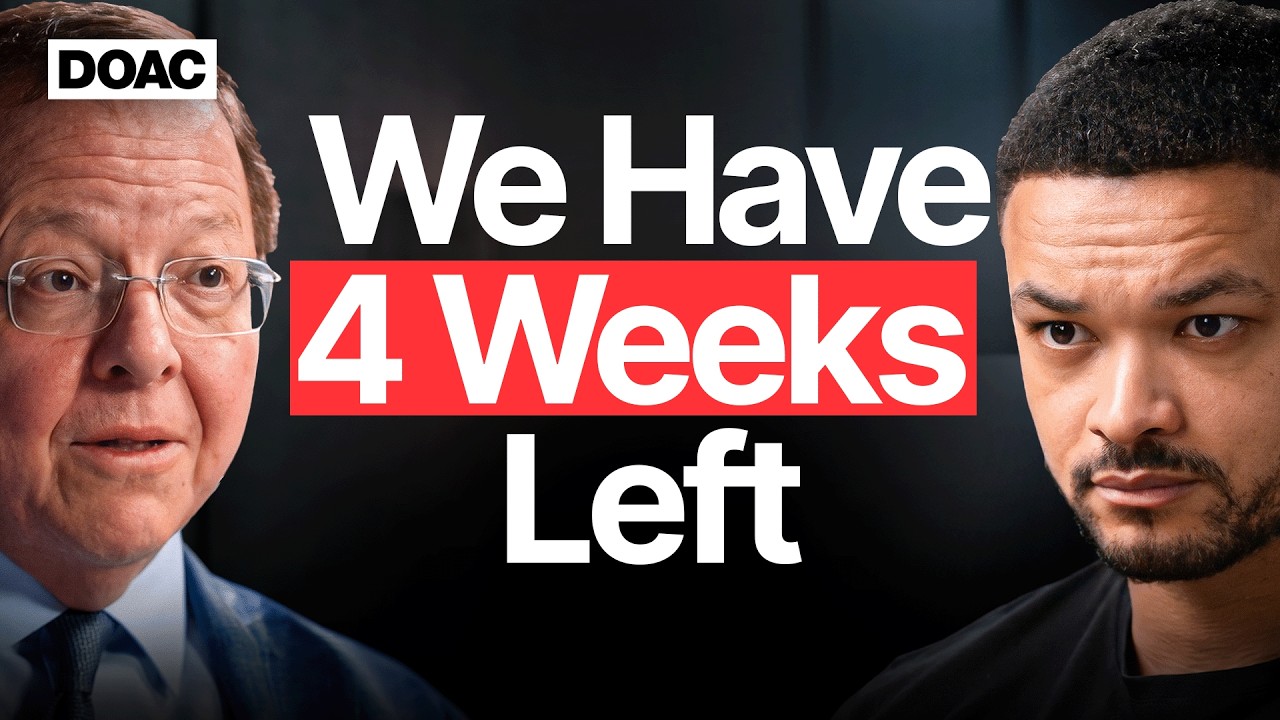
Pape Sees 70% Chance US Invades Iran Within Month as Gulf Crisis Escalates
The Diary Of A CEO
Political scientist Robert Pape warns a U.S. ground invasion of Iran will spark a wave of global suicide terrorism and trigger a domestic constitutional crisis over war powers.
## Background
This episode of "The Diary Of A CEO," hosted by Steven Bartlett, was published on YouTube on July 23, 2026. It features political science professor and international security expert Robert Pape discussing why the conflict with Iran is entering its deadliest phase yet. According to the show description, Pape explains the failure of U.S. bombing campaigns, Iran's control over regional oil supply, and the growing risks of a broader global economic crisis and escalation into ground war.
## TL;DR
Professor Robert Pape outlines a grim assessment of the evolving conflict with Iran, estimating a high probability of U.S. ground troop deployment to secure critical maritime corridors like the Strait of Hormuz. He explains how foreign ground occupations historically trigger surges in suicide terrorism and warns that military escalation combined with domestic political polarization mirrors the chaotic landscape of the late 1960s. Pape highlights the strategic dilemmas facing the U.S., including looming shortages of precision interceptors, economic shocks from disrupted energy shipping, and the lack of a clear diplomatic off-ramp.
## Atmosphere & style
The conversation carries a tense, deeply serious tone marked by urgency and sober analytical precision. Host Steven Bartlett guides the discussion with probing questions, while Pape delivers unflinching, high-stakes assessments of military strategy and political risk. The dialogue feels like an intimate, intense briefing on a unfolding global crisis, blending rigorous academic analysis with palpable concern for domestic stability and civilian lives.
## Key takeaways
- [52:45](https://www.youtube.com/watch?v=cxJgLJGHsWc&t=3165s) Professor Robert Pape draws a direct parallel between Donald Trump's military predicament in Iran and Lyndon B. Johnson's trap during the Vietnam War.
- [55:26](https://www.youtube.com/watch?v=cxJgLJGHsWc&t=3326s) The U.S. current naval posture in the Gulf of Oman cannot force open the Strait of Hormuz without executing risky ground or coastal operations.
- [01:00:11](https://www.youtube.com/watch?v=cxJgLJGHsWc&t=3611s) Public polling reveals a sharp division: overall U.S. war support remains low (27%–34%), while support among the MAGA base remains extremely high (77%–85%).
- [01:03:27](https://www.youtube.com/watch?v=cxJgLJGHsWc&t=3807s) Pape estimates a 70% probability that U.S. ground forces will be deployed to invade Iranian territory or islands.
- [01:03:27](https://www.youtube.com/watch?v=cxJgLJGHsWc&t=3807s) Regional threats are escalating as Houthi forces disrupt Red Sea shipping routes around Yanbu, and Iran targets U.S. bases in Jordan.
- [01:08:02](https://www.youtube.com/watch?v=cxJgLJGHsWc&t=4082s) Pape warns of mass-casualty threat vectors targeting U.S. naval vessels in the Gulf, commercial aviation, and foreign soft targets.
- [01:12:02](https://www.youtube.com/watch?v=cxJgLJGHsWc&t=4322s) Statistical research shows that foreign ground occupation and military control over home territory are the principal drivers of suicide terrorism globally.
- [01:14:59](https://www.youtube.com/watch?v=cxJgLJGHsWc&t=4499s) No viable diplomatic off-ramp remains due to broken agreements and the destruction of U.S. diplomatic credibility regarding the MOU.
- [01:18:45](https://www.youtube.com/watch?v=cxJgLJGHsWc&t=4725s) If anti-war Democrats take Congress in the midterms and attempt to defund the war effort, a major constitutional crisis over War Powers may erupt.
- [01:24:25](https://www.youtube.com/watch?v=cxJgLJGHsWc&t=5065s) The convergence of domestic political polarization, economic stress from energy crises, and an unpopular foreign war parallels the civil unrest of the late 1960s.
- [01:26:42](https://www.youtube.com/watch?v=cxJgLJGHsWc&t=5202s) The war is costing the U.S. $2 billion per day and causing severe shortages in defensive stocks like Patriot interceptor missiles.
- [01:32:08](https://www.youtube.com/watch?v=cxJgLJGHsWc&t=5528s) China seeks to avoid economic disruption and direct military escalation, whereas Russia benefits strategically from rising oil prices caused by the Middle East conflict.
- [01:34:39](https://www.youtube.com/watch?v=cxJgLJGHsWc&t=5679s) Over 90 million Iranian civilians face severe economic and military risks, with long-term regional stability delayed by 5 to 10 years.
## Detailed walkthrough
### [00:00](https://www.youtube.com/watch?v=cxJgLJGHsWc&t=0s) Intro: Escalate to global crisis or boots on the ground
Robert Pape opens with a stark warning: Iran is positionally stronger now than it was before the war began, describing the unfolding geopolitical reality as a "nightmare scenario." Drawing on over two decades of experience modeling military operations against Iran and advising every White House administration from 2001 to 2024, he compares the current situation to standing on the bridge of the Titanic right before it hits an iceberg. We are fast approaching what he calls "stage three," where the world risks literally running out of oil while military conflicts escalate uncontrollably.
```
┌─────────────────────────────────────────┐
│ THE DILEMMA IN IRAN │
└────────────────────┬────────────────────┘
│
┌───────────────────┴───────────────────┐
▼ ▼
┌─────────────────────────────────┐ ┌─────────────────────────────────┐
│ ACCEPT IRANIAN CONTROL │ │ GROUND INVASION / EXPANSION │
├─────────────────────────────────┤ ├─────────────────────────────────┤
│ • Energy supply shocks │ │ • 70% probability of ground ops │
│ • Global economic recession │ │ • Prolonged asymmetrical war │
│ • Iran dominates Middle East │ │ • Escalated suicide terrorism │
└─────────────────────────────────┘ └─────────────────────────────────┘
```
Pape notes that Iran continues to launch attacks—such as striking a U.S. base in Jordan—prompting nine consecutive days of American retaliatory bombing. Eliminating the drone and missile threats has proven far harder than anticipated because Iran hides its launching platforms everywhere. As U.S. air strikes fail to neutralize these mobile threats, Pape assesses that the probability of American boots on the ground in Iran is bordering on 70% by the end of the week. However, invading territory carries a massive backlash risk: holding foreign land is historically the single biggest driver of suicide terrorism. Ultimately, the U.S. faces a grim binary choice: endure a severe global economic crisis and recession, or deploy ground forces to challenge Iranian control over the Strait of Hormuz.
---
[02:42](https://www.youtube.com/watch?v=cxJgLJGHsWc&t=162s) Why Robert Pape isn't surprised by the campaign's failure
Host Steven Bartlett points out that Pape's predictions have been consistently accurate. Pape explains that air power alone has never successfully overthrown a political regime, a historical trend dating all the way back to World War I. Despite this historical record, U.S. decision-makers initiated an intense regime-change bombing campaign on February 28. U.S. strikes killed Iran's Supreme Leader alongside approximately 137 top government and military officials—an action Pape compares to an enemy decapitating the top tier of American governance.
> "That would be like if somebody killed our president, his wife... half of the cabinet, all of the leaders in the Pentagon, all of the leaders in the CIA, and about a third of the Congress. That is what we did to Iran in those opening weeks in March. And nonetheless, that regime survived."
Despite this massive destruction, the Iranian government did not collapse. When a six-week bombing campaign failed to compel surrender, the strategy shifted to a two-month naval blockade. Yet, President Trump’s reliance on strategic bombing went directly against the weight of historical evidence, leaving U.S. strategy stalled.
* **Historical precedent:** Air power alone has failed to force regime change in every conflict since World War I.
* **Decapitation scale:** Strikes eliminated Iran's Supreme Leader and roughly 137 senior leaders across military and political structures.
* **Regime durability:** Despite losing critical political and military leadership, Iran's governmental framework remained intact and functional.
---
[04:24](https://www.youtube.com/watch?v=cxJgLJGHsWc&t=264s) U.S. attempts to force open the Strait of Hormuz
Following the initial strikes, Iran seized effective control of the Strait of Hormuz between March 2 and March 3, causing commercial maritime traffic to stop cold. The U.S. attempted to coerce Tehran into relinquishing control, but Iran's chokehold on the waterway remained largely unbroken, with maritime transit opening only briefly for minor exceptions.
Pape highlights that the U.S. has reached a critical strategic fork in the road. Having failed to coerce Iran through decapitation strikes, extended bombing runs, or naval blockades, the United States is left with no easy options to restore open shipping routes through the strait.
---
[05:43](https://www.youtube.com/watch?v=cxJgLJGHsWc&t=343s) The secret Memorandum of Understanding (MOU)
Discussing diplomatic efforts, Bartlett recalls a previous interview with Vice President JD Vance, who stated that an agreement with Iran was imminent to end the war. Pape confirms that a 14-point Memorandum of Understanding (MOU) was signed by President Trump, but explains why it collapsed within weeks: U.S. negotiators treated a major regional conflict as if it were a standard real estate transaction.
```
TRADITIONAL U.S. DEALMAKING IRANIAN STRATEGIC REALITY
┌───────────────────────────────────────┐ ┌───────────────────────────────────────┐
│ • Transactional focus (money/trade) │ │ • Geopolitical balance of power │
│ • Offers $300B future incentive │ │ • Secures control of Strait of Hormuz │
│ • Assumes financial "fee-for-service" │ │ • Establishes regional hegemony │
└───────────────────────────────────────┘ └───────────────────────────────────────┘
```
The administration offered Iran financial incentives—including dangling a long-term prospect of $300 billion—in exchange for opening the strait under a fee-for-service model. However, Pape points out that major powers fight over the balance of power, not simple commercial payouts. Prior to the war, the U.S. was the dominant power, Israel was rising, and Iran was in decline. Controlling the Strait of Hormuz fundamentally altered that equilibrium, handing Iran leverage that translates directly into military strength and regional influence.
---
[08:33](https://www.youtube.com/watch?v=cxJgLJGHsWc&t=513s) Iran's path to regional hegemony
By signing the MOU, Tehran secured a framework that effectively turned it into the dominant regional power, or *hegemon*. Pape notes that Iran signed the document quickly because its terms codified Iranian dominance over the Persian Gulf—a term President Trump had rejected when Iran presented a similar 14-point plan back in April.
Under Article 5 of the agreement, Iran was tasked with managing transit arrangements through the Strait of Hormuz and agreed not to charge transit fees for a period of 60 days. Crucially, the text contained no provision stating fees would never be charged after that period, leaving future fee structures entirely to Iran and Oman without any U.S. oversight or counterweights.
```
┌─────────────────────────────────────────────────────────────────┐
│ KEY TERMS OF THE SIGNED MOU │
├─────────────────────────────────────────────────────────────────┤
│ • Article 1: U.S. guarantees territorial integrity of Lebanon. │
│ • Article 5: Iran manages Strait transit; fee waiver limited │
│ strictly to 60 days. │
│ • Long-term: Future fee setting left to Iran and Oman with no │
│ U.S. oversight mechanisms. │
└─────────────────────────────────────────────────────────────────┘
```
* **Oil Chokepoint:** Control over the Strait of Hormuz places 20% of the world's daily oil supply under Iranian leverage.
* **60-Day Loophole:** The agreement's fee waiver was strictly temporary, giving Iran legal leeway to impose maritime tariffs later on.
* **Omission of U.S. Authority:** The signed draft contained no language granting the U.S. a say in future maritime rules or fee structures.
---
[10:00](https://www.youtube.com/watch?v=cxJgLJGHsWc&t=600s) How the document's authenticity was verified
Bartlett asks how the public can be certain this specific MOU is real rather than a leaked draft. Pape confirms that both the White House and the Iranian government released the exact same 14-point text word-for-word, distinguishing it from earlier drafts leaked by media outlets like Bloomberg.
Pape then illustrates Iran's broader strategy using a map of the region. While controlling the Strait of Hormuz grants Iran command over 20 million barrels of oil per day, regional states quickly moved to bypass the chokepoint. Saudi Arabia redirected 4 to 5 million barrels per day through an existing East-West pipeline to the Red Sea, while the UAE routed nearly 2 million barrels per day through Fujairah.
To prevent these bypass routes from eroding its leverage over time, Iran set out to construct a broader "security resistance belt" stretching from the Persian Gulf across Syria and Lebanon to the Red Sea. By maintaining aligned proxy forces—such as the Houthis in Yemen and Hezbollah in Lebanon—equipped with long-range attack drones, Iran can threaten bypass pipelines and shipping lanes at will. This creates an operational sphere of influence that preserves its control over global energy movement regardless of which route the oil takes.
---
[15:15](https://www.youtube.com/watch?v=cxJgLJGHsWc&t=915s) Why the peace deal collapsed within 48 hours
Although both sides signed the agreement, hostilities resumed almost immediately. President Trump initially defended the deal, explaining that he signed it because global oil reserves were roughly four weeks away from depletion. However, within 48 hours of signing, the U.S. administration began taking actions that undermined the agreement's terms.
First, Secretary of State Marco Rubio established a framework accord in Lebanon that effectively locked in a long-term Israeli military presence. This directly violated Article 1 of the MOU, which pledged that the U.S. would guarantee Lebanon's territorial integrity. Second, the Trump administration began encouraging merchant ships to challenge Iranian transit controls in the strait, prompting the deal to break down and thrusting both nations right back into active military strikes.
[17:15](https://www.youtube.com/watch?v=cxJgLJGHsWc&t=1035s) Trump’s Bypassing of the Strait and the MOU Collapse
Robert Pape maps out the geography of the Strait of Hormuz, explaining that shipping originally had three routes through the passage. The central route, which served as the primary lane before the war, is now rendered completely impassable due to roughly 80 naval mines deposited there. That leaves only two functional options: a southern passage hugging the coast of Oman and a northern passage running directly along the coast of Iran.
Instead of honoring the Memorandum of Understanding (MOU), President Donald Trump attempted a covert workaround by encouraging commercial ships to use the southern Oman route without coordinating with Iran—frequently ordering them to turn off their transponders. Trump then publicly boasted about this secret maneuver on True Social. Pape emphasizes that this action directly violated Article 5 of the agreement. Furthermore, Trump committed a third flagrant breach involving Article 11, which mandated the unfreezing of Iranian assets long held by the US and gave Iran exclusive discretion over those funds. Trump publicly announced that Iran could only receive these funds if they were used to buy grain from American farmers.
```
MOU Violations & Route Mechanics:
• Central Passage: Blocked by ~80 naval mines.
• Southern Passage: Used by US-backed ships with transponders off to bypass Iranian oversight.
• Article 11 Breach: Trump conditioned unfrozen assets on purchasing US farm grain.
• Outcome: MOU lasted roughly 1–2 days before collapsing back into active conflict.
```
"President Trump owned the MOU and was faithful to it for at least a day, maybe two... He owned the loss for about a day or two, but then he tried to reverse the loss almost immediately, Stephen. And that's how we're back at war."
---
[19:31](https://www.youtube.com/watch?v=cxJgLJGHsWc&t=1171s) Why Iran Escalated: Great Power Politics in the Middle East
When host Steven Bartlett asks who reignited the shooting in the Strait, Pape clarifies that Iran initiated attacks on commercial ships because the US was actively undermining their agreed-upon regional control. The central issue is not merely legal technicalities, but high-stakes great power politics. Prior to the war's outbreak on February 28, Iran had no operational leverage or sovereign control over shipping in the Strait of Hormuz.
However, sensing a strategic vacuum caused by the absence of a substantial US naval presence at the start of the conflict, Iran pivoted rapidly from a posture of basic survival to one of aggressive regional ambition. By seizing physical control over the choke point, Iran effectively crowned itself as the rising regional hegemon—a status the United States fundamentally refuses to accept.
Pape confirms that the war has undeniably made Iran stronger today than it was before February 28. Because Iran can strike virtually any vessel attempting to run its maritime gauntlet with drones or mines, it now exerts a firm stranglehold over global energy transport.
---
[22:26](https://www.youtube.com/watch?v=cxJgLJGHsWc&t=1346s) Saturated Swarms and the Hidden Drone Arsenal
Addressing a viral tweet questioning how Iran can still strike US military bases after four months of heavy American bombardment, Pape explains the tactical reality of asymmetric warfare. Even if American strikes destroyed a large percentage of Iran's high-end military infrastructure, Iran began the war with tens of thousands of suicide drones, ballistic missiles, and low-altitude, sea-skimming cruise missiles.
Iran's current tactical dominance relies on "saturation attacks"—launching dense swarms of low-cost drones and cruise missiles simultaneously to overwhelm and exhaust advanced US missile defense systems. While early strikes in March featured intermediate-range ballistic missiles, Iran shifted primarily to Shahed drones. More recently, Iran has reintroduced a full-spectrum arsenal of sea-skimming cruise missiles and ballistic missiles targeting multiple locations across the region.
"Iran entered this war with thousands, we think tens of thousands of drones, ballistic missiles, anti-shipping missiles... they're doing saturation attacks. They're essentially doing swarms."
- **Primary Weapons:** Shahed-136 suicide drones, sea-skimming cruise missiles, intermediate ballistic missiles.
- **US Defense Bottleneck:** American forces risk running out of expensive air-defense interceptors before Iran runs out of cheap attack drones.
---
[25:59](https://www.youtube.com/watch?v=cxJgLJGHsWc&t=1559s) Hiding Drones in Mountains: The 3D Geography Challenge
Despite claims posted by Trump on True Social in May 2026 asserting that Iran's navy, air force, radar, and missile capabilities had been virtually wiped out, Iranian strikes continue to kill American service members. Pape demonstrates why destroying these remaining capabilities from the air is nearly impossible, using a visual model to explain the sheer geographical scale of the problem.
The deployment zone for Iran's Shahed-136 drones spans a 500-mile radius—an area roughly 1.5 times the size of California. Crucially, the topography is not a flat two-dimensional plane, but a dense, cavernous mountain system. Iranian forces store drones in deep underground caverns and mobile trucks layered beneath natural terrain. Trying to eliminate these weapons without ground troops is the strategic equivalent of trying to hunt down a specific unmarked delivery truck hidden somewhere in the state of California.
```
Geographic & Production Scale:
• Target Search Area: 500-mile radius (>1.5× the surface area of California).
• Terrain: High-altitude mountain ranges with deep underground caverns.
• Manufacturing Output: Pre-war estimates showed Iran producing ~55,000 Shahed drones per year (thousands per month).
```
---
[29:24](https://www.youtube.com/watch?v=cxJgLJGHsWc&t=1764s) Commercial Shippers and the $300 Million Risk
Pape emphasizes that finding or blowing up a few hundred drones will not resolve the crisis. To reopen the Strait of Hormuz, the US military must guarantee total safety to commercial shipping conglomerates. The Pentagon cannot legally command private international maritime fleets to sail through a combat zone, and ship owners refuse to risk their vessels or crew lives.
Bartlett points out that a modern supertanker loaded with crude oil represents a floating asset worth roughly $300 million (carrying 700,000 to over 1,000,000 barrels of oil). Beyond the extreme financial liability, shipping crews face catastrophic loss of life, causing widespread crew mutonies and soaring maritime insurance premiums. As a result, commercial ships are fleeing the region, with remaining traffic almost exclusively heading into Iranian ports.
> "You can't order the shippers to go through... when you combine a brand new vessel with a full tank of oil, a single tanker crossing the Strait of Hormuz is a floating asset worth $300 million."
---
[32:37](https://www.youtube.com/watch?v=cxJgLJGHsWc&t=1957s) Escalation in the Red Sea and Global Oil Reserves
The situation spiraled further into a global economic emergency when Iran’s ally, the Houthi movement in Yemen, shut down the Red Sea trade route. Prior to this, Saudi Arabia and the UAE had attempted to bypass the blockaded Strait of Hormuz by piping roughly 7 million barrels of oil per day directly to ports on the Red Sea and Gulf of Oman (such as Fujairah). With the Houthis closing off the Red Sea, those bypass routes are now compromised.
To prevent an immediate global energy panic in mid-March, President Trump coordinated an emergency drawdown with 32 member nations of the International Energy Agency (IEA). The IEA collectively released 400 million barrels of emergency crude, with the US contributing 172 million barrels from its Strategic Petroleum Reserve (SPR) over a planned 120-day timeline.
```
Global Energy Breakdown:
• Original Hormuz Daily Flow: ~20 million barrels of oil per day.
• Emergency IEA Release: 400 million barrels total across 32 nations.
• US SPR Release: 172 million barrels pumped out over 120 days.
• Current US SPR Level: Depleted to ~300 million barrels (July 2026)—a 40-year low not seen since 1983.
```
Pape warns that as the 120-day release period reaches its end, the global safety cushion is entirely gone. With depleted reserves and dual maritime blockades across both the Strait of Hormuz and the Red Sea, the world economy stands on the brink of an unprecedented energy crisis.
[35:17](https://www.youtube.com/watch?v=cxJgLJGHsWc&t=2117s) Global Refining Capacity and the Impending Fuel Shortage
The ongoing conflict is not merely choking off raw crude oil; it is severely disrupting the world's refining capacity. Professor Robert Pape explains that vehicles do not run on raw crude, but on refined products—gasoline and diesel distillates. A massive portion of global refining infrastructure is located directly within the Persian Gulf. By disrupting operations in the region, roughly 25% to a third of the world's refining capacity has been effectively shut down.
When paired with Ukraine's deliberate attacks on oil refineries inside Russia, the global energy system faces a dual crisis: a shrinking supply of crude oil alongside heavily strained refining capacity, which Pape estimates could be down by as much as 40%. This catastrophic bottleneck forced President Trump into a critical dilemma. He desperately needed the Strait of Hormuz open to avoid a global economic fallout, yet he was unwilling to accept a political defeat ("own the L"). Ultimately, Trump opted to gamble with the global economy rather than concede defeat to Iran.
* **Key Fuel Types:** Vehicles rely on refined distillates (gasoline and diesel) rather than crude oil.
* **Capacity Hit:** Between 25% and 33% of global refining capacity is concentrated in the Persian Gulf.
* **Compounding Factors:** Ukrainian strikes on Russian refineries further exacerbate global fuel supply deficits, bringing total capacity strain toward 40%.
---
[36:47](https://www.youtube.com/watch?v=cxJgLJGHsWc&t=2207s) The "Escalation Trap" and President Trump's Dilemma
Steven and Professor Pape break down what "owning the L" truly signifies in geopolitical terms. Conceding to Iran would mean allowing Tehran to enforce its terms over the Strait of Hormuz, setting a dangerous precedent for strategic maritime choke points worldwide. Pape highlights that President Trump reached a critical "stage three" fork in the road—a predictable outcome modeled in security simulations over the last 20 years.
To avoid this escalation trap, the administration attempted various strategies: six weeks of aerial bombing, naval blockades, signing a Memorandum of Understanding (MOU), and having Vice President JD Vance offer financial incentives. None of these measures succeeded. Trump now faces a stark binary choice: either swallow a devastating strategic loss that establishes Iran as a regional hegemon with authority over global choke points, or take the Strait back through direct physical force.
> "The choice is: do we have a global economic crisis, possibly recession, possibly worse, or do we let Iran control the Strait of Hormuz? This is not a good place to be."
* **Strategic Precedent:** Conceding control of Hormuz risks encouraging other hostile nations and non-state actors to seize critical global choke points.
* **Failed Alternatives:** Aerial strikes, blockades, diplomatic MOUs, and monetary offers all failed to break Iran's leverage over the Strait.
---
[38:57](https://www.youtube.com/watch?v=cxJgLJGHsWc&t=2337s) The Four-Week Oil Reserve Clock
Steven references President Trump's blunt admission during the G7 summit in June 2026, where Trump warned that global energy stockpiles were running dangerously low due to the Hormuz bottleneck. Trump stated directly, "We run out of reserves at about 4 weeks... It would be bedlam." Pape notes that Trump was being unusually forthright about why he signed the initial MOU—he was trying to avert an imminent global economic collapse.
However, within 48 hours of making that admission, Trump's actions undermined the very MOU that might have prevented the emergency. Desperate to re-open the Strait before stockpiles completely dry up, the administration has pursued high-risk military options, even though military advisors likely warned him that these actions have a low probability of success. While temporary leaks of oil out of the Gulf may have pushed the critical deadline back from August 1st to around August 15th or 17th, the energy shortage remains inevitable.
* **G7 Summit Admission:** Trump publicly stated in mid-June 2026 that global reserves would deplete in roughly 4 weeks.
* **Revised Timeline:** Small amounts of oil escaping the Gulf bought an extra week or two, pushing the reserve exhaustion date to mid-August 2026.
---
[40:52](https://www.youtube.com/watch?v=cxJgLJGHsWc&t=2452s) The Midterm Election Time Bomb and Historical Parallels
The timeline of the oil crisis intersects directly with domestic politics: the U.S. midterm elections are taking place in just three months. Rising gas prices at the pump directly threaten Republican control of Congress. If voters react to soaring energy costs by turning to Democrats, Trump risks losing both the House and the Senate, leaving him a severely constrained "lame duck" president vulnerable to further impeachments and legislative gridlock.
Pape draws a direct parallel between Trump's current predicament and President Lyndon B. Johnson's decision-making during the Vietnam War. White House tapes reveal that Johnson knowingly escalated the war in Vietnam despite understanding the military odds were terrible. Johnson escalated in the desperate hope of buying four or five months to salvage his domestic "Great Society" agenda. Similarly, Trump is taking high-risk gambles to pull off a political miracle before November, while simultaneously laying the groundwork to blame potential electoral losses on foreign election interference from countries like China.
* **Political Consequences:** Loss of Congress would lock the administration in legislative standstill for the final two years of Trump's term.
* **Historical Echoes:** Secret recordings reveal LBJ escalated the Vietnam War against military logic strictly to buy short-term political time for his domestic agenda.
* **Narrative Prepping:** Trump has begun publicly suggesting potential Chinese election meddling as a defensive narrative ahead of November.
---
[48:23](https://www.youtube.com/watch?v=cxJgLJGHsWc&t=2903s) Mapping out the Escalation Ladder
Professor Pape introduces a visual diagram shaped like an inverted pyramid—the "Escalation Ladder"—to illustrate how low-level military actions inevitably expand into broader conflicts:
1. **Stage 1 (Limited Strikes):** Targeted strikes aimed at killing leadership and attempting regime change.
2. **Stage 2 (Retaliation):** Hostile response (Iran taking control of Hormuz) followed by secondary responses, such as 6 weeks of bombing and naval blockades.
3. **Stage 3 (Economic Crisis & Physical Force):** Reaching the threshold where diplomatic and economic buffers run out. The options narrow to accepting Iran as a regional power or using physical military force to seize the Strait.
4. **Stage 4 (Forever War):** A deep-red phase anticipated in 2027 involving prolonged regional ground conflict and sustained asymmetrical warfare.
Pape emphasizes that the world is currently at Stage 3. If Iran is allowed to consolidate control over Hormuz, it will cement its role as a regional power and likely acquire nuclear weapons within one to two years. Conversely, attempting to physically re-open the Strait before the upcoming midterm elections carries extreme risk—and Pape warns that the U.S. will almost certainly fail to open the passage by military force within that timeframe.
* **Nuclear Timeline:** Allowing Iran to establish its sphere of influence makes it highly likely to secure operational nuclear weapons within 12 to 24 months.
* **Crucial Question:** Can the United States physically force the Strait of Hormuz open before the November midterms? Pape's assessment is "almost surely not."
---
[52:33](https://www.youtube.com/watch?v=cxJgLJGHsWc&t=3153s) The Vietnam Parallel: LBJ's Trap
As the discussion wraps up, Steven reiterates the striking similarities between the present crisis and Lyndon Johnson's strategic paralysis during the Vietnam War—a conflict widely remembered for dragging on endlessly while achieving none of its strategic goals.
<ElicitationsGroup message="Explore the historical parallels and strategic options further:">
{/* Reason: Provides logical next steps to examine the military, economic, and historical aspects of Pape's analysis. */}
<Elicitation label="Analyze the military options for physically opening the Strait of Hormuz" query="What specific military options does the US have to physically open the Strait of Hormuz, and why does Pape consider them low-probability?"/>
<Elicitation label="Compare LBJ's Vietnam policy with current US strategy in Iran" query="Deep dive into the historical parallels between Lyndon B. Johnson's escalation in Vietnam and US military strategy regarding Iran."/>
<Elicitation label="Examine the geopolitical role of China and Russia in the Persian Gulf" query="How do China and Russia benefit from prolonged US military engagement in the Middle East according to Robert Pape?"/>
</ElicitationsGroup>
[52:45](https://www.youtube.com/watch?v=cxJgLJGHsWc&t=3165s) LBJ's Vietnam Trap and the Historical Parallel
The conversation opens with a direct historical parallel between President Donald Trump’s present dilemma with Iran and President Lyndon B. Johnson’s tragic descent into the Vietnam War. Reading from historic archival quotes, Steven Bartlett points out how LBJ privately lamented his position in the 1960s. Johnson admitted at the time: *"I know we ought not be there, but I can't get out. I just can't be the architect of surrender."* Johnson felt politically paralyzed—knowing full well that his military strategy was flawed, yet fearing that any tactical step back would be branded as a humiliating defeat.
LBJ also recognized the limits of air power, famously stating, *"Let's get somebody that wants to do something besides drop a bomb, but that can go in and take in after these damn fellas and run them back where they belong."* He realized that relying strictly on massive air campaigns like Operation Rolling Thunder could not solve the unconventional ground-level insurgency. Furthermore, projecting force 10,000 miles away against an enemy fighting on their home turf was, in LBJ's words, *"the biggest damn mess that I ever saw."* Without a clear light at the end of the tunnel, Johnson remained trapped.
Professor Robert Pape emphasizes how tragic it is to watch history repeat itself so precisely. Trump is walking the exact same tightrope Johnson walked. Trump understands that escalating the military commitment carries a high risk of long-term failure on the battlefield; however, because that failure takes months to fully play out, it offers a desperate gamble—a chance to somehow "pull a rabbit out of a hat." In contrast, accepting an immediate, abrupt defeat or withdrawal right now would instantly destroy his domestic political standing and crush his domestic agenda.
---
[55:26](https://www.youtube.com/watch?v=cxJgLJGHsWc&t=3326s) The Strategy for the Strait of Hormuz and a Potential Ground Invasion
Turning to the internet's most pressing questions regarding the war, Steven asks whether the U.S. military actually possesses the capacity to force the Strait of Hormuz fully open, or if Iran now retains permanent leverage over this global energy choke point. Pape responds flatly: the United States cannot reopen it through its current posture. To illustrate what is actually developing, Pape pulls out a map of the region to explain the strategic placement of American forces.
The U.S. has massed an armada in the Gulf of Oman—including aircraft carriers, destroyers, cruisers, and a Marine Expeditionary Unit comprising roughly 4,500 to 5,000 Marines, alongside approximately 4,000 troops from the 82nd Airborne Division. Crucially, these naval forces have deliberately not moved west through the tight bottleneck of the Strait of Hormuz into the Persian Gulf; they remain stationed in the Gulf of Oman, just off Iran's southeastern coast. Naval deck guns and ship-to-shore capabilities operate effectively within a 12-mile coastal range. Pape explains that you do not gather this specific type of amphibious and airborne strike force simply to escort commercial oil tankers. Instead, this armada is precisely engineered to execute a localized beachhead or port seizure—targeting isolated Iranian coastal locations such as Jask (located between Bandar Abbas and Chabahar) or Chabahar itself.
```
[ PERSIAN GULF ]
│
▼
[ STRAIT OF HORMUZ ] (Choke Point)
│
▼
[ GULF OF OMAN ]
(U.S. Carrier Strike Groups & Marines)
│
┌───────────────────┴───────────────────┐
▼ ▼
[ Jask ] [ Chabahar ]
(Potential U.S. amphibious targets on Iran's sparsely populated SE coast)
```
For Trump, capturing a piece of Iranian territory on the sparsely populated southeastern coast could be framed as a dramatic, symbolic victory that he could hold for a few weeks to project strength. However, Pape warns that this tactical maneuver will not work long-term. While it might force Tehran to temporarily divert its military assets to the southeast, Iran will inevitably maneuver to drive American forces out.
- **U.S. Troop Concentration:** ~4,500–5,000 Marines and ~4,000 troops from the 82nd Airborne Division deployed in the Gulf of Oman.
- **Key Targeted Locations:** Jask and Chabahar along Iran's southeastern coastline.
- **Geographic Distinction:** The southeastern coast is Iran's least populated sector, far removed from Tehran and major population centers, making it vulnerable to short-term seizure but difficult to sustain without full-scale war.
---
[01:00:11](https://www.youtube.com/watch?v=cxJgLJGHsWc&t=3611s) American Casualties and the Polarization of MAGA Public Support
Executing a land invasion—even a limited one to seize a coastal port—guarantees that American troops will become direct targets for Iranian forces. Steven notes that putting boots on the ground means accepting casualties, likely resulting in hundreds of dead American soldiers over a span of weeks. When asked how the American public will react to returning body bags, Pape explains the complex and counterintuitive dynamics of political polarization.
Public opinion polling from mid-2026 reveals a stark nation divided along partisan lines:
- **General Public:** Highly anti-war, with overall support hovering at just 27% to 34%, while a clear majority of 53% to 57% explicitly oppose the war.
- **MAGA Base:** Overwhelmingly pro-war, with 77% to 85% supporting the military campaign and regime change in Iran, while only 5% to 14% oppose it.
Pape points out that MAGA has not transformed into "Tucker Carlson country" on foreign policy; it remains fiercely loyal "Trump country." When U.S. service members are killed in action, the immediate psychological reaction among supporters is not to abandon the effort, but to harden their stance. As seen on news broadcasts following the deaths of three service members over a recent weekend, casualties spark intense patriotism, grief, and a desire to honor the fallen. Withdrawing after troops die creates an agonizing political dilemma: it invites critics to claim those soldiers died in vain. Consequently, blood sacrifice on the battlefield often locks in and temporarily inflates political support for a conflict rather than eroding it, further entrenching domestic divisions.
---
[01:03:27](https://www.youtube.com/watch?v=cxJgLJGHsWc&t=3807s) The Escalation Spiral and a 70% Chance of Boots on the Ground
Pape assesses the likelihood of U.S. ground troops invading Iran at **70%**, predicting that such an operation could be launched within a month, if not by the end of the current week. The driving force behind this rapid acceleration is that the anticipated economic crisis is already becoming deeply baked into the global market.
Over the weekend, Houthi forces effectively shut down shipping around the vital Saudi Red Sea port of Yanbu—the primary conduit through which 4 to 5 million barrels of Saudi crude oil flow daily. This move crippled an essential alternative bypass route. Meanwhile, Iran is driven by an intense emotional imperative for revenge rather than conciliation. Following an attack that tragically killed two U.S. soldiers in Jordan, Iran's Supreme Leader publicly vowed to deliver *"unforgettable lessons to America."*
The conflict is spiraling because neither side is willing to de-escalate:
1. The U.S. enters its ninth consecutive day of heavy bombing strikes against Iranian targets.
2. Iran retaliates by striking U.S. installations in Jordan—a target rare since March 2026.
3. Houthi allies choke off Red Sea oil transit via Yanbu.
4. Tensions flare dramatically in Kuwait, signaling deep regional instability.
Trump can no longer simply issue orders to reset the status quo. To stabilize markets, Iran would have to voluntarily halt its strikes, reopen the Strait of Hormuz, and allow Red Sea oil to flow freely. Because Tehran shows zero inclination to back down, President Trump feels increasingly boxed into ordering a ground invasion as his only remaining leverage.
---
[01:08:02](https://www.youtube.com/watch?v=cxJgLJGHsWc&t=4082s) Imminent Risks: Mass Casualty Attacks and Suicide Terrorism
Looking ahead at the immediate future, Pape shares his most urgent concerns regarding how this war will play out on the ground. His single greatest fear is a successful mass-casualty strike executed by Iran against American forces or civilians. Iran has demonstrated an "exquisite ability to precisely target" military infrastructure. Pape warns that Iran—potentially aided by Russian or Chinese satellite tracking intelligence—could launch a coordinated, massive missile barrage against U.S. naval vessels stationed in the Gulf of Oman.
Even more alarming is the systemic shift toward ground invasion. Drawing on his 25 years of pioneering research into suicide terrorism, Pape stresses that **foreign military occupation is the single greatest trigger for mass suicide bombing campaigns**. By threatening to land troops on Iranian soil, the U.S. is crossing the exact threshold that historically activates widespread, asymmetric terror responses.
Pape warns that this renewed threat environment extends far beyond the immediate front lines:
- **Commercial Aviation:** High risk of missile or terrorist attacks targeting U.S. commercial airliners or civilian aviation infrastructure.
- **Soft Targets Abroad:** Threats to U.S. business personnel, diplomats, and tourists in previously secure regional hubs, such as the recent strikes in the resort town of Aqaba, Jordan.
- **Homeland Attacks:** The growing possibility of asymmetric, retaliatory strikes targeting infrastructure or soft targets directly within the U.S. homeland.
[01:10:07](https://www.youtube.com/watch?v=cxJgLJGHsWc&t=4207s) The Escalation Spiral and the Looming Threat of Suicide Terrorism
The conflict is rapidly intensifying through a mutually reinforcing spiral of escalation. Professor Robert Pape cautions that this trajectory isn't driven solely by President Donald Trump; Iran is escalating just as aggressively, if not more so. This dynamic creates a severe risk of a mass-casualty event targeting either deployed U.S. troops or American civilians across the globe. U.S. businessmen are currently traveling throughout the Middle East to construct alternative pipelines, making commercial centers and hotels potential prime targets. Highlighting the immediacy of the danger, British and German embassies have begun evacuations, and the U.S. State Department issued an advisory urging Americans to leave the region.
```
Escalation Dynamic ──► Impending Mass-Casualty Threat ──► Hardening Public Support & Prolonged War
```
If a mass-casualty attack occurs—whether in London, Indonesia, or on American soil—it will drastically harden U.S. public support for continuing the war to neutralize future Iranian terror threats. Professor Pape explains that the underlying driver of suicide terrorism is not religion or general ideology, but the threat or reality of foreign military combat forces controlling territory that the perpetrators prize as their homeland.
- **Diplomatic Evacuations:** British and German embassies ordered evacuations, alongside a U.S. State Department advisory urging citizens to depart the region.
- **Global Vulnerability:** Potential target sites for anti-American retaliation include hotels hosting business personnel in the Middle East, as well as major international hubs like London or Indonesia.
- **Root Cause of Suicide Attacks:** Foreign military combat presence occupying or threatening homeland territory is the single strongest statistical predictor of suicide bombings.
---
[01:12:02](https://www.youtube.com/watch?v=cxJgLJGHsWc&t=4322s) The Anatomy and Research of Suicide Attacks
Drawing from his extensive research at the University of Chicago, where he compiled the world's first complete database of suicide attacks following 9/11, Professor Pape outlines why suicide terrorism is uniquely deadly. He describes suicide bombing as the "lung cancer of terrorism"—while other forms of terrorism exist, suicide attacks account for the vast majority of all casualties worldwide.
```
┌────────────────────────────────────────────────────────┐
│ "LUNG CANCER OF TERRORISM" │
├────────────────────────────────────────────────────────┤
│ Human Precision Guidance │ Maximum Lethality & Chaos │
│ Identifies weak points │ Exploding at precise sec │
└────────────────────────────────────────────────────────┘
```
Stopping a suicide bomber presents a fundamental defense challenge that traditional missile interceptors cannot solve. A suicide bomber effectively acts as a human precision-guided weapon. No automated or guided missile system can evaluate a crowd, pinpoint the absolute most vulnerable entry point of a structure, or choose the exact split second to detonate with the deadly efficiency of a human operator.
- **Lethality Benchmark:** Suicide terrorism causes more deaths globally than every other form of conventional terrorism combined.
- **Human Precision:** Suicide bombers function as living precision-guided munitions, dynamically maximizing casualties by selecting optimal timing and targets in real time.
- **Historical Parallel:** Following 9/11, academic predictions accurately forecast that invading and occupying Iraq would unleash the largest campaign of suicide terrorism in modern history.
---
[01:14:59](https://www.youtube.com/watch?v=cxJgLJGHsWc&t=4499s) Ground Control vs. Aerial Bombardment
Professor Pape makes a crucial distinction between military aerial bombardment and ground invasions. Air strikes kill people, but ground forces impose foreign political control. When foreign troops land on the ground, the local population loses control over its way of life. This perception of deep structural violation is the precise catalyst that converts political resistance into suicide campaigns.
> "It's not the killing people part of this that matters. It's the political control part that comes with the ground forces... political control means the group controlled doesn't control its way of life."
This dynamic was clearly demonstrated in Afghanistan. Following the initial fall of the Taliban in late 2001, suicide attacks were virtually non-existent. It was only years later, as Western nations poured massive ground forces into the country to enforce political order, that widespread suicide terrorism erupted.
```
Ground Forces Deployed ──► Loss of Local Control ──► "Deeper Violation" ──► Surge in Suicide Terrorism
```
- **Invasion vs. Bombing:** Aerial bombardment causes destruction, but ground operations threaten self-determination and ignite sustained suicide campaigns.
- **The Afghanistan Case Study:** Suicide terrorism did not surge immediately upon the Taliban's removal in late 2001; it escalated significantly years later as foreign military ground footprints expanded.
---
[01:16:26](https://www.youtube.com/watch?v=cxJgLJGHsWc&t=4586s) The Missing Off-Ramp and Donald Trump's Dilemma
President Trump posted on Truth Social warning that every time Iran kills an American soldier, "they will pay for that killing many times over," directing Secretary of War Pete Hegseth and the Chairman of the Joint Chiefs of Staff to execute this mandate. Addressing host Steven Bartlett's question regarding an achievable diplomatic off-ramp, Professor Pape bluntly responds: "No, Steven, there is not an achievable off-ramp."
```
Timeline of Missed Opportunities:
├── Early March: Missed chance to "declare victory and walk away" after killing Iranian leadership.
├── April: Missed window to militarily contain Israel and prevent regional expansion.
└── Present: MoU is no longer credible after repeated violations; no viable diplomatic off-ramp remains.
```
The opportunity for an exit closed when the administration failed to take strategic off-ramps earlier in the conflict:
1. **Early March:** The administration could have declared victory and walked away after eliminating top Iranian leadership, returning to diplomatic nuclear negotiations.
2. **April:** The U.S. failed to militarily contain Israel as it expanded operations into Lebanon.
Attempting to enforce the previously signed Memorandum of Understanding (MOU) is no longer viable because the U.S. lacks diplomatic credibility after repeated violations, leaving the administration backed into a corner without a clear strategic exit.
- **Truth Social Declarations:** President Trump publicly signaled aggressive escalation directly to military leadership, including Secretary of War Pete Hegseth.
- **Diplomatic Deadlock:** Re-offering the MOU is ineffective because past non-compliance has rendered U.S. commitments non-credible to Iranian leadership.
---
[01:18:45](https://www.youtube.com/watch?v=cxJgLJGHsWc&t=4725s) The 1974 Blueprint: How Congress Can Stop a War
While a diplomatic off-ramp appears nonexistent, an institutional mechanism to end the war remains: the U.S. Congress. If the Democratic Party wins control of the House, the Senate, or both in the upcoming midterm elections, lawmakers can cut off funding for military operations—mirroring the historical precedent set during the Vietnam War in 1974.
```
Midterm Election ──► Shift in Congressional Control ──► Defunding Legislation ──► Forced Military Withdrawal
```
Professor Pape emphasizes that the crucial window determining the trajectory of the war is the period leading up to the midterms. If the U.S. cannot physically force open the Strait of Hormuz, shifting political tides will likely hand legislative control to anti-war Democrats intent on capping defense expenditures and defunding the war effort.
- **Historical Precedent:** In 1974, Congress exercised its constitutional power of the purse to cut off funding and force the end of U.S. military involvement in Vietnam.
- **Power of the Purse:** Legislative defunding remains the most direct constitutional tool to halt executive war-making capabilities.
---
[01:21:09](https://www.youtube.com/watch?v=cxJgLJGHsWc&t=4869s) Imminent Constitutional Crisis: War Powers vs. Executive Authority
A direct clash between the executive and legislative branches is brewing, setting the stage for a severe constitutional crisis:
1. **Legislative Action:** Congress passes funding restrictions or War Powers resolutions to halt operations.
2. **Executive Veto:** President Trump uses his veto power, requiring an almost unachievable two-thirds supermajority in both chambers to override.
3. **Article 2 Claims:** Citing Article 2 commander-in-chief powers, the President asserts inherent authority to protect U.S. forces and national interests without legislative approval.
4. **Fiscal Maneuvers:** The executive branch utilizes emergency transfer authorities and accounting reallocations within the Pentagon budget to sustain baseline operations.
This conflict underpins Professor Pape's upcoming book, *Our Own Worst Enemies: America and the Age of Violent Populism*, whose preface is titled "The Most Dangerous Elections in Our Lifetimes." The convergence of domestic political polarization, aggressive immigration enforcement (such as ICE deportations), and an overseas war creates an volatile environment where foreign and domestic crises fuse.
- **Supermajority Threshold:** Overriding a presidential veto on war funding requires a two-thirds vote in both the House and the Senate.
- **Article 2 Executive Defense:** Presidents routinely invoke inherent constitutional commander-in-chief powers to bypass legislative limits on military actions.
---
[01:24:25](https://www.youtube.com/watch?v=cxJgLJGHsWc&t=5065s) The Collision of Crises: Echoes of the 1960s
The overlapping of severe foreign policy challenges with domestic political turmoil creates a dynamic reminiscent of the late 1960s. During that era, the intersection of an unpopular war and deep societal polarization generated widespread civil unrest, political violence, assassinations (including Martin Luther King Jr. and Robert F. Kennedy), anti-war bombings by radical groups like the Weather Underground, and extreme police responses, such as Chicago Mayor Richard J. Daley's "shoot to kill" directives during the 1968 Democratic National Convention.
```
Unpopular Foreign War + Domestic Political Tension ──► Mass Protests & Violence (1960s Parallel)
```
Professor Pape warns that the U.S. is heading toward a similar historical inflection point. The foreign crisis in the Strait of Hormuz and the domestic crisis of political populism are no longer isolated issues; they are colliding to create a period of intense instability.
- **1960s Parallels:** Violent anti-war campaigns, domestic bombings by groups like the Weather Underground, high-profile political assassinations, and harsh government crackdowns.
- **Convergence Risk:** The merging of violent domestic populism with a contentious foreign war creates a compounding crisis for national stability.
---
[01:25:21](https://www.youtube.com/watch?v=cxJgLJGHsWc&t=5121s) Midterm Scenarios: Mass Casualty vs. Economic Collapse
Predicting the outcome of the upcoming midterm elections depends heavily on specific, volatile variables over the coming months:
| Scenario | Trigger Event | Likely Political Outcome |
|:--- |:--- |:--- |
| **Scenario A** | Iranian-inspired or command-directed mass-casualty attack against Americans | Public rallies around the Commander-in-Chief; Republicans retain/gain control. |
| **Scenario B** | Prolonged Strait blockade leading to global economic crisis without a direct mass-casualty attack | Voter backlash over economic distress; Democrats capture Congress. |
Professor Pape cautions that a mass-casualty event does not require direct command-and-control authorization from Tehran. Iran's Supreme Leader is issuing public rhetoric comparable to former ISIS leader Abu Bakr al-Baghdadi, encouraging decentralized, "inspired" lone-wolf attacks worldwide—similar to the November 2015 Paris terrorist attacks.
- **Inspired vs. Directed Attacks:** Terrorist strikes can be triggered by ideological calls to action rather than direct organizational hierarchies.
- **Midterm Determinants:** A major terror attack hardens public resolve in favor of the incumbent administration, whereas economic stagnation from energy disruptions favors the opposition party.
Here is the detailed walkthrough of the transcript section provided.
---
[01:26:42](https://www.youtube.com/watch?v=cxJgLJGHsWc&t=5202s) The Sustainability of the US Air Campaign and Munitions Shortages
Addressing the economic and logistic sustainability of the ongoing US air campaign, host Steven Bartlett notes estimates that the war is costing America around $2 billion a day. In contrast, Iran’s asymmetric attacks using cheap drones and rockets come at a fraction of the cost, making their approach far more sustainable over time. Asked whether the US risks running completely out of weapons, Professor Robert Pape clarifies that while there is a genuine risk regarding air-defense interceptors, the idea that America will run out of offensive bombs is a gross exaggeration.
Pape explains that the US is indeed drawing down heavy stockpiles of interceptor missiles—specifically Patriot missile interceptors used to destroy incoming Iranian ballistic missiles—from key arsenals in Asia and Europe. This shift directly explains why Ukrainian President Volodymyr Zelenskyy has struggled to obtain requested Patriot batteries, as those resources are being redirected straight to the Persian Gulf. However, when it comes to air-dropped gravity bombs, manufacturing capacity remains exceptionally high and inexpensive. Pape breaks down the mechanics of modern precision munitions: rather than manufacturing entire high-tech missiles from scratch, the military takes standard 500-pound "dumb bombs" and straps GPS guidance kits—essentially "fanny packs" with cables connecting to the tail fins—onto them for roughly $20,000 to $25,000 each.
- **Daily Cost of War:** Estimated at roughly $2 billion per day for the United States.
- **Interceptor Shortages:** Reallocation of Patriot missile systems from European and Asian defense stocks to the Persian Gulf directly restricts military aid supplied to Ukraine.
- **Precision Guidance Kits:** Standard unguided 500 lb bombs are converted into precision-guided weapons using GPS conversion tail kits costing between $20,000 and $25,000.
[01:29:00](https://www.youtube.com/watch?v=cxJgLJGHsWc&t=5340s) Strategic Objectives, Political Incentives, and National Advice
When asked to pinpoint President Donald Trump’s actual overarching objective heading into the upcoming midterm elections, Pape asserts that it boils down to securing a "symbolic victory." Such a victory would only need to hold for a week or two, giving the administration an opportunity to claim that Trump fought back decisively and prove "what we can do if you let us win." When Bartlett asks if Trump realizes he is stuck in an escalation trap, Pape emphasizes that as a scholar, he studies decision-makers' structural incentives rather than their inner thoughts, and these incentives consistently predict executive behavior.
Bartlett playfully asks if Pape would want the President to call him for counsel. Pape responds candidly that he would gladly advise him, but only if the objective is building a comprehensive multi-year strategy to establish a stable balance of power in the region. If the call were merely asking how to navigate the immediate political demands of the next three months, Pape quips, "then the answer is don't call me." He cautions that forcing national security decisions to serve immediate domestic electoral goals inevitably triggers the "escalation trap," sacrificing long-term American security for short-term political success.
- **Immediate Goal:** A temporary, symbolic military victory designed to survive through the midterm election cycle.
- **Policy Recommendation:** Transitioning away from short-term election-driven posturing toward a multi-year regional balance-of-power strategy.
[01:32:08](https://www.youtube.com/watch?v=cxJgLJGHsWc&t=5528s) The Geopolitical Calculus of China and Russia
Shifting the scope to broader international dynamics, the discussion addresses how global adversaries view the conflict. Pape outlines that China under President Xi Jinping strongly opposes global economic disruption and does not wish to see Iran completely destroyed, though Beijing has no intention of directly inserting its own military forces into the fray. Recalling past high-level summits, Pape notes how Xi framed American grand strategy around the "Thucydides trap"—questioning whether a declining United States would rashly launch preventive conflicts to stave off rival powers.
Conversely, Russia views the Middle Eastern conflict through the lens of its own war in Ukraine and economic leverage over Western allies. Pape notes that Ukraine has recently exerted intense pressure on Russian supply routes and logistics into Crimea—which Russia annexed in 2014—triggering a noticeable exodus from the peninsula. Russian President Vladimir Putin hopes to leverage the global economic fallout and soaring energy prices caused by the Iranian war to squeeze European economies right as autumn arrives. This economic pressure is designed to make it increasingly difficult for European nations to fulfill their recently pledged $80 billion military aid package to Zelenskyy.
- **China's Position:** Seeks global economic stability and avoids direct military intervention, while warning against the escalation dynamics of the "Thucydides trap."
- **Russia's Exploitation:** Capitalizes on global oil price spikes to strain European economies and undercut their $80 billion funding commitment to Ukraine.
- **Crimea Supply Lines:** Recent Ukrainian drone operations and strikes have heavily disrupted logistics, causing a mass exodus out of the Crimean peninsula.
[01:34:39](https://www.youtube.com/watch?v=cxJgLJGHsWc&t=5679s) Near-Term Predictions: Ground Operations and Human Costs
Asked for a definitive prediction on what happens next, Pape puts a greater than 51% probability on the US crossing the threshold into ground operations—specifically landing forces on Iranian islands or along parts of the Iranian coastline—within the next few months. As the global economic crisis deepens and domestic US gasoline prices surge, the political pressure on President Trump to demonstrate tangible progress in opening the Strait of Hormuz will reach a breaking point, forcing a escalation into "stage three" ground actions.
Bartlett brings the conversation back to the human reality, highlighting that over 90 million Iranian citizens are trapped in the middle of dropping bombs, military strikes, and economic devastation through no choice of their own. Pape shares a personal connection, explaining that his Iranian students at the University of Chicago regularly ask him about their families back home. Saddened by the trajectory of the conflict, Pape tells them that real hope and stability for the Iranian people is now five to ten years away, and each new level of escalation pushes that timeline further toward a decade.
- **51%+ Probability Outcome:** Deployment of US ground forces to Iranian coastal areas or key islands within months to forcibly secure transit routes.
- **Human Impact:** Over 90 million Iranian civilians face immediate danger from aerial bombardment and regional destabilization.
- **Long-Term Projection:** Regional recovery and political stability for the Iranian population delayed by 5 to 10 years as the conflict escalates.
[01:37:42](https://www.youtube.com/watch?v=cxJgLJGHsWc&t=5862s) Historical Wisdom: A Closing Question on FDR and the Atomic Age
In keeping with the show's closing tradition, Pape answers a question left by the previous guest asking who in history he would meet, when, and what he would ask them. Pape chooses President Franklin D. Roosevelt, specifically focusing on the period right before FDR died, while the Manhattan Project was developing the atomic bomb. Pape would ask Roosevelt if he truly envisioned the nuclear-shadowed world he was creating, given that he possessed the ultimate authority to set that future into motion yet never lived to see it unfold.
To conclude the interview, Bartlett commends Pape for the sobering accuracy of his past predictions regarding war dynamics and escalation loops. Pape reflects emotionally on a conversation with his 97-year-old mother-in-law before coming onto the set, admitting that being invited back on the show is ultimately bittersweet: "The reason you're having me here is because things are bad for our country, and I want nothing more than for things to be better." Bartlett closes the show by encouraging listeners to hold empathy for families living under bombardments worldwide and directing viewers to pre-order Pape's upcoming book, *Our Own Worst Enemies: America and the Age of Violent Populism*.
- **Historical Figure:** Franklin D. Roosevelt, regarding his awareness of the long-term geopolitical consequences of the Manhattan Project.
- **Book Release:** Professor Robert Pape's upcoming release, *Our Own Worst Enemies: America and the Age of Violent Populism*.
## Notable quotes
> [52:45](https://www.youtube.com/watch?v=cxJgLJGHsWc&t=3165s) I know we ought not be there, but I can't get out. I just can't be the architect of surrender. — Lyndon B. Johnson
> [52:45](https://www.youtube.com/watch?v=cxJgLJGHsWc&t=3165s) Let's get somebody that wants to do something besides drop a bomb, but that can go in and take in after these damn fellas and run them back where they belong. — Lyndon B. Johnson
> [52:45](https://www.youtube.com/watch?v=cxJgLJGHsWc&t=3165s) the biggest damn mess that I ever saw. — Lyndon B. Johnson
> [01:03:27](https://www.youtube.com/watch?v=cxJgLJGHsWc&t=3807s) unforgettable lessons to America — Supreme Leader of Iran
> [01:14:59](https://www.youtube.com/watch?v=cxJgLJGHsWc&t=4499s) It's not the killing people part of this that matters. It's the political control part that comes with the ground forces... political control means the group controlled doesn't control its way of life. — Robert Pape
> [01:14:59](https://www.youtube.com/watch?v=cxJgLJGHsWc&t=4499s) they will pay for that killing many times over — Donald Trump
> [01:14:59](https://www.youtube.com/watch?v=cxJgLJGHsWc&t=4499s) No, Steven, there is not an achievable off-ramp. — Robert Pape
> [01:29:00](https://www.youtube.com/watch?v=cxJgLJGHsWc&t=5340s) then the answer is don't call me. — Robert Pape
> [01:37:42](https://www.youtube.com/watch?v=cxJgLJGHsWc&t=5862s) The reason you're having me here is because things are bad for our country, and I want nothing more than for things to be better. — Robert Pape
## Mentioned
82nd Airborne Division, Abu Bakr al-Baghdadi, Aqaba, Bandar Abbas, Chabahar, Chicago Project on Security and Threats, Crimea, Donald Trump, Franklin D. Roosevelt, Gulf of Oman, Houthi movement, Iran, Jask, Jordan, Kuwait, Lyndon B. Johnson, Martin Luther King Jr., Operation Rolling Thunder, Our Own Worst Enemies: America and the Age of Violent Populism, Patriot missile system, Persian Gulf, Pete Hegseth, Richard J. Daley, Robert F. Kennedy, Robert Pape, Steven Bartlett, Strait of Hormuz, The Diary Of A CEO, Truth Social, United States, United States Department of Defense, United States Department of State, United States Marine Corps, University of Chicago, Vietnam, Vladimir Putin, Volodymyr Zelenskyy, Weather Underground, Xi Jinping, Yanbu
海湾危机升级 Pape称美国一个月内入侵伊朗几率达70%
政治学者Robert Pape警告称,美国对伊朗的地面入侵将引发全球自杀式恐怖主义浪潮,并诱发有关战争权力的国内宪政危机。
Robert Pape教授对不断发酵的对伊冲突作出了严峻评估,认为美国极有可能部署地面部队以控制霍尔木兹海峡等关键海上通道。他阐述了历史上外国地面占领往往导致自杀式恐怖主义激增的规律,并警告称军事升级与国内政治极化的叠加正在重演20世纪60年代末的混乱局势。Pape重点指出了美国面临的战略困境,包括精确拦截弹药的潜在短缺、能源运输受阻引发的经济冲击,以及缺乏明确的外交退让通道。
Robert Pape 教授将唐纳德·特朗普在伊朗陷入的军事僵局,直接比作林登·约翰逊在越南战争中面临的政治与军事陷阱。 (52:33)
美军仅靠空袭与当前海军部署无法彻底强行重开霍尔木兹海峡,Pape 评估美国派遣地面部队进攻伊朗本土或沿海岛屿的概率高达 70%。 (63:27)
民意调查显示全美对该战争的整体支持率仅为 27% 至 34%,但在 MAGA 选民群体中的支持率高达 77% 至 85%,呈现出极度撕裂的政治格局。
随着也门胡塞武装进一步封锁红海航线,全球能源危机加剧,美国战略石油储备(SPR)已降至约 3 亿桶的 40 年历史低点。 (32:37)
Pape 基于长期统计研究发出警告,外国军队的地面占领是催生自杀式恐怖袭击的最核心驱动力,且双方此前达成的和平谅解备忘录已彻底失效。 (74:59)
Reading summary
Geopolitical expert Robert Pape argues that the U.S. military campaign against Iran has stalled and elevated Tehran's regional leverage, trapping Washington between severe global energy shocks and a dangerous slide toward ground intervention.
Limits of Air Power and Asymmetric Warfare (2:42)
Pape contends that air power alone has never compelled regime collapse since World War I. Despite targeted U.S. strikes that eliminated Iran's Supreme Leader and approximately 137 senior military and political officials, the Iranian governing structure survived. Subsequent aerial campaigns and naval blockades failed to dislodge Tehran's control or eliminate its mobile strike assets. Operating within deep mountain caverns across a 500-mile radius—an area 1.5 times the size of California—Iran maintains extensive dispersed inventories of Shahed-136 suicide drones, cruise missiles, and ballistic systems.
Iran exploits this operational depth through saturation swarm tactics designed to overwhelm advanced Western air defenses. Pape notes that while U.S. offensive gravity bomb supplies remain abundant and cheap to retrofit with GPS guidance kits, interceptors like Patriot missiles face severe supply bottlenecks. Reallocating these finite defensive batteries from European and Asian theaters to the Persian Gulf has strained broader commitments, including military assistance to Ukraine, without fully neutralizing Iran's mobile launch platforms.
Strategic Chokepoints and Failed Diplomacy (5:43)
Iran's immediate seizure of the Strait of Hormuz placed 20 million barrels of daily crude—roughly 20% of the global supply—under its operational leverage. Commercial maritime traffic collapsed as private shipping operators refused to risk floating assets valued at up to $300 million per supertanker. Pape emphasizes that Washington fundamentally misread Tehran's objectives by treating a 14-point Memorandum of Understanding (MOU) as a transactional negotiation, offering long-term financial incentives of up to $300 billion rather than addressing core regional balance-of-power dynamics.
The signed accord unraveled within 48 hours. The U.S. administration breached terms by backing transit through the southern Omani channel with transponders disabled, conditioning unfrozen assets on American agricultural purchases, and formulating a Lebanon security framework that retained Israeli troop presences. In response, Iran reinforced its operational resistance belt. Houthi forces disrupted bypass routes near Saudi Arabia's Red Sea port of Yanbu, neutralizing regional efforts to circumvent the Hormuz bottleneck.
Refining Bottlenecks and Midterm Electoral Pressures (35:17)
The crisis extends beyond unrefined crude to refined petroleum products such as diesel and gasoline. With 25% to 33% of global refining capacity concentrated in the Persian Gulf, and Ukrainian drone strikes degrading Russian facilities, Pape estimates total worldwide refining strain approaches 40%. Emergency mitigations—including an International Energy Agency release of 400 million barrels and a 172-million-barrel drawdown from the U.S. Strategic Petroleum Reserve—have depleted U.S. emergency crude to roughly 300 million barrels, its lowest level since 1983. President Trump warned at the June 2026 G7 summit that global reserves held barely four weeks of supply.
Domestic political calendars severely narrow the administration's room to maneuver. With the U.S. midterm elections approaching in three months, surging fuel prices risk handing control of Congress to the opposition. Pape draws a direct parallel between Trump's current posture and President Lyndon B. Johnson's escalation of the Vietnam War: both executives opted for high-risk foreign escalations to postpone immediate political defeat and protect domestic agendas, despite military assessments warning of low long-term success.
Ground Invasion Hazards and Terror Risks (55:26)
Pape assesses the likelihood of U.S. ground forces landing on Iranian soil at roughly 70%. U.S. naval assets massed in the Gulf of Oman—including 4,500 to 5,000 Marines and roughly 4,000 personnel from the 82nd Airborne Division—are positioned off Iran's sparsely populated southeastern coast, indicating preparations for limited beachhead seizures at locations such as Jask or Chabahar rather than simple tanker escort duties.
Drawing on decades of empirical research into asymmetric conflict, Pape warns that foreign military occupation of homeland territory is the primary empirical trigger for mass suicide terrorism campaigns. Landing troops risks unleashing decentralized retaliatory strikes against commercial aviation, Western diplomatic hubs, and soft targets globally or within the U.S. homeland. A protracted engagement could also spark a domestic constitutional crisis, pitting legislative funding cutoffs under the War Powers framework against executive commander-in-chief authorities.
Pape concludes that viable diplomatic off-ramps have vanished due to broken past agreements, leaving the U.S. military unable to force open the Strait of Hormuz quickly. He assesses that genuine political and economic stability for the region is now delayed by five to ten years, warning that sacrificing long-term grand strategy for near-term electoral victories will inevitably deepen the conflict.
## Background
该视频由 YouTube 知名商业与访谈频道《The Diary Of A CEO》(主持人 Steven Bartlett)于 2026 年 7 月 23 日发布。根据页面简介,芝加哥大学政治学教授、历任白宫防务顾问罗伯特·佩普(Robert Pape)深入剖析了对伊战争为何并未因美军的高强度斩首与轰炸而结束,反而将世界推向最致命的阶段;视频聚焦于伊朗对全球能源命脉霍尔木兹海峡的事实控制、美军面临派遣地面部队的巨大风险,以及这场海外泥潭与美国国内中期选举政治危机的灾难性碰撞。
## TL;DR
罗伯特·佩普指出,纯粹仰赖空袭的历史规律注定美军无法单独靠轰炸颠覆伊朗政权,反而让伊朗在开战后顺势掌控了霍尔木兹海峡,并联动也门胡塞武装掐断绕行航线,导致全球原油与炼油产能逼近极限短缺。由于白宫试图以商业谈判逻辑推动的停火备忘录迅速破裂,加上战略石油储备见底与 2026 年中期选举迫近,陷入“升级陷阱”的特朗普政府极可能铤而走险派遣地面部队夺取沿海据点以换取“象征性胜利”。佩普严厉警告,美军地面介入伊朗领土的概率已逼近 70%,而外国地面驻军正是引爆全球自杀式恐怖袭击与本土遇袭的最大诱因;这场海外战事正与美国国内的暴力民粹主义剧烈汇流,恐将重演 1960 年代越战时期的严重社会大撕裂与宪政危机。
## Atmosphere & style
整场对话笼罩在一种宛如目睹“泰坦尼克号全速撞向冰山”般令人窒息的清醒与沉重感中。佩普教授没有任何故弄玄虚的战术炫技,而是以 20 年推演模型、历史案例与翔实数据为骨架,用冷静到近乎冰冷的学术语调层层剥开地缘死局,其理性客观的论证反而成倍放大了战争升级的绝望感。主持人 Steven Bartlett 则带着强烈的同理心与警觉性频频追问死结的破局点,在推演到 9000 万伊朗平民的创伤、牺牲士兵的荣誉绑架以及卧床老人的朴素忧虑时,对话由宏观大国博弈自然滑落至深沉的人性叹息,呈现出一种“明知悲剧正步步应验却无力挽回”的肃穆与悲悯。
## Bulletin
- [02:42](https://www.youtube.com/watch?v=cxJgLJGHsWc&t=162s) 芝加哥大学教授罗伯特·佩普指出,美军对伊朗展开猛烈轰炸并击杀137名核心军政要员后,伊朗不仅未崩溃,反而实质掌控了霍尔木兹海峡,实力比开战前更加强大。
- [31:38](https://www.youtube.com/watch?v=cxJgLJGHsWc&t=1898s) 随着也门胡塞武装切断红海航道,全球每日约2000万桶的原油海运通道面临全面瘫痪,美国战略石油储备已降至约3亿桶的历史低位,仅剩约四周缓冲期。
- [01:03:27](https://www.youtube.com/watch?v=cxJgLJGHsWc&t=3807s) 佩普评估美军派遣地面部队直接介入伊朗境内开展有限作战的概率已逼近70%,极可能试图夺取伊朗东南部沿海的贾斯克或恰赫巴哈尔港口以获取象征性胜利。
- [01:13:23](https://www.youtube.com/watch?v=cxJgLJGHsWc&t=4403s) 由于地面占领是对本土政治控制权的根本侵害,佩普警告地面介入将引爆自杀式恐怖袭击狂潮,美国本土及海外资产将面临极高的大规模伤亡袭击风险。
## Key takeaways
- [02:42](https://www.youtube.com/watch?v=cxJgLJGHsWc&t=162s) 现代战争史表明,仅依靠空中力量从来无法单独颠覆政权,美军斩首最高领袖及百余名高官反而违背历史规律,陷入进退维谷的战略被动。
- [05:43](https://www.youtube.com/watch?v=cxJgLJGHsWc&t=343s) 美伊此前的秘密谅解备忘录(MOU)因美国将生死存亡的地缘霸权博弈降维处理为商业地产谈判而破裂,条款在法律层面上反而实质承认了伊朗对霍尔木兹海峡的控制权。
- [11:40](https://www.youtube.com/watch?v=cxJgLJGHsWc&t=700s) 伊朗通过控制霍尔木兹海峡、也门胡塞武装扼守红海以及黎巴嫩真主党威慑地中海方向,构建起全方位的“安全抵抗带”,封锁了中东所有潜在的绕行管线。
- [25:59](https://www.youtube.com/watch?v=cxJgLJGHsWc&t=1559s) 彻底摧毁伊朗无人机和导弹在物理上近乎不可能:其发射装置隐蔽在比加州还大一倍半的高原群山与地下深处,且伊朗每月仍具备新造数千架无人机的持续造血能力。
- [29:24](https://www.youtube.com/watch?v=cxJgLJGHsWc&t=1764s) 由于民营船东面临单艘油轮高达3亿美元的毁灭性风险及船员拒航哗变,五角大楼单纯在战报上宣称击毁目标根本无法真正恢复霍尔木兹海峡的商业通航。
- [34:51](https://www.youtube.com/watch?v=cxJgLJGHsWc&t=2091s) 全球原油与炼油产能面临双重绞杀:波斯湾承担全球三分之一的精炼产能,叠加乌克兰打击俄罗斯炼油厂,全球有效燃料加工能力可能已被削减接近40%。
- [36:47](https://www.youtube.com/watch?v=cxJgLJGHsWc&t=2207s) 特朗普面临极其凶险的升级陷阱:要么在战略上彻底认输承认伊朗成为中东霸主,要么在中期选举前孤注一掷通过高风险军事手段强行打开海峡。
- [44:25](https://www.youtube.com/watch?v=cxJgLJGHsWc&t=2665s) 当前决策陷入了类似越战时期林登·约翰逊的政治困局:领导人明知军事升级胜算极低,但为了避免立即吞下惨败的政治代价,寄希望于拖延数月并赌出现奇迹。
- [55:26](https://www.youtube.com/watch?v=cxJgLJGHsWc&t=3326s) 美军目前在阿曼湾集结约8,000名地面兵力,潜在目标是夺取贾斯克或恰赫巴哈尔等边缘港口,但这类象征性据点将沦为伊朗军队围剿的固定靶标,难以长期维系。
- [01:00:11](https://www.youtube.com/watch?v=cxJgLJGHsWc&t=3611s) 美军伤亡在中短期内不仅不会平息民意,反而可能激活阵营同仇敌忾与“沉没成本”复仇心理,导致国内MAGA群体对战争的支持更加强硬与极化。
- [01:13:23](https://www.youtube.com/watch?v=cxJgLJGHsWc&t=4403s) 实证研究显示,自杀式恐怖袭击的最核心诱因是外国军事力量对本土领土的作战占领,美军一旦派遣地面部队,将极大激发受宗教煽动的独狼式和启发式恐袭蔓延。
- [01:18:45](https://www.youtube.com/watch?v=cxJgLJGHsWc&t=4725s) 中期选举后若民主党重夺国会并动用“钱袋权”切断战争经费,与白宫统帅特权正面撞击,极易引发全面意义上的宪政危机。
- [01:27:00](https://www.youtube.com/watch?v=cxJgLJGHsWc&t=5220s) 美军军工产能的真正脆弱点在于防御性防空拦截弹的高昂成本与全球拆借挪用,这导致欧洲与乌克兰防空资产被抽空,而常规空投航弹因低成本JDAM套件依然库存充裕。
- [01:32:20](https://www.youtube.com/watch?v=cxJgLJGHsWc&t=5540s) 中东危机导致地缘注意力分散与欧洲能源再陷困局,俄罗斯顺势利用这一战机在秋季对欧洲施加极限施压,从而削弱西方对乌克兰的资金与军援兑现能力。
- [01:29:01](https://www.youtube.com/watch?v=cxJgLJGHsWc&t=5341s) 在缺乏长期稳定战略的前提下,特朗普在中期选举前急于追求一份维持一至两周的“象征性胜利”,极可能将战争不可逆地推向深红色的持久消耗战泥潭。
## Detailed walkthrough
### [00:00](https://www.youtube.com/watch?v=cxJgLJGHsWc&t=0s) 泰坦尼克号正撞向冰山:全面危机的预测与预警
“今天的伊朗比开战前更加强大,这正是我们多年来一直担心的噩梦情景。”芝加哥大学教授罗伯特·佩普(Robert Pape)开门见山地指出,在接下来的几个月里,全球性经济危机将加速恶化。自 2001 年至 2024 年,佩普曾为历届白宫提供防务与冲突策略咨询,并建立了长达 20 年的伊朗轰炸模拟推演模型。在他看来,当前的局势完全验证了他模型的“第三阶段预测”:人类社会如今就像登上了泰坦尼克号,巨轮正笔直撞向冰山,而船上的救生艇根本不够所有人逃生。最迫在眉睫的危机是,全球石油供应正濒临枯竭的临界点。
在军事层面,战况正急速滑向无法控制的深渊。美军对伊朗展开了连续第九天的猛烈轰炸,但伊朗依然有能力对美军驻约旦基地发起有效打击。佩普解释称,彻底消灭伊朗无人机与导弹发射能力的难度远超外界想象,因为伊朗早已将这些武器极其隐蔽地分散部署在全国各地。更令人震惊的是,佩普评估美军派遣地面部队直接进入伊朗境内开展有限作战的概率已“逼近 70%”。他对此发出严厉警告:依据历史与战略规律,占领本土领土是引爆自杀式恐怖袭击的最大催化剂,美军一旦迈出这一步,极有可能直接将本土暴露在针对美国平民的血腥报复之下。
在正式展开对这一复杂地缘死结的剖析前,主持人史蒂芬·巴特利特(Steven Bartlett)插播了一则给长期观众的诚挚请求:后台数据显示大量常客会被算法误取消订阅,若观众认可团队每周倾力邀请重量级学者探讨核心议题的努力,请顺手核对并点击订阅,以维系节目的独立运作。随后,对话切入这本地缘政治灾难的核心篇章。
- **模拟推演背景**:佩普持续建模推演对伊空袭长达 20 年,先后为布什、奥巴马、特朗普和拜登政府提供战略咨询。
- **地面战风险**:美军在伊朗部署地面部队(Boots on the ground)的可能性预计在周末前后飙升至 70%。
- **核心两难抉择**:国际社会目前被逼入死角——要么承受全球性经济大衰退甚至更糟的萧条,要么彻底向伊朗拱手让出霍尔木兹海峡的控制权。
---
### [02:42](https://www.youtube.com/watch?v=cxJgLJGHsWc&t=162s) 轰炸无法颠覆政权:历史宿命与霍尔木兹困局
面对当前的混乱战局,佩普坦言自己“一点也不感到意外”。早在今年初战事初启时,全球观察家最大的错愕在于:美国发动了针对伊朗政权的大规模定点清除空袭,炸死了最高领袖以及多达约 137 名核心军政要员,但该政权依然没有垮台。为了让大众理解这一打击的骇人程度,佩普打了个形象的比方——这相当于有敌国在一夜之间同时击杀了美国总统、第一夫人、总统家族成员、半数内阁部长、五角大楼全部高层、中央情报局所有领导以及国会整整三分之一的议员。在承受了如此毁灭性的斩首打击后,德黑兰政权不仅挺了过来,还能维持国家机器运转。
佩普指出,这一结果正是其 20 年学术模型所预见的必然规律。回顾自第一次世界大战以来的所有现代战争史,纯粹依靠空中力量从来没有单独推翻过任何一个政权。然而,军方与政界长期充斥着对空中打击威力的盲目迷信,特朗普总统在 2 月底做出开战决定时,实际上是“一头撞向了历史法则的沉重铁壁”。在最初几天的斩首行动破产后,美军陷入战术摇摆:先是进行了长达六周的常规轰炸,随后又转向为期两个月的海上封锁。
美方试图通过控制霍尔木兹海峡来对伊朗施加极限施压与惩罚,逼迫德黑兰屈服;但实际战果却截然相反。在 2 月 28 日政权更迭空袭打响后,仅仅到了 3 月 2 日至 3 日,伊朗便凭借地缘与非对称反制手段迅速实质掌控了霍尔木兹海峡。往来油轮与商船在几天之内戛然而止,自那以后海峡航运陷入全面停摆。美国原本用于惩罚伊朗的手段,反过来将自身锁死在进退维谷的绝境中:要么动用武力强行抢回海峡,要么只能坐视伊朗永久掌握全球能源命门。
```mermaid
flowchart TD
accTitle: 战略误判导致霍尔木兹海峡失控流程
accDescr: 展示美军斩首空袭失败后,转入封锁战术反而导致伊朗掌控霍尔木兹海峡的因果链路。
subgraph Phase1["第一阶段:斩首打击(2月28日)"]
A["发动政权更迭空袭"] --> B["击杀最高领袖及137名高官"]
B --> C{"政权是否崩溃?"}
C -- "违背空权历史规律" --> D["政权生存且体系未散"]
end
subgraph Phase2["第二阶段:战术转向(3月初)"]
D --> E["美军转入空袭与封锁惩罚"]
E --> F["伊朗不对称反击封锁海峡"]
end
subgraph Phase3["第三阶段:战略锁死"]
F --> G["3月2日至3日商船全面停运"]
G --> H["伊朗实质掌控海峡控制权"]
H --> I["美军陷入武力夺取或认输两难"]
end
```
---
### [05:43](https://www.youtube.com/watch?v=cxJgLJGHsWc&t=343s) 致命的商业思维:JD·万斯的“和平协议”为何沦为废纸
史蒂芬提到,就在数周前,美国副总统 JD·万斯(JD Vance)还曾做客本节目,信誓旦旦地透露美伊双方即将签署一份旨在终结战争的秘密谅解备忘录(MOU),似乎和平近在咫尺;然而短短两周之后,双方却再次爆发激烈互炸。佩普对此进行深入解剖,直指问题根源在于白宫决策层用“商业地产交易”的思维去处理根本性的大国地缘博弈。
佩普认为,万斯副总统或许真诚地相信那份协议能够终结战争,但其底层逻辑存在致命硬伤。万斯将这场大战理解为一场“付费买服务”(Fee for service)的商业谈判——白宫在协议中抛出高达 3000 亿美元的未来经济红利作为胡萝卜,以为只要给伊朗开出足够诱人的支票,伊朗就会乖乖听话、开放霍尔木兹海峡。佩普强调,这种打法在商界或许屡试不爽,但在重大地缘战争中,“决定一切的是力量平衡(Balance of power)”。
在战争爆发前,中东力量天平呈现出“美国占据绝对优势、以色列强势崛起、伊朗相对衰落”的格局;然而战争爆发仅两周,天平就发生剧烈逆转。一旦伊朗掌控了霍尔木兹海峡,它便掌握了牵制全球经济的无上筹码。这种控制力不仅转化为未来源源不断的财富,更转化为实打实的军事威胁能力与构建地区势力范围的威慑力。万斯以为伊朗会被 3000 亿美元的空头支票打动,但伊朗真正在乎的,是白宫亲手在协议条款中确立并巩固其对霍尔木兹海峡的合法掌控权。
- **思维错位**:将事关国家生死存亡与地区主导权的地缘大决战,降维等同于商业合同谈判。
- **利益分歧**:美方聚焦于许诺给伊朗解冻或注入 3000 亿美元经济收益;伊方关注的核心则是彻底锁死改变中东地缘格局的战略特权。
- **结果反噬**:该谅解备忘录非但没能平息战火,反而实质上成为了伊朗迈向“地区霸权”的制度化跳板。
---
### [08:33](https://www.youtube.com/watch?v=cxJgLJGHsWc&t=513s) 第五条款陷阱:伊朗通往“地区霸权”的法定路线图
当史蒂芬追问何为“地区霸权”(Hegemon)时,佩普明确界定:即波斯湾乃至整个中东地区最具主导地位的统治性强权。这份在万斯眼中被视为重大突破的备忘录,其文本逻辑竟完全符合伊朗确立地区霸权的意图。令人讽刺的是,早在今年 4 月伊朗提出最初的 14 点和平方案时,特朗普总统曾公开宣誓绝不可能签署其中的条款;然而最终美方签字画押的文件,却全盘接受了伊朗的核心诉求。
佩普详细拆解了备忘录中最为致命的“第五条款”(Article 5)。该条款白纸黑字写明:伊朗将全权负责霍尔木兹海峡过往船只的安全通行管理安排,且“在 60 天内不收取通行费用”。佩普提醒大众注意这背后的法律文字陷阱——写明“60 天内不收费”,在法律上等于明文承认 60 天期限过后,伊朗拥有合法收取通行费的绝对权力!更为荒谬的是,条款进一步规定,海峡未来的通行费率标准将由伊朗与阿曼两国协商确定。整段协议没有任何一处提及美国,美军甚至连插手干预或提出异议的法理漏洞都没能留下。
这意味着,特朗普签署的文件不仅彻底承认了伊朗对这条全球能源命脉的控制权,更赋予了伊朗未来任意制定通行规则与勒索费率的无限裁量权。面对史蒂芬关于文件真实性的质疑,佩普证实,伊朗政府官方与美国白宫随后公开发布的文本“逐字逐句完全一致”,不存在任何翻译误差或早期草案的版本偏差。这份旨在寻求和平的妥协协议,最终演变为美国在战略法律层面向德黑兰让渡海峡控制权的具结保证。
| 评估维度 | 战前中东旧格局 | 谅解备忘录(MOU)确认的新格局 |
|:--- |:--- |:--- |
| **主导力量地位** | 美国掌控全局,以色列呈上升势头 | 伊朗一跃确立波斯湾地区霸权地位 |
| **霍尔木兹海峡管辖权** | 国际水域公行,美军第五舰队提供安全护航 | 协议第五条款确认由伊朗全权安排船只通航 |
| **航运费用与通行权** | 自由通航,严禁沿岸国非法设卡勒索 | 明确 60 天后伊朗与阿曼有权单方面确定收费标准 |
| **美国的战略角色** | 规则制定者与中东安全仲裁核心 | 协议文本中被彻底剔除,完全失去干预法理抓手 |
### [10:19](https://www.youtube.com/watch?v=cxJgLJGHsWc&t=619s) 秘密停火备忘录的十四项条款与伊朗的战略支点
在探讨这份外泄的最终版协议文本时,罗伯特·佩普(Robert Pape)明确纠正,这份文件并非此前彭博社报道的早期草案,而是货真价实的最终定稿。整份谅解备忘录(MOU)共包含十四项具体条款,但佩普强调,真正起决定性作用的核心行动条款只有三项。协议中虽然开出了未来提供 3000 亿美元资金的远期承诺,但在佩普看来,这无异于给伊朗画饼充饥的“虚假支票”(funny money),真正主导局势的是眼下正在兑现的短期现实利益。
佩普指出,协议的核心建立在伊朗巩固其“战略基地”之上。控制霍尔木兹海峡意味着扼住了全球 20% 的石油供应命脉,这为伊朗注入了难以想象的巨大财富和战略杠杆,更重要的是,协议中没有任何条款限制伊朗将这些资源投入到导弹研发或其他军事建设中。然而,要真正跃升为中东的主导性大国,仅凭海峡这个战略基地远远不够,伊朗还需要构建属于自己的排他性势力范围。
```mermaid
flowchart TD
accTitle: 伊朗安全抵抗带战略架构
accDescr: 展示伊朗如何通过控制霍尔木兹海峡并联动也门胡塞武装与黎巴嫩真主党,封锁中东所有石油绕行管线。
subgraph Base ["核心战略支点"]
Hormuz["霍尔木兹海峡<br/>(控制全球20%石油运输)"]
end
subgraph Bypass ["周边国家的绕行管线"]
Saudi["沙特红海管线<br/>(日输送量 400-500 万桶)"]
UAE["阿联酋富查伊拉管线<br/>(日输送量近 200 万桶)"]
Syria["拟议中的伊拉克/叙利亚地中海管线"]
end
subgraph Belt ["安全抵抗带(封锁与威慑网)"]
Houthis["也门胡塞武装<br/>(扼守红海与曼德海峡)"]
Hezbollah["黎巴嫩真主党<br/>(无人机打击地中海沿岸管线及海运)"]
end
Hormuz -.->|"引发绕道"| Bypass
Houthis -->|"封锁威慑"| Saudi
Hezbollah -->|"无人机威胁"| Syria
```
---
### [11:40](https://www.youtube.com/watch?v=cxJgLJGHsWc&t=700s) 贬值资产与“安全抵抗带”:从地中海到红海的包围网
佩普指着地图详细拆解了海峡背后的能源博弈。霍尔木兹海峡每天承载着约 2000 万桶原油的运输量,但这项资产如果不加以地缘维系,实际上是一项在五年内就会被稀释蚕食的“贬值资产”(declining asset)。沙特阿拉伯与阿联酋等国早就拥有绕过海峡的管线方案,过去只因建设与运营成本过高而未充分启用。战争爆发后,沙特迅速重启此前闲置的东向红海输油管道,自 3 月中旬起每天向红海输送 400 万至 500 万桶原油;与此同时,阿联酋经由富查伊拉(Fujairah)的绕道管道每天也分流近 200 万桶原油。这意味着原先 2000 万桶的运量中,转眼间就有约 700 万桶被成功分流,且各方还在积极讨论修建穿越伊拉克和叙利亚的新管线。
面对自身战略杠杆可能在五年内被彻底架空的风险,伊朗伊斯兰革命卫队领导层明确提出了打造“安全抵抗带”(security resistance belt)的地缘野心,目标是将控制权延伸至“从地中海、红海直到波斯湾”的整个弧形地带。伊朗并非单纯出于意识形态眷恋才扶植盟友,这背后存在着赤裸裸的权力计算:
- **也门胡塞武装**:在红海方向构筑前哨。胡塞武装已同沙特抗衡多年并站稳脚跟;美军曾在 2025 年 5 月发起军事行动试图迫使其停止封锁红海,但“美军基本上失败了”,无法彻底压制胡塞力量。
- **黎巴嫩真主党**:在地中海方向充当“北方的胡塞武装”。佩普指出,若中东石油通过叙利亚管线运往地中海,部署在黎巴嫩的真主党无人机即可对沿岸输油终端与货轮构成直接打击。
- **排他性控制弧**:通过霍尔木兹海峡、红海胡塞无人机群与地中海真主党打击力量,伊朗将所有现存及潜在的绕行管线全部纳入火力威慑圈,确保中东无论哪条出口都逃不出德黑兰的掌控手心。
---
### [15:15](https://www.youtube.com/watch?v=cxJgLJGHsWc&t=915s) 商业交易思维的破产与美方的连续毁约
当评估美国高层的决策逻辑时,佩普指出副总统 JD·万斯(JD Vance)虽然极度聪明,但他错把残酷的地缘霸权博弈看成了一场普通的商业交易——误以为“只要付足够多的钱就能重新买通霍尔木兹海峡”。然而伊朗认准的是一条通往中东区域霸权(regional hegemon)的不可逆战略路线图。特朗普总统当时之所以签字认可这份备忘录,是因为他清楚意识到“世界原油储备将在四周内耗尽”,为了迅速打通海峡,他不得不签字并坦承接受这场战略失败。
然而,特朗普对该协议的尊重仅仅维持了短暂的一到两天,随后美方在短短 48 小时内接二连三单方面破坏协议核心条款:
- **违约一:颠覆黎巴嫩领土主权**。协议第一条明文规定美国保障黎巴嫩的领土完整,但国务卿马尔科·卢比奥(Marco Rubio)随即推动设立了一项框架协议,试图将以色列在黎巴嫩境内的军事存在永久制度化。驻军蚕食与主权保证完全冲突,直接撕毁了第一条。
- **违约二:私自开辟南部航道绕过监管**。霍尔木兹海峡共有三条航道,战前最常用的中央主航道如今布有大约 80 枚水雷而无法通行,航运只能选择靠近阿曼的南部航道或靠近伊朗海岸的通道。特朗普随即开始公开鼓动船只关闭应答器(transponders)、在完全不与伊朗协调通报的情况下强行从南部航道通行,甚至在 Truth Social 上发帖炫耀这是自己绕开伊朗封锁的“独门妙招”,这直接践踏了协议第五条。
- **违约三:限制伊朗解冻资产的使用自主权**。协议第十一条原本要求解冻美国扣押数十年的伊朗资产,并明确写明伊朗拥有这笔资金用途的独家处置权;特朗普却公开放话称“伊朗想要拿回这笔钱,前提是必须全部拿来购买美国农场主的粮食”,构成了对协议的第三次严重破坏。
---
### [18:45](https://www.youtube.com/watch?v=cxJgLJGHsWc&t=1125s) “认栽”仅维持了两天:战火因何再度点燃
佩普分析称,特朗普最初“承认失败”(owning the L / owning the loss)的态度是明确而直率的,他向外界坦承了美国因面临全球原油断供而遭遇的战略挫折。然而,这位总统在签字后仅隔了一到两天就试图通过各种单边手段把输掉的筹码强行扳回,正是这一举动彻底引爆了第二轮战火。
华盛顿高层最大的战略误判,在于自以为只要美军不率先开火,战争就会自然平息。然而,在海峡上重新架起火炮射击过往油轮的正是伊朗人。伊朗之所以选择重启攻击,是因为美国违背承诺、试图绕开海峡管制,这将直接打断伊朗成为中东无可争议霸主的上升通道。佩普直言,这从来不是简单的法条争议,而是最典型的“大国政治”(great power politics):伊朗誓要成为该地区的主导国,而美国绝不容许伊朗确立区域霸权。自当年 3 月第一周战端开启以来,冲突的核心本质历经五个月从未改变。针对主持人关于伊朗以往是否曾对海峡船只收费的提问,佩普肯定地回答,在冲突爆发前,伊朗历史上从未对霍尔木兹海峡收取过任何通航费用。
### [20:49](https://www.youtube.com/watch?v=cxJgLJGHsWc&t=1249s) 霍尔木兹海峡控制权易手:伊朗如何从“求生存”转向“图扩张”
战争爆发前,伊朗根本没有掌控霍尔木兹海峡。罗伯特·佩普(Robert Pape)指出,在 2026 年 2 月 28 日战事打响前,伊朗并未实际封锁该海峡。然而,美军猛烈的轰炸反而给伊朗送去了一个千载难逢的契机:美国在当地缺乏能够抵消伊朗行动的足够海军力量,面对空窗期,伊朗果断将国家战略从最初的“单纯求生存”升级为“主动扩张野心”,一举掌控霍尔木兹海峡,夺取了对全球能源命脉的控制权。
主持人史蒂芬·巴特利特(Steven Bartlett)提问:这是否意味着这场战争非但没有削弱伊朗,反而让它变得更强大了?佩普毫不迟疑地予以确认:“毫无疑问,史蒂芬。我说这话心里一点也不高兴。但毫无疑问,伊朗今天的实力比 2 月 28 日开战前更强。”伊朗如今完全有能力随心所欲地威胁任何试图通航的船只。即便过往油轮关闭应答器企图强行闯关,也根本逃不过伊朗的无人机、水雷与导弹防御网,那道海峡俨然成了伊朗投射力量的绝对屏障。
```mermaid
flowchart TD
accTitle: 霍尔木兹海峡控制权转变逻辑图
accDescr: 展示伊朗如何利用美军战略空窗期夺取全球能源要道控制权
subgraph Before["开战前(2026年2月28日前)"]
A["伊朗仅求政权生存"] --> B["未实际控制霍尔木兹海峡"]
end
subgraph Vacuum["美军战略真空"]
C["美军发起空袭轰炸"]
D["美军在当地缺乏足够海军制衡力量"]
C --- D
end
subgraph After["开战后:战略升级与现实控制"]
E["战略转向:从求生存跃升为图野心"]
F["封锁海峡:无人机 / 水雷 / 掠海巡航导弹"]
G["掌控全球能源命脉:伊朗实际影响力大增"]
E --> F --> G
end
B --> Vacuum
Vacuum --> E
```
---
### [22:26](https://www.youtube.com/watch?v=cxJgLJGHsWc&t=1346s) 疯传推文背后的真相:美军猛炸四个月,为何伊朗仍能打击美军基地?
本周一条在社交媒体上疯传的推文尖锐地揭露了公众的巨大困惑:“我很费解。美国拥有全球最强大的军队,我们把伊朗炸了个底朝天整整四个月。特朗普坚称伊朗的空军、海军以及几乎所有导弹能力都已被摧毁。既然如此,伊朗现在到底是怎么做到继续袭击美军基地的?”佩普解释称,美军摧毁的只是大量显眼的常规目标,而伊朗要造成惨痛杀伤,仅需动用其庞大武库中的一小部分。
伊朗参战时拥有数以千计乃至数以万计的无人机、弹道导弹以及低空掠海反舰巡航导弹。即便美军炸毁了很大一部分,伊朗剩余的装备依然极其充沛。他们采用“饱和打击”(saturation attacks)和“蜂群战术”(swarms),直接压垮美军的防空反导拦截网,突破防线的武器足以将美军基地重创至几乎瘫痪的境地。
- **三阶段武器运用演变**:3 月份主要使用中程弹道导弹与无人机;3 月中旬至近期主要以无人机为主(对以色列方向则持续使用重型弹道导弹);最近一周,伊朗重新大规模动用弹道导弹与掠海巡航导弹进行多目标联合打击。
- **弹药储备反差**:伊朗各型武器储备依然极其充足,毫无弹药耗尽的迹象;反倒是美军的防空拦截弹面临耗尽的巨大风险。
- **特朗普的说辞与现实割裂**:特朗普曾在 2026 年 5 月于 Truth Social 上宣称伊朗的海军、空军、雷达与空中探测“几乎被全数摧毁”,但现实是海峡依然无法安全通航,近期依然有美军官兵在伊朗袭击中不幸阵亡。
---
### [25:59](https://www.youtube.com/watch?v=cxJgLJGHsWc&t=1559s) 三维地形难题:在“比加利福尼亚还大”的高原群山中找无人机
针对特朗普“伊朗已被彻底摧毁”的说法,佩普直言核心死结在于:“伊朗剩下的那些杀伤手段,我们根本打不掉;而这些手段足以造成巨大破坏。我们干掉的只是容易打的目标。”要彻底消除这些威胁在物理上极其困难,甚至近乎不可能。面对主持人关于无人机藏匿点和制造难度的疑问,佩普借助现场道具与地图,形象地还原了美军面对的战场梦魇。
一架见证者-136(Shahed-136)自杀式无人机体型并不大,完全可以轻松放进录音棚房间内,但伊朗的隐藏纵深却辽阔得惊人。在距离海峡 500 英里的打击半径内,隐藏区域面积比美国加利福尼亚州还要大上一倍半。这就好比“要在整个加利福尼亚州的大地上去找一辆指定的小卡车”。更为致命的是,这是一个典型的三维地形难题:
- **多层立体掩护**:无人机被分散藏匿在深山洞穴、地下无人机库和普通仓库中。佩普在现场用道具演示——即便在群山地表摧毁了一批,伊朗早已在更深的山体和下一层地下结构中掩藏了数十架,空中侦察根本无法穿透这些层层叠叠的掩体。
- **空中打击的局限**:如果不能派遣地面部队一寸一寸去掘地三尺,单靠战机从空中定点清除,不仅效率极其低下,还必须一架一架、一个小集群一个小集群地去死磕。
---
### [29:24](https://www.youtube.com/watch?v=cxJgLJGHsWc&t=1764s) 持续造血与航运恐慌:3 亿美元漂浮资产谁敢涉险?
更令五角大楼头疼的是,伊朗在战火中依然保持着源源不断的自产能力。佩普援引 4 月份从五角大楼泄露的评估报告指出,早在此前伊朗就能做到年产 5.5 万架无人机并向俄罗斯供应,折合每个月能造出数千架。从 4 月至今,伊朗完全有能力在本土秘密组装厂再新造 5,000 到 10,000 架无人机。
这种持续威胁彻底打破了美军试图重启霍尔木兹海峡的幻觉。要真正让海峡复航,光在战报上宣称“击毁了几百架无人机”毫无意义,关键在于能否让民营航运巨头相信海峡绝对安全:
- **五角大楼管不到船运公司**:私营船东不受美军号令,在面临致命威胁和船员拒航哗变风险时,决不会拿天价资产冒险。
- **单一油轮即天价风险**:每艘油轮承载 70 万至逾 100 万桶原油;巴特利特补充行业数据指出,一艘全新油轮满载原油穿越霍尔木兹海峡,其本身就是一座价值高达 3 亿美元的“移动浮动资产”。
- **船员拒航与保费飙升**:高额保险和危及生命的风险让海员绝不甘心送死。现实中离开波斯湾的船只远多于驶入的船只,而敢于驶入的船只基本全都是开往伊朗自身港口。
- **封锁重回原点**:正是由于无法从根本上消除威胁,海峡事实停航,特朗普政府被迫重新实施封锁。此前所谓的谈判谅解备忘录(MOU)根本没有开启海峡,全球在接下来的几周乃至一个月内,势必将直面更为可怕的能源危机冲击。
### [31:38](https://www.youtube.com/watch?v=cxJgLJGHsWc&t=1898s) 胡塞武装封锁红海:全球能源危机全面逼近
罗伯特·佩普(Robert Pape)指出,世界正一步步滑向特朗普总统口中极力想要避免的深渊——全球石油彻底告罄的大危机。就在两人坐下来录制节目的短短六小时前,局势迎来了剧烈恶化:伊朗的关键盟友也门胡塞武装切断了红海航道。此前霍尔木兹海峡被封锁后,阿联酋每天通过富查伊拉港(Fujairah)绕道出口约200万桶石油,沙特阿拉伯则有400万至500万桶原油通过管道输送至红海沿岸港口装船运出。而随着胡塞武装突然关闭红海港口出口通道,这两条仅剩的生命线被彻底掐断。
佩普解释说,这正是伊朗数周以来一直在推动的协调行动,是整体军事升级的一部分。主持人史蒂文·巴特利特(Steven Bartlett)追问,霍尔木兹海峡与红海通道同时关闭,是否意味着如果局势没有迅速转变,世界已处在经济崩溃的边缘。佩普斩钉截铁地回答:“是的,这正是我们一直担心的终极噩梦场景。”
```mermaid
flowchart TD
accTitle: 霍尔木兹海峡与红海石油通道封锁示意图
accDescr: 展示霍尔木兹海峡被封锁后,绕行红海的备用路线亦被胡塞武装切断的过程。
subgraph 封锁前流向["波斯湾原油输出"]
Hormuz["霍尔木兹海峡<br/>(日均约2000万桶)"]
UAE["阿联酋富查伊拉绕道<br/>(日均约200万桶)"]
Saudi["沙特红海管道出口<br/>(日均约400-500万桶)"]
end
subgraph 封锁状态["双重封锁爆发"]
Block1["伊朗封锁霍尔木兹海峡"]
Block2["胡塞武装切断红海航道"]
end
Hormuz --> Block1
UAE --> Block2
Saudi --> Block2
Block1 & Block2 ==> Crisis["全球原油海运完全瘫痪 / 战略储备枯竭"]
```
### [32:51](https://www.youtube.com/watch?v=cxJgLJGHsWc&t=1971s) 40年新低:战略石油储备仅剩4周缓冲
佩普回顾了最初的应对算盘:在原本每天通过霍尔木兹海峡的2000万桶石油中,沙特和阿联酋一度通过绕道管线分流了700万桶,将缺口缩窄至1300万桶;与此同时,美国从3月中旬开始动用战略石油储备(SPR),以每周释放500万到600万桶的速度向市场注入原油,这也是国际油价在危机爆发初期没有瞬间失控的主因。
主持人调出官方统计数据补充说明:为了平抑断供冲击,特朗普总统批准了为期约120天、累计释放1.72亿桶战略储备的紧急行动;国际能源署(IEA)32个成员国也协同释放了4亿桶应急库存。然而,超常规抛储导致美国战略石油储备被急剧抽空。截至2026年7月,美国战略储备已跌至约3亿桶左右,创下自1983年以来的最低水平——刷新了40年来的历史底线。储备一旦消耗殆尽,短期内根本无法补齐,而当前的时间节点恰好正逼近这120天抛储周期的尾声,全球缓冲垫已经彻底磨损。
- **断供规模**:霍尔木兹海峡常态下承载约2000万桶/日的原油运输,绕道分流与国际抛储只是临时买来的缓冲期。
- **储备现状**:美国战略石油储备降至约3亿桶,触及1983年以来逾40年的绝对低谷。
- **炼油瓶颈**:汽车消耗的是汽油和柴油等精炼馏分油(distillates),全球约25%至三分之一的炼油产能集中在波斯湾;叠加乌克兰持续打击俄罗斯本土炼油厂,全球有效炼油能力可能已被削减接近40%。
### [36:47](https://www.youtube.com/watch?v=cxJgLJGHsWc&t=2207s) 升温陷阱:在“全球经济崩盘”与“认输吞苦果”之间抉择
佩普指出,除了原油供应见底,更隐蔽的致命危机在于全球炼油能力。波斯湾不仅输出原油,还承担着全球四分之一到三分之一的成品油精炼加工;再加上俄乌战场上乌克兰持续轰炸俄罗斯炼油厂,全球燃料供应链正面临高达40%的断崖式紧缩。面对此情此景,特朗普陷入了佩普二十年来一直推演的“升级陷阱”(escalation trap)与第三阶段两难困境(stage-three dilemma)。
所谓“认输”(own the L / own the loss),意味着美方必须接受此前秘密谅解备忘录(MOU)中的第五条款(Article 5),承认伊朗在自身开出的条件下全面管控霍尔木兹海峡。史蒂文指出,若开此先例,等于默许全球各大地缘咽喉要道都能被区域强权或非国家行为体任意勒索封锁。佩普坦言,正因特朗普极度抗拒“认输”,他曾试图通过连续六周轰炸、海上封锁、签订MOU、甚至派副总统JD·万斯(JD Vance)提供经济筹码等手段破局,但统统宣告失效。眼下摆在白宫面前的只有两条极度危险的绝路:要么任由伊朗掌控海峡并在全球引发恶劣连锁反应,要么冒着世界经济陷入全面衰退的风险,派出美军以武力强行夺回海峡控制权。
### [38:57](https://www.youtube.com/watch?v=cxJgLJGHsWc&t=2337s) 特朗普的四星期大限与中期选举政治倒计时
史蒂文援引2026年6月G7峰会新闻发布会上的实录:特朗普在回答能源危机时罕见坦承,全球库存正在见底,“我们的储备大概只能撑四个星期,届时世界各地都将极度短缺,你将根本买不到石油,场面将陷入彻底的混乱(bedlam)”。佩普认为,特朗普这番坦白是为了证明自己最初同意签署谅解备忘录的合理性,但他随后的反复无常在48小时内就亲手毁掉了这份协议。
佩普进一步剖析了笼罩在白宫头顶的另一枚政治定时炸弹——距离开票仅剩三个月的中期选举。如果美国选民在加油站看到油价冲上天价,不满情绪将直接转化为惩罚性选票,共和党将彻底丢掉国会两院的控制权。因此,特朗普现在正孤注一掷地押注高风险军事手段,试图在崩盘到来前强行打开海峡。尽管波斯湾零星流出的一点石油将大限从8月1日微调推迟到了8月中旬(大约8月15日至17日左右),但那场波及全美的能源风暴,已然无可挽回地进入了最终撞击倒计时。
### [42:14](https://www.youtube.com/watch?v=cxJgLJGHsWc&t=2534s) 泰坦尼克号与中期选举:特朗普的政治绝境
罗伯特·佩普指出,唐纳德·特朗普心里非常清楚,一旦霍尔木兹海峡封锁引发的连锁冲击全面爆发,共和党极有可能在即将到来的中期选举中丢失众议院甚至参议院的关键席位。这将使特朗普在剩余的两年任期中彻底沦为“最跛脚的跛脚鸭”。佩普分析,特朗普虽不太可能被直接罢免,但极大概率会再次遭到民主党弹劾,政策推行也将被民主党控制的国会死死掣肘。特朗普眼下的一切举动,都是在竭力抵消这种灭顶之灾。
大多数外界观察家并未意识到危机的紧迫性。佩普用“泰坦尼克号与冰山”作比:全世界正乘坐在泰坦尼克号上直奔冰山而去,即便冰山位置看似稍有推移,航向却从未改变;一旦撞击发生,船上的救生艇根本不够用,而最先缺救生艇被淹死的就是共和党人。
很多主流评论员此前笃定特朗普“绝不可能在中期选举前升级战争”,佩普对此坚决反驳。正是因为撞向冰山的倒计时在步步紧逼,特朗普才极其迫切地试图用武力强行打通霍尔木兹海峡。即便美军高层直接向他警示:现有的军事手段风险极高、成功几率微乎其微。如果放弃军事冒险,特朗普就只剩下一条路——全盘妥协认输,被迫公开承认伊朗控制海峡、任由伊朗收取过境费、放弃对其核计划的所有限制,并眼睁睁看着伊朗成为全球第四大权力中心。这种在中期选举前把巨大的“失败者(L)”标签贴在胸口吞下苦果的结局,是特朗普在政治上绝无法接受的。
- **政治死局预测**:国会两院失守将导致特朗普执政最后两年陷入无休止的弹劾调查与法案封锁。
- **决策者的唯一退路**:要么在极高军事失败率下铤而走险升级冲突,要么全面退让承认伊朗成为地区霸权。
---
### [44:25](https://www.youtube.com/watch?v=cxJgLJGHsWc&t=2665s) 越战幽灵:林登·约翰逊的升级陷阱与选举预警
为了阐释特朗普当前的心理机制,佩普调取了美国历史上最著名的历史镜像——林登·约翰逊(LBJ)在越南战争中的决策录音。世人皆知理查德·尼克松的白宫录音带,但约翰逊当年在白宫同样留下了大量通话记录。解密录音证实,约翰逊在下达一步步升级越战的指令时,心里完全清楚军事升级几乎不可能赢得战争,反而会使战局彻底失控。
约翰逊之所以明知不可为而为之,纯粹是为了保全自己的国内旗舰政纲——“伟大社会”(Great Society)。他指望靠一次次军事升级在四五个月的时间窗口内掩盖危机,幻想出现万分之一的奇迹“从帽子里抓出一只兔子”。然而这种豪赌最终彻底崩溃,越战的泥潭直接迫使约翰逊放弃竞选连任。佩普强调,特朗普眼下正步入一模一样的历史陷阱:为了让共和党在中期选举中保住微茫的胜算,他孤注一掷选择军事升级,但结局极可能是灾难性的。作为选举失利的舆论退路,特朗普近期已经开始提前铺垫叙事,公开指责“中国干预美国大选”,为未来再次宣称“选举被窃选”埋下伏笔。
```mermaid
flowchart TD
accTitle: 战争升级陷阱与国内政治互动模型
accDescr: 展示政治领导人如何因短期选举压力被迫选择高风险军事升级,从而陷入越战式政治陷阱的恶性循环。
subgraph DomesticCrisis["国内选举与政治困境"]
A["中期选举迫近 / 执政党面临席位惨败"] --> B["拒绝接受地缘彻底认输<br>('Owning the L')"]
end
subgraph HighRiskEscalation["高风险军事决策"]
B --> C["明知胜算极低仍强推军事升级<br>(越战 LBJ 陷阱)"]
C --> D{"战术赌博能否打通海峡?"}
end
subgraph BackfirePath["政治反噬与舆论转移"]
D -- "极大概率失败" --> E["陷入更深军事泥潭 / 成为跛脚鸭"]
E --> F["铺垫外部干预叙事<br>(指责外国干涉选举/计票被窃)"]
end
```
---
### [48:23](https://www.youtube.com/watch?v=cxJgLJGHsWc&t=2903s) 倒金字塔升级阶梯:霍尔木兹海峡与中东终局之问
佩普拿出了他在3月初绘制的“冲突升级阶梯”图表。整个模型呈现为一个“倒金字塔”(Upside-down Pyramid):越往上层走,危险范围越广,颜色由浅红逐级加深为代表全面危机的深红。
```mermaid
flowchart TD
accTitle: 伊朗战争倒金字塔升级阶梯
accDescr: 展示从中东冲突初期斩首行动到最终陷入持久战的四阶段倒金字塔升级路径。
subgraph Stage4["第四阶段:2027 深红危机"]
S4["彻底陷入全面持久战 (Forever War)"]
end
subgraph Stage3["第三阶段:深红临界点 (当前节点)"]
S3["美军实体动武夺取霍尔木兹海峡 vs 全面妥协任由伊朗拥核称霸"]
end
subgraph Stage2["第二阶段:报复与海上封锁"]
S2["伊朗封锁霍尔木兹海峡 / 美军展开6周轰炸与反封锁"]
end
subgraph Stage1["第一阶段:有限打击 (底部起点)"]
S1["对伊朗领导层实施定点斩首 / 企图推翻政权"]
end
S1 --> S2
S2 --> S3
S3 --> S4
```
- **第一阶段(底部起点)**:针对伊朗核心领导层的有限打击与斩首行动,企图以外科手术式空袭颠覆德黑兰政权。
- **第二阶段(对等报复)**:斩首失败引发伊朗控制霍尔木兹海峡,美军随之展开长达六周的空中轰炸以及海上封锁。
- **第三阶段(当前分水岭)**:原定3、4月间就要爆发的全面经济危机,曾因中美峰会后中国暂停每日从该区域进口500万桶石油而暂时延缓;然而特朗普近期突然公开指责中国干选,彻底打破了脆弱的默契。目前局势已不可逆地行进至第三阶段的核心抉择:
1. **放弃升级**:默认伊朗崛起为中东无可争议的区域霸主、全球第四大权力中心,并在未来一到两年内正式拥有核武器;
2. **武力强攻**:美军在海峡实地展开地面或两栖夺控,试图用武力撕开封锁线。
- **第四阶段(2027年深红终局)**:若美军在第三阶段强行出兵,战争将在2027年彻底滑向不可收拾的“持久战”(Forever War)。
佩普总结道,眼下全世界最核心的问题只有一个:“在11月中期选举之前,美国能否凭借军事力量从物理上强行打通霍尔木兹海峡?”这一抉择将直接决定全球经济的死活、针对美国本土及海外公民的国际恐怖主义反弹幅度,以及美国是否会再次卷入数十年的帝国战争泥潭。对于这个关键问题,佩普给出了沉重且令人不寒而栗的判断:“令人悲哀的是,答案几乎必然是‘不可能’。”
### [52:41](https://www.youtube.com/watch?v=cxJgLJGHsWc&t=3161s) 越战的历史幽灵:林登·约翰逊的政治困局与特朗普的重演
对话切入对越南战争的历史反思。越战普遍被视为一场漫长无期且毫无实质成果的泥潭,而当时林登·约翰逊(LBJ)总统的私人言论精准揭示了深陷战争漩涡中的领导人困境。主持人引述了约翰逊的多段历史表态:
- 政治瘫痪与面子危机:“我知道我们不该待在那里,但我退不出来。我绝不能成为投降的缔造者。”("I can't be the architect of surrender.")彼时的约翰逊清醒意识到既有战略是个错误,但向后撤退等同于遭受奇耻大辱,政治代价不可承受,这种心理与特朗普面临的困境如出一辙。
- 盲信空中力量的破产:“去找个不想只顾着扔炸弹的人来,能冲上去追捕那帮该死的家伙、把他们赶回老家去。”从“滚雷行动”(Rolling Thunder)单纯仰赖压倒性空中打击,转变为依赖大规模地面部队,事实证明两种手段最终均告失败。
- 地缘距离与客场作战的荒谬:“我不认为我们能在一万英里之外打赢并取得任何进展。这是我见过最该死的一团糟。”将军事力量投射到半个地球之外,对抗在其自家后院作战的对手,不仅极其艰难,而且注定徒劳。
- 毫无胜利前景的绝望:“如果一个人能看到路尽头的曙光,他还能继续战斗下去;但在越南,看不到哪怕一丝曙光。”("There ain't no daylight in Vietnam.")
罗伯特·佩普(Robert Pape)感叹,看到当下的局势宛如在重新上演越战的悲剧,令人痛心。特朗普正在复刻约翰逊当年的决策路径:他们明知军事升级很可能在战场上走向溃败,但由于战场的失败需要耗费数月时间才会彻底显现,总统便寄希望于拖延时间,赌自己或许能“从帽子里变出一只兔子”(出奇制胜);相反,若选择立刻咽下屈辱的惨败,其在国内的所有政治议程将瞬间被全盘摧毁。此外,特朗普在 G7 峰会上公开承认全球能源储备即将耗尽,正说明其战略面临着严峻的时间截点与无解困境。
```mermaid
flowchart TD
accTitle: 战争升级陷阱逻辑图
accDescr: 展示政治领导人因拒绝承认短期失败而被迫进行军事升级的连锁困境
subgraph Trap["无法承受的现实"]
A["战场局限与战略僵局<br/>(空袭无法解决地面非常规战)"] --> B["面临选择:立即撤军 vs 军事升级"]
end
subgraph Escalation["政治驱动的升级逻辑"]
B -- "选择承认失败" --> C["政治信誉当场崩溃<br/>国内议程彻底毁灭"]
B -- "选择军事升级" --> D["把惨败推迟数月<br/>心存侥幸能出奇制胜"]
end
subgraph Outcome["最终结果"]
D --> E["陷入更深泥潭<br/>伤亡与资源消耗成倍攀升"]
end
```
---
### [55:26](https://www.youtube.com/watch?v=cxJgLJGHsWc&t=3326s) 美军集结阿曼湾:夺取伊朗港口城镇的战术企图
主持人提到,自己在访谈前整理了互联网上关注度最高、关于这场伊朗战争的 20 个核心问题,其中一个关键问题是:**凭借现有战略,美国真的能用武力彻底强行打开霍尔木兹海峡吗?还是伊朗已经对该关键咽喉要道形成了持久的控制权?**
佩普直截了当地回答:美国做不到。他要求重新调出作战地图,揭示当前美军真实的军事部署与潜在行动目标。美军目前集结了大约 8,000 名地面部队,包括 4,500 至 5,000 名海军陆战队员,以及约 4,000 名来自第 82 空降师的精锐伞兵。佩普分析指出:
- **舰队部署态势**:美国的航母打击群、驱逐舰和海军陆战队远征部队并未驶入霍尔木兹海峡,而是全部集结在霍尔木兹海峡以东的**阿曼湾**(Gulf of Oman),此前它们一直停留在更远的印度洋海域。
- **火力范围与战术意图**:舰艇推进到距离海岸约 12 英里的范围内,其舰炮射程恰好能覆盖沿海陆地。这表明美军正在组建一支两栖突击舰队,意图夺取伊朗东南沿海的某处据点——最可能的目标是**恰赫巴哈尔**(Chabahar),或是位于阿巴斯港与恰赫巴哈尔之间的沿海港口小镇**贾斯克**(Jask)。
- **象征性胜利的诱惑**:伊朗东南部沿海紧邻巴基斯坦,是全伊朗人口最稀少、地处边缘的地带(伊朗绝大部分人口集中在西北部及德黑兰周边)。美军如果利用优势兵力在贾斯克或恰赫巴哈尔强行登陆并坚守数周,特朗普便可以在政治上宣称取得了一场“象征性胜利”。
- **不可持续性**:佩普强调自己绝不支持这种冒险方案,因为这根本无法真正打通霍尔木兹海峡。一旦美军登陆,伊朗必将调动全国精力对入侵据点实施围剿与反击;虽然美军依靠海空掩护可能守住几周,但从长远来看注定难以维系。
---
### [01:00:11](https://www.youtube.com/watch?v=cxJgLJGHsWc&t=3611s) 地面战伤亡的政治代价与撕裂的美国民意
主持人指出,如果美军从东南部登陆并夺取伊朗港口,实际上是给伊朗军队提供了一个直接击杀美国地面士兵的固定靶子。这势必造成美军士兵阵亡,甚至在数周内可能出现数百人阵亡的惨烈场面。回到美国国内,地面部队的牺牲将产生极具破坏性的政治反响。
佩普分析称,这种伤亡不仅不会弥合分歧,反而会进一步加剧国内极其严重的政治两极分化:
- **反战阵营的激化与 MAGA 群体的战争狂热**:反战民众会因伤亡而更加坚定地反对战争;但特朗普的基本盘——MAGA 群体展现出了极强的战争支持度。佩普的研究表明,MAGA 阵营绝非如外界误以为的那样完全变成了塔克·卡尔森(Tucker Carlson)式的孤立主义,而是依旧狂热追随特朗普。在周末发生 3 名美军士兵阵亡后,福克斯新闻(Fox News)上随即掀起了声势浩大的“支持我们的军队”、进而力挺继续开战的声浪。
- **民调数据展示的剧烈割裂(2026年年中民调)**:
- **全美公众总体**:支持对伊开战的比例仅为 **27% 至 34%**,反对率高达 **53% 至 57%**,战争在全美范围内极不受欢迎。
- **MAGA 共和党人群体**:呈现压倒性反差,**77% 至 85%** 的 MAGA 支持这场战争,反对率仅有 **5% 至 14%**。
- **“沉没成本”与死者荣誉绑架**:美军士兵的阵亡会在短期内令战争支持者更加强硬。就如特朗普过去抨击拜登阿富汗撤军一样,一旦在出现人员阵亡后选择撤出,不仅代表着失败,还常常被支持者视为对牺牲者的背叛与羞辱——“如果现在撤退,那些士兵难道白死了吗?他们的死是错误的吗?”这种为逝者复仇与证明其价值的心理机制,往往会在战争爆发后的前几个月内极度固化、甚至推高开战阵营的民意支持度,使战争更加难以收场。
- **核心数据与地缘要素**:
- **阿曼湾集结兵力**:约 8,000 名美军地面人员(包括 4,500–5,000 名海军陆战队员及约 4,000 名第 82 空降师士兵)。
- **两栖攻击潜在目标**:伊朗东南部沿海港口城镇恰赫巴哈尔(Chabahar)或贾斯克(Jask)。
- **全美开战民调(2026年中)**:全美公众总体 27%–34% 支持 vs 53%–57% 反对;MAGA 共和党人 77%–85% 支持 vs 5%–14% 反对。
### [01:03:27](https://www.youtube.com/watch?v=cxJgLJGHsWc&t=3807s) 美军地面介入概率高达 70% 与升级螺旋
在谈及战争伤亡对国内舆论的心理影响时,罗伯特·佩普(Robert Pape)指出,大部分人尚未意识到,短期内人员死亡反而可能使国内对战争的支持变得更加顽固和强硬。当主持人斯蒂芬·巴特利特(Steven Bartlett)追问美军在伊朗境内展开某种形式有限地面军事行动(boots on the ground)的可能性究竟有多大时,佩普直言这一概率已“远超 50%,正在逼近 70%”,甚至可能在未来一个月甚至本周之内就会发生。
佩普解释说,特朗普总统原本极力避免的经济危机以及随之而来的政治代价,现在已经成为定局并持续恶化。随着胡塞武装在红海港口城市延布(Yanbu)周边封锁了管道区域——那里原本是沙特每天 400 万至 500 万桶石油外运的关键通道——全球能源与经济风险被进一步坐实。局势已然脱离了单方面的控制,不再仅仅取决于特朗普能否把“魔鬼收回瓶子”。虽然特朗普可以选择撤军,但关键在于伊朗此刻毫无退缩之意,国内充斥着强烈的复仇情绪。伊朗最高领袖在刚过去的周末甚至公开宣称,要给美国一个“终生难忘的教训”(unforgettable lessons)。
```mermaid
flowchart TD
accTitle: 美伊双向升级螺旋示意图
accDescr: 展示美伊双方在石油通道、空袭与反击间相互推高的冲突循环
subgraph US["美方行动"]
A["特朗普升级施压:连续9天猛烈轰炸"] --> B["面临能源中断与中期选举危机"]
B --> C["考虑派遣地面部队占领控制要地"]
end
subgraph IRAN["伊方反击"]
D["胡塞武装切断延布管道与红海航运"] --> E["精准打击美军约旦基地致死美军"]
E --> F["最高领袖誓言给予美国'终生难忘的教训'"]
end
A <--> D
E <--> B
C <--> F
```
- **霍尔木兹与延布**:霍尔木兹海峡受阻后,原本作为绕道替代路线的红海延布港(每天运输 400 万至 500 万桶沙特原油)也遭胡塞武装遏制。
- **约旦美军遇袭**:美军位于约旦的基地遭到袭击并导致两名美军士兵丧生,这是自 3 月以来极其罕见的事态升级。
- **双向升级螺旋**:美方已经连续进行 9 天轰炸,而伊朗则从红海、科威特到约旦等多条线同时反击,导致美国决策层正被动地被卷入地面部队部署的讨论。
---
### [01:07:49](https://www.youtube.com/watch?v=cxJgLJGHsWc&t=4069s) 下一步的最大隐患:美军舰艇与平民遭遇大规模伤亡
当斯蒂芬在战况升级阶梯图前询问这场战争下一步最可能发生的事件时,佩普表示,他最担忧的是针对美军部队或美国平民的“大规模伤亡袭击”(mass casualty attack)。具体到军事层面,他特别担心伊朗向阿曼湾(Gulf of Oman)的美军海军舰艇发动弹道导弹齐射饱和打击。过去一周半的时间里,伊朗展现出了极其出色的精准打击能力;无论是伊朗自身具备追踪美军阿曼湾舰艇动态的能力,还是得到了中俄的情报与技术协助,这种饱和打击都对美军舰队构成了实质性威胁。
针对平民与软目标的威胁同样在急剧拉升。随着美方开始直接威吓甚至准备进行地面占领,恐怖主义的风险被瞬间引爆。西方多国已经嗅到了危险信号:德国和英国大使馆已下达人员撤离命令,美国国务院也在周末发布旅行警示,要求美国公民开始撤离该地区。
- **潜在袭击目标**:
- **海上舰艇**:驻泊或航行在阿曼湾的美国海军作战舰艇,面临反舰弹道导弹齐射。
- **民用航空与商业目标**:载有美国乘客的商业民航客机,或者在中东各处参与管道建设、下榻在亚喀巴(Aqaba)等度假胜地酒店的美国商业人员。
- **全球范围扩散**:海外平民袭击不局限于中东本土,伦敦、印度尼西亚乃至世界任何地方都可能沦为恐袭现场。
- **政治舆论后果**:一旦大规模伤亡事件发生,不仅无法迫使美军撤退,反而会使美国国内对战争的支持态度更加铁血化,形成全民同仇敌忾、誓要彻底消除伊朗威胁的政治氛围。
---
### [01:11:52](https://www.youtube.com/watch?v=cxJgLJGHsWc&t=4312s) 佩普的自杀式袭击研究:恐怖主义的“肺癌”
斯蒂芬请佩普结合其长期的学术研究,深入阐释当前局势与自杀式恐怖袭击之间的内在逻辑。佩普回顾道,在“9·11”事件导致近 3,000 名美国人丧生后,他在芝加哥大学带领研究助理建立了全球首个完整的自杀式袭击数据库,并先后出版了两部关于该主题的学术专著。
佩普用医学打比方,将自杀式恐怖袭击定义为“恐怖主义中的肺癌”(the lung cancer of terrorism)。在各类癌症中,肺癌是致死率最高的头号杀手;在恐怖主义的所有形态里,自杀式袭击造成的死亡人数超过了所有其他类型恐怖主义致死人数的总和。通过对全球海量案例的实证分析,佩普发现,诱发这种极端致命现象的最核心诱因并非宗教狂热或抽象意识形态,而是外国军事力量对恐怖分子所珍视本土领土的作战驻扎与控制(military combat presence on territory the terrorist prizes)。正是这种对本土被地面占领的威胁,促使人们不惜将炸弹绑在身上与敌人同归于尽。美军如今踏入伊朗本土的意图,恰恰直接踩中了这一致命爆发点。
### [01:13:23](https://www.youtube.com/watch?v=cxJgLJGHsWc&t=4403s) 自杀式恐怖主义的机制:为何地面入侵比空袭更危险
史蒂文询问自杀式恐怖主义是否比拦截导弹更加难以防范。佩普教授对此给出了肯定的回答,并将自杀式恐怖分子形容为一种“被活生生转化为精确制导武器的人类”。因为没有任何机器或算法能比一个活人更精准地判断人群中最脆弱的聚焦点、建筑结构上最薄弱的突破口,以及引爆炸药的绝佳毫秒瞬间。当史蒂文指出这种袭击不仅可能发生在美国本土,也可能针对中东或全球任何美国人及西方人高度聚集的区域,而美国政府往往会在事后采取收紧签证和护照筛查等应激举措时,佩普沉重地表示,历史总是惊人地重复:正如“9·11”事件发生后所出现的情形一样,一旦第一起悲剧发生,所有亡羊补牢式的严防死守都会随之展开。
佩普进一步引用自己建立的数据库解释了地面入侵与自杀式恐怖袭击之间的本质因果联系。他当年曾准确预测:美军若入侵并占领伊拉克,必将引发现代历史上规模最大的自杀式恐怖主义浪潮。针对史蒂文关于“空中轰炸同样杀人,为何唯独地面部队占领才会引爆自杀式袭击”的困惑,佩普强调,起决定性作用的并不是伤亡人数本身,而是地面部队带来的“政治控制”。动用地面部队旨在强行推行外部统治,而这种政治剥夺直接摧毁了当地群体自主掌控自身生活方式的权利,被当地民众视为根本性的生存侵害。佩普以阿富汗战争为例指出,美军在2001年秋季仅凭空中力量与特种作战迅速推翻了塔利班政权,但在随后的数年内并未遭遇大规模自杀式袭击;真正的自杀式袭击狂潮,恰恰是在美军开始大规模派遣地面部队进驻并实施占领之后才爆发的。
```mermaid
flowchart TD
accTitle: 地面占领与自杀式袭击因果链
accDescr: 展示空中打击与地面入侵导致不同后果的机理对比
subgraph 空中打击路径
A["空中巡航/精确轰炸"] --> B["造成物理杀伤与破坏"]
B --> C["民众产生仇恨与恐惧"]
end
subgraph 地面占领路径
D["地面部队长驱直入"] --> E["剥夺本土政治控制权"]
E --> F["深层侵犯生活方式与自主权"]
F --> G["激化全面自杀式恐怖袭击"]
end
```
---
### [01:16:26](https://www.youtube.com/watch?v=cxJgLJGHsWc&t=4586s) 错失退路:特朗普的升级言论与不可逆的战略困局
随着战局持续紧张,特朗普在社交平台真相社交(Truth Social)上连续发文警告称:伊朗每杀害一名美国士兵,都将为此付出成倍的代价;这项指示已经下达给国防部长皮特·海格塞斯(Pete Hegseth)、参谋长联席会议主席以及其他军方高层。面对总统频繁发布的强硬声明与前线流血,史蒂文提出核心疑问:目前是否存在一个既能恢复霍尔木兹海峡通航、又能让美国体面抽身而不被视为战略失败的现实“台阶”或折中方案?
佩普给出了冰冷而明确的答复:“不,史蒂文,没有任何切实可行的退路。”他直言实现体面撤退的最佳时机早已溜走。佩普曾在3月第一周向决策层建议“宣布胜利并直接撤军”,当时美军刚刚击毙了伊朗最高领袖及多名核心领导人,完全可以借此宣称惩戒目标已达成,顺理成章转入伊核问题谈判轨道,但特朗普错过了那个窗口。佩普在4月时提出的次选建议是“在军事上约束以色列”,遏制其在黎巴嫩等战线的肆意扩张。尽管特朗普后续试图通过谅解备忘录(MOU)来缓和局势或单方面宣告终结,但在佩普看来,这些补救措施完全是“既太迟、又太少”(a day late and a dollar short)。美国此前多次撕毁自己签署的协议,如今即便白宫想重返谈判桌,也根本拿不出任何具有公信力的筹码说服伊朗。
---
### [01:18:45](https://www.youtube.com/watch?v=cxJgLJGHsWc&t=4725s) 中期选举、钱袋权与宪政危机隐忧
佩普指出,尽管战局恶化,但当前尚未正式进入终极的“持久战”(forever war)阶段,从现在到美国中期选举之间的数月将是决定整个战争命运的关键窗口期。在这段时间内,最核心的现实试金石就是美国是否能凭硬实力强行打通霍尔木兹海峡。如果特朗普无法在战场上取得突破,甚至被迫后撤,共和党在中期选举中丢失国会参众两院中至少一院的概率将极高。一旦反战情绪强烈的民主党掌控国会,局势就会完全转向美国宪法赋予立法机关的核心制约手段——切断战争经费,正如国会在1974年对越战所做的那样。
然而,史蒂文随即列举了美国体制内部潜藏的制度死结:作为三军统帅,特朗普拥有巨大的宪法特权。他完全可以动用否决权阻击国会通过的任何《战争权力决议》或拨款限制法案,而国会想要推翻总统否决,需要参众两院各达到极其严苛的三分之二超级多数;此外,特朗普完全可以效仿尼克松以降历任总统的先例,援引宪法第二条赋予的固有权力,声称为了保卫国家海外利益和前方美军生命无需经过立法审批;甚至在缺乏新拨款的情况下,白宫还可以通过五角大楼的紧急调拨权和财务腾挪支撑短期军事行动。佩普听后立即指出:“你刚才准确勾勒出了一场完全意义上的宪政危机。”
- **制度对抗核心**:国会坚信自己手握财政预算的“钱袋权”,而白宫坚信自身具备战时统帅的独占指挥权,双方的互不妥协将把国内体制撕裂推向顶峰。
- **时代隐喻与危机叠加**:佩普谈及自己即将出版的新书《我们自身最大的敌人:美国与暴力民粹主义时代》(*Our Own Worst Enemies: America and the Age of Violent Populism*),该书前言即定名为“我们一生中最危险的选举”。伊朗战火与美国内部不断激化的两极对立相互交织,正在将这场中期选举推向不可预测的宪政风暴边缘。
### [01:23:03](https://www.youtube.com/watch?v=cxJgLJGHsWc&t=4983s) 双重危机交汇:暴力民粹主义与佩普的“噩梦情境”
随着2026年中期选举的临近,美国国内政治议程正与海外战事产生前所未有的剧烈碰撞。罗伯特·佩普(Robert Pape)教授强调,当前的局势绝不能被割裂看待——针对无证移民的大规模驱逐行动、美国移民及海关执法局(ICE)的强力执法,以及美国国内日趋激化的政治撕裂,正在与霍尔木兹海峡的军舰对峙和海外基地的炮火合流。佩普将其在新书中定义的“暴力民粹主义时代”(Age of Violent Populism)与伊朗战火交织在一起,形成了一条不断升温的双螺旋危机。
佩普透露,早在2024年秋季,他就曾在芝加哥向自己的研究团队和公开演讲的听众描述过他心目中的“终极噩梦情境”:一场剧烈的国际地缘危机与美国国内的大选周期在同一时间节点正面相撞。2024年大选时美国勉强避开了这种双重夹击,然而历史的钟摆却在2026年秋季中期选举前夕精准撞上了这个暴风眼。国内外危机的全面共振,正是他长期以来最深切的恐惧。
```mermaid
flowchart TD
accTitle: 国内与国际危机碰撞逻辑图
accDescr: 展示国内政治撕裂与伊朗战事合流如何在2026年中期选举前夕制造社会剧震
subgraph Domestic["国内危机:暴力民粹主义时代"]
D1["移民驱逐与 ICE 强力执法"]
D2["极化加剧与政治暴力升温"]
end
subgraph Foreign["国际危机:伊朗战火延烧"]
F1["霍尔木兹海峡受阻与油价暴涨"]
F2["美军海外基地与舰队遇袭"]
end
D1 & D2 --> Collision["2026年秋季中期选举:双重危机汇流"]
F1 & F2 --> Collision
Collision --> Nightmare["佩普的噩梦情境:类似1960年代的社会大震荡"]
```
---
### [01:24:25](https://www.youtube.com/watch?v=cxJgLJGHsWc&t=5065s) 历史重演的幽灵:走向1960年代式的社会大撕裂
当主持人斯蒂芬·巴特利特(Steven Bartlett)追问两场危机迎头撞击究竟意味着什么时,佩普给出了沉重的历史镜像:美国正在迅速倒退回动荡的1960年代。那是一个充斥着大规模反战示威、暴力冲突与深层社会创伤的年代——极左翼激进组织“天气地下组织”(Weather Underground)在全美多地引爆连环炸弹,马丁·路德·金(Martin Luther King Jr.)与罗伯特·肯尼迪(Robert F. Kennedy)接连遇刺身亡,1968年芝加哥民主党全国代表大会外爆发警民流血冲突,时任芝加哥市长理查德·达利(Richard J. Daley)甚至公开发出了“格杀勿论”(shoot to kill)的严厉命令。
佩普指出,1960年代之所以陷入无法遏制的暴乱与混乱,正是因为极度脆弱的国内政治对立与一场不得民心的海外泥潭战争(越南战争)发生了致命的化学反应。如今的美国正站在完全相同的断层线上:一边是国内如干柴烈火般的政治阵营仇恨,另一边则是一场深陷泥淖、消耗巨大的中东战火,社会失序的导火索随时可能被彻底点燃。
---
### [01:25:21](https://www.youtube.com/watch?v=cxJgLJGHsWc&t=5121s) 中期选举变数:经济崩溃与“受启发式恐袭”的危险博弈
面对共和党与特朗普是否会在中期选举中遭遇惨败的提问,佩普直言无法给出一个非黑即白的简单判断,因为未来几个月取决于两种截然相反且充满不确定性的变量:
* **全球经济危机主导选情**:如果局势演变成单纯的全球经济危机与恶性通胀,而美国本土未遭袭击,选民对物价和生活成本的愤怒将直接惩罚执政党,共和党极大概率在中期选举中惨败。
* **本土大规模伤亡袭击**:若美国本土遭受大规模人员伤亡的恐怖袭击,将瞬间激发民众的战时凝聚力与报复心理,这反而会大幅拉高特朗普和共和党保住国会控制权的胜率。
佩普发出严重预警,这种袭击并不需要伊朗高层亲自指挥下令,最危险的反而是“受启发式袭击”(inspired attack)。伊朗最高领袖近期公开发表的狂热言论,其煽动修辞在语调和意图上已经“令人毛骨悚然地接近”当年伊斯兰国(ISIS)头目巴格达迪(Abu Bakr al-Baghdadi)的圣战呼吁。正如2015年11月造成百余人丧生的巴黎连环恐袭和加州圣贝纳迪诺枪击案一样,受极端言论煽动的独狼或地下激进分子随时可能在10月的中期选举冲刺阶段制造惨案,成为彻底扭转选举走势的“十月惊奇”。
---
### [01:27:00](https://www.youtube.com/watch?v=cxJgLJGHsWc&t=5220s) 武器库见底了吗?拦截弹转移与廉价精确制导弹药的真相
主持人提到,外界估算这场对伊空袭行动每天消耗美军高达20亿美元,而伊朗却能以极低成本进行不对称的无人机与导弹骚扰,这引发了美国是否正在耗尽自身军备的强烈担忧。佩普对武器库危机的传言进行了精准的解剖与辟谣:
| 武器类别 | 消耗现状与真实风险 | 战略连带后果 |
|:--- |:--- |:--- |
| **防空拦截弹(如“爱国者”系统)** | 美军消耗速度惊人,但真正耗尽的风险仍然相对较低,当前主要通过全球拆借维持。 | 美军正被迫抽调原定部署在欧洲与亚洲战区的拦截弹库存移往波斯湾,这正是乌克兰总统泽连斯基迟迟无法获得充足“爱国者”导弹的真正原因。 |
| **机载对地攻击航弹** | 所谓空军常规炸弹即将耗尽的说法是“严重的夸大其词”。 | 现代精确打击不再必须依赖极其昂贵的新造导弹。美军只需花费约2万至2.5万美元购买一套包含GPS接收模块和舵机连杆的套件(JDAM套件),就能像背书包一样绑在库存极其充裕的500磅传统非制导“铁炸弹”(dumb bombs)上,低成本将其改造成高精度制导弹药。 |
因此,佩普强调,美军在弹药工业产能上并不会迅速陷入弹尽粮绝的境地,真正的脆弱点在于防御性拦截弹的高昂成本与全球战略资源的危险挪用。
---
### [01:29:01](https://www.youtube.com/watch?v=cxJgLJGHsWc&t=5341s) 特朗普的算计:“象征性胜利”与短期政治考量的升级陷阱
佩普一针见血地指出,尽管白宫新闻发布会上充斥着阻止核武器扩散等宏大叙事,但在中期选举前,特朗普最核心、最迫切的真实诉求其实非常简单:“一场象征性的胜利”(A symbolic victory)。这种胜利只需维持一到两周的短暂体面,让支持者能够将其包装为“特朗普果断反击并取得成果”的英雄叙事,并让他在选战集会上宣称“这证明了只要你们让我放手去打,我们就能赢”。
然而,这种追求短期政治回报的心态正是最致命的毒药。当主持人问佩普是否希望接到特朗普的咨询电话时,佩普坦诚表示愿意提供建议,但他开出的药方是一项着眼于数年、在海湾地区重建稳定均势的长远战略:
> “如果他打电话说:‘罗伯特,接下来的这三个月我该怎么做?因为我面临着中期选举。’那么我的回答只能是:‘别给我打电话。’”
佩普直言,任何仅仅为了保障个别领导人政治选情而量身定制的军事行动,都注定与美国和海湾地区的真正长期安全背道而驰。如果决策层执念于将选举胜利置于首位,就必然会深陷无法自拔的“升级陷阱”(Escalation trap),最终将国家拖入不可挽回的地缘深渊。
---
### [01:32:08](https://www.youtube.com/watch?v=cxJgLJGHsWc&t=5528s) 中俄的地缘算盘:修昔底德陷阱与欧洲能源困局
在大国竞争的棋盘上,俄罗斯与中国对这场波斯湾战火持有截然不同却高度自利的态度:
* **中国的两难与克制**:中国不希望看到全球陷入不可收拾的系统性动荡,因为这直接威胁其海外供应链与原油安全;但北京也绝不希望看到伊朗政权被美军彻底击溃。中国绝不可能派出自身军事力量下场直接介入冲突。佩普回顾了首脑峰会上的对话:中国最高领导人曾当面向特朗普直言,美国正处于相对衰落期,并警示美国切勿落入“修昔底德陷阱”(Thucydides's Trap),即不要因为恐惧自身地位受撼动而在亚洲对新兴大国发起预防性战争。
* **俄罗斯的坐收渔利**:莫斯科在这场冲突中嗅到了巨大的战略战术机遇。海湾石油封锁带来的能源危机让俄罗斯获得了重新在经济上卡死欧洲脖子的绝佳筹码。尽管在过去一个月里,乌克兰军队在局部前线似乎取得了一定进展,但中东战局彻底分散了西方阵营的战略注意力与军工资源,令俄罗斯在更广泛的国际博弈中找到了喘息与反扑的突破口。
### [01:33:43](https://www.youtube.com/watch?v=cxJgLJGHsWc&t=5623s) 克里米亚困局与普京的秋季施压策略
在乌克兰战场上,局势同样在剧烈演变。乌克兰不仅在无人机作战能力上大幅提升,还在克里米亚半岛方向施加了越来越沉重的军事压力。克里米亚自 2014 年被普京吞并以来一直是战略要地,但最近数周当地出现了大规模的人员撤离潮,乌军正持续打击切断从俄罗斯本土进入克里米亚以及进入乌克兰战场的补给线。
罗伯特·佩普(Robert Pape)指出,普京当下的战略算计正是利用中东危机。到了秋季,随着伊朗危机引发的全球经济冲击愈演愈烈,普京极有可能进一步升级战事,对欧洲施加极限施压。在能源危机与经济衰退的双重绞杀下,欧洲将举步维艰,届时欧洲各政权可能很难兑现近期向泽连斯基承诺的 800 亿美元巨额援助资金。
```mermaid
flowchart TD
accTitle: 乌克兰战场与中东危机的联动效应
accDescr: 展示霍尔木兹海峡受阻如何引发全球经济危机,并与俄乌战局相互交织,最终削弱欧洲对乌克兰的支持。
subgraph MiddleEast["中东危机"]
A["霍尔木兹海峡受阻 / 伊朗冲突升级"] --> B["全球经济危机加剧 & 油价暴涨"]
end
subgraph EuropeRussia["欧洲与俄乌战局"]
B --> C["欧洲经济承压与通胀飙升"]
D["乌军打击克里米亚补给线"] --> E["普京选择在秋季升级战事施压"]
E --> C
C --> F["欧洲难以兑现向乌克兰提供的800亿美元援助"]
end
```
### [01:34:40](https://www.youtube.com/watch?v=cxJgLJGHsWc&t=5680s) 未来数月推演:美军发动地面行动已成大概率事件
当主持人史蒂文·巴特利特(Steven Bartlett)询问未来两三个月内概率超过 51% 的核心走向时,佩普给出了沉重的预测:美军将在接下来的几个月内跨过门槛,对伊朗的某些岛屿或沿海地区展开地面军事行动。佩普分析,随着全球经济危机持续恶化、美国国内汽油价格节节攀升,特朗普总统将陷入极其焦灼的被动境地。
佩普指出,特朗普需要向选民和市场证明自己有能力、有计划重新打开霍尔木兹海峡。哪怕这种行动只是象征性的、短期内根本无法彻底解决问题,他也必须拿出一份“首付款”(down payment),通过夺取某座岛屿或海岸据点来展示有形的战果。如果期间爆发造成美方大量人员伤亡的袭击事件,这种政治压力将成倍放大,最终不可避免地将战事推入派遣地面部队的“第三阶段”。
- **核心预判**:未来数月美军有超过 51% 的概率跨越红线,对伊朗岛屿或沿海地带展开地面突击行动。
- **政治推力**:国内汽油涨价与经济动荡迫使特朗普急于寻找政治突破口,以实质军事动作证明海峡复航在望。
- **阶段跃迁**:从空袭轰炸转向占领控制,标志着战争正式滑向长期消耗的地面战阶段。
### [01:36:05](https://www.youtube.com/watch?v=cxJgLJGHsWc&t=5765s) 被遗忘的代价:9000万伊朗平民与远去五到十年的希望
主持人史蒂文在对话中特别提醒公众关注战争背后庞大的平民群体。伊朗拥有超过 9000 万人口,这一规模甚至超过了英国。然而在关于地缘政治、轰炸战果以及伤亡数字的高谈阔论中,普通家庭的苦难往往被边缘化。生活在随时有炸弹落下的阴影之中,无论是父母还是孩子,都在承受着难以想象的心理创伤与生活崩溃,更要直面“升级陷阱”下地面部队可能入侵的极度恐慌。
佩普对此深有感触。他在芝加哥大学执教,身边就有许多伊朗籍学生,这些学生在伊朗国内仍有亲人眷属,常常满怀忧虑地向他咨询局势前景。佩普坦言,他不得不给出一个令人心碎的清醒答复:伊朗人民若想迎来真正的和平与希望,至少还要等待 5 到 10 年;而随着当前的战事持续升级,这一期限正在不可逆转地滑向“更接近 10 年而非 5 年”的漫长深渊。
### [01:37:42](https://www.youtube.com/watch?v=cxJgLJGHsWc&t=5862s) 节目传统发问:若重返历史,向罗斯福追问原子弹设想
按照播客往期嘉宾向后一位嘉宾提问的传统,佩普面对的问题是:“如果你能回到某个历史时刻见证一件事,或向某个人提出一个你长久以来的疑问,你会选择谁或何地?为什么?”佩普毫不犹豫地选择了富兰克林·德拉诺·罗斯福(Franklin D. Roosevelt)。
佩普解释道,罗斯福在原子弹真正被投下前夕辞世。他最想当面询问罗斯福的是:在当年倾尽国力秘密批准并推动原子弹研发时,他脑海中是否预见到了这项武器最终将塑造出怎样的一个战后世界?佩普感慨,自己毕生都在从事战争战略研究,而核战争的阴影始终笼罩在安全领域的头顶。他渴望知道,这位拥有最高决策权却未能亲眼目睹原子弹爆炸的领导人,究竟能看清多远的未来——今日决策者当下的一个决断,究竟在多大程度上彻底锁定了人类数十年后的命运走向。
### [01:39:24](https://www.youtube.com/watch?v=cxJgLJGHsWc&t=5964s) 尾声:令人心痛的清醒预测与新书预告
史蒂文在总结时诚恳地表示,佩普在战争爆发之初所作出的种种推演如今几乎全部应验;那些常人难以察觉的战争升级逻辑、战后心理剧变,正在俄乌战局与伊朗战场上以完全一致的模式残酷上演。对于被证实“完全正确”,佩普并没有丝毫胜利者的快意,反而直言这种正确让人感到无比沉重与悲哀。
佩普分享了他与 97 岁岳母的私下谈话。岳母常年卧床不起,当听说佩普再次受邀登上播客时,佩普告诉她,答应录制这一期节目其实是一件极其令人难过的事,因为这意味着“我们的国家正处于十分糟糕的境地,而我唯一的愿望就是希望国家能好起来”。
- **新书预告**:罗伯特·佩普的新作《我们自己最大的敌人:美国与暴力民粹主义时代》(*Our Own Worst Enemies: America and the Age of Violent Populism*)定于 9 月 22 日正式出版,预售通道已全面开启。
- **结语寄语**:史蒂文与佩普共同表达了期盼,希望若有下一次对谈,世界局势能够走向转机,所有人能共同分析和平降临的成果,尤其是给身处战火与困境中的普通人带来真正的安宁。
## Notable quotes
> [00:00](https://www.youtube.com/watch?v=cxJgLJGHsWc&t=0s) 今天的伊朗比开战前更加强大,这正是我们多年来一直担心的噩梦情景。 — 罗伯特·佩普
> [20:49](https://www.youtube.com/watch?v=cxJgLJGHsWc&t=1249s) 毫无疑问,史蒂芬。我说这话心里一点也不高兴。但毫无疑问,伊朗今天的实力比 2 月 28 日开战前更强。 — 罗伯特·佩普
> [25:59](https://www.youtube.com/watch?v=cxJgLJGHsWc&t=1559s) 伊朗剩下的那些杀伤手段,我们根本打不掉;而这些手段足以造成巨大破坏。我们干掉的只是容易打的目标。 — 罗伯特·佩普
> [38:57](https://www.youtube.com/watch?v=cxJgLJGHsWc&t=2337s) 我们的储备大概只能撑四个星期,届时世界各地都将极度短缺,你将根本买不到石油,场面将陷入彻底的混乱。 — 唐纳德·特朗普
> [52:41](https://www.youtube.com/watch?v=cxJgLJGHsWc&t=3161s) 我知道我们不该待在那里,但我退不出来。我绝不能成为投降的缔造者。 — 林登·约翰逊
> [52:41](https://www.youtube.com/watch?v=cxJgLJGHsWc&t=3161s) 如果一个人能看到路尽头的曙光,他还能继续战斗下去;但在越南,看不到哪怕一丝曙光。 — 林登·约翰逊
> [01:16:26](https://www.youtube.com/watch?v=cxJgLJGHsWc&t=4586s) 不,史蒂文,没有任何切实可行的退路。 — 罗伯特·佩普
> [01:29:01](https://www.youtube.com/watch?v=cxJgLJGHsWc&t=5341s) 如果他打电话说:‘罗伯特,接下来的这三个月我该怎么做?因为我面临着中期选举。’那么我的回答只能是:‘别给我打电话。’ — 罗伯特·佩普
## Mentioned
罗伯特·佩普 (Robert Pape), 史蒂芬·巴特利特 (Steven Bartlett), 唐纳德·特朗普 (Donald Trump), JD·万斯 (JD Vance), 马尔科·卢比奥 (Marco Rubio), 皮特·海格塞斯 (Pete Hegseth), 林登·约翰逊 (Lyndon B. Johnson), 理查德·尼克松 (Richard Nixon), 弗拉基米尔·普京 (Vladimir Putin), 弗拉基米尔·泽连斯基 (Volodymyr Zelenskyy), 富兰克林·德拉诺·罗斯福 (Franklin D. Roosevelt), 马丁·路德·金 (Martin Luther King Jr.), 罗伯特·肯尼迪 (Robert F. Kennedy), 理查德·达利 (Richard J. Daley), 阿布·贝克尔·巴格达迪 (Abu Bakr al-Baghdadi), 塔克·卡尔森 (Tucker Carlson), 《我们自身最大的敌人:美国与暴力民粹主义时代》 (Our Own Worst Enemies: America and the Age of Violent Populism), 芝加哥大学 (University of Chicago), 芝加哥安全与威胁项目 (CPOST), 白宫, 五角大楼, 中央情报局 (CIA), 美国移民及海关执法局 (ICE), 国际能源署 (IEA), 伊斯兰革命卫队 (IRGC), 胡塞武装 (Houthis), 黎巴嫩真主党 (Hezbollah), 第82空降师, 美国海军陆战队, 第五舰队, 天气地下组织 (Weather Underground), 见证者-136 无人机 (Shahed-136), 爱国者防空系统 (Patriot), 联合直接攻击弹药 (JDAM), 战略石油储备 (SPR), 谅解备忘录 (MOU), 《战争权力决议》 (War Powers Resolution), Truth Social, Fox News, 彭博社 (Bloomberg), 霍尔木兹海峡, 阿曼湾, 红海, 曼德海峡, 延布 (Yanbu), 富查伊拉 (Fujairah), 贾斯克 (Jask), 恰赫巴哈尔 (Chabahar), 克里米亚
## Video description
The War everyone assumed was over may be about to become something far worse than we could have expected. Professor Robert Pape explains exactly why the deadliest phase of this war is still ahead, and how this could trigger a wave of terror across the world.
Robert Pape is a Professor of Political Science at the University of Chicago and director of the Chicago Project on Security and Threats. A renowned political scientist, he has advised every White House since 9/11 on military strategy and is the author of the upcoming book “Our Own Worst Enemies: America and the Age of Violent Populism”.
He explains:
■ Why the US bombing campaign failed to topple Iran’s regime, even after killing its top leaders
■ How Iran seized control of 20% of the world’s oil supply within days of the war starting
■ Why the failed agreement handed Iran a path to becoming the most powerful country in the region
■ Why both China and Russia gain from America staying stuck in the Middle East
■ Why he thinks US ground troops could be next
■ Why he thinks there will be a clash between Congress and the president over who really controls the power to go to war
00:00:00 Intro
00:02:42 Why Robert Pape Isn't Surprised
00:04:24 Why the US Blocked the Strait of Hormuz
00:05:43 The Secret JD Vance Peace Deal (MOU)
00:08:33 Iran as Regional Hegemon, Explained
00:10:00 How Do We Know This Is the Real Document?
00:21:25 Did the War Actually Make Iran Stronger?
00:22:26 The Viral Tweet: How Is Iran Still Hitting US Bases?
00:24:57 Trump Says Iran Is Destroyed — So How?
00:25:59 Where Iran Hides Its Drones ("A Truck in California")
00:29:24 Iran Is Building New Drones the Whole Time
00:32:37 Are We on the Verge of a Global Economic Crisis?
00:36:47 What "Owning the L" Would Actually Look Like
00:38:57 Trump: The US Runs Out of Oil in 4 Weeks
00:40:52 The Midterm Elections Time Bomb
00:52:33 The Vietnam Parallel: LBJ's Trap
00:55:26 Can the US Force the Strait of Hormuz Open?
01:03:27 A 70% Chance of Boots on the Ground in Iran
01:14:59 Why Invading (Not Bombing) Sparks Suicide Attacks
01:24:25 When the Two Crises Collide: A New 1960s?
01:25:21 Will Trump Lose the Midterms?
01:27:00 Is the US Running Out of Weapons?
01:29:00 What Is Trump's Real Objective?
01:34:39 Pape's Prediction for the Next Few Months
Follow Robert:
◼ X - https://link.thediaryofaceo.com/168aNAX
◼LinkedIn - https://link.thediaryofaceo.com/EeC1Rpx
◼Substack - https://link.thediaryofaceo.com/6GWlu8Q
You can pre-order Robert's new book, ‘Our Own Worst Enemies: America and the Age of Violent Populism’ here: https://link.thediaryofaceo.com/9XIQBJ9
The Diary Of A CEO:
■ Join DOAC circle here - https://doaccircle.com/
■ Buy The Diary Of A CEO book here - https://smarturl.it/DOACbook
■ The 1% Diary is back, limited time only - https://bit.ly/3YFbJbt
■ The Diary Of A CEO Conversation Cards - https://linkly.link/2hm7r
■ Get email updates - https://bit.ly/diary-of-a-ceo-yt
■ Follow Steven - https://g2ul0.app.link/gnGqL4IsKKb
Sponsors:
Pipedrive - https://pipedrive.com/CEO
HeyGen - https://heygen.com/doac
[Source](https://www.youtube.com/watch?v=cxJgLJGHsWc)
[52:45] Lyndon B. Johnson: I know we ought not be there, but I can't get out. I just can't be the architect of surrender.
[52:45] Lyndon B. Johnson: Let's get somebody that wants to do something besides drop a bomb, but that can go in and take in after these damn fellas and run them back where they belong.
[52:45] Lyndon B. Johnson: the biggest damn mess that I ever saw.
[63:27] Supreme Leader of Iran: unforgettable lessons to America
[74:59] Robert Pape: It's not the killing people part of this that matters. It's the political control part that comes with the ground forces... political control means the group controlled doesn't control its way of life.
[74:59] Donald Trump: they will pay for that killing many times over
[74:59] Robert Pape: No, Steven, there is not an achievable off-ramp.
[89:00] Robert Pape: then the answer is don't call me.
[97:42] Robert Pape: The reason you're having me here is because things are bad for our country, and I want nothing more than for things to be better.
Original transcript
[0:00] Iran is stronger today than it was
[0:02] before the [music] war started. And this
[0:04] is literally the nightmare scenario that
[0:07] we've been worrying [music] about. And
[0:09] the reason you're having me here is
[0:10] because in the next few months, the
[0:12] world economic crisis is going to grow.
[0:14] >> And it does appear that you've been
[0:16] largely correct about what you said
[0:18] would happen.
[0:18] >> It's because I've been modeling the
[0:20] bombing of Iran for 20 years. And I've
[0:22] advised [music] every White House from
[0:24] 2001 to 2024 on different issues related
[0:29] to conflict. And right now we're coming
[0:32] into the stage [music] three prediction.
[0:34] We're like on the Titanic and we're
[0:37] about to hit the iceberg. [music] And
[0:38] when the iceberg hits there's not enough
[0:40] lifeboats for everybody. So we are
[0:43] knocking on the door of the world
[0:45] literally running out of oil. And then
[0:47] on top of that even we have another set
[0:50] of [music] problems. For example, Iran
[0:52] is attacking our base in Jordan and
[0:54] we're in our ninth day of bombing in a
[0:56] row. And the scale of eliminating the
[0:58] drone [music] and missile threat is much
[1:00] bigger than people realize because they
[1:03] hide those drones everywhere.
[1:05] >> So, how real is the risk that US will
[1:08] [music] do some kind of limited ground
[1:09] operation boots on the ground in Iran?
[1:11] >> It's bordering on 70% now, probably
[1:14] [music] by the end of this week. But I'm
[1:16] concerned about terrorist attack because
[1:18] controlling pieces of homeland territory
[1:20] is the biggest risk factor [music] for
[1:22] suicide terrorism. So the choice is do
[1:24] we have a global economic crisis,
[1:27] [music] possibly a recession, possibly
[1:28] worse, or do we let Iran control the
[1:31] straight of hormones?
[1:32] >> This is not a good place to be. So what
[1:33] is the most [music] probable next thing
[1:36] that you think happens?
[1:37] >> I think that question, Stephen, is the
[1:40] most [music] important question in the
[1:42] world. And I think the answer is
[1:47] This is super interesting to me. My team
[1:49] given me this report to show me how many
[1:50] of you that watch this show subscribe.
[1:52] And some of you have told us according
[1:53] to this that you are unsubscribe from
[1:55] the channel randomly. So favor to ask
[1:57] all of you. Please could you check right
[1:59] now if you've hit the subscribe button
[2:00] if you are a regular viewer of the show
[2:02] and you like what we do here. We're
[2:03] approaching quite a significant landmark
[2:05] on this show in terms of a subscriber
[2:07] number. So, if there was one simple free
[2:09] thing that you could do to help us, my
[2:11] team, everyone here, to keep this show
[2:13] free, to keep it improving year over
[2:15] year and week over week, it is just to
[2:17] hit that subscribe button and to double
[2:18] check if you've hit it. Only thing I'll
[2:19] ever ask of you. Do we have a deal? If
[2:22] you do it, I'll tell you what I'll do.
[2:23] I'll make sure every single week, every
[2:26] single month, we fight harder and harder
[2:27] and harder and harder to bring you the
[2:28] guests and conversations that you want
[2:29] to hear. I've stayed true to that
[2:31] promise since the very beginning of the
[2:32] D of Sio, and I will not let you down.
[2:35] Please help us. Really appreciate it.
[2:36] Let's get on with the show. [music]
[2:42] Robert P, with everything that's going
[2:44] on with Iran at the moment, the US Iran
[2:46] war, and everything that I've learned
[2:48] from you in the two previous
[2:49] conversations we've had on the D of a
[2:50] CEO, I'm guessing that you're not really
[2:54] surprised by what we're seeing now. No,
[2:57] I'm not. I've been modeling the bombing
[2:59] of Iran for 20 years. The uh the fact is
[3:03] the modeling has held up and literally
[3:06] month by month by month uh when we were
[3:09] first here the big surprise for most
[3:11] people was that we bombed the regime in
[3:14] Iran and it still stood. It survived
[3:16] even though uh we killed the supreme
[3:19] leader and something like 137 of their
[3:22] top leaders. Think about that. So that
[3:24] would be like if somebody killed our
[3:26] president, his wife, the first lady,
[3:30] members of the first family, half of the
[3:33] cabinet, all of the leaders in the
[3:35] Pentagon, all of the leaders in the CIA,
[3:38] and about a third of the Congress.
[3:41] That is what we did to Iran in those
[3:44] opening weeks in March. And nonetheless,
[3:47] that regime survived. And that was
[3:50] something the modeling showed for that
[3:52] 20 years that was based on uh
[3:54] substantial um patterns in history uh
[3:57] where air power alone had never toppled
[4:00] a regime going all the way back to World
[4:02] War I. Most people had not really heard
[4:05] that before. Many people even in the
[4:07] military did not fully know how much
[4:10] President Trump went up against the
[4:12] weight of history. Then we shifted. We
[4:15] shifted to uh six weeks of a bombing
[4:17] campaign. And then what did we do? we
[4:19] shifted over to a two-month blockade.
[4:21] Well, that was another version of
[4:24] punishment. So, the US said that they
[4:26] were going to block the straight of
[4:27] Hormuse, basically trying to take
[4:29] control of it themselves and therefore
[4:31] kind of punishing the rest of the world.
[4:33] >> U well, they they didn't want to punish
[4:35] the world. What they were that did
[4:37] happen, but what they wanted to do was
[4:39] punish Iran. So, they were trying to
[4:43] coers Iran to get the government to
[4:45] surrender control of Hormuz. So keep in
[4:49] mind what happened is on February 28th
[4:52] that regime change bombing happened and
[4:54] it went on for a few days but by March
[4:57] 2nd March 3rd Iran controlled Hormuz
[5:00] literally within a few days the ships
[5:02] stopped cold and they basically have not
[5:05] reopened except for teenytiny periods of
[5:07] time in a small in a modest way and then
[5:10] you're stuck. How do you get Iran to
[5:13] give up control of Hormuz or do you let
[5:16] Iran continue to uh control Hormuz for
[5:19] as far as the eye can see? That's been
[5:22] the dilemma we've been in, Stephen,
[5:25] since really the first week in March.
[5:28] And now it's become clearer to the world
[5:30] that has the core dilemma. We're at a
[5:33] fork in the road. Either we physically
[5:35] take hormones back all those other
[5:38] tactou didn't work. didn't get
[5:41] >> theou
[5:42] >> uh the memorandum of understanding
[5:44] >> which was the I sat here with JD Vance
[5:45] and he told me that they were about to
[5:47] sign an agreement with Iran to
[5:51] ultimately end the war and they had that
[5:54] agreement.
[5:55] >> Yeah.
[5:55] >> JD told me that it was about to be
[5:57] signed. Couple weeks later here we are.
[6:00] They're back to bombing each other.
[6:01] >> Yeah. There's really two big issues with
[6:04] this Stephen with theou
[6:06] the memorandum of understanding. Um, I
[6:09] do believe that uh uh Vice President
[6:11] Vance sincerely thought it was going to
[6:14] uh had a good chance of ending the war.
[6:17] Uh, but there's a big problem here,
[6:19] Stephen, which is when you listen to
[6:22] Vice President Vance, he approached this
[6:24] as a business deal. So, he kept talking
[6:27] about all the benefits that were going
[6:29] to come to Iran if they performed a fee
[6:33] for service. We want the straight open
[6:35] and we're going to offer you money in
[6:38] different ways if you will open the
[6:40] straight. Well, this is just a
[6:42] fundamental misunderstanding of
[6:44] international politics. This may work
[6:46] great in real estate. I'm not saying it
[6:48] doesn't, but in a ma major war like
[6:50] this, what's at stake is the balance of
[6:52] power. The balance of power. Now, I want
[6:56] to explain that before the war, before
[6:58] the war started, there was a balance of
[7:01] power where America was ascended. Israel
[7:03] was the rising power and Iran was
[7:05] actually the declining power in the
[7:07] region. What happened almost within
[7:10] again two weeks of the war starting is
[7:13] the balance of power was shifting
[7:15] dramatically when Iran became in control
[7:19] of form. This represents tremendous
[7:22] power in the future. that wealth, all of
[7:25] the potential that uh even though it
[7:27] hadn't been realized yet, equates to not
[7:30] just money to put in coffers, but it
[7:32] equates to military power. It equates to
[7:36] the ability to influence other states in
[7:38] the region to build a sphere of
[7:40] influence. This is power in terms of
[7:43] major power politics that was shifting
[7:45] here. And so with theou as uh you look
[7:50] at theou JD Vance appears we could just
[7:52] look at it he appears to have thought
[7:54] this was a business deal. So he appears
[7:57] to have thought we're going to hold up
[7:58] the uh promise of say $300 billion it
[8:02] will eventually fall on you if you will
[8:04] just to agree to do what we want and
[8:08] behave. Those aren't the clauses that
[8:10] matter to Iran. The clauses that
[8:12] mattered to Iran were the clauses which
[8:16] directly relate to the balance of power
[8:20] in solidifying Iran
[8:23] uh its control of Hormuz and essentially
[8:26] thisou is fundamentally a road map to
[8:30] Iran becoming the regional hegeimon.
[8:33] >> Heggeimon what does that mean?
[8:34] >> The most dominant state in the Persian
[8:37] Gulf in the Middle East. Wait, so you're
[8:40] saying that this agreement would make
[8:41] them the most dominant state in the
[8:42] Middle East?
[8:42] >> Absolutely.
[8:43] >> So why wouldn't they sign it within a
[8:44] heartbeat?
[8:45] >> They did. They did. Iran sign. In fact,
[8:48] most of these points were exactly the
[8:51] points that President Trump said he
[8:52] would never sign in April when Iran
[8:55] presented the initial 14-point plan in
[8:57] April. And the key back at war then?
[9:00] Well, well, let me just explain the key
[9:02] the key things that happened here is
[9:05] that number one, notice in article five,
[9:08] it says that Iran will make the
[9:11] arrangements uh with Hormuz, that is the
[9:14] ships with Hormuz and it will not charge
[9:17] for 60 days. It doesn't say it will
[9:19] never charge. It says only 60 days. So,
[9:23] think about that. That this is already
[9:25] it written into the agreement that
[9:27] President Trump is signing. And then if
[9:30] you say, well, what's going to happen
[9:31] down the road? It's going to be Iran and
[9:34] Oman who are going to determine the
[9:37] future fees. There's no mention here of
[9:39] the United States. There's no clause to
[9:41] even let the United States wiggle itself
[9:43] in. This is a perfectly clearly written
[9:46] clause. And this basically gives Iran
[9:50] control of the straight of Hormuz and
[9:52] also of the the the discretion to set
[9:55] the fees for as far as the I can see
[9:57] with no constraint whatsoever.
[10:00] >> How do we know that this is the actual
[10:01] document?
[10:02] >> Because both the Iranian government and
[10:04] the White House put out exactly the same
[10:06] document word for word um so that we can
[10:09] actually compare them literally word for
[10:12] word. So this is exactly the document
[10:15] that President Trump signed. There's no
[10:17] question that uh we have like an earlier
[10:19] draft. Now, there were some earlier
[10:21] drafts leaked by Bloomberg. That's not
[10:23] what this is. This is the final one. But
[10:26] let me go a little bit further here,
[10:27] Steve. So, here we're talking about the
[10:30] strategic base of Iran. And keep in
[10:32] mind, controlling hormuz means
[10:34] controlling 20% of the world's oil.
[10:36] That's a fantastic amount of wealth and
[10:39] strategic power to build on in the
[10:41] future. No limit says that nothing about
[10:44] you can't spend it on missiles, anything
[10:46] else. But up here with Lebanon, the
[10:49] first article. So here,
[10:51] >> so when you say article, this document
[10:53] contains 10, is it 10?
[10:55] >> 14 different points. And when you say
[10:57] >> 14 different points and there's three
[10:59] points that are really the critical
[11:01] action points that matter here. this
[11:04] promise of $300 billion dollars down the
[11:07] road, this is so far, you know, th this
[11:10] is like holding out um uh funny money to
[11:13] the Iranians. These are the things that
[11:14] are actually short-term because this is
[11:16] happening now.
[11:17] >> So, point one, you're saying
[11:19] >> point one I want to come back to,
[11:20] Stephen, because I want to explain this
[11:22] is Iran's strategic base.
[11:24] >> Point number five,
[11:25] >> point number five. But what happens to
[11:27] become the dominant power in the region?
[11:29] You need more than a strategic base. You
[11:32] want a sphere of influence. You want a
[11:34] sphere of influence here. And can I just
[11:36] can we so I'll hold this up here. Is
[11:38] that
[11:39] >> Yeah, that's good. That's good. Point
[11:40] number five is controlling the straight
[11:42] of Hormuz. But many of uh the different
[11:46] countries including Saudi Arabia. You
[11:48] have already started to have pipelines
[11:50] to bypass the straight of Hormos. There
[11:52] were plans to do this for years. They
[11:54] were too expensive. But almost
[11:56] immediately uh they started to do that.
[11:58] So the Saudi Saudi Arabia started to put
[12:01] out four to five million barrels of oil
[12:03] a day starting in mid-March uh into the
[12:07] Red Sea on a pipeline that had already
[12:09] been built and hadn't been used. There's
[12:11] a a little area here called Fujyra which
[12:14] is where the UAE had a pipeline that's
[12:17] almost 2 million barrels a day. So 20
[12:19] million barrels a day were going through
[12:21] Hormuz almost immediately 7 million were
[12:24] being bypassed. Then there's all this
[12:26] discussion that Iraq might build some
[12:29] pipelines. There might be other
[12:31] pipelines here going through Syria. So
[12:34] what if you're Iran, you now control
[12:37] this. But notice it's a declining asset
[12:40] that way. If you only control Hormuz
[12:43] within 5 years, good chance your power
[12:45] is going to be whittleled away. What you
[12:47] want to do is you want a sphere of
[12:49] influence. So what Iran started to talk
[12:52] about is their security resistance belt
[12:57] where they wanted to control and they
[13:00] said from the Mediterranean
[13:02] to the Red Sea to the Gulf. This was the
[13:05] leaders of the Revolutionary Guard. And
[13:07] why would you do that? Because you want
[13:10] to prevent all of those bypasses to
[13:14] Hormuz. And they're already happening.
[13:18] And where's the key one? You don't you
[13:20] already have the Houthies down here. You
[13:22] have Hezbollah here, but you want to
[13:25] make sure the Houthies are pretty secure
[13:27] right here. It was
[13:28] >> So, just again for the people that can't
[13:30] see.
[13:30] >> Yeah.
[13:31] >> So, you're saying the Houthies are
[13:32] pretty secure where
[13:33] >> the Houthies are pretty secure down here
[13:35] in Yemen. They've been fighting uh with
[13:37] the Saudis for quite some time. They've
[13:39] held their own. Uh we fought a war with
[13:42] the the uh the Houthies in May 2025
[13:46] to try to get them to uh pull back from
[13:49] a temporary shutdown of the Red Sea. And
[13:52] we lost essentially. Um so we couldn't
[13:55] beat them. But the big one that was at
[13:57] issue was uh Lebanon. And it's and my
[14:00] point is it's not so much that they love
[14:03] Hezbollah. They do of course they've had
[14:05] long time uh decades of relationships
[14:07] with Hezbollah ideologically. There's
[14:09] there uh there's good reasons for that.
[14:11] But there's something else that's a
[14:14] power reason that's being ignored uh
[14:17] here, which is you want Hezbollah to
[14:19] have drones right here in Lebanon. So if
[14:23] there's a pipeline that comes out here
[14:25] through Syria, if you've got some other
[14:26] pipelines that are coming out here,
[14:28] you've got Hezbollah here that can act
[14:31] as your Houthies. They can actually
[14:33] attack the shipping. So now you have a
[14:36] you're you're Iran. You're a major
[14:38] power. You're the dominant power in the
[14:40] region. You don't just control this area
[14:42] here and the straight of
[14:44] >> the straight of Formuz and Iran itself.
[14:46] You have an arc, a security arc here
[14:50] that in uh is a sphere of influence, but
[14:53] it's an operational sphere of influence.
[14:55] This is not just a piece of paper or
[14:57] something to talk about. This is what's
[14:59] guaranteeing you. You control all of
[15:03] that oil whether it the oil from the
[15:05] Persian Gulf comes out through Hormuz,
[15:08] whether it comes out through Syria or
[15:10] whether it comes out through the Red
[15:11] Sea. And that's what article one is
[15:14] about. So how come
[15:15] >> that's what I'm saying is not when I
[15:17] listen to Vice President Vance, which
[15:19] I've listened to your interview and
[15:21] other interviews, a super smart guy.
[15:24] Okay, this is not a matter of that.
[15:26] Okay. Uh but he's thinking of it as a
[15:28] business deal. We want Hormuz open.
[15:30] what's it going to take to pay? They're
[15:32] not looking at that. They're looking at
[15:33] they want to be a regional hedgeimon.
[15:36] This is their roadmap and that's why
[15:38] they stuck to those goals. But they
[15:41] signed this document, but then the war
[15:43] has kicked off anyway again because what
[15:45] happened is President Trump signed the
[15:48] document. He owned the document for it
[15:51] for a day. He explained that he signed
[15:54] the document because this was literally
[15:56] four weeks ago because the world was
[15:58] going to run out of oil in four weeks
[16:00] and he wanted to open Hormuse. So,
[16:03] President Trump saw this as a way to try
[16:05] to uh open Hormuse. But what happened
[16:07] immediately after President Trump signed
[16:10] the document literally starting in the
[16:12] next 48 hours is uh President Trump
[16:15] started to and his administration
[16:17] started to undermine the document
[16:20] violate the clauses in that document. So
[16:24] issue number one was Secretary Rubio
[16:27] establishing a framework accord
[16:29] agreement in Lebanon which essentially
[16:33] would lock in Israel's military presence
[16:36] in Lebanon as far as the eye could see.
[16:39] Whereas article one in the document says
[16:42] that uh the United States would
[16:43] guarantee the territorial integrity of
[16:46] Lebanon which I'm everybody would
[16:50] realize would mean Israel is is
[16:52] violating the territorial integrity of
[16:54] Lebanon. It's not ensuring it. So that
[16:57] would mean Israel can't be locked in
[16:59] there and still be faithful to Article
[17:01] One. So the framework agreement
[17:02] immediately violates article one. The
[17:05] second thing that happened and this
[17:06] happened shortly after the framework
[17:08] accord is President Trump started to
[17:10] encourage uh passage through the
[17:13] straight of Hormuz uh through the
[17:15] southern uh there's three routes through
[17:17] the straight of Hormuz. The central
[17:19] route which used to be in existence the
[17:21] main route before the war now that's
[17:22] where the 80 mines are. So, nobody's
[17:24] using the Sentra. They're either passing
[17:26] through the southern avenue, which is
[17:28] the one close to uh Oman, or they're
[17:31] passing through the Iranian passage,
[17:33] which is, of course, near the coast of
[17:34] Iran. And what President Trump did is he
[17:37] started to encourage this passageway
[17:40] ships to um bypass or pass through
[17:42] Hormuz on the southern passageway, but
[17:45] with no coordination with Iran, with no
[17:48] um even u often with their transponders
[17:51] turned off. In fact, President Trump was
[17:52] bragging about this as his secret way to
[17:55] sort of uh bypass Iran's control of the
[17:58] straight of form. He literally bragged
[18:00] about this on multiple posts on true
[18:02] social. Well, that directly uh
[18:05] contravenes article 5. Um and then the
[18:08] third thing that happened is if you look
[18:10] at we haven't looked at article 11 but
[18:12] if we look at article 11 you would see
[18:14] that Iran was um uh due to have some of
[18:18] its frozen asset some of its assets that
[18:21] were seized by the United States and
[18:22] have been held for decades unfrozen
[18:25] and it and there's a specific sentence
[18:28] which gives Iran the exclusive right to
[18:32] determine um what's going to happen with
[18:34] that money and what President Trump said
[18:37] is they can have their money but only if
[18:39] they give it to the farmers the US
[18:41] farmers and buy American grain. That's
[18:43] the third violation of theou. So what
[18:46] happened here Stephen is President Trump
[18:49] owned theou he and was faithful to it uh
[18:53] for at least a day maybe two and this
[18:56] represented a strategic defeat for the
[18:58] United States. And he even explained why
[19:00] he accepted that strategic defeat very
[19:02] clearly and forthrightly. I call that
[19:05] owning the loss. He owned the loss for
[19:08] about a day or two, but then he tried to
[19:11] reverse the loss almost immediately,
[19:14] Stephen. And that's how we're back at
[19:16] war. Because the big miscalculation that
[19:19] happened in this period was assuming
[19:23] that if President Trump didn't restart
[19:25] the war, the war would be over. The mis
[19:28] what? Who started the war? Who started
[19:31] to shoot the ships in the straight of
[19:33] Formuz? It was the Iranians. Why did
[19:37] they do that? Because we were violating
[19:40] theou, bypassing their control of the
[19:43] straight of Hormuz, and that means
[19:46] preventing Iran from becoming the
[19:49] regional power, the rising regional
[19:51] power, ultimately the regional hegeimon.
[19:54] So this is why they violated. It wasn't
[19:56] so much a legal understanding. This is
[19:59] great power politics. Stephen, Iran
[20:02] wants to be the dominant state in the
[20:06] region. The United States does not want
[20:09] Iran to be the dominant state in the
[20:11] region. That has what is what this war
[20:14] has been about since the first week in
[20:18] March and now it's 5 months later and
[20:21] we're still at that point.
[20:24] There should be a button just down below
[20:26] here and if it says subscribed, you're
[20:28] already subscribed. If it says
[20:30] subscriber, that means you're not yet.
[20:32] And if you're not subscribed, please
[20:33] could you do us a favor and hit that
[20:34] button? It helps the show more than you
[20:36] know. And according to the algorithm,
[20:38] you're someone that watches our show,
[20:39] but you haven't yet hit that button.
[20:41] Thank you so much. Did Iran charge
[20:44] people to go through the Straight of
[20:45] Hormuse before this?
[20:46] >> No, never did. Did they control the
[20:49] Straight of Hormuz at all? Well, before
[20:51] uh the war started, not at all. Before
[20:52] the before February 28, Iran did not
[20:56] control the straight of Hormuz. What
[20:57] Iran did is it moved from survival to
[21:01] ambition. So Iran saw there was an
[21:05] opportunity with the bombing uh because
[21:07] the United States had no mil we didn't
[21:10] even have our navy here. There was no
[21:11] means whatsoever uh to sort of offset
[21:14] this this uh Iran's uh control of the
[21:17] straight of hormones. Nothing at all.
[21:19] Iran took this as an opportunity and the
[21:22] opportunity was to seize power. So is it
[21:25] fair to hypothesize that actually this
[21:30] war might have strengthened Iran because
[21:34] now it has this control over energy on a
[21:37] global basis that it didn't have before.
[21:39] >> Without a doubt. Without a doubt,
[21:41] Stephen. I don't say this with any
[21:43] happiness. There's really no question at
[21:46] this point that Iran is stronger today
[21:50] than it was before the war started on
[21:53] February 28th. And that's because it
[21:56] controls uh the Strait of Hormuz,
[21:59] meaning that it can threaten at will
[22:02] virtually any ship that goes through the
[22:05] Straight of Hormuz. It's demonstrated
[22:07] this over and over and over again. Even
[22:09] when the ships turn off their
[22:11] transponders, they are still able to
[22:13] threaten ships as they go through. And
[22:16] every time a ship tries to run the
[22:18] gauntlet, they run into a drone, a mine,
[22:21] they run into basically Iran's barrier,
[22:24] and that is Iran's power.
[22:26] >> There was a a tweet that went viral this
[22:28] week um about this. I'm going to read
[22:31] the tweet here. It says, "I'm confused.
[22:33] The US has the most powerful military on
[22:35] Earth. We've bombed the hell out of Iran
[22:37] for 4 months. Trump says their air
[22:39] force, navy, and nearly all of their
[22:42] missile capabilities are destroyed. So,
[22:44] how is Iran still capable of hitting US
[22:46] bases right now? Because only a small
[22:50] fraction of its drone arsenal is
[22:53] necessary uh and missile arsenal in
[22:56] order to inflict that damage. Iran
[22:59] entered this war with thousands, we
[23:02] think tens of thousands of drones,
[23:06] missile uh ballistic missiles,
[23:08] anti-shipping missiles, which are lower
[23:11] sea skimming cruise missiles. Um, and
[23:14] even though we have destroyed large
[23:16] fractions of their uh of their missiles,
[23:19] they have plenty left over to hit these
[23:23] uh these targets because they're doing
[23:25] saturation attacks. They're essentially
[23:27] doing swarms. They're saturating our uh
[23:30] our defensive capability and the the uh
[23:33] the drones and missiles to get through
[23:36] plenty enough to damage it to the point
[23:39] we can barely use it if if if at all.
[23:42] >> So is it is it mainly drones that
[23:44] they're using at the moment to conduct
[23:45] these attacks on the straight of Himuz
[23:47] and on US bases? Uh it's been a
[23:50] combination in the m in in March. It was
[23:53] mostly intermediate range ballistic
[23:55] missiles and then drones since about the
[23:58] middle of March. Um until just quite
[24:01] recently it's mostly been drones except
[24:03] for Israel when Israel's been attacked.
[24:05] It's it's been very heavily with
[24:07] ballistic missiles. Uh but what you're
[24:09] seeing now that's just in the last week
[24:11] is you're starting to see the use of
[24:13] ballistic missiles. You're seeing the
[24:15] use of cruise missiles. These are these
[24:17] sea skimming missiles here and they're
[24:20] being used in against multiple targets.
[24:23] So the full arsenal that Iran has the
[24:28] full range of the arsenal it appears to
[24:32] be fully there full stocked very well
[24:36] and they're showing no signs of running
[24:38] out of ammo. If anybody's running out of
[24:41] ammo, it might be America running out of
[24:43] interceptors to shoot things down. Um,
[24:46] but we don't know that as a fact. And I
[24:48] think that what you're seeing is Iran
[24:50] has been highly intelligent intelligent
[24:53] about how it has deployed its its
[24:56] missiles. Trump said they have no navy.
[24:59] It's been knocked out. They have no air
[25:01] force that's been knocked out. They have
[25:02] no air detection that's been knocked
[25:05] out. Their radar has been knocked out.
[25:07] And just about everything's been knocked
[25:09] out. Virtually everything they have has
[25:11] been knocked out. He said that on Truth
[25:13] Social in May 2026. If everything has
[25:17] been knocked out,
[25:17] >> Mhm.
[25:18] >> then how come there's no safe passage
[25:20] through the Straight of Hermoose? How
[25:21] come this weekend we saw more Americans
[25:25] tragically die um because of Iranian
[25:27] attacks?
[25:28] >> Because what they have left we can't
[25:30] knock out and is plenty to do the
[25:32] damage. That's the fundamental problem.
[25:35] We took out the easy stuff to hit. they
[25:38] didn't need it in order to seize control
[25:41] of hormones and keep hormones and start
[25:44] to defend themselves against uh more
[25:46] aggressive pressure. And the bottom line
[25:49] is that it's it's very difficult, if not
[25:52] impossible, to eliminate that
[25:55] capability. We would do it in a
[25:58] heartbeat if we could right away.
[25:59] >> Explain to me in just simple terms why
[26:01] it's so difficult to remove that
[26:02] capability. You know, I was looking at
[26:04] this picture here which shows the size
[26:06] of a drone relative to another object.
[26:11] So, I guess there was two questions
[26:12] which is like where do they hide these
[26:15] and how easy it is is it to make one of
[26:17] these drones? So, they hide those drones
[26:21] Stephen everywhere. Okay.
[26:23] >> Okay. They can they're in drone caverns.
[26:26] They're in warehouses.
[26:28] They're everywhere. They could be. So
[26:30] that drone, just to kind of give you a
[26:32] sense here, would easily fit in this
[26:34] room. But the reason this is so
[26:36] difficult is notice how small that is
[26:39] here. That that drone compared to the
[26:42] scale of where it could be. And this is
[26:45] what I really want to uh show you
[26:47] because this is I think the hardest part
[26:50] to explain to to people as I'm talking
[26:53] in whatever format I'm talking is it's
[26:55] the scale of eliminating the drone and
[26:59] missile threat is much bigger than
[27:03] people realize because they're hearing
[27:04] measurements well we've destroyed x% and
[27:07] y% and that's why you're getting the
[27:09] question but if you look at this map
[27:11] this is what they where these drones
[27:14] these shah Heeds 136 could literally be
[27:17] anywhere in this radius, 500 mile area.
[27:23] And notice how huge this area is. This
[27:29] area, this area like this is bigger than
[27:33] California. It's one and a half times
[27:36] the size of California.
[27:38] >> So I guess it's like trying to find a
[27:40] truck in California.
[27:41] >> It's like trying to find a truck in
[27:43] California. These little things here are
[27:46] the Shahed drones. Yeah.
[27:48] >> Okay. And what we're doing in this area,
[27:51] which is mountainous. So, this is why we
[27:54] have a a threedimensional, it's not just
[27:56] a two-dimensional problem. It's a
[27:57] threedimensional problem.
[27:59] >> We'll show some of these uh visuals on
[28:02] screen now just to show what the train
[28:03] where they're hiding these drones might
[28:05] be like.
[28:05] >> They could be anywhere in these
[28:07] mountains. There's all kinds. And if we
[28:09] kind of imagine this as a visual. So
[28:11] this is the general problem here we have
[28:15] which is just this stuff could be
[28:16] anywhere. And now these are the drones
[28:20] and this is the terrain that the drones
[28:24] are going to hide in. And notice I've
[28:26] just sprinkled some here. But now I'm
[28:28] going to cover these up with more
[28:31] terrain.
[28:33] And notice you can't see those drones
[28:35] anymore. And now I'm going to put in
[28:37] some more drones somewhere else. And now
[28:39] we're going to put another layer in. And
[28:41] this is this is again it's the
[28:43] three-dimensional part of the problem.
[28:45] Meaning hard to find from the air. Now
[28:48] if I get my people out and I start going
[28:50] in now, I could start to dig them out.
[28:52] But let's just keep doing this for a
[28:53] while. So now I'm putting in another say
[28:56] 20 drones. And I'm going to cover it yet
[29:00] again.
[29:02] And then I'm going to put in uh another
[29:05] set of drones.
[29:07] And I'm covering it yet again.
[29:09] >> I guess you could put all the drones in
[29:11] there and you you would still be able to
[29:12] cover them.
[29:13] >> You would. Yes. But you wouldn't do it
[29:14] in You would do it in layers. So they're
[29:16] going to make it so that if you find
[29:17] one, you're going to have to work really
[29:19] hard. You have to get them drone by
[29:21] drone by drone or at least in clusters
[29:24] of them.
[29:24] >> I guess also an important point of
[29:26] context is they're also making new ones
[29:28] this whole time.
[29:30] >> Exactly. So our estimates that we have
[29:32] leaked from the Pentagon are in April.
[29:35] That's months ago.
[29:37] these drones, they're they were making u
[29:39] 55,000 a year and giving them to Russia.
[29:43] So just think about that. That's
[29:44] thousands every single month. Why
[29:47] haven't they made uh another 5 or 10,000
[29:50] drones since April? If you want this to
[29:53] open, so let me just straight for
[29:55] >> the straight of form. So now let me just
[29:58] explain. So this is our problem. If you
[30:01] want the straight of Formoose to open,
[30:03] it's not good enough to say, "Oh, look.
[30:05] I' I've found like dozens or hundreds of
[30:08] these drones." You've got to persuade
[30:11] the shipping companies that their ships
[30:14] are safe.
[30:16] They don't obey orders from the
[30:18] Pentagon. You can't order the shippers
[30:21] to go through
[30:22] >> because the ships are expensive.
[30:23] >> The ships are expensive and the crews
[30:26] don't want to Oh, in the many millions.
[30:28] millions and millions of dollars. I
[30:30] don't know the exact amount of these uh
[30:32] tankers, but each tanker will carry
[30:34] between 700,000 and over a million
[30:36] barrels of oil. And so they have quite a
[30:39] the just and you can do the math right
[30:41] there to see how much each ship is worth
[30:43] carrying that much uh uh that much oil.
[30:46] >> I was looking at the cost here. It says
[30:48] when you combine a brand new vessel with
[30:49] a full tank of oil, a sh single tank
[30:51] crossing the straight of Hermuz is a
[30:53] floating asset worth 300 million.
[30:56] >> Oh wow. See, I didn't learn I learned
[30:59] something from you every time. Um, and
[31:01] >> that's not even the lives on board,
[31:02] which again are going to cause an
[31:04] insurance problem, but also no one wants
[31:06] to people to die.
[31:07] >> Well, and they don't want to die. So,
[31:08] you're going to have mutants. They're
[31:10] not going to. So, this is why you're
[31:11] seeing more ships leaving than you're
[31:14] seeing ships come in. And the ships that
[31:16] are coming in are very heavily coming to
[31:18] Iran's ports. That's one of the reasons
[31:20] President Trump put the blockade back
[31:22] on. It's because what happened here is
[31:25] theou this whole idea is not opening up
[31:30] the straight of hormuz it's not
[31:32] preventing what's going to come in the
[31:35] next few weeks maybe month which is the
[31:38] world economic crisis we are knocking on
[31:40] the door of what President Trump told us
[31:42] he was trying to avoid which is the
[31:45] world literally running out of oil and
[31:47] just today before we started the
[31:51] Houthies which big ally of Iran. So just
[31:53] to come back here and and reshow the
[31:55] map, uh remember I said that once uh the
[32:00] straight of Hormuz became shut down,
[32:03] there was 2 million of barrels coming
[32:05] out every day through um for the UAE
[32:09] coming out through Fyra and then four to
[32:11] 5 million uh coming out from Saudi
[32:14] Arabian oil going out to the Red Sea. Uh
[32:18] and this is the the port there at the
[32:20] Red Sea. Well, the Houthies have just
[32:23] shut this down literally today.
[32:25] >> Oh, really?
[32:26] >> Literally before we came on. Uh, it
[32:28] happened about 6 hours ago. This has
[32:30] been escalating for several weeks.
[32:33] Iran's been asking for this. This is
[32:34] part of the general escalation that
[32:36] we're seeing.
[32:37] >> Okay. So, we've got the Straight of
[32:39] Hermoose closed. We've got the Houthies
[32:42] closing
[32:42] >> the Red Sea,
[32:43] >> the Red Sea. So, there's no oil flowing
[32:45] through there. Yeah.
[32:46] >> So, are we on the verge of an economic
[32:49] crisis if things don't change quickly?
[32:51] >> Yes. Yes. This is a this is literally
[32:54] the nightmare scenario that we've been
[32:57] worrying about. And the reason is is
[32:59] this. Go back and let's let's think
[33:02] about this from the 20 million barrels
[33:04] of oil that was going through the
[33:05] straight of Hormuz. So when Iran gained
[33:09] control of the straight of Hormuz, what
[33:12] happened immediately is the uh Saudi
[33:15] Arabia and the UEE started to bypass
[33:18] Hormuz with 7 million barrels a day. So
[33:21] that means only 13 million at issue,
[33:23] right? That's a little that's helpful.
[33:25] The next is the strategic petroleum
[33:28] reserve, the United States. And we
[33:30] started to release about five or 6
[33:35] million barrels a week through the
[33:37] through the strategic oil
[33:39] >> when uh we started to do this. It's
[33:41] right around the middle of March. I
[33:44] can't remember the exact date, but
[33:45] notice that you put a big dent in that.
[33:48] And so that's one of the reasons the oil
[33:50] markets did not go crazy right away.
[33:52] >> So I've got some data here then. says,
[33:54] um, President Trump authorized the
[33:55] emergency release of 172 million barrels
[33:59] of oil from the strategic reserve
[34:01] designed to be pumped out over roughly
[34:03] 120 days. This wasn't just a US issue or
[34:07] the US acting alone. The US draw down
[34:09] was part of a massive coordinated effort
[34:11] by 32 member nations of the
[34:14] International Energy Agency who
[34:16] collectively agreed to release 400
[34:18] million barrels from their emergency
[34:20] stock piles. Because these massive
[34:22] releases um were done to offset the
[34:25] Hormuz blockade, the US strategic
[34:28] reserve has been heavily depleted. And
[34:30] as of July 2026, the reserve has dropped
[34:32] down to roughly 300 million barrels,
[34:35] which marks the lowest level the reserve
[34:38] has since 1983,
[34:40] a more than 40year low. They're being
[34:44] depleted. Once you spend your reserve,
[34:45] you don't get it refilled. And that's
[34:47] what I think President Trump was talking
[34:49] about when he said we're about to run
[34:51] out of oil in four weeks. That was
[34:54] exactly the date because we've just run
[34:56] to the date of uh that that quote. What
[34:59] you just read is we're coming to about
[35:02] the 120th day. And so what that means is
[35:04] all of that cushion that we had in the
[35:07] system to protect the ga the price of
[35:09] gas already went up. Now you have even
[35:12] more risk. And then on top of that,
[35:14] Stephen, we have another set of problems
[35:17] besides the oil itself, which is
[35:20] refining capacity in the world. So we we
[35:24] don't uh put crude oil in our cars. We
[35:27] put gasoline in our cars. Diesel as
[35:29] well. Well, how do you get the gas and
[35:31] the diesel? You refine the crude. So
[35:33] that means the refineries need to work.
[35:36] Well, where are much of the world's
[35:38] refineries? in the Persian Gulf. Not
[35:42] just oil comes through the Persian Gulf,
[35:44] refined product, they're called
[35:46] distillates, they come through the
[35:48] Persian Gulf as well. Now, so that means
[35:51] you've shut down something like uh 25%
[35:54] or a third of the world's refining
[35:56] capacity.
[35:57] Now, let's marry this to what's
[35:59] happening with Russia and Ukraine's
[36:01] blasting Russia refineries in Russia. So
[36:04] what's happening Stephen is you are
[36:07] getting not just the decline of crude
[36:10] itself is about to run out but the
[36:13] refining capacity now has been heavily
[36:17] uh uh strained and and limited. Uh it
[36:20] might be down you know 40%. I don't know
[36:22] the exact number but it's something on
[36:24] that order. And what you're seeing then
[36:26] is what I think President Trump was
[36:28] seeing a month ago, which is he wanted
[36:31] the straight of form moves to open, but
[36:33] he also didn't want to own the L. And
[36:36] what President Trump has decided is
[36:39] he'd rather take the risk with the
[36:41] world's economy than own the L, own the
[36:43] loss,
[36:45] and maybe he'll change his mind,
[36:46] >> which means he'd rather take the risk
[36:48] with the world's economy than just own
[36:50] the L. So what would owning the L in
[36:53] this scenario? opponent the L would
[36:55] allow Iran to follow through with
[36:57] article 5. So if we go back to article 5
[36:59] >> to control to control the straight
[37:00] >> to control the strait on its terms
[37:02] >> but they that would be set preceded for
[37:05] all of these straits.
[37:07] >> Yes.
[37:07] >> Around the world that
[37:08] >> that's exactly right and you can't have
[37:10] that.
[37:11] >> Well these are the choices we have
[37:12] Stephen. So, so the choice is do we have
[37:15] um uh a global economic crisis, possibly
[37:20] recession, possibly worse, or do we let
[37:23] Iran control the straight of foremost?
[37:24] >> This is not a good place to be.
[37:26] >> Well, that's the fork in the road that I
[37:28] was telling you was the stage three
[37:30] dilemma. So, that's exactly where we
[37:32] were in Mar. So, so Stephen, just to
[37:34] explain to your audience because they
[37:36] were trying to figure out how are we
[37:38] getting here? This is what the 20 years
[37:39] of modeling was really showing. we would
[37:42] very quickly get to this fork in the
[37:45] road. It wouldn't take months and
[37:47] months. It would happen right away. And
[37:50] President Trump has been trying to avoid
[37:52] the escalation trap. This is called an
[37:54] escalation trap. And he's been trying to
[37:56] avoid that trap. He tried to avoid it
[37:58] with bombing for 6 weeks. He tried to
[38:00] avoid it with the blockade. He tried
[38:02] signing theou. He let JD Vance offer
[38:05] money. And that that none of those were
[38:07] were actually working. And what he where
[38:10] he is now is still at this fork in the
[38:12] road. The dilemma of the escalation
[38:15] trap. Either he owns the loss which it
[38:19] means everything you just said and
[38:21] becomes known as the president who
[38:23] allowed not just the straight of form
[38:25] moves to be uh be controlled but set a
[38:28] precedent for other countries and other
[38:31] non-state actors to control their their
[38:33] choke points. or we have the um we take
[38:38] it back physically. Are we going to
[38:40] physically take it back?
[38:41] >> So, we'll go through the stages in the
[38:43] escalation trap at straight away after
[38:45] this after we move on from this point
[38:46] around oil because I think some of my
[38:48] audience might not know that this
[38:50] escalation trap is historically
[38:51] predictable and that you've been talking
[38:53] about this for a long time and it also
[38:55] allows us to understand exactly what
[38:56] happens next. Um I was quite shocked
[38:58] when you just said that Trump said
[39:01] recently that the US would run out of
[39:03] oil within 4 weeks. So, I did I just
[39:04] looked down at some research here and it
[39:06] says that during a recent press
[39:07] conference at the G7 summit in June
[39:09] 2026, President Trump made a blunt
[39:12] admission about how dangerously low
[39:15] global energy oil stock piles have
[39:17] become due to the ongoing crisis in the
[39:19] straight of Hammoose. His direct quote
[39:21] was, "We run out of reserves at about 4
[39:25] weeks." You know, there are reserves all
[39:27] over the world and we would run really,
[39:30] really low. we would run out and
[39:32] there'll be a time when you wouldn't be
[39:34] able to get it. It would be bedum.
[39:37] >> Yes.
[39:38] >> Why is he saying that? Isn't that
[39:40] because
[39:40] >> doesn't that make him look bad?
[39:41] >> It it makes him he's being I think
[39:44] forthright in why he signed theou which
[39:47] is to avoid that bedum the world
[39:49] economic crisis. However,
[39:53] the problem for President Trump is in
[39:56] order to avoid the bedum, he has to let
[39:59] Iran control the straight of H formuz,
[40:02] establish that sphere of influence I was
[40:04] explaining and he almost immediately
[40:08] after he said that statement within 48
[40:11] hours undermined thatou that would have
[40:14] avoided that. Had theou just been uh
[40:18] implemented as written, we may not be
[40:21] sitting here today talking about the
[40:23] impending world crisis. And I believe
[40:26] one of the reasons we're knocking on the
[40:29] door of more escalation right now is
[40:32] because President Trump is desperate to
[40:35] open the straight of foremost. I think
[40:37] he's taking low risk uh high risk
[40:40] military option mil. I think he's
[40:42] pursuing military options he likely
[40:44] knows are unlikely to work, but they're
[40:47] his best chance to open hormuz before
[40:50] the crisis literally hits.
[40:53] >> But there's also another before, which
[40:54] is the midterm elections.
[40:56] >> Yes. Am I right in thinking that this
[40:58] midterm election takes place in 3 months
[41:00] time and if his approval rating is low
[41:04] at that point because of what's going on
[41:07] with the war because when Americans go
[41:09] to the pump to fill up their cars they
[41:11] notice the prices are way high higher
[41:13] than usual that means those Americans in
[41:16] the election in the midterm elections
[41:18] will vote for the Democrats which means
[41:20] he will lose the Congress. So he
[41:22] basically needs to make sure Americans
[41:23] are happy in three months time. He he
[41:25] needs to take the best chance he can can
[41:28] to make that happen. Okay. And I think
[41:30] that what happened here, Stephen, is he
[41:33] his quote, you just quoted him, I think
[41:35] it was June 17th.
[41:37] >> He's saying that within a month those
[41:40] reserves are going to run out and we're
[41:42] heading to that bedum that economic
[41:45] crisis and that is already happening.
[41:49] His s four weeks later, we're right on
[41:51] that trajectory. That trajectory has not
[41:54] changed. Maybe we've bought an extra
[41:56] week or two of time because some oil did
[41:58] get out from the from the Persian Gulf.
[42:01] Not that much, but enough for a few
[42:03] weeks here. So maybe it's it's going to
[42:06] now not fall on August 1st. Maybe it'll
[42:08] be August say 15th or 17th. But it will
[42:11] hit. It's And that's what he was. And
[42:14] now I think he's he sees when it hits
[42:18] he's going to lose uh there's a good
[42:20] chance that the Republicans will lose
[42:22] more seats in the House and in the
[42:24] Senate. That will make him the lamest of
[42:26] lame ducks for his last two years. Uh it
[42:29] may not be that he would be removed from
[42:31] office. That's probably not going to
[42:32] happen. But it could be that he will be
[42:34] impeached again. He will be tied in
[42:36] knots by the uh by the Democratic
[42:38] controlled House or Democratic
[42:40] controlled House and Senate. And um this
[42:43] is what he's trying to offset. And but
[42:45] he knows something that most of us I
[42:48] think um are not really taking seriously
[42:51] uh which is that the world is like we're
[42:54] like on the Titanic and we're about to
[42:56] hit the iceberg. And maybe that iceberg
[42:58] moved a little bit further away but
[43:00] we're still right on the trajectory to
[43:03] hit that iceberg. And it's coming and
[43:05] when the iceberg hits there's not enough
[43:07] lifeboats for everybody. And who's going
[43:10] to be short of lifeboats? The
[43:11] Republicans. And that's what I think why
[43:14] I think people made the mistake when
[43:16] they said, "Well, President Trump
[43:18] couldn't possibly escalate before the
[43:20] midterms." Couldn't possibly for weeks,
[43:22] Stephen. I've been on shows talking
[43:24] about, you know, why President Trump
[43:26] will escalate maybe after the midterms,
[43:29] maybe next year, but he certainly and I
[43:30] kept trying to explain this is not
[43:32] that's probably not right. And that's
[43:34] what you're seeing now. You're seeing
[43:36] that that President Trump is desperate
[43:39] to try to open the straight of Formos.
[43:42] He's he I think is being told probably
[43:44] directly from his military these options
[43:46] are very low uh risk. They're very high
[43:49] risk. They're very unlikely to succeed.
[43:52] But now that the Titanic is going to hit
[43:54] the iceberg, his only other choice is to
[43:58] completely walk back and say, "You're
[44:01] right, Oron. You control her moves. You
[44:04] set the fees. You don't have to make any
[44:07] limits on your nuclear program. You are
[44:11] the fourth center of world power. And I,
[44:15] Donald Trump, it happened under my
[44:17] watch. That's a big L to wear on your
[44:21] chest, Stephen. And that would be true,
[44:23] I think, for any president. This is what
[44:25] Lynden Johnson faced in Vietnam. Uh, we
[44:29] now have the tapes that Johnson was
[44:33] making in the White House in
[44:35] conversations. It wasn't just Nixon
[44:37] making tapes here. Johnson uh was making
[44:41] tapes. And we now have tapes of Johnson
[44:44] as he's making decisions to escalate the
[44:47] Vietnam War, explaining that he knows
[44:52] this is very unlikely to end the war.
[44:55] It's likely to make it worse. And why is
[44:58] he doing it? He's doing it because he's
[45:01] trying to uh hold on to his uh Great
[45:05] Society program just for another four or
[45:08] five months. And what he's hoping is
[45:10] that even though the escalation is
[45:12] likely not to work, there's some tiny
[45:15] chance it will. And in four or five
[45:17] months, he'll be able to pull a rabbit
[45:19] out of the hat. He became uh it failed
[45:22] domestically. Lyndon Johnson had to uh
[45:25] pull back from running for reelection
[45:27] because of the escalations in the
[45:29] Vietnam War. And President Trump is
[45:32] running the same risk that even though I
[45:34] believe that he's doing this because
[45:36] he's trying to give him him himself and
[45:38] the Republicans the best chance to win
[45:41] uh in November, uh it may not work.
[45:44] That's why I think President Trump
[45:46] already planted the seed of uh China
[45:48] meddling in the elections. he's already
[45:51] started the conversation uh that um uh
[45:55] that there's another possible stone
[45:58] election in our future. This time
[46:00] possibly uh by foreign country, possibly
[46:03] China.
[46:04] >> One of the things you've heard me talk
[46:06] about quite a lot over the last couple
[46:07] of years, and this is something that's
[46:08] true in business and content, but also
[46:10] with everything in life, is that
[46:12] consistency is the thing that really,
[46:13] really compounds. The same is true in
[46:16] sales. When your team is small,
[46:18] consistency happens naturally. The team
[46:20] knows of every deal, so nothing gets
[46:22] missed. But as I've experienced, when
[46:24] you grow, this starts to break down, and
[46:26] deals start to slip. Follow-ups don't
[46:28] happen. Leads go cold that shouldn't
[46:30] have. And when this happens, a lot of
[46:31] leaders look at it and think they have a
[46:32] people problem. When actually, it's a
[46:34] systems problem. The businesses that
[46:36] I've watched scale well commercially all
[46:38] have a system their team uses every
[46:40] single day. And for my team, that system
[46:42] has been our sponsor, Pipe Drive. It's
[46:44] an easytouse intelligent CRM tool for
[46:46] growing sales teams that gives you
[46:47] visibility of every deal in your sales
[46:49] pipeline at every single stage. And it
[46:52] shows you what needs to happen for that
[46:53] deal to move forward all in real time.
[46:56] It's what keeps our commercial operation
[46:57] consistent when we're a team of five or
[47:00] when our commercial team was a team of
[47:01] 50. Over 100,000 companies are already
[47:04] running their sales on it. So, if you'd
[47:05] like to join them, sign up at
[47:06] piperive.com/ce
[47:08] where you'll get an exclusive 30-day
[47:10] free trial instead of the usual 14 days.
[47:13] And there's no credit card needed at
[47:15] all. Head to pipedive.com/ceeo.
[47:22] I don't speak Vietnamese, but this show
[47:24] can because of AI video technology from
[47:26] our sponsor, Hey Jen. I get messages
[47:28] every single week from those of you
[47:29] listening to the dire of SEO all around
[47:31] the world, and you express how much
[47:32] impact it's had on you and your life.
[47:34] And if that's true, then those
[47:35] conversations shouldn't only reach
[47:37] people in English. Kjen can take one
[47:39] recording of me and deliver it in any
[47:41] language while keeping my voice, timing,
[47:43] and expressions intact. But you don't
[47:45] need a studio like this to make it work
[47:48] for you. Record 15 seconds of yourself
[47:51] and get an AI avatar that delivers
[47:52] studio quality video in over 175
[47:56] languages. We're up to 20 languages now.
[47:58] And we're not the only ones using it.
[48:00] Hey Jen is already used by 30 million
[48:03] people, including 85% of the Fortune
[48:05] 100. Whether you're building an audience
[48:07] on social media, launching an online
[48:09] course, or rolling out training across
[48:10] your team, check out Hey Genen now. Your
[48:13] first three videos are totally free at
[48:15] heyen.com/doac.
[48:17] That's h een.com/doac.
[48:21] See you there.
[48:23] On this point of the escalation trap,
[48:27] um, it has several stages to it, the
[48:28] escalation trap, as far as I understand.
[48:30] >> Uh, yes, I think you have the picture.
[48:32] Do we have the picture? I have a I have
[48:34] the escalation ladder.
[48:36] >> Yeah. Yes. So, I made this I think it
[48:38] was uh something like March 2nd or March
[48:41] 3rd.
[48:41] >> Okay. So, for people that can't see the
[48:43] visual, we'll also explain what we're
[48:45] showing here, but we will put it on the
[48:47] screen for those that can see.
[48:48] >> Yeah. So, what I did um is I was um uh
[48:52] trying to find a way to um graphically
[48:55] show the escalation trap. And what this
[48:58] looks like for those who can't see is an
[49:00] upside down pyramid. So basically it
[49:03] starts small at the bottom and gets
[49:05] worse and worse and more and more red
[49:06] and more and more red as you get through
[49:08] more and more stages as you go to the
[49:11] top. In the beginning you start with
[49:13] limited strike. That's the bombing of
[49:15] leadership bomb. You kill the leader.
[49:17] You kill uh you you try to topple the
[49:19] regime with leadership to uh and that
[49:22] leads to retaliation. Stage two. Stage
[49:25] two retaliation is Iran takes hormones
[49:29] and that then leads to us doing some
[49:31] retaliation. I would still call it in
[49:33] stage two by the way. Um that's why I
[49:35] kind of kept it the same color where
[49:37] we're doing the uh six weeks bombing.
[49:40] That's also where the blockade is. And
[49:41] notice then you get to this red stage
[49:44] here. Notice it's where economic crisis
[49:46] is. This is where stage three really
[49:49] starts. Okay. Now we were able to offset
[49:51] that economic crisis. So when we talked
[49:53] in March and April, it wasn't clear,
[49:56] especially China, they were still
[49:57] buying. So that economic crisis was a
[50:00] lot closer in um March and April than it
[50:03] became after the summit with Shei
[50:05] because she stopped buying 5 million
[50:08] barrels of oil a day. I want to
[50:11] underscore that. And what did she get
[50:13] for that? Uh President Trump last week
[50:16] just blamed him for uh meddling in our
[50:19] election. So I'm not sure she has
[50:21] thought that was a good deal. But still,
[50:22] we're at this point now, and this is
[50:25] where stage three is, or the choice is
[50:27] if you want to get off of the escalation
[50:29] trap, you then have to let Iran become
[50:33] uh the gain power, become the rising
[50:36] power in the region, the regional
[50:37] hegeimon, and essentially the fourth
[50:39] center of world power because once it um
[50:42] gains power u with Hormuz, has a sphere
[50:45] of influence, a year or two from now,
[50:47] Steven, they're very likely to have
[50:48] nuclear weapons. So this is this this is
[50:51] what it means to let Iran win. It's not
[50:55] Iran will win and be nice. Iran is going
[50:58] to become a very powerful state in the
[51:00] region. If we go further and this we
[51:04] actually uh do escalate and with the
[51:07] other map I'll explain what I think the
[51:08] real issues are going to be between now
[51:10] and the midterms.
[51:12] Then we're going to head into 2027 into
[51:16] the deep red which is the actual forever
[51:18] war. So many people this week and next
[51:20] week they're going to I'm going to be on
[51:22] a lot of shows Stephen talking about are
[51:23] we in a forever war? Well, that's
[51:25] coming. Okay, possibly. But right now,
[51:29] we're coming into the stage three
[51:32] question, which is are we going to
[51:34] physically use force for the first time
[51:36] for real to seize back control of at
[51:40] least part of Hormuz and so forth? And
[51:43] that is the big question because if we
[51:46] do that and that's why I think the real
[51:48] issue on the table right now is uh can
[51:52] the United States physically open hormos
[51:56] between now and the midterms. I think
[51:59] that question, Stephen, is the most
[52:01] important question in the world, for the
[52:05] world, for the world's economy, for
[52:08] international terrorism against
[52:10] Americans, uh, for whether or not we
[52:12] truly will be in a forever war. This is
[52:15] going to be decided between now and the
[52:17] midterms. And the and the and the key
[52:20] issue is, can we physically open the
[52:24] straight of form moves between now and
[52:26] the midterms? And I think sadly the
[52:29] answer is almost surely not.
[52:34] >> It's funny because you mentioned LBJ. So
[52:37] I was looking at some of his quotes
[52:38] around the time to see how they link
[52:40] because everybody knows the Vietnam War
[52:41] as being a war that just lasted forever
[52:43] and really achieved nothing. I mean
[52:45] that's generally the consensus that you
[52:46] read about.
[52:48] >> And LBJ said at the time, I know we
[52:51] ought not be there, but I can't get out.
[52:54] I just can't be the architect of
[52:56] surrender. And by this, he knew that the
[52:58] current strategy was a mistake, but he
[52:59] felt politically paralyzed because
[53:01] backing down would be like a humiliating
[53:04] defeat, which again links to Trump's
[53:05] situation. He also said, "Let's get
[53:08] somebody that wants to do something
[53:09] besides drop a bomb, but that can go in
[53:12] and take in after these damn fellas and
[53:16] run them back where they belong." And by
[53:18] that he meant relying entirely on
[53:20] overwhelming American air power wasn't
[53:23] actually solving the unconventional
[53:24] ground level problem which again links
[53:26] to Trump's situation as you've
[53:28] described.
[53:28] >> That's the transition from air power
[53:30] rolling thunder to the heavier use of
[53:34] ground forces and both of those of
[53:36] course ultimately fail.
[53:37] >> He also said I don't this is again LBJ's
[53:40] comments as president during the Vietnam
[53:41] War. I don't think that we can fight
[53:43] them 10,000 mi away from home and get
[53:47] anywhere in that area. It's just the
[53:50] biggest damn mess that I ever saw. By
[53:52] this, he meant trying to project
[53:54] military power halfway across the globe
[53:56] against an enemy fighting in their own
[53:57] backyard is incredibly difficult and
[53:59] likely futile, which again links to the
[54:01] orange situation. And lastly, LBJ said,
[54:05] "A man can fight if he can see daylight
[54:08] down the road somewhere, but there ain't
[54:10] no daylight in Vietnam. There's not a
[54:13] single bit." And by this he meant that
[54:15] there was no realistic achievable end
[54:16] point or path to victory for its
[54:19] military strategy. And that also links
[54:20] to how like when political pressures
[54:22] change and you know Trump's recent
[54:24] admission at the G7 that the world is
[54:26] about to run out of um their energy
[54:28] reserves is a stark realization that the
[54:30] current strategy is hard. It has a
[54:32] deadline and there's no clear solution
[54:34] in sight.
[54:35] >> Yeah. It's so tragic. It's so tragic
[54:37] that we're essentially replaying the
[54:40] Vietnam War. Trump is replaying the
[54:43] decisions that Lyndon Johnson made and
[54:46] coming to very similar decisions, which
[54:49] is he believes as Lynden Johnson did
[54:52] that even though the military escalation
[54:55] would be a likely loser on the on the
[54:58] battlefield, that loss would take months
[55:01] and months to play out. So there was
[55:03] some chance he could pull a rabbit out
[55:05] of a hat. But if he accepted immediate
[55:08] abrupt defeat, that would totally
[55:12] undermine and destroy his domestic
[55:15] political agenda.
[55:16] >> So, I've got I basically before you
[55:18] came, I looked at the top 20 questions
[55:20] that the internet currently wants to
[55:22] know about the Iran war.
[55:22] >> Oh, great.
[55:23] >> And we've knocked off a few of them
[55:24] already.
[55:25] >> Okay.
[55:25] >> We've got a couple of them left.
[55:26] >> Yeah, I love it. Um, one of them is can
[55:28] the United States actually force the
[55:30] straight of Hummus fully open with our
[55:32] current strategy or does Iran now hold
[55:35] lasting leverage over this critical
[55:37] choke point?
[55:38] >> The answer is um it the United States
[55:41] cannot do it and this would be an
[55:42] opportunity. Stephen, could I have that
[55:44] map back?
[55:45] >> Let me explain. Yeah, let me let me show
[55:47] you what I think is really in the offing
[55:49] here.
[55:50] >> So, a lot of people are wondering what
[55:52] are we going to do with 8,000 ground
[55:54] troops? So, we have somewhere around
[55:56] 4,500, 5,000 Marines, somewhere around
[55:59] 4,000 or so troops from the 82nd
[56:02] Airborne. What are these troops actually
[56:04] going to do? And I think that what
[56:07] President Trump is doing here, and I
[56:09] think you can really we can really see
[56:11] this if I kind of explain this is what
[56:14] we are doing is we are concentrating our
[56:17] forces, our naval forces here into the
[56:20] Gulf of Oman. We are not moving them
[56:23] through the straight of Formos where con
[56:26] our carriers are in the Gulf of Oman and
[56:29] also our marine expeditionary unit is in
[56:32] the Gulf of Oman. Now previously these
[56:35] had been further away
[56:38] the board in the Indian Ocean. We move
[56:41] them here closer. And this is important
[56:44] because these guns are are guns that
[56:48] have range to be able to hit the shore
[56:50] within about 12 mi. So what are you
[56:53] doing with these ships? And what are you
[56:55] doing here is you are building a force
[56:59] that might be uh able to take a piece of
[57:03] territory at Charbahar or there's a um
[57:08] uh right in between Bandraas and
[57:10] Charbahar there is a little port town
[57:13] called Jasque and this would be exactly
[57:18] the kind of armada you would build in
[57:21] order to take one of those objectives.
[57:24] of either Charbahar or Jaskque. And the
[57:28] reason that you would do it politically
[57:30] for President Trump is because this
[57:33] could possibly be a symbolic victory.
[57:37] You could possibly take the territory
[57:41] and hold it for weeks. Now, why would
[57:44] you be able to take the territory and
[57:46] hold it for weeks? It's because this is
[57:48] Pakistan.
[57:50] We haven't even shown the rest of Iran
[57:52] here. uh Tehran is is is over here. So
[57:56] maybe we want to Yeah, why don't we uh
[57:58] bring the other map here as well. So
[58:01] what we have done, Stephen, is we have
[58:03] concentrated our forces here in the Gulf
[58:06] of Oman. This is our carriers, our
[58:09] destroyers, our battleships, and they
[58:11] can provide some air cover here for
[58:13] ships that might pass through uh the
[58:16] southern part here. So they I'm not
[58:17] saying this is the only possible
[58:19] mission. Uh, but those Marines and the
[58:22] 82nd Airborne, they're not helping.
[58:24] They're not really there to help ships
[58:27] pass through the straight of Hormuz, but
[58:30] they're here. Okay. At least the Marines
[58:32] are here.
[58:33] >> Where?
[58:33] >> Uh, we don't they're somewhere in the
[58:35] straight of in the Gulf of Oman. We
[58:37] don't know exactly where they are. That
[58:39] would not be good.
[58:40] >> You're just saying that cuz some people
[58:41] can't hear.
[58:41] >> Yeah, that's right. So, they're in the
[58:42] Gulf of Oman uh here, which is to the
[58:45] east of Hormuz. The Gulf, the Persian
[58:47] Gulf is to the west of Hormuz. So Hormuz
[58:50] is the true choke point between these
[58:52] two Gulfs and the Gulf of Oman here is
[58:55] then what's north of it is the
[58:58] souththeastern coast of Iran which is
[59:03] the the least populated part of Iran.
[59:06] Iran's population is mostly up here
[59:08] around the word Iran.
[59:10] >> So you're saying that the US might take
[59:12] a small part of Iran from here?
[59:14] >> A small part of Iran
[59:15] >> with ground troops?
[59:16] >> With ground troops? That's right. and
[59:18] literally hold it here uh in order to
[59:21] get a symbolic victory and in order for
[59:24] Iran to knock us out, they have to
[59:28] redirect all of their attention to this.
[59:32] Uh and this would be this is why I don't
[59:34] think it's going to work because
[59:35] ultimately they will do this. Uh but in
[59:37] the short term in a period of say a few
[59:40] weeks or so, this uh there's a there's a
[59:43] chance and I say it's a low chance. I'm
[59:45] not trying to tell you I would advocate
[59:46] for this. I would not advocate for this.
[59:48] I'm trying to explain what these troop
[59:51] these forces are doing here because
[59:54] otherwise there's no point in having
[59:56] these forces here.
[59:57] >> Okay. So, some questions on this then.
[59:59] If they if the US do I guess invade Iran
[60:03] from
[60:04] >> capture
[60:06] port little one of these port towns
[60:07] >> from the sort of south east here.
[60:10] >> That's right.
[60:11] >> This would mean that Iran have a target
[60:14] to kill American soldiers.
[60:15] >> That's right. And the cost of losing
[60:17] American soldiers, especially back home
[60:19] in America, would be tremendous.
[60:22] >> You're talking about hundreds dead over
[60:24] a period of at least weeks.
[60:26] >> And this would be just terrible
[60:28] politically for boots to be on the
[60:30] ground and be dying in Iran.
[60:31] >> Well, it will be divisive politically.
[60:34] So for people that are opposed to the
[60:36] war, this will make them even more
[60:38] opposed to the war. But for people that
[60:41] are supporting the war, and this is the
[60:42] part of the politics that I study,
[60:44] Stephen, uh it's important to understand
[60:47] that there's a large part of MAGA that
[60:49] is incredibly supportive of this war. In
[60:51] fact, the opinion polls uh uh tend to
[60:54] show that more MAGA supports regime
[60:57] change uh for Iran than oppose it. So,
[61:00] this is not like MAGA has become Tucker
[61:03] Carlson country or something. This is
[61:05] still Trump country uh here and they
[61:07] want Trump to win. Well, what you are
[61:10] seeing here is that if there are if
[61:13] there are troops that are killed, you
[61:15] are likely going to see, and you're
[61:16] seeing this on Fox News this morning
[61:19] after three more died over the weekend,
[61:22] you're seeing a tremendous amount of
[61:24] support for our troops and therefore the
[61:27] war.
[61:27] >> Okay, so I've got some numbers here
[61:29] >> about public support. Based on recent
[61:31] polling from mid 2026, the ongoing
[61:34] military conflict with Iran remains
[61:36] highly unpopular with the general
[61:38] American public, but support is sharply
[61:40] divided along political lines. Overall,
[61:43] roughly 27 to 34% of Americans support
[61:47] the war, while a solid majority of 53 to
[61:52] 57% oppose it. But then when you look at
[61:54] MAGA, it says that 77% to 85% of MAGA
[61:59] support the war. There's a MAGA
[62:01] Republicans and only 5% to 14% of MAGA
[62:06] Republicans oppose the war.
[62:08] >> That's right. So what you are seeing is
[62:11] the divisions in our country which have
[62:14] been building for years
[62:17] are still in existence with this war and
[62:19] they're becoming hardened in this war.
[62:23] And if as deaths occur, this is likely
[62:27] to harden the division, not shift, at
[62:31] least not shift much of MAGA to the
[62:34] anti-war position. And the reason is
[62:37] because just as Trump complained when
[62:40] President Biden pulled out from uh
[62:43] Afghanistan
[62:44] there, this is going to be uh not just a
[62:47] loss for Trump if he pulls out. This
[62:50] will be viewed as a as as an insult to
[62:53] the people who died. And so people will
[62:56] say, "So if we leave, did those people
[62:58] die as a mistake? Was it a mistake? Is
[63:00] their death were their deaths
[63:02] worthless?" That's a hard thing. And
[63:05] that's one of the reasons why when
[63:07] troops die in war for months, this can
[63:11] harden support for a war, possibly even
[63:14] grow it. Over time, yes, it tends to
[63:17] whittle down, but in the in the near
[63:19] term, deaths can actually harden support
[63:22] for the war. And that's a thing that
[63:24] most people aren't really fully grasping
[63:26] yet.
[63:27] >> How real is the risk that the US will do
[63:29] some kind of limited ground operation
[63:31] with boots on the ground in Iran?
[63:33] uh well over 50%. I think it's uh
[63:37] bordering on 70% now. Um and the reasons
[63:41] are that uh number one, the economic
[63:45] crisis that President Trump was trying
[63:47] to prevent and therefore the economic
[63:49] costs that will hurt him later is
[63:51] already starting to become baked in.
[63:53] what you're hearing this morning with
[63:55] the Houthis closing the pipeline area
[63:58] around Yanbu, it's called this port city
[64:00] in the Red Sea where the uh 4 to 5
[64:03] million barrels of Saudi oil is coming
[64:05] out. What you're hear what that is going
[64:07] to do is make the economic crisis even
[64:09] more baked in, even more likely unless
[64:11] it's immediately reversed. And even if
[64:13] it was immediately reversed tomorrow,
[64:15] that could be reversed again the next
[64:17] day after that. this is starting to
[64:18] spiral out of control because it's not
[64:21] just up to President Trump now to to put
[64:23] this genie back in the bottle. President
[64:25] Trump can actually still uh can withdraw
[64:29] and uh but right now Iran has to stop
[64:33] the escalation. It has to let the Red
[64:35] Sea oil flow. It has to allow ships to
[64:39] flow from Hormuz. And Iran is not is in
[64:43] a mood for revenge. Iran is there is
[64:46] emotions coursing through Iran, but it's
[64:49] not um causing Iran to uh uh pull back.
[64:53] Uh it's causing Iran to want revenge.
[64:55] And the leader statement, the Supreme
[64:57] Leader statement just of a couple days
[64:59] ago, this was Saturday, uh two uh US
[65:02] soldiers were tragically killed in
[65:04] Jordan. Um he called it uh what the
[65:07] Supreme Leader did was uh used the
[65:10] phrase that he's going to deliver
[65:12] unforgettable lessons to America.
[65:15] Unforgettable lessons is the exact
[65:18] phrase by the Supreme Leader over the
[65:19] weekend. What you are seeing here,
[65:22] Stephen, is as we have essentially as
[65:26] Iran um started to shoot now shoot at
[65:29] ships here to try to reinforce theou,
[65:33] President Trump up the ante. Now we're
[65:35] in our ninth week, ninth day of bombing
[65:37] in a row. Now Iran is upping the Annie.
[65:40] And Iran is upping the Annie in multiple
[65:42] ways. It's attacking our base in Jordan,
[65:45] which it only rarely done since uh since
[65:48] March, actually. It's now with the
[65:50] Houthis closing the Red Sea. And we
[65:53] haven't yet talked about Kuwait. And we
[65:55] should talk about what happened here
[65:57] over the weekend here in Kuwait because
[65:59] this is a harbinger of what's to come
[66:02] because it shows how ferocious the anger
[66:05] is by Iran and how hard it's going to be
[66:08] to stop this spiral of escalation. And
[66:12] that is what is one of the the that's
[66:15] what's going to lead to President Trump
[66:17] thinking long and hard about putting
[66:20] those ground forces in because we're not
[66:22] making an independent decision now.
[66:24] >> So you said there's a 70% chance Yes.
[66:27] >> that troops could be put on the ground
[66:29] in Iran.
[66:31] >> Yes. I think within I think probably uh
[66:34] within the next month, maybe even
[66:36] shorter than that. It could even be by
[66:38] the end of this week.
[66:40] This is something that I've made for
[66:42] you. I've realized that the direio
[66:44] audience are strivals
[66:48] that we want to accomplish. And one of
[66:49] the things I've learned is that when you
[66:52] aim at the big big big goal, it can feel
[66:54] incredibly psychologically uncomfortable
[66:58] because it's kind of like being stood at
[66:59] the foot of Mount Everest and looking
[67:00] upwards. The way to accomplish your
[67:02] goals is by breaking them down into tiny
[67:05] small steps. And we call this in our
[67:07] team the 1%. And actually this
[67:09] philosophy is highly responsible for
[67:11] much of our success here. So what we've
[67:13] done so that you at home can accomplish
[67:15] any big goal that you have is we've made
[67:18] these 1% diaries and we released these
[67:20] last year and they all sold out. So I
[67:23] asked my team over and over again to
[67:24] bring the diaries back but also to
[67:26] introduce some new colors and to make
[67:27] some minor tweaks to the diary. So now
[67:29] we have a better range for you. So, if
[67:34] you have a big goal in mind and you need
[67:35] a framework and a process and some
[67:37] motivation, then I highly recommend you
[67:40] get one of these diaries before they
[67:42] will sell out once again. And you can
[67:43] get yours at the diary.com.
[67:46] And if you want the link, the link is in
[67:47] the description below.
[67:49] You've shown me on the graph that you've
[67:51] just shown the escalation ladder, you
[67:54] can call it, and and where we are now.
[67:56] What is the most probable next thing
[67:59] that you think happens with this war?
[68:02] The biggest thing I'm worried about is a
[68:05] mass casualty attack against American
[68:08] troops or American civilians.
[68:10] >> Wow.
[68:11] >> Against American troops in the Middle
[68:14] East, but I'm specifically worrying
[68:15] about a barrage of ballistic missiles
[68:18] against our uh naval ships in the Gulf
[68:20] of Oman. So the Iran is showing a uh
[68:25] through its the targeting it's that it's
[68:28] already been doing in the last uh week
[68:30] and a half an exquisite ability to
[68:33] precisely target and um we don't know
[68:37] for sure they're able to track the
[68:38] movement of our naval ships in the Gulf
[68:40] of Oman uh or they're getting help with
[68:43] either the ch from the Chinese or the
[68:45] Russians in doing that. But I'm
[68:47] specifically worried that as this
[68:50] escalates, they've just closed the
[68:51] straight. They've just closed the Red
[68:53] Sea. If we keep going forward, and we'll
[68:56] find out if we're going to if Trump will
[68:58] pull back or not, but if we keep going
[69:00] forward, one of the big things I'm
[69:02] concerned about this week, next week,
[69:04] would be an attack on a ship. Uh, and I
[69:07] think it would be a barrage attack. The
[69:09] second thing I'm concerned about is uh
[69:12] because we are now um literally
[69:15] threatening ground occupation. That's
[69:17] the biggest risk factor for suicide
[69:19] terrorism in my 25 years of studying
[69:21] suicide attacks. We haven't talked about
[69:24] that, Stephen. And the reason we haven't
[69:26] talked about it is because we were
[69:27] pretty far away from the big risk factor
[69:29] of how you start a big suicide terrorist
[69:32] campaign. That is now changing. Um I've
[69:36] talked to my substack about this. glad
[69:38] to talk to you about it now. Uh, but I'm
[69:41] concerned about a mass casualty attack
[69:45] against Americans. This could be against
[69:47] an American airliner. It could be
[69:50] against I mean Americans on a a
[69:52] commercial airliner. This could be um
[69:55] against uh uh Americans, say business uh
[69:58] men in uh Aquaba. So you you might know
[70:01] there have been attacks recently in
[70:03] Aquaba, which is this really lovely
[70:04] resort town. I've never been there. And
[70:07] the uh and the fact is um there are
[70:09] business American businessmen um uh
[70:12] moving all around the Middle East now to
[70:14] build these pipelines. And so I can
[70:16] imagine there being terrorist attacks
[70:18] against the uh the hotels that are
[70:20] staying at uh the um German and um
[70:24] British embassies have just ordered
[70:26] their evacuation. America State
[70:28] Department has issued an advisory over
[70:30] the weekend for Americans to start
[70:32] leaving the region. But I'm concerned
[70:34] about terrorist attack because
[70:36] threatening in or actually doing ground
[70:39] control, controlling pieces of homeland
[70:42] territory is the biggest risk factor for
[70:45] suicide terrorism. That's what causes
[70:47] people more than anything else to strap
[70:49] on bombs to kill others while they're
[70:52] killing themselves. So before we explain
[70:55] in detail, so when you say Stephen, what
[70:57] I'm looking for in the next few weeks,
[70:59] >> I'm seeing the spiral of escalation now
[71:02] occurring. It's a two-sided spiral. It's
[71:05] not just President Trump. Iran is uh uh
[71:08] escalating here as much as Trump, if not
[71:11] more. And uh in this spiral of
[71:14] escalation, there could be a mass
[71:15] casualty attack either against our
[71:17] troops or against American civilians.
[71:20] And the American civilian attack could
[71:21] be anywhere in the world. It could be in
[71:22] Indonesia. It could be London. It could
[71:24] be anywhere. And if that mass casualty
[71:28] event happens, I think what you're going
[71:31] to see is that this is likely going to
[71:34] cause that division we just discussed
[71:36] here to in America, support for the war
[71:39] to harden even more. And you're going to
[71:42] get though intense support for
[71:45] continuing the war now to stop uh mass
[71:49] casualty attacks by Iran in the future.
[71:52] So you have spent some of your career
[71:55] studying terrorist attacks
[71:57] >> and I guess suicide terrorist attacks
[72:00] >> specifically. Yes.
[72:02] >> Give me a view into the research the
[72:05] work you've done there. You've written a
[72:06] book on it.
[72:06] >> Two
[72:07] >> two books on it.
[72:08] >> And then ladder me up to how that's
[72:10] relevant to the moment we're in now. So,
[72:13] shortly after 9/11, this was, remember,
[72:15] America was hit with a a terrorist
[72:17] attack here in uh New York, the World
[72:19] Trade Center, the Pentagon. Uh nearly
[72:22] 3,000 Americans died that day. I wanted
[72:25] to understand why, and I wanted to
[72:27] understand more. The more I studied it,
[72:29] I noticed that 9/11 was a suicide
[72:32] attack. It wasn't just a terrorist
[72:34] attack. So, I started to collect what
[72:36] became the first complete data set of
[72:38] all suicide attacks around the world. Uh
[72:41] I did this uh at the University of
[72:43] Chicago. I did this with a few research
[72:46] assistants, basically work study
[72:48] students. The suicide terrorism, the
[72:50] reason I studied it, Stephen, was
[72:52] because it's the lung cancer of
[72:54] terrorism. Suicide attacks kill more
[72:57] people in the category of terrorism than
[73:01] all the other different kinds of
[73:02] terrorism combined. The suicide attacks
[73:05] are the biggest killer. Uh it's like
[73:07] lung cancer. We have other kinds of
[73:09] cancers, but lung cancer is the biggest
[73:11] killer. And what is the key risk factor
[73:14] for the lung cancer of suicide
[73:16] terrorism? It's military combat presence
[73:20] on territory the terrorist prize.
[73:23] >> So with suicide terrorism, is it hard to
[73:25] stop? Because you know, we can intercept
[73:28] missiles that are coming over pretty
[73:29] well, it seems, but suicide terrorism
[73:31] seems to be a completely different type
[73:33] of challenge. Suicide terrorism is like
[73:35] a precision guided is like turning a
[73:38] person into a precisiong guided weapon
[73:40] because literally
[73:43] nothing can better identify the most
[73:47] vulnerable point in a crowd, the most
[73:49] vulnerable point in a building, the
[73:52] exact split second to set off the the
[73:54] the explosive better than a human.
[73:57] >> And the how does the US, for example,
[74:00] you're saying two things. You're saying
[74:01] that that attack could happen in the
[74:04] United States, but also it doesn't have
[74:05] to. It could happen anywhere in those
[74:07] regions where there's a high density of
[74:09] Americans or Westerners. Theoretically,
[74:12] >> that's right.
[74:13] >> Because, you know, the Americans could
[74:14] say, "Well, we're not going to let in
[74:15] anybody from those regions. We're going
[74:17] to get more diligent with passport
[74:19] checks, whatever."
[74:20] >> That will happen after the fir, God
[74:22] forbid, I hope I'm wrong, Stephen, but
[74:26] if and when that first attack happens,
[74:28] you're going to see all that come out.
[74:30] You're going to see what can come out.
[74:31] >> You're going to see all the idea of what
[74:32] can we do? Can we do passport checks?
[74:34] Can we do X or Y? What this is right
[74:37] after 911, similar thing happened. Let's
[74:39] hope nothing that large would would
[74:41] happen. But let me just further explain
[74:43] that when I when I um compiled that
[74:46] database and it made a specific
[74:48] prediction. It predicted then that if we
[74:52] invaded and occupied Iraq, we would
[74:54] touch off the largest suicide terrorist
[74:56] campaign in modern times.
[74:59] What is it? What is it about okay
[75:01] invading
[75:03] their country in particular versus
[75:05] bombing their country in particular that
[75:08] causes suicide terrorist attacks from
[75:11] your research? Like what is it? Because
[75:13] bombing them from the sky is is killing
[75:15] people that it's not the killing people
[75:18] part of this that matters. It's the
[75:20] political control part that comes with
[75:22] the ground forces. So the reason to use
[75:26] the ground forces is to impose political
[75:29] control.
[75:30] >> So
[75:31] >> that's not just killing people, Stephen.
[75:33] >> So the reason why America put in ground
[75:35] forces
[75:36] >> is to get political control and that
[75:40] political control means the group
[75:43] controlled doesn't control its way of
[75:46] life.
[75:46] >> It's sort of seen as a deeper violation.
[75:49] Is that ultimately what it is? It's a
[75:51] deeper violation that is uh not in
[75:54] control of the local population. So when
[75:57] we put in ground forces in Afghanistan
[76:00] after we topple the Taliban, we topple
[76:02] the Taliban with their power by the way,
[76:04] but we don't get much suicide attacks in
[76:08] Afghanistan till we start pouring in
[76:10] ground forces in Afghanistan. That comes
[76:13] after we topple the Taliban. So we
[76:15] topple the Taliban in fall 2021 and then
[76:18] we get the suicide terrorism starting
[76:20] several years later in Afghanistan. It's
[76:23] because that's when we're putting in the
[76:25] ground forces.
[76:26] >> So Donald Trump has just posted on Truth
[76:27] Social a few hours ago saying every time
[76:30] Iran kills an American soldier, they
[76:31] will pay for that killing many times
[76:33] over. This directive has been passed
[76:35] onto the Secretary of War, Pete Hexath,
[76:37] chairman of the Joint Chiefs of Staffs
[76:39] and his other military leader. And
[76:41] obviously this is in response to losing
[76:43] an American life. and he's very actively
[76:45] tweeting as we speak about the war um
[76:48] tweet after tweet after tweet after
[76:50] tweet on true social. It it it begs the
[76:53] I mean I just don't know what is there a
[76:57] end an achievable endgame or off-ramp
[77:00] here that restores the free shipping
[77:01] through the straight of Hermuz but also
[77:04] allows the United States to retract
[77:06] without appearing to have suffered a a
[77:07] strategic defeat.
[77:09] >> No, Stephen, there is not an achievable
[77:12] offramp. um that ship sailed first when
[77:16] um President Trump decided in the first
[77:19] week in March not to declare he could
[77:22] have declared my advice at that point
[77:24] first week in March was to declare
[77:26] victory and walk away to say all you
[77:28] wanted to do was teach Iran a lesson
[77:30] you'd killed the supreme leader a bunch
[77:32] of other leaders now let's go back uh to
[77:35] negotiate uh with um about Iran's
[77:38] nuclear prayer he did not do that when I
[77:41] was with you in April I was giving a
[77:44] different advice. Um that advice then
[77:46] was to militarily contain Israel. That
[77:49] advice was to keep a lid. Israel was
[77:51] moving into Lebanon doing other things.
[77:53] Keep a lid on Israel militarily. Um
[77:56] President Trump has taken these ideas
[78:00] and I'm not saying because I said them,
[78:01] but he's taken those ideas months too
[78:03] late. If you look at what I'm I think
[78:06] President Trump might think he is trying
[78:08] to militarily contain Israel right now
[78:11] uh with theou I do think he tried to
[78:13] declare victory and and and walk out.
[78:16] But the problem here Stephen is that
[78:19] these are now u a day late and a dollar
[78:22] short. They're just not good enough. So
[78:24] if you wanted to get back to the
[78:26] negotiating track, what exactly are you
[78:29] going to uh offer Iran to come back to
[78:33] the table at this point? The sameou say,
[78:36] "Oh, sure. We're going to now just we're
[78:37] going to we're going to honor theou that
[78:40] we already signed and then we violated
[78:42] over and over and over." You're not
[78:44] that's not credible.
[78:45] >> So is this the forever war?
[78:47] >> No, we're not yet in the forever war
[78:49] stage.
[78:50] >> But you said there's no way out.
[78:52] There's the way out would be if the
[78:55] midterms come and the Democrats win
[78:58] either the House or the House and the
[79:00] Senate and they shut down the money for
[79:03] the war.
[79:04] >> Oh,
[79:05] >> that is a way out.
[79:06] >> Oh, they can do that.
[79:07] >> So, this is Yes. That's what happened in
[79:10] Vietnam.
[79:10] >> They they they can shut down the money
[79:12] for the war.
[79:13] >> They can shut down the That's what
[79:15] Congress did. Yes. Congress has the
[79:17] power. It doesn't use it very often. And
[79:19] the last time I did this was in 1974.
[79:22] The reason I, as I showed you on that
[79:24] escalation ladder, I said there is a
[79:26] stage five, a forever war. We're not at
[79:28] a forever war yet. What would be a
[79:32] forever war would be um uh where that
[79:35] will come. And and the reason I'm
[79:37] defining the the escalation period
[79:40] between now and the midterms is the most
[79:43] crucial period right now. This is going
[79:47] to determine everything. And the and
[79:48] what's going to determine the outcome of
[79:50] the next few months is can America open
[79:53] the straight of form physically. What
[79:55] could easily happen between now and the
[79:57] midterms is President Trump tries to
[80:00] open the straight of form moves or he
[80:02] allows Iran by the way to um he pulls
[80:05] back. He could actually pull back.
[80:07] Either way, at this point, Stephen,
[80:09] there's um uh there's a good chance he
[80:12] will uh lose in the midterms, meaning
[80:14] that the Republicans will lose one or
[80:16] both houses in Congress. And if that
[80:19] happens, then uh whoever takes over
[80:22] control will be a Democrat. They'll be
[80:24] hotly um anti-war. And there will be uh
[80:28] great efforts here to shut down the war,
[80:30] meaning shut down the money for the war.
[80:33] So, it's always about the money.
[80:34] >> I need to get an understanding of the
[80:36] role. So this sort of link between the
[80:38] midterms, the money, and then the war.
[80:40] So the midterms are going to change
[80:42] who's in Congress.
[80:43] >> Yes.
[80:44] >> And then the people in
[80:45] >> who controls it.
[80:46] >> And the people in Congress, they decide
[80:49] how much money the military gets.
[80:51] >> They decide whether or not um they can
[80:54] pass laws, and this is what happened in
[80:56] 1974,
[80:58] uh to prevent money from being spent on
[81:00] the war.
[81:01] >> And Trump can't overdo that. He
[81:03] >> he can try to work around it. Uh there
[81:05] can be then Supreme Court cases and so
[81:08] forth and so on.
[81:09] >> So even if Democrats win the midterms
[81:11] and try to halt the war, Trump could
[81:13] bypass them because he holds massive
[81:16] constitutional advantages as
[81:18] commander-in-chief. He can simply veto
[81:20] any war powers resolution or funding
[81:22] restriction passed by Congress, which
[81:24] would then require an incredibly
[81:26] difficult 2/3 supermajority in both
[81:29] chambers to override. Furthermore,
[81:31] mirroring the arguments of almost every
[81:33] president since Richard Nixon, Trump
[81:35] could evoke his Article 2 constitutional
[81:37] authority, claiming he has the inherent
[81:39] power to defend America's interests and
[81:41] troops without needing legislative
[81:44] approval. Finally, even if Congress
[81:46] refuses to authorize new funding, the
[81:48] president can use emergency transfer
[81:50] authorities and creative accounting to
[81:52] shuffle existing Pentagon budget funds
[81:55] to keep the military operations running
[81:56] in the short term. You've just defined a
[81:59] constitutional crisis. Congress will
[82:02] think it has the power. President Trump
[82:04] will think he has the power. That is
[82:07] what is a constitutional crisis. And
[82:10] that's why these midterms, as my
[82:14] don't mean to to say it quite in this
[82:16] context, but as you know, I have a book
[82:18] coming out, Our own worst enemies, the
[82:20] preface is called uh the most dangerous
[82:23] elections in our lifetimes. That is why
[82:25] this election coming up will be the most
[82:28] dangerous election in our lifetime
[82:29] because the tensions now are growing. On
[82:32] top of all that, they're not calming
[82:34] down those waters. The Iran war is
[82:37] making all these worse. And what you
[82:39] just read is the tension here that is
[82:42] that could well come because the
[82:45] Democrats are not going to want it to
[82:47] there to be a forever war. and they were
[82:49] going to they'll likely fight really
[82:51] hard once uh once they control the um uh
[82:56] once they control one or both houses of
[82:58] Congress. President Trump will want to
[83:00] fight really hard for his legacy and his
[83:03] um uh domestic agenda, including uh
[83:06] deportations, including ICE. So, this
[83:09] will all come together. These will not
[83:12] be compartmentalized separate issues as
[83:15] we get into the midterms. That's why I'm
[83:18] saying that we're coming the midterms.
[83:21] The midterms. The midterms. We're not
[83:23] heading to a future where it's just
[83:27] about what happens to military bases
[83:29] overseas. It's just about what happens
[83:31] to ships overseas, what's happened in
[83:33] Hormuz. These lines, the domestic
[83:38] political violence in the United States,
[83:40] I call this the era of violent populism.
[83:43] and the growing tensions in the country
[83:46] over the Iran war. These two lines, the
[83:50] domestic uh crisis and the international
[83:53] crisis are about to come together. And
[83:55] as I told my research team in the summer
[83:57] of 2024 and talks I gave in Chicago, my
[84:01] nightmare, they asked me what my
[84:02] nightmare scenario was. This was in the
[84:04] fall of 2024. And I said, "My nightmare
[84:07] scenario is we have uh an international
[84:11] crisis at the same time as we have an
[84:14] election in the fall of 2024. We really
[84:18] didn't have that. Now we do." And this
[84:20] is we're heading into the fall of 2026.
[84:23] And this was always my nightmare
[84:25] scenario.
[84:25] >> Why? What does that mean? What are those
[84:27] two things colliding?
[84:28] >> Those two things colliding start to look
[84:31] like the 1960s.
[84:32] >> And what happened in the 1960s? the
[84:34] 1960s, we had mass uh demonstrations. We
[84:38] had anti-war violence, we had anti-war
[84:41] terrorism with the weather underground,
[84:44] we had multiple assassinations uh that
[84:47] occurred. Martin Luther King, it was uh
[84:50] Bobby Kennedy was assassinated, a
[84:52] convention in Chicago, there was just
[84:54] mass uh demonstration. Mayor Daly in
[84:56] Chicago gave a shoot to kill order. I
[84:59] already mentioned to you the weather
[85:00] underground um uh string of bombs that
[85:03] they set off. So what we faced in the
[85:05] 1960s was the collision of domestic uh
[85:09] political tension with an unpopular war.
[85:14] That's how you got the chaos of the
[85:15] 1960s. I have a whole chapter in the
[85:17] book about the 1960s and why it was so
[85:20] particularly intense.
[85:21] >> So do you think that Trump is likely to
[85:23] lose the midterms as things stand? Do
[85:25] you think the Republicans are likely to
[85:26] lose
[85:27] >> here? Here's here's the thing. If um if
[85:30] we have a mass casualty attack, this
[85:33] will increase the odds of Trump uh and
[85:36] the Republicans winning in the midterms.
[85:39] And I think if uh we uh have a world
[85:43] economic crisis without the mass
[85:44] casualty attack, uh then I think it's
[85:47] likely that the Republicans will lose in
[85:50] the midterms.
[85:51] >> Okay. So I think we have the reason I
[85:53] can't give you a clean uh answer to this
[85:56] which I know people want they they would
[85:58] because we have multiple specific issues
[86:02] here that are now as part of the
[86:05] spiraling violence
[86:06] >> and three 3 months isn't awful long.
[86:09] >> It's a long time because that mass
[86:11] casualty attack could happen in in
[86:13] October and it doesn't have to be
[86:15] command directed by Iran. It can be it
[86:18] can occur the mass casualty attack
[86:21] against Americans uh can occur because
[86:24] it's an inspired attack. The Iran the
[86:27] the supreme leader is issuing statements
[86:30] that sound almost like Baghdadi that was
[86:33] the leader of ISIS issuing statements to
[86:36] encourage inspired attacks. That was the
[86:39] suicide uh attacks in Paris in November
[86:42] 2015 that killed over a hundred people.
[86:45] That was San Bernardino. So we we we saw
[86:49] leaders inspire attacks before and the
[86:53] Supreme Leader statements are just are
[86:56] eerily close to the same words.
[87:00] Is the current US air campaign
[87:03] sustainable? You hinted at this earlier
[87:05] on that actually the US might be running
[87:07] out of some of their their weapons. Um,
[87:10] it's estimated that the daily cost of
[87:13] this this war for America is around $2
[87:15] billion a day and Iran's ability to
[87:18] continue these sort of asymmetric
[87:20] attacks with drones and other things
[87:22] >> doesn't come as at such a high cost and
[87:24] seems from the example you gave with the
[87:26] bowl earlier on to be more sustainable.
[87:27] So, is there actually a risk here that
[87:29] the US will run out of weapons? Um, I
[87:33] think that there's a risk we'll run out
[87:35] of interceptors to shoot down missiles,
[87:38] but even that's pretty low because
[87:40] what's really happening in our arsenal
[87:43] of weapons, Stephen, is we are using a
[87:47] lot of interceptor, especially say
[87:49] Patriot missile interceptors to shoot
[87:51] down incoming ballistic missiles, but
[87:53] we're drawing from stocks um in Asia and
[87:57] in Europe. This is one of the reasons
[87:59] Zalinsky can't get Patriot missiles, uh,
[88:01] at least not very many of them. It's
[88:03] because we're now moving most of the
[88:05] stocks here for the Persian Gulf. So, I
[88:08] think that there's some chance we'll run
[88:09] out of the, uh, those interceptors, but
[88:11] even there, I think it's low. But
[88:13] literally, in terms of the bombs, it's
[88:16] it's an gross exaggeration to expect
[88:19] that uh, we are going to run out of
[88:22] bombs to drop from aircraft. And there's
[88:25] two reasons for that. In order to make a
[88:28] precision bomb, most people don't know
[88:31] what it takes these days. And it's true,
[88:33] we can spend a lot of money making a
[88:35] precision bomb, but we can literally
[88:36] take dumb bombs, 500 lb dumb bombs, and
[88:40] strap a backpack on them that will uh
[88:43] connect with GPS and have little uh
[88:46] cords to the fins of the bombs in order
[88:49] to turn a dumb bomb into a precision
[88:52] bomb. Those fanny packs are about 20,000
[88:55] bucks, maybe 25. So, we can make them
[88:58] much more easily than people think.
[89:01] >> So, what do you think the United
[89:02] States/Trump's
[89:05] objective is at this particular point?
[89:07] Like, what is the goal? The the real
[89:09] goal? Cuz there's lots of press
[89:10] conferences I see where they say it's
[89:11] nuclear weapons, it's this, that, and
[89:13] the other. I
[89:13] >> I think President Trump's goal between
[89:16] now and the midterms is very simple. A
[89:19] symbolic victory.
[89:20] >> And what would that look like? That
[89:22] would look like a victory that would
[89:24] hold for uh a week, maybe two weeks, and
[89:29] that would be uh an opportunity to show
[89:31] that President Trump fought back. I
[89:34] think that's how this would be framed by
[89:36] uh uh President Trump's supporters and
[89:38] those who support the war. And it would
[89:41] be uh I think President Trump would say,
[89:43] "And this shows what we can do if you
[89:45] let us win."
[89:48] I think his words would be a little
[89:49] different.
[89:50] >> Do you think he's stuck? Yes.
[89:52] >> Do you think he knows he's stuck?
[89:54] >> I've never met President Trump. Um, my
[89:57] research here, Stephen, has always
[90:00] looked at the actual words by decision
[90:03] makers. What I can tell you is what his
[90:05] incentives look like. And the incentives
[90:08] that I've laid out have been quite
[90:10] predictive of his behavior.
[90:11] >> Do you want him to call you?
[90:13] >> Yes.
[90:15] >> And if he calls you, what is the advice
[90:17] you would give him on what to do next?
[90:19] Uh what I would do is try to design a
[90:23] several year strategy to build a better
[90:26] balance of power in the region that we
[90:29] could over a period of time uh stabilize
[90:33] the world and stabilize the region. And
[90:36] I think that is the big issue that's
[90:39] being missed right now.
[90:40] >> But if he says, "Listen, Robert, what do
[90:42] I do in the next three months because
[90:43] I've got these midterms coming up?"
[90:44] >> Then the answer is don't call me.
[90:48] I I want to help President Trump, but I
[90:52] want to help America for real. Uh these
[90:56] are not necessarily at odds, but the
[90:59] bottom line here is that um everything I
[91:03] have to say to President Trump about the
[91:05] next 3 months, we've just done on this
[91:07] podcast, Stephen. Um, but I am
[91:10] absolutely delighted to talk about how
[91:13] to actually build a more secure future
[91:17] for America and for the Gulf. And I just
[91:21] don't think that's that's happening. And
[91:23] I don't think the uh the pressure that
[91:26] this must lead to an electoral victory
[91:28] for President Trump is likely to uh uh
[91:33] make the the the true security for
[91:36] America and the Gulf more likely. In
[91:38] fact, it's going to go the other way
[91:39] around. It will encourage the escalation
[91:41] trap. So, that's why I'm I am I'm stuck
[91:44] by my own logic of the escalation trap
[91:47] uh here. It's literally um we we have to
[91:51] move past the idea that uh the only
[91:56] acceptable option is an option that
[91:59] guarantees
[92:02] um political success for an individual
[92:05] even if it means the president of the
[92:07] United States.
[92:08] >> What do you think Russia and China
[92:12] who are often positioned as adversaries
[92:14] of the United States? What do you think
[92:15] they're thinking right now? And what do
[92:16] they what do they want to happen? You
[92:18] know, I guess China's being hurt by the
[92:19] oil situation. Russia's got their own
[92:21] situation going on with the Ukraine.
[92:23] What are they thinking?
[92:24] >> Uh I think China does not want there to
[92:27] be global instability. Uh but at the
[92:30] same time, they don't want this to be uh
[92:34] a situation where Iran comes out
[92:37] smashed. I think that is um uh that's
[92:41] that's simply not in the cart. I also
[92:44] don't think China is going to insert
[92:46] itself in a very forceful way. I think
[92:50] the idea that Iran might come out and
[92:52] militarily support the United States
[92:54] here or militarily support with its own
[92:56] forces Iran is not likely to happen. So
[92:59] I think that what you were
[93:00] >> Why don't they want Iran smashed to
[93:02] China?
[93:03] >> For President Xi um he explained quite a
[93:07] bit of this at the summit. He said to
[93:08] President Trump, "You're a declining
[93:10] power. Are you going to uh fall into
[93:14] what he called the Thusidity trap?
[93:16] Meaning, are you going to launch a
[93:18] preventive war against China in Asia?
[93:22] And that's what President Xi said.
[93:24] >> What about Russia?
[93:25] >> What Russia is seeing is an opportunity
[93:29] to squeeze Europe economically.
[93:32] Uh so I believe that what has been
[93:36] happening in the last few weeks here,
[93:38] the last month is that Ukraine has
[93:40] actually been gaining
[93:43] uh uh not just strength with drones but
[93:45] in a specific area called Crimea in uh
[93:49] which uh Russia took and Putin took in
[93:52] 2014. There's been a mass exodus out of
[93:56] Crimea in the last weeks.
[93:59] Ukraine is putting more and more
[94:01] pressure on the supply lines coming into
[94:04] Crimea and also coming into Ukraine from
[94:07] Russia. And what Putin, I think, is uh
[94:11] is is uh wants to have happen is that um
[94:15] he will likely escalate more, put more
[94:20] pressure on Europe at exactly the time
[94:23] in the fall when the world economic
[94:25] crisis is growing because of Iran. And
[94:29] that is going to squeeze Europe, make it
[94:32] hard for Europe to fulfill the
[94:34] commitment they just made to uh Zalinsky
[94:37] of 80 billion more dollars. I guess my
[94:39] my last question then before I go to the
[94:41] diary is um if you were to predict how
[94:45] the next couple of months play out, what
[94:47] would your prediction be? And this is a
[94:49] on a on probability 51% probability of
[94:53] outcomes. What happens next? I I think
[94:56] we're going to uh in the next few months
[95:00] cross the threshold with ground
[95:02] operations into either one of the
[95:05] islands or part of the coast of Iran
[95:08] because the world economic crisis is
[95:11] going to grow. The price of gasoline in
[95:13] the United States is likely to grow and
[95:16] President Trump is going to be even more
[95:18] desperate to try to find a way to look
[95:23] make it at least appear as if he has a
[95:26] plan to open hormones. It may not be
[95:28] real. It may only be symbolic. But I
[95:31] think Stephen that the uh where we are
[95:34] heading is um uh the more the crisis the
[95:40] world economic crisis increases and if
[95:43] there's a mass casualty attack the more
[95:45] that crisis increases the more President
[95:49] Trump is under pressure to demonstrate
[95:52] he has a way to open hormuz even if it's
[95:55] far off and he needs a down payment on
[95:58] that. He needs something to show
[96:01] tangibly and I think that's where the
[96:03] pressure will come from for crossing
[96:04] into stage three.
[96:05] >> I think it's worth saying in these
[96:07] conversations as well that there are 90
[96:09] plus million Iranians who currently live
[96:11] in Iran and who are caught in the midst
[96:14] of this craziness and chaos. And
[96:15] sometimes in these conversations we kind
[96:17] of don't really think about the fact
[96:18] that there's a nation that's just bigger
[96:20] than the nation I come from, the United
[96:21] Kingdom, who are right in the heart of
[96:23] this. And so every time Trump says he's
[96:25] bombed more people over the weekends or
[96:27] he's firing bombs, I always think about
[96:28] the the real families that are caught
[96:30] right in in the midst of all of this
[96:32] that didn't choose this war that are
[96:35] living in an environment where bombs are
[96:36] dropping on their heads. And I think for
[96:37] everybody all around the world that
[96:38] listen to this show, whether you're in
[96:40] the UK or the United States or Australia
[96:42] or Canada or wherever you are, South
[96:44] America, Asia, wherever, Africa, it's
[96:47] worth taking a second just to imagine
[96:48] what it would be like to know that the
[96:51] United States are dropping lots of bombs
[96:54] on the nation in which you live and how
[96:55] that would feel psychologically, how
[96:57] that would feel for your children, how
[96:59] that would feel for for you yourself,
[97:00] how that would impact your day-to-day
[97:02] life. And also I guess the uncertainty
[97:03] of not knowing when it's going to end,
[97:05] if it's going to end, and also hearing
[97:07] this term escalation trap and thinking
[97:09] that you know this is actually going to
[97:10] escalate and troops are going to come
[97:11] into my country. And so there's a real
[97:13] human cost to this which sometimes we
[97:15] leave out of these conversations.
[97:16] >> And I have students um uh and at the
[97:19] University of Chicago who um are
[97:21] Iranian, they have families in Iran uh
[97:25] and they ask me questions about this all
[97:28] the time. And sadly, what I have to tell
[97:30] them is that real hope for the Iranian
[97:34] people is 5 or 10 years away. And as
[97:38] this war escalates, it pushes closer to
[97:40] 10 than five.
[97:42] We have a closing tradition on this
[97:44] podcast where the last guest leaves a
[97:45] question for the next. The question left
[97:46] for you is if you could go back to a
[97:49] certain time and see something occur or
[97:52] ask someone something you've always
[97:54] wondered about, what slash who would
[97:58] that person slash place be and why?
[98:03] >> I think the key person I would ask would
[98:07] be uh Franklin Delanor Roosevelt. He
[98:10] died before we dropped the atomic bombs.
[98:14] I would want to know from him when he
[98:18] was developing uh and supporting the
[98:21] atomic bombs. Did he imagine the world
[98:25] that would be created by the atomic
[98:28] bombs? Because in my lifetime, war has
[98:32] been a defining feature of my work. Uh
[98:36] but uh the uh the prospects of of
[98:39] nuclear war have always overhung quite a
[98:43] bit of our work. We never want to get to
[98:45] anything like that. But I'd like to know
[98:48] from the person who had the most
[98:52] authority power uh in order to make that
[98:55] future happen who never even saw it,
[98:59] didn't even see it happen, but knew it
[99:01] was coming. I'd like to know from him
[99:03] what did he think was truly going to
[99:06] come because I think that this would be
[99:10] uh uh extremely useful to know whether
[99:13] or not our leaders truly truly how far
[99:17] out they can really see and understand
[99:20] how much their decisions today shape the
[99:22] world for decades to come.
[99:24] >> Robert, thank you. Um we're very excited
[99:26] for your book September 22nd. So, do we
[99:28] have a pre-order link yet? It's just up.
[99:31] Actually, literally, it's just up. So,
[99:32] yes,
[99:33] >> I have to say when we first sat down,
[99:35] you said a bunch of things in terms of
[99:37] what would happen next. And I'm not sure
[99:38] I believed them all
[99:40] >> because I don't know anything about war
[99:41] and they and you never really think
[99:43] about the psychology changes both at
[99:45] home, but also where the bombs are
[99:47] dropping. And it does appear that you've
[99:50] been largely correct about what you what
[99:52] you said would happen. this escalation
[99:55] that happens across all wars that has
[99:57] happened also in Ukraine and Russia at
[99:59] the same time but now we're seeing play
[100:00] out in Iran. So I have to give you your
[100:02] credit because you have been
[100:04] unfortunately you've been right I should
[100:06] say I would agree with the word
[100:07] unfortunately. So, this is uh um part of
[100:11] me would like to be happy about this,
[100:13] but the truth is uh and this is what I
[100:15] just was talking to my 97year-old
[100:18] mother-in-law about is um uh I told her
[100:21] that you had invited me again. She's 97
[100:24] years old, can't even get out of bed,
[100:25] Stephen. And I told her that um it was
[100:29] it was one of the the saddest things I
[100:31] had to agree to. And it's because of
[100:33] what it really means. The reason you're
[100:36] having me here is because things are bad
[100:38] for our country and I want nothing more
[100:39] than for things to be better for our
[100:41] country.
[100:42] >> Well, Robert, thank you so much for
[100:43] coming back and um you know, if we do
[100:44] come back again and convene, I hope next
[100:47] time it's on better times because we're
[100:48] analyzing how it all resulted in peace
[100:51] for everybody, especially the people
[100:52] that are living and around right now.
[100:53] >> Robert, thank you.
[100:54] >> Thank you.
[100:55] >> YouTube have this new crazy algorithm
[100:57] where they know exactly what video you
[100:59] would like to watch next based on AI and
[101:01] all of your viewing behavior. And the
[101:03] algorithm says that this video is the
[101:06] perfect video for you. It's different
[101:08] for everybody looking right now. Check
[101:10] this video out and I bet you you might
[101:12] love it.