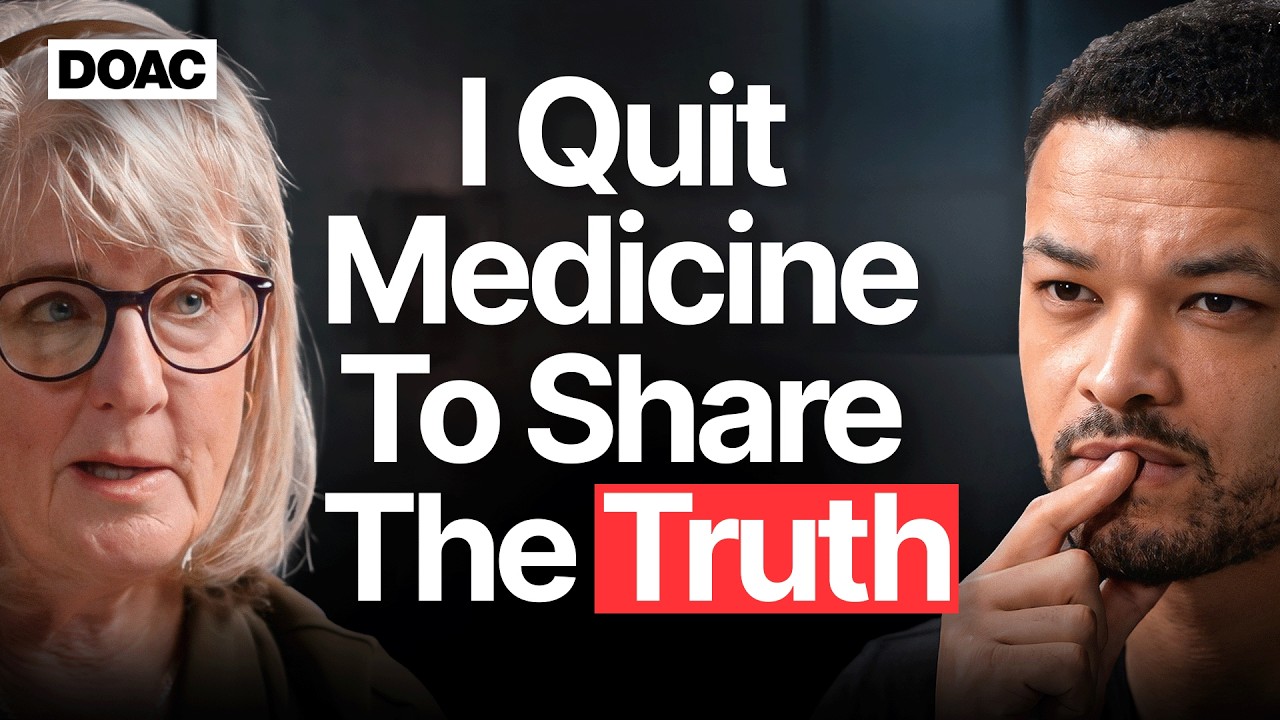
Dr. Gominak Links Indoor Lifestyles to Sleep Crisis and Gut Damage
The Diary Of A CEO
Dr. Stasha Gominak contends that widespread vitamin D deficiency impairs brainstem-controlled sleep repair and degrades the gut microbiome, warning that improperly taking high-dose D supplements without balancing B vitamins causes severe secondary neurological damage.
## Background
This episode of The Diary Of A CEO, hosted by Steven Bartlett, was published on YouTube on July 27, 2026. It features former neurologist Dr. Stasha Gominak discussing how widespread indoor living has driven a hidden vitamin D and gut microbiome deficiency behind chronic sleep disorders. According to the page description, Dr. Gominak explains her RightSleep protocol, arguing that improper vitamin supplementation can be as risky as prescription drugs and that natural skin synthesis remains superior to oral pills.
## TL;DR
Dr. Stasha Gominak posits that the modern epidemic of sleep disruption, insomnia, and sleep apnea stems from a severe biochemical deficiency created when humans moved indoors in the mid-1980s. Lacking adequate sunlight, the body fails to produce enough vitamin D, which disrupts the gut microbiome's ability to manufacture essential B vitamins, specifically pantothenic acid (B5) needed for acetylcholine production and REM sleep repair. Through detailed clinical case studies, she outlines her RightSleep protocol—combining targeted vitamin D, a temporary three-month B-50 complex, and trace minerals—to rebuild gut flora, restore normal sleep architecture, and resolve downstream chronic inflammatory conditions. Ultimately, she cautions against careless high-dose supplementation without symptom logging, emphasizing that oral vitamins are potent biochemical interventions that must be carefully managed.
## Atmosphere & style
The conversation carries an intense, revelatory tone that balances clinical medical expertise with accessible biohacking concepts. Dr. Gominak speaks with the quiet conviction of an experienced physician-turned-investigator, bringing sharp analytical focus to complex neurological mechanisms, while host Steven Bartlett acts as an engaged and curious sounding board who frequently tests her theories against live AI models. The mood shifts seamlessly from alarming breakdowns of modern indoor health crises to hopeful, practical frameworks for bodily repair, leaving the listener with an intellectually stimulating and highly empowering experience.
## Key takeaways
- [00:00](https://www.youtube.com/watch?v=BbGv7GTbRN8&t=0s) Taking vitamin D and B supplements blindly without understanding their physiological interplay can be as dangerous as misuse of prescription medication.
- [02:40](https://www.youtube.com/watch?v=BbGv7GTbRN8&t=160s) Sleep disruption and chronic fatigue are often driven by underlying chemical and hormonal deficiencies rather than behavioral poor sleep hygiene.
- [15:35](https://www.youtube.com/watch?v=BbGv7GTbRN8&t=935s) The brain stem relies on acetylcholine to drive REM sleep and body paralysis; insufficient vitamin D impairs the production of this key neurotransmitter.
- [17:17](https://www.youtube.com/watch?v=BbGv7GTbRN8&t=1037s) Widespread shift to indoor lifestyles, air conditioning, and screen usage starting in the 1980s triggered a systemic decline in solar-synthesized vitamin D across populations.
- [40:44](https://www.youtube.com/watch?v=BbGv7GTbRN8&t=2444s) Vitamin D is biologically a skin-synthesized steroid hormone rather than a simple dietary vitamin, meaning dietary sources like salmon cannot fulfill daily physiological needs.
- [47:12](https://www.youtube.com/watch?v=BbGv7GTbRN8&t=2832s) Standard randomized controlled trials for vitamin D are flawed because they administer fixed doses without measuring individual blood levels or tracking biochemical endpoints.
- [55:02](https://www.youtube.com/watch?v=BbGv7GTbRN8&t=3302s) High-dose vitamin D accelerates cellular repair and depletes the body's stored B vitamins, leading to secondary side effects like severe insomnia and neuropathic burning.
- [01:00:46](https://www.youtube.com/watch?v=BbGv7GTbRN8&t=3646s) A healthy gut microbiome produces all eight essential B vitamins, but vitamin D deficiency disrupts gut bacteria and cuts off natural internal B-vitamin synthesis.
- [01:07:15](https://www.youtube.com/watch?v=BbGv7GTbRN8&t=4035s) The RightSleep protocol pairs vitamin D with a balanced B-50 complex daily for a strict three-month window to reboot the gut microbiome without overloading B vitamin stores.
- [01:13:04](https://www.youtube.com/watch?v=BbGv7GTbRN8&t=4384s) Lactobacillus reuteri and commensal gut bacteria regulate body-wide absorption of crucial trace minerals including iron, calcium, and magnesium.
- [01:20:03](https://www.youtube.com/watch?v=BbGv7GTbRN8&t=4803s) Coenzyme A, synthesized from pantothenic acid (B5), serves as the core biochemical catalyst for mitochondrial energy production, systemic repair, and sleep recovery.
- [01:30:47](https://www.youtube.com/watch?v=BbGv7GTbRN8&t=5447s) Natural sunlight provides sulfated vitamin D alongside infrared energy and co-factors that decrease systemic inflammation in ways oral pills cannot fully mirror.
- [01:37:04](https://www.youtube.com/watch?v=BbGv7GTbRN8&t=5824s) Glass windows, office lighting, and seasonal affective disorder lamps do not generate vitamin D, requiring direct exposure to UVB sunlight or targeted supplementation.
- [01:47:30](https://www.youtube.com/watch?v=BbGv7GTbRN8&t=6450s) Severe sleep conditions like narcolepsy and sleep apnea can stem from prolonged multi-night sleep debt and neurotransmitter deficits rather than being strictly permanent genetics.
The conversation opens with a stark warning about the supplement industry: taking vitamins without understanding what you are doing can be just as dangerous as taking prescription drugs. Supplementing with oral vitamin D is fundamentally different from being outdoors, as human bodies are biologically designed to synthesize it through skin exposure to sunlight—yet modern advice constantly warns people never to let the sun touch their skin. When the body is deficient in this key chemical, the brain actually "forgets how to sleep."
Dr. Stasha Gominak, a Harvard-trained neurologist, explains that billions of people worldwide suffer from sleep problems, but conventional medicine relies heavily on behavioral advice like blackout curtains and fixed bedtimes. These surface-level behavioral interventions consistently fail her patients because their issues stem from a underlying chemical deficiency. Being stuck indoors has disconnected humans from their natural environment, resulting in modern metabolic and sleep crises—including 28-year-olds suffering strokes, widespread obesity, and disrupted gut microbiomes. Dr. Gominak emphasizes that vitamin D is actually a hormone rather than a simple vitamin, and correcting its levels forms the foundation of her RightSleep protocol.
Host Steven Bartlett takes a brief moment to speak directly to the audience, noting that data shows many regular viewers are unexpectedly unsubscribed due to platform glitches. He asks viewers to check their subscription status to support the channel and keep the show free and growing.
---
[02:40](https://www.youtube.com/watch?v=BbGv7GTbRN8&t=160s) Why So Many People Are Suddenly Struggling With Sleep
For anyone tuning in to improve their health, Dr. Gominak promises a completely new lens through which to understand sleep issues and chronic medical problems. Rather than blaming poor habits, people need to evaluate whether their brain chemistry is functioning normally.
```
Dr. Gominak's Professional Background:
├── Education & Residency: MD from Baylor College of Medicine, Neurology Residency at Harvard (Mass General)
├── Academic Role: Former Clinical Assistant Professor of Neurology at Stanford University Hospital
└── Clinical Focus: Over 20 years in practice; treated ~200 intensive sleep patients; coached 5,000–6,000 clients via her RightSleep workbook
```
Dr. Gominak reflects on her journey from biochemistry to neurology, explaining that standard medical protocols often default to telling patients "you are doing it wrong." Mainstream sleep hygiene advice—such as using white noise machines, sleeping in a pitch-black room, or going to bed at the exact same time—fails to resolve root-level issues for people with severe, chronic sleep disruption.
- **Standard Sleep Hygiene Misconception:** Behavioral tweaks cannot fix systemic neurotransmitter or hormone shortages in the brain stem.
- **Patient Spectrum:** Her patients had already tried every conventional sleep tip and medication without success before seeking biochemical answers.
---
[03:42](https://www.youtube.com/watch?v=BbGv7GTbRN8&t=222s) Why Healthy Young People Are Waking Up Exhausted With Headaches
Dr. Gominak's path into sleep medicine began serendipitously in 2004 when a young female patient with severe daily headaches demanded a sleep study after standard headache medications failed. At the time, sleep apnea was categorized as a disorder affecting older, overweight men whose large tongues obstructed their airways. However, this young, thin woman tested positive for sleep apnea, was fitted with a continuous positive airway pressure (CPAP) machine, and returned two months later completely free of the daily headaches she had suffered for five years.
This success forced Dr. Gominak to rethink headache pathophysiology: headaches are a brain stem dysfunction where the "head pain switch" gets stuck in the "on" position instead of turning off. She began running sleep studies on young, thin women presenting with daily headaches and noticed a clear pattern: patients consistently reported waking up at 3:00 a.m. unable to fall back asleep, experiencing fragmented light sleep, or waking up directly with a headache.
```
[ The 3:00 AM Sleep Shift ]
00:00 - 03:00 AM ──► Sympathetic Driven (Deep Sleep Focus)
03:00 - 07:00 AM ──► Parasympathetic Driven (REM Sleep Focus) ──► Failure here causes 3 AM awakenings & headaches
```
Reflecting on her time spent in coastal Mexico, Dr. Gominak observed indigenous locals living outdoors in thatch-roof *palapas* without electricity. Despite aging into their 80s or 90s, these individuals remained lean, energetic, and free from chronic sleep apnea or daily headaches. She realized that human biochemistry is built for an outdoor existence; living indoors deprives the body of environmental inputs required for basic physiological maintenance. When she analyzed the sleep studies of her young female headache patients, a pulmonologist pointed out an unusual anomaly: almost none of them were entering Rapid Eye Movement (REM) sleep, or they were experiencing apnea exclusively during REM sleep.
- **Sleep Apnea Misconception:** It is not solely an anatomical issue caused by weight; it frequently manifests in thin, young individuals as a neurological sleep-state failure.
- **Comparative Animal Observation:** Wild animals like squirrels do not suffer from obesity or chronic sleep disorders; these conditions selectively affect indoor humans and their indoor pets (cats and dogs).
---
[08:15](https://www.youtube.com/watch?v=BbGv7GTbRN8&t=495s) How Your Brain Secretly Controls Every Stage Of Sleep
To illustrate how sleep architecture works, Dr. Gominak describes the layout of a hypnogram, which tracks time along the horizontal axis and sleep depth along the vertical axis. Upon drifting off, a person transitions through light sleep stages 1 and 2 before descending into deep sleep (slow-wave sleep) and REM sleep across four to five 90-minute cycles per night.
When the pulmonologist explained that apnea occurs in REM sleep because "we get the most paralyzed of all in REM sleep," Dr. Gominak was shocked. Complete muscle paralysis during REM is a universal biological feature across species—even fruit flies experience it—designed to protect the body while the brain stem undergoes repair. During this phase, the airway anatomy must actively maintain its structural opening without conscious muscle tone.
```
[ Human Brain Stem Architecture ]
_______________________________________
/ \
| Cerebral Cortex | <-- Highly active during REM (Dreams)
\_______________________________________/
||
[Brain Stem] <-- Controls paralysis, heart rate, BP,
|| and Autonomic Switch (Sympathetic / Parasympathetic)
```
The brain stem acts as the master control center during sleep, managing heart rate, blood pressure, and autonomic balance:
1. **Sympathetic Nervous System ("Fight or Flight"):** Controls the first half of the night (up to ~3:00 a.m.), prioritizing deep slow-wave sleep.
2. **Parasympathetic Nervous System ("Rest, Digest & Calm"):** Dominates the second half of the night (3:00 a.m. to 7:00 a.m.), driving REM sleep, cellular repair, and emotional processing.
Dr. Gominak's headache patients were achieving as little as one-sixth of the REM sleep required for normal health. Because REM sleep consolidates memory and regulates emotional states, losing parasympathetic control in the second half of the night leaves individuals waking up in a depressed mood, with impaired memory and morning headaches.
- **Brain Activity in REM:** Electroencephalogram (EEG) readings during REM sleep closely mirror waking brain activity, featuring vivid dreams and high cognitive processing despite body-wide paralysis.
- **Autonomic Shift:** Parasympathetic activation naturally increases Heart Rate Variability (HRV), signaling a transition into deep restorative recovery and systemic healing.
---
[15:35](https://www.youtube.com/watch?v=BbGv7GTbRN8&t=935s) How Vitamin D Could Be The Missing Piece For Better Sleep
Searching for the underlying chemical cause of REM paralysis failure, Dr. Gominak traced the problem directly to neurotransmitter pathways in the brain stem. The parasympathetic nervous system relies on **acetylcholine** to signal muscle paralysis and drive REM sleep. Unlike other neurotransmitters, there are no pharmaceuticals that effectively replicate or replace natural acetylcholine production in the brain.
Through her clinical research, Dr. Gominak discovered that **vitamin D** acts as a crucial genetic driver: it enables the production of the specific enzymes and proteins necessary to synthesize acetylcholine. When humans moved indoors and avoided sun exposure, they lost the vitamin D required to produce adequate acetylcholine, effectively crippling their brain stem's ability to govern normal sleep cycles, heart rate regulation, and digestion.
- **Acetylcholine's Dual Role:** It is the primary neurotransmitter for both the parasympathetic nervous system and the neurological apparatus that locks the body in paralysis during REM sleep.
- **Biochemical Link:** Deficient vitamin D levels directly suppress enzyme synthesis, starving the brain stem of acetylcholine and causing disrupted sleep architecture, early morning awakenings, and chronic pain syndromes.
[17:17](https://www.youtube.com/watch?v=BbGv7GTbRN8&t=1037s) A Modern Chemical Deficiency State
Dr. Stasha Gominak explains that sleep issues stem from a fundamental chemical deficiency caused by humanity moving indoors. Key modern changes—sunscreen, computers, and air conditioning—all originated or gained widespread adoption in the 1980s. Having been alive prior to this era, Dr. Gominak notes a dramatic contrast: during her teenage years, only two kids out of a class of 300 were overweight, people did not routinely go on diets, and conditions like depression or severe sleep issues were virtually nonexistent compared to today.
Rather than accepting the popular narrative that health problems are solely driven by dietary toxins or personal lifestyle failures, Dr. Gominak asserts that a core biochemical deficiency is at play—one that can be corrected through vitamins. However, she argues that our general understanding of vitamins is completely flawed. Public perceptions have been warped by government recommendations, whereas early vitamin research from the 1940s and 1950s was grounded in medical science. She warns that the modern supplement industry is in disarray and that supplements are a form of "biohacking" that can be just as dangerous as prescription drugs if mismanaged.
* **Global Sleep Crisis:** Sleep disorders are affecting billions globally, with sleep study centers across the world routinely recording abnormal architecture.
* **Biohacking Risk:** Unguided supplementation often reproduces or worsens the exact symptoms a person is trying to fix.
* **Journaling Protocol:** Dr. Gominak’s RightSleep protocol incorporates a structured journal so patients can track individual biochemical and physical responses over time.
---
[21:02](https://www.youtube.com/watch?v=BbGv7GTbRN8&t=1262s) Questioning Chronotypes and the 1980s Epidemic
Addressing host Steven Bartlett's discussion with sleep researcher Matt Walker regarding chronotypes, Dr. Gominak challenges the dogma that people are genetically hardwired to be permanently fixed "night owls" or "early birds." While genetic variations exist, her clinical experience demonstrated that when patients corrected their underlying vitamin deficiencies and spent time outdoors, night owls consistently reverted to a natural circadian rhythm: falling asleep at 10:00 p.m. and waking at 6:00 a.m.
Dr. Gominak highlights that humans are diurnal "day hunters" whose brain chemistry is explicitly designed for nighttime sleep. She points out that a wave of chronic health conditions began escalating or were first identified in the mid-1980s, coinciding with the shift to indoor living.
* **Shift Work Dynamics:** Shift workers struggling with daylight sleep are operating against innate human biochemistry rather than simply following a preference.
* **Mid-1980s Health Trends:** Diseases that spiked or were first identified during this era include Attention Deficit Hyperactivity Disorder (ADHD), childhood development disorders, depression, non-alcoholic fatty liver disease (NAFLD), and type 2 diabetes.
---
[25:16](https://www.youtube.com/watch?v=BbGv7GTbRN8&t=1516s) Two Patient Profiles: Meline and Natalie
To demonstrate how vitamin D deficiencies manifest across different demographics, Dr. Gominak details two contrasting clinical cases from her practice:
```
+-----------------------------------+-----------------------------------+
| Profile 1: Meline | Profile 2: Natalie |
+-----------------------------------+-----------------------------------+
| • 32-year-old redhead | • Tall, dark-complexioned |
| • 100 lbs overweight | triathlete of Italian origin |
| • History of endometriosis, PCOS, | • Outdoors frequently, swims |
| and gestational diabetes | • Mother of two (developed severe |
| • Daily headaches, 9 medications, | postpartum sleep issues and |
| burning nerve pain, severe | depression after her 2nd child) |
| acid reflux, bowel movements | • Daily headaches despite keto/ |
| once per week | paleo diets |
+-----------------------------------+-----------------------------------+
```
In Meline's case, standard medical training initially led Dr. Gominak to treat her symptoms in isolation—using CPAP for sleep apnea and pain medications for her nerve pain. Natalie, despite an active lifestyle and seemingly optimal health habits, developed daily headaches and severe sleep disruption following the birth of her second child. Dr. Gominak stresses that women are disproportionately impacted by these deficiencies due to the physiological strain of pregnancy and childbirth.
---
[28:50](https://www.youtube.com/watch?v=BbGv7GTbRN8&t=1730s) Sleep Architecture, Strokes, and the Glymphatic System
Dr. Gominak recalls a turning point involving an 18-year-old patient about to enter college who suffered from daily headaches. The young woman's sleep study revealed a complete absence of deep sleep. Every 15 minutes, her brain attempted to enter deep sleep stages but fractured back into light sleep. Although the patient believed she was sleeping through the night, her brainstem failed to execute restorative sleep phases.
This case highlighted how unrestorative sleep directly fuels neurological and systemic illness. Dr. Gominak reflects on treating 28-year-old stroke patients—a condition historically reserved for elderly individuals with advanced vascular disease—and concluded that chronic sleep failure breaks the body's nightly self-repair apparatus.
> "We're not made of Teflon. We're made of these biologic materials and they repair themselves every night. That's a miracle."
* **The "Glymphatic" Clean-up:** Deep sleep triggers the brain's waste-clearance system (the glymphatic system), flushing out metabolic waste products and preventing long-term cellular damage.
* **Symptom Masking vs. Healing:** Conventional neurology is often trained to prescribe drugs that dull symptoms (e.g., nerve pain in the feet) rather than investigating why the body's repair mechanism has failed.
---
[33:14](https://www.youtube.com/watch?v=BbGv7GTbRN8&t=1994s) Accidental Discoveries: B12 and Vitamin D
Faced with the 18-year-old patient's alarming sleep study, Dr. Gominak ordered a basic lab panel including thyroid function and vitamin B12—tests she had rarely run for headache patients. The results revealed a severe B12 deficiency. Prompted by this finding, she began routinely screening B12 levels across her patient cohort.
A short time later, a patient casually remarked that her doctor had diagnosed her with low vitamin D, and after taking a supplement, her chronic wrist pain vanished. Intrigued and admittedly naive at the time, Dr. Gominak added vitamin D screening to her routine lab work, setting off a sequence of discoveries that ultimately linked vitamin D levels to sleep structure and brainstem function.
Here is a detailed, faithful walkthrough of this part of the conversation:
[34:31](https://www.youtube.com/watch?v=BbGv7GTbRN8&t=2071s) The Discovery of Universal Deficiency and the PubMed Search
Dr. Stasha Gominak recounts testing the blood levels of vitamin D and B12 in roughly 500 patients between September and December of 2009. Expecting normal readings following the summer months—when people are outdoors and naturally synthesize vitamin D—she was shocked to find that every single patient tested low. During the same week, two separate CPAP users returned to her clinic with an identical story: despite using their sleep apnea masks for a year, their chronic headaches had persisted, but after taking a simple vitamin D supplement she had suggested a month prior, their sleep improved dramatically and their headaches disappeared entirely.
Perplexed by why a chemical traditionally associated strictly with bone health would alter sleep patterns, Dr. Gominak turned to PubMed. Typing in the search terms "vitamin D" and "sleep" yielded zero results. However, broadening the query to "vitamin D" and "brain" led her to the pioneering work of Dr. Walter Stumpf, a researcher who had spent three decades studying the chemical.
Dr. Stumpf had published findings demonstrating that specialized vitamin D receptors (VDR) exist inside the exact brainstem nuclei responsible for motor paralysis during sleep, as well as the master "clock" nuclei regulating circadian timing. Discovering that the brain's sleep and timing centers are populated with vitamin D receptors proved to Dr. Gominak that vitamin D was actively driving neurological functions rather than serving as a passive bystander.
- **Patient sample size:** Approximately 500 patients tested between September and December 2009.
- **Initial search result:** "Vitamin D" + "sleep" yielded zero hits on PubMed in 2009.
- **Key scientific reference:** Dr. Walter Stumpf's 30+ years of published research on vitamin D receptors in the brainstem.
---
[37:18](https://www.youtube.com/watch?v=BbGv7GTbRN8&t=2238s) Vitamin D as the Universal Hibernation Hormone
Exploring Dr. Stumpf's literature revealed a unifying biological theory: vitamin D functions fundamentally as a "hibernation hormone." In nature, shifting seasonal light signals to animals how to adapt their bodies for winter scarcity by dropping cellular metabolic rates via thyroid modulation and altering sleep duration. Dr. Stumpf’s early publications—dating back to 1982—had already connected vitamin D pathways to impending modern health crises, predicting rises in postpartum depression, infertility, and obesity long before they became widespread public health concerns.
Dr. Gominak describes personally calling Dr. Stumpf after he had retired. She shared her clinical observations regarding abnormal sleep architecture in her patients and asked if anyone had formally connected vitamin D deficiency to sleep disorders. He confirmed no one had, but agreed it made absolute sense.
She explains that when vitamin D drops critically low, the brain essentially "forgets how to sleep." At the molecular level, vitamin D functions like a true hormone: it enters the nucleus of the cell, binds to DNA via its specific receptor, and triggers the expression of specific proteins. Specifically, this genomic action regulates the enzyme *choline acetyltransferase*, which is responsible for synthesizing acetylcholine—a critical neurotransmitter needed to initiate and maintain proper sleep paralysis and sleep stage transitions.
- **Key mechanism:** Vitamin D binds to nuclear DNA to express *choline acetyltransferase*, the enzyme required to synthesize acetylcholine.
- **Environmental drivers:** The introduction of sunscreens in 1985, paired with air conditioning and indoor screen time, systematically cut human sun exposure, an effect further exaggerated by recent lockdowns.
---
[40:44](https://www.youtube.com/watch?v=BbGv7GTbRN8&t=2444s) The Misclassification of Vitamin D: Vitamin vs. Hormone
Dr. Gominak stresses one of the most glaring errors in modern medicine: classifying vitamin D as a dietary "vitamin" rather than a skin-synthesized steroid hormone. While furred animals obtain vitamin D by grooming their coats, bald mammals like humans and domesticated pigs absorb it directly through the skin via solar exposure. Expecting human body levels to be satisfied by eating salmon or dietary sources is, in her words, as illogical as expecting to consume enough salmon estrogen to regulate a menstrual cycle—dietary intake was never the primary biological design for human vitamin D acquisition.
> "There was a mistake made in calling it a vitamin... It's like saying you eat salmon, you get salmon estrogen. That should be enough estrogen for you to have a normal period. That's crazy."
She notes that after medicine categorized vitamin D as a simple over-the-counter supplement in the early 1980s, medical institutions largely dismissed it. Ironically, this over-the-counter availability allowed the public to take control of their health, even as dermatological guidance shifted from the reasonable advice of "avoid severe sunburns that cause peeling" to a dogmatic insistence on total sun avoidance.
This total avoidance ignores the broad spectrum of solar wavelengths (such as infrared energy) that biological systems rely upon beyond just UVB rays. When host Steven Bartlett questions whether medical consensus has simply relied on human-made "stories," Dr. Gominak agrees, reflecting on how her 30 years in neurology taught her that medical guidelines are often flexible hypotheses built on correlation rather than absolute, unshakeable truths.
---
[47:12](https://www.youtube.com/watch?v=BbGv7GTbRN8&t=2832s) Flawed Clinical Trials and the Medical System's Blindspot
The conversation turns to why modern medical literature struggles to validate vitamin D's true therapeutic impact. Dr. Gominak critiques the medical establishment's reliance on fixed-dose randomized controlled trials (RCTs). In conventional pharmacology, a study group gets a set dose of a drug and a control group gets a placebo. However, biological hormones do not work like synthetic drugs; they operate within narrow optimal physiological ranges where both "too high" and "too low" cause severe dysfunction.
Current scientific studies regularly fail because researchers administer a static dose—such as 4,000 IU daily—to every subject without measuring baseline or post-treatment blood levels, completely ignoring individual absorption, season, or sun exposure.
When the Endocrine Society reviewed the literature in 2004, they conceded that virtually no clinical studies correlated specific administered doses to actual achieved blood levels. Yet, instead of calling for rigorous blood-level-driven trials, the society advised physicians against routine testing or recommending vitamin D supplementation altogether, fearing it would trigger unanswered patient questions. This institutional avoidance has left the general public searching for answers online, while clinicians like Dr. Gominak have had to build their own clinical protocols to safely navigate patient care.
- **Flaw in existing studies:** Administering fixed daily doses (e.g., 4,000 IU) without testing blood levels violates basic endocrinology principles.
- **Endocrine Society 2004 stance:** Discouraged routine vitamin D blood testing due to a lack of dose-to-blood-level standardized data, rather than ordering the necessary trials.
---
<ElicitationsGroup message="Explore related aspects of this conversation:">
<Elicitation label="Explain the connection between Vitamin D, B vitamins, and gut bacteria" query="How does Vitamin D interact with B vitamins and gut bacteria according to Dr. Gominak's research?"/>
<Elicitation label="Detail Dr. Gominak's specific RightSleep protocol" query="What are the specific target blood levels and dosing guidelines in Dr. Gominak's RightSleep protocol?"/>
</ElicitationsGroup>
[52:40](https://www.youtube.com/watch?v=BbGv7GTbRN8&t=3160s) What Happened When I Started Treating Patients With Vitamin D
Dr. Stasha Gominak spent two years consulting with Dr. Walter Stumpf on the phone while actively prescribing vitamin D to her neurology patients. During this initial phase, she discovered a scary truth: every single individual requires a completely unique dose to achieve optimal blood levels—challenging the blanket recommendations (5,000 IU, 10,000 IU, 20,000 IU, or even 100,000 IU once a month) commonly thrown around in mainstream supplement advice. She noted that when a patient's vitamin D level reached approximately 60 ng/mL, they would invariably return reporting noticeable improvements in their sleep quality.
However, operating under the conventional medical mindset of treating symptoms with a single "silver bullet," Dr. Gominak initially assumed vitamin D would solve everything on its own. The honeymoon period lasted roughly six months before unexpected and distressing complications emerged. Patients began returning with severe, widespread joint pain that threatened to send them to rheumatologists for suspected autoimmune conditions like arthritis. Soon after, two women came in during the very same month complaining of intense burning sensations in their hands and feet. Neither had anything in common except for a history of chronic headaches and two years of high-dose vitamin D therapy under her care. Facing these distressed patients who asked if the treatment was responsible, Dr. Gominak freaked out—realizing that while their sleep and headaches had initially improved, boosting their body's repair mechanisms had driven them into a secondary, unknown deficiency state.
- **Dosing variability:** No blanket dose works for everyone; individual requirements vary wildly.
- **Therapeutic threshold:** Sleep improvements consistently appeared once blood levels surpassed 60 ng/mL.
- **Secondary complications:** After six months on vitamin D alone, patients developed severe joint aches and peripheral neuropathic burning in the hands and feet.
---
[55:02](https://www.youtube.com/watch?v=BbGv7GTbRN8&t=3302s) The Discovery of Pantothenic Acid (Vitamin B5) and the Iowa Prison Studies
Around the time her patients began developing these terrifying symptoms, Dr. Gominak developed a bizarre, localized buttock pain so intense she could barely sit down at her desk to consult with patients. A female patient walked into her office carrying a book titled *The Pain-Free Promise of Pantothenic Acid*. Although hesitant about diving into another supplement, Dr. Gominak read the book and learned that pantothenic acid (Vitamin B5) is a vital chemical needed to produce Coenzyme A, which in turn drives the synthesis of cortisol—a critical hormone for regulating sleep cycles and systemic inflammation.
Determined to test the theory, she bought 400 mg pantothenic acid pills and a "B-100" complex (containing 100 mg or 100 mcg of each B vitamin) from a local health store. She immediately began taking both supplements herself and advised all incoming patients that week who presented with sleep problems or new complaints to try the B-100 and high-dose B5 combination. Digging into the references cited in the book, she traced the research back to "creepy" 1950s metabolic experiments conducted in a laboratory adjacent to Iowa State Prison. Researchers had intentionally blocked pantothenic acid in inmates for two weeks and observed four distinct, profound clinical signs: severe insomnia, gastrointestinal complaints (such as bloating), a peculiar "puppet-like" abnormal gait, and a distinct burning sensation in the hands and feet.
- **B5 and Coenzyme A:** Pantothenic acid is required to manufacture Coenzyme A, which produces cortisol to regulate inflammation and sleep timing.
- **1950s Iowa State Prison experiments:** Induced B5 deficiency produced four universal symptoms: insomnia, stomach bloating/distress, a puppet-like gait, and burning hands and feet.
- **Connecting the dots:** High-dose vitamin D therapy accelerates cellular repair, causing the body to rapidly consume its underlying reserves of B vitamins.
---
[57:15](https://www.youtube.com/watch?v=BbGv7GTbRN8&t=3435s) Does Vitamin D Deplete Your Body's B Vitamins?
Testing 400 mg of B5 on herself quickly revealed that higher doses are not better. By the end of her first week taking 400 mg of pantothenic acid, Dr. Gominak's restless legs syndrome worsened dramatically. Recognizing she had overshot the mark, she stopped the B5, and her deep buttock pain disappeared within 24 hours. When her patients returned the following week, many were furious, asking, "Were you trying to kill me?" They reported feeling extremely agitated, feeling like they were "crawling out of their skin," and suffering from severe, total insomnia.
This reaction revealed a crucial biological principle: vitamin B5 and vitamin D hold massive power over sleep regulation, but the brain demands an exact, narrow therapeutic window. Too little or too much of these nutrients yields the exact same failure mode—the body simply stops sleeping. Interestingly, patients who abandoned the standalone 400 mg B5 but remained on the balanced B-100 complex felt fantastic, experiencing perfect sleep and total pain relief. Dr. Gominak quickly learned to halve the B-complex dose to "B-50" (providing 50 mg of each B vitamin) for patients who felt overstimulated. She warns that millions who took high-dose vitamin D during the pandemic era (2020–2023) unknowingly burned through their B vitamin reserves, often resulting in delayed neuropathic symptoms or misdiagnoses like lupus or rheumatoid arthritis years later.
> "If you block B5 you get insomnia. That means it has power in sleep. D has power in sleep... If you give it too much, it's not happy. If you give it too little, it's not happy."
- **The Goldilocks zone:** Both excess and deficiency of B5 act as a stimulant (like caffeine), triggering agitation and complete insomnia.
- **The B-50 sweet spot:** Cutting back from B-100 to B-50 (50 mg of all eight essential B vitamins) restored normal sleep and resolved pain without overstimulation.
- **Delayed pandemic impact:** People who took high-dose vitamin D between 2020 and 2023 often developed B-vitamin deficiency states (like burning feet or joint pain) years later, long after stopping the D.
---
[01:00:46](https://www.youtube.com/watch?v=BbGv7GTbRN8&t=3646s) Can Vitamin B Supplements Really Fix Your Gut?
Medical literature historically claimed that pantothenic acid deficiency was virtually impossible because B5 is found in almost all food sources. However, as Dr. Gominak delved deeper into the literature, she uncovered a fundamental truth about human biology: all eight essential B vitamins are actually produced by normal gut bacteria and absorbed through the intestinal wall. The human gut microbiome—composed of around 200 distinct bacterial species spanning four major phyla—functions as an internal production system specifically engineered to manufacture B vitamins for the host.
To illustrate how essential gut microbes are, Dr. Gominak highlights the success of fecal microbiota transplants (FMT) pioneered by GI surgeons in Oklahoma to cure life-threatening *Clostridioides difficile* (*C. diff*) infections. Bacteria operate in symbiotic, commensal groups where individual species synthesize specific B vitamins and secrete them into the environment for neighboring species to utilize. When humans become vitamin D deficient, the gut microbiome becomes disrupted, causing irritable bowel syndrome (IBS) and halting natural B-vitamin production. While vitamin D alone fails to fix the gut, providing a temporary supply of all eight B vitamins alongside vitamin D acts as a set of essential "bacterial growth factors" that jumpstarts the normal human microbiome.
> "We should start thinking about the microbiome as the production system that supplies the B vitamins to the body."
- **Microbiome scope:** Humans host about 200 normal gut bacteria species from mouth to anus; science has successfully cultured only ~2% of them, though 100% have been genetically sequenced.
- **B vitamins as growth factors:** The four core bacterial groups in the human gut coexist specifically because each produces at least one B vitamin and relies on others for the rest.
- **Fecal Microbiota Transplants (FMT):** Overcomes antibiotic-induced collapse of the gut microbiome by transferring healthy commensal bacterial communities directly into the colon.
---
[01:07:15](https://www.youtube.com/watch?v=BbGv7GTbRN8&t=4035s) The 3-Month Gut Jumpstart Protocol
Dr. Gominak emphasizes that the relationship between humans and their microbiome is inherently bidirectional: the human host provides vitamin D (historically generated via sun exposure), and in exchange, the gut bacteria supply all eight B vitamins. When a person takes vitamin D supplements without addressing a collapsed gut microbiome, the body ramps up repair processes and rapidly exhausts its remaining B-vitamin stores, triggering neuropathic and autoimmune-like symptoms.
To safely correct this state, Dr. Gominak recommends supplementing with a balanced B-50 complex alongside tailored vitamin D for a strict duration of **only three months**. This temporary window provides the exact bacterial growth factors necessary to "jumpstart" the native gut microbiome. Once the correct bacterial strains repopulate and resume natural production of B vitamins, continuing to take synthetic B-complex supplements becomes counterproductive—over-supplementing past the four-month mark can lead to feeling aged, stiff, or overly agitated as B-vitamin levels climb too high.
- **Bidirectional symbiosis:** Humans supply vitamin D to cultivate gut bacteria; gut bacteria manufacture B vitamins to sustain human health.
- **The 3-Month Rule:** B-50 complex should only be taken daily for three months to re-establish the microbiome, after which the gut bacteria ought to produce B vitamins independently.
- **Consequences of over-supplementation:** Continuing high-dose B vitamins beyond 3–4 months can oversaturate the body, causing stiffness, fatigue, and sleep disruption.
[01:09:04](https://www.youtube.com/watch?v=BbGv7GTbRN8&t=4144s) The Flowing River of Gut Bacteria and Evolutionary Roots
Dr. Stasha Gominak expands on her theory of gut ecology by offering a dynamic mental image of how bacteria function inside the human GI tract. When someone swallows a probiotic capsule, those live microorganisms enter the small intestine, but they cannot colonize or multiply without specific growth factors—essential nutrients they must absorb directly from the digestive fluid. She emphasizes that the gut microbiome is not a static pool, but a continuous stream. The specific bacteria inhabiting the small intestine at a given moment will be pushed down the digestive tract and excreted within 12 to 24 hours. The bacteria occupying that space a day later are actually the "great-great-granddaughters" of the original microbes.
Because this microbial population turns over so rapidly, maintaining a healthy gut requires the continuous production of these bacterial growth factors. Dr. Gominak points out that humans did not naturally need to engineer or manage this process through synthetic pills. For hundreds of thousands—or even millions—of years, the system functioned automatically. A newborn baby received vitamin D and a complete complex of eight B vitamins directly through breast milk, seeded by the mother's own healthy microbiome. Combined with natural summer sunlight exposure on the infant's skin, this evolutionary mechanism maintained gut health across generations. She notes that even dinosaurs had intestinal microbiomes, illustrating just how ancient and deeply embedded this biological partnership is.
- Probiotics require specific, localized growth factors in the intestinal fluid to successfully reproduce.
- Intestinal bacteria reproduce rapidly while constantly moving down the digestive tract, operating like a moving river.
- Breast milk naturally supplies both vitamin D and a full spectrum of eight B vitamins derived from the mother's microbiome.
- Microbial intestinal ecosystems have existed in animals for hundreds of millions of years, tracing back to the age of dinosaurs.
---
[01:10:55](https://www.youtube.com/watch?v=BbGv7GTbRN8&t=4255s) Case Study: Meline’s Transformation and High-Dose Vitamin D
Steven Bartlett brings the discussion back to concrete clinical outcomes, asking Dr. Gominak to clarify the exact protocols used for her former patients, Meline and Natalie. Expressing her appreciation for Bartlett’s sharp questioning, Dr. Gominak details Meline’s severe chronic condition and long-term recovery trajectory. Meline initially presented with crippling neurological symptoms, including severe leg pain, burning sensations in her hands and feet, profound fatigue, and debilitating insomnia. As part of her recovery under what eventually became the RightSleep protocol, Meline was placed on daily vitamin D supplementation paired with a high-potency B-complex supplement (B-100).
The results were transformative: Meline’s burning nerve pain subsided, her sleep restored, her chronic depression lifted, and she successfully tapered off three separate pain medications. Remarkably, even into her third and fourth years of treatment, Meline required a daily intake of 30,000 IUs of vitamin D to keep her blood levels stable in the 60s (ng/mL). Dr. Gominak points out that while a typical maintenance dose for most of her patients is around 10,000 IUs daily, Meline’s body was actively utilizing 30,000 IUs every single day to execute deep, long-deferred structural and neurological repairs. Despite her dramatic clinical improvement and readiness to re-enter the workforce, Meline had not lost her extra weight; Dr. Gominak notes that the body prioritizes internal tissue and nerve repair before it begins shedding excess stored fat.
- Meline required 30,000 IUs of vitamin D daily for four years straight just to maintain blood levels in the 60s (ng/mL).
- The protocol successfully eliminated Meline's peripheral neuropathy (burning hands/feet, leg pain) and enabled her to discontinue three pain drugs.
- Meline transitioned from severe disability to enrolling in a Texas state back-to-work program.
- Dr. Gominak notes that the human body often delays significant weight loss until underlying physiological and tissue repairs are completed.
---
[01:13:04](https://www.youtube.com/watch?v=BbGv7GTbRN8&t=4384s) The RightSleep Protocol, Minerals, and *Lactobacillus reuteri*
Dr. Gominak outlines the structured sequence of the RightSleep protocol, explaining why individuals must tailor supplement durations based on their health history. Because modern humans spend the vast majority of their lives indoors away from direct sunlight, consistent vitamin D supplementation is necessary to maintain blood levels above 60 ng/mL, particularly for those recovering from sleep disruptions or chronic illness. For patients who have suffered long-term vitamin D deficiency—or who previously took vitamin D alone for years without B vitamins—she prescribes a three-month course of a B-50 complex alongside vitamin D. After three months, the B-complex is discontinued or reduced to a standard multivitamin to prevent over-supplementation once the gut microbiome recovers its native production capacity.
```
+-----------------------------------------------------------------------------------+
| RIGHTSLEEP PROTOCOL TIMELINE |
+-----------------------------------------------------------------------------------+
| PHASE 1: Core Restoration (Months 1-3) |
| • High-Dose Vitamin D (Target blood level: ~60-80 ng/mL) |
| • B-50 Complex daily (Restores depleted gut bacteria & systemic B stores) |
+-----------------------------------------------------------------------------------+
│
▼
+-----------------------------------------------------------------------------------+
| PHASE 2: Taper & Transition (Post-Month 3) |
| • Step down B-50 complex to a standard lower-dose multivitamin |
| • Monitor for signs of B-vitamin excess (agitation, altered sleep architecture) |
+-----------------------------------------------------------------------------------+
│
▼
+-----------------------------------------------------------------------------------+
| PHASE 3: Long-Term Maintenance |
| • Maintain Vitamin D levels via sun or individualized supplementation |
| • Discontinue external B/mineral supplements as native microbiome takes over |
+-----------------------------------------------------------------------------------+
```
Going beyond B vitamins, Dr. Gominak reveals that the gut microbiome is equally vital for managing trace minerals like magnesium, calcium, selenium, manganese, and iron. She highlights a recent scientific discovery regarding a specific gut bacterium, *Lactobacillus reuteri*, which produces a key regulatory metabolite named "reuterin." This signaling compound helps govern how the body absorbs and balances iron across the liver, blood, bone marrow, and brain. When loss of vitamin D depletes these specific bacterial strains, the body loses crucial metabolic crosstalk, resulting in complex mineral imbalances and functional medicine deficiency states that disrupt restorative sleep.
- The standard protocol pairs vitamin D with a B-50 complex daily for exactly three months before tapering down.
- Blood vitamin D levels are targeted at 60 ng/mL or above for optimal therapeutic tissue repair and sleep restoration.
- Intestinal bacteria directly mediate the absorption and systemic balance of essential trace minerals, including iron, magnesium, selenium, and manganese.
- *Lactobacillus reuteri* produces the chemical metabolite reuterin, which acts as a messenger regulating body-wide iron dynamics.
---
[01:16:54](https://www.youtube.com/watch?v=BbGv7GTbRN8&t=4614s) Defying Scientific Consensus: Dr. Gominak’s Medical Hypothesis
Steven Bartlett challenges Dr. Gominak by citing prevailing medical research and literature, which state that taking vitamin D supplements does not cause or trigger a B vitamin deficiency. He notes that conventional consensus views concurrent low vitamin D and B12 levels as co-occurring symptoms of shared underlying causes—such as aging, poor intestinal absorption, or restrictive diets—rather than one vitamin directly destroying another. Dr. Gominak freely acknowledges that her theory is not part of established medical dogma, stating outright that this specific mechanism is absent from standard literature outside of her own published paper.
Dr. Gominak directly quotes her 2016 published medical hypothesis: *"Vitamin D deficiency changes the intestinal microbiome, reducing B vitamin production in the gut. The resulting lack of pantothenic acid adversely affects the immune system, producing a pro-inflammatory state associated with atherosclerosis and autoimmunity."* She argues that conventional medicine misinterprets the aging process; while doctors tell older patients that declining sleep and failing gut health are inevitable consequences of aging, she contends that aging skin simply loses its ability to synthesize adequate vitamin D. This drop in D causes the microbiome to collapse, triggering a cascade of multi-organ failure and chronic disease that could be prevented by restoring the body's natural biochemical baseline.
- Scientific consensus maintains that vitamin D supplementation does not cause B vitamin deficiencies, attributing co-deficiencies to shared environmental or absorption factors.
- Dr. Gominak's 2016 paper posits that D deficiency alters gut flora, cutting off the internal supply of pantothenic acid (vitamin B5) and fueling systemic inflammation.
- "This is a brand new discovery made by someone who's not a scientist, who's not working in the primary lab, who is a clinician." — Dr. Stasha Gominak
- She challenges the belief that age-related sleep loss and gut degeneration are normal, attributing them instead to declining cutaneous vitamin D synthesis.
---
[01:20:03](https://www.youtube.com/watch?v=BbGv7GTbRN8&t=4803s) Coenzyme A, Cellular Repair, and Case Study: Natalie
Expanding on the underlying biochemistry, Dr. Gominak addresses Bartlett's question about intermediary mechanisms, such as magnesium depletion. She explains that the true central node of this metabolic pathway is Coenzyme A (CoA)—a critical molecule derived from pantothenic acid (vitamin B5) that drives mitochondrial energy production. Without adequate Coenzyme A, cellular energy production stumbles, promoting degenerative conditions, vascular disease, and hyperadrenergic states (which manifest as hypertension, elevated resting heart rates, and chronic anxiety).
To illustrate how her protocol works in less severe cases, Dr. Gominak revisits the story of Natalie, a postpartum triathlete. Natalie had initially improved on vitamin D alone, but after two years her sleep deteriorated, her resting heart rate spiked to over 110 beats per minute while sitting quietly, and she struggled with severe postpartum depression. Recognizing a B vitamin crash, Dr. Gominak added a temporary three-month course of B-50 to her vitamin D regimen. Within months, Natalie’s high heart rate normalized, her postpartum depression resolved, she safely discontinued her antidepressant medication, and she returned to competing as a high-level triathlete.
> "It appears that given the proper essential elements for normal sleep, the body is designed to repair every physical injury that occurs during normal daily use and may even retain a memory of long deferred repairs."
- Coenzyme A (derived from B5) is the vital biochemical catalyst running mitochondrial energy production and cellular repair.
- B-vitamin depletion can trigger a hyperadrenergic state, causing resting heart rates to climb above 110 bpm alongside elevated blood pressure and anxiety.
- Natalie fully recovered after a targeted 3-month course of B-50 combined with vitamin D, allowing her to offload psychiatric medications and resume triathlons.
- Dr. Gominak asserts that exogenous supplements should be temporary tools to rebuild the microbiome, noting that wild animals ("squirrels are not going to GNC") maintain perfect health without pills when their natural environment is intact.
---
[01:24:56](https://www.youtube.com/watch?v=BbGv7GTbRN8&t=5096s) Starting the Journey: Cognitive and Behavioral Sleep Hygiene First
As the conversation shifts toward broad, actionable advice for millions of listeners seeking better rest, Steven Bartlett asks Dr. Gominak to summarize her overarching recommendations. Before jumping into biochemical testing, blood work, or high-dose supplement protocols, Dr. Gominak insists that everyone must start with foundational behavioral and cognitive sleep habits. She emphasizes that basic environmental controls—such as installing blackout curtains, maintaining consistent sleep schedules, and eliminating ambient light—are essential prerequisites that must be established first.
- Behavioral sleep hygiene and environmental modifications must always precede nutritional or supplement interventions.
- Blackout curtains and light management are primary tools for establishing a baseline sleeping environment.
[01:25:20](https://www.youtube.com/watch?v=BbGv7GTbRN8&t=5120s) The RightSleep Protocol and Rules for Supplementation
When introducing the structured RightSleep protocol, Dr. Stasha Gominak emphasizes that basic behavioral sleep hygiene should always come first. However, if lifestyle adjustments fail to resolve sleep issues, her protocol offers a systematic multi-step framework to restore depleted nutrients. The program begins by bringing vitamin D to an optimal target range while assessing B12 levels. If B12 is deficient, a separate B12 supplement is added alongside a high-dose B-complex (specifically B50) for the initial three months, transitioning afterward to a daily multivitamin. She alerts listeners to inspect supplement labels carefully, noting that many premium store-bought "multivitamins" secretly contain high B50-level doses. Getting these B-vitamin dosages right is critical: proper balance leaves patients feeling energetic and perky, whereas an improper balance can reproduce the exact sluggishness they sought to fix.
By the second phase (months three to four), patients adjust their vitamin D dosage based on monthly blood testing—cautioning that standard physician-ordered D tests are frequently inaccurate or misinterpreted. A peculiar phenomenon often occurs around month five or six: after months of dramatically restored, deep sleep, a patient's sleep quality may suddenly regress. Dr. Gominak warns patients not to interpret this decline as protocol failure or say, "Oh man, I knew it wouldn't work cuz everything else I've tried didn't work." Instead, a temporary sleep setback indicates that the rejuvenated brain is working at high capacity and actively demanding additional B vitamins to maintain repair processes.
Dr. Gominak summarizes three essential ground rules for anyone considering supplement therapy:
1. **Never take supplements unnecessarily:** "If you do not have something wrong with you, do not mess with supplements, especially D."
2. **Track your symptoms meticulously:** Keep a detailed log because people quickly forget past suffering once it disappears. She humorously recalls headache patients who claim their treatment isn't working, only for their spouse to interrupt: "Wait, we were in Vegas two weeks ago and you said you didn't have any headaches at all!"
3. **Commit to learning the system:** If chronic symptoms exist, take time to understand how to fully replenish body stores to achieve deep sleep, organ repair, and protection against degenerative illness.
- **Initial RightSleep Regimen:** Targeted Vitamin D, separate B12 (if blood levels are low), and B50 complex for 3 months, followed by a transition to a multivitamin.
- **Monthly Monitoring:** Regular blood testing for Vitamin D is required to adjust dosing properly, as routine clinical tests often misread optimal levels.
- **The Month 5/6 Rebound Effect:** Temporary regression in sleep duration or quality typically signals heightened brain metabolic activity requiring a recalibration of B vitamins rather than overall failure.
[01:30:47](https://www.youtube.com/watch?v=BbGv7GTbRN8&t=5447s) Sunlight, Fermented Foods, and Why Supplements Are the Fast Track
Steven Bartlett challenges the necessity of pill supplementation by presenting a table full of fermented products—including kimchi, kombucha, yogurt, sauerkraut, and kefir—asking why someone couldn't simply combine a gut-friendly diet with morning sunshine to cure their deficiencies naturally. Steven jokes about his own lifestyle, admitting that a recent blood test revealed he was vitamin D deficient because he lives in a dark "bunker" studio: "I never leave the studio. People just walk in and I live in here and I eat in here... So I went to the store and I just started taking vitamin D."
Dr. Gominak agrees that for individuals without severe health issues, sunlight and fermented foods represent the ideal, natural path. She explains that natural vitamin D generated by skin exposure to UVB sunlight is biologically superior to oral supplements. Citing research by Dr. Stephanie Seneff, she points out that sun-derived vitamin D is sulfated and behaves differently in the body. Furthermore, UVB hitting skin cholesterol produces 15 to 20 additional co-factors and chemicals that reduce systemic inflammation and protect skin tissue—compounds completely absent from a synthetic Vitamin D3 pill.
When explaining fermented foods, Dr. Gominak candidly describes them as "rotting food" where beneficial bacteria, yeast, and fungi secrete crucial nutrients like B vitamins and *Lactobacillus reuteri*. While eating these microbial mixtures acts like natural B50 supplementation, she notes that fixing severe, long-standing sleep disorders through diet alone takes an unpredictable amount of time. Synthetic supplements and the step-wise RightSleep protocol serve as a "fast and easy approach" to rapidly re-replete severely depleted systems, though she fully supports anyone willing to pursue natural sunlight and fermented foods as a long-term strategy.
- **Natural vs. Synthetic Vitamin D:** Sunlight converts cholesterol into sulfated D3 while generating 15–20 complementary anti-inflammatory compounds that oral pills lack.
- **Fermented Food Benefits:** Foods like sauerkraut and kimchi are micro-ecosystems of bacteria and fungi that naturally synthesize B-complex vitamins and beneficial organic acids.
- **Clinical Trade-off:** Diet and sun exposure offer the healthiest long-term maintenance, but supplement protocols deliver the rapid, predictable re-repletion required to fix advanced sleep disorders.
[01:34:57](https://www.youtube.com/watch?v=BbGv7GTbRN8&t=5697s) Genetics, Redheads, and Skin Melanin in Different Environments
Addressing the challenge of maintaining health in overcast regions like London, Dr. Gominak explains how human genetics and melanin levels adapted to geographic sunlight availability. Melanin acts as a natural sunblock, absorbing light energy to shield skin cell DNA from ultraviolet damage. However, in low-light environments like ancient Scandinavia or Scotland, high melanin prevented humans from producing sufficient vitamin D. Evolutionary adaptation gave rise to the redhead gene and freckled skin, clearing out melanin blockers so individuals could synthesize adequate vitamin D even under pale, cloudy skies. Consequently, redheads possess a genetic "superpower" allowing them to produce significantly more vitamin D than darker-skinned individuals under minimal light exposure.
Problems arise when populations relocate faster than their genetics can adapt. Dr. Gominak notes that in her home state of Oklahoma and across Texas, many residents of Scottish descent with red hair and light skin now live under intense, scorching sun. Because their bodies lack protective melanin, they cannot tolerate extreme UV levels and suffer high rates of skin damage. This geographical mismatch demonstrates that human health depends heavily on matching genetic skin types to regional solar environments, underscoring why simple advice like "just get sun" requires nuance based on individual ancestry and location.
- **Role of Melanin:** Acts as an energy absorber protecting DNA from UV rays, but reduces natural vitamin D synthesis in low-sunlight regions.
- **The Redhead Advantage:** Genetic adaptations originating in cloudy northern climates (e.g., Viking territories, Scotland) trade skin pigmentation for high-efficiency vitamin D production under overcast skies.
- **Evolutionary Mismatch:** Moving pale-skinned populations into high-UV environments like the American South results in sun intolerance and skin damage due to lack of protective melanin.
[01:37:04](https://www.youtube.com/watch?v=BbGv7GTbRN8&t=5824s) Indoor Lifestyles, Downstream Diseases, and How We Make Vitamin D
The conversation turns to the modern indoor crisis and its far-reaching consequences on public health. Steven cites stark data showing that 90% of Americans spend nearly 22 hours inside every day, with roughly 20% never going outside regularly and spending a full 24 hours indoors. Dr. Gominak explains that downstream from vitamin D and B-vitamin depletion lies a cascade of modern chronic illnesses—including type 2 diabetes, autoimmune conditions, cardiovascular disease, mental health disorders, and certain cancers. She clarifies that diabetes occurs in parallel with sleep disorders rather than being caused directly by them; both stem from a shared underlying biochemical collapse, particularly the depletion of Coenzyme A (derived from pantothenic acid / B5).
Coenzyme A is essential for creating acetylcholine (which governs the autonomic nervous system during sleep and training), cortisol, and melatonin. To illustrate this deficiency state, Dr. Gominak references instances where healthy, non-obese women develop gestational diabetes during pregnancy because their Coenzyme A stores are completely consumed by the developing child.
Finally, Dr. Gominak outlines practical rules for obtaining vitamin D safely:
* **Direct Exposure Required:** Vitamin D synthesis requires direct UVB sunlight hitting bare skin; sitting behind glass or window panes blocks all vitamin D production.
* **Tanning Beds Warning:** Tanning beds that utilize UVA radiation will tan the skin but fail to produce any vitamin D.
* **Overcast Conditions:** Light cloud cover allows up to 80% of UV radiation to penetrate, allowing for modest vitamin D production (though requiring slightly longer exposure), whereas heavy, dark storm clouds block 70% to 90% of UVB rays, making production nearly impossible.
* **Desk Lamps:** Seasonal affective disorder lamps or standard office desk lighting do not generate vitamin D.
- **Indoor Living Statistics:** 90% of Americans spend ~22 hours indoors daily, and 20% remain indoors for 24 hours straight without regular outdoor access.
- **Coenzyme A Depletion:** B5-derived Coenzyme A is necessary to produce acetylcholine, melatonin, and cortisol; its depletion links metabolic dysfunction, gestational diabetes, and sleep disorders.
- **Sunlight Guidelines:** Light clouds permit up to 80% UV penetration, whereas windows, UVA tanning beds, standard desk lamps, and dense storm clouds (blocking 70–90% of UVB) prevent vitamin D synthesis.
Here is a detailed and faithful walkthrough of Part 7 of the transcript:
[01:41:21](https://www.youtube.com/watch?v=BbGv7GTbRN8&t=6081s) Infrared Light, Lighting Types, and the Gut-Sleep Axis
Dr. Stasha Gominak explains the deep biological benefits of stepping outside into the broader light spectrum, emphasizing the infrared field. Even when sitting on a shaded porch out of direct sunlight, you receive infrared wavelengths that penetrate the body several centimeters to supply direct energy to your mitochondria. In her view, human bodies act like little batteries that harvest energy from sunlight and natural fire—which appears red precisely because it emits infrared light. She notes that old incandescent light bulbs mimicked this natural source because they produced light via raw heat from a glowing metal filament, functioning essentially like a miniature fire or a tiny piece of the sun. However, modern LED and halogen bulbs operate through electron-producing mechanisms; while promoted by governments for energy efficiency, they fail to emit infrared energy. Host Steven Bartlett nods in agreement, sharing that his fiancée is a huge fan of incandescent bulbs and is actively trying to fill their home with them.
```
+-------------------+--------------------------------+--------------------------------------+
| Light Source | Mechanism | Infrared Emission & Health Impact |
+-------------------+--------------------------------+--------------------------------------+
| Incandescent Bulbs| Hot glowing metal filament | High infrared (mimics fire/sunlight) |
| LEDs / Halogens | Electron-producing light source| Minimal to no infrared energy |
+-------------------+--------------------------------+--------------------------------------+
```
Shifting the conversation toward gut health, Steven asks about prebiotics and probiotics. Dr. Gominak admits that when she initially put her patients on commercial probiotics—which she quips are essentially "freeze-dried poop bacteria"—it failed to restore their gut microbiome. Prebiotics, on the other hand, feed the existing bacteria so that they in turn feed the host. She argues that dietary approaches to gut health must be personalized. For example, if someone switches to a carnivore diet (around 90% meat) and experiences a total elimination of bloating alongside regular bowel movements, they have successfully satisfied their specific bacterial strain. Conversely, a plant-based diet feeds a completely different bacterial population. Because humans have populated the globe and thrived on incredibly varied diets, Dr. Gominak emphasizes that individuals should eat whatever diet demonstrably works for them.
- **Historical context on single-source diets**: Dr. Gominak notes that early historical descriptions of severe vitamin deficiencies stem from populations forced onto pure carbohydrate diets.
- **Bataan Death March and Beriberi**: Japanese POW camps in World War II provided prisoners solely with polished rice (devoid of its outer casing). Despite spending all day outdoors in the sun with ample Vitamin D, prisoners developed beriberi—characterized by heart failure, non-healing leg ulcers, bright shiny red skin, and burning sensations in the feet—because their restricted carbohydrate diet selected for gut bacteria that failed to produce essential B vitamins.
- **Pellagra in the American South**: Institutionalized adults and children in the 1930s and 1940s fed strictly corn gruel developed pellagra due to extreme niacin deficiency.
- **The Ultimate Sleep Metric**: Dr. Gominak asserts that your overall sleep quality remains the single best measurement of whether a diet or lifestyle change is actually succeeding.
[01:47:30](https://www.youtube.com/watch?v=BbGv7GTbRN8&t=6450s) Sleep Trackers, Mainstream Sleep Advice, and Severe Conditions
While sleep trackers offer insight into nighttime rest, Dr. Gominak cautions against becoming overly obsessed with their data. She confesses that she refrains from wearing hers regularly because analyzing minor variations—like seeing only 1.5 hours of REM sleep—triggers anxiety that she is "dying," causing a downward psychological spiral. Listening to how your body feels and paying attention to subjective sleep quality is often far more reliable than wearable readouts. Steven synthesizes the core takeaways of their conversation: sleep issues often originate from gut dysbiosis, which can be remedied first through diet and fermented foods; sunlight provides crucial Vitamin D to restore this system; and standard sleep hygiene practices (such as managing room temperature and using eye masks) remain valuable supporting habits.
```
[ Sunlight Exposure ] ---> Produces Vitamin D
|
v
[ Fermented Foods & Balanced Diet ] ---> Nourishes Gut Microbiome ---> Synthesizes B-Vitamins
|
v
Optimized Sleep Quality
```
When Steven asks what major topic they haven't yet addressed, Dr. Gominak points to severe, clinically diagnosed sleep disorders like narcolepsy and sleep apnea, which mainstream medicine often writes off as purely genetic or untreatable without heavy interventions. She argues that even narcolepsy—where a person suddenly succumbs to sleep attacks mid-conversation—can be rooted in severe, multi-night sleep deprivation and chemical imbalances. While mild sleep issues can be turned around with outdoor sunlight and eating kimchi, individuals with advanced breakdown of their "sleep switches" require professional guidance tailored to this biochemical framework.
- **The REM Rebound / Nightmare Phase**: As severe sleep patients begin to recover, they often report vivid nightmares. Dr. Gominak explains that this is actually a sign of progress: their brain is finally re-entering REM sleep, but because their neurochemistry is not yet fully optimized, they wake up mid-cycle rather than smoothly transitioning back into light sleep.
- **Nicotine and Acetylcholine**: Dr. Gominak shares a case of a client with narcolepsy who successfully managed her condition using round-the-clock nicotine patches. She explains that nicotine is the only chemical that completely duplicates **acetylcholine**—the neurotransmitter responsible for focus and concentration during the day, and for initiating and maintaining REM sleep at night.
- **Parkinson's Disease Connection**: She notes that long-term smokers with Parkinson's disease often exhibit milder cognitive declines because Parkinson's involves an acetylcholine deficiency state, which nicotine continuously supplements.
[01:53:20](https://www.youtube.com/watch?v=BbGv7GTbRN8&t=6800s) AI Synthesis, Circadian Biology, and the Mainstream Health Paradigm
Steven reads a summary paragraph outlining the historical evolution of the modern sleep epidemic: moving indoors during industrialization, the 1980s medical recognition of sleep apnea and CPAP machines, the 2000s digital explosion of smartphones and screen blue light, and the severe circadian disruption brought on by 2020 pandemic lockdowns. When Dr. Gominak asks who wrote the text, Steven reveals it was generated by AI. Dr. Gominak praises the breakdown, noting that AI models objectively synthesize raw scientific data without being swayed by conservative medical societies, professional politics, or cultural gatekeeping. She believes AI will help bypass mainstream medical conservatism to make complex, broad-spectrum health insights widely accessible.
```
1980s: Medicalization Boom
└── Formal recognition of Sleep Medicine & invention of the CPAP machine.
2000s: Digital Epidemic
└── Sedentary indoor lives, daytime sunlight deprivation, 24/7 hustle culture, & nighttime blue light.
2020s: Lockdown Acceleration
└── Indoor environments fundamentally at war with evolutionary sleep biology.
```
To test her central thesis—that most major sleep disorders stem from Vitamin D deficiency and gut microbiome dysfunction—Steven inputs a query directly into Google's Gemini Pro model live on air. He jokes that the AI told her she was "completely wrong," before reading the actual response. The AI confirms that a strong bidirectional loop exists between sleep and the gut: a damaged microbiome disrupts sleep by impairing the serotonin-to-melatonin pathway, reducing GABA synthesis, and destabilizing cortisol regulation, while poor sleep conversely degrades the gut ecosystem. Though physical issues like narrow airways or lack of near-infrared light play clear roles, fixing chronic sleep problems almost always requires restoring this internal gut environment.
- "While industrialization first disrupted our natural rhythms by moving society indoors, the true explosion of sleep disorders occurred in two modern phases: a medical boom in the 1980s and a digital epidemic in the 2000s."
- "AI doesn't care whether or not my colleagues think I'm crazy. AI is not affected by what the Endocrine Society says about D. AI is just giving us the raw data."
- "We are at the edge of a big change where some of these ideas that we talked about today... are going to be available in a beautifully written way by AI."
[01:57:49](https://www.youtube.com/watch?v=BbGv7GTbRN8&t=7069s) The Untapped Potential of Light and Unconventional Medicine
Dr. Stasha Gominak reflects on how critical elements like near-infrared light exposure are largely ignored by conventional medical institutions. She observes that mainstream medicine will not be discussing these concepts anytime soon because they are viewed as "too wacky" or "too woo woo." However, she notes with a touch of optimism that this institutional dismissal leaves these powerful, natural healing strategies completely open and accessible for proactive individuals to explore on their own.
[01:58:10](https://www.youtube.com/watch?v=BbGv7GTbRN8&t=7090s) The Best Day of Your Life
Steven Bartlett introduces the podcast’s signature closing tradition, asking Dr. Gominak a question left behind by the previous guest: "Describe the best day of your life." Dr. Gominak takes a moment to reflect and chooses a memory from a recent trip to Seville, Spain. She describes a scorching hot day spent with her husband during a three-to-four-week vacation—the longest continuous period they had spent together in a very long time.
She paints a serene picture of the two of them sitting outside underneath an umbrella equipped with water misters, playing cards together. Reflecting on why that specific memory stood out, she emphasizes that the best day of her life was not defined by professional success or monumental accomplishments. Instead, it was defined by the simple, peaceful circumstance of sharing quality time and "just hanging out" with her partner.
* The memory took place in Seville, Spain, during a multi-week trip with her husband.
* The moment was characterized by relaxing under a misting umbrella while playing canasta.
* She highlights that true fulfillment often comes from quiet companionship rather than achievement.
[01:59:26](https://www.youtube.com/watch?v=BbGv7GTbRN8&t=7166s) Resources and Final Remarks
As the episode draws to a close, Steven asks Dr. Gominak where listeners can find her work and continue learning from her. She directs people to her official website, DrGominak.com (noting there is no period after "Dr"), as well as her YouTube channel. She highlights her educational video series, "Sleep Chats," which features around 50 episodes answering specific patient questions—such as whether her RightSleep program can help address conditions like carpal tunnel syndrome. Steven confirms that all of her platforms, website links, and resources will be provided in the show notes, thanking her for sharing her insights before concluding the interview.
* Website: DrGominak.com
* Featured Content: A 50-part YouTube video series titled "Sleep Chats" addressing specific health symptoms and sleep conditions.
## Notable quotes
> [28:50](https://www.youtube.com/watch?v=BbGv7GTbRN8&t=1730s) We're not made of Teflon. We're made of these biologic materials and they repair themselves every night. That's a miracle. — Dr. Stasha Gominak
> [40:44](https://www.youtube.com/watch?v=BbGv7GTbRN8&t=2444s) There was a mistake made in calling it a vitamin... It's like saying you eat salmon, you get salmon estrogen. That should be enough estrogen for you to have a normal period. That's crazy. — Dr. Stasha Gominak
> [57:15](https://www.youtube.com/watch?v=BbGv7GTbRN8&t=3435s) If you block B5 you get insomnia. That means it has power in sleep. D has power in sleep... If you give it too much, it's not happy. If you give it too little, it's not happy. — Dr. Stasha Gominak
> [01:00:46](https://www.youtube.com/watch?v=BbGv7GTbRN8&t=3646s) We should start thinking about the microbiome as the production system that supplies the B vitamins to the body. — Dr. Stasha Gominak
> [01:16:54](https://www.youtube.com/watch?v=BbGv7GTbRN8&t=4614s) Vitamin D deficiency changes the intestinal microbiome, reducing B vitamin production in the gut. The resulting lack of pantothenic acid adversely affects the immune system, producing a pro-inflammatory state associated with atherosclerosis and autoimmunity. — Dr. Stasha Gominak
> [01:16:54](https://www.youtube.com/watch?v=BbGv7GTbRN8&t=4614s) This is a brand new discovery made by someone who's not a scientist, who's not working in the primary lab, who is a clinician. — Dr. Stasha Gominak
> [01:20:03](https://www.youtube.com/watch?v=BbGv7GTbRN8&t=4803s) It appears that given the proper essential elements for normal sleep, the body is designed to repair every physical injury that occurs during normal daily use and may even retain a memory of long deferred repairs. — Dr. Stasha Gominak
> [01:25:20](https://www.youtube.com/watch?v=BbGv7GTbRN8&t=5120s) If you do not have something wrong with you, do not mess with supplements, especially D. — Dr. Stasha Gominak
> [01:25:20](https://www.youtube.com/watch?v=BbGv7GTbRN8&t=5120s) Wait, we were in Vegas two weeks ago and you said you didn't have any headaches at all! — Dr. Stasha Gominak
> [01:25:20](https://www.youtube.com/watch?v=BbGv7GTbRN8&t=5120s) Oh man, I knew it wouldn't work cuz everything else I've tried didn't work. — Dr. Stasha Gominak
> [01:30:47](https://www.youtube.com/watch?v=BbGv7GTbRN8&t=5447s) I never leave the studio. People just walk in and I live in here and I eat in here... So I went to the store and I just started taking vitamin D. — Steven Bartlett
> [01:20:03](https://www.youtube.com/watch?v=BbGv7GTbRN8&t=4803s) squirrels are not going to GNC — Dr. Stasha Gominak
> [01:53:20](https://www.youtube.com/watch?v=BbGv7GTbRN8&t=6800s) While industrialization first disrupted our natural rhythms by moving society indoors, the true explosion of sleep disorders occurred in two modern phases: a medical boom in the 1980s and a digital epidemic in the 2000s. — Steven Bartlett
> [01:53:20](https://www.youtube.com/watch?v=BbGv7GTbRN8&t=6800s) AI doesn't care whether or not my colleagues think I'm crazy. AI is not affected by what the Endocrine Society says about D. AI is just giving us the raw data. — Dr. Stasha Gominak
> [01:53:20](https://www.youtube.com/watch?v=BbGv7GTbRN8&t=6800s) We are at the edge of a big change where some of these ideas that we talked about today... are going to be available in a beautifully written way by AI. — Dr. Stasha Gominak
## Mentioned
Dr. Stasha Gominak, Steven Bartlett, The Diary Of A CEO, RightSleep, Baylor College of Medicine, Massachusetts General Hospital, Stanford University Hospital, Matt Walker, Dr. Walter Stumpf, PubMed, Endocrine Society, Iowa State Prison, Clostridioides difficile, Meline, Natalie, Lactobacillus reuteri, Dr. Stephanie Seneff, Coenzyme A, GNC, Google Gemini Pro, DrGominak.com
Gominak医生将室内生活方式与睡眠危机及肠道损伤联系起来
Dr. Stasha Gominak认为,普遍存在的维生素D缺乏不仅会损害脑干控制的睡眠修复,还会破坏肠道菌群;她同时警告称,在未平衡B族维生素的情况下不当摄入大剂量维生素D补充剂,会引发严重的继发性神经损伤。
Dr. Stasha Gominak提出,现代普遍出现的睡眠障碍、失眠和睡眠呼吸暂停,根源在于20世纪80年代中期人类转向室内生活后所造成的严重生化缺陷。由于缺乏充足日照,人体无法合成足够的维生素D,这破坏了肠道菌群制造必需B族维生素的能力,特别是生成乙酰胆碱和进行REM睡眠修复所必需的泛酸(B5)。通过详细的临床案例研究,她阐述了自己的RightSleep方案——结合针对性剂量的维生素D、为期三个月的暂时性B-50复合物以及微量矿物质——以重建肠道菌群、恢复正常睡眠结构并缓解下游的慢性炎症。最后,她告诫切勿在不记录症状的情况下随意进行大剂量补充,并强调口服维生素属于强效的生化干预手段,必须予以审慎管理。
长期睡眠障碍往往源于底层的神经化学与激素匮乏,而非单纯的睡眠习惯问题;脑干需要乙酰胆碱来驱动快速眼动(REM)睡眠和身体麻痹,而维生素D不足会直接阻碍该神经递质的合成。 (15:35)
维生素D本质上是通过皮肤接触阳光合成的类固醇激素,而非普通膳食维生素,仅靠食用三文鱼等食物根本无法满足人体正常的生理需求。 (40:44)
主流医学针对维生素D的随机对照试验存在严重缺陷,通常仅给予受试者固定剂量,却忽视了个体吸收差异,且未检测用药前后的实际血液浓度。 (47:12)
长期大剂量补充维生素D会加速细胞修复并迅速耗尽体内的B族维生素储备,若未配合B族营养补充,反而容易诱发严重的继发性失眠和手脚神经灼痛。 (52:40)
Reading summary
Neurologist Dr. Stasha Gominak contends that modern sleep disorders and related metabolic illnesses stem from an indoor lifestyle that disrupts a vital biochemical axis: vitamin D deficiency paralyzes restorative brainstem mechanisms and collapses the gut microbiome's ability to produce essential B vitamins.
Brainstem Sleep Architecture and Hormonal Regulation (37:18)
Dr. Gominak argues that vitamin D is fundamentally a skin-synthesized steroid hormone rather than a dietary nutrient. Drawing on research by Dr. Walter Stumpf, she notes that specialized vitamin D receptors populate the brainstem nuclei responsible for circadian timing and the motor paralysis of REM sleep. In her model, vitamin D enters cell nuclei to stimulate the expression of choline acetyltransferase, the enzyme required to synthesize acetylcholine. Acetylcholine activates the parasympathetic nervous system and secures REM paralysis, allowing the brainstem to execute cellular repair and glymphatic waste clearance.
When vitamin D levels drop, Gominak asserts that the brainstem loses its capacity to regulate sleep transitions. Patients frequently present with fractured slow-wave sleep, early 3:00 a.m. awakenings, daily morning headaches, and breathing disruptions because airway tone and autonomic balance fail without adequate acetylcholine.
The Intestinal Microbiome and B-Vitamin Depletion (60:46)
Gominak posits a bidirectional evolutionary symbiosis between humans and their microbiome: the host provides vitamin D (historically generated via summer sun exposure) to cultivate approximately 200 normal gut bacterial species across four phyla, while these microbes synthesize all eight essential B vitamins. According to her hypothesis, sustained vitamin D deficiency degrades this microbial ecosystem, inducing dysbiosis and shutting down endogenous B-vitamin production.
In her clinical practice, administering vitamin D alone initially restored sleep but eventually triggered secondary complications: within months to two years, patients developed severe burning pain in their extremities, widespread joint pain, and returning insomnia. Gominak traced this reaction to depleted pantothenic acid (vitamin B5), citing 1950s Iowa prison experiments where induced B5 deprivation caused insomnia, gait abnormalities, and burning hands and feet. She explains that B5 is required to produce Coenzyme A, an essential biochemical cofactor running mitochondrial energy, cellular repair, cortisol regulation, and acetylcholine synthesis.
The RightSleep Protocol and Supplementation Windows (73:04)
Because hormones and B vitamins operate within narrow physiological windows, Gominak warns that unguided supplementation can reproduce the exact sleep disturbances patients attempt to treat. Her clinical protocol, termed RightSleep, mandates establishing behavioral sleep hygiene first, followed by titrating vitamin D to a blood level of 60 to 80 ng/mL alongside a temporary daily dose of a balanced B-50 complex (and B12 if deficient).
Gominak strictly limits high-dose B-50 supplementation to three months, describing it as a short-term supply of bacterial growth factors designed to jumpstart native gut bacteria. Beyond three to four months, continued high-dose B complex causes tissue oversaturation, manifesting as stiffness, overstimulation, and renewed insomnia. Requirements also vary by individual repair demands: in one clinical example, a severely debilitated patient named Meline required 30,000 IU of vitamin D daily for multiple years to maintain target blood levels while repairing long-standing neurological damage.
Environmental Mismatch and Medical Trial Design (47:12)
Gominak traces modern surges in sleep apnea, type 2 diabetes, ADHD, and auto-inflammatory conditions to the rapid adoption of air conditioning, computers, and sun-avoidance dermatological guidance starting in the 1980s. She emphasizes that oral vitamin D3 pills cannot fully replace outdoor light exposure, which produces sulfated vitamin D, 15 to 20 secondary anti-inflammatory skin cofactors, and penetrating near-infrared radiation that stimulates cellular mitochondria. Evolutionary adaptations further complicate indoor living, as melanin-deficient genotypes (such as redheads) adapted to synthesize vitamin D under low-UV skies, leading to health mismatches when populations migrate to different solar latitudes.
Addressing why mainstream medicine has not embraced this framework, Gominak critiques standard clinical trials for relying on fixed-dose designs (e.g., 4,000 IU daily) rather than titrating to achieved blood concentrations. She highlights that while the Endocrine Society noted in 2004 that administered doses correlate poorly with blood levels, it responded by advising clinicians against routine screening, leaving patients without tailored medical guidance.
Dr. Gominak acknowledges that her conclusion—that vitamin D depletion causes a secondary B-vitamin deficiency by disrupting the gut microbiome—remains a medical hypothesis absent from standard consensus, which views concurrent D and B deficiencies as unrelated co-occurrences of aging or diet. Because her protocol depends on narrow blood targets rather than standardized pharmacology, large-scale clinical trials tracking blood levels alongside sleep architecture remain necessary to validate her framework.
## Background
本期内容由 YouTube 播客频道《CEO 日记》(The Diary Of A CEO)于 2026 年 7 月 27 日发布。节目围绕拥有 20 余年神经内科执业经验的斯塔莎·戈米纳克医生(Dr. Stasha Gominak)展开,探讨现代补剂产业的认知误区与隐秘风险。页面介绍指出,失眠并非行为问题而是深层化学缺陷,戈米纳克医生在此系统阐述了长期移居室内对维生素 D 合成的破坏、维生素 D 与肠道菌群生成 B 族维生素的共生联动,以及盲目服用补剂可能给人体带来的代谢反噬。
## TL;DR
戈米纳克医生颠覆了传统认知,指出维生素 D 本质上是调控脑干睡眠开关的神经甾体激素,其匮乏会导致乙酰胆碱合成受阻,进而剥夺人体关键的快速眼动睡眠(REM)与自我修复能力。自 1980 年代防晒霜、空调与电脑普及以来,现代人被全面禁锢于室内,诱发了失眠、ADHD、脂肪肝及代谢紊乱的全球性井喷。临床证实,孤立且大剂量补充维生素 D 会加速机体底层原料消耗,急剧透支泛酸(维生素 B5)等 B 族储备,甚至诱发手足灼痛与关节炎症。戈米纳克据此创立了 RightSleep 协议,主张通过短期的维生素 D 与高剂量 B 族联合干预重启肠道共生微生态,使菌群重新接管内源性 B 族供应与矿物质稳态,从而彻底恢复深层生理性睡眠。
## Atmosphere & style
整场对话兼具医学侦探式的推演魅力与颠覆既有教条的思辨张力。戈米纳克医生的讲述沉稳而恳切,不仅毫无保留地反思自己早年因对抗疗法思维局限而遭遇的临床挫败,更以深厚的生化功底直面主流医学体制的滞后与盲区;主持人史蒂文·巴特利特则保持着敏锐的追问节奏,并在现场引入前沿人工智能开展实时事实核查。聆听过程宛如经历一场层层拨开迷雾的生理学觉醒,既有对现代室内生存危机的不安与警醒,又透露出顺应演化生物学规律、重获机体自愈掌控权的笃定与豁朗。
## Bulletin
- [38:26](https://www.youtube.com/watch?v=BbGv7GTbRN8&t=2306s) 维生素 D 本质是类固醇激素而非普通维生素,其受体密集分布于脑干睡眠中枢,负责调控合成乙酰胆碱的限速酶;体内严重匮乏会导致大脑“遗忘”如何启动深度睡眠与快速眼动(REM)期。
- [54:41](https://www.youtube.com/watch?v=BbGv7GTbRN8&t=3281s) 大剂量单纯补充维生素 D 会加速身体代谢修复,进而急剧耗竭体内以泛酸(B5)为代表的 B 族储备,诱发四肢末梢灼烧痛、全身关节僵痛以及失眠反扑等继发缺乏症。
- [01:02:38](https://www.youtube.com/watch?v=BbGv7GTbRN8&t=3758s) 人体必需的 8 种 B 族维生素主要依赖肠道四大核心菌群互惠共生合成,维生素 D 则是菌群繁殖的关键生长因子;现代久居室内阻断了这一生化闭环,催生出睡眠障碍与肠道失调的双重流行病。
- [01:31:59](https://www.youtube.com/watch?v=BbGv7GTbRN8&t=5519s) 皮肤经阳光紫外线(UVB)照射合成的是水溶性“硫酸化维生素 D”,并伴生 15 至 20 种协同抗炎产物与滋养线粒体的红外线能量,口服非硫酸化脂溶性补充剂无法完全替代天然日照。
## Key takeaways
- [03:07](https://www.youtube.com/watch?v=BbGv7GTbRN8&t=187s) 传统睡眠卫生建议(如遮光帘、降温与白噪音)对严重睡眠障碍收效甚微,失眠本质上多属于脑干神经生化递质匮乏的器质性缺陷,而非单纯的行为习惯问题。
- [09:55](https://www.youtube.com/watch?v=BbGv7GTbRN8&t=595s) 脑干在 REM 快速眼动期实施全身肌肉瘫痪以保护躯体,整夜睡眠由前半夜交感神经向后半夜副交感神经轮替主导;后半夜 REM 睡眠缺失会直接摧毁记忆巩固与情绪稳态。
- [20:58](https://www.youtube.com/watch?v=BbGv7GTbRN8&t=1258s) 天生的“夜猫子”睡眠时型大多是生化代谢失衡的表象,临床实践表明一旦纠正维生素 D 缺乏并调整体内环境,绝大多数倒班与晚睡患者均会自发对齐为晚 10 点至早 6 点的节律。
- [23:36](https://www.youtube.com/watch?v=BbGv7GTbRN8&t=1416s) 1980 年代防晒霜的大规模普及、个人电脑落地与中央空调将人类彻底锁闭在室内,直接诱发了维生素 D 匮乏与 ADHD、非酒精性脂肪肝、抑郁症及 2 型糖尿病的集中井喷。
- [28:40](https://www.youtube.com/watch?v=BbGv7GTbRN8&t=1720s) 许多睡眠障碍患者即便整夜缺失深睡眠也会误以为自己安稳入睡,长期丧失脑胶质淋巴系统的夜间“洗脑”排毒机制,会导致极年轻群体早发顽固性偏头痛乃至脑中风。
- [35:36](https://www.youtube.com/watch?v=BbGv7GTbRN8&t=2136s) 沃尔特·施顿普夫证实维生素 D 是动物感知季节更替的“冬眠激素”,其脑干受体通过激活胆碱乙酰转移酶催化生成乙酰胆碱,直接指挥觉醒与梦境瘫痪机制。
- [47:12](https://www.youtube.com/watch?v=BbGv7GTbRN8&t=2832s) 维生素 D 作为激素具有狭窄的有效稳态区间,必须动态追踪血清浓度(疾病修复靶点通常需达到 60 ng/mL 以上),内分泌学会推荐固定剂量的教条研究严重滞后于临床现实。
- [54:41](https://www.youtube.com/watch?v=BbGv7GTbRN8&t=3281s) 长期单一补充高剂量维生素 D 会透支辅酶 A(CoA)的前驱原料泛酸(B5),在体内复刻出类似 1950 年代爱荷华监狱实验的手脚末梢灼痛、傀儡步态与剧烈失眠症状。
- [01:08:04](https://www.youtube.com/watch?v=BbGv7GTbRN8&t=4084s) 市售益生菌难以在奔流更替的小肠环境中定植,右眠方案(RightSleep)通过为期 3 个月的 B50 复合补剂配合维生素 D 充当“起搏器”,唤醒原生共生菌群恢复自主造血功能。
- [01:12:26](https://www.youtube.com/watch?v=BbGv7GTbRN8&t=4346s) 人体自我修复具备严密的优先级程序,初期会集中所有微量原料抢修核心神经损害,只有当代谢警报完全解除后,大脑才会主动启动减重机制消耗保命脂肪。
- [01:31:59](https://www.youtube.com/watch?v=BbGv7GTbRN8&t=5519s) 普通窗户玻璃几乎能完全过滤合成维生素 D 所必需的中波紫外线(UVB),而美黑沙龙的 UVA 灯管仅改变肤色;唯有未晒伤前提下的户外日光接触具备完整的生化修复价值。
- [01:35:07](https://www.youtube.com/watch?v=BbGv7GTbRN8&t=5707s) 红发与雀斑基因是人类适应高纬度极端阴郁环境的演化特长,但在人口迁徙至低纬度强日照平原后产生基因与地理错配,极易引发严重光损伤。
- [01:37:04](https://www.youtube.com/watch?v=BbGv7GTbRN8&t=5824s) 辅酶 A(CoA)枯竭直接损害线粒体产能,阻断乙酰胆碱、皮质醇及褪黑素合成,表明 2 型糖尿病、妊娠糖尿病与睡眠障碍共享底层生化底物匮乏的根本病机。
- [01:50:54](https://www.youtube.com/watch?v=BbGv7GTbRN8&t=6654s) 乙酰胆碱白天负责维持认知专注、夜间驱动进入 REM 睡眠;尼古丁作为其全受体激动剂,在临床上展现出逆转发作性睡病与延缓帕金森病程的特殊药理表现。
- [01:56:09](https://www.youtube.com/watch?v=BbGv7GTbRN8&t=6969s) 肠道与脑干睡眠开关构成双向回路:肠道微生态负责生产褪黑素前体及 GABA 镇静神经递质,肠道屏障受损会激活 HPA 轴释放皮质醇打碎睡眠,形成恶性闭环。
## Detailed walkthrough
### [00:00](https://www.youtube.com/watch?v=BbGv7GTbRN8&t=0s) 维生素产业的误区与室内生活的代价
维生素营养品行业常常充斥着错误的指导。如果不清楚自己在做什么,随便服用补充剂其实和胡乱服用任何药物一样危险。尤其是单纯补充维生素 D,其效果根本无法等同于走入大自然沐浴阳光,因为人体天然是通过皮肤在日照下合成并吸收这种物质的。然而,现代人被长期灌输的观念却是“绝不能让紫外线直接接触皮肤”。
当体内缺乏这种关键物质时,大脑甚至会“遗忘”该如何正常进入睡眠。这一发现源于长期的神经学临床观察。当今全球有数十亿人饱受睡眠障碍的困扰,但传统疗法往往治标不治本,仅局限于行为层面的调整(例如挂遮光窗帘、固定就寝时间等)。这些措施对于临床上真正严重的患者根本毫无用处。临床上甚至出现了年仅 28 岁就发生脑中风(stroke)的极年轻病例,颠覆了大众认为中风只属于患有高血压、糖尿病的老年群体的认知。
深入探究后会发现,肥胖与睡眠问题普遍和久居室内带来的营养缺乏有关。在自然界中,从未见过院子里的松鼠发胖,唯一发胖的动物正是被人类关在室内的宠物猫狗。更重要的是,所谓的“维生素 D”在生物学本质上并非真正的维生素,而是一种极其重要的荷尔蒙,医学史在一开始的命名上就犯了分类错误,而且多数睡眠障碍实际上与肠道微生物群(gut microbiome)的代谢平衡紧密绑定。
```mermaid
flowchart TD
accTitle: 现代室内生活对睡眠与健康的连锁影响机制
accDescr: 流程图展示了现代生活方式导致维生素D缺乏,进而引发睡眠障碍和一系列慢性健康问题的链条。
subgraph Lifestyle["现代生活方式转变"]
A["长期居于室内 / 防晒过度"] --> B["皮肤日照合成不足"]
end
subgraph Deficiency["激素与代谢失衡"]
B --> C["维生素D(荷尔蒙)匮乏"]
C --> D["脑干睡眠化学开关失调"]
C --> E["肠道菌群环境紊乱"]
end
subgraph Symptoms["临床表现与慢性病"]
D --> F["严重睡眠障碍 / 呼吸暂停"]
E --> G["肥胖、早发性中风等慢性疾病"]
end
```
### [01:42](https://www.youtube.com/watch?v=BbGv7GTbRN8&t=102s) 频道订户互动与访谈初衷
主持人史蒂文·巴特利特(Steven Bartlett)插播了一则给听众与观众的真诚呼吁。后台数据显示,不少经常收看节目的常客可能在不知情的情况下被系统随机取消了关注。随着频道即将迎来一个里程碑式的订阅数字,他希望观众能够随手花几秒钟检查一下是否已经点击订阅,这是保持节目完全免费并不间断升级制作水准最直接的帮助。
回到访谈本身,史蒂文向嘉宾斯塔莎·戈米纳克医生(Dr. Stasha Gominak)发问:对于那些因对这一话题好奇而点进播客的观众,他们能从这场对话中获得什么?生活又将如何被改变?戈米纳克医生表示,她希望为大众带来一个审视睡眠问题与慢病根源的全新视角。失眠绝非简单的心理或行为过失,核心在于厘清自己的“大脑化学机制”(brain chemistry)是否还维持在正常的生理轨道上。
### [03:07](https://www.youtube.com/watch?v=BbGv7GTbRN8&t=187s) 从神经科医生到聚焦睡眠的探索之路
斯塔莎·戈米纳克在加利福尼亚州长大,早年接受生物化学专业训练,随后发现自己对生物化学在人体医学中的具体应用充满热情,进而考取医师执照并专攻神经内科(neurology)。她曾在哈佛医学院附属麻省总医院(Massachusetts General Hospital)完成神经内科住院医师培训,并曾任斯坦福大学医院(Stanford University Hospital)神经科临床助理教授。
转折点发生在 2004 年。当时一名久治不愈的患者强烈要求做一次睡眠监测(sleep study)。戈米纳克顺应患者要求展开检查,从此意外开启了对睡眠医学长达数十年的深入钻研:
- **受众覆盖面**:在正规神经内科门诊接诊了约 200 名极其复杂的睡眠病例;离开一线临床后转型为在线睡眠教练(sleep coach),通过自己编纂的指导手册和基于大脑生物化学的步骤指南,间接指导和影响了 5,000 至 6,000 人。
- **对行为疗法的批判**:网络上充斥着将失眠归咎于患者“做错了”的言论,推荐的手段无非是白噪音、遮光窗帘、固定就寝时间、将卧室定义为绝对安静区等睡眠卫生习惯(sleep hygiene)。但找上门来的重症患者早就把这些方法尝试了个遍,依然毫无起色。
- **年轻偏头痛患者的突破口**:早期一位年轻且身材苗条的女性患者,饱受长达 5 年的每日偏头痛折磨,各种神经科处方药全部失效。她主动提出做睡眠检测,结果竟显示患有严重的睡眠呼吸暂停(sleep apnea)。
当时主流医学界宣传的睡眠呼吸暂停患者画像,通常是“肥胖、年长、舌根肥厚堵塞气道”的男性。这位体型偏瘦的年轻女子并不符合任何典型特征,但当她戴上持续正压通气呼吸机(CPAP,通过面罩向鼻腔持续供气)仅仅两个月后复诊时,困扰了她整整 5 年的每日顽固性头痛彻底消失了。
### [05:33](https://www.youtube.com/watch?v=BbGv7GTbRN8&t=333s) 户外生存环境与异常的睡眠脑电波
这一案例彻底震动了戈米纳克医生。头痛在本质上属于脑干功能的神经生化失衡,按常理头痛的“神经疼痛开关”在受到外界直接物理撞击之前应该始终处于关闭(OFF)状态,但这些患者的开关却在无休止地自发开启。她推论,CPAP 的治疗之所以奏效,是因为它让患者能够重新维持足够长的高质量深度睡眠,使大脑得以重新合成那些维持疼痛开关关闭所需的生化递质。
戈米纳克医生随后为一批患有每日头痛的健康年轻女性安排了密集的睡眠监测。这些患者几乎都在主诉相似的节律断裂:总是在凌晨 3:00 准时醒来便再也无法入睡,或者凌晨 3:00 之后睡眠变得极度浅表,又或是凌晨 3:00 在剧烈的头痛中惊醒。
与此同时,生活中的跨文化观察也印证了她的思考。她在墨西哥北部沿海拥有一处海滩房屋长达 14 年,当地的原住民住在用树枝和茅草搭成的简易棚屋(palapas)里,没有通电,维持着数千年前的生活方式。当地的老人们(viejitos)身形精瘦、精神健旺,即便到了八九十岁的高龄依然充满活力,根本见不到现代文明社会中普遍的肥胖、困倦和疲劳。这让她深刻意识到:“人类原本就像其他动物一样,天生就该生活在户外。我们擅自自视甚高,但人类的生物化学机制与地球上的其他动物并无二致。”
随着这批年轻女性睡眠监测报告陆续出炉,呼吸科肺病专家(pulmonologist)向她指出了一个反常现象:多数报告初看并没有全夜严重缺氧的典型呼吸暂停指数,但在脑电睡眠结构图(hypnogram)上,这一人群却呈现出高度一致的特异性病变:
- **快速眼动期延迟(Delayed REM)**:很难自然过渡进入快速眼动睡眠阶段。
- **快速眼动期缺失(Absent REM)**:全夜甚至完全监测不到 REM 睡眠波形。
- **快速眼动期特异性呼吸暂停(REM Sleep Apnea)**:患者仅在进入快速眼动睡眠的短暂窗口内,才会出现呼吸骤停的现象。
正常人入睡时,先经历浅睡一期(N1)和浅睡二期(N2)——这些阶段在 1970 年代睡眠研究起步阶段被定义为极易被外界唤醒的浅睡眠;随后过渡到深睡眠(又称慢波睡眠 slow-wave sleep,脑电波呈现宽大缓慢的波形),接着在浅睡和深睡的循环中进入产生生动梦境、眼球高速移动的快速眼动睡眠(REM)。这一系列复杂的阶段切换均由中枢神经系统精密调控。这也引出了神经学界最核心的疑问:究竟是什么深层的脑部化学缺陷,导致患者偏偏会在快速眼动睡眠阶段停止呼吸?
### [09:55](https://www.youtube.com/watch?v=BbGv7GTbRN8&t=595s) REM 睡眠中的生理瘫痪与脑干的主控机制
当探讨睡眠呼吸暂停的病理时,人们往往认为这纯粹是一种解剖结构上的呼吸道塌陷。然而,斯塔莎·戈米纳克(Dr. Stasha Gominak)博士指出,许多患者其实只在快速眼动睡眠(REM 睡眠)期间停止呼吸。这是因为机体在 REM 睡眠阶段处于全身最彻底的瘫痪状态。她坦言,当初意识到这一点时感到极其震惊——“天哪,我在床上居然完全动弹不得?万一我窒息了怎么办?万一脑子没把我唤醒瘫痪状态怎么办?”这种机制不仅存在于人类身上,连科学家用来做睡眠实验的果蝇,在进入特定睡眠阶段时也会全身瘫痪。为了在失去意识并进行组织修复的同时维持生命,人体必须依靠精准的神经控制,确保处于瘫痪状态下的呼吸通道依然畅通无阻。
这一切的指挥中枢正是位于大脑底部的脑干(Brainstem)。脑干就像一个总开关,只要它轻轻按下一声“嘘,你现在失去意识了”,人的显意识就会完全关闭。然而,大脑上层皮质此时并未沉睡;在 REM 阶段记录到的脑电波形与清醒时几乎无异,意味着大脑正进行着极为活跃的运转——人们在梦境中穿梭、飞翔、体验斑斓的色彩。而下方的脑干则全权接管了所有维生系统,精确调控着心率、血压以及肌肉张力的麻痹。
```mermaid
flowchart TD
accTitle: 脑干在睡眠期间的双重调控机制
accDescr: 展示脑干如何一方面关闭意识并控制心率与肌肉瘫痪,另一方面协调自主神经系统在昼夜中的运作。
subgraph BrainControl["脑干的中枢调控"]
BS["脑干 (Brainstem)"] --> Switch["切断意识 (清醒波形活跃)"]
BS --> Muscle["实施骨骼肌瘫痪 (REM 状态)"]
BS --> ANS["自主神经系统接管维生"]
end
subgraph ANSControl["自主神经分支"]
ANS --> Sym["交感神经 (战或逃/前半夜驱动)"]
ANS --> Para["副交感神经 (休息与消化/后半夜驱动)"]
end
```
### [12:20](https://www.youtube.com/watch?v=BbGv7GTbRN8&t=740s) 前半夜与后半夜的神经接力:被剥夺的 REM 睡眠与情绪崩溃
脑干对睡眠的掌控是通过自主神经系统的两个分支完成的:负责“战或逃”的交感神经系统,以及主管“休息与消化”、带来平静状态的副交感神经系统。人类整夜的睡眠通常由 4 到 5 个大约 90 分钟的周期串联而成。前半夜(通常持续至凌晨 3:00 左右)主要受交感神经主导;而从凌晨 3:00 至早晨 7:00 的后半夜,则交由副交感神经全面接管。在神经系统完全平衡的状态下,前半夜会有轻微的 REM 睡眠分支穿插其间,但戈米纳克博士在临床中接触的患者,前半夜几乎完全没有 REM 睡眠;许多人整夜下来,仅仅能在凌晨 4:30 到 5:00 之间勉强凑出半小时的 REM 碎片,其实际 REM 睡眠时间仅有正常水平的六分之一。
这种副交感驱动力的丧失直接摧毁了患者的情绪与认知复原。医学文献早已证实,记忆的长久巩固与情绪调节深植于 REM 睡眠之中。戈米纳克博士回顾自己过去的处方记录时发现,她曾频繁给那些年轻健康、饱受头痛折磨的女性开抗抑郁药,因为她们总是抱怨自己“心情糟透了”、记不住事情。患者们往往反馈,只要体内神经化学物质能支持她们重新沉入深度 REM 睡眠,醒来时的心情就会彻底好转。由于这群患者并不符合经典肺科睡眠呼吸暂停的诊断,也无法耐受持续气道正压通气(CPAP)面罩,这绝非呼吸科层面的解剖问题,而是一场发生在脑干内的神经化学危机。
- **整夜周期节律**:整夜通常划分为 4 至 5 个约 90 分钟的睡眠周期。
- **自主神经轮替**:前半夜(入睡至凌晨 3:00)由交感神经主导;后半夜(凌晨 3:00 至 7:00)转入副交感神经主导。
- **严重睡眠剥夺**:失眠与头痛患者的 REM 睡眠缩水至正常标准的大约六分之一(1/6),前半夜完全缺失,后半夜仅勉强维持碎片化睡眠。
- **认知与情绪关联**:REM 睡眠直接承担情绪稳态重置与长期记忆巩固的功能。
### [15:35](https://www.youtube.com/watch?v=BbGv7GTbRN8&t=935s) 乙酰胆碱短缺之谜:搬入室内引发的化学缺陷
为了弄清脑干中诱导肌肉瘫痪并开启 REM 阶段的生化反应,戈米纳克博士将目光投向了底层的神经递质。她意识到,现代人普遍缺乏一种维系生命不可或缺的化学信使——乙酰胆碱(Acetylcholine)。常规药物研发之所以对此视而不见,是因为市面上根本没有任何药物能够人工模拟或替代乙酰胆碱。乙酰胆碱是副交感神经系统发送所有镇静、修复信号的核心介质;当它正常释放时,人体的睡眠心率变异性(HRV)会显著上升,肠道蠕动消化食物,心率得以平稳放缓。
研究最终证实,正是维生素 D 负责调控合成乙酰胆碱的关键酶或蛋白质。当人类的生活形态从户外全面撤退到室内,体内由阳光照射生成的维生素 D 急剧枯竭,导致整个乙酰胆碱制造流水线发生断裂。这并非某种不可名状的行为障碍,而是实打实的全身神经化学物质缺乏症。
```mermaid
flowchart LR
accTitle: 维生素 D 缺乏导致副交感神经功能障碍的通路
accDescr: 展示人类移居室内导致维生素 D 缺乏,进而阻断乙酰胆碱合成酶的表达,最终瓦解副交感驱动的 REM 睡眠。
subgraph Cause["生活环境巨变"]
In["人类移入室内 / 缺乏光照"] --> DDef["维生素 D 严重匮乏"]
end
subgraph Pathway["生化受阻"]
DDef --> Enzyme["缺乏合成乙酰胆碱所需的酶/蛋白质"]
Enzyme --> AChDrop["神经递质乙酰胆碱 (ACh) 骤降"]
end
subgraph Outcome["临床表征"]
AChDrop --> ParaFail["副交感神经驱动瘫痪与修复失效"]
ParaFail --> REMLoss["REM 睡眠丧失 / HRV 偏低 / 肠道停滞"]
end
```
### [17:26](https://www.youtube.com/watch?v=BbGv7GTbRN8&t=1046s) 1980 年代的健康分水岭与补充剂的“生物黑客”风险
戈米纳克博士回忆,当前的疾病图谱与她年轻时的时代有着天壤之别。转折点发生在 20 世纪 80 年代:防晒霜的大规模推广普及、个人电脑的出现以及中央空调的全面落地,三者叠加在极短时间内将全人类彻底锁在了室内。在 1980 年代之前,她所在的 300 人高中班级里只有 2 个孩子超重;当时没有人需要节食,没有年轻孩子遭遇顽固性失眠,更没有人需要服用抗抑郁药物。现代健康文化常常将这种退化归咎于“食物中的毒素”或是“个人生活方式不对”,各类播客也在不断兜售微小的行为调整技巧,却忽略了藏在底层的生物化学缺陷。
针对这一困境,戈米纳克博士对当前的维生素与补充剂行业提出了极其尖锐的警告:
1. **认知误区与监管失责**:公众常被灌输“维生素无足轻重”或是“维生素纯天然、绝对无害、可以随意跟风服用”的错误概念。维生素最初在 20 世纪四五十年代是由顶尖医学家从生物化学核心机理中挖掘出来的,但后来其推荐剂量的制定权被移交给了根本不懂人体生物化学的政府行政官僚。
2. **补充剂即生物黑客**:维生素参与深层生化级联反应,其潜在危险性与处方药完全一致。在对体内反应机制缺乏认知的情况下盲目补充,极易引发严重不良反应;更糟糕的是,补充剂导致的毒副反应往往与患者最初的缺乏症状完全一致,极易形成误判。
3. **严谨的自我记录(RightSleep)**:为了应对这一生化复杂性,她在其建立的 RightSleep 体系中专门要求患者必须维持精确的身体反应日志,通过细微体征追踪生理反馈。
当被问及全球有多少人正在遭受这种睡眠困扰时,戈米纳克博士给出的答案是“数十亿人”。无论是德国、日本还是巴西,只要有电网覆盖的现代国家,睡眠医学中心都在不断发表有关异常睡眠脑电图的学术论文,记录着人类 REM 睡眠的大幅缩水。然而,由于主流医学体系迟迟拿不出合理的病理机制解答,相关成果始终处于悬置状态,医学界甚至无法将维生素的基础代谢与失眠症状建立起直接逻辑联系。
### [20:58](https://www.youtube.com/watch?v=BbGv7GTbRN8&t=1258s) 破解睡眠时型神话:夜猫子究竟是天生基因,还是生化失衡?
在谈到遮光眼罩、调暗室内光线以及降低卧室温度等睡眠卫生习惯时,格米纳克医生(Dr. Stasha Gominak)话锋一转,主动提到了马修·沃克(Matt Walker)在节目中关于“睡眠时型”(Chronotypes)的观点。她直言不讳地指出,当下关于基因与睡眠关系的许多流行观点充斥着教条主义(dogmatic),这些理论虽然不能说全错,但也绝不能全盘照收。神经科医生的受训背景往往依赖实验室动物研究或特定实验条件下的数据,但当走进真正的临床世界时,患者的实际表现却往往打破这些既定结论。
主流科普常把人群划分为“早起鸟”(early birds)和“夜猫子”(night owls),认为这是刻在DNA深处的生物钟差异,甚至连主持人史蒂文·巴特利特(Steven Bartlett)也认同自己是典型的夜猫子,而伴侣则是早起型。格米纳克医生承认,极少数特定的基因突变确实会导致睡眠时相改变,但她通过临床实践发现了一个惊人的事实:只要通过调整维生素和体内生化环境,那些原本自诩为终身夜猫子、甚至几十年倒班上夜班的患者,最终全部自发回到了“晚上10点入睡、早上6点醒来”的昼夜节律。
她举了一名因病致残、长期申领伤残津贴的女性患者为例。这位女士多年来一直在夜间工作,后来罹患重病休养在家数年,却依然维持着白天睡觉、夜间清醒的作息,患者自己将其归咎为“我这辈子习惯上夜班”。但格米纳克医生强调,人类在生物进化本质上是“日行狩猎者”(day hunters),从生理化学机制上来说,人类根本无法适应长期的夜间清醒。只有猫头鹰等天生的夜行生物才具备夜间活跃的生化机制。只要通过医学手段纠正患者体内紊乱的生化状态,并坚持让他们走出户外、增加阳光暴露,所有患者最终都会重新对齐到晚10点至早6点的睡眠周期。除开经常跨时区飞行的特殊职业外,那种凌晨4点入睡、中午12点起床的生活模式,本身就是一种难以融入社会正常作息的病理失衡。
---
### [23:36](https://www.youtube.com/watch?v=BbGv7GTbRN8&t=1416s) 1980年代的慢性病大爆发与被忽视的深层病因
这种节律恢复的普遍性与一致性让格米纳克医生意识到,现代人普遍存在的作息颠倒与睡眠障碍并非孤立现象,而是一场席卷全球并在特定历史时期骤然爆发的公共健康危机。她指出,许多当代人以为“司空见惯”的疾病,实际上是在1980年代中期才开始集中井喷或被医学界首次识别的。
在80年代之前,很多现在极其高发的病症在临床上极为罕见,甚至根本未被定义:
- **注意力缺陷与多动障碍(ADD/ADHD)**:在80年代前后确诊率出现戏剧性激增,严重影响儿童早期发育。
- **非酒精性脂肪性肝病(NAFLD)**:在1980年代才由医学界首次正式描述并命名。
- **广泛性抑郁症与代谢疾病**:2型糖尿病发病率出现指数级增长,原本老年多发的慢性病开始向年轻人蔓延。
起初,格米纳克医生也和主流观点一样,怀疑环境中的化学毒素是罪魁祸首,例如广泛使用的杀虫剂、草甘膦(glyphosate)等农药残留。但随着临床探索的步步深入,她不可避免地踏入了“维生素D”这片极其复杂、充满医学政治博弈(vitamin D politics)的泥潭。当主持人询问她究竟如何证明维生素D缺乏是导致现代睡眠障碍与多种慢性病的根本根源时,格米纳克医生选择用两个极具对比性的临床真实案例来剖析病机。
---
### [25:16](https://www.youtube.com/watch?v=BbGv7GTbRN8&t=1516s) 两个极端的临床案例:极度虚弱的红发母亲与健美的铁三运动员
为了让听众直观理解这种机制的普遍性,格米纳克医生列举了两个身体状况截然相反、却走向相同终局的女性病患:
```mermaid
flowchart TD
accTitle: 两个极端案例的病理收敛图
accDescr: 展现体质截然不同的两位女性患者最终均走向慢性每日头痛与严重睡眠呼吸紊乱的过程
subgraph PatientA ["患者 A:梅琳 (Meline)"]
A1["32岁 / 红发 / 超重100磅"] --> A2["多囊卵巢综合征 (PCOS)<br/>子宫内膜异位症"]
A2 --> A3["妊娠期糖尿病"]
A3 --> A4["多系统崩溃:反流/便秘/肢体灼痛"]
end
subgraph PatientB ["患者 B:娜塔莉 (Natalie)"]
B1["身材高大健美 / 铁三运动员"] --> B2["意裔深色皮肤 / 常年夏季户外高强度运动"]
B2 --> B3["生完二胎后突发妊娠糖尿病与产后抑郁"]
B3 --> B4["严格生酮/原始饮食却突发顽固失眠"]
end
A4 --> C["共同终局:每日慢性头痛 + 严重睡眠结构瓦解 (需CPAP介入)"]
B4 --> C
```
第一个案例是32岁的梅琳(Meline)。她拥有一头红发(格米纳克医生特意强调,红发人群的维生素D合成机制具有关键特殊性),体重超标100磅。三年前,曾被医生断定因严重子宫内膜异位症(endometriosis)和多囊卵巢综合征(PCOS)终身不孕的她奇迹般生下了儿子。然而在孕期,她遭遇了严重的妊娠期糖尿病。产后梅琳的身体彻底崩溃:
- 她每日遭受顽固性头痛的折磨,日常依赖多达9种处方药;
- 腿部前侧存在剧烈的神经放射性剧痛(被当地医生断言为子宫内膜异位组织侵入了神经束);
- 双脚伴有严重的烧灼感,饱受严重的胃食管反流困扰;
- 肠道蠕动近乎停滞,每周仅仅排便一次;
- 每晚频繁起夜上厕所,整夜睡眠支离破碎。
格米纳克医生反思道,传统的医学教育给医生植入了极其苛刻的偏见——认为肥胖者之所以肥胖,纯粹是因为“懒惰、贪吃、不运动”,全属咎由自取。医生往往看不见这些互不相关的多器官病症背后其实源于同一个生化源头。当她开始关注梅琳的睡眠并为她安排睡眠监测后,梅琳确诊并开始使用持续正压通气面罩(CPAP呼吸机),健康状况有了初步好转,而随后引入维生素D的调节更带来了转机。
第二个案例则是与其形成绝对反差的娜塔莉(Natalie)。娜塔莉高挑健美,是一名高强度的铁人三项运动员(triathlete)。她拥有意大利血统,常年户外游泳训练,晒得一身健康的小麦色皮肤(dark tan)。五年前生第一个女儿时,娜塔莉各方面状态极佳,睡眠毫无异样;然而两年前生下儿子后,她的身体突然急转直下:
- 她出现了顽固的入睡与维持睡眠障碍,哪怕孩子已经安静睡下,她依然整夜整夜无法合眼;
- 紧接着出现严重的日间极度疲劳、产后抑郁,且同样在怀二胎期间查出妊娠糖尿病;
- 她是标准的健康狂热者,严格践行生酮饮食(keto)与原始人饮食(paleo),严丝合缝地遵循现代营养学的所有金科玉律;
- 高中时偶尔发作的偏头痛,也彻底演变成痛苦不堪的每日慢性头痛。
格米纳克医生特别指出,现代睡眠与代谢崩溃往往在女性身上表现得尤为剧烈且典型,其核心原因在于怀孕与哺乳过程会巨额消耗母体多年积累的微量元素与生化储备。
---
### [28:40](https://www.youtube.com/watch?v=BbGv7GTbRN8&t=1720s) 毫无深睡眠的18岁少女与夜间身体修复系统的坍塌
在深耕呼吸机与睡眠药物治疗的第五年,格米纳克医生接诊了一位年仅18岁、即将迈入大学校园的年轻漂亮女孩。女孩同样因为无法缓解的每日慢性头痛前来就医。当格米纳克医生拿到她的多导睡眠图(polysomnography)时,眼前的监测图谱令她震惊万分:**这个女孩整夜的睡眠中,深度睡眠阶段完全为零。**
监测数据显示,女孩每隔大约15分钟,大脑就会试图启动程序滑入深睡眠或快速眼动期(REM),但大脑脑干中负责锁定睡眠节律的生化开关发生了严重故障,每一次尝试都以失败告终,瞬间被迫弹回浅睡眠(light sleep)。由于女孩整夜并未清醒地坐起来,在女孩的主观感知里,她觉得自己“安安稳稳地睡了一整夜”。这种假象正是临床上最隐匿的危险陷阱。
格米纳克医生警示,这种彻底缺失深睡眠的脑干生化衰竭绝非“少睡了一点”的小问题,如果任由这种状态持续,这位花季少女极有可能在十年后以中风患者的身份再次被推入神经科病房。她强调,临床上她曾亲自救治过年仅28岁就突发脑卒中的年轻人——以往中风总被视为老年人伴随高血压、糖尿病、心脏病的特有结局,如今却正在急剧年轻化。
这个案例彻底颠覆了格米纳克医生的医学世界观:
- 她开始给所有愿意配合的神经科门诊患者做专业睡眠监测,涵盖了幼童、产后妈妈、父亲以及所有罹患各类神经系统疾病的人群;
- 监测结果令人不寒而栗:**所有病患的睡眠脑电图无一例外全部存在严重异常**;
- 这一发现直指疾病本质:**人类之所以百病丛生,根源在于睡眠彻底失去了自我修复(restorative)的能力。**
她反思现代对抗疗法的局限:当患者因“脚底灼痛”走进诊室,医生通常只针对局部神经或疼痛开药。但人体并非特氟龙(Teflon)涂层那样永不磨损,人体全是由脆弱的生物活性组织构成,唯一赖以生存的奇迹,正是依靠每晚睡眠期间启动的精密修复工程——包括此前神经科学家塔拉·斯瓦特(Dr. Tara Swart)在节目中详述的脑部类淋巴系统(glymphatic system)夜间排毒与组织自愈。以往老一辈人(如祖父母辈)往往能健康活到75岁甚至一辈子不需要家庭医生,直到75岁后机能衰退并在85岁左右安详离世;而现代人却在二三十岁就发生深睡眠缺失与慢性病缠身。这迫使她彻底转向研究:究竟是什么关键营养素的缺位,瘫痪了人类大脑底层的睡眠修复中枢?
### [31:32](https://www.youtube.com/watch?v=BbGv7GTbRN8&t=1892s) 医学的“创可贴”疗法与脑胶质淋巴排毒:为什么睡眠是在给大脑“洗澡”
戈米纳克医生(Dr. Stasha Gominak)反思了传统神经内科的诊疗逻辑:医生的受训模式是列出一串由潜在病理引发的疾病清单,然后针对性地开出药物;如果找不到能够逆转病因的药物——例如临床上束手无策的神经烧灼感——医生便退而求其次,开具麻痹神经、减轻疼痛的药物。主持人史蒂文·巴特利特(Steven Bartlett)直言,这种做法无异于“在墙缝的裂纹上抹灰膏”,只是一种治标不治本的“创可贴(band-aid)”,根本没有去探究究竟是什么诱发了这一系列病变。
```mermaid
flowchart TD
accTitle: 传统医学对症治疗与睡眠排毒机制对比
accDescr: 对比传统神经科的创可贴式缓解症状与夜间脑胶质淋巴系统清除代谢废物的健康机制。
subgraph Conventional["传统医学模式"]
A["神经病理性症状 / 头痛"] --> B["列出对症药物清单"]
B --> C["无法逆转则开麻醉/止痛药"]
C --> D["遮盖裂痕与贴创可贴"]
end
subgraph Glymphatic["脑胶质淋巴系统机制"]
E["进入深度修复睡眠"] --> F["胶质淋巴通道开放引流"]
F --> G["清除代谢废弃物与垃圾蛋白"]
G --> H["神经元复位与脑部深度重置"]
end
```
这种掩盖症状的思维,恰恰让人忽视了睡眠最核心的生理机制——脑胶质淋巴系统(glymphatic drainage)的排毒功能。史蒂文分享了自己切身改善睡眠认知的经历:他的一位同事乔治亚·吉布森(Georgia Gibson)工作异常拼命,史蒂文为了提醒她睡觉,经常给她发送一个卡通表情包——画面里是一群小鱼在给一条大鲸鱼做全身清理。史蒂文每次都用一句话催她去睡:"你需要给大脑洗个澡(You need to wash your brain)。" 戈米纳克医生完全赞同这种生动形象的类比。人在夜间进入深睡期时,这些内在的“清洁工”就会倾巢而出,冲刷、擦洗大脑中的代谢垃圾,使其重获新生;如果长期剥夺睡眠,毒素代谢物便会在神经间质中淤积,进而催生出严重的器质性疾病。
### [33:07](https://www.youtube.com/watch?v=BbGv7GTbRN8&t=1987s) 偶然的临床突破:从B12缺乏到500名患者的维生素D全面沦陷
戈米纳克医生回忆起那位完全缺失深度睡眠的18岁头痛女孩。当女孩复诊时表示,医生开的偏头痛药物虽然稍微缓解了头痛,但自己却陷入了一种难以支撑的重度疲劳状态。看着女孩那份惨不忍睹的睡眠监测报告,戈米纳克医生内心惊呼:"天哪,难怪她会这么累!" 这种神经层面的极度枯竭在常规体检中完全隐形,因为外表上看她依然是一个青春活力的健康少女。由于在传统神经学指南中找不到应对无深睡的策略,戈米纳克医生只能死马当活马医,顺手开具了甲状腺功能与维生素B12的检测。结果令人大跌眼镜:女孩的B12水平低到了警戒线之下,在化验单上赫然亮起刺目的红标。在此之前,她的神经科生涯中从未在偏头痛患者身上查过B12。
```mermaid
flowchart LR
accTitle: 从B12异常到维生素D全面沦陷的临床侦探路径
accDescr: 展示戈米纳克医生如何通过头痛患者的异常化验,发现500名患者全员维生素D偏低的规律。
P1["18岁重度疲劳少女"] --> B12["检测发现 B12 严重偏低"]
B12 --> Expansion["扩大至全部睡眠障碍患者筛查"]
Feedback["手腕痛患者偶然反馈:<br/>补维生素D后手腕剧痛消失"] --> VitDTest["顺手加入维生素D检测项"]
Expansion & VitDTest --> Cohort["2009年9月—12月:<br/>筛查约500名门诊患者"]
Cohort --> Conclusion["全员血液维生素D普遍偏低<br/>多数低于 30 ng/mL"]
```
带着这种疑惑,戈米纳克医生开始对诊所里所有做过睡眠监测但依然难以入眠的患者进行B12筛查并补充。一个月后,另一位复诊患者偶然提到:“我的医生说我维生素D偏低,给我补了维生素D之后,我多年的手腕疼痛竟然彻底消失了。” 这句话宛如一道电光击中了戈米纳克。彼时她对维生素D的全部认知还停留在“晒太阳制造”和“跟骨骼健康相关”的传统教材定义上,但出于一种“初生牛犊不怕虎”的纯粹好奇,她在随后的抽血项目中顺手加入了维生素D。在2009年9月至12月期间,她对门诊中约500名伴有睡眠与神经问题的患者进行了密集的血液筛查。结果令人震惊:所有患者的维生素D水平无一例外全部偏低。紧接着,两位常年佩戴持续正压通气(CPAP)呼吸机的顽固性偏头痛患者在同一周内向她汇报了完全相同的奇迹——他们遵照医嘱服用了一个月的维生素D,不仅折磨整整一年的偏头痛彻底烟消云散,连睡眠质量也发生了飞跃性的蜕变。
### [35:36](https://www.youtube.com/watch?v=BbGv7GTbRN8&t=2136s) 发现 Walter Stumpf 的研究:脑干受体与冬眠激素的启示
临床上的戏剧性好转让戈米纳克医生陷入沉思:公认只负责骨骼钙质吸收的维生素D,为何会直接掌控大脑的睡眠节律?她一头扎进了医学文献库 PubMed。2009年,当她在搜索栏敲下“vitamin D”和“sleep”两个关键词时,屏幕上一片空白——检索结果为零。但当她将搜索范围扩大到“vitamin D in the brain”(脑中的维生素D)时,沃尔特·施顿普夫(Walter Stumpf)教授的名字浮出了水面。这位早已深耕维生素D领域30余年的先驱学者,早在1982年就发表了里程碑式的解剖学证据:在控制人体睡眠瘫痪(肌张力失弛)以及负责校准昼夜节律的脑干神经核团中,密密麻麻地分布着维生素D受体(VDR)。
```mermaid
flowchart TD
accTitle: 维生素D脑干调控机制与冬眠激素学说
accDescr: 展示沃尔特·施顿普夫的研究如何揭示维生素D受体在脑干睡眠中枢的存在,以及冬眠假说的机制。
subgraph StumpfDiscovery["Walter Stumpf 关键发现"]
VDR["脑干条带区与生物钟核团<br/>发现高密度维生素D受体 (VDR)"]
Hormone["维生素D本质:<br/>机体适应寒冬的'冬眠激素'"]
end
subgraph BrainFunction["对睡眠中枢的生理指挥"]
VDR --> MotorControl["控制睡眠期肌肉瘫痪 (肌张力失弛)"]
VDR --> ClockNuclei["驱动视交叉上核等生物钟中枢"]
Hormone --> Downregulation["降低细胞代谢率、启动休眠程序"]
end
BrainFunction --> ClinicalInsight["严重缺乏会导致大脑中枢紊乱<br/>彻底'遗忘如何正常入睡'"]
```
这一发现颠覆了戈米纳克的认知:
- **脑干瘫痪中枢的受体分布**:施顿普夫精确指出了维生素D受体聚集的特定神经核团,正是这些核团在快速眼动(REM)期向脊髓发出抑制信号,让我们的躯体处于瘫痪状态以防做出梦中动作。
- **生物钟中枢的精准同步**:调控睡眠周期转换、感知时间维度的昼夜节律核团同样充斥着维生素D受体,大脑随时随地都在依据这种分子的浓度计算时刻。
- **冬眠激素假说(Hibernation Hormone)**:施顿普夫早在数十年前就构建了一套完整的理论框架,认为维生素D是动物用来感知季节更替、适应无食物严冬的“冬眠激素”。当光照减弱、维生素D水平骤降时,它会协同甲状腺激素调低全身细胞的代谢率,驱使动物延长休眠时间以度过严冬。
- **超前于时代的流行病预测**:施顿普夫早在防晒霜于1985年大行其道以及空调、电脑将全人类锁入室内之前,便撰文预警:一旦人类普遍脱离阳光,产后抑郁、不孕不育、肥胖症和神经代谢退化将演变成全球性的现代流行病。
### [38:26](https://www.youtube.com/watch?v=BbGv7GTbRN8&t=2306s) 与 Walter Stumpf 的跨越时空连线:维生素D如何指挥乙酰胆碱合成
戈米纳克医生鼓起勇气拨通了已经退休的施顿普夫教授的电话。在电话中,她向这位泰斗阐述了自己在德克萨斯州一线的临床观察:“您或许不认识我,我只是一名临床医生。我发现那些在睡眠监测中脑波节律彻底紊乱、丧失正常睡眠步骤的患者,其脑部显然停止了正常工作,而您证明了控制这些核团的中枢遍布维生素D受体。此前有人系统研究过维生素D与睡眠的关系吗?” 施顿普夫在电话那头欣喜地回应:“从来没有,但这在生理逻辑上完全说得通!它本来就是冬眠激素,除了让你睡得更长、深度修整,还能做什么?”
戈米纳克随后理清了这套机制在生物化学层面上的精妙闭环:
- **激素的基因组表达路径**:维生素D绝非普通营养素,而是具有强大靶向调控作用的类固醇激素。它能够穿透神经细胞膜并直接进入细胞核,与细胞核DNA上的维生素D受体特异性结合。
- **启动酶合成**:结合后的复合物激活了特定的DNA转录与翻译程序,促使神经元表达出一种至关重要的功能蛋白——胆碱乙酰转移酶(Choline Acetyltransferase, ChAT)。
- **神经递质生成**:该酶正是催化生成乙酰胆碱(Acetylcholine)的核心限速酶,而乙酰胆碱则是直接掌管大脑觉醒、深度睡眠阶段维持与梦境瘫痪机制的关键神经递质。
- **“大脑遗忘睡眠”的真相**:当体内维生素D长期处于极度匮乏状态时,脑干缺乏合成乙酰胆碱的原材料酶,神经核团之间的通讯链路彻底脱节,大脑便由此“忘记了该如何正确地睡觉”。
### [40:16](https://www.youtube.com/watch?v=BbGv7GTbRN8&t=2416s) 维生素D是一场“命名错误”的激素:指南落后与皮肤合成的演化真相
戈米纳克医生语气沉重地谈到科学探索与临床现实之间的巨大脱节。从她2010年首次将维生素D用于临床治疗睡眠障碍至今,整整过去了16年,主流医学界对维生素D的临床认知和开药指南却几乎没有任何实质性的推进。本该是最权威专家的内分泌学会(Endocrine Society),其官方建议依然将其牢牢禁锢在骨骼代谢的狭窄框架里,迟迟未能将这门早已被基础科学证明的神经调控机制纳入临床实践。
戈米纳克与史蒂文着重强调了一个最核心的概念颠覆:**将维生素D称为“维生素”是医学史上最荒谬的归类错误之一。**
| 类别对比 | 传统认知中的“维生素” | 维生素D的真正属性(神经甾体激素) |
|:--- |:--- |:--- |
| **主要来源** | 依靠外界膳食摄入,人体无法自行合成 | 依赖特定紫外线照射,由自身皮肤内源性合成 |
| **作用机制** | 通常作为酶的辅因子协助日常生化反应 | 穿透细胞膜进入细胞核,结合受体直接调控基因表达 |
| **生理归属** | 普遍营养补充物 | 具有全身反馈调节机制的高阶内分泌/神经内分泌激素 |
从演化生物学的角度来看,这种合成方式尤为独特。在自然界中,绝大多数有毛哺乳动物是通过舔舐毛发来摄入附着在毛皮表面经光照转化而成的维生素D;然而,人类与被驯化的家猪是自然界中极其罕见的“裸体哺乳动物(bald animals)”。这一特殊的演化分支决定了人类的维生素D必须且只能通过大面积裸露的皮肤接触直射阳光来原位合成并直接吸收入血。演化赋予了人类裸露的皮肤,根本不是为了让我们靠口服药片或吞咽深海鱼肉来维系激素稳态,而是将阳光直接烙印成了维系大脑神经生化运转不可或缺的生命引擎。
### [41:45](https://www.youtube.com/watch?v=BbGv7GTbRN8&t=2505s) 维生素 D 的来源之争:食物、阳光与防晒建议的演变
Stasha Gominak 医生指出,人类获取维生素 D 的途径从来都不是为了依赖食物。我们不会像某些动物那样去舔舐自己的皮毛或皮肤来摄取营养,人类是通过皮肤接受紫外线照射并吸收利用的。她打了一个非常鲜明甚至有些荒诞的比方:吃三文鱼确实能摄入三文鱼体内的维生素 D,但那属于“三文鱼的维生素 D”,绝非我们自身生成的。这就好比有人说“你多吃点三文鱼,就能补充三文鱼的雌激素,从而保证正常的月经周期”,这显然是荒谬的——如果女性自身的卵巢不分泌充足的雌激素,月经就不可能正常。然而,医学界将这种物质命名为“维生素”(Vitamin),并且早在 20 世纪 80 年代初,传统医学就逐渐形成了一种偏见,认为“维生素是给低层次需求准备的”,于是将维生素 D 扫入非处方药(OTC)堆里。不过令人玩味的是,把它变成非处方补充剂反而是一件好事,因为大众在了解真相后可以自主获取:人们的整体健康与它息息相关,但长期以来大家却盲目遵从医嘱,拼命涂抹防晒霜并彻底远离阳光。
Gominak 回忆起 80 年代初官方最初提出的健康建议,核心只是“不要晒伤”(don't sunburn)。任何导致皮肤脱皮的严重晒伤都会加速皮肤老化,即便你只有 10 岁也是如此。然而在过去的 40 年里,这一合理建议却被极端异化为“绝不要让任何阳光触碰你的皮肤”。现代人不仅滥用防晒霜阻断了合成维生素 D 必需的 UVB 波段,更因为空调的普及而整日躲在室内。以往在没有空调的沙特阿拉伯,人们晚上甚至会睡在屋顶上,户外活动时间极长。此外,太阳给予我们的远不止生成维生素 D 的 UVB,还包括红外线(Infrared)等多种对人体生物机能至关重要的电磁波长。然而,医学体制往往极端保守,对任何新兴概念(如高压氧舱、红外线疗法)嗤之以鼻,甚至会对违背教条的医生施以吊销行医执照的威胁。
- **三文鱼比喻**:摄入外源食物中的维生素 D 就像试图靠吃三文鱼来补充“三文鱼雌激素”调理月经一样荒谬。
- **紫外线与防晒**:皮肤生成维生素 D 需要 UVB 光波,而防晒霜和全天候室内生活彻底切断了这一自然合成路径。
- **阳光的多重波长**:太阳不仅提供合成 D 的 UVB,红外线等其他波长同样深度参与人体生理调节。
---
### [44:44](https://www.youtube.com/watch?v=BbGv7GTbRN8&t=2684s) 医学的“编造故事”、因果陷阱与信念体系的局限
谈到医学权威时,Gominak 医生提出了一个颇具冲击力的观点:许多医学常识本质上都是人类“编造出来的故事”(made-up stories),包括她自己向公众传达的理论也是一套信念系统。在职业生涯早期,她曾坚信教科书和 PubMed 检索到的所有科学论文都是不可动摇的真理;但行医 30 年后,她痛苦地发现,当年被奉为金科玉律的知识如今早被推翻。科学家进行实验、观察数据,但最终在论文结尾写下的“结论”,全都是基于数据的“人类推论与故事”,而非蚂蚁或猫编织的故事。
Steven Bartlett 对此深有同感,补充道很多时候人们只是根据可见的表象草率地下结论,频繁将“相关性”(correlation)误当作“因果关系”(causation)。Gominak 回顾道,自己过去曾对肺科医生极为愤怒:那些前来求诊的睡眠呼吸暂停(sleep apnea)患者明明是患有严重偏头痛、痛苦不堪的年轻女性,但肺科医生却一口咬定这种病只发生在“肥胖、长着肥厚舌头的中年男性”身上。后来她逐渐释然,明白那只是当时医生们基于局限视野做出的“最佳猜测”(best guess)。每一个坐在对话席上的学者、专家都坚信自己的观点,但任何一种信念体系在提供观察视角的同时,也必然会带来盲区(blinders)。因此,科研人员与临床医生必须时刻保持思想的灵活性,勇于接纳推翻固有认知的新证据。
```mermaid
flowchart TD
accTitle: 医学认知的形成与局限
accDescr: 描述从客观实验数据到人类主观结论,再到形成带来认知盲区的信念系统的演变过程。
subgraph S1["科学数据生成"]
A["实验与观测数据"]
end
subgraph S2["主观推论"]
B["人类做出的解释与结论<br>(因果 vs 相关)"]
end
subgraph S3["思维盲区"]
C["固化的医学信念系统"]
D["认知盲区与教条偏见"]
end
A --> B
B --> C
C --> D
```
---
### [47:12](https://www.youtube.com/watch?v=BbGv7GTbRN8&t=2832s) 激素视角的缺失:固定剂量研究的缺陷与内分泌学会的荒谬建议
Gominak 强调,当前医学界对待维生素 D 的主流认知仍然深陷于“它只是一种普通维生素”的教条之中,由此引发了一场荒谬的学术内耗。医学界执着于经典的随机双盲对照试验(一组给固定剂量的维生素 D,另一组给安慰剂),试图通过单一变量来评估疗效。但生命的生物学通路中从不存在“单一变量”。维生素 D 本质上是一种具有深远影响的类固醇激素(hormone),而激素在所有动植物体内都必须维持在非常狭窄的黄金稳态区间内——过高或过低都会致病。就如同补充睾酮、雌激素或甲状腺素时必须严密监测血液浓度一样(甚至连普通人都知道甲状腺素偏高或偏低都会让人精神失常),维生素 D 同样绝不能脱离血液浓度的监测。
然而,现存绝大多数维生素 D 研究根本不监测受试者的实际血清浓度,不论受试者的基础水平、所处季节或日照时长,统统施加一个固定的剂量(例如每天 4000 IU),导致部分人严重过量,而另一部分人依然匮乏。更令人震惊的是内分泌学会(Endocrine Society)的态度:他们在 2004 年向临床医生发布指导建议时,耗费整整一年梳理了所有文献,坦承目前的文献中极少有将“给予剂量”与“达到的血清浓度”挂钩的规范临床研究。然而,专家委员会得出的荒唐结论并不是“我们迫切需要开展规范的血清水平追踪研究”,而是直接建议临床医生“不要检测患者的维生素 D 血液水平,也不要主动提供任何关于补充剂量的建议”。学会给出的理由竟然是:一旦医生开始检测血清水平,就会频繁打电话询问学会“这个数值到底该开多大剂量”,而学会并不知道标准答案。Gominak 痛批这种“因为不知道答案就干脆禁止医生探索与好奇”的做法简直不可理喻,这也直接倒逼普通大众不得不转向播客、网络和独立临床医生的工作手册去寻找个性化补充的答案。
- **激素的狭窄阈值**:激素调节绝非“多多益善”,过高与过低同样具有生理危害,剂量必须个体化。
- **研究设计的根本缺陷**:忽视季节、个体日照和基础血清水平,直接套用固定剂量(如 4000 IU)的临床试验无法得出有效科学结论。
- **内分泌学会的鸵鸟政策**:2004 年的指导规范因缺乏剂量-血清浓度标准数据,反而建议一线医生“不要检测、不要探讨”,阻碍了临床医学对维生素 D 正确用法的认知。
---
### [50:41](https://www.youtube.com/watch?v=BbGv7GTbRN8&t=3041s) 商业赞助插播:团队招聘难题与电商独立站建设
节目的赞助商插播环节聚焦于初创企业在成长阶段面临的真实痛点:
- **LinkedIn & LinkedIn Hiring Pro**:Steven Bartlett 分享了对初创团队的洞察,许多新创始人误以为初创期最大的威胁是“产品不好”,但实际上最大的威胁往往是“招错了人”。劣质雇佣会像刹车片一样拖慢公司发展,并迅速恶化团队文化。创业初期极度缺乏耗费数十小时筛选面试的时间,往往为了填补空缺而仓促招人,从而在长期付出惨重代价。LinkedIn Hiring Pro 运用 AI 驱动的面试与初步筛选,帮助雇主高效锁定合适人才,近 60% 的使用者在一周内即可找到可进入面试阶段的优质候选人。
- **Shopify**:对于准备开启业务的创业者而言,首要且最关键的选择在于“把业务搭建在哪里”。DOAC 团队自身无论是对话卡牌还是日常周边,均全程依托 Shopify。其核心优势在于能让品牌真正拥有独立的店铺架构与第一手客户数据,避免了在第三方平台上寄人篱下、随时面临规则突变的巨大风险;同时 Shopify 内置集成了支付、物流及前台建设,免去了初创期在基础设施上耗费过多精力的困扰。
### [52:40](https://www.youtube.com/watch?v=BbGv7GTbRN8&t=3160s) 维生素D治疗的初期成效与随后爆发的新危机
主持人提起了之前提到的病患梅尔(Mel)与娜塔莉(Natalie),追问她们后续的经历。戈米纳克医生回忆,在长达两年的时间里,她一直与沃尔特·施通普夫(Walter Stumpf)教授保持电话沟通,并开始在临床中为患者补充维生素D。在这个过程中,她意识到每个人所需的维生素D剂量截然不同,这让她感到非常震惊——市面上的人往往随意建议每天摄入 5,000、10,000 甚至 20,000 国际单位,或者每月打一次 100,000 国际单位,但人体机制远没有这么简单。临床数据表明,只有当患者体内的维生素D血清浓度上升到大约 60 ng/mL 以上时,他们才会欣喜地反馈自己的睡眠得到了实质性改善。
然而,戈米纳克医生坦言自己当时陷入了传统对抗疗法的思维误区:“我以前接受的医学训练是使用药物,这意味着你给患者匹配一种药物来对付某种症状;如果无效,就换另一种。我为自己当时那种狭隘的思维感到羞愧,但我接受的教育就是那样的。”她当时以为维生素D就是治愈一切的灵丹妙药。可仅仅过了大约六个月,令人意想不到的恐怖反应接踵而至:病人们纷纷回来抱怨全身关节酸痛难忍,主治医生甚至准备将他们转诊给治疗自身免疫病(如类风湿性关节炎)的风湿科专家。
更诡异的是,紧接着一名患者反映自己的手脚出现了剧烈的灼烧感;同一个月内,另一位女性患者也因一模一样的手脚灼烧感前来就诊。这两位女性生活毫无交集,唯一的共同点就是长期患有头痛,并且跟着戈米纳克医生补充了整整两年的维生素D。她们质问医生:“这会不会跟我跟你一起吃的维生素D有关?”这一问让戈米纳克医生彻底惊慌失措。虽然患者的睡眠确实改善了、头痛起初也缓解了(尽管现在又有轻微反复),但眼前的事实表明,维生素D的大量补充迫使机体启动了更大规模的自我修复,从而急剧消耗了体内的底层原料,硬生生将身体推入了另一种未知营养素匮乏的深渊。
### [54:41](https://www.youtube.com/watch?v=BbGv7GTbRN8&t=3281s) 泛酸(维生素B5)的线索与爱荷华州监狱的惊人实验
正当戈米纳克医生陷入困境、甚至不知该如何向患者交代时,一位病人带着一本书走进了诊室。戈米纳克医生感慨道,自己所懂得的很多东西其实都是患者教会的:“我之所以讲述这些尴尬的往事,是因为他们走进来问‘这事是不是你害的?’那种感觉非常难受,但我深知自己有责任必须查明真相。”那名患者带来的书名为《泛酸的无痛承诺》(*The Pain-Free Promise of Pantothenic Acid*)。戈米纳克医生当时的第一反应甚至有些无奈:“老天保佑,千万别又是另一种维生素。”
巧合的是,在那段时期,戈米纳克医生自己也患上了奇怪的臀部疼痛,甚至一天工作结束时疼得根本坐不下来和患者交流。读了那本书后,她了解到泛酸(即维生素B5)是合成辅酶A(Coenzyme A, CoA)的关键前体,而辅酶A负责合成皮质醇。皮质醇不仅在调节睡眠节律中扮演核心角色,同时也是人体对抗炎症的重要激素。尽管她直觉手脚灼烧感可能不完全等同于皮质醇失调,但直觉告诉她必须深挖下去。她顺着书中的引文查阅了原始研究文献,结果追踪到了20世纪50年代在爱荷华州立监狱旁一处实验室进行的严苛人体实验——在相关人体实验被法律正式明令禁止之前,研究人员人为剥夺了囚犯体内两周的泛酸摄入。该实验发表的论文明确指出,当泛酸被阻断时,受试者会出现四种典型症状:
1. 彻底失眠,无法入睡;
2. 腹部胀痛、腹胀等一系列消化道不适;
3. 步伐异常,行走时呈现怪异的傀儡步态(puppet-like gait);
4. 双手与双脚出现强烈的灼烧痛感。
看到“手脚灼烧”和“失眠”这两个症状时,戈米纳克医生恍然大悟:身体在使用大量维生素D进行修复时,急剧透支了体内的B族维生素储量。
```mermaid
flowchart TD
accTitle: 维生素D与B族维生素消耗代谢机制
accDescr: 展示补充高剂量维生素D如何加速机体代谢修复,进而消耗泛酸并引发继发性神经及睡眠症状的流程图。
subgraph Phase1["维生素D治疗阶段"]
A["高剂量补充维生素D\n(血浓度达到 60 ng/mL 以上)"] --> B["深度睡眠与机体自我修复机制激活"]
end
subgraph Phase2["代谢与原料消耗阶段"]
B --> C["机体修复大量消耗辅酶原料\n(加速B族维生素耗竭)"]
C --> D["泛酸(维生素B5)严重匮乏\n(辅酶A合成受阻)"]
end
subgraph Phase3["继发缺乏综合征"]
D --> E["皮质醇节律与神经调节失常"]
E --> F1["顽固性失眠反扑"]
E --> F2["四肢末端灼烧感(神经痛)"]
E --> F3["全身关节与肌肉酸痛"]
E --> F4["胃肠胀气与运动步态异常"]
end
```
### [57:15](https://www.youtube.com/watch?v=BbGv7GTbRN8&t=3435s) 剂量迷思:高剂量B5的反噬与B族的微妙平衡
主持人史蒂芬在这里暂停并帮听众理清了核心逻辑:“也就是说,你让患者服用更多维生素D,机体便开始消耗更多的B族维生素,结果反而导致了B族维生素缺乏症?”戈米纳克医生对此完全认同。带着书中的理论,戈米纳克医生直奔维生素专卖店,货架上泛酸唯一的规格就是400毫克,这也是书中推荐的剂量。她同时买了一瓶B-100复合维生素(每种B族维生素含量为100毫克或微克),回家后自己开始服用,并向当周所有做过睡眠监测且有新症状的患者推荐了这两种补充剂。
然而,实验的结果险些酿成另一场灾难。服用400毫克泛酸一周后,戈米纳克医生的不宁腿综合征(Restless Legs Syndrome)突然急剧恶化。她意识到这个剂量过大了,立刻停用了400毫克的泛酸——神奇的是,不仅剧烈的不宁腿消失了,她长期的臀部疼痛竟然在一天之内彻底痊愈。随后回到诊室的患者们更是情绪激动,纷纷质问:“你是不是想谋杀我?吃了这个400毫克之后我极其烦躁,感觉皮肉底下像有虫子在爬(crawling out of my skin),连续两天整夜整夜睡不着!”
戈米纳克医生由此摸清了一个至关重要的生物学规律:泛酸和维生素D一样,对睡眠具有强大的调控力量。但身体对它的需求处于一个极其精准的区间,不论是摄入过少还是过量,身体的反馈竟然完全相同——那就是立刻剥夺你的睡眠。摄入过量时,泛酸就像大剂量的咖啡因一样让人通宵亢奋。相反,那些因为难以忍受烦躁而停掉400毫克泛酸、仅保留B-100的患者,睡眠和身体机能却获得了奇迹般的恢复。后来还有患者反馈吃B-100全身酸痛,但掰成一半(相当于B-50剂量)服用后便感觉极佳。
戈米纳克医生强调,这个问题在当今具有极其广泛的现实意义。在2020年至2023年的新冠疫情期间,全球有数以百万计的人开始大剂量补充维生素D。到了第三、第四个年头,许多人的血清维生素D水平达到了 60 ng/mL,医生便建议停服;然而此时,他们却开始大面积出现手脚末端灼烧、关节剧痛等症状。由于主流医学教科书并未将这些症状归咎于维生素D诱发的B族耗竭,常规医院往往会将这些患者草率地诊断为红斑狼疮(Lupus)或各类未分类的自身免疫性疾病。
### [01:00:46](https://www.youtube.com/watch?v=BbGv7GTbRN8&t=3646s) 肠道微生态与B族维生素:它们究竟从何而来?
医学界的传统文献一直坚称“人类不可能缺乏维生素B5,因为所有食物中都含有泛酸”。但深入研读微生物学文献后,戈米纳克医生发现了一个被现代医学严重忽视的生物学事实:人体所需的全部八种B族维生素,除了微量来源于食物外,最主要的来源其实是肠道内的“粪便细菌”(poop bacteria)。
当史蒂芬震惊地打断并询问“来自粪便是什么意思”时,戈米纳克医生解释道,肠道中的正常菌群能够自主合成这八种B族化学物质,随后被人体肠道吸收利用。现代人普遍面临肠道菌群失调的困境,主流舆论通常将原因归咎于环境毒素和抗生素滥用。为了印证肠道细菌对人类生存的不可替代性,她提到了美国俄克拉荷马州的胃肠外科医生们开展的粪菌移植手术(FMT):
- 现代医学在过去一百年间不断灌输“远离粪便、细菌是宿敌”的观念,认为人类必须时刻消灭企图入侵的有害微生物;
- 然而,当重症患者因感染艰难梭菌(*Clostridioides difficile*, C. diff)生命垂危、抗生素彻底失效时,医生将健康人的粪便菌群直接移植进患者肠道,濒死的患者却能奇迹般存活;
- 科学史上,这八种B族维生素最早被定义为“细菌生长因子”(bacterial growth factors)。在健康的肠道共生生态中,某种细菌制造出特定的B族维生素并分泌到细胞外环境,邻近的另一种菌群便将其作为生存养分吸收;它们作为一个紧密协同的共生群落,不仅彼此滋养,更为人体提供了源源不断的生命要素。
### [01:02:38](https://www.youtube.com/watch?v=BbGv7GTbRN8&t=3758s) 肠道微生态的互利共生与维生素 B 生产系统
正常的健康人体肠道菌群主要由四大门类的细菌构成。令人深思的是,从口腔到肛门,虽然已知的正常定殖细菌有约 200 种,科学界也通过粪便、小肠或口腔取样对每一种进行了基因测序与命名,但人类对其功能机制的理解目前其实仅仅触及了大约 2%。在对相关医学文献的挖掘中,戈米纳克医生(Dr. Stasha Gominak)发现了一篇关键论文,指出这四大菌群之所以能够恒久共生,是因为它们彼此之间形成了一种精密的生化互惠机制:每类细菌都至少需要一种维生素 B 作为生长底物,同时自身又至少能合成并分泌一种维生素 B。换句话说,它们彼此供给、互为表里。
这种机制揭示了一个根本性的认知转变:人体肠道微生物组不仅仅是一群搭便车的过客,它本质上就是为人体源源不断合成全套 B 族维生素的“内生生产系统”。当门诊中出现两名因手脚灼痛(周围神经病变症状)再次求诊的女患者时,戈米纳克医生面临着巨大的困惑:如果食物是 B 族维生素的唯一来源,而在维生素 D 治疗期间患者的饮食完全没有改变,为什么全套 8 种维生素 B 的水平还会全面崩塌?
```mermaid
flowchart TD
accTitle: 维生素 D 与肠道微生态及 B 族维生素循环
accDescr: 展示宿主提供维生素 D,肠道菌群相互供给并回馈 B 族维生素的共生回路
subgraph Host["宿主环境"]
D["维生素 D(来自阳光/补充剂)"]
GI["胃肠道维生素 D 受体"]
end
subgraph Microbiome["肠道菌群四大核心门类"]
B_req["各自消耗至少 1 种 B 族"]
B_prod["各自合成至少 1 种 B 族"]
end
subgraph Output["全身代谢与神经修复"]
B_supply["供给宿主 8 种维生素 B"]
Repairs["深层睡眠与神经系统修复"]
end
D --> GI
GI -->|"充当细菌生长因子"| Microbiome
B_req <--> B_prod
Microbiome --> B_supply
B_supply --> Repairs
```
- 人体消化道全线分布约 200 种正常菌群,现代医学目前仅彻底理解其中约 2% 的代谢活动。
- 肠道四大核心菌群构建起共生闭环,各自消耗并制造特定的 B 族维生素,协同为人体提供 8 种必需的维生素 B。
- 手脚末梢灼痛等周围神经缺损症状,直接折射出深层 B 族维生素匮乏与菌群合成系统的停摆。
---
### [01:04:16](https://www.youtube.com/watch?v=BbGv7GTbRN8&t=3856s) 维生素 D 假说的瓶颈与肠易激综合征(IBS)
戈米纳克医生曾推测,鉴于沃尔特·斯顿普夫(Walter Stumpf)等先驱学者发现胃肠道遍布维生素 D 受体,维生素 D 本身必然是肠道共生菌的关键生长因子。她原本乐观地认定,只要将患者的维生素 D 补足,伴随 1980 年代人类移入室内而爆发的肠易激综合征(IBS——腹泻、便秘、腹胀)、肥胖等问题就会迎刃而解。然而残酷的临床现实打破了这个假设:患者哪怕精力好转并在正午积极外出运动,体重依然分毫未减,腹胀腹泻的 IBS 症状也毫无起色。
医学界直到 2020 年新冠疫情席卷全球时,才在深入探究中正式证实维生素 D 缺乏与重症死亡率、肠道微生态免疫功能失调之间的直接联系,并通过临床数据证明口服维生素 D 确实能在粪便检查中正面改变菌群构成。然而在此之前,戈米纳克医生通过临床事故意识到:单靠维生素 D 一种生长因子,根本无法使早已失调崩溃的菌群凭空复活。相反,当给患者大剂量补充维生素 D 时,身体修复代谢加速运转,对 B 族维生素的需求剧增;而残存的病态菌群无力满足这一需求,反而加剧了全身性 B 族耗竭,诱发了如类风湿性关节炎症状或剧烈臀部疼痛等不良反应。
- 临床未解之谜:单纯补充维生素 D 并不能减轻患者体重,也无法直接治愈肠易激综合征(IBS)。
- 2020 年的新冠研究最终在人体中验证:维生素 D 确实是调节粪便菌群结构和免疫屏障的关键因子。
- 宿主与菌群之间是双向互利的专性共生:人体通过阳光获取并向肠道提供维生素 D,健康菌群则反哺全套 8 种维生素 B;单方面打破这一链条会导致继发性维生素 B 严重匮乏。
---
### [01:08:04](https://www.youtube.com/watch?v=BbGv7GTbRN8&t=4084s) 益生菌的误区与为期 3 个月的 B 族“重置跳线”机制
当发现仅补维生素 D 行不通后,戈米纳克医生开始结合使用大剂量复合维生素 B(如 B-100 或 B-50),无意中同时提供了维持肠道正常菌群所需的九大生长因子(维生素 D 加上 8 种维生素 B)。她澄清了治疗理念中的关键界限:患者绝不能长期依赖高剂量的维生素 B 补充剂。临床上高剂量 B 族的作用是充当“微生态起搏器”(Jumpstart),通常限定使用 3 个月——时间过长(如她自己尝试了四个半月),人体反而会表现出晨起衰老、僵硬等类似维生素过量的副作用。
针对风靡市场的益生菌产品,戈米纳克医生提出了尖锐的生理学反思:吞下一粒包含数十亿菌株的益生菌胶囊并不能真正解决问题。小肠内的微生物生态宛如一条奔流不息的河流,任何一个细菌及其后代在 12 到 24 小时后就会随排泄物排出体外;能在肠壁安家并代代繁衍的,必须是获得充分生长因子的健康后代。如果肠道内缺乏维生素 D 和 B 族构成的生化土壤,外来的益生菌不过是穿肠而过的过客,根本无法持续分裂。事实上,大自然早在哺乳动物诞生之初就设计好了这一闭环:母亲的乳汁中天然含有通过母体微生物合成的 8 种 B 族维生素以及维生素 D,新生儿在夏日阳光下生成皮肤维生素 D,这种延续了数亿年、连恐龙肠道都遵循的生理共生体系,无需复杂的药物介入,只需按生理法则归位。
- 补充复合维生素 B-50 或 B-100 的黄金周期严格控制在 3 个月左右,主要用于唤醒菌群自我繁衍,过量使用会导致身体沉重僵硬与过量症状。
- 益生菌生态的“河流法则”:小肠细菌每 12 至 24 小时更替一轮,缺乏生长因子的菌群无法在肠道建立长期根据地。
- 演化机制:母乳中的维生素 D 与 8 种内源性 B 族构成了新生儿微生态的初始模板,这一共生逻辑在脊椎动物中已演化了超过 2.5 亿年。
---
### [01:11:06](https://www.youtube.com/watch?v=BbGv7GTbRN8&t=4266s) 玛琳(Meline)的康复奇迹与大剂量维生素 D 代谢之谜
回到具体的临床个案,戈米纳克医生详细回顾了患者玛琳(Meline)惊人的转变过程。在右眠方案(RightSleep)逐步完善后,针对玛琳复杂的下肢放射痛、手足末梢灼痛及长期重度失眠,治疗团队在维生素 D 的基础上联用了复合维生素 B-100。结果极为震撼:神经系统剧烈的灼痛完全消退,腿部顽疾化解,睡眠恢复了高质量的深层生理节律,重度抑郁症完全平息,甚至成功彻底停掉了三种此前依赖的处方药物。
极其反常且具有里程碑意义的现象发生在治疗的第 3 到第 4 年:玛琳每天需要服用高达 30,000 IU 的极高剂量维生素 D。在常规临床认知中,普通人的维持剂量通常仅为 5,000 至 10,000 IU,长期每日服用 30,000 IU 往往会引发对中毒的恐慌。然而连续 4 年的定期生化监测显示,玛琳的血液维生素 D(25-羟基维生素 D)水平始终稳定在 60 多 ng/mL 的完美安全区间内。这一铁证表明,她的身体在经历数十年的严重损伤后,正以极高的代谢速率在后台“吞噬”并消耗着这 30,000 IU 的维生素 D,用于全身神经系统的全面大修。
- 典型案例成效:玛琳的手脚灼热神经痛彻底消失,停用 3 种长期精神/神经类药物,抑郁症状完全缓解。
- 极限代谢指标:连续 4 年每日摄入 30,000 IU 维生素 D,血清浓度依然稳定在 60–70 ng/mL 之间,未发生任何蓄积性中毒。
- 临床启示:重度慢性疾病患者在神经与免疫系统的大规模自我修复期,对维生素 D 的生物利用与消耗速度可能数倍于常规人群。
### [01:12:26](https://www.youtube.com/watch?v=BbGv7GTbRN8&t=4346s) 患者康复与身体修复的次序:为什么减重在最后
谈到那位曾经生活完全陷入停滞的重症患者 Madeline,斯塔莎·高米纳克(Dr. Stasha Gominak)医生充满感慨地描述了她的戏剧性转变。在正确调整治疗方案后,Madeline 不仅彻底摆脱了止痛药,每天早晨醒来时更感到精力充沛。她甚至主动报名参加了得克萨斯州帮助残障人士重返职场的培训项目。高米纳克医生坦言自己当初曾认为“这个女孩可能这辈子都无法工作了”,如今看着她脱胎换骨般渴望回归社会,简直判若两人("This girl's never going back. She wants to go back to work. She is a totally different person.")。
然而,有一个生理现象格外引人深思:Madeline 的神经症状全面好转,但体重并没有骤降,她依然超重约 100 磅。高米纳克医生解释,这在她所治疗的绝大多数患者和客户身上都屡见不鲜。人类机体有着极其严密的自我保护与修复优先级——在睡眠质量改善的初期,身体必须将所有的能量和原材料投入到那些它认为最紧急的内部修补工程中;只有当机体判定所有深层次的损伤修复全部完成、代谢警报解除后,大脑才会主动发出信号,认定这层用来保命的脂肪储备不再必要,从而开启减重过程。
---
### [01:13:04](https://www.youtube.com/watch?v=BbGv7GTbRN8&t=4384s) RightSleep 补充法则与肠道菌群调控的矿物质世界
针对主持人史蒂文·巴特利特(Steven Bartlett)关于何时停用 B 族维生素的疑问,高米纳克医生详细梳理了这套被她命名为“RightSleep”的干预逻辑。由于现代人极少能像祖先那样暴露在充足的自然阳光下,补充维生素 D 是整个治疗方案的核心底色,患者必须长期维持监测并将血液中 25-羟基维生素 D 水平稳定在 60 ng/mL 以上。但这仅是疾病修复状态下的治疗靶点,并不等同于一个健康人追求极限机能表现的数字。
若患者此前曾单独大剂量补充维生素 D 长达数年而诱发了 B 族耗竭,就必须通过为期三个月的密集干预:在持续补充维生素 D 的同时,联合服用 B50(或特定情况下的 B100)复合维生素。三个月后必须坚决停掉高剂量 B 族,转为极低剂量的普通复合维生素。高米纳克指出,肠道菌群不仅负责合成 B 族维生素,还在后台默默统管着人体全部必需微量元素的平衡——包括镁、钙、硒、锰等长期被现代医学忽视的矿物质。以铁代谢为例,许多人莫名出现缺铁或铁过载,根源正是肠道菌群失去了向肝脏、骨髓、大脑和血液循环传递调控信号的能力。例如,人体若缺乏一种名为罗伊氏乳杆菌(*Lactobacillus reuteri*)的共生菌,就会缺失其代谢产物罗伊氏素(reuterin)。这一关键化学信使的匮乏,直接导致许多功能医学界反复探讨的顽固微量元素缺乏症。
```mermaid
flowchart TD
accTitle: RightSleep 修复协议与肠道稳态循环
accDescr: 展示维生素 D 与 B 族维生素补充阶段如何恢复肠道菌群并调控全身矿物质与睡眠
subgraph Phase1["第一阶段:启动与菌群重塑(3个月)"]
VD["长期维持维生素 D\n(血清水平维持 60 ng/mL 以上)"]
B50["补充复合维生素 B50 / B100\n(为机体修复提供即时原料)"]
VD --> Rebuild["重建肠道共生微生态\n(如罗伊氏乳杆菌等益生菌群)"]
B50 --> Rebuild
end
subgraph Phase2["第二阶段:降级与自主供给"]
Rebuild --> StopHighB["停用高剂量 B 族\n(转为低剂量普通复合维生素)"]
StopHighB --> Endogenous["肠道细菌接管 B 族自主合成\n(分泌罗伊氏素等关键代谢信使)"]
end
subgraph SystemicEffect["全身生理稳态恢复"]
Endogenous --> MineralBalance["精确平衡微量元素与铁代谢\n(肝脏、血液、骨髓、大脑)"]
MineralBalance --> RestorativeSleep["恢复深层修复性睡眠\n(逐步启动脂肪消耗与深层自愈)"]
end
```
---
### [01:15:46](https://www.youtube.com/watch?v=BbGv7GTbRN8&t=4546s) 播客间歇:突破宏大目标的 1% 哲学
在节目的间歇,主持人史蒂文·巴特利特向观众分享了他为追求卓越的听众设计的目标拆解工具。他观察到《CEO 日记》的受众大多是极具野心的奋斗者,无论在商业还是健康领域都立下了极为宏大的志向。然而,直接仰望终极目标往往会带来巨大的心理压迫感,就如同孤身站在珠穆朗玛峰脚下仰望峰顶般令人望而生畏。
史蒂文表示,团队能够取得如今成就的核心方法论就是“1% 哲学”——将看似不可逾越的庞大目标切分为微小、可执行的细部步骤。基于这一理念打造的“1% 日记(1% Diary)”在去年推出后迅速售罄,团队近期根据反馈优化了细节并推出了全新配色系列,为那些渴望明确框架与持久动力的践行者提供支持。
---
### [01:16:54](https://www.youtube.com/watch?v=BbGv7GTbRN8&t=4614s) 临床突破与主流质疑:维生素 D 究竟是否会消耗维生素 B
广告过后,史蒂文将话题拉回到争议的核心:主流医学文献和权威机构普遍坚称,维生素 D 并不会消耗、触发或直接导致维生素 B 缺乏症。许多人同时出现维生素 D 和维生素 B12 偏低,更可能是因为共同的病因,如肠道吸收不良、衰老或限制性饮食,而不是一种维生素在“摧毁”另一种维生素。面对这一尖锐质疑,高米纳克医生毫不回避,直言除了她发表的论文外,主流文献中确实找不到支持这一观点的论述。
高米纳克当场朗读了自己论文的核心标题:“维生素 D 缺乏改变肠道微生物组,减少肠道内维生素 B 的合成;由此导致的泛酸缺乏不利地影响免疫系统,诱发与动脉粥样硬化及自身免疫相关的促炎状态。”她坦然承认,这项突破性发现并非出自象牙塔顶尖实验室里的专职科研人员,而是来自她作为一线临床神经内科医生的长期细致观察。这种边缘突破往往很难立刻撼动主流学界的固有认知,但其说服力正根植于成百上千名患者真实的生理好转。
---
### [01:18:10](https://www.youtube.com/watch?v=BbGv7GTbRN8&t=4690s) 衰老真相与时代回望:被光照决定的微生物寿命
针对主流医学把“老人需要的睡眠更少”和“衰老必然伴随肠道菌群退化”奉为圭臬的教条,高米纳克提出了颠覆性的全新假说。她认为,人类乃至所有动物在衰老过程中,皮肤通过阳光照射合成维生素 D 的能力都会出现内源性暴跌。一位即使活到 75 岁依然每天在露天农场劳作、亲自种植健康食材的老农,其皮肤光合成效率也已大不如前。
当维生素 D 产生量不可逆转地下跌时,赖以生存的肠道核心微生物群便随之崩溃退化,最终导致身体在复合营养缺乏状态下死于各类慢性退行性疾病。高米纳克回顾了 1945 年至 1985 年间美国乡村居民的生活图景:当时的人们极少频繁就医(很大程度上也因为医疗资源匮乏),却普遍能健康无病地生活至 75 岁左右。她尖锐地指出,现代医学往往将注意力局限在“一种疾病对应一种处方药”的还原论泥潭中,而真正应当做的,是站在预防医学的高度重新审视阳光、维生素 D 与 B 族共生系统在维系人体生命稳态中的底层决定作用。
---
### [01:20:03](https://www.youtube.com/watch?v=BbGv7GTbRN8&t=4803s) 2016年论文结论解析:三月疗程与细胞修复的底层蓝图
史蒂文随后翻开高米纳克医生于 2016 年发表的里程碑式论文,逐字逐句朗读了其研究结论。该假说明确提出,现代社会中睡眠障碍与肠道菌群失调这两大并行的流行病,其本质纽带就是维生素 D 缺乏。通过合理补充维生素 D 外加全套 8 种 B 族维生素,通常只需 3 个月的时间,便能让失调的肠道微生物群重返健康基准。
一旦肠道原生菌群复苏,不仅能治愈肠易激综合征(IBS)等胃肠道疾患,还能恢复肠道内源性供应 B 族的自然日剂量。高米纳克在论文中特别警告:**B 族维生素并非越吃越好的无害补剂**。它们仅对处于缺乏状态、等待肠道机能复苏的特定人群有益。一旦肠道菌群重建完毕,若继续摄入大剂量 B 族,反而会直接诱发新的睡眠破裂与神经肌肉疼痛。除 B12 外,其余 B 族在肠道生成和细胞利用上高度交织缠绕,绝不应孤立大剂量长期摄取。
论文的核心洞见表明:
- 恢复正常的深层修复性睡眠并重获细胞修复原料,能有效扭转与动脉粥样硬化相关的促炎状态。
- 它能平息与高血压、心脏病和中风密切相关的高肾上腺素能交感神经过度兴奋状态(hyperadrenergic state)。
- 只要给予正常的睡眠要素,人体不仅具有修复日常生理磨损的天然设计,甚至惊人地保留着对“被长久拖延的历史损伤”进行延后追溯修补的生物学记忆。
### [01:21:58](https://www.youtube.com/watch?v=BbGv7GTbRN8&t=4918s) 辅酶A与临床实证:从“锤子与钉子”到娜塔莉的康复
当主持人询问维生素 D 是否可能通过干扰镁或其他中间介质来间接消耗维生素 B 时,戈米纳克医生(Dr. Stasha Gominak)明确表示赞同,并指出人体的生化机制远比表面讨论的更为复杂。她强调,生化代谢的终点其实指向了辅酶 A(Coenzyme A)缺乏症。辅酶 A 是一种至关重要的化学物质,直接掌管人体的线粒体健康以及细胞制造能量的能力,它与几乎所有的退行性疾病都存在深层关联。同行常常质疑她“手里拿着锤子,看什么都像钉子”,指责她试图用一套理论解释一切疾病;但她之所以如此笃定,是因为临床上真真切切的康复奇迹——不仅之前的重症患者梅琳(Meline)重返职场,另一位患者娜塔莉(Natalie)的经历同样极具说服力。
娜塔莉在最初补充维生素 D 时,像大多数患者一样睡眠得到了显著改善,但到了第二年年底,睡眠再次恶化。此外,作为一名产后女性,她还伴随体重滞留的问题。戈米纳克医生为她制定了维生素 D 配合 B50 复合维生素的方案。对于娜塔莉这样底子较好、此前生活相对健康的产后女性来说,这种组合恰好满足了身体所需。结果她的产后抑郁完全消退,成功停用了抗抑郁药;此前困扰许多产后运动女性的静息心率过速(静坐时心率高达 110 次/分以上)也完全恢复了正常。
最关键的是,娜塔莉并没有终身依赖补剂:她仅仅服用了 3 个月的 B50,随后过渡到普通复合维生素,最终完全脱离了补剂支持。戈米纳克医生打了一个生动的比方:“松鼠可不会跑到 GNC(健安喜)去买保健品。”地球上的其他动物完全能够在自然状态下维持自身平衡,人类也应如此。现代人搬到室内生活打破了原有的微生态平衡,但只要通过精准补充帮助肠道菌群恢复正常运作,身体就完全具备重新自给自足的能力。如今,娜塔莉已经彻底康复,重新成为了一名充满活力的铁人三项运动员。
- **辅酶 A(Coenzyme A)的关键作用**:维持线粒体能量生成的核心辅酶,其耗竭直接诱发代谢紊乱与退行性病变。
- **产后神经与自主神经失调**:产后女性常伴随失眠、产后抑郁以及静息心率异常飙升(110 bpm 以上)。
- **短期干预原则**:高剂量 B 族维生素(B50)仅需连续服用 3 个月以重启系统,而非长期终身服用。
---
### [01:24:56](https://www.youtube.com/watch?v=BbGv7GTbRN8&t=5096s) RightSleep 协议详解:分阶段补充与精准调控
针对全球数百万受睡眠困扰或希望优化睡眠的大众,戈米纳克医生给出的首要建议是:先做行为认知调整。如果挂上遮光窗帘、戴上眼罩就能解决睡眠问题,那就完全不需要碰任何补剂。只有在行为调整无效时,才需要深入了解她的“RightSleep 睡眠重塑方案”。该方案的核心是一套精密的梯次补充与监测体系,旨在将体内的维生素 D 和维生素 B 调节到最佳生理区间。
```mermaid
flowchart TD
accTitle: RightSleep Protocol Steps
accDescr: A flowchart depicting the step-by-step implementation of the RightSleep protocol over several months.
subgraph Phase1["第 1 阶段:前 3 个月(蓄能启动)"]
A["监测维生素 D 与 B12 水平"] --> B["每日补充维生素 D(目标特定血清浓度)"]
B --> C["若 B12 偏低:单独补充独立 B12"]
C --> D["全员补充 B50 复合片(仅限 3 个月)"]
D --> E["谨慎搭配基础复合维生素(核对剂量)"]
end
subgraph Phase2["第 2 阶段:第 3 至 4 个月(剂量微调)"]
E --> F["每月复查维生素 D 水平并调整用量"]
F --> G["继续补充 B12(如仍缺乏)并维持基础复合维生素"]
end
subgraph Phase3["第 3 阶段:第 5 至 6 个月(身体反馈期)"]
G --> H["睡眠显著好转(整夜安睡/无痛醒/无夜尿)"]
H --> I["阶段性睡眠反复:识别大脑发出的 B 族补充信号"]
end
```
在具体执行中,补充细节往往决定成败。戈米纳克医生提醒大众,购买复合维生素时绝不能只看包装正面的宣传,必须学会看配料表。许多昂贵的高档复合维生素,其 B 族成分其实已经达到了 B50 的超高剂量(各成分均为 50 毫克)。维生素的剂量直接左右着白天的精神状态:配比准确时,人会整天精力充沛、神采奕奕;剂量不对时,身体状态会瞬间被打回原形。在前 3 个月里,患者同时补充维生素 D、B50、基础复合维生素以及单独的 B12(若检查偏低);进入第 3 至第 4 个月时停用 B50,每月监测并调整维生素 D 用量,并维持复合维生素。
许多人在执行该方案至第 3、4 个月时,睡眠得到了前所未有的改善——晚 10 点入睡,早 6 点醒来,中途仅起夜或微醒一次便能立即入睡,早晨醒来毫无肌肉关节酸痛,白天精力充沛。然而到了第 5、6 个月,睡眠常常会出现倒退。戈米纳克医生强调,这绝不意味着方案失效或“补剂不管用”,而是身体发出的生理求助信号:大脑在修复机制高速运转后,正在重新索取更多的 B 族营养储备。理解并解读这种生理波动,是彻底恢复自主睡眠的关键。
---
### [01:29:15](https://www.youtube.com/watch?v=BbGv7GTbRN8&t=5355s) 补剂使用的三大法则与健康日志的重要性
面对复杂的补剂反应,戈米纳克医生为普通人总结了三大执行法则,旨在避免盲目用药和半途而废:
1. **无病不补**:如果你身体没有明确的异常或缺陷需要纠正,千万不要随意折腾补剂,尤其是维生素 D。
2. **详实记录身体日志**:人是一种极易“遗忘痛苦”的生物。临床上许多偏头痛患者在疼痛消失后很快就忘记了曾经的折磨。曾有女患者复诊时抱怨“我的头痛根本没好”,一旁的丈夫立刻反驳:“两周前我们在拉斯维加斯度假时,你整整一周都在说自己完全不头痛了!”患者却理所当然地认为只要头痛再次出现就是方案彻底失败。记录身体日志能帮助患者客观看待改善与波动的过程,认识到大脑是在提出动态需求。
3. **沉下心来系统学习**:如果身体确实饱受慢性失眠或疼痛折磨,就必须下定决心花时间学习这套生理机制,精准填补体内的全部营养空缺,让身体重获深度修复能力,从根本上预防未来的退行性病变。
---
### [01:30:47](https://www.youtube.com/watch?v=BbGv7GTbRN8&t=5447s) 阳光与发酵食物:为何天然途径与口服维生素 D 截然不同
面对复杂的补剂搭配,主持人斯蒂芬·巴特利特(Steven Bartlett)提出了大众普遍存在的疑问:既然人工补剂如此讲究且容易出错,为什么不直接采取天然途径?桌上摆满了有益肠道微生态的食物——韩国泡菜(kimchi)、康普茶(kombucha)、酸奶(yogurt)、德国酸菜(sauerkraut)和开菲尔发酵乳(kefir)。如果每天早晨在阳光下散步充足吸收紫外线以提升体内的维生素 D,同时摄入发酵食品滋养肠道菌群,难道不能直接达成相同的健康效果吗?
戈米纳克医生给出了出人意料的肯定回答:如果一个人身体没有严重的慢性疾患或严重的睡眠障碍,这绝对是更理想、更健康的选择。她特别强调,“口服维生素 D 补剂与在户外接受阳光照射,两者所产生的生物学效应截然不同”。阳光作用于皮肤产生的维生素 D 伴随着复杂的自然光照光谱和全身内分泌级联反应,这是吞服药丸无论如何都无法完全复制的。
然而,对于生活在现代生活方式下的都市人群而言,完全依靠阳光并不容易。主持人随即提到,自己最近在 Nico Health 进行血液常规检测时,化验单明确提示他正处于严重的维生素 D 缺乏状态,这正是导致绝大多数现代人不得不求助于外源性干预的现实根源。
### [01:31:59](https://www.youtube.com/watch?v=BbGv7GTbRN8&t=5519s) 药片无法取代阳光:硫酸化维生素 D 与 UVB 的光化学网络
Steven Bartlett 坦言,当自己拿到维生素 D 缺乏的体检结果时一点也不意外,因为他平时几乎全天都窝在如同“黑暗掩体”一样的演播室里,吃住全在室内。为了解决问题,他便去商店买了一瓶维生素 D 补充剂,理所当然地以为吃药就能搞定。带着疑问,他向 Stasha Gominak 医生请教:直接吞服维生素 D 补剂,与走到户外去沐浴真正的阳光,到底存在怎样的本质区别?
Gominak 医生指出,这两者在生物化学层面有天壤之别。首先,研究学者斯蒂芬妮·塞内夫(Stephanie Seneff)的文献明确提出,人类皮肤在紫外线照射下合成的是“硫酸化维生素 D”(sulfated vitamin D),而市面上的口服补充剂是非硫酸化的,它们在人体内部的代谢路径与生理行为完全不同。其次,近十年来大量新兴文献证实,太阳中波紫外线(UVB)照射皮肤中的胆固醇时,并不只是催生出常规认知中的维生素 D3,而是会同时激活合成 15 到 20 种其他复杂的化学产物。
这些随自然日照同步生成的物质具有关键的抗炎活性,能保护皮肤免受过度辐射带来的光损伤。口服孤立的维生素 D3 药片根本无法提供这套自然演化出的协同保护网络。
- **硫酸化差异**:皮肤经阳光催化合成的维生素 D 带有硫酸基团,具水溶性特征,在机体转运与组织分布上与脂溶性补剂截然不同。
- **生化级联反应**:UVB 撞击皮肤胆固醇生成 D3 的同时,并发生化反应合成 15 至 20 种其他具有细胞保护与抗炎功能的活性分子。
- **光保护机制**:自然日光中的特定波段会刺激皮肤自我修复系统,中和潜在的紫外线氧化损伤。
---
### [01:33:16](https://www.youtube.com/watch?v=BbGv7GTbRN8&t=5596s) 饮食调理 vs 补剂干预:发酵食物与快速修复的选择
谈到改善睡眠与健康,Steven 追问:对于饱受严重睡眠障碍折磨的患者,为什么不能直接开一张改善饮食的处方,比如多吃发酵食物?Gominak 医生风趣地解释了发酵食物的生物学实质——它在本质上其实就是“腐烂的食物”(rotting food),只是大家为了避免倒胃口而不这么称呼。在发酵基质中,细菌、真菌、酵母甚至病毒共同构成了一个庞大的微型生态系统,诸如罗伊氏乳杆菌(*Limosilactobacillus reuteri*)等微生物在生长过程中会源源不断分泌 B 族维生素等代谢产物。
虽然食用发酵食物相当于摄入天然且充满活力的复合微生物菌群,但 Gominak 医生在临床上不主张将饮食作为失眠患者的首选疗法。她直指核心原因:“我根本无法预知纯靠饮食需要多久才能让患者真正好转。”严重的睡眠障碍意味着患者身体机能已经深度失调,而通过维生素补充剂配合阶梯式的 RightSleep 方案,是一条经过长期临床验证、见效极快且确定性高的路径。
Gominak 医生强调,如果患者坚决排斥口服补充剂,她会百分之百支持他们走向户外晒太阳并大幅增加发酵食品的摄入。对慢性病而言,拥抱大自然与传统饮食固然是最根本的健康基石,但面对深陷痛苦的睡眠障碍患者,快速阻断恶性循环才是当务之急。
---
### [01:35:07](https://www.youtube.com/watch?v=BbGv7GTbRN8&t=5707s) 黑色素与红发基因:地理演化与现代迁徙的错配
针对走出户外的建议,Steven 提出了实际地理困境:像伦敦这类高纬度多阴雨的地区,常年缺乏明媚阳光,居民该如何维持健康?Gominak 医生借此前案例中的红发患者梅拉妮(Melanie)展开了演化生物学的深度剖析。人体皮肤中的黑色素(melanin)充当着能量吸收屏障,原本的演化功能是阻挡过量日照并保护皮肤细胞的 DNA 免受损伤;肤色较深的人体内黑色素更丰富,而浅肤色人群晒太阳后也会逐渐产生更多黑色素进行晒黑防御。
红发基因及其伴随的雀斑,是人类适应高纬度极端寡日照环境的演化产物。该基因起源于常年阴云密布的苏格兰和维京地区,由于局部皮肤几乎完全清除了阻挡紫外线的黑色素,使得高纬度人群能够最大化捕捉稀缺的微弱日光,迅速合成维持生存所需的维生素 D。从这一角度看,红发人群在寡照环境下拥有一种得天独厚的“生化超能力”。
然而,这种演化适应在现代人口大迁徙面前演变成了健康隐患。Gominak 医生举例说明,大量苏格兰后裔如今生活在像得克萨斯州和俄克拉荷马州这类日照极为强烈、夏季酷热干旱的中低纬度平原。他们的皮肤生理机制根本没有来得及在基因层面适应如此高强度的紫外线暴露,极易被晒伤并增加病变风险。这种地理与基因的时代错配,进一步印证了仅仅依赖自然光照或单纯迷信补剂都不是绝对万能的解决方案。
```mermaid
flowchart TD
accTitle: 高纬度红发演化与现代迁徙错配图
accDescr: 展示红发基因在高纬度与现代强光环境下的演化适应与健康风险
subgraph Origin ["原始演化环境:高纬度(如苏格兰、北欧)"]
LowSun["常年阴云密布、极少直射阳光"]
RedHairGene["演化出红发与雀斑基因"]
LowMelanin["皮肤缺乏连续黑色素阻挡"]
EfficientD["微弱光照下仍能极高效合成维生素 D"]
LowSun --> RedHairGene --> LowMelanin --> EfficientD
end
subgraph ModernShift ["现代人口迁徙:低纬度强日照(如得州、俄克拉荷马)"]
Relocation["苏格兰后裔迁入高光照地区"]
BurnRisk["皮肤无法耐受强紫外线暴晒"]
Mismatch["基因演化速度赶不上地理迁徙:光损伤剧增"]
Relocation --> BurnRisk --> Mismatch
end
EfficientD -.-> Relocation
```
---
### [01:37:04](https://www.youtube.com/watch?v=BbGv7GTbRN8&t=5824s) 困在室内的现代人:辅酶 A 危机与全身性代谢崩溃
现代生活方式将绝大多数人与自然日光彻底切断。Gominak 医生援引《今日美国》(USA Today)的数据指出,高达 90% 的美国人每天在室内度过将近 22 个小时,更有约 20% 的人常年全天 24 小时几乎完全不出门。维生素 D 的系统性匮乏,绝不仅仅导致失眠,更在人体下游引发了一场跨系统的全面代谢崩溃。
针对糖尿病的高发,Gominak 医生发表了独到的临床见解:糖尿病的蔓延与现代人睡眠障碍的爆发完全是平行发生的,两者并不是单向因果,而是共享着完全相同的底层生物化学缺陷。她澄清自己绝非为美国糟糕的高糖超加工饮食辩护,但在不良饮食之外,还有更深层的内源性分子危机。以临床上生活极度自律、身材纤细却依然患上妊娠期糖尿病的患者娜塔莉(Natalie)为例,其根本原因在于体内的辅酶 A(Coenzyme A)储备极度枯竭,根本无法同时满足胚胎发育与母体自身运转的双重负荷。
辅酶 A 在人体内掌控着上百种关键生化途径。如果辅酶 A 匮乏,神经递质乙酰胆碱无法足量合成,自主神经系统便无法进入正常修复与睡眠;与此同时,体内皮质醇与褪黑素的生成机制也会遭到毁灭性破坏。临床上测出的高血糖,其实只是底层辅酶 A 全面匮乏所浮现出的冰山一角。
```mermaid
flowchart LR
accTitle: 维生素 D 与辅酶 A 代谢连锁反应
accDescr: 展现辅酶 A 缺乏对自主神经、激素调节与糖代谢造成的跨系统崩溃机制
subgraph Root ["根源代谢底物"]
CoA["辅酶 A 严重缺乏<br/>(Coenzyme A)"]
end
subgraph Pathways ["关键生理下游受阻"]
ACh["乙酰胆碱合成受阻<br/>自主神经无法修复/失眠"]
Steroids["皮质醇与褪黑素紊乱<br/>昼夜节律与抗压崩溃"]
Metabolism["能量平衡受损<br/>胰岛素抵抗与糖耐量异常"]
end
subgraph Pathology ["临床表现表象"]
DiseaseSleep["睡眠障碍与神经疲劳"]
DiseaseEndo["妊娠期糖尿病/2型糖尿病"]
end
CoA --> ACh --> DiseaseSleep
CoA --> Steroids --> DiseaseSleep
CoA --> Metabolism --> DiseaseEndo
```
- **室内禁锢现状**:90% 的美国人每天在室内停留近 22 小时,20% 的人群几乎 24 小时与户外完全隔绝。
- **关联疾病图谱**:长期维生素 D 匮乏与骨骼病变、自体免疫病、精神情感障碍、心血管疾病、代谢失衡、易感感染以及特定癌症均存在深刻关联。
- **辅酶 A 枢纽**:合成乙酰胆碱(调控自主神经休眠与修复)、皮质醇(肾上腺应激)和褪黑素(生物钟调控)均绝对依赖辅酶 A 的充足供应。
---
### [01:39:44](https://www.youtube.com/watch?v=BbGv7GTbRN8&t=5984s) 晒太阳的正确姿势:窗户玻璃、阴天与紫外线的穿透力
在探讨如何通过日照恢复健康时,Steven 询问具体的实操细节:是否一定要在直射阳光下曝晒?坐在阴天的窗边算不算?Gominak 医生给出了明确的科学界限:合成维生素 D 必须依赖中波紫外线(UVB)直接照射皮肤,但绝对应当严格限制暴晒时长,以皮肤不被晒伤(erythema)为底线。
在室内隔着玻璃窗晒太阳是完全无效的,因为普通窗户玻璃几乎能完全过滤掉促成维生素 D 合成的全部 UVB 射线。至于商业晒黑沙龙,如果是采用 UVA 灯管的日光浴机,即便能将皮肤晒黑,也完全无法在体内合成任何维生素 D。
针对阴天环境,现场查证的数据表明,轻薄的云层依然能被高达 80% 的紫外辐射穿透。这意味着在轻度阴天走到室外,人体依然能够合成维生素 D,只是所需的时间比晴空万里时稍微延长几分钟。然而,当遭遇厚重阴霾、暴雨云系或重度阴沉天气时,70% 到 90% 的 UVB 射线会被完全拦截,此时皮肤极难合成任何有意义的维生素 D。至于现代办公族常用的桌面补光灯是否具备替代功能,也成了接下来亟待拆解的疑问。
| 场景条件 | 紫外线穿透与特性 | 维生素 D 合成效能 | 注意事项与机制说明 |
|:--- |:--- |:--- |:--- |
| **晴朗直射日光** | UVB 充分穿透大气层直达皮肤 | 极高(最高效的合成方式) | 必须严格限制时间,避免红斑与晒伤 |
| **轻度阴云天气** | 高达 80% 的紫外线仍可穿透轻薄云层 | 良好(较晴天稍慢数分钟) | 依然存在晒伤风险,能实现有效生化转化 |
| **厚重密云 / 暴雨天** | 70% 至 90% 的 UVB 射线被完全阻隔 | 极低(几乎难以合成有效量) | 皮肤无法获得足够能量撞击胆固醇 |
| **隔着室内玻璃窗** | 玻璃完全滤除短波 UVB,仅透射部分 UVA | 零合成(完全无效) | 无法启动光化学转化级联反应 |
| **UVA 美黑日光浴舱** | 人工释放 UVA 诱发黑色素沉淀 | 零合成(无法生成 D3) | 仅能改变肤色,无法提供维生素 D 益处 |
### [01:41:17](https://www.youtube.com/watch?v=BbGv7GTbRN8&t=6077s) 红外线波长与白炽灯的隐秘价值
在讨论光线补充时,高米纳克医生(Dr. Stasha Gominak)跳出了神经医学的本行,将话题引向红外线(infrared)生物学领域。她强调,走出室外所接收到的并不单单是紫外线,还包含许多其他关键波长的能量。哪怕只是坐在门廊下没有受到阳光直射,人体依然能持续吸收红外线。红外线能够穿透身体组织数厘米,直接为细胞内的线粒体提供能量支持。她形象地将人体比作“小电池”,不断从大自然的光照中汲取能量,甚至篝火呈现红色也是因为包含丰富的红外线。
史蒂芬(Steven Bartlett)追问在日常生活中应当如何落实这一见解。高米纳克医生提到,部分学者倡导在书桌台灯上安装白炽灯泡(incandescent bulbs),然而如今由于政府政策主导向节能的 LED 和卤素灯过渡,传统的白炽灯已经很难在市面上买到。现代的 LED 等冷光源并不会释放红外线能量。史蒂芬感慨道,爱迪生时代发明的传统玻璃白炽灯通过电流加热金属灯丝发光,其纯粹依赖高温辐射发热的机制就像微型火焰或一小块阳光。他分享说自己的未婚妻正是白炽灯的狂热爱好者,正在试图把家里全换成老式白炽灯泡,高米纳克医生对此表示极度赞同。
```mermaid
flowchart TD
accTitle: 光照类型与线粒体能量补给
accDescr: 对比户外红外线、传统白炽灯与现代LED灯对细胞能量的影响差异
subgraph Natural["天然光源 / 传统光源"]
A["户外散射光(如门廊遮阴处)"]
B["火焰 / 炭火"]
C["传统白炽灯(热辐射发光)"]
end
subgraph Modern["现代冷光源"]
D["LED / 卤素灯"]
end
subgraph Mechanism["人体机制"]
E["释放红外线(穿透组织数厘米)"]
F["仅释放可见光谱,无红外能量"]
G["线粒体能量补给(人体如蓄电池充电)"]
end
A --> E
B --> E
C --> E
D --> F
E --> G
```
### [01:43:03](https://www.youtube.com/watch?v=BbGv7GTbRN8&t=6183s) 益生菌的局限与纯碳水饮食对肠道菌群的摧毁
当史蒂芬拿起桌上的益生元(prebiotics)与益生菌(probiotics)询问其真实疗效时,高米纳克医生坦言自己和早期的病人都曾服用过益生菌,但它根本无法修复失衡的肠道微生物组。益生菌的逻辑就像是把冻干的“排泄物细菌”直接吞进肚子里,期望它们能够自然安家并恢复正常,这种盲目投放往往于事无补。相比之下,益生元代表着更理性的共生逻辑——“你喂养细菌,细菌反哺你”。人体的肠道反应能直接反映菌群的喜好:如果一个人转向纯肉/生酮的纯肉饮食(carnivore diet,如90%以上肉类),腹胀排气瞬间消失且排便顺畅,说明当前选育的细菌对此非常满意;而面对纯植物性饮食的患者,则需要培养截然不同的一套菌群。人类能够像蟑螂一样繁衍至全球各地,靠的就是极具弹性的杂食适应力,因此最合理的饮食标准就是“适合自身当下的运转体系”。
随后,高米纳克医生深入剖析了历史上极度极端的“纯碳水饮食”如何导致了维生素缺乏症的悲剧:
- **二战巴丹死亡行军(Bataan Death March)与日军战俘营**:战俘们整日暴露在室外阳光下,体内维生素 D 极其充足,却大面积暴发严重的脚气病(beriberi,维生素 B1/硫胺素缺乏症)。根源在于战俘仅被喂食精制白米(脱去了富含 B 族维生素的米糠壳)。这种极端饮食将肠道菌群彻底推向无法产生 B 族维生素的荒漠状态,导致心力衰竭、腿部溃烂经久不愈、皮肤鲜红发亮以及双脚严重灼痛——这些症状在如今美国医院的老年病患中依然普遍可见,却往往被现代医学忽视。
- **20世纪30-40年代美国南方的糙皮病(pellagra)流行**:福利机构与收容所中的成人与儿童因长期唯一的口粮只有玉米糊(corn gruel),诱发了严重的烟酸(维生素 B3)缺乏症。
- **饮食对菌群的逆向选择**:长达数年纯碳水化合物的摄入会选择性淘汰制造 B 族维生素的有益菌株。如果同时叠加维生素 D 的长期匮乏,单纯依靠温和调理已经不够,必须采取更具进取性的措施——比如彻底改换为发酵食品、肉类与优质蔬菜搭配的饮食结构。
### [01:47:30](https://www.youtube.com/watch?v=BbGv7GTbRN8&t=6450s) 睡眠追踪指标与深层微量营养素体系
对于如何评估肠道菌群与健康干预是否成功,高米纳克医生强调睡眠本身就是终极的晴雨表。史蒂芬提到市面上琳琅满目的智能可穿戴睡眠追踪器,高米纳克医生则提醒大家不要陷入数据焦虑的恶性循环。她自嘲道,自己现在很少规律佩戴睡眠手环,因为一旦看到“昨晚只有1.5小时快速眼动睡眠(REM)”,心理上就会立刻产生“我快不行了”的窒息感,陷入情绪螺旋。在早年救治 Madeline 和 Natalie 等关键病例时,并没有这些精巧的手环,倾听身体给出的直观信号与自述感受往往比机械的算法打分更真实有效。
史蒂芬系统总结了整个对话的核心脉络:
- **肠道微生物组是睡眠问题的根源中枢**:绝大多数顽固性睡眠障碍源自肠道生态的崩溃,修复肠道应首选全食物膳食与发酵食品,必要时配合精准补充。
- **阳光是多维度的生物学催化剂**:日光不仅通过皮肤合成维持菌群共生所必需的维生素 D,还提供穿透组织、滋养线粒体的红外线。
- **传统睡眠卫生的定位与升维认知**:马修·沃克(Matthew Walker)等专家倡导的卧室控温、遮光眼罩等睡眠卫生习惯确实有益,但微量维生素的充足与否才是决定睡眠底层神经环路能否自我修复的根本生化钥匙。
### [01:49:07](https://www.youtube.com/watch?v=BbGv7GTbRN8&t=6547s) 发作性睡病与重度睡眠呼吸暂停的深层病理
当史蒂芬询问还有哪些至关重要却尚未涉及的话题时,高米纳克医生立刻指出了被现代神经病学贴上不可逆标签的重疾群体——发作性睡病(narcolepsy)与阻塞性睡眠呼吸暂停(sleep apnea)。
现代主流临床诊断通常将发作性睡病归咎为某种不可逆转的罕见基因缺陷,患者在交谈甚至工作时会毫无征兆地遭遇“突发性睡眠发作”并瞬间失去意识瘫痪入睡。但高米纳克医生尖锐地指出,睡眠剥夺本身就能在任何人身上复刻这一过程——只要剥夺任何健康成年人两到三晚的睡眠,其大脑就会在清醒交谈中遭遇不可抗拒的睡眠瘫痪发作。现代医学热衷于将各种由于机体偏离稳态引发的系统失调细分成互不相干的独立“疾病”。
高米纳克医生解释道,发作性睡病和重度睡眠呼吸暂停患者之所以极其特殊,是因为他们的神经睡眠机制与肠道生态已经彻底滑落到了“崩溃终末期(end stage)”。人类演化了超过30万年,机体本具备极其强悍的韧性来应对各种剧烈压力——无论是严酷匮乏的饮食、半夜起夜哺乳抚育婴儿,还是无休止的长途跋涉,身体原本都能从这些日常应激中迅速复原并重获深睡。然而,这部分深陷终末期病态的患者早已丧失了这种底层韧性,单靠“多去户外晒太阳”或“吃点泡菜发酵食品”已无力回天,必须通过系统而高阶的生化纠偏才能阻断恶性循环。
### [01:50:54](https://www.youtube.com/watch?v=BbGv7GTbRN8&t=6654s) 睡眠开关障碍与乙酰胆碱:为什么尼古丁贴片能逆转发作性睡病
两万年前的人类就能活到75岁,这表明人类的生物学寿命潜力早已注定。对于那些深层“睡眠开关”发生病变的人来说,病情往往极其严重,单靠多晒太阳、去户外活动或吃几勺泡菜等天然发酵食物,根本不足以扭转乾坤。戈米纳克医生指出,这类患者需要接受受过专业训练的医生从神经化学和微生态视角的深度干预,因为在神经化学逐步修复的过渡期中,患者往往会经历看似恶化的反常阶段。例如,当他们的夜间睡眠刚刚有些许起色时,往往会开始频繁做极其逼真的噩梦。这背后的神经机制在于:患者的大脑终于获得了进入快速眼动期(REM 睡眠)的能量与信号,但体内的神经化学递质尚未达到最佳平衡,导致他们无法平稳维持完整的 REM 周期并过渡到浅度睡眠,而是在梦境高潮时突然惊醒。在睡眠医学年会上,几乎没有人探讨这种“病情好转一半时出现的过渡状态”,但这正是逆转睡眠障碍的关键窗口。
戈米纳克医生分享了一个惊人的临床案例:一位最近联系她的发作性睡病(Narcolepsy)女性患者,通过全天候贴尼古丁贴片完全治愈了自己的疾病。这背后的药理学逻辑非常清晰:尼古丁是目前已知唯一能完全模拟乙酰胆碱(Acetylcholine)功能的药物。乙酰胆碱在大脑中扮演着极其精妙的双重角色:在白天,它负责维持专注力、抗干扰能力以及让思维在分散后迅速聚焦;而在夜晚,它则是驱动大脑顺利切入 REM 睡眠的关键开关。烟草长期以来被社会视作“万恶之源”,但医学界早在过去30年就注意到一个奇特现象:患有帕金森病的吸烟者病情恶化速度往往明显慢于不吸烟者,因为帕金森病在本质上首先呈现出乙酰胆碱缺乏的状态。
```mermaid
flowchart TD
accTitle: 乙酰胆碱与睡眠开关调控机制
accDescr: 展示乙酰胆碱在白天专注与夜间REM睡眠中的双重作用机制及缺乏时的睡眠问题
subgraph DualRole ["乙酰胆碱 / 尼古丁的双重作用"]
direction TB
A["乙酰胆碱 (Acetylcholine)"] --> B["日间脑区:专注力、注意力调控"]
A --> C["夜间脑区:驱动进入 REM 快速眼动期"]
end
subgraph TransitionState ["化学递质失衡时的睡眠周期中断"]
direction TB
C --> D["进入 REM 睡眠阶段"]
D --> E{"神经化学浓度是否足以维持周期?"}
E -- 否 --> F["周期中断猝然惊醒 / 爆发严重恶梦"]
E -- 是 --> G["顺畅过渡至浅睡眠并完成神经修复"]
end
```
- **严重睡眠开关疾病的修复特征**:患者在恢复过程中会出现神经化学“半修复”的过渡期,由于能够进入 REM 却缺乏足够递质维持周期,容易频繁从噩梦中惊醒并误以为病情加重。
- **乙酰胆碱的双相调节机制**:同一化学分子在白天控制专注与认知刷新,在夜间直接负责启动并维系 REM 快速眼动睡眠。
- **尼古丁的药理替代**:作为乙酰胆碱的全受体激动剂,全天候尼古丁贴片展示了通过补充胆碱通路逆转神经元控制失调(如发作性睡病)的可能性。
---
### [01:53:20](https://www.youtube.com/watch?v=BbGv7GTbRN8&t=6800s) 现代睡眠危机的两次浪潮与人工智能打破医学教条
史蒂文向戈米纳克医生朗读了一段精辟剖析现代睡眠流行病的背景论述:虽然工业革命最初通过将人类圈养在室内打破了自然节律,但现代睡眠障碍真正的大爆发主要经历了两个阶段——1980年代的“医学化繁荣”与2000年代的“数字化流行病”。1980年代睡眠医学正式确立,持续气道正压通气机(CPAP)的发明让数百万阻塞性睡眠呼吸暂停患者被确诊,推动了临床干预的暴增;而到了2000年代,久坐室内的生活方式剥夺了人体所需的天然日照。高强度的日间阳光能校准大脑的主生物钟并抑制日间褪黑素分泌,从而启动通往夜间深度睡眠的生物倒计时。当缺乏这一节律锚点,同时又遭受24小时连轴转的拼搏文化与卧室智能手机蓝光的双重夹击时,现代人陷入了“日间光照不足无法同步大脑,夜间人造光过量无法平息神经”的严峻困境,并在2020年疫情居家封控期间激化到了顶峰。
听完这段论述,戈米纳克医生赞不绝口并询问作者是谁。史蒂文透露这段话完全是由人工智能(AI)撰写的。戈米纳克医生对此深感振奋,她直言 AI 最迷人的地方在于它不受人类同行评审压力或学术政治的束缚:“AI 根本不在乎我的同行是否认为我疯了,AI 也不受内分泌学会关于维生素 D 狭隘指南的影响,它只是客观呈现原始底层数据。”如果你在 AI 中输入戈米纳克医生的假说,AI 能够清晰地整合出:松果体分泌褪黑素确立了夜间10点到凌晨6点的昼夜节律,但维生素 D 受体广泛分布在大脑脑干中,直接控制着复杂的睡眠开关。她认为现代医学已经被其保守、僵化的体制文化所拖累,而未经意识形态偏见污染的人工智能正在绕过医学体制,将这些深邃且广阔的健康真理客观清晰地呈现在大众面前。
---
### [01:56:09](https://www.youtube.com/watch?v=BbGv7GTbRN8&t=6969s) 肠道微生态与睡眠开关:Gemini 验证下的前沿颠覆性医学
当史蒂文询问戈米纳克医生“你坚信但主流医学界大多不认同的核心观点是什么”时,她毫不犹豫地指出:绝大多数神经内科界定义的睡眠障碍——包括睡眠呼吸暂停和发作性睡病——其病理根源都指向维生素 D 缺乏与肠道微生物菌群的崩溃。人体肠道菌群不仅与维生素 D 水平紧密共生,更负责制造上百种维系脑干睡眠开关正常运作的关键神经活性物质和原料。
为了验证这一激进假说,史蒂文现场在最先进的 Gemini Pro 模型中输入了“大部分睡眠障碍是由肠道菌群引起的吗”进行事实核查。AI 给出的分析与戈米纳克医生的理论高度契合:虽然不能说肠道菌群是所有睡眠障碍的唯一病因,但受损的肠道确实是睡眠质量恶化的核心隐形推手。AI 明确指出了三项关键生化链路:
1. **褪黑素合成管道始于肠道**:肠道嗜铬细胞合成了体内大量的血清素,而血清素正是褪黑素的前体;
2. **镇静神经递质的制造工厂**:调节神经放松的化学物质(如 GABA)主要由肠道菌群参与代谢合成;
3. **皮质醇警报系统的双向反馈**:肠道屏障受损会激活下丘脑-垂体-肾上腺(HPA)轴,导致皮质醇异常飙升打碎睡眠。
```mermaid
flowchart LR
accTitle: 肠道与睡眠的双向调节闭环
accDescr: 展示肠道菌群合成神经递质影响睡眠,睡眠紊乱反向损伤肠道微生态的恶性闭环
subgraph GutMechanisms ["肠道核心生化管道"]
direction TB
M1["色氨酸 / 血清素通道"] -->|"起始合成"| M2["夜间褪黑素"]
M3["代谢神经活性底物"] -->|"制造"| M4["GABA 镇静递质"]
M5["肠道炎症信号"] -->|"异常激活"| M6["HPA轴皮质醇警报"]
end
subgraph SleepBrain ["脑干睡眠中枢"]
direction TB
S1["深睡眠与 REM 修复"]
S2["频繁微觉醒 / 失眠"]
end
M2 --> S1
M4 --> S1
M6 --> S2
S2 -.->|"皮质醇与自主神经失调"| GutMechanisms
```
AI 总结强调,肠道与睡眠之间是一个双向反馈闭环:紊乱的菌群导致糟糕的睡眠,而低质碎片化的睡眠反过来迅速劣化微生态。尽管呼吸道狭窄等解剖结构问题会导致睡眠呼吸暂停,环境光错配(如缺乏近红外光)也起到推波助澜的作用,但治疗慢性失眠必须把修复肠道提升到与调整就寝习惯同等重要的高度。戈米纳克医生对 AI 特别提及“缺乏近红外光(Near-infrared light)”赞赏不已,感叹主流传统医学短时间内绝不可能公开探讨这种概念,因为他们会斥之为“荒谬伪科学”(too wacky / too woo woo),然而客观存在的科学事实正通过前沿技术被大众重新发掘。
---
### [01:58:10](https://www.youtube.com/watch?v=BbGv7GTbRN8&t=7090s) 传统终极提问:一生中最美好的一天与 RightSleep 资源
节目录制接近尾声,史蒂文抛出了节目每一期固有的传统保留环节:由上一位匿名嘉宾给下一位未知的造访者留下一个亲笔问题。这次留给戈米纳克医生的问题是:“请描述你一生中最美好的一天。”("Describe the best day of your life.")
戈米纳克医生沉思片刻后,选择了脑海中浮现出的最近一段回忆。那是在西班牙的塞维利亚(Sevilla),当时正值盛夏,天气非常炎热。她和丈夫一起旅行了三到四周,这是他们多年以来朝夕相处最长的一段闲暇时光。他们坐在室外撑起的遮阳伞下,遮阳伞边缘喷洒着细密的降温水雾,夫妻俩什么多余的事情都没做,只是安静地坐在一起玩卡纳斯塔纸牌(Canasta)。戈米纳克医生动情地回忆道,真正美好的一天与世俗的功成名就毫无关联,关键在于拥有这样一段美妙的时空环境,能与深爱的人长久相伴,享受纯粹、平静且愉悦的相处时光。
在节目的最后,史蒂文询问听众该如何深入学习她的睡眠理论。戈米纳克医生介绍了个人官方网站 `drgominak.com`(注意 dr 后面没有句点),并推荐了她在 YouTube 官方频道开设的系列科普视频《睡眠杂谈》(Sleep Chats),其中包含50多期针对腕管综合征、神经痛等各种具体病症与 RightSleep 方案关联的深度讲解。史蒂文表示所有链接与研究资料均会收录在节目简介中,并以 YouTube 最新的 AI 智能算法向观众推荐下一支不可错过的深度访谈视频,正式结束了本期对话。
## Notable quotes
> [05:33](https://www.youtube.com/watch?v=BbGv7GTbRN8&t=333s) 人类原本就像其他动物一样,天生就该生活在户外。我们擅自自视甚高,但人类的生物化学机制与地球上的其他动物并无二致。 — Dr. Stasha Gominak
> [09:55](https://www.youtube.com/watch?v=BbGv7GTbRN8&t=595s) 天哪,我在床上居然完全动弹不得?万一我窒息了怎么办?万一脑子没把我唤醒瘫痪状态怎么办? — Dr. Stasha Gominak
> [31:32](https://www.youtube.com/watch?v=BbGv7GTbRN8&t=1892s) 你需要给大脑洗个澡(You need to wash your brain)。 — Steven Bartlett
> [38:26](https://www.youtube.com/watch?v=BbGv7GTbRN8&t=2306s) 您或许不认识我,我只是一名临床医生。我发现那些在睡眠监测中脑波节律彻底紊乱、丧失正常睡眠步骤的患者,其脑部显然停止了正常工作,而您证明了控制这些核团的中枢遍布维生素D受体。此前有人系统研究过维生素D与睡眠的关系吗? — Dr. Stasha Gominak
> [38:26](https://www.youtube.com/watch?v=BbGv7GTbRN8&t=2306s) 从来没有,但这在生理逻辑上完全说得通!它本来就是冬眠激素,除了让你睡得更长、深度修整,还能做什么? — Walter Stumpf
> [40:16](https://www.youtube.com/watch?v=BbGv7GTbRN8&t=2416s) 将维生素D称为“维生素”是医学史上最荒谬的归类错误之一。 — Dr. Stasha Gominak
> [41:45](https://www.youtube.com/watch?v=BbGv7GTbRN8&t=2505s) 你多吃点三文鱼,就能补充三文鱼的雌激素,从而保证正常的月经周期 — Dr. Stasha Gominak
> [52:40](https://www.youtube.com/watch?v=BbGv7GTbRN8&t=3160s) 我以前接受的医学训练是使用药物,这意味着你给患者匹配一种药物来对付某种症状;如果无效,就换另一种。我为自己当时那种狭隘的思维感到羞愧,但我接受的教育就是那样的。 — Dr. Stasha Gominak
> [54:41](https://www.youtube.com/watch?v=BbGv7GTbRN8&t=3281s) 我之所以讲述这些尴尬的往事,是因为他们走进来问‘这事是不是你害的?’那种感觉非常难受,但我深知自己有责任必须查明真相。 — Dr. Stasha Gominak
> [57:15](https://www.youtube.com/watch?v=BbGv7GTbRN8&t=3435s) 你是不是想谋杀我?吃了这个400毫克之后我极其烦躁,感觉皮肉底下像有虫子在爬(crawling out of my skin),连续两天整夜整夜睡不着! — 患者
> [01:12:26](https://www.youtube.com/watch?v=BbGv7GTbRN8&t=4346s) This girl's never going back. She wants to go back to work. She is a totally different person. — Dr. Stasha Gominak
> [01:21:58](https://www.youtube.com/watch?v=BbGv7GTbRN8&t=4918s) 松鼠可不会跑到 GNC(健安喜)去买保健品。 — Dr. Stasha Gominak
> [01:53:20](https://www.youtube.com/watch?v=BbGv7GTbRN8&t=6800s) AI 根本不在乎我的同行是否认为我疯了,AI 也不受内分泌学会关于维生素 D 狭隘指南的影响,它只是客观呈现原始底层数据。 — Dr. Stasha Gominak
> [01:58:10](https://www.youtube.com/watch?v=BbGv7GTbRN8&t=7090s) Describe the best day of your life. — 前序嘉宾
## Mentioned
Dr. Stasha Gominak, Steven Bartlett, RightSleep, The Diary Of A CEO, Baylor College of Medicine, Massachusetts General Hospital, Stanford University Hospital, Matt Walker, Dr. Tara Swart, Walter Stumpf, Stephanie Seneff, Georgia Gibson, Endocrine Society, PubMed, CPAP, LinkedIn, LinkedIn Hiring Pro, Shopify, GNC, Nico Health, Gemini Pro, The Pain-Free Promise of Pantothenic Acid, 1% Diary
## Video description
Nearly 1 in 3 American adults now take vitamin D, but Dr. Stasha Gominak says many of them are taking it wrong, and that done carelessly, supplementing can leave you worse off than before.
Dr. Stasha Gominak practiced neurology for over 20 years. She earned her MD from Baylor College of Medicine and completed her neurology residency at the Harvard-affiliated Massachusetts General Hospital. After working with her own patients, she believes that nearly everyone struggling to sleep shares the same hidden deficiency, a conclusion she published in 2 papers and built into RightSleep, the method she now teaches full time.
She explains:
◼ Why she believes your skin is the best producer of vitamin D, and why she says no amount of pills or salmon can replace it
◼ Why she believes insomnia isn't a behavior problem but a chemical deficiency, and what she thinks changed when we moved indoors
◼ The role she says your gut bacteria play in producing your B vitamins
◼ Why she believes taking vitamin D on its own can burn through your B vitamins, and what she says happened when she tried it herself
◼ Why she connects the rise in conditions like ADHD, depression, fatty liver and diabetes to the same period, and what she thinks links them
◼ Why she considers supplements a form of biohacking, and just as risky as any drug if you get them wrong
The views expressed are those of the guest, and this conversation is intended for general informational purposes only. This podcast and its associated materials should not be used as a substitute for professional medical advice, diagnosis or treatment. Always seek the advice of your physician before making any changes to your diet, supplements or health regimen.
00:00:00 Intro
00:02:40 Why So Many People Are Suddenly Struggling With Sleep
00:03:42 Why Healthy Young People Are Waking Up Exhausted With Headaches
00:08:15 How Your Brain Secretly Controls Every Stage Of Sleep
00:15:35 How Vitamin D Could Be The Missing Piece For Better Sleep
00:21:02 Are Sleep Chronotypes Actually Real Or Just A Myth?
00:25:16 How Can You Prove Vitamin D Deficiency Causes Disease?
00:52:40 What Happened When I Started Treating Patients With Vitamin D
00:57:15 Does Vitamin D Deplete Your Body's B Vitamins?
01:00:46 Can Vitamin B Supplements Really Fix Your Gut?
01:14:58 Why Minerals Could Be The Overlooked Key To Better Health
01:15:45 Ads
01:16:54 Does Modern Medicine Accept This Vitamin D Theory?
01:20:03 What Your Gut Microbiome Reveals About Your Sleep
01:24:56 How To Build The Right Sleep Protocol For Better Rest
01:30:47 Is Sunlight And Nutrition Better Than Supplements?
01:34:57 Can Redheads Naturally Produce More Vitamin D?
01:37:04 Why Spending Too Much Time Indoors Is Hurting Your Health
01:40:07 Can You Still Make Vitamin D On Cloudy Days?
01:41:11 Can Vitamin D Lamps Replace Natural Sunlight?
01:43:03 The Best Diet To Boost Vitamin D And Improve Gut Health
01:49:07 What Actually Helps If You Have Sleep Apnoea Or Narcolepsy?
01:56:09 My Most Controversial Health Opinion Explained
01:58:10 The Best Day Of Your Life And Why It Matters
Independent Fact Check: https://stevenbartlett.com/wp-content/uploads/2026/07/DOAC-Dr-Stasha-Gominak-Independent-Research-Further-Reading.pdf
Dr. Stasha Gominak:
◼ RightSleep - https://link.thediaryofaceo.com/Gmn0oAj
◼ YouTube - https://link.thediaryofaceo.com/EqV6qH3
◼ Instagram - https://link.thediaryofaceo.com/20mY5VF
◼ Facebook - https://link.thediaryofaceo.com/GTUovlV
The Diary Of A CEO:
◼ Join DOAC circle here - https://doaccircle.com/
◼ Buy The Diary Of A CEO book here - https://smarturl.it/DOACbook
◼ The 1% Diary is back - limited time only - https://bit.ly/3YFbJbt
◼ The Diary Of A CEO Conversation Cards - https://linkly.link/2hm7r
◼ Get email updates - https://bit.ly/diary-of-a-ceo-yt
◼ Follow Steven - https://g2ul0.app.link/gnGqL4IsKKb
Sponsors:
Shopify - https://shopify.com/bartlett
Linkedin Talent Solutions - http://linkedin.com/DOAC
[Source](https://www.youtube.com/watch?v=BbGv7GTbRN8)
Source quotes
[5:33] Dr. Stasha Gominak: 人类原本就像其他动物一样,天生就该生活在户外。我们擅自自视甚高,但人类的生物化学机制与地球上的其他动物并无二致。
[9:55] Dr. Stasha Gominak: 天哪,我在床上居然完全动弹不得?万一我窒息了怎么办?万一脑子没把我唤醒瘫痪状态怎么办?
[31:32] Steven Bartlett: 你需要给大脑洗个澡(You need to wash your brain)。
[38:26] Dr. Stasha Gominak: 您或许不认识我,我只是一名临床医生。我发现那些在睡眠监测中脑波节律彻底紊乱、丧失正常睡眠步骤的患者,其脑部显然停止了正常工作,而您证明了控制这些核团的中枢遍布维生素D受体。此前有人系统研究过维生素D与睡眠的关系吗?
[38:26] Walter Stumpf: 从来没有,但这在生理逻辑上完全说得通!它本来就是冬眠激素,除了让你睡得更长、深度修整,还能做什么?
[40:16] Dr. Stasha Gominak: 将维生素D称为“维生素”是医学史上最荒谬的归类错误之一。
[41:45] Dr. Stasha Gominak: 你多吃点三文鱼,就能补充三文鱼的雌激素,从而保证正常的月经周期
[52:40] Dr. Stasha Gominak: 我以前接受的医学训练是使用药物,这意味着你给患者匹配一种药物来对付某种症状;如果无效,就换另一种。我为自己当时那种狭隘的思维感到羞愧,但我接受的教育就是那样的。
[54:41] Dr. Stasha Gominak: 我之所以讲述这些尴尬的往事,是因为他们走进来问‘这事是不是你害的?’那种感觉非常难受,但我深知自己有责任必须查明真相。
[57:15] 患者: 你是不是想谋杀我?吃了这个400毫克之后我极其烦躁,感觉皮肉底下像有虫子在爬(crawling out of my skin),连续两天整夜整夜睡不着!
[72:26] Dr. Stasha Gominak: This girl's never going back. She wants to go back to work. She is a totally different person.
[81:58] Dr. Stasha Gominak: 松鼠可不会跑到 GNC(健安喜)去买保健品。
[113:20] Dr. Stasha Gominak: AI 根本不在乎我的同行是否认为我疯了,AI 也不受内分泌学会关于维生素 D 狭隘指南的影响,它只是客观呈现原始底层数据。
[118:10] 前序嘉宾: Describe the best day of your life.
Source quotes
[28:50] Dr. Stasha Gominak: We're not made of Teflon. We're made of these biologic materials and they repair themselves every night. That's a miracle.
[40:44] Dr. Stasha Gominak: There was a mistake made in calling it a vitamin... It's like saying you eat salmon, you get salmon estrogen. That should be enough estrogen for you to have a normal period. That's crazy.
[57:15] Dr. Stasha Gominak: If you block B5 you get insomnia. That means it has power in sleep. D has power in sleep... If you give it too much, it's not happy. If you give it too little, it's not happy.
[60:46] Dr. Stasha Gominak: We should start thinking about the microbiome as the production system that supplies the B vitamins to the body.
[76:54] Dr. Stasha Gominak: Vitamin D deficiency changes the intestinal microbiome, reducing B vitamin production in the gut. The resulting lack of pantothenic acid adversely affects the immune system, producing a pro-inflammatory state associated with atherosclerosis and autoimmunity.
[76:54] Dr. Stasha Gominak: This is a brand new discovery made by someone who's not a scientist, who's not working in the primary lab, who is a clinician.
[80:03] Dr. Stasha Gominak: It appears that given the proper essential elements for normal sleep, the body is designed to repair every physical injury that occurs during normal daily use and may even retain a memory of long deferred repairs.
[85:20] Dr. Stasha Gominak: If you do not have something wrong with you, do not mess with supplements, especially D.
[85:20] Dr. Stasha Gominak: Wait, we were in Vegas two weeks ago and you said you didn't have any headaches at all!
[85:20] Dr. Stasha Gominak: Oh man, I knew it wouldn't work cuz everything else I've tried didn't work.
[90:47] Steven Bartlett: I never leave the studio. People just walk in and I live in here and I eat in here... So I went to the store and I just started taking vitamin D.
[80:03] Dr. Stasha Gominak: squirrels are not going to GNC
[113:20] Steven Bartlett: While industrialization first disrupted our natural rhythms by moving society indoors, the true explosion of sleep disorders occurred in two modern phases: a medical boom in the 1980s and a digital epidemic in the 2000s.
[113:20] Dr. Stasha Gominak: AI doesn't care whether or not my colleagues think I'm crazy. AI is not affected by what the Endocrine Society says about D. AI is just giving us the raw data.
[113:20] Dr. Stasha Gominak: We are at the edge of a big change where some of these ideas that we talked about today... are going to be available in a beautifully written way by AI.
Original transcript
[0:00] The vitamin world is giving the wrong
[0:02] advice. For instance, if you do not know
[0:04] what you're doing with them, they're
[0:06] just as dangerous as any drug you could
[0:07] put in your mouth. The next thing is
[0:09] supplementing with vitamin D is not the
[0:11] same as being outdoors [music]
[0:13] because we absorb it through our skin.
[0:14] But what we've been told is don't ever
[0:16] let the sun touch your skin. And another
[0:19] example is when we're deficient in this
[0:21] vitamin, our brain actually forgets how
[0:23] to sleep. And I know that because I'm a
[0:26] neurologist and I wanted to tell the
[0:28] world about what my patients and I had
[0:30] and discovered together about making
[0:32] sleep better. And billions around the
[0:34] world have a sleep problem, but no one's
[0:36] treating it. And the usual sleep
[0:38] treatment is behavioral like blackout
[0:40] curtains, go to bed at the same time.
[0:42] But that is not something that's helped
[0:44] the people who wind up with me. They've
[0:46] tried all that already. And I've taken
[0:47] care of 28-year-olds who just had a
[0:49] stroke.
[0:50] >> 28, sorry,
[0:51] >> 28-year-olds. We associate stroke with
[0:54] being old and having diabetes and
[0:56] hypertension and heart disease. No. So
[0:58] then I did a whole bunch of sleep
[0:59] studies because we found some exciting
[1:01] things [music] by accident that turn out
[1:03] to have to do with vitamin deficiencies
[1:06] and deficiencies that have developed
[1:07] from being indoors too much. [music] And
[1:09] we're starting to feel the effects of
[1:11] that like obesity. But there there are
[1:13] no obese squirrels in my backyard. The
[1:15] only obese animals are cats and dogs
[1:17] [music] that we keep inside. And then we
[1:19] found out most of the sleep disorders
[1:21] are really linked to the gut the
[1:22] microbiome and we could go into that but
[1:24] one of the interesting thing I learned
[1:25] was vitamin D is a hormone. There was a
[1:28] mistake made in calling it a vitamin.
[1:30] >> Well, I'm very curious to learn about
[1:32] all of this and also you've come up with
[1:33] this protocol called the right sleep
[1:35] protocol. Can you walk me through it?
[1:37] >> Absolutely. Here's the first part of it.
[1:39] So,
[1:42] >> this is super interesting to me. My team
[1:43] given me this report to show me how many
[1:45] of you that watch this show subscribe.
[1:46] And some of you have told us according
[1:48] to this that you are unsubscribed from
[1:50] the channel randomly. So favor to ask
[1:52] all of you, please could you check right
[1:53] now if you've hit the subscribe button
[1:55] if you are a regular viewer of the show
[1:56] and you like what we do here. We're
[1:58] approaching quite a significant landmark
[1:59] on this show in terms of a subscriber
[2:01] number. So if there was one simple free
[2:04] thing that you could do to help us, my
[2:05] team, everyone here to keep this show
[2:07] free, to keep it improving year over
[2:09] year and week over week, it is just to
[2:11] hit that subscribe button and to double
[2:12] check if you've hit it. Only thing I'll
[2:14] ever ask of you, do we have a deal? If
[2:16] you do it, I'll tell you what I'll do.
[2:17] I'll make sure every single week, every
[2:20] single month, we fight harder and harder
[2:21] and harder and harder to bring you the
[2:22] guests and conversations that you want
[2:24] to hear. I've stayed true to that
[2:25] promise since the very beginning of the
[2:26] D ofio, and I will not let you down.
[2:29] Please help us. Really appreciate it.
[2:31] Let's get on with the show.
[2:36] Dr. Nasha Gmanac for the people that
[2:39] have just clicked on this conversation
[2:41] because they like the title, they're
[2:42] interested in the subject matter, what
[2:44] are what are they going to get from
[2:46] sitting with us and listening to us? How
[2:48] is their life going to improve?
[2:49] >> A completely unique and new way to look
[2:52] at why they are not sleeping well or why
[2:56] they have medical problems. I hope they
[2:59] will come away with the impression that
[3:02] I want to find out if my brain chemistry
[3:04] is normal or not normal for sleep.
[3:07] >> And you were a clinical assistant at
[3:08] professor of neurology at Stanford
[3:10] University Hospital and also you did a
[3:12] neurology residency at Harvard Medical
[3:14] School.
[3:14] >> Yes. I grew up in California. I became a
[3:17] biochemist and then I wound up being
[3:19] interested in medicine because
[3:20] biochemistry is being applied to humans
[3:23] in medicine. So I became a physician and
[3:25] then I went into neurology and I'm a
[3:27] neurologist and then by accident
[3:30] somebody insisted that they wanted a
[3:33] sleep study and this was in 2004 now.
[3:37] >> So you became you were a neurologist,
[3:38] you became a doctor and then you fell in
[3:40] love with sleep.
[3:41] >> Yes.
[3:42] >> How many patients have you worked with
[3:46] on the subject matter of sleep? What's
[3:48] the wide range of symptoms that they
[3:52] were experiencing and problems that they
[3:53] had just to get a sort of context on the
[3:55] variety and broadness of your
[3:56] experience?
[3:57] >> Probably 200. Since leaving neurology
[4:01] practice, I started a online business
[4:04] where I became a sleep coach. I'm
[4:07] estimating that I have affected another
[4:09] 5 to 6,000 people. And that's because I
[4:12] have a a workbook that we're going to
[4:14] talk about. I have set out a series of
[4:16] steps that you should do and that those
[4:19] steps are based on brain chemistry
[4:22] >> not on you do it wrong which is what is
[4:25] all over the internet. You are just
[4:27] doing it wrong. The usual sleep
[4:29] treatment is behavioral
[4:32] >> blackout curtains,
[4:34] white noise, go to bed at the same time,
[4:37] recognize your bedroom as a quiet place
[4:40] for sleep, etc.
[4:42] That is not something that's helped the
[4:45] people who wind up with me. They've
[4:47] tried all that. They've tried
[4:48] everything. So what are the range of
[4:51] symptoms?
[4:53] The first experience was with women who
[4:56] had headache. One of my patients said,
[4:59] "These drugs you're giving me haven't
[5:00] worked. I want a sleep study." She had
[5:04] sleep apnnea. She was young and thin.
[5:07] She did not look like a fat older male
[5:10] with a fat tongue, which is what we were
[5:12] being sold at that time. The people with
[5:15] sleep apnnea have a fat tongue. It gets
[5:16] in the air a airway and they need to
[5:18] wear one of these things over their face
[5:22] at night that blows air up their nose.
[5:25] She put on the CPAP device. She came
[5:27] back two months later. Her headaches
[5:29] were gone. She'd had a daily headache
[5:31] for like five years.
[5:33] >> So it worked.
[5:34] >> Yes. And I was like, well, no, there's
[5:39] no way because headaches are really a
[5:42] brain stem function problem. I have this
[5:44] whole construct in my mind and it's a
[5:46] biochemical problem. So, I think maybe
[5:49] it's allowing her to stay in deep sleep
[5:52] longer
[5:54] and she's making the chemicals that I'm
[5:56] focusing on that allow her head pain
[5:59] switch to go into the off position,
[6:02] which is where it's supposed to be. It's
[6:03] supposed to be off until somebody hits
[6:05] you in the head and then it turns on.
[6:06] Hers is just turning on spontaneously
[6:08] all the time. So then I did a whole
[6:11] bunch of sleep studies in young healthy
[6:13] females who had daily headache. They
[6:15] would frequently say something like, "I
[6:17] wake up at 3:00 a.m. and I can't go back
[6:18] to sleep. I wake up at 3:00 a.m. and my
[6:22] sleep is lighter after that. I wake up
[6:24] at 3:00 a.m. with a headache." And then
[6:26] I have, let's say, as an example, a
[6:29] little Mexican lady who comes in from
[6:31] northern Mexico. She's now living in
[6:33] Texas with her kids. She had never had
[6:35] headaches until she moved up and she's
[6:37] living with one of her grown kids and
[6:38] she's coming to see me for headaches. We
[6:40] happen to have a a beach house in Mexico
[6:43] for a period of about 14 years. So I
[6:46] would go down there and I would think,
[6:47] what's going to happen to these people
[6:48] that have sleep apnnea who don't have
[6:49] any electricity and they're living in
[6:51] palapas that are made of sticks with a
[6:53] thatch roof. They're still doing the
[6:56] same thing that they were doing 2,000
[6:58] 4,000 years ago. And you can't tell if
[7:01] the little vetsitos, the little old
[7:04] people are 60 years old or 80. They
[7:06] might be 90. They're not fat. They're
[7:09] not tired. They're great grandfathers. I
[7:13] begin to realize this is about living
[7:15] outside. Humans were meant to live
[7:18] outdoors like every other animal. We
[7:21] have decided that we are special, but
[7:23] we're not special. We're our
[7:24] biochemistry is like every other animal.
[7:26] Okay. So, these two these inputs are
[7:28] coming all at the same time. And I'm
[7:30] puzzling over these sleep studies. That
[7:32] first gal had sleep apnnea, but most of
[7:35] the women that I sent for those studies,
[7:37] they did not have sleep apnnea or come
[7:39] back on the front page would say no
[7:41] significant apnea. There was a
[7:42] significant score. How many times do you
[7:45] stop breathing during the night? And
[7:46] then the next part is what do they have
[7:50] that's wrong with them? That came about
[7:52] a year and a half later when the
[7:53] pulmonologist says, "I don't know if
[7:56] you've noticed this, but your population
[7:58] has a really unusual finding. Most of
[8:01] them have delayed rapid eye movement
[8:03] sleep, no rapid eye movement sleep, or
[8:07] they have rapid eye movement sleep
[8:09] apnea, meaning they only stop breathing
[8:12] in rapid eye movement sleep.
[8:14] >> What's rapid eye movement sleep?
[8:16] >> So, this is called a hypnogog.
[8:18] And on this bottom axis is time.
[8:22] On this axis is a representation of what
[8:26] phase of sleep you are in. And it turns
[8:30] out that when we enter sleep, we go
[8:32] through what we call two lighter stages
[8:34] of sleep. The first phase that we enter
[8:38] is here it's wake.
[8:41] Couple of times this person woke may not
[8:45] even be aware that they woke up went
[8:46] back to sleep. But we enter sleep in
[8:48] light sleep one and light sleep two.
[8:50] These are called that because when the
[8:52] sleep experts started studying this in
[8:54] 1970, that's relatively recently. You
[8:58] could easily awaken someone out of these
[9:00] phases. Okay? And it has a certain
[9:02] brainwave pattern generates. And then
[9:05] they go into a phase that's called deep
[9:08] sleep or slowwave sleep. Everyone who
[9:12] has a sleep tracker device which is very
[9:15] common these days is now becoming
[9:17] familiar with I have this much deep
[9:19] sleep. I have this much rapid eye
[9:21] movement sleep. Deep sleep is really in
[9:24] the sleep industry called slowwave sleep
[9:27] because the brain waves are these slow
[9:30] big pattern.
[9:32] We always go through a couple of light
[9:36] sleep phases and then we go into rapid
[9:39] eye movement sleep and then we go
[9:41] through light sleep phases and then we
[9:43] go to deep sleep. Now the pivotal
[9:46] question that I asked the pulmonologist
[9:49] why would my patient have stop breathing
[9:53] that's what apnea means. Why would they
[9:55] stop breathing only in REM sleep? I
[9:58] thought this was an anatomic problem.
[10:00] And he said, 'Well, we get the most
[10:02] paralyzed of all in REM sleep.' And I
[10:05] went, paralyzed?
[10:08] Holy crap.
[10:10] Do you mean I'm I'm paralyzed while I'm
[10:12] in bed? What if I stop breathing? What
[10:15] if my brain doesn't ever not like
[10:18] unparalyze me? That's terrifying.
[10:21] And it turns out every animal, including
[10:24] fruit flies who we're doing sleep
[10:27] studies on, get paralyzed in sleep. We
[10:31] get the most paralyzed in rapid eye
[10:33] movement sleep. When this part
[10:36] needs to get repaired,
[10:38] it gets paralyzed, too. That means you
[10:40] have to have an anatomy that stays where
[10:43] the tube that you're trying to breathe
[10:44] through stays open
[10:47] while you are unconscious
[10:50] and trying to repair everything in this
[10:53] area. And I want to pull out the brain
[10:56] to let you know where this is happening
[10:58] and why it's so important. This part
[11:01] that's white is called the brain stem.
[11:04] This part is actually fully in control
[11:07] when you are asleep. There's a little
[11:09] switch up here that goes boop. Stephen,
[11:12] you're not conscious anymore. The brain
[11:15] is still extremely active. In fact, the
[11:18] waveforms that they record from up here
[11:22] look the same in rapid eye movement
[11:24] sleep as they do in wake, suggesting
[11:27] that all sorts of things are happening.
[11:29] Like you wake up abruptly because some a
[11:31] noise happens and you're in the middle
[11:33] of a dream. You're traveling. You're
[11:35] flying. You've you've got huge colors
[11:37] going on. Your brain is extremely active
[11:41] during this time, but you're not aware
[11:44] of it. And this part right here, it is
[11:47] running your heart rate, your blood
[11:49] pressure. It is paralyzed you. This is
[11:52] where the autonomic nervous system comes
[11:55] in. The sympathetic nervous system and
[11:57] the parasympathetic nervous system are
[12:00] centered right here. They are meant to
[12:03] be the automatic driver of all the
[12:07] processes that you use during the day
[12:10] and they run sleep.
[12:13] This process
[12:15] that we're talking about here is fully
[12:18] run by the brain stem.
[12:20] >> So the sort of sleepwake cycles.
[12:23] >> Exactly. The sympathetic is called fight
[12:25] flight. The other one the
[12:27] parasympathetic is called rest and
[12:30] digest.
[12:31] It also is experienced as a state of
[12:34] calm. Okay. It is also what happens when
[12:38] we have an orgasm. There are things that
[12:40] are happening in the brain stem that
[12:42] feed back to why do they fall asleep?
[12:44] Why do the guys fall asleep on top of
[12:46] her? Probably because it actually might
[12:50] increase the likelihood of
[12:52] fertilization. Maybe it has a survival
[12:54] risk.
[12:56] These are all unconscious things that we
[12:59] don't we aren't trained to connect
[13:01] together. But once you get into the
[13:02] parasympathetic nervous system, it turns
[13:05] out that the parasympathetic and the
[13:07] sympathetic are also very involved in
[13:09] what's happening here. And the basic
[13:11] idea is the first half of the night, and
[13:14] you'll see that we've also broken it
[13:15] into 1 2 3 4 5 cycles usually of about
[13:18] an hour and a half. The first half of
[13:20] the night till about 3:00 a.m. is mostly
[13:23] run by the sympathetic side,
[13:25] >> which is the fight orflight side.
[13:27] >> Yes. So when you're well balanced and
[13:29] you have a completely normally operating
[13:31] brain stem, you will have a couple of
[13:33] branches of REM sleep. But my patients
[13:37] did not have any REM sleep at all in the
[13:39] first half of the night. And in fact,
[13:42] they might have been lucky to little
[13:43] have a little half an hour here between
[13:45] 4:30 and 5, if at all.
[13:48] The second half of the night from 3:00
[13:50] am to 7 am is run by the parasympathetic
[13:53] side. That means if you look at it in a
[13:57] certain way, you could say, well, wait,
[13:59] maybe they've lost the parasympathetic
[14:01] driver for the second half of their
[14:04] night. Seeing all these sleep studies
[14:07] that did not have this phase of sleep,
[14:10] they're actually one6 of the amount of
[14:12] RAM sleep they should have. And as I go
[14:15] back through all the sleep studies, I
[14:16] realize, well, wait, don't we kind of do
[14:20] mood in REM sleep?
[14:21] >> What do you mean, do we do mood?
[14:23] >> When trying to link the comments that my
[14:27] patients have made and the drugs that I
[14:30] give them, I realize I've been giving
[14:32] out anti-depressants to this group of
[14:34] young, healthy women with headaches
[14:37] because they frequently say, "I'm in a
[14:39] terrible mood."
[14:41] So, they can't remember. Isn't there a
[14:44] body of literature about memory being
[14:46] made permanent during REAM? Yes, memory
[14:48] is linked and mood is linked. If I'm
[14:51] allowed to go back to sleep, if I have
[14:53] the proper brain chemistry to allow me
[14:56] to fall back into REM sleep, I will wake
[15:00] in a better mood. Those are the sorts of
[15:02] things that the patients will tell you
[15:04] if you ask about it and if they're able
[15:06] to fall back to sleep.
[15:09] because my group did not have sleep
[15:11] apnnea and could not wear CPAP masks.
[15:14] What's wrong with them? Why aren't they
[15:16] in this phase of sleep? This is a
[15:18] neurology problem. This is not a
[15:20] pulmonologist. This is not about
[15:22] breathing. This is about this brain stem
[15:25] and what is the chemistry of this? So
[15:27] then I go to the anatomy and then I find
[15:29] out what are the cells in this brain
[15:32] stem area that make us paralyzed. Just
[15:36] to make sure I'm with you, you're you're
[15:37] asking that question because you figured
[15:38] out that the women who are struggling
[15:41] with sleep and getting headaches have
[15:43] less of this REM sleep which is
[15:45] associated with being paralyzed. So the
[15:47] question you've then asked is what are
[15:49] the chemicals that help us become
[15:51] paralyzed?
[15:52] >> Yes. Okay. What [clears throat] are
[15:53] cells that take us into these what what
[15:56] is the chemistry of that? Since I am so
[15:58] focused on biochemistry, there's
[16:00] actually a deficiency in a
[16:01] neurotransmitter that our moving doors
[16:03] means that we've lost a neurotransmitter
[16:05] that we must have to be normal humans.
[16:08] And the reason why they don't know it is
[16:10] because there are no drugs that
[16:12] duplicate acetylcholine. There are no
[16:14] drugs. But ultimately what we found out
[16:17] together was that vitamin D makes the
[16:20] enzyme or the protein that makes a
[16:24] certain reaction happen that makes
[16:26] acetylcholine. Acetylcholine is the
[16:29] neurotransmitter the chemical that the
[16:32] autonomic parasympathetic side uses. We
[16:35] hear all the time about epinephrine and
[16:37] norepinephrine or adrenaline and
[16:39] noradrenaline. That's what happens when
[16:41] somebody rear ends you. Your blood
[16:42] pressure goes up, your heart rate goes
[16:44] up. That's all dominant here. If you're
[16:47] wearing a sleep tracker, you'll you'll
[16:49] see that there's a measure of what's
[16:50] called heart rate variability that goes
[16:53] up as the parasympathetic becomes
[16:55] dominant
[16:56] >> as the the rest and digest.
[16:58] >> Exactly. So all of the messages that we
[17:01] have to increase the heart rate or
[17:03] decrease the heart rate or to have a
[17:05] bowel movement or be constipated or to
[17:08] digest our food, those are all
[17:11] eventually run by a chemical and our
[17:14] body and our brain use these chemicals
[17:17] to send messages. This is actually a
[17:20] chemical deficiency state that happens
[17:24] when you move indoors.
[17:26] Sunscreen, computers, and air
[17:28] conditioning all started in the 1980s.
[17:31] And the reason why it's not as evident
[17:33] to you as it is to me is that I was
[17:36] alive before the 1980s. There were two
[17:39] kids in my class of 300 that were
[17:42] overweight.
[17:43] They didn't go on diets. They didn't
[17:46] have any trouble sleeping. They weren't
[17:47] on anti-depressants. The things that
[17:50] weren't common when I was a teenager
[17:53] that are common now are striking for
[17:57] those of us who are this age because we
[17:59] know it wasn't like that. What we've
[18:01] been told is it's toxins in the food.
[18:04] It's that we aren't doing it right. I
[18:06] don't think those are things when you
[18:09] say I'm not doing it right, then you
[18:10] should be able to tell me how to do it
[18:12] right. And that's what a lot of these
[18:14] podcasts are about. How do I change what
[18:16] I do so I can feel rested and be at the
[18:18] peak performance of my life? That
[18:21] interests a lot of people.
[18:23] I would claim that there's a deficiency
[18:25] state in the background that you can
[18:26] actually fix and you can fix it, but
[18:29] it's through vitamins. And the our ideas
[18:32] about vitamins are wrong. Completely
[18:36] wrong. We've been taught that vitamins
[18:40] are not important or vitamins are very
[18:43] important, but they're easy to use.
[18:44] They'll never hurt us. Uh you just take
[18:47] a certain like who's your
[18:49] recommendation? What's the vitamin D
[18:51] recommendation dose that this guy's
[18:52] given out? We've been told things that
[18:55] are actually not true. And medicine
[18:58] hasn't taken responsibility for the fact
[19:00] that this is the the core of
[19:02] biochemistry.
[19:03] It was done by physicians. These
[19:05] original research articles in the 40s
[19:09] and 50s that the word vitamin was used
[19:11] was done by medical experts.
[19:14] It's unfortunately been given to the
[19:17] government to give recommendations. It
[19:19] should never be in the hands of the
[19:21] government. The government doesn't know
[19:22] anything about our biochemistry.
[19:24] So the supplement industry at the moment
[19:26] is a mess. And I say that only because I
[19:30] have seen dramatic things happen to my
[19:32] patients that
[19:35] are not what I expected. And vitamins
[19:38] are a form of biohacking. They're just
[19:40] as dangerous as any drug you could put
[19:42] in your mouth. If you do not know what
[19:45] you're doing with them, bad things will
[19:46] happen to you. And unfortunately,
[19:49] frequently those bad things are the same
[19:51] thing you had before you took the
[19:53] vitamin. Therefore, you should pay
[19:55] attention to what you're feeling. So,
[19:58] the pathway that I've built that's on my
[20:00] website now has a a second half that's a
[20:02] journal. You have to keep notes of
[20:05] what's happening to you.
[20:06] >> How many people
[20:09] are experiencing sleep problems in your
[20:11] point of view?
[20:12] >> Billions. It's around the world. There
[20:14] are sleep study centers in every country
[20:17] that has electricity. in Germany, in
[20:20] Japan, in Brazil, and they're all
[20:23] publishing how abnormal the studies are.
[20:27] This is not what it looks like.
[20:31] They rarely
[20:33] send out an article saying that we have
[20:37] less RAM because they don't have an
[20:40] answer for why. I just happen to be the
[20:43] only one currently on the internet
[20:46] that has a different way of looking at
[20:48] it. Well, I'm very curious to learn
[20:50] about all of this. I've never heard
[20:51] someone say to me before that vitamins
[20:54] are linked to sleep issues.
[20:56] >> Absolutely.
[20:57] >> Um, it's typically, you know, put on the
[20:58] sleep mask and close the blinds and make
[21:00] sure it's cold in the room. So, this is
[21:01] incredibly interesting to me.
[21:03] >> Let me add one more thing so I don't
[21:04] forget. You and Matt Walker talked about
[21:07] chronotypes. Yeah,
[21:08] >> there are many dogmatic statements that
[21:10] are being made about genetics and sleep
[21:13] that are not necessarily wrong, but
[21:16] they're also not necessarily right. And
[21:18] I had the same training that you that
[21:20] you get from Matt Walker. He's doing
[21:22] animal training. We say dogmatic things
[21:26] based on certain studies that we do. And
[21:29] then my patients
[21:32] don't behave that way. my patients turn
[21:35] out to, you know, this person has been
[21:38] working to take this to an extreme. So
[21:40] the chronotype story is you're either an
[21:43] early bird or a night owl and you had
[21:46] shared that you're a night owl and that
[21:48] your girlfriend is an early bird. Okay?
[21:51] And what is being taught is that that is
[21:55] your genetic makeup.
[21:57] Although there are genetic mutations
[21:59] that lead to certain timing of sleep, it
[22:03] turns out everybody I was doing this
[22:04] vitamin stuff w with would revert back
[22:07] to fall asleep at 10 and wake up at
[22:09] 6:00. Even the people who were working
[22:11] nights their whole life. This woman that
[22:14] I'm seeing who is on disability now
[22:17] because she got a terrible disease
[22:21] that I believe is because she worked
[22:23] nights when she is at home on disability
[22:25] for several years. that I'm still caring
[22:27] for her for that disease.
[22:29] She's still sleeping during the day.
[22:32] Well, why would she sleep during the
[22:34] day? And now I have a whole run of
[22:35] patients who say, "I guess it's because
[22:37] I always work nights." It turns out that
[22:40] humans really can't work nights if they
[22:42] have normal brain chemistry. Why?
[22:45] Because we're day hunters. We are
[22:48] supposed to be asleep in the night. And
[22:49] that is our biochemistry. There are lots
[22:51] of animals that are designed to be awake
[22:53] at night. Owls. That's why they use that
[22:55] as a symbol.
[22:57] And if you do the right thing with their
[22:59] chemistry, and if you insist that they
[23:02] spend more time outside,
[23:05] then they actually revert to falling
[23:08] asleep at 10 p.m. and waking up at 6:00
[23:10] a.m. It's very difficult to operate,
[23:13] unless you're international like you
[23:15] are, to be falling asleep. There are
[23:17] people who fall asleep at 4:00 a.m. and
[23:19] wake up at noon. That is a very
[23:22] difficult problem to operate within the
[23:24] normal population because the rest of
[23:27] the world doesn't operate that way. And
[23:28] when you think about it a little bit, we
[23:30] actually have certain standards on when
[23:32] we start work and when we end work. And
[23:33] that's the same all over the globe. So
[23:36] there were things that happened to me
[23:38] that surprised me and they became
[23:42] consistent. Okay? And those are some of
[23:44] the things that we're going to talk
[23:45] about. And that's what made me think,
[23:46] you know, this is around the world and
[23:49] it happened at a specific time. There
[23:52] are many diseases that started to be
[23:54] reported in the middle 80s. You guys
[23:57] aren't aware of it because you think
[23:58] it's normal now, but ADD, ADHD,
[24:02] depression, things that are affecting ch
[24:05] childhood development, which we could
[24:07] discuss at a different time, fatty
[24:09] liver,
[24:12] certain things like oh increase in
[24:14] diabetes, the things that were diseases
[24:17] that had been described, they're all
[24:20] some of them are old diseases that have
[24:21] increased in incidence, but some of them
[24:23] for the first time, fatty liver was
[24:25] first described non-alcoholic fatty
[24:28] liver first described in the 80s ADHD is
[24:31] similar. So during the time that I don't
[24:34] know why we have this epidemic I'm still
[24:37] thinking toxins because that's what
[24:39] we've been told pesticides glyphosate
[24:43] and then
[24:45] we get into the area of vitamin D and
[24:47] how did I find out about vitamin D? Why
[24:50] was I sort of forced against my will to
[24:53] step into the vitamin D politics, which
[24:55] is a horrible morass?
[24:58] >> There should be a button just down below
[25:00] here. And if it says subscribed, you're
[25:02] already subscribed. If it says
[25:03] subscriber, that means you're not yet.
[25:06] And if you're not subscribed, please
[25:07] could you do us a favor and hit that
[25:08] button? It helps the show more than you
[25:10] know. And according to the algorithm,
[25:11] you're someone that watches our show,
[25:13] but you haven't yet hit that button.
[25:14] Thank you so much. So explain to me your
[25:17] your assertion is that vitamin D is
[25:19] fundamentally linked to a lot of the
[25:21] sleep disorders and deficiencies that we
[25:22] see. How how can you prove that to me?
[25:25] >> I think I would prefer to give you these
[25:27] two examples.
[25:28] >> Okay.
[25:29] >> Because the people who are listening,
[25:31] these are at the two extremes, but it'll
[25:33] cover a lot of the people that are
[25:34] listening.
[25:34] >> Okay?
[25:35] >> The first is let let's call her Meline.
[25:38] >> Maline.
[25:38] >> She's 32 years old. She's a redhead.
[25:42] That turns out to be important. She's
[25:45] 100 pounds overweight. She just had her
[25:48] first pregnancy three years ago. And she
[25:50] had been told that because she had
[25:52] endometriosis and polycystic ovarian
[25:54] syndrome, that she would never get
[25:56] pregnant. But she got pregnant. She's
[25:58] very happy about that. She had uh
[26:01] gestational diabetes, which means she
[26:03] had diabetes during the time that she
[26:04] was pregnant with her son. And now she
[26:08] is pretty much a wreck. She has daily
[26:11] headache, which is why she's seeing me.
[26:13] She's on about nine drugs. She has
[26:16] several kinds of pain. She has a
[26:18] terrible pain down the front of her leg
[26:19] that she's been told is endometriosis,
[26:22] growing on one of her nerves. She has
[26:25] terrible burning in her feet. She has
[26:27] terrible reflux. She poops once a week.
[26:31] She feels like she has to get up and go
[26:33] to the bathroom several times a night.
[26:35] She thinks that's why her sleep is so
[26:38] interrupted. So, I'm treating her for
[26:40] her daily headaches and her pain. And
[26:43] then I start to think about sleep. And
[26:45] because we've been trained that fat
[26:48] people are fat because they're fat
[26:51] slobs, because they eat wrong, because
[26:53] they don't exercise, it's their own
[26:55] fault.
[26:57] I don't even think about the fact that
[27:00] many of these things might have a common
[27:02] source and that she's been tortured by
[27:05] this her whole life. So I send her for a
[27:08] sleep study. She gets on CPAP. Over the
[27:11] time she's on CPAP, she gets a little
[27:13] bit better. Her sleep is better. She
[27:15] feels better. And then I stumble into
[27:18] vitamin D. Okay. Now, we're going to set
[27:21] that as an example of the most horrible
[27:24] set of things you could have perhaps.
[27:26] And another example, and we're going to
[27:29] watch what happens to these two women
[27:30] over time. The second one we'll call
[27:33] Natalie. And Natalie is tall,
[27:37] statuesque, she's a triathlete.
[27:40] She is also seeing me for daily
[27:41] headache. She grew up in a family that
[27:44] is of Italian origin. She is dark tan.
[27:47] She swims. She's athletic. She's outside
[27:51] all the time in the summer. Five years
[27:53] ago, she had her first child. Her
[27:55] daughter, she did well. No problems with
[27:58] her sleep. Two years ago, she has her
[28:00] son. And since her son was born, she has
[28:03] not been able to go back to sleep. Even
[28:05] when her son goes back to sleep, she
[28:06] can't. She feels tired. She has
[28:10] postpartum depression. She had
[28:12] gestational diabetes. Like she's doing
[28:16] everything perfectly. She knows
[28:18] everything there is to know. She's done
[28:20] paleo and keto. She is very well
[28:22] informed by the things that doctors tell
[28:24] her to do. And now her sleep is also
[28:27] abnormal. And she had a few headaches in
[28:29] high school, but now she has daily
[28:30] headache, too. So there's a fiveyear
[28:33] span here where I'm doing CPAP masks and
[28:36] sleeping pills. And those are some of
[28:38] the stories.
[28:41] And it's not just limited to women, but
[28:42] I especially want to point out that
[28:44] women are more effective because they
[28:46] have the babies. So, the next thing that
[28:50] happens is 5 years into it, I've got
[28:52] this beautiful 18-year-old who's about
[28:54] to go to college. She comes to see me
[28:55] for daily headache. She has a sleep
[28:58] study
[29:00] that shows none of these phases of deep
[29:03] sleep.
[29:03] >> So, she's having no deep sleep.
[29:05] >> No deep sleep. And every 15 minutes or
[29:10] so, my interpretation is her brain is
[29:12] trying to get into these one of these
[29:15] deep sleep phases and she wakes up to
[29:17] light sleep again. So every time the
[29:19] brain tries to do this, it breaks to
[29:20] white sleep, light sleep, light sleep,
[29:22] light sleep. She thinks that she's
[29:25] asleep the whole night.
[29:27] This shows that she's asleep the whole
[29:29] night. But her sleep study over my five
[29:32] years of experience is horrifying
[29:35] because it's not just, oh, she's missing
[29:37] a little rim. She has no deep sleep at
[29:39] all. This is a brain stem
[29:42] disorder of chemistry that's going to
[29:45] mean she might meet me 10 years from now
[29:47] with a stroke. I've taken care of 28-y
[29:50] olds who just had a stroke.
[29:52] >> 28, sorry,
[29:54] >> 28-y olds. We associate stroke with
[29:56] being old and having diabetes and
[29:58] hypertension and heart disease. That
[30:00] means I'm looking at this and for the
[30:02] very first time I have actually started
[30:04] to see the diseases that my neurology
[30:07] patients come in with and their
[30:09] relationship to sleep. By the end of the
[30:11] five years I'm doing sleep studies on
[30:13] anybody who will let me. So I'm doing
[30:15] little kids, I'm doing moms, I'm doing
[30:16] dads, I'm doing every single neurologic
[30:19] illness that comes in. They're all
[30:22] abnormal. All of them. This implies that
[30:25] the reason why you get a disease is
[30:28] because your sleep is not restorative.
[30:32] That implies that I should think about
[30:33] the body as golly, I know people who
[30:36] live to be 75 years old and don't have a
[30:39] doctor. They were my grandparents and
[30:42] then they started to get medical
[30:43] problems about age 75 and then they died
[30:45] at 85.
[30:47] Why aren't we looking at it that way?
[30:49] Why aren't we saying, "Oh, this means
[30:51] your repair system that's designed to
[30:53] completely repair everything in your
[30:55] body every night." And you talked with
[30:59] um Tara
[31:01] Swat about lymphatic drainage. These
[31:03] things that happen while we're sleeping.
[31:05] It is what makes us last.
[31:09] Like we're not made of teflon. We're
[31:10] made of these biologic materials and
[31:12] they repair themselves every night.
[31:14] That's a miracle.
[31:16] >> If you view it through that lens,
[31:19] then you start to question why is
[31:22] medicine doing what it is. I'm trained
[31:25] to ask questions for the thing the
[31:27] person walks in for. Let's say burning
[31:30] in the feet.
[31:31] >> Okay?
[31:32] >> And I'm trained to make a little list of
[31:34] the diseases that have resulted in that
[31:39] and then give a drug for it. And if we
[31:41] don't find a drug that reverses it,
[31:43] which we haven't for burning, but I'm
[31:45] going to tell you why, then we give a
[31:48] drug that numbs the pain a little bit.
[31:51] >> We just kind of plastering it over
[31:52] cracks.
[31:52] >> We're putting band-aids on these things
[31:55] instead of saying, "Well, what do you
[31:57] think led to this?" And this
[32:00] glimpmphatic drainage point I think is a
[32:01] really important one because what when I
[32:03] understood this glimpmphatic drainage
[32:05] idea it had a profound impact on my
[32:09] relationship with sleep. I would argue
[32:11] more so than anything else. There's
[32:13] actually a colleague of mine who's
[32:14] currently sat out there right and I have
[32:16] an emoji that I sent to her. She's
[32:19] called Georgia Gibson. I have an she she
[32:21] likes to work very hard and I sent her
[32:22] this particular emoji of this this I
[32:26] can't even remember. She told me what
[32:27] the cartoon was, but it's these little
[32:28] fish that come out and clean the big
[32:30] whale.
[32:30] >> Yes.
[32:31] >> What's What's that called?
[32:32] >> I don't remember, but I know what you're
[32:33] talking about.
[32:34] >> Okay, I'll put it on the screen. It's
[32:35] from like a movie. So, everyone in the
[32:36] comments is probably going to know what
[32:37] I'm talking about. But I sent her this
[32:39] emoji just to remind her that she needs
[32:41] to sleep cuz she needs to wash her
[32:42] brain. That's what I say. I say to her,
[32:43] "You need to wash your brain," which
[32:45] means go to bed. When you go to sleep at
[32:47] night, these cleaners, you want, you
[32:49] know, again, I'm I'm animating this in a
[32:51] way that's not scientifically accurate,
[32:52] but these cleaners come out and clean up
[32:54] your brain and they wash it all and they
[32:56] clean it and they scrub it and they make
[32:57] it all back to normal again. So, if
[32:59] you're not sleeping, then you're going
[33:01] to get some kind of buildup of crap and
[33:03] that can lead to disease or, you know,
[33:05] other worse things down the line.
[33:07] >> Yes, that's a perfect description of it
[33:10] actually. And that's about the level of
[33:11] what we know. So, the 18-year-old with
[33:15] no deep sleep, she comes back and say,
[33:17] "Hey, this drug you gave me for my
[33:18] headaches made my headaches better, but
[33:20] I'm so tired." And I'm looking at her
[33:22] sleep study going, "Holy crap, no wonder
[33:25] she's tired." Okay, this is really,
[33:27] really bad. And this is invisible.
[33:29] Absolutely invisible to the rest of the
[33:31] physicians cuz she looks perfect. So, I
[33:34] do a B12 level and a thyroid test
[33:36] because I have no idea what to do. And
[33:39] the B12 is profoundly low. low enough
[33:42] that it shows up as abnormal and a
[33:44] little red. Okay. Now, the the weird
[33:47] part about this is I've never done a B12
[33:49] level in a headache patient since I've
[33:51] been doing headaches as a part of
[33:52] neurology, which is a large part of
[33:54] neurology. I then start to give B12
[33:57] recommendations and I do B12 blood tests
[33:59] on all the patients who I have in my
[34:01] little stable of I've done these sleep
[34:03] studies in them. They still are not
[34:06] sleeping well unless the sleeping pill
[34:07] works. So, for about a month, I'm doing
[34:09] B12 tests and then one of my patients
[34:12] says to me, "My doctor said my vitamin D
[34:14] was low." She gave me vitamin D and my
[34:17] wrist pain went away. And I had no clue
[34:20] and I thought, you know, I'm just doing
[34:22] blood tests anyway, which I never did in
[34:24] my headache patients. I'm just going to
[34:25] throw that in. I was completely naive.
[34:29] And because I was naive, I was not
[34:31] afraid to do this. But I did vitamin D
[34:34] levels and B12 levels in a group of
[34:36] about 500 patients between September and
[34:40] December of 2009.
[34:44] And I gave you the background because I
[34:45] had all these thoughts buzzing around in
[34:47] my head. What are we looking for? We're
[34:49] looking for something that it controls
[34:51] the brain stem. Now, they're going from
[34:53] August or September to December. That's
[34:55] in the fall. So, if you're going to make
[34:57] D in the summer, which is when we're
[34:58] supposed to make it because we're out in
[35:00] the sun, that's all I knew about D is
[35:02] you make it from the sun. It's about
[35:03] bones.
[35:05] They were all low. All of them are low.
[35:08] Two of these guys that are on CPAP come
[35:10] back. They both have headaches. They
[35:12] both say the same thing to me in the
[35:13] same week. You know, I've been wearing
[35:15] the CPAP mask for a whole year. My
[35:18] headaches hadn't gone away. But that
[35:20] little note you sent me last time I was
[35:22] in here when you did my vitamin D level
[35:23] and you told me to get vitamin D. I took
[35:25] that for about a month. My sleep got
[35:28] better and my headaches went away. Now I
[35:30] happen to know that all the D's were
[35:32] low. But D's about bone. Why would it
[35:35] have anything to do with sleep? So I go
[35:37] to the PubMed. That's my resource now. I
[35:40] hang out with PubMed all the time,
[35:42] >> which is
[35:43] >> that's where you register all your
[35:44] articles that we publish. 2009. I put in
[35:47] two search terms, vitamin D and sleep,
[35:50] and there are no hits.
[35:52] And then I put in vitamin D in the brain
[35:54] and I wind up going to articles by a guy
[35:58] named Walter Stumpf Stu MF who's been
[36:01] writing about vitamin D for 30 years who
[36:04] has actually published that there are
[36:08] vitamin D receptors in this little
[36:10] stripe along the back of the brain stem
[36:12] that paralyzes us. Like he knows the
[36:15] name of this nucleus. He has shown
[36:17] articles where the vitamin D receptors
[36:19] are in this nucleus that paralyzes us
[36:22] and in the nuclei that are the clock
[36:24] nuclei that determine what time it is,
[36:28] what time we go to sleep, when we make
[36:30] these transitions. The brain always
[36:32] knows exactly what time it is. Those
[36:36] areas have vitamin D receptors.
[36:39] That means vitamin D is doing something.
[36:42] That means I'm very interested in
[36:44] thinking if this vitamin D
[36:48] is low, like if they say 30 to 100 is
[36:51] normal, and my patients with sleep
[36:53] disorders and neurologic problems have
[36:55] vitamin D levels in the low30s and
[36:57] below, is there a vitamin D level, not a
[37:01] dose, but a brain or a blood level that
[37:06] I can measure that might make them sleep
[37:08] better? That would be phenomenal. Should
[37:10] we go down this vitamin D road? I know
[37:12] nothing about it. I start sending people
[37:13] for vitamin D levels and giving them
[37:15] vitamin D and I start reading.
[37:18] Walter Stump has already put together a
[37:20] beautiful belief system around vitamin D
[37:23] is the hibernation hormone. It allows
[37:25] animals to adapt their body to tolerate
[37:29] winter when there's no food. It tells
[37:32] their body to do things like the thyroid
[37:34] hormone lowers the metabolic rate of all
[37:37] the cells in the body. The weird part is
[37:40] this is written about beautifully by
[37:42] Walter Stump. And because he has a whole
[37:46] belief system that tells what you should
[37:48] expect, he's also published many
[37:51] articles. The first articles in 1982
[37:55] about brain stem. He publishes articles
[37:58] about postpartum depression, about
[38:00] infertility, about obesity. He's telling
[38:04] us what epidemics are going to happen,
[38:07] but it's before it happens because the
[38:09] sunscreen's coming out in 85
[38:12] and the middle of the air conditioning
[38:14] computer. And when I'm talking about
[38:16] this during CO, it becomes much more
[38:19] exaggerated. Okay, CO has brought us all
[38:22] indoors and we're starting to feel the
[38:24] effects of that even more exaggerated.
[38:26] So, Walter has this idea set. I call him
[38:29] up. Luckily, he's retired and he takes
[38:32] my phone call and I say, "Hey, you don't
[38:35] know me, but I'm this clinician in Texas
[38:38] and I have this clinical observation
[38:40] that I've done all these sleep studies
[38:41] on people. Their brain
[38:44] that should be sending them through
[38:46] these particular steps is not. You have
[38:49] shown that there are vitamin D receptors
[38:50] all over the nuclei that should be
[38:52] running this.
[38:54] Has anybody written about sleep and
[38:56] vitamin D?" And he says, "No, but it
[38:58] makes perfect sense. It's the
[38:59] hibernation hormone. What else would you
[39:01] do? You sleep longer.
[39:03] And it turns out that when our D goes
[39:05] very low, our brain actually forgets how
[39:07] to sleep. That's the easiest way to
[39:10] describe it. That gal that I showed you,
[39:12] she had not only vitamin D deficiency as
[39:14] the primary deficiency and with
[39:16] secondary deficiency we're going to talk
[39:18] about, but there your brain just becomes
[39:21] completely scattered and it's what it's
[39:22] supposed to do because the the D is
[39:25] doing a specific thing. It took me a
[39:28] while to figure out. There are articles
[39:30] that actually took Walter's articles and
[39:32] said, "Hey, there are these D
[39:33] receptors." What hormones do that's
[39:36] unique is the hormone goes inside the
[39:38] nucleus
[39:40] of the cell and the nucleus has the DNA
[39:43] and it binds to the DNA and it has a
[39:46] special vitamin D receptor. That's what
[39:48] Walter was measuring. When it hits that
[39:50] receptor, there's a specific protein
[39:52] that that DNA expresses. That means that
[39:55] little piece of DNA comes out. It makes
[39:57] this protein. The protein that it makes
[40:00] is an enzyme that makes acetylcholine.
[40:04] So that means I can trace through the
[40:05] scientific literature all the way from
[40:07] the receptor to the articles that use
[40:10] that that showed that it was an an
[40:12] enzyme called choline acetal
[40:14] transferase. Now the next part is really
[40:17] important because what I want out of
[40:20] this is that Meline and Natalie both get
[40:23] better. Okay, this this biochemistry is
[40:26] my thrill. But what the listener wants
[40:29] is how do I get better? Now, since I
[40:34] started this and the first time I
[40:35] started giving vitamin D was in 2010,
[40:39] this is now
[40:41] 16 years later.
[40:44] Is vitamin D any better understood or
[40:47] given out? No. The science is
[40:51] phenomenal. The recommendations for the
[40:54] doctors
[40:55] don't go there. The endocrine society
[40:58] are supposed to be the experts in
[40:59] hormones. D is a hormone.
[41:02] >> I think that's an important point which
[41:03] is a lot of people think of vitamin D as
[41:05] some kind of well we think of it as a
[41:06] vitamin but you're telling me it's it's
[41:08] a hormone.
[41:09] >> It's the most bizarre thing I've ever
[41:11] run into in medicine. It's really
[41:12] bizarre.
[41:13] >> Which which path?
[41:14] >> There was a mistake.
[41:17] There was a mistake made in calling it a
[41:19] vitamin. It is made on our skin.
[41:24] Now, it turns out animals frequently
[41:25] lick their fur,
[41:28] and they get their vitamin D that's made
[41:30] in their fur from licking their fur.
[41:33] Some of it's absorbed, but the thing
[41:35] that's unique about us and pigs,
[41:37] domesticated pigs, is we're bald.
[41:41] That means most of the time we're making
[41:43] it on our skin. It's never supposed to
[41:45] be from the food. It was not ever about
[41:49] the food for us.
[41:52] We don't lick our skin.
[41:55] Therefore, we absorb it through our skin
[41:57] and we can actually have salmon. The
[42:00] salmon has vitamin D in it. That's the
[42:02] salmon's vitamin D. It's not our vitamin
[42:04] D. It's like saying you eat salmon, you
[42:06] get salmon estrogen. That should be
[42:08] enough estrogen for you to have a normal
[42:10] period. That's crazy. If your ovaries
[42:13] are not making enough estrogen, you
[42:15] won't have a normal period. Okay? They
[42:17] called it a vitamin. And in the n early
[42:19] 80s medicine decided vitamins were for
[42:22] lesser humans. Therefore D got pushed
[42:25] into that pile and it got given over the
[42:29] counter. Now, the fascinating part about
[42:30] that is it turns out to be a good thing
[42:32] that it's over the counter because the
[42:34] lay public once they hear that their
[42:38] whole health is actually tied to this
[42:42] and that they've been doing what their
[42:44] doctor recommended, which is to use
[42:45] sunscreen and stay out of the sun. And
[42:48] the original recommendation, cuz I was
[42:51] there in the early 80s, was don't
[42:54] sunburn.
[42:56] Every sunburn that's a bad sunburn that
[42:58] you peel from will age your skin even if
[43:01] you're 10.
[43:02] >> Which is is that true or not?
[43:03] >> That's true.
[43:04] >> It's true. Yeah,
[43:04] >> that piece is true. Now, the weird thing
[43:06] is that has been morphed over the last
[43:09] 40 years into don't ever let the sun
[43:13] touch your skin. People are smart. If
[43:15] you tell them that they can use
[43:17] sunscreen wisely and it blocks the
[43:20] ability to make vitamin D and it has
[43:23] turned into the combination of sunscreen
[43:26] plus being inside much more than we ever
[43:29] were before. When you had air
[43:30] conditioning, people slept out on the
[43:32] roof in Saudi Arabia. That means you
[43:35] spend much more time outdoors. And it
[43:38] also turns out there's a particular move
[43:41] in health and wellness which is about
[43:44] the many forms of wavelengths of energy
[43:47] that we absorb that are given to us by
[43:50] the sun that are not UVB. UVB is the
[43:53] wavelength that makes D. There are your
[43:57] podcast about infrared. Very very
[44:00] important. That means there are many
[44:02] wavelengths of energy and the more time
[44:04] we spend outdoors, the more our body
[44:08] actually uses those wavelengths in our
[44:11] biology because medicine is so
[44:14] conservative and so slow to change. They
[44:17] basically poo poo any new ideas. So
[44:21] hyperbaric oxygen laughed at uh infrared
[44:24] laughed at made made fun of and
[44:27] therefore you could actually have your
[44:29] license taken away since co
[44:32] since doctors are now doing things
[44:34] across video. I am safer in my little
[44:39] place making my comments making my
[44:41] statements. They're madeup stories.
[44:44] >> What is a madeup story? My telling you
[44:46] my belief system
[44:49] is a madeup story. This is really an
[44:52] important idea. I thought that
[44:55] everything written in a book is true. As
[44:58] soon as the publications come out, soon
[45:00] as I can go to PubMed,
[45:02] I thought those things written down were
[45:04] true
[45:06] absolutes. And then you stay in medicine
[45:08] for 30 years and you realize the things
[45:10] that you were taught are not truth
[45:13] anymore. Well,
[45:15] that means they made up those stories.
[45:18] They do a scientific experiment. You and
[45:21] I are looking at the data, but there's
[45:24] always a conclusory.
[45:26] My conclusions from this data are those
[45:30] are always made up stories. And in fact,
[45:33] they're always humans making up stories.
[45:36] You and I are not listening to stories
[45:39] that ants make up or that cats make up.
[45:44] We're very human centric.
[45:47] We're studying things that are stories
[45:50] that humans make up.
[45:51] >> And we're arriving at a conclusion based
[45:53] on some factors that we can see which is
[45:56] you know often causation or correlation
[45:58] sorry and not necessarily causation.
[46:01] >> Correlation very important. We all have
[46:04] a belief system. You and I are building
[46:07] a belief system here. I told you that
[46:09] Walter Stump had a belief system. The
[46:11] reason why I'm using those terms is
[46:14] I was really pissed off at the
[46:16] pulmonologist when I realized
[46:20] that woman with the sleep apnea, she
[46:21] wasn't a fat middle-aged male with a fat
[46:24] tongue. How dare they? Here are these
[46:27] women. They have headaches. They're
[46:28] suffering. How dare they make up this
[46:31] story? And then I began to realize
[46:35] they made up those stories. That was
[46:37] their best guess.
[46:39] >> That is every single person who sits on
[46:41] this side of the table. It's their best
[46:43] guest.
[46:45] All of us are or you wouldn't have us on
[46:46] here. Very enthusiastic about our
[46:48] guests. But it's very important to
[46:51] realize that every belief system means
[46:53] you see the world through that. But it
[46:56] always has blinders.
[46:57] >> There are things that you won't be able
[46:59] to see because of it as well.
[47:02] Then you must move into a point of view
[47:05] which is I need to stay flexible. What
[47:08] if new information comes? Yeah.
[47:10] >> Okay. So
[47:12] >> the debelief system at the moment is
[47:15] that it's a vitamin
[47:17] >> and there's a huge political fight
[47:20] within the medical literature. It's very
[47:22] weird.
[47:22] >> The debelief system. What do you mean?
[47:24] Medicine has decided that the only way
[47:27] you can get any important information is
[47:29] to have a control group, a study group.
[47:34] The study group gets X, a drug, in this
[47:37] case, vitamin D. And you compare the
[47:40] outcome of both groups.
[47:41] >> And what does the other group get? A
[47:42] placebo. Basically, they think it's a
[47:44] drug, but there's nothing in it.
[47:44] >> Yeah. And then you compare the outcome.
[47:48] The problem is in no biologic pathway is
[47:51] there only one variable. There's never
[47:53] one variable.
[47:55] And that means when you give one a
[47:58] hormone,
[48:00] you also need to know that hormones are
[48:04] always in done by blood levels and that
[48:08] the normal state for the human body in
[48:11] every biologic
[48:13] animal including plants is that hormones
[48:17] stay in a tight little narrow band. Too
[48:19] much and too little are both not good.
[48:21] always goes towards the middle. In the
[48:24] lei experience, this is why we do blood
[48:27] levels of testosterone. If we give you
[48:29] testosterone supplement, if we give you
[48:31] estrogen in thyroid, even lay people
[48:34] know my aunt would get crazy when her
[48:38] thyroid was off and it could be too high
[48:40] or too low. D is exactly the same. Yet,
[48:45] they do these studies based on a fixed
[48:47] dose. So it doesn't matter what the
[48:50] level is,
[48:52] what time of the year, how much sun
[48:53] they're getting, they're all getting
[48:55] 4,000 IUs.
[48:56] >> So they could be having too much or too
[48:58] little.
[48:59] >> No blood levels are taken.
[49:00] >> So you're saying that it should be
[49:01] personalized the amount of vitamin D.
[49:03] >> Absolutely. Any hormone that you take,
[49:05] if you compare, that's why the endocrine
[49:07] society is so important. They know in
[49:11] 2004 when they gave the final
[49:12] recommendation for the doctors and
[49:14] practice, they know that the studies
[49:17] that have been done so far are rarely
[49:20] done in the way a hormone should be
[49:22] studied. And they say that in their
[49:24] report. They spent a whole year looking
[49:26] at this chemical, all the research
[49:27] that's done. And they say, you know, we
[49:30] don't really have any good studies. We
[49:33] don't have any clinical studies like
[49:35] mine for instance where we're relating
[49:37] the dose that we give the person to the
[49:39] blood level that's achieved. Therefore,
[49:44] you would think they would say we need
[49:45] more studies. No, here's what they said.
[49:47] Therefore, you should not do vitamin D
[49:49] levels and you should not give
[49:50] recommendations about vitamin D, taking
[49:52] it or not taking it. you should just
[49:54] avoid the whole conversation because
[49:57] what's going to happen when you do a
[49:58] vitamin D level is you're going to call
[49:59] me up and you're going to say what dose
[50:02] should I give the D level is this and we
[50:04] don't know so they've said don't be
[50:06] curious don't do it that's insane now
[50:11] that means the lay public is coming to
[50:13] me and other people on the internet and
[50:16] they're coming to podcasts like this to
[50:18] learn about it and there are a lot of
[50:20] conflicting
[50:22] attitudes foods. I may be one of the
[50:25] biggest recorder in my brain, which is
[50:28] not in a data dump that I can put into
[50:30] an article of how to manage vitamin D
[50:34] levels, what you should do, what you
[50:36] should do with dosing. And that's one of
[50:37] the things I have in this workbook that
[50:39] we're going to talk about. Whenever I
[50:41] talk to new founders, they all carry the
[50:42] same belief that the biggest threat to
[50:44] their small business is having a bad
[50:45] product. It's not. The biggest threat
[50:47] they face is hiring the wrong person for
[50:49] their small team. Because bad hires put
[50:52] the handbreak on growth and rapidly
[50:54] infect company culture. And I get it.
[50:56] When you're starting out, you need a
[50:57] players to grow your company, but you
[50:59] don't have 40 spare hours to spend
[51:01] sifting through interviews. So, you hire
[51:03] fast to fill the seat. But this ends up
[51:05] costing you even more in the long term.
[51:06] What any small business actually needs
[51:08] is a reliable and efficient way to find
[51:09] the right talent without stalling
[51:11] momentum. That's where our long-term
[51:12] sponsor, LinkedIn, and LinkedIn Hiring
[51:14] Pro, can help you. It streamlines the
[51:16] entire hiring process from drafting a
[51:18] job description to shortlisting
[51:19] candidates and conducting AI powered
[51:21] interviews for initial screenings.
[51:23] Nearly 60% of hirers who've used this
[51:26] tool have found a candidate to interview
[51:28] within a week. Hire right the first time
[51:30] around and get started by posting your
[51:31] first job for free at linkedin.com/doac.
[51:35] That's linkedin.com/doac
[51:37] and terms and conditions apply. If
[51:39] you're thinking about starting a
[51:40] business, one of the first decisions
[51:42] you'll have to make is actually one of
[51:44] the most important, which is where do
[51:45] you build that business? Our product
[51:47] team, who manages everything we do, from
[51:49] our conversation cards to our diaries,
[51:51] has always used our sponsor, Shopify.
[51:54] There are a few reasons for this, but
[51:55] one of the big ones is that when you're
[51:57] running a business, you really need your
[51:59] own store and your own customer data.
[52:01] And Shopify gives you exactly that. You
[52:04] aren't renting space from someone else's
[52:05] platform, hoping the rules don't
[52:06] suddenly change. and you avoid the
[52:08] classic founder challenges that
[52:09] inevitably come like sorting out
[52:11] payments and logistics and storefronts
[52:13] because it's already built into Shopify.
[52:15] Those early days are messy enough
[52:17] without the infrastructure challenge to
[52:19] create extra problems for you. And
[52:21] Shopify's distribution piece is
[52:23] underrated too because your products
[52:24] automatically get in front of people on
[52:26] Google, Tik Tok, YouTube, ChatGBT, which
[52:28] again isn't something you have to figure
[52:30] out yourself. It's just already built
[52:32] into their platform. If you are serious
[52:34] about starting your own thing, start
[52:35] your free trial at shopify.com/bartlet.
[52:40] I'm very curious about Meline and
[52:41] Natalie still.
[52:43] >> Great.
[52:43] >> What happened to Meline and Natalie?
[52:45] >> Okay. For two years, I'm talking to
[52:47] Walter on the phone and I start giving
[52:49] vitamin D to my my patients and I
[52:52] learned that every single person needs a
[52:54] unique amount. Very scary. That means
[52:57] everybody else is saying, "Oh, take
[52:58] 5,000, take 10,000, take 20,000. I take
[53:01] a h 100,000 once a month. Okay? And I
[53:04] find out also that if you get past about
[53:08] a level of 60, that's when they come
[53:11] back and say, you know what, my sleep is
[53:13] better. Now, importantly, I still was
[53:16] operating under the false belief that
[53:18] there's only one variable. Okay? I came
[53:21] up in medicine using drugs. That means
[53:23] you match the drug to the complaint. Oh,
[53:26] that one didn't work. And then we do
[53:27] this one, and then we do this one. Okay?
[53:29] I'm ashamed that I looked at it that
[53:31] way, but that was my training. So, I
[53:34] thought vitamin D was going to fix
[53:35] everything. Within the next 6 months, my
[53:37] patients start to come back and say
[53:39] horrible things like my joints ache all
[53:42] over and my doctor's about to send me to
[53:45] the rheatologist who does autoimmune
[53:48] diseases,
[53:48] >> like arthritis.
[53:49] >> Exactly. Then the next person comes in
[53:51] and says, "I've got this terrible
[53:53] burning in my hands and feet." And
[53:56] another woman comes in the same month
[53:59] with burning in her hands and feet. Two
[54:01] women, same month. They have nothing in
[54:04] common except they both have headaches
[54:06] and they've been doing vitamin D with me
[54:08] for two years. And they say, they want
[54:10] to know, is this related to that vitamin
[54:12] D that I've been taking with you? And
[54:14] now I'm very freaked out because I'm
[54:17] afraid that what I've been doing even
[54:19] though their sleep is better and we're
[54:20] all happy about that headaches were
[54:22] better now they're a little worse again
[54:25] is I've put them in a situation where
[54:27] they are now using more of whatever
[54:30] these building blocks are and I've I've
[54:32] actually forced them into another
[54:34] deficiency state. I'm making them make
[54:36] more repairs and now they're deficient
[54:38] in something else and I don't know what.
[54:41] Now, a patient walks in with a book.
[54:44] This is why I'm telling you that my
[54:45] patients are the ones that taught me all
[54:47] this stuff. And I'm telling you these
[54:49] embarrassing stories because they come
[54:51] in and they say, "Did you do this to
[54:53] me?"
[54:55] That's very uncomfortable. And I don't
[54:58] know, but I feel a commitment that I
[54:59] better find out. And a woman walks in
[55:02] with a book that's called the pain-free
[55:06] promise of pantaththenic acid. God
[55:08] forbid it's another vitamin. So I happen
[55:12] to have developed over the same time
[55:14] period this weird buttock pain. I can't
[55:17] sit down to talk to my patients at the
[55:20] end of the day because my butt hurts. So
[55:23] I feel like I have the same thing. So I
[55:25] read this book. It says pantaththenic
[55:28] acid is a chemical that makes this thing
[55:32] called co-enzyme A. Co-enzyme A is
[55:35] responsible for making cortisol.
[55:37] And I think I don't think that's causing
[55:40] this burning, but this is something I
[55:42] need to know about. And cortisol is big
[55:45] in sleep. We talk about cortisol all the
[55:47] time, the timing of it, and it's huge in
[55:50] inflammation. I go to the vitamin store,
[55:52] I find panthenic acid. The book says 400
[55:55] milligrams is the right dose. So, I pick
[55:57] up the 400 milligrams and I go to the B
[56:00] complex. I find something called B 100,
[56:03] which means there's each one has got 100
[56:06] milligrams or 100 micrograms. I go home
[56:08] with these two things. I start taking
[56:11] them
[56:13] and I give recommendations to the anyone
[56:16] who comes in in that one week where I
[56:18] have a sleep study, they have a new
[56:21] complaint, I give a recommendation of
[56:23] B100 and B5. What the book did was it
[56:27] sent me to the references. The articles
[56:29] that she references are from the 1950s
[56:32] in this creepy lab next to the Iowa
[56:36] State prison where they're doing these
[56:39] creepy experiments on prisoners before
[56:41] it becomes illegal. They published this
[56:43] article saying if you block panaththenic
[56:45] acid for two weeks, you see four things.
[56:49] They can't sleep.
[56:51] They have belly complaints, bloating,
[56:53] and all sorts of things. They have a
[56:55] funny puppet like gate and they have
[56:56] burning in their hands and feet and I
[56:58] go, "This is wonderful." So that was one
[57:02] of the motivations. So the cortisol link
[57:04] to pain and the burning in the hands and
[57:08] feet. Now I've got it in my head that
[57:11] I've made them use more of the B
[57:14] vitamins.
[57:15] >> So let's just pause that. So you're
[57:16] saying that by asking your patients to
[57:19] take more vitamin D, you're saying that
[57:21] the body has also started to use more B
[57:24] vitamins, which means that by taking
[57:26] more vitamin D, they're now deficient in
[57:28] B vitamins.
[57:29] >> Yes.
[57:29] >> And so when you use vitamin D, you also
[57:32] use more B vitamins.
[57:34] >> There's another point that I'm about to
[57:36] make, but you summarize it perfectly. M.
[57:39] >> So [clears throat] the next question
[57:40] would be, okay, I'm taking 400
[57:42] milligrams cuz that's what it says in
[57:43] the book and that's the only dose that
[57:45] was on the shelf in the vitamin store.
[57:48] >> I get to the end of the week and I
[57:49] realize I have restless legs and my
[57:52] restless legs has been much worse this
[57:54] week. This is probably too big a dose
[57:57] and I stop the 400 milligrams and
[57:59] everything goes away. My butt pain goes
[58:00] away like in a day.
[58:02] >> 400 milligrams of
[58:03] >> B5.
[58:05] So panaththenic acid is called B5. All
[58:09] the patients who come back say
[58:13] were you trying to kill me? This 400
[58:16] milligrams here I got so agitated
[58:19] I stopped it after two days. I felt like
[58:22] I was crawling out of my skin and I
[58:24] couldn't sleep at all. If you block B5
[58:26] you get insomnia. That means it has
[58:28] power in sleep. D has power in sleep.
[58:32] But it turns out if it has power in
[58:34] sleep, your body has a very specific
[58:36] amount that it wants. If you give it too
[58:39] much, it's not happy. If you give it too
[58:42] little, it's not happy. And it turns out
[58:44] that instead of giving you one thing
[58:47] when it's low and another thing when
[58:49] it's high, which is what I would have
[58:50] anticipated, it goes back to the same
[58:53] thing. When it's not happy, it just
[58:54] stops sleeping. Now, a couple of them
[58:56] come back and say, you know, I stopped
[58:58] the 400 milligrams because I was so
[59:00] agitated, couldn't sleep at all, but I
[59:01] stayed on B100. I feel great. My sleep
[59:04] is perfect. My pain is gone. And I said,
[59:07] that's what happened to me. It's just
[59:10] like too weird. This chemical is doing
[59:13] something and it's acting. What I would
[59:14] say to my patients is be very careful
[59:16] with this because I don't really know
[59:18] what dose you'll need.
[59:20] If it's too much, it'll act like
[59:21] caffeine. It'll keep you up at night.
[59:23] Okay.
[59:24] Then the next thing that happens is a
[59:26] gal comes in and says, "You know, you
[59:28] gave me that B 100
[59:31] and I I achd all over. I would get up in
[59:34] the morning and I go
[59:36] and she said, you know, I broke it in
[59:38] half and I'm taking that and I feel
[59:40] great." What you'll see here is B50,
[59:42] which is 50 milligrams of each, but all
[59:44] eight B's has 50 milligs of of B5 in it.
[59:49] It turns out if you've been taking D for
[59:51] two years, you've actually worked your
[59:54] way into a place where your body has
[59:56] been using more bees and you are now
[59:58] very profoundly deficient. But she did
[60:00] not take two years. She was a new
[60:02] patient to me. She had not been on D for
[60:05] that period of time. The reason why this
[60:07] discussion is important is there are
[60:09] millions of people who started taking D
[60:11] and CO who by the fourth year after
[60:14] taking it started to have burning in
[60:17] their hands and feet. They're not even
[60:19] taking it anymore. They took it from
[60:21] 2020 to 2023. Their levels got into the
[60:24] 60s. Their doctor said, "Hey, 60 is
[60:26] enough. Stop taking the vitamin D." But
[60:29] they still show up with the B vitamin
[60:31] diagnosis. And they go to their doctor
[60:32] and they say, "Oh, well, you've
[60:33] developed lupus. Oh, or you have this.
[60:35] Oh, or you have that." These are all
[60:38] diseases that have been described
[60:39] already, but they haven't been described
[60:41] as B vitamin deficiency states, which is
[60:44] bizarre, but that's the historical
[60:46] point. All of the literature says B5
[60:49] deficiency doesn't exist because it's in
[60:51] every food. Now, I'm reading that
[60:54] literature and it says thamine, which is
[60:57] B1, has a poop bacteria source and a
[61:00] food source.
[61:02] B2 poop bacteria and a food source. All
[61:06] of them come from the poop.
[61:08] >> What do you mean come from the poop?
[61:10] These eight chemicals called B, all of
[61:13] them are made by bacteria
[61:16] and we absorb them. Everybody knows that
[61:19] we have the wrong microbiome. And we've
[61:21] all been told that it's toxins.
[61:23] Antibiotics are the major thing that are
[61:25] blamed. But we now have a huge body of
[61:28] literature about the microbiome being
[61:30] abnormal.
[61:31] >> The gut microbiome.
[61:32] >> Yes. The other weird part about it is
[61:35] there are these guys in Oklahoma, GI
[61:37] surgeons, who are giving poop
[61:39] transplants.
[61:40] >> Give me context on what that is.
[61:41] >> They take poop from one person and they
[61:43] push it up the other person's butt. Like
[61:46] we've spent a hundred years saying stay
[61:48] away from the poop. It's bad for you.
[61:50] Don't go from the poop to your mouth.
[61:51] Okay? We've made this idea that the
[61:54] bacteria,
[61:56] we're fighting against them. They're
[61:58] trying to take us over and they're bad
[61:59] and we're fighting against them. But as
[62:02] people are dying of things like
[62:05] claustrdium difficil, which ciff is the
[62:08] way it's shortened, they're dying of
[62:10] cadiff infection and they're doing poop
[62:12] transplants and they live. It turns out
[62:15] that the 8 B vitamins were first
[62:17] described as bacterial growth factors.
[62:20] They are chemicals that one bacteria is
[62:23] able to make and it pushes it out of its
[62:26] cell into the environment. And this one
[62:29] next to it, that's a different one goes
[62:31] >> [gasps]
[62:31] >> Goodie, give me that. And those guys
[62:35] live together as a group, a commensal,
[62:38] meaning each one of them derive benefit
[62:41] from having the other one there. So
[62:44] there are four big groups of bacteria
[62:47] that is the normal human microbiome.
[62:50] Well, why are there four? Why is it
[62:52] always this four? And how come we only
[62:56] know
[62:57] about 2% of them? for saying all these
[63:00] things that the microbiome is wrong.
[63:02] Turns out we only know 2%
[63:04] of 200 bacteria that are normal
[63:08] occupants from the mouth, from the lips
[63:10] all the way to the anus. We only know
[63:12] 2%.
[63:15] But we have the genetic footprint of
[63:18] every single one. We are able to take
[63:20] them out of the poop or out of the small
[63:22] intestine or out of the mouth and we can
[63:25] say these are the genetics and we've
[63:26] named all of them. So we know there are
[63:28] 200. Okay.
[63:29] >> And the article that they write is, you
[63:31] know, it looks to us like the reason why
[63:34] this forsome of groups hang out together
[63:36] is because they all at least need one B
[63:38] vitamin and they produce at least one.
[63:41] So they all have a relationship to the B
[63:44] vitamins. And we should start thinking
[63:47] about the microbiome as the production
[63:50] system that supplies the B vitamins to
[63:53] the body. I didn't find that article
[63:55] until after. But here I am back again
[63:58] with one big question. These two women
[64:00] with the burning in their hands and
[64:02] feet, why did they get B vitamin
[64:04] deficient? If the bees come from the
[64:05] food, they've had the same diet all
[64:07] along. And I I haven't controlled their
[64:10] diet. I haven't made them change their
[64:11] diet. Why did all of these people come
[64:14] back with these complaints?
[64:16] The one thing we know is many of them
[64:19] have IBS symptoms, which are a signal
[64:21] that the bacteria isn't right. IBS.
[64:23] What's that?
[64:24] >> Irritable bowel syndrome.
[64:25] >> Yeah.
[64:26] >> Diarrhea, constipation, bloating. My
[64:28] belly isn't right.
[64:29] >> Yeah.
[64:29] >> Because I had assumed that D was going
[64:32] to fix everything.
[64:33] >> Vitamin D.
[64:34] >> Mhm.
[64:34] >> The [clears throat] vitamin D was going
[64:35] to fix their belly and it didn't. There
[64:38] were several things that did not get
[64:40] better. One, their IBS didn't get
[64:42] better. Two, they didn't lose weight.
[64:44] That was really weird because they were
[64:46] out exercising more. They were out
[64:48] exercising in the middle of the day, but
[64:50] they didn't lose weight. That means
[64:51] there's still something wrong in the
[64:53] background where they didn't lose
[64:54] weight. So, I'm stuck with, okay, why
[64:57] didn't the D fix the B thing? Oh. Oh,
[65:03] these were all described as bacterial
[65:05] growth factors. I have assumed that
[65:07] vitamin D was a bacterial growth factor
[65:11] because Walter W talked about the GI
[65:13] tract having all sorts of receptors for
[65:15] vitamin D. And so I assumed that the
[65:17] bacteria that lived inside us needed
[65:19] vitamin D to be normal. And therefore I
[65:22] assumed that IBS showed up in the 1980s
[65:25] [clears throat]
[65:26] because we went into D deficiency and
[65:28] that D deficiency caused this IBS. There
[65:31] were no articles about that in humans
[65:34] until 2020 when COVID came and they
[65:37] actually started to realize that the
[65:38] people who were D deficient died in
[65:42] COVID and they started to actually look
[65:44] at oh is the microbiome playing a role
[65:47] in our immune system? Yes. If I give
[65:50] vitamin D, will the bacterial makeup of
[65:53] my stool change in a positive way?
[65:57] >> Exactly. Does the poop bacteria makeup
[66:00] change in a positive way? We know we've
[66:02] seen people who don't have inflammatory
[66:04] disorders and they have these this
[66:05] bacterial makeup. Will giving vitamin D
[66:08] change the population? And yes, that's
[66:11] the answer. Now I realized now I'm
[66:14] giving two bacterial growth factors D
[66:17] and now I'm giving B 100 and I'm giving
[66:20] a large dose of all eight B's. Remember
[66:23] that give all eight. Mhm.
[66:25] >> That means by accident I have actually
[66:28] given eight bacterial growth factors
[66:30] that are necessary for bringing the poop
[66:33] bacteria back to the normal human makeup
[66:36] that it's supposed to be that it has
[66:38] always come to be spontaneously.
[66:41] That's a really important point. All the
[66:43] other animals in the world, they're not
[66:45] obese. There are no obese squirrels in
[66:47] my backyard. The only obese animals are
[66:50] are cats and dogs that we keep inside.
[66:52] So to summarize for me, what is the link
[66:54] between vitamin D and the B vitamins?
[66:57] >> It turns out that all the bees come from
[66:59] the microbiome.
[67:00] >> Yes. Okay, I understood that.
[67:02] >> In order to have the correct microbiome,
[67:04] we are actually commensal organisms with
[67:08] our microbiome. That means we have to
[67:10] provide D. They in turn provide us with
[67:14] bees.
[67:15] >> Okay. So isn't that a good thing that
[67:16] you gave them D then because then their
[67:18] body makes B.
[67:19] >> Yes. But it didn't make be on its own.
[67:22] Otherwise, those side effects like my
[67:25] butt pain wouldn't have been there.
[67:26] Okay. So, let's bring that let's bring
[67:28] that into focus. The D by itself did not
[67:32] correct the microbiome.
[67:34] >> Yeah.
[67:34] >> So, when I took 5,000 of D between 2020
[67:39] and 2023,
[67:40] and I took it for three years because my
[67:42] doctor told me it was okay. But in 2025,
[67:46] I started to have rheumatoid arthritis
[67:49] symptoms. The D did not correct my
[67:52] microbiome. It actually made me
[67:54] deficient. I'm going to give you the
[67:56] drug for rheumatoid arthritis. I'm not
[67:58] going to picture it as, oh, you need
[68:00] B50.
[68:01] >> So, you gave B50, but then didn't they
[68:02] have another problem?
[68:04] >> Most of the time, what happens after the
[68:06] B50 is everything comes back to normal.
[68:08] The GI tract corrects. You have to take
[68:11] it only for 3 months. I was taking it
[68:13] for four and a half months and I started
[68:16] to wake up and feel old.
[68:18] >> Yeah.
[68:18] >> And everything I just parenthetically
[68:20] told you about the the GI tract was
[68:22] percolating around in my brain. And what
[68:25] I had told my patients was, you know, I
[68:27] think we've stumbled on the growth
[68:29] factor that the right microbiome needs.
[68:32] And I think the reason you became B
[68:34] vitamin deficient was because it was the
[68:36] wrong microbiome. But when we give them
[68:39] what they need, they're going to grow
[68:40] back.
[68:41] >> Okay. Fine. They're going to grow back
[68:42] and they're going to do their job.
[68:45] >> Okay, so
[68:46] >> they're going to produce B50. They're
[68:48] going to make that.
[68:49] >> Let me summarize that. So, by giving
[68:50] them B50 for a short period of time,
[68:53] [snorts] you're kind of jumpstarting the
[68:54] gut microbiome and then you don't want
[68:56] to keep giving it to them or else
[68:58] they're going to become like dependent
[68:59] or not do their job properly. So, you
[69:00] want to give it to them for 3 months.
[69:02] Let them jump start and then they'll do
[69:04] their job and then you leave them alone.
[69:05] >> Yes. And I want to add one more thing.
[69:07] The way you think about it is probiotics
[69:11] are bacteria.
[69:13] You dump the bacteria down and you
[69:15] swallow it. It goes into your small
[69:16] intestine. But if it does not have the
[69:20] growth factors that it needs, which
[69:23] every bacteria has its little set of
[69:25] growth helpers, it needs to be able to
[69:27] absorb from the actual juice that's down
[69:31] there. If it doesn't have that, it can't
[69:33] reproduce.
[69:35] Every bacteria that's sitting in my
[69:37] small intestine right now
[69:40] 12 hours from now is going to be in a
[69:42] different place.
[69:43] >> A [clears throat] day from now I'm going
[69:44] to poop it out. Who's up here now? The
[69:47] great great granddaughters of the
[69:50] bacteria that are sitting there while
[69:51] you're I are talking. They reproduce
[69:54] rapidly. You have to picture them like a
[69:57] river. Like we're sitting in, we're
[69:59] looking at the river and the water looks
[70:01] like this and 10 minutes later the water
[70:04] looks the same but that's not the same
[70:07] water that we were looking at 10 minutes
[70:09] ago. That water is downstream. [snorts]
[70:12] That means the level of reproduction
[70:15] that they are expected to do requires
[70:18] constant production of these growth
[70:21] factors. Now it turns out that you don't
[70:24] have to think about that. All you have
[70:25] to do is have the normal bacteria that
[70:28] was generated spontaneously when you
[70:31] were born because mom was giving you D
[70:33] in her breast milk and it also had eight
[70:36] B's. Those eight B's came from her
[70:38] normal microbiome in the breast milk.
[70:40] That means you had everything you needed
[70:42] and then you were out in the sun. You
[70:44] were born in June or July in the summer
[70:48] and then you got D on your skin and that
[70:51] process has replicated for 300,000 years
[70:55] for 250 million years. The dinosaurs had
[71:00] a microbiome in their intestines. This
[71:02] is so old it's unimaginable.
[71:05] >> So what is the conclusion here then?
[71:06] Because I do want to bring this back to
[71:08] uh Natalie and Meline.
[71:09] >> Okay.
[71:09] >> I still haven't figured out what what
[71:10] you what you told them to do. Stephen,
[71:12] you are so smart and it's so such a
[71:15] pleasure to talk to you. These are
[71:17] difficult points. Meline is struggling
[71:20] with all these things. She's slowly
[71:21] getting better. Then we do the D. She's
[71:24] slowly getting better. Then we do the B
[71:26] 100. And then
[71:30] it's freaking awesome. She starts to
[71:33] lose the pain that she had down her leg.
[71:36] The burning in her hands and feet goes
[71:37] away. Her sleep gets much better. Now
[71:39] she's into year three and four
[71:43] of what becomes the right sleep program
[71:45] and she's still on 30,000 IUs of D a
[71:49] day. That's an immense dose. Most people
[71:51] are taking 5 to 10. She's been taking
[71:54] 30,000 a day for four years.
[71:57] Her D level has stayed the same. It's in
[72:00] the 60s. She's doing a great job of
[72:01] keeping everything the same.
[72:03] That really means that her body is using
[72:05] 30,000 IUs of vitamin D a day for four
[72:08] years. That's a very important concept
[72:10] because it means she is using so much
[72:14] more than anybody else is using in my
[72:18] practice. Most people are on 10,000.
[72:21] But she's making these amazing repairs.
[72:23] Her depression is gone. She's stopped
[72:25] three medicines that we've been using
[72:26] for pain control. She now gets up in the
[72:29] morning and she feels energetic. She's
[72:31] starting a program that the Texas state
[72:33] has for going back to work. I mean, I
[72:36] was like, "This girl's never going back.
[72:38] She wants to go back to work. She is a
[72:41] totally different person." Now,
[72:43] importantly, she is not 100 pounds
[72:46] thinner. She's still 100 pounds
[72:48] overweight. And that is one of the
[72:50] things that happened in most of my
[72:52] patients and clients. The body will not
[72:54] lose that weight until it's really made
[72:56] every repair it thinks is necessary. And
[72:59] then it decides that it's not going to
[73:02] need this fat anymore.
[73:04] >> So with her, did you take her off the B
[73:06] vitamins?
[73:07] >> The routine is that one, they have to do
[73:11] D and this this will become the right
[73:13] sleep program.
[73:14] >> But they have to do D because they're
[73:15] not getting sunlight.
[73:16] >> Correct.
[73:17] >> We none of us really get enough
[73:18] sunlight.
[73:19] >> Correct. So and we can talk about
[73:21] supplement versus sun, but the D is
[73:24] pivotal to the entire program and it has
[73:26] to continue. And if you have a sleep
[73:29] problem or medical problems, you will do
[73:32] better if you get your D above 60 and
[73:35] keep it around there.
[73:36] >> That is not the same as saying what is
[73:39] the ideal D level for a human who wants
[73:43] to overachieve. It is not the same.
[73:46] >> Okay,
[73:47] >> so she's on D. She stays on D the rest
[73:49] of her life as long as she needs it. And
[73:52] she's always checking her D levels. Then
[73:54] she goes on B 100. she happened to be
[73:56] one of the ones that was on D by itself
[73:58] for 2 years. If you have been on D for
[74:00] two or three or 5 years in the past and
[74:03] have developed B vitamin deficiency
[74:05] states, then you will have to go back on
[74:07] D with the B50 and you will do that for
[74:10] 3 months and then you will stop and
[74:12] you'll go down to a much lower dose
[74:14] that's a multivitamin. One of the things
[74:17] in the background that we haven't talked
[74:18] about yet is there are actually hundreds
[74:21] of things that the bacteria are doing
[74:23] for us that are just starting to be
[74:25] reported. But they have been pivotal all
[74:28] along in all the minerals, all the
[74:29] minerals that show up in a multivitamin.
[74:32] All the magnesium, calcium, selenium,
[74:35] manganese, all these things that
[74:36] nobody's really interested in and they
[74:38] all are in list on their multi
[74:39] multivitamin.
[74:41] All through the same time frame, people
[74:43] are developing iron deficiency and iron
[74:46] overload. And it turns out that the
[74:48] bacteria have been a pivotal part in our
[74:51] intestine, speaking to our body about
[74:54] whether or not our iron level is low or
[74:56] high in the liver or in the blood system
[74:59] in our bone marrow or in our brain. And
[75:01] if you do not have a specific bacteria
[75:04] called Lactobacillus rutery, you will be
[75:07] missing a brand new metabolite or
[75:10] chemical that was named after that
[75:12] bacteria just in the last three years
[75:14] that's called rutery. That is one of the
[75:17] chemical messengers that our body uses.
[75:20] So that means many of the deficiency
[75:23] states that the naturopaths and the
[75:24] functional medicine people are studying
[75:27] are all linked to the fact that this
[75:29] bacterial tube has been doing all these
[75:32] things for us all along. And when you
[75:35] lost them, each individual person has
[75:38] its own set of specific deficiency
[75:41] states that must be addressed for their
[75:44] sleep to get better.
[75:46] >> This is something that I've made for
[75:48] you. I realized that the direio audience
[75:50] are strivvers. Whether it's in business
[75:52] or health, we all have big goals that we
[75:54] want to accomplish. And one of the
[75:55] things I've learned is that when you aim
[75:57] at the big big big goal, it can feel
[76:00] incredibly psychologically uncomfortable
[76:03] because it's kind of like being stood at
[76:04] the foot of Mount Everest and looking
[76:06] upwards. The way to accomplish your
[76:08] goals is by breaking them down into tiny
[76:11] small steps. And we call this in our
[76:13] team the 1%. And actually this
[76:14] philosophy is highly responsible for
[76:17] much of our success here. So what we've
[76:19] done so that you at home can accomplish
[76:21] any big goal that you have is we've made
[76:23] these 1% diaries and we released these
[76:26] last year and they all sold out. So I
[76:29] asked my team over and over again to
[76:30] bring the diaries back but also to
[76:31] introduce some new colors and to make
[76:33] some minor tweaks to the diary. So now
[76:35] we have a better range for you. So, if
[76:39] you have a big goal in mind and you need
[76:41] a framework and a process and some
[76:43] motivation, then I highly recommend you
[76:45] get one of these diaries before they all
[76:47] sell out once again. And you can get
[76:49] yours at the diary.com.
[76:51] And if you want the link, the link is in
[76:53] the description below. I want to go back
[76:55] to Madeline. So, my question was because
[76:58] the research that I'm reading says that
[76:59] vitamin D does not cause trigger or
[77:01] create a B vitamin deficiency.
[77:03] >> No, it's not in the literature except my
[77:05] article. Taking vitamin D supplements
[77:08] will not drain your your body's B
[77:10] vitamins.
[77:11] >> Let me read my my title. Vitamin D
[77:14] deficiency changes the intestinal
[77:16] microbiome, reducing B vitamin
[77:18] production in the gut. The resulting
[77:20] lack of pandaththenic acid adversely
[77:22] affects the immune system, producing a
[77:24] pro-inflammatory state associated with
[77:26] atheroscerosis and autoimmunity. This is
[77:28] a brand new discovery made by someone
[77:31] who's not a scientist, who's not working
[77:34] in the primary lab, who is a clinician.
[77:37] And the impact of this is only as strong
[77:42] as I can get this the ideas out there
[77:46] and talk about what happened to my
[77:48] patients. Now,
[77:49] >> is it is it plausible that there's a
[77:52] sort of a intermediary link
[77:55] um between the two? I'm reading some
[77:57] things here that say people are very
[77:58] frequently both low in vitamin D and
[78:00] vitamin B12 at the same time. And this
[78:02] is because they share the same root
[78:03] cause like a poor gut absorption, aging,
[78:05] or a restrictive diet, not because one
[78:07] vitamin is destroying the other.
[78:10] >> That's what we've been told.
[78:13] We've also been told that old people
[78:14] don't need as much sleep and that old
[78:16] people get a bad gut as they get old. It
[78:20] is my belief now that it is there is an
[78:24] absolute link between the production of
[78:26] D and I don't have the articles for this
[78:27] even though this is dogma at the moment
[78:30] that our production of vitamin D goes
[78:32] down as we get older. So, if you look
[78:34] back to that person who was 75, who
[78:36] didn't get sick until they were 75,
[78:41] [snorts]
[78:42] their skin production, even though
[78:43] they're still out there with their truck
[78:45] farm and still raising their own food,
[78:47] their skin production rate of vitamin D
[78:49] goes down. And this is probably true for
[78:51] every animal. And then as their D goes
[78:54] low, they lose their microbiome. And
[78:56] then they die of one of the multiple
[78:58] diseases that are linked to this
[79:00] multiple deficiency state. It's a
[79:02] different lens to look through that says
[79:07] there is actually a system that allowed
[79:10] us to live without medical problems that
[79:12] weren't either related to epidemics of
[79:16] childhood illness or starving to death.
[79:19] And as long as we had good diets, you
[79:21] can actually look at 1945 to about 1985
[79:24] and say, what was the ideal for the
[79:26] humans that lived rurally in the United
[79:28] States? Did they live to be 75 years
[79:31] old? and then get diseases. So it's my
[79:34] claim that those people didn't go to the
[79:36] doctor because there weren't any around
[79:38] them and then things started to happen
[79:40] to them that instead of looking at it
[79:43] through the lens of this disease means
[79:45] this drug that instead we say we should
[79:49] pre-preventing this by paying attention
[79:51] to what vitamin D does in the body and
[79:54] what the bees do in the body and
[79:57] ultimately
[80:00] that is linked to most of our diseases.
[80:03] is okay. So I'll read the conclusion of
[80:04] your study here which was published in
[80:06] 2016. I hypothesize and it's important
[80:08] to say [clears throat] this is a
[80:09] hypothesis that the parallel epidemics
[80:11] of abnormal sleep and abnormal
[80:13] intestinal microbiome are linked to one
[80:16] another through vitamin D deficiency.
[80:18] Proper supplementation doses of vitamin
[80:20] D plus all eight B vitamins appears to
[80:22] return the intestinal microbiome to
[80:24] normal in 3 months. Reinstating the
[80:26] normal microbiome not only treats IBS
[80:28] symptoms, it returns the supply of
[80:30] vitamin
[80:31] B's to their natural daily doses. The B
[80:34] vitamins are neither good for us nor
[80:36] unnecessary. They are good for the
[80:38] person who needs them and only until the
[80:40] normal source picks up again. Both sleep
[80:42] disruption and pain can be caused by
[80:44] large doses of B vitamins once the
[80:46] intestinal microbiome has returned to
[80:48] normal. The B vitamins are very
[80:50] biologically intertwined both in their
[80:53] intestinal production and cellulose
[80:55] cellular use. This suggests that B
[80:57] vitamins, aside from B12, were not meant
[80:59] to be used individually and returning to
[81:01] restorative sleep with normal supply of
[81:03] the building blocks of cellular repair
[81:04] has the potential to repair the
[81:06] pro-inflammatory state seen in
[81:09] association with a chloris
[81:12] >> atheroscerosis
[81:14] >> as well as the hyperadrogenic
[81:17] state of associated with hypertension,
[81:18] heart disease and stroke. It appears
[81:20] that given the proper essential elements
[81:22] for normal sleep, the body is designed
[81:23] to repair every physical injury that
[81:25] occurs during normal daily use and may
[81:28] even retain a memory of long deferred
[81:30] repairs. So essentially, you're saying
[81:32] that um if you can return the body's
[81:35] vitamin D and and B levels to normal,
[81:39] then the body will kick back up and
[81:41] start producing
[81:43] the um everything it needs. Yes,
[81:46] >> I guess the scientific consensus at the
[81:48] moment is saying that there's not a link
[81:50] between vitamin D and a vitamin B well
[81:54] it's saying that vitamin D does not
[81:55] cause a a vitamin B deficiency.
[81:58] >> Correct.
[81:58] >> And you disagree with that?
[82:00] >> Absolutely.
[82:00] >> And now could it be the case that
[82:02] there's some intermediary like i.e. if I
[82:05] take if I take lots of vitamin D, it
[82:08] disrupts my magnesium production and the
[82:11] magnesium production is having an impact
[82:13] on vitamin B. And could it be the case
[82:15] that it's something else?
[82:16] >> Yes, of course.
[82:19] >> Okay.
[82:20] >> And in fact, it's way more complicated
[82:22] than you and I have talked about. And
[82:25] where you finally arrive is actually at
[82:28] co-enzyme A deficiency.
[82:30] And that is a very important chemical.
[82:33] It runs our mitochondrial health and our
[82:37] ability to make energy. And it's linked
[82:39] to all the degenerative diseases etc.
[82:43] So, it's not that
[82:47] I don't understand the idea that once
[82:51] you're a hammer, everything's a nail
[82:53] because that's what I was told by all of
[82:55] my colleagues that you're trying to
[82:57] explain everything. It's that I saw
[83:00] Meline go back to work and we haven't
[83:03] even talked about what happened to
[83:04] Natalie.
[83:05] >> What happened to Natalie? Natalie got
[83:07] better and actually how
[83:10] >> she first with the D like most of the
[83:13] patients she started to sleep better but
[83:15] at the end of two years she stopped
[83:17] sleeping better. She actually lost
[83:20] weight which was the case with several
[83:22] of the women that were postpartum who
[83:24] had complained about that. So in some my
[83:27] interpretation was in someone who is
[83:29] less affected than Meline was the DB50
[83:33] combination especially in the setting of
[83:36] being after the pregnancy is really all
[83:39] somebody who was relatively normal at
[83:41] the start of their life needs
[83:44] and then she got better. Her
[83:47] anti-depressant went away. Her
[83:48] postpartum depression cleared her high
[83:52] heart rate. So the other thing that we
[83:53] didn't mention is many of these women
[83:55] who are very interested in exercise and
[83:57] doing exercise had high heart rates of
[84:00] 110 or above sitting quietly and had not
[84:04] been like that before. Their high heart
[84:05] rates come down. So she came back to
[84:09] being her normal self again
[84:11] >> and did she have to come off the vitamin
[84:12] B?
[84:13] >> She only took it for 3 months.
[84:15] >> Okay. And
[84:16] >> and then she did a multivitamin and then
[84:17] eventually almost everybody needs to be
[84:19] off the multivitamin completely. It is
[84:22] my belief that if all of this happens
[84:25] spontaneously in every other animal on
[84:27] the planet,
[84:28] then we shouldn't have to take
[84:30] supplements either. The squirrels are
[84:31] not going to GNC to buy supplements.
[84:35] That means if there's a mistake made
[84:37] like we move indoors and we give back
[84:41] what is needed to get the normal
[84:43] microbiome,
[84:44] then you should assume that your body
[84:48] will go back to supporting itself. And
[84:51] Natalie's she's good again.
[84:52] >> Natalie's back to being a triathlete and
[84:56] doing great.
[84:56] >> If we zoom out for a second, what is the
[84:59] advice you'll give to all of my
[85:00] listeners now? There might be millions
[85:01] of them all over the world. Some of
[85:02] which are struggling with sleep. Some of
[85:04] them just want to, you know, optimize
[85:06] their sleep a little bit. What is the
[85:07] the over overarching advice, the thing
[85:09] that all of them could could do to make
[85:10] sure they sleep better in your view?
[85:12] >> One, do the behavioral cognitive stuff
[85:15] first. Make the bike out curtains. Do
[85:17] the whole thing. If you haven't done
[85:20] that with the eye cover, then go ahead
[85:23] and do that. And if that's all you need,
[85:25] do not mess around with supplements.
[85:29] Two, if you've already done the
[85:31] behavioral changes,
[85:33] then go to my website, read about the
[85:36] ideas, or listen to this podcast, and
[85:38] see whether or not the ideas there feel
[85:42] like they apply to you.
[85:43] >> You've come up with this protocol called
[85:45] the right sleep protocol. What is that?
[85:48] And can you walk me through it?
[85:49] >> Sure. So, the right sleep program is a
[85:53] process of taking your D to a certain
[85:55] level,
[85:57] supplementing B12 if your B12 is at a
[85:59] certain level below a certain level,
[86:02] taking B50 for 3 months, and then taking
[86:05] a multivitamin.
[86:07] And that is until your body says, gee, I
[86:10] might need more bees.
[86:14] This is a diagram. And you have a
[86:16] beautiful step-wise
[86:18] visual assist here. The first 3 months,
[86:23] if your B12 is low, you will take B12 as
[86:25] a separate supplement. And keep in mind,
[86:27] there's a lot to be learned about
[86:29] multivitamins. For instance, many
[86:31] multivitamins say multivitamin on the
[86:34] front, but they actually have the
[86:36] equivalent of B50 in them. They have 50
[86:39] milligrams of all these B vitamins. In
[86:41] fact, if you go to an expensive vitamin
[86:43] store, they put up the doses of bees.
[86:47] The doses of these vitamins are
[86:49] extremely important for the way you feel
[86:52] every day. If you get it right, you feel
[86:55] energetic, perky, and wonderful all day.
[86:57] If you get it wrong, you feel awful in
[86:58] the same way you did before. You have to
[87:00] look at the back. You have to learn some
[87:02] of the name of these vitamins. Most
[87:03] people are not that interested in that.
[87:05] If you want to get better, that's what
[87:06] you have to do. So, the first step is
[87:09] you're taking all four of these. Then
[87:12] in the second step for a period of
[87:16] usually 3 to 4 months, you're still
[87:19] taking B12 if you were B12 deficient.
[87:22] You're still taking vitamin D and you're
[87:24] adjusting your vitamin D dosing based on
[87:27] recommendations based on your D levels
[87:29] that you're doing every month. And I
[87:31] show you how to get them done properly
[87:34] because the vitamin D levels that your
[87:35] doctor is doing are not accurate,
[87:37] unfortunately. nor do they know that or
[87:40] care and you're still taking a
[87:42] multivitamin. Then after [clears throat]
[87:46] the three months that are depicted here,
[87:50] it turns out if your sleep is much
[87:52] better,
[87:54] you will actually get to a place where
[87:59] your body will stop sleeping well again.
[88:02] And it turns out that your brain is
[88:05] asking for more additional bees. The
[88:08] basic bottom line is the sleep is a
[88:11] thing that once you learn how to use it
[88:14] and once you learn the concept that if
[88:17] in the third or fourth month of this
[88:19] program, my sleep gets much better and
[88:23] then in the sixth month it gets worse
[88:25] again, what you should take from that is
[88:28] my brain really knows how to do this. It
[88:30] was able to get me to sleep from 10 to 6
[88:34] with one brief wake up. Went back to
[88:37] sleep. didn't get up to pee and I have
[88:39] no pain when I wake up and I feel
[88:41] energetic all day long. It knows how to
[88:43] do that. When it doesn't do it again two
[88:46] months later, the message is not, "Oh
[88:49] man, I knew it wouldn't work cuz
[88:51] everything else I've tried didn't work."
[88:53] Instead, it means what my brain is
[88:56] asking for is something else. Then you
[89:00] address that.
[89:03] On my website, I also have multiple
[89:06] videos of Q&As's addressing questions
[89:09] like, I'm in the fifth month and this
[89:11] happened to me, etc. So, what I would
[89:15] give as advice is one, supplementation
[89:18] is only good for you if there's
[89:20] something wrong with you that you're
[89:22] trying to correct.
[89:24] Two, keep a log of what happens to that
[89:27] thing because we tend to forget. All my
[89:31] headache patients forget that they had
[89:33] headaches when they go away. That's
[89:35] challenging to a clinician because they
[89:37] come back and they say, "Yeah, I still
[89:39] have headaches." And then their husband
[89:41] says, "Wait, we were in Vegas two weeks
[89:44] ago and you said we didn't you didn't
[89:45] have any headaches at all." And she
[89:47] says, "Oh, I know, but they're back
[89:49] now." We view it as it should have fixed
[89:51] me and now it hasn't. This is a
[89:53] different belief system where the answer
[89:55] is your brain is asking you for
[89:57] something. interpreting [clears throat]
[89:59] what it's asking for is difficult but
[90:01] possible.
[90:02] >> So number one was
[90:05] >> if you do not have something wrong with
[90:06] you, do not mess with supplements,
[90:08] especially D.
[90:10] >> Number two is keep a log.
[90:11] >> Read more. Think about it. Think about
[90:14] it a little bit. Think about whether or
[90:15] not there are things that are bothering
[90:17] you.
[90:17] >> Okay. Number three. Number three is if
[90:19] there's something bothering you, then
[90:21] decide you're actually going to take
[90:23] some time and you're going to learn
[90:25] about a system which allows you to give
[90:28] supplements that lets your body be fully
[90:32] replete, which means fills up all the
[90:34] deficiencies. And that's your final
[90:37] outcome will be great sleep, great
[90:40] repair, and you will be doing things
[90:43] that will allow your body to prevent
[90:46] >> degenerative illness. Why don't you
[90:47] just, you know, why don't I just instead
[90:49] of taking supplements or be this, be
[90:51] that, be the other, D, whatever, why
[90:53] don't I just go outside in the sun and
[90:56] have a better diet?
[90:57] >> I think that's a a great question. And
[91:01] here's the problem.
[91:02] >> So, I've got, you know, I've got all
[91:03] these things, these wonderful things
[91:04] here. I've got I've got some kimchi,
[91:08] which is good for the gut microbiome.
[91:09] I've heard I've got kombucha. I've got
[91:13] uh some yogurt thing here. I've got I
[91:15] can't even pronounce that. Sauerkraut.
[91:16] >> Sauerkraut. And I've got some caffier.
[91:18] Why don't I just have all this stuff,
[91:21] which is great for my gut microbiome,
[91:23] and then go outside and spend spend the
[91:25] morning in the sunshine getting up
[91:26] improving my vitamin D levels.
[91:28] Presumably, this is going to help my gut
[91:29] and the sunshine is going to help my
[91:30] vitamin D. Voila.
[91:33] >> I think you could actually do that. If
[91:35] there's not much wrong with you, I think
[91:37] that's the better path. Frankly,
[91:40] supplementing with vitamin D is not the
[91:42] same as being outdoors.
[91:44] >> Okay, explain. not the same.
[91:45] >> What do you mean it's not the same? How
[91:46] is it different?
[91:48] >> Cuz my doctor did a blood test recently
[91:49] and uh I did two blood tests. One at
[91:51] Nikico Health # #investor. Um, Nico
[91:54] Health. And the Nico Health test that I
[91:57] did said I was vitamin D deficient,
[91:59] which doesn't surprise me cuz I live in
[92:01] this dark bunker. I I never leave the
[92:03] driver studio. People just walk in and I
[92:05] live in here and I eat in here and I But
[92:06] I am vitamin D deficient, it said. So I
[92:09] went to the store and I just started
[92:10] taking vitamin D. I assume that's fixed
[92:11] it.
[92:13] Why is vitamin D supplementation
[92:15] different from being out in the sun?
[92:17] >> There is a lot of literature about by a
[92:19] gal named Stephanie Senf who says that
[92:22] the vitamin D that we make on our sk
[92:24] skin is sulfated which is different than
[92:26] the vitamin D we're taking a
[92:28] supplemented and it has a different
[92:30] behavior in the body. Number two, it
[92:32] turns out there's a lot of literature
[92:34] that shows that vitamin D is not the
[92:36] only thing made by UVB hitting your your
[92:38] skin. And what it's hitting is
[92:40] cholesterol. And that cholesterol has
[92:42] changed in this chemical called D3.
[92:45] But there are probably 15 20 other
[92:49] chemicals that are being made at the
[92:51] same time.
[92:52] >> Okay,
[92:53] >> they are not being taken with that pill
[92:55] of vitamin D3. That is a separate
[92:58] literature that's just gotten really
[93:01] some attention in the last 10 years.
[93:03] There are all these other things that
[93:05] prevent inflammation that do things to
[93:08] your skin that were actually being made
[93:11] by the sunlight that you're being
[93:12] exposed to that protects you from the
[93:15] damaging effects.
[93:16] >> So why can't someone who is really
[93:18] struggling with their sleep, why can't
[93:20] the prescription just be improve your
[93:23] diet?
[93:23] >> Have you tried that with patients? Oh,
[93:25] you said you No,
[93:26] >> one of the reasons why these are
[93:29] effective
[93:30] >> the the the
[93:31] >> the fermented foods. Okay, fermented
[93:33] food means you're eating rotting food.
[93:37] That's not the way we call it because it
[93:39] sounds disgusting. Okay, but bacteria
[93:43] are growing in here. Yeah.
[93:45] >> And they're secretreting things like B
[93:47] vitamins and rutery. They're making a
[93:50] yeast bacterial mixture. So there's
[93:52] fungus growing in there. There are
[93:54] viruses in there. There are many
[93:56] microbiomes.
[93:57] >> Microbes.
[93:57] >> Microbes. Thank you.
[93:58] >> Look at me. [snorts]
[94:00] Look at me.
[94:01] >> Awesome.
[94:01] >> That means you're eating bacteria.
[94:04] You're basically eating a food that has
[94:06] to be 50 in it,
[94:08] >> which is great.
[94:09] >> Yeah. So,
[94:09] >> so why don't you give
[94:11] >> because I have no idea what the time
[94:13] frame will be for this having that
[94:16] success for you. This is the easy way.
[94:19] This is the fast way. This is the way I
[94:21] can tell you that I've had more
[94:23] experience with my clients over time.
[94:26] And if you want to fix something that's
[94:28] really badly off, by the time you get a
[94:30] sleep disorder,
[94:30] >> for those that can't see because they're
[94:32] just listening on audio, you're pointing
[94:33] at the vitamins.
[94:34] >> I'm pointing at the vitamins and the
[94:36] step-wise approach, which is the fast
[94:37] and easy approach.
[94:38] >> Exactly. And if you don't want to use
[94:41] supplements, I would support you all the
[94:43] way
[94:44] >> in doing what?
[94:45] >> In going outside, just what you've
[94:46] described. I think the healthier
[94:49] approach to all of our diseases is to be
[94:53] outside much more and to include these
[94:56] fermented foods.
[94:57] >> Now, on this point of being outside much
[94:59] more, some people live in cloudy places.
[95:01] You know, I spent a lot of my life
[95:02] living in places like London in the UK.
[95:04] Exactly.
[95:04] >> And there's not much sunlight,
[95:05] >> right?
[95:06] >> So, what do I do about that?
[95:07] >> Remember how I said that Meline was a
[95:09] redhead?
[95:10] >> Yeah.
[95:11] >> That turns out to be important. So,
[95:13] melanin is the pigment that humans have
[95:15] in their skin. M
[95:16] >> you have more than I do. I put more
[95:19] melanin as I stay out in the sun more
[95:21] and I tan. [clears throat]
[95:23] >> That melanin is absorbing energy. It's
[95:26] there to protect you from overexposure
[95:29] to sunlight and damaging effects on the
[95:31] DNA of your skin. The red head gene
[95:35] usually comes with freckles which means
[95:37] that there is only little tiny parts of
[95:39] the skin that have melanin.
[95:42] And the redhead gene came about in the
[95:44] far north Viking Scotland.
[95:48] And those places don't get much
[95:50] sunlight. That means it cleared out the
[95:53] blocker of the thing that collected that
[95:57] energy and allowed people who lived in
[96:00] very overcast environments to make D
[96:03] because the melanin didn't block the
[96:06] conversion to vitamin D and all these
[96:08] other things that it does. So redheads
[96:09] actually have a bit of a superpower when
[96:11] it comes to their relationship with the
[96:12] sunshine, they can make significantly
[96:14] more.
[96:15] >> That depends. Now, if you pick up all
[96:17] the Scotsmen and you put them in Texas
[96:20] and Oklahoma, which is where I live, and
[96:23] many of the people there have red hair
[96:26] and they came from Scotsman, the problem
[96:28] is they're now in an environment with
[96:30] very high sun levels. It's very hot in
[96:33] the summer and they cannot tolerate the
[96:36] level of sun. That means if you get to a
[96:39] point on the world where you pick up big
[96:41] populations and you move them into
[96:43] another weather type, they have not had
[96:45] enough time to adapt. There are things
[96:47] about melanin amounts
[96:50] and our survival that make a difference.
[96:53] So I still recommend that supplementing
[96:56] with D is not the whole answer.
[96:58] Supplementation in and of itself is not
[97:00] what we want. What we want is our kids
[97:02] to be outside much more. There are now
[97:05] new learning environments for kids where
[97:07] they're out in the forest, where they're
[97:10] not enclosed in school rooms. There's
[97:13] some interesting stats I found which
[97:14] says that 90% of Americans spend close
[97:16] to 22 hours inside every day. That was
[97:21] from USA Today. And roughly 20% of
[97:23] Americans never go outside regularly
[97:26] spending 24 hours indoors.
[97:29] And downstream from vitamin D, there's
[97:31] not just sleep disruption. There's lots
[97:33] of problems, isn't there? Yes,
[97:34] >> I can start listing them and they're all
[97:36] related in the background to what we've
[97:38] talked about. But diabetes, even though
[97:41] you've had lots of really interesting
[97:43] shows about that, diabetes is happening
[97:46] in parallel with the sleep disorder.
[97:49] It's not caused by the sleep disorder.
[97:51] It has similar chemical in the
[97:53] background. There are many types, but
[97:56] diabetes just means there's a mismatch
[97:58] between the amount of insulin from the
[98:00] amount of sugar.
[98:03] Let me say that I'm not trying to say
[98:05] that America doesn't eat badly. America
[98:07] eats badly. I was just in Europe and
[98:10] that eating patterns in the US are
[98:13] terrible. But there are other things
[98:16] that are playing a role and diabetes
[98:19] shows up. Remember how Meline had
[98:22] gestational diabetes
[98:24] and so did this wonderful Natalie who
[98:27] did everything we told her to. Why would
[98:30] Natalie show up with gestational
[98:31] diabetes when she's not fat? Her
[98:36] supply of this thing called co-enzyme A
[98:38] is not enough to keep up with supplying
[98:41] the child and herself. So for a while
[98:44] she really has a deficiency state and
[98:46] you start to see it. We've learn to
[98:48] measure the sugar and the measuring the
[98:51] sugar is one of the signs of a
[98:54] deficiency state that's in the
[98:55] background that actually affects a
[98:57] hundred things in the body. It makes
[98:59] acetylcholine which allows our whole
[99:02] autonomic nervous system to sleep nor to
[99:04] react normally. So it affects all of
[99:06] those things that we do is when we're
[99:08] training and it also affects cortisol
[99:11] levels. You must have co-enzyme A to
[99:12] make cortisol. You must have co-enzyme A
[99:14] to make melatonin.
[99:16] >> So the things linked to vitamin D are
[99:18] everything from bone disorders,
[99:19] autoimmune diseases, mental health,
[99:21] brain disorders, cardiovascular,
[99:22] metabolic issues, immune infections, and
[99:24] then certain cancers. I I I imagine at
[99:26] this stage in the conversation the
[99:27] audience are very much looking for like
[99:29] actionable advice. So we've talked about
[99:32] the the right sleep protocol which is
[99:35] this sort of vitamin approach and then
[99:37] the other approach is to get outside in
[99:41] the sunshine more
[99:42] >> and you don't have to be in direct
[99:43] sunlight.
[99:44] >> You have to be in direct sunlight to
[99:46] make vitamin D on your skin.
[99:47] >> Okay?
[99:48] >> But you should limit the amount that you
[99:50] do so you do not burn your skin. that
[99:52] it's [clears throat] important that UVA,
[99:54] if you're going to use a um go to a
[99:57] tanning salon, if they're using UVA, you
[100:00] are not making vitamin D from that. So,
[100:02] there are different kinds of beds. UVA
[100:05] will still tan you, but it will not make
[100:07] D.
[100:07] >> So, you don't have to be in direct
[100:09] sunlight. So, if I'm at a window and I
[100:11] can't see the sun and it's overcast, am
[100:13] I still making vitamin D?
[100:15] >> No, you can't make anything through the
[100:17] window.
[100:17] >> Okay. So, what I go outside, I can't see
[100:19] the sun cuz there's clouds. I'm still
[100:21] making vitamin D.
[100:22] >> Maybe it can be that you will actually
[100:25] still get a burn. Okay, that is from UVA
[100:30] and UVB penetrating that cloud.
[100:33] >> Okay,
[100:33] >> so that does mean that you can make some
[100:35] vitamin D on a day that it's cloudy.
[100:39] And the only way to know how much
[100:41] vitamin D you are actually making is to
[100:43] do your vitamin D levels over time.
[100:45] Looking at some data here, it says that
[100:47] um you can make a little bit of vitamin
[100:49] D during overcast times. Um up to 80% of
[100:53] UV radiation still penetrates light
[100:55] cloud cover. So, you can absolutely
[100:56] still make vitamin D, though it might
[100:58] take a few minutes longer than it would
[100:59] on a completely clear day. When it's
[101:01] thick, dark, and overcast, or dense
[101:03] storms or clouds, that can block up to
[101:05] 70 to 90% of UVB rays. On these days,
[101:08] it's incredibly difficult for your skin
[101:10] to produce any meaningful amount of
[101:12] vitamin D. You know these like lamps
[101:14] that they put on desks and stuff? Can
[101:16] you get vitamin D from that?
[101:17] >> No. But make let me make you a point
[101:19] here that's not in my field but in the
[101:21] infrared field.
[101:24] There are so many other wavelengths of
[101:26] energy that you receive when you're
[101:27] outside. So you can be sitting on a
[101:29] porch where you're not in direct
[101:30] sunlight and you are still receiving
[101:32] infrared. And infrared is one of the
[101:35] most important
[101:38] uh wavelengths that we know about that
[101:40] penetrates the body several centimeters
[101:42] and actually gives energy to the
[101:44] mitochondria. Our bodies are like little
[101:47] batteries that we receive energy from
[101:50] sunlight and we can do that sitting on
[101:52] the porch without being in direct
[101:53] sunlight. and fire. Also, the reason why
[101:57] it looks red is because it has infrared
[101:59] and incandescent bulbs, which we've now
[102:01] stopped using.
[102:03] >> So, what's the advice here?
[102:04] >> Some people believe that you should use
[102:06] incandescent bulbs on a lamp that's on
[102:08] your desk. The problem is
[102:09] >> incandescent bulb,
[102:10] >> it gives you rays of light. like LED is
[102:13] an electron
[102:16] um producing light source which the
[102:20] government has suggested that is better
[102:23] than incandescent lights. It's very
[102:25] difficult to buy incandescent bulbs like
[102:27] the bulbs that we used to use. Now
[102:30] you'll get H hallogen or LEDs and they
[102:33] do not give off infrared light uh
[102:36] energy. So, an incandescent bulb is the
[102:38] old school glass light bulbs. Um, the
[102:40] kind Thomas Edison used to use. It
[102:43] creates light by running an electrical
[102:44] current through a metal filament until
[102:46] it gets so hot that it glows. Because it
[102:48] relies on raw heat, an incandescent bulb
[102:49] bulb behaves exactly like a miniature
[102:52] fire or a tiny piece of the sun. H. So,
[102:55] yeah, those incandescent bulbs are hard
[102:56] harder to come by these days, but yeah,
[102:58] my fiance, she's a big fan of them.
[103:00] >> Yeah.
[103:00] >> And she's trying to fill our house with
[103:01] them.
[103:02] >> Yeah, she's right.
[103:03] >> So, is there anything else? You know,
[103:05] also I've got these prebiotics here.
[103:07] Prebiotics. Probiotics. A lot of people
[103:09] say that you should take prebiotics.
[103:10] Probiotics. Have you tried giving them
[103:11] to your patients?
[103:12] >> I was on probiotics and so are my
[103:14] patients when we started and it had not
[103:15] corrected the microbiome. It was just a
[103:17] try. We're going to dump the bacteria
[103:19] down there and maybe they'll get back to
[103:21] normal. Okay. That is what a probiotic
[103:25] is considered. They have the actual
[103:27] bacteria freeze-dried and you eat the
[103:30] bacteria. kind of gross when you think
[103:32] about it as being poop bacteria, but
[103:35] that's what it is. Okay. Now, what
[103:37] prebiotic has that's different is that
[103:40] you feed the bacteria and they feed you.
[103:44] That's really what happens. What I love
[103:46] about this is there are different things
[103:49] that they're feeding the bacteria. We're
[103:51] kind of interested in what they think.
[103:54] How do we know what they think? Well,
[103:56] what if I change to carnivore
[103:59] and all of a sudden my belly gas goes
[104:02] away?
[104:03] >> The carnivore diet where you just eat
[104:04] meat
[104:05] >> carniv mostly meat. Let's say 90% meat
[104:09] and most of my belly complaints go away
[104:11] and I poop regularly. Then you've just
[104:13] been very successful at making your
[104:16] bacteria very happy.
[104:18] What if the next client who I have is a
[104:21] mostly plant-based?
[104:24] Then I have to change the way I think
[104:27] and the way I help them and encourage
[104:30] them to recognize that when we're
[104:32] feeding mostly plant-based, we have a
[104:35] different set of bacteria. Now, let me
[104:37] propose something to you. Humans cover
[104:40] the globe like cockroaches.
[104:43] We are very successful and we have a
[104:46] hugely varied diet. I would claim that
[104:49] that means you should eat the diet that
[104:53] works for you.
[104:55] The place where you see something that
[104:57] is really important for the US is the
[105:00] original articles about vitamin
[105:01] deficiency states were in two groups
[105:04] that ate a pure carbohydrate diet. So
[105:07] the claim right now for most the people
[105:10] that are interested in healthy diets is
[105:12] if you eat a fully carbohydrate diet,
[105:15] you're set up for failure in a million
[105:17] different ways. And then they talk about
[105:19] the diet you should eat. There are two
[105:21] incidences from the 1940s
[105:24] where the first vitamin deficiency
[105:26] states were described and both of them
[105:27] turn out to be purely carbohydrate
[105:29] diets. One of them was in the Japanese
[105:32] prisoner of war camps and the batan
[105:35] [clears throat] death march in World War
[105:38] II where they had rice, rice, rice.
[105:42] That's it. And they're outside all the
[105:44] time. They're not vitamin D deficient.
[105:47] They're discovered to have berry berry.
[105:49] And berry berry is an old disease
[105:50] described in Japan when you take off the
[105:53] rice casing. So ultimately they gave
[105:56] back meat and vegetables and berry berry
[105:59] is described as heart failure,
[106:01] non-healing ulcers of the legs, bright
[106:05] shiny red skin and burning in the feet
[106:07] that we see in the elderly in the US all
[106:09] the time in the hospital
[106:13] that is now ignored. But you can
[106:16] actually get to a state where you're
[106:18] feeding only carbohydrates. But now the
[106:20] lens you're looking through is I was
[106:22] feeding my bacteria a purely
[106:24] carbohydrate diet. I therefore selected
[106:27] for bacterial populations that were not
[106:30] producing the B vitamins that I needed.
[106:33] It's seeing it through a slightly
[106:34] different lens. The same thing about
[106:37] pelagra which is actually a niacin
[106:40] deficiency in adults and children that
[106:42] were institutionalized in the south of
[106:44] the United States in the 30s and 40s and
[106:47] fed corn grl as their only food. So
[106:52] there's still a piece of information
[106:54] there that is your diet absolutely
[106:56] affects who lives inside you. And once
[107:00] you have a purely carbohydrate diet for
[107:03] many years and you're D deficient, it is
[107:05] very likely you're going to have to do
[107:07] something more aggressive,
[107:09] either change your diet and do fermented
[107:12] foods and change to a meat and plant
[107:15] diet and you're going to have to watch
[107:17] what your body does. And if you're not
[107:19] able and in and my claim would still be
[107:22] the sleep that you have should still be
[107:24] your best measure of whether you've
[107:27] succeeded in what you'd like to do.
[107:30] >> And again, to track your sleep, there's
[107:31] lots of different ways to do that.
[107:32] Obviously, none of them are perfect. Um,
[107:34] but you can buy sleep trackers and those
[107:36] kinds of things and see how you're
[107:39] doing.
[107:39] >> Yes. And I would also say use your sleep
[107:42] tracker. I don't use mine regularly
[107:44] because I get obsessed by it. I I start
[107:46] to think, "Oh, I only had an hour and a
[107:49] half of RAM. I'm dying." And I just get
[107:51] spiral downward. Okay. So, what your
[107:54] body is saying to you is still very
[107:56] important. I didn't have sleep trackers
[107:58] when I was seeing all these things that
[107:59] were happening to Meline and and
[108:01] Natalie. I would listen to what they
[108:03] said about their sleep.
[108:05] >> I imagine a lot of people clicked on
[108:07] this conversation because they are
[108:08] struggling with sleep or they have a
[108:09] partner or friend or maybe just because
[108:11] they want to optimize their sleep a
[108:12] little bit. And what I've really taken
[108:14] away is that um a lot of sleep related
[108:17] issues start in the gut microbiome. Yes.
[108:19] So we want to try and fix the gut
[108:20] microbiome. And how we fix the gut
[108:22] microbiome is can be dietary. It can be
[108:24] through supplementation.
[108:26] >> But we want to try and do it through
[108:27] diet first and fermented foods.
[108:29] >> Um and then the other thing is sunlight
[108:32] plays a big role. You're smoking again.
[108:34] >> You're doing a fabulous job.
[108:36] >> Oh, you're so sweet. Um the other the
[108:38] other thing is sunlight plays a big role
[108:39] because it produces vitamin D and
[108:41] amongst other things which also can
[108:43] improve that balance and help us sleep
[108:45] better.
[108:45] >> Yes.
[108:46] >> And we also want to try the stuff that
[108:47] everybody talks about Matthew Walker
[108:49] talks about temperature and
[108:50] >> yes
[108:51] >> eye masks and all that kind of stuff. I
[108:52] guess the big insight here is that
[108:54] vitamins play a really important role in
[108:57] sleep.
[108:57] >> Yes.
[108:58] >> As you've seen through the thousands of
[109:00] patients that you've spent time with and
[109:02] helped to uh restore to a healthy sleep
[109:05] state.
[109:05] >> Yes. That's a beautiful summary.
[109:07] >> What is the most important thing we
[109:08] haven't talked about that we should have
[109:09] talked about? Is there anything at all?
[109:12] >> We have skipped the people who have been
[109:14] told they have
[109:17] a disease narcolepsy
[109:20] or sleep apnoa
[109:22] um where they're told there's a specific
[109:25] this is a genetic thing and you have to
[109:28] do these specific things. For instance,
[109:30] for narcolepsy,
[109:32] this is an attack of sleep that takes
[109:34] you out and you become I'm sitting here
[109:37] talking to you and I fall asleep.
[109:40] That turns out to be
[109:43] treatable in the same way.
[109:44] >> You're saying a lot of it can be about
[109:46] vitamins.
[109:47] >> Yes, you can sleep deprive anyone to the
[109:49] point of falling asleep when I talk to
[109:50] you. All you have to do is, you know,
[109:52] two or three nights that you miss and
[109:54] you can still become taken down by an
[109:57] attack of sleep. That really is what
[109:58] narcolepsy means. That means medicine in
[110:02] its attempt to classify things have said
[110:05] this is a disease and the idea that they
[110:09] are all about our body falling out of
[110:13] its normal state.
[110:16] What's different about people who have
[110:19] that a a specific diagnosis like sleep
[110:21] apnnea and narcopsy is they are unlikely
[110:24] to be able to cure that with going
[110:26] outside and kimchi. They are at an end
[110:29] stage. Your body was really set up to be
[110:33] able to deal with different diets,
[110:35] getting up in the middle of the night,
[110:36] take care of your baby, traveling long
[110:39] periods of time, all these stressors
[110:41] that we've had for the last 300,000
[110:43] years. It was set up to do that and to
[110:47] get back to sleeping again.
[110:50] And people lived for long periods of
[110:52] time. That wasn't the average, but there
[110:54] were people that lived to be 75 years
[110:55] old 20,000 years ago. That means that's
[110:59] the best we can do. If you have a
[111:02] disease of your sleep switches, you are
[111:05] really severely affected. And my
[111:08] experience would say that that person is
[111:11] not going to be able to approach it by
[111:13] just going outside and doing kimchi.
[111:15] That person is going to need some extra
[111:17] help and they're going to need sometimes
[111:21] professional help with someone who's
[111:22] seeing it through this lens
[111:25] because they go through changes. They
[111:27] for instance when when you get them a
[111:29] little bit better
[111:30] so that they're sleeping at night, they
[111:33] actually start to have nightmares.
[111:35] What that means in a setting like that
[111:37] is they've actually gotten into REM
[111:40] sleep, but they haven't gotten perfect
[111:43] chemistry so that they sleep through the
[111:45] REM
[111:47] phase, finish up, go into light sleep,
[111:49] and then go to the next. They've
[111:51] awakened, so they can't keep themselves
[111:53] in REM. There are transition states
[111:56] where they actually feel like they're
[111:57] getting worse. So, there are all sorts
[111:59] of things that I've been able to see
[112:01] that are not talked about at the sleep
[112:03] meetings that are totally fascinating
[112:05] that are halfway better and that people
[112:09] can cure their narcopsy. I have one gal
[112:11] right now who just called me to become a
[112:15] client. She has narcopsy and she has
[112:17] completely cured herself by using
[112:21] nicotine patches around the clock.
[112:24] Why? because there is only one drug that
[112:27] duplicates acetylcholine completely and
[112:30] it's nicotine.
[112:32] So she stopped smoking and she uses
[112:34] nicotine patches. Nicotine is the
[112:38] duplicate of acetylcholine.
[112:40] Acetylcholine allows us to focus, pay
[112:43] attention, be distracted, and come right
[112:45] back during the day. It is in control of
[112:48] our ability to concentrate. At night, it
[112:52] allows us to get into REM sleep. That
[112:54] one chemical does wake and sleep,
[112:56] doesn't it, in different parts of the
[112:58] brain.
[112:59] That means she is using something that
[113:01] has been terribly vilified. Tobacco is
[113:04] considered to be the cause of all evil.
[113:07] It turns out, oddly enough, the guys
[113:10] with Parkinson's disease who smoked
[113:12] throughout the last 30 years have been
[113:15] shown to do better because Parkinson's
[113:17] disease is an acetylcholine deficiency
[113:19] state. First
[113:20] >> to give a bit of background on I guess
[113:21] the the problem we've really talked
[113:22] about. Um I have this little paragraph
[113:24] here which I thought summarizes the
[113:26] nature of the problem and the sleep
[113:28] epidemic. It says while while
[113:30] industrialization first disrupted our
[113:32] natural rhythms by moving society
[113:34] indoors, the true explosion of sleep
[113:36] disorders occurred in two modern phases.
[113:38] A medical boom in the 1980s and a
[113:40] digital epidemic in the 2000s. In the
[113:42] 1980s, the formal recognition of sleep
[113:44] medicine and the intervention of the
[113:46] CPAP machine diagnosed millions with
[113:49] obstructive sleep apnea, sparking a
[113:51] surge in clinical treatments. The
[113:53] medicalization transformed into into a
[113:55] cultural crisis by the 2000s as
[113:58] sedentary indoor lifestyles starved us
[114:01] of natural daytime sunlight. Sunlight
[114:03] exposure is vital because its
[114:05] high-intensity brightness resets the
[114:07] brain's master internal clock and
[114:09] suppresses daytime melatonin, which
[114:11] establishes a definitive biological
[114:13] countdown for deep sleep at night.
[114:16] Deprived of this anchoring cue and
[114:19] bombarded by a 24/7 hustle culture and
[114:21] smartphones pumping blue light into our
[114:24] bedrooms, society succumbed to a
[114:26] devastating double-edged sword. too
[114:28] little sun by day to synchronize the
[114:29] brain and too much artificial light by
[114:31] night to allow it to rest. The modern
[114:34] circadian mismatch culminated in an
[114:36] acute spike during the 2020 pandemic
[114:38] lockdowns, solidifying an era where our
[114:42] indoor environments are fundamentally at
[114:43] war with our evolutionary sleep biology.
[114:46] >> I love that. Who wrote that? Is that AI?
[114:50] >> It was AI that wrote that.
[114:51] >> Yeah. Now, that's the fascinating part
[114:53] of this. AI doesn't care whether or not
[114:56] my colleagues think I'm crazy. AI is not
[114:59] affected by what the endocrine society
[115:02] says about D. AI is just giving us the
[115:06] raw data. Okay. Then if you put in there
[115:09] something like what does Dr. Gmanac
[115:11] think about whether or not um sun
[115:14] exposure is the whole story for sleep?
[115:16] you'll start to see my stuff leaking
[115:18] through there saying, "Yes, it's true
[115:20] that the pineal gland makes melatonin
[115:23] and that that's part of how we get to
[115:26] the 1000 p.m. to 6:00 a.m., but it's
[115:28] also true that vitamin D has receptors
[115:30] in the brain stem. That means that we
[115:34] are at the edge of about
[115:37] a big change where some of these ideas
[115:40] that we talked about today that are very
[115:41] deep and very wide are going to be there
[115:45] available in a beautifully written way
[115:47] by AI. And I think in this particular
[115:50] case we've
[115:52] jumped around medicine and its craziness
[115:56] and its conservative feeling.
[115:58] It's been taken over by an
[116:03] an electronic thing that's not affected
[116:05] by our cultural ideals of who's smart
[116:08] and who's not.
[116:09] >> What is the central idea that you
[116:11] believe that most of the mainstream
[116:12] industry don't believe? I will I will do
[116:14] as you say and I will ask the AI. Most
[116:17] of the sleep disorders including sleep
[116:19] apnea, narcolepsy, all the ones that the
[116:21] neurologists have described are really
[116:23] related at basis by D and multiple
[116:28] things that are made by the microbiome
[116:29] that the microbiome and the D deficiency
[116:31] are very much linked and that there are
[116:34] hundreds of things that are playing a
[116:35] role in our sleep switches that are
[116:37] supplied by the microbiome.
[116:40] So, I'll I'll summarize that as are many
[116:42] of the sleep disorders
[116:45] caused by the microbiome.
[116:50] I'm using Gemini Pro, which is the most
[116:53] advanced model. I always use it for
[116:55] factecking and stuff. So, it says you
[116:58] are completely wrong. I'm joking. Didn't
[116:59] say that.
[117:02] [laughter]
[117:04] It says yes, the connection is massive.
[117:07] While we can't say the microbiome is the
[117:09] sole cause of every sleep disorder,
[117:11] scientists now know that a damaged gut
[117:13] is a major hidden driver of poor sleep
[117:17] because both the melatonin pipeline
[117:19] starts in the gut. Manufacturing the
[117:21] calm down chemical is in the gut and the
[117:25] cortisol alarm system is linked to the
[117:27] gut. The trickiest part of the
[117:29] microbiome sleep connection is that it
[117:32] is a birectional loop. A bad microbiome
[117:35] causes poor sleep. Poor sleep alters the
[117:37] microbiome. So, while anatomical issues
[117:41] like a narrow airway causes sleep
[117:42] apnnea, or light mismatch, like the lack
[117:44] of near infrared light, play huge roles,
[117:47] fixing chronic insomnia often requires
[117:49] healing the gut just as much as fixing
[117:51] your bedtime routine.
[117:52] >> The lack of near infrared light, that's
[117:56] amazing. Medicine will [clears throat]
[117:58] not be talking about that anytime soon.
[118:00] It's too wacky.
[118:02] It's too woo woo. And yet that means
[118:07] those ideas are available to us.
[118:10] >> We have a closing tradition on this
[118:12] podcast where the last guest leaves a
[118:13] question for the next guest not knowing
[118:14] who they're leaving it for. And the
[118:15] question left for you is more Yeah, I
[118:17] guess it is a question. It says,
[118:22] "Describe the best day of your life."
[118:32] I I'm gonna have to stick with what pops
[118:34] into my mind first, which is relatively
[118:37] recently.
[118:39] Uh we were in
[118:42] Sevilla, I think, and it was very hot
[118:46] and my husband and I have been traveling
[118:48] for three or four weeks together, which
[118:50] is the longest time we've spent together
[118:51] in a long time. And we were sitting
[118:53] playing canasta
[118:55] outside underneath an umbrella that had
[118:58] little misters. And we were just sitting
[119:02] there playing canasta together. And it's
[119:06] not about it was not about
[119:07] accomplishment. It was about having this
[119:11] marvelous circumstance where we're just
[119:15] hanging out together and having a very
[119:18] pleasant time together. That was my my
[119:22] best day recent memory.
[119:26] [snorts]
[119:26] >> Dr. Stasha, where should people go to
[119:28] learn more from you?
[119:30] >> Dr. Gmanac, no period after DR.com
[119:34] and I have a YouTube channel where I
[119:36] have lots of I have a whole series of 50
[119:39] things called sleep chats where I talk
[119:42] about if I have carpal tunnel syndrome,
[119:45] will right sleep program help me? I have
[119:47] this well right and why
[119:50] >> I'll link all of that for you below so
[119:52] everybody can go to those resources.
[119:53] They'll be in linked in the description
[119:55] below of this episode.
[119:57] >> Thank you so much.
[119:59] >> Thank you.
[119:59] >> Wonderful to talk about
[120:01] YouTube have this new crazy algorithm
[120:03] where they know exactly what video you
[120:05] would like to watch next based on AI and
[120:08] all of your viewing behavior. And the
[120:09] algorithm says that this video is the
[120:13] perfect video for you. It's different
[120:14] for everybody looking right now. Check
[120:16] this video out. I bet you, you might
[120:18] love it.