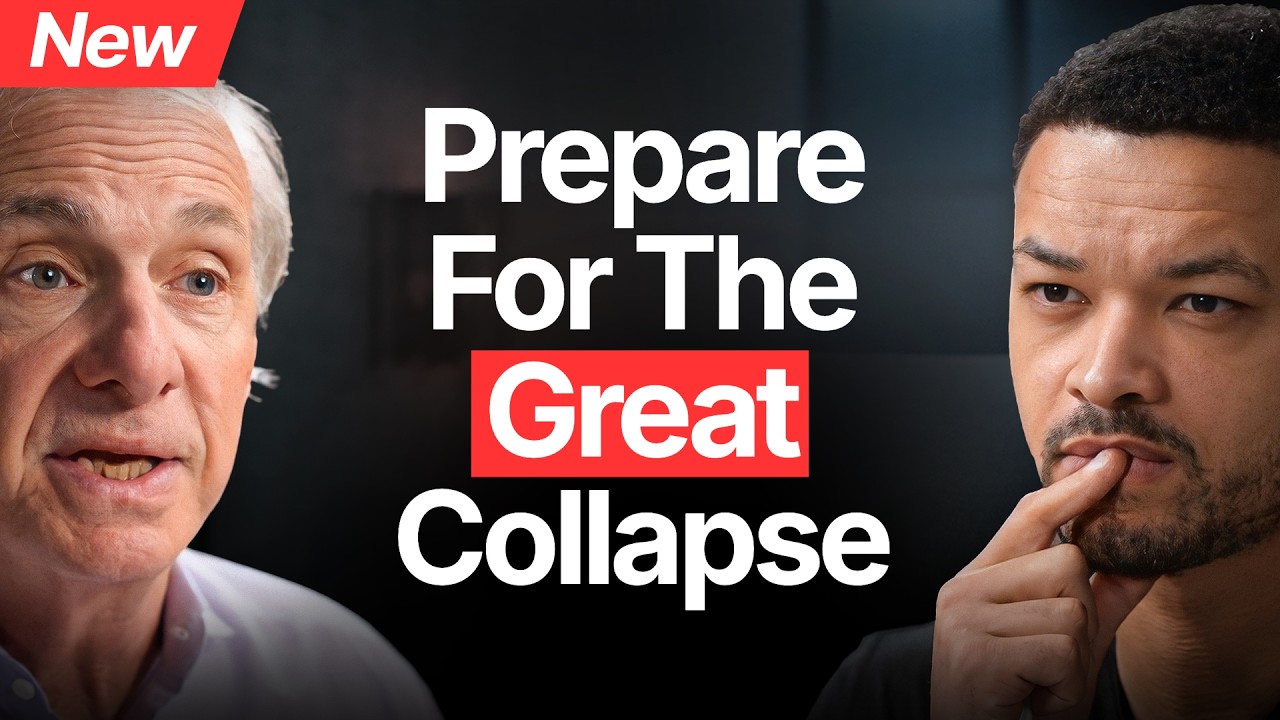
Ray Dalio Warns US Debt and AI Bubble Signal Decline Phase
The Diary Of A CEO
Leveraged tech speculation, escalating sovereign debt, and rising geopolitical friction indicate the US has entered the terminal decline stage of the 80-year Big Cycle.
## Background
This episode of 'The Diary Of A CEO' was hosted by Steven Bartlett and published on YouTube on July 30, 2026. Featuring global macro investor and Bridgewater Associates founder Ray Dalio, the video explores why the economy is currently in an artificial intelligence bubble, how major debt cycles and rising geopolitical tensions point to US decline, and how individuals can protect their wealth.
## TL;DR
Ray Dalio argues that the current artificial intelligence boom exhibits classic warning signs of an asset bubble that, when combined with high national debt, internal political polarization, and shifting geopolitical power, signals the late-stage decline of major Western economies. He explains the financial mechanics of how speculative bubbles burst and reverse paper wealth into broader recessions, warning against holding cash due to inflation while favoring true diversification in hard assets like physical gold. Dalio advises the next generation to focus on adaptability and human collaboration with AI, warning that failure to address systemic inequality and education breakdowns will accelerate economic and social collapse.
## Atmosphere & style
The conversation carries an urgent, highly analytical, and somber tone, balanced by Ray Dalio's calm, measured, and grandfatherly delivery as a seasoned market historian. Steven Bartlett acts as an engaged, inquisitive proxy for the listener, pressing Dalio with concrete real-world scenarios while Dalio systematically breaks down complex macroeconomic machinery into accessible framework models. Listening to the interview feels like a serious medical diagnosis of the global economy—delivering stark, sobering warnings about economic decline alongside pragmatic, grounding wisdom for personal financial survival.
## Key takeaways
- [00:00](https://www.youtube.com/watch?v=Bu0xNDLNORU&t=0s) The warning signs of a classic AI-driven asset bubble are flashing, mirroring the speculative conditions preceding the 1929 Great Depression and 2000 dot-com bust.
- [02:55](https://www.youtube.com/watch?v=Bu0xNDLNORU&t=175s) Asset bubbles turn into broader economic recessions when investors borrow against inflated paper wealth, forcing liquidations and spending cuts when interest rates rise or debt comes due.
- [10:27](https://www.youtube.com/watch?v=Bu0xNDLNORU&t=627s) Asset bubbles pop as part of an overarching 'Big Cycle' involving expanding internal political polarization, mounting national debt deficits, and shifting global power dynamics.
- [16:49](https://www.youtube.com/watch?v=Bu0xNDLNORU&t=1009s) Holding cash or bank deposits guarantees negative real returns over time because inflation combined with income taxes on nominal interest constantly erodes purchasing power.
- [20:14](https://www.youtube.com/watch?v=Bu0xNDLNORU&t=1214s) True portfolio diversification requires balancing stocks, bonds, real estate, and hard reserve assets like gold, which carries no counterparty liability and acts as a safe-haven shock absorber.
- [28:12](https://www.youtube.com/watch?v=Bu0xNDLNORU&t=1692s) Physical gold is preferable to Bitcoin for sovereign reserves and macro crisis protection due to Bitcoin's regulatory exposure, potential technological risks, and lack of central bank backing.
- [30:26](https://www.youtube.com/watch?v=Bu0xNDLNORU&t=1826s) The AI revolution differs from past industrial shifts because machines are replacing human cognitive reasoning and decision-making rather than merely physical labor.
- [32:30](https://www.youtube.com/watch?v=Bu0xNDLNORU&t=1950s) AI automation increases the share of corporate revenue accruing to capital owners while shrinking the share paid to labor, displacing entry-level workers and expanding wealth inequality.
- [38:27](https://www.youtube.com/watch?v=Bu0xNDLNORU&t=2307s) Long-term economic trajectory is governed by three overlapping cycles: perpetual upward technological progress, ~80-year Big Cycles of debt and world orders, and ~6-year business cycles.
- [48:35](https://www.youtube.com/watch?v=Bu0xNDLNORU&t=2915s) Adaptability and leveraging modern AI tools are far more important for long-term career survival than specializing in specific technical skills like computer programming.
- [55:19](https://www.youtube.com/watch?v=Bu0xNDLNORU&t=3319s) When capitalism fails to build a basic baseline in education and civility for the majority, public funds end up diverted from productive investment into reactive costs like incarceration.
- [58:25](https://www.youtube.com/watch?v=Bu0xNDLNORU&t=3505s) Wealth taxes are difficult to execute operationally without triggering forced asset liquidations, capital flight, and reductions in economic productivity.
- [01:04:07](https://www.youtube.com/watch?v=Bu0xNDLNORU&t=3847s) Major Western nations like the UK and US show clear textbook indicators of late-stage empire decline, characterized by high debt, underproductivity, and political gridlock.
- [01:09:01](https://www.youtube.com/watch?v=Bu0xNDLNORU&t=4141s) Young entrepreneurs should build borderless businesses across multiple dynamic 'renaissance' hubs rather than tying their capital entirely to a single country in economic decline.
- [01:15:12](https://www.youtube.com/watch?v=Bu0xNDLNORU&t=4512s) Global power is fracturing away from unipolar US hegemony back toward distinct regional spheres of influence, with China anchoring the Asia-Pacific region through economic dominance.
- [01:20:28](https://www.youtube.com/watch?v=Bu0xNDLNORU&t=4828s) US global military deterrence is eroding because foreign leaders recognize that domestic political intolerance for casualties and rising costs restricts long-term American military intervention.
## Detailed walkthrough
### [00:00](https://www.youtube.com/watch?v=Bu0xNDLNORU&t=0s) Introduction and Overview of the Big Cycle
Steven Bartlett opens the podcast by asking global macro investor Ray Dalio whether he sees classic signs that we are currently in an AI bubble that could precipitate a broader economic collapse. Dalio confirms that the typical warning signs are flashing, but stresses that an asset bubble does not occur in a vacuum—it is intertwined with broader structural shifts in society, politics, and international relations.
Bartlett introduces Dalio, noting that he founded Bridgewater Associates in a two-bedroom apartment in 1975 and grew it into the world's largest hedge fund. Under Dalio's leadership, Bridgewater generated roughly $53 billion in cumulative net gains for its investors, achieving around a 12% annualized return with virtually no significant drawdowns or correlation to traditional markets. Notably, Dalio was one of the few fund managers to foresee the 2008 Great Financial Crisis, enabling Bridgewater to post positive returns of 9.5% in 2008 while the S&P 500 plunged nearly 40%.
- **Bridgewater Net Gains:** ~$53 billion delivered to investors over its lifetime.
- **2008 Crisis Performance:** Bridgewater posted a **+9.5%** return while the S&P 500 fell roughly **40%**.
- **Historical Analogies:** Current conditions parallel the market environments preceding the **1929 Great Depression** and the **2000 dot-com bust**.
---
[02:55](https://www.youtube.com/watch?v=Bu0xNDLNORU&t=175s) The AI Bubble and the Mechanics of Economic Collapse
Bartlett brings up a recent conversation with legendary investor Jeremy Grantham, who asserted that the market is staring down the largest investment bubble in American history—driven by artificial intelligence—and is nearing its peak. Dalio agrees with Grantham’s underlying analysis, explaining that while AI technology is genuinely revolutionary and will transform both human physical labor and cognitive reasoning, investors are repeating a historic pattern: overpaying for transformative technology and inflating prices beyond underlying fundamentals.
> "What they call a bubble is when the price goes up a lot and companies do very well and then it collapses... history has shown that it's not the most intelligent people that are the most successful, but the key thing to keep in mind is cause-and-effect relationships."
Dalio breaks down the precise financial mechanics that turn an asset bubble into a main-street recession:
1. **Paper Wealth vs. Spendable Money:** Assets appreciate rapidly, creating paper wealth. However, investors cannot spend paper wealth; they must sell the asset or borrow against it to get liquid cash.
2. **Leverage and Debt Service:** Investors use their high-valued assets as collateral to borrow money. When central banks raise interest rates or debt service payments come due, market participants are forced to sell assets to raise cash.
3. **The Reverse Wealth Effect:** As forced selling begins, asset prices plummet. The exact process that compounded wealth on the way up reverses on the way down. Falling portfolio values prompt individuals and businesses to cut back on spending, reducing incomes for peripheral businesses (such as local restaurants) and sparking a wider economic contraction.
To illustrate this, Bartlett uses a concrete hypothetical: an investor buys a single share of an AI company for $100, uses it as collateral to secure a 50% bank loan ($50 cash), and then experiences a liquidity shock in the market. When forced selling drops the asset's value to $25, the investor still owes the bank $50, leaving them $25 in the hole and forcing further liquidation.
- **Foundational Examples:** Electrification, radio, automobiles, and commercial aviation in the late 1920s transformed society, yet over-leveraged speculation on those technologies still produced the Great Depression.
- **Valuation Disconnect:** Startups raising $50 million at a $1 billion valuation create paper billionaires who hold non-liquid wealth that can rapidly evaporate during a liquidity squeeze.
---
[10:27](https://www.youtube.com/watch?v=Bu0xNDLNORU&t=627s) The "Big Cycle": Wealth Gaps, Political Polarization, and Geopolitics
Dalio explains that market bubbles do not pop in isolation—they collide with the structural forces of his "Big Cycle." Alongside financial leverage, two other major pressures compound the risk of a severe downturn:
* **Internal Political Conflict:** Expanding wealth gaps create deep polarization between the political left and right. At the same to, governments are running massive budget deficits. As public coffers drain, political compromise breaks down, tax policy becomes contentious, and high earners begin fleeing high-tax jurisdictions. Dalio points out that the UK's financial instability contributed to the country having six different prime ministers across a seven-year span.
* **External Geopolitical Shifts:** The international order shifts as rising powers challenge incumbents. China has surpassed the United States as the primary trading partner for most countries around the globe, signaling a fundamental realignment of the global order.
When an asset bubble bursts during a period marked by high debt, domestic political conflict, and shifting international power dynamics, the resulting economic pain escalates rapidly into social upheaval.
> "Every day we go to our sources of information and you see this latest news, but they don't connect the dots in understanding that cycle."
---
[12:37](https://www.youtube.com/watch?v=Bu0xNDLNORU&t=757s) What Pricks the Bubble and Warning Signs to Watch
Addressing what actually causes a bubble to burst, Dalio identifies the key catalysts and early warning indicators:
* **Interest Rate Hikes & Tight Money:** When speculative fevers fuel inflation, central banks tighten monetary policy. Higher interest rates make risk-free yields on debt more attractive than equity yields, while simultaneously increasing the cost of servicing existing debt.
* **Supply Surge (Stock Issuance):** Equity is one of the easiest assets to create out of thin air. When market demand for a hot sector explodes, founders and corporations flood the market with new stock issuances and IPOs, eventually overwhelming buyer demand.
* **Shift from Strong Hands to Weak Hands:** Early-stage bubbles are driven by knowledgeable, long-term investors ("strong hands"). Over time, retail and unsophisticated investors ("weak hands") pile in near the top—often using extreme leverage, options, or leveraged ETFs to gamble on continued price increases.
Bartlett shares an anecdote about a founder friend running an AI company who recognized these bubble dynamics and proactively raised hundreds of millions of dollars while capital was still easy to access. His goal is to stockpile a massive cash buffer so that when the market crashes and competitors go under, he can acquire them cheaply. Dalio notes that while this is smart individual corporate strategy, the widespread rush to issue equity in easy-money environments increases the total supply of AI shares, accelerating the exact market saturation that triggers a crash.
- **Key Trigger:** Tightening monetary policy and wealth taxes force market participants to sell equity to raise liquid cash.
- **Market Dynamics:** A shift toward retail leverage and derivative products (such as leveraged sector ETFs) signals that an asset has moved into weak hands.
<ElicitationsGroup message="Where would you like to take this transcript walkthrough next?">
{/* Reason: Prompt is a partial transcript walkthrough; offer natural next steps for continuing the analysis or synthesizing insights. */}
<Elicitation label="Summarize Ray Dalio's core 'Big Cycle' framework" query="Summarize Ray Dalio's core 'Big Cycle' framework based on this discussion, detailing the interaction between debt, internal politics, and external geopolitics."/>
<Elicitation label="Analyze the mechanics of the AI bubble versus the 2000 dot-com crash" query="Compare the mechanics of the current AI bubble with the 2000 dot-com crash as explained by Ray Dalio in this walkthrough."/>
</ElicitationsGroup>
Here is a detailed, faithful walkthrough based on the transcript provided:
[16:49](https://www.youtube.com/watch?v=Bu0xNDLNORU&t=1009s) The Realities of Inflation and Why Cash Is a Trap
Ray Dalio transitions into the fundamental mechanics of money management and how individuals can prepare for market downturns. He strongly advises against trying to time market bubbles, noting that even sophisticated institutional investors struggle to time them accurately. Instead, the foundation of financial survival relies on diversification. Drawing from his personal journey—starting with no money, carefully tracking how many months he could survive if his income vanished, and gradually building long-term financial security—Dalio explains how most people miscalculate risk when storing their wealth.
```
+-----------------------------------------------------------------------+
| THE INFLATION TAX TRAP |
| |
| Bank Savings Interest (~3.5% - 4.0%) |
| - Minus Inflation Rate (~3.5% - 4.0%) |
| ------------------------------------- |
| = Real Return: ~0.0% |
| - Minus Income Taxes (Paid on nominal gains) |
| ------------------------------------- |
| = NET REAL RETURN: NEGATIVE |
+-----------------------------------------------------------------------+
```
People naturally gravitate toward cash, bank deposits, or short-term money market funds because they feel safe. However, Dalio warns that cash is guaranteed to be the worst long-term investment due to the silent erosion of inflation. If inflation runs at $3.5\%$ to $4\%$ annually, holding cash reduces purchasing power by that same amount every year. Even if a bank pays a matching $3.5\%$ or $4\%$ interest rate, the investor is still falling behind because governments tax the nominal interest earned. Thus, after accounting for taxes and inflation, cash yields a net negative real return over time.
- **Inflation standard:** Inflation currently runs around $3.5\%$ to $4.0\%$ per year.
- **The tax trap:** Investors pay income taxes on nominal interest gains even when those gains fail to outperform inflation.
- **Cash definition:** "Cash" includes short-term deposits and money market accounts earning interest, not just physical bills.
---
[20:14](https://www.youtube.com/watch?v=Bu0xNDLNORU&t=1214s) Diversification across Asset Classes
To combat the drag of inflation and protect against market shocks, investors must build a balanced, diversified portfolio. Dalio breaks down the primary asset choices available: equities, gold, bonds, real estate, and Bitcoin. While stocks benefit from human productivity and innovation over the long haul, they carry high volatility and can suffer severe bear market drawdowns of $60\%$ to $70\%$.
```
+-----------------------------------------------------------------------+
| MAJOR ASSET CLASS DYNAMICS |
+---------------+-----------------------+-------------------------------+
| ASSET CLASS | CORE CHARACTERISTIC | SYSTEMIC ROLE |
+---------------+-----------------------+-------------------------------+
| Equities | High Productivity/ | Growth engine; can drop |
| | Growth | 60-70% in bear markets. |
| Gold | Non-printable, | Inverse to traditional assets;|
| | Non-liability | #2 central bank reserve. |
| Bonds | Fixed interest lending| Vulnerable to rising rates |
| | | & inflation. |
| Real Estate | Forced savings, | Provides shelter; favorable |
| | Tax advantages | tax treatment. |
| Bitcoin | Digital hard money | Fixed supply, but carries tech|
| | | & regulatory risks. |
+---------------+-----------------------+-------------------------------+
```
The key to diversification is understanding how these assets move relative to one another. When traditional assets like stocks, bonds, or real estate perform poorly, gold tends to perform well, serving as an effective shock absorber. Gold remains the world's second-largest central bank reserve currency and carries unique status as "the only financial asset that is not somebody else's liability." Conversely, bonds lock the investor into a fixed return, leaving them exposed when inflation and interest rates rise. Housing provides structural benefits—such as forcing personal savings discipline and offering favorable tax treatment—while creating a comfortable environment for the owner.
- **Bear market drawdowns:** Stock market downturns can wipe out $60\%$ to $70\%$ of equity values.
- **Gold's unique role:** Gold has functioned as money throughout history (up until 1971) and remains the second-largest reserve asset held by central banks.
- **Risk mitigation:** True diversification balances assets according to their relative volatility to reduce overall portfolio risk without sacrificing long-term returns.
---
[23:34](https://www.youtube.com/watch?v=Bu0xNDLNORU&t=1414s) Maximizing Personal Human Capital with Little to No Savings
Addressing questions from viewers who have minimal savings (e.g., a 30-year-old with only $100 in disposable income), Dalio emphasizes that when you lack financial assets, "your only asset is yourself." The primary objective must be increasing the value of your time and labor in the marketplace. However, this is becoming increasingly difficult as artificial intelligence and automation replace traditional jobs, exacerbating the wealth gap between top earners and average workers.
```
+-----------------------------------------------------------------------+
| THE 10% PREMIUM LAW OF VALUE |
| |
| [ Baseline Skill ] ------------> Standard Market Rates |
| |
| [ +10% Effort / Skill ] -------> 2x (200%) Market Value |
| |
+-----------------------------------------------------------------------+
```
Steven Bartlett points out that the exact same skill can command vastly different earnings depending on the context—for example, driving a ride-share vehicle versus working as a private chauffeur for a high-net-worth individual. Dalio agrees and highlights a fundamental "law of everything": top performers in any field command compensation that is multiples above the average. By investing just $10\%$ more effort, skill, or refinement into your work, you can often double your income potential. The ultimate goal is aligning your personal passion with your career while remaining deeply pragmatic about financial sustainability.
- **The top-tier premium:** Achieving elite performance (top $10\%$) in any domain unlocks disproportionate exponential returns relative to the extra effort invested.
- **Contextual value:** Skill valuation depends heavily on the industry and audience being served.
- **Job displacement:** Artificial intelligence widens the income gap by raising productivity while displacing middle-tier cognitive labor.
---
[28:12](https://www.youtube.com/watch?v=Bu0xNDLNORU&t=1692s) Gold vs. Bitcoin in a Era of Geopolitical Friction
Dalio outlines his perspective on Bitcoin, revealing that it constitutes roughly $1\%$ of his personal portfolio. He classifies Bitcoin as a form of non-printable money, putting it in a similar conceptual category as gold. However, he strongly prefers physical gold for hard-money protection, recommending that most individuals allocate between $5\%$ and $15\%$ of their total portfolio to physical gold.
While Bitcoin shares gold's fixed-supply properties, it faces technical and regulatory vulnerabilities. Emerging technologies such as quantum computing could threaten its underlying encryption, and its digital ledger allows governments to track, monitor, and tax transactions. Furthermore, central banks are unlikely to hold Bitcoin in significant quantities because sovereign states demand privacy and full control over their monetary reserves. Geopolitical crises highlight this distinction: during recent conflicts, international authorities confiscated various digital and conventional paper assets from state actors like Russia, whereas physical gold held directly remained outside rival control.
- **Dalio's portfolio allocations:** ~1% in Bitcoin; recommends 5% to 15% in gold/hard assets for average portfolios.
- **Bitcoin vulnerabilities:** Susceptibility to future quantum computing breakthroughs, government oversight, taxation, and state bans.
- **Sovereign reserves:** Central banks prefer gold because it carries no counterparty or technological risk and cannot be arbitrarily frozen or erased.
---
[30:26](https://www.youtube.com/watch?v=Bu0xNDLNORU&t=1826s) How AI Is Reshaping Labor, Capital, and Society
Dalio provides a historical framework for the technological shift currently underway. Human evolution progressed from the agricultural era—where human muscles operated like oxen in the field—to the First Industrial Revolution, where machines and tractors replaced physical labor. Today's artificial intelligence revolution represents the next evolutionary leap: machines are moving up the value chain from replacing bodily labor to replacing higher-level cognitive functions, reasoning, and decision-making.
```
=========================================================================
THE EVOLUTION OF HUMAN LABOR
=========================================================================
1. AGRICULTURAL ERA --> Human muscle as engine (like oxen).
2. INDUSTRIAL ERA --> Machines replace physical labor (tractors).
3. DIGITAL / AI ERA --> Machines replace cognitive labor & reasoning.
-------------------------------------------------------------------------
REVENUE SPLIT IN THE MODERN ECONOMY
[ Capitalists / Owners ] --> Share of revenue INCREASING
[ Workers / Laborers ] --> Share of revenue DECREASING
=========================================================================
```
This structural shift dramatically favors business owners and tech innovators ("capitalists with ideas") over traditional workers. As companies automate routine cognitive tasks, the proportion of corporate revenue going to capital owners increases while the share paid out in employee wages shrinks. This dynamic creates severe headwinds for new entrants to the labor market; even in a strong economy, recent college graduates face growing difficulties securing employment because businesses find training entry-level workers slower and more costly than deploying automated AI systems. As this displacement accelerates, society will be forced to rethink work structures, the standard 40-hour workweek, and basic economic safety nets.
- **Historical workweek shift:** Industrial automation previously allowed weekly work hours to fall from 60–70 hours down to under 40 hours.
- **Corporate revenue dynamics:** Revenue shares directed to labor are declining, while capital owners capture an expanding share.
- **Entry-level displacement:** Companies increasingly replace entry-level white-collar workers and college graduates with AI tools to eliminate training overhead.
- **Disruption velocity:** The sheer speed of AI advancement—fueled by massive capital inflows into frontier model developers like OpenAI and Anthropic—surpasses historical shifts like the slow adoption of agricultural tractors.
<FollowUp label="Would you like me to summarize Part 3 as soon as you provide it?" query="Please continue with the detailed walkthrough for Part 3 of the transcript as soon as it's provided."/>
[35:27](https://www.youtube.com/watch?v=Bu0xNDLNORU&t=2127s) The Dual Drivers of Unemployment: Bubbles vs. Evolutionary Automation
Economic downturns and mass job losses are driven by two distinct mechanisms operating simultaneously. On one side, cyclical financial panics occur when debt bubbles burst. As stock prices collapse and collateral vanishes, businesses stop acquiring assets and pivot entirely from growth to survival, leading to widespread cost-cutting and immediate layoffs. On the other side, an evolutionary shift unfolds as technology continuously replaces human labor—a process that has been ongoing since the tractor replaced field laborers and assembly lines replaced factory hands.
While physical AI, autonomous vehicles, and robotics will inevitably transform industries, this physical transition takes considerable time. In the physical world, deployment requires building sensor stacks, refining models, manufacturing vehicles, and navigating complex regulatory hurdles. Over time, millions of traditional roles will transition to autonomous fulfillment, but short-term spikes in the unemployment rate remain heavily governed by the immediate aftermath of financial bubble bursts rather than the gradual march of automation.
[38:27](https://www.youtube.com/watch?v=Bu0xNDLNORU&t=2307s) The 80-Year Big Cycle and the Long-Term Arc of Human Progress
To map these economic shifts, Ray Dalio outlines a structural framework composed of three distinct overlaying trajectories:
```
HUMAN LEARNING & TECHNOLOGY (Upward Line)
---------------------------------------------------> (Never Unlearns)
THE 80-YEAR BIG CYCLE (Major Debt & World Order)
/\ /\
/ \ / \
---/----\---------------/----\--------------------> (Breakdown/Reset)
\ / \
\___________/ \___________
The underlying baseline is the upward-trending line of technological evolution. Driven by human learning, this trajectory moves strictly upward because humanity does not "unlearn" its scientific advances over time. Modern machines and software continuously build upon past discoveries to improve productivity.
Superimposed over this technological baseline is the **Big Cycle**, which typically spans roughly a human lifetime (around 80 years). Established following major global realignments like 1945, this cycle dictates monetary systems, domestic politics, and geopolitical orders. Over decades, debt capacity builds up until debt service costs squeeze the system, wealth gaps widen, and internal political frictions escalate. When the Big Cycle reaches its climax, these fundamental orders break down, wiping away unsustainable debt burdens and resetting the domestic and international framework through period conflict and restructuring.
Within this overarching 80-year cycle sit short-term business cycles averaging about six years (give or take three years). These smaller fluctuations move from prosperity to capacity limits and inflation, triggering central bank tightening, recession, monetary easing, and subsequent expansion.
- **Capitalism and Wealth Gaps:** While capitalism is an effective generator of capital, it naturally creates significant disparities in income and opportunity.
- **The Gilded Age Parallel:** Current wealth concentrations mirror the Gilded Age and the era of the "robber barons," where capital accumulation concentrated heavily at the top.
- **Stock Ownership Inequality:** In the United States, roughly 61% of adults hold stock (mostly indirectly through retirement plans), and only 20% hold shares directly through brokerage accounts. Crucially, the top 10% of households own nearly 90% of all stock wealth.
[43:38](https://www.youtube.com/watch?v=Bu0xNDLNORU&t=2618s) What Humans Have Left: Emotion, Intuition, and Human-AI Collaboration
Silicon Valley proponents often argue that AI and robotics will create entirely new, unforecastable job categories, pointing to how previous industrial revolutions created new work when tractors and factory automation disrupted agriculture and manufacturing. However, a critical distinction exists today: past transitions saw machines replacing human muscle while humans shifted toward cognitive work. When technological advances replicate both physical capabilities and cognitive processing, human leverage fundamentally shifts.
What humans uniquely retain are emotions, physical presence, and intuition—nuances that artificial intelligence lacks. In the foreseeable future, the individuals positioned at the absolute cutting edge of the economy will not be those attempting to out-compute machines, but those possessing exceptional human intelligence who operate in close partnership with AI systems.
[48:35](https://www.youtube.com/watch?v=Bu0xNDLNORU&t=2915s) Life Advice for the Next Generation: Adaptability over Pure Intelligence
When offering guidance to young people navigating an uncertain technological landscape, financial optimization should not be the sole focus. Beyond securing basic financial safety—having enough savings to avoid panic and cover living expenses—there is little correlation between excess wealth and personal happiness. Long-term fulfillment stems from aligning daily work with personal passion and nature.
Different individuals possess distinct inherent traits: some are naturally adventurous or conceptual thinkers, while others prefer concrete, structured environments. Understanding one's innate neurological profile allows people to pursue career paths that match their disposition.
Rather than trying to predict specific high-paying professions, the single most critical quality for surviving rapid technological disruption is adaptability. History demonstrates that the most successful species and individuals are rarely the strongest or most intelligent, but those best able to adapt to shifting environments.
> "History has shown that it's not the most intelligent people or the most intelligent species that are the most successful... It is those who are most adaptable."
- **PrinciplesU Test:** Dalio built a free 30-minute online assessment called *PrinciplesU* to help individuals identify their core personality traits and innate tendencies.
- **The Fragility of Hard Skills:** Coding was long touted as an essential skill, yet the emergence of advanced coding agents (such as Claude Code) rapidly transformed the software development landscape, demonstrating how quickly technical skill requirements can shift.
<ElicitationsGroup message="Explore further insights from Ray Dalio's economic models:">
<Elicitation label="Analyze the 5 forces driving Dalio's Big Cycle" query="What are the five forces behind Ray Dalio's Big Cycle model and how do they interact?"/>
<Elicitation label="Compare Bitcoin vs. Gold as safe-haven assets" query="How does Ray Dalio compare Bitcoin versus Gold as wealth protection against debt crises?"/>
</ElicitationsGroup>
[53:42](https://www.youtube.com/watch?v=Bu0xNDLNORU&t=3222s) Navigating Career Choices in an Uncertain AI Era
Addressing the paralysis faced by young people entering the job market, Steven Bartlett highlights the overwhelming confusion caused by an emerging "unemployability crisis" at entry levels and the rapid disruption brought by artificial intelligence. Ray Dalio responds with pragmatic candor, emphasizing that the inability to predict the future is simply a reality everyone must accept. Instead of searching for a guaranteed career path or specific job title—such as computer programming—young adults should focus on mastering the tools that maximize their capacity to acquire knowledge and deliver real utility.
Dalio notes that if he were giving advice to his own 16-year-old child, he would urge them to focus on maximizing their personal usefulness and finding work that brings genuine fulfillment. Pushing a young person toward a specific "safe" occupation is misleading because technological trends shift too quickly. The key to surviving rapid economic transformation lies in adaptively leveraging AI tools to enhance learning and productivity rather than fixating on a rigid career destination.
- Young job seekers face unprecedented confusion due to entry-level job disruption and rapid technological shifts.
- Fixed career advice (e.g., training exclusively for a specific role like programming) risks becoming obsolete quickly.
- Primary recommendation for youth: Learn to leverage modern AI tools to maximize personal knowledge, utility, and career flexibility.
---
[55:19](https://www.youtube.com/watch?v=Bu0xNDLNORU&t=3319s) Wealth Inequality, System Failure, and the Education Crisis
Turning to his 80-year "Big Cycle" framework, Dalio explains how capitalism naturally concentration-builds wealth over time, leading to a "Gilded Age" where extreme wealth sits alongside widespread hardship. He stresses that when a dominant economic system fails to work for the majority of its population, structural collapse becomes imminent. To illustrate this, Dalio draws on a striking example from his home state of Connecticut. Despite being roughly the second wealthiest US state on a per-capita income basis, 22% of its high school students are either dropping out or failing with chronic absenteeism exceeding 25%. This breakdown feeds a destructive cycle of gangs, drugs, and incarceration, ultimately driving Connecticut's prison budget above its public education budget.
Dalio argues that solving these deep systemic failures requires focusing on basic productivity and civility. Governments are notoriously inefficient at running programs, so simply handing them more tax dollars without structural accountability rarely solves the problem. Society must ensure that citizens receive an education that enables them to be productive and civil—teaching people how to work together collaboratively. When societies fail to establish this foundation, civil friction, skyrocketing debt, and ideological warfare inevitably take over.
> "If the majority system is not working for the majority, well, you're going to have a problem."
> "When you have that kind of cycle... the bill for incarcerations has become larger than the education budget."
- **Connecticut Case Study:** Ranks ~2nd in per-capita wealth in the US, yet suffers a 22% high school dropout/failure rate with absenteeism over 25%.
- **Budget Inversion:** Incarceration costs in Connecticut have outpaced the state's public education spending.
- **Systemic Pillars:** Society must establish a baseline floor in education, civility, and basic living standards so individuals become economic assets rather than social liabilities.
---
[58:25](https://www.youtube.com/watch?v=Bu0xNDLNORU&t=3505s) The Debate Over Wealth Taxes and Systemic Productivity
Responding to Steven's query about whether capitalism inherently produces dangerous inequality, Dalio points to models like Singapore and Scandinavian countries as proof that capitalism can coexist with a strong social floor. In those nations, guaranteed access to quality education, housing, and healthcare ensures citizens remain productive contributors to society. When asked about the growing political push in the UK and major US cities (like New York and Los Angeles) for direct wealth taxes on the rich, Dalio warns that implementing wealth taxes comes with severe structural side effects that can accidentally trigger financial crises.
Because net worth is largely tied up in illiquid assets rather than cash, forcing individuals to pay annual wealth taxes requires them to liquidate assets, which can cause market bubbles to burst. Furthermore, if governments use wealth tax revenues merely for consumption or transfer payments rather than capital investments in education and infrastructure, total economic productivity declines. Dalio maintains that private enterprise and entrepreneurship are inherently more efficient at generating productive output than government bureaucracies. Because political institutions rarely attract top operational talent and are bogged down by ideological infighting, relying on government to redistribute and manage wealth often undermines national prosperity.
> "Capitalist businesses will do better than their government counterpart... government has its own dysfunction as it causes all of this arguing."
> "If you're just making transfer payments... and the money is going from what was capital expenditures... to consumption, that doesn't produce productivity."
- **Model Societies:** Singapore and Scandinavian nations demonstrate how maintaining a guaranteed floor in education, housing, and health prevents social disruption.
- **Wealth Tax Risks:** Operational difficulty forces asset sales to satisfy tax liabilities, risking market crashes and reducing capital investment.
- **Productivity vs. Consumption:** Tax revenues directed toward government transfer payments rather than long-term capital investments diminish long-term economic growth.
---
[01:04:07](https://www.youtube.com/watch?v=Bu0xNDLNORU&t=3847s) The Decline of the United Kingdom and Economic Restructuring
Examining the current state of the United Kingdom, Dalio characterizes the nation as a classic textbook case of a late-stage empire cycle: over-indebted, underproductive, and stripped of easy choices. Political instability—highlighted by the UK cycling through six Prime Ministers over seven years—is a direct symptom of this financial squeeze. Politicians make grand promises they cannot deliver, leading voters to repeatedly throw them out. Caught in a corner, leaders cannot raise taxes without triggering capital flight, nor can they cut benefits without harming vulnerable citizens who rely on them. Meanwhile, mounting deficits make international creditors increasingly hesitant to lend.
To break out of this downward spiral, Dalio explains that countries are eventually forced into painful restructurings. Historically, central banks resort to printing money (causing high inflation), restructuring debt maturities, or enacting capital controls and exit taxes to prevent capital from leaving the country. Dalio argues that the only viable way forward is establishing a strong, bipartisan political middle. Smart economic minds from opposing political sides must unite to draft a difficult, constitution-style plan that fairly distributes economic pain and focuses relentlessly on restoring national productivity.
> "It's the classic cycle. They have gotten over-indebted, underproductive, and they've run out of choices."
> "Smart rabbit has three holes... smart people of both parties work together to come up with a small and difficult plan."
- **Political Turnover:** The UK had 6 Prime Ministers in a 7-year span due to compounding financial distress and broken electoral promises.
- **The Trilemma:** Governments cannot easily raise taxes (drives away wealth), cut benefits (causes public outcry), or run endless deficits (repels bond buyers).
- **Historical Crisis Mechanics:** Late-stage debt cycles typically end in currency debasement/inflation, debt maturity restructuring, capital controls, and exit taxes.
---
[01:09:01](https://www.youtube.com/watch?v=Bu0xNDLNORU&t=4141s) Advice for Young Entrepreneurs and the "Three Holes" Strategy
When Steven asks whether a 21-year-old entrepreneur should establish a business in the UK today, Dalio advises young founders to operate "without borders." Rather than tying their fate to a single nation undergoing systemic decline, entrepreneurs should seek out vibrant "renaissance states"—global hotspots that combine top-tier talent, abundant capital, strong education, and high civility. Pointing to the famous Hong Kong idiom that *"a smart rabbit has three holes,"* Dalio stresses the importance of geographical diversification for both capital and talent to hedge against national political risks.
While both the UK and the US contain localized pockets of intense innovation and economic energy, those pockets still exist within larger national systems burdened by heavy debt and political division. Closing the discussion on wealth redistribution, Steven cites a popular proposal in the UK by former trader Gary Stevenson calling for a 2% wealth tax on net worth exceeding £10 million. Dalio reiterates his skepticism, maintaining that heavy-handed taxes often fail to address the core driver of national success: raising the baseline productivity of the entire population.
- **Global Mindset:** Young entrepreneurs should build borderless businesses anchored in dynamic, highly productive "renaissance" regions.
- **"Three Holes" Philosophy:** Diversifying operations across multiple jurisdictions protects against localized economic decay and capital controls.
- **UK Context:** Localized hubs of excellence exist in the UK and US, but they operate within larger macroeconomic environments under heavy structural strain.
Here is a detailed, faithful walkthrough covering Part 5 of the transcript.
---
[01:11:58](https://www.youtube.com/watch?v=Bu0xNDLNORU&t=4318s) The Mechanics and Challenges of Wealth Taxes
The discussion continues on the practical mechanisms and trade-offs of wealth taxation. Ray Dalio notes that while capital gains taxes and various other levers exist, societies must grapple with the fundamental dilemma: if very wealthy individuals and families are not taxed adequately, their portion of the total economic pie naturally expands over time. This ongoing concentration of wealth results in wealthy families squeezing out ordinary working families.
Steven Bartlett brings up the counterarguments commonly made by opponents of wealth taxation, noting estimates that a proposed wealth tax might raise around $20 billion, but critics warn high earners will simply flee the jurisdiction. Dalio acknowledges these dynamics, pointing out that even taking 100% of the money from the top tier would fail to cover national financial deficits because that group represents such a small percentage of the total population. Furthermore, people moving away is a well-documented reaction throughout history.
When nations face mass capital flight during wealth crises, governments historically respond with drastic measures, such as imposing retroactive tax laws to target assets as of past dates or enacting strict capital controls to physically prevent money from leaving. Dalio observes that true wealth taxes present immense administrative hurdles—primarily due to the extreme difficulty of accurately valuing illiquid, non-marketed assets—yet these cyclical government responses to wealth concentration are well recognized patterns in history.
* Proponents argue wealth taxes reduce systemic inequality, while critics point out that the top wealth bracket represents too small a population to cover national shortfalls even if taxed at 100%.
* Historical responses to high-net-worth capital flight include retroactive tax enforcement and hard capital controls.
* Administrative valuation of non-public assets remains a primary operational obstacle for wealth tax execution.
---
[01:13:31](https://www.youtube.com/watch?v=Bu0xNDLNORU&t=4411s) The 80-Year Big Cycle and the Decline Phase
The conversation turns to the macro historical framework presented in Dalio's book, *Principles for Dealing with The Changing World Order*. Bartlett asks about the approximate 80-year "Big Cycle." Dalio explains that the timeline functions much like human life expectancy: while 80 years serves as a rough average, individual cycles vary based on underlying conditions. Rather than fixating on exact chronological timing, observers should examine the specific structural markers and physical health indicators of the nation.
```
THE BIG CYCLE OF EMPIRES
[Rise] -----> [Top] -----> [Decline]
(Growth & (Peak Power (Over-indebtedness,
Solvency) & Wealth) Internal Conflict,
Loss of Power)
^
|
* WE ARE HERE *
```
When asked to diagnose where major Western nations like the United States and the United Kingdom sit within this progression, Dalio places them squarely in the late stage of the cycle—the "decline" phase. He notes that this phase is objectively characterized by severe over-indebtedness and a structural erosion of relative global power.
Dalio stresses that these conclusions are not based on personal speculation or political sentiment, but on over 500 years of empirical historical data across multiple major empires. Much like a doctor administering a thorough medical exam, analysts can directly measure a nation's health using clear, numerical metrics such as debt levels, educational outcomes, and global economic competitiveness.
* The ~80-year cycle length is a generalized average analogous to human lifespan; actual duration depends on physical economic health.
* The US and UK currently exhibit late-stage decline indicators, primarily heavy over-indebtedness and eroding relative power.
* Historical cycle analysis relies on quantifiable indicators across 500 years of data rather than subjective opinions.
---
[01:15:12](https://www.youtube.com/watch?v=Bu0xNDLNORU&t=4512s) Multi-Polar World Orders vs. A Single Dominant Superpower
Bartlett asks whether historical precedents exist where two rival superpowers coexisted without one dominating the entire system. Dalio clarifies that prior to World War I and World War II, the world was not fully integrated into a single globalized system; power was regionalized. Ancient or early-modern powers like China, India, Great Britain, and the Dutch Empire operated in distinct spheres without a single unified global framework. World War II created a integrated, "one world" system governed by a dominant force.
In a single global system, disagreements inevitably arise, and the ultimate arbiter of those disagreements is power rather than abstract rules. Dalio describes the post-WWII "rules-based international order" spearheaded by the United States as a noble theoretical concept centered on institutions like the United Nations. However, when rules conflict with raw power, power wins out.
Looking forward, Dalio anticipates that the most stable and beneficial path forward may be a shift back toward explicit regional spheres of influence rather than a single global hegemon. He notes that China's cultural framework—deeply rooted in Confucian top-down social hierarchies similar to extended family structures—focuses heavily on domestic order, self-sufficiency, and preventing foreign encroachment rather than military occupation of distant foreign nations. While a major global military clash remains a catastrophic risk, Dalio believes there is sufficient strategic awareness among leadership to avoid all-out conflict in favor of regional management.
* Prior to the 20th century, global power was fragmented into distinct regional power centers rather than governed by a single global superpower.
* The US-led "rules-based order" established post-WWII is fundamentally constrained whenever theoretical rules conflict with hard geopolitical power.
* China's governance approach is heavily influenced by Confucian hierarchy, prioritizing top-down internal control and regional security over global territorial conquest.
---
[01:18:20](https://www.youtube.com/watch?v=Bu0xNDLNORU&t=4700s) Relative Power, Regionalization, and the Taiwan Question
Expanding on how the US-China relationship will unfold, Dalio highlights that every nation's ultimate strength depends on how well it manages its domestic affairs—specifically how it educates its populace, manages its budget, and maintains social coherence. The relative balance of power between the United States and China will be determined internally. For the US, the core vulnerability comes from within: unmanageable debt burdens, political conflict, and domestic decay that erode international standing.
Assuming both nations remain powerful entities, global power will naturally divide into distinct geographical regions. The Americas will form one primary economic and political sphere, while Asia-Pacific (APAC) will organize around China.
Addressing critical geopolitical flashpoints like Taiwan, Dalio expresses his view that reunification pressure will not primarily take the form of direct, kinetic military invasion resulting in a full-scale World War with the US. Instead, it will be executed through immense economic, diplomatic, and logistical pressures.
* Internal factors—education quality, fiscal discipline, and domestic political stability—dictate a superpower's global position far more than external threats.
* The global economy is shifting away from unipolar American hegemony toward distinct regional blocs (e.g., the Americas vs. APAC).
* The issue of Taiwan is more likely to be settled through economic and strategic pressure tactics toward reunification rather than a direct military confrontation between the US and China.
---
[01:20:28](https://www.youtube.com/watch?v=Bu0xNDLNORU&t=4828s) The Middle East Conflict and the Erosion of US Global Deterrence
The discussion shifts to escalating military entanglements in the Middle East, specifically regarding Iran, the Persian Gulf, and the strategic Strait of Hormuz. Bartlett notes the political trap faced by American leadership: staying involved risks costly military escalation ahead of domestic elections, while withdrawing makes the nation appear weak.
Dalio offers a candid assessment based on his direct discussions with foreign government figures and world leaders, particularly across Asia. He observes that international perception of American strength has fundamentally shifted. Global leaders increasingly recognize that the American public lacks the appetite to endure prolonged military conflict, high gas prices, or casualties. Consequently, foreign nations no longer rely on the assumption that the United States will intervene decisively in distant regions.
This loss of perceived resolve has massive global ripple effects. In Asia, nations that previously relied on US military presence and bases to counterbalance China now view those very bases as potential liabilities. Dalio offers a stark example: if China were to enforce a temporary 5-day blockade on semiconductor chip exports from Taiwan, global stock markets would plummet instantly, demonstrating immense non-military coercive power. Similarly, mutual defense treaties like the one with the Philippines face skepticism over whether the US public would actually support military intervention over regional maritime disputes.
Dalio compares this shift directly to the decline of the British Empire, citing the 1956 Suez Crisis as a historical turning point where the limits of British power were exposed to the world. Where American hints or subtle diplomatic warnings once commanded immediate international compliance, the erosion of US economic dominance—such as China becoming the leading trading partner for most nations—means those threats no longer hold the same power. Trying to forcibly occupy and control a country of 90 million Iranians over the long term is an operational impossibility, and attempting to maintain control over global bottlenecks like the Strait of Hormuz indefinitely exposes the practical limits of American power.
> "Now a light bulb goes off. In other words, like the British in Suez Canal, we didn't realize. Now we realize... that power no longer exists."
* Global leadership increasingly views US military deterrence as constrained by domestic political intolerance for casualties and economic disruptions.
* China's position as the primary trading partner for most nations provides vast economic leverage that eclipses traditional military threats.
* Attempts to project military control over distant regional conflicts like Iran risk exposing structural limitations in power, mirroring the historic decline of the British Empire after the Suez Crisis.
---
<ElicitationsGroup message="To explore these macro-economic concepts further:">
{/* Reason: Providing relevant next steps to deepen understanding of Ray Dalio's economic frameworks. */}
<Elicitation label="Explore Dalio's 6 stages of the Big Cycle" query="Explain Ray Dalio's 6 stages of the Big Cycle of Empires from birth to decline in detail."/>
<Elicitation label="Compare Bitcoin vs. Gold in economic crises" query="Summarize Ray Dalio's stance on Bitcoin versus Gold as wealth protection assets during debt crises."/>
</ElicitationsGroup>
[01:29:26](https://www.youtube.com/watch?v=Bu0xNDLNORU&t=5366s) The Responsibility of Passing on Knowledge
Ray Dalio reflects on his motivation to make complex financial concepts accessible to the public, pointing to his video, *How the Economic Machine Works*, as a prime example. The 30-minute animation has been watched by 140 million people, proving that everyday individuals can grasp economic principles when they are explained clearly. Dalio sees it as his personal responsibility during this stage of his life to communicate in a simple, digestible way—taking dense concepts from his books and distilling them into concise formats to pass along insights that might genuinely help others.
Steven Bartlett expresses deep gratitude for Dalio's dedication to sharing his wisdom in this chapter of his life, noting that millions of listeners appreciate the effort. As the conversation wraps up, Bartlett leaves the audience with a nod to YouTube's AI recommendation algorithm, encouraging viewers to click on the next video personalized specifically for them.
* ***How the Economic Machine Works*:** Ray Dalio's 30-minute educational video has accumulated over 140 million views globally.
* **Mission:** Dalio views synthesizing complex ideas from his books into accessible 30-minute videos as a core responsibility for the current season of his life.
## Notable quotes
> [02:55](https://www.youtube.com/watch?v=Bu0xNDLNORU&t=175s) What they call a bubble is when the price goes up a lot and companies do very well and then it collapses... history has shown that it's not the most intelligent people that are the most successful, but the key thing to keep in mind is cause-and-effect relationships. — Ray Dalio
> [10:27](https://www.youtube.com/watch?v=Bu0xNDLNORU&t=627s) Every day we go to our sources of information and you see this latest news, but they don't connect the dots in understanding that cycle. — Ray Dalio
> [48:35](https://www.youtube.com/watch?v=Bu0xNDLNORU&t=2915s) History has shown that it's not the most intelligent people or the most intelligent species that are the most successful... It is those who are most adaptable. — Ray Dalio
> [55:19](https://www.youtube.com/watch?v=Bu0xNDLNORU&t=3319s) If the majority system is not working for the majority, well, you're going to have a problem. — Ray Dalio
> [55:19](https://www.youtube.com/watch?v=Bu0xNDLNORU&t=3319s) When you have that kind of cycle... the bill for incarcerations has become larger than the education budget. — Ray Dalio
> [58:25](https://www.youtube.com/watch?v=Bu0xNDLNORU&t=3505s) Capitalist businesses will do better than their government counterpart... government has its own dysfunction as it causes all of this arguing. — Ray Dalio
> [58:25](https://www.youtube.com/watch?v=Bu0xNDLNORU&t=3505s) If you're just making transfer payments... and the money is going from what was capital expenditures... to consumption, that doesn't produce productivity. — Ray Dalio
> [01:04:07](https://www.youtube.com/watch?v=Bu0xNDLNORU&t=3847s) It's the classic cycle. They have gotten over-indebted, underproductive, and they've run out of choices. — Ray Dalio
> [01:04:07](https://www.youtube.com/watch?v=Bu0xNDLNORU&t=3847s) Smart rabbit has three holes... smart people of both parties work together to come up with a small and difficult plan. — Ray Dalio
> [01:20:28](https://www.youtube.com/watch?v=Bu0xNDLNORU&t=4828s) Now a light bulb goes off. In other words, like the British in Suez Canal, we didn't realize. Now we realize... that power no longer exists. — Ray Dalio
## Mentioned
Ray Dalio, Steven Bartlett, Bridgewater Associates, Jeremy Grantham, Principles, Principles for Dealing with the Changing World Order, How Countries Go Broke, PrinciplesU, Claude Code, OpenAI, Anthropic, Gary Stevenson, How the Economic Machine Works, S&P 500, Bitcoin, Gold
达利欧警告:美债与AI泡沫预示进入衰退阶段
杠杆化科技投机、不断攀升的主权债务以及日益加剧的地缘政治摩擦表明,美国已进入80年“大周期”的末期衰退阶段。
Ray Dalio认为,当前的人工智能热潮呈现出典型的资产泡沫预警信号,与高额国债、国内政治极化以及地缘政治权力格局变动相结合,预示着主要西方经济体已步入晚期衰退阶段。他阐释了投机泡沫破裂并将账面财富逆转为更广泛经济衰退的金融运作机制,警告称在通胀影响下不宜持有现金,同时主张对实物黄金等硬资产进行真正的分散化配置。Dalio建议下一代专注于提升适应能力以及人与AI的协作能力,并警告称若无法解决系统性不平等和教育体系失灵的问题,将加速经济与社会的崩溃。
Ray Dalio 警告当前市场已显现类似 1929 年与 2000 年的 AI 资产泡沫信号;当投资者以虚高估值进行质押加杠杆时,一旦利率上升或遭遇流动性收缩,引发的强制抛售便会迅速蔓延至实体经济。 (2:55)
持有现金或银行存款在长期看面临确定性的购买力缩水,因通胀叠加对名义利息征税会导致实际负回报;相比存在技术与监管不确定性的 Bitcoin,不具交易对手违约风险的实物黄金依然是更可靠的危机对冲储备资产。 (16:49)
当前资产泡沫正与约 80 年一次的“大周期”相互叠加,巨额国家债务赤字、贫富分化驱动的国内政治极化,以及大国博弈引发的地缘政治格局调整正显著加剧系统性动荡风险。 (10:27)
与以往取代体力劳动的工业革命不同,AI 正在直接替代人类认知与初级白领岗位,使收益加速向资本所有者集中并加剧不平等;年轻人面对技术重构,核心竞争力在于借助 AI 工具保持快速适应能力而非固守单一技能。 (30:26)
Reading summary
Investor Ray Dalio argues that the convergence of an artificial intelligence asset bubble, unsustainable debt, domestic political polarization, and shifting geopolitical power marks the late-stage decline of leading Western nations within an 80-year 'Big Cycle.'
Mechanics of the AI Bubble and Forced Liquidation (2:55)
Dalio views current artificial intelligence market dynamics as a classic speculative bubble mirroring the environments preceding the 1929 Great Depression and the 2000 dot-com bust. While acknowledging AI's transformative capacity across physical and cognitive labor, he contends investors are overpaying for growth and accumulating non-liquid paper wealth. When speculative demand surges, companies rapidly issue new stock, eventually overwhelming buyer demand as unsophisticated retail investors enter with high leverage.
Contraction follows when central banks raise interest rates or debt service payments come due. Investors who used appreciated shares as loan collateral face margin calls and are forced to sell assets into falling markets. This reverse wealth effect reduces personal balance sheets, prompting businesses and consumers to slash spending, which subsequently spreads into broader economic contraction and job losses.
The 80-Year Big Cycle and Structural Systemic Strain (38:27)
Dalio contextualizes short-term economic fluctuations within an overarching ~80-year 'Big Cycle' that governs monetary frameworks and world orders. The cycle progresses from foundational post-conflict arrangements, through debt accumulation, to an eventual late-stage decline characterized by heavy over-indebtedness, widening wealth disparities, and internal institutional gridlock. Drawing on five centuries of empirical data, Dalio places both the United States and the United Kingdom squarely in this decline phase.
Rising wealth concentration severely strains social cohesion. In the United States, roughly 61% of adults hold equities, but the top 10% own nearly 90% of stock wealth. Dalio cites Connecticut—the second wealthiest US state per capita—where a 22% high school dropout rate and absenteeism exceeding 25% have driven state correctional spending above its public education budget. Similarly, Dalio points to the UK cycling through six prime ministers in seven years as evidence of governance failure amid intractable trade-offs between deficit spending, welfare cuts, and capital flight.
Rebalancing Wealth and the Limits of Government Intervention (58:25)
Dalio argues that an economic system failing to deliver baseline living standards for the majority will inevitably face civil disorder. However, he cautions against popular proposals like direct wealth taxes. Because high-net-worth fortunes are predominantly tied up in non-liquid assets, mandatory annual levies force asset liquidations that could inadvertently burst market valuations. Historically, such measures also provoke capital flight, triggering retroactive taxation and capital controls.
Moreover, Dalio contends that government bureaucracies lack the operational talent to deploy redistributed wealth efficiently. Redirecting capital from productive private business investment into government transfer payments simply fuels consumption without expanding the nation's underlying productivity. Instead, he points to Singapore and Scandinavian models that establish productive baselines in education, healthcare, and housing while preserving private enterprise.
Shifting Superpowers and the Return of Regional Spheres (75:12)
Geopolitically, the post-WWII American-led rules-based global order is being eroded by changing power dynamics. As China has become the leading commercial trading partner for most nations, non-military economic leverage increasingly rivals conventional military deterrence. Global leadership perceives the US as constrained by domestic political intolerance for casualties and economic disruptions, an erosion of perceived deterrence Dalio compares to Great Britain's post-1956 Suez Crisis decline.
Rather than anticipating a direct military clash between the US and China over flashpoints like Taiwan, Dalio projects a shift toward distinct regional spheres of influence. China's hierarchical governance focuses primarily on domestic stability and regional perimeter defense. Consequently, regional integration—the Americas aligned around the US and the Asia-Pacific region centered around China—is likely to supersede unipolar international governance.
Portfolio Diversification and Human Capital in an Automated Era (16:49)
To navigate macroeconomic instability, Dalio strongly advises individual investors against attempting to time markets, warning that cash accounts yielding 3.5% to 4.0% generate negative real returns after accounting for matched inflation and nominal interest taxes. He advocates balanced asset allocation across equities, real estate, and physical gold (recommending 5% to 15% in gold as an unprintable, non-liability reserve), while limiting speculative assets like Bitcoin to around 1% due to regulatory and technical vulnerabilities.
For workers facing automated displacement, Dalio notes that AI uniquely replaces middle-tier cognitive labor, reducing the labor share of revenue while favoring capital owners. In response, Dalio emphasizes cultivating adaptability, intuition, and collaborative tool usage rather than relying on brittle technical skills like coding. Entrepreneurs are advised to pursue a 'three holes' strategy—diversifying operations across agile, high-productivity global jurisdictions rather than anchoring capital to a single indebted state.
Dalio concludes that avoiding systemic rupture requires pragmatism over political ideology: individuals must cultivate personal adaptability and global diversification, while national leaders from opposing factions must collaborate on difficult fiscal and educational reforms to rebuild baseline productivity.
精炼阅读摘要
全球宏观对冲基金桥水(Bridgewater)创始人 Ray Dalio 指出,当前由人工智能热潮推动的资产泡沫并非孤立发生,而是与债务过剩、国内政治极化以及全球霸权交替这三重“大周期”(Big Cycle)压力发生碰撞。他警告,历史经验表明,单靠持有现金将因通胀与税收产生实际负回报,而应对系统性衰退需要审慎的跨资产多元配置与极强的个体适应力。
人工智能泡沫与反向财富效应的传导 (2:55)
Dalio 赞同投资人 Jeremy Grantham 的判断,认为当前正面临美国历史上由人工智能带动的巨大投资泡沫。尽管 AI 技术变革真实且深远,但投资者正在重复过度支付的历史错误,将资产价格推升至脱离基本面的高度,其投机特征与 1929 年大萧条前夕或 2000 年互联网泡沫类似。他强调,纸面财富不能直接消费,投资者往往将其作为抵押物借入现金。当中央银行为了遏制通胀而加息时,偿债成本上升迫使投资者抛售资产变现,从而引发“反向财富效应”——资产暴跌导致企业与个人削减开支,将金融领域的清算迅速传导至实体经济,演变为广泛的衰退。
大周期下的债务危机与内部制度断层 (10:27)
Dalio 提出,以大约 80 年为跨度的“大周期”正迈入晚期衰退阶段,其特征是不可持续的债务累积和悬殊的贫富差距。资本主义系统能够高效配置资本,但若无法让多数人受益,就会引发系统性危机。例如在美国人均财富名列前茅的康涅狄格州,高中辍学或常态缺课率超过两成,甚至出现监狱预算反超公共教育预算的倒挂现象。在政府财政赤字不断扩大之际,关于直接向富人征收财富税的呼声上升;然而 Dalio 指出,富人资产多为非流动性资产,强行征收可能诱发大规模资产抛售与资本外逃,若再将税收单纯转为消费性转移支付而非生产性投资,反而会进一步削弱整体经济生产力。
地缘政治多极化与美国全球威慑力的削弱
以 500 年的大国兴衰史为依据,Dalio 认为英美等西方国家目前正处于帝国大周期的衰落阶段。英国在七年内更迭六位首相,即是过度负债和生产力不足引发的治理困境的典型体现。在国际层面,二战后由美国主导的“基于规则的国际秩序”正被基于硬实力的博弈所取代。中国已成为全球多数国家的主要贸易伙伴,并在亚太地区形成强大的经济引力。与此同时,全球领导人普遍意识到美国公众难以承受持久战事与经济动荡,致使美国在海外的传统威慑力出现松动,其轨迹类似 1956 年苏伊士运河危机后大英帝国的衰退,未来的世界秩序更可能回归为分立的区域势力范围。
现金陷阱与通胀环境下的多元化配置 (16:49)
在财富管理层面,Dalio 警告持有现金并非安全避风港。若年化通胀率达到 3.5% 至 4.0%,即使银行利息相当,投资者在扣除名义利息税收之后依然面临实际负回报。为抵御市场动荡,投资者必须构建不依赖市场择时的多元化组合,平衡股票、债券、房地产与避险资产。 Dalio 建议普通投资人将 5% 至 15% 的资产配置为实物黄金,因其是唯一不构成他人负债的非信用资产,且为全球央行第二大储备货币;相比之下,尽管比特币具有非增发特性且在其个人组合中占约 1%,但其在量子计算加密破解风险、主权政府监管和税收追踪上均面临明显脆弱性,无法完全替代黄金。
自动化浪潮与劳动者核心适应能力的重塑 (30:26)
Dalio 将当前的 AI 变革定位为人类劳动演进的第三阶段:从农业时代的体力劳作,到工业时代的机械化,再到如今机器全面替代高阶认知推理与决策。这种结构性转移使得企业收益持续向资本与技术所有者集中,劳动者的收入份额相应压缩,导致缺乏经验的年轻求职者面临严重的就业门槛。Dalio 指出,固定职业技能(如基础编程)的有效周期大幅缩短,盲目追求特定行业缺乏保障。未来劳动者的生存关键不在于与机器比拼计算力,而在于利用自身独特的情感、直觉与 AI 协同作业,并通过敏捷的适应力持续学习,使自己在多变的经济环境中保持不可替代的实用价值。
本期节目的核心论述在于:当前的 AI 泡沫、财政赤字与大国博弈均属于宏观长期周期的组成部分。Dalio 认为预测泡沫破裂的精确时点极为困难,且主权债务与地缘政治重构往往会带来难以预测的政策干预,个体与企业必须放弃单一国家或资产的绝对安全假设,通过分散化配置与强化个人适应能力来应对系统性调整。
Detailed notes — zh
## Background
该视频由 YouTube 频道 The Diary Of A CEO(由 Steven Bartlett 主持)于 2026 年 7 月 30 日发布。视频简介指出,曾准确预言 2008 年金融危机的桥水基金创始人瑞·达利欧(Ray Dalio)再次发出预警,深度剖析当前 AI 泡沫的本质、美英等国步入衰退的宏观机制、大周期的五大驱动力量以及未来世界秩序与就业格局的剧烈重塑。
## TL;DR
达利欧在对话中深入阐述了他对当前全球宏观周期的研判:AI 热潮已显现出经典的技术与金融泡沫特征,且与政府高额债务赤字、贫富极化及地缘政治变迁剧烈交织。他警告称单纯持有现金会被通胀无情蚕食,建议通过股票、黄金、房产及少量数字资产构建平衡风险的全天候多元化投资组合。达利欧进一步将技术革命、6 年商业短周期与 80 年大周期嵌套分析,指出实体 AI 与智能体不仅将重构劳动力市场甚至挤压初级白领岗位,更揭示了美英等传统超级大国在财政死结与威慑力衰退下所面临的“苏伊士运河时刻”与走向多极区域化的必然命运。
## Atmosphere & style
整场对话兼具宏观历史的冷峻深邃与公共教育的诚恳温度,达利欧如同一位历经风浪的智者与医生,用机械因果律和体检指标冷静剖析着帝国与经济体的病理,毫无说教感却字字千钧。主持人 Steven Bartlett 则以年轻一代的困惑与敏锐提问穿针引线,从微观职场生存层层推演至全球地缘博弈,形成了极具张力的思维碰撞。聆听过程宛如置身一场兼具史诗宿命感与实用生存指引的思想漫谈,既有对秩序更迭风暴逼近的凛然警醒,又充盈着顺应天性、保持适应力与追求认知普惠的理性与从容。
## Bulletin
- [03:10](https://www.youtube.com/watch?v=Bu0xNDLNORU&t=190s) 瑞·达利欧指出当前 AI 市场已显现出经典泡沫迹象,高估值与杠杆推动下的军备竞赛正使全行业陷入过度投资,一旦通胀抬头、央行紧缩或流动性见底,将触发惨烈的连锁去杠杆通缩。
- [15:48](https://www.youtube.com/watch?v=Bu0xNDLNORU&t=948s) 长期来看现金是表现最差的资产,3.5%至4%的通胀叠加利息税会持续侵蚀实际购买力;投资者应在持有5%至15%非负债硬通货(以黄金为主)的基础上进行全天候跨资产多元化配置。
- [42:52](https://www.youtube.com/watch?v=Bu0xNDLNORU&t=2572s) 本轮 AI 与自动化革命打破了以往释放体力转向脑力的历史路径,正同时替代体力与高阶心智推理,导致资本回报进一步向掌握全美近90%股票的前10%富裕阶层集中。
- [01:13:31](https://www.youtube.com/watch?v=Bu0xNDLNORU&t=4411s) 美英等传统大国已步入约80年大周期的衰退晚期阶段,内部面临高额债务、低生产力与极化撕裂,外部则面临类似1956年苏伊士运河危机的全球威慑力破产顿悟时刻。
## Key takeaways
- [07:13](https://www.youtube.com/watch?v=Bu0xNDLNORU&t=433s) AI 具备无可否认的颠覆性,但估值与价格纪律脱节、无法精确测算回报的资本军备竞赛注定了金融泡沫的产生。
- [12:37](https://www.youtube.com/watch?v=Bu0xNDLNORU&t=757s) 刺破泡沫的核心催化剂通常并非技术证伪,而是央行通胀加息抽紧流动性、股票天量供给增发以及杠杆投机弱手入场后的践踏。
- [15:48](https://www.youtube.com/watch?v=Bu0xNDLNORU&t=948s) 长期持有现金是确定性的财富缩水,抵御未知的关键在于根据不同资产的波动率构建多元化投资组合,而非试图精准择时。
- [28:12](https://www.youtube.com/watch?v=Bu0xNDLNORU&t=1692s) 黄金是唯一不构成任何第三方负债的纯粹资产,相比受监管打击、量子威胁且易被制裁冻结的比特币,黄金仍是央行储备与危机对冲的核心选品。
- [33:04](https://www.youtube.com/watch?v=Bu0xNDLNORU&t=1984s) 初入职场的应届生因缺乏经验且培训成本高昂,其基础脑力工作正被 AI 快速替代,导致大学毕业生就业竞争与岗位存亡危机加剧。
- [35:08](https://www.youtube.com/watch?v=Bu0xNDLNORU&t=2108s) 自动驾驶等具身智能因硬件制造与法规摩擦需要更长的演进期,脉冲式失业飙升的真正导火索往往是金融债务泡沫的破裂而非技术替代本身。
- [37:52](https://www.youtube.com/watch?v=Bu0xNDLNORU&t=2272s) 人类历史受三重周期驱动:底层不可逆的科技知识进步长波、中层约80年的世界秩序大周期,以及表层约6年的短期央行信贷商业周期。
- [55:19](https://www.youtube.com/watch?v=Bu0xNDLNORU&t=3319s) 资本主义必然导致财富分配向资本方倾斜,缺乏基础教育与生存底线托底的社会将导致弱势群体从生产力资产沦为巨额财政负债。
- [59:05](https://www.youtube.com/watch?v=Bu0xNDLNORU&t=3545s) 开征财富税不仅在税源规模上远无法填补主权财政赤字,还会迫使富人集中抛售资产刺破泡沫,并引发大规模资本外逃与行政摩擦。
- [51:09](https://www.youtube.com/watch?v=Bu0xNDLNORU&t=3069s) 在瞬息万变的 AI 时代,与其死磕特定职业技能或依赖高智商,不如专注于认清自身天性、掌握人机协作工具并提升全局适应力。
- [01:09:01](https://www.youtube.com/watch?v=Bu0xNDLNORU&t=4141s) 年轻创业者应具备无国界生存与“狡兔三窟”的全球化思维,主动避开负债过重与文明秩序崩坏的地区,拥抱资本与高生产率高地。
- [01:15:18](https://www.youtube.com/watch?v=Bu0xNDLNORU&t=4518s) 世界格局正由二战后美国主导的单极规则体系,向以美洲与亚太为核心的区域多极化秩序演变,国家兴衰最终取决于内部教育与债务治理。
- [01:20:28](https://www.youtube.com/watch?v=Bu0xNDLNORU&t=4828s) 美国在中东与亚洲地缘博弈中展现的战略犹豫与国内厌战民意,正在向全球暴露出其传统威慑力的失效与脆弱性。
- [01:27:21](https://www.youtube.com/watch?v=Bu0xNDLNORU&t=5241s) 基于跨周期原则的底层思考模型能够穿透日常短视噪音,帮助大众从人性与宏观机械规律中把握生存主动权。
## Detailed walkthrough
### [00:00](https://www.youtube.com/watch?v=Bu0xNDLNORU&t=0s) 宏观周期的警讯与交织的风暴
对谈在一开场便直切核心:当前狂热的人工智能(AI)热潮,究竟是否是一场正在通往经济崩塌的典型泡沫?桥水基金(Bridgewater Associates)创始人瑞·达利欧(Ray Dalio)毫不避讳地指出,市场上已经出现了“经典的泡沫迹象”(classic signs)。作为历史上少数成功预判并度过了 2008 年全球金融危机的全球宏观投资者,达利欧强调,泡沫一旦破裂,不仅会对经济造成剧烈震荡,对整个社会也是一场灾难,届时“每个人都会蒙受损失”。
更令人担忧的是,AI 泡沫并非孤立发生,而是与全球多个宏观趋势在同一时间节点激烈交汇。达利欧将 AI 形容为一种正渗透至方方面面的革命性技术——它起初像是替换人类的肢体(body),如今正在迅速接管人类思维与逻辑推理的层次。与此同时,地缘政治秩序正在重塑:中国在贸易层面已经成为比美国更多国家的最大贸易伙伴;巨额的贫富差距正在撕裂社会;政府债台高筑、资金匮乏。一旦经济周期转向下行,社会阶层之间的矛盾将骤然激化,导致“人们互相掐住彼此的咽喉”。
```mermaid
flowchart TD
accTitle: 宏观多重风险交汇模型
accDescr: 展示技术狂热、地缘重构、债务压力与贫富悬殊如何共同汇聚并在下行期引发剧烈社会震荡。
subgraph MacroForces ["多重宏观驱动力"]
A["技术革命狂热<br/>(AI 泡沫形成)"]
B["地缘政治变迁<br/>(中国崛起与贸易优势)"]
C["财政与债务压力<br/>(政府资金耗尽/赤字高企)"]
D["内部矛盾加剧<br/>(贫富差距空前扩大)"]
end
E{"经济周期逆转<br/>(泡沫破裂/债务去杠杆)"}
F["社会动荡与阶层冲突<br/>('People at each other's throats')"]
A --> E
B --> E
C --> E
D --> E
E --> F
```
- **达利欧的宏观战绩**:作为全球最大对冲基金的缔造者,达利欧自 1975 年在两居室公寓内创立桥水基金以来,累计为投资者创造了约 530 亿美元的净收益,年化回报率约为 12%,不仅从未发生过灾难性回撤,且与传统资产类别极低相关。在 2008 年标普 500 指数重挫近 40% 的危机之中,桥水基金逆势斩获了 9.5% 的正收益。
- **主持人的插曲与约定**:主持人史蒂文·巴特利特(Steven Bartlett)在正式展开对话前插播了一段真诚的呼吁。他透露后台数据表明部分忠实观众可能被系统误取消了关注,因此恳请大家复查是否点击了订阅按钮;作为交换承诺,他保证团队每一周、每一个月都会加倍努力邀请观众最想听到的重磅嘉宾。
---
### [03:10](https://www.youtube.com/watch?v=Bu0xNDLNORU&t=190s) 泡沫的因果机制:当革命性技术遭遇杠杆狂热
面对知名价值投资者杰里米·格兰瑟姆(Jeremy Grantham)提出的“美国正面临史上最大投资泡沫、见顶近在眼前”的论断,达利欧坦言“他是对的”。但他强调,自己现阶段的人生目标不是抛出耸人听闻的结论,而是帮助大众理解其背后的因果关系(cause-effect relationships)。他回顾了 1929 年大崩盘以及 2000 年互联网泡沫(Dot-com bubble)的历史——每一次狂欢的本质如出一辙:一项真正具有革命性意义的技术横空出世,引发全社会的极致兴奋,然而大众在狂热追捧中往往忽视了最基本的铁律:“买入资产的价格至关重要(the price of it matters)”。
达利欧以 1920 年代末的繁荣期为例:那是人类社会首次在住宅中普及电力、电灯与冰箱的时代,汽车开始普及,飞机和无线电广播走入生活,所有人都在押注光明璀璨的未来;这些技术日后确实改变了世界,但由于股价被推向了不切实际的极端高度,当企业的实际盈利无法匹配天价估值时,惨烈的多米诺骨牌效应不可逆转地滑向了“大萧条”(Great Depression)。AI 当前的境遇与之高度相似:技术本身无可否认地具备颠覆性,但在全民跟风买入的过程中,理性的估值纪律已被抛诸脑后。
- **财富与现金的本质脱节**:达利欧给出了关键的宏观辨析——“财富并不等同于钱(Wealth is not the same as money)”。账面财富是无法直接用于日常消费的;要把账面富贵兑现为可以购买实物的钱,必须把资产抛售出去。
- **去杠杆的负反馈漩涡**:在繁荣期,高估值资产充当抵押品(collateral),投资者以其为基础向银行大肆借贷,流动性倍数放大;然而一旦利率上升、税收环境改变或偿债压力骤增,促使资金链收紧并刺破泡沫,资产价格跳水便会迫使杠杆清算。资产缩水导致消费锐减(例如不再去餐厅消费),一个人的支出是另一个人的收入,全社会总需求随之塌方。
---
### [07:13](https://www.youtube.com/watch?v=Bu0xNDLNORU&t=433s) 估值幻象与无法精确的 AI 军备竞赛
为了形象阐明泡沫的传导路径,主持人史蒂文用手中的道具打比方:假设自己持有一份估值 100 美元的 AI 公司份额,以此为质押从银行借出 50 美元现金;一旦宏观环境突变(例如爆发地缘冲突或流动性紧缩),全市场被迫变现抛售,该资产价格瞬间暴跌至 25 美元。此时不仅质押资产价值缩水,投资者还倒欠银行 25 美元,强制平仓和资产抛售由此引发广泛的连锁违约与通缩螺旋。
达利欧对这一推演给予了高度认可,并进一步揭示了企业层面与一级市场的账面荒谬机制。在狂热的融资环境下,一家初创公司可能仅凭 5000 万美元的实际融资金额,便被冠以 10 亿美元的账面估值;创始人与投资机构在报表上瞬间摇身一变成为账面“亿万富翁”,但事实上整套系统里根本没有 10 亿美元的实际资金沉淀。这种会计层面的虚假繁荣在资本退潮时脆弱不堪。更为关键的是,AI 行业的底层特性注定了泡沫的必然性:在颠覆性技术爆发初期,商业回报无法精确测算,企业面临着残酷的博弈绝境——“你要么投资不足而被竞争对手甩开淘汰,要么盲目砸入天文数字的资本而无法精确预估收益”。当全行业被迫陷入这种过度投资的军备竞赛时,过热与通胀将不可避免地招致央行加息紧缩,从而加速泡沫破裂时刻的到来。
### [10:06](https://www.youtube.com/watch?v=Bu0xNDLNORU&t=606s) 债务循环、贫富分化与“大周期”的交织
当央行试图通过加息给过热的经济踩刹车时,持有债务的人就必须筹集更多资金来偿还债务。然而,当前的危机远不止于单一的债务问题,而是多重矛盾同时爆发。雷·达里奥(Ray Dalio)指出,在泡沫形成的同期,通常伴随着严重的贫富差距,这直接导致了左翼与右翼之间尖锐的政治对立。一旦经济步入下行期,人们便会陷入水深火热的内耗与争斗之中。
政府本身同样深陷泥潭——财政赤字居高不下,国库空虚。达里奥以英国为例指出,过去七年里英国更换了六任首相,核心根源正是政府缺乏足够的资金运转。当政府试图通过加税来填补财政窟窿时,有钱人便纷纷用脚投票逃离高税区。国内政治妥协机制彻底破裂,两极分化愈演愈烈。
这一系列现象正是达里奥所谓的“大周期”(The Big Cycle)的核心机制:国内的债务与货币危机、内部的政治撕裂,以及外部的地缘政治冲突,这三股力量在此交汇共振。在正常时期,一个占据绝对主导地位的超级大国能够确立秩序并维持相对和平;但当多方实力接近、关于规则的争端升级时,争端便会演变为公开冲突。达里奥感慨道,大众每天沉浸在新闻碎片的轰炸中,却往往无法将这些点连接起来,看不到背后正在运转的巨大历史周期。
```mermaid
flowchart TD
accTitle: 达里奥的大周期交织模型
accDescr: 债务危机、国内政治冲突与地缘政治冲突三者相互交织共同推动大周期演变
subgraph InternalEconomics["债务与货币危机"]
A["高额债务与财政赤字"] --> B["紧缩货币/加税"]
B --> C["资本外逃与还债压力"]
end
subgraph DomesticPolitics["内部政治冲突"]
D["贫富差距急剧扩大"] --> E["左右翼极端对立"]
E --> F["政治妥协破裂/政权频繁更迭"]
end
subgraph Geopolitics["地缘政治冲突"]
G["主导强权控制力下降"] --> H["国际秩序争端激化"]
H --> I["外部冲突与对抗升级"]
end
C --> E
F --> I
I --> A
```
### [12:37](https://www.youtube.com/watch?v=Bu0xNDLNORU&t=757s) 戳破泡沫的刺:紧缩政策、天量增发与“弱手”入场
谈及当前备受瞩目的 AI 泡沫究竟何时以及如何破裂,达里奥澄清道,泡沫并不会无缘无故破灭,通常需要一根“刺”来刺破它。最常见的原因是流动性收紧迫使持有者变卖资产筹集现金——这往往由通胀压力推高利率引起,或者源于政府出台财富税等直接抽离资金的政策。当利率上升至持有无风险债务的回报超过持有股票的预期收益时,资本便会迅速转向。
另一大关键动因是资产供给的恶性膨胀。达里奥形象地指出,世上几乎没有比“印制股票”更容易生产的东西了。在狂热的牛市中,只要市场对股票有无限需求,企业就会源源不断地供给股票。大量企业争先恐后地上市融资、增发股票,最终过剩的供给会彻底压垮市场的承接力。
此外,达里奥强调“泡沫不是非黑即白的,而是一个程度问题”。判断泡沫程度的一个核心指标是资产究竟掌握在“强手”(专业、理性的长期投资者)还是“弱手”(跟风、缺乏知识的投机客)手中。当大量缺乏认知的散户蜂拥而入,尤其是通过杠杆工具(如借贷炒股或购买高倍杠杆 ETF)进行类似于掷色子的“豪赌”(crapshooting)时,泡沫便步入极度危险的末期。一旦市场拐头向下,恐慌情绪瞬间蔓延,被迫抛售换取现金的踩踏效应将使繁荣迅速逆转为暴跌。
- **刺破泡沫的核心催化剂**:央行因通胀压力激进加息;高利率使无风险债权收益率反超权益类资产;突发性税收政策(如财富税)抽干流动性。
- **泡沫晚期的典型病征**:市场上股票发行量呈爆发式增长;大量资产流入依赖杠杆的散户等“弱手”手中。
### [15:48](https://www.youtube.com/watch?v=Bu0xNDLNORU&t=948s) 面对不可预测的崩塌:为什么现金反而是“最差投资”
主持人斯蒂芬·巴特利特(Steven Bartlett)分享了一个身边朋友的真实案例:那位经营 AI 公司的朋友认定 AI 泡沫即将破裂,于是在眼下融资极其容易的窗口期,疯狂筹集了数亿美元现金,计划在未来市场崩盘、同行倒闭且用户退订潮来临时,利用巨额现金储备廉价收购陷入困境的竞争对手。达里奥对此点头认同,指出这正是企业加速增发股票、助推泡沫供给端膨胀的经典微观缩影。
针对普通人和企业家该如何应对泡沫破裂的提问,达里奥首先告诫:不要试图去精准预测市场时机(Timing the market),即便是华尔街最精明的专业投资人也极难做到这一点。抵御未知的唯一正确之道是**资产多元化配置**(Diversification)。达里奥回顾了自己白手起家的经历:在早期毫无积蓄时,他总是以“如果在失去工作、没有一分钱进账的情况下,现有的钱能支撑自己和家人生活几个月”为尺度,从支撑几个月逐步积累到支撑数年,以此构筑底层的安全感。
然而,达里奥严厉破除了一种大众普遍存在的心理误区——认为“把钱换成现金存在银行或货币市场基金最安全”。他直言,从长期来看,现金其实是**最差的投资**,几乎注定会带来最糟糕的回报,因为其购买力会被通胀无情蚕食。假设年通胀率为 3.5% 到 4%,如果持有不生息的纸币,每年资产实际购买力直接蒸发 3.5% 以上;即便利率能提供与通胀相当的 3% 至 4% 名义回报,投资者还必须对这笔名义利息收益缴纳税款,导致扣税后的真实收益仍然为负。相比之下,长期财富的积累源自生产力的进步,投资于能随人类生产效率提升而增值的资产(如优质股票)才是更明智的长期选择。
### [20:17](https://www.youtube.com/watch?v=Bu0xNDLNORU&t=1217s) 资产配置的底层逻辑:平衡波动与分散风险
达利欧在桌面上逐一展示不同的资产类别进行对比——股票、现金、黄金、债券、房产以及比特币。股票市场存在剧烈的周期性波动,在严重的熊市中,跌幅往往能达到 60% 至 70%,“那真是一场惊人的深跌”。相比之下,不同资产对经济环境的反应截然不同:当黄金价格上涨时,债券往往会贬值,房地产的表现也各有差异。通过构建多元化的资产组合,投资者可以在不牺牲收益的前提下大幅降低整体风险。然而,多元化并非简单地各类资产都买一点,而是必须根据资产的波动率来进行精准的风险平衡,因为股票的波动性远大于许多防御性资产。
在具体资产的选择上,达利欧建议普通人首先从切身需求出发。买房是一个经典的选择,因为住所决定了生活环境,同时房贷还能起到“强制储蓄”的作用,在很多国家房产还享有税收优惠。但他尤其强调了黄金的不可替代性:当几乎所有主流资产都在遭遇困境时,黄金往往逆势走强,因此它是极具威力的分散风险工具。黄金在 1971 年之前一直是世界货币,如今依然是全球第二大储备货币,各国央行都在大量配置。相比之下,债券本质上是借钱给政府,锁定了固定利率;一旦通胀上升、利率被动抬高,债券持有者就会陷入被动。
投资者应该先算清楚一笔安全账:“如果未来完全没有收入进账,我现有的储蓄能支撑自己生活多少年?”唯有在确保基本生存安全的前提下,通过分散投资避免把所有资金押注在单一可能暴跌 70% 的资产上,才是抵御经济周期的首要原则。
```mermaid
flowchart TD
accTitle: Asset Diversification Framework
accDescr: Ray Dalio's asset diversification model balancing volatile and defensive assets.
subgraph Growth["成长与高波动资产"]
Stocks["股票<br/>(高波动/潜在回撤60-70%)"]
RealEstate["房产<br/>(居住环境/强制储蓄/税收优惠)"]
end
subgraph Defense["防御与硬通货资产"]
Gold["黄金<br/>(非负债资产/第二大央行储备)"]
Bonds["债券<br/>(固定收益/易受通胀与加息侵蚀)"]
BTC["比特币<br/>(抗通胀数字资产/小比例配置)"]
end
Portfolio["多元化全天候投资组合"]
Stocks --> Portfolio
RealEstate --> Portfolio
Gold --> Portfolio
Bonds --> Portfolio
BTC --> Portfolio
```
- **熊市杀伤力**:股票在极端经济周期下可能遭遇 60% 至 70% 的回撤,全仓押注极度危险。
- **房产的双重属性**:不仅提供居住环境,还具备强制储蓄效应和相对优渥的税收优势。
- **黄金的核心地位**:1971 年布雷顿森林体系瓦解前充当全球货币,目前仍稳居全球第二大央行储备资产,对冲危机效果最为纯粹。
- **债券的隐患**:锁定的利息回报在通胀与利率飙升期会被大幅侵蚀。
---
### [23:34](https://www.youtube.com/watch?v=Bu0xNDLNORU&t=1414s) 毫无资产与储蓄时,如何打造个人立足点
面对主持人转达的年轻观众普遍困惑——“如果一个人 30 岁、毫无资产积蓄、每月仅有 100 美元可支配收入,该如何构筑未来?”达利欧给出的回答极为直接:在这种处境下,你唯一的资产就是你自己,以及未来可能从政府获得的救济。核心问题在于如何将自己的时间与技能以更高的价格卖出去。然而在当前人工智能与自动化大潮席卷而来的时代,机器正在大面积替代人力,导致社会生产力虽然飞速攀升,收入与财富差距却被急剧拉大。
达利欧指出,个人的收入在很大程度上取决于其创造的生产力。如今的职场呈现出残酷的极化格局:如果能跻身顶尖 10% 的人才梯队,“整个世界都是你的舞台”;但普通人要跻身前列极其困难。破局的关键在于寻找到能将时间卖出高溢价的路径:是继续做网约车司机,还是努力掌握 AI 工具并把这种能力转化为企业渴求的价值?达利欧与主持人达成了高度共鸣:人生最理想的状态是将工作与热情合二为一,但在追寻热爱的同时,绝对不能脱离商业与金钱的现实考量。
主持人进一步补充道,职场人往往忽略了同一项技能在不同行业和语境下的价值差。以“擅长与人沟通交流”为例,在普通的客服岗位与顶级播客或商务谈判中,单位时间的商业回报存在天壤之别;同样是开车,做普通 Uber 司机与担任达利欧的私人专属司机的报酬也完全不在一个量级。与其在天花板较低的现有岗位上苦等 10% 的加薪幅度,不如主动转换赛道,将技能投入到价值评判更高的行业中去。
- **顶尖溢价法则**:达利欧总结这是一条通行于几乎所有领域的规律——无论是艺术品、家具、衣物还是人力,顶层头部资源的溢价往往是平均水平的数倍;只要多付出 10% 的努力与技能将自己提升至顶级,回报往往能够翻倍。
- **语境决定价值**:相同的通用技能(如驾驶、沟通),在低附加值服务业与高净值服务业中的时薪差距极为悬殊。
---
### [28:12](https://www.youtube.com/watch?v=Bu0xNDLNORU&t=1692s) 比特币与黄金:谁是更可靠的“硬通货”?
围绕当下热门的数字资产议题,达利欧公开了自己的资产配置细节:他在个人投资组合中配置了大约 1% 的比特币,但他对两者的偏好依然有着泾渭分明的区别。比特币与黄金共同的吸引力在于它们属于“无法被政府随意印刷的货币”。对于绝大多数普通投资者而言,达利欧建议在组合中保留 5% 至 15% 的硬通货资产,但在这一类别中,他依然坚定地以实物黄金为绝对核心。
达利欧解释了黄金无可比拟的底层优势:黄金是唯一一项“不属于任何其他人负债的金融资产”。黄金不需要依靠任何第三方兑现承诺,拥有它就是拥有绝对资产,且不可能被现代计算机技术破解。反观比特币,虽然它具备不可增发的特性,但面临着显著的技术风险与监管风险:随着未来量子计算等技术的发展,加密体系可能遭遇威胁;更重要的是,数字资产透明可追溯,极易受到政府的全面监控、征税甚至行政禁止。
```mermaid
flowchart LR
accTitle: Gold vs Bitcoin Comparison
accDescr: Structural differences between Gold and Bitcoin as hard money assets.
subgraph GoldFeatures["黄金 (Gold)"]
G1["实物硬通货<br/>无法被技术破解"]
G2["非负债资产<br/>无需第三方承兑"]
G3["央行储备核心<br/>抗制裁/难被轻易没收"]
end
subgraph BTCFeatures["比特币 (Bitcoin)"]
B1["抗通胀代码<br/>无法随意增发"]
B2["技术潜在风险<br/>受量子计算等威胁"]
B3["主权监管限制<br/>难获央行青睐/易受查封管控"]
end
```
这种监管与地缘属性直接决定了主权机构的态度。全球中央银行绝不会大体量持有比特币,因为主权国家要求其交易必须具备私密性与完全的自主控制权。达利欧以俄乌冲突后的制裁为例:西方国家能够迅速冻结并没收俄罗斯的大量海外流动金融资产,但却对其实物黄金储备无可奈何。在当前地缘冲突不断升级的世界秩序下,持有黄金能够提供比特币无法比拟的免受外部剥夺的安全感。
---
### [30:26](https://www.youtube.com/watch?v=Bu0xNDLNORU&t=1826s) AI 浪潮与生产力革命对普通人的冲击
对话随之转向人工智能对宏观经济与个体命运的深远影响。主持人回顾了近十年来科技圈的论调转变:过去顶级科技公司 CEO 们曾预言 AI 会造成广泛的就业颠覆,而最近甚至有观点提出在超级智能时代“工作将变成人类的可选项”。
与此同时,人形机器人技术的快速迭代与人工智能的认知跃升正在发生历史性交汇——相当于智慧大脑与物理肌肉的全面融合。达利欧与主持人共同探讨,随着 AI 赋能的加速度不断提升,这种生产力爆炸对普通大众的生计、工作形态以及社会财富分配究竟意味着怎样的剧变。
### [31:09](https://www.youtube.com/watch?v=Bu0xNDLNORU&t=1869s) 人类自动化的进化阶梯:AI 正如何步步攀升替代心智
在谈及究竟谁能从当前的 AI 革命中受益时,瑞·达利欧(Ray Dalio)给出了一个冷酷而清晰的划分:未来的人群将被分为两极,一极是处于顶端前 0.1% 到 10%、能够掌握尖端技术并借此加速前进的少数精英;另一极则是所有从事“思考性工作”(thinking job)却面临被替代风险的普通脑力劳动者。达利欧指出,人类正在迈入一个“万物皆可自动化”的全新时代。
达利欧将这一进程置入人类演进的宏观历史中进行对比。在最初的农业时代,社会缺乏真正的发明创造,人类在田野间繁重劳作,扮演着与耕牛无异的角色;直到蒸汽机和拖拉机被发明出来,机械彻底取代了人类的肌肉与体力。随后,印刷术开启了知识传播,第一次工业革命席卷而来,工厂机器全面接管了人类身体所从事的物理制造任务。在达利欧眼中,自动化进程就像沿着人体的生理构造一路向上爬升:它最先替代了躯体与四肢,接着进入可以被计算机化的脑力边缘,如今则不断攀爬至更高层级,正在接管人类高级思维与逻辑推理的核心领域。
```mermaid
flowchart TD
accTitle: 自动化对人类能力的演进替代阶梯
accDescr: 展示从农业时代替代体力到现代AI替代高阶思维的历史进化过程
subgraph S1["物理与体力替代阶段"]
A["农业时代:农夫体能劳动<br/>(由耕牛与拖拉机替代)"] --> B["工业时代:工厂流水线操作<br/>(由机械与印刷设备替代)"]
end
subgraph S2["认知与心智替代阶段"]
B --> C["信息时代:规则化基础计算<br/>(由计算机与软件替代)"]
C --> D["AI 时代:复杂推理与高级决策<br/>(由大模型与智能体替代)"]
end
```
### [33:04](https://www.youtube.com/watch?v=Bu0xNDLNORU&t=1984s) 资本收益与劳动价值的割裂:应届毕业生的职场困境
技术演进的必然结果,是社会分配机制的剧烈倾斜。达利欧直言,AI 革命的最大受益者是“拥有替代工人想法与资本的资本家”。观察商业营收的分配结构即可发现清晰的趋势:在任何商店消费产生的营收中,流向普通劳动者薪酬的份额正在持续走低,而流向企业所有者与资本方的份额却在不断攀升。尽管技术进步在历史上确实带来了更多闲暇时间——例如人类的法定工作周从早期的六七十个小时降至四十小时以下——但当前社会尚未建立起能够兜底的制度机制,导致上层阶层积累了不可思议的财富,而底层的生存压力却被无限放大。
这种冲击在当下的就业市场已经显露端倪。达利欧特别提到,尽管宏观经济表面上依然相对健康,但大学毕业生找工作的难度却出现了显著上升。从企业雇主的实际视角来看,雇用并培养一名没有经验的应届大学毕业生正在变成一件“令人头疼的麻烦事”(pain in the neck)——企业不仅需要投入大量时间与资源对其进行培训,而且其负责的初级任务往往能被 AI 工具和自动化程序更快、更精准地完成。随着未来具身智能与机器人技术的进一步渗透,白领初级岗位的生存空间将面临更严峻的挤压。
### [35:08](https://www.youtube.com/watch?v=Bu0xNDLNORU&t=2108s) 实体 AI 与自动驾驶:失业率由技术替代还是泡沫破裂主导?
主持人史蒂芬·巴特利特(Steven Bartlett)提出,当前资本以前所未有的规模涌入 Anthropic、OpenAI 等前沿大模型公司,这种技术颠覆的扩散速度与工业革命时期建造拖拉机缓慢渗透的过程截然不同。巴特利特还援引了自己与 Uber 首席执行官达拉·科斯罗萨希(Dara Khosrowshahi)的对话:达拉预计,未来 Uber 全球约 900 万名网约车司机和外卖配送员,终将被自动驾驶汽车(AV)和自动化配送机器人彻底取代。
达利欧对这一技术趋势表示认同,但他对时间跨度和失业根源提出了重要修正。达利欧与巴特利特讨论指出,实体 AI(Physical AI)与纯虚拟世界不同,它受制于物理现实的摩擦力:车辆的大规模制造、传感器硬件系统的装配、安全大模型的成熟以及严苛的法律法规落地,都需要相当长的缓冲时间,900 万名司机全面转型为 2000 万台自动驾驶车队的设想可能需要 20 年左右才能完成。更关键的是,达利欧强调,社会失业率的脉冲式飙升,往往不是由长期演进的机器替代直接引发,而是由“金融泡沫破裂”催生:
- 科技替代是一个持续数十年的渐进演进曲线(如拖拉机替代农夫、流水线机器人替代组装工)。
- 短期失业率的激增通常由债务危机引发——资产价格暴跌、企业抵押品缩水、流动性枯竭,迫使企业大幅削减开支以求自保。
### [37:52](https://www.youtube.com/watch?v=Bu0xNDLNORU&t=2272s) 达利欧的“三层周期理论”:科技进化、80年大周期与6年商业周期
面对技术变革与经济周期的双重夹击,巴特利特总结了企业在面临危机时的真实处境:当泡沫破裂时,全行业因极度缺乏现金而被迫裁员自保,管理层会砍掉增长型团队转向生存模式;与此同时,底层长期的技术替代浪潮又在促使企业用 AI 智能体和机器人永久性换下人工。为了梳理这两股纠缠在一起的力量,达利欧展示了一张核心图表,详细阐述了驱动人类社会演进的三种不同时间维度的周期:
```mermaid
flowchart TD
accTitle: 达利欧宏观经济三层周期架构
accDescr: 描绘技术进步长波、80年大周期与6年短期商业周期的嵌套关系
subgraph Layer1["底层不可逆基线:科技进化趋势(长期向上)"]
T["人类知识与生产力积累:'学到的东西不会被遗忘'"]
end
subgraph Layer2["中层宏观结构:80年大周期(秩序更迭)"]
B1["新秩序确立(如1945年)"] --> B2["债务积累与贫富分化"]
B2 --> B3["泡沫破裂与债务出清"]
B3 --> B4["大冲突爆发与秩序解体重建"]
B4 --> B1
end
subgraph Layer3["表层高频波动:约6年短期商业周期(逆周期调节)"]
S1["经济衰退 / 失业率上升"] --> S2["货币政策宽松刺激"]
S2 --> S3["经济繁荣 / 产出扩张"]
S3 --> S4["产能瓶颈 / 通胀抬头"]
S4 --> S5["货币政策收紧"]
S5 --> S1
end
Layer1 -.-> Layer2
Layer2 -.-> Layer3
```
- **第一层:科技进化长波(不可逆向上)**:代表人类生产力与认知水平的持续提升。达利欧指出,“你无法忘掉已经学会的知识”(you don't unlearn what you've learned),因此即便经历战乱与动荡,科技与工艺的进化斜率始终保持长周期向上的基线。
- **第二层:约 80 年的“大周期”(Big Cycle)**:跨度约相当于一个人的一生,最近一次始于 1945 年二战结束。该周期包含货币秩序、国内政治秩序和地缘政治秩序的建立、演变与解体。在周期末期,巨额债务负担不可持续,旧体系随之瓦解,并在激烈的内部冲突中重新洗牌。
- **第三层:约 6 年(±3年)的短期商业周期**:在 80 年的大周期内部不断震荡。经历衰退和失业上升后,央行开始放松货币政策;宽松催生繁荣与资产泡沫,导致产能耗尽与通胀走高;随后央行收紧流动性,诱发下一次衰退。
### [41:14](https://www.youtube.com/watch?v=Bu0xNDLNORU&t=2474s) 债务挤压与财富鸿沟:重现“镀金时代”与强盗大亨的历史轮回
在梳理完三层周期后,巴特利特向达利欧确认这一宏观机制:政府与社会的债务空间在一代人的时间里被不断透支,直到债务偿还成本开始产生致命挤压,最终引发世界秩序的全面洗牌。达利欧表示,这正是秩序更迭的关键催化剂之一,但同时发酵的还有急剧扩大的财富分配鸿沟。
达利欧坦陈:“我热爱资本主义,但事实就是如此——资本主义必然会在收入和财富之间制造巨大的差距。”更深层次的问题在于,财富差距会迅速转化为发展机会的不均等。富裕阶层有能力为子女提供最顶尖的精英教育与成长资源,而教育本身是决定阶层流动最核心的助推器,这导致了贫富壁垒的代际固化。达利欧回顾历史指出,当前的社会格局与 19 世纪末工业革命催生的“镀金时代”(Gilded Age)如出一辙:一边是极尽奢华的消费与光鲜亮丽的表象,另一边则是被大众指责为通过榨取利益累积财富的“强盗大亨”(Robber Barons)阶层,巨大的阶层割裂正在将社会再次推向历史周期的动荡边缘。
### [42:52](https://www.youtube.com/watch?v=Bu0xNDLNORU&t=2572s) 资本周期的规律与硅谷的就业叙事
人类历史由多重交织的节律所驱动:大约每隔八十年就会上演一次由繁荣走向崩溃、并在冲突中催生世界新秩序的大周期;而在大周期之内,又套叠着繁荣、过度兴奋、紧缩与衰退往复循环的短期经济泡沫。无论经济如何在繁荣与萧条之间摇摆,底层技术与思想的进步却始终如同一条向上延伸的直线,不断跨越周期向前推进。面对最新一轮由人工智能和机器人技术掀起的高潮,硅谷科技圈普遍向公众兜售着一套乐观的叙事:新技术的爆发必然会创造出大量此前无法想象的全新工种,最终每个人都会安然无恙。然而,这一叙事很大程度上来自于那些生产该技术并以此赚取巨额财富的利益相关方,他们极力粉饰前景,以期免受社会舆论与监管的攻击。
即便撇开就业岗位的直接冲击不谈,技术革命所催生的资本回报已经将贫富差距推向极端。是否持有股票资产,直接决定了个人能否享受到这轮 AI 红利。在资本市场中,约 61% 的美国成年人以某种形式持有股票,但其中绝大多数仅是通过退休储蓄账户间接持有,真正直接持有单只股票或拥有独立经纪账户的人群仅占 20%。更为悬殊的是,全美前 10% 的富裕家庭掌握了近 90% 的股票资产。资产所有权的极度集中,使得技术浪潮所创造的超额红利迅速流向极少数资本所有者,从根本上撕裂了财富分配的格局。
```mermaid
flowchart TD
accTitle: 技术革命与社会财富分化机制
accDescr: 展示过去工业革命与当前AI革命在替代维度的差异以及财富分化机制
subgraph PastRev ["以往工业革命 (如蒸汽机、拖拉机)"]
P1["替代人类体力劳动"] --> P2["劳动力向脑力劳动迁移"]
P2 --> P3["创造全新工种并消化就业"]
end
subgraph AIRev ["本轮 AI 与自动化革命"]
A1["同时替代体力与脑力"] --> A2["人类出卖劳动的基石动摇"]
A2 --> A3["资本收益高度集中于前10%持股阶层"]
end
PastRev -.->|"颠覆传统迁移路径"| AIRev
```
### [45:03](https://www.youtube.com/watch?v=Bu0xNDLNORU&t=2703s) 体力与智力双重替代:人类究竟还能出卖什么?
硅谷的辩护者常常援引工业革命的历史先例:当拖拉机开进农田、现代工厂拔地而起时,大众也曾恐慌性地认为全体劳工将被淘汰,但历史最终证明人类顺利找到了新的分工。然而,这种历史类比忽略了一个致命的范式转移——以往的技术变革是用人类的“脑力”去接管被机器替代的“体力”,当肌肉劳动被释放后,人们可以转向依靠智力谋生。但是,当 AI 和机器人同时取代了人类的脑力与体力时,普通人究竟还剩下什么能够出卖给市场?
在这场双重挤压下,人类所独有的唯剩下机器尚不具备的情感共鸣与直觉本能。未来的经济体系中究竟还能留下哪些专属人类的生态位,例如具有温度的人际互动或特定的身心照护(正如机器人即便能够精确按压,也无法替代人与人之间有温度的按摩与情感慰藉),将是全社会不得不苦苦思索的难题。在可以预见的未来,唯有那些具备卓越人类智识、并能与 AI 工具深度协作以形成“人机合体”的顶尖从业者,才能稳居时代的浪潮之巅。
---
### [46:39](https://www.youtube.com/watch?v=Bu0xNDLNORU&t=2799s) 认知负荷与思考效能:从语音输入到酮体补剂
高强度思考与技术应用同样贯穿在日常工作的微观细节中。主持人 Steven Bartlett 分享了自己应对海量认知负荷的实践经验:在连续主持长达十小时的播客或密集参与电视节目录制期间,利用能够将语音精准转录为文本的生产力工具 Wispr Flow,可以在 Slack 团队评奖、处理 Gmail 邮件链以及与日程助理协调录制时间之间无缝切换,实现数倍于传统键盘输入的沟通效率。
面对长期高负荷运转对大脑清晰度和表达能力的损耗,认知层面的细微提升往往会带来巨大的工作成效,宛如终极格斗冠军 Jon Jones 追求极限运动表现一般。通过使用 Ketone-IQ 外源酮等代谢补剂维持大脑供能,能够显著改善高压状态下的思考敏锐度、清晰表达与专注力,这种对个体脑力与效能的极致追求,也成为知识工作者应对日益繁重工作节奏的自发选择。
---
### [48:35](https://www.youtube.com/watch?v=Bu0xNDLNORU&t=2915s) 给下一代的生存哲学:在安全线之上匹配本性与热情
如果面对一个年仅十六岁、迷茫探寻未来的年轻后代,长辈所给出的建议首先应当超越“如何赚取最高收入”的世俗偏见,上升至生活哲学的层面。从长期生活经验来看,一旦财富越过满足基本生存与安全感(即不必为生计惊慌、能够安稳度过数月无收入状态)的临界点后,金钱的进一步增加与个人的主观幸福感之间几乎不再存在正相关性。漫步在大自然中所获得的充实与愉悦,往往并不需要消耗高昂的成本。
人生的核心目标在于找寻自己真正的“内驱力”(pull),并践行“让工作与热爱合二为一,同时绝不忽视商业可行性”的处世原则。每个人不仅拥有主观喜好,更拥有由天生基因与早年神经可塑性共同塑造的独特“天性”(nature):
- **冒险型与求稳型**:部分人天生渴望探索未知、承担风险,而另一部分人则追求稳定可预期的生活结构。
- **概念想象型与具体现实型**:有些人擅长抽象构想、富有艺术感与想象力,并能从中获得巨大的精神满足;另一些人则更习惯于具象、确定且务实的事物。
人生的本质就是一场在自身天性与外部道路之间寻求最佳匹配的漫长探索,既要倾听本性的召唤,又必须脚踏实地,确保所选择的路径在财务层面能够自立自足。
---
### [51:09](https://www.youtube.com/watch?v=Bu0xNDLNORU&t=3069s) 编码与法律的黄昏:在 AI 剧变中适应力远胜智商
当年轻人提出希望成为一名律师或从事依赖脑力思考的专门职业时,他们往往误以为高智商与勤勉工作构成了永恒的职业护城河。然而,生物演化与人类历史反复证明:在严酷的环境剧变中胜出的,既不是最聪明的物种或个体,也未必是工作最拼命的人,而是那些**最具有适应能力的人**。技术演进的烈度与速度早已颠覆了既往经验——不久之前,整个社会还在呼吁年轻人必须学习编程以保障就业;而随着诸如 Claude Code 等前沿代码生成工具的爆发,程序员群体自身已经陷入了严重的岗位存亡焦虑。
在瞬息万变的时代,试图押注于某一个具体职业技能往往是徒劳的。决定终身成就的,是个体对外部世界的总体认知框架以及随时自我迭代的适应力。Dalio 在创立桥水基金(Bridgewater Associates)的过程中发现,员工的性格特质与其岗位胜任度之间存在着决定性的匹配关系。为此,他将这套测评体系提炼并公开发布为免费的在线人格分析工具“PrinciplesYou”(测试时长约三十分钟),帮助人们客观认清自我本性。通往理想生活的途径千变万化,唯一的法则便是在行动中不断实验、学习,找到契合自身天性的轨道并顺势而为。
### [53:38](https://www.youtube.com/watch?v=Bu0xNDLNORU&t=3218s) 年轻人的职业迷茫与 AI 时代的生存法则
谈及年轻人面向未来时的迷茫,主持人提到如今初入职场的年轻一代正经历前所未有的就业危机与职业困惑,根本不知道该往哪个方向使劲。雷·达里奥(Ray Dalio)坦率地表示,这种困惑完全合情合理,因为没有人能够精确预知未来,“这就是现实”。既然未来无法预测,年轻人就不应该去死磕某一个具体的工种(例如纠结自己是否该成为一名软件程序员),而是应该彻底接受这种不确定性。
达里奥强调,在当下的环境中,最关键的能力是学会利用 AI 这类强大的工具来最大化拓展自己的认知边界与能力范围。“如今获取知识变得前所未有的容易”,因此年轻人需要做的是尽可能提升自己的认知,再用这些认知去创造价值,做真正能让自己获得成就感且对社会有用的工作。达里奥直言,这也是他能给自己 16 岁的后代最好的建议,因为如果直接向他们指定某一个具体的职业道路,那无异于是在“误导”他们。
- 摆脱对特定职业预测的执念,专注于掌握如 AI 等倍增生产力的工具。
- 核心目标在于双向最大化:最大化拓展认知能力,最大化将认知转化为实际用处与幸福感。
---
### [55:19](https://www.youtube.com/watch?v=Bu0xNDLNORU&t=3319s) 80 年大周期末期、资本主义裂痕与社会的“兜底底线”
达里奥进一步阐述了他提出的“80 年大周期”(80-year cycle)与世界新秩序演变。在周期的尾声,资本主义体制不可避免地导致财富极度分化,社会步入类似镀金时代的境况:极少数人坐拥巨额财富,而底层大众却步履维艰。达里奥指出,一旦社会运转体系无法服务于大多数人,巨大的危机便会接踵而至。要维持稳定,社会必须为所有人设定一个不可跌破的“底线”(floor)——保障教育等基础公共服务,因为跌破底线不仅是对底层人群的伤害,也是对整个社会运转的毒害。
为了说明这种失衡,达里奥分享了自己生活所在的康涅狄格州(Connecticut)的残酷现实:按人均收入计算,康涅狄格州高居全美第二富裕之列,然而当地却有高达 22% 的高中生处于辍学状态,或者因旷课率超过 25% 而面临学业失败。这导致青少年大量卷入帮派、枪击和毒品犯罪,最终演变成极高的监禁率。令人震惊的是,该州用于监狱监禁的财政开支已经超过了教育预算。
达里奥指出,资本主义并不必然导致社会崩溃,像新加坡或北欧国家就为全体公民设立了良好的托底保障:优质教育、适足的住房与充分的医疗保障。如果跌破了这些社会基准底线,受困的人群不仅无法成为社会的生产力资产,反而会沦为破坏性的“社会负债”(liabilities)。然而,政府通常难以高效解决这些问题,社会不仅缺乏对教育和生产力投资的重视,更严重缺乏维持合作与解决分歧所需的“文明礼貌”(civility),最终往往滑向更剧烈的阶级对抗与债务危机。
```mermaid
flowchart TD
accTitle: 社会底线缺失引发的恶性循环
accDescr: 展示基础教育与社会托底缺失如何导致犯罪上升、监禁成本反超教育投资并摧毁整体生产力
subgraph BaselineFailure ["底线保障失衡"]
A["教育与托底保障缺失<br/>(如康涅狄格州 22% 高中生辍学或濒临失败)"] --> B["陷入社会问题<br/>(帮派、枪击、毒品蔓延)"]
end
subgraph BudgetCrisis ["财政与资源挤压"]
B --> C["监禁率攀升<br/>(监禁预算反超教育预算)"]
C --> D["人群从社会资产转变为破坏性负债"]
end
subgraph Outcome ["生产力受损"]
D --> E["社会整体生产力与文明协作机制破裂"]
end
```
- **康涅狄格州反差案例**:全美按人均收入排名第二富裕的州,高中生辍学或高旷课失败率达 22%。
- **财政资源错配**:监狱和监禁成本已彻底超过公共教育预算,形成自我消耗的恶性循环。
- **健康社会的托底三要素**:均等优质教育、适足住房与基础医疗,缺一不可。
---
### [59:05](https://www.youtube.com/watch?v=Bu0xNDLNORU&t=3545s) 财富税的机制隐患与资本效率陷阱
面对英国和美国(如纽约、洛杉矶)掀起的“向富人征税”及设立财富税(Wealth Tax)的热潮,达里奥从实际操作机制的角度分析了这一政策的弊端。他指出,直接开征财富税在实际操作中极为困难:富人的资产多数是资产包而非现金,为了缴纳高昂税款,他们必须在市场上变现资产,而集中抛售财富正是促使资产泡沫破裂的导火索之一。相比之下,调整继承税制或堵住资本利得税基提升(stepped-up basis)等漏洞在操作上更具可行性,但整体而言,过度征税必然会直接削弱社会投资规模。
达里奥强调,财富的核心功能在于进行资本支出与生产性投资。如果政府仅仅是将资金通过征税变为转移支付(transfer payments),把本可用于扩大生产力、优化教育的基础性资本抽走,单纯挪用于即期消费,社会的整体生产效率就会被彻底侵蚀。
达里奥深入剖析了执行主体层面的低效:民营资本家和企业家在让业务高效运转、维持生产力方面,天然比政府更具优势。政府不仅难以吸引具备这种高效经营能力的商业人才,其体制本身充斥着政治争吵和内耗,导致决策者远离基层、脱离现实。单纯将大量资本转移给政府并期望其改善社会产出,往往是不切实际的幻想。
- **财富税的流动性杀伤力**:迫使富人集中抛售实体或金融资产以缴纳现金税款,极易刺破资产泡沫。
- **投资向消费的低效错配**:将用于资本支出(CapEx)的高生产力资金转为政府转移支付消费,直接削弱长期生产力。
- **主体效率差异**:私营资本驱动的企业天然注重运营效率,而政府体系内耗严重且缺乏底层触觉,无法替代企业家的生产力创造功能。
---
### [01:02:59](https://www.youtube.com/watch?v=Bu0xNDLNORU&t=3779s) 中场寄语与英国陷入的经典衰退周期
在访谈转入宏观经济讨论前,主持人插入了一段关于目标达成的个人心得:在面对如攀登珠峰般的宏大远景时,人往往容易陷入心理舒适区受挫的瘫痪状态,团队的核心哲学是将大目标拆解为细小的“1%”递进积累,并借此推出了帮助受众逐步践行规划的笔记本产品。
随后话题切回到国际宏观形势,主持人询问当下的英国究竟成了怎样的一个“警世寓言”(cautionary tale)。达里奥毫不留情地指出,英国正身处典型周期性衰退的泥潭之中:“过度负债、生产力低下,并且已经耗尽了选择空间。”由于财政极度匮乏、入不敷出,英国爆发了剧烈的内部政治冲突与党派内耗。这种恶性循环最直观的体现,便是在过去的短短六至七年间频繁更迭首相,每一任上台者都开出兑现不了的空头支票,却无力扭转结构性衰退的现实。
- **英国当下面临的三重困境**:过度负债(Over-indebted)、生产力低下(Underproductive)、财政手段耗尽(Run out of choices)。
- **政坛动荡表现**:在过去六到七年中,频繁更迭了多位首相,政治更迭频率折射出内部利益分配无法调和的系统性困境。
### [01:04:49](https://www.youtube.com/watch?v=Bu0xNDLNORU&t=3889s) 债务困境与政治死结:国家陷入衰退时的机械性危机
当斯蒂芬·巴特利特提到英国前一天刚刚迎来了新首相时,瑞·达利欧对此并不感到意外,直言这完全是“大周期”(The Big Cycle)运行的必然体现。在周期的衰退阶段,政客们不断许下无法兑现的承诺,而公众对这种空头支票的容忍度迅速耗尽,导致政坛陷入“选人上台、迅速幻灭、再将其轰下台”的频繁更迭循环。这种政治乱象的底层逻辑其实非常机械且残酷:当一个国家背负了巨额债务、生产率增长停滞,同时内部又面临巨大的贫富差距时,决策者便会被逼入无解的死胡同。
```mermaid
flowchart TD
accTitle: 主权国家晚期债务死结机制
accDescr: 展示高负债与低生产率国家在无法增税也无法削减开支时引发的资本外逃与债务重组恶性循环
subgraph S1["财政困境"]
A["高额债务与高赤字"] --> B{"政策选择两难"}
B -->|"无法大幅增税"| C["资本与富人加速外流"]
B -->|"无法削减福利"| D["底层民众承受力已达极限"]
end
subgraph S2["危机爆发"]
C --> E["赤字无法弥补 / 债权人拒绝借款"]
D --> E
E --> F["央行印钞导致通胀"]
end
subgraph S3["强制干预"]
F --> G["债务重组 / 延长久期"]
G --> H["资本管制与追溯性离境税"]
end
```
达利欧层层拆解了这一财政死局:政府不敢大幅提高税收,因为除了激化阶级矛盾外,资本和富有阶层会直接用脚投票,逃离该国;与此同时,政府也无法削减福利开支,因为依赖这些福利的人群本就生活在水深火热之中。在既不能开源又无法节流的情况下,政府依然背负着庞大的财政赤字,而外部债权人已经不再愿意借钱给一个资信恶化的国家。为了应对这种流动性枯竭,央行通常会诉诸印钞,从而引发通货膨胀,并被迫进行债务重组(例如强制延长债务久期)。而在历史上,当国家看到财富外流时,紧随其后的往往是严厉的资本管制与离境税,限制人们把钱带出国境。
---
### [01:07:07](https://www.youtube.com/watch?v=Bu0xNDLNORU&t=4027s) 走出困境的唯一出路:两党合作与“强有力的中间力量”
面对如此严峻的系统性危机,达利欧认为唯一的破局之道在于建立“强有力的中间力量”(a strong middle)。现实中,极左翼与极右翼陷入了你死我活的意识形态内战,这种极化对抗只会让国家的困境雪上加霜。唯有找到一条居中的道路,让走极端的两极边缘化,才能团结那些愿意坐下来“共同解决问题”的人。
达利欧设想的应对机制类似于一个两党联合委员会(bipartisan commission),由真正精通经济运行机制的专业人士跨党派合作,制定出一套痛苦但必不可少的改革方案。他以美国宪法的制定历史为例,指出只有在对立阵营的伟大领导人能够超越党派分歧达成共识时,国家才能渡过危机。达利欧坦言,在当下的政治气候中,这无疑是一场“胜算极低”的艰难尝试;但如果不能实现两党协作,不能建立“痛苦共担”的机制,不能切实推出让绝大多数人恢复生产力的实际政策,国家就无法走出衰败的泥潭。
- **政治极化陷阱**:极左与极右的恶性争斗不仅无法解决赤字,反而会彻底摧毁国家改革的执行力。
- **走出危机的历史先例**:重大危机往往需要跨阵营的妥协与联合方案,其核心在于全社会“共担痛苦”(pain is shared)。
- **核心政策目标**:改革不能停留在表面口号,必须聚焦于如何让最广大的人群重新具备生产力(productive)。
---
### [01:09:01](https://www.youtube.com/watch?v=Bu0xNDLNORU&t=4141s) 青年创业者的生存法则:“狡兔三窟”与无国界思维
当斯蒂芬问及如果达利欧现在是一名21岁的年轻创业者,他是否还会选择在英国创办公司时,达利欧给出了一个极具全球视角的回答:“我会努力做到无国界生存(exist without borders)。”他建议创业者跳出狭隘的地域局限,将目光投向全球那些充满生机、资本充沛、要素齐备的“亮点”区域,置身于最顶尖的智慧之中,去从事最前沿、最卓越的事业。
达利欧特别引用了中国成语“狡兔三窟”(a smart rabbit has three holes)来比喻全球化布局的必要性。一个地方在今天或许充满机遇,但明天可能就会沦为高风险地区;而缺乏高素质教育、文明秩序(civility)和生产效率的地方,风险往往最高。在谈到英国的现状时,达利欧直言,英国在经历当前的经济与政治阵痛时,整体上正变得越来越艰难;尽管英国依然存在某些局部创新与充满活力的“优质口袋”(pockets),就像美国某些优秀地区一样,但这些局部依然受制于一个整体上并不健康的宏观体制。
---
### [01:11:26](https://www.youtube.com/watch?v=Bu0xNDLNORU&t=4286s) 针对富人的 2% 财富税为何难以解决根本问题?
斯蒂芬将话题引向了英国当下热度极高的辩论:知名活动家加里·史蒂文森(Gary Stevenson)提出对净资产超过1000万英镑的富人征收 2% 的财富税,这项提议在民间获得了近 70% 的支持率。史蒂文森的核心主张在于阻止巨额财富被长期囤积,防止普通家庭在贫富分化中被彻底挤出。
达利欧对这一诉求背后的民意表示理解,但他从冷酷的算术与历史现实出发,指出了财富税的局限性:
1. **资金体量杯水车薪**:即便将最富有一小撮人群的资产以 100% 的税率全部没收,其总额也远远无法填补庞大的国家财政赤字,因为这个群体的绝对人数实在太少。
2. **引发严重的资本外逃**:一旦开征财富税,富人和资本会以极快的速度流失。历史上的政府为了应对这种外逃,往往会采取制定具有追溯力的税法(retroactive laws)——即规定即便迁出国外,过去的资产仍需按既定日期纳税——并辅以严格的资本管制。
3. **行政执行成本极高**:财富税在实操上极难评估,大量流动性差、难以精准估值的资产(如非上市股权、艺术品、复杂金融衍生品)会导致巨大的行政核查障碍。
---
### [01:13:31](https://www.youtube.com/watch?v=Bu0xNDLNORU&t=4411s) 80年大周期的阶段定位:美英已步入衰退期
斯蒂芬指着达利欧的著作《原则:应对变化中的世界秩序》(Principles for Dealing with the Changing World Order)封面提问:这种大约每 80 年发生一次的大周期,如今究竟走到了哪一步?我们是否已经进入了崩溃与衰落的阶段?
达利欧用人类的“预期寿命与健康状况”作比喻:80年只是一个平均数字,就像每个人的寿命有长有短一样,研究周期绝不能拘泥于死板的年限,而应该关注机体的实际体征。从各种指标来看,美国、英国以及若干主要经济体,显然已经处于大周期的晚期阶段。
```mermaid
flowchart LR
accTitle: 500年大周期健康诊断模型
accDescr: 对比人类体检与主权国家健康评估,列出债务、教育与竞争力的客观衡量指标
subgraph A["体征类比"]
H1["人类寿命评估"] --> H2["体检客观指标<br>(血压/血糖/器官机能)"]
S1["帝国大周期"] --> S2["国家健康体检<br>(客观数据度量)"]
end
subgraph B["核心衡量维度"]
S2 --> D1["过度负债程度"]
S2 --> D2["教育质量与水平"]
S2 --> D3["综合国际竞争力"]
S2 --> D4["全球权力与影响力流失"]
end
subgraph C["当前诊断结论"]
D1 & D2 & D3 & D4 --> R["美英等国已处于衰退晚期 (The Decline)"]
end
```
达利欧强调,这一结论并非基于主观臆断,而是建立在他对过去 500 年间全球多个帝国兴衰史的严谨量化研究之上。评估一个国家的健康程度,就如同一场全面的医学体检:
- **负债水平**:通过客观的宏观负债率衡量偿债压力与财政透支程度。
- **教育与竞争力**:通过受教育水平、创新产出以及全球竞争力指标评估生产力根基。
- **权力衰退**:通过多维度的客观数据,清晰记录国家权力和影响力的逐步丧失。
达利欧总结道,所有客观数据都清楚地表明,英美等传统强国目前正处于不可逆转的“衰落期”(The Decline)。正当斯蒂芬准备追问在过去 500 年的历史中,伴随着这种帝国衰退而诞生的世界新秩序是否曾出现过“双超级大国并存”的局面时,对话切入了更深层的地缘政治博弈。
### [01:15:18](https://www.youtube.com/watch?v=Bu0xNDLNORU&t=4518s) 历史周期的演进:单极霸权还是区域秩序?
主持人提问,在历史的霸权交替中,世界舞台最终是会演化出多个并立的超级大国,还是注定只剩下一个绝对的主导者。雷·达里奥(Ray Dalio)从地缘历史的演变切入指出,在一战之前,真正意义上的“单一全球体系”并不存在。当时世界被分割为互不重叠的区域,中国、印度可以拥有极其强大的文明与国力,而同一时期的英国或荷兰也能在各自的区域建立强权,彼此之间并不会在同一个全球统一大市场与秩序中发生直接碰撞。然而,随着两次世界大战的爆发,全球紧密连接成了一个休戚与共的整体,而当一个高度互联的世界发生利益摩擦时,一旦缺乏至高无上的仲裁者,最终往往只能通过战争来解决争端与边界划分。
达里奥直言不讳地指出,二战后由美国主导构建的所谓“基于规则的国际秩序”(Rules-based order)以及联合国体系,本质上是一种理想化的理论构想。在残酷的地缘政治现实中,当抽象的规则与绝对的权力发生冲突时,最终胜出的永远是绝对力量,因此现代历史往往自然演化为由单一超级大国来维持秩序。展望未来,达里奥认为最理想、也最可能出现的发展方向并不是一家独霸,而是世界格局走向“区域化”。以中国为例,受传统文化和哲学观念影响,中国并不具备向全球派兵占领并殖民其他国家的意愿;其社会治理更倾向于一种自上而下的秩序,属于儒家“家国同构”理念的自然延伸。中国的核心诉求在于确保自身不被外界卡脖子、不遭受外部伤害,并在自身体系下保持极致的竞争力。只要中美双方保持足够的战略清醒与克制,人类完全有可能避免爆发全面毁灭性的总体战。
```mermaid
flowchart TD
accTitle: 国际秩序演变路径
accDescr: 展示从前现代区域割裂,到二战后单极霸权规则体系,再到未来区域多极化秩序的演进过程。
subgraph Hist ["历史阶段"]
A["一战前:区域分割格局<br/>中/印/英/荷各自并存"] --> B["两次世界大战:全球紧密互联<br/>矛盾无法调和,诉诸总体战"]
B --> C["二战后:美国单极霸权<br/>构建'基于规则的秩序'与联合国"]
end
subgraph Future ["未来趋势"]
C --> D["现实权力碰撞规则体系失效"]
D --> E["美洲区域圈<br/>(美国核心影响区)"]
D --> F["亚太区域圈<br/>(中国经济与地缘中心)"]
end
```
### [01:18:20](https://www.youtube.com/watch?v=Bu0xNDLNORU&t=4700s) 内部实力决定外部地位:从债务侵蚀到区域重组
达里奥强调,任何国家的相对国力并非完全取决于外部征伐,而是取决于该国如何处理自身内部的核心事务。一个国家是走向强盛还是衰落,根本在于其能否良好地教育国民、是否具备健康的收支与资产负债表管理,以及国内治理体系是否能够妥善解决深层撕裂。对于美国和中国而言,这一逻辑完全一致。目前美国面临的最大风险并非来自外部敌人的进攻,而是源自内部因巨额债务膨胀、内部政治对立和阶层冲突所引发的系统性侵蚀;同理,若中国在内部治理上出现严重失误,其相对实力也会被削弱。
在双方均维持强大实体力量的前提下,全球秩序将更清晰地划分为不同的区域势力范围。例如,美洲地区将进一步巩固为美国的核心基本盘,而亚太地区(APAC)则会更紧密地围绕中国形成区域经济与产业网络。在这一区域化重构过程中,达里奥对避免大规模战争持相对乐观的态度。即便是外界普遍高度紧张的台湾问题,他也认为大概率不会演化为中美两国之间的正面对决与全面军事冲突,而更有可能通过长期累积的地缘、经济与政治综合施压,最终走向某种形式的统一。
- 国家的决定性力量来源于内部基础:国民教育水平、政府财政与债务纪律、制度解决内部冲突的效率。
- 美洲与亚太两大区域性经济与安全板块的分立,正在取代过去的全球单极覆盖模式。
- 台湾海峡的局势演化预计将以综合战略施压为主,而非触发中美两个核大国之间的正面世界大战。
### [01:20:28](https://www.youtube.com/watch?v=Bu0xNDLNORU&t=4828s) 伊朗困局与全球威慑力的退潮
主持人随后将焦点转向中东局势,指出美国深陷与伊朗的对抗泥潭,面临霍尔木兹海峡(Strait of Hormuz)这一全球能源咽喉可能被掐断的危机,犹如当年的越南战争一样进退维谷——撤离会显得软弱无能,深陷泥潭又将面临国内中期选举和民意反噬。达里奥透露,在与多国政要(尤其是亚洲领导人)的私人交流中,国际社会已经普遍看清一个残酷事实:美国公众因对国内高油价、人员阵亡以及漫长无休的海外干涉深恶痛绝,极其渴望战争速战速决,但现代地缘冲突根本无法按此节奏进行。这种国内政治制约直接导致了一个连锁反应——国际社会普遍认识到“美国不会真正出现在亚洲”(The United States will not show up in Asia)。
达里奥解释道,长期以来亚太地区众多中小国家之所以接纳美军基地,是希望将美国作为抗衡中国这一地区庞然大物的制衡力量。然而如今各国开始意识到,这些前沿军事基地在战时甚至可能演变为战略负债。中国拥有庞大的非军事杠杆,比如针对台湾半导体芯片出口的阻断能力,“即便只是威胁实施封锁5天,全球股市就会彻底崩盘”。面对此类非军事施压,或是像菲律宾这样拥有类北约防务条约的盟国遭到挤压时,美国民意绝不可能轻易支持政府派出航空母舰直接介入。
达里奥用大英帝国晚期霸权衰落的历史做类比:曾几何时,美国只需向其他国家稍作暗示,对方就会因为美国无与伦比的经济和军事实力而照办;而如今,中国已经成为全球绝大多数国家的最大贸易伙伴,资本与产业链格局早已逆转。达里奥强调自己作为全球宏观对冲基金投资人,必须抛弃任何政治偏见与主观愿望,严格依据客观数据、指标和机械运行逻辑进行推演。对于伊朗问题,他直言试图长期占领一个拥有9000万人口的国家在历史上几乎从无成功先例,长期封锁或武力控制霍尔木兹海峡所需要承担的代价是无法承受的无底洞。达里奥明确总结道,美国在这场冲突中的决策是“一个巨大的错误”(a big mistake),其最致命的后果不仅在于局部冲突本身,更在于它像聚光灯一样,将美国国力与威慑力无法掩盖的脆弱性赤裸裸地暴露在全世界面前。
### [01:26:43](https://www.youtube.com/watch?v=Bu0xNDLNORU&t=5203s) “苏伊士运河时刻”:当霸权的威慑不再奏效
在探讨当前地缘政治博弈时,雷·达利欧将美国当下的处境与历史上的关键转折点相提并论。过去长期以来,美国在全球范围内始终维系着一种绝对威慑力——无论是确保全球咽喉海峡的航行通畅,还是在亚洲及其他地缘要塞保持控制权,潜在对手都会因美国的军事和经济威胁而退让。然而,当前局势正暴露出美国在实际执行这种威慑时的脆弱性。
达利欧指出,这就如同英国当年的“苏伊士运河危机”(1956 Suez Crisis)。在那个历史时刻,人们突然顿悟(“a light bulb goes off”):以往那种不可一世的帝国掌控力早已悄然瓦解。当潜在对手试探底线而霸权国无力或无法兑现威慑时,全世界都会意识到“威胁已经不再奏效”,那种曾经不可动摇的霸权力量实际上已不复存在。
```mermaid
flowchart TD
accTitle: 霸权威慑失效的演变机制
accDescr: 展示从绝对威慑到类似苏伊士运河危机的顿悟时刻与威慑破产的过程。
subgraph Dominance["绝对控制期"]
A["维持全球关键海峡与航道"] --> B["凭借威慑力维持秩序"]
end
subgraph Inflection["转折点:苏伊士时刻"]
B -.-> C["外部地缘挑战升级"]
C --> D["威慑兑现受阻与显露脆弱性"]
end
subgraph Shift["秩序认知重构"]
D --> E["'顿悟时刻':看清力量退潮"]
E --> F["威胁手段全面失效"]
end
```
### [01:27:21](https://www.youtube.com/watch?v=Bu0xNDLNORU&t=5241s) 原则的力量:从底层逻辑理解大周期与人性规律
主持人史蒂芬·巴特利特对达利欧表达了由衷的敬意,感谢他选择将人生当前的这个阶段(“this season of your life”)全面转向公共教育。巴特利特指出,达利欧的书籍被全球数百万人阅读,其制作的科普视频更是累积了数以亿计的播放量,深刻重构了普通人理解世界运行逻辑的方式。与那些转瞬即逝的短期策略或战术不同,达利欧专注于传授底层的“原则”(Principles),这赋予了大众穿透眼前短期噪音、从宏观视角审视万物关联的能力。
巴特利特坦言,这种基于原则的思考模型具有普适性,无论是对待商业、人际关系还是个人健康都同样适用。他分享了自己的切身体会:自己过去在学校里从不上历史课,未来也极少可能去硬啃大部头的历史典籍;但达利欧的著作《原则》(*Principles*)、《应对变化中的世界秩序》(*Principles for Dealing with the Changing World Order*)及其配套的 YouTube 动画视频,彻底改变了他的认知框架。因为任何涉及人类行为的领域本质上都受人性驱动,而人性必然会产生周期;一旦学会识别宏观周期的规律,就能提前做好应对准备。这些作品并非写给脱离现实的学术极客(boffins),而是用最接地气、通俗易懂的语言写给每一个普通人。
- **思维模型的跃升**:从短期的“策略/战术”(Tactics & Strategies)升级为底层的“跨周期原则”(Principled Thinking),帮助普通人跳出短视焦虑。
- **人性的周期性**:人类心理与群体行为驱动了经济、政治和个人命运的循环往复,识别周期是制定生存策略的前提。
- **普惠的大众表达**:彻底打破金融与历史分析的精英壁垒,让没有历史学背景的年轻受众也能轻松掌握大局观。
### [01:29:22](https://www.youtube.com/watch?v=Bu0xNDLNORU&t=5362s) 把复杂体系做成通俗动画:达利欧的公共教育使命
达利欧对巴特利特的认可表示感谢,并特别提到了视频媒介在知识传播中的巨大威力。他谈到自己制作的经典科普动画《经济机器是怎样运行的》(*How The Economic Machine Works*):这部时长仅约30分钟的短片,全球累计观看量已超过1.4亿次,让无数毫无金融背景的普通观众彻底看懂了复杂的经济杠杆与信贷周期。
达利欧坦言,将一本厚重著作中的庞杂理论提炼成30分钟清晰、精炼、易消化的动画短片,是他自视为当前人生阶段最重要的责任。他希望将自己毕生总结出的有益规律传递给更广泛的大众,帮助人们在面对未来风浪时拥有清晰的认知工具。对话在此温馨落幕,主持人最后以幽默的口吻向观众告别,调侃 YouTube 的 AI 推荐算法已依据每个人的观看轨迹准备好了最契合的下一期深度内容。
## Notable quotes
> [03:10](https://www.youtube.com/watch?v=Bu0xNDLNORU&t=190s) the price of it matters — Ray Dalio
> [03:10](https://www.youtube.com/watch?v=Bu0xNDLNORU&t=190s) Wealth is not the same as money — Ray Dalio
> [07:13](https://www.youtube.com/watch?v=Bu0xNDLNORU&t=433s) 你要么投资不足而被竞争对手甩开淘汰,要么盲目砸入天文数字的资本而无法精确预估收益 — Ray Dalio
> [15:48](https://www.youtube.com/watch?v=Bu0xNDLNORU&t=948s) 如果在失去工作、没有一分钱进账的情况下,现有的钱能支撑自己和家人生活几个月 — Ray Dalio
> [28:12](https://www.youtube.com/watch?v=Bu0xNDLNORU&t=1692s) 黄金是唯一一项不属于任何其他人负债的金融资产 — Ray Dalio
> [33:04](https://www.youtube.com/watch?v=Bu0xNDLNORU&t=1984s) pain in the neck — Ray Dalio
> [37:52](https://www.youtube.com/watch?v=Bu0xNDLNORU&t=2272s) you don't unlearn what you've learned — Ray Dalio
> [41:14](https://www.youtube.com/watch?v=Bu0xNDLNORU&t=2474s) 我热爱资本主义,但事实就是如此——资本主义必然会在收入和财富之间制造巨大的差距 — Ray Dalio
> [01:09:01](https://www.youtube.com/watch?v=Bu0xNDLNORU&t=4141s) exist without borders — Ray Dalio
> [01:09:01](https://www.youtube.com/watch?v=Bu0xNDLNORU&t=4141s) a smart rabbit has three holes — Ray Dalio
> [01:20:28](https://www.youtube.com/watch?v=Bu0xNDLNORU&t=4828s) The United States will not show up in Asia — Ray Dalio
> [01:26:43](https://www.youtube.com/watch?v=Bu0xNDLNORU&t=5203s) a light bulb goes off — Ray Dalio
## Mentioned
Ray Dalio, Steven Bartlett, Jeremy Grantham, Dara Khosrowshahi, Gary Stevenson, Jon Jones, Bridgewater Associates, OpenAI, Anthropic, Uber, Wispr Flow, Ketone-IQ, Claude Code, Principles, Principles for Dealing with the Changing World Order, How Countries Go Broke, How The Economic Machine Works, PrinciplesYou
## Video description
The man who predicted the 2008 crash says the warning signs are flashing again! Ray Dalio, founder of the world's largest hedge fund, reveals why we are in an AI bubble, why the US has already entered its decline, and what he thinks is coming next.
Ray Dalio is the founder of Bridgewater Associates, which he grew from his two-bedroom apartment to roughly 150 billion dollars under management. He is the author of ‘Principles’, ‘Principles for Dealing with the Changing World Order’, and ‘How Countries Go Broke'.
He explains:
◼ Why he agrees we are in an AI bubble, and what actually makes bubbles burst
◼ Why he believes cash is the worst place to store your money over time
◼ The five forces behind his "big cycle”, and where he thinks we are now
◼ Why he says the US and UK are already in the decline, and what comes next
◼ What AI will do to jobs, and who ends up on each side of the wealth gap
The views expressed are those of the guest, and this conversation is intended for general informational purposes only. It should not be taken as financial or investment advice.
00:00 Intro
02:55 The AI Bubble: Are We Heading Toward an Economic Collapse?
12:37 Why Economic Bubbles Burst—and How to Prepare Before They Do
17:05 How to Diversify Your Income Before the Next Downturn
23:34 How to Secure Your Financial Future With Little or No Savings
28:12 Bitcoin vs. Gold: Which Asset Better Protects Your Wealth?
30:26 Who Will Be the Biggest Winners of the AI Revolution?
35:08 Will AI Replace Human Workers Faster Than We Expect?
43:38 Will AI Create Enough New Jobs to Offset Job Losses?
48:35 What Would You Tell Your Kids to Do Right Now?
59:04 Can Higher Taxes on the Wealthy Really Reduce Inequality?
1:04:07 Is the UK in Decline—and What Would Turn It Around?
1:09:01 Where Should Young Entrepreneurs Build Their Business Today?
1:11:26 Does a 2% Wealth Tax Actually Work?
1:13:31 The 80-Year Cycle: Are We Entering the Collapse Phase?
1:15:12 Can the Next World Order Have More Than One Superpower?
1:20:28 What the Iran Conflict Could Mean for the New World Order
Follow Ray:
◼ YouTube - https://link.thediaryofaceo.com/2DcHBpW
◼ Instagram - https://link.thediaryofaceo.com/9F19ATa
◼ Website - https://link.thediaryofaceo.com/KIidwS
◼ LinkedIn - https://link.thediaryofaceo.com/2kZZnHp
◼ Substack - https://link.thediaryofaceo.com/A3pSLe3
The Diary Of A CEO:
◼ Join DOAC circle here - https://doaccircle.com/
◼ Buy The Diary Of A CEO book here - https://smarturl.it/DOACbook
◼ The 1% Diary is back - limited time only: https://bit.ly/3YFbJbt
◼ The Diary Of A CEO Conversation Cards: https://linkly.link/2hm7r
◼ Get email updates - https://bit.ly/diary-of-a-ceo-yt
◼ Follow Steven - https://g2ul0.app.link/gnGqL4IsKKb
Sponsors:
Wispr - Get 14 days of Wispr Flow for free at https://wisprflow.ai/steven
Ketone - https://ketone.com/STEVEN for 30% off your subscription order
[Source](https://www.youtube.com/watch?v=Bu0xNDLNORU)
Source quotes
[3:10] Ray Dalio: the price of it matters
[3:10] Ray Dalio: Wealth is not the same as money
[7:13] Ray Dalio: 你要么投资不足而被竞争对手甩开淘汰,要么盲目砸入天文数字的资本而无法精确预估收益
[15:48] Ray Dalio: 如果在失去工作、没有一分钱进账的情况下,现有的钱能支撑自己和家人生活几个月
[28:12] Ray Dalio: 黄金是唯一一项不属于任何其他人负债的金融资产
[33:04] Ray Dalio: pain in the neck
[37:52] Ray Dalio: you don't unlearn what you've learned
[41:14] Ray Dalio: 我热爱资本主义,但事实就是如此——资本主义必然会在收入和财富之间制造巨大的差距
[69:01] Ray Dalio: exist without borders
[69:01] Ray Dalio: a smart rabbit has three holes
[80:28] Ray Dalio: The United States will not show up in Asia
[86:43] Ray Dalio: a light bulb goes off
Source quotes
[2:55] Ray Dalio: What they call a bubble is when the price goes up a lot and companies do very well and then it collapses... history has shown that it's not the most intelligent people that are the most successful, but the key thing to keep in mind is cause-and-effect relationships.
[10:27] Ray Dalio: Every day we go to our sources of information and you see this latest news, but they don't connect the dots in understanding that cycle.
[48:35] Ray Dalio: History has shown that it's not the most intelligent people or the most intelligent species that are the most successful... It is those who are most adaptable.
[55:19] Ray Dalio: If the majority system is not working for the majority, well, you're going to have a problem.
[55:19] Ray Dalio: When you have that kind of cycle... the bill for incarcerations has become larger than the education budget.
[58:25] Ray Dalio: Capitalist businesses will do better than their government counterpart... government has its own dysfunction as it causes all of this arguing.
[58:25] Ray Dalio: If you're just making transfer payments... and the money is going from what was capital expenditures... to consumption, that doesn't produce productivity.
[64:07] Ray Dalio: It's the classic cycle. They have gotten over-indebted, underproductive, and they've run out of choices.
[64:07] Ray Dalio: Smart rabbit has three holes... smart people of both parties work together to come up with a small and difficult plan.
[80:28] Ray Dalio: Now a light bulb goes off. In other words, like the British in Suez Canal, we didn't realize. Now we realize... that power no longer exists.
Original transcript
[0:00] Are you seeing signs that we're in an AI
[0:01] bubble and therefore a economic
[0:04] collapse?
[0:04] >> The classic signs and that has
[0:06] implications for the economy and it's
[0:08] bad for the society and everybody loses
[0:12] money but we also have some other things
[0:14] that are going on that happen around the
[0:16] same time and I can go through these if
[0:19] you want please.
[0:20] >> So what I'm saying is clear because I'm
[0:23] a global macro investor
[0:25] >> and you were one of the few managers to
[0:27] foresee the great financial crisis.
[0:29] >> Yes. And so right now we're very excited
[0:31] about AI and we should be very excited
[0:34] because it's going to be revolutionary
[0:36] changes [music] but it's creeping into
[0:38] almost everything. The way I look at it
[0:40] is I look at the human body and I see
[0:42] like it's replacing the body and so on
[0:45] and then it replaces some aspects of the
[0:48] mind levels of thinking and reasoning.
[0:52] But at the same time we have another
[0:53] problem that's existing geopolitics. I
[0:56] mean that China is a larger trading
[0:58] partner with most countries than the
[1:00] United States is
[1:01] >> and that's a changing of the world order
[1:03] >> that is one of the ingredients right and
[1:05] then also you've got large wealth gaps
[1:08] the government don't have enough money
[1:10] and so [music] when you have the
[1:11] downturn then you have people at each
[1:14] other's throats
[1:14] >> so a lot of people they're thinking
[1:16] about how to sort of secure their future
[1:17] how do they all prepare
[1:19] >> let me say that history has shown that
[1:21] it's not the most intelligent people
[1:23] that are the most successful but the key
[1:26] thing to keep in mind is
[1:30] >> this is super interesting to me. My team
[1:32] given me this report to show me how many
[1:34] of you that watch this show subscribe
[1:35] and some of you have told us according
[1:37] to this that you are unsubscribe from
[1:39] the channel randomly. So favor to ask
[1:41] all of you please could you check right
[1:42] now if you've hit the subscribe button
[1:44] if you are a regular viewer of the show
[1:45] and you like what we do here. We're
[1:46] approaching quite a significant landmark
[1:48] on this show in terms of a subscriber
[1:50] number. So, if there was one simple free
[1:52] thing that you could do to help us, my
[1:54] team, everyone here, to keep this show
[1:56] free, to keep it improving year over
[1:58] year and week over week, it is just to
[2:00] hit that subscribe button and to double
[2:01] check if you've hit it. Only thing I'll
[2:02] ever ask of you, do we have a deal? If
[2:05] you do it, I'll tell you what I'll do.
[2:06] I'll make sure every single week, every
[2:09] single month, we fight harder and harder
[2:10] and harder and harder to bring you the
[2:11] guests and conversations that you want
[2:12] to hear. I've stayed true to that
[2:14] promise since the very beginning of the
[2:15] DEO, and I will not let you down. Please
[2:18] help us. Really appreciate it. Let's get
[2:20] on with the show. [music]
[2:25] >> Ray, for people that might not know who
[2:27] you are, you founded Bridgewater
[2:29] Associates in a two-bedroom apartment in
[2:31] 1975, and you grew it to the world's
[2:34] largest hedge fund. What was the the
[2:36] total amount of cumulative net gains
[2:40] that you delivered for those investors
[2:41] over that period?
[2:42] >> I think it was something like 53
[2:45] billion. We produced about a 12% return
[2:49] with no never any significant losses and
[2:53] it was uncorrelated with other
[2:54] investments. And you were one of the few
[2:57] managers to foresee the great financial
[2:59] crisis which allowed Bridgewwater to
[3:01] post positive returns of 9.5%
[3:05] in 2008 while the S&P 500 plunged by
[3:08] almost 40%.
[3:10] >> Yeah. Let me start with the thing that
[3:12] I'm most curious about because I sat
[3:13] here with an investor called Jeremy
[3:14] Grantham who you might know.
[3:16] >> He told me that we're staring in the
[3:19] face of an AI bubble and therefore a
[3:22] economic collapse potentially.
[3:23] >> If you look at the data, it would be
[3:26] compatible with history for the peak to
[3:29] be very soon. Everything is in line.
[3:31] This is I think the biggest investment
[3:34] bubble in American history.
[3:36] >> What's your perspective on that?
[3:38] >> He's right. I don't want to jump to
[3:39] conclusions as much as I want to explain
[3:42] reasonings that lead up to conclusions.
[3:44] I'm at a stage in my life that I want to
[3:46] help people understand cause effect
[3:48] relationships. What they call a bubble
[3:50] is when the price goes up uh a lot and
[3:53] companies do very well and then it
[3:56] collapses and that has implications for
[3:59] the economy. It has implications for the
[4:01] markets like 1929 bubble, okay? or the
[4:06] 2000 bubble. Okay. Which is the dot
[4:10] bubble.
[4:11] >> Does it impact real people as well? Cuz
[4:12] you said the economy.
[4:14] >> Did 1929 bubble bursting impact
[4:16] [clears throat] real people? Yes. The
[4:18] great depression followed because what
[4:19] happens is there's a new technology that
[4:22] comes along that's revolutionary. The
[4:24] dotcom bubble which was 2000 all the
[4:27] stuff that we have that's wonderful new
[4:29] technology. People get into that
[4:31] technology. They say that's miraculous.
[4:34] I can bet on that. I'm I'm sure it's
[4:36] going to be successful and then they bet
[4:38] on it and sometimes they borrow money to
[4:41] bet on it and they lose sight that the
[4:44] price of it matters. So it goes up and
[4:47] up and it's everybody's thing, you know,
[4:49] like right now we're very excited about
[4:51] AI and we should be very excited because
[4:54] it's going to be revolutionary changes
[4:57] and it did at the same time. So I want
[4:59] to buy some of that and everybody wants
[5:01] to invest in some of that and what they
[5:04] do is they don't pay attention to the
[5:05] price and there's a certain mechanics.
[5:07] People will borrow money. Wealth is not
[5:10] the same as money. So you see a lot of
[5:12] people getting wealthy but you can't
[5:15] spend the wealth. You have to sell the
[5:17] wealth to get money because you can only
[5:20] spend money, right? So what happens is
[5:23] when they need money for one reason or
[5:26] another taxes change or interest rates
[5:29] go up and so they have to pay their debt
[5:31] service and so on there is a pricking of
[5:34] the bubble so that what happens is it
[5:36] falls. Okay. And when that happens,
[5:39] people lose money. And as they start to
[5:42] lose money, the process works in reverse
[5:44] because uh when they made a lot of
[5:47] money, they have a lot of collateral,
[5:49] right? They can go borrow money because
[5:51] they're worth a lot. And that compounds
[5:53] on its way up. And then when it comes
[5:56] down the other way, it works the other
[5:58] way. Okay? Now you got to pay your debt.
[6:00] And so then you have to start to sell
[6:02] assets. And then there's less demand for
[6:05] things, right? So there's less demands
[6:07] because if you're losing money because
[6:09] you put some money in the stock market
[6:11] and that company and so on, you're going
[6:14] to spend less. And as you spend less,
[6:16] then somebody else's income goes down,
[6:19] right? You don't go to the restaurants.
[6:21] The economic downturns that typically
[6:23] follow a bubble like the Great
[6:26] Depression. The late 20s was fantastic.
[6:30] If you talk about changes and and
[6:32] experiencing, this was the first time
[6:34] there was electricity in houses. So it
[6:37] was the first time you would have
[6:39] refrigeration and you would have
[6:41] lighting in houses. This was the first
[6:43] time that you had um cars popular that
[6:47] you could get. First time airplanes,
[6:49] first time you had radio and so
[6:51] everybody knew that they were going to
[6:53] be great in the future and they were
[6:55] great in the future. But at the same
[6:57] time what happens is as they buy them
[7:00] and they stock socks go up and they
[7:02] borrow money to buy them and so on um
[7:04] and the profits don't live up to the
[7:07] price then that causes this other
[7:09] dynamic and it produced the great
[7:11] depression. So let's say that I buy this
[7:14] and this is a unit of artificial
[7:17] intelligence. So, let's say I buy one
[7:20] share in one of the big AI companies
[7:22] right now. Because investors are so
[7:24] excited about AI, they value this at
[7:28] $100. This unit that I have here, they
[7:31] say it's worth $100. So, my net worth is
[7:33] now $100. I go to the bank because I
[7:35] have this net worth, this paper worth
[7:37] $100, and I ask the bank for a 50% loan
[7:40] on this thing that I own. They give me
[7:42] $50. Now, I have $50. And then something
[7:47] happens in the economy which means that
[7:51] the investors who have invested in this
[7:52] and investors generally now need money
[7:55] to pay off their other debts that they
[7:57] have. So this could be a war, it could
[7:59] be some kind of event that takes place
[8:01] and suddenly everybody rushes to sell
[8:04] their assets like this one. And so when
[8:08] I go to sell this, the price of it has
[8:10] now plummeted to say maybe $25. But I
[8:13] took a loan at the bank for $50. So I
[8:16] own the bank $50. But now this thing
[8:17] that I have that was worth $100 a couple
[8:19] of months ago is now worth $25 and I'm
[8:22] $25 in a hole. So I have to quickly
[8:24] sell. And then with everybody selling
[8:26] all the price of assets dropped. People
[8:27] stop spending money at the restaurants.
[8:28] Like you say, there's less money around
[8:30] and then the bubble has burst and we're
[8:31] in this sort of declining.
[8:33] >> You got it.
[8:34] >> Okay. Good. All right. Fine.
[8:35] >> And it happens
[8:37] because it must happen. I mean meaning
[8:40] in these tremendous uh changes uh
[8:44] there's very little that's known. So
[8:46] anybody who's in the business of making
[8:48] AI uh can't be precise. They don't know
[8:51] exactly how much money is going to come
[8:53] in. Right? So there's either one of two
[8:55] things. You either don't invest enough
[8:57] and then the competition runs away or
[8:59] you uh invest a huge amount and you
[9:02] can't be precise. Okay. And so when that
[9:05] dynamic happens it's a problem. So yes,
[9:08] you said it very well. So I'm going to
[9:09] repeat one other thing to emphasize.
[9:12] What's quite common now is you can issue
[9:15] stock for uh let's say you raise $50
[9:20] million
[9:21] and you value the company at a billion.
[9:25] >> Only [clears throat] $50 million was
[9:27] actually spent on that company. But now
[9:30] if you raise that, you're a billionaire.
[9:32] >> Mhm.
[9:34] >> Okay. Because the accounting value of
[9:36] that, what do you own? You own stock
[9:39] that is valued at a billion dollars.
[9:40] Nobody paid a billion dollars or
[9:42] whatever it is, right? And now you own
[9:45] that stock. But that stock um you can't
[9:48] spend because you can't spend wealth.
[9:50] >> Mhm.
[9:51] >> In order to spend it, you have to sell
[9:53] some of that stock to get money.
[9:55] >> Yeah.
[9:55] >> Right. And quite often there's an
[9:58] interest rate rise because that you know
[10:01] let's say as there's a fever and there's
[10:03] an inflation then the central bank wants
[10:06] to try to put the brakes on that a bit.
[10:08] Okay. What does that mean? It means
[10:10] people who have debt in a sense have to
[10:12] come up with more money
[10:14] >> because when you own the debt hold the
[10:16] debt you have to come up with money to
[10:18] pay the debt and that dynamic works
[10:20] between us. We've said it uh clearly I
[10:23] think we understand the dynamic. So they
[10:25] they have to exist. Now we have another
[10:27] problem that's existing. Okay. So we're
[10:30] talking about the bubble. Okay. But we
[10:32] also have some other things that are
[10:34] going on that happen around the same
[10:35] time. A big gap between the rich and the
[10:38] poor and which also means the left and
[10:41] the right, the politics of it, right?
[10:43] Just as we have now. When you have the
[10:45] downturn,
[10:47] um then you have people at each other's
[10:49] throat. So if we take politics, what you
[10:52] see is this that they don't have enough
[10:54] money. The governments don't have enough
[10:56] money. We have big budget deficits.
[10:59] Okay? Where do you get the money from in
[11:01] order to pay those bills? The UK has had
[11:04] I think six out of the last seven years
[11:05] there's been a new prime minister. And
[11:07] because there's not enough money for the
[11:09] government and so what you start to see
[11:12] is people come in with their claims. But
[11:14] there's this how do we get the money?
[11:16] And then people run who have money. They
[11:18] say I don't want to be in this tax zone
[11:20] that's going to be and then they leave.
[11:22] And so there's a domestic political
[11:25] problem that is not people compromising
[11:28] the same way they used to compromise.
[11:30] Right? So now you have the politics
[11:33] which compounds this. And and then you
[11:36] have a world this is what I call the big
[11:38] cycle. You have a world in which also
[11:41] the geopolitics changes. By geopolitics
[11:44] I mean country to country. Okay. There's
[11:46] a system under normal circumstances when
[11:50] there's a more dominant power, they
[11:52] impose their order and that becomes more
[11:55] peaceful. But when you have um uh
[11:58] arguments of how things should go, those
[12:02] arguments start to turn into conflicts,
[12:05] right? And so those things tend to
[12:08] happen together. That's why I refer to
[12:10] that as the big cycle, that dynamic that
[12:13] is the confluence of the money, the
[12:17] internal conflict politically and the
[12:19] external conflict which is what we're
[12:22] going through. And and the problem is I
[12:24] think that people don't know the cycle.
[12:27] So every day we go to our sources of
[12:30] information and you see this latest
[12:32] news, but they don't connect the dots in
[12:35] in understanding that cycle. Closing off
[12:38] on this point of the bubbles. What is it
[12:39] that makes bubbles pop? So if we are in
[12:42] an AI bubble at the moment and it is
[12:43] going to pop at some point, what is the
[12:45] like they call it a black swan event?
[12:47] There are a few of them. There are
[12:48] bubbles and then the things that prick
[12:50] the bubbles. Okay, the things that prick
[12:52] the bubbles typically in the beginning
[12:55] are something that means that I have to
[12:57] sell some wealth to get money and that's
[13:00] usually a rise in interest rates. It
[13:03] could be something like wealth taxes,
[13:05] something that means I very wealthy, but
[13:09] typically the tightness of money because
[13:11] during that spot there's inflation
[13:13] pressures and central banks decide that
[13:15] they want to tighten monetary policy and
[13:17] so on. It becomes that the um amount of
[13:21] money that I can get by owning that debt
[13:24] at the higher interest rates is greater
[13:26] than the amount of money I could get on
[13:27] my equity investments. That's part of
[13:29] it. Also what you see is a lot more
[13:32] production of stock and what I mean by
[13:36] that issuance of stock. Think of that
[13:39] the supply and the demand. There's
[13:41] there's demand, right? And we've been
[13:43] talking about the demand that makes
[13:45] stocks go up. You know how we create
[13:47] this wealth. But there's also um supply.
[13:51] So you can issue stock. It's very issue
[13:54] there. There's almost nothing that's
[13:56] easier to produce than stock. So if I
[13:58] own a company, I can just uh print more
[14:01] equity.
[14:01] >> Yes. Today you could probably go out and
[14:04] say, "I'm going to make a company and
[14:06] I'm going to take it uh public and you
[14:08] go to your audience and your crowd and
[14:10] you can say I'm going to make stock."
[14:13] >> Okay? So it becomes when there's a when
[14:15] there's a market that wants stock,
[14:17] >> there's a production of stock.
[14:20] >> Okay? And that supply of stock together
[14:23] with the other that I'm mentioning the
[14:25] the need for getting money and so on um
[14:28] causes the um the the bubble to pop.
[14:31] >> Are you seeing signs that we're in a
[14:33] bubble?
[14:33] >> Yeah. Yeah. Yeah. Classic signs that
[14:35] we're in. And the bubble I should
[14:36] emphasize it's not a um you're in a
[14:40] bubble or you're not in a bubble. It's a
[14:42] degree thing. Okay. There is also that
[14:45] it's in weak hands. I can look at now
[14:48] who is in these companies right and is
[14:51] it in strong hands or weak hands classic
[14:54] strong hands is that when weak investors
[14:57] not knowledgeable investors then put a
[15:00] lot of money into it particularly if
[15:03] that's in a leveraged way
[15:05] >> way with debt
[15:06] >> with debt or they can buy an op a a
[15:09] leveraged version of that like there are
[15:12] ETFs now that are leveraged versions of
[15:15] the stock market and they and so on and
[15:18] so they get into that. It's more like
[15:20] they're crapshooting. Okay? And then
[15:23] that's a sign of a bubble. So I I've
[15:26] listed a few of those signs. Those are
[15:28] the major signs of those bubbles. And so
[15:30] that when it goes down, then you get the
[15:33] fear. Then you get the need I to raise
[15:35] cash and that dynamic works its way out
[15:40] in the form of then the reverse
[15:42] happening. In other words, everything
[15:44] becomes cheap and everybody has um the
[15:47] spending and the things you mentioned.
[15:48] >> If we are in an air bubble and it is
[15:50] going to bust, you know, I had a friend
[15:51] of mine contact me and he said,
[15:52] "Stephen, I think we're in this an AI
[15:53] bubble and he's running an AI company."
[15:56] So, he said to me, "I'm going to raise
[15:57] lots of money now so that when the the
[16:00] markets come down and investors are
[16:01] fearful, they don't want to invest in
[16:02] companies. People stop spending as much.
[16:04] They start thinking about their
[16:05] subscriptions and start canceling
[16:06] subscriptions, we're going to be good
[16:08] and we're going to be able to buy up
[16:09] some of our competitors who are going to
[16:11] be struggling." So he's just raised um
[16:14] hundreds and [snorts] hundreds of
[16:16] millions of dollars for his AI company,
[16:18] >> right? And it's probably like that easy.
[16:20] >> Yeah, it was easy now,
[16:21] >> right?
[16:22] >> The question here is like what should at
[16:23] different levels? So like the the
[16:25] average Joe on the street up to
[16:27] entrepreneurs that are running
[16:28] companies, how does how do they all
[16:29] prepare for an economic bubble that
[16:32] might burst?
[16:33] >> He's such a good example. And what that
[16:34] does and just following it through on
[16:36] what we were saying a minute ago is that
[16:38] increases the supply of AI stock.
[16:41] >> Okay. Yeah. because he sold stock more.
[16:44] >> Yeah.
[16:44] >> Right.
[16:45] >> And so as he and others do that more
[16:49] this greater supply of stock comes in
[16:51] and and so he wants to get ahead of it
[16:54] >> in that dynamic and then you know that
[16:57] contributes to the bubble but um how do
[17:01] they prepare? How does the average
[17:03] >> I would also say something the future is
[17:05] very unknown
[17:07] and people should not be timing
[17:10] sophisticated investors have a real
[17:13] challenge even in timing a bubble so on
[17:16] uh the important thing always is to
[17:19] diversify now we're going to go back to
[17:22] money the basics of money management and
[17:24] I by the way I personally have gone
[17:26] through the cycle because I didn't have
[17:28] any money and then I did then I a lot of
[17:31] money and I remember uh the cycle very
[17:34] well. What happens is as you start off
[17:37] um I used to count how many months I
[17:40] would be okay a certain amount of money
[17:43] how much m I would be okay if no more
[17:45] money came in if I lost my job or
[17:48] whatever I did I'd mostly never I worked
[17:52] two years for somebody but in other
[17:53] words if money didn't come in and it
[17:56] would be months and then years and so on
[17:59] to build that security because I take
[18:02] care of my family and so on and So what
[18:05] um as we're looking at these things,
[18:08] these are the choices that you have in
[18:11] order to be able to say, do I buy my
[18:13] house or apartment? Do I put my money
[18:17] into cash? And what happens to money is
[18:20] you have to put it into something
[18:23] because um they'll pay you interest on
[18:25] it. Okay? So that's your cash deposit
[18:28] and so on. And people think that that's
[18:30] the safest. It's not. It's the worst
[18:32] investment over a long long period of
[18:34] time because inflation will eat it away.
[18:36] >> You mean putting it in a bank? Just
[18:38] leaving in a bank, please in whatever
[18:39] form, a money market fund, a whatever it
[18:42] is that is that shortterm, I'll deposit
[18:46] it and it'll give me an interest rate.
[18:48] Okay.
[18:48] >> Okay. And that's what they think about
[18:50] as cash. You know, nobody leaves it
[18:52] literally in cash because if it's
[18:54] literally in cash, it doesn't earn
[18:56] interest. So why shouldn't I put it
[18:57] there and get some interest on it? And
[19:00] so that's cash and people think that
[19:02] that's the safest. It has the lowest
[19:04] return guaranteed almost to have the
[19:07] worst return over the longer period of
[19:08] time.
[19:09] >> People keep cash because it feels safer.
[19:11] >> That's right. And I'm saying it's not
[19:13] safer because of inflation.
[19:16] >> Explain that to me in simple terms.
[19:17] >> Okay. Well, if I got no interest rate,
[19:21] um then what I would do is I'd lose to
[19:24] to the inflation rate.
[19:25] >> And what's the inflation rate? Well,
[19:26] three and a half or 4%
[19:29] happens to be about where it is now.
[19:31] >> A year.
[19:32] >> Yeah. A year.
[19:32] >> So that de at least $3.5 a year.
[19:35] >> That's right.
[19:35] >> If I just leave it in cash.
[19:36] >> That's right. Okay. Now I'll get an
[19:39] interest rate on it if I put it
[19:40] someplace and it'll give me maybe uh an
[19:44] interest rate that's somewhere in that
[19:46] vicinity similar to that.
[19:48] >> Three four five four%.
[19:50] >> And then I have to pay taxes on it.
[19:52] >> Oh, you have to pay taxes on the gain.
[19:54] >> You're Yeah. Okay. Right. Even though
[19:56] you really didn't gain relative to
[19:57] inflation, you still have to pay the
[19:59] taxes on whatever you've earned or
[20:01] something anyway over the long term it's
[20:04] a lousy return because also think about
[20:07] returns also come from productivity and
[20:10] over a period of time people learn how
[20:12] to do things better and so on. So then
[20:14] you can invest in let's call this stocks
[20:17] okay that we'll call that the stock
[20:19] market. this is cash and then you think
[20:21] on the stocks and then the stocks can go
[20:24] up or down um and then they have this
[20:27] dynamic that we're talking about that
[20:30] creates these big cycles and the busts
[20:32] and those cycles when they go down um go
[20:36] down um 60 70%.
[20:40] Okay, that that's what a bare market
[20:42] looks like. Woo! What a what a dive.
[20:46] Okay, this is gold. That's gold and the
[20:50] these are bods and this is your house
[20:52] and that's uh Bitcoin. Okay, so these
[20:55] are the choices. They each
[20:58] um change for certain reasons. I'll
[21:01] digress into that in a minute, but what
[21:04] happens is they go like this when gold
[21:07] goes up. Uh tends to be that the bonds
[21:10] will go down in value or your house and
[21:14] these change in a certain way. And so
[21:16] the best thing to do is to have a
[21:19] diversified portfolio of that. When you
[21:22] have that rather than any one, you uh
[21:25] won't reduce your return, but you will
[21:28] reduce your risk.
[21:29] >> And diversified means having a little
[21:31] bit of each,
[21:32] >> right? A certain amount. And you have to
[21:33] know how to balance them because of
[21:35] their volatility.
[21:38] This one stocks is more uh volatile than
[21:41] this one. And my own recommendations are
[21:45] you start first of all with what you
[21:47] need. Should I uh buy a place or should
[21:51] I use that money and I could travel more
[21:54] and so on. One of the advantages of the
[21:57] house, the apartment and whatever is
[21:59] it's your environment. Your environment
[22:01] is important. It produces forced
[22:04] savings. Sometimes that forced savings
[22:06] is good. It is a it typically is taxed
[22:09] better. it's a it's a better vehicle for
[22:12] tax over a period of time. But I'm not
[22:14] arguing for this alone, but I'm saying
[22:17] when I'm looking at this, then I think
[22:20] this one gold is um very interesting
[22:24] because when all of these tend to do
[22:26] badly, this tends to do well. Okay. So
[22:30] it's a very effective diversifying
[22:32] because this was money not until u 1971
[22:38] and it's still the second largest
[22:40] reserve currency. Central banks hold
[22:42] reserve currencies. So it has qualities
[22:45] that are different from this and this
[22:48] has qualities like when the value of
[22:51] money goes down because of inflation.
[22:54] This
[22:54] >> bonds okay and bonds are basically
[22:56] lending the government money.
[22:58] >> That that's right. If you lend the money
[22:59] at a certain interest rate and then
[23:02] inflation and interest rates rise,
[23:04] you're kind of locked into that interest
[23:06] rate. And so it has its own problems.
[23:10] The more important thing I would say is,
[23:12] you know, you save up and you say, how
[23:15] many years can I live if money doesn't
[23:19] come in? Okay. And then you take that
[23:23] and you say, how could I be secure? So I
[23:26] don't want to put it into one thing that
[23:29] can go down 70%. So how do I diversify
[23:32] that? That's my main headline.
[23:34] >> A lot of people in the comments of our
[23:36] last episode um they were asking this
[23:38] like how does this apply for someone who
[23:41] doesn't have much money, maybe doesn't
[23:43] have any asset. Say they're 30 years
[23:45] old. They um have I don't know $100
[23:49] disposable income and they're thinking
[23:52] about how to sort of secure their
[23:54] future. What is the advice for someone
[23:55] in that situation?
[23:56] >> Your only asset is yourself and and I
[24:00] guess what you're going to get from the
[24:01] government. How do you sell yourself at
[24:03] at getting a better income or how much
[24:06] how are you getting money from the
[24:08] government?
[24:08] >> Mhm.
[24:09] >> You selling yourself is the main thing.
[24:11] This is one of the big problems now with
[24:13] artificial intelligence and other
[24:16] machines uh replacing people and and
[24:20] different types of jobs. It becomes more
[24:22] difficult. It produces that big wealth
[24:25] gap while you're having more
[24:27] productivity. Everybody wants more
[24:29] productivity because it means how do you
[24:31] produce things more efficiently but
[24:33] that's um contributes to the income gap
[24:37] because your productivity equals your
[24:39] income for a large extent and then you
[24:41] have the and you know the political
[24:43] dynamic. It's tough to get yourself out
[24:45] of this position that you mentioned. You
[24:47] know I'm imagining that person. Okay.
[24:50] It's not easy. there is this giant
[24:52] polarity. If you're in the top 10% of
[24:56] talent, let's say the world's your
[24:59] oyster. But nowadays, in order to be
[25:02] there, okay, that's that's difficult.
[25:05] Find something that uh gives you the
[25:08] ability to sell your time for good
[25:11] money. Is that going to be that you're
[25:13] driving an Uber? Is that going to be
[25:15] that you have the talent and you're
[25:17] going to be able to understand AI and
[25:20] contribute that understanding to a
[25:22] company that values that or what is your
[25:25] skill? You found this. Okay. And and you
[25:29] found the way. Okay. But you need money.
[25:32] Okay. And the the thing that you want to
[25:35] do, what you're doing, and I'm lucky
[25:37] enough to do is to make your work and
[25:40] your passion the same thing. And don't
[25:42] forget about the money part.
[25:45] >> Yeah. I amum I one of the things that I
[25:47] I think I didn't realize earlier in my
[25:49] career is that whatever skills you have
[25:52] will be valued differently in different
[25:54] contexts or industries should I say. So
[25:57] for example say that my skill here and
[25:59] I'm not trying to flat on myself but say
[26:01] my skill here is working
[26:02] >> having conversations right? Let's say
[26:04] that's what it is. there's lots of
[26:05] places I could have conversations and
[26:08] those places would value my ability to
[26:10] have conversations wildly differently
[26:12] per hour.
[26:13] >> Right?
[26:14] >> So I often think this and speak to my
[26:15] friends about this when they they tell
[26:17] me their skills I say let's look at the
[26:20] different industries and how they would
[26:22] value the skills you currently have
[26:24] differently. A good example again you
[26:26] know you could be an Uber driver or you
[26:28] could chauffeur radalio.
[26:30] Now I imagine those two things pay
[26:32] wildly differently but the same skill of
[26:35] driving a car broadly speaking.
[26:37] >> I agree with all that.
[26:38] >> And so I think that's one way to just
[26:40] you know the other way is you go ask
[26:42] your current boss for a promotion but
[26:44] again they're going to value you in the
[26:45] context of their other employees the
[26:47] market in that industry etc. So it you
[26:50] might get 10% but you're not going to
[26:51] see a step change necessarily. So that's
[26:53] something that I always say to people.
[26:55] >> Absolutely right. And another um law of
[26:58] something and I think it's almost a law
[27:00] of everything. It's a law if you
[27:03] um buy almost anything is those at the
[27:07] top
[27:09] whatever the thing you're buying. If
[27:10] you're buying a painting, a piece of
[27:12] furniture, a piece of clothing, a a
[27:14] person's time or whatever,
[27:16] command premiums that are many multiples
[27:21] of the average. It's almost like if you
[27:23] could invest
[27:25] 10% more
[27:28] of your time, your effort, your skill to
[27:32] go up.
[27:33] >> Mhm.
[27:33] >> Okay. You will get
[27:36] twice as much
[27:38] >> for 10% better something like that.
[27:41] Okay.
[27:42] >> So that's part of the formula of life
[27:45] and a formula of employment. And so if I
[27:47] think if you keep what you wrote up and
[27:49] what I'm bringing up in mine, that helps
[27:52] you position yourself and know what to
[27:54] do.
[27:55] >> There should be a button just down below
[27:57] here. And if it says subscribed, you're
[27:59] already subscribed. If it says
[28:00] subscriber, that means you're not yet.
[28:03] And if you're not subscribed, please
[28:04] could you do us a favor and hit that
[28:05] button? It helps the show more than you
[28:06] know. And according to the algorithm,
[28:08] you're someone that watches our show,
[28:10] but you haven't yet hit that button.
[28:11] Thank you so much. We didn't mention
[28:13] this thing here actually, so I probably
[28:15] should talk about it because people are
[28:16] talking about it a lot right now, which
[28:17] is uh
[28:18] >> Bitcoin
[28:19] >> or Bitcoin.
[28:21] >> What's your perspective on Bitcoin? I
[28:22] know the market in Bitcoin is down at
[28:24] the moment.
[28:24] >> I have about 1% of my portfolio in
[28:27] Bitcoin because there's different kinds
[28:29] of money and the money that you can't
[28:33] print, that's one kind. This is the
[28:35] other kind of money that you can't
[28:37] print.
[28:37] >> Gold.
[28:38] >> Yeah. You cannot crack it with
[28:40] technology. You can hold it, you own it.
[28:45] It's there's a saying that it's the only
[28:48] financial asset that is not somebody
[28:51] else's liability. Somebody has to give
[28:53] you something for it. It has that. So,
[28:56] in my category of wanting, let's say,
[28:59] make sure that I have some hard money,
[29:02] which for most people should be between
[29:04] five and 15% of their portfolio. I
[29:08] prefer that. I'm pointing to uh the gold
[29:11] bars here uh rather than um the Bitcoin.
[29:15] >> Is it still in your view a gold light
[29:18] asset?
[29:20] >> Yes, it's it's a type of money that
[29:22] can't be printed, but
[29:25] there are technologies that can um hurt
[29:29] it. In other words, if there's quantum
[29:32] computing and it can be monitored by uh
[29:35] governments and so on, it could be taxed
[29:38] and digital currencies are somewhat
[29:40] similar.
[29:41] >> But you don't like Bitcoin as much as
[29:42] gold because of privacy reasons as well.
[29:45] >> And when the governments say I don't
[29:47] want it, they have the power therefore
[29:50] to do whatever they want with it. And
[29:52] central banks will not own any
[29:55] significant amount of that because of
[29:57] the reason I said they they want their
[29:59] transactions to be private and in their
[30:02] control. Think about how different it
[30:04] would be for Russia. Okay? They
[30:07] confiscated these kind of other assets.
[30:11] Um they didn't get these
[30:13] >> gold.
[30:13] >> Okay. Gold. And so um what you're seeing
[30:17] even particularly in this time of
[30:19] conflict is um that there's a sense that
[30:23] if I'm holding this others won't get it.
[30:27] >> You mentioned a second ago the impact
[30:28] you think AI is going to have on the
[30:30] economy broadly but also again to real
[30:32] people's lives. There's lots of debate.
[30:34] I mean there's been a debate over the
[30:35] last 10 10 10 years or so within the
[30:38] world of AI. You had the big AI CEOs
[30:40] originally saying that AI would cause
[30:42] job disruption and that you know you've
[30:44] even had some of the CEOs more recently
[30:46] saying work will become optional in a
[30:49] world of super intelligence. At the same
[30:50] time we have robotics coming over the
[30:52] horizon. So you've got this sort of
[30:54] convergence of intelligence and then I
[30:57] don't know you could think of it like
[30:58] muscles like physical muscles or ability
[31:01] at the same time. Um we're seeing AI
[31:03] accelerate and its capabilities.
[31:06] What does this mean for the average
[31:08] person and their job and who's going to
[31:09] benefit from this AI revolution in your
[31:11] point of view? It means that you will
[31:15] either be cutting edge and capable and
[31:18] among that top fraction of a percent
[31:21] down to 10% of the population who is um
[31:26] cutting edge and using it and
[31:27] accelerating or uh you will if you're in
[31:31] a thinking job uh be at risk of being uh
[31:35] replaced. We're coming into a world
[31:37] where we can automate everything. The
[31:41] evolution of man
[31:43] was we had the agricultural era and
[31:48] there was no real inventiveness and then
[31:51] man invented the machine
[31:55] and that the machine did is it replaced
[31:58] man's physical necessity. So men used to
[32:03] be like oxen in the agricultural field
[32:06] and so on and they were replaced by
[32:09] tractors. And then there was we entered
[32:12] the industrial age. First you had the
[32:15] printing press that allowed people to
[32:18] learn and then you had these inventions,
[32:21] the industrial revolution, the first
[32:23] industrial revolution. And what you had
[32:26] is the replacing the physical that man
[32:31] would do in factories then and so on.
[32:33] And so the way I look at it is I look at
[32:35] the human body and I see like it's
[32:38] replacing the body and so on and it's
[32:41] coming up higher and higher and then it
[32:44] replaces some aspects of the mind that
[32:47] you can computerize and it's coming up
[32:50] and up and it's replacing higher and
[32:53] higher levels of thinking and reasoning.
[32:56] Okay. So that path is part of the
[33:00] evolutionary path that is happening.
[33:04] Okay. So then you start to say what do I
[33:06] have to offer? And so an answer to who
[33:10] benefits from it? Those who benefit from
[33:12] it are those who are um the capitalists
[33:18] with the ideas that replace u the
[33:21] workers. And so if you look at there's
[33:24] revenue for businesses. When you buy
[33:27] something in a store, there's revenue.
[33:29] Okay? And if you look at the share that
[33:32] is going to workers, you see that share
[33:35] going down. And if you look at the share
[33:38] that's going to those who own that
[33:40] business, that share is going up.
[33:43] That's, you know, how do they share that
[33:45] revenue in terms of the cost? And you
[33:48] see that that's rising. And so um this
[33:51] is an evolutionary process and it's true
[33:54] that what happens is you get more uh
[33:57] free time. Okay. So now the society has
[34:00] to think how do I deal with this? So for
[34:03] example, the work week which used to be
[34:06] you know a 60 or 70 hour work week goes
[34:09] down to less than a 40hour work week and
[34:12] there's more time but there needs to be
[34:15] u you know how do you create a bottom
[34:18] and so we're going through this phase in
[34:20] which there is this upper end that is
[34:24] making incredible amounts of wealth as
[34:26] we describe and then this lower end that
[34:30] is um then having these challen
[34:32] challenges. We've have a relatively good
[34:35] economy and the um difficulty of college
[34:38] graduates to uh get employment has
[34:42] increased significantly. And I can tell
[34:44] you that in in many businesses, it
[34:46] becomes more of a pain in the neck to
[34:50] have a college graduate uh let's say do
[34:53] it. They you have to train them. you
[34:55] have to and and many of those tasks many
[34:58] of that thing can be done uh very
[35:00] quickly with the AI and with
[35:02] computerization and as you get into
[35:04] robotics you're going to have that h
[35:07] happen right the speed of the disruption
[35:10] that we're seeing because of the amount
[35:11] of capital that's flowing into these AI
[35:14] frontier models like the anthropics and
[35:16] open AI etc etc is is quite different
[35:19] from anything else sort of the
[35:21] historical precedences we've seen
[35:22] through the industrial revolution where
[35:23] it took time to build the tractors.
[35:25] >> There's an element of speed. What
[35:27] happens usually is the bubble bursts.
[35:30] >> Mhm.
[35:31] >> And now you have the cyclical dynamic of
[35:34] that while the technology, you know,
[35:37] evolves. But the the supply demand and
[35:39] the debt problem that we just talked
[35:41] about then come in. And so unemployment
[35:45] is due to you typically u some sort of a
[35:49] combination of a financial crisis that
[35:51] like we talked about the debt and stocks
[35:53] going down and people not having
[35:55] collateral and then therefore not buying
[35:58] uh assets and that dynamic that causes
[36:02] the unemployment rate that factor that's
[36:04] the sort of economic reasons but in
[36:06] terms of the AI agent robotics being
[36:09] able to replace you I've sat with Dar
[36:11] from Uber and Dar said that he imagines
[36:14] in the future the 9 million riders that
[36:16] they have around the world doing
[36:17] deliveries will be replaced by
[36:20] autonomous vehicles, autonomous robots.
[36:22] >> Those 9 million drivers careers that you
[36:25] have will be out of work conceivably in
[36:27] the you know talking about being honest
[36:29] about the situation.
[36:30] >> Yeah, I think again it goes to physical
[36:32] AI as well, right? So I think 20 years
[36:35] from now you can imagine that those 9
[36:38] million will be
[36:40] 20 million uh AVs maybe but we have time
[36:44] between now and then partially because
[36:46] we don't operate in the virtual world
[36:47] right we operate in the physical world
[36:49] you have to get the regulations up you
[36:51] have to build the cars you have to build
[36:52] the sensor stacks the the models have to
[36:55] get there so there is time between now
[36:57] and then but you can imagine the
[37:00] majority of our trips being fulfilled
[37:03] killed by robots of some kind.
[37:06] >> The unemployment rate gets very
[37:10] influenced by the bubble bursting and
[37:12] the economy going down. You see that
[37:15] spike.
[37:16] >> You certainly have the evolutionary
[37:19] change that you're referring to.
[37:21] >> Okay.
[37:21] >> Okay. In other words, there's this
[37:23] evolutionary thing in which they uh like
[37:26] he says um you know the tractor replaces
[37:30] the laborer or the assembly line worker
[37:33] is technology is replaced and that is an
[37:36] evolutionary thing that goes
[37:38] continuously for you know many years and
[37:42] in the way that you're describing
[37:43] because you asked about the unemployment
[37:45] rate. I just wanted to emphasize that
[37:48] the unemployment rate is very heavily
[37:50] affected by that bubble bursting.
[37:52] >> So, okay, you've got two forces at once
[37:54] then. You've got when the bubble bursts,
[37:56] everybody, as we said, needs cash. So,
[37:58] they start cutting their costs. So,
[38:00] that's when they start laying people off
[38:02] and they start looking around their
[38:03] company and go, "Forget growth. We just
[38:05] need to survive. So, we're going to lay
[38:07] off that team and that team and that
[38:08] team." And then you see unemployment
[38:10] going up. And then you've got this sort
[38:12] of underlying shift happening at the
[38:14] same time which is workers are replacing
[38:17] their team members with AI agents or
[38:20] robotics or in the factories they're now
[38:22] using robots to do factory work etc. And
[38:25] that's the sort of current slow march
[38:26] forward.
[38:27] >> Right? So I have this chart. Okay. What
[38:31] this represents this line is the um
[38:35] evolution of technologies. In other
[38:37] words, we have greater and greater
[38:40] learning and doing things better. And
[38:42] that's the evolution that we're talking
[38:44] about that also machines replace people
[38:48] or replace their tags over that period
[38:50] of time. Then you have this big cycle
[38:54] which is typically lasts for about a
[38:58] lifetime on average about 80 years. Uh
[39:00] we went through that the last time 1945.
[39:04] There are orders. There's a monetary
[39:05] order. There's a domestic political
[39:07] order. There's a geopolitical order.
[39:10] Okay? You have the bubble bursting.
[39:13] Okay? You have this. This is what we're
[39:16] talking about. Um that dive and then
[39:20] when you go through that, you break down
[39:22] these orders. And when they break down,
[39:26] then um you would get rid of the debt
[39:28] burden. So you get rid of the monetary
[39:30] system as you're used to it. you um may
[39:33] get rid of the domestic order. Many
[39:36] countries orders, their systems end. I
[39:40] mean, they all end at some point. And
[39:42] so, they can break down quite often in a
[39:45] time of great internal conflict. Does
[39:48] the system last and that happens at that
[39:51] time. And so, that's that big breakdown.
[39:54] But still, what you're talking about is
[39:56] and and I and I agree with you, this
[39:59] keeps going up. Okay? Because learning
[40:02] you don't unlearn what you've learned.
[40:04] So as this goes up and and you're you
[40:08] you still keep this thing going up,
[40:10] okay? But you have the big cycle, the
[40:12] debt, the conflict type of movement. And
[40:15] these little cycles are the cycles that
[40:18] we see in this roughly on average, let's
[40:22] call it an 80-year period, but um uh you
[40:26] see the um you see the recession and
[40:30] recession has higher unemployment
[40:32] and so on. Then they stimulate monetary
[40:35] policy. They make money looser. Then the
[40:38] economy goes up and you have prosperity.
[40:41] Then you go into a bubble. Okay, that
[40:45] and you run lower on capacity because
[40:47] you're using up the capacity. Inflation
[40:50] rises, they tighten monetary policy and
[40:53] then you have the re the recession that
[40:56] follows. So these movements from one
[41:00] recession to the next recession, that
[41:02] cycle that I've just described on
[41:04] average has lasted about six years,
[41:08] uh, give or take about three.
[41:11] So that's the way it looks. So I'll play
[41:14] this back for you to make sure I
[41:15] understand it. There is a sort of bigger
[41:18] macro bubble which is over 80 years
[41:20] which is the changing of the world
[41:22] order. Yep. You get deeper and deeper
[41:25] and deeper in debt over a lifetime. So
[41:27] let's say your debt capacity you have a
[41:30] certain amount. So the government's debt
[41:32] capacity for example it can borrow when
[41:34] you wipe it out here then you can build
[41:37] it up and build it up until it starts to
[41:40] squeeze. debt service starts to squeeze
[41:42] out
[41:42] >> and that's a changing of the world
[41:43] order.
[41:44] >> That is one of the ingredients, right?
[41:47] So, okay, we have too much debt. At the
[41:49] same time, what you're building up is
[41:52] you're building up great wealth gaps
[41:54] because capitalism, and I love
[41:57] capitalism, but it's it here's the
[41:59] reality. It creates big differences in
[42:02] income and wealth. And when it does
[42:05] that, that also creates differences in
[42:08] people's opportunities because the rich
[42:10] people can educate their children well
[42:13] and they can give them all the benefits.
[42:15] I mean, education is a big benefit.
[42:18] That's why there should be broad-based
[42:20] excellent education. But all of that
[42:23] happens and so you see wealth gaps build
[42:25] up. So like the industrial revolution
[42:28] leads into the guilded age. Okay, the
[42:32] guilded age looks a lot like now, you
[42:35] know, people buying expensive things and
[42:38] looking very gilded. And then it leads
[42:40] to the robber barons. And the robber
[42:43] barons are people who are considered,
[42:46] you know, the um that they're uh taking
[42:49] advantage the billionaire class and it
[42:52] becomes that cycle. So that's the way it
[42:54] works. So you've got this 80year sort
[42:57] of, you know, boom and then there's a
[43:00] collapse which sort of ends in conflict
[43:02] and the changing of the new world order
[43:04] and then within there you have these
[43:05] little um bubbles which really economic
[43:08] bubbles that go up and down, recession,
[43:10] people get very excited, they they they
[43:12] contract, they get excited, they
[43:13] contract and then you have the the
[43:16] straight line here which is the sort of
[43:17] techn technological improvement across
[43:20] the spectrum of ideas and technologies
[43:22] and all these things and
[43:23] >> it keeps going
[43:24] >> and it keeps going regardless of this
[43:25] boom and bust because as you say people
[43:27] never forget I so a couple of questions
[43:29] on this then I don't even know which one
[43:31] to dive into first but let's go for I
[43:33] guess just closing off on the last point
[43:35] that I was I was getting at is there's
[43:37] this narrative that there'll be new jobs
[43:39] created because of AI and robotics and
[43:42] everyone will be fine. A lot of this
[43:43] narrative comes from Silicon Valley
[43:46] >> who is producing the technology that
[43:48] doesn't want to be attacked because
[43:50] they're
[43:51] >> making a lot of money. they may have an
[43:52] act and they're in the good
[43:55] >> desire to have a certain perspective. I
[43:57] think objective
[43:59] um people uh in Silicon Valley and there
[44:03] are a number of them would say it's
[44:07] going to have a big employment but you
[44:09] you you can see it um in the wealth who
[44:12] owns stocks and who doesn't own stocks.
[44:14] Okay. Now if you own stocks
[44:17] um um you're very happy now. Okay. And
[44:21] if you don't own stocks, you're not
[44:23] getting that benefit of owning stocks.
[44:25] So that in and of itself creates a
[44:27] greater greater wealth even aside from
[44:29] employment. Okay. So there are these
[44:31] forces to create the greater uh wealth
[44:35] gaps, right? Roughly 61% of US adults
[44:41] own stock in some form and most of them
[44:45] hold it indirectly through their
[44:46] retirement plan. Only 20% of Americans
[44:49] directly own individual stocks or shares
[44:51] through a brokerage account. While over
[44:53] half of Americans own stocks, ownership
[44:55] is heavily concentrated. The top 10% of
[44:58] households hold almost 90% of the stock.
[45:03] How do you feel about this narrative
[45:05] coming from predominantly Silicon Valley
[45:06] that there'll be new jobs created that
[45:08] we can't yet forecast and everyone will
[45:09] be fine? They point to the industrial
[45:11] revolution. They say, "Look, when the
[45:12] tractors came, we thought everyone was
[45:14] finished. When factories came, we
[45:16] thought everyone was finished. But look,
[45:17] we figured some other stuff out
[45:19] >> because if you look at that, this is
[45:21] this what um thing I'm saying that as
[45:24] your body is more and more replaced with
[45:27] your mind, then you can do that. But
[45:29] when your mind is replaced and your body
[45:34] is replaced,
[45:36] uh what is it that you have to sell?
[45:38] >> What is it that we have to sell as
[45:39] humans once our body and our minds are
[45:42] replaced? what man has
[45:46] um is emotions
[45:48] and has
[45:50] um intuitions. There are certain things
[45:54] that artificial intelligence doesn't
[45:56] have. And so if you have to get down to
[46:00] what those things are
[46:03] um you know does the um robot give a
[46:06] good massage? does uh you know what is
[46:10] it that is left and so we will wrestle
[46:15] with what it is that is left. Okay. But
[46:18] I think that for the foreseeable future,
[46:22] those who can work very well where they
[46:25] have an exceptional human intelligence
[46:28] and work in partnership with the
[46:31] artificial intelligence
[46:34] that they are going to be at the cutting
[46:36] edge of all of this.
[46:39] I've got 60 seconds and I'm going to
[46:40] show you how much I can get done because
[46:42] of our sponsor called Whisper Flow. And
[46:45] for those of you that don't know what it
[46:46] is, it's a business I invested in that
[46:48] turns your speech into text in any app
[46:51] or device. I'm going to post into our
[46:52] Slack channel which rewards whichever
[46:54] team member conducted the most
[46:55] experiments this week. Hi everyone. Here
[46:58] is this week's experimentter of the
[47:00] week. Congratulations to the Dire of SEO
[47:02] trailer team which is Aunt, Liv, Dom,
[47:05] and Cam. You guys have won. Okay, now
[47:08] I'm going to open Gmail. So here is one
[47:10] of our founders on an email chain that I
[47:12] want to connect my team with. All I have
[47:13] to say is add my team's emails and
[47:16] Whisper will do exactly that. Now, a
[47:19] quick message to Juan, who does my
[47:21] schedule every single week. Hey, Juan,
[47:22] can I record on Wednesday at 2?
[47:25] Actually, no. Do you know what? Let's
[47:26] record at 3 p.m. on Wednesday. Whisper
[47:29] Flow is four times faster than typing,
[47:31] and it is incredibly easy to use. So, if
[47:33] you want to give it a go, all you have
[47:34] to do is head to whisperflow.ai/stephven
[47:38] to download it today. Just like Jon
[47:40] Jones, where marginal improvements in
[47:41] your cognitive performance can have a
[47:43] massive impact. Sometimes I podcast for
[47:45] 10 hours a day. Over the last couple of
[47:46] weeks, I've been in filming for a TV
[47:48] show and then I have like one or two
[47:50] days off to get all of my work done,
[47:52] which means there's lots of cognitive
[47:53] load. And so I turned to ketones because
[47:55] I find myself more articulate, able to
[47:57] think more clearly, able to work out
[47:59] better when I'm fueled by ketones. And
[48:02] so the reason I became a co-owner of
[48:03] this company and the reason why they now
[48:04] are a sponsor of this podcast is because
[48:06] I remember one of my team members called
[48:08] Cristiana, she tried it once and came up
[48:09] to my desk and she goes, "This is the
[48:11] best product ever made." [clears throat]
[48:12] And I think in part that's because she
[48:14] really cares about those cognitive
[48:15] benefits as I do, as Jon Jones does, and
[48:18] as I think most of my listeners probably
[48:19] will. So if you haven't tried these yet,
[48:21] all you have to do is go to
[48:23] ketone.com/stephven
[48:26] and you'll also get 30% off your first
[48:28] subscription order. will get exclusive
[48:29] Ketone IQ merch and of course cognitive
[48:32] benefits that might just change your
[48:34] life. So if you had kids that were 16
[48:38] years old now, Ry, and they said, "Dad,
[48:40] what what do you think based on
[48:40] everything you know about the future?
[48:43] What should I be doing?"
[48:44] >> First of all, there's the question of
[48:46] what what what matters most in your
[48:48] lifestyle. Uh so I'm going to get
[48:50] philosophical, not uh assuming that the
[48:53] highest income is the best. Okay? Um
[48:56] because happiness,
[48:59] you want happiness and health. And so in
[49:02] answering your question, there's very
[49:04] little correlation between the amount of
[49:08] money you have and the level of
[49:09] happiness that you have past the basic
[49:12] level. And so I could be answer your
[49:15] question first, which the obvious way is
[49:17] to say to earn the most amount of money.
[49:19] And I want to start off in saying that
[49:23] um you know my experiences and so on is
[49:26] um like I love being in nature and it
[49:30] doesn't cost me hardly anything. I mean
[49:32] it depends where your pull is and so
[49:35] don't lose sight of your pull and what
[49:38] it's about. What you want to do is you
[49:41] want to get above the level that you uh
[49:44] don't have to panic. We just earlier
[49:47] discussed how many months can I live and
[49:49] to be able to secure that and to be
[49:52] excited and have that passion or that
[49:55] whatever it is the life that I want to
[49:57] have. So I just want to emphasize keep
[49:59] in mind of that. But then also you know
[50:02] my principle is make your work and your
[50:05] passion the same thing and don't forget
[50:07] about the money part right so know your
[50:11] nature. Um, this is what I tell my
[50:14] grandkids, okay? You have a feel and you
[50:18] also have a nature. It's not just your
[50:20] preferences. People think differently.
[50:23] Some are more adventurous, some are less
[50:26] adventurous, some are more conceptual or
[50:30] artistic and can think with imagination
[50:33] and they love doing that. Some people
[50:36] don't like that. Some people want to
[50:38] make life should be more concrete and
[50:41] more certain and so on. That's your
[50:43] nature. You're partially you're a lot
[50:45] born with that nature and you also learn
[50:48] it in your earlier years. We know this
[50:51] of h how neuroplasticity works and so
[50:54] on. So we are all on a journey to um
[50:57] find the match between our nature and
[51:01] our path and you find th that path but
[51:05] you can't forget about this money part
[51:07] when you're pursuing that path.
[51:09] >> Don't forget about the money. So if your
[51:11] you know grandkids came to you and they
[51:13] said I want to become a lawyer would you
[51:15] say listen that's forgetting about the
[51:18] money because I think AI might take that
[51:20] job or would you say yes? Would you if
[51:22] they said I want to be
[51:23] >> I think you uh
[51:24] >> I want to do a thinking job.
[51:25] >> Let me say that history has shown
[51:29] that it's not the most intelligent
[51:32] people or the most intelligent species
[51:36] that are the most successful
[51:38] and it's not no necessarily those that
[51:42] work the hardest although these things
[51:44] are very important. It is the those who
[51:48] species and and people who are also most
[51:51] adaptable and and so there's going to be
[51:55] great change in your lifetime. Okay? And
[51:58] so yes, today it's artificial
[52:01] intelligence, but if you went back um
[52:04] not long ago, we didn't even know
[52:06] artificial intelligence would exist the
[52:08] way artificial intelligence today
[52:11] exists. And the future will be like
[52:13] that. So when you're nailing it down,
[52:16] you know, it used to be make sure that
[52:19] uh you know how to um code and then
[52:22] claude code comes along and all of those
[52:24] who are coding um or worry about their
[52:27] jobs. Okay. So what is it that matters?
[52:32] Okay, it is um it is the approach to
[52:35] life in a sense that produces that um
[52:39] you know the the general understanding
[52:41] and also the adaptability.
[52:43] I think a lot has to do with knowing
[52:45] yourself. That's why in building
[52:47] Bridgewater uh the personalities of the
[52:50] person were very important in what
[52:53] suited their jobs. And then I uh built
[52:56] this uh personality profile test. Then I
[53:00] made it online for anybody to go take.
[53:03] It's about 30 minutes. It's free online.
[53:06] It's called Principles U. That'll tell
[53:08] you a lot about your nature. Okay? But
[53:10] your goal is to find that nature. And
[53:13] what what are the paths? And there are
[53:15] several paths and they're constantly
[53:18] changing to find that nature. Okay? You
[53:21] experiment, you learn. Okay? But you
[53:24] know, you probably uh were pulled into
[53:26] this job by your nature, right? And so
[53:30] and and you made it work. And here it
[53:32] is. It works in all of those dimensions.
[53:34] And it's like that for everybody.
[53:37] >> Yeah. It's it's it's interesting because
[53:38] you look forward to the future. And I I
[53:40] think if I was a young person at this
[53:42] stage and I was trying to set out where
[53:43] to aim my career, I would be more
[53:46] confused now than ever before,
[53:47] especially cuz they're also contending
[53:48] with this uh unemployability crisis
[53:51] amongst entry levels.
[53:52] >> But if you're talking about you'd be
[53:55] confused because you can't anticipate
[53:58] the future, that's right. That's just
[54:02] the way it is, right? And and if you say
[54:06] what is it that I need given that
[54:09] reality, okay, I need to I need to learn
[54:13] I need to know how to maximize the use
[54:16] of tools like AI to be able to in
[54:20] increase what I know and how do I use
[54:22] that to the best of my ability to be as
[54:26] useful as possible doing things that
[54:29] fulfill me.
[54:31] >> Mhm.
[54:31] >> Okay. So that's what you need to do.
[54:33] You're asking what you need to do. Uh
[54:35] just get over the fact that you don't
[54:37] know what the future's going to be like.
[54:39] So if you're looking for an answer, is
[54:42] it going to be a computer programmer? Is
[54:43] it going to be this or that? No, just be
[54:46] maximize your ability to know which is
[54:50] so easy to do nowadays, right? So
[54:53] maximize that and then maxim use that to
[54:55] maximize your usefulness and in jobs
[54:58] that make you happy. And that's the
[55:01] thing that that's the best I can give
[55:04] you in terms of more my 16-year-old
[55:07] that's the best I I can give them
[55:10] because I I don't want to mislead them
[55:12] that it's the thing that it's the
[55:14] particular job. Okay. That'll mislead
[55:18] them.
[55:19] You talked about this 80year cycle which
[55:22] results in this new world order and it
[55:24] sounded like you were saying that near
[55:25] the end of the cycle you see wealth
[55:27] inequality and you see the guilded age
[55:30] where some people have lots of nice
[55:32] things and other people at the other end
[55:34] are struggling and this is a function of
[55:35] capitalism. First of all, um
[55:40] it's a reality
[55:45] that it's not only just a um a a wealth
[55:48] gap difference and if the majority
[55:51] system is not working for the majority,
[55:53] well, you're going to have a problem.
[55:56] And yes, it is um it's contributed to
[56:00] these things where one wants to create
[56:03] more opportunity through education and
[56:06] through other basics that there's
[56:08] certain level at a floor that nobody
[56:12] should go underneath
[56:14] because it's bad for them and it's bad
[56:17] for the society. And just to embellish
[56:19] on that point, my wife and I live in
[56:22] Connecticut. It's the on a per capita
[56:24] income basis, I think it's the second
[56:27] richest state, but 22% of the high
[56:30] school students have either dropped out
[56:32] of high school or are failing with
[56:35] absentee rates of greater than 25%.
[56:39] And as a result, a lot of it is gangs,
[56:43] shootings, drugs, and so on that leads
[56:45] to a lot of incarcerations.
[56:48] and the bill for incarcerations
[56:51] has become uh larger than the education
[56:54] budget. When you have that kind of cycle
[56:57] and so on, the system has to work for
[57:00] most of the people and and so on. So you
[57:03] um you you have that um dynamic, but it
[57:06] all comes down to productivity.
[57:09] And so um the way I look at it is the
[57:12] government run by almost anybody can't
[57:15] make these things run well. I mean,
[57:17] governments do not make things run well.
[57:20] So, what is it like to give them the
[57:22] money and expect that they're going to
[57:24] make things work well? And so, you look
[57:26] at this set of circumstances and you
[57:29] say, who is going to make it work well?
[57:31] And and I don't know the answer. And
[57:33] these are budget considerations and so
[57:35] on. You have to prioritize the things
[57:39] that make it work well. And and you know
[57:41] what that is? That is uh educating
[57:43] people to be productive and civil. We
[57:46] don't talk enough about civility, you
[57:48] know, how you work together to be able
[57:50] to achieve a a productive result. And
[57:54] the way these cycles go, it's more
[57:56] likely that they're going to have a big
[57:57] fight and we're going to have, you know,
[57:59] a debt problem and those kinds of things
[58:02] than how we're going to come together
[58:05] and work out how to achieve this
[58:08] environment which takes care of
[58:10] wonderful education and productivity of
[58:12] people and all of that to make the
[58:14] society work better uh for most people.
[58:18] And that's the way it looks and that's
[58:20] what's happened. Capitalism leads to
[58:23] inequality it seems.
[58:24] >> Yeah.
[58:25] >> So
[58:26] >> that doesn't have to. There are some
[58:28] societies
[58:30] um like in in Singapore, some of the
[58:33] Scandinavian countries, some some
[58:35] societies there is a a floor that
[58:39] everybody
[58:40] can have um good education, adequate
[58:44] housing and adequate health care. The
[58:47] foundations,
[58:49] okay? Because if you go below those
[58:52] levels,
[58:54] the society will pay terribly for it
[58:57] because those people will become
[59:00] liabilities, not assets of the society.
[59:03] They'll be disruptive. So, what about
[59:05] wealth taxes? Because this is the big
[59:07] debate now that the big debate in the UK
[59:09] at the moment is tax the rich. It's been
[59:10] all over our news over the last couple
[59:11] of weeks. The big debate in New York and
[59:13] LA is wealth taxes and tax the rich.
[59:16] Good idea, bad idea. It's a very
[59:19] difficult idea in the following ways.
[59:22] I'm just talking about the mechanics.
[59:25] They have to sell the wealth
[59:27] and and that contributes to get the
[59:31] money to pay the taxes. That's one of
[59:33] those things that can cause the bubble
[59:36] to burst as we're talking about.
[59:38] >> And then [clears throat]
[59:39] um operationally
[59:41] it's very difficult unlike if they did
[59:43] it as um stepped up tax basis. In other
[59:47] words, right now when you die, your
[59:51] capital gains gets put aside and you
[59:54] don't have to pay capital gains taxes,
[59:55] you pay inheritance taxes. And there are
[59:57] ways that you can raise taxes and not
[60:02] hurt the economy. But we do have to
[60:04] realize that it will lessen investment
[60:08] because what wealth is mostly used for
[60:10] is to put it into investment. So you
[60:13] have to do this with a at the same time
[60:16] the improvements in those that are going
[60:19] to improve productivity like education
[60:23] and so on. If you're just making
[60:25] transfer payments, wealth payments and
[60:28] you undermine the productivity of the
[60:30] society by doing that. In other words,
[60:33] you're just giving it for consumption
[60:35] and so on. And the money is going from
[60:38] what was capital expenditures and those
[60:41] kinds of investments that make uh a
[60:44] better more productive society to go to
[60:47] in a sense consumption and so on that
[60:50] doesn't produce that pro productivity
[60:53] that's going to be a problem. So you
[60:55] have to think how do you make people
[60:57] productive and how do you make your
[60:59] society productive for most people or
[61:03] you're going to have to find a way where
[61:06] you say that other group of people who
[61:08] is not productive um the overall society
[61:12] can have a higher level of productivity
[61:14] but we're going to still establish this
[61:16] bottom that I'm talking about the bottom
[61:18] in education the bottom in conditions
[61:21] and then you have to say who is capable
[61:23] of doing
[61:24] building a uh a society that will be
[61:28] productive.
[61:29] >> And who is that?
[61:31] >> Well, as I say, you have this dynamic
[61:33] problem that um um typically a
[61:37] privatelyowned,
[61:39] capitalist
[61:41] business will do better than their
[61:44] government counterparty.
[61:47] >> Okay? So, a business is more productive
[61:49] typically than a government entity. that
[61:51] system.
[61:52] >> So entrepreneurship, you need
[61:54] entrepreneurship.
[61:54] >> Yeah. And capitalist, in other words,
[61:56] people who are capable of making the
[61:59] thing they're responsible for
[62:01] productive. Okay. Run efficiently. Run
[62:04] efficiently. So you need those
[62:07] indisputably. And if you're doing that
[62:09] in government, you need that in
[62:11] government in order to be able to do it.
[62:13] And government has its own uh it first
[62:16] of all, it doesn't attract many of those
[62:18] people. And then it also has by its
[62:21] nature knowing many people have gone
[62:23] into it, it it is almost dysfunctional
[62:26] as it causes all of this arguing and
[62:30] problem. So those who want to be most
[62:32] productive tend not to go there and also
[62:36] um it doesn't uh distribute well. These
[62:39] people do not they're not on the ground.
[62:42] They don't have the direct contact. They
[62:44] don't know what it's like. And as I'm
[62:46] describing, I see this politicians Yeah,
[62:48] the politician who says I'm u I'm going
[62:52] to you know so you still have to come
[62:54] back to the question who's going to make
[62:56] it run efficiently.
[62:59] >> This is something that I've made for
[63:00] you. I realized that the direio audience
[63:03] are strivvers. Whether it's in business
[63:04] or health, we all have big goals that we
[63:06] want to accomplish. And one of the
[63:08] things I've learned is that when you aim
[63:10] at the big big goal, it can feel
[63:13] incredibly psychologically uncomfortable
[63:16] because it's kind of like being stood at
[63:17] the foot of Mount Everest and looking
[63:19] upwards. The way to accomplish your
[63:21] goals is by breaking them down into tiny
[63:23] small steps. And we call this in our
[63:25] team the 1%. And actually this
[63:27] philosophy is highly responsible for
[63:29] much of our success here. So what we've
[63:32] done so that you at home can accomplish
[63:34] any big goal that you have is we've made
[63:36] these 1% diaries and we released these
[63:39] last year and they all sold out. So I
[63:41] asked my team over and over again to
[63:43] bring the diaries back but also to
[63:44] introduce some new colors and to make
[63:46] some minor tweaks to the diary. So now
[63:48] we have a better range for you. So, if
[63:52] you have a big goal in mind and you need
[63:54] a framework and a process and some
[63:56] motivation, then I highly recommend you
[63:58] get one of these diaries before they all
[64:00] sell out once again. And you can get
[64:02] yours at the diary.com.
[64:04] And if you want the link, the link is in
[64:05] the description below. What is the UK
[64:08] currently a cautionary tale of? It's the
[64:11] classic cycle. They have gotten over
[64:15] indebted,
[64:17] underproductive,
[64:19] and they've run out of choices. In other
[64:23] words, there's not enough money. Okay?
[64:27] And because there's not enough money
[64:30] um to to do all the things, then they've
[64:34] gotten this internal political conflict
[64:37] going. And you've had uh six out of the
[64:42] last seven years you've had a a new pro
[64:44] prime minister because somebody else
[64:46] comes in and they got their promise
[64:49] and and the promise doesn't pan out and
[64:52] it doesn't take long to be that that I
[64:55] don't believe your promise anymore. So
[64:56] you bring the people in and then you
[64:59] throw them out.
[65:00] >> We just had a new prime minister
[65:01] yesterday.
[65:02] >> Yeah, I know. I'm It's all part of this
[65:04] cycle. And so what happens is they don't
[65:06] have the financial and the people move.
[65:09] It's just logical, right? It's just when
[65:12] you're heavily indebted
[65:14] and you're not as productive and you've
[65:17] got large wealth gaps. What are you
[65:19] going to do? It's politics. Um you're
[65:22] going to say, "I can't raise taxes
[65:24] because if I raise taxes, besides having
[65:27] great in conflict, um people are going
[65:29] to leave."
[65:31] Okay? So, I can't I can't cut benefits
[65:35] because those who are receiving whatever
[65:37] those benefits are are the ones that are
[65:39] suffering. I mean, what am I going to
[65:41] do? Cut those benefits? So, now uh okay,
[65:45] but wait a second, I'm running a big
[65:47] deficit or I don't have enough money.
[65:49] So, where does the money come from? How
[65:51] do I get out of not getting more in
[65:53] debt? And then what does that mean for
[65:55] the person who's lending to you? They
[65:58] don't want to lend to you, right? So,
[66:01] you're not going to get the money to
[66:02] finance the deficits. It's mechanics.
[66:06] >> So, what is it they have to do to get
[66:08] out of that situation?
[66:09] >> They're going to have to have a, you
[66:11] know, a major
[66:13] restructuring. You're going to have to
[66:15] um
[66:16] >> go bankrupt.
[66:17] >> Wipe down.
[66:18] >> Yeah. Well, well, the the way the
[66:20] central banks work now is they do a
[66:22] mixture of printing money which produces
[66:25] inflation and then restructuring the
[66:29] debt in some way like maybe changing the
[66:32] maturity
[66:34] and and in these cycles quite often they
[66:36] put in capital controls because they
[66:39] think people are leaving so they don't
[66:41] want them to leave and take their money
[66:43] with them. So they put in capital
[66:46] controls that says you can't leave with
[66:48] your money. Okay? And they'll have exit
[66:50] taxes and that's the type of thing that
[66:53] happens until you know there's period of
[66:56] great turbulence. Then you um through a
[66:58] combination of restructuring the debt.
[67:01] Restructuring the debt means like quite
[67:04] often you lengthen the maturity of the
[67:06] debt. Okay.
[67:07] >> I think what's needed is a strong
[67:10] middle.
[67:11] >> What does that mean? Right now there's a
[67:13] left and right and they're extreme and
[67:16] as long as they're at war with each
[67:18] other that's going to make things worse.
[67:20] >> Yeah.
[67:21] >> If you can find that middle course so
[67:25] that those at most extreme
[67:29] um
[67:30] are more alienated than those who say
[67:34] you know we're going to have to figure
[67:36] this out together. And then what I would
[67:39] do that leadership that core I would
[67:43] have um something like a bipartisan
[67:46] commission in which smart people meaning
[67:50] who understand how economics and these
[67:52] things work of both parties work
[67:55] together to uh come up with a small and
[68:00] difficult plan. In other words, you're
[68:02] going to have to make difficult changes
[68:05] in order to make that um work well. But
[68:08] if you can achieve that, you know, like
[68:11] sometimes in history, great leaders of
[68:14] opposing sides have been able to come up
[68:17] with a plan. I mean, that's how the
[68:19] constitution was made. You come up with
[68:21] a plan for operating that way and then
[68:24] you impose those difficult changes. And
[68:28] that when I say this, I I say that
[68:31] that's very difficult and very long
[68:33] shot. But um unless you have bipartisan
[68:38] support, unless you do it in a way where
[68:41] the pain is shared
[68:45] um and there's a sense that there is a
[68:49] um we're doing the right thing as well
[68:53] as not a sense just a reality of doing
[68:55] the right thing to make most people
[68:58] productive. That is the best path
[69:00] forward. If you were a young
[69:02] entrepreneur,
[69:05] you know, 21 years old, would you build
[69:09] a company in the UK now if you had a
[69:11] choice? And if not, why not? And if so,
[69:13] why?
[69:14] >> I would uh exist without and try to
[69:17] exist without borders.
[69:18] >> What does that mean practically? In
[69:19] other words, put aside all of these
[69:22] things that we're talking about to a
[69:24] large extent and say where are the
[69:26] places in the world that are that have
[69:30] the vibrancy that have the capital that
[69:33] have uh the elements that are needed.
[69:36] There are bright spots in the world and
[69:39] I'd want to be around the most
[69:41] intelligence doing the most cutting edge
[69:44] terrific things and be global. In other
[69:47] words, don't be just stuck in a
[69:49] provincial place. Go to these places
[69:53] that are what I might call almost
[69:55] renaissance states that are good things
[69:58] are happening and these qualities exist
[70:01] that not only good education, the
[70:02] civility, the vibrancy, be in those
[70:06] places, but be able not just in one.
[70:08] There's a Chinese, not a Chinese Hong
[70:11] Kong expression, I think that a smart
[70:13] rabbit has three holes. And what it
[70:15] means is like if the one place that you
[70:18] go to uh it may not be the place that u
[70:23] remains the best place there are riskier
[70:25] places. The riskier places are those
[70:28] that don't have the elements I mentioned
[70:30] the education the civility the
[70:32] productivity all of those things.
[70:34] >> So would you would one of those places
[70:35] for you be the United Kingdom? Cuz me
[70:37] and my friends talk about this
[70:38] sometimes. you know, I've got I've
[70:39] invested in lots of companies there and
[70:40] the founders come to me and ask me these
[70:42] kinds of questions, which is is based on
[70:44] everything that's going on with this
[70:45] turmoil and the big cycle. Um, what's
[70:48] going to happen if I continue to build
[70:50] my company here in the United Kingdom?
[70:51] >> I think that um I think the United
[70:53] Kingdom as it goes through these
[70:56] difficulties is as a whole a more
[71:00] difficult place. And then there are
[71:03] pockets of it that when they're
[71:06] operating are in their pockets very
[71:09] stimulative um having those elements
[71:12] just like in the United States there are
[71:14] places and pockets that have those
[71:17] however they're within a system and a
[71:20] place that is um not um not healthy. The
[71:26] real dominant narrative we're seeing, as
[71:27] I said this week, is that because
[71:29] there's this problem, you said there's
[71:30] not enough money. The the most popular
[71:35] narrative, which I think is supported by
[71:37] about 70% of people, is that people over
[71:41] 10 million net worth, there's this is
[71:43] something proposed by one of my former
[71:45] guests, Gary Stevenson, who did a
[71:46] documentary last week, should have a 2%
[71:48] wealth tax.
[71:49] >> My preferred way is to stop people from
[71:51] hoarding enormous amounts of wealth for
[71:53] enormous amounts of time. That's my
[71:55] That's basically my preferred method.
[71:56] There's also the wealth tax method.
[71:58] There's also capital gains as a method.
[72:00] There's a lot of different ways here.
[72:01] There's a lot of different ways here.
[72:02] But you have to deal with the problem of
[72:04] if you do not do not tax very wealthy
[72:06] individuals and very wealthy families,
[72:08] their share of the pie will obviously
[72:10] grow over time and they will and they
[72:12] are as we are watching squeezing out
[72:14] ordinary families.
[72:15] >> And this is kind of it would raise I
[72:17] think it I think they said $20 billion
[72:18] or something like that but it would
[72:20] raise some money. Um so the the big
[72:22] debate in the country at the moment is
[72:23] yeah do we one way to raise money would
[72:26] be this wealth tax. Proponents of that
[72:27] or I should say um people that are
[72:29] against that say people will leave. If
[72:33] you took all of the money of people in
[72:37] the in the top,
[72:40] not in other words, taxed at a 100%
[72:42] you're not going to come up with enough
[72:44] money because it's such a small
[72:46] percentage of the population and but and
[72:49] but in addition, yes, the people will
[72:52] leave. Then you change the laws so that
[72:56] you make them retroactive.
[72:59] In other in other words, you say the law
[73:01] means you're going to be taxed as of a
[73:05] past date so that if you leave
[73:09] um we're going to get your money or then
[73:12] you put in capital controls. All of this
[73:15] has happened before. Wealth taxes would
[73:17] be new. Wealth taxes are
[73:19] administratively difficult because how
[73:22] do you value all this wealth that is not
[73:24] easily valued and such things? But yes,
[73:27] what you've just said is um well
[73:30] recognized.
[73:31] >> You mentioned earlier that this big
[73:32] cycle takes place, this one here on the
[73:34] front of your book, The Changing World
[73:36] Order, happens roughly every every 80
[73:38] years.
[73:39] >> Yes. It's like health.
[73:42] What I mean is it varies on average,
[73:46] let's say, what is the life expectancy
[73:50] of a person? But life expecties or how
[73:53] long people live vary. I wouldn't uh uh
[73:57] emphasize too much u the amount of time
[74:00] exactly as much as I would uh look at
[74:03] your condition. Where are we in this um
[74:06] at the moment in terms of the symptoms
[74:08] or markers of the next big
[74:10] >> well we're over in this vicinity over
[74:13] here um you know we're on the and when
[74:18] we say that um the US the UK number of
[74:23] other countries are um later in that
[74:27] cycle when there's the loss of the
[74:30] things that we've been talking about
[74:32] overindebed is more overind
[74:34] indebtedness, the loss of power.
[74:36] >> So, we're in the collapse period of the
[74:37] decline.
[74:38] >> Yeah, the decline. I'll call that the
[74:40] the decline.
[74:40] >> And you've studied this for how long in
[74:43] terms of
[74:43] >> 500 years of the cycles for 500 years
[74:46] and in a number of countries. It's in
[74:48] that book. These are objective measures.
[74:51] This is not subjectivity. You can
[74:54] measure these things. You can measure
[74:56] the level of indebtedness. You can
[74:58] measure the uh education levels and the
[75:02] competitiveness. You can measure all
[75:04] these things in clearly measurable
[75:06] numbers that show the health just like a
[75:10] physical exam.
[75:11] >> When there's a new world order because
[75:13] of this decline through history over the
[75:15] last 500 years, has there ever been two
[75:18] superpowers that emerged as the dominant
[75:20] superpowers or is it just tends to be
[75:22] one? In the past, prior to World War I,
[75:27] there was no
[75:29] World War I happened and then World War
[75:32] II happened because the world came
[75:34] together and there was one world
[75:37] essentially. Before that, there were
[75:40] regions and they would have the
[75:42] different powers and you could have a
[75:44] powerful China or India could be very
[75:47] powerful at the same time as the UK or
[75:51] uh the Dutch and whatever would be
[75:53] powerful and they weren't in that one
[75:55] world. And the basic issue is when you
[75:59] have one world and you have
[76:01] disagreements,
[76:03] you're always going to have
[76:04] disagreements. How do you resolve those
[76:07] disagreements? Cool.
[76:09] >> War. Okay. It does. Maybe it's not
[76:11] physical war. Maybe it's whatever it is,
[76:13] but there's a disagreement. Where does
[76:15] the border lie? Where does this Okay.
[76:18] The rulesbased
[76:20] order is a theoretical
[76:24] um conception of the United States
[76:27] coming out of World War II because
[76:29] there's the idea of how do you govern
[76:32] and you have representatives and you
[76:34] have them in the United Nations and so
[76:37] on and you know that's a nice theory but
[76:40] the reality is when that comes and is
[76:43] inconsistent with power which wins power
[76:48] or of that rulebased system. So by
[76:51] nature to answer your question it means
[76:54] tends to be a dominant power. We will
[76:56] see China and I think the United States
[76:58] I think the most likely beneficial
[77:03] outcome is that it becomes more
[77:05] regional.
[77:07] Okay. China has no desire to occupy
[77:12] control other countries for for various
[77:15] cultural reasons and things that I can
[77:17] go into and and they their basic
[77:19] objective is to not be cut off, not be
[77:22] harmed and then also be as good as they
[77:25] can be and and be competitive following
[77:28] their approach to a system which is very
[77:31] much a top-down controlled system that's
[77:34] an extension of Confucianism which is
[77:37] like the family and that's what they
[77:39] want to do. You can possibly have this
[77:42] region thing, but you're not going to
[77:43] have the dominant world power. If that's
[77:46] the case, you have some chance that
[77:49] there's a great conflict, but I think
[77:51] that um there's enough wisdom in a sense
[77:55] to um not want to go there.
[77:57] >> So, there's always there's pretty much
[77:59] always been a superpower through
[78:00] different cycles. There's been one
[78:01] dominant power through these historical
[78:03] cycles. You're saying that you believe
[78:07] in the next decline there won't be one
[78:09] dominant power which has been the US for
[78:11] the last 80 odd years. There will be two
[78:14] because you you can't foresee there
[78:16] being a conflict at the scale that would
[78:18] result in one dominant power.
[78:20] >> The strength of each country will be how
[78:23] they take care of themselves.
[78:26] uh are they going to be strong or are
[78:28] they going to be weak based on how they
[78:30] educate their population, how they spend
[78:33] their money, how they manage themselves,
[78:36] those will determine the relative powers
[78:39] of those countries, right? And so
[78:42] that'll be true certainly for the United
[78:44] States and China. And so as we go
[78:46] forward, how will those systems deal
[78:49] with those issues in the best possible
[78:51] way? and that I would say as long as the
[78:54] United States remains a power but it's
[78:57] in it has a risk of uh of having a very
[79:01] bad set of circumstances through debt
[79:03] and conflict and these things that erode
[79:06] it'll be from within that those things
[79:10] um particularly
[79:12] uh could change that relative balance of
[79:15] power and similarly if China managed
[79:17] itself badly that could change that
[79:20] given that if they both remain powerful
[79:23] entities then what you're going to see
[79:26] is um I believe more the recognition
[79:30] that there are regions okay just like
[79:34] the there's the Americas okay and that
[79:38] becomes heavily much more the region and
[79:41] where that spills over and then there's
[79:43] the region um around China the um AP
[79:49] apac countries um and th that region and
[79:53] that there would be the development
[79:55] within those regions and I do believe
[79:59] the avoidance of the big war that would
[80:03] be very uh detrimental. There are issues
[80:06] like the Taiwan issue, but the Taiwan
[80:09] issue will be handled by in my opinion
[80:12] most likely not militarily
[80:15] in the sense that um there will be a
[80:18] great war between the United States and
[80:20] China over it, but in the pressures that
[80:23] are going to be created so that there is
[80:26] a reunification of China.
[80:28] >> You mentioned conflict though. The
[80:30] United States are at war with Iran and
[80:32] it seems to be a war that they can't
[80:33] seem to get out of.
[80:35] this is going to have an impact
[80:36] presumably on lots of things you've
[80:39] described here, but also the feelings of
[80:41] people at home as you know we we face
[80:44] the prospect of the United States
[80:46] sending troops on the ground into Iran
[80:48] because this the straight of Husse is
[80:49] going to become this choke point to
[80:50] global energy and they're going to you
[80:52] know and what does Trump do about that?
[80:54] He can't it's like Vietnam. He can't
[80:55] leave or else he is going to look bad.
[81:00] Um he if he stays he looks bad. midterms
[81:02] coming up.
[81:04] What's your thoughts on this war in
[81:05] Iran? Do you think it was a bad idea? Do
[81:07] you think it was a good idea? Do you
[81:08] think it was Do you think it's Does it
[81:11] play a role in all of this stuff here?
[81:12] The US
[81:13] >> police this war in
[81:16] Iran, I think it here's what's happening
[81:19] internationally. I I I get speak to
[81:23] world leaders and and so on and and
[81:25] particularly uh in Asia. there's a a
[81:28] recognition that um the United States uh
[81:33] doesn't want to uh fight a war. So the
[81:37] the lipmus test is uh do you who
[81:40] controls the straight of Hermos and that
[81:42] the United States um because the
[81:45] population in the United States is
[81:48] worried about uh gas prices and losing
[81:52] people and and they want it to be all
[81:55] over fast that uh you can't fight a war
[81:59] that way. And so what you have is the
[82:02] United States will not show up in Asia.
[82:06] >> What does that mean? Show up in Asia.
[82:08] >> In Asia, there are all these countries
[82:11] who believe that the United States was
[82:14] going to play an important role as a
[82:16] counterbalancing
[82:18] influence for power in the region
[82:22] because China's the dominant power and
[82:24] the others are much less power. And so
[82:27] the United States being in there was
[82:29] going to balance those power. And
[82:32] because they have a military presence,
[82:34] the idea of having bases in their
[82:37] countries was believed to be that will
[82:40] help that happen. Okay. Now there's a
[82:45] recognition that not only they might
[82:47] show up but maybe these bases can become
[82:50] liabilities and that the uh Chinese have
[82:54] a lot of influence and power under that
[82:57] set of circumstances. For example, uh
[83:00] chips come out of Taiwan. We could
[83:03] imagine what would happen if they
[83:05] blockaded chips leaving Taiwan. Okay,
[83:07] you'd see the world stock markets crash.
[83:10] you would see terrible, terrible things.
[83:13] That represents a non-military power.
[83:16] Just even the ability to threaten that.
[83:18] Say the Chinese say for 5 days we're not
[83:21] going to have it. What will the United
[83:23] States literally do? Or if you go to U
[83:26] countries like the Philippines, which
[83:29] has a treaty with the United States
[83:31] that's like a NATO treaty, how would the
[83:33] American public react that we're going
[83:35] to send um military, you know, aircraft
[83:40] carriers and so on into the Philippines
[83:43] to stop the Filipinos from being picked
[83:46] on by the Chinese. I mean, so what
[83:49] you're seeing is a change that is very
[83:52] similar to the British Empire in terms
[83:55] of um being uh weaker. I remember a time
[83:59] not long ago that um the United States
[84:02] would just have to almost hint to a
[84:05] country that we would like this thing it
[84:08] it to be this way or you would like it
[84:10] to do that that and they would do it
[84:12] because of the American power. not just
[84:16] military power but economic power and so
[84:18] on. Well, as you're seeing that power
[84:21] being eroded, for example, China is a
[84:25] larger trading partner with most
[84:27] countries than uh the United States is
[84:30] or capital turning up. So, uh these
[84:33] things matter. So, you're you're seeing
[84:36] that kind of a shift in power. I'm a
[84:38] global macro investor and my goal is to
[84:41] be as accurate as I possibly can. I
[84:44] can't let biases stand in my way of
[84:47] doing that. So I look at statistics and
[84:50] measures and indicators and so on. So
[84:52] what I'm saying is clear. It is you know
[84:57] it's apparent it's mechanics.
[84:59] >> So what does that mean for the Iranian
[85:00] situation then? Does it mean that?
[85:02] >> Well, it means that it's a very very
[85:04] difficult situation. What what is all
[85:08] through history and the Chinese know
[85:11] this very well because their way of
[85:14] having a war is conveyed in the art of
[85:16] war and also the tribute system as they
[85:20] call it. You cannot easily go in and
[85:24] control a country for a long period of
[85:26] time occupying there are you know 90
[85:29] million Iranians and they will be there
[85:33] no matter what happens. Now the question
[85:36] is, do you have what it takes to um take
[85:41] control of the straight of Hormos by way
[85:43] of example and allow in other words do
[85:46] you allow that to be in the hands of the
[85:48] Iranians or do you not and are you
[85:52] willing to pay the price to be able to
[85:55] um put yourself in the position which
[85:57] means take a lot of pain and then um
[86:01] enforce that for the I don't know
[86:05] forever and ever future because it's not
[86:08] just take control today. It means okay
[86:11] how is that going to go on and what does
[86:13] that mean in these other locations? Does
[86:16] the United States they're going to do
[86:18] the same thing with the Chinese and
[86:20] Asia? They're going to do the same thing
[86:22] all around probably. Okay. So what does
[86:25] that mean? Okay. A change in the world
[86:28] order.
[86:29] >> It sounds like a big mistake.
[86:31] >> Oh yeah, it it was a big mistake. And
[86:33] also what it did is it shown a light
[86:37] on the vulnerability before it didn't it
[86:42] wasn't apparent
[86:43] >> vulnerability of the United States in
[86:46] being able to enforce you know when
[86:48] there's always the threat we'll come in
[86:51] there uh the the strait is open we're
[86:55] not dealing with this and there's always
[86:58] the threat that the United States will
[87:01] uh remain control and that would be true
[87:04] in Asia and other places. Now a light
[87:07] bulb goes off. In other words, the like
[87:10] the British in uh the Suez Canal, we
[87:13] didn't realize. Now we realize
[87:16] >> that threats no longer work
[87:18] >> that that power no longer exists.
[87:21] >> I guess we shall see. Ray, thank you so
[87:23] much for uh committing this season of
[87:25] your life to being more of a public
[87:26] educator because your books here that
[87:28] have been read by millions, millions and
[87:30] millions of people and the videos that
[87:31] you produce that have been watched by
[87:33] tens and tens, hundreds of millions of
[87:34] people um have been so formative for so
[87:36] many of us understanding the world in
[87:38] simplified ways. And what I love about
[87:40] the work that you do is you explain the
[87:42] world through principles versus tactics
[87:44] and strategies which are a little bit
[87:46] more ephemeral than understanding the
[87:48] underlying principles. And I think it
[87:50] does two things. It helps us understand
[87:51] the world in ways that are allow us to
[87:52] see past the current short-term moment
[87:55] that we're in. But it also helps us
[87:56] think generally um from a more macro
[87:59] perspective about how all these things
[88:00] connect together. And I think that's
[88:01] broadly applicable. The idea of like
[88:03] principled thinking is broadly
[88:05] applicable to all areas of life, whether
[88:06] it's your relationships or your business
[88:07] or your health, whatever it might be. Um
[88:09] you've really written the definitive
[88:11] books on this subject matter. I've got
[88:12] all of them here. Um, I mean, Principles
[88:14] is the first one that I ever read, but
[88:16] then I watched all of your your videos
[88:17] on your YouTube channel which uh explain
[88:20] it in animated ways. Those are
[88:22] absolutely stunning videos. They're
[88:24] unbelievably stunning videos. And I It's
[88:26] funny cuz, you know, I've watched a lot
[88:27] of videos, YouTube videos in my life,
[88:29] but there's some that I have just never
[88:30] forgotten. And your book and your video
[88:33] are about the book on your YouTube
[88:36] channel, which I'll link to below, are a
[88:37] video on YouTube that I've just never
[88:39] forgotten because it suddenly helped me
[88:40] understand the bigger picture.
[88:43] in a way that I don't think I would have
[88:44] ever understood otherwise. There's no I
[88:46] didn't go I didn't go to my history
[88:47] classes in school. Um I'm never going to
[88:49] read history books necessarily. So um
[88:52] that video you made but also the book
[88:54] itself really helped me understand
[88:55] there's always a bigger picture. And
[88:57] funnily enough I go looking for the
[88:59] bigger picture and the cycles should I
[89:00] say in all the other facets of life and
[89:03] psychology because when you're dealing
[89:04] with humans you are dealing with cycles.
[89:07] That's what I've I've come to realize
[89:08] and you can find them and spot them
[89:09] everywhere and then prepare for them
[89:11] accordingly. So, thank you for the
[89:12] wonderful work that you do in this
[89:13] regard. I'll link all of these books
[89:14] below. Highly recommend reading them and
[89:16] they're not for buffins or super smart
[89:18] people. They're for everybody and
[89:20] they're written in such a way. So, I
[89:21] appreciate that.
[89:22] >> Thank you for saying that. I find the
[89:23] videos are very digestible.
[89:26] >> One, how the economic machine works.
[89:28] It's I think it's 30 minutes and it's
[89:31] been watched by 140 million people
[89:34] >> and and people get it. So I think it's
[89:37] my responsibility to try to communicate
[89:40] also in a clear simple digestible way.
[89:44] So I like to take a concept that's in a
[89:47] book and make it into a 30 which is to
[89:50] try to pass along what might be helpful
[89:52] to people. So thank you.
[89:54] >> Thank you for committing your the season
[89:55] of your life to that. I really
[89:56] appreciate it and so do many millions of
[89:57] my listeners. So thank you. YouTube have
[90:00] this new crazy algorithm where they know
[90:01] exactly what video you would like to
[90:03] watch next based on AI and all of your
[90:06] viewing behavior. And the algorithm says
[90:08] that this video is the perfect video for
[90:11] you. It's different for everybody
[90:12] looking right now. Check this video out
[90:14] and I bet you you might love