## Background
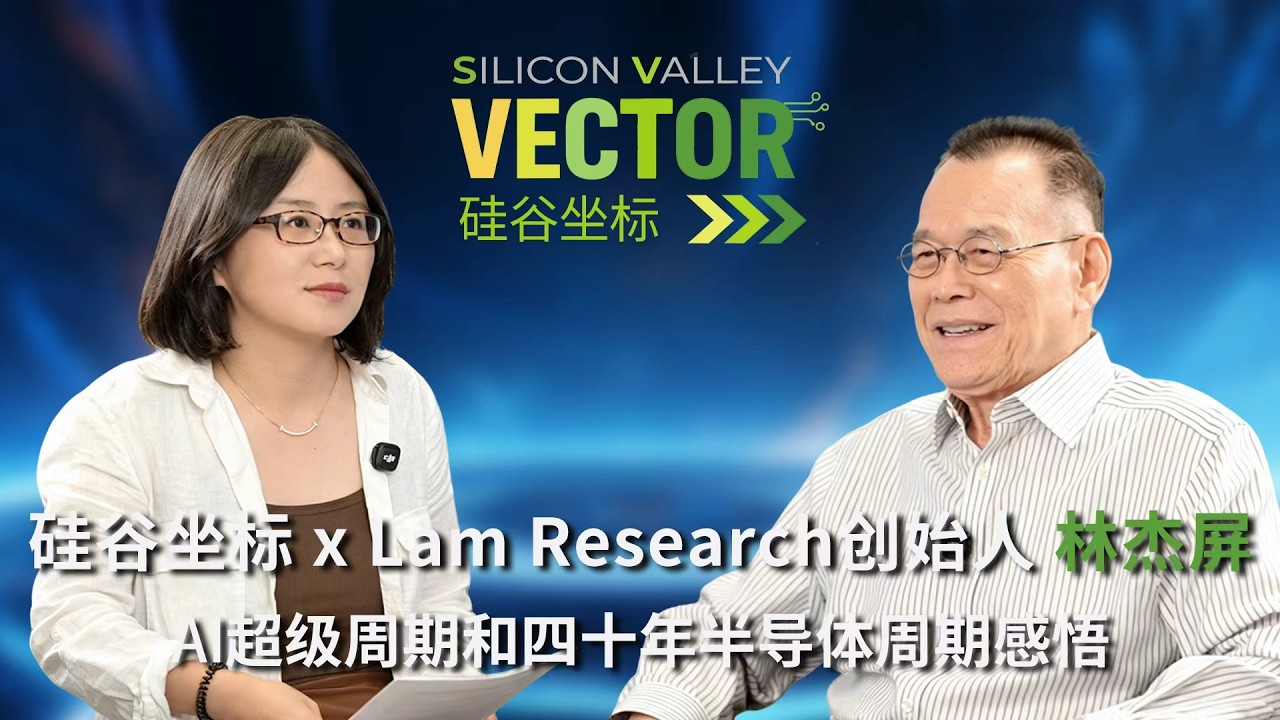
本期节目由 YouTube 频道《硅谷坐标 Silicon Valley Vector》于 2026 年 7 月 30 日发布。视频内容为对 Lam Research 创始人、MultiBeam 创始人和董事长林杰屏博士(Dr. David K. Lam)的深度访谈,节目介绍了他在半导体设备行业横跨 52 年的丰富历程,并围绕 AI 超级周期、半导体四十年周期沉浮、英特尔的发展演变、设备行业趋势以及他两次创业的经验与感悟展开论述。
## TL;DR
Lam Research 创始人林杰屏博士在访谈中深度剖析了半导体与设备行业的历史周期与未来趋势。他指出 AI 与先进封装正接棒摩尔定律推动行业变革,而数据中心的电力瓶颈是比资金过度投入更严峻的挑战;同时,他回顾了英特尔等巨头的历史失误与周期沉浮,并分享了设备行业高振幅、“块状”生意的独特规律。针对个人创业,林博士结合自身创办 Lam Research 和 MultiBeam 的经验,阐述了通过攻克技术痛点、避开行业巨头锋芒以及利用微小技术拐点实现逆袭的商业智慧。
The interview opens with Dr. David K. Lam reflecting on the extreme dynamics of the semiconductor equipment market. When the chip industry encounters downturns or inflection points, equipment manufacturers experience dramatically higher amplitude—though roughly the same frequency—because chipmakers immediately freeze their capital expenditure spigots at the first sign of a slowdown. Dr. Lam humorously characterizes the semiconductor equipment sector as a "lumpy" business: companies either secure massive single orders—such as ASML’s advanced lithography systems priced at $180 million each—or receive zero orders altogether.
Despite the turbulence facing major players, Dr. Lam expresses confidence in Intel’s potential long-term turnaround under the leadership of Lip-Bu Tan, noting that while turning around a giant like Intel will be difficult and far from quick, Tan possesses the necessary strategic acumen.
- **Equipment market dynamics:** Features extreme amplitude swings because chipmakers quickly cut capital expenditures during uncertain periods.
- **ASML flagship tools:** Extreme ultraviolet (EUV) and advanced lithography machines cost upwards of $180 million per unit.
---
[02:00](https://www.youtube.com/watch?v=hI2KB8eiZwY&t=120s) The AI Super-Cycle & The Dual Walls of Moore’s Law
Dr. David Lam details how Artificial Intelligence has superseded Moore's Law as the primary growth engine for the semiconductor industry. While Moore's Law historically dictated scaling by physically shrinking transistors on silicon, that approach has run into two immovable walls:
1. **The Physics Barrier:** As physical features approach the sub-nanometer and atomic scale, gating materials become too thin to prevent quantum tunneling effects. Transistors—which are meant to act as deterministic digital switches (either strictly 0 or 1)—begin exhibiting quantum uncertainty, causing fundamental system failure.
2. **The Economic Barrier:** Even if shrinking were physically feasible, stepping down to each progressive node now demands hundreds of millions (or billions) of dollars in foundational R&D and tooling, making it impossible to recover capital outlays through traditional chip sales.
To bypass these dual limitations, the industry has pivoted toward **advanced packaging** (such as chiplets and 3D integration) alongside AI-optimized architectures. The simultaneous arrival of these two major inflections—AI demands and advanced packaging solutions—creates an unprecedented structural shift across the entire supply chain.
- **Transistor scaling limits:** Quantum tunneling disrupts standard on/off switching functions when gate oxides and physical features reach atomic thickness.
- **Economic node scaling:** Geometric scaling no longer yields positive ROI due to skyrocketing R&D and re-tooling expenditures.
---
[04:01](https://www.youtube.com/watch?v=hI2KB8eiZwY&t=241s) CapEx Arm Races: Bubble Risks vs. The Real AI Bottleneck
Addressing the $700+ billion in combined annual capital expenditure spent across major tech hyperscalers—a figure rivaling the U.S. defense budget—Dr. Lam evaluates whether this represents rational buildout or strategic over-investment. He argues that current spending is largely demand-driven because tech giants must satisfy immediate customer requirements for compute. Moreover, today's hyperscalers possess resilient balance sheets capable of adjusting CapEx up or down far better than past tech booms.
Comparing the AI cycle to the Dot-Com Bubble of 1999–2000, Dr. Lam draws a sharp contrast in fundamentals:
- ** Dot-Com Era (1999–2000):** Driven by rampant speculation. Nearly 80% of newly listed internet IPOs had zero revenue, yet market euphoria drove Price-to-Earnings (P/E) ratios to unprecedented levels of 100 to 200 before the bubble burst in March 2000, erasing trillions of dollars in market capitalization.
- ** AI Era (2020s):** Spearheaded by massively profitable cash generators like Amazon, Google, and Nvidia. Nvidia, for example, generates net income in the tens of billions per quarter while maintaining gross margins around 71%.
Dr. Lam cautions that while over-spending and corporate casualties will inevitably occur, the primary immediate threat to the AI revolution is not financial over-investment, but the **critical shortage of electric power** to run new data centers.
> "The lack of electric power will be a much bigger problem than what we are concerned about whether or not spending too much... AI is so powerful, not just an inflection point, but an actual industrial revolution—a cognitive industrial revolution."
- **Dot-Com Crash:** Burst in March 2000 after P/E ratios reached 100–200 on non-revenue dot-com IPOs.
- **Nvidia financial model:** Sustains ~71% gross margins while producing tens of billions in quarterly net income.
- **Data center bottleneck:** Infrastructure scaling is constrained by grid availability and power generation rather than corporate capital constraints.
- **Next-gen memory solution:** MultiBeam is collaborating with at least eight industry partners on MRAM technology to drastically cut energy consumption in compute workloads.
---
[08:10](https://www.youtube.com/watch?v=hI2KB8eiZwY&t=490s) Historical Lessons: Cultural Nuances, Yield Dynamics, and Geopolitics
Reflecting on past industry cycles—such as Intel’s exit from memory in 1985—Dr. Lam highlights how strategic focus and manufacturing culture shape semiconductor dominance. When Intel abandoned DRAM to concentrate entirely on microprocessors, it executed one of the most successful strategic pivots in tech history. Japanese manufacturers had become virtually unbeatable in DRAM memory yields.
Illustrating the subtle factors behind manufacturing yields, Dr. Lam shares an anecdote from his time interacting with Texas Instruments (TI):
TI held a joint venue called TI Japan that consistently achieved far higher wafer yields than TI's headquarters in Dallas, Texas. An internal investigation revealed a surprising cultural cause: the majority of cleanroom operators in Japan were female technicians who refrained from wearing facial makeup during morning shifts after fab management explained that cosmetic powder degraded yields on silicon wafers. Instead, the company provided dedicated vanity rooms for workers to apply makeup after their shifts ended. In contrast, U.S. facilities could not enforce similar personal care policies, leading to higher particle contamination on wafers.
Dr. Lam also analyzes how external geopolitical shifts redirected Japanese semiconductor leadership:
- **The Plaza Accord (1985):** Signed by the U.S., Japan, the UK, France, and West Germany to depreciate the U.S. dollar against the Japanese yen and German mark.
- **The US-Japan Semiconductor Trade Agreement:** Forced currency revaluations and trade restrictions designed to curb Japanese export dominance accidentally triggered a severe economic downturn, inaugurating Japan's "Lost Decades" (which stretched from one lost decade into three).
- **1985 Intel DRAM Exit:** Intel ceded the memory market to high-yield Japanese suppliers to focus strictly on logic and x86 microprocessors.
- **TI Japan vs. TI Dallas yield disparity:** Highlights how cleanroom discipline and micro-contaminants (like facial powder) dramatically alter silicon yield.
- **Plaza Accord impact:** Currency shifts crippled Japanese high-tech export competitiveness, triggering 30 years of economic stagnation.
---
[11:47](https://www.youtube.com/watch?v=hI2KB8eiZwY&t=707s) Predicting Cycles & Capital Allocation Dilemmas
When asked how equipment vendors predict cycle peaks, Dr. Lam candidly admits that semiconductor cycles are inherently unpredictable due to structural lag times. He outlines the classic "Procurement Manager's Dilemma":
- **Scenario A (Over-expansion):** A procurement manager foresees rising market demand and orders hundreds of millions in tooling to build new fabs. By the time the fab is fully ramped 2–3 years later, the market demand may have already peaked or evaporated. The manager gets fired for massive capital waste.
- **Scenario B (Under-expansion):** A cautious procurement manager holds back capital expenditure to avoid a downturn. An unexpected demand wave hits, leaving the firm without capacity. Competitors capture market share, and the manager gets fired for missing the market.
Because cycle timing is notoriously volatile, Dr. Lam focuses less on guessing cycle tops and more on identifying **inflection points**—sudden structural changes in market trajectory. Inflection points create severe pain for legacy incumbents who cannot adapt quickly, opening narrow windows for agile start-ups and new market entrants.
> "For us, our opportunity is always hidden in the inflection point. Inflection points cause pain to some customers. If we have the technology to solve that problem, we got a shot."
- **Fab Lead Times:** The 2-to-3-year delay between equipment ordering and volume output makes exact cycle alignment virtually impossible.
- **Inflection Point Strategy:** Start-ups target architectural inflection points where incumbent equipment makers are slow to re-tool.
---
[14:48](https://www.youtube.com/watch?v=hI2KB8eiZwY&t=888s) Intel’s Missed Inflections & The Lip-Bu Tan Turnaround
Dr. Lam examines Intel’s historic strategic missteps and why he remains optimistic about Lip-Bu Tan leading its turnaround effort. Having known Tan for over two decades, Dr. Lam recalls being initial skeptical when Tan took over Cadence Design Systems—questioning whether a hardware-focused venture capitalist could manage a software giant. Tan proved his operational genius by successfully restructuring Cadence into an EDA powerhouse.
Analyzing Intel’s long-term slide, Dr. Lam points to two compound mistakes made around 2007:
1. **Rejecting Apple’s iPhone Chip Business:** Under then-CEO Paul Otellini (a 31-year Intel veteran with an economics and MBA background), Intel rejected Steve Jobs’ offer to build custom chips for the original iPhone. Otellini cited low gross margins compared to Intel’s lucrative PC microprocessor monopoly. By prioritizing short-term margins, Intel completely missed the 100% growth curve of the mobile/mobility revolution.
2. **Non-Technical Executive Leadership:** Dr. Lam notes that running a leading-edge semiconductor firm without a deep engineering or physics background limits an executive's ability to intuitively foresee architectural shifts during major industry inflections.
Despite these legacy errors, Dr. Lam expresses confidence in Lip-Bu Tan’s ability to engineer Intel's recovery, emphasizing that while the process will be long and arduous, Tan possesses the precise strategic vision needed.
> "Paul Otellini's reason for turning down Steve Jobs was that the gross margin was too low... He missed the entire mobility market, 100%... A non-technology person running a technology company is a mistake."
- **2007 iPhone decision:** Intel declined to manufacture application processors for the first iPhone due to margin thresholds.
- **Cadence restructuring:** Lip-Bu Tan successfully executed an operational turnaround at Cadence, proving his ability to manage large-scale tech enterprises.
---
[18:48](https://www.youtube.com/watch?v=hI2KB8eiZwY&t=1128s) Demystifying the Semiconductor Equipment Industry
Closing out this part of the conversation, Dr. Lam explains the structure of the semiconductor equipment sector and its relative invisibility to general consumers.
Equipment manufacturers sit at the absolute apex of the semiconductor value chain. They build complex capital machinery (etchers, deposition systems, lithography scanners) and sell them directly to foundries and fab operators. Companies commonly referred to as "chipmakers" by the public—such as AMD or Broadcom—are actually fabless design firms that outsource all physical manufacturing to third-party foundries. Because equipment vendors deal strictly with fab engineers rather than end-consumers, their vital role in enabling computing progress remains largely hidden from the public eye.
[19:53](https://www.youtube.com/watch?v=hI2KB8eiZwY&t=1193s) Equipment Capital Cycles: High Amplitude and "Lumpy" Business
Dr. David K. Lam explains why semiconductor equipment companies experience far more volatile business cycles than chipmakers themselves. While both sectors share a similar cyclical frequency, the equipment industry endures a significantly higher amplitude. When fab operators anticipate a market downturn or a slump in chip demand, they immediately turn off the "spigot" of their capital budgets. As a result, equipment orders do not merely decrease—they vanish overnight.
```
+-----------------------------------------------------------------------------+
| CAPITAL SPIGOT DYNAMICS IN SEMIS |
| |
| Chip Demand Drop ---> Fabs Cut CapEx Overnight ---> Equipment Orders |
| (Moderate) (Immediate) Drop to Zero |
+-----------------------------------------------------------------------------+
```
He characterizes the equipment sector as inherently "lumpy"—a business model where revenue fluctuates abruptly between zero and massive, multi-million-dollar transactions. For instance, a single High-NA EUV system from ASML costs around $180 million. Among the various types of semiconductor equipment, lithography systems are the most complex, demand the highest precision, carry the largest price tags, involve intricate supply chains, and require the longest manufacturing lead times.
- **Cyclical Amplitude:** Equipment manufacturers face sharper swings than chipmakers because fabs halt CapEx immediately at the first sign of trouble.
- **ASML Unit Economics:** Extreme unit prices (such as $180M for a single flagship lithography scanner) make order books discrete and volatile.
- **Lithography Complexity:** Precision and supply-chain requirements make lithography tools the most capital-intensive and time-consuming equipment to deliver.
---
[21:18](https://www.youtube.com/watch?v=hI2KB8eiZwY&t=1278s) Tech Inflections vs. Geopolitics: A Founder's Order-Book Philosophy
When analyzing the macro drivers behind the equipment market—such as AI adoption, rising chip complexity, and supply chain disruptions driven by geopolitics—Dr. Lam emphasizes that tech inflections should remain a founder's primary focus. In his view, structural complexity increases gradually over time as part of normal business and rarely surprises an alert company. Similarly, geopolitical tensions and post-COVID supply chain disruptions are broad, industry-wide challenges that small startups must simply accept and adapt to, rather than try to control.
```
+-------------------------------------------+
| EQUIPMENT CYCLE DRIVERS |
+-------------------------------------------+
|
+---------------------------+---------------------------+
| |
v v
+---------------------------------+ +---------------------------------+
| GRADUAL PROCESS INCREASES | | MAJOR TECH INFLECTIONS |
| - Predictable, slow-moving | | - Solves core customer pain |
| - Managed via routine R&D | | - Focus of product strategy |
+---------------------------------+ +---------------------------------+
```
Dr. Lam notes that chip manufacturing relies on an interdependent triad of processing equipment: etch, deposition, and lithography. As customer needs evolve, no single equipment category can be omitted because the overarching fab process line determines tool purchasing. Additionally, when asked whether buying patterns across foundries (e.g., TSMC), memory makers (e.g., SK Hynix, Samsung, Micron), and IDMs (e.g., Intel) can be used to forecast macroeconomic cycles, Dr. Lam advises against using order books for prediction. Instead, he treats sudden spikes in order books as real-time indicators to *protect* the company from abrupt market shifts.
> "I don't use it to predict. I use it to protect."
- **Core Focus:** Target pain points created by technology inflections, where novel equipment can directly cut costs and shorten time-to-market.
- **Process Triad:** Etch, deposition, and lithography tools move in tandem because entire production lines must be upgraded together.
- **Market Dynamics:** Supply shortages in specific segments (e.g., memory shortages boosting Applied Materials' tool sales) shift rapidly, making order-book vigilance essential for risk management.
- **Market Share Stability:** Dr. Lam predicts that the current $140 billion equipment market allocation (lithography ~25%, etch ~20%, deposition ~20%, metrology/inspection ~12%) will remain largely unchanged over the next 5 years.
---
[25:40](https://www.youtube.com/watch?v=hI2KB8eiZwY&t=1540s) Multibeam and the E-Beam Paradigm: Bypassing the Photomask
Dr. Lam shares the origin story of his second startup, Multibeam. After retiring from Lam Research, he grew bored with retirement and joined a venture capital firm. There, he evaluated a struggling 10-year-old startup that possessed valuable patents in electron-beam (E-beam) lithography. Despite E-beam lithography being dismissed by the broader industry for nearly six decades as too slow compared to optical "cookie-cutter" projection, Dr. Lam acquired the assets to build a viable commercial business.
The key advantage of Multibeam's maskless E-beam approach lies in software-driven direct writing. Traditional optical lithography requires physical photomasks (reticles) that take weeks to produce and cost millions of dollars. Multibeam's integrated software ingests layout data one layer at a time and converts it directly into E-beam shot files, driving multiple electron columns operating in parallel. This enables rapid prototyping, allowing chip designers to execute design iterations and turn around pilot-quantity production in a fraction of the time.
- **Multi-Column Parallelism:** Multibeam overcome E-beam speed limitations by arraying multiple miniature columns working together over a single wafer.
- **Last One Standing:** Over the past decade, competitors in Japan, Europe (which filed for bankruptcy), and the US abandoned multi-column E-beam efforts, leaving Multibeam as the sole global provider of parallel E-beam direct-write systems.
- **Modular Scalability:** Mainframe systems support up to three processing modules, allowing customers to scale throughput directly by adding hardware.
---
[29:20](https://www.youtube.com/watch?v=hI2KB8eiZwY&t=1760s) Unique E-Beam Applications: Reticle-Free, High Depth of Focus, and Quantum Chips
To illustrate why E-beam lithography excels despite lower raw throughput than optical steppers, Dr. Lam highlights three breakthrough use cases where traditional photolithography hits a wall:
1. **Reticle-Free & Large-Die Fabrication:** Optical reticles have strict size constraints, forcing large designs to be "stitched" together using multiple physical masks. Multibeam's seamless multi-column parallel writing writes continuously across the entire wafer, enabling quantum computing companies to manufacture massive, wafer-scale chips without stitching seams.
2. **Extreme Depth of Focus for Advanced 3D Packaging:** Optical light sources have a narrow depth of focus (100–200 nanometers), making it difficult to pattern across tall 3D interconnect structures and stacked dies. E-beam lithography offers a depth of focus measured in microns (5–10 microns)—an improvement of two orders of magnitude.
3. **Specialty & ASIC Prototyping:** Custom AI accelerators and specialty chips require fast turnarounds. Photomask fabrication can take weeks; Multibeam allows engineers to modify software layout files and resume printing within two hours.
When asked whether Multibeam could relieve the EUV equipment bottleneck in DRAM manufacturing, Dr. Lam explicitly states that while it might be technically possible, it is strategically unwise. Attempting to compete head-to-head with dominant lithography giants like ASML—who possess thousands of employees and billions in cash reserves—would invite immediate retaliation. Instead, Multibeam targets uncontested technical inflection points where its maskless benefits render legacy optical tools non-competitive.
> "Our system is 5% of the price... A better strategy is coming back to where's the inflection point. What I want to grab is something where my technology is so good, they can't even compete."
---
[35:38](https://www.youtube.com/watch?v=hI2KB8eiZwY&t=2138s) Career Overcoming Biases: Asian Leadership in Silicon Valley
Reflecting on his motivation for starting Lam Research in 1980, Dr. Lam recalls facing corporate bias at Hewlett-Packard (HP) Labs in 1979. After three years of strong performance, he was passed over for a minor management promotion in favor of a Caucasian colleague who had been at the company for only 11 months straight out of a post-doctoral program. During that era, a common silent refrain in corporate engineering was that "Asians are good workhorses, but not racehorses."
```
+-----------------------------------------------------------------------------+
| EVOLUTION OF ASIAN LEADERSHIP IN TECH |
| |
| 1979 (Lam's Early Career) 2020s (Modern Ecosystem) |
| - Lack of role models - Prominent CEOs: Jensen Huang (Nvidia), |
| - Unspoken "workhorse" ceiling Lisa Su (AMD), Hock Tan (Broadcom), |
| - Widespread cultural bias Lip-Bu Tan (Intel board / Cadence) |
| - Lower structural barriers to entry |
+-----------------------------------------------------------------------------+
```
Rather than letting anger drive his decisions, Dr. Lam used the setback as fuel to chart his own path as an entrepreneur. Comparing the ecosystem of 1979 to today, he notes that Asian engineers now have prominent role models leading major tech companies—such as Jensen Huang (Nvidia), Lisa Su (AMD), Hock Tan (Broadcom), and Lip-Bu Tan (former Cadence CEO and Intel board member). While explicit promotional barriers have decreased significantly, new geopolitical complexities have introduced distinct challenges for the current generation of engineers.
- **1979 Workplace Environment:** Lack of Asian executive role models led to structural promotion barriers across early Silicon Valley firms.
- **Constructive Reaction:** Dr. Lam stresses never starting a company out of anger, but rather using setbacks as a catalyst to find alternative paths to success.
- **Modern Role Models:** The rise of Asian CEOs and senior executives across top-tier semiconductor firms has redefined leadership expectations in Silicon Valley.
林杰屏博士(Dr. David K. Lam)给创业者提出了极为严肃的警告:**绝对不要在愤怒或气愤中赌气创业**。在职场中遭受不公、没得到升职或对现状不满都很常见,但“负气离职开公司”绝非正途。创业是一项极其严肃的长期承诺,不仅涉及到自己未来多年的岁月,还承载着投资人的资金以及员工和其家庭的期望。创业的起点,必须是找到了能让公司具备潜在成功条件的切实切入点。
回顾 1985 年离任 Lam Research CEO 之后,林博士依然留在董事会服务了 5 年。看着冠以自己姓氏的公司逐步成长为全球半导体设备巨头,而自己与公司的直接关联逐渐淡化,林博士感到非常幸运,并心怀感恩。他特别强调,公司后来的辉煌成就归功于离任后接棒的全体员工,而非他个人的独劳。然而,名字挂在公司大楼上也是一份沉重的道德与社会责任——他时刻提醒自己必须谨言慎行、恪守合规,绝不能因为个人的不当行为损害了这间以他为名的上市公司的声誉。
林博士的独特优势在于,他在 MIT 攻读硕士和博士期间写过两篇关于等离子体化学(Plasma Chemistry)的论文。在那个年代,大多数大学连等离子化学的课程都不开设,即便是 MIT 也没有现成课程,完全靠他自学。得益于多年深刻的理论积淀,林博士在 1979 年下半年终于厘清了刻蚀结果不可重复的底层物理化学机制,并在纸上迅速草绘出解决该痛点的设备产品雏形。
- **等离子刻蚀痛点**:缺乏重复性(早晚参数漂移严重),被生产线主管拒之门外。
- **学术背景**:在 MIT 撰写过硕士和博士两篇等离子体化学论文,为解决该难题奠定了独家理论基础。
[42:43](https://www.youtube.com/watch?v=hI2KB8eiZwY&t=2563s) 夜半租赁算力与 Lam Research 的诞生
> **5.25 英寸与 3.5 英寸磁盘的红利与盲区**:
> 在台式 PC 时代,5.25 英寸磁盘统治市场,容量越高越好。当销售高管向 CEO 反映某些客户想要容量更小但尺寸更小的 3.5 英寸磁盘时,CEO 极为愤怒并驳回了建议,因为他只听取了“今天的大客户”的需求(要更大容量),而忽视了“明天的新客户”。
>
> 后来,这位销售高管离职创业专做 3.5 英寸磁盘。随着笔记本电脑(Laptop)时代的爆发,设备空间(Form Factor)成为首要考量,对绝对容量的要求反而降低。当初的 5.25 英寸巨头 CEO 曾向克里斯坦森展示样品说:“你看,3.5 英寸我们也能做,但根本没客户要!”结果他完全错过了笔记本电脑带来的下一波产业技术拐点(Inflection Point)。
- **经典商业著作**:《创新者的窘境》(克莱顿·克里斯坦森,1997 年出版)。
- **双向解读法**:第一次站在大企业视角看防守;第二次站在小公司视角看如何避其锋芒、寻求突破。
- **行业教训**:磁盘厂商因过度关注现有 PC 客户对容量的追求,忽视了笔记本电脑对小尺寸(3.5 英寸)的非连续性需求,导致错失产业拐点;正如英特尔当年拒绝为 Steve Jobs 的 iPhone 生产芯片一样。
## Notable quotes
> [04:01](https://www.youtube.com/watch?v=hI2KB8eiZwY&t=241s) The lack of electric power will be a much bigger problem than what we are concerned about whether or not spending too much... AI is so powerful, not just an inflection point, but an actual industrial revolution—a cognitive industrial revolution. — Dr. David K. Lam
> [11:47](https://www.youtube.com/watch?v=hI2KB8eiZwY&t=707s) For us, our opportunity is always hidden in the inflection point. Inflection points cause pain to some customers. If we have the technology to solve that problem, we got a shot. — Dr. David K. Lam
> [14:48](https://www.youtube.com/watch?v=hI2KB8eiZwY&t=888s) Paul Otellini's reason for turning down Steve Jobs was that the gross margin was too low... He missed the entire mobility market, 100%... A non-technology person running a technology company is a mistake. — Dr. David K. Lam
> [21:18](https://www.youtube.com/watch?v=hI2KB8eiZwY&t=1278s) I don't use it to predict. I use it to protect. — Dr. David K. Lam
> [29:20](https://www.youtube.com/watch?v=hI2KB8eiZwY&t=1760s) Our system is 5% of the price... A better strategy is coming back to where's the inflection point. What I want to grab is something where my technology is so good, they can't even compete. — Dr. David K. Lam
林杰屏:电力短缺成AI唯一瓶颈 无掩膜光刻避开ASML锋芒
芯片摩尔定律撞上物理与经济双重极限,电网供电不足正取代资金投向成为限制人工智能爆发的最大阻碍。
Lam Research 创始人林杰屏博士在访谈中深度剖析了半导体与设备行业的历史周期与未来趋势。他指出 AI 与先进封装正接棒摩尔定律推动行业变革,而数据中心的电力瓶颈是比资金过度投入更严峻的挑战;同时,他回顾了英特尔等巨头的历史失误与周期沉浮,并分享了设备行业高振幅、“块状”生意的独特规律。针对个人创业,林博士结合自身创办 Lam Research 和 MultiBeam 的经验,阐述了通过攻克技术痛点、避开行业巨头锋芒以及利用微小技术拐点实现逆袭的商业智慧。
由于芯片制造厂商在面临行业下行或前景不明时会迅速冻结资本开支,半导体设备行业承受着远高于芯片厂商的周期振幅,呈现出极具不确定性的“块状”订单特征。 (0:00)
摩尔定律正同时撞上量子隧穿效应破坏开关确定性的物理墙与极高研发投入的经济墙,推动半导体产业将发展重心全面转向先进封装与 AI 架构优化。 (2:00)
相较于 2000 年缺乏营收的互联网泡沫,当前由高盈利科技巨头主导的 AI 资本开支并非单纯投机,其扩张面临的最核心瓶颈是数据中心电力供给的严重短缺。 (4:01)
英特尔曾在 2007 年因短期毛利率考量拒绝为初代 iPhone 生产芯片而错失移动技术拐点,凸显了非技术背景管理层在应对架构范式转移时的局限性。 (14:48)
林杰屏创办的 Multibeam 采用多镜筒并行电子束直写技术消除物理光罩依赖,凭借高出传统光刻两个数量级的焦深优势,通过避开与 ASML 正面竞争深耕量子芯片与先进封装等拐点赛道。 (29:20)
Reading summary
Lam Research 创始人林杰屏博士结合数十年半导体产业经验指出,AI 正取代摩尔定律成为行业核心引擎,设备企业必须依靠捕捉技术拐点而非预测宏观周期来生存,并应避免与行业巨头正面交锋。
AI 超级周期与摩尔定律的双重阻碍 (2:00)
林博士指出,传统依赖物理缩小晶体管尺寸的摩尔定律已触及两堵墙:一是物理屏障,晶体管栅极接近亚纳米与原子级时会产生量子隧穿效应,破坏开关确定性;二是经济屏障,单个节点的研发与重置成本达到数亿乃至数十亿美元,几何微缩无法获得合理投资回报。行业因而转向先进封装(如小芯片和 3D 集成)与 AI 定制架构。
面对超大规模科技公司每年合计超 7000 亿美元的资本开支,林博士认为当前 AI 周期不同于 1999 至 2000 年近 80% 无营收上市公司的互联网泡沫,头部企业拥有极强的盈利与现金流(如英伟达毛利率约 71%)。他警告,当前 AI 扩张面临的即时威胁并非财务过度投资,而是数据中心电力供应的严重短缺。
设备行业的高波幅与采购经理困境 (11:47)
半导体设备属于典型的“块状”(lumpy)业务,单台先进制程光刻机(如 ASML 设备)售价可达 1.8 亿美元。当芯片制造商觉察需求放缓时会瞬间切断资本支出,导致设备订单迅速归零。因此,设备产业与芯片制造周期频率相近,但波幅剧烈得多。
林博士说明了晶圆厂建设长达 2 至 3 年滞后所带来的“采购经理困境”:过度扩产可能在产线完工时遭遇市场见顶,而过度保守又会导致市场被对手夺走。鉴于周期顶部难以预测,设备企业不应依据订单激增去预测宏观走势,而应将其作为防御突发转向的保护指标,专注于在老牌厂商反应迟缓的技术拐点上寻找切入机会。
大企业惯性与技术拐点的历史教训 (14:48)
制造文化与战略决断深刻决定了半导体企业的兴衰。1985 年英特尔果断退出日本厂商占据极高良率优势的 DRAM 内存,全面转向微处理器,完成了成功转型;但在 2007 年,时任 CEO 欧德宁因毛利率考量拒绝为初代 iPhone 代工芯片,使英特尔彻底错失移动端增长红利。林博士认为,由非技术背景管理者掌舵高科技企业,容易在面临底层架构变迁时失去直觉。
克莱顿·克里斯坦森《创新者的窘境》中 5.25 英寸与 3.5 英寸磁盘厂商的案例表明,过度倾听现有大客户对容量的需求,会导致巨头对新兴形态(如笔记本电脑的尺寸需求)视而不见。这种在非连续技术拐点上的盲区,正是初创企业破局的关键缝隙。
Multibeam 的无光罩路径与避实击虚策略 (25:40)
针对光刻工序高昂的光罩成本与周期,林博士创办的 Multibeam 采用并行多镜筒电子束(E-beam)直写技术,通过软件将设计数据直接转化为曝光文件。该系统成本仅为旗舰光学系统的约 5%,焦深达到 5 至 10 微米(比传统光学高出百倍),不仅支持在两小时内完成原型设计迭代,还能在无需拼接的情况下连续制造大尺寸晶圆级量子芯片。
林博士强调,初创企业决不能因技术可能实现就与 ASML 这类拥有巨额现金储备的巨头正面竞争。Multibeam 采取避实击虚的战略,避开大芯片量产主线,专注于巨头无暇顾及或不愿进入的细分赛道,即人工智能、量子计算、化合物半导体及先进封装四大领域。
创业准备:理性克制与短板补足 (38:53)
林博士严肃告诫创业者切勿因在职场遭受不公或愤怒而盲目创业。创业承载着投资人资本与员工生计,必须建立在发现切实切入点的理性基础之上。1979 年他在决定离开惠普后,预留了半年时间就读社区大学的夜校与周末课程,系统恶补财务、会计与管理知识,甚至全职从事 5 个月一线销售以克服对销售的恐惧。
在技术层面,林博士凭借在 MIT 研究等离子化学的理论功底,破解了当时等离子刻蚀参数漂移、缺乏重复性的致命痛点;为了节省开支,他在每周日凌晨两点租赁计算中心算力建立财务模型。这种严密的准备使 Lam Research 在 1980 年成立后一年内推出产品,并在四年内顺利完成上市。
林博士认为,无论是当年解决等离子刻蚀重复性问题,还是如今 Multibeam 绕开光学光刻正面战场,半导体创业的生存核心均在于精准识别巨头视线之外的技术痛点。在摩尔定律受阻与算力军备竞赛的当下,电网约束与先进封装正构成新一轮重塑行业格局的关键拐点。
Source quotes
[4:01] Dr. David K. Lam: The lack of electric power will be a much bigger problem than what we are concerned about whether or not spending too much... AI is so powerful, not just an inflection point, but an actual industrial revolution—a cognitive industrial revolution.
[11:47] Dr. David K. Lam: For us, our opportunity is always hidden in the inflection point. Inflection points cause pain to some customers. If we have the technology to solve that problem, we got a shot.
[14:48] Dr. David K. Lam: Paul Otellini's reason for turning down Steve Jobs was that the gross margin was too low... He missed the entire mobility market, 100%... A non-technology person running a technology company is a mistake.
[21:18] Dr. David K. Lam: I don't use it to predict. I use it to protect.
[29:20] Dr. David K. Lam: Our system is 5% of the price... A better strategy is coming back to where's the inflection point. What I want to grab is something where my technology is so good, they can't even compete.
[38:53] 林杰屏博士: 绝对不要在愤怒或气愤中赌气创业
[41:15] 林杰屏博士: 连十英尺长的杠杆都不想去碰它
[46:53] 克莱顿·克里斯坦森引述的 5.25 英寸磁盘厂商 CEO: 你看,3.5 英寸我们也能做,但根本没客户要!
Original transcript
[0:08] [music]
[0:28] [music]
[0:40] [music]
[0:42] >> If the chip industry experience [music]
[0:45] some ups and downs the cycles, the
[0:47] equipment guys will be received much
[0:49] higher amplitude maybe roughly the same
[0:51] frequency because the moment they saw a
[0:54] problem coming, the need will be less.
[0:57] They turn off [music] the spicket of
[0:59] capital budget. So, we don't get orders
[1:02] at all. Our industry [music] is a funny
[1:05] what I call lumpy.
[1:07] Either you get a solar product for
[1:10] millions of dollars for ASML
[1:13] >> [music]
[1:13] >> $180 million each. Either you get that
[1:16] or you get zero.
[1:18] I have a lot more confidence in the
[1:20] Bhutan being [music] able to turn
[1:21] around. That's just my own personal
[1:23] view. It's difficult. And it's not going
[1:25] to be quick. But I think he would have
[1:28] what it takes to help [music] return
[1:31] around Intel. And
[1:33] if I want to bet, I bet on him.
[1:36] >> [music]
[1:41] >> Dr. Lam, it is truly an honor to have
[1:43] you on the show.
[1:44] >> Well, thank you very much for inviting
[1:46] me to participate in your Silicon Valley
[1:49] Vector program.
[1:51] I feel very privileged
[1:53] to be able to share my experience and
[1:56] observations with your audience.
[1:58] >> Thanks very much. You founded Lam
[2:00] Research in 1980 and have seen nearly
[2:03] each semiconductor cycle over the past
[2:05] four decades. How do you view the
[2:07] current AI-driven cycle? Is this one
[2:09] fundamentally different from the ones
[2:11] you have seen before?
[2:13] >> Well, basically I think the
[2:15] AI is now driving the semiconductor
[2:17] industry.
[2:19] Uh that is a a very significant uh
[2:22] driver even compared to the previous
[2:24] driver which is Moore's Law. I will
[2:26] explain that in a one moment. At the
[2:28] same time, there's also advanced
[2:31] packaging. Moore's Law require the um
[2:35] manufacturer to to shrink the the
[2:37] transistor.
[2:39] When you get down to too small, the
[2:41] material will be too thin and we also
[2:44] staring at the atoms almost.
[2:47] Uh there's some new in effect quantum
[2:49] effect would happen. Transistor
[2:52] originally is a switch.
[2:55] Take a switch on off is very certain,
[2:57] either on or off. If we have a quantum
[3:00] effect coming, then that's uncertain.
[3:03] So, it would not work. So, it's
[3:06] beginning to break down. So, just
[3:08] shrinking the transistor would not be a
[3:11] good idea. That's why Moore's Law is
[3:13] hitting the limit in physics. Why is it
[3:16] also hitting the limit in economics?
[3:19] If you can shrink, assuming you're good
[3:21] enough to do that,
[3:23] no problem.
[3:24] But you have to spend hundreds of
[3:26] millions of dollars just to go from one
[3:28] node to the next. It's not worth it
[3:30] because you don't even make enough money
[3:32] to cover all your R&D cost. So, now
[3:35] Moore's Law has now reached limit and
[3:38] replacing that is advanced packaging.
[3:41] Another method to make chips. So, we are
[3:45] now focusing on advanced packaging.
[3:47] Focus on AI. When the two a major
[3:51] inflection happen at the same time,
[3:53] namely AI
[3:54] and uh, advanced packaging
[3:56] [clears throat]
[3:57] that makes it very even more significant
[3:59] for the industry.
[4:01] >> So, this year the combined capital
[4:03] expenditure of the major tech companies
[4:05] have exceeded $700 billion.
[4:07] It is almost the US defense budget. From
[4:09] your experience, does it look more like
[4:12] a rational investment or strategic
[4:15] over-investment? And how do those arm
[4:17] races usually end?
[4:19] >> From the dollar standpoint, it is indeed
[4:21] a very large number.
[4:23] $700 billion anyway you look at it is a
[4:25] huge expenditure. I think first of all,
[4:29] uh, the reason why our customer
[4:31] spending that much money to buy
[4:33] equipment is because they have a need
[4:35] for that. Because their customer will
[4:37] require them to create the chips. So, I
[4:40] don't think that's overspending,
[4:42] uh, mainly because these companies are
[4:44] very good in adjusting,
[4:46] uh, whether increase or decrease their
[4:48] capital budget.
[4:50] Now, whether or not there's a bubble,
[4:52] people talk about that a lot. Yes, I
[4:54] think so. I think there's a little bit
[4:56] overspending, a little bit of over
[4:58] confidence, but I think, uh, it would
[5:01] probably settle down in some way.
[5:03] In most cases, these kind of, um,
[5:06] bubbles would hurt some companies which
[5:08] are not well prepared.
[5:11] And, um, some of them will be just wiped
[5:13] out in in a bubble situation. And those
[5:15] that survive will be winners. I
[5:17] sometimes, uh,
[5:19] have an interesting comparison with the
[5:21] internet which I went through in 1999
[5:23] and 2000 time frame.
[5:26] The internet has also a bubble.
[5:29] But internet, uh, different from, uh, AI
[5:31] today is that it is, uh, absolutely too
[5:35] speculative. Let me give you a couple of
[5:37] examples. During the internet time,
[5:39] there were a lot of, uh, startups that
[5:42] was pushing for the future of, uh,
[5:45] internet.
[5:47] And, uh, many of them went public.
[5:50] 80% of them has zero revenue.
[5:54] And their
[5:55] optimism is so strong, the bubble is so
[5:59] strong that they would push the PE
[6:02] ratio, the price earning ratio
[6:04] to 100. And at the peak went up to 200,
[6:08] unheard of. PE ratio never really go
[6:11] that high. And at the end the bubble
[6:13] bursted in March of 2000, wiping out
[6:17] almost all the startups and taking out
[6:20] many trillions of dollars of assets.
[6:23] Now, this time AI, there's some bubble,
[6:26] no question about that. Maybe a little
[6:28] bit over built at some point and we'll
[6:30] find out.
[6:31] But the company involved with it
[6:34] uh established companies,
[6:36] uh companies very rich in resources like
[6:39] Amazon, uh like uh Google. The company
[6:42] that make chips that is Nvidia. Nvidia
[6:46] can sell chips with 71% gross margin.
[6:50] So, this is very much different from the
[6:53] internet time.
[6:54] They can make on a quarterly basis
[6:58] a net income in the tens of billions of
[7:00] dollars. So, I think yes, they spend a
[7:03] lot of money
[7:05] uh building data center and all that.
[7:07] Uh perhaps in some area will be a little
[7:09] bit over spend, but I think the problem
[7:11] is not there. The problem is when you
[7:14] get the data center build up,
[7:16] where do you get the power to run it?
[7:19] The lack of electric power will be a
[7:21] much bigger problem than what we
[7:23] concerned about whether or not spending
[7:25] too much. I would suspect that there's
[7:28] some company would
[7:29] uh make it
[7:30] and some company may not. That's the
[7:32] factor of life. And those who survived
[7:35] may have a chance to be
[7:38] uh winners in the next cycle, in the
[7:39] next revolution. AI is is so powerful,
[7:43] not just an inflection point, but it is
[7:45] an actually industrial revolution. Not
[7:47] just any industrial revolution, but it
[7:48] is a cognitive industrial revolution.
[7:50] But even so,
[7:52] there will be winners and losers.
[7:55] My concern is that in the near term, you
[7:57] need to have enough electric power to
[7:59] run
[8:00] data center. And that problem has not
[8:02] been resolved. This is why MRAM is very
[8:05] actively working with at least eight
[8:07] partners trying to solve that problem.
[8:10] >> Mhm. So, you took Lam Research public in
[8:13] 1984, and the next year Intel exited the
[8:16] memory business under the impact of the
[8:18] Japanese DRAM industry. And then the
[8:21] dot-com bubble that you just mentioned,
[8:23] and then the financial crisis and so on
[8:24] and so forth. Looking back across all
[8:26] those cycles, what have been the biggest
[8:28] lessons you have learned?
[8:30] >> Take
[8:31] Intel. I was not working for Intel, but
[8:33] I was very interested. I know the
[8:34] founders of Intel quite well. And Intel
[8:37] is one of my biggest customers at Lam
[8:40] Research.
[8:41] So, obviously I took interest.
[8:44] I think 19 85,
[8:47] when they decided to give up the memory
[8:50] market and focus on the logic, that was
[8:53] a very smart move. One of the best
[8:56] strategic decisions that Intel made. As
[8:59] an outsider, I also saw that Japan was
[9:03] really doing a very good job in memory
[9:05] manufacturing. Intel was not able to
[9:09] cover. Let me digress for a moment tell
[9:11] you what I observed at TI.
[9:14] TI has an operation called TI Japan,
[9:17] doing the same thing as TI in Dallas,
[9:19] where I used to work.
[9:22] And so, I was invited to a meeting
[9:25] of a few people. The the guy who went to
[9:28] Japan just came back and gave us a
[9:30] little bit of a report.
[9:32] And he basically said that he didn't
[9:34] understand why
[9:35] TI Japan consistently has better yield
[9:38] than in Dallas. Took me a little while
[9:41] to figure out. In Japan, almost all the
[9:44] people working in the fab are
[9:46] technicians. There are some engineers,
[9:48] too.
[9:50] And the technicians are women.
[9:52] In the morning, the women kind of do
[9:53] some little bit makeup. The powder would
[9:56] fall on the wafer, causing yield
[9:58] problems. In Japan, they can tell the
[10:01] women workers, "No makeup in the
[10:03] morning."
[10:04] But I have a makeup room. At the end of
[10:06] the day, before you leave, you can use
[10:08] it.
[10:09] They all listen.
[10:11] No powder used on the face. In America,
[10:13] you can't do that.
[10:15] So, it is something middle things are
[10:17] very interesting. There's a cultural
[10:18] difference. You see what I mean?
[10:20] So, I think
[10:22] the downturn on Japan's economy,
[10:25] including the memory manufacturing, was
[10:28] largely because of the plasma accord. As
[10:32] you know, it was an agreement reached by
[10:35] five countries. Japan, US, uh England,
[10:40] France, and Germany.
[10:42] And at that time, the US felt that
[10:44] Japan's and to some extent the Germany's
[10:48] strong economy was a threat to the US
[10:51] economy. So, they wanted uh
[10:54] Japan to
[10:55] change the exchange rate. And as a
[10:57] result, they would slow down the export
[11:00] from Japan to the US.
[11:03] And unfortunately,
[11:04] they triggered a significant downturn in
[11:08] the beginning of the so-called lost
[11:10] decades.
[11:11] Originally, they thought it was a lost
[11:13] decade, a singular.
[11:15] Now, it's looking back, it's a 30 years
[11:17] of slowdown due to that agreement, along
[11:20] with an agreement, commercial agreement
[11:23] between the US and Japan. The two
[11:26] decisions made by Japan was really what
[11:30] led to their
[11:32] semiconductor downturn. The downturn did
[11:34] not affect countries outside of, for
[11:37] example, in the US we still continue to
[11:40] sell. I took the company public in 1984,
[11:43] that was not a problem, and we continued
[11:45] to grow.
[11:45] >> Looking across past cycles, is there one
[11:48] or two indicators that you pay most
[11:50] attention to? And is there any sign that
[11:53] you can know ahead of time if one cycle
[11:56] is nearing its peak?
[11:57] >> Most of the time
[11:59] these
[12:00] cycles were not easily predictable.
[12:03] There's always significant uncertainty.
[12:07] If I were working for a big company in
[12:09] charge of buying equipment, for example,
[12:12] when I see there is potentially a new
[12:17] market demand coming up, I could order
[12:19] more equipment
[12:21] and I would
[12:23] build some more fabs to make the chips.
[12:26] But if I do that, by the time I got the
[12:28] factory working, I'm making chips, the
[12:31] up market that I thought would be coming
[12:34] may have already passed. Or maybe the
[12:36] upturn never materialized. Then I would
[12:39] get fired because I spent too much money
[12:42] in the company.
[12:43] On the other hand, if I restrain, be
[12:45] careful, this cycle may not materialize.
[12:49] I don't hold back and I would not buy
[12:51] new things
[12:52] and I would just moving on at the
[12:54] current pace.
[12:56] And then the opportunity came, I didn't
[12:59] have extra product to sell and the
[13:01] competitor would grab my market share. I
[13:03] would get fired also because I was not
[13:06] watching out. So nobody can predict
[13:08] that.
[13:09] You see? So I would I would not worry
[13:11] too much about trying to guess how the
[13:14] cycle behave and when does it begin,
[13:16] when does it end. For me, sitting here
[13:19] at Multibeam, my job is to look for
[13:24] opportunities in the market. The big
[13:27] guys hated me. I was the new kid on the
[13:29] block. Nobody knows what we can do, but
[13:32] I want to get in and grab a piece of the
[13:35] pie. How do you do that?
[13:37] Well, you have to look at all the signs
[13:39] you see if there's any inflection point.
[13:42] This inflection point in the medical
[13:44] terms is that if you have a curve that
[13:47] goes like that, that's your current
[13:49] growth rate, and all of a sudden you
[13:51] change the slope. That is the inflection
[13:53] point. In the inflection point, several
[13:55] things happen. Even the established
[13:58] incumbent market leaders may have
[14:01] problems because they cannot adjust fast
[14:03] enough.
[14:05] At the same time, it create opportunity
[14:07] for new entrants like myself
[14:10] to be able to do something that
[14:13] otherwise I would not have an
[14:14] opportunity to do.
[14:16] So,
[14:17] for us,
[14:18] our opportunity always hidden in the
[14:21] inflection point. So, we have to be very
[14:24] uh
[14:25] keen in our observation. Is that maybe
[14:28] an inflection point that will give us
[14:30] the opportunity to come in, but not just
[14:33] inflection point, also do we have the
[14:34] technology to provide a solution to
[14:37] solve that problem? Because inflection
[14:39] point causes pain to some customers. If
[14:42] we have the technology to solve that
[14:43] problem, we got a shot. We may
[14:45] eventually win a piece of the market.
[14:48] >> So, with the AI driven cycle advanced
[14:50] packaging, do you think probably Intel
[14:53] has a chance to catch up with TSMC?
[14:55] >> I know Lip-Bu Tan for 20 some years,
[14:58] and he's now the
[15:00] uh CEO of Intel. He is well known as he
[15:04] knows the industry, the semi industry
[15:06] inside out, upside down, investing well
[15:09] over hundreds of small companies, and
[15:12] many of them are
[15:13] very successful. When he accepted the
[15:16] job to turn around Cadence, was one time
[15:20] was in trouble, and he was asked to come
[15:23] in to turn around. I had my doubts. I
[15:26] said he may be good in investing. Is he
[15:29] good in operation big company? He may be
[15:31] good in hardware. Is he good in software
[15:33] because Cadence is a software company. I
[15:35] was amazed how good he was. He's a very
[15:40] agile thinking and his decisions are
[15:42] very strategic. As a result, he
[15:44] succeeded in turning Cadence around.
[15:48] Now, in Intel and I look back at the
[15:51] Intel's team. I said I will have a lot
[15:52] of respect for Intel still despite the
[15:55] difficulties. I know a lot of people at
[15:57] the time when Steve Jobs came in wanting
[16:00] to work with Intel to produce their
[16:03] chips for the iPhones.
[16:05] It's about 2007
[16:07] maybe around that time.
[16:08] At that time
[16:10] Paul
[16:12] Otellini was the CEO. His total year in
[16:16] Intel was 31 years, a long-term
[16:18] employees.
[16:19] A very good executive. He got his
[16:22] economics degree at I think San
[16:25] Francisco University and MBA from
[16:29] UC Berkeley. Very very well respected.
[16:32] His reason for turning down Steve Jobs
[16:35] was that the gross margin was too low
[16:38] because they enjoy very good gross
[16:39] margin in PC. They monopolized that for
[16:43] 20 some years.
[16:45] And all the development expenses were
[16:47] written off. When you see an inflection
[16:50] point
[16:51] the product you first bring out is not
[16:53] likely to be high gross margin. You'll
[16:55] be lucky to make some money.
[16:57] He made some money but he said that's
[16:59] not high enough. That's against my
[17:00] principle. I think he may be concerned
[17:03] that
[17:04] if he did that, the margin would come
[17:06] down and Wall Street would have
[17:08] complained because he was the CEO.
[17:10] But I think he should be able to make a
[17:12] strong case for that. He did not. He
[17:14] just turned it down. So he missed the
[17:16] entire mobility market, 100%. At that
[17:19] time,
[17:20] PC was not totally saturated. Years
[17:23] later, it was beginning to be saturated,
[17:25] and you need to have another big wave
[17:27] coming, and mobility was not there.
[17:30] They had no second
[17:33] uh life, and uh as a result, they were
[17:36] very difficult. I also felt that
[17:39] the board of uh Intel Now, this is not
[17:42] criticism, just an observation.
[17:44] Should not have selected a CEO with no
[17:46] technology background, no engineering or
[17:48] science background, because they have to
[17:50] make decisions with some knowledge in
[17:52] the back of their mind. So, I think that
[17:55] was a double mistake. He missed the the
[17:59] the typical inflection
[18:01] produced product uh being low margin.
[18:04] You cannot compare with an established
[18:06] product like PC chips. And the second
[18:09] thing is that a a a a non-technology
[18:12] person running a technology company is a
[18:14] mistake. Both of them happened at about
[18:17] the same time in those few years, and
[18:19] they're causing a lot of problems.
[18:22] Looking back
[18:23] >> [clears throat]
[18:23] >> now, if people ask me,
[18:25] uh what do you think the future? I have
[18:27] a lot more confidence in the boot time
[18:29] being able to turn around. That's just
[18:31] my own personal
[18:32] um
[18:33] view. Um
[18:35] it's difficult, and it's not going to be
[18:37] quick,
[18:38] but I think he would have what it takes
[18:41] to help uh turn around Intel. And um
[18:45] uh if I want to bet, I bet on him.
[18:47] >> So, we talked about broadly the
[18:49] semiconductor cycle, and now let's turn
[18:51] into the equipment. Could you explain in
[18:53] simple terms what role equipment
[18:55] companies actually play in the
[18:57] semiconductor value chain, especially
[18:59] why is equipment so much less visible
[19:01] than the chips themselves, yet closer to
[19:03] the industry's core constraint?
[19:05] >> In the semiconductor value chain, the uh
[19:08] equipment is at the top.
[19:11] And um
[19:12] we make equipment to sell to the
[19:14] foundries,
[19:16] which are basically fabs, manufacturing
[19:19] plants.
[19:21] They use our equipment to make chips.
[19:24] The chips when made would be shipped
[19:27] back to the customer.
[19:29] But the customer is the original uh
[19:31] designer.
[19:32] So, the funny thing is we call AMD chip
[19:35] maker, for example, maybe also Broadcom
[19:37] chip maker. They don't make chips. They
[19:40] design chips, have a foundry to make it
[19:42] for them, and then the when they receive
[19:44] the product, they sell them. They design
[19:47] and they market. We deal with the fab
[19:51] only. We don't deal with consumer. So,
[19:53] consumer does not know us. And this is
[19:56] why we are less visible compared to a
[19:59] chip makers.
[20:00] >> And about the core constraint, why does
[20:03] equipment becomes the constraint more
[20:04] than the chips?
[20:05] >> Right.
[20:06] Very good question. I used to say that
[20:09] if uh the chip industry expe- experience
[20:12] some ups and downs, the cycles, the
[20:14] equipment guys will be receive much
[20:16] higher amplitude, maybe roughly the same
[20:19] frequency. Because the moment they saw a
[20:22] problem coming, the need will be less.
[20:25] They turn off the spigot of capital uh
[20:28] budget.
[20:29] So, we don't get orders at all. So, our
[20:32] industry is a funny, what I call the
[20:35] lumpy.
[20:36] Either you get a so little product for
[20:39] millions of dollars for SML, $180
[20:42] million each. Either you get that or you
[20:45] get zero.
[20:46] So, this is a very lumpy business, it's
[20:48] difficult to run. At the same time,
[20:51] their customer, the fab, will turn off
[20:53] the money right away, very quickly.
[20:56] Uh overnight. If you compare different
[20:59] equipments, you may find that the
[21:01] lithography equipment is the most
[21:03] difficult, most complex,
[21:06] and requires a high precision. and this
[21:08] is why they are more expensive.
[21:10] Uh and it takes longer time to deliver
[21:12] and their supply chain will be more
[21:14] complicated too and the price in general
[21:17] is higher.
[21:18] >> So,
[21:19] how do you see the main drivers of this
[21:22] equipment cycle? How much of it is AI
[21:24] driven, how much is complexity driven
[21:27] and how much comes from supply chain
[21:29] restructuring
[21:30] >> Mhm.
[21:31] >> geopolitics? And how do you compare
[21:33] these three drivers in terms of
[21:35] durability?
[21:36] >> The way I look at it,
[21:38] the most important thing is coming back
[21:40] to the inflection where the industry has
[21:42] a change and they're creating some pain
[21:45] in our customer and I would like to use
[21:49] my technology to help them reduce the
[21:51] pain and reduce the cost, reduce the
[21:54] time to market.
[21:55] I don't care too much about the
[21:58] complexity increases. Why?
[22:01] Because increasing
[22:04] complexity
[22:05] is a normal business and they also would
[22:08] come in very gently and not a big
[22:12] jump that would surprise you and cause
[22:15] you to drop everything to solve that
[22:16] problem. So, those are
[22:18] slow-moving changes. I wouldn't worry
[22:22] about those things at all.
[22:23] The geopolitics, supply chain I think
[22:26] was indeed disrupted during the COVID
[22:29] pandemic and not even fully recovered.
[22:33] But on the other hand is an
[22:34] industry-wide problem. We just have to
[22:36] solve it as they show up and over time
[22:39] it will be back closer to normal. And as
[22:42] a small company, we have very little
[22:45] choice to influence what happened in in
[22:47] the geopolitics. We just live with it.
[22:50] You know, whatever happened, it happens.
[22:52] I will always come back to the
[22:54] inflection where the opportunity is is
[22:57] located.
[22:58] >> If in the future capacity expansion
[23:00] slows and complexity keeps rising, which
[23:03] parts of equipment will keep rising?
[23:06] >> I think they all do. You're talking
[23:08] about the etcher, deposition, and
[23:10] lithography. The industry doesn't need
[23:12] one kind or the other. It just need all
[23:14] of them because in making uh chips, you
[23:17] need
[23:18] different kinds of equipment. Either
[23:19] they do the whole thing or they don't
[23:22] because the production line is what
[23:23] determine what equipment they buy.
[23:27] >> Mhm.
[23:27] >> Uh so, that is not a significant issue.
[23:30] In general, the customer would adjust We
[23:33] would have to adjust with the rhythm in
[23:35] order to support them.
[23:36] >> Your customers fall into a few
[23:38] categories. Foundries like TSMC, memory
[23:41] makers like SK Hynix, and also the IDM
[23:44] like um
[23:45] Intel. From equipment seller's
[23:47] perspective, how do these different
[23:49] customer types
[23:51] differ in their purchasing behavior? And
[23:53] from their purchasing behavior, can you
[23:55] tell where we are in the cycle?
[23:57] >> No, I would not be able to tell just
[23:59] from the buying habit. For example,
[24:02] um right now, there's a shortage of
[24:04] memories.
[24:05] And the company that provide equipment
[24:07] to make memories, I have been a
[24:09] wonderful time.
[24:10] Applied Materials is one of them.
[24:12] Because the Samsung, Hynix, Microns are
[24:14] buying more to make
[24:17] chips because the market needs more.
[24:20] Applied also sell to memory, too. Though
[24:23] the larger portion goes to logic
[24:24] circuits. Some of the times, when logic
[24:27] circuit is in shortage, then Applied
[24:29] will sell more. There no particular rule
[24:32] that you can derive to follow.
[24:35] You just have to
[24:37] be extremely alert about the the market
[24:41] changes because market changes would
[24:43] affect your customer, and that's where
[24:46] things would show up on your order
[24:48] books. This is something that you deal
[24:50] with every day, not something that is
[24:52] specific to the semiconductor industry
[24:55] or something
[24:56] that you have to pay special attention.
[24:58] You pay attention to everything, the all
[25:01] the market movement cuz market is very
[25:03] dynamic. It's never static and
[25:05] unchanged. And if they change overnight,
[25:07] you better know that. But I don't use it
[25:10] to predict. I use it to protect.
[25:14] >> So today's 140 billion pie and
[25:17] lithography takes about a quarter,
[25:19] etching and deposition about a fifth
[25:20] each,
[25:21] uh metrology and inspection about 12%.
[25:24] Looking towards uh 2030, how will this
[25:26] allocation shift? Will the profits
[25:28] follow the market share?
[25:30] >> I think that the structure of the
[25:31] precision would not change overnight. It
[25:34] will change slowly. I would even predict
[25:36] that 5 years from now the change will be
[25:38] very small.
[25:39] >> Let's talk about your second act as a
[25:41] founder. Why did you start Multibeam and
[25:43] why did you that on this particular
[25:46] area?
[25:46] >> Originally, I didn't plan to start
[25:49] another company.
[25:51] Uh
[25:51] I was retired, but I'm tired of
[25:54] retirement. So ended [gasps] up uh being
[25:58] attracted to
[25:59] uh uh a a venture capital firm. In their
[26:03] portfolio, there was one startup that's
[26:05] failing after 10 years and they
[26:08] approached me uh to see if I would be
[26:10] interested in buying their assets.
[26:12] They happen to have some good patents. I
[26:15] was interested. So I finally decided to
[26:18] buy that to see if I can uh form a new
[26:21] company and make it go. For the last
[26:25] several decades, they were being
[26:26] dismissed. When I first told my friends
[26:29] when I walk into a room uh that I was
[26:31] doing e-beam lithography, they said,
[26:32] "Get out of here." I was laughed out of
[26:34] the room because nobody believed that it
[26:37] could be done. Literally dismissed for
[26:39] the the right reason. When you use a
[26:41] fine pen to write everything, it's going
[26:43] to be slow. When you use the printer,
[26:45] like cookie cutter, it's a lot faster.
[26:47] But there other things, the cookie
[26:49] cutter is the mask. The mask takes weeks
[26:52] to make and I can start writing right
[26:55] away because we have a software built
[26:57] into
[26:58] the system.
[26:59] The software would be able to take a
[27:01] layout data one layer at a time and turn
[27:05] it into e-beam shot mask. So the e-beam
[27:09] would be directed to where it would need
[27:11] to get exposure of the resist. That is
[27:15] replacing
[27:16] the mask. Because of that, anytime you
[27:19] need build a new product, the rapid
[27:22] prototyping, the rapid cycle of
[27:24] learning, the moment you get a system
[27:26] the chip working, you can turn around at
[27:29] the same time
[27:31] produce pilot of quantity right away and
[27:33] get a few chips to your customers. And
[27:35] our system can accommodate up to three
[27:39] modules. So if you would that I want a
[27:41] faster, you buy two more modules doing
[27:44] the same thing. The other is that
[27:46] quantum chips tend to be big, much
[27:49] bigger than the radical size.
[27:51] We use parallel writing. Multiple
[27:54] We coordinated the writing one beam
[27:58] picked up by the other seamlessly.
[28:01] That's what we have to do and we have
[28:04] done. So now all of a sudden, you can
[28:07] make a chip as big as the whole wafer.
[28:09] Doesn't matter and the the quantum chips
[28:11] just love us to death.
[28:13] Because they don't need to stitch. In
[28:16] electron beam lithography, we are the
[28:18] only one in the world that can have
[28:20] multiple column assembled together on
[28:23] top of a wafer. About 5-10 years ago,
[28:27] there were multiple companies, about
[28:29] four. One in Japan, one in Europe,
[28:32] another one in the US and ourselves. And
[28:34] for some reasons, some of them failed.
[28:37] The one in Europe
[28:39] they filed for
[28:41] bankruptcy. The one in Japan quietly
[28:45] went away. And the the one in the US uh
[28:50] decided not to continue the program. So,
[28:52] we had the only one who would be able to
[28:55] focus on doing a lot faster using
[28:57] multiple column parallel writing. When
[29:00] we use parallel writing, meaning we have
[29:01] multiple columns plus other techniques,
[29:04] we would be able to make it fast enough
[29:07] to be used in production.
[29:10] That's what we have succeeded to do.
[29:12] That's gave me the
[29:14] the confidence we will be able to grow
[29:16] in a significant way.
[29:18] I can give you a few examples.
[29:20] Um maybe two.
[29:22] The
[29:23] one is the so-called radical fee free
[29:26] patterning.
[29:28] By that, I mean
[29:30] when you make a chip,
[29:32] you make a one layer at a time.
[29:35] And then they will stack up and become
[29:37] your chip. These, of course, very thin.
[29:40] Every layer, you need to use lithography
[29:44] to put a circuit pattern down on the
[29:46] wafer. After that, you do etching or
[29:48] deposition, and then you have another
[29:52] layer using a different mask and with
[29:54] different circuit design, and you do the
[29:56] same thing. You use the light to shine
[29:59] on it and project the pattern on the
[30:01] wafer. Then you follow by etching or
[30:03] deposition, typically.
[30:05] That circuit pattern on the mask is
[30:08] called radical.
[30:09] And that is the definite size. It's not
[30:12] unlimited. That's the cookie cutter.
[30:14] When you make a chips, you have the
[30:16] mask, and the mask would be going on the
[30:19] chip
[30:20] printing one at a time, just like a
[30:22] cookie cutter cutting the cookie. This
[30:24] is fast,
[30:25] but every cookie will be the same. And
[30:28] also, it has a limit. It cannot be too
[30:29] large. Your chip, if it's bigger, you
[30:31] out of luck. Or maybe you can use
[30:34] brute force to stitch at the chips
[30:37] together using different mask. So,
[30:42] we use a D beam to write.
[30:45] And writing is slower than cookie
[30:47] cutting.
[30:48] So, one-on-one comparison, we lose in
[30:51] terms of speed. But in terms of the
[30:53] whole manufacturing process, we win.
[30:57] Not only we win, we can make the chips
[30:59] not limited to the size of the image,
[31:02] the reticle.
[31:04] And that's a big time for quantum chips
[31:06] tend to be big, much bigger than
[31:08] reticle. We can come in and help the
[31:11] customer make it much easier, much lower
[31:13] cost for them, and much faster to
[31:15] market.
[31:17] So,
[31:18] that's one case of a so-called
[31:19] reticle-free. Optical lithography must
[31:23] use mask, and they always will face that
[31:25] problem.
[31:26] I'll give you another example, the
[31:28] so-called depth of focus.
[31:30] In optical lithography, the light source
[31:33] coming down on the lens,
[31:35] and the light would focus on the
[31:37] particular spot where the chip will be
[31:40] located, and then you repeat that
[31:43] over the wafer.
[31:45] Because of the way the the light is bent
[31:49] onto the wafer,
[31:51] the depth of focus is very small,
[31:54] roughly between 100 to 200 nano
[31:58] meters.
[31:59] If you in the do advanced packaging, you
[32:02] needed to stack up some of the chips,
[32:04] the 3D stacking,
[32:07] optical lithography would have very
[32:09] difficult time connecting the chips.
[32:12] We can, because we have a depth of focus
[32:14] in the microns. You 5 microns, 10
[32:17] microns, not a problem. You talk about
[32:19] two orders of magnitude higher. So,
[32:21] because of that, we can do something
[32:24] that optical cannot do.
[32:26] Otherwise, we would just complement
[32:28] them. We're just another tool in the
[32:30] toolbox. One is optical, one is EUV, one
[32:33] is a E beam.
[32:35] But we are also able to do the things
[32:37] they cannot do well.
[32:39] I finally I give more than one example.
[32:41] Even in the AI era,
[32:44] even with advanced packaging,
[32:46] there's a need to make specialty chips.
[32:49] These are custom chips.
[32:51] And you put that
[32:54] into the package to do the extraordinary
[32:57] work. We'll help you reduce cost and
[32:59] make it more efficient in production.
[33:01] The so-called special chip is a special.
[33:04] You have to do prototyping. You have to
[33:06] create them because it's not something
[33:08] off the shelf from TSMC or
[33:11] something like that.
[33:12] When we do not require mask,
[33:15] it will be faster.
[33:17] If you need mask, it will take days,
[33:20] weeks, sometimes some complex chips
[33:22] maybe longer than a few weeks just to
[33:25] come back with a set of mask that you
[33:27] can use in the fab to make the chip. We
[33:30] don't have mask. We just write. It is
[33:32] slower. One-on-one comparison, uh EBM is
[33:35] slow, but when you look at the whole
[33:37] process, no mask, you save for weeks. In
[33:39] 2 hours, you change the layout in the
[33:41] computer and you run it again.
[33:44] So, that is something uniquely
[33:46] different. So, we are able to identify a
[33:49] few of these and work with our customer
[33:52] to help them and make their life easier.
[33:54] >> Today, many people believe that the
[33:57] the DRAM expansion is constrained by the
[33:59] limited supply of EUV tools. Do you see
[34:01] parallel EBM can offer relief to that
[34:04] bottleneck?
[34:06] >> Technically, maybe.
[34:08] Strategically, I don't want to.
[34:11] Because the area that we are targeting
[34:14] be due to inflection point, not due to a
[34:17] sudden shortage of memory. Let me
[34:21] explain why.
[34:23] Yes, they are slow.
[34:24] They may be falling asleep.
[34:27] But the moment I try to grab a piece of
[34:30] their business, they will wake up.
[34:33] And they move so fast, they block me.
[34:34] So, all the efforts I put in trying to
[34:37] sneak in and get a small piece of it
[34:39] will be wasted.
[34:41] Because they're too dominant. They're
[34:42] too big. They have several thousand
[34:44] people. We have 75 people.
[34:47] How do you compete? And they have
[34:49] billions of billions of dollars in the
[34:51] bank. We have millions, not billions.
[34:54] You have to quietly get behind a big guy
[34:57] and try to get a small piece is not a
[35:00] good strategy. A better strategy is a
[35:03] coming back where's the
[35:05] inflection point. What I want to grab is
[35:07] something that that my technology is so
[35:10] good, they can't even compete.
[35:13] They have nothing to come in and compete
[35:14] with me. Our system is 5% of the price.
[35:20] And the customer was complaining it's
[35:21] too expensive. We we will convince them
[35:24] because we did some cost analysis, cost
[35:26] modeling, and they were convinced now
[35:28] receive a lot of here and there, and
[35:30] because of that, the overall cost is
[35:32] much much better. So, they would now
[35:34] agree.
[35:35] >> You've said that you started your own
[35:37] company in 1980 because you were treated
[35:40] unfairly in the previous job. Now,
[35:42] Silicon Valley is home to hundreds of
[35:45] thousands of Chinese engineers, and many
[35:47] probably are wrestling with the same
[35:49] dilemma, uh staying at the big companies
[35:51] or starting their own startups. How
[35:53] would you say the chances and the
[35:55] barriers have changed compared with your
[35:57] time?
[35:58] And what would you say to them?
[35:59] >> Well, there's a the time difference.
[36:02] Uh when that happened to me, it was
[36:04] 1979.
[36:06] In 1979,
[36:08] I had no role models. Today, you have
[36:11] Nvidia's Jensen Huang, you have AMD's
[36:15] Lisa Su, and you have Hock Tan of
[36:18] Broadcom, and you still have Lip-Bu Tan,
[36:21] the CEO of Intel, and many many
[36:24] executives who may not be CEOs, but they
[36:26] are of Asian descent. Some Chinese, some
[36:28] Korean, some Japanese, and some Indian
[36:31] from India. The environment is very
[36:34] different. At my time when I trying to
[36:38] >> [clears throat]
[36:38] >> move up they basically said without
[36:41] saying that to me, they are saying maybe
[36:44] behind my back, you know,
[36:45] Asians are good workhorses, but not
[36:48] racehorses.
[36:50] You know what that mean. That is a
[36:53] common refrain. So, I was not surprised.
[36:56] I would maybe disappointed, but I was
[36:58] not surprised I was not selected because
[37:01] the one selected to that position was
[37:03] someone I was still training. I have
[37:05] been in the company for three years. And
[37:08] that person, who's a nice person, a very
[37:11] good person, and came from a good
[37:13] schools and all that. He was there only
[37:15] for 11 months. He'd never been exposed,
[37:17] never been in the fab, and never been in
[37:19] the industry. He was from a
[37:21] post-doctoral program. I said to myself,
[37:23] but he was a Caucasian. I don't get mad.
[37:25] I just felt all right. In that case, I
[37:27] would find another way to succeed if I
[37:30] cannot succeed in this company.
[37:33] Well, I think Asians fare much better
[37:36] now. I ran into a few people
[37:39] who were from college, and their
[37:41] roommate is safe from Asia. They get
[37:43] used to looking at each other as equal.
[37:45] In my days at the at HP Labs, it was
[37:47] not. But I hasten to add that HP was not
[37:51] the only one who had such bias at that
[37:53] time. In fact, they were not the worst.
[37:56] That has to be had to be said. It's just
[37:59] a generally
[38:01] there's lack of understanding of people
[38:04] of Asian descent. The bias is becoming
[38:08] less and less now. Replacing that bias
[38:11] will be other
[38:13] things like geopolitics, which will even
[38:17] a little bit more dangerous. The
[38:18] environment has changed. When it comes
[38:21] to promotion, I think today's the
[38:24] barrier is much less. As I said, there
[38:27] are good role model in the uh
[38:29] leadership team of many companies, big
[38:32] and small. Um or executive team, there
[38:36] are a lot of Asians, too, as well as the
[38:38] non-Azians. I do have one thing I want
[38:41] to caution. When I was um denied the
[38:44] promotion, which by the way is a very
[38:46] small promotion. It's not even a
[38:49] manager. It's one level below manager.
[38:51] And the title doesn't even change, but I
[38:53] know how the game was played.
[38:56] I would say that you may be upset, but
[38:59] never leave in in a huff and puff, I'm
[39:02] going to start my own business. That's
[39:04] not the way to start a business.
[39:06] Starting a business is a very serious uh
[39:08] undertaking. Very serious. You commit
[39:11] the yourself for years, and you commit
[39:14] the investors' money, employees'
[39:17] expectation. So, you don't do it but
[39:20] just because you were angry, just
[39:21] because you didn't get a promotion.
[39:23] Never do that because that's not the way
[39:25] to start. You need to have something
[39:27] that would make the company more
[39:29] potentially successful.
[39:31] >> You stepped away from running Lam
[39:33] Research in 1985.
[39:36] And
[39:36] >> But I stayed on the board for another 5
[39:38] years.
[39:39] >> After that, you have watched a company
[39:41] bearing your name grow into a global
[39:43] giant, and its story gradually drift
[39:45] away a little bit from you. What does
[39:47] that feel like?
[39:49] >> Well,
[39:50] first of all, I feel very fortunate to
[39:52] have the chance to start Lam Research.
[39:54] In 1979, I realized I had no future in
[39:58] that company. I decided to leave. And
[40:01] that was in January. I chose to leave in
[40:03] June instead of right away. All my life,
[40:06] I focused on engineering.
[40:08] But I'm weak in
[40:10] finance and accounting.
[40:12] I'm weak in marketing and sales. I'm
[40:16] weak in managing projects and people.
[40:19] Even MIT they never taught me any of
[40:21] those things.
[40:23] So, I said, "Okay, I would use the time
[40:25] to pick up these pieces." Even though
[40:28] it's an introductory, I I took courses
[40:30] at Foothill College and De Anza College,
[40:33] which are not too far away. They're very
[40:35] good community colleges. They provide
[40:37] 2-year degrees and they have programs
[40:40] specially designed for working adults.
[40:42] So, they provide it in the evening, on
[40:44] weekends, and which is perfect cuz I am
[40:46] holding a full-time job at HP Labs. So,
[40:49] I'm really having two jobs. That was
[40:51] very busy, but I was very happy to be
[40:54] able to make up for some of those
[40:56] weaknesses. And then I realized that I
[40:58] want to learn how to sell.
[41:00] I never sold anything in my life.
[41:03] So, I signed up a company that I would
[41:06] sell for them when I leave in June and
[41:08] starting July I would sell that product.
[41:10] I did that for 5 months. I'm learning
[41:13] the ABC of selling. During that time I
[41:15] also figured out why was
[41:19] plasma etch talked about in all the
[41:21] publications, conferences,
[41:23] beautiful
[41:24] SEM pictures showing that it it can be
[41:26] done. Nobody wants it.
[41:29] All the production managers don't want
[41:31] to touch it with a 10-ft pole. The
[41:32] reason is that you can get the results
[41:34] in the morning, you cannot repeat in the
[41:36] afternoon. The lack of consistency, lack
[41:39] of repeatability was plasma etch's
[41:41] Achilles' heel. And I want to solve that
[41:44] problem. Lucky for me, I did two thesis
[41:46] on plasma chemistry, which is the
[41:49] foundation
[41:50] of plasma etch.
[41:53] Very few people had that. And even most
[41:55] universities they don't even offer those
[41:57] courses. Even at MIT they don't offer
[42:00] the course. You can read up, you can
[42:02] write a thesis, but no course is being
[42:04] offered on plasma chemistry. I had to
[42:06] read it myself. So, my advantage is that
[42:09] I have thought about this for several
[42:11] years, wrote two thesis, a master and
[42:13] PhD. Now I'm perhaps in the best
[42:16] position to figure out what's going on,
[42:19] why is the
[42:20] the actual results were not repeatable.
[42:23] I finally figured out in the in the
[42:26] second half of 1979. I quickly on paper
[42:30] sketch out the product, what do you look
[42:31] like, what what do I have to have in
[42:33] there. So before I start Lam Research, I
[42:36] already got that figured out. And then
[42:38] of course I did other things, read a
[42:40] book how to write business plans and
[42:41] that kind of thing. And I I was
[42:43] introduced to someone who was a very
[42:45] good finance guy. He worked with me,
[42:48] helped me out on financial modeling of
[42:50] this company. This is 1979.
[42:53] And we don't have good small computer
[42:57] that can do it.
[42:58] And I could not afford it anyway.
[43:00] There's something called computing
[43:02] centers.
[43:03] They you can rent computers by the hour.
[43:07] So we rent hours, but the cheapest hours
[43:11] is Sunday morning 2:00 a.m.
[43:14] So I have booked all those hours, work
[43:16] in the middle of the night with my
[43:17] consultant to solve the problem. So by
[43:20] the time I opened the door, so to speak,
[43:22] in January 1980 at Lam Research, I
[43:25] already got what I need. I already got
[43:28] the cash out, I had a business plan, and
[43:30] I know how much I would need to spend,
[43:31] how much I need to raise, and that kind
[43:33] of things. The courses that I took in
[43:35] community college was all beginners
[43:37] courses. But better than nothing. So
[43:39] people had something to build on. So
[43:42] this is why in one year I got a product
[43:44] introduced. In four years I took the
[43:46] company public. It was pure luck that I
[43:49] get chance to prepare for the company.
[43:52] Not everybody would have that chance.
[43:55] Everybody's situation is different. They
[43:57] may have been working on another job
[44:00] close enough. They have thought about
[44:02] this problem, but the boss doesn't want
[44:04] it. So when they left, they me do
[44:06] something else. And that happens all the
[44:07] time. I happen to have studied that at
[44:10] the university. I didn't even register
[44:13] to go to chemical engineering. I went to
[44:15] nuclear by chance that I have to leave
[44:17] the nuclear engineering and find another
[44:19] department. I ended up in chemical
[44:21] engineering and ended up doing plasma
[44:24] chemistry. When I went to TI, my first
[44:27] job in 1974,
[44:29] I didn't know they have secretly
[44:31] building a plasma etcher. One of the
[44:33] guys very smart in the central research
[44:35] lab did that. In that same year they got
[44:37] the patent, too. I realized this is
[44:39] something going to be important and I I
[44:42] stay with it and as a result, I had the
[44:45] opportunity when I was kicked out of HP
[44:47] Labs and I decided to found my own
[44:49] company. Now, when I had look back, I
[44:52] have to say that I am really thankful of
[44:55] the employees after I left to build Lam
[44:58] Research into such a successful global
[45:01] company. It's their work, not mine. And
[45:04] I cannot claim any credit for that. I
[45:06] just felt that they were amazing and I
[45:08] couldn't thank them enough. Along with
[45:11] the name on the door, there was a lot of
[45:13] responsibility, let me tell you. I never
[45:16] thought that. Because the company bears
[45:18] my name, I have a responsibility not to
[45:20] screw it up. If I did something that was
[45:23] irresponsible, I did some bad things,
[45:26] get involved with the law, that's not
[45:29] good because it would be all over the
[45:31] news and the company's reputation would
[45:33] be affected. And that's not fair. So, I
[45:36] have to be very careful. Whatever I do,
[45:39] whatever I say, would not cause problems
[45:42] to Lam Research. And that's my
[45:44] responsibility because my name was still
[45:47] there. So, it's this is the plus and
[45:49] minus. At the end, I I feel very proud
[45:52] to be associated with the company.
[45:55] >> I might in the '80s and it is difficult.
[45:58] I do mention there is no role model at
[46:00] the time. I wonder if there is any
[46:03] person or book that really shaped who
[46:06] you are.
[46:06] >> Sometimes you It's good that you don't
[46:08] know all the problems, you know.
[46:10] >> [laughter]
[46:11] >> After TI, I still have a 5 years between
[46:14] the time I left Texas Instruments to the
[46:16] time I start Lam Research. During those
[46:18] 5 years,
[46:19] I continued to be very active in the
[46:21] semiconductor space. I would go to
[46:24] conferences.
[46:25] Do not always give paper. I do give
[46:27] papers in a smaller environments like
[46:31] seminars, but not in a big conference. I
[46:34] would go to Gordon conference and listen
[46:35] to the people who are already in the
[46:37] field, and I got a strong sense that
[46:40] this is a an area that I would like to
[46:42] get into and stay in, and would probably
[46:46] be very interesting. I don't know how
[46:48] big it is. I just knew that it was very
[46:50] interesting. So, a lot of luck in there.
[46:53] Later on, I found I benefited by reading
[46:56] the book, which I would recommend to any
[46:59] of my friends. The book is called
[47:02] Innovator's Dilemma, written by Clayton
[47:06] Christensen,
[47:07] who was a Harvard professor,
[47:09] and published by Harvard Press in 1997.
[47:13] The book tells you how inflection point
[47:16] happens, and the big guys ignore it,
[47:19] dismiss it, or didn't notice it somehow.
[47:22] And the little guys sneak behind them
[47:25] and take over. And the big company, who
[47:27] are innovators, too, missed that. And
[47:30] caused them to fail. So, it's a
[47:33] very interesting book. I read from cover
[47:35] to cover, and extremely well researched.
[47:38] Then I put it away. A few years later, I
[47:40] read it again.
[47:42] Cover to cover. But this time, I don't
[47:44] follow the writers think. The first time
[47:47] I read from a big company standpoint,
[47:49] how to avoid being knocked out by the a
[47:51] no-name little company that sneak into
[47:54] the space.
[47:55] The second time I read it is from a
[47:56] small company, how do I win despite
[47:59] being company so powerful? How do you do
[48:02] that? How do you get a small piece out
[48:03] of it? Of course, initially in the small
[48:06] piece, but hopefully later on will be
[48:07] much bigger pieces. Anyone who is
[48:09] interested in starting their own company
[48:11] or who would be interested not to repeat
[48:14] something that happens to Intel when
[48:17] they turned down Steve Jobs' request to
[48:20] make chips for them, avoid those
[48:22] mistakes, they should read this book.
[48:24] The book that I mentioned
[48:25] emphasized this point. There was a
[48:28] company that make
[48:30] the storage disks.
[48:32] 5 and 1/4 that dominates all the PC
[48:36] market. Because PC needs the disk in
[48:39] there.
[48:40] And every PC needs the same thing. The
[48:43] higher the storage, the better. That's
[48:45] what they he's good in building. One of
[48:47] the
[48:48] executive, I think the sales executive
[48:50] came in, told the boss, he said, "Boss,
[48:53] I talked to the customers. They They
[48:55] want smaller ones.
[48:57] 3 and 1/2. Can we do that?" And he was
[48:59] really upset. He said, "Every
[49:02] [clears throat] customer I talked to,
[49:03] they all want more storage, not less.
[49:07] You tell me that take a smaller chip
[49:09] with a less storage capacity? Forget it.
[49:12] Nobody wants it because they only talked
[49:14] to today's customer. They didn't talk to
[49:17] tomorrow's customer."
[49:18] That executive left the former another
[49:21] company just to make smaller storage
[49:24] disks. Why?
[49:26] Because the laptop was coming out. For
[49:28] PCs, 5 and 1/4 standard. You just use
[49:32] the conventional channel to push it out
[49:35] and you can sell as much as you want.
[49:37] Once you go to the laptop, at that time,
[49:40] form factor is very important.
[49:43] They are not all the same yet, not
[49:45] standardized, no clear leaders yet. A
[49:47] lot of people are trying to come in the
[49:49] laptop. So, they are want smaller. they
[49:52] don't care about the absolute storage
[49:54] capacity. Smaller is fine because this
[49:56] is only a laptop, not a desktop. The
[49:58] sale channels also different. You cannot
[50:01] pump them out into a channel. You have
[50:03] to work with the customer closely to fit
[50:06] into their little space in the PC. You
[50:09] see what I mean? So, the author of that
[50:12] book went to see the CEO of 5 1/4 inch
[50:15] disk. He said, "Come on my office and
[50:18] let me show you what I have." He go to a
[50:21] kind of a display area. He said, "Pick
[50:23] this up. You see this one? 3 and 1/2. We
[50:26] can do it. But nobody wants it. That's
[50:29] why I don't make it."
[50:31] Put it back. And then the guy who left
[50:34] pick up the laptop wave. And he missed
[50:37] all of it.
[50:38] You see my point? So, that the
[50:40] inflection point when it happens is not
[50:42] very obvious, but you need to really pay
[50:44] attention to it. Big company, a small
[50:47] company, big company like Intel, a big
[50:49] company like the 5 1/4 manufacturer.
[50:52] These are very successful uh executives
[50:55] and their companies was also doing
[50:57] extremely well, but they missed the next
[50:59] wave. And that's what I learned from the
[51:02] book when I read it the second time
[51:04] looking from a small company's angle,
[51:07] how do I approach an incumbent which is
[51:10] so dominant? I'm not going to fight him
[51:12] head on, but I want to find an angle so
[51:14] I can come in and get a small piece
[51:17] and for the company.
[51:18] And that's what we are doing now doing
[51:20] every day. AI,
[51:22] quantum, uh compound semiconductor, and
[51:25] um
[51:26] advanced packaging.
[51:27] Those are the areas that we focus on.
[51:29] So, if a big guy like ASML slow down for
[51:32] some reasons and causing some bottleneck
[51:35] in equipment supply, I don't touch them.
[51:38] These guys are too powerful, too
[51:40] resourceful for me to compete with. I
[51:42] have other things to do. You see my
[51:44] point?
[51:45] >> Thanks very much, Dr. Lan, for sharing
[51:48] your experience of decades in the
[51:50] semiconductor industry. It is truly
[51:52] inspirational, your personal trajectory.
[51:54] Thank you so much today for joining us.
[51:56] >> Well, thank you for having me.