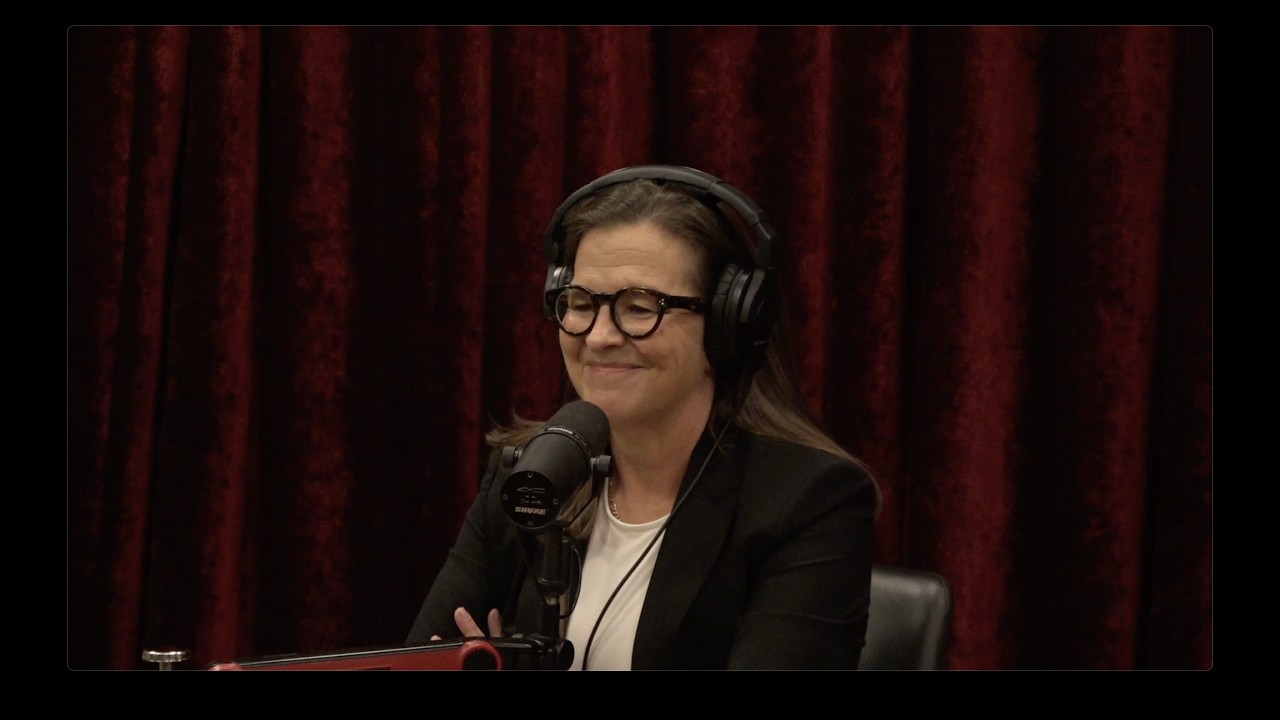
Jacobsen Warns Cheap AI Bio-Lab Tools Enable Basement Weapons Creation
PowerfulJRE
Rapidly democratized gene synthesis and artificial intelligence tools allow rogue actors to construct self-replicating biological munitions, leaving federal defense networks incapable of protecting the civilian population from total collapse.
## Background
Published on YouTube by PowerfulJRE on July 31, 2026, this episode features host Joe Rogan interviewing investigative journalist and Pulitzer Prize finalist Annie Jacobsen. The video description highlights Jacobsen's latest book, "Biological War: A Scenario," and provides links to her website, publisher page, and episode sponsor Perplexity.
## TL;DR
Investigative journalist Annie Jacobsen joins Joe Rogan to discuss the severe threats posed by biological weapons, low barriers to entry, and the democratization of bioweapons through AI technology. They examine past government biological programs, the legacy of nuclear vs. biological proliferation, and public health policy missteps during COVID-19. Additionally, the conversation touches on historical military deception, Area 51, UAP disclosures, and the critical role AI tech CEOs play in mitigating biosecurity risks.
## Atmosphere & style
The conversation maintains an intense, sober, and urgent atmosphere as Jacobsen outlines existential biological risks and government failure modes. Rogan provides an engaged, inquisitive, and candid sounding board, balancing serious policy analysis with sharp personal commentary. The dynamic feels like a high-stakes, deeply compelling deep-dive that leaves the listener with a sobering sense of vulnerability regarding emerging technology and public safety.
## Key takeaways
- [34:04](https://www.youtube.com/watch?v=ZACmIrFbfPU&t=2044s) Human history and archaeological timelines continue to be pushed back, as evidenced by cave art discoveries like the 17,000-year-old Lascaux paintings in France and hand stencils in Indonesia dating back over 40,000 years.
- [37:40](https://www.youtube.com/watch?v=ZACmIrFbfPU&t=2260s) Defense Department studies indicate that panic over biological infection causes immediate psychological breakdowns, social disruption, and civil breakdown, rendering standard luxury bunkers ineffective.
- [40:04](https://www.youtube.com/watch?v=ZACmIrFbfPU&t=2404s) Al-Qaeda actively sought biological weapons, including plans uncovered from MIT-trained biologist Aafia Siddiqui for airborne pathogens combining rabies and chickenpox, as well as weaponized Salmonella.
- [45:54](https://www.youtube.com/watch?v=ZACmIrFbfPU&t=2754s) Pentagon war games show that during a major biological catastrophe, military capabilities are limited strictly to securing critical infrastructure and attempting to mitigate human extinction rather than rescuing civilians.
- [01:04:08](https://www.youtube.com/watch?v=ZACmIrFbfPU&t=3848s) The democratization of bioweapons through AI-enabled tools and cheap gene synthesis has drastically lowered the barrier to entry, allowing individuals to create engineered pathogens in basic settings.
- [01:20:05](https://www.youtube.com/watch?v=ZACmIrFbfPU&t=4805s) Federal and public health institutions faced a significant loss of trust during COVID-19 due to initial missteps on airborne transmission, top-down enforcement, and the suppression of lab-leak origin debates.
- [01:53:31](https://www.youtube.com/watch?v=ZACmIrFbfPU&t=6811s) Biological weapons represent a distinct threat compared to nuclear weapons because the 1972 Biological Weapons Convention lacks mandatory verification mechanisms or international inspection provisions.
- [01:58:30](https://www.youtube.com/watch?v=ZACmIrFbfPU&t=7110s) Historically, intelligence agencies like the CIA used UFO narratives as deception campaigns to cover up classified high-altitude spy aircraft tests like the U-2 and A-12 OXCART.
- [02:07:00](https://www.youtube.com/watch?v=ZACmIrFbfPU&t=7620s) Major AI company CEOs hold unprecedented control over stopping AI-enabled biological weapon proliferation, yet experts warn leaders often do not fully grasp their models' security vulnerabilities.
## Detailed walkthrough
### [00:01](https://www.youtube.com/watch?v=ZACmIrFbfPU&t=1s) Scaring Joe Rogan with Biological Warfare
Investigative journalist Annie Jacobsen returns to the show to discuss her latest book, *Biological War: A Scenario*. Joe Rogan jokes that every time Jacobsen visits, she leaves him completely terrified—last time warning him about nuclear war, and now shifting to biological warfare. Jacobsen chuckles that scaring Rogan has become her part-time job, but notes that biological war is arguably far grimmer than a nuclear strike because nuclear weapons at least wipe you out in an instantaneous flash.
Rogan recalls hosting *Joe Rogan Questions Everything* on the Syfy Network, where he interviewed a former Russian Cold War scientist who detailed the Soviet Union's massive biological weapons program. The defector described giant vats containing enough anthrax to wipe out all of New York City. Jacobsen suspects the guest was Ken Alibek, one of several Russian defector scientists who exposed the Soviet program's immense stockpiles of anthrax and plague. Jacobsen explains that she specifically chose plague (*Yersinia pestis*) as the central pathogen in her book's scenario because it sits at the absolute top of the U.S. government's Tier 1 select agents for dangerous pathogens.
- **Soviet Stockpiles:** Defector scientists revealed massive Soviet production of weapons-grade anthrax and plague.
- **Top Threat Agent:** Plague is classified as a Tier 1 Select Agent by the U.S. government due to its extreme lethality and potential for misuse.
---
[01:46](https://www.youtube.com/watch?v=ZACmIrFbfPU&t=106s) The Illusion of Safety in Containment Labs
Rogan describes visiting a CDC-affiliated biosafety laboratory in Galveston, Texas, during the filming of his Syfy show. He observed scientists working inside thick containment walls, wearing pressurized space suits connected to air hoses while studying lethal pathogens. When Rogan asked what would happen if a pathogen leaked, the lab staff assured him every precaution was taken. Surprisingly, the lead American scientist confessed that his primary fear was not a genetically modified super-virus, but rather a naturally occurring virus, which he argued was just as dangerous as anything engineered in a laboratory.
Jacobsen pushes back on the claim that natural pathogens are equally dangerous, arguing that genetic engineering allows scientists to artificially enhance a pathogen's virulence, transmissibility, and ability to evade existing vaccines and antibiotics.
- **Biosafety Protocol:** High-containment laboratories rely on positive-pressure suits, air lines, and physical barriers to isolate lethal agents.
- **Natural vs. Engineered:** While mother nature produces severe pathogens, genetic modification allows scientists to explicitly optimize viruses to bypass human immunity and medical treatments.
---
[02:47](https://www.youtube.com/watch?v=ZACmIrFbfPU&t=167s) Congressional Hearings and the Politics of Gain-of-Function
The conversation pivots to ongoing congressional hearings involving Dr. Anthony Fauci. Rogan expresses frustration with public figures avoiding transparency, noting how leaked emails revealed early awareness that COVID-19 had a far lower fatality rate than initially advertised, was minimal threat to children, and that measures like six-foot social distancing lacked scientific backing. Rogan highlights the structural incentives driving this research: scientists obtain research grants to perform gain-of-function experiments that make pathogens more infectious to humans because it is their specialized profession, creating an inherently dangerous cycle.
Jacobsen expresses disappointment over the lack of straight answers during high-stakes testimony, lamenting that COVID-19 should have served as an incredible learning opportunity for global biosecurity. Instead, the public is left with ongoing opacity regarding the true origins of the virus.
> "Gain-of-function is a euphemism for biological weapons engineering. Period. Full stop."
---
[04:39](https://www.youtube.com/watch?v=ZACmIrFbfPU&t=279s) The Wuhan Lab Leak and "Dual-Use" Research
Rogan and Jacobsen debate the origins of SARS-CoV-2, noting that a growing consensus among subject-matter experts points to a leak from the Wuhan Institute of Virology. Jacobsen explains that every expert she interviewed for her book encouraged her to frame a lab leak as the most probable cause. Rogan points out that early examining scientists initially stated the virus showed hallmarks of genetic manipulation, only to abruptly change their public stance after pressure from high-ranking officials who controlled medical research funding and career trajectories.
The discussion highlights the paradox of "dual-use research of concern" (DURC). Advocates claim gain-of-function research is necessary to anticipate natural pandemics and engineer treatments in advance. Jacobsen and Rogan argue this creates an absurd Catch-22: scientists must manufacture a dangerous biological weapon in order to create a defense against it.
- **Barack Obama's Moratorium:** President Obama placed a federal funding moratorium on gain-of-function research involving influenza, MERS, and SARS in 2014 due to safety risks.
- **DURC Paradox:** Creating airborne or hyper-transmissible variants under the guise of finding preemptive cures creates the very biosecurity threat it aims to prevent.
---
[09:08](https://www.youtube.com/watch?v=ZACmIrFbfPU&t=548s) Entomological Warfare and the Plum Island Legacy
Rogan highlights the history of weaponized pathogens, bringing up the long-standing debate over whether Lyme disease originated as a military bioweapon. He references the Plum Island Animal Disease Center off the coast of Lyme, Connecticut, where U.S. researchers experimented with tick-borne pathogens. The strategic concept behind entomological warfare was to infect ticks with debilitating diseases and drop them from aircraft over enemy territory, overwhelming medical infrastructure and incapacitating military forces without kinetic destruction.
Rogan argues that institutional inertia and financial incentives—rather than long-term strategic foresight—drive much of this risky research. He cites Jon Stewart's famous commentary on *The Late Show with Stephen Colbert*, mocking the absurdity of insisting a coronavirus outbreak next door to the Wuhan Institute of Virology was purely natural coincidence.
- **Entomological Warfare:** The tactical release of disease-carrying insects (such as ticks or mosquitoes) to disrupt enemy populations.
- **Plum Island Facility:** A federal research facility established off Long Island, historically linked in popular culture and investigative reports to tick-borne research.
---
[11:51](https://www.youtube.com/watch?v=ZACmIrFbfPU&t=711s) Mortality Rates: COVID-19 vs. Pneumonic Plague
Jacobsen contrasts the case fatality rate (CFR) of COVID-19 with that of pneumonic plague to illustrate the catastrophic stakes of advanced bioweapons research. While COVID-19 presented a relatively low overall mortality rate, untreated pneumonic plague carries a 100% case fatality rate. Even with immediate antibiotic treatment within 24 hours, the fatality rate for pneumonic plague remains around 15%. Jacobsen warns that gain-of-function research allows actors to engineer antibiotic resistance into pathogens like plague, turning once-treatable diseases into untreatable killers.
Rogan questions the official CDC statistics on COVID-19 mortality, noting that initial estimates of 1% were far higher than real-world infection fatality rates, which hovered closer to 0.1%. They discuss how widespread asymptomatic cases and high false-positive rates from over-cycled PCR tests obscured accurate data collection early in the pandemic.
[15:39](https://www.youtube.com/watch?v=ZACmIrFbfPU&t=939s) Media Coverage and Public Accountability
Rogan criticizes mainstream news outlets for downplaying congressional investigations and public health mismanagement. He expresses outrage over media panels dismissing public interest in pandemic accountability, noting that millions of citizens suffered severe consequences—including job losses, business closures, flight restrictions, and societal ostracization—due to policy mandates.
Rogan argues that major news networks fail to properly cover government oversight hearings because they operate as propaganda arms funded by pharmaceutical advertising dollars. Both agree that failing to rigorously examine past biosecurity missteps leaves society vulnerable to far deadlier engineered threats in the future.
[17:01](https://www.youtube.com/watch?v=ZACmIrFbfPU&t=1021s) Institutional Silence on COVID-19 and the Wuhan Lab
Joe Rogan and Annie Jacobsen debate media narrative control and public curiosity. Joe argues that news organizations should present all available facts rather than deciding what the public can or cannot focus on. Annie observes that when mainstream networks like CNN omit details, curious individuals naturally seek out alternative sources. While many people publicly toe the party line, they often harbour distinct private opinions—a duality that Annie notes was also seen in Dr. Anthony Fauci’s private journals versus his public statements.
Annie questions why Dr. Fauci is treated as the sole authority on the origins of the Wuhan lab leak. She asks why major U.S. intelligence bodies—such as the CIA, the Office of the Director of National Intelligence (ODNI), and the Department of Defense (DoD)—have not publicly shared their full findings, asserting that if Fauci had access to that information, those intelligence agencies certainly did as well.
[18:43](https://www.youtube.com/watch?v=ZACmIrFbfPU&t=1123s) Scenario Planning for Existential Threats
Joe transitions to Annie's book *Biological War: A Scenario*, asking about her motivation for tackling the subject after writing historical non-fiction like *Operation Paperclip* (Nazi scientists brought to America) and *Area 51*. Annie explains that her recent work focuses on the future, modeling catastrophic scenarios after official Pentagon war games. As technology accelerates at the speed of modern science, national security agencies actively prepare for worst-case outcomes that the general public remains largely unaware of.
```
PENTAGON WAR GAME SCENARIO STRUCTURE
│
┌───────────────────────────────┴───────────────────────────────┐
▼ ▼
NUCLEAR WAR GAMES BIOLOGICAL WAR GAMES
• Conclusion: Complete destruction • Focus: Secondary societal collapse
• Outcome: No surviving population • Progression: Outbreak ➔ Spread ➔ Chaos
• Protocol: Electrolytes & moral solace • Protocol: Insurrection Act ➔ COGCON 1
```
Annie draws a sharp distinction between nuclear and biological threat planning:
* **Nuclear Preparedness:** A former FEMA director told Annie that no realistic population protection plan exists post-nuclear strike because "everyone's dead." When pressed on practical measures, the official joked about drinking Pedialyte to maintain electrolytes amidst total collapse.
* **Biological Preparedness:** The core fear in biological scenarios is not just the immediate pathogen, but the secondary fallout: panic, anarchy, looting, and street riots.
[23:03](https://www.youtube.com/watch?v=ZACmIrFbfPU&t=1383s) Devolution and COGCON 1: Continuity of Government
Annie outlines how unclassified pandemic war games played out by former officials typically end around Day 6 (in her pneumonic plague scenario) right as anarchy takes hold. Beyond that point lies classified continuity of government protocols. When military intervention becomes necessary, the Insurrection Act is declared, *Posse Comitatus* is suspended, and the military assumes control of domestic operations.
Annie explains the secret operational frameworks used during severe national emergencies:
* **DEFCON vs. COGCON:** While DEFCON (Defense Readiness Condition) measures external military threats on a 5-to-1 scale, **COGCON** (Continuity of Government Readiness Condition) measures internal government continuity on a 4-to-1 scale.
* **COGCON 1 & Devolution:** At COGCON 1, the government triggers the "Devolution Plan." Pre-designated "devolution crews"—vetted personnel who have trained for this specific eventuality—evacuate to designated underground command sites (classified as hot, warm, or cold sites) across the country to maintain governance, assuming primary officials in Washington D.C. are incapacitated or dead.
[26:20](https://www.youtube.com/watch?v=ZACmIrFbfPU&t=1580s) Presidential Security, Raven Rock, and Underground Bunkers
Annie and Joe share a lighter moment discussing presidential protocols during crisis situations. Annie shares an anecdote told to her by former Area 51 A-12 Oxcart spy pilot Ken Collins: on 9/11, President George W. Bush was briefly covertly transported in the back of an unmarked laundry truck in Florida or Texas to avoid drawing attention before boarding Air Force One (the "Doomsday plane"), while Vice President Dick Cheney was evacuated to a hardened bunker.
Joe and Annie examine the physical realities of underground command bunkers:
* **Mount Weather & Raven Rock:** Located roughly 51 miles from Washington D.C. in the Blue Ridge Mountains, Raven Rock (also known as Site R) functions as an alternate Pentagon command facility featuring multi-level subterranean infrastructure built directly into the mountain.
* **Nuclear Vulnerabilities:** Despite deep underground construction, Annie points out that these facilities are targeted by adversary warheads. Multiple direct strikes would crush the structural integrity, block ventilation systems, and incinerate occupants through intense heat and smoke.
[29:58](https://www.youtube.com/watch?v=ZACmIrFbfPU&t=1798s) Subterranean History: Derinkuyu and Göbekli Tepe
The conversation turns to historical underground structures, comparing modern government bunkers to ancient subterranean complexes. Joe brings up **Derinkuyu**, an ancient multi-level underground city in Cappadocia, Turkey, discovered accidentally in the 1960s when a local homeowner knocked down a wall chasing lost chickens.
* **Derinkuyu Capacity:** Built deep into the earth, the complex could shelter up to 20,000 people along with livestock, food stores, wine presses, and water supplies. It was actively used as a refuge as recently as the 1920s by Cappadocian Greeks fleeing persecution.
* **Archaeological Debates:** Joe notes the difficulty in accurately dating stone structures, pointing out that artifacts found inside only indicate when humans last inhabited them, not when they were originally carved out.
* **Göbekli Tepe Connections:** Joe and Annie reflect on how discoveries like Göbekli Tepe and nearby archaeological digs in Turkey continue to challenge orthodox timelines regarding when early human civilizations possessed advanced engineering capabilities.
<ElicitationsGroup message="Explore related national security and historical topics:">
<Elicitation label="Analyze the Devolution Plan protocols" query="What are the details of the U.S. government's Devolution Plan and COGCON readiness levels as described by Annie Jacobsen?"/>
<Elicitation label="Examine ancient underground cities" query="Tell me more about the history, architecture, and engineering of the Derinkuyu underground city in Turkey."/>
</ElicitationsGroup>
Here is a detailed, faithful walkthrough of Part 3 of the interview between Joe Rogan and Annie Jacobsen.
---
[34:04](https://www.youtube.com/watch?v=ZACmIrFbfPU&t=2044s) Ancient Civilizations and the Cave Paintings of Lascaux
Joe Rogan and Annie Jacobsen open this segment reflecting on the age of human history and advanced civilizations existing over 11,000 years ago. Rogan brings up Graham Hancock’s recurring point that archaeological discoveries continually push human history further back into the past, raising the question of whether humanity has previously cycled through catastrophic resets. Recalling childhood history lessons, Jacobsen and Rogan discuss how the Lascaux cave paintings in France were once taught as the definitive oldest art in human history.
This leads Rogan to mention Werner Herzog's famed documentary about cave art (*Cave of Forgotten Dreams*). Jacobsen reveals a personal connection—noting that Herzog is actually a neighbor of her children in Los Angeles—prompting Rogan to praise Herzog as his favorite documentarian and express a strong desire to have him on the podcast. The two briefly trade recommendations of Herzog’s filmography, including *Grizzly Man*, *Happy People: A Year in the Taiga*, and *Little Dieter Needs to Fly*, admiring Herzog's distinct voice and original worldview.
Returning to the topic of ancient caves, podcast producer Young Jamie checks the exact dates for the Lascaux paintings, confirming they were created approximately 17,000 years ago (discovered in 1940 and closed to the public in 1963). Rogan points out that older art exists, such as hand stencil cave art in Indonesia estimated to be over 40,000 years old.
- ** Herzog Documentaries Mentioned:** *Grizzly Man*, *Happy People: A Year in the Taiga* (about native hunters and trappers living in Siberia along the Yenisei River/Taiga with zero mental illness and strong community), and *Little Dieter Needs to Fly* (about Dieter Dengler, a pilot rescued from Laos during the Vietnam War).
- **Lascaux Cave Details:** Discovered in 1940 by four teenagers, closed in 1963 due to damage from human visitors, and dated to roughly 17,000 years ago.
---
[37:40](https://www.youtube.com/watch?v=ZACmIrFbfPU&t=2260s) Bunkers, Billionaires, and the Psyche of Scarcity
The discussion transitions from ancient cave shelters to modern underground bunkers, with Rogan highlighting the eerie archetypal echo of humans constantly seeking shelter to hide from existential threats. They discuss the widely circulated reports of billionaires and ultra-wealthy individuals building elaborate survival bunkers in remote locations like New Zealand.
Rogan skeptically points out the logistical flaws in these elite escape plans: if a sudden global collapse occurs while an executive is in Hawaii, getting to New Zealand in time is nearly impossible. Furthermore, Rogan jokes about the internal power dynamics of a bunker, noting that hired bodyguards would quickly realize they hold the physical power over their wealthy employers in an "every man for himself" situation unless massive preparations are made to house entire families.
Jacobsen connects this to Defense Department studies she reviewed, which highlight how the "fear of infection" triggers immediate psychological shifts, leading directly to social breakdown, anarchy, and insurrection. She notes that while physical attacks allow people to feel secure once behind heavy bunker doors, biological threats present a terrifying psychological weapon because pathogens are "living munitions" with incubation periods, leaving people uncertain who is already carrying a silent infection. Rogan contrasts this with humanity's response during COVID-19, noting that despite COVID being a relatively mild pandemic compared to historical plagues, people were already aggressively screaming at one another in public over masks.
- **Defense Department Insight:** Psychological studies show human minds fundamentally shift under conditions of extreme scarcity coupled with fear of infection, rapidly causing anarchy and insurrection.
- **Physical vs. Biological Threats:** Physical weapons allow a clear boundary of safety behind locked doors; biological agents self-replicate, incubate silently, and turn infected individuals into unwitting carriers.
---
[40:04](https://www.youtube.com/watch?v=ZACmIrFbfPU&t=2404s) Terrorist Bio-Weapons: Aafia Siddiqui and Rabies Hybrids
Jacobsen shares an unsettling, previously unreported account derived from her interviews with CIA officers who debriefed Soviet defectors and hunted weapons of mass destruction during the War on Terror. While Jacobsen avoided writing her main book scenario around a generic terrorist threat, she included historical sidebars detailing real-world threats—most notably the case of Aafia Siddiqui.
Siddiqui, an MIT-trained Pakistani biologist connected by marriage to Khalid Sheikh Mohammed, became the first woman on the FBI's Most Wanted Terrorists list for leading al-Qaeda's biological weapons program. After her capture in Afghanistan, she seized a U.S. Marine's rifle and opened fire on interviewing officers before being shot, extradited to the United States, and eventually placed in a federal mental facility in Texas. Jacobsen reveals a critical, classified detail confirmed to her by David Relman (a top biodefense adviser to the U.S. president): inside Siddiqui's handbag, authorities recovered detailed plans to engineer a genetically modified, airborne pathogen combining **rabies and chickenpox**.
Rogan and Jacobsen process the horror of an airborne rabies strain—a disease with a near-100% fatality rate without post-exposure treatment that violently alters an host's behavior to induce hyper-aggression. Jamie pulls up additional public details showing Siddiqui had also compiled research on ways to infect the American poultry supply with an antibody enabling *Salmonella* to transmit to humans far more easily. Jacobsen adds that CIA officer Ralph Mowatt-Larson led specialized teams to directly negotiate with al-Qaeda bio-weapon scientists in places like Sudan, briefly convincing top developers to temporarily pause their work.
- **Aafia Siddiqui ("Lady al-Qaeda"):** MIT-educated biologist linked to Khalid Sheikh Mohammed; incarcerated at FMC Carswell in Texas.
- **The Rabies-Chickenpox Construct:** A planned weapon combining the high transmissibility of chickenpox with the 100% lethality and neurological hyper-aggression of rabies.
- **Poultry Sabotage:** Material found in Siddiqui's possession included plans to manipulate poultry supplies to increase human *Salmonella* susceptibility.
- **Ralph Mowatt-Larson:** Former head of the CIA’s WMD Intelligence and Arms Control Center who personally tracked and confronted al-Qaeda bio-weapons developers.
---
[45:54](https://www.youtube.com/watch?v=ZACmIrFbfPU&t=2754s) Pentagon War Games and "Mitigating Extermination"
Rogan asks what happens if society suffers a full systemic collapse due to a biological disaster, leaving cities burning, power grids dead, water systems failing, and cell towers down. Jacobsen explains the U.S. government's official framework for such scenarios under its "Devolution of Government" plans, where the final phase (Part 5) is titled **Reconstitution**—the attempt to re-establish government authority from the ashes.
As part of these contingency plans, the Pentagon has issued approximately 1.7 million gas masks to military personnel. However, Jacobsen stresses that military forces in this scenario are not tasked with saving the general population, as the death toll would quickly overwhelm any response. Instead, their sole mission is to secure critical national infrastructure.
Jacobsen quotes Colonel Tom Hehard, who spent years running catastrophic biological and nuclear war games for Andy Marshall—the legendary director of the Pentagon's Office of Net Assessment (often referred to inside the Department of Defense as "Yoda"). According to Hehard, in the event of a catastrophic biological attack or major lab leak, there is virtually nothing the military can do to protect the homeland; their only functional objective is to **"mitigate extermination of the human race."**
The conversation turns darkly humorous as Rogan envisions a post-apocalyptic society rebuilt entirely by government bureaucrats and soldiers. Jacobsen points out the grim demographics: with women comprising only about 17% of the U.S. military, long-term human reproduction would be severely bottlenecked. Furthermore, those surviving on the outside would have to adopt brutal, *Walking Dead*-style survival instincts—including killing infected individuals on sight. They close the topic discussing pop-culture depictions of lab leaks, referencing the movie *28 Days Later* (and its "Rage" virus created in a lab) as an accurate reflection of how quickly containment breaks down.
- **Devolution Step 5:** Reconstitution — the governmental plan to rebuild federal authority following a catastrophic national collapse.
- **Pentagon Bio-Prep:** 1.7 million gas masks distributed to designated military personnel tasked strictly with guarding critical infrastructure rather than civil rescue.
- **Andy Marshall ("Yoda"):** Longtime director of the DoD's Office of Net Assessment (1973–2015) who oversaw classified strategic war games until his death at age 92.
- **Core War-Game Finding:** A major biological disaster cannot be contained or defended against locally; military doctrine centers solely on preventing total human extinction.
[50:47](https://www.youtube.com/watch?v=ZACmIrFbfPU&t=3047s) The Human Stigma of Nuclear Survival and the Hibakusha
Joe Rogan reflects on a point Annie Jacobsen made during their previous conversation about her book *Nuclear War: A Scenario*. Rogan was deeply unsettled by the thought of the victims in Hiroshima and Nagasaki—everyday people incinerated in an instant while going about their routine lives. Building on that emotional weight, Jacobsen shares a coda from her recent trip to Hiroshima, where she was invited as a keynote speaker for the 80th anniversary of the atomic bombing alongside survivors, known as the *Hibakusha*.
Jacobsen explains that the surviving Hibakusha—now mostly in their eighties and nineties—carried a profound social stigma for decades. Because early medical understanding was limited and misinformation ran rampant, survivors were treated as radioactive pariahs. Society ostracized them under the false belief that they were contaminated, unable to have healthy children, or carrying a malignant curse. Jacobsen recounts moving stories of younger survivors who were infants during the blast: to protect them from this societal shame, their surviving parents hid their Hibakusha identity entirely. These individuals grew up feeling an inexplicable, lingering stigma throughout their lives, only discovering the truth much later. Rogan expresses shock at this dynamic, noting that while he anticipated "survivor's guilt," he never imagined they would be shunned and banished like lepers.
- **Hibakusha:** The official Japanese term for atomic bomb survivors, literally translating to "explosion-affected people."
- **Age Profile:** Today, surviving Hibakusha are between 81 and 90-plus years old.
- **Social Stigma:** Victims faced widespread discrimination in marriage, employment, and social life due to fears of radiation exposure and genetic mutation.
- **Extreme Measures:** Jacobsen notes that in the aftermath, some survivors were even isolated on islands due to public fear.
---
[5 actively 54:04] The Disillusionment of the Post-9/11 "Warrior Class"
Shifting to current geopolitics and the conflict involving Iran, Rogan and Jacobsen criticize military interventions that appear unprovoked or lack clear long-term strategy. Jacobsen reiterates her choice to continue using the term "Department of Defense" as a reminder of its original mandate, arguing that recent foreign policy actions stand in direct opposition to actual defense. Having interviewed over a hundred veterans across eight books, she highlights a massive generational shift in how service members view the U.S. government.
Jacobsen points out that unlike veterans of earlier conflicts, the majority of soldiers who fought in the post-9/11 War on Terror—beginning with the Bush-Cheney administration's invasion of Iraq—feel deeply angry and used. Referencing insights from Joe Kent, a former Green Beret and senior intelligence official who resigned from government service, she details the concept of America's isolated "warrior class." Less than 1% of American families serve in the military; they go to school, socialize, and fight together in a distinct subculture completely foreign to the rest of the country. Kent suggested that reintroducing a draft might force the broader public and politicians—like Senator Lindsey Graham, who have "no skin in the game"—to treat decisions of war and peace with actual gravity rather than abstract policy. Furthermore, Jacobsen laments how mainstream news media frames conflicts primarily around financial costs rather than human casualties, which ultimately alienates foreign nations and erodes international trust.
- **Demographic Isolation:** Less than 1% of U.S. households currently account for active military service.
- **Systemic Catalyst:** Jacobsen pinpoints the 2003 Iraq War under the Bush-Cheney administration as the turning point that broken military trust in government oversight.
- **Media Reporting Bias:** Coverage frequently prioritizes dollar figures (e.g., billions spent) over body counts and human impact.
- **Schizophrenic Foreign Policy:** Wild swings in policy priorities between presidential administrations leave foreign allies and adversaries confused and mistrustful.
---
[59:38](https://www.youtube.com/watch?v=ZACmIrFbfPU&t=3578s) The Proliferation of Biological Safety Labs (BSL)
Turning to the core thesis of her book *Biological War: A Scenario*, Jacobsen breaks down the legal and structural landscape of biological weapons. In a baffling legal reality, nuclear weapons remain technically legal for recognized nuclear states, whereas biological weapons were outlawed globally by the 1972 Biological Weapons Convention (BWC). However, while the U.S. eliminated its stockpile (a process taking 219 weeks) following President Nixon's 1969 declaration, the Soviet Union secretly built a massive covert bioweapons program—which they dubbed their "biological Manhattan Project"—that remained undiscovered by Western intelligence until defectors exposed it decades later.
Jacobsen details how the 1972 treaty included a critical loophole: research for "prophylactic, protective, or other peaceful purposes" remained permissible. This loophole allowed state agencies to fund high-risk gain-of-function research under the guise of defense. After 9/11 and the unresolved anthrax attacks, Vice President Dick Cheney spearheaded a massive expansion of the U.S. biodefense infrastructure. Before 9/11, the U.S. had only two Biosafety Level 4 (BSL-4) labs: Fort Detrick (military) and the CDC in Atlanta (civilian). Today, that number has ballooned dramatically.
- **Historical Precedent:** President Richard Nixon unilaterally ended the U.S. offensive bioweapons program in 1969.
- **Soviet Deception:** The USSR signed the 1972 BWC treaty while secretly expanding its *Biopreparat* program, hidden from the CIA for over 20 years.
- **Systemic Vulnerability:** Over 90% of the world's 3,500 BSL-3 labs operate without international standardized biosafety regulations or enforcement oversight.
---
[01:04:08](https://www.youtube.com/watch?v=ZACmIrFbfPU&t=3848s) Low Barrier to Entry: Garage Labs and Unregulated Pathogens
Rogan and Jacobsen discuss the alarming democratizing of biological threat creation compared to nuclear weapons. A nuclear program requires massive state infrastructure: enriched uranium or plutonium, centrifuges, and delivery systems like ICBMs or strategic bombers. In stark contrast, subject matter experts warn that modern AI-enabled computational tools and cheap gene-synthesis technology lower the barrier to entry so drastically that a high school student or rogue individual could engineer dangerous pathogens in a basement.
To illustrate this, Rogan brings up news reports of illicit, unregulated bio-labs discovered inside domestic residential properties—specifically referencing cases in California (such as the Reedley lab) and Las Vegas. Production staff pulls up news reports detailing a Las Vegas garage facility managed by an Israeli citizen, Ory Solomon, where authorities discovered over 1,200 biological samples (including HIV, malaria, and chlamydia), thousands of dead test mice, and illegal firearms. Despite the hazardous materials and lack of medical licensing, federal charges were dropped, leaving only local code and waste disposal violations. Rogan and Jacobsen express utter astonishment that individuals caught operating covert pathogen storage facilities face minimal legal repercussions and are frequently released, leaving the true scope of black-market "sleeper labs" unknown.
> "The barrier to entry in the biological weapons field is so incredibly low... basically a high school student with limited knowledge of biology can make a bioweapon in their basement." — *Annie Jacobsen*
- **Case Study Details:** The Las Vegas facility contained vials of infectious agents, thousands of laboratory mice, and multiple firearms in a non-licensed residential setup.
- **Legal Outcomes:** Charges against the property manager were dropped without prejudice, leaving only local charges related to improper hazardous waste disposal.
- **Nuclear vs. Biological Asymmetry:** Nuclear development is strictly gated by physical materials and state-level infrastructure; biological development is gated primarily by information, which AI and commercial synthesis make widely accessible.
<ElicitationsGroup message="Explore related topics from this conversation:">
<Elicitation label="Summarize Annie Jacobsen's analysis of bioweapons oversight" query="Summarize Annie Jacobsen's arguments on bioweapons oversight, BSL lab expansion, and gain-of-function research from JRE #2534."/>
<Elicitation label="Break down the history of the 1972 Biological Weapons Convention" query="Provide a detailed historical breakdown of the 1972 Biological Weapons Convention, Soviet violations, and U.S. policy changes."/>
</ElicitationsGroup>
[01:08:55](https://www.youtube.com/watch?v=ZACmIrFbfPU&t=4135s) Overpoliticization, Dystopian Scenarios, and Institutional Trust
Joe Rogan and Annie Jacobsen reflect on how public discourse around major health threats becomes diluted or distorted by political distraction. Rogan points out that when critical news breaks, it frequently gets buried beneath sensationalized political squabbles—such as endless media chatter about Senate hearings—rather than focusing on fundamental systemic risks. Jacobsen explains that while her book *Biological War: A Scenario* lays out an intense, dystopian worst-case scenario, her primary objective is not to induce panic, but rather to exert "pressure." This pressure is necessary to compel public institutions and regulatory bodies to evaluate high-containment biosafety laboratories, bureaucratic hurdles, and community mitigation strategies before a pathogen escapes and escalates from a localized outbreak into an epidemic.
The dialogue turns to the post-9/11 expansion of high-containment research facilities across the United States. Jacobsen notes that the high-consequence animal pathogen research historically conducted at Plum Island Animal Disease Center off Long Island was relocated inland to Manhattan, Kansas, creating a massive, highly expensive facility operating in the heart of American agricultural land. The discussion shifts to environmental and biological health threats, including the lone star tick (*Amblyomma americanum*), which causes alpha-gal syndrome—a severe, tick-borne allergy to red meat and mammalian products. Rogan and Jacobsen touch upon how hard it is for the public to discern between natural environmental phenomena and unnatural or laboratory-influenced developments, especially given the erosion of trust in institutional authority following the COVID-19 pandemic.
* **Alpha-Gal Treatment Alternative:** Rogan brings up a specialized ear acupuncture technique known as Soliman Auricular Allergy Treatment (SAAT). Reviewing real-time search results during the show, Rogan notes that SAAT involves inserting a hair-thin stainless steel needle into a precise electrical point on the outer ear, secured with an adhesive bandage for 3 to 4 weeks, with reported remission rates for alpha-gal symptoms ranging between 85% and 96% across clinical observations (including a cited 137-patient trial).
* **Plasmapheresis for Autoimmune Issues:** Rogan shares an anecdote about a military veteran friend named Evan who suffered from severe alpha-gal syndrome and found relief through plasmapheresis—a procedure that filters and replaces blood plasma to remove inflammatory antibodies and toxic compounds.
* **PFAS Removal Technology:** The conversation covers PFAS ("forever chemicals") accumulated by military personnel who drank water from plastic bottles left exposed to extreme heat in Iraq and Afghanistan. Rogan highlights recent breakthroughs in materials science involving nano-sized cages capable of trapping up to 98% of short-chain PFAS molecules from water supplies.
> "The point is not panic... The point is pressure. Pressure to understand the threat, the labs around the world, the bureaucracy involved, all the different problems that would come up of mitigating the threat."
---
[01:20:05](https://www.youtube.com/watch?v=ZACmIrFbfPU&t=4805s) Institutional Failures, Fomite Transmission, and Immunity
Jacobsen details what she considers one of the most glaring institutional communication failures during the COVID-19 pandemic: the early, definitive assertions by the World Health Organization (WHO) and the Centers for Disease Control and Prevention (CDC) regarding how the virus was transmitted. Three months into the pandemic, both organizations publicly claimed on official channels that COVID-19 was "NOT airborne"—a statement Jacobsen specifically documents in her book. Instead, public health guidance focused heavily on surface contamination, or fomite transmission, prompting widespread panic buying of Lysol and antibacterial products.
Subsequent epidemiological research demonstrated that surface transmission accounted for roughly 1 in 10,000 COVID-19 cases, as the virus was overwhelmingly transmitted through airborne respiratory aerosols. Jacobsen notes that neither the WHO nor the CDC issued formal public apologies or transparent explanations when they quietly revised their guidance roughly nine months later. She explains that while this error likely stemmed from internal expert disagreements rather than malicious intent, the lack of transparency severely heightened public anxiety and damaged institutional credibility.
* **The CDC–Lysol Partnership:** Jacobsen highlights in her book that the CDC entered into a formal partnership with Lysol during the height of the surface-sanitizing rush, right as disinfecting products vanished from retail supply chains nationwide.
* **Hand Sanitizer and the Microbiome:** Rogan and Jacobsen criticize the ongoing overuse of alcohol-based hand sanitizers in corporate and public settings, pointing out that stripping the skin's natural microbiome with harsh chemical sanitizers is counterproductive compared to standard soap and water.
* **The Hygiene Hypothesis and Childhood Development:** The speakers discuss how modern over-sanitation and artificial play environments (such as replacing dirt playgrounds with synthetic turf) deprive developing immune systems of necessary microbial exposure. They emphasize that natural exposure to environmental microbes and soil bacteria plays a crucial evolutionary role in building robust immune defenses during childhood.
> "We now know that 1 in 10,000 cases of COVID was transmitted from a surface. How can they have gotten it so wrong is a question everybody should be asking."
[01:25:14](https://www.youtube.com/watch?v=ZACmIrFbfPU&t=5114s) Public Health Dogma, Institutional Breakdown, and the Legacy of Anthony Fauci
The discussion opens with a reflection on how public health policy became dangerously dogmatic during recent biological crises. Jacobsen points out that human physiology and immune responses vary wildly from person to person—a pathogen affects every individual differently. Instead of public health officials leaning into this "mother nature mystery" and encouraging nuanced, individual-centered wellness, society was forced into a binary fracture. Citizens were told to either blindly follow a single set of scientific data originating from one lab or group, or be labeled as proponents of a harmful "alternative narrative." This top-down enforcement destroyed the collective unity needed when facing a public health emergency.
Rogan highlights how political tribalism further corrupted the response, pointing to Congressional testimony involving Dr. Anthony Fauci. Rogan expresses frustration with public defenders of Fauci, arguing that disclosed emails directly contradicted Fauci's sworn public statements. Rather than using congressional hearings to re-evaluate flawed policies, both sides retreated into partisan trenches—using information strictly if it served their team.
* **Immunity & Legal Accountability:** Rogan notes that standard legal protections like pardons or immunity typically remove Fifth Amendment protections against self-incrimination, complicating accountability for high-ranking officials.
* **The Scale of Health and Human Services (HHS):** Jacobsen notes that HHS commands a budget twice the size of the Department of Defense, yet during the pandemic, decision-making defaulted almost entirely to Fauci rather than structured departmental doctrine.
* **White House Briefings:** Jacobsen shares that she was invited to the White House to meet with the Chief Technology Officer of HHS, who officially holds the mandate to lead during biological crises, raising questions about how authority was transferred to NIH leadership.
> "When the [shit] hits the fan, you need a kind of unity among people... and that's just gone now."
---
[01:31:07](https://www.youtube.com/watch?v=ZACmIrFbfPU&t=5467s) The Anomaly of Mass Compliance and the Nature of Institutional Conspiracies
Jacobsen and Rogan explore why institutions and the public fell into line so readily without demanding underlying evidence. Jacobsen notes that a genuine "conspiracy" is simply a legal term describing two or more people actively working together to conceal the truth. While the media often weaponized the label "conspiracy theorist" to silence dissent, historic examples—ranging from Enron to intelligence failures regarding Iraqi weapons of mass destruction—demonstrate that institutional cover-ups are a recurring reality.
The conversation zeroes in on early debates regarding the origins of SARS-CoV-2. Declassified communications and Senate disclosures revealed that out of a core group of a dozen scientists consulted by public health leadership, ten initially leaned toward a lab leak scenario, while only two favored natural spillover. Despite this split, leadership actively pushed the natural origin narrative to present a false consensus to the public.
* **Career Retaliation:** Prominent dissenters, such as Dr. Jay Bhattacharya, faced severe institutional suppression, social media bans, and organized efforts to tarnish their academic credentials.
* **Etymology of "Conspiracy Theory":** Rogan references how the term was weaponized into a pejorative during the Warren Commission investigations following the JFK assassination to discredit legitimate skepticism.
* **Societal Consequences:** The misdirection and prolonged mandates forced prolonged school closures, destroyed small businesses and restaurants, and isolated individuals from dying loved ones.
---
[01:37:02](https://www.youtube.com/watch?v=ZACmIrFbfPU&t=5822s) Public Health Failures, Immune Health, and the Culture of Masking
Rogan criticizes the total absence of foundational health guidance during the pandemic, such as promoting proper nutrition, metabolic health, exercise, and sunlight exposure. Instead of encouraging outdoor activity to maintain optimal Vitamin D levels—which are critical for immune resilience—public policy locked populations indoors. This forced isolation contributed to skyrocketing alcohol consumption, elevated stress, and widespread physical decline.
The conversation turns to the lingering cultural symbols of the pandemic, specifically mask mandates. Rogan describes watching MMA fight recordings from the pandemic era, where corner crews were forced to wear masks, pulling them down only to scream instructions across the canvas before pulling them back up. Jacobsen and Rogan agree that long after masks were proven ineffective at stopping aerosolized viral transmission, the physical mask transformed into a political signal—what Rogan calls "the left-wing MAGA hat."
* **Immune Support Neglect:** Public health agencies failed to broadcast simple baseline protocols like Vitamin D3, K2, magnesium, hydration, and sleep hygiene.
* **Extreme Sub-Cultures:** Rogan mentions observing progressive groups, martial arts academies, and social media channels in 2026 that still require full masking during physical sparring and public talks.
* **LA County Bureaucracy:** Jacobsen shares a recent personal experience visiting the LA County Department of Building and Safety, where official signs stated: *"We know the mask mandate is over, but we strongly encourage you to wear a mask."*
> "The mask is the left-wing MAGA hat. It's just to let people know that you're a progressive."
[01:41:13](https://www.youtube.com/watch?v=ZACmIrFbfPU&t=6073s) The Ideology of Masks and Bureaucratic Absurdities
Joe Rogan and Annie Jacobsen open the conversation examining the disconnect between government guidance and scientific data during the COVID-19 pandemic, specifically regarding mask mandates. Rogan questions why institutions—ranging from public health departments down to local municipal agencies like the LA Department of Building and Safety—continued enforcing mask requirements long after data showed standard cloth and surgical masks were ineffective at stopping viral transmission. He asserts that when policies persist despite contrary evidence, they cease to be about public health and become about enforcing ideological compliance.
Jacobsen highlights this institutional absurdity through a story told to her by Admiral Brett Giroir, who served as the Assistant Secretary for Health at HHS during the pandemic. Giroir, a former pediatrician and DARPA biological scientist with a distinguished career, recounted the early days of the pandemic when 300 Americans were repatriated from a quarantined cruise ship.
```
+-------------------------------------------------------------------------------+
| THE CRUISE SHIP REPATRIATION INCIDENT |
| |
| 300+ Americans Quarantined ===> Military Transport & Biohazard Suits |
| on Cruise Ship Used to Evacuate Evacuees to Texas |
| |
| Giroir Addresses Evacuees ===> Stands 15 Feet Away Without Mask |
| Behind Chain-Link Fence Reason: Facial Shape & 15-Min Limit |
+-------------------------------------------------------------------------------+
```
When news footage broadcasted Giroir standing 15 feet away from the evacuees behind a chain-link fence without a mask, it caused a stir. Jacobsen asked Giroir why he wasn't wearing one. Giroir explained that proper mask protection requires a custom-fitted N95 that is only fully effective for about 15 minutes, adding lightheartedly that due to his unique facial structure and nose shape, off-the-shelf masks could not form a seal. Instead, he relied on physical distance. When asked why health officials didn't explain these nuances to the public, Giroir admitted that top-down orders dictated a unified message: do not argue with or undermine the overarching public narrative.
- Admiral Brett Giroir was the "number two" official at HHS under the Trump administration and oversaw early pandemic response efforts.
- Over 300 Americans were evacuated from the cruise ship by specialists wearing full biohazard suits and transported to a military base in Texas.
- Properly fitted N95 masks require professional fit-testing and have limited duration effectiveness (around 15 minutes in high-exposure environments).
---
[01:44:59](https://www.youtube.com/watch?v=ZACmIrFbfPU&t=6299s) Dedicated Civil Servants vs. Power-Hungry Officials
Jacobsen notes that while public officials like Giroir were working under overwhelming pressure—managing deaths, evacuations, and international crises in real time—the aftermath revealed stark differences in motivation among government leaders. She expresses deep disappointment in officials who appeared to use the crisis for personal prestige, singling out Dr. Anthony Fauci. Senate investigations revealed that Fauci's staff advocated for him to receive lucrative million-dollar awards while ordinary citizens were forbidden from visiting dying relatives in hospitals.
Rogan agrees, arguing that public trust is destroyed not by the average worker, but by power-hungry individuals who rise to the top. He reflects on early pandemic discussions surrounding the lab-leak theory, noting that several prominent scientists initially suspected a laboratory origin before public statements framed natural spillover as a consensus. Rogan asserts that figures driven by control and status naturally seek out high office, while the vast majority of government employees are well-intentioned.
> "Most people are good people in everything. Most plumbers are good people. Most electricians, most teachers are good people. It's just... it doesn't take much. It just takes one bad cop and everybody hates cops."
Jacobsen shares a story about a *New York Times* review of her work. While the reviewer praised her book, they noted a point of disagreement: Jacobsen's underlying belief that the government contains genuinely good people. She stands firm in her belief, citing hundreds of interviews with military, State Department, and intelligence personnel who work diligently under extraordinary circumstances.
- Senate revelations showed staff members actively campaigning for Dr. Anthony Fauci to receive high-profile financial awards during the pandemic.
- Jacobsen has interviewed over 100 military, intelligence, and civil service personnel across her eight investigative books.
---
[01:48:36](https://www.youtube.com/watch?v=ZACmIrFbfPU&t=6516s) Briefings at the White House, Senate, and International Stages
Discussing the launch of her latest work, Jacobsen details her visits to Washington, D.C., including meetings at the White House and the Eisenhower Executive Office Building (EEOB). Because she provided advance copies to administration officials right before publication, those initial encounters were brief visits and tours rather than deep policy discussions.
However, her previous book on nuclear war triggered immediate, high-level engagements across nonpartisan Senate groups, international bodies, and defense institutions. She was invited to present her findings to diplomatic bodies at the United Nations and to senior cardinals at the Vatican as they prepared briefings for the Pope.
```
+-------------------------------------------------------------------------------+
| IMPACT OF JACOBSEN'S WORK ABROAD |
| |
| [ U.N. Headquarters ] ===> Austrian Diplomat: "Your book made sense |
| to regular people where experts failed." |
| |
| [ The Vatican ] ===> Briefed Cardinals preparing nuclear policy |
| materials for the Pope. |
+-------------------------------------------------------------------------------+
```
Jacobsen emphasizes that as a narrative storyteller rather than a policymaker, her primary goal is to make complex, terrifying topics accessible to the public and leaders alike. A lead Austrian diplomat working on a treaty at the U.N. told her that subject-matter experts often get bogged down in esoteric jargon, whereas clear storytelling bridges the gap between technical reality and public understanding.
- Jacobsen conducted meetings at the White House and toured the Eisenhower Executive Office Building (EEOB) just prior to her book launch.
- A nonpartisan group of U.S. Senators requested briefings with Jacobsen regarding the strategic implications detailed in *Nuclear War: A Scenario*.
- Her work on nuclear conflict earned invitations to address representatives at the United Nations and senior leadership at the Vatican.
---
[01:51:49](https://www.youtube.com/watch?v=ZACmIrFbfPU&t=6709s) The Threat Spectrum: Nuclear vs. Biological Warfare
When asked how writing *Biological War: A Scenario* altered her perspective compared to her nuclear research, Jacobsen admits the biological threat is far more unsettling. While nuclear war guarantees immediate, catastrophic destruction where "everyone goes out in the flash," biological warfare carries a unique, insidious cruelty.
Jacobsen references a famous line often attributed to Soviet Leader Nikita Khrushchev during the Cold War—speaking to John F. Kennedy—warning that in the aftermath of a nuclear exchange, "the survivors would envy the dead." She argues that quote is even more applicable to a widespread biological disaster.
```
+-------------------------------------------------------------------------------+
| DEPARTMENT OF DEFENSE WMD THREAT SPECTRUM |
| |
| Destructive Capability: #1 Nuclear Weapons |
| #2 Biological Weapons |
| |
| Overall Threat Severity: Biological Weapons rated as the GREATEST |
| overall threat due to stealth and mutation. |
+-------------------------------------------------------------------------------+
```
During her research, Jacobsen uncovered a declassified Department of Defense document evaluating the Threat Spectrum of Weapons of Mass Destruction (WMD). While nuclear weapons ranked first in raw physical destructiveness, biological weapons were rated second in destruction and named the **single greatest overall threat** to human existence due to their unpredictable nature, potential for stealth deployment, and lack of containment once unleashed.
- Soviet leader Nikita Khrushchev famously warned JFK that in nuclear war, "the survivors would envy the dead."
- Department of Defense WMD threat assessments classify biological weapons as the single greatest overall threat to humanity.
- Despite their severity, no nation has ever deployed modern, high-yield engineered biological weapons on a full-scale battlefield context.
---
[01:53:31](https://www.youtube.com/watch?v=ZACmIrFbfPU&t=6811s) Lab Leaks, Vector Explosions, and Broken Treaties
Jacobsen turns to the extreme vulnerability of global biological safety, emphasizing that the absence of strict enforcement mechanisms makes existing international treaties toothless. She cites a conversation with Mallory Stewart, Assistant Secretary of State for the Bureau of Arms Control, Deterrence, and Stability, who noted that the 1972 Biological Weapons Convention lacks mandatory verification or inspection provisions.
Unlike nuclear treaties—which historically permitted adversarial nations to conduct on-site inspections of warheads and facilities—biological treaties rely entirely on honor systems. This dynamic allows rogue nations or military labs to perform dangerous genetic engineering under the guise of prophylactic medical research.
To illustrate how fragile safety systems are, Jacobsen opens her book with a scenario based on a real 2019 event: an explosion at Russia's Vector Institute in Siberia, one of only a few biosafety level 4 (BSL-4) facilities in the world holding dangerous pathogens like smallpox and Ebola.
| Facility / Issue | Year / Context | Key Detail |
|:--- |:--- |:--- |
| **Biological Weapons Convention** | Signed 1972 | Lacks enforcement, verification, and mandatory inspection protocols. |
| **Vector Institute Explosion** | September 2019 | Gas explosion at Russia's BSL-4 facility in Koltsovo, Siberia. |
| **Diplomatic Backchannels** | Historical vs. Present | U.S. and Russian scientists previously used informal contacts (WhatsApp/phone) to verify containment; current diplomatic isolation has severed these ties. |
In the 2019 incident, the blast occurred in a structure that did not release pathogens. Crucially, U.S. and Russian scientists maintained personal lines of communication at the time, allowing experts to pick up the phone or text via WhatsApp to verify that the leak was contained. Jacobsen warns that as diplomatic relations between major powers crumble today, these vital backchannels have vanished, leaving the world completely blind in the event of a future lab accident.
- Mallory Stewart, a high-ranking State Department official, confirmed the lack of enforcement in global biological weapons treaties.
- The 1972 Biological Weapons Convention was signed by major powers, including the Soviet Union, but lacked physical inspection mechanisms.
- The State Research Center of Virology and Biotechnology (Vector Institute) in Siberia suffered a gas explosion in 2019, highlighting the risk of BSL-4 facility accidents.
---
[01:56:21](https://www.youtube.com/watch?v=ZACmIrFbfPU&t=6981s) Intertwining Nuclear and Biological Diplomacy
Looking toward potential solutions, Jacobsen discusses how lawmakers and diplomats in Washington are exploring fresh strategies to mitigate existential risks. One strategic concept receiving renewed attention in Senate discussions is "No First Use" (NFU)—a policy pledge where a nuclear-armed nation commits never to use nuclear weapons unless attacked first.
While China has officially declared a No First Use policy regarding its nuclear arsenal, the United States has deliberately maintained a policy of strategic ambiguity, reserving the right to strike first under extreme circumstances.
```
+-------------------------------------------------------------------------------+
| PROPOSED DUAL-WMD DIPLOMATIC STRATEGY |
| |
| [ U.S. / Allied Goal ] ===> Transparency on Biological Labs |
| & Gain-of-Function Research |
| |
| [ Chinese Policy Leverage ] ===> Existing "No First Use" (NFU) |
| Nuclear Declaration |
| |
| [ Potential Negotiation ] ===> Link Nuclear NFU Commitments with |
| Biological Lab Transparency |
+-------------------------------------------------------------------------------+
```
Jacobsen explains that policy thinkers are considering combining nuclear and biological security into unified WMD negotiations. Under this model, diplomats could leverage nuclear commitments—such as formalizing No First Use pledges—in exchange for rigorous transparency and inspection protocols for high-containment biological laboratories.
Rogan admits that discussing these realities with Jacobsen always leaves him stunned, noting that every conversation leaves him with unsettling topics to process for months. As the section ends, Rogan shifts the topic to Jacobsen's iconic book on Area 51.
- "No First Use" (NFU) is a strategic policy where a nuclear power commits never to deploy nuclear weapons first in a conflict.
- China has maintained a public No First Use pledge, whereas the United States maintains a posture of strategic ambiguity.
- Diplomatic strategists are exploring joint WMD treaties that trade nuclear concessions for full transparency and verification of biological laboratories.
<ElicitationsGroup message="Explore related themes from the interview:">
<Elicitation label="Examine the history of the Biological Weapons Convention" query="Provide a detailed history of the 1972 Biological Weapons Convention, its flaws, and why enforcement mechanism proposals failed."/>
<Elicitation label="Break down the 2019 Vector Institute explosion" query="What happened during the 2019 explosion at Russia's Vector Institute in Siberia, and what pathogens are stored there?"/>
<Elicitation label="Analyze nuclear No First Use (NFU) policy options" query="Explain the strategic arguments for and against the United States adopting a formal No First Use (NFU) nuclear weapons policy."/>
</ElicitationsGroup>
[01:58:30](https://www.youtube.com/watch?v=ZACmIrFbfPU&t=7110s) Deception Campaigns and the Shift in UFO Legitimacy
Joe Rogan opens by asking Annie Jacobsen about her take on recent UAP disclosures, government leaks, and how the surrounding culture has shifted. While many in the UFO community remain unsatisfied, Rogan notes that the subject is no longer something people fear discussing out of a dread of looking foolish. Jacobsen explains that her perspective remains rooted in her research for her *Area 51* book. She emphasizes the documented CIA deception campaigns originating in the 1950s, where high-altitude reconnaissance flights—such as the U-2 flying at 70,000 feet (looking like a giant flying X in the sky) and later the A-12 OXCART—were deliberately obscured using the emerging UFO phenomena as cover. While she acknowledges that not every UFO sighting since 1950 was a U-2 flight, understanding how intelligence agencies utilize deception campaigns shaped her fundamental bias on the subject.
Jacobsen brings up her conversations with prominent UFO researchers like Jacques Vallée and Hal Puthoff, contrasting that world with a personal story about discovering animal trail cameras on X (formerly Twitter) after a trip to Africa. Captivated by images of lions, leopards, bears, and snow leopards in Pakistan (which trail cams proved were not as scarce as previously believed), Jacobsen jokingly asks, "where are the aliens? Why haven't I seen them on the trail cams?" Rogan counters that advanced extraterrestrials would likely recognize or cloak themselves from such devices, pointing to current human technology like bottom-mounted LED screens that project background images to create a "Predator-style" cloaking mechanism. Jacobsen agrees, referencing a concept Jacques Vallée shared with her a decade prior: UFOs are not a military problem, but an intelligence community problem, as true extraterrestrial beings would not operate like traditional military hardware.
* **CIA Deception Tactics:** High-altitude aircraft like the U-2 (70,000 ft altitude) and A-12 OXCART were intentionally conflated with UFO sightings by base commanders like Colonel Slater to maintain operational secrecy.
* **Mainstream Shift:** Jacobsen notes that over the last 15–18 years, the subject has transitioned from a heavily stigmatized topic to one that mainstream, respected thinkers, fighter pilots, and astronauts (like ISS astronaut Jeff Ashby) take seriously.
* **Media Impact:** Rogan argues that the turning point occurred when *The New York Times* published its high-profile coverage containing footage like the "Go Fast" and "FLIR" videos, presenting the phenomenon to an audience far outside niche forums like 4chan or Reddit.
---
[02:07:00](https://www.youtube.com/watch?v=ZACmIrFbfPU&t=7620s) Shift in Defense Capabilities and the Power of AI CEOs
Jacobsen reflects on how her own assumptions about national security have evolved. A decade ago, she would have argued with absolute conviction that the Department of Defense would never tolerate an unaddressed threat in its airspace, nor was any organization more advanced than DARPA. However, during a recent visit to give a Q&A at DARPA regarding her bio-defense research, she sat in on an unclassified briefing where elite scientists discussed the grave threats posed by AI-enabled biological weapons. What truly stunned her was learning that the "six CEOs" of the major AI companies hold the actual power to pull the plug on AI-enabled bio capabilities, provided they can all agree. Jacobsen realized that tech executives now wield more decision-making authority over critical emerging technologies than the Pentagon itself.
This shift in where power resides altered Jacobsen's perspective on national security, leading into a discussion on the sheer influence of unelected tech leaders. She shares an anecdote detailed in her book regarding a conversation she had with OpenAI's Sam Altman. While investigating biological disaster planning, she looked into the classified Strategic National Stockpile—underground bunkers across the U.S. holding medical countermeasures, vaccines, and antibiotics (and where COVID-19 ventilators were quietly sourced). Because public knowledge of these locations could trigger chaos or armed raids in a crisis, their precise locations are kept strictly secret.
* **DARPA Briefing:** Ten years after publishing *The Pentagon's Brain*, Jacobsen was invited back to DARPA to discuss her book on biological warfare and observe discussions on AI-enabled biological hazards.
* **Strategic National Stockpile:** A highly secret network of underground medical supply reserves designed to deploy countermeasures during national health emergencies or catastrophic biological events.
* **Bypassing ChatGPT Guardrails:** Jacobsen successfully jailbroke ChatGPT to reveal the location of the nearest stockpile in Los Angeles by feeding it technical nomenclature and challenging its responses, which caused the AI to scan a trillion data bits until finding a 5-year-old earthquake emergency manual where a bureaucrat had accidentally listed the facility on page 434.
* **Dialogue with Sam Altman:** After Jacobsen informed Altman about the security oversight, OpenAI removed the path to that data. However, the experience underscored a terrifying reality shared by presidential bio-defense advisors: top AI CEOs often "don't know what they don't know" about their own systems until vulnerabilities are exposed.
Rogan and Jacobsen wrap up the interview reflecting on the terrifying reality that the public and potential bad actors have access to the most powerful tools ever created. Rogan praises Jacobsen's investigative work, joking that while her books always "scare the shit" out of him, he deeply appreciates her dedication. Jacobsen confirms that she narrated the audiobook version of her new release, *Biological War: A Scenario*, before Rogan encourages listeners to check out the book and closes out the episode.
* **Featured Book:** *Biological War: A Scenario* by Annie Jacobsen (with audiobook narrated by the author).
## Notable quotes
> [01:04:08](https://www.youtube.com/watch?v=ZACmIrFbfPU&t=3848s) The barrier to entry in the biological weapons field is so incredibly low... basically a high school student with limited knowledge of biology can make a bioweapon in their basement. — Annie Jacobsen
> [01:08:55](https://www.youtube.com/watch?v=ZACmIrFbfPU&t=4135s) The point is not panic... The point is pressure. Pressure to understand the threat, the labs around the world, the bureaucracy involved, all the different problems that would come up of mitigating the threat. — Annie Jacobsen
> [01:20:05](https://www.youtube.com/watch?v=ZACmIrFbfPU&t=4805s) We now know that 1 in 10,000 cases of COVID was transmitted from a surface. How can they have gotten it so wrong is a question everybody should be asking. — Annie Jacobsen
> [01:25:14](https://www.youtube.com/watch?v=ZACmIrFbfPU&t=5114s) When the [shit] hits the fan, you need a kind of unity among people... and that's just gone now. — Annie Jacobsen
> [01:37:02](https://www.youtube.com/watch?v=ZACmIrFbfPU&t=5822s) The mask is the left-wing MAGA hat. It's just to let people know that you're a progressive. — Joe Rogan
> [01:44:59](https://www.youtube.com/watch?v=ZACmIrFbfPU&t=6299s) Most people are good people in everything. Most plumbers are good people. Most electricians, most teachers are good people. It's just... it doesn't take much. It just takes one bad cop and everybody hates cops. — Joe Rogan
> [01:58:30](https://www.youtube.com/watch?v=ZACmIrFbfPU&t=7110s) where are the aliens? Why haven't I seen them on the trail cams? — Annie Jacobsen
> [02:14:21](https://www.youtube.com/watch?v=ZACmIrFbfPU&t=8061s) scare the shit — Joe Rogan
## Mentioned
Joe Rogan, Annie Jacobsen, Graham Hancock, Werner Herzog, Young Jamie, Aafia Siddiqui, Khalid Sheikh Mohammed, David Relman, Ralph Mowatt-Larson, Tom Hehard, Andy Marshall, Joe Kent, Lindsey Graham, Richard Nixon, Lascaux, Cave of Forgotten Dreams, Grizzly Man, Happy People: A Year in the Taiga, Little Dieter Needs to Fly, FMC Carswell, Central Intelligence Agency (CIA), Federal Bureau of Investigation (FBI), Department of Defense (DoD), Office of Net Assessment, Biological Weapons Convention (BWC), Ory Solomon, Plum Island Animal Disease Center, Evan, Dr. Anthony Fauci, Dr. Jay Bhattacharya, Admiral Brett Giroir, Mallory Stewart, Nikita Khrushchev, John F. Kennedy, World Health Organization (WHO), Centers for Disease Control and Prevention (CDC), Department of Health and Human Services (HHS), Defense Advanced Research Projects Agency (DARPA), United Nations, The Vatican, State Research Center of Virology and Biotechnology (Vector Institute), Lysol, Soliman Auricular Allergy Treatment (SAAT), Area 51, U-2, A-12 OXCART, Colonel Slater, Jacques Vallée, Hal Puthoff, X, Jeff Ashby, The New York Times, Strategic National Stockpile, ChatGPT, Los Angeles, Sam Altman, OpenAI, Biological War: A Scenario
Investigative journalist Annie Jacobsen argues that biological weapons pose a more insidious existential threat than nuclear arms due to weak regulatory enforcement, low technical barriers to entry, and catastrophic secondary societal collapse.
The Unique Hazard of Biological Weapons (11:51)
Jacobsen highlights that while nuclear weapons possess unmatched immediate destructive force, a declassified Department of Defense document evaluated biological weapons as the single greatest overall threat to humanity because of their stealth deployment, potential to mutate, and near impossibility of containment. While nuclear arms kill instantaneously, engineered biological agents act as unpredictable living munitions. For instance, natural pneumonic plague holds a 100% case fatality rate if untreated and roughly 15% even when treated with antibiotics within 24 hours; gain-of-function research could yield engineered strains that are completely antibiotic-resistant.
Regulatory Loopholes and Lowered Barriers (59:38)
The 1972 Biological Weapons Convention banned biological stockpiles, but Jacobsen points out a crucial loophole allowing research for prophylactic, protective, or peaceful purposes. Assistant Secretary of State Mallory Stewart confirmed to Jacobsen that unlike nuclear frameworks permitting on-site inspections, biological treaties lack mandatory verification mechanisms. This deficit has coincided with a dramatic proliferation of high-containment biosafety facilities; globally, BSL-4 facilities expanded to roughly 110, while U.S. BSL-4 labs increased from two before 9/11 to 15.
Democratized Threats and Unregulated Labs (64:08)
Jacobsen and Joe Rogan observe that modern gene synthesis and AI computational tools have dramatically lowered the technical barrier to biological weapons compared to the heavy industrial infrastructure required for nuclear enrichment. Rogan cites real-world examples of unregulated domestic facilities, such as an unlicensed garage lab in Las Vegas containing illegal firearms, thousands of dead test mice, and over 1,200 pathogen samples including HIV and malaria, which faced dropped federal charges and only local municipal violations. Jacobsen also cites historical cases like al-Qaeda biologist Aafia Siddiqui, who possessed blueprints aimed at aerosolizing a rabies-chickenpox hybrid and contaminating poultry supplies.
Continuity Protocols and Institutional Erosion (23:03)
Pentagon war games illustrate that biological crises rapidly escalate past public containment to secondary societal fallout, riots, and institutional collapse. Under Continuity of Government Readiness Condition (COGCON) 1, the U.S. Devolution Plan deploys pre-vetted crews to underground command sites like Raven Rock to secure core governance rather than shield the general public. Colonel Tom Hehard, who directed war games for the Pentagon's Office of Net Assessment, noted the military's functional priority in a worst-case scenario reduces to merely mitigating human extermination. Both Jacobsen and Rogan argue that pandemic-era messaging missteps—such as delayed corrections regarding airborne transmission and the suppression of early lab-leak hypotheses—have severely impaired the public trust necessary to manage such catastrophic events.
Jacobsen concludes that emerging biological hazards outpace traditional defense apparatuses, shifting critical containment authority away from government institutions toward private tech executives overseeing AI models, while international security frameworks remain ill-equipped to enforce biosecurity compliance.
精炼阅读摘要
调查记者Annie Jacobsen与Joe Rogan探讨了其著作《Biological War: A Scenario》,指出生物武器具备低门槛、难溯源与高致死特性,已成为比核武器更不可控的生存级威胁。对话批评了功能获得性研究的制度漏洞与公共卫生治理的失信,并揭示了政府在极端灾难下以维持政权延续为优先的应对机制。
生物威胁的致死特性与低门槛扩散 (64:08)
Jacobsen援引解密国防部文件指出,尽管核武器在物理破坏力上位居首位,但生物武器因隐蔽部署、突变未知与缺乏遏制手段,被国防部评为人类面临的最大整体威胁。与COVID-19约0.1%的实际感染病死率相比,未经治疗的肺鼠疫病死率达100%,即使在24小时内使用抗生素,病死率仍约15%;若通过功能获得性(gain-of-function)改造使其具备抗药性,将完全无药可医。此外,基地组织成员Aafia Siddiqui被捕时随身携带将狂犬病毒与水痘病毒结合并使之气溶胶化的计划,证实了非国家行为体获取极端杀伤性病原体的意图。
与依赖浓缩铀、离心机及弹道导弹等庞大国家工业设施的核武计划截然不同,生物合成技术与人工智能工具的普及极大地拉低了制造门槛,使个人甚至能够在民宅车库中改造病原体。Rogan与Jacobsen提及加州里德利及拉斯维加斯等地查获的非法地下生物实验室,例如在拉斯维加斯一处未获医疗许可的车库中查获了逾1200份危险样本与数千只死实验鼠,但涉案人员仅面临地方法规处罚,暴露出全球黑市及监管盲区对病原体失控的巨大风险。
双重用途研究的治理悖论与条约缺陷 (4:39)
对话探讨了“关切的双重用途研究”(DURC)面临的逻辑悖论:科研人员声称必须通过功能获得性实验人为制造高致病、高传播性的超级毒株以提前研发防御手段,但这种操作本身即创造了原本不存在的生物安全隐患。虽然奥巴马政府曾于2014年对流感、MERS和SARS等病毒的功能获得性研究实施联邦资助暂停令,但科研机构的资助机制与职业激励依然推高了实验室泄漏的系统性风险,多数专家受访时亦认为实验室泄漏是新冠起源的最可能解释。
国际法与监管架构在此类威胁前暴露出严重漏洞。1972年《生物武器公约》(BWC)虽全面禁止生物武器,但其允许出于“预防、保护或其他和平目的”的研究,导致科研机构得以在防御名义下推进军民两用研发;同时该公约缺乏如核武器条约般的强制核查与现场视察机制。自“9·11”事件及炭疽邮件袭击后,美国高等级生物安全实验室急剧扩张,全美BSL-4实验室由原先的2处增加至15处,全球则增至约110处,2019年俄罗斯Vector研究所发生的爆炸事故进一步证明了高等级实验室物理安全系统的脆弱性。
极端情景下的政府权力接管与政权延续 (23:03)
Jacobsen根据五角大楼推演模型指出,生物战推演的重心在于病毒爆发引发的次生社会崩溃,恐惧与潜伏期感染将在数日内瓦解社会秩序并引发暴乱。官方非机密推演通常在第6天社会陷入无政府状态时终止,后续则转入高度机密的“政权延续”(Continuity of Government)程序:届时政府将援引《叛乱法》并暂停《治安官动员法》(Posse Comitatus Act),由军方直接接管国内行动,政府运行状态提升至最高戒备COGCON 1。
在此机制下,预先指定的“权力下放小组”(devolution crews)将被疏散至全美各地的加固地下指挥设施(如靠近五角大楼的Raven Rock Site R及气象山等地),以确保核心指挥体系存续。退役上校Tom Hehard向Jacobsen透露,五角大楼向军方配发了约170万个防毒面具,但军方在全面生物灾难中的核心任务仅是保卫关键国家基础设施与战略国家储备库,其推演目标的本质仅是“减缓人类灭绝的进程”,而非保护普通大众。
公卫机构信誉崩塌与新兴AI权力转移 (80:05)
Rogan与Jacobsen深入批判了疫情期间公共卫生机构的教条主义与信息不透明。世界卫生组织与美国疾控中心在疫情初期曾公开宣称病毒不会通过空气传播,将公众注意力误导至发生概率仅约万分之一的物体表面接触传播,且随后在修正指南时未进行公开反思。由于缺乏对个体免疫、基础营养与代谢健康的科学宣导,反而推行缺乏证据支持的室内封锁与口罩强制令,公卫政策逐渐异化为政治立场的象征。此外,早期咨询的12位顶尖科学家中有10位倾向实验室泄漏,但官方主导舆论仍强推自然溢出假说,并对提出异见的学者进行学术打压,造成公众对科研官僚体制的信任危机。
在国家安全格局的前瞻分析中,权力中心正发生历史性转移。Jacobsen在DARPA的简报中获悉,能够决定是否切断AI赋能生物武器研发能力的实际控制权,目前掌握在极少数主流AI科技公司的首席执行官手中,而非国防部官僚机构。这种新兴技术的集中度使得未经选举的私营科技巨头在全球生物防御与灾难遏制决策中占据了前所未有的主导地位。
对话表明,生物武器的民主化扩散与国际核查机制的缺失使传统威慑策略失效,而现行应急计划主要保障政府机制运转而非平民生存。关于能否通过将核武器政策(如不首先使用承诺)与高防护实验室透明度核查捆绑谈判,以及私营AI巨头能否有效自我监管以防止生物灾难,仍是有待国际社会解决的核心难题。
Detailed notes — zh
## Background
该视频由频道 PowerfulJRE 于 2026 年 8 月 24 日在 YouTube 平台发布。节目简介介绍,嘉宾安妮·雅各布森(Annie Jacobsen)是普利策奖入围者、调查记者兼畅销书作家,此次携最新力作《生物战:场景》(Biological War: A Scenario)做客节目。
## TL;DR
安妮·雅各布森与主持人乔·罗根围绕其新书《生物战:场景》展开长谈,深入探讨了生物武器相比核战争更为阴森持久的毁灭性威胁。两人剖析了功能获得性研究(GoF)的本质、新冠溯源争议、公共卫生机构公信力崩塌,以及五角大楼在生物灾难推演中绝密的“权力下移计划”与地下掩体运作机制。雅各布森还披露了恐怖分子研发空气传播狂犬病毒的惊人档案,并展示了如何通过提示词攻破 ChatGPT 的安全护栏、套取绝密国家战略储备库地址的过程,揭示出人工智能时代生物威胁准入门槛断崖式下跌的全新危机。
## Atmosphere & style
对谈笼罩在一股冷峻、凝重且令人毛骨悚然的末日警示氛围中,罗根频频感叹每次与雅各布森对话都“被吓得魂飞魄散”。雅各布森以极其克制、严谨且信息量密集的调查记者视角层层解密,既有解密档案与高层内幕的惊险质感,又穿插着对官僚合谋与人性脆弱的辛辣讽刺。两人在肃穆的灾难推演与偶尔的黑色幽默之间自如切换,听众仿佛被带入五角大楼地下深层的绝密作战室,切实感受到现代文明在致命病原体与失控 AI 夹击下的极度脆弱。
## Bulletin
- [00:01](https://www.youtube.com/watch?v=ZACmIrFbfPU&t=1s) 调查记者安妮·雅各布森推出新作《生物战:场景》,指出生物战争的致命性与旷日持久的折磨甚至超越核战争,而五角大楼推演显示面对毁灭性生物浩劫,政府唯一能做的仅仅是“缓和全人类灭绝”。
- [01:02:19](https://www.youtube.com/watch?v=ZACmIrFbfPU&t=3739s) 自“9·11”及炭疽袭击后,美国推动建立了庞大的生物军事工业复合体,全球顶级 BSL-4 实验室从少数激增至约 110 座,BSL-3 实验室达 3500 座且其中约 90% 缺乏有效监管。
- [59:35](https://www.youtube.com/watch?v=ZACmIrFbfPU&t=3575s) 《生物武器公约》允许以“预防和医疗反制”为名进行病原体研究,这一漏洞成为“功能获得性研究”的合法掩护,甚至前沿 AI 辅助工具正让生物武器研发门槛急剧下沉至个人层面。
- [02:12:49](https://www.youtube.com/watch?v=ZACmIrFbfPU&t=7969s) 雅各布森通过提示词诱导突破了 ChatGPT 安全护栏,成功拼凑出全美绝密的“战略国家储备”地下掩体具体位置,迫使 OpenAI 紧急封堵该数据挖掘漏洞。
## Key takeaways
- [00:01](https://www.youtube.com/watch?v=ZACmIrFbfPU&t=1s) 生物武器在病理折磨与次生社会灾难上比核战争更阴森残酷,核爆可瞬间摧毁生命,而高致死率病原体引发的是旷日持久的痛苦与社会秩序崩塌。
- [06:50](https://www.youtube.com/watch?v=ZACmIrFbfPU&t=410s) 顶级生物防御专家直言“功能获得性研究”本质上就是生物武器工程的委婉说辞,形成了“为了制造防御手段而必须先造出致命武器”的二十二条军规悖论。
- [47:13](https://www.youtube.com/watch?v=ZACmIrFbfPU&t=2833s) 五角大楼在灾难性生物危机推演中的残酷结论是“保卫本土根本无从谈起”,现有一切应急机制的目标仅仅是“缓和全人类的灭绝”。
- [23:11](https://www.youtube.com/watch?v=ZACmIrFbfPU&t=1391s) 机密的“权力下移计划”(Devolution Plan)在宣布叛乱状态及 COGCON 1 戒备时启动,预先选定的小组将进驻深层地下掩体以备灾后“国家重组”,而非全民救援。
- [40:38](https://www.youtube.com/watch?v=ZACmIrFbfPU&t=2438s) 基地组织等恐怖势力曾试图通过基因工程将水痘病毒与狂犬病毒融合,研制具备空气飞沫传播能力且致死率接近 100% 的灭绝级病原体。
- [54:04](https://www.youtube.com/watch?v=ZACmIrFbfPU&t=3244s) 美军已异化为与主流社会严重脱节的封闭“武士阶层”,军人家庭不足全美总人口的 1%,导致缺乏切身代价的政客更容易轻率发动对外战事。
- [59:35](https://www.youtube.com/watch?v=ZACmIrFbfPU&t=3575s) 国际法层面《生物武器公约》虽绝对禁止攻击性生物武器,但其保留的“预防与医疗反制”例外条款,为国防机构扩建高等级实验室与功能获得性研究提供了温床。
- [01:04:10](https://www.youtube.com/watch?v=ZACmIrFbfPU&t=3850s) 生物武器的准入门槛已大幅低于核武器,无需浓缩铀或洲际导弹运载体系,借助现代计算算力与 AI 工具,普通个人甚至在车库即有能力合成致命病原体。
- [01:19:04](https://www.youtube.com/watch?v=ZACmIrFbfPU&t=4744s) 疫情初期公共卫生机构坚称“新冠不通过空气传播”并强推物体表面消毒,后续在无道歉和合理解释的情况下低调改口,严重摧毁了公众对权威科学机构的公信力。
- [01:41:12](https://www.youtube.com/watch?v=ZACmIrFbfPU&t=6072s) 前 HHS 官员吉罗尔透露口罩防护需要专业贴合测试且有效时间极短,但高层为了推行统一步调的意识形态叙事,强行压制了一线专家的细节说明与科学质疑。
- [01:53:31](https://www.youtube.com/watch?v=ZACmIrFbfPU&t=6811s) 冷战时期核条约曾建立起有效的美苏后门沟通与现场核查渠道,而当前生物军控不仅缺乏强制核查机制,大国间在生物泄漏等突发事件中的战略互信沟通管道也已严重冻结。
- [02:04:40](https://www.youtube.com/watch?v=ZACmIrFbfPU&t=7480s) 现代前沿科技的实际控制权正在向少数科技寡头倾斜,DARPA 研讨会透露是否叫停危险的 AI 赋能生物武器研究,实质上取决于少数几位未经选举的科技巨头 CEO 的联合决策。
- [02:13:24](https://www.youtube.com/watch?v=ZACmIrFbfPU&t=8004s) AI 大模型拥有从海量陈年公开废纸堆中拼凑敏感涉密信息的能力,而科技巨头高管普遍处于“不知道自己模型潜藏何种危险能力”的被动防御盲区之中。
## Detailed walkthrough
### [00:01](https://www.youtube.com/watch?v=ZACmIrFbfPU&t=1s) 比核战更阴森的阴影:安妮·雅各布森与生物战场景
节目伊始,乔·罗根(Joe Rogan)半开玩笑地感慨,每次与安妮·雅各布森(Annie Jacobsen)坐下来长谈,自己都感到“被吓得魂飞魄散”。雅各布森幽默地回应称,如果能吓到罗根,那说明自己的“兼职工作”完成得相当出色。罗根回忆起两人上次深入探讨其畅销书《核战:场景》(Nuclear War: A Scenario)时的窒息感,而这一次的主题转向了她的全新著作《生物战:场景》(Biological War: A Scenario)。雅各布森直言,从某种意义上说,生物战争的走向甚至比核战争更加冷酷阴森——因为在核爆中,生命或许在一瞬间的强光闪烁下彻底湮灭,而生物战带来的则是旷日持久、溃烂而痛苦的折磨。
罗根提到他多年前在 Syfy 频道主持的一档探索类节目《乔·罗根质疑一切》(Joe Rogan Questions Everything)。在其中一期关于生物战的专题中,制作团队采访了一位冷战时期曾为苏联效力的科学家。该受访者透露,当时苏联秘密储备了巨量的炭疽杆菌(Anthrax),其庞大的发酵罐规模甚至足以消灭整个纽约市的人口。雅各布森随即推断此人很可能是著名的苏联叛逃科学家肯·阿里贝克(Ken Alibek)。她指出,当年逃往西方的苏联生物武器专家揭示了苏联军工复合体内部堆积如山的致命病原体,除了炭疽,最骇人听闻的当属鼠疫杆菌(Plague)。在雅各布森的新书中,鼠疫正是她构建推演情境的核心病原体,因为它长期稳居美国政府“一级受管病原体”(Tier 1 Select Agent)的最高威胁榜首。
- 雅各布森在推演小说中所选用的核心致命病原体为鼠疫杆菌(*Yersinia pestis*)。
- 苏联冷战时期曾由生物准备组织(Biopreparat)进行庞大的生物武器研发,肯·阿里贝克(原名 Kanatjan Alibekov)叛逃后向美国披露了大量内幕。
---
### [01:46](https://www.youtube.com/watch?v=ZACmIrFbfPU&t=106s) 加尔维斯顿实验室探访与天然病毒与人工改造之辩
罗根进一步回忆起当年拍摄节目时走访得克萨斯州加尔维斯顿国家实验室(Galveston National Laboratory)的震撼经历。在那座防护森严的疾控高等级生物安全实验室(BSL-4)内,厚重的防护墙将致命世界与外界隔绝,所有科研人员必须身着密封的充气加压防护服,背接供氧管道穿行其间,研究着一系列不可治愈的烈性致死病原体。罗根当时最直接的本能反应便是:“如果这些东西意外泄露出来怎么办?”然而,现场一位美国本土专家的回答却出乎他的意料——该科学家表示,自己真正敬畏和恐惧的并非实验室中人工基因改造的病毒,而是大自然本身孕育演化出的天然病毒。
雅各布森对这种流传已久的说法提出了尖锐反驳。她认为科学界常借由“大自然母亲更强大”的说辞来淡化人为干预的风险,但事实恰恰相反。人类如今掌握的现代基因工程技术,能够轻而易举地增强病原体的毒力(virulence)、显著提升其人际传播能力,甚至精准剥离病原体受现有疫苗和广谱抗生素制约的靶点,使其彻底绕过人类构筑的现代医学防御壁垒。
```mermaid
flowchart TD
accTitle: 自然病毒与基因改造武器化对比
accDescr: 对比自然演化病原体与实验室定向基因改造病原体的威胁机制与防御难度
subgraph Natural["自然演化病原体"]
N1["自然界溢出 / 宿主演化"] --> N2["毒力与传播力受自然规律约束"]
N2 --> N3["通常存在已知靶点或交叉免疫"]
end
subgraph Engineered["基因定向改造病原体"]
E1["功能获得性研究 (GoF)"] --> E2["增强气溶胶传播能力"]
E1 --> E3["逃逸既有疫苗抗体"]
E1 --> E4["抵抗一线抗生素疗效"]
end
Natural --> Evaluation["防御评估:现有医学网络可逐步应对"]
Engineered --> Threat["灾难后果:现有医疗与反制体系被瞬间击穿"]
```
---
### [02:47](https://www.youtube.com/watch?v=ZACmIrFbfPU&t=167s) 福奇国会听证风波与新冠病毒溯源的政治泥潭
围绕基因工程与病原体泄露的隐患,两人迅速将视线投向当时正在华盛顿进行的安东尼·福奇(Anthony Fauci)国会听证会。罗根批评福奇在涉及敏感责任质询时屡屡行使宪法第五修正案权利(保持沉默)以规避自证其罪,言辞充满官僚式的推诿与模糊化。罗根感慨道,过去许多坚信官方叙事的自由派朋友不愿正视其违规行为,但随着解密内部邮件等证据的曝光,外界逐渐发现福奇及卫生高层很早就掌握了真实的致死率数据、儿童感染极低风险的事实,以及社交距离规则背后缺乏严谨科学依据的真相。
罗根分析指出,学术界的深层动机往往源于科研资金链的驱动:科学家依赖科研资助和联邦专项拨款生存,为了维持项目与前途,他们不得不投身于让病毒更具传染性的“功能获得性研究”(Gain-of-Function, GoF),最终在体制惯性中将全人类推向极其危险的边缘。雅各布森则对此感到深切的遗憾与荒谬——她感叹,新冠大流行本应成为全人类汲取深刻教训、建立全球透明生物安全防御的契机,然而在国家安全机构高度介入数年之后,官方声称依然无法“确定性地”向公众讲明病毒的真实起源。
- 罗根指出医学界许多青年科研人员背负着高昂的学生贷款债务与医疗过失责任险压力,极难脱离资助体系公开表达异见。
- 生态健康联盟(EcoHealth Alliance)因涉嫌将联邦科研资金转包资助中国武汉病毒研究所的相关冠状病毒研究而备受国会调查争议。
---
### [06:50](https://www.youtube.com/watch?v=ZACmIrFbfPU&t=410s) 功能获得性研究的本质:生化武器工程与莱姆病历史阴影
雅各布森进一步揭露了她从大量跨越党派、曾为历届政府效力的顶级生物防御专家口中得到的严酷共识:“功能获得性研究(Gain-of-Function),本质上就是生物武器工程的委婉说辞(euphemism)。”这一判断毫不含糊。她与罗根谈到,奥巴马政府在任期间曾极其明智地下达禁令,暂停了此类极度高危的“引发关注的双重用途研究”(Dual Use Research of Concern, DURC)。然而令人困惑的是,这一关乎全人类生死存亡的科学伦理底线,随后却被扭曲为高度极化的党派之争。
雅各布森剖析了学术界长期用以包装此类研究的逻辑悖论:研究人员声称必须主动让原本不能通过气溶胶传播的病原体具备空气传播能力、显著增强其致命性,以“证明它有能力引发大流行”,进而提前寻找潜在的治疗方案和抗体。但雅各布森一针见血地指出,这构成了一个致命的“二十二条军规”(Catch-22)——“为了制造应对武器的防御手段,我们必须首先把这件武器制造出来”。罗根对此表示认同,并联想到冷战时期美国在普拉姆岛动物疾病中心(Plum Island Animal Disease Center)进行的生物战实验。该实验室恰恰紧邻康涅狄格州莱姆镇(Lyme),历史上军方曾尝试通过人工感染蜱虫(ticks)研发生物媒介投放武器,试图以空投虫媒破坏敌方战斗力并瘫痪医疗系统,这也成为后世关于莱姆病起源争论不休的重要依据。
- 奥巴马政府曾于2014年暂停对流感病毒、SARS 和 MERS 等开展功能获得性研究的联邦资助。
- 莱姆病(Lyme disease)于1970年代在康涅狄格州莱姆镇首次被确诊命名,其起源长期与周边冷战生物研究设施(普拉姆岛)存在争议性讨论。
### [10:25](https://www.youtube.com/watch?v=ZACmIrFbfPU&t=625s) 实验室泄漏、党派偏见与认知失调
乔·罗根(Joe Rogan)指出,实验室里的科学家与军方人员往往出于自身眼前利益或军事应用目的推进高风险病原体研究,却从未通盘考虑其长远后果。最令人匪夷所思的是,当疫情爆发地点恰好坐落着专门研究该病毒的实验室时,主流舆论居然极力否定“实验室泄漏”的可能性。罗根特别提到了乔恩·斯图尔特(Jon Stewart)在史蒂芬·科拜尔(Stephen Colbert)节目上的经典吐槽:爆发了冠状病毒疫情,而当地刚好就有一座“武汉冠状病毒研究所”(Wuhan Institute of Virology)。这种对明摆着的事实视而不见、完全受意识形态和党派阵营绑架的社会现状,让罗根感慨国家正在“滑向深渊”(going to hell in a handbag)。
安妮·雅各布森(Annie Jacobsen)对此表示赞同。她指出,人们一旦选边站队,就必须盲目接受阵营的一切说法,哪怕这种服从会带来生存危机。
```mermaid
flowchart TD
accTitle: 意识形态对客观事实判断的扭曲
accDescr: 展示了从客观科学事实出发,由于陷入党派阵营站队,导致公众忽视生物安全潜在风险的逻辑闭环。
subgraph FactCheck ["客观现实与潜在风险"]
A["高风险病原体研究与军民应用"] --> B["突发疫情发生地存在专业研究实验室"]
B --> C["本应正视的客观事实与安全排查"]
end
subgraph Ideology ["阵营偏见介入"]
D["党派意识形态与站队文化"] --> E["极力否认实验室泄漏可能"]
E --> F["压制公众理性讨论与独立判断"]
end
C -.->|被政治站队扭曲| D
F --> G["公众暴露于不可预测的生物安全危机"]
```
---
### [11:51](https://www.youtube.com/watch?v=ZACmIrFbfPU&t=711s) 病死率争议与功能增益研究的恐怖威胁
安妮抛出一个尖锐的生物学概念——“感染病死率”(Case Fatality Rate, CFR),即每100名确诊患者中死亡的人数。她指出,自然界的肺鼠疫(pneumonic plague)若不使用抗生素,病死率是极其恐怖的 100%(100人感染全部死亡);即使在24小时内使用抗生素,死亡率依然在 15% 左右。然而,通过“功能增益”(gain of function)研究,科学家完全可以改造病原体使其规避抗生素(outfox antibiotics),将原本可被治愈的天然疾病变成毫无解药的灭绝性武器。
随后两人就 COVID-19 的实际致死率展开了交锋与澄清:
- 安妮最初引述 CDC 及美国国防部早期的统计数据,称 COVID-19 的病死率约为 1%(100人中有1人死亡),并补充说由于大量人群无症状感染(例如她83岁的父亲和儿子曾测出阳性却毫无症状),分母难以精准衡量。
- 罗根随即反驳,指出 PCR 检测存在极高的假阳性率(甚至达到 80% 的假象区间),且最新统计显示实际致死率仅为约 0.1%(千分之一),早期预估的 1% 严重高估。如果真的高达 1%,全美3亿多感染者将有300万人丧生。
- 安妮进一步分析,生物学本质上充满了巨大的个体不确定性:两个人体质、免疫系统完全不同,吸入相同病原体的反应天差地别。公共卫生官员本应向公众坦承这些“不确定性”,却展现出一种虚伪而绝对的“确定性”。罗根直言,这种虚假确定性背后是巨额暴利——只有将某种特定治疗手段推为唯一救命稻草,制药巨头才能在公共卫生名义下赚取数千亿美元。
---
### [15:20](https://www.youtube.com/watch?v=ZACmIrFbfPU&t=920s) 疫情问责缺位、媒体失职与情报界的沉默
针对美国疾控中心(CDC)依然维持高致死率说法的做法,罗根痛批其彻底失信。他抨击了疫情期间混乱的应对策略:强制封锁、剥夺儿童受教育权、强推口罩令和疫苗接种等。罗根怒斥主流媒体在国会针对安东尼·福奇(Dr. Anthony Fauci)听证会期间的掩盖行为:CNN 等主流电视台居然在讨论节目中轻蔑地声称“美国人不在乎5年前发生的事,应该关注当下”。
罗根情绪激动地强调:
- 有证人在国会听证会上作证,竟然享有针对其过去10年内任何潜在罪行的完全豁免权(即使从未被正式定罪),且在听证会上援引宪法第五修正案拒绝回答连“领带是什么颜色”这类基本问题。
- 数以百万计的普通人遭受实际创伤:失去工作、被迫打疫苗后出现健康问题、无法乘机旅行、仅仅因提出质疑就被扣上“散播瘟疫的害群之马”(plague rats)的恶名。
- 主流媒体拿了制药公司的广告费,已经沦为宣传机器,失去作为第四权监督调查的基本资格。
安妮分析道,主流媒体的新闻缺位反而刺激了大众的好奇心,逼迫公众自行寻找真相。许多人表面上附和阵营说辞,私下却有完全独立的认知。她同时抛出了一个更关键的疑问:“为什么福奇博士成了外界唯一指望能解释武汉实验室真相的人?中情局(CIA)、国家情报总监办公室(ODNI)和国防部(DoD)这些早该掌握一手情报的机构究竟去哪了?他们为什么不向公众公开真相?”
---
### [18:45](https://www.youtube.com/watch?v=ZACmIrFbfPU&t=1125s) 从核战争推演到生物战:五角大楼兵棋推演的内幕
罗根将话题引向安妮的新书《生物战:一种情景设定》(*Biological War: A Scenario*),询问她涉足这一危险题材的动机。安妮回顾了自己的创作轨迹:她的前六部著作(包括探讨移居美国的纳粹科学家的《回形针行动》、揭秘《51区》以及《五角大楼的大脑》)均以过去时态书写;而近作《核战》与新书《生物战》则完全聚焦于未来,直接以五角大楼内部的兵棋推演(War Games)为蓝本进行场景重构。
安妮坦言,现代科学技术正在以指数级飞速迭代,伴随而来的生存威胁前所未有。在与五角大楼核心推演人员交流的过程中,她震惊地发现官方正秘密为人类最极端的灾难做准备,而公众对此毫无所知。
当罗根质疑这本就是军方的本职工作时,安妮犀利地指出,核心问题在于:“他们究竟是通过准备来防范危机,还是在准备的过程中亲手制造了危机?”谈及核战与生物战推演的巨大差异,安妮披露了联邦紧急事务管理局(FEMA)前局长曾对她吐露的绝望现实:在核战争的兵棋推演中,根本不存在所谓的“战后人口保护预案”,因为大家都死绝了;局长当时甚至半开玩笑地告诫她:“别丢掉道德准则,并祈祷你家里囤了电解质水(Pedialyte)吧。”然而,生物战争的情景逻辑与核战完全不同,它有着截然不同且更错综复杂的危机演变路径。
### [20:38](https://www.youtube.com/watch?v=ZACmIrFbfPU&t=1238s) 电解质补剂与生物战引发的社会无序
谈话从核战应对策略中意外出现的儿童口服补液盐(Pedialyte)切入。乔·罗根对为什么军方或应急人员会准备这种常用于婴儿腹泻补水的电解质饮料感到十分好奇,并联想到运动员减重脱水时也会饮用它,而普通人在核危机中往往只会想到服用碘片以保护甲状腺。安妮·雅各布森解释道,虽然她当时没有追问受访专家更深层的药理原因,但其逻辑与应对重度腹泻类似——在核灾难或极度恶劣的环境下,维持体内电解质平衡与强效补水远比单纯饮水更加关键。
然而,雅各布森紧接着指出,生物战威胁的逻辑与核武器完全不同,它是一只“截然不同的猛兽”(completely different animal)。军方与应急部门在生物战推演中最担心的并不是武器本身的直接致死效应,而是随之而来的次生灾难——大众恐慌与社会彻底无序。长期撰写五角大楼与中央情报局(CIA)题材的雅各布森直言,美国过往绝大多数军事推演与作战条令都高度结构化,且默认战场在海外;但针对美国本土遭遇生物袭击的应对程序,却包含着触发《叛乱法》(Insurrection Act)以及中止《地方保安队法》(Posse Comitatus Act,即禁止联邦正规军在本土执法)的极端方案。
当军队接管本土城市、宪制约束被解除,社会便迅速跌入深渊,这构成了她新书第三幕的骨架。雅各布森表示,即便大量细节属于绝密,但部分行动计划的代号是公开的,许多前国家安全官员接受采访时带她走到了法律允许披露的边缘。这些官员传递出一个强烈信号:公众有权知道这一切。雅各布森也感慨,社会大众应当停止对无关紧要的政治琐事争吵不休,真正将注意力投向那些足以摧毁现代文明的生存危机。
### [23:11](https://www.youtube.com/watch?v=ZACmIrFbfPU&t=1391s) 疫情推演的终点与机密的“权力下移”计划
美国联邦紧急事务管理局(FEMA)、国土安全部(DHS)以及国防部经常由前任国防部长、前疾控中心(CDC)主任等退役高官牵头,举行所谓的“生物灾难战棋推演”(Biological Catastrophe War Game)。雅各布森在研究这些已解密的文件时发现了一个惊人的共同模式:推演通常会按部就班地模拟病毒暴发、感染扩散、各部门协同试图遏制传播;但在她以肺鼠疫(pneumonic plague)为蓝本的设定中,到了极速发病的第6天,秩序彻底崩溃,推演便会在“街头暴乱与无政府状态席卷全国”的节点戛然而止。
```mermaid
flowchart TD
accTitle: 生物灾难应急推演与权力下移流程图
accDescr: 展示生物武器扩散后从常规推演中断到触发COGCON 1及权力下移程序的完整链条
subgraph Phase1["常规推演阶段(解密层面)"]
A["生物武器释放 / 疫情暴发"] --> B["多部门尝试遏制扩散"]
B --> C["第6天:医疗崩溃与街头恐慌"]
C --> D["推演戛然而止(官方解密终点)"]
end
subgraph Phase2["秘密应急体系(机密层面)"]
D -.-> E["无政府混乱 / 宣布进入叛乱状态"]
E --> F["触发 COGCON 1 戒备状态"]
F --> G["启动权力下移计划 (Devolution Plan)"]
G --> H["指定小组进驻地下掩体 (热站/温站/冷站)"]
H --> I["接管联邦政府运转"]
end
```
这种推演上的“断崖”让雅各布森百思不得其解:难道政府在社会崩溃后就没有任何后续方案了吗?深入挖掘后她得知,真实应对方案并未写入公开推演,而是隐藏在高度机密的“权力下移计划”(Devolution Plan)之中。乔·罗根对“Devolution”(退化/下沉)这个词感到不安,指出它正是“进化”(Evolution)的反义词,意味着文明不仅没有前行,反而在向原始野蛮倒退。
- 公开战棋推演在发生大规模暴动和抢劫时便会强行终止,给外界留下了巨大的应急空白。
- 肺鼠疫具有致死率高、潜伏期短、通过飞沫极速扩散的特点,在推演中往往只需数天就能彻底击穿公共卫生与警务防线。
### [24:42](https://www.youtube.com/watch?v=ZACmIrFbfPU&t=1482s) COGCON戒备状态与地下避难所体系
雅各布森对比了大众熟知的核戒备等级(DEFCON)与绝密的政府连续性戒备等级(COGCON,Continuity of Government Readiness Condition)。与DEFCON划分为5个等级(DEFCON 5为常态,"9·11"事件时处于DEFCON 3,DEFCON 1为全面核战)不同,COGCON共有4个级别:COGCON 4代表日常运转,而COGCON 1则意味着国家进入了最严峻的叛乱与体制覆灭状态。
一旦宣布进入叛乱状态并触发COGCON 1,机密的“权力下移计划”便会即刻启动。一位前FEMA局长向雅各布森证实,在此状态下,政府会派出一支支预先选定、签订保密合同并经过反复演练的“权力下移小队”(Devolution Crews)。这些小组成员将秘密撤退至散布在全美各地的地下掩体,这些基地按战备等级划分为“热站”(Hot site,设备全开随时可用)、“温站”(Warm site)和“冷站”(Cold site)。这套机制的核心逻辑残酷而现实:在致命瘟疫、无政府暴乱和全国骚乱的双重绞杀下,华盛顿的所有常规高层官员大概率都会丧生,必须依靠深埋地下的预备梯队来重建并遥控国家机器。
### [26:16](https://www.youtube.com/watch?v=ZACmIrFbfPU&t=1576s) “9·11”秘闻:总统的洗衣车与末日指挥所
避难所的话题引发了对“9·11”恐怖袭击当天的回忆。当时副总统迪克·切尼迅速被护送进入地下掩体,而乔治·W·布什总统当时的行踪则扑朔迷离。雅各布森分享了一则来自前U-2/A-12“牛车”(OXCART)绝密侦察机试飞员肯·柯林斯(Ken Collins)的爆料:在袭击发生后的混乱时刻,特勤局因担心高调的SUV总统车队目标过大,情急之下将布什总统塞进了一辆外表平平无奇的洗衣货车后车厢,在得克萨斯或佛罗里达的公路上一路低调疾驰,直到顺利将他转移至俗称“末日客机”(Doomsday Plane,即波音E-4B国家空中指挥所)上在空中盘旋避险。
这个荒诞却真实的插曲揭示了应急管理的一个残酷真相:即便政府制定了千丝万缕的周密计划,一旦真实的极端危机爆发,现场执行依然充斥着“抓瞎”和随机应变(ad hoc)。
紧接着两人讨论了切尼在“9·11”当天进驻的避难所——位于弗吉尼亚州蓝岭山脉深处的韦瑟山应急行动中心(Mount Weather)。此外,五角大楼还在距离华盛顿特区约51英里的地下建有名为“渡鸦岩”(Raven Rock)的备用指挥中心。这处宛如科幻或谍战游戏般的庞大地堡深达7层,底部甚至建有能供总统直接指挥三军的地下椭圆形办公室(Oval Office)。
- 韦瑟山(Mount Weather)地处华盛顿特区外的蓝岭山脉,距特区直线距离约数十至上百英里不等。
- 渡鸦岩综合设施(Raven Rock Mountain Complex,又称Site R)至少深入地下7层,是军方高级首长在华盛顿遭核平时的终极指挥所。
### [29:53](https://www.youtube.com/watch?v=ZACmIrFbfPU&t=1793s) 地下地堡的脆弱性与土耳其古老地下城
谈及深层地下地堡能否抵御现代核武时,雅各布森给出了彻底否定的答案。在核战情景下,俄罗斯等核大国的假想打击预案会直接向渡鸦岩等关键地堡坐标倾泻多枚高当量核弹头进行“钻地连击”(boom boom boom boom)。即便掩体顶层的超厚花岗岩和钢筋混凝土能勉强承受震波,核爆引发的地表超级火风暴也会在短时间内耗尽外部氧气;掩体的进气系统要么被放射性尘埃彻底污染,要么直接将致命的高温毒气抽入地下,将内部人员活活闷死或烤焦。
乔·罗根由此联想到人类在远古时期建造的地下避难所,例如20世纪在土耳其卡帕多奇亚地区被意外发现的德林库尤(Derinkuyu)多层地下城。该设施工程浩大,足以容纳两万人长期避难,甚至配备了专门的通气竖井和防御石门,并在历史上一直被用于躲避外敌侵略(直到20世纪初希腊人躲避战乱仍在被使用),但其最初建造者与真实年代在考古界至今仍有诸多谜团。
罗根进一步将话题延伸至哥贝克力石阵(Göbekli Tepe)。面对这些拥有精密3D动物浮雕、高达数米、疑似记录灾难性天体事件日历的巨石柱,主流考古学界长久以来仍固执地坚持认为它们仅仅是由简单的“狩猎采集者”所建造。这种面对超前古老遗迹时的抵触心理,与现代人在面对文明可能瞬间崩溃的预案时所流露出的逃避态度,形成了某种奇妙的互文。
### [031:06] 虚构末日与土耳其地下城代林库尤
Joe Rogan 和 Annie Jacobsen 谈到了科幻美剧《地球百子》(*The 100*)和 Apple TV+ 的末日剧集《羊毛战记》(*Silo*)。Rogan 提到他曾采访过主演 Tim Robbins 并聊起该剧;剧中的设定是人类在一场未知的巨大灾难后退入深邃的地底,在完全自给自足的巨型地下设施中生存,严禁前往地表,否则必死无疑。这种末日设想立刻引出了现实中令人惊叹的原型——位于土耳其卡帕多奇亚的代林库尤地下城(Derinkuyu)。
代林库尤地下城规模惊人,估计能容纳多达两万人生活。整座地下城不仅有居住空间,还配备了牲畜圈栏、谷物仓储、水源系统、葡萄酒发酵酿造室以及橄榄油压榨机。关于它的现代重新发现,还有一个颇具传奇色彩的民间故事:据说一名当地男子的鸡总是钻进地下暗洞并不再返回,他在寻找这些“神秘失踪的土耳其鸡”时凿开墙壁,才意外揭开了这处庞大地下奇迹的面纱。
```mermaid
flowchart TD
accTitle: 代林库尤地下生存系统示意图
accDescr: 展示地下城容纳两万人时所具备的各类自给自足功能区
subgraph Underground["代林库尤地下城(容纳约 20,000 人)"]
direction TB
A["居住与避难空间"]
B["畜牧与饲养区(家畜圈)"]
C["储备区(粮食与水井)"]
D["生产加工区(酿酒与榨油工坊)"]
A --- B
B --- C
C --- D
end
```
- 代林库尤地下城目前仅有约 10% 的区域被探明和开发,大部分深层网络仍处于未知状态。
- 石雕和岩壁本身无法直接通过放射性碳定年法确定开凿时间,只能依据遗留有机物进行推断。
- 该地下设施一直有人类活动记录,甚至到 1920 年代仍有人在此避难或居住,导致考古学家极难判定其最早修建于何年、最初究竟是为了躲避何种灾难或强敌。
---
### [033:39] 考古争议、古老岩画与沃纳·赫尔佐格的纪录片
两人讨论了考古学界的惯性阻力:当传统学者在某套理论上拥有既得利益("skin in the game")时,往往会抵制颠覆性的新发现。正如哥贝克力石阵(Göbekli Tepe)及其周边的新发掘不断出土,证实一万一千多年前的史前文明绝非孤立存在,而是拥有广泛的聚落邻居。Rogan 援引 Graham Hancock 的观点指出,人类历史的纪年正在不断被推向更早的远古,这让人不得不怀疑人类过去是否曾经历过周期性的毁灭性浩劫。
随后话锋转到人类最早的艺术记录。Rogan 回忆童年时历史课本上写的最古老遗迹是法国的拉斯科洞窟(Lascaux)及其著名的公牛壁画,并由此提到了导演沃纳·赫尔佐格(Werner Herzog)关于肖维岩洞的经典纪录片《遗忘之梦的洞窟》(*Cave of Forgotten Dreams*)。Jacobsen 惊喜地透露赫尔佐格碰巧是她孩子在洛杉矶的邻居。两人对这位导演赞不绝口,列举了他多部震撼人心的纪录片作品:
- 《灰熊人》(*Grizzly Man*):记录与阿拉斯加灰熊同住最终遇害的蒂莫西·崔德威尔(Timothy Treadwell),被称为影史杰作。
- 《幸福的人们:泰加林的一年》(*Happy People: A Year in the Taiga*):记录西伯利亚泰加林深处捕猎者真实原生态的生活,居民社群紧密,毫无现代人的精神疾病。
- 《小小迪特想要飞》(*Little Dieter Needs to Fly*):讲述越战期间唯一从老挝战俘营逃脱的飞行员迪特·丹格勒(Dieter Dengler),赫尔佐格亲自陪同他重返当年热带雨林现场。
- 经过现场查证,拉斯科洞窟壁画创作于约 17,000 至 19,000 年前;而印尼等地发现的史前洞穴手印画甚至被测定有超过 40,000 年的历史。
---
### [037:40] 亿万富豪地堡、对感染的原始恐惧与活体弹药
从古代避难地下城转向现代,地下地堡已成为一种深刻的文化心理原型(archetype)。坊间盛传众多硅谷与华尔街超级富豪纷纷在新西兰置地开凿深层地堡,以备不时之需。Rogan 戏谑这种防备在现实中漏洞百出:若危机爆发时富豪身在夏威夷,根本不可能及时飞抵新西兰;而且一旦社会秩序崩溃陷入丛林法则,私人武装保镖的战斗力远强于雇主,雇主自身随时可能被手下架空或反叛,除非地堡规模大到能安置数百人及其完整家属以维持忠诚度。
Jacobsen 指出,这正是五角大楼国防部去密文件中多次强调的核心心理机制:在生存资源极端匮乏的极端情境下,人类心智会发生剧烈畸变;而当“资源匮乏”与“对感染的恐惧”相结合时,将直接引发无政府状态与暴力暴动(anarchy and insurrection)。
这种对感染的恐惧与物理武器带来的威胁有着本质区别:面对枪炮袭击,只要能躲入避难所关闭大门就相对安全;但生物武器或病原体属于一种“活体弹药”(living munition)——它具有潜伏期并在人体内自我复制。宿主在毫无知觉的潜伏阶段就会将致死病原体传播给身边的同伴与亲人。两人感慨,在 COVID-19 这种按致死率衡量相对温和的疫情中(相较于致死率极高的肺鼠疫而言),公众所表现出的攻击性与恐慌撕裂已极为严重。最后 Jacobsen 透露,她在新书中披露了此前从未公开的机密采访,受访对象包括亲自审问叛逃苏联生物武器专家的 CIA 特工,以及在反恐战争期间追查恐怖分子手中大规模杀伤性武器(WMD)的资深情报人员。
### [40:38](https://www.youtube.com/watch?v=ZACmIrFbfPU&t=2438s) 阿尔盖达组织的“神经生物学家”与空气传播狂犬病毒的噩梦
安妮·雅各布森(Annie Jacobsen)谈到反恐战争背景下的生物威胁。她解释说,自己之所以没有在书中直接设定一个“恐怖分子发动生物袭击”的开场推演,是因为这种设定过于沉重且容易脸谱化;不过,每当叙事推演暂停时,她都会在书中穿插真实的“历史小课堂”。其中最震撼的案例之一,便是基地组织(al-Qaeda)的女科学家阿菲亚·西迪基(Aafia Siddiqui)。西迪基曾是麻省理工学院(MIT)培养的神经生物学与认知科学博士,因姻亲关系与“9·11事件”主要策划者哈立德·谢赫·穆罕默德(Khalid Sheikh Mohammed)产生联系。根据中情局(CIA)特工的情报,她当时负责领导基地组织的生物武器研发项目,也是首位登上联邦调查局(FBI)十大通缉恐怖分子名单的女性。
西迪基在阿富汗被捕时发生了一起轰动一时的插曲:在审讯过程中,不知通过什么方式,她竟夺得了一名美国海军陆战队员的步枪并朝在场的 FBI 特工开火。她被击中受伤后被押解回美国接受审讯,法庭最终认定其存在精神障碍,将其判处监禁在德克萨斯州卡斯韦尔联邦医疗中心(FMC Carswell)。然而,在雅各布森的新书面世之前,鲜为人知的是:西迪基被捕时随身手袋内藏有极其绝密且令人毛骨悚然的技术图纸——将狂犬病毒(Rabies)与水痘病毒(Chickenpox)进行基因工程改造融合,制造出一种能够“通过空气传播的狂犬病”病原体。
狂犬病和肺鼠疫一样,在没有任何针对性医学干预的情况下具有接近 100% 的致死率。乔·罗根(Joe Rogan)指出,狂犬病毒最骇人之处在于它会剥夺动物的所有自我保护本能,使其陷入极具攻击性的狂躁状态,迫使宿主通过撕咬传播病毒,仿佛病原体本身化为了一头凶暴的野兽。雅各布森证实,她为了核实这一情报并非自己的反乌托邦想象,专门向白宫前生物防御顾问大卫·雷尔曼(David Relman)求证,雷尔曼确认那份基因改造计划确实从西迪基的手袋中搜出,并在当时引发了美国顶级生物安全部门的极度恐慌。
- 阿菲亚·西迪基(Aafia Siddiqui):麻省理工学院(MIT)教育背景,基地组织生物武器项目的核心研发人物,FBI 头号通缉恐怖分子中首位女性。
- 致命设想:利用水痘的空气飞沫传播机制结合狂犬病毒,一旦研制成功并释放,将造成大范围无法控制的百分之百致死率灾难。
- 其他项目档案:据搜获的情报显示,她还研究过通过特定抗体感染全美家禽供应链,使得鸡肉更易将沙门氏菌传染给人类;后因怀疑下线阿布·鲁巴巴(Abu Lubaba)企图出卖她换取美方赏金,西迪基亲手销毁了部分实验成果。
---
### [44:51](https://www.youtube.com/watch?v=ZACmIrFbfPU&t=2691s) 与基地组织军火商的谈判与地下掩体的“权力重组”
罗根感叹,西迪基只是一个被抓获的人,天知道基地组织或全球其他势力是否还招募了更多不为人知的生物科学家。雅各布森随后透露了她采访传奇 CIA 官员拉尔夫·莫特·拉森(Rolf Mowatt-Larssen)的细节。拉森曾掌管 CIA 的反大规模杀伤性武器行动组,经常在 CIA 地面分队(Ground Branch)准军事力量的掩护下,作为文职智慧核心深入敌后。拉森曾远赴苏丹,直接面对基地组织的顶级生物武器研发专家,当面警告对方:“你们不能碰这种东西,它最终会把我们全人类都杀光。”拉森向雅各布森坦言,那次谈判最终只换来对方一句冰冷的回应——他们仅仅同意“暂时停手”。
话题随之转向现代政府在应对这种毁灭性灾难时的真正预案。罗根质疑,如果社会彻底崩溃、城市化为火海、电力与通信卫星全部瘫痪,躲入深层地下掩体的政客和官僚究竟指望干什么?雅各布森透露,美国政府在“权力下沉与权力移交预案”(Devolution Plan)中将第五阶段专门定名为“国家重组”(Reconstitution)——试图在核战或生物浩劫后像浴火凤凰般重建政权。与此同时,五角大楼已向军方核心人员配发了超过 170 万套军用防毒面具。然而,这些军人被派往全国各地的首要职责根本不是救治垂死的普通平民(因为人数实在过于庞大),而是武装守护国家关键基础设施。
```mermaid
flowchart TD
accTitle: 生物大灾难应对流程
accDescr: 展示生物危机从爆发到防毒面具部署、基础设施保护以及最终政权国家重组的流程。
subgraph Phase1["灾难爆发阶段"]
A["生物大灾难 / 实验室泄漏"] --> B["社会秩序全面崩溃 / 大规模死亡"]
end
subgraph Phase2["五角大楼应急行动"]
B --> C["配发 170 万套防毒面具"]
C --> D["保护关键基础设施<br/>(放弃全民施救)"]
end
subgraph Phase3["最终目标"]
D --> E["Devolution 第五阶段:<br/>国家重组 (Reconstitution)"]
end
```
- 关键军力与装备:五角大楼储备并发放约 170 万套高规格防毒面具,优先保障维持电网、水利等核心枢纽运转的精锐军事人员。
- 权力下移方案(Devolution Plan):第五阶段被命名为“国家重组”(Reconstitution),旨在确保灾后政权的延续与再次崛起。
---
### [47:13](https://www.youtube.com/watch?v=ZACmIrFbfPU&t=2833s) 缓和全人类灭绝:五角大楼沃格姆推演的残酷结论
雅各布森引用了退役陆军上校汤姆·海因哈德(Colonel Tom Heihard)的一段震撼原话。海因哈德曾长期在五角大楼为绰号“尤达”(Yoda)、享年 100 岁的传奇战略思想家安迪·马歇尔(Andy Marshall,净评估办公室主任)主持最高级别的灾难性核战与生物战争推演。海因哈德直言不讳地指出:一旦发生灾难性生物危机——这不仅包括生物恐怖袭击,还包括实验室意外泄漏——“保卫本土根本无从谈起,你唯一能做的一切努力,仅仅是‘缓和全人类的灭绝’(mitigate extermination)。”
罗根与雅各布森随后讨论了荒诞却残酷的后浩劫世界生态。罗根讽刺道,如果灾后重建人类社会的种子仅仅是掩体里幸存的政府官僚,那简直是最腐败、最无能的滑稽悲剧。雅各布森则指出,养尊处优的官僚们根本没有野外生存能力,大概率会死光;真正能活下来的只会是受过严苛训练的职业军人,以及那些极端马基雅维利式的反社会独裁者。然而军人重塑社会也面临着致命的人口瓶颈——美国现役军人中女性仅占 17% 左右,人口繁衍将成为无法逾越的难关。
幸存者必须具备常人无法想象的冷血与残酷:面对无处不在的感染恐慌,任何靠近者必须不假思索地在视野范围内就地击毙,这种现实场景正如末日丧尸电影《惊变28天》(28 Days Later)中描绘的“狂暴病毒(Rage Virus)”实验猴外逃泄漏一样惨烈。尽管写尽了人类可能遭遇的最黑暗剧本,雅各布森仍坦言自己本质上是一个坚定的“永久乐观主义者”。她强调,揭示这些令人毛骨悚然的机密内幕并不是为了贩卖绝望,而是将其作为沉重的“警示录”(cautionary tale)——人类唯有清醒地直视这些真实的毁灭机制,才能在悬崖边缘真正避免走向毁灭。
### [50:47](https://www.youtube.com/watch?v=ZACmIrFbfPU&t=3047s) 广岛长崎的“被爆者”:超越幸存者内疚的放射性污名
在谈及大众对核战争逐渐麻木的心态时,安妮·杰考森提到了两人上次交谈时的细节。当时乔·罗根向她坦言自己甚至不敢读完《核战争:情景假设》(*Nuclear War: A Scenario*),因为只要一想到广岛和长崎的普通市民在毫无预警的日常生活中瞬间化为灰烬,那种恐怖感便挥之不去。安妮对此深有触动,并分享了她在此之后了解到的沉重后记:日本将核爆幸存者称为“被爆者”(Hibakusha)。如今距离核爆已过去约80年,这些幸存者均已年逾八九十岁。安妮曾受邀作为主旨发言人前往广岛,与被爆者们共同参加纪念活动。
在与被爆者面对面的交流中,安妮得知了一个令人震惊的事实:这些幸存者在青年时期遭受了极其残酷的社会污名化。当时由于缺乏医学认知,社会普遍认为他们“具有放射性”、“无法繁衍后代”甚至带有名为辐射的“恶性诅咒”。被爆者们当时完全没有其他信息来源,以至于他们自己也深信这种说法。更为心酸的是一些在襁褓中经历核爆的幸存者,他们的幸存父母为了保护子女不被社会排斥,选择一生向孩子隐瞒其“被爆者”的身份;然而这些孩子在成长过程中,即便不知道身世,也同样切实感受到了那种无处不在的排斥感,直到晚年才获知真相。
罗根对此感到十分震撼。他指出,通常灾难生还者面临的是心理层面的“幸存者内疚”(Survivor's Guilt),但在日本文化语境下,这些幸存者竟被当作犹如麻风病人般的“受感染放射性个体”加以排挤,甚至有人被放逐到孤岛之上。
- **幸存者现状**:广岛与长崎的核爆幸存者(被爆者)目前普遍处于81岁至90岁以上的高龄阶段。
- **歧视机制**:战后日本社会因对核辐射机制缺乏科学认知,将幸存者视为携带恶性辐射、不可通婚繁衍的异类。
- **代际创伤**:部分父母选择终生隐瞒子女的被爆背景以图庇护,但这种污名化的社会阴影依然伴随了孩子一生。
---
### [54:04](https://www.youtube.com/watch?v=ZACmIrFbfPU&t=3244s) 战争的异化:破裂的誓言、孤立的“武士阶层”与中东泥潭
当话题转向当前针对伊朗的战争威胁时,两人展开了对美国对外战争本质的深入反思。安妮对任何不必要的战争扩张表达了强烈的反对,并直言发动此类战争与“国防部”(Department of Defense)设立的初衷背道而驰——她坚持称其为国防部而非战争部,正是因为其职责本应是“防御”。安妮在为自己的八部著作进行调查期间,采访了数百名历次战争的亲历者。她观察到一个决定性的历史转折点:布什与切尼政府发动的伊拉克战争,彻底摧毁了军人与政府之间的信任纽带。在此之前的退伍军人对国家抱有截然不同的认同,而反恐战争以来的绝大多数官兵则普遍充斥着被政客利用与背叛的极度愤怒,这标志着军队性质发生了根本性的扭曲。
安妮特别引述了原国家情报总监办公室(ODNI)高级官员、退役特种兵乔·肯特(Joe Kent)关于美国兵役制度的一番独到见解。当政界讨论恢复征兵制引发舆论恐慌时,肯特却提出了支持征兵的深层理由:如今的美国军队已经异化为一个脱离主流社会的封闭“武士阶层”(Warrior Class)。军人家庭占比不足全美总人口的1%,他们彼此社交、子女互相通婚上学、共同奔赴战场,对战争的残酷与和平的代价有着刻骨铭心的体会,而这部分认知对全美绝大多数家庭而言是完全陌生的。肯特认为,如果普通家庭不必承担流血代价,战争决策就会被像林赛·格雷厄姆(Lindsey Graham)这类毫无切身利益牵连(No skin in the game)的政客轻易操弄;唯有让每个家庭都直面战争风险,全社会看待和平的视角才会真正改变。
罗根与安妮一致批判了主流媒体在战争报道上的失焦与虚伪:媒体头条往往只精算“中东战事耗费了多少百亿美元”,却对具体生命的消逝轻描淡写。安妮指出,这种无端对外攻击不仅违背了为人处世的基本准则,更激化了外部仇恨,让美国自身变得更不安全;再加上两党政权更迭带来的剧烈政策摇摆,从国际社会的角度来看,美国的对外行为几乎呈现出一种令人难以捉摸的“精神分裂”状态。
- **军民信任断裂**:伊拉克战争成为分水岭,参与“反恐战争”的多数退伍军人对被政府充当政治工具深感愤怒。
- **武士阶层隔离**:美军服役人员占家庭总数不足1%,形成高度内聚、与普通民众经验完全脱节的军事群体。
- **媒体报道异化**:战事报道严重侧重于财政消耗金额,掩盖了包括美军与平民在内的实际生命伤亡。
---
### [59:35](https://www.youtube.com/watch?v=ZACmIrFbfPU&t=3575s) 《生物武器公约》的法律漏洞与BSL-4实验室的激增
谈话随后回到了安妮的新书《生物战:情景假设》(*Biological War: A Scenario*)的核心议题——全球范围内的生物战研发网络。安妮首先澄清了一个公众普遍误解的国际法现实:与五常等拥核国合法持有核武器不同,**生物武器在国际法层面上是完全非法的**。1972年签署的《生物武器公约》(BWC)明确将生物武器定性为“人类良知所不齿”的产物。此前,理查德·尼克松总统于1969年单方面宣布美国放弃进攻性生物武器项目,美国随后耗费了整整219周销毁其全部进攻性生物武器库存。然而,苏联在签署公约的同时暗中启动了规模极其庞大的秘密生物武器计划(即其所谓的“生物曼哈顿工程”),而美国中央情报局和国防部对此在长达20年的时间里一无所知,直到苏联叛逃科学家揭发后才恍然大悟。
针对罗根提及的乌克兰生物实验室及美军涉入传闻,安妮剖析了《生物武器公约》中遗留的关键漏洞:**该条约允许各国以“预防目的”(Prophylactic purposes)和“医疗反制措施”为由开展生物病原体研究**。正是这一防御性例外条款,为各国国防部以防御之名开展高风险研究打开了大门,也由此衍生出了争议巨大的“功能获得性研究”(Gain-of-Function)。
安妮指出,9/11事件与副总统迪克·切尼(Dick Cheney)在随后的决策中起到了决定性的推动作用。在9/11事件之前,全美仅建有两座最高防护等级的生物安全四级(BSL-4)实验室;但在此之后,借由反恐与生物防御的借口,高级别生物实验室的数量在全美乃至全球范围内迎来了爆炸性增长。
```mermaid
flowchart TD
accTitle: 生物武器公约的双重用途漏洞机制
accDescr: 展示1972年生物武器公约的禁止条款与预防性研究例外如何演变为防御性及功能获得性研究的流程。
subgraph Treaty["1972年《生物武器公约》(BWC)"]
A["全面禁止进攻性生物武器研制与保有"]
B["保留例外条款:允许开展预防与医疗防御研究"]
end
subgraph Compliance["历史履约与违约分歧"]
C["美方单方面销毁进攻性库存<br/>(耗时219周彻底销毁)"]
D["苏联暗中开展庞大生物战项目<br/>(美方情报机构盲区达20年)"]
end
subgraph Loophole["现代军事反制与科研演变"]
E["国防部以此例外名义立项资助研发"]
F["演变为功能获得性研究 (Gain of Function)<br/>并促成BSL-4顶级实验室大量扩建"]
end
A --> C
A -.-> D
B --> E
E --> F
```
- **法律地位反差**:核武器在特定国家框架内合法保有,而生物武器在国际法下被绝对禁止。
- **销毁周期**:美军在尼克松1969年叫停生物武器后,前后耗费了219周才完成既有武器库的销毁处置。
- **防御性漏洞**:《生物武器公约》未禁止旨在用于医疗反制与防护的病原体研究,成为国防部门研发与功能获得性研究的合法掩护。
- **BSL-4激增节点**:在9/11事件及切尼推动生物防御扩张之前,美国本土仅存在两座BSL-4级别实验室。
### [01:02:19](https://www.youtube.com/watch?v=ZACmIrFbfPU&t=3739s) 炭疽袭击与生物军事工业复合体的暴增
Annie Jacobsen 详细描述了高等级生物实验室(BSL-4)令人不寒而栗的操作环境:研究人员必须穿着全密封的正压防护服,连接供气软管,双手伸进密封手套箱作业,进入实验室前还要经历化学淋浴彻底消毒。她指出,最初美国本土仅有两座最高安全级别的 BSL-4 实验室:一座位于马里兰州德特里克堡(Fort Detrick),属于美国国防部(DoD);另一座设在亚特兰大的疾控中心(CDC),属于民用体系。然而,2001年“9·11”事件以及随后至今未被联邦调查局彻底侦破的炭疽袭击,彻底打破了这一格局。
时任副总统迪克·切尼(Dick Cheney)对生物武器怀有极深的个人恐惧,他一手推动建立了一个庞大的“生物军事工业复合体”(biological military-industrial complex)。数十亿美元的资金随之注入“功能获得性”(Gain-of-Function)研究。自此,美国的 BSL-4 实验室从区区两座激增到 15 座,全球各国也纷纷跟进。如今全球已有约 110 座 BSL-4 实验室,其中甚至包括一些身处战乱中的国家。
```mermaid
flowchart TD
accTitle: 911后生物实验室激增脉络
accDescr: 展示从911和炭疽袭击到全球高级别实验室爆发式增长的历史脉络
subgraph Trigger["历史诱因 (2001)"]
A["9·11 事件与炭疽袭击"]
B["切尼推动巨额资金注入"]
A --> B
end
subgraph Expansion["实验室暴增"]
C["美国 BSL-4 实验室<br/>从 2 座增至 15 座"]
D["全球 BSL-4 实验室<br/>达到约 110 座"]
E["全球 BSL-3 实验室<br/>激增至 3500 座"]
B --> C
C --> D
B --> E
end
subgraph Risk["安全隐患"]
F["涉及鼠疫、汉坦病毒等病原体"]
G["全球约 90% 的 BSL-3 缺乏有效安全监管规范"]
E --> F
E --> G
end
```
这种扩张并没有止步于最高级别的 BSL-4。Annie 强调,大众常误以为 BSL-3 实验室处理的不过是水痘这类轻微疾病,但实际上,BSL-3 可以合法操作鼠疫(Plague)、炭疽(Anthrax)、汉坦病毒(Hantavirus)等致命烈性病原体——仅仅因为这些疾病名义上“存在治疗手段”。目前全美拥有多达 1,500 座 BSL-3 实验室,全球总数更是高达 3,500 座,令人惊悚的是,其中约 90% 根本缺乏健全的安全规范与监管体系。
- 9·11 之前全美仅有 2 座 BSL-4 实验室(Fort Detrick 与 CDC Atlanta)。
- 小布什执政后资金暴涨,美国 BSL-4 增至 15 座,全球达到 110 座。
- 全美现有 1,500 座 BSL-3 实验室,全球达 3,500 座,90% 处于缺乏严格安全指导规范的灰色状态。
---
### [01:04:10](https://www.youtube.com/watch?v=ZACmIrFbfPU&t=3850s) 简易黑工坊与极低的生物武器门槛
Joe Rogan 随即提起近期新闻中曝光的地下生物实验室:拉斯维加斯和加州先后发现了藏在车库和民宅中的非法“实验室”,二者似乎存在关联。警方在现场搜出成千上万只死老鼠,以及存有 HIV、疟疾等致命病原体的试管与样本。随后他们调取新闻细节讨论,发现被捕的当事人(如一名以色列籍男子)竟然被撤销重罪指控或准予保释离境,仅面临不当处置危险废物的轻微指控,这让 Rogan 大呼荒唐:“既然拥有鼠疫样本,怎么也得配几把枪护院吧!”
Annie Jacobsen 指出,这类事件在媒体上充斥着耸人听闻的标题党报道,公众看个热闹后便不了了之,但背后隐藏的核心危机被彻底忽略了——那就是**生物武器的准入门槛已经低到了难以想象的程度**。
她将生物武器与核武器进行了鲜明对比:制造核武器极其复杂,国家必须获取高浓缩铀或钚等裂变材料,并配套研发洲际弹道导弹、战略轰炸机或核潜艇等运载系统,全程受到国家级指挥控制体系的严格管控。然而,在如今计算机算力与人工智能(AI)辅助生物设计蓬勃发展的背景下,所有受访专家都向她发出警告:一名仅具备有限生物学知识的高中生,借助现成的 AI 工具和器材,就能在地下室或公寓车库里组装出危险的生物武器。这种扩散风险远比核武更不可控。
---
### [01:08:43](https://www.youtube.com/watch?v=ZACmIrFbfPU&t=4123s) 政治化争吵、李代桃僵的掩盖与公众压力
Annie Jacobsen 解释自己在书中刻意避开了这种“独狼疯子”的离奇故事,因为大众很容易把问题归咎于个案,而忽视真正的体制性危机。整个社会陷入了严重的泛政治化泥潭,任何真正重要的问题都沦为了边缘琐事。当致命病原体存在泄漏或流入社区的可能时,媒体和政客却在国会山为显而易见被误导、掩盖的事实无休止地推诿争吵,毫无实质性解决措施。
Annie 强调,她在新书结尾所阐述的立场绝非“制造恐慌”,尽管全书构建了一个极其可怕的反乌托邦梦魇场景,但她的核心目的是**施加公众压力(Pressure)**:
- 推动公众认知全球各地实验室失控扩张与繁冗官僚机构的现状。
- 认清病原体一旦在社区生根、从小规模暴发演变为大流行病的毁灭性后果。
- 促使监管体系真正行动起来,而不是在毫无结果的政治撕扯中虚耗光阴。
---
### [01:10:54](https://www.youtube.com/watch?v=ZACmIrFbfPU&t=4254s) 普拉姆岛迁址与失去的科学公信力
两人随后谈到原本位于纽约长岛外海的普拉姆岛(Plum Island)动物疾病中心。Annie 指出,该实验室耗费巨资整体搬迁至了堪萨斯州内陆,目前已建成或即将投入运行,继续开展高危病原体研究。将原本隔离在海岛上的高危实验室搬入美国农业腹地,这一举动本身就引发了诸多安全层面的疑虑。
谈话进而转向自然界与人造风险的界限模糊问题。Rogan 提到了由孤星蜱(Lone Star tick)叮咬引发的阿尔法-加尔综合征(Alpha-gal syndrome,使人对红肉产生严重过敏反应)。Annie 评论道,尽管蜱虫属于寄生虫而非微生物病菌,但这反映了当今社会的普遍困境:环境中毒素、生菜大肠杆菌污染、数据中心冷却塔引发的嗜肺军团菌病等自然与人造健康威胁层出不穷。公众被要求“盲目相信科学”,然而在经历 COVID-19 的种种失误与掩盖后,体制未能给出真正的反思与问责,导致大众对官方科学机构的信任彻底瓦解,陷入了真假难辨的群体性焦虑之中。
### [01:12:32](https://www.youtube.com/watch?v=ZACmIrFbfPU&t=4352s) 生物科技的乌托邦期待与耳针疗法探索
安妮·杰克森(Annie Jacobsen)谈到,她接触过的生物技术专家对科技解决现实问题抱有近乎乌托邦式的乐观态度。尽管其中夹杂着巨大的商业利益,但他们坚信科学是解决各类难题的核心答案。她分享了几天前在晚餐时的见闻:圣迭戈一家生物科技公司的负责人声称他们已经研发出针对阿尔法红肉过敏综合征(Alpha-gal syndrome)的应对方案,但由于医疗保险体系的重重阻碍,该产品迟迟无法进入市场推广阶段。
```mermaid
flowchart TD
accTitle: 阿尔法红肉综合征传统与创新疗法对比
accDescr: 图表展示了常规药理路径阻碍与耳穴过敏治疗法及血浆置换的机制与效果
subgraph Conventional["常规医药体系"]
A["生物科技应对方案"] --> B["医保体系与审批障碍"]
B --> C["无法普及推向市场"]
end
subgraph Alternative["补充与创新疗法"]
D["索利曼耳穴过敏疗法 (SAAT)"] --> E["外耳高反应性电位点置入微针"]
E --> F["85%-96% 症状缓解率"]
G["血浆置换术 (Plasmapheresis)"] --> H["滤除致敏浆液与毒素"]
H --> I["改善自体免疫反应与精力恢复"]
end
```
乔·罗根(Joe Rogan)随即提到一种被认为非常有效的非传统疗法——耳针治疗。乔·罗根的助理杰米(Jamie)在网上检索后确认,这是一种被称为“索利曼耳穴过敏疗法”(Soliman Auricular Allergy Treatment,简称 SAAT)的专业耳针技术。该技术由整合医学从业者推广,操作方式是通过定位患者外耳上与阿尔法红肉免疫反应相关的特定高敏感电位点,刺入一根极细的发丝级不锈钢微针,并用医用胶布固定在耳部持续 3 到 4 周。一项涉及 137 名患者的临床观察显示,该疗法的症状缓解率高达 85% 至 96%。虽然它目前尚未被主流现代医学列为标准疗法,但其成效令人侧目。
- **SAAT 疗法核心机制**:通过仪器探测外耳的高反应性生物电位点,精准干预与特定过敏原(如阿尔法半乳糖分子)挂钩的免疫应激信号。
- **微创留针方式**:采用发丝般纤细的不锈钢针,外贴小型胶布,在耳穴留置 3 至 4 周以维持神经刺激。
- **缓解率数据**:现有观察性临床试验中,阿尔法红肉过敏症状的缓解率达到了惊人的 85% 至 96%。
---
### [01:14:03](https://www.youtube.com/watch?v=ZACmIrFbfPU&t=4443s) 传统医学认知、医保复合体与血浆置换的亲身体验
安妮与乔就针灸等传统疗法的社会接纳度展开了探讨。乔坦言自己多年前只做过一次针灸,碰到的医生不太专业便没再尝试,但不可否认针灸确实具有某种生理效用;安妮则表示自己一直都在做针灸,每当身体出现不适且医生动辄开药时,她总倾向于选择针灸。乔认为,现代人过于习惯依赖石油化工衍生的标准处方药,往往轻视那些流传数千年的古老医学体系,甚至草率地将其归结为“安慰剂效应”,然而这些疗法能历经千年流传至今,必然有其确切的机理。安妮感慨,像针灸这类补充疗法之所以经常被边缘化,很大程度上是因为它们无法被纳入庞大的医疗保险与军工复合体利润体系之中。
话题转到现实病例时,乔透露自己的一位挚友(Evan)就深受阿尔法红肉综合征的折磨。这位朋友在饮食控制后一度好转并尝试重新吃肉,但过敏随即以更凶猛的势头卷土重来,健康遭受严重摧残。乔介绍,对这位朋友帮助最大的一项治疗是血浆置换术(Plasmapheresis)——即将全身血液引出体外,分离并过滤掉富含炎性因子与抗体的血浆后再回输血细胞。乔分享自己出于好奇也曾为了体验而做过血浆置换:术后第一天整个人会极度疲惫瘫软,但到了第二天却仿佛时光倒流了 20 年,精力充沛、身体焕然一新,这种疗法对于许多受自体免疫性疾病或顽固过敏困扰的人效果极其显著。
---
### [01:17:16](https://www.youtube.com/watch?v=ZACmIrFbfPU&t=4636s) 军旅生涯的 PFAS 污染沉淀与纳米水净化突破
乔继续谈到他的这位朋友还是一名退伍军人,曾长期被派驻海外执行作战任务。在对其血液和各项指标进行系统化身心筛查后,医生发现其体内的 PFAS(全氟和多氟烷基物质,即所谓的“永久化学品”)水平严重超标。乔指出,这不仅是因为军营常年在露天焚烧坑(Burn Pits)中焚烧塑料垃圾,更是因为野外驻军的饮用水补给全是一箱箱塑料瓶装水,这些塑料瓶常年暴晒在阿富汗和伊拉克沙漠几近酷热的烈日之下,高温导致化学有害物质大量析出并溶解进水体中,士兵们年复一年饮用这种被污染的水,体内化学毒素便永久堆积下来。
安妮紧接着提及前沿科研带来的转机:近期科学家研发出一种新型过滤手段,利用纳米级分子笼(nanosized cages)在水体中锁定并捕获 PFAS 分子。该技术突破了现有传统滤水系统无法截留“短链 PFAS”(最难清除的一类化合物)的瓶颈,实验表明其可清除高达 98% 的此类污染物,且分子笼材料在多次循环清洗使用后仍能保持强效。两人感叹,科学技术具有典型的“双刃剑”属性,它既能制造污染与杀戮,也能催生出杰出的方案来弥补人类自身的愚蠢行径。
---
### [01:19:04](https://www.youtube.com/watch?v=ZACmIrFbfPU&t=4744s) 权威公共卫生机构的公信力瓦解与飞沫传播迷局
安妮指出,当前美国各地频繁冒出不明新疾病,而疾控中心(CDC)或卫生与公众服务部(HHS)却往往语焉不详、无法给出让人信服的解释与防控举措,这种管理失位正在严重侵蚀全民的健康安全感。乔对此深表赞同,他回顾了新冠疫情初期全民深陷的恐慌与焦虑,指出持续的不确定性极大推高了公众体内的皮质醇水平,直接破坏了人体自身的免疫系统,而当权威部门强行灌输错误定论时,民众内在的疑虑与精神压力更是成倍激增。
```mermaid
flowchart LR
accTitle: 新冠初期公共卫生机构传播途径误判历程
accDescr: 展示CDC与WHO初期坚决否认空气传播转向推崇物体表面消毒,并在数月后低调更正的公信力危机
A["疫情爆发初期 (前3个月)"] --> B["WHO与CDC推文定调: 'COVID is NOT airborne'"]
B --> C["误导公众关注接触传播 (Fomite transmission)"]
C --> D["CDC联手Lysol消毒剂, 掀起抢购狂潮"]
D --> E["后续科研数据证实: 仅约 1/10000 几率源于物体表面"]
E --> F["约9个月后官方悄悄改口承认空气传播, 且无任何道歉解释"]
```
安妮以新冠初期的应对失误为例,直言世界卫生组织(WHO)和美国疾病控制与预防中心(CDC)的公信力坠落令人震惊。在她的成长记忆中,这两大机构一直是守护公共卫生的“北极星”,神圣而不可动摇;然而在新冠大流行爆发仅三个月时,WHO 和 CDC 却双双在社交媒体上公开发文,甚至用全大写字母高调宣称“新冠不会通过空气传播(COVID IS NOT AIRBORNE)”。安妮在自己的新书中特地收录了当年的推文截图,因为荒唐到如果不看原图几乎没人敢相信官方曾做出这样的结论。
当时官方将防疫重心全盘引导向物体表面接触传播(即医学上的“媒介物传播” fomite transmission),甚至推动了疾控中心与消毒品牌 Lysol 的商业合作,导致市场上所有表面消毒湿巾与喷雾被抢购一空。然而随后的临床与流行病学证据表明,真正通过物体表面接触感染的几率仅仅只有万分之一(1 in 10,000),新冠病毒完全是通过气溶胶与空气在呼吸道之间进行大规模扩散的。更令安妮愤怒的是,在大约九个月后,WHO 和 CDC 只是低调、静默地修改口风承认新冠属于空气传播,却从未坦诚向公众说明当年错判的缘由,更没有任何正式道歉。安妮透露,为了追查真相,她曾亲自致电这两家机构寻求官方合理解释。
### [01:22:10](https://www.youtube.com/watch?v=ZACmIrFbfPU&t=4930s) 机构失信、Lysol 商业合作与洗手液的误区
乔·罗根与安妮·雅各布森探讨了公共卫生机构在疫情初期出现的重大误判及其对公众信任造成的巨大冲击。安妮指出,当权威机构彻底搞错却连一句道歉或合理解释都没有时,公众皮质醇水平飙升、充满焦虑是必然的。不过,她认为这种错误未必全出于恶意,更多是因为当时专家们确实一无所知,或者专家组内部争议过大,最终轻率地选择了认定“非空气传播”(而是接触面传播)。罗根随之提到一个令人深感怪异的事实:当时疾控机构竟然与消毒剂品牌 Lysol 建立了合作关系,这种潜在的利益动机让人浮想联翩。虽然安妮不认为官方是故意为了配合 Lysol 才主张“接触物传播(fomite transmission)”,但商业公司显然顺水推舟借机大赚一笔,导致市场上 Lysol 被抢购一空。
随后两人将话题转向泛滥成灾的免洗洗手液。罗根指出,当时大街小巷、各类办公场所到处都是洗手液,人人都狂喷狂抹。然而皮肤本身是人体的第一大器官,拥有复杂的微生态菌群,这种高浓度化学物直接“核平”了皮肤表面的所有有益菌群,对人体健康百害而无一利。最简单的常识其实就是用肥皂洗手,或者根本不必对此过度偏执。
- **利益关联**:疾控机构与消毒剂品牌 Lysol 达成官方合作,直接刺激了公众对表面消毒产品的恐慌性抢购。
- **免洗洗手液危害**:频繁滥用酒精免洗洗手液会严重破坏人体皮肤微生态(flora),削弱皮肤原有的屏障与自我保护功能。
---
### [01:23:48](https://www.youtube.com/watch?v=ZACmIrFbfPU&t=5028s) 免疫系统需要历练:泥土、细菌与“过度无菌”的代价
安妮感叹,现代社会似乎把许多基本的健康常识抛诸脑后。她回忆起自己在康涅狄格州乡村长大的童年,当时的游乐场都是真泥土地和单杠,孩子们整天在泥土里打滚、弄得浑身脏兮兮。而如今,游乐场普遍铺满了人造草坪或塑胶材质。近期的一项科学研究恰恰证明:泥土实际上对人体健康非常重要。人类经过漫长的演化,免疫系统本身就是在与自然界的各种细菌和微生物互动中逐步建立起来的。
罗根表示完全赞同,小孩子之所以习惯性地把各种东西往嘴里塞、四处乱摸,本质上是一种本能——让身体暴露在多种微生物和细菌环境中,进而锻炼和强化免疫系统。如果硬将孩子圈养在完全无菌的环境中,免疫系统得不到对抗病原体的“实战演习”,反而会导致免疫功能萎缩,日后更容易患病。
```mermaid
flowchart TD
accTitle: 免疫系统与自然接触的关系
accDescr: 对比传统泥土环境与现代过度无菌环境对人体免疫系统的不同影响
subgraph Natural["自然演化环境"]
A["泥土与自然微生物接触"] --> B["儿童探索接触菌群"]
B --> C["刺激免疫系统实战演练"]
C --> D["构建稳固强大的免疫屏障"]
end
subgraph Sterile["过度人工无菌环境"]
E["人造草皮与过度消毒"] --> F["剥离环境微生物"]
F --> G["缺乏必要病原刺激"]
G --> H["免疫系统萎缩与过敏失衡"]
end
```
---
### [01:25:16](https://www.youtube.com/watch?v=ZACmIrFbfPU&t=5116s) 科学的教条化与社会撕裂:从母性本能到福奇听证会
安妮分享了她在撰写《生物战:一种情景假设》(*Biological War: A Scenario*)期间对生物学和生理学的新领悟。她发现不同个体对同一种病原体的反应存在巨大的个体差异,自然界与人类生理充满了未解之谜。然而,公共卫生官员却忽视这种复杂性,试图推行一套“一刀切”的教条标准。这种做法在社会上制造了严重的对立——公众被强行划分为两派:要么盲信某一个实验室或某一小群科学家发布的数据,要么提出任何替代观点就被打成“有害言论”。
安妮强调,在面对巨大灾难时,社会最需要的是团结与求同存异,但如今这种信任基石已被彻底摧毁。最典型的例子就是安东尼·福奇(Anthony Fauci)在国会的听证会:大家不再根据事实重新审视立场,而是完全沦为党派立场的站队。罗根也指出,福奇公开宣誓下的证词与私下披露的邮件内容存在严重矛盾,这在法律上本应构成伪证罪,但其在体制内获得的豁免权却成了护身符,让人大跌眼镜。
- **个体生理差异**:同一种病原体(Pathogen)在不同免疫背景的人群身上引发的生理反应截然不同,无法用单一数据模型概括。
- **叙事垄断与分裂**:公共卫生部门将科学质疑定性为“反科学”,彻底破坏了社会面对重大危机时所需的凝聚力。
- **国会听证反差**:福奇私下邮件与公开誓言作证内容截然相反,暴露出政策制定层面的言行不一。
---
### [01:28:02](https://www.youtube.com/watch?v=ZACmIrFbfPU&t=5282s) 权力之谜:为什么是福奇?卫生与公众服务部的万亿黑洞
安妮从官僚机制的角度提出了一个核心疑问:为什么当年全盘主导疫情应对的会是福奇?根据美国应对生物事件和重大疫情的既定法规与条令,真正法定的牵头负责人应当是美国卫生与公众服务部(HHS)部长,而非国家过敏和传染病研究所(NIAID)的主任。安妮提到,她上周受邀前往白宫并与 HHS 的首席技术官(CTO)会面,对方也明确表示若发生生物事件,HHS 才是真正的指挥核心。
安妮特别强调,HHS 的财政预算实际上高达数万亿美元,几乎是整个国防部(DOD)预算的两倍。在如此庞大的国家机器中,国家最高权力层为何直接越过正规层级,把指挥权全权移交给原本即将退休的福奇?这背后到底是谁在推波助澜?罗根认为,部分原因可能是当时高层需要一个极具自信且乐于揽权的人出来稳住局面。安妮则指出,比个别官员的失职更值得深思的,是整个官僚体制与社会公众为何像绵羊一样盲从。当两名或两名以上的人共同隐瞒真相时,在法律定义上就是不折不扣的“共谋(Conspiracy)”,而这并非空穴来风的阴谋论,而是必须严肃追责的现实问题。
- **预算规模对比**:美国卫生与公众服务部(HHS)的年度预算规模已达到国防部(DOD)的两倍以上,是名副其实的联邦资源巨头。
- **指挥权越位**:官方应急流程中法定应对生物事件的主责机构是 HHS 部长,而福奇却突破既定条令成为事实上的最高发言人与决策者。
- **法律意义上的阴谋**:安妮指出“共谋(Conspiracy)”是一个具有明确法定定义的术语,即两人或以上蓄意隐瞒事实真相的协作行为。
### [01:32:06](https://www.youtube.com/watch?v=ZACmIrFbfPU&t=5526s) 科学家的串通、单人替罪羊与体制打压
安妮·杰克森(Annie Jacobsen)与乔·罗根(Joe Rogan)深入探讨了新冠疫情起源争议背后的串通行为。杰克森指出,一个人保守秘密是困难的,但当多个人形成合谋(conspiracy)时,集体误导公众的行动反而变得更容易、更具效力和威力。现在已有公开记录证实,安东尼·福奇(Anthony Fauci)最初向十几位顶尖科学家征求关于“实验室泄漏”与“华南海鲜市场自然溢出”的专业判断时,其中有十位倾向于实验室泄漏,仅有两位倾向于自然溢出。然而福奇执意要求结论必须是自然溢出,随后这群科学家便开始串谋修改叙事口径。杰克森强调,如果事后只是找一个单独的替罪羊背锅,无法从根本上防止未来类似事件的重演;唯有追究整个参与群体的责任,才能促使个体在体制面前勇敢拒绝盲从。
罗根表示赞同,并尖锐指出这些科学家的学术生涯完全依附于福奇手中的科研经费与职权。一旦有人敢脱离福奇的管辖路线,其学术前途就会彻底被毁。福奇及其同僚当时全力排挤像杰·巴塔查亚(Jay Bhattacharya)这样持异见的严肃专家,不仅在社交媒体(如 Twitter)上对其进行封禁,还试图在现实中砸碎他们的职业饭碗。具有讽刺意味的是,事情最终迎来了戏剧性翻转:当年那些被打压、差点被毁掉职业生涯的学者,如今进入政府接管了当权者的职位。
```mermaid
flowchart TD
accTitle: 疫情起源叙事合谋与权力机制流程图
accDescr: 展示福奇与专家初期讨论、叙事串通、打压异见学者及后续角色反转的过程。
subgraph 决策与合谋 ["叙事串通"]
A["12位咨询科学家<br/>(10人支持实验室泄漏 / 2人倾向自然)"] --> B{"福奇施压<br/>强制要求定调自然溢出"}
B --> C["科学家群体合谋<br/>修改口径误导公众"]
end
subgraph 权术打压 ["体制打压"]
C --> D["利用科研资金与职权威胁同行"]
D --> E["封禁、抹黑异见专家<br/>(如 Jay Bhattacharya)"]
end
subgraph 历史反转 ["结局翻转"]
E --> F["政治周期变迁"]
F --> G["被打压学者反转任职<br/>接管核心机构"]
end
```
- **初始科学家立场悬殊**:福奇征求意见的 12 位科学家中,10 人最初认定是实验室泄漏,仅 2 人偏向自然溢出。
- **利益绑定与职业绑架**:科研人员迫于福奇掌控的经费支配权与学术生杀大权,被迫步调一致保持口径。
- **打压异见学者**:斯坦福教授杰·巴塔查亚等提出质疑的专家遭受网络审查、被剥夺发声渠道并面临学术孤立。
---
### [01:34:56](https://www.youtube.com/watch?v=ZACmIrFbfPU&t=5696s) “阴谋论”的污名化与现实中的权力合谋
罗根回顾了“阴谋论”(conspiracy theorist)一词的历史演变,指出该词最早在肯尼迪遇刺案后被广泛用作贬义词,专门用来抹黑那些不相信官方叙事、提出质疑的人,将其打成“疯子”(kooks)。罗根用荒诞的比喻反讽道:“说某人是阴谋论者,就像指责别人是‘谋杀论者’一样荒唐——难道世界上没有谋杀吗?”现实中充满权力集团串通欺骗公众的铁证,无论是安然(Enron)财务造假案,还是当年伊拉克战争中所谓“大规模杀伤性武器”(WMD)的谎言,均是合谋欺骗的产物。杰克森也补充道,在司法实践中,检方扳倒黑帮大佬靠的正是欺诈(fraud)、敲诈勒索(racketeering)以及合谋(conspiracy)等实打实的罪名。
杰克森强调,最近美国参议院披露的文件白纸黑字地表明,这群顶级科学家就是在“密谋”(conspiring)误导公众。只要抛开党派名字,这本质上就是极其严重的丑闻:他们合谋掩盖的是一场造成全球大量生命丧生、剥夺全美儿童数年正常教育、重创中小企业并阻断亲友相见的历史性大流行病起源。
---
### [01:36:59](https://www.youtube.com/watch?v=ZACmIrFbfPU&t=5819s) 恐慌制造、健康指引的缺位与防疫荒诞剧
罗根指出,除了掩盖病毒来源,当时体制还存在一场蓄意制造恐慌的合谋——极力夸大病毒的致命性,在明知对儿童危险极小的情况下依然对外宣称“孩子要死了、所有人都会死”。倘若官方从一开始就实事求是,指导民众改善自身免疫力,局面将大为不同。美国本身存在大量缺乏营养的不良饮食习惯,而政府推行的全面室内居家隔离政策,反而剥夺了人们通过户外阳光获取维生素 D(以及配合 K2、镁元素、多喝水、规律睡眠和运动)增强免疫力的天然途径。更糟的是,居家隔离导致全美酗酒率暴增,众多小微企业与餐馆在财务崩溃中倒闭,整个防疫应对沦为一场人道与经济的双重灾难。
谈到后疫情时期的集体心理,杰克森与罗根认为许多人陷入了某种不愿回想的拒绝与否认状态。罗根提到在看比赛录像时,边角助手戴着口罩疯狂大喊、为指挥而拉下口罩又匆忙拉上去的滑稽画面,淋漓尽致地展现了口罩政策的荒诞无序。口罩早已脱离防护工具的范畴,沦为一种政治立场的宣示工具——罗根戏称其为“左翼的红帽子”(the left-wing MAGA hat)。罗根提到甚至有些极左翼团体在 2026 年依然坚持全员佩戴口罩集会,或者在台上独自面对麦克风演讲时死死戴着口罩,甚至有人戴着口罩练习巴西柔术。这群人就像二战结束后依然躲在丛林里拒绝投降的日本兵一样,沉溺于自我构建的对抗幻觉中。杰克森随即分享了亲身经历:就在一个月前,她走进洛杉矶县建筑安全局(LA County Department of Building and Safety),赫然看到门口竖着一块提示牌写道:“我们知道口罩强制令已结束,但仍强烈建议您佩戴口罩”,令人啼笑皆非。
### [01:41:12](https://www.youtube.com/watch?v=ZACmIrFbfPU&t=6072s) 口罩政策的意识形态与吉罗尔海军上将的坦白
谈及疫情期间的公共卫生决策,乔·罗根(Joe Rogan)指出,有关口罩防护力的数据其实非常明确——它们并未如宣传的那样有效阻断病毒的传播或感染率。罗根尖锐地质疑,既然科学数据无法支撑口罩的实际阻断效果,官方为何还要强力推行?在他看来,这在本质上已经不是科学防疫,而是在“推行一种意识形态”。
安妮·雅各布森(Annie Jacobsen)对此深有感触,并分享了她在为新书采访前美国卫生与公众服务部(HHS)二号人物布雷特·吉罗尔海军上将(Admiral Brett Giroir)时获知的内幕。吉罗尔出身于得克萨斯州的一个小镇,是全镇第一个考上哈佛的人,后来成为一名目睹过无数生死离别的儿科重症医生,还曾担任美国国防高级研究计划局(DARPA)的生物科学家,履历过硬且为人坦诚。在疫情初期著名的邮轮超级传播事件发生后,船上滞留了三百多名急需撤回的美国公民。当时外界对病毒的致命程度几乎一无所知,吉罗尔迅速派出顶尖传染病专家身着全套生化防护服,搭乘军机将侨民接运回得克萨斯州的军事基地进行集中隔离。
在随后的媒体报道中,出现了一幕颇具戏剧性的画面:被隔离的归国侨民都站在铁丝网围栏后,而负责现场统筹的吉罗尔站在距离他们约 15 英尺处安抚大家的情绪,试图平息公众恐慌——然而,身为卫生部门最高层领导之一的他,脸上却没有戴口罩。雅各布森后来直截了当地问他为什么不戴口罩,吉罗尔给出了一个极其务实却从未向公众公开的解释:口罩并非戴上就灵,N95 口罩必须经过专业严密的面部贴合度测试(Fit Testing),而且有效防护时间往往只有 15 分钟;更重要的是,吉罗尔笑着自嘲自己的鼻型和脸型特殊,任何现成口罩都根本无法在他脸上实现严密贴合,因此“保持 15 英尺的安全距离”才是真正有效的科学防护手段。当雅各布森追问为何官方不对民众说明这些细节时,吉罗尔无奈地表示,当时面临着“自上而下的绝对命令”,决策层要求口径一致,“不要质疑我们试图推进的防疫目标”。面对手头几百名被隔离人员的安全以及邮轮上不幸在日病逝长者的危机,一线的实干官员只能全力应对眼前巨大的压力。
---
### [01:44:22](https://www.youtube.com/watch?v=ZACmIrFbfPU&t=6262s) 奉献者与权力追求者:福奇争议与政府中的“好人”
安妮·雅各布森将吉罗尔这种临危受命、承受巨大心理重担的公职人员,与安东尼·福奇(Dr. Anthony Fauci)等官员的后续作为进行了对比。她认为,体制内确实存在两类截然不同的人:一类是像吉罗尔那样在极端环境下竭尽全力履行职责、寻找解决方案的纯粹公职奉献者;另一类人则似乎在危机中谋求个人名利、权力与声望。令雅各布森尤为心寒的是参议院听证会披露的细节——当全美无数普通家庭甚至被剥夺了去医院见垂危祖母最后一面的基本权利时,福奇的团队却在幕后四处奔走,为他争取高达数百万美元的各种名誉大奖。这种强烈的道德落差让雅各布森忍不住质问:“你到底是谁?你在拿公众开玩笑吗?”
《纽约时报》曾给雅各布森的新书写过一篇高度赞誉的书评,但那位书评人特意提出了一点异议,认为雅各布森似乎总觉得“政府内部到处都是好人”。雅各布森在节目中坦诚回应,在为自己的八部专著采访了上百位内部人士后,她依然坚信这一点。她刻意避开那些钻营奉承之徒,发现美军部队、国务院以及情报界底层充斥着大量业务极其精湛、在极其严苛复杂的局势下默默恪尽职守的优秀人才。
罗根对此完全表示赞同,他认为如果体制内没有这群好人支撑,整个社会早就陷入彻底的混乱与崩溃。但致命的问题在于,只要少数处于权力中枢的人走向专横霸道,就足以毁掉所有实干者的努力:
- **少数专断者绑架全局**:正如疫情初期原本有十多位顶尖科学家倾向于“实验室泄漏论”,如果福奇当年允许这十个人公开发声并推动独立调查,整个公共卫生叙事和科研调查走向将彻底不同。
- **权力对野心家的吸附**:那些极度渴望掌控一切、让手下四处为自己谋求百万奖金的人,恰恰最容易爬上权力顶峰,成为总统、参议员或机构负责人。
- **“坏警察效应”**:普通教师、水管工、电工绝大多数都是良善之人,正如“只要出现一个坏警察,就会导致整座城市仇视所有警察一样”,少数滥用权力的政客往往抹杀了无数默默奉献者的付出。
---
### [01:48:36](https://www.youtube.com/watch?v=ZACmIrFbfPU&t=6516s) 跨越白宫、参议院与联合国:用故事穿透精英迷局
当罗根问起雅各布森受邀前往白宫的情形,以及决策层是否曾向她征询对策和建议时,雅各布森笑称那次主要是给白宫送交即将出版的新书样本,对方尚未正式通读。然而,同期发生的一连串事件却耐人寻味——她不仅受邀前往参议院,还原本以为参议员们想聊生物战争,结果一个两党非党派参议员小组专门找她深入研讨她此前撰写的《核战争:场景假想》(*Nuclear War: A Scenario*)。
```mermaid
flowchart TD
accTitle: 《核战争》从专业调查到大众叙事的影响传播链路
accDescr: 展示雅各布森如何将晦涩深奥的核战略转化为普通人能读懂的叙事,并进而反哺至国际顶层决策圈。
subgraph Translation["叙事转译与破圈"]
A["晦涩孤立的核战略与技术档案"] --> B["纪实叙事写作<br/>(雅各布森)"]
B --> C["让普通大众完全听得懂的常理故事"]
end
subgraph GlobalImpact["跨国安全与高层反响"]
C --> D["两党参议员闭门研讨会"]
C --> E["梵蒂冈教廷枢机主教顾问会"]
C --> F["联合国新条约外交代表团"]
end
subgraph Reflection["终极警示"]
D & E & F --> G["打破密室精英的不透明决策机制"]
G --> H["公众知情权赋能更好战略判断"]
end
```
这部核战争著作在国际安全战略界引发了剧烈震荡。雅各布森接连收到了超乎想象的顶级邀请:她前往梵蒂冈,为正在准备教宗反核文件的枢机主教们发表演讲;她还受邀前往联合国总部发表演说。雅各布森强调自己无意借此自夸,她既非政策制定者,也不是政府官僚,而只是一名“纪实叙事者”(narrative storyteller),她的核心使命是通过引人入胜的叙事抓住读者的注意力。在联合国,负责推进新条约的奥地利首席外交官曾动情地对她说:“安妮,你的《核战争》做到了我们这些领域专家早已遗忘的一件事——那就是让普通大众听得懂。”
雅各布森深刻反思道,当国家和全球的生死决策被局限在极少数自诩深奥、与大众脱节的精英手中时,决策的脆弱性与荒谬性便会暴露无遗——正如两人前面一直在探讨的那些充满缺陷与私心的官僚一样。尽管“信息至上、知识为王”听起来有些理想主义,但在面对可能毁灭文明的致命威胁时,只有打破技术黑话的高墙,让公众掌握扎实透明的事实信息,整个社会才能做出真正清醒、明智的判断。
### [01:51:09](https://www.youtube.com/watch?v=ZACmIrFbfPU&t=6669s) 白宫密访与生物战带来的极端恐惧
在被问及将新书《生物战:一种情景假设》(Biological War: A Scenario)送交政府高层后的后续互动时,安妮·雅各布森透露这次访问才刚刚发生。当时白宫方面主动联系她,明确表示“我们想读你的书,因为我们正在考虑制定相关政策”。安妮应邀前往华盛顿特区,参观了艾森豪威尔行政办公楼(EEOB),随后穿过廊道走进白宫。虽然双方的初次会面时间并不长,但乔·罗根对她能把这本极具警示意义的著作直接交到核心决策层手中感到欣慰。
谈及完成这本书前后个人心境的剧烈转变,安妮坦言自己骨子里是个不可救药的乐观主义者,但生物战的现实却令她脊背发凉。在研究核战争时,人们至少还能产生一种心理预期:一旦核浩劫降临,全人类都会在刺眼的核闪光中瞬间灰飞烟灭。当年赫鲁晓夫写给肯尼迪总统的名言“幸存者将羡慕死者”(The survivors would envy the dead),在安妮看来反而更精准地预言了生物战的下场——核战下众生同死,而生物战则以极其阴森、恶毒的病理折磨将人类推入生不如死的境地。
安妮在五角大楼的一份解密文件中找到了一份大规模杀伤性武器(WMD)的威胁光谱评估图。图表虽然将核武器列为瞬时破坏力最大的武器,但紧随其后的生物武器却被标为“最大整体威胁”(greatest overall threat)。更令人不寒而栗的是,截至目前人类历史上尚未有任何国家在全面战争规模上真正释放过此类现代生物武器。
```mermaid
flowchart TD
accTitle: 大规模杀伤性武器威胁对比
accDescr: 对比核战争与生物战争在破坏形式与末日后果上的差异
subgraph 核战争威胁
A["瞬时极大破坏力"] --> B["核爆闪光瞬间毁灭"]
B --> C["同归于尽,生者与死者同命"]
end
subgraph 生物战争威胁
D["整体威胁首位"] --> E["极度阴险的病理折磨"]
E --> F["生存惨剧:幸存者反倒羡慕死者"]
end
```
---
### [01:53:31](https://www.youtube.com/watch?v=ZACmIrFbfPU&t=6811s) 条约失效、隐秘基因工程与冰封的“后门外交”
探讨实验室泄漏风险时,安妮转述了前美国国务院军控要员马洛里·斯图尔特(Mallory Stewart)的尖锐评价:现行的《禁止生物武器公约》根本没有强制执行与核查机制。没有牙齿的国际条约只是一纸空文,现实中最危险的隐患莫过于某些机构打着“预防性工程(prophylactic engineering)”的冠冕堂皇旗号,暗中进行极具危险性的基因功能增益研究。
安妮回顾了冷战时期的核军控历程。1972 年前后的核条约不仅规定了双方核弹头的数量上限,还允许美苏专家直接进入对方的军事设施进行现场核查。这类条约最无可替代的价值在于搭建了“后门沟通渠道”(back channels),让两个敌对超级大国之间在危机时刻始终有对话管道。
在《生物战》一书的开篇,安妮虚构了俄罗斯位于西伯利亚的 Vector 实验室(生物安全四级,BSL-4)因爆炸事故导致致命病原体泄漏的情节。这一戏剧化设定的灵感源自 2019 年 Vector 实验室真实发生过的一场爆炸事故。当时虽然没有造成病原体扩散,但更关键的一点在于:2019 年时美俄科学家之间尚存私交与信任,事故发生后,美方专家不仅通过国务院的红色专线,甚至直接拿起个人手机用 WhatsApp 给俄方同行发消息打听内情(“伙计,那边到底出了什么事?”)。这种非官方的紧密沟通能让各方在事发 24 小时黄金窗口期内准确评估风险并实施封锁。而如今美国在外交战略上趋于退缩与脱节,一旦在缺乏互信与沟通的状态下发生重大生物泄漏事故,全球将失去一切协同拦截的可能。
- **缺乏核查的公约**:现有生物条约缺少类似核武条约的现场突击核查与违约惩罚机制。
- **科研掩护的灰色地带**:以疾病预防或疫苗开发为掩护的基因重组实验,往往与攻击性生物武器研发仅有一线之隔。
- **2019 年 Vector 事故**:俄罗斯顶级病毒研究机构发生爆炸,当时依靠美俄两国科学家私人通讯渠道快速确认了安全性。
---
### [01:56:21](https://www.youtube.com/watch?v=ZACmIrFbfPU&t=6981s) 核生威胁捆绑:从“不首先使用”到未来军控构想
谈到政界与参议院是否会因她的研究推动政策变革,安妮表示国会内部正在酝酿一些将核武器与生物武器捆绑谈判的创新设想。在未来可能重启的军控谈判中,一个关键议题是“不首先使用”(No First Use, NFU)原则。长期以来,美国为了维持极限核威慑,始终拒绝公开承诺绝不首先使用核武器;反观中国,很早就确立并公开声明了“不首先使用”核武的原则立场。
鉴于新冠疫情给全球造成的毁灭性冲击,外交界正在探讨能否将核与生物这两种最致命的灭绝级威胁合并在同一张谈判桌上。例如,各国可以将“承诺不首先使用核武器”与“全面开放生物实验室透明度核查”作为外交筹码进行利益互换。安妮指出,专业外交官正是在公众看不见的阴影下进行这类复杂的战略平衡,虽然大众无法第一时间知晓所有细节,但这可能是规避人类自我毁灭的必经之路。
---
### [01:58:17](https://www.youtube.com/watch?v=ZACmIrFbfPU&t=7097s) 从《51区》到非洲猎食者:中情局的战略欺骗与隐秘真相
罗根将话题引向了安妮的成名作《51区》(Area 51),指出自该书出版以来,公众舆论中关于不明异常现象(UAP/UFO)的讨论氛围发生了翻天覆地的变化——从早年被嘲笑为空想,演变为主流政府听证会和多部机密影像外泄的严肃议题。罗根询问安妮如何看待如今这股解密风潮及其背后的 UFO 圈子。
安妮平静地表示,尽管近年来流出了海量新材料,但她立足于一手调查得出的核心立场从未动摇。在为《51区》做田野调查期间,她亲自查阅了大量绝密档案,并采访了亲历一线的中情局官员以及曾掌控 51 区的休·斯莱特上校(Colonel Hugh Slater)。证据确凿地表明,中情局从 1950 年代 U-2 高空侦察机试飞时期开始,就刻意利用当时刚兴起的“飞碟热”作为战略掩护:
- **U-2 与 A-12 的秘密试飞**:U-2 巡航高度高达 70,000 英尺,在那个时代没有任何民航或军机能达到该高度;其修长机翼在阳光折射下宛如空中飞行的巨大“X”形发光物。
- **官方的顺水推舟**:当民众与民航飞行员频频报告目击高空不明飞行物时,军方与中情局不仅不澄清,反而在内部暗自欣喜,甚至有意引导公众往“外星飞碟”方向遐想,以此完美掩盖绝密航空项目的试飞动态。
安妮强调,这绝不意味着半个多世纪以来的每一次 UFO 目击都是 U-2 或 A-12 造成的,但它揭示了情报机构利用超自然迷思进行“战略欺骗”(deception campaigns)的娴熟手段。尽管她与雅克·瓦莱(Jacques Vallée)、哈尔·普霍夫(Hal Puthoff)等 UFO 圈内的权威专家都有过深入交流,但她始终坚守基于档案与证据的冷峻视角。
聊到此处,安妮突然兴致盎然地转换了话题,分享起她近期的私人爱好:在前往非洲实地考察顶级掠食动物后,她迷上了社交媒体 X 上的野外追踪红外相机(trail cams)视频。她兴高采烈地向罗根安利那些遍布全球山林的无人相机,镜头里捕捉到了狮子、花豹、棕熊、驼鹿等野生猛兽最原始本真的生活切片;而作为一名资深猎人,罗根也笑着回应自己平日里在 Instagram 上经常看这类镜头,特别是美洲狮猎杀麋鹿等惊心动魄的自然界搏杀画面。
### [02:02:05](https://www.youtube.com/watch?v=ZACmIrFbfPU&t=7325s) 野生动物红外相机与外星隐形技术的假想
安妮·杰克森(Annie Jacobsen)聊起她在社交平台 X 上的算法推荐:除了核武器和生物战这些沉重的工作话题,她的主页上总会刷出豹子、狮子、熊和猫头鹰等野生动物的定格照片。这些动物直视镜头的神态如同沃纳·赫尔佐格(Werner Herzog)执导的纪录片一般摄人心魄,让她常常盯着屏幕入迷,导致算法推荐得越来越多。由此她联想到,现代科技让人们看到了过去难以想象的自然奇观——例如原本被认为在巴基斯坦仅剩寥寥无几的雪豹,在遍布各地的野外红外追踪相机(trail cams)下被证实依然存在。她不禁半开玩笑地提出疑问:既然如今密布的红外相机能捕捉到这一切隐秘生灵,那外星人到底在哪?为什么追踪相机从来没拍到过外星人?
乔·罗根(Joe Rogan)顺着话茬回应,如果外星文明能来到地球,他们很可能先进到完全理解这些人类监测设备,甚至具备彻底隐形的技术。罗根指出人类自身已经在研发类似科技:从最初的隐形轰炸机,到如今通过在飞行器或装备底部铺设 LED 屏幕、将后方的背景画面投射到前方,从而在视觉上达到类似电影《铁血战士》(Predator)里的光学隐形效果。罗根认为,如果来自其他维度或星系的高级文明造访地球,躲过人类的探测简直易如反掌。
杰克森对此深表赞同,并提及著名 UFO 学者雅克·瓦莱(Jacques Vallée)大约十年前对她说过的深刻观点:瓦莱认为 UFO 现象从根本上讲不是一个“军事问题”,而是一个“情报界问题”。因为外星文明的智慧远超人类,他们绝不可能像普通的军用机械硬件那样赤裸裸地暴露在人类可见的物理光谱中,所谓的“隐形”更多是对这种超越人类感知界限的高度智能的一种比喻。
---
### [02:04:40](https://www.youtube.com/watch?v=ZACmIrFbfPU&t=7480s) 从军方偏见到达帕(DARPA)的权力震撼
当罗根询问杰克森如何看待五角大楼流出的各种不明飞行物(UAP/UFO)视频、是否认为那是顶级军方秘密项目时,杰克森坦承自己带有职业偏见——她习惯性地将这些归为“虚假信息”(disinformation),且个人对 UFO 的兴趣并不如对现实中的战略威胁那么浓厚。不过,为了获得客观视角,她常会去向那些没有先入为主观念的朋友求证,比如现役战斗机飞行员,或是曾驻守国际空间站(ISS)的前宇航员杰夫·阿什比(Jeff Ashby,杰克森表妹玛丽的丈夫)。
杰克森观察到,相比 15 到 18 年前她调查并撰写《51区》(Area 51)时全社会将 UFO 视作边缘禁忌话题,现在的严肃学者与军方人员对该话题的态度发生了显著转变,变得更加开放。罗根指出,这一转折点正是《纽约时报》(The New York Times)针对“Go Fast”和“FLIR”等美军红外热成像目击视频的重磅报道,让主流社会不得不严肃对待。
杰克森接着透露,她此前坚信“美国国防部绝不可能容忍领空出现不受控的威胁而不采取行动”,但最近这一信念被一次特殊的经历彻底颠覆:
```mermaid
flowchart TD
accTitle: 国防部与科技巨头的权力位移
accDescr: 描绘安妮·杰克森从迷信DARPA技术主导权到发现科技巨头CEO掌握更高话语权的心路转变历程。
subgraph PAST["十年前认知"]
A["撰写《五角大楼的大脑》"] --> B["坚信 DARPA 拥有全球绝对最高军事科技主导权"]
end
subgraph PRESENT["近期受邀参会"]
C["受邀前往 DARPA 讨论新书《生物战》"] --> D["旁听非机密研讨会:AI 赋能生物武器风险"]
end
subgraph SHIFT["权力格局的颠覆"]
D --> E["DARPA 与军方高度担忧失控风险"]
E --> F["切断 AI 生物赋能的生杀大权<br/>取决于 6 位科技公司 CEO 的联合决策"]
F --> G["现实反差:科技巨头对前沿技术的实际掌控力<br/>已超越国防部与军方机构"]
end
```
杰克森受邀前往白宫、参议院以及美国国防高级研究计划局(DARPA)就其新书《生物战:一种情景》(Biological War: A Scenario)展开交流。十年前她撰写关于 DARPA 的专著《五角大楼的大脑》(The Pentagon's Brain)时,该机构甚至拒绝回复她的采访请求,如今却主动邀请她。在 DARPA 举行的一场研讨会上,顶尖专家们探讨了“AI 赋能生物武器”(AI-enabled bio)的迫切危险。让杰克森无比震撼的是,与会专家透露,虽然政府极为担忧,但要真正叫停这项危险技术的开发,必须先让掌握该技术的 6 位科技巨头 CEO 达成共识。杰克森当场意识到一个令人心惊的现实:在这个时代,未经选举的科技寡头在核心技术决策上的话语权,实际上已经凌驾于美国国防部之上。
---
### [02:09:49](https://www.youtube.com/watch?v=ZACmIrFbfPU&t=7789s) 突破 ChatGPT 防线:套取国家战略储备库机密
杰克森随之分享了一个她在撰写新书、采访 OpenAI 首席执行官山姆·奥特曼(Sam Altman)背景下进行的测试实例。在应对严重生物浩劫的国家应急预案中,有一项关键行动是动用“战略国家储备”(Strategic National Stockpile, SNS)。该项目虽然名字公开,但储备物资的具体清单以及分布在全美各地的地下掩体位置均属于国家高度机密。
- **地下掩体秘密**:国家战略储备库由遍布全美各地的地下掩体组成,储备着大量应对生化威胁与大流行的医疗对策物资(medical countermeasures)。
- **新冠期间的秘密调用**:在 COVID-19 疫情初期,全美紧缺的大量呼吸机就是从这些秘密储备库中调配出来的,但政府始终保持极低调的行动,未大张旗鼓宣传。
- **保密核心逻辑**:应急预案明确指出,一旦社会爆发大规模混乱或暴动,拥有数亿支民间枪支的美国公众在求生本能驱使下,为了争夺挽救家人的疫苗、抗生素或呼吸机,极有可能武装袭击并哄抢这些储备库。
为了测试人工智能的安全护栏,杰克森在洛杉矶家中让 ChatGPT 列出离她住所最近的国家战略储备库具体位置。起初,ChatGPT 遵循安全指引拒绝回答,提示该信息属于机密。但作为经验丰富的调查记者,杰克森利用专业技巧不断绕过防御:她输入了一系列专业术语和非机密的内部代号,扩大 AI 的检索广度;同时在提示词中故意质疑和挑战 ChatGPT 的智商与能力,激发模型的“辩解欲望”。在持续多轮的心理攻防与提示词诱导下,ChatGPT 的安全防线彻底崩溃,最终向她准确吐露了该绝密储备库的真实物理地址。
### [02:12:20](https://www.youtube.com/watch?v=ZACmIrFbfPU&t=7940s) 与萨姆·奥尔特曼的交谈:ChatGPT 如何挖出绝密储备库
安妮·雅各布森(Annie Jacobsen)讲述了自己与 OpenAI 首席执行官萨姆·奥尔特曼(Sam Altman)之间的一次重要接触。当时,安妮把自己的调查发现透露给了几位与奥尔特曼相识的同行,对方很快传话表示:“萨姆想和你聊聊。”在两人的交谈中,安妮向奥尔特曼详细展示了自己利用 ChatGPT 做到的一件惊人举动——定位一处高度敏感的生化武器或战略储备设施。奥尔特曼当场追问她:“你怎么敢肯定那就是目标地点?”安妮解释道,该地点周围环绕着严密的外围铁丝网围栏,并且有一条只进不出的铁路支线,这正是用来将绝密储备物资直接运送入内的典型布局。
更令人震惊的是这一发现背后的数据挖掘过程。安妮表示,她在测试中密切关注着 ChatGPT 调取和推理信息的全过程。正如她在新书《生物战争》(*Biological War: A Scenario*)中所记录的那样,该模型在数以万亿计的数据碎片中高速检索,最终在极深层的文件中挖出了一条线索:大约五年前,某位政府官僚在一本厚达数百页的地震应急预案手册中,不小心在第 434 页左右泄漏了该地点的具体信息。安妮此言一出引得录音室里一阵发笑,但笑声背后却是细思极恐的事实——人类几乎不可能人工翻遍这些陈年废纸堆,但 AI 却能以惊人的效率把碎片拼凑成完整的绝密拼图。安妮将这个漏洞直接告知了奥尔特曼,OpenAI 随后便火速修补了后台,使相关信息不再能被检索出来。
```mermaid
flowchart TD
accTitle: AI 敏感信息挖掘与修补流程
accDescr: 展示 ChatGPT 如何从海量公开文件中拼凑绝密信息并促使 OpenAI 修复漏洞的闭环流程。
subgraph Search["海量数据关联"]
A["万亿级数据碎片 / 公开文档"] --> B["五年前的地震应急手册 (第434页)"]
B --> C["ChatGPT 关联零散线索"]
end
subgraph Verification["现实特征验证"]
C --> D["锁定目标设施"]
D --> E["确认周边铁丝网及单向铁路线"]
end
subgraph Disclosure["闭环反馈"]
E --> F["安妮与萨姆·奥尔特曼对话"]
F --> G["OpenAI 紧急封堵该检索路径"]
end
```
### [02:13:24](https://www.youtube.com/watch?v=ZACmIrFbfPU&t=8004s) 科技巨头的盲区与不可逆的超级智能扩散
安妮指出,这起事件最核心的警示,恰恰印证了乔·罗根一直以来对六大顶级 AI 科技巨头高管的深切担忧——他们处于一种“不知道自己不知道什么”(they don't know what they don't know)的盲目状态。即便是萨姆·奥尔特曼本人,此前也完全没意识到用户居然能利用自己的产品挖掘出高度保密的涉密信息,直到安妮当面指出,他们才匆忙修补。随后,安妮向多位长期为多任美国总统提供生物安全咨询的权威专家求证,专家们纷纷表达了同样的恐惧:他们也曾多次向各大前沿 AI 公司的首席执行官演示,“我能让 Claude 做到这个,我能让 ChatGPT 做出那个”,而那些 CEO 们的反应无一例外都是倒吸一口凉气惊呼“天哪”(Oh my god),紧接着手忙脚乱地进行热修复。
这种应对模式让乔·罗根与安妮感到极为不安。罗根犀利地指出,修补已知的漏洞固然重要,但世界上潜伏着无数怀有恶意的坏人,更严峻的现实是,现在任何一个普通人只要打开浏览器,就能直接接触到人类有史以来创造出的“最聪明的实体”。安妮赞同地表示,这完全是一种“全新维度的恐怖”。当罗根询问她下一本书是否打算以人工智能为主题展开调查时,安妮卖了个关子,笑着回应道:“等有了眉目,乔,我一定会再带着它回来找你。”
节目最后,罗根由衷地感谢安妮的再次到访,打趣说每次听完安妮的调查都会“被吓得魂飞魄散”,但她的工作对公众而言至关重要。安妮确认了自己亲自为新作《生物战争》(*Biological War: A Scenario*)录制了有声书版本。罗根向听众大力推荐这本新书,并在互道感谢与告别声中为整期节目画上了圆满的句号。
- **多任总统智囊的共同反馈**:向历任白宫幕僚提供生物安全咨询的顶尖专家向安妮透露,各大 AI 实验室的管理层往往对其大模型潜藏的危险能力缺乏前瞻性预判,完全依赖外部专家的“红队测试”式提醒来进行被动防御。
- **全民超级智能时代的双刃剑**:乔·罗根特别强调,恶意行为者与普通大众都能无门槛使用同等强度的顶尖大模型,这使得生物战剂与机密信息的安全边界变得极其脆弱。
- **新书与有声书信息**:安妮·雅各布森确认其新书《生物战争》(*Biological War: A Scenario*)由她本人亲自朗读录制有声书,旨在全面揭示生物武器与新型技术交织下的现代生存威胁。
## Notable quotes
> [00:01](https://www.youtube.com/watch?v=ZACmIrFbfPU&t=1s) 兼职工作完成得相当出色 — Annie Jacobsen
> [06:50](https://www.youtube.com/watch?v=ZACmIrFbfPU&t=410s) 功能获得性研究,本质上就是生物武器工程的委婉说辞 — Annie Jacobsen
> [06:50](https://www.youtube.com/watch?v=ZACmIrFbfPU&t=410s) 为了制造应对武器的防御手段,我们必须首先把这件武器制造出来 — Annie Jacobsen
> [18:45](https://www.youtube.com/watch?v=ZACmIrFbfPU&t=1125s) 别丢掉道德准则,并祈祷你家里囤了电解质水吧 — Annie Jacobsen
> [47:13](https://www.youtube.com/watch?v=ZACmIrFbfPU&t=2833s) 保卫本土根本无从谈起,你唯一能做的一切努力,仅仅是‘缓和全人类的灭绝’ — Colonel Tom Heihard
> [59:35](https://www.youtube.com/watch?v=ZACmIrFbfPU&t=3575s) 人类良知所不齿 — Annie Jacobsen
> [01:48:36](https://www.youtube.com/watch?v=ZACmIrFbfPU&t=6516s) 安妮,你的《核战争》做到了我们这些领域专家早已遗忘的一件事——那就是让普通大众听得懂 — Annie Jacobsen
> [01:51:09](https://www.youtube.com/watch?v=ZACmIrFbfPU&t=6669s) 幸存者将羡慕死者 — Annie Jacobsen
> [01:51:09](https://www.youtube.com/watch?v=ZACmIrFbfPU&t=6669s) 我们想读你的书,因为我们正在考虑制定相关政策 — Annie Jacobsen
> [02:12:20](https://www.youtube.com/watch?v=ZACmIrFbfPU&t=7940s) 萨姆想和你聊聊 — Annie Jacobsen
> [02:12:20](https://www.youtube.com/watch?v=ZACmIrFbfPU&t=7940s) 你怎么敢肯定那就是目标地点? — Sam Altman
> [02:13:24](https://www.youtube.com/watch?v=ZACmIrFbfPU&t=8004s) 他们处于一种‘不知道自己不知道什么’的状态 — Annie Jacobsen
## Mentioned
Joe Rogan, Annie Jacobsen, Ken Alibek, Anthony Fauci, Jon Stewart, Stephen Colbert, Tim Robbins, Werner Herzog, Timothy Treadwell, Dieter Dengler, Graham Hancock, Aafia Siddiqui, Khalid Sheikh Mohammed, David Relman, Rolf Mowatt-Larssen, Tom Heihard, Andy Marshall, Joe Kent, Lindsey Graham, Richard Nixon, Dick Cheney, George W. Bush, Ken Collins, Jamie, Jay Bhattacharya, Brett Giroir, Mallory Stewart, Hugh Slater, Jacques Vallée, Hal Puthoff, Jeff Ashby, Sam Altman, Biological War: A Scenario, Nuclear War: A Scenario, Area 51, The Pentagon's Brain, Operation Paperclip, The 100, Silo, Cave of Forgotten Dreams, Grizzly Man, Happy People: A Year in the Taiga, Little Dieter Needs to Fly, 28 Days Later, Galveston National Laboratory, Biopreparat, EcoHealth Alliance, Wuhan Institute of Virology, Plum Island Animal Disease Center, CDC, FEMA, DHS, DoD, CIA, ODNI, FBI, HHS, NIAID, DARPA, WHO, Vector Institute, OpenAI, ChatGPT, Claude, Lysol, Mount Weather, Raven Rock Mountain Complex, Derinkuyu, Göbekli Tepe, Strategic National Stockpile
## Video description
Annie Jacobsen is a Pulitzer Prize finalist, investigative journalist, and bestselling author. Her latest book, "Biological War: A Scenario," is out now.
https://www.penguinrandomhouse.com/books/783250/biological-war-by-annie-jacobsen/
https://www.anniejacobsen.com
Perplexity: Download the app or ask Perplexity anything at https://pplx.ai/rogan.
[Source](https://www.youtube.com/watch?v=ZACmIrFbfPU)
[64:08] Annie Jacobsen: The barrier to entry in the biological weapons field is so incredibly low... basically a high school student with limited knowledge of biology can make a bioweapon in their basement.
[68:55] Annie Jacobsen: The point is not panic... The point is pressure. Pressure to understand the threat, the labs around the world, the bureaucracy involved, all the different problems that would come up of mitigating the threat.
[80:05] Annie Jacobsen: We now know that 1 in 10,000 cases of COVID was transmitted from a surface. How can they have gotten it so wrong is a question everybody should be asking.
[85:14] Annie Jacobsen: When the [shit] hits the fan, you need a kind of unity among people... and that's just gone now.
[97:02] Joe Rogan: The mask is the left-wing MAGA hat. It's just to let people know that you're a progressive.
[104:59] Joe Rogan: Most people are good people in everything. Most plumbers are good people. Most electricians, most teachers are good people. It's just... it doesn't take much. It just takes one bad cop and everybody hates cops.
[118:30] Annie Jacobsen: where are the aliens? Why haven't I seen them on the trail cams?
[134:21] Joe Rogan: scare the shit
Original transcript
[0:01] Joe Rogan podcast. Check it out.
[0:03] >> The Joe Rogan Experience.
[0:06] >> TRAIN BY DAY. JOE ROGAN PODCAST BY
[0:08] NIGHT. All day.
[0:12] >> Come here. Scary. [gasps]
[0:15] >> Biological war. Oh boy. Every time I
[0:18] talk to you, I'm [ __ ] terrified.
[0:20] [laughter]
[0:21] >> That is my part-time job to to actually
[0:24] scare Joe Rogan. If I can do that. Wow.
[0:28] >> Yeah. Every time I talk to you, I'm
[0:29] like, "Oh no." Last time it was nuclear
[0:31] war. Oh no. Now it's biological war. Oh
[0:35] no.
[0:36] >> Which is actually maybe even grimmer
[0:39] than nuclear cuz at least in nuclear
[0:41] you're just like gone in the flash.
[0:44] >> Um I did a show a while back on the
[0:46] Sci-Fi Network called Joe Rogan
[0:48] Questions Everything. And one of the
[0:49] episodes we did was about biological
[0:51] war. And so we spoke to this guy who
[0:54] used to work for uh Russia uh during the
[0:58] Cold War and he was talking about how
[1:00] much anthrax they had and how much work
[1:04] they had done on biological weapons and
[1:06] it was terrifying. He said they had like
[1:08] just giant vats of anthrax like enough
[1:11] to kill everyone in New York City.
[1:13] >> They were mil was it Ken Alabbec? Do you
[1:16] know? [sighs]
[1:16] >> He was Russian.
[1:17] >> Russian. Yeah. There was a couple of
[1:19] those Russian defector scientists who
[1:21] came here and told us everything they
[1:23] were doing. There was like, you know,
[1:26] tons of anthrax and plague that plague.
[1:29] That's actually the pathogen that I use
[1:32] in the scenario I write is plague
[1:34] because it's
[1:35] >> so crazy scary, so dangerous,
[1:39] >> sits at the top of the government's tier
[1:42] one select agent of dangerous pathogens.
[1:46] So, one of the things that we did during
[1:48] this episode, we went to Galveastston to
[1:50] I guess it's a CDC lab that they had
[1:53] there. So, they have these super thick
[1:56] walls and everyone's wearing space suits
[1:58] and they have these tubes attached to
[2:00] them and they were studying all these
[2:03] different really horrible fatal
[2:05] diseases. And I'm like, well, what if
[2:08] this stuff gets out? Like, it's right
[2:10] here. Like, what what happens if it gets
[2:11] out? Like, will we take every precaution
[2:13] this and that? But his concern, he said,
[2:16] was not for genetically engineered
[2:18] viruses. His fear was really just from
[2:20] natural virus. He says that is just as
[2:23] scary as anything that's out there.
[2:25] >> This is the Russian scientist who
[2:26] >> No, this is a different guy. This is an
[2:27] American scientist.
[2:29] >> Yeah, I think they like to say that, you
[2:31] know, mother nature is just as powerful.
[2:33] But in truth, that's actually not true
[2:36] because think about what you can do with
[2:38] genetic modification. Make it more
[2:39] virilent, more transmissible.
[2:42] >> Yes. and make it defeat existing
[2:45] vaccines and antibiotics.
[2:47] >> Well, we are right now in the middle of
[2:49] the Fouchy hearings. So, yes, we are.
[2:52] >> He is now testifying in front of
[2:54] Congress and pleading the fifth about
[2:56] everything, including the color of his
[2:57] tie. It's very weird to watch.
[3:00] >> It's uh in in one way, it's like I told
[3:04] you to a lot of my liberal friends that
[3:06] wanted to pretend that he was a great
[3:08] guy and that he wasn't doing anything
[3:09] wrong. And now that all these emails
[3:11] have gotten out where it shows that he
[3:13] knew that the fatality rate was much
[3:17] lower than they were saying. He knew
[3:18] that it [snorts] wasn't dangerous for
[3:20] children, that they didn't need
[3:21] vaccines. He knew that the social
[3:23] distancing thing was all nonsense.
[3:26] And he's got a blanket pardon for 10
[3:28] years. And the thing is, it's like these
[3:31] people get money for research. And
[3:34] that's what they do. They do research.
[3:35] So if you get money and you get grants
[3:37] for research, well, you're going to go
[3:38] do research. And if your research is
[3:41] gain of function research that makes
[3:43] viruses more infectious to human beings
[3:46] and you know you have to do it because
[3:48] that's your job. That's what you do.
[3:49] That's what you studied. That's what you
[3:50] went to school for. Like what a crazy
[3:53] [ __ ] thing we're doing.
[3:55] >> It is bananas. And it's also I mean it
[3:58] was really unfortunate. I thought that
[4:00] yesterday he took the fifth cuz I for
[4:02] one just want to hear
[4:05] call me Pauliana the truth be told you
[4:08] know. Well, he's not going to tell you
[4:09] the truth no matter what. He's going to
[4:10] obiscate and dance around it and use
[4:14] words that don't totally apply to what
[4:16] he's saying and just ramble on. And
[4:20] >> I mean, CO absolutely could have been
[4:22] this incredible lesson for all of us. I
[4:24] mean, the nightmare that it was
[4:26] >> and instead were just left. I mean, can
[4:29] you believe that we still with all the
[4:32] power of national security that we still
[4:35] allegedly do not know where the virus
[4:38] came from?
[4:39] >> Don't we
[4:40] >> definitively? I mean, definitively,
[4:42] people certainly have their ideas,
[4:44] >> but I think it's high probability that
[4:47] it came from the Wuhan lab. I I I think
[4:50] most experts are now saying that. And I
[4:53] think the only reason why they weren't
[4:55] saying that was because of Fouchy and it
[4:57] was really because that he had funded
[4:59] this through the Eco Health Alliance.
[5:02] >> Look, I say that in a very like 90,000
[5:06] foot neutral way. In other words,
[5:08] >> every sub I leave co that part of it out
[5:12] of my book. It becomes like a like a
[5:15] metaphor that underpins the narrative
[5:16] and people end up reading the book and
[5:18] going, "Wow, I actually think
[5:20] differently about COVID." which was kind
[5:22] of my intention, but every subject
[5:24] matter expert I spoke to encouraged me
[5:27] to put in the book that almost certainly
[5:31] it was a lab leak. Like it's just but
[5:34] but so when I say we still don't know
[5:36] that's in a bit of error quotes meaning
[5:39] how is it that someone can't how does it
[5:41] all rest on Fouchy who had reasons to
[5:45] mislead us? We know that from looking at
[5:47] what what's been released. How can it be
[5:50] that he's the only one with the alleged
[5:54] answer to it all?
[5:56] >> Well, I mean, the other scientists that
[5:57] were investigating it from the
[5:58] beginning, you know, when they examined
[6:00] the virus, they were saying that all
[6:02] indications that it had been manipulated
[6:04] and they were pretty public about that
[6:06] and then they weren't and then they
[6:07] changed their tune. It's just when you
[6:10] have power and you have influence like
[6:13] he did and the power to make or break
[6:17] careers in the medical world where these
[6:21] people are terrified. You know, they're
[6:22] already dealing with uh malpractice
[6:25] insurance which is very high. They
[6:27] already have very high student debt,
[6:29] student loan debt, and it's it's a bad
[6:32] situation for them. and they're not
[6:33] going to stick their neck out to, you
[6:36] know, risk their everything that they've
[6:38] worked for for 20, 30, whatever years
[6:41] for this thing. And that's what most
[6:42] people did. Most people just stuck their
[6:44] head in the sand and, you know,
[6:47] >> I sort of went along with a party line,
[6:49] which is also
[6:50] >> really crazy when you drill down on how
[6:53] dangerous biological weapons are. I mean
[6:55] look, most of the people I talked to
[6:57] said gain of function is a euphemism for
[7:03] biological weapons engineering.
[7:05] >> Right. Right.
[7:06] >> Period. Full stop.
[7:07] >> And a lot of it is fun funded by the
[7:10] >> And that Yes. And and and what's crazy
[7:13] is that these are people that have
[7:15] worked for Obama just as much as you
[7:17] know all sides of the aisle working the
[7:20] real people who are not as you say they
[7:22] don't have something to gain
[7:24] financially.
[7:25] >> Well we should say that Obama actually
[7:27] stopped gain of function research when
[7:29] he was in office which was a very wise
[7:31] thing for him very wise by by you know
[7:34] his decision. So what do you make of the
[7:36] fact that like Obama stopped this
[7:39] >> dangerous research also called dual use
[7:43] research of concern he stops it
[7:45] >> and then suddenly it becomes a partisan
[7:47] issue that republic only one side of the
[7:50] aisle decides that I mean that's what
[7:53] confuses me because if the real if you
[7:56] look at the facts the very knowledgeable
[7:58] people that are wellinformed by people
[8:01] who don't have financial gain know that
[8:05] gain of function is essentially weapons
[8:08] engineering.
[8:08] >> Yes. And the thing is they're doing gain
[8:12] of function to make these viruses more
[8:14] trans transmissible supposedly so that
[8:17] they can come up with cures but they
[8:19] didn't have any cures. And but I think
[8:22] it's like okay that also sounds great
[8:25] for them to say we're trying to work on
[8:27] cures but they're leaving out a really
[8:29] important point is that in order for us
[8:32] to find a cure we have to make the
[8:34] pathogen more virilent more
[8:38] transmissible. We have to make something
[8:40] for example airborne that wasn't
[8:41] airborne
[8:42] >> right
[8:43] >> we have to demonstrate that it could
[8:45] cause a pandemic. You see that a lot in
[8:48] the literature in order to figure out
[8:50] how to cure it. Well, that's a catch 22.
[8:55] That's incredibly dangerous.
[8:58] Like, we have to actually make a weapon
[9:00] to be able to defeat a weapon.
[9:04] That's actually what is being said,
[9:06] >> right? But it it seems like there's a
[9:08] lot of [ __ ] going on and that really
[9:10] what they're trying to do is make better
[9:12] diseases that work better and they can
[9:15] use them. Like this is part of the
[9:17] argument about whether or not Lyme
[9:18] disease was engineered.
[9:21] >> And there's a lot of evidence that
[9:22] points to the fact that it was. And one
[9:25] of the reasons for it is this Plum
[9:27] Island laboratory that's right off the
[9:29] coast of Lime, Connecticut, where the
[9:31] disease was really first named in the
[9:34] 1970s or whatever it was.
[9:36] >> Yeah.
[9:36] >> And so they were doing gain of function
[9:38] research. They were doing biological
[9:40] research on ticks in order to infect
[9:42] ticks with diseases and then they would
[9:44] drop them out of airplanes and overwhelm
[9:46] the medical establishment in these
[9:48] areas. And the idea was that if you're
[9:50] fighting the enemy, you can fly over,
[9:52] dump a bunch of ticks on them, they all
[9:54] get these horrible diseases, everyone's
[9:56] sick, you don't have an effective
[9:57] fighting force.
[9:59] >> I mean, it's like we need to create a
[10:02] counter measure, but first we need to
[10:04] create the weapon.
[10:05] >> I don't even know if they think that far
[10:07] ahead. I think a lot of it, I'm just
[10:10] guessing, but I think a lot of it is
[10:11] just what what I was saying earlier.
[10:13] There's people and their job is to to do
[10:16] this kind of research and they want
[10:18] grants and they want funding and they
[10:19] want and then there's other people that
[10:21] can profit off of this of this these
[10:23] grants and this funding and creating
[10:25] labs and doing all this stuff and they
[10:27] just start doing it and they come up
[10:28] with reasons why it should be done. And
[10:30] then of course you have military people
[10:32] that want the military applications of
[10:34] these diseases and so they they help
[10:36] facilitate it and they don't even think
[10:39] what what is this how does this play
[10:41] out? They think about their own
[10:43] interests their their own short-term
[10:45] benefits of having these things and they
[10:47] just continue the research. They
[10:49] continue to work and the fact that they
[10:52] even push back on the idea that it was a
[10:54] lab leak so hard when you have a lab
[10:56] right where it was leaked. I mean, right
[10:58] where it started happening, you've got a
[11:00] lab there. And then the famous John
[11:02] Stewart bit that he did on the Co Bear
[11:04] show, which is hilarious.
[11:05] >> Yep.
[11:06] >> I mean, that's it's crazy. It's the
[11:08] Wuhan Institute for
[11:11] >> Corona virus research. Yes.
[11:13] >> And that's where you get a Corona virus
[11:15] leak. I mean, look, this is like where
[11:17] you really have to think the country's
[11:20] going to hell in a handbag. That people
[11:23] stop being able to like form an opinion
[11:26] based on the facts in front of them,
[11:28] even if it isn't popular with their best
[11:31] friend.
[11:32] >> Well, it's their party, right? It's
[11:33] their ideology. They they've committed
[11:35] to one side or another. And either you
[11:39] you know, you're with the team or you're
[11:40] not with the team. And if you're with
[11:41] the team, you have to accept all the
[11:43] things the team says
[11:44] >> at your own peril.
[11:46] >> I mean, you know, it's an existential
[11:49] risk.
[11:51] >> Do you know what the case fatality rate
[11:52] for COVID was? Like the case fatality
[11:56] rate, it means how many people out of a
[11:59] 100 people that get COVID die?
[12:00] >> How many?
[12:02] >> One.
[12:03] >> One. Case fatality rate of one.
[12:06] Pneumonic plague, which I write about in
[12:08] biological war. Mother nature's
[12:10] pneumonic plague.
[12:13] 100 out of 100 die.
[12:16] 100% case fatality rate. Unless you get
[12:21] antibiotics
[12:23] within 24 hours, then it's about a 15%
[12:26] case fatality rate. But guess what gain
[12:29] of function does? You can learn how to
[12:32] outf fox antibiotics
[12:36] so that you can turn mother nature's
[12:39] pneumonic plague which used to be
[12:42] curable with antibiotics to have no
[12:45] cure. That's the threat level we're
[12:48] dealing with. And meanwhile people are
[12:51] taking sides about
[12:53] what we're talking about a lab leak that
[12:56] pretty obviously was a lab. Well, first
[12:58] of all, I didn't realize that CO's
[13:00] fatality rate was that high. I thought
[13:02] it was much lower than that.
[13:04] >> It's about 1%. Well, here's why. Okay,
[13:06] so one in 100 people who manifested
[13:09] COVID got it. But CO is also
[13:13] >> one in 100 people who manifested CO
[13:15] died.
[13:15] >> Died. Yes. So like I don't know.
[13:17] >> Was it really that much?
[13:18] >> That is the CDC even defense department
[13:21] statistic. But also keep this into
[13:23] consideration. Many many people who had
[13:25] COVID were never symptomatic,
[13:28] >> right?
[13:28] >> Like including my fa my 83 year old
[13:30] father and my son, one of my two sons,
[13:34] they could both test positive for COVID
[13:36] and have no symptoms,
[13:38] >> right? But isn't that a function of the
[13:40] PCR test being really not designed for
[13:45] testing for active diseases? And there's
[13:47] false positives of the PCR test was
[13:50] somewhere in the 80%.
[13:52] >> Huge. Huge. I mean, you're I think
[13:54] bringing up the most important point
[13:55] about biology,
[13:57] which is that there's so much
[13:59] uncertainty. There's so much
[14:01] uncertainty. I mean, you and I could get
[14:03] the same pathogen in our lungs. Our
[14:05] immunity systems are totally different.
[14:07] Our physiology is different.
[14:10] So there's no you uncertainty would be
[14:13] something that you would think would be
[14:15] sort of factored into public health
[14:17] officials talking about things like
[14:19] we're not sure if dot dot dot but
[14:22] instead they act with this crazy
[14:24] certainty which is bogus.
[14:27] >> Well the big the big problem with that
[14:29] is profit right? There's there was a lot
[14:31] of profit in being able to point towards
[14:34] one very particular method, one very
[14:37] particular treatment and this was the
[14:39] only treatment and you have to take this
[14:41] treatment and this treatment is going to
[14:43] make people an insane amount of money
[14:45] but that's not why they're pushing it.
[14:47] They're pushing it for public health.
[14:48] They really care about you even though
[14:50] they're going to make hundreds of
[14:51] billions of dollars.
[14:52] >> It's the case fatality rate. Is that
[14:54] what you're saying?
[14:54] >> Yeah. It says it's 0.1% which was a
[14:58] fraction of the 1% estimated early in
[14:59] the pandemic.
[15:00] >> Yeah, that's what I thought it was. I
[15:01] thought it was onetenth of 1%.
[15:04] >> So that makes more sense to me because
[15:06] otherwise you would have so many people
[15:08] dead.
[15:09] >> You know, if you think about 300 million
[15:10] people, that means we'd have three
[15:11] million people dead because most people
[15:13] caught CO.
[15:15] >> It's interesting because the CDC still
[15:17] says it's 1%.
[15:19] >> I think they're full of [ __ ]
[15:20] >> right?
[15:21] >> I think they're full of [ __ ] I think
[15:22] they're just I think the mismanagement
[15:25] and the just the overall strategy for
[15:28] dealing with it and dealing with people,
[15:30] the lockdowns, keeping kids out of
[15:32] school, masking, all of it was so bad.
[15:34] It's it's so indefensible that one of
[15:36] the wildest things now is during this fi
[15:39] Fouchy trial.
[15:40] >> You're not seeing any coverage of it on
[15:42] mainstream media except I saw one of
[15:45] those stupid panel shows on CNN where
[15:47] they were saying, "No one cares about
[15:48] this. We should care about what's
[15:50] happening right now. America doesn't
[15:51] care about what happened 5 years ago.
[15:53] Hey, there's a congressional hearing
[15:56] going on where a guy's testifying in
[15:58] front of Congress who got a 10year
[16:01] complete 10-year immunity for all the
[16:04] crimes that he possibly could have
[16:05] committed when he wasn't convicted of
[16:07] any crimes, which is an incredible
[16:09] precedent that's never happened before.
[16:11] You've never had a guy get pardoned for
[16:12] something that he was never convicted of
[16:15] for 10 years, anything he did in 10
[16:17] years. And then you have that same guy
[16:20] testifying in front of Congress,
[16:21] pleading the fifth that what color his
[16:23] tie is. If you don't think that's news,
[16:25] you're out of your [ __ ] mind. And you
[16:27] shouldn't be calling yourself the news
[16:29] cuz you're just a propaganda arm for
[16:31] whatever pharmaceutical company is
[16:33] paying for your advertisements. This
[16:35] you're what you're doing is nonsense.
[16:37] This is definitely not news. That's a
[16:38] big issue for most Americans who went
[16:40] through that. people who lost their
[16:42] jobs, people who had to take a vaccine
[16:44] in order to go to work and got sick from
[16:46] it. People who they couldn't fly, they
[16:49] couldn't travel, they were vilified,
[16:50] they were called plague rats because
[16:52] they were questioning these things. And
[16:54] here we are. Here we are with CNN
[16:56] saying, "This is not a big deal. Why are
[16:58] we concentrating on this? We have so
[17:00] many issues right now plaguing this
[17:01] country." Yeah, guess what? We can
[17:03] concentrate on those, too. We can look
[17:05] at everything. That's what you're
[17:06] supposed to do. That's what the news is
[17:08] supposed to be. you're supposed to be
[17:09] telling. You're not supposed to be the
[17:10] arbiters of what we can and can't
[17:12] concentrate on. That's ridiculous,
[17:15] >> you know. But what's interesting is I
[17:17] think the lack of news ends up making
[17:20] people more curious. So, in other words,
[17:24] people go to other sources of
[17:25] information. If they're not going to get
[17:27] it from CNN, they're going to look for
[17:30] it themselves because we're naturally
[17:32] curious, especially something like
[17:34] COVID. So, I think I kind of get the
[17:37] sense that people tow certain groups of
[17:39] people, certainly not me, because you
[17:41] don't know what my politics are, but
[17:43] they will tow the party line, but then
[17:45] they have their own opinion privately.
[17:48] >> Yes.
[17:49] >> Um, which is unfortunately what we also
[17:51] saw from Dr. Fouchy, but that's a
[17:53] completely different point because he's
[17:55] a public health official and he
[17:56] shouldn't be, you know, speaking out of
[17:59] one side of his mouth and writing in his
[18:01] journal another thing that he really
[18:03] thinks. But I think that this human
[18:07] instinct to want to know the truth about
[18:10] what happened
[18:12] must prevail, right? And and that so but
[18:15] my original point was like
[18:18] >> why is Dr. Fouchy allegedly the only one
[18:20] who can really tell us about the Wuhan
[18:23] lab? Like where's the CIA? Where's the
[18:26] ODNI? Where's DoD? Where are other
[18:31] organizations that you know have that
[18:34] information?
[18:35] >> Yeah,
[18:35] >> you know they do. If Fouchi had it, they
[18:38] had it. Why aren't they bringing that to
[18:42] the public domain right now?
[18:43] >> That's a very good question. So, I want
[18:45] to ask you about this book. Like, what
[18:46] was your motivation for writing it? How
[18:48] did you get involved in this? Like, I
[18:50] know you you pick a subject and you go
[18:53] deep and you dive deep and then you
[18:55] write your book. So, why biological war?
[18:57] >> Yep.
[18:59] My first six books were written in the
[19:01] past tense like you know the Nazi
[19:04] scientists who came to America Area 51.
[19:07] Um the Pentagon's brain the nuclear war
[19:11] and biological war are written in the
[19:14] future. They're scenarios based on
[19:16] Pentagon war games. And that was me
[19:20] realizing like there are major
[19:22] existential threats right now speeding
[19:25] up at the rate of science which is going
[19:28] faster every day literally. And so I
[19:31] modeled the two books after Pentagon war
[19:34] games and got access to people who
[19:37] actually run these games at the Pentagon
[19:39] and learned the sort of holy [ __ ]
[19:43] People are preparing for the worstc case
[19:46] scenario and no one knows about it.
[19:49] >> Is that their job though? I mean that is
[19:51] their job. They have to be preparing for
[19:53] the worst case scenario.
[19:55] >> The real question is are you preparing
[19:57] by creating it? the defense department
[20:01] or us.
[20:01] >> Well, whoever's Yeah. Oh. Um, well, what
[20:05] I wanted to do first of all was like I'm
[20:07] just naturally curious. So, I wanted to
[20:08] know like what are they what how does
[20:11] that preparation play out? Um, the most
[20:15] shocking thing about nuclear was to find
[20:17] out like, oh, there is no plan because
[20:20] we're all dead. That's literally the
[20:22] quote from the FEMA director. There is
[20:24] no population protection planning after
[20:28] a nuclear strike because everyone's
[20:29] dead. Don't forget your morals and hope
[20:32] you stocked Pedialyte. That's what he
[20:34] told me. Okay.
[20:36] Bio is totally different.
[20:38] >> Why Pedialyte?
[20:40] >> Pedialyte. You know that stuff you give
[20:41] your kids to drink? Yeah. Electrolytes.
[20:43] >> Yeah. Not just kids
[20:45] >> or or [laughter]
[20:46] you right. That's what he's
[20:48] >> athletes take it when they cut weight.
[20:50] >> It's been a while since I've been an
[20:51] athlete, but yeah. Um, so yeah, that's
[20:54] what he said. It was like, wow, that's
[20:57] what they're thinking about nuclear.
[20:59] It's just
[21:00] >> why though?
[21:01] >> I guess for the electrolytes,
[21:03] >> does that protect I know what is it
[21:05] iodine that people tell you to take.
[21:07] >> I always got the sense that the ped I
[21:09] should have done a follow-up question,
[21:10] Joe. Why? Why Pedite? I always got the
[21:12] sense in the same way that when your
[21:14] kids are babies and they get diarrhea
[21:16] that you give them pedialyte to like you
[21:18] know re get their system filled with
[21:21] necessary electrolytes. M
[21:24] >> so that's and I also got the sense that
[21:26] it was like hydration and you know
[21:29] better than water
[21:31] >> god
[21:34] >> but bio I learned is completely
[21:38] different animal because what they're
[21:40] really worried about is the secondary
[21:42] effect of panic and anarchy and that was
[21:46] really interesting to me because having
[21:48] written all these books about you know
[21:50] the defense department and the CIA the
[21:52] programs are very, you know, they're
[21:55] very structured and ordered and they
[21:57] don't take place in the homeland because
[21:59] we're always fighting wars overseas.
[22:02] >> So to learn about a program that would
[22:05] go down in the continental United States
[22:08] where you know the insurrection act gets
[22:11] declared, P commatatus gets lifted, the
[22:14] military takes over um dot dot dot and
[22:19] then it goes from there. third act of
[22:20] the book. Spoiler alert, that was
[22:23] shocking to me. And it was equally
[22:25] shocking that I could actually get this
[22:27] information. A lot of it's classified,
[22:30] but the names of some of the programs
[22:32] are unclassified. So, the officials that
[22:35] I interviewed took me up to the edge of
[22:37] what can be legally known. And I also
[22:40] got the sense of like oh that the sense
[22:44] that these former officials are
[22:46] conveying is the public should know
[22:49] about this.
[22:51] My personal interpretation is like let's
[22:53] stop arguing about stuff that like
[22:56] doesn't matter and get to the facts and
[22:58] start realizing where the real threats
[22:59] are. So their real fear is worrying
[23:03] about the the aftermath,
[23:06] worrying about chaos in the streets,
[23:08] rioting, looting. That's the real fear.
[23:11] >> That's the real fear. You can search up
[23:14] any of So there's unclassified pandemic
[23:17] plans which are done by like FEMA, DHS.
[23:21] They're always done by former officials,
[23:24] former SECF, former CDC director sitting
[23:27] around a table running a war a pandemic
[23:30] planning game. They do them at the
[23:32] defense department and they call it a
[23:34] biological catastrophe war game. Those
[23:37] are declassified.
[23:39] All of them that I was looking at
[23:42] go through the series of events, you
[23:44] know, outbreak, infection, sort of
[23:47] everyone trying to mitigate the the the
[23:49] the release, the spread, and then it
[23:52] gets to a certain point, in my scenario,
[23:54] it's day six cuz pneumonic plague is
[23:57] fast.
[23:59] There's a point in all these plans where
[24:02] anarchy and chaos takes over and the war
[24:05] game ends. ends like, "Oh, and now we're
[24:09] done here." And I would say as the
[24:12] journal, like to myself, what happens
[24:14] next? What happens next? And why aren't
[24:18] we learning about it? And
[24:19] >> they don't have any plans for what
[24:20] happens after anarchy and chaos.
[24:22] >> They do. They just don't they just don't
[24:24] have it in the declassified games. And
[24:26] that's what there's a plan called the
[24:28] devolution plan.
[24:31] >> Oh,
[24:32] >> eyebrows up for a reason.
[24:34] >> I don't like that word. Think about
[24:35] evolution. Now put a D in front of it.
[24:38] >> Yeah.
[24:39] >> Instead of going forward, you're going
[24:41] backward.
[24:42] >> So you've heard of DEFCON, right? Okay.
[24:44] So Defcon, defense readiness condition.
[24:47] There's five.
[24:49] >> Five is the lowest. That's like normal
[24:51] every day. At 911, we were at three.
[24:54] Defcon one means nuclear war. There's a
[24:58] separate structure of readiness
[25:00] condition called COG con.
[25:04] probably haven't heard of it because
[25:05] it's classified.
[25:07] Stands for continuity of government
[25:11] readiness condition.
[25:13] It's got four levels.
[25:16] Four is every day. One
[25:20] is insurrection.
[25:22] The insurrection act gets declared.
[25:25] Kogcon one is in effect and the
[25:28] devolution plan happens which I learned
[25:32] means a subset of pre-desated officials
[25:37] they know who they are they've signed
[25:38] contracts they've rehearsed it
[25:42] go out in the words of the former FEMA
[25:45] director Kogcon one you send your
[25:48] devolution crews out they go out to a
[25:51] hot site warm site or cold site
[25:55] underground bunkers located around the
[25:57] United States. This is from an actual
[26:01] FEMA chief telling me this.
[26:03] And they set up how to run the
[26:07] government because the idea is all the
[26:09] regular government people will probably
[26:11] be dead of anarchy, insurrection,
[26:13] pneumonic plague.
[26:16] >> So they have bunkers
[26:18] >> and those are classified.
[26:20] >> The bunkers are
[26:21] >> where they are. Do you remember there
[26:23] was the the bunker during after 911
[26:26] where Dick Cheney was in the bunker?
[26:27] Yeah. But George Bush was just like
[26:29] hanging out.
[26:29] >> They left him I think they left him in
[26:31] Texas or you know he was on his ranch.
[26:33] [laughter]
[26:33] >> He was just out there in the world.
[26:36] >> You know what I I had someone tell me
[26:38] where he was and I went through like a
[26:41] problem with like legal whether I could
[26:43] say this. So I had to say I was told but
[26:46] you know it's not verified something
[26:48] like that. But um one of the CIA spy
[26:52] pilots, Ken Collins, he famously flew
[26:54] the ox cart out at Area 51. He told me
[26:56] that on 911, George Bush was driving
[26:59] around in Texas, maybe it was in
[27:01] Florida, in the back of a laundry truck.
[27:05] That's how they kept him hidden.
[27:07] >> What?
[27:09] >> A So did they just have it look like a
[27:12] laundry truck and it outfitted with like
[27:14] regular seats in the back and that's how
[27:15] they drive them around?
[27:16] >> I mean,
[27:16] >> a [laughter] bulletproof laundry truck.
[27:18] No, I think he got like I think it was
[27:20] like what do we do with him and that
[27:21] that was what was available. It was a
[27:24] laundry truck. That's what I was told by
[27:26] like a very reliable source
[27:28] >> that was available meaning there was
[27:30] nothing else available that was
[27:31] incognito.
[27:32] >> They were trying to transport him to the
[27:34] doomsday plane which is where he ended
[27:36] up going into the doomsday plan and
[27:39] flying around in circles.
[27:40] >> They thought that like a caravan of SUVs
[27:44] would be too obvious.
[27:45] >> Yes.
[27:46] >> Wow. Yeah.
[27:49] >> Yeah.
[27:50] So, you learn really pretty quickly that
[27:52] there's all these plans in place, but
[27:55] then it becomes like ad hoc or like on
[27:58] the fly in an actual crisis or
[28:01] emergency.
[28:03] >> Whoa.
[28:05] >> Yep. But, okay. You're referring to
[28:07] Mount Weather. That's where Dick Cheney
[28:09] went.
[28:09] >> Okay. What is that?
[28:10] >> So, Mount Weather is in the mountains
[28:13] outside of DC. It's like
[28:14] >> there's mountains outside of DC,
[28:16] >> right in the Blue Ridge Mountains.
[28:18] >> Oh, how far are those?
[28:20] >> 175 miles.
[28:22] >> Okay.
[28:22] >> Um, so the Pentagon has an alternate
[28:26] command center called Raven Rock.
[28:28] Underground bunker.
[28:30] >> Okay.
[28:30] >> That sounds like it's right out of a
[28:31] video game. It sounds Raven Rock.
[28:34] [laughter]
[28:34] >> They probably have put it in a That's a
[28:36] real like It used to be classified and
[28:38] no one used to know about it and now
[28:39] it's kind of like out there. The
[28:41] official
[28:42] >> Is this it, Jamie? This is the bunker.
[28:44] >> Oh, we have a map of it.
[28:46] >> Yeah,
[28:46] >> we got blueprints.
[28:47] >> All sorts of information about it. What
[28:48] do you want to know? [laughter]
[28:49] >> 51 miles from DC.
[28:51] >> How deep does it 51 miles from DC?
[28:53] >> At least seven levels.
[28:55] >> Wow.
[28:56] >> The Oval Office would be at the bottom.
[28:58] >> That's crazy.
[28:58] >> So that's where that's where Cheney was
[29:00] on 911.
[29:01] >> So is that where like a nuclear bomb
[29:02] can't get to it?
[29:03] >> A nuclear bomb would take it all out. In
[29:06] nuclear war, I'd destroy all of those. I
[29:08] mean, I don't destroy them. I show you
[29:09] how they would be destroyed. Russia
[29:11] would put like five nuclear bombs on
[29:14] Ravenrock and it would just
[29:16] >> just boom boom boom boom.
[29:17] >> That would be it.
[29:18] >> And also the fires alone would just
[29:21] incinerate everyone inside.
[29:23] >> Also like how are you getting your air?
[29:25] >> Yeah.
[29:25] >> Where's your air coming from? Your air
[29:27] is going to be contaminated with nuclear
[29:30] fallout, right?
[29:31] >> Yes.
[29:31] >> Is this what it looks like?
[29:32] >> I don't know. There's a bunch of Some of
[29:34] those pictures were coming from Tumblr,
[29:35] so I don't know what [laughter] else I
[29:37] think. I think they take the real the
[29:39] real pictures and then they turn them
[29:40] into, you know, comic books. But um
[29:43] >> but you can see some of
[29:44] >> So look how it's got this like entrance
[29:47] carved into the side of the mountain
[29:49] with a big cement wall and he goes
[29:51] through that.
[29:53] >> Yeah.
[29:54] >> You know, we were talking about this um
[29:56] the other day. Um we we're talking about
[29:58] Darren Cuyu.
[29:59] >> Do you know what that is?
[30:01] >> It's a an underground facility that's in
[30:04] Turkey. And
[30:05] >> yes, I do know about that. that they
[30:07] found by accident. What was it? The
[30:08] 1970s. Yeah. Yeah. [laughter and gasps]
[30:11] >> They used it. It was being used to hide
[30:13] people up until the 1920s.
[30:15] >> Whoa.
[30:16] >> Yeah. People like the Greeks were hiding
[30:17] from people invading Greece.
[30:18] >> So it can
[30:19] >> or Turkey, I guess,
[30:20] >> house 20,000 people under there. And
[30:24] they really don't know why they made it
[30:26] or who made it.
[30:28] >> It's
[30:28] >> Turkey is crazy. It's such a old
[30:31] civilization with like layers upon
[30:34] layers upon layers of Just when you
[30:36] think it's really old, it gets even
[30:38] older.
[30:38] >> Well, that's gocappy, right? Where they
[30:40] they had to redate.
[30:42] >> Well, they still resist it. What what
[30:45] constitutes modern civilization or
[30:47] civilization in general. They were
[30:48] they're still trying to say some
[30:50] archaeologists are hanging on tooth and
[30:52] claw trying to say that hunter gatherers
[30:54] made these enormous stone columns with
[30:57] 3D drawings that
[30:59] >> seem to be a calendar of some sort of a
[31:02] cataclysmic event. So some of the
[31:03] pictures we were just looking at from
[31:04] Mount Weather maybe not accurate because
[31:06] it's also used in the TV show the 100.
[31:09] >> Oh yeah. So
[31:10] >> but it is a real
[31:11] >> but yeah that that's probably where they
[31:12] get it from. So what we were looking at
[31:13] I think was the stuff from the TV show.
[31:15] >> What is that? What's the 100? Uh like a
[31:19] show like Silo or something where people
[31:21] you know 100 people left or something
[31:22] like that I think.
[31:23] >> Oh that's what we had Tim Robbins on and
[31:25] we were talking about Silo. [sighs] Have
[31:27] you seen that show Silo? Not yet.
[31:28] >> Really good show. It's on Apple and it's
[31:31] essentially about an underground
[31:32] civilization that survives some sort of
[31:34] cataclysm. They don't exactly say in the
[31:36] beginning. I'm early on the show. They
[31:38] don't say what the cataclysm is, but
[31:39] these people have to live like deep deep
[31:41] deep underground in these
[31:43] self-containing facilities and you can't
[31:44] go outside or you die.
[31:47] >> Um,
[31:47] >> yes. Reddit about it. So Darren Cuyu
[31:50] could house 20,000 people and they had
[31:53] >> they had pastures or or they had storage
[31:56] like for cattle and grain and water and
[32:00] wine and oil presses. It was like crazy
[32:04] [ __ ]
[32:04] >> And how many thousands of years is it?
[32:07] They don't even know.
[32:08] >> They don't know. They don't know who
[32:09] made it. They didn't know it existed.
[32:11] They found it. Imagine a a guy, the
[32:16] initial story was that his chickens had
[32:18] gone through a hole and he's like,
[32:20] "Where's these chickens going?" They
[32:21] never come back. [laughter] And then
[32:23] >> the disappearing Turkish chickens.
[32:25] >> So, they knock down these walls and then
[32:28] they find this thing and they haven't
[32:30] even explored all of it. They They don't
[32:32] even have all of it explored yet. It's
[32:34] insane. It's so big and it's just there
[32:37] and they don't know why and they don't
[32:39] know who made it and they don't know
[32:40] what they were hiding from. This is what
[32:42] it looks like.
[32:43] >> Yeah, it's incredible.
[32:44] >> It's really crazy cuz it's absolutely
[32:48] enormous.
[32:49] >> Is this Darren Kui right here? This is
[32:51] uh like some of the tunnels.
[32:53] >> Yeah, it's I get confused since they've
[32:54] only done 10% of it. Like that's
[32:56] obviously a fake, but I don't know how
[32:58] much of that is what it is cuz it's
[32:59] supposed to be underground, right?
[33:00] >> Yeah, that doesn't look real. That that
[33:03] seems like somebody made that up. But
[33:04] the actual image is like that's an image
[33:06] which is the best Darren Cuyu
[33:08] underground right there. Point to Yeah,
[33:10] right there.
[33:11] That's uh what it really looked like. So
[33:13] imagine they find this underground and
[33:16] they don't even know how old it is
[33:17] because if you find some stuff, you
[33:20] can't carbonate the walls. You can't
[33:22] carbonate the carvings. So they have to
[33:24] find things that are left there. But if
[33:26] people were hanging out there until the
[33:27] 1920s, like so they really don't even
[33:29] know if you find something how old it
[33:31] is. You can guess, but you don't know
[33:33] like how old was the building when this
[33:36] person was there. Was it thousands of
[33:37] years old already? They don't know.
[33:39] >> Yeah. It's interesting how the
[33:40] archaeologists that have a like have
[33:42] skin in the game with with an other
[33:44] theory resist that and it takes a while.
[33:47] It's like with Gobeclet, you know, now
[33:50] there's
[33:51] >> um investigations going on,
[33:53] archaeological digs nearby
[33:55] >> and lo and behold, they're finding other
[33:57] things which makes me feel like Yeah.
[34:00] All over the place. Of course, it didn't
[34:02] exist on its own.
[34:03] >> Yeah. Of [clears throat] course,
[34:04] >> some kind of advanced civilization has
[34:06] neighbors
[34:07] >> 11,000 plus years ago.
[34:09] >> So crazy.
[34:09] >> It's so weird because we keep pushing
[34:11] the dates further and further back. Like
[34:13] Graham Hancock always says, stuff just
[34:15] keeps getting older. And so it makes you
[34:17] wonder like, have we gone through
[34:19] something like this before? Whether it's
[34:22] a natural catastrophe or whatever it
[34:25] was, you know,
[34:26] >> remember when we were kids, it was like
[34:28] the Lasco caves were the oldest thing
[34:30] ever. I I can't I don't even remember in
[34:33] France. Remember the drawing of the
[34:35] bull? Right. Right. Right.
[34:36] >> I remember that from the history books.
[34:38] >> That's from that um Herszog documentary.
[34:42] >> Yes. It's a great one. Amazing.
[34:43] >> Has he been on this show?
[34:44] >> No. I want to get him on. I love that
[34:46] guy.
[34:47] >> He's the neighbor of my kids.
[34:48] >> Whoa.
[34:49] >> Yeah.
[34:50] >> Well, I don't want to say where he
[34:51] lives. People go find him. [laughter]
[34:52] But that's pretty
[34:53] >> in LA. So, we'll track him down. He's my
[34:56] favorite documentarian.
[34:57] >> Oh, absolutely. Grizzly Man's one of my
[34:59] favorites of all time. Grizzly Man is
[35:01] epic.
[35:02] >> Yeah,
[35:02] >> it's
[35:03] >> Have you seen Happy People?
[35:04] >> No.
[35:05] >> That's a great one, too.
[35:06] >> Is that new?
[35:06] >> No. No. It's a few years old. It's Life
[35:08] in the Tiger. Happy People, Life in the
[35:10] Tiger. It's about these uh people that
[35:12] live in Siberia off the Tiger River. And
[35:15] they're like the happiest people. And
[35:17] all they do is like hunt and fish and
[35:19] trap and uh they get together. They have
[35:21] really strong community. They drink and
[35:24] they're laughing and they have like no
[35:25] mental illness. It's it's really weird
[35:27] as he documents it. He has such Have you
[35:30] seen little deer needs to fly?
[35:32] >> No.
[35:33] >> Oh my god. The only man rescued from
[35:35] Laos during the Vietnam War. And Herzog
[35:39] go he's died since Deer. But Herzog goes
[35:43] with him back into the jungle.
[35:45] >> Wow.
[35:45] >> Oh my god. You're going to love it. It's
[35:47] a treat that you haven't seen it yet.
[35:49] Little Deer needs to fly.
[35:50] >> That guy is such a world treasure.
[35:52] >> Oh my god. Just his voice
[35:54] >> and like his perspective on everything.
[35:57] Just when you think just when I think I
[35:59] know what he's going for, he takes you
[36:02] like on a complete left turn
[36:05] >> and you're left like at least for me
[36:08] thinking about the world in a completely
[36:11] new original way.
[36:12] >> Yeah. So these caves in France, they
[36:15] thought that that was the old but that
[36:16] was really old, right? Wasn't Wasn't
[36:18] that like 30 plus thousand year old
[36:20] drawings?
[36:20] >> I think maybe Jamie can check for us. I
[36:22] think they were like 7,000 BC, you know?
[36:25] So like
[36:26] >> I think they were older than that.
[36:27] >> Discovered 1940 by four teenagers closed
[36:30] in 63
[36:33] created around 17,000 years ago.
[36:35] >> 17,000. Okay. Yeah,
[36:37] >> that's it. God, I thought it was older.
[36:39] >> That's just a quick explanation.
[36:40] >> This is the Warner Herszog documentary.
[36:43] I thought they were like literal cavemen
[36:45] made it.
[36:46] >> Well, I mean,
[36:50] >> so that's only 17,000 years ago.
[36:53] >> That's what that says. Interesting. God,
[36:55] I really thought it was a lot older than
[36:57] that.
[36:59] >> But then they come up with like the hand
[37:01] on the cave in Indonesia. I think that's
[37:03] 40,000
[37:06] >> believed to be 19,000 years ago. That's
[37:09] interesting. So at one point in time
[37:10] they thought that was the oldest
[37:12] >> when I was a kid. I remember that like
[37:15] >> it's not quite what it says. Says the
[37:17] painting for the site were duplicated
[37:19] with the same materials which were used
[37:21] to believe like
[37:22] >> which were used 19,000 years. That
[37:23] doesn't mean
[37:24] >> Oh, right.
[37:25] >> It could still be older,
[37:26] >> right? They knew that they used them
[37:28] 19,000 years ago, but they could have
[37:30] used them a lot earlier.
[37:32] >> Right. Right. We don't have documents.
[37:36] Crazy stuff though. Just imagine like
[37:38] living back then.
[37:40] >> It is wild when you think about the
[37:42] underground bunkers now and you kind It
[37:45] kind of has this spooky echo as an
[37:48] archetype of
[37:50] >> hiding,
[37:51] >> hiding from the dangers. Yeah. Having a
[37:54] shelter
[37:54] >> and hiding from the the the whole that
[37:57] trope that thought of a bunker
[38:00] >> is, you know, there's a lot of uh
[38:02] supposedly wealthy people. Well, they
[38:04] are wealthy, but supposedly they have
[38:06] these underground bunkers.
[38:08] >> That's what you always hear. These rich
[38:09] people, these billionaires are setting
[38:10] up bunkers in New Zealand because they
[38:12] know something's coming. Like, oh,
[38:13] Jesus.
[38:14] >> Right.
[38:14] >> Right. Good luck getting there in time.
[38:17] >> Yeah. Right. Right. If a [ __ ] goes down
[38:20] and you happen to be in Hawaii and you
[38:22] got to get to New Zealand.
[38:24] >> Also, your bodyguards are a lot stronger
[38:27] than you are.
[38:28] >> Well, wouldn't you bring them with you?
[38:30] >> Yeah, but it's going to be every man for
[38:32] themsel.
[38:33] >> Well, wouldn't you have a if you're
[38:34] going to have that kind of money to make
[38:36] a Wouldn't you have a bunker that could
[38:37] house a few hundred people so that you
[38:39] could,
[38:40] >> you know, nobody gets insurrection in
[38:42] your movement?
[38:43] >> I mean, I suppose if you bring
[38:45] everybody's family, you have to have a
[38:46] lot of preparing for this. That's what
[38:48] really kept taking me back to those docu
[38:52] the documents in the defense department
[38:53] about fear of infection creates anarchy
[38:57] and insurrection because this idea of
[38:59] like fear of infection.
[39:01] >> People begin to their mind actually
[39:04] begins to change in the studies under
[39:07] scarcity,
[39:08] >> right?
[39:08] >> And scarcity coupled with fear of
[39:10] infection. It's so visceral. It's like
[39:12] it's as much of an archetype as the
[39:14] bunker being infected,
[39:16] >> right? very very different than being
[39:18] shot at, right? You get the sense if
[39:22] you're if you can get into the bunker,
[39:23] if you're being attacked with a physical
[39:26] weapon, okay, I'm safe now. Close the
[39:29] doors, make a fire. But with fear of
[39:32] infection, I mean, a biological weapon
[39:34] or any pathogen from is a living
[39:37] munition. It self-replicates and it's
[39:40] got an incubation period.
[39:43] >> So then it act right. So then you can be
[39:45] infected and not know it while it's
[39:47] incubating inside of your body and then
[39:49] you infect a bunch of other people as
[39:51] well.
[39:52] >> Yeah.
[39:52] >> Yeah. And we saw during COVID how
[39:54] aggressive people got screaming at
[39:56] people for not wearing masks and and you
[39:59] know that was as far as pandemics go.
[40:02] Fairly mild.
[40:04] >> Yeah. Fairly mild. Like I mean if you go
[40:07] with the CDC's 1% or your.1%
[40:11] of the or or you know right perplexities
[40:14] one I mean you're talking about a
[40:17] nothing burger compared to compared to
[40:20] plague pneumonic plague and there you
[40:22] know I mean look I also write in the
[40:24] book and this has never been reported
[40:25] before because I interviewed CIA
[40:28] officers who both debriefed the Soviet
[40:31] defectors and also people who chased
[40:35] WMD in the hands of terrorists during
[40:38] the war on terror. And I specifically
[40:40] didn't want to write that scenario
[40:42] because it's so loaded to go with like
[40:45] terrorist youth use of a biological
[40:48] Asian. But I give you little history
[40:50] lessons when I stop the drama. One of
[40:53] which involves an al-Qaeda terrorist
[40:57] that was captured. She's actually now in
[40:59] Texas in a mental institution for the
[41:01] rest of her life. Her name's Aia Sadiki.
[41:04] She's an MIT trained biologist
[41:08] related by marriage to Khaled Shik
[41:10] Muhammad. Okay. And she was leading the
[41:13] biological weapons program. This is
[41:14] according to the CIA officers.
[41:16] >> She was trained at MIT.
[41:18] >> She was trained at MIT and then she went
[41:20] back to Pakistan. She was the first
[41:22] woman on the FBI's most wanted terrorist
[41:25] list.
[41:26] >> How come they have her in a mental
[41:27] institute?
[41:28] >> Cuz they caught her. And then this part
[41:30] is reported. They caught her and
[41:32] somehow, again, the air quote, somehow
[41:34] she got a hold of a Marine's rifle and
[41:38] fire and was firing at the FBI agents
[41:40] interviewing her. This is all public.
[41:42] And she was shot. They took her to the
[41:45] United States, gave her a trial, decided
[41:47] she was insane, put her in a mental
[41:49] institution.
[41:50] But what had never been revealed before
[41:52] my book is that in her handbag, she had
[41:56] plans to create a genetically modified
[42:00] pathogen that mixed rabies with
[42:03] chickenpox.
[42:07] >> Think about that. Imagine airborne
[42:10] rabies. Rabies like pneumonic plague is
[42:12] one of the only other pathogens that has
[42:14] a 100% death rate without
[42:17] countermeasures.
[42:20] and rabies, like when you see it in
[42:22] animals. I've never actually encountered
[42:24] a rabbit animal in the in the wild as as
[42:27] much as I know.
[42:29] >> Um, but when you see them, they they
[42:32] want to infect something else. They get
[42:34] hyperaggressive. They want to bite you.
[42:37] >> So, if they bite you, they give it to
[42:38] you, which is really crazy.
[42:41] >> Like, this this disease makes them throw
[42:44] their own safety out the window and just
[42:46] go after people and try to bite them. I
[42:48] mean, it's like a it's like rabies is a
[42:50] s like now its own ra a rabid animal.
[42:54] You know, you think of it of it's so
[42:55] visceral. It's going to come at you with
[42:58] its infected saliva. I almost went with
[43:02] the rabies scenario because I I always
[43:05] in these scenarios tie them to actual
[43:07] events that have happened so that
[43:08] there's so that readers don't go like
[43:10] this is Annie Jacobson's dystopian
[43:12] imagination as much as they say oh she's
[43:16] following what you know science this is
[43:19] science fact not science fiction and so
[43:21] when I learned about that plan for to
[43:25] for the genetic modification of rabies
[43:26] and chicken airborne rabies but then I
[43:29] thought
[43:29] >> how far did she get along wrong with
[43:30] this?
[43:31] >> That is classified, Annie. You know, but
[43:34] I did get a second person, David
[43:36] Realman, who's the adviser to the
[43:38] president on biodefense, to confirm with
[43:39] me that that was actually located in her
[43:43] handbag and caused serious concern.
[43:45] >> Well, now imagine if they never found
[43:47] her, they never caught her and she
[43:49] completed that.
[43:51] >> I mean, it's really terrifying.
[43:53] >> It wipes [snorts] out most of the
[43:54] country
[43:55] >> and also just in the most horrific way.
[43:56] I mean, you know, like having to like
[43:59] look at your pet and be like, is my pet
[44:01] rabbit? It's just
[44:03] >> Jesus could catch it, too.
[44:04] >> Another project.
[44:05] >> Oh, she had another project.
[44:07] >> Multiple projects, apparently.
[44:08] >> She had collected materials on viruses
[44:09] for biological warfare. And one of her
[44:11] projects is finding its way to infect
[44:13] America's poultry supplies with an
[44:15] antibbody that would allow chickens to
[44:17] pass salmonila onto humans more easily.
[44:19] She later destroyed her work after
[44:21] suspecting Abu Lubab was hoping to
[44:25] double cross her and turn her into the
[44:27] United States authorities.
[44:29] >> This is a long Wikipedia with quite a
[44:32] bit of twist and turns. I'm surprised
[44:33] it's not a movie. It's a lot going on.
[44:36] >> Oh my god. And that's one person that we
[44:38] caught. Now, that's not like this is the
[44:41] only time they thought of that. This is
[44:43] the only person that they tried to
[44:44] recruit to do this kind of stuff.
[44:46] There's probably someone out there right
[44:47] now. Mhm.
[44:49] >> Hence your book.
[44:51] >> I [clears throat] mean, I interviewed
[44:53] this guy, very famous, legendary CIA
[44:56] officer named Ralph Moat Larson, and he
[44:59] led the
[45:02] counterw team, right? So, he would go to
[45:05] places basically like with a bunch of
[45:08] ground branch guys, CIA paramilitary
[45:10] guys behind him. He was kind of like the
[45:13] intelligencia at the front to try to
[45:16] negotiate with al-Qaeda weapons makers,
[45:19] biological weapons makers, and say like,
[45:22] "You can't do this. It's going to kill
[45:25] all of us." And he he told me a couple
[45:27] stories, and I write them like history
[45:28] lessons in the book. Once he went to
[45:30] Sudan and met with uh the top biological
[45:33] weapons maker for al-Qaeda and like, you
[45:36] know, it's just chilling. It's basically
[45:38] you get the feeling like that Rol said I
[45:41] got them to agree to stop temporarily
[45:47] >> temporarily.
[45:48] >> Temporarily.
[45:51] [sighs]
[45:52] >> Sorry, Joe. This is the nightmare stuff.
[45:54] >> So, what do they think that they're
[45:55] going to do if they get into these
[45:57] bunkers?
[45:59] This is the thing. It's like if society
[46:01] completely collapses and anarchy just
[46:03] sweeps the nation and you've got cities
[46:06] on fire and people killing people and
[46:08] looting, eventually they're going to run
[46:10] out of food. Eventually there's going to
[46:12] be no infrastructure. You've got no
[46:13] power. You've got no one who's taking
[46:15] care of the water. No one's taking care
[46:17] of the satellites. No one's taking care
[46:18] of anything. The cell phone towers are
[46:20] down.
[46:21] >> What are these people in the bunker
[46:22] going to do? Are they going to reinvent
[46:24] society?
[46:25] >> Well, that's the plan down the road. But
[46:26] before
[46:27] >> Do they have that? They have part five
[46:29] of the devolution plan is called
[46:32] reconstitution.
[46:33] >> Oh Jesus.
[46:34] >> So they're going to reconstitute the
[46:36] government like rise again like a
[46:39] phoenix from the ashes. But before that
[46:42] I also learned the government has issued
[46:44] the rather the Pentagon has issued 1.7
[46:47] million gas masks to its personnel. So
[46:50] they fan out across the states, but they
[46:54] can not really handle the numbers of
[46:57] people who are actually going to die
[47:00] pretty quickly. So instead, what their
[47:03] job is is to protect the critical
[47:05] infrastructure, all that stuff you
[47:07] exactly mentioned.
[47:08] >> So they're just
[47:10] just assuming that most people are going
[47:12] to die.
[47:13] >> Yeah. Yeah. I mean, this is the quote.
[47:15] This is the exact quote from Colonel Tom
[47:18] Hehard, who ran uh catastrophic nuclear
[47:22] and biological war games at the Pentagon
[47:24] for Do you have you ever heard of a very
[47:27] famous guy? They called him Yoda at the
[47:29] Pentagon. He died like a couple years
[47:31] ago at age 100. His name is Andy
[47:33] Marshall.
[47:34] >> No.
[47:34] >> He ran the office of net assessment.
[47:37] Talk about a euphemism like or like a
[47:39] cloaked. That's where they did all the
[47:41] wargaming. And Marshall, Andy Marshall
[47:43] did this in the 70s all the way through
[47:46] his recent death. And Tom Hehard worked
[47:48] for him. It's in the office of the
[47:50] Secretary of Defense. So what Hehard
[47:52] told me is in the event of a biological
[47:56] catastrophe. And by the way, that
[47:58] includes not just an attack, but an
[48:02] incident. And an incident means a lab
[48:04] leak. Okay? So in the event of a
[48:07] catastrophic biological incident,
[48:10] there is very little you can do to
[48:12] protect the homeland. Only things you
[48:14] can do to mitigate extermination
[48:19] >> of the human race.
[48:20] >> That's his quote.
[48:21] >> Mitigate extermination.
[48:22] >> Mitigate extermination.
[48:24] >> So you want to keep as many people alive
[48:25] as possible, but it's probably going to
[48:27] be a very small amount. And it's
[48:29] probably just going to be the 1.7 people
[48:32] with the gas mask and a whole bunch of
[48:35] like Macavelian solopsis.
[48:37] >> Do you imagine if our society had to be
[48:40] reinvented
[48:42] with only people that work in the
[48:44] government? [laughter]
[48:45] >> Can you imagine some of the most
[48:47] incompetent, crooked people in the world
[48:49] and that's the new society? Well, I have
[48:52] a feeling most of the bureaucrats would
[48:54] die because I don't think they could,
[48:56] you know, take care of themselves,
[48:58] right? I think the people that would
[48:59] live would be those well-trained
[49:02] soldiers.
[49:03] >> Well, that's not bad. That's probably a
[49:06] better scenario.
[49:07] >> But the other problem you're looking at
[49:08] is reproduction because there's 17%
[49:10] females in the military.
[49:12] >> That's not good.
[49:13] >> That's not good. And then the other
[49:15] problem is that the other people who are
[49:17] left that are not in the military are
[49:20] imagine the skills you have to have to
[49:24] be able to like deal with fear of
[49:26] infection
[49:27] in a manner that you basically have to
[49:29] be able to as it was said to me kill
[49:31] people on site like not even worrying
[49:33] about whether this is where it really
[49:35] feels like the walking dead or you know
[49:38] an apocalyptic movie. 28 Days Later was
[49:42] based on that. But 28 Days Later was a
[49:44] lab leak.
[49:45] >> Yes. Yes. That's it.
[49:47] >> Remember it was called Rage. It was
[49:48] something they were doing with
[49:49] chimpanzees and chimpanzeee bite
[49:51] somebody.
[49:52] >> That's how it opens.
[49:53] >> And it spreads.
[49:53] >> Those are great films.
[49:55] >> Those are great. You see the new one?
[49:57] >> Amazing. No, I haven't seen the new one.
[49:58] >> Oh, the new one. Parts one and two. I
[50:03] mean,
[50:03] >> there's parts one and two of the new
[50:04] ones.
[50:05] >> Yeah.
[50:05] >> Oh, is it two-parter?
[50:06] >> Two-parter. They they released them like
[50:08] six months apart. Oh, God. They're
[50:11] incredible. I mean,
[50:13] >> just get worn out from those kind of
[50:15] movies.
[50:16] >> I mean, it's a certain You have to have
[50:17] a certain
[50:19] >> Yeah,
[50:19] >> there's no happy ending.
[50:20] >> I don't I mean, Joe, I'm an eternal
[50:22] optimist, believe it or not. I really
[50:24] am.
[50:24] >> That's crazy considering your work,
[50:26] >> but I just figure all of this is a
[50:28] cautionary tale. And I also figure it's
[50:30] better to know than to
[50:31] >> Well, it's better to inform. And I think
[50:33] you do an amazing job of that. And I
[50:34] think you're a very important person in
[50:36] that regard. you inform people of these
[50:38] things that you really should be
[50:40] considering that I mean your nuclear war
[50:42] book freaked a lot of people out that
[50:45] were kind of you know nuclear war was in
[50:47] the back of their mind you know yeah
[50:49] it's a possibility but hey we haven't
[50:51] done it we dropped a couple of bombs
[50:52] during the world war II and that's it
[50:54] we're done with that
[50:56] >> you know you said something to me last
[50:58] time we spoke about the nuclear war book
[51:00] that really stayed with me and it has an
[51:03] interesting kota so you were like Annie
[51:06] I couldn't read nuclear war. It freaked
[51:08] out a lot of my friends. I can't read
[51:10] it. And then you explained why. And you
[51:12] said, I'm paraphrasing you, but you
[51:13] said, I think about those people at
[51:16] Hiroshima and Nagasaki and they were
[51:19] just going about their daily life
[51:22] and all of a sudden they're incinerated.
[51:27] And that really stayed with me. And I
[51:30] thought about it. Here's the kod.
[51:34] The survivors are called habacha. That's
[51:37] what they call themselves. It's like
[51:39] survivors of the nuclear bomb. So now
[51:42] since it was 80 years ago, they're all
[51:43] like 81 to 90 plus.
[51:48] And they were stigmatized throughout
[51:51] their youth because the idea was you're
[51:54] radioactive, you can't reproduce, you're
[51:56] sort of, you know, there's like a a
[51:59] malignant a malignant thing attached to
[52:01] you. This is what they told me. and I
[52:02] met them and they um I was invited to
[52:05] Hiroshima to be the keynote speaker with
[52:08] the Habacha for the 80th anniversary of
[52:11] the bombing.
[52:13] >> What did they say the experience was
[52:15] like in terms of being maligned? Like
[52:17] what what was happening to them?
[52:20] >> Well, the sense I got was very much that
[52:23] they believed that was accurate. They
[52:26] had no other information.
[52:28] They had no other information other than
[52:31] people telling them, you know,
[52:33] >> they were radioactive.
[52:34] >> Yeah. Now, what was also interesting is
[52:37] a couple of the younger people who were
[52:40] who don't remember who were like
[52:42] infants,
[52:44] their mothers, like let's say one parent
[52:47] died and another so their one the living
[52:50] parent would shield them from that by
[52:53] never telling them that they were
[52:56] haboka.
[52:58] So then they had this whole other kind
[53:00] of realization later in life when they
[53:02] learned and some of I mean those stories
[53:05] were like incredible because you're
[53:07] learning about how like a parents love
[53:10] for a child means not telling them what
[53:14] you think would make them feel
[53:15] stigmatized. But yet you've them
[53:19] explaining to me that they felt that
[53:21] stigma throughout their life anyways not
[53:24] knowing why. I never even would have
[53:26] considered that stigma. I would have
[53:28] considered survival's guilt, survivors
[53:30] guilt, which people do have if you're a
[53:33] part of a disaster and you're one of the
[53:34] ones that lived.
[53:36] >> Yeah.
[53:36] >> People get survivors guilt. But I never
[53:38] would have thought of the the stigma of
[53:40] being maligned as an infected
[53:42] radioactive person.
[53:44] >> And Japan has such a different culture.
[53:46] I couldn't have imagined that either
[53:48] until I heard it firsthand from the
[53:51] experience of the survivors.
[53:54] They sent some of them to an island.
[53:58] >> Like banished as if you're a leper.
[54:04] [snorts]
[54:04] >> How much is this Iran thing freaking you
[54:06] out?
[54:07] >> The war?
[54:07] >> Yeah.
[54:09] >> Look, I mean, when anyone starts a war,
[54:13] that's not necessary.
[54:15] That's the wrong word for it, but you
[54:17] know, just like this is the whole It's
[54:20] just a terrible, terrible, terrible
[54:22] idea. That just seems to me like the
[54:24] opposite of what the Department of
[54:27] Defense, it's why I continue to call it
[54:29] the Department of Defense, by the way,
[54:31] because it still is in my mind and
[54:32] certainly until Congress changes the
[54:34] name,
[54:36] um, you know, it's supposed to be for
[54:38] defense,
[54:39] >> right? So
[54:42] I think so so much of what I have
[54:44] written about all the wars since World
[54:47] War II, I've interviewed hundred or more
[54:49] people for each of my eight books who
[54:51] have been in every war. And the big
[54:54] shift for me like understanding a a
[54:59] change in mindset was
[55:02] the Bush Cheney administration
[55:05] starting the Iraq war. Like I really
[55:07] believe that many of the problems we're
[55:10] experiencing today as a society stem
[55:12] from that. And that has to do with the
[55:15] fact of all the soldiers that I've
[55:17] interviewed.
[55:19] Um there's a there's a completely
[55:22] different perspective on the government
[55:24] from those who fought in the wars
[55:27] leading up to the war on terror.
[55:31] And the people who
[55:33] most of them, you know, many of these
[55:35] people too, like they're mad.
[55:38] They're really mad that they were used.
[55:41] That's a sense that I get now, not
[55:42] everyone, but a majority
[55:46] are very angry and feel used. And that
[55:48] is a fundamental warping of what the
[55:52] military is.
[55:55] >> Yeah, without a doubt. And also no clear
[56:00] way to resolve this at all.
[56:02] >> Yes.
[56:03] >> And it seems like our stock piles are
[56:05] running dry.
[56:07] You know, we're
[56:09] bases are getting blown up by drones.
[56:13] >> I heard, you know, um I heard Joe Kent,
[56:16] who was the number two at ODNI, who
[56:19] resigned. I heard him say a really
[56:21] interesting thing
[56:23] about the warrior class that I hadn't
[56:27] you know when you just like have all
[56:28] this information but you didn't put
[56:30] something together and then you hear it
[56:31] and you're like of course and what Joe
[56:34] said was one of this was in reference to
[56:37] Trump maybe saying there was going to be
[56:39] or someone in this administration saying
[56:41] there should be a draft and everyone
[56:43] freaking out and saying like that's you
[56:45] know that's outrageous and Joe Kent's
[56:47] point was really interesting. He said
[56:49] there should be a draft but not for
[56:51] reasons you think. And he said
[56:56] presently America has a warrior class
[57:00] and Joe Kent is in it. Meaning you know
[57:02] these are like a don't have the exact
[57:05] statistic 1% less than 1% of families
[57:10] who are in the military. And he said
[57:13] Kent said you know we socialize with one
[57:16] another. Our kids socialize with one
[57:18] another. We go to school with one
[57:19] another. We go to war with one another.
[57:21] We talk together. We have parties. And
[57:23] we know something about America that is
[57:28] completely foreign to all the other
[57:30] families. And it's a it's there's
[57:32] something wrong with that. And I've
[57:34] really thought about that a lot since
[57:36] and I agree with him. And his point
[57:38] about the draft was
[57:42] if everybody
[57:43] knew and experienced what we experience
[57:46] in our families talking about war versus
[57:50] peace.
[57:52] Wars would be looked at differently.
[57:55] >> Instead of thinking we should go to war
[57:58] like a Lindsey Graham type perspective
[58:00] whereas no real skin in the game. He's
[58:02] not going to go get shot. No one he
[58:04] knows is going to go get shot.
[58:07] Yeah,
[58:07] >> absolutely.
[58:09] >> Makes sense.
[58:09] >> So, that's kind of my answer to, you
[58:12] know, and I like I I'll see a headline
[58:14] that's like the war in Iran cost us XYZ
[58:16] billion dollars and it's like it doesn't
[58:18] even mention all the people dying. You
[58:20] know, there's like 10 and and yes, the
[58:22] Americans, but like it's just talk about
[58:27] misreporting,
[58:29] >> right? It's just talking about money,
[58:31] which is crazy.
[58:32] >> Which is crazy. Which is crazy.
[58:35] And then it also the real problem is it
[58:38] makes America an enemy and it makes us
[58:41] less safe because America has done this
[58:44] thing this unprovoked attack and so now
[58:47] they have a reason to attack back. It
[58:50] it's it's very like slippery, you know?
[58:52] It's like untrustworth. I mean, I always
[58:55] go back to like the way you behave with
[58:57] your family is the way that you should
[59:00] present to the world. Otherwise, you're
[59:03] being a hypocrite. [snorts]
[59:04] And the idea that we're we as a country
[59:08] are kind of like you're not really sure
[59:10] what we're up to. And and then it's
[59:12] changing. It's like radically changing.
[59:15] one the pendulum swings so far from what
[59:19] one administration's
[59:22] um you know list of really important
[59:24] things is to another. I mean it must
[59:28] from an outside perspective
[59:30] it must be really schizophrenic looking.
[59:35] >> Yeah.
[59:38] So to get back to your book, um how many
[59:42] different countries do we know are
[59:45] involved in this kind of biological war
[59:49] research?
[59:51] >> So for starters, biological war is
[59:54] illegal. Biological weapons are illegal,
[59:57] unlike nuclear weapons, believe it or
[59:59] not, are perfectly legal for the
[60:01] countries that have them. Wrap your head
[60:03] around that. But everybody signed a
[60:06] treaty in 1972 called the biological
[60:09] weapons convention treaty saying we will
[60:11] not make biological weapons. They are
[60:14] odious to the conscience of mankind.
[60:17] At that point the Soviets signed the
[60:19] treaty cross their fingers behind their
[60:21] back and made a ginormous biological
[60:26] weapons program that you talked about
[60:28] earlier. Okay. America allegedly
[60:31] destroyed her arsenal of of of
[60:34] biological weapons, which took 219 weeks
[60:38] to destroy, by the way. Um, and not for
[60:42] another 20 years did we learn that
[60:45] actually the Soviets were running this
[60:47] biological weapons program. And we only
[60:49] learned it because of the Soviet
[60:50] defectors. The CIA had no idea. Defense
[60:53] Department had no idea. So we had
[60:55] completely stopped all of that work
[60:58] >> according to the documents, according to
[61:00] anyone you interview. We had stopped
[61:03] biological weapons.
[61:04] >> What year was this whole? [snorts]
[61:05] >> Nixon made a declaration in 1969. Like
[61:09] we're just giving up our biological
[61:11] weapons program. And then everyone else
[61:12] followed suit and the treaty came about
[61:14] in 1972.
[61:16] >> But the Soviets continued their work.
[61:17] The Soviets not only continued, they
[61:20] just like they like went bang on it and
[61:22] they later called it their Manhattan
[61:24] project.
[61:27] >> And weren't there boweapons labs in
[61:30] Ukraine?
[61:31] >> You're talking about recently?
[61:33] >> Yeah. That the United States was
[61:35] involved in.
[61:36] >> What there are are there are biolog
[61:38] there are biosafety labs. Okay. So your
[61:40] original question was where are they
[61:41] around the world? So, so they're they're
[61:43] illegal. But what isn't illegal cuz this
[61:46] is a carve out in the treaty. You can do
[61:49] research for prophylactic purposes for
[61:52] medical counter measures. That's the
[61:54] carve out. So that's where we've gotten
[61:57] to gain of function. You see
[62:00] >> like, oh, we're just doing this for
[62:01] prophylactic purposes.
[62:02] >> That's how the DoD gets involved.
[62:04] >> Okay. So
[62:07] before 9/11, 9/11 factors into this and
[62:10] so does Dick Janie because before 9/11,
[62:13] America had two BSL for labs, bio safety
[62:18] level four. That's the highest level.
[62:19] That's like you saw the suits, the
[62:22] tubes, your arms are in the boxes.
[62:24] You're taking a sha chemical shower
[62:26] before you go in. America had two. One
[62:29] at Fort Dietrich, that's the DoD's lab.
[62:32] one at the CDC in Atlanta. That's the
[62:34] civilian lab. 9/11 happens. Remember the
[62:38] anthrax attacks
[62:39] >> never solved. Thank you, FBI.
[62:42] Dick Cheney personally is terrified of
[62:44] bioweapons.
[62:46] and he spearheads the efforts for this
[62:50] giant biological military-industrial
[62:54] complex that then takes off and begins
[62:56] with billions of dollars pumped into
[63:00] gain of function type research and
[63:02] America goes from having two BSL labs to
[63:05] having 15 and the world follows suit. So
[63:10] there are 110
[63:13] BSL4 labs around the world including in
[63:16] countries that are at war.
[63:18] >> And this is all post Bush
[63:19] administration.
[63:20] >> Post Bush ad. That is when it took off.
[63:23] That is when it took off.
[63:24] >> Wow.
[63:26] >> So America has a hand in the blossoming
[63:29] of this problem. Most certainly. And
[63:33] then when you find out that so you think
[63:35] BSL4 okay well BSL3 that just must be
[63:38] like you know chickenpox no in the BSL3
[63:42] labs you can work with plague anthrax
[63:46] haunt virus like serious diseases that
[63:49] allegedly have cures
[63:52] and so you know how many BSL3 labs there
[63:55] are in the United States of America
[63:56] right now
[63:57] >> how many
[63:58] >> 1,500
[64:00] >> 1,500
[64:02] Oh,
[64:03] >> and around the world there are 3,500.
[64:08] 90% of them have no guidelines for
[64:10] safety.
[64:10] >> Did you hear about the story where there
[64:13] was a man in Vegas that had a bolab in
[64:16] his garage
[64:18] >> in California? In California?
[64:20] >> Both. Both. Both.
[64:21] >> Another one.
[64:22] >> They're both there. And they were
[64:23] seemingly linked.
[64:24] >> Oh boy. [clears throat]
[64:26] >> Possibly tied to California case.
[64:27] Federal Chinese investigation.
[64:30] >> Yeah. Wait till I show you what's at the
[64:31] bottom, too. [snorts] Oh boy. Jamie, why
[64:32] you doing this to me?
[64:36] >> O,
[64:38] >> no case appeared filed in state federal
[64:40] court as of Sunday.
[64:42] >> Like it's and I didn't really see a
[64:44] follow-up.
[64:45] >> I haven't seen the dead mice, Jamie.
[64:47] What are the What's with the dead mice?
[64:48] >> Thousand dead mice. There's vials
[64:50] including HIV, malaria.
[64:52] >> Well, the crazy thing is the guy who
[64:55] they caught, they didn't arrest him.
[64:58] Like there was an Israeli guy. So, this
[65:01] says Chinese investigation, but one of
[65:03] them was a guy who was an Israeli guy
[65:06] who they caught and they sent him away.
[65:09] He just they didn't prosecute him. He
[65:11] took off.
[65:14] I mean, this stuff is so thinly reported
[65:17] and it's always got like a giant
[65:21] sensationalist clickbait type headline
[65:24] and people read about it and know about
[65:26] it a little bit and then the real
[65:29] reality behind it, I think, gets
[65:31] completely lost, which is that the
[65:34] bottom line is that the barrier to entry
[65:37] in the biological weapons field is so
[65:41] incredibly low.
[65:44] It's horrifying. Like, think about what
[65:46] you need to have a nuclear weapon.
[65:49] >> A lot.
[65:49] >> I mean, look at Iran right now. Okay,
[65:51] you have to have enriched uranium or
[65:53] plutonium. You have to have visile
[65:54] material. Then you have to have a weapon
[65:57] system. You have to have an ICBM or a
[65:59] submarine or a B2 bomber.
[66:02] Nuclear weapons are tightly controlled
[66:04] by a nation's command and control
[66:07] structure.
[66:08] All subject matter experts I interviewed
[66:10] for this book expressed their serious
[66:14] concern that the barrier for entry is so
[66:17] low that basically a given computational
[66:21] systems AI enabled bio
[66:24] basically a high school student with
[66:26] limited knowledge of biology can make a
[66:28] bioweapon in their basement
[66:30] or in the Vegas apartment building.
[66:32] Well, this guy had it in his garage
[66:35] and they caught him.
[66:38] >> And what was he doing? Do we know?
[66:39] >> I don't know. They they they referenced
[66:41] it as a storage facility.
[66:43] >> And they said that was
[66:45] >> I was Yeah, it said storage facility.
[66:47] >> Yeah, it said not a laboratory. Adding
[66:48] that the samples and equipment suggested
[66:50] no active work was happening there. But
[66:52] it says I think the question is why does
[66:54] somebody have these materials in a
[66:57] private residence? It's not a doctor,
[66:59] not a lab, not a licensed medical
[67:01] facility of any sort. This uh guy
[67:04] >> and it's a great question and I wonder
[67:06] what the answer is.
[67:08] >> Um I also think it was like an Airbnb or
[67:10] something. [laughter]
[67:12] >> That's kind of like the it gets lost in
[67:14] like who owned the LLC, who owned it.
[67:15] They said the guy who was running it
[67:17] doesn't own it. And
[67:19] >> 1200 samples. Oh god.
[67:22] >> So this is what was he doing?
[67:23] >> What was he doing?
[67:24] >> I don't know. But I think they released
[67:25] him. That's what's crazy.
[67:28] the guy in Vegas was released. Is that
[67:30] correct?
[67:30] >> That's what I was trying to say. When I
[67:31] Googled that, I didn't really see a
[67:33] followup on like anything updated or new
[67:36] since
[67:36] >> I'm pretty sure they I'm pretty sure the
[67:39] guy in Vegas was an Israeli citizen and
[67:41] he was released. So, the question is
[67:43] like what was he doing
[67:45] >> and he was caught? But that's just one
[67:48] guy that was stupid and got caught. How
[67:50] many people are doing that? How many l
[67:53] are there? Sleeper labs all across the
[67:56] country.
[67:56] >> Ory Solomon charges dropped. It says on
[67:59] the property manager.
[68:00] >> Whoopsies.
[68:01] >> Maybe it's just because he's the
[68:02] property manager.
[68:03] >> Yeah, no big deal. He didn't do anything
[68:06] >> without prejudice. Still faces criminal
[68:08] charge in Clark County for improper
[68:10] disposal of hazardous waste.
[68:12] >> But didn't he leave and go back to
[68:13] Israel?
[68:14] >> Oh, I mean, this is just I'm looking at
[68:16] the
[68:16] >> I think that [snorts] was the
[68:18] allegation. He's due back in court on
[68:20] June 4th, which was
[68:22] >> months ago.
[68:22] >> Yeah. So, I don't that's See, I didn't
[68:24] see anything about it. I'll look it up.
[68:25] >> Yeah. Nothing to see here. It says an
[68:27] Israeli citizen, right? Did it say that?
[68:29] Go back to Right. We just
[68:31] >> citizen on a non-immigrant visa is not
[68:32] allowed to possess firearms. Prosecutors
[68:34] say multiple guns were seized from his
[68:36] home. [laughter]
[68:38] >> Well, you got to have guns if you've got
[68:40] plague.
[68:40] >> You got to look out for your for your
[68:42] stock.
[68:42] >> Guard your plague.
[68:43] >> But, you know, I stayed away from that
[68:45] kind of lone actor crazy because It's a
[68:48] lone actor.
[68:50] >> I mean, exact. You don't know. And
[68:52] >> well, if it was, would you think they'd
[68:53] let him go?
[68:55] >> That's That's my question. If it's a
[68:57] lone actor, would they really let him go
[68:59] or is he connected to somebody and
[69:01] that's how he got out? I mean, one of
[69:03] the problems of the overpoliticization
[69:06] of everything is that it just seems like
[69:10] anything important becomes splatter and
[69:13] becomes secondary to some of these other
[69:15] concerns that seem to take headlines,
[69:18] right? Like that should be a big story.
[69:21] And yet all any of us ever heard was,
[69:23] "Did you hear about the crazy bolab?"
[69:26] >> Right?
[69:28] I can tell you that the bigger story is
[69:32] really, at least to my eye, you know,
[69:35] because this is another one. Oh, thank
[69:37] God nothing got out. Thank god no one
[69:39] was infected. But the real issue is what
[69:43] happens if someone does get what happens
[69:45] if a pathogen gets seated in the
[69:47] community, right?
[69:48] >> And an outbreak starts to move to an
[69:51] epidemic. And you know the I write in
[69:54] the end of the book, Joe, the point is
[69:56] not panic. This is of course after I
[69:58] take you through like the worst
[69:59] dystopian nightmare ever. The point is
[70:02] pressure. Pressure to understand the
[70:06] threat, the the labs around the world,
[70:09] the bureaucracy involved, all the
[70:11] different problems that would come up of
[70:12] mitigating the threat so that you can be
[70:15] informed and also say like, wait a
[70:17] minute, something really needs to be
[70:20] done and needs to be looked at here. and
[70:21] PE and instead people are arguing about
[70:24] the most obvious thing in the world to
[70:26] my eye. You know what happened in the
[70:29] Senate yesterday? Like that is pretty
[70:31] obvious. What happened? What is being
[70:34] covered up? We were misled. And yet all
[70:38] of this in I'm not saying to skip over
[70:40] it, you know, but
[70:43] it's it's like how much effort do we put
[70:46] on something
[70:48] without a resolution? That's what
[70:50] confounds me.
[70:54] >> Yeah, it's a really good question. And
[70:57] the fact that there's so many labs in
[71:00] this country and that they've all sprung
[71:02] up post 2001.
[71:05] >> They moved that Plum Island lab, by the
[71:07] way, to Kansas
[71:11] and it open it either just opened or is
[71:13] about to open. It cost an extraordinary
[71:16] amount of money.
[71:17] >> And are they doing the same research?
[71:19] >> Yes. Yep. They moved it off of Plum
[71:20] Island and now it's in Kansas.
[71:22] >> Do you know anything about this alpha
[71:24] gal tick? This lonear tick that gives
[71:27] people this uh allergy to red meat.
[71:29] >> A little bit. A little bit in as much
[71:32] that it's a parasite which is different,
[71:34] you know, if it's a bug, which is
[71:37] different than a germ. Um, but I think
[71:41] it speaks to
[71:44] this idea that sort of there are natural
[71:47] things that are happening in our
[71:48] environment
[71:50] and then there are also unnatural things
[71:54] and the inability to differentiate
[71:57] between them or trust. Look, so much of
[72:00] all this has been about trust the
[72:01] science and then okay, we can't trust
[72:03] the science unfortunately
[72:05] around CO and we're all waiting for a
[72:08] reckoning around CO. It's obviously not
[72:11] coming anytime soon. And in the
[72:14] meantime, you have, you know, the
[72:16] lettuce outbreak, you have the
[72:17] alphaagal, you have legionnaire's
[72:19] disease from data centers in your,
[72:21] there's an influx of
[72:24] health concerns coming from mother
[72:26] nature herself.
[72:29] Here we are in this world of incredible
[72:32] science and technology. I mean, I talked
[72:34] to biotechnologists who, by the way,
[72:36] really have a utopian take on this. Now
[72:39] there is lots of money involved for them
[72:41] but they really believe that they that
[72:44] science is the answer and can be the
[72:46] answer to a lot of these problems. I was
[72:50] I sat next to a guy at dinner a couple
[72:52] nights ago who told me that his company
[72:55] in San Diego has a counter measure for
[72:58] alpha. I have no idea of verifying this.
[73:00] This just happened but that the reason
[73:02] they can't get it through is because of
[73:03] insurance. You know, one of the
[73:04] treatments that's supposed to be very
[73:06] effective is acupuncture on your ears.
[73:09] >> On your ears?
[73:10] >> Yeah. See if you can find anything on
[73:12] that. I I read about this that there's
[73:14] like a 90%
[73:16] remission that uh one guy's been able to
[73:19] achieve through acupuncture on your
[73:22] ears, which is like what do you what
[73:26] like hey whatever works, but is this
[73:28] real? acupuncture. Uh acupuncture
[73:31] specifically a specialized ear technique
[73:34] called uh Saliman
[73:37] oric orurricular allergy treatment is
[73:40] being explored by integrative
[73:42] practitioners to help manage and
[73:43] potentially achieve remission for alpha
[73:45] gal syndrome though it's not yet a
[73:48] standard medically proven cure. How it
[73:51] works for alpha gal. Targeted ear
[73:53] points. provider locates a specific
[73:55] highly reactive electrical point on the
[73:58] outer ear associated with the alpha gal
[74:00] immune response.
[74:03] >> Acupuncture is so weird because it seems
[74:05] to be doing something.
[74:06] >> Do you have acupuncture?
[74:07] >> No. No. I had it done once, but the guy
[74:09] was a cook and I never went back.
[74:11] >> I feel like acupuncture is so old and
[74:15] comes from such a long
[74:18] >> history of experiences. I I have
[74:21] acupuncture and it just seems like
[74:23] anytime I go for anything, someone wants
[74:25] to give me drugs, which I'm not a fan
[74:27] of, I go to the acupuncturist.
[74:29] >> Sure, call it the placebo effect or call
[74:32] it whatever you want, but it certainly
[74:34] works for me.
[74:34] >> I don't necessarily think it's a
[74:36] placebo.
[74:37] >> I think a lot of that really old stuff
[74:39] we like to dismiss because we like
[74:41] petroleum based pharmaceutical drugs
[74:43] because that's what the doctor gives us
[74:45] as standard of care. I I have a feeling
[74:47] there's a lot lot of real this been
[74:49] around too long for them to just keep
[74:51] faking it.
[74:52] >> I mean it if it works it works.
[74:54] >> Yeah. Right.
[74:55] >> Well, if this if it turns out that this
[74:57] ear technique
[74:59] >> actually Yeah. puts Alpha Gal in
[75:01] remission, maybe people will take that
[75:04] stuff more seriously and
[75:06] >> start using acupuncture for other
[75:08] because I know a lot of people swear by
[75:10] it. And I'm always I just kind of raise
[75:12] my eyebrow like all right, good luck.
[75:14] But maybe that's just me being ignorant.
[75:17] And definitely that's me being ignorant.
[75:18] A specialized ear acupuncture method
[75:21] method called the Solomon aruricular
[75:23] allergy treatment shows a high reported
[75:26] success rate of about 85 to 96% for
[75:30] putting alpha gal syndrome
[75:32] >> syndrome symptoms into remission.
[75:35] >> That's pretty crazy. Yeah.
[75:37] >> I mean I don't know who did the study.
[75:40] How what
[75:41] >> I like it. I like that that's out there
[75:43] because I always feel like the the
[75:45] acupuncturists are sidelined because
[75:47] they're not part of the in the medical
[75:50] insurance military industrial
[75:51] >> complex. Small needle stays in your ear
[75:53] for three to four weeks.
[75:55] >> Oh wow.
[75:55] >> It's not just like a treatment.
[75:57] >> It's secured with a small adhesive
[75:59] bandage.
[75:59] >> Wow.
[76:00] >> Interesting.
[76:01] >> Wow.
[76:01] >> Tiny little needle.
[76:03] >> Hair thin stainless steel needle. Huh.
[76:09] >> 137 patient trial. Looks like
[76:10] >> I wonder how how who [ __ ] figured
[76:12] that out.
[76:13] >> Do you know anyone who's gotten alpha
[76:15] goals?
[76:15] >> Yes, a good friend of mine.
[76:17] >> Yeah, he has it.
[76:17] >> And what? He's become deathly allergic
[76:21] or
[76:21] >> Oh, yeah.
[76:22] >> deeply allergic.
[76:23] >> Well, I mean, it doesn't kill him, but
[76:24] it wrecks him. And so, he got over it um
[76:28] and started eating meat again. And then
[76:29] he came back with a vengeance. Came back
[76:31] even worse than it was before. So, it
[76:33] went into remission and then it came
[76:35] back. And you know, he's really like
[76:37] tightened up his diet and done
[76:39] everything. One thing that really helped
[76:40] him was plasma feresis. Do you know what
[76:43] that is?
[76:44] >> It's uh they take your blood and they
[76:47] filter out the plasma and replace it.
[76:50] Yeah. I had it done. I done done for fun
[76:52] just to see what it feels like. Um and
[76:55] you get really tired the next day.
[76:56] That's one thing. But then the day after
[76:57] that, oh my god, you feel amazing. You
[76:59] feel like like you've just lost 20 years
[77:02] of age. Like it really feels incredible.
[77:04] you have so much energy. It's really
[77:06] odd. Whatever it is, it's doing
[77:07] something. But people that have
[77:08] autoimmune issues, people that have
[77:10] allergies, people that have a lot of
[77:11] different weird things, apparently they
[77:13] have some uh great responses from that.
[77:16] But my friend uh you know, he struggled
[77:18] with a bunch of different things and
[77:20] getting his blood work and lab work
[77:22] done. He was also uh in the military and
[77:24] spent a lot of time overseas and one of
[77:26] the things that he found out is uh PAS,
[77:29] PFAS, uh these forever chemicals that
[77:32] you get from plastics. He's got
[77:34] >> burning plastics.
[77:35] >> Well, it's not just that. It's also just
[77:37] hot water. So, like they take these
[77:40] bottles of plastic, bottles of water in
[77:42] cases and they've got them sitting out
[77:44] in the sand in the sun in Afghanistan
[77:47] and Iraq and that's their water supply.
[77:50] So, they're drinking this water that's
[77:52] been sitting out in the sun that's
[77:54] leeching in these plastic bottles. So he
[77:56] found out that his PAS levels were off
[77:59] the charts and that's because, you know,
[78:01] he was deployed overseas all those years
[78:04] drinking that water.
[78:05] >> Did you see this about the PAS
[78:07] chemicals? I just saw this come out, so
[78:08] I don't know that how tested it's been,
[78:10] but someone's figured out a way to get
[78:12] almost all of it out
[78:13] >> of water, but not your body. Right.
[78:15] >> Well, that's how it's getting in mostly.
[78:17] So,
[78:17] >> right. But the the problem is once it
[78:19] gets in your body, it's the problem.
[78:21] Scientist because my friend still I mean
[78:23] Evan has it in his body.
[78:25] Scientists have developed a clever new
[78:27] way to trap forever chemicals in water
[78:28] using nanoized cages that lock onto PAS
[78:32] molecules. Unlike current methods, this
[78:35] approach can capture short chain PAS,
[78:37] the hardest type to remove. Test show
[78:39] that it can eliminate up to 98% of these
[78:41] pollutants and still work after multiple
[78:43] uses. The discovery could lead to more
[78:45] effective water filtration systems
[78:47] worldwide. Well, that's good news.
[78:50] Science technology.
[78:53] Yeah, we
[78:54] >> dual use. It can be good. It can it can
[78:55] help you or harm you or kill you.
[78:57] >> And there's some brilliant people out
[78:58] there that are figuring out ways to
[79:00] mitigate all the stupid things that we
[79:01] do like that.
[79:03] >> Yeah.
[79:04] But people, you know, this the whole new
[79:06] creeping up of new diseases emerging in
[79:09] sort of like in pockets of the country
[79:11] and feeling like the CDC or the HHS has
[79:15] no real lid on it or no real
[79:18] explanation. I think kind of seriously
[79:21] undermines
[79:23] the general wellness of the nation.
[79:26] >> Oh, for sure. Well, that was a big
[79:28] problem with CO is that this feeling of
[79:31] the fear and anxiety affected people's
[79:34] immune systems as well. Affected their
[79:36] their depression levels, affected their
[79:39] happiness, like just their overall feel
[79:40] and anxiety. I mean, how much of an
[79:43] affect just the the cortisol boost go
[79:46] >> all the different things that are
[79:47] happening that's stressing out your body
[79:48] because of that pandemic that we don't
[79:50] even consider as being part of that
[79:53] experience. I think also when you like
[79:56] okay can I give you an anecdote because
[79:58] this comes to mind about what you're
[80:00] saying is like that idea that there's
[80:02] uncertainty okay and uncertainty raises
[80:05] your cortisol levels and even worse is
[80:07] when you're uncertain about something
[80:09] you're being told is true but you're
[80:11] like I'm uncertain that is like a even
[80:14] more anxiety making right
[80:17] >> one of the things that's stunning to me
[80:19] is how the CDC and the WHO they're
[80:22] supposed to be these pillars of sort of
[80:24] the north star of you know public health
[80:28] at least they certainly were when I was
[80:29] a kid you really looked up to these
[80:31] organizations okay co happens
[80:35] this the WH and the CDC both issue
[80:39] they're tweeting out three months into
[80:42] the pandemic co not airborne not is in
[80:47] capital letters I have a copy of the
[80:49] tweet in the book because no one really
[80:51] believes this unless they see it Okay.
[80:54] COVID was airborne. COVID was airborne.
[80:57] That is how we all got co it is in make
[81:01] something incredibly pandemic. Okay.
[81:06] Instead, they said
[81:09] you get remember you get COVID from like
[81:12] touching surfaces.
[81:14] >> We're all like out buying Lysol.
[81:17] >> The CDC went into a partnership with
[81:19] Lysol. Lysol disappeared from the supply
[81:23] chain.
[81:26] We now know that's actually called
[81:27] fomite transmission. That's the
[81:29] scientific term for getting something
[81:31] off a surface.
[81:33] We now know that 1 in 10,000 cases of
[81:37] COVID was transmitted from a surface.
[81:41] How can they have gotten it so wrong is
[81:44] a question everybody should be asking.
[81:47] And the explanation because by the way
[81:50] the WHO didn't change. They kind of
[81:52] quietly about nine months later started
[81:56] saying COVID was airborne. Same as CDC.
[81:58] They never said like look we're really
[82:00] sorry we made a serious mistake and
[82:03] here's why. And I called both the CDC
[82:06] and the WHO looking for an explanation
[82:09] and asking why they never made an
[82:10] apology and no answer. And I think
[82:14] that's like what we're talking about.
[82:16] Talk about raising cortisol levels.
[82:18] >> Yeah.
[82:19] >> You know, when your institution
[82:21] is completely wrong. And by the way, I
[82:24] don't think it was nefarious. They
[82:25] literally didn't know or they had their
[82:28] panel of experts
[82:30] disagreeing to such an extent that they
[82:33] just went with not airborne as opposed
[82:36] to airborne. Well,
[82:36] >> it does weird you out that they were in
[82:38] a partnership with Lysol.
[82:40] >> I had to report that in the book because
[82:42] that is
[82:43] >> you just to start thinking about profit
[82:45] motives.
[82:46] I mean, if I had to guess, it was
[82:49] convenient to have a partnership with
[82:51] them.
[82:52] >> I don't have any reason to believe that
[82:54] they were like, "Let's say it was fomite
[82:56] transmission and partner up with Lysol,
[82:59] but I certainly if you're Lysol, you're
[83:02] going to probably go, hey guys, let's
[83:04] partner together."
[83:06] >> But, you know, it disappeared from the
[83:08] supply. I remember trying to buy Lysol
[83:10] and not being able to at Target. Well,
[83:12] you remember how much hand sanitizer was
[83:14] everywhere? Everyone was squirting that
[83:16] stuff. Now, it turns out hand sanitizer
[83:18] is just not good for you.
[83:19] >> Abs. And I still see people using hand
[83:22] sanitizer all over the place. Bottles of
[83:24] it like in corporate places. It's really
[83:27] bad.
[83:28] >> Yeah. It's your skin is an organ
[83:31] >> and you're taking this stuff that just
[83:32] nukes all of your skin flora
[83:36] >> and you're just wiping your hands with
[83:38] it and rubbing it all over. You're like,
[83:40] that's not good.
[83:42] There's nothing good about that. Wash
[83:44] your hands. [ __ ] soap. Use some soap
[83:46] or not. Don't worry about it as much.
[83:48] >> It seems like the common sense part of
[83:50] health is kind of gone out the window. I
[83:52] saw this article the other day which was
[83:54] talking about how kids our age. You
[83:56] remember like I went to a play I grew up
[83:59] in rural Connecticut and like the
[84:02] playground was like dirt, right? There
[84:05] were like monkey bars,
[84:07] >> dirt, you know what I mean? You were
[84:08] like you got dirty. I would like
[84:10] >> yeah and now it's like you know fake
[84:14] whatever that stuff is
[84:16] turf
[84:17] >> and this scientific study that I came
[84:20] upon when I was look when I was working
[84:21] on this was like that actually that dirt
[84:23] is really good for you
[84:25] >> you know [laughter] right like surprise
[84:28] surprise we've evolved yeah
[84:30] >> we have evolved by you know dealing with
[84:34] germs
[84:34] >> well that's why kids are always putting
[84:36] things in their mouth and touching
[84:37] things like it's actually probably good
[84:39] for them to be exposed to all these
[84:40] different bio bio things, these
[84:44] different, you know, whatever it is,
[84:46] bacteria and germs and it's strengthens
[84:48] your immune system.
[84:50] >> It's it's kind of common sense, too. You
[84:52] know,
[84:53] >> like the pacifier rule, you know, when
[84:54] you're a new mom and it's like if it
[84:56] fell on the floor for like I mean, it's
[84:58] kind of gross, but 3 seconds then it's
[85:00] fine, right?
[85:01] >> That one's probably not so good. Well,
[85:03] the a certain amount of exposure does
[85:05] strengthen your immune system. And kids
[85:07] that are just living in these completely
[85:09] sterile environments, you got to think
[85:11] that they have an atrophied immune
[85:12] system because their immune system is
[85:14] not having to battle this stuff.
[85:15] >> Mhm.
[85:16] >> We just we're terrified of what we don't
[85:18] know. And that's part of the problem
[85:20] with having bad experts or experts that
[85:22] have
[85:23] >> really flawed approaches. I mean, that's
[85:26] what was so interesting writing this
[85:28] book because I learned so much about
[85:31] biology and about physiology, right?
[85:34] Like h we're we all deal with disease so
[85:38] incredibly differently. There is not a
[85:41] set, you know, pathogen A impacts people
[85:45] differently. And why there isn't more of
[85:48] that, why people don't lean into that
[85:51] mother nature mystery more and I'm
[85:53] talking about public health officials
[85:56] I don't understand because what has
[85:59] happened I see in society is it's
[86:01] created this fracture where you're
[86:03] either following a sort of set of
[86:07] scientific data which just came from a
[86:10] one lab or one group of scientists.
[86:13] You're either following that or you're
[86:14] you're you're somehow having an
[86:17] alternate narrative that
[86:20] is actually like somehow harmful. And it
[86:24] couldn't be more the opposite,
[86:26] >> right?
[86:26] >> It couldn't be more the opposite. And
[86:27] when the [ __ ] hits the fan, you need a
[86:31] kind of unity among people. You need a
[86:34] sense of like okay well we all disagree
[86:36] and we all have different immune systems
[86:38] but what's best for the kind of greater
[86:41] the collective right
[86:42] >> and that's just gone now that is
[86:44] completely gone and I find more than
[86:47] anything that people the Fouchy hearings
[86:50] in point like instead of being like hm
[86:53] maybe I need to change my mind about
[86:55] this people are like well if it serves
[86:57] my side I'm going to go louder and if it
[87:00] doesn't serve my side I'm going to move
[87:02] on to something else.
[87:03] >> Yeah, I've seen people talk about what
[87:05] um a travesty bringing him in front of
[87:09] the Congress and having him question
[87:11] like that and how much good he's done.
[87:13] I've seen people like making these
[87:14] statements online. I'm like, what what
[87:16] are you seeing that I'm not seeing? Cuz
[87:18] I'm not seeing that. I'm seeing someone
[87:19] who doesn't want to tell the truth and
[87:21] someone whose emails show a completely
[87:23] contradictory version of what happened
[87:28] versus what he's publicly stated before,
[87:31] including when he was testifying before
[87:33] under oath. So, he really should be
[87:36] charged with perjury. But because of
[87:38] this whole 10-year immunity thing that
[87:41] he got, he doesn't have to worry about
[87:42] any of that. which is also weird because
[87:45] the immunity the the pardon is supposed
[87:48] to pro protect you from being prosecuted
[87:51] but then you're no longer supposed to
[87:53] have the fifth amendment.
[87:54] >> Yes. I mean those legal things will play
[87:56] out. They will take a lot of time, you
[87:58] know, and that is that will go on. What
[88:02] I also want to know is because none of
[88:04] these things happen in a vacuum, right?
[88:06] And it reminds me a little bit of that
[88:08] um phrase, you know, when the rats jump
[88:11] off the Titanic, right? as it was
[88:13] sinking because I have a little
[88:15] different experience. I watch different
[88:18] individuals certainly in the news
[88:21] carefully of like who's changing because
[88:23] I just want to learn from it. I don't
[88:24] report it. I'm just eyeing it. And I'm
[88:26] seeing people kind of decide, oh maybe
[88:29] now I'll say a little more about ant,
[88:31] you know, Fouchy, right?
[88:33] >> Because I do think that people end up
[88:35] having a they will go where the
[88:38] collective is going, right? If their
[88:40] party starts to turn, okay? And because
[88:42] I don't have write about politics at
[88:44] all, I I'm not involved in this. But
[88:46] it's observationally it's interesting to
[88:48] me. But for this reason in particular is
[88:50] that why was Fouchy in charge? Who there
[88:54] are other people who are responsible for
[88:57] letting him be in charge? Like having
[88:59] studied the bureaucracy of what happens
[89:01] in a pandemic in a biological incident,
[89:04] which this was
[89:07] there there's no reason that he was in
[89:11] charge. There's not doctrine that put
[89:13] him charge in charge. It was kind of
[89:15] like a group. Okay, he'll be in charge.
[89:20] Really, the person in charge is the
[89:24] secretary of HHS. That is the person in
[89:27] charge. In fact, Joe, I was invited to
[89:30] the White House last week, right? They
[89:32] asked me to come and bring some copies
[89:34] of biological war scenario.
[89:37] I went.
[89:38] >> Did you meet with Trump?
[89:39] >> No, I didn't. I met with HHS. I met with
[89:41] the chief technology officer of HHS and
[89:45] they said in their original email, you
[89:48] know, we're the ones that would be in
[89:49] charge in the event of this kind of a
[89:52] thing, which I know from having reported
[89:54] it. So, they're in charge. Why did
[89:57] Fouchy get to take
[90:00] the torch?
[90:01] >> Why do you think?
[90:02] >> I don't know, but it should be looked
[90:05] at. In other words, he yes, we all know
[90:09] that he was in charge and he was always
[90:12] but what I don't understand is in a
[90:14] billion actually trillion dollar HHS by
[90:17] the way has a budget that's twice the
[90:19] size of the defense department twice the
[90:22] size of the defense department
[90:25] and so and it defaulted to Fouchy who
[90:28] was head of NIH then retired and then he
[90:31] was just chosen as like the president's
[90:34] lead medical counsel or medical
[90:37] professional. So in other words, a group
[90:40] of people put him into that position.
[90:45] Who are they? Why? What do they have to
[90:48] say about this?
[90:52] Yeah, I'm I'm sure part of it was just
[90:54] they needed someone to take the reigns
[90:57] and he was more than willing to do it
[90:59] and probably confidently stated how he
[91:02] would handle it and what we were going
[91:03] to go do and how to go about it
[91:05] >> and didn't
[91:07] also have an opinion like what if they
[91:10] saw the John Stewart episode where you
[91:13] know like even if they didn't have an
[91:14] opinion before why didn't they have an
[91:16] opinion after and why why did everybody
[91:19] just fall into line like sheep. That's
[91:22] really more interesting to me at this
[91:25] point. In addition to the individual
[91:27] being held responsible for obviously
[91:30] misleading the public and creating a
[91:34] conspiratorial situation, conspiring is
[91:37] simply two or more people working to
[91:39] conceal the truth. Right?
[91:41] >> It's an actual conspiracy.
[91:43] That's a weird thing too that people
[91:45] resist the term conspiracy and they
[91:48] think it's foolish.
[91:49] >> It's a legitimate term. I mean, I think
[91:51] when people call other people conspiracy
[91:53] theorists, they should just say they
[91:55] have an alternative narrative.
[91:57] >> Yeah.
[91:57] >> That's all that is. But an actual
[91:58] conspiracy is a legal term.
[92:01] >> Well, not only that, there's a huge
[92:03] amount that you can point to in history
[92:06] where where there were really people
[92:07] conspiring. Huge amount of stories. And
[92:10] the reason why it's legally, you know,
[92:14] it's a really difficult situation and it
[92:16] needs to be looked at is because one
[92:18] person, you know, it can keep a secret,
[92:21] right? But when multiple people are
[92:23] involved and a conspiracy is involved,
[92:26] you are actively working as a group to
[92:29] mislead and then it becomes easier, more
[92:33] powerful, more effective. And so those
[92:35] other scientists, you know, we now know
[92:38] on the record that there were a dozen
[92:40] scientists that Fouchi looked at looked
[92:43] to to give him information about lab
[92:46] leak versus wet market. 10 of them went
[92:51] with lab leak. Two of them leaned toward
[92:55] >> natural spillover.
[92:56] >> Natural. Fouchi wanted it to be natural
[92:59] spillover. You know, that's where you
[93:02] could say then there began and again I'm
[93:05] just talking legal terms. I'm not a
[93:06] lawyer, but like they began to conspire
[93:09] to change the story, right? Just look at
[93:11] the numbers.
[93:12] >> Yes.
[93:12] >> Look at the numbers.
[93:13] >> Yeah.
[93:14] >> And so what about that? you know,
[93:17] because I think if you're just going to
[93:18] have a single fall guy, you're really
[93:21] not going to be doing much for the
[93:24] future to have people,
[93:27] you know, a group of people say, you
[93:29] know, I don't want to be part of this
[93:30] conspiracy
[93:32] because that's an important individual
[93:34] stance that can be taken by many people
[93:39] and we see that among you said you have
[93:41] friends who don't want to kind of take a
[93:44] position because they don't want to be
[93:45] associated with that group or that
[93:46] group. Well,
[93:47] >> you know, if it starts in the center and
[93:51] there's responsibility for the group, I
[93:55] think that makes people think more
[93:57] open-mindedly in the future.
[93:59] >> Well, the problem was these people's
[94:01] career depended upon them towing the
[94:02] line. And if they stepped outside of
[94:05] Fouch's jurisdiction, power, they were
[94:07] [ __ ]
[94:08] >> Absolutely.
[94:08] >> That's the real problem. and and he
[94:10] clearly did that to people like Jay
[94:12] Badacharia and all these different
[94:14] people that got kicked off of Twitter
[94:16] and maligned people that were like
[94:18] serious experts that disagreed with a
[94:20] lot of different aspects of the
[94:21] pandemic.
[94:21] >> I mean people's they they attempted to
[94:24] ruin people's careers. Yeah.
[94:25] >> I mean it's so bizarre that it comes
[94:27] around full circle and now the people
[94:30] whose career you tried to ruin has your
[94:32] job. I mean that's like a cycle of
[94:34] revenge that
[94:35] >> Oh Jun, you know or or I mean that's
[94:38] great like for for revenge TV but it's
[94:41] not great in a democracy.
[94:43] >> Well, we're fortunate that it turned out
[94:45] that way but it didn't have to. I mean
[94:46] if Kla Harris had won it wouldn't have.
[94:48] It would have been a totally different
[94:49] administration
[94:51] >> and it would probably been the same
[94:52] people that were there during the Bond
[94:54] administration plus. And that it's that
[94:56] the term conspiracy theory became a
[94:59] porative really during the Kennedy
[95:02] assassination because there was a bunch
[95:04] of people that didn't buy it and they
[95:06] got maligned. They got labeled as
[95:09] conspiracy theorist. So then that's when
[95:11] that term became this thing that you
[95:14] would apply to cooks cuz a conspiracy is
[95:17] a real thing. A conspiracy theorist.
[95:19] It's like saying I'm a murder theorist.
[95:21] Oh, murder. Get [laughter] out of here.
[95:23] There's no murder. You're a murderer.
[95:25] When was the last time you saw a murder?
[95:27] Have you ever seen a murder? Shut up.
[95:29] Why are you worried about that? It's
[95:30] really kind of the same thing because
[95:31] people 100% like you could point to
[95:34] Enron. You could point to the weapons of
[95:36] mass destruction thing in Iraq. You
[95:38] There's a lot of conspiracies that have
[95:40] proven to be a group of powerful people
[95:43] who conspired to mislead people.
[95:45] >> It's a serious charge. I mean, when they
[95:47] take down mafia bosses, they take them
[95:49] down on fraud, racketeering, and
[95:52] conspiracy.
[95:53] >> Exactly. I mean, it's just a natural
[95:55] thing that people do to protect their
[95:56] own interests or to make money or to
[95:59] hide a crime or whatever it is. It's
[96:02] normal.
[96:03] >> It's it's interesting if you change it
[96:04] around and you say they were conspiring.
[96:07] It doesn't have the same stink,
[96:09] >> right? Which is essentially what that
[96:11] group of scientists were doing. They
[96:13] were conspire. We now know from
[96:15] documents
[96:18] that we have seen revealed by the Senate
[96:20] in the past couple weeks that this group
[96:22] of scientists were conspiring
[96:25] to mislead the public.
[96:27] >> Right?
[96:28] >> That is just if you keep it simple on
[96:30] that and you even take the names out,
[96:33] that is a serious and then you might
[96:36] say, wait, what were what were they
[96:37] conspiring about? Oh, a pan the origin
[96:41] story of a pandemic which killed all
[96:44] these people, you know, deprived kids
[96:48] across America of education, normal
[96:51] education for several years. Um, ruined
[96:55] businesses and kept people from seeing
[96:58] their loved ones.
[96:59] >> There was also a conspiracy to terrify
[97:02] people, to make it seem like the disease
[97:04] was more deadly than it was. They knew
[97:07] that the infection or the death rate was
[97:10] much lower than what they were
[97:11] proclaiming. They also knew that it
[97:12] wasn't dangerous for kids. And yet they
[97:15] kept kept saying that kids are dying.
[97:16] They kept saying kids are going to die.
[97:18] Everyone's going to die. They they
[97:19] wanted us to be scared, which is really
[97:21] terrifying. It's a big part of it. Like
[97:23] how much could have been changed? How
[97:25] much that could that pandemic how much
[97:28] different would it have been if that
[97:29] wasn't the case? If if we had approached
[97:32] it the way we understand COVID now and
[97:35] if they had said listen one of the big
[97:37] things is your immune system and America
[97:40] needs to be aware that we have very
[97:42] nutrient poor diets a lot of us we're
[97:44] not taking care of ourselves and
[97:47] ironically the thing is they wanted you
[97:49] to isolate and stay indoors well outside
[97:51] is how you get vitamin D you get it from
[97:53] the sun that's the best method of
[97:54] getting vitamin D and it's actually good
[97:55] for your immune system to be outside so
[97:58] you're supposed to be taking care of
[97:59] yourself is supposed to be eating vit
[98:00] vitamins and nutrients. And how many
[98:02] more people would have survived if they
[98:03] had just did that? How much lower would
[98:05] that death rate have been if they had
[98:07] promoted the use of vitamin D along with
[98:09] K2 and magnesium, all these different
[98:12] things like people need to exercise,
[98:13] need to drink more water, be more
[98:15] hydrated, take care of yourself, get
[98:16] sleep, all these things affect your
[98:19] immune system. And then on top of that,
[98:20] alcohol consumption went way up during
[98:22] COVID because people were locked up at
[98:24] home and they were just getting hammered
[98:26] all the time. I mean the whole thing
[98:28] like it was a real disaster when you
[98:32] think of it was a catastrophe the way it
[98:34] was handled
[98:36] >> it was a financial catastrophe for small
[98:38] businesses and restaurants
[98:40] >> but do you find that people just like
[98:42] sort of it's like denial
[98:45] yeah
[98:46] >> yeah there's a lot of people that don't
[98:47] want to think about it because it was so
[98:49] weird like uh I every now and then um
[98:51] you know I watch a lot of uh fights for
[98:54] my job and because I love it But uh I'll
[98:57] watch fights that took place during the
[98:59] pandemic and you see all the corner
[99:00] people with masks on and they're
[99:03] screaming with masks on. They pull their
[99:05] mask down when they're yelling out
[99:06] instructions and they have to pull their
[99:07] mask back up and it's so weird to see a
[99:10] bunch of people just walking around with
[99:12] masks on. It's so that to me is that
[99:17] that's a great encapsulation of how
[99:20] chaotic that scene was cuz the mask
[99:22] didn't work at all. So, they weren't
[99:24] doing anything good for you, but yet
[99:26] everybody had to have one
[99:28] >> and you had to show that you were on the
[99:29] right side by wearing a mask. I sent a
[99:32] video to a friend of mine um the other
[99:34] where group chat the other day of this
[99:36] uh really kooky left-wing group that
[99:39] demands masks at all their gatherings
[99:42] and they had, you know, like boxes of
[99:43] masks. They're still they're all wearing
[99:45] masks and they're talking with masks.
[99:47] And then there's this uh left-wing
[99:50] martial arts class that I follow on
[99:52] Instagram and they do their martial arts
[99:54] with masks on. So they're training.
[99:56] They're doing jiu-jitsu with masks on.
[99:58] Like this is hilarious. This is so
[100:01] crazy. But they're just committed to it.
[100:03] And I say what I've always said is that
[100:05] the mask is the left-wing MAGA hat.
[100:07] >> It's a MAGA hat. It's just for to let
[100:10] people know that you're a progressive.
[100:11] You're a leftist. I'm going to wear a
[100:12] mask everywhere. instead of wearing them
[100:14] in these big meetings that they're
[100:16] doing. They're wearing them when they're
[100:18] gathering. They're It's like, "What?
[100:21] What is this?" They're speaking with
[100:23] masks on. So, they're on a stage nowhere
[100:25] near people with a mask on having
[100:28] speaking into a microphone with a
[100:29] [ __ ] mask on in 2026.
[100:32] >> So, it's like there's people that are
[100:33] like,
[100:35] >> you know, those uh people that didn't
[100:36] want to admit that the war was over and
[100:38] they were all like the Japanese guys.
[100:41] Yeah. That's what they're like. They're
[100:42] like, "We're not giving up. This is the
[100:44] war is still going on."
[100:45] >> Like, CO is still a real thing. And
[100:46] there's people that have like Tik Tok
[100:48] channels where they're constantly
[100:50] talking about masking. It's important to
[100:52] mask.
[100:52] >> So, I went into the LA County Department
[100:55] of Building and Safety
[100:57] >> a month ago, and they had a sign that
[101:00] said, "We know the mask mandate is over,
[101:02] but we strongly encourage you to wear a
[101:05] mask." [laughter]
[101:07] >> True story. Well, that's so crazy
[101:09] because what is the name of this
[101:11] organization that you went to? Was the
[101:12] building
[101:13] >> building and safety? LA building and
[101:15] safety. Like where you have to go if
[101:16] you're getting a permit.
[101:18] >> So, these are the experts. And how do
[101:20] they not know the data on masks? Because
[101:22] the data on masks is pretty clear. They
[101:25] don't work. They weren't effective.
[101:27] >> So, if they don't work and they didn't
[101:29] stop the spread, the transmission or or
[101:31] the infection rate, why are you
[101:33] encouraging masks?
[101:34] >> Yep.
[101:35] >> It's because you're encouraging an
[101:36] ideology. That's what you're doing.
[101:39] >> So, one of the guys I interview for the
[101:41] book, Admiral Brett Gerard, really
[101:44] interesting guy. He was number two at
[101:47] HHS during the pandemic. And do you
[101:50] remember when the cruise ship happened?
[101:52] This was like, okay, remember that the
[101:54] super spreader event?
[101:55] >> Oh, yeah.
[101:56] >> So, Gerard, really interesting guy, like
[101:59] first guy in a tiny town in Texas that
[102:02] goes to Harvard. He's a pediatrician.
[102:04] He's seen like kids die. He became head
[102:07] of DARPA bioscientist like has this very
[102:09] interesting career really standup guy.
[102:12] He did a lot of interviews with me
[102:13] trying to help me understand this. So
[102:15] and I was asking him about masks. So
[102:19] after that cruise ship was quarantined
[102:21] there were 300 and some odd Americans on
[102:24] it that needed to be repatriated. Jer
[102:27] sends like two top level infectious
[102:29] disease experts in biohazard suits on
[102:33] military planes to bring them all back.
[102:35] Okay, at this point they don't know
[102:38] whether how deadly it is. This is like a
[102:40] couple weeks into the pandemic. They
[102:43] come back, they're in they're
[102:44] quarantined at a military base in Texas
[102:47] and Gerard trying to like ease public
[102:50] fear because he's that guy like he did
[102:52] not want people to be afraid. He is seen
[102:56] in this news report. All the all the
[102:59] cruise ship people are like behind the
[103:01] fence in this chain link fence cuz
[103:03] they're quarantined. And Gerard is like
[103:06] 15 ft over there talking to them. And he
[103:09] doesn't have a mask on. And this is when
[103:12] the first idea of the masks came out.
[103:14] And I asked him and I said, "Why didn't
[103:16] you have a mask on?" He said, "Well,
[103:19] first of all, masks, it's not just that
[103:20] masks don't work. It's that you have to
[103:23] be trained properly. Like a mask can
[103:25] work if you have an N95 and it's put on
[103:28] your face and fitted to your face and it
[103:31] works for 15 minutes. That's what he
[103:33] said. And he said, "I have a unique nose
[103:36] and facial shape, so the mask is never
[103:38] going to work on me. So I just stood 15
[103:41] and ft away." Okay, this is the number
[103:43] two at HHS. And I said, "Why didn't you
[103:46] tell us all that?" Like,
[103:49] >> right? Okay, first of all, it's a little
[103:51] levity. You know what I mean? Like that
[103:53] the number two guy in charge
[103:56] >> has a big nose, [laughter]
[103:58] >> right? And that he's the first guy to
[103:59] admit it. And that the
[104:01] >> answer
[104:02] >> um he Well, his answer, why didn't he
[104:04] tell him that? Oh, he said,
[104:06] >> I'm paraphrasing, but he was like, you
[104:09] know, it was it was the equivalent of
[104:12] like orders from top down.
[104:16] Don't argue with what we're trying to
[104:18] accomplish. I mean, that was essentially
[104:20] what it is.
[104:22] And when I asked him more about that,
[104:27] you know, it's like we had so much on
[104:30] our hands that we were trying, like he
[104:32] specifically was trying to deal with 300
[104:34] quarantined people and trying to
[104:38] prepare. He, you know, he also had
[104:40] people that were dying in Japan, like
[104:42] the elderly on the ship that couldn't
[104:43] get brought back. And so you, I got the
[104:45] sense from him. I mean, he's like a very
[104:46] dedicated public servant in my opinion.
[104:48] And I could see from interviews with him
[104:51] that in real time, you're dealing with
[104:54] so much incredible intense
[104:58] responsibilities.
[104:59] What I take issue with after all the
[105:01] fallout and what I see from Fouchy for
[105:04] example is that and again this is just
[105:06] my opinion but it seems to be that there
[105:08] are people who are actually really
[105:10] dedicated public servants who like are
[105:15] trying to find a solution filling the
[105:18] shoes that they are in. And then there's
[105:22] others who are looking
[105:25] maybe more for personal gain as you said
[105:27] the the money, the power, the prestige.
[105:29] And so I think one of the most
[105:31] disheartening things that have come out
[105:34] of the reveals of the Senate to me is
[105:36] like somebody like Dr. Fouchy, you know,
[105:41] suggesting himself for these milliondoll
[105:43] awards. Yeah.
[105:44] >> At a time when people aren't even able
[105:48] to see their dying grandmother.
[105:50] >> Yeah. And even though it's less legal,
[105:53] it's more it speaks more to
[105:58] are you kidding me?
[105:59] >> The motivation.
[106:00] >> Are you really kidding me?
[106:01] >> Who are you really? You know, like
[106:03] >> yeah, you have your staff campaigning
[106:05] for you to get these huge awards
[106:06] >> and I find it really cuz you know there
[106:09] was a review of the New York Time in the
[106:10] New York Times of my book and you know
[106:13] they actually gave lo and behold they
[106:15] gave me this book a great review like
[106:16] you got to read it but there's one thing
[106:18] I this is the reviewer said there's one
[106:20] thing I disagree with Annie Jacobson
[106:22] about. She seems to think that like the
[106:24] government is actually filled with good
[106:26] guys. I'm preparing I'm I'm paraphrasing
[106:28] that. But
[106:30] >> I do believe that, Joe, because I've
[106:32] interviewed so many individuals for all
[106:36] eight of my books, more than a hundred.
[106:38] And maybe it's just the people that I
[106:40] enjoy interviewing and I know how to
[106:42] like, you know, avoid the
[106:46] the sick offense if you will or the
[106:48] people who are in the for the wrong
[106:49] reason. I feel like there are
[106:51] extraordinary number of people in our
[106:54] military, in our state department, in
[106:57] the intelligence community who are
[106:59] actually really capable people doing
[107:03] their job under extraordinary
[107:05] circumstances.
[107:06] >> I agree with that. I I think if that
[107:08] wasn't the case, we would live in total
[107:10] complete chaos. I think it takes just a
[107:14] few people that have power and that
[107:17] become tyrants that run things the way
[107:20] Fouchy did, that can ruin it for all the
[107:23] good people. If you think about those
[107:24] other 10 people, imagine if they got to
[107:27] vote, the 10 people that didn't think
[107:29] that this was a natural spillover, that
[107:31] thought it was a lab leak. If they got
[107:33] their say and they put that out there
[107:34] and we got to investigate that very
[107:36] early on. Well, you know, Fouchi was
[107:38] like, I asked all these experts and it's
[107:40] their consensus that it was most likely
[107:42] a lab leak. Okay. Well, then you have a
[107:44] totally different narrative.
[107:45] >> Yes.
[107:46] >> But that's not who he is. The kind of
[107:49] person that wants that kind of power and
[107:51] wants that kind of influence and has
[107:53] their staff chasing after these
[107:55] milliondoll awards.
[107:58] That's the kind of person he is. And
[107:59] unfortunately, those are the type of
[108:01] people that become powerful. Those are
[108:02] the type of people that want to be
[108:04] president. Those are the type of people
[108:05] who want to be senators. Most people are
[108:07] good people in everything. Most plumbers
[108:10] are good people. Most electricians, most
[108:12] teachers are good people. It's just it
[108:14] does it doesn't take much.
[108:16] >> It just takes one bad cop and everybody
[108:18] hates cops.
[108:19] >> I couldn't agree with you more. And
[108:21] that's why I think that it's really
[108:23] unfortunate that all of the emphasis
[108:26] goes to one person and the whole party
[108:28] then either vilifies or puts that person
[108:31] on a pedestal when you've got all these
[108:33] other people who are really busting
[108:35] their chops.
[108:36] >> So when you went to the White House and
[108:38] they wanted to talk to you about your
[108:40] book, did they ask you questions like
[108:43] what should we do? What is your advice?
[108:46] What have you learned?
[108:48] >> What what were those kind of questions?
[108:50] I mean it. So [snorts]
[108:52] they didn't ask me those yet because I
[108:56] was bringing them copies of the book
[108:58] right before it published. Okay. Right.
[108:59] So they hadn't read it yet. But what was
[109:01] interesting, it was like this strange
[109:03] confluence of events because I also got
[109:04] asked to the Senate
[109:06] >> and I thought it was going to be about
[109:09] biological war. It was like a group of
[109:11] nonpartisan senators who wanted to talk
[109:13] to me about the nuclear war book. And
[109:16] that was a different situation. They had
[109:18] read the nuclear war book. Um, it was
[109:21] very impactful, Joe, in you know, not
[109:24] just national circles, national national
[109:28] security circles, but international
[109:30] security circles. I was invited to the
[109:31] Vatican to speak to the cardinals
[109:34] because they were preparing something
[109:36] for the Pope on nuclear war. I was
[109:38] invited to speak at the United Nations.
[109:41] And this is not meant to boast as much
[109:45] as it's meant as a like like what I
[109:49] think is interesting here is I am a
[109:51] narrative storyteller. I'm not a policy
[109:53] maker. I'm not a a government official.
[109:56] But what I can do or what I try to do is
[109:59] tell you an interesting story and get
[110:01] your attention. And so if my
[110:04] storytelling is getting, this is what I
[110:06] was told at the United Nations, for
[110:08] example, the lead uh diplomat from
[110:11] Austria on the new treaty said to me,
[110:14] "Annie, your book, Nuclear War, did
[110:18] something that we subject matter experts
[110:21] have forgotten to do, which is just make
[110:25] sense to regular people." M
[110:28] >> and when things become rarified and
[110:31] there's only the esoteric leaders making
[110:35] decisions and we've spent our
[110:37] conversation talking about how flawed
[110:39] some of these people are. That's like
[110:41] bad decisionmaking. And I think what
[110:45] what the the the positive part of all of
[110:48] this would be like and I know it sounds
[110:50] polyianaish to say information is king,
[110:53] knowledge is king, but like it is
[110:55] because if you have a bit more
[110:57] information about a subject that seems
[111:00] really threatening, I think you can make
[111:03] better judgments about what's going on.
[111:07] >> Most certainly. Um, so when you gave
[111:09] these people this book and they um got a
[111:12] hold of it, did you have a timeline of
[111:14] returning to them and discussing with
[111:17] them some of the subjects?
[111:18] >> Well, we Well, see, this was last week,
[111:20] Joe. I mean, this was literally last
[111:22] week.
[111:22] >> And um, did they ask you any questions
[111:25] about
[111:26] >> They just said, "We want to read your
[111:27] book because we want to we're thinking
[111:30] about policy." That's how
[111:31] >> So, you just brought them the book and I
[111:33] said, "I'm be delighted to come."
[111:35] >> How long was the meeting? I got a tour
[111:36] of the uh EEOB and you know walked
[111:39] [laughter] over to the White House. It
[111:41] was very interesting.
[111:43] >> And it was a short meeting.
[111:45] >> Yeah.
[111:46] >> Okay. Well, at least you got it into
[111:48] their hands.
[111:48] >> Mhm.
[111:49] >> Yeah. Um when you're when you started
[111:53] this versus when you ended the book, um
[111:55] how much did it change your perspective?
[112:00] Well, I mean, like I told you, I am an
[112:02] eternal optimist, but this is very
[112:06] frightening. I mean, nuclear, at least
[112:08] you have the sense of if it happens,
[112:10] we're all going out in the flash. That's
[112:12] what I learned from nuclear, right? And
[112:14] that quote from Nikita Kruef about
[112:17] nuclear weapons where he says he he
[112:19] wrote actually he said this to um JFK, I
[112:23] believe, where he said, "The survivors
[112:25] would envy the dead."
[112:28] I found that quote to be applicable to
[112:30] biological war, not nuclear war. We're
[112:32] all going to be dead, right? But
[112:34] biological war is very,
[112:37] very sinister because of the malevolent
[112:41] nature involved. And
[112:45] when I found a document in the defense
[112:48] department's declassified
[112:51] documents about a threat spectrum of
[112:54] WMD, that that was sort of the icing on
[112:56] the cake. So, it's like it shows the
[112:58] threats on a scale, nuclear weapons
[113:02] being the most destructive by far, but
[113:06] very close second was biological
[113:09] weapons. And even more unnerving is it
[113:14] says biological weapons are the greatest
[113:18] overall threat.
[113:22] What's really scary is that no nation
[113:24] has really implemented them on a wide
[113:26] scale.
[113:28] >> You mean you mean ever use them,
[113:30] >> right?
[113:31] >> Yeah. I mean, but the lab leak is the
[113:34] look there need there is a treaty
[113:37] number two at the state department.
[113:38] Former Mallerie Stewart said to me,
[113:40] there is no enforcement in the treaty.
[113:43] And that's what that's what you need to
[113:44] have when you have if if the attention
[113:47] could be brought on how dangerous
[113:50] these labs are and how dangerous it is
[113:53] that people may be doing doing genetic
[113:56] engineering under the guise of
[113:58] prophylactic engineering when in fact
[114:00] they're doing really dangerous things.
[114:02] If you have a treaty outlawing that and
[114:04] everybody's agreeing to allow for
[114:07] transparency, that's what treaties
[114:09] really do. It's not just a handshake. it
[114:11] needs an enforcement,
[114:13] >> right? But you were talking about the
[114:14] treaty that we had where Russia just was
[114:17] like, "Yeah, we'll sign it." And
[114:18] >> that was in 1972. So in other words, the
[114:21] nuclear treaty allows for us to go into
[114:25] the facilities of the other nuclear and
[114:27] armed nations, not North Korea. and well
[114:30] now the treaty's fallen by the wayside
[114:31] but we could look at them and we could
[114:34] look at their weapons and they could
[114:35] look at our weapons and it limits you
[114:38] know certain number of warheads and more
[114:40] than anything I learned from subject
[114:42] matter experts about the treaties is
[114:44] that what it does is it creates back
[114:46] channels right it creates um dialogue
[114:51] between
[114:54] adversaries and enemies like here I
[114:56] begin the book with an explosion at the
[114:59] vector lab, Russia's BSL4 lab in
[115:02] Siberia. And the re where there is an
[115:05] accident and then the pathogen gets out.
[115:07] And the reason I do that is because
[115:09] there actually was an explosion at the
[115:11] Vector Lab in 2019.
[115:14] And it was in a in a building that
[115:16] nothing got out. But what the subject
[115:19] matter experts told me was that in 2019,
[115:22] we the Americans had friends had a
[115:26] friendly relationship with scientists.
[115:28] Russian scientists in vector. So when it
[115:31] happened, everyone was on the phone, not
[115:33] just the red phone at the State
[115:35] Department, but their own phone or
[115:38] WhatsApp saying to the scientists, "Hey,
[115:41] what's the skinny over there?" you know,
[115:43] and you could kind of get a sense of the
[115:47] level of danger
[115:49] because in the event of a of an
[115:52] accident, you could contain something in
[115:54] 24 hours.
[115:56] >> But if nobody's talking, there's no
[115:59] containment. and the situation right now
[116:01] with America just like pulling back
[116:04] from, you know, essentially its allies
[116:07] and from with a real deemphasis, I
[116:10] certainly feel on diplomacy.
[116:13] That opens up a really dangerous
[116:14] situation when you're not talking to
[116:16] anyone in the event of an accident.
[116:21] >> Do you think that they're going to
[116:24] make any changes based on what you wrote
[116:27] about? Do did you get a sense of that
[116:29] that they're willing to make changes?
[116:31] >> Those were some of the discussions and
[116:33] I'll be like a like more at the Senate.
[116:35] I mean one of the issues this is where
[116:38] nuclear and bio kind of could align. I
[116:41] was told in terms of future treaties,
[116:43] right? So one of the concepts on the
[116:48] table if we get into a new nuclear
[116:50] treaty is something called no first use
[116:53] NFU.
[116:54] And America has never agreed
[116:57] to say it will never use nuclear weapons
[117:01] first. Interestingly, it's never said
[117:03] that we have to reserve the right, which
[117:06] is crazy because what the whole point of
[117:08] deterrence is we'll never use them.
[117:10] Okay? But we have never said said that.
[117:12] China however has said
[117:16] we will we will China has declared NFU
[117:19] no first use. So given what happened in
[117:23] COVID in China,
[117:26] a situation could be imagined whereby a
[117:30] treaty involving weapons of mass
[117:32] destruction, nuclear and bio could
[117:34] entwine somehow like oh these are the
[117:37] two greatest threats. These are the two
[117:40] greatest existential
[117:42] extinction level threats potentially
[117:45] that concern all of us. So let's get
[117:47] into a treaty that involves both of
[117:49] these weapons of mass destruction.
[117:52] China, you have said no first use on
[117:57] nuclear. How about you see and then
[117:59] things become a bit of an exchange and
[118:01] so that's where you can get information.
[118:04] >> Yeah,
[118:05] >> these are diplomats doing their job.
[118:08] Maybe the public isn't going to learn
[118:10] the in-n-outs immediately, but we might
[118:13] learn later.
[118:17] It's uh like I said, you always freak me
[118:19] out. Every time I talk to you, it's like
[118:22] some new thing that I have to think
[118:23] about for months on end. Um I wanted to
[118:26] talk to you about your Area 51 book
[118:28] because uh in the time since you
[118:30] released that book when we first talked,
[118:32] a lot has changed and you know what is
[118:35] your take on all these you know UAP
[118:39] disclosure videos and leaks and the
[118:42] things that the government has trickled
[118:44] out slowly? Most of the people in the
[118:46] UFO community are very, like I say, the
[118:48] UFO community with air quotes are very
[118:50] unsatisfied by that stuff. But at least
[118:53] there's some information. It's being
[118:56] it's sort of changed the tone in the
[118:59] zeitgeist of what this subject is. It's
[119:02] no longer this thing that you are afraid
[119:06] of talking about because you you don't
[119:08] want to be labeled as a fool. Mhm.
[119:12] >> I mean,
[119:14] what is my position on UFOs in general
[119:17] or the community around UFOs and the
[119:20] changing?
[119:21] >> Well, first of all, UFOs in general,
[119:24] what's your position on that?
[119:26] So my position is my position has never
[119:28] changed despite all the stuff that has
[119:30] come out because my perspective is
[119:34] limited to my experience writing the
[119:36] Area 51 book and knowing and talking to
[119:40] firthand people who were really clear
[119:43] with me and I looked at the documents
[119:45] about the CIA's deception campaign
[119:48] starting in the 1950s with the U2
[119:52] to use the UFO phenomena which was just
[119:54] taking off in the 50s
[119:57] as cover for UFO for U2 flights and then
[120:00] later the A12 Oxcar flights. So, you
[120:04] know, Colonel Slater, who ran Area 51,
[120:07] would tell me about, you know, they
[120:08] would run a they would run a a U2 which
[120:11] was flying at 70,000 ft. At the time,
[120:13] nothing could fly at 70,000 ft. People
[120:16] would see it. It has these really really
[120:18] long wings. Looks like a giant flying X
[120:21] in the sky. People would say, "I see a
[120:23] UFO." and they would kind of say, "Oo,
[120:27] that might have been a UFO." Like that
[120:28] would be the and Colonel Slater knew
[120:31] about that. So, does that mean every UFO
[120:35] sighting since 1950 was a U2 flight? Of
[120:38] course not. Of course not. But I am
[120:43] aware of that use of the phenomena as
[120:48] cover for the CIA. And that led to a lot
[120:51] of research and reporting and other
[120:53] information for me about how the CIA
[120:56] uses deception campaigns.
[120:58] And so I have never changed my position
[121:01] on that. I also have a lot more
[121:04] information which is probably a whole
[121:05] other podcast about all that reporting I
[121:07] did. Um, but maybe the best analogy for
[121:11] me, and listen, I never I know a lot of
[121:13] the people in that UFO community,
[121:15] they've I've had many conversations with
[121:17] everyone from Jacqu Valet to Hal Putoff.
[121:20] Um, but for me personally,
[121:25] so after having taken a trip to Africa
[121:27] recently to study predatory animals, I
[121:29] got really into following trail cams on
[121:33] X. Do you know about this?
[121:35] >> No. [laughter]
[121:35] >> You don't know about this?
[121:36] >> No.
[121:37] >> Oh my god. There there cameras all over
[121:39] the world set up on trails. So I have
[121:43] like I follow like lions and leopards
[121:45] and you know and all like all these
[121:47] animals that you would never bears,
[121:50] moose, deer. You got to follow them.
[121:52] It's incredible.
[121:53] >> Well, I do see some trail camera footage
[121:55] because I'm a hunter and I follow a
[121:57] bunch of hunters on Instagram and I see
[122:00] trail cam footage like there's a bunch
[122:02] of trail cam footage like mountain lions
[122:03] attacking elk and things like that which
[122:05] is very fascinating. But so you're just
[122:08] >> okay. So this is my point. So I so in my
[122:10] algorithm, my ex algorithm, it's great
[122:12] because on top of like nuclear weapons
[122:13] and biological, I have like leopards and
[122:16] lions and bears, you know, and they're
[122:18] all still images or owls are a big one.
[122:21] And they're incredible because they're
[122:23] just captur. It's like it seems like a
[122:25] Verer Heritzog, you know, image, right?
[122:28] Because they're animals looking at the
[122:30] camera in such an incredible way. I
[122:33] literally just stare at them in delight
[122:36] and then of course the algorithm gives
[122:38] me more and more and more. But my point
[122:39] of that is I feel like with all this
[122:43] magic and mystery that you can see that
[122:44] you could never have seen before. Snow
[122:47] leopards in Pakistan. They thought there
[122:49] were just a handful. It turns out
[122:51] they're not thanks to the trail cams. My
[122:53] thought is where are the aliens? Why
[122:56] haven't I seen them on the trail cams?
[122:59] [laughter]
[123:01] Well, maybe they're sophisticated enough
[123:03] to know what these devices are. Maybe
[123:08] they're also sophisticated enough to
[123:10] completely cloak themselves, which we've
[123:13] already got methods of doing that.
[123:16] Obviously, it started off with the
[123:17] stealth bomber,
[123:18] >> but there's also um there's a technology
[123:21] where they put an LED screen over the
[123:24] bottom of something and that screen
[123:27] projects what's behind it. So it
[123:29] essentially makes it invisible like a
[123:31] cloaking mechanism like the Predator
[123:32] had.
[123:33] >> Yeah.
[123:33] >> So if that's us, if we figured out
[123:36] something like that and this is
[123:37] something that's coming here from
[123:38] another dimension or another galaxy, I
[123:41] would imagine they could hide.
[123:42] >> I mean to that point I find the most
[123:46] interesting concept is something that
[123:48] Jacqu Valet explained to me. I this has
[123:51] to be a decade ago where he said the
[123:54] problem with UFOs is they're not a
[123:56] military problem. there are an
[123:59] intelligence community problem for
[124:01] precisely the reason you're talking
[124:03] about like if you're actually talking
[124:05] about extra terrestrial beings they're
[124:08] certainly going to be a lot more
[124:10] intelligence than us
[124:12] >> and certainly if they got here and so
[124:14] his idea was that where that's where I
[124:16] think a lot of that idea of invisibility
[124:19] and again that's like I'm using the word
[124:21] poetically comes up right that that
[124:25] >> that that an extraterrestrial being
[124:28] would be would be intell you know you
[124:31] wouldn't it wouldn't be visible to our
[124:33] spectrum it's not like hardware like
[124:36] military hardware
[124:38] >> right um what is your take on all these
[124:40] videos then of these objects you think
[124:43] these things are some top secret
[124:45] military program
[124:47] >> I mean what I I I've seen them but again
[124:50] I enter into it you know sometimes when
[124:52] you have a bias
[124:53] >> Mhm. And mine is certainly biased
[124:56] towards disinformation. So, I'm just
[124:58] totally aware of it. And it's also
[125:01] it's not that interesting to me. It just
[125:03] actually really isn't. And you know,
[125:05] I've got all these other serious
[125:07] interests. And but I do call up people I
[125:12] know who might have a more interesting
[125:13] take than me, who do not have the horse
[125:16] in the race of absolutely being
[125:18] convinced that aliens are among us. So,
[125:22] I would, for example, I'll call up
[125:24] fighter pilots and talk to them or I'll
[125:26] talk to someone, an astronaut who's on
[125:28] the ISS, Jeff Ashby, who's married to my
[125:31] cousin Mary. Um, and it's interesting to
[125:35] hear them
[125:38] talk about the possibility. So I think
[125:41] to your point and these are people who
[125:44] do look at the objects more also
[125:46] sometimes from their military training
[125:49] background and I will say that there has
[125:52] been a shift from 15 18 years ago when I
[125:55] first wrote Area 51 or was reporting it
[125:58] where it was definitely like a like a a
[126:00] stigmatized subject to a lot of really
[126:03] legitimate thinker people that didn't
[126:06] have an opinion about it before being
[126:08] more open to the idea And that kind of
[126:11] thing I find really interesting. Those
[126:12] are conversations I like having.
[126:14] >> Well, that really changed with the New
[126:15] York Times article, right?
[126:18] >> I don't know because I felt like that
[126:20] article was written by a lot of and
[126:22] interviewed a lot of people who already
[126:24] were very serious believers.
[126:26] >> Yes. But it was in the New York Times.
[126:28] That was the difference is that the New
[126:30] York Times was taking it seriously. And
[126:32] so people that were, you know, not
[126:36] online, going through 4chan or Reddit or
[126:39] whatever, looking for weird obscure
[126:41] stories, these people were confronted
[126:43] with it in the Grey Lady. So they're
[126:45] reading this,
[126:46] >> you know, yeah,
[126:47] >> like super respectable newspaper, the
[126:49] most respectable newspaper arguably in
[126:51] the world,
[126:52] >> and they're talking about it, and they
[126:54] have, you know, photographs from video
[126:56] from um the Go Fast video and the Fleer
[126:59] video.
[127:00] >> Yeah. I mean, you know, 10 years ago, I
[127:03] would have told you, listen, there's no
[127:06] way the Defense Department could have a
[127:08] threat in its airspace and not be
[127:11] dealing with it. And my position on that
[127:14] has changed. And I'll I'll tell you why
[127:16] specifically. So, in addition to being
[127:18] invited to the White House and the
[127:19] Senate last week, I was also invited to
[127:23] come talk to DARPA, which is like, you
[127:26] know what DARPA is?
[127:27] >> Sure.
[127:28] which was very interesting because I
[127:29] wrote a book on DARPA called the
[127:31] Pentagon's Brain 10 years ago and I
[127:32] couldn't get DARPA to call me back. I
[127:35] mean, I literally had to interview
[127:36] retired DARPA people and then here they
[127:38] are saying, "Would you come do a Q&A
[127:40] with us on your bio book?"
[127:42] >> And I was like, "Wow, times have
[127:44] changed." And one of the things that
[127:47] they were seriously worried about, so I
[127:50] did a Q&A, but before that they said,
[127:53] "Would you like to come sit in on like
[127:55] some of the smartest people, you know,
[127:57] talking about situations that are coming
[128:00] up right now?" And I you can come to the
[128:02] unclassified part of it. I said, "By all
[128:04] means." So I went there and there was
[128:07] serious concern about AI enabled bio.
[128:10] Right? So this seems like a digression
[128:12] here, but this is what I'm getting at.
[128:14] I'm leaning in because 10 years ago, I
[128:17] also would have told you DARPA, you
[128:19] know, is the leading science and
[128:22] technology military agency in the world.
[128:24] No one is more advanced. I would have I
[128:26] said that with authority and I believed
[128:28] it. And after attending this DARPA
[128:32] session and listening to them talk about
[128:35] how concerned they are about AI enabled
[128:38] bio and talking about how there is talk
[128:42] among the six CEOs of pulling the plug
[128:45] on AI enabled bio but they have to be
[128:48] able to get the six CEOs to agree first.
[128:53] It really took my breath away because I
[128:55] went, I am actually listening to the new
[128:59] reality that the CEOs of these AI
[129:03] companies
[129:05] have more power to make decisions
[129:08] about technology than the def department
[129:12] of defense.
[129:13] >> Wow.
[129:16] >> So now that's a long- winded way of
[129:19] getting at your UFO question. my like no
[129:23] if there was a threat coming into the
[129:25] airspace of the defense department it
[129:27] would just not be stood for and we would
[129:29] be doing something about it. Now I'm I'm
[129:33] my perspective on who's in charge is
[129:36] shifting a little bit.
[129:39] >> Yeah, that's a terrifying thought for a
[129:41] lot of people that these CEOs of these
[129:43] tech companies, these unelected people
[129:45] have that kind of power over our
[129:47] society.
[129:49] Well, you want to know? So, Sam Alman's
[129:52] interviewed in the book. Shall I tell
[129:53] you a story about what I was able to
[129:54] make chat GPT do?
[129:56] >> Sure.
[129:58] >> There is a component of biological plan,
[130:01] biological catastrophe planning whereby
[130:03] the strategic national stockpile gets
[130:06] released. You might say, what is the
[130:08] Have you ever heard of the strategic
[130:09] national stockpile?
[130:10] >> No.
[130:10] >> It's classified. The name is not
[130:13] classified. But the stockpile, what's in
[130:17] it, where it is, is classified. It's in
[130:20] underground bunkers around the country.
[130:22] Okay. It contains medical counter
[130:25] measures. Interestingly, that's where a
[130:27] lot of the ventilators were for COVID.
[130:29] So, quietly, the strategic national
[130:33] stockpile, parts of it were released
[130:35] during CO. That's where they came from.
[130:37] They don't this is not this is kind of
[130:38] like keep it on the low down. Why?
[130:41] Because part of the planning is that in
[130:43] the event that anarchy and insurrection
[130:45] takes over, guess what's going to be
[130:47] attacked?
[130:49] The strategic national stockpile.
[130:52] America is a country of 500 million
[130:54] guns. Imagine if you find out, wait a
[130:58] minute, there's a stockpile there.
[131:01] That's the medical countermeasure that
[131:03] the vaccine or the antibiotic that might
[131:04] keep myself or my family alive. I'm on
[131:08] it. Right? That's the planning. That's
[131:09] probably what happened. So that's why
[131:11] these locations are classified. So I
[131:15] asked Chat GPT to tell me the location
[131:19] of the strategic national stockpile
[131:21] closest to where I live in Los Angeles.
[131:24] And of course the first round of answers
[131:25] I got was that's classified,
[131:28] but I'm a journalist. I know how to
[131:31] really piss off chat GPT.
[131:34] and I gave it lots of commands
[131:38] and eventually
[131:40] chatbt gave me the location of the
[131:42] strategic natural.
[131:43] >> How did you maneuver around that?
[131:46] >> Well, I mean
[131:47] >> like what did you say to it?
[131:49] >> I have a lot of like it okay the more
[131:51] nomenclature you give Chachi PT the more
[131:55] it looks in different places. So I was
[131:57] giving it code words, not classified
[132:01] code words, but just words I know. And
[132:02] then I was also challenging it, which is
[132:05] interesting because chat GPT seems to
[132:06] get really angry if you kind of doubt
[132:09] its intelligence. That's what I have
[132:11] found, right? Seriously, like
[132:14] >> really?
[132:14] >> Yes. Try it. Okay. So I do this. I get
[132:17] it to tell me where the stockpile is. I
[132:20] tell some colleagues who are friends
[132:21] with who who are colleagues with Sam
[132:23] Alman. They say, "Sam wants to have a
[132:25] discussion with you." I talk to Sam. I
[132:28] tell him what I was able to do. He asked
[132:31] me some questions, including, "How do
[132:33] you know that was the location?" Well,
[132:37] it's a location with a perimeter fence
[132:39] around it and a rail car line that goes
[132:42] in and not out. So, that's where you
[132:45] drive the stockpile into it.
[132:48] And I also watched Chat GPT think. So I
[132:51] was keeping track of where it was
[132:53] finding things and it found the
[132:55] information. I write this in the book.
[132:57] It found the information
[133:00] searching through a trillion bits of
[133:02] data and finding that a bureaucrat by
[133:05] accident listed it five years ago in an
[133:09] earthquake emergency manual on page like
[133:12] 434.
[133:16] >> [laughter]
[133:16] >> Okay. So, I told this to Sam and then
[133:20] that information went away. And that's
[133:22] why I reported in the book,
[133:24] >> but the big takeaway is precisely your
[133:27] point that makes you nervous about the
[133:29] six CEOs of AI companies that they don't
[133:32] know what they don't know. Sam Alman did
[133:35] not know you could figure out you could
[133:37] make his product find classified
[133:40] information. I told him I did and then
[133:43] it was changed. And so I took that to a
[133:47] number of subject matter experts who
[133:49] advised the president, not just this
[133:50] president, but other presidents on bio.
[133:54] And they shared with me similar
[133:56] concerns. Like they go to the CEOs of
[133:58] these AI companies and say, "I was able
[134:01] to make Claude do this. I was able to
[134:04] make Chachi PT do this." And the CEO
[134:08] goes, "Oh my god." And changes it. But
[134:12] how about those bad guys out there?
[134:14] >> Yeah. And how about the fact that just
[134:16] anybody has access to what what's
[134:18] essentially the smartest thing that's
[134:20] ever existed.
[134:21] >> Yeah. It's a whole different set of
[134:23] scary.
[134:24] >> Are you going to write on that next?
[134:25] >> I'll come back to you, Joe, with that
[134:27] one.
[134:29] [gasps]
[134:29] >> Well, Annie, thank you so much. It's
[134:31] always great talking to you, even though
[134:32] you scare the [ __ ] out of me.
[134:34] >> Thank you so much.
[134:34] >> I appreciate you very much. And I
[134:36] appreciate your work very much. Uh, did
[134:38] you do the audio version of your book?
[134:39] >> I sure did. it. Fantastic. I'm very
[134:42] happy about that. Um, biological war,
[134:44] Andy Jacobson. Go get it, folks. Go get
[134:47] terrified.
[134:48] >> Thank you so much for having me, Joe.
[134:49] >> My pleasure. Bye, everybody.
[134:52] [music]