Aschenbrenner Offloads Public Book to Citadel After July Slump
TBPN
Situational Awareness LP survived a 67% MTD plunge by executing an off-market portfolio transfer to Citadel, allowing Leopold Aschenbrenner to preserve his Anthropic stake and avoid liquidation.
## Background
Diet TBPN is a podcast episode published by TBPN on YouTube on July 31, 2026. According to the show notes, Diet TBPN delivers the highlights of TBPN's weekday tech talk show, hosted by John Coogan and Jordi Hays, which covers major news across Silicon Valley, business, and technology.
## TL;DR
In this episode, host John Coogan and guest co-host Tyler (Ultradoo) examine Leopold Aschenbrenner's response to the massive drawdown at his hedge fund, Situational Awareness LP, after a leaked LP letter revealed a public equity restructuring via an off-market block trade with Citadel. The hosts analyze Wall Street's predatory trading mechanics, compare Aschenbrenner's position to past major market blowups like Archegos, and discuss his high-conviction private holdings like Anthropic. They also walk through Big Tech's latest blockbuster quarterly earnings—including Microsoft, Apple, Amazon, Meta, and Alphabet—and highlight OpenAI's latest model price drops and benchmark harness optimizations.
## Atmosphere & style
The episode is fast-paced, insightful, and conversational, striking a balance between sharp financial analysis and lighthearted tech insider banter. Coogan and Tyler maintain an energetic dynamic, breaking down complex hedge fund mechanics and corporate earnings reports with clear expertise and humor. The tone remains engaging and analytical throughout, making high-stakes market drama and AI updates feel both accessible and entertaining to listen to.
## Key takeaways
- [00:01](https://www.youtube.com/watch?v=xa5MncRRgoU&t=1s) Leopold Aschenbrenner addressed investors after Situational Awareness LP suffered a severe -67% net performance drawdown in July.
- [00:01](https://www.youtube.com/watch?v=xa5MncRRgoU&t=1s) To prevent permanent capital impairment and eliminate margin risk, Situational Awareness sold its public equity book to Citadel in a block transaction, closing all short positions.
- [00:01](https://www.youtube.com/watch?v=xa5MncRRgoU&t=1s) Despite July's crash, Situational Awareness remained up +80% YTD and kept its long-term public and high-conviction private assets, including its Anthropic stake.
- [00:01](https://www.youtube.com/watch?v=xa5MncRRgoU&t=1s) Situational Awareness had grown rapidly from an initial $250 million raise under two years ago to a peak of nearly $45 billion in AUM.
- [03:22](https://www.youtube.com/watch?v=xa5MncRRgoU&t=202s) Competing traders exploited Situational Awareness's vulnerability by aggressively shorting its publicly known core holdings, creating a bank-run dynamic.
- [03:22](https://www.youtube.com/watch?v=xa5MncRRgoU&t=202s) Unlike the historic $10 billion collapse of Bill Hwang's Archegos Capital, Aschenbrenner's orderly unwind with Citadel caused no bank contagion or systemic risk.
- [14:39](https://www.youtube.com/watch?v=xa5MncRRgoU&t=879s) Situational Awareness considered selling a $3.5 billion private stake in Anthropic, but cancelled the deal to retain the position and offload only public equity.
- [20:28](https://www.youtube.com/watch?v=xa5MncRRgoU&t=1228s) Big Tech earnings demonstrated that massive capital expenditure in AI infrastructure continues to translate directly into substantial top-line and bottom-line revenue growth.
- [20:28](https://www.youtube.com/watch?v=xa5MncRRgoU&t=1228s) Microsoft achieved the largest single-day market cap gain in U.S. history (+$450 billion) following a 43% YoY surge in Azure revenue.
- [20:28](https://www.youtube.com/watch?v=xa5MncRRgoU&t=1228s) Alphabet's Google Cloud revenue jumped 82% YoY to nearly $24.8 billion, leading a strong earnings report.
- [23:36](https://www.youtube.com/watch?v=xa5MncRRgoU&t=1416s) OpenAI significantly cut model costs, driving evaluating metrics toward total cost per task rather than raw cost per token.
- [23:36](https://www.youtube.com/watch?v=xa5MncRRgoU&t=1416s) Optimizing the API harness settings for OpenAI's GPT-5.6 Thinking model tripled its ARC-AGI V3 score while utilizing six times fewer output tokens.
## Detailed walkthrough
### [00:01](https://www.youtube.com/watch?v=xa5MncRRgoU&t=1s) Leopold Aschenbrenner Breaks His Silence After "Situation Awareness" Drawdown
Guest co-host Tyler (Ultradoo) joins the desk alongside John Coogan as they dive into the biggest story rocking the tech and finance worlds: Leopold Aschenbrenner breaking his silence following massive market turbulence at his hedge fund, Situational Awareness LP. Following intense speculation over whether Aschenbrenner blew up, was forced into total liquidation, or was about to "work at McDonald's," an internal LP letter leaked by reporters on the TBPN team provided clarity. Aschenbrenner directly addressed investors, admitting the fund came dangerously close to permanent capital impairment after a disastrous July. To mitigate catastrophe and protect LP capital, Situational Awareness executed a massive block transaction selling off its public equity book to Ken Griffin’s Citadel, effectively wiping out all fund leverage, closing all short positions, and eliminating financing risks.
Despite the heavy hits, Aschenbrenner made it clear that Situational Awareness is not shutting down, liquidating into cash, or converting into a private-only vehicle. The fund continues as a hybrid public-private structure, managing a fully paid-for long public book without margin risk while preserving its high-conviction private holdings (such as its stake in Anthropic). Reflecting on the incredible trajectory of the fund—which skyrocketed from a initial $250 million raise under two years ago to a staggering peak of nearly $45 billion in AUM—Coogan highlights Aschenbrenner's transparent, direct writing style, likening its clarity to Paul Graham's classic essays.
The monthly numbers were brutal: an estimated net month-to-date performance of -67% for July. However, because the fund was up by massive multiples prior to the crash, its net year-to-date performance remains at +80%, a figure most traditional funds would envy. Aschenbrenner took full responsibility without making excuses, noting that while extreme moves in core long positions and violent reversals in long/short spreads crushed performance, technical AI fundamentals are actually accelerating. Prominent voices across the industry rallied around him, with investor Shelto predicting that Situational Awareness will ultimately end up bigger than Citadel by the end of the decade once these "very expensive lessons in risk" are applied.
- **Peak AUM:** Situational Awareness LP reached roughly $45 billion in assets under management (AUM) after starting from an initial raise of $250 million less than two years ago.
- **July Performance:** Estimated net month-to-date performance for July was **-67%**.
- **Year-to-Date Performance:** Despite the July drawdown, the fund remains up **+80% YTD**.
- **Public Portfolio Restructuring:** All shorts were closed, all portfolio leverage was removed, and the remaining public book consists purely of fully paid-for long stock and options.
- **Key Quotes:**
- *"We came closer to permanent capital impairment than is acceptable to us."* — Leopold Aschenbrenner
- *"Our fund must always be structured such that we can take a loss and fight another day."* — Leopold Aschenbrenner
- *"Volatility is the price of long-term investment returns."* — Leopold Aschenbrenner
- *"These were very expensive scars, but I am dedicated to ensuring they will be invaluable lessons..."* — Leopold Aschenbrenner
- *"Prediction: Situational Awareness will be bigger than Citadel by the end of the decade."* — Shelto
---
[03:22](https://www.youtube.com/watch?v=xa5MncRRgoU&t=202s) Wall Street Dynamics, Mainstream Media, and "Rare Leopolds"
The discussion shifts to the brutal mechanics of Wall Street and how competing market players smelled "blood in the water." As Situational Awareness's core positions began dropping, rival traders started actively shorting and attacking stocks publicly tied to Aschenbrenner's fund, creating downward pressure reminiscent of a classical bank run where vulnerability simply invited more predatory trading. John Coogan points out that this knockout, drag-out reality is precisely why high-stakes hedge fund managers get paid the big bucks.
The hosts also poke fun at the flurry of new, unseen photographs of Aschenbrenner—dubbed "rare Leopolds"—that suddenly flooded mainstream outlets like *The New York Times* and *The Wall Street Journal*. Historically, the internet only had access to one formal headshot and screenshots from his appearance on the *Dwarakesh Podcast*. Suddenly, high-production photos of Aschenbrenner behind glass walls or wearing suits surfaced from media archives. The hosts joke about his disciplined PR strategy and note funny commentary online, including energy mogul John Arnold remarking that when hiring top traders, his ideal candidate was someone with exactly *one* past blowup under their belt to ensure the necessary lessons were learned.
The banter reaches a peak when comparing Aschenbrenner’s situation to legendary market blowups of the past. A widely circulated post by user Rambo compared Aschenbrenner to Archegos Capital's Bill Hwang. Hwang famously turned $200 million into $36 billion of personal wealth, ran 5x to 6x leverage ($160 billion in total exposure), held prayer circles in conference rooms before trading hours, and erased $10 billion across major investment banks in a dramatic two-day collapse that forced Credit Suisse into turmoil. By contrast, Aschenbrenner's market correction was an orderly over-the-counter block trade with Citadel that left prime brokers unharmed and avoided any broader systemic contagion.
- **Wall Street Dynamics:** Aschenbrenner acknowledged that adverse trading targeted names associated with the fund, triggering a self-fulfilling "bank run" dynamic.
- **John Arnold's Trader Hiring Rule:** The optimal number of prior blowups for a hired trader is **one**—enough to instill deep respect for risk management without establishing a pattern of failure.
- **Archegos Comparison (Bill Hwang):** Hwang ran **$160 billion** in exposure on **$36 billion** of equity (over 5x leverage) and lost **$10 billion** of bank capital in two days; by comparison, Aschenbrenner's unwind was contained and created no bank contagion.
- **Core Strategy Intact:** Tech investor Roy Driscoll noted that Aschenbrenner's macro AI thesis remains spot on as hyperscale capex continues unabated, but his aggressive ~4x leverage on high-beta, concentrated positions (often just 12 stock names) left zero margin for error.
[14:39](https://www.youtube.com/watch?v=xa5MncRRgoU&t=879s) Leverage, Margin Calls, and the "Bailout" Debate Surrounding Leopold
The hosts discuss the fallout from Leopold Aschenbrenner's fund, Situational Awareness, navigating significant losses and margin calls in its public equity book. They examine his use of leverage—typically 2x to 3x, or up to 4x on smaller trades—and speculate on how his trading strategy might adapt when his next 13F filing drops. Despite public equity setbacks, Leopold still holds high-tier private stakes in companies like Anthropic, Thinking Machines (Maddx), and FluidStack, with observers noting he could easily raise another $2 billion to $3 billion. Addressing the "Tall Poppy Syndrome" and internet mockery surrounding the news, the hosts touch on comments from VC Delian Asparouhov and Lexi Goozy about whether every great investor needs to get margin called early in their career. While Delian argued that most Wall Street legends suffer a major blowup early on, the hosts push back, pointing out that legends like Warren Buffett or Ken Griffin (who navigated the 2008 financial crisis at Citadel) never truly blew up.
The discussion turns to a debate on X (formerly Twitter) between Joe Weisenthal and Tracy Alloway regarding Citadel buying Situational Awareness's public stock portfolio. Tracy questioned why speculators should get "bailed out" instead of being allowed to fail or endure redemptions like Cathie Wood. Joe vigorously countered that a fund selling assets to a willing counterparty after receiving a margin call is simply a market transaction, not a government or systemic bailout. The hosts agree with Joe, emphasizing that the fund was not "too big to fail" and that Citadel acquired the positions via a competitive auction with three bidding parties above liquidation levels.
* Situational Awareness attempted to sell a $3.5 billion private stake in Anthropic to an investor group led by Green Oaks and Sequoia.
* Although a deal was reached late Wednesday, Situational Awareness pulled out on Thursday morning, opting to keep its Anthropic position and offload only its public equity book to Citadel.
* The hosts remark that while the drama could inspire a book or movie, the resolution lacks a total collapse, ending instead with the fund remaining in the game.
---
[20:28](https://www.youtube.com/watch?v=xa5MncRRgoU&t=1228s) Big Tech Earnings: AI Spend Translates to Massive Revenue Growth
Turning to quarterly corporate earnings, the hosts highlight how Big Tech's massive capital expenditures in AI infrastructure continue to drive blockbuster financial results, even as Wall Street grows more selective about individual company trajectories. Over the preceding two weeks, Microsoft, Apple, Amazon, Meta, and Alphabet all reported quarterly figures that largely beat consensus estimates on top and bottom lines.
* **Microsoft:** Reported fiscal Q4 revenue of $90 billion (up 18% YoY) versus the $87.4 billion expected, with EPS reaching $4.74 versus $4.21 expected. Driven by Azure revenue growth of 43% YoY, Microsoft gained $450 billion in market capitalization in a single day—the largest one-day market cap gain for any U.S. company in history—pushing its monthly gain to 25%.
* **Apple:** Posted $109.4 billion in quarterly revenue and EPS of $2.02, briefly pushing its valuation past $5 trillion before stock pulled back significantly (down nearly 9.5% on the day).
* **Amazon:** Reported revenue surging 20% to $200.6 billion, with AWS growing 37% YoY to $42.4 billion, lifting shares sharply by around 15% in trading.
* **Meta:** Delivered $60.8 billion in revenue (up 28% YoY), but missed EPS expectations ($6.18 vs. $7.22 expected). Investors reacted negatively to Meta's $31.1 billion quarterly capex and $3.6 billion in legal/severance costs, pressuring the stock.
* **Alphabet (Google):** Generated $119.8 billion in revenue with EPS of $9.11, propelled by Google Cloud revenue skyrocketing 82% YoY to nearly $24.8 billion.
---
[23:36](https://www.youtube.com/watch?v=xa5MncRRgoU&t=1416s) OpenAI Model Cost Reductions, Benchmarks, and Harness Optimization
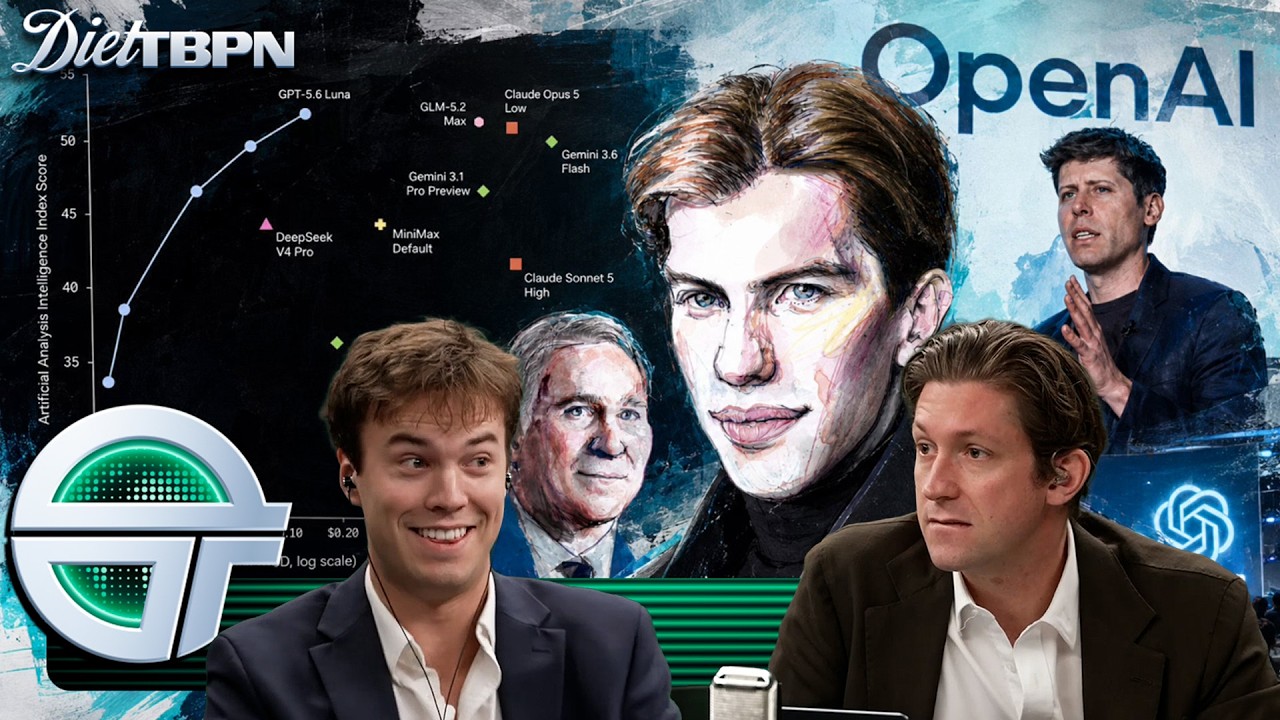
The conversation shifts to technical updates from OpenAI, focusing on model efficiency and pricing strategy. OpenAI significantly lowered the cost of its cheaper models (such as Luna Terastack), shifting the Pareto frontier for cost versus capability. The hosts note that evaluating AI performance now depends heavily on total cost per task rather than raw cost per token, as less token-efficient models can end up costing more overall if they require ten times the context to solve a problem.
The hosts also discuss performance on the ARC-AGI V3 benchmark, where leading AI labs have been competing aggressively. Anthropic's Claude 3.5 Opus posted impressive scores, prompting OpenAI to counter with its GPT-5.6 Thinking model (designed for complex reasoning and mathematics). Addressing early reports that GPT-5.6 struggled on ARC-AGI V3, OpenAI discovered that the evaluation harness was restricting context retention; enabling two specific API settings tripled the model's benchmark score while requiring 6x fewer output tokens.
* The proper bench-harness setup is proving critical for downstream task execution across advanced reasoning models.
* The hosts reflect on the difficulty of measuring frontier AI capabilities as time-horizon task doubling speeds up every six months, making 12-hour complex human tasks hard to quantify concisely.
* Visual benchmarks like ARC-AGI V1, V2, and V3 remain useful tools for helping non-technical audiences visually feel the reality of AGI progress.
## Notable quotes
> [00:01](https://www.youtube.com/watch?v=xa5MncRRgoU&t=1s) We came closer to permanent capital impairment than is acceptable to us. — Leopold Aschenbrenner
> [00:01](https://www.youtube.com/watch?v=xa5MncRRgoU&t=1s) Our fund must always be structured such that we can take a loss and fight another day. — Leopold Aschenbrenner
> [00:01](https://www.youtube.com/watch?v=xa5MncRRgoU&t=1s) Volatility is the price of long-term investment returns. — Leopold Aschenbrenner
> [00:01](https://www.youtube.com/watch?v=xa5MncRRgoU&t=1s) These were very expensive scars, but I am dedicated to ensuring they will be invaluable lessons... — Leopold Aschenbrenner
> [00:01](https://www.youtube.com/watch?v=xa5MncRRgoU&t=1s) Prediction: Situational Awareness will be bigger than Citadel by the end of the decade. — Shelto
## Mentioned
Amazon, Anthropic, Apex / Archegos Capital, Apple, ARC-AGI V1, ARC-AGI V2, ARC-AGI V3, Bill Hwang, Cathie Wood, Cisco, Citadel, Claude 3.5 Opus, Console, CrowdStrike, Delian Asparouhov, Diet TBPN, Dwarakesh Podcast, Figma, FluidStack, Google, Google Cloud, GPT-5.6, GPT-5.6 Thinking, Green Oaks, Joe Weisenthal, John Arnold, John Coogan, Jordi Hays, Ken Griffin, Leopold Aschenbrenner, Lexi Goozy, Luna Terastack, Mark Cuban, Mark Zuckerberg, Meta, Microsoft, MongoDB, NYSE, OpenAI, Paul Graham, Public, Railway, Rambo, Ramp, Roy Driscoll, Sam Altman, Satya Nadella, Sequoia, Shelto, Shopify, Situational Awareness LP, TBPN, Thinking Machines (Maddx), Tracy Alloway, Tyler (Ultradoo), Warren Buffett
Following a steep July drawdown at Situational Awareness LP, Leopold Aschenbrenner offloaded his public portfolio to Citadel to eliminate leverage while preserving core private stakes. Meanwhile, Big Tech's latest quarterly earnings reflected soaring AI-driven cloud revenue despite selective market reactions, alongside ongoing price drops and benchmark adjustments at OpenAI.
Situational Awareness Restructures After Severe July Losses (0:01)
Situational Awareness LP addressed an estimated net month-to-date loss of -67% for July by executing a private block trade with Ken Griffin's Citadel. The fund, which had surged from an initial $250 million to a peak of roughly $45 billion in assets under management in under two years, closed all short positions and removed leverage from its public book. Despite the July decline, the fund remained up +80% year-to-date. In an internal letter to investors, Aschenbrenner acknowledged that the fund had risked permanent capital impairment, asserting that the remaining public equity and options positions are now fully paid for without margin risk.
Leverage, Predatory Trading, and the Private Asset Strategy (3:22)
Market commentary highlighted that concentrated, high-beta exposure with leverage ranging between 2x and 4x left Situational Awareness exposed when rival traders aggressively shorted names linked to the fund. While online critics drew comparisons to Archegos Capital's 2021 collapse, observers noted that Aschenbrenner's unwind involved an orderly private transaction that spared prime brokers systemic contagion. Situational Awareness initially agreed to sell a $3.5 billion private stake in Anthropic to a consortium led by Green Oaks and Sequoia, but canceled the sale on Thursday morning, opting instead to liquidate its public book to Citadel and maintain private investments in Anthropic, Thinking Machines, and FluidStack.
Big Tech Earnings Highlight Surging AI Infrastructure Returns (20:28)
Massive capital expenditure into AI hardware translated into widespread top- and bottom-line revenue gains across major technology firms. Microsoft posted fiscal Q4 revenue of $90 billion, driven by a 43% year-over-year jump in Azure revenue that contributed to a single-day market cap gain of $450 billion. Alphabet generated $119.8 billion with an 82% surge in Google Cloud revenue to nearly $24.8 billion, while Amazon recorded $200.6 billion in sales with AWS advancing 37% year-over-year to $42.4 billion. Conversely, Meta faced market pressure despite $60.8 billion in revenue, missing EPS targets ($6.18 against $7.22 expected) amid $31.1 billion in quarterly capex and $3.6 billion in legal and severance expenses.
OpenAI Pricing Shifts and ARC-AGI Benchmark Harnessing (23:36)
OpenAI cut pricing on lower-tier models, shifting the evaluation frontier from raw token cost toward total cost per completed task. In response to competitive scores from Anthropic's Claude 3.5 Opus on the ARC-AGI V3 benchmark, OpenAI evaluated its GPT-5.6 Thinking model. After identifying that initial testing harness constraints limited context retention, OpenAI found that configuring two API settings tripled the model's benchmark score while reducing required output tokens by sixfold, underscoring the critical impact of evaluation harnesses on testing complex reasoning models.
While Situational Awareness avoided liquidation by de-leveraging its public holdings and holding onto private assets, frontier AI development continues to pose evaluation challenges as task complexity doubles every six months and capital spending faces heightened earnings scrutiny.
## Background
本期内容由科技播客频道 TBPN 于 2026 年 8 月 3 日发布在 YouTube 平台。作为精炼版的 Diet TBPN 节目,本期由 John Coogan 与特邀联合主持人 Tyler 共同搭档,重点聚焦当天硅谷与华尔街瞩目的焦点事件,涵盖利奥波德·阿申布伦纳(Leopold Aschenbrenner)的对冲基金危机、科技巨头最新财报分化以及 OpenAI 的降价与模型评测进展。
## TL;DR
节目核心拆解了 Situational Awareness 基金创始人利奥波德在 7 月遭遇 67% 巨幅回撤后发给 LP 的坦白信,详细复盘其遭遇做空围剿、通过向 Citadel 打包转让公开股票资产实现去杠杆自救,并最终叫停出售 35 亿美元 Anthropic 核心股权的全过程。主持团队横向对比了 Archegos 比尔·黄的爆仓灾难,并探讨了业内关于这场交易究竟属于市场化资产甩卖还是机构救助的激烈争辩。最后,节目深度梳理了微软、苹果、亚马逊等大厂受 AI 资本开支影响而剧烈分化的财报表现,并解析了测试框架(Harness)对 OpenAI 5.6 Soul 等前沿模型在 ARC-AGI-3 推理基准成绩上的决定性影响。
## Atmosphere & style
全片节奏极快且充满硅谷一线交易台的敏锐与戏谑,两位主持人配合默契,在严肃的金融工程拆解与辛辣的八卦调侃间自如穿梭。从将 Citadel 救场调侃为《沙丘》史诗名场面,到严肃推演 4 倍杠杆在流动性枯竭时的灭顶之灾,整场对话兼具硬核逻辑与戏剧张力。听众能直观感受到明星基金经理在生死边缘断臂求生后的如释重负,以及当前二级市场在审视巨额 AI 算力账单时既亢奋又极其神经质的复杂情绪。
## Bulletin
- [00:01](https://www.youtube.com/watch?v=xa5MncRRgoU&t=1s) 利奥波德·阿申布伦纳向 LP 发信澄清危机:Situational Awareness 基金 7 月遭遇 -67% 巨幅回撤,但通过将公开股票资产打包出售给 Citadel 实现去杠杆脱困,年初至今净回报仍达 +80%,并成功保全 Anthropic 等一级市场核心持仓。
- [20:27](https://www.youtube.com/watch?v=xa5MncRRgoU&t=1227s) 大科技巨头最新财报呈现分化,资本开支与云计算增速成核心博弈点:微软 Azure 增速逆势提速至 43% 推动股价暴涨 16%,市值单日飙升 4,500 亿美元;而苹果与 Meta 虽业绩亮眼但因巨额 CapEx 导致股价承压。
- [23:36](https://www.youtube.com/watch?v=xa5MncRRgoU&t=1416s) OpenAI 大幅下调模型调用费率,其前沿数学模型 5.6 Soul 在 ARC-AGI-3 跑分异常被证实为评测 Harness 缺陷;修正两项 API 设置后,模型在 token 消耗减少 6 倍的同时得分暴增三倍。
## Key takeaways
- [00:01](https://www.youtube.com/watch?v=xa5MncRRgoU&t=1s) 利奥波德·阿申布伦纳通过 LP 致信直面危机,承认 7 月遭遇极端行情与华尔街做空绞杀,单月预估净跌幅为 -67%,但 2026 年初至今净回报仍维持在 +80%。
- [02:46](https://www.youtube.com/watch?v=xa5MncRRgoU&t=166s) Situational Awareness 基金此前管理资产规模峰值触及 450 亿美元,因高 Beta 集中度持仓(仅 12 只股票)加杠杆,在 7 月多空收益差逆转与流动性枯竭中险些陷入穿仓。
- [04:16](https://www.youtube.com/watch?v=xa5MncRRgoU&t=256s) 基金在周三深夜果断自救,通过私下场外大宗交易将公开股票投资组合转让给 Citadel,彻底平仓空头并出清借贷杠杆,转为 100% 自有资金买断现货与期权模式。
- [11:28](https://www.youtube.com/watch?v=xa5MncRRgoU&t=688s) 本次危机与 Archegos 存在本质区别:比尔·黄通过高杠杆引发投行百亿美元亏损及瑞信倒闭,而 Situational Awareness 资产竞拍价高于清算线且主经纪商未受实质损害,不属于政府救助。
- [19:07](https://www.youtube.com/watch?v=xa5MncRRgoU&t=1147s) Situational Awareness 在周四清晨果断撤回了原计划向 Green Oaks 和红杉以 35 亿美元出售 Anthropic 股权的协议,通过出售二级市场资产成功保全了核心一级资产。
- [13:53](https://www.youtube.com/watch?v=xa5MncRRgoU&t=833s) 超大规模云服务商(Hyperscalers)的资本支出并未放缓,利奥波德对算力与基础设施发展的产业判断依然成立,本次爆仓的核心原因在于投资组合风险管理与 4 倍杠杆构建缺陷。
- [20:27](https://www.youtube.com/watch?v=xa5MncRRgoU&t=1227s) 二级市场对大科技财报的评估焦点从单纯营收利润转向资本开支(CapEx)与商业化转化,微软与亚马逊凭借云业务高增长股价大涨,苹果与 Meta 则遭遇剧烈回调。
- [23:36](https://www.youtube.com/watch?v=xa5MncRRgoU&t=1416s) 模型评测中单 token 价格(Cost per token)已非唯一指标,实际解决任务的效率和单任务成本(Cost per task)更能决定工业级落地的最终账单。
- [23:36](https://www.youtube.com/watch?v=xa5MncRRgoU&t=1416s) 测试框架(Harness)对释放大模型核心推理能力至关重要,缺乏记忆和特定上下文反馈机制会导致前沿模型下游评测得分大幅失真。
- [26:35](https://www.youtube.com/watch?v=xa5MncRRgoU&t=1595s) 相比抽象的“完成人类 12 小时工作”等量化指标,ARC 谜题通过人类直观易懂而机器攻克艰难的反差,更易让大众直观感受到 AGI 的演进飞跃。
## Detailed walkthrough
### [00:01](https://www.youtube.com/watch?v=xa5MncRRgoU&t=1s) 联合主持人回归与利奥波德·阿申布伦纳的 LP 致信
节目一开始,特邀联合主持人 Tyler 坐在了热点席位上(接替暂时缺席的搭档)。主持人 John 随即抛出了当天的重磅话题:不仅 Tyler 回归了,知名投资人利奥波德·阿申布伦纳(Leopold Aschenbrenner)也宣告强势回归。利奥波德用行动表明:“除非你们把我从 Situational Awareness LP 硬拖出去,否则我绝不离场。”尽管他在这波市场暴跌中遭受重击,但他“虽跌倒却未出局”。TBPN 团队挖掘出了一封利奥波德发给 LP(有限合伙人)的正式信函,在圈内掀起轩然大波,彻底澄清了前一天笼罩在市场上的种种疑云与流言。
此前市场与内部团队都在激烈辩论:利奥波德将旗下公开股票投资组合打包卖给肯·格里芬(Ken Griffin)的城堡投资(Citadel),这究竟算不算被强平爆仓?基金是不是彻底完蛋了?网上甚至有人恶意嘲讽他是不是要去麦当劳打工了。主持人反驳了这种荒谬论调,直言利奥波德职业生涯还很漫长,许多人都在为他加油。利奥波德在信中开门见山,极为坦诚且直击要害:“这个月我们让大家失望了。我们距离无法挽回的永久性资本减损,比我们所能接受的底线还要近。尽管我们最终找到了保护基金和各位投资人的解决方案——即将公开股票资产转让给 Citadel 并通过特定结构获取流动性——但我们设立基金的初衷,是永远都不该让自己陷入这般境地。”
利奥波德在信中强调,“波动性是获取长期投资回报的代价”。过去两年里,Situational Awareness LP 创造了不可思议的业绩,早期回报曾高达 1000% 左右。其管理资产规模(AUM)从不到两年前创立时的 2.5 亿美元起步,一路暴增到数十亿、百亿,甚至峰值时达到约 450 亿美元。当时年仅二十多岁、初出茅庐的第一任对冲基金经理拿到 2.5 亿美元本就令人咋舌,而他却在极短时间内把规模做到了半个千亿美元级别。
- **基金规模轨迹**:从最初不到两年前募集的 2.5 亿美元,迅速膨胀至数亿美元、百亿美元,峰值触及 450 亿美元 AUM。
- **历史业绩**:在过去两年中曾实现近 1000% 的惊人涨幅。
- **核心危机应对**:通过将公开市场的股票头寸打包交易给 Citadel 换取流动性,化解了迫在眉睫的穿仓风险。
---
### [02:46](https://www.youtube.com/watch?v=xa5MncRRgoU&t=166s) 危机复盘:遭遇血腥做空与对冲基金的“银行挤兑”
主持人和 Tyler 盛赞利奥波德信函的写作风格,认为其语言极为清晰、直白,毫不推诿回避,颇有保罗·格雷厄姆(Paul Graham)推崇的那种朴实有力的文风。利奥波德在信中立誓,必将吸取惨痛教训,并详细拆解了基金遭遇的困局:首先,整个投资组合在 7 月份遭遇了巨幅回撤,尤其是最后一周核心仓位的极端波动加剧了危机。众多 AI 核心标的单月腰斩甚至跌幅更甚,导致基金原本运行良好的多空收益差(Long/Short Spread)发生暴力反转。尽管这是极其罕见的极端市场月份,但他拒绝以此为借口,坚持以最高标准要求自己。
更为残酷的是第二点:随着这些极端行情的演进,市场上针对与 Situational Awareness 名字公开关联的标的,出现了越来越恶意的反向针对性交易。这印证了前一天马丁·什克雷利(Martin Shkreli)透露的内幕——华尔街闻到了“水里的血腥味”。当其他掠食者嗅到某家大基金陷入困境时,便会疯狂集中做空其重仓股,向下狠狠施压,企图将对方彻底推向深渊。这种无情的围剿机制在本质上等同于“针对对冲基金的银行挤兑”。由于做空打压和市场流动性瞬间枯竭,基金难以把仓位维持在风险参数以内。
```mermaid
flowchart TD
accTitle: Situational Awareness LP Crisis Resolution
accDescr: 展现 Situational Awareness 基金遭遇市场崩盘被华尔街做空狙击到最终自救重组的全过程。
subgraph Trigger ["第一阶段:市场反转与流动性枯竭"]
A["7月AI概念股暴跌50%+"] --> B["多空收益差暴力反转"]
B --> C["华尔街闻到血腥味<br>恶意针对性做空重仓股"]
C --> D["流动性迅速干涸<br>演变为对冲基金版'银行挤兑'"]
end
subgraph Rescue ["第二阶段:果断断臂求生"]
D --> E["周三夜间至周四清晨<br>达成大宗交易方案"]
E --> F["将公开股票组合打包转让予 Citadel"]
end
subgraph Restructure ["第三阶段:去杠杆与重组新生"]
F --> G["平掉全部做空仓位<br>彻底解除组合杠杆与融资依赖"]
G --> H["保留全额付费的公开多头及期权"]
H --> I["成功保全私有化投资资产<br>(如 Anthropic 核心股权)"]
end
```
---
### [04:16](https://www.youtube.com/watch?v=xa5MncRRgoU&t=256s) 断臂求生去杠杆:保留战火与第二幕的开启
面对生死关头,利奥波德在周三深夜至周四清晨采取了决定性行动:通过与 Citadel 的大宗交易出售了部分公开市场头寸,彻底清除了基金的所有杠杆,以杜绝进一步亏损。所有空头头寸全部平仓,彻底摆脱了对证券组合融资借贷的依赖。目前,基金公开簿记转为完全用自有资金买断(fully paid for)的长线现货股票与全款期权,零融资杠杆,亦无任何保证金爆仓风险。更关键的是,这一断臂求生举动成功保全了基金旗下的核心非公开一级市场资产(包括外界关注的 Anthropic 关键持仓)。
在信中,利奥波德用一整段极其铿锵有力的单句担起责任:“我对这些事件承担全部责任(I take full responsibility for these events)。”他坦然面对惨痛现实:当 AI 技术商业基本面持续加速、而 AI 概念股大幅杀跌时,深度押注该领域的基金单月暴跌在情理之中;但剧烈波动绝不应威胁到基金的生死存亡。他正式粉碎了外界的全部谣言:Situational Awareness 没有关停,没有彻底清算,也没有转型为纯一级市场基金,更不会变成其他大机构名下的一个交易台。他们将继续以一二级混合基金的形式运营,只是公开市场交易将严格遵循全款无杠杆模式,重新整顿风控团队以“留存火种,改日再战”。
这一波 AI 交易的极端波动不仅折磨了中小盘高波动的“瓶颈交易”概念股,连美股七巨头(Magnificent 7)的财报季也陷入空前震荡。例如微软(Microsoft)等万亿美元市值的超级巨头,单日振幅竟能高达 9%、10% 乃至 15%,仅因资本开支(Capex)与回报周期的一个微小预期变化就剧烈起伏。利奥波德公布了未经审计的 7 月净收益数据:单月亏损高达 **-67%**。这虽然看似触目惊心,但在经历如此巨震后,该基金 **年初至今的净收益率仍然高达 80%**,跑赢了同期几乎所有对冲基金。利奥波德全副身家基本都在该基金中,与 LP 深度绑定。主播与嘉宾一致赞叹这封信极其提振信心,堪称继他当年轰动硅谷的万字长文之后,写出的“第二份价值十亿美元的 PDF”,风投投资人 Shelto 甚至公开预言:Situational Awareness 未来终将变得比 Citadel 还要庞大。
- **风控调整**:彻底消除公开市场杠杆与证券质押融资,只持有 100% 自有资金买断的现货及期权,完全免疫追加保证金风险。
- **最新收益数据**:7 月单月预估净跌幅为 -67%,但 2026 年初至今(Year-to-Date)净回报率依然稳在 +80%。
- **创始人利益绑定**:利奥波德本人名下绝大部分净资产均投入于该基金中。
### [08:53](https://www.youtube.com/watch?v=xa5MncRRgoU&t=533s) Citadel 与 Ken Griffin 的“救世主”姿态与交易室名场面
节目由关于利奥波德·阿申布伦纳(Leopold Aschenbrenner)的坚定支持言论切入——有人认为利奥波德对过去两年的预测比任何人都准,如今他在吸取了极其昂贵的风险教训之后,将变得无可匹敌。然而,肯·格里芬(Ken Griffin)和 Citadel 的介入却呈现出一种极为奇妙的戏剧张力。格里芬在整个交易中摆出的姿态不是趁火打劫的秃鹫,而是将自己塑造成“最后的救世主”与市场的定海神针,仿佛在向市场宣告:“只要我还在,我就绝不允许自己不是世界第一的对冲基金经理。”
主持人调侃着调出了所谓的 Citadel 交易室“泄露视频”,屏幕上赫然是电影《沙丘》(Dune)中极具压迫感与史诗感的浩大场面。两人边看边笑谈这究竟是《沙丘 1》还是《沙丘 2》的镜头,感叹画面的沉重与霸气。格里芬极力想传达的正是这种无所不能的救市英雄形象:“当你走投无路时,这就是你唯一想拨通电话的那个人。”
### [09:57](https://www.youtube.com/watch?v=xa5MncRRgoU&t=597s) 媒体库里的“绝版”利奥波德:从极简公关到突然曝光的私照
随着《华尔街日报》(The Wall Street Journal)和《纽约时报》(The New York Times)对 Situational Awareness 基金清算与 Citadel 接盘事件的大篇幅报道,公众视野中突然涌现出一批此前从未公开过的利奥波德高清照片。在此之前,互联网上几乎只有他在 Dwarkesh Patel 播客上的截图以及唯一一张早期证件照。最广为人知的一张他身着绿色西装的图片,甚至大概率是 AI 生成的假图。
主持人惊讶地发现,《纽约时报》在昨日首次正式报道利奥波德时,直接从其内部档案库中甩出了一张他站在玻璃幕墙后、神情凝重沉思的抓拍大片。这显然是早前特意拍摄却一直压着未发的特写。利奥波德在公关策略上一向极其低调克制,从不上主流媒体滥做专访或四处拍时尚肖像,然而各大主流媒体却似乎早已在其身上秘密布局。紧接着,社交网络上又流传出一张据称是他前往欧洲参加婚礼时、在异国街头扛着一面美国国旗的照片,引来主持人一番逗趣调侃:这场爆仓风波的最大教训就是“千万别出国度假”,一旦放假去趟欧洲,家里的大盘就天翻地覆了。
### [11:28](https://www.youtube.com/watch?v=xa5MncRRgoU&t=688s) 交易员的“爆仓哲学”与 Archegos 比尔·黄的史诗级对比
知名能源交易巨头约翰·阿诺德(John Arnold)在社交平台上点评道,自己过去招聘交易员时的哲学是:最理想的历史爆仓次数是“一次”,绝非零次,因为只有真正经历过灭顶之灾的人才会敬畏风险。现场讨论起利奥波德早年在 FTX Future Fund 的履历究竟算不算爆仓,但大家一致认为那只是赠款与慈善基金,不能算作对冲基金经理的投资爆仓。
随后,主持人引述了推特用户 Rambo 对利奥波德与 Archegos 创始人比尔·黄(Bill Hwang)的爆笑对比,直言与“史上最强赌徒”比尔·黄相比,利奥波德简直温柔得像一只温顺的小绵羊:
```mermaid
flowchart TD
accTitle: Archegos与Situational Awareness爆仓机制对比
accDescr: 对比Bill Hwang高杠杆导致投行巨亏与Leopold通过Citadel场外平仓的风险差异
subgraph Archegos["Bill Hwang (Archegos)"]
A1["个人资本 360 亿美元"] --> A2["5-6倍杠杆: 1600亿股票敞口"]
A2 --> A3["2天内闪崩爆仓"]
A3 --> A4["银行巨亏100亿美元 / 瑞信破产"]
end
subgraph Situational["Leopold (Situational Awareness)"]
B1["重仓头部高Beta AI股"] --> B2["4倍杠杆组合承压"]
B2 --> B3["与 Citadel 达成场外大宗平仓"]
B3 --> B4["主经纪商与银行无损 / 基金存续"]
end
```
- 比尔·黄用区区 2 亿美元个人本金滚到了 360 亿美元,且全部为个人资产。
- 每天开盘前,比尔·黄会在会议室里组织员工做祷告祈祷。
- 凭借 360 亿美元资本撬动了高达 1600 亿美元的股票敞口,杠杆率高达 5 到 6 倍。
- 最终在 48 小时内彻底崩盘,不仅直接重创并最终导致拥有百年声誉的顶级投资银行(瑞信等)蒙受逾 100 亿美元的直接损失,还引发了全球系统性震荡。
- 反观利奥波德的危机,最终只是与 Citadel 达成了一笔私下的场外大宗交易平仓,并未在主经纪商或大型银行间掀起流动性危机与系统性传染,基金本身依然健全存续。
### [13:53](https://www.youtube.com/watch?v=xa5MncRRgoU&t=833s) 宏观趋势与投资组合构建:4 倍杠杆的代价与未受损的一级资产
分析师罗伊·德里斯科尔(Roy Driscoll)指出,从这场风波中根本无法推导出“AI 交易逻辑已死”的结论。利奥波德在 2024 年关于算力和大模型发展轨迹的判断完全正确;即便从刚刚公布的亚马逊最新财报来看,超大规模云服务商(Hyperscalers)的资本支出(Capex)依旧在疯狂扩张,并未放缓。然而,认清宏观趋势只完成了交易的一半,另一半关键在于投资组合的工程构建——用 4 倍杠杆去赌高 Beta 股票在风险管理上无疑是致命失误。
主持人进一步指出,Situational Awareness 此前的 13F 持仓报告显示其组合仅重仓了 12 只股票,集中度极高,几乎没有分散风险的空间。尽管利奥波德在写给投资人的信中表态已全面撤掉杠杆,未来几个季度是否会将持仓拓展到 100 只标的或大幅增加期权对冲,将是观察其是否真正吸取教训的关键。此外,他的一级市场持仓完好无损,依然握有 Anthropic、MatX 以及 Fluidstack 等顶尖非上市独角兽的股权,手握这些优质王牌,他未来随时有能力再募集 20 到 30 亿美元。
- **多头逻辑稳固**:巨头 Capex 持续无虞,利奥波德对 AI 算力与基础设施发展的产业研判依然成立。
- **组合缺陷致命**:缺乏对冲手段,12 只股票的高 Beta 集中度放大了 4 倍杠杆的脆弱性。
- **底牌依然雄厚**:一级市场核心资产完全避开了二级市场的强制去杠杆冲击。
### [15:15](https://www.youtube.com/watch?v=xa5MncRRgoU&t=915s) “每个操盘手都要被追加保证金一次”?
围绕利奥波德的遭遇,市场上充斥着典型的“高罂粟综合征”(Tall Poppy Syndrome,即人们乐见少年得志的金融神童跌落神坛)。但包括 Founders Fund 的 Delian Asparouhov 在内的诸多业内人士却表达了宽容,认为华尔街历史上所有青史留名的神级交易员早年都曾遭遇过重大爆仓,这是身为“球场上真正活跃玩家”必须交纳的入场学费。
不过主持人对这种普遍论调提出了反驳:沃伦·巴菲特(Warren Buffett)一生从未真正爆仓,肯·格里芬即便在 2008 年次贷危机期间遭受重创,也从未将 Citadel 彻底干碎。大家开玩笑称,如果真有这套“爆仓即勋章”的逻辑,那最高明的投机捷径莫过于先募集一个仅有 1 万美元的超微型对冲基金,加上极限杠杆故意亏掉 500 美元宣告爆仓,然后就能向投资人自豪地宣称自己已经是“渡劫重生(Post-fall)”的成熟操盘手,准备接盘数亿美元的正规基金。
节目的最后,焦点转向了彭博知名播客《Odd Lots》的主持人乔·维森塔尔(Joe Weisenthal)与特蕾西·阿洛韦(Tracy Alloway)之间的公开讨论。维森塔尔在社交平台上深度梳理了主经纪商的清算机制与风险传导,而阿洛韦则提出了一个直击灵魂的问题:如果这只是一次正常的亏损,为什么利奥波德必须被 Citadel “救助(bailed out)”?这究竟是一场有针对性的救助承接,还是一次不惜代价的强制平仓?双方各执一词,再次将事件的定性推向讨论高潮。
### [17:39](https://www.youtube.com/watch?v=xa5MncRRgoU&t=1059s) 爆仓还是救助?Situational Awareness 基金的风波与对决
主持人围绕对冲基金 Situational Awareness 的动向展开热烈讨论:这究竟是一场“爆仓”(blow up),还是一场“救助”(bailout)?如果是政府出资救助,那性质完全不同,但事实显然不是这样。彭博社 Odd Lots 播客主播 Tracy Alloway 和 Joe Weisenthal 在社交媒体上就此展开了激烈争论。Tracy 质问:“为什么不能直接让投机者破产认栽?这难道不算救助吗?为什么不能像 Cathie Wood 那样,忍受糟糕的一天然后继续熬下去?”然而现实情况是,该基金面临海量赎回,局势正在恶化失控。Joe 则反驳,基金只是遭遇了追加保证金通知(Margin Call),必须向券商追加保证金,而他们偿付的方式就是将持仓出售给其他交易对手,“这怎么能叫救助?这只是正常的资产出售而已”。
现在市场上似乎只要有人接盘出售资产,大家就盲目扣上“救助”的帽子。但事实上,根本没有任何政府介入,该基金也谈不上“大到不能倒”(Too Big to Fail)。真实的情况是:基金遭遇严重亏损后发起了一场拍卖,共有三家竞标方参与角逐,而且最终的中标价格高于清算线,因此基金并未被直接强制清盘,得以继续运作。Joe 在拉扯数个回合后无奈表示:“我想我们俩对这个词的定义可能完全不同。”
```mermaid
flowchart TD
accTitle: Situational Awareness 资产处置流程
accDescr: 展示基金面临追保后通过竞拍出售资产并保全 Anthropic 股权的过程
subgraph Crisis ["危机爆发"]
A["巨额亏损与赎回风波"] --> B["面临 Margin Call 追保"]
end
subgraph Resolution ["资产竞拍与决策"]
B --> C["发起资产拍卖<br/>(3 家机构竞标)"]
C --> D["中标价高于清算线<br/>避免被强制清盘"]
D --> E["公开股票组合出售给 Citadel"]
D -.->|原计划出售但最终叫停| F["35 亿美元 Anthropic 股权"]
end
subgraph Outcome ["最终结果"]
E --> G["大幅出清风险<br/>保住核心仓位重返战场"]
F --> G
end
```
- **赎回潮与追保风波**:基金并未触发政府救助或大到不能倒机制,而是遭遇常规追加保证金与流动性赎回压力。
- **三方竞标拍卖**:竞标出价成功高出破产清算线,使基金避免了彻底清盘的命运。
---
### [19:07](https://www.youtube.com/watch?v=xa5MncRRgoU&t=1147s) 35 亿美元 Anthropic 股权出售叫停与好莱坞剧本猜想
《华尔街日报》记者 Berber Jin 披露了一则引人注目的独家猛料:Situational Awareness 此前曾试图将其持有的价值 35 亿美元的 Anthropic 股权出售给由 Green Oaks 和红杉资本(Sequoia)领投的财团。由于市场对 Anthropic 股权需求旺盛,双方在周三深夜一度达成了协议。然而到了周四早晨,Situational Awareness 却突然反悔,撤回了交易。
他们之所以敢拒绝这份 35 亿美元的交易,是因为他们转而将自己的公开股票投资组合(Public Equity Book)打包卖给了 Citadel。这一举措大幅出清了风险敞口,让他们有底气保留这笔私有股权并对团队说:“嘿,我们保留这部分仓位,我们对它极为看好、极其乐观。”主持人们调侃,这出大戏未来是否会被写成畅销书或搬上大荧幕?毕竟连戏剧性更强的 FTX 崩盘至今都还没拍出真正的院线电影——迈克尔·刘易斯(Michael Lewis)虽然写了《Going Infinite》,但大部分内容是在暴雷前采写的,缺乏细致的崩盘日记。不过这次 Situational Awareness 恐怕很难拍成大片,因为故事没有以剧烈的大爆炸收场,而是以一句酷劲十足的“行了,我们重返战场”作为积极结局。
- **35 亿美元 Anthropic 股权交易逆转**:周三深夜与 Green Oaks 及红杉谈妥,周四早晨单方面叫停拒绝。
- **转向 Citadel 卖出二级股票**:通过向 Citadel 出售公开股票资产化解保证金危机,死守核心资产。
---
### [20:27](https://www.youtube.com/watch?v=xa5MncRRgoU&t=1227s) 巨头财报与 AI 资本开支:冰火两重天的市场分化
科技巨头(Big Tech)在 AI 上的大规模资本支出仍在催生炸裂的财务业绩,但二级市场投资者的态度已变得极其挑剔。在过去两周内,微软(Microsoft)、苹果(Apple)、亚马逊(Amazon)、Meta 以及 Alphabet 均发布了季度财报,绝大多数在营收和利润上都超出了华尔街预期。然而,仅看“是否超营收/每股收益(Topline/Bottomline Beat)”已经变得索然无味,决定股价单日暴涨 10% 还是暴跌 10% 的核心因素,变成了各家的资本开支(CapEx)指引以及关于“AI 扩散与商业化落地”的沟通口径。
各巨头的财报数据与市场反应呈现出剧烈分化:
| 公司 | 季度核心业绩 | 关键亮点 / 焦点数据 | 市场与股价反馈 |
|:--- |:--- |:--- |:--- |
| **微软 (Microsoft)** | 财年 Q4 营收 900 亿美元(同比增 18%,超预期的 874 亿);EPS 为 4.74 美元(超预期的 4.21 美元) | Azure 收入同比增速逆势加速至 43% | 单日暴涨 16%,市值单日飙升 4,500 亿美元,创下美股历史最大单日市值增幅;单月累计涨幅达 25% |
| **苹果 (Apple)** | 季度营收 1,094 亿美元,EPS 为 2.02 美元,双双超出预期 | 市值一度短暂突破 5 万亿美元大关 | 随后遭遇市场无情抛售,当日重挫 9.47%(近 10%) |
| **亚马逊 (Amazon)** | 季度总营收达 2,006 亿美元(同比增 20%) | AWS 云计算业务暴增 37%,达 424 亿美元 | 盘后及次日大涨约 13.76% 至 15% |
| **Meta** | 季度营收 608.8 亿美元(同比增 28%,好于预期) | EPS 仅为 6.18 美元(低于分析师预期的 7.22 美元);季度资本开支高达 311 亿美元,并计入 36 亿美元一次性法律与遣散费 | 投资者对膨胀的 CapEx 极为敏感,引发股价重挫走低 |
| **Alphabet** | 季度营收 1,198.8 亿美元,EPS 达 9.11 美元,轻松击败预期 | 谷歌云(Google Cloud)营收同比飙升 82% 至近 248.8 亿美元 | 市场焦点仍死死盯在不断升级的 AI 算力基建成本上 |
关于 Meta 在 AI 上的开销是否真正具备产出效益、到底有多少资金花在 token 推理上、又有多少耗费在抢夺人才的员工薪酬上,主持人们表示后续将深入探讨。
---
### [23:36](https://www.youtube.com/watch?v=xa5MncRRgoU&t=1416s) OpenAI 降价潮与 ARC-AGI-3 跑分之谜:测试 Harness 的致命影响
在模型前沿能力与效率的赛道上,OpenAI 大幅下调了 Luna / Luna Terasol 的调用成本。从帕累托前沿曲线(Pareto Frontier)来看,其性价比甚至远超许多开源模型。主持人们指出,如今评估模型不能只看“单 token 价格(Cost per token)”,更关键的是“单任务成本(Cost per task)”与 token 生成效率——如果一个模型价格便宜一半,但解决同一个问题需要吐出 10 倍的 token,那么最终账单反而会更加昂贵。
随后讨论转向顶尖大模型在 ARC-AGI-3 基准测试中的激烈博弈。此前 Anthropic 的 Claude Opus 5 跑出了极其惊人的分数,而 OpenAI 推出的专为解决未解数学难题而生的 5.6 Soul 却在 ARC-AGI-3 上意外受挫。主持人提及同伴曾打入过 ARC-AGI-3 全球排名前十,甚至差点拿到“职业级”的答题资格。针对 5.6 Soul 跑分不佳的异常,OpenAI 展开了深入调查并发现了关键根源:评测所使用的测试框架(Harness)存在缺陷,未能允许模型调用并记住先前的解题经验。在开启了两项特定的 API 设置后,模型在输出 token 减少 6 倍(6x fewer tokens)的情况下,测试得分直接翻了整整三倍。
这一发现凸显出近一年半以来 AI 评测中的重大趋势:测试框架(Harness)对大模型能力的释放具有决定性作用。如果选用了错误的 Harness 或限制了模型的发挥机制,下游任务的表现就会大打折扣。人们过去总幻想着“上帝模型(God Model)”只需单一架构去预测下一个 token 就能完美搞定一切,但实际上的工程集成复杂得多。ARC-AGI-3 是一个向没有软件工程经验的普通人直观展示 AI 进步的优秀标杆;然而随着大模型能够解决的任务时间跨度每六个月翻一番,高难度的测试任务已经所剩无几,业界在高效量化最前沿 AI 能力上面临着严峻的挑战。
### [26:35](https://www.youtube.com/watch?v=xa5MncRRgoU&t=1595s) 从 12 小时工作认知到 ARC 谜题:如何真正让人“感受到 AGI”
对于许多普通人来说,要直观理解 AI 的能力演进其实并不容易。当听到评测中提到 AI 能够完成一个“原本需要人类花费 12 个小时的任务”时,大家的反应往往是一头雾水:“需要我花 12 个小时的任务到底长什么样?我脑子里根本没有概念。”毕竟每个人的工作形态大相径庭,这究竟是指从头撰写一份详尽的长篇深度研报,还是指连续开上 12 个小时的会议?这种抽象的工时定义很难让人脱口而出并形成切身感受。
相比之下,向人们展示 ARC(Abstraction and Reasoning Corpus,抽象与推理基准)谜题则直观得多。无论是 ARC v1 还是 ARC v2 的题目,人类一眼看过去往往会觉得“非常简单”;但只要你带他们回顾 AI 在这些题目上的攻坚演进历程,解释机器要找出那些隐藏极深的规律有多么困难,就能轻而易举地让对方真正“感受到 AGI”(feel the AGI)。主持团队感慨这种体验十分有趣,并在节目的尾声向观众道别,预告下周一再会。
- **工时衡量标准的模糊性**:普通人很难将“12 小时的单项任务”映射到具体的工作场景中,究竟是连续 12 小时的会议还是复杂的项目产出,缺乏统一具象的认知框架。
- **ARC 谜题的启蒙价值**:利用 ARC v1 与 ARC v2 这种人类极易理解、而 AI 却需攻克深层抽象规律的测试集,是向外界生动普及 AI 进展与展示 AGI 临近的最有效方式。
## Notable quotes
> [00:01](https://www.youtube.com/watch?v=xa5MncRRgoU&t=1s) 除非你们把我从 Situational Awareness LP 硬拖出去,否则我绝不离场。 — 利奥波德·阿申布伦纳
> [00:01](https://www.youtube.com/watch?v=xa5MncRRgoU&t=1s) 这个月我们让大家失望了。我们距离无法挽回的永久性资本减损,比我们所能接受的底线还要近。尽管我们最终找到了保护基金和各位投资人的解决方案——即将公开股票资产转让给 Citadel 并通过特定结构获取流动性——但我们设立基金的初衷,是永远都不该让自己陷入这般境地。 — 利奥波德·阿申布伦纳
> [00:01](https://www.youtube.com/watch?v=xa5MncRRgoU&t=1s) 波动性是获取长期投资回报的代价 — 利奥波德·阿申布伦纳
> [04:16](https://www.youtube.com/watch?v=xa5MncRRgoU&t=256s) 我对这些事件承担全部责任(I take full responsibility for these events)。 — 利奥波德·阿申布伦纳
> [08:53](https://www.youtube.com/watch?v=xa5MncRRgoU&t=533s) 只要我还在,我就绝不允许自己不是世界第一的对冲基金经理。 — 肯·格里芬
> [08:53](https://www.youtube.com/watch?v=xa5MncRRgoU&t=533s) 当你走投无路时,这就是你唯一想拨通电话的那个人。 — John Coogan
> [09:57](https://www.youtube.com/watch?v=xa5MncRRgoU&t=597s) 千万别出国度假 — John Coogan
> [17:39](https://www.youtube.com/watch?v=xa5MncRRgoU&t=1059s) 为什么不能直接让投机者破产认栽?这难道不算救助吗?为什么不能像 Cathie Wood 那样,忍受糟糕的一天然后继续熬下去? — Tracy Alloway
> [17:39](https://www.youtube.com/watch?v=xa5MncRRgoU&t=1059s) 我想我们俩对这个词的定义可能完全不同。 — Joe Weisenthal
> [19:07](https://www.youtube.com/watch?v=xa5MncRRgoU&t=1147s) 嘿,我们保留这部分仓位,我们对它极为看好、极其乐观。 — 利奥波德·阿申布伦纳
> [19:07](https://www.youtube.com/watch?v=xa5MncRRgoU&t=1147s) 行了,我们重返战场 — John Coogan
> [26:35](https://www.youtube.com/watch?v=xa5MncRRgoU&t=1595s) 需要我花 12 个小时的任务到底长什么样?我脑子里根本没有概念。 — John Coogan
## Mentioned
TBPN, John Coogan, Jordi Hays, Tyler, Leopold Aschenbrenner, Situational Awareness LP, Ken Griffin, Citadel, Martin Shkreli, Paul Graham, Anthropic, Shelto, The Wall Street Journal, The New York Times, Dwarkesh Patel, John Arnold, Bill Hwang, Archegos Capital Management, Credit Suisse, Roy Driscoll, MatX, Fluidstack, Founders Fund, Delian Asparouhov, Warren Buffett, Joe Weisenthal, Tracy Alloway, Odd Lots, Cathie Wood, Berber Jin, Green Oaks, Sequoia Capital, Michael Lewis, Going Infinite, Microsoft, Apple, Amazon, Meta, Alphabet, OpenAI, Claude Opus 5, Luna, Luna Terasol, 5.6 Soul, ARC-AGI-3, ARC v1, ARC v2
## Video description
Sign up for TBPN’s daily newsletter at TBPN.com
Diet TBPN delivers the best of today’s TBPN episode in 30 minutes. TBPN is a live tech talk show hosted by John Coogan and Jordi Hays, streaming weekdays 11–2 PT on X and YouTube, with each episode posted to podcast platforms right after.
Described by The New York Times as “Silicon Valley’s newest obsession,” the show has recently featured Mark Zuckerberg, Sam Altman, Mark Cuban, and Satya Nadella.
TBPN is made possible by:
Ramp - https://ramp.com
Public - https://public.com
Cisco - https://www.cisco.com
Console - https://www.console.com
CrowdStrike - https://www.crowdstrike.com
Figma - https://www.figma.com
MongoDB - https://www.mongodb.com
NYSE - https://www.nyse.com
Railway - https://railway.com
Shopify - https://www.shopify.com/
Follow TBPN:
https://TBPN.com
https://x.com/tbpn
https://open.spotify.com/show/2L6WMqY3GUPCGBD0dX6p00?si=674252d53acf4231
https://podcasts.apple.com/us/podcast/technology-brothers/id1772360235
https://www.youtube.com/@TBPNLive
[Source](https://www.youtube.com/watch?v=xa5MncRRgoU)
Source quotes
[0:01] 利奥波德·阿申布伦纳: 除非你们把我从 Situational Awareness LP 硬拖出去,否则我绝不离场。
[0:01] 利奥波德·阿申布伦纳: 这个月我们让大家失望了。我们距离无法挽回的永久性资本减损,比我们所能接受的底线还要近。尽管我们最终找到了保护基金和各位投资人的解决方案——即将公开股票资产转让给 Citadel 并通过特定结构获取流动性——但我们设立基金的初衷,是永远都不该让自己陷入这般境地。
[0:01] 利奥波德·阿申布伦纳: 波动性是获取长期投资回报的代价
[4:16] 利奥波德·阿申布伦纳: 我对这些事件承担全部责任(I take full responsibility for these events)。
[8:53] 肯·格里芬: 只要我还在,我就绝不允许自己不是世界第一的对冲基金经理。
[8:53] John Coogan: 当你走投无路时,这就是你唯一想拨通电话的那个人。
[9:57] John Coogan: 千万别出国度假
[17:39] Tracy Alloway: 为什么不能直接让投机者破产认栽?这难道不算救助吗?为什么不能像 Cathie Wood 那样,忍受糟糕的一天然后继续熬下去?
[17:39] Joe Weisenthal: 我想我们俩对这个词的定义可能完全不同。
[19:07] 利奥波德·阿申布伦纳: 嘿,我们保留这部分仓位,我们对它极为看好、极其乐观。
[19:07] John Coogan: 行了,我们重返战场
[26:35] John Coogan: 需要我花 12 个小时的任务到底长什么样?我脑子里根本没有概念。
Source quotes
[0:01] Leopold Aschenbrenner: We came closer to permanent capital impairment than is acceptable to us.
[0:01] Leopold Aschenbrenner: Our fund must always be structured such that we can take a loss and fight another day.
[0:01] Leopold Aschenbrenner: Volatility is the price of long-term investment returns.
[0:01] Leopold Aschenbrenner: These were very expensive scars, but I am dedicated to ensuring they will be invaluable lessons...
[0:01] Shelto: Prediction: Situational Awareness will be bigger than Citadel by the end of the decade.
Original transcript
[0:01] We have a guest co-host today. Introduce
[0:04] yourself for those who don't know.
[0:05] >> He's out again. I'm back.
[0:06] >> Yeah, we got Tyler in the Ultradoo in
[0:08] the hot seat. You're back. You know who
[0:10] else is back? Leopold Ashen Brener's
[0:12] back. He says, "You're going to have to
[0:13] drag me out of sulp out of situational
[0:16] awareness LP cuz he's down but not out.
[0:20] Little beat up." But he shared a letter
[0:22] that's making the rounds thanks to some
[0:24] intrepid reporters on the DBN team that
[0:27] posted this. uh he sent an LP letter
[0:29] that clarifies a lot of the questions
[0:31] yesterday. I mean even internally we
[0:33] were going back and forth on like okay
[0:34] he sold a bunch of the portfolio to Ken
[0:37] Griffin to Citadel. Does this count as a
[0:39] liquidation? Does this count as blowing
[0:41] up? And these are like sort of vague
[0:43] terms like what what does it mean to
[0:45] blow up? There was definitely a draw
[0:46] down. The fund definitely was
[0:47] underperforming that month. But what
[0:50] does it mean? Is the fund gone forever?
[0:52] Is he going to work at McDonald's as
[0:54] some people were trying to make it seem
[0:55] like it was happening? Obviously that's
[0:56] not going to happen. and he's going to
[0:57] have a long career. Lot lots of people
[0:59] are rooting for him. I'm certainly
[1:00] rooting for him. There are some facts in
[1:02] this letter that we should read through.
[1:03] So he writes uh this is Leopold
[1:06] Ashenbrunner to the LPs of uh
[1:08] situational awareness LP. We let you
[1:10] down this month. We came closer to
[1:12] permanent capital impairment than is
[1:14] acceptable to us. While we ultimately
[1:16] found a solution that protected the fund
[1:18] and you as investors, that was the sale
[1:20] of the of the public equity book to
[1:23] Citadel. there was some other structure
[1:25] going on to get liquidity. Um he said we
[1:28] ultimately found a solution that
[1:29] protected the fund and you as investors.
[1:31] Our intention in running the fund is to
[1:33] never find ourselves in such a position
[1:36] in the first place. Volatility is the
[1:38] price of long-term investment returns.
[1:40] Uh over the past two years, we have
[1:42] delivered outstanding results. That's
[1:44] 100% true. It was up what a thousand% at
[1:46] one point or something like that.
[1:48] >> Yeah, something like that. I mean it got
[1:49] up to what 45 is the number? 45 billion
[1:52] AUM from an original raise less than two
[1:55] years ago I believe of $250 million
[1:58] which seemed crazy at the time like he's
[2:00] he's a young he's a young first-time
[2:02] hedge fund manager he's got $250 million
[2:04] that's crazy then pretty soon it was
[2:05] like oh he's got a couple billion that's
[2:08] crazy then it was like he's got tens of
[2:09] billions then he's got uh half a centy
[2:12] billion um so he says over the past two
[2:16] years we have delivered outstanding
[2:18] results despite occasional sharp
[2:20] pullbacks probably they're not the first
[2:22] time. There's been other pullbacks in
[2:23] the market and those have probably been
[2:25] amplified but never gotten to this level
[2:28] of of actually distressing the fund in
[2:30] this way. He said, "But our fund must
[2:32] always be structured such that we can
[2:34] take a loss and fight another day." And
[2:36] that's a recurring theme in this. The
[2:38] writing in this letter is really good.
[2:40] Very clear, very direct. Uh not being
[2:43] dodgy, very upfront. I I love the way
[2:46] it's written.
[2:46] >> Almost kind of like there's that PG
[2:48] advice to like write very clearly. Yeah.
[2:50] I I think it was very kind of in that
[2:52] line.
[2:52] >> There's a lot of that in here. Yeah. So
[2:53] he says, "I will make it my mission to
[2:55] ensure that we learn the necessary
[2:57] lessons from this experience." Here's
[2:59] where things stand. One, the portfolio
[3:00] experienced a significant draw down over
[3:02] the course of July, which was
[3:03] exacerbated by extreme moves in core
[3:06] positions over the past week. Many AI
[3:09] names drew down by half or more uh while
[3:11] our positive long short spread reversed
[3:13] violently. Um while we could say much
[3:16] more about how unusual the month was, we
[3:19] hold ourselves to a higher standard
[3:20] irrespective of market conditions. Two,
[3:22] as these moves proceeded, we started to
[3:24] see increasingly adverse trading in
[3:27] names publicly associated with us. So
[3:30] this is the rumor that uh Martin Skrey
[3:33] was talking about yesterday. This idea
[3:35] that there's blood in the water,
[3:37] >> you can kind of sniff out if someone's
[3:38] hurting and then
[3:39] >> Exactly. And then short, sell those
[3:41] positions, sell those names. uh go put
[3:44] some pressure on those downward pressure
[3:45] to actually intentionally hurt that
[3:48] fund. Uh it's a knockout dragout fight
[3:50] there on Wall Street clearly. Um but
[3:53] that's the game you're playing that
[3:54] that's that's why you get paid the big
[3:55] bucks if you can pull it off. So uh
[3:57] these these dynamics are essentially
[3:59] similar to a bank run. Uh crazy to put
[4:02] that word in there. A lot of people
[4:03] would be dodging that but very very
[4:04] direct. I love it. Uh vulnerability be
[4:07] getting more vulnerability. We worked to
[4:09] keep the portfolio within our risk
[4:10] parameters, but gradually this became
[4:12] more difficult as positions rapidly
[4:13] moved against us and market liquidity
[4:15] dried up. On Wednesday night, Thursday
[4:17] morning, we took decisive action to
[4:19] protect LP Capital. We traded a portion
[4:22] of our public portfolio in a block
[4:24] transaction to remove all leverage from
[4:26] the fund and prevent further losses. All
[4:28] shorts were closed and reliance on
[4:29] portfolio financing removed. We
[4:31] currently manage a fully paid for public
[4:33] book long stock and long fully paid for
[4:36] options with no margin liquidity risk.
[4:38] This restored stability and allowed us
[4:41] to preserve our private positions. So
[4:43] this feels like down but not out for
[4:45] sure. Yeah. And he says I take full
[4:47] responsibility for these events. That's
[4:49] just the full paragraph. He just says I
[4:51] take responsibility. No equivocating.
[4:52] It's great. Uh to be clear, this should
[4:55] rightly have been a very painful month
[4:58] in terms of the performance of our fund.
[5:00] When AI stocks draw down dramatically
[5:01] while AI technical business fundamentals
[5:03] are improving, you should expect our
[5:06] fund to be down a lot. We embrace
[5:08] volatility, but it should never
[5:10] jeopardize the fund. The fund was not
[5:12] shut down. It was not liquidated or
[5:14] transformed into a privateonly fund.
[5:17] This was something that a lot of people
[5:18] were speculating on was is this going to
[5:21] be private only? Are they only going to
[5:22] have their private book? Is it just
[5:23] going to be the anthropic position
[5:24] that's going to be riding? Or is it just
[5:26] going to be liquidated and they're just
[5:28] going to return capital LPS and just
[5:29] say, "Hey, we're going to start
[5:31] completely fresh. Do something
[5:32] completely different." Even even like an
[5:34] like an aqua hire like the, you know,
[5:36] situational awareness becomes like a a
[5:38] desk at another fund. None of that's
[5:40] happening. He's very clear about this.
[5:41] Situational awareness is not shutting
[5:43] down. It's not liquidating and it's not
[5:45] transforming into a private only fund.
[5:47] He says, "We are continuing to operate
[5:48] as a hybrid public private fund as
[5:51] before. However, we will manage our
[5:53] public book on a fully paid for basis
[5:54] while we draw the lessons from these
[5:56] developments. Most importantly, we took
[5:58] the steps that were necessary to fight
[6:01] another day." I love it. A rallying cry
[6:04] to both the LPs and the employees. I'm
[6:05] sure in the coming weeks, I will focus
[6:08] on putting in motion the necessary
[6:10] changes across a portfolio management,
[6:11] risk team, and vigilance applied across
[6:13] the board to ensure a higher level of
[6:15] resilience going forward. AI may
[6:16] continue to intensify market volatility
[6:18] for years to come. And that is something
[6:20] that is so clear outside of the
[6:23] situational awareness bottleneck trade
[6:25] longtail low market cap high volatility
[6:28] stocks. Like I have never seen the MAG7
[6:31] trading like this where across earnings.
[6:32] We're going to get into this with
[6:33] recapping uh Meta, Apple, Amazon,
[6:36] Microsoft.
[6:37] >> Yeah. I mean I think it the the stat was
[6:39] Microsoft had the biggest day ever.
[6:43] Yeah. So you're seeing you're seeing
[6:45] trillion dollar companies move by 10% 9%
[6:49] 15%. It's insane that anything can
[6:53] happen at that scale. Uh and so uh
[6:56] clearly there is going to be a lot of
[6:59] volatility. Uh and I think he's right to
[7:01] point out that it is based on the AI
[7:03] trade. There's so much uncertainty about
[7:05] one little number about how the capex is
[7:08] going to trade back. you know the the
[7:10] investors in these in these large
[7:12] companies let alone the small ones are
[7:14] moving the stocks significantly and that
[7:16] makes his job all the harder. Uh he says
[7:18] these were very expensive scars but I am
[7:20] dedicated to ensuring they will be
[7:22] invaluable lessons for our organization
[7:25] and for myself as we move forward. My
[7:27] core promise to you is that we will not
[7:29] waste the opportunity to learn from
[7:31] these events on the portfolio itself. We
[7:34] are very optimistic about the current
[7:35] investment opportunity set. Of course, I
[7:38] mean, the thesis still holds. Uh, the
[7:40] underlying fundamentals are accelerating
[7:41] at the very same time that prices have
[7:43] declined significantly. Uh, thank you
[7:45] for your patience and your partnership.
[7:46] I'm fully invested alongside you.
[7:48] Virtually all of my capital is in the
[7:49] fund, and I intend to work relentlessly
[7:51] to demonstrate that the events of this
[7:52] month have made me a wiser and stronger
[7:54] investor. Uh, he says he's available for
[7:56] calls. But he also says that uh the as
[7:59] an interant update the uh current
[8:01] unodudited estimate of net monthto-date
[8:03] performance this is for all of July
[8:05] basically negative 67%
[8:08] sounds atrocious until you realize that
[8:12] net year-to- date they're still up 80%
[8:14] which is like better than any investment
[8:17] fund uh ever. So uh people are
[8:20] definitely you know maybe down but not
[8:22] out that there's going to be a second
[8:24] act here which I think everyone's very
[8:25] excited for. A lot of people were
[8:27] praying for his downfall. It's very
[8:29] unfortunate to see. I
[8:30] >> mean, this I think this was really good
[8:32] letter. I mean, this is like instills so
[8:34] much faith. Like, yeah, he's completely
[8:35] levelheaded. He's not like freaking out
[8:37] selling everything.
[8:38] >> You're calling it another billion dollar
[8:39] PDF.
[8:40] >> Yeah, this could be the second billion
[8:42] dollar PDF.
[8:42] >> It might be.
[8:44] I mean, Shelto agrees. Shelto had a
[8:47] great position. What did he say?
[8:49] >> Uh, he said, uh, prediction situation
[8:51] awareness will be bigger than Citadel by
[8:53] the end of the decade. Leopold has
[8:54] predicted the last two years better than
[8:56] anyone else. Now that he can combine
[8:57] that with very expensive lessons in
[8:59] risk, he will be unstoppable. He is my
[9:01] full confidence.
[9:02] >> This is such a wild
[9:05] Kane Griffin sitting there being like,
[9:06] >> "You got to ride with your boy."
[9:07] >> Shelto like you're going to take a shot
[9:09] at me like that, bro? Really? Really?
[9:11] You're going to come for me like that?
[9:13] Uh because I will die before I am not
[9:15] the biggest hedge fund manager in the
[9:17] world. Pull up a live view from the
[9:18] Citadel trading floor because we got
[9:21] some leaked video.
[9:28] This is not the vibe that Martin was
[9:32] articulating. Ken Griffin's wanting to
[9:34] be framed as like the savior, the legend
[9:36] of last resort. Positive force.
[9:39] >> This is the guy you want to call.
[9:40] >> I guess
[9:41] >> this guy right here.
[9:43] >> Dune. So good. Is this from Dune 1 or
[9:45] Dune 2?
[9:47] >> I think one I want to say Dune one.
[9:51] >> Yeah. Beautiful.
[9:56] >> It's very heavy though.
[9:57] >> So I I think one of the the big stories
[9:58] of the last, you know, few days is we've
[10:00] seen all these new Leopold photos. We've
[10:02] never seen these before. Brand new rare
[10:04] Leopolds from Wall Street Journal.
[10:06] >> This might be the biggest story of them
[10:07] all.
[10:08] >> Yeah. Cuz I mean for a while the only
[10:10] image of Leupold was basically there was
[10:12] like one head shot and then it was just
[10:13] steals from Dark Cash podcast. Yeah.
[10:15] >> And now we're just seeing all these new
[10:16] ones. Like where did these come from?
[10:18] There was one and then there was a photo
[10:19] that was done I think for the Wall
[10:21] Street Journal, but then the New York
[10:23] Times writes up the whole story of the
[10:25] of the situational awareness uh deal
[10:27] with Citadel and they just drop a banger
[10:31] new photo that they just had in the
[10:32] archive that they could have leaked.
[10:35] Let's pull it up. It's here. Uh it's
[10:38] Leopold looking very uh pensive behind a
[10:41] glass wall. This one's in the Wall
[10:42] Street Journal today. This one's new,
[10:43] too. Everyone's been clamoring for this
[10:45] because the one that goes viral is him
[10:46] in that green suit. This is the one.
[10:48] >> I'm pretty sure that's AI, right?
[10:49] >> That's AI. But this one is not. This is
[10:51] from the New York Times. They went and
[10:53] shot this and then never published
[10:55] anything. Like the first time Leopold
[10:57] was mentioned in the New York Times was
[10:59] yesterday and they used this photo. And
[11:01] so you have to wonder if they were like
[11:03] working on a profile.
[11:05] But Leopold's been so quiet with his
[11:08] public relations strategy. He's not
[11:10] talking to media, doing photo shoots,
[11:11] doing profiles constantly. Like he
[11:13] certainly could be doing more in
[11:14] Bloomberg, at Forbes and Fortune. like
[11:16] he could be doing a lot, but he's had a
[11:18] very narrow strategy and I think it's
[11:20] worked very well for him. Um, but it's
[11:22] funny that somehow all the mainstream
[11:24] media just has secret Leopold photos and
[11:27] dropping on the timeline. Uh, John
[11:29] Arnold is chiming in. He says, "My
[11:31] philosophy when I used to hire traders
[11:33] was that the optimal number of past
[11:35] blowups was one." He's not saying zero.
[11:38] >> Yeah.
[11:38] >> He says you got to learn your lesson.
[11:39] >> The question is, how does the FTX future
[11:41] fund count? Does that count?
[11:42] >> I don't think that counts at all.
[11:43] >> That it definitely doesn't count as a
[11:45] full blowup. wasn't a fund manager of
[11:47] it, right? It wasn't it like for
[11:48] donations and then FTX was just the one
[11:50] that was funding.
[11:51] >> Yeah, it was like he was doing stuff.
[11:53] >> That seems Yeah, that seems completely
[11:54] separate. Is Is the wedding photo AI or
[11:57] is this real? And is he carrying an
[11:59] American flag? Let's pull up this image.
[12:01] >> I saw Yeah, this one I've never seen
[12:02] before until yesterday as well.
[12:03] >> I I mean, like if it's the wedding, like
[12:05] the wedding's happening right now, this
[12:06] wouldn't exist. But I I'm wondering if
[12:08] this like leaked onto the timeline from
[12:10] someone who was there. Also, this photo
[12:12] hit like Wednesday, and I think the
[12:14] wedding would be over the weekend. Um,
[12:15] but it's cool that he's just rocking
[12:17] carrying an American flag international.
[12:20] Uh, yeah, the real lesson here is never
[12:22] travel internationally because he takes
[12:24] one day off, one weekend off to go to
[12:26] Europe and everything go everything
[12:28] blows up. No, of course this one I was
[12:30] laughing at before the show. Rambo says
[12:33] comparing Leopold Ashen Brener to Bill
[12:35] Wang. Wang is Wang is the goat. Wang
[12:38] Bill Wang from Arc Ghost. Uh, Wang is
[12:40] the goat of degenerates and Leopold is a
[12:42] sheep compared to him. Did you know that
[12:44] Wang turned 200 million into 36 billion
[12:47] and it was all personal capital? The guy
[12:50] literally led prayer circles in the
[12:52] conference room before trading days
[12:53] started. He had $ 160 billion of stock
[12:56] exposure on just 36 billion of capital.
[12:59] It's like five or 6x lever. His blow up
[13:03] happened in two days and he literally
[13:05] caused the collapse of one of the most
[13:07] prestigious investment banks. Banks lost
[13:09] a total of 10 billion combined because
[13:11] of his collapse. Leopold is nothing
[13:13] compared to
[13:16] so
[13:16] >> get her numbers up.
[13:18] >> Yeah. No. Uh yeah. I mean that that
[13:20] that's the interesting thing here is
[13:21] that like it is this sort of like
[13:22] dramatic unwind, but at the end of the
[13:25] day it is just like an overthe-c counter
[13:27] transaction with Citadel for a block of
[13:29] trades and block of equity positions.
[13:31] >> And the fund is still around. I mean
[13:32] they still seem to be like probably
[13:34] going to be doing very well.
[13:35] >> They'll be Yeah, they'll be okay.
[13:36] Citadel will be okay.
[13:37] >> Be bigger than Citadel pretty soon
[13:39] >> any day now. Uh and and and importantly
[13:42] uh all of the all of the prime brokers
[13:45] the big banks like they were not
[13:46] affected. There was not uh there was not
[13:48] like a liquidity crisis that yeah that
[13:50] uh a contagion effect did not take root.
[13:53] Uh Roy Driscoll says uh there's nothing
[13:54] to learn from the situational awareness
[13:56] situation about the AI trade. Leo was
[13:58] right in 2024 and based on the Amazon
[14:01] results, he's still right today. Hypers
[14:03] scale capex continues unabated. There's
[14:05] obviously something to learn about risk
[14:07] management. Forex leverage with high
[14:08] beta stocks is a mistake in trading
[14:10] stocks. Half the battle is getting the
[14:12] trend right, but the other half is
[14:14] nailing the portfolio construction.
[14:15] Well,
[14:15] >> yeah. I mean, this is what um Martin was
[14:17] saying yesterday, right? Like the
[14:18] underlying completely makes sense, but
[14:20] like you get into these crazy psychology
[14:22] things where it's just like, yeah, who's
[14:23] really
[14:24] >> everyone's focused on the leverage. It
[14:25] does also seem like there were like
[14:26] every time the 13F would drop, it would
[14:28] be like 12 names, which is like not a
[14:30] lot of diversification. So, I wonder
[14:32] like right now the message from the
[14:34] letter is we're not using leverage right
[14:35] now. we're going to be learning the
[14:37] lesson. Yeah, maybe the lesson is, hey,
[14:39] 2x leverage or 3x or something like that
[14:41] or four in certain scenarios with
[14:43] smaller trades, not portfoliow wide or
[14:46] something like that. But it will be
[14:47] interesting to see if there's a
[14:48] difference in uh if if the the lesson
[14:50] that's learned when the next 13F drops
[14:52] in a couple quarters, we see, oh wow, he
[14:55] has like a hundred names or or there's,
[14:59] you know, he's he's using more options
[15:01] or less options or, you know, whatever.
[15:03] However it changes, that will be
[15:04] interesting to see for sure. So Leopold
[15:06] still has Anthropic, Maddx, and Fluid
[15:08] Stack, tier one private companies. He
[15:10] can probably raise two to three billion
[15:11] more. It's not over for him by any
[15:14] means, says Zephyr. There's been this
[15:16] vibe of like it's too good to be true.
[15:18] >> Tall Puppy Syndrome, you know, he's he's
[15:20] the AI getting away with Wonder Kid.
[15:23] Yeah. You know,
[15:24] >> yeah, people uh people hate to see a
[15:26] young a young
[15:28] >> a young goat,
[15:28] >> a young young hedge fund manager run it
[15:30] up crazy. Lexi Goozy says, "Uh, keep
[15:33] people keep making fun of Leopold on the
[15:35] timeline, but everyone one everyone
[15:37] needs to get margin called once in their
[15:38] life. Is this true?"
[15:40] >> Delian had a similar take, right? He
[15:42] said, um, uh, basically all the goats on
[15:44] Wall Street have had some sort of blow
[15:47] up earlier in their career part of the
[15:48] game of being a live player on the
[15:50] field.
[15:50] >> So,
[15:51] >> but yeah, is that true? I
[15:53] >> I don't think that's actually true. I
[15:55] don't think Warren Buffett ever blew up.
[15:57] I don't even think Ken Griffin ever
[15:58] really blew up. I think he had a really
[16:01] bad year in 2008 during the financial uh
[16:04] during the housing crisis, the financial
[16:06] crisis. But early on, I think he got his
[16:09] start sort of post.com and was doing
[16:12] convertible debt trading and and never
[16:14] really like the entity has always been
[16:16] Citadel. There was no precursor to that.
[16:18] Um but but it's a fair take that like
[16:20] clearly people can blow can can build
[16:23] back up after there's a
[16:24] >> Yeah. I mean there there's a lot of
[16:25] comparisons to PT, right?
[16:27] And then they're saying, "Oh, this is
[16:28] also kind of
[16:30] >> uh lose take, right? Go into VC, then
[16:32] you can kind of do the long only thing."
[16:34] >> The real the real hack would be to uh
[16:37] just raise the smallest hedge fund ever,
[16:40] $10,000, lever it, blow it up, and be
[16:42] like, "Wow, I'm postfall."
[16:45] >> Oh, yeah. He's postfall now.
[16:46] >> He's postfall now. And so, but but if
[16:48] you do it with like such a small amount
[16:50] of capital, but you can still be like,
[16:52] "Oh man, I learned so much. That was
[16:54] really crazy. Those were crazy crazy
[16:55] times. I lost $500.
[16:58] Ready? Ready for the real fund now? Uh,
[17:01] no. Uh, Leo still made incredible
[17:03] returns. His fund will do incredibly
[17:05] well in the long term. Lots of people
[17:06] coming out in support. Um, one person
[17:09] that's not in support.
[17:12] Joe Eisenthal is uh is going back and
[17:14] forth with Tracy. That's hilarious. So
[17:16] Joe has been uh live tweeting this. He's
[17:18] he's been making a bunch of great points
[17:20] and and just illuminating the deeper
[17:22] level of like what's going on with prime
[17:23] brokerages and all these different
[17:25] aspects of what's going on. But Joe
[17:27] started by sharing the Wall Street
[17:29] Journal article that said that Citadel
[17:30] buys situational awareness stock
[17:31] portfolio after big losses in AI and
[17:33] Tracy says why does he have to get
[17:35] bailed out at all? And this is another
[17:37] question like is this a liquidation? Is
[17:39] this a blow up? Is this a bailout? Uh it
[17:43] would be it would have been a very
[17:45] different conversation if this had been
[17:46] like a government bailout of of
[17:48] situational awareness. That's not what
[17:50] happened. But
[17:51] >> Tracy says, "Why can't we just let the
[17:53] speculators fail?" Joe Wisenthal says,
[17:55] "Who says he's getting bailed out? He
[17:57] entered into a transaction with a will
[17:58] and counterparty." And Tracy says,
[17:59] "Isn't that a bailout? Why not just keep
[18:01] managing the fund? Why not beat Kathy
[18:03] Woods and have a bad day and live to
[18:04] tell another tale?" Uh except there were
[18:06] probably too many redemptions, so it was
[18:08] spiraling. Uh Joe says he got margin
[18:10] called. And Tracy says, "So it is a
[18:11] bailout. Just let it fail, but maybe it
[18:14] was too big and could see the
[18:15] contagion." Uh Joe says, "I don't get
[18:17] what you're saying. Someone got gets
[18:18] margin called and they have to pay the
[18:20] broker." And the way they pay the back
[18:22] the broker is selling off shares to some
[18:24] other counterparty. How was that a
[18:25] bailout? Like he's just selling. And
[18:27] people associate every sale with a
[18:28] bailout now, I guess. But that's not
[18:30] what this is. This was not uh the
[18:33] government stepping in. This is not
[18:34] >> He was not too big to fail.
[18:36] >> No, not at all.
[18:36] >> I mean, some people were saying that he
[18:37] could have been too big to fail going
[18:38] in, but
[18:39] >> Yeah. I it doesn't seem like that's what
[18:41] happened. It seemed like there that
[18:43] there were significant losses and then
[18:44] they ran an auction and there were three
[18:46] three parties bidding and they and and
[18:49] the bids came in above above like you
[18:53] know liquidation level. So the fund is
[18:54] not liquidated. Yeah. And it and it
[18:56] remains. Uh and so Joe after fighting
[19:00] back and forth for several posts he says
[19:02] I think we might have a different
[19:02] definition of the term here. And I think
[19:04] you do. I think you do. Um very fun.
[19:07] This is an interesting scoop from Berber
[19:09] Jyn over at the Wall Street Journal
[19:10] related to this. Situational awareness
[19:12] tried to sell a $ three and half billion
[19:14] dollar stake in Anthropic to a group of
[19:16] investors led by Green Oaks and Sequoia.
[19:18] Obviously, there's a lot of demand for
[19:19] the stock. Uh the parties reached a deal
[19:21] late Wednesday, but then situational
[19:23] awareness pulled out Thursday morning.
[19:24] They turned it down. They
[19:26] >> they turned it down.
[19:26] >> They turned it down. Um
[19:28] >> they went out for like 3.5 billion,
[19:30] something like that.
[19:31] >> Something like that. And they turned it
[19:32] down just to grind for the public equity
[19:35] book. uh they sold that to to to
[19:37] Citadel. That obviously cleared a lot of
[19:40] the risk out and they said, "Hey, let's
[19:41] keep this position. We're extremely
[19:43] excited about this. We're bullish."
[19:44] Yeah. And so I don't know. Uh I think
[19:47] will this be the subject of a book? Will
[19:49] this be the subject of an actual movie?
[19:51] Is it is it drama enough? Have we gotten
[19:54] the FTX movie yet? Because that's way
[19:56] more dramatic and I don't think that
[19:57] ever happened. Yeah.
[19:59] >> Um I haven't seen it. And then there was
[20:00] Infinity M. Not Infinity Machine. There
[20:02] was a Going Infinite. Is that the one?
[20:04] That was the Michael Lewis book.
[20:05] >> Michael Lewis book, but that was written
[20:06] like before the blowup and so it was
[20:08] like sort of uh it didn't really tell
[20:10] the story like day by day. But like an
[20:13] in the room fly on the wall
[20:15] minute-by-minute account of this would
[20:17] be interesting, but it's not that
[20:19] dramatic because it doesn't end with an
[20:21] explosion. It ends with like a okay,
[20:22] we're back in the fight, which is cool.
[20:24] I mean, it's maybe more positive
[20:27] outcome. Big tech's AI spending is
[20:29] continuing to produce blockbuster
[20:30] financial results even as investors have
[20:34] become increasingly selective about
[20:35] which companies they're willing to
[20:36] reward. Over the past two weeks,
[20:38] Microsoft, Apple, Amazon, Meta, Alphabet
[20:41] all reported quarterly earnings that
[20:42] largely exceeded Wall Street
[20:44] expectations. It's very boring when you
[20:46] pull the did they beat on topline, did
[20:48] they beat on bottom line. It's like
[20:49] everyone beats and then the stock goes
[20:51] down 10% or up 10% based on capex
[20:54] forecasts and also just messaging around
[20:56] AI diffusion and AI uptake. Microsoft
[20:58] led the group with shares surging after
[21:00] reporting fiscal fourth quarter revenue
[21:02] of $90 billion, up 18% year-over-year
[21:05] and ahead of the 87.4 billion that
[21:09] analysts were expecting. Uh that was the
[21:11] consensus estimate. Uh EPS came in at
[21:14] 474 versus expectations of 421. So they
[21:17] beat topline, beat bottom line. Uh Azure
[21:19] revenue accelerated 43% over
[21:22] year-over-year. Apple
[21:23] >> So they gained 450 billion in one day.
[21:26] 16%
[21:27] >> 50 billion in one day.
[21:29] >> That's for biggest one day market cap
[21:31] gain for any US company.
[21:32] >> Look at that. The god.
[21:35] >> That's really really impressive. It's up
[21:37] 25% over the month. Uh very impressive.
[21:41] Apple also beat expectations reporting
[21:43] 109.4 4 billion in quarterly revenue,
[21:45] earnings per share of 202. Uh stock
[21:47] briefly pushed the company market cap
[21:49] cap uh above the $5 trillion mark, but
[21:52] it has been uh absolutely tanking today
[21:56] uh down what 10% today or something like
[21:59] that. Let's see down 9.47%.
[22:02] Uh last uh we'll go through two more. Uh
[22:05] Amazon has also impressed investors with
[22:06] revenue climbing 20% to 200 billion uh
[22:09] 200.6. AWS growing 37% to 42.4 billion.
[22:13] uh sending shares sharply higher in
[22:15] after hours trading. Here's Amazon. We
[22:17] can pull that up as well. Uh the market
[22:20] is up 13.76%
[22:23] and the day is looking pretty good, too.
[22:26] Up 15% today. The market's reaction
[22:28] wasn't usually universally positive.
[22:30] Meta posted stronger than expected
[22:32] revenue of 60.8 8 billion, up 28%
[22:35] year-over-year, but earnings per share
[22:37] fell 6.18 uh $6.18
[22:41] uh fell short of the $722
[22:44] analysts had expected. Investors focused
[22:46] on the company's 31.1 billion in
[22:48] quarterly capex along with 3.6 billion
[22:50] in onetime legal and severance costs,
[22:52] sending the stock sharply lower. Let's
[22:55] see what Meta is doing. Down just a bit.
[22:57] Um Alphabet, meanwhile, reported revenue
[22:59] of 119.8 8 billion while earnings per
[23:02] share of9 uh11 comfortably beating
[23:05] expectations while Google cloud revenue
[23:07] surged 82% year-over-year to nearly 24.8
[23:11] 8 billion. Even so, investors remained
[23:13] focused on the escalating cost of AI
[23:16] infrastructure as hyperscalers continue
[23:18] pouring hundreds of billions of dollars
[23:19] into new compute capacity. And here's,
[23:22] uh, here's Google. So, uh, we can dig
[23:24] into this more. There's a whole bunch of
[23:26] deeper questions about what is the
[23:27] actual efficacy of Meta spending on AI,
[23:30] how much are they spending on tokens,
[23:31] how much are they spending on headcount,
[23:33] all these things matter, but we will dig
[23:34] into it another time. take us through
[23:36] what's going on with uh OpenAI uh
[23:39] pushing the model frontier access across
[23:41] efficiency. What happened? They dropped
[23:43] the cost of Luna.
[23:44] >> Yeah. Yeah. So there's there's Luna
[23:46] Terasol. This is the cheapest model.
[23:47] Yes. Massively reduced cost. You can see
[23:49] on the kind of Yeah. Pluto curve. This
[23:51] is like actually much cheaper than a lot
[23:53] of like open source models because you
[23:55] because we've been talking about this
[23:56] recently. It's like
[23:57] >> there's cost per per task. Not just like
[24:00] can it do it and how much do like it
[24:02] depends a lot how token efficient the
[24:03] model is.
[24:04] >> Yeah. Because there you could measure it
[24:05] on on cost per token, but if if a
[24:08] certain model takes 10 times the amount
[24:09] of tokens and it's only half the cost,
[24:11] you wind up spending more. Yeah.
[24:13] >> Why is the paro frontier in this graph
[24:15] flipped? I feel like the paro frontier
[24:17] used to be this direction. Am I am I
[24:20] hallucinating that?
[24:22] >> Has it always been this way? You always
[24:23] want to be on the left side. I thought
[24:24] you wanted to be on the right side or
[24:26] something like that.
[24:27] >> Well, it depends on where you are in the
[24:28] PRIO.
[24:29] >> I I I suppose
[24:30] >> I guess I see I think I see what you're
[24:31] saying.
[24:31] >> I suppose. Uh anyway, uh we also I don't
[24:34] think we touched on this, but ArcGIV3,
[24:36] the leading labs been going back and
[24:38] forth. Uh Opus 5 put up a very very
[24:41] impressive number. Then OpenAI fired
[24:44] back with 5.6 soul uh used to solve open
[24:48] problems in mathematics. So why was it
[24:50] struggling with Arc AGI V3 uh which you
[24:53] at one point were in the top 10, right?
[24:56] >> Yeah. Yeah. I I was uh I was globally
[24:58] ranked Arc AGI V3. I I don't think it's
[25:01] still up, but um
[25:03] >> Arc AGI V3 player that's up there. You
[25:05] were like you were uh pro-Aam.
[25:08] >> Yeah. Yeah, I would say
[25:09] >> you didn't go pro. You turned it down.
[25:11] >> I turned it down.
[25:11] >> You had the opportunity to be an AR.
[25:13] >> They were going to give me like 10 more
[25:14] tasks, five more tasks, something like
[25:15] that.
[25:16] >> Something like that. Uh but apparently
[25:18] OpenAI was able to investigate uh the
[25:21] low score of 5.6 Soul on ArcGIV3. And
[25:24] the harness was not letting it remember
[25:26] what it had learned. We found that
[25:28] enabling two API settings tripled our
[25:30] scores with 6x fewer output tokens. So
[25:33] very interesting uh to watch these.
[25:36] >> This is fascinating. I mean we've seen
[25:37] this a lot over the past like I don't
[25:39] know year and a half almost where the
[25:41] harness like really matters a lot. Yeah.
[25:42] >> And if you have the wrong harness or
[25:44] it's like limiting the model in some
[25:45] way. I mean it can have like massive
[25:47] totally
[25:48] >> like effects on the the downstream task.
[25:49] >> Yeah. People were not expecting this. is
[25:51] definitely like the the the the model
[25:53] the god model will be just one model and
[25:55] you'll just ask it to predict the next
[25:57] token and it'll just do it perfectly. Uh
[25:59] there's a lot more that goes into the
[26:00] integration here. I still think ARC AGI
[26:02] V3, I mean, fantastic benchmark. Love
[26:04] the team. Obviously, Mike's been on the
[26:05] show multiple times, but uh it's also
[26:07] just a great way to actually illustrate
[26:10] AI progress to someone that maybe just
[26:13] doesn't want to build software or hasn't
[26:15] built software before and doesn't really
[26:17] can't really feel that visual
[26:18] viscerally.
[26:21] I can't say viscerally, I don't know. Um
[26:23] >> well especially uh you know the the
[26:25] famous like time horizon task doubling
[26:27] every six months like that's basically
[26:29] like we can't actually measure the the
[26:31] high end now. It's like too hard. We we
[26:32] we don't have enough task to like
[26:34] measure it efficiently basically.
[26:35] >> And a lot of people are just like what a
[26:37] task that takes me 12 hours like what is
[26:39] that? I don't even know. It's hard to
[26:41] think of that off the top of your head.
[26:42] Like what does that mean? Like building
[26:44] a whole report or something or like a
[26:46] lot of people work in like various ways.
[26:47] like yeah 12 hours of meetings is that
[26:50] one task I don't know but uh if you show
[26:53] someone the archi v1 puzzle and it's
[26:55] very easy and v2 is very p very very
[26:58] easy and then you and then you walk them
[26:59] through the story of how AI has
[27:01] progressed on this and how hidden the
[27:04] answers are you can pretty easily help
[27:06] someone feel the agi which is very very
[27:08] uh very very fun and we'll see you on
[27:11] Monday
[27:11] >> see you goodbye
[27:13] >> flashback