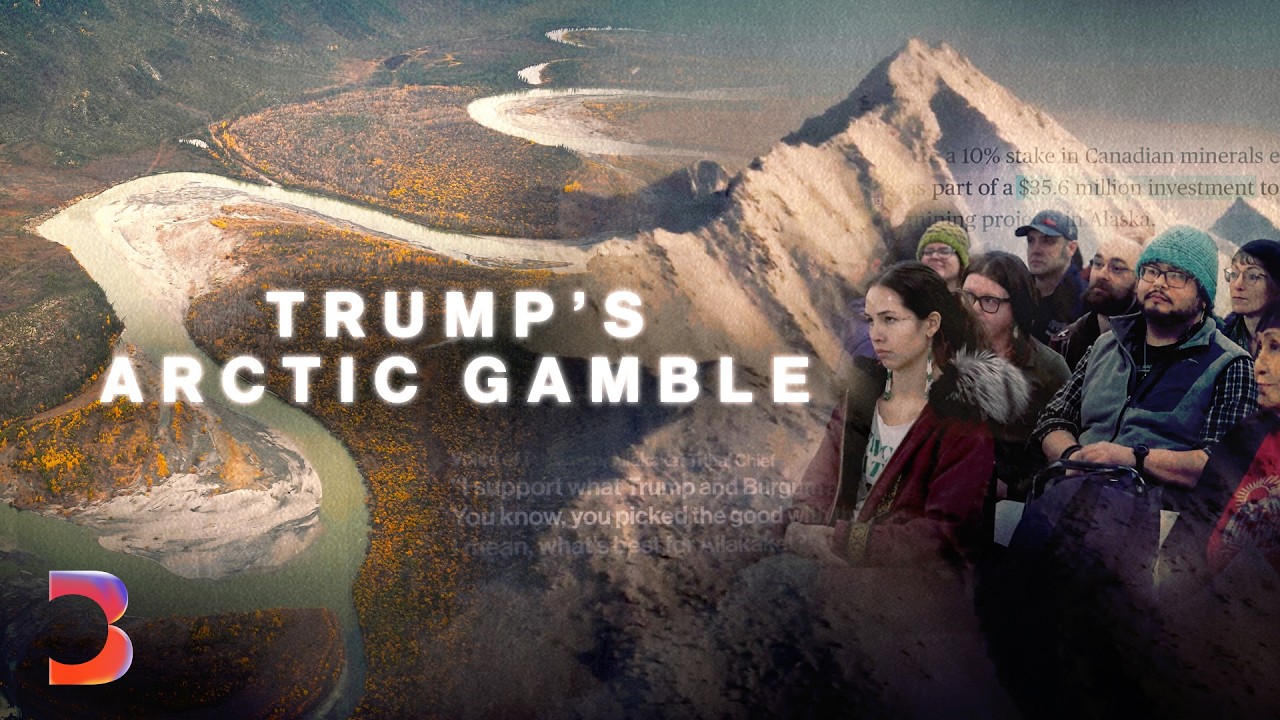
Trump Takes Trilogy Stake to Clear 211-Mile Arctic Road Permit
Bloomberg Originals
The administration's unprecedented equity deal sparked a Wall Street stock surge while dividing local tribes over environmental risks and remote mining profits.
## Background
Published on August 3, 2026, by Bloomberg Originals on YouTube, this video explores the controversial 211-mile Ambler Road project in Alaska. The page description outlines how a Trump administration mining deal has pitted Wall Street speculation against local residents concerned about environmental damage, noting that the federal government granted a road permit in exchange for an unprecedented equity stake in a private mining company.
## TL;DR
The documentary follows a Bloomberg production crew into the remote Ambler Mining District above the Arctic Circle to investigate the federal deal granting Trilogy Metals $35.6 million and a road permit in exchange for a 10% equity stake. While federal officials frame the project as a critical move to secure copper and zinc supply chains against China, Wall Street speculators have already walked away with millions following a massive stock surge. Meanwhile, local Alaska Native communities face deep internal fractures and long-term environmental risks, questioning the economic logic of shipping raw minerals across the Pacific only to buy back finished goods.
## Atmosphere & style
The video carries a stark, investigative tone that balances the raw, silent vastness of the freezing Arctic wilderness with the high-stakes tension of corporate and political maneuvering. It opens with an adventurous, slightly apprehensive mood as the crew flies in a vintage bush plane into a zero-service zone, shifting into a heavy, somber emotional arc as local residents share their heartache and fear over losing their pristine homeland. The host's objective narrative style is punctuated by raw, polarizing interviews that expose a painful communal rift, making the viewer feel the jarring disconnect between billionaire Wall Street speculation and the grounded reality of indigenous subsistence living.
## Key takeaways
- [00:09](https://www.youtube.com/watch?v=7OkGrpbV2BE&t=9s) The Trump administration approved federal permits for a 211-mile industrial road through undisturbed Alaskan wilderness to access critical mineral deposits in the Ambler Mining District.
- [00:09](https://www.youtube.com/watch?v=7OkGrpbV2BE&t=9s) In an unprecedented move, the federal government pledged $35.6 million to Trilogy Metals in exchange for a 10% equity stake in the company.
- [02:28](https://www.youtube.com/watch?v=7OkGrpbV2BE&t=148s) Local Native residents, such as Eva Cleveland of Kobuk Village, express deep fear over the industrial corridor destroying pristine, untouched homeland.
- [02:28](https://www.youtube.com/watch?v=7OkGrpbV2BE&t=148s) Federal officials and developers justify the project as a national security priority to secure copper and zinc supply chains and compete with China.
- [03:52](https://www.youtube.com/watch?v=7OkGrpbV2BE&t=232s) Following the federal equity deal announcement, Trilogy Metals' stock skyrocketed from ~$2 to over $11, generating massive speculative gains for Wall Street traders.
- [03:52](https://www.youtube.com/watch?v=7OkGrpbV2BE&t=232s) Critics and indigenous leaders question the 'America First' economic logic of trucking, railing, and shipping raw Alaskan minerals to Asian smelters across the Pacific.
- [06:05](https://www.youtube.com/watch?v=7OkGrpbV2BE&t=365s) State agency AIDEA has faced criticism for using public funds on speculative projects that lose money while attempting to bypass sovereign tribal governments in favor of corporate entities.
- [06:05](https://www.youtube.com/watch?v=7OkGrpbV2BE&t=365s) The Ambler Road project has created deep divisions within Alaska Native communities between those resisting land destruction and leaders advocating collaboration to secure jobs.
- [08:43](https://www.youtube.com/watch?v=7OkGrpbV2BE&t=523s) While proponents promise long-term local jobs and technical training pipelines requiring 8 to 12 years, local residents remain skeptical that financial gains will reach their villages.
## Detailed walkthrough
### [00:09](https://www.youtube.com/watch?v=7OkGrpbV2BE&t=9s) Flying into the Remote Arctic Wilderness
A Bloomberg production crew flies in a 1953 De Havilland Beaver bush plane named "Pumpkin" into the remote Alaskan wilderness, a few dozen miles above the Arctic Circle. Host Holly and her team travel to an area with no roads, highways, or cell service to investigate the controversial Ambler Road project. Holly lightheartedly jokes with her crew about how naming the classic aircraft "Pumpkin" brings a strange sense of comfort, making them feel like they are riding in a warm autumn squash rather than a seventy-year-old plane. Upon landing, they step out into six-degree weather, noting that it feels surprisingly "balmy" compared to Fairbanks.
This vast expanse is the Ambler Mining District, a region that has drawn increasing scrutiny and interest from Washington over the last decade. The proposed project involves constructing a 211-mile industrial access road through undisturbed wilderness to reach rich mineral deposits. Critics from the outset warn that the infrastructure will become an "absolute money pit" for the state of Alaska while lining the pockets of private builders, investors, and political insiders. Under a proposed deal, the Trump administration pledged $35.6 million to Trilogy Metals for exploration in exchange for a 10% equity stake in the company—a unprecedented move that redefines how the federal government interacts with private mining corporations.
- **Aircraft:** 1953 De Havilland Beaver ("Pumpkin").
- **Location:** Ambler Mining District, dozens of miles above the Arctic Circle in Alaska.
- **Key Project Details:** Proposed 211-mile industrial gravel access road through pristine wilderness.
- **Federal Deal Structure:** $35.6 million federal investment into Trilogy Metals in exchange for a 10% equity stake.
---
[02:28](https://www.youtube.com/watch?v=7OkGrpbV2BE&t=148s) Local Resistance in Kobuk Village and National Security Arguments
Arriving in Kobuk Village—located just a handful of miles from the proposed road's path—the Bloomberg team meets with resident Eva Cleveland to gauge local sentiment. Standout voices among local Alaska Native residents express deep fear and heartache over what the industrial corridor will do to their pristine surroundings. Cleveland describes her homeland as "one of the last pieces of the world that's prime," emphasizing that its value lies in being untouched and priceless rather than exploited for commercial gain.
In contrast, industrial developers and federal officials view the region as a "literal gold mine" holding vast deposits of copper and zinc—critical minerals vital to modern technology and green infrastructure. The Trump administration framed the project as an essential move to secure critical supply chains and compete directly with China. While the Biden administration repeatedly blocked permitting for the road over environmental concerns, the Trump administration cleared the path for approval, but added a significant condition: demanding "a piece of the action" in exchange for federal backing and permits.
> "I am scared. I'm scared for that road to come because this is one of the last, last pieces of the world. Well, my world anyway, that's prime. You can't just drive in here. It's untouched. It's priceless." — Eva Cleveland, Kobuk Village resident
---
[03:52](https://www.youtube.com/watch?v=7OkGrpbV2BE&t=232s) Wall Street Speculation vs. Indigenous Opposition
Following the federal permit approval and public announcement that the U.S. government would acquire a 10% equity stake in Trilogy Metals (led by President and CEO Tony Giardini), stock prices skyrocketed. Shares surged overnight from around $2 to over $11, allowing early investors and Wall Street traders to net millions of dollars in speculative gains before a single ounce of ore was ever extracted from the ground. Meanwhile, indigenous leaders argue that their lands are being sacrificed for short-term financial speculation while the long-term environmental costs are saddled onto local communities.
Evansville Tribal Council Chiefs Frank Thompson and Thomas Shanahan voice strong opposition to the road, pointing out intense corporate and political pressuring directed at local Native tribes. Furthermore, they question the economic logic of the entire supply chain. In 2023, Trilogy Metals stated plans to ship mineral concentrate to Asian ports. Critics question how transporting raw materials 211 miles down a new gravel road to the Dalton Highway, trucking them another 230 miles to Fairbanks, railing them to Point MacKenzie, and finally shipping them across the Pacific to China—only to buy back the finished products—makes economic or practical sense under an "America First" banner.
- **Stock Surge:** Trilogy Metals' stock jumped from ~$2/share to over $11/share following the deal.
- **Transportation Route Logistics:**
- 211 miles on the proposed Ambler Road.
- 230 miles down the Dalton Highway to Fairbanks.
- Freight rail transport down to Point MacKenzie for export to Asian smelters.
- **Opposition Stance:** Chiefs Frank Thompson and Thomas Shanahan allege strong-arming tactics used by developers to pressure local tribal councils into signing support agreements.
---
[06:05](https://www.youtube.com/watch?v=7OkGrpbV2BE&t=365s) Tribal Divisions and the Role of AIDEA
The primary promoter of the project within the state is the Alaska Industrial Development and Export Authority (AIDEA). Although AIDEA has managed over $1.4 billion in economic development funding over four decades, an analysis by the conservation group SalmonState reveals that the agency's state-backed speculative projects have cost Alaskan taxpayers millions in net losses. Critics argue that AIDEA actively works to bypass sovereign tribal governments by dealing directly with regional and village Alaska Native corporations, effectively transferring decision-making power from local tribes to commercial corporate entities.
This strategy has created deep friction within indigenous communities. Rico DeWilde, a hunter and local advocate from the region, estimates that roughly 80% of local Native residents oppose the road due to concerns over subsistence living and land destruction. He points to high-profile reversals, such as Allakaket Chief P.J. Simon, who originally opposed the road but later reversed his position. Chief Simon concluded that since industrial development in the region is inevitable, tribes must collaborate with developers to secure jobs, economic shares, and retirement opportunities for future generations. However, this shift sparked accusations of selling out, highlighting the painful rift—described by Simon as "Native on Native hate"—that the project has driven between local community members.
> "Money buys people. And you never know who's going to flip... Native on native hate. It's alive and well. We only destroy ourselves if we don't work with industry. You talk about the coming waves. Well, this is the coming wave."
---
[08:43](https://www.youtube.com/watch?v=7OkGrpbV2BE&t=523s) Promises of Local Jobs vs. Wall Street Realities
Visiting a school in the village of Ambler, the Bloomberg crew is announced to the town over the local VHF radio by Ms. Matthews, inviting residents to come speak about the road. Proponents argue that the Ambler Road will generate long-term job training, suggesting that local youth could enter career pipelines in mining, engineering, and environmental management—a transition that could take anywhere from 8 to 12 years of advance planning and education.
However, local business owners and residents remain deeply skeptical. A local lodge owner points out that the recent stock surge primarily benefited outside investors and Wall Street traders who made quick fortunes off the news, while local villagers saw no direct benefit. As stock prices fluctuated back down, community members were left questioning whether the promises of local prosperity were simply a cover for wealthy investors seeking short-term stock plays, leaving the long-term environmental risks buried in the tundra for the locals to bear.
- **Educational Timeline:** Proponents estimate an 8 to 12-year horizon to educate and train local residents for specialized, skilled roles in the mining district.
- **VHF Radio Broadcast:** Local communication in remote villages still relies heavily on open radio channels for community announcements.
- **Local Sentiment:** Skepticism lingers over whether the mineral deposits buried under the tundra justify the environmental risk and financial cost to Alaskan taxpayers.
## Notable quotes
> [02:28](https://www.youtube.com/watch?v=7OkGrpbV2BE&t=148s) I am scared. I'm scared for that road to come because this is one of the last, last pieces of the world. Well, my world anyway, that's prime. You can't just drive in here. It's untouched. It's priceless. — Eva Cleveland
> [06:05](https://www.youtube.com/watch?v=7OkGrpbV2BE&t=365s) Money buys people. And you never know who's going to flip... Native on native hate. It's alive and well. We only destroy ourselves if we don't work with industry. You talk about the coming waves. Well, this is the coming wave. — Chief P.J. Simon
## Mentioned
Ambler Mining District, Ambler Road, Alaska Industrial Development and Export Authority (AIDEA), Bloomberg Originals, De Havilland Beaver, Trilogy Metals, Donald Trump, Joe Biden, Holly, Eva Cleveland, Tony Giardini, Frank Thompson, Thomas Shanahan, Rico DeWilde, P.J. Simon, Ms. Matthews, SalmonState, Evansville Tribal Council, Kobuk Village, Ambler Village, Dalton Highway, Fairbanks, Point MacKenzie, China, Wall Street
The proposed 211-mile Ambler Road project pairs an unprecedented federal equity stake with promises of domestic mineral security, but it faces intense scrutiny over Wall Street speculation, logistical contradictions, and deep divisions across Alaska Native communities.
Federal Equity Stakes and Supply Chain Contradictions (0:09)
To access copper and zinc deposits in the remote Ambler Mining District, the Trump administration cleared permitting for a 211-mile industrial gravel access road through pristine Arctic wilderness. Setting a new precedent for federal interaction with private mining firms, the administration pledged $35.6 million to Trilogy Metals in exchange for a 10% equity stake, framing the project as a critical measure to secure domestic supply chains and counter China.
However, tribal leaders and critics argue that the project's actual logistics undermine this national security rationale. Trilogy Metals stated plans in 2023 to transport raw concentrate down the 211-mile access road, truck it 230 miles along the Dalton Highway to Fairbanks, move it by rail to Point MacKenzie, and ship it across the Pacific to Asian smelters. Opponents question the economic coherence of claiming mineral independence under an 'America First' banner when the raw materials are slated for Asian processing only to be repurchased as finished goods.
Speculative Market Gains Versus Local Realities (3:52)
Following the announcement of federal permits and the government's equity purchase, Trilogy Metals' stock surged overnight from roughly $2 to more than $11 per share. This market rally generated millions of dollars in speculative profits for outside investors and Wall Street traders before any mining infrastructure or extraction began.
In contrast, local residents in nearby communities such as Kobuk Village express deep grief and fear over the disruption of untouched lands that resident Eva Cleveland characterizes as priceless. Local business owners noted that as share prices subsequently fluctuated, outside speculators captured immediate payouts while remote villages were left with the prospect of long-term environmental hazards buried in the tundra.
State Financing and Fractured Indigenous Governance (6:05)
The project's chief state sponsor, the Alaska Industrial Development and Export Authority (AIDEA), has directed over $1.4 billion in economic development funding across four decades. However, a review by the conservation group SalmonState reported that AIDEA's speculative state-backed ventures have resulted in millions of dollars in net losses for Alaskan taxpayers. Critics also allege that the authority bypasses sovereign tribal governments by negotiating directly with regional and village Alaska Native corporations, shifting authority away from traditional leadership.
This dynamic has created painful community friction. Local hunter and advocate Rico DeWilde estimates that about 80% of local Native residents oppose the road due to threats to subsistence living, while Evansville Tribal Council Chiefs Frank Thompson and Thomas Shanahan allege aggressive corporate pressure. Conversely, leaders like Allakaket Chief P.J. Simon reversed their opposition, arguing that industrial development is inevitable and that tribes must partner with developers to secure jobs and retirement funds. This policy reversal has triggered accusations of betrayal, exposing what Simon described as active 'Native on Native hate.'
Disputed Timelines for Local Economic Opportunity (8:43)
Supporters argue that the Ambler Road will foster regional economic mobility, pointing to potential career pipelines for local youth in mining, engineering, and environmental stewardship. Proponents acknowledge, however, that preparing the local workforce for these specialized roles requires an 8- to 12-year educational and training timeline.
Skeptics within the villages view these long-range promises with doubt, questioning whether anticipated educational gains will ever materialize for local families or if the mineral wealth primarily serves as justification for public subsidies and private investment profits.
Unresolved questions persist regarding whether the Ambler Road can fulfill its economic promises, given its reliance on overseas processing, documented financial risks tied to state-sponsored development, and profound local opposition from residents seeking to protect their subsistence way of life.
[2:28] Eva Cleveland: I am scared. I'm scared for that road to come because this is one of the last, last pieces of the world. Well, my world anyway, that's prime. You can't just drive in here. It's untouched. It's priceless.
[6:05] Chief P.J. Simon: Money buys people. And you never know who's going to flip... Native on native hate. It's alive and well. We only destroy ourselves if we don't work with industry. You talk about the coming waves. Well, this is the coming wave.
Original transcript
[0:09] This is a 1953 DeHavelin
Beaver and her name is Pumpkin.
[0:13] All right.
[0:14] And this is Poppy.
[0:16] Poppy, Pumpkin and Polly.
[0:17] Yes. Yeah.
[0:21] A few dozen miles above the Arctic
Circle, there are no roads, highways,
[0:25] or cell service. To get
here, you need a bush plane.
[0:32] I like that its name is Pumpkin.
[0:34] I think naming the plane
Pumpkin has actually brought
me a lot of relative peace
[0:38] because it's like we're not
getting in a seven-year-old plane,
[0:40] we're getting in pumpkin.
[0:46] Pretty balmy here. Six degrees out.
[0:50] Warmer than Fairbanks.
[0:54] This is the Ambler Mining
District, and for the last decade,
[0:58] eyes in Washington have turned towards it.
[1:01] This is a controversial project that
would build an access road to this mineral
[1:05] rich mining district in Alaska.
[1:08] What they're talking
about for the Ampler Road,
[1:11] that's going to be just an
absolute money pit for this state.
[1:13] There's going to be a bunch of people
that are going to get rich buildings.
[1:17] The Trump administration is going to
invest $35 million for Trilogy to conduct
[1:22] exploration in this area in exchange
for a 10% stake in the company.
[1:29] Obviously, people that have stocks in
Trilogy are going to make a lot of money,
[1:32] but as far as the state
actually making a lot of money,
[1:36] there's nothing ironed out at all that
says the state's going to ever even pay
[1:40] for that road.
[1:44] This controversial remote Alaskan
road pits mining and Wall Street
[1:48] interests against some
indigenous community leaders
and a fragile wilderness,
[1:53] all while setting an entirely new
precedent for how America does business.
[1:59] This is not just a figurative,
but a literal gold mine.
[2:01] This is a semistrip plan
that does not serve Alaskan.
[2:04] The Ambler Mining District is a
treasure trove of critical minerals. We.
[2:08] Are talking about paying for
corporations to contaminate
[2:12] Alaskan land. There's just
a lot that can go wrong.
[2:28] Hi.
[2:29] Hey, Eva. I'm Holly. Hi.
[2:31] And I'm a reporter and this is my crew
and we're working on a short documentary
[2:36] about the Ambler Road.
[2:38] Oh, okay.
[2:39] Do you have a couple minutes
for us to bother you?
[2:43] We've come to Alaska to hear firsthand
how the Ambler Road deal could impact
[2:47] local livelihoods. Eva Cleveland
lives in Kobuk Village,
[2:52] just a handful of miles from
where the road has been planned.
[2:56] I am scared. I'm scared for
that road to come because
[3:00] this is one of the last,
last pieces of the world.
[3:05] Well, my world anyway, that's
prime. You can't just drive in here.
[3:10] It's untouched. It's priceless.
[3:14] Developers say the Ambler Mining
District is home to some of the nation's
[3:17] biggest copper and sink deposits.
[3:20] Metals that are vital to today's
technology and part of the Trump
[3:23] administration's broader effort to compete
with China. To access these minerals,
[3:28] the companies say they need
a 211-mile gravel road,
[3:32] something the Biden administration
repeatedly blocked before the Trump
[3:35] administration cleared the path.
[3:38] Well, thank you very much everybody.
[3:39] We have a very big signing
today having to do with Alaska.
[3:43] This was something that should have
been long operating and making -.
[3:46] But the government didn't
just hand over the permit.
[3:49] It asked for something in
return, a piece of the action.
[3:52] Hello. My name's Tony Giardini. I'm the
president and CEO of Trilogy Metals.
[3:57] And I'm going to take a few minutes
to talk to you about Trilogy and our
[4:00] exciting projects in Alaska.
[4:03] The government announced it would invest
$35.6 million in Trilogy Metals for a
[4:08] 10% stake and granted the permit.
[4:15] We're losing our voice, our language.
[4:17] The land is the last thing
that we have. This is our home.
[4:23] Following the deal's announcement,
[4:24] Trilogy stocks surged from more
than $2 to more than $11 per share.
[4:29] Investors netted millions of dollars
despite not a single ounce being mined.
[4:34] With the road's cost of
construction potentially
stretching into the billions of
[4:38] dollars,
[4:39] uncertainty over funding has fueled
local opposition and taxpayers' concerns.
[4:45] Evansville Tribal Council Chiefs
Frank Thompson and Thomas Shanahan,
[4:49] prominent opponents,
[4:50] say that those pushing for the road
are pressuring communities for support.
[4:55] There's a lot of strong arming going on
and it's real easy to pressure people
[4:59] into it.
[5:01] Trilogy Metals said in 2023, it would
ship mineral concentrate to an Asian port.
[5:06] Now, with the government branding the
project as an America first initiative,
[5:10] its ultimate destination
remains uncertain.
[5:13] You're taking a product,
loading it onto a truck.
[5:16] You're trucking it 211 miles
over to the Dalton Highway.
[5:20] Now you got another
230 miles to Fairbanks.
[5:25] Are you going to take that
material, load it onto rail,
[5:28] send it to Point McKinsey,
[5:30] and then it gets loaded
onto a ship to go to China?
[5:34] How is that feasible to transport
and handle this material?
[5:39] Send it to China where you buy
it back. How is it feasible?
[5:44] And they just say the ore is that good.
[5:50] No explanation. It's all speculative.
[5:53] It's always been someone
else's minerals and
[5:59] they need Alaska's money to
be able to make it happen.
[6:05] Among the most vocal champions of
the project is the state's economic
[6:08] development agency, the Alaska Industrial
Development and Export Authority,
[6:12] or ADA.
[6:14] While ADA has received 1.4 billion in
economic development funds over four
[6:18] decades,
[6:19] an analysis by the advocacy group Sam
and State suggests the agency has cost
[6:24] taxpayers millions of dollars.
[6:26] The way ADA works with native
corporations and the state and even
[6:32] nationally with our Congress people,
[6:34] it does seem like a concerted effort to
take the Native voice away from tribes
[6:38] and put it into for-profit corporations.
[6:43] I'm Rico Dual. I grew
up outside of Buslia.
[6:46] I wanted to run Tracy because I wanted
to have more input on what's going on out
[6:51] here. And I think I have
a lot of experience.
[6:55] The Native people are probably
80% against the road, I would say.
[6:59] Money buys people. And you
never know who's going to flip.
[7:04] I mean, you see PJ Simon,
he's all against the road,
[7:07] and then all of a sudden he's
doing meetings and they're
whining and dining him.
[7:12] Once a vocal opponent of
the road, Alakaket chief PJ
Simon reversed his stance,
[7:17] concluding that since
mining is inevitable,
[7:20] the community should prioritise
securing its share and give employment
[7:23] opportunities to the future generations
here. In our interview of Simon,
[7:27] he declined to appear on film.
[7:31] We're not advocating to
wipe out the whole planet.
[7:36] We support resource development
for jobs, for retirement.
[7:42] President Trump, when he said drill,
baby, drill, he also was mine, baby, mine.
[7:46] We've got to get back
in the mining business.
[7:49] I support what Trump and Bergenmar are
doing. You pick the good with the bad.
[7:54] I mean, what's best for Alec Acket?
[7:57] One of the things I heard from a
lot of people is he's been paid off.
[8:00] He's been sold out. You don't
want to hear from him. I.
[8:03] Could care less about what others are
saying. They can have their own opinions.
[8:07] Native on native hate.
It's alive and well.
[8:10] We only destroy ourselves if
we don't work with industry.
[8:14] You talk about the coming waves.
Well, this is the coming wave.
[8:20] There's huge politics behind all of this.
[8:43] Good morning, Ambler from Ambler
School. It's Ms. Matthews. Hey, listen,
[8:46] we've got some folks here from Bloomberg.
[8:49] They're going to be out visiting today
or you can come visit with them at the
[8:52] school, but they're going
to be here discussing the -.
[8:55] Ambler Road.
[8:56] Ambler Road. So if you want to
come and talk to Bloomberg today,
[8:59] the doors are open. Come on up.
Have a great day. Go Grizzlies.
[9:04] Fabulous. All right. Back in its holster.
[9:08] It's one of my favourite things about
Alaska is that everyone's still got
[9:11] radios.
[9:13] Proponents of the road point to the
potential for mining jobs in the near term
[9:17] and more specialised
careers in the future.
[9:20] So getting people to work in the
district who are from these communities,
[9:24] it's going to be a
buildup over time. I mean,
[9:26] from some of these kids to when they can
complete a certificate and then their
[9:30] undergrad and their graduate,
[9:31] you're looking at eight to 12 years of
planning in advance for this district to
[9:34] be able to hire people
from this community.
[9:39] For this local lodge owner,
[9:41] the road was never about bringing
prosperity to residents here.
[9:45] The stock prices skyrocketed
overnight and went up three or 400%,
[9:49] and now they're back down to
where they were a month ago.
[9:52] And the people in the know that
were watching this made hundreds of
[9:57] thousands, if not millions
of dollars overnight.
[10:00] And yet the villagers made nothing. So
[10:04] all those promises of
riches in the area, I mean,
[10:05] that was a great example to show that
it's not for the people in the area.
[10:10] It's for the people that already have
enough money to invest in these things.
[10:14] Then they just need bigger
stacks of money apparently.
[10:21] Ready?
[10:24] The Trump administration says it is
committed to acquiring 10% of trilogy
[10:28] metals. Meanwhile,
[10:33] questions still remain of the unverified
worth of the mineral deposits buried
[10:37] beneath the tundra.