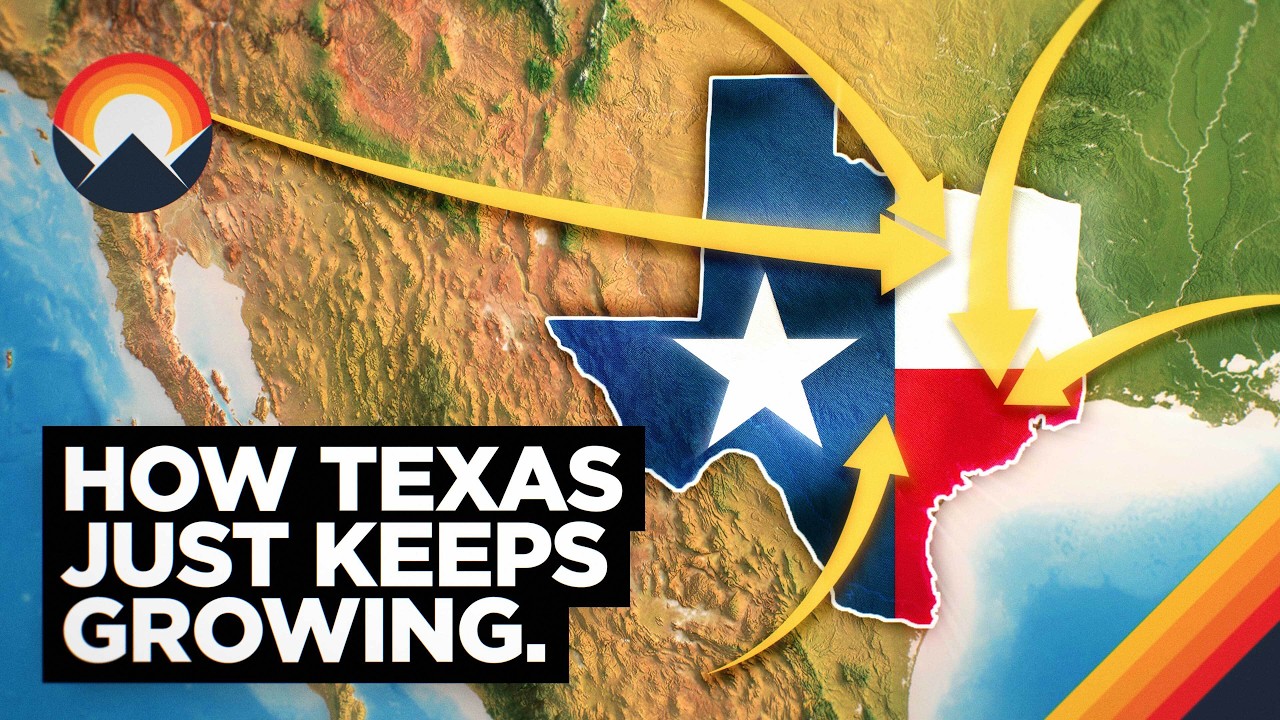
Texas Economic Growth Shifts Suburban as Central Cities Face Revenue Slumps
Wendover Productions
Unzoned housing in Houston and aggressive annexation in Dallas-Fort Worth drive rapid regional population growth while suburban migration weakens central city tax bases.
## Background
Published on YouTube by Wendover Productions on August 4, 2026, this video features research and scriptwriting by Sam Denby, Tristan Purdy, and Christine Benedetti. The video's description invites viewers to compare news coverage and spot media bias using Ground News, offering a 40% discount link alongside links to the channel's social media accounts and team credits.
## TL;DR
The video examines the economic and demographic engine driving Texas's rapid growth, particularly within the 'Texas Triangle' of Houston, Dallas–Fort Worth, and Austin. It details how Houston's lack of traditional zoning laws has enabled affordable housing density through urban infill, while Dallas–Fort Worth overcomes geographic limitations through aggressive corporate recruitment and suburban expansion. Finally, it highlights the potential limits of this model through Austin's recent slowdown and urban core affordability challenges, demonstrating how the mobile 'Texas dream' creates structural tax and infrastructure strains for central cities.
## Atmosphere & style
The video maintains Wendover Productions' signature analytical, informative, and polished documentary tone, blending rapid data delivery with clear visual graphics and precise geographic maps. It feels intellectually engaging and objective, grounded in spatial economics while using evocative real-world examples—like Dutch soccer fans marching through Houston—to challenge audience assumptions. The narration balances steady economic analysis with a subtly cautious, forward-looking perspective on the systemic trade-offs of modern urban sprawl.
## Key takeaways
- [00:00](https://www.youtube.com/watch?v=dzmoALgtB1Q&t=0s) Although Houston is widely portrayed as an unwalkable, car-obsessed metropolis, events like the 2026 World Cup fan march show that its urban landscape is evolving and more complex than stereotypes suggest.
- [01:45](https://www.youtube.com/watch?v=dzmoALgtB1Q&t=105s) Texas serves as a major national economic engine, holding the world's 8th largest GDP if measured as an independent country and consistently topping the U-Haul Growth Index since 2016.
- [03:10](https://www.youtube.com/watch?v=dzmoALgtB1Q&t=190s) The vast majority of Texas's population (70%) and GDP (nearly 80%) are concentrated within the 'Texas Triangle' linking Houston, Dallas–Fort Worth, and Austin–San Antonio.
- [03:39](https://www.youtube.com/watch?v=dzmoALgtB1Q&t=219s) Houston's voter rejection of city-wide zoning ordinances in 1948 and the 1960s created unique land-use juxtapositions but enabled a highly flexible housing market.
- [04:47](https://www.youtube.com/watch?v=dzmoALgtB1Q&t=287s) Urban infill practices, supported by 1990s ordinance changes reducing minimum lot sizes and front setbacks, allow Houston developers to build affordable high-density housing inside the city core.
- [06:35](https://www.youtube.com/watch?v=dzmoALgtB1Q&t=395s) Despite its large geographical footprint, Houston maintains an inner-loop population density comparable to cities like Sacramento and Atlanta, remaining the second-cheapest major housing market in the U.S.
- [09:23](https://www.youtube.com/watch?v=dzmoALgtB1Q&t=563s) Dallas–Fort Worth overcame severe geographic and climate disadvantages without a major shipping port by leveraging corporate incentives, airport infrastructure, and low operational costs.
- [11:23](https://www.youtube.com/watch?v=dzmoALgtB1Q&t=683s) DFW hosts over 20 Fortune 500 corporate headquarters, while Fort Worth maintains high affordability and growth by aggressively annexing surrounding suburban land.
- [14:47](https://www.youtube.com/watch?v=dzmoALgtB1Q&t=887s) Austin highlights the limits of rapid growth, where high corporate inflows caused real estate costs to surge, slowing population growth from 4% annually down to 1%.
- [15:27](https://www.youtube.com/watch?v=dzmoALgtB1Q&t=927s) Rising central city costs push low-income earners to distant suburbs, illustrating that the 'Texas dream' relies heavily on mobility across outer metropolitan fringes.
- [16:20](https://www.youtube.com/watch?v=dzmoALgtB1Q&t=980s) Suburban migration strains central cities like Austin and Dallas, leading to shrinking property tax rolls and municipal employee furloughs due to lagging sales taxes.
- [17:16](https://www.youtube.com/watch?v=dzmoALgtB1Q&t=1036s) Evaluating complex regional dynamics and political issues requires examining broad media coverage to spot bias and avoid algorithmic echo chambers.
## Detailed walkthrough
### [00:00](https://www.youtube.com/watch?v=dzmoALgtB1Q&t=0s) Breaking the Texas Stereotype: The World Cup Walk and the Economic Engine
During the June 20, 2026 World Cup match, approximately 25,000 orange-clad Dutch soccer fans completed a famous tradition by marching three miles (five kilometers) from a university campus on the edge of the museum district to the stadium. Navigating shaded, old-growth oak canopy residential avenues, crossing canals via pedestrian trails, and following the path of the city's red line light rail, the trip felt utterly natural to European visitors—except for the oppressive summer heat. However, this journey occurred in Houston, Texas, a metropolis notorious across America as the epicenter of car-obsessed, sprawling, and unwalkable urban design. This march illustrates that while Houston and Texas are easily oversimplified, reality on the ground is rapidly evolving.
Texas has established itself as an undeniable economic powerhouse. On the U-Haul Growth Index—which measures one-way truck rentals—Texas has consistently ranked as the number one or number two destination for relocating Americans every year since 2016. If Texas were an independent nation, its GDP would rank as the eighth largest in the world. While politicians like Governor Greg Abbott, tech leaders like Elon Musk, and conservative news outlets showcase this growth as a triumph of low taxes and deregulation, critics often dismiss it as an elite oil-and-gas bonanza. In truth, Texas is driven by a steady, self-reinforcing economic growth engine that spans multiple industries beyond fossil fuels.
- **U-Haul Growth Index:** Ranked #1 or #2 every year for inbound movers since 2016.
- **Economic Scale:** If independent, Texas would hold the world's 8th largest GDP.
- **Geography of Growth:** 70% of the state's population and nearly 80% of its total GDP are concentrated within the "Texas Triangle"—anchored by Houston, Dallas–Fort Worth, and Austin–San Antonio.
[03:39](https://www.youtube.com/watch?v=dzmoALgtB1Q&t=219s) Houston’s Unzoned Expansion and the Power of Infill Housing
Houston's path to growth is tied directly to its unique legal history. When Texas operated as an independent republic in the 1830s before joining the Union as a slaveholding state, its early capital sat in Houston where the Rice residential building stands today. A century later, in 1948, Houston voters rejected city-wide zoning ordinances. They voted down zoning again in the early 1960s as the population crossed one million. This lack of zoning created bizarre urban juxtaposing, such as Huckleberry Circle, where single-family homes sit right against giant apartment towers, alongside sprawling asphalt parking lots that made 1970s downtown Houston famous for car-centric chaos.
However, a lack of zoning also opened a path for Houston to become an adaptable housing machine. While early growth led to outward sprawl larger than the entire London metropolitan area, land developers since the 1990s have utilized urban infill. In neighborhoods like Acre Homes in northwest Houston, design firms regularly purchase single-family plots and divide them into four smaller lots. Building four homes priced at $150,000 each rather than a single home for $400,000 yields a 50% increase in total sales revenue while supplying affordable inventory. This density supports local commerce, improves walkability, and encourages further infill development.
```
Traditional Single Lot: [ $400,000 Single-Family Home ] = $400,000 Total
Re-platted Infill Lot: [ $150k ] [ $150k ] [ $150k ] [ $150k ] = $600,000 Total (+50% Revenue)
```
- **Zoning History:** Voters rejected citywide zoning ordinances in both 1948 and the 1960s.
- **Ordinance Revisions:** In the 1990s, Houston reduced minimum lot sizes inside the Interstate 610 loop from 5,000 sq ft down to 1,400 sq ft and cut required front setbacks from 25 ft to 5 ft.
- **Population Density:** The Inner Loop maintains around 4,500 residents per square mile, putting its density on par with cities like Sacramento, Long Beach, and Atlanta.
- **Affordable Housing:** Among the 20 largest U.S. metropolitan areas, Houston boasts the second-cheapest housing market.
- **Diversity:** Houston ranks as one of the most diverse major cities in America; nearly 20% of local businesses, 20% of teachers, and 20% of doctors are Black.
[09:23](https://www.youtube.com/watch?v=dzmoALgtB1Q&t=563s) Dallas–Fort Worth: Defying Geography through Sprawl and Corporate Relocation
Located three and a half hours north on Interstate 45, the Dallas–Fort Worth metroplex (DFW) has bypassed Houston to become the fourth most populous metropolitan area in the United States. DFW lacks the physical geographic advantages typical of major American cities. The region experiences extreme weather shifts—ranging from winter ice storms to weeks of summer temperatures exceeding 100 °F (38 °C) and occasional tornadoes. Furthermore, unlike Houston with its navigable Buffalo Bayou and Port Houston, Dallas relies on the non-navigable Trinity River, which Army Corps of Engineers projects failed to convert into a shipping channel.
DFW overcame its geographic limitations through aggressive civic promotion, low operational costs, rapid housing expansion, and major infrastructure like Dallas/Fort Worth International Airport. Today, DFW trails only New York City and Chicago in its concentration of corporate headquarters, hosting over 20 Fortune 500 companies—including Texas Instruments, Toyota North America, Charles Schwab, Comerica, AT&T, and Caterpillar.
```
Corporate Giants in DFW:
├── Tech & Telecom: Texas Instruments, AT&T
├── Automotive & Industrial: Toyota North America, Caterpillar
└── Finance & Services: Charles Schwab, Comerica
```
To the west, Fort Worth offers a distinct identity, trading corporate skyscrapers for its historic Stockyards. Recently surpassing Austin in population, Fort Worth is expanding rapidly by annexing surrounding unincorporated land. By extending its municipal boundaries far beyond the Interstate 820 beltway, Fort Worth absorbs suburban developments like Tarraealla—located 20 miles from downtown—where five-bedroom homes sell under $400,000. While taking on police, fire, and utility services, the city expands its property tax base and keeps regional housing affordable.
- **Growth Metrics:** DFW outer counties have grown by more than 30% over a decade, driven by remote workers and out-of-state movers from California and the Midwest.
- **Suburban Corporate Migration:** Companies like AT&T, Fifth Third Bank, and Neiman Marcus, along with sports franchises like the Dallas Stars and Dallas Mavericks, have increasingly moved facilities or headquarters north toward suburbs like Frisco, Plano, and Irving.
[14:47](https://www.youtube.com/watch?v=dzmoALgtB1Q&t=887s) The Limits of the Texas Dream: The Austin Benchmark
While Houston relies on infill density and Dallas–Fort Worth expands through suburban sprawl, Austin represents the potential ceiling of the Texas growth model. Long praised as the premier destination for corporate relocations and high-profile transplants—attracting tech headquarters like Tesla, Apple, and Oracle, alongside public figures like Elon Musk and Joe Rogan—Austin grew at an annual rate of 4% between 2010 and 2020. However, rapid population growth and escalating real estate costs have tested the limits of regional infrastructure and affordability, slowing annual growth down to roughly 1% per year in recent years.
<ElicitationsGroup message="Explore related topics on Texas urban development and migration dynamics:">
<Elicitation label="Analyze how Houston's lack of zoning impacts long-term urban planning" query="Analyze how Houston's lack of zoning laws impacts its urban development, infrastructure, and resilience compared to zoned U.S. cities."/>
<Elicitation label="Compare DFW suburban sprawl to Houston urban infill strategies" query="Compare the economic and environmental trade-offs between Dallas-Fort Worth's suburban annexation and Houston's urban infill density."/>
</ElicitationsGroup>
[15:27](https://www.youtube.com/watch?v=dzmoALgtB1Q&t=927s) The Mobile Texas Dream and the Changing Urban Landscape
Austin's rapid evolution from a "weird, sleepy university town" into an increasingly hip tech hub has caused real wage stagnation for many, driving lower-income earners out of the core city altogether. Picking up the slack—and perhaps creating it—are rapidly expanding suburbs like Dripping Springs, Round Rock, and Liberty Hill. In these outlying areas, residents find cheap housing, a reasonable commute, and a dollar that stretches significantly farther. What Austin has learned, and what Dallas is quickly realizing, is that the modern "Texas dream" is fundamentally a mobile one. The iconic Texas Triangle—the relentless economic growth machine fueled by affordable housing, light regulation, and a booming economy—is constantly shifting shape, expanding north out of Dallas, sprawling into the outskirts of Houston and Austin, and rapidly infilling the spaces between major metros.
While this pattern generally works for the state as a whole and benefits new arrivals, it leaves central cities in a difficult financial bind. Longtime locals lament that Austin is "less steampunk and more Silicon Valley than ever," losing its iconic culture, but the real consequences go far beyond aesthetics. Because Texas relies heavily on property taxes rather than state income tax, cooling real estate values in central Austin have resulted in back-to-back years of a shrinking tax base. Meanwhile, lagging sales tax revenue recently forced the city of Dallas to furlough municipal workers as its retail revenue growth falls behind booming suburban neighbors. If the mobile Texas dream is like a brush fire—burning fast across the plains, consuming easy fuel, and leaving burn scars behind—it presents structural issues that boosters prefer to push off as a "problem for tomorrow."
- Low-income earners are leaving central Austin due to wage stagnation and rising housing costs.
- Suburban communities absorbing the influx include Dripping Springs, Round Rock, and Liberty Hill.
- Austin faces back-to-back years of a shrinking property tax roll due to a cooling urban housing market.
- Dallas has had to furlough city employees due to lagging sales tax growth compared to suburbs like Plano, Frisco, and Irving.
[17:16](https://www.youtube.com/watch?v=dzmoALgtB1Q&t=1036s) Synthesizing Big Topics with Ground News
Researching a state as massive and influential as Texas highlights how difficult it is to build a clear, accurate picture among endless competing interpretations. Making concise video essays requires deciding which details are essential and which are merely interesting trivia. To navigate this noise and compare news coverage effectively without relying on algorithmic echo chambers, Ground News provides a structured way to see where media narratives converge or diverge.
For instance, when examining the coverage of a fatal ICE shooting in Houston, over 400 news outlets covered the event, but the political distribution of reporting showed stark differences in framing. Outlets on the left focused heavily on the use of deadly force, whereas outlets on the right prioritized the victim's profile and the alleged circumstances leading up to the incident. Using tools like Ground News's "Blindspot Feed" highlights stories that are heavily reported by one side of the political spectrum while being ignored by the other, providing crucial context rather than biased algorithms.
- Over 400 outlets covered the fatal ICE shooting in Houston, displaying stark political bias in headline framing.
- The Ground News Blindspot Feed surfaces major news stories that are disproportionately covered by only one side of the political spectrum.
- Viewers can access 40% off an unlimited access Advantage Plan at `ground.news/wendover`.
## Notable quotes
> [00:00](https://www.youtube.com/watch?v=dzmoALgtB1Q&t=0s) U-Haul Growth Index—which measures one-way truck rentals—Texas has consistently ranked as the number one or number two destination for relocating Americans every year since 2016.
> [00:00](https://www.youtube.com/watch?v=dzmoALgtB1Q&t=0s) If Texas were an independent nation, its GDP would rank as the eighth largest in the world.
> [03:39](https://www.youtube.com/watch?v=dzmoALgtB1Q&t=219s) Building four homes priced at $150,000 each rather than a single home for $400,000 yields a 50% increase in total sales revenue while supplying affordable inventory.
> [03:39](https://www.youtube.com/watch?v=dzmoALgtB1Q&t=219s) Among the 20 largest U.S. metropolitan areas, Houston boasts the second-cheapest housing market.
> [09:23](https://www.youtube.com/watch?v=dzmoALgtB1Q&t=563s) Today, DFW trails only New York City and Chicago in its concentration of corporate headquarters, hosting over 20 Fortune 500 companies
> [14:47](https://www.youtube.com/watch?v=dzmoALgtB1Q&t=887s) Austin grew at an annual rate of 4% between 2010 and 2020. However, rapid population growth and escalating real estate costs have tested the limits of regional infrastructure and affordability, slowing annual growth down to roughly 1% per year in recent years.
> [15:27](https://www.youtube.com/watch?v=dzmoALgtB1Q&t=927s) weird, sleepy university town
> [15:27](https://www.youtube.com/watch?v=dzmoALgtB1Q&t=927s) What Austin has learned, and what Dallas is quickly realizing, is that the modern "Texas dream" is fundamentally a mobile one.
> [15:27](https://www.youtube.com/watch?v=dzmoALgtB1Q&t=927s) less steampunk and more Silicon Valley than ever
> [15:27](https://www.youtube.com/watch?v=dzmoALgtB1Q&t=927s) If the mobile Texas dream is like a brush fire—burning fast across the plains, consuming easy fuel, and leaving burn scars behind—it presents structural issues that boosters prefer to push off as a "problem for tomorrow."
## Mentioned
Ground News, U-Haul, Greg Abbott, Elon Musk, Houston, Texas, Dallas–Fort Worth, Austin, San Antonio, Texas Triangle, Interstate 610, Trinity River, Dallas/Fort Worth International Airport, Texas Instruments, Toyota North America, Charles Schwab, Comerica, AT&T, Caterpillar, Stockyards, Frisco, Plano, Irving, Fifth Third Bank, Neiman Marcus, Dallas Stars, Dallas Mavericks, Tesla, Apple, Oracle, Joe Rogan, Dripping Springs, Round Rock, Liberty Hill, ICE
Wendover Productions argues that Texas's rise to the world's eighth-largest economy if independent is propelled not just by low taxes or oil, but by adaptable housing models and flexible regional growth across the Texas Triangle. However, this outward-moving expansion model increasingly strains infrastructure and core municipal finances.
Houston’s Infill Housing and Deregulated Land Use (3:39)
Houston’s growth is fundamentally shaped by its absence of traditional zoning, which voters rejected in 1948 and again in the 1960s. While this created chaotic juxtapositions of high-rises and single-family homes alongside expansive car-dependent infrastructure, it also enabled an adaptable housing market. In the 1990s, the city lowered minimum residential lot sizes inside the Interstate 610 loop from 5,000 to 1,400 square feet and reduced front setback requirements from 25 to 5 feet, enabling dense urban infill.
In neighborhoods like Acre Homes, developers regularly divide single-family plots into four smaller parcels. Constructing four $150,000 homes rather than one $400,000 house generates 50% more revenue for builders while maintaining accessible price points. Consequently, Houston offers the second-cheapest housing market among the 20 largest U.S. metropolitan areas, while the Inner Loop sustains a population density of roughly 4,500 residents per square mile—comparable to cities like Atlanta, Long Beach, and Sacramento.
DFW’s Corporate Attraction and Suburban Annexation Engine (9:23)
Dallas–Fort Worth (DFW) has overtaken Houston as the fourth most populous metropolitan area in the United States, overcoming natural physical handicaps such as severe weather swings and the non-navigable Trinity River. DFW compensated through aggressive civic promotion, low operational overhead, major logistics assets like Dallas/Fort Worth International Airport, and rapid homebuilding. The region now trails only New York and Chicago in corporate headquarters, housing more than 20 Fortune 500 companies, including AT&T, Texas Instruments, Toyota North America, and Caterpillar.
While corporate hubs and sports facilities steadily migrate north to suburbs like Plano, Frisco, and Irving, Fort Worth expands outward by aggressively annexing surrounding unincorporated land beyond its Interstate 820 loop. In peripheral master-planned developments like Tarraealla, 20 miles from downtown, five-bedroom homes sell for under $400,000. By absorbing these developments into city boundaries, the municipality accepts police, fire, and utility costs in exchange for a larger property tax base and continuous regional affordability.
Infrastructure Bottlenecks and Central City Fiscal Pressures (14:47)
Austin illustrates the limits of the state's traditional growth playbook. After growing at an annual rate of 4% between 2010 and 2020 on the back of major corporate arrivals such as Tesla and Apple, escalating real estate prices and infrastructure bottlenecks slowed regional growth to approximately 1% annually. Stagnating real wages have increasingly pushed lower-income residents out of the urban center and into outlying suburbs like Round Rock, Dripping Springs, and Liberty Hill, where land and housing remain substantially cheaper.
This continuous outward migration reveals a major structural vulnerability in how Texas funds public services. Because the state levies no personal income tax, local governments rely heavily on property and sales taxes. As central Austin's housing values cooled, the city experienced back-to-back years of shrinking property tax rolls. Similarly, lagging retail sales tax growth recently compelled Dallas to furlough municipal employees as commercial activity shifted toward northern suburbs, demonstrating that suburban outward migration can erode the financial health of core cities.
The presentation concludes that the modern 'Texas dream' functions as an ever-shifting, mobile frontier that rapidly burns through cheap peripheral land. While this dynamic fuels regional growth and benefits incoming transplants, it creates persistent fiscal shortfalls and infrastructure burdens for urban cores that policymakers and boosters have yet to resolve.
## Background
该视频由知名知识科普频道 Wendover Productions 于 2026 年 8 月 4 日发布在 YouTube 平台。视频简介主要介绍了媒体偏见对比工具 Ground News 的赞助信息与专属优惠,并列出了频道社媒链接及包括 Sam Denby 在内的幕后文案、剪辑、动效制作团队名单。
## TL;DR
视频深入剖析了得克萨斯州(Texas)人口与经济爆发式增长背后的底层逻辑,破除了外界将其简单归结为石油繁荣或保守政治红利的偏见。休斯敦通过拒绝传统土地用途分区法规并推行高密度的“城市填充”开发,以极低的居住成本吸纳了庞大而多元的族群;达拉斯-沃斯堡大都会区则将平原地理转化为优势,以纯粹的意志力、企业吸引力以及无休止的吞并郊区模式打造了庞大的廉价住房机器。然而,先行者奥斯汀在狂飙后陷入中产流失、生活成本飙升以及市政税基缩水的困境,揭示出“德州梦”如同一场在平原上四处位移、追逐廉价地皮的流动野火,在带来超级繁荣的同时也让传统城市核心背负沉重的财务与社会代价。
## Atmosphere & style
全片洋溢着理性、思辨且极具宏观视野的沉稳叙事风格,以 2026 年世界杯荷兰球迷在休斯敦徒步的生动切片开篇,迅速打破观众对得州“汽车至上与野蛮蔓延”的固有刻板印象。解说语调冷静客观、节奏张弛有度,将城市规划细节、历史制度选择与宏观地缘经济紧密编织在一起。整场观感犹如一场层次分明、抽丝剥茧的田野调查与思想实验,既惊叹于得克萨斯这台精密增长机器的强悍运转,又在文末对奥斯汀等城市的阵痛与税基反噬投以深刻而冷静的警示。
## Bulletin
- [01:33](https://www.youtube.com/watch?v=dzmoALgtB1Q&t=93s) 得克萨斯州若作为独立国家,其经济体量已位列全球第八;由休斯敦、达拉斯-沃斯堡与奥斯汀-圣安东尼奥构成的“得克萨斯三角区”集中了全州70%的人口和近80%的GDP。
- [05:44](https://www.youtube.com/watch?v=dzmoALgtB1Q&t=344s) 休斯敦历史上两度否决土地用途分区法,并大刀阔斧将最小地块面积压缩至1,400平方英尺,通过“城市填充”开发兼顾了高密度与全美大都会区第二便宜的住房成本。
- [09:13](https://www.youtube.com/watch?v=dzmoALgtB1Q&t=553s) 缺乏自然水运禀赋的达拉斯-沃斯堡通过狂暴的横向扩张、兼并郊区与低廉地皮吸引了20余家财富500强入驻,沃斯堡人口甚至已超越首府奥斯汀。
- [14:55](https://www.youtube.com/watch?v=dzmoALgtB1Q&t=895s) 以廉价为燃料的“德州梦”具有高度流动性:奥斯汀人口年增速已从4%暴跌至1%并出现税基缩水,企业与居民正加速从传统都会核心逃向更外围的远郊县域。
## Key takeaways
- [00:00](https://www.youtube.com/watch?v=dzmoALgtB1Q&t=0s) 2026年世界杯期间数万荷兰球迷在休斯敦步行漫游,打破了外界对得州及休斯敦极端依赖汽车、完全无法步行的刻板印象。
- [01:33](https://www.youtube.com/watch?v=dzmoALgtB1Q&t=93s) 得州持续繁荣不仅得益于化石能源和亲商减税政策,其底层核心是一台运转极其平稳、吸纳大量外来人口的经济增长机器。
- [01:33](https://www.youtube.com/watch?v=dzmoALgtB1Q&t=93s) 自2016年起得州稳居U-Haul跨州迁徙榜前两名,经济与人口增量高度聚焦在“得克萨斯三角区”核心都市圈及外围边缘。
- [03:39](https://www.youtube.com/watch?v=dzmoALgtB1Q&t=219s) 休斯敦在1948年与1960年代初两次投票拒绝土地分区制(Zoning),无管制的野蛮生长使其空间辐射范围曾超越伦敦大都会区。
- [05:44](https://www.youtube.com/watch?v=dzmoALgtB1Q&t=344s) 1990年代起休斯敦大规模推行“城市填充”(Infill Housing),将单一宅基地细分为4块,既拉高开发商利润又降低了入门购房门槛。
- [05:44](https://www.youtube.com/watch?v=dzmoALgtB1Q&t=344s) 休斯敦市政放宽最小地块限制与建筑退让间距,使I-610环线内密度比肩亚特兰大,并同步改善了社区商业与骑行步行环境。
- [07:54](https://www.youtube.com/watch?v=dzmoALgtB1Q&t=474s) 休斯敦在大都市中维持了极高的住房可负担性与多元包容度,为非裔中产群体和避难难民提供了全美领先的社会阶层跃迁机会。
- [09:13](https://www.youtube.com/watch?v=dzmoALgtB1Q&t=553s) 达拉斯在完全缺乏水运通道和宜人气候的前提下,依托铁路、机场、廉价土地与熟练劳动力,打造出仅次于纽约和芝加哥的财富500强总部聚集地。
- [11:39](https://www.youtube.com/watch?v=dzmoALgtB1Q&t=699s) 沃斯堡通过不断吞并市政环线外的廉价平原荒地开发远郊大户型住宅,以极致性价比吸引外流人口,人口规模一举反超奥斯汀。
- [13:36](https://www.youtube.com/watch?v=dzmoALgtB1Q&t=816s) 北德克萨斯形成了清晰的逐级价格套利机制:企业与职业球队纷纷外迁达拉斯市中心,奔向北部弗里斯科、普莱诺等成本更低的远郊县域。
- [13:36](https://www.youtube.com/watch?v=dzmoALgtB1Q&t=816s) 休斯敦与北德克萨斯走向了两条不同路径:前者在内部肌理中实施密集填充,后者则全面拥抱了向远郊低密度的横向蔓延。
- [14:55](https://www.youtube.com/watch?v=dzmoALgtB1Q&t=895s) 初代增长神话奥斯汀遭遇反噬:生活成本飙升导致人口增速骤降至1%,同质化的高科技企业文化挤压了原有的本土特色与中低收入群体。
- [14:55](https://www.youtube.com/watch?v=dzmoALgtB1Q&t=895s) 得州增长机器带来的“德州梦”如同平原野火般四处流动,一旦旧核心区成本抬高,企业和居民便迅速撤往外围,导致传统市中心陷入税基缩水和公共财政危机。
## Detailed walkthrough
### [00:00](https://www.youtube.com/watch?v=dzmoALgtB1Q&t=0s) 荷兰球迷的徒步漫游与休斯敦的刻板印象
2026年6月20日的世界杯赛场外,成千上万身披橙色战袍的荷兰球迷再次上演了他们几十年来的传统保留节目:跟随着那辆标志性的橙色大巴,浩浩荡荡地穿过城市街道走向承办比赛的球场。大约2.5万名球迷通过公共交通和骑行汇聚在主办城市博物馆区边缘的大学校园旁,随后向南进发。队伍穿行在绿树成荫的居民区林荫大道上,高大繁茂的古老橡树树冠投下大片阴凉;接着队伍转向主街(Main Street),跨过一条依傍着步行绿道的蜿蜒水道;随着球场近在眼前,人流与城市轻轨红线(Red Line)的轨道并行前行,最终抵达了体育场中心。
在欧洲球迷眼中,这段穿过树木葱郁、相对紧凑的社区,横跨运河步道并紧邻大运量轨道交通的3英里(约5公里)路程,除了扑面而来的炎炎夏日热浪外,几乎与欧洲本土比赛日的步行体验别无二致。然而,这里其实是得克萨斯州的休斯敦。在一个以“汽车至上”闻名全球的国家里,得州本就是汽车崇拜的代表,而休斯敦更是长期被全美公认为缺乏步行空间(unwalkable)、无序肆意蔓延(sprawling)且严重依赖汽车的极端典型。这场世界杯期间的短途漫步生动地表明,休斯敦乃至整个得克萨斯州,虽然极易被外界脸谱化和简单归类,但在地面的微观现实中,它们的肌理早已悄然发生了转变。
- **行进步行路线**:从博物馆区边缘的大学校园出发,向南穿过居民区、主街与水系步行道,沿轻轨红线总计步行约3英里(5公里)抵达球场体育中心。
- **球迷规模**:预计约25,000名荷兰国家队支持者参与集结。
---
### [01:33](https://www.youtube.com/watch?v=dzmoALgtB1Q&t=93s) 得州增长奇迹与“得克萨斯三角区”
得克萨斯州的人口与经济正在经历令人瞩目的爆发式增长。根据追踪单程租车搬家目的地的数据指标——U-Haul增长指数(U-Haul Growth Index),自2016年以来,得州每年都高居全美搬迁目的地榜单的第一或第二位。如果将得州单独视为一个主权国家,其国内生产总值(GDP)甚至能排到全球第八位——这一常年被用来盛赞加利福尼亚州的宏大叙事,如今同样适用于得州。埃隆·马斯克(Elon Musk)对其赞不绝口,州长格雷格·阿博特(Greg Abbott)以此为傲,福克斯新闻(Fox News)反复宣传,整座孤星之州都沉浸在这一超级繁荣之中。
然而,这场体量惊人的繁荣并不能简单用两党对立的高度政治化叙事来概括。左翼政治话语倾向于将其贬低为“旧时代的老白人靠开采化石燃料暴富”的石油幻象;而右翼鼓吹者则将其完全归功于“取消繁文缛节”和保守派商业环境带来的投资红利。虽然能源命脉与亲商政策确实贡献巨大,但得州之所以能够维持长期向上的经济增长,依靠的是某种更为本质的底层逻辑:它是一台运转极度平稳、迄今为止几乎看不到任何明显放缓迹象的增长引擎。
要理解得州源源不断的扩张动力,必须聚焦于其地理核心——“得克萨斯三角区”(Texas Triangle)。该三角区的三个顶点分别由休斯敦都市圈、达拉斯-沃斯堡大都会区(Dallas-Fort Worth),以及奥斯汀与圣安东尼奥城市带构成。这里不仅聚集了得州人口密度最高的区域,其城市外围边缘地带更是全美增长最快州中扩张最迅速的人口汇聚地。
```mermaid
flowchart TD
accTitle: 得克萨斯三角区结构图
accDescr: 展示得克萨斯三角区三个核心都市圈及其占据全州70%人口和80%GDP的比重
subgraph Triangle["得克萨斯三角区 (Texas Triangle)"]
HOU["休斯敦大都会区<br/>(Houston Area)"]
DFW["达拉斯-沃斯堡大都会区<br/>(Dallas-Fort Worth)"]
ASA["奥斯汀 & 圣安东尼奥城市带<br/>(Austin - San Antonio)"]
HOU --- DFW
DFW --- ASA
ASA --- HOU
end
Triangle --> STATS["全州占比:<br/>• 70% 的常住人口<br/>• 近 80% 的生产总值 (GDP)"]
```
- **经济体量**:若得州为独立国家,GDP名列全球第8大经济体。
- **人口吸引力**:自2016年起,连续稳居U-Haul跨州迁徙目的地榜单前两名。
- **三角区集中度**:覆盖得克萨斯州70%的人口,并创造了全州将近80%的GDP。
---
### [03:39](https://www.youtube.com/watch?v=dzmoALgtB1Q&t=219s) 拒绝土地分区制的休斯敦与野蛮生长的城市机器
得克萨斯三角区的核心动力,首先体现在休斯敦的独特发展轨迹上。1830年代,得克萨斯脱离墨西哥寻求独立,建立得克萨斯共和国。由于它坚持保留蓄奴制度,在当时奴隶制极度敏感的美国政治环境下很难立即被并入联邦,得克萨斯只得暂时以独立国家身份立足,并将最初几年的首都设立在休斯敦(即现今莱斯酒店建筑所在地)。尽管这个独立共和国的历史十分短暂,但得州人对“独立自主”的偏执追求却深深植根在基因里。
1948年,在加入美国联邦一个世纪后,休斯敦选民反抗了当时横扫全美各大都市的规划潮流,以投票断然拒绝采纳全市范围的土地用途分区条例(Zoning Ordinance),即不设立硬性规定哪块地只能建哪类建筑的市政法规。在随后的十年内,该市规模翻倍,人口迅速逼近百万;而在1960年代初人口突破百万大关时,市民再度投票否决了土地分区法。这种制度缺位造就了令人称奇的城市混杂景观:在哈克贝利圈(Huckleberry Circle)等地,昂贵考究的独栋洋房紧挨着拔地而起的庞大高层公寓楼;城内也留出了大片一眼望不到头的露天停车场。1970年代一张记录市中心被漫无边际的露天停车场覆盖的历史照片,曾成为休斯敦“过度依赖汽车”以及“缺乏总体城市规划愿景”的绝佳注脚。
然而,单纯把休斯敦贬斥为“不可步行的无规划城市灾难”是一种严重的片面认知。在过去50年间,当年满是停车场的市中心区域已经彻底改头换面。更具颠覆性的是,当年仅仅因为居民不愿受管束而拒绝设立的土地分区法,在无形中为休斯敦打开了一条通道,使其蜕变成为一台不知疲倦的超级增长机器。在20世纪中叶,除了基础的最小地块限制外,休斯敦几乎没有任何规划阻碍;乘着能源产业腾飞的东风,城市向外迅速蔓延,物理面积甚至超越了整个伦敦大都会区。随着住房需求的持续激增,敏锐的土地开发商和建筑商开始捕捉新的机遇,让这座原本为汽车和车位而建的巨型城市悄然发生内在重构。
- **关键历史节点**:1948年及1960年代初,休斯敦选民两次投票否决了全市性的土地用途分区规划法规。
- **空间扩张尺度**:城市无序蔓延阶段的管辖与辐射面积超过了整个伦敦大都会区。
---
### [05:44](https://www.youtube.com/watch?v=dzmoALgtB1Q&t=344s) “城市填充”开发与高密度低成本的良性循环
从1990年代起,休斯敦开始大规模推行“城市填充”(infill housing)开发模式,并由此催生出一种正向的良性循环。以休斯敦西北部一个名为“橡树家园”(Acre Homes)的宁静住宅街区为例,传统上一块大面积宅基地通常只会用来修建一座远离街道的独栋住宅。然而,当地的设计规划机构采取了截然不同的方案:他们将原本的一大块地切割细分为四块独立地皮,原本只能容纳一户家庭的空间现在可以承载四户家庭入住。
这种开发模式在理论与实践上达成了开发商与购房者的双赢。以往开发商建一栋大户型独栋住宅可能售价40万美元,而现在细分后建造四栋紧凑型住宅,每栋以15万美元出售,不仅总销售收入达到60万美元(销售额增长50%),还能为市场提供价格极具竞争力的可负担入门住房。人口密度的提升直接盘活了社区周边的商业小店,刺激了商业投资,让整个街区变得更加多元且富有吸引力,从而吸引更多支持密集的开发项目,最终促使整个区域变得越来越宜居、包容且适合步行。只要走在街上就能看到,大量占地面积小、售价亲民的紧凑住宅已经如雨后春笋般布满街巷。
```mermaid
flowchart LR
accTitle: 休斯敦城市填充良性循环流程图
accDescr: 说明地块细分如何降低房价并驱动商业活跃度与社区宜居性提升
subgraph LandReform["土地拆分与开发"]
A["单一大型宅基地"] --> B["细分为4块小地块"]
B --> C["建造低总价紧凑住房"]
end
subgraph CommunityImpact["经济与社区良性循环"]
C --> D["开发商收益增长50%<br/>买家购房门槛大降"]
D --> E["人口密度提升<br/>盘活本土商业"]
E --> F["步行环境与活力改善<br/>吸引更多填充式投资"]
F -.-> B
end
```
这种城市肌理的嬗变在环绕市中心的610号州际公路(I-610)环线内表现得尤为剧烈。在1990年代,将大地块重新细分为小地块的规划申请暴增,甚至让市政审批官员不堪重负。于是市政府大刀阔斧修改规定,直接将全区最小地块面积从5,000平方英尺大幅降低到1,400平方英尺,并将房屋强制沿街退让间距(setbacks)从25英尺锐减到仅仅5英尺。这使得环线内得以在每平方英里内容纳约4,500名居民;虽然这算不上超级大都会的密度,但已经足以与萨克拉门托、长滩和亚特兰大等城市平起平坐。出人意料的是,不仅内环区域的步行指数显著攀升,整座城市的自行车友好度也在持续向好。
- **地块规格放宽**:最小地块面积标准从 5,000 平方英尺放宽至 1,400 平方英尺。
- **建筑退线压缩**:强制沿街退让距离从 25 英尺大幅降至仅 5 英尺。
- **内环人口密度**:I-610 环线内的人口密度达到约每平方英里 4,500 人。
- **开发经济账**:单个地块由原先单套40万美元独栋改为建造4套单价15万美元小户型,总销售额提升50%至60万美元。
---
### [07:54](https://www.youtube.com/watch?v=dzmoALgtB1Q&t=474s) 廉价住房优势与包容性多元社会的扩张
提升人口密度和改善步行环境固然亮眼,但真正让休斯敦在过去25年里对全美人口形成巨大磁吸效应的,是其在提高密度的同时依然保持了令人难以置信的“低廉居住成本”。在全美前20大都会区中,休斯敦的住房成本处于第二低的水平,为涌入的新移民提供了实打实的经济立足机遇。
根据各项综合评估指标,休斯敦被评为全美最多元化或第二多元化的大都市。休斯敦展现出的宽厚包容度部分源于其复杂的历史背景:这里曾属于墨西哥领土,同时也是一座拥有深厚黑人文化底蕴的城市,被公认为全美黑人中产与专业人士发展最理想的城市之一——市内近五分之一的商业机构由黑人拥有,约20%的教师和20%的医生均为非裔。此外,休斯敦历来有着接纳各方难民与避难者的胸怀,从1970年代大批定居于此的越南难民,到卡特里娜飓风期间安置的25万流离失所灾民,皆在此扎根生活。
从城市结构上看,“城市填充”开发正是休斯敦保持包容特质的底层硬件支柱。休斯敦在源源不断吸纳新人口、增加住房供给的同时,并没有让整体房价发生恶性暴涨。由于住房和综合生活成本相对低廉,从事建筑施工、餐饮服务和传统制造业的蓝领工人不仅能够自给自足,甚至可以轻松实现安居乐业。虽然休斯敦绝非十全十美——部分街区依然存在阶层与种族隔离,如第三区(Third Ward)等传统非裔社区也面临着士绅化(Gentrification)逼迁原住家庭的压力——但从总体上看,它依然是全美为少数族裔提供上升机遇的领头羊。与此同时,市内的“填充开发”与外围郊区的“漫溢扩张”并驾齐驱,由于城市腹地广阔,即便市场住房需求居高不下,其土地供应也从未陷入枯竭的绝境。
- **居住成本优势**:全美前20大都会区中住房可负担性高居第二(房价第二便宜)。
- **非裔经济参与度**:约20%的本地企业由黑人创立拥有,专业领域中教师与医生的非裔比例分别约达20%。
- **历史难民安置**:涵盖1970年代的越南移民潮,以及卡特里娜飓风期间接纳安置的约25万受灾民众。
### [09:13](https://www.youtube.com/watch?v=dzmoALgtB1Q&t=553s) 达拉斯的野蛮生长:缺乏地理禀赋的“意志奇迹”
从休斯敦沿 45 号州际公路向北驱车三个半小时,便来到了由达拉斯、沃斯堡、阿灵顿以及普莱诺(Plano)、欧文(Irving)等庞大郊区组成的达拉斯-沃斯堡大都会区(DFW)。这里的增长势头甚至让休斯敦相形见绌,近年来其常住人口更是一举超越休斯敦,跃居全美第四大都会区。然而,若从纯粹的地理区位来看,达拉斯绝非建城的理想之地。作为北德克萨斯的天然枢纽,它坐落在南部平原之上,气候条件极其恶劣:冬季会遭遇破坏力极强的冰暴和罕见暴雪;夏季则陷入漫长酷热与潮湿之中,气温连续数周突破 100°F(约 38°C)是家常便饭;春秋冷暖气团激烈碰撞时,还会遭遇龙卷风的袭击——2000 年甚至有一场龙卷风直接席卷了沃斯堡市中心。
更致命的是,达拉斯完全缺乏水运条件。对于美国绝大多数主流大都市而言,通航水道几乎是繁荣的先决条件,正如休斯敦坐拥通航的布法罗河(Buffalo Bayou)与繁荣的休斯敦港,依靠水运牢牢托起城市经济。达拉斯人唯一拥有的是特里尼蒂河(Trinity River)。早期的城市鼓吹者坚信只要稍加工程改造,这条河流就能打通直抵墨西哥湾的航道;美国陆军工程兵团为此折腾了数十年,最终却徒劳无功。
然而,达拉斯凭借纯粹的意志力与城市建设者的狂热推动,硬生生杀出了一条血路。它将自己打造成铁路枢纽、活牲畜交易中心以及现代的天然气集散枢纽。在自然禀赋极度匮乏的条件下,达拉斯通过修建世界级巨型机场、压低企业运营成本,并通过疯狂建造廉价住宅来维持一支规模庞大、技术熟练且成本低廉的劳动力大军,从而吸引大批行业巨头入驻。如今,这片土地已汇聚了 20 多家财富 500 强企业,数量在全美仅次于纽约和芝加哥。
- **财富 500 强巨头云集**:德州仪器(Texas Instruments)、丰田北美(Toyota North America)、嘉信理财(Charles Schwab)、科美利加(Comerica)、AT&T 和卡特彼勒(Caterpillar),业务覆盖硬科技、金融到重型机械各个领域。
- **核心地理资本**:当城市站稳脚跟后,它将唯一的自然特征转化为最大优势——周围拥有近乎无穷无尽的平坦荒地。
### [11:39](https://www.youtube.com/watch?v=dzmoALgtB1Q&t=699s) 走出阴影的沃斯堡:吞并郊区与低成本住房机器
相比达拉斯的精致繁华与企业巨头云集,与其并称双子城的沃斯堡则显得低调质朴。达拉斯市中心散发着浓郁的企业金钱气息,而沃斯堡保留着著名的牲畜围场(Stockyards);如果说“达拉斯感觉上是一个带着德州风情的现代化都会,沃斯堡本身就纯粹代表着德州”。然而,长期笼罩在达拉斯阴影下的沃斯堡如今正在抢占各大新闻头条:它的人口最近不仅超过了州府奥斯汀,更稳居全美人口增长最快城市的领先行列,紧咬达拉斯不放。
沃斯堡爆发式增长的秘密在于其独特的扩张模式。20 世纪中叶构想、80 年代建成的 820 号州际公路环线(I-820 Loop),最初设计是一条串联郊区、包围市区的环城公路。但如今沃斯堡的法定市政边界已经彻底失控,向着环线之外的各个方向狂暴外溢。沃斯堡之所以能够以全州最高的速度吸纳人口,关键在于它以同样惊人的速度疯狂吞并周边未建制土地与郊区。
为了满足区域内饥渴的住房需求,沃斯堡不断将新兴的单户住宅开发项目纳入版图。例如正在开发的 Terra Bella(或 Terra Lago)住宅区,距离市中心足足有 20 英里之遥,眼下虽然只是一片尘土飞扬的建筑工地,未来也只会是一片平庸同质化的独栋郊区别墅群,但在这里花不到 40 万美元就能买下一套五居室独立屋。在全美任何大都市,这都堪称“捡了大便宜”("a steal"),而且购房者拿到的还是一张货真价实的沃斯堡市区地址。
- **市政服务的收支博弈**:将远郊纳入管辖意味着城市必须承担供水、排污、警力和消防等昂贵公共服务的延伸,但依靠持续膨胀的房产税基和新增住宅供应,城市政府认为这是一笔极其划算的买卖。
- **相对价格护城河**:即便在疫情之后当地租金与房价大幅上涨,沃斯堡的整体生活成本依然远低于全美平均水平,甚至明显低于达拉斯。
### [13:36](https://www.youtube.com/watch?v=dzmoALgtB1Q&t=816s) 资本北伐与无尽蔓延:逐级下沉的“德州梦”
沃斯堡之所以疯狂将触角伸向北部,是因为它在紧随资本与就业的转移步伐。大量跨国企业、主要雇主甚至地标机构正成群结队地撤出达拉斯传统市中心,奔向北部的远郊地带。AT&T、第五第三银行(Fifth Third Bank)、内曼·马库斯(Neiman Marcus),甚至达拉斯星队(Dallas Stars)和达拉斯独行侠队(Dallas Mavericks)等职业体育俱乐部,要么已经搬迁,要么正筹划离开市中心,前往北部那些成本更低、地皮更便宜的牧场地带。
这里形成了一条清晰的逐级套利链条:按全美标准衡量,达拉斯很便宜;按达拉斯标准衡量,沃斯堡很便宜;但北德克萨斯北部的各郊区县,按本地标准来看更是便宜得惊人。依托便利交通与低廉房价,环绕大都会区的外部各县在过去十年间人口增长率普遍突破了 30%。廉价的建筑面积、拔地而起的高周转新居、精巧宜人的小城镇中心,再加上快速可达的大都市商业圈,推动了弗里斯科(Frisco)、普莱诺和欧文等卫星城的大爆发。
那些被极低房价和无州所得税吸引的加州人,以及寻找换轨机会、远程办公的美国中西部人,正前赴后继地涌入这里追寻所谓的“德州梦”。休斯敦选择通过“城市填隙”(Infill)在原有肌理中加密重建,而北德克萨斯则毫无保留地拥抱了近乎无限的低密度横向蔓延。
```mermaid
flowchart TD
accTitle: 资本与人口在北德克萨斯的逐级下沉扩散机制
accDescr: 展示企业与居民从高成本核心向外层平原郊区级联迁移并推高远郊增长的流程。
subgraph Core ["都会核心层"]
A["高成本地区流出<br/>加州 / 纽约 / 芝加哥"] --> B["达拉斯核心市区<br/>面临租金与税费压力"]
end
subgraph Spillover ["第二级梯度"]
B --> C["沃斯堡市区<br/>大举兼并周边土地"]
B --> D["北部成熟郊区<br/>普莱诺 / 欧文"]
end
subgraph OuterRim ["远郊扩张层"]
C --> E["远郊新拓区<br/>弗里斯科 / 20英里外独立屋"]
D --> E
E --> F["更廉价县域<br/>十年人口增速超 30%"]
end
```
### [14:55](https://www.youtube.com/watch?v=dzmoALgtB1Q&t=895s) 奥斯汀的警钟:流动的野火与膨胀的城市代价
无限蔓延的“德州梦”并非没有尽头,而州府奥斯汀如今正成为神话破灭的零号风暴中心。奥斯汀曾是这套增长机器的初代传奇:特斯拉、甲骨文、苹果在此落户,埃隆·马斯克、乔·罗根以及无数对沿海各州疫情防控政策、繁文缛节与高昂生活成本感到厌倦的人,纷纷携资本与公司涌入。在 2010 年至 2020 年的十年狂飙期,奥斯汀的人口以每年 4% 的惊人速度扩张,但此后年增速已急跌至微不足道的 1% 左右。
中等收入群体停滞不前,低收入人群则被彻底挤出。昔日那个以“保持奥斯汀怪异”("Keep Austin Weird")为荣、闲适且略带蒸汽朋克反叛色彩的大学城,被昂贵而同质化的硅谷极客风格全面取代。取而代之承接溢出红利的是德里平斯普林斯(Dripping Springs)、朗德罗克(Round Rock)和利伯蒂希尔(Liberty Hill)等更外围的远郊城镇,那里的美元购买力依然更坚挺。
奥斯汀的阵痛向达拉斯敲响了警钟:德州梦本身是高度“流动的”。由低廉住房、轻松通勤、友好营商环境构成的增长机器并非牢固焊死在某座大城市内,而是在整个德州三角区(Texas Triangle)内不断位移。然而,这种流动性正让城市核心区陷入巨大的财政泥潭:德州没有州所得税,市政极度依赖房产税和销售税。随着房产市场冷却,奥斯汀已面临连续两年的税基缩水;达拉斯近期也因销售税收入惨淡、增速严重落后于周边的弗里斯科和普莱诺,不得不宣布对部分市政雇员实施无薪休假。
这种流动不居的“德州梦”就像一场在平原上迅速蔓延的丛林野火——四处追逐最容易燃烧的廉价燃料,而在身后留下一片片烧伤焦黑的城市伤痕。但对于那些沉浸在狂欢中的德州鼓吹者而言,这些代价似乎只是一个可以留给明天的烦恼。
- **城市性格的实质变质**:文化异化不仅是情怀层面的特权抱怨,它直接映射了从文创青年与蓝领流失到高科技贵族化进驻的社会结构剧变。
- **税基失衡的财务反噬**:当高净值企业与居民继续外逃至周边低税县城,传统中心城市承担了庞大的区域性基础设施负担,却失去了维系公共运转的核心税源。
### [17:16](https://www.youtube.com/watch?v=dzmoALgtB1Q&t=1036s) 赞助环节:透视德州复杂现实的 Ground News
理解德州这样一个体量庞大、地缘复杂且影响力非凡的地区是极具挑战性的。关于德州的几乎每一场争论,不同阵营都会给出截然相反的事实解读。这正是制作深度视频的难点所在:调查必须极其宏大,但最终的呈现必须精炼,创作者必须在“本质要素”与“有趣细枝末节”之间反复权衡。
主讲人透露,自 2023 年首次合作以来,他便长期借助 Ground News 平台来辅助视频调研。其应用与网站能够横向对比全美数百家媒体对同一事件的报道,展示左右翼立场的报道分布、媒体的历史事实准确度评级以及背后的股权归属,甚至可以通过地域过滤器对比本地报道与国际视角的差异。以休斯敦发生的一起美国移民及海关执法局(ICE)探员执勤致死枪击事件为例:
- **报道规模**:超过 400 家媒体对该事件进行了追踪报道。
- **叙事分歧**:左翼媒体将焦点高度集中在执法部门对致命武力的使用合理性上;而右翼媒体则普遍将篇幅放在死者的身份背景以及开枪前发生的所谓对峙细节上。
两派媒体描述着同一场悲剧,却给出了截然相反的事实投射。利用这类多维比对工具,研究者得以在得出最终结论前看清全貌、滤除算法偏见。
### [18:22](https://www.youtube.com/watch?v=dzmoALgtB1Q&t=1102s) 识破媒体偏见:借助 Ground News 拓展视野与识别报道盲区
不同媒体对同一事件的报道往往会引导读者走向截然不同的解读方式。正因如此,完全依赖单一新闻渠道或任由算法不断推送同质化内容是极其危险的。通过对比不同信源的报道,读者能够有效将底层的客观事实与媒体带有偏向性的叙事框架分离开来。然而,事实比对还只是完整拼图的一部分,同样关键的在于那些甚至根本没有进入读者视线范围的新闻。
为了解决这一问题,Ground News 提供了专属的“盲区动态”(Blindspot Feed)功能,专门筛选出那些在政治光谱某一端获得了大量关注、但在另一端却鲜有报道的新闻事件。使用这类工具的目的“不在于消费更多的新闻,而在于更好地理解新闻(The goal isn't to consume more news, it's to understand it better)”。平台不会预设立场来指手画脚教读者思考,而是提供全面客观的背景信息,赋予读者自行得出结论的能力。
该平台坚持独立运营并完全由订阅用户资助。为了让观众更好地体验这一服务,频道与 Ground News 展开合作,用户通过专属链接 ground.news/wendover 或直接扫描屏幕上的二维码,即可在订阅与博主同款的无限制访问 Advantage 计划时享受 40% 的专属折扣。
- **媒体框架 vs. 客观事实**:对比多方报道有助于剥离媒体刻意营造的主观叙事,还原事件底层的真实信息。
- **盲区动态功能(Blindspot Feed)**:精准捕捉并呈现政治光谱某一侧重点关注、而另一侧几乎完全忽略的新闻议题。
- **商业与运营模式**:平台保持独立运作,纯粹依靠订阅者资金支持,保障了报道分析的中立性与客观性。
- **专属订阅福利**:通过专属链接访问可获取同款无限制访问方案 40% 的折扣优惠。
## Notable quotes
> [00:00](https://www.youtube.com/watch?v=dzmoALgtB1Q&t=0s) unwalkable
> [00:00](https://www.youtube.com/watch?v=dzmoALgtB1Q&t=0s) sprawling
> [01:33](https://www.youtube.com/watch?v=dzmoALgtB1Q&t=93s) 旧时代的老白人靠开采化石燃料暴富
> [01:33](https://www.youtube.com/watch?v=dzmoALgtB1Q&t=93s) 取消繁文缛节
> [11:39](https://www.youtube.com/watch?v=dzmoALgtB1Q&t=699s) a steal
> [11:39](https://www.youtube.com/watch?v=dzmoALgtB1Q&t=699s) 达拉斯感觉上是一个带着德州风情的现代化都会,沃斯堡本身就纯粹代表着德州
> [14:55](https://www.youtube.com/watch?v=dzmoALgtB1Q&t=895s) Keep Austin Weird
> [18:22](https://www.youtube.com/watch?v=dzmoALgtB1Q&t=1102s) The goal isn't to consume more news, it's to understand it better
## Mentioned
Ground News, U-Haul, Elon Musk, Greg Abbott, Fox News, 德克萨斯共和国, 莱斯酒店, 德州仪器 (Texas Instruments), 丰田北美 (Toyota North America), 嘉信理财 (Charles Schwab), 科美利加 (Comerica), AT&T, 卡特彼勒 (Caterpillar), 美国陆军工程兵团, 第五第三银行 (Fifth Third Bank), 内曼·马库斯 (Neiman Marcus), 达拉斯星队 (Dallas Stars), 达拉斯独行侠队 (Dallas Mavericks), 特斯拉 (Tesla), 甲骨文 (Oracle), 苹果 (Apple), Joe Rogan, 美国移民及海关执法局 (ICE)
## Video description
Compare news coverage. Spot media bias. Avoid algorithms. Try Ground News today and get 40% off your subscription by going to https://ground.news/wendover
Youtube: http://www.YouTube.com/WendoverProductions
Instagram: http://Instagram.com/sam.from.wendover
Twitter: http://www.Twitter.com/WendoverPro
Sponsorship Enquiries: wendover@standard.tv
Other emails: sam@wendover.productions
Reddit: http://Reddit.com/r/WendoverProductions
Writing by Sam Denby, Tristan Purdy, and Christine Benedetti
Editing by Alexander Williard
Animation by Sara Stoltman, Gabriel Ferreras, Austin Glass, and Kate Ermolenkko
Sound by Manni Simon and Dony Bullen
Thumbnail by Simon Buckmaster
[Source](https://www.youtube.com/watch?v=dzmoALgtB1Q)
Source quotes
[0:00] unwalkable
[0:00] sprawling
[1:33] 旧时代的老白人靠开采化石燃料暴富
[1:33] 取消繁文缛节
[11:39] a steal
[11:39] 达拉斯感觉上是一个带着德州风情的现代化都会,沃斯堡本身就纯粹代表着德州
[14:55] Keep Austin Weird
[18:22] The goal isn't to consume more news, it's to understand it better
Source quotes
[0:00] U-Haul Growth Index—which measures one-way truck rentals—Texas has consistently ranked as the number one or number two destination for relocating Americans every year since 2016.
[0:00] If Texas were an independent nation, its GDP would rank as the eighth largest in the world.
[3:39] Building four homes priced at $150,000 each rather than a single home for $400,000 yields a 50% increase in total sales revenue while supplying affordable inventory.
[3:39] Among the 20 largest U.S. metropolitan areas, Houston boasts the second-cheapest housing market.
[9:23] Today, DFW trails only New York City and Chicago in its concentration of corporate headquarters, hosting over 20 Fortune 500 companies
[14:47] Austin grew at an annual rate of 4% between 2010 and 2020. However, rapid population growth and escalating real estate costs have tested the limits of regional infrastructure and affordability, slowing annual growth down to roughly 1% per year in recent years.
[15:27] weird, sleepy university town
[15:27] What Austin has learned, and what Dallas is quickly realizing, is that the modern "Texas dream" is fundamentally a mobile one.
[15:27] less steampunk and more Silicon Valley than ever
[15:27] If the mobile Texas dream is like a brush fire—burning fast across the plains, consuming easy fuel, and leaving burn scars behind—it presents structural issues that boosters prefer to push off as a "problem for tomorrow."
Original transcript
[0:00] This is a snapshot of Dutch soccer fans
[0:03] doing what Dutch soccer fans do best.
[0:06] For decades, following their national
[0:08] team, the traveling fans have dawned
[0:09] their orange, assembled by the
[0:11] thousands, and walked city streets
[0:13] behind the famed orange bus to the
[0:15] hosting stadium. And June 20th, 2026 was
[0:18] no different. Taking public transit and
[0:20] biking to meet a university campus at
[0:22] the edge of the host city's museum
[0:24] district, an estimated 25,000 fans
[0:27] headed south. Following a residential
[0:29] avenue, the massive crowd benefited from
[0:31] the shade of an urban canopy of old
[0:33] growth oaks lining the roadway.
[0:35] Daylighting onto Main Street, they then
[0:37] crossed a waterway bordered by a
[0:38] pedestrian trail. Now nearing the
[0:40] stadium, the crowd merged alongside the
[0:42] path of the city's light rail. Following
[0:44] the red line southbound, they arrived at
[0:46] the city's stadium center. across three
[0:49] miles or 5 kilometers through wooded,
[0:51] fairly compact neighborhoods, crossing
[0:53] canals and pedestrian trails, bordering
[0:56] along a mass transit [music] system, the
[0:57] route would feel a fairly standard one
[0:59] for the traveling Dutch fans, aside from
[1:02] perhaps the heat. Because while the
[1:04] route doesn't seem so out of the
[1:05] ordinary for the walking European
[1:07] superfan, this is Houston, Texas, which
[1:10] even within a state known for being car
[1:12] obsessed, within a country known for
[1:14] being car obsessed, is known by
[1:16] Americans to be unwalkable, sprawling,
[1:19] and carob obsessed. What this 3M World
[1:22] Cup jaunt serves to show is that
[1:24] Houston, along with its home state, are
[1:26] easy to stereotype and oversimplify, but
[1:29] on the ground level, they're beginning
[1:30] to look a little different.
[1:33] Texas is of course booming, but the
[1:36] U-Haul growth index, which simply looks
[1:38] at the destination of oneway trucks
[1:40] rented, Texas has been either the number
[1:42] one or number two most common
[1:44] destination for movers every year since
[1:46] 2016. And by the ever so cliche
[1:48] indicator that's usually saved for
[1:50] California, if Texas were its own
[1:52] country, it'd be the world's eighth
[1:54] largest by GDP. And you, of course, know
[1:57] all this. Elon Musk talks about it. Greg
[1:59] Abbott brags about it. Fox News
[2:01] showcases it. And the state itself
[2:03] revels in it. But this Texas-sized
[2:06] population boom and corresponding
[2:07] economic miracle is more complicated
[2:09] than two sides of a highly politicized
[2:12] representation. While the bedrock has
[2:14] always been energy and gas exports, it's
[2:16] more than good old boys racking up
[2:18] absurd wealth on fossil fuels, as the
[2:20] left would leave you thinking. And while
[2:22] business relocation and local investment
[2:23] has pushed the state economy to grow to
[2:25] pace faster than most others, it's more
[2:27] than just a lack of red tape and
[2:29] conservative values opening up
[2:30] opportunities. As the boosters from the
[2:32] right would have you to believe, both
[2:34] energy and a comparatively pro business
[2:36] environment are major contributors. But
[2:39] Texas has been growing upward for so
[2:40] long because of something more basic.
[2:43] It's just a remarkably steady growth
[2:44] engine that hasn't shown any real signs
[2:47] of slowing until perhaps now. Steadily
[2:51] growing without really slowing is a
[2:52] simple concept, but in a world of finite
[2:55] resources, it's a uniquely challenging
[2:57] cycle to simulate and maintain. And to
[2:59] understand how Texas just grows and
[3:01] grows, we need to consider where Texas
[3:04] [music] grows. This is the Texas
[3:05] triangle. It's along the three points of
[3:08] this triangle, the Houston area, the
[3:09] Dallas Fort Worth metro area, and the
[3:11] Austin and San Antonio metro area, where
[3:13] you find the highest population
[3:15] densities within the state. And it's
[3:17] along these urban areas' outskirts where
[3:19] you find the fastest growing population
[3:21] centers within the fastest growing
[3:23] state. In line with population
[3:25] concentration, this triangle makes up
[3:27] for 70% of the state's total population
[3:29] is relative economic might as the
[3:31] triangle generates almost 80% of the
[3:34] state's GDP. And all of this is driven
[3:36] by the points on the triangle. Take
[3:39] Houston. In the 1830s, Texas struck out
[3:42] as its own country. It wanted its
[3:44] independence from Mexico, but it wanted
[3:46] to be a slaveolding state annexed
[3:47] [music] into the US during a period
[3:49] where annexing a slaveolding state was a
[3:51] tough political cell. So, it set off on
[3:54] its own and it put its capital right
[3:56] here for the first couple years in
[3:57] Houston, where the Rice, now a
[3:59] residential building, stands. While the
[4:01] independence of the Republic of Texas
[4:03] wouldn't last long, a statewide sense of
[4:05] independence would. [music] In 1948, a
[4:08] century after the state had joined the
[4:10] union, Houston voters bucked the trend
[4:12] sweeping across most major cities in the
[4:14] US and voted against adopting a
[4:16] city-wide zoning ordinance or a
[4:18] municipal law that would outline what
[4:19] type of buildings would be built where.
[4:21] In the next decade, the city doubled in
[4:23] size and nearly [music] reached a
[4:25] million inhabitants. And as it crossed
[4:27] the million member mark in the early
[4:29] 1960s, residents again voted against
[4:32] zoning ordinances. This legacy has led
[4:34] to things like this Huckleberry Circle
[4:36] where expensive single family homes are
[4:38] abudded by massive apartment towers. It
[4:40] also made room for things like
[4:42] never-ending parking lots and this
[4:44] picture in particular. From the '7s,
[4:46] this shot has become synonymous with
[4:48] Houston's car obsession and lack of
[4:50] central vision in creating a cityscape.
[4:53] This is the heart of the city, just
[4:55] blocks away from where the Republic of
[4:57] Texas Capital Building once stood. But
[4:59] again, it's an oversimplification to
[5:01] call Houston an unwockable, unplanned
[5:03] [music] urban disaster. For one, this
[5:06] same area of downtown has fundamentally
[5:08] transformed over the last 50 years. It
[5:10] now looks like this. But more
[5:13] importantly, and more transformatively,
[5:15] this unique lack of zoning on account of
[5:17] just not wanting ordinances
[5:18] unintentionally opened a lane for the
[5:20] city to become an unrelenting growth
[5:23] machine. With limited rules outside of
[5:25] lot minimums in mid-century Houston, the
[5:28] energy sector boomed and the city
[5:30] sprawled to a size larger than the
[5:32] entire London metro area. A big city
[5:35] built for cars and car parking with
[5:37] continued demand for more housing then
[5:39] started to change on account of
[5:40] opportunistic land developers and
[5:42] builders.
[5:44] Since the 1990s, Houston has been
[5:46] infilling housing and it has created a
[5:48] virtuous cycle. Take for example this
[5:51] lot in northwest Houston. Located in a
[5:54] quiet residential neighborhood called
[5:55] Acre Homes. This traditionally would be
[5:57] a lot for a single family home set a
[5:59] good bit off the streets, perhaps just
[6:01] like its neighbor across the alleyway.
[6:03] But instead, a local design and planning
[6:05] firm had a different idea for the lot.
[6:07] Rather than one lot, they've split it
[6:09] into four. Rather than a single family
[6:11] home, it's now slated to serve
[6:13] potentially four families. At least in
[6:16] theory, this creates benefits for both
[6:17] developers and residents. CGE planning
[6:21] rather than building and selling one
[6:22] larger home for say $400,000 can now
[6:25] build out and sell four homes for
[6:27] $150,000 each and make 50% more on
[6:30] sales. And while turning a profit, they
[6:32] can also be proud of their community
[6:33] impact. They're providing four homes to
[6:35] be sold at a comparatively low price.
[6:37] That through increasing the neighborhood
[6:39] population density, helps local
[6:41] business, incentivizes further business
[6:43] development, makes the neighborhood more
[6:44] dynamic and appealing to more
[6:46] pro-density development, which makes the
[6:47] area more walkable, more welcoming, more
[6:49] livable. And it's not just a theory.
[6:52] It's already happening here. Just look
[6:54] down the street. All these homes are on
[6:56] small footprints, and they're all cheap.
[6:59] This phenomena is most acutely felt here
[7:01] within the I610 motorway, which rims the
[7:03] core of the city. In the [music] '90s,
[7:05] applications to replplat big lots to
[7:07] smaller lots had become so common that
[7:09] city officials didn't want to deal with
[7:11] them on a case-by case basis. So, they
[7:13] dropped minimum lot size from 5,000 ft
[7:15] to,400 ft and reduced mandatory setbacks
[7:18] of homes from 25 ft to just 5 ft off the
[7:22] street. Within this loop, denser and
[7:24] denser housing has allowed the area to
[7:26] maintain about 4,500 people living
[7:28] within each square mile. Nothing crazy
[7:30] in terms of density, but on par with the
[7:32] likes of Sacramento, Long Beach, and
[7:34] Atlanta. Surprisingly, given the city's
[7:36] reputation, it's becoming more and more
[7:39] bikable, while the Interloop has a
[7:40] fairly high walkability score. But an
[7:42] uptick in population density and better
[7:44] walkability scores don't speak to why
[7:46] Houston has been such a draw in the last
[7:49] 25 years. It's the fact that these
[7:51] denser housing projects are cheap, too.
[7:54] Of the 20 largest metro areas in the US,
[7:56] Houston has the second cheapest housing,
[7:58] backing its welcoming reputation with
[8:00] real economic opportunity for new
[8:02] arrivals. Depending on rankings, Houston
[8:05] is the US's most diverse or second most
[8:07] diverse major city. Houston is
[8:09] welcoming, and this is partly due to the
[8:11] city's heritage. This was once Mexico.
[8:15] This is also a historically black city
[8:16] and serves as one of the best landing
[8:18] spots for black professionals with
[8:20] nearly a fifth of all businesses
[8:21] blackowned and a professional workforce
[8:23] where about 20% of teachers and 20% of
[8:26] doctors are black. It's been a welcoming
[8:28] city to refugees whether that's
[8:29] Vietnamese relocating during the 1970s
[8:32] or the quarter of a million that were
[8:33] displaced during Hurricane Katrina. And
[8:35] it's also structurally welcoming thanks
[8:37] to infill. Houston adds housing and
[8:40] people without seeing its housing prices
[8:41] shoot skyward. Because housing and cost
[8:44] of living is relatively cheap, it's a
[8:46] place where construction jobs, food and
[8:48] service jobs, manufacturing jobs can
[8:50] more than make ends meet. Houston is by
[8:52] no means perfect. It's fairly segregated
[8:54] in places. Gentrification is pushing out
[8:56] families in other areas like the third
[8:58] ward. But on the whole, it's a leader in
[9:00] opportunities for minorities. Infill is
[9:03] also being matched by overflow as the
[9:05] Houston suburbs continue to grow, too.
[9:08] And it's the same thing because there's
[9:10] so much room to grow. There's high
[9:11] demand, but the supply isn't strained,
[9:13] so it stays cheap. Because the building
[9:16] sector keeps humming, the growth machine
[9:17] keeps running no matter how hot the
[9:20] summers get. Or apparently how cold the
[9:23] winters get. 3 and 1/2 hours up
[9:25] Interstate 45 from Houston is Dallas, or
[9:28] really Dallas, Fort Worth, Arlington,
[9:30] and a host of suburbs from Plano to
[9:32] Irving that are putting Houston's growth
[9:34] numbers to shame. The metro area has
[9:36] even passed Houston in recent years as
[9:39] the fourth most populous in the US. And
[9:41] as far as places for cities to sit, this
[9:44] place isn't the best. The de facto
[9:46] capital of North Texas, the Dallas Fort
[9:48] Worth area is a southern plain city. And
[9:51] as such, it's prone to get hit by the
[9:53] occasional ice storm during the winter
[9:54] and we'll see the occasional snowstorm
[9:56] or two. Once summer hits though, it's
[9:59] relentlessly hot and muggy, stacking
[10:01] streaks of 100° Fahrenheit or 38° C days
[10:04] for weeks on end. And between those two
[10:07] extremes, when hot happens to run into
[10:09] cold, there are tornadoes with one
[10:11] having actually touched down in downtown
[10:13] Fort Worth in 2000. The weather just
[10:16] isn't great. And as for navigable
[10:18] waterways around here, practically a
[10:19] necessity for any major American city,
[10:22] well, there aren't any of those either.
[10:24] Not that they didn't try. While Houston
[10:26] benefits from the navigable Buffalo
[10:28] Bayou, Port Houston, and buoyancy to
[10:30] help float its economy, Dallas [music]
[10:32] has no such advantage. They just have
[10:35] the Trinity River. Early city boosters
[10:37] believed that with a little engineering,
[10:39] the Trinity could connect North Texas to
[10:40] the Gulf, and for a few decades, the
[10:42] Army Corps of Engineers tried, but to no
[10:45] avail. But Dallas, as it is now, was
[10:47] nothing if not determined. It became a
[10:50] rail hub. It became a cattle hub, and
[10:52] the area is now a natural gas hub. Sheer
[10:55] will and boosterism from city founders
[10:57] put Dallas on the map. With little in
[10:59] the way of physical advantages, the city
[11:00] has brought in big business by building
[11:03] a big airport, keeping operational costs
[11:05] low, and maintaining a large, skilled,
[11:08] comparatively cheap workforce through
[11:10] breakneck home building. And now the
[11:12] area has over 20 Fortune 500 companies
[11:14] to show for it, only trailing New York
[11:16] City and Chicago. With Texas
[11:18] Instruments, Toyota North America,
[11:20] Charles Schwab, Kameri, AT&T, and
[11:23] Caterpillar, the area has become a hub
[11:25] for everything from tech and finance to
[11:27] heavy machinery. More companies are
[11:29] coming, and more people are, too. Now
[11:31] that it's on the map, the city, as much
[11:33] as anywhere in the state, has leaned
[11:35] into its natural geographic advantage.
[11:37] There's just a lot of flat land around
[11:39] here. Less glitzy, less nationally
[11:42] prominent, less populous and sizable
[11:44] than Dallas is Fort Worth. While
[11:46] downtown Dallas is corporate, Fort Worth
[11:49] has the stockyards. While Dallas feels
[11:51] metropolitan with a Texas flare, Fort
[11:53] Worth just feels like Texas. But long in
[11:56] Dallas's shadow, Fort Worth is now
[11:58] stealing headlines. It recently passed
[12:01] Austin in population, it ranks high
[12:03] among the nation's fastest growing
[12:04] cities, and it's on Dallas's heels. The
[12:07] city is growing fast and really not
[12:09] showing signs of slowing because of how
[12:11] it's growing. Conceived in the
[12:12] mid-century, then built out in the 80s,
[12:14] the I820 loop was meant to be a beltway
[12:17] that surrounded Fort Worth and connected
[12:18] the city's suburbs. But now, the city
[12:20] limits look like this. Fort Worth spills
[12:23] out in just about every direction beyond
[12:25] the confines of the beltway. Fort Worth
[12:27] is able to add population as fast as
[12:29] anywhere in the state because it's
[12:31] adding land just about as fast as
[12:33] anywhere in the state. Fort Worth is
[12:35] annexing its suburbs and adding single
[12:37] family developments to keep up with the
[12:38] demands for more housing in the region.
[12:40] The Terraella development is under
[12:42] construction right now, but you can buy
[12:43] a five- bedroomedroom house for under
[12:45] $400,000.
[12:47] Just about anywhere else, that's a
[12:49] steal, and this one comes with a Fort
[12:50] Worth address, meaning you'd be living
[12:52] large in one of America's biggest
[12:54] [music] and fastest growing cities. But
[12:56] this development happens to be here, 20
[12:58] mi out from downtown. And while it's
[13:00] just a construction site now, it's
[13:02] planned to be the most generic of single
[13:04] family suburban developments. And yet,
[13:07] somehow it's now Fort Worth. While
[13:09] providing utilities, municipal services
[13:11] like police and fire will fall on the
[13:13] city. It's a worthwhile trade-off
[13:15] because it adds to the tax base in an
[13:16] important way through property tax while
[13:18] also adding to city housing stock to at
[13:20] least help keep up with demand. Because
[13:22] Fort Worth has been an especially
[13:24] popular destination since co rents and
[13:26] housing prices have gone upward, but by
[13:28] national averages, they're still low
[13:30] [music] and they're still lower than
[13:31] Dallas is which speaks to another facet
[13:34] as to why Fort Worth is reaching farther
[13:36] north. They're following the firms,
[13:38] companies, and major employers that are
[13:40] moving out of Dallas and up into the
[13:42] northern suburbs. AT&T, Fifth Third
[13:44] Bank, Neiman Marcus, even the
[13:46] professional sports franchises, [music]
[13:48] the Dallas Stars, and Dallas Mavericks
[13:50] have left or are planning to leave
[13:51] downtown Dallas for perhaps not greener,
[13:53] but cheaper pastures north. Dallas is
[13:56] cheap by national standards. Fort Worth
[13:58] is cheap by Dallas standards. But these
[14:00] counties in the suburbs are cheap by
[14:02] North Texas [music] standards, and it's
[14:04] proving a major draw. Access to the city
[14:07] at suburb prices has counties
[14:08] surrounding the Dallas Fort Worth metro
[14:10] area growing by more than 30% in a
[14:13] decade. Its cheap square footage, new
[14:15] houses that go up fast, quaint smaller
[14:17] suburban downtowns with fairly
[14:18] accessible big cities nearby that have
[14:20] places like Frisco, Plano, and Irving
[14:23] booming. Former Californians tickled by
[14:25] the price tags and lack of taxes and
[14:27] former Midwesterners working remote and
[14:29] searching for a change are now chasing
[14:31] the Texas dream, while North Texas is
[14:33] doing everything it can to keep up and
[14:35] maintain the validity of such a dream.
[14:37] Where Houston has infill, North Texas
[14:40] has fully embraced the sprawl. And with
[14:42] planes and planes to spread across, it
[14:45] too seems like an engine for stubbornly
[14:47] steady growth. But eventually, at some
[14:50] point, inevitably, unavoidably, there
[14:53] reaches a limit to the Texas dream, and
[14:55] Austin, Texas may be [music] ground
[14:58] zero. This was the original growth
[15:00] machine. Tesla, Oracle, Apple, all set
[15:03] up here. Elon Musk, Joe Rogan, and
[15:06] basically anyone that was fed up with CO
[15:08] policies, coastal red tape restricting
[15:10] business, or just the plain sky-high
[15:12] cost of living in Chicago, LA, the Bay
[15:14] Area, or New York seemed to be taking
[15:16] their money and their business to
[15:18] Austin. In migration had the city
[15:20] growing at a 4% clip from 2010 to 2020.
[15:23] Since then, it slowed to about a single
[15:25] percent a year. Middle- inome earners
[15:27] have stagnated. Low-income earners are
[15:30] leaving as the city has gone from a
[15:31] weird, sleepy university town to an
[15:33] increasingly hip tech hub. Picking up
[15:36] the slack, perhaps creating the slack,
[15:38] too, are Dripping Springs, Round Rock,
[15:40] and Liberty Hill. The suburbs where
[15:42] again, the city isn't too far, the job
[15:44] is nearby or within a short commute.
[15:46] [music] And the dollar goes a little bit
[15:47] farther than it would in Austin. What
[15:50] Austin has learned, and what Dallas is
[15:51] quickly learning, is that the Texas
[15:53] dream is a mobile one. The Texas
[15:56] triangle, the growth machine that fuels
[15:58] and is fueled by the dream of an easy
[15:59] commute, a cheap house, a friendly
[16:01] business environment, and a hopping
[16:02] economy, is changing in shape. It's
[16:05] pushing north out of Dallas. It's
[16:07] pushing into the suburbs of Houston and
[16:08] Austin. It's filling in between the
[16:10] cities. For the state, this broadly
[16:13] works. For the new arrival, this broadly
[16:15] works. But it's putting cities in a bit
[16:17] of a bind. Any longtime Austinite will
[16:19] tell you that Austin has changed. A city
[16:22] that loved the keep Austin weird
[16:24] stickers is just no longer that weird.
[16:28] It's less steampunk and more Silicon
[16:30] Valley than ever. That may seem a
[16:32] privileged problem or one of taste
[16:34] rather than substance, but there are
[16:36] real ramifications. In a state that
[16:39] taxes pretty lightly, these cities
[16:41] really count on property taxes. And with
[16:43] things cooling, Austin is now facing
[16:45] backtoback years of a shrinking tax
[16:47] role. Recently, on account of low sales
[16:50] tax revenue, Dallas announced it would
[16:52] be furlowing some city employees as its
[16:54] sales tax growth is lagging behind those
[16:56] in Plano, [music] Frisco, and Irving. If
[16:58] the Texas dream is a mobile one, it may
[17:00] prove to be a brush fire, burning fast
[17:02] across the planes, following easy fuel,
[17:05] and leaving burn scars behind. But, as
[17:08] it seems every Texas booster would want
[17:10] you to believe, that all may be a
[17:12] problem for tomorrow.
[17:16] When I started researching Texas for
[17:17] this video, I was reminded how difficult
[17:19] it is to understand a place this large
[17:21] and influential. It's not just that
[17:23] Texas is complicated. It's that almost
[17:25] every discussion about it comes with a
[17:27] different interpretation of what's
[17:29] actually happening. That's one of the
[17:30] challenges of making videos like this.
[17:32] The research is expansive, but the final
[17:35] explanation has to be concise, which
[17:36] means constantly deciding which details
[17:38] are essential and which are simply
[17:40] interesting. That's one of the reasons
[17:41] I've kept using Ground News while
[17:43] researching videos like this since I
[17:45] first partnered with them in 2023. Their
[17:47] app and website helps me compare
[17:49] coverage across hundreds of outlets, see
[17:51] where the reporting converges or
[17:52] differs, and build a more complete
[17:54] picture before drawing my own
[17:55] conclusions. Just take, for example, the
[17:57] coverage of a fatal shooting in Houston
[17:59] by an ICE agent. Ground News shows me
[18:01] that over 400 outlets covered this
[18:03] story. Scrolling through, I can quickly
[18:05] see the political distribution of
[18:06] coverage, how factual the reporting has
[18:08] historically been, who owns the outlets,
[18:10] and even filter by location to compare
[18:11] local coverage to international
[18:13] reporting. The left focuses on the use
[18:15] of deadly force, while the right focuses
[18:17] on who the victim was and the alleged
[18:18] circumstances that preceded it. Both
[18:20] headlines describe the same event, but
[18:22] they lead readers towards very different
[18:24] interpretations. That's why I don't rely
[18:26] on a single outlet or an algorithm that
[18:28] keeps serving me more of the same.
[18:30] [music] Comparing coverage helps
[18:31] separate the underlying facts from the
[18:33] framing, but that's only part of the
[18:34] picture. Just as important are the
[18:36] stories that never reach your radar in
[18:38] the first place. Ground News's blind
[18:40] spot feed surfaces stories receiving
[18:42] significant attention from one side of
[18:43] the political spectrum, but
[18:45] comparatively little from the other. The
[18:46] goal isn't to consume more news, it's to
[18:49] understand [music] it better. That's why
[18:50] I've kept using ground news for years.
[18:53] It doesn't tell me what to think. It
[18:54] gives me the context to reach my own
[18:56] conclusions. It's also independently run
[18:58] and subscriber funded. To help you get
[19:01] the most of it, I partner with Ground
[19:02] News to offer you guys 40% off the same
[19:05] unlimited access advantage plan I use at
[19:07] ground.new/wendover
[19:09] or by scanning the QR code on screen.