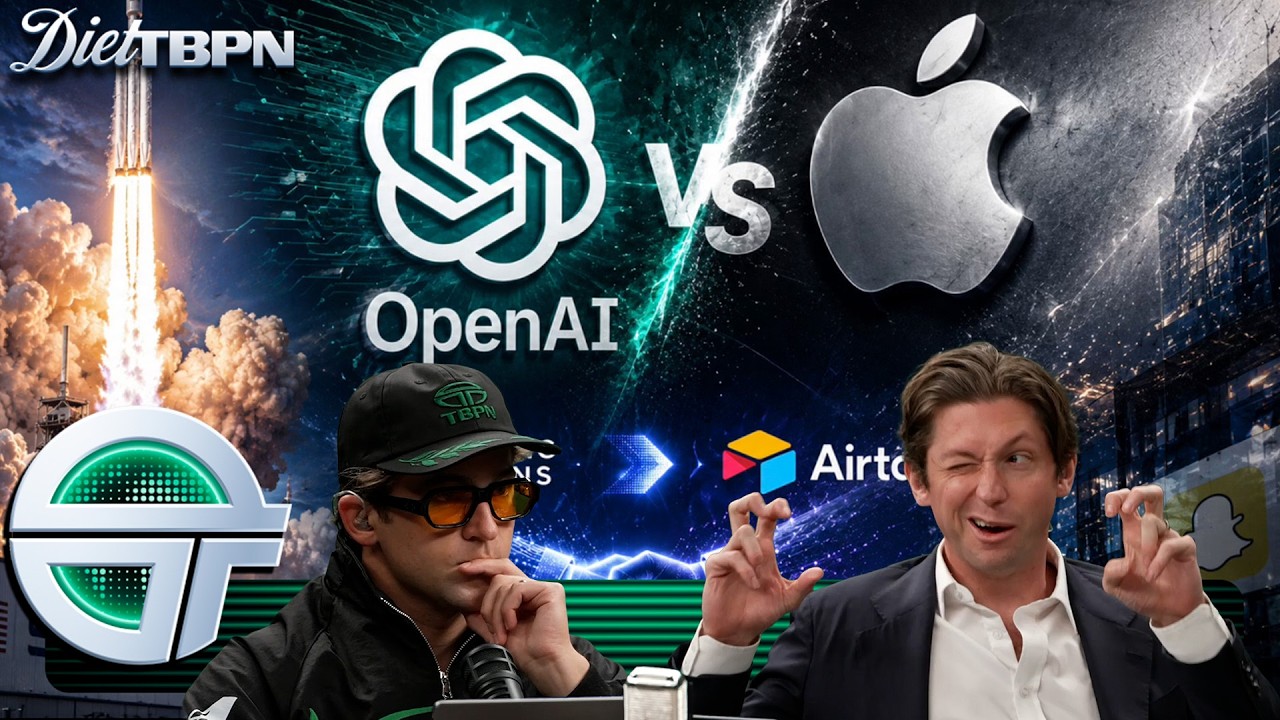
Bending Spoons Buys Airtable for $1.285 Billion at 2.7x Multiple
TBPN
Airtable's discounted sale highlights a systemic valuation reset across single-point software companies, as cheap AI code tools threaten legacy SaaS multiples.
## Background
Diet TBPN is a podcast episode published on YouTube by TBPN on August 5, 2026. Hosted by John Coogan and Jordi Hays, Diet TBPN delivers a 30-minute daily recap of the best discussions from the live tech talk show covering Silicon Valley news and technology trends.
## TL;DR
This episode covers major shifts in the tech landscape, starting with Bending Spoons' bargain $2.25B acquisition of Airtable at a modest 2.7x ARR multiple, highlighting the broader SaaS market downturn. The hosts analyze Snap's Q2 earnings beat driven by its growing Snapchat+ subscription layer alongside CEO Evan Spiegel's CNBC interview defending the costly Spectacles hardware division. They also break down OpenAI's public response to Apple's legal filings, the social media backlash over BMW's in-car Spider-Man ads, and SpaceX's Q2 earnings report showing Starlink and xAI revenue outpacing traditional rocket launches.
## Atmosphere & style
The episode has a fast-paced, sharp, and conversational tech-insider vibe driven by the relaxed banter between hosts John Coogan and Jordi Hays. They combine analytical rigor—breaking down balance sheets, liquidation preferences, and earnings beats—with playful banter, witty commentary, and personal anecdotes about ad-supported tech. The narrative moves seamlessly from sober real-world business breakdowns to lighthearted jokes about startup naming, making it feel like an engaging, high-signal coffee chat among plugged-in Silicon Valley founders.
## Key takeaways
- [00:00](https://www.youtube.com/watch?v=sSVNrkYkYKc&t=0s) Bending Spoons acquired Airtable for an enterprise value of $1.285B (2.7x ARR multiple), highlighting the severe valuation reset across late-stage SaaS companies.
- [00:00](https://www.youtube.com/watch?v=sSVNrkYkYKc&t=0s) Airtable's transaction cleared the preference stack, leaving later-stage investors with around 1x returns while smaller revenue startups face immense pressure to justify previous peak valuations.
- [05:00](https://www.youtube.com/watch?v=sSVNrkYkYKc&t=300s) Airtable spun out its AI division, HyperAgent, into a separate entity prior to closing the acquisition with Bending Spoons.
- [05:00](https://www.youtube.com/watch?v=sSVNrkYkYKc&t=300s) Bending Spoons is establishing itself as a value-based acquirer focused on operational efficiency and cash flow generation rather than hypergrowth.
- [10:00](https://www.youtube.com/watch?v=sSVNrkYkYKc&t=600s) Snap delivered a strong Q2 earnings beat with $1.6 billion in revenue (up 19% YoY), driven by massive expansion in its Snapchat+ paid subscription business.
- [10:00](https://www.youtube.com/watch?v=sSVNrkYkYKc&t=600s) Snap's hardware division continues to face public market skepticism, with Spectacles costing roughly $300 million annually in R&D (~20% of R&D budget).
- [15:15](https://www.youtube.com/watch?v=sSVNrkYkYKc&t=915s) CEO Evan Spiegel defended the $2,195 Specs AR glasses on CNBC, positioning them as a productivity tool for real-world labor and physical workspace computing.
- [18:28](https://www.youtube.com/watch?v=sSVNrkYkYKc&t=1108s) OpenAI issued a public response to Apple's lawsuit, exposing procedural errors in Apple's filing and defending former Apple researcher Chang Liu with iMessage logs.
- [22:15](https://www.youtube.com/watch?v=sSVNrkYkYKc&t=1335s) A viral backlash erupted over promotional Spider-Man: Brand New Day startup banners on BMW infotainment screens, sparking a debate on luxury brand experience.
- [22:15](https://www.youtube.com/watch?v=sSVNrkYkYKc&t=1335s) Spider-Man: Brand New Day achieved a massive $932 million global opening weekend, representing the second-largest Hollywood debut in history.
- [28:44](https://www.youtube.com/watch?v=sSVNrkYkYKc&t=1724s) SpaceX reported Q2 revenue of $7.81 billion (up 92% YoY), beating analyst expectations following its merger with xAI.
- [28:44](https://www.youtube.com/watch?v=sSVNrkYkYKc&t=1724s) Starlink connectivity ($4.29B) and xAI integration ($2.56B) have outpaced core rocket launch services ($962M) as SpaceX's primary revenue drivers.
## Detailed walkthrough
Here is the detailed, faithful walkthrough of the transcript section.
---
[00:00](https://www.youtube.com/watch?v=sSVNrkYkYKc&t=0s) The Airtable Acquisition and the Changing Realities of the SaaS Market
The tech timeline is currently dominated by news that Airtable—founded in 2012 and once valued at $11.7 billion—is being acquired by Bending Spoons (founded in 2013) at a multiple of just 2.7 times Annual Recurring Revenue (ARR). As highlighted by Didi Das, Airtable represents a classic example of a once-hot startup becoming a victim of the "SaaS bust." Despite raising $1.4 billion in venture funding, the company was sold for an enterprise value of $1.285 billion. However, because Airtable had nearly $1 billion in cash sitting on its balance sheet, the total equity value of the transaction landed at $2.25 billion. This structure effectively clears the preference stack: early employees and founders likely receive some payout, while later-stage investors likely got a 1x return on their money—though that capital was tied up for several years without generating a meaningful return.
This deal serves as a massive wake-up call for younger companies that operate at lower revenue run rates while holding drastically higher valuations, signaling that they still have years of compounding ahead to justify those numbers. While a "$2 billion-plus sale" sounds massive on the surface, the reaction across Silicon Valley has been a universal "wow, that's rough." Analysts on the show debate the overarching "SaaSpocalypse" narrative—the doom-and-gloom idea that software is disappearing entirely because people will simply prompt AI agents instead. The truth is more nuanced: it isn't that single-point SaaS products are going to zero, but rather that the market can no longer underwrite sticky single-player tools at 40x or 100x revenue multiples.
The current SaaS climate is drawing direct parallels to the Direct-to-Consumer (D2C) e-commerce boom from a few years prior. There was a brief period where internet consumer brands were underwritten with the same aggressive multiples as generational tech companies with massive moats, such as SpaceX, major AI labs, or social media giants. Once those e-commerce brands went public or pulled back, their stock prices traded down significantly when investors realized that legacy conglomerates like Nestlé or Unilever hadn't actually been disrupted in a fundamental way. By contrast, true disruptive innovation—like social media undercutting traditional newspapers, or Starlink forcing satellite competitors into bankruptcy—causes fundamental market shifts. For SaaS founders building in an increasingly competitive landscape, the path forward requires setting up cap tables where trading at a modest 3x ARR multiple is still considered a successful outcome.
Reflecting on personal product usage, the hosts recall using Airtable back in 2015 for basic internal and external dashboarding. Today, a founder could easily "vibe-code" that exact dashboard functionality using an AI coding tool or agent like Codex in a fraction of the time. While Airtable's core business may face long-term threats from AI-built custom software, its sheer depth within the Fortune 500 and a vast tail of small businesses gives it continued runway. However, a crucial unanswered question remains: how much of Airtable's current growth stems from adding new customer logos versus simple seat expansion within existing, deeply embedded accounts?
[05:00](https://www.youtube.com/watch?v=sSVNrkYkYKc&t=300s) Jared Sleeper's Take, Liquidation Preferences, and Bending Spoons' Strategy
Investor Jared Sleeper offered additional context on the deal, noting that Airtable is doing $480 million in ARR while still growing at 20% year-over-year. From a pure product standpoint, it is a massive success with a deeply satisfied user base built over many years. Sleeper notes that VCs inherently love products that turn "everyone a builder," but cautions that these tools often suffer from subtle pitfalls:
1. **Product Churn:** While Airtable pitched itself as a multiplayer collaboration tool, many organizations used it in a single-player capacity—one person on a team managing a specific database—making it easier to drop or replace.
2. **Bottom-Up Friction:** Single-player, product-led growth allows a tool to spread bottom-up very quickly, but it lacks the enterprise lock-in of a mandatory, top-down CFO directive buying 200 seats of an ERP at once.
3. **Gross Retention Impact:** Gross retention remains the single greatest variable predicting terminal value for companies without inherent scale or network effects, directly dictating what acquirers like Bending Spoons are willing to pay.
The acquisition highlights a painful reality regarding liquidation preferences. Employees who mentally marked their stock options based on a multi-billion-dollar valuation are realizing that late-stage investors get paid back first, leaving early employees to fight over whatever remains. While Silicon Valley could do a better job educating workers about stock mechanics in various exit scenarios, no company is incentivized to explain downside risks while recruiting top talent.
```
[ Liquidation Preference Breakdown ]
1. Investors receive capital back first ( clearing the pref stack)
2. Remaining equity value distributed to founders & employees
```
Interestingly, Bending Spoons is emerging as the "Constellation Software of prosumer, higher-churn SaaS." Though acquirers like Bending Spoons act as a "buyer of last resort" or a value-based buyer—a destination no ambitious founder targets when setting out to build a generational empire—they provide crucial liquidity to system ecosystems. Furthermore, prior to closing the deal, Airtable's team executed an interesting corporate maneuver: they spun out their dedicated AI business, **HyperAgent**, as a separate entity prior to the acquisition. This allows the core AI vision and key team members to keep pushing forward independently with fresh capitalization, shedding the legacy SaaS structure.
While commentators joke about Bending Spoons' deceptively friendly branding—noting it sounds soft compared to standard private equity names like Cerberus Capital—the firm operates with disciplined efficiency. As Bending Spoons has shown with past acquisitions, their playbook isn't to chase 200% year-over-year hypergrowth, but rather to right-size operating teams, optimize margins, and run cash-generating software products efficiently over the long term.
> "No founder setting out says, 'Hey, I want to go on this generational run and then get my spoon bent.' But it's still great because it allows real liquidity... at least it allows everyone to get out and go on to do new things."
* **Airtable Financial Scale:** $480 million ARR at 20% growth rate.
* **Corporate Spin-out:** Airtable's AI business, **HyperAgent**, was spun out separately before the Bending Spoons acquisition closed.
---
[10:00](https://www.youtube.com/watch?v=sSVNrkYkYKc&t=600s) Snap's Earnings Beat, Subscription Growth, and Spectacles Reality Check
Snap recently reported its quarterly earnings, followed by CEO Evan Spiegel appearing on CNBC with Andrew Ross Sorkin. Public narrative around Snap has been dominated by their high-profile **Spectacles** smart glasses, which have acted as a weight on the company's public perception. Investors routinely question whether consumers will buy $2,200 smart glasses in volume anytime soon. However, looking past the hardware noise, Snap delivered a very strong operational quarter that showcased significant earnings leverage.
Snap recorded a clear earnings beat, with overall revenue growing 19% year-over-year while profitability and cash generation expanded at an even faster pace. This demonstrates that Snap is successfully growing top-line revenue much faster than its underlying cost structure, driving margin expansion. Ad revenue climbed 9% to $1 billion for the quarter, but the real standout surprise was Snap's paid subscription layer (Snapchat+). Subscriptions and paid services reached an annualized $400 million run-rate ($100 million in the quarter), up 85% year-over-year. Despite converting only ~3% of its global user base into paid power users, it has rapidly built a high-margin, billion-dollar business trajectory.
On the user metrics front, engagement is growing globally, though Snap is seeing minor user drops in lucrative Western markets—North America fell by 7% and Europe dipped 2%. While losing high-ARPU (Average Revenue Per User) Western users poses long-term ad monetization questions, short-term ad performance is accelerating due to unsexy, background AI upgrades to their ad recommendation engines.
Regarding Spectacles, the hosts noted the irony of Spiegel pitching hardware on national television while not wearing the device himself during the interview. While the $2,200 hardware seems like a massive financial drain, estimates suggest Snap spends roughly $300 million annually on Spectacles—amounting to only ~5% of their total cost structure and around 20% of their R&D budget. Cutting hardware entirely wouldn't instantly transform Snap into a hyper-profitable giant, but hardware continues to pose uncomfortable questions on earnings calls, particularly when management dodged giving specific pre-order numbers for the latest device iteration.
* **Snap Ad Revenue:** $1 billion in the quarter (9% YoY growth).
* **Snap Subscription Revenue:** $100 million in the quarter (85% YoY growth).
* **Western Market User Drops:** North America daily active users down 7%, Europe down 2%.
* **Spectacles R&D Spend:** Estimated $300 million/year (~5% of total costs, ~20% of R&D).
* **Spectacles Hardware Price:** $2,200 per unit.
[15:00](https://www.youtube.com/watch?v=sSVNrkYkYKc&t=900s) Evan Spiegel on CNBC: Snap's Earnings Beat and the Specs Strategy
Snap CEO Evan Spiegel appeared on CNBC following the company's Q2 earnings report, which delivered a clean sweep across key metrics. Snap reported $1.6 billion in revenue, up 19% year-over-year, alongside an overall earnings beat and noticeable margin expansion. Spiegel highlighted that the business's free cash flow is beginning to inflect, empowering Snap to offset stock dilution, fortify its balance sheet, and continue heavily investing in the future.
The discussion quickly shifted to Snap's hardware ambition—its AR glasses, Specs—which are expected to launch at a price point around $2,195. Facing skeptical questions about consumer adoption and impending competition from giants like Apple, Google, and Meta, Spiegel defended Snap's 12-year effort to reinvent computing. He pointed out that people spend over seven hours daily staring at screens and argued that Specs bridge the gap between bulky, immersive VR headsets and underpowered AI glasses. Spiegel pitched the glasses as a tool to bring computing productivity into the physical world, targeting the 60% of jobs that require real-world labor. When pressed on competing against deep-pocketed tech giants, Spiegel argued that constraints actually accelerate innovation and emphasized Snap's long-term focus and first-mover advantage.
Evaluating Spiegel's interview, the show hosts questioned whether housing hardware development inside Snap makes strategic sense. They noted that managing a $6 billion core social media app alongside an expensive hardware moonshot creates tension with public market investors, who constantly demand focus on the main revenue engine. They posited that Snap should consider spinning out Specs as an independent startup—similar to Spiegel's "Elon move"—where dedicated investors and employees could focus solely on hardware while maintaining a distribution partnership with Snapchat.
- Snap's internal generative video team, Dotmo, was spun off earlier as an independent AI video company.
- Spiegel mentioned enterprise and workplace productivity as primary use cases for Specs, though the hosts expressed skepticism about Snapchat's ability to execute a B2B enterprise go-to-market motion.
---
[18:28](https://www.youtube.com/watch?v=sSVNrkYkYKc&t=1108s) OpenAI Claps Back at Apple's Lawsuit
OpenAI publicly responded to Apple's recent legal filings with a detailed blog post that systematically dismantled several core allegations. The post began with a backhanded compliment, praising Apple as "one of the greatest companies of all time" known for its obsession with the smallest details, before asserting that Apple's legal team missed several critical details in their complaint. OpenAI revealed that Apple's attorneys sent formal correspondence to the wrong Asian individual due to similar surnames, falsely claimed to have discussed allegations with OpenAI's general counsel, and accused a former employee of illicitly accessing files after leaving Apple.
Addressing the former employee allegations, OpenAI presented text message exchanges involving former Apple researcher Chang Liu, whose last day at Apple was January 22, 2026. The iMessage logs revealed that following his departure, Apple colleagues repeatedly reached out to Liu asking for help locating files and internal information to assist with ongoing Apple projects. Liu's lighthearted texts back to colleagues—acknowledging he still had access to his computer—were contextualized as an ex-employee casually helping former teammates rather than a malicious insider theft.
The hosts expressed surprise that amidst an aggressive, year-long talent war, Apple failed to execute standard offboarding procedures, such as immediately revoking device access and retrieving company laptops upon resignation.
- Prediction market platform Kalshi currently lists an 82% probability that OpenAI's upcoming Johnny Ive-designed hardware device will **not** feature a screen.
- Kalshi lists an 87% probability that OpenAI will **not** increase the subscription cost of ChatGPT.
- There is currently no Kalshi prediction market for the Apple vs. OpenAI lawsuit because no official court date has been scheduled.
---
[22:15](https://www.youtube.com/watch?v=sSVNrkYkYKc&t=1335s) BMW In-Car Ads Spark Backlash and "Spider-Man" Box Office Numbers
A viral social media debate erupted after videos circulated on X showing an ad for *Spider-Man: Brand New Day* appearing on the infotainment screens of BMW vehicles upon startup. High-profile venture capitalists and tech figures publicly criticized the move; Shiel Mohnot argued it cheapened the brand, A16Z partner Josh Elman called it the opposite of luxury, and Paul Graham declared he would never buy a BMW. Host Jordi Hays reflected on his personal frustration with ad-supported tech, recounting how he saved $10 on an ad-supported Kindle in college only to be permanently annoyed by targeted book ads on his nightstand.
However, community notes and full context revealed the outrage was somewhat overblown. The promo was an optional, limited-time startup banner available from July 27 through August 10, 2026, on compatible BMW models. Rather than automatically playing a full-screen commercial, driver interaction was required: owners had to manually tap the banner to trigger a custom-themed experience featuring music and synchronized interior ambient lighting. While acknowledging the feature required user opt-in, the hosts agreed that placing pop-up ad banners on startup screens crosses the line for a premium vehicle brand.
Despite the online pushback, the marketing push coincided with a massive theatrical release for the film.
- *Spider-Man: Brand New Day* generated $932 million globally through its opening weekend, marking the second-biggest Hollywood debut in history behind 2019's *Avengers: Endgame*.
- The film's performance helped counter narratives surrounding "superhero fatigue" and provided a major boost to the summer box office.
- The hosts joked about an ad-funded autonomous vehicle business model—musing that a giant ad network with a massive video platform like YouTube could offer free self-driving rides subsidized by mid-roll video ads.
---
[28:44](https://www.youtube.com/watch?v=sSVNrkYkYKc&t=1724s) SpaceX Q2 Earnings: Starlink and AI Outpace Rocket Launches
SpaceX reported its latest quarterly financial metrics, marking a rare look at the business for Wall Street following its corporate merger with Elon Musk's xAI in February. Total revenue reached $7.81 billion, handily beating analyst expectations of $6.93 billion. The company reported a net loss of $0.09 per share, outperforming the projected $0.26 per share loss. Revenue jumped 92% year-over-year from $4.1 billion, demonstrating massive top-line growth even at scale. Despite the beat, investors remain cautious; SpaceX stock has dropped 16% since opening at $150 per share on June 12, following a $4.9 billion loss last year driven by heavy capital expenditures in orbital AI infrastructure.
SpaceX also announced a formal partnership with NVIDIA to design the "StarMind AI1" payload, an initiative aimed at bringing data-center-grade compute clusters into orbit. A breakdown of SpaceX's $7.81 billion revenue across its three primary business segments illustrates how drastically the company has evolved:
- **Connectivity (Starlink):** Generated $4.29 billion (vs. $3.83 billion expected), serving as the company's largest business segment and primary source of profitability through direct-to-consumer satellite internet.
- **Artificial Intelligence (xAI Integration):** Generated $2.56 billion (vs. $2.18 billion expected), becoming the second-largest revenue generator.
- **Space (Rocket Launches):** Generated $962 million (vs. $835 million expected).
The hosts closed the show noting the irony that core rocket launches—the foundational service upon which SpaceX was built—now represent its third-largest business line behind internet connectivity and artificial intelligence.
> [05:00](https://www.youtube.com/watch?v=sSVNrkYkYKc&t=300s) No founder setting out says, 'Hey, I want to go on this generational run and then get my spoon bent.' But it's still great because it allows real liquidity... at least it allows everyone to get out and go on to do new things.
> [05:00](https://www.youtube.com/watch?v=sSVNrkYkYKc&t=300s) everyone a builder — Jared Sleeper
> [05:00](https://www.youtube.com/watch?v=sSVNrkYkYKc&t=300s) buyer of last resort
> [05:00](https://www.youtube.com/watch?v=sSVNrkYkYKc&t=300s) Constellation Software of prosumer, higher-churn SaaS
> Silicon Valley’s newest obsession — The New York Times
> [18:28](https://www.youtube.com/watch?v=sSVNrkYkYKc&t=1108s) one of the greatest companies of all time — OpenAI
Tech valuations and capital allocation are undergoing sharp realignments, as evidenced by Airtable's cut-rate acquisition, SpaceX's transformation into a connectivity and orbital computing provider, and public scrutiny over hardware moonshots at Snap.
The SaaS Valuation Reset in Airtable's Sale (0:00)
Airtable's agreement to be acquired by Bending Spoons for an enterprise value of $1.285 billion—at just 2.7 times annual recurring revenue (ARR)—signals a major reset across private software valuations. Despite generating $480 million in ARR with 20% year-over-year growth and raising $1.4 billion in venture funding, the company sold well below its peak $11.7 billion valuation. Because Airtable held nearly $1 billion in cash on its balance sheet, total equity value reached $2.25 billion, allowing the transaction to clear the investor preference stack while offering limited upside for early employees.
Investor Jared Sleeper pointed out that while Airtable built an admired product, it suffered from single-player adoption patterns, weak enterprise-wide lock-in, and higher gross churn compared to mandatory top-down software like ERP systems. In response to shifting market conditions and the commoditization of dashboard software by AI coding tools, Airtable spun out its artificial intelligence business, HyperAgent, as an independent entity prior to closing the transaction.
Snap's Financial Acceleration Against Costly Hardware Bets (10:00)
Snap's second-quarter earnings demonstrated operating leverage, with total revenue rising 19% year-over-year to $1.6 billion and advertising revenue increasing 9% to $1 billion. Growth was led by its Snapchat+ subscription layer, which reached an annualized $400 million run rate ($100 million in the quarter), up 85% year-over-year. However, high-revenue Western user engagement softened, with daily active users falling 7% in North America and 2% in Europe.
Despite positive cash flow, investor skepticism persists around Snap's high-priced AR hardware, Spectacles, anticipated to retail around $2,195 to $2,200. CEO Evan Spiegel defended the initiative as an interface targeting the 60% of jobs requiring real-world physical labor. With Spectacles consuming an estimated $300 million annually—about 20% of Snap's R&D budget—commentators questioned whether an experimental B2B hardware venture belongs inside a publicly traded consumer social media company, suggesting an independent spinout similar to Snap's previous AI video spin-off, Dotmo.
SpaceX's Evolution into Starlink and Orbital AI (28:44)
SpaceX's second-quarter results provided a detailed financial snapshot following its February merger with xAI, showing top-line revenue surge 92% year-over-year to $7.81 billion, beating consensus estimates of $6.93 billion. The company reported a net loss of $0.09 per share, outperforming expectations of a $0.26 loss. However, SpaceX shares have dropped 16% since their June 12 opening at $150, weighed down by heavy orbital AI capital expenditures and a $4.9 billion loss in the previous year.
The revenue breakdown reveals that foundational rocket launches have become SpaceX's smallest major division, generating $962 million. Starlink satellite connectivity drove the bulk of revenue and profitability at $4.29 billion, while xAI integration produced $2.56 billion. Underscoring its transition into an infrastructure host for high-performance computing, SpaceX also announced a formal partnership with NVIDIA to deploy data-center-grade orbital clusters through the StarMind AI1 payload.
Legal Missteps and In-Car Brand Marketing Backlash (18:28)
Public disputes highlighted recent friction in technology public relations and monetization. In a blog post responding to trade secret litigation, OpenAI disputed Apple's claims, noting that Apple's legal team misidentified individuals due to similar surnames and misrepresented interactions with OpenAI's general counsel. OpenAI shared text messages showing that former researcher Chang Liu accessed his laptop post-departure solely because Apple staff repeatedly asked him to help locate internal files.
Concurrently, BMW faced swift criticism from venture capitalists and tech commentators after in-car dashboard ads appeared for the film 'Spider-Man: Brand New Day'. While critics argued the feature diminished the premium brand experience, details indicated the promotion was an optional, interactive startup banner active from July 27 to August 10, requiring manual driver activation to launch ambient audio and lighting effects. The marketing campaign coincided with a record-setting $932 million global opening weekend for the film.
Across software, hardware, and aerospace, companies are contending with the limits of growth narratives and the demands of capital efficiency. Crucial questions remain over how deeply AI automation will eat into legacy SaaS seat expansion, and whether high-cost hardware experiments like Spectacles or orbital computing clusters can generate defensible enterprise value.
[0:00] wow, that's rough.
[5:00] No founder setting out says, 'Hey, I want to go on this generational run and then get my spoon bent.' But it's still great because it allows real liquidity... at least it allows everyone to get out and go on to do new things.
[5:00] Jared Sleeper: everyone a builder
[5:00] buyer of last resort
[5:00] Constellation Software of prosumer, higher-churn SaaS
The New York Times: Silicon Valley’s newest obsession
[18:28] OpenAI: one of the greatest companies of all time
[15:00] Elon move
[0:00] vibe-code
[0:00] SaaSpocalypse
Original transcript
[0:00] Big deal, the big one that's tearing up the timeline right now is that Airtable, founded in 2012, and once valued at $11.7 billion, is getting acquired by Bending Spoons, founded in 2013 at 2.7 times ARR. Once hot startup, now an unfortunate victim of the SaaS bust, says Didi Doss. It raised $1.4 billion, only to be sold for $1.285 billion enterprise value because they had almost $1 billion in cash on the balance sheet. And so the total equity value was $2.25 billion equity value. Just clearing the preference stack. So early employees, founders probably got something. Later, investors probably got 1x their money back, but probably had it tied up for a few years. So not a good outcome, but there's some interesting silver linings here. Obviously, it could be good for bending spoons if they got a good deal and they turned it into a mammoth cash machine. Also there some nuance to where different pieces of the business are going because they sort of dividing it up Really sort of exemplifies the current moment where a company can sell for over a billion dollars and everyone like wow that rough Yeah, yeah. And in a wake up call to the to the many maybe younger companies that are at a lower revenue run rates that are raising at much higher valuations. and basically signaling to them, like you've got some many, many years of compounding to do. Yeah, it's interesting. There's a SaaSpocalypse narrative, which is like these companies are going away. Software won't exist. You'll just prompt it. And I think there's a lot more nuance to it than that. But one thing that it does feel like the underwriting, Underwriting the financial trajectory of these single point solution SaaS products, single player, somewhat sticky, maybe not that sticky, maybe replaceable. It's not that they're going to zero. Bending Spoons wouldn't be buying it if everyone was churning and it was going to be a zero. But at the same time, you can't underwrite it. It's still growing 20%. Yeah, yeah. But you can underwrite it at 40x revenue 100x revenue anymore and it feels a little bit like what happened with D2C e Honestly there was a moment where e brands were venture backable and you could underwrite them or they were being underwritten similarly to venture startups that had true modes, true compounding advantages. They would get the same multiple as a SpaceX or an AI company or a social media company. And that never really made sense. It was sort of just a weird quirk in the system for a couple of years. And then go forward a few years when there were some pullbacks. Some of the IPOs went out. They didn't do that well. They traded down. And all of a sudden it was like, OK, well, if we're doing if we're doing, you know, in my case, like food on the Internet, we're going to VC back a food company like has Nestle been disrupted? Like, no. And that would now Unilever is Unilever trading down like crazy because they're facing so much pressure and that's usually what happens when there truly is disruptive innovation like you see this with I saw some crazy post about how people were bearish on Starlink for a while and the company that they were competing with just went bankrupt and and you see this with you know social media came out and yes like the newspaper and the internet actually the newspaper stocks did actually trade down That never happened in e D2C e any of that And we now in this new regime So I think that there's actually a pretty safe path if you just build the business. If you're saying, look, I am in this SaaS industry. It is going to be more competitive going forward. But I'm setting myself up to have a reasonable multiple so that at every point, if I'm trading at three times ARR, I'm happy. because the cap table set up. Yeah. Right. Yeah. One thing I will say is I started using Airtable. It was 2015. Right. So I probably started using it a few years in. But the product, the way that I use the product back then for my for my first business, I would 100 percent just just vibe code a solution today. I was using like very basic dashboard functionality. Yep. I wanted dashboards that we could use internally. Yep. Share externally. Now it'd be very quite easy to just do all of that in codex or your favorite agent. So I do think that business is very much under threat over the long run, but still has sort of compounding that it can do just given how deep it is into the Fortune 500 and a long tail of small businesses. I'd be very interested to know what is new user, new logo.
[5:00] Growth like versus just expansion within an organization. Because if you have some company that's already sort of running on Airtable, they're growing, so they're adding seeds, they're adding functionality because they're sort of bought in and they're not going to rip it out. What does that growth rate look like versus, you know, new companies actually going and signing up and saying like, yes, this is the best tool for the job because you do get a lot built for free. And like it's not like they don't have access to AI agents that can improve their systems. Like you might be doing a lot of maintenance on your Vibe-coded solution, but at the same time, a lot of people, especially in smaller organizations, were using this as like just one small dashboarding tool, one small database that is sort of replicable. So interesting to see where it goes. And yeah, just like an interesting data point in the SaaSpocalypse, late stage growth. Like is it a zombie corn? What term are you using for it? Jared Sleeper has some more thoughts. 480 million ARR growing 20%. It's a unicorn exit. Many very satisfied customers, including Jared Sleeper, for years. Fantastic run. Never underestimate how much VCs love products that make quote everyone a builder The wrinkle is that one products are high churn Was Airtable I Airtable I feel like the whole pitch for Airtable was that it was multiplayer but maybe that wasn the way that people were actually using it that often A lot of people would just be like, oh yeah, that guy on the team is using Airtable for that thing. But I mean, certainly from very early on. I think by one player, he means that you can, it's more like product led, like one person at a company because i've only used it in a team capacity right but one player can sign up start using it invite other people to the team yeah but it's an advantage because you're bottom up you can just ramp into a different company so quickly but at the same time if you're not like going through the cfo and being like there's a mandate that we're using the crp system 200 seats at once exactly yeah it is a little different uh three his third point uh gross Retention remains the single greatest predictive variable of terminal value for any business that doesn't have a scale effect or network effect. It dictates somewhat mathematically what folks like Bending Spoons will pay. Great to see employees get liquid, but perhaps sad that some are learning about liquidation preferences, SaaS multiples to their disappointment. So of course if you had mentally marked your stock at billion but then this deal happens the investors that put in that money at billion they going to get their money back first and then you going to have to fight for whatever left over the scraps Silicon Valley can do a better job talking to employees about what stock is worth in various scenarios, but no one is incentivized to do it. Well, I mean, you can also just look it up. There's a whole bunch of blog posts about it. You can ask JGPD and get a whole deep dive on run this whole scenario and play out every possible option. But yes, I agree. No one likes to, you know, oh, we're closing the big candidate. Let's tell them about what's going to happen if Bending Spoons comes in. Let's tell them what happens if we get our spoon bent. Bending Spoons is emerging as the constellation software of the prosumer higher churn SaaS is a fascinating turn of events and a good thing for pref stacks everywhere just because there's more liquidity for systems. Well, it's a buyer of last resort. Yeah, whereas... Like no founder setting out, hey, I want to go on this generational run and then get my spoon bent. But it's still great because it allows, again, it is real liquidity. Yeah. This is a win I think bending spoons will obviously end up I would say right the company They not going to continue to run it the same way that it been run but at least it allows everyone to get out and go on to do new things Yeah. In an interesting twist, speaking of getting out, Shiel Monat shares this about the Airtable acquisition. They spun out their AI business, HyperAgent, prior to the acquisition. So the company lives on and likely some cash with it, probably can be recapitalized. Seems like a fantastic outcome, shed the old business and focus on AI. So I would be very interested to see who is going to be working at Hyperagent. Is this something where the founders didn't want to exit the business entirely and then just start from scratch? They wanted to take a whole bunch of the team with them and they wanted a bunch of the resources and learnings. And so they were able to package everything up and this will be something that's very founder led. Or was this just, okay, that is a more expensive piece of the business. Bending Spoons, it's earlier in its ramp. Maybe it's working, maybe it's not, but that's not the business that Bending Spoons is in. And so this is more like a Bending Spoons driven. Well, Bending Spoons, look, we've had both founders on the show. Bending Spoons is like, hey, let's take a great product and just basically right size the team, run it efficiently. And we're not trying to get growth back to.
[10:00] 200, 300% a year. Howie's been on the show. He talked a bit about HyperAgent. That's a product that, if they execute well, can grow 10x year over year, right? And so I could imagine, again, leaving some of the team to just continue running Airtable indefinitely. And then again, like you said, taking some of the talent out and saying like, let's take another big swing. Liquidity is laughing about the fact that Bending Spoons has a very soft, friendly brand. Bending Spoons branding, very, very simple. And it just sounds like such a simple name. It's not like Cerberus Capital. And yet when they negotiate, they're presumably difficult to negotiate with. I don't know. I mean, in a certain situation, you can be very friendly and amicable and just sort of say like, yeah, we're a buyer at 2.7 ARR. You know, we're not going to like screw you over here. We're just going to give you this is a fair price. Take it or leave it and you can take it. You don't necessarily need to be this like crazy werewolf of like a shark, you know? Yeah, there's just not There's just not that many buyers for a company like Airtable. Yeah, and it's a... A just sort of, in this economy, a slow-growing enterprise software business, right? There are not that many buyers. If Airtable had wanted to sell in 2020 I sure they would have gotten meaningfully more They probably did have offers at different points You can imagine Airtable ending up at a sales force as an example But now, Luca is saying the buyer of last resort is maybe unfair. Yeah, just like a value-based buyer. Yeah. I don't know. Yeah. snap earnings happened and uh evan spiegel was on cnbc talking to sorkin uh and it's a very interesting storyline because people are obsessed with the specs i mean job completed in terms of like getting more attention for the company but it's been sort of a weight around the company because the question is like okay is is everyone going to be buying 2200 smart glasses from you anytime soon, when that's not really the story. The story is actually like the revenue growth, the profit, the operating leverage that's coming back into the business. So, I mean, overall, it was a good quarter for Snap, clear beat. Revenue was up 19% year over year with profitability and cash generation rising even faster. So that's that operating leverage. They growing revenue faster than they growing costs and so they increasing their margins Advertising revenue grew 9 to 1 billion in the quarter but the really interesting number that was surprising to me was they making million a quarter in subscriptions and paid services up 85%. So just subscribing and being a paid power user it's only 3% of the user base something like that. That's now a billion dollar line of business. Obviously, very high margin, working really plays to the strengths of what Snap offers. And usage is up globally, but they're losing a step in Western markets. So the North America, I think, fell 7% and Europe fell 2%. And so that's not great for long-term ad monetization because you want to be in the richer countries generally, but still revenue is accelerating. They are monetizing better. And that's probably an AI story. It's just like a boring AI story because it's like the ad recommendation system got a little bit better. Nobody really cares. People want to focus on specs, but they're $2,200 and they're bulkier than competing smart classes. Well, it felt like in that interview, Spiegel was talking about specs, but he wasn't wearing them Does he need to wear them all the time I think he kind of needs to wear them all the time You gotta wear them I mean Apple to that Tim Cook got to wear Vision Pro everywhere he goes That would be hilarious No but the Vision Pro is not meant to be It's augmented reality. It's meant to be worn 24-7. You're a serious person. Let's actually pull up the... You should do a full show. If you love Apple Vision Pro so much. It would not be a problem. Do the full show. Okay. Do the full show. Okay. This Friday. Book it. We'll test running with Tyler. So here's an interesting tidbit. Specs, it feels like, oh, my God, they're spending so much money. It's, like, so crazy. I think the rough estimate is, like, 300 million a year, which is a lot, but it's only 5% of their cost. It's, like, 20% of their overall R&D budget, maybe, something like that. These are very rough numbers, but it's not like if they just spun out specs or cut specs and they were just, like, we're not doing anything there. All of a sudden, the business is like wildly profitable. It's not that big of a stone around the neck. It's more just like a distraction and a question. And it's also not great that on the earnings call, they asked how many pre-orders have you sold? And they sort of danced around it and didn't really give a straight answer on that. Because if it was good, you'd probably be like, yeah, we sold.
[15:00] You've lead with things. Yeah, yeah, yeah, yeah. OK, let's play a little bit of Evan Spiegel on CNBC. I want to hear him talk. Snap reporting Q2 results after the bell on Monday. They scored an earnings beat with $1.6 billion in revenue. It's 19% higher than just one year ago. And joining us right now for more Snap CEO, Evan Spiegel. He did not bring his glasses on the set. But we're going to talk about those glasses in just a minute, because I think that's been a big part of the story. But you beat across the board, not just, by the way, on the revenue piece, but on the margin piece, which is what I think the market was actually looking for. Yeah, well, first of all, thanks so much for having me, Alan Andrew. It's such a beautiful morning here in Aspen. It was a great quarter for Snap, and I think what folks are seeing is that the free cash flow in the business is really starting to inflect, which is allowing us to offset dilution, to strengthen our balance sheet, and, of course, to continue investing in the future, which is so important to us. Okay, click forward to the future. It's like 230. It's like 230. It's like 230. of that story. I mentioned glasses. We'll get there in a second. I think glasses. I want to hear him talking about glasses. About $2,200 right now? $2,100 is what they're going to come in? $2,195. OK, so the question I keep thinking about is how quickly those can come to market in a way and at a price point that people buy them en masse And how do you think about the competition coming from whatever you think Apple is ultimately going to create whatever you think Google is working on and whatever you think Meta is going to do next Well we been working for more than 12 years to reinvent the computer and make it feel more I think today people are spending more than seven hours on average staring at screens. Specs represent the opportunity to bring computing into the world, to make it a shared experience, and ultimately to help bring all the productivity gains we saw in desktop computing and laptop computing to the real world and to real world jobs, which is the vast majority of jobs, about 60% of jobs. So I think this computing transformation is incredibly exciting. We're certainly the leader in the space. I think specs represent a totally new category, right? If you look at the landscape today, you have very bulky but capable headsets, and then you have very limited but lightweight AI glasses. And specs represent the capability of some of these VR headsets in terms of the immersiveness and the ability to really have a full workstation experience. but with the wearability of some of these lighter weight glasses. But do you say to yourself, Apple's going to come and do the same thing and Meta's going to go? So how do you think about that, given the cost of putting this all out there and the amount of money that some of these big companies can actually throw at this? Yeah, well, I think as we look at the history of innovation, I actually think one of the things that helps power innovation are constraints And one of the things that makes Snap so unique is that we been so laser on specs for such a long period of time So I think this focus our history of innovation you know, and our first mover advantage in this space. It feels like it should be a different company. If you want to be laser-focused, it feels like the benefit would be, like, do the Elon thing, start a separate company that is laser-focused on it. The investors in that company are laser-focused on that. The employees. Yeah, have a distribution deal with Snap. Yeah. Yeah. You know, like just just have this like, you know, gets where we're good in this video. Just get snapped to a really polished wheeled machine. You own all the equity. You have the founder control. It's your, you know, your your your financial backstop, your your your credibility for to actually go and truly laser focus, because it's weird to be laser focused on a thing that's not your core business. and then everyone's just constantly asking you, like, we'd love for you to laser focus on the main business that's making millions of dollars every year. Seems pretty solid. Yeah, it's like making $6 billion. Well, what do you think, Tyler? Yeah, I mean, earlier this year they did spin off the AI video company. Yeah. And that seems like much more related to the main like you know Hatchette app than the Glasses right Wait what is the AI video company I think it called Dotmo It was like their internal generative video team Interesting He was talking about enterprise use cases for the glasses I mean... Like workplace use cases? It's so hard to imagine. As an independent company, you make a really great device. I can imagine that company having its own go-to-market motion saying, hey, Amazon, we want you to use our devices across your workforce, and maybe they do a pilot. But trying to sell in Snapchat glasses into the enterprise feels like just going to be a tough sell. OpenAI is firing back at Apple. A little glazy, though. They say Apple is one of the greatest companies of all time. What a funny way to kick off a blog post. Firing back at a lawsuit. Apple just cooked. OpenAI just cooked Apple. Well, they say it built a reputation for obsessing over the smallest details. True. And then they go on to say maybe there were some details that were missed. Yes. So what were the key things that they said? They accused Apple accused OpenAI of ignoring them. Turns out the lawyers emailed the wrong Asian guy because two Asian last names look similar. They claimed you discussed the allegations with OpenAI's general counsel. They admitted that that conversation never happened, accused an ex-examination
[20:00] employee of improperly accessing files. They forgot to mention Apple employees were allegedly asking him to access those same files after he left. So there seemed to be some scenario where like the guy had left, but he had so much internal knowledge that someone at Apple was just like, hey, like, can you remind me where this thing is or something? Yeah. When reading through the initial complaint, Apple made it seem like the employee or the former employee was just running wild through his old laptop. He had sent a message to someone at Apple saying something to the effect, I'm paraphrasing, but I still have access to my computer, LOL. But the reason that in the text messages that they shared, you can imagine the reason that he was there and sending that message. Why would he send the message if he was doing something that he was that was wrong that he would feel guilty of? Right. He was helping his former teammates. And they say, there's 10 other people I could ask you, but you're the smartest or something like that. Yeah. And so when you have all this context, the story looks quite a lot different. Yeah, they're sharing a lot of text messages. You can go read the blog post but there like full back and forth iMessages between Chang Liu and Apple employees where Chang whose last day at Apple was January 22nd 2026 is being asked by his former colleagues to help them locate files and information to assist them with their Apple work. Note other individual names in Apple confidential information has been redacted. So certainly another wild... Yeah, I'm still just very surprised that Apple, during the middle of a year-long talent raid, would know that someone significant had quit and that would not go through the process of actually taking back their laptop and making sure that, you know, the separation was really finalized. People have been saying stories how historically, you know, maybe call it 15 years ago, if you quit Apple, someone would show up to your house immediately and take back any prototypes that you may have had or anything of the sort. Yeah. I'm excited for prediction markets to get on this, honestly. It was very helpful during the Elon Musk OpenAI case. Currently, Kalshi has a few here. Will the OpenAI Johnny Ive device have a screen No is at 82 When will OpenAI release Astra There some dates here What else are they Will OpenAI increase the cost of ChatGPT No at 87%. No market on the Apple lawsuit because it's still very early. There's not even like a court date yet. But we'll keep tracking it because it's an interesting story. Is BMW forcing owners to watch a Spider-Man brand new day promo when they start their cars up? That's the question. A lot of people were upset about this. Jordy this morning is like, this is awful. There's some nuance here. So BMW owners are debating the company's latest in-car promotion after videos spread across X showing a Spider-Man brand new day animation appearing on their vehicle's infotainment screen at startup. And the reason why this fake news triggered me was back in the day in college, I was getting a Kindle. And on the checkout page, it was like, do you want to save $10 and get the ad supported Kindle? And as a college student, I was like, hmm, saving $10 sounds pretty nice. And then I had to live with a Kindle that would sit on my bedside table, just blaring ads in my face constantly And it wasn like I would have actually appreciated ads Can you just flip it upside down True Wow One simple trick Jordy hates this one simple trick But it wouldn't be ads for like Spider-Man. It would be ads for random books. Books, right? Yeah, books. And the targeting wasn't good. So again, people don't like ads. If the target was good. Anyways, what happened here, John? Okay, so venture capitalist Shiel Monat wrote, When you start a BMW, it shows you an ad for Spider-Man. Really cheapens the BMW, in my opinion. A16Z partner Josh Ellman added, Of all the brands I thought might bombard you with in-car ads on screen right when you start the engine, I had BMW pretty dang low on that list. This seems the opposite of luxury and performance. Is BMW a luxury brand? I thought they were premium. Yeah, I think it's a premium brand. Even Paul Graham weighed in, though, reposting Monod's video and saying, I'm never buying a BMW. He's never buying a BMW. What about an old BMW? They can't show you ads in an E39 M3. Wait, but what actually happened? You have to opt into this. Community notes added important context. According to OneNote, the Spider-Man promotion is an optional startup banner available on computer.
[25:00] compatible BMWs from July 27th through August 10th, 2026. The banner does not automatically play a full screen ad. Instead, owners must tap it to launch a themed animation featuring music and synchronized vehicle lighting. BMW has offered similar limited time startup experiences in the past, including holiday themed animations. Very, very, very different. You can just see the pop-up there. Surprise! Spider-Man just dropped into your BMW. you and that's if you press the button you have to actually turn it on it's not yes yes but i'm saying there's a banner ad oh there is a banner it's just a banner look at the video start it over uh let's see let's let's be the judge of this look at this banner it's a banner oh okay and then you click the banner then it plays an ad so it's a pop-up that you click okay and it's like wait what is this pop-up why does my car have a pop-up and then it plays an ad into a setting somewhere, there should be an icon that's like promotions or themes. That didn't look tucked in anywhere. Go literally saying surprise, a Spider-Man ad. And they're not like they should just say, hey, we have an ad for Spider-Man here. If you like one OK this is right on the line But this this is this is this crosses line Because you like what does Spider have to do This is above your line What does Spider have to do with my car And then you click it and you get an ad for Spider-Man. Spider-Man's doing well, though. So the ads are working. So, you know, maybe the BMW owner showed up in droves because the new Spider-Man movie scores Hollywood's second biggest debut ever. That's actually huge. The Sony film grossed $932 million through Sunday, topped only by 2019's Avengers Endgame. That is massive. Did you realize that this movie was making that much money? I mean, if you had asked me an hour ago, is there a new Spider-Man movie coming out? I would say, haven't heard of anything. Yeah, I haven't seen that much energy about it. I've been aware of it, but I have not seen a massive takeover. But also, I'm not driving an ad-supported BMW, so maybe that's the problem. Spider-Man spun a massive weekend for movie theaters flouting superhero fatigue and giving a major boost to Hollywood's summer box office. Sony Pictures Spider brand day opened to an estimated 9 We got some good ideas here in the chat Yeah what have we got So ad cars that get you free self where the ads take over the whole entertainment system in the car So you're sitting there relaxing, you know, the car is driving itself. But then it's just blaring high volume every... I'll take it a step further. Every five minutes, one 30-second ad. What if there was a whole company dedicated to building self-driving cars that was funded by an advertising company, like a company that just prints billions, hundreds of billions of dollars in advertising. Like their DNA is advertising, and then they go into the self-driving car market. Why has no one done this before? They would have a huge advantage in terms of targeting. Yeah, why has no one done this before? Yeah. They could even have a video platform where they're making a lot of money running video ads, and they could take that video platform. Oh, almost like a YouTube. Like a YouTube, yeah, exactly. So you could have a huge ad network, YouTube ads, and then you could have a self-driving car company put them all together. That's Synergy Ritz. And maybe you could spin the company out at some point and raise some venture capital too. Spin the company out. Wait. Are they secretly still advertising? No. I don't think Waymo will do crazy ads. I think I don know maybe A major streaming executive just texted me and says OK going to get Tubi to build a car right now You got to build a car. You got to do it. SpaceX announces a new partnership with NVIDIA to design its StarMind AI1 payload, bringing data center class compute into orbit. That makes a lot of sense. Let's find some actual numbers. So revenue was $7.81 billion versus $6.93 billion expected. Loss per share was $0.09. Average analyst estimated a loss of $0.26. Revenue jumped 92% from $4.1 billion a year earlier. So huge, you know, you're even at this scale still doubling the revenue. And it's the first time Elon Musk's reusable rocket maker will face Wall Street in this capacity. And investors are jittery. SpaceX stock has dropped 16% since opening at $150 a share on June 12th. And SpaceX lost $4.9 billion last year, largely due to heavy investments in artificial intelligence, which we've discussed. The company merged with Musk's XAI.
[30:00] In February, CNBC reports saying that at the time the vision was to build data centers in space, but the launch business, which counts on large contracts from NASA, is losing money. Most of SpaceX's revenue for the year and its only source of profit came from its connectivity segment, which consists of its Starlink Internet service. Starlink is sold directly to consumers. So here's how SpaceX performed in the three key segments. For space, they brought in $962 million versus $835 million, which was expected. So they beat in space. On connectivity, they brought in $4.29 billion. So the Starlink business is more than four times the size of the actual launch business. They brought in $4.29 billion versus $3.83 billion that was expected, so they beat there. And on AI, they brought in $2.56 billion, versus 2.18 billion expected. So beats across the board and very interesting to see that the thing that they started doing, space, of course, launching rockets, is now their third largest line of business. Connectivity is, of course, bigger and also AI is bigger. Everything is computer, John. Everything is computer. That is a good summation of it. And that's a good place to end our show. Thank you.