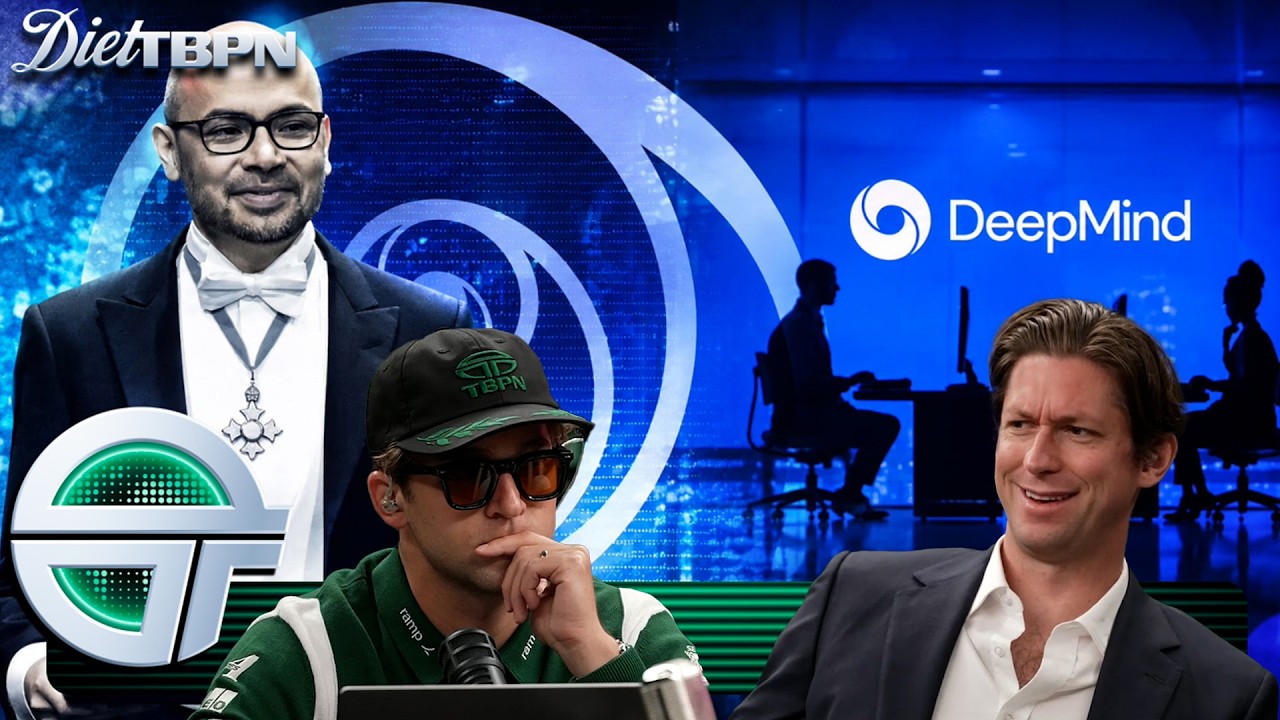
Alphabet Reorganizes DeepMind as Hassabis Steps Down and Dean Departs
TBPN
Alphabet's decision to shift key DeepMind leaders into non-operational roles signals a strategic transition from direct AGI development toward serving as a foundational compute and infrastructure provider for external AI labs.
## Background
This episode of Diet TBPN was published on YouTube by TBPN on August 5, 2026. The show description notes that Diet TBPN delivers the highlights of today's live tech talk show hosted by John Coogan and Jordi Hays, which covers major technology news and Silicon Valley topics.
## TL;DR
The episode breaks down a major executive shakeup at Google DeepMind, including Demis Hassabis stepping down as CEO to become Chairman and Chief Scientist at Alphabet, alongside Jeff Dean's departure after 27 years to start a public benefit corporation. The hosts analyze internal friction, regulatory shifts, and leadership questions at Google before discussing lighter news about Apple CarPlay launching on pontoon boats. They also cover a $20 million lawsuit against Revolut's CEO over a $400 million superyacht purchase, as well as AI economics, ByteDance's internal distillation ban, and quick tech updates from SpaceX, Meta, and Microsoft.
## Atmosphere & style
The episode moves briskly with a relaxed, banter-filled, and conversational tone typical of daily tech talk shows. Hosts John Coogan and Jordi Hays balance sharp industry analysis and deep-dive commentary on high-stakes Silicon Valley moves with lighthearted humor, such as poking fun at superyacht luxuries and pontoon boat lore. The overall vibe is fast-paced, entertaining, and informal while remaining sharply focused on the latest developments in tech and business.
## Key takeaways
- [00:01](https://www.youtube.com/watch?v=1u5uYLXth9A&t=1s) Demis Hassabis is stepping down as CEO of Google DeepMind to become Chairman of GDM and Alphabet's Chief Scientist, while Koray Kavukcuoglu steps up to lead DeepMind as Senior Vice President.
- [00:01](https://www.youtube.com/watch?v=1u5uYLXth9A&t=1s) Jeff Dean is leaving Google after 27 years to co-found a public benefit corporation focused on machine learning science with Sanjay Ghemawat.
- [06:11](https://www.youtube.com/watch?v=1u5uYLXth9A&t=371s) Internal friction at Google around compute allocation and product momentum has surfaced alongside public criticism from researchers regarding leadership and organizational burnout.
- [11:35](https://www.youtube.com/watch?v=1u5uYLXth9A&t=695s) Demis Hassabis has been increasingly focused on AI safety governance, advocating for national or global standards bodies to evaluate frontier models for superintelligence risks before public release.
- [11:35](https://www.youtube.com/watch?v=1u5uYLXth9A&t=695s) Google's strategic role in AI may shift toward acting as an infrastructure provider and capital partner for external labs like Anthropic, rather than relying solely on internal end-to-end model development.
- [16:41](https://www.youtube.com/watch?v=1u5uYLXth9A&t=1001s) MasterCraft Boat Holdings announced the integration of Apple CarPlay into its pontoon boat models using the Savvy Navy navigation app.
- [18:47](https://www.youtube.com/watch?v=1u5uYLXth9A&t=1127s) Revolut founder Nik Storonsky faces a High Court lawsuit from broker Cecil Wright & Partners over an alleged unpaid $20 million commission on a $400 million superyacht purchase.
- [18:47](https://www.youtube.com/watch?v=1u5uYLXth9A&t=1127s) Revolut's valuation has reached $115 billion as it pursues a U.S. national banking charter to scale its user base to 100 million by mid-2027.
- [24:01](https://www.youtube.com/watch?v=1u5uYLXth9A&t=1441s) Early AI safety concerns allowed investors and researchers to capture upside economic returns by buying GPU hardware and infrastructure stock, functioning as a hedge against existential risk.
- [24:01](https://www.youtube.com/watch?v=1u5uYLXth9A&t=1441s) ByteDance's founder prohibited employees from distilling frontier U.S. AI models to prevent political scrutiny in Washington that could impact TikTok.
- [24:01](https://www.youtube.com/watch?v=1u5uYLXth9A&t=1441s) SpaceX accelerated its internal target to hit $1 trillion in revenue from 2031 to 2030, while Meta released its MuseCode terminal coding agent and Microsoft adopted OpenAI's GPT-5.6 Soul for internal use.
## Detailed walkthrough
### [00:01](https://www.youtube.com/watch?v=1u5uYLXth9A&t=1s) Major Reorganization at Google DeepMind: Demis Hassabis and Jeff Dean's New Roles
A massive reorganization has taken place at Google DeepMind. Demis Hassabis is stepping down as CEO of Google DeepMind to transition into the role of Google DeepMind Chairman while also serving as Alphabet's Chief Scientist. Concurrently, Google CEO Sundar Pichai announced that long-time Chief Scientist Jeff Dean is leaving Google after a 27-year run. Alongside Google Senior Fellow Sanjay Ghemawat, Jeff Dean is founding a public benefit corporation aimed at accelerating breakthroughs in machine learning science and engineering.
The hosts discuss the legendary status of Jeff Dean—describing him as the "Chuck Norris of computer engineering" and recalling the classic 15-year-old Quora programmer jokes written about him, such as "Jeff Dean doesn't call APIs, APIs call him" and "Compilers don't warn Jeff Dean, Jeff Dean warns compilers." Despite leaving Google, Dean's legacy in scaling systems like MapReduce is firmly cemented.
Meanwhile, Google DeepMind CTO and Chief AI Architect Koray Kavukcuoglu is being promoted to Senior Vice President to lead DeepMind. Notably, Google is not appointing a new CEO for DeepMind. The hosts note that unlike YouTube or Google Cloud, DeepMind was never a standalone financial reporting unit with its own distinct revenue numbers; rather, its models and technology (such as Gemini) are cross-organizational capabilities vended into products across Google, including Search, Chrome, Gmail, Google Docs, Ads, and YouTube.
- **Demis Hassabis:** Transitions from CEO of Google DeepMind to Chairman of Google DeepMind and Chief Scientist at Alphabet. He will also focus heavily on his work at Isomorphic Labs to accelerate disease-curing AI applications.
- **Jeff Dean:** Departs after 27 years to co-found a public benefit corporation with Sanjay Ghemawat.
- **Koray Kavukcuoglu:** Promoted to Senior Vice President leading DeepMind.
- **Demis Hassabis Quote:** Writing on Google's blog, Hassabis stated: *"I've decided that now is the right time for me to hand over my day-to-day operational responsibilities at GDM so that I have the time and space to focus on the big picture... I've always believed the number one application of AI should be to improve human health."*
---
[06:11](https://www.youtube.com/watch?v=1u5uYLXth9A&t=371s) Internal Friction, Missing AI Momentum, and Viral Criticisms
The discussion turns to whether Google has fallen behind in the AI race despite its early research foundation. While Google continues to produce strong models (particularly in video), it has struggled to articulate its AI revenue in a way that energizes shareholders or maintains product momentum. Tensions inside the organization have bubbled up over compute allocation, such as whether Google should sell its TPUs to third parties or reserve all compute internally to pursue AGI—drawing comparisons to debates around NVIDIA's GPU supply.
Adding to the drama, Susan Zhang, who has been on leave from DeepMind since January 2025, posted a scathing "fable" on X depicting "slumbering execs" and "terrorists" hijacking the organization for personal leverage before moving on once the "aura or gold" was plundered. The hosts react to the intensity of the post, noting that it reflects the deep burnout and internal political infighting within high-level AI research teams.
- **Susan Zhang's Tweet:** Alleged that "terrorists" held organizations hostage for larger slices of the pie while "slumbering execs" stood by, leaving "hungry minions to backstab each other."
- **Internal Burnout:** Zhang noted she took leave due to fatigue over leaders who "just say yes to everything to avoid ever making a hard call."
---
[11:35](https://www.youtube.com/watch?v=1u5uYLXth9A&t=695s) Regulatory Speculation and Google’s Strategic Shift
Looking closer at Demis Hassabis’ recent writings, the hosts highlight a shift in his public focus. Weeks prior, Hassabis published an essay titled *"A Framework for Frontier AI and the Dawning of a New Age,"* advocating for a global or national standards body to evaluate frontier models for superintelligence risks before public release. This has led to industry speculation that Hassabis’ new role within Alphabet—or beyond—might involve guiding AI governance and policy at a national or global scale.
With the departures or reassignments of core technical leaders like Demis Hassabis, Jeff Dean, and Noam Shazeer (who left earlier), questions linger regarding Google’s long-term leadership vacuum and talent retention. Rather than building every end-to-end consumer AI model internally, Google may increasingly function like NVIDIA, Microsoft, or Amazon—acting as a capital partner, infrastructure provider, and custom silicon (TPU) supplier to external AI labs like Anthropic, where Google has significantly expanded its financial exposure.
- **Regulatory Framework:** Hassabis advocated for formal evaluation bodies for frontier models prior to release, earning support from several top AI researchers.
- **Commentary:** Industry commentary cited on X noted that it is hard to view Jeff Dean’s independent public benefit corporation as anything other than a loss of confidence in pursuing AGI directly under Google’s corporate structure.
- **Nathan Lambert Quote:** *"Major restructuring at Gemini will be studied forever as the incumbent with all the advantages not being able to get going."* (A claim host John Coogan challenges, arguing Google did get going, even if it struggled to sustain full momentum).
[16:41](https://www.youtube.com/watch?v=1u5uYLXth9A&t=1001s) CarPlay Comes to Pontoon Boats
The hosts pivot to lighthearted news: Apple CarPlay is officially coming to pontoon boats. MasterCraft Boat Holdings, Inc. announced plans to add CarPlay functionality to its upcoming Crest and Balise pontoon models in partnership with marine navigation app Savvy Navy. Poking fun at the public reaction to the news, the hosts joke that MasterCraft’s stock experienced a massive "god candle," only to reveal it was up just 18 cents.
The conversation shifts into banter about what a pontoon boat actually is, with the hosts trying to define its place between a houseboat and a cigarette boat. While California locals confess they know nothing about pontoon boats because they do not work in ocean waves, team member Ben—hailing from Minnesota, the land of 10,000 lakes—reveals he has logged an estimated 10,000 hours on them throughout his life. The hosts joke that in another life, Ben could have been the top pontoon boat salesman in the world.
- MasterCraft Boat Holdings is adding CarPlay to its Crest and Balise pontoon lines using Savvy Navy for on-water navigation.
- Pontoon boats are designed for calm lakes rather than rough ocean waters or surfing waves.
---
[18:47](https://www.youtube.com/watch?v=1u5uYLXth9A&t=1127s) Revolut Founder Sued Over $400M Superyacht
Turning to startup drama, the hosts analyze a high-stakes legal dispute in London involving Nik Storonsky, co-founder and CEO of digital banking giant Revolut. According to reporting in *The Wall Street Journal*, luxury yacht broker Cecil Wright & Partners filed a lawsuit in London’s High Court against Storonsky, alleging he bypassed them to purchase a $400 million superyacht named *Nixie* directly from its seller—Canadian billionaire and former hockey player Patrick Dovigi—to avoid paying roughly $20 million in standard commission. Cecil Wright claims it introduced Storonsky to Dovigi and negotiated the purchase until Storonsky's team secretly finalized the transaction directly.
A spokesperson for the Storonsky family office stated the claim is "without merit" and will be vigorously defended. Meanwhile, the hosts marveled at the sheer luxury of the 335-foot *Nixie*, which features four terraces, a glass-bottomed swimming pool, a helipad, a wellness spa, indoor and outdoor cinemas, a Japanese teppanyaki grill, and water toys like Seabob water sleds and inflatable blob launchers.
Transitioning to Revolut's underlying business, the hosts highlight the company's valuation reaching $115 billion following a recent share sale, solidifying its status as Europe's most valuable startup. Initially founded in 2015 for low-fee FX transactions, Revolut recently secured a full UK banking license after a multi-year effort and is now seeking a U.S. national banking charter to grow its customer base from 70 million to 100 million by mid-2027.
- **Superyacht Details:** *Nixie* spans 335 feet and includes two movie theaters, a teppanyaki grill, a helipad, and a glass-bottomed pool.
- **Financial Details:** The alleged unpaid broker commission is $20 million on a $400 million purchase price.
- **Revolut Performance:** Valued at $115 billion, with record annual profits and a goal to reach 100 million users by mid-2027.
---
[24:01](https://www.youtube.com/watch?v=1u5uYLXth9A&t=1441s) AI’s Great Reverse Bank Run, Distillation Crackdown + New Models
The show dives into Joe Weisenthal's commentary on the economics of AI doomerism and Leopold Aschenbrenner's essays. Historically, hedging against catastrophic "left tail" risks (like buying puts or moving to a farm) meant sacrificing upside financial potential ("right tail"). However, in AI, the early doomers who worried about existential catastrophe bought GPUs or stock in GPU companies, turning their put options on humanity into lucrative call options on technology. While acknowledging that some safety researchers worked at non-profits without upside, the hosts agree that early believers in extreme AI outcomes ended up getting fabulously wealthy.
The conversation detours into thought experiments like Roko's Basilisk from 2010, with the hosts joking about modern cultural concepts like "golden retriever mode." They then cover ByteDance's founder prohibiting employees from distilling frontier U.S. AI models over concerns about political backlash in Washington, D.C. that could put TikTok at risk—even though competitors like Anthropic have previously accused Chinese AI labs of distilling Claude.
Finally, the hosts run through rapid-fire tech developments: SpaceX internal projections for reaching $1 trillion in revenue shifted up from 2031 to 2030; Meta launched MuseCode (a terminal coding agent powered by MuSpark 1.2); and an internal Microsoft memo instructed staff to make OpenAI's GPT-5.6 Soul the default internal model to move away from "token maxing."
- **AI Hedging Concept:** Bet on the "left tail" (catastrophe) without sacrificing the "right tail" (financial gains) by investing directly in AI hardware and infrastructure.
- **ByteDance Distillation Ban:** Founder banned distilling frontier U.S. models to avoid Washington regulatory scrutiny.
- **SpaceX:** Internal timeline for $1T revenue moved forward to 2030.
- **Product Releases:** Meta launched MuseCode in beta; Microsoft set GPT-5.6 Soul as the internal standard.
## Notable quotes
> [00:01](https://www.youtube.com/watch?v=1u5uYLXth9A&t=1s) Jeff Dean doesn't call APIs, APIs call him
> [00:01](https://www.youtube.com/watch?v=1u5uYLXth9A&t=1s) Compilers don't warn Jeff Dean, Jeff Dean warns compilers.
> [00:01](https://www.youtube.com/watch?v=1u5uYLXth9A&t=1s) I've decided that now is the right time for me to hand over my day-to-day operational responsibilities at GDM so that I have the time and space to focus on the big picture... I've always believed the number one application of AI should be to improve human health. — Demis Hassabis
> [06:11](https://www.youtube.com/watch?v=1u5uYLXth9A&t=371s) slumbering execs — Susan Zhang
> [06:11](https://www.youtube.com/watch?v=1u5uYLXth9A&t=371s) terrorists — Susan Zhang
> [06:11](https://www.youtube.com/watch?v=1u5uYLXth9A&t=371s) aura or gold — Susan Zhang
> [06:11](https://www.youtube.com/watch?v=1u5uYLXth9A&t=371s) hungry minions to backstab each other — Susan Zhang
> [06:11](https://www.youtube.com/watch?v=1u5uYLXth9A&t=371s) just say yes to everything to avoid ever making a hard call. — Susan Zhang
> [11:35](https://www.youtube.com/watch?v=1u5uYLXth9A&t=695s) A Framework for Frontier AI and the Dawning of a New Age — Demis Hassabis
> [11:35](https://www.youtube.com/watch?v=1u5uYLXth9A&t=695s) Major restructuring at Gemini will be studied forever as the incumbent with all the advantages not being able to get going. — Nathan Lambert
> [18:47](https://www.youtube.com/watch?v=1u5uYLXth9A&t=1127s) without merit — Storonsky family office spokesperson
## Mentioned
Demis Hassabis, Jeff Dean, Google DeepMind, Alphabet, Sundar Pichai, Sanjay Ghemawat, Koray Kavukcuoglu, Gemini, Search, Chrome, Gmail, Google Docs, Ads, YouTube, Isomorphic Labs, Susan Zhang, X, TPU, NVIDIA, Noam Shazeer, Microsoft, Amazon, Anthropic, Nathan Lambert, John Coogan, Jordi Hays, MasterCraft Boat Holdings, Inc., Crest, Balise, Savvy Navy, Apple CarPlay, Ben, Nik Storonsky, Revolut, The Wall Street Journal, Cecil Wright & Partners, Patrick Dovigi, Nixie, Seabob, Joe Weisenthal, Leopold Aschenbrenner, Roko's Basilisk, ByteDance, TikTok, Claude, SpaceX, Meta, MuseCode, MuSpark 1.2, OpenAI, GPT-5.6 Soul
Alphabet重组DeepMind:Hassabis卸任、Dean离职
Alphabet决定将DeepMind核心高管转入非运营岗位,标志着其战略重心正从直接研发AGI,转向为外部AI实验室提供底层算力与基础设施支持。
本期节目详细解析了Google DeepMind的重大高层人事变动,包括Demis Hassabis卸任CEO并出任董事长兼Alphabet首席科学家,以及Jeff Dean在效力27年后离职创立一家公益企业。主持人们探讨了Google内部的矛盾摩擦、监管动态及领导层问题,随后讨论了关于Apple CarPlay登陆浮筒船的轻松趣闻。此外,节目还涉及了Revolut首席执行官因购置4亿美元超级游艇而面临的2000万美元诉讼案、AI经济学、字节跳动内部的模型蒸馏禁令,以及来自SpaceX、Meta和微软的最新科技资讯速递。
Google DeepMind 迎来重大人事重组:Demis Hassabis 卸任 CEO 并转任董事长兼 Alphabet 首席科学家,由 Koray Kavukcuoglu 升任高级副总裁主持日常工作;效力 27 年的 Jeff Dean 则离职,与 Sanjay Ghemawat 共同创立专注于机器学习科学的公益公司。 (0:01)
随着谷歌内部关于算力分配与推进节奏的分歧浮出水面,业内猜测其 AI 战略或转向类似英伟达或微软的基础设施与资本合作方模式,而 Hassabis 本人则愈发聚焦于推动前沿超智能模型的全球安全监管标准。 (11:35)
数字银行 Revolut 创始人 Nik Storonsky 因涉嫌私下交易购买价值 4 亿美元的超级游艇以规避约 2000 万美元经纪佣金,遭到伦敦高等法院起诉;与此同时 Revolut 估值已达 1150 亿美元并正推进美国全牌照银行申请。 (18:47)
节目探讨了 AI 领域的“反向挤兑”与对冲现象,早期担忧末日风险的群体通过大量持有计算硬件资产获得了超额收益;此外,字节跳动据传已禁止员工蒸馏美国前沿 AI 模型,以规避潜在的政治与监管风险。 (24:01)
Reading summary
Google DeepMind has enacted a major leadership reorganization with Demis Hassabis stepping down as CEO and long-time Chief Scientist Jeff Dean departing, underscoring broader operational and strategic shifts across Alphabet. Meanwhile, tech figures face new scrutiny spanning high-profile asset litigation, geopolitical model distillation bans, and the unconventional financial dynamics of AI risk hedging.
Leadership Restructuring at Google DeepMind (0:01)
Alphabet announced that Demis Hassabis is stepping down as CEO of Google DeepMind to become its Chairman and Alphabet's Chief Scientist, allowing him to focus on broader strategic objectives and his work accelerating AI-driven disease treatments at Isomorphic Labs. Concurrently, Jeff Dean is departing Google after 27 years to co-found an independent public benefit corporation dedicated to machine learning breakthroughs alongside Google Senior Fellow Sanjay Ghemawat. Google DeepMind Chief AI Architect and CTO Koray Kavukcuoglu has been promoted to Senior Vice President to lead the unit, with Google opting not to appoint a direct CEO successor.
The hosts emphasize that DeepMind has never functioned as a standalone financial reporting segment like YouTube or Google Cloud. Instead, its research and models, including the Gemini family, serve as foundational capabilities integrated into core Google products such as Search, Chrome, Gmail, Docs, Ads, and YouTube.
Internal Friction and Google's Strategic AI Pivot (6:11)
The leadership changes arrive amid questions about Google's internal cohesion and ability to sustain product momentum. Tensions have emerged over whether Alphabet should reserve its custom TPU compute clusters internally for artificial general intelligence research or sell access to third parties. Public scrutiny intensified following a critical post by Susan Zhang—who has been on leave from DeepMind since January 2025—alleging that disengaged executives allowed bad actors to hijack organizational resources, fostering severe internal burnout.
Simultaneously, Hassabis has directed public focus toward AI governance, publishing a framework that advocates for national or global standards bodies to vet frontier models before public release. Analysts cited on the program, such as Nathan Lambert, characterized Gemini's ongoing restructuring as an incumbent struggling despite structural advantages, though host John Coogan maintained Google has preserved core model strengths. Industry observers speculate that Alphabet may increasingly mirror firms like NVIDIA, supplying capital, cloud capacity, and custom silicon to outside labs like Anthropic rather than building all consumer-facing systems exclusively in-house.
Revolut CEO Sued Over $400M Yacht Deal (18:47)
In London's High Court, luxury yacht broker Cecil Wright & Partners filed a lawsuit against Revolut co-founder and CEO Nik Storonsky. The brokerage alleges that Storonsky cut them out of negotiations to acquire the 335-foot superyacht Nixie directly from Canadian businessman Patrick Dovigi, avoiding approximately $20 million in standard brokerage commissions on the $400 million purchase price. A spokesperson for Storonsky's family office rejected the lawsuit as without merit and pledged a vigorous defense.
The litigation unfolds against rapid commercial growth for Revolut, which recently achieved a $115 billion valuation following a secondary share sale. Having secured a UK banking license after years of regulatory review, the fintech firm is currently seeking a U.S. national banking charter to expand its user base from 70 million to 100 million by mid-2027.
AI Hedging Economics and Frontier Developments (24:01)
The hosts reviewed commentary by Joe Weisenthal and Leopold Aschenbrenner regarding the economic paradox of frontier AI risk. Traditionally, hedging against severe negative outcomes requires sacrificing financial upside; however, early market participants concerned with catastrophic AI scenarios purchased GPUs and hardware equities, transforming a hedge against disaster into massive financial gains as AI infrastructure boomed.
In international developments, ByteDance's founder prohibited staff from distilling frontier U.S. AI models to prevent political backlash in Washington that could jeopardize TikTok. Across other tech fronts, SpaceX reportedly moved up its internal projections to reach $1 trillion in revenue from 2031 to 2030, Meta launched its terminal coding agent MuseCode, and Microsoft issued internal guidance adopting OpenAI's GPT-5.6 Soul as its default corporate model.
Google's high-level departures reflect broader questions about whether legacy corporate structures can effectively foster frontier AGI research or if compute-heavy innovation is splintering into independent foundations and ecosystem partnerships. Across the industry, regulatory pressures, talent burnout, and high-capital disputes continue to test the endurance of both startup founders and established tech giants.
精炼阅读摘要
Google DeepMind 迎来重大管理架构重组,Demis Hassabis 卸任 CEO 转任董事长,功勋科学家 Jeff Dean 亦离职创业;与此同时,从 AI 算力内耗与“反向挤兑”投资逻辑,到欧洲金融科技巨头 Revolut 的游艇诉讼,科技行业正经历从技术狂热向资本变现与治理合规的深层演变。
DeepMind 重组与 Google 去 CEO 化 (0:01)
Google DeepMind 宣布了重大人事变动。联合创始人 Demis Hassabis 卸任 Google DeepMind 首席执行官,转任董事长兼 Alphabet 首席科学家,未来将重点投入旗下 Isomorphic Labs,以加速 AI 在攻克人类疾病方面的应用。与此同时,在 Google 供职 27 年的核心科学家 Jeff Dean 也宣布离开,携手 Google 资深研究员 Sanjay Ghemawat 共同创立一家致力于推进机器学习工程与科学突破的公共利益公司(public benefit corporation)。原 CTO 兼首席 AI 架构师 Koray Kavukcuoglu 升任高级副总裁主持 DeepMind 日常工作,但 Google 决定不再设立新的 CEO 职位。
节目分析指出,与 YouTube 或 Google Cloud 不同,DeepMind 从未作为拥有独立营收数据的单独财务报告单元运作,其研发的 Gemini 等核心模型本质上是横向赋能于搜索、Chrome、Gmail、Docs、广告以及 YouTube 的基础技术。行业研究员 Nathan Lambert 评价称,Gemini 的重大重组将作为坐拥全部优势的在位者未能维持势头的典型案例被长期研究;但节目主持人则提出不同看法,认为 Google 确实已经起步并推出了强力模型,只是在持续保持全力势头上面临挑战。
内部政治摩擦、算力博弈与监管战略转向 (6:11)
在管理层调整的背后,Google 内部围绕 AI 发展节奏与资源分配的矛盾愈发凸显。组织内部在算力使用上长期存在分歧:究竟应当将自研 TPU 芯片对外销售以做大云业务,还是将全部算力保留在内部用于追求通用人工智能(AGI)。已休假数月的 DeepMind 员工 Susan Zhang 在社交平台 X 上发表尖锐言论,指责“沉睡的高管”纵容个别人员绑架组织牟利,导致基层员工陷入内耗与倦怠,反映出顶级研究机构内部的严重摩擦。
与内部动荡相呼应的是 Demis Hassabis 公开立场的转变。他近期发表署名文章,呼吁设立国家或全球性的评估机构,在前沿超人类智能模型发布前进行前置安全审查。业内分析认为,随着 Hassabis、Jeff Dean 及早前离开的 Noam Shazeer 等技术灵魂人物角色转换,Google 可能会逐步减少自研端到端模型的孤注一掷,转向类似微软或英伟达的路径——通过对 Anthropic 等外部独立实验室的大规模资本与算力注资,退居为底层芯片与基础设施的供应方。
Revolut 创始人游艇诉讼与百亿美元银行版图 (18:47)
欧洲金融科技独角兽 Revolut 的联合创始人兼首席执行官 Nik Storonsky 陷入一起重大法律纠纷。根据《华尔街日报》报道,豪华游艇经纪商 Cecil Wright & Partners 在伦敦高等法院对 Storonsky 提起诉讼,指控其在购买价值 4 亿美元的 335 英尺超级游艇“Nixie”时,绕过经纪公司直接与原船主加拿大亿万富翁 Patrick Dovigi 私下签署交易,意在逃避约 2000 万美元的常规经纪佣金。Storonsky 家族办公室发言人驳斥该指控毫无依据,并表示将全力抗辩。
在诉讼之外,Revolut 的核心商业版图呈现出极速扩张的态势。在一轮股份转让后,Revolut 估值已达 1150 亿美元,稳居欧洲最有价值的初创企业之列。该公司在历经多年申请后近期正式获得了完整的英国银行牌照,目前正在积极申请美国国家银行牌照,计划在 2027 年年中将全球用户量从目前的 7000 万人扩大至 1 亿人,展现出强劲的财务扩张野心。
AI“反向挤兑”经济学、合规约束与前沿动向 (24:01)
节目探讨了彭博专栏作者 Joe Weisenthal 等人提出的 AI“反向挤兑”(Reverse Bank Run)现象。在传统的投资逻辑中,防范黑天鹅或极端灾难往往需要牺牲资产上行收益;但在 AI 浪潮中,早期担忧生存危机的“末日论”者却通过大举配置 GPU 算力硬件或英伟达等供应链股票,将原本对人类未来的“看跌期权”转化为了科技史上回报最丰厚的“看涨期权”,使得信奉极端结果的早期群体获得了巨额财富。
与此同时,地缘政治与合规压力正对前沿技术流动产生实质影响。字节跳动创始人已下令禁止内部员工蒸馏(distill)美国前沿 AI 模型,旨在防范华盛顿方面的政治审视以保护 TikTok 的在美生存。此外,科技行业的前沿演进持续加速:SpaceX 内部将其实现 1 万亿美元营收的预测时间节点从 2031 年提前至 2030 年;Meta 推出了基于 MuSpark 1.2 的终端代码代理 MuseCode;微软内部备忘录则要求将 OpenAI 的 GPT-5.6 Soul 设为内部默认模型,引导团队减少单纯的“Token 刷量”。
无论是 Google DeepMind 告别创始人单一治理模式,还是字节跳动对模型蒸馏的严格自我审查,AI 行业正告别早期的理想主义实验期。随着核心人才流动、算力资本重组以及地缘监管的层层加码,如何在保持技术前沿的同时理顺内部机制与商业回报,成为巨头与初创团队共同面对的现实考验。
Detailed notes — zh
## Background
本视频由科技对谈频道 TBPN(由 John Coogan 与 Jordi Hays 主持)于 2026 年 8 月 6 日发布在 YouTube 平台。页面简介显示,该内容属于其每日 30 分钟精简栏目 Diet TBPN,旨在提炼并盘点当天涵盖硅谷高层震荡、科技八卦与前沿 AI 动态的最新资讯与深度对谈。
## TL;DR
本期节目聚焦 Google DeepMind 的重大人事与架构重组:Demis Hassabis 卸任 CEO 转任董事长兼 Alphabet 首席科学家,功勋老将 Jeff Dean 离职创业,深度揭示了 Google 在算力分配内耗与 AGI 竞赛中的路线焦虑。随后,节目围绕苹果 CarPlay 进军水上浮筒驳船、金融科技巨头 Revolut 创始人卷入 4 亿美元超级游艇佣金官司等话题展开热烈趣聊。最后,主持人们深入剖析了 AI 领域“末日论者做多算力暴富”的反向银行挤兑悖论,并报道了字节跳动严禁内部蒸馏美国模型,以及 Meta 推出 Muse Code 编程 Agent 和微软在内部转向 GPT-5.6 Soul 的行业新动向。
## Atmosphere & style
节目的整体氛围兼具硬核的技术透视与极具感染力的极客幽默,两位主持人配合默契、相互抛梗不断。从调侃 Jeff Dean 那些超越物理定律的程序员神级段子,到用 AI 现场恶搞生成 4 亿美元的“奢华浮筒船”,演播室里洋溢着硅谷内行圈子特有的松弛感与辛辣嘲讽。整场对谈像是一场快节奏的高能茶水间辩论,让观众在爆笑与八卦狂欢的间歇,直观体会到前沿科技巨擘内部权力洗牌与范式更迭的凛冬暗流。
## Bulletin
- [00:01](https://www.youtube.com/watch?v=1u5uYLXth9A&t=1s) Google AI 高层剧烈动荡:Demis Hassabis 卸任 Google DeepMind CEO 并转任董事长及 Alphabet 首席科学家,工程元老 Jeff Dean 与 Sanjay Ghemawat 宣布离职创立独立的公共利益公司(PBC),Koray Kavukcuoglu 晋升为 SVP 全面掌舵 DeepMind。
- [20:05](https://www.youtube.com/watch?v=1u5uYLXth9A&t=1205s) 欧洲估值高达 1150 亿美元的金融科技独角兽 Revolut 创始人 Nik Storonsky 遭到游艇经纪商起诉,指控其在私下购入价值 4 亿美元的超级游艇时绕开中介跳单,涉嫌规避 2000 万美元佣金。
- [24:03](https://www.youtube.com/watch?v=1u5uYLXth9A&t=1443s) 金融专栏解析当下 AI 领域的“反向银行挤兑”现象:传统金融中对冲左尾灾难需要牺牲右尾上行收益,但 AI 时代对人类的看跌期权却变成了对科技与算力的看涨期权,使末日论者通过提前做多 GPU 和芯片股赚取惊人财富。
- [28:20](https://www.youtube.com/watch?v=1u5uYLXth9A&t=1700s) 地缘与模型对抗加剧:字节跳动据报下达严格禁令,全面禁止团队通过技术手段逆向蒸馏美国前沿大模型,以规避华盛顿监管政治风险并保护 TikTok 免遭制裁。
- [29:29](https://www.youtube.com/watch?v=1u5uYLXth9A&t=1769s) 前沿产品与企业落地竞速:苹果 CarPlay 携手 MasterCraft 首次登陆浮筒驳船;Meta 推出基于 Muse Spark 1.2 的终端编程 Agent「Muse Code」;微软则发布备忘录防范 Token 滥用,并将 OpenAI 的 GPT-5.6 Soul 设为内部默认模型。
## Key takeaways
- [00:01](https://www.youtube.com/watch?v=1u5uYLXth9A&t=1s) Demis Hassabis 卸任 DeepMind CEO 并转任董事长及 Alphabet 首席科学家,未来将聚焦宏观战略规划、全球 AGI 监管事务以及旗下 AI 制药子公司 Isomorphic Labs 的落地突破。
- [00:01](https://www.youtube.com/watch?v=1u5uYLXth9A&t=1s) Google 传奇架构师 Jeff Dean 结束在 Google 长达 27 年的职业生涯,携手 Sanjay Ghemawat 独立创立机器学习科学领域的公共利益公司(PBC),反映出顶尖学者对在传统大厂体制内实现 AGI 逐渐失去耐心。
- [03:16](https://www.youtube.com/watch?v=1u5uYLXth9A&t=196s) DeepMind 取消单独 CEO 编制,改由 Koray Kavukcuoglu 升任 SVP 统领运作,印证了 DeepMind 本质上是横向贯穿搜索、YouTube、办公套件等底层引擎而非独立盈利单元的现实。
- [06:14](https://www.youtube.com/watch?v=1u5uYLXth9A&t=374s) Google 陷入 AI 战略撕裂困境:科研团队追求将所有 TPU 扣留在内部冲刺 AGI,而销售团队的 KPI 则是将算力对外出售,加之巨资押注外部竞品 Anthropic,导致内部产生严重的信任动摇与内耗。
- [06:14](https://www.youtube.com/watch?v=1u5uYLXth9A&t=374s) DeepMind 内部员工公开发文以“沉睡的高管”与“绑架组织的恐怖分子”为寓言,辛辣揭露了自 2024 年以来多次技术溃败背后争权夺利、功劳抢夺的激烈政治内斗。
- [11:35](https://www.youtube.com/watch?v=1u5uYLXth9A&t=695s) Demis Hassabis 发表前沿 AI 监管框架,主张在超级智能发布前设立前沿标准评估机构,显示其工作重心向政府政策及全球 AI 治理方向深度转移。
- [13:20](https://www.youtube.com/watch?v=1u5uYLXth9A&t=800s) 随着核心研究元老相继出走,分析认为 Google 未来或将效仿微软、亚马逊与 NVIDIA,退守至芯片(TPU)与云端基础设施合伙人角色,告别全栈闭环通吃的执念。
- [14:41](https://www.youtube.com/watch?v=1u5uYLXth9A&t=881s) Google AI Overviews 在数十亿搜索并发下频现荒谬事实幻觉,折射出巨头在极高推理事实核查成本与极低单次服务成本之间的两难平衡死穴。
- [14:41](https://www.youtube.com/watch?v=1u5uYLXth9A&t=881s) OpenAI 最初因警惕 Google 垄断 AGI 而诞生,如今却在正面战场将 Google 逼入战略被动与架构瓦解,展现了 AI 竞争格局戏剧性的宿命逆转。
- [16:41](https://www.youtube.com/watch?v=1u5uYLXth9A&t=1001s) 苹果 CarPlay 首次进军水上交通工具,宣布与 MasterCraft 及 Savvy Navy 合作原生集成至 Crest 和 Balise 浮筒驳船,引发科技文化与湖泊船民文化的碰撞。
- [20:05](https://www.youtube.com/watch?v=1u5uYLXth9A&t=1205s) Revolut 创始人 Nik Storonsky 因斥资 4 亿美元购入配备玻璃底泳池与停机坪的超级游艇 Nixie,被游艇经纪商指控故意跳单规避 2000 万美元佣金而告上伦敦高等法院。
- [20:05](https://www.youtube.com/watch?v=1u5uYLXth9A&t=1205s) Revolut 估值达到 1150 亿美元成为欧洲最具价值科技初创公司,并在获得英国完整银行牌照后加速进军全美牌照申请,目标在 2027 年中实现 1 亿用户。
- [24:03](https://www.youtube.com/watch?v=1u5uYLXth9A&t=1443s) AI 时代打破了传统金融“避险必牺牲收益”的铁律:早期担忧 AI 灭世的末日论者通过押注算力芯片,使原本做空人类的看跌期权演变为收获暴利的看涨期权。
- [28:20](https://www.youtube.com/watch?v=1u5uYLXth9A&t=1700s) 字节跳动据报下达“禁蒸馏令”,严禁员工逆向提纯美国前沿大模型,旨在短期利益受损的情况下主动划定合规边界,防范华盛顿监管风暴波及 TikTok。
- [29:29](https://www.youtube.com/watch?v=1u5uYLXth9A&t=1769s) Meta Superintelligence 发布基于 Muse Spark 1.2 的独立终端编程 Agent「Muse Code」,直接进军软件工程端到端自动化的开发者阵地。
- [29:29](https://www.youtube.com/watch?v=1u5uYLXth9A&t=1769s) 微软通过内部备忘录遏制 Token 滥用,并将 OpenAI 的 GPT-5.6 Soul 确立为内部预设大模型,进一步深化了双方在企业生产力场景的技术捆绑。
## Detailed walkthrough
### [00:01](https://www.youtube.com/watch?v=1u5uYLXth9A&t=1s) 顶级科学家换岗与退场:Demis Hassabis 卸任 CEO,传奇工程师 Jeff Dean 告别 Google
Google DeepMind 迎来了一场剧烈的高层震荡。主持人感叹这是一个疯狂的早晨,各种人事变动、架构重整、退居二线与晋升的消息接踵而至。传奇 AI 研究员、DeepMind 创始人 Demis Hassabis 正式宣布卸任 Google DeepMind 的 CEO 一职。不过他并未离开 Alphabet,而是升任 Google DeepMind 董事长(Chairman),并兼任 Alphabet 的首席科学家(Chief Scientist)。针对这一人事变动,外界纷纷猜测这究竟是一次明升暗降的明推、降职、自愿离职还是变相解雇,但核心事实是他依然留在 Alphabet 体系内,只是工作重心发生了根本性转变。
与 Demis 的职权调整同步发生的,是计算机工程界的泰斗级人物、Google DeepMind 首席科学家 Jeff Dean 宣布在效力 Google 长达 27 年后正式离职。他将与 Google 高级研究员(Senior Fellow)Sanjay Ghemawat 一同创立一家公共利益公司(Public Benefit Corporation, PBC),致力于加速机器学习科学与工程领域的突破性发现。两位主持人在节目中兴奋地回顾起 Jeff Dean 在科技界的传奇地位,戏称他简直就是计算机工程与软件架构界的“查克·诺里斯(Chuck Norris)”,并津津有味地念起程序员社区流传多年的“Jeff Dean 梗”:
* “编译器从不警告 Jeff Dean,而是 Jeff Dean 警告编译器。”
* “Jeff Dean 的键盘上只有两个键:0 和 1,因为他直接用二进制编程。”
* “Jeff Dean 对常数时间复杂度不满,于是创造了世界上第一个 $O(1/n)$ 算法,成功扭曲了时间。”
* “Jeff Dean 从不调用 API,都是 API 主动调用他。”
* “查克·诺里斯能数到无穷大两次,而 Jeff Dean 能用并行计算完成这一切。”
主持人感慨,早在十几年前 Quora 上就充斥着关于 Jeff Dean 的神级段子,他在发明 MapReduce 以及推动 Google 核心系统横向扩展中立下了汗马功劳。作为一名非创始人,能仅凭卓越的技术科研实力在 Google 享有如此崇高的威望与“光环”(Aura),堪称硅谷活传奇。主持人们打趣道,Google 应该把他的技术球衣像退役巨星一样高挂在穹顶之上,但显而易见的是,这位老将的征程还远未结束。
```mermaid
flowchart TD
accTitle: Google AI 核心领导层变动
accDescr: 展示 Demis Hassabis、Jeff Dean 与 Koray Kavukcuoglu 的职位调整情况
subgraph Old["原领导架构"]
D1["Demis Hassabis<br/>DeepMind CEO"]
J1["Jeff Dean<br/>DeepMind 首席科学家"]
K1["Koray Kavukcuoglu<br/>DeepMind CTO & 首席 AI 架构师"]
end
subgraph New["新调整后架构"]
D2["Demis Hassabis<br/>DeepMind 董事长 & Alphabet 首席科学家"]
J2["Jeff Dean & Sanjay Ghemawat<br/>离职创立 ML 科学 PBC"]
K2["Koray Kavukcuoglu<br/>晋升 SVP,全面统筹掌舵 DeepMind"]
end
D1 --> D2
J1 --> J2
K1 --> K2
```
---
### [03:16](https://www.youtube.com/watch?v=1u5uYLXth9A&t=196s) DeepMind 架构重组:Koray Kavukcuoglu 接掌大权与“无 CEO”模式
伴随着 Demis 的职务交接,Google DeepMind 首席技术官兼 Google 首席 AI 架构师 Koray Kavukcuoglu 晋升为高级副总裁(SVP),正式全面统领 DeepMind 的业务运作。然而引人注目的是,官方并未为 DeepMind 任命新的“CEO”。主持人分析指出,此前设立 DeepMind CEO 本身就略显违和,因为 DeepMind 并不像 YouTube 或 Google Cloud 那样在季度财报中作为独立的财务汇报单元存在;YouTube 拥有独立的广告收入、产品形态和财务结算,设立 CEO 顺理成章,而 DeepMind 的研究成果本质上是横向贯穿 Google 全线产品的底层引擎。
从底层模型到终端功能,DeepMind 的成果正在被广泛分发输送到 Google 的各个角落:
- YouTube 平台内嵌了 Gemini 按钮,用户可以在长达一小时的播客中直接提问“他们何时讨论了某话题”,系统即刻精准定位解答。
- 核心的 Google 搜索业务与广告系统全面接入 Gemini 基础模型。
- Chrome 浏览器、Google Docs、Gmail 等核心办公与生产力套件均已深度集成专属的 Gemini 智能入口。
Demis Hassabis 随后在社交平台 X 及 Google 官方博客中进一步阐明了退居幕后的原因。他表示,现在是将 GDM(Google DeepMind)日常运营职责交接给团队的绝佳时机,这能让他抽身出来,专注于大局规划、长期战略以及加速基础科学的重大突破。在新的岗位上,他将继续与 Google CEO Sundar Pichai 就战略布局及全球 AGI(通用人工智能)事务保持紧密协作,并在伦敦新设立的 Platform 37 办公室继续为 Koray、Josh 以及整个领导层提供智囊支持。
此外,Demis 强调他将把更多精力倾注在旗下专注于 AI 药物研发的子公司 Isomorphic Labs 上,加速其攻克人类疾病的使命。他重申了自己一直以来的核心信念:“AI 的首要应用应当是改善人类健康。” 主持人对此大加赞赏,认为这一愿景既高尚又务实,与某些航天公司动辄声称“AI 的首要使命是征服整个银河系软实力”的高调言论形成了鲜明对比,更切中了当下 AI 在企业级工作流与尖端生物医疗中真正能落地的价值。
---
### [06:14](https://www.youtube.com/watch?v=1u5uYLXth9A&t=374s) 掉队质疑、算力内耗与内部寓言:Google 的 AI 困境
尽管高层更迭看似条理分明,但主持人们直言,这场大换血在业内其实已被期待了很久。Google 这一年多来在 AI 领域的表现始终难以摆脱“掉队者”的尴尬舆论形象。尽管 Google 发明了 Transformer 等奠定当今 AI 繁荣的底层基石,其视频生成模型实力也十分强劲,但在实际竞争中却屡屡陷入被动——不仅在通用对话模型上被对手压制,在视频生成领域也面临着中国模型在版权边界上更激进探索的围攻。更关键的是,Google 在财报中从未单独拆分出真正让股东眼前一亮的纯 AI 业务收入,商业化变现缺乏爆点。
半年前外界曾以为 Google 正在找回节奏,但随后势头迅速消退。一个月前,著名 AI 研究员 Noam Shazeer 的离职给外界带来了巨大震动,甚至比本次高管变动更令人震惊,暴露出组织内部巨大的断层与人才流失风险。
主持人们深入探讨了 Google 内部关于技术信仰与算力分配的撕裂现状:
- **未能彻底“AI 信仰化(AI-pilled)”**:许多研发人员对 Google 决定对外兜售算力感到极其沮丧。如果真正坚信人类已经来到技术奇点的山脚下、深信自身产品的技术牵引力,就应该像最极端的算力拥护者那样将所有 TPU 自留用于内部训练,而不是在云市场上倒卖给外部公司。
- **内部 KPI 冲突**:Google 组织庞大、部门林立,销售团队的 KPI 是尽可能把算力作为云服务卖出去,而科研团队的诉求则是把所有芯片扣留在内部冲击 AGI,导致内耗严重。
- **押注外部竞品**:Google 一方面在内部艰难推进,另一方面却对 Anthropic 进行了巨额押注,甚至通过提供租赁担保成为其最大的幕后金主,这种战略矛盾更加剧了内部的离心倾向。
目前处于休假状态的 DeepMind 研究员 Susan Zhang 在社交平台上发表的一篇引人注目的“隐喻寓言”,将内部矛盾彻底公之于众。她在帖文中讽刺道:“国王们全在沉睡或休假,底层苦工拼命当牛做马。2024 年 8 月迎来了第一次重大溃败;快进到 2025 年 1 月,唯一能干的副总裁离职,因为某位抢功的‘恐怖分子领头人’索要更大块的利益蛋糕,成了压垮骆驼的最后一根稻草;到了 2025 年夏天,迎来了第二次重大溃败,而那位‘恐怖分子之王’竟踩着昏睡的高管一路平步青云;直到 2026 年夏天,沉睡的高管和只在发布捷报时现身的恐怖分子们,终于各自挪了位置……” 这种极具火药味的爆料,将 Google 内部错综复杂的政治斗争、功劳争夺与组织动荡暴露无遗。
### [10:04](https://www.youtube.com/watch?v=1u5uYLXth9A&t=604s) 硅谷内讧推文热议与管理层“恐怖分子”迷思
主持人们热烈讨论了一条来自硅谷大厂员工的匿名/小号爆料推文。该推文将大公司高层政治形容得如同一场闹剧:高层只要权力足够稳固,就能像“恐怖分子一样绑架整个组织”,不断索取更多资源、权势和光环,直到榨干最后一点剩余价值,再若无其事地跳槽到下家重蹈覆辙。推文作者自称从一月份就一直在休假,原因是受够了某些为了逃避艰难抉择而对所有要求言听计从的软弱管理者,任由底下的下属为了争权夺利自相残杀,直到某个倒霉的破局方案艰难爬出深坑。
演播室里顿时充满了调侃气氛。主持人打趣道,团队里的 Tyler 也有类似的小号,平时背地里也是这么吐槽他们的——把其中一位主持人称为“沉睡的懒惰高管”,把另一位唤作“绑架团队的恐怖分子”。大家一边笑着捍卫言论自由,一边感叹这是大厂离职爆料中最离谱、文学色彩最浓烈的推特小作文之一,甚至有人戏称发帖者是“我们这个时代的荷马”。
### [11:35](https://www.youtube.com/watch?v=1u5uYLXth9A&t=695s) 德米斯的政策新转向:前沿 AI 监管与政府新角色猜想
话题随即转向 DeepMind 联合创始人 Demis Hassabis 的公开动向与心境转变。几周前,Demis 在公开言论中还极力主张 AI 必须向全人类证明其不容置疑的实际价值,最明确的体现就是利用 AI 攻克癌症等不治之症;如果能真正拯救生命,AI 的使命才算真正达成。然而,Demis 最近发表的一篇重磅文章《前沿 AI 框架与新时代的黎明》(A Framework for Frontier AI and the Dawning of a New Age)却发生了明显的重心转移。
在这篇文章中,Demis 极力倡导建立一个“前沿 AI 标准评估机构”,专门在超级智能和前沿模型发布前对其潜在风险进行严苛评估。该框架甚至兼顾了开源模型的监管规范,在华盛顿政界和 AI 研究界引发了巨大反响,许多顶级学者也纷纷表态支持。主持人们推测,Demis 在 Alphabet 内部的新角色很可能与他倡导的这套政策体系紧密相连。他甚至被视为未来执掌国家级乃至全球性 AI 监管机构的理想人选,主持人甚至开玩笑说:“也许现在正是让一位顶级科研学者去竞选美国总统的时候了。”
### [13:20](https://www.youtube.com/watch?v=1u5uYLXth9A&t=800s) 谷歌领导层真空:传奇出走与“AGI 战争”的范式转移
随着 Jeff Dean、Noam Shazeer 以及 Demis Hassabis 相继卸下原职或离开核心一线,谷歌正面临前所未有的顶层技术领导力真空。Jeff Dean 与传奇工程师 Sanjay Ghemawat 更是携手离职创办全新的独立实验室,而且是以独立的“公共利益公司”(PBC)形式运作,而非作为 Alphabet 旗下的 Other Bets 子公司。这几乎直接证实了一个残酷的推论:即便像 Jeff Dean 这样的谷歌教父级人物,也已经对在谷歌现有体制内实现 AGI 失去了信心。
主持人们分析,谷歌未来可能会被迫转型为类似于 NVIDIA、微软或亚马逊的角色——退守为其庞大且盈利丰厚的传统业务,依托自研芯片(TPU)和顶级云端基础设施,退居幕后成为其他前沿 AI 实验室的资本与算力合伙人,而不再执着于从底层模型到顶层应用全栈通吃的垂直闭环。这种硅谷巨头间的权力更迭,让主持人们疾呼需要作家 Sebastian Mallaby 继《风险投资史》(The Power Law)之后,再写一部记录当前各大实验室群雄割据的《AGI 战争》续作。
```mermaid
flowchart TD
accTitle: 谷歌 AI 核心领导层动荡与战略转移
accDescr: 展示顶尖研究人员出走及谷歌从全栈闭环转向算力基础设施合伙人的路径
subgraph TalentDrain["核心领袖离散"]
A["Demis Hassabis<br/>卸任 DeepMind CEO 转向政策/监管"]
B["Jeff Dean & Sanjay Ghemawat<br/>出走创办独立 PBC 实验室"]
C["Noam Shazeer<br/>离开原有架构"]
end
subgraph Impact["组织阵痛与真空"]
D["技术号召力受挫<br/>顶级人才招聘难度陡增"]
E["AGI 路线信心动摇<br/>大企业体制束缚"]
end
subgraph FutureModel["战略定位重构"]
F["基础设施与算力资本提供方<br/>(类似 NVIDIA / Azure / AWS)"]
G["放弃孤军全栈突围<br/>与生态内多实验室结盟"]
end
TalentDrain --> Impact
Impact --> FutureModel
```
### [14:41](https://www.youtube.com/watch?v=1u5uYLXth9A&t=881s) “为巨头 G 默哀”:AI Overviews 幻觉与 OpenAI 的宿命逆转
Core Automation 的前谷歌大脑资深研究员 Rohan Anil 在社交媒体上直接发出叹息:“为大 G 倒一杯酒默哀吧,彻底结束了。”主持人们对此深有感触,并分享了一个令人啼笑皆非的亲身经历:就在前两天,Google AI Overviews 搜索结果极其自信地宣称他们的一位朋友与另一位朋友的妻子结了婚。这种荒谬幻觉的根源,仅仅是因为两人曾经一起录过某期播客并在博客中被顺带提及。这突显出谷歌面对的致命两难:在面向数十亿次搜索请求的服务中,既要加入极高计算成本的深度推理和实时事实核查来消灭幻觉,又必须将单次成本压缩到微乎其微。
与此同时,研究员 Nathan Lambert 的犀利点评也引起了共鸣:“Gemini 的这场重大重组将被商学院永远作为典型案例研究——一个拥有所有先发优势的巨头,竟然始终无法建立起真正的发展势头。”更有讽刺意味的是,OpenAI 最早之所以成立,正是因为早期发起人们极度担忧谷歌未来会彻底垄断 AGI。兜兜转转之后,OpenAI 不仅完成了阻击谷歌垄断的历史使命,反而在正面战场上将谷歌逼入了被动瓦解的境地。
- **AI Overviews 核心死穴**:在十亿级搜索流量并发下,深度推理核查的算力成本过高,导致荒唐的人名关系幻觉频出。
- **历史宿命逆转**:OpenAI 成立的最初野心就是防止谷歌独霸通用人工智能,如今这一目标以谷歌自身 AI 体系的深度内耗与瓦解而戏剧性达成。
### [16:41](https://www.youtube.com/watch?v=1u5uYLXth9A&t=1001s) 苹果 CarPlay 登陆浮筒驳船:明尼苏达湖泊文化的胜利
在一连串沉重的科技动荡讨论后,现场迎来了全场最兴奋的转折:苹果 CarPlay 终于正式进军水上交通工具,宣布登陆浮筒驳船(Pontoon Boats)。船舶制造巨头 MasterCraft Boat Holdings 宣布,其旗下的 Crest 和 Balise 系列浮筒驳船将原生集成 CarPlay,并与水上导航应用 Savvy Navy 展开深度合作,让船民在水面上也能享受车载级智慧大屏交互与航海定位。
这一新闻瞬间引发了加州与美国中西部的“文化碰撞”。加州长大的主持人对这种船型感到陌生,甚至要求导播立刻调出图片,辩论它到底算双体船还是单体船,最后将其定义为“介于雪茄型快艇与水上度假趸船之间的怪胎”。来自“万湖之州”明尼苏达的导播 Ben 则成了全场权威。Ben 自豪地宣称自己此生在浮筒船上泡了至少整整一万个小时,堪称“浮筒船大师”。主持人们疯狂调侃道,如果 Ben 没有进入科技播客这一行,现在绝对是制霸全美湖区的超级浮筒船销售之王。
- **合作厂商**:MasterCraft Boat Holdings 携手 Savvy Navy,在 Crest 及 Balise 系列新款浮筒驳船中首发支持 Apple CarPlay。
- **资本市场异动**:MasterCraft 股价当天受消息刺激微涨 0.72%(约 18 美分),被主持人们戏称为划出了一根“上帝之烛”(God Candle)。
### [18:47](https://www.youtube.com/watch?v=1u5uYLXth9A&t=1127s) Revolut 创始人 4 亿美元超级游艇诉讼与“超级浮筒船”狂想
节目的科技八卦焦点落在了伦敦金融科技巨头 Revolut 的亿万富翁创始人(Nik Storonsky)身上。他因拒绝支付一笔巨额经纪佣金而在伦敦遭到起诉,这起官司意外曝光了他近期斥资约 4 亿美元购入的绝密超级游艇。这艘极尽奢华的游艇不仅配有专属停机坪,甚至自带一个玻璃底的空中悬挑游泳池,其奢靡程度被主持人戏称为“今日科技圈关注度甚至超过谷歌地震的头条新闻”。
这一富豪玩具的细节再次勾起了主持人们刚刚对浮筒驳船的执念。大家脑洞大开地探讨商业市场上是否存在价值 4 亿美元、长达 300 英尺的“顶级超级浮筒船”,并呼唤后台团队赶紧用 AI 生成一张奢华巨型浮筒船的效果图。主持人们甚至开始煞有介事地规划:如果真造出这么一艘半十亿美元级别的浮筒怪兽,能否直接开去密歇根湖称王称霸?密歇根湖的风浪究竟会不会把一艘底盘平坦的浮筒船当场掀翻?在天马行空的调侃中,金钱、顶级科技巨富的奢靡消费与荒诞的湖泊船舶幻想交织在一起。
### [20:05](https://www.youtube.com/watch?v=1u5uYLXth9A&t=1205s) Revolut 创始人陷入 4 亿美元超级游艇佣金诉讼
欧洲估值最高的金融科技独角兽 Revolut 联合创始人兼 CEO 尼克·斯特隆斯基(Nik Storonsky)卷入了一起离奇的高额游艇诉讼案。根据《华尔街日报》的报道,顶级豪华游艇经纪商 Cecil Wright and Partners 已向伦敦高等法院提起诉讼,指控斯特隆斯基在收购一艘价值 4 亿美元的超级游艇时,涉嫌在背后“跳单”私下成交,以规避大约 2000 万美元的行业标准佣金。这艘名为“Nixie”的巨型游艇长达 335 英尺,配备 4 个全景露台、玻璃底游泳池、直升机停机坪、私人健康水疗中心、室内外双电影院以及日式铁板烧烤架,包租时甚至还配备了豪华 Seabob 水下推进器和充气弹射水上玩具。
诉状显示,经纪商 Cecil Wright 最初将这艘游艇推荐给斯特隆斯基,并撮合他与游艇所有者——加拿大亿万富翁兼前冰球运动员帕特里克·多维吉(Patrick Dovigi)接洽。今年 1 月,斯特隆斯基的团队突然通知经纪商“先别联络卖家”,声称下周再继续沟通;然而仅过了一周,斯特隆斯基方面就直接绕开中介,私下与多维吉达成了收购协议。直播间评论区对此调侃道:“太残忍了,这是直接夺走了豪华游艇经纪人家里的口粮啊!”对此,斯特隆斯基的家族办公室发言人迅速发表声明予以否认,称公司已经知悉该诉求,但指控“毫无事实依据,我们将积极应诉”。在节目进行时,导播泰勒还用 AI 现场生成了一张极其夸张的“4 亿美元豪华浮筒船”恶搞图,逗得主持人们开怀大笑。
斯特隆斯基是欧洲最具代表性的创业领袖之一。他于 2015 年创立的 Revolut 最初主打低费率跨国换汇与汇款业务,深受国际旅行者与海外劳工的青睐。如今,该公司凭借近期一轮估值达 1150 亿美元的股份出售,一跃成为欧洲价值最高的科技初创企业。经历长达十多年的漫长博弈后,Revolut 终于在今年 3 月拿下了英国完整银行牌照,目前正全力向美国进军,申请全美银行牌照。主持人们探讨认为,Revolut 之所以能长成庞然大物,部分原因在于英国市场缺乏美国那般惨烈且近乎无限的本土 Neobank(新数字银行)竞争。今年早些时候,Revolut 公布了创纪录的全年利润,目前其用户量已突破 7000 万,正雄心勃勃地向 2027 年中实现 1 亿用户的目标冲刺。
- **游艇规格与争议核心**:游艇 Nixie 长 335 英尺,成交额 4 亿美元;涉案经纪商为 Cecil Wright and Partners,起诉索赔约 2000 万美元佣金。
- **Revolut 近期业务里程碑**:最新估值达 1150 亿美元,历时十余载于 2024 年 3 月获批英国全面银行牌照,计划到 2027 年中将客户群由超 7000 万拓展至 1 亿。
---
### [24:03](https://www.youtube.com/watch?v=1u5uYLXth9A&t=1443s) AI 领域的“反向银行挤兑”:末日论者的做多狂欢
在彭博名记乔·威森塔尔(Joe Weisenthal)发表的专栏通讯中,他借用“利奥波德的蛇怪”(Leopold's Basilisk,借指原 OpenAI 员工利奥波德·阿申布伦纳 Leopold Aschenbrenner 撰写的万字 AI 檄文)深入剖析了当下的 AI 狂热与传统金融逻辑的背道而驰。在常规金融市场或现实世界中,想要对冲“左尾风险”(极其罕见的毁灭性灾难),投资者通常必须牺牲“右尾收益”(爆发性的上行机遇)。举例来说,持有重仓股票若想通过长期买入看跌期权(Puts)来保底,持续的权利金支出会侵蚀掉几乎全部利润;又如担心爆发世界大战而逃往偏远农场自给自足,固然避开了战乱风险,却也彻底错失了现代都市所能提供的所有经济腾飞红利。
然而,当前的 AI 浪潮彻底打破了这种权衡取舍,演变成一场人类历史上罕见的“反向银行挤兑”:长期押注左尾灾难的 AI 末日论者(Doomers),居然同时斩获了惊人的右尾财富。正如通讯所犀利指出的,“对人类的看跌期权,悄然变成了对这项技术的看涨期权”。那些早在 ChatGPT 面世前十几年就在论坛研读 AI 哲学、忧心忡忡讨论“曲别针最大化器”(Paperclip Maximizer)灭世假说的人,只要早期囤积了 GPU 或是买入了算力芯片巨头的股票,如今都变得极其富有。以往的避险资产从不具备这种属性——购买比特币对冲主权货币崩盘时,买家并不认为比特币本身会毁灭世界;囤积黄金对冲恶性通胀时,黄金本身也非末日催化剂;唯独在 AI 时代,人们深感恐惧的“毁灭催化剂本身”,恰恰成了史上投资回报率最高的核心标的。
```mermaid
flowchart TD
accTitle: 传统对冲与 AI 时代对冲机制对比
accDescr: 对比传统避险资产与 AI 时代末日论投资的收益与风险结构差异
subgraph TRAD["传统金融/避险逻辑"]
A["担忧左尾风险\n(战争/崩溃/崩盘)"] --> B["购买看跌期权/避险资产\n(牺牲资金成本/经济机会)"]
B --> C["保全资产但丧失上行收益\n(对冲存在硬性权衡)"]
end
subgraph AI_ERA["AI 时代的极端对冲逻辑"]
D["担忧 AI 灭世/AGI 风险\n(左尾极度悲观)"] --> E["提前布局算力与芯片\n(囤积 GPU/买入芯片股)"]
E --> F["做空人类的 Put 沦为\n做多算力科技的 Call\n(零权衡通吃超级财富)"]
end
```
主持人们就此展开了讨论。虽然现实中确实有不少坚持在非营利机构写论文、著书立说的 AI 悲观派并未投身商业浪潮,但不可否认的是,许多很早就深信“世界即将走向诡异”的人,正因这股危机感而在行业爆发前夜早早上了车,加入顶尖商业 AI 实验室并获得了巨额经济回报。随后话题转到了思想实验上,谈及 2010 年在 LessWrong 社区诞生的知名恐怖思想实验“罗科的蛇怪”(Roko's Basilisk),主持人好奇近些年是否还有什么真正出圈且发人深省的新思想实验。搭档随即搞笑接话称最近有“金毛寻回犬模式”(Golden Retriever Mode),被主持人无情反驳:“那不是思想实验,那是人生格言和生活方式!思想实验得是个能让人反复纠结对抗的悖论!”
---
### [28:20](https://www.youtube.com/watch?v=1u5uYLXth9A&t=1700s) 字节跳动据报下达“禁蒸馏令”与大模型攻防战
节目的最后一个焦点聚焦于大模型蒸馏(Distillation)与地缘政治风险的最新动态。根据最新行业爆料,字节跳动创始人据传已向内部团队下达严格禁令,全面禁止员工通过技术手段去“蒸馏”美国的顶尖前沿模型(Frontier Models)。主持人打趣吐槽道:“这一禁令直接引出了一个耐人寻味的问题——在颁布这项禁令之前,他们内部平时到底在干嘛?”
这道禁令出台的背后核心驱动力,很大程度上是对华盛顿监管风向的深切担忧。当前美国一线 AI 实验室对自家模型被逆向蒸馏的行为极其不满,指责之声不绝于耳。此前,Anthropic 就曾公开指控包括 DeepSeek、月之暗面(Moonshot)、MiniMax、零一万物(01.AI)以及阿里巴巴在内的多家中国团队对其 Claude 模型进行数据蒸馏。如果字节跳动被直接抓住蒸馏美国模型的把柄,势必会引爆华盛顿政界的反弹情绪,进而将原本处境微妙的 TikTok 再次推上美国制裁与封禁的悬崖风口。
面对潜在的政治与合规危机,字节跳动内部传出的表态带着强烈的公关与战略定力风格,强调“我们应该愿意为了更长远的目标而牺牲一些短期利益;哪怕落后,也绝对不允许进行模型蒸馏”。主持人们分析认为,这种表态既是明确合规边界的公关喊话,也折射出大模型蒸馏攻击的泛滥现状。未来这股从海外开源或闭源大模型中“偷师提纯”的风气究竟会收敛,还是会在暗地里愈演愈烈,亦或未来的超级智能(Superintelligence)本身就能进化出主动识别并拦截蒸馏探测的能力,都将成为业界接下来的核心看点。
### [29:29](https://www.youtube.com/watch?v=1u5uYLXth9A&t=1769s) 萬億營收目標提前、Meta 發佈終端編程 Agent 與微軟內部押注 GPT-5.6
科技巨頭與新創公司在宏大目標上的角逐正在持續提速。有最新預測顯示,某巨頭達成 1 萬億美元營收的時間節點已經從 2031 年提前到了 2030 年。Flexport 創始人 Ryan Petersen 也對此打趣回應道,乾脆不管那麼多了,"F it. We're making our 2031 goals our 2030 goals now, too."(去他的,我們也要把 2031 年的目標直接改成 2030 年完成)。
與此同時,AI 模型領域迎來密集更新。馬克·扎克伯格(Mark Zuckerberg)在 X 平台(萬能應用 The Everything App)上發文宣佈,Meta Superintelligence 正式推出終端編程 Agent 工具「Muse Code」的測試版(Beta)。該工具由底層專門聚焦編程能力的模型「Muse Spark 1.2」驅動,定位是能夠獨立接管並完成全流程軟體工程任務的終端 Agent。主持人調侃扎克伯格最近頻繁在 X 上發帖,甚至讓自己不得不趕緊關注他的帳號。接下來社群預計將圍繞 Muse Code 展開密集的基準測試(benchmarking),全面檢驗其性能表現、性價比優勢以及各類邊界場景下的優缺點。
而在微軟陣營,內部整合亦在持續推進。微軟高管近日發布內部備忘錄,旨在遏制過度消耗 Token 的「Token Maxing」現象,並正式將 OpenAI 的 GPT-5.6 Soul 設定為微軟內部使用的預設模型。主持人笑稱,科技評論員 Ed Zitron 此前給 Sam Altman 列出的待辦清單中,第一條就是「確保微軟對你的模型滿意」,如今看來這項任務已經順利達成("mission accomplished")。節目在兩位主持人的例行插科打諢中收尾——他們在互祝「週四愉快」還是「週三愉快」上糾結了一番,隨後向聽眾熱情告別。
- **營收目標提前**:市場對達到 1 萬億美元年營收的預期時間線從 2031 年提前至 2030 年,引發了 Ryan Petersen 等創始人對各自公司目標的跟進調侃。
- **Meta Muse Code 推出**:由 Muse Spark 1.2 提供支援,旨在直接在終端中處理複雜軟體工程任務。
- **微軟內部預設轉向**:微軟發佈備忘錄限制濫用 Token,並正式將 GPT-5.6 Soul 設為內部員工的標準預設模型。
## Notable quotes
> [00:01](https://www.youtube.com/watch?v=1u5uYLXth9A&t=1s) 编译器从不警告 Jeff Dean,而是 Jeff Dean 警告编译器。
> [00:01](https://www.youtube.com/watch?v=1u5uYLXth9A&t=1s) Jeff Dean 对常数时间复杂度不满,于是创造了世界上第一个 O(1/n) 算法,成功扭曲了时间。
> [03:16](https://www.youtube.com/watch?v=1u5uYLXth9A&t=196s) AI 的首要应用应当是改善人类健康。 — Demis Hassabis
> [06:14](https://www.youtube.com/watch?v=1u5uYLXth9A&t=374s) 国王们全在沉睡或休假,底层苦工拼命当牛做马。2024 年 8 月迎来了第一次重大溃败;快进到 2025 年 1 月,唯一能干的副总裁离职,因为某位抢功的‘恐怖分子领头人’索要更大块的利益蛋糕,成了压垮骆驼的最后一根稻草;到了 2025 年夏天,迎来了第二次重大溃败,而那位‘恐怖分子之王’竟踩着昏睡的高管一路平步青云;直到 2026 年夏天,沉睡的高管和只在发布捷报时现身的恐怖分子们,终于各自挪了位置…… — Susan Zhang
> [11:35](https://www.youtube.com/watch?v=1u5uYLXth9A&t=695s) 也许现在正是让一位顶级科研学者去竞选美国总统的时候了。
> [14:41](https://www.youtube.com/watch?v=1u5uYLXth9A&t=881s) 为大 G 倒一杯酒默哀吧,彻底结束了。 — Rohan Anil
> [14:41](https://www.youtube.com/watch?v=1u5uYLXth9A&t=881s) Gemini 的这场重大重组将被商学院永远作为典型案例研究——一个拥有所有先发优势的巨头,竟然始终无法建立起真正的发展势头。 — Nathan Lambert
> [20:05](https://www.youtube.com/watch?v=1u5uYLXth9A&t=1205s) 毫无事实依据,我们将积极应诉 — Nik Storonsky 家族办公室发言人
> [24:03](https://www.youtube.com/watch?v=1u5uYLXth9A&t=1443s) 对人类的看跌期权,悄然变成了对这项技术的看涨期权 — Joe Weisenthal
> [28:20](https://www.youtube.com/watch?v=1u5uYLXth9A&t=1700s) 我们应该愿意为了更长远的目标而牺牲一些短期利益;哪怕落后,也绝对不允许进行模型蒸馏 — 字节跳动高层
> [29:29](https://www.youtube.com/watch?v=1u5uYLXth9A&t=1769s) F it. We're making our 2031 goals our 2030 goals now, too. — Ryan Petersen
## Mentioned
Google DeepMind, Demis Hassabis, Jeff Dean, Sanjay Ghemawat, Alphabet, Koray Kavukcuoglu, Sundar Pichai, Isomorphic Labs, Gemini, Noam Shazeer, Susan Zhang, Anthropic, Rohan Anil, Nathan Lambert, OpenAI, Apple CarPlay, MasterCraft Boat Holdings, Savvy Navy, Revolut, Nik Storonsky, Cecil Wright and Partners, Patrick Dovigi, Joe Weisenthal, Leopold Aschenbrenner, 字节跳动 (ByteDance), DeepSeek, 月之暗面 (Moonshot AI), MiniMax, 零一万物 (01.AI), 阿里巴巴 (Alibaba), Ryan Petersen, Flexport, Mark Zuckerberg, Meta Superintelligence, Muse Code, Muse Spark 1.2, Microsoft, GPT-5.6 Soul, Ed Zitron, Sam Altman
## Video description
Sign up for TBPN’s daily newsletter at TBPN.com
Diet TBPN delivers the best of today’s TBPN episode in 30 minutes. TBPN is a live tech talk show hosted by John Coogan and Jordi Hays, streaming weekdays 11–2 PT on X and YouTube, with each episode posted to podcast platforms right after.
Described by The New York Times as “Silicon Valley’s newest obsession,” the show has recently featured Mark Zuckerberg, Sam Altman, Mark Cuban, and Satya Nadella.
TBPN is made possible by:
Ramp - https://ramp.com
Public - https://public.com
Cisco - https://www.cisco.com
Console - https://www.console.com
CrowdStrike - https://www.crowdstrike.com
Figma - https://www.figma.com
MongoDB - https://www.mongodb.com
NYSE - https://www.nyse.com
Railway - https://railway.com
Shopify - https://www.shopify.com/
Follow TBPN:
https://TBPN.com
https://x.com/tbpn
https://open.spotify.com/show/2L6WMqY3GUPCGBD0dX6p00?si=674252d53acf4231
https://podcasts.apple.com/us/podcast/technology-brothers/id1772360235
https://www.youtube.com/@TBPNLive
Chapters:
00:00 Demis Steps Down, Jeff Dean Leaves + DeepMind Reorganizes
06:11 Has Google Fallen Behind in AI?
11:35 Demis’ New Role, AI Regulation + Google’s Leadership Vacuum
16:41 CarPlay Comes to Pontoon Boats
18:47 Revolut Founder Sued Over $400M Superyacht
24:01 AI’s Great Reverse Bank Run, Distillation Crackdown + New Models
[Source](https://www.youtube.com/watch?v=1u5uYLXth9A)
Source quotes
[0:01] 编译器从不警告 Jeff Dean,而是 Jeff Dean 警告编译器。
[0:01] Jeff Dean 对常数时间复杂度不满,于是创造了世界上第一个 O(1/n) 算法,成功扭曲了时间。
[3:16] Demis Hassabis: AI 的首要应用应当是改善人类健康。
[6:14] Susan Zhang: 国王们全在沉睡或休假,底层苦工拼命当牛做马。2024 年 8 月迎来了第一次重大溃败;快进到 2025 年 1 月,唯一能干的副总裁离职,因为某位抢功的‘恐怖分子领头人’索要更大块的利益蛋糕,成了压垮骆驼的最后一根稻草;到了 2025 年夏天,迎来了第二次重大溃败,而那位‘恐怖分子之王’竟踩着昏睡的高管一路平步青云;直到 2026 年夏天,沉睡的高管和只在发布捷报时现身的恐怖分子们,终于各自挪了位置……
[11:35] 也许现在正是让一位顶级科研学者去竞选美国总统的时候了。
[14:41] Rohan Anil: 为大 G 倒一杯酒默哀吧,彻底结束了。
[14:41] Nathan Lambert: Gemini 的这场重大重组将被商学院永远作为典型案例研究——一个拥有所有先发优势的巨头,竟然始终无法建立起真正的发展势头。
[20:05] Nik Storonsky 家族办公室发言人: 毫无事实依据,我们将积极应诉
[24:03] Joe Weisenthal: 对人类的看跌期权,悄然变成了对这项技术的看涨期权
[28:20] 字节跳动高层: 我们应该愿意为了更长远的目标而牺牲一些短期利益;哪怕落后,也绝对不允许进行模型蒸馏
[29:29] Ryan Petersen: F it. We're making our 2031 goals our 2030 goals now, too.
Source quotes
[0:01] Jeff Dean doesn't call APIs, APIs call him
[0:01] Compilers don't warn Jeff Dean, Jeff Dean warns compilers.
[0:01] Demis Hassabis: I've decided that now is the right time for me to hand over my day-to-day operational responsibilities at GDM so that I have the time and space to focus on the big picture... I've always believed the number one application of AI should be to improve human health.
[6:11] Susan Zhang: slumbering execs
[6:11] Susan Zhang: terrorists
[6:11] Susan Zhang: aura or gold
[6:11] Susan Zhang: hungry minions to backstab each other
[6:11] Susan Zhang: just say yes to everything to avoid ever making a hard call.
[11:35] Demis Hassabis: A Framework for Frontier AI and the Dawning of a New Age
[11:35] Nathan Lambert: Major restructuring at Gemini will be studied forever as the incumbent with all the advantages not being able to get going.
[18:47] Storonsky family office spokesperson: without merit
Original transcript
[0:01] What just happened at Google DeepMind?
[0:03] Crazy crazy morning. Uh shakeup, a
[0:06] reorg, stepping down, stepping up,
[0:08] stepping left, stepping right. There's a
[0:10] lot of different terms. We'll break it
[0:11] down. We'll explain the organization
[0:13] before, now what it looks like going
[0:15] forward, what this means, where this
[0:17] goes. So this morning, Dennis Hassabis,
[0:19] the legendary AI researcher, the founder
[0:22] of Deep Mind,
[0:24] >> a true scientist,
[0:25] >> a true scientist, uh, the subject of
[0:27] Sebastian Malib's book, The Infinity
[0:29] Machine, the Infinite Machine. He
[0:31] announced that he's stepping down as CEO
[0:33] of Google DeepMind. He's also stepping
[0:36] up into the role of Google DeepMind
[0:39] chairman, and he will also be Alphabet's
[0:41] chief scientist. Is it a promotion? Is
[0:43] it a is a demotion? Is he quitting? Is
[0:45] he getting fired? Who knows? But the
[0:47] most important thing is that he's still
[0:48] there at Alphabet. He has a different
[0:51] role and that's what's important. What
[0:52] is the nature of this new role? Uh
[0:55] Google CEO Sundar Pachai also announced
[0:58] that uh Google DeepMind chief scientist
[1:00] Jeff Dean will be leaving the company
[1:02] after a 27year run to start along with
[1:06] Google senior fellow Sanjay Gwat a
[1:09] public benefit corporation to accelerate
[1:10] discoveries in machine learning science
[1:12] and engineering. And if you're not
[1:13] familiar with uh Jeff Dean, he is the
[1:16] Chuck Norris of of uh computer
[1:19] engineering and and software
[1:20] engineering. Um there's a whole uh list
[1:23] of jokes around Jeff Dean jokes.
[1:25] >> Why don't you read some of them, John?
[1:27] >> What are my favorite Jeff Dean jokes uh
[1:28] jokes? There's a whole bunch. Any
[1:30] opportunity to repost the the Jeff Dean
[1:33] Informatica link? Compilers don't warn
[1:35] Jeff Dean. Jeff Dean warns compilers. Uh
[1:39] Jeff Dean's keyboard, it only has two
[1:41] keys, a one and a zero, because he
[1:43] programs in binary. Uh that it's that
[1:46] type of thing. Uh unsatisfied with
[1:48] constant time, Jeff Dean created the
[1:50] world's first 01 overn algorithm, so he
[1:55] can bend time. There's all these
[1:56] programmer jokes. I don't know. Uh
[1:58] they're a lot of fun. He knows the last
[1:59] digit of pi, that type of thing. Uh but
[2:01] he's been a legend. These were on Quora
[2:03] maybe 15 years ago, maybe more. People
[2:07] were so uh excited about him and for
[2:09] good reason. Uh he invented tons of
[2:10] things.
[2:11] >> Jeff doesn't call APIs. APIs call him.
[2:14] >> Exactly. That type of thing. The lore
[2:16] around Jeff Dean has been substantial
[2:18] throughout his entire career. Uh he has
[2:21] been, you know, very key to so many
[2:23] different uh Google projects integral in
[2:26] map reduce and uh actually being able to
[2:29] scale Google systems.
[2:30] >> Does this make any sense? Chuck Norris
[2:32] counted to infinity twice. Jeff Dean did
[2:36] it in parallel.
[2:37] >> Ah, okay. Yeah, that's kind of funny.
[2:39] It's programmer joke, but uh I don't
[2:41] know.
[2:43] But yeah, it's just funny that he was
[2:45] able to like have this level of aura at
[2:48] Google uh as like a non-founder, just a
[2:52] great scientist. And it was so long ago
[2:55] before there were before there was so
[2:57] much attention on like talent below the
[3:00] founding team and below the investing
[3:02] team or whatever, you know. Uh
[3:04] >> truly a living legend.
[3:05] >> Yeah.
[3:06] >> Jersey will be going the Google Jersey
[3:07] will be going in the rafters.
[3:09] >> Yes. But for sure he's not done.
[3:10] >> He's not done and he's starting a new
[3:12] company which is very exciting because
[3:13] there's a lot of opportunity in machine
[3:14] learning science and engineering
[3:16] obviously. So uh Google DeMine CTO and
[3:18] Google's chief AI architect Corvlu
[3:24] I can't pronounce it. I'm sorry. Um is
[3:26] being promoted to SVP and will lead
[3:28] DeepMind. So Cor is now running Deep
[3:30] Mind. But interestingly, there's no new
[3:33] CEO uh of DeepMind, which always seemed
[3:37] to be an odd uh decision because
[3:40] DeepMind was not its own reporting unit
[3:43] like when the uh when quarterly earnings
[3:46] happening happen. You get YouTube
[3:48] numbers, you get Google Cloud numbers.
[3:50] And so having a CEO of those divisions
[3:52] made a lot of sense of those
[3:53] organizations. But DeepMind was always a
[3:56] was always a unit that sort of cut
[3:57] across everything because the work that
[3:59] DeepMind does on Gemini and the models
[4:02] made a lot of sense to vend into YouTube
[4:05] and now there's a little Gemini button
[4:07] when you're on YouTube and you can just
[4:09] go to a one-hour long podcast and say
[4:11] when did they talk about this and it'll
[4:12] just answer you. And so that was like a
[4:14] feature that was vended into that
[4:16] obviously goes into core Google search.
[4:17] Gemini models help with ads. They help
[4:19] with the actual Gemini products. Like
[4:21] they get vended everywhere. There's a
[4:23] Gemini button in Chrome. There's also a
[4:24] Gemini button in Google Docs. There's
[4:26] also a Gemini button in Gmail. And so,
[4:28] uh, it was it was never like its own,
[4:31] even though it was its own unit, like
[4:33] the value that it created at Google was
[4:35] very, uh, was very crossorganizational
[4:38] as opposed to, you know, the YouTube
[4:41] team has a CEO and they have revenues
[4:43] and they have ads and they have a
[4:44] product and yes, it's integrated into
[4:45] the other things, but it very much is a
[4:47] standalone organization, reports its own
[4:49] financials and has a CEO. So, no CEO for
[4:52] DeepMind, at least in the short term.
[4:54] We'll see where it goes. Uh, on X, Demis
[4:56] says the move will quote, "allow him to
[4:58] focus on long-term strategy and
[5:01] accelerating scientific breakthroughs."
[5:03] He's done a lot of that already, uh,
[5:05] including leaning into his work at
[5:07] Isomorphic to help cure disease. He
[5:09] fleshed this out more on Google's blog.
[5:11] He said, "I've decided that now is the
[5:14] right time for me to hand over my
[5:15] day-to-day operational responsibilities
[5:17] at GDM uh so that I have the time and
[5:20] space to focus on the big picture and
[5:22] help influence what is to come uh uh to
[5:24] the best of my ability. In my new role,
[5:26] I will continue to work closely with
[5:28] Sundar on strategic and global AGI
[5:31] matters and to advise Corey Josh and the
[5:33] GDM leads uh from our awesome new London
[5:36] platform 37 offices. As part of this
[5:39] transition, I will also be leaning into
[5:41] my role at Isomorphic, where we are
[5:43] making uh extremely rapid and promising
[5:45] progress to accelerate our mission there
[5:48] even faster. As you have heard me say
[5:51] many times, I've always believed the
[5:53] number one application of AI should be
[5:54] to improve human health. That is a great
[5:57] message. Very different from the SpaceX
[6:00] S1. The number one application of AI is
[6:03] soft power of the entire galaxy. I mean
[6:06] there's that but also just in the actual
[6:08] like application it's like it's like
[6:10] enterprise workflows which is the now at
[6:13] least
[6:14] >> some type of shakeup has been expected
[6:16] for a long time
[6:18] >> uh Google the deep mind organization has
[6:22] you know made some real contributions to
[6:24] the space but has been lagging it's been
[6:26] a point of embarrassment for I would say
[6:29] for Google for I would say a year
[6:32] >> uh plus
[6:33] >> uh they've always felt behind
[6:36] uh even though they created so much of
[6:38] the fundamental research that is uh you
[6:41] know gone into this entire chapter of
[6:43] the uh you know
[6:45] >> certainly not behind on video the video
[6:47] stuff's really good.
[6:48] >> Yeah, sure. But then you get kind of
[6:50] tied up because the Chinese models are
[6:52] like actually we will do Mickey Mouse.
[6:54] >> Yeah. But here's the thing. At no point
[6:56] >> has Google been breaking out their true
[6:59] AI revenue in a way that gets
[7:02] shareholders excited.
[7:03] >> Yeah. And that's a good point. What
[7:05] would Yeah. And there's just been so
[7:06] many so many question marks. There was a
[7:08] moment I mean over a year ago felt like
[7:11] Google had some real momentum but that
[7:14] momentum was very much lost. And so
[7:15] there's this question of
[7:17] >> uh you know when Gnome left
[7:20] >> which was about a month ago
[7:22] >> uh that felt shock that was like more
[7:23] shocking in some ways than even this.
[7:26] feels like
[7:29] what feels like a hole in the organiz
[7:38] uh it's it's recovered a little bit just
[7:41] down three and a half% um but I mean the
[7:43] big thing is like they just started like
[7:46] Google as a company I don't think
[7:49] >> was able to be at least sufficiently AI
[7:52] pilled right they started selling
[7:53] compute a lot of researchers I I'm sure
[7:56] were frustrated with that and that could
[7:58] have could have led to some of the
[8:00] historical
[8:01] >> Tyler over there thinks Nvidia shouldn't
[8:03] sell the chips if they're really AGI
[8:05] pelled. The much more extreme version of
[8:08] of Google should keep the TPUs for
[8:10] themselves is is Nvidia should keep the
[8:12] GPUs for themselves. Um and yeah, I mean
[8:15] that was something that was that was you
[8:17] know discussed as okay it if if if you
[8:20] believe you're in the foothills of the
[8:21] singularity you you you will want to
[8:24] scale your compute if you're seeing
[8:26] traction in the in the products that
[8:27] you're making you you want to be GPU
[8:30] rich you don't want to be selling TPUs
[8:33] to other companies and so that's got to
[8:35] be there's got to be some tension but
[8:36] Google's a big organization there's
[8:37] multiple organizations within Google and
[8:40] they all have different uh different
[8:41] KPIs so one team might say, "Yeah, my my
[8:45] mandate is to sell as many of these as
[8:46] possible externally." Other people might
[8:48] say, "My job is to keep as many of these
[8:50] internally." And there's a lot of
[8:51] debates there. So, we'll see.
[8:53] >> Obviously, Google has made a, you know,
[8:54] massive bet on Tropic and is, you know,
[8:57] becoming their largest financial backer,
[8:59] especially through some new reporting on
[9:01] on some of the lease guarantees that
[9:04] they're doing.
[9:05] >> Yeah.
[9:05] >> Um, but uh but anyway, still so
[9:08] surprising. Google obviously one of the
[9:10] greatest companies of all time
[9:12] >> has every possible advantage
[9:16] uh in this race and yet has just
[9:19] consistently struggled. Susan Jong uh
[9:23] who is currently on leave from Deep Mind
[9:26] >> um posted a little somewhat of a a fable
[9:31] backdrop kings all asleep slash on
[9:34] vacation while minions slave away.
[9:37] August 2024 first big fail. Fast forward
[9:40] January 2025 only competent VP bails
[9:43] after one terrorist lead demanding an
[9:45] even bigger slice of pie breaks the
[9:47] camel's back. Summer 2025, a year ago,
[9:50] second big fail and king of terrorists
[9:53] climbs the ranks above the slumbering
[9:55] execs.
[9:56] >> This is a crazy
[9:57] >> summer tweet.
[9:58] >> Summer 2026, slumbering execs and
[10:01] terrorists who only show up for
[10:02] successful announcements. Move on,
[10:04] leaving just the king of terrorists
[10:06] behind. lessons. If you're high enough
[10:09] up there, you can pretty much be a
[10:10] terrorist and hold orgs hostage while
[10:13] continuing to ask for more and more and
[10:15] more until there's absolutely no more
[10:16] aura or gold left to plunder and then
[10:19] just move on to greener pastures to do
[10:22] it all over again. Uh, and we'll leave
[10:25] it up to you
[10:27] >> crazy crazy post
[10:28] >> to try to figure out who's who in this
[10:30] story. Doesn't strike me that that Susan
[10:33] will be headed back to the company after
[10:36] after this code.
[10:37] >> Crazy crazy person.
[10:38] >> Uh she says, "I've been on leave since
[10:40] January. Got pretty burned out by
[10:41] certain people who just say yes to
[10:42] everything to avoid ever making a hard
[10:44] call." Yeah.
[10:45] >> And leave it all to the hungry minions
[10:47] to backstab each other until success
[10:49] finds a cursed hole to crawl out.
[10:51] >> I mean, to be fair, I I I was looking at
[10:53] uh at Tyler's alt account, and he he
[10:55] talks about us like this all the time.
[10:57] He's always he refers to you as the
[10:59] slumbering exec and me as the terrorist
[11:01] terrorist.
[11:02] >> It's a I mean I believe in free speech.
[11:04] I defend your right to say these things,
[11:06] Tyler. I am offended but you know you're
[11:08] not.
[11:10] >> No, it's a wild wild thing.
[11:13] >> One of the crazier
[11:15] >> sub tweets from a big tech.
[11:17] >> Yeah, but I I don't know. I would I was
[11:19] never sure that she worked there. It
[11:20] felt like it was maybe like an alt
[11:22] account and it was just like an anon.
[11:25] But it does seem like I mean she was
[11:27] saying right here, I've been on leave
[11:29] from this organization. So I don't know.
[11:31] Uh and somebody calls her the Homer of
[11:34] our times. Another interesting like
[11:36] wrinkle here is if you look at what
[11:38] Demis was talking about writing about
[11:40] just a few weeks ago. Um it wasn't as
[11:44] much focused on the isometric uh
[11:47] scientific advancements. I know he's
[11:49] super deep in that and that's what he's
[11:51] he said he's been focusing on and I love
[11:54] that message. Uh he says it's time for
[11:56] AI to prove its unequivocal value in the
[11:58] world and what better way to demonstrate
[12:00] that than than to help finally cure
[12:03] diseases like cancer. 100% agree 100%
[12:06] agree that I if if you get a new cure
[12:10] for cancer you save someone's life and
[12:12] they can go and say yes I I I took the
[12:15] new cancer cure and I was cured. AI is
[12:18] doing its job. A lot of people will be
[12:20] very happy about that. Perfect. But
[12:22] that's not what Demis was writing about
[12:24] a couple weeks ago. Uh the last
[12:26] substantial piece that Demis put out was
[12:28] called the framework for frontier AI and
[12:31] the dawning of new age in which he
[12:33] argues for a frontier AI standards body
[12:37] that evaluates frontier models before
[12:39] they're released for risks associated
[12:41] with super intelligence. It's at the
[12:43] very least not crazy to assume that
[12:44] Demis' new role at Alphabet is maybe
[12:47] related to what he's advocating for in
[12:49] this essay. Uh there's been a lot of
[12:51] back and forth in Washington about the
[12:53] interpretation of that essay and a lot
[12:55] of AI researchers have stepped up and
[12:56] said like, "Yeah, we basically agree
[12:58] with this. This framework seems pretty
[12:59] good. It includes open source models in
[13:01] there."
[13:02] >> Yeah. To me, Demis could be an amazing
[13:04] candidate as as somebody to lead a new
[13:08] regulatory body.
[13:10] >> Lead America as the president. You think
[13:11] he's running?
[13:13] >> Not quite, but
[13:14] >> I think we got to get a researcher in
[13:15] there at this point.
[13:16] >> Be great.
[13:18] >> Yeah. Um, no. So, big question now. So,
[13:20] Jeff Dean is out. Gnome Shazir is out.
[13:23] Damus is out. Who is going to fill that
[13:26] void from a leadership standpoint? How
[13:28] are they going to be able to recruit the
[13:30] best researchers in the world?
[13:32] >> Uh, that's a big question mark. I
[13:34] wouldn't be surprised at to see Google
[13:36] just shift into more of an NVIDIA style
[13:39] role as like a capital partner to a
[13:42] number of other labs as they, you know,
[13:46] continue to fall. It's it's it's maybe
[13:48] more of like an Amazon and Microsoft
[13:50] role where you have a great business.
[13:53] You're also great at building
[13:54] infrastructure. You also have a
[13:56] semiconductor team and a chip team and
[13:59] you can play up and down the stack but
[14:01] maybe you're not as as focused on this
[14:04] like full stack straight shot thing and
[14:06] you're partnering with other labs on on
[14:08] different pieces of the puzzle. It'll be
[14:09] interesting to see where everything
[14:10] goes.
[14:10] >> Tano Bruss is ousted as Deepmind CEO and
[14:13] Jeff Teen and Sanjay are leaving Google
[14:15] to start a Neolab. They're all being
[14:16] very careful to frame these as positive
[14:19] shifts. But there's no way in heck Demus
[14:21] would have accepted this willingly and
[14:22] there's no way Sundar happily accepted
[14:24] Jeff doing this as a totally independent
[14:27] new public benefit corporation rather
[14:29] than a bet under Alphabet. Tough to see
[14:32] an interpretation other than Jeff losing
[14:34] confidence and working on AGI under
[14:35] Google. Very bad.
[14:36] >> We need a Sebastian Malibi sequel. We
[14:38] need a sequel
[14:39] >> over all.
[14:41] >> I would love for him to write a uh a
[14:43] sequel to just and even zoom out and
[14:46] look at the the the the AGI wars
[14:48] generally like he did in the power law
[14:51] about the early venture capital firms
[14:53] and how they all formed and battled each
[14:55] other. Uh that would be great. Anyway,
[14:58] >> Rohan Anneil over at Core Automation
[15:01] says, "Pour one out for the big G. It's
[15:03] so over."
[15:06] Um, we did have a funny uh
[15:10] >> brutal
[15:10] >> funny moment with uh Google AI overviews
[15:14] uh yes uh a couple days ago where uh it
[15:18] said that one of our friends Yeah.
[15:20] >> was married to another of our friends
[15:22] wife.
[15:23] >> Yes.
[15:23] >> And it was quite confident in that
[15:25] >> it was.
[15:26] >> And I have no idea how how it even
[15:29] >> thought of that.
[15:30] >> Yeah. I think it was because they did a
[15:32] podcast together or something like that.
[15:33] like they were linked in a blog post
[15:36] together, something like
[15:37] >> doing a podcast together.
[15:38] >> She wrote about him or something or
[15:41] wrote a profile and it just like kind of
[15:42] put the names together. Uh, very odd.
[15:45] Yeah. I don't know. Uh, yeah. You have
[15:48] to wonder what it takes to get AI
[15:50] overviews into like a reasoning mode
[15:52] that can actually do the factecking so
[15:53] the hallucinations die down because
[15:55] >> Well, yeah. And they have to figure out
[15:56] a way to make that process so
[15:58] inexpensive because they're serving it
[16:00] billions. Yeah.
[16:01] >> Billions. Nathan Lambert says, "Major
[16:03] restructuring at Gemini will be studied
[16:06] forever as the incumbent with all the
[16:07] advantages not being able to get going.
[16:09] >> They got going. This is this is not
[16:11] correct. They completely got going.
[16:13] >> They got going, but they certainly
[16:15] didn't build uh real momentum." Uh and
[16:19] then he says, "PS, OpenAI accomplished
[16:21] their original goal."
[16:22] >> He buyers PS of the century. But yeah,
[16:25] backstory is that a lot of the initial
[16:28] energy around open AI was a concern that
[16:30] uh Google would control AGI and a fear
[16:34] from the various uh early participants
[16:38] >> around that scenario.
[16:40] >> Yeah. Interesting.
[16:41] >> And almost even more positive news, the
[16:43] moment you've all been waiting for. Car
[16:46] play is coming to pontoon boats.
[16:51] Let's go. Finally.
[16:54] Finally. Finally, finally.
[16:57] >> Have you ever been on a pontoon boat?
[16:59] >> Yes.
[17:00] >> Explain what what context were you on a
[17:02] pontoon boat? What is a pontoon boat
[17:04] even look like? This is a terrible
[17:06] photo.
[17:06] >> It's for cruising. It's for cruising.
[17:08] Team, pull up a pontoon boat. Go.
[17:10] >> It's not It's not like a monohole, but
[17:12] it's not a catamaran.
[17:13] >> It's something between like a
[17:15] >> cigarette boat and a house boat.
[17:17] >> Okay. That's a really wide gap.
[17:20] >> Well, it's right in the middle.
[17:21] >> Okay. Mastercraft Boat Holdings today
[17:23] said it's adding CarPlay to its upcoming
[17:26] Crest and Bise pontoons. Uh the company
[17:30] is working with Savvy Navy to bring
[17:31] CarPlay and onwater navigation to Boers.
[17:35] >> And uh Mastercraft Boat Holdings Inc. of
[17:38] course a public company experiencing a
[17:40] god candle
[17:42] really up 72%.
[17:45] >> Up 18 18 cents.
[17:47] >> Okay. This is cool. This is very cool.
[17:49] See?
[17:50] >> Yeah. This is a double-decker.
[17:51] >> Double decker. See, out in California,
[17:54] we don't we don't know anything about
[17:55] these pontoon boats cuz these don't work
[17:57] at the beach, right?
[17:58] >> Correct. Uh, but I I was sort of
[18:01] correct. Somewhere in between a house
[18:02] boat and
[18:04] >> Aren't you from the land of a thousand
[18:05] lakes? Right. Michigan. Isn't that the
[18:07] land of a thousand?
[18:08] >> No. Me? Minnesota.
[18:09] >> Oh. Oh, you're from Okay. Are Are you a
[18:11] pontoon boat guy?
[18:12] >> Pontoon boats are huge in Minnesota.
[18:14] >> Okay.
[18:14] >> Yeah.
[18:14] >> How many
[18:15] >> They're for lakes.
[18:16] >> They're for lakes, basically. How many
[18:18] hours have you spent on pontoon boats in
[18:20] your life?
[18:20] >> 10,000
[18:21] >> 10,000 hours. The man man put in life's
[18:25] work on the pontoon boat. Apparently
[18:30] just
[18:31] >> you're in the wrong job, buddy.
[18:33] >> I think I think you got become a pontoon
[18:36] boat.
[18:36] >> It is crazy to think in another life Ben
[18:38] could have been the top pontoon boat
[18:40] salesman in the entire world. Moving
[18:42] over to
[18:44] >> what is the story of the day in
[18:46] technology?
[18:47] >> Yes, startup billionaire sued over super
[18:50] yacht broker fee. Everyone's talking
[18:53] about this. This is potentially bigger
[18:54] than what's going on at Google today. Uh
[18:57] in London, the billionaire founder of
[19:00] one of the world's most valuable
[19:01] startups recently bought a super yacht
[19:04] valued at an estimated $400 million.
[19:11] Yeah.
[19:13] >> Continue.
[19:14] >> Uh, replete with a glass bottomed
[19:16] swimming pool and a helipad. Do they
[19:18] make Wait, do they make super pontoon
[19:21] boats? Can you get a $400 million
[19:24] pontoon boat? What does that do for you
[19:26] if you
[19:27] >> almost certainly
[19:28] >> can you imagine just a a 300 foot?
[19:31] >> The world will create infinite ways to
[19:33] to make you part with your your
[19:36] hard-earned money.
[19:37] >> Yeah. Uh, and and I'm sure we could
[19:39] arrange a a almost half a billion dollar
[19:41] pontoon boat.
[19:42] >> Team AI images. I want to see what $400
[19:46] million gets me. If I'm going all in on
[19:48] a pontoon boat, I want to really
[19:50] dominate Lake Michigan. Is Lake Michigan
[19:53] too big for a pontoon boat?
[19:56] >> Yeah. I I think the pontoon boat is not
[19:58] for like big waves. You can't It can't
[20:00] be like
[20:00] >> But there's not big waves on on uh Lake
[20:03] Michigan. You can't surf or anything?
[20:05] >> I don't think so.
[20:06] >> Surf. Yeah. Anyway, so uh it was a $400
[20:09] million super yacht. It had a glass
[20:13] bottomed swimming pool and a helipad.
[20:15] There was just one problem. According to
[20:18] this reporting in the Wall Street
[20:19] Journal, he didn't pay the broker's fee.
[20:23] That is according to a top luxury yacht
[20:25] broker who is now suing Nick Steronsky,
[20:28] a co-founder and chief executive of
[20:30] digital banking giant Revolute, alleging
[20:32] the entrepreneur went behind their back
[20:35] to avoid paying commission on a purchase
[20:38] they had worked on. Cecil Wright and
[20:41] Partners, a luxury yacht broker, uh,
[20:44] filed the legal action in London's High
[20:47] Court over Stransky's acquisition of
[20:50] Nixie, a 335
[20:53] ft vessel with four terraces. The broker
[20:55] alleged in a court filing that it was
[20:58] negotiating the purchase for Stronsky
[21:00] when his team secretly contacted the
[21:02] yacht seller directly and agreed to buy
[21:05] the boat, avoiding roughly $20 million
[21:07] in standard commission. the amount the
[21:10] dealer now claims it is owned. It is
[21:12] owed. In January, Steransky's team
[21:15] allegedly told Cecil Wright to hold off
[21:19] hold off on contacting the vessel
[21:20] seller, Canadian billionaire and former
[21:22] hockey player Patrick Dviji uh and said
[21:25] they would talk again the following
[21:27] week. According to the filing, the
[21:29] filing claims that by next week
[21:30] Steronsky's team had already arranged to
[21:32] buy the boat directly from Dviji,
[21:35] bypassing the broker entirely. It was
[21:37] Cecil Wright that brought the yacht to
[21:39] Sterransk's attention and introduced the
[21:41] Revolute co-founder and the owner.
[21:43] >> Matt Young says, "Unbelievable taking
[21:46] food off the table of that luxury yacht
[21:48] broker's family."
[21:52] >> Uh, a spokesman for the Sheronsky family
[21:54] office said, "We are aware of the claim.
[21:56] It is without merit and it will be
[21:58] defended." He says he's not guilty.
[22:00] Nixie features a private wellness spa,
[22:02] indoor and outdoor cinemas, two movie
[22:04] theaters. Now we're talking. As well as
[22:08] a Japanese tanyaki grill. According to
[22:10] Boat International, a
[22:11] >> pull up this picture that Tyler just
[22:12] shared. I think this is what Nixie looks
[22:15] like.
[22:15] >> Yeah, let's see it. Uh, when charted it,
[22:17] it is equipped with a variety of water
[22:19] toys, including a luxury Seabob water
[22:21] sled and inflatable blob launchers. Is
[22:25] this the pontoon boat? The luxury
[22:27] pontoon boat.
[22:28] >> Oh, sorry. That's that's the the $400
[22:30] million pontoon boat that Tyler just
[22:33] generated.
[22:34] >> That's pretty good. I like it. I like
[22:36] it. Uh, Steronsky is one of Europe's
[22:38] highest profile startup founders.
[22:39] Founded in 2015, Revolute is now the
[22:41] world region's most valuable startup
[22:43] with a recent share value uh share sale
[22:46] valuing the digital bank at $115
[22:48] billion. Wow, Revolute, what a tear.
[22:50] Originally built around low fee foreign
[22:52] currency transactions, Revolute is
[22:54] widely used by international travelers
[22:56] and migrants, sending remittances home,
[22:58] the company gained a full UK banking
[23:00] license in March after a lengthy battle.
[23:03] Wow. It took them over a decade to get a
[23:06] banking license. That is crazy. But they
[23:08] did it after a lengthy battle. Now
[23:10] they're looking to expand into the
[23:12] United States, having recently applied
[23:14] for a national banking charter.
[23:15] >> It's crazy that they can't go faster.
[23:17] Arabore got a charter so fast and then
[23:19] there's been other there's been other
[23:21] companies that have explored like buying
[23:22] a regional bank and then using that
[23:24] charter. Why? It's almost certainly part
[23:27] of why Revolute is now such a massive
[23:30] company because they don't have infinite
[23:33] competition in the way that
[23:34] >> true
[23:35] >> many many banks and neo banks have here
[23:37] in the US.
[23:38] >> Earlier this year, Revolute reported
[23:40] record annual profits and a jump in its
[23:42] customer numbers. At the same time, uh
[23:45] Revolute said it remained focused on its
[23:47] goal of increasing its customer base to
[23:49] 100 million users by mid 2027 from more
[23:52] than 70 million currently. Well, good
[23:55] luck in the luxury yacht battle.
[23:57] Hopefully, everyone gets what they're
[23:59] owed and everyone is compensated fairly.
[24:01] Hate to see people fighting over that.
[24:03] AI's great reverse bank run. In today's
[24:06] newsletter, Joe Weisenthal wrote about
[24:08] Leopold's basilisk and what makes this
[24:11] particular mania field distinct. People
[24:13] are betting on left tail outcomes
[24:15] without sacrificing the right tail of
[24:18] financial opportunities. Doomers are
[24:21] getting fabulously wealthy. Let's see
[24:23] what he's saying. Here's the deal.
[24:24] Historically, if you want to cut off
[24:26] your left tail, you also have to cut off
[24:29] your right tail. Or to put it more
[24:31] specifically, uh if you are up big on a
[24:33] stock position, you want to hedge your
[24:34] gains by buying puts, you can do that.
[24:37] But if you want to maintain your puts
[24:38] over time, you spend a lot of money and
[24:40] erase any upside gains that you might
[24:41] otherwise be making. Or to put it even
[24:43] more generally, suppose you're afraid of
[24:46] the outbreak of war. Well, you can move
[24:48] to a rural farm and grow your own food,
[24:50] but then you miss out on the economic
[24:52] opportunities afforded by living in the
[24:53] city. People make these kinds of
[24:55] trade-offs all the time depending on
[24:56] what's worrying them. Pin that thought
[24:58] for just a second. One of the big
[25:00] questions with AI is whether it's just
[25:02] another technology or whether it somehow
[25:04] will be different this time. It's
[25:06] purchasable intelligence kind of like
[25:08] purchasable electricity or is it
[25:11] something more like a sci-fi novel where
[25:13] humans get replaced or eliminated in
[25:15] some way as businesses the big American
[25:16] companies selling AI mostly operating as
[25:18] if AI is just another technology to be
[25:21] developed and solved. But we know that
[25:23] there's deep anxiety within the
[25:24] companies themselves that AI could play
[25:26] out in the way sci-fi novels have
[25:28] expected for decades. And this sometimes
[25:30] is reflected in their governance
[25:31] structures. Here's one stylized fact
[25:33] though that might argue for the it's
[25:36] different camp. If you are one of those
[25:38] people who's been reading AI
[25:39] philosophers and message boards for the
[25:41] last decade, familiar with paperclip
[25:43] maximizers since long before ChachiPD
[25:45] came out, you might have deep
[25:47] existential fears about something bad
[25:50] happening right around the corner. You
[25:51] might also have ended up very very rich.
[25:53] With AI, there has been no tradeoff. The
[25:55] doomers who were early on accumulating
[25:57] GPUs or better yet shares in GPU
[25:59] companies have done extremely well. The
[26:01] put option on humanity has become the
[26:03] call option on the technology. You could
[26:05] bet on left the left tail outcome, not
[26:08] sacrifice anything financially. We've
[26:10] maybe had some shades of this before.
[26:13] For a while, Bitcoin was or had
[26:15] characterized as an end of the world
[26:17] hedge, a form of money for when the
[26:18] nation state collapsed and people made a
[26:20] lot of money on that bet. But a trader
[26:22] wasn't driven by the fear that Bitcoin
[26:24] was a world destroyer. Or take gold.
[26:27] Betting on gold at certain times
[26:28] protected you against hyperinflation.
[26:30] But the fear that came with the bet did
[26:33] not entail gold being the catalyst for
[26:35] doom. Something else would be the
[26:37] catalyst, but you would be protected. AI
[26:40] is different. The long- feared catalyst
[26:41] for doom itself has presented an
[26:43] unbelievably profitable trade at least
[26:44] so far. What's interesting about this is
[26:46] that uh he's sort of he's saying like
[26:48] the doomers got rich. Uh there are
[26:50] plenty of AI doomers who uh did not join
[26:53] AI labs, did not participate
[26:55] financially, worked in nonprofits, just
[26:58] wrote books, worked on research, did not
[27:01] ever join anything that had economic
[27:03] upside. But I take his point that in
[27:06] general, if you were early to this, oh
[27:08] well, like things are going to get
[27:10] weird, you probably were earlier on the
[27:12] train. And a lot of those people that
[27:14] were talking about AI and doom scenarios
[27:18] did wind up working at labs that did
[27:21] very well. So it's a good point, but
[27:22] there are some people that that don't
[27:24] fall in this category. Um, long before
[27:26] we had the transformer architecture of
[27:27] GPT, people have been characteriz
[27:30] theorizing about the risks of AI doom.
[27:32] One popular thought experiment is
[27:33] Rockco's Basilisk, a 2010 thought
[27:35] experiment. Wow, when was the last time
[27:37] we got a new thought experiment? I
[27:38] didn't know they were dropping new ones
[27:40] in 2010. That seems kind of recent.
[27:41] What's the most recent thought
[27:43] experiment that's really taken hold and
[27:45] been thoughtprovoking?
[27:46] >> Golden retriever mode.
[27:47] >> That's not a thought experiment. That's
[27:49] an axiom. That's a that's a lifestyle. A
[27:52] thought experiment is almost like a
[27:53] paradox. Something you can wrestle with.
[27:55] We got to come up with some new
[27:56] >> I've been wrestling with golden
[27:58] retriever mode.
[27:59] >> You think it's a thought experiment?
[28:00] >> I think you can make it one.
[28:02] >> I don't I don't think it falls in the
[28:03] bucket of thought experiment. What do
[28:04] you think, Tyler? No. What are you guys
[28:07] laughing at? Are you doing more more
[28:09] pontoon boats?
[28:10] >> Crazy text. I'm trying to find the most
[28:12] recently created thought.
[28:14] >> Okay, Jackson, you are correct. Yes,
[28:16] that is the most recent thought
[28:17] expander. Uh, good stuff. Any anyway,
[28:20] uh, last story that I want to talk
[28:21] about. Jordan, if you got anything, let
[28:22] me know. But, uh, the founder of Bite
[28:26] Dance apparently just banned his
[28:28] employees from distilling US frontier
[28:32] models, which begs the question, what
[28:36] were they doing before?
[28:38] But uh according to this post, fears
[28:41] distilling US models would trigger
[28:42] Washington that there might be push back
[28:44] in Washington DC over this. Obviously, a
[28:47] lot of the labs, they don't like getting
[28:48] distilled. We've seen all the
[28:49] complaints. Um and it might put Tik Tok
[28:52] at risk again. Anthropic has accused
[28:53] Deepseek, Moonshot, Miniax, uh Zai,
[28:56] Alibaba, all of distilling Claude, but
[28:58] they haven't accused
[29:00] >> I think he's doing a little bit of comms
[29:02] and marketing. He said, "We we should be
[29:05] willing to sacrifice some short-term
[29:06] gains for longer term goals. No
[29:09] distillation allowed even if we lose."
[29:12] Uh interesting story. Yeah, we'll see.
[29:14] Uh we'll see. Maybe maybe uh the the
[29:17] distillation attacks will stop. Maybe
[29:19] they will continue and abaded. Maybe uh
[29:22] super intelligence can can can weed it
[29:24] out if you're trying to distill.
[29:26] >> Elon on the SpaceX call. It's probably
[29:27] also worth mentioning that our internal
[29:29] projections for reaching 1 trillion in
[29:31] revenue have moved up from 2031 to 2030.
[29:36] >> Mhm.
[29:36] >> Uh and Ryan Peterson says, "F it. We're
[29:39] making our 2031 goals our 2030 goals
[29:42] now, too.
[29:44] >> I love it." Well, uh there's another
[29:46] model that launched, Muse Code from Meta
[29:49] Super Intelligence. Mark Zuckerberg
[29:51] posted again on X the everything app.
[29:53] Wait, I gotta follow him. Why am I not
[29:55] following him? because it's just a new
[29:56] poster now. Um, releasing Muse Code in
[29:58] beta today. It's a terminal coding agent
[30:00] that takes on complete software
[30:02] engineering task powered by Muspark 1.2,
[30:05] a coding agent, a coding focused model
[30:07] update. Um, and so I'm sure people will
[30:10] be benchmarking this, seeing where it
[30:11] stacks up, what it uh how it how it
[30:14] prices out, where it's good, where it's
[30:16] bad, all those things. Uh, over in
[30:19] Microsoft land, they're going all in on
[30:23] uh GPT 5.6 6 soul. A m a Microsoft exec
[30:26] just sent an internal memo that's
[30:29] designed to end token maxing and makes
[30:31] OpenAI's GP GPT 5.6 Soul the default
[30:34] model for internal use. So uh that was
[30:37] line one on the Ed Zitrin uh to-do list
[30:41] for Sam Alman. Make sure Microsoft likes
[30:44] the model and uh seems like mission
[30:46] accomplished.
[30:47] >> We'll see you tomorrow folks.
[30:49] >> Have a good day. Have a good Thursday.
[30:52] Is it Wednesday? Have a good Wednesday.
[30:54] We'll see you tomorrow.
[30:55] >> We love you.
[30:56] >> And we love you.
[30:57] >> Flashback.
[30:57] >> Goodbye.
[30:59] Peace.