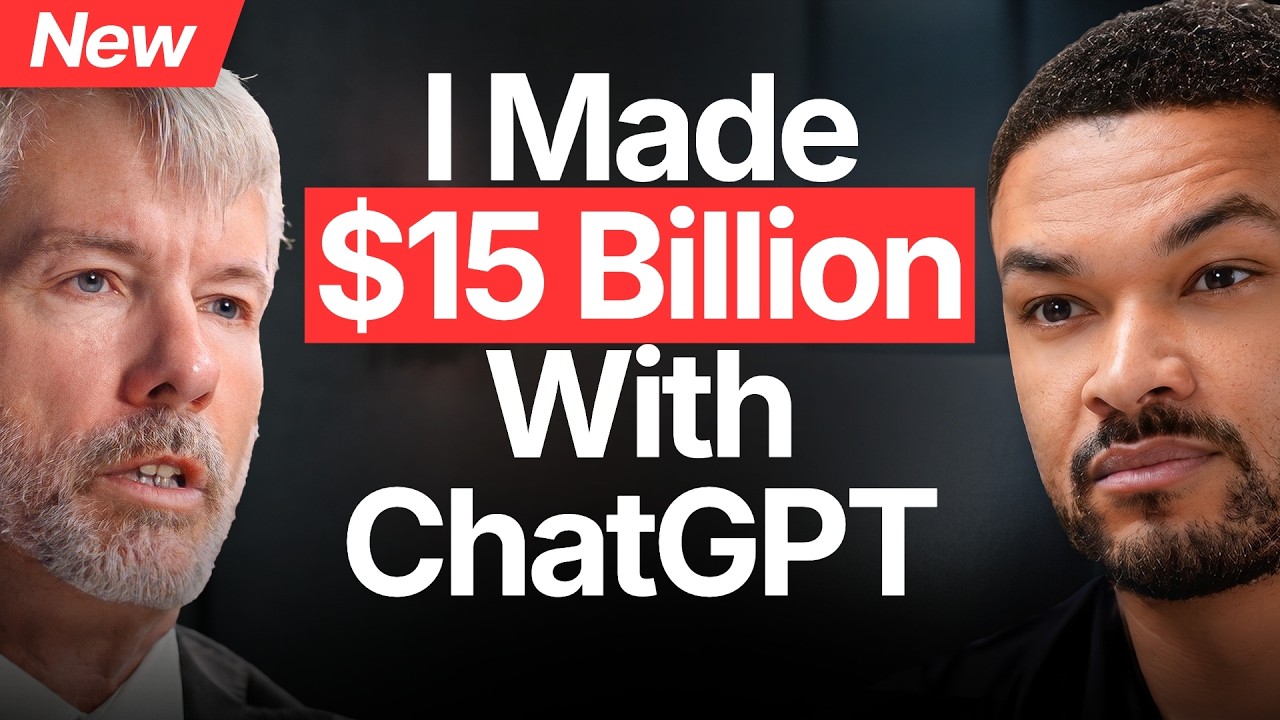
Saylor Engineers $15 Billion Capital Engine via AI-Designed Securities
The Diary Of A CEO
Strategy Chairman Michael Saylor argues traditional assets systematically lose value to fiat currency debasement, making AI-designed preferred stock and long-term Bitcoin accumulation the ultimate corporate treasury strategy.
## Background
This episode of The Diary Of A CEO podcast, hosted by Steven Bartlett and published on YouTube on August 6, 2026, features Michael Saylor, founder and Executive Chairman of Strategy (formerly MicroStrategy). The episode discusses how Saylor utilized ChatGPT to architect a novel financial instrument to raise billions for Bitcoin acquisitions, alongside his perspectives on inflation, real estate, stock investing, and the broader economic impacts of AI.
## TL;DR
Michael Saylor details how Strategy leveraged ChatGPT to design a novel convertible preferred stock (STRK), enabling the company to raise $15 billion in new capital to expand its massive Bitcoin treasury. He critiques traditional investments like fiat currency, housing, and individual stocks, arguing that digital capital and AI mastery are essential tools for long-term wealth preservation. Saylor outlines his strategic roadmap for compounding enterprise value through specialized moats, disciplined capital allocation, and long-term horizon thinking. Furthermore, he offers practical advice for young adults, advocating for continuous re-education in applied statistics and world history to navigate an increasingly AI-driven world.
## Atmosphere & style
The conversation maintains an intense, highly analytical, and intellectually provocative tone, driven by Saylor's articulate and unapologetically bold thesis on finance and technology. Steven Bartlett acts as a grounded, curious foil, pressing into operational realities while sharing his own entrepreneurial experiments and trade-offs. The dynamic balances high-stakes corporate strategy with deep philosophical musings on human history, individual sovereignty, and compounding growth, leaving the listener with a sense of urgency and strategic clarity.
## Key takeaways
- Strategy maximum-issued traditional debt to buy Bitcoin before using ChatGPT to design STRK, a novel convertible preferred stock with a variable monthly dividend, which raised billions in new capital.
- Mastering AI models is as essential as basic literacy, but it must be paired with domain expertise to create scalable new products and capture massive arbitrage opportunities.
- [51:36](https://www.youtube.com/watch?v=1aGpJQ8BMLI&t=3096s) Technological adoption follows an S-curve: entrepreneurs should avoid mature, stagnant fields like smartphones and instead target rapidly accelerating spaces like digital intelligence and digital assets.
- [51:36](https://www.youtube.com/watch?v=1aGpJQ8BMLI&t=3096s) Capturing a narrow 12-to-24-month sweet spot during a technology platform's 10-year S-curve enables hyper-growth and establishes market dominance that outpaces latecomers.
- Traditional career paths like law, surgery, or accounting are being disrupted, making digital intelligence and digital assets the prime domains for long-term enterprise value creation.
- [56:15](https://www.youtube.com/watch?v=1aGpJQ8BMLI&t=3375s) In an era of AI content saturation, creators must focus on high-quality storytelling and leveraging digital platforms rather than trying to outwork automated systems.
- [01:09:16](https://www.youtube.com/watch?v=1aGpJQ8BMLI&t=4156s) Building a compounding, long-term business moat requires resisting dilutive short-term expansions and committing to core initiatives for years despite high failure rates.
- [01:22:24](https://www.youtube.com/watch?v=1aGpJQ8BMLI&t=4944s) Strategy built a massive capital engine holding tens of billions in Bitcoin assets with a long-term horizon, requiring only modest annual appreciation to comfortably meet its debt and dividend obligations.
- [01:24:48](https://www.youtube.com/watch?v=1aGpJQ8BMLI&t=5088s) Saylor strategically executed a targeted Bitcoin sale near $60,000 to prove market liquidity and dismantle short-seller narratives surrounding Strategy's treasury assets.
- [01:31:34](https://www.youtube.com/watch?v=1aGpJQ8BMLI&t=5494s) Bitcoin is designed for long-term investors with a 4-to-10-year horizon, serving as borderless digital capital that outperforms traditional assets like real estate or individual stocks.
- [01:31:34](https://www.youtube.com/watch?v=1aGpJQ8BMLI&t=5494s) Young adults should prioritize affordable monthly AI subscriptions and digital capital over expensive university degrees or illiquid real estate.
- [01:34:17](https://www.youtube.com/watch?v=1aGpJQ8BMLI&t=5657s) Studying applied statistics and unedited world history provides the critical thinking needed to navigate modern financial cycles and separate temporary noise from long-term signal.
## Detailed walkthrough
### [00:00](https://www.youtube.com/watch?v=1aGpJQ8BMLI&t=0s) Intro: The $15 Billion AI Solution and the Bitcoin Gospel
Michael Saylor opens with a staggering assertion: he leveraged AI to generate $15 billion in value last year. Rather than trying to "outwork the robots," his core thesis is to use AI to construct solutions to unprecedented financial challenges. As a veteran technology entrepreneur whose firm is the world's largest corporate holder of Bitcoin, Saylor frames his life mission around preaching the gospel of digital empowerment.
Saylor contrasts physical cash with digital capital. He points out that holding physical cash exposes an individual to immediate confiscation—such as by airport security—while depositing it in a bank subjects it to counterparty risk, withdrawal limits, and state surveillance. By contrast, Bitcoin allows someone to encrypt millions of dollars into cyberspace, securing economic energy behind a private key that no government or powerful entity can seize.
---
* **AI & Value Creation:** Leveraged AI (specifically ChatGPT) to architect a novel financial instrument, generating $15 billion in market value for his company.
* **Corporate Treasury:** MicroStrategy (now Strategy) stands as the world's largest corporate buyer of Bitcoin, holding 847,000 BTC (surpassed only by Satoshi Nakamoto).
* **Self-Sovereign Capital:** Bitcoin functions as encrypted economic energy secured by private keys, bypassing traditional banking gatekeepers.
[02:47](https://www.youtube.com/watch?v=1aGpJQ8BMLI&t=167s) Why Michael's Background Matters for Everything That Follows
Saylor outlines his trajectory from building enterprise software to leading MicroStrategy into a digital asset treasury company. Having studied aerospace engineering and the history of science at MIT, he originally focused on business intelligence—extracting actionable insights from massive, messy datasets.
```
+-------------------------------------------------------------------------+
| THE EVOLUTION OF MICROSTRATEGY / STRATEGY |
| |
| 1989–2020: Business Intelligence (Data Mining & Analytics) |
| │ |
| ▼ |
| 2020 COVID Lockdowns: Monetary Expansion & Inflation Threat |
| │ |
| ▼ |
| Post-2020: Adopted Bitcoin as Primary Treasury Asset |
| │ |
| ▼ |
| Enterprise Value Growth: Expanded from ~$1B to a peak of ~$125B |
+-------------------------------------------------------------------------+
```
When the COVID-19 pandemic hit in 2020, macroeconomic interventions forced him to reevaluate legacy treasury reserves. Recognizing Satoshi Nakamoto's invention as the ultimate form of property, Saylor pivoted the enterprise to acquire Bitcoin. That decision drove the firm's valuation from under a billion dollars to a peak of over $125 billion, growing 100x to 200x since adoption.
> "In 2020 when the COVID lockdowns took place and the world turned upside down, that was when I discovered my greatest idea... it was Satoshi's idea, but I discovered Bitcoin."
---
* **Academic Foundation:** Holds dual degrees from MIT in aerospace engineering and the history of science, holding over 48 patents.
* **Enterprise Pivot:** MicroStrategy transformed from a traditional business intelligence software firm into a Bitcoin treasury powerhouse.
* **Market Capitalization:** Company valuation grew from under $1 billion pre-Bitcoin to a peak of roughly $125 billion.
[03:45](https://www.youtube.com/watch?v=1aGpJQ8BMLI&t=225s) Why Bitcoin Is So Powerful Compared With Traditional Money
The true breakthrough of Bitcoin lies in its capacity to digitize and preserve economic energy. Saylor explains that throughout history, small families, businesses, and vulnerable nations have repeatedly been crushed or exploited by centralized powers because their capital was easily seized or diluted.
Bitcoin levels the playing field by enabling anyone to bind their wealth directly to themselves using cryptography. By removing the need for intermediary permission, Bitcoin serves as a tool for digital equity and protection against arbitrary state action.
---
* **Digital Empowerment:** Encrypting monetary energy grants small nations, businesses, and individuals equal standing against legacy financial heavyweights.
* **Property Rights:** Securing wealth with private keys creates absolute ownership that cannot be revoked by third parties.
[05:02](https://www.youtube.com/watch?v=1aGpJQ8BMLI&t=302s) How Digital Money Actually Works Behind the Scenes
Demonstrating with physical paper currency and physical Bitcoin coins, Saylor highlights the friction points of traditional fiat money. Moving large amounts of physical cash across international borders triggers immediate questioning and confiscation. Moving it through traditional bank accounts requires navigating a gauntlet of intermediaries—central banks, correspondent banks, and global regulatory bodies—all of which retain the power to freeze funds, demand justification, or block transactions outright.
```
TRADITIONAL FIAT TRANSFER (Permissioned & Fragmented):
[Sender] ──> [Local Bank] ──> [Central Bank] ──> [Correspondent Bank] ──> [Foreign Bank] ──> [Receiver]
*Subject to holds, seizures, and fees at every node*
BITCOIN TRANSFER (Permissionless & Direct):
[Sender] ────────────────────────── Peer-to-Peer ──────────────────────────> [Receiver]
*Settles in seconds via private keys*
```
Bitcoin eliminates these permission barriers. A million dollars in Bitcoin can be loaded onto a physical token (like a Casascius coin), written on a slip of paper as a private seed phrase, or sent via text message to anywhere in the world within seconds. Two individuals in a remote region can execute a high-value transaction—such as trading Bitcoin for a vehicle—without needing the approval of multiple banking institutions or foreign governments.
> "Good luck getting a million dollars of gold from here to London if people don't want you to move it. But I could move a million dollars of Bitcoin from here to anywhere in cyberspace in a few seconds."
---
* **Fiat Friction:** Inter-bank wires across borders typically require the implicit approval of up to seven banks and dozens of regulatory entities.
* **Portability:** High-value Bitcoin transactions can be stored as a seed phrase in memory or written down on paper, completely bypassing transport friction.
* **Bearer Asset:** Digital private keys allow instant peer-to-peer finality without intermediary oversight.
[07:37](https://www.youtube.com/watch?v=1aGpJQ8BMLI&t=457s) What Cash Really Is—and Why Most People Misunderstand It
Saylor breaks down the silent erosion of purchasing power inherent to fiat currency. To illustrate, he references a waterfront plot in Miami Beach: a century ago, a two-acre parcel with a home cost approximately $20,000 (with the land valued at $10,000). Today, that exact same single acre of land commands $10 million to $20 million.
```
MIAMI BEACH WATERFRONT REAL ESTATE (100-YEAR PURCHASING POWER COMPARISON)
RESULT: US Dollar lost ~7% of its real purchasing power annually against scarce assets over a century.
```
This 1,000-fold increase in nominal price reveals that the US dollar has lost roughly 7% of its real purchasing power every year for 100 years. While the US dollar represents the strongest legacy fiat currency, weaker foreign currencies lose value far faster—frequently collapsing every 25 to 30 years due to hyperinflation. Saving long-term wealth in fiat cash guarantees continuous wealth destruction.
---
* **Miami Real Estate Example:** One acre of Miami Beach waterfront land went from $10,000 in the 1920s to $10–$20 million today.
* **7% Annual Loss:** The US dollar—the world's strongest fiat currency—loses roughly 7% of its real value every year against prime scarce property.
* **Fiat Lifespan:** Weak fiat currencies average a half-life of 5 to 10 years, while typical national currencies collapse or re-denominate every ~29 years.
[10:29](https://www.youtube.com/watch?v=1aGpJQ8BMLI&t=629s) Why Buying a House May Not Be the Wealth Strategy You Think
While real estate preserves wealth far better than holding cash, Saylor warns against viewing primary residential real estate as a silver bullet. Residential property carries heavy drag from property taxes, maintenance, and insurance. For example, a 2% annual property tax in states like Florida means the owner effectively repays the entire purchase price of their home to the government every 36 years.
```
RESIDENTIAL REAL ESTATE DRAG:
- Annual Property Tax (~2%)
- Ongoing Maintenance Costs
- Property Insurance Premiums
- Mortgage Interest Rates (~7%)
----------------------------------
Result: High friction drag requiring total asset re-purchase via tax every ~36 years.
```
Commercial real estate offers better mechanics because owners can pass operating expenses, maintenance, and taxes directly to tenants via rents. However, managing real estate demands significant expertise, active oversight, and capital. Bitcoin offers an elegant alternative for average individuals who lack the specialized knowledge to manage properties, run businesses, or pick individual stocks, providing a frictionless asset that appreciates without property taxes or maintenance costs.
---
* **Property Tax Drag:** A 2% annual property tax forces a homeowner to buy back their own property from the municipality every 36 years.
* **Commercial vs. Residential:** Commercial real estate allows owners to offset taxes and upkeep by passing triple-net expenses through to tenants.
* **Passive Asset Access:** Bitcoin provides compound growth without requiring real estate management, corporate operations, or stock-picking expertise.
[14:17](https://www.youtube.com/watch?v=1aGpJQ8BMLI&t=857s) Why Stocks Still Matter in a Changing Financial World
Saylor acknowledges the historical importance of stock market indexing, crediting Vanguard founder John Bogle with pioneering accessible wealth creation through index funds like the S&P 500 (SPY). Because paper money is an inefficient store of value and real estate carries high illiquidity and overhead, the stock market has functioned as the primary liquid capital alternative for investors.
Over a 100-year horizon, the S&P 500 has yielded around 10% annually, providing a 2% to 3% real return above the 7% baseline monetary dilution rate. This modest real yield compensates investors for taking on equity volatility, making broad index funds a solid conventional vehicle for preserving wealth.
---
* **John Bogle's Legacy:** Popularized index investing as an accessible way for everyday investors to park capital outside decaying fiat money.
* **S&P 500 Performance:** Historical returns of ~10% over the long run (and ~15% over recent 6-year periods) net a modest positive yield above 7% currency degradation.
[15:26](https://www.youtube.com/watch?v=1aGpJQ8BMLI&t=926s) Gold vs. Bitcoin vs. Stocks: Which Asset Wins?
When comparing traditional capital assets, Saylor outlines a clear hierarchy. Over recent multi-year periods, gold has appreciated at roughly 12% annually, the S&P 500 at 15%, tech-heavy indices like the NASDAQ at 18%, and Bitcoin leads at approximately 33% annually.
While gold and western stock indices remain viable capital options, millions living in economically volatile countries (such as Argentina, Turkey, Nigeria, or Venezuela) lack simple access to US equities or physical gold custody.
Crucially, Saylor advises against investing in "non-capital assets"—commodities like soybeans, oil, or manufactured goods that can be produced in infinite supply by technology, factories, and AI. Investors must target strictly scarce assets that cannot be inflated by human effort.
> "Don't invest in things that a factory, or a robot, or an AI can generate infinite of... You buy things that the robots and the AIs and the big factories cannot pump out by the million gallons."
---
* **Asset Performance Metrics:** Recent annualized growth rates show Gold (~12%), S&P 500 (~15%), NASDAQ (~18%), and Bitcoin (~33%).
* **Non-Capital Warning:** Avoid saving wealth in industrial commodities (e.g., oil, agricultural products, raw cotton) that can be mass-produced.
* **Absolute Scarcity:** Truly elite capital assets possess capped or constrained issuance—such as prime real estate, top corporate equities, or 1 out of 21 million Bitcoins.
[17:26](https://www.youtube.com/watch?v=1aGpJQ8BMLI&t=1046s) The Technological Tipping Point: AI, Robotics, and Perfect Products
Saylor begins by contrasting physical assets with digital wealth, noting that in a crisis or war zone, carrying physical wealth through border checkpoints is impractical compared to Bitcoin. The conversation quickly pivots to the explosive acceleration of artificial intelligence and robotics. Saylor observes that technology historically fails continuously until it suddenly succeeds. During his time at MIT, speech recognition was notoriously ineffective, and for a thousand years human flight seemed impossible—culminating in a 1902 *New York Times* article claiming scientists agreed humans would never fly, right before the Wright brothers succeeded in 1903. Similarly, AI reached its critical tipping point around 2023, initiating the digital transformation of human intelligence.
Looking forward, Saylor envisions AI moving seamlessly into physical robotics, predicting a world with a billion household robots available for around $200 a month to cook, clean, and manage chores. He argues we are on the precipice of "perfect products," mocking the legacy of unintelligent appliances like ovens that burn food or human-driven cars prone to traffic accidents once autonomous vehicles prove far safer. He points out the current cultural irony that writing errors have become the primary proof of human authorship: "If you put errors in it, I believe you typed it," whereas flawless research and prose are now the default baseline provided by AI.
- **Historical tech timeline:** NYT declared human flight impossible in 1902; Wright brothers flew in 1903; AI achieved functional tipping point in 2023.
- **Consumer robotics projection:** Anticipates ubiquitous household robots available for approximately $200/month.
- **AI platforms cited:** Voice assistants such as ChatGPT and Grok continuously advancing on a weekly basis.
- **Cultural shift:** Grammatical and editing flaws are now treated as proof of manual human typing rather than AI generation.
---
[21:34](https://www.youtube.com/watch?v=1aGpJQ8BMLI&t=1294s) Elon Musk's "Age of Abundance" and the Hierarchy of Affluence
Steven reads a series of quotes from Elon Musk proposing that AI and robotics will usher in an "age of abundance" where money becomes obsolete as a database for labor allocation. Musk argues that stranded on a desert island with a trillion dollars, money is useless without labor to allocate, predicting a future of "universal high income" where goods and services far exceed money supply, work becomes optional like playing sports, and fundamental constraints shift purely to energy and mass. Saylor responds that Musk is only "half right." While utilitarian consumer goods will become hyper-abundant and cheap, scarce trophy assets will ensure money remains essential.
To illustrate this, Saylor compares modern life to King Henry VIII, who despite his monarchical power lacked clean water, climate control, dental crowns, X-rays, and modern medicine. Technology has granted today's middle class unlimited Coca-Cola, Hershey's chocolate, running water, and drastically reduced infant mortality. However, abundance in basic utilities does not mean everyone receives a house in the Hamptons, a private jet, a yacht, or a Porsche. Humanity inherently invents new luxury assets to create a hierarchy of affluence.
Saylor describes water as the "proletarian drink" ordered at a restaurant when funds are tight, which escalates to a $5 soda, vodka, specialty top-shelf tequila, and eventually $38 cocktails or $300 fine-dining meals in New York City when basic physical sustenance requires only $3 a day. Because people naturally seek status and exclusive experiences—such as access to uncrowded ski slopes with pristine snow—aspirational demand will always outstrip basic utilitarian abundance.
- **Musk's thesis:** Universal high income via federal checks, elimination of inflation, work becoming optional, and money losing relevance as a labor allocation tool.
- **Saylor's counter-example:** King Henry VIII lacked basic modern amenities (clean water, AC, heat, dental crowns, X-rays) now standard for the middle class.
- **Utilitarian baseline:** Basic sustenance costs roughly $3/day, yet consumer spending naturally escalates to luxury tiers ($5 sodas, $38 cocktails, $300 dinners).
- **Economic reality:** Scarcity shifts from survival needs (water, food, basic electricity) to trophy assets (Hamptons real estate, private jets, Porsches, exclusive locations).
---
[27:08](https://www.youtube.com/watch?v=1aGpJQ8BMLI&t=1628s) Job Dislocation, Regulation, and Free Market Solutions
Addressing fears that AI will eliminate knowledge-worker jobs faster than new ones can be created, Saylor draws on historical economic shifts. Society once consisted almost entirely of agricultural labor before transitioning into roles like accountants, lawyers, film producers, podcasters, and social media content creators—professions completely unimaginable decades ago. While acknowledging that the transition will cause temporary economic dislocation and political friction, Saylor argues that a progressive, low-regulation free market is the only mechanism capable of absorbing displaced labor smoothly.
Saylor sharply criticizes legacy regulations and protectionist litigation that stifle technological progress. He cites a recent report where personal injury attorneys actively attempted to block autonomous electric vehicles because their business models rely on litigating traffic accidents, remarking sarcastically, "We wouldn't want people to not crash." He contrasts free societies like the United States with closed regimes such as Cuba or North Korea, asserting that maximizing "degrees of freedom" allows tens of thousands of unimagined new business opportunities to emerge, generating genuine wealth and employment for displaced workers.
- **Historical labor evolution:** Transition from agrarian economy to modern roles (podcasters, Instagram influencers, specialized corporate labor).
- **Regulatory friction:** Personal injury lawyers attempting to restrict autonomous EVs to protect accident litigation revenue; municipal bans on Airbnb.
- **Policy prescription:** Free-market deregulation and high degrees of economic freedom to enable 100,000+ new unconceptualized business models to emerge.
---
[29:50](https://www.youtube.com/watch?v=1aGpJQ8BMLI&t=1790s) Sponsor Interlude: Cometeer Coffee and Pipedrive CRM
Steven Bartlett pauses the podcast to share two sponsor integration segments:
First, Steven highlights Cometeer, a coffee company founded by an entrepreneur named Matt. The company flash-freezes brewed coffee at the peak of flavor into frozen capsule cubes. Steven shares his personal experience shipping a batch to his London headquarters, describing how his team flooded Slack with praise. Users simply melt the frozen cube with hot water, and Steven offers listeners a $30 discount off their first order at `[cometeer.com/steven](https://cometeer.com/steven)`.
Second, Steven shifts to Pipedrive, an intelligent CRM tool designed to streamline commercial sales pipelines. He explains that as businesses expand from small teams of 5 to operations of 50, deal consistency often breaks down due to systemic tracking failures rather than personnel issues. Pipedrive provides real-time visibility across every stage of a sales pipeline for over 100,000 companies, offering an exclusive 30-day free trial via `[pipedrive.com/ceo](https://pipedrive.com/ceo)`.
- **Cometeer promo:** Flash-frozen coffee capsules; $30 discount code via specific podcast landing page.
- **Pipedrive promo:** CRM software used by 100,000+ companies; 30-day extended free trial without credit card requirements.
---
[32:09](https://www.youtube.com/watch?v=1aGpJQ8BMLI&t=1929s) Governing the State Space and the $15 Billion AI Breakthrough
Steven describes his own advanced AI workflow: rather than asking static questions, he instructs his AI assistant to analyze his personal workload and company challenges, formulate the exact questions he should be asking, generate custom 20-page books tailored to his favorite writing style, and convert them into 43-minute MP3 audiobooks for his daily commute. Saylor responds by framing this approach around "governing the state space" and establishing precise input constraints, noting that the parameters required for a baker in Lagos, Nigeria, differ fundamentally from those of a firefighter in Los Angeles.
Building on the power of AI prompt engineering, Saylor drops a dramatic revelation: he personally used AI to generate $15 billion in corporate value over the past year through a financial mechanism nobody had previously conceived. Transporting the narrative back to 2025, Saylor sets the scene at Strategy (formerly MicroStrategy), which held $30 billion in Bitcoin treasury reserves at the time. Seeking to raise additional capital to acquire more Bitcoin after exhausting conventional structures, Saylor turned to AI to design an entirely unprecedented financial instrument.
- **Custom AI audiobooks:** Steven inputs personal context to generate tailored 20-page texts converted to 43-minute audiobooks.
- **State space concept:** AI effectiveness relies on defining exact situational constraints (e.g., Lagos baker vs. LA firefighter).
- **Financial reveal:** Saylor used AI to construct an unprecedented capital-raising framework, generating $15 billion in value while managing Strategy's $30 billion Bitcoin treasury.
Here is a detailed, faithful walkthrough of this section of the transcript, capturing its core arguments, specific details, financial concepts, and back-and-forth conversational tone.
---
[33:51](https://www.youtube.com/watch?v=1aGpJQ8BMLI&t=2031s) Maxing Out Traditional Credit and Turning to AI Financial Engineering
Michael Saylor reflects on Strategy’s (formerly MicroStrategy) initial five-year Bitcoin accumulation strategy, explaining that the company had completely maxed out traditional debt markets. They had become the single largest issuer of convertible bonds in the world. When host Steven Bartlett summarizes the situation as "you borrowed as much money as you could from traditional means to buy Bitcoin," Saylor agrees. By early 2025, having exhausted traditional convertible bonds, Strategy faced a ceiling—their growth was bound to stall unless they could break out of the conventional financial box. To solve this, Saylor turned directly to AI (specifically ChatGPT) to help design a completely novel financial credit instrument: a preferred stock that was neither pure common equity nor a standard bond, but a flexible hybrid.
Saylor explains that preferred stock is a malleable tool; an issuer can assign virtually any set of terms to it, such as put rights to make it look like debt, guaranteed coupons, or equity-like conversion rights. Using ChatGPT, Saylor and his team engineered a convertible preferred stock under the ticker **STRK**—a security backed by Bitcoin, which had never been done before in financial history. When they presented the concept to traditional securities lawyers and investment bankers, the consensus reaction was skepticism: *"No one's ever done it before, so we don't think you should do that."* Saylor pushed back, arguing that because existing methods were maxed out, innovation was mandatory. By combining digital capital (Bitcoin), digital intelligence (AI), and a digital treasury structure, Strategy set out to build a short-duration credit instrument.
The design goal for STRK was to create a money-market-like security that would trade stably around par value ($100 per share), allowing investors to buy at 100, sell at 100, and collect high yield without worrying about interest-rate volatility. To keep the market price stable at $100, the dividend rate had to be dynamic. Strategy designed the instrument with a variable dividend rate that could be adjusted monthly. When Wall Street experts doubted whether such a variable-rate preferred stock was permissible, Saylor asked ChatGPT, which provided the step-by-step structural and regulatory legal framework to make it work.
* **Key Financial Figures & Milestones:**
* **IPO Launch:** STRK debuted as a **$2.5 billion** initial public offering, becoming the largest IPO of the year to date.
* **Shelf Registration:** Following the IPO, Strategy registered a shelf offering and sold an additional **$8 billion** of the instrument.
* **Total Capital Raised:** Combining $10.5 billion of STRK with $4 billion in other credit instruments, Strategy raised **$15 billion** in new capital to buy Bitcoin—a feat Saylor directly attributes to financial design powered by ChatGPT.
---
[37:50](https://www.youtube.com/watch?v=1aGpJQ8BMLI&t=2270s) The AI Arbitrage Opportunity and the S-Curve of Innovation
Steven Bartlett presses Saylor on what this milestone implies for everyday entrepreneurs and individuals searching for business ideas. He points out a stark statistic: only roughly 2% of households currently subscribe to premium AI services like ChatGPT. Bartlett frames this gap as a massive "arbitrage opportunity" for those who learn to leverage AI now. Saylor wholeheartedly agrees, emphasizing that for any aspiring business owner, mastering one or more AI models is no longer optional—it is as fundamental as reading, writing, arithmetic, and basic computer literacy. However, AI mastery must be paired with domain expertise. Entrepreneurs should use AI to create a brand-new product or service, or to radically transform an existing one to make it vastly cheaper and better—such as creating an AI tool that does the work of a million accountants for $10 a month.
To explain where opportunities lie, Saylor breaks down the historical concept of the **S-curve of technology**:
1. **The Slow Drag:** A domain experiences zero or minimal progress for long periods (e.g., humanity trying to fly for thousands of years).
2. **The Exponential Surge:** A breakthrough occurs, launching rapid, doubling growth (e.g., from the Wright brothers in 1903 flying at 20 mph to supersonic jets, manned spaceflight, and landing on the Moon by 1969—all within 66 years).
3. **Diminishing Returns & Stagnation:** The technology matures and hits physical or engineering limits.
Saylor notes that commercial aviation hit an S-curve wall around the mid-1970s with the Boeing 737 and 747; over the 50 years between 1975 and 2025, commercial jet efficiency improved by a meager 15%. Similarly, Bartlett and Saylor observe that smartphones have hit their own S-curve wall—while early iPhones evolved rapidly, recent models (from iPhone 6 onward) offer only incremental utility gains. Saylor warns students and entrepreneurs against entering fields at the top of their S-curve where returns are diminishing. Instead, they should pursue exploding S-curves like semiconductors, digital intelligence, and digital assets.
---
[43:12](https://www.youtube.com/watch?v=1aGpJQ8BMLI&t=2592s) Next-Gen Hardware, "Magical" Tech, and What to Study
Discussing what will replace the smartphone form factor, Saylor points to lightweight smart glasses (like Maui Gym sunglasses equipped with cameras and AI) that can see, hear, and process context in real time, eliminating the need to manually type on a screen. Bartlett shares a personal story of visiting Mark Zuckerberg, who demonstrated an unreleased Meta prototype: a ultra-thin cotton wristband with no screen, paired with smart glasses. By making subtle finger movements while wearing the wristband, Bartlett could visually click, navigate screens, launch YouTube, and make calls overlayed in his peripheral vision.
Saylor jokes that young people should "study fantasy," because emerging technology is making real-world products act like magical talismans—wearables or implants that make a person feel all-knowing and effortless. Citing Elon Musk's core engineering philosophy—*"the best part is no part; the best process is no process"*—Saylor argues that the goal is to eliminate interface friction entirely, whether through Neuralink or subtle bio-implants.
When asked what young adults should study at university today, Saylor advises against traditional career paths like becoming a traditional lawyer, surgeon, accountant, or driver, as AI and robotics will rapidly surpass human capability in routine and highly specialized procedural tasks. Instead, students should focus on **digital intelligence** and **digital assets**, learning how to ask AI the marginal questions that civilization has not yet solved. The ultimate way to create enterprise value is to bring something into the world that never existed before.
---
[48:24](https://www.youtube.com/watch?v=1aGpJQ8BMLI&t=2904s) Navigating the Incoming AI Content Tsunami
Shifting the conversation to practical steps for the working class to prepare for the robotic and AI transition, Saylor urges people to master digital platforms and distribution channels. He contrasts traditional paths—like trying to become a stage actor on Broadway—with modern digital reach, noting that creators like MrBeast can reach hundreds of millions of subscribers via platforms like YouTube, X, and Instagram.
Bartlett challenges this perspective by raising the threat of AI-generated content flooding the web. With frontier generative models capable of creating realistic video, audio, and text on command, a creator in Mumbai or Manhattan can easily set up autonomous AI agents to churn out hundreds of synthetic videos across all social media platforms while they sleep. Bartlett warns that this impending "slop tsunami" threatens to create a massive supply shock in content, forcing a fundamental question about what will remain valuable when content generation becomes infinitely cheap.
Here is the detailed walkthrough of this portion of the conversation, covering the discussion on content creation, technological shift S-curves, building competitive moats, and leveraging AI for long-term advantage.
---
[50:06](https://www.youtube.com/watch?v=1aGpJQ8BMLI&t=3006s) The Content Glut and the Fight for Fixed Online Attention
The conversation addresses the modern media landscape, where content supply is surging into a fixed pool of audience attention. Steven Bartlett references a *Financial Times* report highlighting how younger demographics are actually beginning to reduce their overall screen time. While slightly older generations continue to slowly increase their time spent online, they are doing so from a lower base. This dynamic creates a "tsunami slop of supply" crashing against flat demand. Steven admits that even his own media business feels vulnerable in this environment, pointing out that almost every top podcaster across YouTube—including his primary peers in the niche—has seen viewership drop by 50% or more over the preceding 12 to 24 months.
Michael Saylor counters that disengaging from the platform or ignoring the trend is not an option. Creators must proactively ask how AI can either enhance content quality or dramatically improve marketing and distribution. The ultimate competitive moat, Saylor argues, will always belong to those who use the best tools to create superior content that audiences genuinely want to see. He gives an example of a captivating 3D video animation detailing the step-by-step construction of a 16th-century warship—from the keel and ribs to the lower deck and ballast—explaining how a masterfully crafted hour-long video can hold a viewer completely spellbound, even on a topic they previously cared nothing about.
- **Financial Times Data:** Young viewers are reducing screen time, while older demographics are rising from a lower baseline.
- **Podcast Industry Decline:** Top 5 podcasters in Steven's niche saw viewership drop by over 50% across 12–24 months.
- **Saylor’s 16th-Century Warship Example:** High-quality, detailed visual storytelling creates an inescapable audience draw regardless of subject matter.
---
[51:36](https://www.youtube.com/watch?v=1aGpJQ8BMLI&t=3096s) The 10-Year Technology S-Curve: From Beethoven to Led Zeppelin and MicroStrategy
Saylor outlines a repeating historical pattern: whenever a brand-new technology platform emerges, groundbreaking creators appear within a 10-year window, push the platform to 95% of its absolute limit, and establish timeless legacies. He points to the development of the piano, which allowed visionaries like Beethoven and Frédéric Chopin to exhaust the primary boundaries of the medium so thoroughly that centuries later, subsequent musicians rarely surpass them. Similarly, the convergence of electric guitars, amplifiers, and recording technology in the late 1960s enabled bands like Led Zeppelin—and the classic rock movement between 1970 and 1980—to push human creativity to its outer limits before hitting diminishing returns. This cycle repeated when audio sampling birthed modern electronic dance music acts like Swedish House Mafia and Avicii, and again when YouTube empowered pioneers like Justin Bieber and MrBeast.
This structural concept applies equally to modern tech titans and corporate treasuries. Mark Zuckerberg seized the exact zero-to-one moment when the web could support social networking with Facebook, while messaging apps like WhatsApp captured the early mobile S-curve. Saylor links this directly to his own corporate strategy at MicroStrategy (now Strategy). By becoming the first publicly traded company to pair digital capital (Bitcoin) with digital credit and a digital treasury model, MicroStrategy built a novel financial instrument that was technically and structurally impossible a decade earlier. By capturing that narrow 12-to-24-month window, the company grew its enterprise treasury assets to $60 billion—scaling 20 to 50 times larger than any follower that attempted to enter the space later.
- **Historical Milestones:** Piano (Beethoven/Chopin) $\rightarrow$ Electric Amplification (Led Zeppelin, 1970–1980) $\rightarrow$ Audio Sampling (Swedish House Mafia/Avicii) $\rightarrow$ Video Platforms (Justin Bieber/MrBeast).
- **The Magic Window:** Achieving hyper-growth requires stepping through the S-curve window precisely when a technology becomes commercially viable (a 12–24 month sweet spot); entering 36 months too early leads to failure, while entering late means competing with entrenched giants.
- **Strategy's Treasury Scale:** MicroStrategy expanded from a baseline enterprise into a corporate treasury holding tens of billions in Bitcoin assets, outstripping its nearest public market follower by 20x to 50x.
---
[56:15](https://www.youtube.com/watch?v=1aGpJQ8BMLI&t=3375s) Algorithmic Fragmentation vs. Building a Scarce Moat
Steven raises a fundamental dilemma regarding modern fame and audience reach. In past eras, distribution constraints created monolithic global superstars like Michael Jackson; limited radio stations, six broadcast TV channels, and a modest selection of physical vinyl albums ensured that the entire population consumed the same media. Today, AI-driven recommendation algorithms create highly customized, fragmented echo chambers for every individual user, potentially shortening cultural shelf life and capping the overall height of creator fame. Saylor counters that scale is still achievable—pointing to Elon Musk, OpenAI's rapid user adoption, and top-tier influencers like the Kardashians on Instagram—because viral growth ultimately relies on hitting a deeply resonant frequency within human civilization.
```
HISTORICAL MEDIA vs. ALGORITHMIC MEDIA
[ 1980s Distribution ] [ Modern AI Distribution ]
┌────────────────────┐ ┌────────────────────────┐
│ 6 TV Channels │ │ Personalized Feeds │
│ Physical Vinyl │ ───► │ Hyper-Targeted Niche │
└─────────┬──────────┘ └───────────┬────────────┘
│ │
Unified Global Fame Fragmented Echo Chambers
(e.g., Michael Jackson) (Shorter, Niche Trajectories)
```
The discussion pivots to what constitutes an enduring competitive moat in an automated world. Steven theorizes that the ultimate strategy is pursuing pursuits that are inherently hard and scarce—such as securing exclusive high-profile podcast guests like Michelle Obama or creating deep, painstaking historical deep-dives. Saylor agrees, advising entrepreneurs never to compete directly against machine automation by trying to "outwork the robots." Instead, creators must leverage AI to enhance product quality, break down barriers, and scale distribution.
> "Don't try to outwork the robots... It used to be you would go be a college professor and teach 200 students a year for 20 years, and you would feel that your life contribution was 4,000 people whose minds you touched—and now you get 4,000 people a second."
- **Fame Architecture:** Fragmented media environments trade monolithic cultural moments for hyper-targeted, high-engagement audiences.
- **The Creator Moat:** Competing successfully requires leaning into hard, non-commodity assets (exclusive access, deep expertise, scarce financial instruments).
- **Scale Amplification:** Modern digital platforms allow a single creator to impact more minds in a second than a historical academic could reach across a 20-year career.
---
[01:01:26](https://www.youtube.com/watch?v=1aGpJQ8BMLI&t=3686s) Overcoming Failure: AI Translation and the Power of Persistence
Illustrating how to build an asymmetric operational advantage through technology, Steven reveals a private project within his media organization. Nearly three years earlier, his team began developing full AI-driven translations of his podcast into multiple global languages, including Spanish, Arabic, Portuguese, Russian, and Cantonese. For the first 24 months, the project was an absolute failure as the underlying speech synthesis and translation models were not mature enough. However, by persisting through two years of failed iterations, the team hit a turning point roughly 12 months prior when underlying AI models improved dramatically—eventually driving Spanish-language view durations past those of the original English broadcasts.
Saylor commends the initiative, drawing an analogy to Jimmy Page spending years mastering the guitar. He notes that building a durable business requires intense focus and commitment: achieving success in under 4 years usually down to luck, while 4 to 10 years represents the normal timeline for true mastery. By translating content into 100 native languages, a media brand creates a nearly insurmountable moat, offering global audiences localized multi-hour conversations with guests like Saylor that do not exist anywhere else. In the end, staying 12 months ahead of the market allows compounding returns to cement a permanent competitive edge.
- **The Podcasting Translation Experiment:** Steven's team spent 24 months suffering project failures before AI capabilities unlocked higher view retention in Spanish than English.
- **Entrepreneurship Timelines:** Success within 4 years often involves luck; steady execution typically takes between 4 and 10 years to reach full maturity.
- **Compounding Technological Lead:** Establishing a 12-month operational lead in applying AI tools creates a self-reinforcing advantage that competitors rarely overcome.
---
<ElicitationsGroup message="To explore these topics further:">
<Elicitation label="Analyze the S-Curve concept for business strategies" query="Explain how the tech S-curve framework applies to emerging technologies today, with examples of current 12-24 month opportunities."/>
<Elicitation label="Compare traditional vs. AI-driven media moats" query="What are the key differences between traditional media moats and modern AI-driven media strategies?"/>
</ElicitationsGroup>
[01:06:50](https://www.youtube.com/watch?v=1aGpJQ8BMLI&t=4010s) Market Making in Information and Extreme Specialization
Michael Saylor outlines why creators and media operators do not need to be the absolute best person who ever lived; they simply need to be better than the current incumbents or be one of the few doing it at scale. By hosting guests and bringing them into the living rooms of an audience, a creator essentially becomes a "market maker in that information." The crucial key is knowing your specific value proposition, staying in your lane, and avoiding competition in areas where you cannot excel.
Saylor cautions against general mediocrity in an era where anyone can access the best expertise in the world within two seconds on their phone. Instead of being mediocre across a broad array of subjects, the goal is to be exceptional in a single, well-defined domain. By dominating one area, an audience can scale naturally—growing from 2 million followers to 200 million, and potentially to 2 billion over a hundred-year timeline—provided one maintains that long-term vision.
- **Core advice:** Focus on becoming exceptional in one specific domain rather than being mediocre across many fields.
- **The media dynamic:** A host acts as an information market maker, connecting guests to an eager audience.
- **Scaling vision:** Start with 2 million followers, scale to 200 million, and aim for 2 billion over a century-long trajectory.
---
[01:08:09](https://www.youtube.com/watch?v=1aGpJQ8BMLI&t=4089s) The Cost of Being First: 60 Experiments and 58 Failures
Steven Bartlett shares the hidden friction of trying to be an innovator, noting that taking the lead means "you go over the hill, you take the arrows." He illustrates this with a three-year project his team undertook to translate *The Diary Of A CEO* podcast into 20 different languages. What initially seemed like a simple one-hour job spiraled into a massive operational challenge: Spanish sentences run longer than English ones—turning a 3-hour video into 3 hours and 10 minutes—while languages like Cantonese require completely custom re-engineering of video lengths, titles, and thumbnails across multiple platforms simultaneously.
Beneath the successful initiatives lies a "graveyard of other things we tried that never worked," representing roughly 90% of their attempts. Steven reveals that his team maintains a dedicated "failure and experimentation team" that tests about 60 experimental projects per year. Out of those 60 ideas, around 53 are complete failures or mediocre, 5 yield moderate results, and only 2 turn out to be true game-changers. He stresses that learning how to manage emotional resilience and deal with constant failure at the bleeding edge of innovation is rarely discussed, yet entirely essential.
- **Multilingual translation case study:** Spanish audio expands video duration from 3 hours to 3 hours and 10 minutes, requiring synchronized translation of thumbnails and titles in 20 languages.
- **Experimentation stats:** Out of 60 projects run annually by Steven's dedicated experimentation team, 50+ fail, 5 are moderately successful, and 2 are game-changers.
- **Reality of innovation:** Roughly 90% of experiments fail and end up in the project "graveyard."
---
[01:09:16](https://www.youtube.com/watch?v=1aGpJQ8BMLI&t=4156s) Dilutive Expansions and the Trap of the 37-Restaurant Chain
Responding to Steven's experimentation metrics, Michael Saylor emphasizes the critical need to focus energy and guard time. He warns against doing things simply because one has the capacity to do them, pointing out that the primary cause of business failure is "dilutive distractions" or "dilutive expansions." When people achieve success in their 30s with one core asset or skill, they often fall into the trap of assuming they are good at everything, scattering their efforts across ten new ventures and diluting their core focus.
To illustrate this phenomenon, Saylor uses the analogy of a successful restaurateur who starts with one thriving location, decides to expand, and ends up with a chain of 37 terrible restaurants. He notes that "there's no one by the way with a failed restaurant chain that wasn't a successful restaurant at scale one." True growth, Saylor argues, comes from making your existing core business twice as good, rather than pursuing ten separate side projects that each yield a 10% marginal improvement. Leaders must develop the maturity to execute a moderate success, recognize when it lacks exponential potential, and ruthlessly "kill it and move on."
- **Principle of focus:** Prefer making your core business 2x better over making 10 separate things 10% better.
- **Restaurant analogy:** No owner of a failed 37-location chain started with a bad initial restaurant; failure stems from cookie-cutter overexpansion.
- **Executive maturity:** The discipline to shut down moderately successful projects that distract from core mastery.
---
[01:11:18](https://www.youtube.com/watch?v=1aGpJQ8BMLI&t=4278s) The 10-Second vs. 10-Year Tower: The Advantage of Long-Termism
Steven Bartlett highlights two recurring patterns among young entrepreneurs: first, abandoning projects after just nine months because they aren't rich yet and jumping to trendier crazes like CBD; second, failing to grasp the power of long-termism. Steven uses a block-building analogy to contrast short-term and long-term thinking. If given 10 seconds to stack blocks into the highest tower possible, one is forced to stack them hastily in a single unstable column. However, if given 10 years and unlimited blocks, one can lay a broad, stable foundation capable of supporting an infinitely higher structure.
Steven contrasts the short-term mentality of many startup founders—who build companies for quick acquisition, holding them together with "tape as the acquirer comes to buy the thing"—with long-termists like Elon Musk and Michael Saylor, who has led MicroStrategy for nearly four decades. Entrepreneurs like Musk rebuild fundamental technologies from scratch, like custom battery chemistry, charging networks, and orbital rockets, taking decades to construct unshakeable competitive advantages.
- **Entrepreneurial trap:** Abandoning projects after 9 months to chase short-term trends like CBD, swinging from branch to branch without upward progress.
- **Block-stacking analogy:** A 10-second deadline forces an unstable single-column stack; a 10-year horizon allows a broad, sturdy base for massive height.
- **MicroStrategy longevity:** Michael Saylor's leadership spanning nearly four decades.
---
[01:13:06](https://www.youtube.com/watch?v=1aGpJQ8BMLI&t=4386s) The Chambered Nautilus: Compounding Foundations from SpaceX to Coca-Cola
Saylor responds by analyzing long-termism through an engineering lens, explaining how true competitive advantages compound by building directly upon prior successes. He references Elon Musk's trajectory: once SpaceX mastered cheap orbital launch and payload capacity, the natural next step was deciding what payload to launch—leading directly to Starlink satellite internet. Musk did not take the short-term route of buying off-the-shelf rockets from Russia or purchasing electric vehicle batteries from Ford; he built the foundational technology internally so each layer could reinforce the next.
Saylor presents the biological model of the chambered nautilus and the Fibonacci sequence as nature's blueprint for growth under pressure. Just as a nautilus builds its spiraling shell outward by expanding directly on top of its previous chamber, a business must extend its functional reach using its existing strengths. He cites Coca-Cola, which leverages its massive distribution network delivering pallets to 87,000 restaurants in the UK to introduce new beverage types at virtually zero incremental cost. Building a second business completely unrelated to your primary strength—where 97 competitors hold superior assets—destroys your fundamental advantage.
- **Biological analogy:** The chambered nautilus and Fibonacci sequence illustrate natural growth where each new structure builds directly on the previous foundation.
- **Distribution leverage:** Coca-Cola delivering to 87,000 UK restaurants can add a new beverage line onto an existing delivery pallet effortlessly.
- **Competitive assessment:** If 97 competitors have superior assets in a new space, you lack the foundational advantage required to win.
---
[01:16:26](https://www.youtube.com/watch?v=1aGpJQ8BMLI&t=4586s) Moats and Long-Term Value Creation: The Amazon Prime Playbook
Continuing the theme of long-term strategic moats, Saylor highlights Amazon Prime as a quintessential example of enduring vision. For nearly a decade, critics berated Amazon for losing money on free and discounted fast shipping. Wall Street complained constantly, but Jeff Bezos was quietly building an unassailable distribution moat. Once Amazon Prime reached ubiquitous adoption across the country, a modest price increase from $10 to $20 a month instantly unlocked billions in pure cash flow.
Saylor notes that Amazon generated roughly $12 billion in annual cash flow overnight with a single press release, instantly creating $250 billion in market value. This was only possible because they spent ten years building a distribution channel that nobody else could match. While 99% of competitors drop out due to short-term pressure or a lack of conviction, true visionaries channel technological threats and transform their business model to emerge "a thousand times better than anybody could conceive."
- **Amazon Prime case study:** Sustained decade-long losses on fast shipping to build an unbeatable logistical moat.
- **Monetization impact:** Raising Prime fees by $10/month across ~100 million members generated $12 billion in annual cash flow and ~$250 billion in enterprise value via a single press release.
- **Persistence:** 99% of competitors drop out because they lack long-term conviction or fail to adapt to technological shifts.
---
[01:18:05](https://www.youtube.com/watch?v=1aGpJQ8BMLI&t=4685s) The French Riviera Cocktail Party and Rules for Young Adults
Transitioning to personal philosophy, Saylor shares an anecdote about attending a cocktail party at a billionaire's estate on the French Riviera. At the gathering, another billionaire guest approached Saylor and explained that he had recently had twin children, a boy and a girl. He was carrying a physical leather-bound book, asking close friends to write down foundational life advice that he could present to his children on their 21st birthday.
Sitting down to reflect, Saylor synthesized a list of core principles for navigating adulthood and building a successful life:
1. **Focus your energy** and don't chase every idea.
2. **Guard your time** fiercely.
3. **Train your mind** through rigorous education, reading, writing, and mathematics.
4. **Train your body**, because if you are physically weak, you will not survive the pressures of life.
5. **Think for yourself**, resisting the relentless attempts of media, society, and authority figures to program your beliefs.
6. **Curate your friends**, because "you become who you surround yourself with"; negative and cynical people will drag you down.
7. **Curate your environment**, creating a supportive space to live and work.
8. **Keep your promises**, as reliability builds trust and earns long-term backing from investors and allies.
9. **Stay cheerful and constructive**, because people naturally want to work and partner with optimistic problem-solvers.
- **Riviera anecdote:** Saylor was asked at a billionaire's French Riviera party to contribute life rules to a keepsake book for newborn twins to read on their 21st birthday.
- **Mental & physical discipline:** Emphasizes solid grounding in reading, writing, math, and physical fitness to withstand life's trials.
- **Interpersonal principles:** Selective friendship, keeping promises to build social equity, and maintaining a cheerful demeanor regardless of setbacks.
---
[01:21:11](https://www.youtube.com/watch?v=1aGpJQ8BMLI&t=4871s) Upgrading the World and Living Forever
Saylor outlines his 10th and final rule for young adults: **Upgrade the world**. Having a clear mission to improve human existence provides daily purpose and deep personal satisfaction. Saylor shares his own mission of "preaching the gospel of digital empowerment," viewing Satoshi Nakamoto's creation of Bitcoin as a revolutionary gift of economic property to 8 billion people. By creating digital energy, digital matter, and digital property, technology allows humanity to become "a thousand times more" capable than in previous eras.
Looking back across human history, Saylor characterizes the past as a legacy of misery driven by scarcity and pollution—summarizing human mortality as a lack of clean water, clean air, clean food, and clean money. When Steven asks whether Saylor personally wants to live forever, Saylor responds that he wants to live as long as he can remain engaged, vital, and able to make a constructive contribution to the world.
- **The 10th Rule:** Upgrade the world through a clear, daily mission of digital or economic empowerment.
- **Technological leap:** Viewing Bitcoin as digital energy and property that empowers 8 billion people simultaneously for the first time in history.
- **Core human needs:** History's miseries stem from a lack of clean water, clean air, clean food, and clean money; Saylor desires longevity as long as he remains vital and constructive.
Here is a detailed, faithful walkthrough of the transcript segment.
---
[01:22:24](https://www.youtube.com/watch?v=1aGpJQ8BMLI&t=4944s) The Immortality Question and Strategy’s Capital Engine
Steven Bartlett poses a thought experiment, asking Michael Saylor if he would press a button that guaranteed immortality. Saylor responds thoughtfully, "I think so. I suppose so," but when asked why he doesn't dedicate his life to longevity research like some other tech leaders, he points out that with 8 billion people on the planet, many others are far better qualified to pursue that mission. Bartlett notes how Saylor has instead chosen to become the defining, unwavering voice for Bitcoin—acting almost as a spiritual therapist for nervous investors during market drawdowns and maintaining incredible consistency whether the asset is spiking or crashing. Reflecting on Saylor's grand financial maneuvers, Bartlett asks him to break down the massive amounts of leverage and debt Strategy (formerly MicroStrategy) has taken on to accumulate its Bitcoin stack.
Saylor provides an explicit breakdown of the company's balance sheet: Strategy holds roughly $6.5 billion in convertible debt and $15 billion in preferred stock, backed by approximately $58 billion in total assets. In aggregate, they have raised about $65 billion through equity and debt offerings specifically to buy Bitcoin. The underlying mission, Saylor explains, is to systematically pump tens of billions of dollars of financial energy directly into the Bitcoin ecosystem, powering it with institutional capital. When Bartlett addresses the common fear among critics about how low Bitcoin's price would have to plummet for Strategy to face insolvency, Saylor dismisses the concern entirely, noting that Bitcoin could collapse all the way down to $5,000 per coin and Strategy would still remain over-collateralized against its debt obligations.
* **Convertible Debt:** ~$6.5 billion outstanding.
* **Preferred Stock:** ~$15 billion outstanding.
* **Total Assets:** ~$58 billion in value.
* **Capital Raised:** ~$65 billion raised across equity and debt to acquire Bitcoin.
* **Insolvency Threshold:** Bitcoin could drop to $5,000 per coin before Strategy becomes under-collateralized relative to its debt.
---
[01:24:48](https://www.youtube.com/watch?v=1aGpJQ8BMLI&t=5088s) Why Saylor Sold Bitcoin: Breaking the Market Narrative
Bartlett brings up a sensitive topic that has generated massive commentary online: the fact that Saylor, after years of telling the world to "sell a kidney if you must, but keep the Bitcoin," recently sold a portion of the company's Bitcoin holdings. Saylor addresses the controversy directly, emphasizing that no living entity on Earth has held more Bitcoin without selling than Strategy, except for Satoshi Nakamoto. With the company holding 847,000 Bitcoin (nearly 4% of the total circulating supply) and Satoshi inactive, Strategy remains the single largest active holder in the world. He reiterates his core philosophy: if you have capital you do not need for the next four years, Bitcoin is superior to the S&P 500, real estate, private equity, commodities, or debt instruments.
Saylor then lays out the strategic necessity behind the sale. A toxic market narrative had taken hold—a "doom loop" driven by short sellers and skeptics who argued that Strategy was so systemically entwined with Bitcoin that it could never sell a single coin. Critics claimed that if Strategy sold, Bitcoin would crash to zero, and that because Strategy couldn't sell its $55 billion in Bitcoin assets, those assets were effectively worthless, meaning the company couldn't pay its dividends and its stock and credit would collapse. To break this market psychosis and prove that Strategy's digital credit was rock-solid, Saylor had to execute a test sale.
```
Market Narrative (Doom Loop):
Strategy holds 4% of BTC -> Cannot sell without crashing market -> Assets deemed "worthless" -> Credit & stock tank
By selling a small amount of Bitcoin at around $59,000 to $60,000, the market absorbed the volume cleanly, and the price actually traded up. Saylor revealed that Strategy's break-even appreciation rate is just 3.2% per year; if Bitcoin appreciates by more than 3.2% annually, the company can fund its dividend obligations indefinitely just by selling microscopic fractions of its stack. Proving this ability allowed Strategy's equity and credit instruments to trade rationally at a premium rather than a discount. While selling Bitcoin is not their primary strategy—funding via common stock issuance remains preferred whenever the stock trades at a premium to NAV—having the option to sell Bitcoin protects common shareholders if the stock ever trades at a discount. Looking long term, Saylor predicts Bitcoin will appreciate by roughly 30% per year for the next 20 years before settling into a 20% annual growth rate, outperforming the S&P 500 by a factor of 1.5x to 2x.
* **Bitcoin Stack:** 847,000 BTC owned by Strategy (~4% of total supply).
* **Break-Even Rate:** A 3.2% annual appreciation in Bitcoin fully covers Strategy's dividend payments indefinitely.
* **20-Year Price Forecast:** ~30% annual appreciation for the next 20 years, slowing to ~20% annually thereafter.
* **Capital Allocation Rule:** Issue common stock when equity trades at a premium to NAV; sell Bitcoin only if equity trades at a discount to protect common stock value.
---
[01:31:34](https://www.youtube.com/watch?v=1aGpJQ8BMLI&t=5494s) Who Should (and Shouldn't) Buy Bitcoin and the $20 AI Investment
When asked who should *not* buy Bitcoin, Saylor specifies anyone who needs their capital back within 12 weeks or short-term horizons. Bitcoin is built for long-term capital allocators with a 4-to-10-year time horizon. For conviction-driven "Bitcoin maxis" who have spent over 100 hours studying the protocol, heavy allocation makes sense; for cautious investors, a diversified split across equities, real estate, and Bitcoin is the prudent path.
Bartlett then asks what advice Saylor has for a 25-year-old with a few hundred dollars to invest—should they buy Wall Street stocks or self-custody real Bitcoin? Saylor responds that while Bitcoin will double the performance of the S&P 500 long-term, young people should first invest in upgrading their minds. However, rather than spending $500,000 on an expensive university degree, they should pay $20 to $200 a month for top-tier AI subscriptions like Super xAI Grok or ChatGPT Pro.
> "I wouldn't go spend $500,000 on an expensive university education, but I would spend 20 bucks a month on an AI subscription... We're talking about your Netflix subscription at that point."
Once that basic intellectual toolkit is funded, any excess savings should go into digital capital like Bitcoin rather than real estate or single stocks. Unlike real estate—which locks you into a specific city, carries high maintenance, and cannot travel with you—or individual stocks that bring massive selection anxiety and high failure rates, digital capital is liquid, borderless, and friction-free.
---
[01:34:17](https://www.youtube.com/watch?v=1aGpJQ8BMLI&t=5657s) What 99% of the World Misunderstands: Statistics, History, and Debasement
Closing with the podcast's signature tradition, Bartlett asks Saylor a question left by the previous guest: "What is one thing you believe that likely 99% of the world doesn't yet believe?" Saylor reflects on his post-college self-education and points to two foundational fields of study that transformed his worldview: **applied practical statistics** and **synthetic world history**.
First, Saylor points to applied statistics, citing the works of Nassim Nicholas Taleb such as *Fooled by Randomness*, *Skin in the Game*, and *The Black Swan*. Understanding how to distinguish true signal from misleading random noise provides real-world critical thinking that AI will never replace.
> "Applied statistics... that's the one thing the AI will not be able to do for you when you have to decide whether to cross the street while you're typing on your phone. The AI will not give you a neverending real-time stream of common sense."
Second, Saylor urges people to read Will and Ariel Durant's 11-volume, 14,000-page masterpiece, *The Story of Civilization*. Reading comprehensive, synthetic history as an adult reveals that almost every "profound new discovery" or crisis touted today has actually happened a thousand times before. As a prime example, people often point to 1971—when President Nixon took the US off the gold standard—as the singular moment currency debasement began. But reading deep history shows that every government and currency in human history has ultimately been debased. Concluding with a touch of wit, Saylor notes that "education is wasted on the youth" because young people lack the life experience required to truly contextualize what they are reading—making adult re-education in math and history essential for real wisdom.
* **Recommended Reading (Statistics):** Nassim Nicholas Taleb's *Fooled by Randomness*, *Skin in the Game*, and *The Black Swan*.
* **Recommended Reading (History):** Will & Ariel Durant's *The Story of Civilization* (11 volumes, 14,000 pages).
* **Core Insight on Debasement:** Currency debasement did not start in 1971 with Nixon; historical analysis reveals that every fiat currency and monetary system in recorded human history has eventually suffered debasement.
[01:37:55](https://www.youtube.com/watch?v=1aGpJQ8BMLI&t=5875s) Overcoming Arrogance Through Historical Perspective
Michael Saylor concludes his thoughts on the immense value of reading unedited historical texts, warning against the modern habit of consuming summarized, edited, or censored versions of important works. He contends that taking the time to read entire historical accounts in their raw fullness makes someone a better person, a more effective business operator, and a stronger leader. Crucially, immersively engaging with history serves as a necessary antidote to modern arrogance. It dismantles the naive belief that one is the first person in human history to face a specific crisis, challenge, or economic dilemma.
The true empowerment of studying history comes from the realization that previous generations encountered the exact same struggles and managed to navigate through them. Recognizing how historical figures worked their way through complex issues provides both a practical blueprint and deep inspiration for contemporary leaders facing unpredictable landscapes.
* Reading full histories cures the illusion that modern problems are unique to the present era.
* Unedited historical literature provides actionable frameworks for overcoming crisis and building resilience.
[01:38:41](https://www.youtube.com/watch?v=1aGpJQ8BMLI&t=5921s) Personal Gratitude and the Quest for Sovereignty
Steven Bartlett expresses his personal gratitude to Michael Saylor, thanking him for taking the time to share his insights, constantly innovating in ways previously thought impossible, and framing Bitcoin in a way that fundamentally shifted how people view value. Bartlett shares a candid personal reflection: Saylor’s work not only introduced him to Bitcoin but provided the mental framework necessary to hold onto it without panic. Bartlett jokes that he had his brother and siblings take full control of his holdings so he wouldn't even know where they were, successfully avoiding the emotional angst of market volatility.
Beyond financial strategies, Bartlett commends Saylor for advocating the broader philosophical concept of individual sovereignty. In an era increasingly defined by censorship and centralized control, Bartlett highlights sovereignty as a vital, winning idea. He concludes the conversation by praising Saylor’s rare ability to speak authoritatively across a broad spectrum of critical topics, with Saylor responding that it is a "pleasure to be on the journey together."
* Bartlett credits Saylor's philosophical framework with giving him the discipline to retain his Bitcoin holdings over time.
* The conversation emphasizes individual sovereignty as a necessary defense against rising centralization and media censorship.
* "It's a pleasure to be on the journey together," Saylor closes, reinforcing the shared mission between thinkers navigating modern economic shifts.
## Notable quotes
> No one's ever done it before, so we don't think you should do that.
> you borrowed as much money as you could from traditional means to buy Bitcoin — Steven Bartlett
> the best part is no part; the best process is no process — Elon Musk
> [56:15](https://www.youtube.com/watch?v=1aGpJQ8BMLI&t=3375s) Don't try to outwork the robots... It used to be you would go be a college professor and teach 200 students a year for 20 years, and you would feel that your life contribution was 4,000 people whose minds you touched—and now you get 4,000 people a second. — Michael Saylor
> [01:08:09](https://www.youtube.com/watch?v=1aGpJQ8BMLI&t=4089s) you go over the hill, you take the arrows — Steven Bartlett
> [01:09:16](https://www.youtube.com/watch?v=1aGpJQ8BMLI&t=4156s) there's no one by the way with a failed restaurant chain that wasn't a successful restaurant at scale one — Michael Saylor
> [01:24:48](https://www.youtube.com/watch?v=1aGpJQ8BMLI&t=5088s) sell a kidney if you must, but keep the Bitcoin — Steven Bartlett
> I wouldn't go spend $500,000 on an expensive university education, but I would spend 20 bucks a month on an AI subscription... We're talking about your Netflix subscription at that point. — Michael Saylor
> [01:34:17](https://www.youtube.com/watch?v=1aGpJQ8BMLI&t=5657s) Applied statistics... that's the one thing the AI will not be able to do for you when you have to decide whether to cross the street while you're typing on your phone. The AI will not give you a neverending real-time stream of common sense. — Michael Saylor
> [01:38:41](https://www.youtube.com/watch?v=1aGpJQ8BMLI&t=5921s) It's a pleasure to be on the journey together — Michael Saylor
## Mentioned
Amazon Prime, Ariel Durant, Avicii, Beethoven, Bitcoin, Boeing 737, Boeing 747, CBD, ChatGPT, ChatGPT Pro, Coca-Cola, Elon Musk, Facebook, Financial Times, Ford, Frédéric Chopin, Instagram, iPhone, Jeff Bezos, Jimmy Page, Justin Bieber, Kardashians, Led Zeppelin, Mark Zuckerberg, Maui Gym, Meta, Michael Jackson, Michael Saylor, Michelle Obama, MicroStrategy, MrBeast, Nassim Nicholas Taleb, Neuralink, OpenAI, Richard Nixon, S&P 500, Satoshi Nakamoto, SpaceX, Starlink, Steven Bartlett, STRK, Strategy, Super xAI Grok, Swedish House Mafia, The Diary Of A CEO, The Story of Civilization, Wall Street, Will Durant, WhatsApp, X, YouTube
Saylor通过AI设计证券打造150亿美元资本引擎
Strategy董事长Michael Saylor认为,传统资产因法币贬值而系统性缩水,这使得AI设计的优先股和长期积累比特币成为终极的企业财资战略。
Michael Saylor详细阐述了Strategy如何利用ChatGPT设计出一种新型可转换优先股(STRK),使公司得以筹集150亿美元新资金来扩充其庞大的比特币财资储备。他批评了法币、房产和个股等传统投资方式,认为数字资本与掌握AI是长期财富保值的必备工具。Saylor还概述了通过专业护城河、严格的资本配置以及长期视角思维实现企业价值复利增长的战略路线图。此外,他为年轻人提供了实用建议,提倡持续学习应用统计学和世界历史,以应对日益由AI驱动的世界。
Strategy(原 MicroStrategy)在用尽传统债务融资渠道后,借助 ChatGPT 设计出与比特币挂钩、月度分红可变的创新型可转换优先股 STRK,累计通过该 AI 辅助设计的金融架构募集了 150 亿美元用于增持比特币。 (33:51)
迈克尔·塞勒(Michael Saylor)指出,美元对稀缺资产的真实购买力过去百年间平均每年贬值约 7%,自住房产也受到持续房产税与维护成本的严重拖累,投资者应持有比特币等无法被工厂或 AI 无限复制的绝对稀缺资产。 (7:37)
技术演变遵循 S 曲线规律,智能手机与民航等成熟产业已陷入边际递减;塞勒建议年轻人避开容易被自动化替代的传统法律、会计或常规外科手术领域,全面押注正处于指数级爆发期的数字智能与数字资产。 (37:50)
面对 AI 生成内容爆发可能引发的“数字垃圾海啸”,创作者与创业者无法仅靠堆砌工时胜过自动化工具,必须依托核心分发平台、深耕高质感叙事,并专注于解决文明尚未解决的边缘难题以构建护城河。 (48:24)
Reading summary
Michael Saylor contends that enduring wealth preservation requires converting decaying fiat currency into strictly scarce digital property like Bitcoin, while deploying artificial intelligence to exploit technological S-curves and engineer novel capital structures.
Bitcoin as Encrypted Capital Against Monetary Dilution (3:45)
Saylor contrasts traditional fiat money and physical assets with digital property. Citing prime Miami Beach waterfront land that rose from $10,000 an acre in the 1920s to over $10 million today, he argues that the US dollar steadily loses roughly 7% of its real purchasing power annually against scarce assets, while weaker global currencies collapse even faster. Furthermore, legacy assets carry distinct friction: physical cash and gold face confiscation or severe transit controls, while residential real estate suffers from an ongoing drag of maintenance, insurance, and property taxes that can effectively force owners to repurchase their property every 36 years.
By contrast, Bitcoin digitizes economic energy into cyberspace secured by cryptographic private keys. Saylor asserts that self-sovereign digital assets remove counterparty risk, withdrawal ceilings, and intermediary gatekeepers, allowing individuals and corporate treasuries to transmit millions of dollars globally without institutional approval.
AI Financial Engineering and Strategy's Treasury Model (33:51)
Saylor explains that Strategy (formerly MicroStrategy) had reached the limits of conventional debt markets after becoming the world's largest issuer of convertible bonds to finance its Bitcoin purchases. Facing growth ceilings in early 2025, Saylor utilized ChatGPT to architect a novel Bitcoin-backed convertible preferred stock under the ticker STRK, a hybrid security that he claims generated $15 billion in corporate market value despite initial skepticism from investment bankers and securities lawyers.
Addressing the company's financial mechanics, Saylor details that Strategy holds 847,000 BTC, supported by approximately $6.5 billion in convertible debt and $15 billion in preferred stock against roughly $58 billion in total assets. Responding to public criticism regarding Strategy's decision to sell a portion of its Bitcoin, Saylor argues the sale was an operational test to shatter a market narrative and demonstrate that the company could liquidate assets without crashing the broader market.
Technology S-Curves and the Limits of Utilitarian Abundance (21:34)
Evaluating technological progress, Saylor critiques Elon Musk's forecast that AI and robotics will render money obsolete in an 'age of abundance.' While basic consumer goods, automated domestic labor, and synthetic content will become hyper-abundant and inexpensive, Saylor argues that humanity will always invent new hierarchies of affluence around strictly scarce trophy assets, prime real estate, and exclusive status goods. Therefore, investors should avoid saving wealth in industrial commodities that robots and AI can infinitely manufacture.
Saylor maps technological adoption onto a 10-year S-curve consisting of an initial slow drag, an exponential adoption surge, and eventual maturation. Historically, breakthrough innovators—from classical composers on the piano to classic rock bands on electric guitars and modern platform founders—capture roughly 95% of a medium's potential during this narrow window before diminishing returns set in.
Building Compounding Moats and Avoiding Dilutive Overexpansion (69:16)
Saylor warns businesses against dilutive expansions, observing that many entrepreneurs fail by scattering capital into adjacent projects rather than doubling the quality of their core offering. Using the analogy of a restaurateur whose single thriving location degrades into a chain of 37 low-quality outlets, he urges leaders to ruthlessly eliminate moderately successful side ventures that distract from primary strengths.
Sustainable enterprise moats, Saylor argues, compound like the chambered nautilus or the Fibonacci sequence, where each new expansion relies on an existing base. He highlights SpaceX leveraging rocket capacity into Starlink, and Amazon Prime sustaining a decade of shipping losses before a modest fee increase generated $12 billion in annual cash flow and $250 billion in market value overnight.
Saylor frames Bitcoin adoption and AI literacy not as speculative trades, but as foundational survival tools for an automated, inflationary world, advising individuals to invest in AI subscriptions and study applied statistics and unedited history rather than pursuing costly traditional degrees. However, his model relies heavily on sustained institutional liquidity, continuous Bitcoin outperformance, and corporate leverage structures that remain controversial among conventional market analysts.
## Background
本期内容由商业播客《The Diary Of A CEO》(主持人史蒂文·巴特利特 Steven Bartlett)于 2026 年 8 月 6 日发布在 YouTube 平台。根据页面简介,节目专访了全球最大比特币企业持有机构 Strategy(原 MicroStrategy)执行主席迈克尔·塞勒(Michael Saylor),重点探讨了他如何利用 ChatGPT 设计前所未有的金融工具创造 150 亿美元价值、法币每年购买力贬值 7% 的隐性陷阱、自住房产的税务弊端,以及在 AI 和机器人时代如何通过数字资本捍卫个人财富主权。
## TL;DR
迈克尔·塞勒在对话中深入揭示了现代法币体系购买力持续流失的残酷现实,指出普通储蓄与高税负住宅难以抵御隐性通胀,而比特币作为算法硬顶的“数字资本”是抗审查且不可剥夺的长期资产。他详细复盘了自己如何利用 ChatGPT 的逻辑推演攻克传统投行与法务壁垒,凭空设计出月度浮动股息可转换优先股,为公司撬动 150 亿美元价值的真实商战案例。针对外界对微策略高杠杆与清算危机的质疑,他用详实数据展示了公司在币价跌至 5,000 美元极端情境下的安全垫,并解释了适度变现以粉碎空头死亡螺旋的战术意图。最后,他告诫年轻人切勿与机器人拼苦力,而应通过掌握概率思维、精读文明通史原典与深耕长期复利,在剧变时代构筑坚固的认知与主权护城河。
## Atmosphere & style
整场访谈节奏沉稳却思维张力十足,兼具宏大的文明历史纵深与极度硬核的现代金融工程推演。史蒂文的追问敏锐且直奔争议痛点,从清算底线到“违背誓言卖币”毫不回避;塞勒则以工程师特有的冷峻理性与笃定气场从容拆解,谈吐间充满热力学隐喻与历史因果的厚重感。整个倾听过程犹如置身于一场降维打击式的认知风暴,既让人直面传统财务观念被无情粉碎的刺痛,又在理性的数学与逻辑推导中感受到重塑资产主权的巨大信念与定力。
## Bulletin
- [33:22](https://www.youtube.com/watch?v=1aGpJQ8BMLI&t=2002s) 迈克尔·塞勒透露微策略(Strategy)在传统股债融资触顶后,利用 ChatGPT 设计出人类历史上首个按月调整股息率的浮动股息优先股及比特币抵押信贷工具,成功发行 150 亿美元创新金融产品。
- [07:37](https://www.youtube.com/watch?v=1aGpJQ8BMLI&t=457s) 塞勒量化对比了资产长期表现,指出美元购买力过去百年每年蒸发约 7%,而自住房因 2% 房产税及维护费导致每 36 年缴纳税金等同房产全款,持有大宗商品亦无法跑赢工业增产,唯有不可无限增发的资本资产能抵御贬值。
- [01:22:51](https://www.youtube.com/watch?v=1aGpJQ8BMLI&t=4971s) 针对外界对微策略持仓流动性锁死与清算风险的质疑,塞勒披露公司资产总额约 580 亿美元且仅有约 65 亿美元债务,即使比特币暴跌至 5,000 美元仍处于超额抵押状态,此前微量出售比特币系打破空头叙事的“后空翻”自证。
- [22:52](https://www.youtube.com/watch?v=1aGpJQ8BMLI&t=1372s) 塞勒反驳了埃隆·马斯克关于“富足时代货币将终结”的论断,强调消耗品虽会极大丰富,但海滨房产、独家体验与稀缺数字资产永远无法普及,人类对稀缺性的追逐决定了货币作为资源配置媒介的永恒地位。
## Key takeaways
- [03:45](https://www.youtube.com/watch?v=1aGpJQ8BMLI&t=225s) 数字资本的本质突破:比特币首次实现将人类创造的经济能量转换为由私钥和数学保护的纯数字形态,摆脱了传统法币依赖多层银行与官僚体系审批的枷锁,成为强权无法任意剥夺的私有资产。
- [07:37](https://www.youtube.com/watch?v=1aGpJQ8BMLI&t=457s) 法币购买力粉碎机规律:世界最优法币美元在过去一个世纪年均贬值约 7%,购买力每 10 年折半;而发展中国家法币贬值率高达 14%,将资金存入现金或低息储蓄实质是每年被隐性通胀剥夺财富。
- [10:07](https://www.youtube.com/watch?v=1aGpJQ8BMLI&t=607s) 自住房产的隐形税负陷阱:普通人盲目买房面临严峻的持有成本,以 2% 房产税率计算,每 36 年向政府纳税总额就等同整套房产价值,叠加上房贷利率与维护费用,自住住宅并非优良的价值储存介质。
- [15:26](https://www.youtube.com/watch?v=1aGpJQ8BMLI&t=926s) 远离可被 AI 与工业无限扩产的非资本资产:大豆、原油等商品易受工业与自动化扩产打压,绝不能用于代际财富储存;家庭财富应配置在具有绝对算法稀缺性的比特币、标普 500 优质商业权益或恒量黄金等资本资产中。
- [22:52](https://www.youtube.com/watch?v=1aGpJQ8BMLI&t=1372s) 马斯克“富足时代”假说的局限性:AI 与机器人虽能使必需品边际成本趋零,但无法消除人类对顶层稀缺资源与高品质体验的向往,“汉普顿临海豪宅”永不可能人手一套,货币与资本价值绝不会消亡。
- [32:09](https://www.youtube.com/watch?v=1aGpJQ8BMLI&t=1929s) 驾驭 AI 的核心在于定义状态空间与输入约束:使用 AI 的关键不在于泛泛发问,而是基于行业专业知识设定严格的边界条件与约束,从而让大模型推演出突破传统法律与商业惯性的创新方案。
- [33:22](https://www.youtube.com/watch?v=1aGpJQ8BMLI&t=2002s) 借助 AI 打造 150 亿美元混合型优先股工具:在普通股增发和可转债额度打满后,微策略通过 ChatGPT 突破传统投行与律师的惯性思维,设计出由比特币支持、按月浮动股息的优先股,开辟了数字信贷融资新路径。
- [40:11](https://www.youtube.com/watch?v=1aGpJQ8BMLI&t=2411s) 技术 S 曲线法则与避免末端入场陷阱:技术爆发期通常每三年翻倍,但撞墙后便陷入数十年边际递减(如波音 737 在 50 年间能效仅提升 15%);年轻人求学与创业应避开已撞墙的旧学科,拥抱数字智能与数字资产新曲线。
- [42:13](https://www.youtube.com/watch?v=1aGpJQ8BMLI&t=2533s) 下一代人机交互的工程哲学:智能手机效用已逼近 90 分上方极限,下一代终端将向超轻量化 AI 智能眼镜与肌电手环演进,践行马斯克“消除多余零部件”原则,最终实现人类意识直连赛博空间超级智能。
- [50:02](https://www.youtube.com/watch?v=1aGpJQ8BMLI&t=3002s) 内容大爆炸时代的核心护城河:AI 导致泛滥的垃圾内容海啸并争夺见顶的用户注意力,千万不要与机器人比拼体力或低水平重复,真正的护城河属于能做出极致审美、具备长久稀缺性与直击人性共振的卓越创作者。
- [01:09:45](https://www.youtube.com/watch?v=1aGpJQ8BMLI&t=4185s) 斐波那契式自然业务递进与警惕稀释性扩张:企业最致命的误区是多线作战分散注意力;稳固的扩张应当像鹦鹉螺一样,依托不可撼动的核心基本盘与分发网络自然延伸新产品,而非盲目做与主业脱节的跨界尝试。
- [01:22:51](https://www.youtube.com/watch?v=1aGpJQ8BMLI&t=4971s) 微策略资产负债表与 5,000 美元极端压力测试:公司发行约 65 亿美元可转债及 150 亿美元优先股,账面持仓约 580 亿美元(84.7 万枚比特币),即便比特币暴跌至 5,000 美元仍处于高额超额抵押状态,无清算爆仓风险。
- [01:24:48](https://www.youtube.com/watch?v=1aGpJQ8BMLI&t=5088s) 小幅售币打破华尔街做空恶性循环:面对空头渲染“微策略持仓丧失流动性、卖币必崩溃”的窒息逻辑,公司在约 6 万美元适度出售比特币支付股息,以极低损益平衡点验证了数字信贷的安全性与底层流动性。
- [01:31:04](https://www.youtube.com/watch?v=1aGpJQ8BMLI&t=5464s) 年轻人资产下注优先级与比特币周期:未来 20 年比特币有望保持年复合约 30% 增长,但仅适合至少锁定 4 至 10 年的长期资本;资金有限的年轻人首要任务是每月投资订阅顶级 AI 认知工具,其次才是布局数字资产。
- [01:34:17](https://www.youtube.com/watch?v=1aGpJQ8BMLI&t=5657s) 重读历史原典以破除认知傲慢与决策盲区:AI 无法提供现实风险权衡的概率常识;通读完整的宏大文明史能让人深刻领悟货币贬值与权力兴衰的客观铁律,粉碎“自己是人类首个遭遇危机者”的自大与焦虑。
## Detailed walkthrough
### [00:00](https://www.youtube.com/watch?v=1aGpJQ8BMLI&t=0s) 借助 AI 创造奇迹与数字赋权的使命
迈克尔·塞勒(Michael Saylor)一开场便抛出了一句震撼的声明:去年他利用人工智能(AI)赚了 150 亿美元。当主持人史蒂文·巴特利特(Steven Bartlett)惊讶地反问时,塞勒解释道,AI 为他们解决了一个“整个人类历史上从未有人遇到过”的棘手难题。面对技术狂潮,他的核心建议是“千万别试图在体力或工作量上拼过机器人”,真正的破局点在于要求 AI 去做那些前所未有的事情,从中捕捉具有魔力的新机遇。作为一名技术创业者以及全球最大的比特币企业买家,塞勒将自己的终极使命定义为“布道数字赋权(Digital Empowerment)”。他坚信比特币不仅是数字货币,更是人类有史以来最优秀的长期资本资产,能让人类真正拥有一项“比你强大的力量无法强行夺走”的私有资产。
随后,对话迅速抛出一连串直击当下财富痛点的核心命题,展现出极为密集的思维碰撞与辩论色彩。当被问及为何不能把钱存进黄金、股票或房地产时,塞勒给出了犀利的量化对比:黄金年化增长约为 12%,但比特币长期年化高达 33%;即便面对美标普 500 指数(S&P 500),比特币的表现也是其两倍以上;至于买房,他直言存在致命的盲区,将在后续拆解为何普通人不应盲目买房。面对主持人犀利发问“你曾告诫大家哪怕卖肾也要守住比特币,为何最近自己却卖了少许比特币而不是卖肾”,塞勒坦率地准备揭开背后的资本运作逻辑。
- **AI 的核心用法**:不要与机器人拼劳动量,而要让 AI 去解决历史上从未出现过的问题并锁定突破性机遇。
- **核心资产年化表现对比**:黄金年化约 12%,比特币年化约 33%,比特币表现约为 S&P 500 指数的两倍。
- **访谈核心脉络**:破除对现金、房产与传统债券的财富迷信,探讨青年人立足社会的 10 条铁律,以及微策略(MicroStrategy)积累比特币的资本引擎。
---
### [01:53](https://www.youtube.com/watch?v=1aGpJQ8BMLI&t=113s) 主持人致观众:订阅频道的契约
在正式切入正题前,主持人史蒂文·巴特利特插入了一段极为真诚的个人呼吁。他透露后台数据表明,有相当比例的长期观众会在不知不觉中被平台系统自动取消订阅。眼下频道正接近一个极其重要的订阅里程碑,史蒂文恳请认可节目价值的观众随手检查一下订阅按钮。他强调这是保持节目完全免费、每周不断提升制作水平的最简单方式;作为交换,他郑重承诺将一如既往全力以赴,为观众带来全球最具深度与震撼力的对话嘉宾。
---
### [02:47](https://www.youtube.com/watch?v=1aGpJQ8BMLI&t=167s) 从商业智能到比特币:微策略的百倍跃升
对话回到塞勒的传奇经历。史蒂文指出塞勒凭借科技创业早已成为超级富豪,如今则以比特币领军人的形象闻名全球。塞勒回顾道,自己早年的志向始终聚焦于做出重大的技术贡献,最初创立微策略时,致力于通过商业智能(Business Intelligence)从海量原始数据中提取核心洞察,并将其打造成了一家全球领先的企业级软件公司。然而,真正的转折点发生在 2020 年。
2020 年全球疫情爆发与封锁措施彻底颠覆了既有的世界经济秩序。塞勒坦言,正是在这场危机中,他迎来了自己商业生涯中最伟大的顿悟——尽管这个想法并非他本人首创,而是属于中本聪(Satoshi Nakamoto)。微策略在 2020 年正式采纳比特币作为核心资产储备策略,这一战略直接引爆了公司的爆发式增长。公司的市值从最初的规模一路狂飙,峰值一度突破 1,250 亿美元,当前稳定在 600 亿美元左右,实现了相较于涉足比特币前 100 倍至 200 倍的惊人扩张。
- **早年成就**:创立微策略(MicroStrategy),专注企业级商业智能与海量数据提炼。
- **转折时刻**:2020 年新冠疫情与全球流动性变局,促使塞勒拥抱中本聪的比特币设计。
- **战略结果**:微策略市值从转型前的基准实现了 100 至 200 倍的增长,最高触及 1,250 亿美元。
---
### [03:45](https://www.youtube.com/watch?v=1aGpJQ8BMLI&t=225s) 比特币的本质:将经济能量转化为不可剥夺的数字资本
在被问及向大众传播的核心讯息时,塞勒强调我们正在经历的并非简单的资产轮动,而是一场“资产的数字化转型”,其深远意义丝毫不亚于数字智能的革命。比特币最根本的科学突破在于:它第一次让人类能够将自身创造的“经济能量”完全转换为纯粹的数字形态,并将其与个人、家庭、企业乃至国家紧密绑定。
塞勒借由地缘政治与历史规律进一步阐释了这种赋权的革命性。纵观人类文明史,弱小国家与边缘个体始终难逃被更庞大强权践踏和掠夺的命运。如果社会想要实现真正意义上的公平、正义并赋权于弱者——无论是微型企业、普通家庭还是弱小主权国——唯一的途径就是将财富通过加密算法注入赛博空间,用私钥进行物理与数学层面的双重防护。在数学定理构筑的壁垒面前,权力和暴力再也无法任意剥夺属于你的财富,“你终于能够真正拥有一件比你强大得多的力量也夺不走的东西”。
```mermaid
flowchart TD
accTitle: 经济能量向不可剥夺数字资本的转化机制
accDescr: 展示了传统资产在物理世界中易受强权剥夺,而比特币通过将经济能量加密转化为赛博空间数字资本并受私钥保护的过程。
subgraph 传统物理维度
A["人类劳动与生产"] --> B["传统财富形态 (现金/土地/黄金)"]
B --> C["强权介入与对手方风险"]
C --> D["财富被剥夺/征收/稀释"]
end
subgraph 数字化转化
A --> E["经济能量数字化"]
E --> F["比特币网络 (赛博空间)"]
end
subgraph 密码学主权
F --> G["私钥数学保护"]
G --> H["绝对个人所有权"]
H --> I["强权与中介无法任意没收"]
end
```
---
### [05:02](https://www.youtube.com/watch?v=1aGpJQ8BMLI&t=302s) 许可货币 vs. 不记名资产:现金与银行系统的枷锁
针对桌上摆放的实体美元纸币与比特币模型,史蒂文追问为何法币能够被夺走,而比特币不能。塞勒当场拿起一叠现钞进行了生动的对比:如果你携带大额现金穿过机场安检,执法人员一旦发现便可以直接依法扣押;为了防范这种物理风险,人们只能将钱存进银行,但银行本身是一个“对手方(Counterparty)”。银行有权决定你是否有资格保管这笔钱,甚至决定你何时能够取回。塞勒指出,当你去银行提走属于自己的大笔现金时,银行不仅会反复盘问资金用途,还会立刻向财政部提交合规报告,稍有异常甚至会招致执法部门登门审查。
法币本质上是由民族国家管理的“许可货币(Permissioned Money)”,任何人在其管辖下消费与转移都必须获得许可。塞勒详细剖析了跨境汇款的繁复流程:当你想把钱转到海外,整个链条需要经过你的发卡行、中转行、对方国家的央行、代理行等,往往需要多达 7 家银行乃至数十个官僚机构的层层批准。
相比之下,比特币彻底摆脱了这种第三方枷锁。无论是将其存储在如 Casascius 实体铸币的芯片中作为纯粹的实体不记名资产(Bearer Asset)当面交付,还是将其化为一段写在纸上的私钥字符,抑或是一条加密短信,都能瞬间在赛博空间完成转移。想要在监管阻挠下将 100 万美元的黄金运到伦敦几乎是不可能的,但 100 万美元的比特币可以在几秒钟内无视国界抵达任何地方。塞勒总结道,比特币彻底终结了对苹果、谷歌、摩根大通、央行或官僚机构的被迫信任,“在极端情况下,两个人在非洲相遇,我可以用比特币直接换取你的卡车,中间根本不需要 7 家银行、16 个政府部门和 32 个官僚机构的点头许可”。
- **实体法币弊端**:机场安检即可直接没收,大额取现受银行与财政部严密监控和层层盘问。
- **银行本质**:银行是存在违约与管控风险的交易对手方,法币流转属于高度依赖许可的国家信用体系。
- **跨境法币损耗**:单笔跨国汇款往往牵涉多达 7 家银行与央行体系,效率低下且受制于政治与监管。
- **比特币形态**:可作为 Casascius 芯片硬币、纸面私钥或数字信息存在,兼具即时性、无许可性与抗审查性。
---
### [07:37](https://www.youtube.com/watch?v=1aGpJQ8BMLI&t=457s) 隐性通胀的真相:美元每年贬值 7% 的财富粉碎机
随后,塞勒切入普通人对金钱认知中最严重的盲区:绝大多数人以为把 10,000 美元存进银行、拿着 4% 的年化利息就能安享财富增值,却完全忽略了货币被稀释与隐性通胀的残酷事实。塞勒随手指向桌上的万刀现金,分享了一个切身的真实案例:大约 100 年前,迈阿密海滩(Miami Beach)临水区域的一英亩土地售价正是 10,000 美元。
塞勒自己在迈阿密海滨就拥有一处宅邸,他完整保留着当年的历史地契。地契记载,整整两英亩土地在当时仅花费了 20,000 美元,整套带宅院的房产总造价也不过 100,000 美元。然而到了今天,同样一块一英亩的临水土地,市场价值已经飙升至 1,000 万甚至 2,000 万美元。
塞勒直指问题的实质:土地本身并没有改变,发生剧变的是计价的美元——资产的名义价格出现了 1,000 倍的暴涨。逆向推导这一数学事实,意味着过去整整 100 年里,被公认为全球最优质、最强健的法币——美元,其内在经济购买力每年以大约 7% 的速度在持续蒸发。按照每年贬值 7% 计算,货币的购买力每隔约 10 年就会被腰斩一次,百年之内相当于被连续腰斩了 10 次之多。
塞勒进一步警告,每年贬值 7% 已经是法币世界里“最理想的上限”,因为那是作为世界储备货币的美元才享有的特权;对于世界上的大多数其他国家而言,本币购买力的年贬值速度高达 14%,这意味着其财富在 30 年内就会被通胀彻底吞噬。如果人们选择将毕生财富储存在法币这种社会交易介质中,最终面临的无非是两种结局:要么像非洲等弱势货币地区那样,财富在 5 到 10 年内被洗劫一空;要么像阿根廷、巴西或墨西哥等经历恶性通胀的国家那样,在 30 年的跨度内走向财富归零。
| 资产 / 货币维度 | 100 年前水平 (约 1920s) | 现代水平 (2020s) | 购买力演变规律 | 典型结果 |
|:--- |:--- |:--- |:--- |:--- |
| **迈阿密海滩临水土地** | 10,000 美元 / 英亩 | 10,000,000 - 20,000,000 美元 / 英亩 | 名义价格上涨 1,000x | 实物硬资产锁定真实价值 |
| **美元 (全球最优法币储备)** | 基础购买力基准 (1.0x) | 仅存约 1/1,000 购买力 | 每年购买力流失约 **7%** | 约每 10 年购买力折半,百年腰斩 10 次 |
| **发展中经济体弱势法币** | 各国历史法币基准 | 屡次换币或大幅贬值归零 | 每年购买力流失约 **14%** 或更高 | 5-10 年元气大伤,30 年内因恶性通胀财富归零 |
### [10:07](https://www.youtube.com/watch?v=1aGpJQ8BMLI&t=607s) 法币的衰亡与买房陷阱:为什么房产并不如想象中保值
法币的生命周期有着残酷的客观规律。迈克尔·塞勒(Michael Saylor)指出,历史上法定货币的平均寿命仅有约 29 年。即便是全球最强盛国家的公民、打赢了所有的战争,作为最理想的状况,美元这类世界储备货币的半衰期也只有大约 35 年,在一个世纪的时间跨度里财富依旧会被蚕食殆尽。针对主持人史蒂文·巴特利特(Steven Bartlett)提出的疑问——“那我应该去买房吗?”塞勒给出了一个历史案例:1926 年在迈阿密海滩持有 10 万美元现金,到今天名义价值依然只是 10 万美元,早已严重贬值;但当年花 10 万美元买下的迈阿密海滩房产,如今价值高达 5000 万至 1 亿美元。表面上看买房完胜持有现金,因为要抵御购买力蒸发,人必须持有稀缺且抢手的财产,无论是住宅、商业地产、私募股权、上市股票还是艺术收藏品。
然而,塞勒并不建议普通人将买住宅作为财富基石。以佛罗里达州为例,房屋每年需缴纳约 2% 的财产税(Property Tax)。这意味着每隔 36 年,业主仅仅向政府缴纳的税费就已经等同于房产本身的全部价值;再加上沉重的房屋维护成本与保险支出,住宅并非一个优秀的价值存储介质。相较之下,商业地产的表现稍好,其底层逻辑在于商业地产可以将税费、保险和维修成本完全转嫁给租户。投资者买下一处 100 万美元的商业资产,租金收入虽在扣除各类费用后所剩无几,但只要能覆盖维持成本,该资产每年约 7% 的潜在增值就能切实累积为个人净资产。
面对主持人关于“绝大多数毕业生走出大学进入职场,按部就班工作、申请房贷买房,这是否真是致富良方”的追问,塞勒强调,这种策略只有在当地财产税极其低廉的管辖区才勉强行得通。一旦碰上 7% 的高房贷利率,再叠加上高昂的房产税和保险费用,这笔所谓的“核心资产”反而会变成将人彻底压垮的沉重负担。
- 资产类型与持有特征对比:
- **法定货币**:平均寿命约 29 年,全球最强储备货币半衰期约 35 年,100 年后实际购买力近乎归零。
- **住宅地产**:以佛罗里达州 2% 房产税为例,每 36 年就要向政府交出相当于该房产价值 100% 的税金,且维护与保险负担沉重。
- **商业地产**:可将税金与修缮成本通过租金转嫁给租户,若持有资产能享受约 7% 的年化增值,才具备正向财富积累功能。
```mermaid
flowchart TD
accTitle: Asset Holding Strategy Comparison
accDescr: A comparison between holding cash, residential property, commercial property, and capital assets against fiat depreciation.
subgraph CashTrap["现金与低风险储蓄"]
A["货币市场基金 / 现金 (收益 3% - 税后 1.5%)"] --> B["美元年均贬值 ~7%"]
B --> C["每年实际净财富流失 5% 至 6%"]
end
subgraph RealEstate["房地产路径"]
D["自住住宅"] --> E["7% 房贷利率 + 2% 财产税 + 维护与保险"]
E --> F["每 36 年税款耗尽一套房价值"]
G["商业地产"] --> H["将税费/保险转嫁租户"]
H --> I["租金覆盖成本 + 资产年增值 ~7%"]
end
subgraph PureCapital["流动性资本资产"]
J["S&P 500 / 优质股票"] --> K["流动性好、无实体维护开销、对冲通胀"]
L["比特币 / 黄金"] --> K
end
```
### [14:17](https://www.youtube.com/watch?v=1aGpJQ8BMLI&t=857s) 股票与指数投资:普通人如何战胜货币贬值
许多人为了规避风险,选择将资金存入货币市场基金赚取 3% 的利息,扣税后实际到手仅剩 1.5%。然而,在稀缺优质资产的衡量标准下,货币每年以 7% 的速度贬值,储户每年实际被悄悄剥夺 5% 至 6% 的财富。塞勒认为,这正是比特币信仰者充满激情的原因所在:一个普通人本就不应该被迫成为商业地产大亨、精算税率的专家,也不该非得懂开餐馆、酒吧、面包店,或者精通二级市场选股。普通人最底层的诉求,理应是能把劳动所得安稳放进某种年化增值约 15% 且无需费心操持的优质资产中。
针对主持人提到的指数基金替代方案,塞勒高度肯定了先锋领航集团(Vanguard)创始人约翰·博格尔(John Bogle)的贡献以及标普 500 指数(S&P 500)的价值。博格尔的深刻洞见在于,认识到货币无法承载价值,而实体房地产又存在变现困难、交易低效、维护成本高昂等缺点。为了提供高流动性的资产解决方案,追踪标普 500 指数的 ETF(如 SPY)应运而生。
过去六年间,标普 500 的年化回报率约为 15%,拉长到百年跨度年化回报也在 10% 左右。如果美元长期购买力以每年 7% 的速度萎缩,投资者获得 10% 的名义回报,就意味着承担股市波动的代价换取了 2% 到 3% 的真实财富增厚。塞勒直言:“如果你想要一种无需承担单一公司破产风险、也没有个别房产维护风险的传统稳妥方案,买入标普 500 指数然后耐心等待,是个不坏的选择。”
- 核心数据与投资逻辑:
- **货币市场基金**:票面利率 3%,税后约 1.5%,在货币年贬值 7% 的环境下,储户实际财富每年净缩水 5% 至 6%。
- **标普 500 指数长期收益**:近 6 年年化回报约 15%,百年跨度平均约 10%,相对货币贬值提供约 2% 至 3% 的正向实际收益。
### [15:26](https://www.youtube.com/watch?v=1aGpJQ8BMLI&t=926s) 黄金 vs. 比特币 vs. 股票:资本资产的全球现实与抗机器人属性
当主持人拿出一块实物金条询问“为什么不把所有钱都换成黄金”时,塞勒承认投资黄金并不算坏主意。他列举了过去六年各类资产的年化复合增长率:
- 黄金:约 12%
- 标普 500 指数:约 15%
- 纳斯达克指数:约 18%
- 比特币:约 33%
在宏观维度上,黄金、标普指数、多元化科技股与比特币都属于胜出的“资本资产”(Capital Assets)。但塞勒提出了两个核心区隔法则:第一是地缘政治与流动性现实。对于生活在土耳其、阿根廷、巴西、墨西哥、委内瑞拉或非洲多国的人而言,当地法币经历剧烈崩溃,普通居民根本无法合规便捷地买入实物黄金、标普 500、QQQ,更无法购置美国地产;这些资产在很大程度上仍是西方发达社会的专属金融特权。而在战乱或动荡地区,实物黄金甚至无法随身携带通过关卡或机场安检,但比特币却可以纯粹作为数字记忆随人通行。
第二项关键法则,是必须彻底远离“非资本资产”。塞勒告诫道,绝不要将家庭积蓄投入到大豆、原油、棉花等大宗商品中,因为“凡是工厂、机器人或 AI 能够无限量生产出来的东西,就绝对不能用来储存财富”。投资者必须持有那些大工业体系与算法无法批量生产的绝对稀缺物:比如数量恒定的黄金、全球最顶尖的 500 家企业的股份,或是总量永恒固定在 2100 万枚当中的比特币。
| 资产类型 | 近6年年均回报 | 能否被机器人/AI无限增产 | 跨国便携度与地缘抗性 | 适用受众与场景 |
|:--- |:--- |:--- |:--- |:--- |
| **黄金** | ~12% | 否(受物理开采限制,每年少量增产) | 差(无法通过机场或军事关卡) | 传统保守型配置、实物避险需求者 |
| **标普 500 (SPY)** | ~15% | 否(代表全球最顶尖商业网络权益) | 受制于西方金融账户体系 | 发达国家主流投资者、被动储蓄者 |
| **纳斯达克 (QQQ)** | ~18% | 否(代表全球头部科技创新生产力) | 受制于西方金融账户体系 | 寻求科技红利的全球资本市场投资者 |
| **比特币 (BTC)** | ~33% | 绝对不可能(算法硬顶 2100 万枚) | 极高(仅需记住助记词,全球自由转移) | 全球任何地区、抗法币贬值与战乱避险 |
| **大宗商品 (大豆/原油等)** | 随周期波动 | 是(工业与自动化可大规模扩产) | 极差(需仓储与交割,非储存手段) | 投机交易者,绝不能作为世代资产传承 |
### [17:41](https://www.youtube.com/watch?v=1aGpJQ8BMLI&t=1061s) 人工智能与机器人革命:当智能变得极其廉价
谈及机器人与人工智能(AI)的爆发式演进,塞勒分享了科技发展的底层哲学:“技术在成功之前,总是经历漫长的失败。”他在麻省理工学院(MIT)求学时期,语音识别技术就经历过数年的停滞与挫败;人类渴望飞行上千年毫无建树,《纽约时报》甚至在 1902 年撰文宣称所有博学的科学家都清楚人类永远不可能飞上天空,结果莱特兄弟在 1903 年就实现了首飞。如今,随着 2023 年生成式 AI 的破局,人类正式迎来了“智力的数字化转型”。
未来任何需要消耗密集人类体力的工作都将被彻底改写。从审查合同的法律工作,到谱写诗歌、编写剧本乃至于撰写长篇小说,人类只要告诉 AI 想要的内容框架、背景设定(例如设定在伦敦、包含某些特定角色、增加戏剧冲突),AI 就能即刻交出成果。塞勒感慨道,当年伏尔泰(Voltaire)凭借一个人的大脑创作出汗牛充栋的伟大文学,令人无比钦佩;人类永远会崇敬那些率先开拓的先驱,但现实是“AI 终将替我们思考”。
塞勒指出,每周与 ChatGPT 或 Grok 这类语音助手对话时,都能明显感知到它们变得越来越聪明。当这种云端智能被注入实体机械时,未来社会极有可能普及 10 亿台具身机器人。每个人或许只需支付每月 200 美元的租金,就能拥有一台承包做饭、清洁、倒垃圾等所有家务的专属机器仆人,自动驾驶也将成为标配。塞勒描绘了一种认知上的逆转:未来的人类回看当下,会觉得现在的产品极其愚蠢和不可思议——“你们以前居然会用那种能把食物烤糊的烤箱?那机器是蠢到根本不知道自己快把肉烤糊了吗?为什么不直接把智能嵌进电器里?”同样,未来的社会将无法理解人类为何曾亲自开车并在道路上频繁发生交通事故,因为当自动驾驶的安全水平全方位超越人类后,人类犯下的驾驶失误和伤亡将成为不可理喻的历史遗迹。
### [20:47](https://www.youtube.com/watch?v=1aGpJQ8BMLI&t=1247s) 完美产出与马斯克的“富足时代”假设
在谈及人工智能对日常沟通与创作的影响时,迈克尔·塞勒(Michael Saylor)指出当下一个极具讽刺意味的现象:如今发信息如果想证明是本人亲自手打的,甚至得故意在里面留几个错别字,“如果你写了错字,我才相信真是你打出来的”。如今的 AI 撰写内容的水准堪比拥有英语专业博士学位兼 20 年经验的高级校对编辑。正因如此,人们正走向一个新的临界点——缺乏效率或产出不够完美,纯粹是因为“懒惰”。AI 可以生成毫无瑕疵的研究报告和文稿,机器人也能承担无穷无尽的体力工作。这引出了埃隆·马斯克(Elon Musk)所描绘的愿景:人类即将迈入一个彻底的“富足时代”(Age of Abundance)。
主持人随后引述了马斯克关于富足时代与货币终结的典型论断。在马斯克看来:
- 在一个按需供应、任何人都能获得任何物品的未来,货币作为“劳动力调配数据库”的功能将不复存在。
- 如果孤身流落荒岛却坐拥万亿美元,那些钱毫无意义,因为根本没有劳动力可供调度。
- 未来政府应发放“全民高收入”(Universal High Income)而非单纯的托底基本收入(UBI),因为 AI 和机器人生产的商品与服务增速将远远超出货币供应增速,因此不会产生通胀。
- 工作将变成纯粹的个人选择,如同玩电子游戏或从事体育运动——你可以去商店直接拿蔬菜,也可以单纯出于爱好在后院亲自种植。
- 真正的制约因素不再是财务资金,而是“能源与质量”。
```mermaid
flowchart TD
accTitle: 埃隆·马斯克富足时代推演逻辑
accDescr: 描述AI与机器人导致商品过剩并最终使货币失去意义的假说链路。
subgraph TechSurplus["生产力全面爆发"]
A["AI 与机器人接管生产"] --> B["商品与服务无限充裕"]
end
subgraph EconomicShift["经济机制重塑"]
B --> C["边际成本趋零且无通胀"]
C --> D["工作变成自选娱乐"]
D --> E["发放全民高收入 (UHI)"]
end
subgraph Outcome["终极假设"]
E --> F["货币失去劳动力配置意义"]
end
```
---
### [22:52](https://www.youtube.com/watch?v=1aGpJQ8BMLI&t=1372s) 实用消费品充裕与稀缺资产的永恒追求
塞勒对马斯克的论调直言“他只对了一半”。他承认实用型消耗品和日用消费品确实会走向极端充裕,但世界上永远存在无法被无限复制的“稀缺且令人向往之物”,因此货币与财富的价值绝不会烟消云散。为了说明这一点,塞勒回顾了历史:
英国国王亨利八世(Henry VIII)贵为一国之君,却未曾享受过现代的洁净自来水、暖气、空调,也没有现代牙冠手术、X光片和基础医疗保健;而今天发达国家的普通工薪阶层,不仅享受到远超古代君王的生活水准、极低的婴儿死亡率,还能无限畅饮可口可乐、吃好时巧克力、享用电力与纯净水。然而,技术的普及并没有消除人们对财富的渴望——因为“汉普顿的临海豪宅”、“私人飞机”和“豪华游艇”不可能人手一份。
塞勒生动地以“饮品阶梯”来阐述人们对超越基础需求之物的无休止追求:
- 水是“无产者的饮料”(Proletarian drink):去餐厅囊中羞涩时只能要免费水;
- 兜里有了几块钱,就会点一杯 5 美元的可口可乐;
- 预算再多一点,会换成伏特加;
- 手头宽裕后,开始追逐高端小众的特基拉(Tequila);
- 最终,纽约餐厅里到处都是心甘情愿花 38 美元买一杯特调鸡尾酒、花 300 美元吃一顿晚饭的人,尽管 3 美元就能维持一天生命所需的热量。
当主持人提出这是否源于人类天生是“追逐地位的动物”(Status-oriented animals)时,塞勒认为这只是其中一种愤世嫉俗的解读。更深层的动力是人们对品质与排他性体验的真实偏好——例如去滑雪时,人们既不想去雪质糟糕的山头,也不想去人满为患的雪道。只要人类还渴望比基础均值更好、更大的存在,稀缺性就不会消失,货币也永远不会被淘汰。
---
### [27:08](https://www.youtube.com/watch?v=1aGpJQ8BMLI&t=1628s) 技术阵痛、就业转型与自由市场韧性
面对 AI 和自动化对脑力劳动与传统岗位的颠覆,塞勒探讨了就业形态的重塑。历史上绝大多数人口曾是农民,随着农业机械化,社会催生了会计师、律师、电影制片人等新分工;甚至在 20 或 30 年前,“播客主持人”或靠在 Instagram 上化妆搭配衣服赚钱的“时尚博主”在职位描述上根本不存在。
塞勒承认,技术的迅猛变革短期内必将带来岗位错位与政治动荡,但他坚信应对这一挑战的最佳方案不是规制,而是“捍卫自由市场”与鼓励不受过度监管的商业创新:
- **政策自由度与摩擦阻力**:一个更具前瞻性的自由社会允许人们自由创业与发售产品。如果像古巴或朝鲜那样扼杀经营自由,就绝不可能孕育出播客等新兴产业生态。
- **既得利益的阻挠**:部分法律体系和既得利益集团往往试图阻碍技术进步。塞勒举例前一晚读到的荒谬案例——有律师团队试图阻挠自动驾驶电动车的落地,只因为车祸诉讼是他们极为丰厚的收入来源;还有许多法规出于陈旧观念限制 Airbnb 等新模式。
- **以自由度吸收冲击**:面对颠覆性技术,想要实现生产力最大化并压低转型阵痛,唯一的出路是赋予商业尽可能多的自由度。在一个开放的市场中,会瞬间涌现出数以万计、十万计此前无人构想过的新商业机会,从而为被新技术替代的群体创造出更优质的就业岗位与财富。
---
### [29:50](https://www.youtube.com/watch?v=1aGpJQ8BMLI&t=1790s) 中场播客赞助:Cometeer 咖啡
节目在此处穿插了一段赞助广告。主持人史蒂文·巴特利特(Steven Bartlett)与搭档聊起正在制作的冷冻咖啡。他介绍了冷冻浓缩咖啡品牌 Cometeer:
- 传统咖啡加工工艺容易导致风味流失,Cometeer 的创始人马特(Matt)研发的技术是在咖啡萃取风味最佳的瞬间将其极速冷冻成浓缩冰块,直接打包寄送。
- 史蒂文提到此前马特寄了一大批冰块样品到他们的伦敦办公室,员工在体验后纷纷在 Slack 频道惊叹其风味极佳。
- 制作方式极其简便,早晨只需按压包装底部的凸起按钮,将冰块推入杯中加入热水搅拌即成。
- 节目附带专属优惠:访问 `cometeer.com/stephven` 首单可立减 30 美元。
### [30:52](https://www.youtube.com/watch?v=1aGpJQ8BMLI&t=1852s) 规模化中的系统一致性:Pipedrive 赞助插播
在商业、内容创作乃至整个人生历程中,“一致性”(consistency)是真正带来复利效应的核心力量。在销售业务中同样如此:当团队规模尚小时,一致性往往是自然而然形成的,因为每个人都能关注到每一笔交易,没有任何细节会被遗漏。然而随着团队规模扩大,这种默契会逐渐瓦解——潜在客户失去跟进,线索悄然冷却。许多管理者遇到这种情况时,总以为这是“人的问题”,但实际上这本质上是一个“系统问题”。
那些在商业化扩张中表现优异的企业,无一例外都拥有一套团队每天都在贯彻执行的系统。对于节目团队而言,这个系统就是赞助商 Pipedrive——一款专为成长型销售团队设计的智能 CRM 工具。它能让团队在销售漏斗的每一个阶段实时掌握每笔交易的全貌,并明确指出推动交易前进所需的下一步动作。无论团队只有 5 个人,还是扩展到 50 人,它都能保证商业运营的绝对一致性。目前已有超过 10 万家公司使用它来管理销售流程。
---
### [32:09](https://www.youtube.com/watch?v=1aGpJQ8BMLI&t=1929s) 驾驭 AI 的核心:定义“状态空间”与输入约束
主持人 Steven Bartlett 提到自己与 AI 交互方式的演变:以往人们习惯指挥 AI 去写一本书,但他现在更倾向于让 AI 针对自身处境主动推荐书目并量身生成内容。因为 AI 拥有关于他的长期记忆,了解他正在处理的业务和面临的挑战,他只需询问“我应该向你提出什么问题?我当前最该读哪本书?能否为你定制一本 20 页、采用我最喜欢作者风格的书,并导出为 43 分钟通勤时间的 MP3 音频?”
```mermaid
flowchart TD
accTitle: AI 提问与状态空间约束逻辑
accDescr: 展示用户输入如何通过状态空间与约束条件转化为高价值的 AI 输出
subgraph Inputs["输入与约束 (Input Constraints)"]
A["个人背景与边界条件<br/>(例如:拉各斯的烘焙师 vs 洛杉矶消防员)"]
B["领域知识与核心诉求<br/>(Domain Expertise)"]
end
subgraph StateSpace["状态空间治理 (Govern the State Space)"]
C["明确搜索与求解边界<br/>(State Space Boundary)"]
D["AI 推演创新组合与方案<br/>(ChatGPT / 大模型)"]
end
subgraph Output["价值输出 (Value Creation)"]
E["前所未有的突破性解决方案<br/>(商业创新 / 创新金融工具)"]
end
A --> C
B --> C
C --> D
D --> E
```
Michael Saylor 对此指出,任何人都可以直接对 AI 发问“我该问你什么”,但使用 AI 的真正关键在于“对状态空间(state space)进行治理”,即明确输入约束(input constraints)。尼日利亚拉各斯(Lagos)的一位烘焙师与洛杉矶的一名消防员,所面临的现实边界条件与环境约束完全不同。只有清晰定义了你所探索的状态空间,AI 才能真正协助你产生独创性的突破与贡献。
---
### [33:22](https://www.youtube.com/watch?v=1aGpJQ8BMLI&t=2002s) 用 ChatGPT 凭空设计金融创新:狂揽 150 亿美元的真实案例
Michael Saylor 分享了一个他在前一年运用 AI 狂赚 150 亿美元的真实商业案例,其运作方式打破了传统金融界的固有认知。到了 2025 年初,Strategy(原 MicroStrategy)资产负债表上已经积累了价值 300 亿美元的比特币。为了募集更多资金持续增持比特币,他们几乎用尽了现有的常规金融工具:普通股市场的增发已达上限,同时他们还成为了全球规模最大的可转换债券发行人,把可转债市场的融资空间也彻底打满。如果找不到跳出传统框架的全新融资工具,公司的增长将戛然而止。
Saylor 转向 ChatGPT,开始探索如何从零设计一种新型信用工具。他希望创造一种既非纯普通股、亦非普通债券的混合型证券——优先股(preferred stock)。优先股的条款理论上极具弹性,既可以赋予 12 个月的赎回权(put right)使其具备债务属性,也可以提供保底股息或转换为股票的权益让其具备股权属性。通过结合金融工程、数字资产架构和证券法,他们利用 AI 设计出一种由比特币支持的可转换优先股(如 STRK 等创新证券类别)。当 Saylor 拿着这套架构去咨询传统律师和华尔街投行时,对方的典型反应完全出于保守惯性:“从没有人这么干过,大家都不这么做,所以你们不该做。”
面对专家的质疑,Saylor 坚信当常规手段全部用尽时,必须依靠新技术打破僵局。他们融合了三样全新事物:**数字资本**(比特币)、**数字智能**(AI)以及**数字财务公司**。随后,他们进一步构思了一种短期信贷工具,希望它能像货币市场工具一样稳定在 100 美元面值(par)附近交易,投资者既能赚取收益又无需担心利率波动风险。为了保持价格绝对稳定,唯一的办法是让股息率动态调整。于是,他们通过 ChatGPT 论证并设计出了“每月调整股息率的浮动股息优先股”(variable dividend rate preferred stock)——这在人类商业史上从未存在过。
当投行和传统法务认为“闻所未闻、不可行”时,Saylor 直接向 ChatGPT 寻求方案,逐条攻克合规与结构障碍。最终,该产品推向市场便实现了 25 亿美元的当年最大规模 IPO;随后通过货架注册(shelf registration)又追加发售了 80 亿美元,加上其他配套信贷工具,总计发行了 150 亿美元的创新信贷产品,直接为公司创造了约 150 亿美元的价值。
- 资产底色:当时公司已持有价值 300 亿美元的比特币。
- 传统瓶颈:股权增发额度触顶,可转债市场发行量已成为全球第一、缺乏继续扩张的空间。
- AI 协作:使用 OpenAI 的 ChatGPT 设计混合型可转换优先股及按月浮动股息率结构。
- 市场兑现:先以 25 亿美元创下当年规模最大的 IPO,后续通过货架注册追加 80 亿美元,累计发售 105 亿美元该类证券,连同其他工具合计完成 150 亿美元信贷发行。
---
### [37:50](https://www.youtube.com/watch?v=1aGpJQ8BMLI&t=2270s) AI 套利机遇、领域专长与技术“S曲线”飞跃
Steven Bartlett 提出,目前全球仅有大约 2% 的家庭真正订阅了 ChatGPT 或 AI 付费服务,普通创业者是否能利用这种认知差获得巨大的“智能套利”(arbitrage opportunity)?
Saylor 回应道,对于任何有志于创造商业价值的创业者来说,熟练掌握一种或多种 AI 工具就像学会使用电脑、掌握基本的读写算术一样,已经变成最基础的底层技能。但仅有 AI 是不够的,创业者必须拥有特定领域的专业知识(domain expertise)。在具体的商业路径上,创业者主要有三种选择:
1. 创造一款前所未有的全新产品;
2. 推出一项全新的服务;
3. 借助 AI 彻底改造现有的产品或服务,使其在成本与质量上产生质的飞跃。
在 Saylor 看来,创业者应当去追求“具有魔力的突破性事物”——例如开发一款能够以每月 10 美元的价格提供原本需要上百万名专业会计师才能完成的智能财务系统。
谈及面对科技革命浪潮年轻人该如何选择专业时,Saylor 强调应当遵循科学史中的“S 曲线”(S-curve)理论。在技术登上 S 曲线爆发期之前,人类可能耗费上千年尝试飞行、投入无尽精力却几乎毫无进展;然而一旦在 1903 年实现莱特兄弟的动力飞行突破,人类仅仅用了 66 年便完成了从飞行 20 英里到登上月球的跨越。面对当下,年轻人必须果断拥抱并钻研那些正处于 S 曲线爆发初期的新事物。
### [40:11](https://www.youtube.com/watch?v=1aGpJQ8BMLI&t=2411s) 技术的 S 曲线与波音 737 的五十年停滞
谈到技术发展的规律,Michael Saylor 用航空史生动地阐释了典型的“S 曲线”(S-curve)。人类的飞行速度从时速几十英里、上百英里飙升到 300 英里,先是战斗机,再到喷气式客机;随后出现无人火箭、载人火箭、进入地球轨道的航天器,直至最终登上月球。在这段指数级爆发期,技术能力每三年就能翻一番。然而,一旦跨过拐点,技术就会遭遇物理瓶颈。到了 20 世纪 70 年代中期,波音 737 和波音 747 被设计出来之后,人类航空工业便结结实实地“撞上了一堵墙”。波音 737 在随后的 50 年里始终是民航主力机型;从 1975 年到 2025 年这半个世纪间,现代飞机的效率仅仅提升了可怜的 15%,彻底陷入了边际效益递减与停滞状态。
Saylor 进一步指出,当年他在麻省理工学院(MIT)求学时,所有人都蜂拥涌向电子工程(Electrical Engineering)和计算机科学(Computer Science),因为那是当时的潮流前沿。对于求学者而言,最致命的战略失误莫过于在技术 S 曲线的末端入场——耗费青春去钻研已经进入严重收益递减期的领域。一旦技术撞墙,可能整整一百年都不会发生实质性突破,比如受制于推进技术的极限,人类至今无法制造出仅靠一小箱燃料就能超音速巡航的客机,也无法造出可实用的核聚变引擎。相反,半导体技术在这 50 年中持续爆发,至今仍未触碰最终极限,这也是过去半个世纪计算机科学能够不断孕育深刻突破的根本原因。
```mermaid
flowchart TD
accTitle: 技术S曲线生命周期与决策陷阱
accDescr: 展示技术从指数级爆发到边际收益递减的S曲线阶段,以及求学者和创业者的择时策略
subgraph GrowthPhase ["指数爆发期 (加速上升)"]
A["技术初期突破"] --> B["指数级倍增 (每3年翻一番)"]
B --> C["广泛商业化与普及"]
end
subgraph StagnationPhase ["边际收益递减期 (平台停滞)"]
C --> D["撞上物理/工程瓶颈"]
D --> E["50年微幅优化 (如飞机效率仅+15%)"]
E --> F["陷入长期停滞"]
end
subgraph CareerChoice ["发展选择与陷阱"]
G["学习末端技术 (如老旧工程学)"] -.->|陷阱| E
H["开启新S曲线 (如数字资产与AI交互)"] ==>|突破| A
end
```
- **航空工业的停滞数据**:波音 737 服役近 50 年仍为主力,从 1975 年至 2025 年整整 50 年间,飞机能效提升幅度仅约 15%。
- **S 曲线的核心特征**:前期每三年翻倍的指数级增长,中后期迅速滑落至边际收益递减,最终陷入长达数十甚至上百年的发展停滞。
- **求学者的认知陷阱**:在某项技术的 S 曲线尾声入场,钻研已经失去突破空间的传统学科。
---
### [42:13](https://www.youtube.com/watch?v=1aGpJQ8BMLI&t=2533s) 从 iPhone 的极限到扎克伯格展示的肌电手环
话题转向消费电子产品时,Steven Bartlett 拿起身边的手机感叹,智能手机在形态上也早已走到 S 曲线的末端。从 iPhone 6 之后,手机没有实质性变薄,电池续航没有质的飞跃,人们迫切需要一种全新的人机交互形态。Saylor 完全赞同并回忆道,最初的 iPhone 1 甚至连最基础的“剪切与粘贴”功能都没有,直到 iPhone 3 才补齐,整个 iPhone 系列在 1 到 6 或 7 代之间经历了爆发式演进:如果用 1 到 100 的效用函数打分,苹果以惊人的速度从 5 分冲到了 70 分,随后几代迭代爬升到 90 分,再往后便只能在 91、92 分之间微调。在当下若想创业,再去模仿造一台 iPhone 毫无意义。
真正的破局方向在于彻底解放双手和视线。Saylor 描绘了理想中的智能眼镜形态:它应当轻巧如一副 Maui Jim 太阳镜,戴在脸上毫无分量,内置微型摄像头与传感器,实现“所见即 AI 所见、所听即 AI 所听、所在即 AI 所知”。用户无需再低头打字,只需随口询问:“嘿,Eve,那是什么?我在哪里?给我讲讲那个东西。”Steven 随即补充分享了他与马克·扎克伯格(Mark Zuckerberg)会面时的震撼体验:扎克伯格向他展示了 Meta 正在研发的下一代非穿透式交互设备——一条没有任何屏幕的极细棉质手环,利用肌电信号与智能眼镜联动。Steven 佩戴后,在视野余光中便能看到浮动的多重屏幕,手指仅需极其轻微地自然弹动点击,就能精准操控应用、开启网页、拨打电话或是播放 YouTube 视频。
- **智能手机的效用曲线**:iPhone 1 到 6/7 代效用迅速从 5 分飙升至 70 分,随后的代际仅能在 70 到 90 分之间徘徊,最终在 90 分上方遭遇严峻的技术收益递减。
- **下一代人机交互核心逻辑**:摒弃物理键盘与屏幕输入,结合超轻量化 AI 智能眼镜与微型肌电手环,通过直觉视觉与微动势能直接操控信息空间。
---
### [44:30](https://www.youtube.com/watch?v=1aGpJQ8BMLI&t=2670s) 消除多余部件:AI 时代的终极魔法与教育重构
Saylor 指出,这种交互形态恰好印证了为何现代人应该去研读神话与奇幻文学(Fantasy),因为神话中的魔法逻辑就是终极科技的原型。在魔法世界中,主角只需戴上一枚护身符或项链,便立刻通晓万物、无所不能、永生不死;使用者根本不需要研究复杂的操作界面,戴上手环走过,所有的门便自动敞开。他特别引用了埃隆·马斯克(Elon Musk)的名言:“工程师最常犯的第一大错误,就是去优化一个原本根本就不应该存在的部件。”终极的工程思维是让所有多余的零部件彻底消失——从沉重的手机到极细的手环,再进化到类似 Neuralink 的脑机接口或出生时植入体内的微型粒子,让人类意识永远直连赛博空间里的超级智能。
面对 AI 与机器人的全面进化,Steven 提出疑问:既然 AI 和机器人在未来将拥有各领域的“全学科博士学位”,人类再去苦读这些技术还有意义吗?年轻人到底应该学什么?Saylor 斩钉截铁地表示,如果让他重新回到校园,过去所学的 95% 的内容他都不会再去学。当 Steven 逐一追问是否还应该去当外科医生、律师、会计师或职业司机时,Saylor 连续给出了四次干脆利落的“不”。在 Saylor 看来,学习 AI 本身已经擅长做的事毫无前途;真正的价值在于“学会向 AI 提出人类文明迄今尚未解答的边际问题”,把原本不存在于这个世界的事物创造出来,唯有研究数字智能(Digital Intelligence)和数字资产(Digital Assets),才能在这个剧变时代立于不败之地。
- **马斯克工程法则**:严禁去优化本不该存在的部件,最高阶的工程是将物理实体全面消除。
- **职业定位大洗牌**:外科医生、律师、会计、司机等标准化专业技能正被快速侵蚀,按部就班的传统专业教育面临失效。
- **人类核心竞争力**:不再是掌握既定解题技能,而是提出文明从未回答过的边缘问题(the marginal question that hasn't been answered by civilization)。
---
### [46:58](https://www.youtube.com/watch?v=1aGpJQ8BMLI&t=2818s) 播客赞助与“1% 日记”的微步前行哲学
节目在此处进入片刻的品牌分享与频道互动。Steven Bartlett 面向《The Diary Of A CEO》的听众阐释了奋斗者的心理困境:无论在商业还是健康领域,当人们面对极为宏大的终极目标时,往往会产生强烈的心理抗拒与无力感,就像站在珠穆朗玛峰脚下仰望峰顶一样令人窒息。他的团队之所以能够持续取得成功,核心哲学在于将看似不可逾越的目标拆解为极其微小的日常执行步骤,他们将其称为“1% 法则”(the 1%)。
为了帮助受众实践这一套行动框架,团队去年推出了“1% 日记”(1% Diary)并迅速售罄。应广大听众的强烈呼声,他们对日记的细节进行了细微升级并补充了全新配色,于官网 thediary.com 重新限量上线。同时,Steven 诚挚地呼吁屏幕前常年收看节目却尚未点击订阅的观众按下订阅按钮,帮助频道在算法驱动的流媒体平台上走得更远。
---
### [48:24](https://www.youtube.com/watch?v=1aGpJQ8BMLI&t=2904s) 拥抱纯粹的数字信道与内容大爆炸的冲击
回到现实生存议题,Steven 替广大的工薪阶层发问:除了买入比特币作为资产防守之外,普通人在面对即将来临的机器人革命与智能劳动力迭代时,到底有哪些具体可落地的行动步骤?Saylor 给出的核心答案极其明确且聚焦——全面理解“数字化”(Digital)。他以现代流媒体作为直观对照:如今 YouTube 上的内容供给几乎是无限的,而且绝大多数完全免费,如果今天一个人依然选择去百老汇当一名传统舞台剧演员,其受众天花板极其有限;而像 MrBeast 这样的顶级创作者却能在数字平台上聚集超过 1 亿的订阅用户,哪怕一般的优秀创作者也能轻松积累 2000 万粉丝。如果固步自封去从事上一辈人甚至祖父辈从事的传统路径,在这个时代绝不可能收获这种指数级的影响力。
Saylor 强调,普通人必须将精力转移到数字通信平台(如 X、Instagram、YouTube 等)以及数字智能工具的深度运用上。然而,Steven 随即对此提出了尖锐的压力测试:前沿多模态大模型的演进速度令人心惊,当下的内容创作者已经陷入了更深层的焦虑——无论是在孟买还是在他们录音所在的曼哈顿,任何一个普通年轻人只要在睡觉前配置好 AI 智能体(Agent),命令它“趁我睡觉时向各大平台全自动发布 100 条高清视频”,甚至同时运行 5 个智能体通宵狂发 500 条视频。在内容供给侧即将迎来超级海啸与无限泛滥的背景下,仅仅依靠投身数字平台,人类创作者又该如何建立真正坚固的护城河?
- **传统职业与数字平台的受众悬殊**:线下舞台剧受众局限在剧场物理空间,而依托 YouTube、X、Instagram 等数字网络,个体创作者能够撬动数千万至上亿规模的受众网络。
- **普通人的转型基石**:紧盯数字网络与数字智能,坚决避免重复前代人重物理、轻连接的传统行业旧路。
- **供给侧的无限过剩隐忧**:AI Agent 使得批量自动生成及全网分发多媒体内容的边际成本趋近于零,内容生态正在面临前所未有的超高密度供给冲击。
### [50:02](https://www.youtube.com/watch?v=1aGpJQ8BMLI&t=3002s) 内容供给过剩、注意力见顶与创作者的护城河
主持人 Steven Bartlett 指出当前内容生态正面临着严峻的供求失衡危机:一方面,AI 生成的垃圾内容(slop tsunami)如海啸般倾泻而出,造成极大的供给冲击;另一方面,人类在线的注意力时长却基本是固定的。根据《金融时报》(Financial Times)的报道,年轻一代在网络上花费的时间甚至已经开始见顶回落,而年长一代虽然仍在增长,但基础基数较低。Steven 直言,这种供给爆炸伴随需求停滞的局面让播客行业充满不安全感——在他关注的细分赛道中,前五大头部播客的播放量在过去 12 到 24 个月里几乎全都腰斩,跌幅普遍达到 50% 以上。
Michael Saylor 认为,面对这种局面,视而不见或坐以待毙绝对不是出路。对于当下的内容创作者而言,核心问题在于如何借助 AI 赋能内容本身,或利用 AI 实现更高效的营销与分发。谈到真正的“护城河”(moat)究竟是什么,Saylor 直言护城河永远属于最有才华的创作者——即那些能够做出所有人都忍不住想看的高质量内容的人。他举了一个具体的例子:在 YouTube 上有人制作了一个关于 16 世纪战舰建造过程的三维动画视频,时长大约一小时,作者从龙骨、肋骨到下层甲板、压舱物一步步细致复原。Saylor 说,自己原本对 16 世纪的古战舰毫无兴趣,但那个视频极其引人入胜,让他根本移不开视线,因为整个讲解与可视化的水准达到了极致。
- 线上注意力总盘基本恒定,但 AI 内容呈现爆炸式增长,形成供给过剩。
- 播客领域头部创作者普遍面临流量腰斩,过去 12-24 个月内降幅超 50%。
- 内容的终极护城河仍然是无与伦比的创造力与提供卓越内容的能力。
---
### [51:44](https://www.youtube.com/watch?v=1aGpJQ8BMLI&t=3104s) S 型曲线上的“从 0 到 1”与千亿美元级机遇
```mermaid
flowchart LR
accTitle: 技术平台与人类创造力的爆发周期
accDescr: 展示新技术从商业可行性临界点出发,在10年窗口期内推动创造力极限并形成巨大商业价值的过程。
subgraph TechTrigger["技术突破拐点"]
A["新硬件/技术平台诞生"] --> B["商业可行性临界点<br/>(S曲线起飞)"]
end
subgraph GoldenWindow["10年黄金窗口 (从0到1)"]
B --> C["天才创作者/企业介入"]
C --> D["推向技术极限<br/>(完成95%潜能)"]
end
subgraph Scale["巨大回响与永恒资产"]
D --> E["形成百亿/千亿美元级资产<br/>或名垂青史的经典"]
end
```
针对 Steven 提问“护城河是否仍然是理解人类需求并满足它的创造力”,Saylor 回顾了人类技术与艺术史的规律。他指出,人类历史上每当一个新的技术平台诞生,在最初的 10 年内总会出现一批绝顶天才,将这项技术推向极致,并在短短 10 年里完成这项技术 95% 能做到的事情,从而名垂青史:
- **钢琴与古典音乐**:在贝多芬(Beethoven)之前并没有人能在现代钢琴上做出那样的探索,钢琴问世后,贝多芬与肖邦(Chopin)等大师在极短时间内把钢琴表现力推到了人类即便再努力一万年也难以超越的顶峰。
- **电吉他与摇滚乐**:20 世纪 60 年代初的音频技术尚未完全成熟,但到了 1968 至 1972 年前后,电吉他与音箱放大技术的结合彻底爆发,齐柏林飞艇(Led Zeppelin)及 1970 至 1980 年间的经典摇滚乐队将人类创造力推向了技术边界,随后便进入边际效益递减期。
- **采样技术与电子音乐**:随着采样(sampling)技术普及,Swedish House Mafia、Avicii 等电音先锋再次借助新技术将这种形态推向极限。
- **互联网与流媒体**:YouTube 催生了贾斯汀·比伯(Justin Bieber)和 MrBeast 的破圈;扎克伯格(Mark Zuckerberg)抓住了万维网成熟的临界点缔造了 Facebook;移动应用时代则诞生了 WhatsApp。
Saylor 强调,要想创造出不可思议的商业与文化奇迹,关键是在技术 S 型曲线(S-curve)上精准找到“刚刚具备商业可行性”的魔力临界点,抓住“从 0 到 1”的窗口期(通常只有 12 到 24 个月),成为第一个将新技术与新概念结合的人。去早了 36 个月会撞墙失败,去晚了则错失良机。
谈到自己的公司 Strategy(原 MicroStrategy),Saylor 解释公司之所以能从 10 亿美元跨越到 600 亿美元,是因为他们是全球首家将数字资本(比特币)、数字信用与数字财资管理模式整合在一起的公司。他们创造了一种前所未有的信贷证券工具,这种工具在 10 年前无法实现,且必须且只能依托于比特币。他们在资本积累到 100 亿至 200 亿美元后迅速推出这一创新工具,踩中了极具共鸣的战略窗口期。目前他的公司体量是同类公司的 20 到 50 倍。Saylor 直言:“这绝不是一开始就规划好的,我们只是发现了一件极其酷的事物,全心全意投入,发誓无论经历什么困难都要把它做成。”中间他们经历了上百次挫折,但每次撞墙就停下来重新校准方向。他指出,大家梦寐以求的是年化 10% 的优质银行账户,如果你能用此前不存在的新技术提供人们梦寐以求的产品,就会引发全社会的共鸣并实现病毒式爆发——这种爆发力是用 10 亿美元营销预算都买不来的。
---
### [56:15](https://www.youtube.com/watch?v=1aGpJQ8BMLI&t=3375s) 算法茧房时代:迈克尔·杰克逊式的全球超级巨星是否已成绝唱?
Steven Bartlett 提出了自己的困惑:以往巨星的诞生往往依托于分发渠道的高度集中。例如在观看迈克尔·杰克逊(Michael Jackson)的纪录片时,他意识到当年家里总共只有 20 张黑胶唱片,其中 3 张就是迈克尔·杰克逊的;电视总共只有 6 个频道,MTV 频道整天都在轮播他的 MV,渠道的极度稀缺成就了前所未有的全人类级知名度与长达百年的影响力。但在如今由 AI 与推荐算法主导的时代,每个人的手机信息流完全是个性化、千人千面的,算法迎合个人偏好构建了一个个封闭的信息茧房。Steven 怀疑,在算法割裂注意力的当下,未来是否还会产生迈克尔·杰克逊这种级别的巨星,抑或所有创作者的影响力都会变得更短、更浅?
Saylor 并不完全认同这种悲观论调。他指出,虽然单个流行歌手或许很难复制当年的集中度,但在其他维度上依然有新的巨擘在诞生:
- **企业与个人 IP 的爆发**:埃隆·马斯克(Elon Musk)在全球范围内的声量与影响力丝毫不亚于当年的超级巨星;OpenAI 在短短几个月内就从零成长为拥有数亿用户的全球现象级产品。
- **全社会的“共振频率”**:所谓病毒式传播,本质上是触碰到了文明层面的某种共振频率,它可以是艺术层面的,也可以是技术或政治层面的。
- **过剩与头部并存**:以 Instagram 为例,虽然平台上充斥着数以亿计的普通照片垃圾,但依然有人能够积攒数千万甚至数亿粉丝,卡戴珊家族(Kardashians)就是极度破圈的代表。
最后,Saylor 告诫所有当下的工作者与创作者:如果你正处于创造价值的黄金年龄,想要为世界做出改变并被后人铭记,最核心的原则就是**“绝对不要试图去跟自动化和机器人比拼苦力”**("Don't try to outwork the robots"),也不要日复一日用老方法低效重复。针对 Steven 对内容创作艰难的感叹,Saylor 犀利地反驳道:以前一名大学教授执教 20 年,每年教 200 名学生,一辈子影响 4,000 个人就足以自豪地认为完成了毕生贡献;而如今的创作者,每秒钟就能触达 4,000 人。虽然当下的算法让社群更加细分,但从文明演进的长河来看,技术以前所未有的方式放大了人类的智力与创造力,人类依然拥有不可替代的创新空间。
### [01:00:34](https://www.youtube.com/watch?v=1aGpJQ8BMLI&t=3634s) 艰难与稀缺:构建不可复制的商业护城河
史蒂文(Steven Bartlett)与迈克尔·塞勒(Michael Saylor)探讨了在算法操纵流量分发的时代,创作者与企业究竟该如何破局。史蒂文指出,平台算法往往只为自身的商业利益服务,这促使他深思一个核心逻辑:“极其艰难”与“极度稀缺”本质上是一回事。正如塞勒此前借助 AI 打造出全球独一无二的金融工具,或是极少数高水准博主详尽还原 17 世纪历史场景一样,门槛极高的事情天然具备稀缺性。对史蒂文而言,能把塞勒请到演播室促膝长谈两小时,或是邀请米歇尔·奥巴马(Michelle Obama)坐下来录播客,就是普通人无法复制的护城河。他询问塞勒,将“追逐极其艰难与稀缺之事”作为核心战略是否成立。
塞勒对此深表赞同,并指出无论经营何种业务,当下最明智的做法就是投入大量时间与 AI 深度磨合,探寻全方位重构产品与服务的所有可能路径。他以播客内容为例说明,过去一期节目若想从英语拓展到中文、日文或法文,传统路径极其笨拙——要么主持人自学数十种语言,要么耗费巨资聘请同声传译团队。然而在 AI 时代,技术已经能一键将内容精准翻译并本地化为上百种语言。企业不仅可以借助 AI 实时补充“S型曲线”(S-curve)等图表来增强表达深度,更要站在 10 年乃至 100 年的时间维度去审视:“我当下创造的东西,在未来是否依然具备持久的稀缺价值?”
---
### [01:02:28](https://www.youtube.com/watch?v=1aGpJQ8BMLI&t=3748s) 播客多语言化实验:从两年惨败到超越母语留存
史蒂文借此透露了团队在内容本地化上的真实遭遇。早在近三年前,他们就敏锐察觉到了多语言 AI 翻译的潜力,并在办公室角落设立了数据科学家团队专门攻坚西班牙语、阿拉伯语等版本。然而在长达 24 个月的时间里,这项实验彻底沦为一场“灾难性的失败”,无论音色、语调还是连贯度都无法达到发布标准。直到大约 12 个月前,底层 AI 语音生成与翻译模型迎来技术突变,团队才迎来了突破性进展。史蒂文惊喜地发现,最新生成的西班牙语版本完播率与平均观看时长竟然反超了英语原版。
塞勒听罢笑着抛出了一个比喻:“你觉得吉米·佩奇(Jimmy Page)花了多少个月才彻底征服电吉他?”史蒂文心领神会地回答:“肯定远远超过 24 个月。”塞勒由此给所有创业者提出了极具分量的建议:
* **耐心的行业规律**:创业必须保持极致的专注与承诺。如果四到五年内取得成功,很大程度上只是运气眷顾;经历 4 至 10 年的漫长打磨才是商业世界的常态。如果熬过 10 年依然毫无起色,那才说明可能确实不适合这个行业。
* **注意力存量博弈**:大众的注意力和时间极度有限,没有听众能同时听完莱克斯·弗里德曼(Lex Fridman)、乔·罗根(Joe Rogan)以及《CEO日记》(The Diary Of A CEO)的每一期节目。
* **本土化即降维打击**:对于母语是葡萄牙语或俄语的受众而言,当他们突然能用完全母语的质感收听迈克尔·塞勒畅谈两小时的数字资本概念时,该内容就会立刻在同温层竞品中脱颖而出,直奔榜首。
---
### [01:04:54](https://www.youtube.com/watch?v=1aGpJQ8BMLI&t=3894s) 复利先发优势与“信息做市商”的胜者逻辑
塞勒进一步分析了内容生态与个人 IP 的共生飞轮。当史蒂文将内容拓展至粤语、葡语等市场时,播客本身就成了塞勒向全世界传递“数字资本与数字赋权”(digital capital, digital empowerment)的超级分发网络,而重量级嘉宾也反向沉淀为史蒂文不可逾越的竞争壁垒。面对颠覆性技术浪潮,企业必须诚实自问:这项技术是会吞噬颠覆我的业务,还是能被我收归己用?如果能在行业普遍麻木时提前 6 到 12 个月拥抱变革并跑通模式,由此形成的复合先发优势将极其致命,甚至永远无法被追赶。塞勒强调,从当年的福特汽车(Ford Motor Company)、标准石油(Standard Oil)到微软(Microsoft)与 Meta(Facebook),商业史无一不在重复这一规律。
```mermaid
flowchart TD
accTitle: 商业飞轮与复利护城河机制
accDescr: 展示前瞻性实验、技术红利转化、受众沉淀与嘉宾赋能之间的正向增强循环机制。
subgraph TechAdvantage["先发技术卡位"]
A["提前 12 个月开启技术实验"] --> B["底层 AI 能力爆发产生质变"]
B --> C["实现高质量多语言本土化分发"]
end
subgraph NetworkMoat["注意力与做市商壁垒"]
C --> D["抢占非英语母语受众注意力"]
D --> E["成为不可替代的超级分发渠道"]
E --> F["吸引全球顶级嘉宾与思想领袖"]
F --> G["构筑极度艰难与稀缺的护城河"]
end
G --> A
```
塞勒为商业定位划定了清晰的生存法则:
* **市场需要赢家**:受众渴望有人推开那扇门,带他们走进客厅去聆听米歇尔·奥巴马或马克·扎克伯格(Mark Zuckerberg)的深层所想。做内容的人无需超越人类历史上所有人,只需在当前生态位中做到极致,成为该垂直领域无可替代的信息“做市商”(Market Maker)。
* **坚守赛道,拒绝平庸**:现代互联网使用户只需两秒钟就能调出全球最顶尖的内容,因此在多个领域表现平庸(第三名甚至中游)毫无意义。必须找准能够做到全球顶尖的单一长板,从 200 万粉丝稳扎稳打迈向 2 亿乃至世纪维度的 20 亿受众。
---
### [01:08:09](https://www.youtube.com/watch?v=1aGpJQ8BMLI&t=4089s) 创新的代价:先驱者背后的中箭与维护陷阱
谈到保持第一的代价,史蒂文坦言:“成为冲在最前线翻山越岭的第一批先驱,势必会‘后背中箭’。”表面上看,翻译视频似乎只是简单的 AI 任务,但深入实践后全是暗礁与工程泥潭:
* **语速与时长失真**:西班牙语的词汇和语法表述比英语冗长,导致英语 3 小时的长篇访谈翻译成西语后膨胀到 3 小时 10 分钟,画面与语音的同步调优极为繁琐。
* **元数据同步爆炸**:要维持全球覆盖,每期节目的封面缩略图、标题、描述必须同步精准翻译成本地化的 20 种语言,原本以为一小时的工作量瞬间变成了数年的技术深坑。
* **极高的沉没成本**:史蒂文透露团队设立了名为“失败与实验组”的专项部门。他们一年会发起 60 项创新实验,其中 90% 最终都进了“项目墓地”毫无成果,仅有约 5 个差强人意,真正能改变行业游戏规则的只有区区 2 个。
塞勒对这种试错精神深表认同,但他随即提出了极具警示意义的告诫:“聚焦你的精力,捍卫你的时间。仅仅因为你‘能够’做一件事,并不意味着你‘应该’去做它。”他剖析了众多成功人士在 30 多岁时突然溃败的根源——他们在某个特定领域大获成功后,便产生无所不能的错觉,试图同时开辟 10 条战线,将注意力严重稀释。最致命的是,“人们总是无一例外地严重低估了随之而来的长期维护负担(maintenance obligation)”。
### [01:09:45](https://www.youtube.com/watch?v=1aGpJQ8BMLI&t=4185s) 业务增长的本质:深耕翻倍而非稀释分心
迈克尔·塞勒(Michael Saylor)探讨了企业扩张中最致命的误区。他指出,真正正确的增长逻辑不是做10件让事情只变好10%的琐事——因为那是在不断稀释资源、分散注意力——而是把手头正在做的事情做到两倍出色。绝大多数企业走向失败的根源正是“稀释性分心”(dilutive distractions)与“稀释性盲目扩张”(dilutive expansions)。创始人们往往在把一件事做成功之后,不仅不把全部精力投入进去让它变得越来越好,反而开始三心二意、疯狂分岔,四处过度扩张。
塞勒用餐饮业生动地比喻道:这就像一个开出了一家绝佳餐厅的老板,紧接着开了第2家,随后搞出了一个拥有37家分店的连锁品牌,结果每家店的水准都惨不忍睹。他犀利地指出,世界上没有任何一个失败的连锁品牌在最初只有单店时是不成功的,问题在于人们总是天真地以为商业成功能够像“印饼干模子”(cookie-cutter)一样轻易复制。真正的商业成熟度在于能看清这种困境:想成长进步,就必须拒绝稀释与分心;一旦尝试了某个方向发现只是平庸的小成,就必须果断“把它枪毙”(kill it)并迅速往前走。
主持人斯蒂芬(Steven)对此深有感触,指出了年轻一代极其常见的浮躁心态:
- **丛林泰山式跳跃**:许多年轻人创业仅9个月没暴富,看到身边的朋友做CBD(大麻二酚)项目赚钱,就立刻扔下当前的事跳去做CBD,职业生涯就像在丛林中抓藤蔓荡秋千,永远抓着下一根丢掉上一根,无法获得任何向上积累。
- **积木塔效应**:如果在10秒钟内搭建一座最高的地标塔,为了抢时间只能匆忙单线叠高,结构必然摇摇欲坠;但如果拥有10年的时间跨度,就会先平铺稳固的地基,层层搭建出抗风险的庞然大物。很多初创团队为了几年内卖身套现,把公司用胶布勉强粘在一起,签合同时生怕买家掀开发动机盖看底细。
---
### [01:13:06](https://www.youtube.com/watch?v=1aGpJQ8BMLI&t=4386s) 斐波那契增长法则:如何用底层基石构筑绝对壁垒
塞勒从工程师思维的角度,对长期主义(Long-termism)带来的核心竞争优势展开了深度解析。他以埃隆·马斯克(Elon Musk)为例:马斯克没有在短时间内直接去俄罗斯买现成火箭或向福特购买电池,而是从底层自研。当SpaceX造出了具备最高有效载荷且入轨成本最低的火箭,这就构成了无与伦比的基础优势;接下来要送入轨道的自然就是全世界都渴求的星链(Starlink)网络,业务层层咬合、相互递进。
塞勒借用大自然中的“鹦鹉螺”(chambered nautilus)和“斐波那契数列”(Fibonacci sequence)来阐述这种自然生长逻辑:
```mermaid
flowchart TD
accTitle: 斐波那契式的自然业务延伸模型
accDescr: 展示从核心基本盘逐步递进扩展到新业务的稳固增长链路,对比脱节的盲目跨界扩张。
subgraph Core["坚实基本盘 (Market Domination)"]
A["核心底层能力 / 绝对主导优势"] --> B["庞大分发网络 / 忠诚客户群"]
end
subgraph Expansion["斐波那契式递进延伸"]
B --> C["边际成本极低的自然延伸产品"]
C --> D["深厚护城河与不可撼动的现金流"]
end
subgraph BadModel["盲目跨界 (Dilutive Expansions)"]
E["完全脱节的新业务方向"] -.-> F["无复用优势 / 97个同行围剿而亡"]
end
```
自然界应对生存压力的解法就是不断在已有骨架上盘旋生长。如果第二项业务与第一项业务之间毫无内在协同,唯一的关联仅仅是“属于同一个老板”,这就绝不是稳固的扩张。真正的商业巨头(如洛克菲勒的标准石油、福特汽车、波音、微软)无一不是把业务建立在既有的垄断性优势之上——比如可口可乐每天清晨将托盘饮料运往英国8.7万家餐馆,其最自然的扩张绝非跨界,而是在现有的分发托盘上顺便多加一种新口味的饮料。
塞勒随后引用了亚马逊(Amazon Prime)的经典战役:
- **亚马逊的长期主义飞轮**:亚马逊顶着连年亏损推行低价及次日达免运费服务,长达十年之久被华尔街嘲讽“一直亏钱”。然而,一旦全美数亿人深度依赖这项服务,亚马逊仅仅发了一篇提价声明——将Prime会员费由每月10美元上调至20美元——瞬间就为公司每年新增120亿美元现金流,撬动了高达2500亿美元的市场估值。
- **信徒与护城河**:在构建庞大分发壁垒的漫长过程中,99%的人会因为缺乏信念中途离场;唯有那些既具备绝对坚定信念、又能敏锐化解新技术威胁的长期主义者,才能借助技术完成自我进化,最终蜕变出比最初构想强上千倍的商业帝国。
---
### [01:17:55](https://www.youtube.com/watch?v=1aGpJQ8BMLI&t=4675s) 亿万富翁游艇派对上的青年人生法则
话题转到了迈克尔·塞勒为年轻人制定的立足原则。斯蒂芬提到塞勒曾提出过年轻人走向成年、构筑人生基石的“十大法则”,其中包括高度集中精力、不盲目追逐每一个看似诱人的好点子,以及严格捍卫自己的时间、磨砺心智与锻炼体魄。
塞勒微笑着分享了这一套法则诞生的真实趣事:当年他受邀参加一位亿万富翁在法国蔚蓝海岸(French Riviera)奢华宅邸举办的鸡尾酒派对。原本他只是打算过去放松小酌,现场另一位刚刚喜得龙凤胎的亿万富翁朋友拿着一本纪念册走过来对他说:“迈克,我刚得了一对双胞胎,我正在向所有的朋友为他们收集成长建议,希望能在他们21岁成年礼那天作为礼物送给他们。请你也在这本书里为他们写下一些建议吧。”塞勒当场静下心来深思熟虑,落笔写下了这些沉淀多年的核心法则:“集中你的精力、捍卫你的时间、训练你的心智——你必须切实学好阅读、写作、数学等底层真本领……”
### [01:19:05](https://www.youtube.com/watch?v=1aGpJQ8BMLI&t=4745s) 迈克尔的人生核心法则:独立思考、精选圈子与守信
迈克尔·塞勒(Michael Saylor)详细阐述了他认为每个人步入成年或面对复杂世界时必须建立的底层生活原则。首先是打好基础:“去接受教育,然后锻炼你的身体;因为如果你身体虚弱,你根本活不下去。”但光有强健的体魄与智识还不够,最重要的是学会独立思考。在这个世界上,几乎所有外部力量都试图对你的大脑进行编程,引导你按照他们的意愿去行事。“你必须保持清醒的心智并意识到:‘那是不对的。’哪怕身边所有人,甚至那些成名、富有、漂亮的人都告诉你那是对的,它也不一定是真理。你必须自己做决定,独立思考。”
紧接着,塞勒强调了严格筛选朋友圈与生活环境的重要性。“你最终会成为你所围绕的那群人。”如果身边环绕着积极向上、才华横溢、能启发你的人,你就会展现出最好的自我;相反,如果身边充斥着消极、愤世嫉俗和屡屡失败的人,他们要么希望看到你跌入谷底,要么会不断拖垮你的志气。同样,工作与生活的物理环境也需要主动构建为一个令人愉悦的居所,“这个世界从没规定你必须待在阴暗、丑陋的环境里”。
在人际关系与商业信用层面,塞勒将“兑现承诺”视作生死的决定性分水岭。人们可能会忘记很多细节,但一定会牢记谁打破了诺言。承诺一旦许下就必须做到,因为那些看到你言出必行的人,才会愿意对你投资、托举你、并在关键时刻决定你的成败甚至生死。他提醒道,没有哪个人强大到可以把别人的支持视为理所当然。最后,塞勒补充了保持乐观与建设性心态的必要性,无论遭遇多糟糕的逆境,大家都更愿意与积极、建设性的人共事。
- **锻炼体魄与独立思考**:拒绝盲从名流与世俗权威的舆论洗脑,坚守自己的理性判断。
- **精选社交圈与环境**:远离负能量与愤世嫉俗者,主动营造激发灵感的生活与工作空间。
- **守诺与建设性姿态**:信守承诺是获得他人支持与投资的终极基石,保持积极心态是维持合作关系的核心吸引力。
---
### [01:21:11](https://www.youtube.com/watch?v=1aGpJQ8BMLI&t=4871s) 升级世界与长生不老:传播数字赋能的福音
在谈完基础生活法则后,塞勒提出了人生的终极驱动力——“升级世界”(Upgrade the World)。他认为,如果一个人每天醒来都肩负着升级这个世界的使命,内心就会充满充实感与尊严。谈及自己的使命,塞勒坦言他是在“传播数字赋能的福音”。中本聪(Satoshi Nakamoto)创造了人类历史上前所未有的经济产权,为全球 80 亿人提供了经济赋能的工具;人类由此诞生了第一种完美的货币、数字能源与数字物质,这让技术对人类力量的放大达到了千倍级。塞勒纵观人类文明史,认为过往的历史本质上就是一部苦难史:“人们因何而死?缺乏干净的水、缺乏干净的空气、缺乏干净的食物,以及——缺乏干净的货币。”
针对塞勒对改善人类生存境况的执着,主持人史蒂文·巴特利特(Steven Bartlett)顺势问他:“你想长生不老吗?”塞勒沉思后回答,只要自己依然能保持活力、具有建设性并对世界有所贡献,他就希望尽可能长久地活下去;一旦无法再创造价值,他会坦然优雅地离场。史蒂文追问,如果现在面前有一个按钮,按下去就能保证永生,是否会按?塞勒承认:“我想我会按的。”至于为什么不像埃隆·马斯克(Elon Musk)常被问及的那样把精力投入到长寿科研中,塞勒给出了务实的解释:地球上有 80 亿人,有许多他非常尊敬的学者和专家在生理学与长寿领域远比自己合格,每个人都应该在自己最具优势的战场上升级世界。
---
### [01:22:51](https://www.youtube.com/watch?v=1aGpJQ8BMLI&t=4971s) 疯子还是天才?微策略的资本架构与 5,000 美元极端压力测试
史蒂文指出,多年来塞勒一直是比特币领域最坚定、最知名的旗手。每当比特币价格暴跌、市场陷入极度恐慌时,塞勒在各类访谈中的坚定论述几乎成了包括史蒂文在内的无数投资者的“心理治疗师”;而当价格飞涨时,塞勒也始终如一。外界对他的评价往往在两个极端之间摇摆——“这人要么疯得彻底,要么是个不世出的天才”。史蒂文提到,眼下市场又经历了一轮回撤,大众情绪迅速从几个月前的狂热转为怀疑,再次叫嚣着“这自始至终就是庞氏骗局”。史蒂文随即切入许多投资者最关心的核心疑虑:微策略(MicroStrategy / Strategy)是否通过大量举债来买入比特币?如果市场继续下挫,公司会不会面临清算危机?
塞勒毫不避讳地拆解了公司的真实资本架构。目前公司发行了约 65 亿美元的可转换优先债券(Convertible Debt)以及约 150 亿美元的优先股,而资产负债表上持有的资产总额高达约 580 亿美元。公司在资本市场累计筹集了约 650 亿美元资金用于购买比特币,其中大部分是通过发行股权筹集的,小部分是债务。塞勒强调,这么做的初衷是为了向整个加密生态注入 650 亿美元的资本动能。面对社交媒体上针对其清算红线的猜测,塞勒给出了一个极其震撼的底线数据:
> “比特币就算暴跌到 5,000 美元一枚,我们的抵押资产依然足以覆盖所有债务。”
```mermaid
flowchart TD
accTitle: MicroStrategy Capital Structure and Stress Test
accDescr: MicroStrategy assets compared to debt obligations under a 5000 dollar per coin stress test scenario
subgraph CapitalStructure["资产与资本结构(现阶段)"]
A["持有资产总额: ~$580 亿<br/>(含 84.7 万枚比特币)"]
B["筹集资本方式: ~$650 亿总融资"]
B --> C["优先股: ~$150 亿"]
B --> D["可转债: ~$65 亿"]
B --> E["股权融资 (主要来源)"]
end
subgraph StressTest["极端压力测试:币价跌至 $5,000"]
F["847,000 BTC × $5,000 = ~$42.35 亿+"]
G["债务总额: ~$65 亿低息/可转债"]
F -.->|"仍处于高额超额抵押状态<br/>具备完全清偿与抗风险能力"| H["无强制清算风险 / 财务稳固"]
end
```
- **资本负债组成**:约 65 亿美元可转换债券,约 150 亿美元优先股,资产底仓约 580 亿美元。
- **极端承压阈值**:哪怕比特币价格跌至每枚 5,000 美元,其持仓对债务仍处于超额抵押状态,不存在连环爆仓风险。
---
### [01:24:48](https://www.youtube.com/watch?v=1aGpJQ8BMLI&t=5088s) 为什么卖出比特币?打破空头叙事的“后空翻”证明
史蒂文拿出了一个道具“肾脏模型”,直击近期币圈最具争议的焦点话题:塞勒过去曾放狠话“哪怕卖肾也绝不要卖比特币”,但在不久前,微策略却罕见地出售了一小部分比特币。这引发了社区内外的轩然大波,许多人质疑塞勒言行不一。
塞勒从容地正面回应了这一质疑。首先他澄清了体量事实:在人类历史上,唯一一个持有比特币超过他、且从未卖出比他更多比特币的,只有中本聪本人。中本聪持有约 110 万枚比特币且从未动用,而塞勒的公司拥有 84.7 万枚比特币(约占总供应量的 4%)。塞勒个人的长期立场没有任何改变:如果你有一笔 4 年内不用的资金,在标普 500 指数、房产、非上市公司、大豆、货币基金或债券之间做选择,比特币作为“数字资本”依然是人类历史上最优越的长期价值存储工具。
那么,究竟为什么要在几周前卖掉极少量比特币?塞勒揭示了背后的金融战逻辑。当时华尔街与做空机构在市场上制造了一种极其危险的恶毒叙事:他们声称微策略已经与比特币“系统性深度绑定”,由于微策略拥有全网 4% 的供应量,公司实际上已经“丧失了流动性”,永远无法卖出任何一枚比特币;一旦微策略卖出,比特币就会归零,微策略的股票也会归零。基于这种逻辑,空头断言微策略账面上价值 550 亿美元的比特币资产“一文不值”。空头进一步推导:既然底层资产毫无变现能力,微策略就必然无法支付未来的分红与利息,公司信用将违约,债券归零,股票归零,最终拖垮整个比特币市场。
塞勒解释,比特币每天的全球交易量超过 200 亿美元,微策略即便只动用市场交易量的 0.01%,就足以轻松履行所有财务支付义务,且根本不会撼动市场价格分毫。然而,单纯靠口头澄清无法打破华尔街的偏见与恐慌:“如果你想让人们相信你能做到一件事,你必须亲手把它做出来。如果你对我说你能做一个后空翻,但我非说你不会,甚至扬言‘你如果翻不出来我就把你关进监狱’,那么在某个时刻,你必须当着所有人的面把那个后空翻做给他们看。”这次极其微量的卖出,正是微策略为了粉碎空头所谓“资产无法变现、流动性锁死”谣言而完成的一记教科书式“后空翻”。
### [01:28:09](https://www.youtube.com/watch?v=1aGpJQ8BMLI&t=5289s) 破解做空恶性循环:用数字信用与适度售卖捍卫比特币价值
迈克尔·塞勒(Michael Saylor)详细复盘了 MicroStrategy(现 Strategy)在面临市场巨大质疑与做空压力时,如何通过精巧的金融工程打破困局。当时市场上弥漫着一种极端的看空情绪,甚至演变成一种“集体歇斯底里(psychosis)”:空头声称 MicroStrategy 的股票将归零、比特币也将归零,因为他们坚信公司作为全球最大的比特币持有机构“永远无法卖出比特币”。空头构筑的逻辑陷阱在于:如果公司为了支付优先股或信贷股息而被迫持续增发稀释普通股,股价终将归零;而一旦公司试图在公开市场上抛售比特币,比特币价格就会彻底崩溃,从而将整个体系拖入恶性循环(doom loop)。
为了向市场自证清白并确立数字信贷(digital credit)市场的可持续性,塞勒选择主动出击。如果市场认可价值 10 亿美元的比特币资产,公司就可以发行 2 亿美元的信贷来扩张业务;但若市场认定这些储备一文不值,信贷和公司便会双双崩盘。于是,MicroStrategy 在比特币价格约为 59,000 美元至 60,000 美元时果断出售了适量比特币用于支付股息。市场不仅没有因此崩溃,币价反而逆势上扬。塞勒指出,公司的损益平衡点其实非常低——只要比特币年化增值约 3.2%,公司仅凭卖出极小比例的比特币收益就能永久支付信贷股息。这次操作直接打破了“比特币无法被出售否则必崩”的伪叙事,证实了信贷的安全性与可靠性,消除了对普通股的大幅稀释压力,让普通股与信贷资产重新回归合理溢价。
```mermaid
flowchart TD
accTitle: MicroStrategy 破除空头恶性循环机制
accDescr: 展示塞勒如何通过卖出少量比特币打破空头的做空闭环并确立数字信贷模型
subgraph DoomLoop["空头的死亡螺旋叙事"]
A["认定公司绝不敢卖比特币"] --> B["预言公司只能无限增发股票付息"]
B --> C["股票被严重稀释归零,数字信贷沦为垃圾"]
end
subgraph DefenseBreak["塞勒的破局反击"]
D["在 5.9万~6万美元抛售少量 BTC"] --> E["用 BTC 收益成功支付股息"]
E --> F["BTC 仅需年化增值 3.2% 即可永久覆盖利息"]
end
subgraph MarketRestoration["市场秩序恢复"]
G["破除'大户抛售必暴跌'迷信"]
H["停止稀释普通股,股票恢复高溢价"]
I["数字信贷被证实为优质资产"]
end
DoomLoop -->|主动打破| DefenseBreak
DefenseBreak --> MarketRestoration
```
- **资本配置底线**:卖出比特币并不是核心长期策略;当普通股相对持有的底层资产享有溢价时,公司会优先通过普通股融资;只有当普通股相对比特币出现折价时,才会通过直接处置比特币来捍卫普通股股东价值。
---
### [01:31:04](https://www.youtube.com/watch?v=1aGpJQ8BMLI&t=5464s) 资产回报展望:谁该买比特币,25 岁年轻人该如何下注?
谈及未来的币价与资本配置,塞勒给出了明确的数字预期。他预测在未来的 20 年内,比特币将保持每年约 30% 的年复合增长率;随后增速才会放缓至每年 20% 左右。换一种基准来看,比特币的表现将以 1.5 倍至 2 倍的幅度长期跑赢标普 500 指数(S&P 500)。然而,这并不意味着所有人当下都应该盲目买入。
塞勒指出,比特币最适合的是“长期资本投资者”——即资金在未来至少 4 年、最好 10 年内完全不需要动用的人。如果花过上百小时深入研究并彻底信服比特币,可以重仓持有;若是普通稳健投资者,则应将其作为多元化投资组合的一部分,与房地产、优质股票搭配。绝对不该碰比特币的人,是那些“在接下来 12 周内就必须把钱抽回去”的短期投机者。
面对主持团队提问“如果一个 25 岁的年轻人手头只有几百美元,是否应该直接买入原生比特币自持,还是买华尔街股票”,塞勒给出了反直觉的建议:
- **第一优先级是投资大脑**:如果手头只有 100 美元,不要盲目去背负 50 万美元的高额大学学费,而是应将资金用于提升认知工具。哪怕削减 Netflix 娱乐开支,也一定要拿出每月 20 到 200 美元订阅顶级的 AI 工具(如 Grok Pro 或 ChatGPT 专业版),这是当下杠杆率最高的心智训练投资。
- **第二优先级才是布局数字资本**:在解决认知工具后,余钱应优先投入不受地域物理限制的数字资本(如比特币)。相比之下,投资 Airbnb 或实体房产不仅手续繁琐、维护成本极高,而且资产被死死绑在某座城市无法随身带走;选单只个股则面临极高的心理焦虑与企业倒闭风险。
---
### [01:34:17](https://www.youtube.com/watch?v=1aGpJQ8BMLI&t=5657s) 终极追问:99% 的人尚未领悟的“统计常识”与“文明通史”
按照播客的闭门传统,塞勒回答了上一位嘉宾留下的经典提问:“有哪件事是你深信不疑,但可能 99% 的人至今尚未相信或充分领会的?”塞勒并没有谈论加密算法或复杂的金融技术,而是分享了他在大学毕业并经历漫长商海洗练后,自学重构的两大认知基石:
第一是**应用统计学与概率常识**。塞勒极力推崇纳西姆·尼古拉斯·塔勒布(Nassim Nicholas Taleb)的整套著作(包括《随机漫步的傻瓜》《黑天鹅》《反脆弱》《非对称风险》)。他认为,分辨真实信号与随机杂音的能力具有无与伦比的价值。尤其在 AI 席卷一切的时代,塞勒强调:“AI 不可能在你低头看手机过马路时,为你提供源源不断的实时常识(common sense)来告诉你该不该跨出那一步。”现实世界中的风险权衡与概率直觉,机器无法代劳。
第二是**对合成历史的通读与敬畏**。塞勒耗费大量时间精读了威尔·杜兰特夫妇(Will and Ariel Durant)长达 11 卷、多达 14,000 页的鸿篇巨著《世界文明史》(*The Story of Civilization*)。大部分人在学校里读的只是浮于表面的历史速记(CliffNotes),而杜兰特将艺术、文化、政治、技术与军事熔铸为一体。塞勒感叹,完整通读历史会让人对人性产生极深沉的理解与谦卑——现代人自以为发现了某种全新且深奥的规律或观念,事实上早在 15 世纪的俄罗斯或者更古老的时代,就已经被反复发现过上千次,只是每一次披上了不同的语言外衣。
- **货币贬值的历史必然**:塞勒举例,很多人误以为货币贬值是 1971 年尼克松关闭黄金兑换窗口、美元与黄金彻底脱钩之后才出现的新兴现代危机;但纵观数千年人类文明史,任何由中心化政权发行的主权货币,无一例外都在不断走向稀释与贬值。
- **终身重塑心智**:成人后无论何时重新自学数学、应用统计学与系统历史学都不晚,脱离学校功利性考试后,在真实世界碰过壁的成年人反而能从中萃取出真正的生存智慧。
### [01:37:45](https://www.youtube.com/watch?v=1aGpJQ8BMLI&t=5865s) 重读历史与克服认知的傲慢
迈克尔·塞勒(Michael Saylor)反思道,某种程度上“教育被浪费在年轻人身上了”,因为年轻时往往缺乏足够的真实生活阅历去共情和深刻理解书本中的深意。与此同时,学校体系往往会对原典进行过度的摘要、删节甚至审查过滤,剥离了历史事件最真实的粗粝细节与前因后果。他建议人们在心智成熟的成年阶段,抛开简化版的二手资料,重新完整地去通读那些经典的原典与完整的历史著作。在塞勒看来,以成年人的视角进行整书研读,不仅能让人成为一个更好的人,更能把你塑造成一个更出色的商业决策者和更具远见的领导者。
更关键的是,通读宏大历史能够粉碎个体身上的盲目自大与傲慢。创业者或管理者往往容易陷入一种虚幻的自我感动,自大地认为“我是人类历史上第一个遭遇这种危机的人”。但一旦潜入历史的深处,你就会清醒地意识到事实绝非如此——不仅早有人遭遇过类似的绝境,而且前人已经摸索出了破局与化解之道。见证他们如何在历史洪流中厘清思路、走出困境,不仅能抚平面对未知时的焦虑与孤独,更为当下与未来的决策提供了极具力量的指引与灵感。
- **阅历与原典的力量**:年轻时缺乏现实坐标难以理解复杂人性与权衡,成年后通读未删节的历史全貌能够重构认知框架。
- **解构“历史首创者”傲慢**:人类面临的经济周期、组织困境与技术变革,大多能在历史长河中找到对应推演与解法。
```mermaid
flowchart TD
accTitle: 克服认知傲慢的学习飞轮
accDescr: 展示从通读历史原典到消除孤立焦虑并获得决策心力的演进路径
subgraph Reading ["认知输入"]
A["拒绝简写与过度过滤"] --> B["成年后完整通读历史原典"]
end
subgraph Humility ["心智蜕变"]
B --> C["打破'我是人类第一人'的傲慢"]
C --> D["对齐前人相似处境的解题逻辑"]
end
subgraph Empowerment ["商业与领导力实践"]
D --> E["消除决策恐慌与孤独感"]
E --> F["成为更具定力与心智韧性的领导者"]
end
```
### [01:38:41](https://www.youtube.com/watch?v=1aGpJQ8BMLI&t=5921s) 结语:主权思想、长期持有与终局思考
史蒂文·巴特利特(Steven Bartlett)向塞勒表达了由衷的谢意。他感谢塞勒不仅建立了一家以公众未曾设想的方式持续创新的企业,更感谢塞勒向他引荐了比特币。史蒂文坦言,塞勒带给他最大的收获不仅是认知层面的启蒙,更是赋予了他一套“在波动中决不抛售”的心理框架。他感慨道,如果不是这套强大的心智锚定,自己很可能早已在中途割肉并蒙受巨额损失;而如今,他干脆把私钥与资产打理彻底交给了兄弟等家人打理,从而让自己彻底免受市场短期涨跌带来的心理煎熬与情绪内耗。
此外,史蒂文特别赞赏塞勒在全球日益收紧的审查与中心化趋势下,始终不遗余力地布道“个人主权”(Sovereignty)理念。他认为,在这个充满不确定性与系统性控制的世界中,追求资产与精神的独立主权是一条不可逆转的必胜之道,这也构成了塞勒商业运作底层的哲学内核。塞勒温和地回应:“能够在这段旅程中并肩同行是我的荣幸,非常感谢你,我的朋友。”
对谈在对未来智能与算法的展望中落幕:无论面对的是以 ChatGPT 为代表的 AI 爆炸,还是底层货币与资产形态的范式转移,唯有在历史深度、算法洞察与绝对的资产主权之间找到锚点的人,才能在未来的时代浪潮中掌握主动权。
- **牢固的持有心态**:通过理解比特币的底层数学与热力学属性,建立起抵御市场波动的定力,消除频繁盯盘与恐慌割肉带来的心理焦虑。
- **个人主权的价值内核**:在审查加剧和中心化平台垄断的世界里,去中心化与主权性资产成为保障个人财务安全与意志自由的基石。
## Notable quotes
> [00:00](https://www.youtube.com/watch?v=1aGpJQ8BMLI&t=0s) 千万别试图在体力或工作量上拼过机器人。 — Michael Saylor
> [03:45](https://www.youtube.com/watch?v=1aGpJQ8BMLI&t=225s) 你终于能够真正拥有一件比你强大得多的力量也夺不走的东西。 — Michael Saylor
> [05:02](https://www.youtube.com/watch?v=1aGpJQ8BMLI&t=302s) 在极端情况下,两个人在非洲相遇,我可以用比特币直接换取你的卡车,中间根本不需要 7 家银行、16 个政府部门和 32 个官僚机构的点头许可。 — Michael Saylor
> [15:26](https://www.youtube.com/watch?v=1aGpJQ8BMLI&t=926s) 凡是工厂、机器人或 AI 能够无限量生产出来的东西,就绝对不能用来储存财富。 — Michael Saylor
> [20:47](https://www.youtube.com/watch?v=1aGpJQ8BMLI&t=1247s) 如果你写了错字,我才相信真是你打出来的。 — Michael Saylor
> [44:30](https://www.youtube.com/watch?v=1aGpJQ8BMLI&t=2670s) 工程师最常犯的第一大错误,就是去优化一个原本根本就不应该存在的部件。 — Michael Saylor
> [56:15](https://www.youtube.com/watch?v=1aGpJQ8BMLI&t=3375s) Don't try to outwork the robots — Michael Saylor
> [01:08:09](https://www.youtube.com/watch?v=1aGpJQ8BMLI&t=4089s) 聚焦你的精力,捍卫你的时间。仅仅因为你‘能够’做一件事,并不意味着你‘应该’去做它。 — Michael Saylor
> [01:21:11](https://www.youtube.com/watch?v=1aGpJQ8BMLI&t=4871s) 人们因何而死?缺乏干净的水、缺乏干净的空气、缺乏干净的食物,以及——缺乏干净的货币。 — Michael Saylor
> [01:22:51](https://www.youtube.com/watch?v=1aGpJQ8BMLI&t=4971s) 比特币就算暴跌到 5,000 美元一枚,我们的抵押资产依然足以覆盖所有债务。 — Michael Saylor
> [01:24:48](https://www.youtube.com/watch?v=1aGpJQ8BMLI&t=5088s) 如果你想让人们相信你能做到一件事,你必须亲手把它做出来。如果你对我说你能做一个后空翻,但我非说你不会,甚至扬言‘你如果翻不出来我就把你关进监狱’,那么在某个时刻,你必须当着所有人的面把那个后空翻做给他们看。 — Michael Saylor
> [01:34:17](https://www.youtube.com/watch?v=1aGpJQ8BMLI&t=5657s) AI 不可能在你低头看手机过马路时,为你提供源源不断的实时常识来告诉你该不该跨出那一步。 — Michael Saylor
## Mentioned
Michael Saylor, Steven Bartlett, Strategy (原 MicroStrategy), Bitcoin, Satoshi Nakamoto, ChatGPT, OpenAI, Grok, Elon Musk, Mark Zuckerberg, Meta, John Bogle, Vanguard, S&P 500, Nasdaq, Jimmy Page, Beethoven, Chopin, Led Zeppelin, MrBeast, Justin Bieber, Cometeer, Pipedrive, Neuralink, Amazon Prime, Nassim Nicholas Taleb, Will Durant, Ariel Durant, 《The Story of Civilization》
## Video description
Michael made $15 billion last year using ChatGPT, by building something that has never existed in the history of the world. He argues that the dollar has lost 7% of its value every year for a century, that the safe options; your savings, your bonds, your house are quietly making you poorer, and that the people who get ahead now will be the ones who know what questions to ask AI.
Michael Saylor is the founder and Executive Chairman of Strategy, formerly MicroStrategy, the first publicly traded company to adopt Bitcoin as its primary treasury asset. He holds dual degrees from MIT in aerospace engineering and the history of science, is a named inventor on more than 48 patents, founded Alarm.com and Angel.com, and wrote The Mobile Wave. His company now holds 847,000 Bitcoin, more than anyone on Earth except Satoshi. He is one of the most divisive figures in finance, and one of the very few who has been proven right so far.
He explains:
◼ Why he says you shouldn't buy a house, and the tax nobody factors in when they do
◼ How he used ChatGPT to design a financial instrument that had never existed in the history of the world, and made $15 billion
◼ Why the dollar loses 7% of its value every year, and what that quietly does to your savings
◼ Where he thinks Elon is wrong about the age of abundance, and why money will still matter when the robots arrive
◼ What happened when the market decided his company's $55 billion of assets were worth nothing
The views expressed are those of the guest, and this conversation is intended for general informational purposes only. This podcast and its associated materials should not be used as a substitute for professional medical, legal, or financial advice.
00:00:00 Intro
00:02:47 Why Michael's Background Matters for Everything That Follows
00:03:45 Why Bitcoin Is So Powerful Compared With Traditional Money
00:05:02 How Digital Money Actually Works Behind the Scenes
00:07:37 What Cash Really Is—and Why Most People Misunderstand It
00:10:29 Why Buying a House May Not Be the Wealth Strategy You Think
00:14:17 Why Stocks Still Matter in a Changing Financial World
00:15:26 Gold vs. Bitcoin vs. Stocks: Which Asset Wins?
00:17:41 How AI Could Transform the Economy Faster Than Expected
00:21:34 Is the Age of Abundance Closer Than We Think?
00:27:08 What Happens If AI Replaces Millions of Jobs?
00:29:48 Subscribe for More Conversations Like This
00:32:09 How AI Helped Generate $16 Billion in Value
00:37:50 Can AI Really Help You Find Your Next Billion-Dollar Business?
00:41:29 What Happens Next in the AI Revolution
00:46:57 Ads
00:48:24 What Will Be the Real Moat in an AI-Driven World?
00:56:15 Can Anyone Still Stand Out in the Age of AI-Generated Content?
01:12:55 Why Long-Term Thinking Creates an Unfair Business Advantage
01:18:21 Michael's Best Advice for Anyone Entering Adulthood
01:24:32 Michael's Bitcoin Accumulation Strategy Explained
01:31:34 Who Shouldn't Invest in Bitcoin—and Why
01:34:24 What’s One Thing You Believe That People Don’t
Follow Michael:
X: https://link.thediaryofaceo.com/bk3BNX
Instagram: https://link.thediaryofaceo.com/HYkhXCE
Website: https://link.thediaryofaceo.com/EfE3G6S
Free education: https://link.thediaryofaceo.com/HDTRXYT
The Diary Of A CEO:
◼Join DOAC circle here - https://doaccircle.com/
◼Buy The Diary Of A CEO book here - https://link.thediaryofaceo.com/BWjLTZK
◼The 1% Diary is back - limited time only: https://thediary.com/products/one-percent-diary
◼The Diary Of A CEO Conversation Cards (Second Edition): https://thediary.com/products/the-conversation-cards-2nd-edition
◼Get email updates - https://link.thediaryofaceo.com/5IB1H6E
◼Follow Steven - https://link.thediaryofaceo.com/AGU9QP4
Sponsors:
Cometeer - https://cometeer.com/DOAC use code DOAC for $20 off
Pipedrive - https://pipedrive.com/CEO
[Source](https://www.youtube.com/watch?v=1aGpJQ8BMLI)
Source quotes
[0:00] Michael Saylor: 千万别试图在体力或工作量上拼过机器人。
[3:45] Michael Saylor: 你终于能够真正拥有一件比你强大得多的力量也夺不走的东西。
[5:02] Michael Saylor: 在极端情况下,两个人在非洲相遇,我可以用比特币直接换取你的卡车,中间根本不需要 7 家银行、16 个政府部门和 32 个官僚机构的点头许可。
[15:26] Michael Saylor: 凡是工厂、机器人或 AI 能够无限量生产出来的东西,就绝对不能用来储存财富。
[20:47] Michael Saylor: 如果你写了错字,我才相信真是你打出来的。
[44:30] Michael Saylor: 工程师最常犯的第一大错误,就是去优化一个原本根本就不应该存在的部件。
[56:15] Michael Saylor: Don't try to outwork the robots
[68:09] Michael Saylor: 聚焦你的精力,捍卫你的时间。仅仅因为你‘能够’做一件事,并不意味着你‘应该’去做它。
[81:11] Michael Saylor: 人们因何而死?缺乏干净的水、缺乏干净的空气、缺乏干净的食物,以及——缺乏干净的货币。
[82:51] Michael Saylor: 比特币就算暴跌到 5,000 美元一枚,我们的抵押资产依然足以覆盖所有债务。
[84:48] Michael Saylor: 如果你想让人们相信你能做到一件事,你必须亲手把它做出来。如果你对我说你能做一个后空翻,但我非说你不会,甚至扬言‘你如果翻不出来我就把你关进监狱’,那么在某个时刻,你必须当着所有人的面把那个后空翻做给他们看。
[94:17] Michael Saylor: AI 不可能在你低头看手机过马路时,为你提供源源不断的实时常识来告诉你该不该跨出那一步。
Source quotes
No one's ever done it before, so we don't think you should do that.
Steven Bartlett: you borrowed as much money as you could from traditional means to buy Bitcoin
Elon Musk: the best part is no part; the best process is no process
[56:15] Michael Saylor: Don't try to outwork the robots... It used to be you would go be a college professor and teach 200 students a year for 20 years, and you would feel that your life contribution was 4,000 people whose minds you touched—and now you get 4,000 people a second.
[68:09] Steven Bartlett: you go over the hill, you take the arrows
[69:16] Michael Saylor: there's no one by the way with a failed restaurant chain that wasn't a successful restaurant at scale one
[84:48] Steven Bartlett: sell a kidney if you must, but keep the Bitcoin
Michael Saylor: I wouldn't go spend $500,000 on an expensive university education, but I would spend 20 bucks a month on an AI subscription... We're talking about your Netflix subscription at that point.
[94:17] Michael Saylor: Applied statistics... that's the one thing the AI will not be able to do for you when you have to decide whether to cross the street while you're typing on your phone. The AI will not give you a neverending real-time stream of common sense.
[98:41] Michael Saylor: It's a pleasure to be on the journey together
Original transcript
[0:00] I used AI to make 15 billion dollars
[0:02] last year.
[0:02] >> You did?
[0:03] >> I did because the AI gave us a solution
[0:06] to the problem that no one had ever
[0:07] encountered before in the history of the
[0:09] world. And so my advice is don't try to
[0:11] outwork the robots. What you want to do
[0:13] is ask the AI to do something that's
[0:16] never been done before. And if you want
[0:18] to create these incredible success
[0:20] things, you want to locate the magic
[0:24] opportunity. I know this because I'm a
[0:26] technology entrepreneur and [music]
[0:28] we're the biggest buyer of Bitcoin in
[0:29] the world. So, what is my mission? I'm
[0:31] preaching the gospel of digital
[0:33] empowerment [music] and Bitcoin is
[0:35] digital money and it's going to be the
[0:36] best long-term capital asset and you can
[0:39] actually own something and someone more
[0:41] powerful than you can't take it away
[0:44] from you.
[0:44] >> What you mean they can't take Bitcoin
[0:46] from you?
[0:47] >> So, this is a stack of currency. You
[0:50] walk through an airport on this, they
[0:51] ask you if you have cash, they just take
[0:53] it. So cash in a physical form is a
[0:56] problem. So what do you do? You put it
[0:57] in a bank. So the bank then decides
[0:59] whether you get to keep it and whether
[1:01] you get it back. But I could move a
[1:03] million dollars of Bitcoin from here to
[1:05] anywhere to London to anywhere in
[1:07] cyerspace in a few seconds. So the last
[1:10] thing in the world you want to save is
[1:12] money.
[1:12] >> So what about this? Why not just put all
[1:14] of my money into gold?
[1:16] >> Well, gold is up 12% a year, but Bitcoin
[1:19] is up 33.
[1:20] >> What about the S&P 500? you're going to
[1:22] get double the performance from BTC that
[1:24] you would get from like the S&P index.
[1:26] >> So, should I buy a house?
[1:27] >> I will tell you why you shouldn't buy a
[1:29] house.
[1:29] >> And then you sold a bit of Bitcoin
[1:30] recently after telling a lot of people
[1:32] sell a kidney if you must but keep the
[1:34] Bitcoin. So, why did you sell the
[1:35] Bitcoin instead of your kidney?
[1:36] >> Because
[1:39] Michael, beyond just buying [music]
[1:40] Bitcoin, what is a good strategy to
[1:42] build and become wealthy in your view?
[1:44] And then you [music] have 10 rules for
[1:45] young adults building a strong
[1:46] foundation for their life and career.
[1:48] So, let's go through these. So, first
[1:53] >> this is super interesting to me. My team
[1:55] given me this report to show me how many
[1:56] of you that watch this show subscribe.
[1:58] And some of you have told us according
[1:59] to this that you are unsubscribe from
[2:01] the channel randomly. So, favor to ask
[2:03] all of you, please could you check right
[2:05] now if you've hit the subscribe button
[2:06] if you are a regular viewer of the show
[2:07] and you like what we do here. We're
[2:09] approaching quite a significant landmark
[2:11] on this show in terms of a subscriber
[2:12] number. So, if there was one simple free
[2:15] thing that you could do to help us, my
[2:16] team, everyone here, to keep this show
[2:18] free, to keep it improving year over
[2:21] year and week over week, it is just to
[2:22] hit that subscribe button and to double
[2:24] check if you've hit it. Only thing I'll
[2:25] ever ask of you, do we have a deal? If
[2:27] you do it, I'll tell you what I'll do.
[2:29] I'll make sure every single week, every
[2:31] single month, we fight harder and harder
[2:32] and harder and harder to bring you the
[2:34] guests and conversations that you want
[2:35] to hear. I've stayed true to that
[2:36] promise since the very beginning of the
[2:38] D of Co, and I will not let you down.
[2:41] Please help us. Really appreciate it.
[2:42] Let's get on with the show.
[2:45] [music]
[2:47] Michael, because of your success as a
[2:49] technology entrepreneur, you are a
[2:51] multi-billionaire from my math and
[2:54] you're heavily focused on digital
[2:56] currencies at the moment, specifically
[2:58] Bitcoin. What else do we need to know
[2:59] about you in terms of what you've built
[3:01] and accomplished outside of that?
[3:03] >> I always wanted to make a technical
[3:05] contribution. So, the the early business
[3:07] was business intelligence. So how do you
[3:09] extract intelligence from large raw data
[3:13] sources and that was what micro strategy
[3:15] did. We created a global business
[3:16] intelligence company and [snorts]
[3:19] I think in 2020 when the co lockdowns
[3:21] took place and the world turned upside
[3:23] down that was when I discovered my
[3:26] greatest idea and it wasn't even my idea
[3:28] right it it was Satoshi's idea but I I
[3:31] discovered Bitcoin in 2020 and the
[3:34] company today is $60 billion but we
[3:38] peaked about 125 billion so we got
[3:40] somewhere between 100 and 200 times
[3:43] bigger since we discovered Bitcoin
[3:45] >> and when you speak to the general public
[3:47] now when you do podcasts like this, what
[3:48] is the the essence of the message that
[3:50] you're aiming to communicate to them?
[3:53] >> Bitcoin is uh is digital empowerment,
[3:56] digital capital. We're living through
[3:59] the digital transformation of assets and
[4:03] this is just as profound transformation
[4:07] as digital intelligence. The real
[4:10] profound breakthrough of Bitcoin is this
[4:13] idea
[4:14] that you can take economic energy,
[4:17] convert it to digital form and tightly
[4:19] bind it to the person, the family, the
[4:22] company, but the country. We can talk
[4:25] about how we all hate countries, but you
[4:27] know, the history of the world is all
[4:29] the weak countries getting smashed by
[4:31] all the big countries. So if what you're
[4:34] interested in in is empowerment and
[4:36] fairness and equity for the small
[4:40] company, the small family, the small
[4:42] person, the small country, the weak. How
[4:46] do you do it? Well, you basically
[4:49] encrypt the money, put it in cyberspace,
[4:53] protect it with a private key. It's like
[4:56] now you can actually own something and
[4:58] someone more powerful than you can't
[5:00] take it away from you.
[5:02] >> There's two types two types of money
[5:04] there in front of you. There's dollar
[5:06] bills and then I've got a couple of
[5:08] Bitcoin on the table. What you mean they
[5:11] can't take Bitcoin from you?
[5:13] >> Okay. So, this is a stack of currency.
[5:16] You walk through an airport on this.
[5:17] They ask you if you have cash. If you
[5:19] do, they just take it. Cash in a in a
[5:22] physical form is a problem. So what do
[5:25] you do? You put it in a bank. Well, a
[5:27] bank is uh is a counterparty. So the
[5:30] bank then decides whether you get to
[5:31] keep it and whether you get it back. You
[5:33] go to the bank and you ask for it back.
[5:35] They might ask you why you ask for it
[5:36] back. If you ask for that much back,
[5:39] they file a form with the Treasury
[5:42] Department. You know, if you ask for too
[5:44] much money back too soon, right? Someone
[5:46] comes knocking on your door. So the
[5:47] challenge with this this is fiat
[5:49] currency and um you hold this at the
[5:52] pleasure of the nation state and by not
[5:55] just your nation state it's like every
[5:57] country on earth gets to decide whether
[5:58] you get to spend this stuff right- which
[6:01] is interesting and if you want to
[6:03] actually transfer money to someone in
[6:05] another country you need the permission
[6:06] of your bank another bank the central
[6:09] bank of their country the correspondent
[6:12] bank there might be seven different
[6:13] banks that have to decide whether the
[6:15] money gets from here to there. So, this
[6:17] is permissioned money, you know, that's
[6:20] uh managed by the state. And with
[6:23] Bitcoin, I can take a million dollars. I
[6:25] can actually encrypt it in a chip in a
[6:27] physical coin, the cusacius coin, and
[6:31] that's a million dollars. I slide it
[6:33] across and it's literally a bearer
[6:35] asset, you know, and so that's one
[6:37] manifestation of it. But you could also
[6:40] put it into information form. I could
[6:43] transfer this to you just in the form of
[6:45] a private key that I wrote on a piece of
[6:47] paper that I gave to you.
[6:48] >> A series of letters you could give me.
[6:50] >> Yeah. Or I could send you a message. I
[6:53] could send a text message like, "So,
[6:55] good luck getting a million dollars of
[6:57] gold from here to London if people don't
[7:00] want you to move it. But I could move a
[7:03] million dollars of Bitcoin from here to
[7:05] anywhere in a few seconds." The idea was
[7:08] I don't want to trust Apple or Google or
[7:12] Morgan Bank or a central bank or a
[7:16] government, right? And so in the extreme
[7:19] case, you know, two people can meet in
[7:22] Africa and I can trade you some Bitcoin
[7:25] for your truck and I don't need the
[7:27] permission of seven banks and 16
[7:31] governments and 32 other bureaucrats in
[7:35] order to buy that truck. What is it that
[7:38] most people, the average person doesn't
[7:40] understand about the nature of money as
[7:43] it's sat in their bank as it relates to
[7:45] the debasement of it or the sort of
[7:48] inflation of it? Because most people
[7:50] think if they've got, you know, $10,000
[7:51] in their bank and they keep it there and
[7:53] maybe getting interest on it at 4% a
[7:54] year, they're going to be good.
[7:56] >> So, this is about $10,000, I guess. Um,
[8:00] one acre of land in Miami Beach on the
[8:04] water cost $10,000 about a hundred years
[8:07] ago.
[8:09] I know this because I have a house on
[8:11] the water and I have the the deed of
[8:12] sale and it was about on two acres and
[8:16] it was $20,000. The entire house cost
[8:18] $100,000 and uh it's about $20,000 worth
[8:21] of land. today. Uh, one acre of land on
[8:25] this the same acre on the water
[8:29] $10 million
[8:30] maybe $20 million. So, you know what
[8:35] happened here, right? It's the same
[8:37] dollar. It works out to be a,000x
[8:41] increase in price. So when land goes
[8:45] from $10,000 to $10 million, that means
[8:47] that the currency, the dollar, the
[8:50] money, lost about 7% of its economic
[8:54] value every year for 100 years running.
[8:58] If you lose 7% a year, you know, then
[9:02] you get cut in half, right? 10 times,
[9:06] right? So what do most people not know
[9:08] about about money? What they don't
[9:10] realize is that the best currency money
[9:14] being a medium exchange unit account
[9:16] store of value, the dollar, the best in
[9:18] the 20th century and the 21st century,
[9:20] the US dollar lost 7% of its value every
[9:24] year going for 100 years. That's the
[9:26] best it's ever going to get. It's not
[9:28] that good for everybody else. If you go
[9:30] to most other countries, they lose 14%
[9:33] of their value. And so they collapse in
[9:35] about 30 years. So what you have is a
[9:39] situation where if you store your wealth
[9:42] in currency in in the money of the
[9:45] society the question really is just are
[9:48] you going to lose most of your money
[9:49] within 10 years that's the weak
[9:51] currencies in Africa for example most
[9:54] currencies in Africa you couldn't hold
[9:56] you your wealth even for 10 years maybe
[9:58] 5 years or are you going to lose all
[10:00] your money in 30 years hyperinflation
[10:02] happened in Brazil happened in Argentina
[10:04] you know that's Mexico. That's most
[10:07] places and that's the status quo. The
[10:10] average fiat currency, you know,
[10:12] collapses in about 29 years, I think.
[10:15] And then the best is if you happen to be
[10:17] a citizen of the greatest nation in the
[10:19] world and you win all the wars, you're
[10:22] just going to lose all your money in,
[10:24] you know, half life is 35 years, you're
[10:26] going to lose your money over the course
[10:28] of a hundred years.
[10:29] >> So, should I buy a house?
[10:31] So, you get to the next interesting
[10:33] point, which is that $100,000 in 19 uh
[10:38] 26 in Miami Beach today would be worth
[10:42] $100,000. That house $50 to $100
[10:46] million. So, the house is better, right?
[10:49] In fact, if you're trying to preserve
[10:51] your wealth, you have to acquire scarce
[10:53] desirable property. So, your choice is,
[10:56] do I buy real estate? Do I residential
[10:59] real estate? Do I buy commercial real
[11:01] estate? Do I buy a private company? Do I
[11:04] buy a public company like stocks? Do I
[11:06] buy collectibles? So, let me tell you
[11:08] why you shouldn't buy a house. Because
[11:10] uh there's a 2% property tax on houses
[11:13] in in Florida, which means that if you
[11:15] buy a house, you pay 2% of the value
[11:17] every year. 2%, you know, means that
[11:21] every 36 years, you actually pay the
[11:23] cost of the house in tax to the
[11:25] government. not a very good store of
[11:27] value because uh you're taking on a
[11:30] massive tax load and you're taking on a
[11:33] maintenance load. But having said it,
[11:35] it's still a better deal than just
[11:37] holding cash in a bank or holding cash
[11:39] in a safe. You know, commercial real
[11:41] estate looks a bit better, right?
[11:42] Because with commercial real estate, you
[11:44] can offset the tax, the insurance, and
[11:47] the maintenance cost with rents. So,
[11:50] what really works out with commercial
[11:52] real estate most of the time is you buy
[11:55] a million dollars commercial real
[11:56] estate, you have a bunch of fees, you
[11:58] charge rent, the rent offsets the
[12:01] maintenance cost. You don't really make
[12:02] any money on the rent, but the
[12:04] underlying million dollars appreciates
[12:06] 7% a year every year. And so, you
[12:09] actually can build wealth with
[12:11] commercial real estate if you can just
[12:13] cover the maintenance expenses. Most
[12:16] people are are told that the way to
[12:18] build wealth when they leave university
[12:20] and they get into the working world is
[12:21] to buy a house. So most people that's
[12:23] what most people do. They they get a
[12:25] job, a 9 to5, they take the money they
[12:27] get from that, they go and get a
[12:28] mortgage, they buy a house, and they
[12:30] move in. That's kind of what we're all
[12:32] told implicitly. Is that a good strategy
[12:34] to build and become wealthy? In your
[12:37] view,
[12:38] >> the only way that it's a good strategy
[12:42] is
[12:44] you're buying the house in a
[12:46] jurisdiction where the property taxes
[12:49] are manageable, then yeah, you can you
[12:51] can generate some wealth. But if I flip
[12:54] that and you end up taking a 7% mortgage
[12:57] and you get massive tax and massive
[12:59] insurance expenses, then that same
[13:02] investment, you know, works out the
[13:04] other way and it it crushes you to
[13:06] death. So, a better idea generally is
[13:10] commercial real estate if you're if you
[13:12] actually have the, you know, the
[13:14] business acumen to to uh get in the
[13:17] commercial real estate business because
[13:18] you can pass all the expenses through to
[13:20] your tenants. These things are all hard,
[13:23] right? Real estate business is hard.
[13:25] Starting your own company is hard.
[13:27] Investing in other companies is hard.
[13:30] The conventional thing, the safe thing
[13:32] is I just put all my money in a money
[13:33] market and I get paid 3% and then after
[13:36] tax I've got one and a half%. And the
[13:39] currency is losing 7% of its value a
[13:41] year and you're just losing five or 6%
[13:44] of your wealth every year for your life.
[13:46] So that's why Bitcoin is such a
[13:49] compelling thing. That's why people that
[13:51] believe in Bitcoin are passionate about
[13:53] it because the average person shouldn't
[13:55] have to be a real estate expert. They
[13:57] shouldn't have to be a tax expert. They
[13:59] shouldn't have to be capable of
[14:01] launching their own restaurant or bar or
[14:03] bakery. You shouldn't have to be a stock
[14:06] picker. Why shouldn't the typical person
[14:09] just be able to take their money, put it
[14:11] into an asset which appreciates in value
[14:15] 15% a year, and they don't have to worry
[14:17] about it?
[14:17] >> What about the S&P 500? they could just
[14:19] put it into the stock market, right?
[14:21] >> Yeah. John Bogle's real contribution and
[14:23] the success of uh the S&P 500 is this
[14:27] idea that currency is not a store of
[14:30] value. Real estate is illquid and scary
[14:34] and difficult and inefficient and high
[14:36] maintenance. So what is the liquid
[14:39] capital asset that I can I can buy? And
[14:41] it turns out to be like SPY. It's just
[14:43] the S&P 500 in the form of an ETF. So
[14:47] that has returned 15% over the past 6
[14:49] years over a 100 years maybe 10%
[14:54] something like that
[14:55] >> every year
[14:55] >> and if the US dollar is losing 7% of its
[14:58] value in scarce desirable terms over the
[15:00] course of a 100 years and you're getting
[15:01] 10% you're getting a 2 or 3% boost and
[15:06] return for accepting the volatility
[15:09] uh of being invested in the stock market
[15:11] but it's not a bad idea right it if you
[15:14] want the conventional
[15:16] best idea to preserve your wealth
[15:18] without taking on individual, you know,
[15:21] corporate risk and individual real
[15:24] estate risk. I just buy the S&P index
[15:25] and wait.
[15:26] >> What about this?
[15:29] >> This is gold.
[15:30] >> Yep.
[15:31] >> Why not just put all of my money into
[15:33] gold?
[15:34] >> It's not an awful idea to buy gold. Gold
[15:37] is up um 12% a year for the past six
[15:42] years. So whereas the S&P is up 15,
[15:44] gold's up 12, the NASDAQ's up 18,
[15:47] Bitcoin is up 33. Okay. So generally if
[15:53] you look at the world and you say where
[15:55] do you want to save your money, you want
[15:57] to buy a capital asset, gold's a winner,
[16:00] S&P's a winner, diversified tech stocks
[16:02] are a winner, Bitcoin is a winner. Now
[16:06] you're going to say to me, well then,
[16:08] well, why Bitcoin? Well, the answer is
[16:11] if you're living in Turkey, if you're
[16:13] living in Argentina, if you're living in
[16:15] Brazil before the currency collapses or
[16:17] Mexico or Venezuela or any country in
[16:20] Africa, you don't get gold, you don't
[16:22] get the S&P, you don't get QQQ, you
[16:25] can't buy diversified real estate in the
[16:27] US. Those options I named are a western
[16:30] world conventional capital assets. So,
[16:35] the big mistake, don't invest in non-
[16:38] capital assets. Don't put all your
[16:39] family's money in soybeans, you know.
[16:42] Don't buy barrels of crude oil. Don't
[16:44] buy cotton. Don't invest in things that
[16:47] a factory or a robot or an AI can
[16:51] generate infinite of. You buy things
[16:54] that the robots and the AIs and the big
[16:57] factories cannot pump out by the million
[17:00] gallons. And so what is that? It is
[17:03] maybe an ounce of gold. It is a share in
[17:06] the 500 most desirable companies in the
[17:09] world. It is one out of 21 million
[17:12] Bitcoin. All of those things are things
[17:15] that the robots are not going to create
[17:17] infinite of. Those are capital assets.
[17:20] Which capital asset is a function of
[17:22] where you live and what your mindset is.
[17:26] If you're living in a war zone, my
[17:28] advice is Bitcoin because you're not
[17:32] carrying this through a checkpoint,
[17:34] right? Like, you know, if if you need to
[17:36] go through an airport, you want
[17:38] something that you get to keep and take
[17:40] with you. You talked about the robots
[17:43] there.
[17:43] >> Yeah.
[17:44] >> And uh when we say the robots, I think
[17:46] we mean both the the surge in robotics
[17:49] we're saying, but also artificial
[17:50] intelligence that's going to empower
[17:52] them to be very very intelligent.
[17:54] >> Yeah. How has this changed your thesis
[17:56] and how you view the future? Because
[17:58] it's it's a profound surprise, I think,
[18:00] to all of us that artificial
[18:01] intelligence is accelerating at the rate
[18:03] we're seeing.
[18:04] >> Technology fails until it succeeds. When
[18:06] I was at MIT, people were trying to
[18:08] make, you know, speech recognition work.
[18:10] It just didn't work. For a thousand
[18:12] years, people wanted to fly and it
[18:13] didn't work. And in 1902, the New York
[18:16] Times declared that every learned
[18:18] scientist knows that you'll never be
[18:19] able to fly. And then in 1903, we fly.
[18:23] In 2023, you know, the AI started
[18:26] working. You can see what's happening.
[18:28] We've affected the digital
[18:29] transformation of intelligence, cars are
[18:32] going to drive themselves. It's pretty
[18:34] clear that anything that takes massive
[18:36] human labor, you know, whether it's
[18:38] lawyering, writing a contract, or
[18:41] composing a poem or composing a script
[18:44] or composing a book. It's like, you want
[18:46] a book? Tell the AI what kind of book
[18:49] you want. Here's my 10. You know, I want
[18:52] this. I want it to be set in London. I
[18:54] want these protagonists. Can you make it
[18:55] like that? Put some more violence in it.
[18:58] You know, Voltater, right, was
[19:01] impressive because he created, you know,
[19:03] this much literature and and when he did
[19:05] it, it came out of the mind of one man
[19:07] and that was quite amazing. And, you
[19:10] know, I think we're always going to
[19:12] admire the people that did it first,
[19:15] right? But, you know, the AIS will think
[19:19] for us. you know, put the AI into the
[19:22] robot. We're not that far, right? Like
[19:24] when I when I sit and I talk to my voice
[19:27] assistant, whether it's Chad or whether
[19:29] it's Grock, and it's it's like she knows
[19:32] everything and she keeps getting
[19:33] smarter, you know, you know, every
[19:36] single week she gets smarter and it's
[19:38] like what happens when they go into a
[19:40] robot? It's like, well, you can you
[19:42] pretty much can imagine a billion robots
[19:45] and maybe we'll pay 200 bucks a month
[19:48] for a robot and the robot will just
[19:50] pretty much do everything. And so the
[19:52] question is, do you want someone to do
[19:54] everything to cook, to clean, you know,
[19:57] to take out the trash? Would you like a
[20:00] self-driving car? Of course you do.
[20:02] We're on the verge of these perfect
[20:04] products, right? that like we'll get to
[20:07] the point where we're like I I you used
[20:09] to actually have an oven that burned
[20:12] things like what
[20:15] what it was stupid. Yeah, it was too
[20:17] stupid to know it was going to burn the
[20:19] Huh? Why didn't you just put
[20:20] intelligence into the appliance, right?
[20:23] Why why would you ever have an
[20:25] unintelligent impliance right at this
[20:27] point when it gets exponentially
[20:29] cheaper? We used to get in traffic
[20:31] accidents,
[20:33] right? like like the big reveal, right?
[20:35] The big the big inversion is when people
[20:38] realize that the self-driving cars are
[20:40] safer than the person driven cars,
[20:43] right? It's like you used to make
[20:46] mistakes.
[20:47] You know, the irony of course is now
[20:49] when you send a message to someone, if
[20:51] you want to prove that it came from you,
[20:52] you have to actually put errors in it,
[20:55] right? It's like if you put errors in
[20:57] it, I believe you typed it. you know,
[20:59] the AI can draft a thing as though it
[21:01] had a PhD in English and it had 20 years
[21:04] experience as a copy editor. And so
[21:06] we're reaching this point where lack of
[21:11] of effectiveness is just laziness,
[21:14] right? Like if you wrote something which
[21:16] wasn't perfect,
[21:19] it's because you're lazy, not because
[21:21] you're not perfect. I mean, the AI
[21:23] create perfect documents. They do
[21:25] perfect research. the robots will do any
[21:28] amount of work. And I I think Elon makes
[21:31] this point which is we're about to trip
[21:33] over an age of abundance.
[21:34] >> Do you believe that's true?
[21:37] What does that say about Bitcoin?
[21:38] Because I'm looking at some of the
[21:39] quotes here that Elon said about the age
[21:41] of abundance and he says in a future
[21:42] where anyone can have anything. You no
[21:44] longer need money as a database for
[21:46] labor allocation. If AI and robotics are
[21:49] big enough to satisfy all human needs,
[21:51] then the relevance of money declines
[21:53] rapidly. I'm not sure we will have it.
[21:55] If you are stranded on a desert island
[21:57] with a trillion dollars, it will be
[21:59] pointless because there is no labor to
[22:01] allocate. In a benign scenario, we will
[22:03] have universal high income, not just
[22:05] universal basic income, meaning anyone
[22:07] can have any products or any services
[22:09] that they want. Universal high income
[22:11] via checks issued by federal governments
[22:14] is the best way to deal with
[22:15] unemployment caused by AI/rootics
[22:18] because AI [snorts] and robotics will
[22:19] produce goods and services far in excess
[22:21] of the increase in money supply. So,
[22:23] there will be no inflation. Work will
[22:25] become optional. Kind of like playing
[22:27] sports or a video game. You can go to
[22:29] the store and buy vegetables or you can
[22:31] go and grow them in your backyard
[22:32] because you like growing them. That's
[22:34] what work will be like. AI and robotics
[22:36] are going to make so much stuff and
[22:39] provide so many services that they will
[22:41] actually run out of things to do for the
[22:44] humans. Money is fundamentally
[22:46] information. The true constraints of the
[22:48] future won't be financial. They'll be
[22:50] energy and mass.
[22:52] >> He's half right. I agree with with part
[22:55] of what he says that is consumer goods,
[22:59] consumables, utilitarian goods uh will
[23:02] become abundant, but there are always
[23:05] going to be scarce desirable goods that
[23:07] will not become abundant. And I I think
[23:09] he overstates the case. Money will still
[23:12] be valuable. Wealth will still be
[23:14] valuable. But I'll give you an example.
[23:17] Henry VII didn't have clean water. Did
[23:19] not have heat. Did not have cooling.
[23:22] these things the king of England did not
[23:24] have and technology gave all these
[23:26] things to the middle class and so if you
[23:29] live in the middle class today you know
[23:31] you can have your appendix out you know
[23:33] but Henry VII didn't have dental crowns
[23:35] he didn't have x-rays so you get modern
[23:38] medical care you know the infant
[23:41] mortality rate has plunged life is safer
[23:44] clean water clean air right clean food
[23:49] and technology gave them to us We stamp
[23:52] out infinite Coca-Cola, infinite
[23:54] Hershey's bars, ice cream, right?
[23:57] Running water, right? Electricity. So
[24:01] all of those things have been given to
[24:03] the middle class, the working class in
[24:05] the developed world, right? Not
[24:06] everywhere, but let's say in the
[24:08] developed world. But everybody doesn't
[24:09] get a Hampton's house. Everybody doesn't
[24:11] get their own private jet. They don't
[24:13] get their own private yacht. So what
[24:15] happened with the explosion of
[24:16] affluence?
[24:18] Massive utilitarian entitlement. lots of
[24:21] cars, but you know, okay, so everybody
[24:23] gets a car, but how many people get a
[24:24] Porsche? What happens with humanity is
[24:27] we always invent the luxury car? We come
[24:30] up with the trophy asset. And and again,
[24:33] uh but most people don't actually want
[24:35] that. They want to be able to like feed
[24:37] their family and not have to worry about
[24:39] the bills. So all of those people, you
[24:41] saying that those people are going to be
[24:43] they're going to be good. They're not
[24:44] going to have to worry. I'm saying that
[24:45] if if your aspiration is a good life, if
[24:49] you want infinite food, infinite energy,
[24:53] infinite education, infinite
[24:56] entertainment,
[24:58] right, you're probably going to get it.
[25:00] My point is in theory, right, why does
[25:03] money matter today? Because everybody,
[25:05] you know, has electricity and water
[25:08] because people want to buy something
[25:09] more than water. By the way, water is
[25:12] the proletarian drink.
[25:14] >> What does that mean?
[25:15] >> It means that if you go to a restaurant,
[25:17] you don't and you can't afford anything
[25:18] else, you ask for a cup of water, right?
[25:21] [clears throat] And then if you have
[25:22] some more money, you get yourself a
[25:24] Coca-Cola or a soft drink and that costs
[25:26] five bucks. But if you have more money,
[25:27] you buy yourself a vodka. And then when
[25:30] you have more money, you want to buy
[25:31] yourself the specialty high-end tequila.
[25:34] And eventually people find a way to
[25:36] spend $38 on a drink. And uh you know in
[25:39] New York City, you know, you can see
[25:41] that everywhere. Why do we go to
[25:42] restaurants and pay $300 to eat at a
[25:46] restaurant because you can actually feed
[25:48] yourself on three bucks a day? And the
[25:50] answer is there's always going to be a
[25:52] hierarchy of affluence and people are
[25:54] going to find things to aspire to that
[25:56] will be more than
[25:59] the utilitarian mean that everybody
[26:02] gets. If I give you a universal
[26:04] healthcare, people want private
[26:05] healthcare. If I give everybody a house,
[26:08] someone's going to want a house twice as
[26:09] big. Everybody's always going to have a
[26:12] reason to want something more, you know,
[26:15] >> because we're status orientated animals.
[26:18] >> That's the cynical way to look at it.
[26:20] But the other way to look at it is I
[26:22] wanted to be sitting on a mountain peak
[26:25] skiing, but not that mountain peak
[26:28] because the snow's not good on that
[26:30] mountain peak this week.
[26:31] >> And it's too busy on this one.
[26:33] >> Yeah. And that one's too crowded. you
[26:35] know, it's like there there's always
[26:37] going to be some exclusivity. You know,
[26:41] there's going to be a quest. So, I I
[26:43] think that money's not going away. I
[26:46] think it's pretty obvious if you look
[26:48] around you that that uh people still
[26:51] need money. It is true that the basic
[26:56] needs in life, basic transportation,
[26:59] basic energy, basic health care, all of
[27:02] those things can be manufactured in
[27:04] quantity and they'll get progressively
[27:05] cheaper. We'll call them consumer goods.
[27:08] If this uh knowledge work does become, I
[27:11] guess, taken by the robots and the AIs,
[27:14] there's some people say there's going to
[27:15] be new jobs created and everyone will be
[27:17] fine. But it's not clear to me that
[27:19] there will be enough new jobs created in
[27:20] a period of time um to satisfy the
[27:24] demand of people to have something to do
[27:27] professionally. It used to be everybody
[27:28] was a farmer, right? And then all of a
[27:30] sudden in America, we have new jobs like
[27:32] called accountants and lawyers and film
[27:35] producers. You're a podcaster. Your job
[27:38] didn't exist 20 years ago. It did. You
[27:41] know, the job description did not exist.
[27:42] The business did not exist. There's a
[27:44] lot of things that exist today. Yeah. I
[27:47] there are people that make a living
[27:49] putting on makeup and clothes and
[27:51] posting on Instagram and that was not a
[27:53] job that existed 30 years ago. So
[27:56] there'll be a lot of new jobs. There'll
[27:57] be dislocation. There's going to be
[28:00] political unrest. What do I think? I
[28:03] think this is the best argument in favor
[28:06] of encouraging a free market and
[28:08] allowing uh liberal uh unregulated
[28:13] businesses to prosper because if you
[28:17] have a progressive society and by the
[28:20] way the United States is sort of more
[28:21] progressive
[28:22] >> define progressive in this context
[28:24] >> you're allowed to start a business
[28:26] you're allowed to sell a product it's
[28:29] not illegal to to create a
[28:33] But you you can't do what you're doing
[28:35] in Cuba,
[28:36] >> right? In North Korea, you couldn't do
[28:38] it.
[28:38] >> I read something crazy last night about
[28:40] driving autonomous cars. It said lawyers
[28:42] are trying to stop block EVs because
[28:46] these particular lawyers make a lot of
[28:47] money from litigating car accidents.
[28:50] >> We wouldn't want people to not crash.
[28:52] >> Yeah.
[28:53] >> Like Yeah. So the point is there are all
[28:55] sorts of laws and restraint of trade
[28:58] like you can't have an Airbnb in the
[29:00] face of modern technology. If you have
[29:03] modern technology and it's creating
[29:04] dislocation if your goal is to embrace
[29:07] the technology
[29:09] create maximum productivity
[29:12] and then minimize the disruption and the
[29:15] inflammation
[29:16] then the more degrees of freedom you
[29:18] offer the less pain there'll be. Because
[29:22] in a more free society, you're going to
[29:25] have 10,000 new kinds of businesses pop
[29:27] up or 100,000 new business opportunities
[29:32] that no one conceptualized. And they'll
[29:34] be threatening to the status quo, but
[29:36] they'll be rational and they'll create
[29:38] value. And then they will create gainful
[29:41] employment and they'll create wealth for
[29:42] all the people that are displaced,
[29:45] right, by by the technology.
[29:50] >> Steve, what you doing? Uh, just making
[29:52] myself a delicious coffee
[29:53] >> from the freezer.
[29:55] >> From the freezer. Have you not heard
[29:56] about Contier?
[29:57] >> No.
[29:58] >> Oh my gosh. This is going to change your
[29:59] life. A couple of months ago, the
[30:01] founder of this business called Matt
[30:03] sent a big shipment of this coffee to
[30:06] our office in London. What most people
[30:07] don't know is that the processing of
[30:08] coffee takes out a lot of the taste. So,
[30:11] what they do is they flash freeze it at
[30:13] the optimal moment when it's most tasty.
[30:16] And they send you in the post the coffee
[30:18] in these little frozen ice cubes. Now,
[30:21] Matt sent a big shipment to my office. I
[30:22] moved it to the kitchen. I said to the
[30:24] team, "Knock yourselves out." And then I
[30:25] saw so many messages in our Slack
[30:27] channel of people going, "Oh my god,
[30:29] what the hell is that? It's so
[30:31] delicious." All I have to do is pop it
[30:33] out in the morning using the little
[30:34] button on the back of this thing. I pour
[30:36] my hot water in and I mix it and that is
[30:40] done. You can get $30 off your first
[30:42] order of Cometier coffee if you go to
[30:45] cometier.com/stephven.
[30:48] try it and please Instagram DM me,
[30:50] LinkedIn me and let me know if you love
[30:52] it as much as I do. One of the things
[30:54] you've heard me talk about quite a lot
[30:55] over the last couple of years, and this
[30:57] is something that's true in business and
[30:58] content, but also with everything in
[31:00] life, is that consistency is the thing
[31:02] that really, really compounds. The same
[31:04] is true in sales. When your team is
[31:06] small, consistency happens naturally.
[31:09] The team knows of every deal, so nothing
[31:11] gets missed. But as I've experienced,
[31:13] when you grow, this starts to break
[31:14] down, and deals start to slip.
[31:16] Follow-ups don't happen. Leads go cold.
[31:18] That shouldn't have. And when this
[31:20] happens, a lot of leaders look at it and
[31:21] think they have a people problem. When
[31:23] actually it's a systems problem. The
[31:25] businesses that I've watched scale well
[31:26] commercially all have a system their
[31:29] team uses every single day. And for my
[31:31] team, that system has been our sponsor,
[31:33] Pipe Drive. It's an easy to use
[31:34] intelligent CRM tool for growing sales
[31:36] teams that gives you visibility of every
[31:38] deal in your sales pipeline at every
[31:40] single stage. And it shows you what
[31:42] needs to happen for that deal to move
[31:43] forward, all in real time. It's what
[31:45] keeps our commercial operation
[31:46] consistent when we were a team of five
[31:49] or when our commercial team was a team
[31:50] of 50. Over a 100,000 companies are
[31:53] already running their sales on it. So,
[31:54] if you'd like to join them, sign up at
[31:56] piperive.com/ceo
[31:58] where you'll get an exclusive 30-day
[32:00] free trial instead of the usual 14 days
[32:02] and there's no credit card needed at
[32:04] all. Head to piperive.com/ceeo.
[32:09] You know, earlier you were talking about
[32:10] how you can get AI to write a book. I
[32:11] was thinking as you were saying it, the
[32:12] interesting thing is I now ask my AI um
[32:16] what book I need to read and to make
[32:19] that book for me versus being
[32:20] prescriptive to it and because it has
[32:22] this huge memory on me. It knows what
[32:24] I'm dealing with. It knows the
[32:25] businesses I'm building, the problems I
[32:26] have. And so I just say what what do I
[32:29] what's the question I should be asking
[32:30] you? Which book should I be reading? And
[32:33] then can you make that book for me? Make
[32:34] it 20 pages. is I like it in this
[32:35] particular style cuz it's my favorite
[32:37] style of author and then I want to
[32:39] download it as an MP3 file and listen to
[32:41] it on my way to work. I have 43 minutes.
[32:43] Could you say what should what's the
[32:45] question I should be asking you? Yeah,
[32:47] you're you're using you're using that as
[32:50] an example, but at the end of the day,
[32:52] you have to govern the state space. For
[32:55] example, anybody could say what question
[32:58] should I ask? But the real issue is
[32:59] what's the what are the input
[33:00] constraints? If you're a baker in
[33:03] Nigeria in Logos,
[33:05] >> okay,
[33:06] >> right? There's a certain set of
[33:07] conditions that are different than if
[33:09] you happen to be a fireman in Los
[33:11] Angeles.
[33:12] >> Yeah.
[33:12] >> Right. And so what's the state space
[33:16] that you're exploring in order to create
[33:17] a contribution?
[33:19] And uh I I'll give you an example like
[33:22] um I used AI. I used AI to make $15
[33:25] billion last year.
[33:27] >> Is that true story?
[33:28] >> This is true, right?
[33:29] >> You did?
[33:29] >> I did. Yeah.
[33:31] >> And I used an AI to make $15 billion in
[33:33] a way that no one would ever conceive
[33:35] that you could make $15 billion.
[33:37] >> This is a true story.
[33:38] >> Okay. Yeah. Let's let's go back to me in
[33:40] 2025.
[33:41] We have a company that has billions of
[33:43] dollars of Bitcoin, uh, $30 billion of
[33:46] Bitcoin. We want to actually raise
[33:48] capital to buy more Bitcoin. We maxed
[33:51] out the equity markets. Uh, we became
[33:53] the largest issue of convertible bonds
[33:56] in the in the world and we maxed out the
[33:58] convertible bond market and and uh that
[34:01] was our journey in the first five years
[34:02] of our Bitcoin.
[34:03] >> To simplify this for Jenny and Dave, you
[34:05] borrowed as much money as you could from
[34:06] traditional means.
[34:07] >> Yes.
[34:08] >> Okay. Yeah.
[34:08] >> To buy Bitcoin.
[34:09] >> Yeah.
[34:09] >> Yeah. By the beginning of 2025, we had
[34:12] issued as many convertible bonds as you
[34:14] could issue. We were the largest issuer
[34:16] in the world and it wasn't scalable. So,
[34:18] we needed to invent a new type of
[34:21] security, a new type of credit
[34:23] instrument that we could use to borrow
[34:25] money to buy more Bitcoin. So, we went
[34:29] to the AI. I went to the AI and I
[34:30] started exploring how do I design a
[34:32] preferred stock? And so, I said, I think
[34:35] I want to create a security that's not a
[34:37] common equity and I don't want it to be
[34:39] a bond. I want it to be some hybrid in
[34:41] the middle. A preferred stock, you know,
[34:43] for the layman, it's it's just a
[34:45] security that could be anything. You can
[34:47] give it any terms. I can sell you a
[34:49] preferred stock and give you the right
[34:50] to put it back to me in 12 months and it
[34:52] looks like debt. I can give you a
[34:54] guaranteed coupon on it. I can give you
[34:56] conversion rights and and make it look
[34:58] like equity. So, we used AI to design a
[35:02] a convertible preferred stock called
[35:03] STRK. when we did it, no one had ever
[35:06] created a preferred stock uh that was
[35:08] backed by Bitcoin before and uh and we'd
[35:12] never issued it. And so it was kind of a
[35:14] combination of financial engineering and
[35:16] digital asset engineering and legal work
[35:19] and securities law. So we built it and
[35:23] uh and you know when we asked the
[35:25] lawyers and the bankers, they're like,
[35:27] "Well, no one's ever done it before."
[35:29] Okay? And you know their their answer by
[35:31] the way is no one's ever done it before
[35:33] and people don't do that. So, we don't
[35:34] think you should do that. And we're
[35:36] like, well, everything else that people
[35:38] have done, we've maxed out. And so,
[35:41] we're kind of at the point where our
[35:43] growth is going to stop unless we find a
[35:45] way out of the box. So, we're going to
[35:47] have to do something no one's ever done
[35:49] before using
[35:51] new technology, right? We're using
[35:53] digital capital, we're using uh digital
[35:57] intelligence, and we're using a digital
[36:00] treasury company. So, three new forms of
[36:03] something in order to create value. And
[36:05] uh after we done three of them, we
[36:07] decided what we wanted to do was create
[36:09] a short duration credit instrument, one
[36:12] that would be would trade stably around
[36:14] $100, around par. And we're trying to
[36:17] figure out how do you get a preferred
[36:18] stock to trade at at a stable level.
[36:21] It's what what you would call
[36:23] technically short duration credit, but
[36:25] it's like we're trying to create a money
[36:26] market type instrument where people can
[36:28] buy it at 100, sell it at 100, collect
[36:31] the yield, and not worry about it
[36:33] trading up and down or being sensitive
[36:34] to interest rates. Well, if you do that,
[36:37] you have to ver in order to get it to
[36:39] trade stable, if you want the price to
[36:41] be stable, you have to change the
[36:42] dividend rate. And so, we created an
[36:45] instrument that where we could tra
[36:48] change the dividend rate every month.
[36:49] Now, had anybody ever done it? No. In
[36:51] the history of the world, no one ever
[36:52] created a variable dividend rate
[36:55] preferred stock. Is it illegal? No. Why
[36:59] has no one ever done it? No one ever had
[37:00] a reason to do it. They never thought to
[37:02] do it. The lawyers, the bankers, the
[37:05] conventional investors, they're like,
[37:06] "Well, we've never seen it done before.
[37:08] We're not sure you can do it." We go to
[37:10] the AI. We said, "Well, can we do it?"
[37:12] They're like, "Of course you can do it.
[37:13] Just do this, this, and this, and this,
[37:14] and that." Well, they said they don't
[37:15] like that. We'll just do this, this,
[37:16] this.
[37:16] >> Which AI?
[37:18] >> Chat, GPT, Open AI. So, Chbt made you
[37:21] $15 billion.
[37:23] >> Yeah. Because the short of it is we
[37:24] brought that IPO to market. It became a
[37:26] $2.5 billion IPO, the biggest IPO of the
[37:30] year to date. And then we put a shelf
[37:34] registration on it. We sold another $8
[37:36] billion of it. So, we sold 10.5 billion
[37:39] of that instrument plus4 billion of the
[37:42] other instruments. So, we basically sold
[37:44] $15 billion of credit, which kind of
[37:47] equates to the company making about $15
[37:49] billion.
[37:50] >> I'm thinking about what this means
[37:51] generally for the average person
[37:53] listening
[37:54] >> because everyone's like searching for
[37:55] business ideas and new ideas. And you're
[37:58] telling me that you you can use AI now
[38:00] to come up with novel business ideas and
[38:03] solutions that are outside of the box
[38:05] and that would generate value for
[38:07] people. um you though there is it's
[38:09] almost like hearing that there's an
[38:10] arbitrage opportunity with this
[38:12] intelligence. I was reading something
[38:14] the other day that said only 2% of
[38:15] households have a chat GPT or AI
[38:18] subscription still. So do you think
[38:20] there is an an arbitrage there for
[38:22] people who go to AI now and and can
[38:24] build business ideas from it? If if
[38:27] you're an entrepreneur, right, if you if
[38:29] you aspire to create a business or
[38:31] create something of value, then it's the
[38:34] no-brainer is you definitely should pick
[38:37] one or more of these AIs and maybe you
[38:40] want to become adept using multiple
[38:42] them. They're they're just different
[38:43] tools. It's it's kind of like saying you
[38:45] got to learn how to use a computer and
[38:46] you got to learn how to read reading,
[38:49] writing, arithmetic, right? Just basics.
[38:52] And then once you've done that, you you
[38:55] do need to have some domain expertise in
[38:58] something, right? The question is what
[39:01] are you going to do, right? You either
[39:03] want to create um a new product or you
[39:06] want to create a new service or you want
[39:09] to radically transform an existing
[39:12] product or service using AI to be much
[39:16] cheaper, much better. But to my mind,
[39:20] you know, I would try to create
[39:22] something magical. Like for example, can
[39:25] you create something that does
[39:26] everybody's accounting does, you know,
[39:28] does the work of a million accountants
[39:30] and sell it for 10 bucks a month? Right?
[39:32] >> If you were 18 now, if your kids came to
[39:34] you and said, "Dad, what should I go and
[39:37] study at university and what shouldn't I
[39:39] study at university?" Would your answer
[39:41] be different now as we stand on the
[39:43] foothills of this new technology?
[39:44] >> You want to study the new thing, right?
[39:46] You want to learn the new thing. And so
[39:48] if you look at the history of of
[39:50] science, the real question is what's on
[39:52] the S-curve.
[39:53] >> On the S-curve,
[39:53] >> the whole theory of the S-curve is for a
[39:55] thousand years we try to fly and
[39:58] infinite energy makes no progress. You
[40:00] cannot fly. And then in 1903,
[40:04] all of a sudden we can sort of fly. And
[40:07] in 66 years, we go from flying 20 miles
[40:11] an hour to flying 300 miles an hour.
[40:14] First a fighter jet, then a passenger
[40:15] jet. Then we have like rockets that are
[40:17] unmanned. Then we have man rockets and
[40:19] then we have rockets that go to orbit
[40:20] and then we have rockets that go to the
[40:22] moon. And so that's an example of an
[40:23] S-curve. But then you know what happens
[40:25] in the mid70s we designed the 737 the
[40:27] 747
[40:29] and we hit a wall you know and 737 is
[40:33] still the primary airplane for the next
[40:35] 50 years. And if you look at the
[40:37] efficiency of an airplane from 1975
[40:41] uh to the year 2025 over 50 years the
[40:45] modern airplanes are 15% more efficient
[40:48] like so what you got was a diminishing
[40:50] return and when you're on the scurve
[40:53] things are doubling every 3 years you're
[40:55] doubling you're doubling you're doubling
[40:57] your exponential growth and then you hit
[40:59] diminishing returns and then you
[41:01] stagnate and then you stop and then
[41:03] things are just not getting any better.
[41:05] So
[41:05] >> let's show an S-curve on the screen and
[41:07] also uh the the new S-curve coming in
[41:10] below it.
[41:11] >> Like when I was at MIT, you know,
[41:12] everybody basically flocked to
[41:15] electrical engineering and computer
[41:16] science because that was the cool thing.
[41:18] And so the mistake to make when you go
[41:21] to school is you get at the end of the
[41:24] Scurve. You basically start studying
[41:26] something that has hit diminishing
[41:28] returns. And once you hit that
[41:30] diminishing return,
[41:32] no material progress may take place for
[41:34] 100 years. It might be that you just
[41:37] can't break through. Propulsion
[41:40] technology is the limiting factor. Like
[41:43] why don't we have planes that will fly,
[41:45] you know, supersonic, you know, on um,
[41:49] you know, a tank of gas that's this this
[41:51] much, right? Or fusion drives. Well,
[41:54] because we don't. Now on the other hand,
[41:57] semiconductors
[41:58] uh started exploding and semi and
[42:00] semiconductor technology has continued
[42:02] to advance. We haven't hit that limit
[42:06] yet. And that's that's why so many
[42:08] profound breakthroughs were made in
[42:10] computer science over the past 50 years.
[42:13] This has kind of hit an S-curve, hasn't
[42:15] it? As a form factor, my iPhone here,
[42:17] you know that over since the iPhone, as
[42:19] you said, since iPhone like 6, it hasn't
[42:22] really gotten thinner, better. the
[42:24] battery hasn't really taken a leap
[42:26] forward as such. So, we're now looking
[42:28] for another form factor to interface
[42:30] with computers.
[42:31] >> Yeah. You know, the iPhone 1 didn't have
[42:33] cut and paste
[42:35] >> and we didn't get cut and paste till the
[42:37] version three. And so, there was a rapid
[42:40] improvement versions 1 through six or 1
[42:43] through 7, call it. And at that point,
[42:47] you start hitting diminishing returns.
[42:49] And if you were do some utility function
[42:51] and you were to score it on a scale of 1
[42:53] to 100, you would have gone from like
[42:56] five to 70 in a hurry and then you would
[43:00] have gone from 70 to 90 over the next
[43:04] few iterations and then you're 91 92 you
[43:08] hit that limit and now if if you are
[43:10] starting a company right you don't
[43:12] create another iPhone right
[43:13] [clears throat] the real question right
[43:14] now is uh can I create smart glasses
[43:18] where I have something that's like my
[43:20] Maui gym sunglasses. I put them on, they
[43:22] weigh nothing and they have the camera
[43:24] and they see what I see and they hear
[43:26] what I hear and they know where I am and
[43:29] plug that into AI. And in that point, I
[43:32] can just say, "Hey, Eve, what is that?"
[43:37] You know, where am I? And tell me about
[43:39] that. And and it's like, why do I have
[43:43] to type anymore? When I met um Mark
[43:45] Zuckerberg, he showed me the the device
[43:47] that's on the way from Meta. This is not
[43:49] a secret because I know they've talked
[43:50] about it publicly,
[43:51] >> which is just a it was just a plain
[43:53] wrist strap with no screen on it, but it
[43:56] linked to the glasses. And in the
[43:59] glasses, when I looked around, I could
[44:00] see all of my screens and everything
[44:02] like that. And I and if I just because
[44:03] of this wrist strap, if I just click, it
[44:05] clicks on all the stuff. So, I was just
[44:07] sat here with this little wrist strap.
[44:08] The wrist strap again was just like a
[44:10] cotton bracelet, very thin cotton
[44:12] bracelet. And as I just looked around, I
[44:14] could click on everything and open
[44:15] things and call people insex and go on
[44:17] YouTube, etc. And it was just up here in
[44:19] my peripheral. You imagine again,
[44:21] imagine that on an S-curve. At some
[44:22] point, it's going to be a some sort of
[44:23] like almost like contact lens type thing
[44:26] that's that I can just,
[44:30] >> by the way, this is why you should study
[44:31] fantasy, right? Because they have this,
[44:34] right, in magic worlds, right? This is
[44:36] like, you know, like I just wear my
[44:38] talisman, you know? I have a necklace.
[44:40] What is it different? Oh, it makes me
[44:42] omnisient, all powerful, immortal,
[44:44] indestructible. I live forever. Well,
[44:46] well, what do you have to do to make the
[44:48] product work? Nothing. I'm wearing the
[44:50] wristband and I walk and every door
[44:52] opens to me and stuff happens. And
[44:54] here's where Elon gets it right. It's
[44:55] like the number one engineering mistake
[44:57] is engineers want to optimize a part
[44:59] that shouldn't exist. Like, make the
[45:01] parts go away, right? We start on the
[45:04] topic of what should you study, right?
[45:07] It's study technologies that allow you
[45:09] to create magic things that your parents
[45:12] could never. If your parents would say
[45:14] that's magic, you're on the right track,
[45:17] right? So like how about what's better
[45:19] than the wristband? Just like how about
[45:21] you just like implant one pellet
[45:23] >> neural link?
[45:24] >> Yeah. Maybe it's a neurolink. Maybe it's
[45:27] uh maybe it's when I'm born there's a
[45:30] slight implant and now I I hear like I
[45:33] can talk to the AI in cyerspace
[45:36] forever.
[45:37] >> But should you go study that because
[45:38] conceivably the artificial intelligence
[45:40] and the robots are going to be the ones
[45:42] that create that technology if they have
[45:44] a PhD and everything and that's
[45:45] accelerating.
[45:46] >> Yeah. Well, I guess we're back back to
[45:48] the what should you study? You ought to
[45:50] study digital intelligence or digital
[45:53] assets if you can generate
[45:56] you know, generate proteins, gener uh
[45:58] generate any kind of uh life form or
[46:03] enzyme or protein or the like. Maybe
[46:04] it's interesting, but I think um with
[46:07] regard to AI,
[46:09] you don't want to learn how to do things
[46:11] the AI can do. What you want to do is
[46:14] learn how to ask the AI to do something
[46:17] that's never been done before. Like if I
[46:19] were to go back to school, 95% of what I
[46:23] learned uh I probably wouldn't want to
[46:25] study.
[46:25] >> What about a surgeon? Do you think you
[46:26] want to be a surgeon?
[46:27] >> No.
[46:28] >> What about a lawyer?
[46:30] >> No.
[46:31] >> Accountant?
[46:32] >> No.
[46:33] >> Driver?
[46:34] >> No.
[46:36] At some point, what you have to do is
[46:39] ask a aren't really answering the
[46:42] question yet, but you you have to ask
[46:44] whatever is the marginal question that
[46:45] hasn't been answered by the
[46:46] civilization. Maybe I'll take it. I I'll
[46:49] take that position, which is the way you
[46:52] create value in the world is you bring
[46:54] something into the world that wasn't
[46:56] here before.
[46:58] >> This is something that I've made for
[47:00] you. I realize that the dire audience
[47:02] are strivvers. Whether it's in business
[47:03] or health, we all have big goals that we
[47:06] want to accomplish. And one of the
[47:07] things I've learned is that when you aim
[47:09] at the big big big goal, it can feel
[47:12] incredibly psychologically uncomfortable
[47:15] because it's kind of like being stood at
[47:16] the foot of Mount Everest and looking
[47:18] upwards. The way to accomplish your
[47:20] goals is by breaking them down into tiny
[47:23] small steps. And we call this in our
[47:25] team the 1%. And actually this
[47:26] philosophy is highly responsible for
[47:28] much of our success here. So, what we've
[47:31] done so that you at home can accomplish
[47:33] any big goal that you have is we've made
[47:35] these 1% diaries and we released these
[47:38] last year and they all sold out. So, I
[47:40] asked my team over and over again to
[47:42] bring the diaries back, but also to
[47:43] introduce some new colors and to make
[47:45] some minor tweaks to the diary. So, now
[47:47] we have a better range for you. So, if
[47:51] you have a big goal in mind and you need
[47:53] a framework and a process and some
[47:55] motivation, then I highly recommend you
[47:57] get one of these diaries before they all
[47:59] sell out once again. And you can get
[48:01] yours at the diary.com.
[48:03] And if you want the link, the link is in
[48:04] the description below. There should be a
[48:07] button just down below here. And if it
[48:09] says subscribed, you're already
[48:10] subscribed. If it says subscriber, that
[48:13] means you're not yet. And if you're not
[48:14] subscribed, please could you do us a
[48:15] favor and hit that button? It helps the
[48:17] show more than you know. And according
[48:18] to the algorithm, you're someone that
[48:20] watches our show, but you haven't yet
[48:21] hit that button. Thank you so much.
[48:24] >> Beyond just buying Bitcoin, is there any
[48:26] sort of actionable steps that the
[48:28] working class should take right now to
[48:30] prepare for this robot transition that
[48:33] you're talking about?
[48:35] >> I mean, the actionable step is is
[48:39] learn
[48:40] >> learn about the robots
[48:41] >> digital
[48:42] >> digital
[48:43] >> like understand digital. For example,
[48:45] how much content's available on YouTube
[48:47] right now? like
[48:48] >> infinite rather now
[48:49] >> right what can you get for free on
[48:51] YouTube and what can you create of value
[48:54] right if you're in the business of
[48:56] content creation my advice would be
[48:59] study digital channels as it's like
[49:02] should I go and become a stage actor on
[49:04] Broadway
[49:07] it's it's a it's a a much smaller thing
[49:10] Mr. beast can get 100 million
[49:12] subscribers. You can get 20 million
[49:14] subscribers. You're not getting 20
[49:16] million subscribers if you do the thing
[49:19] that your parents' parents did. So, I
[49:22] think that you want to look at digital
[49:23] platforms. There's there's digital
[49:25] communication like X or Instagram.
[49:27] There's YouTube and and the like, but
[49:31] there's also
[49:32] there's also digital intelligence. I
[49:35] >> Let's just stress test that first point
[49:36] a bit. I guess a lot of content creators
[49:38] are thinking at the moment now because
[49:40] of these frontier models that can
[49:41] produce video, content, pictures. A kid
[49:44] in Mumbai or Manhan where we are now can
[49:47] set up an agent while they're asleep and
[49:49] say, "Listen, just post 100 videos while
[49:52] I'm asleep on this every single
[49:54] platform. Actually, I'll make five
[49:57] agents and I'll ask all of them to post
[49:59] 100 videos each." So, you're going to
[50:01] have this you have in terms of supply
[50:02] and demand, presumably that's a supply
[50:04] shock. there's this slop tsunami coming
[50:06] in and then if you look at demand of
[50:07] attention online it is arguably fixed.
[50:10] Financial times did a report said that
[50:12] young young people are actually starting
[50:13] to come down in terms of time spent
[50:15] online.
[50:16] >> Uh slightly older generations are
[50:17] starting from a lower base. They're
[50:19] still going up but they're starting from
[50:20] a lower base. So you got a tsunami slop
[50:23] of supply and fixed demand.
[50:26] >> This even this business feels a little
[50:27] bit insecure. Actually a lot of the
[50:29] major podcasters are actually down on
[50:30] YouTube. If I look at the top who I
[50:33] would consider the sort of top five
[50:34] podcasters in my niche, um, every single
[50:36] one of them is down at least 50%. In the
[50:38] last 20ish, uh, 12 12 24 months.
[50:41] >> Well, the solution is certainly not to
[50:43] not pay attention, right? So, for
[50:45] example, if you're in the business of
[50:47] creating content right now, you would
[50:49] ask the question, can I enhance the
[50:51] content with AI or can I better market
[50:55] or distribute the content with AI?
[50:57] >> What is the moat? the moat's going to be
[51:00] the most talented content, the person
[51:03] creating the best stuff that everybody
[51:04] wants to see. There are videos being
[51:06] created like here's a walkth through of
[51:09] a 16th century warship and you know I
[51:12] don't know if you've seen a guy
[51:13] constructs the entire warship from the
[51:15] keel and he creates the ribs and he
[51:17] shows you the lower deck and the ballast
[51:19] and he takes you through every step and
[51:20] it's a three-dimensional
[51:22] uh video animation takes about an hour
[51:25] and it's absolutely riveting. I have no
[51:28] reason to care about 16th century
[51:30] warships, but I can't take my eyes off
[51:32] it because it's just so fascinating to
[51:34] see him explain everything.
[51:36] >> Are you saying creativity is the mo
[51:38] still or understanding what humans want
[51:41] and then delivering it which I guess is
[51:43] creativity?
[51:44] Let's say the Led Zeppelin example. But
[51:48] what what you see in human history is
[51:52] within 10 years of whenever there's a
[51:55] new technology platform, there's some
[51:58] geniuses, they push it to the limit and
[52:01] they do 95% of everything that can be
[52:04] done and it all happens within 10 years
[52:06] and they live forever. So
[52:08] >> why didn't anybody before Beethoven do
[52:10] stuff with the panel? uh the piano comes
[52:12] out, some genius does stuff with the
[52:14] piano, right? And between Beethoven and
[52:17] Shopan and you know and a few players,
[52:20] it's like it's not clear to me if humans
[52:21] try for another 10,000 years, they'll do
[52:24] much better. So with Led Zeppelin, you
[52:27] had electric guitars and you had
[52:29] amplification and everything kind of
[52:31] clicked late60s
[52:33] like the sound of the early 60s was not
[52:35] quite there and then by 197172
[52:39] you could do some amazing stuff. And if
[52:41] you think about all the classic rock
[52:43] between 1970 and 1980 you have human
[52:47] creativity pushing the edge of the
[52:50] envelope in so many directions. And then
[52:52] you hit this diminishing return. And
[52:54] then along comes sampling, right? And
[52:56] then you get Swedish House Mafia and
[52:58] Aviche and that's new technology. And
[53:00] then they push it to the extreme. And
[53:03] then along comes YouTube and Justin
[53:06] Bieber comes out of nowhere, you know,
[53:09] and Mr. Beast comes out of nowhere and
[53:11] they push it to the extreme. And what
[53:14] you see with every generation is I give
[53:16] you a new thing whether it's a piano or
[53:19] electric guitar or internet. Think about
[53:22] Facebook and Mark Zuckerberg and what he
[53:25] did at just about the point when you
[53:27] could do that with the web. And then
[53:29] think about the early mobile apps, you
[53:31] know, WhatsApp and the like. It's like
[53:33] what you want to do if you want to
[53:35] create these incredible success things
[53:38] is you want to locate the magic
[53:42] opportunity right at the right point on
[53:46] the Scurve where it just now became
[53:49] commercially viable to do it and it's a
[53:51] zero to one moment and you want to be
[53:54] there. You want to be the first person
[53:57] that applies that technology, right? Uh
[54:01] to this new idea. Like what did our
[54:03] company do to to go from nothing to $60
[54:06] billion or from 1 billion to 60 billion?
[54:09] We were the first company to take
[54:11] digital capital Bitcoin and put it
[54:14] together with digital credit and a
[54:17] digital treasury model. So we created a
[54:20] credit instrument, a security that you
[54:21] could never created before. or you
[54:23] couldn't have made it 10 years ago. You
[54:25] couldn't build it on top of anything
[54:27] other than Bitcoin. So we needed to get
[54:31] to the point where we had 10 or 20
[54:33] billion dollars of capital and then we
[54:35] could create this thing that was a
[54:37] multi-billion dollar thing and that
[54:39] becomes resonant and that window is like
[54:43] 12 to 24 months and you go through that
[54:46] window and you create something that
[54:47] might be a hundred billion dollar thing
[54:49] because you go through if you went
[54:51] through 36 months early you smack into a
[54:53] wall and you fail. And if you wait like
[54:56] at this point our company is 20 times
[54:58] bigger than the next biggest one, 50
[55:01] times bigger than the company doing
[55:02] something similar. Did we plan it? Not
[55:06] at all. We found some extraordinary cool
[55:10] thing. We committed to it with all of
[55:11] our heart and soul and we declared we
[55:13] were going to make it work come hell or
[55:15] high water. And we got punched in the
[55:17] face a hundred times. And every single
[55:19] time we ran into a problem, we stopped.
[55:23] We recalibrated. we went a different
[55:24] direction and the process of creating
[55:27] something beautiful like the beautiful
[55:29] thing like everybody wants a bank
[55:30] account that pays 10%. So if you can
[55:33] figure out how to give people this thing
[55:35] they want with a new technology
[55:39] that was impossible that did not exist 5
[55:42] years or 3 years earlier then you
[55:45] resonate in the society right you'd go
[55:47] viral like we were just the first ones
[55:49] to get there it exploded. If you gave me
[55:51] a billion dollars right now and said run
[55:54] a marketing campaign it wouldn't be as
[55:56] effective like you couldn't buy the
[55:59] success with a billion dollars of
[56:01] marketing. You just have to the Led Zepp
[56:03] guys, they didn't spend a billion
[56:04] dollars marketing. You got to be in the
[56:06] right place, the right time, and you
[56:09] have to have the courage to offer people
[56:12] the new thing. I have been thinking a
[56:16] lot about this this idea of you said,
[56:18] you know, if you spent a billion
[56:19] dollars, you couldn't go as viral as
[56:20] that. And if someone came along and
[56:22] spent a ton of money today, they
[56:23] couldn't go as big as, let's say,
[56:25] Michael Jackson. When we go back through
[56:28] history, I was thinking about this this
[56:29] idea because I watched the Michael
[56:31] Jackson documentary recently and he was
[56:34] at a level of fame that is I don't think
[56:36] we've ever seen since. And I think part
[56:38] of the reason why was because there was
[56:40] a constraint on the distribution
[56:42] channels back then. So in my house there
[56:44] was 20 albums over there, box set albums
[56:47] and Michael Jackson was like three of
[56:48] them. And then the other way that we
[56:50] could consume was the TV over there and
[56:53] there was like six channels and MTV was
[56:55] one of them and it was Michael Jackson
[56:56] all day. [snorts] In the world we live
[56:58] in now where there's my phone experience
[57:01] >> is a completely different phone
[57:02] experience to yours because of AI. AI is
[57:05] learning what I like and showing me my
[57:07] own little version of the world. I
[57:09] [snorts] wonder if it's possible to be
[57:12] as big as a Michael Jackson once was for
[57:15] anybody these days. And actually I I
[57:17] even with the YouTuber you mentioned
[57:19] earlier, I wonder now if fame or or
[57:23] being a content creator or musician once
[57:25] looked like this, this sort of like high
[57:29] ceiling and then you're known for a
[57:32] hundred years like Michael Jackson. And
[57:35] now with algorithms that are
[57:37] personalized, does it now look like
[57:39] this?
[57:41] Shorter and shallower,
[57:44] is it possible to get big? You could
[57:46] say, well, I can't get as big as Michael
[57:49] Jackson, but on the other hand, Elon
[57:51] Musk got big, right? Like like there are
[57:53] things that get big, right? Companies
[57:55] get big. Open AI went from nothing to
[57:58] how many users in just a few months. So
[58:02] I I think what you could say is going
[58:03] viral is about hitting a resonating
[58:05] frequency in the civilization whether
[58:07] it's an artistic frequency or it's a
[58:09] political frequency or it's a it's a
[58:12] technical frequency. Yeah, there are
[58:15] some things where there's going to be a
[58:18] glut. There's going to be well let's
[58:20] take Instagram, right? It's like on one
[58:23] hand a billion people have like bad
[58:26] photos posted online but on the other
[58:29] hand there are people that managed to
[58:31] get you know 8 million followers and
[58:35] they you know are the Kardashians you
[58:38] know you have these people that get
[58:40] massively big and that's the other side
[58:44] of the equation.
[58:46] So I don't really know how it all plays
[58:49] out except for the fact that it seems
[58:52] clear that there is room for human
[58:54] creativity and innovation.
[58:57] And if your goal is to make a
[59:00] contribution,
[59:02] right? If you're at if you're in your
[59:03] working years where you want to upgrade
[59:06] the world and make a difference and be
[59:08] remembered for something,
[59:10] then a a pretty simple principle is
[59:14] don't keep doing the same thing over and
[59:16] over, working harder and harder every
[59:19] year, fighting against the modern
[59:22] automation,
[59:23] you know, epidemic, right? Don't try to
[59:25] outwork the robots. It's like you're
[59:28] you're lamenting, you know, how
[59:30] difficult it is for a content creator.
[59:32] But let me remind you that it used to be
[59:35] you would go be a college professor and
[59:37] teach 200 students a year for 20 years
[59:42] and you would feel that your life
[59:44] contribution was 4,000 people whose
[59:47] minds you touched and now you get 4,000
[59:51] people a second. Okay? So you're judging
[59:55] yourself against the next thing. But if
[59:59] you look back in time, technology has
[60:02] given us the ability to amplify
[60:05] our intellect and amplify
[60:08] our creativity
[60:10] in a way that is uh unprecedented in
[60:13] human history.
[60:14] >> Yeah. I think I think in part it's I'm
[60:15] wondering now if we're kind of we
[60:18] technology said okay you can reach more
[60:19] people TV radio all these things and
[60:22] actually now with intelligence it's
[60:24] saying oh we can figure out exactly what
[60:26] Michael wants so we're starting to live
[60:28] in these smaller echo chambers where
[60:30] your creative idea or your creative
[60:32] piece of content reaching lots of people
[60:33] is going to become harder because the
[60:34] algorithms are now in the way and
[60:35] they're deciding who sees what um and
[60:37] they're optimizing for the the I guess
[60:41] the platform the the platform's monetary
[60:43] desire the The thing that I think is
[60:44] really interesting and I've been mulling
[60:46] for the last couple of months is that
[60:48] that which is really really hard and
[60:50] scarce and actually you could say
[60:51] something being hard and scarce are are
[60:54] are the same cuz to create something
[60:56] scarce is also hard like you did with
[60:58] that financial instrument. Very few
[61:00] people on earth could have created that.
[61:01] We don't run public companies. We don't
[61:02] have the information etc. or even that
[61:04] YouTuber you mentioned who walks you
[61:06] through those uh the 1600s or whatever.
[61:09] That is very hard to do. I've theorized
[61:11] that actually pursuing that which is
[61:13] hard and scarce. Getting you to come
[61:15] here today is not easy. So that's kind
[61:17] of my moat. Michelle Obama coming and
[61:19] sitting down with me here is still kind
[61:20] of my moat. Um is is is what we should
[61:24] aim at. What do you think of that as a
[61:26] theory? I agree. Let's say you have a
[61:28] business, whatever your business is
[61:31] right now, the right thing to do is to
[61:34] spend an intense time with the AI
[61:37] considering what are all the ways you
[61:39] can upgrade and improve the product or
[61:42] the service you create, right? Uh, for
[61:45] example, like it used to be you do this
[61:48] in English and the issue is well what if
[61:50] what about Japanese or Chinese or French
[61:52] or whatever and you know the hard way is
[61:55] you learn 20 languages and you know but
[61:57] then how does your guest or we translate
[61:59] it or you hire you know we used to spend
[62:01] money to hire translators but now you
[62:04] could have the AI translate this into a
[62:07] 100 languages right now the question is
[62:08] should you or not can I enhance it right
[62:12] it's interesting when someone describes
[62:14] something, but you're like, let's just
[62:15] put up a chart of the S-curve there. And
[62:17] then the next step is, can I market it
[62:19] better or distribute it better? And the
[62:20] next step is,
[62:23] am I creating something that'll be
[62:24] valuable in a decade? Well, will it be
[62:26] valuable in a hundred years?
[62:28] >> Well, this is probably a good time to
[62:29] mention this. 24 months ago, we started
[62:31] exactly that, which was there are
[62:32] aliens. No, no, no, no, no.
[62:38] Uh, Arabic
[62:43] me. Yeah. And ask yourself how many
[62:45] people that do podcast interviews offer
[62:48] that level of quality of content. And I
[62:51] think that you're I think you're
[62:53] outstripping like I don't know of
[62:54] anybody else that's done it. Neither do
[62:56] I.
[62:57] >> Right.
[62:57] >> We started almost 3 years ago and for
[63:00] the first 24 months it was a tragic
[63:02] failure. So you had the data scientists
[63:03] in the corner of our office failing for
[63:05] 24 months and then about 12 months ago
[63:08] for the first time ever we saw that the
[63:10] translation technology underneath us had
[63:12] improved and that we could get the view
[63:14] duration in Spanish to be [snorts]
[63:17] higher.
[63:18] >> Yeah.
[63:18] >> Than English.
[63:19] >> And how many months do you think Jimmy
[63:20] Paige spent trying to master the
[63:22] electric guitar?
[63:23] >> More than 24 months.
[63:24] >> Yeah. Yeah. A lot longer.
[63:25] >> My advice to an entrepreneur is you
[63:29] focus, you commit. If you're successful
[63:32] in less than four years, you got lucky.
[63:34] It's pro, you know, if it takes you 10
[63:37] years, well, between four and 10 years
[63:39] is is very very normal.
[63:42] If you haven't had success by the 10ear
[63:44] point, you're probably not cut out for
[63:46] the business. But you know what you're
[63:48] doing is it's totally logical. It's
[63:50] like, is AI going to remake this
[63:52] industry? The first issue is can you
[63:54] make the product better? And the second
[63:56] question is, what's it worth? Right.
[63:58] >> Right. You can do that. Can you get
[64:00] paid? You know, and by the way, even if
[64:02] you didn't get paid, I would argue that
[64:06] your audience have limited attention
[64:08] span. It's like I don't have time to
[64:09] listen to every Lex Freriedman, every
[64:12] Joe Rogan, every Diary of the CEO, and
[64:15] every one of the next 20. And so, I'm
[64:17] going to become loyal. I'm going to
[64:19] become a customer and a fan of whoever
[64:23] serves me the best content. And
[64:25] certainly if I'm a native Portuguese
[64:27] speaker [snorts] or a native Russian
[64:29] speaker, you all of a sudden just leaped
[64:32] right to the top.
[64:33] >> This goes to my point about hard and
[64:35] scarce because people in in Portugal
[64:38] maybe have never heard Michael Sailor
[64:40] before in Portuguese. So in terms of
[64:43] scarce, it's actually the only interview
[64:44] now available that is 2 hours long of
[64:46] Michael Sailor talking in Cantonese with
[64:49] Steven, you know, and so that we then
[64:52] are competing. We have that's kind of
[64:53] the moat then, right? Well, that that
[64:54] becomes a benefit to all your guests.
[64:56] You're the distribution channel for me
[64:59] >> to send the message of digital capital,
[65:04] digital empowerment to the world and
[65:06] then your guest become your moat. I
[65:09] think that with every single business,
[65:12] it's pretty clear. You have to ask the
[65:14] question, is technology going to
[65:17] cannibalize my business or disrupt it?
[65:20] and am I going to be the one that
[65:21] embraces it and evolves and grows with
[65:24] it or am I going to fight it? And then
[65:26] of course you're in a dialogue with the
[65:29] market. For example, the great thing
[65:31] about what you've done is if you've done
[65:33] it, you can look and see how it runs and
[65:35] and whether YouTube actually expands
[65:37] your reach and then you can look at the
[65:39] engagement and and figure out whether or
[65:41] not you're able to monetize that,
[65:43] whether you're able to able to convert
[65:45] that and then you tweak it, right, and
[65:48] adjust and you're
[65:50] 6 months or 12 months can be enough that
[65:53] you have a lasting advantage forever,
[65:54] right? If you're 12 months ahead of
[65:56] everybody else
[65:56] >> and you're compounding in
[65:58] >> Yeah. it compounds over time and then
[66:00] maybe they never catch you like that's
[66:03] you know and but that's the story of
[66:05] every business right that's that's the
[66:07] story of Ford Motor Company and Standard
[66:09] Oil that's the story of Microsoft it's
[66:11] the story of Facebook it's everybody's
[66:14] story which is you just have to focus
[66:18] commit and then if you're good enough
[66:21] invariably what happens is is your
[66:24] customers
[66:26] will make you the winner
[66:28] The world needs someone to do what you
[66:30] do. Like someone had to has to win,
[66:34] right? There needs to be a winner. The
[66:36] audience out there wants they want what
[66:38] you do. They want they they want to walk
[66:41] into the living room and figure out what
[66:44] Obama was thinking or they want to hear,
[66:46] you know, what Mark Zuckerberg was
[66:47] thinking and they want someone to bring
[66:50] them into that living room. They want
[66:52] you to host them in. They need someone
[66:55] to do that job. You don't you don't have
[66:59] to be what perfect or better than
[67:01] anybody ever lived. You need to be
[67:03] better than the people that are
[67:05] currently doing it now. Or you need to
[67:07] be one of, you know, a handful of people
[67:11] that are that are doing it because at
[67:13] that point, right, the audience comes to
[67:15] you, the guests come to you. You're
[67:18] making a market, right? You're the
[67:20] market maker in that information. It's
[67:24] just the real key is know what your
[67:27] value proposition is. Stay in your lane,
[67:30] you know, don't don't try to compete in
[67:33] an area where you're not going to be the
[67:35] best in the world. But on the other
[67:38] hand, right, the the one thing that's
[67:41] pretty clear is that anybody can have
[67:43] the best in the world in like two
[67:46] seconds at their fingertips. And so you
[67:48] don't want to be the third best. You
[67:50] don't want to be mediocre across a bunch
[67:52] of things. You want to be exceptional in
[67:56] one area. Figure out what that one area
[67:58] is. And then maybe you have two million
[68:00] followers, then 200 million followers,
[68:03] right? Then eventually, you know, over a
[68:05] 100 years, two billion. You you just you
[68:07] just have to have this vision.
[68:09] >> One of the things that comes with the
[68:11] pursuit of being first is you go over
[68:14] the hill, you take the arrows, as the
[68:15] phrase goes. And so even in that
[68:17] experiment that I just showed you that
[68:18] we started 3 years ago which was trying
[68:20] to figure out how we translate the
[68:21] diversity into lots of different
[68:22] languages. It sounds simple. Problem is
[68:24] you discover you go Spanish words
[68:26] are longer. So the video in Spanish is 3
[68:28] hours 10 but in English it's 3 hours.
[68:30] It's just 3 hours and then the video is
[68:32] going to be up and then Canton how long
[68:33] is Cantonese words? And then you oh my
[68:34] god you have to then translate all the
[68:36] thumbnails and all the titles in 20
[68:38] languages at the same time. That's why
[68:40] you end up three years in when you
[68:41] thought it was just a one hour job. But
[68:44] also, if you zoom out even further,
[68:46] there's this graveyard of other things
[68:47] we tried that never worked. There's this
[68:50] the other 90% of experiments we ran in
[68:52] the corner that did nothing. And it's I
[68:55] always say to the team, there's two
[68:56] things a year that define us. And of
[68:59] that, in our failure and experimentation
[69:00] team, which is literally what it's
[69:01] called, we tried 60 things.
[69:03] >> Yeah.
[69:04] >> But there's this, you know, five of them
[69:05] are met,
[69:06] >> two of them gamechanging. So the
[69:09] attitude of dealing with failure at the
[69:11] very forefront of trying to be first I
[69:14] think is something people don't talk
[69:15] about enough.
[69:16] >> Focus your energy, guard your time. Just
[69:19] cuz you can do a thing doesn't mean you
[69:22] should do the thing. Right? Most of the
[69:25] time, the reason people fail is they get
[69:28] successful in their 30s and they're
[69:30] successful at one thing and it's like
[69:32] all of a sudden they've decided they're
[69:33] going to do 10 other things because
[69:35] they're good at everything and they
[69:37] dilute their focus in 10 ways.
[69:40] People always underestimate the
[69:42] maintenance obligation like always. And
[69:45] so I yeah, the right the right solution
[69:48] to growth is
[69:50] I would like to make whatever I'm doing
[69:52] twice as good.
[69:54] And if I do 10 things to make it 10%
[69:57] better, I'm probably diluting
[69:58] distracting the uh phenomena that causes
[70:02] most businesses to fail, it's a dilutive
[70:05] distractions or it's it's dilutive
[70:07] expansions. They do one thing, it works,
[70:09] and then instead of turning their energy
[70:12] in to make that better and better and
[70:15] better and better, they start to
[70:18] bifurcate and tricate and they expand
[70:21] and they over reach to too many areas.
[70:24] It's like the dude with the great
[70:26] restaurant and he's got the second
[70:28] restaurant and he's got a chain of 37
[70:30] restaurants and they all suck and he's
[70:32] like, "Yeah, I remember the guy used to
[70:34] have there's no one by the way with a
[70:36] failed restaurant chain that wasn't a
[70:38] successful restaurant at scale one,
[70:41] >> right? Like you didn't get to a failure
[70:43] of 37 or 62 or 437 until you had a good
[70:47] one." But it's very very common that
[70:50] people think that they can just cookie
[70:52] cutter these things out and you can't.
[70:55] And so the conundrum that you're putting
[70:57] your finger on is I want to grow and
[71:00] progress but I want to not dilute and
[71:04] distract. And that requires this
[71:07] maturity of saying, "I tried it, had a
[71:10] moderate success, but it's not enough.
[71:13] Kill it like and and and move on because
[71:17] it's just not going to work."
[71:18] >> There's two things that came to mind
[71:19] there. The first is a lot of young
[71:21] people come up to me and they're 9
[71:23] months into their idea and they're not
[71:24] rich yet. So they're they look over
[71:26] there and they see their friend has
[71:27] started a thing with uh CBD. And so
[71:31] they're like, I think I need to go into
[71:32] CBD. And so their careers kind of look
[71:34] like this sort of like swinging through
[71:36] the jungle, grabbing onto the next
[71:37] branch and letting go of the last and
[71:39] never really making um upward motion
[71:42] towards any goal. And then the other
[71:43] thing I thought about as you're speaking
[71:45] is I've been mulling this um really only
[71:48] over the last two months this idea that
[71:50] if you take a long-term approach to
[71:52] things, you make foundational decisions
[71:55] today that create huge competitive
[71:59] advantages. And the simple analogy I
[72:02] would give, if you gave me 10 seconds to
[72:04] make the highest possible tower that I
[72:06] can, what I'm going to do is I'm going
[72:08] to go like this and I'm going to go like
[72:09] this and I'm going to try and do
[72:10] something like this. And just by nature
[72:12] of the time constraint,
[72:15] it's unstable. If you gave me 10 years
[72:17] and infinite blocks again, I would start
[72:19] like this.
[72:20] >> I'd do this one here. I'll put this one
[72:22] here. I'll put this one here. And I'd
[72:23] build something more stable. And when I
[72:25] look at some of the great founders and
[72:26] also when I saw that you'd been at your,
[72:27] you know, micro strategy for more than
[72:29] three almost four decades, I think it
[72:31] was,
[72:32] >> I thought, oh, you're one of the rare
[72:34] long-termists in a world where most of
[72:36] my generation, we think about our career
[72:38] or what we're working on in like maximum
[72:40] 5year periods, then we're going to quit
[72:42] and go do something else. Startup
[72:44] founders, they build so they can sell
[72:46] and then they they they're sort of
[72:48] holding it together with tape as the
[72:49] acquirer comes to buy the thing. And
[72:51] they're nervous as the contract's being
[72:52] signed because they know if the the
[72:54] acquirer looks under the hood, they're
[72:55] going to see some. But then I look at
[72:56] Elon and I go, "Oh gosh, he went
[72:59] and rebuilt a brand new battery and then
[73:00] built the charging network and SpaceX
[73:03] took two decades." My question is about
[73:06] this long-termism and does it create a a
[73:10] competitive advantage? I think Elon
[73:12] thinks like a like an engineer and uh if
[73:17] you if you look at his businesses,
[73:18] they're all built upon each other. Like
[73:21] if you figure out how to launch a rocket
[73:23] and you have the the highest payload
[73:27] capacity and the the the cheapest cost
[73:30] to orbit, then you've got an advantage.
[73:32] Now the question is what do you want to
[73:33] put in orbit? We put satellites, but
[73:35] what satellite like Starlink satellite
[73:38] because that's the thing everybody wants
[73:40] internet. And so all of a sudden he's
[73:43] got an advantage, you know, in the sky
[73:46] and then you build on that advantage and
[73:48] you know with battery technology, right?
[73:51] >> But he could have gone to Russia and
[73:52] bought a rocket and just shot that up
[73:53] and that would have been the short term.
[73:55] Even with Tesla, he could have bought
[73:56] the batteries off Ford or
[73:58] >> one great natural example is like a
[74:00] chambered Nautilus. If you look at if
[74:02] you look at a creature and it's building
[74:04] a shell and it's spiraling out on itself
[74:07] and basically it keeps building on its
[74:09] own structure and it's nature's solution
[74:12] for growth under pressure. It's the
[74:14] Fibonacci sequence too. If you look at a
[74:16] Fibonacci sequence, if I have this and
[74:19] then the next structure is here and the
[74:21] next structure is there and the next
[74:22] structure is there, part of my previous
[74:26] business is the foundation for my next
[74:28] business. And so if you're thinking your
[74:30] growth strategy is to build on a
[74:32] foundation of something you already had
[74:34] and extend its functionality in a
[74:37] natural fashion, that's natural stable
[74:40] growth. When your second business idea
[74:43] is unrelated to your first business in
[74:46] any way other than the fact that you own
[74:48] both
[74:49] >> right now, you're not building on a
[74:51] stable foundation. So most of these
[74:54] businesses that work and and the the
[74:56] best idea is that they start with
[74:58] someone dominating a market. I'm really
[75:00] good at this.
[75:01] >> Mark Zuckerberg.
[75:02] >> Yeah. And now what is the natural thing
[75:05] that I can add that I can use my
[75:08] existing business to to maybe I'm
[75:10] marketing it? Well, you're Coca-Cola.
[75:12] Well, we deliver a pallet of drinks to
[75:15] 87,000
[75:17] restaurants in the UK every morning.
[75:19] What's a natural extension? Well, I can
[75:21] put one more type of drink on the
[75:24] pallet, right? You need to use your
[75:26] distribution strength, your market
[75:28] strength, your technical strength in
[75:31] order to lever. I think you look at all
[75:34] the great businesses in the history of
[75:36] the world against Standard Oil, Ford
[75:38] Motor, Boeing, Microsoft, the things
[75:41] they did that worked were generally
[75:44] building on top of their foundation,
[75:47] either loyal customers or distribution
[75:50] or some financial asset they already
[75:53] had. Another way to say it is if there's
[75:56] no one else in the world that has that
[75:59] is better situated to do this thing than
[76:01] you,
[76:03] then you're probably in good shape,
[76:05] right? If there are 97 other companies
[76:08] that have more assets than you in that
[76:11] space, well, you know, you got to bet
[76:13] that all 97 of them are not going to
[76:16] react to you when you do it. It's a bit
[76:18] harder. So, and that's where the
[76:19] long-termism comes in because to build
[76:21] that fundamental advantage, it it it by
[76:24] definition is going to take time.
[76:26] >> Good example, uh, Amazon Prime, right?
[76:31] Where Amazon started giving free
[76:34] shipping, you know, first free shipping
[76:36] or very cheap shipping and one day
[76:38] shipping and and everybody said, "Well,
[76:40] you're losing money. You're losing
[76:41] money. You're losing money." And they
[76:42] lost money doing this for like a decade.
[76:45] And then they got to some point where
[76:47] like everybody in the country was a
[76:50] member of Amazon Prime and they're like,
[76:51] "Okay, well now it's 20 bucks a month
[76:53] instead of 10 bucks a month." And it's
[76:55] like an extra $10 a month times like a
[76:57] hundred million people. And people like,
[77:00] "Oh my god, they just made 12 billion in
[77:03] one press release per year in cash flow
[77:06] and that's worth like $250 billion." And
[77:09] you're like, "What? What were you
[77:11] doing?" It's like we were we were
[77:13] building the moat. That story is not
[77:16] uncommon with every other thing. It's
[77:18] like you first believe you build the
[77:21] biggest distribution channel you can.
[77:23] People are going to tell you they're
[77:25] going to tell you, "Well, there's no
[77:26] future to whatever the podcast. There's
[77:28] no future to something."
[77:31] And what'll happen is 99% of the people
[77:34] will drop out because they don't
[77:35] believe. And the true believers, the
[77:38] ones that are not created, won't adapt.
[77:41] And then there'll be some that'll say,
[77:42] "I believe, but I also know there's a
[77:44] threat, but I'm going to channel the
[77:46] technology threat, and I'm going to
[77:48] evolve, and I'm going to emerge as
[77:50] something a thousandx better than
[77:53] anybody could conceive." And that's a
[77:55] beautiful story. So, speaking of strong
[77:57] foundations, you have 10 rules for young
[77:59] adults building a strong foundation for
[78:01] their life and career. And you've talked
[78:02] about two of them here, which is
[78:03] focusing your energy and not chasing
[78:04] every good idea. Yeah.
[78:06] >> The second one was guard your time. The
[78:08] third one is train your mind.
[78:11] And with that you've got train your
[78:13] body.
[78:14] >> You know the funny story of that is I I
[78:16] was invited to a cocktail party of a
[78:18] billionaire on the French Riviera in a
[78:20] beautiful home. And I showed up and I
[78:23] walked into the party think I was going
[78:25] to hang out and another billionaire
[78:27] showed up and he said, "You know, Mike,
[78:29] I just had twins, a boy and a girl. And
[78:32] I'm walking around asking all of all of
[78:35] my friends for advice for them. And I
[78:37] want you to like write some advice for
[78:40] them that I can give to them on their
[78:41] 21st birthday. And he's got this book
[78:44] where he's actually collecting advice
[78:45] for his his children to give them on
[78:49] their 21st birthday as young adults. So
[78:52] I sit down and I think think think and
[78:54] I'm like, "Focus your mind, guard your
[78:57] time, and train your mind. You got to
[79:00] learn to you got to learn something,
[79:02] right? You got to learn reading,
[79:03] writing, arithmetic. You you have to
[79:05] actually develop a cultured base. So,
[79:08] it's like get an education and then
[79:10] train your body like because if if
[79:13] you're weak, you're not going to make
[79:14] it, right? You're not you're not going
[79:16] to survive. And then think for yourself.
[79:19] Everybody in the world wants to program
[79:20] you to believe to do something they want
[79:23] you to do. And you have to have the
[79:26] presence of mind to think that's not
[79:28] right. Just because everybody that I
[79:30] know and famous, rich and beautiful
[79:32] people tell me it's right doesn't make
[79:33] it right. You need to decide think for
[79:35] yourself and then curate your friends
[79:39] because you you know you become who you
[79:41] surround yourself with and if you
[79:42] surround yourself with positive uh
[79:45] inspirational talented people, you'll be
[79:48] the best person version of yourself. And
[79:50] if you surround yourself with negative,
[79:52] cynical, failing people, they're going
[79:54] to want you to fail or they're not going
[79:57] to inspire you to succeed and and
[80:00] they'll bring you down. And so after
[80:02] curate your friends, curate your
[80:04] environment, right? Like make it a happy
[80:07] place where you can work or you can
[80:09] live. And you know, the world didn't say
[80:12] you had to be in the dark in an ugly
[80:14] situation. And and after that, keep your
[80:17] promises.
[80:19] At the end of the day, people remember
[80:21] if you didn't keep your promise. So you
[80:23] you tell you tell someone you're going
[80:24] to do something, do it, right? If if you
[80:27] keep your promises, you'll find those
[80:28] are the people that invest in you. They
[80:30] uplift you. They make you successful.
[80:32] They may be the difference between life
[80:34] and death or the difference between
[80:35] success and failure for you. And and
[80:38] ultimately, you know, we're all in
[80:40] relationships with each other, right?
[80:42] And uh and no one is so powerful that
[80:46] they can afford to take anybody else for
[80:48] granted. Uh we all need each other. And
[80:51] and um finally,
[80:54] stay cheerful and constructive. It
[80:56] doesn't matter whether bad things
[80:57] happen. The point is people want to come
[81:00] to work with someone that's cheerful and
[81:01] happy and constructive. They want to,
[81:03] you know, they want to be in a
[81:05] relationship with that person. All those
[81:07] are just basic principles to get through
[81:10] life. And then the final point is
[81:11] upgrade the world. If you have a plan,
[81:14] if you're on a mission to upgrade the
[81:16] world, you're going to feel better about
[81:18] yourself. You get up every day, you have
[81:20] a mission, you have something to do.
[81:21] Like what is my mission? You know, I'm
[81:24] preaching the gospel of digital
[81:26] empowerment, right? Satoshi
[81:29] created this
[81:32] economic property, right? He gave
[81:34] economic empowerment to 8 billion people
[81:36] for the first time in human history. And
[81:39] uh we created the world's first perfect
[81:41] money. We created, you know, digital
[81:44] energy, digital matter, digital
[81:46] property, right? We can be a thousandx
[81:50] more as as humans with technology than
[81:54] we were. I look through all human
[81:56] history and I see it's a story of
[81:58] misery.
[82:01] You know, why do people die? Lack of
[82:03] clean water, lack of clean air, lack of
[82:05] clean food, lack of clean money.
[82:08] What do we want? We want to live
[82:10] forever. We want to live happily
[82:11] forever.
[82:12] >> Do you want to live forever?
[82:14] >> I want to live as long as I can live,
[82:16] you know, constructively and make a
[82:18] contribution. If if I could be if I can
[82:21] be engaged and vital, then yeah, at the
[82:24] point that I can no longer make a
[82:25] contribution, uh, then I will move on
[82:28] gracefully.
[82:29] >> But if there was a button in front of
[82:30] you now and the button pressing it
[82:32] guaranteed you immortality, would you
[82:34] press it?
[82:34] >> I think so. I suppose so. Why aren't you
[82:37] then um committing more of your efforts
[82:39] to longevity? People ask Elon the same
[82:41] question.
[82:42] >> I think there's 8 billion people on the
[82:45] planet and there are many people that I
[82:47] respect that are much more qualified to
[82:49] pursue that mission than me.
[82:51] >> And the thing that you've chosen to
[82:52] focus your efforts on and become the
[82:54] leading voice on and I've watched you
[82:55] for many many many years is I've you
[82:57] know when Bitcoin comes down in price
[82:59] and sometimes I need a bit of a
[83:00] therapist to remind me of why I've
[83:02] invested in Bitcoin and that person has
[83:04] been you over the years. Uh, and then
[83:06] when it's up, you know, you're you're to
[83:08] your credit, you're consistent about it.
[83:10] And that is, you know, I I have watched
[83:12] you and talk, I think this guy must be
[83:14] he's either like batshit crazy or a
[83:16] genius. And it's sometimes hard to tell.
[83:18] And it goes back to what you were saying
[83:19] earlier when people will say you're
[83:20] crazy at first and and then you'll be
[83:22] proven right. Now, historically, you've
[83:24] been proven right. If you if you zoom
[83:26] out from when you started advocating for
[83:27] Bitcoin, um, Bitcoin is down right now.
[83:30] So, again, we're back into fear. People
[83:32] are scared again in there. It's funny
[83:34] what happens because when it was going
[83:35] up a couple of months ago, everyone
[83:36] thought, "Oh my god, this is going to be
[83:37] the future of money and now it's down."
[83:39] Everyone is like convinced that it's it
[83:41] was always a Ponzi scheme and it's it's
[83:43] done. You've got a I guess trying trying
[83:46] to simplify this for average people.
[83:48] You've taken a lot of debt out to buy
[83:49] more and more and more and more and more
[83:51] Bitcoin. Is that accurate?
[83:54] >> I guess we've got about $6.5 billion of
[83:56] convertible debt and $15 billion of
[83:59] preferred stocks outstanding. and we're
[84:01] sitting on top of about $ 58 billion of
[84:03] assets right now. So, we have raised
[84:07] about $65 billion in capital to buy
[84:10] Bitcoin, but most of it was in debt.
[84:12] >> Okay.
[84:12] >> Of the 65 billion, for the most part,
[84:15] we've raised capital with equity and
[84:17] some debt in order to buy Bitcoin. And
[84:20] we've been doing that because we wanted
[84:22] to pump $65 billion of capital of money
[84:26] of energy into the ecosystem. So, we're
[84:29] we're powering the ecosystem with
[84:32] capital.
[84:32] >> Everyone theorizes, I've seen a few
[84:34] people on my timeline that I follow
[84:35] theorize how bad it would have to get
[84:36] for Bitcoin in terms of price for you to
[84:38] be in trouble because you
[84:40] >> Bitcoin could fall to $5,000 a coin, we
[84:42] would still be over collateralized
[84:44] against the debt.
[84:45] >> You'd still be fine.
[84:46] >> Yeah.
[84:46] >> And the other thing people theorize a
[84:48] lot, and again, I did a comment analysis
[84:49] to figure out what people wanted to hear
[84:50] from you, is you sold a bit of Bitcoin.
[84:53] >> You've been asked this a few times. I
[84:54] know you sold a bit of Bitcoin recently
[84:56] after telling a lot of people maybe to
[84:59] hold on to their Bitcoin.
[85:01] >> People want to know why you sold the
[85:02] Bitcoin.
[85:03] >> Okay. Well, so let's make the first
[85:05] point.
[85:08] The only person that's never sold more
[85:10] Bitcoin than me,
[85:11] >> Satoshi,
[85:12] >> is Satoshi. Satoshi never sold a million
[85:16] a million one Bitcoin.
[85:18] Our company has 847,000 Bitcoin. And so
[85:21] we bought more and we're holding it more
[85:23] than anybody other than Satoshi. And
[85:25] Satoshi is not active. So we have a
[85:27] reasonable chance of of never selling
[85:30] more Bitcoin than Satoshi if we just
[85:32] keep at it for the next few years.
[85:34] >> Um what I've said is um
[85:36] >> sorry I should probably show this. This
[85:37] is this is why there's a kidney.
[85:39] >> You said sell a kidney if you must but
[85:41] keep the Bitcoin. I I have I have waged
[85:43] a campaign non-stop every day for six
[85:47] years to to promote and advocate Bitcoin
[85:50] as a long-term store of value, right?
[85:54] And and what I would say is if you have
[85:56] money that you don't need for the next
[85:58] four years and your choice is do I
[86:00] invest it in the S&P or a house or a
[86:03] private company or soybeans or money
[86:06] markets or debt instruments,
[86:09] I think that Bitcoin is the best, right?
[86:11] I think the Bitcoin is digital capital.
[86:13] It's going to be the best long-term
[86:15] capital asset. And uh you know, so why
[86:18] did you sell the Bitcoin instead of your
[86:19] kidney?
[86:21] >> Yeah. Um,
[86:24] we sold some Bitcoin a few weeks ago
[86:26] because there was a narrative or a
[86:29] belief in the market that our company
[86:31] had become so systemically integrated or
[86:34] important to Bitcoin that we could never
[86:36] sell and if we sold, Bitcoin would go to
[86:39] zero and our stock would go to zero
[86:42] >> because you own 4% of the total supply
[86:44] of Bitcoin.
[86:44] >> Yeah. Because we own 4% because we're
[86:46] the biggest buyer. We're the biggest
[86:48] buyer of Bitcoin in the world. So the
[86:50] first sentiment was well Bitcoin will
[86:52] never succeed if they don't keep buying.
[86:54] And the second sentiment or belief uh
[86:57] misconception was if we sell it'll crash
[87:00] Bitcoin and it'll crash the company. And
[87:03] because of that short sellers and and
[87:07] certain people in the market took the
[87:08] position that the $55 billion of Bitcoin
[87:11] we own was worth nothing. And so what we
[87:15] had was this ignorant uh skeptical
[87:19] notion that all the company's assets
[87:22] were worthless. And because the
[87:24] company's assets were worthless, we
[87:26] wouldn't pay our dividends. And because
[87:28] we wouldn't pay our dividends, the
[87:29] credit would go to zero, the equity
[87:31] would go to zero, the company would
[87:32] fail, and Bitcoin would fail.
[87:34] And we said, well, Bitcoin is trades 20
[87:38] billion a day or more, and we've got 55
[87:41] billion of it. And if we were 0.01 01%
[87:44] of the market, we could still meet all
[87:45] of our obligations and it's not going to
[87:47] change the price of Bitcoin. But no one
[87:49] believed us. So if if you want people to
[87:52] believe that you can do a thing, you
[87:54] have to do the thing. If you told me you
[87:56] could do a backflip right now, but I
[87:58] said you you can't at some point you
[88:00] have to do the backflip, right?
[88:03] Especially if I tell you that I'm going
[88:04] to throw you in jail if you can't do a
[88:06] backflip.
[88:07] >> Who told you that?
[88:08] >> Well, that's exactly what's going on in
[88:09] the market. The market's position was
[88:11] the company is worthless. The stock is
[88:13] going to zero. Bitcoin is going to zero
[88:15] because they can't sell. Right?
[88:17] >> So if we want to defend Bitcoin
[88:21] like we have to prove that we can sell
[88:24] it on occasion, right? So what we're
[88:27] doing is we're commercializing the
[88:30] market in digital credit. And if you
[88:33] have a billion dollars of Bitcoin and
[88:35] they believe it's worth a billion, you
[88:36] can sell $200 million of credit and then
[88:39] you can grow the business if they
[88:41] believe that. If they don't believe that
[88:44] the Bitcoin is worth anything, you can't
[88:46] and you sell the 200 million of credit,
[88:47] the credit's worthless and the company's
[88:49] worthless. And so we were in a doom loop
[88:52] or the the market was in this doom loop.
[88:55] uh this this negative uh short I don't
[88:58] know like a a psychosis almost like
[89:00] hyperventilating
[89:02] saying that the largest buyer of Bitcoin
[89:05] can't sell it and if they do sell it
[89:07] Bitcoin will fail and what we needed to
[89:10] do was demonstrate that if we sold
[89:12] Bitcoin it wouldn't fail. So when we
[89:14] sold the Bitcoin it was 60 59,000 and it
[89:17] traded up. And so we broke that
[89:20] misconception. We broke that that
[89:22] narrative. It turns out that the break
[89:25] even point for us is about 3.2%. So if
[89:28] Bitcoin appreciates 3.2%, we can pay the
[89:30] dividends forever by just selling the
[89:32] Bitcoin. But you can imagine if you're a
[89:34] short seller, you say, "Well, you can't
[89:35] sell the Bitcoin." Haha, because Bitcoin
[89:38] will fail. And so they want to say that
[89:41] the credit is worthless because you
[89:42] won't sell the Bitcoin. So the way to
[89:44] break that cycle is you sell the
[89:45] Bitcoin. Now you can illustrate that the
[89:48] credit is actually good credit. We can
[89:50] pay the dividends forever. And now the
[89:52] credit investors
[89:54] >> without having to sell more Bitcoin.
[89:56] >> Now the whole point of this was we were
[89:59] selling equity in order to pay the
[90:02] dividend on the credit.
[90:03] >> Yeah.
[90:03] >> And the short sellers took the position
[90:05] that you're going to sell the equity
[90:07] until the stock goes to zero because you
[90:09] can't sell the Bitcoin.
[90:10] >> Yeah.
[90:11] >> So how do you actually get how do you
[90:14] break that? Well, you have to say, well,
[90:16] we can sell the Bitcoin
[90:17] >> and you sold enough Bitcoin to pay the
[90:19] dividend. So we sold enough Bitcoin to
[90:21] pay the dividends to prove that we could
[90:23] fund the dividends with Bitcoin which
[90:25] means we don't have to sell the equity
[90:26] and if if we don't have to sell the
[90:28] equity then the equity trades at a
[90:30] premium to Bitcoin trades rationally and
[90:32] then the credit trades rationally. So it
[90:34] was a benefit to the equity investors
[90:37] and the credit investors to show that
[90:39] you can power the company with Bitcoin.
[90:42] >> Do you do you intend to sell more?
[90:44] >> It's not our primary strategy. So I if
[90:48] the if the the common stock trades at a
[90:51] premium uh to the underlying assets then
[90:54] probably we fund with the common stock
[90:56] but if the common stock ever sells at a
[90:58] discount or trades at a discount to the
[91:00] common to the Bitcoin assets then you
[91:02] sell Bitcoin in order to protect the
[91:03] common stock.
[91:04] >> And where do you think Bitcoin's going
[91:05] in terms of monetary value in terms of
[91:07] one Bitcoin currently? What you said
[91:09] it's what 68,000 or something?
[91:11] >> I think it appreciates about 30% a year
[91:14] for the next 20 years.
[91:16] Right. And then it'll slow down to being
[91:18] appreciative about 20% a year. So
[91:21] >> you think it's the best asset to put
[91:22] your money in really really irrespective
[91:24] of who you are.
[91:26] >> Another way to say it is I think it
[91:27] appre I think it outperforms the S&P
[91:30] index by a factor of 1.5 to two.
[91:34] >> Who shouldn't invest in Bitcoin?
[91:36] >> The right people to invest in Bitcoin
[91:38] are long-term capital investors. So if
[91:41] you have a certain amount of money and
[91:43] you don't need it for the next four
[91:45] years and ideally 10 years, then you
[91:48] would take a portion of your capital
[91:50] investment portfolio and buy Bitcoin.
[91:53] And if you believe in it, if you're a
[91:55] Bitcoin maxi, if you spend 100 hours
[91:57] studying it, you'd buy a lot. And if
[92:01] you're not sure, you'd probably
[92:03] diversify that portfolio across, you
[92:06] know, some real estate, some equity,
[92:10] some other long-term assets, and some
[92:12] Bitcoin. The people that shouldn't buy
[92:14] it are people that need the money back
[92:16] in 12 weeks. What about like a regular
[92:18] 25year-old? Um, the one of the questions
[92:21] that I saw emerging from some of the
[92:22] interviews you've done is if if a normal
[92:24] young person has a few hundred to invest
[92:26] today, why should they bother with Wall
[92:28] Street products like stocks or corporate
[92:31] stocks instead of just buying a real
[92:32] Bitcoin and holding it themselves?
[92:36] >> Yeah, I think if you have money to
[92:37] invest for the long term, you're going
[92:39] to get double the performance from BTC
[92:42] that you would get from like the S&P
[92:44] index. But for that 25-year-old, would
[92:46] would it not be smarter for them to
[92:47] spend it on something that's going to
[92:49] help them train their mind? Like you
[92:51] said, if you only have $100,
[92:53] >> I wouldn't go spend $500,000 on an
[92:56] expensive, you know, university
[92:58] education, but I would spend 20 bucks a
[93:00] month on an AI subscription. So, so
[93:03] yeah, you should definitely spend money
[93:06] necessary to get the the super Grock or
[93:09] the Pro or the professional edition.
[93:12] Whether it's, you know, $20 a month or
[93:14] $200, $200 a month is the most I would
[93:17] spend. $20 a month is probably the least
[93:20] I would spend. But look, we're talking
[93:22] about your Netflix subscription at that
[93:24] point. But a after you've done that,
[93:27] then you're talking about what you ought
[93:29] to be invested in. I think that the that
[93:32] you ought to be invested in digital
[93:33] capital because you can take it with you
[93:35] anywhere in the world. If you invest in
[93:38] an Airbnb or real estate, you know,
[93:40] you're locked into a certain city, you
[93:42] can't travel with it. It's high
[93:44] maintenance. There's a lot of risk. If
[93:46] you invest in an individual stock, you
[93:48] have a lot of anxiety because they come
[93:50] and they go and you got to pick the
[93:51] right stock. And most stocks will fail,
[93:53] but some will succeed. But but it it
[93:56] really is much more challenging.
[93:59] I I think really it comes down to if you
[94:02] have a liquid portfolio,
[94:04] you know, are you going to invest in
[94:06] like the S&P index if you're a
[94:08] conventional capital investor? Are you
[94:10] going to invest in Bitcoin if you're a
[94:12] digital or, you know, a technology
[94:15] capital investor?
[94:17] >> Michael, we have a closing tradition
[94:18] where the last guest leaves a question
[94:19] for the next guest not knowing who
[94:20] they're leaving it for. And the question
[94:21] left for you is what is one thing you
[94:24] believe that maybe you haven't talked
[94:26] about enough that you think likely 99%
[94:30] of the world don't yet believe.
[94:34] If I look at my life and I think about
[94:36] something that's been that's had a real
[94:38] impact on me, it's after I got a full
[94:41] education, you know, uh from college, I
[94:45] I eventually went back and I studied two
[94:49] topics on my own. one uh like practical
[94:52] applied statistics all the stuff that
[94:55] Nicholas TB wrote like fooled by
[94:57] randomness and skin in the game and the
[94:59] black swan and uh you know how do you
[95:02] know the difference between something
[95:04] that's meaningful and something that's
[95:05] just misleading random data that was
[95:08] profoundly valuable to me and I would
[95:10] say you know anybody that hasn't read
[95:13] all of those books probably ought to go
[95:15] read those books and and obsess over
[95:20] uh applied statist statistics. That's
[95:22] the one thing the AI will not be able to
[95:24] do for you when you have to decide
[95:25] whether to cross the street while you're
[95:27] typing on your phone. You know, the AI
[95:30] will not give you a neverending real
[95:33] time stream of common sense to tell you
[95:36] should or should not do that thing. And
[95:39] so I I think that that's really
[95:40] important. And the second thing that I
[95:42] did after I left school and and after a
[95:45] lifetime of experience is like I went
[95:48] back and I just read uh the story of
[95:52] civilization by Durant. Every page, 11
[95:56] volumes, 14,000 pages. Most of the
[95:59] history that you read in school, it's
[96:01] the cliffotes.
[96:03] But if you go through the entire thing,
[96:06] and I recommend that one just cuz I
[96:08] think it was a pretty well balanced
[96:10] history that covered art and culture and
[96:12] politics and technology and mil, it's
[96:15] not just military history, not just
[96:17] political history, but it was, you know,
[96:19] all a very synthetic history. When you
[96:23] go back and you read it all as an adult,
[96:28] then it gives you such a profound
[96:30] appreciation for humanity and it gives
[96:33] you so much wisdom. And what you'll find
[96:35] is all these things you think you're
[96:37] discovering, they got discovered in like
[96:39] 15th century Russia and then they got
[96:41] rediscovered, you know, like most of
[96:43] these things that people tell you or
[96:46] this is new and profound. Oh, it was new
[96:48] and profound a hundred times in a row or
[96:50] a thousand times in a row. It was just
[96:52] the story was told a different way each
[96:54] time.
[96:54] >> Give me an example of a thing that we
[96:56] think is new, but history tells you
[96:59] >> maybe the fact that currency started
[97:01] getting debased when Nixon went off the
[97:02] gold standard, you know, and what
[97:05] happened in 1971 or whatever. And the
[97:08] truth of the matter is that was the
[97:10] point at which the US dollar started
[97:13] weakening at a much more rapid rate. But
[97:16] it turns out that every currency
[97:18] everywhere in history has been debased.
[97:21] My point here really is uh I think
[97:25] people think that they that they learned
[97:27] stuff in college,
[97:29] but really it's not too late to go back
[97:32] and relearn math, especially applied
[97:35] statistics. And it's not too late to go
[97:36] back and relearn history. And as an
[97:39] adult, you always appreciate those
[97:41] things much better. Yeah. you almost
[97:45] it's like the education is wasted on the
[97:47] youth you know because you don't you
[97:49] don't have the life experiences to
[97:52] appreciate what you're reading but also
[97:55] you know they're they're summarizing
[97:58] editing and censoring a lot of the stuff
[98:00] you read and and uh if you just go back
[98:03] and say I'm just going to you know read
[98:05] the entire thing in its entirety and
[98:07] there are a lot of other things you
[98:09] could also read full histories of other
[98:11] things but as an adult. Uh I think that
[98:15] that just makes you a better person and
[98:17] makes you a better business person,
[98:19] makes you a better leader. And also it
[98:21] helps you overcome the arrogance of
[98:24] thinking, oh, I'm the first guy in human
[98:26] history that ever encountered it. And
[98:29] and what you'll realize is no, you're
[98:31] not. And the empowering part is someone
[98:34] else did, and this is how they worked
[98:36] their way through the issue. And and
[98:38] that can be very inspirational for you.
[98:41] >> Michael, [snorts] thank you. Thank you
[98:42] for taking the time. Thank you for um
[98:44] opening all of our eyes and thank you
[98:45] for uh building a business which has
[98:48] continued to innovate in such a way that
[98:50] people never thought was possible. Thank
[98:52] you for introducing me to Bitcoin. Um I
[98:54] think you both introduced me to it but
[98:56] also you enabled me to have a mental
[98:59] framework for not selling it. Um when I
[99:02] when I had I would have lost a lot of
[99:04] money and thankfully now I don't even
[99:05] know where it is. my brother, my brother
[99:07] and some of my siblings take care of it
[99:09] for me and I don't have to uh experience
[99:11] the angst and also just thank you for
[99:13] pushing for this idea of sovereignty
[99:15] because I think um in the world of
[99:17] increasing censorship and centralization
[99:20] sovereignty I think is a really winning
[99:21] idea and I think that's what you're sort
[99:23] of philosophically aiming at as well and
[99:25] um yeah [snorts] I hope to speak to you
[99:27] sometime soon because you're a very
[99:28] you're an individual capable of speaking
[99:30] about such a broad range of subjects
[99:32] that I care so much about.
[99:34] >> It's a pleasure to be on the journey
[99:35] together. Thank you, my friend. YouTube
[99:37] have this new crazy algorithm where they
[99:38] know exactly what video you would like
[99:41] to watch next based on AI and all of
[99:43] your viewing behavior. And the algorithm
[99:45] says that this video is the perfect
[99:48] video for you. It's different for
[99:49] everybody looking right now. Check this
[99:51] video out and I bet you, you might love
[99:53] it.