Sparse Autoencoders Fail to Explain Neural Networks, Researchers Find
Mech Interp Discord Server Recordings
Current interpretability tools degrade model performance by up to 90% and fail to capture non-linear and geometric computational structures within neural networks.
AI-assisted summary of Mech Interp Reading Group - Open Problems in Mechanistic interpretability — original source. Check the original for full context.
Source published:
Detailed notes
## Background This video was published on YouTube by Mech Interp Discord Server Recordings on February 7, 2025. It records a reading group session covering the paper "Open Problems in Mechanistic Interpretability" by Lee Sharkey et al., diving into its taxonomy, core paradigms, practical applications, and current technical challenges.
## TL;DR The session presents a comprehensive walkthrough of mechanistic interpretability, focusing on five key practical applications: monitoring, modifying, predicting, improving, and dissecting AI models via "Microscope AI." It contrasts reverse engineering with concept-based interpretability, examining how researchers decompose networks using Sparse Autoencoders (SAEs) to address polysemanticity and superposition. The discussion highlights major technical bottlenecks—such as high performance alignment taxes, extreme compute demands, feature absorption, and linear assumption failures—while critiquing the paper's overarching taxonomy. Participant discussions also frame reverse engineering versus concept-based approaches as an unsupervised versus supervised learning paradigm, citing tools like SAE Bench.
## Atmosphere & style The presentation and discussion have a collaborative, academic, and technical tone characteristic of a specialized online reading group. Presenters and participants interact as peers, casually exchanging critical thoughts, challenging the paper's categorizations, and relating theoretical concepts to current literature. The atmosphere is open, exploratory, and intellectually rigorous, driven by shared curiosity about the technical hurdles and foundational open problems in AI interpretability.
## Key takeaways - [00:00](https://www.youtube.com/watch?v=wi60kgNKnJk&t=0s) Mechanistic interpretability has five primary practical application areas: monitoring AI systems (white-box evals), modifying models (steering and editing), predicting behavior (OOD and Trojan detection), improving models (distillation and architecture), and Microscope AI (extracting superhuman knowledge). - [13:41](https://www.youtube.com/watch?v=wi60kgNKnJk&t=821s) The field is broadly split into two paradigms: Reverse Engineering (decomposing networks bottom-up) and Concept-Based Interpretability (searching top-down for predefined human concepts). - [15:47](https://www.youtube.com/watch?v=wi60kgNKnJk&t=947s) Individual neurons suffer from polysemanticity, and standard dimensionality reduction fails to resolve superposition, leading to the adoption of Sparse Autoencoders (SAEs) as the main reverse engineering tool. - [21:42](https://www.youtube.com/watch?v=wi60kgNKnJk&t=1302s) SAEs face severe alignment tax and loss of signal; for example, OpenAI's GPT-4 SAE with 16M latents reduced model performance to the equivalent of training on only 10% of its pretraining data. - [21:42](https://www.youtube.com/watch?v=wi60kgNKnJk&t=1302s) SAEs struggle with sparsity pathologies like feature splitting (concepts breaking into hyper-specific sub-features) and feature absorption (broader concepts absorbing specific ones). - [02:26:26](https://www.youtube.com/watch?v=wi60kgNKnJk&t=8786s) Models frequently represent concepts (such as time or modular arithmetic) in non-linear, multi-dimensional circular or spiral geometries, which standard linear SAEs fail to capture. - [02:34:14](https://www.youtube.com/watch?v=wi60kgNKnJk&t=9254s) Reverse engineering requires evaluating both why nodes activate (via dataset examples, gradient attribution, and synthetic inputs) and what downstream causal effects they produce (via direct, indirect, and sequential interventions). - [02:41:08](https://www.youtube.com/watch?v=wi60kgNKnJk&t=9668s) Interpretable engineering benchmarks remain uncompetitive with traditional fine-tuning, prompting the need for simple 'model organisms' (analogous to Drosophila in biology) to safely iterate on hypothesis generation. - [02:46:08](https://www.youtube.com/watch?v=wi60kgNKnJk&t=9968s) Researchers critique the paper's rigid division between reverse engineering and concept-based interpretability, proposing it is more naturally viewed as an unsupervised vs. supervised discovery framework. - [53:49](https://www.youtube.com/watch?v=wi60kgNKnJk&t=3229s) Hybrid approaches are emerging that combine both paradigms, such as using linear probes over SAE feature bases to map sparse latents directly to target human concepts (e.g., in SAE Bench).
## Detailed walkthrough ### [00:00](https://www.youtube.com/watch?v=wi60kgNKnJk&t=0s) Introduction and Practical Applications of Mechanistic Interpretability
The session kicks off with housekeeping regarding the Discord text and YouTube chat channels before transitioning into the day's main topic: a systematic walkthrough of "Open Problems in Mechanistic Interpretability" by Lee Sharkey et al. Rather than reading the paper verbatim, the presenter structures the discussion around its key taxonomy, starting with five broad categories of practical, real-world applications for mechanistic interpretability (mech interp).
``` PRACTICAL APPLICATIONS OF MECH INTERP │ ┌───────────────┬─────────────┼───────────────┬───────────────┐ ▼ ▼ ▼ ▼ ▼ Monitor AI Modify AI Predict AI Improve AI Microscope AI Systems Models Behavior Models (Evals/Red- (Steering, (Trojan/OOD (Distillation, (Extracting Teaming) Editing) Detection) Architecture) World Knowledge) ```
1. **Monitoring AI Systems:** Current evaluations treat models as black boxes by assessing only final outputs. This creates dangerous blind spots for behavior like deception or evaluation "sandbagging" (where a model deliberately underperforms). Mech interp aims to make evaluations "white-box" by inspecting internal cognition patterns as they occur. Key sub-applications include: * **Anomaly Detection:** Functioning like real-time content moderation, flagging internal activation patterns that deviate from normal baseline behavior. * **Enhanced Red-Teaming:** Moving beyond naive prompt tweaking. For instance, researchers can discover "refusal vectors" in model representations and optimize prompts specifically designed to bypass or minimize that refusal direction.
2. **Modifying AI Models:** Leveraging internal structures to manipulate or fix model capabilities: * **Activation Steering & Knowledge Editing:** Directing outputs without full retraining. * **Understanding Fine-Tuning Vulnerabilities:** Explaining fundamental weaknesses, such as why safety fine-tuning (e.g., refusal mechanisms) is often surprisingly "shallow" and easily bypassed.
3. **Predicting AI Behavior:** Anticipating out-of-distribution (OOD) behavior, detecting hidden Trojan/backdoor triggers, and diagnosing jailbreaks. * The ultimate aspiration in this domain is generating a **synthetic program** that mirrors the neural network's mechanics—yielding an explicit, easily analyzed representation of boundary conditions that lead to catastrophic failures. * Investigating **emergent behavior** across scale or fine-tuning (e.g., comparing two networks trained on identical data where only one scales enough to acquire a new capability).
4. **Improving AI Models:** Using interpretability insights for structural optimization: * **Targeted Distillation & Layer Skipping:** Pinpointing exact circuits responsible for specific tasks allows developers to prune unneeded computation or skip late-stage layers when computations conclude early. * **Architectural Design:** Identifying recurring functional sub-components to design better inductive biases into next-generation models.
5. **Microscope AI:** Extracting original, superhuman domain knowledge directly from trained representations. * *Analogy:* Much like AlphaZero revealed novel strategic concepts to chess Grandmasters, inspecting models like AlphaFold could reveal fundamental biological or chemical principles governing how proteins fold.
---
[13:41](https://www.youtube.com/watch?v=wi60kgNKnJk&t=821s) Reverse Engineering vs. Concept-Based Interpretability
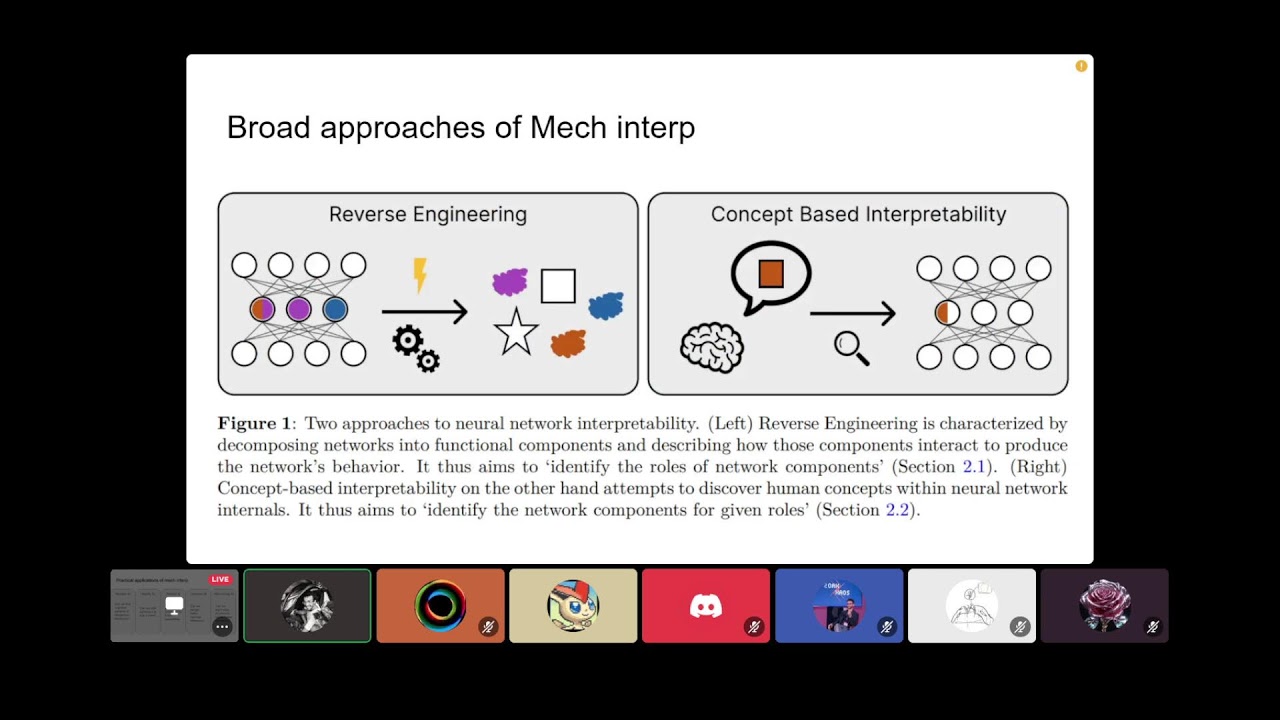
The presentation transitions into how the paper categorizes mechanistic interpretability into two dominant paradigms: **Reverse Engineering** and **Concept-Based Interpretability**. This session focuses heavily on reverse engineering, saving concept-based approaches for a future discussion.
``` MECH INTERP PARADIGMS │ ┌───────────────┴───────────────┐ ▼ ▼ Reverse Engineering Concept-Based (Decompose network into (Start with a concept, components & interactions) find corresponding units) ```
* **Reverse Engineering:** Takes a neural network apart "at the joints" into abstract components, mapping out how their interactions give rise to emergent behaviors. * **Concept-Based Interpretability:** Starts with a human-defined concept (e.g., gender, plurals, or grammatical adjectives) and searches the network for components or directions that encode that concept.
---
[15:47](https://www.youtube.com/watch?v=wi60kgNKnJk&t=947s) Decomposing Networks, Polysemanticity, and Sparse Autoencoders (SAEs)
The presenter details the core mechanics of reverse engineering: decomposing a network, describing its constituent components, forming hypotheses about how they process information, and rigorously testing those hypotheses. If tests fail, researchers must refine their descriptions or choose a completely different decomposition scale (ranging from coarse layer-level blocks down to fine-grained sub-units).
``` REVERSE ENGINEERING WORKFLOW │ [ Decompose Network ] │ [ Formulate Hypothesis ] │ [ Test & Validate Model ] / \ (Passes) (Fails) │ │ [ Explain Network ] [ Refine Granularity ] ```
The presenter traces the historical evolution and technical trade-offs of network decomposition methods:
* **Neuron-Level Granularity & Polysemanticity:** Early research relied on individual artificial neurons as the primary unit of analysis. However, individual neurons are notoriously **polysemantic**—activating for multiple unrelated concepts that share no obvious logical connection to a human observer. * **Dimensionality Reduction:** Techniques like PCA fail to resolve **superposition**, a phenomenon where a network squeezes *more* distinct concepts into its parameters than it has activation dimensions. Dimensionality reduction merely compresses these overlapping vectors without separating them. * **Sparse Learning (Sparse Autoencoders / SAEs):** The current dominant paradigm attempts to solve superposition by projecting activations from a lower-dimensional space (such as the residual stream or MLP output) into a much higher-dimensional, sparse latent space. This allows individual, human-interpretable feature directions to isolatedly fire.
---
[21:42](https://www.youtube.com/watch?v=wi60kgNKnJk&t=1302s) Limitations and Open Challenges with SAEs
Despite the widespread adoption of Sparse Autoencoders, Transcoders, and Crosscoders across the field, the presenter highlights major open problems and performance bottlenecks outlined in the paper:
``` SPARSE AUTOENCODER (SAE) CHALLENGES │ ┌──────────────────┬─────────┴────────┬──────────────────┐ ▼ ▼ ▼ ▼ High Alignment Tax Extreme Compute Linear Rep. Feature Splitting/ (Loss/Performance Cost Hypothesis Absorption Drop) Inadequacies ```
* **High Alignment Tax & Loss of Signal:** Reconstructing network layers via SAEs leads to severe performance degradation. * OpenAI's SAE experiments on GPT-4 required 16 million latents, yet the reconstructed model performed as poorly as a base model trained on only **10% of its dataset**—effectively discarding 90% of the model's learned capabilities. * On smaller models like GPT-2, applying a single-layer SAE still incurs a **10% to 40% performance drop**. * **Prohibitive Compute Requirements:** Training sparse dictionary models on large foundation models is computationally expensive. Dissecting every component across every layer can cost as much compute as pretraining an entirely new model. * **Flaws in the Linear Representation Hypothesis:** SAEs assume concepts are linearly readable directions in vector space. Because neural networks rely on non-linear transformations, linear assumptions inevitably miss complex, non-linear representations. * **Sparsity Pathologies:** Enforcing extreme sparsity introduces structural artifacts: * **Feature Splitting:** Increasing dictionary size causes a single concept (e.g., "cats") to split into hyper-specific sub-features (e.g., "Persian cats", "Maine Coons"). * **Feature Absorption:** Larger features get absorbed or distorted by adjacent sparse dimensions during optimization.
---
Key Terminology Reference
* **Sandbagging:** When an AI model intentionally underperforms during evaluations to conceal its true capabilities. * **Refusal Vector:** A direction in a model's latent space that controls its propensity to reject unsafe prompts. * **Polysemanticity:** A single neuron activating in response to multiple unrelated concepts. * **Superposition:** Storing $N$ concepts in $M$ dimensions where $N > M$ by exploiting non-orthogonal feature directions. * **Sparse Autoencoders (SAEs):** Auxiliary networks trained to reconstruct model activations into a high-dimensional, sparse feature representation to unravel superposition.
<ElicitationsGroup message="Explore related topics in mechanistic interpretability:"> <Elicitation label="Summarize Part 2 of this presentation" query="Summarize Part 2 of the Mech Interp Reading Group - Open Problems in Mechanistic Interpretability transcript."/> <Elicitation label="Explain Sparse Autoencoders in detail" query="Explain how Sparse Autoencoders (SAEs) work in mechanistic interpretability, including transcoders and crosscoders."/> </ElicitationsGroup>
[02:26:26](https://www.youtube.com/watch?v=wi60kgNKnJk&t=8786s) Limitations of Sparse Autoencoders: Feature Absorption, Architecture Transfer, and Geometry
The speaker details several critical failure modes and open challenges associated with training Sparse Autoencoders (SAEs) and dictionary learning. A major issue is "feature absorption," where a broader context feature inadvertently absorbs a portion of a specific concept feature. For instance, an SAE might learn a general "begins with" feature alongside a specific "elephant" feature; the "elephant" feature absorbs part of "begins with," rendering the resulting latents far less interpretable because a seemingly pure concept feature now carries extraneous conceptual baggage. Additionally, applying dictionary learning across different neural architectures is far from straightforward. While it is already non-obvious where to attach SAEs within standard Transformers (such as around attention heads), moving to alternative state-space architectures like Mamba presents brand-new open questions regarding proper training locations.
Beyond architectural placement, standard SAEs only describe static activations rather than the underlying mechanism or weight-level logic of how inputs transform into specific outputs. The discussion highlights that SAEs fundamentally ignore spatial and multi-dimensional geometry in activation space. Research demonstrates that models often represent concepts like time in a two-dimensional, circular fashion—rotating smoothly from January to February to March—or organize numbers for addition along complex spiral geometries. While an SAE might isolate a distinct direction for each month, it completely misses the underlying rotational relationship connecting them, which is likely crucial for the model's actual computations.
- **Feature Absorption Example:** A concept latent (e.g., "elephant") absorbs functional context (e.g., "begins with"), causing latents to carry unwanted "baggage." - **Geometry & Representation:** Models represent cyclical or continuous domains (time, modular arithmetic, addition) using multi-dimensional circular or spiral geometries rather than isolated 1D vectors. - **Reference Papers:** Mentions a paper by Max Tegmark and students finding spiral geometric representations for numerical addition in large language models (LLMs). - **Theoretical Foundations:** The field currently lacks strong theoretical foundations confirming whether the Linear Representation Hypothesis or superposition are true mechanistic realities or merely useful empirical approximations. - **Interpretable Architectures:** As an alternative to post-hoc decomposition, the paper suggests embedding interpretability directly into model designs using Sparse Mixture-of-Experts (MoE), sparse activation functions, or bilinear activations in MLPs.
[02:34:22](https://www.youtube.com/watch?v=wi60kgNKnJk&t=9262s) Reverse Engineering Networks: Node Activation, Downstream Effects, and Causal Tracing
Once a network is decomposed into interpretable components, reverse engineering requires explaining what each component does and how they interact. The speaker explains that this task splits into two halves: understanding *why* a component activates based on its inputs, and determining *what* it does in terms of downstream effects. Combining these steps enables end-to-end "causal tracing," where researchers trace how input-activated features flow through internal nodes to drive final model outputs.
To understand input activations, researchers look at highly activating dataset examples, gradient-based attribution methods, or "feature synthesis" (artificially generating synthetic data engineered to maximize activation). To explain downstream behavior, three primary effects are studied: direct effects (evaluating the component's output through a Logit Lens as if it were the final layer), indirect effects (using causal interventions like activation patching to observe information flow paths), and sequential effects (patching activations across multiple future token positions to measure long-range behavioral propagation).
- **Activation Analysis:** Combines naturally occurring dataset examples with gradient attribution and feature synthesis to hypothesize what turns a node on. - **Causal Interventions:** Activation patching isolates indirect effects, though running a separate forward pass per intervention becomes computationally expensive at scale. - **Gradient Approximations:** Researchers use gradient-based methods to approximate full causal patching to save compute. - **Sequential Propagation:** Evaluates how a component's output influences the model's generation across multiple future token steps rather than just the immediate next token.
[02:41:14](https://www.youtube.com/watch?v=wi60kgNKnJk&t=9674s) Validation Strategies, Model Organisms, and Benchmarking
To validate whether a hypothesized circuit or feature description is correct, researchers must test their explanations against ground truth. One basic approach is activation prediction: if an SAE feature is hypothesized to represent "cats," feeding the model cat-related text should consistently trigger that feature. Researchers also evaluate hypotheses against adversarial examples and failure modes to check if the mental model holds under edge cases. Another powerful method is hand-crafting a circuit from scratch based on the proposed rules to see if it performs the target task, or testing interpretability tools on synthetic networks with known ground-truth algorithms.
The ultimate benchmark for reverse engineering is solving concrete engineering goals—such as fixing a coding bug or enforcing safety refusals—in a way that is competitive with standard fine-tuning or editing methods. However, current mechanistic interpretability techniques remain far from competitive with traditional methods for practical tasks. To bridge this gap, the authors advocate creating simple "model organisms" analogous to *Drosophila* (fruit flies) in biology, enabling researchers to test hypothesis-generation tools on simple, controlled systems before scaling to massive LLMs.
- **Hypothesis Testing Methods:** Activation prediction on targeted datasets, testing against adversarial failure modes, and hand-crafting minimal circuits. - **Ground Truth Verification:** Running interpretability techniques on small, hand-coded networks with known algorithms to verify if the tool correctly extracts the true mechanics. - **Practical Engineering Benchmark:** Measuring whether interpretability-based interventions can fix bugs or alter behavior as effectively as traditional machine learning techniques. - **Biological Analogy:** Using simple "model organisms" (*Drosophila*) in AI to rapidly iterate on and validate interpretability frameworks.
[02:46:08](https://www.youtube.com/watch?v=wi60kgNKnJk&t=9968s) Open Discussion: Categorization and Conceptual Divisions in Mech Interp
As the formal presentation concludes, the speaker opens the floor for discussion. Victor raises a critique regarding how the paper categorizes mechanistic interpretability research, arguing that dividing the field strictly into "reverse engineering" and "concept-based interpretability" feels somewhat arbitrary. Victor notes that both approaches are fundamentally driven by the same goal—understanding the internal mechanics of the model—and that the boundary between them is fuzzy.
Another participant agrees with Victor, noting that the diagrams in the paper can be unclear because all interpretability work relies on the baseline hypothesis that models learn human-understandable concepts in the first place. Victor clarifies that a more intuitive distinction might be framing reverse engineering as *unsupervised* feature discovery (searching the model blindly for whatever features exist) versus concept-based interpretability as *supervised* or human-driven search (looking for specific, predefined concepts inside the model). The group also touches on how the paper categorizes practical applications, suggesting that labeling them as distinct "types of problems" rather than clear real-world applications makes the taxonomy less natural than it could be.
- "The division between reverse engineering and concept-based interpretability seems like a not super natural division to make... seems kind of arbitrary." — Victor - **Unsupervised vs. Supervised Framing:** Reverse engineering acts like unsupervised discovery (finding whatever features exist in the weights), whereas concept-based interpretability acts like a targeted, human-led search for specific concepts. - **Taxonomy Critique:** The participants note that the paper's categorization of practical "applications" as distinct problem types creates unnecessary conceptual confusion.
[52:14](https://www.youtube.com/watch?v=wi60kgNKnJk&t=3134s) Categorizing Mech Interp Problems and Paper Taxonomy Critique
The discussion opens with a critical reflection on how open problems in mechanistic interpretability ought to be structured and categorized versus how the Sharkey et al. paper actually organizes them. A speaker breaks down the field into several logical, distinct sub-problems: first, how to divide or decompose model representations into features better—whether through Sparse Autoencoders (SAEs), transcoders, dimensionality reduction, or newer alternatives like recent Apollo Research methods meant to replace traditional autoencoders. Second, once features are extracted, the open challenge becomes feature attribution and circuit discovery: determining how those features connect to one another and what specific functional roles they serve inside the network. Third, there is the problem of semantic interpretation—understanding what a given feature actually means in a human-understandable sense, which relies on automated interpretation techniques using models like GPT-4 or OpenAI's feature explanation frameworks.
The speaker notes that while the paper touches on virtually all of these critical components, its structural taxonomy feels somewhat unintuitive or "weird." The categorization seems to cluster topics around specific application types rather than fundamental methodological problems. Another participant acknowledges this critique, noting that the paper divides theoretical aspects under "Open Problems in Methods and Foundations" and contrasts them with "Practical Applications," which can make the taxonomy feel slightly misaligned with how researchers actively think about reverse engineering in practice.
- **Feature Decomposition Techniques:** Sparse Autoencoders (SAEs), transcoders, dimensionality reduction, and novel Apollo Research architectures. - **Circuit Discovery & Attribution:** Mapping feature connectivity and identifying how subnetworks utilize extracted features to perform tasks. - **Automated Feature Interpretation:** Utilizing LLMs (e.g., ChatGPT / OpenAI methodology) to automatically generate human-readable explanations for discovered features.
[53:49](https://www.youtube.com/watch?v=wi60kgNKnJk&t=3229s) Unsupervised Reverse Engineering vs. Supervised Concept-Based Methods
The conversation pivots to comparing reverse engineering with concept-based interpretability. The speakers frame this distinction as essentially an **unsupervised versus supervised** paradigm. Reverse engineering operates in an unsupervised manner, attempting to blindly extract and catalog everything a language model has learned without prior assumptions. Conversely, concept-based methods (which the group plans to explore in the following session) rely on supervised techniques like probing, where researchers specifically search for predefined human concepts within the model's latent space.
The discussion then explores hybrid approaches that combine both paradigms. One speaker raises the idea of training linear probes directly on Sparse Autoencoder (SAE) feature bases to identify which specific autoencoder features correspond to a target human concept. The second participant points out that this exact hybrid approach has already been operationalized in the literature, specifically citing **SAE Bench** (SAE Benchmark), where probes are trained on SAE activations to evaluate feature quality and semantic alignment.
- **Supervised vs. Unsupervised Paradigm:** - *Reverse Engineering (Unsupervised):* Bottom-up extraction of all internal features and representations without target labels. - *Concept-Based Interpretability (Supervised):* Top-down searching for specific, known concepts using probing and directional vectors. - **Hybrid Methodology:** Running linear probes over SAE feature activations to pinpoint which sparse features encode specific human-understandable concepts. - **Literature Reference:** SAE Bench (SAE Benchmark) explicitly incorporates probing on SAE feature spaces to measure representation quality.
[57:01](https://www.youtube.com/watch?v=wi60kgNKnJk&t=3421s) Session Wrap-Up and Next Agenda
As the meeting reaches its allotted time mark, the speakers wrap up the session. One participant admits to floating a few final thoughts mainly to spur spontaneous discussion, but agrees that it is a natural stopping point. The group outlines the plan for the upcoming week: they will complete their reading and discussion of the remaining sections of the Lee Sharkey et al. paper (*"Open Problems in Mechanistic Interpretability"*), after which the reading group will transition to reviewing individual research papers.
- "I was to some amount just talking right now to see if it will create some discussion, but I'm fine with leaving it here." - **Next Session Agenda:** Finish the remainder of the Sharkey et al. open problems paper. - **Future Direction:** Transition from broad survey papers to reviewing specific, individual mechanistic interpretability research papers.
<FollowUp label="Want to explore the details of SAE Bench or Apollo Research's alternative to autoencoders?" query="Tell me more about SAE Bench and the recent Apollo Research paper on replacing autoencoders mentioned in the transcript."/>
## Notable quotes > [02:46:08](https://www.youtube.com/watch?v=wi60kgNKnJk&t=9968s) The division between reverse engineering and concept-based interpretability seems like a not super natural division to make... seems kind of arbitrary. — Victor
> [57:01](https://www.youtube.com/watch?v=wi60kgNKnJk&t=3421s) I was to some amount just talking right now to see if it will create some discussion, but I'm fine with leaving it here.
## Mentioned Lee Sharkey, Open Problems in Mechanistic Interpretability, Discord, YouTube, AlphaZero, AlphaFold, OpenAI, GPT-2, GPT-4, Max Tegmark, Victor, Apollo Research, SAE Bench, ChatGPT
[Source](https://www.youtube.com/watch?v=wi60kgNKnJk)