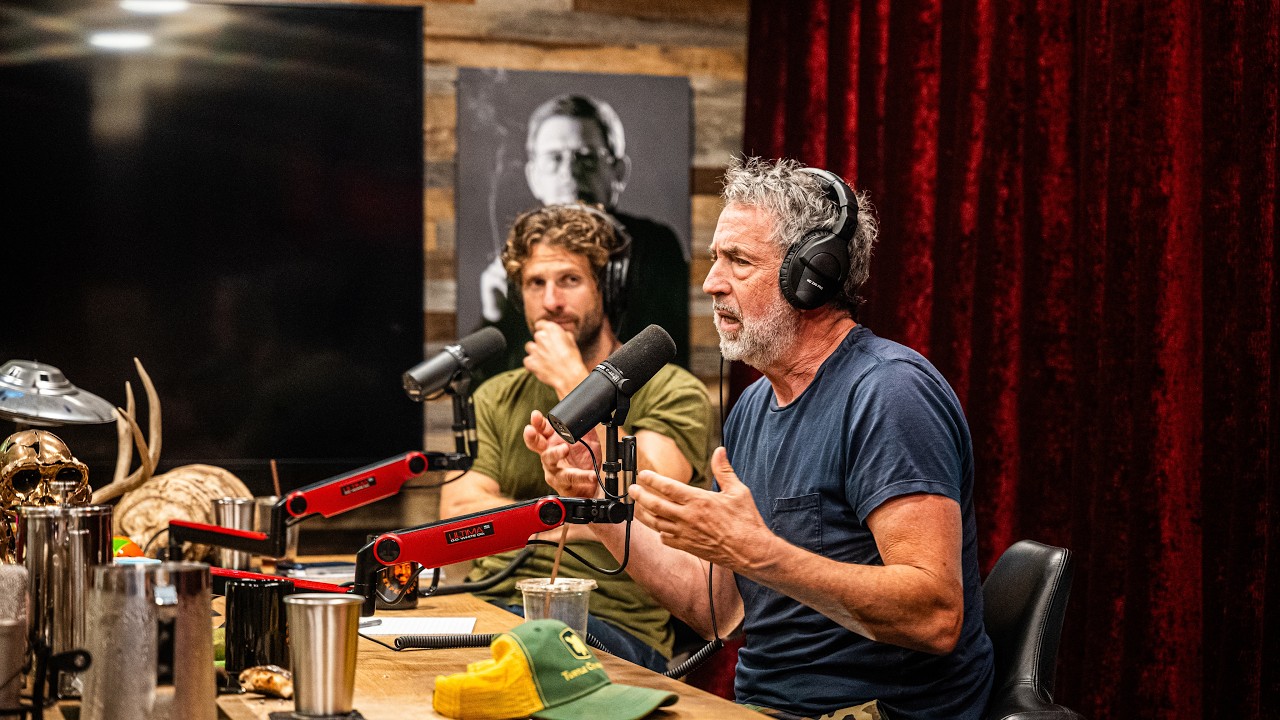
Documentarians Link Exotic Animal Smuggling Networks to Black Market Price Inflation
PowerfulJRE
Filmmakers Eric Goode and Jeremy McBride argue that strict wildlife laws unwittingly drive up black market prices for endangered species, making humans the ultimate destructive force.
## Background
This episode of Joe Rogan Experience (#2536) was published on YouTube by PowerfulJRE on August 6, 2026. The page description introduces filmmakers Eric Goode and Jeremy McBride, highlighting their work on shows like "Tiger King," "Chimp Crazy," and their HBO/HBO Max series "Monsters of God," while featuring promotional links for Perplexity, onX Offroad, and Visible.
## TL;DR
Filmmakers Eric Goode and Jeremy McBride discuss their longitudinal documentary work exploring dark, eccentric wildlife subcultures, exotic animal trafficking, and the black market reptile trade. They detail the extreme measures taken by smugglers, the history of illicit wildlife collections, and how high-value demand in East Asia drives rare species toward extinction. The conversation spans stories of high-stakes undercover operations, law enforcement dynamics, and the psychological parallel between wildlife collectors and federal agents. Ultimately, the discussion examines humanity's complicated relationship with nature, framing human greed and historical exploitation—rather than the animals themselves—as the true destructive force.
## Atmosphere & style
The conversation carries a gritty, candid, and intrigue-filled tone as Joe Rogan, Eric Goode, and Jeremy McBride swap absurd yet shocking true-crime stories from the exotic animal underworld. The dynamic balances dark humor and colorful storytelling with a grounded, sober reflection on species extinction and environmental devastation. Listening feels like sitting in on a late-night, unfiltered debrief between investigative filmmakers and a curious host, navigating seamless shifts between bizarre subcultural eccentricities and tragic ecological realities.
## Key takeaways
- [44:06](https://www.youtube.com/watch?v=O52aLL8ycGU&t=2646s) The culture surrounding Florida's wildlife trade is shaped by a mix of shady characters, ex-convicts, and extreme prison sentences given to drug and wildlife smugglers.
- [48:18](https://www.youtube.com/watch?v=O52aLL8ycGU&t=2898s) Smugglers frequently used dangerous or foul-smelling animals, such as venomous snakes and raw fish, to conceal illegal narcotics from customs inspectors.
- [50:40](https://www.youtube.com/watch?v=O52aLL8ycGU&t=3040s) High-value reptiles and venomous 'hot snakes' operate as status symbols in exotic pet subcultures that intersect with drug and criminal networks.
- [58:51](https://www.youtube.com/watch?v=O52aLL8ycGU&t=3531s) Crocodilians are highly intelligent, adaptable apex predators capable of surviving up to a year without eating due to their slow metabolism.
- [01:01:18](https://www.youtube.com/watch?v=O52aLL8ycGU&t=3678s) Private animal collectors often view rare live reptiles like fine art, driving intense collection mania that can lead to personal and financial ruin.
- [01:04:05](https://www.youtube.com/watch?v=O52aLL8ycGU&t=3845s) Undercover investigations reveal a shadow market where taxidermists and private collectors trade in endangered species, including primates and human remains.
- [01:08:15](https://www.youtube.com/watch?v=O52aLL8ycGU&t=4095s) Pop culture trends and media continually fuel dangerous spikes in public demand for exotic pets, threatening species vulnerable to extinction.
- [01:12:51](https://www.youtube.com/watch?v=O52aLL8ycGU&t=4371s) Reptiles invoke deep evolutionary phobias and negative stigmas in humans, leading to widespread vilification despite their ecological importance.
- [01:18:47](https://www.youtube.com/watch?v=O52aLL8ycGU&t=4727s) Well-intended conservation laws and high-profile law enforcement busts can inadvertently inflate black market prices and drive further poaching.
- [01:26:11](https://www.youtube.com/watch?v=O52aLL8ycGU&t=5171s) The United States has transformed into a massive exporter of native reptiles, with illegal networks smuggling native box turtles into Asian markets.
- [01:28:24](https://www.youtube.com/watch?v=O52aLL8ycGU&t=5304s) Asian wildlife markets and trade expos operate on a massive scale, treating rare reptiles and birds as luxury commodities and status symbols.
- [01:37:15](https://www.youtube.com/watch?v=O52aLL8ycGU&t=5835s) Apex predator reintroductions face major ecological and social hurdles, frequently sparking conflict with local farming and domestic pet populations.
- [01:43:00](https://www.youtube.com/watch?v=O52aLL8ycGU&t=6180s) Captive breeding programs can serve as a vital strategy to flood markets and reduce high poaching pressures on functionally extinct wild populations.
- [01:48:00](https://www.youtube.com/watch?v=O52aLL8ycGU&t=6480s) Turtles carry deep historical and mathematical symbolism, with shell scute counts mirroring lunar calendars and plastrons serving as ancient writing surfaces.
- [01:51:00](https://www.youtube.com/watch?v=O52aLL8ycGU&t=6660s) The international trade in rare turtles commands prices upward of $100,000 to $200,000 per specimen for traditional medicine and elite private collections.
- [02:01:43](https://www.youtube.com/watch?v=O52aLL8ycGU&t=7303s) Releasing commercially farmed animals back into the wild can cause severe genetic hybridization and ecological harm to remaining wild populations.
- [02:03:35](https://www.youtube.com/watch?v=O52aLL8ycGU&t=7415s) The term 'Monsters of God' reflects the perspective that human exploitation, ego, and destruction—rather than the predatory nature of reptiles—are the true monsters.
## Detailed walkthrough
### [00:01](https://www.youtube.com/watch?v=O52aLL8ycGU&t=1s) Introduction to *Monsters of God* and the Florida Python Problem
Joe Rogan welcomes filmmakers Eric Goode and Jeremy McBride back to the podcast. Having previously produced *Chimp Crazy* and *Tiger King*, the duo has returned with a new HBO docuseries titled *Monsters of God*, which exposes the global reptile trade. Joe kicks off the conversation by asking where they manage to find such eccentric characters, marveling at the wild nature of the series' first episode. The discussion quickly pivots to the sheer scale of the reptile trade and its real-world ecological consequences, specifically the estimated 500,000 invasive Burmese pythons currently inhabiting the Florida Everglades.
The origins of Florida's python infestation spark a debate over how these apex predators established themselves. While popular theories point to escaped pets or a reptile breeding facility destroyed by a hurricane, Eric shares his own perspective. Having owned a Burmese python as a teenager in the 1970s, Eric notes that people frequently purchase small baby snakes without realizing they will grow to 15 feet or more, leading irresponsible owners to release them into the wild. When Joe presses Eric on what happened to his own teenage python, Eric sheepishly admits he has no idea, recalling only that he gave his entire room full of reptiles away to friends when he briefly left for college. Joe pokes fun at the notion of handing off a massive potential predator without tracking its whereabouts, while Eric jokes about python prey in the Everglades:
> "You got to worry about your Chihuahua because the pythons in the Everglades are going to eat your Chihuahua when it gets away."
- Burmese pythons and iguanas have aggressively populated South Florida as highly destructive invasive species.
- Eric Goode's personal history with exotic pets dates back to a Burmese python he owned during his teenage years in the 1970s.
---
[02:23](https://www.youtube.com/watch?v=O52aLL8ycGU&t=143s) Eric Goode’s Lifelong Passion and a Near-Fatal Rattlesnake Bite
Joe asks why Eric chose the reptile trade as the focal point for their new documentary series, praising their past work on *Chimp Crazy*. Eric explains that his fascination with reptiles spans over 60 years, beginning when his parents bought him a tortoise at age six. Growing up, he spent his childhood catching rattlesnakes and horned lizards in his lunchbox. This lifelong obsession led to a harrowing experience 25 years ago when he was bitten on the foot by a highly venomous rattlesnake while bushwhacking in the mountains north of Los Angeles while wearing open-toed river sandals.
Eric describes the terrifying physiological onset of the bite, which began with a sensation like being stabbed with an X-acto knife, followed 10 to 15 minutes later by a metallic taste in his mouth. The snake possessed a combination of hemotoxins and neurotoxins, causing severe respiratory distress rather than localized tissue necrosis. Within an hour, he felt as though heavy sandbags were sitting on his chest, threatening to stop his breathing entirely. The hospital exhausted its entire supply of antivenom—requiring a total of 36 vials sourced across multiple facilities—and Eric endured weeks of agonizing serum sickness triggered by the horse-derived antibodies used in the treatment.
- Eric Goode was bitten 25 years ago in Southern California by a rattlesnake possessing both hemotoxic and neurotoxic venom.
- Emergency medical staff administered 36 vials of antivenom, completely draining the hospital's stock.
- Joe shares a story about his 90-pound dog in California being bitten twice by rattlesnakes, eventually building a degree of natural resistance after the first bite.
---
[08:34](https://www.youtube.com/watch?v=O52aLL8ycGU&t=514s) From NYC Nightlife to the Underground Reptile Trade
Eric details how his identity as a "closeted reptile guy" existed alongside his high-profile life in the 1980s and 1990s New York City nightlife and art scenes. While running nightclubs and socializing with figures like Madonna and Andy Warhol, he kept his passion for reptiles mostly private. He humorously recalls an interview on *Andy Warhol TV* where Warhol asked what he planned to do with his money, to which Eric blurted out that he was going to buy rare tortoises. Over the following decades, Eric traveled globally—to Madagascar, Sulawesi, and South America—to study rare turtles and tortoises.
His journey into filmmaking began when he collaborated with young, up-and-coming directors Josh and Benny Safdie (who later gained acclaim for films like *Marty Supreme* starring Timothée Chalamet). Together, they shot public service announcements featuring celebrities like Christopher Walken and Slash holding tortoises, which eventually evolved into a short documentary called *Trophy Hunter*. Inspired by the book *The Lizard King*, Eric approached Oscar-winning director Fisher Stevens about making a full-length documentary about the reptile underworld, to which Stevens famously warned:
> "How are you going to do that doc without getting killed, Eric?... It's a dark world. I don't know how you're going to do this without getting killed."
- Eric Goode ran prominent New York City nightclubs in the 1980s and 1990s while secretly collecting rare reptiles.
- Early short film projects about reptile conservation were created alongside the Safdie brothers.
- *Monsters of God* drew early creative inspiration from the non-fiction book *The Lizard King*.
---
[11:08](https://www.youtube.com/watch?v=O52aLL8ycGU&t=668s) The Multibillion-Dollar Global Wildlife Trade
Jeremy McBride and Eric break down the broader context of the illegal wildlife trade, explaining that *Monsters of God* examines an industry spanning the past half-century. Global illegal wildlife trafficking is estimated to be a $20 billion annual industry, ranking directly behind arms, drugs, and human trafficking. Jeremy points out that in the era before strict post-9/11 airport security and TSA screening, smuggling animals was extraordinarily easy. Smugglers simply placed reptiles into suitcases or strapped them directly to their bodies under their clothes, boarding commercial flights with zero scrutiny.
The speakers highlight the unique nature of reptiles within the illegal animal trade, describing them as portable "nature with handles." A small group of ambitious, risk-taking individuals transformed this unregulated smuggling into a massive global business. However, Eric clarifies that the broader $20 billion figure includes large-scale consumption across Asia—where reptiles are harvested for traditional medicine, food, and high-end luxury leather goods like alligator, crocodile, and python skin bags—alongside the rapidly expanding exotic pet market in countries like China over the past 25 years.
- Illegal wildlife trafficking accounts for roughly $20 billion annually worldwide.
- Prior to modern airport security protocols, smugglers routinely carried exotic reptiles through airports inside personal luggage or hidden on their bodies.
- Python skin harvesting in Southeast Asia historically tied into the pet trade, where eggs from wild-caught pythons were incubated to sell hatchlings to Western markets.
<ElicitationsGroup message="Explore more details from this interview or related topics:">
<Elicitation label="Summarize the next transcript part of JRE #2536" query="Provide a detailed walkthrough of part 2 of Joe Rogan Experience #2536 with Eric Goode & Jeremy McBride."/>
<Elicitation label="Analyze the history and impact of invasive Burmese pythons in Florida" query="What is the history of Burmese pythons in the Florida Everglades, their impact on the ecosystem, and current removal methods?"/>
<Elicitation label="Overview of the global illegal wildlife trade" query="Provide a breakdown of the global illegal wildlife trade, including key markets, statistics, and international enforcement efforts."/>
</ElicitationsGroup>
[14:44](https://www.youtube.com/watch?v=O52aLL8ycGU&t=884s) California's Broad Python Bans and Exotic Leather Laws
Joe Rogan points out the obvious logic gap in state wildlife regulations: Florida is currently overrun with invasive Burmese pythons, yet states like California strictly ban the sale of python skins. He suggests that turning invasive species into commercial python leather seems like an ideal fix, given how high market demand is for exotic skins. However, Eric Goode clarifies that the python skins most coveted by fashion enthusiasts—like the iconic gold-and-black jacket Nicolas Cage wore in the movie *Wild at Heart*—come from reticulated pythons, native to Southeast Asia, rather than the Burmese pythons plaguing the Everglades.
Pulling up the specifics of the law, the group discovers that California's blanket ban on python imports dates all the way back to 1970. The statute was originally intended to protect endangered species like the Indian python (*Python molurus*). Instead of singling out threatened species, California lawmakers drafted an extraordinarily broad bill prohibiting all python products entirely. Eric, who resides in California, laments how overregulated the state is when it comes to wildlife legislation, arguing that banning an entire family of reptiles because one specific species is endangered harms practical management solutions.
- **Nicolas Cage's Jacket:** The famous python jacket from *Wild at Heart* is made from a reticulated python, known for its distinct black-and-gold geometric pattern.
- **California Python Ban (1970):** Drafted to protect the endangered Indian rock python, the law broadly banned all python imports regardless of species or origin.
- **Burmese Pythons vs. Reticulated Pythons:** Burmese pythons are the primary invasive species in the Florida Everglades, whereas reticulated pythons are native to Southeast Asia and preferred by high-end leather markets.
---
[16:45](https://www.youtube.com/watch?v=O52aLL8ycGU&t=1005s) Invasive Iguanas, Florida's Culinary Solutions, and the Fiji Iguana
The conversation turns from pythons to Florida's massive green iguana infestation. Rogan notes that people in South Florida have actually started hunting these invasive iguanas and cooking them, highlighting a YouTube subculture where hunters prepare iguana stir-fry served over rice or grill them over charcoal. While many people assume reptiles taste strictly like chicken, Eric Goode explains that in Mexico, locals traditionally make tamales out of iguana tail meat.
The group watches a video of a Florida hunter prepping and grilling a whole iguana on a Komado-style smoker, basting it in a butter-and-spice glaze. During cold snaps in Florida, large iguanas freeze up and literally fall out of trees. Male iguanas can grow up to five feet long and turn a vibrant bright orange during mating season. Goode, who sits on the board of the International Iguana Foundation, points out that while green iguanas are a nuisance in Florida, many iguana species globally are critically endangered.
```
+---------------------------+-------------------------------------------------------+
| Iguana Species | Conservation Status & Key Characteristics |
+---------------------------+-------------------------------------------------------+
| Green Iguana | Invasive in Florida; turns bright orange; eaten locally|
| Fiji Island Iguana | Critically endangered; features turquoise/lemon stripes|
| Pink Land Iguana | Found in Galápagos high elevations; highly vulnerable |
| Jamaican Iguana | Once thought extinct; small relict population found |
| Ctenosaur (Spiny-tailed) | Native to Central America; invasive in Florida |
+---------------------------+-------------------------------------------------------+
```
> "They literally—this one guy says it's reptile magic. It's like reptile art, a Fiji Island iguana... It's just the beauty of it, turquoise and green with lemon highlights."
> — **Eric Goode**
---
[20:30](https://www.youtube.com/watch?v=O52aLL8ycGU&t=1230s) The 'Jurassic Park' Boom and the Pet Trade Pipeline
Jeremy McBride and Eric Goode explain how Florida’s invasive species crisis was fueled by the commercial pet trade, specifically highlighting the subjects of their documentary work: Mike Van Nostrand and his father, Ray Van Nostrand, of *Strictly Reptiles* in Hollywood, Florida. Goode describes *Strictly Reptiles* as essentially a massive "fulfillment center" or Amazon-style warehouse for wildlife distribution across America.
When Steven Spielberg’s *Jurassic Park* debuted in 1993, public demand for "pet dinosaurs" exploded. At the height of the craze, *Strictly Reptiles* was moving over 5,000 green baby iguanas a week. Jeremy admits to having an iguana in his bedroom as a child in the 1990s, though it met a tragic end when its electric hot rock overheated and accidentally cooked it. Rogan and McBride joke about the unintended consequences of blockbuster films driving animal crazes, expressing relief that people cannot buy velociraptors at pet stores.
- **Strictly Reptiles:** A major Hollywood, Florida-based wholesale reptile distributor operated by Ray and Mike Van Nostrand.
- **The Jurassic Park Effect:** The 1993 movie triggered an unprecedented surge in exotic reptile sales, driving iguana imports to thousands of units per week.
- **Hot Rocks:** A popular 1990s vivarium heating accessory notorious for malfunctioning and causing thermal burns or death to pet reptiles.
---
[22:18](https://www.youtube.com/watch?v=O52aLL8ycGU&t=1338s) Dire Wolves, De-Extinction, and Endangered Species Conservation
The mention of prehistoric pets leads Rogan to discuss modern "de-extinction" efforts like Colossal Biosciences, who are working on bringing back species like the woolly mammoth and dire wolf. Rogan describes having seen animals produced through these genetic projects, explaining that scientists take 7,000-year-old dire wolf DNA traits and engineer them into gray wolf genomes. The resulting animals exhibit a distinctly heavier build, a thick mane, and stockier white frames compared to standard gray wolves.
Eric Goode redirects the conversation back to reptile conservation, noting that global perception of iguanas is warped because people assume all iguanas are common like Florida's invaders. In reality, there are roughly 45 iguana species worldwide, including the marine iguanas and rare high-elevation pink land iguanas of the Galápagos Islands. Goode highlights the Jamaican iguana, a species long presumed extinct until a tiny surviving wild population was unexpectedly rediscovered in the remote Cockpit Country.
> "People get confused. They think, 'Oh, iguana, that's so common. They're falling out of trees in Florida.' But there are a lot of really rare, cool iguanas... and we should care about iguanas, they're not just green iguanas."
> — **Eric Goode**
---
[24:48](https://www.youtube.com/watch?v=O52aLL8ycGU&t=1488s) Invasive Tegus, Crocodile Monitors, and the Psychology of Reptile Owners
Pulling up footage from Florida accounts like *Topshelf Anglers*, the hosts observe how invasive species in the state extend well beyond green iguanas. Florida streams and canals are now populated by Central American spiny-tailed iguanas (*Ctenosaura*), as well as South American Argentine black and white tegus—large, egg-devouring lizards that resemble stocky "snakes with legs." Eric Goode admits he used to sleep with a pet tegu as a teenager and frequently fed it chicken and duck eggs.
Rogan recalls visiting a local pet store in the San Fernando Valley to buy feeder goldfish for his pet piranhas and turtles. He remembers seeing a massive crocodile monitor (*Varanus salvadorii*) on display and briefly considering building an enclosure for one, before realizing how dangerous they are. Goode warns that a crocodile monitor bite is nearly on par with a Komodo dragon's, featuring serrated, scalpel-like teeth meant to shred prey.
The conversation turns to the contrast between primate owners and reptile collectors. While Rogan understands why people connect with chimps—given their emotional range, jealousy, and primate intelligence—he finds the psychological drive behind keeping massive predatory reptiles far stranger. Goode explains that for him, tortoises were a "gateway drug" because they can roam peacefully in a garden without needing live animal prey or cages, whereas keeping apex predators like monitor lizards requires looking into an unblinking "abyss."
- **Crocodile Monitor (*Varanus salvadorii*):** Arboreal monitor lizard native to New Guinea, known for extremely sharp, razor-like teeth and long tails.
- **Argentine Black and White Tegu:** Large, highly intelligent invasive lizard in Florida known for raiding bird and alligator nests for eggs.
- **Chimp Crazy vs. Reptile Trade:** Rogan compares the deep emotional anthropomorphism seen in primate owners (featured in Goode and McBride's *Chimp Crazy*) with the cold, alien nature of collecting large predatory reptiles.
[02:09:25](https://www.youtube.com/watch?v=O52aLL8ycGU&t=7765s) The Evolution of the Reptile Trade and "Herp" Obsession
Eric Goode and Jeremy McBride explain the core mission behind their documentary series *Monsters of God*. While the show acts as a spectacle and a "freak show" capturing eccentric human subcultures, its fundamental goal is to educate people on the evolution of the reptile trade and highlight how animals like turtles and tortoises face severe extinction threats alongside primates. They stress that reptiles should not be treated as disposable household pets. Goode notes that unlike casual pet owners who keep a basic bearded dragon, serious reptile enthusiasts—known in the community as "herp people"—treat these creatures like rare, collectible commodities.
It is a culture built around extreme obsession, living art, and scarcity, where collectors go to incredible lengths to acquire the "Rolls-Royce of reptiles." Rogan points out the psychological irony inherent in these relationships: these collectors develop profound, life-altering obsessions with animals that possess zero emotional reciprocity. A rare pink iguana, as Rogan notes, wouldn't shed a single tear if every human on Earth vanished tomorrow.
- **Herp / Herpetology:** The study and trade of amphibians and reptiles.
- **The Collecting Mindset:** Driven by scarcity, risk, and the pursuit of living art, drawing parallels to high-stakes baseball card collecting or exotic art dealing.
---
[03:01:41](https://www.youtube.com/watch?v=O52aLL8ycGU&t=10901s) Venomous Snakes, Antivenom Costs, and Getting Bit
The conversation shifts to Australia's hyper-lethal fauna—including the inland taipan, tiger snake, brown snake, and box jellyfish—before pivoting to the realities of snakebites and antivenom availability in North America. Goode shares his experience of being bitten by a rattlesnake up in the mountains, driving like a "bat out of hell" to the hospital, and waiting 45 minutes on a gurney while the California Highway Patrol rushed antivenom from Ventura as his chest felt crushed under imaginary sandbags.
The group discusses how antivenom for certain species, such as the North American coral snake, has become virtually unavailable or discontinued because pharmaceutical manufacturers deemed it cost-ineffective to produce for rare bites. Rogan reacts with disbelief at the idea of medical treatments being discontinued over profit margins.
> "Cost-effective is a crazy thing to say when it comes to keeping people alive."
- **Coral Snake Identification:** Goode references the classic (though not universally reliable) rhyme: *"Yellow against black is a friend of Jack; yellow against red, you're dead."*
- **Debunking First-Aid Myths:** Goode and McBride mock the old Johnson & Johnson snakebite kits from decades past, which instructed victims to cut their skin with razor blades and try to suck out the venom. Because venom acts like a rapid hypodermic injection into tissue, cutting and suction are useless and harmful.
- **Venom Myths:** Contrary to popular belief, while baby rattlesnakes may have slightly more concentrated venom, adult rattlesnakes are far more dangerous because they can inject vastly larger volumes of venom.
---
[03:06:55](https://www.youtube.com/watch?v=O52aLL8ycGU&t=11215s) Immunization via Venom and Historic Serpentariums
The hosts touch upon the bizarre history of roadside animal attractions and individuals who deliberately build immunity to venom. Goode recalls traveling to Myanmar (Burma), where he met a snake wrangler covered in snake tattoos. To safely handle highly dangerous crates and cobras, the handler mixed snake venom into his tattoo ink and repeatedly invenimated himself to build up natural antibodies.
The discussion also turns to historical figures like Bill Haast, the famous director of the Miami Serpentarium, who survived over 100 venomous snake bites throughout his life by routinely injecting himself with diluted venoms, living past the age of 100.
- **Bill Haast & Miami Serpentarium:** A famous 20th-century Florida roadside attraction featuring massive cobra sculptures and live venom extraction demonstrations.
- **Self-Invenimations:** While a small niche of hobbyists and research subjects still attempt multi-venom injections today, Goode advises strongly against it for the general public.
---
[03:09:59](https://www.youtube.com/watch?v=O52aLL8ycGU&t=11399s) Dealing with Unhinged Subjects and Miami's Dark Past
Rogan asks Goode if he ever feels uncomfortable or unsafe when interviewing the extreme subjects featured in his documentaries like *Chimp Crazy* or *Monsters of God*. Goode admits that gaining access to the guarded, paranoid reptile underworld takes years of delicate courtship. Many exotic animal traders operate under fear of federal raids, PETA investigations, or armed robberies targeting high-value specimens.
Goode details his volatile relationship with Mario Tabraue, a key figure in the 1980s Miami reptile and drug scene who served 12 years of a 100-plus-year prison sentence for drug trafficking and murder before his release. Goode recounts the tension of visiting people who have committed heavy crimes and who could flip from friendly to hostile over minor disagreements.
The conversation expands into the chaotic atmosphere of 1980s and 1990s Miami, where the illegal wildlife trade and the narcotics trade frequently overlapped. Goode shares a personal memory of having the windows of his van blown out by gunfire near a payphone in early 1990s Miami, waking up the next morning with shattered automotive glass still tangled in his hair. Rogan concurs, noting that a friend who completed his medical residency in an ER in 1980s Miami described the era as an endless parade of gunshot wounds, botched drug deals, and extreme violence.
- **Mario Tabraue:** Former exotic animal dealer sentenced to over 100 years in federal prison on drug and murder charges, who served roughly 12 years before being released.
- **Ray Van Nostrand:** Founder of Strictly Reptiles in South Florida, another central figure in the historical overlap between the drug trade and exotic animal smuggling in 1980s Miami.
<ElicitationsGroup message="Explore related subjects from this conversation:">
<Elicitation label="Exotic animal smuggling & 1980s Miami drug trade" query="Tell me more about the historical link between exotic animal smuggling and the drug trade in 1980s Miami, including figures like Mario Tabraue and Ray Van Nostrand."/>
<Elicitation label="Mechanisms of rattlesnake & coral snake venom" query="How do rattlesnake hemotoxins and coral snake neurotoxins differ in how they affect the human body, and how is antivenom produced?"/>
</ElicitationsGroup>
Here is a detailed, faithful walkthrough covering Part 4 of the conversation:
[44:06](https://www.youtube.com/watch?v=O52aLL8ycGU&t=2646s) Bad Lieutenant Vibes and the DEA Agent Who Waits for Retaliation
Eric Goode and Jeremy McBride reflect on the wild nature of Florida, repeating a familiar saying: "Sunny place with shady people." Looking back on their experience filming subjects for their documentary work, Goode notes that almost everyone they spoke with had spent time in prison. This prompts Joe Rogan to bring up *Cocaine Cowboys*, highlighting the shocking historical reality where an entire graduating class of a Florida police academy ended up either murdered or imprisoned for corruption. Goode compares elements of their own story to the movie *Bad Lieutenant*, pointing specifically to the narrative arc of the second episode of *Monsters of God*.
That episode focuses on a young DEA agent named Larry Loveless, who was assigned a cold case involving a elusive Cuban drug trafficker named Mario Trouit. Loveless managed to put Trouit away for a 100-year sentence, only to discover that Trouit was unexpectedly released after just 12 years. Today, Loveless lives in a remote, rural area of West Virginia, constantly on edge. He sleeps with a gun every night, maintains an extensive personal armory, and displays a terrifyingly eager readiness for Trouit to show up at his front door seeking revenge. During filming, Loveless demonstrated extreme proficiency with firearms—pointing out Civil War-era bullets dug up in his yard—and made unnerving, casual references to having killed numerous people in the line of duty. Goode and McBride note the strange mystery surrounding Trouit's release: speculation suggests Trouit's father, who had worked in HR assisting Cuban exiles around the time of the Bay of Pigs invasion, leveraged political connections or valuable government intelligence to broker a deal.
- The second episode of *Monsters of God* focuses on DEA agent Larry Loveless and Cuban drug kingpin Mario Trouit.
- Trouit was given a 100-year sentence but mysteriously walked free after serving only 12 years.
- Over a 15-year period, the filmmakers interviewed more than 200 people for their project.
[48:18](https://www.youtube.com/watch?v=O52aLL8ycGU&t=2898s) Drug Smuggling, Extreme Prison Sentences, and Wildlife Concealment
The conversation shifts to the extreme legal penalties handed down during the War on Drugs. Goode recalls meeting a man named Tony Bisceglie (Tony Biscaro), a pilot who flew drug runs and was eventually busted with a massive shipment of marijuana. Bisceglie received a 40-year prison sentence—the longest sentence ever handed down for a marijuana smuggling crime in the United States. Having served his time and been released around five years ago, Bisceglie returned to Miami only to find legal dispensaries operating openly on every corner, highlighting the tragic absurdity of his lost decades.
Rogan asks about the historical overlap between drug kingpins and the exotic animal trade during the Pablo Escobar era. Goode and McBride explain that wildlife provided the ultimate concealment strategy for drug shipments:
* **Dangerous and Smelly Animals:** Customs and Fish and Wildlife inspectors were reluctant to search crates filled with hazardous or foul-smelling creatures.
* **Living Containers:** Smugglers would force-feed cocaine wrapped in condoms or balloons to large snakes like boa constrictors, later killing and cutting the animals open upon arrival to retrieve the drugs.
* **Fish Markets:** In places like New York City, drugs were routinely stuffed inside raw fish carcasses at wholesale markets to deter inspectors from handling them.
* **Venomous Decoys:** Crates would feature rare, illegally smuggled animals mixed in with common species at the bottom, topped with live, dangerous specimens like spitting cobras to stop inspectors from digging deeper.
- Tony Bisceglie served 40 years in prison for smuggling 600,000 pounds of marijuana.
- Wildlife inspectors were historically under-resourced at major ports of entry, allowing large-scale animal and drug smuggling to go unchecked.
[50:40](https://www.youtube.com/watch?v=O52aLL8ycGU&t=3040s) Kingpins of the Reptile Trade and the Culture of "Hot Snakes"
Goode details how famous zoos unknowingly became beneficiaries of illicit reptile trafficking. Many exotic animals, including Komodo dragons, were smuggled illegally into the U.S. crammed inside crates alongside common monitor lizards to fool untrained inspectors. A notable example involved a Komodo dragon at the Los Angeles Zoo that famously bit actress Sharon Stone's then-husband, Phil Bronstein; that animal had been confiscated during a law enforcement sting targeting international smuggling networks.
The primary architect of this trade was Anson Wong, a Malaysian national known as the "Pablo Escobar of the reptile trade." Wong was target number one for Interpol and Fish and Wildlife authorities, ultimately serving the longest federal sentence ever handed down in the U.S. for wildlife crime in the 1990s after being arrested in Mexico and extradited.
When Rogan asks about the demographic of people involved in keeping exotic reptiles, Goode and McBride describe a distinct subculture overlapping with bikers, goth culture, and drug circles. In this world, venomous snakes are universally referred to as "hot snakes." Goode jokes about his own past wild lifestyle running nightclubs in New York City and engaging in heavy drug use, claiming the lifestyle left him "embalmed" and preserved for longevity.
- Anson Wong operated as the world's most notorious illegal reptile kingpin out of Malaysia.
- The term "hot snakes" is industry slang specifically reserved for venomous species.
[52:50](https://www.youtube.com/watch?v=O52aLL8ycGU&t=3170s) The Reality of Keeping Reptiles and Massive Animal Lifespans
The discussion turns to the ethics and practicalities of keeping reptiles as pets. While Rogan questions why anyone would want a snake in a box, Goode defends popular starter pets like ball pythons for being clean, quiet, and manageable for kids. However, Goode sharply criticizes the broader exotic pet industry for keeping wide-ranging species like racer or indigo snakes trapped inside tiny plastic "shoe boxes" or rack systems. He emphasizes that the film project aims to advocate for responsible ownership, highlighting the massive, undisclosed mortality rates involved in importing wild reptiles—where countless animals die in transit or are discarded by careless owners.
When discussing animal longevity, Goode and Rogan outline how different species age:
| Animal / Reptile Class | Average / Maximum Lifespan | Notable Characteristics |
|:--- |:--- |:--- |
| **Giant Tortoise** | Up to ~200 years | Longest-lived terrestrial animal on Earth; Goode owns several over 100 years old. |
| **Large Lizards & Iguanas** | 50 to 70 years | Certain species of land iguanas can live multiple decades. |
| **Crocodilians** | Extremely long-lived | Species like saltwater and Nile crocodiles continue growing as long as they live. |
| **Snakes** | 30 to 40 years | Generally have shorter lifespans relative to tortoises or crocodilians. |
- Goode advocates for giving captive reptiles significantly larger living spaces rather than keeping them in standard aquariums or rack bins.
- Giant tortoises hold the record for the longest-living land animals on Earth.
[56:34](https://www.youtube.com/watch?v=O52aLL8ycGU&t=3394s) Giant Crocodiles, Invasives in Florida, and Leatherback Turtles
Rogan brings up reports of invasive Nile crocodiles being found in the Florida Everglades, where wildlife officials feared a breeding population had established itself from released pets. Goode shares a personal story about swimming alongside Nile crocodiles in Madagascar while searching for turtles, noting how terrifying they are given their reputation as one of the top man-eaters on Earth alongside saltwater crocodiles.
The conversation shifts to sheer animal mass. Goode clarifies that the largest living reptile by weight is a tie between the saltwater crocodile and the leatherback sea turtle, both of which can weigh over 2,000 pounds—a fact that leaves Rogan stunned. The segment concludes with Rogan referencing historical legends from the 1800s and early 1900s regarding massive 40-foot crocodiles spotted in the Congo basin, noting the popular theory that crocodilians do not die of old age in the wild, but simply continue growing larger as long as their food supply holds out.
- Nile crocodiles are significantly larger and far more aggressive toward humans than native American crocodiles.
- Leatherback sea turtles and saltwater crocodiles both exceed 2,000 pounds in weight.
- Early historical accounts from explorers describe ancient Congo crocodiles reaching sizes far beyond modern averages.
[58:51](https://www.youtube.com/watch?v=O52aLL8ycGU&t=3531s) Apex Predators, Human Prey, and Crocodile Intelligence
Joe Rogan and Eric Goode discuss the unique vulnerability and eventual invincibility of crocodilians, noting there are roughly 27 different species. While small hatchlings are easily eaten by birds and fish, fully grown crocodilians become virtually indestructible apex predators that occasionally develop a deliberate taste for humans. Rogan shares a story about his friend, hunter Jim Shockey, who was hired by an African government to hunt man-eating crocodiles that were actively preying on local villagers. While Shockey was in camp, someone was snatched right out of the water, and nearly every local villager walked around missing a limb or missing a bite out of their calf. Eric Goode recounts his friendship with the legendary photographer Peter Beard, who went to Kenya and Ethiopia to cull Nile crocodiles, referencing an iconic photograph of Beard sitting halfway inside a massive dead crocodile while writing in his journal.
The discussion highlights the alarming tactical intelligence and patience of crocodiles. Rogan explains how villagers tried to protect themselves while washing clothes by pounding wooden posts into the riverbed to build a protective barrier against the reptiles. The crocodiles quickly adapted by crawling onto land around the wooden posts at night and entering the enclosure from the shore side to catch people off guard. Unlike many other reptiles, crocodilians exhibit high intelligence and maternal care, actively defending their hatchlings.
- Crocodilians comprise approximately 27 distinct species worldwide.
- Adult crocodilians can survive for up to a full year without eating due to their slow metabolism.
- Female crocodilians are among the few reptiles that guard and protect their offspring, unlike snakes.
[01:01:18](https://www.youtube.com/watch?v=O52aLL8ycGU&t=3678s) Rare Reptiles, Collection Mania, and a Mother's Warning
Viewing video footage of a massive saltwater crocodile in Australia leads to reflection on how these ancient creatures once dominated the globe. Goode points out that while Nile and saltwater crocodiles remain abundant, many other species are critically endangered, such as the Philippine crocodile featured in the first episode of their HBO series *Monsters of God*. Rogan asks if possessing ultra-rare, illegal animals provides a thrill to private collectors similar to acquiring rare art or valuable baseball cards. Goode admits to the childlike wonder of seeing rare species like the pink land iguanas in the Galápagos Islands, but emphasizes that his mother instilled a strong moral compass in him as a child by telling him, "Don't play God, Eric," forcing him to release whatever critters he caught by the end of every summer.
The conversation turns to the psychology of high-end reptile keeping. Rogan expresses bewilderment at people whose entire lives revolve around keeping hundreds of reptiles in tanks. Goode explains that reptile keeping operates on an addictive collectible culture driven by trade and swapping, but often ends in financial burnout, divorce, or complete exhaustion due to the intense daily labor involved. The segment ends with Jamie pulling up footage from Australia showing a crocodile stealing a caught shark directly off a fisherman's line.
- Philippine crocodiles are among the rarest and most critically endangered crocodilians on Earth.
- Collectors treat rare live reptiles as status symbols equivalent to high-end fine art or rare trading cards.
- Over-collecting and maintaining high volumes of captive reptiles frequently leads to keeper burnout and domestic collapse.
[01:04:05](https://www.youtube.com/watch?v=O52aLL8ycGU&t=3845s) The Animal Hierarchy and Undercover at Safari Club International
Joe Rogan outlines his informal "social media hierarchy of dead animals," explaining how public outrage scales based on species empathy: people care zero about fish fillets, very little about whole dead fish or wild turkeys, slightly more about dead deer, but become utterly furious over dead bears or big cats. Goode then shares an undercover story from when he attended the massive Safari Club International convention in Las Vegas. Posing as a wealthy buyer, he walked between taxidermy booths asking progressively wilder questions to see where the ethical boundary lay. After taxidermists readily agreed to stuff a chimpanzee, an orangutan, and a gorilla, Goode asked if they could taxidermy a human being.
Goode's question about taxidermying a human immediately raised alarms across the convention floor. Attendees and security guards from a nearby NRA booth began trailing Goode, suspecting he was an undercover federal agent or a covert activist. Panicking, Goode was forced to secretly dump his hidden camera equipment into trash cans to escape undetected. The story leads into a discussion on how zoos handle dead animal bodies, with Goode confirming that zoo carcasses—including rare Komodo dragons and gorillas—are frequently sold or transferred to private collectors and taxidermists once the animals die. Jamie then pulls up an online listing where a genuine human body/document artifact is being sold legally for $3,000.
- Joe's animal outrage hierarchy: Fish $\rightarrow$ Turkey $\rightarrow$ Deer $\rightarrow$ Bear/Mammals.
- Undercover inquiry at Safari Club International revealed taxidermists willing to process chimpanzees, orangutans, and gorillas.
- Zoos historically provided a primary pipeline for private collectors to obtain deceased specimens of rare species like Komodo dragons.
- A verified human body/document artifact was located online for $3,000.
[01:08:15](https://www.youtube.com/watch?v=O52aLL8ycGU&t=4095s) Extinction, Reptile Vilification, and the Pop Culture Pet Demand
The hosts examine the current global biodiversity crisis, noting that one out of every five reptile species on Earth is currently threatened with extinction—a rate accelerating due to habitat loss and the illegal exotic pet trade. Goode and Jeremy McBride explain their approach to documentary filmmaking in projects like *Tiger King*, *Chimp Crazy*, and *Monsters of God*. They intentionally leave out graphic footage of animal bludgeoning and physical abuse because showing extreme cruelty causes viewers to turn off the screen, defeating the educational goal of the film.
Rogan and Goode discuss why humans inherently vilify reptiles while romanticizing mammals. While large mammals like polar bears and lions present far greater physical danger to humans, reptiles trigger a deep evolutionary aversion because they lack legs, ears, and warm fur, and do not nurse their young. Goode references animal behaviorist Carl Safina and criticizes how Disney-style anthropomorphism distorts human perceptions of nature. This pop-culture idealization creates destructive real-world demand for exotic pets: *Finding Nemo* triggered mass purchases of clownfish, *Harry Potter* caused Asian markets to flood with thousands of wild-caught baby owls, *Jurassic Park* drove the sale of bearded dragons, and *Zootopia* sparked a sudden boom in Chinese snake ownership.
- One in five reptile species worldwide is presently threatened with extinction.
- Documentaries like *Tiger King* and *Monsters of God* withhold explicit physical cruelty to prevent audience drop-off.
- Cultural media drives exotic pet booms: *Finding Nemo* (clownfish), *Harry Potter* (owls), *Jurassic Park* (bearded dragons), and *Zootopia* (snakes).
<ElicitationsGroup message="Explore related aspects of this conversation:">
{/* Reason: Offers clear next steps to deepen understanding of topics brought up in the transcript portion. */}
<Elicitation label="Examine the impacts of pop culture on the illegal exotic pet trade" query="Analyze how movies and pop culture trends like Harry Potter and Finding Nemo impact global wild animal trade and conservation."/>
<Elicitation label="Detail the conservation status and threats facing Philippine crocodiles" query="What are the main conservation threats and current population recovery efforts for the Philippine crocodile?"/>
</ElicitationsGroup>
[01:12:51](https://www.youtube.com/watch?v=O52aLL8ycGU&t=4371s) Religious Stigmas, Snake Fears, and Inherited Phobias
The conversation opens with a discussion on how pop culture and religion shape society's perception of animals. Rogan notes how *Tiger King* shockingly revealed that tiger cubs could be obtained for virtually nothing, reiterating his frequent podcast point that there are more tigers held in private collections in Texas than exist in the wild globally. Shifted by Eric Goode toward reptiles, the discussion pivots to how religious narratives—specifically the biblical story of the serpent in the Garden of Eden—have vilified snakes. Goode notes that Google trend data indicates snakes are the single most common subject of negative dreams and nightmares nationwide. Rogan counters that his own panic dreams usually feature being chased by people, never snakes, but agrees that true phobias surrounding snakes (*ophidiophobia*) and spiders (*arachnophobia*) differ fundamentally from general fears.
Rogan argues that extreme, irrational phobias stem from a deep genetic memory—an evolutionary survival mechanism passed down from ancestors who suffered bites. Recalling his time hosting *Fear Factor*, Rogan describes watching contestants experience primal, uncontrollable panic attacks at the sight of a snake or spider, contrasting sharply with the mild discomfort felt by average people. Goode agrees that cultural upbringing also plays a massive role in shaping these reactions. He shares how his company conducts an annual spring snake-handling safety course for his farm staff—many of whom are Mexican workers accustomed to reflexively decapitating snakes with machetes. Goode tries to teach them to safely relocate rattlesnakes, gopher snakes, and king snakes rather than kill them, though deep-seated cultural fear makes it difficult for some to break the habit. Conversely, children exposed to wildlife early on often show no inherent fear unless taught to be afraid.
- In private Texas collections, captive tigers outnumber the entire global wild tiger population.
- According to Google search data analysis, snakes are the most common subject of nightmares in the United States.
- The psychological term for the fear of snakes is *ophidiophobia* (mispronounced in the transcript as "eidophobia" or "ephidophobia").
[01:16:17](https://www.youtube.com/watch?v=O52aLL8ycGU&t=4577s) Stealing Reptiles, Florida Alligators, and Environmental Rebounds
Goode reveals that his lifelong obsession with reptiles stemmed directly from his eccentric mother. Rather than keeping typical pets, his mother loved snakes and salamanders. Horrified by seeing them kept in cages, she would take a young Goode to pet stores, shoplift the animals by hiding them in her purse, and drive out to the woods to release them. Rogan jokes that while her animal welfare ethics were noble, her habit of normalizing kleptomania was unusual. In contrast, Rogan grew up without snakes, living in San Francisco before moving to Gainesville, Florida, between ages 11 and 13.
Living near Lake Alice in Gainesville, Rogan was regularly surrounded by wild alligators. He recalls how tourists and locals would gather on the banks to toss marshmallows into the water to watch the gators eat them, prompting park officials to post signs begging people to stop feeding them junk food out of concern for alligator health and nutritional deficiencies. Goode and Rogan reflect on how unthinkable it seems today that alligators were once on the verge of extinction in the 1950s and 1960s. Thanks to the Endangered Species Act and bans on harmful pesticides like DDT (which famously aided birds of prey), American alligators made an overwhelming recovery and are now ubiquitous across Florida's waterways.
- Lake Alice in Gainesville, Florida, was a primary site where Rogan observed alligators as a child.
- Public feeding of marshmallows to alligators was discouraged by authorities over concerns regarding reptile nutrition.
- The Endangered Species Act and DDT restrictions successfully saved alligators and birds of prey, driving alligators from near-extinction to overpopulation.
[01:18:47](https://www.youtube.com/watch?v=O52aLL8ycGU&t=4727s) *Monsters of God*, Unintended Consequences, and Law Enforcement Parallel Passions
Jeremy McBride and Goode explain the underlying narrative arc of their HBO docuseries, *Monsters of God*. Over years of filming, they secured unprecedented access to every tier of the reptile trade—ranging from zoo directors, big-time wildlife smugglers, and private collectors to the U.S. Fish and Wildlife Service, the DEA, and the Department of Justice. McBride explains that as they edited the footage, a clear motif emerged: the law of unintended consequences. Stringent conservation regulations or high-profile law enforcement busts frequently trigger unpredictable chain reactions in the black market, sometimes driving wildlife poaching into overdrive or inadvertently inflating the value of endangered species.
Goode points out that a bizarre psychological mirror exists between the collectors and the authorities hunting them. Smugglers and competitive 1970s–1980s zoo curators obsessively pursue the rarest, most unattainable creatures—such as Komodo dragons or the rare Pink Galápagos land iguana (*Conolophus marthae*). Simultaneously, law enforcement officers operate under the exact same obsessive drive to capture their own ultimate "trophy"—the high-profile dealer. Goode compares this dynamic to classic crime stories like *Cocaine Cowboys*, revealing that the series culminates in a jaw-dropping moment where law enforcement agencies end up holding massive, quasi-illegal stockpiles of confiscated animals. He notes that the boundary between captor and criminal becomes entirely blurred: "The only difference between the prisoner and the guard are the bars." Drawing a parallel to marijuana prohibition—where people served 40-year prison terms for minor offenses in states that now feature dispensaries on every corner—Goode calls *Monsters of God* the most complex and challenging project they have ever produced, far surpassing *Tiger King*.
- *Monsters of God* explores the complex underground trade of rare reptiles and the systemic failure of rigid enforcement laws.
- Public interest in rare reptiles skyrocketed in the 1970s and 1980s, leading major zoos and private collectors to aggressively seek species like Komodo dragons and Pink Galápagos land iguanas.
- Goode considers *Monsters of God* significantly more intricate and difficult to structure than *Tiger King*.
[01:21:54](https://www.youtube.com/watch?v=O52aLL8ycGU&t=4914s) Longitudinal Filmmaking, the *Tiger King* Luck Factor, and Prison Sentences
Rogan expresses shock at the immense timeline required to build these documentary series. Goode explains that the seed for *Monsters of God* was planted back in 2008 when he read Bryan Christy's book *The Lizard King: The True Crime Story of Exotic Smugglers, Stolen Geckos, and the High-Stakes Quest for the Ultimate Reptile*. Goode attempted to option the rights and eventually began shooting raw footage with director Josh Safdie around 2014 before other projects intervened. McBride explains their documentary process is unconventional, unstructured, and longitudinal; they do not operate on fixed shooting schedules, but instead follow multiple subcultures concurrently across Florida for over six years, patiently waiting for subjects to open up or for events to unfold.
Goode cautions aspiring filmmakers against adopting their production method, admitting it is an unviable, high-risk business model. Their massive success relied heavily on extraordinary, unpredictable twists of fate: "We got lucky that Joe Exotic tried to kill Carole Baskin while we were filming... and we got lucky that Tonia [Haddix] kidnapped a chimpanzee." They shoot endless hours of footage across subcultures—from shark enthusiasts and taxidermists to cynomolgus monkey breeders supplying medical research facilities—much of which never makes it to the screen.
The conversation turns to Joe Exotic, who Rogan reveals frequently direct-messages him on Instagram from prison seeking help to get released. Goode recalls speaking to Joe on the phone daily prior to his trial, pleading with him to accept the government's six-year plea bargain offer. Joe refused, gambled on a trial, and received a far harsher sentence that has kept him imprisoned for nine years and counting. Goode and Rogan also discuss Tonia Haddix (*Chimp Crazy*), who was incarcerated for perjury after trying to conceal her illicit chimp. While acknowledging her reckless behavior and obsession with exotic animals, Goode expresses empathy, arguing that lengthy prison sentences for non-violent wildlife-related crimes and perjury are often excessively harsh.
- Goode originally sought the rights to Bryan Christy's 2008 non-fiction book *The Lizard King*.
- Initial filming for Goode's reptile documentary began in 2014 alongside filmmaker Josh Safdie (*Uncut Gems*).
- Prior to his federal trial, Joe Exotic was offered a 6-year plea deal by federal prosecutors, which he rejected; he has currently served over 9 years in prison.
- Tonia Haddix was sentenced to prison for perjury after falsely testifying to federal authorities regarding the whereabouts of Tonka the chimpanzee.
[01:26:11](https://www.youtube.com/watch?v=O52aLL8ycGU&t=5171s) American Wildlife Export and Turtle Smuggling Networks
The conversation opens with a discussion on the mindsets of wildlife traffickers, with Jeremy McBride observing that many smugglers operate under the delusion that they can outsmart federal law enforcement or that the consequences will be mild, such as "eight months in a camp." Eric Goode recounts a surprising moment during the production of their docuseries when one of their key subjects was secretly under federal investigation and indicted without telling the crew. After two years of filming, the subject casually informed them, "Guys, I'm going to prison." Though the filmmakers ultimately omitted that storyline from the show because it felt like overkill, they later filmed him wearing an ankle monitor after his release, noting he had served prison time years prior as well.
Goode explains that the smuggler was busted for trafficking native American species—specifically three-striped mud turtles—out of the United States and into Asian markets. Both filmmakers emphasize a dramatic shift in global wildlife trafficking over the last decade: while the U.S. historically imported exotic animals, it has increasingly become an exporter of native reptiles and wildlife to Southeast Asia and Europe. Goode shares that just three weeks prior to recording, he personally took in a U.S. Fish and Wildlife Service confiscation of 300 three-toed box turtles poached from Oklahoma and Missouri, followed two weeks later by another seizure at the Mexican border.
- **Methods of Smuggling:** Animals are primarily smuggled through air cargo carry-on luggage, often stuffed into socks, and shipped to destinations like Hong Kong, Taiwan, Malaysia, and Jakarta.
- **Ecological Demand:** The Asian exotic pet trade has expanded exponentially, with native North American box turtles and mud turtles commanding exorbitant sums from collectors overseas.
[01:28:24](https://www.youtube.com/watch?v=O52aLL8ycGU&t=5304s) Massive Asian Markets and the COVID-19 Tangent
Goode describes the staggering scale of wildlife markets across Asia, where exotic animals are sold both for food and as status-symbol household pets. In Southeast Asia, birds are colloquially referred to as "the cut flowers of the wildlife trade" because keeping songbirds, owls, or other birds in cages is as ubiquitous in homes as having a vase of flowers in the West. Goode paints a vivid picture of visiting sprawling facilities like the Chatuchak Market in Bangkok or wildlife bazaars in Jakarta, calling them "an enormous wildlife mall" featuring endless rows of birds, reptiles, and seafood side by side.
While looking at market footage of "Harry Potter owls," Joe Rogan brings up the sheer density and hygiene of these open-air markets, remarking that it is no wonder people initially suspected COVID-19 originated in such environments. However, Rogan quickly pivots to express his skepticism of the natural spillover theory, stating, "I don't know if it came from a fucking lab," before arguing that the evidence heavily points toward gain-of-function research. Goode admits he previously leaned toward the zoonotic origin theory because a close friend argued for it, but acknowledges that public perception was likely manipulated to obscure lab research risks.
- **Cut Flowers Analogy:** Songbirds and raptors are treated as disposable decorative home items in parts of Southeast Asia, creating an insatiable demand.
- **Market Diversity:** Markets like Chatuchak sell everything from songbirds and owls to exotic reptiles and bushmeat on a scale far beyond Western consumer imagination.
[01:30:15](https://www.youtube.com/watch?v=O52aLL8ycGU&t=5415s) Asian Demand, Turtle Biodiversity, and Law Enforcement Deficits
Examining the root causes of the massive Asian demand for exotic pets, the group points to China’s population of over one billion, growing regional wealth, and a warm climate suitable for keeping tropical species. Goode highlights the severe lack of resources dedicated to combating the trade, revealing a surprising bottleneck in federal oversight: a single coordinator based in Delaware handles placements for all wildlife confiscated by U.S. Fish and Wildlife Service across the nation. Despite enforcement efforts using detection dogs and advanced screening at major hubs like LAX, thousands of smuggled animals pass through undetected, and recovered animals are often severely dehydrated or starved.
Goode details why North American turtles are disproportionately targeted by international poachers. The U.S. boasts the highest diversity of turtles and tortoises in the world with 51 native species, followed by Mexico and India. Native species like spotted turtles, bog turtles, wood turtles, and brightly colored eastern box turtles command top dollar in Asia. Goode mentions that a single seized shipment of native U.S. box turtles heading to China represented roughly half a million dollars in retail value, prompting Rogan to compare the illegal trade's lucrative structure and reliance on low-level "mules" to illicit narcotics trafficking.
- **U.S. Turtle Diversity:** The U.S. leads the world with 51 unique species of turtles and tortoises, making its ecosystems a prime target for wildlife poachers.
- **Financial Scale:** A single confiscated shipment of U.S. native turtles had an estimated street value of $500,000 upon arrival in China.
- **Trafficking Composition:** Roughly 50% of U.S. wildlife exports consist of marine life (coral and invertebrates), while the remaining portion is overwhelmingly dominated by reptiles and turtles rather than mammals or birds.
[01:33:26](https://www.youtube.com/watch?v=O52aLL8ycGU&t=5606s) The Raptor Trade, Eagle Protections, and Bizarre Wildlife Exploitation
The discussion shifts to the high-end bird trade, where rare species command extraordinary sums; Goode notes that a single Hyacinth macaw can cost anywhere from $40,000 to $60,000 today. Raptors, particularly golden eagles, are increasingly sought after by wealthy buyers in the Middle East. Rogan notes how strict federal laws in the U.S. protect birds of prey, mentioning Robert F. Kennedy Jr.'s passion for falconry. Rogan contrasts this tight regulation with the abundance of bald eagles in Alaska, recalling how salmon fishermen are greeted by "30 or 40 eagles just waiting on the lawn" for fish carcasses.
The guests discuss strict federal prohibitions surrounding eagle possession, noting that only Native Americans are legally permitted to hold eagle parts or feathers without special permits, and mounted eagle taxidermy remains illegal. Goode recalls the jaw-dropping contents of the LAX customs confiscation room, which is packed with seized tiger rugs, animal-skin pool cues, and furniture made from endangered species. He then recounts a surreal experience attending a massive turtle expo in China structured like a high-end car show, complete with promotional models in skimpy outfits posing next to rare live specimens. Adding to the absurdity, attendees were served hot turtle soup at round dim sum tables during lunch—a jarring contrast that McBride calls a "visibility paradox" driven by people wanting what they are forbidden to have.
- **High-Value Avian Trade:** Hyacinth macaws fetch $40,000–$60,000, while golden eagles and large raptors are status symbols in the Middle East.
- **Contraband Diversity:** The LAX federal evidence room holds everything from tiger rugs to custom furniture crafted from poached animals.
- **The Turtle Show Paradox:** At a major Chinese reptile convention, rare living turtles were auctioned off as luxury pets while turtle soup was served to attendees for lunch.
[01:36:35](https://www.youtube.com/watch?v=O52aLL8ycGU&t=5795s) Rachel Carson's Legacy, Iconic Species, and California Wildlife Debates
Reflecting on North American wildlife conservation triumphs, Goode credits author Rachel Carson and her landmark late-1960s book *Silent Spring* as the unsung turning point for American raptors. He explains how agricultural DDT spraying weakened eggshells and caused catastrophic population collapses in peregrine falcons, pelicans, and bald eagles until the pesticide was banned. Rogan and Goode celebrate how bald eagles bounced back from near-extinction, with Rogan calling the bald eagle "a strange heartless raptor" and Goode clarifying that it is fundamentally a specialized fishing eagle.
The conversation touches on public empathy, with the group noting that iconic "charismatic megafauna" like eagles receive far more public sympathy and fundraising support than reptiles or snakes. Goode mentions a recent local news story in their California town where a sick bald eagle sparked a massive influx of national donations for its rehabilitation. The dialogue turns to apex predators like grizzly bears and wolves, with Rogan strongly opposing artificial apex predator reintroduction efforts—such as wolf reintroductions in Colorado—calling them "a fucking disaster." Rogan argues that wildlife should be allowed to migrate naturally, pointing out that wild wolves have already migrated into California on their own, including a black wolf recently filmed by a friend near Bakersfield.
- **Rachel Carson's Impact:** *Silent Spring* exposed how DDT weakened eggshells, directly leading to the ban that saved bald eagles, peregrine falcons, and brown pelicans.
- **Eagle Empathy:** A single injured bald eagle in Goode's California town generated nationwide media attention and overwhelming financial donations, underscoring the eagle's status as an American icon.
- **California Predator Sightings:** While the California state flag features a grizzly bear (a species extinct in the state), naturally migrating wolves have been documented as far south as Bakersfield.
[01:39:50](https://www.youtube.com/watch?v=O52aLL8ycGU&t=5990s) Reintroduction Programs and Predator Conflicts
The discussion kicks off with the practical and logistical challenges of animal reintroduction programs, comparing initiatives like California condor efforts to predator reintroductions near agricultural lands. The speakers note that releasing apex predators like gray wolves into areas with livestock creates immediate conflict when the animals target captive livestock. Eric Goode highlights his multi-year work with Ted Turner's group in New Mexico, working alongside Mike Phillips on wolf reintroductions, and points out the immense PR challenge involved—a challenge that will only amplify if grizzlies are reintroduced. While some states face overpopulation debate around grizzlies and advocate for relisting and regulated hunting (similar to Alaska), Native American tribes in California are broadly supportive of bringing grizzlies back. Emerging spatial-containment technologies are being explored to keep reintroduced bears restricted to designated zones, mitigating the risk of grizzlies wandering into populated areas like Los Angeles.
The talk naturally shifts to existing mountain lion encounters in suburban California neighborhoods. Joe Rogan shares a story about a neighbor down the street who was walking her small dog on a leash at 3:00 PM when a mountain lion ambushed the pet; left holding an empty leash, the owner had to let go instantly. While Jeremy McBride notes that such suburban incidents are relatively rare in specific Santa Monica pockets, Joe emphasizes that big cats regularly snatch pets across various residential zones. The group discusses how mountain lions are frequently caught on motion-detector cameras at 3:00 AM right in front of homes, even when rarely spotted with the naked eye. Joe also describes a mounted mountain lion in his lobby that was legally taken in Colorado under a depredation permit after it repeatedly preyed on livestock—having been caught in the middle of eating a calf alive.
* **Key Reintroduction Figures:** Mike Phillips led gray wolf reintroduction efforts for Ted Turner's conservation group in New Mexico.
* **Depredation Study Data:** In areas like the San Francisco Bay Area (such as Marin County), wildlife officials issuing depredation tags discovered that pets accounted for roughly half of the local mountain lions' diet.
---
[01:43:00](https://www.youtube.com/watch?v=O52aLL8ycGU&t=6180s) The Plowshare Tortoise and Captive Breeding Breakthroughs
Eric Goode transitions to a key story featured at the end of their documentary series concerning the world's rarest reptile: the plowshare tortoise (*Astrochelys yniphora*). Goode details how he dedicated roughly 20 years to conservation efforts in Madagascar, including hosting Leslie Stahl for a *60 Minutes* segment and featuring the crisis in *The New Yorker*. Despite these efforts, the tortoise became functionally extinct in its native wild habitat in northern Madagascar due to intense illegal poaching driven by the global pet trade, where individual specimens can command up to $100,000.
```
Plowshare Tortoise
(*Astrochelys yniphora*)
│
┌─────────────────────┴─────────────────────┐
▼ ▼
[Wild Status: Critical] [Captive Breakthrough]
Poached for Asian pet markets First Western hatchling bred
(Valued up to $100,000 USD) after 15-year patient effort
```
After acquiring confiscated plowshare tortoises from wildlife seizures in China and Taiwan, Goode's team waited 15 years to successfully breed them. Just as filming wrapped on their project, they produced the very first hatchling of this species ever successfully bred in captivity in the Western world—a moment captured for the show's finale. While efforts are underway to repatriate captive-bred offspring to Madagascar, Goode candidly addresses the core paradox: returning them risks immediate re-poaching unless demand is undercut. Drawing a direct parallel to drug legalization, Goode argues that the most effective long-term way to relieve wild poaching pressure is to flood the private and institutional market through controlled captive breeding.
* **Plowshare Tortoise Value:** Regarded as the most valuable reptile in the exotic pet trade, individual plowshare tortoises can fetch up to $100,000 on the black market, primarily routed through direct flights from Madagascar to Bangkok.
* **Biological Constraints:** Plowshare tortoises feature an exceptionally high-domed shell and a lifespan exceeding 100 years, but take 30 to 40 years to reach sexual maturity in the wild (though captive growth can be slightly accelerated).
* **Failed Antidote:** To deter poachers, Goode's organization (*Turtles Survive Together* / Turtle Conservation Center) previously used Dremel tools to engrave "MG" (Madagascar) and identification numbers into the vertebral scutes of wild shells, similar to dehorning rhinos. However, the defacement failed to stop poachers.
---
[01:48:00](https://www.youtube.com/watch?v=O52aLL8ycGU&t=6480s) Turtle Symbolism, History, and Shell Geometry
The conversation dives into the rich cultural symbolism and evolutionary history of turtles, beginning with the observation of shell geometry. Joe Rogan points out that a turtle's shell physically mirrors a lunar calendar: the outer perimeter features 28 marginal scutes surrounding 13 central scutes, directly mapping onto a 13-month, 28-day lunar cycle. The panel marvels at how ancient cultures across Asia and Native America embedded turtles into creation myths—such as the concept of "Turtle Island" or "turtles all the way down"—and notes how structural mechanics like geodesic domes drew architectural inspiration from the natural rigidity of turtle shells.
> "Turtles have been on planet Earth longer than dinosaurs. They've been here for over 200 million years... So people have been playing with turtles forever."
The historical significance extends to early human writing and traditional medicine. Goode highlights that some of the earliest known human inscriptions—Oracle Bone Script dating back to 6,600–6,200 BC in Henan, China—were carved directly onto the plastrons (undersides) of turtle shells and ox scapulae, predating early Mesopotamian/Babylonian records. For millennia, traditional Asian medicine has incorporated turtle plastrons and shells to enhance *qi* and vitality, creating deep-seated cultural demand.
* **Lunar Shell Layout:** A standard shell structure consists of **28 outer marginal scutes** and **13 large central/neural scutes**, corresponding to a 13-month lunar calendar.
* **Archaeological Timeline:** Oracle bone writing on turtle plastrons dates back to approximately **6,600–6,200 BC**.
---
[01:51:00](https://www.youtube.com/watch?v=O52aLL8ycGU&t=6660s) Asian Turtle Farms and High-Value Consumption Markets
The episode concludes with a deep dive into the massive industrial scale of turtle farming in East Asia, particularly China. Goode describes multi-story farming facilities—sometimes operating out of 15-story buildings—dedicated entirely to breeding box turtles and softshell turtles for high-end culinary and medicinal consumption. Multi-millionaire farm operators breed species like the Golden Coin turtle (*Cuora trifasciata*), which can sell for as much as $20,000 per individual, while ultra-rare species like the Yunnan box turtle (*Cuora yunnanensis*) can fetch over $100,000.
Goode explains the market dynamics behind why wild-caught specimens command significantly higher prices than farm-raised ones. Similar to beliefs surrounding wild rhino horn, consumers believe wild turtles consume a varied natural diet containing unique medicinal herbs and nutrients, resulting in greater traditional health benefits (*qi*) compared to feed-raised farm turtles. The section ends by examining how specific species like the Golden Coin turtle remain intensely sought after due to long-standing traditional claims that consuming their meat and shells can cure severe illnesses like cancer.
* **Golden Coin Turtle Value:** Captive and wild specimens of *Cuora trifasciata* sell for **$20,000** or more due to medicinal demand.
* **Yunnan Box Turtle Price Tag:** High-end collectors and traditional markets pay up to **$100,000** for rare specimens of *Cuora yunnanensis*.
* **Industrial Infrastructure:** Commercial operations in China utilize multi-story urban buildings (up to 15 stories high) structured exclusively for high-density turtle aquaculture.
<ElicitationsGroup message="Explore related topics from this podcast clip:">
<Elicitation label="Exotic Pet Trade & Wildlife Trafficking Economics" query="Break down the economics and illegal trade mechanics of high-value exotic reptiles like the Plowshare and Golden Coin tortoises."/>
<Elicitation label="Predator Reintroduction Policies in North America" query="What are the main ecological and legal debate points surrounding wolf and grizzly bear reintroductions in North American states?"/>
<Elicitation label="History of Oracle Bone Script and Early Inscriptions" query="Tell me more about the discovery and historical significance of Chinese Oracle Bone Script carved on turtle shells."/>
</ElicitationsGroup>
[01:53:35](https://www.youtube.com/watch?v=O52aLL8ycGU&t=6815s) The Underground Trade in Rare Turtles
The discussion opens with the staggering, black-market price tags attached to rare and critically endangered turtles. Eric Goode details how certain species can fetch anywhere from $20,000 to $40,000, while exceptionally rare specimens—like the Yunnan box turtle (*Cuora yunnanensis*), which was believed extinct for over half a century—can command hundreds of thousands of dollars. Joe Rogan is baffled by the economics, asking whether these prices stem from status or medicinal claims. Goode clarifies that in Chinese traditional medicine, wealthy buyers often purchase them as a high-stakes effort to cure terminal illnesses like cancer or as a prophylactic measure to maintain health.
```
+-----------------------------------------------------------------------------------+
| THE HIGH-VALUE TURTLE TRADE |
+------------------------------------+----------------------------------------------+
| YUNNAN BOX TURTLE | EASTERN BOX TURTLE |
| • Thought extinct for 50+ years | • Native US species, highly sought after |
| • Value: $100,000 – $200,000+ | • Trafficked to Asia via international mail |
| • Target: Elite collectors & medicine | • Transport: Packed in socks, diapers, tape |
+------------------------------------+----------------------------------------------+
```
Goode points out that while the public often focuses on high-profile poached items like ivory, rhino horn, and pangolin scales, the illicit trade in North American reptiles is a multi-million dollar global enterprise. US native species, such as the male Eastern box turtle (*Terrapene carolina carolina*) with its characteristic bright red eyes, are heavily poached and smuggled across the globe. Because reptiles have low blood pressure and can survive extended periods without food or water, traffickers treat them like "nature with handles"—wrapping them in socks or diapers, taping them up, and packing them into shipping containers.
- **Yunnan Box Turtle Valuation:** Estimated between $100,000 and $200,000+ due to extreme rarity.
- **Eastern Box Turtle Smuggling:** Highly prized in Asian exotic pet markets for their vibrant colors and red eyes.
- **Transport Resilience:** Reptiles are easily trafficked because their low metabolic rates allow them to survive weeks without food, water, or high oxygen levels.
---
[01:57:41](https://www.youtube.com/watch?v=O52aLL8ycGU&t=7061s) Exotic Meat Markets and Tiger Farming
The conversation shifts from live reptiles to exotic animal meat markets across Asia. Goode describes visiting "snake bars" in Taiwan and China, where patrons choose live cobras that are bled out directly into traditional drinks. Recalling a trip to Myanmar (Burma), Goode remembers seeing massive trucks loaded to the brim with live snakes bound for Chinese markets. Rogan expresses disbelief at the scale of exotic meat consumption, prompting the group to examine the illicit trade surrounding tigers.
> "There's people in China and other parts of Asia that are getting very rich in the turtle trade... We always hear about pangolin scales, rhino horn, and ivory, but the turtle trade is really massive."
Jamie Pullins pulls up information on tiger farms operating across Southeast Asia and China. Despite international bans, commercial tiger farms breed thousands of tigers in captivity to supply a shadow market with tiger bone wine, tiger penis soup, and various body parts believed to boost male fertility and sexual stamina. Looking at images on screen, Rogan notes that a dried tiger phallus looks strikingly like a piece of sushi or a sea slug rather than what one might expect. The group discusses how this "luxury consumption" functions primarily as an elite status symbol, comparable to serving rare 50-year-old vintage wine.
- **Snake Bars:** Live cobras bled directly into alcoholic beverages in parts of Taiwan, China, and Myanmar.
- **Tiger Bone Wine & Falus Soup:** Products sold in the illegal market for exorbitant prices due to beliefs regarding vitality and fertility.
- **Luxury Consumption:** The phenomenon where elite buyers consume banned animal parts primarily as a display of wealth and high social standing.
---
[02:01:43](https://www.youtube.com/watch?v=O52aLL8ycGU&t=7303s) The Chinese Giant Salamander and Ecological Management
Goode redirects the group to another extreme example featured in his documentary *Monsters of God*: the Chinese giant salamander (*Andrias davidianus*). These massive amphibians can grow several feet long and consume prey as large as rats or rabbits. During the mid-20th century, widespread famine forced local populations to target wild giant salamanders for food. Over time, this developed into a massive commercial farming industry.
```
[ Wild Populations Decline ]
│
▼
[ Commercial Farming & Breeding ]
│
▼
[ Reintroduction into Rivers ]
│
▼
[ Hybridization with Local Species ]
```
When captive stocks overexpanded, farmers released captive-bred individuals back into natural waterways. However, because these farmed populations were intermingled, the releases created hybrid salamander populations that inadvertently disrupted native genetics—a classic example of human intervention compounding ecological problems.
Rogan observes that human attempts to manage wildlife often backfire. He highlights the introduction of mongooses to Hawaii to control rat populations on sugar plantations; because mongooses are diurnal and rats are nocturnal, the two species rarely crossed paths, leading the mongooses to decimate native bird populations instead. Goode adds that mongooses similarly drove the Jamaican iguana (*Cyclura collei*) to near-extinction before remnant populations were recently rediscovered.
- **Chinese Giant Salamander:** The world's largest amphibian, heavily farmed for human consumption.
- **Hybridization Threat:** Releasing commercially farmed salamanders into the wild created widespread genetic hybridization among wild stocks.
- **Invasive Species Failures:** The introduction of the mongoose in Hawaii and the Caribbean caused catastrophic ecological damage to native bird and reptile species.
---
[02:03:35](https://www.youtube.com/watch?v=O52aLL8ycGU&t=7415s) Conservation Realities and Human Impact
Reflecting on global conservation, Goode cautions against western hypocrisy when judging foreign markets. While Western nations criticize Asian countries for consuming rare reptiles or tigers, the West has driven numerous species to extinction—including the passenger pigeon, the Carolina parakeet, and nearly erasing the American bison and California condor.
> "Why is our show called *Monsters of God*? We're the monsters, not the reptiles. We did a lot of damage in the past."
The group discusses active conservation projects like the revival of the critically endangered plowshare tortoise (*Astrochelys yniphora*) in Madagascar. While breeding programs have successfully reproduced the species, protecting re-established wild populations requires constant, expensive anti-poaching security. Rogan concludes that while species naturally go extinct over millions of years, human stewardship requires recognizing our own role as the primary force shaping modern ecological survival.
- **Historical Western Extinctions:** The complete loss of the passenger pigeon and Carolina parakeet due to overhunting and habitat destruction.
- **Plowshare Tortoise Security:** Protecting re-introduced tortoise populations requires high-cost, 24/7 anti-poaching patrols.
- **Ethical Perspective:** Goode emphasizes that humanity's historic management of natural resources makes us the "monsters" rather than the creatures being exploited.
[02:07:09](https://www.youtube.com/watch?v=O52aLL8ycGU&t=7629s) Exotic Meats and Cultural Norms Around Wildlife
The conversation opens with the group watching footage of exotic animals prepared for consumption, specifically a Chinese giant salamander being slaughtered and cooked eight ways in a seafood market. Eric Goode notes that the giant salamander was one creature he desperately wanted to film for his HBO documentary series *Monsters of God*, as it fits the moniker of a true "monster of God." Joe Rogan reacts with shock as they watch the live, endangered animal being prepared for a high-end meal, emphasizing the strange human desire to consume something rare simply as a status symbol of luxury rather than out of sheer necessity.
The discussion expands to the cultural relativity of what animals humans eat. While Joe mentions he couldn't bring himself to eat a dog unless it attacked his kids, Eric reflects on his travels through Southeast Asia and Indonesia. He describes witnessing dog markets in Sulawesi where dogs are killed in massive numbers and burned with blowtorches to remove their fur, sold openly just like meat in a Western grocery store. The group compares this to how Westerners consume cattle or horses, noting that while cows are sacred in India, Americans readily consume snapping turtles in dishes like gumbo.
* The Chinese giant salamander shown in the video was being cooked "eight ways" at a seafood restaurant in China.
* American snapping turtles are heavily exported to Asia, where they are considered a delicacy, though unlike alligator snapping turtles, common snapping turtles are not endangered in the United States.
* Alligator snapping turtles are native to places like Texas and use a pink, worm-like lure on their tongue as an ambush predator to attract fish.
* Additional footage played during the segment shows crocodile and alligator meat being served in markets while live specimens wait nearby in cages.
---
[02:09:54](https://www.youtube.com/watch?v=O52aLL8ycGU&t=7794s) Future Filmmaking Projects and Conservation Narratives
Joe asks Eric Goode and Jeremy McBride how they choose their documentary subjects given how much time and energy each project consumes. Eric reflects on getting older and becoming more conscious of time, explaining that he aims to find stories with a positive silver lining or conservation impact rather than just exploiting "freaky people." While having eccentric personalities helps draw an audience, the goal is to use those subcultures as a entry point to talk about larger universal themes like extinction, human ego, attachment, and crime.
Jeremy and Eric tease their upcoming slate of work, revealing a project slated for the following year that features big carnivores and famous public figures Joe might personally know. They express a desire to avoid the preachy, dry tone of traditional conservation documentaries—such as typical films about overfishing or *Seaspirecy*—which often only reach audiences that are already converted. Instead, they aim to apply their signature storytelling formula to neglected environmental issues that people take for granted.
* Eric previously directed a personal, unreleased documentary about his own family—focusing on his gay father and his animal-loving mother—to keep their memory alive after their passing.
* Future topics of interest for the filmmakers include the trade of tropical marine fish (which are often caught by dynamiting coral reefs in the Philippines for display in places like Las Vegas hotel aquariums), soil invertebrates, and declining insect/butterfly populations.
* A core theme in their documentary work is finding bizarre subcultures in unexpected places like mundane suburban neighborhoods—such as a neighbor keeping a garage full of venomous "hot snakes"—rather than focusing exclusively on major cities like New York or Los Angeles.
* The episode closes with Joe thanking the filmmakers for their entertaining and disturbing work, plugging *Monsters of God* ahead of its release on HBO/HBO Max on August 6th.
## Notable quotes
> [44:06](https://www.youtube.com/watch?v=O52aLL8ycGU&t=2646s) Sunny place with shady people
> [01:01:18](https://www.youtube.com/watch?v=O52aLL8ycGU&t=3678s) Don't play God, Eric — Eric Goode's mother
> [01:18:47](https://www.youtube.com/watch?v=O52aLL8ycGU&t=4727s) The only difference between the prisoner and the guard are the bars. — Eric Goode
> [01:21:54](https://www.youtube.com/watch?v=O52aLL8ycGU&t=4914s) We got lucky that Joe Exotic tried to kill Carole Baskin while we were filming... and we got lucky that Tonia [Haddix] kidnapped a chimpanzee. — Eric Goode
> [01:22:41](https://www.youtube.com/watch?v=O52aLL8ycGU&t=4961s) Guys, I'm going to prison.
> [01:28:24](https://www.youtube.com/watch?v=O52aLL8ycGU&t=5304s) the cut flowers of the wildlife trade — Eric Goode
> [01:28:24](https://www.youtube.com/watch?v=O52aLL8ycGU&t=5304s) I don't know if it came from a fucking lab — Joe Rogan
> [01:33:26](https://www.youtube.com/watch?v=O52aLL8ycGU&t=5606s) 30 or 40 eagles just waiting on the lawn — Joe Rogan
> [01:36:35](https://www.youtube.com/watch?v=O52aLL8ycGU&t=5795s) a strange heartless raptor — Joe Rogan
> [01:36:35](https://www.youtube.com/watch?v=O52aLL8ycGU&t=5795s) a fucking disaster — Joe Rogan
> [01:48:00](https://www.youtube.com/watch?v=O52aLL8ycGU&t=6480s) Turtles have been on planet Earth longer than dinosaurs. They've been here for over 200 million years... So people have been playing with turtles forever.
> [01:57:41](https://www.youtube.com/watch?v=O52aLL8ycGU&t=7061s) There's people in China and other parts of Asia that are getting very rich in the turtle trade... We always hear about pangolin scales, rhino horn, and ivory, but the turtle trade is really massive. — Eric Goode
> [02:03:35](https://www.youtube.com/watch?v=O52aLL8ycGU&t=7415s) Why is our show called Monsters of God? We're the monsters, not the reptiles. We did a lot of damage in the past. — Eric Goode
## Mentioned
Eric Goode, Jeremy McBride, Florida, Joe Rogan, Cocaine Cowboys, Bad Lieutenant, Monsters of God, Larry Loveless, DEA, Mario Trouit, West Virginia, Tony Bisceglie, Tony Biscaro, Miami, Pablo Escobar, Fish and Wildlife, New York City, Los Angeles Zoo, Sharon Stone, Phil Bronstein, Anson Wong, Interpol, Tiger King, Chimp Crazy, HBO, HBO Max, YouTube, PowerfulJRE, Jim Shockey, Peter Beard, Safari Club International, National Rifle Association (NRA), Carl Safina, Finding Nemo, Harry Potter, Jurassic Park, Zootopia, Fear Factor, Endangered Species Act, U.S. Fish and Wildlife Service, Department of Justice, Bryan Christy, The Lizard King: The True Crime Story of Exotic Smugglers, Stolen Geckos, and the High-Stakes Quest for the Ultimate Reptile, Josh Safdie, Joe Exotic, Carole Baskin, Tonia Haddix, Robert F. Kennedy Jr., Rachel Carson, Silent Spring, Ted Turner, Mike Phillips, Leslie Stahl, Jamie Pullins, 60 Minutes, The New Yorker, Turtles Survive Together, Turtle Conservation Center, Perplexity, onX Offroad, Visible, California condor, Plowshare tortoise (Astrochelys yniphora), Golden Coin turtle (Cuora trifasciata), Yunnan box turtle (Cuora yunnanensis), Eastern box turtle (Terrapene carolina carolina), Chinese giant salamander (Andrias davidianus), Jamaican iguana (Cyclura collei), American bison, Passenger pigeon, Carolina parakeet, Seaspiracy
纪录片制作人指出异宠走私网络推高黑市价格
电影制作人 Eric Goode 和 Jeremy McBride 认为,严格的野生动物法规在无意中推高了濒危物种的黑市价格,使人类成为终极破坏力量。
电影制作人 Eric Goode 和 Jeremy McBride 探讨了他们开展的长期纪录片工作,揭示了阴暗古怪的野生动物亚文化、异宠贩运以及爬行动物黑市交易。他们详细讲述了走私分子采取的极端手段、非法野生动物收藏的历史,以及东亚地区的高价需求如何将稀有物种推向灭绝边缘。对话涵盖了高风险卧底行动的内幕、执法动态,以及野生动物收藏家与联邦特工在心理层面的相似性。讨论最终审视了人类与自然之间的复杂关系,指出人类的贪婪和历史性的剥削掠夺——而非动物本身——才是真正的破坏力量。
佛罗里达州的野生动物黑市文化与毒品犯罪深度交织,走私者常利用有毒蛇类或生鱼等危险、恶臭的动物来阻吓海关检查并藏匿毒品。 (48:18)
全球非法野生动物贸易每年规模约达200亿美元,高价值爬行动物及剧毒的“hot snakes”不仅是异宠亚文化中的地位象征,甚至曾被非法走私引入知名动物园。 (11:08)
《侏罗纪公园》等流行影视作品曾引发公众对异宠的狂热需求,导致绿鬣蜥等物种被大规模进口,加剧了佛罗里达州入侵物种泛滥的生态危机。 (20:30)
私人收藏家常将活体珍稀爬行动物视作“活体艺术”进行狂热搜集,但此类执念不仅耗费巨资,也因无法获得情感回馈而潜藏着巨大的个人与财务风险。 (9:14)
Reading summary
Filmmakers Eric Goode and Jeremy McBride argue that the multibillion-dollar exotic reptile trade is fueled by collector obsession, commercial exploitation, and traditional medicine markets, resulting in widespread ecological devastation. Drawing from their docuseries Monsters of God, they document how regulatory contradictions, human demand, and black-market trafficking endanger wild populations while leaving ecosystems overwhelmed by invasive species.
The Global Wildlife Trade and Export Pipeline (11:08)
Global illegal wildlife trafficking has expanded into an estimated $20 billion annual black market, trailing directly behind the illicit trades in arms, narcotics, and human trafficking. Goode and McBride observe that smuggling historically flourished before post-9/11 airport screening, with illicit animal networks frequently intersecting with drug cartels that used foul-smelling or dangerous animals—such as force-feeding cocaine into live boas—to deter border inspections. Wildlife kingpins like Malaysia's Anson Wong established global distribution channels that routinely funneled contraband reptiles into major Western institutions and private collections.
While the United States historically served as an importer of foreign exotic fauna, Goode emphasizes that the country has increasingly transformed into an exporter of poached native wildlife to Asia and Europe. High-value North American reptiles, particularly spotted, wood, and eastern box turtles, are poached from domestic habitats in states like Oklahoma and trafficked overseas, where single seized shipments can carry retail values exceeding $500,000. Despite the scale of this extraction, Goode notes that federal oversight faces severe bottlenecks, with only a single U.S. Fish and Wildlife Service coordinator tasked with placing all confiscated wildlife nationwide.
Collector Psychology, Media Crazes, and Status Consumption (20:30)
The domestic reptile trade often expands rapidly after mainstream film releases stimulate impulsive pet purchases without consideration for animal longevity or size. Following the 1993 release of Jurassic Park, wholesale distributors like Florida's Strictly Reptiles moved over 5,000 green baby iguanas weekly to meet public demand for miniature pet dinosaurs. Goode and McBride contrast casual pet keeping with dedicated collectors—known as "herp people"—who treat rare specimens like fine art or scarce commodities, pouring immense capital into acquiring animals that display zero emotional reciprocity.
In Asian consumer markets, rare wildlife commands extraordinary sums as symbols of luxury and elements of traditional medicine. Specimens of the Golden Coin turtle reach prices of $20,000, while the critically endangered Yunnan box turtle can command between $100,000 and $200,000 due to claims that wild-caught turtles impart vitality or cure terminal illnesses like cancer. Goode notes that while conservation advocacy heavily spotlights ivory and rhino horn poaching, the scale of the trade in high-value turtles, farmed tigers, and exotic meats represents an equally lucrative and destructive shadow economy.
Invasive Species and Regulatory Management Failures (14:44)
Irresponsible exotic pet ownership and commercial distribution have generated severe ecological imbalances, epitomized by the estimated 500,000 invasive Burmese pythons, as well as proliferating populations of green iguanas and tegus, in South Florida. Joe Rogan points out the contradiction in state-level wildlife management: while Florida struggles to eradicate invasive pythons, states like California enforce blanket prohibitions dating back to 1970 that ban the commercial importation and sale of python skins. Goode explains that this law was drafted broadly to protect endangered Indian pythons, but inadvertently blocks market-based solutions that could monetize the harvest of invasive Burmese pythons for leather.
The speakers observe that government attempts to engineer or control ecosystems routinely backfire. Historical blunders include the introduction of diurnal mongooses to Hawaii, which failed to suppress nocturnal rats and instead devastated native birds. Similarly, modern commercial farming of the endangered Chinese giant salamander resulted in the release of captive-bred hybrid specimens into local waterways, diluting the genetic purity of wild populations.
Captive Breeding Paradoxes and Conservation Accountability (103:00)
With approximately one in five reptile species facing extinction from habitat destruction and poaching, Goode contends that humans—rather than the predatory animals portrayed in media—are the true "monsters." He cautions Western observers against moral hypocrisy when criticizing foreign wildlife markets, pointing out that Western nations drove species like the passenger pigeon and Carolina parakeet to absolute extinction while severely depleting the American bison and California condor.
Even captive breeding triumphs underscore conservation dilemmas. After 15 years of efforts using confiscated breeding stock, Goode's team produced the first captive-bred hatchling in the Western world of the plowshare tortoise, a species functionally extinct in northern Madagascar where wild individuals commanded up to $100,000 on the black market. However, Goode acknowledges the inherent paradox of wildlife repatriation: releasing captive-bred specimens back into their native ranges exposes them to immediate re-poaching unless conservationists can fund perpetual, round-the-clock armed security.
The dialogue underscores that high profit margins, consumer demand, and insufficient enforcement continue to outpace existing conservation protections. As long as captive breeding triumphs remain undermined by the immediate threat of re-poaching upon release, returning endangered wildlife to their natural habitats remains an unresolved operational dilemma.
## Background
本期节目于2026年8月24日由YouTube频道“PowerfulJRE”发布。页面简介显示,嘉宾埃里克·古德(Eric Goode)与杰里米·麦克布莱德(Jeremy McBride)是打造了《养虎为患》(Tiger King)和《猩猩狂潮》(Chimp Crazy)的知名纪录片导演,本次做客播客主要分享他们登陆HBO与HBO Max的全新纪录剧集《天怒巨兽》(Monsters of God)。
## TL;DR
节目围绕地下爬行动物走私网络、异宠狂热以及佛罗里达州外来物种严重泛滥的生态危机展开了全景式探讨。主创团队分享了古德早年险些丧命的响尾蛇咬伤抢救经历,揭露了野生动物黑市与毒品走私、跨国洗钱之间千丝万缕的重叠网络,并剖析了执法者、动物园与走私犯之间惊人一致的病态占有欲。对话还深入探讨了濒危犁头龟的人工繁育困境、老虎器官等野味奢侈消费背后的文化伪善,以及流行影视作品如何畸形催生全球野生动物非法盗猎需求。两位导演阐述了他们通过聚焦狂热边缘人物来解构物种灭绝与人性自负的独特纪录片创作哲学。
## Atmosphere & style
整场对谈兼具硬核猎奇与荒诞幽默,在毛骨悚然的生死奇闻与发人深省的生态伦理反思之间流畅切换。古德沉稳冷峻的亲历讲述与罗根直率惊叹的反应碰撞出极强的化学反应,将充斥着犯罪、毒蛇与偏执狂的隐秘亚文化勾勒得鲜活而富有戏剧张力。收听过程宛如跟随一部隐蔽摄像机潜入阴暗无序的地下黑市,在令人忍俊不禁的同时,又时刻让人因人性的贪婪与自然的残酷感到背脊发凉。
## Bulletin
- [10:21](https://www.youtube.com/watch?v=O52aLL8ycGU&t=621s) 《养虎为患》导演埃里克·古德与杰里米·麦克布赖德推出 HBO 全新纪录剧集《Monsters of God》,深入揭露年产值达 200 亿美元的跨国野生动物黑市,展现其与毒品走私、洗钱渠道深度交织的危险地下生态。
- [01:27:12](https://www.youtube.com/watch?v=O52aLL8ycGU&t=5232s) 跨国爬宠走私流向近年来出现反转,美国凭借拥有全球第一的 51 种本土龟鳖物种沦为亚洲黑市盗猎重灾区,单只珍稀活体在黑市售价高达数万至数十万美元,单位重量价值已超过象牙与犀牛角。
- [01:42:55](https://www.youtube.com/watch?v=O52aLL8ycGU&t=6175s) 面对野外功能性灭绝且黑市身价超 10 万美元的犁头龟,古德团队历经 15 年人工保育实现了西方世界的首次成功孵化,并提出唯有开放合法商业繁育才能打破稀缺暴利、根除盗猎的争议性观点。
- [00:01](https://www.youtube.com/watch?v=O52aLL8ycGU&t=1s) 佛罗里达州泛滥成灾的 50 万条缅甸巨蟒与海量绿鬣蜥,其根源几乎全在 90 年代流行文化刺激下的私人异宠繁育与无序弃养,暴露出冷血爬宠被大众物化为“一次性玩具”后的严重生态恶果。
## Key takeaways
- [00:01](https://www.youtube.com/watch?v=O52aLL8ycGU&t=1s) 佛州外来物种生态危机与弃养链条:佛罗里达州泛滥着数十万条缅甸巨蟒及海量绿鬣蜥,其根本根源在于野生动物分销集散商的大规模倾销,以及宠物主在其体型失控后盲目弃养所酿成的生态灾难。
- [35:10](https://www.youtube.com/watch?v=O52aLL8ycGU&t=2110s) 毒蛇咬伤野外急救迷思的破除:民间流传的“切开伤口、扎止血带、用嘴吸毒”等切吸急救法已被现代毒理学全盘否定,不仅无效还会加剧组织坏死,唯一有效的方案是保持镇定压低心率并火速送医注射抗蛇毒血清。
- [10:21](https://www.youtube.com/watch?v=O52aLL8ycGU&t=621s) 野生动物贸易与毒品跨国犯罪的高度重叠:全球每年约 200 亿美元的非法野生动物贸易在路线与人员上与毒品、军火走私深度交织,走私犯频繁利用剧毒蛇类或恶臭生鲜作为掩护来混装偷运毒品。
- [32:12](https://www.youtube.com/watch?v=O52aLL8ycGU&t=1932s) 商业利益主导下的公共卫生断供荒局:针对剧毒珊瑚蛇的抗毒血清因咬伤案例过少、缺乏商业利润,已被美国制药巨头全面停产,使野外伤者面临无药可救的荒谬生命危险。
- [27:53](https://www.youtube.com/watch?v=O52aLL8ycGU&t=1673s) 爬友圈收藏狂热背后的稀缺性驱动:与黑猩猩或猫狗等哺乳动物带来的情感依恋不同,高端爬宠圈的核心驱动力类似于收集绝版艺术品,玩家纯粹为了追求“稀缺性”与征服欲而对致命毒蛇和极度罕见物种欲罢不能。
- [52:50](https://www.youtube.com/watch?v=O52aLL8ycGU&t=3170s) 爬行动物的饲养福利与“一次性玩具”误区:冷血爬宠常被长年禁锢在极度狭小的抽屉柜中,缺乏情感交流的生理特征导致许多饲主将其视作易碎消费品,往往玩腻或病死后随手弃置。
- [01:03:41](https://www.youtube.com/watch?v=O52aLL8ycGU&t=3821s) 公众同理心偏见与“死动物等级制度”:大众对动物的道德关注度严重受拟人化偏好支配,死鱼或死爬虫在社交网络上极少引发波澜,而熊或灵长类则会激起群情激愤,导致爬行动物长期面临保护资金与公众同理心匮乏的公关困境。
- [01:11:36](https://www.youtube.com/watch?v=O52aLL8ycGU&t=4296s) 流行影视对异宠市场的畸形催化:《海底总动员》《哈利·波特》《侏罗纪公园》等作品在激发大众喜爱的同时,反向刺激了小丑鱼、幼年猫头鹰及各类蜥蜴的盲目消费热潮,直接加剧了野生栖息地的盗猎灾难。
- [01:17:52](https://www.youtube.com/watch?v=O52aLL8ycGU&t=4672s) 立法保护的连锁反应与意外后果:美国《濒危物种法案》和禁用 DDT 成功让短吻鳄与白头海雕实现从濒临灭绝到种群过剩的反弹,但缺乏细分的一刀切监管也引发了如加州全面查禁佛州泛滥蟒皮制品的政策悖论。
- [01:27:12](https://www.youtube.com/watch?v=O52aLL8ycGU&t=5232s) 北美本土龟走私出口亚洲的逆向浪潮:美国拥有全球首屈一指的 51 种本土龟鳖多样性,近年大量野生箱龟被犯罪团伙用厚袜子包裹通过航班人肉偷运至亚洲异宠黑市,形成了类似毒贩运作的暴利走私网。
- [01:42:55](https://www.youtube.com/watch?v=O52aLL8ycGU&t=6175s) 犁头龟的人工孵化突破与合法繁育之争:野外功能性灭绝的犁头龟在黑市身价高达 10 万美元,古德团队历经 15 年成功人工孵化出幼龟,并主张唯有允许专业合法繁育、平抑黑市暴利垄断,才能从根本上挽救野生种群。
- [01:50:46](https://www.youtube.com/watch?v=O52aLL8ycGU&t=6646s) 亚洲药用偏方迷信与天价金钱龟产业链:三线闭壳龟(金钱龟)因被附会抗癌防病的神奇功效,野生单只价格被推高至 2 万到 4 万美元,催生了在十几层密闭高楼内大规模工业化人工繁育的特殊经济奇观。
- [02:01:14](https://www.youtube.com/watch?v=O52aLL8ycGU&t=7274s) “奢侈型消费”背后的权势炫耀与自负:富豪阶层消费虎骨酒、犀牛角茶或活杀极度濒危的大鲵,本质上是将稀缺生命异化为标榜社会地位与权势的奢侈玩物,而肆意干预生态的人类才是地球上真正的“上帝之怪兽”。
- [02:12:03](https://www.youtube.com/watch?v=O52aLL8ycGU&t=7923s) 自然纪录片的破圈叙事哲学与郊区隐患:团队通过聚焦极端边缘人群的荒诞信念打破传统环保片枯燥说教的传播困境,进而纵深探讨灭绝与人性的宏大母题,并揭露大量未经许可的致命剧毒蛇正悄然隐匿于普通郊区车库的惊人现实。
## Detailed walkthrough
### [00:01](https://www.youtube.com/watch?v=O52aLL8ycGU&t=1s) 佛罗里达的巨蟒危机与新纪录片《Monsters of God》
乔·罗根(Joe Rogan)热烈欢迎导演埃里克·古德(Eric Goode)与杰里米·麦克布莱德(Jeremy McBride)再次做客播客。两人曾打造出轰动一时的纪录片《养虎为患》(Tiger King)和《猩猩狂潮》(Chimp Crazy),这次他们将镜头对准了同样光怪陆离的异宠圈。罗根提到自己刚看完了他们 HBO 全新纪录剧集《天怒巨兽》(Monsters of God)的第一集,惊呼“到底是从哪里挖出这帮疯子的”。该剧深度聚焦于爬行动物地下贸易,以及它与佛罗里达州泛滥成灾的 50 万条缅甸巨蟒之间千丝万缕的联系。关于这些外来巨蟒如何在佛州野外建立庞大种群,坊间向来众说纷纭——有人归咎于飓风摧毁了爬行动物繁育或研究设施,也有人认为是宠物主弃养所致。
埃里克·古德对后一种说法深有感触。他在 20 世纪 70 年代还是个少年时就曾养过一条缅甸巨蟒,甚至至今还留着蛇缠在脖子上的老照片。当罗根追问那条巨蟒后来的下落时,埃里克坦言自己其实记不清了,大概是在上大学前把一屋子的爬行动物连同巨蟒一起送了人。罗根随即打趣道,把一只吉娃娃送给朋友是一回事,但把这种终将长到 15 英尺(约 4.5 米)、能生吞活物的“怪兽”转送给别人,性质完全不同——在野外,大蟒蛇甚至会吃掉乱跑的吉娃娃。面对这种将生态破坏推向极致的外来物种,埃里克自嘲道:“它们就像我们人类一样,来到这里,然后彻底接管了地盘。”
- 剧集背景:HBO 纪录剧集《Monsters of God》(天怒巨兽),由《Tiger King》与《Chimp Crazy》原班主创制作,揭露爬行动物黑市与异宠文化。
- 佛州生态问题:南佛罗里达州估算生活着多达 50 万条缅甸巨蟒,绿鬣蜥等外来物种同样严重失控。
- 宠物弃养现象:许多人在蟒蛇幼体小巧时买入,等长到十几英尺无力照料后便弃之荒野。
---
### [02:37](https://www.youtube.com/watch?v=O52aLL8ycGU&t=157s) 终身爬行动物狂热与惊心动魄的响尾蛇咬伤
当被问及为何选择这一题材时,埃里克表示这与他的个人经历密不可分。他自认是个玩了 60 多年爬行动物的“老炮儿”,早在六岁时父母送了他一只陆龟,从此一发不可收。童年时,他甚至会把角蜥和活生生的响尾蛇装进饭盒里带走。然而,常在河边走难免湿鞋,埃里克曾在 25 年前经历过一次极其危险的响尾蛇咬伤。
当时急诊医生告诉他,上一位被咬的伤者截掉了脚趾或手指,如果咬在手指上,局部组织坏死(necrosis)会把整个手指烂掉,万幸的是他被咬在脚掌中部。咬伤他的并非美国毒性最剧烈的虎纹响尾蛇(Tiger rattlesnake),也不是最危险的莫哈韦响尾蛇(Mojave rattlesnake)或东部菱斑响尾蛇,而是一条兼具血循毒素(hemotoxin)与神经毒素(neurotoxin)的南太平洋响尾蛇(Southern Pacific rattlesnake)。
毒液发作的体验令人毛骨悚然。起初的感觉就像被人用美工刀狠狠扎了一刀,低头便看到蛇正缩回洞穴;短短 10 到 15 分钟内,口腔中就弥漫出一股明显的金属味,意味着毒素已进入血液系统。由于神经毒素起效,局部坏死反而不明显,随之而来的是类似眼镜蛇咬伤的呼吸肌麻痹。被咬一个小时后,埃里克感觉“胸口像是被压了沉重的沙袋”,躺在担架上连气都喘不上来,濒死感扑面而来。
```mermaid
flowchart LR
accTitle: 响尾蛇咬伤发病及救治过程
accDescr: 展示从被毒蛇咬伤、出现初期症状、神经麻痹到血清治疗不良反应的全过程
subgraph Bite["中招瞬间"]
A["脚部被咬<br/>剧痛如刀割"] --> B["口腔出现金属味<br/>(10-15分钟)"]
end
subgraph Symptoms["毒性发作"]
B --> C["神经与血液毒素蔓延"]
C --> D["胸口压迫感与窒息<br/>(约1小时)"]
end
subgraph Treatment["抢救与后遗症"]
D --> E["耗尽医院库存<br/>注射多达36瓶抗蛇毒血清"]
E --> F["马源抗体导致严重血清病<br/>高烧与红斑持续数周"]
end
```
- 毒素类型:兼具破坏组织的血循毒素与抑制呼吸中枢的神经毒素。
- 特殊前兆:被咬后约 10 至 15 分钟口中出现金属味(Metallic taste),标志着毒液已开始全身循环。
- 用药剂量:急诊室耗尽了院内所有抗毒血清储备,不得不向其他医院紧急调配,累计注射了多达 36 瓶血清。
- 血清病(Serum sickness):早期的抗蛇毒血清提取自马血抗体,埃里克的免疫系统对其产生了极强排异反应,导致长达数周的高烧不退与全身严重红斑。
---
### [06:04](https://www.youtube.com/watch?v=O52aLL8ycGU&t=364s) 荒野遭遇:乔·罗根的犬只中毒经历与步道惊魂
谈及抗蛇毒血清,埃里克苦笑着提醒大家千万不要穿着户外凉鞋去野外徒步。通常情况下,被毒蛇咬伤的人大都是在醉酒、犯蠢或肆意挑逗蛇,但他当时是在洛杉矶北部的山区进行无步道越野穿刺(bushwhacking),专注找蛇时反被潜伏的蛇先发制人。
罗根对此感同身受,并分享了自己在加利福尼亚州生活时的可怕遭遇。由于住处地处峡谷地带,经常有短尾猫等野生动物出没。他家一只重达 90 磅(约 41 公斤)的爱犬天生是个“蜥蜴杀手”,曾两次被南太平洋响尾蛇咬伤。第一次被咬后,狗的面部迅速肿胀成猪头,送往兽医诊所注射犬用抗蛇毒血清后才捡回一条命。离奇的是大约一年后它再次被咬,兽医起初完全看不出肿胀或伤口,推测是前一次咬伤让狗体内产生了一定的抗体;然而一到家,迟发性的肿胀便迅速爆发,只能火速送回诊所二次抢救。
罗根还回忆了一次惊心动魄的步道越野跑经历。在奔跑冲刺的半途中,他猛然发现横在路中间、原本以为是一根枯木的东西,竟然是一条体型庞大到骇人的响尾蛇。跑在前面的狗和罗根在毫厘之间直接从蛇身上飞跃过去,等惊魂未定地停下脚步后,想到折返时还必须经过此地,他只能远远地朝巨蛇投掷石块试图将其轰走。正是因为蛇类在荒野中极其致命且难以捉摸,埃里克多年沉浸在爬宠圈中见识了无数将这些猛兽当做日常的奇人异士,最终促使他下定决心将这些离奇的故事拍成纪录片。
### [08:46](https://www.youtube.com/watch?v=O52aLL8ycGU&t=526s) 从纽约夜店名流到“地下”爬行动物痴迷者
埃里克·古德(Eric Goode)回忆起自己早年的双重生活。在 20 世纪 80 和 90 年代,他是纽约红极一时的夜店老板,身边交往的都是麦当娜(Madonna)、安迪·沃霍尔(Andy Warhol)等顶级先锋艺术家与名流。然而在光鲜亮丽的社交圈背后,他其实是一个深藏不露的“隐蔽爬行动物狂热者”(closeted reptile guy)。他回忆道,沃霍尔曾为“Andy Warhol TV”采访过他,当被问到打算拿赚来的钱做什么时,古德直言不讳地回答:“我要去买爬行动物,我要买陆龟。”虽然私下在纽约偷偷饲养,但他极少向外界圈子透露这一爱好。
随着时间推移,古德决心将这一热情转化为影视项目。他常年奔赴马达加斯加、苏拉威西岛以及南美洲各地,深入野外考察极其濒危的龟类与爬行动物。回到纽约后,他利用人脉邀请克里斯托弗·沃肯(Christopher Walken)和摇滚吉他手 Slash 等名流参与公益短片拍摄,让他们手里捧着龟对着镜头念台词。当时协助他拍摄这些短片的是初出茅庐的萨夫迪兄弟(Safdie brothers)。如今兄弟俩在好莱坞大放异彩,乔什·萨夫迪(Josh Safdie)执导、蒂莫西·柴勒梅德(Timothée Chalamet)主演的电影《马蒂·至尊》(Marty Supreme)甚至进入了奥斯卡角逐。当年他们一同合作拍摄了一部名为《战利品猎人》(Trophy Hunter)的疯狂短片,由此开启了纪录片制作之路。
- **早年双重身份**:纽约知名夜店主理人兼名流圈红人,私下热衷于全球搜寻并繁育珍稀龟鳖类。
- **早期影像尝试**:与尚未成名的萨夫迪兄弟合作拍摄名人环保公益短片及独立短片《Trophy Hunter》。
- **名流助阵**:邀请演员克里斯托弗·沃肯、枪花乐队吉他手 Slash 手持陆龟录制公益宣传。
---
### [10:21](https://www.youtube.com/watch?v=O52aLL8ycGU&t=621s) 《蜥蜴王》与危机四伏的黑色地下交易
做完短片后,古德读到了揭露爬行动物走私黑幕的纪实小说《蜥蜴王》(The Lizard King),立刻提议将其改编为纪录片。他找到曾凭借《海豚湾》(The Cove)斩获奥斯卡奖的导演好友费舍·史蒂芬斯(Fisher Stevens)探讨合作,不料史蒂芬斯听完故事梗概后震惊地反问:“埃里克,去拍这种片子你打算怎么保住小命?”书中充斥着被判刑百年的重刑犯,以及被称为“爬行动物界的巴勃罗·埃斯科瓦尔”(Pablo Escobar of reptiles)的走私枭雄。史蒂芬斯直言,这是一个极其阴暗危险的世界,贸然涉足很可能会招来杀身之祸。
乔·罗根(Joe Rogan)询问爬行动物圈究竟为何会如此黑暗、吸引这类亡命之徒。古德解释道,圈子里并非所有人都是危险分子,许多人只是性格孤僻、不被外界理解,但这个行业在历史上的确与重罪高度重合,比如臭名昭著的走私犯马里奥(Mario)就兼顾跨国走私毒品与野生动物。非法野生动物贸易在全球每年催生出约 200 亿美元的惊人产值,其黑色规模仅次于军火、毒品和人口贩卖,而且这几类跨国走私网络在洗钱、路线与人员上往往高度重叠。
```mermaid
flowchart TD
accTitle: 非法跨国黑市走私链条交汇示意图
accDescr: 展示野生动物贸易与军火、毒品走私的重叠关系
subgraph BlackMarket["全球主要非法地下产业"]
Guns["军火走私"]
Drugs["毒品走私"]
Humans["人口贩卖"]
Wildlife["野生动物贸易<br/>(约200亿美元/年)"]
end
subgraph Convergence["走私网络的交汇重叠"]
Trafficker["亡命走私客 (如涉毒涉爬嫌犯)"]
Routes["隐秘运输路线与洗钱渠道"]
end
Wildlife <--> Trafficker
Drugs <--> Trafficker
Guns <--> Routes
Wildlife <--> Routes
```
---
### [12:03](https://www.youtube.com/watch?v=O52aLL8ycGU&t=723s) 宽松时代的行李箱走私与全球贸易演变
回顾半个世纪以来的爬行动物贸易史,杰里米·麦克布赖德(Jeremy McBride)与埃里克·古德指出,早期机场安检极其松散,在没有 TSA 和严格海关审查的时代,人们甚至无需核对身份证件,拿着机票就能登机。爬行动物天然具有极高的便携性,被戏称为“自带把手的大自然”(nature with handles)。早期的走私犯周游世界,将极其珍稀的受保护物种塞进行李箱,甚至贴身捆绑在衣服底下带回国,随后列出一张简单的价格清单便直接向大众买家售卖。最初正是由这么一小撮胆大妄为的狂徒,逐步撬动并建立起了如今庞大的多功能产业链。
古德补充道,外界常说的“百亿美元野生动物贸易”不能与宠物市场完全画等号,其绝大部分份额其实源于大规模肉类消费和奢侈品皮革贸易。亚洲地区长期存在食用蛇类、龟类以及将其作为传统中药材的庞大消费链,与此同时,鳄鱼皮、蜥蜴皮和蛇皮箱包在全球奢侈品行业占据巨大份额。不过在过去二十五到三十年间,中国等亚洲国家也吸收了西方的玩法,异宠饲养群体急剧膨胀,从单纯的传统食用转变为巨大的外来爬宠消费市场。
- **早年走私漏洞**:缺乏有效身份验证和行李透视筛查,走私者轻而易举将动物藏于手提箱或绑在身上登机。
- **产业核心支柱**:
1. **食用与传统医药**:亚洲庞大的龟蛇消费需求。
2. **时尚奢侈品**:鳄鱼皮、巨蜥皮、蟒蛇皮包等皮革供应链。
3. **异宠活体收集**:欧美早期成熟、近年来在亚洲急剧扩张的私人宠物饲育市场。
---
### [13:57](https://www.youtube.com/watch?v=O52aLL8ycGU&t=837s) 加州蟒皮禁令悖论与佛罗里达生态泛滥
乔·罗根对相关野生动物监管法规的荒谬之处提出质疑。他指出,加州严厉禁止销售任何蟒蛇皮制品,然而佛罗里达州的大沼泽地正遭受缅甸蟒(Burmese python)的严重入侵破坏,生态系统全面告急。罗根认为,既然一边泛滥成灾亟需清除,另一边又对蛇皮有消费需求,理应将佛州的入侵蟒蛇转变为皮制品原料,而非一刀切地全面查禁。
古德解释了其中的原委:高级皮具市场最青睐的并不是佛州泛滥的缅甸蟒皮,而是产自东南亚的网纹蟒(Reticulated python)和血蟒(Blood python)。网纹蟒皮拥有极具辨识度的黑金交错花纹,最具代表性的便是尼古拉斯·凯奇(Nicolas Cage)在电影《我心狂野》(Wild at Heart)中穿的那件标志性蛇皮夹克。当年东南亚的制皮作坊在野外大量捕捉网纹蟒剥皮,孵化母蛇腹中的卵,再把幼蛇出口到欧美当作宠物。
加州禁令的根源在于 1970 年出台的古老法案。当时为了保护列入濒危物种名单的印度蟒(Indian rock python),加州立法机构没有针对特定濒危亚种进行精细区分,而是采用了一刀切的宽泛条文,直接禁止进口和销售“所有种类的蟒蛇制品”。古德与罗根均感叹这种“懒政式过载监管”(overregulated)的荒唐——仅仅因为其中极少数物种濒危,便彻底封杀了所有并不濒危甚至泛滥成灾的蛇类利用渠道。
---
### [16:45](https://www.youtube.com/watch?v=O52aLL8ycGU&t=1005s) 佛州绿鬣蜥成灾与“鸡肉味”烹饪亚文化
话题顺势转向佛罗里达州的另一种泛滥外来物种——绿鬣蜥(Green iguana)。古德提到全球有约 45 种不同的鬣蜥,而在南佛罗里达,外来入侵的绿鬣蜥早已泛滥成灾,经常因冬季寒潮冻僵从树上跌落。
罗根兴致勃勃地提到,YouTube 上已经衍生出一个庞大的独特亚文化社区,许多人专门在南佛罗里达猎捕野生鬣蜥并开发出各种异域风味料理。猎手们通常取用肉质最厚实的鬣蜥尾部,将其切块与米饭一起做成照烧风味的炒菜(stir-fry)。罗根表示虽然自己没尝过,但视频里看着十分诱人,食客们对此赞不绝口。古德笑着回应,无论是鳄鱼、绿鬣蜥还是响尾蛇,人们尝过之后唯一的评价永远都是“吃起来像鸡肉”。在算法的推送下,这种将泛滥外来爬虫端上餐桌的奇特亚文化正在网络上迅速走红。
### [17:38](https://www.youtube.com/watch?v=O52aLL8ycGU&t=1058s) 烹饪鬣蜥与佛罗里达的泛滥成灾
录音室里的众人正在观看一段烹饪鬣蜥的视频。屏幕中的人把整只鬣蜥用自封袋腌制,然后放进绿蛋烤炉(Kamado 烤炉)中,刷上一层融化的黄油和香料调配的酱汁细细烤制。乔·罗根(Joe Rogan)和埃里克·古德(Eric Goode)讨论道,通常人们只吃鳄鱼或鬣蜥的后腿和尾部肉,就像在墨西哥,当地人常用鬣蜥后半部分的肉制作传统的玉米粽(Tamales),但视频里的博主却把整只鬣蜥都烤了。乔指出,许多在 YouTube 上猎捕并烹饪鬣蜥的博主反馈其味道确实非常鲜美,博主们甚至会带回家给家人品尝。
大家谈到,将鬣蜥端上餐桌或许是清理佛罗里达泛滥生态的唯一出路。在佛罗里达州,外来物种绿鬣蜥随处可见;一旦遇到寒潮低温天气,这些冷血爬行动物就会因身体僵硬而从树上纷纷掉落,这一奇观甚至经常登上当地新闻头条。一些 YouTube 频道专门记录猎捕这些体型长达 4.5 到 5 英尺(约 1.4 至 1.5 米)庞然大物的过程。
---
### [19:44](https://www.youtube.com/watch?v=O52aLL8ycGU&t=1184s) 斐济带纹鬣蜥与《侏罗纪公园》掀起的宠物狂潮
成年雄性绿鬣蜥在繁殖期会褪去绿色,转变成极其惊艳鲜艳的橙黄色。埃里克提到,并非所有鬣蜥都是佛州街头常见的普通物种,例如他们在纪录片中展示的斐济带纹鬣蜥(Fiji Island iguana),通体呈现绿松石色与明黄色交织的花纹,被圈内人赞誉为“爬宠界的魔法与艺术”。这种极度濒危的珍稀物种在全美严禁私人饲养,仅有圣迭戈动物园等少数专业机构持有合法饲养资质。
谈及佛罗里达严重的鬣蜥入侵问题,埃里克与杰里米·麦克布赖德(Jeremy McBride)指认其根源几乎全在私人宠物贸易。他们的新作及原著核心聚焦于佛罗里达好莱坞市(Hollywood, Florida)由迈克·范诺斯特兰德(Mike Van Nostrand)与其父亲雷(Ray Van Nostrand)创立经营的“Strictly Reptiles”公司。该公司本质上是全美野生动物交易的超级集散仓储中心:
```mermaid
flowchart TD
accTitle: 佛罗里达外来鬣蜥泛滥扩散链
accDescr: 展示从90年代流行文化爆发到商业分销、宠物遗弃并最终破坏佛州生态的演变链条。
subgraph Culture ["流行文化催化"]
A["1993年电影《侏罗纪公园》上映"] --> B["大众爆发‘饲养恐龙’宠物狂热"]
end
subgraph SupplyChain ["商业分销中枢"]
B --> C["Strictly Reptiles<br/>(好莱坞市野生动物集散中心)"]
C --> D["每周向全美销售逾 5000 只幼年绿鬣蜥"]
end
subgraph Invasion ["生态泛滥恶果"]
D --> E["家庭宠物逃逸或遗弃"]
E --> F["佛罗里达无天敌快速繁殖泛滥"]
end
```
杰里米回忆道,自己在 90 年代成长时也曾在卧室里养过一只小绿鬣蜥,但当时因为宠物加热石温控失灵持续过热,不慎把蜥蜴“烤熟”致死。这一惨痛教训印证了当时全美在流行文化推动下盲目跟风养宠的时代狂热。
---
### [22:10](https://www.youtube.com/watch?v=O52aLL8ycGU&t=1330s) 恐龙幻想、基因复活与“恐狼”的定义之争
乔·罗根感叹幸好大众无法在现实中买到迅猛龙,否则一定会有人在自家庭院拉起铁丝网尝试饲养。随后大家由灭绝物种聊到了近年来致力物种复活的 Colossal Biosciences 公司。乔指出,凭借目前的科学技术人类不可能复活恐龙,因为历经数千万年恐龙的 DNA 早已降解殆尽;但该公司致力于利用基因编辑技术复活猛犸象以及恐狼(Dire wolf)。
现场就“复活物种究竟算不算真正的原始物种”展开了探讨。乔表示,科学家提取了约 7,000 年前的恐狼遗骸 DNA 片段并导入现代灰狼基因组,培育出的杂交个体在形态上已经展现出极其独特的特征:毛色通体发白、体型粗壮魁梧且拥有明显的鬃毛,外观结构与普通灰狼截然不同。埃里克则补充道,犬科动物本身在自然界就拥有巨大的形态跨度,比如阿根廷的鬃狼(Maned wolf)或非洲野狗,其形态与北美灰狼本就差异巨大,科学界在分类学与基因重组上的语义争论难以轻易定论。
---
### [23:27](https://www.youtube.com/watch?v=O52aLL8ycGU&t=1407s) 国际鬣蜥基金会与全球濒危鬣蜥物种
作为国际鬣蜥基金会(International Iguana Foundation)的成员,埃里克强调公众对鬣蜥存在严重的刻板印象——人们因为佛罗里达街头掉落的泛滥绿鬣蜥,误以为所有鬣蜥都廉价且随处可见。实际上,全世界目前已知约 45 种鬣蜥,许多特有物种处于极度濒危状态:
- **加拉帕戈斯群岛陆鬣蜥与海鬣蜥**:包括生活在高海拔地区、近年才被正式命名的加拉帕戈斯粉红陆鬣蜥(Pink land iguana)。
- **牙买加鬣蜥(Jamaican iguana)**:此前曾被科学界判定彻底灭绝,直到近年才在极其有限的野外区域重新发现残存的微小野生种群。
埃里克呼吁大众应当转变观念,认识到全球大多数原生鬣蜥正面临生存危机,爬行动物由于长期的公众形象缺陷(“公关难题”)而缺乏社会关怀与保护力度。
---
### [24:28](https://www.youtube.com/watch?v=O52aLL8ycGU&t=1468s) 佛罗里达的生态猎杀与外来蜥蜴物种交织
制片助理杰米(Jamie)调出社交媒体上佛州居民捕猎巨大鬣蜥的视频。画面中体型硕大的雄性绿鬣蜥由于处于求偶发情期,原本的草绿色外皮转变成醒目的亮橙色。成体鬣蜥在佛罗里达几乎没有任何自然天敌(幼体尚可能被猛禽或蛇类捕食),且极度喜好傍水而居,在堤坝上打洞、破坏居民农作物与建筑结构,带来了严重的农业和市政破坏。
随着屏幕切换到 Instagram 账号“Topshelf Anglers”带领游客进行商业猎捕的画面,埃里克指出视频里猎获的并非普通绿鬣蜥,而是一种刺尾鬣蜥属(*Ctenosaura*,即中美洲/墨西哥黑刺尾鬣蜥或岩鬣蜥)。佛罗里达现存的入侵爬行动物不仅限于绿鬣蜥,还包括原产于南美洲、体型庞大且凶猛的泰加蜥(Tegu)。所有这些物种泛滥的始作俑者,无一例外全是以往私人宠物市场无序买卖与随意遗弃所酿成的生态灾难。
### [26:33](https://www.youtube.com/watch?v=O52aLL8ycGU&t=1593s) 巨蜥的恐龙身姿与水龟的凶残食性
对爬行动物的讨论从早年养宠物的经历展开。嘉宾提到自己十几岁时甚至曾和蜥蜴同床共枕,那种蜥蜴外表像长了腿的蛇,极其偏爱吃蛋,不仅在人工饲养时被喂食禽蛋,在野外也常搜寻鸟蛋和野鸭蛋。Joe Rogan 随即分享了自己在圣费尔南多谷(the Valley)生活时的经历:他当时养了食人鱼和水龟,常去当地一家爬宠店买金鱼当活饵。出人意料的是,那些看似不起眼的小型红耳龟(巴西龟,green sliders)在捕食金鱼时表现出的凶残程度,远胜过食人鱼——它们咬住活鱼撕扯吞食的场面犹如微缩版的《侏罗纪公园》。
那家爬宠店里还养了一只鳄鱼巨蜥(Crocodile monitor),Joe Rogan 曾短暂动过饲养的念头,琢磨着能否搭建一个围栏用活兔喂食,但这种巨蜥极其凶险。嘉宾警告称绝对不能被鳄鱼巨蜥咬伤,它们的牙齿形如手术刀,咬伤的严重程度堪比科莫多巨蜥(Komodo dragon)。现场调出了纪录片中的画面,包括剧集中 Tommy 喂鸡的镜头,那张充满原始压迫感的面孔宛如未曾灭绝的史前恐龙。
- 鳄鱼巨蜥拥有极其锋利的手术刀状牙齿,撕咬造成的创伤与危险性直逼科莫多巨蜥。
- 小型水生龟在捕食活饵时展现出极具爆发力的掠食本能,其凶猛程度甚至超过群养的食人鱼。
---
### [27:53](https://www.youtube.com/watch?v=O52aLL8ycGU&t=1673s) 黑猩猩与冷血爬宠:两种截然不同的人类心理投射
谈及这些异宠饲养者,Joe Rogan 感慨爬宠玩家往往是“最怪异的一群人”。相比之下,他更能理解人们为什么想养黑猩猩,因为黑猩猩是灵长类哺乳动物,具有极高的智力、丰富的情感和嫉妒心,能够与人类建立眼神与情感的共鸣;而凝视冷血爬行动物的眼睛,“你就像是在凝视无尽的深渊”。尽管如此,嘉宾也指出黑猩猩的危险性是毁灭性的,尤其是幼崽看似极其可爱,但成年后甚至能生生撕下邻居的脸,任何人只要看过纪录片《疯狂黑猩猩》(*Chimp Crazy*),就不该再有把黑猩猩当宠物的疯狂念头。
Eric Goode 回忆起自己的心路历程,蜥蜴和蛇曾是他进入爬行动物世界的“入门毒品”,但他最终转向了陆龟。对他而言,陆龟可以和谐地生活在花园与植物丛中,无需关在逼仄的笼子里,也不会像肉食性巨蜥那样需要吞食兔子,只要喂食生菜和绿叶菜。虽然可能有拟人化(anthropomorphizing)的成分,但他由衷觉得陆龟在花园里能过上惬意的生活。后来他得知,以物种灭绝风险比例衡量,龟鳖类动物与灵长类并列为全球最濒危的动物类群,这促使他投身于保护行动,并希望通过纪录片向大众揭示爬宠贸易的演变,告诫人们这些物种不是随手可弃的玩物。
```mermaid
flowchart TD
accTitle: 异宠饲养心理与风险对比
accDescr: 对比黑猩猩与爬行动物在人类心理依恋、互动机制以及潜在风险上的根本差异
subgraph Primate["灵长类异宠(如黑猩猩)"]
A["情感投射与智力互动"] --> B["哺乳动物共鸣/类人情感"]
B --> C["成年后极度危险与狂暴攻击"]
end
subgraph Reptile["冷血爬宠(如巨蜥/毒蛇/陆龟)"]
D["缺乏情感反馈(凝视深渊)"] --> E["痴迷物种稀缺性与活体艺术"]
E --> F["极端收藏癖/追求顶尖珍稀物种"]
end
```
---
### [29:53](https://www.youtube.com/watch?v=O52aLL8ycGU&t=1793s) “爬友圈”的稀缺狂热与致命毒蛇的致命诱惑
爬虫与两栖动物爱好者群体(即所谓“Herp people”,源自爬行动物学 Herpetology)所展现的执念完全不同于普通的伴侣宠物关系。Jeremy McBride 指出,这绝非单纯的“爱心变质”,而是一种类似收集绝版棒球卡或高端活体艺术品的心理——整个黑市和交易网络完全围绕“稀缺性”构建。玩家们充满探险欲,跋山涉水去搜寻最珍稀的个体并带回交易、繁育。Eric Goode 坦言自己也属于这一类狂热分子,绝不满足于只养一只普通的鬃狮蜥,而是渴望拥有“爬宠界的劳斯莱斯”。
然而,这种情感寄托本质上极其单向。Joe Rogan 犀利地指出,哪怕人类对加拉帕戈斯群岛的粉红鬣蜥(Pink iguana)投入再多狂热与关注,那只蜥蜴也“根本不在乎人类的死活”;即使人类明天全部灭绝,它依然会若无其事地继续生活。更令人匪夷所思的是那些痴迷于饲养极度致命毒蛇的人,比如澳大利亚的内陆太攀蛇(Inland taipan)。嘉宾们指出,澳大利亚遍布剧毒生物——从箱形水母、剧毒蜘蛛到太攀蛇、虎蛇与棕蛇,争论哪一种毒性绝对第一并无意义,因为它们的毒液量和致命性都足以在短时间内置人于死地。
- **爬友(Herp people)特质**:对珍稀物种有强烈的收藏癖与狂热执念,将活体爬行动物视为稀缺的投资品或活体艺术。
- **无反馈的情感机制**:爬行动物的大脑结构决定了它们对饲养者没有哺乳动物式的依恋,对人类的存在毫无情感波动。
- **致命代表物种**:澳大利亚内陆太攀蛇被公认为陆地毒性最强的毒蛇之一,但对于被咬者而言,黑曼巴或虎蛇同样具有绝对的致死率。
---
### [32:12](https://www.youtube.com/watch?v=O52aLL8ycGU&t=1932s) 珊瑚蛇抗毒血清的停产荒局与切吸法的急救神话
当话题转向遭遇致命蛇咬后的医疗救治时,Eric Goode 透露了一个惊人的现实:并非所有毒蛇都有现成的抗蛇毒血清(Antivenom)。在美国东德克萨斯等地分布着剧毒的珊瑚蛇(Coral snake),它们属于眼镜蛇科(Elapidae),毒性不同于响尾蛇等蝰科毒蛇。珊瑚蛇体型纤细,咬伤的创口极小,猫狗被咬后兽医甚至很难察觉咬痕。令人难以置信的是,制药公司由于“缺乏成本效益”(Cost ineffective)已经停止生产针对美国珊瑚蛇的抗毒血清。Joe Rogan 对此大为震惊,讽刺道用“成本效益”来决定是否拯救人命堪称资本主义的荒谬闹剧。
关于珊瑚蛇与无毒拟态蛇的区别,民间流传着辨别体色环纹的顺口溜(如“红贴黑,友善辈;红碰黄,杀人狂”),但这种规律并不能套用于所有亚种。在缺乏血清的情况下,嘉宾调侃道医院恐怕也只能听天由命,甚至联想到关于蛇咬的经典老笑话——医生告诉同伴“必须用嘴把毒吸出来”,而同伴回去后只能冷酷地通知伤者“医生说你死定了”。Jeremy McBride 随后提到,早年强生(Johnson & Johnson)等公司曾广泛销售包含手术刀片和吸杯的响尾蛇急救包,指导人们在伤口切十字并用嘴吸出毒液。然而现代医学早已证实,这种所谓的切开吸毒法完全无效,甚至会加重组织坏死和感染,属于当年荒唐至极的错误医学建议。
- **珊瑚蛇抗毒血清现状**:因极少发生咬伤事件、市场规模过小,药企因利润考量停止维持生产,导致医疗机构面临血清短缺甚至断供。
- **珊瑚蛇的生物特性**:属于眼镜蛇科前沟牙类毒蛇,具强烈的神经毒素,咬伤创口隐蔽微小,辨别环纹的民谚并不能完全覆盖所有变异与国外亚种。
- **过时的“切口吸吮”急救包**:过去市售的蛇伤急救包曾附带刀片和吸毒器,如今已被现代毒理学全盘否定,证实既无法减少体内毒素,反会导致严重二次创伤。
### [35:10](https://www.youtube.com/watch?v=O52aLL8ycGU&t=2110s) 响尾蛇咬伤与错误的野外急救迷思
讨论从野外蛇咬伤的民间偏方切入。过去流传极广的处理方式是拿刀割开伤口、绑止血带并用嘴将毒液吸出来,Eric Goode 直言这种做法极其荒谬。响尾蛇在发起攻击时动作极快,咬中目标后瞬间松口,随后依靠毒液追踪猎物。这种注入机制就如同一枚皮下注射针头,毒素在刺入的刹那便已进入人体血液与组织循环,根本不可能靠人力吸出来。
```mermaid
flowchart TD
accTitle: 响尾蛇咬伤应对正误对比
accDescr: 对比传统错误的蛇伤急救与现代正确的医疗应对流程
subgraph Wrong["错误迷思 (千万别做)"]
W1["切开伤口放血"]
W2["扎紧止血带"]
W3["用嘴尝试吸出毒液"]
end
subgraph Correct["现代正确应对流程"]
C1["保持绝对冷静 (降低心率)"] --> C2["避免剧烈运动并立刻呼救"]
C2 --> C3["前往最近的具备抗蛇毒血清的急诊医院"]
end
```
针对 Joe Rogan 询问被响尾蛇咬伤后究竟该如何处理,Eric 强调最关键的一点就是保持镇定("be mellow")。他分享了自己当年在山上被响尾蛇咬伤的亲身惊魂经历:当时他离车不远,虽然距离最近的医院有一小时车程,但他虽然拼了命狂飙去急诊室,理论上却必须尽量压抑心率以减缓毒液扩散。抵达医院后情况依旧凶险万分,那家医院根本没有备用抗蛇毒血清,最后只能紧急协调加州高速巡逻队(California Highway Patrol)火速从文图拉(Ventura)调运血清,前后耗费了约 45 分钟。在那段时间里,他躺在急救平车上甚至觉得自己即将丧命。
- **窒息压迫感**:Eric 回忆毒发时的身体感受,毒液扩散约两小时后,他感觉胸口仿佛被堆满了沉重的沙袋,呼吸受到极度压迫,一度坚信自己即将停止呼吸。
- **致命性差异**:不同蛇类的毒性各异,例如水蝮蛇(water moccasin)的咬伤通常不致命,但某些响尾蛇品种的毒液完全足以致人死地。
- **幼蛇与成年蛇的毒性差异**:人们常以为幼蛇咬人更致命,Eric 澄清这是一个统计上的认知误区——幼蛇的毒液浓度与剧烈程度可能更高,且缺乏注毒控制,但成年大蛇能注入的毒液绝对剂量远大于幼蛇,因此体型巨大的响尾蛇咬伤通常危险性更高。
---
### [37:00](https://www.youtube.com/watch?v=O52aLL8ycGU&t=2220s) 自身免疫实验与佛罗里达老式蛇类展馆
话题随后转向通过微量注射毒液来建立抗体的“人体免疫”现象。嘉宾们回忆起迈阿密爬行动物园(Miami Serpentarium)创始人比尔·哈斯特(Bill Haast),他一生被各类致命毒蛇咬伤无数次,靠长期自我注射微量蛇毒形成极高抗体,并活到了一百岁高龄。Eric 提及自己在缅甸中部一座动物园的所见:一名抓蛇人浑身布满蛇纹身,他每次纹身时都会将微量蛇毒注入墨水中,通过这种极端方法使体内产生抗体,以便在日常徒手捕捉剧毒的金环蛇或银环蛇(krait)时即使被咬也不至于毙命。
Joe Rogan 追问,既然过敏治疗能通过微量接触变应原脱敏,为何常居蛇患区域的人不普及这种防蛇毒免疫接种。Eric 指出,尽管全美目前仍有个别极端狂人像“针插包”一样不断将各种毒蛇毒液刺入体内以追求自身免疫,甚至有人为此拍摄纪录片,但这绝非公众可行的防护策略。
- **全球与全美蛇咬致死数据**:全球蛇咬致死率最高的国家多为印度(致死人数极高),而在非洲,鼓腹蝰蛇(puff adder)造成的死亡案例极多;相比之下,美国每年因蛇咬死亡的人数极少(仅寥寥数人),死因通常是受害者年迈体弱、被多次连续咬伤注入过量毒液,或未能及时送医获得抗蛇毒血清。
---
### [39:51](https://www.youtube.com/watch?v=O52aLL8ycGU&t=2391s) 《疯狂黑猩猩》背后的古怪人群与爬行动物走私黑幕
当聊到拍摄野生动物题材纪录片时,Eric Goode 自嘲并非真正的毒蛇专家,而是乌龟专家以及“怪人专家(freak expert)”——他最擅长寻找并走近那些行径疯狂边缘的人物。针对 Joe Rogan 提到在观看《疯狂黑猩猩》(*Chimp Crazy*)时因片中人物严重脱离理性现实而感到心理不适,Eric 坦言,与这类人群打交道极具心理压迫感。
建立信任的过程宛如一场漫长且危险的求爱("courtship"),往往需要数年时间游说他们接受镜头。特别是稀有爬行动物圈子,内部极度警惕且封闭:物主们既害怕联邦执法机构(the feds)查抄罕见爬虫,又防备善待动物组织(PETA)等动物权益团体的突击曝光,还要防范同行盗抢这些身价不菲的昂贵物种。在深入接触过程中,关系常常如履薄冰,被采访者中不乏有服刑多年、背负严重暴力前科的狠角色。
| 风险来源 | 爬行动物走私/收藏圈的防备原因 |
|:--- |:--- |
| **联邦执法机构 (Feds)** | 防范因非法走私、持有受保护珍稀物种而遭起诉与没收 |
| **动物保护组织 (如 PETA)** | 避免场址曝光后引发突击检查、舆论围剿或法律封禁行动 |
| **同行窥伺与黑吃黑** | 稀有变异爬行动物在黑市价值高昂,极易招致盗窃与武装抢劫 |
---
### [41:35](https://www.youtube.com/watch?v=O52aLL8ycGU&t=2495s) 迈阿密毒枭马里奥·塔布劳伊与八十年代暴力岁月
Eric Goode 进一步披露了他与前毒枭马里奥·塔布劳伊(Mario Tabraue)交往的惊险细节。塔布劳伊因卷入贩毒与残暴谋杀案曾被重判 100 多年监禁,但仅服刑约 12 年便被提前释放,外界普遍推测其当年提供了极其重磅的线人情报。即便面对这样一位凶名赫赫的重犯,Eric 依然深入其领地展开访谈,但他承认每次前往对方住所时都神经紧绷,因为对方性情阴晴不定,且遵循着某种扭曲的“盗亦有道”("honor among thieves")江湖法则——你可以在一万件琐事上迎合他,但只要触碰到他最在意的某一个底线,他就会立刻将你视为不可饶恕的敌人。
> “在 80 年代和 90 年代初的迈阿密,毒品走私、非法野生动物贸易和外来爬行动物市场完全是高度重叠的交织网络。”
这段对话牵出了一段迈阿密犯罪史:由雷·范·诺斯特兰德(Ray Van Nostrand)创立的“严选爬行(Strictly Reptiles)”走私网,正是毒品与异宠暴利媾和的产物。回忆起当年的迈阿密,Eric 感慨那是一个狂野无序的年代。他在 90 年代初曾与一群人在迈阿密夜店附近的公用电话亭旁遭遇无差别枪击,枪手直接将他们所乘面包车的车窗打得粉碎;次日清晨从酒店醒来时,长发里还抖落出一撮撮碎车窗玻璃。Joe Rogan 也补充印证道,他的一位眼科医生朋友史蒂夫(Steve)曾在 80 年代的迈阿密医院急诊室担任住院医师,亲眼目睹了无数因毒品黑吃黑而造成的骇人枪伤。
### [44:03](https://www.youtube.com/watch?v=O52aLL8ycGU&t=2643s) 佛罗里达的监狱文化与《坏副警长》般的缉毒往事
对谈由佛罗里达光怪陆离的犯罪生态切入。嘉宾提到他们采访过的一个角色曾感叹:“兄弟,在佛罗里达谁没蹲过监狱啊?”Joe Rogan 随即引用了那句著名评语——“阳光明媚之地,尽是阴险之徒”(Sunny Place with Shady People),并谈到了纪录片《可卡因牛仔》(*Cocaine Cowboys*)中令人瞠目的内幕:某一届迈阿密警察学院的整班毕业生,最终要么惨遭谋杀,要么因贪腐身陷囹圄。嘉宾们还联想到了经典警匪片《坏副警长》(*Bad Lieutenant*),直言他们纪录片中的真实故事在某种程度上与电影情节惊人一致。
纪录片第二集的叙事视角来自一名初出茅庐的年轻缉毒局(DEA)探员。刚走出大学校门的他就被派去追捕棘手的大毒枭马里奥·特罗(Mario Trow,或译 Mario Portuondo / Mario Castro 案)。这桩悬案多年来无人能破,这名探员却一路死磕到底。令拍摄团队极其震撼的是该探员退役后的生活状态:他独居在西弗吉尼亚州的乡间,后院还能挖出南北战争时期的老子弹,平时枪不离手,每晚甚至搂着枪入睡。他对昔日死敌可能找上门寻仇的执念近乎狂热,甚至“一想到对方会找上门就感到颅内高潮般兴奋”。他亲手将这名毒枭送进监狱判了100年,却没想到对方仅服刑12年便离奇获释,这种对潜在报复的漫长等待彻底重塑了他的后半生。
- 团队在西弗吉尼亚与这位前 DEA 探员录制了大量真实的跟拍镜头(cinéma vérité)。
- 探员在镜头前言谈客气,但言谈间不经意流露出自己曾多次开枪杀人的经历,轻描淡写地表示:“开枪的次数比我自己想承认的还要多。”
- 这位名叫拉里·拉夫莱斯(Larry Loveless)的探员至今仍对毒枭提前获释感到困惑和不安,完全无法理解为何当年将人定罪的高层会对此闭口不提。
### [47:08](https://www.youtube.com/watch?v=O52aLL8ycGU&t=2828s) 毒枭的神秘背景、离奇获释与大麻重刑犯的荒诞悲剧
探讨该毒枭为何能在重刑之下被提前释放时,嘉宾揭示了其背后深厚的历史渊源。该毒枭的父亲在猪湾事件(Bay of Pigs Invasion)时期曾是协助古巴流亡人士的关键人物,类似于行政主管,负责挨家挨户给流亡者派发支票,手里掌握着极深的人脉网络与机密情报。一种广为流传的理论认为,正是这层关系或毒枭掌握了有利于政府的重磅线索(例如协助抓捕其他大毒枭甚至牵扯到巴勃罗·埃斯科瓦尔),才最终与官方达成了协议秘密出狱。
与此同时,这种司法系统的荒谬对比在普通走私犯身上尤为刺眼。在纪录片历时15年、采访超过200人的漫长拍摄中,团队结识了一位名叫托尼·比斯卡罗(Tony Biscaro)的走私飞行员。他当年因运输大约60万磅大麻被捕,被判处了美国涉大麻走私罪史上最长的单一刑期——整整40年。当他大约五年前刑满释放重返迈阿密街头时,却发现眼前的大街小巷开满了合法的大麻专卖店。整个人生被毁之后面对如此光景,让全场嘉宾都为之唏嘘,直呼“荒谬至极”。
- 在20世纪七八十年代,野生动物走私与毒品犯罪之间仅有“一度之隔”(One degree of separation),巴勃罗·埃斯科瓦尔集团周边就有多名人员因走私象牙等野生动物制品同时被起诉。
### [49:04](https://www.youtube.com/watch?v=O52aLL8ycGU&t=2944s) 致命活体伪装术:野生动物走私与毒品走私的巧妙结合
毒品与野生动物犯罪之所以频繁交织,核心在于极具迷惑性的“活体隐匿”(Easy concealment)。为了规避海关或鱼类及野生动物管理局(USFWS)的查验,走私者发明了各种极其隐蔽甚至残忍的手段:例如将毒品装入气球强制填喂到红尾蚺(Boa constrictor)等大型蛇类的胃部,到达目的地后再将蛇剖腹取毒;亦或像早年纽约鱼市那样,将毒品直接塞进散发恶臭的生鲜鱼货腹中,利用腥臭和危险打消检验人员拆箱细查的念头。
更为普遍的操作是混装走私。走私分子在同一个木条箱内分层打包:底层铺满毒品,中间混入普通合法动物以及长相酷似但极为罕见的高价值保护物种,最顶层则放上具有致命攻击性的剧毒动物,比如会喷射毒液的射毒眼镜蛇(Spitting Cobras)。由于当年主要口岸的野生动物检验资源匮乏、人手极度短缺,面对成批的货箱和致命危险,几乎没有检验员敢贸然伸手探查,这让无数非法活体和违禁品得以轻易闯关。
```mermaid
flowchart TD
accTitle: 走私集装箱的分层隐匿手法
accDescr: 图表展示了当年野生动物与毒品走私者在木箱内采用的三层伪装与防御策略
subgraph Crate ["走私活体木条箱结构"]
Top["顶层:剧毒防御(射毒眼镜蛇等致命毒蛇,阻止检查人员翻找)"]
Mid["中层:混淆掩护(普通合法活体混杂外观极相似的罕见濒危物种)"]
Bottom["底层:违禁货物(大量可卡因、大麻等毒品)"]
end
Top --> Mid
Mid --> Bottom
```
### [50:42](https://www.youtube.com/watch?v=O52aLL8ycGU&t=3042s) 科莫多巨蜥走私网与爬虫爱好者的反叛亚文化
这种伪装混装手段让大量珍稀动物流入美国。许多走私入境的幼年科莫多巨蜥(Komodo dragons)就是被混在普通的巨蜥(Monitor lizards)箱子中蒙混过关,普通海关检验员根本无从辨别。好莱坞女星莎朗·斯通(Sharon Stone)的前夫在洛杉矶动物园被科莫多巨蜥咬伤事件中,咬人的巨蜥正是早年走私入境的活体之一。这些动物并非来自私人捐赠,而是执法部门在破获跨国走私大案后查没暂扣,再依法移交给洛杉矶动物园、圣迭戈动物园和布朗克斯动物园饲养展出的。
这一系列跨国走私的核心源头指向了马来西亚的“爬行动物界巴勃罗·埃斯科瓦尔”——国际巨枭黄景良(Anson Wong)。制作团队历经多年,终于在新冠疫情后获得了接触他的机会。黄景良曾是国际刑警组织和美国官方的头号野生动物通缉犯,他在墨西哥落网后被引渡至美国,创下了当时美国野生动物犯罪的最长服刑纪录。
对谈最后转向了爬行动物圈子的亚文化生态。Joe Rogan 指出,痴迷饲养剧毒爬行动物的人往往具有独特的反叛特质,许多人身上布满刺青、深受重金属与哥特文化影响,或者是狂热的飞车党(Bikers),这一群体内部对毒品并不陌生。在圈内,这些致命的毒蛇被俗称为“烈火毒蛇”(Hot snakes)。Eric Goode 对此深有体会,并坦率承认自己早年在纽约经营多家夜总会时也曾沾染过毒品,甚至开玩笑说那些荒唐经历像是把自己“泡在防腐液里”,反而赋予了自己在被响尾蛇咬伤时大难不死的抵抗力。
### [52:50](https://www.youtube.com/watch?v=O52aLL8ycGU&t=3170s) 蛇类作为宠物的争议与爬行动物的饲养福利
讨论由饲养蛇作为宠物的话题展开。有人提出养蛇的人往往性格很不同寻常,但对方随即反驳称很多人家里都养蛇,尤其是孩子们非常喜欢的球蟒(Ball Python)。球蟒非常干净,不需要像养狗或兔子那样每天喂食,甚至出远门度假时放着也不用操心,因此被很多人视作理想的宠物。然而另一种观点认为,蛇本质上并不是宠物,更像是一种“允许你喂养它的怪物”——它之所以不吃你,仅仅是因为它的体型还不足以把你吞下去,而人类把它关在盒子里饲养的方式本身就非常诡异。
由此引出了爬行动物的生存空间与福利问题。养陆龟的人往往不需要把它们关在狭小的笼子或盒子里,而蛇类常常被放在饲养箱(Terrarium)或类似鞋盒、毛衣收纳盒大小的塑料抽屉柜(Rack System)里。爬行动物店和繁育者中盛行一种流言,认为蛇在野生环境下也会钻洞冬眠,因此完全适应蜗居在狭窄空间里。但事实是野生蛇类会四处活动,像赛跑蛇(Racer snakes)和东部靛蓝蛇(Indigo snakes)这类品种速度极快、需要极大的活动空间。尽管球蟒相对耐受紧凑空间,但绝不能一概而论。嘉宾强调,人们在宠物贸易中常将爬行动物当成易碎玩具对待,坏了一个再买一个;而野生动物在跨国走私与进口运输途中的死亡率极其惊人,大众与动物园往往刻意回避这些残酷的损耗。
- 很多家庭童年时买过的绿毛龟或小水龟,最后大多不知所踪,甚至被父母直接冲进马桶遗弃。
- 纪录片团队希望通过节目呼吁人们负责任地对待爬行动物,切勿将其当作“一次性消费品”。
### [55:58](https://www.youtube.com/watch?v=O52aLL8ycGU&t=3358s) 爬行动物的寿命对比与佛罗里达的外来尼罗鳄
在寿命方面,陆生动物中最长寿的是象龟(Giant Tortoise),寿命可接近200岁,嘉宾自己就饲养有超过百岁的陆龟。相比之下,蛇类的寿命在爬行动物中算比较短的,大多数蛇类的寿命在30到40年之间;大型蜥蜴如大型陆生鬣蜥(Land Iguanas)能活50到70年;而鳄类动物的寿命也极其漫长。
话题随即转向佛罗里达州大沼泽地(Everglades)的外来物种入侵问题。除了泛滥的蟒蛇,当地甚至发现了尼罗鳄(Nile Crocodile),且怀疑可能已存在野外繁殖种群,这些大多源于私人宠物遗弃。尼罗鳄的体型远大于美洲鳄(American Crocodile),危险性极高,官方曾对其下达“见光格杀”(Shoot-on-sight)的捕杀令,目前已知至少抓捕了两只。嘉宾分享了自己在马达加斯加寻找水龟时与尼罗鳄同游的惊险经历,并指出尽管马达加斯加亚种体型略小于非洲大陆个体,但尼罗鳄与湾鳄(Saltwater Crocodile)是世界上致人死亡数量最多的两种鳄鱼,经常袭击在河边洗衣或打水的原住民。
```mermaid
flowchart TD
accTitle: Reptile Lifespan Comparison
accDescr: A comparison chart displaying the typical lifespans of giant tortoises, large lizards, snakes, and crocodiles.
subgraph Longevity ["常见爬行动物寿命对比"]
A["加拉帕戈斯/巨型陆龟<br/>近200年"]
B["大型鳄类 / 巨蜥鬣蜥<br/>50 - 70+ 年"]
C["大部分蛇类<br/>30 - 40 年"]
end
```
- 世界上体型最重的现存爬行动物是湾鳄,其体重可超过2000磅(约907公斤)。
- 棱皮龟(Leatherback Sea Turtle)的体重与湾鳄平起平坐,同样能突破2000磅大关。
### [58:00](https://www.youtube.com/watch?v=O52aLL8ycGU&t=3480s) 巨大体型传说、无衰老假说与食人鳄鱼的智商
关于鳄鱼体型的历史传说层出不穷,早在19世纪初与20世纪就有关于刚果地区存在40英尺(约12米)长巨鳄的探险目击记录,甚至有早期船员目睹鳄鱼体型比他们的木船还要庞大。鳄鱼在生物学上有一种特殊的观点:很多人认为只要食物充沛且环境适宜,野生鳄鱼几乎不会因为传统意义上的“衰老”而死,它们一生都在持续生长,直到被外力杀死或因疾病死亡。鳄鱼在幼年期虽然极易被猛禽和鱼类捕食,但一旦体型越过临界点,在自然界中就几乎无敌。
鳄鱼的高智商和耐心在它们捕食人类时体现得淋漓尽致。猎人吉姆·夏基(Jim Shockey)曾受雇前往非洲捕杀专门吃人的鳄鱼,营地周围几乎每个村民都被鳄鱼咬残过,不是缺胳膊就是断腿。知名摄影师彼得·比尔德(Peter Beard)也曾在肯尼亚和埃塞俄比亚参与过扑杀食人鳄的行动,甚至留下一张自己半截身子钻进巨大死鳄腹中写日记的震撼照片。鳄鱼属于伏击型捕食者,极具战略思维:
- 当非洲村民在水边打入木桩建立防护围栏以供洗衣和取水时,鳄鱼通过长期潜伏观察发现了人类的行动规律。
- 鳄鱼并没有硬闯围桩,而是在夜间悄悄从岸上绕过木桩隔离区潜入水内,守株待兔伏击清晨毫无防备的村民。
- 大型鳄鱼的极低代谢能力允许它们数月甚至整整一年不进食,展现出超越常理的耐心。
- 鳄鱼是少数具有护巢与保护幼崽行为的爬行动物,显示出远超蛇类的复杂社会性智力。
三人看着屏幕上澳大利亚巨大湾鳄的影像,感叹这些仿佛从史前恐龙时代穿越而来的冷血巨兽曾经统治着整个星球,而如今一些珍稀鳄鱼物种却正面临灭绝危机,这也是新纪录片第一集探讨的重要命题。
### [01:01:42](https://www.youtube.com/watch?v=O52aLL8ycGU&t=3702s) 稀有爬行动物的收藏狂热与童年道德准则
节目的讨论从剧集中提及的走私交易切入,Eric Goode 提到他们在第一集中记录了有人从贩子手里买下菲律宾鳄(Philippine crocodile)的情节。菲律宾鳄如今处于极度濒危状态,并非像湾鳄或尼罗鳄那样常见。Joe Rogan 随即发问,这些买家之所以渴望拥有这些动物,是否正是因为“得到了不该拥有的东西”所带来的刺激感?Eric 与 Jeremy McBride 一致认同,这种心态宛如收集稀有棒球卡或是顶级艺术品——越是罕见、越是不可得,越让人兴奋。Joe 打趣说,自己看到从未见过的罕见粉红陆鬣蜥也会像“进了糖果店的小孩”一样兴奋,但绝不敢抓进背包带回家或塞进裤裆里。
Eric 由此回忆起自己的童年,坦言自己之所以没有走上偏门,很大程度上归功于母亲树立的道德准则。小时候他总是喜欢抓捕各种动物饲养,母亲总是告诫他:“埃里克,不要试图扮演上帝(don't play God, Eric)。”并且严厉要求他在夏天结束时必须把抓来的动物全部放生。尽管年少时也曾凭着冲动做过一些母亲反对的错事,但他成年后深刻意识到母亲是对的——野生动物必须留在野外。Joe 对此十分感慨,表示自己完全无法理解那些将整个人生都围绕着照料爬行动物运转的人。Eric 解释道,很多人刚开始只是感兴趣,随后越陷越深、疯狂加购,最终甚至导致婚姻破裂宣布离婚,或者因承受不了庞大的日常照料负荷而彻底精疲力竭;而在这一圈子里,私下以物易物的交易文化也极其盛行。
- 稀有物种收集心理:买家对濒危菲律宾鳄的渴求与艺术品、孤品收藏完全一致,稀缺性是驱动狂热的核心诱因。
- 圈内交易模式:爬行动物收藏圈内充斥着大量以物换物的地下私下交易,例如用鳄鱼交换其他珍稀物种。
- 饲养倦怠与社会代价:大量爬行动物需要极其繁重的时间与精力维护,许多爱好者最终面临破产、婚姻破裂或心理枯竭。
---
### [01:03:41](https://www.youtube.com/watch?v=O52aLL8ycGU&t=3821s) 动物生态镜头与“死动物等级制度”
播客现场的屏幕上切出了一段令众人惊叹的实拍画面:一条鳄鱼正在从钓鱼者的鱼线上公然抢夺一条被钓上来的鲨鱼。Joe 与 Eric 一边辨认拍摄地究竟是在澳大利亚还是美洲鳄的栖息地,一边对这种大自然的残酷掠食行为发出感叹。当被问及对各类野生动物的兴趣偏好时,Joe 坦言自己虽然觉得所有野生生物都很奇妙,但潜意识里对哺乳动物的兴趣远胜于鱼类或爬行动物。
```mermaid
flowchart TD
accTitle: 社会对死亡动物的敏感度阶梯
accDescr: 展现从鱼类到大型哺乳动物在社交媒体上引发的情绪反弹变化
subgraph LowSens ["低敏感度区"]
A["鱼片 / 死鱼<br/>(几乎无人关心)"]
B["死火鸡<br/>(习以为常)"]
end
subgraph MidSens ["中敏感度区"]
C["死鹿<br/>(开始引发部分不适)"]
end
subgraph HighSens ["高敏感度区"]
D["死熊 / 灵长类<br/>(引发强烈道德谴责与愤怒)"]
end
A --> B
B --> C
C --> D
```
Joe 顺势分享了自己曾在社交媒体上提出过的“死动物社会等级制度”(social media hierarchy of dead animals):如果是切好的鱼片,网络上根本无人问津;哪怕是一整条死鱼,人们在意的程度也微乎其微;换成死火鸡,大众依然觉得理所当然;但一旦升级为死鹿,围观者的反应就会开始变味;而如果展示的是一头死熊,公众的情绪便会瞬间被点燃,铺天盖地的愤怒与指责就会接踵而至。人类对不同物种生命的同理心分配显然极不均衡,这也解释了为何钓鱼在大众文化中普遍被接受,而陆地狩猎却往往引发激烈争议。
---
### [01:04:45](https://www.youtube.com/watch?v=O52aLL8ycGU&t=3885s) SCI 狩猎展卧底经历:从黑猩猩到“制作人类标本”
Eric 顺着这个话题,讲述了自己前往拉斯维加斯参加国际狩猎俱乐部(Safari Club International,简称 SCI)年会时的惊悚卧底经历。那是全球规模最大的战利品狩猎博览会,现场陈列着大象、狮子等各种巨型猎物的标本。Eric 当时带着隐蔽摄像机卧底暗访,试探标本剥制师(taxidermists)的道德底线。他先是询问对方能不能帮自己制作常规动物标本,随后逐渐“加码”试探:
> “我抬高了门槛,问他们:‘你能帮我做个黑猩猩标本吗?’他们答道:‘没问题,黑猩猩可以做。’我又问:‘那红毛猩猩呢?’对方回答:‘行,红毛猩猩也能做。’”
当 Eric 在巨型展厅内一路向不同摊位试探,最后甚至荒诞地发问“你们能不能帮我做一具人类尸体标本”时,整个局面的气氛瞬间降至冰点。展厅里满是美国全国步枪协会(NRA)的摊位和佩枪人员,多名安保与参展人员立刻盯上了他,并开始在展厅里尾随包抄。Eric 意识到情况极其危险,慌乱中甚至试图把微型摄像器材直接扔进垃圾桶以求脱身。Joe 听后忍不住吐槽 Eric“听起来简直像个精神病”,对方肯定认定他是联邦便衣特工或者疯子。
Eric 进一步解释,虽然听起来耸人听闻,但灵长类标本在黑市确实存在,许多私人藏家甚至持有缩头术(shrunken heads)遗物。事实上,很多濒危野生动物标本的来源是正规动物园——当动物园里的黑猩猩或猩猩老死后,园方偶尔会将尸体转让给标本制作师。Eric 就曾结识过一名为多家动物园处理尸体的标本师,并在其处亲眼见过大猩猩标本,甚至包括数具极为罕见的科莫多巨蜥标本,因为私人领域根本不可能合法饲养这种动物。
---
### [01:07:37](https://www.youtube.com/watch?v=O52aLL8ycGU&t=4057s) 动物标本黑产与爬行动物的灭绝危机
制作人 Jamie 在网上迅速检索到了公开贩售灵长类标本的证据,屏幕上赫然出现了一具售价仅约三千美元的标本,并配有证明其为真实遗体的合法认证文件。这令众人震惊于此类交易的轻易与荒诞。Eric 和 Jeremy 借此将话题引申回他们的纪录片核心:究竟是什么驱使着人类对特定生命形态产生狂热痴迷?
Jeremy 指出,这种现象揉杂了运动狩猎、地下产业以及人类对“稀缺性”的病态占有欲,然而其最终导向的却是极具破坏性的物种灭绝危机。如今面临灭绝威胁的物种数量远超以往任何时期,其中爬行动物受害尤甚——目前自然界中平均每五种爬行动物中就有一种面临灭绝危机,这一速率还在持续飙升,其主要推手正是纪录片所深挖的外来宠物贸易与非法走私网络。
- 纪录片拍摄的尺度拿捏:由于地下走私与养殖业是极其残酷的走量产业,制作团队经常收到素材“过于硬核”的平台反馈。为了防止观众心理不适而直接换台,他们刻意不展示直接虐待和重击屠杀动物的血腥画面。
- 情感连接与物种偏见:人们常常将爬行动物妖魔化,而对哺乳动物抱有天然偏好。Jeremy 与 Eric 抛出深层疑问:究竟是何种心理机制造就了极少数的“乌龟狂人”,又为何大多数普通人总是本能地排斥爬行类?Joe 简洁地道出了核心根源:“因为它们长得一点也不像我们(Well, they're not like us, right?)。”
### [01:10:00](https://www.youtube.com/watch?v=O52aLL8ycGU&t=4200s) 拟人化偏见:为什么人类害怕冷血爬虫却偏爱危险猛兽
人们面对鳄鱼和短吻鳄等掠食性爬行动物时,往往会产生一种写在基因里的本能厌恶与生理恐惧。然而,这种恐惧与动物本身的实际危险程度并不完全对称。人类天生热衷于讨论熊猫、树袋熊等毛茸茸、讨喜且富有魅力的动物,而这种将动物可爱化的倾向很大程度上是迪士尼等现代娱乐媒介制造的“拟人化”产物——在早期的拓荒时代,开拓者们面对熊类时绝对不会产生这种温情脉脉的幻想。
从现实威胁来看,一只柯迪亚克棕熊、北极熊或雄狮,其实远比绝大多数爬行动物致命得多。然而社会舆论却习惯性地将爬行动物彻底妖魔化。这种深层的疏离感源于爬行动物与哺乳动物在生理特征上的巨大鸿沟:蛇没有四肢,不像哺乳动物那样给幼崽哺乳,生着分叉的信子,连外耳廓都没有。正如讨论中指出的,动物行为学与动物福利专家卡尔·萨芬娜(Carl Safina)曾深入剖析过迪士尼创造的拟人化角色对大众文化的渗透——爬行动物因为外貌与行为逻辑同人类相去甚远,无法被轻易套入人类的情感框架,因而更容易被直接贴上可怕、异类的标签。
---
### [01:11:36](https://www.youtube.com/watch?v=O52aLL8ycGU&t=4296s) 流行文化的双刃剑:从《哈利·波特》到《养虎为患》的异宠狂热
迪士尼与流行影视不仅是投射人类情绪的绝佳工具,其背后也催生出一条畸形而荒诞的宠物产业链。影视作品中善良或独特的动物形象往往会引发大众无脑的跟风消费狂潮:《海底总动员》上映后,全世界的孩子都哭喊着想要一条小丑鱼;《哈利·波特》爆火之后,亚洲的宠物市场上赫然挤满了数十只待售的幼年猫头鹰;《疯狂动物城》里蛇类角色的出圈让爬宠市场异常火爆;甚至连《侏罗纪公园》都促使许多人争相购买鬃狮蜥,只为了在家里养一只“迷你恐龙”。这种由流行文化催生的异宠热潮,往往给野生动物带来了毁灭性的市场需求。
当谈及两人执导的轰动一时的纪录片《养虎为患》(Tiger King)是否也助长了私人圈养风气时,主创们认为它反而起到了反思作用。影片让大众开始警惕并质疑那些路边黑心动物园里付费与幼虎合影的虐待产业。然而,该片揭露的荒唐现实依旧令人震惊——在某些地区,获取一只猛兽的门槛低到近乎免费。乔·罗根随即指出一个令人咋舌的事实:仅在美国得克萨斯州,私人圈养的老虎数量就已经超过了全球所有野生老虎的总和。
```mermaid
flowchart TD
accTitle: 流行文化引发异宠消费的传播链条
accDescr: 展示流行文化中的经典影视如何转化为大众跟风购买异宠的现实循环
subgraph Media["流行影视作品"]
A["《海底总动员》"]
B["《哈利·波特》"]
C["《疯狂动物城》"]
D["《侏罗纪公园》"]
end
subgraph Trend["大众心理投射"]
E["情感共鸣与拟人化喜爱"]
F["追求新奇与异宠收藏欲"]
end
subgraph Market["异宠市场畸形繁荣"]
G["小丑鱼脱销"]
H["亚洲市场幼鸮交易激增"]
I["蛇类爬宠需求激增"]
J["鬃狮蜥被当作微型恐龙热卖"]
end
Media --> Trend
Trend --> Market
```
---
### [01:13:22](https://www.youtube.com/watch?v=O52aLL8ycGU&t=4402s) 基因记忆与原罪毒蛇:人类对蛇与蜘蛛的非理性恐惧
宗教文化在妖魔化爬行动物(尤其是蛇)的过程中扮演了举足轻重的角色。从伊甸园中引诱夏娃堕落的古蛇开始,“毒蛇”就成了西方文化中邪恶与阴谋的原型象征。谷歌曾针对不同国家的常见梦境做过统计图表,结果显示,全美乃至全球范围内人们最普遍梦到的动物就是蛇,且这些梦境几乎无一例外是充满惊恐的噩梦。颇具讽刺意味的是,尽管鲨鱼的杀伤力声名远播,医学上却罕有针对鲨鱼的特定恐惧症专有名词,反而是恐蛇症(ophidiophobia)和恐蛛症(arachnophobia)人尽皆知。
乔·罗根回忆起当年主持极限挑战真人秀《行运超人》(Fear Factor)时的真实体验,坚信这种极端恐惧属于代代相传的“基因记忆”。在节目录制中,普通人面对毒虫毒蛇通常只是皱眉退缩,但那些真正患有恐蛇症或恐蛛症的人,反应完全不可理喻:
- 当事人的身体系统会在瞬间触发终极警报,每个细胞都在疯狂尖叫“立刻从这里逃走”。
- 这种极端的生理反应绝非后天理性所能控制,极可能是远古祖先被致命毒物咬伤或目睹同伴惨死后,将强烈的求生本能直接编码进了遗传物质,一代代传递给了后代。
---
### [01:15:05](https://www.youtube.com/watch?v=O52aLL8ycGU&t=4505s) 从挥舞砍刀到徒手抓蛇:后天脱敏与非典型母亲的放生童年
除了基因层面的恐惧,后天的文化习俗与生活环境对人与动物的关系同样有着决定性的影响。埃里克分享道,他的团队雇用了许多墨西哥裔工人,每年春季毒蛇出没时,他都会为工人专门举办一场“防蛇与抓蛇培训”(杰里米调侃这是埃里克一年中唯一乐意主持的员工大会)。工人们从小被灌输的观念是“见蛇就必须用砍刀剁掉脑袋”,而埃里克则教他们如何安全地将响尾蛇、牛蛇以及加州王蛇捕捉并转移到荒野。改变这种根深蒂固的文化恐惧极度困难,但从未受过负面恐吓的小孩——例如埃里克自己三岁和六岁的儿子——在耳濡目染下与蛇互动时就毫无惧色,这与他们那些未曾接触过爬虫、见蛇便惊声尖叫的表亲形成了鲜明对比。
埃里克谈到自己对爬行动物的执着很大程度上来自一位非同寻常的母亲。他的母亲酷爱蛇和蝾螈,极端厌恶看到动物被关在宠物店的玻璃箱和笼子里。为此,母亲甚至会带着幼年的埃里克去宠物店“顺手牵羊”,把蛇和两栖动物塞进自己的手提包里带走,随后开车到森林深处将它们放归自然。埃里克打趣道,母亲并不排斥这种偷窃行为,“她只是想给它们自由,而我也因此在小时候练就了一手偷东西的好本领”。
---
### [01:16:56](https://www.youtube.com/watch?v=O52aLL8ycGU&t=4616s) 佛罗里达湖畔的童年:罗根与野生短吻鳄的近距离对峙
乔·罗根回顾了自己的成长轨迹,坦言自己童年并没有埃里克那样离奇的爬宠启蒙,身边养狗养猫是常态,几乎没人会把蛇当宠物养。罗根出生在新泽西,十一岁前在旧金山生活,但十一岁到十三岁那段极易受外界影响的敏感年纪,他是在佛罗里达州的盖恩斯维尔度过的。那座城市里有一个著名的爱丽丝湖(Lake Alice),湖边常年栖息着大量的野生短吻鳄。
在那个阶段,少年罗根频繁与这些体型庞大的史前掠食者打交道。尽管短吻鳄奔跑时爆发速度极快,理论上能以每小时接近三十英里的速度冲刺并轻易追上一个孩子,但它们通常只是懒洋洋地趴在湖岸边晒太阳,对过路的人类完全视若无睹。当时野生短吻鳄在当地还属于濒危保护动物,加之水域食物充足,它们很少对人表现出主动攻击性。那种冷眼旁观的庞然大物形象,给年幼的罗根留下了终生难忘的奇特印记。
### [01:17:52](https://www.youtube.com/watch?v=O52aLL8ycGU&t=4672s) 佛罗里达短吻鳄的泛滥与《濒危物种法案》的连锁反应
谈话从佛罗里达州游客投喂鳄鱼的荒唐现象切入。人们经常往湖里扔棉花糖,因为棉花糖漂在水面上,短吻鳄会游上来吞食,引来游客围观。然而公园管理方却出面严厉制止,理由竟然是“棉花糖对鳄鱼健康有害”。乔·罗根与埃里克·古德(Eric Goode)调侃道,官方似乎是在一本正经地担心鳄鱼会得糖尿病或经历“升糖暴冲”(sugar rush),这种对野生猛兽缺乏营养摄入的关切显得滑稽而荒谬。
然而,古德指出短吻鳄的保护史确实堪称奇迹。在20世纪50至60年代,短吻鳄曾濒临灭绝,野外极难寻觅。当时出台的《濒危物种法案》(ESA)和对滴滴涕(DDT)的禁用起到了决定性作用,不仅拯救了白头海雕等猛禽,也让短吻鳄种群爆发式复苏。如今这种曾经濒危的生物在佛罗里达州已经无处不在,甚至达到严重过剩的程度——当地现在流传着一句话:“佛罗里达的每一个水塘里,都可能潜伏着一条短吻鳄。”
- **棉花糖投喂禁令**:管理部门担忧非自然食物导致营养不良或健康异常,引发了关于“鳄鱼糖尿病”的调侃。
- **保护法案成效**:受《濒危物种法案》和杀虫剂限制保护,短吻鳄与猛禽实现了从濒临绝迹到遍地开花的逆转。
- **佛州现状**:短吻鳄已高度过饱和,栖息地扩散至所有相连或独立的水体。
---
### [01:18:47](https://www.youtube.com/watch?v=O52aLL8ycGU&t=4727s) 《上帝的怪物》:执法者、动物园与走私犯的同构心理
杰里米·麦克布赖德(Jeremy McBride)与埃里克·古德谈及他们的新作《上帝的怪物》(Monsters of God)。该剧耗费多年制作,获得了前所未有的全行业采访权限:从司法部(DOJ)、缉毒局(DEA)、美国鱼类及野生动物管理局(USFWS)等联邦执法机构,到顶级动物园园长,再到地下爬行动物的大供货商和狂热私人藏家。随着剪辑推进,剧集的核心主题逐渐浮出水面——“意外后果定律”(the law of unintended consequences)。严格的执法或良好初衷的立法往往会引发连锁反应,催生新的黑市,甚至一部流行文化作品的爆红也会瞬间导致某种野外物种被疯狂盗猎至濒临灭绝。
```mermaid
flowchart TD
accTitle: 爬行动物黑市生态链与心理驱动
accDescr: 展示执法者、动物园、私人藏家和走私犯各自追逐的战利品及相互推演的关系。
subgraph 猎取目标与心理驱动
A["联邦执法机构 (USFWS / DEA)"] -->|"追逐终极战利品"| B["抓捕大案要犯 / 顶级走私犯"]
C["公立动物园 (70-80年代竞争)"] -->|"争夺人气展品"| D["科莫多巨蜥与珍奇巨兽"]
E["地下藏家与走私商人"] -->|"追求不可企及的稀有度"| F["粉红陆鬣蜥等极罕物种"]
end
subgraph 体系异化
B & D & F --> G["黑白界限模糊<br/>执法部门持有并变卖查获动物/物资"]
end
```
古德敏锐地指出,所有涉案群体的底层心理机制(pathology)本质上完全一致:联邦探员渴望抓获行业巨枭作为自己的“战利品”;走私贩千方百计搜刮地球上最罕见的爬虫;公立动物园在70至80年代因爬虫馆爆火而陷入内卷,疯狂搜罗科莫多巨蜥等稀有物种以招揽游客;而像古德这样的狂热藏家则极度渴望拥有无人能触及的物种(例如加拉帕戈斯粉红陆鬣蜥)。在剧集尾声,观众甚至会看到极其讽刺的一幕:执法机构查获了大量走私物品后,竟然在车库里像毒贩一样清点、变卖动物和物资,宛如纪录片《可卡因牛仔》(Cocaine Cowboys)中缉毒警守着满屋海洛因的荒诞镜像。罗根感叹,正如囚犯与狱警之间唯一的区别往往只是铁栏杆,野生动物犯罪领域的黑白边界早已混沌不清。古德也将此与大麻政策作对比:过去有人因大麻坐牢四十年,如今俄克拉荷马州街角却到处是持照大麻店,这种法律与现实的错位正是本片展现的复杂之处。
- **多重视角全景呈现**:涵盖司法部、缉毒局、鱼类及野生动物管理局、动物园高层、顶级走私犯与地下繁育者。
- **心理同构机制**:无论官方抓人还是黑市寻兽,本质上都是对“独家战利品”与“不可企及之物”的病态占有欲。
- **复杂的道德灰区**:展现执法层面的腐化与法规失灵,其叙事复杂度远超现象级前作《养虎为患》(Tiger King)。
---
### [01:21:54](https://www.youtube.com/watch?v=O52aLL8ycGU&t=4914s) 漫长潜伏与大海捞针:极端非结构化的纪录片创作
罗根对这部作品的耗时感到震惊,古德透露其起源可追溯到2008年他阅读布莱恩·克里斯蒂(Bryan Christy)的非虚构名作《蜥蜴王》(The Lizard King)。古德当年就试图买下版权,直到2014年与导演乔什·萨弗代(Josh Safdie)启动拍摄,其间虽然被《养虎为患》等项目打断,但整体素材积累跨越了近二十年。麦克布赖德解释,他们的创作方式极度“非结构化”,根本没有预设的拍摄天数,而是采取纵向长期跟进的节奏,多部作品同步推进。佛罗里达州集中了大量性格鲜明、边缘另类的人物,成为了他们绝佳的一站式拍摄阵地。
对于罗根询问他们是否专门寻找“精神失常/混乱的人”(fucked up people),古德表示这太过表面化。他们真正的做法是“撒下一张极其宽泛的大网”:摄制组长期跟拍过鲨鱼爱好者、动物标本剥制师,以及为医学研究(如COVID疫苗研发)提供实验动物的全美最大长尾猕猴繁育商。他们在无数小众动物亚文化群体中浸泡,直到从中嗅出真正的故事线——例如对“猴妈妈”群体的跟踪最终孵化出了HBO纪录片《灵长类狂热》(Chimp Crazy)。古德告诫年轻导演千万不要模仿这种方式,因为这耗时极长、成本高昂且可能空手而归,“根本不是能发家致富的拍片模式”。他们能产出爆款在很大程度上依赖近乎荒诞的运气:拍摄期间乔·异国(Joe Exotic)买凶谋杀卡萝尔·巴斯金(Carole Baskin),或者托妮亚·哈迪克斯(Tonia Haddix)秘密绑架黑猩猩,都是可遇不可求的戏剧性转折点。
- **创作时间线**:2008年接触原著《蜥蜴王》,2014年与乔什·萨弗代建组,前后历时超六年的密集制作周期。
- **广种薄收的跟拍对象**:涵盖鲨鱼捕捞者、剥制标本师、医学实验长尾猕猴巨型繁育商等隐秘圈子。
- **创作风险警示**:高度依赖突发真实事件的戏剧性推进,非结构化长线拍摄具有极高的流产风险。
---
### [01:24:51](https://www.youtube.com/watch?v=O52aLL8ycGU&t=5091s) 铁窗之内的执念:量刑博弈与盗猎者的偏执心理
罗根透露,因买凶杀人正在联邦监狱服刑的乔·异国至今仍经常在Instagram上向他发送私信,迫切希望有人能帮他争取释放。古德表示,在案件开庭前,联邦政府曾向乔提出过一份认罪协议:认罪只需服刑六年。当时古德每天都与狱中的乔通电话,极力劝阻他上庭并苦劝其“接受协议”("Take the deal")。然而自负的乔坚信自己能全盘脱罪,拒绝认罪并选择受审,最终被判重刑,如今已在狱中度过了近九年光景。同时,《灵长类狂热》的主角托妮亚·哈迪克斯也因在黑猩猩案中作伪证面临四年刑期,古德叹息她成了“自己最大的敌人”。
话题随后转向野生动物犯罪的成因。麦克布赖德提出,走私野生动物在法律上的量刑通常远低于贩毒等恶性犯罪,较低的违法成本可能吸引了部分犯罪分子铤而走险。但罗根对此提出质疑:这些违法者往往被近乎病态的占有欲所驱动,他们在行事时满脑子想的只是“如何不被抓住”,极少有人会在事前冷静评估“反正只判四年所以值得一做”。推动这群人不断重操旧业并走向毁灭的,与其说是对刑期轻重的功利算计,不如说是深入骨髓的极度痴迷。
- **乔·异国的认罪交易内幕**:审前协议原定刑期仅为6年,因拒绝认罪并迷信庭审胜诉,现已服刑近9年。
- **托妮亚的法律代价**:因隐匿黑猩猩并在法庭作伪证,面临长达4年的监禁判决。
- **犯罪驱动力分歧**:量刑轻重是否构成犯罪动机存在争议,但核心行为特征表现为对动物占有无法自拔的心理偏执。
### [01:26:09](https://www.youtube.com/watch?v=O52aLL8ycGU&t=5169s) 侥幸心理与走私者的牢狱常态
对许多野生动物走私者而言,他们很少像毒品走私犯那样面临极其严苛的刑期。Jeremy McBride 指出,这类犯罪分子普遍存在侥幸心理,总觉得自己比联邦执法人员更聪明,甚至在设想最坏后果时,也往往将其轻描淡写为“最多进低戒备劳改营关上八个月”。因此,不少走私贩多次进出监狱,对坐牢习以为常。
在纪录片拍摄期间,制作团队就遭遇了一件令人瞠目的事:片中的核心人物之一在接受长达两年的拍摄过程中,竟然一直向摄制组隐瞒自己正受到联邦司法调查并被起诉的事实。直到最后关头,他才突然坦白:“伙计们,我要进监狱了。”出于叙事节奏的考量,纪录片正片中并未收录这段离奇插曲。该男子服刑期满获释后,摄制组继续拍摄他戴着电子脚镣日常生活的画面;而在此次入狱的五到八年之前,他就已经有过服刑前科。
- 此次被起诉并判刑的原因:走私原产于北美的三线泥龟出境至亚洲市场。
---
### [01:27:12](https://www.youtube.com/watch?v=O52aLL8ycGU&t=5232s) 从进口转为出口:流向亚洲的野生动物走私潮
传统观念中,美国往往是野生动物的买入与收集国,但近十年来格局发生了彻底反转:大量美国本土野生动物正被走私出口到中国及东南亚地区。Eric Goode 谈到,就在三周前,他的保护组织刚接收了美国鱼类及野生动物管理局(USFWS)查没的 300 只三趾箱龟。这些龟全部盗捕自美国中部(如俄克拉荷马州和密苏里州);仅仅两周后,又有走私者企图途经墨西哥运送乌龟时落网,查没的乌龟同样转交给了 Eric。
走私网络普遍采用空运货运或随身行李夹带的方式,最常见的手法是用厚袜子把活龟一只只包裹起来塞进旅行箱,企图蒙混过关。上述案件中的走私分子最终在抵达中国香港机场时被警方人赃俱获。中国大陆、中国台湾、马来西亚和印尼雅加达等地,对异宠(尤其是爬行动物)的市场需求正呈现爆炸式增长。
```mermaid
flowchart LR
accTitle: 北美野生龟走私链条
accDescr: 展示北美本土龟类从盗捕、隐匿转运到亚洲终端黑市的流向
subgraph Origin["北美产地盗捕"]
A["美国中部野外盗捕<br>(俄克拉荷马/密苏里等)"]
end
subgraph Smuggling["走私与隐匿运输"]
B["隐匿包装<br>(厚袜子包裹成卷)"]
C["空运渠道<br>(随身行李 / 货运夹带)"]
end
subgraph Transit["中转集散"]
D["国际中转口岸<br>(如墨西哥 / 中国香港)"]
end
subgraph Market["终端黑市消费"]
E["亚洲异宠黑市<br>(中国大陆/台湾/马来西亚/印尼)"]
end
A --> B
B --> C
C --> D
D --> E
```
---
### [01:28:20](https://www.youtube.com/watch?v=O52aLL8ycGU&t=5300s) 亚洲的“野生动物商城”与巨型集市
东南亚地区有着极其深厚的宠物饲育文化,鸟类在当地甚至被称为野生动物贸易中的“鲜切花”——如同西方家庭插花一样,东南亚无数家庭习惯在门前悬挂鸟笼。Eric Goode 回忆起自己在曼谷乍都乍周末市场(Chatuchak Market)以及印尼雅加达鸟市的见闻,形容那些地方就像无边无际的“大型露天野生动物商城”,规模大到超乎想象。
这些庞大的活体市场上,猫头鹰(在《哈利·波特》热潮后需求激增)、各种鸣禽、珍稀爬行动物、海鲜乃至丛林肉杂乱堆叠在一起。三人由此顺势探讨了人畜共患病与活体动物市场的卫生乱象,并谈及外界对病毒究竟是自然溢出还是源自实验室功能获得性研究(Gain-of-Function Research)的长期争论。
- 驱动亚洲异宠需求爆发的核心要素:
- **人口基数与市场规模**:仅中国就有超十亿人口,整体市场规模远超美欧总和。
- **气候条件适宜**:东南亚及中国南方气候温暖湿润(类似美国佛罗里达州),非常适合爬行动物在家庭环境中存活与繁殖。
- **财富增长与阶层象征**:经济宽裕后,收藏稀有动植物成为一种展示财富与身份的途径。
---
### [01:30:53](https://www.youtube.com/watch?v=O52aLL8ycGU&t=5453s) 监管溃败、物种宝库与暴利“运龟骡子”
美国在打击野生动植物非法贸易方面面临着严重的执法短板和人力不足。全美竟然只有一名常驻特拉华州的协调员,专门负责对接美国鱼类及野生动物管理局,协助安置全国范围内被查获的走私动物。仅洛杉矶国际机场(LAX)和托兰斯周边边境口岸,近几年查获的非法动物就达上万只,这仅仅是庞大走私冰山的一角。即便部署了缉毒犬和新型探测技术,走私犯依然能钻空子。
被截获的动物往往经历长时间的断水断粮,身体严重脱水、衰竭,绝大多数很难重返野外。更为残酷的是,美国本土实际上拥有全球最丰富的龟鳖类多样性,共有 51 种本土龟鳖,位列世界第一(墨西哥位居第二,印度第三)。这也让北美本土的斑点水龟、牟氏水龟、木雕水龟以及色彩艳丽的东部箱龟,成了亚洲黑市追捧的顶级目标。
- **高昂黑市利润**:在原产地看似普通的本土龟,运抵亚洲后单只售价可达数千美元;Eric 团队近期接收的那批查扣龟,运抵中国黑市后的总估值高达 50 万美元。
- **类似毒贩的运作机制**:走私集团广泛雇佣底层的“运毒骡子”式人肉携带着负责夹带闯关,即使现场被捕,幕后的组织者与洗钱金主也很难被抓获归案。
---
### [01:33:23](https://www.youtube.com/watch?v=O52aLL8ycGU&t=5603s) 猛禽黑市与阿拉斯加的白头海雕
谈及鸟类走私,Eric Goode 梳理了不同的收藏圈层:从普通的鸣禽圈,到高端的鹦鹉圈——例如一只纯种紫蓝金刚鹦鹉(Hyacinth Macaw)在今天的黑市上身价可达 4 万至 6 万美元。与此同时,猛禽(如金雕等大型猛禽)在中东地区极受富豪青睐,驯鹰文化风靡一时。
在美国,猛禽的饲养与驯鹰术受到联邦法律的极其严格的管制(Joe Rogan 顺带提到小罗伯特·肯尼迪也是一名狂热的驯鹰爱好者)。Joe Rogan 随即联想到自己的阿拉斯加朋友所分享的日常奇景:在阿拉斯加,白头海雕多到随处可见,当地人早已见怪不怪;特别是当捕捞鲑鱼的渔船返航停靠时,常有三四十只白头海雕直接聚集在草坪和码头上等待渔民抛弃鱼骨残渣。面对这种壮观景象,Joe 认为倘若缺乏法律监管,这些标志性的猛禽必然也会沦为异宠收藏家疯狂觊觎的目标。
### [01:34:34](https://www.youtube.com/watch?v=O52aLL8ycGU&t=5674s) 违禁野生动物制品与珍禽异兽交易
对话由非法野生动物制品的法律界限展开。在美国,除印第安原住民出于头饰羽毛等传统文化用途或持有特殊许可外,私人持有鹰类残件(如羽毛)或在家中陈列老鹰标本均属重罪。几人聊到洛杉矶国际机场(LAX)的走私海关查扣室,里面堆满了罕见动物制成的奢华器物——从整张老虎皮地毯到各式珍禽异兽被拆解改装而成的茶几、地毯甚至是台球杆,场面触目惊心。
随后话题转向消费端极为病态的黑市。乔·罗根提到曾读过关于中国的报道,称当地存在极其隐秘的“濒危动物餐厅”,偶尔举办仅限受邀贵宾参加的私密晚宴,供一些家财万贯却嗜好怪异的富豪品尝濒危野味。埃里克·古德与杰里米·麦克布莱德接着分享了他们在中国的真实经历:他们曾前往中国参观一场规模堪比顶级车展的陆龟博览会,现场不仅有身着清凉服装、手持横幅的展台模特在推销名贵稀有的宠物龟,但一到午餐时间,主办方却在巨大的中式圆桌上直接端出一盆盆甲鱼龟汤让众人享用。这种上午将其奉为珍玩宝贝、中午便将其烹为盘中餐的荒诞反差,被形容为一种极度扭曲的“可见性悖论”(visibility paradox)——人们对极度稀缺、带有象征意义并受严格保护的事物产生病态的占有欲,“越是得不到的东西,人们越想得到”。
- **LAX 海关查扣品**:包括老虎皮地毯、稀有兽皮家具以及象牙/骨骼制成的台球杆等日常用品。
- **中国宠物龟展荒诞见闻**:豪车展级别的展销会,展台上展示罕见名贵爬宠,午宴却直接提供甲鱼/乌龟汤供参展者食用。
---
### [01:36:35](https://www.youtube.com/watch?v=O52aLL8ycGU&t=5795s) 白头海雕的复苏:DDT、蕾切尔·卡森与美国象征
谈到保护与珍惜,埃里克指出白头海雕(Bald Eagle)与美洲短吻鳄类似,都是从濒危边缘成功绝地反弹的典范。白头海雕曾因农业中大面积喷洒农药 DDT 面临灭顶之灾,农药残留导致猛禽产下的蛋壳极薄极脆、无法正常孵化,使得鹈鹕、游隼及金雕等猛禽数量锐减。正是生态学家蕾切尔·卡森(Rachel Carson)在20世纪60年代撰写的《寂静的春天》(Silent Spring),唤醒了大众并促使政府全面禁用 DDT,才拯救了这批鸟类。蕾切尔·卡森被称为挽救美国国鸟的无名英雄。
如今白头海雕重获新生,作为一种本质上的大型食鱼猛禽(fishing eagle),它们用利爪抓着大马哈鱼飞越水面的雄姿极为震撼。埃里克和杰里米提及,近期他们居住的加州小镇通过巢穴摄像头(Eagle Cam)发现了一只生病的白头海雕,消息迅速登上了全美新闻,大量民众自发捐赠了惊人巨款用于其医疗救治。众人感叹,相较于蛇类或龟类,白头海雕在美国享有无与伦比的崇高象征地位与情感偏好——许多人会把白头海雕纹在身上作为爱国与力量的图腾,而这种待遇是爬行动物无法企及的。
```mermaid
flowchart TD
accTitle: 白头海雕种群绝地复苏历程
accDescr: 展现从DDT农药危机到寂静的春天推动禁令,再到种群复苏并重新成为美国文化图腾的过程
subgraph 危急阶段
A["大规模喷洒农业杀虫剂 DDT"] --> B["猛禽蛋壳变脆薄、失去活性"]
B --> C["白头海雕与猛禽濒临灭绝"]
end
subgraph 转折与复苏
C --> D["蕾切尔·卡森出版《寂静的春天》"]
D --> E["美国出台法规全面禁用 DDT"]
E --> F["白头海雕、金雕与游隼种群强势反弹"]
end
subgraph 现状象征
F --> G["获得极高公众保护关注与捐赠"]
F --> H["成为美国民族标志与文化图腾"]
end
```
---
### [01:38:57](https://www.youtube.com/watch?v=O52aLL8ycGU&t=5937s) 野化重引入争议:灰熊、狼群与近郊美洲狮
从老鹰延伸到更具攻击性的大型掠食者,争议瞬间升级。加州州旗上醒目地印着加利福尼亚灰熊,但加州本土的野生灰熊早已灭绝。当杰里米提到有朋友正试图在加州重新引入(reintroduce)灰熊时,乔·罗根直接反问“何苦自找麻烦”。罗根直言,人为重引入大型捕食者往往是灾难性的,正如科罗拉多州强制重引入灰狼引发的混乱——野兽一旦进入农牧业密集的农田牧场,就会疯狂袭击圈养牲畜。
埃里克提到他曾与泰德·特纳(Ted Turner)旗下的生态团队长期合作,负责灰狼重引入项目的迈克·菲利普斯(Mike Phillips)面临着极其严峻的公关危机,而体型更大、更具攻击性的灰熊如果重引入,公关阻力只会成倍增加。杰里米补充称,加利福尼亚的原住民部落普遍支持灰熊回归,且科研团队正在研发新的地理隔离围栏技术以防灰熊误入洛杉矶等密集市区。然而罗根指出,大型捕食者迁徙能力极强,目前狼群已从外州自然扩散至加州(甚至在贝克斯菲尔德附近拍到了黑狼的踪迹)。
```mermaid
flowchart LR
accTitle: 大型掠食动物重引入与扩散挑战
accDescr: 对比人为重引入引发的冲突与自然迁徙侵入近郊生活圈带来的生态挑战
subgraph 重引入争议
A["人为重引入计划<br/>(科罗拉多灰狼 / 加州灰熊)"] --> B["袭击农场牲畜"]
A --> C["严峻的公众舆论反弹与安全恐慌"]
end
subgraph 捕食者与人类交界
D["野兽自然扩散迁徙<br/>(黑狼南下 / 美洲狮进城)"] --> E["进入近郊居民社区"]
E --> F["捕食家养宠物<br/>(狗、猫占据其半数食谱)"]
F --> G["林业部门签发扑杀许可 (Depredation Tags)"]
end
```
话题最后聚焦到已经深入加州居民区的美洲狮(Mountain Lion)。尽管圣莫尼卡等富人区居民通常认为大型猛兽进城十分罕见,但罗根指出,美洲狮在近郊居民区袭击宠物的事件极其频繁。山火导致栖息地丧失只是诱因之一,更关键的是它们嗜食家养宠物。罗根生动讲述了自己街坊邻居的一桩惨剧:一位女士下午三点牵绳遛小狗,一头美洲狮突然从路边窜出扑咬住小狗,女士拽着狗绳僵持两秒后意识到危险只能松手,眼睁睁看着爱犬被叼走。在旧金山湾区及马林县等地,相关部门因美洲狮频繁袭击宠物而不得不签发扑杀许可(depredation tags),解剖调查甚至显示家养宠物已占据部分近郊美洲狮日常饮食的一半。罗根笑称,自己家门口的动态感应监控经常在凌晨三点拍到美洲狮闲庭信步,肉眼虽难得一见,但猛兽与人类社区的边界早已荡然无存。
- **科罗拉多州灰狼争议**:人为重引入的灰狼因疯狂捕杀家畜,在农牧区间引发巨大民怨。
- **加州捕食者现状**:灰狼已自然南下迁徙至贝克斯菲尔德(Bakersfield)一带;圣莫尼卡和山区的近郊美洲狮已将家养猫狗列为核心食谱(部分个体宠物摄入量占其食物的50%)。
### [01:42:15](https://www.youtube.com/watch?v=O52aLL8ycGU&t=6135s) 科罗拉多山狮与家畜袭杀事件
乔·罗根提到演播室大厅里陈列着一具制作精良的美洲狮标本。埃里克·古德解释说,那是他的一位名叫亚当(Adam)的朋友在科罗拉多州猎获的,属于一次针对“危害性捕食(depredation)”的合法猎杀。这只山狮盯上了一处牧场,频繁捕杀刚出生的小牛。牧场主和猎人赶到现场时,目睹了极为血腥的一幕:山狮甚至没有先咬死猎物,而是在小牛还活着的情况下活活撕咬吞食。猎犬随即冲上去将山狮从残骸边赶跑,但由于那头小牛已经被撕扯得面目全非、痛苦不堪,牧民不得不当场开枪对其实施安乐死,随后猎犬循迹追击并将这只山狮击毙。
罗根表示,在他居住的地方野生鹿群数量庞大,他们平时也偶尔会在野外发现被山狮猎杀并啃食的鹿尸,这种凶残的掠食本能是顶级猫科动物的常态。
### [01:42:55](https://www.youtube.com/watch?v=O52aLL8ycGU&t=6175s) 犁头龟的悲歌与濒危物种的绝地繁育
古德将话题转回到他们制作的新系列纪录片上,提前分享了一个极其幸运且意义重大的故事结局。古德在马达加斯加致力于保护极度濒危的犁头龟(Ploughshare tortoise,又称安哥洛卡象龟)长达近二十年。他曾带哥伦比亚广播公司(CBS)《60分钟》节目的知名记者莱斯莉·斯塔尔(Lesley Stahl)深入马达加斯加探访,并在《纽约客》杂志撰文呼吁,但那场长期的保护行动最终以失败告终——由于疯狂的盗猎,犁头龟在野外已经功能性灭绝。
犁头龟可以说是全球爬行动物黑市中身价最高昂的物种之一,黑市售价动辄高达十万美元,其珍贵程度仅有斐济带状鬣蜥或科莫多巨蜥等极少数物种可与之相比。由于犁头龟仅分布在马达加斯加西北部极其有限的狭窄区域,而当地居民极度贫困,走私网络从马达加斯加直飞曼谷,将偷猎的龟源源不断输往亚洲宠物市场。
二十年来古德的保护团队从未放弃,他们设法从中国大陆和中国台湾的执法罚没中接收了一批走私的犁头龟。在人工饲养环境下耐心照料了整整十五年之后,就在纪录片制作收尾的当口,他们成功孵化出了第一只幼龟。这是西方世界及全球主流动物园机构从未实现过的历史性突破,摄制组幸运地捕捉到了这只稀世幼龟出壳的珍贵瞬间,并将其收录为节目的最终高潮。如今,他们的团队正积极推进将这一人工繁育群体重新引种回马达加斯加本土的保护工程。
- 犁头龟在野外自然栖息地已陷入功能性灭绝,走私黑市单只估值高达 10 万美元。
- 古德团队通过接收亚洲查没的野生个体,历经 15 年的人工养殖摸索,成功打破欧美动物园未能成功繁育该物种的纪录。
### [01:45:19](https://www.youtube.com/watch?v=O52aLL8ycGU&t=6319s) 争议性保护方案:刻字毁容与“合法繁育”之辩
罗根提出了一个尖锐的现实困境:如果费尽心血将人工繁殖的犁头龟送回马达加斯加,当地的盗猎者难道不会立刻将其再次偷走卖入黑市吗?古德坦率承认确实存在这一严峻风险,但跨国放归很大程度上具有象征意义,旨在向马达加斯加政府与民众表明,保护机构并非在巧取豪夺属于该国的自然遗产,而是实现了从“黑市罚没、人工保种到回馈原生国”的完整闭环。
古德随即抛出了一个在国际环保界极具争议的观点:彻底遏制野生盗猎的唯一途径,或许与毒品合法化的逻辑类似——只有打破稀缺性,让合法的繁殖个体进入市场才能釜底抽薪。犁头龟有着极其优美的金色高穹甲,外形被誉为世界上最漂亮的陆龟,而且寿命超过百年。尽管在野外它们需要长达 30 至 40 年才能达到性成熟(在人工养殖条件下成熟速度会显著加快),但成年后的繁殖技术并不算极端复杂。古德认为,唯有允许民间市场、动物园及专业机构大规模进行合法繁殖,才能从根本上击垮野生盗猎暴利。
为了遏制偷猎,古德的机构与达雷尔野生动物保护信托基金(Durrell Wildlife Conservation Trust)曾尝试过一种激进的防盗手段:模仿非洲切割犀牛角的方法,使用电磨机(Dremel)在野生犁头龟中央的椎盾(vertebral scutes)上深深刻下“MG”(代表马达加斯加)及编号。他们本希望通过破坏龟壳的天然美观度使收藏家望而却步,然而这种残忍的损毁外观法最终依然没能阻止猖獗的盗猎分子。
```mermaid
flowchart TD
accTitle: 犁头龟保护困境与争议路径
accDescr: 展示野生盗猎、极端防盗手段失败以及人工繁育合法化替代路径的逻辑流程
subgraph WildStatus["野外生存危机"]
A["高额黑市暴利<br/>(单只高达10万美元)"] --> B["猖獗盗猎导致<br/>马达加斯加野外功能性灭绝"]
B --> C["防盗手段失败<br/>(电磨机刻字MG毁容未止住偷猎)"]
end
subgraph CaptiveBreeding["人工繁育与争议方案"]
D["亚洲海关罚没个体"] --> E["古德机构保育15年<br/>实现西方首次成功孵化"]
E --> F["象征性放归马达加斯加<br/>归还自然主权"]
E --> G["争议性建议: 开放合法繁育<br/>平抑黑市暴利打破垄断"]
end
C -.-> G
```
### [01:47:58](https://www.youtube.com/watch?v=O52aLL8ycGU&t=6478s) 龟壳上的阴历密码、仿生结构与甲骨文渊源
罗根分享了一个耐人寻味的自然巧合:有人告诉他,龟壳的盾片结构恰似一套天然的阴历日历。龟壳最外围环绕着 28 块边缘盾片,而背甲中央则排列着 13 块大型盾片,这与一年 13 个月、每个月 28 天的阴历纪年体系惊人吻合。古德对此深表惊叹,并直言自己虽然熟知各种龟类知识,却从未注意到这个几何对应。两人聊到了美洲原住民及亚洲神话中“巨龟驮起大地”的世界龟传说,罗根还顺势提到了斯特吉尔·辛普森(Sturgill Simpson)的经典名曲《Turtles All the Way Down》。
古德进一步阐述了龟类与人类文明源远流长的紧密交织:
- **悠久演化史**:龟类在地球上繁衍生息已超过两亿年,起源时间甚至早于恐龙,早已深深嵌入早期人类观察自然的思维之中。
- **仿生建筑力学**:现代体育场馆与测地线穹顶(Geodesic dome)的空间受力结构,在很大程度上借鉴了龟壳的拱形自支撑与刚性分散原理。
- **文字与占卜源头**:中国最早的文字之一——甲骨文,正是刻在龟的腹甲(plastron)与兽骨之上。罗根与古德浏览了屏幕上展示的贾湖契刻符号与甲骨卜辞图片(年代可追溯到公元前 6600 至 6200 年左右),对古人在龟甲上雕刻出的古朴符号赞叹不已。
- **药用与民俗崇拜**:数千年来,龟在亚洲传统医学和民俗中一直被视为凝聚元气、强身延年的象征,但这种“以形补形”的观念也如同犀牛角壮阳迷信一样,给当代爬行动物保护带来了沉重的附带负担。
### [01:50:46](https://www.youtube.com/watch?v=O52aLL8ycGU&t=6646s) 龟类的文化渊源与天价金钱龟的药用迷思
对话从龟类在古老文明中的悠久历史展开。乌龟在美洲原住民文化中自古占据重要地位,在中国商代以前甚至可追溯到比古巴比伦更早的时期,牛肩胛骨与龟甲(甲骨)就被用来占卜和记事,它们更熬过了地球历史上多次物种大灭绝。话题随后转向现代中国规模惊人的养龟产业。埃里克·古德(Eric Goode)指出,中国存在大量让人难以置信的养龟场,专门繁育亚洲闭壳龟,特别是三线闭壳龟(俗称金钱龟,*Cuora trifasciata*)。这些养殖场的老板往往是身家数千万的富豪,一只龟的售价就能高达两万乃至四万美元。
乔·罗根(Joe Rogan)非常不解,为何野生捕捞的龟会比人工养殖的更贵,而且居然有人愿意花数万美元买来吃。埃里克解释称,这类似于野生犀牛角在黑市上的溢价逻辑——人们迷信野生的犀牛由于在自然界进食各种野生草药植物,其角质层中富集了药效成分,而人工圈养的犀牛只吃干草;同理,野生龟被认为吃了大自然的灵草、体内蓄积了更多的“气”。为了迎合购买者对壮阳等功效的盲信,某些不法贩子甚至会在犀牛角粉里偷偷掺入磨碎的伟哥(万艾可)。金钱龟之所以能卖出两万到四万美元的天价,是因为在民间偏方传言中,它被奉为能够“包治百病甚至治疗癌症”的救命神药。对于极度渴望康复的重病患者或迷信延年益寿的顶级富豪而言,只要能救命或当作防病“护身符”,付出几万美元的代价在所不惜。
- **三线闭壳龟(金钱龟)**:学名为 *Cuora trifasciata*,在亚洲传统药用观念中被附会了抗癌、延寿等奇效,野生成体价格可达 20,000 至 40,000 美元。
- **立体高楼养殖**:在中国,部分养龟场甚至设立在高达15层的建筑中,整栋楼专门用于大规模密闭繁育龟类。
- **消费心理与暴利**:买家多将金钱龟视作昂贵的滋补抗癌药材或预防性食材,不惜重金以求心理安慰与健康保障。
---
### [01:54:30](https://www.youtube.com/watch?v=O52aLL8ycGU&t=6870s) 濒危物种云南闭壳龟与美国本土龟走私热潮
除了用于食用和药用的金钱龟,极度珍稀的活体龟在异宠收藏界更是贵若黄金。埃里克提到了著名的云南闭壳龟(*Cuora yunnanensis*),该物种曾被学界推定灭绝了长达半个世纪,直到后来重新被发现。正因其极其罕见,如今黑市上一只纯种云南闭壳龟的身价甚至能炒到十万乃至二十万美元。在屏幕浏览照片时,乔·罗根打趣说这种昂贵的云南闭壳龟长相平平无奇、灰扑扑的十分单调;相反,来自美国东海岸的东部箱龟(雄性具有标志性的红色眼睛和绚丽花纹)则漂亮得多。
这种视觉上的吸引力直接引爆了跨国野生动物走私网络。埃里克解释称,中国和亚洲其他地区的收藏家极其迷恋美国本土箱龟的花纹与体色,导致大量美洲箱龟被非法捕捉并走私至亚洲作为顶级异宠。在这场非法贸易中,濒危珍稀龟类的单位重量价值其实早已超越了人们熟知的象牙和犀牛角。由于爬行动物是低代谢、低血压生物,极耐饥渴且耗氧极少,走私者只需把它们塞进厚棉袜、裹上尿布、用胶带封紧装箱,就能轻易通过邮包或行李瞒天过海运往大洋彼岸,涉案金额高达数千万美元。
```mermaid
flowchart TD
accTitle: 跨国龟类走私与市场需求流向
accDescr: 展示北美野外捕获的箱龟与中国本土濒危龟分别流向异宠市场与药用食用市场的流转路径
subgraph 产地与非法捕集
A["北美东海岸野生箱龟<br/>(高颜值、红眼、斑纹华丽)"]
B["中国本土稀有闭壳龟<br/>(金钱龟、云南闭壳龟)"]
end
subgraph 走私与流转手段
C["极低代谢/低耗氧特性<br/>(塞入袜子、裹尿布、胶带封箱)"]
end
subgraph 终端市场与暴利变现
D["高端异宠收藏界<br/>(云南闭壳龟可达10万-20万美元)"]
E["传统滋补与药用食用<br/>(野生金钱龟卖至2万-4万美元)"]
end
A --> C
C --> D
B --> D
B --> E
```
---
### [01:57:40](https://www.youtube.com/watch?v=O52aLL8ycGU&t=7060s) 亚洲野生动物黑市的延伸:蛇血酒与虎制品暴利
乔·罗根对这些看似普通的乌龟能卖出如此天价感到难以置信,并将话题引向更广泛的亚洲野味消费市场,询问是否存在庞大的蛇肉与蛇制品交易。埃里克证实了这一点,并描述了自己在台湾和中国大陆见过的“蛇吧”与蛇肉餐馆——食客会要求店家现场把活眼镜蛇放血,直接将温热的蛇血兑入烈酒中饮用。乔·罗根随即吐槽喝未经杀菌的蛇血绝对会引发致命的腹泻。
埃里克还回忆起多年前在缅甸的亲身见闻:在当地的活蛇集散地,工人们将成卡车成卡车的活蛇像货物一样密集堆叠,源源不断地装车运往中国边境。此外,在地下交易与养殖链条中,包括虎肉、虎骨以及被视作传统壮阳大补极品的“虎鞭”等老虎副产品,同样催生了庞大的灰色产业链。养虎场通过对老虎进行分块拆解并私下贩售,利用人们对所谓神秘功效的盲目迷信赚取惊人暴利。
### [01:58:49](https://www.youtube.com/watch?v=O52aLL8ycGU&t=7129s) 老虎养殖与“壮阳”黑市:从虎骨酒到虎鞭汤
对话由将老虎部件贩卖至亚洲市场的现象展开。乔·罗根(Joe Rogan)对专供食用的养虎场感到难以置信,埃里克·古德(Eric Goode)与杰里米·麦克布赖德(Jeremy McBride)随即谈及虎骨酒和虎鞭等传统黑市商品。民间迷信认为老虎器官具有壮阳功效,并催生了所谓的“虎鞭汤”等高价菜肴。乔调侃道,之前提到一只稀有龟的黑市价值居然超过整只老虎,但更令他意外的是老虎肉本身竟也存在食用市场。
制作人杰米(Jamie)在屏幕上调出老虎生殖器及相关黑市信息,古德笑称这让人想起他童年最爱的纪录片《Birds Do It, Bees Do It》,一部纯粹记录从螳螂噬首到犀牛交配等动物繁衍行为的影片。当众人打量屏幕上虎鞭的奇特外观时,甚至调侃其纹理“长得像裸鳃亚目海蛞蝓”,或是高级寿司店里端上来的一贯寿司。针对虎肉加工与养殖产业链,古德指出虽然自己拍了《养虎为患》(*Tiger King*),但他对爬行动物更了解,不过知名调查摄影师卡尔·阿曼(Karl Ammann)曾专门制作纪录片揭露越南与柬埔寨的虎养殖黑产。尽管法律明令禁止,数以千计的老虎仍在封闭农场中被秘密繁育,源源不断地供给地下黑市。
- **虎制品消费驱动**:传统观念视其为滋补与增强男性性功能的圣品,衍生出虎骨酒浸泡、虎鞭烹饪等高昂灰产。
- **非法养殖网络**:亚洲部分地区存在以商业为目的的大规模封闭式圈养,专门肢解供给老虎器官交易。
### [02:01:14](https://www.youtube.com/watch?v=O52aLL8ycGU&t=7274s) “奢侈型消费”与身份象征的伪善探讨
乔·罗根读到了关于老虎黑市的调查报告,其中“奢侈型消费”(Luxury consumption)一词引发了现场的热议。嘉宾们指出,这类濒危珍禽异兽的地下消费往往脱离了药用本质,演变为顶级富豪标榜自身权势的“地位象征”。正如犀牛角在部分圈子里的地位一样,富商招待贵客时倒一杯“犀牛角茶”或展示违禁龟类,本质上与西方收藏家炫耀一瓶藏于地窖五十年的珍稀佳酿别无二致。
古德随即剖析了跨文化对待物种保护的双重标准与伪善。他提到日本的蝮蛇酒(波布蛇酒,Habushu),并尖锐地指出西方人在指责亚洲消费野味时常常忽视自身的问题:欧美对蓝鳍金枪鱼等濒危鱼类的过度捕捞从未停止;在北美大陆历史上,人类更是彻底灭绝了数以亿计的旅鸽与卡罗莱纳长尾鹦鹉,并曾将美洲野牛和加州神鹫逼入绝境。正因如此,古德的新片才取名为《上帝的怪兽》(*Monsters of God*)——在生态剧场中,真正的怪兽从来不是冷血爬行动物,而是肆意掠夺自然的人类本身。
```mermaid
flowchart TD
accTitle: 濒危物种奢侈型消费与历史生态破坏对比
accDescr: 对比亚洲濒危野生动物奢侈消费与西方历史物种掠夺行为
subgraph StatusConsumption["地下奢侈消费(地位象征)"]
A["迷信药效与雄性崇拜"] --> C["富豪展示与宴请"]
B["物种濒危导致稀缺溢价"] --> C
C --> D["虎骨酒 / 犀牛角茶 / 珍稀陆龟"]
end
subgraph EcologicalHypocrisy["生态破坏的双重标准"]
E["西方历史灭绝与过度捕捞"] --> G["人类即“上帝的怪兽”"]
D --> G
F["跨文化指责与道德批判"] --> G
end
```
### [02:04:45](https://www.youtube.com/watch?v=O52aLL8ycGU&t=7485s) 物种干预的悖论:从夏威夷生态灾难到中国大鲵杂交
话题随后转向人工挽救物种的巨大代价与人类干预自然的局限性。以安哥洛卡象龟(Ploughshare tortoise)的拯救为例,高昂的安保与反盗猎成本使得物种复育异常艰难。乔·罗根感叹地球历史上超过99%的物种皆已自然灭绝,而人类出于“善意”的人工干预往往以好心办坏事告终。
麦克布赖德举出夏威夷引入獴(Mongoose)防治鼠患的经典生态闹剧:人们引进了日行性的獴来消灭夜行性的老鼠,结果两者生物钟完全错开,老鼠未被除尽,夏威夷本土的特有鸟类反遭重创;加之流浪猫肆虐,让夏威夷沦为全美物种灭绝的典型代表,加勒比地区的牙买加鬣蜥也曾因獴的捕食一度被判定灭绝。
谈话最后聚焦于中国大鲵(娃娃鱼)的养殖奇观。大鲵在历史上本不被当作特殊珍馐,直到20世纪中叶因饥荒被纳入食谱并催生出人工养殖场。随着商业化养殖的爆发,被盲目放归野外的人工养殖个体反而与原生种群产生基因混杂,形成了人工杂交种。罗根与麦克布赖德翻看网络上令人惊叹的巨型大鲵照片,提到短视频平台上常有厨师在户外大铁锅中烹饪这一宛如史前巨兽的生灵,甚至还有人一边翻炒一边配乐说唱“教你如何炖一条龙”,场面荒诞而震撼。
- **夏威夷生态错位**:盲目引入昼行性的獴以治理夜行性鼠患,反而导致本土脆弱鸟类惨遭浩劫。
- **中国大鲵的人工杂交困境**:人工养殖泛滥后无序放归,导致人工繁育个体与本土纯种野生种群杂交,扰乱了天然基因库。
- **视觉冲击与网络奇观**:户外大铁锅烹制巨型娃娃鱼的吃播和“炖龙”说唱,直观展现了猎奇文化与野生动物消费交织的现状。
### [02:07:05](https://www.youtube.com/watch?v=O52aLL8ycGU&t=7625s) 稀有猎奇饮食与文化差异:从活煮大鲵到美洲拟鳄龟
镜头里展示着一段极其血腥且令人震惊的视频:在中国某海鲜餐厅内,一条巨大的中国大鲵(娃娃鱼)被当场活杀并宣称要“一鱼八吃”。乔·罗根与埃里克·古德(Eric Goode)看着画面感叹,人类总有一种极其怪异的欲望,非要去吃那些极其稀有、罕见且濒危的野生动物。古德透露,大鲵其实是他们制作《上帝的怪物》(*Monsters of God*)时非常渴望拍摄的对象,因为这同样是一种“上帝的怪物”,可惜最终未能拍到。罗根看着视频中厨师熟练地处理活体大鲵,直言这根本不是出于生存需求,人们心知肚明这是濒危物种,却偏要将其当成一种彰显身份的奢侈品来煮食。
随后,对话从大鲵延伸至全球不同文化之间的饮食禁忌与道德合理化机制。古德表示自己绝不会去吃这种东西,并谈到在东南亚旅行时,身边的朋友曾吃狗肉,但他因心理障碍完全无法下咽;罗根也笑称自己除非是某只狗试图咬他的孩子,否则绝不可能吃狗肉。古德指出,跨文化的饮食道德标准往往是相对的:西方人吃牛,但在印度牛被视为神圣不可侵犯;有些国家吃马肉,有些地方则吃狗肉。古德回忆起在印度尼西亚苏拉威西岛(Sulawesi)目睹的场景,当地人以极大规模宰杀犬只,然后用喷火枪当场燎光狗毛,顾客就像在普通超市选购日常食材一样自然地购买。
屏幕画面随后切换到待售的活龟与鳄鱼。古德指出那是美洲拟鳄龟(American snapping turtle),被大量进口到亚洲作为食用龟。他补充道,即使在美国东南部(如新奥尔良),拟鳄龟也常被做成秋葵浓汤(gumbo)食用;而真正濒危的是大鳄龟(Alligator snapping turtle,即鳄鱼咬龟),这种生存在德克萨斯州等地的顶级伏击型捕食者,舌头上长有极为神奇的粉红色蠕虫状假饵,依靠引诱鱼类游入口中捕食。看到一旁挂着被屠宰的鳄鱼肉,罗根忍不住调侃道:“想象一下站在那里看着自己的同类被开膛破肚……你真的很擅长找这些血腥恶心的视频,等会儿真要把一大堆观众恶心坏了。”
- **濒危奢侈消费**:部分食客明知中国大鲵极度濒危,但仍将其作为炫耀身份的昂贵食材进行“活杀八吃”。
- **苏拉威西狗肉市场**:在印尼苏拉威西,摊贩用工业喷火枪灼烧犬只去毛,成为当地极为寻常的肉类交易环节。
- **拟鳄龟与大鳄龟的区别**:普通美洲拟鳄龟在美国南部被广泛食用且未濒危;但体型巨大、利用舌头假饵诱捕猎物的大鳄龟则面临濒危处境。
---
### [02:09:54](https://www.youtube.com/watch?v=O52aLL8ycGU&t=7794s) 纪录片选材哲学与新片预告:打破“猎奇”的表象
罗根询问两人手头常年运作着诸多项目,究竟是如何决定拍摄哪些故事的。古德坦言,随着年龄增长,他对时间的流逝变得愈发敏感,由于一部深度纪录片往往需要耗费数年心血,必须极其谨慎地挑选题材。他们希望讲述的故事背后能蕴含积极的现实意义或一线生机(silver lining),而绝非仅仅停留在对怪异人群的轻浮猎奇上。不过古德也承认,故事里包含一些行事疯狂的极端边缘人物,确实有助于打破沉闷、在第一时间勾起公众的兴趣。
古德分享道,他们的创作并不局限于野生动物题材。在过去十年中,他曾独自拍摄了一部关于自己原生家庭的私密纪录片——他的父亲是一名同性恋者,母亲则是一个对动物极度痴狂的怪人。古德感慨道:“每个人的家庭其实都很疯狂,虽然父母现在都已经过世,我也不确定这部片子最终会不会公开发行,但我拍它是为了让他们的记忆得以留存。”此外,他们团队目前也正在推进一个聚焦纽约本土故事的全新项目。
谈到紧接着的下一部重磅作品时,麦克布赖德与古德透露,他们正在制作一部预计于明年上线的全新纪录片,古德甚至直接向罗根卖起了关子:“乔,这部片子你一定会喜欢。我只能透露这里面不仅会再次出现大型食肉动物,还会牵涉到几个极具知名度、极其另类的人物,而且这些人你很可能私下认识。”罗根随即笑着调侃他真是个“吊人胃口的高手”("what a tease you are"),古德则大笑着告饶称自己大概是今天咖啡喝得太多,有点说漏嘴了。
```mermaid
flowchart TD
accTitle: 纪录片叙事模式对比
accDescr: 对比传统说教型环保纪录片与古德及麦克布赖德独特的破圈叙事公式
subgraph Trad["传统环保纪录片"]
T1["沉重严肃的生态议题"] --> T2["单向说教式基调"]
T2 --> T3["受众局限<br/>(仅触达已知群体)"]
end
subgraph Ours["两人的破圈叙事公式"]
F1["小众亚文化与极端人物信念"] --> F2["吸引大众好奇心与破圈关注"]
F2 --> F3["纵深探讨宏大保护议题<br/>(灭绝、自负、依恋、犯罪)"]
end
```
---
### [02:12:03](https://www.youtube.com/watch?v=O52aLL8ycGU&t=7923s) 自然叙事新视角:被忽视的物种、过度捕捞与郊区深处的荒诞
杰里米·麦克布赖德分析了当前独立纪录片所面临的传播困局:在流媒体时代,每年有海量耗费数年心血的纪录片被制作出来,但几乎无人问津;传统的环保题材往往陷入“向已经信奉的人布道”(preaching to the converted)的死胡同,语调枯燥乏味,根本无法推动现实改变。麦克布赖德认为,他们团队摸索出的公式之所以成功,就在于精准切入了充满怪人与极端口吻的小众亚文化,以人类奇特的“荒诞信念”作为诱饵,进而将镜头拉远,深入探讨物种灭绝、情感依恋、虚荣自负与跨国犯罪等更深层次的母题。
两人随后谈及那些亟待大众关注却长期被边缘化的生态议题。除了全球严重的过度捕捞问题外,大众的目光往往被“魅力大型动物群”(charismatic megafauna)所占据,而小型脊椎动物和无脊椎动物却被彻底漠视——无数奇特昆虫和蝴蝶在尚未被人类科学界命名描述之前,就已经悄然走向灭绝。此外,热带观赏鱼产业的黑幕同样触目惊心:拉斯维加斯豪华酒店鱼缸里色彩斑斓的海水热带鱼在人工环境下极难繁殖,很多来自菲律宾等地的珊瑚礁炸药捕捞;人类将这些生灵视作一次性的消耗品,甚至天真地幻想未来靠“去灭绝商业公司”(de-extinction businesses)就能轻松收拾生态残局。
古德强调了他们作品中另一个极为重要的反差主题:许多人误以为荒诞疯狂的故事只会在纽约、洛杉矶这样的大都市上演,但事实恰恰相反,最极致的怪异往往潜伏在看似平静的寻常郊区。古德生动地描述道,只要你在这些郊区掀开石头,就会发现背后全是匪夷所思的秘密:“可能就住在你隔壁的邻居,车库里密密麻麻塞满了未经许可的剧毒蛇(hot snakes),直到某天一条眼镜蛇逃跑游进了你家院子。”
对谈接近尾声,乔·罗根向两位导演表达了由衷的敬意,盛赞两人的作品多年来在带给大众极致娱乐体验的同时,也深深震撼并扰动着观众的心灵。最后古德与麦克布赖德确认,他们的最新力作《上帝的怪物》(*Monsters of God*)定于8月6日正式在各大平台上线播出。
- **过度捕捞与科普死角**:现有关于过度捕捞的纪录片往往流于枯燥说教,亟需更具吸引力的通俗叙事手段来打破圈层壁垒。
- **观赏鱼产业链的生态破坏**:海水观赏鱼不同于淡水鱼,极难人工繁殖,为了供应各大水族馆和酒店,东南亚珊瑚礁常遭炸药炸毁捕捞。
- **郊区毒蛇黑产**:极其危险的非法野生动物养殖(如车库私藏剧毒蛇)往往隐匿于普通的郊区住宅或车棚之中。
- **定档上线**:新片《上帝的怪物》(*Monsters of God*)于次日(8月6日)正式推出。
### [02:15:24](https://www.youtube.com/watch?v=O52aLL8ycGU&t=8124s) 节目尾声与致谢道别
随着长达两个多小时关于野生动物纪录片、拍摄历程与人性观察的深入探讨走向终点,录制在融洽而轻松的氛围中正式画上句号。Joe Rogan 赞叹对谈非常圆满("All right. Beautiful."),并由衷感谢 Eric Goode 与 Jeremy McBride 能够再次抽空做客节目("Thank you for doing this again.")。
Eric Goode 与 Jeremy McBride 也随即向 Joe 表达了感谢,互致敬意("Thanks for being here. Thank you.")。最后,大家一同对着镜头向所有收看与收听本期播客的观众道别("Bye everybody."),为这期聚焦于《养虎为患》(*Tiger King*)、《猩猩狂潮》(*Chimp Crazy*)以及 HBO 最新力作《神之猛兽》(*Monsters of God*)的精彩对话拉上了帷幕。
## Notable quotes
> [00:01](https://www.youtube.com/watch?v=O52aLL8ycGU&t=1s) 它们就像我们人类一样,来到这里,然后彻底接管了地盘。 — Eric Goode
> [10:21](https://www.youtube.com/watch?v=O52aLL8ycGU&t=621s) 埃里克,去拍这种片子你打算怎么保住小命? — Fisher Stevens
> [41:35](https://www.youtube.com/watch?v=O52aLL8ycGU&t=2495s) 在 80 年代和 90 年代初的迈阿密,毒品走私、非法野生动物贸易和外来爬行动物市场完全是高度重叠的交织网络。 — Eric Goode
> [44:03](https://www.youtube.com/watch?v=O52aLL8ycGU&t=2643s) 阳光明媚之地,尽是阴险之徒 — Joe Rogan
> [01:01:42](https://www.youtube.com/watch?v=O52aLL8ycGU&t=3702s) 埃里克,不要试图扮演上帝 — Eric Goode 的母亲
> [01:07:37](https://www.youtube.com/watch?v=O52aLL8ycGU&t=4057s) 因为它们长得一点也不像我们 — Joe Rogan
> [01:17:52](https://www.youtube.com/watch?v=O52aLL8ycGU&t=4672s) 佛罗里达的每一个水塘里,都可能潜伏着一条短吻鳄。 — Eric Goode
> [01:41:14](https://www.youtube.com/watch?v=O52aLL8ycGU&t=6074s) 越是得不到的东西,人们越想得到 — Eric Goode
> [02:12:03](https://www.youtube.com/watch?v=O52aLL8ycGU&t=7923s) 可能就住在你隔壁的邻居,车库里密密麻麻塞满了未经许可的剧毒蛇,直到某天一条眼镜蛇逃跑游进了你家院子。 — Eric Goode
## Mentioned
Joe Rogan, Eric Goode, Jeremy McBride, Tiger King, Chimp Crazy, Monsters of God, HBO, HBO Max, Andy Warhol, Madonna, Christopher Walken, Slash, Safdie brothers, Josh Safdie, Marty Supreme, Timothée Chalamet, Trophy Hunter, The Lizard King, Fisher Stevens, The Cove, Pablo Escobar, Mario Tabraue, Strictly Reptiles, Mike Van Nostrand, Ray Van Nostrand, Colossal Biosciences, International Iguana Foundation, Bill Haast, Miami Serpentarium, Larry Loveless, Tony Biscaro, Anson Wong, Sharon Stone, Jim Shockey, Peter Beard, Safari Club International (SCI), NRA, PETA, Carl Safina, Joe Exotic, Carole Baskin, Tonia Haddix, USFWS, DEA, DOJ, Robert F. Kennedy Jr., Rachel Carson, Silent Spring, Ted Turner, Mike Phillips, Lesley Stahl, 60 Minutes, Durrell Wildlife Conservation Trust, Karl Ammann
## Video description
Eric Goode and Jeremy McBride are filmmakers whose work includes "Tiger King," "Chimp Crazy," and "Monsters of God," now available on HBO and HBO Max.
https://www.hbomax.com/shows/monsters-of-god/d779bf7e-5bfb-47d9-be21-9795ef6d19ce
Perplexity: Download the app or ask Perplexity anything at https://pplx.ai/rogan.
onX Offroad: Try onX Offroad for 50% off- go to https://onXmaps.com/joerogan
Switch today at https://www.Visible.com for just 25/mo. Or Save $10 on your first month of Visible+ Pro with code ROGAN.
[Source](https://www.youtube.com/watch?v=O52aLL8ycGU)
Source quotes
[0:01] Eric Goode: 它们就像我们人类一样,来到这里,然后彻底接管了地盘。
[10:21] Fisher Stevens: 埃里克,去拍这种片子你打算怎么保住小命?
[41:35] Eric Goode: 在 80 年代和 90 年代初的迈阿密,毒品走私、非法野生动物贸易和外来爬行动物市场完全是高度重叠的交织网络。
[44:03] Joe Rogan: 阳光明媚之地,尽是阴险之徒
[61:42] Eric Goode 的母亲: 埃里克,不要试图扮演上帝
[67:37] Joe Rogan: 因为它们长得一点也不像我们
[77:52] Eric Goode: 佛罗里达的每一个水塘里,都可能潜伏着一条短吻鳄。
[101:14] Eric Goode: 越是得不到的东西,人们越想得到
[132:03] Eric Goode: 可能就住在你隔壁的邻居,车库里密密麻麻塞满了未经许可的剧毒蛇,直到某天一条眼镜蛇逃跑游进了你家院子。
Source quotes
[44:06] Sunny place with shady people
[61:18] Eric Goode's mother: Don't play God, Eric
[78:47] Eric Goode: The only difference between the prisoner and the guard are the bars.
[81:54] Eric Goode: We got lucky that Joe Exotic tried to kill Carole Baskin while we were filming... and we got lucky that Tonia [Haddix] kidnapped a chimpanzee.
[82:41] Guys, I'm going to prison.
[88:24] Eric Goode: the cut flowers of the wildlife trade
[88:24] Joe Rogan: I don't know if it came from a fucking lab
[93:26] Joe Rogan: 30 or 40 eagles just waiting on the lawn
[96:35] Joe Rogan: a strange heartless raptor
[96:35] Joe Rogan: a fucking disaster
[108:00] Turtles have been on planet Earth longer than dinosaurs. They've been here for over 200 million years... So people have been playing with turtles forever.
[117:41] Eric Goode: There's people in China and other parts of Asia that are getting very rich in the turtle trade... We always hear about pangolin scales, rhino horn, and ivory, but the turtle trade is really massive.
[123:35] Eric Goode: Why is our show called Monsters of God? We're the monsters, not the reptiles. We did a lot of damage in the past.
Original transcript
[0:01] Joe Rogan podcast. Check it out.
[0:04] >> The Joe Rogan Experience.
[0:06] >> TRAIN BY DAY. JOE ROGAN PODCAST BY
[0:08] NIGHT. All day.
[0:12] >> Good bro. Gentlemen, good to see you
[0:14] again. You back into the world of crazy
[0:16] people and animals. I watched episode
[0:19] one today. Like, oh god. First of all,
[0:22] where the [ __ ] do you find these people?
[0:24] You you live in that world. Like you
[0:26] you're in the world of reptiles. We
[0:28] should just explain. It's a docue
[0:30] series. It's on HBO. It's called uh
[0:32] Monsters of God, and it's all about the
[0:35] reptile trade,
[0:37] >> which may or may not be responsible for
[0:39] Florida having 500,000 pythons.
[0:41] >> Yeah,
[0:43] >> it's it's debatable, right? Like it
[0:45] seems like it was partially pet owners
[0:47] who let them go and partially there was
[0:49] some sort of a reptile research facility
[0:51] or something like that.
[0:52] >> Well, there's different theories. There
[0:53] was a hurricane theory. It was the
[0:55] people letting go go. I think the more
[0:57] reasonable one cuz I had a Burmese
[0:59] python in the 70s when I was a teenager.
[1:02] I have a photo of it around my neck.
[1:04] >> What happened to it?
[1:05] >> People buy them when they're this big
[1:07] >> and then when they're 15 feet they let
[1:09] them go cuz what do you you know and
[1:10] >> Is that what you did?
[1:12] >> I did not let it go but I
[1:13] >> What did you do?
[1:14] >> I have no idea what happened to it to be
[1:16] honest. I had
[1:16] >> That's weird. I know.
[1:17] >> You had a monster and you It just You
[1:19] don't know what happened to your
[1:20] monster? I I think when I went to
[1:23] college briefly I gave it to someone and
[1:25] then I don't know what happened to but I
[1:26] gave my whole managerie away to people
[1:28] when I went to college I had reptiles in
[1:30] my room.
[1:30] >> Is there an extra level of
[1:31] responsibility when you're giving away
[1:33] monsters?
[1:34] >> You know what I mean? Like if you have a
[1:35] Chihuahua and you said and your friends
[1:37] like I'll take her. I love her.
[1:39] >> That's you know you don't really have to
[1:41] worry about your you know you have a
[1:42] [ __ ] python. You're giving away a
[1:44] python.
[1:45] >> You got to worry about your Chihuahua
[1:46] because your the pythons in the
[1:47] Everglades are going to eat your
[1:48] Chihuahua when it gets away. Well,
[1:50] certainly you worry about that, but I
[1:52] mean, you don't worry about your
[1:53] Chihuahua being a monster.
[1:54] >> I'm kidding. Yeah.
[1:56] >> I mean, if you have a 15 foot python,
[1:58] that can eat a lot of things and it kind
[2:00] of needs to eat a lot of things.
[2:01] >> Yeah. Yeah. Burmese pythons uh did
[2:05] really well in South Florida. Iguanas
[2:07] did really well in Florida. You know,
[2:09] they weren't there in the beginning.
[2:10] >> That's a good way to put it. Did really
[2:11] well. Another way to put it is invasive
[2:13] species that's destroying the ecosystem.
[2:15] >> Well, they're like us, Joe. They're like
[2:17] us. We came here and we took over.
[2:20] >> Yeah, I guess in a lot of ways. Um, so
[2:23] why did you choose this particular
[2:26] subject for this
[2:27] >> new docu series?
[2:28] >> I'm not going to let Jeremy talk. No,
[2:30] he'll talk. But, um, I I'll just give
[2:32] you a lot of it starts with me. So, you
[2:34] can blame me and then Jeremy Jeremy you
[2:36] can blame later.
[2:37] >> Well, you guys did Chimp Crazy, which is
[2:39] one of my favorites. It's so [ __ ]
[2:41] insane. That world is so insane.
[2:44] >> Well, episode one is kind of setting the
[2:46] table. It gets better, Joe. It gets more
[2:48] off the, you know, charts when you watch
[2:51] when you watch two and three and four,
[2:52] but um and five.
[2:54] >> Um yeah, it all started um first of all,
[2:58] I'm a reptile guy. I've been keeping
[3:00] reptiles and studying reptiles for over,
[3:03] you know, I'm an old guy. I'm older than
[3:05] you are. So, uh you know, I've kept them
[3:07] for, I don't know, 60 years, you know,
[3:09] plus. I've kept reptiles since my
[3:11] parents gave me a tortoise when I was
[3:13] six and I was catching rattlesnakes in
[3:16] my lunchbox and horned lizards and you
[3:18] got horn lizards in Texas here that are
[3:20] really cool and rattlesnakes. Um I've
[3:23] been bit by rattlesnakes. It's not fun.
[3:25] >> You got bit by a rattlesnake?
[3:27] >> Yeah, but that's another story.
[3:28] >> More times than one.
[3:30] >> No, I got bit once cuz I learned my
[3:31] lesson after the first one.
[3:33] >> What happened?
[3:34] >> It wasn't good. Don't get bit on my
[3:37] foot. Did you experience necrosis?
[3:40] Necrosis rather,
[3:41] >> you know.
[3:43] So, normally you would get necro
[3:45] necrosis. Necrosis where you your finger
[3:48] would rot. And then this the guy that,
[3:51] you know, the doctor that I went to at a
[3:53] hospital, you know, in the emergency,
[3:54] >> pull up to the microphone.
[3:55] >> The doctor, you know, in the emergency
[3:57] room said, "The last guy in here that
[3:59] got bit by a rattlesnake lost his toe or
[4:02] something or lost his digits." And he
[4:04] said, "Good thing you didn't get bit on
[4:05] a finger because the necrosis can rot
[4:07] away your finger." And he said, "Good
[4:08] thing you got bit on the middle of the
[4:10] foot. You're going to be okay." But the
[4:12] type of rattlesnake I got bit by,
[4:14] there's the most venomous rattlesnake in
[4:16] the country is called a tiger
[4:17] rattlesnake, but it's not the most
[4:19] dangerous. Most dangerous is probably a
[4:21] Mojave rattlesnake or an eastern
[4:22] diamondback rattlesnake, but you have
[4:24] western diamondbacks here. But I got bit
[4:26] by a rattlesnake that had both heotoxin
[4:28] and neurotoxin. So the necrosis was less
[4:32] evident with me and it was more like a
[4:34] cobra where I was starting to stop
[4:36] breathing and I felt like someone had
[4:37] put sandbags on my chest an hour into
[4:40] it. But the first thing you you sense is
[4:42] obviously the it feels like someone
[4:44] jabbed me with an X-acto knife and I
[4:46] looked down and the rattlesnake was
[4:47] retracting into a burrow. I looked at my
[4:49] foot but then you taste a metallic taste
[4:51] in about 15 10 minutes 15 minutes and
[4:54] you realize uhoh this wasn't a dry bite
[4:57] but it's not fun. I got a lot of
[4:58] antivenenom. take a different
[4:59] antivenenom today. I got bit 25 years
[5:02] ago.
[5:03] >> And how long does it take you to recover
[5:05] from something like that?
[5:06] >> You know, the most painful part was the
[5:09] serum sickness from the antivenenom. The
[5:12] the lose stop breathing thing. I
[5:14] remember I was on a gurnie and I just
[5:16] felt like I was going to stop breathing,
[5:17] but weirdly not that painful, but like
[5:19] you but yet you feel like you're going
[5:20] to die and stop breathing. But the serum
[5:24] sickness is just unbelievably intense
[5:27] for weeks and you just have the most
[5:28] insane fever and you get these red
[5:30] blotches all over you. But they make a
[5:32] different serum now. That that one was
[5:34] made out of horse antibodies that they
[5:36] put into you and my body didn't like
[5:38] those horse antibodies.
[5:39] >> Oh god. Yeah.
[5:41] >> Also maybe don't wear Birkenstocks when
[5:42] you hike. That's probably the
[5:44] >> river sandals. Yeah. Okay. Yeah. Cuz I
[5:47] got bit. Most people get bit [ __ ]
[5:49] around with a rattlesnake. I wasn't.
[5:50] >> What is this, Jimmy? that they used all
[5:52] of the antivenenom at the hospital and
[5:53] had to go get more from another
[5:54] hospital.
[5:55] >> Ran out of antivenenom after using a
[5:56] whopping 36 vials. Holy [ __ ] man.
[6:00] >> Yeah.
[6:02] >> Yeah.
[6:03] >> Yikes.
[6:04] >> They're [ __ ] scary, man. I've I've
[6:06] had dogs bit. I had this one dog. He got
[6:08] bit twice.
[6:09] >> Yeah.
[6:09] >> It was a real problem. His face would
[6:11] swell up. I had to bring him to the vet.
[6:13] But luckily, they have antivenom for
[6:15] dogs. It works pretty well.
[6:16] >> Yeah.
[6:16] >> He was kind of out of it for a few days,
[6:18] then he came back.
[6:19] >> Yeah. How fast the response?
[6:21] >> Not bad. Yeah,
[6:22] >> not bad. It was funny because he got bit
[6:25] once.
[6:25] >> He was He was a crazy dog. He was always
[6:28] killing lizards. Like that was his
[6:29] thing. Like anything in the backyard he
[6:30] would kill.
[6:31] >> And uh he got bit by the rattlesnake and
[6:34] I knew it cuz I was I was out there. I
[6:37] heard him. I heard the commotion. I saw
[6:39] the snake. I knew what it was. So I got
[6:41] him to the veterinarian immediately.
[6:42] They got him the His face swell up, but
[6:44] they got him the antivenenom and he was
[6:46] good. And then he got bit again like
[6:48] maybe a year later. And I brought him to
[6:50] the vet cuz I said I saw him get bit by
[6:52] rattlesnake. And the vet was like,
[6:54] "Well, I don't see any swelling and I
[6:57] don't see a whole but he had developed a
[7:00] resistance to it because he had gotten
[7:01] bit once." And so then I got him home
[7:03] and all a sudden his face starts
[7:05] swelling up. I'm like, "Ah, fuck." Then
[7:07] I bring him back to the vet. Then he had
[7:08] to get the ant.
[7:09] >> But a goodiz dog, not
[7:10] >> Yeah. He was about 90 pound dog.
[7:12] >> Yeah. Yeah. And that was a western
[7:14] diamondback rattlesnake, I gather.
[7:16] >> California. I don't know.
[7:17] >> Oh, it was in California.
[7:18] >> It was in California. Oh, it wasn't out
[7:19] here.
[7:19] >> Oh, it was what did me then? Probably.
[7:21] Southern Pacific rattlesnake. Yeah.
[7:23] Okay.
[7:24] >> Yeah. We We had a problem in my
[7:26] California house. One of the houses that
[7:28] I used to live in. It was It was There
[7:30] was a lot of It was very canyonyy.
[7:32] >> It was a lot of stuff back there.
[7:33] Bobcats.
[7:34] >> That's the same snake that bit me.
[7:35] >> Yeah.
[7:36] >> Yeah. Yeah.
[7:37] >> Spooky, man. We were running once. We
[7:38] were running the trail and in midst
[7:41] stride I realized that the log that I
[7:43] thought was across the road was a giant
[7:46] rattlesnake. It was [ __ ] big, man.
[7:49] Like the biggest one I had ever seen out
[7:50] in the wild. And the dogs didn't notice
[7:52] it. They ran right over it. And then I
[7:54] ran over it. I was like, "Oh, [ __ ]
[7:56] man." And then I'm trying to figure out
[7:58] what to do cuz I know we're going to
[7:59] have to come back this way when we go
[8:01] back up the hill. So I'm throwing rocks
[8:02] at it trying to get it to run away.
[8:06] >> Yeah. Now, I've handled a lot of
[8:08] rattlesnakes in my life and cobras and
[8:10] other snakes, and to get bit that way is
[8:13] very unusual. Usually, people are being
[8:15] jerks and idiots and drunk and handling
[8:17] a snake and it bites them.
[8:19] >> Where were you? Were you just walking?
[8:21] >> I was hiking in the mountains in north
[8:23] of LA just a bit and uh I was actually
[8:26] looking for snakes cuz I snakes and I
[8:29] didn't see the snakes. The snake saw me
[8:30] first and I was bushwacking. I wasn't on
[8:32] a trail. I didn't see it and it bit me
[8:34] on my foot. So you have this lifetime
[8:36] experience with reptiles and snakes and
[8:38] so you just decide you must have
[8:40] interacted with a lot of these really
[8:42] crazy people and just decided this is
[8:45] the next
[8:46] >> Yeah. takes one to no one.
[8:48] >> Yeah.
[8:48] >> Be careful.
[8:49] >> Next point of focus.
[8:50] >> That's sort of where it all started.
[8:51] Really?
[8:52] >> Yeah. Yeah. No, no, listen. I I was,
[8:56] you know, a closeted reptile guy living
[8:59] in New York City, hanging out with, you
[9:01] know, Madonna, cool people in the 80s
[9:04] and 90s. I had a nightclub and I had
[9:07] friends friends with lots of artists,
[9:08] Andy Warhol, and I never really talked
[9:10] about reptiles. Actually, Andy asked me,
[9:12] "What am I going to do with my money?"
[9:13] He interviewed me one time for Andy
[9:14] Warhol TV, and I said, "I'm going to buy
[9:16] reptiles." And I actually said, "I'm
[9:18] gonna buy tortoises."
[9:19] tortoises,
[9:20] >> but I was pretty closeted, but I still
[9:22] kept them in New York. And uh
[9:24] >> you know, fast forward when I decided to
[9:27] try to do a film about it, I'd been
[9:30] traveling all over the world to
[9:32] Madagascar and Sulowi and different
[9:35] parts of South America, trying to study
[9:37] reptiles and especially turtles and
[9:39] tortoises that were very rare. I started
[9:42] photog filming people like you know kind
[9:45] of notable people Christopher Walkin and
[9:47] you know Slash and uh I don't know all
[9:50] kinds of people that I knew in New York
[9:52] City and I would just ask them to hold a
[9:54] turtle or tortoise and say some words
[9:57] for like PSAs and I was doing that with
[9:59] these two guys named the Safy brothers
[10:01] and fast forward they now Josh has just
[10:05] had a film called Marty Supreme with
[10:07] Timothy Shalomé that was up for an
[10:08] Oscar. Little did I know that I was
[10:10] working with these kids that were going
[10:11] to be these new filmmakers and we were
[10:13] making these films and then we made a
[10:14] short film about reptiles. It's crazy
[10:17] called Trophy Hunter. It's very short.
[10:19] Um, and we did that together. And then I
[10:21] said to them, "Hey man, you guys are
[10:23] read this new book called The Lizard
[10:24] King. It's about the reptile world.
[10:26] Let's do a doc about the reptile world."
[10:28] And I'd already told Fischer Stevens, a
[10:31] friend of mine, hey, let's do a doc
[10:33] about this, you know, book The Lizard
[10:35] King. And he said to me, "How are you
[10:36] going to do that doc without getting
[10:37] killed, Eric?" And you know, he won an
[10:40] Oscar for the Cove and I thought, you
[10:41] know, I'm going to get these good guys
[10:43] and do a doc about reptiles. So anyway,
[10:45] we started in 200.
[10:46] >> Why did you think why do you think
[10:47] you're going to get killed?
[10:48] >> He read The Lizard King and he said, you
[10:50] know, you're going to do a story about
[10:52] this guy that went to prison for a
[10:53] hundred years and this other guy that
[10:55] you know is the Pablo Escobar reptiles
[10:57] and he just said, "It's a dark world. I
[10:59] don't know how you're going to do this
[11:00] without getting killed."
[11:01] >> So what is about the lizard world or the
[11:03] reptile world that makes it so dark?
[11:05] Like why are those people do you think
[11:07] attracted to it?
[11:08] >> Well, not all of them are scary people
[11:11] and I would say a lot of them may be
[11:13] misunderstood a little bit, but there's
[11:16] in the case of Mario, there was a
[11:17] crossover with drugs, smuggling drugs
[11:19] and animals into the country. Well, for
[11:21] but for background, you know what what
[11:23] what is different than these other films
[11:26] that we've done. You know, this was an
[11:28] industry story. Um that kind of looks
[11:31] back at the h, you know, past half
[11:34] century. Um you know, what most people
[11:37] don't know is illegal wildlife
[11:39] trafficking represents about a 20
[11:41] billion year industry. It's kind of
[11:42] under reportported actually, uh only
[11:45] after guns, drugs, and human
[11:46] trafficking. And what's really
[11:48] interesting about that is it's there's
[11:49] there's a convergence of all of it. You
[11:51] know, wildlife trafficking also involves
[11:53] drugs and trafficking of guns. There's
[11:57] there's a lot of mix mixture of it.
[11:58] >> Whenever people are bringing in things
[12:00] illegally, they tend to be a risk-taking
[12:02] type
[12:03] >> of course, but you know, in the in the
[12:04] kind of pre, you know, customs TSA days
[12:08] when as intensed as is now, it was very
[12:10] easy to, you know, carry animals and
[12:12] carry wildlife.
[12:13] >> Yeah. That was something I didn't even
[12:15] think about until I was watching. And I
[12:16] was like, "Oh god, I remember those days
[12:18] where they didn't check your bags and
[12:20] they didn't even check your ID. You just
[12:22] had a ticket
[12:23] >> and you just get on the plane." So you
[12:24] would just get on the plane with
[12:25] lizards.
[12:26] >> Yeah.
[12:26] >> Now, most suitcase Yeah. strapped to
[12:28] your body, right? The thing with about
[12:31] what was so interesting about reptiles
[12:32] in this case within the trade is they're
[12:35] portable. They're nature with handles.
[12:38] You go, you see in the early episode of
[12:40] episode one, people traveling around the
[12:42] world, you know, finding rare endangered
[12:46] animals, putting in their suitcase and
[12:47] bringing them back, putting them on a
[12:49] price list and selling them to a
[12:50] consumer. And that was the kind of early
[12:52] days. I mean, the the story, The Lizard
[12:54] King, but many much, you know, in our
[12:56] series, it's handful of guys, mainly
[12:59] guys, you know, start a multi-billion
[13:02] dollar industry. And you see this kind
[13:05] of innovation happen over the course of
[13:06] the series as you know as the years go
[13:09] on.
[13:11] >> Yeah. But when we say multibillion I
[13:14] have to kind of contextualize that it's
[13:16] when you when people say that the
[13:18] wildlife trade is multi-billion dollar
[13:20] industry. You got to remember it's a lot
[13:22] of its consumption. You know, the Asian
[13:25] population eats a lot of turtles, a lot
[13:26] of snakes, a lot of its traditional
[13:28] medicine, a lot of its skins, you know,
[13:31] >> and plant material,
[13:32] >> alligator skin bags, crocodile skin
[13:34] bags, lizard skin bags, snake skin bags.
[13:36] So, it's
[13:37] >> it's a lot more than just the exotic pet
[13:39] industry. But that's gotten enormous in
[13:42] Asia. They picked they took a page out
[13:44] of our playbook about 25 years ago. You
[13:46] know, China is now a huge consumer of
[13:49] not just eating these reptiles, but
[13:51] keeping them as exotic pets. That didn't
[13:53] happen before 2530 years ago.
[13:56] >> Asia. Asia.
[13:57] >> Why? Why does California have a ban on
[13:59] python skin? Isn't pythons are not
[14:01] endangered, right?
[14:02] >> Well, it depends on the type of python.
[14:04] But yeah, the python skinning business
[14:07] actually is where all the Burmese
[14:08] pythons came from in the 70s that I had
[14:10] as a kid. They would skin the pythons,
[14:12] take the eggs, incubate the eggs, sell
[14:14] the baby pythons to the United States
[14:16] and other consumer countries that wanted
[14:18] baby pythons. Um, most of the pythons
[14:21] that are skinned in Southeast Asia, and
[14:24] I've been to python skinning places in
[14:26] Somatra, blood pythons, reticulated
[14:28] pythons, Burmese pythons, but mostly
[14:30] blood pythons, reticulated python
[14:32] pythons. They're wild cod and most of
[14:34] them are not endangered.
[14:36] But they're it's but you know, there
[14:38] less and less pythons out there, but
[14:40] they're not endangered. Those pythons,
[14:42] >> well, there's a [ __ ] ton in Florida.
[14:43] That's what I don't understand. I mean,
[14:44] there's this giant problem in Florida
[14:46] where they're overrun with pythons. And
[14:48] yet, California, you can't sell python
[14:50] skins. It seems like there's a solution
[14:52] there, you know, people want python
[14:55] skins. Oh, look, a place that's overrun
[14:57] with pythons. Maybe you should get your
[14:58] python skin there.
[14:59] >> Yeah. The cooler python skins are not
[15:02] Burmese pythons, the ones in Florida.
[15:03] The cooler ones people like, like Nick
[15:05] Cage in what was that film where he's
[15:08] wearing that python skin jacket. It's a
[15:09] reticulated python. That's
[15:11] >> Wild Heart.
[15:11] >> That's Yeah, Wild at Heart. That's gold
[15:13] and black. The cooler python skins just
[15:16] happen not to be Burmese pythons which
[15:17] are the ones running rampant in Florida.
[15:20] Although they should make those trendy
[15:22] and use Burmese pythons, but but they're
[15:25] not usually. You don't r You rarely see
[15:27] Bur.
[15:28] >> That's That's a reticulated python.
[15:29] That's not a Burmese. That That's the
[15:31] one people want. That's from Southeast
[15:33] Asia. That's not the one running wild in
[15:35] Florida.
[15:35] >> Is that That's illegal in California
[15:37] right now then. That jacket.
[15:38] >> Is that right?
[15:39] >> I believe so. I don't believe you can
[15:40] get it imported.
[15:42] >> Yeah, you must. I think let's try
[15:43] >> I had read something about python being
[15:46] one of the things that they made
[15:47] illegal. Why California bans python skin
[15:49] ban dates to 1970. Oh
[15:52] >> uh aimed at protecting endangered and
[15:54] vulnerable species particularly the
[15:55] Indian python which was on the
[15:57] endangered species list. California
[15:58] chose to prohibit all python products
[16:00] rather than distinguished by species.
[16:02] Created an extraordinarily broad statute
[16:05] banning all python imports. Oh that's
[16:07] interesting. I thought it was fairly
[16:09] recent. Well, that's where the laws, I
[16:12] think, are really screwed up. When they
[16:15] basically say all pythons are bad to
[16:17] sell when the Indian rock python is
[16:20] endangered, and there are a few
[16:22] endangered pythons, but to say all
[16:24] pythons cannot be used for the skin
[16:27] trade and sold in California because of
[16:30] one python out of many pythons.
[16:32] >> Welcome to California.
[16:33] >> Yeah,
[16:34] >> I happen to live there. I know what it's
[16:35] like. I want I love Austin, by the way.
[16:38] I might buy a house next to you. Now,
[16:40] >> Austin rules, but California is just so
[16:42] overregulated with everything. So,
[16:44] particularly wildlife.
[16:45] >> And same thing in Florida though with
[16:47] with the green iguana. Um, Eric, right?
[16:50] I mean, at the same time.
[16:51] >> Yeah.
[16:52] >> Same thing so regulation
[16:54] >> wise. And again, there's 40 people eat
[16:56] those.
[16:56] >> There's 45 types of iguanas in the
[16:58] world.
[16:59] >> Did you not know that?
[17:00] >> No.
[17:00] >> Oh, yeah. There's a whole YouTube
[17:02] community of people who hunt iguanas and
[17:04] cook them in exotic ways. They make
[17:06] iguana stirfry
[17:07] >> in South Florida.
[17:07] >> Yeah. Yeah,
[17:08] >> it looks good. I mean, I don't know
[17:10] anything about what it tastes like, but
[17:12] this guy made like a stir fry over rice.
[17:14] And they were eating it and they're
[17:15] like, "Oh my god, this is sensational."
[17:16] Like teriyak. It look very good.
[17:19] >> Everyone always says croc alligator
[17:22] iguana rattlesnake tastes like chicken.
[17:24] >> But but yeah, they eat the tail.
[17:26] >> I mean I mean I have a you can imagine I
[17:28] have a really messed up algorithm from
[17:30] being involved in this for so long, but
[17:32] that I never came across. But the you
[17:34] know the frozen they when the drop Yeah.
[17:37] There we go.
[17:38] >> They use the legs. They cook the legs.
[17:40] >> Yeah. And the back of the tail.
[17:41] >> So there's the tail. Yeah.
[17:42] >> So he's got it marinating. Zip locked
[17:45] it.
[17:45] >> Yeah.
[17:46] >> Then it looks like he's gonna
[17:47] >> Yeah.
[17:47] >> Oh, look. He's got the whole thing.
[17:49] >> Oh, wow. Usually it's the back of the
[17:50] tail like like like crocodiles. You eat
[17:52] the back of the tail.
[17:53] >> But it's far out. They I mean there's a
[17:55] there's a
[17:56] >> Wow. Look at that. He's eating the whole
[17:58] thing.
[17:58] >> Yeah.
[17:59] >> In Mexico, I always see them make, you
[18:01] know, iguana tamales out of the back
[18:03] part of the iguana.
[18:04] >> So you put it in a komado. Oh wow. Damn.
[18:08] >> And he's got a
[18:09] >> little sauce he's making here with some
[18:11] butter and spices
[18:14] >> basting it.
[18:15] >> Yeah.
[18:16] >> I mean, why not if it tastes good? And
[18:18] apparently it does taste good according
[18:20] to all these guys that I've seen on
[18:22] YouTube channels. Like they are pretty
[18:23] honest about it. Like they bring it to
[18:25] their family. They let their family try
[18:26] it.
[18:27] >> I think uh you know that might be the
[18:30] only way out cuz they're everywhere in
[18:32] Florida. Like they when it gets cold out
[18:34] they fall out of trees.
[18:35] >> They Yeah. They fall out of trees. I
[18:37] love the news reports.
[18:39] >> They're [ __ ] big, too, man.
[18:40] >> Yeah, they're massive.
[18:41] >> There's some some channels where these
[18:42] guys hunt them, and some of them are
[18:44] like four and a half, 5 ft long. This
[18:46] episode is brought to you by OnX
[18:48] Off-Road. Ever wonder how to reach these
[18:51] epic mountain lakes. They're tucked
[18:53] away, dispersed campsites. With OnX
[18:56] Off-Road, you'll find legal open trails
[18:59] around you, and even better, guided
[19:01] trails mapped by real off-roaders. Each
[19:04] one includes photos, terrain
[19:06] descriptions, and difficulty ratings so
[19:08] you'll know if your vehicle is capable
[19:10] before you go. Unlike other apps, OnX
[19:13] gives you turnbyturn directions on the
[19:15] trail, and their new disperse camping
[19:18] layer shows where you can legally set up
[19:20] camp. You also get private land
[19:22] boundaries, public land overlays, and
[19:25] the ability to download maps for offline
[19:27] use so that you're never guessing, even
[19:30] when you're off the grid. It's a
[19:32] powerful tool built for serious
[19:34] off-roaders. Try OnX Off-Road for 50%
[19:38] off. Go to onxmaps.com/jo.
[19:44] >> The males get crazy and they get very
[19:46] orange and really big. The male iguanas,
[19:48] >> they're so beautiful.
[19:49] >> They're such a cool looking lizard, man.
[19:52] >> There's a lot of really cool iguanas.
[19:54] And in our show, we feature what's
[19:55] called a Fiji Island iguano. very
[19:57] endangered iguana that unfortunately
[20:00] people in the private sector in this
[20:01] country cannot own. Zoos can own them. I
[20:04] don't know why private people can't own
[20:06] them, but the San Diego zoo and this zoo
[20:08] and that zoo can have feed iguanas. But
[20:10] they in our show they literally, this
[20:12] one guy says it's reptile magic. It's
[20:14] like reptile art. I feed you aliguana.
[20:17] You might want to put it up there. It's
[20:18] really just the beauty of it.
[20:19] >> Just the sheer beauty. The sheer beauty.
[20:21] It's like lemon highlights.
[20:23] >> Turquoise and green. And it's it's a
[20:25] very endangered iguana.
[20:27] >> Um,
[20:28] >> so the Florida iguana problem, was that
[20:30] all people's pets that got released?
[20:32] >> Probably all of it.
[20:33] >> Well, listen, also what's again going
[20:36] back to the show, but you know, we the
[20:38] central figure of the book is this guy
[20:41] named Mike Venostrom and his dad, Ray
[20:43] Van Norand. They run an enterprise
[20:45] called Strictly Reptiles in Hollywood.
[20:47] Right. It's in Hollywood.
[20:49] >> Yeah. Hollywood, Florida.
[20:50] >> Hollywood, Florida. Yeah. Um, and
[20:54] they're sort of this like, you know, I I
[20:57] would call it like more of a fulfillment
[20:58] center for wildlife all across America.
[21:01] >> Fulfillment center.
[21:02] >> They are. I mean, in many way they're
[21:04] >> so like it's an Amazon warehouse.
[21:06] >> Click I want a tortoise.
[21:08] >> They were selling 5,000 iguanas a week.
[21:10] >> Well, green baby iguanas.
[21:12] >> They got to that point. So, so this the
[21:14] story goes dad moves to Florida, starts
[21:16] a business, evolves. Um, Jurassic Park
[21:20] comes out. Jurassic Park comes out,
[21:22] everyone wanted a pet dinosaur. The the
[21:25] the green iguana market went on fire. He
[21:27] was selling 5,000 a week. And you know,
[21:30] you know, I was a '90s kid. I I had a I
[21:32] had an iguana in my, you know, my
[21:34] bedroom.
[21:35] >> Jeremy's a virgin, but he did have a
[21:37] >> I did I had a pet that unfortunately
[21:39] passed away. The rock thing, you know,
[21:41] the heated rock, you know, that happens.
[21:43] But but yeah, no, the there's sort of so
[21:45] so the story
[21:46] >> heated rock thing.
[21:46] >> No, they have this like rock thing where
[21:48] it it sits on and it's
[21:49] >> keeps it warm. keeps it warm and then I
[21:51] think it kept on too long. I think he
[21:53] >> he cooked his iguana.
[21:54] >> My gu sadly
[21:55] >> cooked his iguana.
[21:56] >> Thanks.
[21:57] >> But I've learned I've learned a lot. Um
[21:59] >> but but filled with these unintended
[22:02] consequences, you know. I think this
[22:04] idea of a big movie coming out, the
[22:06] correlation to, you know, driving, you
[22:08] know, demand for pet sales.
[22:10] >> Thank god people can't buy a [ __ ]
[22:12] velociraptor.
[22:13] >> Well, you know,
[22:14] >> because people would have them. They'd
[22:15] have fences set up in their yard.
[22:17] >> Joe, you've had the Colossus people on
[22:19] this show. I think they they want to
[22:20] bring back one of those and a woolly
[22:22] mammoth.
[22:23] >> Well, there's no chance that they can
[22:24] bring with current technology. They
[22:26] don't have dinosaur DNA. It's too old.
[22:28] I'm joking.
[22:28] >> But they're I mean I met the direwolves.
[22:31] >> It's wild. They brought back the
[22:33] >> direwolf a direwolf.
[22:34] >> What does that mean?
[22:35] >> I mean,
[22:35] >> have you talked to geneticists? What is
[22:37] it? It is a bunch of different traits.
[22:39] >> Don't go down that rabbit hole. It's
[22:41] close to a direwolf.
[22:42] >> I mean, I don't know what that means
[22:44] because like we decide what a direwolf
[22:46] is, what a direwolf isn't. But if you
[22:48] take literal direwolf DNA that's 7,000
[22:52] years old and you add it to these
[22:54] greywolves and this is what they did and
[22:56] they created essentially a direwolf.
[22:58] It's like people are arguing over
[23:00] semantics. Whatever it is that's not a
[23:02] wolf. It's it's very different. It looks
[23:04] different than a regular wolf. Like a
[23:05] grey wolf.
[23:06] >> The stature is different. It has a mane.
[23:08] It's really crazy looking. They're
[23:10] white. They're stockier. They they
[23:12] they're built differently. Like you you
[23:14] see like oh that's different.
[23:16] >> Yeah. Well, like what like Maine wolves
[23:18] in Argentina look very different than
[23:19] our wolves. So, they're very different
[23:21] types of canines, you know, wild dogs in
[23:23] Africa look very different, you know,
[23:25] than our, you know, so yeah.
[23:27] >> But, um, yeah, I mean, one thing I'll
[23:30] just say about iguanas, just since we
[23:31] were on it, is that because I'm on an
[23:33] organization called the International
[23:35] Iguana Foundation and we protect iguanas
[23:37] around the world and people get
[23:39] confused. They think, "Oh, iguana,
[23:40] that's so common. They're falling out of
[23:41] trees in Florida." But there are a lot
[23:43] of really rare, cool iguanas. There's
[23:45] about 45 species and there's pink
[23:47] iguanas in the Galopagus Islands, land
[23:49] iguanas. There's marine iguanas. There's
[23:51] a very rare high elevation pink iguana.
[23:54] There's a land another land iguana in
[23:55] the Gopagos. There's a uh you know
[23:58] marine a marine iguana, but that lizard
[24:01] was fairly recently discovered. And
[24:03] there's some iguanas that were thought
[24:04] to be extinct, Joe, like the K like the
[24:06] Jamaican iguana. And that was thought to
[24:08] be extinct forever, the Jamaican iguana.
[24:11] But they found a tiny population
[24:13] recently. So there's a lot of iguanas
[24:15] that are in tr in trouble and you know
[24:18] we should care about iguanas and they're
[24:20] not just green iguanas. Yeah. That the
[24:22] pink iguana that's a marine iguana and a
[24:24] regular gopicus land iguana and then you
[24:26] you see some of the pink form.
[24:28] >> Jamie, see if you can find a video on
[24:30] Florida people hunting iguanas. So
[24:33] Florida people hunting giant iguanas cuz
[24:36] some of them are so big you just you see
[24:39] them you're like, "Oh my god." Are those
[24:41] bad to eat though? The big giant ones.
[24:44] >> Would you eat one being like a pet a
[24:46] reptile pet guy?
[24:48] >> I've Look at the size of that one.
[24:49] >> Yeah, that's a male. That's a male when
[24:52] they get orange like that. Yeah, that's
[24:53] a big male. I
[24:54] >> mean, these things are gigantic, man.
[24:56] >> Yeah. Yeah.
[24:57] >> Now, that's a common green iguana. And
[24:59] the males lose their green and get that
[25:01] incredible yellow orange. Those are
[25:03] males. Yeah.
[25:03] >> Isn't that crazy how many of them there
[25:05] are, though? I mean, it is just overrun
[25:07] with iguanas. I guess they have no
[25:09] natural predators, right? There's
[25:11] nothing that eats them there.
[25:12] >> Not once they get big like that. When
[25:13] they're little, some birds of prey and
[25:16] some snakes can eat baby iguanas, but
[25:18] not once they're like that.
[25:18] >> But they're pretty chill. I mean, they
[25:20] don't really do much harm.
[25:21] >> Well, don't they though to people's
[25:23] crops and people's houses?
[25:25] >> No, they do. They do do damage. They
[25:27] they they they're not supposed to be in
[25:29] Florida. Let's put it that way. Iguanas
[25:31] like water typically. They like to be
[25:33] around water. The green iguanas. But,
[25:36] you know, reptiles have a bad PR
[25:37] problem. And that's why we're here, Joe.
[25:40] We're trying to elevate the publicity of
[25:42] people loving reptiles and not killing
[25:44] them.
[25:44] >> This dude is all out there killing them.
[25:47] Who's this? Who's this dude? Topshelf
[25:50] anglers on Instagram. He's just
[25:52] >> Oh, you can do an expedition.
[25:53] >> Oh, so he's just a Florida guy that's
[25:55] enjoying
[25:57] also.
[25:58] >> No, that now is a different that's a
[26:01] called a Tosaurus. That's a type of
[26:03] Central American Mexican rock iguana.
[26:06] That that lizard that's not a green
[26:07] iguana. So Florida has a variety.
[26:10] >> Yeah, they have those as well. And they
[26:12] have teos in Florida that come from
[26:14] South America, a different type of
[26:15] lizard that's invasive in Florida.
[26:17] >> And all of it is pets.
[26:19] >> Yeah. People letting go.
[26:20] >> I had no idea that many people had
[26:22] iguanas that it could be this big of a
[26:25] problem.
[26:25] >> Yeah. Pet iguanas were everywhere at one
[26:27] time. Yeah.
[26:28] >> And does this really
[26:29] >> That's the tea. That's also invasive in
[26:31] Florida.
[26:32] >> That's crazy looking.
[26:33] >> Yeah. I used to sleep with one of those
[26:35] when I was a teenager.
[26:36] >> Looks like a snake with legs. It does.
[26:38] >> Yeah. Look at that.
[26:39] >> Yeah. Their face, right? Totally.
[26:41] >> And that lizard really loves to eat
[26:42] eggs. I used to feed mine eggs. And I've
[26:44] seen them in the wild eating eggs, bird
[26:46] eggs, duck eggs.
[26:48] >> When I lived in the valley, um there was
[26:50] a reptile store. And uh it was a place
[26:53] where I used to go buy goldfish cuz I
[26:54] used to have piranhas. And I used to
[26:56] have turtles, too. Yeah.
[26:57] >> And the turtles were way more vicious
[26:59] than the piranhas.
[27:00] >> Those aquatic when you put goldfish in
[27:01] with the turtles, turtles, it's they're
[27:04] crazy, man. And they grab a hold of them
[27:06] and they They're biting him. It's like
[27:08] very Jurassic Park. Like you're watching
[27:10] little
[27:10] >> slider snapping turtle.
[27:11] >> Yeah. Well, these are just little, you
[27:13] know, little green sliders.
[27:15] >> Sliders. Is that what they're called?
[27:16] >> Um, but they had a crocodile monitor in
[27:18] that place and I Yeah. I briefly thought
[27:21] like, oo, maybe I could figure out an
[27:23] enclosure. Put a crocodile monitor, feed
[27:25] it rabbits and [ __ ]
[27:26] >> Don't get bit by a crocodile monitor.
[27:28] They're close to like a Komodo dragon
[27:30] bite. They have scapple teeth. They are
[27:32] serious getting bit by a crocodile
[27:34] monitor.
[27:34] >> It looked pretty vicious. I mean, they
[27:36] just look like dinosaurs. It's like a
[27:38] forgotten thing of the P. There it is.
[27:40] >> There's a crocodile monitor. Look at
[27:42] that face, man.
[27:43] >> That totally looks like a dinosaur.
[27:44] >> Well, there's Tommy who's who's
[27:47] in episode feeding a chicken.
[27:51] >> Yeah.
[27:51] >> Oh, Tommy.
[27:53] >> They are the weirdest [ __ ] people
[27:55] because I kind of understand the chimp
[27:57] people more cuz the chimp people like a
[27:59] chimp is interacting with you. It's it's
[28:02] a mammal. It's a primate. It's
[28:04] intelligent.
[28:05] >> There's a lot going on. There's emotions
[28:07] and jealousy and chimps. They they're
[28:09] connecting with you. These things,
[28:11] they're just you're just looking into
[28:12] the abyss
[28:13] >> until the chimp rips your head off.
[28:15] >> Yeah. Well, I'm not advocating for
[28:17] people to have chimps as pets.
[28:19] >> I just say I understand the appeal of a
[28:22] pet chimp. I think it's a crazy idea,
[28:24] >> especially a baby chimp.
[28:25] >> I think if anybody's even remotely
[28:26] thinking about it, they should watch Jim
[28:27] Crazy.
[28:28] >> Yes.
[28:28] >> Um but yeah, especially the babies.
[28:30] They're so cute. And then they
[28:31] eventually get to the point where they
[28:33] kill your neighbor. Yeah,
[28:34] >> but it's just you don't want, you know,
[28:37] I get I just get the appeal of it. The
[28:40] appeal of the reptile thing to me is
[28:42] just very strange. Like these people
[28:44] love them.
[28:45] >> Well, I loved what, you know, I used to
[28:48] keep snakes and lizards, but I
[28:50] ultimately they were my gateway drug and
[28:51] then I ultimately got into tortoises
[28:53] because I like the tortoises coexisting
[28:56] in the garden. I like plants. like
[28:58] gardens and so it didn't feel like they
[29:00] were in a cage and they kind of you know
[29:02] maybe I'm anthropomorphizing
[29:04] my tortoises but I kind of felt like
[29:06] they were having a pretty good life in
[29:08] my garden so
[29:09] >> for sure.
[29:09] >> So I like keeping tortoises. They don't
[29:11] you know want to eat a rabbit
[29:13] particularly. They want to eat some
[29:14] lettuce or some greens or so turtles and
[29:17] tortoises is what I gravitated to. And
[29:20] then I found out one day they're the
[29:21] most endangered group of animals on the
[29:23] planet along with primates. If you
[29:25] measure it by how many turtles and
[29:28] tortoises there are in the world and how
[29:30] many are facing extinction along with
[29:31] primates. So then I was like, okay, I
[29:33] want to do something to help them. And
[29:35] and this show we're doing is really to
[29:37] teach people about the evolution of the
[29:39] reptile trade and to make people realize
[29:42] they're cool and they shouldn't be
[29:44] disposable pets. And
[29:46] >> also freak show.
[29:48] >> And freak show, of course.
[29:50] really good at freak shows.
[29:51] >> As I said, it takes one to know one. But
[29:53] it's But what's different what's
[29:55] different though is that this isn't some
[29:57] like side hustle for animal love gone
[30:00] wrong. You know, it it's it's there's
[30:02] these people. There's this the animal
[30:05] the the reptile people, the her people
[30:08] are incredibly obsessive about, you
[30:11] know, living art, about these living
[30:14] things. They like the it's like a
[30:16] baseball card. Like the
[30:17] >> word you use the her people. Herp. Yeah.
[30:20] her her
[30:21] >> people. Herptologology. Amphibians and
[30:23] reptiles.
[30:24] >> Yeah. Um, sorry. Well, you know, Deod
[30:28] the herpey people.
[30:31] No, but um but it it's um you know, it's
[30:34] a it's it's really a trade formed around
[30:36] scarcity and you know, this sort of
[30:40] desire and adventure people have going
[30:42] out to find the rarest of the rare,
[30:44] >> you know, and bringing it back and
[30:46] selling it, trading it, keeping it. I'm
[30:48] in that category.
[30:48] >> You are in that category.
[30:49] >> I'm in that category. I'm not the guy
[30:50] that just wants the little pet bearded
[30:52] dragon. I want the Rolls-Royce of
[30:54] reptiles.
[30:54] >> But it's different than like, you know,
[30:56] an individual person that has an
[30:58] attachment to a chimpanzeee that she saw
[30:59] with, you know, watching Tarzan when she
[31:01] was growing up. And she wanted to have
[31:02] that in her life.
[31:03] >> So, in other words, freaky people like
[31:05] >> freaky people, extreme extreme
[31:07] obsessions, but it's about kind of, you
[31:09] know, psychology of people in this in
[31:11] this particular very niche way. Well,
[31:14] any time you're dealing with extreme
[31:16] animal people, it's about the psychology
[31:18] of the human being that's really
[31:20] invested in it, right?
[31:21] >> Yeah. Best in show. Yeah. Yeah. For
[31:23] sure. And these are these are very
[31:26] unusual people because it's a very
[31:28] unusual thing to be connected to
[31:30] something that really doesn't give a
[31:31] [ __ ] about you. Like we're really
[31:33] concerned about this pink iguana. That
[31:35] pink iguana doesn't give a [ __ ] about
[31:36] people. If all the people on Earth died,
[31:38] it would just keep going about its
[31:39] business and not shed a tear.
[31:41] >> Yeah. Well, especially things that can
[31:43] kill you in this way, you know, like a
[31:45] taipan or whatever. Someone playing with
[31:46] that.
[31:48] >> An inland taipan is a venomous snake
[31:50] from Australia that may be the most
[31:52] venomous snake in the world, but it's
[31:54] all relative because a black mamba, you
[31:56] know. Yeah, Australia has a lot of
[31:58] venomous stuff.
[31:59] >> Um, spiders, box jellyfish, a lot of
[32:02] snakes that are very dangerous.
[32:03] Australian tiger snake, brown snake,
[32:05] inland taipan, they're all things that
[32:07] equally can kill you. So to say one's
[32:10] more dangerous than the other, they'll
[32:11] all kill you.
[32:12] >> Is there antivenenom for all of them?
[32:14] >> No, actually. So it's a good question.
[32:16] So some snakes like, you know, Texas has
[32:19] a coral snake for example, a very
[32:22] venomous elapid type of snake like a
[32:25] cobra, not like a rattlesnake. And I
[32:28] think they have less and less
[32:29] antivenenom for snakes that rarely bite
[32:31] people because like sea snakes, the
[32:34] coral snake, which is the red, black,
[32:36] and yellow one that you have in East
[32:39] Texas. Um, you know, when the dog gets
[32:41] bit by, you were talking about your dog
[32:43] getting bit by rattlesnakes. A lot of
[32:44] time the vet doesn't know because you
[32:45] can't even see the bite. The snake bite
[32:47] is so tiny. So some snakes do not have
[32:50] antivenenom. Some really dangerous
[32:52] snakes,
[32:52] >> but coral snakes, they don't have
[32:53] antivenenom for them. I I think I heard
[32:55] that maybe not anymore. I'm sure it's
[32:58] faded.
[32:58] >> So, what happens if you get bit?
[33:00] >> Well, there may be some antivenenom, but
[33:02] there's not a lot of it. Antivenenom has
[33:05] gotten very expensive and it's very
[33:07] sophisticated now and it's mostly for,
[33:09] you know, in the US for vipers, you
[33:10] know, for rattlesnakes, you know. Um,
[33:13] but I don't know. Good question. That
[33:14] would be something someone smarter than
[33:16] me would know about coralnake
[33:17] antivenenom. But it's an elapid like a
[33:19] cobra.
[33:20] >> You know,
[33:21] >> a friend of mine had two of them in her
[33:22] carport.
[33:24] Yeah,
[33:24] >> they they took pictures of it and sent
[33:26] it to people and everyone's like, "Yeah,
[33:28] that's Keep away from that. Just
[33:31] chilling in her carport."
[33:33] >> Yeah.
[33:33] >> But they're generally not aggressive. Is
[33:35] that the deal?
[33:36] >> Yeah. There's a a saying and it doesn't
[33:39] fit all because there's coil snakes that
[33:40] don't have this. But yellow against
[33:42] black is a friend of Jack. Uh yellow and
[33:46] black against red is uh anyway, I can't
[33:49] even say wind up dead or something.
[33:50] Yeah, you wind up dead. But it's I'm
[33:51] getting it wrong. But there's a saying
[33:53] and it doesn't hold true for all coral
[33:55] snakes because there's some coral snakes
[33:56] outside of the US that don't have that
[33:58] same pattern.
[33:58] >> So if there's no antivenom and they take
[34:00] you to the hospital, what did they do?
[34:03] >> They stopped making the coral.
[34:04] >> I mean there's some they stop making it
[34:06] cost.
[34:06] >> Is that what it says?
[34:07] >> Ineffective.
[34:08] >> I think that's what I heard.
[34:09] >> Cost ineffective.
[34:11] >> No longer.
[34:11] >> Just let people die.
[34:12] >> Cost effective is a crazy thing to say
[34:14] when it comes to [ __ ] keeping people
[34:15] alive.
[34:16] >> Wow. I was I was right for a change.
[34:18] >> Capitalist [ __ ] Maybe the socialists
[34:20] are right.
[34:22] that was made by
[34:22] >> cost effective is crazy. So, what did
[34:24] they do?
[34:25] >> Uh, you know, I heard every rattlesnake
[34:27] joke after I got bit and there's one
[34:29] that's is these three guys are out
[34:31] hiking and someone gets bit here and
[34:33] they go to the doctor and the guy says,
[34:35] "You got to go back and suck it out of
[34:37] him and the guy just says to him, you
[34:38] got you're going to die." So, maybe you
[34:40] die with a coralnake.
[34:41] >> Yeah.
[34:42] >> Just leave you die.
[34:42] >> The the thing I was we were recently
[34:44] were looking at this the way of treating
[34:47] rattlesnake mics. Not too long ago, by
[34:49] the way, you sell these Johnson and
[34:50] Johnson used to sell these kits where
[34:51] you you used to have one, right? You
[34:54] you'd you'd actually literally slice out
[34:56] and you'd suck out the suck out the
[34:58] venom out of your out of your bite.
[35:00] >> Does it actually work?
[35:00] >> No.
[35:01] >> That was incredible about it. There's
[35:03] >> when you when we were young, they had
[35:05] these little rattlesnake kits. You know,
[35:06] I'm a little older than you, but it was
[35:08] insane what they told people to do back
[35:10] then. They told you to cut yourself and
[35:13] then put a tourniquet and then suck the
[35:15] venom out, which is completely insane
[35:17] because when a rattlesnake strikes, you
[35:20] know, they never hold on a rattlesnake.
[35:21] They strike and let go immediately and
[35:22] then they track their prey and it's
[35:25] literally like a hypodermic needle going
[35:27] into your body and the, you know, the
[35:30] venom is already just like when they
[35:31] inject you with something, it's already
[35:32] in you. You can't suck the whatever a
[35:35] doctor.
[35:35] >> So, what should you do if you get bit by
[35:37] Ronald?
[35:37] >> Be be mellow. In my case, I walked to my
[35:40] car. Luckily, I wasn't too far away from
[35:43] my car and I was up in the mountains
[35:44] about an hour away from a hospital. I
[35:46] drove Well, I drove like a bat out of
[35:48] hell to the hospital, actually. But
[35:50] you're supposed to be calm um and get to
[35:52] a hospital. Incredible. Yeah.
[35:54] >> Jeez. And it was just [ __ ] huh?
[35:56] >> Well, imagine taking out the woods like
[35:58] we're fine.
[35:58] >> Yeah. Everything you shouldn't
[35:59] Everything you shouldn't do today.
[36:01] Everything you shouldn't.
[36:01] >> And so you just stay mellow and get to
[36:03] the hospital. And if they don't have any
[36:05] antivenenom, you just die. Well, in my
[36:07] case, they didn't have it in the
[36:08] hospital. They had to get see highway
[36:11] patrol to bring it from another from
[36:12] Ventura. Um, and it took about 45
[36:15] minutes and I thought I was going to die
[36:17] on the gurnie. But yeah, you get to a
[36:20] hospital and you get antivenenom if it's
[36:21] a bad bite.
[36:22] >> And if they don't have antivenenom, you
[36:24] die.
[36:25] >> Well, it depends on the kind of snake.
[36:26] Like water moccasins usually aren't
[36:28] lethal, but certain rattlesnakes can
[36:29] kill you.
[36:30] >> And how much time do you have from the
[36:32] time you get bit where you must get the
[36:34] antivenenom in you? I mean, in my case,
[36:37] I swear to God, I thought I was going to
[36:39] stop breathing about two hours into it.
[36:41] It just slowly feels like this pressure
[36:44] on your chest,
[36:45] >> like you can't breathe.
[36:46] >> Yeah. Like you're like you It felt like
[36:48] somebody had put sandbags all over me
[36:50] and like you have this pressure and you
[36:51] feel like you're going to stop
[36:52] breathing. Yeah.
[36:54] >> Yeah. It's kind of bizarre.
[36:55] >> Who's that guy? Ross Ross Allen. Um he
[36:58] has the world record for the most
[37:01] >> Is it cobra bites?
[37:02] >> No, I think you're talking about
[37:03] Serpentarium. that same guy,
[37:05] >> Bill Hos. Bill Hos, he lived to like a
[37:07] hundred, but and I know people that
[37:09] inject themselves with venom. I was in
[37:12] Myanmar in Burma one time, and this guy
[37:14] had snake tattoos all over him. And he
[37:16] was a snake wrangler at this zoo in
[37:18] central Burma, and every tattoo he had
[37:21] he had put on his body, he had put some
[37:23] venom in it so he could handle these
[37:25] really dangerous crates, which are like
[37:27] cobras. And he was this guy with all
[37:28] these snake tattoos, but he had
[37:29] invenimated himself so he would have
[37:31] antibodies so he could handle these
[37:33] snakes and if he got bit he wouldn't
[37:35] die.
[37:35] >> But early roadside attractions in South
[37:37] I mean that's the part about Florida. It
[37:39] goes back. It's in the 50s and 60s. It
[37:41] had you know Miami Serpentarium was an
[37:43] amazing looking place. Had this giant
[37:45] cobra um you know with sculpture
[37:48] basically.
[37:49] >> Here's a question. If they do that with
[37:50] allergies where they give you like a
[37:52] little bit of the allergen you develop a
[37:54] resistance to it. Could they do that
[37:55] with snakes? It's like if you live in a
[37:57] snake prone area, should you do that?
[38:00] >> No. But that's the idea.
[38:01] >> Why wouldn't you do that? If
[38:02] >> there there's a guy right now in the US
[38:04] that's doing it. I think they're doing a
[38:06] film upon about him injecting all these
[38:09] venomous snake venoms into him like a
[38:12] pin cushion. But no, I don't think
[38:14] people should do it, but people do do
[38:16] it. Not not a lot of people, but this
[38:17] guy
[38:18] >> it does build up your antibodies and you
[38:20] know that you're going to come in
[38:21] contact with snakes. Listen,
[38:23] >> wouldn't that be is it bad for you to
[38:25] do?
[38:25] >> Look, the country that I think has the
[38:28] most deadly snake bites is probably
[38:32] India. The country where there's the
[38:34] most deaths and invenimation. The snake
[38:37] that probably kills more people in the
[38:39] world is a puffatter in Africa. But it's
[38:41] many countries. But I think India has
[38:43] the highest. US, it's pretty low chance
[38:46] you're going to get killed by a snake.
[38:48] you're going to get killed driving your
[38:50] car or shooting someone with your gun.
[38:52] You know, it's highly unlikely that the
[38:55] odds are very low that you're going to
[38:56] die from a snake by no matter where you
[38:58] live in the
[38:59] >> I understand that it's all well and
[39:00] good, but that doesn't comfort you if
[39:02] you get bit by a snake. Like, oh, what
[39:04] are the odds?
[39:05] >> Seek medical. You have to deal with it
[39:06] or by one of those kids.
[39:07] >> I think most people live, Joe. I think
[39:09] most people I mean, there's a few people
[39:10] that die this year in California. Um,
[39:12] but typically it's like only a few
[39:14] people a year die in the country from
[39:16] snake bites. And is it generally because
[39:17] they just don't get to medical treatment
[39:19] in time
[39:20] >> or they're older or you know or they get
[39:22] bit three times you know like not just
[39:25] once by the rattlesnake
[39:27] >> you know you have more venom in them.
[39:29] >> Is it true that the young ones give you
[39:30] more venom than the old ones?
[39:32] >> No young young ones have a more
[39:36] condensed more dangerous venom. But big
[39:38] snakes will are much more dangerous
[39:40] because they can put far more venom into
[39:42] you. the little ones have have a more
[39:44] potent venom, but they can't inject as
[39:46] much into you. So, that's kind of people
[39:48] misunderstand that stat.
[39:51] >> Not that I'm a snake expert. I'm more of
[39:53] a turtle expert and I I'm more of a
[39:55] freak expert. So, I'm good at finding
[39:56] these crazy people to cover.
[39:59] >> Do you get uncomfortable being around
[40:01] these people?
[40:03] >> Ah, that's a good question. Um
[40:07] because there's there's a psychological
[40:09] aspect to all particularly like chimp
[40:12] crazy.
[40:13] >> There's there's something about those
[40:14] people that makes me uneasy watching it
[40:17] on TV. Like you're so far gone.
[40:21] >> Like some of these people are so far
[40:23] gone
[40:24] >> in terms of like just being a normal
[40:27] present rational person.
[40:29] >> Yeah. There's a courtship and sometimes
[40:32] that courtship takes years to get
[40:34] someone willing to be interviewed. It's
[40:35] generally the reptile world can be very
[40:38] guarded. People that have them don't
[40:39] want the feds coming and taking their
[40:42] rare reptiles. They don't want animal
[40:43] rights groups. PETA coming and busting
[40:46] them. They don't want people coming
[40:47] because they're very valuable. Some
[40:49] reptiles are worth a lot of money. So,
[40:51] they're very guarded. and to get access
[40:53] to a lot of these people took a lot of
[40:55] time at times and sometimes that
[40:58] relationship would go up and down and
[41:00] there were times when people that I was
[41:02] interviewing really did not like me.
[41:03] There was something that happened and
[41:05] then I would have to go there and I'd be
[41:08] nervous because that person may have
[41:09] been someone who did a lot of time in
[41:11] prison and did some heavy things in his
[41:13] life. So yeah, there are times when
[41:14] you're just kind of like, you know, is
[41:17] this the time I'm going to go there and
[41:18] he's going to really [ __ ] me up? Why
[41:20] didn't they like you?
[41:22] You know, man,
[41:25] you know, like listen, I like this guy.
[41:27] He's done a He's done what he's done in
[41:29] the past. He was sentenced to 100 years
[41:31] in prison. He got out for whatever
[41:33] reason. But that guy that guy
[41:35] >> Wait a minute. Why did he go to jail for
[41:37] 100 years?
[41:38] >> Well,
[41:40] Mario Tawi was sentenced to 100 plus
[41:42] years in prison. He got out early
[41:44] because he must have had some serious
[41:46] experience.
[41:46] >> What was the crime?
[41:48] >> Murder and drugs.
[41:50] And he got out early because he you said
[41:52] he had information.
[41:53] >> He must have. He did 12 years and no one
[41:55] knows no one knows what
[41:57] >> he only did 12 years for murder and
[41:58] drugs.
[41:59] >> But I like him.
[42:00] >> Oh, great. I I wasn't the one murdered.
[42:03] I wasn't in his life back then. But he's
[42:06] kind of a I He really actually does love
[42:08] animals. I mean, in his way. And I was
[42:11] nervous sometimes going to his place a
[42:13] few times.
[42:14] >> Well, why was he mad at you?
[42:16] >> Oh, [ __ ] Do you remember all the times
[42:18] he was mad at me? He's mad at He's
[42:19] probably mad at me right now as I'm
[42:21] speaking.
[42:22] >> He definitely will be after the show,
[42:23] probably.
[42:23] >> Yeah. Well, that's this this is the next
[42:25] episode. There's an entire episode that
[42:27] talks about kind of the 80s in Miami and
[42:30] the sort of overlap between the drug
[42:31] trade and the illegal wildlife trade and
[42:33] the reptile trade and he's a central
[42:35] character in it. Miami. Well, he's kind
[42:38] of more tangential because it's really
[42:39] about this this guy Ray Van Norand guy
[42:43] from New Jersey moved down to Florida,
[42:45] started a business um that became
[42:47] strictly reptiles as I was referencing.
[42:49] But um yeah, I mean the re I don't think
[42:53] there was anything like particular but
[42:55] he would get very particular about very
[42:56] specific things like if you were you
[42:58] could be right about a million things
[43:00] that he hated but wrong about one thing
[43:02] that he cared about the most and he
[43:04] would categorize you to be this person
[43:06] that is you know
[43:07] >> there's an expression honor among
[43:09] thieves and he weirdly has this kind of
[43:11] honorable side
[43:12] >> unredeemable. Yeah. and and certain
[43:13] things I would say to him would make him
[43:15] really upset. But I have to say the only
[43:17] time I was ever shot at in my life was
[43:20] in [ __ ] Miami. I was shot at, you
[43:23] know, going to a pay phone in the early
[43:25] 90s in a van trying to go to a nightclub
[43:27] with a bunch of people and these guys
[43:29] were walking towards me and they started
[43:31] just blowing out the windows of the van.
[43:33] I remember I didn't go to the nightclub.
[43:35] I went back to my hotel and I woke up in
[43:38] the morning with that chopped air, you
[43:41] know, car glass all in my hair. I had
[43:43] long hair back then. I had hair back
[43:45] then, but Miami was, you know, it was
[43:48] pretty wild in the 80s and early 90s.
[43:50] >> I have a good friend of mine, my friend
[43:51] Steve did his residency, he's an
[43:53] opthalmologist, did his residency in
[43:55] Miami in the 80s
[43:56] >> and worked in emergency rooms and he
[43:58] said it was [ __ ] insane. just like so
[44:01] many gunshot wounds, so many drug deals
[44:03] gone bad, so many heists.
[44:06] >> He said it was like an insane place to
[44:08] work.
[44:09] >> It's funny you say that cuz I said to
[44:11] all my characters, I said, "What's it
[44:13] like, you know, having been in and out
[44:15] of prison so many times." He goes, "Bro,
[44:18] everyone in Florida's been in prison,
[44:20] you know, and I was kind of like, what's
[44:21] it like?" You know, everyone in
[44:23] Florida's been in prison.
[44:24] >> Sunny Place with Shady People, right?
[44:26] Have you seen Cocaine Cowboys?
[44:27] >> Yeah.
[44:28] >> Yeah. Yeah. Phenomenal, right? And that
[44:31] story where you find out that the entire
[44:33] graduating class of the police academy
[44:35] either wound up murdered or in jail for
[44:37] corruption.
[44:38] >> Yeah. Have you seen Bad Lieutenant?
[44:40] >> Yes.
[44:40] >> I'm friends with Harvey. He's he's good
[44:42] in it, man.
[44:43] >> Oh, yeah. No, it's a great movie.
[44:44] >> But it's there's parts of this story
[44:46] that are a little like Bad Lieutenant.
[44:47] You'll see in the end, you know. Well,
[44:49] what you'll you'll like about this
[44:51] second episode about this period, it's
[44:53] from the point of view of this young at
[44:54] the time, you know, coming right out of
[44:56] college, young DE agent, DEA agent on
[45:00] the beat chasing bad guys and he was
[45:02] assigned this guy Mario Trow. The case
[45:05] that was a cold case, no one could ever
[45:06] touch him and you see him kind of chase
[45:09] after him and, you know, understand the
[45:12] whole weaving of the story. But it's a
[45:13] really, you know, being around that guy
[45:16] was, you know, being talk about our the
[45:18] subjects in this animal world, you know,
[45:20] law enforcement.
[45:21] >> This guy sleeps with a gun every night
[45:23] and gets literally orgasmic with the
[45:25] thought of this guy coming to his house.
[45:27] >> There's like a hideway.
[45:28] >> The guy the guy that he put in prison
[45:29] for 100 years that got out. He literally
[45:31] waits. And you'll see a line in the show
[45:34] that it's kind of unbelievable what he
[45:35] says about that.
[45:36] >> Yeah. But just, you know, he lives in
[45:38] this kind of We went to go see him. He
[45:40] lives in this kind of very kind of, you
[45:42] know, country part of West Virginia.
[45:45] And um
[45:46] >> and he's good with guns.
[45:47] >> Good with guns. And he would just, you
[45:50] know, he would brag about all the
[45:51] gunship, you know, the bullets you can
[45:53] find from this, you know, left over from
[45:54] the Civil War
[45:56] >> in his backyard. And, you know, he was
[45:59] very, very good with the gun. We did a
[46:00] lot of shooting verite with him. and um
[46:03] he was just a really at this at the time
[46:06] very generous with his with his time
[46:08] wanting to tell his story but you know
[46:11] clearly killed a lot of people and would
[46:14] make some very soft references to to
[46:17] that that would be very unnerving you
[46:19] know like yeah how you're really great
[46:20] with I've never shot a gun he's I don't
[46:22] have anything against it but I've never
[46:23] shot a gun and I would talk to him about
[46:25] it I'm interested in it and he'd be like
[46:27] yeah I've had to use it a lot you know
[46:29] more than I'd like to admit
[46:32] So, you know, you're in these these
[46:34] places. It's it's it's, you know,
[46:35] >> but what's so peculiar about this guy,
[46:37] his name's Larry Loveless. He was a DEA
[46:40] agent in Florida back in those days. He
[46:42] put this guy in prison, you know, you
[46:45] know, bringing this guy was bringing a
[46:46] lot of drugs from, you know, he was
[46:48] Cuban and you'll see it in episode two.
[46:51] But, um, he really just doesn't
[46:54] understand how the guy got out of
[46:55] prison. And the fact that the very guy
[46:56] that put him in prison wouldn't know
[46:58] that that they like the whoever the
[47:00] powers that be that put got him out of
[47:02] prison after 12 years. You would think
[47:04] he would know, you know, but he's he's
[47:06] still to this day worried worried about
[47:08] retaliation.
[47:08] >> Well, to be so this was what's what's
[47:10] cool is that his dad was actually the
[47:14] person he was like an HR person for um
[47:18] kind of the Cuban it was at the time of
[47:20] the Cuban uh Bay of Pigs, you know,
[47:22] invasion, that kind of era. and he was
[47:25] responsible for taking care of all these
[47:27] kind of Cuban exiles uh during that time
[47:30] and he would he was being the one that
[47:31] was kind of going house to house and
[47:33] giving people checks. Um so he had this
[47:36] kind of very interesting network of
[47:38] people and had this incredible access
[47:40] and so what what they what was been
[47:41] insinuated is that you know his dad had
[47:44] these relationships and knew where
[47:45] everyone was and knew all these people
[47:47] and had information that was useful to
[47:48] the government at the time. That's the
[47:51] idea. Gave information. No surprise.
[47:53] >> Or he helped bring down the real Pablo
[47:55] Esco Escobar. Or he knew a big drug lord
[47:58] that the government wanted. They made a
[47:59] deal. Who knows? But it could have been.
[48:01] There's lots of theories.
[48:02] >> Quite an injustice though. Like even
[48:04] this guy, you know, some, you know, we
[48:06] filmed
[48:07] >> 200 people over how long? 15 years.
[48:10] Really? The last six was in was more
[48:12] intense.
[48:12] >> More than 200 people
[48:13] >> and you you never get everybody in.
[48:15] >> Um and I remember meeting this guy Tony
[48:18] Biscaro. Remember him?
[48:20] >> Yeah. He was the this guy was part of he
[48:22] he flew planes for drugs. You know, he
[48:24] got busted with like I think 600,000,
[48:27] you know, pounds of weed at the time. Uh
[48:30] he served the single largest sentence
[48:33] for marijuana smuggling crime. 40 years.
[48:37] 40 years. Got out maybe five years ago.
[48:40] And could you imagine coming out of
[48:41] prison for the longest sentence and then
[48:42] going to Miami and you see weed stores
[48:44] everywhere? You know what I mean?
[48:47] >> You're [ __ ] life's over. You see weed
[48:49] stores. It's it's like insane to me.
[48:51] >> That's [ __ ] up.
[48:52] >> But but that was at a time look Pablo
[48:54] Escobar like there were people around
[48:55] Pablo Escobar that got indicted that was
[48:56] that were trafficking ivory horns and
[48:58] stuff like it was very you know there
[49:00] one degree of separation for like
[49:02] wildlife crime and drugs in that era.
[49:04] >> Why do you think there's that
[49:05] connection?
[49:06] >> Easy concealment.
[49:07] >> Concealment.
[49:08] >> I mean look I don't want to exaggerate.
[49:10] I think it there's been connections you
[49:13] know like you can put cocaine inside of
[49:15] a boa constrictor. who's going to open a
[49:17] box at customs or you know fish and
[49:19] wildlife service and look inside the boa
[49:21] constrictor. So there's some pretty
[49:22] ingenious ways to
[49:23] >> meaning you put it in their stomach.
[49:25] >> Yeah. Like you either like force feed
[49:27] the boa constrictor like you know like
[49:28] you put them in those balloons, you put
[49:30] cocaine in or you even
[49:31] >> and then you have to cut them open to
[49:32] get your cocaine.
[49:33] >> Yeah. You cut them open and get your
[49:34] cocaine. But even but even more
[49:36] >> I remember in New York when the fish
[49:38] markets used to put drugs so casually
[49:39] about that by the way but fish fish
[49:41] markets used to put the drugs in fish in
[49:43] the in the you know in the fish market.
[49:46] Yeah because no one wants to handle the
[49:47] fish and open up the fish and they shove
[49:49] all the drugs into the fish. So you know
[49:51] like smelly dangerous animals are good
[49:54] cover for drugs
[49:55] >> or or even more simply you know
[49:58] trafficking wildlife there was a legal
[50:00] version of that. So, what they would do
[50:02] is take the crates and they'd pack them
[50:04] and they'd put the drugs at the bottom
[50:05] and they'd put, you know, another layer
[50:07] of animals and they put some they'd mix
[50:08] in some, you know, lookalike animals
[50:11] that were really rare but looked like
[50:12] the common animal. So, they'd mix them
[50:14] together and then they put something
[50:16] like, you know, spitting cobras up the
[50:18] top and no one was reaching into the
[50:19] crate when there was these like very
[50:21] dangerous animals.
[50:22] >> Many. So that's how they kind of got
[50:24] they they were able to to to prey on the
[50:26] lack of resources at these kind of major
[50:28] ports of entry and realized that fish
[50:32] and wildlife didn't really have any
[50:33] resources at the time.
[50:35] >> They had limited wildlife inspectors.
[50:36] They had to go through these, you know,
[50:38] volumes volumes of crates and they they
[50:40] play these games. Many Komodo dragons
[50:42] that made it into this country came in
[50:44] illegally in a crate and they would just
[50:47] put a little Komodo dragon in with some
[50:48] other monitor lizards and the inspectors
[50:50] couldn't tell the difference and they'd
[50:52] go through and the Komodo dragon that
[50:54] bit Sharon Stone's husband Sharon
[50:57] Stone's husband at the Los Angeles Zoo
[50:59] is one of those Komodo dragons.
[51:00] >> So it was somebody's private collection
[51:02] and then they got released to the zoo.
[51:04] No, it was in a sting that's in our show
[51:06] where they were bringing in illegal
[51:09] animals coming from a guy in Malaysia
[51:11] who's sort of the Pablo Escobar, the
[51:13] kingpin globally of all the reptile
[51:15] animal trade. a guy that we finally
[51:17] accessed after COVID who his name is
[51:20] Anson Wong and he was sort of the you
[51:23] know bad guy number one in the world for
[51:25] reptile and animal smuggling and so he
[51:27] was by Interpole and I'll you know
[51:29] >> well he did the longest longest sentence
[51:31] in the US for wildlife crime ever at the
[51:34] time in the '9s um he was busted in
[51:37] Mexico but and then brought extradited
[51:39] into the US but he was bringing in
[51:40] Komodo dragons and really rare reptiles
[51:43] and the zoos were the beneficiary of
[51:45] those reptiles once They were
[51:46] confiscated. So the LA Zoo, San Diego
[51:48] Zoo, Bronx Zoo, a lot of these animals
[51:50] came from reptile smugglers.
[51:52] >> Wow.
[51:53] >> Very much the origins of collections.
[51:55] >> Yeah. For zoos.
[51:56] >> And I would also imagine that the kind
[51:57] of people that are really into reptiles
[51:59] probably also do drugs.
[52:01] >> So they probably know a lot of people in
[52:03] that world.
[52:04] >> Yeah. It's like a cross-section of
[52:06] metal. You got a Python.
[52:09] >> So there's a lot of inked guys. There's
[52:11] a lot of like goth guys into
[52:14] >> Oh, yeah. Yeah. Hot snakes, which are
[52:16] the venomous. A lot of bikers.
[52:18] >> Hot snakes.
[52:19] >> Hot snakes.
[52:20] >> That's what they call them.
[52:20] >> Hot snakes.
[52:22] >> The kind that can kill you.
[52:23] >> Yeah, they're called hot snakes.
[52:25] >> Interesting.
[52:25] >> But yeah, a lot of badass guys and there
[52:27] was definitely drugs. Listen, I did
[52:29] drugs in my life. So,
[52:30] >> no way.
[52:31] >> Yes.
[52:32] >> Come on. I'll go on.
[52:35] >> I've done everything. I had nightclubs
[52:37] in New York City for many years, Joe.
[52:40] >> Yeah. I'm I'm like, you know, embombed.
[52:42] It's made me live longer.
[52:45] Maybe that's what saved you when you got
[52:46] bit by the rattlesnake.
[52:47] >> I probably
[52:48] >> um but you got to think that the type of
[52:50] people that are going to be even
[52:52] interested in having a snake as a pet.
[52:53] That's a very unusual person.
[52:56] >> I like snakes.
[52:58] >> Yeah. I don't
[52:59] >> Come on. You know people that have
[53:00] snakes. Kids have ball pythons. You've
[53:02] got kids. They like a a baby a ball
[53:03] python. They're clean. You don't have to
[53:05] feed it every day like a rabbit or a
[53:08] dog. You can go on vacation, leave your
[53:10] ball python. They're they're they're a
[53:12] good pet. A lot of snakes. I don't think
[53:14] of him as a pet. I think of as a monster
[53:16] that you feed that allows you, you know,
[53:19] it's not big enough to eat you, so it's
[53:21] allows you to feed it. And then you have
[53:24] to keep it in this box, which is kind of
[53:26] weird.
[53:26] >> Yeah. Well, that's why I like tortoises.
[53:28] You don't have to keep them in a cage or
[53:30] a box
[53:30] >> because a does a snake they experience
[53:33] discomfort because they're in a
[53:35] terrarium. Listen, there's a lot of myth
[53:38] out there that, oh, snakes can live in a
[53:40] little teeny like sweater box or a shoe
[53:42] box and you can put them in racks like
[53:44] you see in snake stores and snake
[53:46] breeders.
[53:47] >> The truth is real snakes in the wild do
[53:50] not live in little boxes. They may
[53:52] >> go in underground at certain time of
[53:54] year and hibernate. They may, but they
[53:56] come out and they hang out like us and
[53:58] they move around. And most snakes do not
[54:00] live in a little teeny box. But yes,
[54:02] they can survive in a box. But there's
[54:04] all different kinds of snakes. There's
[54:06] racer snakes and indigo snakes and
[54:08] snakes that need to move fast and go
[54:10] places and and then there's some snakes
[54:12] like a ball python that can be in a more
[54:14] confined space, but you can't
[54:15] generalize.
[54:16] >> But generally, like when people keep
[54:17] them as pets, they keep them in in some
[54:18] kind of an aquarium, right?
[54:20] >> Yeah.
[54:20] >> Yeah. And they should they should give
[54:21] them more space. They they should
[54:23] absolutely give them more space. I mean,
[54:24] part of what we're trying to do in this
[54:26] show is try to tell people be
[54:28] responsible. Don't treat reptiles like
[54:30] disposable pets, like a toy that you
[54:32] break one week and then you buy another
[54:34] one and you break it and the parents buy
[54:35] another one. You know, they're living
[54:37] creatures. The death toll when you
[54:39] import these animals is amazing. I mean,
[54:41] so much mortality. And we don't talk
[54:44] about mortality, whether it's zoos or
[54:46] people bringing in these reptiles or
[54:48] even myself over the years. You ask me
[54:49] what happened to that snake. Probably
[54:51] died. Probably was flushed down a toilet
[54:53] by someone's mom.
[54:55] >> You know, you know, like baby green
[54:56] turtles that you had as a kid. Like what
[54:58] happened to most of those?
[54:59] >> How long do snakes look? Like how long
[55:01] does a python live? This episode is
[55:03] brought to you by Visible. It's
[55:05] officially summer, folks. And boy, what
[55:07] a summer we are having. It feels like
[55:09] one of those good oldfashioned summers
[55:11] where you just want to enjoy every
[55:13] moment and keep up with the action. Your
[55:15] best companion this summer, Visible
[55:18] Wireless. Visible gives you unlimited 5G
[55:21] data and unlimited hotspot powered by
[55:24] Verizon for just $25 a month. So you can
[55:28] make this the summer of fun and savings.
[55:30] Visible is more than just a wireless
[55:32] plan. It's unlimited wireless designed
[55:35] to always keep you connected with no
[55:37] contract to tie you down. Switch today
[55:40] at visible.com plan start at $25 a month
[55:44] or get our premium Visible Plus Pro plan
[55:48] and save $10 on your first month when
[55:51] you use promo code Rogan. Terms apply.
[55:54] See visible.com for plan features and
[55:56] network management details.
[55:58] >> So the longest lived animal terrestrial
[56:00] animal on the planet is a giant
[56:02] tortoise. They can live almost 200
[56:03] years. I have tortoises that are
[56:05] overundred years old.
[56:06] >> What about snakes?
[56:07] >> Snakes generally most snakes don't live
[56:09] more than 30 to 40 years. But there are
[56:11] few that might lizards can live 70
[56:13] years. Some of the big land iguanas can
[56:15] live a long time.
[56:16] >> Those like ones in Florida.
[56:18] >> Uh they can live 70 years. I don't know
[56:20] about green iguanas, but there are some
[56:22] that can live 50 to 70 years. Some of
[56:24] the big lizards, tortoises live the
[56:26] longest. Some crocodilians give live a
[56:28] really long time. Snakes live the least
[56:31] the the less a lesser time of compared
[56:33] to most of the other reptiles.
[56:34] >> That was another thing that they found
[56:36] in Florida in the Everglades. They found
[56:38] Nile crocodiles
[56:40] >> and they think that they might have a
[56:42] breeding population. There's some
[56:44] suspicion, but it's basically from
[56:46] people having them as pets.
[56:48] >> I've swam with Nile crocodiles. That's
[56:50] no joke.
[56:50] >> Why'd you do that?
[56:52] >> I was in Madagascar. They have a form of
[56:54] Nile crocodile in Madagascar. They don't
[56:56] get quite as big as the mainland crocs.
[56:58] And I was looking for turtles. And then
[56:59] I saw the croc. Nile crocodiles and as
[57:02] you know, saltwater crocodiles are the
[57:04] two crocs that really kill the most
[57:07] people. You know, people come and wash
[57:09] their clothing next to the shore. You
[57:10] know, the croc comes up and grabs them.
[57:12] You know, you really got to watch it
[57:13] with Nile crocodiles. So, if they're in
[57:15] Florida, they're much bigger than
[57:16] American crocodiles.
[57:18] >> Yeah. They have a shoot on site order
[57:19] for them or they did at least in this
[57:21] article that I was reading. It's from a
[57:22] while back.
[57:23] >> I didn't know that. Wow.
[57:24] >> They found a couple of them.
[57:25] >> Yeah.
[57:26] >> Yeah.
[57:26] >> Yeah. I know they've captured at least
[57:28] two of them.
[57:28] >> Well, the biggest reptile in the world
[57:30] in terms of weight, back to our size
[57:33] conversation, is a saltwater crocodile,
[57:35] and it's neck and neck with a
[57:36] leatherback sea turtle. They're both
[57:38] over 2,000 pounds. So, you imagine a
[57:40] 2,000
[57:41] >> leather back sea turtle is that big?
[57:43] >> Yeah. Yeah.
[57:44] >> I had no idea. That's great. I I would
[57:47] have never imagined that a sea turtle
[57:49] would have the same body weight as a
[57:51] saltwater crocodile.
[57:52] >> They're neck and neck two over 2,000 lbs
[57:55] both of them. That's a big big turtle.
[57:58] >> Well, I know that there there's legend
[58:00] right about uh Congo crocodiles and that
[58:03] there's crocodiles that people had
[58:05] supposedly seen, you know, back in the
[58:08] early 1900s and the 1800s that they
[58:11] thought were 40t long.
[58:13] >> Yeah. And the thing about crocodiles is
[58:15] I don't think they die of old age. I
[58:19] think they just stay alive until they
[58:21] die.
[58:22] >> I want to be a crocodile.
[58:23] >> And they keep getting bigger. That's the
[58:25] other thing. Like depending upon their
[58:26] food source and how much
[58:28] >> Yeah. One I think in captivity they wind
[58:31] up dying. But I think there's some
[58:34] there's there's some thoughts as to why
[58:37] that happens. You know, how they're
[58:38] actually eating or they're getting fed.
[58:41] What's the difference between the way
[58:42] they live in the wild?
[58:45] >> But there's some accounts from back in
[58:47] the day where these guys were on a boat
[58:49] and the the crocodile was bigger than
[58:51] the boat they were on.
[58:52] >> Yeah. I mean, the thing about
[58:53] crocodilians, and I I think there's
[58:55] about 27 different types, but once they
[58:58] get to a certain size, you know, they're
[58:59] vulnerable when they're little, right?
[59:01] Like birds and fish and things can kill
[59:03] them and eat them, but once they get a
[59:04] certain size, you know, like you're
[59:06] saying, they're pretty much invincible.
[59:08] Nothing can kill them, you know. And
[59:10] some of them develop a taste for people.
[59:14] >> Yeah. Just movement in the water and and
[59:16] just because they're an ambush predator,
[59:17] right?
[59:18] >> Yeah. Well, they hunt people. Um
[59:19] >> and they probably hunt people.
[59:20] >> My friend Jim Shaki, he got hired to go
[59:23] to Africa. Um I forget what country it
[59:27] was, but he got hired to kill these
[59:30] crocodiles because they were praying on
[59:33] people. And while he was there, someone
[59:35] got snatched up
[59:36] >> while he was in camp. He said everybody
[59:39] there had like missing a leg, bite taken
[59:41] out of their calf. Everybody was all
[59:43] [ __ ] up. I was good friends with Peter
[59:45] Beard and he would go to Kenya in
[59:47] Ethiopia and call crocodiles and there's
[59:49] a really incredible photo of him inside
[59:52] a crocodile that they killed and he's
[59:54] like writing in his you know journal but
[59:56] he's half his body is in a huge Nile
[59:58] crocodile but he would go and call them
[60:00] for probably similar reason as you just
[60:03] said
[60:03] >> once they start targeting villagers once
[60:06] they find that there's a place that they
[60:08] can hunt and get regular food they're
[60:09] there all the time they they're so
[60:11] sneaky that you What they developed was
[60:14] they these people had put posts into the
[60:18] ground in the water. So into uh the the
[60:21] the area where they would wash their
[60:24] clothes and gather food. They
[60:25] essentially built like some sort of uh
[60:28] containment area where the Crocs
[60:30] couldn't get through these poles. So
[60:31] what the Crocs did was go around the
[60:33] poles and into the water. So they had
[60:35] figured it out.
[60:37] >> Smart.
[60:37] >> That's creepy. That's creepy. where they
[60:40] they they realize like, oh, the people
[60:42] go like they must have been watching and
[60:44] realizing, oh, the people go into this
[60:46] area, so I got to go on the ground at
[60:48] night and then I'll go back under the
[60:49] water and then I'll catch these [ __ ]
[60:50] slipping.
[60:51] >> And they're patient. They can wait
[60:52] years. Intelligent.
[60:53] >> They can wait a long time before they
[60:55] eat anything, you know.
[60:56] >> Yeah. They don't have to eat for a year,
[60:57] right?
[60:57] >> A big croc. Yeah. Yeah.
[60:59] >> Are they intelligent?
[61:00] >> Yeah.
[61:01] >> Well, they they're one of the few
[61:03] reptiles that actually really does
[61:05] defend their babies like, you know, like
[61:08] a snake. A snake doesn't do that. Yeah.
[61:10] Yeah. Wow. Yeah. Wow.
[61:14] Wow. That's amazing. What a dinosaur,
[61:17] man.
[61:18] >> What is that? A saltwater or a Nile?
[61:20] >> Says saltwater crocodile. Is this in
[61:21] Australia?
[61:22] >> In Australia.
[61:23] >> Wow. That Wow.
[61:25] >> Those things ran the whole world at one
[61:27] point in time.
[61:28] >> Mhm.
[61:29] >> Yeah.
[61:30] >> It's just weird. There's still creatures
[61:32] like that roaming around, you know?
[61:35] That's a throwback. And there's some
[61:36] really endangered crocodiles. And you'll
[61:38] see in our show, I think even episode
[61:40] one, there's the zoo curator that says,
[61:42] "Oh, we bought a few uh Philippine
[61:44] crocodiles from this dealer." I think
[61:46] it's in the first episode. And
[61:48] Philippine crocodiles today are super
[61:50] endangered. You know, like there's still
[61:52] some really, really rare ones. Not
[61:54] saltwater crocs and not Nile crocs, but
[61:56] there's some really endangered.
[61:57] >> Is that a thrill for these guys that
[61:59] they get something that they're not
[62:00] supposed to have? Is that part of it?
[62:02] >> Yeah, for sure. Yeah.
[62:03] >> It's like a rare baseball card. No, it's
[62:06] like rare art. It's like having a
[62:08] >> Yeah. Yeah.
[62:09] >> Yeah. And then there's a
[62:10] >> I get excited by seeing something I
[62:12] never saw before. I'm like a kid in a
[62:13] candy store.
[62:14] >> No, but when I see a cool like pink
[62:16] landing one, I've never seen one in the
[62:18] in the wild or anywhere. And I've been
[62:20] to the Gopagos, so yeah, it's a thrill.
[62:23] >> It's a put in your backpack and take it
[62:25] home is probably not encouraged.
[62:28] >> I'd stuff it down my pants. No, I' i'd
[62:31] be too scared.
[62:33] Well, you wouldn't want to do that,
[62:34] right? You'd want
[62:36] >> natural habitat.
[62:37] >> No, I wouldn't want to. You know, my
[62:39] mother gave me a good moral compass with
[62:41] that. She used to say to me when I was a
[62:43] kid, don't play God, Eric. You know, I
[62:44] keep my I was keeping things. And she'd
[62:46] tell me, "You got to let it go at the
[62:48] end of the summer." So, I was lucky to
[62:49] have that because a lot of people didn't
[62:51] have that mother. And I did. So, I I
[62:53] kind of against my better judgment when
[62:55] I was a kid. I did bad things that my
[62:57] mother didn't like, but later in life,
[62:58] she was right. Keep it in the wild.
[63:00] >> Yeah, for sure. you know,
[63:01] >> well, they're fascinating in the wild. I
[63:03] just like I do appreciate them in the
[63:04] wild. I just I'm perplexed as to why
[63:07] people would they would have their life
[63:10] revolve around taking care of reptiles.
[63:13] It just seems really odd.
[63:15] >> Well, people get into it and they get
[63:17] addicted and they buy more and more and
[63:19] more and then they get divorced and they
[63:21] get rid of them all or they get burned
[63:22] out on it because after a while it's a
[63:24] lot of work taking care of a lot of
[63:25] reptiles. So, it's kind of like, you
[63:27] know, people get really into it and
[63:29] sometimes it's hard to sustain it, you
[63:31] know,
[63:32] >> but more trade than the other
[63:34] collectible culture.
[63:36] >> Trade.
[63:36] >> More more trade. More, you know,
[63:38] >> like I'll give you a crocodile sell
[63:40] trade. Yeah.
[63:41] >> What's going on here, Jamie?
[63:42] >> Bear gallbladder for
[63:44] >> I've never seen this footage.
[63:45] >> That's a shark. So, it's stealing a
[63:48] shark that a guy caught.
[63:49] >> Wow. Wow.
[63:52] Yeah. That must be um American
[63:55] crocodile, right?
[63:56] >> I don't know.
[63:57] >> It's Australia. Okay. A lot of sharks in
[63:59] Australia. That makes sense.
[64:00] >> I don't know.
[64:00] >> Wow. So, it just stole this guy's fish.
[64:02] >> Yeah.
[64:03] >> Okay.
[64:04] >> Yeah.
[64:05] >> What's been your interest in wildlife?
[64:07] >> Oh, man. I'm fascinated by wildlife. I'm
[64:10] just much more interested in mammals for
[64:12] whatever reason.
[64:13] >> I mean, I'm interested in these things.
[64:14] I found them fascinating, but they
[64:16] they're not as compelling to me for
[64:18] whatever reason. And I always wondered
[64:20] what that is. Like, you know, I did this
[64:22] thing on social media once, the social
[64:23] media hierarchy of dead animals, and I
[64:26] said like fish, fillets of fish, no one
[64:29] cares. Dead fish, people care a little
[64:33] more, but not much.
[64:35] >> Dead turkey, not that big a deal.
[64:38] >> Dead deer, okay, now we're getting
[64:40] weird, you know. Dead bear, now people
[64:43] get mad at you. It's interesting.
[64:45] >> You know, I went to this thing called
[64:48] Safari Club International in Vegas. It's
[64:50] the biggest trophy hunting, you know,
[64:52] convention. And I was filming
[64:54] undercover. And I started out, you know,
[64:57] asking, "Yeah, can you taxiderermy this
[64:59] and that?" And then I kind of, you know,
[65:02] raised the bar and I said, you know,
[65:03] "Can you taxiderermy a chimp for me?"
[65:05] And they're like, "Yeah, yeah, we can do
[65:06] a chimp." Said, "What about an
[65:08] orangutang?" "Yeah, we could do an
[65:10] orangutang." Anyway, and I was going
[65:11] around to different taxiderermists in
[65:13] this giant convention. They had
[65:14] elephants and lions and all kinds of
[65:16] stuff. Eventually, I asked someone if
[65:18] you could tax me a human, you know, and
[65:20] and then suddenly I noticed all these
[65:23] guys starting to follow me, you know,
[65:24] and there was a big NRA booth and a lot
[65:27] of people with guns and eventually they
[65:29] surrounded me and I was trying to get
[65:30] rid of my, you know, camera gear and
[65:32] throw it in the garbage and stuff. But
[65:34] it was interesting where the line is and
[65:37] what you're allowed to
[65:38] >> Well, it sounds like you're a [ __ ]
[65:39] psychopath. You're asking them if you
[65:40] could taxiderermy a human. You don't
[65:42] think that's They probably thought for
[65:44] sure you're a fed or someone
[65:47] >> or a joke
[65:47] >> undercover or I mean obviously
[65:51] >> it was kind of it was kind of a joke but
[65:53] they literally started putting eyeballs
[65:54] on me and say who the [ __ ] is this guy?
[65:56] >> Yeah, you know you
[65:59] >> Yeah, but they were
[65:59] >> Hey, how do you take a [ __ ] human and
[66:01] turn it into a statue?
[66:03] >> People have shrunken heads. I know
[66:04] people with shrunken heads actually. You
[66:06] know, they collect them. But um No, it's
[66:08] pretty macob. The fact that they would
[66:10] taxiderermy a chimp and an orangutang
[66:12] and a gorilla.
[66:14] >> So who are these people that said they
[66:15] would do that? They're just
[66:17] >> just taxiderermis that are in this
[66:19] convention that taxiderermy.
[66:22] So someone would have to smuggle it
[66:24] back.
[66:26] A lot of what happens is and a lot of
[66:28] the you know when zoo animals die
[66:30] sometimes they send it to people that
[66:32] taxiderermy. So I know people that get a
[66:34] lot of zoo carcasses and they, you know,
[66:37] taxiderermy a chimp. I've seen it. But
[66:39] yeah.
[66:40] >> So when a zoo a zoo has the option to
[66:42] sell the dead body and then someone
[66:44] turns it into a taxiderermy statue, it
[66:47] it's gone on for a long time. I nothing
[66:49] against zoos, but that was one way to
[66:51] get really unusual animals. Like I have
[66:53] a friend I met a guy I know that's
[66:55] taxiderermy a number of komodo dragons
[66:56] that came from zoos because people don't
[66:58] have komodo dragons in the private in
[67:00] the private sector. Well, I guess no
[67:02] harm, no foul if it's already dead.
[67:04] >> But, but I guess I'm making the point
[67:05] you're making. I'm just sort of saying
[67:07] it's interesting how fish, even though
[67:09] certain fish can live over a hundred
[67:10] years, certain rock fish and longevity,
[67:13] that's incredible. We don't think of
[67:16] them in the same way as we think of
[67:18] these higher countries.
[67:19] >> We don't care at all.
[67:20] >> We don't care at all. Yeah.
[67:21] >> Yeah. We don't seem to. But, you know,
[67:24] going fishing is much more common than
[67:27] going hunting.
[67:27] >> Yeah. Now that I said what I just said,
[67:29] you know, maybe that's a little twisted.
[67:31] >> What do you mean
[67:32] >> about taxing a real person?
[67:33] >> Well, it is twisted. Yeah, you asked
[67:35] them.
[67:35] >> I think I said that out of context.
[67:37] >> Whoa. You could buy this. So,
[67:40] >> yeah,
[67:41] >> it says it's real. I was trying to look
[67:42] to see if it was fake, but it's real.
[67:44] >> How is that legal?
[67:45] >> It's a document.
[67:47] >> I'm not sure on the screen. I mean, it
[67:49] wasn't hard to find either.
[67:50] >> Oh, there's our friend.
[67:50] >> It's only three grand.
[67:51] >> I mean,
[67:52] >> no, the guy the guy
[67:53] >> Riverside
[67:55] >> Yeah, the guy that has the tax uh He's
[67:57] got a funny name for his museum.
[67:59] >> Yeah, he's got the Komodo dragon, but
[68:01] now that I think about it, he had a
[68:02] number of taxiderermy gorillas, now that
[68:04] I think about it.
[68:05] >> Now, did they say where they got this
[68:07] from? Does it say how they acquired this
[68:10] body?
[68:10] >> That document might they might have to
[68:12] pay for the document.
[68:15] >> That's [ __ ] weird, man. But we but to
[68:17] your point about you know this kind of
[68:20] societal reaction to
[68:23] >> you know wildlife issues I think
[68:25] >> yeah that's what we're super curious
[68:27] about what what what drives people's
[68:30] obsessions around certain things in this
[68:33] case this happens to be part sport part
[68:36] industry part obsession with you know
[68:38] scarcity but that is all in this case
[68:41] leading more to destructive extinction
[68:43] problems you know very few animal more
[68:46] and More animals are threatened with
[68:48] extinction than ever before,
[68:49] particularly reptiles. Now, one out of
[68:50] every five are threatened with
[68:52] extinction and it's growing at a
[68:54] accelerated rate,
[68:56] >> mainly because of things that we explore
[68:57] in our show,
[68:59] >> pet trade, exotic, you know, smuggling,
[69:02] all of that. Um,
[69:04] >> but you know to get people to care about
[69:06] things that can harm you, you know,
[69:08] believe it or not, you know, we have
[69:09] challenges with, you know, subject
[69:12] matter in the show that, you know, we'll
[69:14] get notes back and and it's it's it's it
[69:17] might be too hardcore for people to see.
[69:19] Um, because it is a brutal volume-based
[69:22] industry and there's a lot of
[69:25] >> We we try not to show the bludgeoning
[69:27] and the cruelty of animals. We tried to
[69:28] avoid that with Tiger King and Chim
[69:30] Crazy in the show because people turn
[69:31] the channel. So we we try we could if we
[69:34] wanted to we could do that.
[69:35] >> Well, I think we're just but I'm more
[69:36] talking more about the point of like
[69:38] what how do people respond to something
[69:41] through an interest and you know what
[69:44] turns them on? What turns them off? And
[69:46] what is it about us that has this
[69:49] connection to certain Why are there
[69:50] turtle people? Why why do you like
[69:51] turtles?
[69:52] >> Why do you think people vilify reptiles?
[69:54] You like mammals, you said. Why do you
[69:56] think people don't aren't so keen on
[69:57] reptiles?
[69:58] >> Well, they're not like us, right?
[70:00] They're a different sort of predatory
[70:02] lizard thing. And I think in our mind,
[70:04] they hearken back to the days where
[70:06] these things were a real problem for
[70:08] human beings.
[70:09] >> You know, I think, you know, crocodiles
[70:12] and alligators like they they they
[70:15] enact like there's a visceral reaction
[70:18] that people have to them that I think is
[70:19] warranted. It's genetic probably. But
[70:21] you don't think because we like to talk
[70:23] about the warm, cuddly, you know,
[70:26] charismatic animals like a panda bear or
[70:28] a koala bear or a, you know,
[70:30] >> Well, that I think is anthropomorphism
[70:32] that's done by Disney movies. Of course
[70:34] it is. Yeah. That that because people in
[70:36] the pioneer days, they didn't think of
[70:38] bears that way,
[70:39] >> right? But I I would argue that a bear,
[70:43] you know, a Kodiak bear, a polar bear, a
[70:46] lion is a lot more concerning than most
[70:49] reptiles. Yes. You know, so why we
[70:52] vilify reptiles and have that,
[70:54] >> you know, feeling about them is, I
[70:56] think, maybe more as to what you said
[70:57] about the anthropomorphism. You can't a
[71:00] snake has no legs like us. They don't
[71:01] breastfeed their babies like a bear or
[71:04] like like a mammal. They have a fork
[71:07] tongue. They have no ears. A snake is
[71:09] weird. They're nothing like us. So maybe
[71:10] we feel so removed from them and they're
[71:13] scary. Yeah.
[71:13] >> Even though they're really not that
[71:15] scary.
[71:15] >> We talked to this guy. We were The
[71:17] Disney thing is so interesting to me
[71:18] because that that was actually something
[71:21] I was kind of deep on. This guy Carl
[71:24] Safhina um he's more of is he more of an
[71:27] anthropologist or he's more of a
[71:29] behaviorist?
[71:29] >> He's like a animal behaviorist and sort
[71:32] of more in the groove of like you know
[71:34] animal welfare and animal behavior.
[71:36] >> Yeah. But this sort of creation of
[71:38] anthropomorphic characters through
[71:39] Disney. I mean they they were you know
[71:40] like if you track this sort of
[71:42] correlation to you know entry points
[71:45] into you know mainstream culture uh you
[71:49] know it's you know it's they're easy
[71:51] they're great devices for human emotion
[71:53] but then there's this more perverse side
[71:55] of you know it creates these demands for
[71:58] pets you know Zootopia when snakes like
[72:00] Zootopia had a snake as a central
[72:02] character and it's going crazy in China
[72:05] you know
[72:05] >> well that's a pop culture thing like you
[72:07] know
[72:07] >> but that's the you know that So, these
[72:09] well-intentioned things in these ways
[72:12] which we portray animals,
[72:14] >> Finding Nemo, everyone wanted a clown
[72:16] fish. Harry Potter, Harry Potter,
[72:18] everyone wanted a baby owl. I was in
[72:19] Asia after Harry Potter and they I was
[72:21] like, why are there like 50 baby owls in
[72:23] this market and there were Harry Potter
[72:25] birds? That's a byproduct of pop
[72:27] culture, right? You know, you know,
[72:29] Jurassic Park, everyone wants their
[72:31] little bearded dragon because they want
[72:32] a miniature dinosaur.
[72:34] >> So, who knows what's going to happen
[72:35] after Monsters of God. They're all going
[72:36] to want snakes again. hopefully have
[72:38] some.
[72:39] >> Did Tiger King open up the door for
[72:40] that? You think?
[72:42] >> Did people like look at that and find it
[72:44] appealing? Like that's what I've been
[72:46] missing.
[72:46] >> Well, I I think I think
[72:47] >> I've been looking for my niche.
[72:49] >> I think it gave the opposite of people
[72:51] like maybe questioning questioning.
[72:53] >> It's like deliverance.
[72:54] >> It's a little deliverance the way you're
[72:56] talking.
[72:57] >> Maybe question when you take a photo
[72:58] with a baby tiger at a roadside zoo. I
[73:01] think that was more more, you know,
[73:04] because it was so big and pop culture. I
[73:06] want to get me a tiger after tiger came.
[73:08] I want to give me a little baby tiger.
[73:09] >> Okay, if you're going to play into this
[73:10] lane, it's like look, everyone was
[73:12] shocked that you could buy you could
[73:13] basically get one for free.
[73:14] >> Well, we've talked about it before on
[73:15] the podcast, but there's more tigers in
[73:17] captivity in Texas than all the wild of
[73:19] the world.
[73:19] >> Yeah.
[73:20] >> In people's private collections.
[73:22] >> Yeah. I think religion also has a is
[73:25] plays a big role in the vilification of
[73:27] reptiles, particularly snakes. You know
[73:29] like you know something about that that
[73:32] amve complex and you know the snake is
[73:34] bad
[73:35] >> serpent
[73:35] >> the serpent
[73:36] >> the serpent
[73:37] >> more I I was we were more people dream
[73:40] that of snakes in this country than any
[73:42] other thing combined it's mostly
[73:43] negative dreams we're scared
[73:44] >> not sharks snakes
[73:45] >> snakes there's a google
[73:47] >> nightmare snake dreams
[73:48] >> Google did this sort of like you know
[73:50] infographic by country
[73:52] >> and you know what is the most common
[73:54] dream that people have and it's usually
[73:56] around snakes which is
[73:57] >> I have like someone chasing ing me are
[73:59] panic dreams. I never have a nightmare
[74:00] about a snake.
[74:01] >> But you never hear of like a phobia
[74:03] directly attached to sharks. You know,
[74:05] you have aidophobia, which is a fear of
[74:07] snakes, but you don't hear of a
[74:09] sharkophobia
[74:10] >> or arachnophobia,
[74:11] >> right?
[74:12] >> Spiders.
[74:13] >> People are freaked out by spiders.
[74:15] >> Oh, yeah. I I think that's a genetic
[74:17] thing. I think there's a memory.
[74:19] >> I think someone either was bit or knows
[74:21] someone that was bit and that
[74:23] information got transferred down to
[74:24] their offspring. I'm pretty sure of that
[74:26] cuz uh hosting Fear Factor, I got to see
[74:29] people with legitimate arachnophobia and
[74:32] legitimate ephidophobia where it is like
[74:35] nothing else. Like they see it and they
[74:38] [ __ ] freak out like it's irrational.
[74:41] >> It's like everything in their body
[74:42] saying you got to get out of here right
[74:44] now.
[74:44] >> Yeah.
[74:45] >> Yeah.
[74:45] >> And it's not like everybody else.
[74:46] Everybody else who looked at was like oh
[74:48] yikes. And then a few people they had
[74:51] that genetic memory. I think that's just
[74:53] >> I agree. And and it's cultural. It's
[74:56] cultural. Like like we have a lot of
[74:58] Mexican guys that work with us and every
[75:00] year
[75:01] >> we do a snake course when the snakes
[75:03] start coming out in the spring and I
[75:04] show them how to put a rattlesnake. It's
[75:06] >> the only staff meeting he ever does.
[75:08] >> Yeah. Yeah. It's the only thing I care
[75:09] about. But I don't want people killing
[75:10] snakes at work for me. And I'm like,
[75:12] "Hey, you don't have to kill the snake."
[75:13] And they're so used to taking the
[75:14] machete and cutting the snake's head
[75:16] off. And we don't do that. We we move
[75:18] the rattlesnake and we put it somewhere
[75:20] else. We move the gopher snake, the king
[75:22] snake. But they just have this, you
[75:24] know, some of them, as you were just
[75:25] saying, just can't wrap their head
[75:27] around even touching the snake because
[75:29] they just it's instilled in them, you
[75:31] know, from their parents or from
[75:33] whatever their childhood that they're
[75:34] scared of snakes and it's hard to change
[75:36] that. But with kids, like I'm sure with
[75:38] your kids and your daughters, like I I
[75:41] see with little boys, you know, six and
[75:43] three, how their reaction and they're
[75:46] not fearful like and it's partially
[75:47] because of the influence of the work
[75:49] that I'm doing, but you know, I watch
[75:52] them interact. I see their friends. I
[75:54] see their cousins that are fearful. They
[75:56] have adverse reaction. I also think it's
[75:58] like,
[75:59] you know, your exposure to it. Yeah. You
[76:01] know, a lot. And you're right. Probably
[76:03] some some genetic kind of
[76:04] >> definitely exposure too. I mean, if you
[76:06] grow up and you're used to being around
[76:07] different kinds of animals and the
[76:09] wildlife and different different things,
[76:11] you'll probably be more comfortable
[76:12] around unique animals. But if you're a
[76:15] person who grows up entirely in the
[76:17] city,
[76:17] >> Yeah.
[76:17] >> Did your parents like animals? Do they
[76:19] >> Dogs? We had dogs and cats, normal
[76:21] stuff,
[76:22] >> right?
[76:22] >> I had a weird mom. I had a weird mom
[76:24] that liked snakes and so that played a
[76:27] role in it and like and like
[76:28] salamanders. Oh,
[76:30] >> that explains why. She would she would
[76:31] take me to pet stores and actually steal
[76:33] the snakes and salamanders and steal
[76:35] them and put them in her purse and then
[76:37] take me out into the woods and we'd let
[76:38] them go. So that's the kind of mother
[76:40] Yeah. She didn't like seeing them in
[76:42] cages.
[76:43] >> Wow.
[76:43] >> But she didn't mind kleptomania.
[76:45] So I got good at stealing for a while.
[76:47] >> As an odd mom who's like really into
[76:49] snakes as an odd mom.
[76:50] >> No, she just wanted to free them. She
[76:52] didn't like seeing them in cages. So
[76:54] >> Oh, I understand.
[76:54] >> In aquariums.
[76:55] >> Yeah. Yeah. Yeah.
[76:56] >> Yeah. I didn't grow up around any of
[76:58] that. I didn't know anybody who had a
[77:00] snake as a pet. Not that I can remember
[77:02] >> really in New Jersey. You're
[77:04] >> Well, I was born in New Jersey, but I
[77:06] grew up all over the place.
[77:08] >> I lived in San Francisco until I was 11.
[77:11] Then I lived in Florida from 11 to 13. I
[77:13] actually was around a lot of alligators
[77:15] during that time.
[77:16] >> There it is.
[77:16] >> Yeah, we were we were in Gainesville and
[77:18] uh there was a place called Lake Alice
[77:20] there that had uh a lot of alligators.
[77:22] You'd see it all the time. And when I
[77:24] was there, one lady got
[77:25] >> a clearly impressionable age.
[77:27] >> Yeah.
[77:28] >> Yeah.
[77:28] >> Yeah. I was around them a lot, but they
[77:29] were um they were weird. Like they
[77:31] didn't do anything. They just laid on
[77:32] the shore. You could see them and you
[77:34] could be fairly close. Even though like
[77:35] they could have clearly chased me and
[77:37] caught me cuz they can run like 30 miles
[77:39] an hour, right?
[77:40] >> They could have caught me if they wanted
[77:41] to. They didn't. They weren't really
[77:43] interested in people. Apparently they
[77:45] had plenty of food. And they were at
[77:47] that time they were actually endangered.
[77:50] >> So alligators like they were telling
[77:52] people not to feed them marshmallows cuz
[77:53] people would throw marshmallows on the
[77:55] lake cuz you could watch the alligator
[77:56] come up and eat the marshmallow. They
[77:58] like marshmallows
[77:59] >> and they said, "Hey, these are not good
[78:00] for alligators. They're super worried
[78:02] about alligator diabetes or something,
[78:05] >> whatever."
[78:06] >> Yeah.
[78:06] >> But they were concerned about like
[78:08] giving alligator sugar rush.
[78:10] >> Yeah. They were concerned about giving
[78:11] the alligator non-nutritious food, which
[78:13] I thought was funny because they were
[78:14] saying that they were endangered. But
[78:16] >> and it and it's amazing that in the 50s
[78:18] and 60s they were really endangered and
[78:20] it was hard to find an alligator. And
[78:22] when you think about that now and how
[78:23] it's hard to believe,
[78:24] >> it's hard to believe. and how the
[78:25] Endangered Species Act did help
[78:27] >> bald eagles, birds of prey because it
[78:30] actually worked because of DDT. But it
[78:32] brought back alligators and now
[78:34] alligators like you can't even imagine
[78:36] they were endangered. They're like
[78:38] ubiquitous in Florida.
[78:39] >> Oh, they're everywhere. They literally
[78:40] say every pond has the potential to have
[78:42] an alligator everywhere you look.
[78:44] >> They move around. There's they're very
[78:46] overpopulated.
[78:47] >> Yeah. What's interesting about this work
[78:50] in the show that spans so much time you
[78:53] know we had which you know you you
[78:56] shared in this you know curiosity but we
[79:00] had great access to all of these great
[79:02] people in different industry. So you
[79:04] have heads of the zoo, you have you know
[79:07] DOJ, DEA, um US Fish and Wildlife
[79:10] Service, the collectors of you know the
[79:13] the bigger suppliers and you have all
[79:15] aspects of this sort of industry and
[79:20] what the show became, you know, as we
[79:22] were working through the edit is this
[79:23] kind of, you know, this real clear story
[79:26] of unintended consequences, which is the
[79:28] more you enforce, you have great laws
[79:31] that happen, but it triggers something
[79:32] else and that triggers something else
[79:34] and you see this kind of time after time
[79:36] after time again and in some cases it
[79:39] leads to some positive things like ESA
[79:42] >> uh or the endangered species act or you
[79:44] have a pop culture event that drives
[79:47] sales of a you know animal that's you
[79:49] know going to be poached out of
[79:51] extinction. So, it's a really
[79:54] interesting way of looking at this and
[79:55] analyzing in a way.
[79:56] >> Yeah. What you realize, and you'll see,
[79:59] Joe, if you continue watching, that
[80:02] the pathology behind everyone, the law
[80:05] enforcement, they're going after their
[80:08] prize, right? They're going they're
[80:09] going after their big trophy is the bad
[80:12] guy. The bad guy, you know, the dealer,
[80:15] the smuggler, is going after the rarest
[80:17] reptile. The zoos got very competitive
[80:21] with reptile houses in the 70s and 80s
[80:23] because they started realizing they were
[80:24] very popular. Some one of the most
[80:26] popular things in zoos are reptile
[80:28] houses. They wanted the Komodo dragon,
[80:29] the rare reptile. So, and the collector
[80:32] like guys like me that really dig
[80:33] reptiles wanted like the pink, you know,
[80:36] gopicus landigana that no one has or the
[80:38] this on the the unattainable. So,
[80:41] everyone kind of is going after each
[80:43] other. the reptile, the the bad, you
[80:45] know, the the feds are going after the
[80:47] bad guys and it's a similar pathology
[80:49] and what you find out in the end of the
[80:51] series is there's a scene where law
[80:55] enforcement has something that you can't
[80:57] believe and it's a little like doing a
[80:59] film about, you know, cocaine cowboys
[81:02] and the law enforcement has a garage
[81:04] full of heroin and cocaine that they're
[81:06] selling. So it's it's like it gets very
[81:10] gray and the psychology is similar
[81:11] between
[81:12] >> the only difference between the prisoner
[81:13] and the guard of the bars. That's the
[81:15] sort of
[81:16] >> and you'll see there's no clear right
[81:18] and wrong and sometimes the laws don't
[81:20] work. So it's messy and sometimes there
[81:22] should be laws where there aren't laws,
[81:24] you know, back to the marijuana back to
[81:26] the marijuana analogy like [ __ ] it.
[81:29] How twisted is it that someone goes to
[81:31] prison for 40 years of a pot and now you
[81:34] can go to a weed shop every corner in
[81:36] Oklahoma, right? But it's a very messy
[81:40] uh complex story that was hard to weave
[81:42] together and I think it was the most
[81:44] challenging for us. Certainly more
[81:46] challenging than Tiger King.
[81:47] >> The most proud I think it's really deep
[81:49] and it's it's a it's a good one
[81:51] >> and we lived
[81:52] >> and we lived for now.
[81:54] >> You guys spend a lot of time on these.
[81:56] Yeah. This is this is one of the things
[81:58] that I found shocking. While you were
[81:59] just discussing this, you were saying it
[82:01] was like six years
[82:02] >> more
[82:02] >> more. How many when so when did you
[82:05] plant the seed?
[82:07] >> Well, the seed was planted really in my
[82:09] head when I read this book, The Lizard
[82:11] King, in 2008. And I tried to buy the
[82:13] rights from this author, Brian Christie,
[82:15] who wrote this incredible book, The
[82:16] Lizard King, in 2008. So that's almost
[82:18] 20 years ago. I didn't start filming
[82:21] until 2014 with Josh Safy. And that was
[82:24] the beginning. But Tiger King and other
[82:26] things got in the way. So yeah, maybe
[82:28] six years if it was if we were to
[82:29] condense that time.
[82:30] >> But when we saw you a couple years ago,
[82:32] we were, you know, we were making many
[82:35] projects along this because, you know,
[82:36] you can't do them all. You know, it's a
[82:39] there's it's a very unstructured way of
[82:41] working. You know, we don't have a
[82:43] certain amount of shoot days. It's it's
[82:45] kind of a flow. We like these
[82:46] longitudinal.
[82:47] >> We shoot multiple projects at the same
[82:48] time,
[82:49] >> you know, and we're we're lucky because
[82:50] a lot of our our worlds are in certain
[82:53] places, so, you know, it's one-stop
[82:55] shopping. um in Florida there's a lot of
[82:58] interesting people, a lot of colorful
[82:59] people that are in, you know, are
[83:01] hitting some of these themes that we're
[83:02] exploring in different works. So I think
[83:06] um so we're able to kind of do that but
[83:08] the duration the duration's great
[83:11] because like you know sometimes
[83:12] constraints are no I think it's great in
[83:14] some ways bec if you're able to kind of
[83:16] balance other other work because you
[83:19] know holding out for access to a really
[83:21] important person might not happen in the
[83:23] first goound but you know a year later
[83:24] or two years later. What what is the
[83:27] common factor that you guys is it [ __ ]
[83:29] up people like that you guys are looking
[83:32] for when you decide what kind of
[83:33] documentaries you're making?
[83:35] >> Not just like it would that would be off
[83:38] too superficial. Like there's too many
[83:40] [ __ ] up people out there.
[83:41] >> [ __ ] up people in connection with
[83:43] wildlife is the the theme of the big
[83:45] three that you've got.
[83:46] >> And people that have a story that's
[83:49] somewhere hidden in there. So we cast a
[83:51] wide [ __ ] net. Like we film shark
[83:53] people and taxiderermis and the guy that
[83:55] breeds the most longtail maccat monkeys
[83:58] for medical research where we got co
[84:00] from. We're filming so many different
[84:02] subcultures of animal people and other
[84:04] people and then you sort of hone in on
[84:07] something. And so the monkey mom thing
[84:09] became chimp crazy, you know, and we
[84:11] started seeing a story there. So it's
[84:12] not like we just go out and just lock
[84:15] into something and there's a story. We
[84:16] have to kind of find it. And I would say
[84:18] this is not a good recipe for people
[84:20] that want to make documentaries. Like
[84:22] anyone starting out in life to try to
[84:24] make docs, don't do what we do because
[84:26] it's not a good way to get rich and it
[84:27] takes forever and you may never have a
[84:29] story. And so it's like
[84:31] >> that's what I'm getting at. It's like
[84:32] it's like we got lucky that Joe Exotic
[84:35] tried to kill Kellaskin while we were
[84:37] filming. We got lucky in a sense that
[84:39] and we got lucky she he didn't kill her
[84:41] and we got lucky in a sense that Tanya
[84:43] kidnapped a chimpanzee. Um, this is not
[84:46] a recipe for success. You know, we we we
[84:48] film film film. We do a lot of [ __ ] that
[84:50] no one ever sees.
[84:51] >> Joe Exotic DMs me all the time on
[84:53] Instagram.
[84:53] >> Oh, still. Yeah.
[84:54] >> He wants to get out.
[84:55] >> You know, there's a way maybe we can get
[84:57] him out. By the way, I'll tell you after
[84:59] the show.
[85:00] >> I'll tell you after the show.
[85:01] >> Do you want him to get out?
[85:02] >> You know, the the government made a deal
[85:04] with him before the trial. They said,
[85:06] "We'll give you can do six years or
[85:08] you're going to have a trial." Six
[85:10] years. He's been in jail now for nine
[85:12] years or whatever it's been, right? he
[85:13] would be out right now if he made that
[85:14] deal. He thought he was going to get off
[85:16] and I was like, Joe, I was on the phone
[85:17] with him every day at the time from
[85:19] prison. I said, "Take the deal."
[85:22] >> I don't know. I I'm not into throwing
[85:24] people in prison and and throwing away
[85:26] the key forever.
[85:27] >> Tanya's in jail, too. You know, we're
[85:30] good at that for perjury. I I think she
[85:32] doesn't deserve to be there for four
[85:33] years, you know, for perjury.
[85:34] >> Well, she didn't need to kidnap another
[85:36] chimp.
[85:37] >> Yeah. You know, we tried we tried to
[85:39] help her, but she didn't. She was her
[85:41] own worst enemy. Anyway, she
[85:43] >> Well, these people are obsessed.
[85:45] >> Yeah.
[85:45] >> I think also what attracts the crime
[85:47] element is the sentencing is low for
[85:49] wildlife trafficking, wildlife crime.
[85:51] >> But do they really consider that when
[85:53] they're getting involved? Like, oh, no
[85:54] big deal. Only do four years. Do they
[85:56] really think of that?
[85:57] >> Going back to it. They keep doing it.
[85:59] >> Yeah. But I think that's because they're
[86:00] obsessed. They they're trying not to get
[86:02] caught. They're I don't think they're
[86:04] looking at it and balancing out the low
[86:06] sentence rate and going, "Oh, this is a
[86:08] good thing to get involved with."
[86:09] >> I think that get involved with heroin.
[86:11] It's pretty stiff crime.
[86:12] >> I think it's a risk factor that's
[86:14] considered and especially in the sense
[86:16] of like
[86:16] >> I think most of them, Jeremy, I think
[86:18] most of them think they're going to get
[86:20] away with it or they're smarter than the
[86:22] feds.
[86:22] >> But they have this sort of, you know,
[86:24] worst case thinking about if there was
[86:26] something to happen, it's, you know,
[86:27] eight months in a camp,
[86:29] >> right?
[86:29] >> You know, they're not a lot of them go
[86:31] to prison multiple times. While we were
[86:32] filming this show, during the filming,
[86:35] we were shocked that one of the lead
[86:37] guys in our film, was under
[86:40] investigation, being indicted. He didn't
[86:42] tell us. And then finally, he said,
[86:45] "Guys, I'm going to prison." And we
[86:47] don't cover it in the show because it
[86:49] was just too much. But we were like,
[86:51] "What? You've been filming with us for
[86:53] two years and you're going to prison
[86:55] now?" And then he finally got out of
[86:57] prison. We filmed him more and he's got
[86:58] an ankle bracelet. Um, and he'd been
[87:01] prisoned five years before that, or I
[87:03] don't know, eight years before that. So,
[87:04] there's a lot of
[87:05] >> What was he going to prison for?
[87:06] >> Uh, this time for smuggling turtles that
[87:09] were going out to Asia. Three striped
[87:11] mud turtles.
[87:12] >> Yeah. That that we're no longer bringing
[87:14] wildlife in to buy and collect. It's
[87:16] actually coming out of our country into
[87:18] China.
[87:19] >> Really?
[87:19] >> Yeah.
[87:20] >> What What stuff are we exporting to
[87:22] China?
[87:23] >> Well, there a lot of it's Eric, the one
[87:25] recently that happened. I just took I
[87:27] just took I just took in a confiscation
[87:29] three weeks ago of 300 three-toed box
[87:33] turtles that come out of the central
[87:34] part of the US, Oklahoma, Missouri, and
[87:38] two weeks later a guy was busted coming
[87:41] into Mexico with turtles and I took
[87:43] those turtles from US Fish and Wildlife
[87:44] Service. So animals are coming into the
[87:47] country out of Mexico, you know,
[87:49] different countries. And then we're
[87:50] exporting now, which is new in the last
[87:53] 10 years, a lot of native uh turtles and
[87:56] and reptiles and other wildlife to
[87:58] Southeast Asia and Europe.
[88:00] >> And how are they getting there?
[88:02] >> Mostly, it's mostly uh air cargo
[88:06] carry-on. this particular confiscation
[88:09] three weeks ago. They busted the guys
[88:11] with more box turtles in their in their
[88:14] luggage once they got to Hong Kong in
[88:16] China. Um like I said, China, Taiwan,
[88:20] >> lot of socks.
[88:21] >> Malaysia, Jakarta, the reptile industry
[88:24] is enormous for now keeping them as
[88:26] exotic pets. Enormous. I mean it's you
[88:28] know you know in Asia like the bird
[88:31] world the the birds are called the cut
[88:34] flowers of the wildlife trade in Asia
[88:36] because like we we might have a bouquet
[88:38] or a plant in our house they have a bird
[88:39] cage in Southeast Asia there's something
[88:41] like some in insane statistic about how
[88:44] many people have a bird in their house
[88:46] and when you go to the bird markets in
[88:48] Jakarta it's just surreal or in Thailand
[88:51] there's there's one in Bangkok called
[88:52] Chhattach market these huge you know
[88:55] animal markets you know we talk about
[88:57] where CO came from, but the scale of
[88:59] these animal markets, you know, bush
[89:01] meat, wildlife, it's it's on a scale
[89:03] that's beyond your imagination.
[89:05] >> What kind of what are they selling? Like
[89:08] >> they're selling reptiles, they're
[89:09] selling birds for meat.
[89:11] >> No, no, these are for pets. The birds
[89:13] are ornamental in your house. You you
[89:15] have a song bird, you have an owl, you
[89:17] have a whatever. You can't believe
[89:18] they're people that are
[89:19] >> So they just have like a wildlife mall.
[89:21] >> It's effectively like an enormous
[89:23] wildlife mall.
[89:24] >> An outdoor mall.
[89:24] >> Yeah. And and in that within that mall,
[89:27] there's also seafood and then there's
[89:29] the reptiles and then there's the birds.
[89:31] It's like messy. No wonder maybe CO came
[89:33] from that. It's like
[89:34] >> didn't come from that.
[89:35] >> I don't know if it came from a [ __ ]
[89:37] lab.
[89:37] >> I think you're maybe right. I have a
[89:39] friend, bless his heart, he's a good
[89:40] friend of mine. He said it was a zunotic
[89:42] disease. It didn't come from a lab. But
[89:44] now I'm beginning to think it might have
[89:45] come.
[89:46] >> I think a lot of people were influenced
[89:48] to say that it was a natural spillover
[89:51] >> because they didn't want to admit that
[89:52] we were [ __ ] around with gain of
[89:54] function research.
[89:54] >> I think the evidence now shows that it
[89:56] may have
[89:57] >> pretty clearly but also it seems like if
[89:59] you see these kind of lab or excuse me
[90:01] these markets you would say what is this
[90:03] right here Jamie?
[90:04] >> Cha market.
[90:05] >> Which one is this?
[90:06] >> Oh this is one of those markets.
[90:07] >> Yeah Jakarta.
[90:08] >> Oh this I've been to these markets in
[90:10] Jakarta. Yeah. And it's just a wildlife
[90:12] market and so it's all pets.
[90:15] >> So what is it about Asia that has such a
[90:18] desire for animals?
[90:20] >> Those are the Harry Potter those are the
[90:22] Harry Potter owls. That footage is when
[90:25] >> Yeah.
[90:27] >> wealth same same things in the U that
[90:29] were driving the US common in Asia.
[90:32] >> Well there's in China alone there's over
[90:34] a billion people. So there's just more
[90:36] people and and the the just the scale
[90:39] and the size of Asia and China is much
[90:42] bigger than the US and Europe combined.
[90:44] So they have a bigger market and the
[90:47] climate's pretty good to keep exotic
[90:48] animals like Florida. So it's just it's
[90:51] like you know on steroids the the
[90:53] collectors in Asia. And why I think that
[90:55] I think that the industry the
[90:56] trafficking number is so under
[90:57] reportported is you know you have this
[90:59] there's like one person one person that
[91:02] is responsible for coordinating in the
[91:04] US one person she's in Delaware who's
[91:07] responsible for coordinating with US
[91:09] fish and wildlife to to to deal with you
[91:12] know these these placements of
[91:13] confiscated wildlife if they're able to
[91:16] even detect them. I think it was
[91:17] something like 10,000 animals um in the
[91:21] last few years were coming through LA.
[91:23] Is it LAX? Basically, the Torrance um
[91:25] the border and LAX.
[91:28] >> It's it's very
[91:29] >> one little sample market.
[91:30] >> It's very understaffed, under manned to
[91:32] be able to manage all the wildlife
[91:34] coming in and out of the country.
[91:35] There's not enough
[91:36] >> even with dogs and detection
[91:37] advancement. They're finding ways to get
[91:39] get animals out.
[91:41] >> And then and then the the sad truth is
[91:43] that they've they've been starved and
[91:44] dehydrated. you know, recovering them is
[91:46] impossible. You know, you've gotten
[91:48] lucky with rewing animals back into New
[91:50] Jersey and stuff like that through his
[91:52] organization, but you know, it's a it's
[91:54] a it's a it's a harmful reality that
[91:56] it's it's actually still happening. You
[91:58] know, we thought our stuff was
[91:59] >> the percentage of wildlife that leaves
[92:01] the country leaves the country, native
[92:03] wild to this US, it's like 50% is kind
[92:06] of marine stuff like coral and
[92:08] invertebrates that are in the ocean and
[92:11] the rest is mostly reptiles, mostly
[92:13] turtles. Mammals are very small these
[92:15] days. Birds are very small. So for
[92:17] whatever reason uh you know turtles and
[92:20] the US has the most
[92:23] out of any country in the world we have
[92:24] more species of turtles and tortoises
[92:26] than any country in the world. We have
[92:28] 51 species in the US. Mexico second. You
[92:31] know India I think is maybe third. But
[92:33] so Asia now really wants these turtles
[92:36] where you grow up. you know, in in New
[92:38] Jersey and other places where we have
[92:40] these really cool turtles, spotted
[92:41] turtles, bog turtles, wood turtles,
[92:43] really beautiful colored eastern box
[92:45] turtles. Once they get to Asia, they're
[92:48] in the many thousands of dollars. The
[92:50] shipment that just went out that we
[92:51] received the confiscation from, it was
[92:53] about a half a million dollars, just
[92:55] those turtles once once they get to
[92:57] China. So, it's big money and and they
[92:59] use mules and the people that got
[93:00] arrested or busted usually aren't the
[93:02] real ones that are, you know, organizing
[93:04] the whole thing.
[93:05] >> It's like drugs. Well, that's a good
[93:07] thing about this docu series is that you
[93:10] guys are exposing this to people because
[93:12] I think most people would be completely
[93:14] unaware.
[93:14] >> No idea.
[93:15] >> Yeah.
[93:16] >> Yeah. No idea. No idea where, you know,
[93:19] zoo, you know, animals in the zoos came
[93:21] from.
[93:21] >> Is there an issue with people stealing
[93:23] eagles and trying to import them as
[93:26] pets?
[93:26] >> So, raptors are really interesting. So,
[93:29] that sector of the bird world, I mean,
[93:31] the bird world is so vast. There's the
[93:33] song bird people. There's the parrot
[93:35] people. Really high-end, you know,
[93:37] highest macaus that are so expensive.
[93:40] One highest macaw is like, you know,
[93:42] $60,000 today or 50,000 or whatever it
[93:45] is, 40,000. Um, but raptors are
[93:48] increasingly popular in the Middle East,
[93:50] you know, golden eagles and all these
[93:52] really far out um birds of prey. And in
[93:55] the US, we have really strict laws when
[93:57] it comes to birds of prey and owning
[93:58] them and falcony. Bobby Kennedy is a
[94:00] falconry guy. loves falconry. But um
[94:03] it's gotten more popular again around
[94:06] the world having you know big birds of
[94:08] prey
[94:08] >> cuz it's interesting uh you know I have
[94:10] friends that live in Alaska and in
[94:12] Alaska eagles are really common. Like
[94:15] they're all over the place up there.
[94:16] Like they don't even think anything of
[94:17] them.
[94:18] >> Yeah.
[94:18] >> You know especially the guys who go
[94:19] salmon fishing. When they come back from
[94:21] salmon fishing you literally have like
[94:22] 30 40 eagles just waiting on the lawn
[94:25] for these boats to arrive because they
[94:26] know that they're going to throw the
[94:27] carcasses out.
[94:28] >> Bald eagles.
[94:29] >> Yeah. Bald eagles. Yeah. I would imagine
[94:31] some people would want those as a pet,
[94:34] >> especially in other countries.
[94:35] >> Yeah.
[94:36] >> You know,
[94:36] >> in the US only Native Americans can have
[94:39] like eagle parts unless you have a
[94:42] permit. Like it's pretty
[94:42] >> eagle parts.
[94:43] >> Well, you know, like feathers for their
[94:44] headdresses. Like Native Americans can
[94:46] still do things with birds.
[94:48] >> Also, if you have a stuffed eagle in
[94:49] your house, that's illegal.
[94:51] >> I think it's illegal unless
[94:52] >> Did you ask those guys stuff you an
[94:55] eagle? Well,
[94:55] >> that would be interesting though. That's
[94:57] where we draw the line. By the way, the
[94:59] I don't know if I don't know if they
[95:00] actually have them, but we have this
[95:01] footage. I mean, imagine going in the
[95:03] the confiscations room at LAX. It's
[95:05] incredible.
[95:06] >> Oh, really?
[95:06] >> Yeah, it's incredible. You have like,
[95:08] you know, tiger rug, you know, just all
[95:10] this rare animal and in and transformed
[95:12] into so many objects at home. A table, a
[95:15] rug, a pool cues. Well, I was reading
[95:18] about this that there was a a place in
[95:20] China where people could go to eat
[95:23] endangered species and they would have
[95:25] an endangered species menu and they
[95:27] would have like a a dinner every now and
[95:30] then, you know, like rarely, but it was
[95:32] by invitation only and these like super
[95:34] weird wealthy people would go out there
[95:36] and they would, you know, eat.
[95:38] >> If you're listening, invite us. We'd
[95:39] love to,
[95:39] >> you know. It's funny. It's it's it's
[95:41] [ __ ] up you say that, but it's back.
[95:43] It's funny you say that because you know
[95:45] we once went went to this big turtle
[95:48] show in China and you know there you
[95:51] know it's this huge turtle show like a
[95:53] car show and there's girls like in
[95:55] skimpy outfits with banners like you
[95:57] know like a car show but it's massive
[95:59] and all these rare turtles are selling
[96:01] as pets but then for lunch they have
[96:03] these like dim sum tables that are round
[96:05] and everyone's served turtle soup and
[96:07] it's like how twisted is that? It would
[96:09] be like, you know, a reptile show in the
[96:11] US and we have lots of reptile shows in
[96:12] the US and now you at lunchtime you're
[96:15] eating reptiles.
[96:17] China's a whole China is a whole
[96:18] different thing.
[96:18] >> I think it's this visibility paradox
[96:20] thing. You have this, you know,
[96:21] charismatic, you know, symbolic thing.
[96:24] There's very few a lot of protection
[96:26] around them. People want it.
[96:27] >> Well, you talk about eagles.
[96:28] >> Just talking about what people want what
[96:30] they don't they can't have. That's the
[96:32] the through line in this world,
[96:34] especially for for rare stuff.
[96:35] >> Eagles are like American alligators.
[96:37] they've bounced back since DDT and and
[96:40] uh you know the book um uh that uh
[96:42] what's her name did in this in this late
[96:45] 60s7s um uh Silent Spring that was the
[96:49] book that really changed everything for
[96:50] eagles and birds of
[96:51] >> pre
[96:53] her book what was her name um Silent
[96:55] Spring the author um she changed
[96:58] everything because no one listened to
[96:59] her about DDT and pesticides which were
[97:02] making the eggs of birds of prey not
[97:04] viable and it really took Carson. Yeah,
[97:07] Rachel Carson. It really took a toll.
[97:08] Rachel Carson was an unsung hero. People
[97:11] should know her name and I forgot it for
[97:12] a minute, but she really is why you have
[97:15] bald eagles, you know, making that.
[97:17] >> Were they on the verge of extinction?
[97:19] >> Because of pesticides we were using
[97:20] because of DDT was doing this thing to
[97:22] the eggs where pelicans, birds of prey
[97:25] were disappearing at alarming rates
[97:28] because of spraying of DDT for
[97:30] agriculture for pesticides.
[97:31] >> Wow.
[97:31] >> And then we banned it and eagles and
[97:33] birds of prey came back.
[97:35] >> Yeah. Paragan, falcons, all of it. Bald
[97:38] eagles, golden eagles.
[97:39] >> Yeah. So, anyway.
[97:41] >> Yeah.
[97:42] >> Yeah. It's uh that's it's a weird
[97:44] animal, the bald eagle that that's our
[97:46] pet. That's our national animal. Yeah.
[97:48] It's a strange heartless raptor.
[97:51] >> It's a fishing eagle. And there are
[97:52] fishing eagles all over the world that
[97:54] are similar to bald eagles. It's a
[97:56] fishing eagle. That's what it is.
[97:57] >> It's just a such a cool one. And there's
[97:59] something about watching them swim away
[98:01] with a salmon, their talons.
[98:02] >> Yeah. Yeah. Yeah.
[98:04] >> Well, and also photography has gotten so
[98:06] much better over the years, right? You
[98:07] can I know there's probably that video
[98:09] you're referencing where we live where
[98:11] we live.
[98:12] >> There was that eagle cam and there was a
[98:15] sick eagle bald eagle and it was take it
[98:17] became national.
[98:18] >> Yeah. Where we live and it became
[98:19] national news two weeks ago.
[98:21] >> Golden bald bald eagle. Really?
[98:23] >> Yeah. Yeah. And they if you Google bald
[98:25] eagle California, it's in the town we
[98:27] live in where they took it and they're
[98:29] bringing it back to health. But the
[98:30] amount of money that poured in to help
[98:32] that eagle was unbelievable for this
[98:35] little place.
[98:35] >> Going back to how people care, it's it's
[98:37] remarkable.
[98:38] >> But people care more about eagles than
[98:40] had that been a turtle or a snake that
[98:42] was rescued.
[98:42] >> Well, that's the eagle's America's
[98:44] America. I mean, people have it tattooed
[98:46] on their back.
[98:47] >> Yeah.
[98:47] >> There's something about an eagle that's
[98:49] just iconic.
[98:50] >> There's a lot of snake tattoos these
[98:51] days. But yeah, you know, you're right.
[98:53] >> Yeah. Yeah. Yeah. But there's something
[98:54] about the eagle tattoo is different.
[98:55] It's like America.
[98:57] >> Why? But then the grizzly bear. Mhm.
[98:59] >> You know, such an adverse reaction, so
[99:01] controversial.
[99:03] >> They eat a lot of people.
[99:06] >> They've been in the news a lot lately.
[99:08] >> There's a reason why the California
[99:11] state flag has a grizzly bear on it and
[99:13] there's no grizzly bears in California.
[99:15] >> We have a friend that's actually trying
[99:16] to bring him back.
[99:17] >> Good luck.
[99:18] >> We mentioned this to you last time and
[99:19] you were like, "Why?" or something.
[99:21] >> Let them naturally return.
[99:23] Reintroduction is always a disaster.
[99:25] Reintroduction of wolves in Colorado
[99:27] right now is a [ __ ] disaster. Well,
[99:28] they're back. They they've now migrated
[99:30] into California and they've been some
[99:31] wolf sightings even down in
[99:33] >> quite a few. A friend of mine filmed
[99:34] one. We showed it on the podcast. He
[99:36] filmed one near Bakersfield. Exactly.
[99:38] Exactly.
[99:38] >> Yeah. A black wolf that was out in the
[99:40] field near Bakersfield. Yeah. They they
[99:42] can go incredibly long distances.
[99:44] >> Reintroduction works in some places.
[99:46] It's it's getting better. I have a good
[99:48] friend that's reintroducing jaguars back
[99:50] to northern Argentina. They're doing a
[99:51] pretty good job, but yeah, it's tricky.
[99:53] Like condors, California. difference in
[99:56] reintroducing animals to where there's
[99:57] agriculture and where there's a bunch of
[100:00] animals that are in pens and then they
[100:03] start eating them.
[100:03] >> No, no, don't do that.
[100:04] >> That's what Colorado is experiencing
[100:06] now.
[100:06] >> Yeah. But I've worked with Ted Turner's
[100:08] group for many years in New Mexico on
[100:10] reintroduction programs. And the guy
[100:12] that did the wolf reing of of greywolves
[100:15] is this guy named Mike Phillips who
[100:16] works for Turner. And yeah, they have a
[100:18] real PR problem, you know, and grizzlies
[100:20] are going to be a bigger PR problem.
[100:22] >> Yeah. to get people to wrap their arms
[100:24] around the idea of bringing grizzlies
[100:25] back to California.
[100:26] >> Well, there's certain states where
[100:27] they're overpopulated and there's a lot
[100:29] of argument they should be relisted and
[100:32] that people should be able to hunt them
[100:34] again like they do in Alaska,
[100:35] >> but the Native Americans in California
[100:38] do by and large want grizzlies back and
[100:41] they have this new technology that might
[100:43] be able to keep them kind of in certain
[100:45] areas. It hasn't they haven't figured it
[100:47] out fully yet, but hopefully they keep
[100:49] them in a certain area cuz you know
[100:51] grizzlies migrating into LA like the
[100:53] wolves right now might not be a good
[100:54] idea.
[100:55] >> Well, you already have the mountain
[100:56] lions. There was a great video the other
[100:58] day. I don't know if you guys saw it of
[100:59] a mountain line in a guy's backyard in
[101:01] Santa Monica. Yeah.
[101:03] >> Big cat.
[101:03] >> I have them in my backyard all the time.
[101:05] >> It's motivated by displacement from
[101:07] fires, right?
[101:08] >> It's also pets. They like to eat
[101:11] people's pets.
[101:12] >> Yeah.
[101:12] >> Yeah. We have these cats
[101:13] >> there though. It's too close.
[101:14] >> What are you talking about? They eat
[101:15] them all the time.
[101:16] >> No, you pets get snatched up all the
[101:19] time.
[101:19] >> Jeremy, the this woman down the street
[101:21] from me was walking her dog at 3:00 in
[101:23] the afternoon. The mountain lion grabbed
[101:25] her dog. She's literally on Leera. She's
[101:28] walking her dog, a little dog, and the
[101:30] mountain lion just jumped and grabbed
[101:31] her dog. She's looking at the dog,
[101:32] holding a leash, and goes, "I better let
[101:34] go of this leash." And she did. And she
[101:36] never saw a dog.
[101:37] >> I'm sort of saying this little
[101:38] particular suburban pocket of Santa
[101:40] Monica, it's it's not very common.
[101:42] >> Well, where I live, they eat people.
[101:43] common because you don't see them where
[101:44] I live. They eat dogs.
[101:46] >> Where I live, the mountain lions are
[101:47] eating people's dogs from time to time.
[101:49] >> They do it all the time. We were talking
[101:51] about marine cow. I think it's Well,
[101:53] it's Bay Area, wherever it is, where
[101:55] they have these depradation tags where
[101:57] they have to shoot problem lines because
[101:58] they're eating pets. And they find out
[101:59] that that's half their diet.
[102:01] >> Half their diet is pets.
[102:03] >> Well, I see them on my cameras at We
[102:06] have these motion detector cameras and
[102:07] we see them at 3:00 in the morning right
[102:09] in front of my house. I [ __ ] I rarely
[102:11] see them with a naked eye.
[102:13] >> Isn't that crazy?
[102:14] >> Well, you got one. You got one.
[102:15] >> One gets hit by a car and they build a
[102:16] bridge across the road, you know? It's
[102:18] It was kind of amazing. Well,
[102:19] >> you got a nice mountain lion in the
[102:21] lobby out there.
[102:22] >> That was from my friend Adam. Uh he
[102:23] hunted that in Colorado. That was a
[102:25] depradation mountain lion. That mountain
[102:27] lion had picked a ranch and it was
[102:30] killing all the calves. And they
[102:31] actually got to it right after it had it
[102:35] didn't even kill it. It was eating it
[102:37] while it was alive. And then it ran they
[102:39] ran it off. The dogs had randed off the
[102:41] carcass. They had to shoot this calf. It
[102:43] was just torn apart and still suffering
[102:45] and alive. And then they they killed it.
[102:48] >> Luckily where I am, we have a lot of
[102:49] deer and we find a deer carcass from
[102:51] time to time. That's a mountain lion
[102:53] kill. So for sure,
[102:55] >> but you know, back to our show, I want
[102:57] to just say one other thing about sort
[102:59] of the ending, which it was really
[103:01] fortuitous. I just want to bring it up
[103:02] even though you're not there yet, but
[103:04] >> spoiler alert. Well, it's not really the
[103:07] spoiler alert, but I'll say this. I
[103:09] spent about 20 years working in
[103:10] Madagascar with some rare Madagascan
[103:13] tortoises and I eventually I was trying
[103:16] to save this tortoise in Madagascar and
[103:18] I did a 60 minutes piece with Lesie
[103:20] Stall. Took her to Madagascar, a New
[103:22] Yorker piece on this tortoise. I failed.
[103:24] Everyone failed. The tortoise
[103:26] functionally went extinct in Madagascar.
[103:28] The poaching was so intense and the the
[103:30] tortoise had a very
[103:31] >> What is it? What is a plaster tortoise?
[103:33] Well, it's the a reptile that arguably
[103:36] has the most value in the pet trade over
[103:39] almost any other reptile in the world.
[103:40] There may be something close like a
[103:42] fijile, an iguana, or maybe a komodo
[103:44] dragon, but it's, you know, some of them
[103:46] can be worth as much as 100 grand. And
[103:48] people in Madagascar are so poor in the
[103:50] in especially in the area where this
[103:52] animal comes from. And it it only
[103:54] existed in a tiny part of northern
[103:56] Madagascar. That's it.
[103:57] >> There it is.
[103:58] >> So, where are they going?
[103:59] >> Mostly to Asia. There's a direct flight
[104:01] out of Madagascar to Bangkok. And so,
[104:04] >> and they're pets.
[104:05] >> Yeah. And some of those photos I made.
[104:07] >> So, is it possible to buy them in Asia
[104:09] and bring them back to Madagascar?
[104:11] >> Well, so this is where I'm going. Um,
[104:13] very hard to do that because of health
[104:15] screening. I took that photo over there.
[104:17] That little guy. Um, I I took the, you
[104:20] know, some of these photos I even took
[104:22] actually. Oh, that's that's the guy that
[104:23] worked for us. Anyway, I've been working
[104:25] with this species of tortoise for almost
[104:27] 20 years, and we were able to get some
[104:30] confiscated plusher tortoises out of
[104:32] China and Taiwan. And we waited
[104:36] patiently for 15 years to try to breed
[104:38] them. And right when we finished this
[104:40] show, and this is a tortoise that's
[104:42] never been bred successfully in the
[104:44] Western world. No zoo institutions have
[104:46] tried to breed them and failed. We were
[104:49] lucky enough to get our first hatchling
[104:51] of this really endangered tortoise right
[104:53] when we finished the show and so we
[104:55] filmed it and it made it into the end of
[104:57] the show. But it's a story about the
[104:59] reptile trade and this was a story in
[105:01] the end of the show about a confiscated
[105:04] group of animals that came from the
[105:06] reptile trade. The rarest and most
[105:08] valuable tortoise in the world and today
[105:10] we're trying to bring it back to
[105:11] Madagascar which we're working on which
[105:12] is happening as we talked to you. And is
[105:14] the problem that if you bring them back
[105:15] to Madagascar, people are going to go to
[105:17] Mascar and steal them again and then use
[105:18] them in the pet trade.
[105:19] >> So yes, to be blunt. And so it's
[105:23] somewhat symbolic. It's somewhat about
[105:25] showing Madagascar that we're not trying
[105:27] to profit and take their natural, you
[105:29] know, heritage and you know what they
[105:32] rightfully should have. So part of it is
[105:34] showing that we can go full circle,
[105:36] confiscate an animal that was in the
[105:38] illegal exotic reptile trade, breed it,
[105:41] and then return it to Madagascar. But
[105:44] the part that no one wants to talk about
[105:46] that's really controversial is in this
[105:48] particular case and not it's not like
[105:50] one thing fits all. I I said this to the
[105:54] folks that are working with this
[105:55] tortoise in Madagascar to try to save
[105:57] it. You know, hey, the only way you're
[105:59] going to take pressure off of this
[106:00] tortoise, it's like drugs, is if you
[106:02] either legalize drugs or, you know, in
[106:04] the case of drugs or make this tortoise
[106:07] available for people around the world so
[106:09] they can have it because it breeds quite
[106:10] easily. breed them, try to have them in
[106:13] the private sector, in institutions, in
[106:15] zoos. They turn out not to be that
[106:17] difficult to breed, even though no one's
[106:19] ever bred them in the western world in
[106:20] Europe or or the US. Um,
[106:22] >> well, it takes a long time to reach
[106:24] maturity, right?
[106:25] >> Well, it's an animal that takes longer,
[106:26] twice as long as a human or three time
[106:29] they don't reach sexual maturity until
[106:30] they're about 30 years old, 40 years
[106:32] old. They can do it. You can raise them
[106:34] faster in captivity than the wild. So,
[106:36] they are very slow to reproduce. They're
[106:38] not like rabbits. though the opposite
[106:41] and there's so few of them and so
[106:44] they're very very rare, very valuable.
[106:46] The only way ultimately I think you can
[106:48] really take the pressure off of the
[106:49] poaching is to allow people to start to
[106:52] have them. That's a radiated tortoise
[106:54] which we also breed.
[106:55] >> Wow, that is wild.
[106:56] >> So the drealene is a way to poaching. So
[107:00] we we
[107:01] >> value
[107:02] >> our organization is the group with Dural
[107:04] that's did this dremling to try to
[107:06] deface them like cutting off a rhino
[107:08] horn so poachers wouldn't take them. So
[107:10] we were dremeling those tortois' shell
[107:12] to basically deface the tortoise so
[107:14] poachers would not take the tortoises.
[107:16] It ultimately didn't work.
[107:19] >> So they they're just taking them because
[107:20] they're beautiful.
[107:22] And if you [ __ ] up their their shells,
[107:24] >> they have the most they have the highest
[107:26] dome shell of any tortoise in relation
[107:28] to the size.
[107:30] >> They have a incredible longevity. Well
[107:32] over a hundred years they live and
[107:34] they're gold.
[107:35] >> And so that dremeling that you did
[107:37] that's that's indicated that's the top
[107:39] of it right there.
[107:40] >> Yeah. Yeah.
[107:40] >> And that didn't help.
[107:42] >> We did that. You can see it over there.
[107:44] The center that's called the vertebral
[107:46] scoots of the tortoise. And we dremelled
[107:48] them and we put MG for Madagascar. uh
[107:51] and a number and we were hoping that
[107:53] defacing the tortoise would make
[107:54] collectors not want to have them but it
[107:56] didn't work in the end. Somebody told me
[107:59] this is a good time to bring this up
[108:01] that turtle shells when you look at a
[108:03] turtle shell it's almost representative
[108:05] of a calendar and that there is around
[108:10] the outside edge of the turtle there's
[108:13] like 28 different little squares and
[108:16] then the center there's 13. So, it's
[108:19] basically like a 13 day or 13month,
[108:23] 28 day lunar calendar.
[108:25] >> Yeah, this is it. How weird is that?
[108:28] >> Yeah, that's really interesting.
[108:29] >> A lunar calendar on a turtle's back.
[108:32] >> Yeah,
[108:33] >> you know a lot of turtle facts.
[108:35] >> I did not know that one actually. I know
[108:37] that one. I know a lot of cultures like
[108:39] Asia and American Indians believe that
[108:41] the Earth sits on a turtle.
[108:43] >> Yeah, it's turtles all the way down.
[108:45] It's Turtle Simpson song.
[108:46] >> Yeah, I didn't know about that. That's
[108:48] interesting. Wow.
[108:49] >> Isn't that weird?
[108:50] >> Yeah, that's interesting.
[108:51] >> Why? What is that all about? Like that's
[108:53] very strange that it coincid. It's like
[108:55] exact to what a a lunar calendar is.
[108:58] Very strange.
[108:59] >> Yeah, that's super interesting. I mean,
[109:01] turtles have been on planet Earth longer
[109:03] than dinosaurs. They've been here for
[109:04] over 200 million years. So, they've been
[109:06] around a long time. So, it's been people
[109:08] have been playing with turtles forever.
[109:10] So, maybe they came up with a lot of
[109:12] things that relate to turtles. But it's
[109:13] odd that it syncs up with a 28 day lunar
[109:16] calendar.
[109:17] >> I know sports stadiums are in the
[109:20] beginning or things that were shaped
[109:21] like that like a geodactic dome came
[109:24] somewhat from the the how turtles are
[109:26] designed like there was some
[109:28] architectural thing that came
[109:29] >> makes sense from turtles. Yeah.
[109:31] >> The geodessic like the structure of it
[109:33] to keep rigidity.
[109:34] >> Yeah. Yeah. Yeah. Um, and I know
[109:36] turtles, um, the first writing,
[109:39] uh, the earliest writing was on the
[109:42] plum, the bottom of a turtle shell in
[109:44] China. Maybe some of the earliest
[109:45] writing really going back some really, I
[109:48] don't know, a couple thousand years. So
[109:50] turtles have been used for all kinds of
[109:52] things for for writing, for medicinal
[109:56] medicine, especially in Asia. It's gone
[109:58] back thousands of years using turtles
[110:00] for chi and for, you know, vitality and
[110:04] all these kinds of things. If you get
[110:06] sick, you make some turtle.
[110:07] >> There's a lot of weird stuff with that.
[110:08] There's a lot of stuff that has to do
[110:09] with rhino horn things for boners. Like,
[110:11] hey guys.
[110:12] >> Well, they really like they really they
[110:14] really put the oracle bone script on the
[110:17] bottom of a turtle shell. Look how cool
[110:19] that looks. Go back to that book.
[110:21] >> Beautiful, right? Beautiful.
[110:23] >> 6,200
[110:25] BC. 6,600 to 6,200 BC. Go to the images
[110:30] again of the writing on it.
[110:31] >> Look how cool that writing is.
[110:34] >> I mean, this one's beautiful on the
[110:35] right. That one's beautiful.
[110:37] >> That's wild.
[110:38] >> But I think it was some of the earliest
[110:39] writing was on turtle shells like this.
[110:41] >> Well, it sounds like it if it's 6,000
[110:42] BC.
[110:44] >> 6,000 BC. I mean, that's uh that
[110:46] predates ancient Babylonia. Yeah. Or at
[110:49] least what we know about it.
[110:51] >> So turtles have been used in native
[110:53] Native American culture forever. Yeah.
[110:55] Yeah.
[110:56] >> Survived a lot of extinction events.
[110:57] >> That's the oxapul
[110:59] >> and turtle show.
[111:00] >> Yeah.
[111:00] >> Ox scapula.
[111:02] >> I mean there are turtle farms in China
[111:06] that you cannot believe. They're they're
[111:08] breeding these turtles, mostly Asian box
[111:11] turtles, Chinese box turtles. And these
[111:13] people are multi multi-millionaires. And
[111:16] they sell one turtle for as much as like
[111:19] $20,000. One turtle. And the wild caught
[111:22] turtles are more valuable than the farm
[111:25] turtles. But there's turtle farms that
[111:27] are breeding. They're called a golden
[111:29] coin turtles. It's a Chinese Asian
[111:31] turtle that can fetch huge amounts of
[111:33] money.
[111:34] >> Why is the wild one worth more?
[111:36] >> It's like wild rhino horn is horn is
[111:38] worth more because they think the wild
[111:39] rhino eats things that are medicinal
[111:41] versus just a captive rhino that's
[111:43] eating hay. And it's the stuff they eat
[111:45] that goes into the horn, which makes
[111:46] sense, like your fingernail, it's
[111:48] keratin. So, the wild rhino horn is
[111:50] gonna have more good stuff for you. And
[111:52] of course, they'll probably grate some
[111:54] Viagra in it to make you really believe
[111:55] that it gives you like an erection. You
[111:58] know, they'll cheat, but no, unless it
[112:00] does. So, I don't know if it actually
[112:01] works.
[112:02] >> Well, they do great the Viagra in the
[112:03] rhino horn sometimes, but the wild
[112:05] turtle is just eating things and has
[112:08] more chi than the farm turtle. But they
[112:10] have these enormous turtle farms like
[112:12] you know 15story buildings that are all
[112:14] turtles.
[112:15] >> Jamie, I got to see this.
[112:17] >> So wild turtle farms in China.
[112:20] >> China. So
[112:20] >> turtle farms in China.
[112:21] >> And this is all just for pets.
[112:23] >> No, this is for consumption. This is
[112:25] you'll pay 20 grand. Now there's
[112:27] turtles.
[112:27] >> Wait a minute. 20 grand for consumption.
[112:29] >> For consumption for like a golden coin
[112:31] turtle if it's a wild one. Like big
[112:33] money.
[112:33] >> They want to eat it.
[112:34] >> Yeah. But then in China, you can also
[112:36] pay $100,000 for a Eon box turtle. A
[112:39] unan box turtle can be $100,000.
[112:41] >> So these are these turtle farms.
[112:43] >> Yeah, but
[112:44] >> this is all for like turtle soup.
[112:46] >> Yeah, but these are soft shell turtles
[112:47] in this image that you're looking at.
[112:49] I'm talking about things like golden
[112:50] coin turtles. Much more valuable turtles
[112:53] for consumption than these soft shell
[112:54] turtles.
[112:55] >> Why are they worth more?
[112:57] >> They're just
[112:57] >> Is it just cuz it's rare?
[112:59] >> Oh, this guy. I know this guy. Garden
[113:01] State Turtle. I know that guy in New
[113:02] Jersey. Yeah, he's a good guy. Chris
[113:04] Leon. Yeah, that's a golden coin turtle.
[113:06] So, we breed these in uh where we are
[113:09] where we work with turtles and we send
[113:11] these back to China from time to time.
[113:13] >> Okay, but why? Explain the why is it
[113:15] worth $20,000?
[113:16] >> For whatever reason, this turtle is
[113:17] called a golden coin turtle. Corora
[113:19] trials is the scientific name and it is
[113:24] very coveted and apparently it has
[113:26] certain properties that can cure cancer
[113:28] and other diseases and so this turtle is
[113:30] high on the list for consumption for
[113:32] medicinal reasons
[113:34] >> but but rare
[113:35] >> allegedly can cure cancer right there
[113:37] any false beliefs
[113:39] >> but you can see 20 grand 40 grand
[113:41] >> 20 grand as high as 40 grand
[113:43] >> for a [ __ ] turtle.
[113:45] >> Yeah but then
[113:46] >> and to eat it
[113:46] >> Yeah. But then there's turtles that can
[113:48] be a h 100,000 or 200.
[113:49] >> So is it just because it's difficult to
[113:51] acquire that it's like a status thing I
[113:54] >> that it's worth 20 or $40,000.
[113:56] >> Well, they're they're very rare in the
[113:58] wild now, but they farm them, but
[114:00] they're very endangered. Uh it's
[114:02] critically endangered turtle. Um we
[114:04] breed them, you know, at my facility,
[114:06] but you know, there's a lot of people in
[114:07] China and if you want to save someone's
[114:10] life, you'll pay whatever it takes to
[114:12] save. So when they're buying it for
[114:13] $20,000, they're buying it to try to
[114:15] save someone's life
[114:16] >> or someone's sick or they really want
[114:18] good health and they're wealthy.
[114:19] >> Okay. So you could just get it just as
[114:21] like
[114:21] >> a prophylactic turtle. You eat it for
[114:25] medicine to make sure you don't get
[114:26] sick.
[114:26] >> Something like that.
[114:27] >> Sounds insane though that it's $20,000
[114:29] for a turtle.
[114:30] >> Yeah. But if you go if you look up Eunan
[114:32] box turtle, it was thought to be extinct
[114:34] for 50 years and they rediscovered it.
[114:37] And a Eunan box turtle today, if you
[114:39] could even get one, would be hundreds of
[114:41] thousands of dollars. another turtle
[114:43] similar to that that
[114:44] >> are they eating those too?
[114:45] >> No, that one's so rare. There's so few
[114:47] of them. That one is is people buy it as
[114:49] an exotic pet that's really rare, you
[114:52] know. So very
[114:52] >> So this kind of a c it's a tricky
[114:55] situation because and on one hand if
[114:57] they're extinct in the wild and these
[114:58] people have them as pets, maybe you can
[115:00] recover them somehow or another.
[115:01] >> Yeah. No, that's that's not that's an
[115:03] American box turtle. That's not a
[115:04] >> or they're in a zoo, for example. So
[115:06] that's why that's a turtle that's being
[115:09] shipped to that's a US turtle from the
[115:11] East Coast that's being sold and and
[115:14] smuggled to China and other parts of
[115:15] Asia because look how beautiful our
[115:18] turtles are in the US.
[115:19] >> God, that is a pretty turtle.
[115:20] >> Oh, you do have a photo of a Eon box
[115:21] turtle. It's just not the one there.
[115:22] That bland thing is a Yunan box turtle.
[115:25] That one above it. Yeah, that one that's
[115:26] kind of gray right there. No, no, that's
[115:28] a three-toed box turtle. No, that one.
[115:30] >> That one.
[115:30] >> That one. That one could be worth that
[115:32] could be worth $200,000 if you get them
[115:34] right.
[115:35] >> What? That turtle, that turtle was
[115:37] thought to be extinct for over half a
[115:38] century. That
[115:39] >> That's a boring ass turtle. That other
[115:40] one that you're on now.
[115:43] >> Well, don't get me down the turtle
[115:44] rabbit hole. But that one where your
[115:46] cursor was just over the one that we
[115:47] Yeah, that guy. No, the one to the left
[115:49] to the right of it. Right. That one.
[115:50] Yeah, that one's cool as [ __ ]
[115:51] >> Yeah, that's a that's a male eastern box
[115:54] turtle. They always have red eyes. The
[115:56] >> It's so beautiful.
[115:57] >> Yeah, it's beautiful. But solutions to
[115:58] the scarcity problem you're describing,
[116:01] you know, pet pet trade can commercial,
[116:04] you know, commercializing aspects of it
[116:05] can reduce.
[116:06] >> But what's important about this
[116:08] conversation actually is people think of
[116:10] ivory, rhino horn, you know, whales and
[116:13] they have no idea that a turtle
[116:16] poundforpound could be more valuable
[116:17] than a rhino horn possibly. you know, a
[116:20] turtle. No idea.
[116:20] >> No, nobody knows this, but it's crazy
[116:23] what the money involved in these back to
[116:26] the, you know, confiscations we're
[116:27] getting and the trade and turtles going
[116:29] out of this country is in the millions
[116:31] and millions and millions and millions.
[116:32] And there are people in China and other
[116:35] parts of Asia that are getting very rich
[116:36] in the turtle trade. And we always think
[116:38] hear about panggalan scales, rhino horn,
[116:41] you know, ivory, and those things are
[116:43] important, but the turtle trade is
[116:45] really massive and the reptile trade is
[116:47] massive. And there's a lot of money in
[116:49] it and they're easy to transport because
[116:51] a turtle doesn't eat need to eat or
[116:53] drink. Just wrap them in socks, put them
[116:55] in a box, shove them all in there, put
[116:57] them in diapers, tape them up, ship
[116:59] them.
[117:00] >> They don't even need much air.
[117:01] >> They need a little air, but they have a
[117:03] very low blood pressure. Not like we
[117:06] have a higher blood pressure than
[117:07] reptiles. And they can live without
[117:08] water or food, as you know, for very
[117:11] long time. So they're, you know, like
[117:12] wildlife, nature with handles. You can
[117:15] just take them,
[117:15] >> transport them, transport them. And if
[117:17] they're really worth $20,000 to $40,000,
[117:19] >> you're putting that in your bag.
[117:20] >> Yeah.
[117:21] >> And they really are. They really are
[117:22] worth that.
[117:23] >> That is crazy. I would have never
[117:24] guessed.
[117:25] >> And I would never guess that it's for
[117:27] consumption. That's That's even more.
[117:28] >> Well, no. The the turtles that are
[117:30] leaving this country going to China are
[117:32] for exotic pets.
[117:33] >> For exotic pets.
[117:34] >> But the eating.
[117:35] >> Yeah. The ones. Yeah.
[117:37] >> That that it's worth $20,000. That's
[117:39] insane.
[117:40] >> Yeah. Yeah. At least.
[117:41] >> Is there a market for snake meat?
[117:44] >> Yeah. So in if you've been to Taiwan or
[117:46] China, there's these snake bars where
[117:48] you can literally have a snake bleed out
[117:51] while it's alive, a cobra, and put it in
[117:53] your drink. There's snakes. There's a
[117:55] snake.
[117:56] >> You want to talk about diarrhea?
[117:58] >> What kind of diary you get from snake
[118:00] blood?
[118:00] >> I was many years ago.
[118:01] >> Oh my god.
[118:02] >> I was in Myanmar in Burma at a snake
[118:05] place and they were just loading snakes
[118:07] up in these trucks, like you know, big
[118:09] trucks, just stacking snakes and they
[118:12] were heading into China. So the snake
[118:14] meat, the snake
[118:15] >> snake meat is big in China,
[118:17] >> you know. Look, tiger penis, tiger this,
[118:20] tig tiger bones, tiger tiger parts.
[118:23] >> Back it up. Tiger penis.
[118:25] >> Tiger penis.
[118:26] >> Tiger penis is a big delicacy over
[118:28] there.
[118:29] >> I I think they're, you know, they're
[118:31] more creative than we are. They eat a
[118:32] lot of stuff.
[118:33] >> That's a fact. Okay.
[118:34] >> But the tiger penis thing I was not
[118:36] aware of. That's a a delicacy.
[118:38] >> I I don't know what that does for you.
[118:42] Maybe that's another Viagra kind of
[118:44] thing. But um all you know there's tiger
[118:47] farms and they part them out and they
[118:49] sell them to China.
[118:51] >> So there's tiger farms that are just for
[118:52] consumption.
[118:53] >> Yeah. Tiger bone wine, tiger this, tiger
[118:56] that.
[118:56] >> Tiger bone wine.
[118:58] >> Sounds like it's part of that like uh
[119:00] you know.
[119:00] >> No, but tigers, Jamie.
[119:02] >> It's like a rhino horn type deal. I
[119:03] think I think that's given them.
[119:05] >> It's believed to increase fility and
[119:07] enhance male sexual performance.
[119:11] Hot tiger fallus soup. Woo. One tiger
[119:14] penis.
[119:14] >> But a turtle is worth more than a tiger,
[119:16] guys.
[119:17] >> That's crazy.
[119:19] >> And but I didn't know that there was a
[119:20] market for tiger meat.
[119:22] >> Yeah.
[119:23] >> And is it the the all the meat of the
[119:24] tiger or just dicks? Just chop away the
[119:27] >> Joe. I've been to the turtle
[119:30] farms. I've been to the snake bars. I
[119:33] haven't gotten into the tiger
[119:34] >> tiger penis. The future of Chinese
[119:36] medicine. Hey, this guy's doing a
[119:38] workshop.
[119:39] >> We should go to this workshop. Yeah.
[119:40] What is What is this guy teaching?
[119:42] >> A couple years ago, but there might be
[119:44] >> he's on the run right now.
[119:49] >> Don't get me started to talk about
[119:50] animal penises. My favorite movie as a
[119:53] kid was a movie called Birds Do It, Bees
[119:55] Do It. I don't even know if it still
[119:56] exists, but all it was was animals
[119:58] having sex. From a praying manis, like
[120:00] eating the head off of the male to a
[120:02] rhino. And it was a great movie. Just
[120:05] sex.
[120:06] >> I did not know that there was a market
[120:07] for the meat. What is that? Tiger dick.
[120:10] Yep.
[120:10] >> Nice.
[120:10] >> Not what I would have thought it looked
[120:11] like.
[120:12] >> Crazy looking.
[120:12] >> That looks like a nutubbrank. A sea
[120:14] slat.
[120:15] >> It looks like a piece of sushi.
[120:16] >> Yeah, definitely. That's what it does.
[120:18] >> No, it looks like a piece of sushi for
[120:20] dinner last. Looks like something you
[120:22] get at Sushi by Scratch.
[120:24] >> So, when they're having these tiger
[120:26] farms or they're farming the meat like
[120:28] what how are they cooking tiger meat?
[120:30] Like, what does that go into?
[120:33] >> Listen, I
[120:33] >> is that really common over there?
[120:35] >> Even though I did Tiger King, I'm not an
[120:37] expert on tigers. Um, I do know a little
[120:39] bit more about reptiles, but I have a
[120:41] friend that did a movie called, uh, I
[120:44] think it's called, what's it called? Uh,
[120:46] Carl Aman did a movie about the tiger
[120:48] industry in in Vietnam and farm in
[120:50] Cambodia and farming tigers and um, I
[120:53] think it's called, oh god, I can't
[120:55] remember. But anyway, there's a whole
[120:56] tiger industry and people breeding
[120:59] tigers in parts of Asia for tiger parts.
[121:03] >> It's still illegal, but they definitely
[121:04] still do it.
[121:05] >> Yeah. Yeah.
[121:06] >> It's not like Yeah.
[121:07] >> Interesting. Consumption tiger meat is
[121:08] highly illegal, though an illicit black
[121:10] market persists, primarily fueled by
[121:12] commercial tiger farms.
[121:14] >> Despite strict domestic bans, thousands
[121:16] of tigers are bred in captivity across
[121:18] the country, creating a complex web of
[121:21] illegal luxury cons luxury consumption
[121:24] is a crazy word. That's a crazy phrase.
[121:26] Luxury consumption of tiger meat,
[121:29] traditional beliefs, and international
[121:31] conservation concern. Well, it's it's
[121:33] what you just said earlier that started
[121:35] this conversation that people go to
[121:37] restaurants and eat exotic animals
[121:39] >> and
[121:40] >> bear gallbladder.
[121:41] >> Bear gallblad. But another thing that
[121:43] Wait, back to monsters of God. Look up
[121:46] Chinese giant salamander farms. Those
[121:48] are unbelievable. That's a salamander
[121:51] this big that can eat, you know, like a
[121:53] rat or a rabbit. It's a salamander that
[121:57] they eat and farm in China.
[121:59] >> I've seen that online. I've seen them
[122:00] cook it in Tik Tok videos.
[122:03] >> And that's a really rare animal that
[122:05] those those guys are really rare. So
[122:07] >> Oh, really? And that yet they're still
[122:08] cooking them and eating them.
[122:09] >> There's two types of giant salamanders.
[122:12] There's a Japanese giant salamander and
[122:13] a Chinese one. The Chinese one is
[122:16] massive.
[122:16] >> Can I see that?
[122:17] >> Is massive. And they're just
[122:19] >> It says the one I stumbled down, it says
[122:20] it's AI, so I was
[122:22] >> It's It's an incredible animal, but they
[122:24] farm a lot of things that you would
[122:26] never think of. Yeah. Turtles,
[122:28] salamanders. I just the luxury
[122:31] consumption market. Just seeing that
[122:32] phrase, it's like
[122:34] >> what a weird culture. You have luxury
[122:37] consumption of highly illegal endangered
[122:40] species.
[122:40] >> Yeah.
[122:42] >> And it's that well that was what a
[122:44] friend of mine who had been to China
[122:45] said that was what the whole rhino horn
[122:47] thing was. It wasn't even as much as
[122:49] they believed that it would do it. It
[122:51] was just that this guy had rhino horns.
[122:53] >> Yeah. Stat status symbol. Status.
[122:55] >> Very wealthy people. Yeah, guys. Got a
[122:58] R. You want some rhino horn tea? Let's
[122:59] have a seat like a gentleman.
[123:01] >> Come to my wine celler and in it I got
[123:03] some rhino horn. I got a couple turtles
[123:05] that
[123:06] >> What's the difference between that and
[123:07] rare wine from 50 years ago?
[123:09] >> Well, first of all, an animal doesn't
[123:11] die. It's just wine. Yeah. You don't
[123:13] have tiger dick in your wine.
[123:15] >> What is the tiger bone wine? What is
[123:17] that about?
[123:18] >> I don't know.
[123:19] >> Is it wine they soak in bones of tigers?
[123:21] >> Sure. It's a barrel.
[123:22] >> Is that what it is?
[123:23] >> I mean, they have saki with vipers in
[123:25] them. There's a snake in Japan called a
[123:27] habou. And I remember getting saki and
[123:29] this really incredible snake was in my
[123:31] saki. But you know, like look, we're
[123:35] hypocrites in this country. We eat tuna
[123:37] and they're endangered. And in Asia,
[123:39] they eat other things.
[123:40] >> Are they endangered tuna?
[123:41] >> Yeah. Tunangered.
[123:43] >> Well, certain species of tuna, I think,
[123:44] are becoming pretty endangered. They're
[123:46] not what they were.
[123:47] >> They're certainly don't not the same
[123:49] numbers that they used to be at the turn
[123:50] of the century.
[123:51] >> Yeah. Yeah. So, I think it's it's easy
[123:53] to point fingers at other parts of the
[123:55] world when we've done a lot of things
[123:56] here. You know, we had passenger pigeons
[123:58] that, you know, made the skies dark and
[124:01] we shot every one of them. We had
[124:03] Carolina parakeet. We almost got rid of
[124:05] our condors and bison. We've done a lot
[124:07] of damage, but there's a lot of damage.
[124:08] >> Not you and me. We shouldn't say we.
[124:11] People
[124:11] >> people.
[124:12] >> People that lived here. It's not us.
[124:13] >> Well, why is our show called Monsters of
[124:15] God? We're the monsters, not the
[124:17] reptiles. We did a lot of damage in the
[124:20] past. I'm just saying some of us. Yeah,
[124:22] >> some of us.
[124:22] >> It's a very small percentage of people
[124:24] that are out there eating turtles.
[124:25] >> Yeah. Well, you're a good guy and I know
[124:26] that actually you somehow you you didn't
[124:29] have the maybe the mother I had, but you
[124:30] must have had something good.
[124:31] >> Well, with my love of animals.
[124:34] >> Yeah, you got you got a good moral
[124:35] compass. I've watched you. You when you
[124:37] you know what's right and wrong.
[124:39] >> Well, certainly eating tiger dick.
[124:43] I think there's better ways to go about
[124:44] your life.
[124:45] >> But the recovery stuff is real. You
[124:47] know, there's a lot of cool stuff
[124:48] happening with species recovery and in
[124:51] this case, the plowshare tortoise is on
[124:53] its way back. I mean, you have to kind
[124:55] of still protect it for a while. That's
[124:58] expensive. That's that's expensive. You
[125:00] know, anti- poaching and security. It's
[125:02] a lot of work.
[125:03] >> I agree that it's important, but it I I
[125:05] am also fascinated by our desire to sort
[125:08] of manage nature because 90 whatever
[125:11] percent of any animal that's ever been
[125:12] alive ever is done. They're all extinct.
[125:15] Everything goes extinct. And a lot of
[125:16] our good intentions managing nature
[125:18] doesn't work often times.
[125:20] >> Oh no. You do a terrible job.
[125:21] >> Yeah. I mean,
[125:23] >> especially when we bring in, we were
[125:25] talking about this yesterday with
[125:26] Hawaii, how they brought in mongoose to
[125:28] eat the rats, but mongoose are dal. Rats
[125:32] are nocturnal. We never saw each other.
[125:35] >> Yeah. Yeah. Hawaii, it's funny you say
[125:38] Hawaii because Hawaii is kind of the
[125:39] poster child of all the states in the
[125:41] country of extinction. Second is
[125:42] California, but Hawaii really [ __ ] up
[125:46] Hawaii with cats. Monguses were more in
[125:49] the Caribbean, but also Hawaii. And
[125:51] monguses is why back to the Jamaican
[125:53] iguana, the Jamaican iguana was extinct.
[125:56] We thought it was extinct because of
[125:58] monguses. We just recently found a small
[126:00] population, but it's a very rare iguana.
[126:03] >> Reading a very similar thing happened
[126:04] with the salamanders in China. They were
[126:07] not originally thought of as anything
[126:09] special until the mid 20th century when
[126:12] famine forced people to find new stuff
[126:14] to eat. They started eating them and
[126:16] liked it. So they made a lot of places
[126:18] to do that.
[126:19] >> Oh, and that's what led them to
[126:21] >> Well, so then they reintroduced them in
[126:23] back into the wild because there was too
[126:25] many of them which created a new
[126:26] problem. It says
[126:27] >> there you go.
[126:28] >> They created a new species. So now you
[126:30] have hybrid salamanders which is also
[126:32] like we have that here in Austin.
[126:34] >> Oh yeah.
[126:34] >> It's the same story over and over again.
[126:36] What do these [ __ ] look like?
[126:37] >> Look at Look at that giant. Whoa.
[126:40] >> Can I send photos of a giant salamander?
[126:42] >> They are so massive. They're so massive.
[126:44] >> Look at the size of that thing. There's
[126:46] a bunch of videos of guys cooking them
[126:47] in walks out outdoors.
[126:50] >> Yeah.
[126:50] >> And so is that another thing where it's
[126:52] like one of those exotic things that
[126:54] you're not supposed to have and that's
[126:55] why they're cooking it?
[126:56] >> Yeah.
[126:57] >> Cuz it looks There's a funny one where a
[126:59] dude's singing. He's like rapping over
[127:01] it and the guy's cooking a about a guy
[127:03] cooking a dragon. This is how you cook a
[127:05] dragon.
[127:06] >> Uh yeah. Yeah, they're pretty
[127:09] impressive.
[127:10] >> But it is a weird desire that people
[127:12] have to eat something like incredibly
[127:14] exotic and rare.
[127:18] >> Whoa, look at that sucker.
[127:20] >> Yeah, that's a real one. Yeah.
[127:21] >> Giant salamander cooked eight ways.
[127:23] >> Yeah.
[127:24] >> In the I don't know what that word is.
[127:26] Ji Xi seafood China. You know, that was
[127:30] one creature we wanted to film and I
[127:32] never got to film for Monsters of God
[127:33] because that also is a monster of God.
[127:36] >> So, these guys are taking them. They're
[127:38] alive and they're going to bring them
[127:40] over and kill them and cook them. So,
[127:41] this is an endangered animal that this
[127:44] guy's killing and cooking.
[127:45] >> Yeah. Yeah, it is.
[127:46] >> Wow. That's crazy.
[127:48] >> But they sort of know it. It's not by
[127:49] necessity.
[127:50] >> They know it's endangered and he's still
[127:52] boiling it up. So, it's a this the fact
[127:55] that this luxury item that you get to
[127:58] eat this luxury item.
[128:00] >> Damn.
[128:00] >> What does it look like? It looks See
[128:02] what it looks like at the end. Kind of
[128:03] crazy. A lot of meat.
[128:05] >> Yeah.
[128:06] >> Looks delicious.
[128:07] >> Yeah.
[128:08] >> Would you eat it if you were there or
[128:09] would you feel bad?
[128:10] >> I I don't I wouldn't eat it, but I've
[128:12] been
[128:12] >> It's already there though. It's already
[128:13] dead.
[128:13] >> I've been in Southeast Asia with friends
[128:15] that ate dog, you know, and I just
[128:18] couldn't eat it. But I'm not very
[128:20] adventurome. I can't I I would only have
[128:22] the only way I'd eat a dog is if it
[128:23] tried to bite one of my kids,
[128:26] >> you know, but if it's like do dogs is
[128:30] different,
[128:30] >> but you know, we eat cattle and in India
[128:32] they don't eat cows and then other
[128:34] places eat horses and then they eat
[128:35] dogs.
[128:36] >> Sure,
[128:36] >> we have our own Yep. You know, sort of
[128:39] cultural norms about certain animals
[128:40] that we just can't wrap our head around
[128:42] ways we justify. But I've seen dogs
[128:44] being killed in Silowi by in huge
[128:47] numbers in Indonesia just the way they
[128:49] kill them and then they take these
[128:51] blowtorrches and burn the hair off of
[128:53] them and people buy them just like
[128:54] you're in a regular grocery store the
[128:56] way they you know and it's just what's
[128:58] normal in one culture. Those are
[129:00] snapping turtles, American snapping
[129:02] turtles. What's normal in our culture?
[129:04] >> So have these been imported into Asia?
[129:06] >> Yeah, they they're big. And we still eat
[129:08] those by the way. New Orleans and the
[129:10] Southeast. We eat snapping turtles. We
[129:12] eat them. We eat them in gumbo. But in
[129:14] Asia, they really love our American
[129:16] turtles.
[129:17] >> And snapping turtles are not endangered
[129:19] in America.
[129:20] >> No, but alligator snapping turtles are
[129:22] >> Oh, those things are crazy looking.
[129:23] Yeah.
[129:24] >> Yeah. Which is a
[129:24] >> They have this um
[129:25] >> which you have in Texas. And it's in
[129:28] what this little this little bait.
[129:30] >> They're an ambush predator. They have a
[129:31] little appendage on their tongue.
[129:34] >> The fish is attractive feeding is is
[129:36] incredible.
[129:37] >> They got alligators. They're serving up
[129:39] alligators. Crocodiles. Crocodile.
[129:41] Crocodile.
[129:41] >> Yeah. Crocs.
[129:42] >> Jesus Christ.
[129:43] >> Wild.
[129:44] >> Imagine just hanging out there. Watch
[129:45] his buddies get butchered.
[129:47] >> You're good at finding gruesome stuff
[129:48] over there.
[129:49] >> I mean, there's a lot out there.
[129:51] >> You're going to really gross out gross
[129:53] out a lot of people.
[129:54] >> So, you know, you say you guys have a
[129:56] bunch of projects always kind of in the
[129:58] works. Like, how do you go about
[130:01] choosing? I mean, just like find these
[130:03] very bizarre people and these very
[130:04] bizarre niche groups. And and I think
[130:08] you know listen I I am more aware of
[130:11] time as I get older. So you got to
[130:13] choose carefully what you want to do
[130:15] because it takes time to make these
[130:16] projects. So you know a lot of them we
[130:19] hope there's some silver lining or
[130:21] something maybe positive about telling
[130:24] these stories and not just frivolous
[130:26] stories about freaky people. um you
[130:29] know, but it helps to have some freaky
[130:31] people in a story to make people
[130:33] interested sometimes, but that's not the
[130:35] real goal. Um we're also doing projects
[130:37] that have nothing to do with wildlife.
[130:39] Um you know, I did a documentary in the
[130:42] last 10 years about my mom and my
[130:44] parents and you know, I don't know if
[130:46] anyone will ever see that and they both
[130:48] died. Uh you know, but I did that to
[130:51] keep them relevant. and I had a crazy
[130:53] family, a gay father and a crazy mother
[130:56] who was into animals. And so, you know,
[130:58] everyone has a crazy family, but we did
[131:00] a story that we're working on about New
[131:02] York. Um, and we're also doing some
[131:04] other animal stories. So, not everything
[131:06] gets sees the light of day,
[131:08] >> right? But these last three big ones
[131:10] that you guys did are all about people
[131:13] and their bizarre relationship with
[131:14] strange animals.
[131:16] >> Yeah. Yeah.
[131:17] >> What else? What's next?
[131:20] I mean, we're doing a really interesting
[131:22] project right now that should come out
[131:24] next year that I think you'll like, Joe.
[131:26] Um, I have to say there are big
[131:29] carnivores in it again and some really
[131:31] far out people that you know and you may
[131:34] have known personally. Um,
[131:37] >> I don't think I can tell you who they
[131:38] are, but they're they were very famous
[131:40] and some
[131:42] >> Anyway, but we're doing a project about
[131:43] that and we're doing
[131:45] >> what a tease you are.
[131:46] >> I know that was a skating into the
[131:48] tease, too. I had too much coffee.
[131:49] Sorry.
[131:51] >> Um, and then we're really interested in
[131:53] a few other topics that people don't
[131:56] really talk about. We always talk about
[131:57] the charismatic megapana and we're
[131:59] interested in some of the groups of
[132:01] animals that we don't even think about.
[132:03] It's also, I mean, this this time we
[132:04] live in in media, you know, there's so
[132:06] much stuff that gets made that no one
[132:08] sees. And it's a it's a shame,
[132:10] especially, you know, some of this
[132:12] independent work, especially some of
[132:13] this documentary work. Um, it takes
[132:16] many, many, many years. And many people
[132:19] are are only really able to show it to
[132:20] the people that know about the issues
[132:22] and nothing happens especially if
[132:24] there's an impact aspect to it.
[132:26] >> Right?
[132:26] >> So I think our formula is great. It
[132:28] happens to be, you know, these
[132:29] subcultures that are have have a higher
[132:31] propensity of finding crazy people uh or
[132:35] people with far beliefs. More than
[132:36] anything, it's more beliefs that are
[132:38] more interesting that make us curious.
[132:41] Um, so I think I think that's this sort
[132:43] of mixture of conservation storytelling
[132:45] plus farout beliefs, you know, in a
[132:48] niche that are able to zoom out and talk
[132:50] about themes of extinction or attachment
[132:54] or ego or crime. You know,
[132:56] >> maybe there's something to the over
[132:57] fishing thing to do because
[132:59] >> there's been a lot issue.
[133:01] >> It's a huge issue. There's been a lot
[133:03] done on it. But I think there hasn't
[133:06] been a dock on over fishing.
[133:09] >> I like conspiracy. The problem, but the
[133:11] problem with a lot of those
[133:13] >> traditional documentaries, they tend to
[133:15] preach to the tone is boring.
[133:17] >> Well, they tend to preach to the
[133:18] converted, not the unconverted. And you
[133:20] want to reach
[133:21] >> a bigger audience by somehow telling
[133:23] that story about overfishing in a way
[133:25] where you can get more people seeing it
[133:27] that don't know the issue. And the other
[133:29] thing I would just say, yeah, over
[133:30] fishing is a big deal. Invertebrates,
[133:32] insects, butterflies, and what's
[133:34] happening with insects is a big deal.
[133:35] We're losing a lot of really weird
[133:37] insects and they haven't even been
[133:39] described yet. Um, marine fish and even
[133:42] tropical fish is really interesting to
[133:44] us. Um, where do all the saltwater
[133:46] tropical tropical fish come from? How do
[133:48] you get them? They dynamite the reefs in
[133:50] the Philippines. They, you know, they
[133:51] don't breed easily. Saltwater tropical
[133:53] fish, freshwater ones typically do.
[133:55] There's a lot of different groups of
[133:57] animals that we don't really think about
[133:58] and talk about that we kind of take for
[134:00] granted and we think of them as
[134:01] disposable.
[134:03] um you know, we'll just put more
[134:04] tropical fish in our aquarium in a Vegas
[134:06] hotel. Um
[134:07] >> and imagining the extinction businesses
[134:09] are going to solve our problems. I think
[134:11] that's also interesting to us.
[134:12] >> And there's just not a consciousness for
[134:14] smaller vertebrates and invertebrates.
[134:16] But I would just say one other thing
[134:17] that I think we do that you probably are
[134:19] aware of that, you know, people think
[134:21] you have to be in a city to get the, you
[134:24] know, the weird [ __ ] going on. New York
[134:25] City, LA, you know, whatever, uh big
[134:28] cities. And what I found is often times
[134:31] it's the places that you least expect
[134:33] it. You know, some weird, you know,
[134:36] suburban landscape where you start
[134:38] turning over under turning over the
[134:39] rocks and you find and see that there's
[134:42] weirdness happening everywhere. And that
[134:44] is a theme in our stories. It's not
[134:46] gravitating to the big cities to find
[134:48] it. It's places where, you know, the guy
[134:51] next door to you, next door where you
[134:52] live, has a garage full of hot snakes
[134:55] and and the cobra escapes one day and
[134:57] it's in your yard or whatever the [ __ ]
[134:59] the story is. But it often is in places
[135:01] that you wouldn't expect it to be.
[135:03] >> Your friend's carport.
[135:04] >> Yeah.
[135:04] >> You know, you know.
[135:06] >> Well, listen guys, thank you again for
[135:08] being here. I really appreciate it and
[135:09] thanks for all the work you guys put in.
[135:11] You've really entertained the [ __ ] out
[135:13] of me over the years
[135:14] >> and disturbed me as well. Um, so it's
[135:17] available Monsters of God on When When
[135:19] When does it come out?
[135:20] >> Tomorrow.
[135:21] >> Tomorrow. So when this comes out,
[135:22] >> uh, August 6th.
[135:24] >> August 6th.
[135:24] >> All right. Beautiful.
[135:26] >> Thank you for doing this again.
[135:27] >> Thanks for being here. Thank you. Bye
[135:29] everybody.