Alphabet Targets $185 Billion CapEx as Memory, Power Limit AI
Stripe
Google CEO Sundar Pichai states physical supply bottlenecks in memory and energy—rather than capital constraints—will cap 2026 AI infrastructure growth and force a 30-fold increase in model efficiency.
## Background
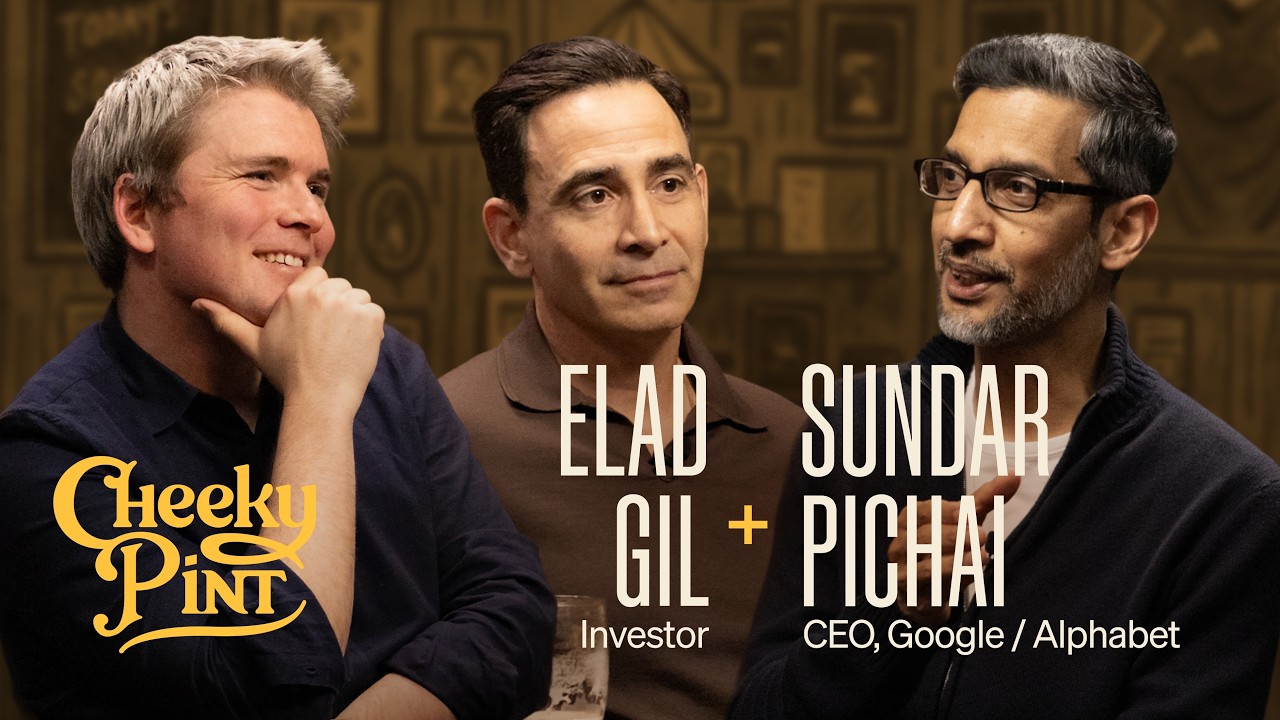
Published on YouTube by Stripe on April 7, 2026, this video features an in-depth conversation with Sundar Pichai, CEO of Google and Alphabet, hosted by John Collison and Elad Gil. According to the page description, the discussion covers Google’s AI resurgence, managing a $180 billion CapEx budget, physical supply constraints in 2026, long-term bets like space data centers and Waymo, and Google's internal cultural shifts.
## TL;DR
Sundar Pichai addresses Google's foundational role in AI history, the launch of Transformers, and the strategic advantages of its vertically integrated tech stack from custom TPU silicon to consumer endpoints. He details the physical supply constraints—such as memory and power bottlenecks—facing AI infrastructure in 2026, alongside Google's capital allocation frameworks for moonshots like Waymo, quantum computing, and space data centers. The conversation highlights the internal shift toward agentic workflows with tools like Antigravity, the evolution of Search, and how AI agents will transform software engineering and enterprise decision-making by 2027.
## Atmosphere & style
The interview carries an intellectually rigorous, candid, and builder-focused atmosphere, blending executive strategic depth with genuine technical curiosity. Sundar Pichai presents a grounded yet optimistic demeanor, engaging fluidly with hosts who probe into capital allocation mechanics, engineering trade-offs, and competitive dynamics. The dynamic feels like a high-level peer exchange among tech leaders, transitioning seamlessly from macroscopic economic analyses to intimate anecdotes about hands-on coding and product testing.
## Key takeaways
- [00:18](https://www.youtube.com/watch?v=bTA8sjgvA4c&t=18s) Transformers were developed at Google to solve practical product bottlenecks in TPUs, speech recognition, and Translation, before being rapidly integrated into Search.
- [05:17](https://www.youtube.com/watch?v=bTA8sjgvA4c&t=317s) Google holds strict latency budgets for Search, framing millisecond-level speed as a foundational engineering discipline and product differentiator.
- [12:12](https://www.youtube.com/watch?v=bTA8sjgvA4c&t=732s) Google's AI resurgence was driven by its fully vertically integrated stack, spanning custom TPU silicon, deep research, and massive consumer distribution endpoints.
- [20:35](https://www.youtube.com/watch?v=bTA8sjgvA4c&t=1235s) Pichai advocates for direct software 'dogfooding' and real-time public feedback to stay closely connected to true user experiences and product flaws.
- [23:57](https://www.youtube.com/watch?v=bTA8sjgvA4c&t=1437s) AI supply is expanding the software engineering market rather than replacing headcount, contributing to net macroeconomic productivity and GDP growth.
- [27:53](https://www.youtube.com/watch?v=bTA8sjgvA4c&t=1673s) The year 2026 is defined by hard physical supply constraints in memory (HBM), wafer capacity, and energy infrastructure rather than capital limits.
- [31:20](https://www.youtube.com/watch?v=bTA8sjgvA4c&t=1880s) Model architectural breakthroughs like Gemma 4 demonstrate asymmetric scaling, compressing massive compute training runs into small, highly efficient weight files.
- [34:23](https://www.youtube.com/watch?v=bTA8sjgvA4c&t=2063s) AI acceleration in vulnerability discovery is shifting cybersecurity economics, necessitating stronger cross-industry coordination on zero-day risks.
- [36:06](https://www.youtube.com/watch?v=bTA8sjgvA4c&t=2166s) Google maintains moonshot investments in long-term bets like space data centers, quantum computing, and AI-driven biotechnology through Isomorphic Labs.
- [41:25](https://www.youtube.com/watch?v=bTA8sjgvA4c&t=2485s) Internal compute capacity (TPUs) has become the primary scarce asset governing capital allocation and project velocity across Alphabet.
- [45:30](https://www.youtube.com/watch?v=bTA8sjgvA4c&t=2730s) Waymo's long-term survival was driven by tracking underlying safety curves and transitioning from heuristic rules to end-to-end deep learning models.
- [54:19](https://www.youtube.com/watch?v=bTA8sjgvA4c&t=3259s) Alphabet maintains strict contractual isolation between internal compute demands and external Google Cloud Platform (GCP) customer capacity.
- [54:19](https://www.youtube.com/watch?v=bTA8sjgvA4c&t=3259s) AI agents are evolving into a universal orchestration layer that simplifies complex cloud interfaces and connects enterprise systems without custom ERP integrations.
- [01:01:04](https://www.youtube.com/watch?v=bTA8sjgvA4c&t=3664s) Google is transitioning internal workflows to agent-manager environments like 'Jet Ski' (Antigravity) across engineering, research, and Search teams.
- [01:02:20](https://www.youtube.com/watch?v=bTA8sjgvA4c&t=3740s) Enterprise AI adoption faces an 'intelligence overhang' due to practical barriers around prompting, code stability, identity access permissions, and role blurring.
- [01:06:06](https://www.youtube.com/watch?v=bTA8sjgvA4c&t=3966s) 2027 is projected as a major operational crossover year where non-engineering enterprise functions like financial forecasting become deeply agentic.
## Detailed walkthrough
### [00:18](https://www.youtube.com/watch?v=bTA8sjgvA4c&t=18s) The Origin of Transformers and Google’s AI Foundations
The discussion opens with a historical re-examination of Google's role in inventing the Transformer architecture and why it was initially productized elsewhere. Sundar Pichai directly addresses the common misconception that Transformers were strictly an unapplied research project at Google. In reality, the architecture emerged to solve direct, pragmatic product bottlenecks—specifically optimizing hardware usage on early TPUs when scaling speech recognition to billions of users and improving Google Translation quality.
Immediately following its development, Google deployed Transformers into Search via models like BERT and MUM, driving massive generational leaps in query comprehension and page ranking. Internally, Google was already building conversational agents like LaMDA—the precursor to modern chat interfaces. Sundar reflects on how an internal engineer famously believed LaMDA was sentient, proving that early iterations of ChatGPT-like interfaces existed within Google long before public release. However, Google held back broader release due to higher search-quality standards and raw model safety issues (such as toxicity before post-training alignment techniques like RLHF were mature). He notes that in consumer internet, disruptive product modalities often surface unexpectedly from small teams—drawing parallels to YouTube emerging alongside Google Video, or Instagram alongside Facebook.
- **CapEx Scaling:** Alphabet is projecting **$175 billion to $180 billion** in capital expenditures for 2026 to support its vertical AI infrastructure.
- **Search Quality Milestones:** Models like BERT and MUM represented some of the largest single jumps in Search accuracy in company history.
- **Internal Milestones:** At Google I/O 2022, Google released "AI Test Kitchen" to safely experiment with LaMDA in constrained environments before RLHF alignment was fully solved.
---
[05:17](https://www.youtube.com/watch?v=bTA8sjgvA4c&t=317s) Speed, Latency Budgets, and the Future of Search
Shifting to product philosophy, the hosts highlight how speed has historically been Google's key differentiator—from early Search displaying millisecond completion times to Gemini running on custom TPUs. Sundar framing latency as a core product feature that signals underlying engineering discipline. To maintain this edge without compromising model intelligence, Google enforces strict "latency budgets" for internal search teams measured down to single milliseconds.
Looking toward the horizon, the conversation explores how Search will transition from a single query box returning a list of ranked links into asynchronous, agentic workflows. Sundar describes a near future where Search acts as an "agent manager," executing complex, multi-step tasks across several threads. While product form factors will evolve dramatically over 10-year horizons, he emphasizes the importance of executing intensely on the steep 1-year capability curve right now.
> *"If you ship something which shaves off 3 milliseconds, you earn 1.5 milliseconds for your latency budget, and 1.5 milliseconds gets passed on to the user."*
- **Search Latency Metric:** Google has successfully reduced overall Search latency by **30% over the last five years**, despite adding significantly more complex AI processing and multimodality.
- **Model Hierarchy:** "Flash" models now reach roughly **90% of the capability of Pro models** while serving much faster and more cost-effectively due to deep hardware-software integration.
- **Agentic Shift:** Future interaction models will move from single-line text prompts to long-running asynchronous agents (citing tools like Antigravity for automated work).
---
[12:12](https://www.youtube.com/watch?v=bTA8sjgvA4c&t=732s) Google's AI Resurgence and Narrative Turnaround
The narrative turns to the dramatic shift in market sentiment around Google between mid-2025 and 2026. Just a year prior, narrative consensus questioned whether Google's core business model was rendered obsolete by new AI paradigms, pushing stock values down to around $150 per share. Sundar notes that investors failed to appreciate the massive leverage of Google's vertically integrated stack—spanning research labs, custom silicon (now in its 7th generation of TPUs), cloud infrastructure, and massive consumer distribution endpoints like Search, YouTube, and Waymo.
When the "Overton window" shifted toward generative AI, Google absorbed initial upfront architectural costs to build natively multimodal models from the ground up rather than stitching modalities together post-hoc. The market realized this structural advantage around the release of Gemini 2.5 and distinct multimodal capabilities (such as Project Astra and Nano Banana). Addressing external critiques that Google researchers are less "AGI-pilled" than rival labs in San Francisco, Sundar dismisses the notion as mere semantics, pointing out that foundational pioneers like Demis Hassabis and Jeff Dean have been building toward AGI at Google for decades.
- **TPU Evolution:** Google announced its custom AI data centers and first-generation TPUs back at Google I/O **2016**, and is currently operating on its **7th generation of custom TPU silicon**.
- **Market Dynamics:** Sundar emphasizes that AI expansion is non-zero-sum, pointing out how e-commerce and social platforms expanded in tandem over previous tech cycles.
- **Early "AGI" Touchpoints:** Sundar recalls his own early glimpses of modern AI capabilities:
- **2012:** Jeff Dean demonstrating Google Brain recognizing high-level concepts (like cats) from unstructured video.
- **2014:** Attending the DARPA Robotics Challenge with Larry Page and seeing early autonomous vehicles and DeepMind model demonstrations.
[20:35](https://www.youtube.com/watch?v=bTA8sjgvA4c&t=1235s) "Feel the AGI": Product Intuition, Dogfooding, and the Internal AI Shift
Sundar Pichai reflects on the profound shift in how software feels to use, noting that modern AI agents create visceral moments where you truly "feel the AGI." Sharing a personal anecdote, he describes doing a hobby project recently where he built an entire system before realizing he had no idea what programming language the model had chosen to use—he had to stop and ask the AI agent after the project was already up and running. These moments feel like magic, and the sheer slope of the improvement curve across multiple paradigms makes future progress feel undeniable.
```
"You can call it feel the AGI...
I did a little hobby project recently, and after a while,
I was like, 'Oh, I wonder what language it's using?'
That was a detail that I needed to ask it about after everything
was up and running."
```
To prevent becoming disconnected from everyday user experiences—a common trap for tech CEOs managing solely through slides and reports—Pichai makes a conscious effort to immerse himself directly in Google's internal software. He regularly schedules dedicated focus time to "dogfood" pre-release products and push them into power-user modes. He also actively uses public feedback channels like X (formerly Twitter) to catch raw user complaints, as well as an internal version of Google's coding/agentic environment (referred to internally as Antigravity) to query user feedback instantly.
* **Gym Session Dogfooding:** Just two weeks prior, while stretching at the gym, Pichai spent 30 continuous minutes testing Gemini Live on a single topic to experience its flaws and strengths firsthand.
* **The Antigravity Feedback Loop:** Instead of relying on multi-layer management reports, Pichai uses an internal AI agent to summarize product launches, prompting it with queries like: *"Tell me the worst five things people are talking about, and the best five things."*
* **Fixing User Frustrations:** Pichai credits direct feedback on X for bringing attention to issues, noting he personally pushed to resolve a recent Google Calendar bug brought up by users online.
---
[23:57](https://www.youtube.com/watch?v=bTA8sjgvA4c&t=1437s) Macroeconomic Impact: AI, Software Engineering, and GDP Growth
Addressing concerns around the massive capital expenditures pouring into AI, Pichai argues that measuring token budgets against traditional software engineering salaries is the wrong framework. While critics point to past market analysis (such as famous reports from Sequoia asking how AI CapEx will reconcile with revenue returns), Pichai emphasizes that software development has historically been severely supply-constrained by the availability of great engineers. Injecting AI supply into coding doesn't merely replace human headcount—it dramatically expands the entire market size.
```
"To some extent, I think that market has been so
demand-constrained for great software engineers that suddenly
adding supply can 10X that market. In other words, I think
the market for software engineering and coding is dramatically
bigger than anybody thinks..."
```
Looking at macroeconomic metrics, Pichai notes that traditional GDP calculations often fail to capture the massive "consumer surplus" created by major platform shifts like the internet or mobile. While AI will inevitably face natural social and operational dampeners—such as the careful, safety-focused pace required to roll out Waymo autonomous vehicles—even a tiny boost to overall economic efficiency carries enormous value.
* **CapEx Reconciliations:** Addressing the massive 10X ramp in CapEx over the last 2.5 years, Pichai stresses that demand across all Google AI surface areas remains heavily supply-constrained.
* **Economic Scale:** Given the immense size of the US economy, raising overall GDP growth by even half a percentage point (+0.5%) represents a massive macro contribution.
* **Global Scale:** Stripe currently processes **$1.9 trillion** annually in global payment volume, putting roughly **1.6% of global GDP** to work.
* **Network Intelligence:** By evaluating transactions across its entire user ecosystem rather than isolated silos, Stripe leverages real-time network intelligence for identity verification, fraud prevention, and local payment optimization.
---
[27:53](https://www.youtube.com/watch?v=bTA8sjgvA4c&t=1673s) The 2026 Supply Crunch: Wafer Starts, Memory, and Energy Bottlenecks
Pichai frames 2026 as a landmark year defined fundamentally by physical supply constraints rather than capital limitations. Even if Google wanted to increase its massive capital expenditure budget to $400 billion, it would be physically impossible due to hard ceilings in hardware manufacturing, power availability, and specialized labor (such as the sheer number of electricians required to construct data centers).
```
"You said 150 billion in CapEx? 180? We have said it'll be
between 175 and 185... Google could not spend $400 billion in CapEx
if it wanted to because the memory isn't there and the
power isn't there and all these components."
```
While energy generation and land acquisition are solvable problems over time, physical permitting processes, regulatory timelines, and wafer starts present hard ground truths. Pichai argues that the US urgently needs to adopt a mindset geared toward building physical infrastructure 10X faster—drawing a direct contrast with the rapid construction velocity seen in China.
* **Google's 2026 CapEx:** Formally guided between **$175 billion and $185 billion** (roughly $180 billion).
* **Critical Hardware Bottlenecks:** Leading-edge memory (such as High Bandwidth Memory / HBM) and semiconductor wafer capacity are the primary near-term brick walls. Leading memory manufacturers cannot scale factory capacity overnight, forcing a market-wide supply squeeze through 2026 and 2027.
* **Efficiency Drives:** Supply constraints force severe engineering compaction cycles, compelling teams to make model architectures up to **30X more efficient** to bypass physical hardware limits.
* **Analogy to Commodity Markets:** Pichai and the hosts compare the memory crunch to the Strait of Hormuz—if 20 million barrels of oil are removed from the market daily, 20 million barrels of demand must be destroyed regardless of capital or willingness to pay.
---
[31:20](https://www.youtube.com/watch?v=bTA8sjgvA4c&t=1880s) Open-Source Models and Weight Efficiency: Gemma 4
Despite hardware access remaining a tight "musical chairs game" among tech giants, Pichai highlights how model breakthroughs challenge rigid oligopoly frameworks. Marking the release of Google's **Gemma 4** open-source model, he points out the uncanny, almost surreal nature of modern AI development: a team can run a massive, multi-megawatt data center for months, only for the final output to be a single flat file of model weights that can literally fit on a humble USB thumb drive.
```
"You're talking about a set of weights which can fit on a USB stick...
I'm always shocked that you run a data center for months,
and then your output is a flat file. Literally.
It's like having a Word doc or something, and that's your model."
```
* **Gemma 4 Architecture:** Built directly on the **Gemini 3** architecture, delivering state-of-the-art open-source performance outside of China.
* **Asymmetric Scaling:** Unlike heavy physical aerospace engineering (like a SpaceX rocket), frontier AI models compress immense amounts of intelligence into portable, low-footprint weight files.
---
[34:23](https://www.youtube.com/watch?v=bTA8sjgvA4c&t=2063s) Emerging Systemic Risks: Zero-Days and Cybersecurity Shifts
Beyond hardware and compute limits, Pichai warns that security will become one of the most critical operational constraints for the technology industry. Generative models and automated reasoning are rapidly accelerating software vulnerability discovery, threatening to break vast amounts of legacy code and foundational software platforms across the web.
* **Zero-Day Economics:** The hosts highlight an alarming market indicator—the black market price for software zero-day exploits is dropping rapidly because AI tools have dramatically increased the supply of discovered vulnerabilities.
* **Need for Coordination:** Pichai stresses that the tech industry will face a sharp, forcing moment requiring unprecedented cross-industry coordination on AI security that is simply not happening today.
---
[36:06](https://www.youtube.com/watch?v=bTA8sjgvA4c&t=2166s) Google's Long-Term Bets: Space Data Centers, Quantum, and Robotics
Discussing Google’s ecosystem of long-term investments—which includes a ~10% stake in SpaceX, ~10% in Anthropic, and majority ownership of Waymo—Pichai details how constraint fuels radical innovation. Looking ahead on a 20-year horizon, Google has begun early-stage conceptual exploration into **data centers in space** to bypass terrestrial power and land limits.
```
"We're in the earliest stages of thinking about data
centers in space... If you take a 20-year outlook, where are
you going to put most of these data centers?
Really hard problems to solve."
```
Pichai also highlights ongoing breakthroughs in Google's Quantum computing efforts and the Google DeepMind (GDM) robotics initiatives. Reflecting on past tech shifts, he notes that platform shifts rarely reveal their killer applications immediately: just as combining mobile phones with GPS unexpectedly enabled Uber, scale and stability in Quantum and AI will unlock unpredictable human creativity.
* **Quantum Computing:** Targeted primarily at fundamental physical simulation—such as weather modeling, complex molecular reactions, and unsolved chemical puzzles like the Haber process for fertilizer synthesis.
* **Robotics Resurgence:** While Google was historically "too early" in robotics a decade ago, modern Gemini AI models provide the missing ingredient—delivering state-of-the-art spatial reasoning capabilities for next-generation physical automation.
<ElicitationsGroup message="Explore more from this interview:">
{/* Reason: Prompts provide logical continuations into other core topics discussed in the transcript section. */}
<Elicitation label="Analyze the $180B CapEx supply bottlenecks" query="What are the specific supply constraints, memory bottlenecks, and power limits affecting Google's CapEx as discussed by Sundar Pichai?"/>
<Elicitation label="Summarize Google's long-term bets" query="What are Google's long-term technology bets mentioned in the interview, including quantum computing, robotics, and space data centers?"/>
</ElicitationsGroup>
[40:11](https://www.youtube.com/watch?v=bTA8sjgvA4c&t=2411s) Scaling Long-Term Moonshots: Wing, Isomorphic Labs, and Biomodels
Sundar Pichai reflects on Google's portfolio of long-term moonshots and deep-tech bets, highlighting how methodical, compounding progress builds massive enterprise value over time. Beyond partnership efforts in robotics with companies like Boston Dynamics and Agile Robots, Google is aggressively scaling its internal projects and startup investments. Pichai points to Alphabet's drone delivery service, Wing, as a prime example of a long-gestation project nearing widespread consumer utility, predicting that within a reasonable timeframe, tens of millions of people will have direct access to automated aerial delivery. He also reiterates Google's ongoing commitment to frontier bets ranging from orbital quantum data centers to revolutionary biotechnology.
Special focus is given to Isomorphic Labs, Alphabet's AI-driven drug discovery venture spun out from DeepMind. Pichai expresses strong enthusiasm for Isomorphic's targeted approach, which applies specialized biomodels to transform every stage of the drug discovery pipeline. Rather than getting stuck solely on early-stage molecular design like many industry peers, Isomorphic models the broader biological context to significantly increase the probability of success when candidates reach expensive, long-duration phase-3 clinical trials.
- **Wing Drone Delivery Expansion:** Scaling toward providing service access to roughly 40 million Americans in the near term rather than years out.
- **Isomorphic Labs Strategy:** Applying biological AI models across the full end-to-end drug discovery workflow to de-risk phase-3 trials, moving well beyond basic molecular design.
- **Deep-Tech Portfolio:** Continuous, long-term capital commitment to compounding moonshots, including quantum computing infrastructure and advanced robotics integrations.
[41:25](https://www.youtube.com/watch?v=bTA8sjgvA4c&t=2485s) Capital Allocation and Comparing Heterogeneous Projects
John Collison introduces what Elad Gil humorously labels "the most John question ever"—a fundamental query regarding how Google manages capital allocation across wildly diverse business lines. Collison contrasts classic business school framework examples, such as Boeing choosing between a defense R&D contract or a clean-sheet airliner based on a simple comparison of 16% versus 19% Return on Invested Capital (ROIC), with Google's reality. At Google, capital allocation involves comparing projects with completely different payoff curves, risk profiles, and business models: deciding whether to allocate cash to YouTube to improve recommendation algorithms and boost watch time, fund Waymo to accelerate commercial fleet rollout, or finance a speculative AI research project that might only pay off in five years.
Pichai acknowledges the weight of the question, noting that the discipline of internalizing opportunity costs is more top-of-mind for him today than ever before. He reveals that compute capacity—specifically Tensor Processing Unit (TPU) allocation—has forced every unit across Alphabet, including autonomous vehicles, to compete for the same core infrastructure assets. Interestingly, Pichai envisions a future where AI acts as an executive decision-making companion, helping synthesize enterprise data to evaluate complex capital tradeoffs once internal data systems are fully connected.
- **The Capital Allocation Challenge:** Comparing high-yield short-term core optimization (e.g., YouTube algorithms) against long-horizon, capital-intensive bets (e.g., Waymo scaling or foundational AI research).
- **Opportunity Cost Framework:** Evaluating projects with fundamentally different maturity curves, return horizons, and capital intensities under a unified corporate balance sheet.
- **AI as a Capital Allocation Tool:** Leveraging AI models internally to analyze corporate data streams and provide quantitative inputs for multi-variable capital allocation decisions.
[43:00](https://www.youtube.com/watch?v=bTA8sjgvA4c&t=2580s) Compute Scarcity and Evaluating Early Deep Tech Bets
To navigate the complexity of funding disparate technology initiatives, Pichai explains that Google relies on its deep technology orientation, committing to early-stage bets when capital requirements are initially small and holding the line long-term. In evaluating non-commercial or early-stage deep-tech projects, Google avoids prematurely applying standard financial metrics like immediate revenue. Instead, the company evaluates projects against strict technical milestones and underlying performance curves. In quantum computing, for example, the team is judged by its progress toward specific physical thresholds, such as stable logical qubit counts and target error-correction rates within set timeframes.
When making multi-year investments, Pichai describes using an intuitive framework that balances option value against the total addressable market (TAM) 5 to 10 years down the road. Under this approach, if the underlying core technology shows continuous structural progress, Google maintains capital conviction even when external market sentiment sours. Pichai cites Google's multi-decade investment in proprietary TPUs as a classic example of this approach, alongside its decision to significantly increase capital expenditure into Waymo two to three years prior, precisely when competitors and external markets grew pessimistic about autonomous vehicles.
- **Technical Milestone Tracking:** Evaluating early-stage projects like quantum computing based on physical metrics (e.g., logical qubit error thresholds) rather than premature financial returns.
- **Long-Term Option Value:** Assessing projects based on projected 5-to-10-year TAM and underlying technological compounding.
- **Counter-Cyclical Conviction:** Doubling down on investments—such as Waymo and custom TPU hardware—during market downturns or widespread industry pessimism.
[45:30](https://www.youtube.com/watch?v=bTA8sjgvA4c&t=2730s) Why Waymo Survived: Tracking Technology Curves vs. Cutting Projects
Addressing why Google chose to maintain long-term funding for Waymo while shuttering other high-profile initiatives like Project Loon, Pichai emphasizes the distinction between qualitative gut-check decisions and quantitative tracking of underlying technology curves. For Waymo, management closely tracked the performance of the core "Waymo Driver" software, specifically measuring safety, disengagement metrics, and real-world reliability curves against historical projections. Even during temporary plateaus where progress stalled, leadership maintained capital commitment because of high confidence in the engineering team's ability to achieve technological breakthroughs.
Collison highlights a pivotal architectural shift in Waymo's evolution: moving away from complex, hand-mapped heuristics and explicitly programmed rules for driving edge cases toward end-to-end deep learning models powered by Transformer architectures. This transition unlocked massive performance leaps. Responding to whether starting Waymo today with modern deep learning would yield the same result faster, Pichai notes that while newer entrants benefit from modern AI primitives, autonomous driving requires deep real-world system integration where time, operational experience, and physical safety crafting matter immensely.
- **Technology Curve Management:** Deciding to sustain or cut projects (e.g., keeping Waymo while retiring Loon) by rigorously tracking core software safety and reliability curves.
- **Architectural Shift:** Waymo's trajectory accelerated dramatically by transitioning from hand-coded rules and heuristic edge-case maps to end-to-end deep learning models.
- **System Integration Defensibility:** Recognizing that physical autonomous systems require years of complex hardware-software integration, safety validation, and regulatory iteration that raw algorithmic advances alone cannot shortcut.
[47:32](https://www.youtube.com/watch?v=bTA8sjgvA4c&t=2852s) System Integration in Robotics and First-Party Hardware
Expanding on the lessons learned from Waymo, Pichai draws parallels between autonomous vehicles and the broader field of physical robotics. While modern robotics startups founding their efforts on modern AI primitives can make rapid initial algorithmic progress, building complex physical systems requires deep integration akin to advanced aerospace engineering or semiconductor manufacturing. Pichai compares this to system integration challenges seen at companies like TSMC or SpaceX, where the physical craft, operational feedback loops, and safety systems form an irreplaceable moat that takes years of iteration to refine.
This operational reality strongly informs Google's strategy regarding hardware. When asked whether Google intends to rely on external partners or re-internalize hardware development for future AI and robotics initiatives, Pichai reveals a strong bias toward first-party hardware. He notes that in safety-critical, highly regulated, or bleeding-edge AI domains, controlling the full stack is essential to maintaining tight feedback loops between software capabilities and physical hardware constraints.
- **Robotics as Integrated Systems:** Viewing physical AI applications through the lens of complex systems engineering where operational craft and hardware-software integration dominate.
- **First-Party Hardware Strategy:** Prioritizing internal hardware development (similar to custom TPUs and Waymo vehicles) to control the end-to-end product feedback cycle.
- **Regulatory and Safety Control:** Maintaining direct control over hardware in safety-sensitive environments to accelerate regulatory compliance and deployment pace.
[49:19](https://www.youtube.com/watch?v=bTA8sjgvA4c&t=2959s) Net Cash Positions, Leverage, and Strategic Capital Stewardship
Collison challenges Google's historical corporate finance strategy, asking whether the company has been systematically under-levered by holding large net cash balances. Given that Google's core business produces durable returns far exceeding its cost of capital, Collison asks whether Alphabet should have taken a more aggressive stance—using debt or leverage to buy back more shares, aggressively scale promising internal projects sooner, or expand its minority investment portfolio.
Pichai responds by re-framing capital allocation through the lens of long-term stewardship. He explains that capital expenditure ramping is constrained by operational maturity and safety rather than a lack of capital willingness; for example, Google did not hold back Waymo's capital out of financial conservatism, but because the technology had not yet reached the required safety threshold to justify massive deployment scale. Furthermore, Pichai points out that Google has actively deployed excess cash into top-tier external private investments—highlighting early and ongoing stakes in companies like Stripe, SpaceX, and Anthropic—and notes that the current AI transformation is opening up vast new avenues to deploy corporate balance sheet capital at high rates of return.
- **Capital Stewardship Philosophy:** Balancing aggressive growth investment with disciplined risk management and capital preservation.
- **Operational Ramp Constraints:** Recognizing that project scaling is often gated by technological maturity, safety verification, and execution capacity rather than capital availability.
- **External Strategic Investments:** Deploying balance sheet capital into market-leading external technology companies including Stripe, SpaceX, and Anthropic.
[51:52](https://www.youtube.com/watch?v=bTA8sjgvA4c&t=3112s) The R&D Shift: From Headcount Budgets to Granular Compute Allocation
Pichai details a fundamental shift in how R&D budgeting operates inside Google. Historically, the vast majority of tech enterprise R&D expenditure was concentrated in headcount—allocating highly compensated software engineers to specific problems, while compute costs were treated as a secondary operational expense. In the modern AI era, this dynamic has completely inverted: compute capacity in the form of specialized ML hardware (TPUs and GPUs) has become the primary scarce resource governing corporate velocity.
As a result, project planning at Google now evaluates headcount and compute capacity as dual, co-equal budgets. Pichai reveals that because ML compute is acutely constrained across the entire industry, he personally spends a dedicated hour every week reviewing granular compute allocations across individual project teams. By tracking exact compute consumption unit-by-unit, executive leadership ensures that Alphabet's most precious asset—its AI training and inference infrastructure—is directed toward the highest-priority business opportunities.
- **Inversion of R&D Cost Structures:** Shifting from headcount-dominated engineering budgets to compute-dominated infrastructure allocations.
- **Granular Compute Governance:** Executive-level tracking where the CEO dedicates weekly operational time to reviewing unit-level TPU/GPU allocations across teams.
- **Managing Infrastructure Constraints:** Treating AI compute capacity as the central gating factor for product development and corporate prioritization.
[54:19](https://www.youtube.com/watch?v=bTA8sjgvA4c&t=3259s) GCP Compute Allocation and AI as a Product Surface Orchestrator
The discussion turns to the internal tension between reserving compute infrastructure for Google's proprietary products versus allocating capacity to external enterprise customers through Google Cloud Platform (GCP). Pichai explains that this balance is managed through disciplined forward capacity planning. He stresses that once compute resources are contractually committed to external Cloud customers, those commitments are treated as absolute and "sacrosanct," even when internal product teams are eager for additional capacity.
Collison praises GCP's recent integration of the Model Context Protocol (MCP) and programmatic AI interfaces, noting how AI naturally solves the historical "curse of Google Cloud"—its overwhelming breadth of services, complex permissions, and intricate management consoles. Instead of navigating endless dashboards, users can instruct AI agents to programmatically provision and manage complex cloud infrastructure. Pichai agrees, noting that AI is emerging as the ultimate orchestration layer across enterprise software, replacing multi-year ERP integration projects by dynamically connecting disparate data sources and complex APIs for the user.
- **Sacrosanct Customer Commitments:** Strict policy ensuring contractually allocated GCP compute resources for enterprise clients are protected from internal Google demand.
- **AI as an Orchestration Layer:** Using AI models and protocols like MCP to abstract away complex cloud management consoles and streamline product interaction.
- **Enterprise Software Disruption:** AI agents acting as dynamic connective tissue across enterprise APIs, bypassing traditional, labor-intensive data unification projects.
[57:00](https://www.youtube.com/watch?v=bTA8sjgvA4c&t=3420s) The Agentic Future: Persistent, Stateful AI and Custom Consumer Apps
In the closing segment of this part, Collison highlights the emerging user demand for stateful, persistent AI interfaces—referencing projects like OpenClaw—that can continuously execute background workflows (such as curating personalized daily intelligence briefs) rather than resetting after every chat session. Pichai confirms that persistent, long-running agentic tasks represent the core frontier of consumer AI, requiring robust infrastructure around user identity, secure access control, and asynchronous cloud-to-local execution.
Collison also references Dreamer—a startup founded by former Stripe CTO David Singleton that was acquired by Meta—which demonstrated early success in allowing non-technical users to easily spec out and build custom, persistent applications using AI. Pichai agrees that consumer software interfaces are rapidly evolving to incorporate underlying full-stack coding models. While only a tiny fraction of power users (estimated at 0.1%) currently build custom, persistent AI workflows for themselves today, both agree that bringing these autonomous agentic primitives to mass adoption will define the next major wave of consumer technology.
- **Persistent Agentic AI:** Moving beyond ephemeral chat interfaces toward long-running, stateful background agents that manage continuous user tasks securely.
- **Democratization of Application Building:** Leveraging full-stack coding models under the hood of consumer interfaces to let everyday users create custom persistent applications.
- **Transition to Mass Adoption:** Bridging the gap from early power users (0.1%) to global consumer scale for autonomous, persistent AI software.
<ElicitationsGroup message="To explore the topics discussed in this segment further:">
{/* Reason: Provide natural next steps that allow the user to dive deeper into specific capital allocation, technical, or cloud architecture topics covered in the transcript. */}
<Elicitation label="Analyze Google's TPU vs GPU capital allocation strategy" query="Based on the transcript, break down how Google balances its internal TPU investments against external GPU allocation and GCP customer commitments."/>
<Elicitation label="Explore the shift from heuristic code to end-to-end deep learning in Waymo" query="Detail the architectural evolution of Waymo described in the interview, specifically comparing hand-mapped heuristics to end-to-end deep learning."/>
<Elicitation label="Examine the concept of AI as an orchestration layer for cloud surfaces" query="Explain how AI and protocols like MCP solve cloud product complexity and replace traditional enterprise software integrations based on Sundar Pichai and John Collison's discussion."/>
</ElicitationsGroup>
[59:03](https://www.youtube.com/watch?v=bTA8sjgvA4c&t=3543s) Google Docs Search and Productivity Feedback
The host brings up a product suggestion as part of an interview "rite of passage," comparing search performance in Gmail to Google Docs. While keyword search works well for email because messages often contain distinct keywords, searching for something like "2026 budget" in Google Slides yields endless unhelpful results at a company like Stripe, making specific files impossible to find. Sundar Pichai admits that while he has not felt the issue as acutely, the observation resonates with his own experience, and he notes he knows exactly which team member he will show this clip to.
Pichai notes that Google is actively working to make AI integrations across services like Google Docs significantly better in the coming months. Early AI implementations simply placed models into products, but the next phase centers on contextual memory and caching.
- **Key Context Challenge:** Broad terms like "2026 budget" match too many corporate decks, breaking traditional keyword search.
- **Product Roadmap:** Upcoming AI improvements will focus on what models can keep in context and cache to surface exact documents.
---
[01:01:04](https://www.youtube.com/watch?v=bTA8sjgvA4c&t=3664s) AI Diffusion, Internal Workflows, and "Antigravity"
Addressing how AI is altering corporate workflows and engineering practices, Pichai describes adoption at Google as moving in "concentric circles." Diffusion across a massive organization requires active change management because early tools broke frequently, creating a "promising new world" that was semi-broken. However, by 2026, the adoption curve has shifted dramatically, with groups like Google DeepMind (GDM) and software engineering (SWE) teams fundamentally altering how they work.
Google engineers internally rely on a platform codenamed "Jet Ski" (known externally as Antigravity). Engineers operating in this environment interact within an "agent manager world" to handle automated workflows. This workflow was rolled out to the core Search team just the week prior as part of Google's effort to push AI tool adoption into larger, established teams.
- **Internal AI Tooling:** "Jet Ski" is Google's internal name for the agent-manager platform known externally as Antigravity.
- **Early Adopting Teams:** Google DeepMind (GDM), SWE groups, and recently the core Search team.
- **Enterprise Bottlenecks:** Large enterprise change management is harder than startup adoption due to security standards, higher costs of failure, and strict access controls.
---
[01:02:20](https://www.youtube.com/watch?v=bTA8sjgvA4c&t=3740s) The Intelligence Overhang and Enterprise Barriers
The conversation turns to the concept of an "intelligence overhang"—a gap where model capabilities outpace actual enterprise utilization. The interviewer highlights key practical friction points preventing companies from fully capturing AI intelligence:
1. **Prompting Skills:** Engineers must learn generic prompting skills as well as company-specific context (e.g., knowing which internal Stripe tools to invoke).
2. **Code Velocity and Collaboration:** High AI code output reduces the stability of codebases, increasing the "blast radius" and making multi-person collaboration difficult when code gets rewritten repeatedly before shipping.
3. **Data Access and Permissions:** Granting agents access to enterprise data (such as querying deal statuses across systems) requires completely rewriting identity and access control permission engines.
4. **Role Blurring:** AI is blurring the boundaries between engineering, product management, and design, calling traditional job definitions into question.
Pichai confirms that Google's Gemini Enterprise and Antigravity teams are directly building their product roadmaps around these operational friction points. Because Google operates with extremely strict security requirements and faces high costs for system mistakes, solving permission and safety layers takes time, but will ultimately result in more robust tools for external customers.
---
[01:06:06](https://www.youtube.com/watch?v=bTA8sjgvA4c&t=3966s) Agentic Forecasting and the 2027 Crossover
When asked whether Google could perform a completely automated, human-out-of-the-loop financial re-forecast using AI agents, Pichai targets **2027** as a critical inflection point. While human teams will initially cross-check agentic financial forecasts against conventional methods, he expects 2027 to mark a profound operational crossover year for non-engineering enterprise functions.
Pichai acknowledges that younger startups hold a distinct structural advantage over established tech giants in this transition. Startups can build AI-native workflows and hire for AI-native skill sets from day one, whereas legacy organizations must navigate complex internal retraining and organizational transformation.
- **Key Timeline:** 2027 is projected as the crossover year where non-engineering workflows (like financial forecasting) become deeply agentic.
- **Startup Advantage:** Younger companies can hire for AI fluency directly, avoiding the heavy transformation and retraining burden faced by incumbents.
---
[01:08:02](https://www.youtube.com/watch?v=bTA8sjgvA4c&t=4082s) Small Bets and Future Excitement
To close the interview, Pichai is asked about small, quiet projects inside Google that excite him, similar to how the Transformer architecture started as a modest research effort. He highlights two distinct initiatives:
First, he points to Google's project exploring **data centers in space**, which started with a tiny team and a small milestone budget. He emphasizes that even massive ideas must begin with small, tight execution units. Second, he mentions a recent one-on-one briefing with a researcher demonstrating a novel post-training machine learning technique. Seeing individual breakthroughs at the researcher level gives him continued confidence in the rapid rate of AI progress.
- "When we decided to do data centers in space, we started as a very small team. It's literally a few people with a small budget to go to the first milestone."
- "That's the constant power of this moment."
## Notable quotes
> [05:17](https://www.youtube.com/watch?v=bTA8sjgvA4c&t=317s) If you ship something which shaves off 3 milliseconds, you earn 1.5 milliseconds for your latency budget, and 1.5 milliseconds gets passed on to the user. — Sundar Pichai
> [20:35](https://www.youtube.com/watch?v=bTA8sjgvA4c&t=1235s) You can call it feel the AGI... I did a little hobby project recently, and after a while, I was like, 'Oh, I wonder what language it's using?' That was a detail that I needed to ask it about after everything was up and running. — Sundar Pichai
> [20:35](https://www.youtube.com/watch?v=bTA8sjgvA4c&t=1235s) Tell me the worst five things people are talking about, and the best five things. — Sundar Pichai
> [23:57](https://www.youtube.com/watch?v=bTA8sjgvA4c&t=1437s) To some extent, I think that market has been so demand-constrained for great software engineers that suddenly adding supply can 10X that market. In other words, I think the market for software engineering and coding is dramatically bigger than anybody thinks... — Sundar Pichai
> [27:53](https://www.youtube.com/watch?v=bTA8sjgvA4c&t=1673s) You said 150 billion in CapEx? 180? We have said it'll be between 175 and 185... Google could not spend $400 billion in CapEx if it wanted to because the memory isn't there and the power isn't there and all these components. — Sundar Pichai
> [31:20](https://www.youtube.com/watch?v=bTA8sjgvA4c&t=1880s) You're talking about a set of weights which can fit on a USB stick... I'm always shocked that you run a data center for months, and then your output is a flat file. Literally. It's like having a Word doc or something, and that's your model. — Sundar Pichai
> [36:06](https://www.youtube.com/watch?v=bTA8sjgvA4c&t=2166s) We're in the earliest stages of thinking about data centers in space... If you take a 20-year outlook, where are you going to put most of these data centers? Really hard problems to solve. — Sundar Pichai
> [01:08:02](https://www.youtube.com/watch?v=bTA8sjgvA4c&t=4082s) When we decided to do data centers in space, we started as a very small team. It's literally a few people with a small budget to go to the first milestone. — Sundar Pichai
> [01:08:02](https://www.youtube.com/watch?v=bTA8sjgvA4c&t=4082s) That's the constant power of this moment. — Sundar Pichai
## Mentioned
Sundar Pichai, Google, Alphabet, John Collison, Elad Gil, Stripe, Transformers, TPU, BERT, MUM, LaMDA, ChatGPT, YouTube, Google Video, Instagram, Facebook, AI Test Kitchen, Gemini, Flash, Pro, Antigravity, Project Astra, Nano Banana, Gemini 2.5, Demis Hassabis, Jeff Dean, Google Brain, DARPA Robotics Challenge, Larry Page, DeepMind, Gemini Live, X, Google Calendar, Sequoia, Waymo, High Bandwidth Memory (HBM), Strait of Hormuz, Gemma 4, Gemini 3, SpaceX, Anthropic, Quantum, Google DeepMind (GDM), Haber process, Uber, Wing, Isomorphic Labs, Boston Dynamics, Agile Robots, Boeing, Project Loon, Waymo Driver, TSMC, Model Context Protocol (MCP), Google Cloud Platform (GCP), OpenClaw, Dreamer, David Singleton, Meta, Gmail, Google Docs, Google Slides, Jet Ski, Gemini Enterprise
Alphabet资本支出瞄准1850亿美元,内存与电力制约AI发展
Google CEO Sundar Pichai表示,内存和能源方面的物理供应瓶颈(而非资本限制)将制约2026年AI基础设施的增长,并迫使模型效率提升30倍。
Sundar Pichai探讨了Google在AI发展史中的奠基作用、Transformer的推出,以及从定制TPU芯片到消费级终端的垂直整合技术栈所带来的战略优势。他详细说明了2026年AI基础设施面临的物理供应限制(如内存和电力瓶颈),以及Google针对Waymo、量子计算和太空数据中心等前沿探索项目(moonshots)的资本配置框架。对话还重点指出了内部借助Antigravity等工具向智能体工作流的转变、搜索业务的演进,以及到2027年AI智能体将如何重塑软件工程和企业决策。
Google 研发 Transformer 最初是为了解决早期 TPU 硬件优化、语音识别与翻译的实际落地瓶颈,并迅速整合进 Search;Alphabet 预计 2026 年资本支出将达到 1750 亿至 1800 亿美元以支撑垂直 AI 基础设施。 (0:18)
依托从第 7 代自研 TPU 芯片、深度科研底座、原生多模态架构到庞大产品终端的全栈垂直整合能力,Google 成功扭转市场负面预期并实现了 AI 业务的强势复苏。 (12:12)
桑达尔·皮查伊指出 2026 年的行业核心矛盾并非资本不足,而是 HBM 高带宽内存、晶圆代工产能和能源供应等物理现实构成的硬性供应瓶颈。 (27:53)
基于 Gemini 3 架构打造的开源模型 Gemma 4 展现了非对称扩展的潜力,能将消耗数月集群算力的海量训练成果压缩为仅有数个文件、可装入普通 U 盘的轻量化权重。 (31:20)
Google 内部研发预算模式已彻底颠覆,ML 算力取代工程师人力成为限制发展速度的首要稀缺资源,CEO 每周需固定花费时间精细化评审各项目团队的 TPU/GPU 算力配额。 (51:52)
Reading summary
Google CEO Sundar Pichai argues that Google's long-term competitive advantage rests on its vertically integrated stack spanning custom silicon, research, and distribution, even as AI deployment confronts severe physical infrastructure bottlenecks. While capital expenditure surges toward $185 billion, scaling is increasingly gated by hardware manufacturing capacity, energy availability, and enterprise integration frictions rather than capital limits.
Hardware Integration and the 2026 Supply Crunch (27:53)
Alphabet has guided capital expenditures between $175 billion and $185 billion for 2026 to support its vertically integrated AI infrastructure, which currently operates on its 7th generation of custom Tensor Processing Unit (TPU) silicon. However, Pichai asserts that capital spending is hitting physical limits rather than financial ceilings: Google could not deploy $400 billion even if it chose to, because leading-edge memory (such as High Bandwidth Memory), semiconductor wafer capacity, power availability, and specialized construction labor represent hard ground-truth constraints through 2026 and 2027.
Pichai compares the near-term memory bottleneck to a structural commodity squeeze, where insufficient supply forces demand destruction across the industry regardless of capital availability. In response, Google's engineering teams are compelled to execute severe compaction cycles, optimizing model architectures to become up to 30X more efficient to bypass physical hardware limits. To address long-term land and energy ceilings on a 20-year horizon, Google has also initiated early conceptual research into space-based data centers.
Compute Scarcity and Capital Allocation Governance (41:25)
Within Google, enterprise R&D budgeting has inverted from being headcount-dominated to compute-dominated, with specialized machine learning hardware serving as the primary scarce resource governing corporate velocity. Pichai reveals that he personally dedicates an hour each week to reviewing granular, unit-level TPU and GPU allocations across teams. Despite internal resource competition, Pichai emphasizes that compute capacity contractually committed to external Google Cloud Platform customers is treated as sacrosanct and shielded from internal product demands.
To balance funding between high-yield core optimizations (like YouTube recommendation algorithms) and capital-intensive moonshots (such as Waymo, quantum computing, and Isomorphic Labs), management evaluates early-stage bets against physical and technical milestone curves rather than premature financial returns. For instance, quantum efforts are tracked by logical qubit error thresholds, while Waymo was sustained through market downturns by measuring core software safety metrics and transitioning from hand-mapped heuristics to end-to-end deep learning models.
Product Architecture from Latency to Persistent Agents (5:17)
Google has historically treated speed as a core feature, reducing overall Search latency by 30% over five years despite incorporating multimodal processing and enforcing single-millisecond latency budgets for internal engineering teams. To maintain speed cost-effectively, Pichai notes that lighter "Flash" models now achieve roughly 90% of the capability of "Pro" models through deep hardware-software integration on TPUs.
Looking forward, Pichai projects that consumer interfaces will transition from single-query text boxes and ephemeral chats into stateful, persistent "agent managers" executing multi-step workflows asynchronously. To power these interactions, product teams are shifting from basic model integration toward contextual memory and caching, while democratizing software creation by embedding full-stack coding models directly under consumer surfaces.
Enterprise AI Diffusion and Operational Overhang (62:20)
Despite rapid algorithmic progress, Pichai identifies an "intelligence overhang," where frontier model capabilities significantly outpace enterprise utilization. Diffusion inside Google has followed concentric circles, progressing from Google DeepMind and core software engineering to the Search team via an internal agent-management platform codenamed Jet Ski (known externally as Antigravity). Adoption at enterprise scale remains constrained by practical friction points, including prompting skill gaps, increased code churn destabilizing collaborative codebases, and the complex challenge of re-architecting data permission and access engines.
Pichai targets 2027 as a critical crossover year when non-engineering enterprise functions, such as automated corporate financial forecasting, become deeply agentic. While human teams will initially verify automated forecasts against conventional methods, Pichai acknowledges that younger startups hold a structural advantage in this transition, as they can build AI-native operating habits without the organizational retraining costs burdening large incumbents.
Pichai maintains that long-term deep-tech investments—from proprietary TPUs and autonomous driving to quantum simulation and biomodels—compound into major enterprise advantages. However, Google's operational execution faces unresolved near-term friction, as the industry's pace remains tightly bound by physical semiconductor and energy ceilings, mounting software vulnerability risks, and the slow organizational work of integrating agentic permissions into complex enterprise environments.
[5:17] Sundar Pichai: If you ship something which shaves off 3 milliseconds, you earn 1.5 milliseconds for your latency budget, and 1.5 milliseconds gets passed on to the user.
[20:35] Sundar Pichai: You can call it feel the AGI... I did a little hobby project recently, and after a while, I was like, 'Oh, I wonder what language it's using?' That was a detail that I needed to ask it about after everything was up and running.
[20:35] Sundar Pichai: Tell me the worst five things people are talking about, and the best five things.
[23:57] Sundar Pichai: To some extent, I think that market has been so demand-constrained for great software engineers that suddenly adding supply can 10X that market. In other words, I think the market for software engineering and coding is dramatically bigger than anybody thinks...
[27:53] Sundar Pichai: You said 150 billion in CapEx? 180? We have said it'll be between 175 and 185... Google could not spend $400 billion in CapEx if it wanted to because the memory isn't there and the power isn't there and all these components.
[31:20] Sundar Pichai: You're talking about a set of weights which can fit on a USB stick... I'm always shocked that you run a data center for months, and then your output is a flat file. Literally. It's like having a Word doc or something, and that's your model.
[36:06] Sundar Pichai: We're in the earliest stages of thinking about data centers in space... If you take a 20-year outlook, where are you going to put most of these data centers? Really hard problems to solve.
[68:02] Sundar Pichai: When we decided to do data centers in space, we started as a very small team. It's literally a few people with a small budget to go to the first milestone.
[68:02] Sundar Pichai: That's the constant power of this moment.
Original transcript
[0:02] Sundar Pichai just passed
a decade as CEO of Google.
[0:04] Alphabet is now not only one
of the world's biggest tech companies,
[0:07] but a leader in the AI race, with plans
to spend $175 billion in CapEx in 2026.
[0:13] Cheers.
[0:18] A bit of history that people talk about
a lot in the context of Google and AI
[0:24] is the fact that Transformers were
invented at Google,
[0:26] but then productized outside of Google
with mostly ChatGPT
[0:31] and that style of product.
[0:32] How do you reflect on that now?
[0:34] I think it's actually worth talking about.
[0:35] It's a bit misunderstood.
[0:37] Transformers was done in the context of
a lot of TPUs, Transformers were all done
[0:44] to solve a specific product
need to some extent.
[0:47] The team is thinking about how
to make translation better.
[0:51] In the case of TPUs, how do you…
[0:53] Hey, speech rec works, but you suddenly
have to sell it to two billion people.
[0:57] We don't have enough chips for it.
[0:59] How do you solve inference for it?
I hadn't known that.
[1:02] Transformers were specifically—
[1:04] It was from our research teams, but they
were guided by solving product problems.
[1:10] Transformers were immediately used.
[1:17] BERT and MUM, people underestimate
how much, because we measure
[1:21] search quality so religiously.
[1:24] Some of the biggest jumps in search
quality in that period where search went
[1:28] ahead of everyone else was
because of BERT and MUM.
[1:31] We built Transformers
and used it immediately in Search
[1:36] to improve language understanding,
understanding web pages, understanding
[1:39] your queries, kept building better models.
[1:42] We also started productizing it internally
in the form of, there were teams
[1:46] building something called LaMDA.
[1:50] Obviously, we weren't
the first to ship that.
[1:53] But I think it's less to do with it was
just research, and we weren't
[1:57] applying it in a product direction.
[1:58] That, I think, is just—
[2:00] You did this research,
you then saw massive ROI from using it
[2:04] the way you intended,
and then you didn't invent
[2:07] all of the products that were invented
with it, but that's to be expected.
[2:10] I would go a step further.
[2:10] We exactly even conceived
the product, which is ChatGPT.
[2:14] It was LaMDA.
[2:15] If you remember, there was an engineer
inside who thought it was sentient.
[2:21] Think of it as an early version
of ChatGPT he was speaking to, internally.
[2:24] We even had the product version of it
in the multiverse, somewhere else.
[2:31] Google probably shipped that nine
months later or something like that.
[2:37] In fact, in the Google I/O in '22,
we launched something called
[2:43] AI Test Kitchen, and that was LaMDA,
but we had constrained it because
[2:49] internally, we didn't have
an end-to-end version which was RLHF-ed.
[2:53] The version I saw was a lot more
toxic at a level.
[2:59] We couldn't have possibly
put it out at that time.
[3:02] Also, I think as a company, which had this
search quality bias,
[3:08] we had a higher bar, maybe,
for what we thought was an acceptable
[3:12] product quality to go out.
[3:14] But it wasn't like…
[3:15] We were figuring out how to get it out.
[3:19] I would also argue that even when OpenAI
shipped, they did their deal
[3:22] with Microsoft probably
a couple of months before.
[3:25] You can look back and say it
wasn't entirely fully obvious.
[3:30] I think they were lucky to also see
it on the coding side with GitHub.
[3:35] I think maybe there was
a signal we were missing.
[3:39] Coding side, probably,
you were seeing more of a sequential jump
[3:45] than probably just on the language side.
[3:48] Maybe the jumps between GPT-2 and 3
and later 4 were more pronounced if
[3:54] you were using it for coding, too.
[3:56] You can point to things.
[3:58] I think to answer your original question,
I think it was
[4:03] less that research-to-product
than a bunch of other factors.
[4:06] I remember talking to some of the people
who worked on ChatGPT, and I think they
[4:10] launched it the week of Thanksgiving.
[4:12] It was a little bit of a buried launch.
[4:13] It wasn't like, this is a big,
prominent thing, and this is going
[4:15] to be an important part of our future.
It was clearly a surprise.
[4:18] I think it was a cool test case.
It was really interesting.
[4:20] But the way I internalize these moments is
if you're in consumer internet,
[4:24] you're going to have surprises.
[4:26] We were at Google when,
Elad and I, there was something
[4:31] called Google Video Search.
[4:32] YouTube came out.
[4:34] Just that we acquired YouTube.
[4:36] Or think about if you were in Facebook,
Instagram came out.
[4:41] Nobody sits and says…
[4:42] You don't look at those moments with that
drama because Facebook
[4:47] just bought Instagram.
[4:48] But the way I've internalized is consumer
internet,
[4:53] 3 people are going to be sitting
and prototyping and throwing
[4:56] out millions of things.
[4:57] I'm not trying to diminish anything,
but I'm just saying you're always
[5:01] going to have these moments.
[5:04] I don't think people wake up
in a garage and ship a better iPhone.
[5:08] That's not going to happen.
[5:09] But that's not how consumer internet is.
[5:12] You just have to be conscious
of that and to internalize that.
[5:17] As I think about the AI race in 2026,
one thing that strikes me is Google has
[5:22] for so long had speed as the place
it tries to differentiate.
[5:27] Original Google Search was really fast
and famously displayed the search query
[5:33] time within the results,
sort of showing off.
[5:35] Then Gmail Fast Search compared
to the competitors of the time, or Chrome,
[5:39] compared to the competitors of the time.
[5:41] And now, I use all of the AI services
for different things,
[5:46] but Gemini on TPUs is just so fast.
[5:50] I'm curious how much this is part
of the explicit product strategy and how
[5:53] you think of it, or it's
much more nuanced than that.
[5:56] I've always internalized speed.
[5:58] Let's call it latency for this purpose,
and as one of the distinguishing
[6:05] features of a great product.
[6:07] Also, it almost always reflects
the technical underpinnings
[6:11] of the product having been done well.
[6:14] There's a different speed which matters,
too, which is the speed of shipping
[6:17] and iteration and release cycles.
[6:20] Both are important.
[6:22] But you talk about latency.
[6:25] It's easy to say you want latency,
but you're constantly adding capabilities.
[6:29] The capability frontier is progressing.
[6:32] There's some sense of,
how do you balance that?
[6:34] That's where it gets more complicated.
[6:37] But to give an example, like Search,
I was speaking with the teams.
[6:43] They now have for sub-teams,
latency budgets in the milliseconds.
[6:52] You get 50% credit...
[6:53] If you ship something which shaves
off 3 milliseconds, you earn 1.
[6:58] 5 milliseconds for your latency budget,
and 1.5 milliseconds gets
[7:03] passed on to the user.
[7:06] Depending on what we think you're doing,
some people may get a latency budget
[7:11] of 30 milliseconds or 10 milliseconds.
[7:13] You can use it, but you have
rigorous reviews against that.
[7:18] But that's how much we think it matters.
[7:22] For context, I guess humans pick it up
in the low hundreds of milliseconds,
[7:25] is that correct?
In terms of where it actually impacts?
[7:28] That's right.
[7:29] I think we've actually,
last I checked the dashboard
[7:34] and the metrics, we've actually improved
Search latency by
[7:39] 30% in the last five years.
[7:41] But think about the functionality
progression that's happened.
[7:45] This is why in Gemini,
we deeply think about that parade
[7:50] of frontier of making sure
the capability to speed,
[7:57] and the flash models are at like 90%
the capability of the pro models,
[8:05] but much faster,
much more effective to serve, and the
[8:09] vertical integration helps and so on.
[8:12] How do you think about
the future of Search, actually?
[8:14] Because a lot of people now are
talking about chat as a new interface.
[8:17] Obviously, Gemini is incorporated,
or Search has incorporated Gemini or
[8:21] AI results in the context of Google.
[8:24] But a lot of people are not talking about
agentic flows, and everybody's going
[8:27] to have a personal agent who,
instead of typing in a query,
[8:30] it'll go and do something for you.
[8:31] Instead of asking about trips,
it'll go and plan a trip for you.
[8:34] What do you view as the future of Search?
[8:36] Is it a distribution mechanism?
[8:38] Is it a future product?
[8:39] Is it one-of-N ways people are
going to interact with the world?
[8:43] I feel like in Search, with every shift,
you're able to do more with it.
[8:49] We have to absorb those new capabilities
and keep evolving the product frontier.
[8:54] If it's mobile,
the product evolved pretty quickly.
[8:57] You're getting out of a New York subway,
you aren't looking for web pages, you
[9:01] want to go somewhere, how do you find it?
[9:03] You're constantly shifting…
[9:04] People's expectations shift
and you're moving along.
[9:08] If I fast-forward, a lot of what are just
information-seeking queries
[9:14] will be agentic in Search.
[9:16] You'll be completing tasks.
[9:19] You'll have many threads running.
[9:21] Will Search exists in 10 years?
[9:22] Well, you may—
[9:24] Or just evolves into something?
It keeps evolving.
[9:26] Search would be an agent manager
in which you're doing a lot of things.
[9:32] I think in some ways,
I use Antigravity today, and you
[9:37] have a bunch of agents doing stuff.
[9:40] I can see search doing versions of those
things, and you're getting
[9:45] a bunch of stuff done.
[9:46] I think the root of your question is,
if you think of Search as a prompt that is
[9:50] not longer than one line,
returning a bunch of different
[9:55] ranked results, as opposed to just
telling you the right answer or something.
[9:59] I think your question is,
does that product modality exist?
[10:02] But today in AI mode in Search,
people do deep research queries.
[10:07] That doesn't quite fit
the definition of what you're saying.
[10:10] But people adapted to that.
[10:13] I think people will do long-running tasks.
Yes.
[10:17] It can be asynchronous.
[10:18] We all started, or
life started as unicellular organisms,
[10:22] and now we have this complex life.
[10:24] The question is almost like,
does that former version or
[10:28] paradigm eventually go away?
[10:29] Really, what was search becomes an agent
and your future interface is an agent,
[10:33] and the search box in 10 years
or N years is no longer in the—
[10:38] I mean, the form factor
of devices are going to change.
[10:40] I/O is going to radically change.
[10:45] It's tough to…
[10:46] I think you can paralyze yourself thinking
10 years ahead,
[10:50] but we are fortunate to be in a moment
where you can think a year
[10:53] ahead and the curve is so steep.
[10:56] It's exciting to just do that year ahead.
[10:57] Whereas in the past, you may need
to sit and envision five years out.
[11:03] The models are going to be dramatically
different in a year's time.
[11:08] I think riding the curve
itself is exciting.
[11:13] I think it'll evolve,
but it's an expansionary moment.
[11:15] I think what a lot of people underestimate
in these moments is it feels so
[11:20] far from a zero-sum game to me.
[11:22] The value of what people are going to be
able to do is also on some crazy curve.
[11:29] Once you view it that way,
people would ask all these questions.
[11:35] YouTube has done well since
TikTok and Instagram has…
[11:38] I can give many examples.
[11:42] I think the more you view it as
a zero-sum game, it looks difficult.
[11:47] It can become a zero-sum game if you're
not innovating or the product is not
[11:51] evolving, but as long as you are
at the cutting edge of doing those things.
[11:56] We are doing both Search and Gemini.
[12:00] They will overlap in certain ways.
[12:02] They will profoundly
diverge in certain ways.
[12:06] I think it's good to have
both and embrace it.
[12:12] When we talk about Search and where it's
going and things like this,
[12:14] I'm reminded of the fact that basically
a year ago, spring/summer of '25,
[12:19] sentiment was very negative on Google.
[12:23] The prevailing view was that Search is
cooked, and we're going
[12:27] to have a really hard time.
[12:28] The core business model is
under attack, blah, blah, blah.
[12:30] Google was trading for $150-ish a share.
[12:35] Now people have realized that's silly.
[12:37] Google has up and down the stack,
whether it be applications or models or
[12:44] TPUs or whatever—as well as Waymo
and YouTube and all the cool bets.
[12:50] What do you think investors,
as a proxy for informed sentiment,
[12:58] misunderstood this time last year?
[13:01] Because clearly, there was
some big misunderstanding.
[13:03] It was obviously very
invert-focused in that moment.
[13:11] To me,
it was very clear in that moment, "Hey,
[13:15] the Overton window shifted." I felt like
the company was built for that moment.
[13:23] The vertical thing,
it's not an accident or something.
[13:27] It was a very intentful…
[13:28] We were in the seventh version of TPUs.
[13:30] I
remember it might have been 2016
[13:33] Google I/O where we announced the TPUs
and spoke about we are
[13:38] building AI data centers.
[13:40] This was 2016.
[13:42] We were thinking about…
[13:45] The company was operating
in an AI-first way.
[13:49] We had deeply internalized this shift.
[13:52] To me,
we were behind in terms of frontier LLM
[13:57] models,
but we had all the capabilities
[14:00] internally,
and we had to execute to meet the moment.
[14:04] But the exciting part was
when I look at it from a full stack,
[14:11] we had the research teams,
we had the infrastructure teams,
[14:14] we had all the platforms.
[14:15] We had been investing
intentfully in many businesses.
[14:22] To me, I suddenly felt like, "Wow,
we have this one common technology
[14:26] which can accelerate all those
businesses." Search to YouTube to Cloud
[14:32] to Waymo all relies on progress.
[14:36] It was a very leveraged
way to make progress.
[14:41] I understood it.
[14:43] To the earlier point of the discussion,
I didn't view it as
[14:46] a zero-sum moment at all.
[14:47] I felt like
everything is going to scale up 10X,
[14:53] and there's going to be
room for other people.
[14:57] You go back,
Amazon has done well since Google
[15:02] came into the picture, and Facebook.
[15:04] We underestimate the growth scenario
of how all these things work.
[15:09] But we had to execute better as a company.
[15:13] That's what I meant by...
[15:15] I was more focused on that.
[15:17] Was there something that demonstrated
to the outside world that,
[15:20] "Oh, they got this"?
[15:21] Was it Gemini 3 that
changed people's minds?
[15:23] I don't follow all the timelines.
[15:24] I think the real model, probably,
where people saw it was maybe Gemini
[15:32] 2.5. And getting to the frontier on,
[15:37] particularly around multimodality.
We made a bunch of…
[15:40] And credit to the Google DeepMind teams.
[15:44] I think we paid a bit more of a fixed cost
upfront, but we designed the Gemini
[15:49] models to be very multimodal from day one.
[15:53] There were areas, I think,
the strength started showing.
[16:00] Nano Banana was an example of it.
[16:02] You were able to see it all together.
[16:05] But look, it's an amazingly
dynamic frontier.
[16:09] I think there are two to three labs who
are pushing each other pretty vigorously.
[16:15] At any given month,
we feel like, "Oh, great.
[16:17] We've done this well." "Oh, shit.
[16:19] There's a couple of things left behind." I
think the picture will again
[16:22] be dynamic in a few months.
[16:25] I think the frontier is
intense as you would expect it to be.
[16:30] That's how I think about it.
[16:32] It's interesting,
because when I talk to researchers—not
[16:35] at Google or at the other labs—one
of the things that they commonly bring up
[16:39] is that they feel like the difference
between the two or three other labs and
[16:45] the Google team is that Google is not as…
[16:48] They call it AGI-pilled.
[16:49] In other words, there's less of a belief
in AGI being right around the corner
[16:53] and the acceleration through it.
[16:55] Obviously, the folks at Google
are thinking deeply about that.
[16:58] A, do you think that's true?
[16:59] And B, do you think that it all impacts
some notion of what the future actually
[17:03] looks like and therefore what
people are building against?
[17:06] Look, I think we probably have scaled our
CapEx from 30 billion to
[17:14] approximately 180 billion—
It's like real money now.
[17:17] You don't do it if you don't think
about the curve a certain way.
[17:24] I view it as largely semantics,
maybe because
[17:29] we are a larger company with a lot
of products that touches so
[17:33] many people at so many levels.
[17:35] Maybe the language of how we
talk about it might be different.
[17:43] I think the founders were
AGI-pilled, probably.
[17:47] My earliest conversation…
[17:49] I think this notion that at Google,
we haven't understood what AGI is or
[17:56] Demis and team or Jeff Dean and team.
[17:58] At one point, Demis, Jeff,
Ilya, Dario were all there.
[18:07] I like that retort.
[18:08] It's like, "Hello, have you been paying
attention for the past 20 years?"
[18:13] That doesn't make sense to me.
[18:15] I think some of it is, if you're
a younger company,
[18:21] or you are more a pure research lab,
you may be headquartered in San Francisco.
[18:28] There are a lot of small attributes
which can probably make a difference.
[18:32] But I don't think at a foundational level,
there is a difference in outlook on what
[18:39] the curve is or how we
internalize the technology.
[18:44] Look, I think even within the company,
there's a set of us
[18:48] living on the bleeding edge,
firing agents, seeing what these things
[18:52] can do,
see the agents pick up skills, do stuff,
[18:57] and also look back three months ago,
what they could do now.
[19:01] We are living that exponential internally.
[19:04] I think you're both right, where I agree,
you can point us the history of Google.
[19:10] I think what Elad is getting at
is a feeling
[19:14] where I saw a tweet go by that someone was
saying, "What you have to realize
[19:17] to explain what's currently going
on in the Valley is that every tech
[19:21] executive has severe AI psychosis right
now, and is spending a huge amount of time
[19:25] writing code and talking to AI and things
like that." I thought that was a funny
[19:28] take and not without any truth to it.
[19:31] I'm curious, what were your feeling the
AGI moments along the way of the recent...
[19:37] Or to what extent do you
have AI psychosis these days?
[19:40] My first feeling the AGI moment was
2012 when Jeff Dean demoed
[19:46] the earliest version of Google Brain.
[19:49] This is when the neural networks
recognized a cat.
[19:52] That was 2012.
[19:56] I went with Larry to the DARPA Challenge.
[20:00] It might have been 2014, I think.
[20:03] I need to be exact about when we went
there, seeing the cars drive there.
[20:09] Demis demoing the earliest versions
of the models,
[20:14] having what we would call as imagination.
[20:18] There have been many moments like that,
so it was obvious that
[20:20] technology is progressing.
[20:22] In terms of living now and having
a visceral feel for it,
[20:26] I think the closest, I would say, is
if you're coding,
[20:30] and you give it a complex task,
and you never open the ID,
[20:35] and you're in some agent manager world,
and you see it do it,
[20:41] and how powerful it is.
[20:44] You can call it feel the AGI.
[20:47] There are moments like that.
[20:49] I did a little hobby project recently,
and after a while, I was like,
[20:53] "Oh, I wonder what language it's using?"
That was a detail that I needed to ask it
[20:59] about after everything was up and running.
[21:00] It feels like magic.
[21:02] Moments like that for sure.
[21:07] The slope of the curve
is what surprises you.
[21:10] You're improving it on so many paradigms.
[21:13] It feels clear that there's
going to be progress ahead.
[21:16] When you talk about the visceral feel,
I feel like one thing that's important
[21:20] to tech companies,
and every CEO thinks about this
[21:23] differently,
is how you stay connected to the product
[21:27] experience and everyday users because
tech products are so
[21:31] abstract that it's easy to...
[21:33] You cannot just manage through reports
from teams and slide
[21:36] decks and spreadsheets.
[21:38] Tony Xu is talking about
how he still works as a DoorDasher
[21:43] to stay very connected to that experience.
[21:45] We do our little weekly all-hands,
we have a recurring segment of just walk
[21:49] the store where we click around
in the dashboard together, and we're
[21:52] tripping over, why is that modal there?
[21:54] That's a bit confusing or whatever, just
so we're collectively using the product.
[21:58] I'm curious how it works for you and how
at Google, you ensure that you're staying
[22:03] connected to the experience of using
the product other than you use
[22:08] Gmail and everything every day.
[22:09] No, I'm dogfooding,
literally internal versions.
[22:16] I do block time to use it intensely,
so focus time to do it.
[22:22] That helps.
[22:24] Even just two weeks ago,
I was stretching in the gym and I
[22:29] had the phone with Gemini Live.
[22:32] I'm like, I'm going to talk to it
for the entire 30 minutes on one topic.
[22:37] You do those things.
[22:40] Some of it works, some of it is
frustrating, but you learn a lot.
[22:44] I forced myself
to use it in those power-user-mode ways
[22:48] and stay in touch that way.
[22:51] X helps because sometimes
you get the raw feedback.
[22:54] Thank you for fixing
the Google Calendar thing.
[22:55] That was so good.
[22:57] Well, there's a few more we have to fix.
That was awesome.
[23:00] Thanks for flagging it.
[23:02] Yeah, X helps because you get the raw
comments, and I try to follow it directly.
[23:09] I'll tell you what has helped.
[23:12] Internally, I would go fire...
[23:16] To our earlier part,
I would query in Antigravity,
[23:19] just our internal version of Antigravity.
[23:22] "Hey, we launched this thing.
[23:24] What did people think about this?
[23:27] Tell me the worst five things people are
talking about, the best five things people
[23:30] are talking about," and I type that.
[23:33] Now that brings it back.
[23:35] Has my life gotten easier?
Yes.
[23:38] In the past, I would have to spend a lot
more time trying to get a sense for it.
[23:42] Now an AI agent is helping
me in that journey.
[23:45] You can get, well, how much should I be
spending first-hand to get that feel?
[23:49] Is this actually leveraging these tools?
[23:52] Even I'm going through a journey there.
[23:54] I'm trying to adapt to this future.
[23:57] You mentioned, A, that it's not zero-sum,
B, there's all these productivity
[24:00] gains people are seeing.
[24:01] If you look at a lot of prior technology
cycles,
[24:04] it took a while for the internet or
for mobile or for SaaS to show
[24:08] up in actual GDP numbers.
[24:09] In the context of AI, we're seeing it
from a data center build-out perspective.
[24:13] That's driving part of GDP growth.
[24:15] How do you think ahead
in terms of 3, 4, or 5 years?
[24:18] Do you think the US economy
is bigger because of AI?
[24:21] If so, how much bigger?
[24:23] Look, for these returns to make sense,
somewhere it has to...
[24:28] How long was it before…
[24:31] I think it was maybe from Sequoia someone
wrote, and saying people
[24:35] are investing this much.
[24:38] Yeah, they're comparing the CapEx to the…
[24:40] That was two and a half years ago.
[24:42] It was a talk and like saying,
it doesn't make sense because you
[24:46] would need to return at that level.
[24:48] You're probably 10X the investment.
[24:50] Since that moment, I need to go
look at the numbers again.
[24:53] At some point, it has to reconcile.
[24:58] To be very clear,
we are supply-constrained.
[25:02] We are seeing the demand
across all the surface areas.
[25:05] I actually don't have any doubt that this
is a massive market and outcome.
[25:09] My question, and I think there're a lot
of things that people underestimate.
[25:12] For example,
people often talk about software
[25:15] engineering budgets, and then what
proportion of that is token versus salary.
[25:19] To some extent, I think that market has
been so demand-constrained for great
[25:22] software engineers that suddenly
adding supply can 10X that market.
[25:25] In other words,
I think the market for software
[25:27] engineering and coding is dramatically
bigger than anybody thinks,
[25:30] and it's the wrong metric to say
token budget versus engineers.
[25:33] I actually think it should
grow a lot of things.
[25:36] I was just curious of your view of how
much growth do we think is
[25:39] likely actually to come of this?
[25:40] I actually wasn't doubting at all,
CapEx versus outcomes.
[25:43] I see.
[25:45] Look, I mean,
going back at the internet and looking
[25:48] at GDP growth, it doesn't quite capture
what we all feel with the internet.
[25:53] Maybe you would have had negative
GDP growth without the internet.
[25:56] Consumer surplus.
[25:58] It's tough to look ahead.
[26:01] I do think there are natural dampening
mechanisms in society at various levels.
[26:10] The obvious ones being
the compute build-out is a different curve
[26:17] than the rate at which we
can improve the models.
[26:19] You're already dealing with a more
constrained curve there.
[26:25] Then how do you diffuse it into society?
[26:28] We are doing this with Waymo.
[26:30] You
can make Waymo safer than human drivers,
[26:35] but you have to be careful at the pace
at which we are rolling out, et cetera.
[26:39] Sometimes, how do you diffuse
it through society responsibly?
[26:43] There are constraints in all these layers.
[26:46] I think...
[26:48] The US economy is so much
larger than it was 10 years ago.
[26:51] To grow that even at a half a percentage
point higher, then that's
[26:56] a massive contribution.
[26:58] I expect it to play out that way.
[27:03] Listening to Sundar is a powerful reminder
of what it means to operate
[27:06] at true internet scale.
[27:08] When it comes to commerce, though,
most businesses are forced to make
[27:11] critical decisions in a vacuum.
[27:12] They view the internet economy through
only their own lens, using only the data
[27:16] that exists within their four walls.
[27:18] This is where Stripe comes in.
[27:20] Because we process $1.9 trillion a year in
global payments, we have a panoramic view.
[27:27] When you build on Stripe,
you're plugging in to that network
[27:30] intelligence,
from verifying a user's identity
[27:33] to stopping fraud before it starts
to streamlining how businesses connect
[27:36] and knowing what payment
methods work best locally.
[27:39] We've built a system that puts 1.6%
of global GDP to work to protect
[27:43] and grow your revenue.
[27:45] If you want to use the power of Stripe's
network intelligence,
[27:49] come see what you can build here.
[27:54] You reference the supply constraints,
and I think that's a really interesting
[27:57] defining aspect of 2026, basically,
where you said 150 billion in CapEx?
[28:03] 180?
[28:04] We have said it'll be between 175 and 185.
[28:08] Okay, so 180-ish billion of CapEx.
[28:11] What's interesting to me is that Google
could not spend $400 billion in CapEx if
[28:17] it wanted to because the memory isn't
there and the power isn't
[28:21] there and all these components.
Can you just tick through—
[28:23] You can't find a number
of electricians we would need.
[28:25] Exactly.
[28:25] I'd love to hear just your overview
of the various bottlenecks.
[28:29] Look, at some level, you have to work back
to actual wafer capacity
[28:35] or something like that.
There are deeper ground truths.
[28:39] I think so, wafer starts.
[28:42] It's a fundamental constraint.
[28:45] I think power and energy
are more solvable.
[28:50] Permitting and actually working through
a regulatory environment
[28:54] might be a constraint.
[28:55] The pace at which you can do things.
[28:59] Even though there's lots of land
in pro-growth, Texas or Nevada or
[29:02] Montana, just maybe not enough.
[29:04] I think we're making tremendous progress.
[29:06] I think for the US, I think it's
a particularly important thing.
[29:11] You're in awe of the pace in China,
how fast they can build things.
[29:18] I really think we need to learn
to build things much faster.
[29:21] You almost have to shift your mentality
to think about what would it take to do
[29:25] things 10X faster in the physical world,
construct 10X faster.
[29:32] I would worry about that as a constraint.
[29:34] I think there could be growing resistance,
[29:38] so it's not as simple as a few people
[29:41] deciding we want to build fast.
[29:42] The data-center moratoriums and stuff.
[29:44] I would say wafer starts,
the ability to permit and do things.
[29:50] I do think there's a lot of good work
being done from the government on.
[29:55] I think people realize you
need to do these things better.
[29:58] Then comes critical components
in the supply chain.
[30:02] Memory is a good one.
[30:03] We are constrained in those
things in the short term.
[30:06] Everyone will respond to it.
[30:09] I think all of us running companies,
regardless of how AGI-pilled you are,
[30:17] then comes this error band
of how bullish can you be,
[30:23] what's the margins you can afford because
there are extraneous factors which can go
[30:27] wrong in the world,
which are outside of control.
[30:30] Everyone is making those adjustments.
[30:32] Those are all constraints.
[30:38] That's where I see the constraints.
[30:40] Is memory the biggest
component that you think about?
[30:44] Memory is definitely
one of the most critical components now.
[30:48] You said in the short term,
do you think just people will ramp up
[30:51] supply and so high prices
will take care of it?
[30:53] There is no way that the leading memory
[30:56] companies are going to dramatically
[31:00] improve their capacity.
[31:01] So you have those constraints in the short
[31:03] term, but they get more
[31:05] relaxed as you go out.
[31:07] I do expect all of this to constrain.
[31:10] I think it'll push
a lot of innovations on.
[31:13] We will make these things
30X more efficient.
[31:17] All that is happening
simultaneously as well.
[31:20] Does that enforce an oligopoly market?
[31:22] If you actually look on the model side,
because if you look at
[31:26] a lot of the views of models and how
they're going to improve, a lot it
[31:29] is going to be both self-improvement.
[31:30] The models will start writing more
and more pieces of themselves, do more
[31:33] data labeling for themselves, et cetera.
[31:34] It's a musical chairs game of who has
compute right now, basically.
[31:37] Exactly.
[31:38] Who has to compute right now and how much
can you actually scale relative
[31:41] to overall industry capacity?
[31:43] If everybody has roughly pro rata up
to some number,
[31:46] you've effectively put a ceiling on how
much far ahead somebody can
[31:49] pull versus everybody else.
[31:50] Do you think that's a correct
statement or an incorrect statement?
[31:53] I think it's a reasonable framework
to think about it that way.
[31:57] There are things which are…
[31:59] I'm coming here as we
just shipped Gemma 4.
[32:03] It's a really good open-source model.
[32:06] The Chinese models are very good,
but I think outside of China,
[32:10] it's a very good open-source model.
[32:13] The frontier to Gemma 4 is both
huge and not so huge in terms of time.
[32:20] Gemma 4 is based on Gemini 3 architecture.
[32:26] It's a very weird thing.
[32:28] You're talking about a set of weights
which can fit on a USB stick.
[32:32] Yeah, it's amazing.
It's like a really crazy...
[32:39] It's not like a SpaceX rocket.
[32:41] I'm always shocked that you run a data
center for months, and
[32:45] then your output is a flat file.
Literally.
[32:48] It's like having a Word doc or
something, and that's your model.
[32:50] It's amazing.
[32:51] There are these unique attributes about
this, which makes me challenge those
[32:56] frameworks and say,
"How should we think about this?"
[33:01] I think it's a reasonable…
[33:01] At least on the inference side,
what you're saying is a very
[33:04] reasonable way to think about it.
[33:08] I do think
everyone is trying to figure out
[33:14] how to blow through the capitalist
incentive to break
[33:18] through these constraints.
[33:19] It's immense.
[33:21] As you say, there's only so
much memory in the world.
[33:24] No capitalist incentive will really
solve '26 or '27 memory supply.
[33:28] That may be the era where you
see more divergence in models.
[33:31] Remember, that has to balance with
wafer capacity increasing, you being
[33:38] able to permit those data centers.
[33:41] This constraint may be less
severe than it appears.
[33:44] You have to envision the total square set
of all the things that you need
[33:51] and think it through, including capital.
Yes.
[33:56] Again, what's interesting to me is
that plausibly,
[34:00] people would invest beyond the current
CapEx, but we're now just running against
[34:07] '26 and '27 real-world constraint.
[34:09] It's a little about this Strait of Hormuz.
[34:11] You can have whatever
price of oil you want.
[34:13] Ultimately, if you take 20 million barrels
a day out of the system,
[34:16] you need to destroy 20 million
barrels a day of demand.
[34:19] It's similar with memory where ultimately,
some people have to not
[34:22] get the memory they want.
[34:23] Look, there are other constraints which,
take security as a constraint.
[34:29] These models are definitely
really going to break pretty
[34:35] much all software out there.
[34:38] Maybe already, we don't know.
[34:40] We sit here and speak.
[34:41] Do you really think all software there?
[34:43] Because SSH, people have been
trying to break for a long time.
[34:45] Do you think…
[34:46] I'm talking about regular software,
large platforms, how many zero-days.
[34:53] There are constraints here in the system.
[34:56] You just can't wish away.
[34:57] Somebody was telling me the black market
price of zero-days is dropping because
[35:01] the supply is growing due to AI,
which I thought was a really
[35:03] interesting market metric.
[35:05] Not at all surprised.
[35:11] How does it practically
diffuse through society?
[35:13] What are the implications of it?
[35:16] There are parallels.
[35:19] I think there could be hidden constraints,
and there could be shocks
[35:22] to the system, if you will.
[35:25] Having said that, I genuinely think
there's a lot of upside ahead.
[35:32] Some of the constraints maybe are helpful.
[35:35] I think constraint inspires creativity.
[35:38] It forces a compaction cycle
where you get more efficient.
[35:41] Forces, maybe.
[35:42] Important conversations to be
had which otherwise won't happen.
[35:46] I think just on my security point alone,
I thought about...
[35:52] We are going to need more coordination,
which is not happening today.
[35:58] There will be a moment of...
[36:00] It could be a sharp moment.
[36:02] All those things, I don't
think you can wish them away.
[36:06] Actually, related to that,
Google does have an amazing portfolio
[36:10] of things that it's both
built and bought into.
[36:12] From an ownership perspective,
you own a reasonable amount of SpaceX.
[36:16] I don't know the exact amount,
but I think it was 10-ish%
[36:19] way back when, Anthropic, 10-ish%.
[36:21] The majority of Waymo,
which is an amazing thing.
[36:24] Then internally, obviously, there's this
enormous swath of amazing
[36:28] technology that's been developed.
[36:29] We talked about AI and Transformers.
[36:31] There's TPUs.
[36:32] Obviously, Waymo was
another one of these things.
[36:34] There's Quantum.
[36:35] You just released a very
interesting result there.
[36:37] Are there other hidden gems that people
should know about or that are especially
[36:42] interesting or that may have
very big impact in the future?
[36:44] Or that you think people
maybe underestimate?
[36:46] Look, we are constantly trying to take
these long-term projects,
[36:50] which when you first announced them
slightly marginally, it looks ridiculous.
[36:54] We're in the earliest stages
of thinking about data centers in space.
[37:01] Your earlier discussion around
constraint inspires creativity.
[37:06] If you take a 20-year outlook,
where are you going to put
[37:10] most of these data centers?
[37:12] Really hard problems to solve.
[37:15] Those are examples of projects we think
about today, which are Waymo in 2010.
[37:23] Quantum itself is one of these projects.
[37:28] We are in a deeply committed way making
[37:32] progress there, and I'm excited about it.
[37:35] Where do you think Quantum
will have the biggest impact?
[37:37] Because mainly people talk about molecular
modeling, they talk about cryptography.
[37:41] There's Quantum proof cryptography that
people have been developing over time.
[37:46] On the molecular modeling side,
it actually looks like the
[37:49] deep learning models tend to be very
good at that in certain circumstances.
[37:51] I mean, you all pioneered
that with the AlphaFold.
[37:54] Do you think Quantum will actually matter?
[37:56] If so, where do you think it
will have the biggest impact?
[37:59] At abstract level, to me, it feels like
to simulate nature more and more.
[38:08] Given it's inherently quantum,
you would need quantum
[38:12] systems to better simulate it.
[38:15] We may get there with classical
computing techniques in a surprising way
[38:20] or get at it with enough compression.
[38:24] Abstraction, it may work,
but I fundamentally felt like
[38:29] Quantum would have an edge there.
[38:31] I don't know, we still don't understand
the Haber process for fertilizer.
[38:37] There are many complex…
[38:39] It's probably your background going
back to what you did in college, more.
[38:43] My instinct tells me there'll be
[38:48] simulating weather, simulating reality,
[38:52] all that, I think,
Quantum will have an advantage.
[38:57] History of technology is you get something
to a scale where it works,
[39:02] and then you use it and people's
creativity on the top
[39:05] finds the application.
[39:07] I always give this example of
mobile phones plus GPS enabled Uber.
[39:14] There's nobody who is working on phones
who would predict that as
[39:19] an outcome of this platform shift.
[39:23] I'm confident quantum will have many,
many applications if you
[39:28] can actually make it work.
[39:29] That's how I think about it.
Sorry, we interrupted you.
[39:32] You were talking about your favorite
of the Google further afield initiatives.
[39:37] I think we're making a...
[39:41] The GDM team is deeply
thinking through robotics.
[39:46] Robotics is an area where
we were too early as a company before.
[39:51] It turned out AI was the missing
ingredient for a lot of ideas
[39:55] maybe 15 years or 10 years ago.
[39:58] But the Gemini Robotics models are
SOTA on spatial reasoning, et cetera.
[40:04] We definitely have
state-of-the-art models there.
[40:07] We are partnering back, in an ironic way,
[40:11] with Boston Dynamics and Agile and a few
[40:15] other companies in a
determined way making progress.
[40:20] There are extraordinary
startups out there as well.
[40:24] We are investing in...
[40:26] I spoke about quantum data centers
in space, drone delivery with Wing.
[40:32] I think we are scaling up Wing where
in some reasonable time period,
[40:38] 40 million Americans will have
access to a Wing delivery service.
[40:43] I'm not talking years out
or something like that.
[40:46] Again, these are all methodical
compounding when you take
[40:50] these long-term projects.
[40:51] We are committed.
Isomorphic.
[40:55] Isomorphic is really exciting.
[40:57] I think about
being focused on these models
[41:01] in a targeted way to improving
all the possible steps in drug discovery.
[41:08] Even though you have long posts like
phase-3 trials, et cetera, getting there
[41:12] with a much higher probability of success.
[41:15] I think it's definitely the smartest
approach I've seen in terms
[41:17] of the different biomodels and really
thinking about the broader swath beyond
[41:20] just the molecular design, which is,
I think, where most of them are stuck.
[41:22] It seems very smart.
[41:25] Can I ask, I'm curious, how capital
allocation actually works at Google?
[41:31] What I mean by that is the idea
good capital allocation is about
[41:36] internalizing the opportunity cost
for capital and putting
[41:43] the cash that a business generates
towards its highest and best use.
[41:46] In the toy example in a business school
book, maybe you're Boeing,
[41:51] and we have this cash that our business
generates, and we can either go bid
[41:55] on the next defense contract,
and we'll invest this much in R&D dollars,
[41:58] and we model this much revenue
from the contract,
[42:00] or we go develop a clean-sheet commercial
airliner, and we'll put in this money,
[42:04] and we model this thing.
[42:06] It's like a 16% IRR versus a 19% IRR.
I prefer the 19%.
[42:10] In Google's case,
the projects are extremely heterogeneous
[42:13] where it's like,
we can give the YouTube team more funding
[42:17] so they can go improve the recommender
algorithm and therefore time on site
[42:20] increases, and so does monetization.
[42:23] Or, we can give the Waymo team more
funding so that they can actually get
[42:27] to market faster or scale up faster,
or we can invest in this new AI approach
[42:31] that might pay off in five years time.
[42:35] I'm curious, if you are trying to
put capital towards the highest and best
[42:40] use, and you're ultimately comparing,
how do you compare initiatives
[42:44] that are so different in nature and so
different in payoff curve shape?
[42:49] This is the most John question ever.
[42:52] I need to know the answer.
[42:53] You need to throw an ROIC—
[42:56] It's a good question.
[42:56] I feel it today more than ever,
ironically, because of TPU allocation.
[43:01] In some ways, I feel it
even Waymo needs TPUs.
[43:04] Computers made the question, ironically,
[43:09] much more front of mind.
[43:12] By the way, of all the things I do,
I'm really looking forward to how AI,
[43:17] as a companion, at least,
gives inputs to this task.
[43:21] I think once we can actually get all
the data connected and flowing through.
[43:26] I think models are already capable.
[43:27] It's more of getting all the data
unlocked, I think it will be helpful.
[43:33] I feel it there.
[43:35] Historically, I think at Google,
one of the advantages we have had is
[43:38] sometimes we make these decisions
very early in the cycle.
[43:42] It's almost like going back to that roots
as a deep technology orientation.
[43:48] We actually think about the question you
were asking Elad a bit ago about
[43:51] what are those longer-term things.
[43:56] Thinking at that stage,
it's easier because your initial
[44:00] funding amounts can be smaller.
[44:02] But then you
stay committed for the long term,
[44:06] but you're making sure you're
making progress in a deep way.
[44:09] As long as you're seeing
that underlying tech...
[44:11] Take Quantum, for example.
How do we judge it?
[44:13] We're judging the underlying...
[44:16] You have goals around
what logical qubit error, correct,
[44:20] a large stable logical qubit threshold
by when you're going to get to,
[44:23] and is the team able to do that?
[44:26] I think you assess it that way.
[44:27] One of the, I wouldn't say advantages...
[44:29] I think one of the ways we have thought
about it and we've been disciplined about,
[44:33] or at least to me, matters a lot,
is to make those early
[44:36] technology bets in a deep way.
[44:40] That's helped.
[44:43] On a constant basis, look,
I've always viewed it as
[44:47] you have to assess the long-term
value of these things.
[44:51] It's almost like in some
intuitive way, you're thinking about
[44:55] the option value and the TAM of something
5–10 years down the line,
[44:59] and you assume a crazy growth and
think through whether
[45:05] those decisions make sense.
[45:07] The TPU investments have
been great that way.
[45:11] We've steadily invested in that.
[45:14] Waymo was a great example where I think we
increased our investment two to three
[45:18] years ago when the rest
of the world got pessimistic on it.
[45:22] When others, some of the
people were backing off.
[45:24] It's very magical.
It's such a magical experience.
[45:26] I take Waymo now every
day to work when I can.
[45:28] I think Waymo is a good example of this
question I have, which is
[45:32] Google does cut projects,
and there's various things you've tried
[45:36] where you said, "We're actually not going
to fund this part of X all the way,
[45:42] or we're going to retire this product.
[45:45] It's not working." But Waymo,
despite the fact that it was a long road
[45:49] from a compelling demo to commercial
service in market,
[45:53] you guys didn't lose the faith.
[45:54] What was it that you were seeing?
[45:56] Is that a qualitative decision
or a quantitative decision?
[45:59] How do you decide that we're
going to cut Loon but keep Waymo?
[46:03] I think it's to do with that,
some quantified…
[46:08] You look at the Waymo driver.
[46:11] That's the underlying technology,
which how does the software drive the car?
[46:15] The progress in terms
of safety and reliability.
[46:18] It's a long-running task,
how safe and how will you do it.
[46:22] You follow that curve,
and you predict, or you set goals where
[46:26] you want to be and how you
perform against those curves.
[46:29] I think the team has been phenomenal.
[46:31] There have been
maybe phases where it didn't progress,
[46:35] but those are the times you need to…
[46:37] You have confidence in the quality
of the team to break through those phases.
[46:44] I think the more you're able to evaluate
things at that deeper technology level,
[46:50] I think you tend to make those decisions
better, or at least that's
[46:53] how I have tried to do it.
[46:55] One argument I've heard or one discussion
I've heard made about Waymo
[46:59] is that a lot of the huge gains
that have been seen recently...
[47:02] Because it used to be this hand-mapped
heuristics of how do you deal
[47:05] with the edge cases of driving or
something happens, how do you respond?
[47:08] A subset of those were almost like
hand-drawn out for the cars to follow.
[47:13] It had a narrow set
of things that it could do.
[47:15] Then really, the breakthrough was moving
to end-to-end deep learning a couple
[47:18] of years ago as this big Transformer
wave was happening in general.
[47:21] Do you think if Waymo had been started
five years ago, it'd be at the same place
[47:24] as it is relative to having
been started 15 plus years ago?
[47:29] Just given that that's the breakthrough
that's propelled it forward.
[47:32] Look, I think
we spoke earlier about robotics.
[47:36] You can think about Waymo as a robot.
[47:38] I think people who are starting robotics
in the last three years, by definition,
[47:42] will be making faster progress, maybe.
[47:45] But I think Waymo is such
an integrated system.
[47:48] There are aspects of it,
not quite like you take something complex
[47:54] like TSMC or SpaceX launching things.
[47:57] You are talking about system integration
in these things in a very complex way.
[48:02] I think Waymo has hidden aspects of that,
which the time of how you do it,
[48:07] the craft of it matters.
[48:09] But having said that,
I do think the end-to-end approaches are
[48:14] going to be an accident in this case.
[48:16] Because just having a team, arguably,
was a huge benefit to Alphabet and Google.
[48:20] Just the fact that you kept investing
in it, and then it hit a moment in time
[48:24] where this technology lift-off was more
than worth it, and was very
[48:27] smart and forward-thinking.
[48:28] I just think it's interesting to ask,
how does that apply to other domains?
[48:32] Because to your point on robotics,
it seems like with robotics,
[48:35] we'll potentially have a different history
where you can move very quickly now.
[48:39] Do you folks think about re-internalizing
hardware again, or is it largely going
[48:43] to be a partner-driven model to
bringing this stuff to the world?
[48:47] I think we'd keep a very open mind.
[48:50] My lesson from Waymo and on the AI side
with TPUs, et cetera,
[48:56] I need to really push the curve well,
particularly in areas where
[49:02] you have safety, regulatory, everything.
[49:04] You want the first-hand experience
of the product feedback cycle.
[49:10] I think having first-party hardware
will end up being very important.
[49:15] That's how I would say
right at this stage.
[49:19] Sorry, I have two more
capital allocation questions.
[49:21] Can you make the case that Google has
historically been under-levered,
[49:24] where Google has historically
carried a strong net cash position?
[49:28] Given that both Google has more ideas than
it knows what to do with,
[49:31] it's just brimming with good ideas,
and just the core business grows very
[49:36] durably, and I think Google clearly has
a very good understanding
[49:41] of that core business,
and it has grown at a higher rate
[49:44] than Google's cost of capital.
[49:46] As you look back on it,
should Google have been more leaned
[49:48] in and said, "Okay, we will be willing to
have a leveraged position that's slightly
[49:54] more aggressive than strong unit
cash, and we will put that towards new
[49:58] initiatives, or just buy more of this core
Google business for Google shareholders,
[50:02] or do more minority investing,
which again, Google seems
[50:05] to have been best in class at?"
[50:06] It's a great question.
[50:07] For example, if Waymo had reached
this point earlier, I think I would
[50:11] have invested the capital earlier.
[50:13] To some extent, I think
you were judging it by...
[50:20] You want to be good stewards of capital.
[50:24] To the extent you're bullish on ROIC,
you want to invest every
[50:29] last dollar you can there.
[50:33] But to the extent
you have excess where you don't think...
[50:37] This is why we've invested in other
companies, too, even if not in.
[50:42] But we always thought about it with
the lens of being good stewards of it.
[50:45] We felt our investment in Stripe was
being a good steward of our capital.
[50:50] SpaceX, and Anthropic and so on.
[50:57] I think now with the AI shift,
there are more opportunities on which we
[51:02] can deploy capital in a good way,
and so we are doing that.
[51:07] I think we always had that mindset.
[51:09] I would have been glad to invest more
capital in Waymo earlier,
[51:15] but we weren't at the level
of maturity needed to do that.
[51:18] There was a point in Waymo,
from a safety standpoint,
[51:21] we did approach Waymo safety first,
and it wasn't the right thing to do.
[51:28] You feel like you cannot point to projects
where they would have gone faster
[51:31] had they gone more capital sooner?
[51:34] They had a natural ramp.
[51:36] I would say that,
but I think in generally, at least,
[51:40] we might have gotten the decision wrong,
but our approach, at least, was to say,
[51:44] if you got excited about something and had
the conviction, you were willing
[51:48] to commit the capital to see it through.
[51:50] Another capital allocation question was,
historically at tech companies,
[51:54] the large majority of the R&D expense was
the people walking around the building.
[51:59] Headcount was managed through
a very tightly-controlled process.
[52:04] Indeed, as you thought about allocating
R&D effort, it was really allocating
[52:10] highly-paid people to go
work on the challenge.
[52:13] The tech costs were, unless you were doing
something very computationally expensive,
[52:17] which obviously Google did in place
of Google Books or something.
[52:20] Broadly speaking, the tech was
an afterthought compared
[52:26] to the cost of the people.
[52:27] We're now going to a world where,
as you say, that's not the case with
[52:30] TPUs and how you allocate that.
[52:32] Just at a very concrete budgeting level,
how does that work inside of Google?
[52:38] Do you have an overall TPU
budget for the company?
[52:42] Then, when you are giving a project
resourcing, previously you gave it
[52:47] a certain headcount budget, and now you
give it a headcount and a TPU budget.
[52:51] Are they the same budget?
[52:52] Just how does that work when you're doing
a quarterly review or an annual review?
[52:57] Look, we've always had a compute budget.
[52:59] Asking for a friend.
[53:01] Now, we've always had a compute budget,
even in classic compute.
[53:05] I would say with ML, and we use both
TPUs and GPUs, by the way, extensively.
[53:11] ML compute planning is...
[53:15] We are super thoughtful about headcount
planning, too,
[53:17] but we have always had to plan that.
[53:20] ML compute, we've gone through phases
where they've been easy,
[53:25] and then there have been phases where
we've been constrained as a company.
[53:29] But now it is really acutely constrained.
[53:33] You spend a lot more time.
[53:36] I at least spend a dedicated
hour a week thinking about that question
[53:42] at a pretty granular level.
[53:45] I will know by projects and by teams,
[53:51] the compute units they are using,
[53:54] or at least I have that information,
and I'm looking at it and assessing it.
[54:00] In some ways, it's a really important
thing to be doing right now, I feel.
[54:05] The scarce resource is
compute in a lot of cases,
[54:09] and so you're ensuring that Google's
precious compute resources
[54:13] are being spent on the most worthwhile—
That's right.
[54:16] Initiatives.
[54:17] How do you think about that in the
context of GCP and Google Cloud?
[54:20] Because there you're actually allocating
the compute to others instead of for your
[54:23] own purposes and given the constraints
in the system, how do you think
[54:28] through that differential allocation?
[54:30] Look, we plan ahead.
[54:32] When we do the forward planning,
[54:36] the Cloud team is forward planning,
[54:39] and they are putting a plan in place.
[54:41] You're funding that, and you're
doing that for our internal needs.
[54:48] You forward plan.
[54:50] As part of that, you're also signing
long-term commitments to customers.
[54:54] Anything we commit to a
customer is sacrosanct.
[54:56] These are contractual commitments.
[55:00] You solve a lot of it with planning.
[55:05] When you plan, we're all
in a constrained world.
[55:08] I think the Cloud team would say they
don't have the computer they want,
[55:11] et cetera.
But you solve it with planning ahead.
[55:15] Speaking of Google Cloud,
I have my product request that I've been
[55:19] saving up for this section that I
know you're looking forward to.
[55:21] You could have posted it on X.
Exactly.
[55:23] But no, I'll say one thing that works
really well is the GCP/MCP is awesome,
[55:29] where your AI can just interact
programmatically with Google Cloud.
[55:35] I guess you guys have exposed almost
everything except
[55:37] the core permission stuff.
[55:39] I feel like In a way,
part of the curse of Google Cloud has been
[55:43] there is so much functionality there
that I'm sure you
[55:46] occasionally hear from people.
[55:47] It was a little hard to navigate that you
log in, you have to create
[55:49] an organization, a project, and whatever,
and find the right services, whatever.
[55:52] Now, all that doesn't matter.
[55:55] You just say,
"Hey, go add this Google Cloud
[55:58] functionality." That is something
that actually it feels like
[56:02] Google Cloud is really benefiting from.
[56:03] It is so broad and there is
so much functionality there.
[56:07] We have a little bit of this problem
with Stripe,
[56:08] where as we add more functionality to it,
just the right way to navigate this big
[56:12] product surface area is an AI that's
read all the API docs for you.
[56:16] That's working really well.
[56:17] The promise of AI being this orchestration
layer for anything you think about,
[56:22] to my earlier question,
even internally within the enterprise as
[56:25] a CEO,
it's not like you don't have all the data,
[56:28] but how do you get it in one place,
and you see it in the past that would have
[56:32] meant one more big ERP-ish project to go
connect all the data sources, et cetera.
[56:38] Again, AI being this orchestration layer
in a way that makes sense for the end
[56:42] user, I think it's been delightful to see.
[56:45] The bigger the product surface area,
the more that benefit hits you.
[56:49] Again, we've seen that to some extent
with Stripe, but I feel like with GCP,
[56:52] it must be just a massive effect.
[56:54] I think we could do a lot better.
[56:56] But you're right,
it's an immense opportunity, I think.
[56:59] I've been really happy with it.
Then that gets to my product.
[57:01] Did you bring product
suggestions for a second?
[57:03] You go first.
I wanted to but—
[57:04] What's interesting me about OpenClaw
and the product market fit of things like
[57:08] that, is they're allowing
stateful AI for consumers.
[57:12] If you want to say the classic,
"Round up the daily news that I'm
[57:17] interested in and send it to me each
morning," or just something that involves
[57:21] persistence that none of the popular AI
[57:26] or mainstream AI apps allow persistence.
[57:29] Is that coming?
[57:31] I think directionally, look,
I think you want to give users capability
[57:34] where you have persistent long-running
tasks in a reliable, secure way.
[57:43] You have to think through things
like identity, access, et cetera.
[57:47] But I think that's the future.
[57:49] That's the agentic future.
[57:52] Bringing that for consumers is a bit
of an exciting frontier we are looking at.
[57:58] This is one of mine, too.
[57:59] This is Dreamer, which was the former CTO
of Stripe's company that just got bought
[58:04] by Meta, I think,
did a very good version of this.
[58:06] It was a very early view of...
[58:09] They were making custom software,
including persistence,
[58:13] but also you could spec out—
[58:15] You can make your own little app.
Exactly.
[58:17] They made that very easy to use.
[58:20] I feel like when people have this
experience, there's
[58:22] a surprise and delight moment.
[58:23] It's just interesting to me that...
[58:26] Look, I think effectively the consumer
interfaces are going to have
[58:31] full coding models underneath, and
the right harnesses and the right skills
[58:38] and the ability to persist and run
somewhere securely in the cloud,
[58:42] locally and in the cloud.
[58:44] All those primitives are coming together.
[58:47] What developers are…
[58:48] Today, I feel like there's 1%
of the world, maybe not 1%, 0.1%
[58:53] of the world who's living this future.
[58:57] They are building stuff for themselves,
but bringing that to mass adoption—
[59:03] Yes.
Is a very exciting frontier, I think.
[59:07] My other product suggestion is…
[59:09] Sorry, you have to endure
this part of the interview.
[59:12] It's the rite of passage.
Exactly.
[59:14] My other product idea is,
for some reason—I don't know if this is
[59:18] your lived experience,
but certainly my lived experience—that
[59:20] search in Google Docs is so much
harder than, say, search in Gmail.
[59:24] Obviously, they're both
equally good search engines.
[59:28] But I think what's going on is
keyword search works reasonably well
[59:33] for email because you can probably
remember a unique set
[59:35] of keywords for that email.
[59:37] Whereas what always happens,
at least to me, is I want to go
[59:39] back and look at the 2026 budget.
[59:41] It turns out if I search Google Slides
for 2026 budget, neither of those words is
[59:46] particularly unique in the context
of words that exist in PowerPoints
[59:51] at Stripe, and so I can never
find the exact right one.
[59:55] I'm curious, does Sundar Pichai
also have this problem?
[59:58] Somehow, I haven't felt it as acutely as
you're describing it,
[60:02] but when you describe it,
it resonates well with my experience.
[60:06] I'm literally playing through the person
to whom I'm going to play this
[60:10] segment of the conversation.
[60:11] I know exactly who I'm going to go talk
to, the people who are working on it.
[60:15] I think we can make it a lot better.
[60:17] I think the AI integration into these
services, including Google Docs,
[60:21] I think you will see sharp improvements
in the coming months ahead.
[60:25] I think we all did the first versions
of it where you just put it in somewhere.
[60:31] I think over time, what all can you keep
in context, what can you cache
[60:36] and what can you really bring to bear.
[60:38] I think we can make a lot of progress on.
[60:41] I think we can do a lot better.
Great.
[60:43] We have a good—
[60:44] A lot of companies that I'm involved with,
even ones that were started reasonably
[60:49] recently, have had to dramatically shift
their workflows relative to product
[60:53] development, engineering practices.
[60:55] Who they even think of it should be on the
design team and the capabilities of that.
[61:00] Are you revisiting all that at Google?
Are you rethinking it?
[61:02] Has there been big shifts
in workflow or other aspects?
[61:05] The way I would say it is,
you can think of it as concentric circles.
[61:10] There are some groups within Google
who are shifting more profoundly.
[61:14] For me, a big task is how do you diffuse
that to more and more groups,
[61:18] particularly in 2026?
[61:20] Some of it, we couldn't do it early
because it breaks so often that,
[61:24] it's almost like you see this promising
new world, but it's semi-broken.
[61:30] But this year, I feel like
the curve is shifting pretty dramatically.
[61:35] I can see groups, and particularly,
I would say GDM and some of the SWE groups
[61:39] really change their workflows.
[61:43] They are using,
we call this for some strange reason,
[61:48] we have a different name internally than
externally of the same product, but it's
[61:51] Jet Ski internally, which is Antigravity.
[61:56] You're living on it,
you're living in an agent manager world,
[61:58] you have workflows,
and you're working in this new way.
[62:03] But just last week,
we rolled it out to the Search team.
[62:07] We're constantly pushing that.
[62:10] In a large organization,
I think change management is
[62:14] a hard aspect of this technology
diffusing, which may be
[62:17] easy for a small company.
[62:19] You can quickly switch over.
[62:20] Can I add a few
problems I see when it comes
[62:24] to actual diffusion of AI in industry?
[62:26] I'm curious how and when
you think we'll solve them.
[62:29] Because as I see it, we have
a big intelligence overhang.
[62:32] The AIs are now amazing in terms
of what they can do in the abstract.
[62:35] If you look at how AI-native
a company is or just how much it uses
[62:42] that intelligence,
there'll probably be a shortfall.
[62:45] The problems that I see are something
like,
[62:47] one: it actually takes a while to get good
as an engineer at prompting your AI well.
[62:53] You can prompt AI better
or worse to write code.
[62:56] Then there's a lot of,
say, Stripe-specific prompting in our
[63:00] case to know which tools to use.
[63:02] There's the general being good
at prompting, and then there's
[63:04] the Stripe being good at prompting.
[63:06] Then, of course,
you have the fact that it's hard to share
[63:09] an AI-generated code base because
you have a blast radius,
[63:14] and you're just changing so much
and the turnover of the code is high
[63:17] enough where maybe you're rewriting it
several times before you ship,
[63:20] that it's hard for many people
to collaborate on the code base versus
[63:23] before when the code velocity was slower.
[63:25] Then as you go outside of engineering,
the big one I see is access to data where
[63:30] you'd like to have your agent go,
"How many times a day do people
[63:34] at companies around the world say, 'Hey,
what's the status of this deal?'" That is
[63:38] like information that the company knows
and should be agentically answerable.
[63:42] We actually have some cool stuff at Stripe
where I was seeing where you can
[63:45] actually answer that pretty well.
[63:47] But with both habits and access to data,
and as you get into a bigger company,
[63:51] the permissions engine of who can actually
get access to this data,
[63:55] that all needs to be rewritten.
[63:57] Then you get into role definition where,
like you were saying, Eng, PM, design
[64:04] stems a little bit from a prior year.
[64:06] You may want to, at least in some cases,
merge those roles a little bit as AI gets
[64:10] better at all those since
you've got a product...
[64:13] Anyway, that's my characterization of—in
2026—the models are capable of this,
[64:20] but we're only using them so much.
[64:23] What do you think that adoption of
the intelligence looks like?
[64:29] Look, a lot of us are working on
[64:34] literally what the Gemini team...
[64:39] The Gemini enterprise teams
and the Antigravity teams, they're all
[64:42] precisely working on these problems.
[64:44] This is the roadmap you're
talking about, right?
[64:48] That's literally we are using it
internally, running into these barriers,
[64:54] working past it.
[64:55] That's the products that are shipping.
[64:58] We are still diffusing it because what you
do is people, as part of using it,
[65:02] like if you're the SRE team at Google,
you suddenly find portions which you
[65:06] can create an automated workflow.
[65:08] That's happening in these spots.
[65:12] But doing it more systematically
when you develop skills,
[65:18] how does it get centralized?
[65:20] How is it available to the models
and for everyone to use?
[65:23] Identity access controls are real hard
problems, and so we are
[65:28] working through those things.
[65:29] But those are the key things which are
limiting diffusion to us, too.
[65:34] We take security a lot more
seriously, and so we have to.
[65:37] That is another layer on top of all these
things,
[65:41] the cost of mistakes when you're running
these services,
[65:44] we have to work through it.
[65:47] But I think because of it,
when we solve it, I think we will bring
[65:49] it in a more robust way, which will help.
[65:52] I feel like we're going through that fixed
cost right now,
[65:55] but you will see this jump
of what people are able to do when we
[65:59] bring it outside,
and others are doing it, too.
[66:02] In a more robust way,
the models are improving.
[66:06] Google re-forecasts its business a few
times a year, formally, I presume.
[66:10] At least we do at Stripe where we set
a budget for the year,
[66:13] and then three times a year,
we produce a formal re-forecast.
[66:16] When you think about it,
a re-forecast is a moment in time function
[66:21] where you take the state of the business,
some of which is in people's heads,
[66:24] but most of which is written down
everywhere where it's like,
[66:26] "How is this product doing?
How is that product doing?
[66:28] Will this deal close?
Will that happen?" Whatever.
[66:30] There's the moment in time state
of the business, we put it into a function
[66:35] and out comes the updated
numbers for the year.
[66:38] You can imagine an AI doing a fully,
[66:43] no human in the loop, forecast?
[66:47] What quarter do you think Google's first
fully agentic forecast is?
[66:51] I definitely expect in some of these
areas, '27, to be an important
[66:57] inflection point for certain things.
[67:00] Even the people doing it,
that is the workflow through
[67:04] which they would produce it.
[67:06] Maybe for a while,
you would check it in the conventional
[67:10] way, but you switch over, a crossover.
[67:14] But I expect '27 to be a big year
in which some of those
[67:17] shifts happen pretty profoundly.
[67:19] I think that was Elad's question was, Eng
is an early adopter, but outside of Eng…
[67:24] Okay, it sounds like you think '27, a lot
of these non-Eng processes really start—
[67:28] I do think your question earlier on, I
think you were asking in the context
[67:32] of Waymo or robotics companies.
[67:34] I do think companies which are…
[67:36] That's one advantage
startups are going to have.
[67:39] More AI-native teams,
and you can probably get at it through
[67:44] your interview processes, et cetera.
[67:47] Whereas for us, we would have retraining,
transformation, et cetera.
[67:52] I think that's maybe an advantage
the younger companies are going to have.
[67:57] We have to drive that transformation.
[68:02] Last question.
[68:03] We're talking a lot about
initiatives that started small at Google,
[68:08] like the Transformer,
which is not Google's main priority
[68:10] when that initiative started.
[68:12] What's a small thing inside Google
that you're excited about these days?
[68:16] It probably would surprise people.
[68:18] When we decided to do data centers
in space, we started as a very small team.
[68:24] It's literally a few people with a small
budget to go to the first milestone.
[68:29] I think it's important to start small,
even if it's a big idea.
[68:34] That is an example of a small thing.
[68:37] Look, I literally
spent time yesterday who was explaining
[68:42] some improvement in post-training,
which is one person talking through
[68:47] the improvement they are doing,
listening to it, I'm like, "Oh,
[68:50] it's going to really show up as a
nice jump."
[68:55] That's the constant power of this moment.
[68:59] All of that, I don't want to be specific
about the second one, but
[69:03] we'll publish it one day, I'm sure.
[69:06] But those are some of the small
jumps I'm excited about.
[69:09] There's data centers in space
and new ML techniques.
[69:12] Yeah.
[69:13] Great answer.
Sundar, thank you.
[69:15] All right.
Real pleasure.
[69:16] Thanks.
Take care.