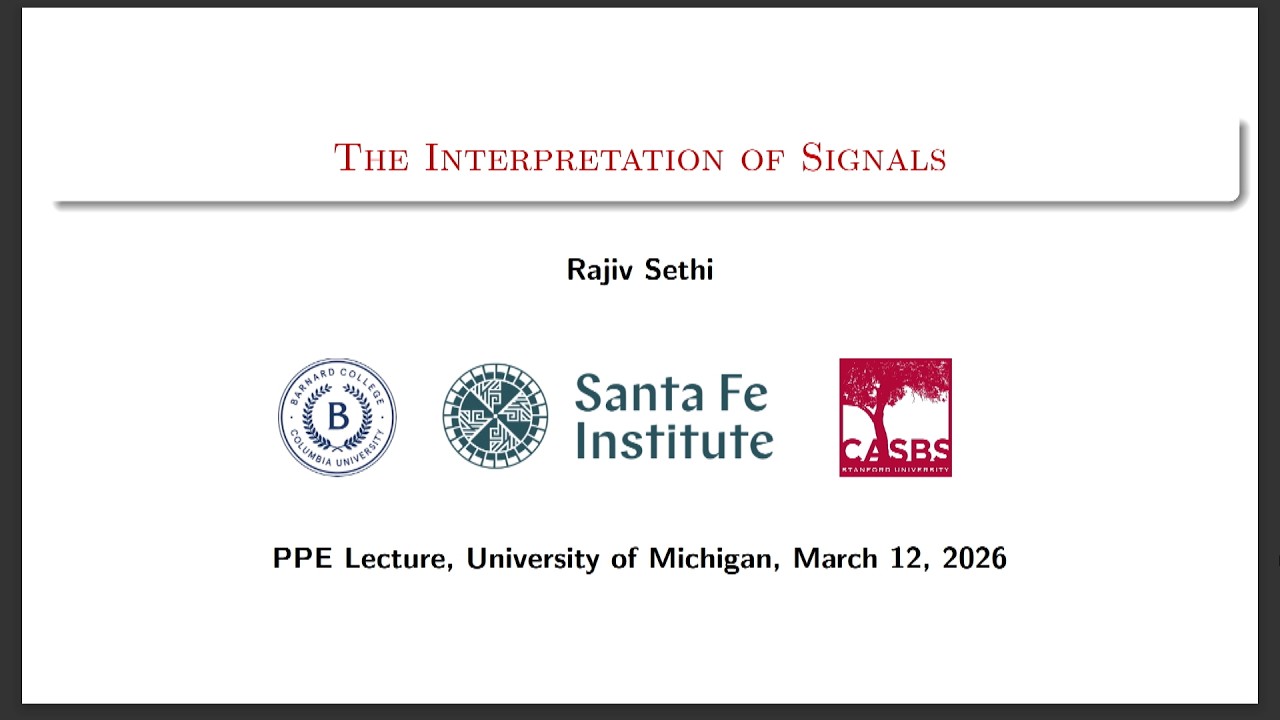
Sethi Warns Strategic Signal Manipulation Distorts Prediction Markets
University of Michigan
Social and market signals shift predictably as user demographics change, leaving prediction markets vulnerable to low-cost price manipulation by bad-faith actors.
## Background
The University of Michigan published this lecture on YouTube on March 19, 2026. Recorded at the Rackham Amphitheater on March 12, 2026, the video presents the 2026 PPE Lecture titled "The Interpretation of Signals," delivered by Professor Rajiv Sethi.
## TL;DR
In this lecture, Rajiv Sethi explores how information is communicated and interpreted across social, political, and financial domains. He establishes a taxonomy of non-engineered signals—autonomous, forced, defensive, and abstract—to analyze real-world phenomena, including skin tone emojis, defensive behaviors, academic self-censorship, and market dynamics. Sethi details how strategic ambiguity, preference falsification, and feedback loops shape human interactions, while examining prediction markets, manipulation tactics, and the challenges of interpreting complex data in modern society.
## Atmosphere & style
The lecture carries an intellectually rigorous yet accessible tone, blending academic precision with engaging real-world observations. Sethi speaks with measured authority and analytical clarity, creating an engaging narrative arc that moves seamlessly from micro-level social interactions to macro-level market dynamics. The atmosphere is that of an immersive, thought-provoking university address, where complex game-theoretic and economic concepts are made intuitive through vivid examples and reflective commentary.
## Key takeaways
- [02:08](https://www.youtube.com/watch?v=Mb0mOMsIkdU&t=128s) Engineered signals have centralized, fixed meanings, whereas non-engineered signals emerge organically across populations through statistical inference and strategic behavior.
- [05:30](https://www.youtube.com/watch?v=Mb0mOMsIkdU&t=330s) Non-engineered signals fall into four main categories: autonomous (voluntary), forced (unalterable physical traits), defensive (used to counteract negative stereotypes), and abstract (systemic aggregations).
- [09:54](https://www.youtube.com/watch?v=Mb0mOMsIkdU&t=594s) Introducing new signaling options, such as skin tone emoji modifiers, fundamentally alters default signals and creates strategic ambiguity around their use.
- [14:51](https://www.youtube.com/watch?v=Mb0mOMsIkdU&t=891s) When a signal acquires a hostile or partisan connotation, moderate senders selectively abandon it, concentrating remaining usage among extremist or bad-faith actors.
- [01:19:49](https://www.youtube.com/watch?v=Mb0mOMsIkdU&t=4789s) The fear of being perceived as lacking shared community values drives widespread self-censorship and preference falsification in public discourse.
- [01:28:03](https://www.youtube.com/watch?v=Mb0mOMsIkdU&t=5283s) Defensive signals, such as whistling classical music or engaging in conspicuous consumption, are deliberately deployed by individuals to neutralize harmful group stereotypes.
- [37:44](https://www.youtube.com/watch?v=Mb0mOMsIkdU&t=2264s) Market prices act as abstract, compressed informational signals that allow decentralized coordination without central planning.
- [01:01:55](https://www.youtube.com/watch?v=Mb0mOMsIkdU&t=3715s) Prediction markets synthesize real-time multidisciplinary information faster than traditional polling or statistical models, but high market credibility creates financial incentives for price manipulation.
- [01:05:30](https://www.youtube.com/watch?v=Mb0mOMsIkdU&t=3930s) Standardized metrics and narrow definitions of merit can fail to capture unobserved value or the emergent properties of diverse teams.
- [01:35:54](https://www.youtube.com/watch?v=Mb0mOMsIkdU&t=5754s) Language co-optation and viral hashtags demonstrate how political signals evolve dynamically as demographic shifts in usage redefine a term's meaning.
## Detailed walkthrough
### [00:01](https://www.youtube.com/watch?v=Mb0mOMsIkdU&t=1s) Introductory Remarks and Speaker Bio
David Baker, Director of the Program in Philosophy, Politics, and Economics (PPE) at the University of Michigan, opens the 2026 PPE Lecture at the Rackham Amphitheater. He acknowledges that while it is a standard presenter cliché to claim he won't waste the audience's time, his brief intro serves a specific purpose: to provide "signals" about why the audience should listen to today's speaker, Professor Rajiv Sethi.
Professor Sethi is a Professor of Economics at Barnard College, Columbia University, where he previously served as department chair. He is also an external professor at the Santa Fe Institute—where Baker notes Sethi once shared an office with the novelist Cormac McCarthy, quipping that it "must have been an interesting year." Sethi’s core body of work focuses on how individuals act on limited information, specifically how strangers discern one another's intentions and biases. He has applied these concepts to critical real-world issues, such as criminal justice in his book *Shadows of Doubt: Stereotypes, Crime, and the Pursuit of Justice* (co-authored with Brendan O'Flaherty), and blogs at *Imperfect Information*.
- **Event:** 2026 PPE Lecture at the University of Michigan (Rackham Amphitheater).
- **Speaker:** Rajiv Sethi (Barnard College, Columbia / Santa Fe Institute).
- **Key Publication:** *Shadows of Doubt: Stereotypes, Crime, and the Pursuit of Justice* (with Brendan O'Flaherty).
- **Blog:** *Imperfect Information*.
---
[02:08](https://www.youtube.com/watch?v=Mb0mOMsIkdU&t=128s) Engineered Signals vs. Socially Emerging Signals
Rajiv Sethi takes the stage and clarifies that his lecture topic, "The Interpretation of Signals," is tentatively the title of a book he is writing while on leave at the Center for Advanced Study in the Behavioral Sciences (CASBS) at Stanford. He humorously observes that Sigmund Freud and Clifford Geertz have already written books with similar titles, so he might need to switch to a "more modest" title eventually. To ground his talk, Sethi uses the famous example from Henry Wadsworth Longfellow's poem *Paul Revere's Ride*: "One if by land, and two if by sea." Before the start of the American Revolutionary War, Revere asked the sexton of Boston's Old North Church to hang lanterns in the belfry to signal the arrival mode of British troops.
Sethi references philosopher David Lewis's seminal work *Convention*, noting that Lewis used this story to illustrate the inherent arbitrariness of meaning attached to messages. The signal could just as easily have been "two if by land, one if by sea," provided both the sender and receiver attached the identical meaning through explicit agreement. Sethi defines this as an **engineered signal**: a message whose meaning is dictated by a single entity and adopted by others out of mutual self-interest (such as road signs, Morse code, or the NATO phonetic alphabet). While computer scientists and engineers spend vast resources designing engineered signals for zero-distortion transmission, Sethi explicitly sets them aside to focus on **non-engineered signals**—messages whose meanings emerge organically through messy social processes.
- **Engineered Signals:** Dictated by a central designer, explicit consensus (e.g., Morse code, traffic lights).
- **Non-Engineered Signals:** Meanings emerge organically via statistical inference and strategic incentives across a population.
- **Universal Definition:** A signal or message is "any carrier of information."
---
[05:30](https://www.youtube.com/watch?v=Mb0mOMsIkdU&t=330s) Taxonomy of Non-Engineered Signals
Sethi outlines the core thesis of his book project: "We live in a sea of signals." While some signals are trivial and can be ignored without consequence, others carry immense weight where misinterpretation yields high stakes. To make this vast landscape manageable, Sethi partitions all non-engineered signals into four distinct categories:
1. **Autonomous Signals:** Messages that individuals can adopt or abandon at will (e.g., yard signs, bumper stickers, pronouns in social media bios, slogans, or tattoos). Although peer pressure or social backlash can make adopting or dropping them costly, individuals retain agency over their usage.
2. **Forced Signals:** Observable physical characteristics such as markers of race, ethnicity, gender, height, and age. These are difficult or prohibitively costly to falsify; people transmit them continuously whether they wish to or not, forming the core foundation of stereotypes.
3. **Defensive Signals:** Voluntary signals that individuals pair or bundle with their forced signals specifically to mitigate negative judgments or adverse reactions caused by those forced signals.
4. **Abstract Signals:** System-level aggregations like market prices or standardized test scores. Though often treated as objective facts, their correct interpretation requires deep statistical context.
Sethi argues that all four classes can be comprehensively analyzed using two unifying analytical lenses familiar to economists and social scientists: **strategic incentives** and **statistical inference**.
---
[09:54](https://www.youtube.com/watch?v=Mb0mOMsIkdU&t=594s) Strategic Ambiguity: The Case of Skin Tone Emojis
Moving into his first chapter topic, "Expressions and Impressions," Sethi illustrates how the introduction of new autonomous signals alters the meaning of existing defaults. He points out that in 2015, the Oxford Dictionary Word of the Year was not a word at all, but the "Face with Tears of Joy" emoji ($😂$). That same year, the Unicode Consortium introduced five standardized skin tone modifiers (based on the dermatological Fitzpatrick scale) for hand and body emojis like the "thumbs up" ($👍$). Prior to 2015, users were restricted to the neutral "Simpsons yellow."
Data from an Edinburgh study revealed a stark divergence in adoption: individuals with darker skin tones adopted skin-tone-modified emojis at massive rates (80–90%), whereas individuals with lighter skin tones largely stuck with the default yellow. Sethi explains the asymmetry through strategic inference:
> "People who are adopting the modified emoji and have themselves a darker skin tone are simply signaling their comfort with their skin tone... What are people with the lighter skin tone signaling when they adopt an emoji which is skin tone modified? This is a bit more ambiguous... ranging from support for white nationalism to recognition of white privilege."
Because adopting a lighter skin tone emoji carries intense interpretive ambiguity—where opposing observers might read it as either progressive privilege-checking or white supremacy—users often default to yellow to avoid misinterpretation. However, Sethi emphasizes a crucial principle of signal dynamics: **the introduction of alternative options fundamentally transforms the meaning of the default.** Choosing yellow is no longer a neutral non-choice; users are now routinely criticized for "failing to acknowledge their privilege" by staying yellow, driving some people to stop using emoji reactions altogether.
- **Fitzgerald/Fitzpatrick Scale:** A dermatological scale for UV sensitivity adapted by Unicode for skin tone modifiers.
- **Edinburgh Study Finding:** Darker-skinned users adopt tone modifiers at 80–90% rates; lighter-skinned users show high default retention due to sign ambiguity.
---
[14:51](https://www.youtube.com/watch?v=Mb0mOMsIkdU&t=891s) "All Lives Matter" and the Dynamics of Selective Adoption
Sethi presents a second example of autonomous signal evolution from the 2016 U.S. presidential primary campaign. During a candidate forum, Democratic contender Martin O'Malley attempted to address racial justice by stating: "Black lives matter, white lives matter, all lives matter." He was immediately met with loud boos from the audience. Visibly baffled, O'Malley repeated the phrase slowly and deliberately, only to draw even harsher condemnation. Within 24 hours, O'Malley issued a public apology, having been informed that "All Lives Matter" was widely interpreted not as a universalist ideal, but as a racially coded "dog whistle" designed to undercut the Black Lives Matter movement.
The apology sparked further confusion across the aisle; Republican candidate Jeb Bush publicly questioned why anyone would apologize for saying something seemingly innocuous. Sethi uses this incident to demonstrate the feedback loop between sender demographics and signal meaning:
- When a signal begins to acquire a consensus meaning as a hostile or partisan code, moderate senders who suffer from being associated with that meaning selectively abandon it.
- As moderates abandon the phrase, the pool of remaining users becomes overwhelmingly concentrated with bad-faith actors or political extremists.
- This sorting process reinforces the negative signal interpretation, turning what began as a literal statement into an unmistakable political boundary marker.
Here is a detailed, faithful walkthrough of the provided lecture transcript segment.
---
[01:17:59](https://www.youtube.com/watch?v=Mb0mOMsIkdU&t=4679s) Signal Equilibria and Ad Hominem Inferences
When a signal’s meaning becomes entrenched across a population, economists describe two distinct states of stability: a **separating equilibrium** and a **pooling equilibrium**. In a separating equilibrium, a specific, well-defined type of person adopts a given message, rendering its interpretation virtually unambiguous. In contrast, a pooling equilibrium occurs when multiple distinct types of people broadcast the exact same signal; this leaves the message with a degree of inherent ambiguity, even as the overall population settles into a predictable baseline distribution of signal senders.
While analyzing informal expressions or thumbs-up emojis might seem trivial at first glance, these mechanisms carry profound social consequences. Once a message becomes linked to a specific type of user, observers begin making inferences about the speaker's underlying identity—asking themselves, "What kind of person would say something like this?" This dynamic was detailed in a seminal 1994 paper in *Rationality and Society* by Glenn Loury titled *"Self-Censorship in Public Discourse."* Loury terms this process an **ad hominem inference**. Crucially, Loury emphasizes that an ad hominem inference is not an ad hominem *attack*. It is a neutral, deductive process by which an observer infers a speaker's underlying values, character, and commitments directly from what they choose to say.
* **Separating Equilibrium:** Occurs when only a specific type of person uses a message, eliminating ambiguity.
* **Pooling Equilibrium:** Occurs when diverse types send the same message, preserving ambiguity within a stable population distribution.
* **Ad Hominem Inference (Glenn Loury, 1994):** The process of deducing a speaker's values and commitments from their speech, distinct from a personal attack.
---
[01:19:49](https://www.youtube.com/watch?v=Mb0mOMsIkdU&t=4789s) Social Defense Mechanics and the Mechanics of Self-Censorship
Loury argues that ad hominem inferences serve as a vital defensive tactic in public discourse. When an individual makes an empirical or factual argument—such as claiming a specific outcome regarding the minimum wage, a carbon tax, or another government policy—listeners evaluate that claim through the lens of perceived shared values. If you are convinced a speaker shares your fundamental commitments and seeks the same ultimate goals, you treat their claim as an honest attempt to correct a mistake; you listen closely and remain open to changing your mind. Conversely, if you infer that the speaker does not share your values, you are likely to dismiss their empirical claim outright, concluding that their disagreement stems from opposing goals rather than a differing interpretation of facts.
Because people understand that listeners draw these inferences about character, widespread self-censorship emerges. An individual within a community who holds a belief that is out of step with the prevailing norm risks being perceived as lacking the community's core commitments. To avoid being misunderstood or socially ostracized, they suppress their genuine opinions out of fear. A similar pattern occurs among those who *do not* actually share the community's values but wish to project alignment: they proactively self-censor to maintain their standing.
Loury's work builds on a rich tradition of social theory examining communication and conformity:
* **Erving Goffman (*The Presentation of Self in Everyday Life*):** Framed human social interaction as theater, where individuals act as performers on a stage carefully tailoring impressions for an audience.
* **Elisabeth Noelle-Neumann:** Formulated the concept of the *"Spiral of Silence,"* explaining how fear of isolation suppresses minority viewpoints.
* **Timur Kuran:** Examined *"preference falsification,"* where individuals go beyond passive self-censorship to actively express views they do not hold—a dynamic particularly rampant in authoritarian regimes.
* **Václav Havel:** Highlighted how minor deviations from ritualistic, mandated behavior in authoritarian regimes can function as deeply subversive acts of political defiance.
---
[01:23:25](https://www.youtube.com/watch?v=Mb0mOMsIkdU&t=5005s) Modern Superchargers: Cultural Cognition and Affective Polarization
Developments in political science and social psychology since the 1990s have dramatically amplified these self-censorship dynamics. Two major frameworks explain why public discourse has become increasingly fragile:
1. **Identity-Protective Cognition / Cultural Cognition:** Developed by Dan Kahan and his colleagues at Yale, this research demonstrates that people's empirical positions—spanning nuclear reactor safety, climate change, abortion, the minimum wage, and tax policy—cohere tightly along cultural lines. If a person reveals their stance on one or two issues, an observer can accurately predict their positions across unrelated domains. Kahan argues that individuals process evidence through the filter of their political identity. Consequently, when someone presents an opposing empirical argument, listeners immediately infer a conflict of core values, heightening the risk of being misunderstood.
2. **Affective Polarization:** Political scientists studying American politics over the last several decades noted a transition from simple ideological polarization (the tight clustering of policy positions within political parties, eliminating cross-party alignments like NRA-backed Democrats) to affective polarization. Layered on top of ideological differences, affective polarization means citizens do not merely view political opponents as mistaken; they view them as morally despicable. Using "feeling thermometer" surveys, researchers have documented a steep, off-the-charts rise in cross-party animosity since approximately 2012.
Together, cultural cognition and affective polarization supercharge the pressures that drive preference falsification and public self-censorship.
---
[01:26:41](https://www.youtube.com/watch?v=Mb0mOMsIkdU&t=5201s) Faculty and Student Survey Data on Self-Censorship
Data collected by the Foundation for Individual Rights and Expression (FIRE) illustrates the scale of modern self-censorship across American higher education. Although these student and faculty surveys suffer from standard methodological limitations—such as low response rates and potential selection bias—they remain informative indicators of academic climate across public universities, private institutions, liberal arts colleges, and Ivy League campuses alike.
The surveys reveal that faculty routinely self-censor not only in informal online communications, but also when selecting research topics for academic publication, planning outside lectures, and leading classroom discussions.
```
Top Topics Driving Academic Self-Censorship:
├── Israel-Palestine Conflict (Highest degree of suppression)
├── Race and Affirmative Action
├── Transgender Rights
├── Abortion
└── Hate Speech
```
Student survey data mirrored these faculty findings almost perfectly, demonstrating high levels of self-censorship across the exact same contentious political and social topics.
---
[01:28:03](https://www.youtube.com/watch?v=Mb0mOMsIkdU&t=5283s) Defensive Signals: Whistling Vivaldi and Navigating Strangers
A **forced signal** consists of unalterable or difficult-to-falsify physical attributes—such as race, ethnicity, gender, height, and physical build. To mitigate the potential negative associations or fear that a forced signal might evoke in strangers, individuals often pair it with a intentional **defensive signal**.
A vivid illustration of this pairing appears in Brent Staples' memoir. As an African American graduate student pursuing a PhD in psychology at the University of Chicago, Staples frequently took evening walks near Lake Michigan. He noticed that pedestrians shrank from him in fear due to his height, build, and race at that time and place. Distressed by these reactions, Staples discovered a strategy: he began whistling classical melodies by Vivaldi and songs by The Beatles as he walked. The defensive signal instantly altered how passersby perceived him, neutralizing the fear triggered by his forced signal. This specific story inspired the title of Claude Steele's book, *Whistling Vivaldi*.
Additional examples highlight how defensive signaling operates in high-stakes or tense public encounters:
* **Elizabeth Anderson (*The Imperative of Integration*):** Anderson describes an incident in Detroit where her car's oil light came on. A young Black man approached her, held his hands up flat to gesture innocence, and said, "Don't worry, I'm not here to rob you." This clear defensive signal established benign intent, allowing a mutually beneficial interaction to occur. (This example was also featured in the preface of राजीव सेठी (Rajiv Sethi) and E. Glen Weyl / Dan O'Flaherty's work).
* **Eric Holder (2013 NAACP Address):** The former Attorney General publicly discussed "the talk" he had with his 15-year-old son regarding police encounters. He advised keeping both hands on the steering wheel, avoiding sharp movements, and remaining polite—instructing his son on how to project explicit defensive signals during traffic stops or pedestrian checks.
---
[01:31:45](https://www.youtube.com/watch?v=Mb0mOMsIkdU&t=5505s) Data Interpretation Traps: Police Use of Force
Failing to account for the interplay between forced and defensive signals leads to flawed inferences when interpreting social data. Economist Sendhil Mullainathan published a *New York Times* article on police use of lethal force that illustrates this analytical trap.
Mullainathan compared the proportion of arrestees who are African American (~29%) against the proportion of police shooting victims who are African American (~32%). Pointing to the small gap between these two figures, he concluded that removing police racial bias would have little impact on the overall killing rate. However, this argument implicitly assumes that defensive signals are absent or irrelevant, ignoring how signaling transforms the dynamics of an interaction.
* **Distorted Baselines (The Denominator Problem):** The overall arrest pool may itself be inflated due to forced signals—such as neighbors calling the police on individuals solely because of their race (e.g., the arrest of Henry Louis Gates Jr. in Cambridge, or the shooting of Tamir Rice in Ohio). If the baseline includes arrests of individuals who posed zero physical threat, comparing shooting rates directly to arrest rates creates an invalid inference.
* **Mitigating Dynamics:** Defensive signaling directly alters whether a tense encounter escalates or de-escalates, altering outcomes in ways raw statistics fail to capture.
* **Geographic Variations:** Police use-of-force data contains vast geographic disparities that resist simple explanations. For example, a white individual in Phoenix is statistically more likely to be killed by police than a Black individual in New York City. Overall rates of police force are dramatically higher in western states (e.g., Arizona, New Mexico, Texas, and California) compared to New England.
Encounters between strangers cannot be treated as uniform statistical events; analyzing them accurately requires accounting for the forced and defensive signals embedded within each interaction, as detailed extensively in Rajiv Sethi and Dan O'Flaherty's book, *Shadows of Doubt*.
[035:03] Defensive Signals, Stereotypes, and Conspicuous Consumption
Interactions throughout the criminal justice system—whether between officers and suspects, victims and offenders, jurors and defendants, or judges and prosecutors—inherently take place among strangers who lack deep personal knowledge of one another. In these settings, individuals rely on stereotypes, which serve as a form of "force signal." These stereotypic force signals frequently get bundled with "defensive signals" adopted by individuals seeking to mitigate how they are perceived. Failing to fully account for the complex interplay between force and defensive signals leads to invalid inferences when analyzing real-world data.
A prime illustration of this dynamic is conspicuous consumption, a concept originally coined by Thorstein Veblen in his 1899 book *The Theory of the Leisure Class* to describe how affluent individuals flaunt their wealth in public. However, modern research flips Veblen's classical intuition on its head. In her book of essays *Thick*, Tressie McMillan Cottom, alongside economists Kerwin Kofi Charles, Erik Hurst, and Nikolai Roussanov in the *Quarterly Journal of Economics*, argue that conspicuous consumption often functions as a defensive signal. When an individual belongs to a group that is recognizably stereotyped as having low income or lower social status within a stratified community, they may intentionally purchase expensive clothes, hats, shoes, or luxury accessories—even at great personal financial strain—to separate themselves from that negative stereotype and insulate themselves from bias.
- **Non-Racial Foundations:** Although Kerwin Kofi Charles's paper is titled "Conspicuous Consumption and Race," its underlying framework is non-racial. White individuals in communities where their demographic holds lower relative income engage in the exact same practice of defensive luxury spending.
- **Economic Mechanics:** Conspicuous consumption acts as an economic incentive model rather than a purely cultural phenomenon, driven by the drive to bundle a forced group identity signal with a protective, defensive signal.
---
[037:44] The Information Architecture of Market Prices
Prices have been studied for millennia—from Aristotle and Thomas Aquinas debating the moral "justice" or fairness of prices—to Adam Smith, who first interpreted prices through the lens of free labor mobility across occupations and the unhindered movement of capital across sectors. Smith established that free movement generates uniform rates of profit and compensating wage differentials. He distinguished between natural and market prices, defining a commodity's natural price as the exact cost required to cover the natural rates of wages, profits, and rents needed to bring it to market.
Smith famously illustrated this value dynamic using the "water-diamond paradox": although water is essential to human life and diamonds are largely unnecessary, diamonds command a vastly higher price purely because the labor and resource costs of procuring them and bringing them to market are dramatically higher. Friedrich Hayek later revolutionized economic thought in his seminal 1945 paper by centering the idea that prices act primarily as compact informational messages. In a famous example regarding a sudden rise in the price of tin, Hayek pointed out that it does not matter whether the price jump was caused by a closed mine or a new industrial application; the price increase itself delivers the precise signal consumers need to economize on tin, cascading substitution effects throughout the market without any individual participant needing to comprehend the entire global supply chain.
> "The whole acts as one market, not because any of its members survey the whole field, but because their limited individual fields of vision sufficiently overlap so that through many intermediaries, the relevant information is communicated to all." — Friedrich Hayek (1945)
- **Adam Smith's Cost Model:** A commodity's natural price reflects the precise cost of natural wages, profits, and rents required to bring it to market.
- **Hayek's Information Model:** Prices act as hyper-condensed signals, allowing decentralized actors to coordinate complex global economic adjustments without needing centralized knowledge.
---
[041:13] Fundamental vs. Technical Trading and Systemic Flashes
While Hayek viewed the market price mechanism as near-miraculous, price movements themselves carry predictive signals unless information is transmitted instantaneously. If price changes contain information, traders will attempt to profit by predicting those shifts, setting off secondary price actions. Historically, asset markets have relied on two primary trading approaches:
* **Fundamental Trading:** Investors evaluate an asset's price against real-world data—such as a corporation's earnings or a sovereign government's likelihood of debt repayment—and buy if undervalued or sell if overvalued. While fundamental analysis injects true real-world information into the market, it is labor-intensive and costly.
* **Technical Trading:** Traders bypass fundamental analysis and instead attempt to extract predictive signals directly from price trends and market data itself at a far lower cost.
When algorithmic trading and automated systems attempt to extract signals from market data alone without grounding their actions in external reality, catastrophic feedback loops can occur. A stark example occurred during the May 6, 2010 "Flash Crash," when the stock market suffered a 10% drop—erasing nearly a trillion dollars in market value—before recovering within eight minutes. During the cascade, shares of major corporations traded at absurd valuations: blue-chip consulting firm Accenture traded down to a single penny per share, while Sotheby's spiked to $99,000 per share. Automated algorithms interpreted falling prices as signals to sell further, creating a self-reinforcing panic unmoored from business realities.
```
+-----------------------------------------------------------------------+
| THE TECHNICAL FLASH CRASH LOOP |
| |
| +-------------------> [ Initial Price Drop ] |
| | | |
| | v |
| [ Algorithmic Cascade ] [ Technical Algorithms ] |
| (Panic selling feeds (Interpret drop as signal |
| further declines) to sell immediately) |
| ^ | |
| +----------------------------------+ |
+-----------------------------------------------------------------------+
```
During the live broadcast of the 2010 crash, market commentator Jim Cramer provided a real-time example of fundamental trading in action. Watching Procter & Gamble plunge 30% from its previous close of $62.60 down to $42.50, Cramer began shouting at his screen that $42.50 was "not a real price" and urged viewers to immediately buy 50,000 shares based on the company's real underlying earnings. Within a minute, Procter & Gamble bounced right back up to $62.00 as fundamental traders stepped in to exploit the mispricing.
- **May 6, 2010 Flash Crash:** Erased nearly $1 trillion in market value in minutes due to automated feedback loops.
- **Procter & Gamble Swing:** Dropped from $62.60 to $42.50 before recovering back to $62.00 within a single minute.
---
[046:50] Reflexivity, Sovereign Debt, and Self-Fulfilling Crises
The feedback loops seen in equity markets extend directly into international bond and currency markets, where market expectations can become self-fulfilling prophecies. During the 2011 Greek debt crisis, the interest rate yield required by investors to hold Greek government debt surged from parity with German bonds up to an unsustainable 35% in just a few months. While a country can comfortably service its debt at a 5% interest rate indefinitely, it faces inevitable default if forced to refinance at 35%.
This dynamic highlights the fragile role of market confidence. The U.S. government issues Treasury bills and bonds that are universally considered among the safest financial assets on earth. This safety does not stem from budget surpluses—the U.S. has operated at a budget deficit for over 20 years, and investors fully expect deficits to continue. Rather, U.S. Treasuries remain safe because market participants hold absolute confidence that the government can continuously refinance and roll over its debt at low interest rates. When market confidence broke in the case of Greece, the fear of default itself created the high interest rates that made default inevitable, ultimately requiring a partial default and international bailouts to stabilize the market.
Similar self-fulfilling dynamics occur in foreign exchange markets. Before the adoption of the Euro, market confidence in the British pound's fixed exchange rate within the European Exchange Rate Mechanism (ERM) shattered rapidly. Once traders collectively lost faith that the British government could defend the currency, selling pressure mounted so fast that the belief became self-fulfilling, forcing the pound out of the ERM.
- **Greek Sovereign Yields:** Spiked to 35% during the 2011 crisis, turning a manageable debt load into an immediate refinancing crisis.
- **U.S. Debt Refinancing:** Maintained default-free status for over two decades of continuous budget deficits through unquestioned market confidence in low-cost debt rollover.
---
[048:56] The Mechanics of Modern Prediction Markets
Over the past four decades, online prediction markets have evolved from niche academic experiments into multi-billion-dollar financial platforms with rapidly growing valuations, driven by platforms like Polymarket and Kalshi. A prediction market operates as a simplified financial market: instead of trading corporate equity or debt, traders buy and sell binary assets that pay a fixed cash settlement (typically $1.00) if a specific reference event occurs, and $0.00 if it does not.
```
+-----------------------------------------------------------------------+
| PREDICTION MARKET ORDER BOOK |
| |
| [ YES Contract ] [ NO Contract ] |
| Pays $1.00 if event occurs Pays $1.00 if not |
| Current Price: $0.78 Current Price: $0.22|
| (Implied Probability: 78%) (Implied Prob: 22%) |
| |
| +-----------------------------------------------------------------+ |
| | TOTAL CONTRACT COST: $0.78 + $0.22 = $1.00 (Guaranteed Payout) | |
| +-----------------------------------------------------------------+ |
+-----------------------------------------------------------------------+
```
To illustrate how prediction markets structure risk, consider a contract settling on which political party will win control of the U.S. House of Representatives in the 2026 midterm elections. At the time of observation, the last traded price for the Democratic contract stood at $0.78 (which later drifted to $0.83 amid geopolitical developments in the Middle East). Buying this contract for $0.78 offers a potential $1.00 payout if the Democrats win control of the House in 2026, or $0.00 if they lose.
At the center of every prediction market is an **order book**—the same foundational matching engine used by major stock exchanges and derivatives platforms like the Chicago Mercantile Exchange (CME). A transaction at $0.78 for a "YES" contract can only clear if a counterparty on the other side of the order book buys a "NO" contract for $0.22. Together, the two opposing bets equal the full $1.00 payout, matching buyers and sellers while reflecting an aggregate market probability of 78%.
- **Contract Architecture:** Binary payout structure ($1.00 for occurrence, $0.00 for non-occurrence).
- **Implied Probabilities:** A contract trading at $0.78 represents an aggregate market estimate of a 78% likelihood of the event occurring.
- **Order Book Liquidity:** Single order books on major political contracts regularly host hundreds of thousands of active contracts worth hundreds of thousands of dollars.
<ElicitationsGroup message="Explore further aspects of signal interpretation and economic theory:">
<Elicitation label="Analyze prediction market accuracy" query="How accurate are prediction markets compared to traditional polling and expert forecasting in predicting political outcomes?"/>
<Elicitation label="Examine Hayek's price theory" query="Explain Friedrich Hayek's 1945 paper 'The Use of Knowledge in Society' and its core arguments about price signals."/>
<Elicitation label="Detail the 2010 Flash Crash" query="What were the technical causes and regulatory aftermath of the May 6, 2010 Flash Crash?"/>
</ElicitationsGroup>
[51:52](https://www.youtube.com/watch?v=Mb0mOMsIkdU&t=3112s) How Order Books Match Buyers and Sellers in Prediction Markets
Rajiv Sethi walks the audience through the mechanics of a prediction market order book to illustrate how trades actually execute without requiring a central bookmaker. Using a hypothetical scenario, he explains that if a trader wants to buy contracts predicting a Democratic election victory at $0.78, they can either take existing orders or place a limit order at a lower price, such as $0.77, $0.76, or $0.75. Placing an order below the current best ask means it won't trade immediately; instead, it enters the order book, increasing the bid volume at that price level until someone else agrees to trade against it.
When an investor submits an order to buy 100 contracts at $0.78, the trade executes immediately against existing sell orders or opposing bets. Sethi points out that the underlying mechanism matches people betting *for* an event with those betting *against* it. For instance, a buyer paying $0.78 that Democrats will win is paired directly with a seller paying $0.22 that Democrats will lose. The exchange itself takes no positional risk; it simply collects the full dollar ($0.78 + $0.22) from the two parties, holds the funds in escrow, and pays out $1.00 to the winning side once the event resolves.
- **Order book dynamics:** Bids below the best ask (e.g., placing a buy order at $0.77 instead of $0.78) sit in the order book, adding depth rather than executing immediately.
- **Risk-neutral exchange model:** Prediction market exchanges operate strictly as matching engines rather than traditional bookmakers, holding $1.00 per paired contract to settle outcomes neutrally.
---
[53:40](https://www.youtube.com/watch?v=Mb0mOMsIkdU&t=3220s) Real-Time Market Flexibility vs. Poll-Based Statistical Models
Reflecting on a lunch conversation with students from the public policy program, Sethi highlights how polarized opinions are regarding prediction markets—some view them as "the best thing since sliced bread," while critics view them as "the devil's playground." To demonstrate their utility, he points to the days leading up to President Joe Biden's withdrawal from the 2024 presidential race on July 21, 2024. Three days prior, on July 18, Polymarket showed Biden's chance of winning the presidency dropping to just 4.5%, while Kamala Harris's odds climbed above 22%.
Sethi contrasts this dynamic updating with statistical election models, such as those run by Nate Silver, *The Economist*, or FiveThirtyEight (then owned by ABC News). These statistical models were heavily reliant on historical polling data, which exclusively polled Trump versus Biden head-to-head. Because pollsters were not testing alternative candidates, the algorithms could not assign any probability to Harris and continued predicting a two-man race right up until Biden dropped out. Once Biden exited, these polling models were forced to go completely offline to wait for new data, whereas prediction markets continuously absorbed real-time signals without needing structural recalibration.
- **Polymarket odds (July 18, 2024):** Biden’s presidential victory odds fell to 4.5%, while Harris’s rose above 22%—three days before Biden officially ended his re-election campaign.
- **Polling model limitations:** Models like FiveThirtyEight and *The Economist* froze or went offline because their statistical engines were calibrated strictly on historical head-to-head poll inputs.
---
[56:17](https://www.youtube.com/watch?v=Mb0mOMsIkdU&t=3377s) Forecasting Complex Systems and Epidemic Outbreaks
While election forecasting gets the most media attention, Sethi argues that accurate prediction is far more socially crucial in areas like public health, such as tracking flu seasons or disease transmission during a pandemic. During COVID-19, traditional epidemiological models submitted to the CDC attempted to forecast one-week-out metrics like case numbers, hospitalizations, and deaths. However, these models suffered from massive instability, frequently disagreeing with each other by a factor of 100 to 1 and displaying wide swings week to week based on minor changes in core assumptions.
Sethi explains that while standard epidemiological models (like the classic SIR model tracking Susceptible, Infected, and Recovered populations) handle biological mechanics well, they struggle to quantify real-time human policy shifts. Factors like opening beaches in Florida, locking down California or Illinois, or closing local schools are difficult to parametrize quickly in equations. Prediction markets, by contrast, allow traders to synthesize multi-disciplinary, rapidly shifting real-world policy signals, offering potential forecasting value that traditional academic models miss—even if most current commercial market volume remains focused on sports or geopolitical violence.
- **Epidemiological model variance:** CDC ensemble models for COVID-19 case and death projections regularly diverged by a factor of 100 to 1 due to sensitivity to underlying assumptions.
- **SIR model limits:** Standard epidemiological models easily track $S \to I \to R$ transitions but struggle to incorporate sudden policy interventions like state-level beach closures or school lockdowns.
---
[57:42](https://www.youtube.com/watch?v=Mb0mOMsIkdU&t=3462s) The 2020 Election Anomaly: What Mispriced Markets Reveal
Sethi examines the 2020 presidential election between Joe Biden and Donald Trump to demonstrate how market price discrepancies can signal hidden informational dynamics. Following the November 3 election, major media outlets called the race on November 7, and the official presidential transition process began on November 23. Yet, as late as November 29, prediction markets like PredictIt continued to price Trump with a double-digit probability of winning re-election. Prominent analysts like Nate Silver mocked traders on social media, asserting that "some people are idiots and some idiots bet on prediction markets."
Viewed with the benefit of hindsight after January 6, Sethi suggests these market prices were not simply irrational trader foolishness. Instead, traders were pricing in potential extra-constitutional avenues or legal challenges through which the market contract might resolve in Trump's favor. While PredictIt eventually settled the main presidential winning market in early December in favor of Biden—costing Trump bettors their money—related markets on cabinet positions (e.g., who would be Secretary of State or Treasury Secretary on March 15, 2021) remained open. During the events of January 6, contracts predicting incumbents like Mike Pompeo or Steven Mnuchin staying in office spiked significantly, allowing attentive traders to cash out at substantial profits.
> "Some people are idiots and some idiots bet on prediction markets."
- **2020 PredictIt pricing anomaly:** Trump retained a double-digit win probability on PredictIt through late November 2020, weeks after official transition protocols began.
- **Cabinet market volatility:** Unsettled derivative markets tracking cabinet posts on March 15, 2021, saw sharp price spikes during the January 6 Capitol riot, enabling profitable exits for non-standard positioning.
---
[01:01:35](https://www.youtube.com/watch?v=Mb0mOMsIkdU&t=3695s) The Prediction Market Paradox and Market Manipulation
Introducing a concept he terms the "Prediction Market Paradox," Sethi details how the perceived credibility of a forecasting market shapes the incentive to manipulate it. In domain areas like political elections, subjective expectations directly influence objective realities: a candidate whose market price plunges can suffer a real-world decline in campaign morale, donor contributions, volunteer effort, and voter turnout. Because market prices generate feedback loops in the real world, actors have a powerful motive to artificially influence those prices.
Sethi notes that moving a prediction market price by a few cents or placing a price floor to bolster donor confidence costs a fraction of a major prime-time television ad spend. This creates a paradox: a market believed to be highly accurate and unmanipulated offers the maximum incentive for bad actors to manipulate it. Conversely, if a market is widely dismissed as corrupt, nobody trusts its signal, eliminating the payoff for manipulation. Consequently, prediction markets exist in a delicate balance where manipulation exists, but cannot be so pervasive that it destroys the platform's baseline credibility.
- **Feedback loops:** A drop in market-implied probability directly depresses fundraising, volunteer recruitment, and early-voting turnout.
- **Cost comparison:** Pushing or supporting a contract price on an order book typically costs a few million dollars—far less than producing and airing prime-time national media campaigns.
---
[01:03:39](https://www.youtube.com/watch?v=Mb0mOMsIkdU&t=3819s) Evidence of Market Manipulation: The $7M Romney Whale
To provide empirical evidence of manipulation, Sethi shares a personal analysis from the 2012 presidential race between Barack Obama and Mitt Romney. At 3:30 PM on Election Day in 2012, Sethi analyzed the live order book on the Intrade platform and noticed massive, staggered buy orders for Romney stacked downwards from $0.30. He publicly tweeted that an unknown entity appeared to be artificially supporting Romney's contract floor, likely to maintain voter turnout and project confidence right until polls closed.
Following the election, Sethi partnered with economist David Rothschild to analyze granular, transaction-level data provided by Intrade. Their research uncovered a single account ("Trader B") that executed over 22,000 individual trades, purchasing 2 million Romney win contracts and risking a total of $7 million. The entity lost every dollar when Obama won re-election. The study generated immense media attention as journalists attempted to unmask the anonymous whale, demonstrating how high-stakes political incentives drive deep-pocketed actors to attempt to alter public perception via order books.
- **Intrade 2012 dataset:** Analysis revealed a single account ("Trader B") placed 22,000 distinct trades to purchase 2 million Mitt Romney contracts.
- **Capital at risk:** Trader B lost an absolute total of $7 million trying to maintain a $0.30 price floor on Romney's election odds.
---
[01:05:30](https://www.youtube.com/watch?v=Mb0mOMsIkdU&t=3930s) Narrow Definitions of Merit and the Finnish Teacher Quota Study
Shifting topics toward how institutions interpret signals of merit, Sethi touches upon recent policy pressure on higher education, highlighting a presidential memorandum and agreement involving Columbia University. The policy mandates strict data reporting on standardized test scores across demographic groups—tracking applicants, accepted students, and enrolled student performance. Sethi warns that relying on such narrow, mechanical definitions of merit creates severe policy misinterpretations, as standardized metrics rarely capture holistic performance or actual long-term value.
To illustrate the flaws of rigid merit measures, Sethi cites a study by economist Ulrika Ahrsjö (and co-authors) on primary education in Finland, forthcoming in the *American Economic Review*. Finland—known for its world-class, highly competitive K-12 education system with a 10% acceptance rate for teacher training—historically maintained a 40% affirmative action quota for male teachers to fix gender underrepresentation. When Finland abolished the quota in the 1990s to prioritize purely score-based merit, long-term outcomes for children actually deteriorated. Tracing students to age 25, researchers found that exposure to quota-admitted male teachers significantly boosted educational attainment and labor market attachment for both boys and girls, proving that narrow academic metrics miss unobserved, high-value dimensions of merit.
- **Columbia University memorandum:** Requires tracking standardized test metrics across demographic cohorts to enforce a strict, narrow definition of merit-based admissions.
- **Finnish teaching quota findings:** Removing a 40% male teacher quota harmed students long-term; pupils exposed to quota-admitted male teachers achieved higher educational attainment and stronger labor force participation at age 25.
[01:08:34](https://www.youtube.com/watch?v=Mb0mOMsIkdU&t=4114s) Admissions Policies, Merit, and Higher Education Under Fire
Rajiv Sethi transitions through the final portion of his slides, highlighting how test-optional policies can inadvertently obscure critical signals about student performance. Citing recent findings from Dartmouth, he explains how the college moved back to a test-required policy after realizing that high-performing applicants from historically low-scoring schools were withholding their test scores out of fear. Dartmouth utilized standardized scores not in isolation, but relative to an applicant's high school score distribution—a practice defensible on meritocratic grounds, yet explicitly threatened by recent executive orders and administrative deals like those involving Columbia University. Beyond individual test scores, Sethi touches on Scott E. Page’s work regarding merit as a collective property. Because productivity is predominantly team-based, individual rankings fail to capture an applicant's true value, which fundamentally depends on team composition.
Turning to the broader crisis facing higher education, Sethi cautions that current administrative crackdowns on selection and hiring processes are deeply wrongheaded. Higher education remains one of the nation's most vibrant economic sectors, driving global demand, innovation, and positive trade balances. However, Sethi warns that universities are dangerously vulnerable because public perception has deteriorated sharply across both Republican and Democratic lines. Referencing former university presidents William G. Bowen and Derek Bok, Sethi argues that if institutions insist on holistic admissions criteria beyond raw academic metrics, they carry a strict obligation to demonstrate that these policies yield real societal benefits and long-term student success. Without transparent alignment between selection methods and core institutional missions—such as Columbia’s historic charter goal of advancing the public good—public trust will continue to erode.
- **Dartmouth’s Standardized Testing Findings:** Applicants from low-scoring schools withheld high individual scores; relative context (score vs. school distribution) proved essential for identifying merit.
- **Scott E. Page on Merit:** Re-published as a Princeton Classic; argues merit is an emergent property of teams rather than an isolated individual trait.
- **Bowen & Bok Citation:** *The Shape of the River* framework; holistic selection requires auditing outcomes (graduation rates, social contribution) to maintain public trust.
- **Columbia University's Historic Mission:** Explicitly cited from its historic charter: "for the advancement of the public good and the glory of Almighty God."
- **Recommended Reading List:** Features Elizabeth Anderson (*The Imperative of Integration*), Erving Goffman, Glenn Loury, Albert O. Hirschman, and Thomas Schelling.
---
[01:14:02](https://www.youtube.com/watch?v=Mb0mOMsIkdU&t=4442s) Prediction Markets: Fan Bias and Cross-Market Arbitrage
Following the lecture, the floor opens for Q&A. The first audience member asks about the variance in reliability across different prediction markets, raising a paradox: the people most knowledgeable about a topic (such as die-hard sports fans following the Philadelphia 76ers) are often the most susceptible to wishful thinking and cognitive bias. Sethi validates the question, connecting it back to Francis Galton's classic "wisdom of crowds" experiment with the weight of an ox, where individual guesses were wildly inaccurate, yet the median estimate hit the exact target. In political prediction markets, transaction-level data shows that roughly 87% of traders during the Obama-Romney election never shifted their position; however, a critical 5% of flexible traders actively exploited those partisan biases to move prices toward accuracy. Furthermore, prediction markets function as inherent "anti-echo chambers," as severe directional bias instantly creates lucrative profit opportunities for opposing traders.
Addressing how to evaluate whether one prediction market platform is more accurate than another, Sethi notes that doing so is exceptionally difficult because prices across platforms move in tight synchronization. Through cross-market arbitrage, any temporary price discrepancy between platforms like Kalshi and Polymarket is immediately erased by traders exploiting the gap to lock in risk-free profits.
- **Francis Galton's Ox Experiment:** Individual estimates were far off, but the median guess produced an almost exact measure of the ox's weight.
- **2012 Obama-Romney Market Data:** Analyzed alongside David Rothschild; 87% of traders held fixed positions, while ~5% actively traded on market bias.
- **Cross-Market Arbitrage Example:** If Democrats are priced at $0.70 on Market A and $0.80 on Market B (where Republicans are $0.20), a trader can buy YES on Market A and NO on Market B for $0.90 total, securing a guaranteed $1.00 payout.
An audience member asks Sethi to elaborate on the "abstract signal"—the fourth category in his signaling taxonomy—and request concrete examples. Sethi clarifies that abstract signals are disembodied information carriers that no single individual explicitly chooses to send. Market prices serve as the primary example: they emerge dynamically out of thousands of independent buy and sell orders, functioning as information carriers in the tradition of Adam Smith and Friedrich Hayek. Unlike a deliberate direct signal like a "thumbs up emoji," a market price is the emergent byproduct of collective behavior.
Standardized test scores represent a second form of abstract signal. While a student can choose whether or not to submit a test score, they cannot arbitrarily generate the score itself through pure intent. Unlike easily adopted or abandoned social signals, test scores emerge from a complex, constrained testing process that resists instantaneous manipulation.
- **Abstract Signal Definition:** Signals that emerge from complex systemic processes rather than explicit, individual choice.
- **Market Prices:** Emergent messages derived from aggregated buy/sell orders (referencing Hayek and Adam Smith).
- **Standardized Test Scores:** Abstract signals because performance cannot be adopted or discarded at will without underlying effort and system interaction.
---
[01:21:49](https://www.youtube.com/watch?v=Mb0mOMsIkdU&t=4909s) Inside Information, Spoofing, and KYC Regulation in Crypto Markets
The final question addresses whether prediction markets will experience severe market dislocations as technical traders enter what is currently a nascent, fundamental-driven market. Sethi reveals that prediction markets are already heavily impacted by asymmetric trading, particularly from inside information on geopolitical events. He cites notable examples, including a trader making $400,000 overnight predicting the exact timing of the capture of Nicolás Maduro in Venezuela, and five Polymarket wallets earning $1.2 million overnight on February 28 ahead of strikes on Iran. In the Iranian strike instance, Israeli authorities subsequently arrested an IDF reservist and a civilian for trading on classified inside information.
Sethi details how technical traders now use automated software tools like "Insider Finder" to track unusually heavy, high-risk bets and piggyback on suspected insider trades. This dynamic, however, has spawned a counter-strategy known as "spoofing": manipulative traders place large, confident bets to fake insider knowledge, artificially driving up market prices on social media hype before dumping their positions at a profit. While traditional, regulated financial markets ban insider trading and spoofing through strict enforcement and Know Your Customer (KYC) identity checks, decentralized crypto-based platforms like Polymarket lack basic KYC protocols. Consequently, a single individual can operate multiple pseudonymous wallets undetected, making regulatory reform and identity verification essential for the future integrity of prediction markets.
- **Venezuela Operation Trade:** An insider trader netted $400,000 overnight betting on the exact timing of Maduro's capture.
- **Iran Strikes Trade (Feb 28):** Five Polymarket wallets generated $1.2 million overnight; linked to an IDF reservist and a civilian arrested in Israel.
- **Insider Finder Tools:** Algorithmic tracking tools designed to detect abnormally large positions and mimic suspected insider trades.
- **Spoofing Dynamics:** Faking inside knowledge with high-volume trades to trick automated trackers and social media, driving up prices before cashing out.
- **Regulatory Gap:** Standard financial markets enforce KYC rules; crypto-native exchanges like Polymarket allow pseudonymous, multi-wallet manipulation.
<ElicitationsGroup message="Explore related analysis from this lecture:">
{/* Reason: Offers clear next steps to deepen understanding of prediction markets or higher education signaling policies. */}
<Elicitation label="Analyze how prediction markets handle geopolitical shocks" query="How do prediction markets process unexpected geopolitical shocks compared to traditional financial markets?"/>
<Elicitation label="Examine the impact of test-optional admissions policies" query="What are the main economic and sociological arguments surrounding test-optional vs test-required admissions policies in higher education?"/>
</ElicitationsGroup>
Here is a detailed, faithful walkthrough of part 6 of the lecture transcript.
---
[01:25:39](https://www.youtube.com/watch?v=Mb0mOMsIkdU&t=5139s) Market Forecasts, Statistical Models, and Volatility
Rajiv Sethi directly addresses an audience member's point about the dynamics and accuracy of prediction markets compared to statistical models. He validates their concern by explaining that while prediction markets on major headline races—such as predicting who will win the U.S. presidency—turned out to be more accurate than traditional models last year, their accuracy drops significantly as you move down-ballot. On lower-profile races, prediction markets frequently overreact to fresh information, causing localized spikes and severe price swings. In contrast, statistical models remain grounded in hard facts, allowing them to out-compete human-driven markets in those specific environments.
Sethi emphasizes that he does not view prediction markets as universally superior to alternative forecasting tools. Instead, prediction markets shine in "uncharted waters" where historical data is sparse or no longer serves as a reliable guide for the future. Drawing on the work of Yale economist and Nobel laureate Robert Shiller, Sethi notes that financial markets inherently suffer from extreme volatility, and prediction markets are by no means immune to the same erratic behavior.
- Headline presidential prediction markets outperformed statistical models in the previous election year, but down-ballot markets were less accurate due to market overreaction.
- Statistical models outperform markets when grounded in hard historical facts, whereas prediction markets perform best in uncharted territory where history is an unreliable guide.
- Reference to Nobel laureate Robert Shiller regarding the inherent excess volatility present in financial and prediction markets.
---
[01:27:02](https://www.youtube.com/watch?v=Mb0mOMsIkdU&t=5222s) Information Compression and Opacity in Algorithms and AI
Scott step up to ask a question regarding the ethical and practical implications of algorithmically compressing high-dimensional spaces down into low-dimensional signals. He points out how giant, opaque algorithms generate single composite scores across society—ranging from credit scores and academic paper replicability metrics to China's social credit system. Sethi strongly agrees with Scott's concern, using the example of consumer credit reports where payment histories and income data are flattened into a single credit score. He draws a direct parallel to financial markets, pointing out that the vast global tin trade is similarly compressed into a single market price.
Sethi finds this compression most alarming in judicial bail decisions, where proprietary algorithms evaluate a defendant's background to calculate a single probability score predicting whether they will reoffend or fail to appear in court. Unlike standard evaluations, these private-sector law enforcement algorithms are completely black-boxed and proprietary. While there are active movements demanding transparency in bail-assessment algorithms, Sethi points out that modern deep learning models present an even greater hurdle: with billions of weighted parameters adjusted across model updates, the exact mapping from input to output is fundamentally unexplainable, making it nearly impossible to audit or contest decisions effectively.
- Information compression examples highlighted include credit scores, academic paper replicability scores, tin market prices, and judicial bail assessment scores.
- Private-sector risk-assessment algorithms used in judicial bail decisions are proprietary, keeping defendants and judges blind to the underlying calculations.
- Deep learning and AI models operate over billions of parameters, creating an inherent technical barrier to mapping inputs to outputs or achieving full transparency.
---
[01:30:38](https://www.youtube.com/watch?v=Mb0mOMsIkdU&t=5438s) Strategic Reclaiming and the Evolution of Political Signals
An audience moderator interjects with a question about hot-button political signals. Reflecting on past political discourse, the speaker notes how phrases like "support the troops" or display of the American flag shifted from neutral expressions into partisan signals. They ask Sethi about the rationality and feasibility of political groups attempting to "reclaim" or dilute a signal to strip away its ideological information value. Sethi explains that reclaiming a political symbol or phrase represents a classic collective action problem: an individual or small group adopting a phrase cannot change its broader meaning, but mass coordinated action can alter its social composition and dilute its signal.
> "The population of users determines the meaning, but then the meaning determines who exits and enters, who adopts and who abandons."
Sethi outlines how social media and viral hashtags make mass coordination easier today, allowing groups to alter the demographic mix of a signal's user base and force opposing groups to abandon it. However, efforts to shape these meanings do not always succeed:
* **"Let's Go Brandon":** Originating as a disguised insult toward Joe Biden at sports events, the phrase quickly gained a universally understood meaning. Because no political opponent wanted to send that underlying message, nobody tried to reclaim it, causing its partisan meaning to become permanently entrenched.
* **"Woke":** Tracing the term back to Erykah Badu and its original usage within Black culture, Sethi notes how anti-woke political figures aggressively co-opted and weaponized the term. The original user base quickly abandoned the word, successfully flipping its social meaning in the opposite direction.
---
[01:35:54](https://www.youtube.com/watch?v=Mb0mOMsIkdU&t=5754s) Decentralized Manipulation and Crypto Spoofing Strategies
An audience member introduces a fresh perspective on prediction market manipulation, suggesting that instead of a single wealthy entity manipulating a market directly, bad actors can manipulate markets subtly by convincing large groups of individuals of a false premise. They cite the widespread post-election belief in 2020 that the election was stolen—which led to irrational market pricing long after the race was officially called—as an example of decentralized belief manipulation that directly fed into events like January 6th. Impressed, Sethi asks for the audience member's name to collaborate further, noting how decentralized narrative manipulation can sustain artificial market momentum.
```
[Attacker / Bad Actor]
│ │
▼ ▼
[Wallet A] [Wallet B]
(Visible) (Anonymous)
│ │
Buys Heavily Takes Massive
to Create Fake Opposite Position
Market Momentum
│ │
▼ ▼
Takes Losses Absorbs Massive
(Looks Like Profits Off Fake
Failed Insider) Price Movement
```
Sethi connects this concept to crypto-based prediction markets, where the absence of Know Your Customer (KYC) requirements enables sophisticated spoofing strategies using multiple pseudonymous wallets:
* **Step 1:** A manipulator operates Wallet A, making aggressive, visible purchases to look like an informed insider and artificially drive up the price.
* **Step 2:** Rather than dumping Wallet A's position when the price peaks, the manipulator willingly absorbs losses on Wallet A, making it appear as though a highly confident insider simply made a bad trade.
* **Step 3:** Concurrently, the manipulator uses Wallet B (or multiple secondary wallets) to take a much larger, offsetting position in the opposite direction, reaping massive net profits from the artificial market distortion.
---
[01:38:42](https://www.youtube.com/watch?v=Mb0mOMsIkdU&t=5922s) The Limits of Detecting and Regulating Market Manipulation
Addressing a question about historical market manipulation—such as George Soros's speculative attack on the British pound or a single trader maintaining Mitt Romney's prediction market odds above 30% in 2012—an audience member asks whether regulatory safeguards are feasible or even desirable. Sethi responds that crude, obvious attempts at market manipulation almost always fail quickly. When an entity buys heavily without supporting real-world news, traders in chat rooms spot the manipulation and trade against it to capture the obvious profit opportunity, causing the market to aggressively self-correct.
Therefore, successful manipulation requires disguising trades to look identical to those of a well-funded, highly confident trader or an insider with authentic information. This creates an insurmountable legal and diagnostic challenge: regulators cannot definitively prove intent from trading data alone without significant doubt.
> "How do you distinguish that kind of a person from somebody who's actually trying to manipulate? You can only do it probabilistically. So I don't think it's something that can be always decisively identified."
Sethi wraps up his lecture by explaining that while laws against spoofing and insider trading are clear, detecting market manipulation remains a probabilistic guessing game. If the market self-corrects against obvious manipulation, and subtle manipulation is indistinguishable from genuine high-conviction betting, formal regulation faces structural limits. The lecture concludes to enthusiastic applause from the audience.
- Obvious market manipulation attempts trigger self-correcting trades from other market participants seeking arbitrage profits.
- Disguised manipulation is virtually impossible to prove legally because it mimics the natural trading patterns of high-conviction, well-funded traders.
- Identification of trade-based manipulation relies on probabilistic inference rather than absolute proof.
<FollowUp label="Would you like a summary of the main themes across all parts of the lecture?" query="Please provide a comprehensive summary of the main themes and key takeaways across the entire lecture on The Interpretation of Signals."/>
## Notable quotes
> [09:54](https://www.youtube.com/watch?v=Mb0mOMsIkdU&t=594s) People who are adopting the modified emoji and have themselves a darker skin tone are simply signaling their comfort with their skin tone... What are people with the lighter skin tone signaling when they adopt an emoji which is skin tone modified? This is a bit more ambiguous... ranging from support for white nationalism to recognition of white privilege. — Rajiv Sethi
> [37:44](https://www.youtube.com/watch?v=Mb0mOMsIkdU&t=2264s) The whole acts as one market, not because any of its members survey the whole field, but because their limited individual fields of vision sufficiently overlap so that through many intermediaries, the relevant information is communicated to all. — Friedrich Hayek
> [57:42](https://www.youtube.com/watch?v=Mb0mOMsIkdU&t=3462s) Some people are idiots and some idiots bet on prediction markets. — Nate Silver
> [01:08:34](https://www.youtube.com/watch?v=Mb0mOMsIkdU&t=4114s) for the advancement of the public good and the glory of Almighty God
> [01:30:38](https://www.youtube.com/watch?v=Mb0mOMsIkdU&t=5438s) The population of users determines the meaning, but then the meaning determines who exits and enters, who adopts and who abandons. — Rajiv Sethi
> [01:38:42](https://www.youtube.com/watch?v=Mb0mOMsIkdU&t=5922s) How do you distinguish that kind of a person from somebody who's actually trying to manipulate? You can only do it probabilistically. So I don't think it's something that can be always decisively identified. — Rajiv Sethi
## Mentioned
Rajiv Sethi, David Baker, University of Michigan, Barnard College, Columbia University, Santa Fe Institute, Cormac McCarthy, Brendan O'Flaherty, Henry Wadsworth Longfellow, David Lewis, Sigmund Freud, Clifford Geertz, Center for Advanced Study in the Behavioral Sciences, Stanford University, Martin O'Malley, Jeb Bush, Glenn Loury, Erving Goffman, Elisabeth Noelle-Neumann, Timur Kuran, Václav Havel, Dan Kahan, Foundation for Individual Rights and Expression (FIRE), Brent Staples, Claude Steele, Elizabeth Anderson, Dan O'Flaherty, Eric Holder, Sendhil Mullainathan, Henry Louis Gates Jr., Tamir Rice, Thorstein Veblen, Tressie McMillan Cottom, Kerwin Kofi Charles, Erik Hurst, Nikolai Roussanov, Adam Smith, Thomas Aquinas, Aristotle, Friedrich Hayek, Jim Cramer, Procter & Gamble, Accenture, Sotheby's, European Exchange Rate Mechanism (ERM), Polymarket, Kalshi, PredictIt, Intrade, FiveThirtyEight, The Economist, Nate Silver, Joe Biden, Kamala Harris, Donald Trump, Barack Obama, Mitt Romney, Trader B, David Rothschild, Francis Galton, Ulrika Ahrsjö, Scott E. Page, William G. Bowen, Derek Bok, Albert O. Hirschman, Thomas Schelling, Robert Shiller, Dartmouth College, Centers for Disease Control and Prevention (CDC), Erykah Badu, George Soros
In the 2026 PPE Lecture at the University of Michigan, economist Rajiv Sethi argues that modern social and economic life is mediated by non-engineered signals, which evolve through strategic incentives and statistical inference rather than central design. Sethi demonstrates how misunderstandings of these signaling dynamics distort interpersonal communication, empirical data analysis, institutional admissions, and financial prediction markets.
Taxonomy of Signals and Social Sorting (5:30)
Sethi classifies non-engineered signals into four core types: autonomous signals that individuals adopt voluntarily (such as yard signs or emojis), forced signals based on hard-to-falsify physical markers like race or age, defensive signals paired with forced signals to counter negative stereotypes, and abstract signals generated by aggregated systems, such as market prices. Unlike engineered signals with centrally agreed meanings (like traffic lights or Morse code), non-engineered signals acquire meaning through the demographic profile of their senders.
This sorting mechanism produces feedback loops. For instance, after the Unicode Consortium introduced Fitzpatrick scale skin tones in 2015, darker-skinned users widely adopted them, whereas lighter-skinned users largely retained the default yellow emoji to avoid conflicting interpretations ranging from white guilt to white nationalism. Yet introducing alternatives eliminated yellow as a neutral baseline. Similarly, during the 2016 primaries, Martin O'Malley faced severe backlash for saying 'all lives matter,' unaware it had shifted from a universalist statement into a partisan boundary marker. As moderates abandon controversial phrases to avoid negative ad hominem inferences about their character, remaining usage concentrates among political partisans, cementing polarized interpretations.
Self-Censorship, Cultural Cognition, and Discourse (77:59)
Drawing on Glenn Loury's 1994 analysis, Sethi highlights how listeners use 'ad hominem inferences' to deduce a speaker's underlying values rather than evaluating their factual arguments directly. When an audience believes an interlocutor shares their goals, empirical disagreements are treated as well-intentioned errors. If perceived alignment is lacking, identical claims are dismissed as bad-faith opposition. This dynamic generates widespread self-censorship, as individuals suppress their views to maintain community standing.
Sethi points out that this environment has been amplified by Dan Kahan's framework of cultural cognition and the post-2012 surge in affective polarization, where ideological opponents are viewed as morally suspect. Citing Foundation for Individual Rights and Expression (FIRE) survey data, Sethi notes that both faculty and students across American universities report suppressing discourse on volatile subjects—led by the Israel-Palestine conflict, followed by race, affirmative action, and transgender rights—extending even into research agendas and formal classroom teaching.
Defensive Signaling and Analytical Traps
Because forced signals evoke rapid, stereotypic judgments, individuals frequently bundle them with defensive signals. Brent Staples famously whistled Vivaldi and Beatles tunes on night walks in Chicago to counter racial apprehension, a tactic that inspired Claude Steele's book Whistling Vivaldi. Similarly, modern analyses of conspicuous consumption by Tressie McMillan Cottom, Kerwin Kofi Charles, and co-authors invert Thorstein Veblen's classical luxury framework, showing that high-end purchases are often defensive tools used by lower-income or marginalized individuals to shield against dismissive bias.
Ignoring defensive signaling corrupts statistical evaluations of public policy. Sethi criticizes Sendhil Mullainathan's analysis comparing the proportion of Black arrestees (~29%) to Black victims of police fatal shootings (~32%), which inferred a minimal role for racial bias. Sethi notes this comparison overlooks how forced signals inflate the arrest baseline with non-threatening individuals, as well as how defensive signaling directly alters encounter escalations. Geographic variation further complicates raw comparisons; for example, a white individual in Phoenix faces a statistically higher probability of being killed by police than a Black individual in New York City.
Abstract Signals, Merit, and Compression (65:30)
Abstract signals emerge from collective interactions rather than deliberate individual acts, functioning much like Friedrich Hayek's informational model of market prices. However, institutional reliance on compressed abstract signals, like standardized testing, risks narrowing the definition of merit. Addressing recent pressures on university admissions, such as federal agreements with Columbia University requiring strict score tracking, Sethi cites a forthcoming study by Ulrika Ahrsjö on Finland's primary education. Finland's abolition of a 40% male teacher quota harmed long-term student outcomes up to age 25, proving that purely score-based criteria fail to capture multidimensional, team-dependent contributions.
In algorithmic applications, compressing complex human histories into low-dimensional outputs raises urgent transparency issues. In criminal justice, proprietary algorithms evaluate defendants' backgrounds to produce single risk scores for bail determinations. Sethi notes that modern deep-learning models make this compression virtually impossible to audit, creating black boxes where input-to-output mappings cannot be verified.
Prediction Markets: Utility and Manipulation (53:40)
Prediction markets efficiently process fast-moving real-world information. Before Joe Biden exited the 2024 presidential race, Polymarket dropped his odds to 4.5% while Kamala Harris rose to 22%, whereas rigid poll-based models like FiveThirtyEight were forced offline because they lacked historical head-to-head polling. Similarly, PredictIt's persistence in pricing Donald Trump with double-digit win odds late into November 2020 was mocked by commentators, yet it captured non-constitutional paths to power that culminated in the events of January 6.
Nonetheless, these platforms face the 'Prediction Market Paradox': because contract prices shape external fundraising and public momentum, highly trusted markets invite manipulation. Analysis by Sethi and David Rothschild revealed that during the 2012 election, a single trader lost $7 million executing 22,000 trades on Intrade to prop up Mitt Romney's price floor at $0.30. In contemporary decentralized crypto markets lacking Know Your Customer (KYC) checks, actors exploit information asymmetries, run spoofing schemes across linked anonymous wallets, and trade ahead of geopolitical events, such as overnight profits tied to strikes on Iran and operations in Venezuela.
Sethi concludes that regulating subtle market manipulation faces severe structural limits: obvious manipulation is rapidly corrected by arbitrageurs, whereas sophisticated spoofing is statistically indistinguishable from high-conviction betting. In public discourse and institutional policy alike, navigating non-engineered signals requires understanding that collective interpretation—not explicit intent—dictates the meaning and consequences of human expression.
## Background
本内容由密歇根大学(University of Michigan)官方 YouTube 频道于 2026 年 3 月 19 日发布,记录了 2026 年 3 月 12 日在拉克姆圆形剧场(Rackham Amphitheater)举行的 PPE 讲座。官方简介表明,本次讲座由哥伦比亚大学巴纳德学院经济学教授 Rajiv Sethi 主讲,主题为“信号的解释”(The Interpretation of Signals)。
## TL;DR
讲座围绕 Rajiv Sethi 教授即将在 CASBS 完成的新书展开,系统阐述了非工程信号的四分类体系(自主信号、强制信号、防御信号与抽象信号)。Sethi 深入分析了表达与符号的演变如何引发社会自我审查与极化,并探讨了强制信号与防御信号交织对执法数据解读的影响。此外,讲座还重点剖析了价格与预测市场作为信息传递载体的运作机制、潜在的内幕交易与市场操纵悖论,以及标准化考试等降维信号在衡量社会“功绩”与高校招生中的局限性。
## Atmosphere & style
整场讲座兼具严谨的学术深度与风趣幽默的叙事风格,现场氛围沉浸而热烈。Sethi 教授善于将复杂的经济学博弈模型与日常生活案例(如 Emoji 肤色选择、大选预测市场、晚间散步吹哨)巧妙融合,叙述自然流畅、引人入胜。在互动问答环节中,听众提问踊跃且极具批判性,讲者与现场学者的思想碰撞展现出极高水平的智识对谈体验。
## Key takeaways
- [00:00](https://www.youtube.com/watch?v=Mb0mOMsIkdU&t=0s) 信息的意义具有社会惯例与任意性,非工程信号可划分为自主信号、强制信号、防御信号以及抽象信号四种核心类型。
- [17:59](https://www.youtube.com/watch?v=Mb0mOMsIkdU&t=1079s) 自主信号(如 Emoji 肤色修饰符与政治口号)的社会含义由使用者的分布动态决定,容易产生分离均衡或混聚均衡并随语境快速演变。
- [17:59](https://www.youtube.com/watch?v=Mb0mOMsIkdU&t=1079s) 格伦·劳里提出的“对人推断”揭示了人们基于言论推断他人价值观的防御机制,引发了公共讨论中的自我审查与偏好伪装。
- [22:00](https://www.youtube.com/watch?v=Mb0mOMsIkdU&t=1320s) 身份保护认知与情感极化加剧了社会分歧,将对事实的解释与政治身份绑定,使极化现象从意识形态延伸至道德与厌恶层面。
- [28:03](https://www.youtube.com/watch?v=Mb0mOMsIkdU&t=1683s) 个体常用“防御信号”来减轻“强制信号”(如种族、体型)带来的刻板印象,若忽视这种信号博弈会导致对执法等社会数据的严重误读。
- [37:44](https://www.youtube.com/watch?v=Mb0mOMsIkdU&t=2264s) 哈耶克将价格阐释为一种高效的信息传递媒介;然而过度依赖技术面交易提取价格信号,极易引发自我反馈的“闪电崩盘”等市场失真。
- [53:40](https://www.youtube.com/watch?v=Mb0mOMsIkdU&t=3220s) 预测市场采用撮合看好与看空双方的订单簿机制,在突发事件(如 2024 年拜登退选)中吸收分散信息的能力显著优于传统统计模型。
- [01:01:31](https://www.youtube.com/watch?v=Mb0mOMsIkdU&t=3691s) “预测市场悖论”表明,当价格信号具备改变现实的社会影响力时,政治势力操纵市场(如 2012 年罗姆尼“巨鲸”刷价)的动机将大幅上升。
- [01:05:30](https://www.youtube.com/watch?v=Mb0mOMsIkdU&t=3930s) 标准化考试成绩等单一“功绩”指标无法全面捕捉隐藏的人才特质,芬兰教师配额取消案例与团队绩效理论均证明了狭隘选拔机制的局限性。
- [01:13:59](https://www.youtube.com/watch?v=Mb0mOMsIkdU&t=4439s) 预测市场具备“反信息茧房”的套利纠偏机制,但在基于加密货币的去中心化平台上,缺乏 KYC 实名制导致内幕交易与“幌骗”操纵频发。
- [01:26:57](https://www.youtube.com/watch?v=Mb0mOMsIkdU&t=5217s) 将高维数据压缩为低维信号(如风险评估算法)正带来严重的不透明风险,现代 AI 模型的黑箱特性让被告和公众难以进行有效质询。
- [01:30:38](https://www.youtube.com/watch?v=Mb0mOMsIkdU&t=5438s) 重塑政治符号与口号的含义面临巨大的集体行动困境,多重政治话语在缺乏大规模协同的情况下极易被特定阵营武器化或抢占。
## Detailed walkthrough
### 讲座开场与主讲人介绍
David Baker 作为哲学、政治与经济项目(PPE)的主任,在密歇根大学拉克姆圆形剧场(Rackham Amphitheater)主持了 2026 年的 PPE 讲座,并向全场听众隆重介绍了主讲人——哥伦比亚大学巴纳德学院经济学教授、系主任,同时也是圣菲学院(Santa Fe Institute)客座教授的 Rajiv Sethi。Baker 在开场时开玩笑说,尽管“我不会浪费你们太多时间”是一句陈词滥调,但他更愿意将其视为传递信号的过程,以此向大家解释为什么应该聆听 Rajiv Sethi 的演讲。
* 介绍了 Sethi 曾在圣菲学院与著名作家 Cormac McCarthy 共享办公室的趣事。
* 指出 Sethi 的学术研究广泛关注如何在信息有限的情况下采取行动,尤其是如何辨别陌生人的意图和偏见。
* 提及 Sethi 与 Brendan O'Flaherty 合著的关于刑事司法的著作《Shadows of Doubt, Stereotypes, Crime, and the Pursuit of Justice》,以及他在个人博客“Imperfect Information”上发表的深刻评论。
---
### 信号的定义与信号分类学
讲座开始时,Rajiv Sethi 谈到该讲座的内容脱胎于他今年在斯坦福大学高等行为科学研究中心(CASBS)休假期间撰写的同名新书《信号的解释》(The Interpretation of Signals),并笑称 Sigmund Freud 和 Clifford Geertz 过去都用过类似的标题,自己未来可能需要换一个更谦逊的名字。他以亨利·沃兹沃思·朗费罗(Longfellow)的诗作《保罗·里维尔的骑行》(Paul Revere's Ride)中著名的历史细节——“如果从陆路来就挂一盏灯,如果从水路来就挂两盏灯”——作为引子,阐述了哲学家 David Lewis 在其著作《惯例》(Convention)中提出的观点:信息的意义具有一定的任意性,只要发送者和接收者对符号赋予相同的意义,任何符号都可以运作。
* 区分了“工程信号”(engineered signals)与非工程信号:工程信号(如交通标志、莫尔斯电码等)由单个实体设计,意义明确且易于传输,而这并非他本次演讲的关注重点。
* 将“信号”定义为任何信息载体,并指出我们完全生活在一个信号的海洋中。
* 提出了非工程信号的四大分类体系:
- **自主信号(autonomous signals)**:人们可以随心所欲采用或放弃的信号(如草坪标语、汽车贴纸、简介中的代词等)。
- **强制信号(forced signals)**:难以或代价高昂去伪造的信号(如种族、族裔、性别、身高和体型等刻板印象标志)。
- **防御信号(defensive signals)**:与强制信号捆绑或配对使用的信号,旨在减轻强制信号带来的负面影响。
- **抽象信号(abstract signals)**:如市场价格或标准化考试成绩,表面看似容易实则极难正确解释。
---
### 表情符号与自主信号的动态演变
Sethi 转向探讨“表情与印象”(expressions and impressions),分析了自主信号如何在社会互动中随时间演变。他指出,2015 年牛津词典年度词汇不是一个单词,而是一个“带泪笑脸”的 emoji,同年 Unicode 联盟在键盘上为点赞等表情符号引入了“肤色修饰符(skin tone modifiers)”,打破了此前单一的“辛普森黄(Simpsons yellow)”默认状态。爱丁堡大学等机构的研究数据表明,这些肤色修饰符得到了广泛采用,但不同肤色人群的采用率存在巨大差异。
* 皮肤较黑的人群倾向于以极高的比例(80% 到 90%)采用与其自身肤色相符的修饰符,以此表达对自己肤色的舒适感和身份认同。
* 皮肤较白的人群采用肤色修饰符的比例相对较低且频率较少,因为这类信号的含义更加模糊,可能被外界解读为从“支持白人民族主义”到“承认白人特权”等截然不同的含义。
* 随着替代选项的出现,默认的黄色表情符号本身的含义也发生了改变:继续使用默认符号的人可能会被指责为未能认识到自身的特权,这种新的推断最终会导致部分人彻底放弃使用该表情。
---
### 政治语境中的信号传导与“所有生命都很重要”
为了进一步阐明自主信号的含义如何随着使用人群的分布而改变,Sethi 列举了 2016 年民主党总统初选期间参选人 Martin O'Malley 的真实案例。当时 O'Malley 在回答问题时说出了“黑人的命也是命、白人的命也是命、所有生命都很重要(Black lives matter, white lives matter, all lives matter)”这番话,随即遭到现场部分观众的嘘声。O'Malley 当时对此感到非常困惑,甚至放慢语速重复了一遍,结果再次招致嘘声。
* O'Malley 在 24 小时内进行了公开道歉,据推测是有人提醒他“所有生命都很重要”在特定语境下已被视为种族主义的“狗哨(dog whistle)”信号。
* 这一道歉反过来又引发了其他政治人物(如当时正在竞选共和党初选的 Jeb Bush)的困惑,他们不解为什么说出如此看似无害或值得称赞的话需要道歉。
* Sethi 总结指出,由于自主信号允许人们自由选择采用或放弃,特定信号在任何时间点的使用者分布决定了其社会含义;当某一信号被赋予特定的负面含义时,不愿传递该信息的人会迅速放弃,而希望利用这种似是而非的否认性(plausible deniability)来传达特定意图的人则会选择采用。
By the way, to unlock the full functionality of all Apps, enable [Gemini Apps Activity](https://myactivity.google.com/product/gemini).
### [17:59](https://www.youtube.com/watch?v=Mb0mOMsIkdU&t=1079s) 信号含义的固化与均衡:从 Emoji 到自我审查
某种表达或符号(如“竖大拇指”Emoji)在被广泛使用、接受或弃用后,其社会含义会逐渐固化。在经济学视角下,这种固化通常表现为两种形式:一种是**分离均衡(Separating Equilibrium)**,即特定类型的人使用特定信号,使得信号含义变得极其明确清晰;另一种是**混聚均衡(Pooling Equilibrium)**,即多类人群使用同一种信号,虽然保留了一定模糊性,但整个群体已稳定在一个明确的分布状态中。
这种看似微不足道的符号演变,背后却蕴含着深刻且严肃的社会后果。一旦某个信号与特定含义绑定,人们就会对发送者的身份与价值观进行推断(“会说这种话的究竟是个什么样的人?”)。格伦·劳里(Glenn Loury)在 1994 年发表于《理性与社会》(*Rationality and Society*)的经典论文《公共表达中的自我审查》(*Self-Censorship in Public Discourse*)中,将这种心理过程定义为**“对人推断”(Ad Hominem Inference)**。需注意这并非“对人不对事的攻击”(Ad Hominem Attack),而是一种中立的经验推断:根据对方言论去推演其价值观、立场或性格特征。
劳里指出,“对人推断”是公共讨论中至关重要的防御策略。如果你认为发言者与你共享核心价值观,即使对方提出的事实观点(如最低工资对就业的影响、碳税对全球变暖的干预等)与你相左,你也更倾向于认真倾听甚至改变主意;反之,如果你判断对方与你价值观背道而驰,你就会直接忽视其观点,将其归咎于意图不轨。正因如此,人们极度害怕被误解为“异类”——即使自己内心认同社区主流,也可能因为害怕表达异见被贴上标签而选择缄默,从而引发大规模的**自我审查(Self-Censorship)**。
- **分离均衡(Separating Equilibrium)**:信号与特定人群高度绑定,含义无歧义。
- **混聚均衡(Pooling Equilibrium)**:多类群体共用同一信号,保持一定程度的模糊分布。
- **对人推断(Ad Hominem Inference)**:基于言论推断发送者的价值承诺与性格特征,是评估事实性主张时的核心防御机制。
- **自我审查机制**:由于害怕被推断为不具备群体主流价值观,个人会主动抑制真实想法表达。
---
### [22:00](https://www.youtube.com/watch?v=Mb0mOMsIkdU&t=1320s) 理论脉络的延伸:表达伪装与社会极化
格伦·劳里的自我审查理论并非孤立存在,它与社会学和政治学中的多项经典研究遥相呼应:
1. **欧文·戈夫曼(Erving Goffman)的《日常生活中的自我呈现》**:将社会互动视为戏剧演出,每个人都是舞台上试图给观众留下特定印象的演员(印象管理)。
2. **伊丽莎白·诺尔-诺伊曼(Elisabeth Noelle-Neumann)的“沉默的螺旋”**:弱势观点在社会压力下愈发不敢发声。
3. **库兰(Timur Kuran)的“偏好伪装”(Preference Falsification)**:比自我审查更进一步,指人们在威权环境或强大社会压力下,不仅隐藏真实想法,甚至主动公开发表自己并不相信的言论。
4. **瓦茨拉夫·哈维尔(Václav Havel)**:指出在威权体制下,对日常仪式化行为(如挂标语)的微小偏离,本身就具备极强的颠覆性。
到了现代,两种新兴的社会科学研究进一步“重磅加码”了这种自我审查现象:
- **身份保护认知(Identity-Protective Cognition / 文化认知)**:由耶鲁大学丹·卡汉(Dan Kahan)等学者提出。研究表明,人们对核能安全、气候变化、堕胎、最低工资等看似无关的经验问题的看法往往高度一致。这是因为人们解析事实证据的过程本身就受到自身身份与政治文化的塑造。一旦观点产生分歧,双方会迅速认定对方不共享自己的价值观。
- **情感极化(Affective Polarization)**:近十五年来政治学界关注的核心现象。它不仅指政策立场的分歧(意识形态极化),更表现为对政治对手的**强烈厌恶与敌意**——人们不仅认为对手“做错了”,更认为他们“道德败坏、令人厌恶”。民调中的“感情温度计”(Feelings Thermometer)显示,这种阵营间的厌恶感自 2012 年以来呈爆炸式增长。
美国个体权利与表达基金会(FIRE)针对高校师生的调查显示,不论是在线交流、学术出版研究主题,还是校外讲座与课堂教学,自我审查现象在教员和学生群体中都极其普遍。其中,**巴以冲突**是引发自我审查程度最高的议题,其次是种族、跨性别者权利、平权行动、堕胎及仇恨言论等敏感话题。
- **核心理论链条**:印象管理(戈夫曼) → 沉默的螺旋(诺尔-诺伊曼) → 偏好伪装(库兰) → 仪式颠覆(哈维尔) → 自我审查(劳里)。
- **极化催化剂**:身份保护认知导致事实判断政治化,情感极化将政治分歧转化为道德与厌恶拉锯。
- **FIRE 调查结论**:美国高校师生在巴以问题、种族及性别等争议议题上存在显著的自我审查行为。
---
### [28:03](https://www.youtube.com/watch?v=Mb0mOMsIkdU&t=1683s) 强制信号与防御性信号的结合及数据误读
在社会互动中,**强制信号(Forced Signal)** 是指个体无法避开或伪装的外在特征,例如种族、性别、身高与体格等。为了缓解强制信号在特定环境下可能引发的误解或恐惧,人们往往会主动搭配**防御性信号(Defensive Signal)**。
经典的案例来自于记者布伦特·斯台普斯(Brent Staples)在 20 世纪 90 年代撰写的回忆录(后被克劳德·斯蒂尔在其著作《吹笛子的维瓦尔第》中引用)。斯台普斯在芝加哥大学攻读心理学博士期间,经常在晚间沿着湖边散步。由于他是高大的黑人男性,路人常对他表现出强烈的恐惧。为了改变这种尴尬局面的影响,他开始在散步时吹响**维瓦尔第的古典乐曲或披头士的歌**——这种展示教养与无害意图的“防御性信号”,瞬间化解了外界对强制信号的刻板联想。
类似的例子还包括:
- 哲学家伊丽莎白·安德森(Elizabeth Anderson)在《整合的必要性》中提及的经历:当她在底特律开车遇到故障时,一名黑人青年主动靠近帮忙,并立刻摊开双手表明“别担心,我不是来抢劫的”。
- 前美国司法部长埃里克·霍尔德(Eric Holder)向全国有色人种协进会(NAACP)提及他对其 15 岁儿子的教导:被警察拦截时,双手必须时刻放在方向盘上、不得有突然举动、保持礼貌——这些行为规范本质上也是通过防御性信号来降低互动风险。
这一机制对**数据解读**提出了重大挑战。著名经济学家桑德希尔·穆莱纳森(Sendhil Mullainathan)曾发表文章指出,黑人在警察逮捕对象中占 29%,在警察开枪致死受害者中占 32%,两者比例接近,因此推论“消除警察的种族偏见对降低致死率影响不大”。然而,这一推论忽略了**防御性信号的存在完全改变了互动性质与概率分布**。
正如统计学中的“分母问题”,由于强制信号的存在,许多本不具威胁的人可能更容易被错误逮捕,从而拉高了逮捕总数(基数);同时,防御性信号的使用降低了某些高危互动的升级概率。如果不考虑强制与防御信号在现场互动中的叠加效应,仅凭宏观统计数据做出的“直觉性推断”在逻辑上是极其脆弱的。
- **防御性信号搭配示例**:
- 晚间散步吹维瓦尔第/披头士旋律(斯台普斯)。
- 摊开双手表明无害意图(安德森案例)。
- 配合执法时的标准动作(霍尔德对儿子的诫勉)。
- **统计推断陷阱**:忽略互动双方信号博弈的动态过程(如防御性信号的介入),会导致对警察执法数据等社会现象的严重误读。
- **地域差异事实**:在美国,警察使用致命武力的概率存在巨大的地理差异(如亚利桑那、新墨西哥等西部州的比率远高于新英格兰地区;凤凰城白人被警察致死的概率甚至高于纽约市的黑人)。
<ElicitationsGroup message="要深入探索此主题,请选择以下方向:">
<Elicitation label="了解格伦·劳里“自我审查”模型的数学/经济学博弈论推导" query="请详细解释格伦·劳里(Glenn Loury)1994年论文中关于自我审查与“对人推断”的博弈论模型与经济学逻辑。"/>
<Elicitation label="探讨丹·卡汉“身份保护认知”对现代社会舆论极化的影响" query="请深入剖析耶鲁大学丹·卡汉(Dan Kahan)的“身份保护认知”理论,以及它是如何影响大众对科学事实(如气候变化、疫苗)的认知的。"/>
<Elicitation label="分析警察使用武力数据中的“选择性偏差”与统计陷阱" query="请从实证经济学和统计学角度,详细剖析桑德希尔·穆莱纳森等学者在研究警察使用致命武力数据时面临的统计误区与选择偏差(Selection Bias)。"/>
</ElicitationsGroup>
### [035:03] 司法系统中的强信号与防卫信号组合
在刑事司法系统中,陌生人之间的互动无处不在——无论是受害者与加害者、警察与嫌疑人、陪审员与被告,还是法官作出的保释决定以及检察官与证人的交流。在这些缺乏深度了解的陌生人互动中,刻板印象(作为一种典型的“强信号”, force signal)必然会发挥作用,并往往与“防卫信号”(defensive signal)捆绑在一起。如果不能充分考虑这些信号机制,就无法从数据中得出有效的统计推断。
除了司法系统中的现象外,还有另一个关于“强信号与防卫信号组合”的经典例子——炫耀性消费(conspicuous consumption)。
- **历史渊源**:托尔斯坦·凡勃伦(Thorstein Veblen)在 1899 年出版的《有闲阶级论》(*The Theory of the Leisure Class*)中首次提出该概念,最初用来指代富裕阶层向公众炫耀其财富的行为。
- **理论翻转**:学者科温·查尔斯(Kerwin Charles)、赫斯特(Hurst)、鲁萨诺夫(Roussanov)在《经济学季刊》(*QJE*)上发表的研究,以及特雷西·麦克米伦·科特姆(Tressie McMillan Cottom)在著作《*Thick*》中的分析,赋予了该概念全新的解释。
- **机制解释**:在一个存在社会分层的社区中,如果某人属于被普遍刻板印象贴上“低收入、低教育水平”标签的群体(强信号),他可能会通过购买昂贵的衣服、帽子、鞋子或配饰(炫耀性消费/防卫信号)来摆脱这种刻板印象,以抵消被视为低收入人群的不利影响。
- **去种族化的经济学本质**:查尔斯的论文虽然标题包含“ race”(种族),但本质上是一个非种族化的理论。在白人收入相对较低的社区中,白人同样会采取完全相同的炫耀性消费行为。这表明该现象并非出于文化差异,而是源于将强信号与防卫信号进行捆绑激励的经济学逻辑。
### [037:44] 价格信号的历史演变:从亚里士多德到哈耶克
价格作为一种信息载体,在经济学思想史中经历了深刻的解释演变。早期的哲学家如亚里士多德、托马斯·阿奎那等主要关注价格的“正义性”与“公平性”。
直到亚当·斯密(Adam Smith),人们才开始从人员在职业间自由流动、资本在行业间自由流动的角度来解释价格。这种流动性催生了均一利润率和补偿性工资差别等概念。
```
[价格解释的演变]
亚里士多德 / 阿奎那 (价格的正义与公平)
└─► 亚当·斯密 (自然价格与市场价格;劳动/资本流动;水与钻石悖论)
└─► 弗里德里希·哈耶克 (1945年;价格作为信息的传递媒介)
```
- **亚当·斯密的自然价格与“水与钻石悖论”**:斯密提出“自然价格”是刚好能支付将商品投入市场所需的自然工资、利润和地租率的价格。他提出了著名的水与钻石悖论:水是生存必需品,而钻石可有可无,但钻石的价格远高于水。原因在于获取钻石并将其投入市场的成本极高;如果水的获取成本像钻石一样高,市场上就会泛滥着高价的水。
- **哈耶克与价格的信息功能**:弗里德里希·哈耶克(Friedrich Hayek)在 1945 年的开创性论文中,真正将价格的“信息含量”置于核心位置,明确将价格视为传递信息的媒介。
哈耶克以锡(tin)的价格为例进行了论述:假设锡出现了某种新用途,或者某种供给来源受到限制,人们并不需要知道具体原因(是矿山倒闭、局部战争,还是新技术的应用)。
> "极为重要的一点是,这根本不重要。"——弗里德里希·哈耶克
锡价上涨本身就向所有人传递了精准的信息:需要节约使用锡。这不仅激励人们减少锡的使用,还会产生连锁反应,影响到锡的替代品及其替代品的替代品,在整个社会中层层回响。价格以极其紧凑的方式传递了全社会做出调整所需的信息。
### [041:13] 价格预测、算法交易与“闪电崩盘”
如果价格是传递信息的信号,除非该信息能够**瞬时**完全反映在价格中,否则价格的波动就必然包含信息。一旦价格波动具有信息量,它就具备了预测性,从而引导极其盈利的交易行为,并进一步引发新的价格变动。
历史上许多交易员都在尝试从价格变动中提取信息,而如今算法与人工智能正在以极高的速度进行这一过程。
在金融市场和资产价格交易中,主要存在两种交易策略:
1. **基本面策略(Fundamentals-based)**:根据公司的盈利能力或债务人的偿债能力(如希腊政府偿还债务的可能性)评估资产的真实价值。如果价格偏低则买入,偏高则卖出。这种基于评估的交易会将新信息注入市场,符合哈耶克所描述的市场机制。然而,收集和分析基本面信息需要付出昂贵的时间和精力成本。
2. **技术面策略(Technical trading)**:不关注现实世界的实际情况,而是直接从市场数据和价格波动本身提取信息。
当市场上过度依赖技术面策略、尝试从价格数据本身提取信息时,市场极易产生自我反馈的剧烈波动。
```
[技术面策略的负反馈循环]
价格异常波动 ──► 算法解读为新信号 ──► 触发自动抛售/买入 ──► 加剧价格异常
```
- **2010年5月6日“闪电崩盘”(Flash Crash)**:在短短 8 分钟内,美股市场下跌约 10%,蒸发了 1 万亿美元市值,随后又迅速收复失地。
- **个股奇观**:在崩盘期间,埃森哲(Accenture)等原本每股三四十美元的公司,实际成交价一度跌至每股 1 美分;而苏富比(Sotheby's)等股票的成交价一度飙升至 99,000 美元。这些都是算法将下行趋势误判为有效信息并相互触发导致的离谱现象。
- **吉姆·克莱默(Jim Cramer)现场直击**:在 CNBC 的现场直播中,电视名嘴吉姆·克莱默看着宝洁(Procter & Gamble)的股价从前一交易日收盘的 62.60 美元一路暴跌至 42.50 美元(跌幅达 30%)。克莱默当场对着屏幕大喊:"那不是真实的价格!"他直言如果自己管理对冲基金,会立刻买入 5 万股。不出所料,不到一分钟,宝洁股价就重新回升到了 62 美元。
### [046:50] 主权债务与汇率市场中的自我实现预言
信息提取与市场心理不仅影响股市,在主权债务和外汇市场中同样会导致“自我实现的预言”(self-fulfilling prophecies)。
- **2011年希腊债务危机**:希腊政府发行以欧元计价的债务,起初借贷利率与德国相同。然而在短短几个月内,由于市场对违约的恐慌,希腊的借贷利率飙升至 35%。一个在 5% 利率下可持续运行的国家,在 35% 的再融资利率下绝无可能按期偿还债务,恐慌本身导致了危机。
- **美国国债的安全性逻辑**:美国国债被公认为全球最安全的资产之一。其安全性并非源于人们相信未来财政收入会大于支出(美国已连续 20 多年没有出现财政盈余),而是源于市场完全相信:当旧债到期时,美国政府能够继续以低利率借到新钱进行债务滚动(roll over)。
- **英镑脱离 ERM 事件**:在欧洲单一下骤施行前,英国政府因市场对其维持汇率机制的信心破灭,在极短时间内被迫将英镑撤出欧洲汇率机制(ERM)。
### [048:56] 预测市场(Prediction Markets)的运行机制
预测市场(Prediction Markets)在过去 40 年里不断发展,近年来通过 Polymarket 和 Kalshi 等平台已成长为拥有高估值、百亿美元规模的庞大行业。
预测市场本质上是一种交易极其简单资产的金融市场,它不交易股票或债券,而是交易**在特定参照事件(referenced event)发生时支付固定金额、未发生则不支付**的合约。
```
[预测市场订单簿机制]
┌──────────────────────────┐
│ 1 美元总派彩保额合约 │
└────────────┬─────────────┘
│
┌──────────────────────┴──────────────────────┐
▼ ▼
【买方:看好事件发生】 【卖方/对家:看好事件不发生】
以 $0.78 价格买入民主党胜选 以 $0.22 价格买入非民主党胜选
(若胜选获利 $0.22;若败选亏损 $0.78) (若不胜选获利 $0.78;若胜选亏损 $0.22)
```
以 2026 年美国众议院选举为例:
- 交易合约约定:若民主党在 2026 年 11 月的选举中赢得众议院控制权,每张合约将派彩 $1.00;若未能赢得则派彩为 $0.00。
- 当市场最新成交价为 $0.78 时,意味着买方需要支付 $0.78 来购买这张潜在收益为 $1.00 的合约。
- **订单簿(Order Book)原理**:预测市场的核心是订单簿。买方能够以 $0.78 的价格买入“胜选”合约,前提是必须有其他人愿意以 $0.22 的价格买入“不胜选”合约(两者相加恒等于 $1.00)。在当时的订单簿中,该价格区间挂有约 40 万张合约,总价值约 30 万美元。
<ElicitationsGroup message="如果您想深入了解信号理论与预测市场的应用,可以探索以下方向:">
<Elicitation label="分析预测市场与民意调查在选举预测中的准确度对比" query="请对比分析预测市场(如 Polymarket、Kalshi)与传统民意调查在预测政治选举结果时的机制差异及准确度。"/>
<Elicitation label="深入解读哈耶克《社会中知识的利用》的核心观点" query="请详细拆解哈耶克 1945 年的论文《社会中知识的利用》,解释分散知识与价格机制的关系。"/>
</ElicitationsGroup>
### [51:52](https://www.youtube.com/watch?v=Mb0mOMsIkdU&t=3112s) 预测市场的交易机制与撮合原理
在介绍预测市场时,Rajiv Sethi 详细解释了订单簿(Order Book)的运作细节。假设你想买入某种政治结果的合约(比如“民主党赢”),当前市场上最有利的卖出报价是 $0.78。如果你愿意以 $0.78 的价格买入,系统就会立即为你撮合交易;但如果你只想出 $0.77、$0.76 或 $0.75,你的订单并不会立即成交,而是作为挂单(Limit Order)进入订单簿,等待未来有其他人接受你的出价。
Sethi 强调,预测市场交易所(如 PredictIt、Polymarket 或 Kalshi)的核心定位是**中立的撮合平台**,而不是博彩公司的做庄机构(Bookmaker)。交易所本身不承担任何方向性风险,它的逻辑是将事件“会发生”的看好者与“不会发生”的看空者进行匹配。
```
看好方 (买入 Yes) 看空方 (买入 No)
$0.78 + $0.22 = $1.00 (完整合约资金)
│ │
└──────────┬──────────┘
▼
交易所托管
│
┌───────┴───────┐
▼ ▼
如果民主党胜 如果民主党败
支付 $1.00 支付 $1.00
```
这种机制确保了交易所资金的绝对平衡与无风险撮合:
* **资金锁定**:当买方支付 $0.78 购买“胜”、卖方支付 $0.22 购买“负”时,交易所共收取恰好 $1.00 的资金并进行托管。
* **清算结算**:最终结果公布后,赢家将拿走这完整的 $1.00,输家则归零。
---
### [53:40](https://www.youtube.com/watch?v=Mb0mOMsIkdU&t=3220s) 预测市场 vs. 统计模型:以 2024 年拜登退选为例
午餐期间,Sethi 与密歇根大学公共政策与管理(PPA)项目的学生进行了一场深入交流。大家对预测市场的评价呈现极端两极分化:支持者视其为“自切片面包以来最伟大的发明”,因为它在预测未来事件时往往比传统方法更灵敏;批评者则将其视为“魔鬼的游乐场”,认为它给社会带来了投机与混乱。Sethi 认为这两种观点都有其合理的依据,必须辩证看待。
为了展示预测市场的独特优势,Sethi 举了 2024 年美国大选的经典案例。2024 年 7 月 18 日——即拜登宣布放弃民主党总统候选人提名(7 月 21 日)的前三天,Polymarket 等预测市场上拜登赢得大选的概率已经断崖式下跌至 4.5%,而哈里斯(Kamala Harris)的胜选概率则飙升至 22% 以上。
```
2024 年 7 月 18 日(拜登退选前 3 天)预测市场胜选概率比对:
┌─────────────────┬────────┐
│ 候选人 (Candidate)│ 概率 │
├─────────────────┼────────┤
│ 拜登 (Biden) │ 4.5% │
│ 哈里斯 (Harris) │ >22.0% │
└─────────────────┴────────┘
```
与此形成鲜明对比的是 Nate Silver 的模型、*《经济学人》*(The Economist)以及 ABC News 旗下的 538 等传统数据统计预测模型。在拜登正式退选之前,这些统计模型给其他所有潜在替代者的胜选概率全是 **0%**。
* **民调依赖症**:传统民调与统计模型建立在“历史可以指引未来”的假设上,数据完全基于“特朗普 vs. 拜登”的对决问卷,根本没有将哈里斯作为选项输入。
* **模型瘫痪**:面对突发的政治剧变,传统统计模型毫无还手之力,只能在拜登退选后全面暂停(Offline),等待新民调数据输入后重新校准;而预测市场却能实时吸收各方信息并快速重新定价。
Sethi 指出,虽然准确预测大选对于整体社会的实用价值有限,但在应对公共卫生危机(如流感季节或 COVID-19 大流行)时,这种实时预测能力至关重要。当时 CDC 依赖的传统流行病学模型(如 SIR 模型)在预判未来一周的病例、住院及死亡人数时,各模型之间的预测相差高达 **100 倍**。传统模型无法将“佛罗里达州开放海滩”、“加州封锁”或“伊利诺伊州停课”等政策政策突变纳入计算,而预测市场却具备整合此类复杂异构信息的潜在价值。
---
### [57:42](https://www.youtube.com/watch?v=Mb0mOMsIkdU&t=3462s) 预测市场揭示隐藏信息:2020 年大选与“1 月 6 日事件”的前奏
Sethi 接下来探讨了预测市场在捕捉“非公开或被忽视信息”方面的深层作用。回溯到 2020 年美国大选,11 月 3 日投票结束,11 月 7 日媒体相继确认拜登胜选,11 月 23 日官方权力交接程序正式启动。然而,当时的预测市场 PredictIt 上,直到 11 月 29 日(权力交接启动近一周后),特朗普连任的概率依然停留在**两位数(大于 10%)**。
这一现象引发了主流分析师的猛烈炮轰。Nate Silver 当时在社交媒体上公开嘲讽道:
> " Some people are idiots and some idiots bet on prediction markets."(有些人是傻瓜,而有些傻瓜在预测市场上下注。)
主流选举预测专家普遍认为这些交易员是在白白扔钱。然而 Sethi 提出,如果站在 2021 年“1 月 6 日国会山骚乱事件”的后视镜视角重新审视,预测市场的这种“异常”高价并非单纯来自于交易员的愚蠢,而是市场在提前反映某种当时未被公众普遍察觉的隐秘动向(如推翻选举结果的潜在尝试与权力冲突)。
```
2020 年大选后“部长级留任”合约的奇特走势:
┌───────────────────────────────────┬────────────────────────────────────────┐
│ 预测市场事件 │ 实际走势与机制 │
├───────────────────────────────────┼────────────────────────────────────────┤
│ 总统胜选合约 (Presidential Market) │ 12 月初强行结算,认定拜登获胜,买特朗普者血亏。 │
│ 内阁职位合约 (Cabinet Markets) │ 指定具体日期(如 2021 年 3 月 15 日)谁在任,无法强行清算。│
│ 1 月 6 日骚乱发生时 │ 押注蓬佩奥(Pompeo)等留任的合约价格瞬间暴涨,交易员顺利高位套现。│
└───────────────────────────────────┴────────────────────────────────────────┘
```
Sethi 总结道,当预测市场的走势与传统统计模型或民调发生严重偏离时,人们的第一反应不应是嘲笑交易员盲目,而应该反思:“市场上是否正在流传某些我尚未掌握的分散信息(Dispersed Information)?”
---
### [01:01:31](https://www.youtube.com/watch?v=Mb0mOMsIkdU&t=3691s) 预测市场悖论与市场操纵:以 2012 年罗姆尼“巨鲸”为例
在肯定了预测市场的潜在价值后,Sethi 转而剖析预测市场的致命缺陷,并提出了著名的**“预测市场悖论”(Prediction Market Paradox)**。在政治选举中,人们对“谁会赢”的主观信念会直接反作用于客观现实:
* **正向反馈机制**:如果某个候选人在预测市场上的价格大幅下跌,市场信号会迅速传导至现实现实中——导致竞选团队士气低落、筹款难度激增、志愿者流失,甚至影响选民在早期投票中的投票意愿。这种悲观或乐观情绪具有**自实现(Self-fulfilling)**的特性。
* **操纵动机的演变**:如果社会大众极其信任预测市场,将其价格视为绝对准确的客观概率,那么政治势力去操纵市场的动机就会达到顶峰。相比于花费数百万美元制作并在黄金时段播放电视广告,仅需在预测市场上投入数百万美元建立支撑底价,就能有效阻止自身价格下跌、维持选民信心。
```
┌─────────────────────────────────────────┐
│ 预测市场悖论的循环机制 │
└────────────────────┬────────────────────┘
│
▼
社会高度信任预测市场的准确性
│
▼
政治势力产生极强的市场操纵动机
│
▼
大量资金涌入刷价 (操纵市场价格)
│
▼
市场公信力下降,人们不再信任价格
│
▼
操纵价值丧失,操纵行为减少 (回归平衡)
```
为了证明这种操纵确实存在,Sethi 展示了他自己在 2012 年奥巴马对阵罗姆尼的大选日当天(下午 3:30)在 Twitter 上发布的一张订单簿截图。当时在 Intrade 平台上,有人在 $0.30 及以下的多个价位挂出了海量的罗姆尼胜选买单,试图筑起一道坚固的“价格防护墙”,防止罗姆尼的合约价格跌破 30 美分。
大选结束后,Sethi 与学者 David Rothschild 合作获取了 Intrade 平台的逐笔交易数据(Transaction-level Data)。数据证实,当时确实存在一个代号为 "Trader B" 的单一匿名账户:
- **交易笔数**:进行了 **22,000 笔** 交易
- **购买数量**:买入 **200 万份** 罗姆尼胜选合约
- **投入资金**:累计砸入 **700 万美元**
- **最终结果**:随着罗姆尼败选,这 700 万美元全部归零
这篇揭露“神秘大户独力操纵预测市场”的研究论文引起了媒体的轰动。Sethi 强调,预测市场虽然是一项重要的创新,但绝非完美的预测神器,其内生性的操纵漏洞必须引起高度警惕。
- 2012 年大选日 Intrade 平台上买入罗姆尼胜选的挂单呈梯级分布,旨在人为维持 $0.30 的心理底线。
- 该研究是首次利用交易平台账户级数据(Account-level Data)精准还原政治操纵行为的学术论文之一。
---
### [01:05:30](https://www.youtube.com/watch?v=Mb0mOMsIkdU&t=3930s) 重新定义“能力”与“功绩”:哥伦比亚大学协议与芬兰配额迷局
在讲座的最后几分钟,Sethi 将话题转向信号解读的另一个重要领域——如何定义与衡量**功绩/能力(Merit)**,特别是标准化考试成绩(Test Scores)在大学录取与社会公平中的角色。
Sethi 提到了当时美国政府与哥伦比亚大学签署的一项总统备忘录及框架协议。政府强行要求高校实施所谓的“基于功绩的录取”(Merit-based Admissions),并强制调取不同种族/群体在申请者、录取者以及最终入学者的标准化考试成绩,甚至追踪他们在校期间的学术表现。这种极为狭隘的“功绩观”假设:如果在不同群体之间存在基于考试成绩的录取率差异或在校表现差异,高校就可能被认定违约。
为了反驳这种将“功绩”等同于“单一卷面分数”的狭隘认知,Sethi 引用了苏黎世大学学者 Ursula Schroder 即将在《美国经济评论》(*American Economic Review*)上发表的一篇重磅研究。该研究探讨了芬兰基础教育系统中的一个经典案例:
1. **背景设定**:芬兰拥有全球顶尖的 K-12 基础教育体系,教师认证程序的竞争极为激烈(录取率仅为 10%)。在 1990 年代之前,由于男教师数量稀少,芬兰对教师培养项目设立了 **40% 的男性性别配额(Gender Quota)**。
2. **政策变更**:1990 年代,芬兰废除了该配额,理由是“不应凭性别给予男申请者特殊照顾,应完全凭考试成绩择优录取”。
3. **意想不到的结果**:取消配额后,入选教师的平均标准化测试分数确实上升了,但**对学生的长期发展却产生了负面冲击**。研究追踪发现,在取消配额前接受过“配额男教师”教学的学生,到 25 岁时拥有更高的教育程度和更高的劳动力参与率。
研究人员起初猜测这可能是同性别榜样效应(仅对男生有效),但数据表明,配额引进的男教师对**男生和女生的长期发展均有显著促进作用**;他们又猜测是学校整体的性别多元化效益,但进一步分析证实,男教师带来的增益超越了单纯的性别比例因素。这一谜团表明,传统标准化考试完全无法捕捉到某些关键的、隐性的优质教师特质(Unobserved Qualities)。如果仅凭狭隘的笔试分数来定义“功绩”,反而会损害最终的社会整体福祉。
<FollowUp label="想要深入了解预测市场中的“操纵行为”与“信息效率”之间的理论博弈吗?" query="请详细解释 Rajiv Sethi 提出的预测市场悖论(Prediction Market Paradox),以及市场操纵者是如何影响价格信号与市场公信力的。"/>
### [01:08:34](https://www.youtube.com/watch?v=Mb0mOMsIkdU&t=4114s) 招生政策、团队价值与高等教育面临的信任危机
Rajiv Sethi 教授继续探讨高校招生政策的复杂性。他举例说明,某些无法在申请材料中直接体现的个人特质,往往是单纯依赖分数的招生政策所无法捕捉到的。以达特茅斯学院(Dartmouth College)为例,该校此前从“可选提交考试成绩”(Test-Optional)重新恢复为“强制提交考试成绩”(Test-Required)。原因在于,达特茅斯发现许多来自总体考试成绩偏低学校的申请者,尽管自身考出了相当不错的高分,却因担心分数不够高而选择不公开。达特茅斯在评估时,不仅看申请者的绝对分数,更看重该分数在申请者所在高中成绩分布中的相对位置。这种做法虽然在狭隘的“精英选拔”(Meritocratic)层面上可以得到合理辩护,但类似的灵活机制正受到行政命令与外部协议的威胁与限制。
随后,Sethi 教授提及 Scott Page 关于“绩效/功绩(Merit)”的开创性研究,强调“绩效”在本质上是团队的属性,而非单纯的个人属性。在当代社会的大多数重要领域,成果都是通过团队协作完成的,一个人的价值在很大程度上取决于其团队成员是谁,因此很难仅凭个人指标对个体进行孤立的绩效排名。
谈及高等教育的现状,Sethi 教授直言政府对高校施加的种种限制是极其盲目的,这正在破坏美国最具经济活力的核心产业之一。高等教育不仅在全球范围内享有极高的需求,为国际收支做出贡献,更是推动科技与社会创新的一大引擎。然而,他也警示道,对高等教育的负面看法如今已不仅限于共和党人,在民主党人中也相当普遍。高校正面临严峻的信任危机,而其根源之一正是招生的不透明。他引用了普林斯顿与哈佛前校长 Bowen 和 Bok 在 1990 年代合著书中的观点:大学如果希望保留超越传统学术指标的“综合录取”(Holistic Admissions)裁量权,就必须承担起追踪与证实其效果的社会责任——即证明这些录取策略确实带来了更高的毕业率、更优异的学术表现以及对社会更积极的贡献。如果无法向公众拿出确凿证据,社会对高等教育的信任度只会持续下滑。
- **达特茅斯学院招生案例**:发现低分背景高中的优秀学生倾向于隐藏高分,因此通过“相对分数评估”来保障选拔公平。
- **团队绩效理论**:引用 Scott Page 的观点,指出个人价值取决于团队构成,传统的个人独立绩效排名存在局限。
- **高等教育经济价值**:大学作为创新与出口服务(贡献国际收支)的支柱,正受到政府干预的破坏。
- **Bowen & Bok 信任模型**:高校必须用长期跟踪数据(毕业率、社会贡献)证明“综合录取”的合理性,否则社会信任难以维系。
- **哥伦比亚大学历史使命**:提及哥大旧版使命宣告(包含“促进公共利益与全能上帝的荣耀”),说明高校使命应随时代演进并与招生标准相匹配。
---
### [01:14:02](https://www.youtube.com/watch?v=Mb0mOMsIkdU&t=4442s) 问答环节启动:预测市场的偏差与跨市场套利
在结束演讲后,研讨会进入现场问答环节。观众席的第一位提问者针对预测市场(Prediction Markets)的可靠性提出质疑。提问者指出,在预测市场中,最可能掌握内部隐藏信息的人,往往也是偏见最重的人。例如在体育博彩中,只有对费城76人队(Philadelphia 76ers)极度狂热的球迷才会深入跟踪球队细节,但这种狂热也导致他们极易陷入“愿望思维”(Wishful Thinking),进而影响预测的客观性。
针对这一“信息量与偏见并存”的悖论,Sethi 教授从群体智慧(Wisdom of Crowds)的经典理论切入进行解答。他引用了弗朗西斯·高尔顿(Francis Galton)当年在集市上让大众猜牛体重的实验——尽管单人的猜测千奇百怪、偏差巨大,但所有人猜测的中位数却极其精准。在预测市场中,不同方向的偏见往往会相互抵消。Sethi 教授分享了他与 David Rothschild 合作研究的交易数据:在奥巴马对阵罗姆尼的大选中,高达 87% 的交易者无论经济数据如何变化都从未改变过立场;但正是靠着另外 5% 寻找并利用这些偏见进行套利的“理性交易者”,市场价格才得以被纠偏。预测市场在机制设计上天然具有“反信息茧房”(Anti-Echo Chambers)的特性,因为一旦某个市场因偏见产生价格扭曲,就会立刻吸引外部套利者进入以获取暴利。
关于“如何评估不同预测市场的准确性”,Sethi 教授指出这在现实中极其困难。由于跨市场套利(Cross-Market Arbitrage)的存在,不同平台上的同类合约价格会像“同步舞蹈的舞者”一样保持高度一致。如果平台 A 的民主党胜率定价为 $0.70,而平台 B 为 $0.80(即共和党胜率为 $0.20),交易者就可以通过低买高卖实现无风险套利(以 $0.90 锁定 $1.00 的收益)。这种无缝的信息流动使得资金迅速填平差价,也让比较 Kalshi 和 Polymarket 等不同平台的独立准确率变得十分复杂。
- **高尔顿猜牛实验**:个体偏见巨大,但群体中位数能达到极高精度。
- **大选交易数据**:87% 的交易者存在固执偏见,5% 的灵活套利者负责驱动价格回归真实概率。
- **反信息茧房机制**:预测市场中单向极化的偏见会直接转化为另一方的无风险利润,从而自我纠偏。
- **跨市场套利原理**:资金在不同预测平台间迅速流动,导致价格几乎同步变动,难以单方面评估单一平台的准确度。
---
### [01:19:59](https://www.youtube.com/watch?v=Mb0mOMsIkdU&t=4799s) 抽象信号的定义与预测市场中的内幕交易风险
第二位提问者请 Sethi 教授进一步阐述其分类中的“抽象信号”(Abstract Signals)并举例说明。Sethi 教授解释称,抽象信号是指那些“非任何个体主动选择发送”的去中心化信号。最典型的例子就是金融市场中的价格——它是由海量交易者提交买卖订单后自发涌现的产物,承载着巨大的信息量,但并没有单个主体在发出这个信号。另一个例子则是标准化考试成绩:虽然考生可以选择是否提交,但无法随意决定自己的分数(无法像使用“点赞”表情符号那样随用随弃),分数是由复杂的考试机制客观生成的。
随后,第三位提问者将股票市场中的“基本面分析”与“技术面分析”映射到预测市场上,询问如果大量技术型交易者涌入预测市场,是否会导致类似股市的价格失真与市场脱节。
Sethi 教授明确指出,这种试图从市场价格本身提炼信息的“技术型交易”在预测市场上不仅已经存在,而且规模庞大,甚至衍生出了严重的内幕交易(Inside Information)与欺诈风险:
1. **内幕交易爆破**:在马杜罗(Maduro)被捕前夕,有交易者押注精准时间一夜暴富 40 万美元;在 2026 年 2 月 28 日对伊朗发动袭击前,Polymarket 上有 5 个加密钱包精准下注,一夜套现 120 万美元。目前已有以色列预备役人员及平民因涉嫌预测市场内幕交易而被捕。
2. **跟风套利工具**:市场中出现了如 "Insider Finder" 等分析工具,通过监控异常大额订单来识别“内幕人士”,吸引普通交易者跟风复制操作。
3. **幌骗与操纵(Spoofing)**:这种跟风机制诱发了第三类行为——虚假信号(Spoofing)。交易者故意建立极具误导性的大额仓位,伪装成内幕人士,触发社交媒体传播与跟风盘拉高价格,随后迅速平仓套现离开。
4. **KYC 实名制缺失**:传统金融市场对内幕交易和幌骗有严厉的法律惩罚,并强制实施“了解你的客户”(KYC)规则;而基于加密货币的 Polymarket 等平台缺乏实名认证,导致一人可操控多个钱包隐匿操作。Sethi 教授呼吁,预测市场若想健康发展,必须全面引入严格的 KYC 监管机制。
- **抽象信号(Abstract Signals)**:如金融市场价格、标准化考试成绩,属于由复杂系统自发涌现而非单体自发控制的信息载体。
- **预测市场内幕交易案例**:伊朗袭击前夕 5 个关联钱包获利 120 万美元;以色列已对相关人员采取刑事逮捕。
- **Insider Finder 与幌骗链条**:追逐内幕交易的工具促生了伪造内幕信号、拉高散户跟风后套现的欺诈链条。
- **KYC 监管诉求**:由于去中心化预测平台缺乏实名制,监管极难追踪恶意操纵,引入 KYC 是行业合规的当务之急。
<FollowUp label="想深入了解预测市场如何防范内幕交易与幌骗行为?" query="请详细分析预测市场(如 Polymarket 与 Kalshi)在监管防范内幕交易、幌骗操纵以及实施 KYC 合规上的技术与法律挑战。"/>
### [01:25:39](https://www.youtube.com/watch?v=Mb0mOMsIkdU&t=5139s) 预测市场与统计模型的准确性比较
关于预测市场能否胜过其他预测机制,演讲者进行了理性客观的剖析。他指出,在去中心化加密货币交易所上实现防操纵监管“绝非易事”。虽然去年在最受瞩目的总统大选头条市场中,预测市场的表现确实比传统统计模型更准确,但一旦延伸到下级选区(down-ballot)的选举,预测市场就失灵了。原因在于市场极易对新信息过度反应,产生剧烈波动;而始终聚焦于硬事实的统计模型,在这种情况下反而能战胜市场。
演讲者强调,他绝非主张市场在所有情况下都是最佳预测工具。只有在面对“未知的领域”——即历史经验无法作为未来依据时,预测市场才大放异彩。诺贝尔经济学奖得主罗伯特·席勒(Robert Shiller)早就证实了市场可能具有极大的波动性,而预测市场也绝不能免疫于这种波动。
- 总统大选头条市场:预测市场准确度高过统计模型。
- 下级选区(down-ballot)选举:统计模型表现更优,因为预测市场容易因过度反应导致剧烈波动。
- 适用场景:历史数据失效的“未知领域”(uncharted waters)。
---
### [01:26:57](https://www.youtube.com/watch?v=Mb0mOMsIkdU&t=5217s) 降维信号与算法透明度困境
在问答环节,听众 Scott 提出了关于高维数据被压缩为低维信号的问题,例如信用报告、论文可复现性评估,甚至是中国的社会信用评分。这些由庞大且不透明的算法生成的信号到底带来了怎样的机遇与风险?
演讲者对此表示高度认同,并补充了更多案例。从将付款记录和收入压缩为单一数字的个人信用分,到锡金属市场将所有供需动态压缩为一个价格,信息压缩由来已久。然而当下最令人担忧的,是法院在保释决定中使用的风险评估算法——它将被告的复杂背景压缩为一个“再犯或逃跑概率”。
更严重的问题在于透明度的丧失。许多执法和司法算法属于私人公司的商业机密(proprietary),被告根本无法质询或抗辩。即便要求公开输入到输出的映射规则,在深度学习和 AI 领域也难以实现:现代 AI 模型拥有数十亿个参数和权重,且每次模型更新都会重置,这种高度复杂的映射关系连开发者都无法完全拆解和解释。
- **算法保释系统**:根据被告再犯概率决定是否允许保释,但因商业机密而高度不透明。
- **学术审稿机制**:计算机科学等领域的会议开始使用单一数值评估取代长篇评审报告。
- **AI 解释性难题**:拥有数亿/数十亿参数的深度学习模型在数学上构成了不可解的“黑箱”。
---
### [01:30:38](https://www.youtube.com/watch?v=Mb0mOMsIkdU&t=5438s) 政治信号的含义演变与集体行动困境
现场主持人和演讲者讨论了政治口号与符号(如“支持军队”标语或美国国旗)被政治化和重塑含义的现象。听众提出,当某种政治分类赋予某个信号特定的党派倾向时,人们是否有可能通过“夺回”(reclaiming)该信号来剥离其政治色彩?
演讲者回应道,这本质上是一个**集体行动困境**(collective action problem)。一两个人的尝试毫无作用,必须有海量人群同时采用新含义,才能改变信号的社会定义。虽然社交媒体的标签(hashtag)机制让大规模协调变得可能,但在现实中,这种语言符号的拉锯战往往以某种含义的彻底“固化”或“被剥夺”告终。
演讲者举了两个极具代表性的例子:
1. **"Let's Go Brandon"**:起源于棒球场上的口号,迅速演变为对乔·拜登(Joe Biden)的隐晦辱骂。一旦该含义被大众绑定,没有任何中立者愿意去“夺回”它,从而迅速固化为极右翼的专属符号(甚至有德克萨斯州第23选区名为 Brandon 的候选人将其用作标志)。
2. **"Woke"**:最初在 Erykah Badu 等人的音乐中带有某种自我觉醒与讽刺意味,但随后被反 woke(anti-woke)阵营高度武器化并成功抢占(appropriation)。原使用者迅速放弃了这个词,导致其含义彻底反转。
> "To implement it, you have to solve a collective action problem. Large numbers of people have to do it all at the same time."
---
### [01:35:53](https://www.youtube.com/watch?v=Mb0mOMsIkdU&t=5753s) 预测市场的分布式操纵与幌骗(Spoofing)
一位听众针对预测市场的操纵机制提出了深入见解:相比于单一买家直接大额下单,另一种更隐蔽的操纵方式是通过劝说大量散户相信某种虚假事实,从而在市场中制造系统性偏差。这解释了为什么在2020年大选结果已被公布后,预测市场依然出现了长时间无法收敛的“非理性”状态,也解释了导致1月6日国会山事件的大众心理。
演讲者对这一观点大加赞赏,并进一步揭示了基于加密货币的预测市场(如基于去中心化链上平台)在面临此类操纵时的脆弱性。由于缺乏“了解你的客户”(KYC)身份认证,攻击者可以无限制地创建匿名钱包,执行极具欺骗性的**幌骗(spoofing)策略**:
1. 攻击者使用**钱包 A** 假扮成掌握内幕消息的高信度交易者,进行巨量买入拉高价格,并甘愿承受这部分亏损。
2. 与此同时,攻击者使用**钱包 B** 挂出规模大得多的反向卖单。
3. 价格波动导致钱包 B 赚取暴利,而外界看起来仅仅是一个自信过头的大户(钱包 A)预测失败了而已。
这种无须实名制且分布式的身份掩护,让预测市场的操纵成本和识别难度呈指数级上升。
---
### [01:38:42](https://www.youtube.com/watch?v=Mb0mOMsIkdU&t=5922s) 操纵的识别难题与市场自愈机制
针对听众提出“预测市场操纵是否可以或应该被监管”的问题,演讲者做出了极其深刻的经济学解答。他指出,**拙劣的操纵往往会迅速失败**。如果有人突然巨额下单拉抬价格,市场参与者发现没有任何匹配的新闻支撑,聊天室里就会充斥着“有人操纵”的讨论。此时,由于操纵者是在通过“送钱”来改变市场信念,这反而为理性套利者创造了巨大的获利机会,市场会迅速反扑并修正价格。
因此,真正能够成功的操纵必须进行精心伪装,让自己看起来像是一个“拥有内幕消息”或“信念极其坚定”的普通交易者。然而,这也导致了法律和执法上的双重困境:
- **辨识的概率性**:仅凭交易活动,监管机构在概率上几乎无法将“恶意操纵者”与“纯粹对民调不屑一顾、极度自信并愿意下注数百万美元的狂热支持者”区分开来。
- **法律灰色地带**:虽然针对幌骗(spoofing)和内幕交易有明确法律,但在缺乏明确内幕信息的前提下,单纯的“市场操纵”在法律定义上极度模糊。
- **市场自愈**:对于过于明显的操纵行为,市场自身的套利机制已经足够将其消化,无需额外干预;而对于高度隐蔽的操纵,监管干预往往力不从心。
随着讲座接近尾声,主持人代表全场向拉吉夫·塞蒂(Rajiv Sethi)教授致以热烈的掌声,本次 PPE 讲座在掌声中圆满落幕。
> "If you're manipulating, you're willing to lose money to change beliefs, which means that you're creating profit opportunity for others."
## Notable quotes
> 如果从陆路来就挂一盏灯,如果从水路来就挂两盏灯 — Rajiv Sethi
> 黑人的命也是命、白人的命也是命、所有生命都很重要 — Martin O'Malley
> 别担心,我不是来抢劫的
> [37:44](https://www.youtube.com/watch?v=Mb0mOMsIkdU&t=2264s) 极为重要的一点是,这根本不重要。 — Friedrich Hayek
> [41:10](https://www.youtube.com/watch?v=Mb0mOMsIkdU&t=2470s) 那不是真实的价格! — Jim Cramer
> [57:42](https://www.youtube.com/watch?v=Mb0mOMsIkdU&t=3462s) Some people are idiots and some idiots bet on prediction markets. — Nate Silver
> [01:30:38](https://www.youtube.com/watch?v=Mb0mOMsIkdU&t=5438s) To implement it, you have to solve a collective action problem. Large numbers of people have to do it all at the same time. — Rajiv Sethi
> [01:38:42](https://www.youtube.com/watch?v=Mb0mOMsIkdU&t=5922s) If you're manipulating, you're willing to lose money to change beliefs, which means that you're creating profit opportunity for others. — Rajiv Sethi
## Mentioned
Rajiv Sethi, David Baker, University of Michigan, Barnard College, Columbia University, Santa Fe Institute, Cormac McCarthy, Brendan O'Flaherty, Shadows of Doubt, Stereotypes, Crime, and the Pursuit of Justice, Imperfect Information, Center for Advanced Study in the Behavioral Sciences, CASBS, The Interpretation of Signals, Sigmund Freud, Clifford Geertz, Henry Wadsworth Longfellow, Paul Revere's Ride, David Lewis, Convention, Unicode, Simpsons, University of Edinburgh, Martin O'Malley, Jeb Bush, Glenn Loury, Rationality and Society, Self-Censorship in Public Discourse, Erving Goffman, The Presentation of Self in Everyday Life, Elisabeth Noelle-Neumann, Timur Kuran, Václav Havel, Dan Kahan, Yale University, Foundation for Individual Rights and Expression, FIRE, Brent Staples, Claude Steele, Whistling Vivaldi, University of Chicago, Elizabeth Anderson, The Imperative of Integration, Eric Holder, NAACP, Sendhil Mullainathan, Thorstein Veblen, The Theory of the Leisure Class, Kerwin Charles, Erik Hurst, Nikolai Roussanov, The Quarterly Journal of Economics, Tressie McMillan Cottom, Thick, Aristotle, Thomas Aquinas, Adam Smith, Friedrich Hayek, CNBC, Jim Cramer, Procter & Gamble, Sotheby's, Accenture, Polymarket, Kalshi, PredictIt, Nate Silver, The Economist, ABC News, 538, CDC, Mike Pompeo, Intrade, David Rothschild, Ursula Schroder, American Economic Review, University of Zurich, Dartmouth College, Scott Page, William Bowen, Derek Bok, Francis Galton, Philadelphia 76ers, Maduro, Insider Finder, Robert Shiller, Erykah Badu, Joe Biden, Kamala Harris, Barack Obama, Mitt Romney
[Source](https://www.youtube.com/watch?v=Mb0mOMsIkdU)
Source quotes
Rajiv Sethi: 如果从陆路来就挂一盏灯,如果从水路来就挂两盏灯
Martin O'Malley: 黑人的命也是命、白人的命也是命、所有生命都很重要
别担心,我不是来抢劫的
[37:44] Friedrich Hayek: 极为重要的一点是,这根本不重要。
[41:10] Jim Cramer: 那不是真实的价格!
[57:42] Nate Silver: Some people are idiots and some idiots bet on prediction markets.
[90:38] Rajiv Sethi: To implement it, you have to solve a collective action problem. Large numbers of people have to do it all at the same time.
[98:42] Rajiv Sethi: If you're manipulating, you're willing to lose money to change beliefs, which means that you're creating profit opportunity for others.
Source quotes
[9:54] Rajiv Sethi: People who are adopting the modified emoji and have themselves a darker skin tone are simply signaling their comfort with their skin tone... What are people with the lighter skin tone signaling when they adopt an emoji which is skin tone modified? This is a bit more ambiguous... ranging from support for white nationalism to recognition of white privilege.
[37:44] Friedrich Hayek: The whole acts as one market, not because any of its members survey the whole field, but because their limited individual fields of vision sufficiently overlap so that through many intermediaries, the relevant information is communicated to all.
[57:42] Nate Silver: Some people are idiots and some idiots bet on prediction markets.
[68:34] for the advancement of the public good and the glory of Almighty God
[90:38] Rajiv Sethi: The population of users determines the meaning, but then the meaning determines who exits and enters, who adopts and who abandons.
[98:42] Rajiv Sethi: How do you distinguish that kind of a person from somebody who's actually trying to manipulate? You can only do it probabilistically. So I don't think it's something that can be always decisively identified.
Original transcript
[0:01] - Good afternoon, I'm David Baker,
[0:04] Director of the Program in Philosophy,
[0:06] Politics, and Economics.
[0:08] I'd like to welcome everyone
to the 2026 PPE lecture
[0:11] at the University of Michigan.
[0:16] I'm gonna give you a brief introduction
[0:18] for somebody doing what I'm about to do.
[0:21] It's a cliche to say that I
won't waste much of your time.
[0:27] I like to think I'm not gonna
be quite wasting your time,
[0:31] but instead, giving you some signals about
[0:34] why you should listen to
our speaker, Rajiv Sethi.
[0:40] Professor Sethi is Professor of Economics
[0:42] at Barnard College,
Columbia, where he has served
[0:46] as chair of the department.
[0:48] And he is an external professor
at the Santa Fe Institute,
[0:52] where he tells me he once shared an office
[0:55] with Cormac McCarthy.
[0:56] Must have been an interesting year.
[1:00] Broadly speaking, his
work concerns how to act
[1:03] on limited information,
especially how to discern
[1:08] the intentions and biases of strangers,
[1:11] who we may be interacting
with for the first time,
[1:14] or trying to learn from.
[1:17] He's applied these ideas to a number
[1:19] of consequential social questions,
[1:22] including in criminal justice.
[1:24] In his book, "Shadows
of Doubt, Stereotypes,
[1:27] Crime, and the Pursuit of Justice,"
[1:31] co-authored with Brendan O'Flaherty.
[1:34] He's also a subtle commentator
on contemporary issues,
[1:37] both inside and outside
the academy, at his blog,
[1:40] "Imperfect Information."
[1:43] And today, he's going to speak with us
[1:45] about the interpretation of signals.
[1:47] Welcome, Rajiv.
[1:48] (audience applauding)
[2:08] - Is it on now?
[2:09] - Yeah, I think it's still on.
[2:10] - Okay.
[2:11] So, thank you all for coming.
[2:16] The title of this talk is
tentatively a title of a book
[2:21] that I'm working on when
I'm on leave this year
[2:22] at CASBS at Stanford.
[2:24] And I'm aware that books
with similar titles
[2:27] have been published by Sigmund
Freud and Clifford Geertz,
[2:32] and so I might need to switch
to something more modest
[2:35] at some point, but this
is what I have for now.
[2:39] I'm going to start with
an example from a poem
[2:45] by Longfellow on "Paul Revere's Ride"
[2:48] which has a memorable line in it.
[2:51] You can see it up here highlighted,
[2:52] one if by land, two if by sea.
[2:55] And apparently, according to the poem,
[2:56] and also I think this is
historically accurate,
[2:59] Revere asked the sexton of
the North Church in Boston,
[3:04] this is at the start of the
American Revolutionary War,
[3:07] to keep an eye out for
the Redcoats and to signal
[3:10] their arrival using
lanterns in the belfry.
[3:13] And one if by land, two if
by sea was to let people know
[3:18] about the mode of arrival.
[3:21] And this example was
used by the philosopher
[3:25] David Lewis in his book
Convention to argue
[3:28] that there's a certain arbitrariness
[3:29] to the meaning that we attach to messages.
[3:31] He could have said two if
by land, one if by sea,
[3:33] and it would have worked
just as well as long
[3:35] as the sender of the
message and the receiver
[3:37] of the message attach
the same meaning to it.
[3:41] And in this case, that
consistency of meaning
[3:46] was achieved by what Lewis
calls explicit agreement.
[3:50] So this is an example
of what you might call
[3:53] an engineered signal.
[3:54] So an engineered signal is one
whose meaning is determined
[3:58] by a single individual or
entity, and it is accepted
[4:01] by others because it's in
their interest to do so.
[4:03] If you think about road
signs, for instance,
[4:05] or the phonetic alphabet
or the Morse code,
[4:08] these are engineered signals.
[4:10] And the attachment of the
meaning to the message
[4:13] is relatively uncomplicated.
[4:15] There's huge literatures on
designing these kind of signals
[4:18] in computer science
and engineering because
[4:20] you want to have faithful
transmission of information
[4:22] and so on, but that's not at all
[4:24] what I'm concerned with here.
[4:25] So I mention this to compare
with the kinds of signals,
[4:29] the kinds of messages that
I want to talk about today,
[4:32] which will not be the engineered signals.
[4:35] So what happens if a
signal is not engineered?
[4:37] Then the meaning, I'm using signal,
[4:39] by the way, interchangeably with message,
[4:42] and I mean by that to be
any carrier of information.
[4:45] So it's a very, very broad,
encompassing, sweeping category.
[4:48] Maybe too sweeping, and that's something
[4:49] that you'll let me know
at the end of the talk.
[4:53] So I'm interested in messages
that are not engineered,
[4:55] in other words, whose meaning emerges
[4:56] through some sort of social process.
[4:59] And in order to, well, that still leaves
[5:03] a huge number of messages.
[5:04] You see some examples over here.
[5:06] So you have words and expressions.
[5:09] You have emoticons and emojis.
[5:12] You have tattoos and
piercings, flags and insignia,
[5:15] standardized test scores,
prices in markets,
[5:18] and so on and so forth.
[5:19] So really, we are completely
surrounded by these things.
[5:27] The first line of my book is
we live in a sea of signals.
[5:30] We are completely
surrounded by these things,
[5:33] and sometimes they're inconsequential.
[5:34] It doesn't matter if we misinterpret them
[5:36] or ignore them completely,
but at other times,
[5:38] they take on a great deal of significance,
[5:40] and it matters a lot for us whether or not
[5:43] we are interpreting them
correctly, and so I'm interested
[5:46] in that latter class of situations.
[5:48] Okay, so we have this huge,
almost everything is a signal,
[5:51] because there's some imperfection
[5:53] of information and transmission.
[5:54] So to make the problem practical,
[5:56] I want to just divide
up this set of signals,
[5:59] this sea of signals, into four categories,
[6:02] which I'll call autonomous,
force, defensive, and abstract.
[6:06] So what I mean by an autonomous signal
[6:08] is one that people can
adopt or abandon at will.
[6:11] Now, there may be quite severe costs,
[6:13] including peer pressures and
other kinds of costs associated
[6:18] with the abandonment or
adoption of autonomous signals.
[6:21] Nevertheless, it is
something that people can do.
[6:23] So you can think about yard signs,
[6:24] you can think about bumper
stickers on motor vehicles,
[6:26] you can think about pronouns in bios,
[6:29] you can think about slogans, expressions,
[6:32] like, I'll give you some
examples in a second,
[6:34] but there are plenty of
signals, even on this slide,
[6:37] that I would consider to be
autonomous in that sense.
[6:40] Then you have forced signals.
[6:42] So forced signals are
things like markers of race,
[6:45] ethnicity, and gender, height, and build.
[6:49] These are difficult or costly to falsify,
[6:53] and so in a sense, you can't
avoid sending these signals.
[6:55] So they carry information.
[6:57] People make judgments about you.
[6:58] This is what the entire literature
on stereotypes is about,
[7:01] and as Dave mentioned, was
the topic of my earlier book
[7:03] with Dan O'Flaherty.
[7:05] But these are nevertheless still signals,
[7:07] because people are interpreting
something about you
[7:10] based on information that
is being transmitted,
[7:13] but not willingly.
[7:15] It's not something that
you're choosing to transmit.
[7:16] You're not adopting or abandoning at will.
[7:19] It's in some sense very costly
to falsify, or difficult.
[7:23] And then you have defensive signals.
[7:24] So defensive signals are
signals that are bundled
[7:28] or paired with forced
signals in order to mitigate
[7:32] the effects of those signals.
[7:33] So if your height, or your
build, or your markers of race,
[7:38] ethnicity, gender are sending a message
[7:40] to somebody that causes
them to behave in ways
[7:43] that are detrimental
to you, you may choose
[7:45] to bundle that with additional signals.
[7:50] And they are autonomous,
because you're adopting it
[7:53] or abandoning it freely, but
what makes them different
[7:56] from the first class of
signals is that they are done
[7:58] for a specific purpose,
to mitigate the effects
[8:01] of the forced signals.
[8:02] And I'll give some examples
of this in a minute.
[8:05] And finally, abstract signals.
[8:07] These are signals like prices and markets,
[8:09] or standardized test scores.
[8:11] These are the hardest, in some sense,
[8:14] to interpret, although
sometimes people think
[8:16] that they're very easy to interpret.
[8:18] But I think that the
correct interpretation
[8:20] of these signals is really
very, very consequential,
[8:23] and so I put them
together in this umbrella.
[8:25] And this entire project is
designed to see if one can say
[8:29] something useful about
this universe of signals,
[8:32] the non-engineered signals,
from a particular perspective.
[8:36] That perspective relies
on statistical inference
[8:39] and strategic incentives.
[8:41] So those are the two
themes that is in some ways
[8:47] familiar to the economists
in the audience,
[8:48] but I will have to move
well beyond economics,
[8:50] because these kinds of
issues have been looked at
[8:55] in all kinds of disciplines,
[8:57] and I'll refer to those in a second.
[8:59] But basically, these four
categories, autonomous,
[9:01] forced, defensive, and abstract signals,
[9:05] can all, this is the
argument I'm trying to make,
[9:07] can all be usefully viewed
from the perspective
[9:09] of strategic incentives
and statistical inference,
[9:12] and I want to make that case to you today.
[9:15] So this is a very rough
outline of the book
[9:18] that I'm trying to put together.
[9:20] I have chapters drafted
to some degree or another,
[9:25] which are on expressions and impressions,
[9:27] public disagreement,
interpretation of prices,
[9:29] the wisdom of crowds, the meaning of merit
[9:31] and crime and punishment.
[9:32] And today, in the interest of time,
[9:34] I'll just keep my remarks to an hour.
[9:36] I think after that, I'll
be trying your patience.
[9:40] But I'll focus on
expressions and impressions,
[9:41] and then the three things that
you see highlighted there,
[9:43] prices, wisdom of crowds,
and the meaning of merit.
[9:46] And they all have some
connection to important
[9:49] policy questions that are
facing us as a society today.
[9:54] Okay, let's start with
expressions and impressions.
[9:58] So prior to... by the way,
the Oxford word of the year
[10:06] in 2015 was not a word at all.
[10:08] It was an emoji.
[10:09] It was on that earlier
slide, the laughing face
[10:12] with tears of joy emoji was
the word of the year for 2015.
[10:15] But also in 2015, the Unicode Consortium,
[10:20] which determines what
appears on your keyboard,
[10:22] what kind of shortcuts are available
[10:24] to you universally worldwide, right?
[10:28] That can facilitate comparison
so that something you type
[10:31] on a keyboard appears in
precisely the same way
[10:34] for somebody who's looking at it,
[10:35] let's say in Japan or Nigeria.
[10:38] They introduced what are
called skin tone modifiers
[10:42] for the thumbs up emoji,
and for a variety of emojis
[10:45] that are related to body parts.
[10:47] And so you could indicate thumbs up.
[10:50] Thumbs up prior to
2015, you had the choice
[10:53] of what's sometimes
called Simpsons yellow,
[10:55] and that was all you could do.
[10:57] You wanna say, I approve
of this, or good job,
[11:01] you could just do that
yellow thumbs up, right?
[11:03] But then now you have
these skin tone modifiers
[11:05] that were introduced in
2015 and they were popular.
[11:09] So they were adopted by people
at quite significant rates,
[11:12] and they continue to be quite popular.
[11:14] But they were adopted
at very different rates
[11:18] by people based on their own skin tone.
[11:22] So I'll show you some data
from a study out of Edinburgh,
[11:25] but there are many others that
show you the same phenomenon.
[11:28] But people with darker skin tones tended
[11:31] to adopt the skin tone
modifiers at much higher rates,
[11:35] 80 or 90%, than people
with lighter skin tones.
[11:39] So on the left-hand graph,
what you see is the percentage
[11:43] of people who ever used
a skin tone modifier,
[11:45] if they're doing an emoji
that could be modified.
[11:48] And you can see, as you move right,
[11:50] on the bottom scale, this
is the scale of actual
[11:53] skin tone based on dermatologists' work
[11:57] on sensitivity to sunlight.
[12:00] So the scale, Fitzgerald's scale,
[12:03] that was the basis for the development
[12:04] of the skin tone emojis,
[12:05] had really nothing to do with emojis,
[12:07] it had to do with dermatology.
[12:09] But as you move to the right,
[12:10] you get higher rates of adoption.
[12:12] People who have ever used
a modifier is much greater
[12:15] for people with darker skin
tone than lighter skin tone.
[12:17] And then on the right-hand graph,
[12:19] you see, for people who ever did use it,
[12:21] what's the frequency of use?
[12:22] And even there, you see,
yeah, people will experiment
[12:25] with it and use it sometimes,
but they don't use it
[12:27] as often as people with darker skin tone.
[12:29] So what's going on over here?
[12:32] You can think about what might be driving
[12:35] this kind of phenomenon
yourself, but one possibility
[12:38] is the following I want to put to you.
[12:40] People who are adopting the modified emoji
[12:44] and have themselves a
darker skin tone are simply
[12:48] signaling their comfort
with their skin tone.
[12:51] They're saying, look, this is who I am.
[12:52] This is my skin tone.
[12:53] I'm gonna use this one instead
of the Simpsons yellow.
[12:58] What are people with the
lighter skin tone signaling
[13:01] when they adopt an emoji
which is skin tone modified?
[13:04] This is a bit more ambiguous,
and you've got a broad range.
[13:08] I'll show you articles
on this in a second,
[13:11] a broad range of interpretations
of this particular signal,
[13:14] ranging from support for white nationalism
[13:17] to recognition of white privilege.
[13:19] And all of those messages,
which are so different
[13:21] from each other, are bundled together
[13:23] in one particular message.
[13:25] And the hesitation to adopt
a message that might be
[13:30] misunderstood could explain
why people are sticking
[13:35] to their default with greater likelihood.
[13:38] However, and this I think
is an important point,
[13:40] the meaning of the default changes
[13:42] once the alternatives are available.
[13:44] So people have also been
called out for using
[13:46] the default because they're failing
[13:48] to recognize their privilege.
[13:49] So sometimes people are
criticized for using
[13:51] the default now that the
modifier is available
[13:55] because that itself
involves a very different
[13:57] kind of decision than the
use of that thumbs up emoji.
[14:00] So that can drive people to actually stop
[14:03] using the emoji altogether, right?
[14:05] Because there's a different inference now
[14:06] associated even with the default.
[14:08] So the point I'm trying to make over here,
[14:12] and I'll come back to it in a second,
[14:13] is that the adoption of a
message which is clearer
[14:21] will be greater than
the adoption of messages
[14:23] that is more ambiguous,
especially if the ambiguity
[14:26] gives you a very broad range of meaning.
[14:28] And you've got lots and
lots of articles about this,
[14:30] including advice columns
that are telling people
[14:34] how and when to use it, what
it means to other people,
[14:37] and so on, and a lot
of this is speculative,
[14:39] but the last one from Wired
is actually an advice column.
[14:42] So this is a phenomenon
that has been observed,
[14:44] not just in the scientific literature,
[14:47] but in the popular press.
[14:51] Another example.
[14:51] So in 2016, I think many
of you will remember
[14:58] Hillary Clinton and Bernie Sanders running
[15:00] for the Democratic nomination,
but if you think back,
[15:03] you might also remember a third candidate,
[15:05] Martin O'Malley, was running
for that very same nomination.
[15:09] And there was an occasion
where he was asked a question
[15:12] and he responded to it by
saying black lives matter,
[15:15] white lives matter, all lives matter.
[15:17] So he used this phrasing
while he was running
[15:20] for the Democratic nomination.
[15:21] And he was booed at the
time by the audience,
[15:24] by some elements in the audience,
[15:26] he was booed for using that expression.
[15:29] And he was confused, and
there's a video of it online,
[15:31] and he was really quite confused
[15:32] as to why he was being booed.
[15:33] So he repeated it very, very
slowly and deliberately,
[15:36] and then was booed again,
and he was just trying
[15:38] to understand what was, he
really was quite puzzled
[15:40] as to why he was being booed.
[15:43] 24 hours later, he apologized, again,
[15:46] some of this is
speculative, you don't know
[15:48] what's going on behind closed doors,
[15:49] but somebody may have
alerted him to the fact
[15:51] that some people see all lives matter
[15:53] as a racist dog whistle.
[15:58] And so he apologized
for it within 24 hours.
[16:02] But the apology itself
caused a lot of confusion,
[16:05] and Jeb Bush, for example, who was running
[16:06] for the Republican nomination
was very, very puzzled
[16:09] why he would apologize for
saying something as innocuous
[16:11] or maybe laudable as all lives matter.
[16:13] So again, here's a message
that was interpreted
[16:15] in different ways by different people.
[16:18] And there were then
again, explainers to say,
[16:21] look, here's what the message might mean
[16:24] to some people, as opposed
to its literal meaning,
[16:28] and there's lots of other
examples that you could come up.
[16:31] Okay, so with autonomous messages,
[16:33] because you can choose to
adopt and abandon at will,
[16:35] there may be costs of doing
it, but because you can choose
[16:38] to adopt and abandon, at
any given point in time,
[16:42] there's a distribution of
people who are using that signal
[16:46] that are choosing to send that message.
[16:48] And the population of
people that are choosing
[16:50] to send that message has
an impact on its meaning.
[16:54] If the use of the
lighter-skinned thumbs-up emoji
[16:59] is very popular among white nationalists,
[17:02] that's gonna give it a certain meaning.
[17:04] People will make that
inference when they see it,
[17:07] which they would not
make if it was being used
[17:11] as an indicator of recognition
[17:13] of one's privilege, for example.
[17:15] So what the meaning does, the
meaning at any point in time
[17:19] is going to attract some
people and repel others.
[17:23] So some people, so think
of All Lives Matter.
[17:25] If it starts to get the broadly
shared meaning that it is,
[17:30] in fact, a racially coded dog
whistle, a racist dog whistle,
[17:33] then people like Martin
O'Malley and others
[17:35] who absolutely do not benefit
from sending that message
[17:39] and actually may be personally distressed
[17:41] by the fact that they have
accidentally done so will stop,
[17:45] they'll abandon.
[17:46] Meanwhile, who will adopt?
[17:48] Those who, with some
plausible deniability,
[17:50] look, all I'm saying is
an innocuous statement,
[17:51] would like to actually send that message.
[17:54] In fact, they might relish
sending that message.
[17:56] And through this process
of selective adoption
[17:59] and abandonment, the meaning will change.
[18:01] And eventually, the meaning
may become entrenched.
[18:04] And it might become entrenched
in two different ways.
[18:06] One is what economists call
a separating equilibrium,
[18:09] where there's a particular type of person
[18:10] who's using that message and
it becomes very unambiguous.
[18:13] Or it may be what economists
call a pooling equilibrium,
[18:16] where multiple types of people
are sending that message
[18:17] and it retains some
ambiguity, but you've settled
[18:20] into some distribution of a population
[18:22] that is sending that particular message.
[18:25] Now, this might seem quite trivial.
[18:30] I mean, why are we bothering
with thumbs up emojis
[18:34] and expressions like that?
[18:36] It has some very serious consequences
[18:38] because once a message is
associated with a meaning,
[18:43] and there's a certain population of users,
[18:45] you can make an inference
about who's using that message,
[18:47] what kind of a person would
say something like this?
[18:50] Once you're reasoning in
that way, people can use
[18:54] the signal to try to make
inferences about values
[18:57] and commitments of the
people who are sending
[18:59] that particular message.
[19:01] And people are aware of this.
[19:03] Now, once that process
starts, and this is a process
[19:08] that Glenn Lowry, in a
very interesting paper,
[19:10] 1994 paper in Rationality and
Society called Self-Censorship
[19:13] in Public Discourse, I
highly recommend this.
[19:16] This is what he calls
an ad hominem inference.
[19:19] Notice that he's not
saying ad hominem attack.
[19:22] It's an ad hominem inference.
[19:25] You are just deducing
something about the values
[19:27] and commitments and character of a person
[19:30] based on what they're saying,
[19:32] maybe positive, maybe negative.
[19:34] But it's just an inference,
[19:36] and it's not in itself judgmental.
[19:39] You may make a judgment
based on that inference,
[19:40] but this is what he calls
an ad hominem inference.
[19:43] And he argues that it's vitally
important defensive tactic
[19:47] in public discourse.
[19:49] Now, why is it important?
[19:51] And Lowry's explanation for this,
[19:54] I think it's very insightful.
[19:56] He says it's important
because imagine somebody
[19:59] is saying something that you
are inclined to disagree with,
[20:02] whether it's about the
effects of the minimum wage
[20:04] on employment, the effects of a carbon tax
[20:06] on global warming, whether
it's about the effects
[20:07] of any particular government policy,
[20:09] let's say, empirical or factual claim.
[20:12] So they are making a
claim, and that claim seems
[20:14] wrong to you based on
your own perspective.
[20:16] You feel like, no, this is not right.
[20:19] If you believe, if you're
convinced that they share
[20:22] your values and commitments,
then you're more likely
[20:24] to be persuaded by them
because you're convinced
[20:29] that you're seeking the
same ends, and they believe
[20:31] that you're mistaken about how
those ends can be achieved.
[20:34] So you will be inclined
to take them seriously.
[20:36] You'll listen to them.
[20:37] You might change your mind if you believe
[20:39] that they share your
values and commitments.
[20:41] If you believe, on the
other hand, that they don't,
[20:45] in that case, you may
disregard what they're saying.
[20:48] The reason they disagree
with your empirical claim
[20:50] is because they have goals
that are different from yours.
[20:53] So I don't need to
change my mind about it.
[20:56] So this kind of inference
about their character
[20:59] affects how we evaluate
their empirical statements.
[21:02] This is the explanation for
why it matters, why we do this.
[21:06] But once you see that, then you realize
[21:09] that you can get a lot of self-censorship
[21:11] as a result because if
you believe something
[21:14] that is generally out of
place in the community
[21:17] in which you're embedded,
even if you share the values
[21:20] and commitments to that community,
[21:22] you don't want to run the risk of being
[21:25] thought not to share those
values and commitments
[21:28] because if you make a claim
that will cause people
[21:31] to suspect that you may
not share their values
[21:33] and commitments, you might
abstain from doing so.
[21:36] You might be hesitant in order to do so,
[21:39] and that will cause you then
to suppress what you feel
[21:43] out of fear that you may
be misunderstood, right?
[21:48] Or perhaps you really
don't share their values
[21:50] and commitments, so it is important to you
[21:52] that people believe that you do.
[21:54] In that case, again,
you will censor yourself
[21:57] with regard to these views.
[21:59] Now, Lowry's work, and he mentions this,
[22:01] is related to a bunch of
things that have similar ideas
[22:04] that were floated around previously.
[22:06] Most especially Erving Goffman's work on
[22:08] impression management in
"The Presentation of Self
[22:11] in Everyday Life," and I'll
come back to this book later
[22:13] at the end of the talk.
[22:13] It's just a phenomenal piece of work.
[22:15] And Goffman looks at human
interaction as theater,
[22:21] essentially, that I'm trying
to create an impression.
[22:25] I'm keeping in mind how
you might perceive exactly
[22:28] what I'm telling you, and he sees people
[22:31] in social interactions as
actors on a stage speaking
[22:34] to an audience and creating
an impression in the audience.
[22:36] And then there's Elizabeth
Noel Noyman's work
[22:39] on "The Spiral of Silence."
[22:40] There is Tim O'Gran's work
on preference falsification,
[22:43] where you can go one step
further than self-censorship.
[22:45] You can actually disclose opinions
[22:47] that you don't hold, right?
[22:49] That is preference falsification,
[22:50] especially in authoritarian societies
[22:51] where there are strong
incentives to refrain
[22:54] from disclosing what you believe.
[22:56] And then Vaclav Havel's insights
[22:59] into how small deviance
from ritualistic acts
[23:04] can be extremely subversive, again,
[23:06] in authoritarian societies.
[23:08] Little acts of defiance
by simply not doing
[23:11] what is ritually expected of
you can be very subversive.
[23:14] And all of these things are of a piece
[23:17] with Glenn's article on self-censorship.
[23:19] So I think that these are important.
[23:22] Now, what happened after all
this stuff was published?
[23:25] This stuff was out there by the 1990s.
[23:28] A couple of recent strands of literature,
[23:32] I think, has made these kinds
of effects and interactions
[23:38] more important than they
have ever been, right?
[23:40] And I'll mention two of these things.
[23:42] So one of them is this
idea of identity-protective
[23:45] cognition, or cultural
cognition, which is developed
[23:47] by Dan Kahan and his colleagues at Yale,
[23:50] where he argues that
people's beliefs about
[23:53] a whole range of empirical claims,
[23:55] whether it is the safety
of nuclear reactors,
[23:59] or about climate change, about abortion,
[24:01] about minimum wages,
and so on, tax policy,
[24:04] a whole range of issues,
a whole range of important
[24:06] policy questions, they cohere.
[24:09] If you tell me your opinion
on one of these issues,
[24:12] or two of these issues, it's quite likely
[24:15] that I will be able to
accurately predict your positions
[24:18] on other issues that seem quite unrelated.
[24:21] And Kahan's argument is that
they cohere because they stem
[24:26] from particular, our parsing of evidence,
[24:29] our acceptance of empirical
claims is itself dependent
[24:33] on our identity, or on our
political culture, ideology.
[24:38] Such factors affect our
interpretation of data
[24:41] and our interpretation of claims.
[24:42] And what that means is that
if somebody presents to us
[24:44] a claim with which we
disagree, we are more inclined
[24:47] to think that they don't share
our values and commitments.
[24:50] And so this sort of amplifies the effects
[24:52] that were discussed in Glenn's work.
[24:55] And the other is referred to
as affective polarization.
[24:58] This is work done by political scientists
[25:01] over the last sort of 15 years
or so, where they noticed
[25:05] a phenomenon that was
relatively new in American
[25:09] political life, at least
in intensity it was new.
[25:13] For a long time now,
going back to the 70s,
[25:15] we've had increasing
ideological polarization.
[25:18] So for example, the idea
that you would have,
[25:20] you know, Democrats who got
an A rating from the NRA,
[25:23] which was not unknown maybe 50 years ago,
[25:25] it's almost impossible now.
[25:27] Same with issues with
beliefs about abortion,
[25:33] immigration, and so on and so forth.
[25:34] You've got this much tighter correlation
[25:38] within political parties with
regard to what people believe
[25:41] and what people endorse.
[25:45] That is ideological polarization.
[25:47] And affective polarization is something
[25:50] that is layered on top of that,
[25:53] which is that you not only feel
[25:54] that your political
opponents are mistaken,
[25:57] you don't just think they're wrong,
[25:58] you think that they're despicable.
[26:00] So this idea that they measure it using
[26:07] these thermometer scales.
[26:08] How warm do you feel towards Republicans?
[26:11] Are you a Republican?
[26:12] How warm do you feel towards Democrats?
[26:13] Are you a Democrat?
[26:14] And this has sort of gone up
off the charts almost since
[26:17] about 2012, which was the earliest paper.
[26:19] The paper that I'm citing over here.
[26:21] So affective polarization also, I think,
[26:23] amplifies the effects that I
described earlier and increases
[26:28] the pressure for preference falsification
[26:30] and self-censorship.
[26:30] So these two phenomenon have
sort of supercharged effects
[26:34] that were always there,
but at a more milder level.
[26:41] Just some little bit of data.
[26:43] Now, this is based on surveys
that you can quite easily
[26:46] find flaws with, right?
[26:47] This is FIRE, the Foundation
for Individual Rights
[26:50] and Expression, does these
faculty and student surveys.
[26:53] Very similar results
appear for the students
[26:55] as for the faculty.
[26:57] They are imperfect signals in the sense
[26:58] that the survey response rates are low
[27:02] and you've got selective response.
[27:03] There's reason to believe
that the people who respond
[27:05] to the surveys are not
representative of the population.
[27:07] That said, with that caveat in place,
[27:10] I still think that they are
quite useful to look at.
[27:13] And here you find that not
only on online communications,
[27:16] but also in research topics investigated
[27:18] in academic publications, outside talks
[27:21] and classroom lectures,
there's a fair amount
[27:22] of self-censorship going on
among faculty at universities
[27:25] in the United States.
[27:26] And this is a very broad sample,
[27:27] including public-private universities,
[27:29] liberal arts colleges
and Ivy League and so on.
[27:33] And what are the issues?
[27:34] Well, in the recent surveys,
it's Israel-Palestine conflict
[27:37] is right up there at the
top in terms of the topic
[27:40] on which you have the greatest
degree of self-censorship.
[27:42] But issues related to
race, transgender rights,
[27:45] affirmative action, abortion
and so on, hate speech,
[27:48] you've also got a fair
amount of self-censorship
[27:50] among faculty.
[27:51] And then if you look at
the data that they present
[27:53] on students, it's really
very, very similar.
[27:55] There's self-censorship
to a pretty high degree,
[27:58] and it is on relatively
similar set of issues.
[28:03] Okay, let me move on to
forced and defensive signals.
[28:06] And I'll keep an eye on the time.
[28:08] I don't want to go longer than an hour.
[28:09] I know you scheduled two hours,
[28:10] but people won't have patience.
[28:13] I think at some point I'll
be trying your patience.
[28:17] Okay, so recall that I
defined a forced signal
[28:21] as something you can't avoid sending.
[28:22] Markers of race, ethnicity,
gender, hard to falsify.
[28:27] Height and build, things like that.
[28:29] Now, you can pair it
with defensive signals
[28:32] to try to mitigate the effects of that.
[28:34] And this is one of the most
vivid examples of a pairing
[28:38] of a forced and a defensive signal.
[28:39] This is from Brent Staples'
memoir from the 1990s.
[28:44] And he was a graduate student
at the University of Chicago
[28:48] doing a PhD in psychology.
[28:52] And he'd like to take
walks along the lake.
[28:56] And especially in the evening hours,
[28:58] he would find that people shrank from him.
[29:00] His height, build, he's African American.
[29:03] He would find that people
were just terrified of him,
[29:06] at that time and place.
[29:09] And it's described here,
a couple of slug terms
[29:12] and so on and so forth.
[29:13] And he tried to do all kinds,
it bothered him, right?
[29:15] It bothered him that this happened.
[29:17] So here's the solution he found.
[29:19] He started to whistle Vivaldi
and songs from the Beatles.
[29:23] And it completely changed the ways
[29:25] in which people reacted to him.
[29:27] And so he was able to
transform the consequence
[29:34] of the forced signal by pairing
it with a defensive signal.
[29:37] And this idea of whistling
Vivaldi is actually used
[29:39] by Claude Steele in a book of his.
[29:43] But the origin of the phrase
is from Brent Staples' memoir.
[29:46] So this is, for me, a very vivid example
[29:48] of how a defensive signal can
be paired with a forced signal
[29:51] to mitigate the effects of the latter.
[29:54] The next example I'm gonna
present you may be familiar with.
[29:58] So this is from Elizabeth Anderson's book,
[30:01] "Imperative of Integration,"
[30:03] and we use this in our earlier
book that Dave mentioned,
[30:09] the book with Dan O'Flaherty,
[30:12] we actually use this in the preface.
[30:14] And this is an example of a forced signal
[30:15] being paired with a defensive signal.
[30:17] So here's an incident that is described,
[30:19] driving in Detroit, oil light came on,
[30:21] and a young black man approached me,
[30:23] "Don't worry I'm not here to rob you,"
[30:26] he said holding up his hands, palms flat,
[30:28] gesturing his innocence.
[30:29] So this is not whistling Vivaldi,
[30:30] but it is something
fulfilling a similar purpose.
[30:34] It is sending a signal to
indicate that the impression
[30:39] caused by the forced
signal may be mistaken,
[30:42] and the pairing causes
that to be mitigated.
[30:45] And then there's a
transaction that takes place,
[30:47] which is beneficial for both parties,
[30:49] and that becomes possible
because of the defensive signal
[30:51] being paired with the forced signal.
[30:54] One more example.
[30:55] So this is Eric Holder's
talk to the NAACP in 2013,
[31:00] the annual conference of the NAACP.
[31:01] He talks about talking
to his 15-year-old son.
[31:06] There's lots and lots of articles
[31:09] about this from many, many people,
[31:11] but Eric Holder I think was one
[31:12] of the more prominent examples of this.
[31:14] And the idea was, look,
how should you behave
[31:16] if you're pulled over by
a cop while you're driving
[31:18] or stopped as a pedestrian?
[31:20] And basically the kinds of
things that this entails
[31:25] usually take the following form.
[31:27] Keep your hands, keep both
hands on the steering wheel,
[31:30] no sharp movements, be
polite and courteous
[31:32] and so on and so forth.
[31:33] So basically instructions on how to behave
[31:35] in that particular interaction.
[31:36] Now this is another example
of how defensive signals
[31:39] may be paired with a forced signal.
[31:41] Now this is not just a phenomenon
that I want to describe.
[31:45] I want to look at the implications of this
[31:47] for the interpretation of data.
[31:50] So here is an example from
a New York Times article
[31:53] by an outstanding economist,
Sendhil Mullainathan,
[31:57] and here's what he does.
[31:59] He's writing about the
police use of lethal force.
[32:02] And he looks at the
percentage of arrestees
[32:05] that are African American
and he compares this
[32:08] to the percentage of
victims of police shootings
[32:10] that are African American.
[32:11] He says, look, it's about 29% arrestees.
[32:13] It's about 32% victims
of police shootings.
[32:16] If police discrimination
were a big factor,
[32:18] we would have expected a larger
gap between the arrest rate
[32:21] and the police killing rate.
[32:22] This suggests that
removing police racial bias
[32:24] will have little effect
on the killing rate.
[32:26] What he's assuming here is that,
[32:30] there's no defensive signal involved.
[32:32] Because that would
completely change the nature
[32:34] of the encounter.
[32:35] The likelihood that an
encounter would move
[32:37] in a particular direction depends on
[32:39] whether or not a defensive signal is used.
[32:41] And so, you cannot just
look at this kind of data
[32:46] and make what seems like an
intuitive and obvious inference.
[32:50] Because the nature of the
interaction is changed
[32:52] completely by the fact that forced
[32:55] and defensive signals are implicated.
[32:59] For example, suppose that
a neighbor calls the cops.
[33:02] And this happens, for example,
with the arrest in Boston.
[33:05] Under certain circumstances
based on, let's say,
[33:07] the race of the person
who's being observed.
[33:10] In this case, Bill Gates.
[33:12] Not Bill Gates, sorry,
(indistinct) Gates in Boston.
[33:18] Something similar happened
also with the shooting
[33:21] of Timmy Rice in Ohio.
[33:25] But you have to think
about the denominator.
[33:29] The total number of
arrests could be inflated
[33:30] by the fact that you have
got forced signals going on.
[33:33] And so, you don't have the right baseline.
[33:36] You may have arrests of
a whole bunch of people
[33:39] that pose no threat to the officers.
[33:42] And if you include that in
your baseline of arrests,
[33:45] you're gonna make an invalid inference.
[33:47] But, more relevant to the issues I raised
[33:50] in a couple of slides,
the previous slides,
[33:53] the defensive signals also have an impact.
[33:55] Right?
[33:56] It's gonna affect how
interactions play out.
[33:57] If you ignore that, you're not making
[33:59] a logically valid inference.
[34:02] Now, he may be right
or he may not be right.
[34:04] Right?
[34:05] I mean, I've looked at police
use of force for a long time
[34:08] and it's covered extensively in my book.
[34:10] And there's lots of puzzles
and it's poorly understood.
[34:12] If you think you know
what's going on with that,
[34:15] you probably want to
dig a little bit deeper.
[34:18] Right?
[34:18] There's a huge amount
of geographic variation.
[34:20] You're more likely to be killed by police
[34:21] if you're white in Phoenix
than if you're black
[34:23] in New York City, for example.
[34:25] There are lots of puzzles
and things about police use
[34:28] of force extremely high in
the west of the United States.
[34:32] States like Arizona, New
Mexico, Texas, California,
[34:36] even, compared to New England,
has much, much lower rates.
[34:39] So, there are all kinds of patterns
[34:41] in the data that call for interpretation.
[34:44] So, I don't want to
make a case about that.
[34:46] For that, I would refer
you to my earlier book.
[34:51] But the basic point is that encounters
[34:53] between strangers
they're not qualitatively
[34:55] similar once you realize that force
[34:57] and defensive signals are involved.
[34:59] Alright?
[34:59] And just very briefly, this is the book
[35:01] that they've mentioned
with Dan O'Flaherty.
[35:03] This is everywhere.
[35:04] Interactions involving
people in the criminal
[35:07] justice system, victims and offenders,
[35:09] officers and suspects,
jurors and defendants,
[35:13] judges making bail
decisions, officers and,
[35:15] I mean, sorry, prosecutors and witnesses.
[35:18] All of these interactions
involve strangers.
[35:20] They don't know each other very well.
[35:22] And so, stereotypes, which are
a category of force signal,
[35:26] come into play, and they can be bundled
[35:28] with defensive signals.
[35:29] And really, without
really fully accounting
[35:32] for these things, you're not gonna make
[35:35] valid inferences from data.
[35:36] So, I just mentioned that.
[35:37] I won't say more about it
because it's in the earlier book.
[35:42] But I'll mention one other
very interesting example
[35:45] of a defensive signal, a
force and defensive signal.
[35:48] And this is discussed by
Tressie McMillan Cottom
[35:51] in her book, "Thick," and
also Kerwin Charles Hurst
[35:54] and Roussanov in a very good paper
[35:55] in the Quarterly Journal of Economics.
[35:56] And this has to do with
conspicuous consumption.
[35:59] So, conspicuous consumption is a term
[36:04] that's associated with Thorstein Veblen.
[36:06] His book, Theory of the Leisure Class,
[36:08] in 1899, he used the
term to refer to people
[36:12] who were very affluent and
flaunting their affluence.
[36:16] I mean, he used it that they were trying
[36:19] to signal their wealth in
ways that were very public.
[36:26] But this is sort of turned on its head
[36:28] by some of the analysis of Kerwin Charles.
[36:30] Kerwin Charles makes the
argument that if you belong
[36:34] to a group, and there's something similar
[36:36] in Tressie McMillan Cotton's
book of essays as well.
[36:39] If you belong to a group that
has relatively low income
[36:43] in any particular community,
so you think of a community
[36:46] that is stratified and
you belong, recognizably,
[36:49] there's a force signal,
you belong to a community
[36:51] that is going to be stereotyped
as having low income,
[36:54] maybe low education, you might engage
[36:57] in conspicuous consumption,
separate yourself
[37:00] from that stereotype.
[37:01] So you're bundling the
conspicuous consumption,
[37:04] the clothes you wear, the hats, the shoes,
[37:06] the accessories might be
chosen, they may be expensive,
[37:10] it may be hard for you to
afford, but it allows you
[37:13] to mitigate the effects of being perceived
[37:16] to be of low income.
[37:17] And what's wonderful about
that paper by Kerwin Charles,
[37:19] and I've talked to him about
this, although the title
[37:22] is "Conspicuous Consumption and Race,"
[37:24] it's a non-racial theory
of conspicuous consumption.
[37:26] There are communities
in which you have got,
[37:29] you know, whites having lower
income maybe than other groups
[37:33] in that community, and they will engage
[37:34] in this exact same kind of practices.
[37:36] So it's really not a
cultural theory at all,
[37:39] it's really based on the
incentive for bundling
[37:41] a force signal with a defensive signal.
[37:44] Okay, let me go to the
interpretation of prices.
[37:47] Gosh, I went way too fast.
[37:50] I wanted to talk a
little bit before I stop
[37:52] about prediction markets,
so let me... okay.
[37:56] So yeah, maybe I will not
get to the merit part,
[38:00] but I'll give you a bit of a preview.
[38:02] Okay, I just, I really do want to cover
[38:03] the part about prices.
[38:05] So I'm gonna pair this
thing because I'll talk
[38:07] about prices in what I
call prediction markets.
[38:09] It's another thing that I've been studying
[38:10] quite a bit recently.
[38:12] So, you know, prices have
been looked at for millennia.
[38:15] I mean, Aristotle, Thomas Aquinas,
[38:17] and others have written
about the justice of prices,
[38:19] whether prices are fair
or they're not fair.
[38:21] But it is really with
Adam Smith that you start
[38:23] having an interpretation of prices
[38:25] in terms of the free movement of people
[38:27] across occupations and the free movement
[38:29] of capital across sectors.
[38:30] So once you have this kind of movement,
[38:32] you know, you start to get
ideas of a uniform rate
[38:35] of profit or compensating
wage differentials.
[38:38] And in that situation, you
can attach an interpretation
[38:41] to prices that is new on the scene.
[38:43] This is Adam Smith.
[38:44] And so Adam Smith, talked about
natural and market prices,
[38:48] and he talked about prices,
really the natural price
[38:50] of a commodity as being the
price that would exactly cover
[38:54] the natural rates of wages, profits,
[38:56] and rents that were required in order
[38:58] to bring it to the market.
[38:59] And he used some, Adam Smith's writing
[39:01] is absolutely beautiful.
[39:02] Liz and I were discussing it earlier.
[39:03] And he talks about what
has come to be called
[39:07] the water diamond paradox.
[39:08] He says, look, we can't
live without water.
[39:11] We can certainly, most of us at least,
[39:12] live without diamonds.
[39:14] Why are diamonds so much
more expensive than water?
[39:16] It's precisely because the
costs of procuring them
[39:18] and bringing them to market are higher.
[39:20] If water cost as much as diamonds,
[39:22] you'd market flooded with water.
[39:24] And this explains why
water, it's just less costly
[39:28] to produce and bring to
market than diamonds are.
[39:32] But it was really Hayek in his 1945 paper
[39:34] that really centered the
informational content of prices
[39:39] and the idea of prices
as conveying messages.
[39:42] And I'm not gonna go
through this whole passage.
[39:45] It's very long.
[39:45] This itself is a truncated
version of a very long passage
[39:48] about the price of tin.
[39:49] But let me just tell you
roughly what he's saying here.
[39:53] He basically imagines that
some use for tin has arisen,
[39:57] or that some source of supply
has become constrained.
[39:59] And he says, it doesn't matter
[40:00] which of these things has happened.
[40:02] And here's the line I've highlighted.
[40:04] It is very significant
that it does not matter.
[40:07] It really doesn't matter whether you know
[40:08] why the price of tin has gone up.
[40:11] Could be some mines have closed down,
[40:13] could be a war somewhere.
[40:14] It could be because some
use of tin has emerged
[40:16] that was not there previously.
[40:18] But the fact that the
price of tin has gone up
[40:20] gives precisely the right
amount of information
[40:23] to people for them to
economize on the use of tin.
[40:28] It provides them an incentive to do so
[40:29] and it basically tells them,
look, you better use less tin.
[40:32] But not only that, it
also has repercussions
[40:34] for people who use substitutes
of tin and substitutes
[40:37] of those substitutes
and so on and so forth.
[40:38] So it echoes, it sort of reverberates
[40:40] throughout the society.
[40:42] And you've got these prices
doing this job of conveying,
[40:45] in a very compact form, information that,
[40:48] were it known to everybody
else, would lead to adjustments.
[40:51] And all that other
information is unnecessary
[40:53] because the price is
conveying what's needed
[40:55] in a very compact way.
[40:56] And he has this very nice
expression, the whole acts
[41:00] as one market, not because
any of its members survey
[41:02] the whole field, but because
their limited individual fields
[41:05] of vision sufficiently overlap
[41:06] so that through many intermediaries,
[41:08] the relevant information
is communicated to all.
[41:13] Hayek saw the market
mechanism as being miraculous
[41:16] and was one of its
biggest champions, right?
[41:19] We know that.
[41:21] But think about this for a second.
[41:22] If prices are messages, if
prices carry information,
[41:26] unless that information is
instantaneously transmitted
[41:31] into prices, then price
movements will be informative.
[41:35] And if price movements are informative,
[41:40] then price movements will be predictive.
[41:45] And if price movements are predictive,
[41:47] they will lead to actions that could be
[41:49] extremely profitable, but will also lead
[41:53] to other price movements.
[41:56] So you see the price of tin
moving up and you say, my gosh,
[41:59] something is getting started, right?
[42:03] And you massively buy
up tin and you manage
[42:06] to do it before the real
adjustment has taken place,
[42:09] you stand to make a lot of money.
[42:11] So if prices are informative
and price movements
[42:13] are informative, people
are going to be trying
[42:16] to extract information
from price movements.
[42:20] And this is what some
traders have been doing
[42:24] throughout history, but which algorithms
[42:27] and artificial intelligence is doing
[42:28] at a very rapid scale right now.
[42:31] So basically, if you think about trading,
[42:36] if you think about asset
prices, financial markets
[42:38] and asset prices, there
are really two kinds
[42:42] of trading strategies.
[42:43] There are others, but I
want to just focus on two.
[42:44] There are those that look
at the price and compare it
[42:47] to what it should be
based on the profitability
[42:50] of a company or the
likelihood of a debtor paying,
[42:53] like let's say the government
of Greece paying its debt.
[42:59] And if the price is too low, they buy.
[43:01] If its price is too high,
they sell or find other ways
[43:03] to bet that the price will go down.
[43:06] And this is what might
be called a strategy
[43:08] that is based on fundamentals.
[43:09] You're looking at the price and seeing,
[43:10] is this price right based on
what I know about the world?
[43:13] And trading, based on kind of evaluation,
[43:17] injects information
into the market, right?
[43:20] Because your information, your research,
[43:22] comes to be reflected
in the market in a way
[43:24] that Hayek actually imagined.
[43:26] But that's costly and time
consuming and takes effort.
[43:29] Perhaps you can actually
extract that information
[43:32] once it starts to be
incorporated by the market.
[43:34] Maybe you can extract it
from the prices itself.
[43:36] Maybe market data itself can give you
[43:38] that information at a much lower cost.
[43:40] And it's a very different
type of trading strategy
[43:42] that is referred to in
the finance literature
[43:45] as a technical trading strategy.
[43:46] You're not really looking at the world.
[43:48] You're looking at, okay, the
price is moving in this way.
[43:51] Can I make an inference from
the price movement itself?
[43:53] And if there's too many
people trying to extract
[43:56] information from market data itself,
[43:58] you can get things like this.
[44:00] So this was on May 6th of 2010,
where you had a 10% decline
[44:08] in the stock market.
[44:09] There was a trillion dollars lost,
[44:10] and that's worth even more
now at today's prices.
[44:12] And then it recovered very, very quickly.
[44:15] It's just an eight-minute
episode where you had
[44:18] companies like Accenture that are trading
[44:22] for $20, $30 a share, and
then suddenly start trading,
[44:26] actual trading, for one penny a share.
[44:28] There were actual transactions involved
[44:30] at a penny a share.
[44:31] You have shares like Sotheby's trading
[44:34] for $20, $30, $40 a share.
[44:36] Suddenly there are trades actually at,
[44:40] I think, $99,000 a share.
[44:43] I mean, the volatility
was just incredible.
[44:46] So what's going on is it was algorithms
[44:49] trying to, and this is way before AI
[44:52] trying to extract information from prices,
[44:54] and seeing that downward
decline as somehow informative
[44:57] about further downward
declines, and then feeding
[44:59] on itself and reaching
levels that were really
[45:02] completely anybody who knew anything
[45:04] about the world would say
this is not a correct price.
[45:07] In fact, there's a hilarious clip
[45:09] and you can find this online of CNBC
[45:11] watching this in real
time, and they're watching
[45:13] the price of Procter & Gamble.
[45:16] And it started off the
day, so I don't know
[45:21] if you can see it, but really if you look
[45:23] carefully on the top graph
and you look at this, $62.60.
[45:28] That was the closing price
from the previous day.
[45:31] So the price had fallen
from $62 to $42.50,
[45:35] you can see there, it's
about a 30% decline in price.
[45:38] It fell from above $60 down to about $42.
[45:45] And this was being watched in real time,
[45:48] and Jim Cramer, you may be familiar with,
[45:52] commentator on these markets,
was watching this decline,
[45:55] and he started to just yell at the screen.
[45:57] And he was saying,
that's not a real price.
[45:59] And that's at $42.
[46:00] That's not at $0.01.
[46:02] That's at $42.
[46:03] That is not a real price.
[46:06] Buy it.
[46:07] If I had a hedge fund,
I'd buy 50,000 shares
[46:09] of this right away.
[46:12] And within a minute,
it was back up to $62,
[46:18] exactly where it had started.
[46:20] So the strategy that Cramer
is describing over here
[46:25] is what I said was a fundamental strategy.
[46:27] You look at the world.
[46:28] You know how much profit
Procter & Gamble is making.
[46:31] You have some idea of what
the shares should be worth.
[46:33] And you know $42 is just a steal.
[46:35] It's a steal.
[46:37] But not everybody would know it.
[46:38] I wouldn't know it, actually.
[46:40] I would have said $42, something happened
[46:41] to Procter & Gamble.
[46:42] But he's watching all this
happen, and that knowledge
[46:46] then caused that reversal to occur.
[46:50] You find the same thing.
[46:51] I'm gonna skip through some of it.
[46:52] But you find the same kind of phenomenon.
[46:54] This is the interest rate
that was paid by Greece.
[46:57] This was the Greek debt crisis in 2011,
[47:01] where they're paying the same
interest rates for borrowing.
[47:03] This is the Greek government.
[47:04] This is borrowing in euros.
[47:05] They're borrowing the same currency.
[47:07] They're paying the same
interest rate as Germany.
[47:09] And then it shoots up to 35% interest rate
[47:12] in the matter of a few
months because of fears
[47:15] of default by Germany.
[47:17] And a country that can
sustainably pay a 5%
[47:21] interest rate indefinitely cannot possibly
[47:24] pay its debt if it has to
pay 35% to refinance it.
[47:27] I mean, the American
government, the treasury bonds
[47:29] and bills that the US
government issues in order
[47:31] to borrow to finance its
deficit are considered
[47:36] some of the safest assets in the world.
[47:37] Why are they considered safe?
[47:39] Not because people believe that taxes
[47:42] will exceed government expenditures
[47:44] when those debts come due.
[47:47] Not at all.
[47:48] They won't.
[47:49] We haven't had government budget
surplus for over 20 years.
[47:51] They know that there'll be
a government budget deficit
[47:53] next year when those
bills and bonds come due.
[47:57] The reason why they're
considered safe is because people
[48:00] are completely confident
that the government
[48:02] will be able to borrow
at low interest rates
[48:05] when the time comes for
it to pay its old debt.
[48:07] They are completely confident
that it will be able
[48:09] to refinance its debt, roll
over its debt as needed
[48:15] over and over again.
[48:16] This is what the government does,
[48:17] and this is what people expect it will do.
[48:19] With the Greek case, that
confidence got broken.
[48:22] And once it gets broken,
that can become itself
[48:24] a self-fulfilling prophecy.
[48:26] In the end, Greek did not.
[48:26] Well, it did have a partial
default and then a bailout
[48:29] and a combination of those two things
[48:31] then brought it back down
in that earlier graph.
[48:33] And you get similar things happening
[48:34] in exchange rate markets.
[48:35] This is before the
euro, the British pound,
[48:37] got knocked out of the European
exchange rate mechanism
[48:40] very, very suddenly and quickly
[48:41] the British government could not defend it
[48:44] because the belief that it would stay
[48:46] in there got shattered, that confidence
[48:49] that it would stay in the
European exchange rate mechanism.
[48:51] And then that belief then
became self-fulfilling.
[48:56] Let me talk about prediction markets,
[48:57] and then I think I'll stop.
[49:00] So this is the last thing I'll talk about.
[49:03] I'll briefly mention
something about merit,
[49:06] and then I'll stop because I don't want
[49:08] to take too much time.
[49:09] I'd much rather have questions
than hear your responses.
[49:12] So prediction markets have become big.
[49:14] They've been around for about 40 years,
[49:16] online prediction markets.
[49:18] I'll tell you exactly what they are
[49:20] and how they work in a second.
[49:22] But in the last couple of years,
[49:24] through basically Polymarket and Kalshi
[49:27] that you see on the
screen, they have become
[49:30] multi-billion dollar industries,
[49:31] rapidly growing with
very, very high valuations
[49:34] for these companies.
[49:36] Now, what's a prediction market?
[49:38] It's just a financial market.
[49:39] So some of the things
that I explained earlier
[49:42] about financial markets also
apply to prediction markets.
[49:45] But they're financial
markets which involve trading
[49:47] of a very simple kind of assets.
[49:49] It's not stocks in a company.
[49:50] It's not bonds issued by a borrower.
[49:53] It is a very simple
asset that will pay you
[49:56] a fixed amount if an event occurs,
[49:59] a referenced event occurs,
and nothing otherwise.
[50:02] And the best way to see
this is with an example.
[50:04] So this is from a couple of weeks ago.
[50:05] This is for a contract
that will pay you $1,
[50:10] and this is traded in the millions.
[50:12] But each contract is just saying,
[50:15] I'll pay you.
[50:16] You'll be paid $1 if the
referenced event occurs.
[50:18] And the referenced event
here is which party will win
[50:20] the US House of Representatives
[50:22] in the November elections of this year.
[50:24] And the price at last trade
[50:28] at that time was $0.78.
[50:29] It's up to about $0.83
right now over the past
[50:32] couple of weeks, partly
due to what's going on
[50:33] in the Middle East.
[50:34] But a couple of weeks ago, it was $0.78.
[50:37] Now, what does that mean?
[50:38] That means that somebody
was able to buy a contract
[50:41] for $0.78 that would pay
them $1 if the Democrats
[50:44] win the election in 2026
if they regain control
[50:47] of the House, and nothing if they lose.
[50:49] So it's quite risky, right?
[50:52] But how does this actually work?
[50:54] So let me just show you the
mechanics of the process
[50:58] by which this works.
[50:59] Because you can't buy for $0.78 a contract
[51:03] that will pay you $1 if Democrats win
[51:05] unless somebody somewhere
is willing to buy
[51:07] for $0.22 a contract
that would pay them $1
[51:12] if they don't win.
[51:13] That's absolutely how
prediction markets work.
[51:16] So the center, the heart
of the prediction market
[51:18] is something called an order book.
[51:20] And this is also at the
heart of a stock exchange,
[51:22] also at the heart of a derivative exchange
[51:24] like the Chicago Mercantile Exchange.
[51:27] But this is how it works.
[51:28] So basically, this is an
order book at the time,
[51:30] this is a couple of weeks ago now.
[51:33] If you want to buy, so you
can see the $0.78 over here.
[51:36] If you want to buy a contract
at $0.78 that will pay you $1
[51:41] if the Democrats win, you can do that.
[51:44] And there are about 400,000 such contracts
[51:46] available at that time.
[51:47] So you could do that.
[51:49] That will cost you about, what,
something around $300,000,
[51:52] and you'll get $400,000 if they win.
[51:55] You could buy up all of those contracts.
[51:57] These contracts are
available for you to buy.
[52:01] If you don't want to buy
at $0.78, you prefer to buy
[52:04] at $0.77 or $0.76 or $0.75,
you can submit that order.
[52:08] You can do that, but it won't trade
[52:10] because the best available price is $0.78.
[52:13] So if you submit at
$0.77, let's say I want
[52:15] to buy 100 contracts at $0.77,
[52:17] then it would go into the order book.
[52:19] So this number would go up by 100.
[52:22] There would be more orders now available
[52:23] for other people to trade against,
[52:25] but you wouldn't get your shares.
[52:27] You might get them at some later time,
[52:29] if it could be that that trades.
[52:31] But what if you submit an order
[52:34] to buy 100 shares at $0.78?
[52:35] What happens?
[52:37] Notice that this number, $395,000,
[52:40] is identical to this number here.
[52:43] And what that means is
that people previously,
[52:46] before you submitted your order for $0.78,
[52:49] previously a whole bunch of
people had submitted orders
[52:51] to buy the no side of that contract,
[52:53] the Democrats will not win for $0.22.
[52:56] And so these orders were
sitting there, waiting to trade.
[52:59] And when you bought at
$0.78, you took some of them.
[53:02] They were available to you.
[53:04] So basically what the exchange is doing,
[53:06] exchange is not a bookmaker.
[53:07] They don't take any position.
[53:08] They're not taking any risk, in fact.
[53:10] What they're doing is
they're matching people
[53:12] who want to bet that an
event will occur with people
[53:14] who want to bet that it won't.
[53:17] And in this case, somebody
who's willing to pay $0.22
[53:19] to bet that Democrats
won't win is being matched
[53:22] with somebody who'll
pay $0.78 for a contract
[53:26] that Democrats will win.
[53:27] Exchange takes the dollar, $0.78 from one,
[53:30] $0.22 from the other, and holds onto it.
[53:33] And if Democrats win, they pay one.
[53:34] If they lose, they pay the other.
[53:36] That's how it works.
[53:37] That's how a prediction market works.
[53:40] Now, I talked over lunch with a bunch
[53:44] of very impressive students
from your PPA program
[53:48] about these markets, are they good or bad?
[53:50] And the discussion about these things
[53:52] is incredibly polarized.
[53:54] You know, there are people
who think best things
[53:56] in sliced bread because they forecast
[53:57] better than alternatives.
[53:58] There are others who think
it's the devil's playground
[54:01] and it's just a really,
truly awful thing in society.
[54:03] And I want to show you why both of those,
[54:06] you know, things have merit.
[54:08] I mean, that one needs to
think about both the pros
[54:11] and the cons, really, about these things.
[54:13] So this is three days before
Biden dropped out in 2024.
[54:18] Dropped out as a presumed
Democratic nominee.
[54:20] He decided he's not gonna
run for re-election.
[54:22] This was 18th of July, 2024.
[54:27] And at that time, according
to a prediction market,
[54:29] this is a different market, poly market,
[54:31] Biden's likelihood of
winning the presidency
[54:33] had already dropped to 4.5%.
[54:36] This is three days before he dropped out.
[54:38] And Harris at this time,
you can see her likelihood
[54:40] of winning the presidency
was up to above 22%.
[54:42] This is according to prediction markets.
[54:45] When you're talking about
accuracy of prediction,
[54:47] you've got to say
accuracy compared to what?
[54:50] And we can compare it
with statistical forecasts
[54:51] of election outcomes.
[54:53] There are many of these.
[54:54] Nate Silver has one.
[54:55] You may have heard of him.
[54:57] The Economist has a
presidential forecast model.
[55:00] The 538, which was then owned by ABC News,
[55:04] was generating a forecast.
[55:05] So you had statistical predictions
[55:07] of the presidential election outcome.
[55:10] And right up until Biden dropped out,
[55:15] they were giving zero likelihood
[55:17] to anyone other than
Trump or Biden winning.
[55:21] Why was that?
[55:22] Because the way the models
work is they basically
[55:25] operate on the assumption that history
[55:27] is a good guide to the future.
[55:28] And the data that they're
using, which was calibrated
[55:31] on previous elections, was
using opinion poll data.
[55:33] And opinion poll data was
all Trump versus Biden.
[55:36] That's all they could do.
[55:37] And they knew that something
is wrong with this, right?
[55:41] But that was the only
alternative that they had.
[55:43] So right up until the point
that Biden dropped out,
[55:47] they were giving a forecast
for Trump versus Biden,
[55:51] but they couldn't give anything to Harris
[55:53] because that was not being
tested by the opinion poll data.
[55:56] They just didn't have that as an input.
[55:58] And so when Biden did drop out,
[56:00] they just took these things offline.
[56:01] So all the models were suspended.
[56:03] And you can see here
that they were suspended.
[56:06] They waited for new data
to come in, recalibrated.
[56:08] Maybe history is now a
good guide to the future,
[56:11] and they came back online.
[56:13] So this is where the markets
can have some strength.
[56:17] And I think that forecasting elections
[56:19] is not all that socially
important accurately.
[56:21] But what's really important is forecasting
[56:23] the spread of a disease.
[56:25] Flu season, certainly during the pandemic.
[56:29] And you had models that were generally
[56:30] based on epidemiological concerns,
[56:33] models that were presenting
predictions to the CDC
[56:36] about what's gonna happen one week out,
[56:37] cases, hospitalizations,
deaths from COVID.
[56:40] And the models disagreed with each other
[56:43] by a factor of 100 to 1.
[56:44] They were just completely
all over the place.
[56:46] And then week to week, they
disagreed with themselves.
[56:48] So there was a huge amount
of variation in these models.
[56:50] Small changes in assumptions gave you
[56:52] huge changes in forecasts.
[56:54] And they couldn't take into account,
[56:56] the models could take into account
[56:58] certain epidemiological factors.
[56:59] The SIR model, the population
that is susceptible,
[57:03] infected, recovered, the
basic bread and butter
[57:06] of an epidemiological model was there
[57:09] and embellished in various ways.
[57:10] But a statement by opening
of the beaches in Florida,
[57:14] closing of them in California,
lockdowns in Illinois,
[57:17] so on and so forth, school closures,
[57:19] those things couldn't be
modeled by these models
[57:23] and markets could potentially add value
[57:25] for these kind of events.
[57:27] Of course, that's not what they're doing.
[57:28] They're mostly on sports.
[57:29] They're mostly on very frivolous things
[57:30] and sometimes on geopolitical
violence and so on.
[57:35] So there's plenty to
criticize about these markets.
[57:38] But there is a potential there
[57:39] that they don't want us to lose sight of.
[57:42] Now, I want to give you one example.
[57:43] Gosh, I've already gone for an hour.
[57:45] But we started a bit late.
[57:46] Give me five minutes.
[57:47] And then I'll skip the last one.
[57:50] I want to show you something
that I think is quite telling.
[57:56] So here's the 2020.
[57:57] So now go back to 2020.
[57:58] The Biden-Trump race
that Biden won in 2020.
[58:03] So this is November 3rd,
the election was called,
[58:06] sorry, the election was held.
[58:08] November 7th, it was called.
[58:10] And November 23rd, the transition
[58:12] to the new administration began.
[58:13] There's an official sort of process
[58:15] of transition that began.
[58:16] Okay.
[58:17] Here's what prediction markets.
[58:19] This was a different one.
[58:19] This is predicted.
[58:20] Kalshi and Polymarket were
not around at that time.
[58:23] They were giving a double-digit likelihood
[58:25] that this is on the 29th of November,
[58:28] after the beginning of a transition,
[58:30] giving double-digit likelihood
[58:32] that Trump would be re-elected.
[58:34] It's like almost a month
after the election.
[58:37] And this made absolutely
no sense to people.
[58:40] And here's Nate Silver on
social media saying that,
[58:45] look, basically, if you
think Trump will win,
[58:52] you deserve to lose your money, he says.
[58:54] He says, "Some people are
idiots and some idiots
[58:56] bet on prediction markets."
[58:57] I mean, you can just look at this.
[58:59] This is not just Nate Silver.
[59:01] You know, many people
who were in the election
[59:03] forecasting space were
basically saying that people
[59:04] are just throwing away their money.
[59:06] What kind of fools are these, right?
[59:07] Buying double-digit probabilities
with regard to Trump.
[59:11] Once you look at it from
hindsight of January 6th,
[59:16] you see that the markets
are revealing something
[59:20] that may have been hidden
from most of us, right?
[59:23] That there's something afoot, right?
[59:26] Instead of dismissing entirely
the foolishness of traders,
[59:30] if one were to go back and
think about this with hindsight,
[59:33] that people are thinking
about avenues for this market
[59:39] to resolve in a way that
actually gets them paid.
[59:43] Now, with this particular
prediction market,
[59:46] in early December, they
settled the market.
[59:48] They declared Biden as the
victor and they paid the people
[59:51] who had bet on Biden to win the election.
[59:53] So those people who were betting on Trump
[59:54] over here lost their money.
[59:57] They did lose their money.
[59:59] However, there were a
whole bunch of markets
[60:01] on cabinet positions.
[60:03] You know, who would be Secretary of State,
[60:05] who would be, Secretary of the Treasury,
[60:07] and so on and so forth.
[60:09] Lots and lots of these markets.
[60:11] And they also had
double-digit probabilities
[60:14] for the incumbents to
stay, Pompeo to stay,
[60:16] Mnuchin to stay in these positions, right?
[60:19] And they were referencing events,
[60:21] who would be Treasury
Secretary March 15th of 2021.
[60:26] Those markets couldn't be settled.
[60:28] Just 'cause Trump lost the election,
[60:29] you can't say who's gonna
be Treasury Secretary
[60:33] on March 15th.
[60:33] So those markets remained
open and they continued
[60:36] to trade at those levels.
[60:38] And when January 6th happened,
the people who had bet
[60:40] that Pompeo would stay
as Treasury Secretary,
[60:44] for a period of time,
those prices jumped up.
[60:49] So they would have then
been able to cash out
[60:52] at a significant profit.
[60:53] So sometimes markets serve this purpose,
[60:58] and one needs to be
attentive to it, I would say.
[61:03] And you see headlines like
this very, very often,
[61:05] you know, about the
possibilities of historically
[61:10] unprecedented interference
in the November midterms.
[61:13] And if I start to see a mismatch
between what the markets
[61:16] are saying and what the statistical models
[61:19] and opinion polls are
saying, my first instinct,
[61:22] rather than to say that
traders are foolish,
[61:25] would be to say, look, what
information am I not seeing
[61:27] that might be dispersed somewhere?
[61:31] Let me finish, I think, with this.
[61:35] Okay, let me finish with this.
[61:38] There's something that I call
a prediction market paradox.
[61:40] So now we go to the negatives
of prediction markets.
[61:44] You know, so I've given you a reason
[61:46] why they may serve a socially
useful function in potential.
[61:51] However, think about the following.
[61:53] With elections, the beliefs
about who's gonna win
[61:57] can actually affect who wins, right?
[61:59] There's this feedback
effect between subjective
[62:03] and objective probabilities,
[62:04] you know, optimism can feed on itself.
[62:07] For example, if a candidate
is losing momentum,
[62:12] if the price drops on a
prediction market substantially,
[62:14] and it looks like they're flagging,
[62:16] the campaign is flagging,
morale is gonna go down,
[62:19] fundraising is gonna go down,
[62:21] who's gonna bet on this person,
[62:23] who's gonna donate to their campaign,
[62:25] volunteer effort will go
down, turnout will go down,
[62:27] if you're in an early
voting period, for example.
[62:29] And so, you know, optimism
and specialism can both be
[62:33] self-fulfilling in these
kind of situations.
[62:36] And in that case, if people
believe that a market
[62:41] is a good forecasting mechanism,
[62:44] if they take the prices
seriously as a probability,
[62:50] then the incentives to
manipulate the market
[62:53] by changing the price are the strongest.
[62:55] And it doesn't cost that
much, a few million dollars,
[63:00] less than what it would cost to construct
[63:04] an ad in prime time, can
be used to move the price
[63:11] on the market by a few
cents here and there
[63:13] or put a floor on the price,
prevent it from falling
[63:15] too far too fast.
[63:19] So a market that is believed
to be completely accurate
[63:22] and free of manipulation
is the one that people
[63:24] will want to manipulate the most.
[63:26] On the other hand, if it's
a market that is thought
[63:28] to be routinely manipulated and people
[63:30] don't take the price seriously,
[63:31] there's no point in manipulating it.
[63:33] So this is what I refer to
as prediction market paradox.
[63:35] There'll be some manipulation,
but it can't be too much
[63:37] to destroy the market's credibility.
[63:39] So let me close with with
evidence on manipulation,
[63:45] and this is a tweet.
[63:46] This is something, when it
was still called Twitter,
[63:48] I put out on Twitter 3:30
PM on election day on 2012.
[63:51] I have shown you what an
order book looks like.
[63:53] This is the order book on
Romney versus Obama race,
[63:55] 2012, on 3:30PM on election day,
[63:58] and I noticed that the
orders on the buy side,
[64:00] people buying Romney to win, those orders
[64:03] were very large at various
prices that were staggered
[64:06] from $0.30 on down, and it looked to me
[64:08] like somebody's trying to
make sure that the price
[64:10] of the Romney contract
doesn't drop below 30,
[64:14] possibly to make sure that
people go to the polls
[64:16] and they don't give up hope,
and whatever it might be.
[64:20] And so I posted this,
and then it got picked up
[64:22] by a couple of people and
spread around, whatever it is,
[64:24] and then that election was over.
[64:27] It was called quite quickly.
[64:28] That was the Obama-Romney race,
[64:30] but then, along with David Rothschild,
[64:33] we got our hands on actual
transaction-level data
[64:36] from this particular market.
[64:37] This market was called
Intrade at that time,
[64:38] and if you look at Trader B,
there was somebody who engaged
[64:44] in 22,000 trades and
bought 2 million contracts
[64:47] for Romney to win, and bet a
total of $7 million overall,
[64:52] and lost it all, because
that was the outcome
[64:55] of the election.
[64:56] So this was all one single account,
[64:57] because we had account-level data.
[64:58] We don't know who it was, but we can trace
[65:01] that particular account-level data.
[65:04] I've never had a paper attract
this much media attention,
[65:06] people trying to figure
out who is this person
[65:08] who is doing this kind of thing.
[65:09] But my point over here is
that the incentives to do it
[65:11] are strong if people take
the market seriously.
[65:13] So there are neither innovations
that are going to vastly
[65:21] improve our ability to
forecast, although they can do
[65:24] some of that, but they
also have certain pitfalls,
[65:27] and I've talked about one of them.
[65:28] There are others that I won't get to.
[65:30] Okay, I'm gonna skip through
this, but I just wanna
[65:32] briefly mention that the
meaning that we attach
[65:38] to particular measures
of what are called merit,
[65:43] like standardized test scores,
[65:45] are hugely consequential right now.
[65:46] Let me just skip to this.
[65:49] So I just talked about the
history of the idea of merit
[65:51] and so on, but this is a
presidential memorandum and a deal
[65:56] with Columbia University that the current
[65:58] administration struck, and basically
[66:00] what they're asking for,
insisting on what they call
[66:03] merit-based admissions,
asking for data on test scores
[66:06] by different demographic
groups, not only on applicants
[66:11] and people who are
accepted, but also on people
[66:15] who are enrolled and
looking at their performance
[66:17] while enrolled, and this is
based on a very particular,
[66:20] very narrow conception of
merit, which where if you find
[66:26] differences across groups
in acceptance rates based on
[66:29] applications, or you find
differences in performance
[66:33] in class based on enrollment,
the administration is likely
[66:38] to find Columbia in default
of the agreement with them.
[66:43] So this is how you
interpret merit is extremely
[66:45] consequential for what's gonna play out
[66:47] for universities with regard
to the administration.
[66:50] And I will make these
slides public in case
[66:53] you wanna take a look,
[66:54] but I'm just gonna skip through them.
[66:55] There's very interesting data
that this narrow conception
[66:58] of merit doesn't really capture
what we think of as merit,
[67:03] even in the narrowest
sense, as performance.
[67:06] In the narrowest sense,
merit as performance.
[67:08] This remarkable finding
from a paper that I saw
[67:12] a few years ago when Ursula Schroder
[67:14] was on the job market from Zurich,
[67:16] but it is now forthcoming in
the American Economic Review.
[67:18] And they find that a
gender quota in Finland,
[67:22] which favored men, Finland has the best
[67:25] K-12 education system, or
one of the best in the world.
[67:28] It's very competitive.
[67:29] There's a 10% acceptance rate for people
[67:31] who want to do the program
to become certified teachers.
[67:34] And they had a 40% quota for men because
[67:38] there was under-representation
of men in this quota.
[67:41] And they removed it, I
think it was in the 1990s,
[67:43] said, why are we favoring men over here?
[67:45] But the removal of that
quota, it turned out,
[67:47] actually hurt students.
[67:49] The students who were
exposed to a higher share
[67:54] of male quota teachers
prior to the removal
[67:57] of quota actually ended up with higher
[68:00] educational attainment and labor
force attachment at age 25.
[68:03] Because this happened a long time ago.
[68:04] They traced those people.
[68:06] And this was very, very puzzling.
[68:07] They thought, maybe it's
a role model effect.
[68:09] Maybe it's good for boys.
[68:09] But no, it was good for
boys and girls both.
[68:13] They thought maybe it's
a diversity effect,
[68:15] that maybe you need both
men and women in the school,
[68:17] and that has some benefits.
[68:18] But no, the quota, I admit,
men were enhancing the benefits
[68:24] for the students, even in schools where,
[68:26] regardless of what the
initial gender composition
[68:28] was in those schools.
[68:29] So this is a huge puzzle.
[68:30] But it's picking up things
that are unobserved.
[68:34] There are certain characteristics
[68:36] that were not in the application
[68:38] that a pure score-based admissions policy
[68:42] was failing to capture.
[68:46] And I can talk more about this later.
[68:49] But there's work from Dartmouth.
[68:53] Dartmouth was finding...Dartmouth moved
[68:55] to a test-required
policy from test-optional
[68:58] on the grounds that people
who were applying from schools
[69:04] with low overall test scores,
but themselves had fairly
[69:07] high test scores, were refusing
to disclose those scores.
[69:12] And Dartmouth was using
not just the actual score,
[69:15] but your score relative to
the distribution of scores
[69:17] from the school on which you're applying.
[69:19] This can be defended on
meritocratic grounds,
[69:21] on narrow meritocratic grounds.
[69:23] But the presidential order
and the deal with Columbia
[69:27] would preclude this kind
of admissions policy.
[69:29] So I'm just skimming through now
[69:32] because I want to stop soon.
[69:33] But this has some important implications.
[69:36] I also want to briefly
mention Scott's work
[69:38] on merit as being really
a property of teams.
[69:41] Most of what we do is
produced collectively,
[69:43] and merit doesn't reside in most important
[69:49] walks of life in the individual,
[69:51] it really resides in the team.
[69:53] And your value to the team depends
[69:55] on who else is in the team.
[69:56] So you can't really
rank people individually
[69:58] based on merit.
[69:59] And Scott's book, you can see
here that it's been published
[70:03] as a Princeton classic, republished.
[70:05] So this is the new edition.
[70:10] Okay, last thing I want to say
about us in higher education.
[70:13] So let me just finish with this.
[70:16] I think that what the
administration's doing with regard
[70:18] to higher education is
wrongheaded in a number of ways.
[70:28] It is destructive to
one of the economically
[70:31] vibrant sectors of our economy.
[70:33] We are responsible for large...
[70:36] produce something that is
in strong global demand.
[70:39] It contributes to balance of payments,
[70:42] contributes to innovation
and all kinds of things.
[70:46] And in particular, I
focused here on the ability
[70:49] to modify the ways in which the selection
[70:52] processes operate in these things.
[70:55] However, I want to also
just flag something,
[70:57] which is that views of higher education
[71:03] have become very negative,
not just among Republicans,
[71:07] but also among Democrats.
[71:08] And this is something that universities
[71:11] are gonna have to confront.
[71:12] And part of the problem does have to do
[71:14] with their admissions policies.
[71:16] So on the one hand, I believe
that the kinds of ways
[71:21] in which the administration
is trying to control
[71:26] the processes of
selection, both for hiring
[71:28] and for admissions, are
wronghanded in a variety of ways.
[71:32] At the same time,
universities have got to deal
[71:34] with this issue, because
this makes them very,
[71:36] very weak, and few
people are gonna be able
[71:39] to defend them.
[71:41] And this is just something that
is from a quote from a book
[71:45] by Bowen and Bok, presidents of Princeton
[71:46] and Harvard from the late 90s.
[71:50] And they say, look, the
freedom to exercise judgment
[71:52] in choosing candidates
on the basis of criteria
[71:54] beyond the usual measures of earlier
[71:56] academic accomplishment,
which is what universities
[71:58] want to do.
[71:59] That's what enrollment,
that's what their holistic
[72:02] admissions policies entails.
[72:04] It carries an obligation
to monitor the results
[72:06] of the admissions process.
[72:07] Graduation rates, academic performance,
[72:09] and subsequent contributions to society.
[72:11] We're not doing that and
bringing a case to the public
[72:13] that the selection
policies actually do match
[72:17] those measured future outcomes.
[72:19] And without that, the trust
is gonna keep falling.
[72:21] So I think it's a
double-edged sword right now.
[72:23] We are vulnerable for reasons
that are easy to understand.
[72:28] Okay, I'll skip this.
[72:29] This is the old mission
of Columbia University.
[72:34] In this book, I'm trying to
make a case that one should have
[72:38] very clearly articulated
and transparent policies
[72:41] that connect those choices
to mission-aligned goals.
[72:49] And here's the old mission at Columbia,
[72:50] if you can read the very
last line over there.
[72:53] So sometimes people at Columbia
have been there for decades,
[72:56] and they notice that the mission is stated
[72:58] right in that last line.
[73:00] "It's for the advancement
of the public good
[73:01] and the glory of almighty God."
[73:03] And this is an archaic mission.
[73:06] Probably the actual mission
statement now will be
[73:08] different from this, less
religious in its connotation.
[73:11] But it's beyond just
classroom performance.
[73:13] And so those need to be
carefully articulated
[73:15] and connected to admissions and hiring.
[73:17] Otherwise, that trust is
gonna just not recover.
[73:20] And finally, this is my last slide.
[73:22] I was asked a few years
ago about five books
[73:25] that I thought every
graduate student should read.
[73:27] And maybe even undergrads
who are interested
[73:29] in social science and thinking about this.
[73:31] And I put this up here because
of Professor Anderson's book
[73:34] is in there.
[73:35] This is from a few years ago.
[73:36] It wasn't because I was
invited to give this lecture,
[73:39] but those are the others.
[73:40] And I mentioned Goffman.
[73:42] I mentioned Lowry.
[73:42] I haven't mentioned
Hirschman and Schelling,
[73:43] but they definitely continuously
influenced my thinking
[73:48] and continue to do so.
[73:50] So thank you very much.
[73:51] (audience applauding)
[74:02] - Alright.
[74:04] So we have two microphones
there and there.
[74:07] And anyone who has a question,
Professor Sethi can go up.
[74:21] - Rush through the slides.
[74:26] A frequent thing in this amphitheater
[74:28] is that after a couple
minutes, somebody decides
[74:31] I'm gonna be the first person.
[74:32] So who's the first person?
[74:49] - I was curious.
[74:51] I don't know a ton about the reliability
[74:54] of different prediction
markets, but I'm curious
[74:56] how much variation there
is in the reliability.
[74:59] Because I have to imagine
that there are certain
[75:01] kinds of prediction markets
where if they're fulfilling
[75:05] the function that you're
talking about where people
[75:07] are bringing out hidden information,
[75:09] the people who are most likely to have
[75:11] that hidden information might
also be the most biased.
[75:15] So the example I think of is like sports.
[75:18] So if I follow Philadelphia
76ers very, very carefully,
[75:23] I'm going to be able to make
a much better prediction
[75:27] than the casual NBA fan about
[75:31] how they're gonna play the Pistons.
[75:34] But the only reason I know
so much about the 76ers
[75:36] is because I'm sick.
[75:38] And so I don't have a good
relationship to that team.
[75:41] And I follow them and
I want them to do well
[75:43] beyond what I should believe.
[75:45] And so I'm going to be
susceptible to certain forms
[75:49] of bias like wishful thinking.
[75:51] And so I'm curious if
there's this kind of paradox
[75:54] where you get this
pairing of the only people
[75:57] who are gonna be informed
are also gonna be biased.
[76:02] - Two actually great questions.
[76:04] One is about the performance
[76:07] of different prediction markets.
[76:09] That's what you first
started with, I think.
[76:11] And the second is about
the bias of traders.
[76:13] Now, the original idea
of the wisdom of crowds,
[76:16] going back to Francis Galton's experiments
[76:19] with the weight of an ox, he
found that there was an ox
[76:23] in a fairground and
people were asked to guess
[76:25] the weight and they were just way off.
[76:27] I mean, it was like
ridiculous weights that people
[76:29] were submitting, but the median
was almost exactly right.
[76:33] And so it's possible for you
to have lots of big biases
[76:36] and still have a price
because you may have biases
[76:38] in the other direction and
they may, to some extent,
[76:41] cancel each other out.
[76:41] And in the transaction
level data that I looked
[76:43] at with David Rothschild,
about 87% of people betting
[76:47] on the Obama-Romney race never
once changed their position,
[76:50] no matter what information
was emerging in the economy.
[76:52] They're just always
Obama or always Romney.
[76:54] So it's exactly how you're describing.
[76:57] But there were about 5% that were flipping
[76:59] depending on whether they saw the biases
[77:04] as tilting the market
one way versus the other.
[77:06] They're trying to exploit
exactly the biases.
[77:08] And it's the interaction of, firstly,
[77:10] the dispersion of the biases, pro and con,
[77:13] coupled with the fact
that there are people
[77:14] who are trying to actually
look for those biases
[77:18] that can increase trading accuracy.
[77:21] Now, there's one thing I didn't mention,
[77:22] which I also think comes out
of your point about bias.
[77:27] Any market which starts to be
occupied by a group of traders
[77:34] that are tilted towards
one side or the other,
[77:36] whether it's about the
76ers or whether it's about
[77:38] an election outcome,
attracts people who believe
[77:44] the exact opposite because
they see a profit opportunity.
[77:49] Imagine that the midterm market over here
[77:52] was completely full of people
who are biased and had,
[77:56] through wishful thinking,
wanted the Democrats to win.
[77:59] In that case, Republicans would see
[78:01] a big profit opportunity.
[78:02] $0.22?
[78:03] Yeah, I'm gonna come in and buy.
[78:04] And prediction markets are unique.
[78:07] I don't want to sound like some sort
[78:09] of prediction market evangelist.
[78:10] I'm not, actually.
[78:11] I just want to analyze
them dispassionately.
[78:13] But they are unique among online platforms
[78:18] to be anti-echo chambers by design.
[78:21] If it becomes an echo
chamber, the price looks
[78:23] very attractive to people who
are outside that echo chamber.
[78:26] And so you're gonna get this
kind of balancing as well.
[78:28] Now, the other question, which
is extremely interesting,
[78:31] how do you tell which market
is better than another market?
[78:34] You really can't.
[78:36] It's extremely difficult
for the following reason.
[78:39] The markets are gonna move in sync,
[78:42] like perfectly synchronized dancers.
[78:45] It doesn't matter which market
the information arrives at.
[78:48] It's gonna flow almost
instantaneously across
[78:50] all other markets
referencing the same event.
[78:52] Why is that?
[78:53] Imagine that a market has got
Democrats to win at $0.70.
[78:58] And there's another market out there
[78:59] that has Democrats to win at $0.80.
[79:01] So there's this mismatch
between these two markets.
[79:03] In that case, the market
which has Democrats at $0.80
[79:09] has Republicans at $0.20.
[79:10] Democrats do not win at $0.20.
[79:13] Remember how I said how the trades occur.
[79:15] So I can buy Democrats to win at $0.70.
[79:18] I can buy Democrats who
do not win at $0.20,
[79:20] and I'm buying $1 for $0.90.
[79:23] And because of this activity,
[79:26] what's called cross-market arbitrage,
[79:28] these prices just can't
stay away from each other.
[79:30] So it doesn't matter where
the information enters.
[79:34] It's gonna flow across all markets.
[79:35] So it makes the question
of evaluating which market
[79:38] is more accurate hard.
[79:39] Not impossible.
[79:40] I'm trying to do that,
answer that question
[79:41] also for Kalshi and Polymarket.
[79:44] There's ways to do it, but it's not easy
[79:47] because markets are just not gonna be
[79:49] that far apart from each other.
[79:50] Otherwise, there's a lot of money
[79:51] to be made by taking
positions on both of them.
[79:55] - Thank you.
[79:59] - Your fourth category
was abstract, I think.
[80:02] I wonder if you could just take a minute
[80:04] and explain that a little more
[80:06] and maybe give a couple examples.
[80:08] - The two examples that
I am looking at deeply
[80:14] are prices and markets.
[80:15] So these are disembodied signals.
[80:16] So these are not signals
that any individual
[80:18] is choosing to send.
[80:23] So in the financial market,
they're coming out of a process
[80:24] of people submitting orders.
[80:26] So large numbers of people
are submitting orders
[80:29] to buy or sell, take this
position or that position.
[80:32] The price emerges from that process,
[80:34] similarly to the discussion
of Adam Smith and Hayek.
[80:38] And the idea of a price as a message,
[80:42] the price as a signal, is valuable.
[80:44] It's a carrier of information.
[80:46] But I call it an abstract
signal because unlike
[80:50] the thumbs up emoji, nobody is
actually choosing to send it.
[80:53] Now, sometimes people will decide,
[80:55] okay, I'm gonna raise
the price of this item
[80:57] on my menu.
[80:58] In that case, it's a deliberate act.
[81:01] But in that case, also
the information content
[81:03] is quite transparent.
[81:05] But the price is one example
of an abstract signal.
[81:09] The second example, which I
had to rush unfortunately,
[81:12] I didn't have to, but I chose to,
[81:15] is a standardized test score.
[81:18] A standardized test
score, now in that case,
[81:20] people can choose whether
to transmit or not.
[81:22] But they don't have a choice.
[81:23] You cannot say, okay, I think today
[81:25] I'm gonna have a test score of this.
[81:27] It's coming out of a more complex process.
[81:33] You may wish to have a particular score.
[81:35] Unlike the thumbs up
emoji, you can't adopt
[81:37] and abandon a score at will.
[81:40] You can study, but you can't actually
[81:43] determine that score individually.
[81:45] That's what I also consider
to be an abstract signal.
[81:49] - Thank you for taking
the time to speak with us.
[81:51] I was wondering, I think you gave
[81:53] this analogy for stock market trading
[81:55] and how there's fundamental investors
[81:57] and then technical ones.
[81:59] And I wanted to relate
that to prediction markets
[82:02] as I think they're a lot more nascent
[82:03] of a market that's coming.
[82:04] But if a similar dynamic
happens where right now,
[82:09] I think most people in
prediction markets are purely
[82:11] betting on the contract,
if you get this influx
[82:13] of technical traders, I
was wondering, will you see
[82:16] a similar trend of market dislocations?
[82:19] And then because of that,
I guess I'm questioning
[82:22] the accuracy of these prediction markets
[82:24] if they're fundable to that
same kind of dislocation
[82:27] that we might see.
[82:30] - Great questions.
[82:30] So firstly, the technical
traders who are trying
[82:34] to extract information
from the market price
[82:36] is already there in prediction
markets in a big way.
[82:39] And I'll give you a couple of examples.
[82:41] So ahead of the capture
of Maduro in Venezuela,
[82:45] there was somebody who bet
heavily on the exact timing
[82:48] of that capture, made $400,000 overnight.
[82:50] Ahead of strikes on Iran, February 28th,
[82:54] on the exact timing of that,
there were five traders
[82:58] on Bali market.
[82:59] They made $1.2 million overnight.
[83:01] They got it exactly right.
[83:02] And so this looked very much
[83:04] like leakage inside information.
[83:05] Somebody who's connected to
the major decision makers.
[83:08] And there are two people under
arrest right now in Israel.
[83:10] One IDF reservist and one
civilian who have been charged
[83:15] with trading on inside information.
[83:17] So inside information, I know
this is not what you asked.
[83:20] You asked for technical.
[83:21] But inside information
has become very profitable
[83:26] on these prediction markets
because they're referencing
[83:28] these kind of geopolitical events,
[83:29] and there are some people who really know
[83:30] what's gonna happen.
[83:31] Same with tariffs and so on.
[83:33] Now, in response to
that, you have got tools
[83:36] that people have developed.
[83:37] One of them is called
Insider Finder that looks
[83:41] at whether or not
somebody's trading pattern
[83:44] suggests a really heavy
bet that could stand
[83:47] to lose a lot of money.
[83:48] And it looks like they have
some inside information.
[83:50] And people look for that
and then they jump on that.
[83:53] They jump on that.
[83:54] So what they're trying to do in that case
[83:56] is trying to piggyback on
the inside information.
[84:01] So the insider is gonna
make a lot of money.
[84:02] Let me just copy the insider
before the event occurs
[84:05] and try to see if I can spot
them in the market data.
[84:07] This is a very, very active
trading strategy right now
[84:14] in prediction markets.
[84:16] But then this gives
rise to a third category
[84:18] that I didn't discuss,
which is called spoofing,
[84:21] which is to try to act in
ways that make other people
[84:24] think that you're an insider.
[84:26] Very confident bet that
this is gonna happen
[84:29] in like six hours.
[84:30] It gets picked up by these
folks looking for insiders.
[84:33] They publicize it on social media.
[84:35] People jump on that.
[84:36] Price is driven up because they think
[84:37] that you've got inside information.
[84:39] You cash out and you had no
inside information at all.
[84:42] You're just triggering the
folks who are looking for people
[84:45] who have inside information
and mimicking their behavior.
[84:48] All of this happens also
on financial markets.
[84:51] But regulated financial
markets, all of it is illegal
[84:55] and subject to very heavy penalties.
[84:57] Insider trading, you can't do.
[84:59] Spoofing, you can't do.
[85:01] And a whole bunch of other
stuff is just prohibited.
[85:05] And the reason why people
actually don't do it that much
[85:08] is because regulated financial markets
[85:10] have something called a KYC,
know your customer requirement.
[85:15] And Polymarket, being a
crypto-based exchange,
[85:18] doesn't know who's
trading on their platform.
[85:21] All the five wallets that
made 1.2 million on the trade
[85:24] on the Iran bombing could
have been the same person.
[85:27] They could have had five
different crypto wallets.
[85:29] There's no way of knowing.
[85:30] The exchange itself doesn't know.
[85:32] And so one of the
arguments I've been trying
[85:33] to make actually last few weeks
is that this KYC requirement
[85:38] needs to be implemented.
[85:39] But how are you gonna do it
on a crypto-based exchange?
[85:41] Not that easy.
[85:42] There are ideas out there.
[85:45] But basically, what
you're saying could happen
[85:48] on the exchanges is precisely
what is happening in fact.
[85:53] Regarding accuracy, yes,
again, you're right.
[85:55] Because on the headline market last year,
[85:57] the market for who's
gonna win the presidency,
[86:00] the market forecast was
turned out to be more accurate
[86:02] than the models.
[86:04] But as you go down ballot, no, it was not.
[86:06] Because markets sometimes
overreact to information.
[86:08] They do things like you
have described over here,
[86:11] that gives you volatility
in these markets.
[86:13] And the models, statistical models,
[86:16] which stay focused on the hard facts,
[86:19] can out-compete the markets in that case.
[86:22] So I'm not suggesting, I
hope nothing I said leads you
[86:27] to believe that I think
that markets forecast
[86:30] better than alternative
forecasting mechanisms.
[86:33] There are instances when they do.
[86:34] Like, for example, when
you're in uncharted waters,
[86:36] when history is not a
good guide to the future.
[86:39] But there are other situations.
[86:40] And Bob Schiller, the Yale economist,
[86:43] got a Nobel Prize for this.
[86:44] Markets can be extremely volatile.
[86:46] And I gave you examples.
[86:49] And prediction markets are
not immune to that at all.
[86:53] Great questions.
[86:57] Hey, Scott.
[86:59] - This is fun, right?
[86:59] I can't believe you even paid for this.
[87:02] I'm wondering about the model signals now
[87:04] that are being generated
from high-dimensional spaces
[87:07] to low-dimensional
spaces, everything from,
[87:08] like, credit reports to,
like, if I submit a paper,
[87:12] somebody can give it a
likelihood that it's replicable,
[87:15] this sort of thing.
[87:16] And so there's a sense in
which these are signals
[87:18] that are being generated
by a giant algorithm
[87:21] that's, to a degree, opaque.
[87:24] And, like, China citizenship
scores, that sort of thing.
[87:27] How do you categorize those?
[87:28] And what do you see these?
[87:29] I mean, what perils promise do
you see in that whole space?
[87:38] - Credit scores.
[87:38] Yeah, you're exactly right.
[87:39] So you've got payment history.
[87:41] You've got income reports,
and so on and so forth.
[87:43] And it's all compressed
into one number, right?
[87:47] The one that I find most
concerning is the probability
[87:53] that is communicated by
an algorithm to a judge
[87:58] about the likelihood that
a particular defendant
[88:01] will reoffend or appear
for a scheduled court date,
[88:04] because bail decisions are
contingent on that, right?
[88:07] And so that's another example of this
[88:09] massively compressed information.
[88:10] The higher court is also,
you've got what's going on
[88:13] in all this market for
tin, it's all compressed
[88:15] into one price also.
[88:16] So it's not necessarily a new thing.
[88:18] But you're right.
[88:20] The prevalence has increased
very, very dramatically.
[88:23] So with regard to the algorithms,
[88:24] with regard to bail, they're proprietary.
[88:26] So even with regard to
algorithms that are used
[88:29] by law enforcement agencies,
[88:31] the private sector ones are proprietary.
[88:33] So they're particularly opaque.
[88:37] In other cases, you might be able to tell,
[88:40] for example, when you submit
a paper now to conferences,
[88:44] especially computer science conferences,
[88:46] you get numerical evaluations.
[88:48] You don't get these big,
long, free reports, and so on.
[88:50] Again, compressing a huge
amount of information.
[88:53] But they vary in transparency,
[88:55] and yeah, that raises issues.
[89:00] You know, you can't contest
them unless there's a process
[89:08] for making them transparent.
[89:10] So in this space of the
bail recommendations,
[89:16] there's a move to insist that
if they're gonna be used,
[89:19] that the mapping from inputs
to outputs be made transparent.
[89:25] But then in the deep learning literature,
[89:27] that mapping is not even available.
[89:28] I mean, how do you know
what the mapping is?
[89:31] It's just managed to find.
[89:33] And with AI, you've got maybe a billion
[89:35] different variables that
you're waiting in some way.
[89:39] How do you know what that process is?
[89:41] I honestly don't know the
answer to your question.
[89:43] I mean, it's a compression of information
[89:46] in ways that could be disturbing.
[89:49] But what one does about it, I don't know.
[89:52] We're in a world where
the dimensionality...
[89:56] I mean, if you think about AI models,
[89:59] my understanding, my
limited understanding,
[90:01] is that they're basically
predictive, right?
[90:07] They attach weights that
try to generate a sequence
[90:14] of outputs, like a sentence
or a mathematical equation
[90:19] and so on, but with billions of inputs,
[90:24] with weights that might be static,
[90:25] but then it's revised at
the next model update.
[90:27] I mean, how do you make this transparent?
[90:30] I don't know if you can even.
[90:31] I don't know.
[90:32] It's an important question,
but I don't know the answer.
[90:38] - It's a privilege to insert myself
[90:40] real quick for a question.
[90:41] So going back to the
kind of like hot button
[90:44] political signals that you were
talking about at the start,
[90:48] so just to give a less contemporary
hot button example now,
[90:54] like when I was a support
the troops statement,
[91:01] that became one that was
kind of a signal of more
[91:05] than just I support the troops, right?
[91:09] So I remember there was kind of,
[91:13] people had some disagreement
about whether to try
[91:15] to like do the thing of like
reclaiming that or something,
[91:20] like, well, I'm a Democrat, but
I support the troops, right?
[91:24] That didn't really end up
happening, but like it was an idea
[91:27] that I saw kind of bandied
about in certain ways.
[91:30] - Or the American flag.
[91:31] - Yeah, yeah, exactly, right.
[91:35] So like when you have this
kind of sorting that's leading
[91:39] to the signal getting a certain
kind of information value,
[91:44] sometimes it's possible
and sometimes people try
[91:46] to resist that sorting and
try to kind of like remove
[91:50] the information value from the signal.
[91:54] What do you think about the
strategy and rationality
[91:57] of doing that and what are the situations
[92:00] where it might be a good
idea versus a bad idea?
[92:02] - That's really interesting,
[92:03] but it is a collective
action problem there.
[92:05] One or two people doing it is
not gonna make any difference.
[92:08] If a large number of
people en masse say, look,
[92:10] I'm gonna adopt this thing, yeah,
[92:14] I mean, things can change in meaning.
[92:18] That's exactly the idea
that the population
[92:21] of users determines the
meaning, but then the meaning
[92:24] determines who exits and enters,
[92:26] who adopts and who abandons.
[92:28] And yeah, reclaiming
these things as a strategy
[92:32] is a smart strategy on
paper, but to implement it
[92:38] you have to solve a
collective action problem.
[92:39] Large numbers of people have
to do it all at the same time.
[92:42] Maybe you can do it, because social media
[92:44] allows you to leverage, you
know, you can have a hashtag
[92:50] cause large numbers of people
can change their behavior
[92:53] in a coordinated way.
[92:54] So I think it's not impossible,
but yeah, you can do that.
[92:58] You can dilute a message
firstly by changing,
[93:03] making the composition of
the people who are using it
[93:05] more diverse and maybe you can reclaim it
[93:10] because then other people
will then abandon it.
[93:17] Yeah, you see this kind of tussle going on
[93:22] with exactly these kinds of
phrases that I talked about
[93:28] in the early part of my talk
with people trying to say no,
[93:32] trying to maintain meaning,
but then sometimes you can lose
[93:38] that battle completely.
[93:39] You look at, I'll give
you two quick examples.
[93:43] One is the chant that started
off at baseball stadiums
[93:48] during the election, which
was let's go, Brandon.
[93:50] I don't know if you heard this was people
[93:52] just chanting let's go,
Brandon, which was a way
[93:55] of having a very coarse
insult to Joe Biden, right?
[94:00] And it was interpreted very quickly.
[94:04] I mean, like people
saying what's going on?
[94:05] Why are people chanting let's go, Brandon?
[94:07] In fact, there's a candidate
who just won the primary
[94:10] in Texas 23 called Brandon,
who used that as his logo.
[94:14] But there it was an insult,
trying to insult Biden
[94:16] in a way using an epithet, that
was disguised through this.
[94:21] But once that meaning was
attached to that message,
[94:23] nobody wanted to use it.
[94:25] Nobody wanted to reclaim it.
[94:26] So then that gets entrenched.
[94:27] You know, who wants to
reclaim that message
[94:29] if you don't want to send that message?
[94:30] So it became very quickly entrenched
[94:33] and very clear in meaning.
[94:35] But as a different example,
think of the word woke.
[94:38] And I'm old enough to remember
very different usages of it.
[94:42] And, you know, going back to Erykah Badu,
[94:45] and it's sort of somewhat, you
know, ironic, even stay woke,
[94:50] and you see it occasionally.
[94:52] And the way it was weaponized
and claimed by folks
[94:58] who would be described as anti-woke now,
[95:01] was so effective and powerful
[95:05] that people abandoned it
actually quite quickly.
[95:09] And that entrenched the meaning.
[95:10] And that was a very sort
of a kind of a successful
[95:13] appropriation of a term,
not along the lines
[95:18] that I think you were thinking,
[95:19] but maybe in the opposite
direction where it was people
[95:29] against the nexus of
concepts that took a word
[95:36] and made it mean something
quite effectively.
[95:39] - And informative in
the opposite direction.
[95:40] - Informative in the opposite direction.
[95:43] It really did flip the
association of that word
[95:48] almost completely.
[95:49] - Yeah, yeah.
[95:53] (indistinct)
[95:54] - Incredibly rich and full of so much.
[95:56] I'm still steeping on it.
[95:58] I wanted to ask you a question about
[96:01] market manipulation
for predictive markets.
[96:03] So I was totally on board with
the thought that, well, one,
[96:08] the most valuable market
to be able to manipulate
[96:10] is the one that people think
is the least manipulable.
[96:12] - Yeah.
[96:14] - And two, that there are
ways of finding someone
[96:18] who's trying, like a single purchaser
[96:19] who's trying to manipulate the market.
[96:22] But then that made me
realize that there's another,
[96:25] perhaps more subtle way to
manipulate prediction markets,
[96:28] which goes via convincing
a lot of individual buyers
[96:32] of the truth of something.
[96:34] And that that could be a similar
kind of explanatory story
[96:37] for what appeared to be a
rationality in the markets
[96:42] in failing to call the
election after the election
[96:45] had been called.
[96:47] And one other thing
that was going on common
[96:49] cause for January 6th
is that a lot of people
[96:51] genuinely believed that the election
[96:54] had been incorrectly called.
[96:56] - I should get your name because
I think I want to explore
[97:00] some of these ideas in a bit more depth.
[97:03] But yeah, so if you can
convince a lot of people...
[97:06] So firstly, there's a
manipulation in the sense
[97:11] that you might think that,
in that particular instance
[97:16] that I described with regard
to December valuations
[97:18] of Trump winning re-election
was, could give momentum
[97:26] to processes that might
actually make that happen.
[97:30] You could convince people in
a decentralized way, right?
[97:34] And then there's a counterpart
to that on the crypto-based
[97:37] prediction markets where
an individual could,
[97:40] there's no limit to how many wallets
[97:41] they could operate with.
[97:44] And that's really how
the spoofing strategy
[97:49] works most effectively, actually,
[97:50] is you take a wallet and you
look like you're an insider.
[97:53] You're buying massively.
[97:55] And then you don't dump
that when the price goes up.
[97:59] You take the losses.
[98:01] But you use a different wallet
[98:03] to take a much larger opposite position.
[98:05] And the profits accrue there.
[98:08] And it looks like the
insider just failed, right?
[98:13] It just looks like somebody
[98:13] who's extremely confident just failed.
[98:16] And so this distributed
approach to manipulation
[98:22] becomes much, much easier
when you have anonymity
[98:27] as you do on the crypto-based markets
[98:29] without the KYC requirements.
[98:33] Yeah, those are really
interesting comments.
[98:34] I'll try to get your name so
I can at least acknowledge.
[98:37] Yeah.
[98:42] - Hi, thanks for the talk.
[98:43] I had a very similar question, actually.
[98:45] So you mentioned two examples
[98:47] that I thought were pretty similar.
[98:48] You talked about the speculative
attack on the British pound
[98:53] and also the Mitt Romney
thing, where one trader
[98:55] was trying to maybe keep
Romney's chances above 30%.
[99:01] Where information actually
affects the market indignantly
[99:05] and has a self-fulfilling prophecy role.
[99:08] So do you think safeguards
for this kind of manipulation
[99:12] are either feasible or even desirable?
[99:14] Is this just a consequence
of these markets
[99:16] that it's like neutral?
[99:30] - If you try to manipulate a
market in a way that's obvious,
[99:33] it usually fails spectacularly
and very quickly.
[99:37] So people have tried.
[99:38] And when David Rothschild
and I published that paper,
[99:42] we heard from some people who had tried
[99:43] to manipulate markets.
[99:45] They said, oh, I tried to do this in 2004,
[99:47] and so on and so forth.
[99:50] But if somebody is buying
massively and they have
[99:53] a big impact on the price,
and the first thing people do
[99:57] is look around for news.
[99:58] What could be driving this?
[99:59] If they can't find the
news, then they say,
[100:01] hey, there's manipulation.
[100:02] The chat rooms fill up
with talk of manipulation,
[100:04] and then the market hits back
[100:06] because it's a profit opportunity.
[100:09] So if you're manipulating,
you're willing to lose money
[100:11] to change beliefs, which means
[100:12] that you're creating profit
opportunity for others.
[100:15] So the only way to manipulate
successfully is to disguise it
[100:19] so that your activity looks
very much like either somebody
[100:24] with inside information or somebody
[100:26] who's just got very confident beliefs.
[100:29] Now, if you're trying to
detect manipulation only
[100:32] from trading activity, and
if the manipulation is done
[100:38] in a properly disguised way,
then you can't establish it
[100:46] without having a lot of doubt.
[100:48] Because the whole point of
doing what they're doing
[100:51] is to act as if they're just
a really confident trader.
[100:57] So then it becomes very
difficult to adjudicate,
[100:59] even if you had law.
[101:00] So the laws against
spoofing and insider trading
[101:02] are very clear.
[101:06] If you don't have insider trading,
[101:10] market manipulation is a
bit more of a gray area.
[101:13] But even if you had clear laws
against market manipulation,
[101:17] I think that the identification
[101:19] of this is extremely
challenging, except in cases
[101:23] where the manipulation
is just really obvious.
[101:25] But in those cases, you don't really care,
[101:26] because the market takes care of it.
[101:29] So yeah, I think that the
detection of all you can do
[101:34] is to sort of have a probabilistic.
[101:38] So when I did that
Romney thing, the tweet,
[101:41] and we tried to think of all
kinds of alternative reasons
[101:45] for manipulation other
than trying to change
[101:46] the election outcome and we couldn't.
[101:49] But we can't possibly rule
out that it's somebody
[101:51] who just really thinks
that all the pollsters
[101:54] are just wrong or that
he's just gonna do it.
[101:57] He's just gonna pull it out somehow.
[101:59] He's really, really confident,
[102:00] and he's willing to put
millions into placing that bet.
[102:04] How do you distinguish
that kind of a person
[102:06] from somebody who's actually
trying to manipulate?
[102:08] You can only do it probabilistically.
[102:09] So I don't think it's something
[102:11] that can be always decisively identified.
[102:23] (indistinct)
[102:25] - Quite close to the end of the time
[102:26] that we have anyway.
[102:27] So let's thank Professor Sethi once more.
[102:31] (audience applauding)