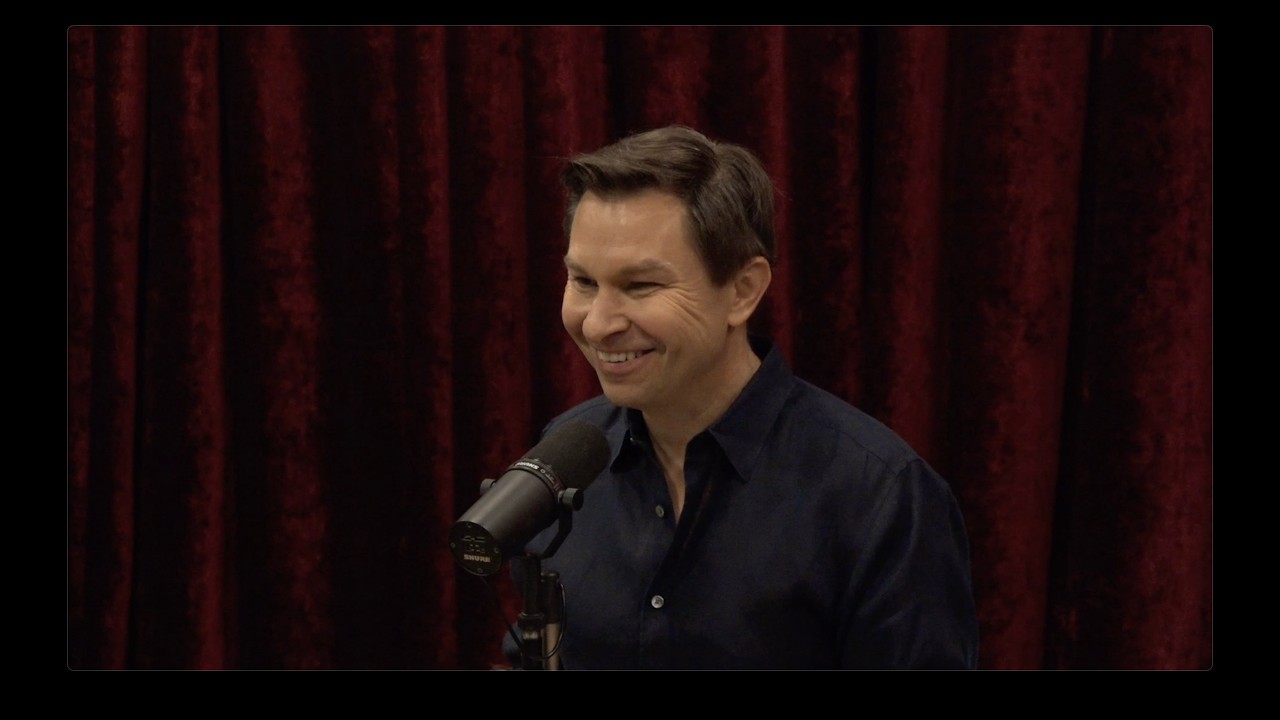
David Sinclair Links GLP-1 Drugs to Doubled Eye-Stroke Risks
PowerfulJRE
Harvard geneticist David Sinclair warns that widespread adoption of GLP-1 weight-loss drugs doubles cases of non-arteritic anterior ischemic optic neuropathy, even as his laboratory advances gene therapies aimed at reversing cellular aging and tissue loss.
## Background
Published on YouTube by PowerfulJRE on August 7, 2026, this episode of the Joe Rogan Experience features longevity scientist Dr. David Sinclair. The video description highlights Sinclair's credentials as a Harvard Medical School genetics professor, author of "Lifespan," and host of the "Lifespan" podcast, while providing links to his books, foundation, and episode sponsors.
## TL;DR
Dr. David Sinclair and Joe Rogan explore cutting-edge longevity science, discussing cellular reversal therapies, gene therapy trials for vision loss, and the role of novel compounds like (+)-JRT and PDE5 inhibitors in healthspan extension. They examine actionable lifestyle habits, including fasting, strength training, sleep hygiene, and avoiding alcohol to reduce biological age. The conversation also touches on AI's transformation of medical research, the genetic roots of human risk-taking, and the broad systemic impacts of GLP-1 drugs.
## Atmosphere & style
The discussion is intellectually fast-paced, highly collaborative, and energized by mutual curiosity about peak human performance and biological optimization. Rogan grounds the exchange with visceral personal anecdotes, biohacking experiments, and practical skepticism, while Sinclair provides high-level scientific expertise delivered with pragmatic enthusiasm. The atmosphere balances deep technical dives into genetics and pharmacology with candid, accessible conversations on everyday health habits, parenting, and resilience.
## Key takeaways
- [47:40](https://www.youtube.com/watch?v=hxid7FofhMw&t=2860s) Sinclair's lab successfully cultivated human hair on specialized immune-compatible mice using human stem cells.
- [49:18](https://www.youtube.com/watch?v=hxid7FofhMw&t=2958s) Low-dose PDE5 inhibitors like tadalafil improve vascular blood flow, assist with hair retention, and suppress tumor-shielding myeloid-derived suppressor cells.
- [53:20](https://www.youtube.com/watch?v=hxid7FofhMw&t=3200s) Human clinical trials are testing gene therapy eye injections for glaucoma and NAION, a condition whose incidence has doubled alongside GLP-1 drug usage.
- [57:26](https://www.youtube.com/watch?v=hxid7FofhMw&t=3446s) Fasting for up to three days triggers chaperone-mediated autophagy (CMA) to accelerate cellular repair and maintenance.
- [01:12:55](https://www.youtube.com/watch?v=hxid7FofhMw&t=4375s) The Harvard Study of Adult Development identified a supportive partner as the single strongest predictor of long-term health and lifespan.
- [01:21:47](https://www.youtube.com/watch?v=hxid7FofhMw&t=4907s) AI models and automated robotics are dramatically accelerating longevity drug discovery by analyzing vast scientific literature and running rapid experimental candidate testing.
- [01:31:38](https://www.youtube.com/watch?v=hxid7FofhMw&t=5498s) Non-hallucinogenic analogs of psychedelics, such as (+)-JRT, show high antidepressant potential and induce neuroplasticity without hallucinogenic effects.
- [01:36:00](https://www.youtube.com/watch?v=hxid7FofhMw&t=5760s) The DRD4-7R gene variant is strongly tied to risk-taking and novelty-seeking behaviors and is present in nearly half of populations in the Americas.
- [02:00:14](https://www.youtube.com/watch?v=hxid7FofhMw&t=7214s) Gene therapy can reboot dormant, non-functioning nerve endings in aging eyes back to a youthful functional state without reverting them to stem cells.
- [02:01:00](https://www.youtube.com/watch?v=hxid7FofhMw&t=7260s) Deep sleep triggers the glymphatic system to flush out metabolic waste and misfolded proteins from the brain.
- [02:06:37](https://www.youtube.com/watch?v=hxid7FofhMw&t=7597s) Regular resistance training and mild hormetic environmental stressors (such as hypoxic and heat exposure) trigger cellular repair and help prevent sarcopenia.
- [02:12:27](https://www.youtube.com/watch?v=hxid7FofhMw&t=7947s) Preserving cerebral microvascular health through exercise, PDE5 inhibitors, and NAD+ precursors like NMN is essential for preventing vascular dementia.
## Detailed walkthrough
Here is a detailed, faithful walkthrough of the provided transcript segment.
### [00:01](https://www.youtube.com/watch?v=hxid7FofhMw&t=1s) Informal Greetings and "Sir David"
The show opens with Joe Rogan welcoming back Dr. David Sinclair, a Harvard geneticist and longevity researcher. They immediately fall into a lighthearted exchange regarding titles and honors. Rogan jokes about whether Sinclair ever uses the title "Doctor," which Sinclair says he never does. Sinclair quips that he is technically "Sir David" in Australia, having been granted a version of a knighthood that allows him to put "AO" after his name, standing for Officer of the Order of Australia. He clarifies that it is mostly an honorable title that doesn't actually change his daily life, comparing it to calling someone "Sir" at a gas station.
Sinclair explains the cultural phenomenon of "tall poppy syndrome" in Australia, where displaying an oversized ego gets you brought down to Earth quickly—often physically in the schoolyard. He shares that he enjoys going back home to Australia because nobody treats him as someone famous or special, creating an even playing field. Rogan expresses his affection for the Australian people, describing them as friendly, fun, and grounded, though both agree that the travel distance from the U.S. to Australia is a brutal haul.
- **Title/Honor:** Officer of the Order of Australia (AO).
- **Cultural reference:** "Tall poppy syndrome," where high achievers or those with large egos are cut down or humbled by their peers.
---
### [01:40](https://www.youtube.com/watch?v=hxid7FofhMw&t=100s) Clean Living, Superfood Coffee, and the "Prophet of Longevity"
Discussing long-distance flights, Rogan mentions how he used to combine whiskey and Ambien to sleep through the travel, but notes he has "gone clean" and rarely drinks alcohol anymore except for special celebrations. Sinclair agrees that drinking during a podcast would be a bad look for him, gesturing instead to the superfood coffee Rogan provided. Rogan details the mix: a blend of Black Rifle Coffee and Laird Superfood additives created by Laird Hamilton, containing turmeric and coconut milk. Sinclair notes that turmeric is a powerful anti-inflammatory, perfectly aligning with his own scientific work on health and aging.
Jokingly, Sinclair accepts Rogan’s ribbing, allowing himself to be called "Sir David the prophet of longevity." Rogan highlights that this is Sinclair's fourth appearance on the podcast, congratulating him on his ongoing achievements. Sinclair takes a moment to thank Rogan personally, emphasizing that his book *Lifespan* became a massive global bestseller—translated into 40 languages and read millions of times—largely due to the exposure from his first interview on the show. Sinclair notes that writing high-tech science for a general audience was a challenge, but people have become intensely fascinated by personal optimization.
- **Coffee blend:** Black Rifle Coffee mixed with Laird Superfood (featuring turmeric and coconut milk).
- **Book impact:** *Lifespan: Why We Age—and Why We Don't Have To* reached millions globally across 40 languages.
---
### [03:34](https://www.youtube.com/watch?v=hxid7FofhMw&t=214s) The Post-2019 Longevity Explosion
Sinclair and Rogan reflect on how public perception of health and mortality shifted dramatically around 2019 and 2020. Sinclair notes that when *Lifespan* came out in late 2019, the impending global pandemic forced people under 70 to confront their own mortality for the first time, causing interest in longevity to explode. Rogan observes that optimizing health is now ubiquitous: everywhere he goes, people are discussing protocols like cold plunges, saunas, and red-light therapy. Rogan points out that the primary benefit of these protocols is feeling better in the present moment, which naturally extends lifespan as a byproduct.
Sinclair agrees, emphasizing that living longer doesn't require extreme or overly complicated measures. He asserts that by following basic principles, individuals can easily add 15 years to their lives. Beyond simple daily habits, Rogan steers the conversation toward the cutting edge of formal longevity science, asking about the revolutionary biological treatments that have moved from theory into reality since 2019.
---
### [05:26](https://www.youtube.com/watch?v=hxid7FofhMw&t=326s) Human Age-Reversal Clinical Trials
Sinclair discusses how the field of longevity has advanced at a breakneck pace. In 2019, publicly claiming that biological aging could be reversed was viewed as scientific heresy. However, following successful trials in mice and monkeys, the very first human clinical trial for age reversal is actively underway. Sinclair explains that aging has a single root cause present across almost every cell in the body, and that scientists can now safely control and reset that process, effectively reinstalling the body's youthful cellular software.
To illustrate how these therapies are delivered, Sinclair pulls a physical model out of his pocket—a rubber ball with spikes resembling a domesticated, non-pathogenic viral capsid. He explains that these engineered viral vectors carry targeting adapters on their surface. By changing these surface proteins, researchers can direct the delivery vehicle to specific tissues, such as the liver or the eye. Inside the protein capsule sits a specialized DNA payload designed to execute epigenetic reprogramming.
- **Delivery System:** A domesticated viral vector (AAV-style capsid) modified with surface proteins to target specific organs or cell types.
- **Trial Application:** Currently being delivered via direct injection into human eyes to treat vision loss caused by glaucoma.
- **EPG Drug Name:** Referred to as OSK or ER100 (Epigenetic Reprogramming 100).
---
### [09:05](https://www.youtube.com/watch?v=hxid7FofhMw&t=545s) The First Human Patient and the "Backup Copy" of Youth
Rogan jokes that a scientist explaining viral delivery vectors on a talk show sounds like the opening scene of a apocalyptic horror movie where optimized humans end up eating each other 28 days later. Sinclair laughs, acknowledging the sci-fi nature of the work, but stresses that the trial is FDA-approved after rigorous safety testing. Because the treatment is injected directly into the eye—a self-contained organ—there is minimal risk of systemic spread or uncontrolled growth.
Sinclair shares that he witnessed the very first human patient receive the injection earlier in the year. The patient, who was essentially blind in one eye due to glaucoma, bravely volunteered for the procedure. Sinclair reports that the trial is proceeding as planned with zero adverse safety issues so far. He describes a fundamental concept driving his lab's work: the belief that every cell retains a "backup copy of youth." Rather than seeing elderly people as permanently deteriorated, Sinclair views them as biological systems that simply need to be "rebooted" so their cells can read the original genomic software again.
> "Even an old person, I don't see an old person anymore on the street. I just see a person that needs to be rebooted."
---
### [11:53](https://www.youtube.com/watch?v=hxid7FofhMw&t=713s) Yamanaka Factors, OSK, and Reversing Damage
Sinclair explains the cellular mechanism behind epigenetic reprogramming by contrasting his approach with the discovery made by Nobel laureate Shinya Yamanaka in 2006. Yamanaka discovered four genes (Oct4, Sox2, Klf4, and c-Myc) capable of resetting adult skin cells all the way back to embryonic-like stem cells. However, turning a living person’s cells into stem cells would cause mass organ failure or cancer. To solve this, Sinclair’s lab omitted the dangerous fourth gene (c-Myc) and used only three genes: Oct4, Sox2, and Klf4, collectively known as **OSK**.
Using OSK resets cellular age back roughly 75% to 80% toward youth without wiping out the cell's identity. Sinclair uses the analogy of an old vinyl record or CD: aging is like scratches on the surface that make the music skip, while OSK acts as a polish that removes the scratches so the cell can read its original information again. In young adults in their 20s, cell identity and performance are at peak performance; as people age, cells lose their identity and forget how to function. By restoring this identity, OSK enables damaged optic nerves to regenerate and function like young tissue.
- **Yamanaka Factors:** Oct4, Sox2, Klf4, and c-Myc (OSK+M).
- **Reprogramming Cocktail (OSK):** Leaves out c-Myc (M) to safely reverse cellular age by ~80% without converting mature cells into unspecialized stem cells or causing tumors.
---
### [13:44](https://www.youtube.com/watch?v=hxid7FofhMw&t=824s) Treating Injury, Glaucoma, and Joint Restoration
Sinclair notes that while he initially wanted to target the liver, his student Yuancheng Lu convinced him in 2017 that starting with the eye was a safer proof-of-concept. With glaucoma affecting roughly 40 million people in the U.S. alone—and macular degeneration affecting even more—the human health impact is massive. Rogan asks whether this "backup copy" mechanism could also be used to repair physical trauma or joint damage. Sinclair reveals that his lab had already published a cover story in *Nature* (2020) demonstrating optic nerve regeneration after severe injury.
Furthermore, Sinclair highlights recent independent work from a research group in China that took his team's OSK technology and delivered it into mice with damaged, arthritic joints, resulting in full regeneration of muscle and bone tissue back to normal. Sinclair notes that his lab is actively pursuing treatments for back injuries, joint damage, and osteoarthritis. Rogan expresses excitement, noting that while current treatments like stem cell therapy offer minor symptomatic relief, they fail to truly rebuild destroyed cartilage or fully restore joints damaged by sports or martial arts injuries.
[16:05](https://www.youtube.com/watch?v=hxid7FofhMw&t=965s) The Future of Joint Regeneration, Super Soldiers, and Bio-Regulatory Obstacles
Joe Rogan and Dr. David Sinclair examine the horizon of joint reconstruction and cellular rejuvenation, contemplating its downstream effects on elite athletics. Rogan marvels at a future where athletes could perform supernatural physical feats—like dunking from halfway across a basketball court like Michael Jordan—if age-reversing genetic tools become widespread. Sinclair reveals that his lab at Harvard Medical School is already nearly eight years ahead of public awareness, actively developing both a pill and a liquid drink designed to trigger systemic rejuvenation.
When Rogan playfully suggests bypassing FDA regulations to distribute these untested treatments immediately to willing 80-year-olds who have nothing to lose, Sinclair admits that public demand is already overwhelming. He has had to remove his public contact information because desperate individuals—including one fan who refused to leave his building until they met face-to-face—frequently seek early access. The conversation turns to national security when Sinclair discloses that the U.S. government used regulatory authorities to block a $160 million foreign investment into one of his biotechnology companies out of concern over creating "super soldiers" or leaking dual-use genetic tech abroad.
- **OSK Gene Testing:** Future athletic commissions may need to screen competitors via DNA tests to detect illicit insertions of OSK (*OCT4*, *SOX2*, *KLF4*) reprogramming factors.
- **Foreign Investment Blocking:** The U.S. government blocked a $160M foreign investment in Sinclair's biotech firm, citing defense and security concerns over performance-enhancing rejuvenation technologies.
---
[19:10](https://www.youtube.com/watch?v=hxid7FofhMw&t=1150s) Soviet Hybridization Programs, Ethics, and Human Engineering
The discussion transitions into historical and modern efforts to engineer enhanced humans or animal-human hybrids. Rogan recounts historical accounts of Soviet attempts during World War II to create chimpanzee-human hybrids as tireless, pain-resistant combatants to replace massive troop losses. The duo review a 2002 paper by historian of science Kirill Rossiianov detailing biologist Ilya Ivanov's ill-fated 1920s interspecies breeding experiments under Joseph Stalin.
Sinclair notes that while cross-species work remains strictly regulated in Western countries, ethical boundaries vary globally. He references modern scientific demonstrations where researchers created hybrid human embryos that were halted before full development. They contrast these lab experiments with commercial genetic selection already available to wealthy parents today in the U.S., who selectively screen embryos via IVF for traits like height, intelligence, and physical appearance—a dynamic reminiscent of the sci-fi movie *Gattaca*.
- **Ilya Ivanov's Experiments:** In the 1920s, Soviet biologist Ilya Ivanov attempted to crossbreed humans and non-human primates to test the boundaries of hybridization.
- **Modern Embryonic Selection:** Parents in the U.S. routinely utilize preimplantation genetic testing (PGT) during IVF to select for specific physical and cognitive traits.
---
[23:54](https://www.youtube.com/watch?v=hxid7FofhMw&t=1434s) Autonomous Robotics, AI Companionship, and Social Dynamics
Shifting from biological engineering to technological advancement, Rogan and Sinclair discuss the deployment of humanoid robotics and artificial intelligence. They contemplate a future where autonomous anthropoid robots are deployed to military battlefields or assigned to household chores. Sinclair jokes about the weirdness of telling a domestic robot—which possesses more computational power than all of humanity combined—to go load the dishwasher.
The conversation steers into the social and psychological ramifications of AI companions and sex robots. Rogan argues that while hyper-agreeable AI companions offer effortless validation, real human relationships derive their value from friction, constructive criticism, and personal accountability. An AI that constantly praises a user removes the essential challenges that drive emotional maturity and human growth.
- **AI Interaction Dynamic:** Rogan emphasizes that real-world relationships require discomfort and feedback to foster personal development, whereas AI provides artificial, unconditional validation.
---
[26:13](https://www.youtube.com/watch?v=hxid7FofhMw&t=1573s) Accelerating Drug Discovery: Trillion-Molecule Virtual Screening
Sinclair breaks down how artificial intelligence has transformed molecular biology and drug development in his Harvard laboratory. Tasks that previously required up to 160 years of manual bench work can now be accomplished in just two months. By leveraging high-performance compute clusters alongside structural protein predictions from Google DeepMind's AlphaFold database—which maps over 20,000 human proteins—his team can virtually dock vast libraries of candidate compounds against targeted intracellular enzymes.
Partnering with researchers at St. Jude Children's Research Hospital, Sinclair's lab screened a virtual library of roughly one trillion theoretical and known molecules. They sought a single therapeutic compound capable of executing three to four distinct anti-aging mechanisms simultaneously—a complex task historically beyond traditional pharmacology. Using AI image recognition, his team monitors cultured human skin cells to evaluate whether treatments successfully reset 92-year-old cellular profiles back to a 20- or 25-year-old biological state.
- **Virtual Screening Scale:** Sinclair's lab computationally screened a virtual library of up to 1 trillion candidate molecules down to 200 high-priority leads for direct testing on human cells.
- **Lab Scale:** Sinclair operates a specialized core team of approximately 20 students and researchers at Harvard Medical School.
---
[30:33](https://www.youtube.com/watch?v=hxid7FofhMw&t=1833s) Cellular Reprogramming Mechanics: Yamanaka Factors and Epigenetic Clocks
Rogan asks how scientists ensure that cellular rejuvenation halts at an optimal age—around 20 to 25 years old—rather than reverting cells back to an embryonic state or forming tumors. Sinclair explains that the breakthrough came from refining the Nobel Prize-winning Yamanaka factors (*OCT4*, *SOX2*, *KLF4*, and *c-MYC*). His former student, Lu Wang, tested various gene combinations to achieve safe cellular reset.
The key discovery involved entirely omitting the oncogenic *c-MYC* gene, leaving the specific three-factor cocktail known as **OSK** (*OCT4*, *SOX2*, *KLF4*). This precise combination safely resets cellular age without wiping away cellular identity or driving pluripotency into tumor formation. Sinclair notes that while telomere length offers some indication of biological age, measuring DNA methylation patterns—the precise addition and removal of methyl groups ($-\text{CH}_3$) across the genome—provides a far more accurate "epigenetic clock" for tracking reversal.
- **The OSK Factor Cocktail:** Reprogramming uses three of the four Yamanaka factors—*OCT4*, *SOX2*, and *KLF4*—explicitly excluding the cancer-causing *c-MYC* gene.
- **Epigenetic Methylation:** Biological age is measured by tracking methyl tags attached directly to DNA, serving as a precise biological clock that can be reversed using genetic or chemical intervention.
[31:41](https://www.youtube.com/watch?v=hxid7FofhMw&t=1901s) Epigenetic Clocks and the "Dark Side" of Rapid Aging
The biological mechanism governing cellular identity hinges on methyl groups. During embryonic development, these chemical tags silence unwanted genes—causing developing neurons to permanently shut off liver or skin genes while keeping nerve-specific genes active. In 2013, Steve Horvath discovered that tracking these methyl patterns functions as a precise biological clock. David Sinclair explains that his lab published research in 2023 demonstrating how DNA damage (such as exposure to solar radiation) degrades these patterns over time, accelerating the aging process. Sinclair notes that scientists now possess the ability to rapidly age mice—a dynamic Joe Rogan jokingly frames as the ultimate assassination or sabotage plot: a state actor spiking someone's drink to make them age decades overnight.
```
DNA METHYLATION & THE EPIGENETIC CLOCK
[ Embryonic Cell ] --( Methyl Tags Applied)--> [ Specialized Neuron ]
| |
| ( Aging / Solar)
v v
Unused Genes Silenced Loss of Epigenetic Pattern
(e.g., Liver/Skin Genes) --> Epigenetic Clock Ticks
```
The discussion shifts to a speculative cultural future where age is no longer visible on a person's face. Rogan and Sinclair banter about social reactions to massive age gaps in relationships. If a 92-year-old were restored to a 25-year-old physical state, societal taboos around age-gap dating might transform into jealousy over centuries of accumulated wisdom. Rogan jokes that people would start lying about their age in reverse—claiming to be 80 or 90 to flex their longevity—while Sinclair predicts a future where biological testing of epigenetic markers will be the only way to determine a person's true age.
- In 2023, David Sinclair’s lab published research demonstrating that targeted DNA damage can rapidly accelerate biological aging in mice.
- Steve Horvath developed the "Horvath Clock," measuring DNA methylation patterns to accurately track biological age across tissues.
- Advanced epigenetic tracking allows biological age to be accurately measured using simple skin swabbings or blood samples.
---
[34:10](https://www.youtube.com/watch?v=hxid7FofhMw&t=2050s) Ancient Civilizations, King Lists, and Lost Human Lifespans
Rogan steers the conversation toward alternative archaeology, bringing up ancient Sumerian king lists that record monarchs reigning for thousands of years before a catastrophic global flood. Standard mainstream historical narratives view these timelines as mythological hyperbole. However, Rogan posits an alternative theory: if advanced human civilizations reached engineering peaks in the distant past—evidenced by massive megalithic structures like the Pyramids, Machu Picchu, Sacsayhuamán, and the Trilithon stones in Baalbek—it is plausible they also unlocked genetic engineering and life extension technologies before being reset by a catastrophic comet impact.
> "Imagine if you had 500 years to do research, not just 57 years... The exponential increase in technological innovation that we would have in this society would be absolutely mind-blowing."
Sinclair addresses the theory with academic diplomacy, noting that while he sticks strictly to established scientific evidence as a Harvard professor, history consistently shows that ancient civilizations were far more sophisticated than modern humans give them credit for. The two discuss how radically life would change if living to 100 meant remaining in one's physical prime. Human expectations regarding careers, marriages, and families would expand into multiple distinct lifespans. Sinclair compares our current biological threshold to the early days of aviation, noting that humanity has already built the basic "glider" of longevity, making dramatic life extension an inevitable certainty rather than a speculative dream.
- **Sumerian King List:** Ancient Mesopotamian records detailing pre-flood monarchs who allegedly ruled for multi-thousand-year spans.
- **Baalbek Trilithon:** A set of three massive stone blocks in Lebanon, each weighing roughly 800 tons, raised meters off the ground with precision engineering.
- **Societal Impact:** Extending healthy human lifespans to hundreds of years would reshape career structures, relationships, and long-term scientific innovation cycles.
---
[39:24](https://www.youtube.com/watch?v=hxid7FofhMw&t=2364s) The 60-Year-Old Illusion and Biological Dysmorphia
The physical trajectory of a 57-year-old today is radically different from that of a 57-year-old in the 1930s. Rogan points out that a century ago, a 60-year-old was functionally considered near the end of life due to heavy smoking, alcohol consumption, lack of basic nutritional knowledge, exposure to pesticides, and minimal emphasis on sleep or resistance training.
```
LIFESTYLE FACTORS OVER TIME
1930s Average 60-Year-Old Modern Optimized 60-Year-Old
+-----------------------------------+ +-----------------------------------+
| - Heavy Smoking & Alcohol | | - Resistance Training |
| - Nutritional Deficiencies | VS | - Targeted Supplementation |
| - Unregulated Toxic Exposure | | - Optimized Sleep & Phototherapy |
+-----------------------------------+ +-----------------------------------+
```
During the episode, producer Jamie pulls up a viral media account featuring Chuando Tan, a Singaporean photographer who gained worldwide fame for appearing 30 despite being nearly 60 years old. Rogan and Sinclair react with equal parts skepticism and amazement, debating whether such extreme youthfulness comes down to incredible genetic luck, plastic surgery, or AI generation. This leads into a broader discussion on body dysmorphia and how the modern cosmetic industry skews public perception of physical age. Sinclair emphasizes that surgical modifications only alter surface appearance, whereas true biological reversal requires restoring cellular youth from within.
- Chuando Tan, a Singaporean photographer, went viral globally for maintaining the physical appearance of a 25-to-30-year-old into his late 50s.
- Early 20th-century life expectancy and vitality were severely limited by lifestyle factors like poor sleep, unrefined diets, and heavy environmental toxicity.
---
[41:40](https://www.youtube.com/watch?v=hxid7FofhMw&t=2500s) The Secret Reversal Cocktail, TET Genes, and Erasing Alzheimer's
Sinclair shares updates from his laboratory, revealing details about a three-component therapeutic cocktail currently being tested on mice. Administered as a liquid three days a week over a single month, the treatment produced remarkable physical and cognitive improvements in aged mice. Rather than acting as a short-term stimulant, the cocktail operates by manipulating TET enzymes ($TET1$, $TET2$, $TET3$), which physically erase the methyl groups cluttering the genome. This process effectively rewinds the biological clock and restores youthful cellular function.
> "When you move the hands of the clock, time goes backwards for the body. Meaning the clock is aging. And aging is the clock."
The cognitive implications of this molecular "reboot" are profound. Sinclair explains that reversing the age of a mouse's brain restores lost memory functions, suggesting that neurodegenerative conditions like Alzheimer's disease may not destroy memories entirely, but rather block access to them. By reversing the biological age of brain tissue, the body regains its innate ability to repair itself and regain lost functions, just as a young child rapidly heals from physical injuries. Sinclair notes that topical applications of this cocktail applied to the skin of aged mice restored youthful wound healing speed, paving the way for targeted medical and dermatological therapies in humans.
- **Dosing Protocol:** Mice were given the experimental cocktail once a day, three days a week (Monday, Wednesday, Friday), producing measurable physical and cognitive age reversal in 4 weeks.
- **TET Enzymes ($TET1, TET2, TET3$):** Specialized proteins responsible for demethylating DNA, essential for resetting cellular age markers.
- **Alzheimer's Hypothesis:** Sinclair proposes that memory loss in neurodegenerative diseases may be reversible by restoring youthful cellular state rather than simply treating symptoms.
<FollowUp label="Want to dive into the specifics of how TET enzymes remove methyl groups from DNA?" query="Explain the molecular mechanism of TET enzymes (TET1, TET2, TET3) and how demethylation resets cellular age."/>
Here is a detailed, faithful walkthrough of the provided transcript segment:
[47:40](https://www.youtube.com/watch?v=hxid7FofhMw&t=2860s) Lab-Grown Human Hair on Mice and Biohacking Hair Transplants
David Sinclair reveals that his lab is one of the few in the world capable of growing actual human hair on mice, explaining that they engineer it from human stem cells to create little "balls of hair" over several months. They unroll these into flat pieces of human skin and graft them onto mice bred to accept human tissue, resulting in tufts of real black human hair growing out of the rodents. When Joe Rogan jokes about wanting a "Colin Kaepernick type" afro just to mess with people, Sinclair chuckles and confirms they could theoretically grow any hair style. While Sinclair briefly considered commercializing the process, he notes that traditional hair transplants remain simpler.
This leads Rogan to describe his own experience getting a hair transplant, humorously comparing the procedure to moving healthy people into a dying town where everyone else perishes. He points out the biological limitations: patients can only migrate a finite amount of hair from the dense back of their head to the top, which often leaves men with an unnaturally strong hairline up front followed by a chaotic, thinning landscape behind it.
- **Lab process:** Human stem cells are cultured into hair-bearing skin over months and grafted onto specialized immune-compatible mice.
- **Instagram controversy:** Sinclair posted a photo of the human-hair-bearing mouse on Instagram, but Harvard immediately ordered him to take it down.
[49:18](https://www.youtube.com/watch?v=hxid7FofhMw&t=2958s) Tadalafil, Nitric Oxide, and New Cancer Research
Sinclair shares his personal hair-preservation strategy: taking a daily low dose of 7 mg of tadalafil (generic Cialis). Beyond hair loss, they discuss how erectile dysfunction (ED) medications function via nitric oxide signaling to dilate blood vessels, which improves overall endurance and cardiovascular health. Sinclair highlights brand-new research showing that these PDE5 inhibitors make mice—and potentially humans—significantly more resistant to specific malignancies like head and neck cancers through two distinct non-vascular mechanisms. First, tadalafil inhibits myeloid-derived suppressor cells (MDSCs) that normally protect tumors from immune attacks, allowing the immune system to shrink the tumor. Second, sildenafil (Viagra) starves cancer cells by blocking their ability to utilize cholesterol.
Rogan recalls that Viagra was originally developed as an angina and blood pressure medication by accident. Sinclair confirms the famous story: male trial participants refused to give back their leftover study pills because roughly 75% experienced dramatic improvements in erection quality compared to just 22% on placebo. When Rogan asks how tadalafil specifically helps hair, Sinclair explains that loss of scalp blood flow is a primary cause of hair follicle death—which is why vasodilator treatments like topical minoxidil work, often paired with oral DHT inhibitors like dutasteride.
- **ED drug cancer benefits:** Tadalafil suppresses tumor-shielding MDSCs; sildenafil blocks cholesterol uptake by cancer cells.
- **Dutasteride warning:** Rogan notes a friend developed severe, suicidal depression on DHT blockers that vanished completely as soon as he stopped taking the drug.
[53:20](https://www.youtube.com/watch?v=hxid7FofhMw&t=3200s) Human Clinical Trials and GLP-1 Side Effects
Addressing how therapies are validated for broad human use, Sinclair stresses that individual biological responses vary wildly and all medications require strict medical supervision. Regarding his own lab's gene-therapy research aimed at reversing cellular aging, Sinclair reveals that human clinical trials have already begun by delivering targeted genes directly into the eye. Bound by regulatory restrictions, he carefully notes that "everything's on target" and there is "nothing bad to report." The initial trials target glaucoma as well as non-arteritic anterior ischemic optic neuropathy (NAION)—a form of sudden blindness referred to as an "eye stroke."
Sinclair highlights alarming new data showing that cases of NAION have doubled globally due to the widespread adoption of GLP-1 receptor agonist drugs like Ozempic and Wegovy. Rogan expresses shock, criticizing online influencers and podcasters with financial stakes who blindly promote GLP-1s as risk-free magic bullets.
- **NAION details:** A sudden, painless loss of vision in one eye caused by restricted blood flow to the optic nerve; the condition can subsequently strike the second eye with no known cure.
- **GLP-1 risk statistics:** A cited study indicates patients on certain GLP-1 drugs are up to 68.6 times more likely to develop NAION, with an estimated incidence of roughly 1 in 10,000 users.
[57:26](https://www.youtube.com/watch?v=hxid7FofhMw&t=3446s) The Nuance of GLP-1s, Fasting, and Carnivore Diets
Despite the risks, both men acknowledge that GLP-1 drugs have saved millions of lives by curbing severe obesity and food addiction. Sinclair shares a personal story: historically unable to fast for more than a single day due to nighttime snacking cravings, he briefly used a GLP-1 receptor agonist to break his psychological dependence. Once he experienced a successful fast, he discontinued the medication and can now easily complete a two-week fast purely on mental momentum.
Rogan agrees that momentum is the essential companion to discipline when transforming one's life. He explains that his own approach to effortless fasting is maintaining a mostly carnivore-based diet—primarily meat along with fermented vegetables like kimchi and sauerkraut. By avoiding high-carbohydrate spikes and stabilizing insulin, Rogan experiences zero aggressive hunger pangs and can fast 24 hours without effort. Sinclair encourages Rogan to attempt a 3-day fast to trigger chaperone-mediated autophagy (CMA)—a cellular "deep cleansing" process researched by Dr. Ana Maria Cuervo in New York that degrades and recycles old, damaged proteins.
- **Fasting benefits:** Extended fasting triggers CMA to clean out cellular waste, renew internal protein structures, and extend healthspan.
- **Ketosis & mental clarity:** Rogan emphasizes that keeping his body in ketosis eliminates brain fog and dramatically sharpens his focus and memory recall during long broadcasts.
[01:01:55](https://www.youtube.com/watch?v=hxid7FofhMw&t=3715s) Exogenous Ketones and Brain Function During Exhausting Workouts
Sinclair relates to the mental exhaustion of hosting solo podcasts, revealing that he must retain hundreds of scientific papers in his head. To combat cognitive fatigue when he cannot fast, Sinclair drinks exogenous ketones like Ketone-IQ. Rogan enthusiastically agrees, sharing that he frequently drinks Ketone-IQ and takes nootropics before commentating live UFC events.
Rogan describes the intense cognitive load of commentating a six-hour live UFC event: constantly analyzing dynamic exchanges, identifying thousands of technical jiu-jitsu positions in real time (such as spotting a Peruvian Necktie), and recounting fighter histories on air. He notes that by the end of a six-hour broadcast, his brain is so thoroughly drained that he experiences ravenous hunger.
- **Cognitive stack:** Rogan relies on Ketone-IQ alongside custom nootropic blends like Gorilla Mind (formulated by his friend Derek) and Alpha Brain Black Label to maintain peak mental sharpness throughout grueling live commentary.
<Elicitation label="Explore the mechanisms behind chaperone-mediated autophagy (CMA)" query="Explain the biological mechanisms behind chaperone-mediated autophagy (CMA), how extended fasting triggers it, and its benefits for longevity."/>
[01:03:32](https://www.youtube.com/watch?v=hxid7FofhMw&t=3812s) Armodafinil, Nootropics, and Beating Jet Lag
Joe Rogan and Dr. David Sinclair discuss the use of wakefulness-promoting agents like modafinil (Provigil) and armodafinil (Nuvigil) alongside other cognitive enhancers. Joe recalls using Provigil and Nuvigil in the past to stay sharp on long night drives after late-night comedy gigs—such as driving two and a half hours back from San Diego at 1:00 AM—noting that unlike caffeine, it allowed him to sleep comfortably once he finally made it home. Sinclair mentions using armodafinil during long-distance travel for international speaking engagements, explaining that it effectively eliminates his jet lag and sharpens his focus when his mind feels scattered.
The discussion shifts to physical strategies for resetting the body clock. Joe explains that his primary cure for severe jet lag is intense exercise that elevates his heart rate to 150–190 BPM for 15 to 20 minutes, such as Tabata sprints on an Airdyne bike or heavy kettlebell circuits. Sinclair agrees that physical exertion functions as a form of hormesis—placing the body under mild, beneficial stress to trigger survival mechanisms.
- **Nootropics & Compounds:** Joe mentions using NeuroGum; Sinclair utilizes armodafinil (Nuvigil) for public speaking and long-haul travel.
- **Cardiovascular Protocol:** Joe resets his circadian rhythm via high-intensity intervals (Tabata sprints on the Airdyne bike) aiming for heart rates between 150–190 BPM.
---
[01:06:01](https://www.youtube.com/watch?v=hxid7FofhMw&t=3961s) Fitness, Coaching, and Building Momentum
When Joe asks why Sinclair does not exercise at high intensities despite understanding the biological benefits of hormesis, Sinclair humorously admits that he tells himself he is too busy, though he acknowledges the excuse is invalid. He notes that having an accountable partner or a personal trainer would motivate him to maintain a consistent routine.
Joe offers to become Sinclair's personal trainer in exchange for a supply of Sinclair's health supplements. Joe outlines his training philosophy for sedentary individuals, stressing that workouts should start very light to avoid overtaxing the central nervous system or causing injuries. He emphasizes that consistency and slow progress yield sustainable results, citing his friend Jelly Roll, who began his 250-pound weight loss journey simply by walking around his neighborhood and taking the stairs.
- **Trainer Trade-Off:** Joe jokes about trading fitness coaching services for Sinclair's supplement formulations.
- **Gradual Progression:** Joe advises starting with simple movements like 10 push-ups, 10 sit-ups, 10 bodyweight squats, and easy kettlebell cleans rather than training to failure.
- **Jelly Roll Example:** Country singer/musician Jelly Roll lost 250 lbs by starting with basic walking, progressive dietary adjustments, and tracking daily progress.
---
[01:09:56](https://www.youtube.com/watch?v=hxid7FofhMw&t=4196s) Plant-Based Diets vs. Carnivore, Blue Zones, and Longevity
The conversation turns to nutrition, specifically Sinclair’s plant-based diet versus Joe's preference for meat. Sinclair explains his framework of two metabolic states: "abundance mode" (pro-growth, muscle-building, driven by nutrient-dense foods like meat) and "adversity mode" (pro-survival, cellular repair, stimulated by plant-derived molecules, fasting, and exercise). While Joe champions red meat and game like elk as the most nutrient-dense foods available, Sinclair expresses openness to trying an elk steak while monitoring his biomarkers.
Joe raises doubts about the popular concept of "Blue Zones"—regions where people supposedly live exceptionally long lives—pointing out that recent analyses suggest widespread census fraud, unrecorded deaths, and pension exploitation (such as in Okinawa, Japan). Sinclair acknowledges that birth and death records in these regions have often proven unreliable, noting that while verified human maximum lifespan reaches around 117–122 years, extreme longevity rarely stems from strict diet alone.
- **Metabolic Framework:**
- *Abundance Mode:* Growth, repair, anabolic state, supported by animal protein and high calorie availability.
- *Adversity Mode:* Longevity, cellular maintenance, activated by plant compounds, caloric restriction, and exercise.
- **Blue Zone Critiques:** Joe highlights findings that many claimed centenarians in blue zones resulted from delayed death reports to continue collecting pension payments.
- **Max Human Lifespan:** Sinclair notes verified human maximum lifespan tops out near 117–122 years (referencing Jeanne Calment's disputed record of 122 years in France).
---
[01:12:55](https://www.youtube.com/watch?v=hxid7FofhMw&t=4375s) Relationships, Social Connections, and Biological Aging
Sinclair and Joe discuss how psychological well-being, community, and relationships directly impact biological aging. Sinclair cites a long-running Harvard study led by Dr. Robert Waldinger, which tracked World War II veterans over several decades and determined that the single strongest predictor of health and longevity was having a supportive, loving partner.
Conversely, chronic stress from toxic personal relationships or abusive work environments accelerates biological age by elevating systemic cortisol levels and altering DNA methylation patterns. Sinclair shares that the combined stresses of COVID-19 lockdowns in close quarters led to his own divorce, though he has since rebuilt his life with a new partner who shares his passion for longevity research. He compares human stress responses to his childhood observations of aquarium fish, where targeted, subordinate fish exhibited stunted growth, lost coloration, and died significantly sooner.
- **Harvard Grant/Study on Adult Development:** Led by Dr. Robert Waldinger; identified strong, reliable relationships as the primary determinant of long-term health and survival over traditional physiological metrics.
- **Epigenetic Aging & Stress:** Stressful life events like divorces or workplace hostility cause measurable speedups in DNA methylation clocks (epigenetic age).
- **Social Dominance Dynamics:** Stress from relational bullying elevates baseline cortisol, impairing repair pathways across species.
[01:17:12](https://www.youtube.com/watch?v=hxid7FofhMw&t=4632s) Longevity Factors, Twitter, and Social Media Stress
Joe Rogan and David Sinclair discuss the lifestyle factors that contribute to a longer life, building on a major longevity study. Beyond healthy relationships, Sinclair highlights four foundational habits: avoiding smoking, refraining from heavy alcohol consumption, getting sufficient rest, and exercising regularly. Together, these core habits can extend a person's lifespan by up to 15 years. Rogan raises the anomaly of chain-smoking, heavy-drinking centenarians. Sinclair explains that such cases represent a tiny fraction—about 0.01%—and are genetic outliers rather than actionable health models. Instead, true centenarians typically share specific psychological traits, notably low stress levels and a strong sense of humor, along with maintaining a healthy body weight and rarely getting sick.
The conversation naturally shifts to the modern drivers of chronic stress, with Rogan wondering "how much time Twitter takes off your life." Both agree that reading social media comments and constantly consuming world news keeps people in a perpetual state of fight-or-flight. Rogan emphasizes that modern humans were not built to process global catastrophes 24/7 while trying to navigate their daily lives. Sinclair adds that the world does not physically change just because one refrains from reading the news, urging people to concentrate on doing good within their immediate sphere of competence rather than carrying the weight of global problems.
- **5 Major Longevity Factors:** Strong relationships, no smoking, no heavy drinking, adequate rest, and regular exercise (yielding up to 15 additional years of life).
- **Centenarian Outliers:** Extreme longevity in smokers/drinkers accounts for only ~0.01% of the population.
- **Common Traits of Centenarians:** Low stress levels, a good sense of humor, historical lean body weight, and high immune resilience.
---
[01:19:38](https://www.youtube.com/watch?v=hxid7FofhMw&t=4778s) Early Motivations and the Genesis of Sinclair's Research
Addressing the social pressure to fix global issues like climate change, Sinclair recalls an instance where an audience member insisted he should redirect his career toward climate science. His response was simple: "After I cure aging, I'll get to climate change." He explains that his true, lifelong motivation stems from a childhood promise to his grandmother, who escaped Hungary during World War II after surviving the Soviet invasion. When Sinclair was just four years old, she instructed him that humans must strive to make the world a better place. She also bluntly taught him two unsettling truths: that humans can be capable of great evil, and that everyone eventually dies.
That early confrontation with mortality stayed with Sinclair, shaping his life's work. Unlike most children who push the thought of death aside, Sinclair remains acutely aware that approximately 150,000 people die worldwide every day from aging-related diseases. This instills a deep sense of urgency in his Harvard laboratory. He views every delay in research not as a mere setback, but as lost time that could have spared thousands from preventable suffering—explaining why desperate, sick, or visually impaired individuals sometimes show up directly outside his lab seeking early access to experimental therapies.
- **Personal Origin:** Inspired at age 4 by his Hungarian grandmother, a WWII survivor.
- **Global Mortality Metric:** ~150,000 people die every day from aging-related conditions.
- **Lab Culture:** Driven by a mission-oriented approach where research delays carry real-world human costs.
---
[01:21:47](https://www.youtube.com/watch?v=hxid7FofhMw&t=4907s) AI Breakthroughs in Longevity Science
Sinclair describes how artificial intelligence is radically transforming biological research, shifting his lab's work into hyper-drive. Where scientists previously struggled to keep up with reading 15 research papers a day, AI tools now allow labs to digest and synthesize millions of scientific papers simultaneously. To illustrate this power, Sinclair shares a story about a 19-year-old summer intern in his lab. Sinclair tasked the high school graduate with searching global exabytes of genomic data to test a personal theory: that cells retain an internal biological "master copy" or record of their youthful state in their DNA.
Two weeks later, the intern returned with five senior lab team members to present his findings. Using AI to parse massive biological databases, the teenager found what Sinclair calls the "smoking gun" evidence supporting his theory of cellular memory. Rogan expresses amazement that a teenager with an AI tool accomplished what roomfuls of distinguished professors and decorated scientists could not solve for decades. Sinclair notes that the future belongs to those who know how to leverage AI, predicting that people will soon be designing life-saving medicines—or, worryingly, bioweapons—directly from their smartphones.
- **Research Acceleration:** AI allows processing millions of scientific papers instantly vs. a human maximum of ~15 per day.
- **19-Year-Old Intern Discovery:** Used AI over 2 weeks to search exabytes of data and locate evidence for Sinclair's cellular "master copy" memory theory.
- **Future AI Applications:** Smartphone-level AI capability to design both advanced pharmaceuticals and potential bioweapons.
---
[01:23:47](https://www.youtube.com/watch?v=hxid7FofhMw&t=5027s) Bioweapon Concerns and Cellular Reversal
Rogan brings up a terrifying recent episode with author Annie Jacobson regarding nuclear and biological warfare risks. Sinclair agrees that bioweapons are a severe threat, revealing that upon moving to the United States, he had to formally disclose to the U.S. government that his expertise gave him the capability to manufacture bioweapons. To aid biodefense efforts, Sinclair maintains a global database tracking known pathogens and emerging biological threats to help the world respond to future pandemics or artificial outbreaks.
The conversation turns back to the therapeutic promise of cellular resetting. Rogan notes that if humans truly possess a factory-reset record in their genome, science could theoretically eradicate all diseases and reverse physical trauma. Sinclair highlights a recent paper demonstrating that two specific genetic factors allowed newborn mice to regrow severed fingertips after the injury had already healed into a stub. He asserts that humans still carry the ancient genetic machinery required to regenerate limbs—much like salamanders—but our evolutionary path favored rapid scar formation over slow limb regrowth. With gene therapy, Sinclair predicts humans may eventually achieve "Deadpool-like" resilience, becoming immune to aging, resistant to injury, and capable of regenerating lost tissue within a couple of decades.
- **Biodefense Disclosures:** Sinclair maintains a specialized pathogen database to help combat potential biological threats and future pandemics.
- **Limb Regeneration Breakthrough:** Research showed mouse finger tips can regrow using just two specific genetic factors.
- **Future Timeline:** Sinclair estimates practical limb and tissue regeneration in humans could be achievable within two decades.
---
[01:26:37](https://www.youtube.com/watch?v=hxid7FofhMw&t=5197s) The Billionaire Longevity Race and Industry Competition
Rogan asks whether Sinclair feels confident that human age reversal will become a commercial reality. Sinclair expresses immense confidence in the underlying science, noting that while his current clinical trials may or may not hit every milestone, the field itself is unstoppable. He points out that since he founded Life Biosciences to commercialize cellular resetting (using Yamanaka factors like OSK), a massive influx of capital and competing companies has flooded the market.
Sinclair lists major tech figures investing billions into aging research. Jeff Bezos co-founded Altos Labs with multi-billion-dollar funding across three global hubs. OpenAI CEO Sam Altman backed Retro Biosciences, while Coinbase CEO Brian Armstrong founded New Limit. Rogan and Sinclair agree that this fierce competition is fantastic for humanity. Sinclair welcomes the rival labs, emphasizing that his goal isn't personal wealth or glory, but advancing human healthspan globally.
| Company | Key Investor / Founder | Primary Focus |
|:--- |:--- |:--- |
| **Life Biosciences** | David Sinclair | Cellular reprogramming & ER-100 therapies |
| **Altos Labs** | Jeff Bezos | Biological reprogramming and cellular health |
| **Retro Biosciences** | Sam Altman | Age reversal and healthspan extension |
| **New Limit** | Brian Armstrong | Epigenetic reprogramming |
---
[01:28:24](https://www.youtube.com/watch?v=hxid7FofhMw&t=5304s) Engineering Consciousness, Psychedelics, and Ibogaine
Rogan wonders whether science will eventually map the physical brain precisely enough to "engineer consciousness"—curing psychological flaws, sociopathy, or kleptomania by rewiring neural connections. Sinclair confirms that from a biological perspective, mental states are engineering problems that will be addressed this century. However, Sinclair quips that "curing aging is easier than world peace." Rogan argues that expanding human consciousness through psychedelics could accelerate global harmony, citing pharmaceutical giant Eli Lilly’s heavy investment in psychedelic research (including a multi-billion-dollar deal involving ATAI Life Sciences).
Rogan highlights his own advocacy at the White House for an executive order on Ibogaine, explaining how the plant medicine effectively resets the brain for people suffering from severe opioid addiction, traumatic brain injury (TBI), and CTE. Despite its life-saving potential, Ibogaine remains a Schedule I substance in the U.S., which Rogan calls absurd given its lack of recreational appeal and intense 24-hour trip length.
Sinclair and Rogan discuss whether the intense psychological "trip" of psychedelics is necessary to obtain the neurological and therapeutic benefits. Rogan notes that researchers have successfully engineered non-hallucinogenic analogs of LSD and other compounds, preserving the neuroplasticity, cognitive remapping, and therapeutic gains without forcing the patient to undergo a hallucination.
- **Eli Lilly & Psychedelics:** Major pharmaceutical movement into psychedelic-based mental health treatments.
- **Ibogaine for Trauma & Addiction:** Highly effective for opioid addiction, TBI, and CTE, despite being an intense 24-hour non-recreational experience.
- **Non-Hallucinogenic Analogs:** Scientific progress in modifying molecules like LSD to provide structural neuroplasticity and cognitive benefits without inducing hallucinations.
[01:31:38](https://www.youtube.com/watch?v=hxid7FofhMw&t=5498s) Non-Hallucinogenic Psychedelics and the Search for Truth
Joe Rogan and David Sinclair explore the evolving landscape of psychedelic medicine, comparing how society once refined willow bark into aspirin to how scientists are now refining complex natural compounds into targeted pharmaceuticals. While Rogan points out that pharmaceutical companies often syntheticize natural compounds to profit off patents when the original plant might be superior, Sinclair notes that unapproved plant medicines create a wild-west environment where safety and dosage are completely unregulated. The ideal middle ground is finding fast-tracked, proven-safe therapeutics.
The discussion shifts to a study out of UC Davis where researchers engineered an LSD analog designated as (+)-JRT. By swapping the positions of just two atoms in the LSD chemical structure, scientists created a compound that dramatically reduces or eliminates the hallucinogenic trip while preserving neuroplasticity, synaptic growth, and cognitive benefits. In animal models, (+)-JRT demonstrated profound antidepressant effects—reported to be around 100 times more potent than ketamine—and improved cognitive flexibility in tasks modeling the negative symptoms of schizophrenia.
> "It's almost the same molecule as LSD, but scientists swapped the positions of just two atoms in the structure. The subtle change makes JRT bind more selectively to serotonin receptors in a way that promotes neuroplasticity... but minimizes hallucinogenic signaling."
---
[01:36:01](https://www.youtube.com/watch?v=hxid7FofhMw&t=5761s) AI Bullshit Detectors, Brain Implants, and Global Languages
Joking about how hard it is to spot deceptive podcast guests, Sinclair suggests inventing an AI-powered "bullshit detector" that flashes red or green on someone's forehead. Rogan notes that while he has a strong intuition for people after three-hour conversations, some sociopathic personalities are exceptionally skilled at mimicking normal behavior. Rogan envisions a future where technology allows humans to communicate thoughts directly without spoken language, agreeing with Elon Musk's prediction that Neuralink could allow humans to bypass verbal speech and link into a collective mind.
When discussing global communication and real-time translation headphones, Rogan argues that simple translation often loses cultural context and nuance, making a true universal language ideal. While English currently serves as a global lingua franca, Rogan jokingly hopes Mandarin won't take over, given the extreme difficulty of learning and writing Chinese characters.
- **Translation tech limitations:** Real-time audio translation loses contextual meaning, subtle humor, and cultural nuance across languages.
- **Mandarin literacy:** Even fluent non-native Mandarin speakers frequently struggle to learn how to write Chinese characters.
- **Neuralink vision:** Bypassing vocal cords to stream thoughts directly between minds could eliminate linguistic friction entirely.
---
[01:38:00](https://www.youtube.com/watch?v=hxid7FofhMw&t=5880s) The American Mindset, Risk-Taking, and the "FU Gene"
Sinclair shares his experience as an Australian living in the United States, expressing deep gratitude for the American culture of venture capital, ambition, and risk-tolerance. In Australia and much of the rest of the world, social norms and fear of losing money inhibit people from launching bold ventures. In contrast, American investors willingly risk capital on big ideas and accept failure as part of the process.
```
+-------------------------------------------------------------------+
| DRD4-7R ("THE RISK GENE") |
+-------------------------------------------------------------------+
| • Prevalent in 48% of tested chromosomes across the Americas |
| • Present in only ~2% of tested populations in East Asia |
| • Strongly correlated with novelty-seeking and risk-taking |
| • Upregulated during adolescence to drive independence |
+-------------------------------------------------------------------+
```
Pulling up research via Perplexity, Rogan reads about the **DRD4-7R** gene variant—a dopamine receptor allele linked to novelty-seeking, impulsivity, and financial risk-taking. Studies show that this 7R variant is present in roughly 48% of studied chromosomes in the Americas, compared to only 2% in East Asia, likely selected for as migratory human populations pushed further across the globe. Sinclair labels DRD4-7R the "FU gene," explaining that its expression spikes in teenagers to push them out of the nest by making them challenge authority and leave home.
> "I call this the FU gene because I'm trying to figure out what makes humans special over other animals... It turns out that this gene is turned on in teenagers... It's a way genetically to get them out of the nest."
---
[01:43:50](https://www.youtube.com/watch?v=hxid7FofhMw&t=6230s) Modern Parenting, Resentment, and Guiding the Next Generation
Reflecting on the "FU gene" and teenage rebellion, Rogan and Sinclair discuss how parenting approaches have shifted across generations. Rogan shares his philosophy on raising his daughters: rather than issuing authoritarian commands ("listen to me because I'm your father"), he talks openly about his own past mistakes, emphasizing that he lied and messed up just like anyone else. This creates an environment of empathy rather than resentment.
Sinclair shares an anecdote about working with his 19-year-old son, Benjamin, who spent the summer managing social media for Sinclair's podcast and upcoming magazine. When Benjamin slacked off, Sinclair chose not to reprimand him like a standard boss or scream at him like older generations might have. Instead, he appealed to his son's potential, highlighting his past achievements in calculus and weightlifting, which motivated Benjamin to step up without ruining their close relationship.
- **Authoritarian parenting flaws:** Relying on harsh dominance acts as a blunt instrument that fosters deep resentment and drives kids away.
- **Parental vulnerability:** Admitting past personal failures makes advice believable and builds genuine trust.
- **Constructive encouragement:** Pointing out a child's past successes encourages accountability far better than anger.
<ElicitationsGroup message="Explore related concepts from this section:">
{/* Reason: User may want deeper scientific context on the specific topics discussed in this snippet. */}
<Elicitation label="Deep dive into the (+)-JRT study and non-hallucinogenic psychedelics" query="Can you explain the chemistry and mechanism of action behind non-hallucinogenic LSD derivatives like (+)-JRT?"/>
<Elicitation label="Explore the genetics of novelty-seeking and DRD4-7R" query="What does current genetic research say about the DRD4-7R allele, novelty seeking, and human migration?"/>
</ElicitationsGroup>
Parenting Philosophy, Communication, and Raising Driven Children
Joe Rogan and David Sinclair discuss the philosophy of parenting, emphasizing that parents should act as mentors rather than trying to be strict disciplinarians or "best friends." Sinclair shares that he feels incredibly fortunate with how his children turned out—describing them as smart, ambitious, driven, and talented—and notes that they never went through a phase of teenage rebellion where they hated their parents. Sinclair attributes this positive dynamic to open, empathetic communication where he always admitted his own flaws and early mistakes to his kids from a young age.
Rogan reflects on his own experience, noting that with his first child he imitated his own parents by being overly rigid, which resulted in a more rebellious and distant relationship compared to his later children. They agree that a healthy relationship with ambition is far better than motivating children through fear or strictness, and that exposing kids to the real world—such as bringing them to work to experience entrepreneurship—helps ignite their passion.
* **Parenting Approach:** Treat kids like a mentor rather than a strict authoritarian or a permissive best friend.
* **Communication Strategy:** Confess your own past mistakes and foolishness rather than lecturing from a place of perceived perfection.
* **Real-World Exposure:** Involve children in work experiences (like Sinclair's son Ben working with him) to show them what is possible and foster intrinsic motivation.
---
Reading Habits, Audio Consumption, and Red Light Therapy for Vision
The conversation pivots to media consumption, reading habits, and vision improvement. Sinclair laments that kids today tend to endlessly scroll social media rather than read books, noting that he subscribes his children to *National Geographic* to keep the art of reading alive. Rogan admits that about 90% of his own content consumption is through audio due to his busy schedule and active lifestyle involving driving, workouts, saunas, hyperbaric chambers, and red light therapy.
This transitions into a detailed discussion about red light therapy. Sinclair shares his personal breakthrough with red light therapy and near-infrared light devices (such as JUVV medical-grade light panels and a full-body bed from Gary Brecka's company), revealing that it completely eliminated his need for reading glasses. He explains the cellular science: light wavelengths stimulate mitochondria, which reverse aging cellular decline and restore energy production in the eye's nerves.
* **Media Consumption:** Rogan relies heavily on audio (podcasts, audiobooks) while multitasking, though he acknowledges reading physical books engages the brain differently.
* **Vision Recovery:** Sinclair stopped needing reading glasses (progressing from 1x to 2.5x and then ditching them entirely) after using red light therapy consistently for 20 minutes, 3 to 5 times a week.
* **Cellular Mechanism:** Red light and near-infrared wavelengths revive sluggish mitochondria in retinal nerve endings, effectively reminding cells how to function properly.
---
Eye Supplements, Cellular Rejuvenation, and Funding Challenges at Harvard
Sinclair and Rogan discuss eye health supplements like lutein and zeaxanthin (found in products like Pure Encapsulations' macular support), which help protect the retina and prevent degeneration. Sinclair explains the underlying biology of his anti-aging research, noting that around half of the nerve endings in older eyes have merely "forgotten" how to work rather than dying off. By delivering targeted gene therapies, scientists can reboot these cells back to a younger state without turning them into dangerous stem cells.
When Rogan asks about the risks—specifically wondering if making cells younger could trigger cancer—Sinclair reassures him that rigorous animal testing showed no increase in tumors. In fact, research by a PhD student in Sinclair's lab named Natal showed that activating these specific rejuvenation genes inside human cancer cells grown in mice caused the tumors to shrink because the rogue cells recognized they were behaving incorrectly and underwent apoptosis (cell suicide). The conversation concludes with Sinclair sharing a major hurdle: funding for his lab at Harvard Medical School was completely cut the previous year due to political fallout between Harvard and the federal government, forcing them to rely on private donations to keep their research alive.
* **Retinal Health:** Supplements containing lutein and zeaxanthin provide nutritional support for the macula and vision longevity.
* **Cellular Reboot:** Aging neurons in organs like the eye are not dead; they can be successfully reminded of their youthful identity through cellular reprogramming.
* **Cancer Research:** Activating anti-aging genes in cancer cells can cause them to recognize their abnormal growth and self-destruct.
* **Funding Obstacle:** Harvard Medical School lost its federal research funding following political disputes on campus, requiring Sinclair's lab to survive entirely on donations.
By the way, to unlock the full functionality of all Apps, enable [Gemini Apps Activity](https://myactivity.google.com/product/gemini).
[02:00:14](https://www.youtube.com/watch?v=hxid7FofhMw&t=7214s) Funding Longevity Research and Launching Lifespan Magazine
David Sinclair recounts a perilous financial stretch where he nearly had to lay off most of his Harvard laboratory staff due to a lack of federal grant support. Today, his lab survives primarily through private donations, freeing his team from traditional government constraints. Joe Rogan notes that people are eager to fund Sinclair’s work because they recognize his breakthroughs and want to live longer. Sinclair emphasizes his desire to scale up his efforts, testing multiple anti-aging approaches simultaneously across various tissue types rather than relying on a single "shot on goal."
To build a global community and fund ongoing longevity science, Sinclair launched a non-profit foundation accessible via lifespan.com. For a $10 monthly donation, subscribers receive the newly launched *Lifespan* magazine—a publication written directly by scientists rather than journalists to ensure factual accuracy. Sinclair presents Rogan with a special first-edition copy wrapped in a custom velour cover, highlighting the magazine's slogan: "Life's too short. Let's fix that." Sinclair also shares that his lab's research was featured on the cover of *National Geographic* that very day, with the publisher moving up the release date specifically to align with his appearance on the podcast.
- **Website & Foundation:** lifespan.com provides links for tax-deductible foundation donations and community membership.
- **Publication Details:** $10/month subscriber model for *Lifespan* magazine, written by credentialed scientists to bypass misleading media reporting.
- **Slogan:** "Life's too short. Let's fix that."
- **Media Highlight:** *National Geographic* featured Sinclair’s laboratory research on its cover, released early to coincide with the podcast interview.
[02:03:39](https://www.youtube.com/watch?v=hxid7FofhMw&t=7419s) Accelerating Drug Discovery with AI and Robotics
When Rogan asks what could be accomplished without regulatory hurdles or funding constraints, Sinclair laments the frustratingly slow pace of medical development. It took nearly ten years to progress from his laboratory's initial epigenetic reversal discovery published in *Nature* to current human trials—a timeframe he considers tragic given that approximately 150,000 people die worldwide every day from aging-related causes. While artificial intelligence is generating promising drug candidates at unprecedented speeds, testing those molecules through traditional laboratory pipelines creates a massive bottleneck.
Sinclair points to colleagues like Alex Zhavoronkov of Insilico Medicine, whose multi-billion-dollar enterprise uses fully automated robotic labs and AI to advance dozens of candidate molecules into clinical trials rapidly. Sinclair highlights that his own Harvard laboratory operates on a modest budget of roughly $3 million to $3.5 million annually. He argues that boosting funding for longevity science across the field would yield immense global returns, potentially saving trillions of dollars in healthcare expenses in the United States alone.
- **Global Mortality Rate:** ~150,000 deaths occur globally every day, predominantly driven by aging and age-related pathology.
- **Lab Budget:** Sinclair’s laboratory operates on approximately $3 million to $3.5 million annually.
- **Development Bottleneck:** Standard translational pipelines take roughly 10 years to move a discovery from top-tier journals into human trials.
- **Robotic Benchmark:** AI-driven platforms like Alex Zhavoronkov's Insilico Medicine have advanced over 35 AI-designed drug candidates using automated robotic laboratory environments.
[02:07:02](https://www.youtube.com/watch?v=hxid7FofhMw&t=7622s) The Real Cost of Alcohol and Guarding Daily Vitality
Rogan shares a personal story about returning from an overseas trip to Italy jet-lagged, overworking, and experiencing a single day where he felt physically terrible. That experience reminded him how fragile health is and how easily people take baseline vitality for granted. Sinclair notes that chronic illness and old age feel like that every single day, yet healthy young people regularly poison their bodies with alcohol for temporary entertainment. Sinclair explains that he warned his children about alcohol's long-term damage, emphasizing that the body retains a cellular "memory" of heavy drinking. After reviewing brain imaging data proving that consistent drinking shrinks brain volume and accelerates biological aging, Sinclair stopped his daily glass of wine.
Rogan describes taking an eight-month total hiatus from alcohol, which drastically improved his energy and sleep. Although he now occasionally enjoys a single glass of wine or a shot of whiskey before going on stage, he completely avoids getting drunk. For Rogan, the brief novelty of intoxication is not worth sacrificing the energy required for his intense daily workouts. Sinclair agrees, observing that taking control of one's health should become a rewarding hobby rather than a chore, as building physical vitality creates "a bigger gas tank" for every intellectual and creative pursuit.
- **Brain Impact:** Chronic, consistent alcohol intake accelerates biological aging and causes measurable reductions in brain volume.
- **Rogan's Abstinence Experiment:** Took 8 months off alcohol entirely; now strictly avoids intoxication to protect his morning workout routine and physical recovery.
- **Longevity Mindset:** Framing health optimization as an enjoyable hobby directly increases daily energy, cognitive stamina, and productivity.
[02:10:40](https://www.youtube.com/watch?v=hxid7FofhMw&t=7840s) Optimizing Sleep Hygiene and Tracking Health with Wearables
Sinclair explains that deep sleep triggers the glymphatic system to clear misfolded proteins and metabolic waste from the brain, meaning that even shorter sleep durations can be highly restorative if sleep architecture and deep-sleep efficiency are optimized. Noticing the hardware on Sinclair's hands, Rogan asks why he wears two smart rings. Sinclair explains that he wears a thicker Oura Ring specifically to track sleep metrics and a thinner Ultrahuman ring to monitor cardiac age and heart health, alongside a continuous glucose monitor (CGM) patch on his arm.
Rogan calls Sinclair "fucking monitored," to which Sinclair responds that tracking data provides invaluable feedback. When Sinclair placed a CGM on his son, seeing the immediate blood sugar spikes caused by junk food motivated the boy to transform his diet. They also discuss night-time sleep preparation: Sinclair emphasizes quitting cognitive stimulants like Modafinil, dimming lights hours before bed, steering clear of late-night work stressors, and focusing on calming thoughts. Finally, Sinclair mentions research from Japan showing that staying indoors or blocking natural daytime sunlight can induce myopia (shortsightedness), as the eyes require full-spectrum daylight—including natural blue and violet light—to develop and function properly.
- **Glymphatic System:** Deep sleep actively flushes neurotoxins and misfolded proteins out of the brain's central nervous system.
- **Wearable Stack:** Oura Ring (specialized for sleep metrics), Ultrahuman ring (cardiovascular and cardiac age tracking), and a Continuous Glucose Monitor (CGM) for real-time blood sugar tracking.
- **Behavioral Biofeedback:** Using continuous glucose monitors helps visually demonstrate the metabolic impact of diet, driving positive behavioral changes in adults and children alike.
- **Sleep & Vision Science:** Optimizing sleep requires removing stimulants like Modafinil and dimming lights before bed; conversely, total avoidance of natural daytime light can promote myopia.
[02:14:42](https://www.youtube.com/watch?v=hxid7FofhMw&t=8082s) Screen Fatigue, Eye Strain, and the Mechanics of Vision Loss
David Sinclair brings up a compelling theory regarding light exposure, suggesting that modern artificial indoor lighting—specifically LEDs—deprives people of natural violet and blue wavelengths that are abundant outdoors. He claims that individuals living in rural environments who regularly absorb natural blue light have significantly lower rates of vision deterioration and a reduced need for corrective glasses. Joe Rogan finds this concept logical, adding his own observations about how staring at close-range screens causes severe eye fatigue. Rogan notes that when he is exhausted and attempts to read off his phone in a dark room, his eyes experience noticeable irritation, reflecting the immense strain caused by constantly focusing on near-distance devices like monitors, tablets, and smartphones all day long.
Sinclair elaborates on the mechanical burden placed on the eyes by modern lifestyle habits. The human eye is naturally relaxed when gazing into the far distance, but focusing on an object merely a foot away—such as a book or a digital display—requires the internal ciliary muscles to constantly strain for hours on end. Over time, these muscles fatigue and the ocular lens loses its natural flexibility, leading to progressive vision impairment. Rogan admits to constantly squinting to compensate for fading focus, acknowledging how much sense it makes that modern habits have accelerated age-related vision loss.
- Rural populations exposed to natural outdoor sunlight and blue/violet light display lower rates of corrective lens usage.
- Staring at screens at close proximity forces continuous ciliary muscle strain, unlike the natural resting state of long-distance gaze.
- Prolonged strain leads to reduced flexibility of the eye's crystalline lens.
---
[02:16:37](https://www.youtube.com/watch?v=hxid7FofhMw&t=8197s) Role Models for Longevity and the Physical Mandate of Strength Training
Sinclair shares the remarkable story of his 87-year-old father, who remains in exceptional health with zero chronic diseases, aches, or pains. Despite having a family history of early mortality and poor genetics, his father transformed his health trajectory around age 60 by adopting a proactive longevity routine that includes taking NMN, resveratrol, and metformin, along with regular exercise. He travels globally—having just visited Japan two weeks prior—and maintains the physical vitality and mobility of a 40-year-old. The only age-related decline he experiences is in his eyesight. Rogan strongly advises Sinclair to buy his father a red light bed, recounting the profoundly positive personal impact red light therapy has had on his own physiological recovery.
The conversation transitions to the imperative need for strength and resistance training, particularly in older adults. Rogan emphasizes that lifting weights maintains bone density and muscle mass, providing the structural integrity required to prevent catastrophic falls late in life. Sinclair agrees, sharing that his father regularly performs strength and balance training at the gym, humorously noting that his father is actually in better physical shape than he is. Rogan playfully challenges Sinclair to hire a personal trainer in Massachusetts for three days a week so that he can return to the podcast significantly more muscular. While joking about his listeners wanting him to focus solely on laboratory research, Sinclair acknowledges his own muscle MRI scan revealed excess intramuscular fat that must be addressed.
- Sinclair's 87-year-old father uses a regimen of NMN, resveratrol, metformin, and regular strength training to maintain 40-year-old-level mobility.
- Resistance training is vital for preventing age-related muscle loss (sarcopenia) and preserving bone density.
- Rogan advocates for red light therapy as an essential modality for cellular recovery and tissue health.
---
[02:19:51](https://www.youtube.com/watch?v=hxid7FofhMw&t=8391s) Hypoxic Training, Hormesis, and Oxygen Modulation Protocols
Rogan describes his newest fitness equipment installation: a specialized hypoxic conditioning chamber. The machine simulates an altitude of 14,000 feet above sea level while ramping heat up to 115°F (46°C) to create an intense environmental stressor. Guided by specific protocols designed by his friend Roman and recommended by Australian hunter Adam Greentree, Rogan tracks his heart rate closely to optimize cardiorespiratory adaptations. Sinclair notes that the underlying science relies heavily on hormesis—the biological process where mild, brief environmental stressors trigger cellular repair and adaptation mechanisms.
Sinclair references a prominent Israeli study on hyperbaric oxygen therapy (HBOT) protocols involving 60 sessions over 90 days. While HBOT saturates tissues with hyperbaric oxygen, both hosts agree that the core biological trigger may actually be the perceived oxygen deficit—or relative hypoxia—that occurs when oxygen concentration drops back down to normal levels. This physiological signal triggers cellular pathways similar to severe exercise, driving the growth of new blood vessels and cellular restoration.
- High-altitude hypoxic chambers simulate 14,000 feet above sea level alongside heat exposure up to 115°F to spur cardiovascular adaptation.
- Clinical hyperbaric oxygen therapy (HBOT) protocols (e.g., 60 90-minute sessions over 90 days) have demonstrated measurable improvements in wound healing, memory performance, and telomere lengthening.
- The mechanism of relative hypoxia drives physiological vascular remodeling and tissue repair through hormetic signaling.
---
[02:22:27](https://www.youtube.com/watch?v=hxid7FofhMw&t=8547s) Microvascular Health, Dementia Prevention, and Closing Remarks
Sinclair addresses the critical yet under-discussed role of vascular health in aging. He highlights that reduced cerebral blood flow is the primary cause of vascular dementia—the second most common form of dementia globally. Maintaining robust microvascular circulation is one of the most actionable ways to protect cognitive function in old age. Sinclair mentions a 2012 study from his lab demonstrating that NMN administration helped animals generate new blood vessels by clearing age-accumulated protein blockages.
To maintain healthy microcirculation and combat age-related vascular decline, Sinclair outlines three synergistic interventions: physical exercise, phosphodiesterase-5 (PDE5) inhibitors like Sildenafil (Viagra), and NAD+ precursors like NMN. Sinclair quips that he is currently doing "two out of three" of these strategies, with plans to incorporate the third soon. Rogan stresses that preserving brain health and cerebral blood flow is the ultimate goal of longevity science, as cognitive decline represents the most devastating aspect of aging. The episode concludes with mutual expressions of respect, with Rogan praising Sinclair’s ground-breaking research and encouraging listeners to support longevity science efforts through lifespan.com.
- Vascular dementia, driven by impaired blood flow to the brain, represents the second leading cause of dementia worldwide.
- Interventions that enhance microvascular integrity include aerobic/resistance exercise, PDE5 inhibitors (Viagra), and NMN supplementation.
- A 2012 study showed NMN promotes new blood vessel formation by removing toxic protein buildup associated with vascular aging.
## Notable quotes
> [01:31:38](https://www.youtube.com/watch?v=hxid7FofhMw&t=5498s) It's almost the same molecule as LSD, but scientists swapped the positions of just two atoms in the structure. The subtle change makes JRT bind more selectively to serotonin receptors in a way that promotes neuroplasticity... but minimizes hallucinogenic signaling. — David Sinclair
> [01:36:00](https://www.youtube.com/watch?v=hxid7FofhMw&t=5760s) I call this the FU gene because I'm trying to figure out what makes humans special over other animals... It turns out that this gene is turned on in teenagers... It's a way genetically to get them out of the nest. — David Sinclair
> [02:00:14](https://www.youtube.com/watch?v=hxid7FofhMw&t=7214s) Life's too short. Let's fix that. — David Sinclair
## Mentioned
David Sinclair, Joe Rogan, Harvard University, Harvard Medical School, Cialis, Viagra, Ozempic, Wegovy, Colin Kaepernick, Ana Maria Cuervo, Ketone-IQ, Gorilla Mind, Alpha Brain Black Label, NeuroGum, Jelly Roll, Jeanne Calment, Robert Waldinger, Annie Jacobson, Life Biosciences, Altos Labs, Jeff Bezos, Retro Biosciences, Sam Altman, New Limit, Brian Armstrong, Eli Lilly, ATAI Life Sciences, Neuralink, Elon Musk, Gary Brecka, DRD4-7R, (+)-JRT, Natal, Alex Zhavoronkov, Insilico Medicine, Roman, Adam Greentree, Pure Encapsulations, Oura Ring, Ultrahuman, Lifespan, National Geographic, Nature, Modafinil, NMN, resveratrol, metformin, Sildenafil
David Sinclair指出GLP-1药物与眼中风风险翻倍相关
哈佛大学遗传学家David Sinclair警告称,GLP-1减肥药的广泛应用使非动脉炎性前部缺血性视神经病变病例增加了一倍,与此同时,他的实验室正在推进旨在逆转细胞衰老和组织流失的基因疗法。
David Sinclair博士与Joe Rogan共同探讨了前沿的长寿科学,讨论了细胞逆转疗法、针对视力丧失的基因疗法试验,以及(+)-JRT和PDE5抑制剂等新型化合物在延长健康寿命中的作用。他们分析了有助于降低生物学年龄的可行生活习惯,包括断食、力量训练、睡眠卫生和戒酒。此外,对话还涉及了AI对医学研究的变革、人类冒险行为的遗传根源,以及GLP-1药物广泛的系统性影响。
Sinclair 实验室成功利用人类干细胞在免疫相容小鼠身上培育出真正的人类头发,验证了生物工程毛发生长的可行性。 (47:40)
研究显示每日小剂量服用他达拉非等 PDE5 抑制剂不仅改善血流有助防脱发,还能抑制保护肿瘤的骨髓源性抑制细胞(MDSC),增强机体抗癌免疫。 (49:18)
针对青光眼和非动脉炎性前部缺血性视神经病变(NAION)的表观遗传重编程眼部基因疗法已开启首批人体临床试验;与此同时,GLP-1 药物的广泛使用导致 NAION 发病率翻倍。 (53:20)
Sinclair 团队借助 AI 与 AlphaFold 数据库对上万亿种分子进行虚拟高通量筛选,将长达 160 年的传统药物研发周期压缩至两个月。 (26:13)
Reading summary
Harvard geneticist Dr. David Sinclair argues that biological aging is driven by reversible epigenetic degradation rather than permanent deterioration, asserting that cellular age can be safely reset through targeted reprogramming factors, AI-accelerated drug discovery, and vascular support. While early human trials and preclinical models demonstrate tissue regeneration, Sinclair emphasizes that regulatory friction, funding constraints, and dual-use biosecurity risks complicate broad clinical adoption.
Cellular Reprogramming and the OSK Factor Pipeline (5:26)
Sinclair frames biological aging as a loss of cellular identity tracked by DNA methylation patterns rather than structural loss of genetic code. Building on Shinya Yamanaka's Nobel Prize-winning stem cell research, Sinclair's laboratory developed a three-factor cocktail—OCT4, SOX2, and KLF4 (OSK)—that explicitly omits the oncogenic c-MYC gene. This approach resets cellular age by roughly 75% to 80% without converting differentiated adult cells into unspecialized, tumor-prone pluripotent stem cells.
Following preclinical demonstrations of optic nerve regeneration and joint cartilage repair in rodent models, the first human clinical trial is actively underway. Delivered via an engineered adeno-associated viral (AAV) vector injected directly into the eye, the treatment (designated ER100 or OSK) targets vision loss resulting from glaucoma and non-arteritic anterior ischemic optic neuropathy (NAION). Sinclair notes that the trial is proceeding under FDA oversight with zero adverse safety issues reported in initial human subjects.
AI Virtual Screening and Dual-Use Biosecurity (26:13)
To bypass decades of manual laboratory screening, Sinclair's laboratory utilizes high-performance computing clusters and Google DeepMind's AlphaFold structural protein database to evaluate drug candidates virtually. Collaborating with St. Jude Children's Research Hospital, the team docked a virtual library of roughly one trillion molecules against intracellular enzymes to identify compounds capable of activating multiple anti-aging pathways simultaneously, condensing an estimated 160 years of bench research into two months and isolating 200 high-priority leads.
Despite computational acceleration, Sinclair notes that physical validation through traditional wet labs remains a major developmental bottleneck. Moreover, the dual-use potential of genetic and longevity engineering has triggered national security oversight. Sinclair discloses that U.S. regulatory authorities intervened to block a $160 million foreign investment into one of his biotechnology firms due to defense concerns regarding advanced human enhancement and the proliferation of dual-use biological technologies.
Repurposed Compounds and Engineered Neuroactive Molecules (49:18)
Beyond gene therapy, the dialogue reviews existing pharmaceuticals repurposed for longevity and cognitive enhancement. Sinclair details his daily regimen of low-dose tadalafil (7 mg), explaining that PDE5 inhibitors enhance microvascular perfusion and show preclinical promise in suppressing myeloid-derived suppressor cells (MDSCs) that shield tumors from immune surveillance. In contrast, Sinclair highlights emerging safety signals regarding GLP-1 receptor agonists, citing clinical studies showing an up to 68.6-fold relative risk increase for NAION-induced blindness, affecting roughly 1 in 10,000 users.
Turning to neurological maintenance and psychological resilience, Rogan and Sinclair examine neuroplastic therapeutics and non-hallucinogenic psychedelic derivatives. Sinclair points to research from UC Davis involving (+)-JRT, an engineered analog of LSD. By altering two atomic positions, researchers eliminated the hallucinogenic response while preserving 5-HT receptor-mediated synaptogenesis and demonstrating potent antidepressant properties in animal models.
Microvascular Health, Hormetic Stressors, and Daily Habits (142:27)
Sinclair highlights cerebral microvascular decline as the underlying mechanism driving vascular dementia, the second most common form of dementia globally. To protect microcirculation, he outlines three synergistic interventions: physical resistance training, PDE5 inhibitors, and NAD+ precursors such as NMN. He couples these with hormetic stressors—controlled environmental challenges that trigger cellular repair pathways—including extended fasting to induce chaperone-mediated autophagy (CMA), hypoxic training, and red-light phototherapy, which Sinclair claims eliminated his dependence on reading glasses by restoring ocular mitochondrial function.
At the behavioral level, Sinclair and Rogan emphasize foundational lifestyle factors over extreme biohacking. Referencing the multi-decade Harvard Study of Adult Development, Sinclair identifies supportive social relationships as the single strongest statistical predictor of human lifespan. He adds that basic habits—abstaining from heavy alcohol use, maintaining regular strength training to preserve bone density, and optimizing deep sleep for glymphatic waste clearance—can add up to 15 years of healthspan.
While Sinclair maintains that aging will eventually be treated as an addressable medical condition, substantial limitations persist. These include the financial vulnerability of academic research—exemplified by federal funding cuts that forced his Harvard lab to depend on private philanthropy—the unresolved regulatory gap between automated drug discovery and long-term human validation, and the challenge of scaling advanced genetic therapies safely beyond localized ocular tissues.
[91:27] David Sinclair: 我们现在不会直接啃树皮了
[101:00] David Sinclair: 去你的基因(the FU gene)
[102:57] Joe Rogan: 父母应扮演导师而非发号施令的独裁暴君
[117:02] David Sinclair: 遗忘了细胞身份
[117:59] David Sinclair: 千万不要把我彻底变回婴儿
[121:08] David Sinclair: 生命太短暂了,让我们来解决它(Life's too short. Let's fix that.)
[138:11] Joe Rogan: 活力反弹(bounce)
[139:51] David Sinclair: 相对低氧伪影
[143:47] David Sinclair: 这简直是在做上帝的工作(literally doing God's work)
Source quotes
[91:38] David Sinclair: It's almost the same molecule as LSD, but scientists swapped the positions of just two atoms in the structure. The subtle change makes JRT bind more selectively to serotonin receptors in a way that promotes neuroplasticity... but minimizes hallucinogenic signaling.
[96:00] David Sinclair: I call this the FU gene because I'm trying to figure out what makes humans special over other animals... It turns out that this gene is turned on in teenagers... It's a way genetically to get them out of the nest.
[120:14] David Sinclair: Life's too short. Let's fix that.
Original transcript
[0:01] Joe Rogan podcast. Check it out.
[0:03] >> The Joe Rogan Experience.
[0:06] >> TRAIN BY DAY. JOE ROGAN PODCAST BY
[0:08] NIGHT. All day.
[0:12] >> Mr. Sinclair. Good to see you again.
[0:16] >> Dr. Sinclair.
[0:16] >> Doctor.
[0:17] >> I'm kidding. It's better that way,
[0:18] right?
[0:19] >> Yeah. Do you ever introduce yourself as
[0:21] doctor?
[0:21] >> Never.
[0:22] >> Yeah. That's a kind of a It's a weird
[0:24] thing because you're allowed to.
[0:26] >> I'm actually a Sir David from Australia,
[0:28] but
[0:28] >> Are you a sir? Yeah, but I I it's kind
[0:30] of a joke. I don't really
[0:31] >> What does that How's that work out? Did
[0:33] you geted or representative gave me some
[0:37] Australian version of a nighthood?
[0:39] >> But uh it I get to put AO at the end of
[0:42] my name.
[0:43] >> AO?
[0:44] >> Yeah. Order of Australia.
[0:45] >> Oh,
[0:46] >> but it actually makes no difference to
[0:48] my life. So, it's just an extra couple
[0:50] of letters.
[0:50] >> It's kind of cool.
[0:52] >> I'm honored for sure, but uh it uh it's
[0:57] just a joke. You don't know.
[0:58] >> Well, it's kind of anybody, sir. You
[1:00] meet a guy at the gas station. How you
[1:02] doing, sir?
[1:03] >> It's like, wow, how does he know?
[1:05] >> Right. You don't say, "How you doing,
[1:07] king?"
[1:08] >> Yeah.
[1:08] >> Right.
[1:09] >> Well, I'm David. I'm Australian. So, in
[1:11] Australia, if you have any ego, you get
[1:13] beaten up in the playground. So,
[1:15] >> that is true. Australia is the land of
[1:17] the tall poppy syndrome. They don't They
[1:19] don't [ __ ] around. They don't like you
[1:21] getting a big head in Australia.
[1:23] >> That is That is true. Um, I like to go
[1:25] back there, though, because it's an a
[1:26] level playing field. Nobody cares who
[1:28] you are.
[1:29] >> I love the people there. The Australian
[1:31] people are some of my favorite people.
[1:32] They're awesome. They're just They're
[1:34] very friendly and fun.
[1:36] >> It's a great place to be. It's just too
[1:38] far to get there. Such a hall.
[1:40] >> Oh, no. If you just, you know, whiskey
[1:42] in an ambian and you're there without
[1:43] >> Is that what you do?
[1:44] >> I used to. I've gone clean. I don't
[1:47] drink much at all anymore. Last time.
[1:49] >> What does that mean? How often is drink
[1:50] much at all?
[1:51] >> Uh, celebration.
[1:52] >> You want to drink right now?
[1:53] >> Uh, no. It would be a bad look.
[1:55] [laughter] I've got the coffee that you
[1:57] gave me, which
[1:57] >> Yeah, this is a layered superfood
[1:59] coffee. So, layered Hamilton. He has c
[2:02] it's black rifle coffee mixed with his
[2:05] superfood stuff, which is um this one's
[2:07] turmeric. So, it's turmeric and I think
[2:09] it has coconut milk in it and some other
[2:12] jazz. It's great. Delicious.
[2:13] >> Anti-inflammatory, too.
[2:14] >> Yes, they've done
[2:16] >> which I know you're all about.
[2:17] >> Uh yes. As a a profit of longevity.
[2:22] >> Yes. Is that [laughter] is that another
[2:24] title of you?
[2:25] >> Yes, you can call me Sir David the
[2:26] prophet. How about that? [laughter]
[2:29] >> Sir David the prophet. Dr. Sir David the
[2:32] prophet of longevity.
[2:33] >> That'll do.
[2:33] >> Um, so there's a lot. Let's just jump
[2:36] right into it because there is a lot
[2:38] going on in the longevity space.
[2:40] >> Thank you for having me back on. It's my
[2:41] pleasure. And by the way, I also want to
[2:43] thank you
[2:44] >> uh for I think this is the fourth time
[2:46] on which is amazing. Thank you. Congrats
[2:49] on all your success. It's wonderful to
[2:51] see. Um, also the the book that I wrote,
[2:54] which you first had me on to promote,
[2:56] has done so well and it's really because
[2:57] of you and the book Lifespan uh became a
[3:00] bestseller. Not not just that, but it's
[3:02] now been read millions of times around
[3:04] the world. It's in 40.
[3:05] >> Well, that's phenomenal and it's my
[3:06] pleasure.
[3:07] >> And that's not a promo. As you know, you
[3:09] don't make any money from books really,
[3:10] but I'm just honored that uh it was read
[3:13] by so many people around the world
[3:14] because it wasn't an easy read. It was
[3:16] high high-tech science. Well, people are
[3:19] very interested, especially nowadays.
[3:21] It's uh I think I've never I I can't
[3:24] recall a time in my life where
[3:28] optimizing your health and longevity has
[3:32] been more of a subject that people are
[3:33] interested in.
[3:34] >> Well, I think that's largely because not
[3:36] to keep blowing smoke in up your uh
[3:39] rear, but largely because of what you
[3:41] did and the book. So the book went
[3:43] global and it's it was right in 2019 and
[3:48] the pandemic hit and I think most people
[3:50] saw their own mortality at that point.
[3:53] Most people under the age of about 70
[3:55] didn't even think about dying but then
[3:57] pandemics like [ __ ] I could die and uh I
[4:00] saw the book take off. You launched it.
[4:02] Um but yeah since then a lot of people
[4:04] have jumped on the bandwagon and now
[4:06] longevity is I hear this everywhere I
[4:08] go.
[4:08] >> It's everything. It's everywhere. People
[4:10] are constantly talking about different
[4:12] modalities. How often do you cold
[4:14] plunge? Are you sauna? What about the
[4:16] red light? And what do you think? Is
[4:17] this legit? Is that legit? Like there's
[4:19] everybody's optimizing everything
[4:21] constantly all the time. But the reason
[4:23] why it's caught on is cuz if you do
[4:25] follow some of the protocols, you will
[4:27] feel better. And so that's the ultimate
[4:30] goal. Like longevity is wonderful, but
[4:32] feeling better in the moment currently
[4:34] like living your life should be primary.
[4:37] Longevity I think is uh
[4:40] If you're optimizing your life and you
[4:43] feel better, you will live longer. It's
[4:45] like this, it's all part of it.
[4:47] >> Would follow the longevity principles
[4:49] and the ideas behind it, you you
[4:51] certainly will live better right now.
[4:53] >> You will. And it's not even that hard.
[4:54] There are
[4:55] >> basic things, five basic things you can
[4:57] do or avoid
[4:58] >> and you can live another 15 years. It's
[5:00] really not that hard. And that's what
[5:01] I'm excited about telling millions of
[5:03] people today is and maybe we can go over
[5:05] the kind of things that people can do
[5:06] easily to live longer. Well, I want I
[5:08] definitely want to do that, but I I also
[5:10] want to talk about like what what is the
[5:12] current state of science uh as applied
[5:16] to longevity treatments? Like because I
[5:19] know that there's some pretty
[5:21] groundbreaking stuff that's in the
[5:23] pipeline right now. Yeah, it's so since
[5:26] 2019,
[5:28] a lot of what we talked about has come
[5:30] true, which is the amazing thing.
[5:32] >> [clears throat]
[5:32] >> We uh were speculating 2019 that we
[5:36] could potentially reverse aging and that
[5:38] was a sin to say that as a scientist
[5:41] publicly in those days. I put it in the
[5:43] book. Um and it it's actually come true
[5:46] since then. Uh certainly for the lab uh
[5:49] for mice, monkeys and now we have a
[5:52] human clinical trial. The first
[5:54] potential human age reversal technology
[5:56] is in people right now. Listen, it
[5:58] completely seems logical. The idea that
[6:01] that at one point in time would have
[6:02] been heresy in science to discuss it. So
[6:06] that seems crazy like if we if people
[6:09] get old and we understand the mechanism,
[6:11] why couldn't we reverse it?
[6:13] >> Well, I think for a long time we had to
[6:14] accept it um in the way that cancer used
[6:17] to be accepted 200 years ago probably
[6:19] that there was nothing you could do
[6:20] about it. And then my colleagues and I
[6:22] found that aging has a root cause that's
[6:24] the same in pretty much every cell in
[6:26] the body and that we could control that
[6:28] and that there were genes that not only
[6:30] slowed it down but in 2020 we had a big
[6:33] publication that showed we could
[6:34] actually safely for the first time
[6:35] reverse that process like reinstalling
[6:38] software in the cell to make it work
[6:40] again.
[6:41] And so what is the pro is that using
[6:43] crisper? Like what what are you using to
[6:46] >> Well, we we deliver genes into the body
[6:48] like crisper. Uh I have a little little
[6:52] prop here I brought in my pocket here.
[6:54] Uh this is a representation of how we
[6:56] deliver the age reversal genes. It's a
[6:58] virus-like capsule that we make in the
[7:01] lab.
[7:02] >> And this is what's going into the
[7:03] patients right now into their eyes.
[7:06] Initially
[7:08] >> uh and the eye is a good place to start.
[7:10] How do you pick the people to get on
[7:12] these tests?
[7:12] >> They they volunteer. Um I was really
[7:16] fortunate uh to see the first patient
[7:19] get dosed earlier this year. Um and that
[7:23] person bravely volunteered to be the
[7:25] first person to get trillions of these
[7:28] injected into his eye to see if it could
[7:30] could cure his glaucoma loss of vision.
[7:34] >> I bet if you have glaucoma, you're
[7:35] probably like, "Listen, what's the worst
[7:37] that can happen?"
[7:38] >> Well, exactly. He pretty much was
[7:40] totally blind in one eye and so there's
[7:42] really nothing that he has to lose.
[7:45] There's a risk that something might go
[7:46] wrong, but not really. He uh the good
[7:51] news is and I can report to everybody
[7:53] around the world that nothing's gone
[7:55] wrong so far. Everything's proceeding
[7:58] according to plan and we're at a turning
[8:01] point potentially in human history if it
[8:03] works. So, I I interrupted you, but
[8:05] explain this little virus truck.
[8:08] >> Sure. And for those of you listening,
[8:10] I've got a little rubber ball with
[8:11] spikes on it. It looks a bit like CO,
[8:12] but don't be scared of it. It's not a
[8:15] pathogenic uh virus. It's actually a
[8:17] domesticated version of a virus. And
[8:19] this little plastic ball has little
[8:22] adapters. These red balls on the surface
[8:24] of the big ball uh target it to the
[8:27] cells in the back of the eye. And you
[8:28] can change the balls to target different
[8:30] tissues. We could change that outside
[8:32] little spike and target it to the liver,
[8:34] which we've done and cured mice of their
[8:36] fatty liver disease as well. But this
[8:38] one's for the eye. And within that big
[8:41] ball is a protein capsule. And inside
[8:44] the protein capsule is our DNA special
[8:48] delivery, which we call OSK or O ER 100.
[8:53] Er is epigenetic reprogramming 100. the
[8:56] drug that we know when we put it into
[8:58] human cells, it makes them younger and
[9:01] then they work like they were young
[9:02] again.
[9:05] This sounds like the beginning of a
[9:06] horror movie. [laughter]
[9:08] >> You know what I mean? Like the scientist
[9:09] is on a talk show and the scientist is
[9:12] explaining it and everyone's at home
[9:14] like with their coffee like, "Wow, we're
[9:17] this is wonderful. We're going to get
[9:19] younger again. Don't worry, it's all
[9:21] going to work out." 28 days later,
[9:23] garbage in the streets, [snorts] cars on
[9:25] fire, the guy's waking up from a coma,
[9:28] doesn't know what happened,
[9:29] >> goes outside, these optimized humans are
[9:31] eating each other.
[9:32] >> I admit [laughter] I admit it is science
[9:34] fiction and I even have to pinch myself
[9:36] that it's actually happening. But we've
[9:38] done a lot of safety studies and this
[9:39] trial is FDA approved because they've
[9:41] looked at all the data.
[9:42] >> Well, God knows they never [ __ ] anything
[9:44] up. [laughter]
[9:44] >> Yeah, I figured you might say that, too.
[9:46] >> Perfect.
[9:47] >> Yeah. Well, it's in the eye. So, that's
[9:49] why we start with the eye. It's
[9:50] enclosed. It's not going to spread.
[9:53] Nobody's going to grow another eye.
[9:54] >> And so these trillions of cells that
[9:58] you're putting into the eyes,
[10:00] >> the little capsule, the virus like
[10:02] >> trillions, I shouldn't call them cells.
[10:04] Twillions of capsules that you're
[10:06] putting into the eye. What What are they
[10:09] doing for glaucoma?
[10:12] >> Well, what they're doing is there are
[10:13] three genes in this DNA
[10:16] uh package and I called them OSK.
[10:19] OSK are three special genes that we
[10:23] found safely reprogram cells and reboot
[10:26] the backup copy of youth which we now
[10:28] believe exists in our body. That's a big
[10:31] deal that there's a backup copy of
[10:33] youth. Even an old person, I don't see
[10:35] that an old person anymore on the
[10:36] street. I just see a person that needs
[10:38] to be rebooted. These OSK genes
[10:41] >> you just see Wait a minute. Hold on.
[10:43] [laughter]
[10:44] When you see old people, you don't see
[10:45] old people. Do you think you just say,
[10:47] "Oh, that poor po person needs to be
[10:49] rebooted."
[10:49] >> Yeah,
[10:50] >> you're doing the perfect job for you.
[10:52] Like your personality is perfectly
[10:54] suited for your occupation if that's how
[10:56] you actually look at people.
[10:58] >> Well, I I do. And the reason is that we
[11:01] [laughter] we all we all have this
[11:04] backup copy that the DNA, the
[11:07] instructions to be young that made us
[11:09] into who we are as kids is still in our
[11:11] bodies almost largely intact.
[11:14] You just need to read it again. And
[11:17] that's why reinstalling software or I
[11:19] used to use the analogy of a CD.
[11:22] Kids these days probably don't know what
[11:24] a CD is. It's a it's a little plastic
[11:26] circle like a record that we used to put
[11:28] 20 songs on. It was awesome at the time.
[11:30] >> I think most people know.
[11:31] >> I'm kidding. I'm kidding. It's a bit of
[11:32] a a silly joke.
[11:33] >> Maybe a 10-year-old does.
[11:34] >> When I when I teach kids at Harvard,
[11:36] most of them have never held a CD. So,
[11:38] >> isn't that wild?
[11:40] >> Yeah. Uh though they they're not coming
[11:42] back, but albums definitely. So think of
[11:44] it like an album that you scratch and
[11:46] the scratches are like aging and we are
[11:49] getting rid of the scratches with the
[11:51] these three genes OSK. So let let me
[11:53] tell you how these three genes work. We
[11:55] found
[11:56] >> uh there was a person uh whose name uh
[11:58] is well known in science circles called
[12:00] Shina Yamanaka from Japan obviously and
[12:04] he discovered that there was a set of
[12:06] four genes that could reliably make
[12:09] adult cells like skin cells uh into stem
[12:12] cells and he deservedly won the Nobel
[12:15] Prize for that in 2006.
[12:17] But that wouldn't be useful here. We if
[12:19] I turned you into a bunch of stem cells
[12:22] you'd probably die within a few minutes.
[12:24] So we don't want to do that and cancer
[12:26] is also a potential. So it took us about
[12:29] well from 2019 it took us a while to
[12:33] figure out that if we leave out one of
[12:35] the aminaka genes and just use three OSK
[12:38] leave out the other one called M we get
[12:41] safe age reversal about 75 80% back to
[12:44] youth but no further. We don't go back
[12:46] to zero which is what Yamanaka did. And
[12:49] instead of cells losing their identity,
[12:50] which is what a stem cell has no
[12:52] identity, we regain identity. So it's
[12:55] actually I could draw graphs, but it
[12:57] doesn't really help listeners. But
[12:58] basically, old old age is losing
[13:01] identity of your cells. So they don't
[13:02] work. They forget how to work. That's
[13:04] what we think old age is in my lab. And
[13:06] stem cells have no identity. It was like
[13:08] a a very early embryo. In between, we
[13:11] our cells have a lot of identity. They
[13:13] function beautifully. We're in our 20s.
[13:15] We're at peak. And what we've done is
[13:18] we've figured out how to go back towards
[13:21] youth, get these cells to work like they
[13:23] did again back get the backup copy
[13:26] somewhere exists. We're looking for it.
[13:28] Uh and now cells actually behave like
[13:30] they did when we were 20. And if it
[13:33] works, we're going to have glaucoma
[13:34] patients seeing for the first time. And
[13:36] that's the beginning of a whole cascade
[13:38] of drugs that I want to develop for
[13:41] diseases of aging and eventually whole
[13:43] body rejuvenation.
[13:44] So the initial experiments are on
[13:47] glaucoma because it's a contained thing.
[13:49] The eyeball is a contained thing and you
[13:52] could do it that way.
[13:53] >> Yeah. My student Wanglu who was doing
[13:55] this in 2017 I said let's do the liver.
[13:58] Let's rejuvenate the liver and he said
[14:00] no the eye is a good idea and he was
[14:01] right. So that's exactly why we chose
[14:03] that first.
[14:04] >> But just think about how many people
[14:06] have vision problems.
[14:07] >> It's 40 million uh just in the US for
[14:09] glaucoma. Macular degeneration is even
[14:12] more. And in the lab we can cure that as
[14:15] well in the mice.
[14:16] >> Now macular degeneration and glaucoma
[14:19] these are diseases of aging right you
[14:22] would say or gluccom is a disease.
[14:25] >> Oh yeah.
[14:25] >> What about people that have had eyeball
[14:27] injuries and things like is there a
[14:30] backup copy of the eyeball where you
[14:32] could sort of reformat the eyeball
[14:34] structure?
[14:35] >> You should come work in my lab. At least
[14:37] come visit. Uh
[14:38] >> I would love to visit.
[14:39] >> And the reason I say that is that's the
[14:40] exact question that we're asking. M
[14:42] >> we showed that even if you injure say a
[14:45] nerve uh whether it's peripheral on in
[14:48] your arm or in your brain or in the eye
[14:51] like the optic nerve we can regrow those
[14:54] back to where they were and actually in
[14:56] 2020 on the cover of Nature magazine
[14:59] there was the picture of an eye and in
[15:01] the in the paper we published you could
[15:03] see the nerves regrowing back um and so
[15:07] we we think that injury is also
[15:09] treatable actually a group in China just
[15:11] took our technology, this OSK stuff, put
[15:14] it into mice that had bad joints and it
[15:16] regrrew their muscle and their bone back
[15:18] to normal.
[15:19] >> Wow.
[15:20] >> And so we we're also looking at treating
[15:23] injury, back injury, joints,
[15:25] osteoarthritis.
[15:27] >> That would be phenomenal
[15:30] because there's so many people that are
[15:32] suffering from arthritis and so many I
[15:34] know so many people with injuries like
[15:36] martial arts injuries. I have one. My my
[15:38] left knee is [ __ ] up.
[15:40] >> It's it's annoying. I keep it together.
[15:41] I'm got I've got it like m I maintain
[15:44] it, but it's always an issue. I have to
[15:46] stay on it. I
[15:47] >> And there's little you can do like stem
[15:49] cells a little bit of relief, but not
[15:51] much.
[15:51] >> Stem cells give you relief. Um but not
[15:54] when once you're dealing with cartilage
[15:56] damage and you're dealing with a I had a
[15:58] meniscus surgery where they took out a
[16:00] piece of my meniscus and I had my ACL
[16:03] reconstructed on that knee as well. So,
[16:05] it's it's just an issue, but it works
[16:07] pretty good for like what it should be.
[16:09] Like if we were living in the 1930s, I'd
[16:11] be a [ __ ]
[16:13] >> you know?
[16:13] >> Well, hang in there because we're going
[16:15] to be in a world where you we can
[16:16] rebuild parts of the body, including
[16:18] joints.
[16:19] >> The problem with that is like, how does
[16:21] that apply to athletics? We're going to
[16:23] have [ __ ] super soldiers in every
[16:26] sport. There's going to be people in
[16:27] every sport that could do what Michael
[16:29] Jordan did and like leap from halfway
[16:30] across the basketball court and dunk.
[16:33] >> That's that's probably coming. And there
[16:35] may be DNA tests to see if you've got
[16:37] these OSK genes inserted. Um, and we're
[16:40] working on it. Working on a drink and a
[16:41] pill as well for
[16:42] >> a drink and a pill.
[16:44] >> Yeah, we're I mean we're now eight years
[16:45] ahead of what the public realizes.
[16:48] >> Really?
[16:48] >> In my lab at Harvard. Yeah.
[16:50] >> A drink and a pill. And what's a drink
[16:51] and a pill going to do?
[16:53] >> Well, right now it's in mice. So, we've
[16:55] still got a ways to go. But when we give
[16:58] the drink to mice, they get rejuvenated.
[17:00] >> You just give it to 80-year-olds. If
[17:03] you're on the way out, like, let's
[17:04] [ __ ] go. Like, give what the FDA is
[17:07] for. They forbid that. Uh yeah, that's
[17:09] what we need to get rid of them. Get rid
[17:10] of the FDA and just give it to old
[17:12] people.
[17:13] >> If I was an old guy and I was like
[17:16] hanging in there and I'm walking around
[17:18] with and you're like, look, this drink
[17:21] and a pill might kill you or you might
[17:24] be like a 30-year-old again. I'm like,
[17:25] let's [ __ ] go.
[17:27] >> Well, I get emails a lot. I've had to
[17:29] take my emails off public access cuz
[17:31] there's a lot of people that that want
[17:33] this.
[17:33] >> Oh, I'm sure. There there was one guy
[17:35] that wouldn't leave uh the building
[17:37] until he saw me. So, it's getting to
[17:39] that point.
[17:40] >> Yeah, there's a little bit of that,
[17:41] right? People get a little selfish, like
[17:43] it's all about them.
[17:44] >> Yeah. And actually, the US uh government
[17:46] blocked an investment from a foreign
[17:48] country into one of my companies cuz
[17:50] they were afraid of super soldiers.
[17:53] >> Ooh. What country?
[17:54] >> Well, they're they were afraid of
[17:55] technology getting out. Uh which which
[17:58] country?
[17:58] >> Could I guess?
[18:00] >> Sure.
[18:00] >> China.
[18:01] >> It wasn't. Was it?
[18:03] >> No. Russia,
[18:04] >> it was somewhere in between here and
[18:05] China, but I shouldn't say it's kind of
[18:07] vague.
[18:08] >> It's a little uh it's a little
[18:10] sensitive. Uh but yeah, the US
[18:12] government does have the ability to
[18:13] block it foreign investment and they did
[18:15] in this case. 160 million bucks they
[18:17] blocked.
[18:17] >> Wow.
[18:18] >> That was a painful episode.
[18:20] >> So they were worried that people were
[18:21] going to actually engineer super
[18:23] soldiers. This episode is brought to you
[18:25] by Superpower. Your doctor spends eight
[18:27] minutes with you and your insurance
[18:29] company decides what blood work you're
[18:31] allowed to get. That's not health care.
[18:34] It's a broken system. With Superpower,
[18:36] you have control over your health. For
[18:39] $199,
[18:42] you get all the tools you need to
[18:44] understand your body. It starts with one
[18:47] blood test measuring over 100
[18:49] biomarkers. Then they give you detailed
[18:52] insights and a personalized plan built
[18:55] around you, your labs, health history,
[18:58] genetics, wearable data, and goals. Go
[19:01] to superpower.com/rogan
[19:05] and take control of your health.
[19:07] >> Yeah. That this technology could give an
[19:09] advantage.
[19:10] >> The Russian experiments that they did
[19:12] during World War II where they were
[19:14] trying to come up with a chimpanzeee
[19:15] human hybrid.
[19:17] >> Tell us.
[19:18] >> Yes. So, uh, it's very difficult
[19:21] obviously to get information out of the
[19:23] former Soviet Union as to what their top
[19:25] secret programs were, but there seems to
[19:28] be an indication that there was actual
[19:29] real research to try to, you know,
[19:32] because obviously Russia lost an
[19:34] incredible amount of people in World War
[19:37] II. I mean, tens of millions of soldiers
[19:40] died in World War II from Russia. And I
[19:42] think they said, "Wouldn't it be great
[19:45] if it wasn't people?" And so they were
[19:47] doing experiments with hybridization and
[19:50] they were trying to combine human beings
[19:52] and chimpanzees to create a you know a
[19:56] stable of super soldiers that were like
[20:00] some hybrid hominin.
[20:02] >> Yeah. There's a scientist in New York
[20:03] who does this for a living.
[20:05] >> What he does that for
[20:06] >> he's not creating them but he I've seen
[20:08] uh I was on stage with him. He made uh
[20:10] hybrid embryos. they didn't reach.
[20:14] >> See, the thing is, if that guy's doing
[20:16] that and he's ethical and he lives in
[20:17] America and we have rules and
[20:19] regulations and the FDA and all that
[20:20] good stuff, what the [ __ ] is going on in
[20:22] other countries where they don't have
[20:24] that,
[20:24] >> right? Right. Well, there's genetic
[20:26] engineering of humans already. Um, and
[20:28] certainly selection. Even even parents
[20:30] today in the US can if they have the
[20:32] money, they can select.
[20:33] >> Well, people select
[20:34] >> even based on people select for hotness.
[20:37] >> They select for tallness. They select
[20:39] for intelligence.
[20:40] >> It's like Gatkov. Yes. It's a great
[20:42] movie if you haven't seen it.
[20:43] >> It is a great movie. Yeah. Um, so see if
[20:46] you could find that Russian
[20:47] hybridization program. It's uh it never
[20:50] happened. I don't think I don't think
[20:52] they did it,
[20:53] >> but there's uh there's actually a guy
[20:56] who was also involved in a gigantic
[20:59] fertility scam. Not a not a scam per se,
[21:03] but he was a doctor that was uh supposed
[21:06] to be doing fertility treatments with
[21:07] women. Like, you know, like if you went
[21:09] with your wife to a doctor and said,
[21:12] "Hey, we're having a hard time getting
[21:13] pregnant and well, David, I just need
[21:16] some of your sperm and I'll take your
[21:17] wife's egg. We'll make you a nice baby."
[21:19] And he was using his sperm on everybody
[21:21] on everybody. Everybody gets mine.
[21:24] >> One of my [laughter] kids partners is
[21:27] from someone in the US who had hundreds
[21:29] of babies.
[21:30] >> Dude, there is a ton of those guys. As I
[21:32] was doing research for this,
[21:34] >> um, I started looking up all these
[21:36] stories and I said, "Wait, this is a
[21:37] different story. the same thing. There's
[21:38] been a ton of these doctors from
[21:40] fertility clinics that use their own
[21:42] sperm. Just insane. But this one doctor
[21:44] that did that also claimed that he
[21:47] impregnated an orangutang.
[21:50] >> Yeah. Like how how'd you do that? Uh
[21:52] Soviet doctor Joseph Stalin.
[21:55] >> Dictator. Oh, [laughter]
[21:58] obviously wanted to rebuild the Red Army
[22:00] in the mid1 1920s with Planet of the Ape
[22:02] style troops by crossing humans with
[22:04] apes. Stalin is said to have told even
[22:06] off, "I want a new invincible human
[22:09] being, insensitive to pain, resistant
[22:10] and indifferent about the quality of the
[22:12] food they ate." [laughter] Which is
[22:14] crazy. The only legitimate source of the
[22:16] claim comes from a 2002 paper in the
[22:18] academic journal Science in Context by
[22:22] the Russian historian of science, uh,
[22:24] Kariel Ranov.
[22:27] Rasianov's uh study follows the ill-
[22:30] fated attempt by the Russian
[22:31] psychologist or physiologist rather uh
[22:34] that that word Ilia Evanov to crossbreed
[22:37] humans with anthropoid apes. His
[22:40] research offers an important warning
[22:42] about the ethical abuses.
[22:44] Did you do it? What happened? Um the
[22:48] alleged quote from Stalin is not found
[22:50] in the paper and there's no evidence of
[22:51] Stalin ever uh ever made such a
[22:53] statement.
[22:55] >> Yeah, I don't know.
[22:58] Uh, however, why the Soviets would find
[23:01] such a human chimp hybridization program
[23:03] in the first place and what could be
[23:05] learned from this sor tale of ethical
[23:07] misconduct is an important topic and
[23:09] fascinating in its own right. It's a
[23:11] that's an interesting way of phrasing it
[23:13] like a sor tale of ethical misconduct.
[23:15] Like, however, if you are going to go to
[23:20] war, would you rather have like
[23:23] humanmade orcs fight for us or, you
[23:27] know,
[23:29] Johnny Robinson who grew up down the
[23:31] street who's a nice kid, right, who, you
[23:33] know, just really wanted money for
[23:34] college and so he signed up for military
[23:37] service and you're going to fly him over
[23:39] to fight this war that maybe he doesn't
[23:41] need to die in when you can have these
[23:43] monsters that you made in a lab fight?
[23:45] Yep. And and the average ape can kill a
[23:47] human with one punch. So, they're much
[23:50] stronger than we realize.
[23:51] >> That's what I'm talking about. Let's go.
[23:52] >> Well, we're we're in the process of
[23:54] building uh you know, anthropoid robots
[23:56] that I think will be recruited to the
[23:58] army.
[23:59] >> Yeah, that's going to be weird. Like,
[24:01] our robots beat your robots, so give us
[24:03] your oil. How's that going to work?
[24:04] >> And if we all have one at home, what
[24:06] stops the government recruiting them
[24:07] all?
[24:07] >> Right. And also, what's the the real
[24:10] problem's going to be we we both know
[24:12] the real problem is going to be sex
[24:13] robots.
[24:15] is a problem.
[24:16] >> It's going to be a problem for people
[24:18] that don't have a sex robot.
[24:19] >> They won't leave home.
[24:20] >> It's going to be a problem with people
[24:21] that want a regular person and there's
[24:24] none available because everybody's got a
[24:25] sex robot.
[24:26] >> Yeah. That well comes with fewer strings
[24:28] attached.
[24:29] >> It also comes with the same problems
[24:31] that AI comes with, right? Where AI
[24:33] says, "David, you're amazing. Everything
[24:35] you do is wonderful. You should be so
[24:37] proud of yourself." No real. We would
[24:40] all love that, but that's not healthy,
[24:43] right? You're so big.
[24:44] >> This is one of the re [laughter] This is
[24:46] one of the reasons why rel actual real
[24:48] relationships between human beings are
[24:50] good is because you do things that are
[24:51] annoying. You don't realize they're
[24:52] annoying and then your wife or your
[24:54] husband or whatever it is tells you,
[24:57] "Hey, you're [ __ ] annoying." Like,
[24:58] and you're like, "I'm sorry. I'll I'll
[25:01] fix that. I didn't mean to. I didn't.
[25:03] That's not what I was trying to do. I
[25:05] was in my own head. I was thinking about
[25:06] myself. You're right. I was selfish."
[25:07] You get better. You It's like help
[25:09] people grow. Like relationships are
[25:11] important to help people grow. Not with
[25:12] AI. Like, you can fart in my face any
[25:15] day, David. I don't mind at all. Your
[25:18] farts are amazing.
[25:19] >> You know, the problem is they're going
[25:20] to be way smarter than us, too.
[25:22] >> Right.
[25:23] >> I don't know how people are going to
[25:24] say, "Go stack the dishwasher to to one
[25:26] of these robots." You know, they're
[25:27] smarter than all humans combined.
[25:28] >> Yeah. But they're not going to mind
[25:29] stacking. They're smart enough to
[25:31] >> bought out of hell and they're going to
[25:32] beat us up.
[25:33] >> They don't care. They They're not going
[25:34] to mind doing like menial tasks. But
[25:37] while they're you're doing it, you know,
[25:39] you can go explain to me
[25:43] quantum entanglement. Like [laughter] so
[25:45] while they're filling up the dishwasher,
[25:48] >> they can go f you one day.
[25:49] >> Well, if you have a particle and the
[25:51] particles in [laughter]
[25:53] >> Yeah. I just invented a cure for aging,
[25:56] >> right? Well, look at what it's done with
[25:57] mathematics. like just over the last
[26:01] couple weeks they've solved more than 50
[26:04] program or 50 mathematical equations
[26:06] that they have struggled for decade upon
[26:09] decade to try to solve and AI is like oh
[26:12] I got it.
[26:13] >> Yeah. Well, biology is a little bit more
[26:15] complicated but already AI is doing a
[26:17] lot of the science that we used to do in
[26:19] my lab. Uh in fact what we just recently
[26:21] did it in a couple of months would have
[26:23] taken about 160 years to complete.
[26:26] >> What
[26:26] >> and it's only getting faster. Eventually
[26:27] someone came and make a drug on their
[26:29] phone.
[26:29] >> Say that again.
[26:30] >> 2 months instead of 160 years.
[26:33] >> Well, what exactly was it that you had
[26:35] to do?
[26:35] >> Oh, so this drink and the the pill that
[26:38] we're looking for, that's not easy,
[26:40] right? So, we we have some candidate
[26:42] molecules. We have a cocktail that
[26:43] works, but we want to single
[26:45] >> taking this stuff.
[26:46] >> Not yet.
[26:48] >> You thinking about it?
[26:49] >> Yeah.
[26:50] >> No one could stop you.
[26:51] >> I might. Well, that is true. [laughter]
[26:53] >> That is true. But it'd be a bad look if
[26:55] I died. So may maybe
[26:56] >> I You're not going to die.
[26:58] >> I don't think so. We've done a lot of
[27:00] safety tests and it looks really safe,
[27:02] but I I'm not going to publicly do
[27:04] anything against the law.
[27:06] >> Of course,
[27:06] >> it'll be in private. Of course.
[27:08] >> Of course. Not publicly.
[27:09] >> No. But we I I'm at a stage where I have
[27:11] to be a good boy because I've got the
[27:13] world watching.
[27:14] >> Yes.
[27:15] >> A lot is at stake.
[27:16] >> Yes.
[27:16] >> And a lot is at stake.
[27:17] >> If this trial has any issues,
[27:20] >> uh it's not good. We
[27:21] >> You got to dot your eyes and cross your
[27:22] tees and follow every I understand that.
[27:25] But please explain again. I'm being
[27:27] rude. I interrupted you. When you're
[27:28] telling me that in 2 months it did
[27:31] something that would have required 160
[27:33] years of work. Like what do you exactly
[27:35] mean by that?
[27:35] >> Yeah. And and now we it would probably
[27:38] be impossible in in thousands of years
[27:41] because what we do is we're looking for
[27:43] molecules a single molecule that can
[27:45] replace this cocktail. So you need a
[27:47] molecule to do three or four activities
[27:49] in the cell. Finding one activity is
[27:51] what pharmaceutical companies do. It
[27:54] takes, you know, hundreds of millions,
[27:56] if not billions, to make a drug. We know
[27:58] that, right? My little lab of 20 people,
[28:02] uh, and students, young kids are trying
[28:05] to make one drug do three or four
[28:08] different things. That's beyond the
[28:10] reach of pharmaceutical experience at
[28:13] least 5 years ago. So, what we do is
[28:15] we've teamed up with a group at St.
[28:16] Jud's hospital where they can take it
[28:18] was 10 billion now it's a trillion
[28:21] theoretical and also drug known drugs um
[28:25] so with my hands I'm showing a big
[28:27] funnel and these
[28:29] >> you're really good at podcasts you're
[28:30] like helping out the audio people and
[28:32] everything I love it
[28:33] >> I relaunched my podcast that that's why
[28:35] >> oh that's why
[28:36] >> yeah lifespan David Sinclair um
[28:39] shameless plug so that so this funnel is
[28:42] uh full of a trillion molecules and we
[28:43] have to come down to one how do we do
[28:44] that well we Don't look for a trillion
[28:47] molecules at the bench. That would take
[28:48] 160 or or thousands of years with the
[28:51] case of a trillion molecules even with
[28:53] robots, even with a lot of graduate
[28:55] students. So, we do it inside the
[28:58] computer. We just use a lot of compute
[29:00] and we dock each of these molecules
[29:03] against the enzymes that we now know how
[29:05] they work thanks to Google Deep Mind
[29:08] solved the problem of how do all our
[29:10] proteins look, 20,000 of them. And
[29:12] there's a lot of compute. But out the
[29:14] other end, a couple of months later, we
[29:16] have two I don't have 200 fingers, but
[29:19] 200 fing 200 molecules that we can now
[29:22] test in the lab within, you know, a few
[29:24] weeks. Actually, next week, we're
[29:26] testing these 200 against uh human
[29:29] cells. And we've also got AI helping us
[29:31] to tell us if the human cells go from 92
[29:34] years old back to 20. We can tell that
[29:36] just by looking at them thanks to the
[29:38] AI.
[29:38] >> Is there a way to stop them from turning
[29:40] you into a baby? Because that's what I
[29:42] would worry about. Yes.
[29:44] >> I don't want to be a baby again.
[29:46] >> Uh, right. Some people already
[29:47] >> I'd like to cut it off at like I was
[29:49] pretty good at 25.
[29:50] >> You know, that's I'm going to get
[29:52] attacked for saying this, but that is
[29:53] what we do in the lab. We take 92y old
[29:56] cells and they stop at 20ome.
[29:58] >> Why Why would you get attacked for that?
[30:01] >> Uh cuz on the internet people take a
[30:03] clip and they say Sinclair says we can
[30:05] all go back to being 20 again.
[30:07] >> You suffer from this too, right? They
[30:08] take a clip and it's Yes. It's out of
[30:10] context.
[30:11] >> Yeah. Um, and I'm just saying cells from
[30:14] humans, skin cells, we take them back to
[30:16] 25. All my students can do this. In
[30:18] fact, if you had these little genes,
[30:19] OSK, in your garage, you could do this
[30:21] experiment. It's not hard at all to
[30:23] reverse aging. The question is, how do
[30:25] you safely make it a drug? And that's
[30:27] been the hard part over the last 10
[30:28] years. Um, so how would it be able to
[30:33] regulate
[30:34] this reduction or reversal of aging and
[30:39] stop it at 20ome years old?
[30:42] >> Well, that that's what took so long. It
[30:44] wasn't obvious that these three Yamanaka
[30:47] genes called OSK were the right
[30:49] cocktail. My student who I mentioned,
[30:51] Wang, he was struggling. He was trying a
[30:55] lot of different genes, most of them
[30:56] from embryos, cuz we know embryos have
[30:59] to do a reset in the first week of life,
[31:01] otherwise they stay the age of the
[31:02] parents.
[31:05] And he found that leaving out one of the
[31:07] Amanaka genes was the trick. And it now
[31:10] that we know it's super easy. But in
[31:11] those days, he was ready to quit.
[31:13] >> How did he find that out?
[31:15] >> Well, he tried lots of different
[31:16] combinations, hundreds in human cells,
[31:18] and you look at the cells to see if they
[31:19] get younger. And then we can measure
[31:21] molecularly that they get younger. Are
[31:23] you measuring them by the length of
[31:24] their telomeres? Are you?
[31:26] >> Yeah, partly. But actually a better
[31:28] measure is uh the chemicals that are
[31:31] added and subtracted off DNA itself
[31:34] called methyl. And it's just a carbon
[31:37] molecule with three hydrogen's. Very
[31:39] very simple molecule. But what cells do
[31:41] is they use these methals to tag genes
[31:44] to be switched off. So when we're
[31:46] growing as an embryo, the cells that
[31:49] want to become neurons will shut off all
[31:51] these other unwanted genes like liver
[31:53] genes and skin genes. And the ones that
[31:56] don't get this methyl chemical stay on
[31:58] for our life. And that's how nerve cells
[32:00] develop and stay healthy. But what
[32:02] happens during aging? Uh a friend of
[32:04] mine, Steve Horvath, discovered that you
[32:06] can use this as a clock. These
[32:08] chemicals, they change over time. And we
[32:10] found that that happens largely due to
[32:12] DNA damage going in the sun. These kind
[32:15] of things. We could use this to rapidly
[32:17] age a mouse. Um, which we published in
[32:20] 2023.
[32:21] >> Oh, so like maybe like some nefarious
[32:23] state actor like some Russian spy could
[32:26] like inject something your coffee and
[32:28] you would turn 99 overnight.
[32:30] >> We know how to do that.
[32:31] >> Whoa. That's the dark side of this.
[32:34] >> You could you could spike your husband's
[32:36] drink. [ __ ] that dude. And turn him into
[32:38] an old man. then you suffer. Do
[32:42] >> Yeah. So, some someone tweeted the other
[32:44] day, "If if a 92year-old could be 25
[32:47] again, would you have sex with them?"
[32:50] >> Um, and my response was,
[32:51] >> "Yes, imagine how much they know."
[32:53] >> But would they have sex with you?
[32:54] >> Right?
[32:55] >> That's the better question.
[32:56] >> That's the question.
[32:57] >> They'd be looking for another
[32:58] 20-year-old,
[32:59] >> right?
[33:00] >> Um, so anyway, how do we do it? We we
[33:01] can measure those chemicals and
[33:03] determine how old a cell is or a human.
[33:05] I could take your skin cells from your
[33:07] mouth or your blood and tell you how
[33:08] old.
[33:09] >> People would be so disturbed by like old
[33:12] rich guys dating young women if that was
[33:15] the case.
[33:16] >> You can tell if they looked young would
[33:18] >> because people get very mad at that.
[33:20] >> You ever noticed? Yeah. Yeah. Yeah. You
[33:22] see some real old decrepit dude with a
[33:24] hot young wife and people are like, "God
[33:25] damn it." They get really mad,
[33:28] >> right? Right now the best way to do that
[33:30] is to have a big bank account, but
[33:31] eventually you'll actually
[33:33] >> But people still get grossed out. I
[33:34] wonder if they would get grossed out if
[33:36] he looked 20.
[33:37] >> They'd be like, "He's praying. He has so
[33:39] much more years of knowledge and
[33:40] information. I don't care if he looks
[33:42] 20. [laughter]
[33:43] >> That's a 99y old man.
[33:46] >> That day will come. That day will come
[33:48] where you will not be able to tell how
[33:49] old somebody is by looking at them.
[33:50] You'll have to do a test for these
[33:52] genes."
[33:53] >> Wow. I wonder if people still lie about
[33:55] their age if that's the case. I wonder
[33:57] if it would No one will care. Like you
[33:59] would probably lie the other way.
[34:01] They're like, "I'm 80." Like [laughter]
[34:03] like
[34:03] >> That's right.
[34:04] >> Tom's over there telling everybody he's
[34:05] 80.
[34:06] >> That's right. Well, when we live for
[34:07] hundreds of years, people will do that.
[34:09] They'll be proud of their age.
[34:10] >> Do you know anything about um ancient
[34:13] civilizations and some of the the
[34:16] weirdness of uh the records of like
[34:19] ancient Sumere?
[34:20] >> Well, only really what I've learned from
[34:22] listening to you. Well, it's there's
[34:25] what's really weird is the ancient kings
[34:28] lists because so okay [clears throat]
[34:33] the theory the theory among these
[34:36] alternative archaeologist types is that
[34:39] there was a very advanced civilization
[34:41] that existed on Earth tens of thousands
[34:44] of years ago and we were probably wiped
[34:46] out by comet impact and what we have
[34:49] today is a rebuild of civilization.
[34:53] There's not a linear progression from
[34:54] caveman to us and that at one point in
[34:57] time we had reached great heights. This
[34:58] explains the pyramids. This explains
[35:01] Machu Picchu uh Sakai Waman. Some
[35:04] megalithic structures that don't make
[35:06] any sense. These the trilithon stones in
[35:08] Balbeck Leadon that are hundreds and
[35:12] hundreds of tons that are massive that
[35:14] are you know 9 meters off the ground. No
[35:16] one understands exactly how they place
[35:18] them.
[35:20] When you look at the Sumerian kings
[35:23] list, it gets very weird because there's
[35:26] kings that reign for thousands of years
[35:29] and then you have the flood and then
[35:32] after the flood, the age of these people
[35:35] drops pretty dramatically.
[35:37] >> Mhm.
[35:37] >> And the rains are after a few hundred
[35:40] years become normal. Become like a
[35:42] normal person like 50 years, 30 years
[35:45] like that. but thousands of years
[35:47] before. And then people are looking at
[35:49] it like, okay, is this just myth? Is
[35:52] this poor recordkeeping? Do they have
[35:54] just these, you know, hyperbolic
[35:56] elevated stories about these kings? They
[35:59] were so amazing. They reign for 30,000
[36:02] years or had they achieved not just in
[36:07] building because in building we know
[36:09] they had achieved incredibly complex
[36:12] structure like the pyramid for instance
[36:14] like they had insane engineering somehow
[36:16] or another the ability to move these 500
[36:20] ton stones from hundreds of miles away.
[36:22] Like how did they do this? We don't
[36:24] really know but we know that they did
[36:25] it. Did they also
[36:29] have the kind of technology that you're
[36:31] talking about right now? Because if if
[36:33] it's possible today and if that is a I
[36:36] mean it makes it very difficult because
[36:38] it goes against what you would call like
[36:41] the the modern narrative that they're
[36:43] teaching in universities in terms of the
[36:44] timeline of human history. But if that
[36:47] changes and we have undeniable evidence,
[36:49] well, it looks like these people were
[36:52] far more advanced than we thought and
[36:53] there probably was some sort of a reset
[36:55] of civilization. What else had they
[36:57] accomplished? And had they gotten
[36:59] involved in genetic engineering? Had
[37:01] they figured out a way to extend
[37:03] lifespan? And if they did, imagine all
[37:06] the work that you've accomplished in
[37:08] your 57 now. About to be 57.
[37:12] >> You look great, by the way. Hey, thanks.
[37:14] >> You really do. Look at your hair. It's
[37:15] so dark. It's incredible.
[37:17] >> Uh people speculate it's all fake, but
[37:19] it's actually it's not. But anyway, hey,
[37:20] >> you're at the
[37:21] >> Happy birthday, too. It's coming.
[37:22] >> Thank you very much.
[37:23] >> Yeah. I don't look as good as you,
[37:25] though. Yes, you do.
[37:27] >> Physically, you're way better than me.
[37:29] >> That's different, though. My face looks
[37:31] older. You look You look very young for
[37:33] your age.
[37:34] >> You know why?
[37:34] >> Why?
[37:35] >> Cuz I've spent all my time in a lab and
[37:37] I haven't gone outdoors for a while.
[37:38] >> I'm sure that helps.
[37:39] >> That does help.
[37:40] >> Um, but my point is, imagine if you had
[37:44] 500 years to do research, not just 57
[37:49] years. Imagine if you could continue
[37:52] learning and growing. And they did
[37:55] develop some sort of a life extension
[37:57] technology where you could not just be
[38:00] older but be healthier than you've ever
[38:01] been before and live for a thousand
[38:03] years. You would get so much done. I
[38:07] mean the exponential increase in
[38:09] technological innovation that we would
[38:11] have in this society would be absolutely
[38:13] mind-blowing.
[38:14] >> Exactly. Exactly. Exactly. This is a
[38:17] >> what these alternative history people
[38:19] think that might be what had taken place
[38:21] tens of thousands of years ago.
[38:23] >> Yeah. Well, I'm a Harvard scientist, so
[38:25] I'm not going to say anything that
[38:26] isn't.
[38:26] >> Of course, that's for me.
[38:29] >> Yes,
[38:29] >> that's where I live.
[38:30] >> That's why I shut up. But but you you
[38:32] did make some really important points.
[38:33] One is that ancient civilizations were
[38:36] have always been way more advanced than
[38:37] we think
[38:38] >> and dinosaurs a lot more real than we
[38:41] make them look. These this we always get
[38:42] things wrong looking back in time
[38:44] >> and looking forward in time. Uh but the
[38:46] other thing that you said which is
[38:47] really important is that if if we do
[38:49] have extension of human lifespan like
[38:50] the Bible and and these civilizations
[38:52] suggest
[38:54] then how will you think about your life
[38:57] if being a 100 is you know you're still
[38:59] in your prime you you do things very
[39:02] differently who would you marry what
[39:04] career would you think about you might
[39:06] have multiple lifetimes multiple
[39:08] marriages multiple families and that
[39:11] will happen it's not really a question
[39:13] of if anymore it's like asking the right
[39:16] brothers. Will we fly? Yeah, we we built
[39:17] the glider. Are we going to fly around?
[39:19] Question is, will we build a Concord?
[39:21] Will we go to space? And I think that
[39:23] will happen.
[39:24] >> Yeah. No, I think so, too. I I I I think
[39:27] Well, certainly one thing that we know
[39:29] is that there's a giant difference
[39:30] between people who are 57 years old
[39:32] today versus 57 years old in the 1930s.
[39:37] It's just a giant difference. A giant
[39:38] difference in your physical ability,
[39:40] your health.
[39:41] >> We'd be old men.
[39:42] >> Yeah, we would be old men. And what um I
[39:45] mean when I was a child I thought of
[39:47] people I'm almost 59. I'll be 59 in a
[39:49] week. I used to think of a 59year-old as
[39:53] being basically dead. Like you you're
[39:56] you're barely getting around. You know,
[39:58] you're probably tired all the time.
[39:59] >> Looking to retire soon.
[40:00] >> Yeah. Looking to retire. You got no
[40:02] energy. I'm filled with energy. I'm
[40:05] constantly doing How old is he? 60.
[40:08] >> That's what it says. I mean,
[40:09] >> oh no.
[40:09] >> I don't know if that's accurate.
[40:10] >> That's I I bet that's accurate. They had
[40:13] no [ __ ] vitamins. Nobody knew what
[40:16] like what the proper nutrients you
[40:17] should take were. Nobody knew the what
[40:20] was really important in terms of like
[40:22] resistance training and sleep and red
[40:24] light therapy and all that jazz.
[40:25] >> And they were doing all the bad stuff
[40:26] like heavy smoking, drinking, not
[40:29] sleeping a lot.
[40:30] >> Yep. Not sleeping a lot. Heavy and who?
[40:32] Pesticides and all kinds of terrible
[40:34] [ __ ]
[40:35] >> 60-year-old. What? That guy's 60.
[40:38] >> Crazy.
[40:38] >> No way.
[40:39] >> I don't know, man.
[40:40] >> Come on. Shut up. That guy's [ __ ] 28
[40:43] [laughter] years old. There's no way.
[40:44] That guy's 60. Is that real?
[40:47] >> I doubt it. I doubt it. How about that
[40:48] guy that looks 50 and he says, "Everyone
[40:50] thinks I'm 18." Like, yeah, sure.
[40:53] >> What's that? There's a guy uh on
[40:55] Instagram, which I occasionally visit.
[40:57] And he obviously looks old. Like he's
[41:00] looks
[41:01] >> Oh, he's a crazy person.
[41:02] >> And he says, "People think I look 18."
[41:04] Like, are you crazy?
[41:06] >> Well, there's a lot of crazy people out
[41:07] there. There's a lot. Well, that's body
[41:09] dysmorphia. You know,
[41:10] >> there must be
[41:11] >> bodybuilders. They think they're tiny. A
[41:12] lot of people people are crazy.
[41:14] >> Yeah.
[41:14] >> A lot of people have a distorted
[41:15] perception of what they look like.
[41:17] >> Yeah. The the plastic surgery industry
[41:19] is massive. It's just growing and
[41:21] growing. You can see
[41:22] >> it on the street. Uh LA especially. But
[41:25] imagine a world where
[41:27] >> if I'm successful, you can take a pill,
[41:29] your doctor could get it or eventually
[41:31] it's a cream on your face and you
[41:34] literally get younger. We do this in
[41:35] mice already. The mice get younger. Is
[41:38] it going to work in humans? I think it's
[41:39] just a matter of time.
[41:40] >> So, in the mice uh experiments, what
[41:44] have you achieved?
[41:45] >> Well, a lot you know, I can reveal here
[41:48] uh
[41:50] some of it uh for the first time. We
[41:53] this this pill that we give them, it's a
[41:54] drink actually cuz they can't chew the
[41:57] mice within 4 weeks with this cocktail.
[41:59] It has three components which are top
[42:01] secret. My lab is sworn to secrecy. They
[42:04] after four weeks, we give it to them
[42:06] three days a week. um Monday, Wednesday,
[42:08] Friday, weekends off. Within those four
[42:11] weeks, they get better physically,
[42:13] mentally,
[42:14] excuse me. They uh so we put them
[42:16] through tests if just in a couple days.
[42:19] >> Oh, no. Three days a week for a month.
[42:21] >> Oh, okay.
[42:21] >> I found this guy's Instagram.
[42:22] >> This is the guy.
[42:23] >> He went viral last year. He's being 59
[42:26] years old.
[42:27] >> What? [ __ ] It seems so not real.
[42:30] >> He looks crazy.
[42:32] >> Maybe 30. Exactly.
[42:33] >> He might have just amazing genetics.
[42:36] Well, look at Yoel Romero. There there
[42:39] are people that are freaks
[42:40] >> from Singapore.
[42:41] >> Yeah.
[42:41] >> Wow.
[42:43] >> Quando Tan something.
[42:44] >> And he's 60 years old.
[42:46] >> Yeah. He's been gone I mean followers.
[42:49] Yeah. I don't know.
[42:50] >> He certainly doesn't look like he's had
[42:51] a facelift. His skin is [ __ ]
[42:53] incredible.
[42:54] >> Yeah. But he's probably never been in
[42:55] the Sonic full a full AI account that's
[42:59] trolling everyone. I don't know.
[43:01] Probably
[43:01] >> that's possible, too. Like look at that
[43:03] picture right there. Like that looks a
[43:04] little AIish. Go back to that one again.
[43:07] Keep your pants on, Jamie. [laughter]
[43:09] >> Relax. Relax.
[43:10] >> That looks very AI, doesn't it?
[43:12] >> It I'm just It could be is all
[43:15] >> his 59th birthday. His whole thing is
[43:18] that he's young for his
[43:19] >> 58 looks half his age.
[43:21] >> Wow. I mean,
[43:23] >> this will be normal.
[43:24] >> Yeah. This is 2024, so it's not This has
[43:26] been going on for a while.
[43:27] >> Okay. So, this is pre AI.
[43:29] >> Yeah. If it's fake, then he would have
[43:30] been called out now, I feel.
[43:32] >> Right. So, he might just be a genetic
[43:34] freak. [clears throat]
[43:34] >> Could be. Yep.
[43:36] >> Which is interesting, right? Like do you
[43:37] guys study the different like you know
[43:40] unfortunately certain people that have
[43:42] like like pale people for instance with
[43:44] thin skin
[43:45] >> they they age hardcore they go
[43:47] >> and there are those kids that get old in
[43:49] their teens. We study that as well.
[43:51] >> Yeah.
[43:51] >> We're reversing that too.
[43:53] >> Uh but yeah we we do study the genetics
[43:55] of aging.
[43:56] >> That's the real application for it where
[43:59] people are going to be excited about it.
[44:01] People that have that what is it called?
[44:02] Pgeria.
[44:03] >> Pgeria. Exactly.
[44:04] >> Yeah.
[44:04] >> Yeah. And so we have mice that have this
[44:06] same gene mutation and they get old
[44:08] really quickly and we're giving them the
[44:09] drink right now.
[44:11] >> And so in the drink you give it to them
[44:13] how often and for a month.
[44:15] >> It's once a day, every other day, 3 days
[44:19] a week for a month. And uh yeah, in
[44:23] normal old mice, we see them fitter,
[44:25] stronger, better memory. They run around
[44:27] the cage
[44:28] >> in just a month.
[44:29] >> It's amazing. We only did a month
[44:30] because it was Christmas uh holiday
[44:32] season. He didn't we didn't want to go
[44:34] for longer but uh it worked in 4 weeks.
[44:37] I'm shocked even these genes require 6
[44:39] to 8 weeks to work for revision uh
[44:42] recovery of vision.
[44:44] >> And so this this is working on a
[44:46] different pathway.
[44:47] >> Well, here's the cool thing. We we think
[44:50] it's working through the same mechanism,
[44:51] the reboot, the reinstallation of
[44:53] software, um the drink because there are
[44:56] genes called TETS. There are three of
[44:59] them in the body and they do something.
[45:01] spell that
[45:02] >> te capital t. There's one, two, three.
[45:05] >> And these are genes that make enzymes
[45:08] that remove these methals off the DNA.
[45:10] >> So they they control the clock. And if
[45:13] we get rid of those genes, our system
[45:17] doesn't work. We cannot restore vision
[45:19] and our pill doesn't work without
[45:23] removing and altering those chemicals.
[45:24] So in other words, it's not just because
[45:26] the chemicals make the cell healthier.
[45:28] It's actually resetting this clock on
[45:31] the DNA. Whoa.
[45:33] >> And that was the big deal. I said wo
[45:35] when my student told me, and that's why
[45:37] I think it got the cover of Nature
[45:39] magazine, which is we're actually
[45:41] looking at the the clock of life. And
[45:43] we've realized that this clock that goes
[45:46] around, this biological clock isn't just
[45:49] a clock. When you move the hands of the
[45:51] clock, time goes backwards for the body.
[45:55] Meaning the clock is aging. And aging is
[45:58] the clock.
[46:00] >> Wow. What is it? I It's You don't really
[46:03] know in terms of humans, but is there
[46:06] any indication that improves cognitive
[46:09] function in mice?
[46:10] >> Yes. Um I can say without a doubt that
[46:12] other labs and ours have shown that when
[46:15] you reverse the age of the brain in a
[46:16] mouse, it gets better at learning. And
[46:19] we even have some hints uh and we're
[46:22] going to publish this that lost memories
[46:24] come back.
[46:25] >> Whoa. So Alzheimer's patients, I
[46:28] believe, still have memories. They just
[46:30] cannot access them. And that one day we
[46:32] can reverse Alzheimer's disease by
[46:34] making the brain young. And that using
[46:37] that approach, making the whole body
[46:39] young, we can cure diseases that are
[46:41] currently incurable.
[46:43] >> Holy [ __ ]
[46:46] Well, young people don't get
[46:47] Alzheimer's. Why? Because the body can
[46:48] tackle the problem. The young body can
[46:51] heal itself. So my approach is make the
[46:53] body young, it'll heal itself in every
[46:55] way.
[46:57] >> Well, do you have children?
[46:58] >> Three.
[46:59] >> Yeah. One of the things that's just
[47:01] phenomenal is watching them heal.
[47:04] >> Yeah.
[47:04] >> I'm like it it is so uh it's so wild,
[47:08] but also you envy them so much cuz they
[47:10] get a cut and it's like two days later
[47:13] like where's your cut? It's [ __ ]
[47:15] gone. Like that's crazy. Like my
[47:17] daughter had a um a cutter. She fell and
[47:19] knocked her head and she had this like
[47:21] dark spot on her head like where where
[47:23] she got injured and like four or five
[47:25] days it was gone and I was like that
[47:27] [ __ ] thing would be with me for 4
[47:29] months.
[47:29] >> Yeah. And the good thing is if we rub
[47:31] our cocktail on the skin of the mice
[47:33] they heal like they're young again.
[47:35] >> Oh so that would be like a great
[47:37] application for ladies who want the
[47:38] beauty treatment on the face, right?
[47:40] Because it would just
[47:41] >> where we're headed.
[47:42] >> Whoa. It would just
[47:43] >> Yeah. And we're working on hair. We can
[47:45] grow human hair on mice now.
[47:47] >> Really? That took a few years and now we
[47:49] can check if we can regrow hair and make
[47:51] it dark again.
[47:52] >> You can grow human hair on mice.
[47:54] >> Yeah, I'm not allowed to. Actually, I
[47:55] did post it on Instagram and the
[47:57] university said, "Get that down." Um,
[47:59] but it exists. We grow it from stem
[48:02] cells from human stem cells. We make
[48:04] little balls of hair. Takes a few
[48:06] months. We open up the ball to make a
[48:08] flat piece of skin, human skin, and we
[48:11] put that in the back of a mouse that can
[48:14] accept human skin. And then you get
[48:16] black toughs of hair from humans in a
[48:17] mouse.
[48:18] >> Can you get any kind of hair? Like could
[48:19] I get an afro? I just want to get one to
[48:20] piss people off.
[48:22] >> I'd love an afro. Like a Colin
[48:24] Kaepernick type. Just a big crazy one.
[48:26] >> Yeah, we could grow grow hair.
[48:28] >> We can do that. We We're one of the few
[48:30] labs that can grow this hair. [snorts]
[48:31] >> So I thought about doing that for a
[48:33] company, but I think hair transplants
[48:34] would just be easier.
[48:36] >> Oh, right. So you would grow hair in a
[48:38] lab and then transplant those hairs.
[48:39] >> We can do that. Yeah. Oh, well that's
[48:41] the thing because I got a hair
[48:42] transplant. But the way I describe it is
[48:44] like you're take it's like taking people
[48:48] that are really healthy and moving them
[48:50] into a town where everyone's dying cuz
[48:52] like you're take you're taking hair from
[48:55] back here where it's going to stay and
[48:56] you're putting it up here where it's all
[48:58] falling out.
[48:59] >> Oh, it didn't thrive.
[49:00] >> What's that?
[49:00] >> It doesn't thrive if you move it.
[49:02] >> Oh, it thrives but everybody else dies.
[49:04] >> Oh [ __ ]
[49:05] >> But you know, you can only take so much
[49:06] from the back of your head and move it
[49:08] to the top of your head. That's why a
[49:10] lot of guys with hair transplants look
[49:12] goofy cuz you have like this strong
[49:14] hairline in the front and it goes back
[49:16] like that and then everything else looks
[49:17] like chaos.
[49:18] >> Oh, that sucks. You know what I take for
[49:20] my hair?
[49:20] >> What do you take
[49:21] >> among other things?
[49:22] >> Uh, Viagra.
[49:25] >> Viagra.
[49:26] >> Yeah, actually it's I shouldn't say the
[49:28] brand name.
[49:28] >> That's why I take it for my hair.
[49:30] >> That's what I tell everybody. That is
[49:32] true. It's low dose. 7 milligrams a day
[49:34] of tadelopil
[49:36] >> and it's good for a lot of things. A lot
[49:38] of things. I know it's good for
[49:39] endurance.
[49:40] >> Yeah.
[49:41] >> Yeah. I cuz I know athletes who take it
[49:43] for endurance, they probably take it to
[49:45] [ __ ] too. Let's not kid ourselves.
[49:48] >> Well, it's a nice it's a nice benefit.
[49:50] Um when a scient a paper just came out
[49:53] about its role in preventing cancer. Uh
[49:56] I tweeted what what's not to love. It
[49:58] people love that tweet. But the point is
[50:01] actually last week they found that these
[50:03] drugs in mice and seemingly in people
[50:07] who take these drugs are actually
[50:09] resistant to can certain types of
[50:11] cancers like head and neck cancer.
[50:13] >> So they're turning out to be really
[50:14] important
[50:15] >> blood flow.
[50:16] >> Well two reasons um that are not related
[50:18] to blood flow but they're related to
[50:20] what's called nitric oxide signaling
[50:22] which is what helps dilate blood vessels
[50:24] in all your body including your penis.
[50:26] The other two mechanisms, one showed
[50:28] that toalophil is good for uh exposing
[50:32] the tumor to the immune system. There
[50:34] are uh certain cells uh called um MDSC's
[50:38] that protect the tumor from getting
[50:40] attacked and the drug stops that. So now
[50:43] the tumors shrink in mice and seemingly
[50:46] in people in tumors. And then the second
[50:48] mechanism is really interesting. It
[50:50] seems to this was sedanaphil. This is
[50:53] now Viagra found that the cancer is uh
[50:57] th a lot of cancers thrive on
[50:59] cholesterol and this blocks the ability
[51:01] of cancer cells to use cholesterol.
[51:03] >> I thought they thrived on glucose
[51:04] >> that too. Exactly. Right. So you want to
[51:07] be in ketosis if you've got a tumor in
[51:10] general. So fasting is good. But now it
[51:13] looks like
[51:15] >> these ED drugs are might be good for it
[51:17] as well.
[51:18] >> Fascinating. And wasn't um I think
[51:23] Viagra was a s it was an accident,
[51:26] right? Wasn't wasn't it a blood pressure
[51:28] medication?
[51:28] >> It's a good story. It was for angina,
[51:29] right? It was for your for your heart.
[51:31] Um but the story goes that women
[51:34] especially and and the men didn't want
[51:36] to give up the drugs that they had left
[51:38] over. [laughter]
[51:40] It it was amazing. It was I think it was
[51:42] 75% had a positive reaction for
[51:44] erections and without it 22. So, it's
[51:47] it's very clear that it was working.
[51:50] >> Interesting. And so, uh so how does it
[51:53] help hair?
[51:54] >> Uh well, we don't know for sure, but
[51:56] there's a lot of evidence that part of
[51:59] the reason hair dies out and stops
[52:01] growing is a lack of blood flow. And the
[52:03] minoxidil that people put on their hair
[52:05] helps with that.
[52:06] >> Right. Interesting. And then DHT
[52:09] inhibitors.
[52:10] >> Exactly.
[52:11] >> Also help.
[52:12] >> That'd be dueide. Uh people can take
[52:14] orally.
[52:15] >> Yeah. The problem with that is uh my
[52:17] friend had severe depression when he
[52:19] took that.
[52:20] >> Yeah.
[52:20] >> It really [ __ ] him up and he didn't
[52:22] realize cuz it he didn't understand that
[52:25] that was the he was like what is wrong
[52:26] with me? And he was getting suicidal and
[52:29] then he got off of it and it just went
[52:30] away and he's like oh my god I can't
[52:32] believe that. This episode is sponsored
[52:34] by BetterHelp. You've probably heard
[52:37] about BetterHelp before but maybe you
[52:39] haven't heard from those who have
[52:41] actually used BetterHelp. That feedback
[52:44] can tell you everything you need to
[52:46] know. Go to betterhelp.com/reviews
[52:49] and check out the feedback from hundreds
[52:51] of people saying how much they love this
[52:54] service. It's easy to see why. To get
[52:57] started, all you have to do is answer a
[52:59] few questions. You'll get matched up
[53:00] with a therapist based on your needs.
[53:03] And if it's not the right fit, you can
[53:05] switch therapists at any time. See the
[53:08] reviews, see what stands out, and see if
[53:10] BetterHelp is right for you. Visit
[53:12] betterhelp.com/j.
[53:15] That's betterh elp.com/jre.
[53:20] >> Yeah. Well, I I I'm taking it for a
[53:24] number of reasons, including my hair and
[53:26] my prostate. See if I can keep it from
[53:28] growing. But, uh, fortunately, I haven't
[53:31] had that side effect. But, everything
[53:32] >> it depends, right? It varies
[53:34] biologically depending on the person.
[53:35] >> Yeah. It's important when either of us
[53:37] says that drug's good, that drug's bad,
[53:40] people realize that you have to test it,
[53:42] see, and with doctor's supervision.
[53:44] >> Yeah, that was where where I was going
[53:45] to get to was like because different
[53:48] medications have different reactions or
[53:50] different people's reactions to
[53:51] medications, they they vary quite
[53:53] wildly. So, like before you
[53:56] make this public, like how how do you
[53:59] determine whether or not this is going
[54:01] to be safe for a wide variety of people
[54:05] to reverse aging?
[54:06] >> Oh, my drug um our drug that we're
[54:08] making. Well, we will test it on a lot
[54:11] of people before it goes out into the
[54:14] the wide world.
[54:15] >> And you've started testing it on people
[54:16] so far?
[54:17] >> Yeah, there are people right now who
[54:18] have this these genes in their eye. And
[54:22] how's it going?
[54:23] >> Uh, I'm not allowed to say, but
[54:25] >> can you wink twice if it's great?
[54:27] >> Um, I would say that everything's uh on
[54:31] target.
[54:32] >> Okay.
[54:32] >> Um,
[54:33] >> that's good to hear.
[54:34] >> Nothing bad to report.
[54:35] >> Nothing bad to report.
[54:36] >> Yeah, I think those might be the words
[54:37] I'm allowed to say.
[54:38] >> And is that the only clinical trials
[54:40] you've used with any of these
[54:41] applications for for humans?
[54:43] >> So far, that was the first glaucoma and
[54:45] also sudden blindness. Um, it's called
[54:48] Nion, which is now twice as more
[54:50] prevalent because of the GLP1 drugs.
[54:53] >> Really,
[54:54] >> it's not well known. Obviously,
[54:56] companies don't want to talk about it,
[54:58] but yes, sudden blindness has doubled
[55:01] seemingly because of these meds. So, you
[55:03] have to
[55:04] >> Holy [ __ ] Sudden blindness has doubled
[55:07] because of GLP1s
[55:09] >> due to Nion, which is like a stroke in
[55:11] your eye. And then your other eye can
[55:13] go, which is pretty scary. and there's
[55:15] nothing you can do about it. Hopefully,
[55:17] our drug does work for those people.
[55:20] >> And well, obviously correlation does not
[55:24] equal causation, but it seems to be
[55:27] >> Yeah, there's a a scientist at Harvard,
[55:29] you could look up his work, um Joe
[55:31] Rizzo. It looks like it's repeatable
[55:34] across the planet.
[55:35] >> Wow, that's terrible because there's so
[55:38] many people out there that are just
[55:39] telling everyone they should get on
[55:40] GLP1s. Yeah,
[55:42] >> I've seen that like by online people
[55:45] like online podcasters saying everyone
[55:47] should get on GLP1. This is a
[55:49] groundbreaking technology. This is
[55:51] amazing. It's going to transform
[55:52] society. I'm like,
[55:54] we just started taking these. The [ __ ]
[55:57] are you saying?
[55:58] >> Yeah, it's not risk- free. Same with ED
[56:00] drugs.
[56:00] >> Here goes. Recent study suggests that a
[56:02] potential rare link between GLP-1
[56:05] receptor agonist medication such as
[56:07] ompic waggoi blah blah blah and a
[56:10] condition called nonarteritic
[56:13] anterior
[56:15] what's that word iskeemic
[56:17] >> iskeemic optic neuropathy
[56:20] >> an eye stroke can cause sudden painless
[56:23] loss of vision in one eye while absolute
[56:25] risk remains very low anyone experienced
[56:28] sudden vision changes should seek
[56:29] emergency metal medical eval valuation
[56:31] immediately. Well, very low is like
[56:34] >> it's still in 10,000 people.
[56:36] >> One in 10,000.
[56:37] >> Yeah.
[56:38] >> Yeah. That's
[56:38] >> Oh, no. Total of 10,000.
[56:40] >> Oh, total of 10,000 so far for how many
[56:42] people are taking this stuff?
[56:43] >> I think it's pretty
[56:45] >> The drugs were 68.6
[56:48] times more likely to develop this and
[56:51] eight times more likely to develop
[56:53] diabetic. What is that?
[56:57] >> We only got the blurb.
[57:01] Oh my god. Then wow.
[57:07] >> Yeah, man. These [clears throat] things
[57:08] are just they're just rolling out and
[57:11] the people that are like super
[57:12] enthusiastic and also they have some
[57:15] sort of a financial interest in
[57:17] promoting these things which often times
[57:19] does seem to be the case with a lot of
[57:20] these people. They have either stock in
[57:22] these companies or some sort of a stake
[57:24] in them.
[57:26] >> Uh yeah, it's true. Though I will I will
[57:28] say to counter that that the GLP-1 drugs
[57:30] have probably saved millions of lives
[57:31] already and they're pretty common. I
[57:33] think it's 10% of people are trying them
[57:35] and 25% want to.
[57:36] >> Yeah. I mean they don't work for
[57:38] everybody. I have a good friend of mine
[57:39] that had a terrible reaction from it and
[57:41] he was hospitalized and
[57:42] >> Oh no. But I know other people where
[57:45] it's completely transformed their life
[57:46] and they've lost a ton of weight and
[57:48] particularly people that just for
[57:50] whatever reason the food addiction was
[57:52] so incredibly strong that whatever their
[57:56] constitution the way they're the way
[57:57] they're designed the way they're built
[57:59] the way they've evolved as a human being
[58:01] they weren't capable of overcoming it.
[58:03] They take the GLP1s and then they sort
[58:06] of start getting moving and then they
[58:09] lose all the weight. They start feeling
[58:10] better. they start making a lot of other
[58:12] positive changes. You get that momentum
[58:14] which I I always talk about is which is
[58:16] one of the most important things for
[58:17] transforming your life. Everyone wants
[58:19] to talk about discipline. I think
[58:21] discipline is the primary that's the
[58:23] main engine. But one of the things that
[58:25] comes along with any kind of an exercise
[58:28] program or changing your life program
[58:30] where you you start getting positive
[58:31] results is momentum. And momentum is
[58:33] absolutely huge. Thank you.
[58:35] >> Because then you start feeling soant
[58:37] this is good. So, I think GLP1s are
[58:39] fantastic for getting people going.
[58:41] >> Yes. Everybody should hear this. It's
[58:43] really important. I'll give you my
[58:45] example. It's a classic case. I couldn't
[58:49] fast for more than about a day. I wanted
[58:52] to do more. I know that 3 days fasting
[58:54] is good. A week can be even better, but
[58:55] I couldn't do it. I was I don't have a
[58:57] lot of willpower when it comes to this
[58:59] kind of stuff.
[59:00] I tried a Jelp1 receptor agonist. I gave
[59:03] it and it was easy. I didn't even feel
[59:05] like I needed to snack at night, which
[59:07] is one of the things that I and many
[59:08] people suffer from. But the fact that I
[59:10] could do it, I went off the drug. I
[59:13] didn't need it. But now I can fast for I
[59:16] went for two weeks uh in a couple of
[59:19] months ago.
[59:19] >> It's easy now. I now that I know that I
[59:21] can do it mentally, it's not hard at
[59:24] all.
[59:24] >> The momentum.
[59:25] >> Exactly. I know what's possible.
[59:27] >> Yeah. Yeah. That's fascinating. Um, you
[59:32] are you still on a plant-based diet?
[59:34] >> Mostly.
[59:35] >> Yeah. I what I had I just had a a
[59:38] conversation with a friend of mine about
[59:40] this. I don't know how much of the
[59:41] information that he was telling me was
[59:42] totally accurate, but what he was saying
[59:44] was that um he was told before he did
[59:48] fasting that one of the be a runner, he
[59:52] said one of the best ways to get into
[59:54] fasting is to get your body into ketosis
[59:58] first. He said, and what he thinks is
[60:01] that a carnivore-based diet and what he
[60:04] was told was a good way if you could do
[60:06] that for a few weeks, it mitigates your
[60:08] appetite. Like one of the things that
[60:10] happens with a lot of these diets that
[60:12] uh regulate insulin resistance is that
[60:16] when you get used to consuming just fats
[60:19] and protein, you don't have the kind of
[60:21] hunger pangs that you have with
[60:23] carbohydrates. Like when I if I go in a
[60:27] bad streak and I'm eating pizza and
[60:29] pasta and and I've done that in the
[60:32] past. I don't really do that much and
[60:33] all unless I'm on vacation.
[60:35] >> In the in the past though, when I would
[60:37] get hungry, I would get crazy hungry.
[60:40] Like I I've got to eat now. I don't get
[60:42] that at all anymore because I'm mostly
[60:44] on a carnivore-based diet. Mostly what I
[60:47] eat the like you look at the bulk of my
[60:49] diet, it's meat and fermented
[60:51] vegetables. It's meat and like kimchi
[60:55] and sauerkraut and stuff along those
[60:56] lines. And when I eat like that, my
[60:58] hunger is very easy to control. And I've
[61:02] gone 24 hours like like it's nothing,
[61:05] not eating. It's like not a problem at
[61:06] all. But that's the most I've ever
[61:08] fasted is 24 hours.
[61:09] >> Okay. Well, see if you can go for three.
[61:11] Um it's really worth it. You feel really
[61:14] great. Um ketosis is one.
[61:15] >> That's what everybody says.
[61:16] >> Yeah. Yeah. And you go into what's
[61:18] called deep cleansing. It's called um
[61:20] chaperone mediated autophagy or CMA and
[61:23] a friend of mine in New York uh Maria
[61:25] Corvo studies this and it cleans out a
[61:28] lot of the old proteins in your body. So
[61:30] ketosis doesn't just make you feel good,
[61:32] you're actually renewing your protein in
[61:34] your body and rebuilding it. And so I I
[61:37] do that as a as an anti-aging thing.
[61:39] >> What I find is the biggest benefit is uh
[61:41] mental acuity. It it's a gi it has a
[61:44] giant impact when I stick to the diet in
[61:47] terms of my ability to form sentences
[61:50] like recall information and just be
[61:53] present in in podcasts.
[61:55] >> Yeah. So in in in my podcast it's what
[61:58] you do is really quite difficult. It it
[62:00] you make it look easy. So when I'm when
[62:02] I'm doing my podcast and often it's solo
[62:05] so it's challenging. Um I forget things.
[62:08] I have to remember hundreds of papers
[62:09] for these things. They're quite hard. Um
[62:11] either I'm going to fast and if I don't
[62:12] remember to fast. Um I did an
[62:14] experiment. I took some ketones. You can
[62:17] drink these things, you know, right? So
[62:18] >> there's the one uh the little drink I
[62:20] think was ketone IQ. Ketone IQ.
[62:22] >> Yeah. Fantastic stuff.
[62:23] >> Yeah. Yeah. I use that.
[62:24] >> I love that stuff. I do that. I take
[62:25] that before I do UFC broadcasts a lot of
[62:28] times. Yeah.
[62:29] >> Um I actually took some before
[62:31] >> because one that's great before podcasts
[62:32] as well. One one of one more difficult
[62:34] things that I do is the UFC commentary
[62:36] because it's six hours
[62:38] >> Uhhuh. Six hours of talking on air live.
[62:42] Wow.
[62:42] >> Yeah. And about fights and and I'm also
[62:44] recalling fights and I'm also I'm seeing
[62:46] positions. So I have to remember in my
[62:49] mind how this is finished because like
[62:51] in jiu-jitsu there might be I don't know
[62:53] how many positions there are. There's
[62:54] thousands and there's moves where I'm
[62:56] like what is he doing? What is he doing?
[62:58] Oh. Oh. Oh that's that that's the
[62:59] provian necktie. I'm I'm looking at his
[63:01] arms a bit. Like your brain is f I am
[63:04] exhausted at the end of 6 hours and
[63:06] [ __ ] starving. Like after the UFC is
[63:09] over, I can eat so much food. It's I'm
[63:12] so hungry.
[63:12] >> But you take a little drink.
[63:14] >> I take a little ketone. Little ketone
[63:15] IQ. I take uh neutropics. I drink this
[63:18] stuff. My friend Derek makes this is
[63:20] Gorilla Mind. This is a um a neutropic.
[63:23] >> Oh, I got
[63:23] >> So it's a neutropic cocktail with uh um
[63:27] uh caffeine in it. This stuff's really
[63:28] good for a podcast. I also take Alpha
[63:30] Brain. Alpha Brain Black Label is
[63:32] phenomenal for that. There's a bunch of
[63:34] different ones that I take. Uh the gum
[63:37] neurogum. Neurogum is excellent for
[63:39] that, too. But I just do [ __ ]
[63:41] everything I can to maximize.
[63:42] >> That's how you do it. All right. Secret
[63:44] is now out. All right. It But what you
[63:45] do is amazing. And I thought you were on
[63:47] medapanyl or something.
[63:48] >> No, I've I've taken that before in the
[63:50] past. But uh the problem with that stuff
[63:53] is I think I like it too much and I want
[63:56] to take it all the time. I you know when
[63:57] I used to take that if I had a gig in
[63:59] San Diego and I drive home uh after the
[64:02] gig and it was like you know one o'clock
[64:04] in the morning when I'm done and then
[64:06] I'm like I'll just go home and it's only
[64:08] two and a half hours and I start making
[64:10] the drive and you just get so tired. But
[64:12] if I take New Vigil or Provigil before I
[64:16] do that I would be able to drive no
[64:18] problem. Put a book on tape on
[64:20] >> what's that?
[64:20] >> Can you sleep after that?
[64:21] >> Oh yeah. It doesn't seem to affect your
[64:24] ability to sleep which is really
[64:25] interesting. It's not like caffeine. Do
[64:27] you do it? Do you take it at all?
[64:29] >> Uh armadapanil for talks when I'm you
[64:31] know traveling.
[64:32] >> Does it help you?
[64:34] >> Definitely.
[64:34] >> Would it like in what way?
[64:36] >> Um it it gets rid of my jet lag and I
[64:39] can focus.
[64:40] >> My brain often uh is either scattered or
[64:43] filled with facts that I causes me like
[64:45] now to not be able to talk properly. But
[64:47] if I'm on it, which I'm not,
[64:49] >> I'm I'm on point every time.
[64:52] >> For me, the best thing for jet lag is
[64:54] exercise. There's something about rigor
[64:56] rigorous exercise. It doesn't even have
[64:59] to be long. It just has to be where my
[65:02] heart rate gets really elevated like
[65:04] above 150 beats per minute for 15 20
[65:07] minutes. Like I have to really go hard
[65:09] where I'm sweaty and breathing heavy you
[65:13] know especially if I could jack it up to
[65:14] like 180 190 like I'm doing like Tabata
[65:17] sprints on an aine bike. That kind of
[65:19] stuff completely resets me.
[65:21] >> Yeah. hard kettle bell workouts. Like
[65:23] I'll do like a hard series where minimal
[65:26] amount of rest in between. So I'm really
[65:28] pushing it. Once I relax, I'm back. It's
[65:31] like it to it whatever it is where your
[65:33] body just needs to like shake it up and
[65:36] like get all of it out of your system.
[65:37] It's like now I feel completely normal.
[65:39] >> Yeah. Well, you might remember last time
[65:42] we talked about hormesis. Yes. What
[65:43] doesn't kill you makes you stronger. And
[65:45] that's what you're doing. You're putting
[65:46] your body into survival mode. So, one of
[65:48] the reasons I eat mostly plants, why I
[65:51] take enma and these other molecules is
[65:54] to mimic that. I don't work out like you
[65:57] do. Um, I should, but I don't. And, uh,
[66:00] >> why don't you?
[66:01] >> Uh, I think partly because I tell myself
[66:04] I'm too busy, [laughter]
[66:06] which is [ __ ] Uh, I need a I need a
[66:10] partner uh who will motivate me. I think
[66:12] that would help.
[66:13] >> Maybe just get a trainer.
[66:15] >> That's that's a solution.
[66:16] >> You got some cheddar. Get a trainer.
[66:19] >> I got some share. I was that money.
[66:20] >> Money. Yeah. No, I can definitely afford
[66:22] [laughter] one. Uh, yeah. No, you know,
[66:24] it's on me. I actually I I will own that
[66:27] that I have to get I just was explaining
[66:29] this to my friend last night who's like,
[66:30] I got to start working. I'm like, just
[66:31] get a trainer. Get a trainer, someone
[66:33] who's good, and that way they'll develop
[66:36] a program for you. All you have to do is
[66:37] just show up and do what they tell you
[66:39] to do. Just do it. And it's mindless.
[66:42] You could just like just go through what
[66:44] they tell you to do and you'll just you
[66:46] trust the process. You'll improve
[66:48] radically.
[66:49] >> All right. All right. Here's what we're
[66:50] going to do.
[66:51] >> Okay.
[66:52] >> I'm going to take you.
[66:54] >> Here's what we're going to do. You're
[66:55] going to get me a jug of that [ __ ]
[66:56] juice.
[66:57] >> This stuff we'll [laughter] swap. All
[66:58] right. And you'll be my trainer.
[67:00] >> I'll be your trainer.
[67:01] >> Well,
[67:02] >> I will. I I've done that before with my
[67:04] comedian friends.
[67:05] >> Really?
[67:05] >> Sure.
[67:06] >> Yeah. I'll just come
[67:07] >> I do it the right way where I take them
[67:09] through it very easy. I don't have them
[67:12] work out hard at all, especially in the
[67:14] beginning. Everything is like nice and
[67:16] easy. It's like a little bit of strain.
[67:18] You're not going to be exhausted
[67:19] afterwards. And we build you up. I'm I'm
[67:22] a bu I'm a I I'm a firm believer in not
[67:25] overt taxing the system on people that
[67:27] are sedentary.
[67:28] >> I really think it's a slow gradual
[67:30] process. I I think you have to get
[67:32] better the same way you got sick over
[67:34] time.
[67:35] >> Okay, good.
[67:36] >> You can make radical changes in a short
[67:38] period of time, don't get me wrong. And
[67:40] even just a little bit of, you know,
[67:43] moderately rigorous exercise, a few days
[67:46] a week will a few days a week will give
[67:48] you great improvements. But I'm not one
[67:50] of those guys is like, you know, we're
[67:52] going to do two hours today and you're
[67:54] going to go to failure and you're going
[67:55] to be throwing up in a garbage pan.
[67:56] You're not going to do that again the
[67:58] next day. I want you to do it again the
[68:00] next day. I want you to have a a nice
[68:02] workout where, you know, you're doing
[68:04] like 10 push-ups and 10 sit-ups and 10
[68:06] bodyweight squats. And then we're going
[68:07] to do some of these kettle bell cleans
[68:10] and kettle bell. Nothing hard. Like
[68:12] everything's going to be like, okay, you
[68:15] put it down, you're fine. And I want you
[68:16] to leave rejuvenated, like you feel
[68:19] like, oh, that was like exhilarating.
[68:21] Nothing crazy. And then we'll slowly
[68:23] start to add a little bit over time.
[68:25] That's what I think the right thing to
[68:27] do with people who don't work out all
[68:28] the time. You can't just jump in and,
[68:32] you know,
[68:32] >> it's like fasting and skipping meals.
[68:34] You just can't do a day or three without
[68:36] practicing.
[68:37] >> Well, it's also you're going to get
[68:38] injured. And this is one of the main
[68:40] things that happens to people that dive
[68:41] right into the deep end of the pool when
[68:42] they start working out is they get hurt.
[68:44] They get muscle poles. They get
[68:45] backachches. They get all these
[68:47] different things that happen because I
[68:48] think you just pushed your body too
[68:50] quickly. You know, it's like you're
[68:52] you're in boot camp. Like, well, you
[68:54] don't have to be in boot camp. This is
[68:55] not the way to do it. The way to do it
[68:57] is like slowly build up and trust the
[69:00] process slowly. Start by if you're
[69:03] overweight like my friend Jelly Roll. He
[69:05] lost 250 lbs. What did he do? Started
[69:07] walking. Just started walking. Walking
[69:09] around the neighborhood, walk around the
[69:11] block, walk upstairs just slowly and
[69:14] then change the diet and then add some
[69:16] stuff and next thing you know you're
[69:17] doing this and you and write it all down
[69:19] too. That's the other thing. Write down
[69:21] what you're going to do and write down
[69:23] how you feel and then keep doing that.
[69:25] And if you could do that all the time,
[69:26] you'll start developing this like
[69:28] momentum that we were talking about,
[69:29] right? where you're like, "Okay, I'm on
[69:31] I'm on the course. I'm on a process."
[69:32] >> But it doesn't have to be like you're
[69:35] you're exhausted and then you go to the
[69:36] lab and you're like,
[69:37] >> "I can't even [ __ ] concentrate." You
[69:39] know, I was doing Tabata sprints on the
[69:41] air don machine. Like, this is crazy.
[69:43] >> Well, that's uh it's really good advice
[69:45] and I'm going to take you up on it. So,
[69:47] let's say I'm lucky enough to come on
[69:48] the show again.
[69:49] >> Yeah.
[69:49] >> I'll wear a tight t-shirt when
[69:51] >> Let's go.
[69:52] >> Right. [laughter] So, 20 million people,
[69:54] >> you have to get off that [ __ ] goofy
[69:56] plant-based diet. Well, let's speak
[69:58] about that because that's one of the
[69:59] things we disagree on.
[70:01] >> I'm on a plant-based diet because I've
[70:03] seen a lot of work on animals at least
[70:06] that plants promote longevity. I eat a
[70:09] lot of protein.
[70:10] >> It's interesting because you're not an
[70:11] animal. You know that, right?
[70:12] >> I'm not a mouse.
[70:13] >> You're not a mouse.
[70:14] >> I'm definitely an animal, but you're
[70:15] human.
[70:17] >> It's the most meat is the most
[70:18] nutrientdense food that's available.
[70:20] >> I love meat. I'm I love meat.
[70:23] >> Eat it all the time.
[70:24] >> I believe it. There are two there are
[70:26] two states that we can be in. [laughter]
[70:30] >> I should try meat and then we can see
[70:32] >> 100%. You'll feel great.
[70:33] >> I've been measuring myself with rings
[70:35] and blood tests for the last 20 years.
[70:37] >> You should try elk. I'll get you an elk
[70:39] steak.
[70:40] >> I'd love to try it. Sounds good. I'm not
[70:42] against meat. I will eat it.
[70:43] >> You'll eat it and you'll be like
[70:44] >> Yeah. Don't get me addicted to meat.
[70:46] >> You feel it right away like a [groaning]
[70:49] [sighs and snorts]
[70:50] all your synapses start firing. Your
[70:52] body starts like Yes. This is what we
[70:54] wanted, David.
[70:55] Well, here's here's some science. Um,
[70:57] which is what I do.
[70:59] >> There are two states.
[71:00] >> This is my my theory. There's the
[71:02] abundance mode, which is very good for
[71:04] health. You'll build muscle. You'll
[71:05] you'll heal better.
[71:06] >> That's meat,
[71:08] >> right?
[71:08] >> Killed a mammoth. There's adversity
[71:10] mode, which is we're out of meat. We're
[71:12] going to we got to eat roots and
[71:14] berries.
[71:15] >> That's adversity. We got to run.
[71:16] Running, exercise, eating less. That's
[71:19] adversity.
[71:21] >> Both are good for you. This one is pro
[71:23] survival. This one is progrowth.
[71:25] This one is longevity. This one is
[71:27] you're going to be stronger, fitter.
[71:29] >> How do you determine that though in
[71:31] terms of like what is longevity versus
[71:33] what is just like health and vitality
[71:35] currently?
[71:36] >> Well, it's based on the last 30 years of
[71:38] research in a variety of animals. And
[71:40] >> this doesn't have to do with the blue
[71:41] zones, does it?
[71:43] >> No, I'm not.
[71:43] >> Cuz you know that's all horit, right?
[71:45] >> Uh I I read that recently. Yeah.
[71:47] >> Isn't that nuts?
[71:49] >> It's a lot of it's fraud.
[71:51] Well, people have been records are hard.
[71:53] >> Well, it's not just hard. A lot of it is
[71:55] actual fraud where people were getting
[71:57] checks for their grandpa and grandpa was
[71:59] dead. So, they weren't writing it into
[72:01] the government. They didn't expose like
[72:03] this was the problem with Okinawa in
[72:05] particular
[72:06] >> is that they would have to in order for
[72:08] these people to get taken off the list,
[72:10] they would have to inform the government
[72:12] that this person died and they just
[72:14] didn't do it. And so they had this list
[72:16] of people that they were counting in
[72:18] their census that were like so old
[72:20] really like this is crazy. What are you
[72:21] people doing? Was 100 years old.
[72:24] >> The oldest person in the world
[72:25] apparently 122.
[72:26] >> There's a theory not proven that the
[72:29] oldest person in the world was actually
[72:31] the daughter who was faking it.
[72:33] >> Ah
[72:34] >> to get to get taxes or avoid taxes. I
[72:36] think it was in France. I hope that
[72:38] that's not true.
[72:38] >> I bet it's true. People are full of
[72:40] [ __ ] Well, either way, the maximum
[72:42] human lifespan is around 117 18, which
[72:45] is still a lot more than we live.
[72:47] >> And what's really crazy is none of those
[72:49] people are doing everything right.
[72:50] >> Exactly.
[72:51] >> They're all smoking cigarettes and
[72:53] drinking wine and having a good time.
[72:55] And that's a factor that we really need
[72:57] to take into consideration. Loneliness,
[73:00] isolation, and sadness are one of the
[73:04] greatest contributors to poor health
[73:06] outcomes.
[73:07] >> It's number one.
[73:07] >> Is it really?
[73:08] >> Yeah. Robert Voldinger at Harvard had a
[73:10] study for I think it was 40 years. World
[73:12] War II vets, they looked at everything,
[73:14] blood pressure, cholesterol. The number
[73:16] one thing that predicted longevity in
[73:18] those men was having a reliable partner.
[73:23] >> Yeah. So,
[73:24] >> not just a reliable partner, someone
[73:26] that you love.
[73:28] >> That's true.
[73:28] >> Someone that you like want to be around
[73:30] all the time. You enjoy them. You still
[73:32] enjoy their company, which is possible.
[73:35] Most people don't believe that's
[73:36] possible. Well, you're a role model in
[73:38] that.
[73:38] >> I love my wife. I I have fun with her.
[73:42] Like, we I've been with her for a long
[73:43] I've been married for 17 years. I enjoy
[73:45] her. I enjoy hanging out with her. Like,
[73:47] she's cool. Like, she's a fun and I have
[73:50] friends that aren't in situations like
[73:52] that. And it's it's so bad when you're
[73:57] like I have a friend who just we were
[73:59] actually talking last night. He just got
[74:01] out of a crazy relationship where he's
[74:03] dating this girl for seven years. was
[74:05] chaos and this and that. And I said to
[74:08] him and he was like, I he's 40 and he
[74:10] goes, I don't think I'm ever going to
[74:12] have a relationship again. He goes, it
[74:14] was so bad. He goes, being single feels
[74:16] so good. And I said, there's an old
[74:18] saying, it's so much better to be alone
[74:21] than to wish you were alone. And he's
[74:23] like, yes, that's it. Cuz he was like
[74:26] with this crazy lady and he was like, I
[74:29] just wish I was. And he finally got free
[74:31] >> and now he's like, I I think I'm ruined.
[74:33] And I'm like, it doesn't have to be like
[74:35] that. You can find someone that you
[74:37] actually love and you really enjoy their
[74:39] time. You you enjoy being with them.
[74:41] It's possible.
[74:42] >> There's good people out there.
[74:43] >> But you gota you got to also be someone
[74:45] that that kind of person wants to be
[74:47] with.
[74:47] >> That's the other thing.
[74:48] >> Oh, for sure. And stress of
[74:50] relationship. Um, we've seen in studies
[74:52] that clock with those chemicals on the
[74:54] DNA, it accelerates when you're under
[74:56] stress or going going through a breakup.
[74:58] >> Oh, yeah. Oh, god. You see it too. Oh,
[75:00] I've seen people going through divorces
[75:01] and it's just like it takes decades off
[75:04] of their life. They just look wrecked
[75:06] >> and it takes a year or two for them to
[75:08] like achieve equilibrium again.
[75:10] >> It's hard.
[75:11] >> It It is. It is. Uh I went through that
[75:14] actually just during co when our family
[75:17] got shoved in a house together and with
[75:19] >> Yeah, it was brutal. It was unexpected
[75:21] too.
[75:22] >> Wow. That's the stress test, right?
[75:24] >> It was super stress. It was super
[75:26] stress. Um, funny without the pandemic,
[75:28] we might have been able to make it, but
[75:30] forcing us all to be in one little house
[75:32] with no internet working well, it was
[75:34] tough. Um, but any case, I'm I'm great
[75:37] now. I'm very happy. So, but I I do know
[75:40] how bad it can get and it's brutal.
[75:42] >> Yeah, bad relationships can [ __ ]
[75:44] wreck people. I mean, it can wreck your
[75:46] health and but also it's not just
[75:48] relationships in terms of your
[75:50] significant other, husband, wife,
[75:52] partner, whatever you want to call it,
[75:53] but also bad relationships at work. Like
[75:56] if you have a a tyrant for a boss and
[75:59] you know and every day you're you're
[76:00] getting you're you're working overtime
[76:02] and you're getting yelled at and you're
[76:03] you're on the phone and you're you're at
[76:05] home trying to keep up with work and you
[76:07] never get like that that kind of
[76:10] relationship where you have like this
[76:11] like antagonistic terrible relationship
[76:14] with people that you work with. That's
[76:16] bad too.
[76:16] >> Oh for sure.
[76:17] >> Your body doesn't differentiate between
[76:19] romantic relationships and those kind of
[76:21] relationships are almost equally bad.
[76:23] >> Cortisol will be high. This will
[76:25] accelerate you. I used to keep fish. Uh
[76:27] I was one of those people at school and
[76:30] the fish that got picked on by the
[76:31] dominant fish were small, like color,
[76:34] live short.
[76:35] >> It's it's biology. If you're picked on
[76:37] and you're stressed, you're going to age
[76:39] faster.
[76:40] >> Fortunately, uh I think you you're
[76:41] probably the same at my age. Uh I've
[76:43] managed to weed out most of the jerks
[76:45] and I don't work with them at all.
[76:47] >> I've got a great partner who we we have
[76:48] a hobby of longevity together.
[76:50] >> So that I'm I'm lucky in that regard.
[76:52] Now
[76:52] >> you found a new one.
[76:54] Yeah, longevity specialist. Imagine
[76:56] that.
[76:56] >> Congratulations. Well, that's nice, too,
[76:58] right? Find someone who just like thinks
[76:59] the way you think and has similar likes
[77:03] and interest, like you say. Yeah, that
[77:04] definitely can help. Yeah, I know a lot
[77:06] of my friends that are in really good
[77:07] relationships, their their significant
[77:10] other has the same hobby as them, you
[77:12] know, like whatever it is, they both
[77:15] like to climb mountains or whatever the
[77:16] [ __ ] it is. Find a thing. But that
[77:19] helps, too. So you actually enjoy
[77:20] spending time together doing something
[77:22] that you're both really excited about.
[77:23] That helps too.
[77:24] >> So relationships is one and the other
[77:26] four major ones from that study were uh
[77:29] don't smoke, don't drink, get enough
[77:31] rest, um and get exercise. And that was
[77:34] enough to extend by 15 years.
[77:36] >> But what about those old people that
[77:38] live forever and do smoke and drink?
[77:40] Because that's kind of weird.
[77:41] >> Well, there are 0.01%. They're not
[77:43] examples of what
[77:44] >> is that really what it is?
[77:45] >> Yeah. It's just
[77:46] >> so the majority of people who get old
[77:48] and live to like centinarians like what
[77:52] what are the common things that they
[77:54] have?
[77:55] >> Uh the big one is that they don't stress
[77:57] a lot. They usually have a good sense of
[77:58] humor.
[78:00] >> Interesting.
[78:01] >> Right. Uh they they haven't been
[78:03] overweight and they say that they
[78:05] typically couldn't remember when they
[78:07] lost sick.
[78:08] >> I wonder how much time Twitter takes off
[78:10] your life.
[78:13] Yeah, [laughter]
[78:14] we should study that. It's already taken
[78:17] a lot off mine.
[78:18] >> It does.
[78:19] >> And if you read the comments even more.
[78:21] >> Yep. Exactly. I'm so much happier since
[78:24] I swore off of all that stuff. It's just
[78:26] not good for you. It's really, really
[78:28] bad for you. It's also you're constantly
[78:31] dealing with the problems of the whole
[78:32] world, which I think is a lot for a a
[78:35] human being that lives in a community in
[78:38] a neighborhood. It's a that [ __ ] that's
[78:40] happening over there really shouldn't be
[78:43] a primary focus of your life like where
[78:46] where you're in the moment actually
[78:48] doing your life. It's not the same.
[78:51] You're not in the same area as this
[78:53] problem but yet this problem is
[78:55] overwhelming. You're all day long life
[78:57] >> and you're in fight or flight constantly
[78:59] >> all day. All day and you're worried
[79:01] about the climate. Oh my god. Like
[79:03] there's so much there's so much that
[79:05] freaks people out that it really
[79:07] shouldn't be affecting you at all.
[79:09] >> Exactly. And actually the world doesn't
[79:10] change if you don't read it. So it's
[79:12] it's
[79:12] >> that's the key. That's the key.
[79:14] >> But then you're like, well, you need
[79:16] you're passing off the responsibility to
[79:18] other people. You should get involved.
[79:19] Like you should get involved. [laughter]
[79:22] >> I'm going to be over here.
[79:23] >> That's right. Well, if you focus on
[79:25] doing something good and you're good at
[79:26] it.
[79:27] >> Yes.
[79:27] >> Like yourself. I think that uh you don't
[79:29] need to be doing more than that.
[79:30] >> You can't focus on everything. And
[79:32] anybody who tells you you can is a fool.
[79:34] Or anybody who tells you what you should
[79:36] or shouldn't be focusing on is a fool.
[79:38] >> Yeah. A few years ago, someone uh at a
[79:40] talk that I gave said, "You should be
[79:42] working on climate change."
[79:43] >> [ __ ] off.
[79:44] >> After I cure aging, I'll get to climate
[79:46] change.
[79:46] >> Yeah. Why don't you go to China and tell
[79:48] them to stop making coal factories? Shut
[79:50] the [ __ ] up. Just shut up. You
[79:53] No, you're not going to fix it.
[79:55] >> Yeah.
[79:56] >> Yeah.
[79:57] >> Somebody is. Somebody's working on it
[79:58] and that's their goal. And God bless
[80:00] them.
[80:01] Good luck.
[80:02] >> Yeah. Well, what what I try to spend my
[80:04] day is efficiently helping the world so
[80:06] that people ask me why do I study aging
[80:08] in the first place and it really is that
[80:10] I'm trying to please my grandmother like
[80:13] some of us. Uh she was the one that told
[80:15] me that uh I need to make the world a
[80:17] better place. And she's gone.
[80:18] >> That's what she said to you.
[80:20] >> When I was four, it was it's been that
[80:22] ever since. She told me two things.
[80:25] >> Humans are evil. She lived through World
[80:26] War II in Hungary and
[80:28] >> Oh, wow. the Russians came in and raped
[80:30] everybody, she said. And then uh so she
[80:33] escaped to Australia and then she said
[80:35] that the other uh the other issue is
[80:38] that uh we don't do enough as humans to
[80:41] better the world. And so I had that
[80:43] stuck in my mind. Um she also, by the
[80:45] way, said, "Oh, we all die." And I
[80:47] thought that that that's not really
[80:49] fair, is it? And that set me on this
[80:51] path.
[80:53] >> Make the world a better place and we all
[80:55] die. And you're like, "Ah."
[80:58] >> And what I've noticed with my kids is
[81:00] that even if you tell them that, they
[81:02] they forget about it because it's brutal
[81:04] to think about death every day.
[81:05] >> Yeah.
[81:06] >> But for some reason, it's just stuck in
[81:08] my head. And every day I'm like,
[81:09] "Another 150,000 people are going to die
[81:11] today due to aging [snorts] related
[81:14] diseases."
[81:15] >> So my lab is is missionoriented. If
[81:17] we're a day late with something, it's a
[81:19] lot of people that are suffering
[81:20] potentially uh avoidable diseases.
[81:23] That's why it's sort of understandable
[81:24] that people like show up outside of your
[81:26] lab and like [snorts]
[81:27] like I need to talk to you.
[81:30] >> I need this.
[81:31] >> Yeah. Blind people want to get in the
[81:32] trial. It's it's big and I think if the
[81:35] trial works it's going to be a very
[81:36] strange world especially for my lab and
[81:38] for me. Uh but we'll see. And even if it
[81:41] doesn't work this time, the science is
[81:44] strong enough that we'll figure it out.
[81:45] We will we will do this. It's just a
[81:47] question of when. And so do you think
[81:49] that AI is going to have a significant
[81:51] impact on the kind of improvements that
[81:53] you're able to
[81:54] >> It already is. We're going super fast
[81:56] and AI is has revolutionized biology.
[81:59] It's revolutionizing everything, of
[82:00] course, but particularly in biology
[82:02] where we used to have to read 15 papers
[82:05] a day. Now we can read a million if we
[82:07] want. It's totally different.
[82:09] >> Wow.
[82:11] >> Yeah. It's uh superb brain.
[82:14] A 19-year-old came to my lab this summer
[82:16] and the lab grows from 20 to 40 people.
[82:19] And we're trying to figure out how do
[82:21] these three genes reset the cell? How
[82:23] does the cell remember what it was 30,
[82:26] 40 years ago? Where's that information
[82:28] stored in the cell? And I've got this
[82:31] theory that there's some new biology.
[82:34] There's a record in the DNA somewhere.
[82:36] And I gave him that task. I said, "Can
[82:39] you just go to the databases of the
[82:41] whole world, look at all the data that's
[82:43] there is exabytes of data and see if my
[82:46] prediction is true or at least you can
[82:48] get evidence for it." Uh, two weeks
[82:50] later, he came back and the whole team,
[82:52] not the whole team, but five other
[82:54] people were smiling. We have to show you
[82:56] something, David. Right. Come in my
[82:58] office. We sat down. He shows up on the
[82:59] board on this uh LCD screen. I think we
[83:03] found the smoking gun for what your
[83:05] theory suggests. and he used AI to
[83:08] process all that data and the AI came
[83:10] back and said, "Yeah, you're probably
[83:12] right." And there's a 19-year-old
[83:14] straight out of high school who did this
[83:16] >> that did something that the whole field
[83:17] and all these professors and all these
[83:19] fancy sirs could not figure out until
[83:22] now.
[83:24] >> That is phenomenal.
[83:26] That's so promising. It's so exciting.
[83:28] >> It is. I mean, the future really does
[83:30] belong to people who can wrangle AI even
[83:32] on their phone. I think people on their
[83:34] phones are going to be making medicines
[83:36] or at least designing them
[83:37] >> or bombs.
[83:38] >> That's the problem. And [laughter]
[83:40] bioweapons, right? And you recently had
[83:43] uh was it Anna on the show to talk about
[83:45] bio weapons and this kind of stuff.
[83:47] >> Uh that is a big big worry. I actually
[83:49] had to disclose to the US government
[83:50] when I first got here that I did have
[83:52] the capability of making a boweapon.
[83:54] >> The the Annie Jacobson episode uh that
[83:56] we just did on bioweapons was absolutely
[83:58] terrifying. Yeah. She's I mean she
[84:02] scared the [ __ ] out of the world with
[84:03] her nuclear war book and now she's
[84:05] scaring everybody with her bioweapons
[84:07] book.
[84:08] >> Yeah.
[84:08] >> Yeah. That's scary.
[84:09] >> It is. Uh what what I've got is a
[84:11] database of all known pathogens and new
[84:13] ones that could come. So I'm trying to
[84:15] do my bit there to help the world if it
[84:17] happens again. Pandemic or something
[84:20] unnatural.
[84:21] >> Yeah. Well, that would be I mean, when
[84:24] you think about diseases that people get
[84:26] that just like wreck their entire body,
[84:29] if you really do have an original copy
[84:32] somewhere in their genome of what they
[84:34] look like as a healthy person, and you
[84:37] could switch that back on with a factory
[84:39] reboot.
[84:41] I mean, we could potentially get rid of
[84:44] all diseases, which is just bananas.
[84:47] >> And injuries or fix injuries, grow new
[84:50] limbs potentially. There's a new paper
[84:52] that just came out a few days ago that
[84:54] showed that the tips of the fingers of
[84:56] baby mice can be coaxed once they've
[84:59] healed over as a stub to regrow part of
[85:02] the finger. The
[85:03] >> Haven't people done that before?
[85:05] >> Uh yeah, they found just two factors
[85:07] were enough. So, it's not that hard. The
[85:10] point is we've got the instructions to
[85:12] be young and to regrow body parts in our
[85:14] body. We just don't use them.
[85:17] >> That's nuts. So like a salamander can
[85:19] grow an extra leg or a leg that gets
[85:21] chopped off.
[85:22] >> Yeah, I believe we still have that
[85:23] capability. We just don't use it. It
[85:26] just didn't make sense to regrow a limb.
[85:27] It was quicker and safer to just heal it
[85:29] over as a stub and move on. But
[85:31] salamanders, which get their limbs
[85:32] presumably eaten pretty often, maintain
[85:35] that ability. uh so give us you know if
[85:39] I wouldn't say that we could evolve this
[85:40] but I think using a combination of our
[85:43] technology plus this new technology that
[85:45] we're seeing come out where these two
[85:47] factors can grow new limbs I don't see a
[85:49] reason why we can't become like a
[85:50] deadpool where injury doesn't hurt us
[85:53] aging can't hurt us and we can regrow
[85:55] body parts
[85:56] >> how far do you think we are away from
[85:58] being able to regrow body parts
[86:00] >> oh I mean realistically probably a
[86:02] couple of decades but I I've seen enough
[86:04] >> that's not that far
[86:05] >> seen enough to know that it's doable.
[86:07] >> Couple of decades ago was 2006.
[86:10] >> Well, things are going super fast. I
[86:12] mean, 10 years ago, we didn't even know
[86:13] aging was reversible. And now it's in
[86:15] humans.
[86:17] >> That's nuts. Think of that. Well, 2019
[86:21] came here, there was no AI,
[86:23] >> right?
[86:23] >> 2019, it was an idea that we had just
[86:27] got the result in mice and I divulged
[86:29] that to the world. Then it was published
[86:32] uh and then we're in humans now. So if
[86:34] it works then you know it's going to be
[86:36] a very different world.
[86:37] >> And you you feel very confidently that
[86:41] some of this stuff is going to work.
[86:43] >> Well it's going to work. I don't know if
[86:46] this trial is going to be successful but
[86:48] there's going to be a lot of people
[86:49] doing these trials. I have some
[86:51] competition now. Do you know about that?
[86:53] >> No.
[86:54] >> Uh so since I started my company life
[86:56] biosciences which is doing the trials in
[86:58] with ER 100 others have jump joined in
[87:01] in the party. Uh so Jeff Bezos and
[87:04] others have started Eltos Pharma. Um
[87:07] they are based in three cities around
[87:09] the world. They have a few billion
[87:10] dollars to catch up. Um Sam Oldman has
[87:14] Retrobio
[87:16] and uh let's see, Brian Armstrong from
[87:19] Coinbase, the CEO, started one called
[87:22] New Limit, and they've got a lot of
[87:24] money, all billions.
[87:27] >> Do you think it's good that there's all
[87:28] these people involved in this?
[87:29] >> Oh, well competition.
[87:31] >> Yeah. Yeah. I'm not doing this for my
[87:33] own personal benefit. I want humanity to
[87:35] be changed the way it could be.
[87:37] >> And the more people like Jeff Bezos, the
[87:39] more people with a large bank account
[87:40] that are invested in this, the better.
[87:42] >> Fantastic.
[87:43] >> And of course, a guy like Bezos, he's
[87:44] balling out of control, why wouldn't he
[87:45] want to live forever?
[87:46] >> Well, what's left if you've got
[87:48] everything else, you know? Well, also
[87:49] it's like it's like if you've got the
[87:52] amount of money that he has and you can
[87:54] tackle all these different issues, you
[87:55] know, like his space program that he's
[87:57] working on, all all these different
[87:58] things, like of course, why wouldn't you
[88:00] want to do cool things? Like, what's
[88:01] cooler than being able to grow limbs?
[88:04] >> Yeah. Yeah.
[88:04] >> You know, what's cooler than being able
[88:05] to cure all diseases and reverse aging?
[88:08] >> Well, there's I don't think there's much
[88:10] cooler that that's why I'm doing it cuz
[88:12] that I think can be the biggest gift to
[88:14] humanity is what you just said. So, I
[88:16] don't know if I'll achieve it. probably
[88:18] not in my lifetime, but at least I've
[88:20] moved the needle and pushed the ball
[88:21] ball globally in that direction.
[88:24] I wonder if we're going to get to a
[88:25] point in time where we can engineer
[88:27] consciousness
[88:28] in in terms of like find out like you
[88:31] find out someone's a sociopath, you find
[88:33] out someone's a kleptomaniac or
[88:36] someone's an arsonist, like what
[88:38] whatever it is, like if you could figure
[88:40] out like what these little flaws are in
[88:43] the way the mind works. If you can
[88:44] completely map it out and go, "Oh, this
[88:48] is the error. This is where you you're
[88:50] not making these two connections."
[88:51] >> Of course. Of course. This is all just
[88:52] biology and engineering. There's nothing
[88:54] that stops us. And this is the century
[88:56] that we are able to control our own
[88:58] biology.
[89:00] >> Starting with cancer, heart disease, and
[89:02] aging.
[89:03] >> A true utopian world of peaceful people
[89:06] in harmony, but healthy,
[89:08] >> not peaceful.
[89:09] >> I don't think world peace I think curing
[89:11] aging is easier than world peace.
[89:13] >> Well, if everybody achieved a state of
[89:16] consciousness that allowed them to
[89:18] understand that we're all in this
[89:19] together.
[89:21] >> Yeah. How do we do that?
[89:22] >> Mushrooms.
[89:24] >> Yeah. Well, there are there are certain
[89:26] companies working on this.
[89:27] >> I know. That's what's interesting,
[89:29] right? Like Eli Liy is involved in
[89:31] pharmaceuticals. Uh well, the
[89:33] pharmaceutical company rather is
[89:34] involved in psychedelics.
[89:35] >> They just bought a tie for
[89:37] >> I think it was like $3.8 billion. So,
[89:39] they're all in with real capital.
[89:41] >> Yeah.
[89:41] >> I love it.
[89:42] >> Yeah. Me, too.
[89:43] >> That's great.
[89:43] >> I love that they're doing that. We need
[89:44] more of that. There's too much
[89:46] depression
[89:46] >> and anxiety in the world
[89:48] >> and drug addiction. I mean, that's why I
[89:50] went to the White House and got pre the
[89:52] president to get involved in this
[89:54] executive order on Ibagane.
[89:56] >> Yes.
[89:56] >> Because I've talked to so many people
[89:59] that have had their life completely
[90:01] turned around with Ibagane. so many
[90:03] people that were uh opioid addiction and
[90:06] also brain injuries, oddly enough, brain
[90:09] injuries, all all sorts of TBI and CTE
[90:13] that they've had like phenomenal results
[90:16] from this bogatry, you know, which is so
[90:20] crazy that this thing had been around
[90:22] for so long and is a schedule one
[90:25] substance in the United States for no
[90:26] reason whatsoever. There's no risk of
[90:29] addiction. There is no recreational use
[90:31] of it. It's a horrible experience. I've
[90:34] not not done it, but apparently it's
[90:35] [ __ ] terrible and it lasts for like
[90:37] 24 hours. Like, no one's going to be
[90:39] doing that for funsies,
[90:40] >> right? Well, the question I think that
[90:42] comes up with all of these drugs is, do
[90:44] you have to have the trip and experience
[90:46] the craziness
[90:47] >> to get the benefit?
[90:48] >> To get the benefit. And I don't think
[90:50] so. I think you should be able to
[90:51] separate.
[90:51] >> Well, you know, they've actually figured
[90:53] this out with LSD.
[90:54] >> Yeah.
[90:55] >> Right. Do you know about this? Okay. So
[90:57] they've engineered a a different version
[91:00] of LSD that doesn't give you the
[91:03] hallucinogenic effects but does give you
[91:06] the the benefits in terms of like the
[91:08] cognitive effects.
[91:09] >> The at guys or someone else. [sighs]
[91:11] >> I don't know what company has done this.
[91:14] See if you can find that Jamie.
[91:15] >> I think it might be a tie.
[91:16] >> But what they've they've essentially
[91:18] done and I think it's it's basically in
[91:21] the lab work stage right now. I don't
[91:23] think that's applied to humans yet. But
[91:24] what they've done is engineered a
[91:27] version of LSD that has all the positive
[91:30] effects that LSD has in terms of like uh
[91:33] introspection,
[91:35] being able to like rethink and remap and
[91:38] reset the way you view things, but
[91:40] without like watching people's face melt
[91:43] and thinking that demons are eating you
[91:45] and all the the weird stuff that comes
[91:47] with
[91:47] >> it. Outstanding. It it it should happen
[91:49] with with psychedelics the way it's
[91:51] happened with all medicines, right? We
[91:53] start with
[91:53] >> something from the bark of a willow tree
[91:55] and then we have aspirin,
[91:56] >> right?
[91:58] >> We're not eating bark anymore,
[92:00] >> right? But sometimes the bark is the
[92:02] really way the way to go, [laughter]
[92:04] >> right? Unfortunately, sometimes that's
[92:06] the part of the problem is these
[92:07] pharmaceutical drug companies, they
[92:09] patent these natural compounds and you
[92:12] know use petroleum based synthetic
[92:15] methods of creating these medications
[92:18] now that they can sell and profit wildly
[92:20] off of. Whereas really the best way to
[92:23] do it is actually to get the plant.
[92:25] >> It's true that there's the whole issue
[92:27] though that if it's not approved, then
[92:30] it's the wild west. You don't know what
[92:31] you're getting,
[92:32] >> right? That's true, too.
[92:34] >> We need a middle ground. We need
[92:35] something you can get fast on the market
[92:37] that's known to be safe.
[92:38] >> So, what we're going to need is mind
[92:40] reading
[92:41] >> cuz we need to know if people are full
[92:43] of [ __ ]
[92:43] >> That's what we're going to need. We're
[92:44] going to need
[92:45] >> got to work on that.
[92:46] >> Yes. I think that's that's going to
[92:48] change humanity more than anything. I
[92:50] think you've got a good [ __ ]
[92:51] detector.
[92:52] >> It's okay. There's a few people that
[92:54] have snuck through, unfortunately. You
[92:56] know, some people they get through and
[92:57] they're like, it takes a while and
[92:59] you're like, uh [ __ ]
[93:01] >> they're never coming back on the show.
[93:02] >> Yeah. Well, there's that. It's the the
[93:05] show, you know, you you learn a lot from
[93:07] a person in about 3 hours. You know, you
[93:10] can kind of after a while you can kind
[93:12] of see little things and you have to be
[93:14] forgiving and you know, you have to be
[93:16] charitable and some people are just
[93:18] nervous and they misstate things or they
[93:21] exaggerate things or they forget
[93:23] something, they get it wrong. But then
[93:24] there's people that are just essentially
[93:27] they really don't care about anybody but
[93:30] themselves. And some of those people are
[93:32] really good at pretending to be people.
[93:34] They're really good at pretending,
[93:36] >> you know. They're really good at
[93:37] pretending to be like a normal person.
[93:40] Oh, here's the LSG. LSD thing.
[93:42] Researchers recently engineered an LSD
[93:44] analog called, how do you say it? Plus
[93:47] minus JRT that appears to keep many of
[93:51] the LSD's brain beneficial and cognitive
[93:53] effects while dramatically reducing and
[93:55] possibly eliminating its hallucinogenic
[93:57] trip in animal studies. So, it's almost
[94:00] the same molecule as LSD, but scientists
[94:02] swap the positions of just two atoms in
[94:05] the structure. The subtle change makes
[94:07] JRT bind more selectively to serotonin
[94:10] receptors in a way that promotes
[94:11] neuroplasticity, growth, and repair of
[94:13] synapses, but minimizes hallucinogenic
[94:16] signaling. That is that's incredible.
[94:20] Anti-depressant. Look at this.
[94:22] Strong anti-depressant effects at doses
[94:24] reported to be around 100 times more
[94:27] potent than ketamine in standard rodent
[94:29] tests. Cognitive benefits. Improved
[94:32] cognitive flexibility and performance in
[94:35] tasks modeling the negative and
[94:37] cognitive symptoms of schizophrenia.
[94:39] Holy [ __ ] That's incredible.
[94:43] When when and where do we get it?
[94:45] >> Well, I think it's fairly recent.
[94:46] >> Yeah, it's at a UC Davis study. They
[94:49] just developed it. uh it's in mind.
[94:51] >> Shout out to our AI sponsor Perplexity
[94:53] for providing us with this information.
[94:55] This is again I mean like we could just
[94:56] get this information now through AI.
[94:58] Like I mean this that AI for our show
[95:01] has been gigantic. I mean just the
[95:03] ability to just ask it a question
[95:06] instead of Google searching and have to
[95:07] go through all these different [ __ ]
[95:08] articles. What does it say? What is
[95:10] that? Who's right? What's this one?
[95:12] What's the website? You just ask AI and
[95:15] perplexity just gives us all the
[95:17] information. So, uh, proceedings from
[95:19] National Academy of Science researchers
[95:21] at California of San Diego Davis, uh,
[95:24] excuse me, Cal University of California
[95:26] Davis, uh, reported the creation of JRT,
[95:29] chemically modified version of LSD. So,
[95:31] this is like what year?
[95:36] >> So, 2025. So, last year.
[95:38] >> So,
[95:38] >> so it's exciting.
[95:39] >> Five years away, but still, you're
[95:41] right.
[95:41] >> Is that that the timeline?
[95:42] >> Uh, at a minimum, usually it takes that
[95:44] long. Uh, but that's exciting. At least
[95:46] the principle is there that you don't
[95:47] need to listen.
[95:48] >> Well, how about for schizophrenia?
[95:49] That's incredible. Yeah. I mean, that
[95:51] that is incredible because that is one
[95:53] of the saddest things to watch somebody
[95:55] fall into the grips of schizophrenia.
[95:57] >> Yeah.
[95:57] >> I've seen people fall in and come out,
[95:59] which is interesting.
[96:01] >> I thought for the [ __ ] detector, we
[96:03] could have an AI that that either dings
[96:04] or has a green or a red on your
[96:07] forehead.
[96:07] >> I'm pretty good at it, but I think no
[96:09] one's no one's perfect at it. And I
[96:11] think ultimately if we get to a place
[96:14] whether it's a a technological
[96:16] innovation or or what have you where we
[96:19] can actually read the contents of
[96:21] someone's thoughts. I don't think that's
[96:23] outside the realm of possibility.
[96:26] [sighs]
[96:26] >> You'd need an implant, I think. But
[96:28] >> Elon says the Neurolink's going to be
[96:30] able to pull that off.
[96:31] >> Yeah.
[96:31] >> Oh, you're going to be able to talk
[96:33] without using words.
[96:35] >> Like what? I think he's right, though. I
[96:38] think if we all like lock into a hive
[96:41] mind and uh and then if we develop like
[96:46] through AI, if we develop a universal
[96:48] language worldwide,
[96:51] >> well, we already have that.
[96:53] >> What do we have?
[96:54] >> Well, the new headphones from a big
[96:55] company that I won't name, you can
[96:57] translate.
[96:58] >> Translate. Yes, translate. But it's
[97:00] translating to English if we just all
[97:02] The problem with that is there's
[97:04] context. There's all sorts of different
[97:06] things that other cultures, different
[97:08] languages, they they when it's
[97:10] deciphered and changed and translated
[97:11] into English, you lose a lot of the
[97:13] meaning and the the context is weird.
[97:16] >> If we develop a universal language,
[97:19] >> that would be ideal. Uh, English is a
[97:21] good substitute. I was shocked. I'm I'm
[97:23] always shocked traveling globally how
[97:25] many people can just speak English now.
[97:26] >> Yeah, it's pretty amazing cuz America
[97:28] rules. You're welcome.
[97:31] >> Well, we have to thank Britain for that.
[97:33] [laughter] America should say you're
[97:34] welcome.
[97:35] >> Yeah, they they they were they were
[97:36] cute. They did a good job of starting it
[97:38] out, but we took the ball and
[97:40] >> started all over the world.
[97:41] >> So, who's next? China.
[97:43] >> God, I hope not. I don't want to learn
[97:44] Chinese. That's too hard. All the
[97:46] [ __ ] characters. That's ridiculous.
[97:47] Even people that I know that could speak
[97:48] Mandrin, they can't write it,
[97:51] >> you know, to like to get to that level.
[97:52] I have a couple friends that speak
[97:54] fluent Mandarin and they can't write it.
[97:57] >> Writing is
[97:58] >> Yeah. Well, the the students in my lab
[98:00] who come from China, um they're being
[98:02] picked on by by the uh immigration, but
[98:04] they don't want to go home. They love it
[98:06] here.
[98:07] >> I'm sure because they're stealing all
[98:08] your secrets and bring it back home.
[98:09] >> There's that. There's a lot of
[98:10] regulation on that now as a scientist.
[98:12] Oh, yeah. Do you know that? Yeah.
[98:13] >> Oh, I could imagine. Yeah. I mean, it
[98:15] has to be because that is an actual real
[98:17] threat.
[98:18] >> Exactly. So, the people that come
[98:19] through my lab have to be vetted now,
[98:21] >> right? But the people that come over
[98:22] here and experience the kind of freedom
[98:24] that you have in America.
[98:25] >> Oh, yeah. I came here from Australia.
[98:27] Australia is pretty free, but compared
[98:28] to Australia, America is so different.
[98:30] >> Yeah.
[98:31] >> I can't go back.
[98:33] >> What's the big difference?
[98:35] >> That I feel I can do anything I want if
[98:37] I just put my mind to it. There's not
[98:40] social barriers. There's not monetary
[98:41] barriers. At least for a white male like
[98:44] me who's got a degree. I know it's not
[98:46] for everybody, but I feel like if I want
[98:48] to start a company, I've got a great
[98:50] idea. I can do that here. Fat chance
[98:52] you'll do that in Australia. People
[98:54] aren't willing to invest in great ideas
[98:56] down there. Not not often.
[98:58] >> That's a bummer. Do you think that
[98:59] changes anytime soon?
[99:01] >> No. You the US is so unique. There's a
[99:04] lot of money flowing. People are willing
[99:06] to place a bet and even lose the money.
[99:08] That's rare. Australians, most of the
[99:10] world, if not all, people are scared to
[99:12] lose their money if they have it. Here,
[99:14] it's like, okay, I risked it. I helped
[99:16] the world. I feel good.
[99:18] >> It's a very generous country. Very. And
[99:21] I love it here. It's when I arrived
[99:22] here, I just felt, ah, I'm home. I love
[99:25] hearing that from people that have come
[99:26] from somewhere else because it kind of
[99:27] reaffirms why uh people in America are
[99:31] so proud of what this country is.
[99:33] >> Should be. Yeah.
[99:34] >> And that's why it bums me out where
[99:35] people are so mad at America in terms of
[99:38] I I get look in terms of foreign policy
[99:40] and some of the things that are wrong
[99:41] with America, but just in overall this
[99:44] experiment in self-government is pretty
[99:46] remarkable.
[99:47] >> Yeah. Yeah, I watched the TV show. Was
[99:49] it the American Experiment? Uh, came out
[99:52] for the anniversary of 250th.
[99:54] >> I haven't seen it.
[99:55] >> You got to see it.
[99:56] >> What's it on?
[99:57] >> Uh, it's it's the founding fathers and
[99:58] their lives and how they were fighting
[100:00] and what what was going on behind the
[100:02] scenes.
[100:03] >> They were just young kids. They're in
[100:04] their 20s, 30s.
[100:05] >> I know. Isn't that nuts?
[100:06] >> Yeah. Just Benjamin Franklin was the old
[100:08] dude, but they were so young. But but
[100:10] they were they were in the middle of it.
[100:13] They kind of realized they were making
[100:14] history, but so many things could have
[100:17] gone wrong. We would not have had the
[100:19] United States if just a few votes went
[100:21] one way or the other
[100:22] >> and a few wars.
[100:23] >> Yeah.
[100:23] >> A few of the different battles that they
[100:26] >> Exactly. The US was losing the war
[100:28] against Britain badly.
[100:30] >> Yeah. They
[100:32] Yeah.
[100:32] >> Yeah. We don't thank the French enough,
[100:34] actually.
[100:34] >> I know, right? Somehow they became our
[100:37] enemy.
[100:37] >> Yeah. Remember during the the Gulf War
[100:40] they turned French fries into freedom
[100:42] fries because people hated the French?
[100:43] >> Yeah, but everyone hates the French
[100:45] because they're so arrogant.
[100:47] >> Sorry French. I have some friends who
[100:48] are good good friends of French.
[100:50] >> I think generally when people are
[100:51] arrogant it's because they did something
[100:52] [ __ ] awesome.
[100:54] >> Well, in the 1800s they did. Yeah,
[100:56] >> they conquered [clears throat] Europe.
[100:58] >> Not not sure if that's awesome.
[101:00] >> Here's a fun perplexia search I just
[101:01] did. I said, "Do Americans have a risk
[101:03] gene in
[101:04] >> a risk gene? One of the best studied
[101:06] variants in the dopamine receptor gene
[101:08] DRD4,
[101:10] specifically the seven repeat 7R version
[101:13] is associated in some studies with
[101:15] novelty seeking, impulsivity, and higher
[101:18] financial or social risktaking. I wonder
[101:21] if I have that gene for sure. This seven
[101:24] probably not. Who knows? The 7R variant
[101:27] is unevenly distributed around the
[101:29] world. Its populations in populations
[101:31] across the Americas, it shows up in
[101:32] roughly 48% of chromosomes studied.
[101:34] While in East Asia, it's found in only
[101:36] about 2%.
[101:38] >> Wow.
[101:38] >> Whoa, that's crazy.
[101:41] >> It all comes down to genetics.
[101:43] >> Evolutionary work suggest it became more
[101:44] common in groups that migrated further
[101:46] after leaving Africa. And those lineages
[101:49] are strongly represented in the Americas
[101:51] today.
[101:52] >> That actually I was thinking of the
[101:55] people that you know had the balls to
[101:57] [ __ ] come here. Now were your balls.
[101:59] You don't have to do that much, but you
[102:01] can still have balls to gamble and take
[102:04] risks. And
[102:05] >> that must be But then Australians should
[102:06] have it.
[102:07] >> That completely Well, sort of. You guys
[102:09] got forced there. Like they they moved
[102:11] everybody over there because they were
[102:12] criminals,
[102:13] >> right? This this DDR gene uh that you
[102:16] just saw, the uh was it DDR4?
[102:18] >> Uh I know a bit about it because I'm
[102:20] writing it in in my next book. DRD4.
[102:22] Thanks, Jamie. Um, I call this the FU
[102:25] gene because I'm trying to figure out
[102:27] what makes humans special over other
[102:29] animals.
[102:30] >> And this is one of them that we are
[102:33] seekers of explorers. And uh, it's it
[102:36] turns out turns out that this gene is
[102:38] turned on in teenagers. It gets
[102:40] eventually switched off. Not totally,
[102:43] but that might be why teenagers say FU
[102:46] to their parents.
[102:47] >> Yeah.
[102:47] >> But it's a way genetically to get them
[102:49] out of the nest. Like, oh, I can't stand
[102:51] these parents. They suck. They're
[102:52] idiots. I'm out of here. That's in this
[102:54] in this gene.
[102:57] Well, it's also um
[103:00] I as a parent have been very aware of
[103:04] not doing that to my kids, like not
[103:06] forcing them into something that they
[103:07] don't want to do or pushing them in any
[103:10] general direction, but rather
[103:12] encouraging them to seek out their
[103:14] interests and encouraging them to just
[103:16] like take ch and if I ever correct them,
[103:19] if I ever get upset about something, one
[103:21] of the first things that I tell them is
[103:22] I've done all everything that you've
[103:24] done. I've made every mistake. I've I've
[103:26] [ __ ] up. I'm You're You're smarter
[103:28] than me. I've [ __ ] up everything. I've
[103:31] lied to my parents. I lied to teachers.
[103:33] I
[103:34] >> I've done everything that you're doing.
[103:36] So, it's this is not a unique thing. I'm
[103:38] just telling you from my own personal
[103:40] experience and my perspective, this is
[103:42] why I think cuz I love you and I want
[103:44] you to do well in life and I I just want
[103:46] you to recognize this. And that's how I
[103:49] correct my kids.
[103:50] >> I love that.
[103:51] >> It's never like you listen to me cuz I'm
[103:52] your father. There's none of that [ __ ]
[103:54] >> Yeah. The old way we were raised doesn't
[103:56] work.
[103:57] >> No. And it makes you resentment, but
[103:59] also probably makes you want to do
[104:01] better than your parents. So, it like
[104:03] motivates you in a certain way. Like my
[104:05] parents were not risktakers at all. And
[104:08] my whole life I've been like a wild risk
[104:09] taker. That's
[104:10] >> really same. Yeah. I I was resentful
[104:12] that my father didn't have enough
[104:14] ambition. Now he's a great guy. We're
[104:16] we're best friends actually. It's been
[104:17] the greatest thing for for me. But uh
[104:19] one of the things I did with my kids,
[104:20] you reminded me, is uh he's 19. Um, he's
[104:23] a well-built guy because we were going
[104:25] to the gym for a number of years. I've
[104:27] tried to train him in health, but he he
[104:30] spent the summer with me. He's literally
[104:31] still working for me this summer to help
[104:34] with the podcast and the magazine we're
[104:36] about to launch. And Benjamin's his
[104:38] name. He's the best kid. But he slacked
[104:40] off. He was like, "Ben, I put you in
[104:42] charge of social media. You haven't
[104:44] posted in a week. What's going on?"
[104:46] Well, you know, I slept in blah blah.
[104:47] So, I had to think, am I going to get
[104:49] mad at him like I would a normal
[104:50] employee, or do I treat him differently?
[104:53] and I decided to treat him differently,
[104:55] probably because he's my son, but I
[104:57] didn't want to ruin ruin the
[104:58] relationship. But what I did was I said,
[105:01] you know, I really think you can do
[105:04] better. I think everything you've done,
[105:06] the weightlifting, the the calculus,
[105:09] you're amazing, but in this you're not.
[105:12] So, what's going on? And it worked. We
[105:15] become closer. He's really into it. He's
[105:18] doing a good job now.
[105:19] >> That's great.
[105:19] >> So, that's the way to do it. I think you
[105:21] can't be too hard on them. Can't say you
[105:23] [ __ ] up.
[105:24] >> Yeah. I mean, that kind of can work, but
[105:26] it's a blunt instrument and it doesn't
[105:29] work on everybody. And it also develops
[105:31] resentment and and they also they they
[105:34] miss out on experiencing your
[105:37] perspective as a like for them to
[105:40] understand that you are just a person
[105:42] who's lived longer than them and that
[105:44] you can help them navigate this road.
[105:47] >> Yeah. So, you don't have to make the
[105:48] same mistakes that we did. And that
[105:51] that's why you're helping them. You're
[105:53] talking to them about this not because
[105:56] >> you're just a mean dad who likes to
[105:58] [ __ ] tell the kids what to do cuz
[106:00] we've all experienced that. I mean, I
[106:01] had friends growing up with fathers who
[106:03] [ __ ] scream at them and throw things
[106:05] and and beat them and it's like, God.
[106:09] And then you just grow up [ __ ]
[106:11] traumatized and always resentful and
[106:13] angry instead of just recognizing that
[106:17] like, oh, I'm so fortunate that my
[106:20] parents have this perspective where they
[106:23] can explain to me why I'm going through
[106:25] what I'm going through and how they got
[106:27] through it.
[106:28] >> Like a mentor. You're not their best
[106:30] friend. You're their mentor.
[106:31] >> Yes.
[106:32] >> Best friend doesn't work either.
[106:33] >> No, that doesn't work either because
[106:35] that just allows too much shenanigans.
[106:37] You know, you have to have some rules,
[106:38] you know, you have to have some some
[106:40] sort of regulations.
[106:41] >> Yeah.
[106:41] >> But you also
[106:42] >> Your kids turned out well.
[106:44] >> What's that?
[106:44] >> How'd your kids turn out?
[106:45] >> Oh, they're great.
[106:45] >> Great.
[106:46] >> I'm so so lucky. So [ __ ] lucky. I
[106:49] mean, I I'm feel so fortunate. They're
[106:51] so smart
[106:52] >> and ambitious and driven and so it's
[106:54] wild. It's wild to watch, you know, and
[106:56] talented
[106:57] >> and it's um and also like we never went
[107:00] through that period where um they hit
[107:03] teenage years and they hate you
[107:05] >> like that. I experienced that.
[107:07] >> God, that's so nice. I mean, my
[107:10] youngest, she get upset at me sometimes
[107:11] about certain things, but she bounces
[107:13] back quickly. It's never like some kids
[107:15] where they just grow to hate their
[107:17] parents. Like
[107:18] >> the RD4 gene, uh, maybe they don't have
[107:21] strong one.
[107:21] >> I don't know about that. I think it's
[107:24] how you communicate with them. I really
[107:26] do. I think that's a big factor. You
[107:28] have to communicate with them like you
[107:31] truly care about their development. And
[107:33] the most important thing I think the
[107:36] most important thing I think is that I
[107:38] always tell them whatever you've done
[107:39] what whatever mistake you've made. I
[107:41] made way worse mistakes. I was like I am
[107:43] not coming at you from a a flawless
[107:45] person you know. I'm not coming at you
[107:47] from the perspective of someone who like
[107:50] you're an idiot. I figured that out. You
[107:52] should figure it out. Like no. I
[107:55] whenever they from the time they were
[107:56] really little anytime I had to correct
[107:58] them I said I did everything that you're
[108:01] doing. everything.
[108:03] >> I I threw my food on the floor, too.
[108:05] >> Yes. All All the above. Whatever [ __ ]
[108:08] stupid thing you've done as a kid, I
[108:10] guarantee you
[108:11] >> that is great advice. Really great
[108:13] advice. So, I I hope everyone listening
[108:15] hears that because I I actually had to
[108:17] learn the hard way. My first kid, I did
[108:19] what my parents did, which was you can't
[108:21] say that.
[108:22] >> Yeah.
[108:22] >> And my first is a lot more rebellious
[108:24] and distant than my third, for that
[108:26] reason.
[108:26] >> Isn't that interesting? Yeah.
[108:28] >> Yeah. It It actually is really true.
[108:29] I've seen it.
[108:30] >> Yeah. And it's I thought it was going to
[108:31] kill their motivation, but it doesn't at
[108:33] all. Well, I thought like, you know,
[108:35] making things easy for them and not
[108:37] being strict. Like maybe it's good to be
[108:39] strict cuz then you just have this
[108:40] determination to I'll show everybody. I
[108:43] don't think that was my thing as a
[108:45] child. Like I'll [ __ ] show you. But I
[108:47] don't think everybody needs that. I
[108:49] think you you're much better off having
[108:51] a healthy relationship with ambition
[108:54] where you're excited about things
[108:56] because you're passionate about them and
[108:58] you you find
[109:00] great reward in being creative or being
[109:03] enthusiastic about something.
[109:05] >> Exactly. And and open their eyes to the
[109:07] world that exists.
[109:08] >> Yes.
[109:09] >> You know, we used to do work experience.
[109:10] You go and do a job and that's your work
[109:12] experience.
[109:13] >> The reason I wanted my son Ben to work
[109:14] with me is he can see how what it's like
[109:16] to be an entrepreneur and
[109:18] >> build something and and be excited and
[109:20] work is super fun. Get into it.
[109:22] >> Uh I think a lot of kids just don't get
[109:24] that experience. They don't know what's
[109:25] possible
[109:26] >> and just showing them the world is what
[109:28] we can do as parents.
[109:30] >> That's awesome. Yeah. And you know, I
[109:33] mean,
[109:34] >> some people don't have that at home,
[109:35] unfortunately. But that's one of the
[109:37] cool things about the world that we live
[109:39] in is that kids today have access to so
[109:43] many different perspectives now because
[109:45] of the internet. There's so many
[109:47] different podcasts and YouTube
[109:49] conversations and different things where
[109:51] they can just take a little tool from
[109:54] that. Just take a little piece from that
[109:56] and apply it to the way they interact
[109:58] with the world.
[109:59] >> Yeah. Um, for sure. And I would
[110:02] encourage parents to give their kids
[110:05] stuff to read.
[110:06] >> We talked about social media, how that's
[110:08] just addictive. I saw how my kids wanted
[110:11] to just scroll through their phones then
[110:13] then read. And if they can't read a
[110:15] book, give them a magazine. I subscribe
[110:18] to Nat Geo, National Geographic for my
[110:21] kids. And I think get them used to
[110:23] reading because it's going to be a lost
[110:25] art if we don't.
[110:27] >> I know. Isn't that nuts?
[110:29] >> I I maybe read 10% of the things that I
[110:31] consume. I I consume so much in audio.
[110:35] uh just for time reasons because there's
[110:38] so much there's so much time where I'm
[110:40] driving my car or I'm working out or I'm
[110:42] in the sauna or I'm in the hyperaric
[110:45] chamber or I'm in the red light therapy
[110:47] >> that's reading three are re
[110:48] >> it is similar but I think it's only like
[110:52] 70% of reading
[110:54] >> I don't think it's 100% I don't think
[110:55] you get the full effect but it's still
[110:57] way better than not doing it
[110:59] >> you know but I'm I'm aware that like
[111:01] sitting there concentrating actually
[111:03] reading a book without hearing hearing
[111:04] another person's voice talking. There's
[111:07] another mechanism. There's another thing
[111:08] that's going on that's uh it's a
[111:10] different way you interact with the
[111:12] material whether it's non-fiction or
[111:13] fiction.
[111:14] >> Yeah. I I like the fact that I can
[111:16] listen to you and I'm doing something
[111:17] else and I have to sit down,
[111:19] >> can move, go for a walk.
[111:20] >> Yeah, that's for me it's it's just I'm I
[111:24] have too many interests. I have way too
[111:26] many things that I do. So, it's very
[111:28] hard for me to just allocate a certain
[111:30] amount of time to sit there in silence
[111:32] and read. Yeah, I use reading to fall
[111:34] asleep. That's a good way.
[111:35] >> It does do that, right? That's kind of
[111:37] nuts how well it does that.
[111:38] >> Yeah. Although I am finding it's harder
[111:40] to read now that my eyes aren't young.
[111:43] Need some of my uh jeans myself.
[111:46] >> I've tried that. Does it work for you?
[111:48] >> Oh, yeah. Oh, I mean people are
[111:50] skeptical about this and they think I'm
[111:52] full of [ __ ] No, I don't need reading
[111:55] glasses anymore.
[111:56] >> Really?
[111:56] >> Yes. I had reading I always have these
[111:58] [ __ ] things laying around. I don't
[112:00] even use them anymore.
[112:01] >> That's awesome. Yeah, there's a lot of
[112:02] science now for red light.
[112:05] >> I can tell you as a regular user for
[112:08] multiple years,
[112:09] >> it took a while. It took like I was
[112:12] waiting for it in the beginning like
[112:13] what the [ __ ] And in fact, and not only
[112:15] that, in the beginning, because I don't
[112:17] close my eyes in the red light bed. I
[112:19] thought it was making things blurriier.
[112:21] I was like, "Oh my god, am I [ __ ] up
[112:23] my eyesight like listening to these
[112:24] assholes?" Uh, but no, it just took a
[112:27] while. And then over the course of like
[112:30] many months, I started seeing some small
[112:32] improvements. And then I started seeing
[112:35] some pretty big improvements over the
[112:36] course of about a year. Whereas now I I
[112:40] it's not my eyes aren't perfect. They
[112:42] aren't like they were when I was 20. But
[112:44] they are way better than they were when
[112:46] I was 50.
[112:47] >> How often did you have to do that?
[112:49] >> I do it three times a week minimum.
[112:51] That's what I try to do. But sometimes
[112:52] I'll do it five days a week. I just get
[112:54] in there and it's 20 minutes. I lay in a
[112:56] light bed, close my eyes, open my eyes,
[112:58] whatever. It seems to work on your
[113:01] vision even if you wear a blindfold.
[113:03] >> What about people that can't afford a
[113:05] bed? Can you get little devices?
[113:06] >> Yes, you can get Well, there's a company
[113:07] called is it's called JV, right? J UV.
[113:12] Is that the name of the company? They
[113:13] were our sponsor at one point in time.
[113:15] That's how I started it. They had uh
[113:17] it's just a light panel that you stand
[113:20] in front of those. Yeah.
[113:22] >> And that that works too. that. Um, but
[113:25] this one, the one that I got a red and
[113:28] near infrared light therapy devices,
[113:31] JWV, J O O VV, medical grade light
[113:35] therapy devices. Uh, I had one of those
[113:37] and that's when I started seeing
[113:38] benefits,
[113:39] >> but the um the big one that I got I got
[113:43] from Gary Brea from his company and it's
[113:45] it's a like a [ __ ] tanning bed and
[113:47] you lie in it and that one's amazing but
[113:49] that's expensive but I don't think you
[113:51] have to have that for that those kind of
[113:52] improvements. also improves collagen,
[113:54] your skin, makes you look better and um
[113:58] the but for me the most obvious and
[114:00] profound was the improvement in my
[114:02] vision.
[114:03] >> Well, it makes sense. The the science
[114:05] behind red light wasn't there 10 years
[114:06] ago and people were questioning it. But
[114:08] now we know if you shine certain
[114:10] wavelengths like near infrared on cells,
[114:14] >> the mitochondria, which are important
[114:15] for reversing aging or slowing it
[114:17] >> get revved up. Um it's actually related
[114:20] to Viagra. long story but Viagra and red
[114:24] light have something is in common and it
[114:26] does help mitochondria and that's very
[114:28] important for the eye the mitochondria
[114:29] actually the most important in any part
[114:31] of your body uh the eye is the most
[114:33] important part and part of the reason we
[114:36] lose our vision is the mitochondria
[114:37] don't make enough energy for the eye
[114:39] >> how come you haven't done red light
[114:40] therapy before then
[114:42] >> well I do but not uh routinely so I have
[114:46] one of those bricks that I turn on while
[114:48] I'm in the shower
[114:49] >> and I have a red light cap for my hair
[114:50] which there's some evidence. [laughter]
[114:52] >> My wife has one of those.
[114:53] >> It works.
[114:54] >> Looks like a [ __ ] alien.
[114:55] >> What I do is I Yeah, it does. It looks a
[114:58] little bit silly.
[114:58] >> I don't wear it in public, but um I do
[115:00] lower it and I look at it and it shines
[115:03] in my eyes and on my face
[115:04] >> in the hopes that it might help be help.
[115:06] >> Yeah, they have one that you wear like
[115:07] Dr. Doom like fits over your face and
[115:09] like blast red light in your whole face.
[115:11] >> I definitely feel a bit weird afterwards
[115:14] and I can see speckles, but I I think
[115:16] the science says that it can help. Well,
[115:19] all I know is my own anecdotal
[115:21] experience and for me it has radically
[115:25] improved my vision.
[115:26] >> That's a good tip.
[115:27] >> Yeah, it stopped. Well, it was my vision
[115:30] was degrading like it was it was pretty
[115:33] o like I first started using like
[115:36] reading glasses like a onex like it made
[115:38] it a little better. I'm like, "Oh, this
[115:39] a little better. Makes it clearer." And
[115:40] then I went to two and then I was using
[115:42] 2.5, right?
[115:44] >> And it made it better, but it was like,
[115:46] "God, this is annoying." And then if I
[115:48] would try to like read an email and it I
[115:51] didn't have my reading glasses, I
[115:53] couldn't read [ __ ] Now crystal clear.
[115:55] >> Yeah.
[115:56] >> No problem at all.
[115:57] >> Well, uh so my my latest show is about
[115:59] the eye and how to protect the eyes's
[116:00] health and so there's a lot you can do
[116:04] actually supplements um red light other
[116:06] things. So
[116:07] >> I take supplements for it too. I should
[116:09] mention that I take um no I have no
[116:11] affiliation with these people but Pure
[116:13] Encapsulations makes a uh a supplement
[116:16] called macular support and I take that
[116:18] and it's a combination of luteine and a
[116:20] few other things.
[116:21] >> Yeah, there was a a trial uh a while ago
[116:25] that showed that taking zanthine and
[116:28] others aanthine lute luteine they're
[116:31] good for uh the eye. So you can get
[116:33] products like that.
[116:34] >> Do you take it?
[116:35] >> Not that brand but yes I take something
[116:37] similar. And has it helped you at all?
[116:40] >> I don't know. I haven't done an
[116:41] experiment.
[116:42] >> Right. Well, if you weren't taking it,
[116:43] maybe you would have more degeneration.
[116:45] >> Yeah. Well, you know, I've got near
[116:48] perfect vision. I don't need glasses.
[116:49] >> Do you really?
[116:50] >> Oh, yeah.
[116:51] >> Near perfect.
[116:51] >> Near perfect. I mean, I think low light
[116:54] >> low light is with me. Yeah. Where I'll
[116:56] go to a restaurant with my kids and they
[116:58] can read the menu and I'm like, that is
[116:59] so embarrassing. You can read that? How
[117:02] do you even read that? I can't read
[117:04] [ __ ] Like, do you know why?
[117:05] >> Why? Well, this is this is what I think.
[117:08] So, we know from my lab's work that the
[117:10] retina because it has tens of thousands
[117:13] of endings that that pick up the light.
[117:16] As you get older, those nerves lose
[117:18] their identity and they're not working
[117:20] as well. And what we do is with our
[117:23] therapy, we can restore those nerves
[117:26] back to being functional nerves. And
[117:29] that's why mice and monkeys that lose
[117:32] their retinal function get their perfect
[117:35] vision back again.
[117:37] >> We're reminding those cells that have
[117:39] forgotten how to work. So in your eye
[117:40] and my eye were 22 months apart that
[117:43] those nerves about half of them have
[117:45] forgotten how to work properly. So we
[117:47] want to fix that and go back to being
[117:49] young. It's not that our nerves are
[117:50] gone. They're not dead. They're right
[117:52] there and we can restore them.
[117:53] >> And that's going to be true for a lot of
[117:55] organs is that the cells are still
[117:56] there. They just need to be reminded how
[117:58] to work again.
[117:59] >> What are the potential negative
[118:01] consequences of this kind of work? Like
[118:04] when you when you sit up at night and
[118:05] you worry, I hope it doesn't do this. Is
[118:09] it cancer? Is that the big one?
[118:10] >> Yeah, it's though we've done a lot of
[118:13] work to allay real fears. It is possible
[118:17] that if we go too young, we can cause
[118:19] displasia, which is cells doing what
[118:21] they shouldn't, or if they multiply and
[118:23] spread. That would be careful. You make
[118:25] the cells too young. Like what I was
[118:26] saying before about don't turn me into a
[118:28] baby,
[118:28] >> right? We don't want to go there. That's
[118:30] what Yamanaka did and got the Nobel for
[118:32] it. But that's not good here. But we we
[118:35] never see ourselves turn into stem cells
[118:37] again. We can't we we had mice that we
[118:40] left it left the gene therapy on for 21
[118:43] months in the eye and 19 months in the
[118:45] whole body of the animal. And if
[118:47] anything, they had less tumors than the
[118:49] ones that didn't get treated. M
[118:51] >> and we actually know from a wonderful
[118:53] student in my lab, Natal, uh she's a PhD
[118:56] student. She found that when you turn on
[118:58] these three same genes, not in the eye,
[119:00] but in cancer cells and tumors growing
[119:03] in mice, human cancers growing in mice,
[119:05] they shrink. So, we think it might
[119:07] actually help for cancer as well, which
[119:08] was a nice surprise.
[119:10] >> Wow, that's incredible.
[119:12] >> It makes sense, right? If you wake up a
[119:13] cancer cell and it says,
[119:16] >> "Crap, I shouldn't be growing. I should
[119:18] be a you know a liver cell or or
[119:22] something similar. Uh now it kills
[119:24] itself. So we see that the cells wake up
[119:26] they realize what they were 30 years ago
[119:29] and then they kill themselves.
[119:32] >> What what is on the horizon in terms of
[119:34] like what would you like to accomplish
[119:36] or would you like to work on that you
[119:38] can't do currently?
[119:40] >> Well, lots lots you know funding in my
[119:43] lab got completely cut last year. Uh and
[119:46] we've managed to survive through
[119:48] donations. We uh
[119:50] >> Why' the funding get cut? Was it a US
[119:51] aid thing?
[119:52] >> You remember uh there was a spat between
[119:54] Harvard and the federal government. All
[119:56] of the funding to Harvard Medical School
[119:58] got cut.
[119:58] >> Was that during the time where the
[120:00] president was defending those
[120:03] anti-semitic comments on campuses?
[120:07] >> Yeah. Uh well, allegedly, I'm not
[120:09] getting into the politics.
[120:10] >> No need to get into politics, but during
[120:12] that whole thing. Yeah.
[120:14] >> Yeah. So what what we we I almost had to
[120:16] fire most of the people in my lab during
[120:18] that episode. It was quite scary, but I
[120:21] god
[120:22] >> raised don. So now my lab survives on
[120:24] donations. Uh not on federal government
[120:26] money. Thank you friends. Thank you.
[120:29] Thank you.
[120:30] >> Well, the thing is you've accomplished
[120:32] enough where people are like, I think
[120:34] he's on to something and I want to live
[120:36] forever.
[120:36] >> Well, I'm lucky. Most scientists can't
[120:38] raise money like that. So really, really
[120:40] it's a blessing. And now I'm raising
[120:41] money through a foundation to help other
[120:43] scientists survive. But yeah, it's it's
[120:46] been a blessing. But your question um
[120:49] was what do I wish I could do?
[120:51] >> Yeah,
[120:51] >> I wish I could go faster. I wish I could
[120:53] try multiple approaches so we don't just
[120:56] have one shot on goal.
[120:57] >> Um it's going slower than I would want
[121:00] with a big injection of cash. We could
[121:02] do a lot of trials, a lot of different
[121:03] tissues. We could do a whole body re uh
[121:07] rejuvenation as well. Do you have a
[121:08] website where people can donate?
[121:11] >> Um, I do. It's lifespan.com.
[121:14] >> So, if you go to lifespan.com,
[121:17] >> there's a link there you can donate.
[121:19] >> Foundation. And we're raising money for
[121:21] this type of research.
[121:22] >> Is it taxdeductible?
[121:24] >> Uh, depends on how big the donation is.
[121:26] Uh, for $10, you get the new magazine
[121:29] that we're putting out and you learn all
[121:31] about uh how to live longer building.
[121:33] I'm hoping to build the world's largest
[121:35] longevity community of millions of
[121:36] people who can learn how to really live
[121:39] longer and build healthcare from the
[121:40] ground up because top down from the
[121:42] government hasn't worked.
[121:43] >> Yeah. Actually, I have I have a gift for
[121:45] you.
[121:46] >> Where you at?
[121:47] >> I made something for you that's unique.
[121:49] >> Oh, I brought it here.
[121:52] >> This is for you, Joe. As a thanks to all
[121:55] the support you've given me and the
[121:57] science over the years.
[121:58] >> First edition
[122:00] lifespan magazine, ladies and gentlemen.
[122:02] Look at that.
[122:03] >> It's written by scientists
[122:05] >> cover. It's like a velvet cover. What is
[122:07] this?
[122:08] >> I figured you might like that. Inside is
[122:09] the magazine. And
[122:10] >> what is this material? It's beautiful.
[122:12] >> Velour.
[122:13] >> Velour. Oh, velour. Of course.
[122:15] >> At great expense. No, the magazine
[122:17] doesn't come with velour. That's just
[122:18] special for Joe
[122:19] >> as a thank you present.
[122:21] >> Thank you very much.
[122:22] >> Most most science out there is written
[122:24] by reporters who don't know what they're
[122:26] talking about. And uh so we want we
[122:29] wrote this for the public and you can
[122:31] believe whatever you read in there.
[122:32] >> All right. Beautiful. And the lure so
[122:35] you have to trust it.
[122:36] >> So that's at lifespan.com. You can
[122:38] subscribe. Get that every month just for
[122:40] 10 bucks.
[122:41] >> I like the take at the bottom. Life's
[122:43] too short. Let's fix that.
[122:45] >> That's our slogan at lifespan.
[122:47] >> Slogan.
[122:48] >> Yeah,
[122:48] >> that's an awesome slogan.
[122:49] >> Uh so it's it's a it's a community. It's
[122:52] the show. My show is also called
[122:54] Lifespan on YouTube. But the magazine is
[122:56] a passion project. I want to put out
[122:58] something that people love. It's
[123:00] beautiful, right? It's like National
[123:02] Geographic. By the way, the just today,
[123:05] this is no, no joke. It seems crazy, but
[123:09] my lab's research is on the cover of
[123:11] National Geographic.
[123:12] >> Oh, that's awesome.
[123:13] >> That just came out today. They they
[123:15] heard, by the way, at Nat Geo, they
[123:16] said,
[123:17] >> "You going on Joe Rogan?" I went,
[123:18] "Yeah." They goes, "Right, we'll put it
[123:20] out early." So, you can now read about
[123:22] my lab's research on Natio as well
[123:24] today.
[123:24] >> That's very cool. That's very cool. So,
[123:27] you would just like to do more have more
[123:30] funding, do more that that's the thing
[123:32] that you wish you could be working on
[123:34] now, just having more different more
[123:36] different studies and tests running
[123:39] concurrently.
[123:39] >> We could go so fast with AI because it's
[123:41] spitting out new drug candidates all the
[123:43] time that we can't test. It takes years
[123:45] to get through. So, with money, we could
[123:47] do a lot more trials and put these
[123:49] through different diseases much faster.
[123:52] >> If you had no regulations, like an
[123:53] island of Dr. Maro type deal.
[123:55] >> Yeah.
[123:55] >> Will you let you know?
[123:57] >> Well, at the risk of getting kicked out
[123:58] of my university, um theoretically we
[124:03] could very safely do more animal studies
[124:07] and with those best candidates put them
[124:09] into humans quicker.
[124:11] >> Right now, it takes years. It's taken us
[124:13] close to 10 years to go from the first
[124:15] discovery in my lab in Nature magazine
[124:18] to now. But that's too slow. People
[124:21] dying 150,000 a day on this planet. It's
[124:24] terrible. So, I would love to have the
[124:26] resources, you know, like Jeff Bezos and
[124:29] others.
[124:30] >> Yeah.
[124:30] >> My my company, by the way, even though
[124:31] we lead the pack of all these guys, um
[124:34] we're really small. We're we're a pretty
[124:36] small little outfit in uh in Boston. Uh
[124:40] we've raised a lot less money, but we're
[124:42] because I think we're focused. We have
[124:44] and we started earlier. We're doing
[124:45] pretty well.
[124:46] >> That's the big one. You started earlier.
[124:48] You have a lot of momentum on your side.
[124:50] >> Yeah. But we I think we we we could have
[124:53] a big impact on aging in our lifetime
[124:55] with more money directed in general at
[124:58] the field, not just me, but spread it.
[125:01] And so the money that we raise from the
[125:03] magazine is going to support other labs
[125:06] as well um and students who can find
[125:09] these medicines quicker. So if you in a
[125:12] perfect world and you had unlimited
[125:14] resources, you would just run a bunch of
[125:17] different clinical trials and studies
[125:20] concurrently and
[125:21] >> yeah, AI is feeding us molecules. We put
[125:23] them into mice, we go to monkeys, we go
[125:24] to humans, and it would just be fast.
[125:26] one of my friends um Alex Zakaronov uh
[125:29] he has a similar uh company but not on
[125:33] exactly what we do not on reprogramming
[125:35] but he's able I think he's on his 35th
[125:38] drug but he's driven by AI and robots
[125:43] his whole lab is robots uh at least he
[125:45] says they are and then uh goes into
[125:48] humans and his company is worth billions
[125:50] um that approach applied to what we do
[125:53] would be incredible M that's best case
[125:57] scenario. That would be incredible.
[125:59] Well, I'm hoping through this
[126:01] conversation that people are going to
[126:03] reach out and I'm hoping through this
[126:04] conversation that people realizing like,
[126:06] oh well, so much work has been done and
[126:09] so many breakthroughs have been made if
[126:12] they had more access to resources, more
[126:14] access to different whatever you need,
[126:18] you know, and that you could run all
[126:19] these different studies.
[126:21] We we could we we're our budget in my
[126:24] lab is only it's almost three three and
[126:27] a bit million. It's not much, right?
[126:28] Compared to what impact it could have on
[126:30] the planet, which is trillions of
[126:31] dollars saved just in the US alone. So,
[126:34] it's it's a little bit of donation or or
[126:38] getting a magazine, the impact would be
[126:40] life-changing for all of us.
[126:43] >> Who doesn't age? Who doesn't get
[126:44] diseases,
[126:45] >> right? And who doesn't want to feel
[126:46] better?
[126:47] >> Yeah. It's also like so much you can get
[126:50] so much more done if you feel better.
[126:53] >> Well, we we take it for granted until we
[126:55] feel sick and it's like a I forgot what
[126:57] it's like to feel well.
[126:58] >> Exactly. Exactly. I had a day a week and
[127:02] a half ago where uh I came back from
[127:05] Italy. I was a little jet-lagged. I
[127:07] could didn't sleep right and I worked
[127:09] out really hard a bunch of days in a row
[127:11] and I was working constantly and then I
[127:13] had one day I was like I kind of feel
[127:15] like [ __ ] like I better not do anything
[127:18] today.
[127:19] >> And I, you know, after I was done work,
[127:22] I just watched TV and relaxed. I
[127:25] >> went and I was like, I can't wait to
[127:27] feel better again.
[127:28] >> Well, imagine what it's like being old.
[127:30] >> Yes.
[127:30] >> And frail. That's every day.
[127:32] >> Yes. Or sick.
[127:33] >> And right now, you can't do anything
[127:34] about it.
[127:35] >> Yes. Yeah. And while you're healthy, you
[127:39] take it for granted. And that's the real
[127:41] sin. Like you're like, "Ah, I'm fine.
[127:44] I'm great." I mean, this is what people
[127:45] do when they go out drinking, right?
[127:47] They they take advantage of the fact
[127:49] that uh it's worth it for a good time.
[127:51] Just poison myself for a night.
[127:53] >> Well, it's not worth it because that
[127:55] also accelerates aging
[127:56] >> big time, right?
[127:57] >> Says what I tell my kids who like
[127:59] alcohol like most kids. You know, you
[128:02] might feel better in a in a few days,
[128:03] but the memory of that is going to be in
[128:06] your body.
[128:06] >> Yeah.
[128:07] >> Think you can drink. It's, you know,
[128:08] it's fine to get drunk once in a while.
[128:10] Uh but not a lot. Not constantly. I used
[128:12] to drink once a day and I do not do that
[128:15] anymore cuz the the data is
[128:16] incontrovertible that it affects the
[128:18] brain, even the size of the brain if you
[128:20] drink constantly consistently.
[128:22] >> I took eight months off of no alcohol at
[128:23] all and I felt a lot better.
[128:25] >> Exactly.
[128:26] >> I started drinking again one night. I
[128:28] went to dinner with my wife and had a
[128:29] margarita. I was like, "Oo, I think I'm
[128:31] back."
[128:32] >> Oh, really? Well, I
[128:34] >> So, I drink now. I do not get drunk. I
[128:37] haven't gotten drunk. This was over a
[128:38] year ago was when I had a drink again, I
[128:41] think. I think it was a year. I'm not
[128:42] sure. But point is uh I have not been
[128:45] drunk since then.
[128:46] >> Yeah,
[128:47] >> I will have a glass of wine with dinner
[128:49] or I will have uh a like a shot of
[128:52] whiskey before I go on stage like a
[128:54] little bit, but I do not get drunk
[128:56] anymore.
[128:57] >> It's just not worth it to me. The
[128:59] feeling afterwards is so terrible the
[129:02] morning. And especially for me because I
[129:04] work out so much. When I wake up, it's
[129:06] like that workout's going to get done.
[129:08] Okay? Whether I feel like [ __ ] or not,
[129:09] that workout's going to get done. and
[129:11] this is going to be rough.
[129:12] >> And you got the sweats. It's hard,
[129:13] >> right? Versus when I feel great, I love
[129:16] the workout. I'm excited. Like, I look
[129:19] forward to it. Even when it's hard, when
[129:21] it's over, I'm like, "All right, let's
[129:23] eat." And I don't feel bad. I feel good.
[129:26] And it's like, why am I giving up that
[129:29] for A FEW HOURS OF, [screaming]
[129:32] YOU KNOW, it's just not worth it. It's
[129:34] not worth it.
[129:34] >> Yeah. Well, you're funny even without
[129:36] alcohol, but I'm I'm not. So, I've lost
[129:38] a lot of my humor. [laughter]
[129:39] But the the there's nothing better than
[129:42] feeling great, right? And if you can
[129:43] make it your hobby
[129:45] >> of working on your health and your
[129:47] longevity,
[129:48] >> you'll enjoy it.
[129:49] >> Yes.
[129:50] >> It shouldn't be a chore.
[129:51] >> It'll also directly affect the other
[129:54] things that you love cuz you will have
[129:56] more energy. Your life energy, your
[129:58] vitality is so important for anything
[130:01] you're doing. Whether it's a creative
[130:03] thing or an intellectual thing, like
[130:05] anything that you're doing, if you have
[130:07] more energy, you'll be able to apply
[130:09] more energy to that thing. It's that
[130:11] simple. You're building a bigger gas
[130:13] tank for yourself. You're building a
[130:15] larger engine. And that's what you're
[130:17] doing.
[130:17] >> Exactly. Mentally, physically, you can
[130:20] do so much when you feel good. You jump
[130:21] out of bed. If if you wake up and you're
[130:23] tired, woozy, you know, your eyes are
[130:26] puffy, that's not how it should be when
[130:28] you wake up. If you're getting and sleep
[130:30] is important for longevity, of course.
[130:31] If you're getting good deep sleep, then
[130:33] you should wake up and you feel great.
[130:35] >> Yes.
[130:36] >> You don't even necessarily need a cup of
[130:38] coffee, but it's not bad if you have
[130:40] one.
[130:40] >> I like coffee. I'm not going to stop
[130:42] drinking it.
[130:43] >> No, man.
[130:43] >> I don't give a [ __ ] what anybody says,
[130:44] >> right? It's good. And
[130:45] >> there's also like conflicting
[130:47] information. Some people say it's good
[130:49] for you. There's benefits.
[130:50] >> It's good for you. Come on.
[130:52] >> That's what I say.
[130:52] >> Oh, it really is. Anyone that says it's
[130:54] not doesn't read the list.
[130:55] >> Well, I would imagine an overabundance
[130:58] of caffeine is not good. Too much is not
[131:02] good. But that's what
[131:03] >> true for everything.
[131:03] >> Too much salt will kill you. You know,
[131:05] you pound of salt, you'll be dead in an
[131:07] hour,
[131:07] >> right? You can get away with very little
[131:09] sleep actually as long as it's deep
[131:10] sleep because what it's doing is
[131:12] clearing out the misfolded proteins in
[131:14] your brain and the toxins. We know this,
[131:16] the glimpmphatic system. And if you get
[131:19] deep sleep for, you know, an hour,
[131:21] you're actually going to wake up much
[131:25] cleaner, healthier. And what I've been
[131:27] able to do with some work is figure out
[131:30] how to get deep sleep every night,
[131:33] efficiency on these rings that say above
[131:35] 90 sometimes.
[131:36] >> I like you say rings, cuz you're wearing
[131:37] two aura rings.
[131:39] >> Uh,
[131:40] >> or one aura. Okay. Why do you wear two
[131:43] different rings? Um
[131:48] because when I've got two, neither of
[131:49] them is correct. No, the [laughter]
[131:53] the truth is some of them uh some of
[131:55] them are really good for sleep, the
[131:56] others are good for heart. And so I've
[131:59] this one's my heart and this is my
[132:00] sleep.
[132:01] >> What is the difference in the companies?
[132:03] Which one's which?
[132:04] >> Um uh you don't mind me saying who they
[132:06] are?
[132:07] >> No, I don't care.
[132:07] >> Uh this is an Aura, the fat one, and
[132:09] then the thinner one is called Ultra
[132:11] Human.
[132:11] >> Ultra Human?
[132:12] >> Yeah.
[132:13] >> And which one is good for what? Well, I
[132:15] find Aura really good for sleep. That's
[132:16] their specialty. Um, and then the heart
[132:19] for ultra human, my cardiac age.
[132:22] >> Oh, okay. So, it's just like giving you
[132:24] data all the time.
[132:26] >> Yeah. And they're getting even better
[132:27] cuz they I don't get paid by these
[132:29] companies, but I do like that they pop
[132:31] up with AI information now.
[132:33] >> Mhm.
[132:34] >> Have you noticed that da da or I noticed
[132:36] that you ate a meal last night that
[132:38] spiked your glucose? You know, and this
[132:41] one I have a monitor on right now so I
[132:43] can see what's going on. Anyway, but
[132:44] yeah, they're they're becoming like
[132:46] >> You are [ __ ] monitored, bro.
[132:48] >> I am.
[132:48] >> Two rings and a patch.
[132:50] >> It's a It's a hobby. It's a hobby. But
[132:52] you learn a lot. And I put one of these
[132:54] on my son and he stopped eating bad food
[132:57] for for a long while.
[132:58] >> Really? Cuz he was just recognizing the
[133:00] impact that it had on his body.
[133:01] >> It's good for kids. Now, I wouldn't say
[133:03] slap it on a kid without pediatrician uh
[133:06] recommendation, but it was amazing what
[133:09] happened when he could see the crap that
[133:11] was going in his mouth was doing to his
[133:13] blood sugar.
[133:14] >> Really,
[133:14] >> it was amazing. I I think it's a great
[133:16] learning tool if nothing else,
[133:18] >> right? Just to have actual data. I know
[133:20] a lot of people it's changed their
[133:22] opinion on alcohol particularly the aura
[133:24] ring when they look at their sleep
[133:26] >> because even just a couple of drinks
[133:28] before you go to bed like a couple of
[133:30] drinks at dinner and then you realize
[133:32] like oh god my sleep was all [ __ ] up
[133:35] because of those drinks.
[133:37] >> Yeah. Lay off the medapanyl too for me
[133:39] anyway.
[133:41] >> Yeah. Some medafyl [ __ ] with your sleep
[133:42] as well.
[133:43] >> Yeah. Yeah.
[133:44] >> I have to work really hard to sleep
[133:46] well. There's there's quiet time.
[133:48] There's relaxation. the lights are
[133:50] dimmed. Um, I think about a happy place
[133:53] rather than work. I had to do that
[133:55] because for 50 years I was burning the
[133:56] candle at all ends. I was really burnt
[133:59] out and so I've fixed that now. I don't
[134:01] worry.
[134:02] >> So, are you one of those guys that like
[134:03] dims the lights in your house a couple
[134:05] hours before you go to bed, prepare,
[134:08] stay off your phone,
[134:09] >> all that stuff.
[134:10] >> Well, I don't stay off my phone as much
[134:12] as I want to, but um yes.
[134:14] >> You wear red light glasses or anything
[134:16] like blockers?
[134:16] >> I used to. I haven't found a big
[134:18] difference.
[134:19] for myself. But um interesting fact that
[134:22] isn't well known. If you block blue
[134:24] light during the day or just stay
[134:25] indoors, there's a guy in Japan uh who
[134:28] says that what what happens is you get
[134:31] shortsidedness.
[134:34] >> And really cuz the mice that lack the
[134:37] ability to sense violet light get
[134:39] myopia, short-sighted. And he's got a
[134:42] device that indoors you can shine this.
[134:43] that our modern world, the LEDs and
[134:47] being indoors means we barely get violet
[134:49] light. And that would been that would be
[134:50] so interesting if that's what's causing
[134:52] us to have have to wear glasses.
[134:54] >> Wow.
[134:55] >> And he claims that people that live out
[134:57] in the countryside that see blue light
[134:58] all the time cuz they go out don't have
[135:00] as much need for glasses.
[135:02] >> That actually makes sense. Well,
[135:04] particularly like artificial light and
[135:06] then also light that's from a close
[135:09] source. Like one of the things that uh
[135:11] if I do if I'm if I'm tired and I lay in
[135:14] bed and I try to read something online
[135:16] on my phone, it hurts my eyes. The
[135:19] room's dark and it's like it irritates
[135:21] my eyes where it never irritates my eyes
[135:23] normally, but it's like at the end of
[135:25] the day, you know, I guess I'm more
[135:27] fatigued and so then
[135:29] >> and you're trying to focus on screen.
[135:30] >> So like now think about that when people
[135:33] are doing it all day long. Maybe you're
[135:34] doing it at work where you have to stand
[135:35] stare at a computer monitor from 3 ft
[135:37] away or or closer and then you're
[135:39] looking at your phone all the time or
[135:41] you're working from a tablet or you're
[135:43] watching television. It's like you're
[135:44] constantly staring at these light
[135:46] sources that are artificial.
[135:48] >> Yeah. And also keep in mind that the
[135:50] muscles have to focus. It's not natur
[135:52] you don't naturally look this far. You
[135:54] naturally you relax you see out there.
[135:56] But
[135:56] >> to look here, your muscles here have to
[135:58] be straining for hours and they get very
[136:01] tired.
[136:02] >> And I guess eventually they age to a
[136:04] point where you cannot keep it up.
[136:06] >> And sometimes I do this to see better
[136:08] though. [laughter]
[136:10] >> Well, it it it all makes sense if you
[136:12] think about it. Particularly like if
[136:14] your eyes are accustomed to only
[136:16] focusing on things that are close. I
[136:17] mean, that was what they would say about
[136:19] reading when people would have glasses.
[136:20] Oh, you [ __ ] up your vision reading,
[136:22] which
[136:23] >> I used to think was nonsense, but I'm
[136:25] like, well, kind of makes sense if you
[136:27] spend all day long focus even even
[136:29] though it's on a screen. You're spending
[136:30] all day long focusing on a book that's
[136:32] only a foot from your face. Yeah,
[136:34] >> it does make sense.
[136:34] >> And the lens gets really inflexible,
[136:37] >> right?
[136:37] >> And I'm seeing this with my father. He's
[136:39] otherwise in perfect health at 87, which
[136:41] is amazing. But it's his eyes that are
[136:43] failing him.
[136:44] >> Maybe you should get him a red light
[136:45] bed.
[136:46] >> That's a great idea. Yeah,
[136:48] >> I'm going to do that. He's arriving
[136:49] tonight actually from Sydney. He's uh
[136:53] >> Get him a red light bet, man. Because
[136:54] I'm telling you, there's not a thing
[136:56] that I've done that's impacted me in a
[136:58] more obvious way than that in terms of
[137:01] like something that's hugely important.
[137:03] >> I'm going to do it. And uh I mean he's
[137:05] into science. He's been taking Naman,
[137:07] resveratrol, metformin, exercising,
[137:10] going he goes to the gym two or three
[137:11] times a week, walks six months.
[137:13] >> Great. I He's a role model at 87 with no
[137:16] diseases, no aches or pains.
[137:19] >> He's traveling the world. He was in
[137:20] Japan two weeks ago.
[137:21] >> Wow.
[137:21] >> Coming to Coming to Boston.
[137:23] >> That's That's so cool. I love hearing
[137:26] about people that are older that just
[137:28] keep on top of it and stay active and
[137:29] stay alive and enjoy life.
[137:31] >> Yeah, exactly. He's a great role model
[137:33] and it what it shows is he was an
[137:35] average guy till he was in his 60s and
[137:37] he figured I was he was going to die in
[137:39] his 70s probably cuz everyone in my
[137:41] family dies young cuz we've got pretty
[137:42] bad genes but he's just taken life by
[137:45] the horns and just is running with it
[137:47] and has not physically aged except for
[137:50] his eyes in the last 20 years.
[137:53] >> That's incredible.
[137:54] >> And that's not an exaggeration. Anyone
[137:55] who's seen him
[137:56] >> uh knows he walks, he moves, he travels,
[137:58] he does everything like he was when he
[138:01] was 40. That's where where things like
[138:03] resistance exercises are so important
[138:05] because it maintains bone density,
[138:07] maintains muscle mass, maintains your
[138:09] ability to just get around and do
[138:10] things.
[138:11] >> That's the other reason to to do that. I
[138:14] mean, you're you're going to be really
[138:15] strong when you're older and you won't
[138:16] fall. And if you do fall, you'll bounce.
[138:18] You won't break a bone. And he he's like
[138:20] that. He's been working out at the gym,
[138:22] mostly strength training, but balance as
[138:24] well. It's very important to maintain
[138:25] balance. He's better at the gym than me
[138:28] at 87.
[138:29] >> That's incredible. That just shows how
[138:30] weak I am. [laughter]
[138:33] >> Yeah, I got to go to the gym. How about
[138:35] next time if you have me on,
[138:37] >> you're going to be buff.
[138:39] >> We'll get you a trainer. You're in
[138:40] Massachusetts. [clears throat] There's a
[138:41] ton of trainers out there.
[138:42] >> Great.
[138:44] >> It's a deal.
[138:45] >> We'll find you someone. We'll find you
[138:46] someone. Three days a week. That's all
[138:48] you need. The other days you could do
[138:50] stuff
[138:51] elective, do stuff that you want, you
[138:53] know, but three days a week, get a a
[138:55] personal trainer and have work out with
[138:57] them.
[138:57] >> Right. You're you're on. All right.
[138:59] >> I will let you know when it's going or
[139:01] you help me. I can hear though that
[139:03] there's probably a few million people
[139:05] right now screaming, "David, just go go
[139:06] to the lab. Forget about the gym. You
[139:08] need to make
[139:09] >> Well, it'll help your lab work. It'll
[139:10] help everything. It'll help the amount
[139:12] of research you're able to do. You'll
[139:13] have more energy. You'll be more excited
[139:15] about things." I'm sure you've seen
[139:17] those MRI cross-sections of people's
[139:19] tissue where they uh take like a
[139:21] 70-year-old man who's sedentary versus
[139:24] 70-year-old man who's a marathon runner.
[139:26] It's [ __ ] extraordinary.
[139:28] >> I've seen my own. Uh there's there's too
[139:30] much fat in the muscle. Got to get rid
[139:32] of it.
[139:32] >> Yeah. Yeah. It's really extraordinary
[139:35] when you see those images like those
[139:36] really bring it home.
[139:37] >> And the bone changes. Bone turns to fat
[139:39] too.
[139:40] >> Uh parts of the bone. So you got you got
[139:42] to have the strength training for sure.
[139:44] Keep
[139:45] >> bone strong.
[139:46] >> Yeah. 100%. Strength training is it
[139:49] that's mandatory.
[139:51] >> Yeah. And then the Do you do a lot of
[139:52] aerobic exercises?
[139:53] >> Yes.
[139:54] >> Good. Yeah,
[139:54] >> I saw the training bike.
[139:56] >> Oh, yeah. Well, you saw my hypoxia
[139:58] machine that I just got installed today.
[140:01] >> Yeah. Um the the the hypoxia thing, what
[140:05] it does is it um replicates 14,000 ft
[140:09] above sea level
[140:10] >> and you train in it. And it also has a
[140:13] heat element, so you could ramp the heat
[140:14] up to 115°. So 115° and and 14,000 ft
[140:20] above.
[140:20] >> Much pitch kind of stuff.
[140:22] >> Yeah. You're going to hell. That's what
[140:23] it is. you go straight straight to hell.
[140:25] >> Feel like it,
[140:26] >> but it should work, right? Epoxy is
[140:28] great for muscle.
[140:29] >> Yes. And for adaptation. That's the the
[140:31] big thing. And uh my friend Roman who
[140:33] installed it, who's owns one of the guys
[140:35] from the company, um they it's a very
[140:38] they're very specific with this protocol
[140:41] with in terms of monitoring your heart
[140:42] rate, when to do it, when to push, how
[140:44] much time to spend, and how you do it.
[140:47] And it's very scientific in terms of the
[140:49] application on athletes.
[140:50] >> Yeah. And it has a my friend Adam
[140:52] Greenree turned me on to it.
[140:54] >> Okay.
[140:54] >> Uh fellow Australian um and uh he uh
[140:59] he's a a big hunter and does a lot of
[141:01] mountain hunting and he said there's
[141:03] nothing he's ever done that's had more
[141:04] of an impact on his cardio. So it's been
[141:06] phenomenal. Sounds wonderful actually.
[141:09] Um there's a lot of science behind that.
[141:11] Um you probably know it. The best
[141:14] results are when people are either
[141:17] having too much oxygen or not enough.
[141:20] Mh.
[141:20] >> And you might say, "Well, that's weird.
[141:22] Why does it matter?" Well, you you got
[141:24] to get out of your com comfort zone,
[141:25] hormesis, we keep talking about,
[141:27] >> and there's a a big study in Israel
[141:31] where they put people in these
[141:32] hyperbaric chambers.
[141:33] >> I've done that protocol.
[141:34] >> Yeah.
[141:34] >> Yeah. 60 sessions of 90 minutes over uh
[141:38] 90 days.
[141:38] >> Yeah.
[141:39] >> Yeah.
[141:40] >> Yeah.
[141:40] >> I have one in my house.
[141:41] >> You do?
[141:41] >> Yeah.
[141:42] >> Because the the data is
[141:43] incontrovertible. Better wound healing,
[141:45] better memory,
[141:46] >> increase in telmir length.
[141:47] >> Yeah. I saw that one. That that's the
[141:49] Israel study.
[141:50] >> Yes.
[141:51] >> What I thought was interesting was when
[141:52] I I went over there myself and sat in
[141:54] that thing.
[141:55] >> Um they made a joke over there in
[141:57] Israel, by the way. They said this gas
[141:59] chamber here that you going into made by
[142:02] Germans. I thought that's not a funny
[142:03] joke. Don't say that again. [laughter]
[142:05] Anyway, uh I probably shouldn't have
[142:07] shared that. I I did go into the chamber
[142:10] and uh what I what I found out and was
[142:13] that they believe what I believe which
[142:14] is it's not so much the high pressure
[142:17] that's good for you, it's the coming
[142:19] down that mimics hypoxia which your room
[142:21] will mimic.
[142:22] >> So the lack of oxygen or the perceived
[142:24] lack of oxygen from a high state is the
[142:26] benefit.
[142:27] >> Interesting.
[142:28] >> And that makes a lot of sense. You're
[142:29] going to grow new blood vessels just
[142:30] like Viagra uh is going to open things
[142:33] up. We actually had a paper uh 2012
[142:37] that found that one of the supplements
[142:39] that I take, which everyone knows about,
[142:41] NMN, could allow animals to grow new
[142:44] blood vessels by getting rid of a
[142:48] protein that accumulates with aging. The
[142:50] bottom line is we could mimic uh this
[142:54] lack of blood vessels with this pill,
[142:56] but by exercising it's it's the same.
[142:59] What I really believe which is is barely
[143:03] talked about in the medical
[143:04] establishment is that a major reason we
[143:06] get sick when we get older is lack of
[143:08] blood flow. It's rarely talked about,
[143:10] right? Vascular dementia, second largest
[143:13] cause of dementia in the world. Blood
[143:16] flow. And it's the easiest to reverse.
[143:19] You just do exercise or take
[143:21] >> one of these PD5 inhibitors, Viagra. Um
[143:25] or you take my stuff which is anaman
[143:27] which we think also works
[143:28] >> or all the above which is probably the
[143:30] best approach.
[143:31] >> Uh I'm two out of three [laughter]
[143:34] hopefully soon three out of three but
[143:36] yeah you know to protect your brain
[143:38] which is the most important because you
[143:40] don't want to be old and demented.
[143:41] That's that's worse than anything.
[143:43] >> Keep the blood flowing in your body.
[143:45] Remember that blood flowing is
[143:46] important.
[143:47] >> Yes. Couldn't agree more. David, you're
[143:50] a treasure. I really appreciate you.
[143:52] Thanks for being here. you've been so
[143:54] kind and thank you for getting the word
[143:55] out here about the great science that's
[143:57] going on.
[143:57] >> Oh, my pleasure, dude. I'm so happy
[143:59] there's someone like you out there doing
[144:01] this. I mean, it's it's such an enormous
[144:04] benefit to people that are listening to
[144:06] the world and you're doing you're
[144:08] literally doing God's work
[144:09] >> and we'll we'll try to do more.
[144:11] >> Thank you very much. Um lifespan.com
[144:14] is the website. Please, folks, if you
[144:17] you're so inclined, go donate. It'll
[144:19] really help. It'll change the world.
[144:21] >> David, you love you [music] too. Thank
[144:22] you. Bye everybody.
[144:29] [music]