## Background
Published on YouTube by Wendover Productions on August 8, 2026, this video examines how Taiwan prepares to defend against a potential invasion by China. The video is sponsored by Chime and includes promotional details alongside creator links and production credits in its description.
## TL;DR
Taiwan faces a severe asymmetrical threat from China's massive military, yet its unique geography provides a crucial defensive advantage. A successful Chinese invasion would require a massive amphibious assault constrained by unpredictable weather, deep-water requirements, and only 14 viable landing beaches. To counter this, Taiwan employs the 'Porcupine Strategy,' combining high-density anti-ship missiles, underground airbases, adaptable highway runways, and domestic drone initiatives to inflict maximum deterrence.
## Atmosphere & style
The video maintains a tense, analytical, and sobering tone, emphasizing the catastrophic scale of potential geopolitical conflict. Grounded in strategic military logic, the delivery feels calculated and urgent, balancing stark tactical breakdowns with the daunting reality of modern warfare. It creates a focused, high-stakes experience that transitions smoothly into a pragmatic closing message.
## Key takeaways
- [00:00](https://www.youtube.com/watch?v=2iHPVsyv4GU&t=0s) The People's Republic of China views reunification with Taiwan as essential and has tasked the PLA with being fully prepared for an invasion by 2027.
- [00:10](https://www.youtube.com/watch?v=2iHPVsyv4GU&t=10s) Taiwan's island geography forces China to execute a complex amphibious assault across the 100-mile Taiwan Strait rather than an overland attack.
- [00:10](https://www.youtube.com/watch?v=2iHPVsyv4GU&t=10s) An invasion force would require 400,000 to 500,000 personnel, making staging impossible to hide from modern satellite surveillance.
- [00:10](https://www.youtube.com/watch?v=2iHPVsyv4GU&t=10s) Weather conditions restrict optimal multi-week invasion windows to just April and October each year due to monsoons and typhoons.
- [04:42](https://www.youtube.com/watch?v=2iHPVsyv4GU&t=282s) Only 14 viable "Goldilocks" landing beaches exist on Taiwan's coast due to rough cliffs, mudflats, and extensive aquaculture farms.
- [04:42](https://www.youtube.com/watch?v=2iHPVsyv4GU&t=282s) Linkou and Bali North beaches near northern Taiwan are prime PLA targets due to nearby strategic infrastructure, including the Port of Taipei and Taoyuan International Airport.
- [04:42](https://www.youtube.com/watch?v=2iHPVsyv4GU&t=282s) A successful push up the Tamsui River mouth places landing forces just one mile away from Taiwan's Presidential Palace in Taipei.
- [06:35](https://www.youtube.com/watch?v=2iHPVsyv4GU&t=395s) Taiwan relies on the asymmetric "Porcupine Strategy" to inflict maximum attrition on invading forces using large volumes of cheaper weapons.
- [06:35](https://www.youtube.com/watch?v=2iHPVsyv4GU&t=395s) Taiwan fields over 1,400 anti-ship missiles and 42 fast-attack missile boats to create the highest concentration of anti-ship firepower globally.
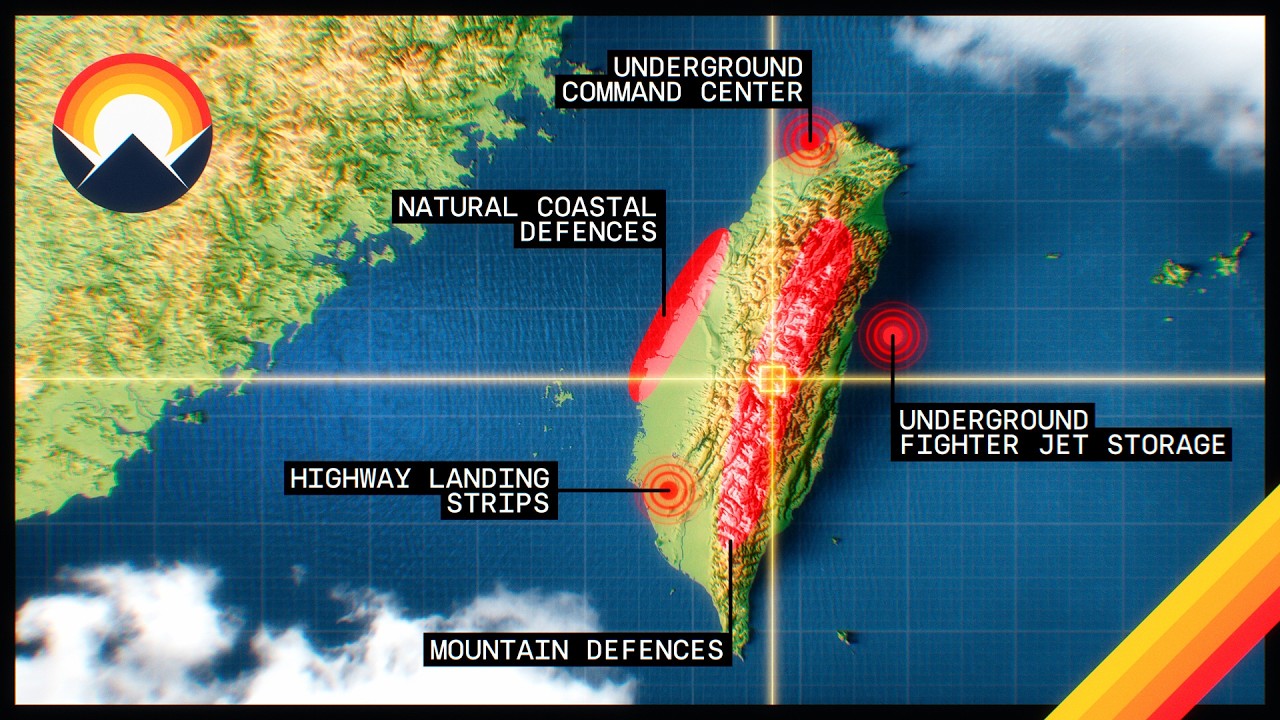
- [08:42](https://www.youtube.com/watch?v=2iHPVsyv4GU&t=522s) Deep underground bunkers like the Heng Shan Command Center and Jiashan Air Force Base protect high command and up to 200 fighter jets from initial missile strikes.
- [08:42](https://www.youtube.com/watch?v=2iHPVsyv4GU&t=522s) Airbases use extra-wide runways and practice rapid crater repair, while public highways are designated as conversion-ready backup military airstrips.
- [08:42](https://www.youtube.com/watch?v=2iHPVsyv4GU&t=522s) Taiwan is expanding a $1.5 billion domestic drone program with a strict policy barring any components sourced from mainland China.
- [14:56](https://www.youtube.com/watch?v=2iHPVsyv4GU&t=896s) An invasion of Taiwan would trigger a level of violence unseen in the 21st century, relying on strong deterrence to keep the conflict from ever starting.
## Detailed walkthrough
Here is the detailed walkthrough covering Part 1 of the transcript:
[00:00](https://www.youtube.com/watch?v=2iHPVsyv4GU&t=0s) The Geopolitical Reality and Asymmetrical Odds of a Taiwan Invasion
Taiwan stands as the wealthiest place on Earth facing such a direct, credible, near-term threat of invasion by a significantly stronger neighboring power. The leadership of the People's Republic of China (PRC) views the island as an integral part of its territory, maintaining that "reunification is not only ideal but necessary." Beijing has explicitly stated that achieving this goal might require military force, tasking the People's Liberation Army (PLA) with being fully prepared to invade Taiwan by 2027.
On paper, Taiwan's odds of defense look extraordinarily grim against the sheer scale of the Chinese military:
* **Military Size & Budget:** The PLA is the world's largest military by active-duty personnel and ranks second globally in total military spending.
* **Air & Naval Assets:** China possesses more combat aircraft and aircraft carriers than any nation other than the United States, alongside the world's largest fleet of amphibious warfare ships.
* **Global Power Ranking:** Given Russia's military struggles in Ukraine, the PLA is widely regarded as the world's second strongest military power, with its main strategic goal focused on invading and holding Taiwan.
---
[00:10](https://www.youtube.com/watch?v=2iHPVsyv4GU&t=10s) Why Geography Gives Taiwan a Fighting Chance
Despite the PLA's massive numerical superiority, military analysts argue that Taiwan possesses a real chance of defending itself due to its unique geography. Unlike Russia's overland invasion of Ukraine, China cannot simply drive across a border; it is forced to execute an amphibious assault across the Taiwan Strait. A full takeover cannot be achieved through airstrikes or paratroopers alone—the PLA must capture and hold a coastal entry point, known as a beachhead, to supply and reinforce its invading forces.
Executing a successful amphibious assault is arguably the most difficult maneuver in modern warfare, as highlighted by historical and logistics constraints:
* **The Scale of D-Day:** The 1944 Normandy landings remain the largest amphibious assault in history, utilizing ~150,000 Allied troops. Analysts estimate China would need a vastly larger force of **400,000 to 500,000 personnel** to successfully invade and overthrow the Republic of China (ROC).
* **The Loss of Surprise:** In 1944, the Allies used deception to hide Normandy as the primary target. Today, advanced satellite and electronic surveillance mean China's monthslong staging of 500,000 troops on the mainland would be impossible to hide, giving Taiwan ample warning.
* **Unforgiving Weather Windows:** Amphibious craft require near-perfect sea and air conditions to keep troops from getting seasick and landing craft from swamping. Taiwan’s weather offers only two realistic windows per year:
* *Winter:* Strong northeast monsoons generate rough seas for months.
* *Summer:* Typhoon season creates unpredictable storms that can only be forecasted 3 to 5 days in advance.
* *Optimal Windows:* **April** and **October** are the only months offering the multi-week windows of calm weather required for an invasion fleet.
* **Warning Time:** The $100\text{ miles}$ ($160\text{ km}$) separation across the Taiwan Strait grants Taiwan an estimated 10-hour head start from the moment ships launch to prepare its defenses and launch counter-air campaigns.
---
[00:42](https://www.youtube.com/watch?v=2iHPVsyv4GU&t=42s) The Bottlenecks of Taiwan’s Coastline and the Strategic Beaches
Even if an invasion fleet crosses the strait, Taiwan's natural topography heavily restricts where landing craft can physically touch down. Most of the eastern coast consists of towering vertical cliffs, while much of the west coast is composed of muddy wetlands or dense network grids of aquaculture farms (raising oysters, shrimp, and fish) that would trap heavy armor and bottleneck vehicles onto easily targetable roads. Combined with required underwater slopes and beach widths, military analysts estimate there are **only 14 viable "Goldilocks" beaches** suitable for landing a major invasion force across the entire island.
Among these potential landing sites, **Linkou** and **Bali North** beaches, located near northern Taiwan, are considered the absolute highest-value targets for the PLA due to neighboring strategic infrastructure:
* **Port of Taipei:** Located directly between the two beaches. Capturing a deep-water port allows China to dock heavy cargo ships and unload armor far faster than using experimental floating barge piers.
* **Taoyuan International Airport:** Taiwan's largest airport lies just beyond the beaches, providing the PLA with a potential airhead to fly in troops and supplies.
* **Tamsui River:** This river mouth offers small, fast attack craft a direct route straight into central Taipei. From the riverbank, it is only **one mile to the Presidential Palace**—the capture of which would deliver a devastating psychological defeat to Taiwan.
> Historical precedent exists for this landing strategy: during the Sino-French War in 1884, French Marines attempted an invasion at the mouth of the Tamsui River. The attack ultimately failed because the terrain was simply too predictable to defend against.
---
[06:35](https://www.youtube.com/watch?v=2iHPVsyv4GU&t=395s) Annual Military Drills and the "Porcupine Strategy"
Because the beaches near the Tamsui River are so critical, they serve as the primary proving grounds for Taiwan’s annual military exercises. Rather than building permanent, heavy fortifications right on the coast—which Taiwanese commanders believe would be easily wiped out by initial PLA missile strikes—Taiwan relies on rapid mobilization and adaptable defensive networks:
* **2022 Drills:** Reservists rapidly dug out fully stocked trench networks along the coast equipped to sustain active combat for up to 30 days.
* **2023 Drills:** Observed by the President, Taiwanese forces conducted full-scale simulated counter-amphibious exercises, pitting friendly forces against a mock PLA landing element.
* **Tamsui River Defense Tactics:** Drills include floating gasoline barrels rigged with C4 explosives to ignite advancing enemy boats, as well as demolition plans to detonate the **Guandu Bridge** to physically block the river channel leading into Taipei.
```
Taiwan Defense Priority:
Prevent Beachhead ──> Hardened Hinterland Retreat ──> Hold Out for Allied Aid
(Coastal Denial) (Underground Fortresses) (US / Japan / Partners)
```
Taiwan's overarching military doctrine is formalised as the **Porcupine Strategy** (adopted in 2017). Recognizing it can never match the PLA head-on in raw budget or fleet size, Taiwan focuses on asymmetric warfare—purchasing high volumes of cheaper, highly lethal weapons designed to inflict maximum attrition on an invading force:
* **Distributed Naval Firepower:** Instead of relying solely on large surface combatants (such as its 4 former US Navy destroyers bought for $732 million), Taiwan deployed 42 smaller fast-attack missile boats carrying 4 anti-ship missiles each to distribute fire authority across many targets.
* **Anti-Ship Missile Density:** With an influx of US-made Harpoon missiles, Taiwan will field over **1,400 anti-ship missiles**, creating the highest concentration of anti-ship missile firepower on Earth.
* **Internal Debates:** Critics argue Taiwan still spends too much on "missile magnet" legacy hardware—such as its **$8 billion purchase of 66 F-16 fighters** and **$1.28–$8 billion spent on 108 M1 Abrams tanks**—rather than fully committing to smaller systems (like a shelved program for 60 three-person stealth catamaran missile boats).
---
[08:42](https://www.youtube.com/watch?v=2iHPVsyv4GU&t=522s) Underground Fortresses, Runway Adaptability, and Drone Warfare
To survive the initial wave of Chinese precision bombardments and hold out until potential allies (the US, Japan, South Korea, the Philippines, or Australia) can arrive, Taiwan built massive underground infrastructure in its most defensible regions:
* **Heng Shan Command Center:** Located deep inside a mountain north of Taipei and connected to the Ministry of National Defense headquarters via underground tunnels. Built to withstand nuclear blasts and EMPs, it serves as the wartime command bunker for the Taiwanese President.
* **Jiashan Air Force Base:** Carved into the mountainside near Hualien on Taiwan’s isolated east coast, shielded by 13,000-foot ($4,000\text{ m}$) mountain peaks. Its underground hangar complex can shelter roughly **200 fighter jets**—about two-thirds of Taiwan's entire air force inventory.
* **Runway Resilience:** Because modern precision missiles can crater traditional runways, Taiwan widened key airbase runways to $200\text{ feet}$ ($60\text{ m}$)—triple the width an F-16 requires to take off—allowing jets to launch around damage spots. Repair crews constantly practice patching crater strikes, achieving turnarounds in under 2.5 hours.
* **Highway Airstrips:** Designated stretches of public highways feature reinforced asphalt, extra width, and removable center barriers, allowing them to be converted into functional military airstrips within 24 to 48 hours.
Taking lessons from Ukraine’s success against Russia using cheap commercial hardware, Taiwan is aggressively expanding its domestic drone capability. Because island blockades would cut off external deliveries instantly, Taiwan established a **$1.5 billion domestic drone initiative**. The program explicitly subsidizes local manufacturers on the strict condition that **zero components are sourced from mainland China**—a tough requirement in an industry where 80% of global supply chains are controlled by Beijing.
[14:56](https://www.youtube.com/watch?v=2iHPVsyv4GU&t=896s) The Looming Conflict Between the PRC and Taiwan
An invasion of Taiwan by the People's Liberation Army (PLA) would unleash "a scale and sort of violence unseen this century." The overarching hope behind Taiwan's defense and deterrence posture is that the certainty of such a devastating outcome will prevent the conflict from ever unfolding. However, the constant underlying fear remains that reason regularly fails, leaving open the tragic possibility that the People's Republic of China could make an "era defining decision to attack the Republic of China."
- An invasion by the PLA would trigger a magnitude of violence unprecedented in the 21st century.
- Deterrence relies on the expectation that catastrophic consequences will deter aggression, countered by the historical reality that rational restraint often breaks down in geopolitics.
[15:18](https://www.youtube.com/watch?v=2iHPVsyv4GU&t=918s) Financial Preparation with Chime
Transitioning from geopolitical defense preparation to personal planning, the narrator introduces the sponsor, Chime, highlighting that preparing for the future is the guiding characteristic defining their relationship with the brand. Framed as "America's number one choice for banking for good reason," Chime is presented as an approachable and dependable alternative to traditional money management, which the narrator notes is often a pain that most people do not want to spend their free time trying to figure out. The service operates completely through its mobile app with no monthly fees or overdraft charges.
To help users build savings with minimal paperwork, Chime offers a high-yield savings account featuring a 3.75% Annual Percentage Yield (APY), which stands at nine times the national average. When short-term cash flow becomes tight, the platform provides an early payday feature granting advance access to up to $500 from an upcoming direct deposit paycheck before it officially hits the account.
Additionally, the platform offers the Chime Card, a secured Visa credit card designed to help users spend effectively and build credit without annual fees, earning 5% cash back on eligible purchases. To prevent credit score slips, the card includes a "safer credit building" feature that automatically pays off monthly balances on time using funds saved directly in the user's account. Viewers can sign up in two minutes via [chime.com/wendover](https://chime.com/wendover) or the on-screen QR code to claim an exclusive bonus of up to $350.
- **Savings APY:** 3.75% interest rate, representing 9x the national average.
- **Early Payday Access:** Allows users to access up to $500 from upcoming direct deposit paychecks early.
- **Chime Card Benefits:** Secured Visa credit card offering 5% cash back with no annual fees.
- **Safer Credit Building:** Automated feature that uses account funds to pay balances on time and prevent missed due dates.
- **Sign-up Offer:** A process taking two minutes at [chime.com/wendover](https://chime.com/wendover) or via QR code, offering a promotional bonus of up to $350.
## Notable quotes
> [00:00](https://www.youtube.com/watch?v=2iHPVsyv4GU&t=0s) reunification is not only ideal but necessary
> [14:56](https://www.youtube.com/watch?v=2iHPVsyv4GU&t=896s) a scale and sort of violence unseen this century — Sam Denby
> [14:56](https://www.youtube.com/watch?v=2iHPVsyv4GU&t=896s) era defining decision to attack the Republic of China — Sam Denby
> [15:18](https://www.youtube.com/watch?v=2iHPVsyv4GU&t=918s) America's number one choice for banking for good reason — Sam Denby
## Mentioned
Wendover Productions, Sam Denby, Tristan Purdy, Christine Benedetti, Alexander Williard, Sara Stoltman, Gabriel Ferreras, Austin Glass, Kate Ermolenkko, Manni Simon, Dony Bullen, Simon Buckmaster, Chime, People's Republic of China, People's Liberation Army, Republic of China, Taiwan, United States, Russia, Ukraine, Japan, South Korea, Philippines, Australia, Port of Taipei, Taoyuan International Airport, Tamsui River, Presidential Palace, Linkou Beach, Bali North Beach, Guandu Bridge, Porcupine Strategy, Harpoon missiles, F-16, M1 Abrams, Heng Shan Command Center, Jiashan Air Force Base, Ministry of National Defense, Chime Card, Visa
Facing a stated goal by Beijing for the People's Liberation Army to be prepared for an invasion by 2027, Taiwan relies on formidable geographic bottlenecks, hardened infrastructure, and an asymmetric defense doctrine to offset China's overwhelming military superiority.
Geographic Barriers and Invasion Constraints (0:10)
On paper, the People's Liberation Army (PLA) holds commanding advantages as the world's largest military by active personnel, fielding the second-highest defense budget, the second-largest fleet of combat aircraft and aircraft carriers, and the largest amphibious fleet. However, military analysts emphasize that an invasion requires an amphibious assault across the 100-mile (160 km) Taiwan Strait, a maneuver demanding an estimated 400,000 to 500,000 personnel—dwarfing the 150,000 troops mobilized for Normandy in 1944. Modern satellite surveillance would eliminate surprise by exposing months of PLA staging on the mainland, while the transit across the strait grants Taiwan an estimated 10-hour warning window to mount defenses.
Taiwan's maritime environment further narrows invasion opportunities. Unforgiving seasonal weather leaves only two viable multi-week landing windows per year: April and October, flanked by rough winter northeast monsoons and summer typhoons. Once forces reach the coast, natural terrain severely limits entry. Vertical cliffs along the east coast and aquaculture grids and muddy wetlands along the west restrict viable landing grounds to only 14 "Goldilocks" beaches across the entire island.
Choke Points and Coastal Mobilization (0:42)
The primary landing vulnerabilities are concentrated in northern Taiwan at Linkou and Bali North beaches, situated beside critical transport hubs: the Port of Taipei and Taoyuan International Airport. Crucially, the mouth of the Tamsui River lies nearby, offering small attack craft an inland route reaching within one mile of the Presidential Palace. Historically, a French marine landing at this predictable choke point failed in 1884 during the Sino-French War.
Rather than constructing static beach fortifications vulnerable to early missile strikes, Taiwanese forces drill for rapid coastal mobilization. Regular exercises train reservists to construct 30-day sustainment trench networks within days, test counter-amphibious defenses, deploy explosive C4-rigged floating gasoline barrels, and rehearse the controlled demolition of the Guandu Bridge to block the Tamsui River corridor into Taipei.
Asymmetric Tactics Versus Legacy Procurement (6:35)
Formalized in 2017, Taiwan's "Porcupine Strategy" shifts defensive doctrine toward asymmetric warfare designed to inflict catastrophic attrition. Recognizing it cannot match the PLA in conventional fleet size, Taiwan has focused on distributed firepower, including 42 fast-attack missile boats and an arsenal of over 1,400 anti-ship missiles, primarily US-made Harpoons, creating the world's densest concentration of anti-ship firepower.
This asymmetric focus remains subject to internal debate. Critics contend that defense spending still disproportionately favors vulnerable legacy platforms—such as spending $8 billion on 66 F-16 fighters and $1.28 billion to $8 billion on 108 M1 Abrams tanks—over distributed, survivable systems, exemplified by the shelving of a program for 60 small stealth catamaran missile boats.
Underground Redundancy and Domestic Drones (8:42)
To survive initial precision bombardments while awaiting potential intervention from allies like the United States, Japan, South Korea, the Philippines, or Australia, Taiwan has fortified critical operational assets. Deep-mountain facilities include the nuclear- and EMP-resistant Heng Shan Command Center and the Jiashan Air Force Base, which shelters roughly 200 fighter jets—two-thirds of the air force—under 13,000-foot peaks. Airfield resilience measures include widening runways to 200 feet to allow takeoffs around craters, training repair teams to patch damage within 2.5 hours, and designating highway segments that can convert into functional airstrips within 24 to 48 hours.
Drawing lessons from Ukraine, Taiwan is also establishing a $1.5 billion domestic drone initiative. Because a maritime blockade could halt foreign resupply, the program subsidizes local production on the strict condition that zero parts originate from mainland China—a significant logistical hurdle given that Beijing controls 80% of global commercial drone supply chains.
An invasion of Taiwan would trigger violence on a scale unseen this century. Taiwan's defensive posture aims to establish enough deterrence to ensure the cost of attack outweighs the objective, though the persistent geopolitical concern remains that rational restraint can fail.
[0:00] reunification is not only ideal but necessary
[14:56] Sam Denby: a scale and sort of violence unseen this century
[14:56] Sam Denby: era defining decision to attack the Republic of China
[15:18] Sam Denby: America's number one choice for banking for good reason
Original transcript
[0:00] Taiwan is the wealthiest place on Earth
[0:02] that faces such a credible near-term
[0:05] threat of getting invaded by a stronger
[0:07] power. That's because its neighbor, the
[0:09] People's Republic of China, believes the
[0:11] island of Taiwan is an integral part of
[0:13] its territory and that reunification is
[0:15] not only ideal but necessary. [music]
[0:18] And PRC leadership has explicitly said
[0:20] that the achievement of this necessity
[0:22] might require military force and tasked
[0:25] its People's Liberation Army with being
[0:26] prepared to invade the island by 2027.
[0:30] Taiwan's odds do not look good on paper.
[0:33] China's PLA is the world's largest
[0:36] military as measured by active duty
[0:38] personnel and second largest when
[0:40] measured on the basis of spending. It
[0:42] has more combat aircraft than anyone but
[0:44] the United States, more aircraft
[0:45] carriers than anyone but the United
[0:47] States, more amphibious warfare ships
[0:49] than anyone. Given Russia's failure in
[0:51] Ukraine, it's hard to argue that China
[0:53] is not the world's second strongest
[0:55] military power, and its central guiding
[0:58] goal is being able to invade and hold
[1:00] this small but strategically and
[1:02] politically valuable neighboring island.
[1:05] But in spite of that, military analysts
[1:08] believe Taiwan actually has a chance.
[1:10] Not necessarily a good one, but a real
[1:12] one nonetheless. And it's all thanks to
[1:15] its geography. Most notably, Taiwan's an
[1:18] island. Without a land route like when
[1:20] Russia invaded Ukraine, the start of an
[1:22] invasion becomes stunningly predictable.
[1:24] China would simply have to stage an
[1:26] [music] amphibious assault. There's just
[1:28] no way it could achieve a full takeover
[1:30] through paratroopers or air strikes
[1:32] alone. This amphibious assault would
[1:33] initially focus on capturing and then
[1:35] defending a beach to act as its
[1:37] logistical entry point to the island was
[1:39] called a beach head. Effectively, they'd
[1:42] be trying to replicate D-Day. The
[1:44] trouble for the PLA is that D-Day is
[1:46] still to this day the largest amphibious
[1:49] landing ever conducted with about
[1:51] 150,000 Allied troops attacking and then
[1:53] defending their beach head in Normandy.
[1:55] But China's effort would be harder. Back
[1:58] in 1944, the Allies had the element of
[2:01] surprise. With a lack of electronic
[2:03] surveillance that allowed for successful
[2:04] deception efforts, German forces did not
[2:06] know with confidence that the boats were
[2:08] coming for Normandy until troops saw
[2:10] them with their own eyes. While German
[2:12] Central Command had some understanding
[2:14] that an invasion effort was coming, the
[2:16] lack of certainty on where meant they
[2:18] were unable to reinforce Normandy ahead
[2:20] of the landing, allowing the Allies to
[2:22] go against relatively weak German
[2:24] defenses in the initial phase of
[2:25] invasion. The PLA doesn't have that
[2:27] luxury. Analysts believe an invasion
[2:29] force would need to number around 4 to
[2:32] 500,000
[2:33] personnel to have a realistic shot of
[2:35] toppling the ROC. And assembling and
[2:37] staging these troops and their equipment
[2:39] on the mainland would be a monthslong
[2:40] process, almost impossible to hide. But
[2:44] the predictability goes further. The
[2:46] Taiwan Strait [music] is far rougher
[2:48] than the English Channel on average. and
[2:50] amphibious landings rely on near-perfect
[2:52] sea conditions to prevent landing craft
[2:53] from getting swamped and also quite
[2:55] literally to stop troops from getting
[2:56] seasick, inhibiting their effectiveness
[2:58] when storming the beach. Clear skies are
[3:00] also necessary in maximizing the chances
[3:02] of success to allow air assets to
[3:04] operate without restraint. And these
[3:06] sorts of sea and air conditions should
[3:08] ideally last for days or weeks to allow
[3:10] [music] for a steady stream of
[3:11] reinforcements to arrive uninhibited.
[3:14] Taiwan's annual weather patterns are
[3:16] quite structured. [music] In winter, the
[3:18] island is hit by a northeast monsoon
[3:20] that blows strong winds towards [music]
[3:21] it, generating rough sea conditions in
[3:23] the straight for months on end that
[3:25] inhibit an amphibious landing. This
[3:27] subsides in spring and wave heights
[3:29] lower into summer. But that's when
[3:30] typhoon season starts. Typhoon tracks
[3:33] can only be accurately forecasted 3 to 5
[3:35] [music] days out, meaning the PLA can
[3:37] never have certainty about the 2 or 3
[3:38] week weather window needed for the best
[3:40] shot of a successful invasion during
[3:42] summer. That leaves two key weather
[3:44] windows, April and October. Taiwan knows
[3:48] this. [music] If they see a month-long
[3:50] buildup, it's likeliest to translate
[3:52] into an invasion during one of these two
[3:54] months, allowing their military to
[3:56] mobilize in step. And even once an
[3:58] invasion started, the 100 m or 160 km of
[4:02] separation between the island and China
[4:04] would give Taiwan about a 10-hour head
[4:06] start. Of course, much of what would
[4:08] happen in those hours is a massive air
[4:10] campaign to strike and destroy as many
[4:12] of the PLA ships as possible. But as
[4:14] that went on, ground forces would move
[4:16] to defend potential landing sites, and
[4:18] still then there's plenty of
[4:20] predictability.
[4:21] You see, the majority of Taiwan's
[4:23] coastline is just not suited for an
[4:25] amphibious assault. Most of the East
[4:27] Coast features massive cliffs, making
[4:28] movement inland near impossible. Much of
[4:31] the West Coast is made up of muddy
[4:32] wetlands that would quickly trap landing
[4:34] vehicles. Substantial other portions
[4:36] have been developed into aquaculture
[4:38] farms growing oysters, shrimp or fish.
[4:40] Meaning the coastal landscape is dotted
[4:42] with hundreds of small pools
[4:44] concentrating invading vehicles onto
[4:45] limited and easily defensible roads.
[4:48] Among the beaches, they need the slope
[4:50] of the ground beneath the water to be
[4:51] steep enough to allow for landing craft
[4:53] to get close to shore. But then for the
[4:54] beach to have a shallow slope to allow
[4:56] vehicles to drive up easily, and it's
[4:58] got to be wide enough to give space for
[5:00] the sizable force. Taken together, there
[5:02] are very few Goldilocks Normandy style
[5:05] beaches that allow for the successful
[5:06] landing and onward push of hundreds of
[5:08] thousands of troops. Analysts believe
[5:10] they have the number down to just 14.
[5:12] And though it's debated exactly how
[5:14] constrained the PLA is with their
[5:16] options given advances in technology,
[5:18] either way, Taiwan's natural defenses
[5:20] allow its military to concentrate its
[5:22] resources into limited areas. But
[5:25] between what's left, perhaps the most
[5:27] attractive landing site is here, Linka
[5:29] and Bali North beaches. Beyond their
[5:32] physical compatibility, they feature
[5:33] proximity to key strategic assets that
[5:35] China [music] would benefit from
[5:36] capturing quickly. In between the two
[5:38] beaches is the port of Taipei. While
[5:40] China is known to be developing floating
[5:42] barges that can act as peers to allow
[5:44] for large non-mphibious vessels to
[5:46] unload personnel and cargo, capturing a
[5:48] permanent port facility would likely
[5:49] allow for more capacity with less
[5:51] vulnerability to attack. Similarly,
[5:54] slightly further on, there's Talion
[5:55] International Airport, the country's
[5:57] largest, which could act as an on island
[5:59] air base for the PLA as it works towards
[6:01] a complete capture. But perhaps the
[6:03] biggest advantage of this landing site
[6:05] is its proximity to the Tamui River,
[6:07] allowing small, fast boats a quick route
[6:10] into central Taipei. From the river's
[6:12] banks, it's just a mile to the
[6:13] presidential palace, whose capture would
[6:15] mark the biggest symbolic defeat for
[6:17] Taiwan. It's largely for this reason, in
[6:19] fact, that French Marines landed nearby
[6:21] on the opposite bank of the mouth of the
[6:23] river during the Sino French War in
[6:25] 1884. Their invasion ultimately failed,
[6:27] though, for largely the same reason why
[6:29] China would struggle. It's just too easy
[6:32] to predict and therefore defend against.
[6:35] Therefore, these beaches are some of the
[6:37] most frequent hosts of Taiwan's annual
[6:39] military drills. Over the years, they've
[6:41] ran simulations of essentially every
[6:43] phase of an invasion. In 2022, mimicking
[6:46] a buildup phase, reserveists worked to
[6:48] rapidly construct a trench facility from
[6:50] which soldiers could fire onto the beach
[6:52] stocked with supplies to last up to 30
[6:54] days. The next year, with the president
[6:56] watching on, the military conducted a
[6:58] full amphibious landing drill with one
[7:00] side standing in as the PLA, while the
[7:02] other worked to stop them from their
[7:03] hardened positions. Over the next few
[7:05] years, there were at least four separate
[7:07] exercises related to countering an
[7:08] offensive via the Tempsu River. The
[7:10] Taiwanese side's tactic was to place
[7:12] floating gasoline barrels rigged with C4
[7:14] explosives to be set off as Chinese
[7:16] vessels attempted to make their way
[7:17] through. But they also simulated
[7:19] exploding Guandu Bridge in order to
[7:21] physically block vessels from advancing
[7:22] further down the river and into Taipei.
[7:25] But what this strategically critical
[7:27] area lacks is infrastructure. You can
[7:30] find a 17th century fort built by the
[7:32] Spanish Empire along the river's mouth
[7:33] and cold war era pill boxes dotting the
[7:36] beach, but no permanent modern
[7:38] fortifications. This is the likeliest
[7:40] starting point of one of the likeliest
[7:42] theoretical conflicts on Earth. And yet,
[7:44] it looks like any other beach. That's
[7:47] because Taiwan just doesn't believe in
[7:49] permanent coastal defense
[7:51] infrastructure, thinking its
[7:52] vulnerability would mean it would almost
[7:54] certainly get destroyed through air
[7:55] strikes before the first boats even
[7:57] arrived. Rather, Taiwan builds its
[8:00] greatest military infrastructure in its
[8:02] most defensible positions. You see,
[8:04] while preventing China from successfully
[8:06] establishing a beach head would be the
[8:07] most effective way for Taiwan to
[8:09] prevail. And while amphibious landings
[8:11] are an incredibly tricky military
[8:12] maneuver, they give a massive advantage
[8:14] to the defending side, it's important
[8:16] that the nation's survival does [music]
[8:18] not hinge on it. There's just a
[8:20] tremendous power imbalance between the
[8:23] two militaries. If China breaks through,
[8:25] Taiwan's best hope is that friendly
[8:27] countries, Japan, South Korea, the
[8:29] Philippines, Australia, and most
[8:30] critically the US join the fight. But
[8:33] reinforcements would take time to
[8:34] arrive. So, the military has invested in
[8:36] asssuring it can maintain a foothold on
[8:38] the island for as long as possible.
[8:42] That's why deep beneath this mountain
[8:44] just north of central Taipei is the Hen
[8:46] Shawn Command Center. Very little is
[8:48] known about this facility beyond the
[8:50] fact that it exists. It's supposedly
[8:52] connected to the Ministry of National
[8:54] Defense headquarters by tunnel. There
[8:55] are apparently other entrances around
[8:57] the mountain. It's intended to house the
[8:59] president as they lead the war effort.
[9:01] It can survive nuclear blasts and EMPs,
[9:03] but the details pretty much end there.
[9:07] This is one of the only photos ever
[9:08] released from the inside depicting
[9:10] former President Saiing Wen in the
[9:12] facility as she received a briefing.
[9:14] Slightly more is known about the
[9:16] country's other most defensible
[9:17] facility, Jaan Air Force Base. Shaon is
[9:20] located on Taiwan's far less populated
[9:22] east coast in the outskirts of the city
[9:24] of Haleian. It's about as far from China
[9:26] as one can get on the island, meaning
[9:28] it'd be just about the least accessible
[9:30] location to a force invading from the
[9:32] west thanks to the enormous peaks
[9:34] stretching close to 13,000 ft or 4,000 m
[9:37] standing [music] in the way. But that's
[9:39] not what makes this site so resilient.
[9:41] This is these are the entrances to an
[9:43] underground hanger complex believed to
[9:45] be capable of storing 200 fighter jets.
[9:48] That's about twothirds of the country's
[9:50] entire inventory and more than that of
[9:53] all but a dozen or so entire air forces
[9:56] worldwide. These are some of the only
[9:58] photos ever released from inside it
[10:00] showing an F-16 being loaded with an
[10:02] anti-ship missile. But of course, this
[10:04] air base has a vulnerability. The
[10:06] fighter jets might be safe, but they
[10:08] can't do much without a working runway.
[10:10] When this facility was originally built,
[10:12] missiles were not accurate enough to
[10:13] make precision strikes on runways from
[10:15] the distances that they'd likely be
[10:17] fired from. But that's no longer the
[10:18] case. It's for this reason that the
[10:20] military recently expanded this and
[10:22] other airbases runways to a uniquely
[10:24] wide 200 f feet or 60 m. Fighter jets
[10:27] only need a third of that width to
[10:28] reliably take off and land. So even if a
[10:31] missile does successfully strike,
[10:32] there's a greater chance that there'd
[10:34] still be a lane to keep operating with.
[10:36] Meanwhile, Taiwanese troops constantly
[10:38] drill their rapid runway repair
[10:40] capabilities and can reportedly patch an
[10:42] impact crater in just 2 and 1/2 hours.
[10:45] But just like with coastal defenses,
[10:46] Taiwan's airbase strategy focuses on
[10:49] resilience through adaptability. That's
[10:51] why across the country, there are
[10:53] sections of regular highways like this.
[10:55] This stretch has been built wider and
[10:57] with stronger asphalt than most in order
[10:59] to serve as a temporary air base in
[11:01] wartime. There are no overhead
[11:03] obstacles, and the barriers in the
[11:04] center are easily removable, so
[11:06] adaptation can happen in about 24 to 48
[11:09] hours.
[11:10] Now, Taiwan's defense doctrine is often
[11:13] described as the porcupine strategy.
[11:15] They seek to make it so costly for China
[11:17] to invade [music] that they just decide
[11:19] not to. This became the formal doctrine
[11:22] in 2017 when it became clear that Taiwan
[11:24] no longer had any realistic shot of
[11:26] matching China's military power headon.
[11:28] The PLA had just amassed too many
[11:30] soldiers, fighter jets, missiles,
[11:32] drones. They'd amassed too much
[11:34] capability. So, rather Taiwan shifted to
[11:36] an asymmetric strategy. They'd pursue
[11:39] less capable but less expensive
[11:40] platforms to make their dollar stretch
[11:42] further and therefore [music] acquire
[11:44] more. Particularly, they'd search for
[11:46] ways to destroy costly Chinese [music]
[11:48] equipment for a fraction of the cost.
[11:51] For example, prior to this focus,
[11:53] Taiwan's navy did buy four highly
[11:55] capable former US Navy destroyers for
[11:58] $732 million. But these ships would
[12:00] inevitably and quickly become [music]
[12:02] prime targets for China's fighter jets
[12:04] and missiles. So Taiwan equipped 42 far
[12:06] smaller [music] vessels with four
[12:08] missiles each so their offensive
[12:10] capability would be distributed more
[12:11] widely. These smaller missile boats are
[12:13] easier for China to attack and destroy,
[12:15] but the number of them would make it
[12:17] costly and difficult for the PLA to
[12:18] destroy them before the bulk of their
[12:20] offensive capabilities are used.
[12:22] Similarly, the ROC Navy has recently
[12:24] invested heavily in its mine lane
[12:26] capabilities as mines are an inexpensive
[12:28] but relatively effective defensive
[12:30] weapon. But the core of the porcupine
[12:32] doctrine has been Taiwan's [music]
[12:34] missile buildout. Following the imminent
[12:36] arrival of a massive order of US-made
[12:38] Harpoon [music] missiles, the military
[12:39] will have over 1,400, meaning Taiwan
[12:42] will have the highest concentration of
[12:44] anti-hship missiles in the world. These,
[12:47] of course, would be critical to inflict
[12:49] as much damage as possible on the PLA
[12:51] landing force before it [music] arrives,
[12:52] seeking to push numbers below the
[12:54] threshold needed to take the island. But
[12:56] Taiwan's defense strategy has its
[12:59] critics. Military analysts argue that
[13:01] the porcupine strategy is right, but
[13:03] that they don't embrace it enough. For
[13:06] example, the ROC had a prototype for an
[13:08] even smaller fast-moving catamaran
[13:10] missile boat operated by a crew of just
[13:12] three. They were slated to order 60 of
[13:15] these, pushing the distribution of its
[13:16] missiles to a further extreme until the
[13:18] entire program got indefinitely delayed.
[13:21] Rather, they spent $8 billion on 66 new
[13:24] F-16 fighter jets and $1.28 to $8
[13:27] billion for 108 new ABS tanks. Both
[13:30] highly capable pieces of equipment, but
[13:32] ones that are sure to become Chinese
[13:34] missile magnets. But then Ukraine
[13:37] happened. What was once considered the
[13:39] world's second most powerful military
[13:41] invaded a comparatively tiny neighbor
[13:43] and failed. Ukraine essentially put
[13:46] Taiwan's porcupine strategy into
[13:48] practice [music] and succeeded. So, the
[13:50] ROC has learned endlessly from this
[13:52] conflict. But perhaps the most notable
[13:54] piece is the newfound relevance of
[13:56] consumergrade [music] drones. Just as
[13:58] they did in Ukraine, these could play a
[14:00] huge role in Taiwan, even in that first
[14:03] critical phase of pushing back the
[14:04] amphibious invasion. But perhaps the one
[14:06] geographic disadvantage of Taiwan is
[14:08] that once again, it's an island. From
[14:11] day one of an invasion, and very
[14:13] possibly before, external supply lines
[14:15] would essentially cease to exist. It's
[14:17] in part for that reason that they've
[14:18] invested heavily over the past 2 years
[14:20] in building up a domestic drone
[14:22] manufacturing industry. And it's
[14:24] maximizing the definition of domestic,
[14:26] creating a $ 1.5 billion program to
[14:28] subsidize manufacturers in exchange for
[14:30] an assurance that no component is
[14:32] sourced from mainland China. Something
[14:34] easier said than done in an industry 80%
[14:36] concentrated there. Of course, the other
[14:38] side of Taiwan's porcupine strategy, one
[14:40] centered on maximizing destruction to
[14:42] dissuade invasion, is that if Xiinping
[14:45] follows through on his threats, if China
[14:46] does seek to capture its neighbor,
[14:48] [music] it would be a horrifically,
[14:50] inconceivably bloody war. Taiwan has
[14:54] every right to defend itself if attacked
[14:56] by the PLA, but in doing so, it would
[14:58] unleash a scale and sort of violence
[15:01] unseen this century. The hope is that
[15:04] the certainty of this outcome would
[15:05] prevent it from unfolding, but the fear
[15:07] is that reason regularly fails and that
[15:10] the People's Republic of China could
[15:11] make an era defining decision to attack
[15:14] the Republic of China.
[15:18] Preparing for the future is not only a
[15:20] theme of this video, it's the guiding
[15:21] characteristic defining my relationship
[15:23] with the sponsor of today's video,
[15:25] Chime. Chime is America's number one
[15:27] choice for banking for good reason. It
[15:29] provides an awesome, dependable, and
[15:31] approachable service. Open up a Chime
[15:33] account and you'll feel like the service
[15:34] is actually working for you. There are
[15:36] no monthly fees, no overdraft fees, and
[15:38] if you want to start seeing your savings
[15:39] [music] grow, Chime offers a 3.75%
[15:42] annual percentage yield. That's 9 times
[15:45] the national average. This makes Chime a
[15:47] great service to start making some
[15:48] financial headway with less headaches
[15:50] and paperwork because it can all be done
[15:52] through the app. And another awesome
[15:54] feature is that when money does get a
[15:55] little tight, Chime offers an early
[15:57] payday feature where should you need
[15:59] access to money from your upcoming
[16:00] direct deposit paycheck, you can access
[16:02] up to $500 before the check actually
[16:04] hits, which can be huge when you're in a
[16:06] pinch. And following this same people
[16:08] first approach, Chime now offers the
[16:10] Chime card, a secured Visa credit card
[16:12] that earns 5% [music] cash back with no
[16:14] annual fees, allowing you to spend more
[16:16] effectively while also building your
[16:18] credit score. The card can even be set
[16:20] to safer credit building, which will
[16:21] have your account automatically pay off
[16:23] the card on time with funds saved in
[16:25] your account to ensure no missed due
[16:27] dates and subsequent credit score slips.
[16:29] Navigating the world of money management
[16:30] is just a pain and something I
[16:32] personally don't want to spend all my
[16:33] free time trying to understand. So, it
[16:35] makes me really happy that a service
[16:36] like Chime exists and that they're
[16:38] interested in partnering with us as a
[16:40] channel. Give Chime a go by following
[16:41] the link in this video's description,
[16:43] chime.com/wendover,
[16:45] or the QR code on screen. It only takes
[16:47] two minutes, and if you do it now, you
[16:48] can get a bonus of up to $350
[16:52] exclusively through my link.