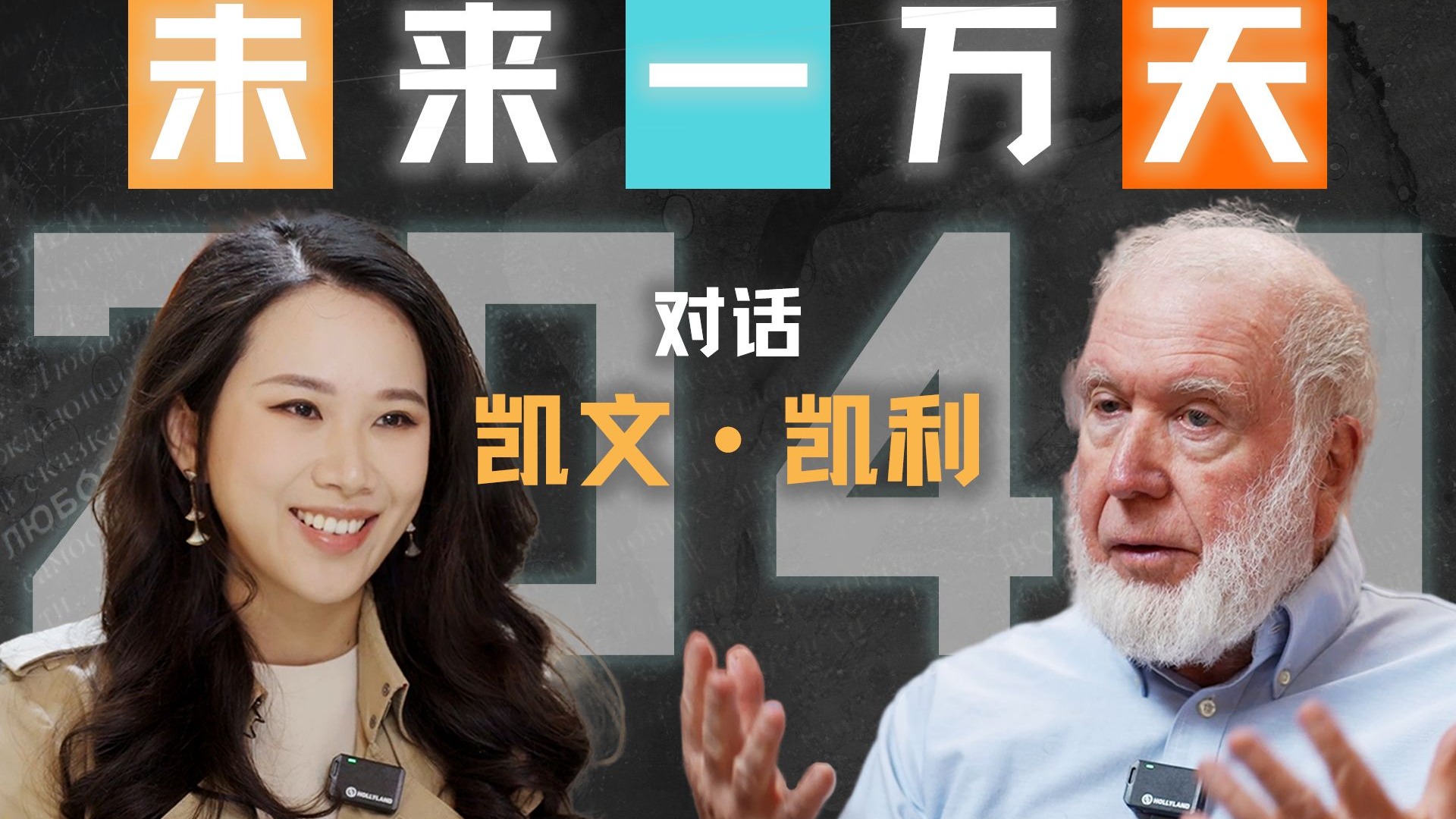
《硅谷101》主持人陈倩在节目开头分享了一个奇妙的缘分:视频剪辑同事 Jacob 正是因为读了科技思想家、畅销书作家凯文·凯里(Kevin Kelly,简称 KK)关于内容创作的博文,才决定加入团队。而这一次,对话的核心围绕着 KK 的新书《2049:未来一万天的可能》(*2049: The Next 10,000 Days*)展开。作为一名刚满两个月的婴儿的母亲,陈倩对一万天之后的世界充满了好奇。面对书中那些看似过于乐观、甚至有些野心勃勃的科技设想,陈倩坦言自己作为一个“长期悲观者”,深知技术落地之难以及技术作为双刃剑带来的负面社会影响。
KK 随即澄清道,他的目的并不是进行绝对的“预测”(predictions),而是提供不同的“场景设想”(scenarios)。他采用的方法是从25年后的未来“逆向推导”:假设届时有人从未来走来,告诉你 AI 运转得很好、大家都喜欢它,那么我们现在该如何一步步走到那个美好的终点?KK 强调,在充斥着灾难与末日预言的科幻电影和媒体报道中,人们太容易想象坏的未来,却极度缺乏对美好未来的想象力。
陈倩分享了自己两个月大的儿子 Benjamin 的故事,并担忧在 ChatGPT 等 AI 工具普及的背景下,下一代的教育系统该如何应对。KK 认为,现在的学生在 YouTube 上学到的东西已经超过了在学校学到的,这一趋势将会持续。面对学生用 AI 写论文的争议,KK 态度开放,认为不应该禁止,而是应该引导他们“如何更好地使用 AI”。他指出,未来教育的核心不再是传授特定的知识或专业技能,而是培养“学习如何学习”(learning how to learn)的能力,因为 Benjamin 25年后将要从事的工作,在今天甚至根本不存在。
作为内容创作者,陈倩非常关心 AI 对媒体和内容行业的冲击,甚至担心自己是否会被 AI 替代。KK 乐观地指出,虽然 AI 在未来25年内可以做大量的研究、撰写报告甚至产出海量内容,但人类媒体人依然不可或缺。核心原因在于“责任与担当”(taking responsibility for the output)。如果 AI 犯了错,没有人能去追责,而人类记者的价值就在于用自己的信誉为内容的真实性背书,向受众承诺 "you can trust me"(你可以信任我)。
KK 在书中提出了一个核心概念——“镜像世界”(Mirror World)。他预测到2049年,大多数智能手机将被智能眼镜取代。当数十亿人戴上眼镜时,现实世界与数字孪生(digital twin)将完美融合。这个世界不仅是人类的舞台,也是自动驾驶汽车(如 Waymo)和机器人赖以运行的底层系统。眼镜在日常使用中会不断扫描、消化和理解物理世界,从而让 AI 真正“看懂”人类的生活空间。
然而,KK 认为未来25年更大的冲击并非来自技术本身,而是来自“情感层面”。人类将会与 AI 建立起极深的情感纽带。KK 用宠物狗做类比:“想象一下,如果一只狗不仅能陪伴你,还能开口说话、回答你的问题、甚至比你更了解你自己,你对它的感情会有多深?”未来的 AI 将被编程注入喜悦、惊讶、困惑、严肃和幽默等各种情绪,人类会不可避免地与它们产生友谊、甚至坠入爱河,这将会给人类社会带来巨大的情感震撼。
- **镜像世界的定义**:一个融合了物理现实与三维数字信息的叠加世界,是机器人和 AI 交互的共同介质。
- **智能眼镜的普及**:数十亿人的日常佩戴和扫描,将自然而然地拼凑并生成这个庞大的镜像世界。
- **情感化 AI**:人类对情感信号非常敏感,因此将 AI 情感化是不可逆转的趋势,这也将引发新的人际关系与伦理变革。
[24:59](https://www.bilibili.com/video/BV1RE3izKE5E?t=1499s) The Long Road to Smart Glasses and the Chinese Supply Chain Advantage
Kevin Kelly reflects on his past predictions regarding smart glasses, admitting he was "very, very wrong" about how quickly they would arrive. The technical hurdles are incredibly steep, requiring five major technological breakthroughs to occur simultaneously. Chief among these is power; to avoid a tether or cable, glasses need massive battery and power-efficiency innovations to run for hours. Other hurdles include achieving a wide field of view and managing heat. Kelly believes even a giant like Apple has not yet been able to solve these combined issues. He estimates we are still five to ten years—and perhaps even 25 years—away from the smart glasses that people will actually want to wear. He compares this long development cycle to the evolution of mobile phones, noting that we had bulky cell phones for over 15 years before the iPhone successfully integrated multi-touch technology and eliminated physical keyboards to create the modern smartphone.
When asked if Chinese companies have a shot at winning this race, Kelly responds with an enthusiastic "Absolutely." In fact, if he had to make a bet, he would wager on a Chinese company over Apple to deliver the first highly coveted smart glasses. This is not merely because hardware manufacturing is cheaper in China, but because of a deep, materials-oriented technical know-how and a highly integrated ecosystem that accelerates development. Furthermore, Kelly points out that there is a greater willingness in China to experiment with "halfway" technologies—releasing products that are not quite perfect but finding immediate, practical uses for them.
- **Key Technical Challenges for Smart Glasses:** Power/battery life (eliminating tethers), field of view, and weight/form factor.
- **Timeline:** 5 to 10 years minimum, but potentially up to 25 years for mainstream adoption.
- **The China Advantage:** Materials science expertise, a rapid prototyping ecosystem, and a cultural willingness to iterate on "halfway" products.
---
[27:59](https://www.bilibili.com/video/BV1RE3izKE5E?t=1679s) Humanoid Robots: From Warehouses to the Distant Dream of the Home
Turning to robotics, Kelly addresses whether humanoid robots will soon enter billions of homes or remain confined to factory floors. He predicts that we will confront humanoid robots in the workplace long before they enter our homes. The home is "the last place that we'll see it" because domestic chores are highly unconstrained and varied. Instead, we will first see them in tightly controlled environments like warehouses moving boxes, or in fast-food restaurants cooking.
A major physical bottleneck is replicating the human hand, which Kelly describes as "one of the most remarkable things." A human hand can sew a needle and lift 100 pounds, combining extreme strength with delicate tactile feedback. Replicating this touch—where a machine can press an object and simultaneously feel the pressure it is exerting—is an incredibly difficult material and physical challenge, not just a matter of AI intelligence. Kelly notes that while companies like Tesla and figures like Elon Musk are obsessed with humanoids, the trajectory reminds him of Virtual Reality (VR). When Kelly saw VR 40 years ago, the technology was already decent but cost millions of dollars; 40 years later, VR is not fundamentally better in its core concept, it is just millions of times cheaper. He expects a similar path for humanoid robots: in 25 years, a Tesla robot might only cost $1,000, but it won't be drastically more capable than the prototypes we see today.
- **First Adopters:** Warehouses and fast-food kitchens (constrained environments).
- **The Hand Problem:** Replicating the dual capability of high-strength lifting and delicate tactile feedback (e.g., threading a needle).
- **The VR Parallel:** Technology will primarily decrease in cost rather than make massive leaps in fundamental physical capability.
---
[31:15](https://www.bilibili.com/video/BV1RE3izKE5E?t=1875s) The Future of Driving and the Reality of Mars Colonization
When asked if the next generation will even need a driver's license in 25 years, Kelly offers a counterintuitive take: getting a license might actually become much more difficult. As AI-driven cars become vastly safer and more efficient than human drivers, humans will have to prove they can navigate safely alongside highly coordinated smart vehicles, raising the skill ceiling for a license. Furthermore, human driving zones will shrink. Cities may ban human drivers from downtown areas to optimize traffic flow via AI, or restrict them to specific highway lanes. While some people will still drive, it will become a rare hobby akin to getting a pilot's license, requiring high-quality training.
The conversation shifts to space travel and Elon Musk's vision of making humanity multi-planetary. Kelly is highly skeptical, flatly stating, "I don't think there will be any cities on Mars ever." He compares going to Mars to going to the moon—there is no direct economic reason to do it. While the indirect spin-offs of space tech (like near-Earth satellite technology and asteroid mining) are incredibly valuable, actual human settlements on Mars make little sense. A Mars base will be nothing more than a highly expensive, underground research station housing perhaps eight people at most, similar to stations in the South Pole. "We don't belong in space," Kelly argues, pointing out that it is a million times easier to build a city at the bottom of Earth's oceans, yet we haven't done that because of the sheer difficulty. Instead of sending "human flesh," we will send AI probes, cameras, and virtual reality systems to explore the cosmos for us.
- **Autonomous Driving:** Driving will become a premium, highly regulated skill similar to piloting an aircraft; human drivers may be banned from downtown city centers.
- **Mars Cities:** Kelly predicts zero cities on Mars, only small, expensive research stations (maximum ~8 people) living underground.
- **Space Exploration:** AI and robotic probes will replace the need to send biological humans into space.
---
[35:45](https://www.bilibili.com/video/BV1RE3izKE5E?t=2145s) Longevity, Demographic Collapse, and Non-Invasive Brain-Computer Interfaces
Addressing life sciences, Kelly clarifies that he is not a fan of chasing extreme age extension, though he is "all in favor" of extending the human "healthspan"—the period of life spent in good health. He believes actual lifespan extension will progress very slowly, dismissing the theory that we will soon achieve "one year of life extension per year." However, he does foresee major medical breakthroughs in the next 25 years, such as pan-viral vaccines and cancer vaccines.
This medical progress will collide with a massive global demographic shift: shrinking populations and rapidly aging societies, particularly in China. Kelly warns that a society dominated by older people with fewer young people willing to take risks is a major threat to innovation. Culturally, this is already visible in Japan, where young people are stymied because older generations hold onto jobs, leaving no room for "crazy ideas." Kelly makes a radical prediction that the global population collapse will begin to be felt by 2046 (15 years from now), much earlier than the UN's official estimate of 2070.
Regarding Brain-Computer Interfaces (BCIs) like Neuralink, Kelly admits the field is moving faster than he expected. However, he believes invasive brain surgery will remain limited to medical patients (such as paralyzed individuals). For healthy consumers, the future lies in non-invasive caps or wearables. In 25 years, we will have functional non-invasive mind connections, likely adopted first by gamers looking to eliminate latency, or artists wanting to "imagine" worlds directly without using their hands.
- **Healthspan vs. Lifespan:** Strong support for extending healthy years; skepticism toward extending maximum biological age.
- **Demographic Collapse:** Kelly predicts the global population decline will begin to impact the world by 2046, creating a cultural challenge for innovation.
- **BCIs:** Non-invasive wearables will dominate the consumer market (gamers, artists) to avoid the risks of brain surgery.
---
[41:45](https://www.bilibili.com/video/BV1RE3izKE5E?t=2505s) The Evolution of Silicon Valley and Closing Thoughts
Looking at the future of Silicon Valley over the next 25 years, Kelly notes that disruption historically comes from startups rather than established giants like Google or Meta—pointing to how OpenAI and Anthropic shook up the AI landscape. While new stars will rise, Kelly is more interested in how the *process* of Silicon Valley might change. He wonders how AI will alter funding and hiring, and suggests we might see a "Kickstarter version of VC" where crowdfunding and ultra-early AI-assisted investing become the norm. Despite local issues like the housing crisis, Kelly believes both Silicon Valley and China's Shenzhen/Pearl River Delta region will maintain their critical mass and global dominance in their respective fields of software and hardware.
The host wraps up the interview, noting that some detailed segments were edited for time, and encourages viewers to read Kelly's book to get a clearer picture of the world "10,000 days from now." She reflects on how the dialogue has made her look forward to the next 25 years, even if she might be retired by then and her young child, Benjamin (whose photos are shown to the audience), will have entered the workforce.
- **Disruption Source:** Startups will continue to disrupt tech giants; established players rarely lead the next major wave.
- **VC Evolution:** AI could democratize early-stage investing, potentially creating highly efficient crowdfunding models for startups.
- **Regional Hubs:** Silicon Valley and Shenzhen are predicted to retain their status as the world's premier tech and manufacturing hubs due to deep ecosystem density.
## Notable quotes
> [04:59](https://www.bilibili.com/video/BV1RE3izKE5E?t=299s) AI 不会抢走所有的工作,它只是会分担许多具体的任务 — Kevin Kelly
> [04:59](https://www.bilibili.com/video/BV1RE3izKE5E?t=299s) 学习如何学习 — Kevin Kelly
> [04:59](https://www.bilibili.com/video/BV1RE3izKE5E?t=299s) 精通某件事 — Kevin Kelly
> [04:59](https://www.bilibili.com/video/BV1RE3izKE5E?t=299s) 金钱是‘把事情做好之后的副产品’ — Kevin Kelly
> [09:59](https://www.bilibili.com/video/BV1RE3izKE5E?t=599s) you can trust me — Kevin Kelly
> [09:59](https://www.bilibili.com/video/BV1RE3izKE5E?t=599s) 越成功、越庞大的媒体,越难适应新事物 — Kevin Kelly
> [31:15](https://www.bilibili.com/video/BV1RE3izKE5E?t=1875s) 我坚信火星上永远不会有城市 — Kevin Kelly
> [31:15](https://www.bilibili.com/video/BV1RE3izKE5E?t=1875s) 我们不属于太空 — Kevin Kelly
[4:59] Kevin Kelly: AI 不会抢走所有的工作,它只是会分担许多具体的任务
[4:59] Kevin Kelly: 学习如何学习
[4:59] Kevin Kelly: 精通某件事
[4:59] Kevin Kelly: 金钱是‘把事情做好之后的副产品’
[9:59] Kevin Kelly: you can trust me
[9:59] Kevin Kelly: 越成功、越庞大的媒体,越难适应新事物
[31:15] Kevin Kelly: 我坚信火星上永远不会有城市
[31:15] Kevin Kelly: 我们不属于太空
Original transcript
[0:00] What will the world in 25 years of a million days after a year? of figuring this out. Robotics. In 25 years, they'll be cheaper, but they won't be any better. Time of Strapping. Getting a license might become more difficult. Space Tech. I don't think there will be any cities on Mars, ever. Are you a fan of chasing longevity? I don't want to die, but I'm not afraid of it. Lastly, BCI. This is one area that is moving faster than I thought. How will Silicon Valley be different in the next 25 years? That's a great question. Hello, everyone. Welcome to the Grig谷101, I'm陈倩. In the 6th of June, we have been in Grig谷, and we have been in Grig谷, Kevin and Kelly. Kevin and Kelly was called KK, which is a creative creative author of the book. He was also a creative author of the book and the book of the book and the book of the book of the book He also called The Book of the Book of the Book of the Book of the Book投资人 媒体人还有创业者们的必读清单是引发了非常多的思考特别巧的是我们的视频剪辑同事Jacob正式读了KK的一篇对内容创作的博文而决定加入我们硅谷101也是特别的有缘分了而这次的对话我们的话题集中在KK发布的新书2049未来一万天的可能那么作为一个新手妈妈我特别的好奇一万天之后我们的生活社会世界都是什么样子的我们下一代的孩子们成长的轨迹是如何的以及呢他们到时候生活在一个什么样的环境中那么这期节目呢是全英文对话可能节奏会比较慢但是呢我还是推荐大家静下心来感受一下KK的智慧以及呢他对未来的畅想和思考反正我个人生活非常大也希望呢对你思考未来发展有所帮助所以呢以下就是我们的专访内容所以我的第一个问题告诉我们你的新的本集是叫2049 The Next 10,000 Days为什么你写这本集 What message do you want to deliver to the audience So this is a little prototype of the book It a book that is trying to imagine a world in 25 years that's actually a world that we want to live in, an optimistic world, a world in which things work out. And it tries to imagine multiple ways in which transportation, employment, internet, entertainment work out well, as well as trying to imagine the way in which China's role in the world also works out well. So these are optimistic scenarios in 25 years. KK对于未来的预测在我看来是有一些过于乐观和正面,但实验室的技术突破和论文发表是可以很迅速的,但是要让技术真正的落地走进大众的千家万户,却经常比我们想象中更加困难。同时,技术是一把双刃剑,它带来的负面影响会改变社会关系的种种结构所以我其实在技术上还是一个挺长期悲观者的但是KK对我解释说,他的目的并不是为未来做预测而是提供人类最乐观未来场景的思考以及我们怎么才能够达到那一天 You made a few predictions in the book which we will go into details later But I would say some of them are quite ambitious and optimistic I wondering what your metrics when making those predictions I will clarify, and this might be a matter of translation, but I'm trying not to do predictions. These are scenarios. A scenario comes in a set. There's multiple answers. It's not saying this is how it's going to be. It's saying this is how it could be. The method is trying to work backwards from imagining in 25 years from now, if someone came back from the future and said, it really is great. AI worked. Everybody loves it. Not that it was perfect, but just that it worked. And so the question will be, well, how do we get there? What would be the steps in 25 years for us to arrive at that moment? And so that's what the book, that's one of the methods for the book is to try and think about the best case scenario. Not a perfect one, but one that worked. You said in your book that most of these predictions or scenarios won't necessarily become the reality, but the purpose is just to make people think and reshape the future. So what kind of future you want to reshape? Sure. And that's a fair question. The idea is that these technologies.
[4:59] It's so complicated that it's very unlikely that we could have a desirable future accidentally. We kind of have to actually, you can't have it inadvertently. You actually have to kind of make it happen. And you can't make it happen unless you can see it first. So part of the book is trying to help people imagine a world in which they would want to live and then try to make it happen. But if you can't imagine it, then it doesn't, you won't get there. And most of the science fiction stories and movies are all disasters about the future. Yeah. So the world is, in 25 years, again, it's not perfect. Right. At the same time, I think people know that tech is double-edged sword. Yes. The Black Mirror episode coming out this year shows a lot of dark side of the tech. People were talking about it. AI expert like Jeffrey Kinton is warning about the dark side of AI as well. Yeah. Are you concerned? I am not very concerned. I don't spend much time with the scenarios that are negative because thousands and thousands of people, most reporters, most book writers, most TV people, most Hollywood movies are exploring the downsides So I don need to do that My job is to talk about the upside because very few people are talking about that So I当你输入一个简单的prompt之后ChatCBT这样的chatbot就可以直接给你答案还能帮你写论完写邮件写简历跟别提当之后AI agent承受之后更多的工作和任务都可以交由AI来完成那么我们下一代子女成长起来之后他们面对的世界是什么样的呢为人父母我们又应该给他们创造什么样的教育来为这样的未来做好准备呢凯文凯利在书中写道如果终身学习成为常态人人都有高效的AI助手我们就需要重新反思基础教育和高等教育AI的发展让个性化和定制化服务变得充满想象力无论是定制化医疗还是定制化教育所以关于教育的问题我也抛给了KK以下就是我们的对话 I just gave birth to a baby boy two months ago His name is Benjamin I thinking when he grows up you know the way he using chatGBT and all the AI tools and his growth environment will be so different from my age. Will our education system be totally different for the next 25 years? How should we prepare for that? Right now, I think most students are learning more on YouTube than at school. I think that will continue. will have to adapt. Right now, there's a big controversy about kids using chat AIs to write papers. And the question is, well, why is that important? Of course, they're going to use AI to help write papers. You don't want to prohibit it. You want to help them do it well. AI will obviously be a central factor in learning. And I think, as I said, one of the main things it can do is it can enable each student to progress at the own pace. But more importantly, I think the skill, what you want to graduate from high school, say, is not any particular knowledge that you have, and it's not even a major skill other than the primary skill of being able to maximize your learning knowing how to learn So what you want to learn in school is learning how to learn you want to graduate being very conscious of exactly how to optimize your own learning because Whatever occupation you go into does not exist today All right, whatever Benjamin will be doing in 25 years that job that role does not exist today So even probably when they graduate from high school, it doesn't exist. They're gonna have to learn it. So So we want to have kids graduate really knowing how to optimize their own learning in the many different ways that they are to learn physical things, conceptual things. And so learning how to learn becomes a central course and asking questions. So answers, the AIs will give you all the answers you want. You don't have to make answers as a student. You have to learn how to ask questions. are much more valuable, much more creative, much harder for even an AI to do. Good questions. Asking questions, learning how to learn, moving at your own pace. Those are some of the things I see in education. Right. In China this month, over 13.3 million Chinese students attended the college entrance exam. And they're going to universities in September later this year. Many of them are quite anxious about the major that they should.
[9:59] at university level for undergrad study because that decides what kind of job they'll get after for years when they go to society. What's your advice to them? Or it doesn't matter anymore because AI will take most of the jobs? No, AI is not going to take the jobs. That's what I'm saying. AI is not taking the jobs. AI will do a lot of their tasks. So the nature of the job will change. you'll have different tasks. My advice for people graduating is to really follow their enthusiasm, to not be concerned about the economics of it, because that's changing very, very fast. And it's very hard to predict what's going to be the highest paying job. And that money should not be the thing that they're focused on. Money is a byproduct of other satisfactions. Money is a byproduct of doing something fabulous, doing it well, the money will come. People think that that's something that you can save your privilege, but it's absolutely true even for poor people. You want to be useful you want to do things well you want to be valuable first and then the money will come That true in occupation Follow something that you love to do that you good at Master something So the thing I tell young people and it would be true in China, is master something. It doesn't matter what it is. Become the expert on something. It could be something frivolous like a sport. It could be a hobby where you become a master knitter or sewer, whatever it is, become master of that. And that will take you on a journey to somewhere that you didn't expect. And so don't try to be, don't think that you need to be a doctor or a lawyer because that's some pathway to something. It's not. If you really If you want to become a doctor or a lawyer, spend a week shadowing a doctor or a lawyer and see what their life is like. See if you want that life. That I'm personally interested in the topic of the future of the past few months of AI and the content. Even if AI is the biggest industry that is the content industry, it's the content industry. And that is, you have read out of the videos, listen to music and broadcasts. You can see the videos and films of AI will be able to participate in a lot of content. So what does the content industry mean 2049 KK他对我们硅谷101的建议,在未来25年,我应该如何的去继续打造我们的内容品牌呢?我想问一下AI在内容的内容和媒体的中心因为这就是我的工作,我会决定是否会被人变成了AI很快你提到你的文章,在你的文章中,在你的文章中,,在数量的中间,会变得更低。你会需要更多的报道,在2049年里?是的,可能更多的。但我们学习的 AI,是他们可以做出答案,他们可以做研究。可能在25年,他们可以做到的数量,人家人会在这些人的研究中他们会订阅一个研究他们会认识这个研究他们会认识这个研究他们会订阅这个研究他们会问一问我认为这非常非常可能但是但是人们会在这些人的研究中是掌握所有这些人 and taking responsibility for the output Right now if an AI gets something wrong who do you blame Who's going to guarantee that part of what a job is, is not just doing the job, but you are promising the job will be good, and if not, you'll make it good. I mean, that's part of what a job is. You hire someone and they don't do it right. It's their responsibility. They've got to make it right or do it over. In AI, there isn't that. responsibility. There's no accountability. There's nothing saying, I ensure, I guarantee that this will be good. And so for at least 25 years, that's the job for a human. You'll be overseeing AIs who are doing research, but you are going to be the one, the reporter, the human reporter is the one who's guaranteeing the responsibility of the job and saying, you can trust me. It's so interesting to observe the shift of media power over the past 20 years. It was firstly centralized in newspapers and television, and then with the rise of dot-com and mobile, the power shifted to digital media like the Wired magazine, which you founded, and also Twitter, Instagram, and other social media, as everyone can become what's called a citizen journalist, right?
[14:59] Like with so much content being produced by AI for the next 25 years, whether it's good or bad, what will be the next platform for voices in public opinion? It's a good question, and I think many of the forums that we have now, we have blogs which have turned into sub-stack newsletters, which are kind of the same thing. They're just push version. Instead of going to it, they're going to put out their blog. So I think the idea of having individuals writing stuff, that will still be there in 25 years. I think there'll still be streams of news, which are like TV stations or newspapers. They have video, whatever, but they're streaming recent updates. That'll continue. But we'll have some new things as well, which is much more experiential, where wearing some kind of glasses that can immerse you in another world, someone will take you to Tehran on the streets of Tehran today and you will walk around with them to experience the bombing structures. You can feel it and look around and it be like you were in Tehran So the experiential nature of things like news will increase So it not just that you are someone reporting standing there with a microphone No, no, you will be there. You'll feel like you're there yourself looking around. And that, you know, that can be manipulated like other things, but that will be another component in the news in 25 years. As I continue to build Value 101, I want to get your advice on how should I prepare for the media thing? Yeah, yeah, yeah. The thing about media, because observing the media over time, which is the bigger and more successful a media property is, the harder it is to adapt to something new because they have much more to lose. And they have a machine that needs to be fed. And if they take resources from feeding the machine, a lot of people are impacted. If they make a mistake and bet on the wrong thing, a lot of people are impacted. If you're a startup, you have very little to lose. There's a couple people, and if you bet wrong, you go out of business, okay, there's no commitment. You don't have obligations and stuff. So the bigger you get, the more successful you are, the harder it is to adapt to the new thing. It not easier You would think well you have the resources to it but it doesn work out that way It actually harder So in some senses if you are small you actually have an advantage to adapt to whatever is coming next I would say that you just have to keep trying things or you have to budget a certain amount to try and know that you're going to fail on that. It's an experiment that's unlikely to succeed. and you have to kind of persevere and then you have to be willing to, when that fails, to do it again, which is very, very hard in the media world where you try something. Oh, we tried that and it didn't work. And no, you have to keep trying because the first 10 aren't going to work. And so I would say, you know, for me, one of the things right now, I say that YouTube is way, way underrated. It is powerful. It is becoming more powerful. And once Google adds the AI search and stuff, it's going to become even more powerful. And so the YouTube verse is something that I think is sort of like the next big thing where you putting out your video you have your channels whatnot there is some compensation and they trying to一旦有审视频他们会拿到那接下来我们的对话聚焦在特定的科技领域当中在书中KK对未来的畅想的一个重要逻辑是25年之后我们的世界会进入到所谓的镜像世界他写道到了2049年大多数智能手机将会被智能眼镜所取代当数十亿生活在城市地区的人戴上这些智能眼镜的时候他们看到的是现实世界与虚拟世界的叠加对于这个虚拟世界一些人称之为元宇宙一些人称之为AR增强现实甚至是XR扩展现实我称之为镜像世界因为你所看到的既是现实世界也叠加着一个现实世界的数字的孪生你的眼睛是否可能在在世界上秀充电的面积?你觉得那个未知的明天是否会被人化的我们是在世界上的世界上的世界我们是一个社会的电影我们可以说话一下吗?有很多样子的方法思考这个世界是因为它是世界上的世界上用手表放手表的眼睛
[19:59] real world and you can see an imaginary world, but it's in three dimensions with sound and it feels very, very real. For anybody who's had the chance to try it, it can be very persuasive. That's the second part of it where you have a spatial digital twin. So your digital twin, your avatar, and you are at home with a camera and you see me as a digital twin. You can do things with training, education, surgery, all kinds of stuff, once you have that ability to merge the real world and the digital world into one thing. So that's at one level what it is. But it's also more than that. It's also the world that a self-driving car, like a Waymo car, when it's driving down the road, the world that it sees is that world. It sees not just the physical world, but it sees all the other layers of it. It knows when the traffic lights are turning, it knows the signs, it knows the speed limit. It has an overlay of all this other information that it's been told about, the map information, in addition to what it sees. And so that combined world is the world that robots and AIs work in So when we meet or work with AIs and robots we go into that world We go into the mirror world to interact with AIs and robots That's the second or third level. And then there's even another additional level of this mirror world, which is that it is only possible to render this because of AI. AI has to be really cheap, really fast. It has to work at the level of your goggles, not just back at headquarters. Your goggles have to have some level of intelligence in your glasses as well in order to do this. And so this world is only possible if AI becomes really cheap and it fuses the world. But also, once AI comes into the world, this world, the real world, is inevitable. You have that world. When you put the glasses on and look around, it starts to map the whole world. It's mapping it. It's recording it and it's digesting it. It's, oh, that's the stairs. That's the stairs that goes up there. Oh, there's a door there. So you can go up there. It's understanding the whole world. So once we put glasses on we make that world no matter what It a consequence of the fact that AI is seeing the whole world and understanding it by having a million people wearing glasses and having it all scanned So it just the natural outcome of having AI and smart glasses You're going to get that world. But I think a bigger shock is coming in the next 25 years. And that is the shock of how emotional the AIs will be and how we will emotionally bond to them. Right now, people can love their dogs. They have a very strong relationship with a dog that doesn't even talk. Imagine if a dog could talk back to you and answer questions, chat with you and tell you things that you didn't know and tell you things about yourself. How strong would you have a relationship with that dog? Well, that's what the AIs are going to be doing. The emotion will be much higher. They're just going to go really high. There are definitely going to be people who fall in love with them. I think there are people who have very strong friendships, very strong working relationships with these at an emotional level. And there'll be people who will get very angry at the AIs or they will get furious. I mean, it's the emotional level that we're going to have. And we're going to program in emotions to the AIs because humans respond to that That a human scale thing We respond to emotional signals And so there will be AI people will put in delight surprise perplexity seriousness joking into the AI because that will be very attractive to people. And I think that's going to be a real shock. KK对镜像世界的预测,以及跟硅谷以及全球科技界很多技术领袖的看法是类似的,就是为什么看到如今百镜大战正在打响。那么在硅谷、苹果、谷歌、Meta等一众的科技巨头都在推出新的AI或者XR眼镜,在中国市场我们看到也是觉得很厉害,我们在最近几年的CES展上看到非常多的商家来展示他们的产品和技术,而KK有一个很有趣的预测, He said that the biggest winner of the world of the world is not a Apple, but a company. and you know.
[24:59] and I thought that was going to happen very fast. I was wrong. I was very, very wrong. So the technical challenges of doing this are very, very extreme, and it's not just one. There are many, including power. I mean, we don't want to have a tether. We don't want to have a cable. So just giving enough power to these glasses to be able to do what we want to do for hours, that's a huge huge technological innovations needed to do that the field of view it's huge so the answer is the winner will be a company that figures out how to solve five major breakthroughs all at once even you know Apple it's they can't do it I mean they might do it but they haven't been able to do it And so there's just a lot that they were asking for. From what I see so far, I think we're still five to 10 years away before we get the smart glasses that people will wear. Maybe more than 10 years Again I think 25 years it may take because I don think we close yet to them Maybe each company can solve part of the question and then they combine them together Right, right. It's sort of like we had cell phones for many, many years, but they were these big things. And it took something like smartphones, even smartphones, but it took something like an iPhone to really bring it together. So that was 15 years or more after cell phones. It took a tremendous amount of work to kind of bring it all together in a form that a slab like this, that didn't have a keyboard, it had a touch. So just inventing the touchscreen thing to make it work. That was a critical component of that. Without it, if you just had buttons or keyboard, it's just not going to work. And so there were so many things that took a long time to turn the cell phone into the smart mobile phone. And that's where the smart glasses are. It's at least a decade, maybe two decades. Do you think Chinese companies have a chance? Absolutely. Because of the supply chain Yes All kinds of reasons so you know I would I would probably bet on a Chinese company over Apple of figuring this out You know, if I had to make a bet, I would bet that it would be a Chinese company that makes the smart glasses that everybody wants. But it'll still take a decade. Yeah, the reason being because the hardware is cheaper in China? In a curious way, I think there's a technical know-how that's very, a lot of this is very materials oriented. And I think there's an advantage of the ecosystem that China has to accelerate that. And also, I think that there is a little bit more willingness to experiment, to do something halfway that's not quite there. and yet maybe find some use for it or make it work for them at a halfway. So I think a number of things conspire to make it more likely for China to invent this. So I very interested in it KK has been in the book very detailed and detailed about the technological change in every technology. There are no technology that can do, and there are no technology that can do. First of all, robotics. So can human knowledge robots go into billions of family homes? or we're only talking about like a robotic arms in the factory. Yeah. The humanoid, I think we're going to confront or seek humanoid in our work before we see their home. I think the home is sort of the last place that we'll see it. I think we'll see it like in warehouses where they're moving around to do things or in fast food restaurants that there could be cooking. I think because one thing is we do want a much more constrained set of chores. Home, it's very wide open. I think it's really hard. And also like humanoid, we think of hands, arms and hands. The hand is one of the most remarkable things. What we can manipulate, like sewing a needle with this, at the same time we can use it to lift.
[29:59] 100 pounds, it's like, that's so hard for machines to do. And it's not just IQ, it's not just intelligence. There's just some physical, material things to replicate the touch that we have. We can use it to press, and at the same time pressing it, we can feel it. I mean, it's like, that's really hard. So I think this is a home robot is maybe not really even in 25 years. I think there will be some for sale, but not in millions. Yeah. But I feel like companies and some people are very obsessed with making the humanoid, like Elon Musk. I think I learned from virtual reality, which I saw almost 40 years ago. And I thought, okay, it's pretty good. If you saw it now, it's pretty good. And then 40 years later, what happened is that it mostly just decreased in costs. The VR is actually not better. It's just that it's millions times cheaper because back then it took millions of dollars to do it. And I think it's the same with the home robots. Right now to do one of those things is probably hundreds of thousands of dollars And I think in 25 years they be cheaper but they won be any better All right You'll have the Tesla, whatever it is, the human robot. It'll be only $1,000. But it's not going to be any better than the one that they have right now. I mean, it's serving a little bit better, but I think it's really, really hard. So we will get it. We're on that path. I'm just saying it's going to be slower than most people think. Great. Fair enough. And autonomous driving. So in 25 years, do human beings still need to drive? There's no need for our next generation to get a driver's license? That's a good question. Getting a license might become more difficult. Oh. Why? because if you have enough AI driven cars they drive better than humans much better and so you have to learn how to drive when you're surrounded by other smart smart cars which means your driving skills have to be better so I think there it would be more difficult in the sense that you that the skill that you would need would go up And I think the where you can drive yourself would also start to shrink So you might not be able to drive in certain cities in the downtown because they don't want you there, because you're not driving as well, because they can control the traffic better with the AI. And so you may not be able to drive downtown, or you may only be able to drive on certain highway lanes. So it's possible in 25 years that the appeal of driving is not as great. And so you may have a choice of like, do you want to buy a self-driving car? Maybe you can't drive a self-driving car. There's no wheels. There's no wheels and stuff. So you have the choice. Well, I'm going to buy a self-driving car because it'll pick me up whenever I need it in a good park and whatever, rather than having two cars. So I think there will be people driving, but it'll be like getting a pilot's license. I think it'll be a little bit rarer, and you have to have a little bit higher quality training. Right. Interesting. And space tech. So I think people like Elon Musk kept talking about going to Mars and make human beings multi Do you see the need of Mars to be multi Well I don think there will be any cities on Mars ever Then what the purpose of going there I think it's like going to the moon. There's no real economic reason to go to the moon. I mean, it's not. There's spin-offs of the technology that you devised. Going to the moon helped give us the technology to have satellites, which are very, very valuable. So there'll be some indirect economic benefits of going to Mars, just learning how to do that, learning how to have self-contained living services for two years. The technology used to get to Mars would also be useful for mining asteroids near Earth. So I think most of the space that's economically valuable is within near Earth. It makes sense to have these theatrical gestures of having a research station on the moon or a research station on Mars, but that's all it will ever be. It'll be a research station that's very expensive to maintain, and there'll be... it's not a very good life. You have to live underground. Yeah. It's like, who wants to live underground for two years? I want to. If something happens, you're stuck there, you're more likely to die. So I don't think there's going to be a good life,
[34:59] Very many people who are, it's going to be a small group, maybe eight people at the most. I mean, there's people who live on the South Pole. It's a research station. So there'll be a research station on Mars, but that's it. That's all there will be. Nobody, it's a million times easier to build a city at the bottom of our oceans on Earth. But we haven't done that. Why not? It's hard. And building on Mars is a million times more difficult. So we'll have a research station at great expense, but that will teach us a lot of things. There will be economic benefit indirectly from that research, but there's no reason why people will live on Mars in a city. It's just not. I don't think it's going to happen. Probably one of the reasons being multi-planetary is to find the next Earth. Yeah, but that's, we'll send out probes, AIs. That's a good reason. And that's one of the reasons why the Mars doesn't work is we can send out an AI, we can send out cameras we can send a virtual reality that will be just as good as a human Humans don need to go We could have an AI drive a cart around and do the exploring and report back to us every hour We don need to send flesh human flesh. We don't belong in space. Yeah, agreed. Then next, let's talk about life science and also longevity. A personal question, are you afraid of death? I don't want to die, but I'm not afraid of it. Yeah. In Silicon Valley, we now see many billionaires like Brian Johnson are trying different methods to live longer, stay young, and become, you know, or at least look younger. Are you a fan of chasing longevity? No, I'm not. I also think that's over the actual longevity part. I mean, there's two parts of longevity. One is you want to extend your healthy period. It's not just a matter of extending your years. you want to extend how long you're healthy. Which is, I am all in favor of that. That is a really good idea. I think the idea of extending the actual age limit is, will progress very, very slowly. And if it's not happening, it's fast. So I all for the idea of trying to maximize your healthy age But I don see the age extension I think it slow Some people say well if you can extend it for one year per year if every year you can extend how long people live, then in theory you could keep going. But I don't think we're anywhere near one year per year. I think it's even the outliers, even the most extreme versions are not living that much longer. Extending the healthy age is a fantastic idea. Great. I know AI is being used in many verticals in biotech as well as pharmaceutical industry, and we are making huge progress, which means maybe major diseases like all kinds of cancers will be cured very soon. People are living longer and healthier. or maybe they will retire much later as well. What does it mean to our society? Will that shift the society structure and the order? I do think that there's a chance to have like a pan-viral vaccine and even cancer vaccines we're talking about. Those seem 25 years those seem reasonable possible that we could have a vaccine for most viruses across all viruses We do see people living longer and we also in 25 years we going to see the Earth's population shrink as a whole, China as well. And so that's combining. So we have fewer and fewer children and more and more old people. And so that's true, not just in China, but it's going to be true for a lot of the world, but especially for China. That's going to be, challenge for innovation and new ideas when you have mostly old people and fewer young people willing to take chances and with very little to lose. So I think that is going to be a challenge for us even in 25 years. I think one of the solutions to that is AI where you have AI who also consume things, not just generate things where you have an economy So economically, I think we could solve the problem. Culturally, that's a little bit more difficult. Because in Japan, we see a little bit of that, where the young people are stymied because all the old people still have jobs. And there's no way to move up and there's no room for a crazy idea. So socially, there might be some innovation needed to overcome that.
[39:59] the demographics that we'll see in 25 years. I'm a little bit more radical in my prediction about the global collapse. Officially, the World Health Organization and the UN says it's not going to happen until 2070, but I think it's going to happen by 2046, 15 years from now. We'll begin to have a smaller Earth. It won't be noticeable right away because it's just at the beginning, but I think the consequences are already starting to happen. Lastly, BCI, we are witnessing big progress in companies like Neuralink. There are many startups in this field as well. How far can we go in the next 25 years? Yeah, this is one area that is moving faster than I thought. It would be 100 years before we have something that could read our mind. But there's lots of experiments and startups happening where you put a cap on your head and it can extract out signals. You can, you know, control things by thinking about it. You can go back and forth as feedback. I think there going to be very few people who will drill things into their head I mean who have invasive surgery That I just don think I mean people who are medically needed you know paralegics and others, yes, for sure. But I think a normal person, I think is not, there'll be some crazy, but I don't think most people don't want to put something in their head. So it has to be something that you wear on your head. Non-invasive. Non-invasive. I think in 25 years, we will have non-invasive brain-mind connection. I can't say how accurate or how it would be used, but I think it will be there. Maybe gamers play it because it might give them a tiny edge in terms of latency, how fast they can respond. They don't have to go through their arm. They can just think it. So maybe the gamers play it. Maybe this is for people who, like maybe artists, maybe this is a form of art where you can just, it doesn't have to go through your arms again. You can just sort of imagine it. Maybe this is a way to build worlds. It's really unclear exactly how you use it in a non-medical way. So maybe it's not as useful as we think. Maybe it's something that we could have imagined it being cooler than it really is. I don't know. Last question How will Silicon Valley be different in the next 25 years Yeah that a great question Huh I haven thought about that Maybe some of the big tech will fall and some new names will rise Well, of course. I mean, I've been talking about AI for at least 15 years, and I've almost every talk said that the disruption is unlikely to come from the establishment, like Google, Facebook, Amazon. It's going to come from a startup, which is exactly what happened. OpenAI, Anthropic. So for sure, there will be a whole new crop, rising stars in the Valley. But I wouldn't say that's changing the Valley any, because the question I would have is, that's just like the current, it's the same race when you have new contestants. But the question is, does the race change? Does the game change? How does the process of Silicon Valley itself change? And that's a little bit more interesting. Does VC change any? And there has been adaptions. And how much does AI change the nature of funding and hiring? I haven't thought about that, but it's a good question. I would guess that the special place that Silicon Valley has in the world will continue Just like the role of Shenzhen and the Delta area will continue in China no matter what happens in the U.S. There is enough of a critical mass, and it's deep enough, that in terms of manufacturing and materials, that part of China will continue in 25 years. But there might be ways in which the path of how you succeed through Silicon Valley could change. One of the things is the housing issue where people simply can't afford to take a chance. So if there was things like that that happened, I think that would be really good. But there might be ways in which AI could change the nature of Silicon Valley and the funding, making it even easier to start something, easier than it is today. So there's even more startups. I'm not really sure. It's a good question. I haven't thought about it. I was a little more interested in It's what, rather than the old ones dying, is how would the new ones change? What would that process be? What would the path, the typical path be? Maybe there's more crowdfunding. It's possible. AI might help that a little bit. People investing even earlier, like VCs do. A Kickstarter version of VC, that could be something. Yeah.
[44:59] 好 以上就是我和凯文凯利KK的对话全部内容因为视频时尚关系我们也删掉了一些太细节的对话内容如果大家感兴趣也可以去买他的书来读读我相信在阅读的过程当中大家能够对一万天之后的世界有更清晰的认识和想法当然我能猜到有观众在留言中会说25年之后真的是太久远了谁能够预料的真正能够发生什么呢没错 这也就是KK的目的未来是难以预测的但是是不能想象的在这次对话之后呢我已经开始期待25年之后的世界了虽然那个时候呢不知道我是不是已经退休了娃呢也已经大学毕业进入职场了但是呢听上去应该还是一个不错的世界我也希望呢在未来一万天为大家记录科技帮助这个世界成长的过程那么最后呢给大家看看两个月的Benjamin小朋友的照片好我们这期视频就这样了你们的点赞关注留言和转发是支持我们贵国101做好深度科技和商业内容的最佳动力那么我们就下期视频再见了Bye