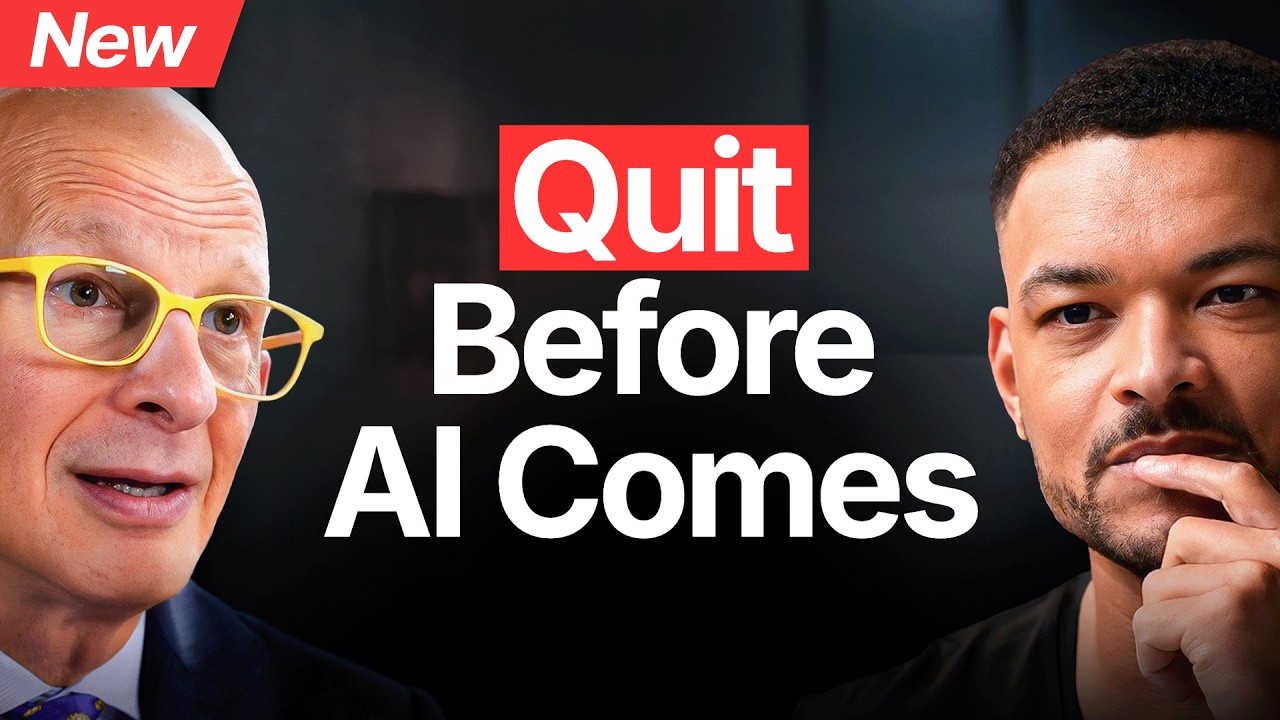
Seth Godin Rejects Michael Jordan Quitting Maxim as AI Reshapes Work
The Diary Of A CEO
Strategic quitting drives long-term success because focusing on human connection and judgment outweighs clinging to failing projects or automated tasks.
## Background
Published on August 10, 2026, by the channel The Diary Of A CEO on YouTube, this video features bestselling author Seth Godin. The page description highlights Godin's insights on why perfectionism keeps people stuck, when to quit versus when to persist, the psychology behind success, and how AI will ultimately reward human connection.
## TL;DR
In this wide-ranging discussion, Seth Godin challenges traditional assumptions about success, quitting, and ambition. He introduces practical frameworks to distinguish unchangeable 'situations' from solvable 'problems' and critiques Michael Jordan's famous quote against quitting, framing strategic quitting as a vital superpower. Through various analogies—including the Gordian Knot, Buridan's Donkey, and the 'smallest viable audience'—Godin urges creators and workers to embrace generative action, move past the fear of embarrassment, and find clarity in their work as AI reshapes the future.
## Atmosphere & style
The conversation carries an intimate, contemplative, and intellectually energizing vibe, characteristic of a deep-dive podcast interview. Godin presents his ideas with warm authority, engaging with host Steven Bartlett through thoughtful, reflective exchanges. Rather than offering aggressive motivational rhetoric, the dialogue maintains an empathetic and candid tone, gradually building toward a grounded sense of clarity and purpose.
## Key takeaways
- [02:31](https://www.youtube.com/watch?v=g7AxxkywiFI&t=151s) Reframing life challenges from 'problems' to 'situations' or structured games helps untangle emotional fear and reveal actionable mechanics.
- [06:14](https://www.youtube.com/watch?v=g7AxxkywiFI&t=374s) All humans universally share four fundamental desires: to be seen, to be missed if gone, to be understood, and to be of use.
- [12:46](https://www.youtube.com/watch?v=g7AxxkywiFI&t=766s) Conflicting goals create emotional knots; progress requires replacing 'but' with 'and' to acknowledge and accept necessary trade-offs.
- [22:01](https://www.youtube.com/watch?v=g7AxxkywiFI&t=1321s) Steve Pressfield's 'Resistance' is the subconscious friction—manifested as fear of embarrassment—that actively blocks creative and vulnerable work.
- [30:38](https://www.youtube.com/watch?v=g7AxxkywiFI&t=1838s) Imposter syndrome and internal self-doubt are irrelevant to execution; focusing on taking action to serve others bypasses internal friction.
- [45:39](https://www.youtube.com/watch?v=g7AxxkywiFI&t=2739s) Past credentials and sunk costs are gifts from a former self that can be thanked and let go if they no longer serve your current vision.
- [57:28](https://www.youtube.com/watch?v=g7AxxkywiFI&t=3448s) Instead of seeking mass approval, creators should target their 'smallest viable audience' to build sustainable, highly engaged support.
- [01:09:18](https://www.youtube.com/watch?v=g7AxxkywiFI&t=4158s) Strategic quitting is a essential superpower; distinguishing between 'the dip' (hard work leading to mastery) and a 'cul-de-sac' (a dead end) dictates when to persevere or exit.
- [01:21:01](https://www.youtube.com/watch?v=g7AxxkywiFI&t=4861s) Perceived agency directly elevates life satisfaction and longevity, as demonstrated by study subjects provided with simple personal choices.
- [01:29:15](https://www.youtube.com/watch?v=g7AxxkywiFI&t=5355s) Perfectionism is a defense mechanism used to avoid shipping work, whereas true professionalism relies on delivering consistent promises over emotional authenticity.
- [01:35:44](https://www.youtube.com/watch?v=g7AxxkywiFI&t=5744s) In an AI-driven economy, automated routine tasks will leave strategic leverage, human connection, and distinct taste as the primary sources of value.
- [01:46:51](https://www.youtube.com/watch?v=g7AxxkywiFI&t=6411s) Attempting to turn a hobby into a business can ruin both; instead, approaching business work with the intrinsic curiosity of a hobby fosters meaningful impact.
## Detailed walkthrough
### [00:00](https://www.youtube.com/watch?v=g7AxxkywiFI&t=0s) Intro and the Simple Secret of Quitting
The episode opens directly with a debate on the true psychology of quitting. Steven Bartlett brings up a iconic quote by Michael Jordan that he saw at the gym earlier that morning: "If you quit once, it becomes a habit. Never quit." Seth Godin immediately pushes back, stating unequivocally that Jordan is wrong. Godin points out that he has personally failed far more times than most listeners tuning in, emphasizing that knowing when and how to quit is actually a core strategic advantage.
Godin introduces "the dip"—a concept describing a fundamental barrier in human achievement that few people talk about or understand. His overarching career mission revolves around helping individuals identify why they feel stuck, pinpoint what holds them back, and build the mechanics to solve those issues. However, Godin observes that modern culture presents new psychological hurdles: people are increasingly afraid, lonely, disconnected, and preyed upon by commercial systems designed to keep them indoctrinated without realizing it.
- Seth Godin directly refutes Michael Jordan's famous "never quit" mentality, identifying knowing when to quit as a superpower.
- The fundamental mechanism behind smart quitting is navigating "the dip."
- Most modern problems stem from structural indoctrination through media and commercial systems.
---
[02:31](https://www.youtube.com/watch?v=g7AxxkywiFI&t=151s) What You Need to Hear If You Feel Stuck
When Steven asks what Seth hopes the audience will gain by the end of the conversation, Godin contrasts his style with traditional "world experts." While typical podcast guests present hard math or rigid mandates demanding "Do this because I did the research," Godin aims to paint a vivid picture of system dynamics and vocabulary, empowering listeners to make their own choices. He emphasizes that problems should not be feared or avoided; they are simply opportunities waiting for solutions.
Godin draws a vital distinction between a "problem" and a "situation." A situation—such as gravity—is an unchangeable reality that must be accepted and worked around. A problem, by contrast, inherently possesses a solution. When people feel entangled, it is usually because they lack the vocabulary or mental models to distinguish between the two.
```
+-------------------------------------------------------------------+
| THE GODIN FRAMEWORK |
+--------------------------------+----------------------------------+
| SITUATION | PROBLEM |
| Unchangeable environmental | Solvable friction with a clear |
| reality (e.g., gravity, age). | mechanics-based outcome. |
| -> Must be accepted & adapted. | -> Must be framed & solved. |
+--------------------------------+----------------------------------+
```
To illustrate how proper reframing eliminates emotional drama, Godin breaks down the high-school experience of applying to college:
- High schoolers often get overwhelmed with existential fear: *"What if they reject the real me?"* or *"Am I a loser?"*
- In reality, the "college industrial complex" is merely a mechanical system with an admissions office operating under specific agendas.
- Reframing the application process as a game—like *Settlers of Catan* or *Monopoly*—strips away internal noise. Winning or losing simply reflects how well you played the game, not your intrinsic worth as a human.
- The key question to ask is: *"What's in it for the admissions officer to see the version of myself I am presenting?"*
"If it's a problem, it means there's a solution. I would like to help people find the vision and the words to see where they're stuck, why they're stuck, and whether it's a problem or a situation."
---
[06:14](https://www.youtube.com/watch?v=g7AxxkywiFI&t=374s) Where Do Most People Actually Want to Go?
Steven shifts the focus to everyday individuals—such as a taxi driver or a mother raising kids while attempting a late-career pivot—and asks where people truly want to end up. Godin responds with a universal human truth: regardless of culture or background, every human wants four fundamental things:
1. To be **seen**
2. To be **missed** if they are gone
3. To be **understood**
4. To be **of use**
The modern tragedy, Godin notes, is that society frequently reduces individuals to mere "cogs in a system." An Uber driver is squeezed by algorithmic incentives to cut corners; a working mother is constrained by macroeconomic pressures that pull her away from fulfilling work or parenting. While large-scale systemic injustices require collective action, individuals can regain agency by identifying where they *do* have choices.
```
┌──────────────────────────┐
│ THE 4 HUMAN DESIRES │
└────────────┬─────────────┘
│
┌────────────────┬──────┴─────────┬────────────────┐
▼ ▼ ▼ ▼
To Be Seen To Be Missed To Be Understood To Be Of Use
```
Godin explains that feeling stuck happens when a person demands two co-existing outcomes that are fundamentally incompatible. Intentionality is the antidote. Rather than waiting for a grand, pre-ordained destiny, people must declare their intent by explicitly stating their work's purpose and defining the specific audience they serve.
To demonstrate how misidentifying your target audience causes false failure, Godin shares a story about a stand-up comedian:
- A comedian works tirelessly, gets booked by their agent, and performs for 10 minutes to a crowd of 100 people.
- Nobody laughs—total silence. The comedian leaves the stage feeling humiliated, believing their career is over.
- Afterward, they discover the room was filled with an Italian tour group where not a single person spoke English.
- *The takeaway:* The comedian didn't bomb; the agent placed them in the wrong room. When reviews or feedback are negative, it often just means: *"This wasn't for you."*
Godin redefines marketing away from corporate ad buys and manipulation. True marketing, he argues, is simply "telling a true story to the right people in a way that helps them get where they want, that they will tell their friends about." He applies this directly to the taxi driver: rather than being ground down as an interchangeable Uber driver, a driver can distribute personalized business cards to 75 local suburban neighbors, eventually securing 15 loyal, regular clients as a private chauffeur.
- True marketing requires no ad budget—it is the deliberate signal you send to a specific audience.
- Focusing on a tiny group of people (even as few as 5 to 25 regular clients) restores agency and economic freedom.
---
[12:46](https://www.youtube.com/watch?v=g7AxxkywiFI&t=766s) How to Get Unstuck: The Rope Analogy and Buridan's Donkey
Steven brings out a piece of physical rope on set to explore the mechanics of unraveling life's entanglements. Godin smiles, remarking that Steven sounds like a magician, and shares the historical origin of the "Gordian Knot."
2,500 years ago, a 21-year-old ruler named Alexander arrived at a small village in Phrygia (modern-day Turkey). Outside the village stood King Midas's ancient wagon, tied with an extraordinarily complex knot. Prophecy held that whoever could untie it would rule all of Asia/Europe. Rather than slicing it with a sword (as popular legend claims), Alexander observed the knot's internal architecture, realized it was anchored around a central wooden peg, pulled the pin out, and easily unravelled the entire rope.
```
THE GORDIAN KNOT
┌────────────────────────────────┐
│ Complex Entanglement │
└───────────────┬────────────────┘
│
[ Remove Central Peg ]
│
▼
┌────────────────────────────────┐
│ Untangled & Free Movement │
└────────────────────────────────┘
```
Godin bridges this historical tale to **Buridan's Donkey**, a famous thought experiment named after the 14th-century philosopher Jean Buridan:
- A donkey is standing precisely halfway between a pile of fresh carrots and a bucket of water.
- The donkey is both starving and dying of thirst.
- However, every time the donkey considers moving toward the water, it hesitates because it moves farther from the carrots. Every time it considers moving toward the carrots, it hesitates because it moves farther from the water.
- Immobilized by its inability to prioritize one option over the other, the donkey starves to death and dies of thirst.
Godin asserts that human beings do this exact same thing every day using one simple hidden word: **"BUT."**
- "I want to have a creative life, **but** I never want to get rejected."
- "I want to run a marathon, **but** I don't want to get tired."
- "I want a job that fulfills me, **but** I want to keep this expensive car and house."
By hiding the "but," people remain paralyzed in the middle, refusing to surrender either desire and blaming external circumstances for their paralysis.
- Alexander the Great untied the Gordian Knot by removing the hidden structural pin holding it together.
- Buridan's Donkey illustrates how wanting two mutually exclusive outcomes simultaneously leads to total paralysis.
- The word "but" hides the trade-off people are unwilling to make, locking them in place.
<ElicitationsGroup message="Explore the next sections of this transcript:">
<Elicitation label="Continue to Part 2: Resistance & Jackson Pollock" query="Provide a detailed walkthrough of Part 2 of this transcript covering Jackson Pollock, resistance, and overcoming embarrassment."/>
<Elicitation label="Summarize Seth Godin's core mental models" query="Summarize the primary mental models Seth Godin discusses in this section, including the Dip, Buridan's Donkey, and the Gordian Knot."/>
</ElicitationsGroup>
[16:03](https://www.youtube.com/watch?v=g7AxxkywiFI&t=963s) The Cautionary Tale of Jackson Pollock and the "And/But" Trap
Seth Godin illustrates the destructive power of conflicting desires through the story of Jackson Pollock, who in the late 1940s was the most famous painter in America and graced the cover of *Life* magazine. Pollock enjoyed a three-year window where he was treated as a rare living hero and his paintings were instantly snapped up. However, as his wife Lee Krasner later noted, Pollock felt he had exhausted that artistic cycle. Rather than becoming a "Jackson Pollock cover band" and repeating himself for easy money, he sought to remain on the creative frontier. He dramatically shifted his style—changing canvas sizes and techniques—and unveiled a whole new body of work at a major show. The world responded with a collective yawn: not a single piece sold, and even today, his second-cycle paintings are rarely seen in major museums.
This professional rejection drove Pollock into severe substance abuse, culminating in a tragic, fatal car crash that took his life and another's. Pollock’s core error was wanting two mutually exclusive outcomes: he wanted to be an edge-pushing, experimental creator, *and* he wanted the immediate financial success and celebrity status of his peak years, forgetting how long the first iteration took to gain traction. Godin explains that when these diametrically opposed desires collide, the internal "but" becomes deafening. Unpacking these entanglements requires examining where we are using a "but" when we should be using an "and."
- **Jackson Pollock's Peak:** Late 1940s (roughly 80 years ago); featured on the cover of *Life* magazine; enjoyed a 3-year run of complete commercial success.
- **The "And" vs. "But" Dynamic:** Using "but" undercuts your work by creating hidden conditions (e.g., "I want to be a creator, *but* I must be universally praised"). Replacing it with "and" amplifies reality (e.g., "I want to be a creator, *and* I am willing to live in the back of my van and be misunderstood while I build an audience").
- **Social Media Traps:** Content creators who chase massive algorithmic reach often trade away their authenticity to chase the next trend, sacrificing a stable identity in exchange for viral clicks.
[19:35](https://www.youtube.com/watch?v=g7AxxkywiFI&t=1175s) Resolving Conflicting Ambitions: The Entrepreneurial Dad
Addressing a common scenario raised by host Steven Bartlett—such as a father of three young children under age seven who wants to launch an AI startup while remaining a dedicated parent—Godin outlines how to navigate competing priorities. The crucial first step is simply naming the conflict. Because a person cannot maximize two massive commitments using the exact same time and space simultaneously, trade-offs must be made over time. A founder with heavy family obligations cannot build a direct competitor to OpenAI, as that demands a 100-hour work week that conflicts with active parenting. Accepting this constraint unlocks practical alternatives rather than leading to paralysis.
Instead of competing with multi-billion-dollar entities, the founder can build a specialized, 40-hour-a-week business. By positioning themselves as an expert who leverages existing AI tools to solve specific problems for a niche group of clients, they can generate immediate value and run a profitable business that respects their family commitments. Godin critiques media culture for pushing the narrative that everyone must aspire to be a Kardashian or a Sam Altman, emphasizing that true business success often lies in making and keeping promises to the smallest viable audience.
- **Time Allocation:** You cannot do two time-intensive things at the exact same moment, but you can execute multiple goals sequentially over a lifetime.
- **Micro-Audience Strategy:** Serving a smaller, dedicated audience faithfully yields more sustainability and often higher net profitability than attempting to launch a massive, venture-backed enterprise while overextended.
[21:21](https://www.youtube.com/watch?v=g7AxxkywiFI&t=1281s) Uncovering True Purpose and Steve Pressfield's "Resistance"
To determine whether a dream is authentic or merely inherited from social media trends, family pressure, or peer rivalry, Godin urges individuals to define the immediate purpose of their next effort. Rather than searching for a grandiose "life purpose," creators should ask what specific change they seek to make and what they expect to receive in return. For instance, an executive deciding whether to scale a company from 75 employees to 250 must evaluate if the added headaches and operational complexity are worth the social status gained at cocktail parties.
This clarity brings up the concept of "Resistance," coined by author Steve Pressfield. Resistance is the subconscious force that manifests as procrastination, self-doubt, or perfectionism to prevent us from doing generous, generative work. It reveals itself in subtle ways, such as a writer experiencing writer's block or someone changing their outfit six times before a date. Institutional systems reinforce this friction by conditioning people to seek permission and act as passive cogs rather than taking initiative.
- **Defining Resistance:** Any internal barrier, fear, or hesitation that prevents creative, vulnerable, or generous work.
- **Common Manifestations:** Writer's block, overthinking simple social interactions, waiting for external approval, or hiding behind the label of being "stuck."
[23:54](https://www.youtube.com/watch?v=g7AxxkywiFI&t=1434s) Naming the Baggage: How Lisa Built a 400-Person Network
While Resistance can never be permanently eliminated, Godin stresses that it can be acknowledged, named, and danced with. To illustrate how facing Resistance unlocks human connection, he shares the story of his friend Lisa. After moving across the country to Los Angeles to live with her partner, Lisa knew only three people in the entire city. Refusing to succumb to isolation, she decided to host a potluck dinner every Friday night, starting with those three acquaintances. Her sole rule was that guests could return only if they brought someone new.
Within 50 weeks, Lisa had cultivated a warm, highly connected network of 400 close friends. Godin notes that while anyone could theoretically execute this idea, very few do because Resistance fills their minds with catastrophic what-ifs: "What if they say no?", "What if they don't like me?", or "What if it's awkward?" By naming these anxieties as mere emotional baggage, individuals can drop them and take meaningful action.
- **Lisa’s Potluck Rule:** Weekly Friday dinners starting with 3 contacts, where returning guests were required to bring a new person.
- **Outcome:** Expanded her social circle to 400 friends in under a year (50 weeks).
- **The Core Barrier:** The fear of rejection is often felt as an existential threat, even though minor social embarrassment carries no real physical danger.
[25:09](https://www.youtube.com/watch?v=g7AxxkywiFI&t=1509s) Resistance, Privilege, and the Improv Group Lesson
Acknowledging that individuals start from different baselines due to systemic injustice and privilege, Godin points out that even among peers with identical backgrounds, responses to Resistance vary widely. He recalls a friend who attended an Ivy League university and auditioned for a prestigious campus improv troupe. Out of all the applicants, the troupe selected 10 people, and his friend placed 11th. Devastated, the friend called Godin, who offered a simple solution: "Start your own improv troupe. You don't need equipment or a permit; you just need four people."
Despite the obvious logic—since improv requires no capital—the friend was entirely paralyzed and could not bring himself to do it. Godin contrasts this inaction with the culture inside his online community, *Purple.space*, where thousands of members hold each other accountable without sales pitches, scams, or hustle. The primary obstacle to starting projects is rarely technical; it is the deep-seated fear of rejection, which the human brain mistakenly equates with physical danger.
- **Purple.space:** An online community founded by Godin built on peer coaching and mutual accountability, explicitly free from commercial pitching or algorithmic noise.
- **The Rejection Paradox:** People eagerly wait to be invited to initiatives, yet hesitate to launch them because taking the first step exposes them to potential social rejection.
[27:11](https://www.youtube.com/watch?v=g7AxxkywiFI&t=1631s) Breaking Down Resistance: From Michelle Obama to an Anonymous Blog
Drawing on his experience co-running the *Podcasting Fellowship* with Alex DiPalma, Godin explains how he helps people overcome the friction of launching new projects. When participants claimed they couldn't start a podcast because they couldn't secure high-profile guests like Michelle Obama, the instructors would trace the ladder backward: Who do you need to interview before Michelle Obama says yes? Who comes before that? The exercise inevitably leads back to a next-door neighbor. Yet, even when tasked with recording a simple 20-minute interview with a neighbor to share with a small, private circle of 20 peers, roughly half the students freeze up due to Resistance.
To dismantle this fear, Godin offers a practical hack: start a daily blog under a pseudonym. Writing and publishing publicly for 100 consecutive days without one's real name attached proves to the brain that public expression is not fatal. By eliminating the fear of personal status loss, the exercise isolates and exposes Resistance for what it truly is.
- **Cost of Entry:** Starting a podcast costs less than $1.00, proving that technical and financial barriers are rarely the real reason people hesitate.
- **The 100-Day Anonymous Blog Strategy:**
1. Pick a pseudonym.
2. Write and publish a daily blog post for 100 consecutive days.
3. Realize that public exposure carries no inherent physical danger.
4. Optionally attach your real name once the habit and confidence are established.
- **Scale of Origins:** Major platforms start small—Bob Lefsetz’s industry-defining music blog (*The Lefsetz Letter*), Godin’s daily blog (now read by 1 million people), and Bartlett's podcast all began with just five readers or listeners.
[30:38](https://www.youtube.com/watch?v=g7AxxkywiFI&t=1838s) Overcoming Imposter Syndrome: The Lifeguard Analogy
Godin addresses the reality that embarrassment and self-doubt are the necessary prices of admission for step-outs beyond one's comfort zone. Touching on "imposter syndrome"—a term coined by social scientists roughly 70 years ago—he illustrates the concept using a lifeguard analogy set at Canoe Lake in Canada. To become a lifeguard in Canada, one must earn a Bronze Medallion. Godin asks the audience to imagine being on duty on the dock when a child begins drowning right in front of them.
If the lifeguard pauses to think, "I barely passed my Bronze Medallion test, and the guard two docks down is a much better swimmer than me—someone else should handle this," the child remains in danger. Instead, the lifeguard jumps into the water without hesitation. They do not stop mid-stroke to apologize for their technique or express feelings of inadequacy; they perform the save. Once the child is safe, neither the child nor the parents care about the lifeguard's internal doubts—they care only that the lifeguard showed up when it mattered.
- **Imposter Syndrome Origin:** Termed by social scientists approximately 70 years ago to describe the persistent feeling of being a fraud despite evidence of competence.
- **Canadian Lifeguard Standard:** Earning the "Bronze Medallion" certification.
- **The Core Lesson:** Action supersedes internal feelings of inadequacy. When service to others takes priority, self-focused imposter syndrome loses its power.
[32:06](https://www.youtube.com/watch?v=g7AxxkywiFI&t=1926s) Overcoming Shame, Online Trolls, and the Superpower of Handling Feedback
Seth Godin emphasizes that overcoming the resistance to put work out into the world requires recognizing where shame and embarrassment actually come from. Shame is an emotion that must be accepted to take effect; if someone throws critical or mean-spirited comments at you, you have the choice to let it bounce off. He shares a personal story of walking past a playground on 74th Street when a four-year-old child inside began taunting him, making fun of his clothes and his bald head. While it momentarily brought back feelings of being bullied in third grade, he quickly realized that the kid was safe on the other side of a fence and would never see him again. Seth realized he didn't have to accept the shame. When doing useful work for a small target audience, one can simply forgive the people who do not get the joke and say, "Sorry, it's not for you."
Steven Bartlett observes that because the internet exposes everyone to trolls and harsh feedback from day one, mastering the ability to overcome shame, embarrassment, and critical feedback is "one of the most important skills in the modern world." Seth agrees and highlights the concept of **practical empathy**: acknowledging that other people have different backgrounds, knowledge, and goals. Rather than taking feedback personally, one should take it seriously only if it serves the actual core mission.
- **Key concept**: Shame requires recipient consent; it bounces off if you refuse to accept it.
- **Practical empathy definition**: Understanding that others do not share your exact background, knowledge, or desires, and not taking their mismatch in expectations personally.
---
[34:45](https://www.youtube.com/watch?v=g7AxxkywiFI&t=2085s) The Shake Shack Potato Story: Serving the Right Audience
To illustrate how listening to the wrong critics can derail a mission, Seth tells the story of his friend Danny Meyer, founder of Shake Shack. Built around Meyer's childhood memories in St. Louis, Missouri, Shake Shack originally served crinkle-cut frozen French fries. However, high-profile New York restaurant critics (like Ed Levine and *The New York Times*) publicly criticized the chain for serving store-bought frozen fries alongside high-end, fresh ingredients. Driven by status and the desire for validation from food critics, Danny and his team spent millions of dollars over a year reconfiguring their kitchens, installing new fryers, and sourcing fresh potatoes.
The fresh-cut fry initiative backfired completely. Fresh potatoes vary by season—a fry made in May tastes entirely different from one made in November—resulting in soggy, inconsistent fries. Staff hated the complex preparation process, customers complained, and the brand lost its edge. Realizing the misstep, Danny asked what the true purpose of the French fries was: were they there to satisfy non-customer critics, or to enhance the authentic Shake Shack story for their actual fans? Shake Shack scrapped the fresh-cut fries, returned to classic crinkle-cut fries, and saw profits and customer satisfaction surge.
- **Financial & Operational Cost**: Shake Shack invested millions of dollars and a year of R&D changing fryers and potato sourcing just to satisfy critics.
- **Outcome**: The shift to fresh fries resulted in inconsistent product quality, staff frustration, and internet backlash until they reverted to frozen crinkle-cut fries.
---
[37:24](https://www.youtube.com/watch?v=g7AxxkywiFI&t=2244s) Customer Obsession, Amazon's Empty Chair, and the Trap of Status
Steven connects the Shake Shack example to a recent executive hire at his holding company, Steven.com. He hired Arada Pema (former AWS product leader) as Chief Innovation and Technology Officer. She described Amazon’s extreme customer obsession, highlighting how Jeff Bezos instituted the practice of keeping an **empty chair in every meeting** to represent the customer's voice. Steven notes that this absolute clarity eliminates internal conflict over who to serve, even if it occasionally comes at the merchant's expense. Seth notes a minor caveat that in recent years Amazon has somewhat compromised this clarity by generating billions in ad revenue through search-ad placements that degrade user search experience, but agrees that the foundational principle of defining "who it's for" remains vital.
Seth pivots to how organizations waste energy on pointless internal meetings, which are often symptoms of unstated rules designed to make bosses feel important rather than serve a clear purpose. He breaks down the three core psychological drivers of human behavior:
1. **Freedom from Fear**: The drive to avoid situations that cause nervousness or anxiety (a primary driver of internal resistance).
2. **Affiliation**: The urge to fit in with a group (e.g., choosing not to wear a tuxedo or clown suit to a funeral).
3. **Status**: The drive to establish relative social standing ("who eats lunch first" or "who gets water at the oasis first").
Seth illustrates status with the example of buying an expensive car. People often claim they want a fast car, but the deeper psychological truth is often a desire to prove a point to a high school bully—telling themselves a story that they are no longer the powerless kid at the lunch table.
- **Amazon Meeting Rule**: An empty chair is placed in meeting rooms to visually represent the customer's interest.
- **Seth's Three Psychological Drivers**: Freedom from Fear, Affiliation (fitting in), and Status (relative hierarchy).
- **Seth's High School Story**: His high school English teacher wrote in his yearbook, "You are the bane of my existence and you will never amount to anything." Seth dedicated his ninth book to her and later shared a friendly lunch with her after letting the grudge go.
- **Wispr Flow**: A dictation software tool that converts speech to text four times faster than typing across any app or device.
- **LinkedIn Ads**: B2B marketing platform allowing precise targeting by job title, seniority, company size, and industry. Offers a $250 ad credit after spending the first $250 at `[linkedin.com/diary](https://linkedin.com/diary)`.
---
[45:39](https://www.youtube.com/watch?v=g7AxxkywiFI&t=2739s) Disentangling Internal Voices and Sunk Costs
Steven asks how to prioritize competing internal and external voices—such as immigrant parents expecting a traditional career path, children needing a present father, or old high school trauma. Seth explains that trying to serve every voice leads to paralysis, like the donkey stuck between a carrot and water. He breaks down the three entanglements that keep people stuck:
* **Time Entanglements**: Confusing who you were yesterday or who you might be tomorrow with who you are right now.
* **Social/Community Entanglements**: Worrying constantly about what peers, family, or critics will think.
* **Self-Vision Entanglements**: The internal narrative and anxiety about self-worth if a project succeeds or fails.
Seth addresses the **sunk cost fallacy**, using the example of someone who spent three years in law school and five years practicing law, only to realize they hate it. People stay in careers they despise because they feel obligated to their "former self" who paid a high price to secure that path. Seth reframes past investments as gifts from your former self: just as you can politely decline an unwanted gift like a Vietnamese potbelly pig, you can thank your former self for the law degree and walk away without accepting the burden of staying on that path.
> "That law degree is a gift. But you don't have to accept it now. Now that you know what you know, you can make a different decision about the purpose of your work. And if it's not helping you achieve the purpose of your work, you can forgive it, say, 'Thank you very much' and untie the knot."
[47:43](https://www.youtube.com/watch?v=g7AxxkywiFI&t=2863s) Sunk Cost Fallacy and Loss Aversion
The discussion opens with Steven Bartlett sharing how understanding sunk costs fundamentally changed his approach as an investor. Early in his career, his brother—an experienced investment banker—explained why Steven was holding onto a failing stock simply because he had bought it at a higher price. Steven's brother introduced him to *The Psychology of Money* and research on sunk cost bias, warning him that ignoring it can ruin a person's life. Seth Godin illustrates the concept with an everyday example: paying $35 in advance for a parking garage through an app, only to spot a free street parking space right near his destination. Even though logic dictates taking the free space—since the prepaid $35 is already gone—a psychological voice pushes people to use the garage to avoid "wasting" the money. Seth frames that unused parking ticket or past decision as a "gift from your former self," emphasizing that we must forgive past choices rather than letting them trap us into serving a former version of ourselves that no longer exists.
The conversation shifts to how sunk cost applies to human relationships and psychology. Seth clarifies that while constantly abandoning relationships every three weeks creates bad behavioral patterns, healthy individuals ending a long-term relationship acknowledge that the past was valid based on who they were then. The real question is whether recommitting serves who they are today and will pay off in the future. Steven connects this to Daniel Kahneman’s pioneering work on loss aversion, referencing research showing that losing £10 hurts twice as much as finding £10 feels good; it takes finding £20 to offset the emotional pain of losing £10. Seth and Steven trace this back to evolutionary biology and wild animal behavior: in nature, protecting what you already have prevents starvation, while seeking uncertain change introduces threat. However, in a fast-moving modern world where rapid AI advancements create constant disruption, trying to hide in safety is futile. Instead, people must deliberately control their attention to bring about meaningful change.
- The $35 prepaid parking ticket example demonstrates how sunk cost bias tricks people into choosing worse options just to honor money already spent.
- Daniel Kahneman’s research on loss aversion indicates that human psychological pain from a loss is roughly double the pleasure of an equivalent gain (e.g., losing £10 requires gaining £20 to break even emotionally).
- Evolutionary survival favored protecting existing resources (a guaranteed meal) over risking them for potential surplus.
[52:09](https://www.youtube.com/watch?v=g7AxxkywiFI&t=3129s) How to Choose Yourself When the System Won’t
Steven and Seth examine how traditional societal systems enforce permission-seeking behavior, and why individuals must learn to "pick themselves." Steven shares a personal, previously untold story about auditioning for the UK radio station LBC before starting his podcast. He completed a stressful two-hour audition with fake callers, but the station never gave him feedback or called him back. Frustrated by the silence, Steven started recording a podcast in his kitchen using YouTube—proving that modern creators no longer need massive gatekeepers to grant permission. Seth explains that systems like the 400-year-old "college-industrial complex" were built to standardize selection: do well in school so a college picks you, do well in college so a corporate employer picks you, get promoted, and eventually die. While that system worked for previous generations, it was inherently rigged and taught billions of people to passively wait for approval.
Seth points out that technology has completely dismantled these old barriers, handing everyone a microphone, a camera, and now generative AI tools. Anyone can start a company or launch a complex product in a few days for $20 a month or using library resources. However, this shift is terrifying because picking yourself removes all excuses. Waiting for gatekeepers serves as a protective "shield" against the fear of failure or accountability; if no one picked you, you can claim to be a victim rather than taking responsibility. Seth highlights how the New York City book publishing industry relies on this dynamic: authors feel safe saying "they asked me to write this," whereas publishing your own work or launching your own YouTube channel places the entire responsibility directly on your shoulders.
- LBC (London Broadcasting Company) radio audition served as the catalyst for Steven Bartlett to launch his podcast independently on YouTube after receiving no feedback.
- Modern access to tools ($20/month AI tools or public library resources) enables anyone to launch businesses or publish work without traditional gatekeepers.
- The 400-year-old educational and corporate pipeline conditioned populations to wait to be picked, acting as a defense mechanism against personal failure.
[57:28](https://www.youtube.com/watch?v=g7AxxkywiFI&t=3448s) Overcoming Delusion and Finding Your Smallest Viable Audience
When Steven raises the danger of being delusional—such as believing anyone can become an NBA player or a famous star simply by "going for it"—Seth clarifies his stance. Seth stresses that picking yourself is not about chasing famous lottery outcomes while skipping fundamental steps. People frequently approach him asking how to land a high-advance career as a novelist. Seth offers a reality check: format the novel into a free PDF and email it to 20 people. If those 20 people love it and forward it to others, publishers and clients will call; if it does not spread, the solution is not to demand the world recognize your genius, but to write a better book. Heartbreak and delusion happen when people insist the world owes them recognition simply because they worked hard or possess a secret message that others fail to understand.
Seth advocates focusing on the "smallest viable audience"—asking what smallest group of people, if served well, would make the work worthwhile. Many people hate this advice because hiding behind grand, unfulfilled ambitions is comfortable; blaming an unappreciative world shields their ego from real testing. Steven reflects on his early podcast days, noting that praise from just two trusted friends, Oliver and Ash—one of whom had a 3.5-hour daily commute from Sheffield—gave him the energy to keep producing episodes. Seth notes that while Steven "won the podcast lottery," sustainable success requires constantly creating value to stay in the game. Referencing Steve Blank's principles on customer traction, Seth emphasizes that the single best metric of a startup's viability is how many customers would genuinely miss it if it disappeared tomorrow. True long-term success is not self-focused or narcissistic; it requires empathy, allowing the audience in, and dedicating oneself to being of service to the right people.
- The 20-person PDF test: A simple method for aspiring writers to test whether their work naturally spreads through word-of-mouth before seeking commercial publishing deals.
- Smallest viable audience strategy shifts focus away from mass fame toward deeply satisfying a specific, defined group of people.
- Steve Blank's customer traction principle dictates that a business's true health is measured by how many people would actively miss it if it shut down overnight (e.g., 100 loyal regulars are sufficient for a local pizza shop).
<FollowUp label="Want to explore Seth Godin's framework for knowing when to quit vs. when to stick with a project?" query="Explain Seth Godin's framework on when to quit versus when to persevere, including 'The Dip' and how to avoid the sunk cost trap."/>
[01:03:10](https://www.youtube.com/watch?v=g7AxxkywiFI&t=3790s) Generous Tension and the Dynamics of Live Events
Seth Godin explains that launching anything new requires creating tension—specifically, "generous tension"—rather than relieving it. This is the positive friction of offering someone an opportunity to advance while letting them know they might miss out if they do not act quickly. He illustrates this concept using a Taylor Swift concert, noting how booking a 15,000-seat arena creates immediate tension for 40,000 eager fans who rush to buy tickets before they run out. Without creating that urgency, an artist cannot successfully tour.
Steven Bartlett tests the boundaries of this analogy by asking if people would still attend if seats were unlimited. Godin points out that scarcity is not only about physical capacity; time itself creates tension. Even with unlimited seating, a live event is bound to a specific date and time, creating a sense of FOMO (fear of missing out) that static digital content—like videos sitting on the internet waiting to be watched tomorrow—simply cannot replicate. Live experiences push communities to make a choice and move forward together.
[01:04:50](https://www.youtube.com/watch?v=g7AxxkywiFI&t=3890s) The Juggling Analogy: Throwing vs. Catching
Turning to the broader challenge of getting unstuck, Godin introduces a practical analogy using juggling. Most people fail when learning to juggle because they assume the sport is about catching the balls. When a throw goes astray, they frantically lunge to catch it, throwing off their posture and guaranteeing that the next ball hits the floor. Godin emphasizes that true juggling is entirely about *throwing*: if you master a consistent, accurate throw, the catches take care of themselves.
Godin connects this directly to self-improvement culture, arguing that most people are obsessed with the "catches"—the outcomes like losing weight, making friends, or growing a business. Instead, real progress relies on building a practice around the "throwing"—focusing on the process, such as putting words on a page consistently, regardless of whether anyone reads the next story. By committing to a generative practice, you relinquish attachment to outcomes outside your control and focus entirely on the actions within your power.
- **The Juggling Process**: Master one ball first (throw, catch), then move to two balls (*throw, throw, catch, catch*) for 20 minutes until every toss lands precisely without effort.
- **The Core Lesson**: Outcomes (catches) are out of your control, but your practice (throwing) is fully within your control. Focus on generosity, spotting problems, and showing up.
[01:06:56](https://www.youtube.com/watch?v=g7AxxkywiFI&t=4016s) Sponsorship Break: The 1% Diary
Steven Bartlett introduces a custom tool developed for his audience of ambitious achievers: the *1% Diary*. He explains that aiming directly at massive, daunting goals can feel like standing at the base of Mount Everest, creating intense psychological discomfort. To combat this, his team relies on breaking large ambitions down into tiny, incremental steps—a philosophy they call "the 1%." After the original run sold out, the product was brought back with updated colors, minor functional tweaks, and a structured framework designed to help users stay motivated and track daily progress.
[01:08:08](https://www.youtube.com/watch?v=g7AxxkywiFI&t=4088s) Listening as a Hidden Competitive Advantage
Picking up on Godin’s throwing-versus-catching framework, Bartlett draws a parallel to a conversation he had with sound expert Julian Treasure. Treasure delivered two famous TED Talks: one on *speaking* that gained over 40 million views, and another on *listening* that gathered around 2 million views. This discrepancy highlights how humanity reflexively favors output over input, even though input often carries greater power. Bartlett notes that elite intelligence operatives and spies have shared that their primary tool for gaining trust in foreign lands is not fast talking, but patient, active listening—often spending weeks listening to people unload their thoughts in taxicabs. Godin agrees, concluding that focusing on the fundamental practice everyone else ignores becomes a massive competitive advantage.
[01:09:18](https://www.youtube.com/watch?v=g7AxxkywiFI&t=4158s) The Dip: Knowing When to Quit vs. When to Stick
Godin introduces the core concept of his book *The Dip*, which focuses on understanding when to quit and when to persevere. "The dip" is defined as the quiet, grueling effort required between starting a project and reaching mastery. He offers concrete examples: organic chemistry is the dip on the way to becoming a doctor, and going to the gym in March is the dip required to get six-pack abs after joining in January. Godin outlines two essential principles for handling the dip:
1. **Anticipate the cost upfront**: Recognize the difficulty before starting. Driving across the Gobi Desert means accepting that there are no gas stations; complaining mid-journey shows a lack of preparation.
2. **Welcome the struggle**: When the dip arrives, view it as a positive signpost proving you have reached the hard part that filters out everyone else.
However, Godin cautions against confusing a temporary dip with a "cul-de-sac"—a dead-end situation or trap where effort yields no improvement, such as trying to smoke your way through emphysema or pouring endless money into a failing business with no trackable traction. When stuck in a cul-de-sac, the healthiest move is to forgive your past self for making a decision that no longer fits reality, quit the project, and redirect your energy.
- **Example of Sunk Cost**: A retail or restaurant owner who signed a four-year lease and is losing money two years in should not spend the remaining two years punishing themselves just to defend an old decision.
- **Economic Reality**: In brick-and-mortar retail, successful shops pay around 95% of their profit to the landlord, whereas failing ones end up giving 102% or more.
[01:13:31](https://www.youtube.com/watch?v=g7AxxkywiFI&t=4411s) Debunking Michael Jordan and Reframing Quitting
Bartlett points out a common motivational poster found on gym walls—a quote attributed to Michael Jordan stating, *"If you quit once, it becomes a habit. Never quit."* Godin directly challenges this mindset, pointing out that Jordan himself quit professional baseball, professional golf, and eventually professional basketball when those pursuits were no longer productive. While Jordan used grievance, a chip on his shoulder, and a refusal to yield as personal fuel to become a legendary athlete, applying "never quit" as a blanket rule for everyday life leads to shame, resistance, and destructive stubbornness.
Godin emphasizes that quitting is a necessary prerequisite to starting anything new. We celebrate weddings, new jobs, and fresh business launches, yet every new start requires quitting the previous status quo. Quitting the *wrong* things—like an abusive boss who will never change—is essential for taking back your future, whereas quitting a marathon at mile 25 simply because you are tired represents a failure of preparation.
- **Godin's Personal Track Record**: *"I've shut down more businesses than most people who are listening to this. I've failed more times than most people are listening to this."*
- **Historical Example**: Godin notes that if he had refused to quit the lightbulb fundraising company he started back in 1987, he would not be where he is today.
[01:16:20](https://www.youtube.com/watch?v=g7AxxkywiFI&t=4580s) A Decision Framework for Quitting
Bartlett shares his personal decision framework for determining when to quit a project or job:
* **When it is merely HARD**: Do not quit. (e.g., Mile 23 of a marathon while raising money for a meaningful cause).
* **When it SUCKS and cannot be fixed**: Quit when the effort required to fix the situation far outweighs the reward on the other side (e.g., working under a toxic boss).
Godin validates this framework, adding that if your personal history shows a pattern of quitting prematurely whenever things get uncomfortable, you should seek guidance from a coach or trusted peers to help objectively evaluate whether a barrier is a temporary dip or a permanent trap. He recalls his own experience as a top producer of educational DVDs for book publishers working alongside brands like Fisher-Price; as soon as it became clear that the format was dying, he recognized the shift and pivoted away.
[01:17:46](https://www.youtube.com/watch?v=g7AxxkywiFI&t=4666s) The Trap of Golden Handcuffs and the "Buts" That Keep Us Stuck
Many professionals in their 30s, 40s, or 50s find themselves stuck in corporate roles where they have spent two decades climbing the ladder to become a director, yet feel entirely unfulfilled. The difficulty in walking away lies in a combination of sunk costs—the status earned over time—and lifestyle entanglements. People often tell themselves, *"I want a job that fulfills me, BUT I like this car, this house, and my neighbors viewing me as a stable, respectable person."*
When examining these "buts," it becomes clear that a conscious choice has already been made to prioritize status and material comfort over fulfillment. Recognizing this choice eliminates the need to constantly fret or play the victim. The alternative is simple but drastic: sell the luxuries, move to a two-bedroom flat, live frugally on rice and beans, and reset your baseline. Giving up the "buts" grants the freedom to take a lower-paying job that brings genuine hope, better family relationships, and meaningful impact.
If someone chooses to retain the high-status job, prestigious business card, and luxury amenities despite being miserable, announcing that decision out loud transforms their mindset. Deciding that those lifestyle perks matter more than changing careers strips away the friction. The job instantly improves because the person stops bridling against it and accepts full ownership of their choice.
- Undertakers and funeral directors rarely choose the path as teenagers at a high school career fair, yet those who stick with it find high job satisfaction by viewing the difficult aspects as a necessary trade-off for community stability, assured cash flow, and predictable hours.
- Seth Godin notes that wishing for a miracle—like receiving a random phone call from Michael Jordan asking you to run his financial empire—is a fantasy that prevents taking ownership of reality.
---
[01:21:01](https://www.youtube.com/watch?v=g7AxxkywiFI&t=4861s) Reclaiming Agency: Lessons from Care Homes and Pain Control
Shifting from a narrative of victimhood to one of control dramatically alters physical and psychological outcomes. Research demonstrates a stark contrast in life satisfaction based on perceived agency, revealing how deeply our mindset impacts our reality.
- **Life Satisfaction Ratings:** Individuals who believe they have control over their life and happiness rate their overall life satisfaction at an average of **7.4 out of 10**, compared to just **5.6 out of 10** for those who feel powerless.
- **Low Happiness Correlate:** People reporting low overall happiness are **5 times more likely** to feel that their personal situation is entirely outside of their control.
- **The 1976 Care Home Study:** Elderly residents who were given responsibility for plant care and small daily choices were **50% less likely to die** over an 18-month period compared to residents whose daily care was fully handled for them.
- **Self-Administered Painkillers:** When hospice and hospital patients are given a button to self-administer pain medication, they consume **equal or less painkillers** and report **lower pain levels and higher satisfaction**. The physical pain remains unchanged, but eliminating the stress of helplessness reduces the perception of pain.
Helplessness is often just a narrative we tell ourselves. While systemic inequities and tragic situations exist, framing one's circumstances through a story of agency fosters personal responsibility and expands future choices. Gravity is an unyielding law of nature that shapes human existence, yet instead of complaining about its constraints, we adapt and build our lives around it.
---
[01:24:46](https://www.youtube.com/watch?v=g7AxxkywiFI&t=5086s) Reframing Famous Quotes: Loving What You Do and Deciding Your "Why"
Commonly accepted career wisdom often gets the mechanics of success backward. Re-examining famous adages reveals how personal agency shapes our day-to-day experience.
```
"In the world of business, the people who are most successful are those who are doing what they love."
— Warren Buffett
```
Seth Godin challenges Warren Buffett's statement, asserting that it is backwards: *"The people who are the most successful love what they do."* "Doing what you love" assumes that an ideal job exists like an amusement park full of pre-packaged rewards. In contrast, "loving what you do" is an active choice to bring enthusiasm and pride to the task at hand.
- **The Midtown Cafe Worker:** Godin recalls a developmentally challenged 50-year-old man who worked at a Dean & DeLuca cafe in Midtown Manhattan clearing tables. Though others might consider the task tedious, he decided to love his work, becoming the warm, energetic "mayor" of the cafe.
- **Dr. Martin Luther King Jr. on Street Sweepers:** Dr. King famously advised that if a person is called to be a street sweeper, they should sweep streets as Michelangelo painted or Beethoven composed. Performing a job with total commitment improves one's daily life, builds strong relationships, and unlocks unexpected future possibilities.
```
"The two most important days in your life are the day you are born and the day you find out why."
— Mark Twain
```
Twain's famous quote should be tweaked from *"the day you find out why"* to *"the day you DECIDE why."* Purpose is not an inherent trait hidden inside us waiting to be discovered; it is a conscious decision. Godin highlights his friend Jacqueline, who chose to dedicate a generation of her life to helping the 400 million people on Earth living on three or four dollars a day. Regardless of where someone starts the marathon, they can decide which problems are worth solving.
```
"The only way to do great work is to love what you do. If you haven't found it yet, keep looking. Don't settle."
— Steve Jobs
```
When Steve Jobs urged people to "keep looking," he meant looking *inward* rather than outward. Unpacking the knot of why you currently dislike your job—whether due to feeling disrespected or buying into an undermining narrative—allows you to clear the clutter. Instead of hoping to be picked by a great boss in a corporate lottery, you can hire the right boss or become your own.
---
[01:29:15](https://www.youtube.com/watch?v=g7AxxkywiFI&t=5355s) Perfectionism as Procrastination and the Fallacy of Authenticity
Perfectionism is frequently misunderstood as a commitment to excellence, but in reality, it serves as a shield against exposure. Quality has a precise definition: meeting specifications. A 1998 Toyota Celica had higher build quality than a 1998 Rolls-Royce because its parts fit together more consistently according to spec, even though the Rolls-Royce was a luxury vehicle. Perfectionism sets unachievable standards as a form of hiding, allowing people to avoid shipping their work under the guise that it isn't "perfect" yet.
Similarly, "authenticity" in the professional world is often a trap and a subtle form of resistance. While family and close friends seek authenticity, professional settings require consistency.
- **Professionals vs. Amateurs:** Professionals make a clear promise and keep it consistently, regardless of their mood. A patient undergoing knee surgery does not want a surgeon to be "authentically" grumpy or distracted; they need the doctor to perform at their best.
- **Acting a Role:** Keanu Reeves is not "authentically" Neo from *The Matrix*—he is an actor portraying a role. When writing his daily blog, Seth Godin plays the role of "Seth Godin the blogger," offering the best version of that persona rather than unleashing raw, unfiltered emotions.
- **A Shield for Poor Behavior:** Blaming actions on "being authentic" is often an excuse for being rude or avoiding necessary work. Saying a novel cannot be written because it isn't "authentically who I am" ignores the reader's expectation for a well-crafted story.
- **Sustaining Podcasting Efforts:** Steven Bartlett notes that when reviewing guest requests, pretending to know or care about a celebrity with 100 million followers just for the view count is exhausting. True sustainability in long-form work comes from staying aligned with genuine interest rather than faking enthusiasm.
[01:33:09](https://www.youtube.com/watch?v=g7AxxkywiFI&t=5589s) The Dance Between Authenticity and Consistency
Steven Bartlett reflects on his own work, admitting that he could not stay consistent over thousands of podcast episodes if he were not making decisions that felt genuinely authentic. Seth Godin agrees, clarifying that his criticism of mindless authenticity does not mean someone should sign up for a role where they cannot happily remain consistent. Using the example of a teacher, Godin explains that effective teaching requires an empathetic commitment rather than just talking about whatever topic pops into your head. The teacher must bring the taste and discipline necessary to make a promise to students and consistently deliver on it. Turning a hobby into a business can ruin both, so finding success is a delicate "dance" where your professional promises rhyme with your core authentic self.
Godin adds that our authentic selves naturally evolve over time based on our environment and the commitments we make. He recalls his own experience after business school, choosing to be an underemployed creative entrepreneur rather than taking a high-status corporate job at companies like Apple or Activision. While he lagged behind his peers on the traditional status ladder for years, it was an intentional investment toward becoming the person he wanted to be every single day.
* "When you turn your hobby into a business, you ruin both of them."
* "If you hang out with people on Wall Street... they authentically became like that because that's who they were surrounded by."
* "If I have to make a promise to an engineering company that I'm going to be Dilbert all day every day, I'm going to die a little bit inside until it's over."
---
[01:35:44](https://www.youtube.com/watch?v=g7AxxkywiFI&t=5744s) How AI Will Reward Human Connection and Taste
Turning to artificial intelligence, Godin shares that his perspective is rooted in deep historical context: he took a PhD-level AI course at Stanford back in 1983 with pioneer Doug Lenat and worked alongside sci-fi legends Isaac Asimov and Arthur C. Clarke early in his career. Godin argues that AI represents the biggest shift in human civilization since electricity. He presents a stark reality for the workforce: either you work for AI, or AI works for you. Those who merely work for AI will be treated like disposable gig workers forced to do the leftover tasks machines cannot handle yet, whereas those who use AI to connect humans, build networks, and exercise good taste will thrive.
```
AI Integration Archetypes
├── Working FOR AI ──> Algorithmic management, gig labor, race to the bottom
└── AI Working FOR You ──> Human networks, trust-building, taste & judgment
```
Bartlett notes that the rise of AI shifts the real value away from purely technical tasks—like standard accounting—toward human-centric skills and judgment. Godin reinforces this point, explaining that if a job's daily rules can be completely written down, an AI will eventually do it cheaper and faster. The safest, most valuable careers belong to those whose judgment, relationships, and taste cannot be captured in a prompt.
* **1890s Electricity Parallel:** Companies that tried to ignore electricity expecting it to go away failed; AI is adoption happening at a much faster rate.
* **The Movie Theater Analogy:** Just as electric utilities provided power but movie theaters figured out how to charge $5 for a show, successful individuals will use underlying AI capabilities to create unique human experiences.
* **The Doctor Paradox:** Backward leaders use AI purely for cost-cutting (e.g., replacing 400 customer service reps), while forward-thinking leaders use AI to augment doctors so they spend *more* time with patients rather than less.
---
[01:40:39](https://www.youtube.com/watch?v=g7AxxkywiFI&t=6039s) The Purpose of *The Knot* and the Story of Dame Whina Cooper
Bartlett points out the striking design of Godin's book cover for *The Knot*, which utilizes a subtle gray-tone print containing the names of all the people who pre-ordered the book from his site. When viewed from the correct distance, the text subtly spells out the word **"PURPOSE."**
To illustrate how an individual can break through systemic helplessness and create genuine change, Godin shares the story of Dame Whina Cooper, an indigenous Māori leader in New Zealand. At 78 years old, facing the historic loss of native lands and disenfranchisement, she refused to view the situation as an unchangeable reality. In 1975, she organized a land march to Parliament in Wellington. Starting with just 50 people walking day after day for over a month, the movement grew exponentially in visibility and numbers:
```
Dame Whina Cooper's 1975 Land March Progression:
Day 1: 50 marchers ──> Mid-March: Front page news (100s-200s) ──> Arrival: 4,000+ marchers at Parliament
```
The march ultimately reshaped New Zealand's culture and land laws. Godin emphasizes that she accomplished this not by possessing massive wealth or global fame, but by leveraging her agency to connect people and establish a repeatable practice.
* "The only way the world has ever changed is when a few people come together, build a culture and repeat it over and over and over again."
---
[01:44:33](https://www.youtube.com/watch?v=g7AxxkywiFI&t=6273s) Regret as Fuel and the Contagion of Generative Action
When asked how to create immediate urgency rather than procrastinating, Godin shifts the conversation to personal accountability, asking how the person you dream of becoming will react when meeting the person you actually become. He reveals that his own deepest regrets are not the risks he took that failed, but the things he failed to attempt—the person he didn't help, the lesson he didn't teach, or the door he didn't open.
As a concrete example of choosing generative action over passive consumption, Godin discusses spending two years organizing *The Carbon Almanac*. Working alongside 1,900 volunteer co-authors, he led the effort to create a research-backed guide to climate change that became a bestseller in multiple countries. He notes how easy it would have been to give up on the idea initially and just watch *Star Trek*, but building the practice of opening doors for others creates a positive, contagious cycle.
* **1,900 Co-authors:** The volunteer team spanning dozens of countries that produced *The Carbon Almanac*.
* **The Core Question:** "When the person you're dreaming of becoming meets the person you become, how's that meeting going to go?"
---
[01:46:51](https://www.youtube.com/watch?v=g7AxxkywiFI&t=6411s) Turning Your Business into a Hobby
Reflecting on his prolific career, Godin admits that while he invented email marketing early on out of financial necessity, writing books is generally a "lousy way to make a living." However, it remains a powerful medium for making a difference. Revisiting his earlier rule about not turning a hobby into a business, he proposes the inverse: the real secret is turning your business into your hobby—the thing you genuinely love doing. His motivation to keep going stems from hearing stories of ideas cascading from person to person, turning on lights for others and offering them dignity.
* "Writing books is a lousy way to make a living, but it's a pretty good way to make a difference."
* "Don't turn your hobby into a business because you'll ruin both of them. But it's interesting to think about turning your business into a hobby."
---
[01:48:19](https://www.youtube.com/watch?v=g7AxxkywiFI&t=6499s) Final Advice for Anyone Feeling Stuck
Bartlett closes by asking Godin for a final piece of advice aimed at listeners who feel stuck in a difficult job, relationship, or life situation—people who are tied up in their own personal "knots" and hesitant to take the leap forward. Godin offers a deeply reassuring and empathetic closing remark:
> "You're not alone. We all are. Every single one of us, especially me."
[01:48:56](https://www.youtube.com/watch?v=g7AxxkywiFI&t=6536s) The Question of Which Voice to Serve
Seth Godin and Steven Bartlett wrap up their conversation on getting unstuck by addressing the sheer volume of external noise people navigate every day. Even when others are not directly telling us how to live, their curated choices—like posting photos from a beach in Hawaii—broadcast a subtle message that our current lives are insufficient. Bartlett notes that one of his biggest takeaways from the discussion is the imperative to get clear on which voice you are actually serving, because trying to satisfy every external expectation guarantees ending up in a "knot."
Godin validates the reality of feeling stuck, emphasizing that while one's circumstances might not feel fair, the constructive shift comes from choosing what to do next. He encourages shifting focus outward: asking who you can contribute to or help today, as well as being open to asking for help in return. Closing out the main discussion, Godin warmly praises Bartlett for consistently documenting this self-reflective journey on his podcast, calling his work an important service to his audience.
- **Key Takeaway:** You get tied in knots when you try to listen to and serve every external voice in a hyper-connected digital world.
- **Actionable Mindset:** Focus on immediate contribution—ask "Who can I offer help to today, and who can I ask for help?"
- **Book Plug:** Godin's book, *The Knot: How to Unravel the Problems That Keep You Stuck*, addresses these exact dilemmas and releases in September.
[01:50:57](https://www.youtube.com/watch?v=g7AxxkywiFI&t=6657s) Would You Want to Live Forever?
As per podcast tradition, Bartlett asks Godin the closing question left by the previous guest without knowing who it was for: *"If you were given the opportunity to live forever, would you take it?"* Godin answers with a swift "No," explaining that being the sole immortal person in a world of mortal beings would be heartbreaking, enervating, and exhausting. He points out that humanity is defined by shared connections and being on the same life journey together; opting out of death means opting out of the shared human experience.
Bartlett strongly agrees, reflecting on his own circle of five close friends over the past 15 years. He shares that as his friends transition into new life phases like parenthood—something he is currently experiencing as well—their ability to connect over these shared milestones brings profound meaning. Being left behind or existing outside that shared lifecycle would feel isolating. Godin adds that while solving short-term physical ailments like sore shoulders would be nice, immortality would quickly lose its appeal because it strips away the value of embracing the present moment.
- **Immortality Trade-offs:** Godin notes that reading science fiction reveals selective immortality to be a curse rather than a gift because everyone around you is constantly aging and dying.
- **Human Connection:** Humanity relies on shared mortality; being the only person on a different path breaks that foundational bond.
- **Closing Note:** Bartlett encourages listeners to check out Godin's daily blog, ending the episode before the channel's outro.
## Notable quotes
> [02:31](https://www.youtube.com/watch?v=g7AxxkywiFI&t=151s) If it's a problem, it means there's a solution. I would like to help people find the vision and the words to see where they're stuck, why they're stuck, and whether it's a problem or a situation. — Seth Godin
> [45:39](https://www.youtube.com/watch?v=g7AxxkywiFI&t=2739s) That law degree is a gift. But you don't have to accept it now. Now that you know what you know, you can make a different decision about the purpose of your work. And if it's not helping you achieve the purpose of your work, you can forgive it, say, 'Thank you very much' and untie the knot. — Seth Godin
> [01:13:31](https://www.youtube.com/watch?v=g7AxxkywiFI&t=4411s) If you quit once, it becomes a habit. Never quit. — Michael Jordan
> [01:13:31](https://www.youtube.com/watch?v=g7AxxkywiFI&t=4411s) I've shut down more businesses than most people who are listening to this. I've failed more times than most people are listening to this. — Seth Godin
> [01:24:46](https://www.youtube.com/watch?v=g7AxxkywiFI&t=5086s) In the world of business, the people who are most successful are those who are doing what they love. — Warren Buffett
> [01:24:46](https://www.youtube.com/watch?v=g7AxxkywiFI&t=5086s) The people who are the most successful love what they do. — Seth Godin
> [01:24:46](https://www.youtube.com/watch?v=g7AxxkywiFI&t=5086s) The two most important days in your life are the day you are born and the day you find out why. — Mark Twain
> [01:24:46](https://www.youtube.com/watch?v=g7AxxkywiFI&t=5086s) The only way to do great work is to love what you do. If you haven't found it yet, keep looking. Don't settle. — Steve Jobs
> [01:33:09](https://www.youtube.com/watch?v=g7AxxkywiFI&t=5589s) When you turn your hobby into a business, you ruin both of them. — Seth Godin
> [01:40:39](https://www.youtube.com/watch?v=g7AxxkywiFI&t=6039s) The only way the world has ever changed is when a few people come together, build a culture and repeat it over and over and over again. — Seth Godin
> [01:46:51](https://www.youtube.com/watch?v=g7AxxkywiFI&t=6411s) Writing books is a lousy way to make a living, but it's a pretty good way to make a difference. — Seth Godin
> [01:46:51](https://www.youtube.com/watch?v=g7AxxkywiFI&t=6411s) Don't turn your hobby into a business because you'll ruin both of them. But it's interesting to think about turning your business into a hobby. — Seth Godin
> [01:48:19](https://www.youtube.com/watch?v=g7AxxkywiFI&t=6499s) You're not alone. We all are. Every single one of us, especially me. — Seth Godin
> [01:50:57](https://www.youtube.com/watch?v=g7AxxkywiFI&t=6657s) If you were given the opportunity to live forever, would you take it? — Steven Bartlett
## Mentioned
Activision, Alex DiPalma, Alexander the Great, Amazon, Apple, Arada Pema, Arthur C. Clarke, AWS, Bob Lefsetz, Bronze Medallion, Dame Whina Cooper, Daniel Kahneman, Danny Meyer, Doug Lenat, Ed Levine, Fisher-Price, Isaac Asimov, Jackson Pollock, Jean Buridan, Jeff Bezos, Julian Treasure, Kardashian, Keanu Reeves, LBC, Lee Krasner, Life magazine, LinkedIn Ads, Lisa, Mark Twain, Michael Jordan, Michelle Obama, OpenAI, Purple.space, Rolls-Royce, Sam Altman, Seth Godin, Shake Shack, Star Trek, Steve Blank, Steve Jobs, Steve Pressfield, Steven Bartlett, Taylor Swift, The Carbon Almanac, The Diary Of A CEO, The Dip, The Knot, The New York Times, Toyota Celica, Warren Buffett, Wispr Flow, YouTube
Author Seth Godin argues that strategic quitting is an essential superpower rather than a moral failing, necessary for redirecting finite human energy away from unproductive dead ends. To overcome chronic paralysis, he asserts that individuals must distinguish unchangeable circumstances from solvable problems, quiet internal resistance, and commit to consistent practice rather than chasing external validation.
Strategic Quitting: The Dip versus Dead Ends (69:18)
Godin directly disputes Michael Jordan's maxim that quitting once turns into an unbreakable habit, pointing out that Jordan himself quit baseball, golf, and basketball when those pursuits no longer served him. Godin differentiates between 'the dip'—the challenging, predictable friction between starting and achieving mastery, exemplified by organic chemistry courses for aspiring doctors—and a 'cul-de-sac,' a dead end where ongoing effort yields zero positive momentum. While abandoning a marathon at mile 25 due to fatigue reflects poor preparation, walking away from an abusive manager or a dying industry format is a prerequisite for starting anything meaningful.
Steven Bartlett introduces a decision framework distinguishing between efforts that are merely hard (which warrant persistence) versus those that are fundamentally broken and unfixable (which warrant quitting). To assist this transition, Godin reframes past investments—such as costly law degrees, failing businesses, or prepaid parking tickets—as 'gifts from a former self.' Under the sunk cost fallacy, people remain trapped serving past identities, whereas healthy decision-making requires forgiving past choices and declining commitments that no longer align with current reality.
Situations, Competing Desires, and Reclaiming Agency (2:31)
Godin separates life's frictions into 'situations,' which are unchangeable environmental realities like gravity that must be accepted, and 'problems,' which contain actionable solutions. Entanglements occur when individuals demand mutually incompatible outcomes, as illustrated by painter Jackson Pollock attempting to pursue experimental creative reinvention while simultaneously demanding immediate critical and commercial applause. A parallel dynamic occurs when corporate professionals complain about unfulfilling careers while refusing to forfeit high-status lifestyle amenities, failing to recognize that they have already chosen comfort over change.
Bartlett and Godin review research showing that perceived agency fundamentally alters wellbeing. Individuals who believe they control their circumstances report average life satisfaction ratings of 7.4 out of 10, compared to 5.6 among those feeling powerless. Godin highlights a 1976 care-home study where elderly residents given responsibility for plants and daily choices were 50% less likely to die over an 18-month period, as well as medical patients who consume equal or fewer self-administered painkillers because eliminating feelings of helplessness reduces the perceived intensity of pain.
Dismantling Resistance, Imposter Syndrome, and Status Traps (21:21)
Drawing on Steven Pressfield’s concept of 'Resistance,' Godin explains that procrastination, writer's block, and perfectionism are subconscious defense mechanisms against vulnerability. He defines quality strictly as meeting specifications—noting a 1998 Toyota Celica had higher build quality than a 1998 Rolls-Royce due to consistent part tolerances—and characterizes perfectionism as an excuse to avoid shipping work. Godin reframes imposter syndrome through the analogy of a certified lifeguard at Canoe Lake: when a swimmer is drowning, stopping to worry about one's relative swimming technique is self-indulgent; the moral imperative is to execute the rescue regardless of internal insecurity.
Godin cautions against compromising a core mission to appease external critics. He cites Shake Shack founder Danny Meyer spending millions of dollars over a year re-engineering kitchens to replace frozen crinkle-cut fries with fresh potatoes after facing criticism from food writers. The fresh fries suffered from seasonal inconsistency and customer dissatisfaction until the chain abandoned the initiative and reinstated frozen fries. Godin emphasizes serving a 'smallest viable audience' and recognizing that shame requires the recipient's consent, allowing creators to let criticism from non-customers bounce off.
Process Discipline and the Human Edge in AI (64:50)
Using juggling as a metaphor for creative and professional work, Godin argues that people fail when they obsess over 'catches'—the external outcomes like wealth or applause—rather than the 'throw.' In juggling, lunging for an errant toss ruins posture, whereas mastering a repeatable, disciplined throw allows the catches to take care of themselves. In professional settings, he favors consistency over raw 'authenticity,' stating that professionals make and fulfill clear promises rather than subjecting clients or audiences to their unfiltered emotional states.
Addressing technological disruption, Godin compares artificial intelligence to the introduction of electricity in the 1890s, predicting that any job with entirely codifiable rules will eventually be automated cheaper and faster. He outlines two distinct economic paths: working for AI as disposable labor under algorithmic control, or having AI work for you by exercising taste, establishing trust, and building human networks that cannot be automated through a prompt.
Godin outlines actionable mental frameworks for uncoupling identity from past sunk costs, yet Bartlett notes that modern digital environments make filtering out ambient social expectations exceptionally difficult. The conversation concludes on the idea that unraveling internal knots is not a permanent, one-time fix, but an ongoing practice of actively choosing whose expectations to serve while exercising agency within one's sphere of control.
精炼阅读摘要
商业作家 Seth Godin 提出,在技术与体制变革的时代,懂得何时“放弃”并主动掌控自身能动性是一项核心战略优势;个体应当摆脱“永不放弃”的教条与沉没成本枷锁,通过服务最小可行受众并深耕不可被算法替代的品味与信任来破解人生困局。
重新定义放弃与低谷期机制 (69:18)
Seth Godin 反驳了 Michael Jordan 宣扬的“永不放弃”格言,指出盲目坚持往往导致毁灭性的顽固与负罪感,懂得何时放弃才是战略优势。他阐述了其著作《The Dip》中的核心逻辑:追求卓越必须区分“低谷期”(the dip)与“死胡同”(cul-de-sac)。低谷期是启动项目到掌握技能之间的必经磨砺,例如医学生的有机化学课程或健身者在三月的坚持,这是筛选竞争对手的天然屏障,应当被预见并接纳;而死胡同则是努力无法带来改善的无谓消耗,例如在衰退行业苦撑或追随无法改变的有毒管理者。
面对死胡同,Godin 强调必须摆脱沉没成本谬误。过往投入的时间、金钱或学位应被视为“前任自我赠予的礼物”,当事人有权感谢并拒绝接纳这份负担,而不必为了迎合过去的自我而惩罚当下。节目主持人 Steven Bartlett 亦补充了其个人决策准则:当一件事仅仅是过程艰难时应当坚持,但当客观环境恶劣且根本无法修复时则必须果断抽身。
厘清客观情境与互斥欲望 (2:31)
人们陷入行动瘫痪常因缺乏精准的认知模型。Godin 将外在阻力区分为不可改变的“情境”(situation)与具备解法的“问题”(problem):重力或年龄等客观事实属于情境,只能接纳并围绕其调整;而问题则必然包含解决方案。许多人感到停滞,本质上是陷入了“布里丹之驴”式的互斥欲望冲突。例如画家 Jackson Pollock 既想推翻既有画风探索前沿,又渴望即刻重现全盛时期的名利,这种无法兼容的欲望碰撞最终导致其生活失衡。
针对身兼多职的创业者,Godin 指出无法在同一时刻既创办竞争 OpenAI 的巨型企业又充分陪伴幼儿,但可在人生不同阶段分步实现,或转向服务细分领域的微型市场。此外,职场“黄金手铐”现象表明,许多人抱怨工作毫无意义却无法离职,核心原因是不愿割舍伴随的社会声望与物质待遇;大声承认并接纳自身对舒适生活的优先选择,有助于消除受害者心态,重塑内心的掌控感。
克服阻力、假性完美与冒充者综合征 (21:21)
创作者迟迟无法推进项目,根源在于作家 Steve Pressfield 所称的“阻力”(Resistance)。阻力常以拖延、自我怀疑或“完美主义”的形式出现。Godin 指出,品质的严格定义是“符合规格”,而完美主义往往是害怕作品公开暴露的防御借口。同样,“真实性”在职场中常被误用为放任情绪的托词,专业的核心在于建立明确承诺并稳定兑现。
面对冒充者综合征,Godin 提出以服务他人来置换自我关注。他以加拿大救生员为例:面对儿童溺水,救生员会毫不犹豫跳水施救,行动的紧迫性压倒了一切内心怀疑。在应对外部负面反馈时,Godin 认为羞耻感必须经由当事人同意才会产生,面对非目标受众应学会忽略。Shake Shack 创始人 Danny Meyer 曾斥巨资迎合美食评论家改用新鲜土豆做薯条,却导致出品不稳定与客户流失,最终果断重回经典冷冻波浪薯条,正是辨明服务对象、拒绝被非受众绑架的典型案例。
摆脱许可体制与服务最小可行受众 (52:09)
传统体制长期训练公众被动等待权威的挑选,将缺乏外部许可作为逃避失败的屏障。现代技术大幅降低了工具门槛,个体已具备“挑选自己”的条件。然而 Godin 强调,自主选择必须与脱离实际的妄想区分开来;与其空想成为少数彩票式成功的行业巨星,不如聚焦于“最小可行受众”(smallest viable audience)。
为了检验想法的真实价值,行动者应用极低成本进行受众测试,例如将书稿排版为免费 PDF 发给 20 位读者,观察其是否自发传播。Godin 指出,人类普遍渴望被看见、被怀念、被理解和产生用处,推进新事务需要营造“慷慨的张力”,正如演出通过时间与席位稀缺促使群体共同前行。同时,行动者应将重心从不可控的“接球”(期望结果)转向可控的“抛球”(日常练习),通过持续产出摆脱对外部结果的病态执念。
AI时代的真正壁垒与个人能动性 (95:44)
回顾自 1983 年在 Stanford 修读人工智能课程的经历,Godin 预测 AI 将带来如同电力普及般深刻的社会重构。劳动形态将两极分化:一部分人沦为受算法调配、从事机器剩余杂务的零工劳动力;另一部分人则将 AI 作为生产力杠杆,专注于人际网络与品味判断。他强调,凡是规则能被完整写下的工作终将被 AI 替代,真正的职业壁垒在于无法被提示词捕捉的品味、人际信任与情境判断。
研究数据显示,能动性对生存与健康具有实体影响。相信生活受控者整体满意度平均达 7.4 分(满分 10 分),而无力感强烈者仅 5.6 分;1976 年一项养老院研究显示,获得照料植物等微小自主权的老人在 18 个月内死亡率降低 50%;自控镇痛泵试验亦证实消除无助感能在消耗同等或更少药量下减轻感知疼痛。新西兰毛利领袖 Dame Whina Cooper 在 78 岁时发起 50 人起步的土地大游行并最终推动立法改变,印证了依托自身能动性建立文化与重复实践能够打破系统性无力感。
Godin 与 Bartlett 的讨论表明,摆脱停滞困局的关键在于主动承担选择后果、划定承诺边界,并果断对无谓消耗生命的死胡同叫停;然而,在算法与商业系统日益严密的当代环境中,个体如何在维持现实生存与坚持服务微型受众之间求得长期平衡,依然是留给每个践行者的现实挑战。
Detailed notes — zh
## Background
该视频由 YouTube 频道 The Diary Of A CEO(主持人 Steven Bartlett)于 2026 年 8 月 10 日发布。节目简介指出,知名商业思想家兼畅销书作家塞斯·高汀(Seth Godin)在本期对话中深度解析了为何追求完美主义会让人陷入停滞、成功背后的隐秘心理机制、何时应当坚持与何时必须果断放弃,以及为何在人工智能时代最“人性化”的特质将获得最丰厚的回报。
## TL;DR
在长达近两小时的对话中,高汀系统性拆解了人们陷入停滞(stuck)的根源——常常源于将不可改变的“客观处境”与可以解决的“实际问题”混为一谈,以及在鱼与熊掌不可兼得的内心拉扯中被“但是”所麻痹。他批判了迈克尔·乔丹式的盲目“永不放弃”神话,主张将沉没成本视为前人送来的“礼物”,果断放弃无法产生未来价值的死胡同。高汀进一步提出,摆脱阻力的关键在于主动“挑选自己”,将服务对象收窄到“最小可行受众”,专注于可控的“抛球”过程而非不可控的“接球”结果;在 AI 大规模重塑规则的未来,唯有深耕真实的人际连接、独特品味与慷慨利他的承诺,才能建立不可替代的人性壁垒。
## Atmosphere & style
整场对话沉稳、知性且富有强烈的启发性,没有任何成功学的浮躁鸡汤,而是充满成年人直面现实的冷静与通透。高汀擅长运用杂耍抛接球、亚历山大解绳结和布里丹之驴等生动寓言与心理道具,将错综复杂的人生困惑化解为清晰精准的模型;主持人 Steven Bartlett 则结合自身的创业、播客心路与家庭琐事不断追问,二人思维碰撞既有推心置腹的共鸣,又有严谨辩证的交锋。随着话题从商业策略自然过渡到面对衰老、死亡与拒绝永生的探讨,整体语调逐渐转向深沉而温暖的人文关怀,让听众在卸下地位焦虑的同时,感受到一种踏实行动、拥抱当下的内在平静。
## Bulletin
- [00:00](https://www.youtube.com/watch?v=g7AxxkywiFI&t=0s) 塞斯·高汀反驳迈克尔·乔丹“永不放弃”的信条,指出理性放弃是开启新事物的前提;区分无法改变的客观“处境”与可解决的“问题”,是打破自我消耗的第一步。
- [14:54](https://www.youtube.com/watch?v=g7AxxkywiFI&t=894s) 人们陷入行动瘫痪往往源于试图兼顾互斥的目标,将内心的阻碍句式由掩盖矛盾的“但是”替换为坦然接纳代价的“而且”,能有效瓦解心理阻力。
- [01:35:44](https://www.youtube.com/watch?v=g7AxxkywiFI&t=5744s) 面对 AI 浪潮,能被标准化写成操作手册的技能都会被机器快速降本替代;真正的商业壁垒将转向人性化连接、品味以及提供深层次的情感价值。
- [45:41](https://www.youtube.com/watch?v=g7AxxkywiFI&t=2741s) 沉没成本在本质上不可逆,应将其视作“过去的旧我赠予当下的礼物”,面对失去价值的投入,个体完全有权礼貌拒绝并果断止损。
## Key takeaways
- [02:31](https://www.youtube.com/watch?v=g7AxxkywiFI&t=151s) 区分“处境”与“问题”:处境是必须接纳的游戏客观规则与现实限制,而问题则是存在具体解决方案的切入点与机遇。
- [06:14](https://www.youtube.com/watch?v=g7AxxkywiFI&t=374s) 人类底层渴望被看见、被想念、被理解与有所贡献;试图迎合所有人只会导致行动停滞,必须明确定义服务对象并学会坦然说出“这不是给你的”。
- [13:08](https://www.youtube.com/watch?v=g7AxxkywiFI&t=788s) “戈尔迪之结”隐喻表明,困境的根源在于暗中束缚人们的内在立柱;抽掉立柱、停止在两个互斥目标间自我撕扯,才能理顺纷乱的生活。
- [18:17](https://www.youtube.com/watch?v=g7AxxkywiFI&t=1097s) 将借口中的“但是”替换为“而且”:承认目标的代价并接纳伴随的困难,放弃鱼与熊掌兼得的幻想,才能重获专注与定力。
- [27:01](https://www.youtube.com/watch?v=g7AxxkywiFI&t=1621s) 内在阻力源于对失败和地位受损的恐惧;将其拆解为最小可行受众与最小行动单位(如匿名写作100天),能有效跨越启动障碍。
- [32:26](https://www.youtube.com/watch?v=g7AxxkywiFI&t=1946s) 羞耻感必须由被施加者主动接收才会生效;带着正确的初衷做事时,完全可以原谅并屏蔽不属于目标受众的杂音与批评。
- [39:13](https://www.youtube.com/watch?v=g7AxxkywiFI&t=2353s) 驱动人类行为的三大核心力量是恐惧(渴望摆脱恐惧)、归属感与社会地位;认清这些动机有助于识破自身消费与决策背后的虚荣借口。
- [47:41](https://www.youtube.com/watch?v=g7AxxkywiFI&t=2861s) 沉没成本不可逆,应视其为“过去的自己送给当下的礼物”;决策核心是评估现状在未来能否带来正向回报,而非为历史错误持续埋单。
- [54:40](https://www.youtube.com/watch?v=g7AxxkywiFI&t=3280s) 数字时代已消解了机构守门人壁垒,等待被挑选只是规避责任的借口;唯有主动“挑选自己”并承担全部后果,才能释放生成性创造力。
- [57:02](https://www.youtube.com/watch?v=g7AxxkywiFI&t=3422s) 检验作品是否陷入妄想的最佳方式是寻找最小可行受众进行低成本验证(如将小说排版为免费 PDF 发给 20 个人看其是否自发传播)。
- [01:04:47](https://www.youtube.com/watch?v=g7AxxkywiFI&t=3887s) 杂耍球的关键在于可控的“抛球”而非焦虑的“接球”;专注于日常践行与基本功过程本身,结果自然会水到渠成。
- [01:09:27](https://www.youtube.com/watch?v=g7AxxkywiFI&t=4167s) 区分走向精通必经的“低谷”与毫无希望的“死胡同”:若无任何证据与先例证明投入能换来转机,盲目死磕只是在掩盖内心的羞愧。
- [01:14:58](https://www.youtube.com/watch?v=g7AxxkywiFI&t=4498s) 放弃与开始互为表里,理智的放弃值得热烈庆祝;环境彻底恶化且付出无法换回价值时,抽身止损才是夺回明日掌控权的选择。
- [01:23:39](https://www.youtube.com/watch?v=g7AxxkywiFI&t=5019s) 无助感往往是自己讲给自己的叙事;通过重塑自我叙事、找回主导权,能够显著减轻身心痛苦并提升长期的生活满意度。
- [01:24:48](https://www.youtube.com/watch?v=g7AxxkywiFI&t=5088s) 反驳“做你所爱”,推崇“爱你所做”:热爱手头所做之事是一种主动的选择,能在既定条件下赋予当下工作尊严与意义。
- [01:29:16](https://www.youtube.com/watch?v=g7AxxkywiFI&t=5356s) 完美主义本质上是披着高尚外衣的拖延症;品质的本质是“符合规格”,借口追求完美往往只是为了逃避将作品推向市场的风险。
- [01:30:26](https://www.youtube.com/watch?v=g7AxxkywiFI&t=5426s) 专业人士追求“始终如一”而非任性的“真实性”;专业的核心在于向受众许下承诺并稳定兑现,而不是情绪化宣泄。
- [01:37:45](https://www.youtube.com/watch?v=g7AxxkywiFI&t=5865s) 在 AI 时代,凡是能写成操作手册的规则化技能都将被低成本算法取代,唯有人际网络、好品味、深度倾听与人文关怀才能构筑真正壁垒。
- [01:50:57](https://www.youtube.com/watch?v=g7AxxkywiFI&t=6657s) 拒绝永生的诱惑:生命正是因为与同代人共同经历衰老、陪伴与有限的人生阶段,才拥有了深刻的归属感与珍视当下的敬畏心。
## Detailed walkthrough
### [00:00](https://www.youtube.com/watch?v=g7AxxkywiFI&t=0s) 重新理解“放弃”与陷入困境的根源
对话在对“坚持与放弃”的直接质问中开场。很多人受到传统成功学名言的影响——例如健身房墙上常挂着的迈克尔·乔丹(Michael Jordan)语录:“一旦你放弃过一次,它就会变成习惯。绝不要放弃。”但塞斯·高汀(Seth Godin)直截了当地指出:“他错了,而且很明显是错的。”高汀表示,自己在职业生涯中经历的失败次数比绝大多数听众都要多,而懂得“放弃的力量”的真正秘诀正是他所提出的“低谷”(The Dip)。世界普遍对这一规律闭口不谈,但他整个人生的核心事业,就是帮助人们看清自己为何陷入停滞、被什么束缚,并找到解决问题的路径。在当下,人们普遍感到恐惧、孤独和脱节,沦为各种媒体和商业系统的附庸与受害者,甚至早已被规训得习以为常。
针对普遍存在的“卡住”(stuck)的状态,高汀借用了经典的“布里丹之驴”哲理寓言:一头驴子站在水和胡萝卜的正中间,它既口渴又饥饿,但因为它不愿放弃任何一方,不肯朝其中一边迈步远离另一边,最终在犹豫不决中活活饿死、渴死。人也是如此,我们总是被一个简单的“但是”(but)所困住——“我想跑马拉松,但是我不想太累”;“我想要一份能实现自我价值的工作,但是我又割舍不下现在的豪车和房子”。人们真正需要的是看清内心的阻抗(resistance),掌握应对羞耻与尴尬的心理机制,从而成为让“未来的自己”心怀感激的人。
主持人史蒂文·巴特利特(Steven Bartlett)在播客正式推进前插播了一段致谢与倡议,向忠实听众说明了订阅对维持节目高质量运作和邀请重磅嘉宾的重要性,随后将话题引向高汀的思想体系核心。
---
### [02:31](https://www.youtube.com/watch?v=g7AxxkywiFI&t=151s) “问题”与“处境”的区分:看清游戏规则
面对主持人的提问——“观众在听完这场对话后能带走什么?”,高汀澄清了自己的角色。他表示自己不同于那些带着大量数据、直接对公众发号施令“按我说的做”的专家;他的目标是帮助人们建立认知框架,用精准的语言描绘出系统运作的本质,从而促使人们依凭自己的判断做出改变。
在高汀的逻辑中,世间的事物必须严格划分为两类:**问题(Problems)**与**处境(Situations)**。
- **处境**是既定的现实环境、游戏的基本规则或不可控的客观限制,你无法凭借一己之力去消除它,只能学着与之共处。
- **问题**则是能够被攻克并存在具体解决方案的切入点,每个真正的问题都意味着机会。
```mermaid
flowchart TD
accTitle: 问题与处境的认知决策框架
accDescr: 展示当面对现实障碍时,如何区分不可改变的处境与可以解决的问题,并采取相应的策略行动。
A["现实障碍与困境"] --> B{"能否被个人直接改变?"}
subgraph S1["处境 (Situations)"]
B -- "否 (客观规则/既定系统)" --> C["接受现实,与系统共存"]
C --> D["看透规则,摆脱情感内耗"]
end
subgraph S2["问题 (Problems)"]
B -- "是 (存在具体解法)" --> E["定义核心问题并寻找切入口"]
E --> F["明确受益群体并创造价值"]
end
D --> G["做出自主选择与理性行动"]
F --> G
```
高汀以17岁高中生申请大学为例:年轻人往往会陷入巨大的自我怀疑,觉得“我正在被评判,他们看不到真实的我,如果被拒我就是个失败者”。然而,一旦看清背后的“大学产业复合体”(college industrial complex)和招生办公室的自身诉求,就会明白这其实只是一场如同《卡坦岛》(Settlers of Catan)或《大富翁》(Monopoly)一样的游戏。被录取不代表你是更好的人,被拒绝也不代表你道德低下,纯粹只是游戏机制的运作。如果你能解决招生官的实际痛点,你就能进入心仪的学校。人际关系、职场互动、婚姻生活亦是同理:人们常常带着满脑子的杂音与执念,误以为别人能听到自己脑中的声音,误以为所有人都想要自己想要的东西。一旦发生碰撞,双方都坚信自己是正确的。唯有看穿家庭系统、企业系统与商业系统的运转动力,才能把这些外在力量转化为通往目标的推力。
---
### [06:14](https://www.youtube.com/watch?v=g7AxxkywiFI&t=374s) 摆脱拉扯:人们真正想去哪里?
主持人提到他在日常生活中接触到的典型人群——在城市中穿梭的计程车/Uber司机,或是那些在育儿与事业转型中挣扎的母亲。对于这些普通大众而言,他们内心深处究竟渴望什么?他们身在何处,又想去往何方?
高汀认为,跨越国界与文化,人类最核心的共通渴望在于四件事:
1. **被看见(To be seen)**
2. **离开时被挂念(Missed if they are gone)**
3. **被理解(Understood)**
4. **能发挥作用、有所贡献(Of use)**
现实的悲剧在于,绝大多数人沦为了精密系统中的螺丝钉。Uber司机受制于算法系统的调度和苛刻规则,不得不以极端的方式赶路;努力维系家庭的母亲受困于经济体系的压力,无法全心投入理想的工作或陪伴孩子。这些系统性不公往往无法被个人凭空扭转——Uber的运作逻辑不会因个人而改变,这属于“处境”。但在既定现实之下,人依然拥有选择的权利。
陷入困境的本质,往往源于**企图同时拥有两样无法共存的事物**。这种内在的撕裂感剥夺了人们发挥作用的机会。高汀强调,“使命/目标”(Purpose)并不是某种人生来就带有的宿命,而是每天清晨可以有意识去设定的意图。设定意图的关键,在于回答那个最根本的问题:“**这是为了谁?(Who is this for?)**”
- 试图取悦所有人,只会感到身上压着一层沉重而模糊的毯子,动弹不得;
- 明确定义具体的目标受众——无论是5个具体的求助者,还是25个会在你离开时真心想念你的人——真正的改变和解决问题的通道才会随之开启。
### [09:10](https://www.youtube.com/watch?v=g7AxxkywiFI&t=550s) 错配与“这不是给你的”:受众精准性的力量
Seth Godin 用脱口秀演员的场景打了个生动的比方:假设你是一名极其努力的脱口秀演员,经纪人兴奋地通知你接到了一个超棒的商演。你满怀信心地登台,台下坐着 100 个人,但整整十分钟你彻底搞砸了(bomb),全场鸦雀无声,没有爆发出一声笑声。你狼狈地下台后才得知,原来台下是来自意大利的旅行团,现场根本没有人听得懂英语。
Godin 发问:到底是谁搞砸了?显然不是你的段子有问题,而是经纪人把你推错了房间。这纯粹是一场严重的受众错配。因此,创作者必须坦然学会说出一句话:“这不是给你的(It's not for you)。”当我们在面对不合适的对象进行沟通时,往往容易陷入自我怀疑。比如在网上看到恶评,或者有人给一本杰作打了一星差评,其实那条一星评价真正想表达的不过是“这本书不适合我”,除此以外评论里的其他挑剔没有任何参考价值;然而另一个人可能会打五星满分,因此作者盲目纠结于差评根本学不到任何东西。
真正的突破在于主动明确“这是为谁而做”:
- **受众是谁**:我们要去帮助、交易、互动、销售的具体对象到底是谁?
- **心理画像**:他们坚信什么?他们想要什么?他们害怕什么?
- **创造价值**:只要你能真正解决他们的问题,他们就会迫切渴望与你产生联结,你就能持续创造价值,形成可复制的循环。
### [10:28](https://www.youtube.com/watch?v=g7AxxkywiFI&t=628s) 现代营销与个人能动性:从全职网约车司机到独立私人司机
针对主持人 Steven Bartlett 追问“陷入困境的人该如何将‘服务对象’落到实处”,并以一位出卖时间却缺乏满足感的 Uber 司机为例,Godin 阐述了他对营销本质的颠覆性认知。Godin 提到自己非常幸运,在电视广告主导地位走向衰落的节点开启了职业生涯。过去,营销意味着大公司砸钱买广告打扰受众并强制推销;而在当今时代,营销被他重新定义为:**向对的人讲述一个真实的故事,以帮助他们到达想去的地方,并促使他们自发告诉身边的朋友**。当你践行这一逻辑时,你是在提供服务而非操纵他人,而且这完全不需要任何预算。
每个人时时刻刻都在进行自我营销。例如,如果你穿着破旧的牛仔裤走进投资银行参加面试,你的着装就已经向面试官发送了明确的营销信号,由对方决定是否接收。每个人都拥有决定自己服务于谁的自由与能动性(agency):
```mermaid
flowchart TD
accTitle: Uber司机摆脱系统困境的转型路径
accDescr: 对比放弃自由依赖平台算法与建立精准私域客户群体的两种不同选择。
subgraph 被动困境["被动模式:出卖时间"]
A["Uber 司机"] --> B["交出全部自由与控制权"]
B --> C["完全依赖平台算法派单"]
C --> D["陷入算法碾压与疲惫感"]
end
subgraph 主动破局["自主模式:重塑营销定位"]
E["识别核心服务群体"] --> F["锁定郊区 75 名有高可靠性出行需求的居民"]
F --> G["明确自身服务边界与承诺并精准递送名片"]
G --> H["积累 15 名稳定高忠诚度的私人常客"]
end
```
如果一名司机的初衷是靠开车和结识有趣的人谋生,他不必任由打车软件或社交平台无情地消耗生命,而是可以主动建立私人客源网络(private chauffeur)。只要服务定位明确,拿到 15 个稳定高频的优质客户并非遥不可及,这才是掌控明日生活的真正开始。
### [13:08](https://www.youtube.com/watch?v=g7AxxkywiFI&t=788s) 亚历山大大帝的绳结隐喻:看清困住你的真正“立柱”
Steven 指出,很多感到卡住、动弹不得的人,深知自己有更大的潜力,却困在心理与机制的迷雾中,不知道从何处着手改变。Godin 借用桌上摆放的绳子,重述了关于“戈尔迪之结(Gordian Knot)”的历史典故。大约 2500 年前,21 岁、尚未获得“大帝”称号的亚历山大来到了土耳其的一座小村庄,那里停放着一辆系着错综复杂绳结的马车,相传解开此结的人将成为欧洲霸主。
传统传说常称亚历山大用佩剑劈开了绳结,但 Godin 指出,历史细节是他根本没有动刀,而是做了一件前无古人的事:他仔细观察后发现,整个复杂的死结其实是缠绕在马车车辕的一根立柱(pole)上。亚历山大顺势**抽掉了中间的立柱**,解除了绳结的内部张力,整个绳结的结构瞬间清晰毕现,轻而易举地被全部解开。
Godin 借此提炼出核心认知:**我们之所以深陷困境,是因为看不清到底是什么在暗中束缚着我们**。
- **现状(Situation)vs 问题(Problem)**:有些客观限制是无法改变的现状,比如地球引力。引力不是问题,人类登月并不是否认引力的存在,而是在接纳引力规律的前提下协作工作。
- **自相矛盾的诉求**:许多人面对的不是无法克服的客观限制,而是同时渴望两件互斥的事物,陷入了自我纠缠的死循环。
### [14:46](https://www.youtube.com/watch?v=g7AxxkywiFI&t=886s) 布里丹之驴与被隐藏的“但是”:杰克逊·波洛克的悲剧
为了直观呈现这种心理拉扯,Godin 在现场摆出一根胡萝卜、一杯水,并拿出一只玩具驴,演示了数百年前著名的哲学思想实验“布里丹之驴(Buridan's ass)”。这头驴既口渴又饥饿,它拥有完全的行动自由,恰好站在胡萝卜堆与水桶正中间:
- 每当它朝水桶挪一步,就会远离胡萝卜,因为饥饿它退缩了;
- 每当它朝胡萝卜挪一步,又会远离水桶,因为口渴它再次退缩;
- 最终,拥有无限自由的驴因为无法做出取舍,活活饿死、渴死在原地。
Godin 强调,我们日常生活中都在做这只驴,其根源在于内心那个微小却致命的字眼——“但是(but)”。人们总在说“我想要这个,但我还想要那个”:想要过富有创造力的生活,**但是**绝不想遭受拒绝;想要跑完马拉松,**但是**绝不想感到疲倦。这种矛盾往往被潜意识隐藏起来,从不轻易大声说出。
Godin 援引美国 1940 年代著名抽象表现主义画家杰克逊·波洛克(Jackson Pollock)的悲剧作为典型警示:
- **巅峰困境**:波洛克曾登上《生活(Life)》杂志封面,作品被疯抢,连续三年处于无懈可击的巅峰。妻子李·克拉斯纳(Lee Krasner)后来回忆,当时波洛克觉得自己在该艺术风格的周期内已经穷尽了一切。
- **决裂与滑铁卢**:绝大多数人会选择成为自己过去的“翻唱乐队”,不断量产旧画套现。但波洛克渴望永远站在艺术前沿,他彻底打破旧风格,换了全新尺寸的画布与画风。然而在新画展上,世界反应冷淡,一幅画都没有卖出去(即便在今天,博物馆里也极少见到他第二周期的画作)。
- **致命的撕裂**:这次惨败加剧了他的药物与酒精滥用,最终导致了一场夺走他人性命与自己生命的致命车祸。波洛克的致命问题在于他同时妄想两件事:他既想要站在先锋最前沿扮演孤傲的探索者,**但是**又放不下成为作品被抢购一空、万人敬仰的超级名流。他忘记了第一个风格被大众接纳花了多少年,内心的“但是”彻底撕裂了他。
### [18:17](https://www.youtube.com/watch?v=g7AxxkywiFI&t=1097s) 用“而且”替代“但是”:直面现实与创作代价
Godin 指出,从困境中突围的关键,在于把内心的“但是(but)”替换为“而且(and)”:
| 句式结构 | 心理机制 | 现实影响 |
|:--- |:--- |:--- |
| **“但是” (But)** | 掩盖对立矛盾,妄图鱼与熊掌兼得 | 削弱行动力,导致自我麻痹与瘫痪 |
| **“而且” (And)** | 坦然承认代价,接纳目标伴随的客观现实 | 强化工作定力,消除不切实际的幻想 |
- **创造者的“而且”**:“我想成为一名有创造力的人,**而且**我热切期盼面对被拒绝,做好长期无人理解、不得不蜗居在面包车后面的准备,因为这就是纯粹创造者的必经之路。”
- **流量追逐者的“而且”**:“我想在社交网络上获得海量关注,**而且**这意味着我不可能保持完全的坦诚、本真与言行一致,因为我必须不停迎合算法、追逐每一个下一波热点。”Godin 坦言,那些持续获取巨大点击量的人正是这样运作的,他们从未做真正的自己;如果你接受不了这种代价,就果断放弃,不要自相矛盾。
抽掉缠绕在生活中心的那根“立柱”,看清内心的纠葛与错误衡量标准,坦然接纳并作出非此即彼的新决策,阻碍前行的困境才会迎刃而解。
### [19:26](https://www.youtube.com/watch?v=g7AxxkywiFI&t=1166s) 无法兼顾的张力:如何在家庭与创业野心之间取舍
史蒂文谈到了自己的哥哥:哥哥膝下有三个不到七岁的孩子,一心想成为世界上最好的父亲;但与此同时,他又极度渴望创办一家人工智能(AI)初创公司。这两个目标在同一时刻产生剧烈拉扯,让人感到左右为难。塞斯·高汀指出,面对这种困境,哥哥做的第一件极具价值的事就是“把它明确命名出来”。一个人不可能在同一时间做好两件完全冲突的事,但可以在不同的人生阶段分步完成不同的事。既然对三个幼小生命许下了承诺,他就必须清醒地认识到:自己不可能每周工作 100 个小时。
因此,哥哥必须选择一个与现有时间预算相匹配的项目。塞斯直言不讳地指出,去创办一家与 OpenAI 正面抗衡的公司是完全不可能的,因为这与家庭承诺无法共存。承认这一点固然痛苦,但它能彻底打开通往可行方案的大门。与其追逐虚幻的宏大叙事,不如以真实的身份站到前台对目标客户说:“我对 AI 的了解超过你们,我将使用工具帮你们完成某项具体任务并收取报酬。”在每周投入适度的 40 个小时后,他依然能准时下班陪伴孩子,尽到一个父亲的责任。这样的业务不仅能创造实打实的价值,甚至“比 OpenAI 去年赚到的净利润还要多”。塞斯强调,大众媒体总在向人们灌输“你必须成为卡戴珊”或“你必须成为萨姆·奥尔特曼”的叙事,但事实并非如此;真正的成功在于向最小的可行受众做出承诺并兑现承诺,“你不可能在同一个空间里将两个互斥的事物同时最大化”。
### [21:20](https://www.youtube.com/watch?v=g7AxxkywiFI&t=1280s) 追寻真正的目标:认清虚荣地位与真实目的
针对史蒂文提出的疑问——如何辨别一个梦想究竟是源自内心,还是盲目继承自 Instagram 上的虚荣人设、家庭期待,亦或是为了跟有钱的连襟暗中较劲——塞斯将其归结为对“工作目的”(Purpose)的探寻。他指出,我们不应空谈一生宏大的终极宿命,而应审视“下一次付出努力的周期中,你究竟想促成什么改变”。如果你做一件事只是为了取悦马克·扎克伯格、迎合匿名评论者,或是想给网络喷子一点颜色瞧瞧,一旦把这些想法大声说出来,你就会发现这种目的荒谬透顶,是一个十足的陷阱。
塞斯进一步用企业规模做比喻:假设一家公司已有 75 名员工,CEO 究竟是否有必要将其扩张至 250 人?从 75 人变成 250 人的掌门人,换来的表面上理论上是更多的钱,但实际上伴随的是更大的头痛。真正改变的其实是“社会地位”——在鸡尾酒会上能够炫耀自己管辖更多人、拥有更高的权势名望。每个人都必须诚实地评估:这种虚荣地位是否值得付出如此高昂的代价?厘清工作的真实意图,正是破除迷思的关键。
### [22:51](https://www.youtube.com/watch?v=g7AxxkywiFI&t=1371s) 认识“阻力”:那个阻止我们创造的隐形敌人
谈到行动迟缓的根源,塞斯引用了史蒂文·普雷斯菲尔德(Steven Pressfield)提出的核心概念——“阻力”(Resistance)。阻力泛指任何阻碍我们开展慷慨、具有生成性、富有创造力工作的内在心理抗拒。无论是作家的写作瓶颈,还是出门约会前反复更换六次衣服,阻力无处不在。现存的社会体系一直在对人进行规训,试图把每个人打造成机器中的齿轮,让大家习惯性地发问“我怎样才能拿到 A 级评分”、“我如何才能获得许可”,从而彻底丧失自主开创的主动性。
对于史蒂文的哥哥而言,任由内心的阻力作祟并宣称“我被困住了”,远比勇敢地说“我这个周末改变了 17 个人的生活”要轻松得多。如果不断深挖他的真正目的,改变现实中具体个体的生活,显然远比打造一家只为了登上《商业周刊》杂志的公司重要得多。
### [23:57](https://www.youtube.com/watch?v=g7AxxkywiFI&t=1437s) 与阻力共舞:丽萨的周五晚宴与主动者的力量
塞斯阐明,阻力是永远无法被彻底消灭的;我们能做的是学会“与它共舞,甚至请它进来喝杯茶”。只要察觉到迟疑、拖延或“我现在不想做、想先干别的”这类冲动,就要果断将其识别为阻力。
为了说明战胜阻力的现实力量,塞斯分享了好友丽萨(Lisa)的故事:
* 丽萨随伴侣搬迁横跨美国来到洛杉矶,在整座繁华大都市里仅仅认识三个人。
* 她拒绝陷入孤立无援的寂寞生活,于是决定在每周五举办家常便饭聚餐(Potluck)。
* 起初,她只邀请了认识的这三个人,并定下唯一规则:如果下周还想来,就必须带上一位新朋友。
* 仅仅过了 50 周,丽萨就建立起一个拥有 400 位好友的深厚社交圈。
塞斯感叹,理论上任何人都能做到这一点,但现实中几乎无人付诸实践。因为阻力总在暗中作祟:“万一我发出邀请他们拒绝怎么办?”、“万一我请来的人我不喜欢怎么办?”或“万一对方讨厌我怎么办?”只要能精准指认出这些心理包袱并果断抛下它,看清自己因何受困,就能朝着目标大步前行。
### [25:27](https://www.youtube.com/watch?v=g7AxxkywiFI&t=1527s) 为何迈出第一步如此艰难:即兴剧团与拒斥恐惧
史蒂文提出疑问:面对阻力,为什么人群的应对表现截然不同?有些人能够毫无心理负担地组织陌生人聚会,而另一些人却长期生活在恐惧中不敢冒险。塞斯认为,这固然涉及特权、社会不公以及某些文化从未给予人试错空间等客观因素;然而,即便在拥有完全同等特权的群体内部,人们的行动力依然有着天壤之别。
塞斯举了一位常春藤盟校毕业的世交晚辈的例子:这位年轻人梦想成为演员,在参加即兴喜剧(Improv)剧团选拔时,剧团招收 10 人,他偏偏排在第 11 名。年轻人深受打击并向塞斯诉苦,塞斯随即建议:“你为什么不自己组建一个即兴剧团?这既不需要昂贵的设备,也不需要官方许可,你只要拉上四个人就能开演。”讽刺的是,作为一门强调即兴发挥的艺术追求者,这个年轻人却迟迟不敢行动。
```mermaid
flowchart TD
accTitle: 拆解阻力与倒推目标的阶梯模型
accDescr: 展示从不可及的宏大目标(如邀请米歇尔·奥巴马)倒推到第一步(采访邻居)的逻辑路径。
subgraph Goal["宏大远景与借口"]
A["终极愿景:邀请米歇尔·奥巴马等重磅嘉宾"]
B["阻力借口:'我找不到好嘉宾,所以无法开始'"]
end
subgraph Deconstruct["反向拆解路径"]
C["倒推上一位嘉宾:行业知名人士"]
D["倒推起点:隔壁邻居(20分钟访谈)"]
end
subgraph Action["行动与突破阻力"]
E["为20人的小圈子制作第一期节目"]
F["直面被拒绝的恐惧,打破停滞状态"]
end
A --> B
B --> C
C --> D
D --> E
E --> F
```
塞斯提到自己在 Purple.space 社区的实践——这里聚集着数千名互相督促指引的伙伴,没有套路、不兜售产品,只讲求彼此真诚支持与负责。然而,所有人都在等待别人迈出第一步。大家之所以害怕主动发起,是因为从潜意识层面来看,被社交圈排斥和拒绝的感觉往往被放大为“仅次于死亡的恐惧”。一旦看透被拒绝并不会致死,行事的本质不是强推硬卖,而是为他人解决问题的同时成全自己,行动的价值便会自然浮现。
### [27:14](https://www.youtube.com/watch?v=g7AxxkywiFI&t=1634s) 拖延了四年的播客:拆解借口与百日化名写作法
史蒂文分享道,作为播客主播,常常在街头遇到陌生人兴奋地向他讲述自己筹划了四年的播客构想,但多年来却从未录制过哪怕一期节目。塞斯对此深有共鸣,他曾与亚历克斯·迪帕尔马(Alex DiPalma)共同创办播客培训营(Podcasting Fellowship),培训了成千上万名学员。创办播客的实际门槛极低,花费甚至不到 1 美元,但人们就是迟迟无法开始。
学员们最常见的借口是:“我请不到优秀的嘉宾。”塞斯通常会反问:“你梦寐以求的最棒嘉宾是谁?”很多人脱口而出:“米歇尔·奥巴马。”针对这种不切实际的幻想,培训营会采取逆向推导的策略:
- 如果想请到米歇尔·奥巴马,在此之前你需要先采访过谁才能让她更有可能答应?
- 那么在那位嘉宾之前,你又该邀请谁?
- 一路倒推回最起点:你能否先邀请隔壁邻居进行一场 20 分钟的对谈?
几乎每个人都会承认自己能采访邻居,但当导师要求大家把这期采访邻居的音频录下来、放给班里 20 位同学听时,半数以上的学员会瞬间卡壳。技术上毫无难度,真正的阻碍在于:开不了口去邀请邻居,更不敢把作品公之于众——这正是阻力在作祟。
为了破除这种心理防御,塞斯给出了一个立竿见影的“破解法”(Hack):注册一个没有任何人知道的化名博客,不向任何人透露作者身份,强制自己连续写作 100 天。只要能够坚持写满 100 天,内心的阻力就会被彻底瓦解,届时创作者甚至会按捺不住冲动,迫不及待地想把自己的真名签在作品之上。
### [29:01](https://www.youtube.com/watch?v=g7AxxkywiFI&t=1741s) 化解阻力:拆解到最小行动单位与最小受众
赛斯·高汀(Seth Godin)剖析了创作瓶颈的真正根源:它并不是技能的缺失,而是源于内心的“阻力”(Resistance)。这种阻力本质上是两种相互冲突的欲望在拉扯——我们一方面渴望获得认可与赞誉,另一方面又极度恐惧失败、被贬低和失去社会地位。正是这种两难境地让人陷入瘫痪,而既有的体制甚至乐见人们保持这种被困住的状态。
为了破除这种僵局,唯一的办法是将阻力拆解为微小的行动单元。史蒂文·巴特利特(Steven Bartlett)指出,赛斯所做的正是层层降解阻力的门槛:把“如何邀请米歇尔·奥巴马(Michelle Obama)上播客”的宏大恐惧,缩减为“去邀请隔壁邻居聊聊”,进而再降解到“开设一个匿名博客”。赛斯强调,自己拆穿自己的借口固然令人难受,但总好过被现实或他人无情戳穿。创作者必须自问:为了能带来实质改变,自己能为“最小可行受众”(smallest possible audience)提供的最小价值单元究竟是什么?
所有伟大的作品与平台最初都微不足道。写出全球最知名音乐行业博客的鲍勃·勒夫塞茨(Bob Lefsetz),在起步时仅仅拥有 5 位读者;赛斯·高汀如今拥有百万读者的日常博客,最初也只有 5 个人在看;史蒂文的商业播客在第一期上线时,同样只有区区 5 位听众。
- **创作阻力的本质**:渴望成功与害怕地位受损的心理拉扯。
- **解法路径**:宏大阻力 $\rightarrow$ 身边微小尝试 $\rightarrow$ 匿名小范围输出。
- **受众起步定律**:任何顶级 IP 均始于个位数的初始受众(赛斯、勒夫塞茨与本播客起步时皆仅有 5 位受众)。
---
### [30:38](https://www.youtube.com/watch?v=g7AxxkywiFI&t=1838s) 救生员隐喻与冒名顶替综合征:别让尴尬阻碍行动
当史蒂文提出“尴尬是否是踏入任何新领域的必付门票(the cost of entry)”时,赛斯引入了心理学中大约 70 年前确立的“冒名顶替综合征”(Imposter Syndrome)——即在着手做重要或新颖的事情时,总觉得自己是个骗子、不配在此位置,潜意识里认为应该由别人来做。
为了说明如何化解这种心魔,赛斯打了一个救生员的比方:在加拿大的独木舟湖(Canoe Lake),成为救生员需要考取铜标认证(Bronze Medallion)。假设码头上有六名值班救生员,突然有一个孩子就在你眼前的湖水里溺水挣扎。此时你脑海里浮现的第一反应可能是:“我才刚勉强考过铜标,隔壁码头那家伙泳技比我强得多,应该由别人去救。”但你立刻明白,危险就在眼前,这是你的责任。你跳进水里时,绝不会中途停下来为自己的泳姿笨拙而道歉,更不会对落水者说“对不起我游得不够快”。你只想拼尽全力把孩子救上来,而孩子和家长最终只会充满感激。
当使命和行动对象变得极其具象且迫切时,救生员便能瞬间压制阻力。如果一个人正在向主动订阅的读者发送一份能切实提供帮助的邮件简报,这种行动本质上就是在救人,所谓“尴尬”根本无立足之地。
---
### [32:26](https://www.youtube.com/watch?v=g7AxxkywiFI&t=1946s) 羞耻感必须由你主动接收才生效:游乐场里的四岁小孩
赛斯进一步区分了尴尬与羞耻感(Shame),指出羞耻感是一种必须由被施加者“主动接收”才会起效的情绪。外界会不断向你投掷羞耻,但只要你不伸手接住它,它就无法伤你分毫。
赛斯分享了一件不久前发生在纽约 74 街的真实趣事。当时他正路过街角的一个小型口袋游乐场,突然听到铁丝网里面有一个四岁大的小男孩正在大声嘲弄路人。那孩子肆无忌惮地嘲笑对方的衣着,甚至大声讥讽对方是个光头。赛斯走着走着突然反应过来:那个小孩是在嘲弄自己!这种突如其来的当街辱骂瞬间将赛斯拉回了小学三年级遭遇霸凌的记忆深处。然而他立刻清醒过来:这个四岁小孩隔在铁丝网后面,两人此生绝不会再见,对方的言语对自己毫无约束力,羞耻感瞬间如同撞上盾牌般弹开了。
面对网络时代无处不在的指责与杂音,这种心态至关重要。面对那些不懂你、不属于你受众的批评者,创作者完全有权坦然回应:“抱歉,这本来就不是为你准备的。我原谅你,但我绝不接受你扔过来的羞耻与难堪,因为我是带着正确的初衷来到这里的。”
---
### [33:35](https://www.youtube.com/watch?v=g7AxxkywiFI&t=2015s) 实用同理心与 Shake Shack 的炸薯条危机
针对史蒂文提出的“在键盘侠遍地的互联网时代,克服羞耻与批评已成为一种超级能力”,赛斯提出了“实用同理心”(Practical Empathy)的概念:理解“你不知道别人经历过什么,彼此的欲求也并不相同”,因此完全不必将攻击上升为人身伤害(not taking it personally),但需要客观严谨地对待事物本身(taking it seriously)。
```mermaid
flowchart TD
accTitle: Shake Shack 薯条战略反复流程图
accDescr: 展示 Shake Shack 在面对美食评论家批评与倾听真实顾客心声之间的战略纠偏过程
subgraph 偏离本质阶段 ["受困于地位焦虑与外界评价"]
A["传统波浪纹冷冻薯条<br/>(符合品牌DNA与大众记忆)"] --> B["纽约高端食评家公开批评:<br/>'手工汉堡店怎能用冷冻半成品'"]
B --> C["巨资研发鲜切手工薯条<br/>(改造油炸锅、耗费数百万美元)"]
end
subgraph 现实反噬阶段 ["运营灾难与核心受众反弹"]
C --> D["鲜切马铃薯受季节影响品质失控<br/>(成品绵软油腻、店员操作混乱)"]
D --> E["大众顾客强烈抗议与网络声讨"]
end
subgraph 战略纠偏阶段 ["回归实用同理心与客户本质"]
E --> F{"丹尼·迈耶反思核心问题:<br/>'薯条到底为谁而存在?'"}
F -->|放弃迎合评论家| G["全面恢复波浪纹冷冻薯条"]
G --> H["利润回升、效率改善、品牌故事重归正轨"]
end
```
为了阐释这一点,赛斯讲述了好友丹尼·迈耶(Danny Meyer)创立 Shake Shack 时的经典商业教训。Shake Shack 的最初构想源自丹尼在密苏里州圣路易斯的童年记忆,其标志性配置就是波浪纹冷冻炸薯条(crinkle-cut fries)。然而,包括埃德·莱文(Ed Levine)以及《纽约时报》在内的高级美食评论家却大肆抨击:“你们标榜高品质手工新鲜食材,怎么能用超市冷柜里就能买到的工业冷冻薯条?你们必须做新鲜现切的手工薯条!”
丹尼本人在纽约高端餐饮界享有盛誉,出于对自身行业地位的焦虑和被批评的羞耻感,他和团队投入数百万美元、耗时整整一年去研究土豆品种,改造每家分店的油炸设备。然而,新鲜切制的土豆极不稳定,五月份与十一月份的淀粉含量完全不同,炸出来的薯条时好时坏,常常变得软塌难吃,员工也因复杂的清洗和加工苦不堪言。更致命的是,广大核心消费者在网上愤怒抗议,质问 Shake Shack 为何要毁掉大家最爱的美味。
最终丹尼痛定思痛自问:“Shake Shack 的薯条究竟是用来让那些从不消费的高端食评家觉得体面,还是为了强化大众顾客走进店里的美好体验?”想通这一点后,他们果断拆除了所有昂贵的新设备,全面换回了最初的波浪纹薯条。结果利润大幅反弹,运营效率显著提升。这一转变的关键就在于:原谅并彻底忽略那些原本就不属于自己受众的人。
---
### [37:14](https://www.youtube.com/watch?v=g7AxxkywiFI&t=2234s) 听从对的声音:亚马逊的“空椅子”与极致以客户为中心
史蒂文深刻共鸣了 Shake Shack 的案例,指出这个商业故事实则关乎每个人的日常生活抉择:我们究竟在倾听并迎合谁的声音?
史蒂文提到自己最近为控股集团 Steven.com 聘请了前 AWS 人工智能产品负责人阿努拉达·佩马(Anuradha Pema)担任首席创新技术官(CITO)。佩马向他分享了亚马逊(Amazon)内部极度震撼的“以客户为中心”(Customer Obsession)文化:
1. 亚马逊的每一次会议中,杰夫·贝佐斯(Jeff Bezos)以及高管团队都会在会议室特意留出一把“空椅子”。
2. 这把空椅子代表着整个公司最重要的角色——终端客户。
3. 它在物理空间上时刻提醒所有人:无论内部争论多么激烈,所有的产品决策最终都必须对这位坐在空椅子上的客户负责。
史蒂文感叹,这种极致的聚焦彻底化解了此前赛斯提到的“布里丹之驴”(在两堆干草之间犹豫饿死的驴子)困境——企业根本不需要在讨好商家还是取悦顾客之间拉扯分裂,只要坚定不移地选择服务真正的终端客户,外界的噪音与虚荣指标就会迎刃而解。
### [38:15](https://www.youtube.com/watch?v=g7AxxkywiFI&t=2295s) 明确受众与亚马逊的迷失
Steven 提到此前有人给他的建议:宁可牺牲商家的利益也要以消费者的体验为先,而你必须坦然接受这种取舍。这一原则一直深深影响着他,以至于在录制播客时,他脑海中始终有具体的受众画像(Persona),比如开出租车的戴夫(Dave)或是全职妈妈杰伊(Jay),时刻明确自己到底在为谁服务。
Seth Godin 对此表示极度赞同,并以此为切入点剖析了亚马逊(Amazon)近年的变化。Seth 指出,在过去两年里,亚马逊逐渐迷失了自己究竟在为谁服务的初心:去年亚马逊通过广告业务赚取了数百亿美元,但这些广告却严重破坏了用户的搜索体验。广告主打断消费者的正常检索,把自己的商品硬塞到前排,这种模式根本不是在服务终端消费者,而是在迎合华尔街股东的短期利益。然而,Jeff Bezos 当年建立的模型——无论从其极具启发性的开会机制,到明确产品“是为谁而做、不为谁而做”的边界——都始终清晰地聚焦于:我们来这里到底是要解决什么问题?每一次点击、每一个页面的意义究竟是什么?
```mermaid
flowchart TD
accTitle: 组织决策核心导向
accDescr: 组织决策是应该服务用户还是服务短期财务指标的对比示意图。
subgraph 传统亚马逊模式
A["明确受众画像<br/>解决用户真实痛点"] --> B["构建极致用户体验"]
end
subgraph 偏离初心的模式
C["追逐短期财务收益<br/>销售干扰性搜索广告"] --> D["破坏用户核心体验<br/>服务华尔街股东"]
end
```
---
### [39:13](https://www.youtube.com/watch?v=g7AxxkywiFI&t=2353s) 会议的虚荣本质与驱动人性的三股力量
谈到亚马逊独特的开会制度,Seth 直言,现实中绝大多数白领都会把开会视作一天中最糟糕的环节。必须诚实地问一句:“开这个会到底是为了什么?”现实中多数典型会议的目的,无非是让领导感受到大家都在听他讲话,并让领导核实出勤率。如果会议内容本可以写成一份备忘录(Memo),却硬要拉上八个人干坐着听讲,那为什么不录一段视频让大家两倍速看完?会议往往是一家公司的体制病症,反映出组织已被那些未经言说的潜规则牢牢困住。
Seth 指出,抛开表象不谈,驱动人类行为的根本力量只有三样,而人们往往并不真正理解它们:
* **恐惧(Fear)**:更准确地说是“摆脱恐惧的愿望(Freedom from fear)”。人们不想做任何让自己感到紧张或害怕的事,这种避害心理构成了强大的“阻力(Resistance)”,阻止人们展开行动。
* **归属感与认同(Belonging / Affiliation)**:就像没有人会穿小丑服或燕尾服去参加葬礼一样,人总是观察左邻右舍在干什么,极力追求合群。
* **地位(Status)**:地位的本质很简单,就是“谁先吃午饭”、“到达绿洲时哪只动物先喝水”。地位不等于金钱,但往往与金钱挂钩,本质上就是群体中的“高低顺位”。
人们在选择买一件始祖鸟(Arc'teryx)、巴塔哥尼亚(Patagonia)外套还是便宜的仿制品时,背后全都是归属感与地位在相互博弈。认清这一点,我们就能解码脑海中那个隐秘的借口。比如有人买超跑声称是“因为车速快”,但真相其实是:高中午餐桌上曾有个看不起他、断言他一事无成的恶霸,而那个恶霸一辈子都买不起这辆车;每当坐进这辆车,他就可以告诉自己“我再也不是当年那个窝囊小孩了”。Seth 认为,只要你认清并承认这就是你试图解决的问题,那就去买,只要它确实解决了你的心理包袱。
---
### [41:51](https://www.youtube.com/watch?v=g7AxxkywiFI&t=2511s) 年少执念与情绪消费的真相
Steven 追问:“为了向当年看不起自己的人证明自己,这算是一个有价值的目标(Worthy goal)吗?”Seth 回答,这并非他人所能评判的事,因为中学时代的创伤确实会给每个人看待世界的方式留下难以磨灭的烙印。
Seth 分享了自己的真实经历:他的高中英文老师曾在他的年签毕业纪念册上赫然写道:“你是我生命中的克星,你这一生将一事无成。”虽然老师可能半开玩笑,但当 Seth 真正成为一名职业畅销书作家时,这句话的意义变得无比耐人寻味。后来,Seth 将自己的第九本书题献给了这位英文老师,以此彻底放下了这段心结,几年后两人还共进了一顿非常融洽的午餐。
Seth 强调,没有人能过着绝对理性、完全优化的人生。很多人痴迷于营养补剂、热衷于各种长寿与生物黑客(Biohacking)捷径,往往根本不是基于科学健康的深思熟虑,而是为了获得一种掌控感(Agency),以及特定社群圈层的身份认同。医学概念与流行保健品之所以像时尚一样轮转,不是因为底层科学规律变了,而是因为文化在不断重塑人们的情感需求。
---
### [43:14](https://www.youtube.com/watch?v=g7AxxkywiFI&t=2594s) 赞助商插播:Whisper Flow 与 LinkedIn Ads
*(本段包含由主持人 Steven 呈现的商业赞助推广内容)*
* **Whisper Flow 语音转文字工具**:Steven 演示了这款由他投资的语音输入产品,展现其在 60 秒内如何快速处理工作。他演示了在团队 Slack 频道中表扬“本周实验冠军”预告片制作团队(Ant、Liv、Dom 和 Cam),并通过 Gmail 语音指令“添加团队邮箱”给合作创始人发邮件,以及向负责排期的助理 Juan 发送调整录制时间的语音指令。Whisper Flow 的输入速度比键盘打字快四倍。
* **LinkedIn Ads 企业营销平台**:Steven 探讨了企业营销预算被浪费的常见困境——创意和方案虽然过关,但广告却展示给了根本没有决策权和购买力的人群。LinkedIn Ads 允许营销人员根据职位头衔、职级资历、公司规模和专业技能进行精准定向,具备主流广告网络中极高的 B2B 广告支出回报率(ROAS)。
---
### [45:39](https://www.youtube.com/watch?v=g7AxxkywiFI&t=2739s) 三重纠缠与摆脱沉没成本的“礼物”
广告结束后,Steven 提出一个困惑:如果内心有许多相互冲突的声音——父母作为第一代移民希望自己当医生或律师,孩子们希望自己是个好父亲,而年少时遭遇的霸凌又催促自己去复仇——我们是否应该偏向某一个声音?如果无法同时满足所有人,是不是就必须对其他声音说“不”,否则就会像那头卡在水和胡萝卜之间活活饿死的驴子?
Seth 赞叹这个比喻非常精妙,并指出核心在于“原谅并放下这些声音”。导致人们陷入人生困境的,本质上有三重纠缠(Entanglements):
1. **时间的纠缠(Time entanglements)**:无法分清今天既不是昨天,也不是明天,今天就是当下的此刻。
2. **社会关系的纠缠(Social community entanglements)**:过度焦虑别人会怎么看我,生怕辜负父母或外界的眼光。
3. **自我认知的纠缠(Self-image entanglements)**:过度纠结在镜子里看着自己时,成功或失败会让自己如何定义自我。
```mermaid
flowchart TD
accTitle: 阻碍行动的三重纠缠与解脱机制
accDescr: 展示时间纠缠、社会纠缠与自我认知纠缠如何将人困住,以及将其视作礼物断舍离的解脱方式。
subgraph 困住人生的三重纠缠
T["时间纠缠<br/>背负过去沉没成本"]
S["社会纠缠<br/>父母与外界评价"]
I["自我认知纠缠<br/>成败对身份认同的冲击"]
end
T & S & I --> K["形成心结 (The Knot)<br/>陷入行动瘫痪与内耗"]
K --> R["认知重塑:<br/>过去的付出是旧我送给当下的礼物"]
R --> D["你有权拒收不需要的礼物<br/>原谅执念,解开心结"]
```
正是这三重纠缠阻碍了人们宣布真实意图并去解决问题。例如一个人读了三年法学院,感到毫无乐趣;又做了五年律师,内心无比厌恶。他已经在这一行彻底试验过了,难道还要为了不辜负当年的努力,把人生接下来的四十年都浪费在当律师上吗?人们之所以不肯放弃,是因为不知道该如何面对过去的自己——过去的自己付出了巨大代价换来了这一纸文凭的“华丽礼物”,放弃它似乎就是一种背叛。
Seth 指出,沉没成本正是这样将人困死的。正解是将过去的积累看作由“曾经的你”赠予当下的一件礼物。但就像面对别人平白送来的一头越南大肚猪一样,你完全有权利礼貌地说:“谢谢,但我不想收下这份礼物。”法学院文凭确实是一份礼物,但在掌握了如今的所有经验和信息后,你可以做出全新的抉择。如果它无法帮你实现当下的工作目标,请感谢它、原谅它,然后彻底解开这团绳结。
### [47:41](https://www.youtube.com/watch?v=g7AxxkywiFI&t=2861s) 沉没成本谬误:过去的你送给现在的一份“礼物”
Steven 与 Seth Godin 深入探讨了“沉没成本”(Sunk Cost)这一关键概念,Steven 直言理解沉没成本彻底重塑了他作为一个投资者的思维方式。他分享了一段早年经历:他的哥哥在投资银行界打拼了 15 年,如今也在 Steven 的公司工作。刚入行时,Steven 投资了一只股票,随后该股票和公司表现一落千丈,但他迟迟不肯抛售,唯一的原因就是“当初买入的价格太高了”。哥哥见状便给他寄了《金钱心理学》(*The Psychology of Money*)一书和相关学术论文,郑重告诫他:“这就是沉没成本偏误,如果你认不清它,它会毁掉你的一生。”
Seth 随即用日常生活中极为接地气的例子来拆解这种心理惯性。如今的停车 App 允许人们提前预定附近的室内车位并在线付款。Seth 说,有时他开车进城,已经预先花了 35 美元买好五分钟后生效的车位票,但在快开到目的地时,突然在街边看到了一个免费的空车位。此时摆在眼前的问题是:要不要停在这个街边车位?停在路边的优势显而易见——离开时自由灵活,省去了在停车场进出排队的麻烦,能节约 5 到 10 分钟;然而脑海中立刻会冒出一个声音:“如果我停在路边,刚刚付的 35 美元岂不就白白浪费了?”Seth 点破了这里的荒谬之处:那笔钱无论如何已经花出去了。
```mermaid
flowchart TD
accTitle: 沉没成本与决策评估逻辑
accDescr: 对比受困于沉没成本与基于当下价值做决策的思维流转路径
subgraph Trap["沉没成本陷阱(服务过去)"]
A["已投入资源(金钱/时间/情感)"] --> B["面临新现状/更优选项"]
B --> C{"不愿承认损失"}
C --> D["强行坚守原有投入,持续消耗未来"]
end
subgraph Clear["清醒决策路径(立足当下)"]
E["视旧投入为“过去的礼物”"] --> F["站在现在的起点重新提问:"]
F --> G["“基于现状,未来能否带来正向回报?”"]
G -- 是 --> H["理性重新投入"]
G -- 否 --> I["果断止损,拥抱当下最优解"]
end
```
这种清醒的决策模型同样适用于人际关系。Seth 指出,如果一个人每隔三周就因为无视沉没成本而换一个伴侣,这种反复重构关系的模式本身就会产生成本,这并不是健康的止损;但在面对真正走向终局的关系时,健康的心态是承认:“那段关系属于过去,基于当时的我是谁、对方是谁,我做出了所有正确的决定。但如今我们都已不再是当年的自己了。”核心判断标准应该变成:以现在的彼此为基准重新评估,未来是否还能带来正向价值?如果答案是否定的,去留的问题其实早已有了定论。
- 沉没成本在本质上不可逆,“那张预订的停车票不过是过去的你送给现在的一份礼物”。
- 做出理性决策的核心提问:“知晓了现在所知道的一切,你还会选择接下这份工作或停在这个车位吗?”
- 如果答案是否定的,完全可以宽恕当初带你走到这里的旧决定,因为“服务过去的自己毫无意义,过去的你已经不复存在了”。
---
### [50:11](https://www.youtube.com/watch?v=g7AxxkywiFI&t=3011s) 损失厌恶与野生动物本能:在飞速变化的时代聚焦注意力
谈话转向了丹尼尔·卡尼曼(Daniel Kahneman)关于“损失厌恶”(Loss Aversion)的开创性研究。Steven 强调,理解大脑底层的运作机制,是人在陷入心理陷阱时能够自我觉察的前提。一项经典实验显示,如果某人在街上不慎丢了 10 英镑,随后哪怕又捡到了 10 英镑,内心的喜悦也远远无法抵消失去金钱的痛苦;一个人通常需要捡到 20 英镑,所获得的快乐才能与失去 10 英镑的痛苦相当。从进化心理学的角度来看,这种偏好具有强烈的生存意义:在远古生存竞争中,如果眼前已经有一顿饱饭,冒着失去现有食物的巨大风险去追逐更多的猎物,是极度不理智的致命抉择。因此,人类大脑被设计成宁可“对已有之物足够满足”,也要拼命守护既得利益,而不是盲目追求过剩。
Seth 进一步拓展了这一观点,指出这种厌恶改变的特质不只深植于人类基因,看一看今天的野生动物就能明白——野生动物极度排斥任何变化,因为在自然界中,环境突变往往等同于致命威胁。然而,现代人类社会构建的文明体系却让变革以指数级的速度狂飙。
正如 Seth 所感叹的,甚至在他们录制这段对话的间隙,某家 AI 公司可能就已经发布了一款全新的前沿大模型(Frontier Model)。面对这种外部剧变,人们往往下意识地产生两种截然相反的反应:一种是退行回野生动物的避险状态,满脑子想着“我能躲到哪里去?我怎样才能回到那个一成不变的安全世界?”另一种则是主动回归核心使命,认清自己当下究竟想要达成什么目标。Seth 告诫道,面对纷繁的技术浪潮,必须学会屏蔽无关的噪音,主动寻找能够促成改变的工具并埋头苦干,因为“注意力是我们唯一一旦给出就再也无法收回的东西”。
---
### [52:08](https://www.youtube.com/watch?v=g7AxxkywiFI&t=3128s) LBC 试镜未果的意外收获与“系统”的 400 年驯化
谈及现代人被困住的根源,话题延伸到了将人们牢牢束缚的各种“系统(Systems)”以及破除守门人迷思的“挑选你自己(Pick Yourself)”哲学。Steven 首次分享了一段从未公开过的趣事:在认真创办这档播客节目之前,他曾去英国知名新闻电台 LBC 参加试镜。那是一场长达两小时的严格考核,他坐在录音椅上,由电台员工假扮普通听众连线互动。考核结束后,Steven 感到十分忐忑,虽然觉得自己表现尚可,却不确定资方评价如何。然而,LBC 此后石沉大海,从未给过他任何反馈或建议。正因为没有得到电台的准许与录用,Steven 索性在自家的厨房里架设设备,在 YouTube 上开播了这档播客。事实证明,普通人根本不需要庞大机构的“通行证”,现代数字世界已经彻底消解了守门人的壁垒。
Seth 顺势拆解了“系统”的本质,用由浅入深的类比揭开了庞大社会机器的运作逻辑:
```mermaid
flowchart LR
accTitle: 传统守门系统与现代自主创造范式对比
accDescr: 展现从传统的“等待被挑选中规中矩”到现代“拿起工具挑选自己”的权力转移
subgraph Legacy["传统守门人模式(等待被挑选)"]
L1["高中/大学表现良好"] --> L2["等待名校/名企筛选"]
L2 --> L3["按部就班晋升"]
L3 --> L4["交出掌控权,规避个人责任"]
end
subgraph Modern["自主时代模式(挑选你自己)"]
M1["获得平民化工具(AI/自媒体)"] --> M2["宣告自己负责,主动立项"]
M2 --> M3["解决真实痛点,交付成果"]
M3 --> M4["赢得信任,产生持续创造力"]
end
```
- **协同型简单系统**:在英国靠左行驶,在美国靠右行驶。这种规则纯粹是为了协同效率,遵守统一标准能让所有人受益。
- **大学工业复合体(College Industrial Complex)**:这是一套演化了 400 年、从小学一年级就启动的庞大筛选系统,涵盖 SAT 考试、名校校标、橄榄球队和宿舍文化。它之所以牢固,是因为它确实高效——雇主扫一眼简历上的校名即可快速决定是否面试。
- **工业时代的“被挑选”驯化线**:在传统社会叙事中,一个人在高中竭尽全力等待被大学挑选,在大学竭尽全力等待被大公司挑选,在公司里拼命表现等待升职,直至生命走向终点。全球数十亿人被灌输了“遵循所有规则,耐心等待被挑选”的潜意识。即便现实早已证明这套系统充满偏见甚至暗箱操作,教育体系至今依然在向下一代传授这套被动逻辑。
---
### [54:40](https://www.youtube.com/watch?v=g7AxxkywiFI&t=3280s) “挑选你自己”:承担责任为何是打破阻力的终极武器
然而,生产力工具的民主化彻底打破了这种垄断。Seth 回顾道,从 20 世纪 90 年代起,麦克风、摄影机和打字机等创作工具走入大众视野,社会开始向个体传递“挑选你自己”的信号;而到了当下的 AI 时代,这种赋能被推向了极致——只需每月 20 美元,甚至借助公共图书馆的免费资源,任何人都能在明天成立一家公司、在周五前搭建出一个复杂的全功能网站。
但荒谬的现实是,绝大多数人依然停滞在原地,苦苦等待有人走过来对他们说:“你应该去干这个。”Seth 直指要害:再也不会有人专门给你打电话发许可证了。人们之所以不愿主动“挑选自己”,是因为一旦把自己推到台前,就意味着必须直面冰冷而沉重的责任(On the hook):
> “等待被挑选,往往是我们为内心阻力(Resistance)寻找的一个体面借口。我们习惯于生活在一种‘寻求许可’的状态中,因为这块盾牌能帮我们规避直面恐惧的风险。”
Seth 以纽约图书出版业为例揭示了这一层心理保护伞:传统作家总是习惯于宣称“是出版社选中了我写这本书,我承诺了要配合宣传,所以我才去做推广;这本书的诞生不是因为我自己非要写,而是他们向我约的稿”。相反,一旦你可以零门槛自费出版、自主开通 YouTube 频道,就再也没有借口说“太好了,YouTube 刚才打电话求我发视频了”。
这就是为什么真正善用前沿工具的人远没有预想的那么多。年轻人可以在 TikTok 上肆意发视频,因为他们仅将此视为无害的消遣娱乐,并未把自己定义为真正的创作者;但如果要把自己定义为一个“主动挑选自己、郑重发声并承担全部后果”的主体,则需要巨大的勇气。Seth 总结道,唯有当你愿意主动交出功劳、把责任全盘揽在自己身上,并立誓“我要挑选自己去解决这个问题,去让事物变得更好”时,真正的生成性创造力(Generative Power)才会喷涌而出,别人也才会一次又一次主动向你投来合作的橄榄枝。
### [57:02](https://www.youtube.com/watch?v=g7AxxkywiFI&t=3422s) 如何识别自己是否陷入了妄想
对谈以轻松的调侃开场。史蒂文·巴特利特(Steven Bartlett)提到自己过去一直在等待英国广播电台 LBC 选中自己,塞思·高汀(Seth Godin)随即打趣道,等这期播客上线后,LBC 肯定会打电话来伸出橄榄枝,提供一份稳定且包含医疗保险的工作,到时候史蒂文可就得面临“重大抉择”了。史蒂文笑着表示自己仍然热爱并收看 LBC,但现在确实太忙了。随后,史蒂文切入了一个深刻且普遍的痛点:在鼓励人们勇敢迈出第一步、追求梦想的同时,外界的建议往往缺乏细致的分寸感,“我们如何判断自己究竟是有追求,还是纯粹在妄想(delusional)?”毕竟,不是每个人都能成为 NBA 球员,如果天赋根本无法支撑野心,盲目地“选择自己”和“全力以赴”是否只是自欺欺人?
塞思非常赞同这个提问,并明确指出这绝不是他的建议。如果一个人所选择的路径极其诱人、试图跳过所有中间步骤,并指望以“名声大噪”的大团圆结局收场,那基本上就是陷入了妄想,因为中彩票的几率微乎其微。塞思以经常找他寻求指导的年轻写作者为例:很多人会带着一部耗费心血的作品来找他,恳求他帮忙开启小说家生涯。塞思给出的建议极为朴素却切中要害:把你辛苦写成的小说排版成一份精美的 PDF——这不需要任何资金成本——然后群发给 20 个人。如果这 20 个人主动把它分享给其他人,作品自然传播开来,很快就会有出版商打电话聘请你写下一部;如果它没有被转发扩散,那就回去写一部更好的小说。
```mermaid
flowchart TD
accTitle: 验证创意与消除妄想的闭环
accDescr: 描述如何通过20人PDF测试与最小可行受众来验证作品并走出妄想。
subgraph TestPhase ["极低成本验证"]
A["创作小说/产品<br/>(排版为PDF或MVP)"] --> B["发送给20位读者/初始用户"]
end
subgraph FeedbackPhase ["市场真实反馈"]
B --> C{"是否自发扩散与转发?"}
C -- 是 --> D["获得真实牵引力<br/>吸引行业与出版商合作"]
C -- 否 --> E["停止抱怨并面对现实<br/>打磨并写出更好的作品"]
end
subgraph Principle ["核心思维转换"]
E -.-> F["聚焦最小可行受众<br/>(Smallest Viable Audience)"]
F -.-> A
end
```
这种妄想者的心碎之处在于,他们总坚持认为“世界欠他们的”,仅仅因为自己在某件事上付出了巨大努力,或者自以为掌握了某种别人未曾领悟的深奥秘诀。塞思强调,如果受众无法理解你的表达,责任完全在创作者自己,而不是受众。要打破这种妄想,唯一的解法是去寻找“最小可行受众”(Smallest Viable Audience)——究竟哪一个极小的人群,只要你能为他们带来切实改变,就足以支撑你走下去?
- **小说家验证法则**:无需四处索要高额预付款,制作免费 PDF 发送给 20 个人,用真实的自发传播率来检验作品质量。
- **走出受害者心态**:作品无法引起共鸣不是因为“外界不识货”,而是沟通和创作本身的责任在自己。
- **最小可行受众概念**:不盲目追求全民知名度,将精力集中于能被你深刻影响的极小群体。
---
### [59:09](https://www.youtube.com/watch?v=g7AxxkywiFI&t=3549s) 为何人们讨厌直面真相与“心结”的舒适区
面对这样理性甚至冷酷的建议,许多人的第一反应往往是抗拒和厌恶。塞思解释道,人们之所以讨厌听到这种现实的方案,是因为“深陷在心结(The Knot)之中反而是令人舒适的”。自怨自艾提供了一种极具诱惑的安全感——你可以对自己说:“我是个天才,而且工作无比勤奋,只是这世界上根本没人懂我。”一旦把问题归咎于世人不懂欣赏、怀才不遇或是某种不可抗力,自己就不必去承担作品无人问津的真实责任,也不用面对作品推向市场后的残酷反馈。这种被困住的挫败感,在潜意识里其实构筑了一个逃避现实风险的避风港。
塞思指出,他在新书《The Knot》中试图向大家阐明的道理是:破局是可能的,但这绝不轻松;它不可能直接兑现你幻想中的大富大贵或聚光灯,而只是为你指明一条通往“切实可行之处”的现实路径。这需要成年人应有的清醒与担当。
史蒂文对此深有共鸣。他回忆起自己创立这档播客之初,正是两位朋友奥利弗(Oliver)和阿什(Ash)给予了关键的早期反馈。两人听完第一期后对他说:“做得很棒,下一期什么时候出?”史蒂文直言,如果当时没有这两位平时直言不讳、极受信任的朋友给出肯定,他可能早就因为忙于其他事务而放弃了。得知奥利弗每天要从谢菲尔德(Sheffield)经历三个半小时的通勤,史蒂文甚至专门为了让奥利弗的通勤时光不再难熬而坚持更新。
史蒂文分析道,许多人之所以排斥“发给 20 个人”这种建议,是因为他们的动机从一开始就不在创作本身,而是极度执着于“领奖台”的虚荣。他们内心深处渴望的是成名和暴富,对脚踏实地的打磨过程毫无兴趣。
---
### [01:01:10](https://www.youtube.com/watch?v=g7AxxkywiFI&t=3670s) 赠予的艺术与“用户牵引力”
塞思用彩票打了个比方:不可否认,总会有人中彩票,但这极大概率不会落在某一个人头上。像史蒂文的播客能在上百万档播客中脱颖而出、跻身最顶尖的百档行列,确实是赢得了播客领域的彩票。但赢得彩票的前提是,你必须持续出现在能买到彩票的现场,并不断创造价值,使自己拥有持续购买下一张彩票的资本与入场券。
真正的旅程在于有勇气站出来说:“看,我做了这个(Here, I made this)。”塞思阐述道,“我做了这个”的本质是一种真诚的馈赠。如果对方不愿接受这份礼物,创作者不能去怪罪受众,唯一能做的就是下一次奉上更好的礼物;而如果人们开始欣然接纳你的礼物,你就获得了宝贵的势头。塞思引用了精益创业先驱史蒂夫·布兰克(Steve Blank)关于“客户牵引力”(Customer Traction)的理论:在所有初创企业的指标中,客户牵引力是预测成功的单一最佳指标——试问如果你的店铺或业务明天突然关闭,会有多少客户发自内心地感到想念?对于一家社区披萨店而言,能有 100 个这样的忠实客户就完全足够了。
史蒂文也补充道,在产品开发中人们常说,只要为你认识的一个人做出一款他真正深爱的东西,往往就会发现世界上还有许多与他志趣相投的人。塞思强调,这种良性循环绝不是以自我为中心的,它要求极高的同理心。创作者必须把受众请进自己的思考体系中,否则就会滑向自恋的深渊——沦为互联网上那些急功近利、靠施压甚至多层次传销(MLM)骗取微利的投机客。
---
### [01:03:13](https://www.youtube.com/watch?v=g7AxxkywiFI&t=3793s) 善意的张力:推动行动的唯一动力
紧接着,塞思提出了一个关键且反直觉的洞见,直指阻碍人们付诸行动的心理阻力(Resistance):推出任何新事物的唯一方式不是去消除张力,而是“制造张力”(Create Tension),一种充满善意与慷慨的张力。
塞思指出,进步从来不会在平淡无奇中发生,它需要这种善意的紧迫感——比如“你可能会错过首批体验”、“我这里有一件能切实帮助你的工具,但你目前尚不知晓”。他以泰勒·斯威夫特(Taylor Swift)的巡回演唱会为例:一个场馆只能容纳 15,000 名观众,泰勒开票的举动立刻为多达 40,000 名想要进场的歌迷制造了巨大的张力,促使他们迫不及待地央求父母准时抢票。如果她不愿意制造这种求之不得的稀缺张力,她的巡演根本无法运转。
史蒂文对此进行了推敲:如果泰勒在一个拥有无限座位的场地演出,人们还会去吗?他认为即便座位无限,人们依然会因为错失恐惧(FOMO)和她高超的演出水平而前往。塞思立刻补充说,就算座位无限,**夜晚的场次并不是无限的**——今晚的现场就只有今晚。互联网上的普通视频随时都在,大家没有任何压力,因为明天看也一样;但线下的现场活动之所以具有强大的号召力,正是因为其特定时间与社区互动所带来的独特张力。面对这种尴尬与局促,勇敢地站出来宣布“我正在举办这个活动,希望现场还有属于你的位置”,是促使他人决定迈步向前的唯一途径。
---
### [01:04:47](https://www.youtube.com/watch?v=g7AxxkywiFI&t=3887s) 摆脱停滞的杂耍隐喻:关键在于抛球而非接球
当史蒂文询问还有哪些核心思维能帮助人们跳出停滞不前的泥潭时,塞思指了指现场带来的杂耍球,分享了一个极富启发性的杂耍类比。
塞思观察到,绝大多数人在学习三球杂耍时都会犯同一个致命错误:他们扔出第一颗球并接住,扔出第二颗球并接住,但通常抛到两三下时,球的落点就会偏离轨道。此时,学习者往往会不顾一切地飞身扑救去接球,因为在他们的潜意识里,“杂耍的核心在于接住球”。然而,一旦身体为了接球而失衡位移,整个节奏彻底被毁,下一颗球必然应声坠地。连续受挫之后,绝大多数人便沮丧地放弃了。
塞思直言:“人们放弃,是因为他们以为杂耍的核心是接球。事实并非如此,杂耍的真谛在于‘抛球’(It’s about throwing)。”只要你能日复一日地把球抛到稳定且精准的高度与弧线,接球不过是自然而然发生的结果。他传授的杂耍教学步骤极为反常规却极具智慧:
1. **单球练习**:只拿一个球,重复抛出、接住,直到枯燥乏味到极致;
2. **双球节奏**:拿两个球,严格遵循“抛、抛、接、接”的机械节奏,建立稳定的动作肌肉记忆。
通过将注意力从焦虑的“接球结果”彻底转移到可控的“抛球动作”上,行动者才能真正摆脱顾此失彼的停滞状态。
### [01:06:00](https://www.youtube.com/watch?v=g7AxxkywiFI&t=3960s) 投掷与接球:专注于过程而非结果
杂技抛接球的秘诀在于控制动作本身,只要把球投掷到位,球就会精准落在预定位置,接球随之变得轻而易举。然而,当下的成功学播客和自我提升内容几乎全都在执着于“接球”——比如“这能帮我减肥吗?”、“这能帮我结交朋友吗?”、“这能帮我建立商业帝国吗?”。这些渴望得到的反馈与回报全是“接球”。真正被人们忽略的却是“投掷”:我们该如何精通投掷这项基本功?如何学会在哪怕没人读你的下一篇短篇小说时,依然能够坚持一字一句地把文字落在纸面上?
这正是关于“过程”与“练习”的核心逻辑。一旦建立起一套日常践行(Practice),我们就不会再被结果所绑架,因为最终的结果从来不在我们的掌控之中,而唯有眼下的践行是由自己全权掌握的。去磨练投掷的技巧,去敏锐察觉问题所在、洞悉受众需求,并学会慷慨地给予。当你把精力集中在看清并做好这些基础步骤时,接球的结果自然会水到渠成。
### [01:06:56](https://www.youtube.com/watch?v=g7AxxkywiFI&t=4016s) 1% 的力量:将宏大目标拆解为微小步骤
面对那些胸怀大志、渴望取得成就的人,设定过于庞大的目标往往会在心理层面带来巨大的压迫感,那种感觉就像独自站在珠穆朗玛峰脚下仰望峰顶,令人望而生畏且无从下手。实现宏伟目标的真正途径,在于将其拆解为一个个微小的日常步骤。这一被称为“1%”的理念,正是推动许多团队与个人持续前行的底层支撑。
面对远大理想时,人们最需要的不是一步登天的幻想,而是一套可执行的框架、稳健的流程以及持续的行动动力。通过将巨大的压力化解为每天可度量的微小进步,才能在看似难以跨越的征途上稳定扎根。
### [01:08:05](https://www.youtube.com/watch?v=g7AxxkywiFI&t=4085s) 表达与倾听:被忽视的投掷动作与竞争优势
人们之所以习惯性地忽视投掷,是因为公众普遍只想要光鲜的接球结果。这种现象在沟通领域同样极为显著。知名声音顾问朱利安·特雷瑟(Julian Treasure)曾做过两场 TED 演讲:一场关于“如何说话”(表达),获得了高达 4000 万次的播放;而另一场关于“如何倾听”(接收与专注),播放量却只有 200 万次。大众往往热衷于表现自己、获取关注,却极少有人愿意静下心来倾听。
这一反差在顶级情报人员的实战中体现得尤为深刻。当顶尖间谍被问及为何能在陌生的异国他乡让刚认识的人死心塌地、主动交出核心机密时,他们的答案出奇一致:“倾听”。正是因为现实中几乎无人愿意倾听,间谍只要坐在出租车里耐心听对方倾诉两个月,就能建立起坚不可摧的信任。“倾听”与“投掷”一样,属于反人性的基本功训练;当所有人都在争着接球和表达时,沉下心去打磨投掷与倾听的能力,反而成了最强大的核心竞争优势。
### [01:09:27](https://www.youtube.com/watch?v=g7AxxkywiFI&t=4167s) 《低谷》法则:分清暂时阵痛与死胡同
很多人在遭遇困境时会陷入自我怀疑:自己究竟是在经历走向成功必经的“低谷”(The Dip),还是纯粹陷入了自欺欺人的妄想?赛斯·高汀在其著作《低谷》中提出了关于“适时放弃的威力”的洞见。低谷是连接“起步阶段”与“真正精通”之间的艰难峡谷。它就像医学生在成为正式医生之前必须啃下的有机化学课程,或者为了练出六块腹肌在三月份依然坚持去健身房的痛苦过程——你不能在元旦办了卡之后,到了二月份就因疲惫而放弃。世界上绝大多数能创造真正价值的事物,都必经一段低谷。
高汀指出,面对低谷有两大准则:
- **启程前预见低谷**:若要驱车穿越戈壁沙漠,就不能在半路抱怨找不到加油站。沙漠里本就没有加油站,必须备足物资再出发,否则从一开始就不要盲目启动。
- **低谷降临时心怀感激**:当艰难险阻真正到来时,应该道一声“谢谢”,因为这意味着你终于触碰到了最硬的坚冰,标志着通往对岸的进程已经开启。障碍不是阻碍,而是前行的路标。
```mermaid
flowchart TD
accTitle: 识别低谷与死胡同的决策模型
accDescr: 展示在面对困难时如何通过先例与证据来判断该继续坚持还是果断止损
Start["遭遇严重困境与瓶颈"] --> Q1{"是否有先行者成功走通该路径?<br/>(例如:医学生的有机化学课程)"}
subgraph DipPath ["低谷(The Dip)"]
Q1 -- "是:这是必经之路" --> Prep["确认资源储备是否充足"]
Prep -- "资源尚可支撑" --> Persevere["视其为通向彼岸的路标,坚决跨越"]
end
subgraph TrapPath ["死胡同(Cul-de-sac / Trap)"]
Q1 -- "否:无证据证明投入能换来转机" --> Stop["认清这是死胡同(如持续亏损、吸烟致病)"]
Stop --> Forgive["宽恕过去的决定,果断放弃并转向"]
end
```
判断该坚持还是该退出的关键在于“证据”与“先例”。如果面对的是所有医生都曾跨越过的有机化学,那就证明低谷是通的;但如果是企图通过“继续抽烟”来治愈肺气肿,这绝不是低谷,而是通往毁灭的“死胡同”(Cul-de-sac)。若一家企业持续亏损,且没有任何切实证据表明继续砸钱能迎来转机,那就必须放下面子,宽恕当初那个怀揣美好愿景却做错决定的过去的自己,及时止损,抽身去寻找真正有价值的事情。
### [01:12:06](https://www.youtube.com/watch?v=g7AxxkywiFI&t=4326s) 沉没成本的陷阱:别为两年前的错误合同惩罚未来
在商业世界中,实体零售和餐饮业的残酷生存状态充分诠释了沉没成本的心理误区。成功的店铺可能把 95% 的利润交给了房东,而失败的店铺则是把 102% 的利润搭了进去——房东的诉求永远是在榨干商户利润的同时不至于让其倒闭。
当一位店主签了四年租约,干到第二年时已经日日亏损、入不敷出,他往往会深陷于沉没成本无法自拔,痛苦地认为“不管开不开店,后两年的房租我都得硬扛”。高汀直言,人应该学会果断止损:
- 后面两年的租金债务早在两年前落笔签约时就已经确定,这是过去的历史包袱,而不是新的现实。
- 绝不要用自己宝贵的未来两年生命,去替两年前做出的糟糕决策埋单。
- 即使不得不把店铺空在那里继续承担租金,也要立刻把时间和精力抽离出来,转去建立真正有前景的新事业;一味死守一个没有未来的烂摊子,只会损失得更加惨重。
### [01:13:30](https://www.youtube.com/watch?v=g7AxxkywiFI&t=4410s) 迈克尔·乔丹的谎言:盲目坚持是抗拒与羞耻的陷阱
针对健身房墙壁上常年张贴的迈克尔·乔丹(Michael Jordan)名言——“如果你放弃了一次,它就会变成习惯。绝不要放弃”(If you quit once, it becomes a habit. Never quit.)——赛斯·高汀明确给出了反驳:乔丹在这一点上完全错了。事实胜于雄辩:乔丹早已不再打职业棒球,不再打职业高尔夫,也早已退出了职业篮球赛场;随着机体老化,当一件事物不再富有成效时,他同样停下了脚步。
乔丹的竞技生涯主要受两种内驱力支撑:
- **怨恨与证明欲(Grievance)**:听听他的名人堂演讲就会发现,全是他整个职业生涯中记在心里的过节与不甘。这种不服输的心理燃料是他走上球场的动力源泉。
- **死磕到底的决不放弃**:如果这两种燃料能助他成为划时代的篮球巨星,那对他而言完全适用。
但对于绝大多数普通人而言,“绝不放弃”往往沦为一种自我防御的心理抗拒与羞耻陷阱。人们被困在纠结的心结之中,嘴上说着“我渴望成为一名成功的企业家”,骨子里却“无法承认自己当初做错了判断”。死守着错误的路线不放并非坚韧,而是在用行动掩盖内心的恐惧与羞愧。
### [01:14:58](https://www.youtube.com/watch?v=g7AxxkywiFI&t=4498s) 放弃与开始的悖论:为何我们只赞美开始?
赛斯·高汀(Seth Godin)直言不讳地指出,自己在职业生涯中经历的失败次数比绝大多数听众都要多得多。他开玩笑提到,如果自己至今还在坚持经营 1987 年创办的那家靠灯泡筹款的公司,今天就根本不可能坐在这里与史蒂文对话。社会中存在着一种根深蒂固却极具悖论性的观念:人们盲目崇尚“永不放弃”(never quitting),一旦有人开启新事物——创立一家新公司、入职一份新工作、开启一段新恋情——大家都会热烈庆祝;然而在逻辑上,任何人想要开启新旅程,前提都必须先“放弃”原有的事物。既然放弃与开始本质上是互为表里、不可分割的,那么理所当然地,理智的放弃也同样应当受到热烈庆祝。
不过,高汀强调必须区分“放弃正确的对象”与盲目半途而废。一个人如果跑到马拉松第 25 英里(终点为 26.2 英里)处选择弃赛,这并不值得庆祝,因为他们在日常训练中未能将自己磨练成懂得“把疲惫安放在何处”的跑者;但为一个虐待员工、有毒的老板打工则完全不同——有毒的老板永远不会改变。在这种情况下,看清现实、承认“这里不可能变得更好”,并意识到每天去上班忍受折磨是在强化一个自己并不认同的病态系统,选择辞职才是果断把自己的明天赢回来的正确做法。
```mermaid
flowchart TD
accTitle: 放弃与坚持的决策对比
accDescr: 对比遇到短期困难应坚持的情况与遇到系统性死胡同应果断放弃的情况。
subgraph Hard["遇到挑战(Hard)"]
H1["短期遭遇疲惫与阻碍<br/>(如马拉松跑至23-25英里)"] --> H2["努力的代价换来真正的意义与目标"]
H2 --> H3["应当坚持:学会安放疲惫,战胜阻力"]
end
subgraph Sucks["陷入僵局(Dead End / Sucks)"]
S1["环境恶劣且不可改变<br/>(如毒舌老板、没落产业DVD)"] --> S2["改变所付出的努力无法换回对等的未来价值"]
S2 --> S3["应当果断放弃:止损并重新开始"]
end
```
### [01:16:20](https://www.youtube.com/watch?v=g7AxxkywiFI&t=4580s) 离职与放弃的决策框架:何时咬牙,何时抽身
针对大众普遍面临的“我到底什么时候该放弃”的困惑,史蒂文·巴特利特(Steven Bartlett)分享了他在书中所总结的放弃决策框架:
- **纯粹因为艰难(Hard)不是放弃的理由**:比如在为重要慈善机构筹款的马拉松跑到第 23 英里时,身体虽极度痛苦,但背后承载着巨大价值,这绝非放弃的借口。
- **环境本身彻底恶劣(Sucks)且不值得挽救时必须放弃**:若像面对有毒的管理层那样,即便耗尽心力去试图扭转,换来的回报也远远不值其代价,抽身才是唯一理性的策略。
高汀对此深表赞同,并补充道,如果一个人总是因为“短期内太痛苦”就选择退出,他就应该借助导师或同伴的客观审视来打破这一坏习惯。随后高汀分享了自身经历:在互联网全面爆发前,出版业曾短暂兴起制作配套光盘的潮流,他是当时为图书出版社制作 DVD 的领军人物之一,曾与玩具品牌费雪(Fisher-Price)等大型企业深度合作。然而有一天事实清晰地摆在眼前:随着互联网时代的降临,出版商将彻底砍掉该业务。高汀意识到,继续耗费心力守护自己打造的 DVD 制作体系纯粹是白费力气。他没有沉溺于自怨自艾,而是告诉自己:“原谅自己吧,并不是我改变了世界,而是别人改变了世界。这里是一条走不通的死胡同(cul-de-sac),到此为止,感谢这段经历,让我们开始做别的事情。”
### [01:18:11](https://www.youtube.com/watch?v=g7AxxkywiFI&t=4691s) 消除“沉没成本”与生活中的“但是”
现实中存在大量三四十岁甚至五十岁的人群,身居总监等高位,在毫无成就感的岗位上一熬就是十年甚至二十年。高汀剖析道,这不仅是因为他们为爬上阶梯而投入了大量“沉没成本”,更因为他们陷入了重重生活牵绊构成的“但是”句式:
- “我想找一份有意义的工作,**但是**我迷恋现在的豪车与大宅。”
- “我想做有激情的事,**但是**我享受邻居眼中那个体面稳定的自己。”
- “我想转行,**但是**我有高昂的生活开销和账单要付。”
高汀指出,每一个“但是”背后,本质上都是当事人自己主动做出的妥协与选择。如果你离不开光鲜的名车、豪宅与社会声望,那就坦然承认留在现职是自己的决定,不要再整天为此自怨自艾。真正的替代方案始终存在:搬去两居室公寓,粗茶淡饭(吃米饭配豆子),重新校准物质欲望,然后接受一份薪水减半但能修复家庭关系、重燃未来希望的工作。很多人既放不下名片上的显赫头衔和高端社交圈,又在内心痛苦万分;而一旦你向自己诚实宣布“现有的物质和名声对我极其重要,因此我选择不辞职”,工作体验反而会大幅提升,因为你不再反抗现状,而是明白“这是我自己选的”。
为了形象说明这一心态转变,高汀以殡葬行业(undertakers)为例:极少有中学生会在职业日主动梦想成为入殓师,但那些在这个行业长久坚守的人,并不会每天抱怨“身边全是遗体太可怕了”。他们清楚地知道:
- 这份职业换来的是稳定的生活、无需颠沛流离、在社区扎根以及确定的现金流;
- 面对不适感,他们像跑马拉松接受疲惫一样欣然接纳,把重心放在“如何在既定结构下成为最好的入殓师”,而不是做白日梦等待迈克尔·乔丹打电话请自己去打理商业帝国。
### [01:21:01](https://www.youtube.com/watch?v=g7AxxkywiFI&t=4861s) 控制感心理学:摆脱“无助感”带来的剧痛
将思维从“我是环境的受害者”转变为“我有掌控权并做出了选择”,对人的身心健康有着极具颠覆性的影响。史蒂文援引了多项震撼的心理学与医学统计数据:
- **生活满意度差距**:坚信自己能掌控人生和幸福感的人,生活满意度平均达到 7.4 分(满分 10 分);而感到缺乏控制感的人,满意度仅为 5.6 分。
- **不幸与失控的关联**:整体幸福感偏低的人群,感到自身境遇完全不受自己控制的概率是常人的整整 5 倍。
- **1976 年经典养老院研究**:给予老人照顾绿植的责任以及微小的日常选择权后,在为期 18 个月的跟踪期内,其死亡率比日常被全权包办照顾的老人足足降低了 50%。
随后,高汀谈及临终关怀中让病人自主控制镇痛剂的研究,史蒂文当场查阅了具体实验成果。这项关于“控制感感知”(perception of control)的经典医学实验揭示了两个不可思议的现象:
1. 当允许住院患者通过按钮自行注射镇痛药(如自控镇痛泵 PCA)而非被动等待护士给药时,患者实际摄入的药物总量反而持平甚至更少;
2. 患者报告的身体疼痛程度明显更低,满意度大幅提升。
这种现象的本质在于:生理上的创伤与疼痛本身并未改变,但由“习得性无助”(helplessness)带来的巨大精神压力和焦虑,会呈倍数级放大生理疼痛。高汀总结道,无论是终日身不由己开会的上班族,还是面对衰老和引力法则的普通人,承认不可抗力的存在并找回自我主导权,才能彻底解开生活中的无形心结。
### [01:23:39](https://www.youtube.com/watch?v=g7AxxkywiFI&t=5019s) 无助感是一种自我讲述的叙事
无助带来的痛苦往往非常真实,但很多时候,这种无助感在本质上是我们讲给自己听的一个故事。面对身陷奴役或遭遇严重心理创伤的人,旁观者常常会把自己代入并投射出在那种绝境下的感受。现实中固然存在无数极不公义的困境,但关键在于:我们今天在用怎样的叙事来过这一天?我们究竟对什么拥有实际的控制权?大多数人实际上是拥有做出改变与转变的自由的,但却往往选择继续留在原本的情境中。
这种自我叙事在短期内或许无法瞬间改变外部世界的客观环境,但它却能赋予我们掌控感(agency)。掌控感会进一步激发责任感,而责任感则会放大为真正的选择权。塞斯·高汀(Seth Godin)直言,自己整个职业生涯的核心,正是致力于帮助人们看清这种叙事,从而做出更好的选择。
```mermaid
flowchart LR
accTitle: 叙事重塑掌控感流程
accDescr: 从改变自我叙事开始,激发个体掌控感,进而增强责任感,最终转化为实际的选择权。
A["重塑自我叙事<br/>(聚焦可控事物)"] --> B["建立掌控感<br/>(Agency)"]
B --> C["激发责任感<br/>(Responsibility)"]
C --> D["释放选择权<br/>(Choice)"]
```
---
### [01:24:48](https://www.youtube.com/watch?v=g7AxxkywiFI&t=5088s) 颠覆沃伦·巴菲特:不是“做你所爱”,而是“爱你所做”
史蒂芬·巴特利特(Steven Bartlett)抛出沃伦·巴菲特(Warren Buffett)的一句商业名言:“在商业世界中,最成功的人是那些正在做自己所爱之事的人。”高汀毫不犹豫地予以反驳:“抱歉,沃伦,你说反了。最成功的人,是那些‘深爱自己所做之事’(love what they do)的人。”两者的本质区别在于,“做你所爱”假设外部存在一个完美的游乐园,里面摆满了你最爱的甜点和奖品;而“爱你所做”则是一种主动的选择——我选择全情投入这项工作,所以我深爱它。
为了阐明这一点,高汀分享了纽约中城 Dean & DeLuca 咖啡馆里一位大约50岁、患有发育迟缓(developmentally challenged)的员工的故事。这位员工就像那家店的“市长”,负责清理餐桌、保持环境整洁。普通人在那个岗位上可能坚持不过15分钟,但他却发自内心地热爱这份工作,因为他主动选择去爱它。马丁·路德·金(Martin Luther King Jr.)也曾关于清洁工发表过著名言论:如果你注定要成为一名街头清洁工,就选择在现有条件下成为最好的清洁工。这绝非为了给清洁公司卖命,而是因为这样做能让你自己的一天过得充实而有尊严。
巴特利特补充道,成为最好的清洁工不仅能让当下过得更好,也增加了被提拔、开展自己的清洁业务,或与顾客建立深厚纽带从而获得其他机会的可能。高汀完全赞同这种相辅相成的逻辑,并指出,在同一家公司的同一个岗位上,有人视其为良机,有人却痛苦厌恶。问题显然不在于工作本身,而在于我们的认知基底、内心的恐惧、笃信的信念以及前进的方向——正是这些构成了为可能性敞开大门的内在叙事。
---
### [01:27:19](https://www.youtube.com/watch?v=g7AxxkywiFI&t=5239s) 马克·吐温的名言与寻找人生使命的真相
对话转向了一句常被归于马克·吐温(Mark Twain)的名言:“人一生中最重要的两天,是你出生的那天和你发现为什么出生的那天。”高汀风趣地建议大家去跟 AI 聊聊马克·吐温的语录,因为网上流传的大多数都并非他本人所言。对于这句话,高汀提出了一个至关重要的改动:最重要的绝不是你“发现”(find out)为什么活着的那一天,而是你“决定”(decide)为什么活着的那一天。
人生使命并不是与生俱来的宿命密码,而是需要主动做出的抉择。高汀以好友杰奎琳(Jacqueline)为例:当她看到地球上有4亿人每天收入仅有三四美元时,她毅然决定用自己整整一代人的生命时光去帮助这群人。在现实生活中,绝大多数人都没有所谓的领先优势,无法从马拉松的第20英里起跑,许多人甚至处在极为落后的起跑线上。然而,我们依然有权基于自己是谁、掌握什么知识以及拥有什么资源,来决定去解决哪些难题,以及让谁因这些问题的解决而受益。
---
### [01:28:21](https://www.youtube.com/watch?v=g7AxxkywiFI&t=5301s) 史蒂夫·乔布斯与工作的审视:你可以“雇佣”你的老板
讨论随后引出了史蒂夫·乔布斯(Steve Jobs)在斯坦福大学演讲中的传奇格言:“成就伟业的唯一途径,就是热爱你的工作。如果你还没找到,继续寻找,不要妥协。”高汀对此给出了深刻的独到解读:所谓的“继续寻找”,绝不是盲目向外搜寻,而是应该“向内看”。
如果现在无法热爱手头的工作,首先应该解开内心的这个死结:你感受不到热爱,是因为遭受了不尊重?还是因为外界赋予这份工作的叙事彻底侵蚀了你想成为的自己?一旦理清了根本原因,寻找下一份出路就会变得清晰得多。你无需将命运寄托于如同买彩票般“等待被下一个好老板挑中”,相反,你完全可以主动去“雇佣一个好老板”。当你以主动选择的心态去寻找合适的老板时,整个职业关系的性质都会被彻底重塑。
---
### [01:29:16](https://www.youtube.com/watch?v=g7AxxkywiFI&t=5356s) 完美主义是披着糖衣的拖延症陷阱
巴特利特提到了“完美主义”(perfectionism)这一现代人普遍面临的心理死结,并分享了前几天在 Apple Store 遇到的一位年轻女士:她构思并制作自己的播客长达两年,却始终没有发布过一期。高汀一针见血地指出,完美主义在任何时候都是一个陷阱,本质上就是拖延症的伪装,它与“品质”(quality)毫无关系。
在工业与工程语境下,“品质”有着严谨明确的定义——即“符合规格”(meets spec),绝非等于奢华。例如,1998年款丰田塞利卡(Toyota Celica)的做工品质实际上高于当年的劳斯莱斯(Rolls-Royce),因为丰田的零件严丝合缝、严格符合出厂公差与规格,性能极其稳定。如果对品质不满意,正确的做法是提升规格标准。但完美主义却将“完美”包装成一种看似崇高的追求,实际上完美根本无法达成。公开宣称自己是完美主义者,只是在为逃避交付(shipping)寻找借口:“既然它永远无法完美,那我永远都不需要把它公之于众。”
- **品质的本质**:符合规格(Meets spec),而非奢华或主观上的完美无瑕。
- **完美主义的实质**:一种高尚化的逃避机制与隐蔽的抗拒(Resistance)。
---
### [01:30:26](https://www.youtube.com/watch?v=g7AxxkywiFI&t=5426s) 所谓的“真实性”是业余者的借口,专业人士讲求“始终如一”
紧接着,两人探讨了另一个备受追捧的概念——“真实性”(authenticity)。高汀给出了极具冲击力的断言:“真实性是业余选手的执念,更是一个陷阱。专业人士从不追求所谓的真实,专业人士讲求的是‘始终如一’(consistency)。”
除了家人和朋友真正需要面对你的本真情绪外,外部世界和职业领域并不需要你的“真实流露”。专业主义的核心在于许下承诺并兑现承诺:如果你要做膝关节置换手术,你绝不希望主刀医生“真实地流露坏心情”甚至在手术台上把事情搞砸,你要求他哪怕心情低落,也能表现出最佳水准;基努·里维斯(Keanu Reeves)在银幕上扮演尼奥(Neo),他并不是在“真实地做基努·里维斯”,而是在专业地扮演角色。在社会生活中,除了极少数依靠自我毁灭来吸引眼球的名人(如艾米·怀恩豪斯),大众对专业者的期待永远是持续稳定的表现。
高汀坦言,当自己写博客时,他是在扮演“博主塞斯·高汀”这个角色,那并不代表他当下这一秒的原始情绪,而是尽其所能展现出该角色应有的最佳洞见。商业世界中许多人把“我只是在做真实的自己”当作挡箭牌,这不过是抗拒与不负责任的借口——那往往只是在为自己的无礼和冒犯开脱。对于创作者而言,读者购买的是作品本身的承诺(比如下一本引人入胜的悬疑小说),而不是创作者任性的个人宣泄。
听完这番论述,巴特利特从播客主持人的角度提出了自己的困惑与不同视角:要达成长期目标,自己未来还要录制成千上万期节目,如果不能保持真实,整个人会陷入极度的内耗与筋疲力尽。例如在面对团队给出的嘉宾名单时,面对坐拥上亿粉丝但自己毫无了解的巨星,如果违心迎合,将是一件无比疲惫的事。
### [01:33:07](https://www.youtube.com/watch?v=g7AxxkywiFI&t=5587s) 持续性与真实性的平衡:不要把爱好变成生意
斯蒂芬·巴特利特(Steven Bartlett)探讨了做播客时的内心博弈:如果只是假装关心某个话题,那或许算不上真实,但如果不做那些遵从内心的真实选择,自己就根本不可能维持长期的持续性——坐在录音室里面对成千上万期节目,扮演别人迟早会让人彻底崩溃。赛斯·高汀(Seth Godin)对这个观点深表赞同,指出这与他所主张的原则并不冲突。核心在于:一个人绝不应该签约投身于一份自己无法“快乐地保持持续性”的工作。高汀借用教师的角色作比喻:老师掌握全部教学知识,而学生一无所知;充满同理心的教学方式,绝不是由着老师性子“真实地”畅聊自己感兴趣的琐事,而是去创造一种教学情境,帮助学生逐步理解并掌握知识。这是一种承诺与品味,即“我该带来怎样的品味,以便能够始终如一地做出承诺并兑现承诺”。
这种承诺需要与你的爱好产生共鸣,但工作本身绝不能仅仅是你的爱好。高汀直言不讳地提出警告:“当你把爱好变成一门生意时,你往往会把两头都毁掉。”巴特利特随即追问,这是否意味着人必须在真实的自我与为了实现目标所需的持续性之间跳一场动态的“双人舞”。高汀回答道,那些真正快乐的人,恰恰找到了能与他们整体真实自我相呼应的持续性节拍。
更有趣的是,所谓“真实的自我”并不是一成不变的标本,它会随着你所做出的承诺、所处的环境而不断演变。高汀以华尔街的从业者为例:哪怕一个人刚入行时并不是那种嗓门大、追求快节奏周期的性格,但长期身处那样的环境,受到群体归属与地位认同的浸染,他们也会逐渐“真实地”变成那个样子。高汀分享了自己的亲身经历:当年从商学院毕业时,为了走通创意领域的漫长道路,他甘愿当一名收入微薄的低就业创业者,没有选择加入苹果(Apple)或动视(Activision)等大公司。尽管在同龄人的地位阶梯上落后了许多年,但他深知如果向一家工程公司许下承诺,日复一日地扮演漫画里那种压抑麻木的“呆伯特(Dilbert)”,自己的内心就会一点点枯萎凋零。
```mermaid
flowchart LR
accTitle: 承诺与真实自我的正向演变
accDescr: 展示了通过选择能够持续兑现的承诺,进而在环境与归属感中塑造真实自我的过程。
subgraph 选择与承诺
A["设定持续的承诺"] --> B["保持行动的稳定性"]
end
subgraph 身份演化
B --> C["沉浸于特定环境与归属"]
C --> D["真实自我随承诺而重塑"]
end
```
---
### [01:35:44](https://www.youtube.com/watch?v=g7AxxkywiFI&t=5744s) 人工智能的浪潮:你为 AI 打工,还是 AI 为你打工
谈及正在重塑所有行业的技术巨浪——人工智能(AI),高汀回忆起自己早在 1983 年于斯坦福大学攻读期间,就修读了人工智能先驱之一道格·莱纳特(Doug Lenat)的博士课程,后来他的第一份正式工作更是与阿瑟·C·克拉克(Arthur C. Clarke)和艾萨克·阿西莫夫(Isaac Asimov)这两位科幻巨匠共事。因此,他一辈子都在思考人工智能,当这轮 AI 浪潮真正到来时,他的第一反应是“它终于来了”。对于当下的人工智能变革,高汀提炼出了两个核心论断:
1. **这是自电力普及以来人类世界面临的最大变革**;
2. **未来只有两种人:要么是你为 AI 打工,要么是 AI 为你打工**。
高汀指出,1890 年代电力兴起时,有些公司和工人固执地认为这股潮流会自己过去,继续守着铁匠等传统手艺,结果显而易见;而眼下的 AI 革命与当年如出一辙,其颠覆速度却快得多。如果你沦为替 AI 打工的附庸,下场往往非常凄凉——既不会有任何安全感,也不可能获得快乐,因为管理层只会不断驱使 AI 接管所有具有高价值、体验好的环节,而把人类员工降级为零工劳力,仅仅去填补 AI 暂时还做不了的边缘苦活。
相反,赢家懂得让 AI 为自己服务。如果你能利用 AI 工具去连接人类、构建人与人之间的社交网络与信任纽带,你就永远立于不败之地。高汀强调:“我们不知道如何取代人际网络,AI 也永远无法取代人际网络。”这就像当年的电力公司将电流输送到千家万户与各行各业,但唯有电影院想明白了如何利用电力创造出震撼的观影体验,从而吸引观众心甘情愿掏出 5 美元买票入场。
- **1983 年斯坦福渊源**:师从 Doug Lenat,早年与 Arthur C. Clarke、Isaac Asimov 共事,具备深厚的科幻与技术背景。
- **电力的历史隐喻**:漠视新基础设施的传统行业终被淘汰,真正的商业价值在于将新技术封装为人性化的服务与体验。
---
### [01:37:45](https://www.youtube.com/watch?v=g7AxxkywiFI&t=5865s) 逃离向下卷的深渊:将赌注压在“人性”与“品味”之上
巴特利特敏锐地指出,在 AI 时代,与其拼尽全力去争夺“世界第一会计师”的头衔,倒不如将重心全面转向所有关于“人”的维度,因为机器在纯粹的智力计算和规则套用上注定会超越人类。高汀对这一见解击节赞赏,他直言:“只要一份工作的所有日常流程都能被清晰写成操作手册,我就能找到比你更快、更便宜的 AI 来替代你。”比如簿记员(Bookkeeper),其所有借贷对账规则都可以白纸黑字写得清清楚楚,企业哪怕明天换掉簿记员,业务也不会停摆;一旦规则可以被条理化描述,AI 就能在短时间内以极高的精度执行。
然而,机器无法复制的是人类的“好品味”(Good taste)、洞察力以及信任资产。巴特利特之所以能挑选出触动人心的下一期嘉宾,是因为他读过无数的书、与各行各业的人深谈、用心倾听听众的反馈,这种综合的人性敏锐度根本无法写成算法 Prompt 去让 Claude 等大语言模型全权代劳。巴特利特分享了自己未婚妻经营的“巴厘岛呼吸疗愈营”(Bali Breathwork)业务:她带领女性学员进行为期 7 天的避世修行,学员们给出的反馈和视频评价都好得惊人。高汀一针见血地指出,这些女性从旅程中获得的最核心价值,其实是“彼此之间的连接”。
计算机网络表面上用社交媒体把大家连在一起,实际上却让现代人比以往任何时候都更加孤独。那些缺乏远见的老板正把 AI 当作超廉价的离岸外包替代品,急匆匆地裁掉 400 名客服代表,盲目地在“向下竞次”(Race to the bottom)的泥潭里打转;而真正具有商业智慧的人则在“向上攀升”(Race to the top)——思考如何让服务更具人性温度。例如,用 AI 工具为医生减负,目的绝不应该是压缩看诊时间,而是让医生能够把省下的时间拿来多陪伴患者。数据显示,医生陪伴时间越长的患者,其满意度与治疗依从性就越高。这才是真正的商业壁垒:患者可以选择在家里向“谷歌医生”问诊,也可以选择去挂一位有 AI 赋能、能给予深切人文关怀的名医。
---
### [01:40:39](https://www.youtube.com/watch?v=g7AxxkywiFI&t=6039s) 《结》的隐秘设计,以及菲娜·库珀女爵的破局启示
话题转向赛斯·高汀的新书《结》(*The Knot*)。巴特利特对样书封面的一项巧妙设计赞叹不已。高汀揭秘道,书封上密密麻麻排列着所有在其个人网站上预订本书的读者的名字,他利用微细的灰度明暗反差处理这些名字,当读者退后几步从恰当的距离凝视封面时,这些名字便会拼合浮现出巨大的英文单词——“PURPOSE”(目标/使命),以此时刻提醒人们:你到底在为了什么项目而奋斗?
接着,高汀讲起新西兰毛利族活动家菲娜·库珀女爵(Dame Whina Cooper)的真实故事,以此阐明个体如何面对系统性困局。新西兰是英国最后殖民的大型国家,毛利原住民的大片土地被剥夺,权益遭受长期漠视与剥夺。到了大约 78 岁的高龄,菲娜·库珀女爵没有被动接受现实。大多数人习惯于把这种不公视作不可逆转的“客观现状”(Situation)——既然无力回天,那就只能默默忍受;但库珀女爵将其视为一个有待攻克和改善的“问题”(Problem),决心动用自己在部族中积攒的威望与归属纽带,将原住民权益推向全国议程的核心。
一个年近八旬、既无显赫巨资也非现代大众明星的古稀老人,面对根深蒂固的历史不公,她没有选择怨天尤人,而是敏锐地寻找能够撬动变革的关键杠杆。她最初仅仅组织集结了 50 个人,毅然迈出了载入史册的长征步伐,用行动撕开改变的口子。
- **书封玄机**:利用预购者名单排版的明暗色阶隐现出“PURPOSE”字样,象征群体力量汇聚成的核心使命。
- **现状 vs 问题**:
- **现状(Situation)**:人们倾向于将其视为不可更改的天花板,最终选择无奈忍受;
- **问题(Problem)**:将其拆解为可以着手推进的各个环节,通过组织与行动撕开突破口。
### [01:42:36](https://www.youtube.com/watch?v=g7AxxkywiFI&t=6156s) 80岁老妪改变一个国家:能动性与文化的涟漪效应
赛斯·高汀(Seth Godin)讲述了新西兰历史上著名的一幕:一位80岁的老妪组织了50个人,开始向首都惠灵顿进军。他们提前做好了新闻传播的铺垫工作。一天又一天,这个队伍徒步跋涉了一个多月,走到半途时,她的事迹已经登上了新西兰每家报纸的头条。伴随行程推进,队伍由50人壮大到100人、200人、2000人;当他们最终抵达议会大厦时,已有4000人并肩耐心地行进。虽然他们向议会递交的请愿与诉求在当时得到的答复是“太迟了、不够多”,但这一举动深刻地扭转了整个国家的文化走向,推动了土地分配法律的改革,造成了极其深远的影响。
高汀指出,她并不是单凭一己之力做到这一切的,而是深知自己拥有足够的“能动性”(agency)去联结他人、塑造文化,并日复一日地带着自己的信念践行到底。一个80岁的老人尚能撼动一个国家,普通人又怎能轻言放弃?普通人固然无法单枪匹马开车冲到伦敦或华盛顿特区去改变一切,但能够做到的是“找到同类”,构建一套能够说服自己与他人的叙事,并确立一种新常态。世界上所有变革的发生,无一不是源自少数人聚集在一起,建立一种文化,并周而复始地重复与深化。
```mermaid
flowchart TD
accTitle: 涟漪效应与文化变革
accDescr: 展示少数人发起行动如何通过连接同类演变为系统性文化变革
subgraph Phase1["微小起点与能动性"]
A["个人唤醒自身能动性"] --> B["召集少数志同道合者<br/>(起步50人)"]
end
subgraph Phase2["叙事传播与连接"]
B --> C["持续展现与传播故事"]
C --> D["群体规模滚雪球式扩大<br/>(数千人同行)"]
end
subgraph Phase3["深远影响"]
D --> E["确立全新社会常态"]
E --> F["推动制度与文化变革"]
end
```
### [01:44:12](https://www.youtube.com/watch?v=g7AxxkywiFI&t=6252s) 用遗憾当燃料:创造紧迫感,不负未来的自己
史蒂文·巴特利特(Steven Bartlett)顺着话题引出了“死亡”与“紧迫感”的思考:既然永远不会有完美的时机,明天不完美,下周同样充满缺憾,面对充斥着各种妥协的选项,一个人究竟该如何制造足够的内在张力,选择“今天就做”而非无限拖延到明天?
高汀给出了一个发人深省的思想实验:“当你梦想成为的那个人,与你最终实际成为的那个人相遇时,那场碰面会是怎样的光景?你怎样才能成为让未来的自己心怀感激的人?”他透露,在录制前两人就曾私下交流过“遗憾”。高汀坦言,自己犯过无数错误,但真正让他追悔莫及的,从来不是那些放手一搏却以失败告终的尝试,而是那些“该做而未做的事”——没能伸出援手的人、没有讲透的道理、未曾替他人推开的大门。人类的天性很容易让人对这些错过的机会视而不见、随波逐流,但人真正的力量与杠杆,恰恰在于意识到街角有人需要帮助时,主动上前伸出援手。
以他耗时两年的全职志愿者项目《碳年鉴》(The Carbon Almanac)为例,高汀与全球1900名共创者携手合作。这不仅加深了彼此对气候危机的理解,该书随后在五六个国家登上畅销榜,更关键的是为参与其中的无数志愿者打开了赋能之门。高汀回忆道,在最初决定发帖号召的那天,要偷懒放弃简直易如反掌——“算了吧,还不如去看看今天《星际迷航》(Star Trek)播什么”。但正是那种“好吧,这就是下一步”的行动习惯,点燃了一个持续正向演化、具有传染性的良性循环。
### [01:46:51](https://www.youtube.com/watch?v=g7AxxkywiFI&t=6411s) 功成名就后为何不停步:将商业变成深爱的爱好
巴特利特提到,高汀写过的书多到自己双手都快抱不过来,早在自己创业初期,营销圈里人手一本高汀的《这就是营销》(This Is Marketing),人人都在践行他的理念。外界难免会问:“赛斯,你做的已经足够多了,为何不适可而止、安享成果?你继续向前的动力是什么?”
高汀回顾了自己的职业生涯。早年发明许可营销(permission / email marketing)时,确实是为了糊口养家,目睹一个全新行业的拔地而起令人兴奋;但随后的写书生涯,从谋生角度来看是一桩“糟糕透顶的生意”,却是一种“创造改变的绝佳途径”。常言道“不要把爱好变成商业,否则会把两者都毁掉”,但高汀提出了逆向思维:**不妨把你的商业变成爱好,变成你发自内心热爱去做的事**。
- **意义的传递**:如果剥夺了分享思想的权利,高汀甚至不知道白天该如何度过。当听到有人说“我从一个人身上学到了东西,而他是从另一个人那里学的,归根到底源自你的启发”,这种思想的接力与涟漪让他激动不已。
- **核心追求**:他的终极动力只是为他人点亮一盏灯、给予一份尊严,并开启下一轮良性循环;一旦踏上这条路,便再也无法停下脚步。
### [01:48:18](https://www.youtube.com/watch?v=g7AxxkywiFI&t=6498s) 解开心结的终极建议:分清你在侍奉哪种声音
谈及那些身处困境、在工作、情感或模糊的暧昧关系(situationship)中动弹不得的听众,高汀送出了最后的宽慰:“你绝非孤身一人。包括我在内的每个人,都曾被某些东西死死卡住。”他建议大家宽恕这种停滞状态,然后把注意力转向外界:“今天我能为谁做出贡献?我能向谁施以援手,或者向谁寻求帮助?”即便当前的处境并不公平,内心的痛苦也无比真实,但唯一决定未来的,是下一步要怎么做。
巴特利特深有共鸣地补充,最受启发的原则就是“弄清楚自己到底在侍奉哪种声音”。在数字时代,人们时刻与他人的生活连接,哪怕别人没有当面大喊大叫,他们展示出的生活也在无形中施压——看到别人在夏威夷海滩上喝着玛格丽特鸡尾酒,就像是在耳边怒吼:“你的生活逊毙了,你得改变,你必须活成我们的样子!”在如此嘈杂的世界中,试图迎合所有声音只会让人深陷死结。
在节目尾声,高汀由衷赞许了巴特利特多年来主持《CEO日记》(The Diary Of A CEO)的坚持与价值。巴特利特则推荐了高汀即将出版的新作《结》(The Knot: Problems Can Be Solved),并按惯例提出了上一位神秘嘉宾留下的压轴问题:“如果你有机会获得永生,你会接受吗?”
高汀毫不犹豫地回答:“不。”他解释道:
- **独享永生是诅咒**:如果置身于科幻小说的设定中,成为全天下唯一一个永生者将是极其心碎、令人精疲力竭的折磨。
- **与共同旅程脱节**:身边的每个人每天都在衰老走向死亡,唯独你被留了下来;人类之所以能定义自身的人性,完全依赖于人与人之间的连接与羁绊。一旦脱离了这场大家共同经历的生命旅途,成了船上唯一无法抵达终点的人,存在本身便失去了意义。
### [01:51:50](https://www.youtube.com/watch?v=g7AxxkywiFI&t=6710s) 永生的代价:衰老、同伴与人生阶段的同步
Seth Godin 深入探讨了“永生”带来的心理与现实代价。他坦言,从短期来看,如果身体能摆脱老化的折磨——比如肩膀不再酸痛、嗓子能恢复如初——听起来确实十分诱人;然而,如果脱离了同龄人共同航行的人生之船,这种虚幻的美好很快就会变得枯燥乏味。人生正是因为与同代人共享同一段旅程、承受相似的生理变化与岁月痕迹,才拥有了沉甸甸的归属感。
Steven Bartlett 对 Seth 关于“人与人之间连接”的观点产生了强烈的共鸣,并分享了自己身边的真实感受。他提到自己有五个相识相伴超过十五年的挚友,这群人如今正同步迈入新的人生阶段:朋友们陆续迎来了自己的孩子,而他也正处于努力备孕、计划要孩子的阶段。他们彼此交流家庭与为人父母的感受,在同一步调中维持着深厚的情感联结。Steven 感慨道,对自己而言,真正的梦魇并不是变老,而是成为圈子里唯一掉队、被隔绝在当下人生阶段之外的人——那种强烈的疏离与脱节感难以承受。
- 短期内消除肉体衰老的病痛(如肩膀酸痛或嗓音退化)看似诱人,但长此以往会让人陷入与现实世界的脱节之中。
- 人际关系的深度往往源于共同经历生命的不同周期,脱离同辈群体去追求长生不老,实际上是在切断与他人的共鸣。
### [01:52:28](https://www.youtube.com/watch?v=g7AxxkywiFI&t=6748s) 拥抱当下的取舍与真诚告别
面对近年来被热炒的“长寿技术”和永生追求,Steven 直言自己从未渴望过永生。他认为人们在生活中做任何选择都需要权衡代价(trade-offs),而片面追求无尽的寿命往往伴随着最致命的妥协——那就是失去对此时此刻的珍惜。Seth 赞同这一看法,指出一旦你不再受限于有限的生命,就很容易丧失“拥抱当下这一刻”(embracing this moment)的能力与敬畏心。
在节目的尾声,Steven 诚挚地向观众推荐 Seth Godin 坚持多年、影响数百万人的每日博客,并承诺将其链接放置在视频简介中,方便受众持续汲取洞见。Seth 对本次深度对谈表示由衷的感谢与享受,称这是一次极其美妙的交流经历("What a treat")。随后,主持人结合 YouTube 基于 AI 和个性化观看行为的推荐机制,引导屏幕前的观众点击系统量身推荐的下一期节目。
```mermaid
flowchart TD
accTitle: 追求永生与拥抱当下的权衡示意图
accDescr: 展示了追求永生可能带来的断联与失去当下,与拥抱有限人生所获得的深度连接及同伴共鸣之间的对比。
subgraph Longevity["追求极致长寿 / 永生"]
A["摆脱身体衰老痛楚"] --> B["与同辈生命节奏脱节"]
B --> C["失去对当下的紧迫感与珍视"]
end
subgraph PresentLife["接纳有限生命 / 拥抱当下"]
D["与好友同行经历各人生阶段"] --> E["形成深层情感共鸣与连接"]
E --> F["体会有限时间带来的意义与价值"]
end
```
## Notable quotes
> [00:00](https://www.youtube.com/watch?v=g7AxxkywiFI&t=0s) 他错了,而且很明显是错的。 — 塞斯·高汀
> [09:10](https://www.youtube.com/watch?v=g7AxxkywiFI&t=550s) 这不是给你的(It's not for you)。 — 塞斯·高汀
> [19:26](https://www.youtube.com/watch?v=g7AxxkywiFI&t=1166s) 你不可能在同一个空间里将两个互斥的事物同时最大化。 — 塞斯·高汀
> [54:40](https://www.youtube.com/watch?v=g7AxxkywiFI&t=3280s) 等待被挑选,往往是我们为内心阻力(Resistance)寻找的一个体面借口。我们习惯于生活在一种‘寻求许可’的状态中,因为这块盾牌能帮我们规避直面恐惧的风险。 — 塞斯·高汀
> [01:01:10](https://www.youtube.com/watch?v=g7AxxkywiFI&t=3670s) 看,我做了这个(Here, I made this)。 — 塞斯·高汀
> [01:04:47](https://www.youtube.com/watch?v=g7AxxkywiFI&t=3887s) 人们放弃,是因为他们以为杂耍的核心是接球。事实并非如此,杂耍的真谛在于‘抛球’(It’s about throwing)。 — 塞斯·高汀
> [01:13:30](https://www.youtube.com/watch?v=g7AxxkywiFI&t=4410s) 如果你放弃了一次,它就会变成习惯。绝不要放弃 — 迈克尔·乔丹
> [01:24:48](https://www.youtube.com/watch?v=g7AxxkywiFI&t=5088s) 抱歉,沃伦,你说反了。最成功的人,是那些‘深爱自己所做之事’(love what they do)的人。 — 塞斯·高汀
> [01:30:26](https://www.youtube.com/watch?v=g7AxxkywiFI&t=5426s) 真实性是业余选手的执念,更是一个陷阱。专业人士从不追求所谓的真实,专业人士讲求的是‘始终如一’(consistency)。 — 塞斯·高汀
> [01:33:07](https://www.youtube.com/watch?v=g7AxxkywiFI&t=5587s) 当你把爱好变成一门生意时,你往往会把两头都毁掉。 — 塞斯·高汀
> [01:37:45](https://www.youtube.com/watch?v=g7AxxkywiFI&t=5865s) 只要一份工作的所有日常流程都能被清晰写成操作手册,我就能找到比你更快、更便宜的 AI 来替代你。 — 塞斯·高汀
> [01:46:51](https://www.youtube.com/watch?v=g7AxxkywiFI&t=6411s) 不妨把你的商业变成爱好,变成你发自内心热爱去做的事。 — 塞斯·高汀
## Mentioned
塞斯·高汀 (Seth Godin), 史蒂文·巴特利特 (Steven Bartlett), 迈克尔·乔丹 (Michael Jordan), 杰克逊·波洛克 (Jackson Pollock), 李·克拉斯纳 (Lee Krasner), 史蒂文·普雷斯菲尔德 (Steven Pressfield), 米歇尔·奥巴马 (Michelle Obama), 丹尼·迈耶 (Danny Meyer), Shake Shack, 埃德·莱文 (Ed Levine), 阿努拉达·佩马 (Anuradha Pema), 杰夫·贝佐斯 (Jeff Bezos), 亚马逊 (Amazon), 丹尼尔·卡尼曼 (Daniel Kahneman), 史蒂夫·布兰克 (Steve Blank), 泰勒·斯威夫特 (Taylor Swift), 朱利安·特雷瑟 (Julian Treasure), 沃伦·巴菲特 (Warren Buffett), 马丁·路德·金 (Martin Luther King Jr.), 马克·吐温 (Mark Twain), 史蒂夫·乔布斯 (Steve Jobs), 道格·莱纳特 (Doug Lenat), 阿瑟·C·克拉克 (Arthur C. Clarke), 艾萨克·阿西莫夫 (Isaac Asimov), 菲娜·库珀女爵 (Dame Whina Cooper), OpenAI, Uber, LBC, Whisper Flow, LinkedIn Ads, Purple.space, 《低谷》 (The Dip), 《结》 (The Knot), 《碳年鉴》 (The Carbon Almanac), 《这就是营销》 (This Is Marketing), 《金钱心理学》 (The Psychology of Money)
## Video description
Bestselling author Seth Godin reveals why perfectionism is keeping you stuck, the hidden psychology behind success, when to quit, when to keep going, and why AI will reward the most HUMAN people!
Seth Godin is one of the world’s most influential business thinkers and the author of more than 20 bestselling books. He is host of the podcast Akimbo, author of a daily blog read by 1 million people, and coordinator of The Carbon Almanac project, a tool that helps people understand the climate crisis. His upcoming book, The Knot, will be published in September.
He explains:
◼️ Why being "good enough" is often better than being the best
◼️ Why quitting is sometimes the smartest path to long-term success
◼️ The hidden reason you're stuck between the life you want and the life you have
◼️ Why trying to please everyone guarantees you'll be ignored
◼️ Why consistency beats authenticity almost every time
00:00:00 Intro
00:02:31 What You Need to Hear If You Feel Stuck
00:06:14 Where Do Most People Actually Want to Go?
00:12:46 How to Get Unstuck: The Rope Analogy
00:19:35 What Happens When You’re Pulled in Two Directions?
00:21:21 How to Know If Your Dream Is Real
00:22:09 The Question You Need to Ask Yourself
00:23:54 Why Naming Your Resistance Changes Everything
00:25:09 Why Some People Handle Resistance Better Than Others
00:30:38 Why Embarrassment Is the Cost of Starting
00:33:37 How to Stop Shame From Holding You Back
00:41:51 Is Money and Luxury a Worthy Goal?
00:43:14 Ads
00:45:39 Are Some Inner Voices More Worthy Than Others?
00:47:45 How the Sunk Cost Fallacy Keeps You Stuck
00:52:09 How to Choose Yourself When the System Won’t
00:57:28 How to Know If You’re Being Delusional
00:59:09 Why We Hate Hearing the Answer We Need
01:04:50 What Else Keeps Us Stuck?
01:06:56 Ads
01:09:18 How to Know When It’s Time to Give Up
01:13:31 What Michael Jordan Understood About Quitting
01:15:11 Why We Should Celebrate Quitting More
01:19:34 What If You Have Everything but You’re Miserable?
01:23:02 Is Helplessness Part of the Story You Tell Yourself?
01:24:48 Warren Buffett on What Makes Work Meaningful
01:27:19 What Mark Twain Understood About Work
01:28:21 Steve Jobs on the Work Worth Doing
01:29:16 Is Perfectionism Really Procrastination?
01:34:17 Can You Be Consistent Without Losing Authenticity?
01:35:44 What AI Means for the Future
01:40:39 What Are We Missing About Getting Unstuck?
01:44:33 How to Create Urgency and Stop Putting Things Off
01:46:51 What Keeps You Going When You Could Stop?
01:48:19 The Final Advice for Anyone Who Feels Stuck
01:50:57 Would You Want to Live Forever?
Follow Seth:
Blog - https://link.thediaryofaceo.com/HZ9q021
X - https://link.thediaryofaceo.com/8s8qM2H
Facebook - https://link.thediaryofaceo.com/Ali5dha
Instagram - https://link.thediaryofaceo.com/2pHaSZN
Community - https://link.thediaryofaceo.com/CFL3JLf
LinkedIn - https://link.thediaryofaceo.com/uLn5a7
You can pre-order Seth’s upcoming book, ‘The Knot’, here: https://link.thediaryofaceo.com/F3Rq726
My favourite Seth book:
https://link.thediaryofaceo.com/FogovP0
The Diary Of A CEO:
◼Join DOAC circle here - https://doaccircle.com/
◼Buy The Diary Of A CEO book here - https://link.thediaryofaceo.com/BWjLTZK
◼The 1% Diary is back - limited time only: https://thediary.com/products/one-percent-diary
◼The Diary Of A CEO Conversation Cards (Second Edition): https://thediary.com/products/the-conversation-cards-2nd-edition
◼Get email updates - https://link.thediaryofaceo.com/5IB1H6E
◼Follow Steven - https://link.thediaryofaceo.com/AGU9QP4
Sponsors:
Wispr - Get 14 days of Wispr Flow for free at https://wisprflow.ai/steven
LinkedIn Marketing - https://www.linkedin.com/DIARY
[Source](https://www.youtube.com/watch?v=g7AxxkywiFI)
Source quotes
[0:00] 塞斯·高汀: 他错了,而且很明显是错的。
[9:10] 塞斯·高汀: 这不是给你的(It's not for you)。
[19:26] 塞斯·高汀: 你不可能在同一个空间里将两个互斥的事物同时最大化。
[54:40] 塞斯·高汀: 等待被挑选,往往是我们为内心阻力(Resistance)寻找的一个体面借口。我们习惯于生活在一种‘寻求许可’的状态中,因为这块盾牌能帮我们规避直面恐惧的风险。
[61:10] 塞斯·高汀: 看,我做了这个(Here, I made this)。
[64:47] 塞斯·高汀: 人们放弃,是因为他们以为杂耍的核心是接球。事实并非如此,杂耍的真谛在于‘抛球’(It’s about throwing)。
[73:30] 迈克尔·乔丹: 如果你放弃了一次,它就会变成习惯。绝不要放弃
[84:48] 塞斯·高汀: 抱歉,沃伦,你说反了。最成功的人,是那些‘深爱自己所做之事’(love what they do)的人。
[90:26] 塞斯·高汀: 真实性是业余选手的执念,更是一个陷阱。专业人士从不追求所谓的真实,专业人士讲求的是‘始终如一’(consistency)。
[93:07] 塞斯·高汀: 当你把爱好变成一门生意时,你往往会把两头都毁掉。
[97:45] 塞斯·高汀: 只要一份工作的所有日常流程都能被清晰写成操作手册,我就能找到比你更快、更便宜的 AI 来替代你。
[106:51] 塞斯·高汀: 不妨把你的商业变成爱好,变成你发自内心热爱去做的事。
Source quotes
[2:31] Seth Godin: If it's a problem, it means there's a solution. I would like to help people find the vision and the words to see where they're stuck, why they're stuck, and whether it's a problem or a situation.
[45:39] Seth Godin: That law degree is a gift. But you don't have to accept it now. Now that you know what you know, you can make a different decision about the purpose of your work. And if it's not helping you achieve the purpose of your work, you can forgive it, say, 'Thank you very much' and untie the knot.
[73:31] Michael Jordan: If you quit once, it becomes a habit. Never quit.
[73:31] Seth Godin: I've shut down more businesses than most people who are listening to this. I've failed more times than most people are listening to this.
[84:46] Warren Buffett: In the world of business, the people who are most successful are those who are doing what they love.
[84:46] Seth Godin: The people who are the most successful love what they do.
[84:46] Mark Twain: The two most important days in your life are the day you are born and the day you find out why.
[84:46] Steve Jobs: The only way to do great work is to love what you do. If you haven't found it yet, keep looking. Don't settle.
[93:09] Seth Godin: When you turn your hobby into a business, you ruin both of them.
[100:39] Seth Godin: The only way the world has ever changed is when a few people come together, build a culture and repeat it over and over and over again.
[106:51] Seth Godin: Writing books is a lousy way to make a living, but it's a pretty good way to make a difference.
[106:51] Seth Godin: Don't turn your hobby into a business because you'll ruin both of them. But it's interesting to think about turning your business into a hobby.
[108:19] Seth Godin: You're not alone. We all are. Every single one of us, especially me.
[110:57] Steven Bartlett: If you were given the opportunity to live forever, would you take it?
Original transcript
[0:00] How do I know when to quit something?
[0:02] >> It's okay. You can quit things.
[0:04] >> Hang on a minute. When I went to the gym
[0:05] this morning, there was the Michael
[0:07] Jordan quote.
[0:08] >> If you [music] quit once, it becomes a
[0:10] habit. Never quit. He's wrong. And it's
[0:13] very clear that he's wrong. And I've
[0:15] failed more times than most people are
[0:16] listening to this. And the simple secret
[0:18] for the power of quitting is the dip.
[0:20] And the dip describes something in the
[0:21] world that no one talks about. And so,
[0:23] one of the things I try to do is help
[0:25] people understand it. Because my whole
[0:27] career is about how can I help people do
[0:29] better, find [music] why they're stuck,
[0:31] realize what's holding them back, go
[0:32] solve the problem. Because problems are
[0:34] opportunity. And I believe all problems
[0:36] can be solved. But what we're wrestling
[0:38] now with is people are afraid. People
[0:40] are lonely. People are disconnected.
[0:42] They're victims of all sorts of media
[0:44] and commercial systems. And we've been
[0:46] indoctrinated to not notice it.
[0:47] >> So I really want to just focus in on
[0:49] people who feel stuck right now.
[0:51] >> So there's this [music] philosophy which
[0:52] is the key to figuring out our
[0:54] stuckness. The donkey is trapped halfway
[0:56] [music] between the water and the
[0:58] carrot. The donkey is thirsty and
[1:00] hungry, but he's unwilling to move away
[1:02] [music] from either of the things he
[1:03] wants. So, he starves to death and he
[1:05] dies of thirst. And all of us do this
[1:07] and we do it with one simple word, but I
[1:10] want to run the marathon, but I don't
[1:12] want to get tired. I want to have a job
[1:13] that fulfills me, but [music] I also
[1:15] like this car and this house. And so, I
[1:17] can give you tools that can help you
[1:19] overcome resistance. And also I can give
[1:21] you the mechanics to become the person
[1:23] your future self thanks you for.
[1:24] >> And then the skill of overcoming shame
[1:26] or embarrassment [music] might be one of
[1:28] the most important skills in the modern
[1:29] world today. How do I get better at
[1:30] dealing with that?
[1:31] >> So let me try to make it really simple.
[1:33] >> The floor is yours.
[1:34] >> So
[1:37] this is super interesting to me. My team
[1:38] given me this report to show me how many
[1:40] of you that watch this show subscribe.
[1:41] And some of you have told us according
[1:43] to this that you are unsubscribed from
[1:45] the channel randomly. So, favor to ask
[1:47] all of you, please could you check right
[1:48] now if you've hit the subscribe button,
[1:50] if you are a regular viewer of the show
[1:51] and you like what we do here. We're
[1:53] approaching quite a significant landmark
[1:54] on this show in terms of a subscriber
[1:56] number. So, if there was one simple free
[1:58] thing that you could do to help us, my
[2:00] team, everyone here to keep this show
[2:02] free, to keep it improving year over
[2:04] year and week over week, it is just to
[2:06] hit that subscribe button and to double
[2:07] check if you've hit it. Only thing I'll
[2:09] ever ask of you, do we have a deal? If
[2:11] you do it, I'll tell you what I'll do.
[2:12] I'll make sure every single week, every
[2:15] single month, we fight harder and harder
[2:16] and harder and harder to bring you the
[2:17] guests and conversations that you want
[2:19] to hear. I've stayed true to that
[2:20] promise since the very beginning of the
[2:21] D ofio and I will not let you down.
[2:24] Please help us. Really appreciate it.
[2:26] Let's get on with the show.
[2:28] [music]
[2:31] Seth Golden, for my audience who have
[2:34] just clicked on this conversation, my
[2:36] question to you is by the time this
[2:38] conversation is done, what do you hope
[2:40] that they're going to come away with?
[2:42] What questions in their life are they
[2:43] going to have answers to?
[2:45] >> Some of your best guests are world
[2:47] experts and they show up and they say,
[2:49] "I did the research. I did the math. Do
[2:51] this because I told you to." And I've
[2:54] never done that. I show up and I try to
[2:57] paint a picture for people of what the
[2:59] words mean and what the systems are like
[3:01] and then encourage you to do things
[3:02] because you told.
[3:05] And so what I think we're wrestling now
[3:08] with is people are afraid. People are
[3:10] lonely. People are disconnected. They're
[3:12] victims of all sorts of media and
[3:15] commercial systems. And we've been
[3:17] indoctrinated to not notice it. And
[3:20] there are problems all around us. And if
[3:21] we can solve problems, we can make
[3:23] things better. So what I want to help
[3:25] people do is find the words to talk
[3:28] about their problem, realize what's
[3:30] holding them back, go solve the problem.
[3:32] Because when we solve problems, we make
[3:34] things better for ourselves and for
[3:35] other people. So problems aren't
[3:38] something to be avoided. Problems are
[3:39] are opportunity.
[3:41] And I believe all problems can be
[3:43] solved. Some things aren't problems.
[3:46] They're situations and you have to live
[3:48] with them. But if it's a problem, it
[3:50] means there's a solution. And I would
[3:52] like to help people find the vision and
[3:55] the words to see where they're stuck,
[3:58] why they're stuck, and whether it's a
[4:00] problem or a situation. If it's a
[4:01] problem and someone's going to benefit
[4:03] from you solving it, I hope I can give
[4:05] you the mechanics, the tools, the
[4:07] vocabulary to go move forward toward
[4:10] better.
[4:11] >> And what kind of problems specifically
[4:14] do you try and solve for people in your
[4:15] work, but also in this more recent book
[4:17] that you've just written called the not?
[4:20] >> So, I don't solve problems for people,
[4:22] they solve problems for themselves. And
[4:24] when someone points out to you
[4:27] where the problem is, you can now make a
[4:29] new decision. Right? So if someone's
[4:32] applying for college, it's super easy if
[4:34] you're 17 years old to get all hung up
[4:36] on I'm about to be judged. How are they
[4:38] going to know the real me? What if I get
[4:39] rejected? Am I a loser? Have I wasted my
[4:41] whole life? But once you see the college
[4:43] industrial complex, once you understand
[4:46] the agenda of the admissions office,
[4:48] once you realize what people are looking
[4:50] at and why, you say, "Oh, this is a
[4:53] game. This is a game like Settlers of
[4:55] Katan or Monopoly. And if I win this
[4:57] game, it's not because I'm a good
[4:59] person. It's because I played the game
[5:00] better. If I lose the game, same thing.
[5:03] Once you see that, all the drama and
[5:06] entanglement of applying for college
[5:09] moves to the side. You say, "What's in
[5:11] it for the admissions officer to see the
[5:13] person I want to present to them?
[5:15] Because if I can solve their problem,
[5:17] I'm going to go to the school I want to
[5:18] go to." Well, that's true in so many
[5:21] parts of our lives. is there. We engage
[5:24] with a system or a person or a boss or a
[5:27] co-orker or spouse and we think we're
[5:30] right. We've got all this noise in our
[5:32] head. We think everyone can hear the
[5:33] noise in our head. They can't. We think
[5:35] everyone wants what we want. They don't.
[5:39] And so we show up saying, "It's my turn.
[5:42] I need to get this." And now we have a
[5:45] problem. And the reason we have a
[5:46] problem is because that other person
[5:48] thinks they're as right as we think
[5:49] we're right. And they have a different
[5:51] problem. So we're colliding. But if we
[5:54] can see that all of this is a dynamic
[5:58] within family systems, corporate
[6:01] systems, commercial systems,
[6:03] we can understand what are the forces at
[6:05] work. Now that we see them, we can use
[6:08] them to get to where we want to go.
[6:10] >> You know, it's funny because I I go out
[6:12] into the world and I I sit in taxis and
[6:15] I I walk down the street and people come
[6:16] up to me and I get sort of an idea of
[6:18] the personas of people watching. And
[6:20] because I get in a lot of taxis, I have
[6:21] a lot of conversations with taxi
[6:23] drivers. So, they're one persona in my
[6:24] head. And then, you know, the other is
[6:25] maybe like a a mother with with with a
[6:28] kid or two who's trying to make a change
[6:30] in in their sort of later career. For
[6:32] those people, the average person
[6:34] listening right now,
[6:36] >> where is it that they want to go to? And
[6:38] I don't mean specifically, I don't mean
[6:39] job. Where is it that they want to go to
[6:41] and where are they?
[6:42] >> Right? I think most people we meet would
[6:45] like to be seen, missed if they are
[6:48] gone, understood, and of use. Right?
[6:53] That's something that's crosses borders
[6:55] and cultures. And yet we end up being a
[6:58] cog in a system. The Uber driver racing
[7:01] around doing things they wouldn't
[7:02] ordinarily do because the system is
[7:04] pushing them to cut every corner. or the
[7:06] mom who's struggling because the
[7:09] financial system that she's stuck in is
[7:12] pushing her away from the kind of work
[7:15] or parenting she wants to do. And many
[7:18] of those things are injustices and some
[7:20] of those things cannot be fixed by an
[7:21] individual. We can accept those as
[7:23] situations. You're not going to change
[7:25] Uber. Uber is going to be the way Uber
[7:27] is going to be. And if you choose to be
[7:28] an Uber driver, the rules of Uber come
[7:30] with it. But other things are things
[7:33] where we get to make a choice. And I'm
[7:36] not saying I want to be really clear.
[7:38] I'm not saying anyone deserves an
[7:40] injustice. Anyone deserves where they're
[7:43] are right now. But given who you are,
[7:45] given where you are, what are the
[7:48] choices you do have? And how do we get
[7:51] out of the not the stuckness of wanting
[7:55] two things that we can't have at the
[7:57] same time? Because it's when we want two
[7:59] things at the same time that cannot
[8:01] coexist that we feel stuck. And that
[8:05] feeling of stuckness robs us from the
[8:08] chance to be of use. It robs us from the
[8:10] chance to get to that place that deep
[8:12] down we want to go. So I use the word
[8:14] purpose and what I mean by that is not
[8:16] you're born with a purpose because I
[8:18] don't think you were. But you can choose
[8:21] with intent the purpose of whatever
[8:23] you're going to do tomorrow. That
[8:24] purpose might be I need to get paid.
[8:27] That purpose might be I need to get this
[8:28] date. That purpose might be I need to
[8:30] put something on the internet that
[8:32] changes the lives of a thousand people.
[8:35] When you say your purpose out loud, the
[8:37] purpose of this work is so and so. Then
[8:40] I say back to you the very first
[8:41] question which is the key. Who who is
[8:44] this for? Is it for everyone or is it
[8:48] for 12 people or a thousand people? What
[8:51] change are you here to make and for who?
[8:54] And if we can't figure out who the who
[8:56] is, then we feel like there's just this
[8:58] amorphous horrible heavy blanket on us
[9:00] trapping us. But if you can find the
[9:02] five people you can solve a problem for
[9:04] or the 25 people who would miss you, it
[9:07] starts to work. So, let me give you a
[9:08] quick story to help you understand the
[9:10] analogy. You're a stand-up comic. You've
[9:13] been working really hard. Um, and your
[9:15] agent calls, I got a great gig. So, you
[9:17] go and there's 100 people there and you
[9:19] bomb. Not one laugh for 10 minutes. And
[9:22] you leave the stage. Then you find out
[9:25] it's a tour group from Italy and no one
[9:28] in the room speaks English.
[9:30] So, who bombed? Right? It's your agent
[9:32] who put you in the wrong room. There was
[9:34] nothing wrong with your jokes. It was a
[9:36] mismatch because the audience didn't
[9:38] speak English. So, you're allowed to
[9:40] say, "It's not for you." When we show up
[9:44] to try to engage with someone it's not
[9:46] for, if we read the comments, if we read
[9:48] the reviews, and someone gives a great
[9:51] book a one-star review,
[9:53] all that one star review says is, "This
[9:55] book wasn't for me." That's all they
[9:56] needed to write. Nothing else in the
[9:58] review is helpful because someone else
[10:00] thought it was five-star book. So the
[10:02] author has learned nothing. So we pick
[10:05] who it's for. What is our intent? This
[10:08] person I'm going to help. I'm going to
[10:10] trade with. I'm going to engage. I'm
[10:12] going to sell to or whatever. Who
[10:14] exactly? What do they believe? What do
[10:16] they want? What are they afraid of? If I
[10:19] can solve their problem,
[10:21] they're going to want to engage. And I
[10:24] can be of use. And then I can do it
[10:26] again. and then I can do it again.
[10:28] >> Is this a point about getting unstuck in
[10:30] your current situation? Is it come right
[10:33] back to who you want to serve, their
[10:37] persona, what their needs are, and then
[10:39] focusing on that? Cuz I'm thinking again
[10:40] about this Uber driver who feels
[10:42] somewhat powerless in their life. They
[10:43] they they think I've got to sell my time
[10:45] to make this much money, but I'm not
[10:47] satisfied and I'm not fulfilled. So, how
[10:49] does what you've just said sort of
[10:50] dovetail into that person's life?
[10:53] So people sometimes call me a marketer
[10:55] and I had the luxury of starting my
[10:58] career right when television was dying.
[11:00] So before that marketing meant big
[11:02] companies buying ads, interrupting
[11:04] people, hustling them etc. And then it
[11:07] shifted. So I got to define marketing as
[11:10] anything I wanted. And I have defined
[11:12] marketing as telling a true story to the
[11:15] right people in a way that helps them
[11:17] get where they want that they will tell
[11:19] their friends about. If you do those
[11:21] steps, you're not doing any of the icky
[11:23] part. You're being of service. And you
[11:26] don't have to have a budget to do this.
[11:28] We are all marketing. When you walk in
[11:30] in tatty jeans to a job interview at an
[11:33] investment bank, you've just marketed
[11:35] yourself by your clothing, right?
[11:38] There's a signal that you chose to send
[11:40] and that they will receive or not
[11:41] receive. So when we think about the
[11:45] agency, the freedom that each of us
[11:47] have, we have the freedom to decide who
[11:51] we're going to show up for and what's
[11:52] the story that's built in. So back to
[11:54] this Uber driver, if you want to make a
[11:57] living driving a car and meeting
[11:59] interesting people, one thing you could
[12:01] do is give up all of your freedom to
[12:03] Uber and let them find you, the
[12:05] passengers. But the other thing you
[12:08] could do is realize that there are 75
[12:10] people who live in this suburb of your
[12:12] town who need to get somewhere reliably
[12:15] and safely and would be delighted to
[12:17] have you be their driver. And when you
[12:21] hand out the right cards to the right
[12:23] people, making it clear what you do and
[12:25] don't do and who you do it for and don't
[12:27] do it for, getting to 15 regular
[12:30] customers is not out of reach
[12:32] >> as a private chauffeur.
[12:33] >> Yeah. that path is a better use of his
[12:36] tomorrow
[12:37] >> than [clears throat] simply being ground
[12:39] out by some social media company or or
[12:43] ride sharing service.
[12:44] >> Bringing it back to this this rope thing
[12:46] over here because I really want to just
[12:48] focus in on people who feel stuck right
[12:50] now. The essence of where I'm trying to
[12:51] go to this conversation is I want to
[12:53] speak to people that currently feel
[12:54] stuck but they know that they're capable
[12:56] of more. They know that they could have
[12:57] another life, but they practically don't
[12:59] understand, I guess, both the
[13:00] psychology, the systems, the mechanisms,
[13:03] and I guess what they can control in
[13:05] order to move from where they are to
[13:07] where they want to be.
[13:07] >> Right.
[13:08] >> There's a rope here. Yeah.
[13:09] >> And it serves as a somewhat interesting
[13:11] analogy for I guess being stuck and
[13:15] pulling on the wrong thing.
[13:17] >> Yeah. You sound like a magician. Yeah.
[13:18] Okay.
[13:19] >> I mean, do you know the analogy? Because
[13:20] I don't.
[13:20] >> Yes, I do. So, 2,500 years ago, this guy
[13:24] named Alexander. who didn't have a last
[13:25] name yet, showed up outside of a small
[13:28] village in Turkey and there was a legend
[13:30] from King Midas. There was a wagon there
[13:33] and it was tied with a complicated knot.
[13:36] And the legend was whoever could untie
[13:38] this knot would become the ruler of huge
[13:42] parts of Europe. And Alexander was 21
[13:45] years old and he did not use a knife. He
[13:47] did not cut anything. But he looked at
[13:49] this knot that was tied to the wagon and
[13:53] he did one thing that no one before him
[13:55] had ever done. He realized that there
[13:57] was a pole in the center of it that it
[13:59] was tied around and he removed
[14:04] the pole and then he could see by
[14:07] looking very carefully how the whole
[14:10] knot was held together
[14:13] and he could untie it with no trouble
[14:14] whatsoever.
[14:16] And then he became Alexander the Great
[14:18] because the secret the simple secret was
[14:22] we are stuck because we can't see what's
[14:26] holding us there. If what's holding us
[14:29] there we cannot change like gravity is
[14:31] holding us to earth. Gravity is not a
[14:33] problem. Gravity is a situation. Going
[14:35] to the moon doesn't deny gravity. It
[14:38] works with the fact that it exists. But
[14:41] we are working with problems, but we're
[14:46] confused
[14:47] because we want two things. So, can I
[14:50] show you what I mean?
[14:51] >> Yeah.
[14:51] >> Okay. So, here's an actual carrot and
[14:55] here is actual water. This is not
[14:58] actually a dunkey, but let's pretend
[15:01] this is a dunkey. Okay. In Burden's
[15:04] philosophy experiment from a couple
[15:06] hundred years ago, the dunkey is hungry
[15:08] and thirsty. He has complete freedom. He
[15:11] can move. And he's halfway between a
[15:14] pile of carrots and a bucket of water.
[15:17] And he's trapped because every time he
[15:19] moves toward the water, he's moving away
[15:21] from the carrot. Can't do that cuz he's
[15:22] hungry. And every time he moves toward
[15:24] the carrot, he's moving away from the
[15:25] water. Can't do that because he's
[15:27] thirsty. And so in the experiment,
[15:29] because we're trapped, we end up dying
[15:32] of hunger and thirst. And all of us do
[15:35] this. And we do it with one simple word
[15:39] which is but. I want this but I also
[15:43] want that. Right? I want to have a
[15:47] creative life but I never want to get
[15:49] rejected. I want to run the marathon but
[15:53] I don't want to get tired. And we hide
[15:56] the butt. We don't say the butt out
[15:57] loud. So my favorite story which I talk
[16:00] about in the book is Jackson Pollock. So
[16:03] Jackson Pollock was the most famous
[16:05] painter in America in the 1940s about 80
[16:09] years ago. He was on the cover of Life
[16:11] magazine. He had three years where he
[16:13] could do no wrong. His paintings were
[16:17] snapped up. Everyone saw him as a little
[16:20] bit of a hero. It's very unusual for an
[16:22] artist to be a hero in their own
[16:23] lifetime.
[16:25] And his wife Lee Kraner later said that
[16:28] he felt like he had done everything he
[16:29] could do with this cycle of art. And
[16:32] what most people in that situation would
[16:34] have done is become a Jackson Pollock
[16:36] cover band. Paint more versions of his
[16:38] old paintings. Take the money. You've
[16:40] won. He wanted to be a brilliant
[16:44] creator. He wanted to be on the
[16:46] frontier. So he stopped painting Jackson
[16:49] Pollock paintings. He went to a studio
[16:51] and came up with a whole new style.
[16:54] Different size canvas, different
[16:55] approach. It didn't look like Jackson
[16:57] Pollock had done it. and he brought it
[17:00] to this big show and the world yawned.
[17:03] Not one piece sold. And to this day, if
[17:06] you go to a museum, you will probably
[17:07] not see a second cycle Jackson Pollock.
[17:11] This led him to become even more of a
[17:15] substance abuser, which led to him dying
[17:17] in a tragic car crash that killed
[17:19] somebody else as well. Because Jackson
[17:22] Pollock wanted two things. He wanted to
[17:24] live on the frontier and be the creative
[17:27] artist on the cutting edge, but he also
[17:30] wanted to be the celebrity who could
[17:32] sell everything he made and was seen as
[17:33] a genius. He forgot how many years it
[17:36] took the first Jackson Pollock to
[17:38] accomplish that. And because the second
[17:40] Jackson Pollock didn't hit, the butt
[17:43] became really loud in his head. You
[17:46] can't have two of these things if they
[17:48] are diametrically opposed. We need to
[17:50] find where is the butt. I want this
[17:52] butt. I want that. It's usually hiding
[17:54] as an and but once we see it, once we
[17:57] say, "Oh, that is what is keeping me
[17:59] from giving the people I'm trying to
[18:01] serve what they need. That's why I'm not
[18:03] getting where I need to go." We can
[18:07] remove the pole,
[18:09] see the entanglements, see what we're
[18:11] measuring wrong, forgive them, make a
[18:14] new decision, and the problem goes away.
[18:17] >> And you can substitute and, you're
[18:19] saying, instead of but. The and is the
[18:22] thing that emphasizes it. I want to be a
[18:23] creative person and I'm eager to be
[18:26] rejected and not people have people get
[18:28] the joke for a while and have to live in
[18:30] the back of my van because that's what
[18:32] creative people do. That's part of it. I
[18:34] get that. I want to be popular on social
[18:37] media. And that means I can't be honest
[18:40] and authentic and consistent because I
[18:43] got to keep chasing X, Y, or Z. And when
[18:46] we look at the people who consistently
[18:48] get big clicks, that's what they're
[18:50] doing. They're not saying, "This is who
[18:52] I am." They're going to chase the next
[18:54] thing. If you're not happy with that,
[18:55] please don't do it. But the and
[18:59] amplifies the work, but undercuts it.
[19:03] There should be a button just down below
[19:05] here. And if it says subscribed, you're
[19:07] already subscribed. If it says
[19:08] subscriber, that means you're not yet.
[19:11] And if you're not subscribed, please
[19:12] could you do us a favor and hit that
[19:13] button? It helps the show more than you
[19:14] know. And according to the algorithm,
[19:16] you're someone that watches our show,
[19:18] but you haven't yet hit that button.
[19:19] Thank you so much. There's people
[19:21] listening right now that are maybe they
[19:24] got three kids under the age of seven.
[19:26] I'm thinking about my brother. He's got
[19:27] three kids under the age of seven.
[19:29] >> And they also want to launch a company,
[19:33] >> right? And they they might feel that
[19:36] there's a tension between those two
[19:37] things because they on one hand want to
[19:39] be the best dad on earth like my brother
[19:40] wants to be but at the same time they
[19:42] really want to launch that AI startup.
[19:45] >> Yeah.
[19:45] >> Now these two things are tugging at each
[19:47] other.
[19:47] >> Correct.
[19:48] >> What do they do?
[19:49] >> Well, the first thing they did was
[19:50] really important. They named it.
[19:52] >> Okay.
[19:52] >> Okay. Second thing can't do two things
[19:56] at the same time, but you can do many
[19:57] things over time.
[19:59] And what that means is he made a
[20:01] commitment to three small humans in this
[20:03] moment. He's going to go to work, but he
[20:06] can't go to work for 100 hours a week.
[20:08] So he needs to pick a project where the
[20:12] amount of time he has is enough time to
[20:14] do the project really well. He cannot
[20:17] start an open AI competitor. It is off
[20:19] the table. That is impossible because
[20:22] the thing he's committed to cannot
[20:24] coexist with that.
[20:26] >> That's hard to admit,
[20:28] >> right? But it unlocks the door to what
[20:30] we can do. If he can figure out how to
[20:33] build an entity where he's not hiding,
[20:35] where he's actually showing up on the
[20:37] hook to a group of people and say, "I
[20:39] know more about AI than you, and I'm
[20:41] going to use this tool to do X, and they
[20:43] pay him for it."
[20:45] Now, at the end of a 40-hour week, he
[20:47] appropriately goes and does the work of
[20:50] a dad, right? That's a business that's
[20:53] creating value for people that will make
[20:55] you more profit than OpenAI made last
[20:57] year, right? So the point I'm making is
[21:01] media keeps showing up and saying what
[21:02] you're supposed to do is be a
[21:04] Kardashian. What you're supposed to do
[21:05] is be Sam Alman. No, that's not what
[21:07] you're supposed to do. You're supposed
[21:09] to make promises and keep them for the
[21:11] smallest audience. That's enough. You
[21:14] can't maximize two things that use the
[21:17] same space. Do you think it's possible
[21:20] to know if a motivation or a goal or a
[21:24] dream you have or an ambition you have
[21:26] is real or not? And when I say real, I
[21:29] mean like did I just inherit this from
[21:31] expectations from Instagram or from my
[21:33] family or because my brother-in-law is
[21:35] rich and I want to kind of compete. Is
[21:37] there a way to know if my my the goal I
[21:39] say I want is a real one?
[21:41] >> Yeah, I love this. This is brilliant.
[21:43] This gets back to the idea of purpose.
[21:45] What is the change you seek to make with
[21:48] the next cycle of your effort? Not your
[21:51] purpose on earth, but the purpose of the
[21:53] work you're about to do. Are you trying
[21:54] to make Mark Zuckerberg happy? Are you
[21:56] trying to make an anonymous commenter
[21:58] happy? Are you trying to teach troll a
[21:59] lesson? Because when you say that out
[22:01] loud, you realize that's a ridiculous
[22:03] purpose and a trap.
[22:05] >> If [clears throat] we can be clear,
[22:06] what's in it for me? If I put this time
[22:10] in, what will I get in return?
[22:13] So my company has 75 people, let's say,
[22:16] and should I grow to have 250 people?
[22:19] Well, what would be in it for me to be a
[22:21] CEO of 250 people instead of 75 people?
[22:24] >> You're going to have a bigger headache.
[22:26] You're going to have more money
[22:27] theoretically.
[22:27] >> Theoretically, but what you're really
[22:29] going to earn is a different kind of
[22:30] status. You have to decide if that
[22:32] status boss of more people that status
[22:36] what I get to say at the cocktail party
[22:38] that status of what could happen after
[22:39] that is worth the price you're going to
[22:42] pay to do this or not. And so we keep
[22:46] making these choices about what is the
[22:48] purpose of this work. And that leads to
[22:51] the key from Steve Presfield which is
[22:53] resistance. And resistance is any
[22:57] feeling we have that keeps us from doing
[23:02] generous generative creative work of any
[23:05] kind. So for example, writer's block is
[23:08] resistance. For example, you're going
[23:10] out on a date and you change your outfit
[23:12] six times. Resistance shows up in so
[23:15] many of the things we do. And the
[23:17] systems around us indoctrinate us
[23:20] because they want us to be cogs in the
[23:22] system. They want us to say, "Well, how
[23:24] do I get an A? How do I get permission
[23:25] to do X, Y, or Z? I'm not going to
[23:27] initiate anything.
[23:29] So, it's easier for your brother to deal
[23:33] with the resistance in his head by
[23:35] saying, "I'm stuck." than it is for him
[23:37] to say, "I changed the lives of 17
[23:39] people this weekend." Whereas, if we
[23:42] kept drilling into what's your purpose,
[23:45] I think he would say, "Yeah, changing
[23:46] the lives of people is more important to
[23:48] me than making Business Week magazine
[23:51] happy because I built some company." Is
[23:53] it useful to try and name the resistance
[23:56] in order to overcome it?
[23:57] >> You can't make resistance go away ever.
[24:02] You can dance with it. You can invite it
[24:04] in for tea. You can name it. You can say
[24:07] the reason I'm hesitating to do this is
[24:09] resistance. You can say, "I don't feel
[24:11] like it. I got to go do this other thing
[24:13] instead. I don't want to host a small
[24:14] party." Resistance. My friend Lisa moved
[24:18] across the country to be with her
[24:19] partner all the way to Los Angeles. knew
[24:22] three people in the whole city. She
[24:25] says, "I don't want to live a lonely
[24:26] life in Los Angeles. I'm going to have a
[24:28] potluck dinner every Friday. I'm going
[24:31] to start by inviting the three people I
[24:32] know. And every week, you can come back
[24:35] if you bring a new person.
[24:37] 50 weeks later, she has a network of 400
[24:40] people, all good friends."
[24:42] Anyone could have done that. No one
[24:45] does. Resistance. What if I invite
[24:48] someone and they say no? What if I
[24:49] invite someone I don't like them? What
[24:50] if I invite someone and they don't like
[24:52] me? Resistance, resistance, resistance.
[24:54] Name the baggage. Drop the baggage. Do
[24:57] it. Once you can name the baggage, you
[24:59] can say this is why I am feeling stuck.
[25:03] If I can let go of this other thing, I
[25:05] can move toward the carrot because I can
[25:07] forgive the water. I was sort of running
[25:10] through different people in my head that
[25:11] I'm that I know. Again, trying to think
[25:13] about the personas of the people
[25:14] listening. And one of the things I
[25:15] realized is that everybody's starting
[25:16] from a very different place here,
[25:18] >> right?
[25:18] >> And why is that? Why is it that some
[25:20] people are quite good at dealing with
[25:21] resistance? They can invite around
[25:22] strangers and then other people are
[25:24] living in fear. They're almost Yeah.
[25:26] They never take a risk.
[25:27] >> Yeah. Well, a big part of it is
[25:30] privilege. It's injustice. It's living
[25:33] in a culture that never gives you the
[25:35] benefit of the doubt. But even if I look
[25:37] among a group of people who all have the
[25:39] same amount of privilege, there's still
[25:41] somebody who is at the marketplace
[25:44] helping strangers find where they're
[25:46] going. There's still somebody who, you
[25:48] know, I have a family friend went to an
[25:50] Ivy League school. He wanted to be an
[25:51] actor and he went to apply to the improv
[25:55] troop for auditions and they picked 10
[25:58] people and he came in 11th and he called
[26:01] me up. He was very upset and I said,
[26:03] "Why don't you start your own improv
[26:04] troop? You don't need any equipment. You
[26:07] don't need a permit. You just need four
[26:10] people to do improv with. Start your own
[26:11] improv troop." And the irony, the reason
[26:14] I remember the story is he couldn't do
[26:16] it. I mean, isn't that what improv is?
[26:19] Start your own improv troop. And so, you
[26:23] know, I run a online community called
[26:24] Purple.space. And on Purple, we got
[26:27] thousands of people who are coaching
[26:29] each other. And it's the opposite of a
[26:32] social network. There's no scams.
[26:33] There's no hustle. Nobody sells anything
[26:35] to anybody else. It's just I'll talk you
[26:37] through my
[26:40] not you talk me through yours. Let's
[26:41] hold each other accountable. Well,
[26:43] someone needs to go first. Everyone
[26:45] wants to be invited to an engagement
[26:47] like that, but few people want to start
[26:50] one because you're afraid of being
[26:51] rejected because it's one step short of
[26:55] dying. So, when we can name this and
[26:58] realize it's actually not at all related
[27:00] to dying, this isn't about hustling
[27:03] someone and getting in their face to
[27:05] sell them something. This is about
[27:07] offering to solve their problem as you
[27:09] solve your problem by naming the thing
[27:11] and figuring out where we can be of
[27:13] value.
[27:14] >> One of the things that I've experienced
[27:15] as a podcaster is a lot of people come
[27:16] up to me in the street and they'll tell
[27:17] me about the podcast idea that they've
[27:19] had for four years. [laughter]
[27:22] >> And I it's quite a curious thing to
[27:23] observe because it appears on the
[27:26] surface that they are serious, but the
[27:29] very nature that they've been mulling it
[27:30] for a couple of years means that there's
[27:32] probably some kind of resistance there.
[27:33] >> Correct. Exactly. So I for a couple
[27:36] years my friend uh Alex Depal and I ran
[27:38] the podcasting fellowship. So thousands
[27:40] of people went through this workshop to
[27:42] start a podcast and the reason podcasts
[27:46] are such a great example is everyone
[27:48] knows what a podcast is and the cost of
[27:50] starting a podcast is less than a
[27:52] dollar. So why don't you have one,
[27:55] right? Okay. Well, so we start the cycle
[27:58] by give me all the reasons you can't
[27:59] have a podcast. And one of the ones that
[28:01] comes up is well I don't think I could
[28:03] get good guests. M
[28:04] >> and then we would say, "Okay, who would
[28:06] be the best guest you could ever get?"
[28:09] And amazingly, Michelle Obama's name
[28:10] comes up.
[28:12] Michelle Obama is not going to be on
[28:14] your podcast, [laughter]
[28:16] but who would you need to have on your
[28:17] podcast as the guest before Michelle
[28:19] Obama that would lead her more likely to
[28:22] say yes? And who would be the guest
[28:23] before that and the guest before that?
[28:25] And let's go all the way back to your
[28:26] next door neighbor. Can you get your
[28:27] next door neighbor to be a guest on your
[28:29] podcast? Yes. So go make that podcast
[28:32] and just play it for the 20 people who
[28:34] are in this circle. And at that point,
[28:36] half the people can't do it. There's no
[28:39] technical reason why. It's just too hard
[28:42] to say to your next door neighbor, can I
[28:43] interview you for 20 minutes? And then
[28:45] show it to somebody else because
[28:46] resistance.
[28:48] And so the hack I give people is start a
[28:51] blog under another name, under an
[28:53] assumed name. No one will know you wrote
[28:56] it. Do it for 100 days in a row. If you
[28:58] do that for 100 days in a row, I'm
[29:00] betting you're going to want to put your
[29:01] real name on it. But if not, at least
[29:04] you understand there was nothing fatal
[29:06] about posting something in public for
[29:09] 100 days in a row with somebody else's
[29:10] name on it. So that's obviously not
[29:12] where the writer's block is. It's in
[29:14] resistance. Two things at once. I want
[29:16] to do this. I want to be recognized, but
[29:20] I don't want it to fail. I don't want to
[29:22] be disrespected. I don't want to lose
[29:24] status. And those two things keep us
[29:26] paralyzed. And the system likes it like
[29:28] that.
[29:29] >> What you did there is you took the
[29:30] resistance and you tried to break it
[29:32] down into the smallest possible piece.
[29:34] >> Correct. Yes.
[29:35] >> So you took a big piece of resistance
[29:36] which is how do I get Michelle Obama on
[29:37] my podcast. You broke it down into I
[29:40] need to go ask my next door neighbor to
[29:41] come on my podcast.
[29:42] >> Yeah.
[29:42] >> And then you broke it even smaller to
[29:44] I'm going to start an anonymous blog.
[29:46] >> Yeah.
[29:47] >> Cuz when we call our own bluff, it's
[29:49] very uncomfortable, but it's better than
[29:51] someone else calling her bluff. And this
[29:54] gets back to my posture of I can't solve
[29:56] your problem, but maybe I can give you
[29:58] tools that can help you name your
[30:00] problem so that in a safe place you can
[30:02] talk to somebody about where is the
[30:05] resistance? Why am I in my head about
[30:07] this? What's the smallest unit of value
[30:10] for the smallest possible audience that
[30:12] I could do that would make a difference
[30:15] for them? Bob Leitz writes the most
[30:17] popular music blog in the world.
[30:19] Everybody in the music industry knows
[30:21] him. I promise you when he started he
[30:25] had five readers. My blog has a million
[30:27] readers. When I started I had five
[30:29] readers. That's the way they all start.
[30:31] That's how your podcast started. Five
[30:33] listeners.
[30:36] >> When you um you broke it down there and
[30:38] you turned it into an anonymous blog.
[30:39] What I I guess what you were also doing
[30:41] is you were breaking down the
[30:43] embarrassment into smaller and smaller
[30:45] and smaller and smaller pieces of
[30:47] embarrassment, right? But like
[30:49] irrespective there was still
[30:50] embarrassment. And I heard this phrase
[30:53] embarrassment is the cost of entry.
[30:55] Would you agree with the the general
[30:57] idea that irrespective of what you do,
[31:00] you're going to have to be embarrassed.
[31:02] You're going to have to like pay that as
[31:03] the the fee of entry to almost anything
[31:05] outside of your current context and
[31:07] identity.
[31:08] >> All right. So let's talk about
[31:09] lifeguards and imposttor syndrome. So
[31:12] imposter syndrome was named by two
[31:14] social scientists about 70 years ago.
[31:16] Imposter syndrome is that feeling when
[31:18] you're doing something important or new
[31:20] that you're a little bit of a fake or a
[31:22] fraud and that someone else ought to be
[31:24] doing this instead of you. So, the story
[31:27] I tell is about being a lifeguard. So,
[31:28] in Canada, you have to get your bronze
[31:30] medallion to be a lifeguard. And imagine
[31:33] you're on uh Canoe Lake on duty. There's
[31:36] six lifeguards on the dock and a kid
[31:39] starts drowning right in front of you.
[31:42] The first thing that might come to mind
[31:44] is I just barely got my bronze medallion
[31:46] and that guy two docks down is a much
[31:49] better swimmer than me. This is someone
[31:52] else should say it. And then you
[31:53] realize, no, no, it's right in front of
[31:54] you. This is your kid. You jump in the
[31:56] water. Do you apologize for your stroke?
[31:58] Do you say I'm really sorry I'm not
[32:00] getting there as fast? You save the kid.
[32:03] That's what lifeguards do. The kid is
[32:05] going to thank you and their parents are
[32:06] going to thank you. That's the work of a
[32:08] lifeguard. Lifeguards are able to
[32:11] overcome resistance because it's such a
[32:13] vivid thing. Well, if someone's going to
[32:16] send an email newsletter to someone who
[32:18] asked for it and that might help them
[32:21] get to where they're going, where's the
[32:23] embarrassment exactly? And shame is this
[32:27] interesting emotion because we must
[32:29] receive it. It's sent to us all the
[32:31] time, but you have to receive it for it
[32:34] to work. Now, I'm walking on 74th
[32:37] Street, not far from here, past this
[32:39] little pocket playground, and I hear a
[32:42] four-year-old inside the playground
[32:44] taunting somebody else. And this kid is
[32:46] making fun of this guy, making fun of
[32:49] his clothes, making fun of the fact that
[32:50] he's bald. And then I realize the kid's
[32:52] taunting me
[32:55] because he was just, you know, it felt
[32:57] safe for him, and he was just yelling at
[32:58] bystanders. The point was, it instantly
[33:02] brought me back to third grade.
[33:03] instantly brought me back to what does
[33:05] it feel like to be bullied? But I wait,
[33:07] first of all, you're on the other side
[33:08] of a fence. I'm never going to see you
[33:10] again. You cannot put any shame on me.
[33:13] It doesn't it bounces off of me. And
[33:17] when we can get to useful work for a
[33:19] small audience of people, we're allowed
[33:21] to say to someone who doesn't get the
[33:22] joke, "Sorry, it's not for you. I
[33:24] forgive you. I don't have to accept your
[33:27] shame. I don't have to accept the
[33:28] embarrassment you want to give me
[33:29] because I'm here for the right reason.
[33:32] And if it's not for you, we both learned
[33:34] something.
[33:34] >> I guess because of the internet as well.
[33:36] Embarrassment is everywhere and shame is
[33:39] everywhere. People are you start
[33:40] anything on the internet, there's going
[33:42] to be some troll that tells you it's
[33:43] terrible. Even when we started this
[33:45] podcast, I mean, still today we get a
[33:46] lot of people telling us it's
[33:47] terrible. But
[33:48] >> um because it's everywhere,
[33:50] one could almost argue that um
[33:53] overcoming it is now a superpower
[33:57] because you know, everybody that does
[33:59] anything is going to encounter it. And
[34:01] you know how painful it is to deal with
[34:03] that and you also know that most people
[34:05] won't. That actually the skill of
[34:07] mastering like overcoming shame or
[34:08] embarrassment or critical feedback or
[34:10] whatever it might be might be one of the
[34:12] most important skills in the modern
[34:13] world today when there's so much
[34:15] negative feedback and so much shame or
[34:16] embarrassment or whatever. And just
[34:18] that's what you that's what I was
[34:19] thinking of when you're saying it's like
[34:20] how how do I get better at dealing with
[34:22] that?
[34:22] >> Well, let's look at it slightly
[34:24] differently because I think that's a
[34:25] great point. But practical empathy says,
[34:29] "I don't know what you know. I didn't
[34:31] have the day you had. I don't want what
[34:33] you want." And that's okay. And I can
[34:35] forgive that and I don't have to take it
[34:38] personally. I can simply take it
[34:41] seriously. And those are different
[34:43] things. Here's an interesting semi-
[34:45] business example. You've been to Shake
[34:47] Shack?
[34:47] >> Yes.
[34:48] >> My friend Danny Meyer started Shake
[34:49] Shack. It's now a multi-billion dollar
[34:51] company. Shake Shack is based on his
[34:53] youth in St. Louis, Missouri. and he
[34:56] grew up with crinkle cut French fries.
[34:58] Crinkle cut French fries are the secret
[35:00] to a certain kind of fast food hamburger
[35:02] joint. And fancy New York restaurant
[35:06] critics, Ed Lavine, the New York Times
[35:08] said, "What are you doing? You're making
[35:09] this whole big deal out of everything is
[35:11] handmade and fresh. You're serving
[35:13] frozen crinkle cut French fries that we
[35:16] can buy in the freezer at the
[35:17] supermarket. You need to make real
[35:20] French fries." So Danny, his status is
[35:23] associated with the fanciest restaurants
[35:25] in the United States. And he and his
[35:27] team see this assault they're getting on
[35:30] being embarrassed about the French fries
[35:31] which are at the heart of their menu. So
[35:34] they spend millions of dollars over the
[35:36] course of a year researching potatoes,
[35:39] reconfiguring every single restaurant,
[35:42] putting in a different kind of fryer,
[35:44] making fresh cut French fries is a
[35:46] really big challenge. Also, fresh cut
[35:50] French fries are a living thing, and in
[35:53] May, the potatoes are different than
[35:54] they are in November. So, sometimes a
[35:56] fresh cut French fry is the best French
[35:58] fry you ever had. And sometimes it's
[36:01] limp and not very good. And they
[36:03] switched to fresh cut French fries
[36:05] because they wanted the status that came
[36:07] from New York cultural critics saying,
[36:09] "These are guys authentic. They're the
[36:11] real deal." And the French fries were no
[36:14] good. and the entire internet blew up
[36:18] and say, "What have you done to Shake
[36:20] Shack?" And the staff hated making them
[36:22] and it was a mess and you had to clean
[36:24] things differently. Nothing good came of
[36:26] this shift except making a couple people
[36:28] in New York City happy because that's
[36:30] who they decided to listen to. And one
[36:34] day, Danny looked at this and said,
[36:35] "What is the purpose of the French fries
[36:37] at Shake Shack? Do the French fries at
[36:39] Shake Shack exist to help a non-C
[36:42] customer feel good about eating at a
[36:44] Danny Meyer restaurant or do the French
[36:46] fries at Shake Shack exist to further
[36:48] the story of what it is to come to Shake
[36:50] Shack? And they ripped everything out
[36:52] and they went back to the crinkle cut
[36:54] fries and the world rejoiced. profits
[36:56] went up, productivity went up, and they
[36:59] got back to what they were trying to do
[37:01] in the first place by forgiving and
[37:04] ignoring the people who needed to say,
[37:07] "You need fresh cut French fries."
[37:09] Because that's what they stood for. But
[37:10] it wasn't what the business was for.
[37:14] >> This sounds like a business story, but
[37:15] actually, as you were saying it, I
[37:17] realized that it pertains to everybody's
[37:19] life listening right now because we're
[37:21] all serving a certain voice,
[37:23] >> right? And then the other thing that
[37:24] came to mind is I've just hired someone
[37:26] called Arada Pema who came from Amazon.
[37:28] She was leading products there, building
[37:30] AI products at AWS. She's now leading,
[37:32] she's our CIT, chief innovation and
[37:34] technology officer at Steven.com, my
[37:36] holding company. And one of the things
[37:37] she told me about Amazon is that they
[37:39] are just unbelievably obsessed in the
[37:42] customer. Every decision they make from
[37:44] a culture perspective is all about the
[37:45] customer. She even told me that Jeff
[37:47] Bezos in his meetings and still in the
[37:49] Amazon meetings today, they put an extra
[37:51] chair in every meeting that is empty to
[37:55] represent the customer because they want
[37:57] the customer to be in every meeting. And
[37:59] she told me how that anchors all of the
[38:01] decisions they make from a product
[38:02] perspective right back to the the person
[38:04] they're serving. I guess it kills the
[38:07] donkey thing you told me because they're
[38:10] not having to choose between serving the
[38:11] merchants or the customer. They are
[38:13] serving the customer. Sometimes she told
[38:15] me at the merchants's expense, but you
[38:18] have to be okay with that.
[38:20] >> That's what she said to me. And I
[38:21] actually really stayed with me cuz now I
[38:22] always think about like who's the
[38:23] customer, who's the C. Even when I do
[38:24] this podcast, you hear me talking about
[38:25] personas. I'm talking about Dave the
[38:27] taxi driver and Jay, the mum.
[38:28] >> Exactly.
[38:29] >> That's who we're serving here.
[38:30] >> Yeah. And so I just need to put a small
[38:32] paper clip here. In the last two years,
[38:34] Amazon has lost their way about who
[38:35] they're serving. And Amazon made
[38:38] billions and billions of dollars last
[38:39] year selling ads that make Amazon search
[38:41] worse
[38:42] >> to people who want to interrupt what
[38:43] you're looking for to put their thing up
[38:45] on top. That doesn't serve the customer
[38:47] that serves a different kind of
[38:49] shareholder. But yes, the model of what
[38:52] Jeff built there from the way they hold
[38:54] their meetings, which is absolutely
[38:55] fascinating to what they chose to do
[38:59] about who it was for and who it wasn't
[39:01] for, were consistent about saying this
[39:04] is the problem we are here to solve.
[39:06] This is the purpose of this click. This
[39:08] is the purpose of this page. There's no
[39:10] doubt about what it's for. And so the
[39:13] meeting thing, most people who are
[39:15] listening to this go to meetings. And
[39:17] many people who have white collar jobs
[39:19] say the meetings are the worst part of
[39:20] their day. What is the meeting for? The
[39:24] typical meeting, if we're going to be
[39:25] honest, is to make the boss feel like
[39:27] you are listening to them and let the
[39:29] boss take attendance because it could
[39:32] probably be a memo. And if you're not
[39:34] sending a memo and you're having a
[39:35] meeting, let's be clear. Who's this for?
[39:38] What's it for? What is the purpose of
[39:39] what we just did here with eight people
[39:41] just listening the whole time? Well, why
[39:42] didn't you just send them a video that
[39:44] they could watch at double speed?
[39:46] Meetings are a symptom. They're a
[39:48] symptom of whether the organization is
[39:50] entangled and stuck with unspoken rules
[39:54] about what we do around here.
[39:57] And we can see them everywhere we look.
[40:00] When in doubt, there are three things
[40:02] that drive people.
[40:04] fear,
[40:06] belonging or affiliation and status and
[40:10] we don't really understand what they
[40:11] mean. So first fear I call it the
[40:14] freedom from fear which is different.
[40:16] Freedom from fear is I don't want to do
[40:18] things that are going to make me feel
[40:19] nervous. I don't want to do things that
[40:21] I think I'm afraid of. That keeps people
[40:24] from doing a lot of things. That's
[40:25] resistance.
[40:27] Affiliation is you don't wear a tuxedo
[40:31] to a funeral because or a clown suit. No
[40:34] one's going to do that, so you're not
[40:35] going to do that. Fitting in. Who's to
[40:37] my left? Who's to my right? What's
[40:38] everybody else doing? And the third one,
[40:40] which is really misunderstood, is
[40:42] status. Status is simple. Who eats lunch
[40:46] first? When we get to the oasis, which
[40:48] animal gets the water first? Status
[40:50] isn't money, but it could be related to
[40:53] money. Status is just who's up and who's
[40:55] down. These three things keep dancing
[40:58] with each other about how people choose
[41:00] what kind of coat. or are they going to
[41:02] buy Patagonia or are they going to buy a
[41:05] cheaper knockoff? One of those things
[41:07] comes with a different kind of
[41:08] affiliation and status than another one.
[41:10] But if we can look for this, we can
[41:13] start to decode
[41:15] that quiet butt that's been going on in
[41:17] our head. Name it, right? I want to get
[41:19] this car. Why? Because it's fast. No,
[41:21] you don't need to go fast. I want to get
[41:23] this car because that kid at the high
[41:26] school lunch table who said I was never
[41:28] going to amount to something, he could
[41:29] never afford this car. And every time I
[41:31] get in this car, I'm going to be able to
[41:32] tell myself a story that I'm not that
[41:34] kid from the lunch table anymore. That's
[41:35] why I want to get this car. Okay, now
[41:38] we're clear about what problem you're
[41:39] here to solve.
[41:41] Go for it.
[41:42] >> Really?
[41:43] >> Well, does it help you? Is that what you
[41:45] want to put your resources into? If that
[41:48] helps you, then it solved the problem.
[41:50] >> Do you think it is a worthy goal, a
[41:52] worthy reason? Well, it's not for me to
[41:55] decide this that high school leaves all
[41:59] sorts of tracks all over how we look at
[42:01] the world. My high school English
[42:02] teacher wrote in my yearbook, "You are
[42:05] the bane of my existence and you will
[42:07] never amount to anything."
[42:10] And
[42:11] she was partially inest, but remembering
[42:14] that as I become a professional writer
[42:18] is fascinating. I dedicated like my
[42:21] ninth book to her and then I could let
[42:23] it go, right? And she and I had a
[42:26] wonderful lunch a couple years later.
[42:28] The point is we can't deny that these
[42:31] things are in our lives. None of us are
[42:33] living this optimized, fully optimized
[42:36] life.
[42:38] The reason you're going and taking those
[42:40] nutritional supplements, the reason
[42:41] you're listening to this thing about
[42:43] some shortcut of bio, whatever has
[42:46] nothing to do with you doing an actual
[42:48] analysis of all the best ways for you to
[42:50] be healthy. They have to do with feeling
[42:52] agency. They have to do with feeling a
[42:55] certain kind of affiliation with the
[42:56] crowd you're in. That's why we have
[42:58] cycles in medicine. It's not because
[43:01] medicine goes in and out of actual
[43:03] science fashion. It's cuz culture
[43:06] changes what we think is beautiful.
[43:08] Changes what we think we need to do to
[43:11] get our emotional needs met. I've got 60
[43:15] seconds and I'm going to show you how
[43:16] much I can get done because of our
[43:18] sponsor called Whisper Flow. And for
[43:20] those of you that don't know what it is,
[43:22] it's a business I invested in that turns
[43:23] your speech into text in any app or
[43:26] device. I'm going to post into our Slack
[43:28] channel which rewards whichever team
[43:30] member conducted the most experiments
[43:31] this week. Hi everyone. Here is this
[43:34] week's experimentter of the week.
[43:35] Congratulations to the Dire of SEO
[43:37] trailer team, which is Aunt, Liv, Dom,
[43:40] and Cam. You guys have one. Okay, now
[43:44] I'm going to open Gmail. So, here is one
[43:45] of our founders on an email chain that I
[43:47] want to connect my team with. All I have
[43:48] to say is add my team's emails, and
[43:52] Whisper will do exactly that. Now, a
[43:54] quick message to Juan, who does my
[43:56] schedule every single week. Hey, Juan,
[43:58] can I record on Wednesday at 2?
[44:00] Actually, no. Do you know what? Let's
[44:01] record at 3 p.m. on Wednesday. Whisper
[44:04] Flow is four times faster than typing,
[44:06] and it is incredibly easy to use. So, if
[44:08] you want to give it a go, all you have
[44:09] to do is head to whisperflow.ai/stephven
[44:13] to download it today. I've spent the
[44:15] last decade building and investing in
[44:17] companies. And so often the conversation
[44:18] around marketing budgets follows the
[44:20] exact same pattern. The budget gets
[44:22] approved, but then the results don't
[44:23] come back. And most of the time, the
[44:25] creative pitch and the offer is fine.
[44:28] The problem lies with the audience. Ads
[44:30] reach people who will never buy or
[44:33] refer, nor do they have the power to
[44:34] sign off anything at all. And this is
[44:36] why so much budget gets wasted. LinkedIn
[44:39] Ads, who are sponsor of this podcast,
[44:40] lets you reach them specifically by job
[44:43] title, seniority, company size,
[44:45] industry, the skills that they have, and
[44:48] much more. You're no longer hoping your
[44:50] ad reaches the right person. Instead,
[44:52] you're defining exactly who sees it. And
[44:54] LinkedIn Ads drives the highest B2B
[44:56] return on ad spend across all major ad
[44:59] networks. Give them a try at
[45:01] linkedin.com/diary.
[45:03] And if you spend $250 on your first
[45:05] campaign, you'll get a $250 credit for
[45:08] your next one just by going to
[45:10] linkedin.com/diary.
[45:12] Keep this to yourself. Terms and
[45:14] conditions apply. I think I asked this
[45:16] as well because yes, you can serve my
[45:18] parents expectations because they're
[45:20] immigrants and they want me to be
[45:21] doctor, lawyer, scientist, whatever. Or
[45:23] I could serve my kids who want me to be
[45:27] a great dad. Or I could serve my
[45:30] playground trauma who wants to get the
[45:31] kid back who said I was never going to
[45:32] be anything.
[45:33] >> Exactly.
[45:34] >> Are any of these voices more worthy than
[45:36] the other? Is there a particular voice
[45:37] we should really orientate ourselves
[45:39] around? And the other thing I've really
[45:40] now sort of internalized is I'm going to
[45:42] have to say no to the other voices.
[45:43] Yeah.
[45:44] >> I can't transerve them all or else I'll
[45:45] be the donkey stuck in the middle of the
[45:46] water and the carrot.
[45:47] >> I love this. I wish I put this in the
[45:49] book. This is exactly correct that we're
[45:52] going to have to forgive some of these
[45:54] voices. So there are three basic things
[45:56] that get us hung up. There are time
[45:58] entanglements which is today is not
[46:01] yesterday and today is not tomorrow.
[46:04] Today is right now. There are social
[46:07] community entanglements. What will this
[46:10] person think of me? What will that
[46:11] person think of me? And then there are
[46:13] the entanglements we have with our
[46:15] vision of ourselves. when I look in the
[46:17] mirror, if this works, what will I think
[46:19] of myself? If this doesn't work, what
[46:20] will I think of myself? And all three of
[46:23] them get in the way of announcing a
[46:26] purpose and then going to solve that
[46:29] problem because we say to ourselves,
[46:32] well, I want to work to help the poor,
[46:34] but I can't get a job at a really fancy
[46:36] nonprofit. And if I get a job at a less
[46:38] fancy nonprofit, then what will my
[46:40] parents think? Oh, all of that's going
[46:43] on. We have to acknowledge that, right?
[46:45] We say, "I went to law school for three
[46:48] years. I didn't like it. I practiced law
[46:50] for five years. I hated it. Do I want to
[46:54] spend the next 40 years of my life being
[46:56] a lawyer? Because I've tried it fully
[46:59] out." We can't quit because then we
[47:02] would have to explain to our former
[47:05] self, why did they pay this big price to
[47:07] get me this fancy gift and I'm ignoring
[47:10] it? Sunk costs keep us trapped. And what
[47:13] we can do is realize that's a gift from
[47:15] our former self. And like all gifts, you
[47:17] don't have to accept it. If someone
[47:18] shows up and offers you a Vietnamese pot
[47:20] belly pig to take care of, you can say,
[47:22] "No, thank you. I don't want to accept
[47:23] your gift." That law degree is a gift.
[47:26] But you don't have to accept it now. Now
[47:28] that you know what you know, you can
[47:30] make a different decision about the
[47:32] purpose of your work. And if it's not
[47:34] helping you achieve the purpose of your
[47:36] work, you can forgive it, say, "Thank
[47:37] you very much and untie the knot."
[47:41] I think that point around sunk cost is
[47:43] an important one to really um double
[47:45] click on because when I learned about
[47:47] the idea of sunk cost, it completely
[47:49] changed me as an investor.
[47:51] >> It was actually my brother my brother's
[47:52] been working in like investment banking
[47:54] for like 15 years now works in my
[47:56] company. And he explained to me one day
[47:58] early in my career. He goes, "Stephen,
[48:00] it was a a stock I had. I was an
[48:02] investor in a particular stock and the
[48:04] stock was doing terribly. The company
[48:05] was doing terribly, but I didn't want to
[48:06] sell it."
[48:07] >> Right.
[48:08] >> Because I had invested at a higher
[48:09] price.
[48:10] >> Correct. And then he sent me the
[48:11] psychology of money book and a few other
[48:13] papers and said this is what sunk cost
[48:15] bias is and it'll ruin your life if you
[48:17] don't realize what it is.
[48:18] >> Yeah. And it's in everything we do. So
[48:20] there's the new parking apps let you
[48:22] find a parking garage near where you're
[48:24] going and pay in advance.
[48:26] >> So when I come into the city sometimes
[48:28] I'll do this. So I've got a $35
[48:32] ticket to go park at this lot starting
[48:35] in five minutes. I'm driving in and I
[48:37] pass a free space on the street. Should
[48:40] I take it?
[48:42] So, the advantage of the free space, of
[48:43] course, is you can leave when you want
[48:44] to leave and you don't have to engage
[48:47] and it does it saves you five or 10
[48:48] minutes. But if I take the free space,
[48:51] I'm wasting the money I just paid for
[48:54] that parking garage and it still goes
[48:56] off in my head that well, yeah,
[48:59] obviously you take the free space
[49:00] because the money you paid is already
[49:02] gone.
[49:03] >> That's a that ticket is a gift from your
[49:05] former self. Knowing what you know now,
[49:08] would you take this job? Knowing what
[49:10] you would know now, would you take this
[49:12] parking space? And if the answer is yes,
[49:15] then you can forgive what got you here
[49:18] because serving the old you, the old
[49:22] you's gone.
[49:23] >> D, I was thinking about relationships as
[49:25] well.
[49:25] >> Yeah. Now, if you're the kind of person
[49:28] that leaves a relationship every 3 weeks
[49:30] because you're ignoring some cost, then
[49:32] you're never going to have a
[49:33] relationship. repeating the process has
[49:37] costs to you because it develops these
[49:40] patterns. That's not the kind of sunk
[49:42] cost I'm talking about. But yes, when
[49:44] you meet somebody who has decided to end
[49:47] a relationship,
[49:49] the healthy thing for them to do is to
[49:51] say that relationship was then I made
[49:54] all the right decisions based on who I
[49:56] was then, based on who they were then.
[49:59] But we are not those people anymore. So
[50:01] based on who we are now, do we want to
[50:03] recommmit to this, will it pay off in
[50:06] the future? And if the answer is no, it
[50:08] will not pay off in the future, you've
[50:10] already answered the question. It
[50:11] reminds me of Daniel Coleman's work on
[50:13] loss aversion.
[50:14] >> Mhm.
[50:14] >> And I think this is an important thing
[50:16] to explain because when you realize
[50:17] what's actually going on in your head
[50:18] and why people don't like to lose
[50:20] things, you can spot it when it's
[50:22] happening to you.
[50:23] >> Right?
[50:23] >> I read this study that showed if you
[50:25] lose £10 in the street, falls out my
[50:27] pocket. If I then fi find 10 pounds, it
[50:30] doesn't make up for the 10 pounds I just
[50:32] lost. I'd have to find 20 pounds to feel
[50:36] um the pleasure sufficient to the pain
[50:38] that I experienced from losing the 10.
[50:40] >> Humans don't like to lose things. And
[50:42] when I I I remember searching what's
[50:44] like the evolutionary reason for this
[50:46] and it it came to say that once upon a
[50:48] time in our evolutionary past again this
[50:51] is a hypothesis when we had a meal in
[50:54] front of us going in pursuit of another
[50:56] meal that would risk the one we current
[50:58] have was a terrible decision to make.
[51:01] >> So actually this whole you know we're
[51:03] designed to be sufficiently satisfied
[51:05] with what we have versus the pursuit of
[51:07] surplus.
[51:08] >> Yeah.
[51:08] >> So we want to protect what we currently
[51:10] have. That was a survival um advantage.
[51:13] >> No, absolutely. And we don't have to
[51:14] look in evolution. We look at wild
[51:16] animals today. Wild animals are wild.
[51:18] They hate change. Change never helped a
[51:22] species move forward because it
[51:25] represents a threat. And what we built
[51:28] as humans is a culture where change is
[51:29] happening faster and faster and faster.
[51:31] By the time we're done with this
[51:32] conversation, some AI company will have
[51:34] launched a new frontier model. Boom. And
[51:38] we can look at this and say, "Where can
[51:40] I go hide? How can I get back to being a
[51:42] wild animal that's in in this one place
[51:45] where nothing changes?" Or we can decide
[51:48] to get back to the purpose of what are
[51:50] we trying to do right now. Ignore the
[51:52] stuff that's not relevant to it. Seek
[51:54] out the stuff that helps us make the
[51:56] change we seek to make and get back to
[51:58] work. So, we need to decide where we're
[52:03] going to put our attention because our
[52:05] attention is something we can never get
[52:06] back.
[52:08] >> You talked as well about systems, the
[52:10] systems we're like held in place with.
[52:13] One of the things that I've seen in your
[52:15] work is this idea of picking yourself
[52:17] because I guess we're wired to to
[52:19] believe that there are still
[52:20] gatekeepers, but those gatekeepers have
[52:22] increasingly vanished. I mean, the fact
[52:23] that I can start this podcast and people
[52:25] listen, I think is evidence of the fact
[52:27] that you no longer need gatekeepers. Do
[52:28] you know a funny story that I've never
[52:30] told is [laughter]
[52:33] I um I went for an interview with LBC,
[52:37] which is a UK radio station before I
[52:40] took this podcast seriously. I went
[52:42] there, I did my 2-hour audition, sat
[52:45] there in the chair, people pretended to
[52:46] phone in. It was just staff LBC,
[52:48] >> right?
[52:48] >> And um I left. I was like quite nervous,
[52:50] etc. I thought I did a good job, but I
[52:52] was a little bit nervous, unsure about
[52:53] what they might say. And I never heard
[52:55] back. They never gave me feedback. They
[52:57] never told me if I was good or if I was
[52:58] bad. So, I started this podcast um on
[53:00] YouTube in my kitchen [laughter]
[53:03] because I never heard back from LBC. And
[53:06] it just goes to show actually you don't
[53:07] need
[53:09] >> massive company to give you permission
[53:10] to start a platform. You can just do
[53:12] things in this modern world. And this is
[53:14] kind of dubtales into your idea of
[53:15] picking yourself.
[53:16] >> Yeah. So, let's talk about systems first
[53:17] and then we'll come back to picking
[53:18] yourself.
[53:19] >> Okay.
[53:19] >> People get a little glassy when you talk
[53:22] about systems. So, let me try to make it
[53:23] really simple.
[53:25] When you get in a car here, you drive on
[53:27] the right side of the road. When you get
[53:29] back to the UK, you drive on the left
[53:30] side of the road. Why? Because it's way
[53:33] more efficient to drive on the same side
[53:35] of the road as everybody else. We have a
[53:37] system that says if you're going to
[53:38] drive in the United States, drive on the
[53:39] right side of the road. Systems start to
[53:41] get a little bit more complicated. The
[53:43] college industrial complex is a system
[53:45] that starts in first grade that includes
[53:47] things like the SATs and the stickers
[53:49] and the football teams and the dorms.
[53:51] And it's a 400-year-old system that we
[53:54] got into because it works. It works for
[53:58] most people most of the time. It's an
[54:00] easy way to look at a resume, see one
[54:03] word, and decide if you want to
[54:04] interview somebody or not. So, the
[54:06] system that people my age grew up in is
[54:10] you would do as well as you could in
[54:12] high school, and a college would pick
[54:13] you. And then you do as well as you
[54:14] could in college, and then a company
[54:16] would pick you. and you would do as well
[54:17] as you could at the company and then
[54:19] they would pick you and you get a
[54:20] promotion and then you would die. And so
[54:22] we indoctrinated billions of people
[54:25] around the world. Please wait to get
[54:27] picked. Here are all the rules and if
[54:30] you follow all the rules you might get
[54:31] picked. Turns out it was rigged. Some
[54:34] people got picked unfairly. But that's
[54:36] what we got brainwashed. And we still
[54:38] teach our kids this.
[54:40] >> And then all of a sudden starting, you
[54:42] know, in the 90s we said, "Here's a
[54:44] microphone. Here's a video camera.
[54:46] Here's a typewriter. Pick yourself.
[54:50] And now it's extended to here's an AI.
[54:54] You can start a company by tomorrow. You
[54:55] could build a complicated website by
[54:57] Friday.
[54:59] Wait, I'm waiting for someone to tell me
[55:00] I should go do that. No one's going to
[55:02] call. It's $20 a month. You can probably
[55:05] get it for free at your library. What
[55:08] are you going to do? And when we put
[55:11] ourselves on the hook, it's super scary
[55:13] because does that mean I'm responsible
[55:15] for every kid on Canoe Lake who needs a
[55:16] lifeguard and I'm responsible for every
[55:18] kid who might suffer from river
[55:21] blindness and I'm responsible for this?
[55:22] I'm responsible
[55:24] for nobody. I'm a victim. But we have
[55:26] the chance to say, I pick myself to
[55:29] solve this problem. I'm on the hook to
[55:31] help these people. I'm going to use
[55:33] whatever tools I can to pick myself to
[55:36] make a thing better. Turns out that's
[55:39] generative. If you get a little good at
[55:41] it, lots of people will ask you to do it
[55:43] again. When you give away credit and
[55:47] take responsibility, lots of people will
[55:49] ask you to do it again.
[55:51] Sometimes we tell ourselves that we're
[55:53] waiting to be picked because it's a nice
[55:56] excuse for resistance.
[55:58] >> Mhm.
[55:59] >> We live in a permission seeking state
[56:02] because it's a good shield.
[56:05] >> Yeah. to avoid this thing you were
[56:07] talking about which is the freedom from
[56:09] fear.
[56:10] >> Yeah. I mean the entire New York City
[56:12] book publishing industry is based on the
[56:15] author gets to say well they picked me
[56:17] to write the book and then I got to go
[56:19] promote the book because I promised I
[56:21] would promote the book. The the book
[56:22] isn't there because I wanted the book to
[56:25] be there. They asked me to write this
[56:27] book. And as soon as you can publish
[56:30] your own book, as soon as you can start
[56:31] your own YouTube channel, you don't get
[56:32] to you don't get to say great news
[56:34] YouTube call. They want me to start
[56:36] putting things on YouTube. And that's
[56:38] why
[56:40] the number of people you would think
[56:42] would go ahead and use this tool isn't
[56:46] as big as it could be because again,
[56:48] it's one thing to ask a teenager to be
[56:50] on Tik Tok. They're just entertaining
[56:52] themselves. They don't see themselves as
[56:54] a Tik Tocker.
[56:55] >> To see yourself as somebody I picked
[56:58] myself. I am saying this and I'm
[57:00] responsible.
[57:02] That's hard. No one taught us to do
[57:04] that.
[57:05] It's kind of like the LBC thing. I was
[57:06] waiting for LBC to pick me. And
[57:08] >> I think once this podcast comes out,
[57:10] they're going to call you and you got a
[57:11] big decision to make cuz it's steady,
[57:14] Stephen. [laughter] They they they'll
[57:16] give you like health insurance, the
[57:18] whole thing.
[57:18] >> I still love LBC, by the way. I still
[57:20] watch LBC. So, but um I'm probably too
[57:23] busy now to do LBC. One of the the the
[57:26] sort of adjacent points here is how do I
[57:29] know if I'm delusional?
[57:31] >> Right? I I always think this because a
[57:33] lot of the advice we give people around
[57:35] like getting going and starting and
[57:36] pursuing the thing they want to pursue
[57:38] doesn't necessarily always come with the
[57:40] nuance that actually like I can't
[57:42] actually be an NBA player.
[57:44] >> Correct.
[57:44] >> But h how do I know because all the
[57:46] advice is just go for it, pick yourself,
[57:48] etc. But
[57:49] >> yeah, that's not my
[57:50] >> have the talent.
[57:51] >> I'm so glad you brought this up. That's
[57:52] not my advice. You probably are
[57:55] delusional if you're picking something
[57:57] that's super fun that involves skipping
[57:59] lots of intermediate steps and it ends
[58:02] with a happy ending where you're famous.
[58:04] The chances of winning that lottery are
[58:05] very very low. So people come to me and
[58:08] say, "I got this great book. Will you
[58:10] help me get a career as a novelist?" And
[58:13] the answer is super easy. Take your
[58:15] novel. It was really hard for you to
[58:17] write. I get that. Make it into a nicely
[58:19] formatted PDF. Cost you nothing. email
[58:21] it to 20 people. If they send it to
[58:24] other people and it spreads, someone's
[58:26] going to call you and hire you to write
[58:28] your next novel. If it doesn't spread,
[58:30] write a better novel.
[58:33] But don't start running around saying,
[58:35] "I'm a novelist and I deserve to get
[58:38] picked and have a big advance." The
[58:41] heartbreak of someone who is delusional
[58:43] is they insist that the world owes them
[58:47] because they worked so hard on X, Y, or
[58:49] Z or that they have found some secret
[58:52] transcript that if anyone else
[58:54] understood it, everyone would real.
[58:56] Well, if people don't understand it,
[58:57] that's on you. So, we can get past the
[59:00] delusion by going for the smallest
[59:02] viable audience. What's the smallest
[59:03] group of people that if I made a
[59:06] difference for them, it would be enough.
[59:09] What's interesting is I imagine if you
[59:10] said that to some people, they would
[59:13] really not like the answer.
[59:15] >> People hate it when I say this.
[59:17] >> Why?
[59:18] >> Because it's so comfortable to be stuck
[59:20] in that knot.
[59:22] I'm a genius and I'm really hardworking,
[59:24] but no one in the world understands me.
[59:26] So now my butt isn't the problem because
[59:28] I don't have to worry about any of the
[59:30] things that come with the responsibility
[59:33] of it being in front of the wrong people
[59:35] or whatever. It's so much easier to say,
[59:37] "If only and I, you know, I need to be
[59:40] home for this or I I this thing happened
[59:42] to me. Therefore, I'm stuck." We're safe
[59:46] at some level in that frustration.
[59:49] And so, what I'm trying to do with the
[59:51] knot is help people understand this is
[59:54] possible, but it is not easy. This is
[59:56] possible, but it will not give you the
[59:58] thing you are dreaming of. It will
[60:01] merely find a path to get to where it is
[60:04] possible to go.
[60:05] That's a grownup thing to have to commit
[60:08] to
[60:09] >> if someone's not happy with the advice
[60:10] you just gave. I think it also
[60:12] illuminates
[60:14] that maybe their motives are wrong. It
[60:16] reminded me of when I started this
[60:17] podcast and I had these two friends,
[60:18] Oliver and Ash, come to me and say that
[60:21] was good. When's the next one? And I
[60:22] always say if they hadn't have said that
[60:24] to me, it probably wouldn't have
[60:25] continued because I was busy with other
[60:26] things. But those two people who I
[60:28] trusted and would tell me when something
[60:29] is terrible. I often do. um saying that
[60:32] to me
[60:34] just it gave me so much energy and
[60:36] motivation and I kept publishing in part
[60:39] for them because I knew Oliver had this
[60:41] like 3 and a half hour commute to work
[60:43] every day from Sheffield
[60:44] >> and um I loved the process. I was
[60:46] getting this feedback from this
[60:47] particular person. It carried on going.
[60:48] But a lot of the time, actually, I think
[60:50] a lot of people would bounce off this
[60:51] advice of just send it to 20 people
[60:53] because they're actually attached to the
[60:56] podium,
[60:56] >> right?
[60:57] >> And what you're saying is no, focus on
[60:59] the journey,
[61:00] >> right?
[61:01] >> But they want in their head somewhere,
[61:02] actually, no, I the journey, Seth.
[61:04] I want to be famous and I want the
[61:06] million pounds, right?
[61:07] >> And that's not what you're offering
[61:08] them. But actually, you are. [laughter]
[61:10] >> Well, someone someone's going to win the
[61:11] lottery, Stephen, and it's probably not
[61:13] going to be you.
[61:15] And and so in your case, we're talking
[61:18] because you won the podcast lottery.
[61:20] There are a 100 podcasts as good as this
[61:23] one out of a million, right? That's
[61:25] pretty amazing.
[61:26] >> But there's still a hundred of them.
[61:28] >> So you show up to buy lottery tickets in
[61:32] a way that lets you buy more lottery
[61:33] tickets. You show up to add value for
[61:36] people so you can keep going. And then
[61:38] when there's a lottery, you got a shot,
[61:40] right? But along the way, the journey
[61:43] says
[61:45] I have a chance to say here I made this.
[61:49] I made this means it's for you. It is a
[61:52] gift I'm giving you. If you don't accept
[61:54] the gift, I can't blame you. I just have
[61:56] to make a better gift. But if people
[61:58] start accepting your gifts, you have
[62:00] traction. And Steve Blank talks about
[62:03] customer traction. As an investor, you
[62:04] know this. Customer traction is the
[62:07] single best indicator of whether a
[62:09] startup is going to succeed more than
[62:12] any other metric. How many customers
[62:14] would miss you if you shut down
[62:15] tomorrow?
[62:17] >> And for a pizza place, 100 is enough.
[62:20] >> Yeah, they say that a lot in product
[62:21] development. They say just make a thing
[62:24] for one person you know and make make it
[62:27] for one person you know that really
[62:29] really really loves it and it will turn
[62:31] out that there'll be lots of people like
[62:32] that person you know. enough people.
[62:35] Maybe it's not lots, but it'll be
[62:36] enough.
[62:37] >> And so this cycle we're talking about
[62:40] >> isn't self-focused. It's empathic. You
[62:44] have to let the audience in to your
[62:47] thinking or else you're thinking about
[62:49] what's in this for me and me alone. And
[62:51] that's narcissistic. And that is where
[62:54] you see all the internet hustle going
[62:56] on. All the people who are trying to
[62:57] pressure folks into sending them $5 or
[63:00] multi-level marketing, all that stuff.
[63:02] that isn't what's possible and it's not
[63:04] what we should be spending our time on.
[63:06] But when we can be of service for the
[63:08] right people,
[63:10] we have a chance to make things better.
[63:12] But I need to put a big aside here,
[63:13] which is where resistance kicks back in.
[63:16] The only way to launch something new is
[63:19] to create tension. Not to relieve it,
[63:22] but to create tension. Generous tension.
[63:24] The tension of you might be left behind.
[63:27] You won't be in on the first cycle of
[63:28] it. I have this thing that's going to
[63:30] help you and you don't know what it is
[63:31] yet. Tension
[63:33] that's offered generously is the only
[63:37] way people create forward motion. So
[63:39] Taylor Swift is having a concert 15,000
[63:42] people can fit in the arena. She just
[63:44] created tension for 40,000 people
[63:47] because they're saying to their moms and
[63:48] dads, I got to go get tickets before
[63:49] everybody else. If she's not willing to
[63:52] create the tension, she can't go on
[63:53] tour.
[63:54] >> So yes, it's awkward to create
[63:56] attention. It's awkward to say, "I'm
[63:58] doing this event. I hope there's room
[64:00] for you." But it's the only way we can
[64:04] cause other people to decide to move
[64:08] forward.
[64:08] >> I was stress testing that Taylor Swift
[64:10] analogy. And the way that I stress
[64:12] tested it was, well, what if Taylor did
[64:14] a gig and there was unlimited seats?
[64:15] [clears throat]
[64:16] People would still go, I guess, because
[64:18] the tension is that she's so good. I
[64:21] might miss the experience. As you said,
[64:22] there's FOMO itself is the tension.
[64:24] There's unlimited seats, but there's not
[64:26] unlimited nights. It's just tonight.
[64:28] >> Yeah. Okay. Yeah.
[64:29] >> And that's why live events create a
[64:31] different sort of tension. You know,
[64:33] this videos on the internet you haven't
[64:34] seen, I haven't seen. And we're not
[64:36] stressed about that because they'll be
[64:37] there tomorrow,
[64:39] >> right? But the live event starts to
[64:42] change how we're going to engage with it
[64:44] among that community.
[64:47] >> What else is sort of adjacent to this
[64:49] idea of getting unstuck? Because that's
[64:51] really what we're circling here. It's
[64:52] like the things that keep you stuck and
[64:54] how to take sort of actionable steps
[64:56] outside of being stuck. Is there
[64:58] anything else we need to close off on
[65:00] here?
[65:01] >> So, you saw some of my juggling balls
[65:03] there. Juggling is
[65:06] fascinating because when you see someone
[65:09] on the street, if you're a good person,
[65:10] if you see someone on the street
[65:11] juggling, you're not rooting there for
[65:12] them to drop a ball, right? That we want
[65:15] the juggler to be able to juggle. So,
[65:18] when people say, "I'm going to learn how
[65:19] to juggle." What happens is they throw
[65:22] one ball and they can catch it. They
[65:23] throw the other ball, but within two or
[65:25] three throws, one of the balls goes over
[65:28] here. So, they lunge to catch it because
[65:30] the juggling is about catching. So, they
[65:32] lunge to catch it, but now they're out
[65:34] of position and the next one's going to
[65:36] hit the ground. And then people give up.
[65:38] People give up because they think
[65:40] juggling is about catching. It's not.
[65:44] It's about throwing. If you get good at
[65:46] throwing, the catches take care of
[65:48] themselves. So the way I teach juggling
[65:51] is with one ball, throw it, catch it,
[65:53] throw it, catch it till you're really
[65:54] bored. Then two balls, throw, throw,
[65:56] catch, catch. This is not hard, but if
[65:58] you do throw, throw, catch, catch for 20
[66:00] minutes,
[66:02] every ball is landing exactly where it's
[66:04] supposed to. And now juggling is easy.
[66:07] But what we are hooked on, and listen to
[66:10] any self-improvement podcast, it's all
[66:12] about the catching, right? Does this
[66:14] help me lose weight? Does this help me
[66:15] find friends? Does this help me build my
[66:17] business? Those are all catches.
[66:20] Where's the throwing? How are we going
[66:21] to get good at throwing? How are we
[66:23] going to get good at realizing even if
[66:25] no one reads this next short story, I'm
[66:28] going to get good at putting words on
[66:31] the page?
[66:31] >> The process.
[66:32] >> The process. The practice. If we can
[66:34] develop a practice, we're no longer
[66:37] attached to the outcome because the
[66:40] outcome's out of our control. The
[66:41] practice is under our control. Get good
[66:44] at throwing. Get good at seeing where
[66:46] problems lie, seeing where audiences
[66:48] are, seeing where you can be generous.
[66:50] When you get good at seeing those
[66:52] things,
[66:54] the catches take care of themselves.
[66:56] This is something that I've made for
[66:58] you. I realize that the direio audience
[67:00] are strivals
[67:04] that we want to accomplish. And one of
[67:05] the things I've learned is that when you
[67:07] aim at the big big big goal, it can feel
[67:10] incredibly psychologically uncomfortable
[67:13] because it's kind of like being stood at
[67:15] the foot of Mount Everest and looking
[67:16] upwards. The way to accomplish your
[67:18] goals is by breaking them down into tiny
[67:21] small steps. And we call this in our
[67:23] team the 1%. And actually this
[67:25] philosophy is highly responsible for
[67:27] much of our success here. So, what we've
[67:29] done so that you at home can accomplish
[67:31] any big goal that you have is we've made
[67:34] these 1% diaries and we released these
[67:36] last year and they all sold out. So, I
[67:39] asked my team over and over again to
[67:40] bring the diaries back, but also to
[67:42] introduce some new colors and to make
[67:43] some minor tweaks to the diary. So, now
[67:45] we have a better range for you. So, if
[67:50] you have a big goal in mind and you need
[67:51] a framework and a process and some
[67:53] motivation, then I highly recommend you
[67:56] get one of these diaries before they all
[67:58] sell out once again. And you can get
[67:59] yours at the diary.com.
[68:02] And if you want the link, the link is in
[68:03] the description below. This again is not
[68:05] a narrative that people will love
[68:07] because we all want to get good at
[68:09] catching. Yeah. Weirdly, this is very
[68:12] very adjacent and almost unlin, but it's
[68:14] somewhat linked. Um, I sat here with
[68:16] Julian Treasure. He did two TED talks.
[68:18] One about speaking, right? 40 million
[68:21] views. One about listening,
[68:23] >> two million views. [laughter]
[68:25] >> I thought it's almost kind of similar to
[68:27] like the catching and the throwing. It's
[68:28] >> Yeah.
[68:29] >> And and actually when I sit here with
[68:31] spies and I've interviewed some of the
[68:32] world's leading spies and I say, "How is
[68:34] it that you're able to get people to do
[68:35] whatever you want that have just met you
[68:37] in foreign lands and hand over their
[68:38] secrets? They say listening."
[68:40] >> Yeah.
[68:41] >> It's all about the listening. I go in a
[68:43] taxi and I listen to them for eight
[68:44] weeks as they offload because no one
[68:45] listens. And it kind of got me thinking
[68:47] about this is like no one focuses on the
[68:49] throwing.
[68:50] >> Yeah.
[68:50] >> And actually that becomes the great
[68:52] competitive advantage,
[68:53] >> right? Exactly. Yeah. The practice. I
[68:55] love the idea world famous spies because
[68:57] you would think that that's sort of an
[68:59] oxymoron. I would imagine the world's
[69:00] greatest spies. We have no idea who they
[69:02] are.
[69:02] >> Well, they go on podcasts now, so they
[69:04] are like [laughter]
[69:05] um but but part of it links to one of
[69:07] the books you wrote, which is called The
[69:08] Dip. We're talking about delusion here
[69:10] and how to know if you're delusional or
[69:12] if you're just going through the dip.
[69:14] So, I've got uh some images here, but
[69:17] >> okay. How does someone listening know if
[69:20] they should give up on something or if
[69:22] it's just the inevitable rough patch
[69:25] that you go through when you start and
[69:26] you're bad?
[69:27] >> Okay, so the dip describes something in
[69:28] the world that no one had talked about
[69:30] in the book before, which is the power
[69:32] of quitting.
[69:34] What is the dip? The dip is the hard
[69:36] part in between starting and getting
[69:38] good at it. The dip is organic chemistry
[69:41] on your way to being a doctor.
[69:44] And you got to get through it to get to
[69:46] the other side. The dip is the gym in
[69:50] March. If you want six-pack abs, you
[69:53] can't quit the gym in February, which
[69:56] you joined during the holidays. You're
[69:58] going to have to get through the hard
[69:59] part. And so most of what we do that
[70:03] creates value has a dip in it. [snorts]
[70:06] And my argument is you should a see the
[70:08] dip before you start. You should say,
[70:11] "If I'm going to drive this car across
[70:12] the Gobi Desert, I can't whine when I
[70:15] can't find a gas station." There are no
[70:17] gas stations in the Gobi Desert. There's
[70:18] a dip to get across the desert. Pack
[70:21] what you need to get through the dip or
[70:23] don't start.
[70:25] And number two, when the dip shows up,
[70:29] say thank you because it means you hit
[70:31] the hard part. It means this is the
[70:33] beginning of getting to the other side.
[70:36] Don't complain about organic chemistry.
[70:37] You knew organic chemistry was coming.
[70:39] Organic chemistry is part of the process
[70:42] of becoming a doctor. As my friend Gabe
[70:44] says, it's not an obstacle in the way.
[70:48] It's something along the way and it's a
[70:51] signpost that you're on the way. So your
[70:53] question then is should we quit. Has
[70:56] anyone ever made it through this dip
[70:59] before?
[71:01] If this is a dip like organic chemistry
[71:03] where every single doctor in the world
[71:04] has made it through, now you know. you
[71:07] know this is coming and you know if you
[71:09] make it through you're going to get to
[71:10] the other side. On the other hand, no
[71:12] one that I know of has ever smoked their
[71:15] way through emphyma. That when emphyma
[71:18] shows up, it's not a dip and continuing
[71:21] to smoke is not going to make you
[71:22] better. It's what made you worse. It's a
[71:24] culde-sac. It's a trap. And so what we
[71:27] look for when we're talking to people
[71:29] about this journey, this delusion, this
[71:32] problem we're trying to solve is
[71:35] what does it usually cost to get through
[71:36] a dip like this one? Do I have the
[71:38] resources to get through it or am I just
[71:40] throwing good time and good money after
[71:42] bad? But if you got a business that's
[71:44] losing money and losing money and losing
[71:46] money and losing money and there's no
[71:48] evidence that putting more money into
[71:50] your thing is going to get you to the
[71:51] other side, that's a culdeac. Forgive
[71:53] yourself. the old self who started the
[71:56] wrong business say thank you thank you
[71:59] for having the right insight but it
[72:00] wasn't correct for this world today I
[72:04] forgive you I'm going to go quit and do
[72:06] something else
[72:06] >> key word there you said is evidence
[72:09] >> and the evidence could be as you say
[72:11] small
[72:13] >> yeah so the so if we think about the
[72:16] business if you had a retail shop or a
[72:19] restaurant
[72:21] the ones that succeed 95% of their
[72:24] profit goes to the landlord.
[72:26] And the ones that fail, 102% of their
[72:28] profit goes to the landlord. That's the
[72:30] only difference between failing and not
[72:31] failing in one of those businesses. The
[72:33] landlord's job to take as much as they
[72:35] can of your profit, but not too much
[72:37] that you go out of business.
[72:40] So, someone's got a four-year lease.
[72:43] They're two years into it. They're not
[72:45] making rent. They're losing money every
[72:47] single day. And they have a sunk cost,
[72:49] which is I got to pay for the next two
[72:51] years of this storefront. whether or not
[72:53] I'm in here, but you can quit because
[72:57] you can forgive that two years you you
[73:00] have to pay. You decided that two years
[73:02] ago. That's not a new thing. That's an
[73:05] old thing. Are you really going to spend
[73:07] the next two years of your life
[73:09] punishing yourself because you made a
[73:10] decision a few years ago and signed a
[73:12] bad lease and built the wrong business
[73:13] on the wrong street in a system that
[73:15] doesn't support you? Why? You can't get
[73:17] those two years back. But we can take a
[73:19] deep breath and say, "Yeah, I'm going to
[73:21] leave this place empty and go build
[73:23] something really useful over here and
[73:26] I'll come out way ahead compared to
[73:28] defending that old decision."
[73:30] >> But hang on a minute, Seth. When I went
[73:32] to the gym this morning, there was
[73:34] quotes written on the wall. And the
[73:36] quotes are like this one here.
[73:40] >> Can you read that out for me?
[73:41] >> If you quit once, it becomes a habit.
[73:43] Never quit.
[73:44] >> It's a Michael Jordan quote.
[73:45] >> Michael Jordan. Yes. I'm never gonna
[73:47] have an argument with Michael Jordan,
[73:49] but he's wrong. And it's very clear that
[73:51] he's wrong. He doesn't play professional
[73:54] baseball anymore. He doesn't play
[73:56] professional golf, nor does he play
[73:58] professional basketball anymore. Because
[74:01] humans age and he did a thing, but then
[74:04] he stopped doing the thing because it
[74:05] wasn't productive anymore.
[74:08] And when we think about our fuel, he
[74:12] used as an athlete a couple things to
[74:15] fuel him. One thing he had was
[74:16] grievance. And if you listen to his Hall
[74:19] of Fame speech, it's just a long list of
[74:21] chips he's had on his shoulder for his
[74:23] whole career. That's fuel based on who
[74:25] he was and how he grew up. That's how he
[74:27] gets on the court. And the second one
[74:29] was never quit. So if those two pieces
[74:31] of fuel help you become the greatest
[74:34] basketball player of your generation,
[74:36] I'm not going to argue with you. If
[74:37] that's getting you where you need to go,
[74:40] it's up to you. But for most people,
[74:43] it's resistance and a trap. It's shame.
[74:48] It's getting stuck in a knot. It's all
[74:50] of the butts. Right? I want to be a
[74:52] successful business person, but I can't
[74:54] admit I was wrong.
[74:56] >> I've shut down more businesses than most
[74:58] people who are listening to this. I've
[75:00] failed more times than most people are
[75:01] listening to this. If I was still
[75:03] running the light bulb fundraising
[75:05] company I started in 1987, I wouldn't be
[75:09] talking to you today.
[75:12] It it's funny because there's this weird
[75:14] paradox that's so obvious to all of us
[75:15] but um still people believe this idea of
[75:19] never quitting and the paradox that I'm
[75:20] pointing at is the minute someone starts
[75:22] something a new company a new job a new
[75:24] relationship we celebrate but we also
[75:26] intuitively know that in order to start
[75:28] something like a new job or a new
[75:30] relationship you have to do something
[75:32] before that which is quit the other
[75:34] thing. Yeah,
[75:35] >> never quit, but we celebrate starting.
[75:37] Theoretically, then we should celebrate
[75:39] the quitting just as much as we
[75:41] celebrate the starting because they are
[75:42] fundamentally inter.
[75:43] >> Correct. But only quitting the right
[75:45] stuff. You don't want to celebrate
[75:47] someone who quits the marathon at mile
[75:50] 25 because what they failed to do in
[75:53] their training was become the kind of
[75:55] runner that sees that the people who
[75:58] finish the marathon figure out where to
[76:00] put the tired. But that's not the same
[76:02] as working for an abusive boss because
[76:04] your boss is never going to stop being
[76:05] abusive. And so you can say this can't
[76:09] get better and every day I come here and
[76:11] subject myself to this trauma is costing
[76:14] me. It's reinforcing a system I don't
[76:16] believe in and I can get tomorrow back
[76:19] again.
[76:20] >> What you've described there sounds a lot
[76:22] like um something I wrote about in uh in
[76:25] my last book which was just a quitting
[76:26] framework for this exact situation
[76:29] people find themselves in. because I
[76:30] know what people are saying that are
[76:31] listening. They're all saying, "How do I
[76:33] know when to quit something?" So, I made
[76:35] this framework which I'll throw up on
[76:36] the screen. And actually, the example I
[76:37] use is a marathon.
[76:38] >> I mean, this is the framework. You can
[76:39] see it for yourself and I'll just sort
[76:40] of give you the voice over.
[76:42] >> But if you look down the the left side,
[76:44] I'm referring to a marathon there. And
[76:46] what I'm saying is when something is
[76:47] hard, that is not reason enough to quit.
[76:49] Like a marathon in mile 23 when you're
[76:51] raising money for a charity that means a
[76:54] lot to you. when you should quit is when
[76:57] something if you go down the right hand
[76:58] side is when something sucks like you've
[77:01] said about the toxic boss and critically
[77:03] the effort it would take to change it is
[77:05] not worth the thing on the other side.
[77:08] >> Exactly right
[77:08] >> because people that's what people will
[77:09] say they'll say how do I know when to
[77:11] quit something how do I know like you
[77:13] know how do I know when to quit the job
[77:14] or to
[77:15] >> Right. And you can question your
[77:17] judgment because if you have a history
[77:18] of quitting because in the short run it
[77:21] was tough as opposed to looking at
[77:23] whether it was worth it, you can find a
[77:26] coach or peers who can challenge you on
[77:28] that.
[77:29] >> So I was one of the leading makers of
[77:32] DVDs for book publishing companies back
[77:35] in the brief moment when they're doing
[77:36] this. So I worked with Fischer Price and
[77:38] we made a DVD for parents and stuff. And
[77:40] then this day shows up and it becomes
[77:43] very clear that book publishers aren't
[77:46] going to do more of this because the
[77:48] internet's here. They're going to do
[77:50] less of this. So every day I would be
[77:53] defending what I had built as a DVD
[77:56] producer was completely wasted.
[77:59] >> So forgive yourself. I didn't change the
[78:01] world. Somebody else changed the world.
[78:03] But it's not going to get better. This
[78:06] is a culde-sac. It's a dead end. Thanks
[78:09] for doing this. let's start something
[78:10] else.
[78:11] >> Cuz there's a lot of people right now
[78:12] that are in their 30s, 40s, 50s that are
[78:15] in jobs that have not made them
[78:17] fulfilled for a decade.
[78:18] >> Yeah.
[78:19] >> But they're 20 years in. They've climbed
[78:21] the ladder. They're director.
[78:23] >> So they have sunk costs because they've
[78:25] earned the spot. But they also have a
[78:27] whole bunch of entanglements like I want
[78:29] to have a job that fulfills me, but I
[78:31] also like this car and this house. I
[78:34] want to have a job that fulfills me, but
[78:36] I also like my neighbors thinking I'm
[78:38] this stable, respectable person. I want
[78:39] to have a job that fulfills me, but I
[78:42] have all this other stuff I have to pay
[78:44] for. All right. But if we look at those
[78:47] butts, we realize you just made the
[78:49] choice to stay in this job. So, you
[78:52] don't have to fret about it anymore.
[78:54] You've accepted that you made that
[78:56] choice. The alternative is move to a
[78:58] two-bedroom flat, eat rice and beans,
[79:01] take a deep breath, reset all these
[79:03] things, and now you can get a different
[79:04] job that's going to pay you half as much
[79:07] because you gave up the butts, right? A
[79:10] job that fulfills me, will give me a
[79:12] better relationship with my family, will
[79:14] give me hope for the future, will give
[79:16] me a chance to make X, Y, or Z happen in
[79:19] the world. That's hard because you can't
[79:23] have the butts. You got to let them go.
[79:26] In that scenario, you know, I okay, I
[79:28] have the car. I have the the business
[79:30] card, which is impressive to people. I
[79:31] get invited to nice things, but I'm
[79:33] miserable,
[79:34] >> right?
[79:34] >> So, what do I do? I've got a community
[79:37] I've built around this identity that is
[79:39] on this business card, but I'm
[79:41] miserable, Seth.
[79:42] >> Right? So the magic of this process is
[79:45] if you announce through this that it's a
[79:47] situation that all these other things
[79:50] are so important to me that I cannot
[79:52] change my job. Suddenly your job gets a
[79:55] lot better
[79:56] >> because you're not bridling against it.
[79:59] You chose it
[80:01] >> and so if you talk to people I I I've
[80:05] gave a couple talks for people who are
[80:06] in the funeral industry undertakers.
[80:09] Most of us would not sign up for that
[80:11] job as high school students at the
[80:12] career fair, right? But the people who
[80:15] stick with it, they're not sitting there
[80:18] saying, "This is horrible. I hate being
[80:20] around dead people." They're saying,
[80:22] "All the stuff that I get in my life.
[80:26] This is part of it. It comes with it.
[80:29] Just like getting tired in the marathon
[80:30] comes with it. If I want to have this
[80:32] life where it's stable, where I don't
[80:33] have to move around, where a member of
[80:35] the community, where the cash flow is
[80:36] assured
[80:38] and I get to be an undertaker within
[80:41] that structure, how do I be the best
[80:43] undertaker I could possibly be? As
[80:46] opposed to wishing that I would get a
[80:49] call from Michael Jordan who wants me to
[80:50] run his financial empire or something
[80:51] because it's not going to happen.
[80:54] >> I get to be you're you're taking back
[80:57] control from the situation. you're
[80:58] shifting from victimhood to control,
[81:00] right?
[81:01] >> There's this remarkable couple of stats
[81:03] that I read about this idea of feeling
[81:05] like you have control and how it changes
[81:07] your outcomes in your life. Um the first
[81:09] stat is people who believe they are in
[81:11] control of their life and have control
[81:13] over their happiness rate their overall
[81:15] life satisfaction at an average of 7.4
[81:19] out of 10 compared to those that don't
[81:20] feel like they have control over their
[81:22] situation who rate their life
[81:23] satisfaction at 5.6.
[81:26] >> Yep. People who report low overall
[81:29] happiness are five times more likely to
[81:31] feel like their own personal situation
[81:34] is entirely outside of their control. I
[81:36] mean, this one's was a landmark study
[81:38] they did in care homes. In a famous 1976
[81:42] study, elderly residents given plant
[81:45] care and small daily choices that they
[81:47] could make were 50% less likely to die
[81:51] over an 18-month period compared to
[81:53] residents whose care was fully handled
[81:56] for them.
[81:57] >> Yeah.
[81:57] >> Crazy the power of feeling like you have
[81:59] control in your life,
[82:00] >> right? And also, I don't know the stats,
[82:02] but when they give uh people in hospice
[82:05] control over their painkillers as
[82:07] opposed to them having to wait for
[82:09] someone to give them a painkiller, they
[82:10] don't necessarily take more painkillers.
[82:12] It was knowing they can do it. Same
[82:14] thing back to the meetings thing. If you
[82:16] have a job where you're going to
[82:16] meetings all day where you just have to
[82:18] know this, you've lost control over your
[82:20] day. And I'm not here to say there's no
[82:23] cost to switching. There's huge cost to
[82:25] switching. That's why you chose not to
[82:27] switch until now. But let's name it.
[82:29] Let's say, you know, gravity is
[82:32] fascinating because it's here, but if I
[82:34] was on a planet that didn't have gravity
[82:35] or had low gravity, I would miss this
[82:37] gravity because I've built my whole life
[82:39] around gravity being this consistent
[82:42] thing. I get to live on a planet with
[82:44] gravity. I get to be the kind of
[82:47] organism that's going to die before he's
[82:48] 100. If you look at the world that way
[82:51] that that's inevitable and I get to
[82:54] inhabit each day the best I can, you're
[82:56] going to have a different life than if
[82:58] you're spending all your time trying to
[82:59] figure out how to live forever. I'd
[83:01] never heard that painkiller study
[83:02] before, but as you're speaking, I just
[83:03] pulled it up and it says it's one of the
[83:04] most famous real world demonstrations of
[83:07] how the perception of control alters
[83:08] your physical and psychological
[83:10] experience. When hospital patients are
[83:12] given a button to self-administer pain
[83:14] medication, two incredible things
[83:15] happen. Number one is they consume equal
[83:18] or less painkillers. Number two, they
[83:21] report lower pain levels and higher
[83:23] satisfaction. The physical pain itself
[83:25] doesn't magically change, but the stress
[83:27] of helplessness,
[83:28] >> right,
[83:29] >> amplifies pain,
[83:30] >> right?
[83:31] >> The stress of helplessness.
[83:34] I mean, it goes right back to what we're
[83:35] saying about the not in your new book,
[83:38] which is a lot of us are living with
[83:39] distress of helplessness, but sometimes,
[83:41] not always, but sometimes that
[83:43] helplessness is in part a story.
[83:47] I would say it's always a story because
[83:51] we can look at someone who is in human
[83:54] bondage. We can look at someone who's,
[83:56] you know, been through trauma and we are
[83:59] projecting what we would feel in that
[84:01] situation. There are all these unfair
[84:03] situations around there. But then the
[84:06] question is what is our narrative? What
[84:09] is our narrative of how are we living
[84:12] this day? What do we actually have
[84:14] control over? And what situations are we
[84:17] choosing to stick with because most of
[84:20] us have the freedom to shift, right? And
[84:23] so it's a story we tell ourselves that
[84:26] might not change the outside world in
[84:28] the short run, but what it does is it
[84:31] gives us this feeling of agency which
[84:34] then gives us a sense of responsibility
[84:37] which then amplifies into choice and my
[84:41] whole career is about how can I help
[84:44] people do better.
[84:46] >> I wanted to throw another quote at you
[84:47] here. This one is about meaningful work.
[84:50] So, if you could read that as well.
[84:52] >> From Warren Buffett. In the world of
[84:54] business, the people who are most
[84:57] successful are those who are doing what
[85:00] they love.
[85:00] >> I've heard that a million times. Do what
[85:02] you love.
[85:03] >> Yeah, it's backwards. Sorry, Warren.
[85:06] The people who are the most successful
[85:09] love what they do.
[85:11] >> What's the difference?
[85:12] >> Well, doing what you love means there's
[85:14] an amusement park out there that has all
[85:16] the treats I love and all the best
[85:18] prizes. Of course, I love it. The other
[85:22] is a choice. I chose to do this work
[85:26] because I love it. There was a guy who
[85:29] worked at the Dean and Duca cafe in
[85:31] Midtown
[85:32] >> and he was developmentally challenged
[85:35] and he was probably 50 years old. He was
[85:37] the mayor of this Dean and Duca. He was
[85:40] the guy who cleared the tables and kept
[85:42] the things straight. He loved this job.
[85:45] >> You and I would have lasted 15 minutes
[85:47] in this job. He loved this job because
[85:49] he decided to love this job. The
[85:52] Reverend King had a great quote about
[85:54] street sweepers and he said, "If you
[85:56] have to be a street sweeper, at least
[85:58] choose to be the best street sweeper in
[86:01] that situation under these conditions
[86:03] that it's possible to be." And the
[86:05] reason is not because you want to help
[86:06] the street sweeping company. It's cuz
[86:08] your day is going to go better if you do
[86:09] that. I was thinking he also meant
[86:12] potentially although he you know I guess
[86:13] he didn't clarify but the way that I
[86:15] perceived it was that if I become the
[86:17] best street sweeper not to say that's
[86:18] that's not an important job it increases
[86:21] my possibility of becoming something
[86:23] else as well of being promoted being
[86:26] >> dare I say picked to be something else
[86:29] or to start my own street sweeping
[86:31] business or to you know I'm going to
[86:32] build a great relationship with my
[86:34] customers who might be
[86:35] >> and I think they rhyme and dance with
[86:36] each other they don't contradict each
[86:38] other And so all of us have had a job
[86:42] where we thought it was a good job and
[86:44] someone doing the same job down the
[86:46] aisle hated it or vice versa.
[86:48] >> Mhm.
[86:48] >> So clearly it's not the job. It's where
[86:51] did we come from? What are we afraid of?
[86:54] What do we believe? Where are we going?
[86:56] That creates the story that opens the
[86:58] door for possibility.
[87:00] >> Well, I guess some of these other quotes
[87:01] linked to it then. I mean, they kind of
[87:03] all say the same thing, but let's do
[87:06] this one. This is a famous Mark Twain
[87:08] quote that probably everybody's heard.
[87:10] >> If you get a chance, talk to your AI
[87:13] favorite AI about Mark Twain quotes.
[87:15] >> The most mostly fake,
[87:16] >> but it's it's a great conversation. The
[87:19] two most important days of your life are
[87:20] the day you are born and the day you
[87:22] find out why.
[87:23] >> I've heard that a lot as well.
[87:25] >> And my small shift is not the day you
[87:27] find out why, it's the day you decide
[87:31] why.
[87:33] Because this isn't something you're born
[87:35] with. This is something you choose.
[87:38] And if you make the decision, like my
[87:41] friend Jacqueline, to say there are 400
[87:44] million people on this earth who are
[87:46] making three or four dollars a day. I'm
[87:48] going to devote a generation of my life
[87:51] to helping them. You can go do that. And
[87:56] most people don't have the head start.
[87:58] Most people aren't starting at mile 20
[88:00] of the marathon. Some people are
[88:02] starting behind others. But we still get
[88:04] to decide based on who we are, what we
[88:06] know, what we've got access to, which
[88:08] problems are we going to solve and who's
[88:11] going to benefit from us solving those
[88:12] problems. That is what I think Twain was
[88:15] trying to get at.
[88:16] >> And my last one,
[88:19] this one from a very famous guy whose
[88:21] device I'm using right now.
[88:23] >> The only way to do great work is to love
[88:26] what you do. Bingo. If you haven't found
[88:28] it yet, keep looking. Don't settle.
[88:32] >> Who is that? That's Steve Jobs. And I I
[88:35] think the keep looking part might mean
[88:39] look inside. Don't look over there.
[88:43] Why is it that you don't love what you
[88:44] do right now? Let's unnot that first. Is
[88:49] it because you're being disrespected? Is
[88:51] it because the external narrative of
[88:55] what's happening is undermining who you
[88:57] hope to be? If we can get clear about
[89:00] that, finding the next thing gets way
[89:03] easier. You're not giving in to this
[89:05] lottery of hoping you get picked by the
[89:07] next right boss. You can go hire a boss.
[89:10] And when you hire the right boss, your
[89:13] job is transformed.
[89:15] >> At the heart of a lot of this is this
[89:18] word perfectionism.
[89:20] >> That's a that's a big knot. You know,
[89:22] when I thinking about the young lady
[89:23] that came up to me in the Apple store
[89:25] the other day and told me that she's
[89:26] been thinking about her podcast for two
[89:27] years and she's been working on it for
[89:29] two years, but it's never been published
[89:30] yet. What I heard there is perfectionism
[89:33] maybe as a form of procrastination.
[89:35] Perfectionism is a trap every time.
[89:37] Perfectionism has nothing to do with
[89:39] quality. So the word quality has a very
[89:42] specific meaning. It doesn't mean
[89:43] luxury. It means meets spec.
[89:47] So, the quality of a 1998 Toyota Celica
[89:52] was higher than the quality of a
[89:54] Rolls-Royce in 1998 because the pieces
[89:57] fit together better. They met spec. It
[90:00] wasn't all over the place. If you're not
[90:02] happy with the quality, make the spec
[90:04] better better. But perfectionism says
[90:08] perfect feels like an honorable thing to
[90:12] pursue, but perfect is unachievable. So,
[90:15] if I announce I'm a perfectionist, I'm
[90:17] hiding because what I've just announced
[90:19] is I'm never going to need to ship this
[90:20] because it's never going to be perfect.
[90:22] >> One of the other words that I think does
[90:25] tie people in knots as well is this word
[90:26] authenticity.
[90:27] >> Yeah.
[90:28] >> Because authenticity is is a terrifying
[90:30] concept when you really think about it.
[90:32] >> What do you think of this idea?
[90:33] >> It's a trap. And authenticity is for
[90:35] amateurs.
[90:37] >> Your friends need you to be authentic.
[90:38] Your family wants you to be authentic.
[90:40] Nobody else. Professionals are not
[90:42] authentic. Professionals are consistent.
[90:45] Professionals make a promise and they
[90:47] keep it. So if you're having knee
[90:49] surgery, you don't want the doctor to
[90:51] authentically be in a bad mood and screw
[90:53] up. You want them to be the best version
[90:55] of themselves, even if they don't feel
[90:58] like it. And Keanu Reeves, he's not
[91:01] authentically Neo. He's an actor. He's
[91:06] pretending to be Neo. If he was playing
[91:08] Keanu Reeves in the movie, it wouldn't
[91:10] be any good.
[91:12] on social media if you're gonna show up
[91:14] and show up and show up. Unless you're a
[91:16] diva, then we're watching you
[91:18] self-destruct. That's what we're paying
[91:19] for. You know, like Amy Winehouse or
[91:21] something. Everybody else, we want them
[91:24] to be consistent. And consistent means
[91:27] you made a choice about the promise
[91:29] you're going to make and you keep the
[91:32] promise over and over again. So, when
[91:34] I'm writing my blog, I am playing the
[91:37] role of Seth Goden, the blogger. It is
[91:39] not authentically how I felt in that
[91:42] moment. It's my best version of what I
[91:45] think Seth Goden the blogger would say
[91:47] today. And we've spent time together. I
[91:50] like you a lot, but I don't know you.
[91:53] And that's for your friends and your
[91:54] partner. So authenticity as a buzzword
[91:59] is a version of resistance. It's one
[92:01] more way to hide. We say, "Oh, I was
[92:04] just being authentic." No, you were just
[92:05] being a jerk and that's why I rejected
[92:08] you. because you chose to be a jerk, not
[92:10] because you were authentic. We say, "I
[92:12] [snorts] can't write the next novel
[92:14] because it wouldn't authentically be who
[92:16] I am." Well, yeah, but the people you're
[92:18] writing the novel from don't know you.
[92:20] They just want to read the next Perry
[92:22] Mason novel. Write that or else get out
[92:25] of this circle we're in because that's
[92:27] what they came for.
[92:28] >> In some way, these two things are
[92:30] somewhat interlin. So, I was thinking,
[92:31] you know, as a podcaster, I know that
[92:33] I'm going to have to do if I want to
[92:35] sort of accomplish my goals and continue
[92:37] to have this life, I'm going to have to
[92:38] do thousands and thousands and thousands
[92:40] and thousands and thousands of episodes.
[92:42] And one of the ways that I'm going to be
[92:43] able to do that is by being as authentic
[92:45] as I possibly can because it's very I
[92:48] find it to be very exhausting to to be
[92:51] inauthentic in that way. One like very
[92:53] practical way that I mean that is when I
[92:54] look at my guest booking request list
[92:56] that my team sends me.
[92:58] >> I go down there and I look at all the
[92:59] people. I go, "Oh my god, okay, so that
[93:00] person's got 100 million followers and
[93:02] they're a super famous person. I've
[93:03] never watched their movies. I have no
[93:04] idea who they are cuz I don't really
[93:05] watch many movies." But, you know, I
[93:07] guess I could be authentic and pretend
[93:09] to care about that thing. But then this
[93:10] principle comes into my mind, which is,
[93:12] well, then I wouldn't be able to do this
[93:14] for a long time. I wouldn't be able to
[93:15] be consistent if I didn't make those,
[93:18] dare I say, authentic decisions. For me
[93:20] to sit here and try and be someone else
[93:22] in those hours and hours and hours times
[93:24] by 10,000 episodes, I wouldn't be able
[93:26] to be consistent.
[93:27] >> Thank you for calling this out. what you
[93:29] just said doesn't contradict what I
[93:31] said. It's really important we highlight
[93:33] this. You should not sign up for
[93:35] something where you cannot happily be
[93:39] consistent. And so let's think about a
[93:41] teacher. The teacher knows everything
[93:43] they're teaching. The students know
[93:45] nothing they're teaching. So the
[93:47] empathic solution is not to
[93:48] authentically talk about whatever is
[93:51] interesting to you. It's to create the
[93:53] conditions for you to teach people so
[93:55] that they can start to get closer to
[93:56] where you are. That's a commitment, not
[93:59] an authenticity thing. It's what kind of
[94:03] taste am I going to bring so I can
[94:05] consistently make a promise and keep it.
[94:08] That needs to rhyme with what you would
[94:11] do if it was your hobby. But it
[94:13] shouldn't be your hobby. When you turn
[94:14] your hobby into a business, you ruin
[94:16] both of them.
[94:17] >> So, do I conclude then that it's this
[94:19] sort of dance between
[94:22] me and my authentic self and the thing
[94:24] that I can do to be consistent at this
[94:26] goal? Is it a dance?
[94:28] >> It's a dance because people who are
[94:29] happy find consistency that rhymes with
[94:35] their overall authentic self.
[94:37] >> And their overall authentic self, it
[94:39] turns out, changes over time based on
[94:42] the promises they made. So if you hang
[94:44] out with people on Wall Street, even if
[94:46] they weren't, you know, loud and short
[94:49] cycle kinds of people when they got the
[94:52] job, they authentically became like that
[94:54] because that's who they were surrounded
[94:56] by. affiliation, status, we change.
[94:59] We're not who we were. And so, we get to
[95:02] pick this arc. It cost me a lot coming
[95:05] out of business school to be an
[95:07] undermployed entrepreneur in the
[95:10] creative business, not joining um you
[95:12] know, Apple or Activision or something
[95:14] like that. So, for years, I was behind
[95:17] on the status ladder of my peers. That's
[95:20] an investment on the long arc of quote
[95:24] authentically becoming the kind of
[95:26] person I want to be all day. But I said
[95:28] to myself, if I have to make a promise
[95:30] to an engineering company that I'm going
[95:32] to be Dilbert all day every day, I'm
[95:35] going to die a little bit inside until
[95:37] it's over. And I don't want to do that.
[95:40] >> All industries are changing.
[95:43] AI.
[95:45] What are your thoughts on this crazy new
[95:47] technology that has come down from?
[95:49] >> So, so my background here is uh when I
[95:51] was at Stanford in 1983, I took a PhD
[95:54] course with Doug Lenat who was one of
[95:56] the fathers of AI. I worked with Isaac
[95:58] Azimov and Arthur C. Clark in my first
[96:01] real job. So, I've been a science
[96:03] fiction person thinking about AI my
[96:05] whole life.
[96:06] >> And so, when it finally showed up, I was
[96:08] like, "Yes, it's finally here." And I'd
[96:10] been writing about it for a while. while
[96:12] I did some AI related products. Here's
[96:14] my two big ideas. Number one, this is
[96:17] the biggest change in our world since
[96:20] electricity.
[96:22] And number two, either you work for AI
[96:25] or AI works for you.
[96:28] And what do I mean by those two things?
[96:30] There were companies and workers in 1890
[96:34] who said, "Ah, I'll wait for electricity
[96:36] to go away. I'm just going to keep being
[96:38] a blacksmith or whatever it is." That
[96:40] did not work out very well. This is like
[96:42] that but much much faster.
[96:45] And then the AI thing is if you work for
[96:47] an AI, it's not going to treat you very
[96:49] well. It's not going to be secure and
[96:51] it's not going to make you happy because
[96:54] bosses are going to keep pushing the AI
[96:56] to do all the good parts and you to be a
[96:59] gig worker for all the parts that the AI
[97:01] can't do yet. But if you can say, I use
[97:04] AI to connect humans. I use AI to build
[97:07] a network of people.
[97:09] We don't know how to replace networks of
[97:11] people. And AI is never going to be able
[97:13] to replace networks of people. If you
[97:14] are trusted and connecting and leading
[97:17] using whatever AI tools you want, you're
[97:20] never going to have trouble making a
[97:21] living. And so that's what you say,
[97:24] okay, if I have these tools, how do I
[97:27] use them not to be a junior, smaller
[97:29] version of open AI, but use them the
[97:33] same way that the movie theater used
[97:35] electricity, right? That the electric
[97:38] company brought electricity to lots of
[97:39] businesses, but it took a movie theater
[97:42] to figure out how to get you to pay $5
[97:43] to see the movie. You used the word
[97:45] people and humans within that answer and
[97:47] it made me made me sort of think that
[97:48] actually maybe the great opportunity in
[97:50] in a world of artificial intelligence is
[97:52] not to try and be the world's best
[97:55] accountant because maybe the
[97:57] intelligence is going to be great at
[97:58] that but all the human stuff.
[97:59] >> Correct.
[98:00] >> All the human and the people stuff.
[98:01] >> Yes. Exactly right. Good taste.
[98:04] Understanding who trusts you and why.
[98:08] There are very few jobs where if I can
[98:10] write down what you do all day, I can't
[98:12] find an AI to do it faster and cheaper
[98:14] than you.
[98:15] >> Interesting.
[98:16] >> So, you want a job where I can't write
[98:18] down what you do all day [laughter] and
[98:20] then you'll be fine.
[98:21] >> Well, the quiet quitter is
[98:23] >> well, I mean, so if you think about what
[98:26] does a bookkeeper do? I can write down
[98:28] all the rules of bookkeeping and hire a
[98:31] different bookkeeper tomorrow and my
[98:32] business isn't going to fail.
[98:35] That's something AI is going to get
[98:36] really good at. really fast because once
[98:38] we can write down rules, AI knows how to
[98:41] follow them. On the other hand, somebody
[98:44] the way you were talking about u your
[98:46] good taste about who the next guest
[98:48] should be. You can't write down the
[98:50] algorithm for how to do that. your
[98:53] awareness of the world you're in. The
[98:57] fact that you have read so many books,
[98:59] met so many people, talked to so many
[99:01] listeners. I can't write all that down
[99:03] with instructions to get Claude to do
[99:06] that for me.
[99:07] >> I was thinking about my fiance actually.
[99:08] She runs a business called Bali Breath
[99:10] Work and what she does is she takes
[99:12] women away on these retreats for seven
[99:14] days. And I see these these the the sort
[99:17] of feedback and the testimonials and the
[99:18] videos that these women send and they
[99:19] love it. Mhm.
[99:20] >> I always say to her, don't worry about
[99:22] >> most of what they got out of it
[99:24] >> is each other.
[99:25] >> Yeah.
[99:26] >> And when we let the computer networks
[99:29] take over, it keeps pushing us away from
[99:31] each other. It pretends we're connecting
[99:32] on social media, but people are more
[99:35] lonely than ever before. But when we
[99:37] figure out how to connect human to
[99:39] human, we create value. And ultimately,
[99:43] if you want to make a living, you're
[99:45] going to have to create value. And the
[99:47] bosses that are right now cost reducing
[99:50] as fast as they can have no imagination.
[99:53] They're saying, "Oh, this is cheap,
[99:55] super offshore labor. It's called a
[99:56] computer. I can get rid of 400 customer
[99:59] service reps."
[100:00] >> They're racing to the bottom. Some
[100:02] people are racing to the top. How can I
[100:04] make this more human? How can I make it
[100:07] so that now that I've augmented doctors
[100:09] with these AI tools, they're going to
[100:11] spend more time per patient, not less
[100:13] time per patient? Mhm.
[100:15] >> Because we know that patients that have
[100:18] doctors that spend more time with them
[100:19] are more satisfied.
[100:21] >> So that's a business advantage because
[100:24] now someone can either stay home, talk
[100:26] to Dr. Google and figure out what's
[100:27] wrong with them and never go to the
[100:28] doctor or they can go to a doctor that's
[100:30] worth paying for because that doctor has
[100:34] an AI working for them.
[100:37] It's very true.
[100:39] Is there anything else in the knot
[100:44] that we haven't talked about that we
[100:46] should have talked about? Obviously, I
[100:47] want everyone to go and buy the book.
[100:49] Um, I I I love what you did on here. I
[100:51] think this is probably worth just
[100:53] spending a second on, but I mean, do you
[100:57] know when you see an idea and you just
[100:58] wish it was yours? [laughter]
[101:00] This is one such example.
[101:02] >> Yeah, that's the names of all the people
[101:03] who pre-ordered the book from my site
[101:06] and then I used a a gray tone. So if you
[101:09] look at it from a distance just right,
[101:10] it says the word purpose as in what is
[101:13] the project you're trying to do? Let me
[101:16] close with the story of of Dame Fina
[101:18] Cooper
[101:19] >> because a lot of times we talk about,
[101:23] you know, the personal thing. What
[101:24] should this Uber driver do? But then
[101:26] there other times we talk about systemic
[101:28] injustice. Are we all victims? So Dame
[101:32] Cooper was uh an indigenous person
[101:35] growing up in New Zealand and New
[101:37] Zealand was the last major country to be
[101:39] colonized by the United Kingdom and so
[101:43] huge amounts of native lands were taken
[101:46] and the uh indigenous people were
[101:49] disenfranchised in a lot of ways. It's
[101:52] really tragic when you think about it.
[101:54] And Dame Cooper at the age of 78 or so
[101:58] decided that she would use her status
[102:01] and affiliation within the tribe she was
[102:04] part of to capture the attention of the
[102:06] entire nation and try to put indigenous
[102:10] people's rights on the agenda. So you
[102:14] look at this and say here's this woman,
[102:15] she doesn't she's not famous. She
[102:17] doesn't have a lot of money. She's
[102:19] almost 80 years old. What could she
[102:21] possibly do? this is a problem or it's a
[102:24] situation. If it's a situation, what are
[102:26] we gonna do? Just live with it. But if
[102:28] it's a problem, let's figure out where
[102:30] are the pieces to make progress happen.
[102:33] She organizes 50 people. Most of us
[102:36] could organize 50 people. And they start
[102:38] marching to the Capitol
[102:41] and they do the work to spread the the
[102:44] news in advance. And day after day after
[102:47] day for more than a month, this group of
[102:50] people is walking to the Capitol. She's
[102:52] on the front page of every newspaper in
[102:55] New Zealand by halfway through. Now
[102:58] there's a 100 people, 200 people, 2,000
[103:01] people. By the time they get to the
[103:03] capital, there are 4,000 people
[103:06] patiently marching side by side. And
[103:09] they presented their demands,
[103:11] requirements, suggestions to the
[103:14] parliament. And too late, not enough.
[103:17] But in a very big way, it shifted the
[103:20] culture of the entire country, changed
[103:22] the laws about how land was allocated
[103:25] and made a really fundamental
[103:28] difference. She didn't do that by
[103:30] herself, but she understood she had
[103:33] enough agency to connect the others, to
[103:36] create a culture, to show up and show up
[103:39] and show up with a practice. So, if one
[103:42] 80-year-old woman can change an entire
[103:45] country, what can we do? Right? We can't
[103:49] drive to London or Washington DC and
[103:51] change everything. But what we can do is
[103:54] find the others, come up with the story
[103:57] we can tell ourselves and the others and
[103:59] establish a new normal. The only way the
[104:02] world has ever changed is when a few
[104:05] people come together, build a culture
[104:08] and repeat it over and over and over
[104:10] again.
[104:12] For some reason when you talked about
[104:14] that and it was it was a very um
[104:16] motivating thing to hear the the subject
[104:19] of death came into my mind because I
[104:21] again I've dropped into the world of the
[104:22] listener right now and I guess I asked
[104:25] myself how you create that tension to do
[104:28] it today and not tomorrow
[104:29] >> right
[104:30] >> because there's never going to be a
[104:31] perfect time. Tomorrow is going to be
[104:32] imperfect. Next week's going to be
[104:33] imperfect. So, when faced with like lots
[104:36] of imperfect options, how do you create
[104:37] enough tension to get whoever's
[104:40] listening right now to like go do it?
[104:42] >> Yeah. When the person you're dreaming of
[104:44] becoming meets the person you become,
[104:47] how's that meeting going to go?
[104:50] How do you become the person your future
[104:51] self thanks you for?
[104:54] Because most of us have regret. I wish I
[104:57] had done something when I was 20 or 30
[104:59] or 40. Well, that regret's a powerful
[105:02] fuel. You said this to me before we
[105:04] started recording about regret.
[105:06] >> Yeah.
[105:06] >> And you said that
[105:08] >> it's actually not about what you want to
[105:10] accomplish. I think you said it's
[105:11] actually about some of the things that
[105:12] you wish you had done.
[105:14] >> Yeah. So when I think about my mistakes
[105:17] >> Yeah.
[105:17] >> And I've had so many mistakes. The
[105:19] mistakes I regret the most are the
[105:21] things I didn't do, not the things I
[105:23] tried that failed. The person I didn't
[105:26] help, the lesson I didn't teach, the
[105:28] door I didn't open. Because it's easy to
[105:31] ignore those things and just move on.
[105:34] But that's our power, our leverage, our
[105:36] agency is to be able to say, "There's a
[105:39] thing I could do. There's someone on
[105:41] that street corner who needs a hand. How
[105:43] do we build a thing that our future self
[105:46] will thank us for doing today?" And so I
[105:49] spent two years organizing the carbon
[105:51] almanac with 1900 co-authors, full-time
[105:54] volunteer work for me. And the 1900 of
[105:59] us got something out of seeing each
[106:01] other, working with each other,
[106:02] realizing we could do something about
[106:04] our understanding of our climate
[106:06] problem. And then it became a bestseller
[106:08] in five or six countries and opened the
[106:10] door for many of the people who
[106:11] participated in it to have more leverage
[106:13] and to do the next thing. But when I
[106:16] think about that day when I said, "Well,
[106:19] I could post something about this and
[106:21] see who shows up." It would have been
[106:22] super easy to say, "Nah, let's just go
[106:25] see what's on Star Trek today."
[106:28] But the habit, the practice of saying,
[106:30] "Okay, this is the next thing."
[106:33] That begins this generative positive
[106:35] cycle. And it's contagious.
[106:38] And that's the magic of this sort of
[106:40] virus. If the generative contagious idea
[106:43] of who can I open a door for spreads,
[106:47] then you're probably going to end up
[106:48] living in a world that's more like the
[106:49] world you want to live in.
[106:51] Why do you continue to do things?
[106:53] Because you you've written more books
[106:54] here than I could bloody carry. I mean,
[106:57] you know, I was saying to you when you
[106:58] arrived that when I started my career as
[107:00] a marketeteer, which is, you know, that
[107:02] website that failed turned into a
[107:04] marketing business essentially and then
[107:05] I and then people everybody gives you
[107:07] this book when you get into marketing,
[107:08] which is your book, this is marketing,
[107:10] and they use your ideas all the time. I
[107:12] mean, one could say, Seth, you've done
[107:14] enough. Uh, maybe now is a good time to
[107:17] just enjoy it. they might say. Why do
[107:19] you keep going?
[107:21] >> You know, when I invented email
[107:22] marketing all those years ago, I needed
[107:24] to do it to make a living, to eat, and
[107:27] it was thrilling to watch an industry
[107:29] grow up out of that.
[107:32] But after that, writing books is a lousy
[107:35] way to make a living, but it's a pretty
[107:37] good way to make a difference. And I
[107:40] said, don't turn uh your hobby into a
[107:43] business because you'll ruin both of
[107:44] them. But it's interesting to think
[107:47] about turning your business into a
[107:48] hobby, into the thing you love to do.
[107:51] And if someone said, "I can't share
[107:52] ideas anymore." I'm not exactly sure how
[107:55] I would spend my day. For me, when I
[107:58] hear from somebody who says, "I learned
[108:00] something from someone who learned it
[108:02] from someone who learned it from someone
[108:04] who learned it from you." That's
[108:06] thrilling. The only thing I'm trying to
[108:08] do is turn on some lights for people,
[108:11] offer them some dignity, and create the
[108:13] next cycle. And if you sign up for that,
[108:16] I'm not sure how you can stop.
[108:18] >> Now, maybe, just maybe, listen, I'm not
[108:20] that superstitious, but maybe there's a
[108:21] couple of people that found this
[108:23] conversation and they got to this point
[108:24] in the conversation for some kind of
[108:26] reason. And I imagine it's because they
[108:28] are in, you know, they have their knot
[108:31] somewhere. So, just to close off for
[108:33] those people who currently are in a bit
[108:35] of a knot, it could be a job, a
[108:36] relationship, a situationship, whatever
[108:38] it might be. What is your sort of
[108:40] closing remarks to those people that are
[108:42] a bit stuck and that are on that
[108:43] precipice of maybe taking a leap, a step
[108:46] forward, but they're they're tied up a
[108:48] little bit like these knots are.
[108:51] >> Yeah. You're not alone. We all are.
[108:54] Every single one of us, especially me,
[108:56] we're all stuck it with something.
[108:58] >> Yeah.
[108:58] >> And you can forgive that and then say,
[109:02] "Okay, who can I contribute to today?
[109:05] who can I offer help to and maybe ask
[109:09] for help? And it doesn't mean that where
[109:12] you are is fair and it doesn't mean that
[109:15] what you're feeling isn't real. It is
[109:17] real. The only question is what will we
[109:19] do next?
[109:21] >> I've really sort of taken to heart this
[109:22] idea as well that you we talked about
[109:24] earlier of um just being really clear on
[109:26] which voice you're serving.
[109:28] >> Mhm.
[109:29] >> Because everyone's life is a noisy place
[109:31] increasingly.
[109:32] >> Yeah. You know, we're so connected in a
[109:36] digital sense. We're so connected to
[109:38] other people's lives. And even if
[109:40] someone isn't directly shouting at us
[109:42] and telling us what to go be and who to
[109:44] become, their life is.
[109:45] >> Yeah.
[109:46] >> Seeing them in Hawaii on a beach having
[109:48] a margarita is shouting at me, telling
[109:50] me that my life sucks and that I should
[109:51] change it and that I should be more like
[109:53] them. And in such a noisy world, I think
[109:55] maybe some of the most critical advice
[109:57] you've you've left me with is this
[109:58] central idea of like getting clear on
[110:01] which voice in my life I'm going to
[110:02] listen to.
[110:03] >> Yeah.
[110:04] >> Cuz we fail. We end up in a knot when we
[110:06] try and serve them all.
[110:08] >> People are really lucky to have this
[110:10] show. The way you show up, you've been
[110:12] narrating this kind of journey for years
[110:14] now and you probably don't hear it often
[110:16] enough, but it's important and thank you
[110:19] for doing it. Oh, well that's a
[110:20] unbelievable compliment coming from one
[110:22] of my sort of personal icons. So, I
[110:24] appreciate that a lot. The knot problems
[110:26] can be solved. Comes out in September.
[110:29] If it's September, it's out now. If it's
[110:31] not, you can pre-order it. There'll be a
[110:33] link um below. But I think, you know,
[110:35] again, in the context of the world, I
[110:37] think unfortunately we might find
[110:39] ourselves in even more knots. So, this
[110:40] is a wonderful thing, I think, to buy
[110:42] for somebody in your life that might be
[110:44] in a little bit of a knot themselves.
[110:45] Um, but also to buy for yourself if you
[110:48] find yourself in one. Seth, we have a
[110:50] closing tradition on this podcast where
[110:51] the last guest leaves a question for the
[110:52] next, not knowing who they're leaving it
[110:54] for. And the question left for you, if
[110:57] you were given the opportunity to live
[110:59] forever, would you take it?
[111:02] >> No. That was quick. [laughter]
[111:04] I think walking through the world as the
[111:07] only immortal person would be
[111:10] heartbreaking and innovating and wear
[111:14] you out much faster than you think. If
[111:17] everyone was immortal, I think we would
[111:20] play by different rules as a planet and
[111:22] that would be fascinating. But that
[111:24] wasn't the question. I think if you read
[111:26] enough science fiction, you realize that
[111:28] selective immortality is a real curse.
[111:31] >> Why? Because everyone around you is
[111:35] dying and you're not. Every single day,
[111:37] everyone's dying just a little bit more.
[111:40] And we define our humanity by our
[111:42] connections.
[111:43] >> And we're all on this journey together.
[111:45] And all of a sudden, you opted out of
[111:46] the journey. You're the only person on
[111:48] the boat that's not going where the
[111:50] boat's going. And in the short run, it
[111:53] would be nice that my shoulders didn't
[111:54] hurt and that my voice was fixed and
[111:56] things like that, but that would get old
[111:58] really fast.
[112:00] That point of connection is so
[112:02] interesting because it immediately made
[112:03] me think about my friendship circle.
[112:05] I've got these five best friends that
[112:06] I've had for the last 15 years and we're
[112:08] all progressing through the life stages
[112:10] together. Like they've all started
[112:11] having kids now and then I'm trying to
[112:13] have a kid at the moment and so we're
[112:15] like talking about that together and
[112:16] we're connecting about that together and
[112:18] it makes you know and actually my
[112:21] nightmare would be to be the only one
[112:23] that wasn't in that life phase right
[112:25] now. I feel disconnected.
[112:27] >> Yeah.
[112:28] >> Gosh. If I lived forever, I would Yeah.
[112:30] No, I've I've never wanted to live
[112:31] forever. I think it's I think it's um
[112:33] people need to think about the
[112:34] trade-offs of of everything in their
[112:36] life, but particularly this idea of
[112:38] longevity,
[112:38] >> embracing this moment, you lose that.
[112:41] >> I highly recommend just before we do
[112:42] wrap up, people go read your blog as
[112:44] well. I'm going to link that below.
[112:45] >> Thank you,
[112:46] >> Seth. We're done.
[112:47] >> What a treat.
[112:48] >> YouTube have this new crazy algorithm
[112:49] where they know exactly what video you
[112:52] would like to watch next based on AI and
[112:54] all of your viewing behavior. And the
[112:56] algorithm says that this video is the
[112:59] perfect video for you. It's different
[113:01] for everybody looking right now. Check
[113:02] this video out and I bet you you might
[113:04] love it.